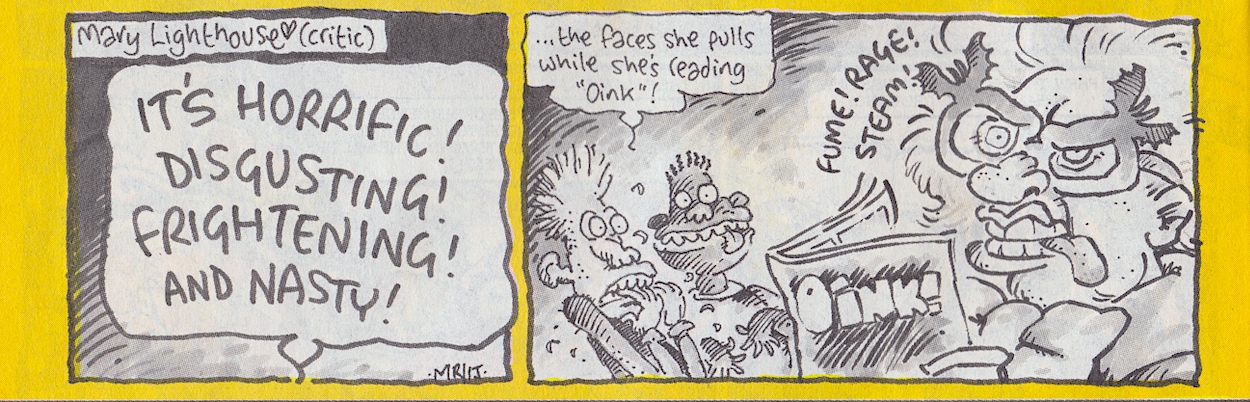
Coming up on Monday is the 41st edition of OiNK. It’s the Sickness and Health Issue and what better place to insert a special pull-out Pete and his Pimple comic! This news definitely excited me as a kid when I spot-ted this promo below in #40. That issue had already been one of the very best I’d read and then to have this news round it all off was just awesome for this young pig pal at the time.
Promo by Lew Stringer
As a not-so-young pig pal today I’ll admit I’m really looking forward to this particular issue for the same reason. While Lew Stringer‘s character may be the headline act watch out for what I personally think is the very best Burp strip yet, Janice and John finally return after the little bit of commotion they caused back in #7, plus there’s some news for OiNK fans which at the time was even more exciting than the mini-comic! The review of #41 will be here on Monday 14th November 2022.
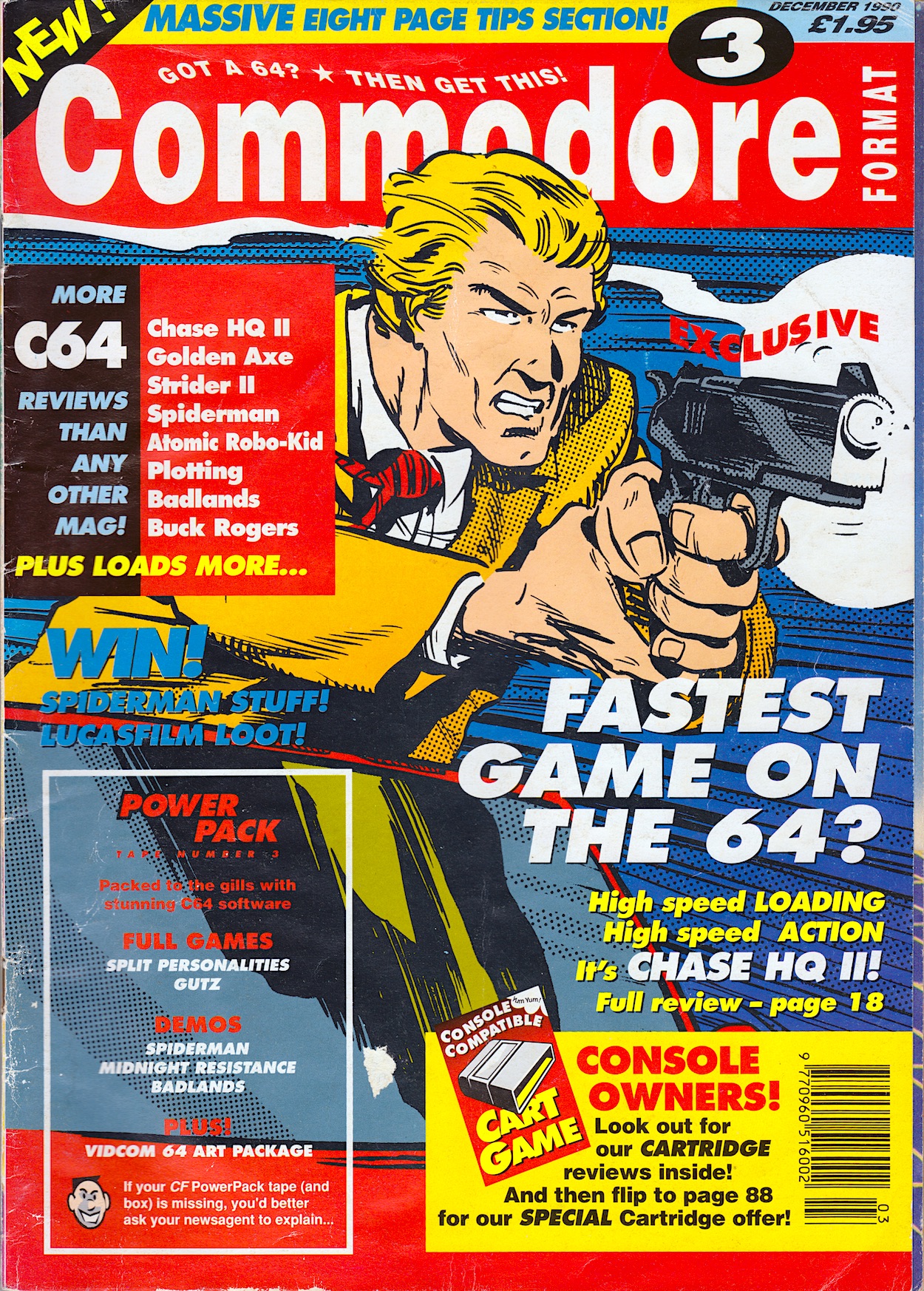
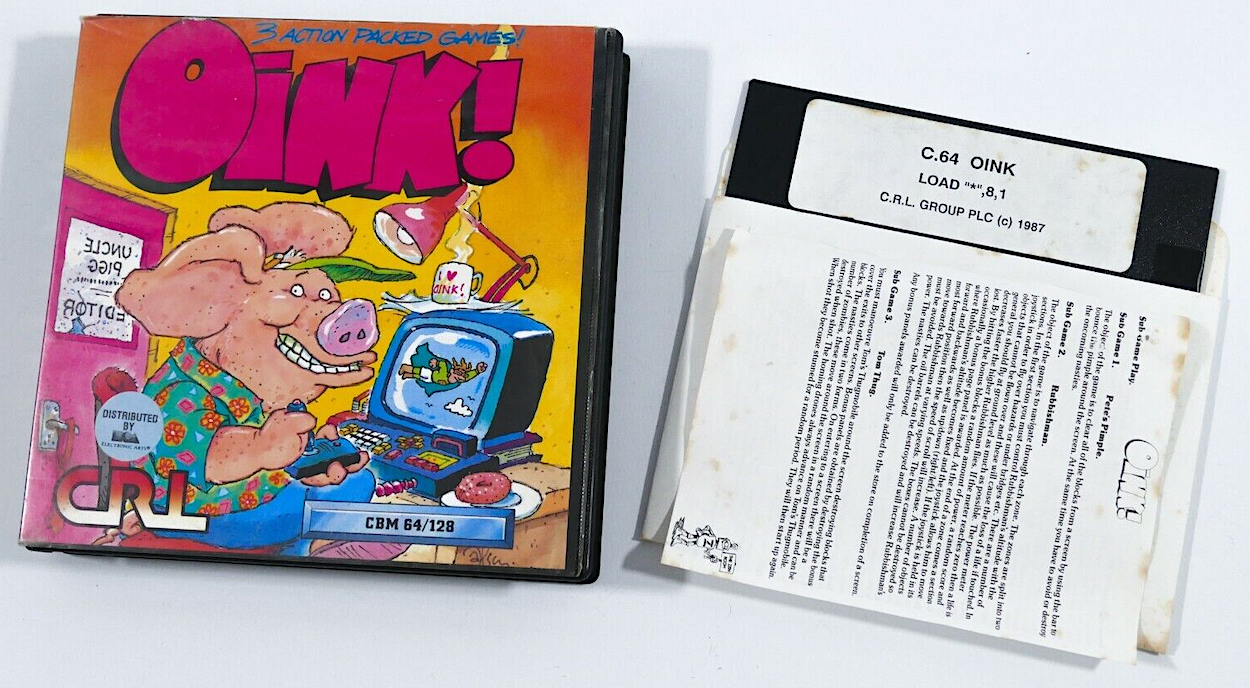
Last month I got to show you how Future Publishing’s superb Commodore 64 magazine, Commodore Format gave away a game on its covertape called Pig Tales, and how this game was actually the OiNK computer game, which had originally been released in 1987 across all 8-bit formats (image below from an eBay seller). Despite not having much to do with the comic, its playability and value for money was generally praised at the time but it just didn’t sell. So a short three years later it was a freebie on the cover of CF.
In case you haven’t seen the previous post, it contained the full instructions for the OiNK game and one month later Commodore Format was back with a guide for those stuck in the misadventures of some of the comic’s most popular characters. So that’s what this post is all about. Plus, just like last time I’m throwing in some contemporary features and adverts from the magazine to place it in its time, just for fun.
Every month our computing and videogames magazines would contain hints, tips and cheats for a huge variety of games. Without search engines, if you were stuck you just had to sit tight and hope your monthly read contained some help for you. Today I stay away from such websites that offer things like this, but the younger target audience of these magazines lapped these things up, as did I at the time. Some of the most popular forms of help were game maps.
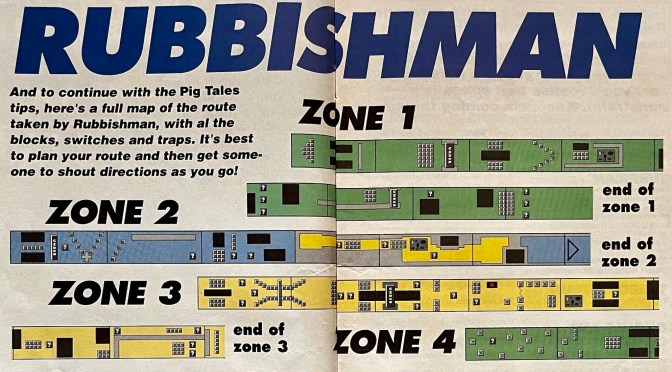
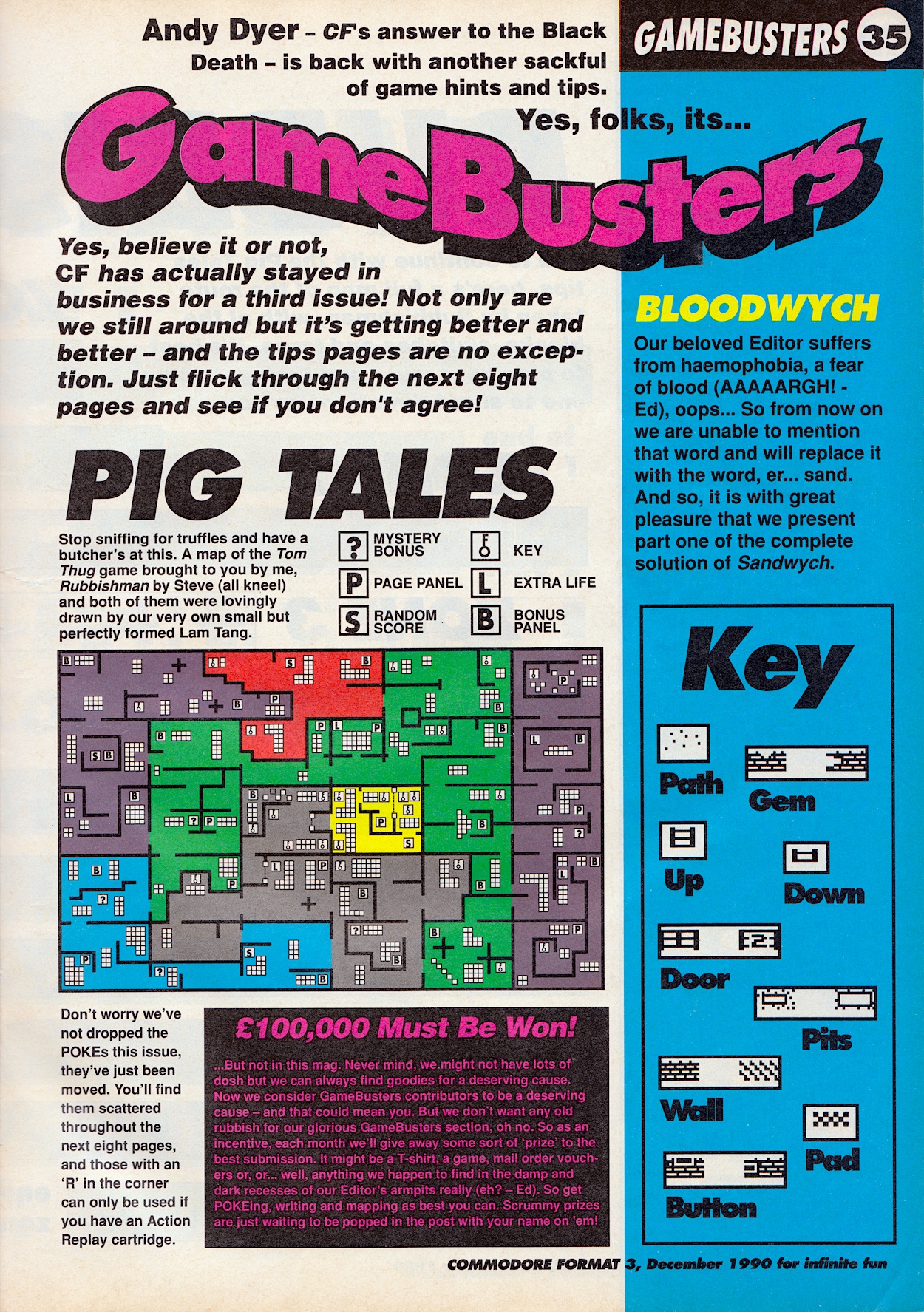
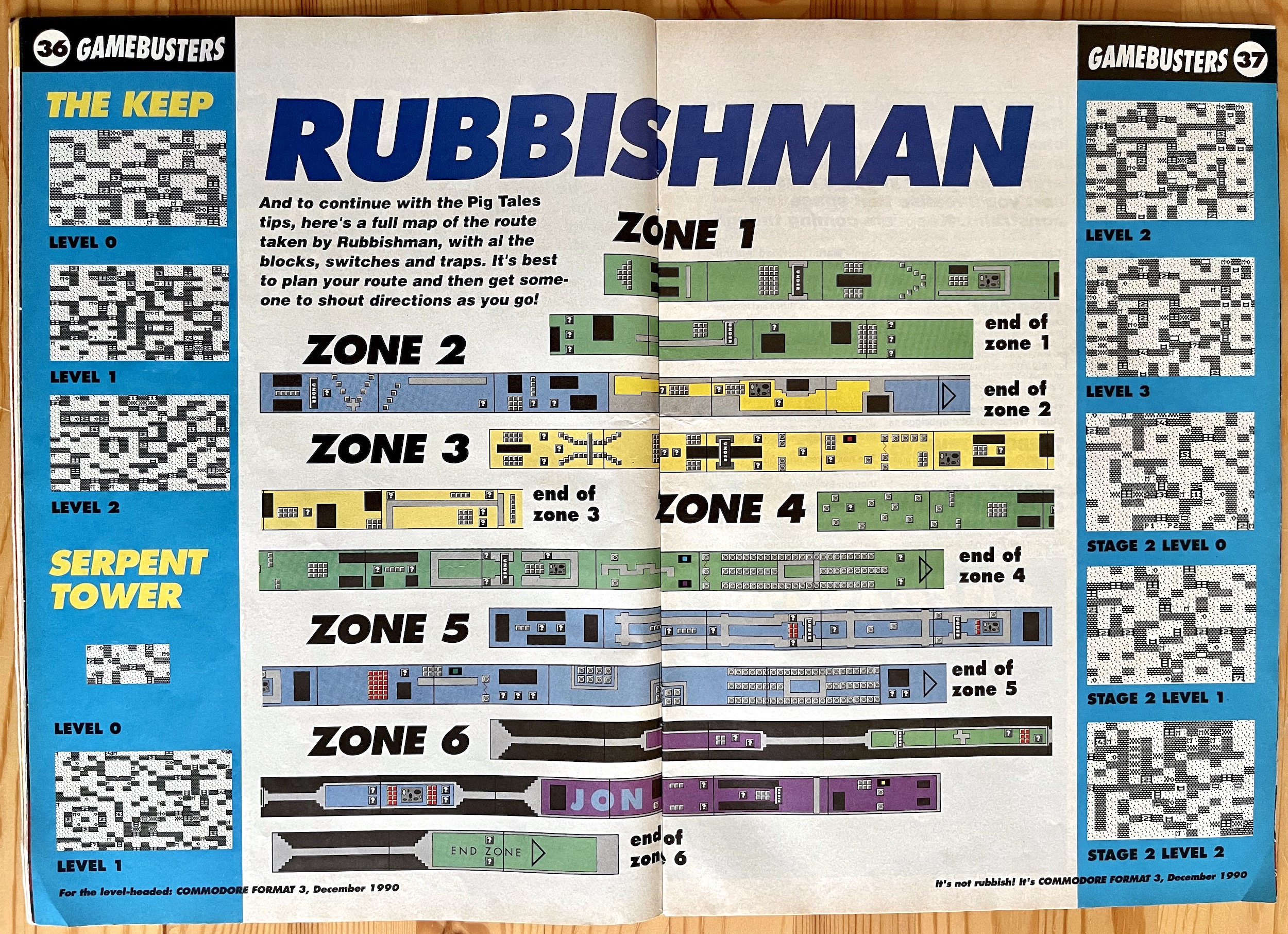
In the section of the mag called GameBusters, staff writer Andy Dyer and editor Steve Jarrett painstakingly compiled detailed maps for the Tom Thug and Rubbish Man sections of the OiNK game respectively, which in turn were drawn up by designer Lam Tang. There was no need for help with the Pete and his Pimple section, it was a bat and ball game. It just required practice. So if you’ve got a copy of the game and would like to get that bit further (and have no patience) here are the full guides from this issue.
Ignore those black and white maps down the side, those are for a different title altogether. As you can see Tom’s zombie crushing section is all one big area to traverse while Rubbish Man’s is divided into six increasingly difficult zones. (Also, see the rather self-congratulatory game programmer include his name in a level!) Throw in Pete’s game and it’s a bit of a miracle it was a single load, not taking up any more than the computer’s measly 64k of memory (actually less when system memory is taken into account). For contrast the images on this blog are 1Mb on average, roughly sixteen times that size.
I’d actually like to give that Rubbish Man section a go again!
You can’t fault the team’s work here. Every little detail is included and not one screenshot is used, it’s all been drawn from scratch from playing the game themselves. No, the team didn’t receive a copy of the maps from the game publisher, at the time writers of these kinds of magazines had to basically play these games for hours and hours and assemble the guides themselves. Given how this issue contains eight pages of such help for the young players it’s an insane amount of work every month.
I’d actually like to give that Rubbish Man section a go again! If you’ve missed any of the coverage of the game on the blog you can check out a retrospective from Retro Gamer, a preview from an issue of Zzap!64 containing a cameo by Snatcher Sam, a special interview with OiNK’s editors in Crash magazine which also came with a special free edition of OiNK, there’s a full review of the game from Zzap and of course the previous issue of Commodore Format. Now let’s have a quick retrospective look over some things that caught my eye on other pages of this December 1990 issue as I prepared the above scans.
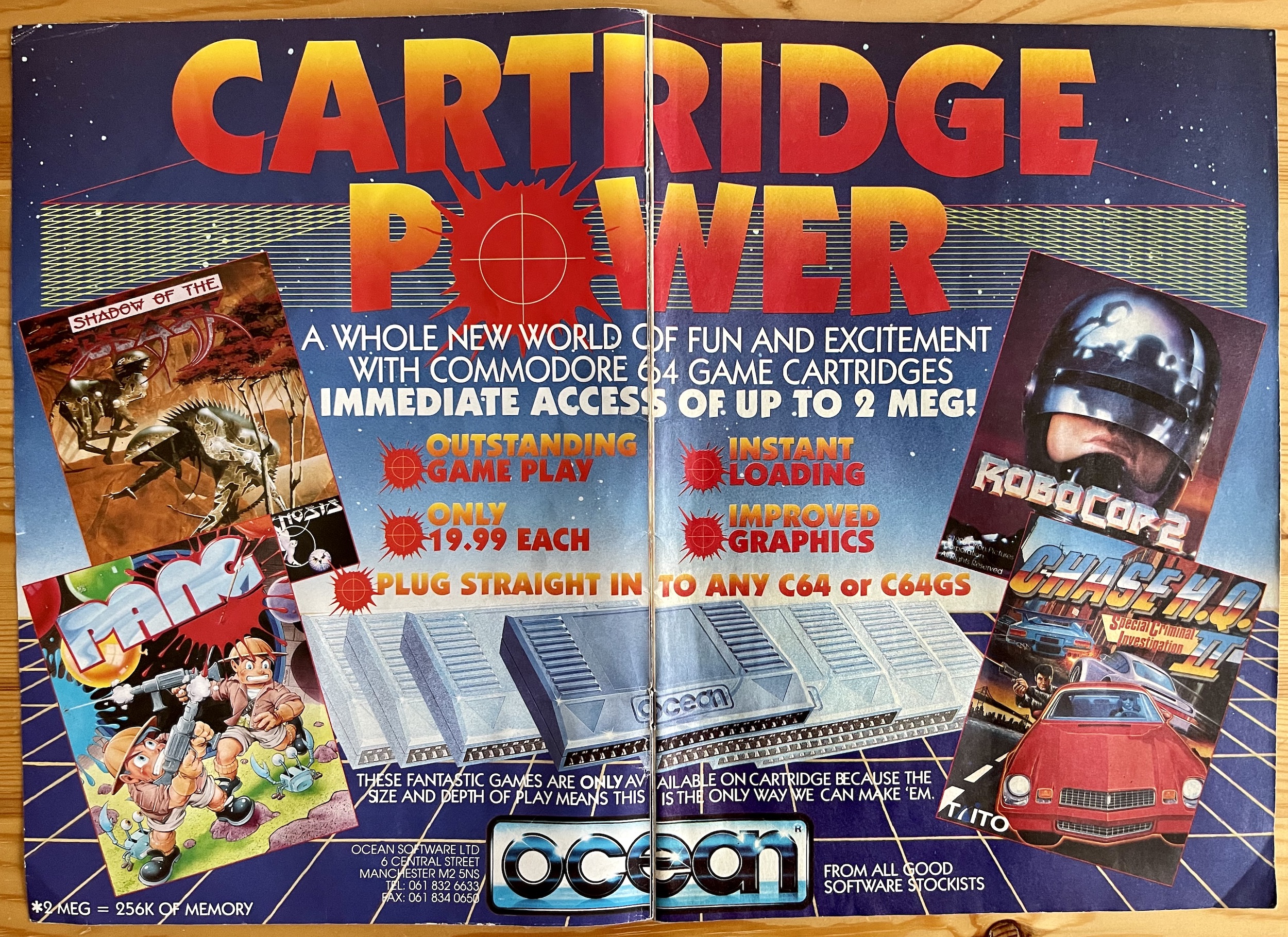
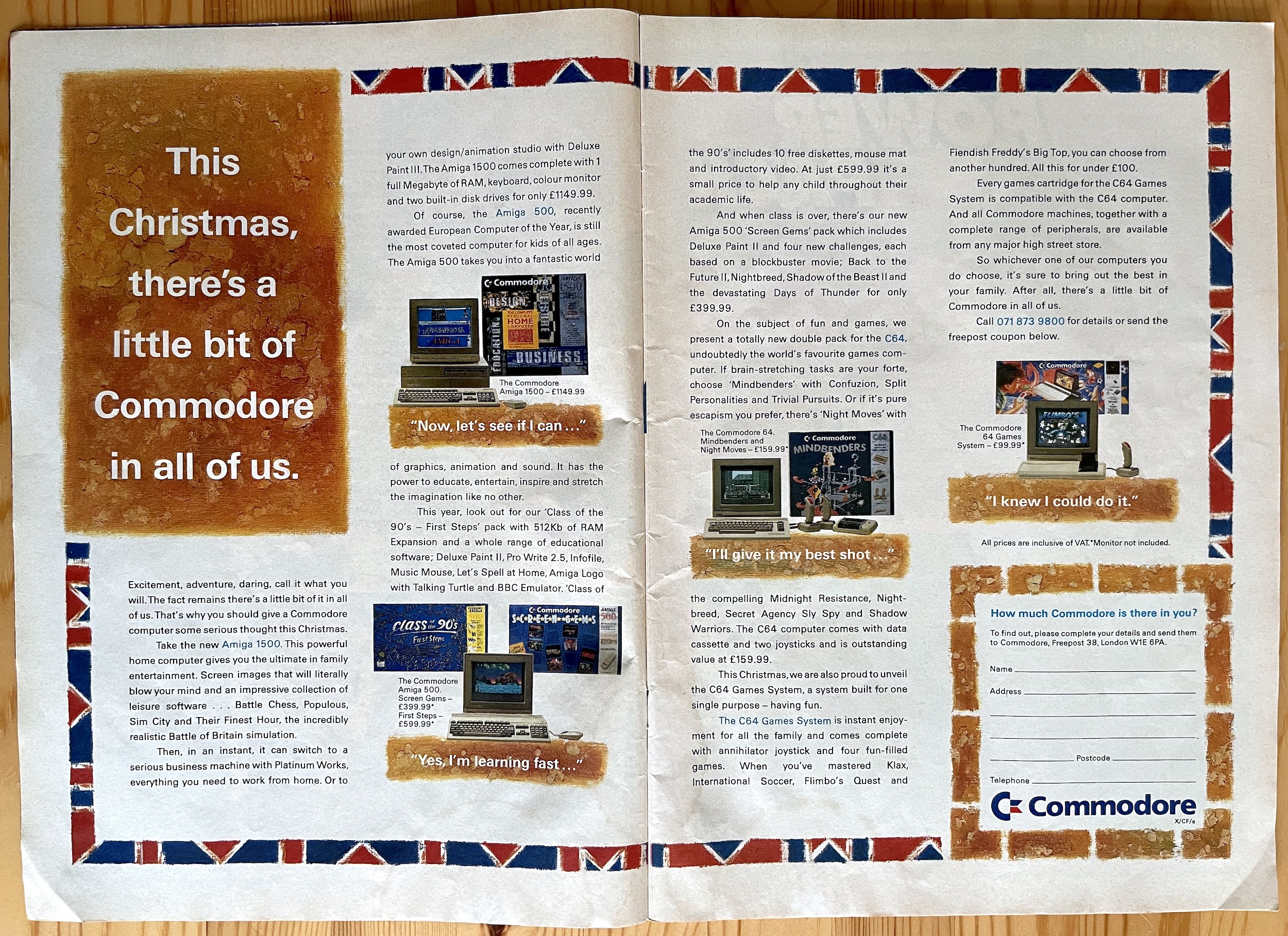
Back in the early 90s when other computer companies such as Sinclair and Amstrad found their 8-bit systems struggling the Commodore 64 was still selling well as an entry level computer. In the back of it was a cartridge port which had been underused throughout its already lengthy lifetime. New cart chip technology now enabled developers to use extra memory along with their ability to instantly load to produce advanced graphics, sound, more content and more complex gameplay. Commodore even released a console version of the 64.
With these the Commodore could easily contend with new kids on the block the Nintendo Entertainment System and Sega Master System. I often found (and still feel the same) that my favourite games on the 64 were miles better than the (admittedly great) console games. But Commodore, in their infinite wisdom, weren’t exactly marketing geniuses and the only places you’d see these advantages of cartridge technology detailed were in Commodore 64 magazines, read by people who already owned the machines. Without the manufacturer doing a good job the game publishers’ flash adverts above looked the part but had minimum impact.
Don’t get me wrong, gaming technology began changing very quickly in the 90s and incredibly the C64 still continued to sell very well for another couple of years. Commodore Format itself was eventually cancelled in 1995 only a few months before the first PlayStation magazine began! But with these advertising spreads above Commodore wasn’t exactly inspiring excitement, were they? In fact, they would go bust in 1994, taking the Amiga and its ever-developing range with it.
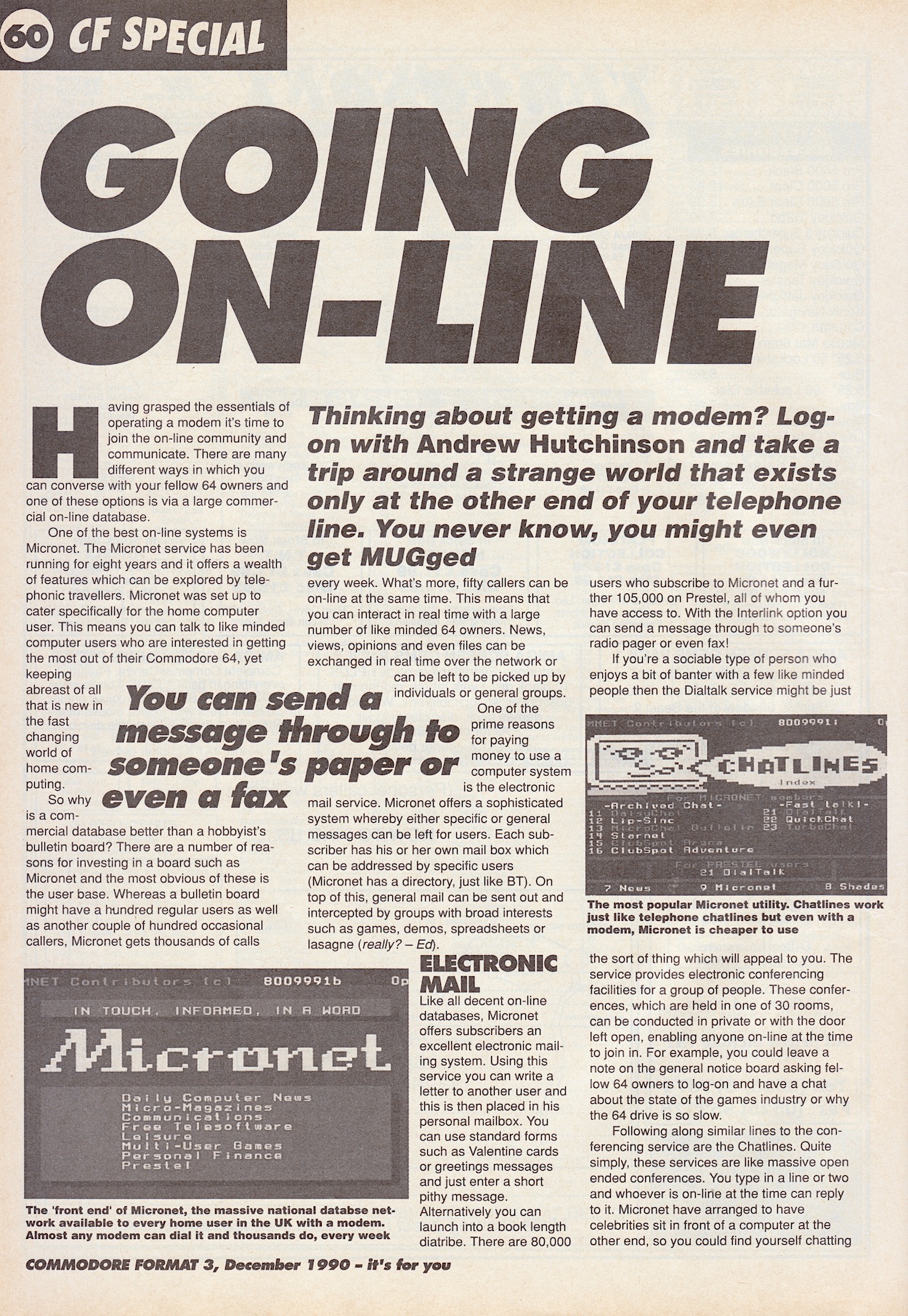
“You can hold conversation with people who may choose to help you or decide to chop your head off”
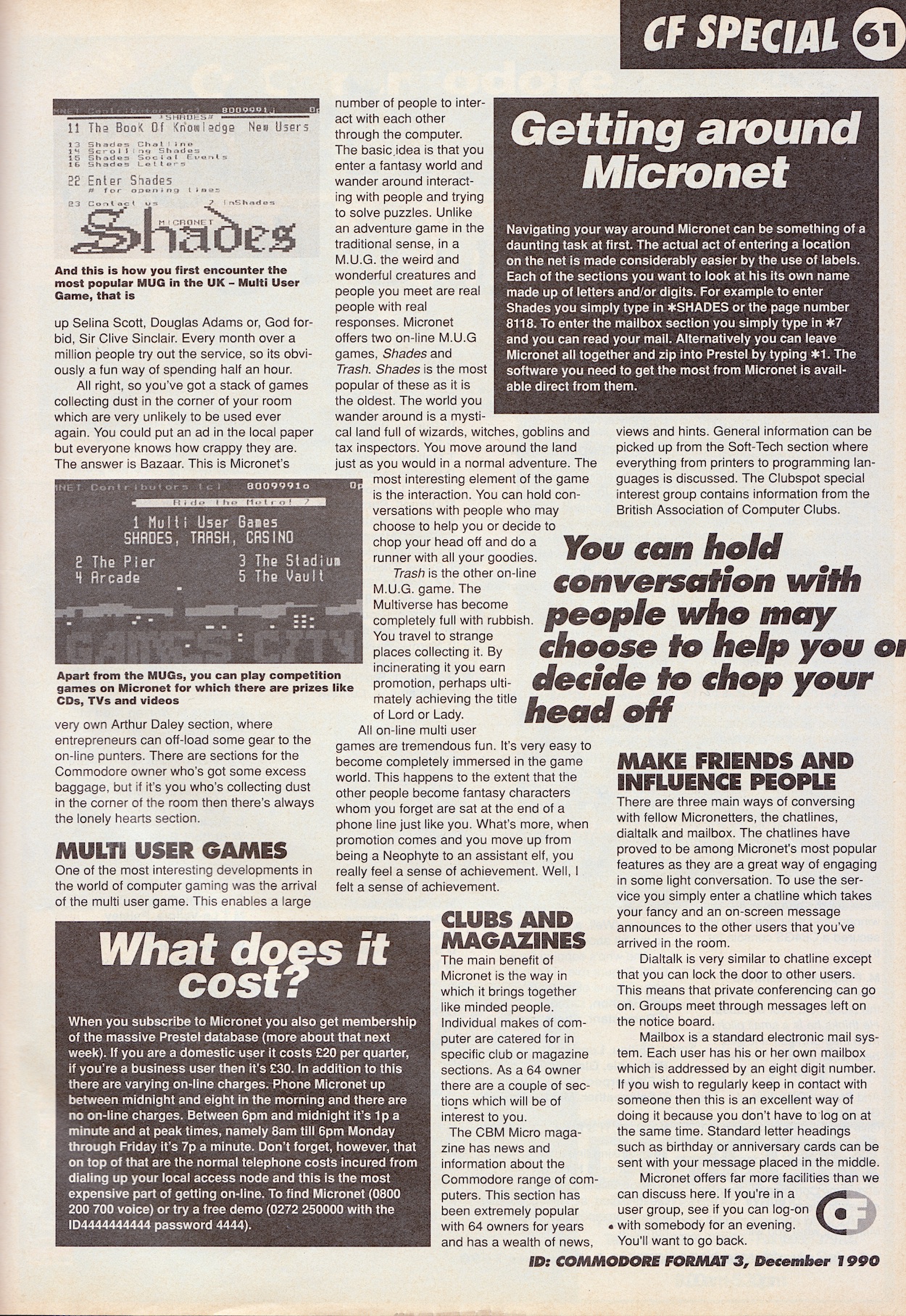
‘Going On-line’, Andrew Hutchinson
I always felt there was real potential to stave off the fate of the C64 if the company had really got behind the cartridge format on the proper computer instead of that silly console idea. Nintendo and Sega didn’t have to worry. The big push never came and when the console failed (as anyone could’ve predicted) publishers left the entire format in droves. Oh well, this short period of time still produced some of my very favourite computer games of all time and that’s not just the rose-tinted glasses talking.
Finally for this post there’s a feature I just had to show you all, written by future CF editor Andrew Hutchinson. Given this issue was published in 1990 and was for the Commodore 64 it might surprise you to see an article about going online! It would be the late 90s before our household had access to the Internet via AOL and a PC, but we were still in time for the extortionate monthly fees and even more extortionate per-minute charges mentioned below. Ah, the old days, eh? Yep, they very much were not better.
That pullquote on page 61 was about playing RPGs online, but could easily apply to Twitter today.
The excitement around the ‘Information Superhighway’ was intense in those years and looking back on it now it’s all very quaint of course, but every big revolution has to start somewhere. It’s strange to think how dependent our everyday lives have become on the technology that back then was seen as an expensive luxury only. Aside from the brilliant writing and the fact it was a damn fun magazine, the enthusiasm is another reason why reading actual retro magazines will always be superior to those from today that look back. It’s a lot cheaper too!
Anyway, that just about wraps up the OiNK Blog’s coverage of the OiNK computer game. I’ll take another look at Commodore Format next year when I reread the first magazine (of any title) I ever bought for myself, #14, which coincidentally enough is the same issue number of OiNK that had been my very first comic. Look out for more OiNK merchandise posts in the future.
It is with great sadness that we must say goodbye to another contributor to OiNK. The news just came out yesterday that renowned 2000AD artist Kevin O’Neill passed away at the age of 69 after a period of illness. Kevin’s most famous work was definitely the likes of Nemesis the Warlock, Marshal Law and of course League of Extraordinary Gentlemen. I was a huge fan of his work on Nemesis but my first encounter with his unique style was in the pages of OiNK. Below is what I said about Kevin and his work in the OiNK Holiday Special earlier this year.
“Now, let’s move on to what would surely be the main event for many comics fans. At the time I was unaware of who Kevin O’Neill was but today I know the man as something of a legend in the industry. Drawing the image of Tharg on the cover of the very first 2000AD he would go on to produce incredible work for OiNK’s stablemate, most memorably for me the stunning Nemesis the Warlock. In 1986 his whole style proved unsuitable for the American Comics Code Authority but thankfully DC went ahead and published his Tales of the Green Lantern anyway. Later, he would co-create Marshal Law and team up with Alan Moore for The League of Extraordinary Gentlemen. For OiNK’s Holiday Special he drew a four-page parody called The Game is Greed, written by Mark Rodgers.
“Lew Stringer was friends with both Kevin and Dave Gibbons, another legendary comic artist who’d appear in the pages of OiNK. They’d meet up frequently at London comic marts and when Lew found out Kevin was a fan of OiNK he asked him if he’d like to contribute. His first strip was actually a collaboration with Lew called The Truth About Santa for The OiNK Book 1988, then later he drew this brilliant script by Mark, but deadlines for specials and annuals being what they are this was the one that saw print first. I may not have known who he was but I adored the very unique art style and I can remember lying in bed late at night (having already read the comic that morning) pouring over all of the funny details for a long time. I’d never seen anything like this.
“Kevin’s sharp lines, exaggerated action and gorgeous colours really pop, making the strip stand out in even the quickest of skims through the issue. This is no small feat for an issue of OiNK.”
Later, when I began reading issues of 2000AD that belonged to school friends it was Kevin’s Nemesis that really stood out to me. It still does and will always be my first choice of strips when I want to dip my toes into a little 2000AD.
Kevin grew up on The Beano and The Dandy but it was Mad magazine, the same title that partly influenced the contents of OiNK, that really had an impact on him at an early age. He began working as an office boy in IPC Magazines instead of studying art and worked his way up, eventually becoming instrumental in the early success of 2000AD. He was even responsible for the strips having credits, something unheard of before then in British comics!
He eventually worked his way into the American market but The Comic Code Authority thought his work was too shocking and he was effectively blacklisted. Back in the UK his co-creations Marshal Law and The League of Extraordinary Gentlemen led to him being held in high regard as one of the greatest British comics talents ever, described by 2000AD themselves as, “innovative, iconoclastic, idiosyncratic, inventive, visionary and provocative”.
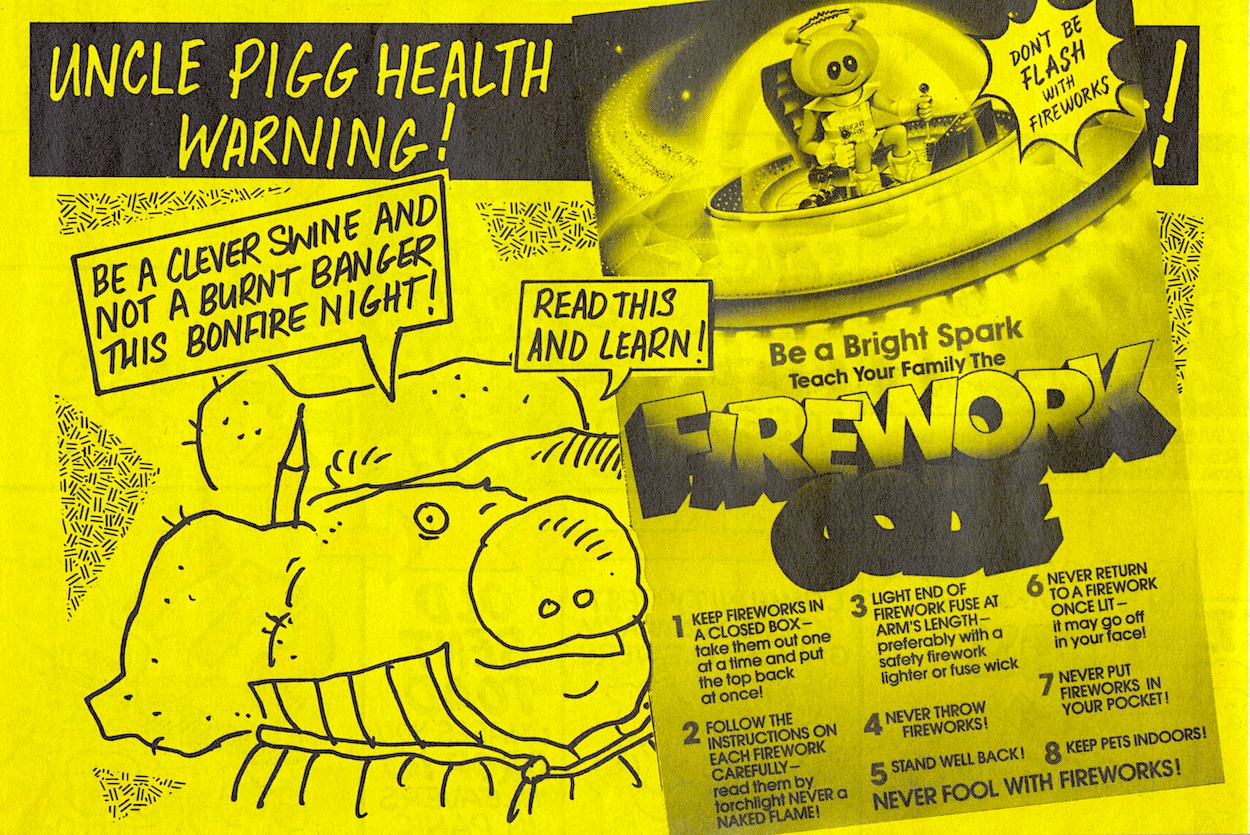
Back when I were a lad (as they say) fireworks of the outdoor variety were illegal in Northern Ireland, unless they were part of an organised event run by a council for example. Living in a tiny town back then this meant fireworks displays were never part of my youth around the time of OiNK. Sparklers were about the height of it. But of course in the rest of the UK (and from my teen years onwards too) such limitations weren’t in effect and Uncle Pigg wanted to make sure his piglets didn’t turn into barbecued pork.
So a copy of the Firework Code was pasted onto a page of #39 by co-editor Patrick Gallagher, the issue going on sale Saturday 17th October 1987. When I saw this while reviewing the issue I initially found it strange it wasn’t in the Hallowe’en issue for that holiday and the 5th November in particular. But given how many nights for what seems like weeks around this time are accompanied by loud bangs and whistles from every direction I think they got the timing just right.
I hope you’ve all enjoyed the spooky season and remember Uncle Pigg’s sage advice above, the last thing you want to end up as is a “burnt banger”.
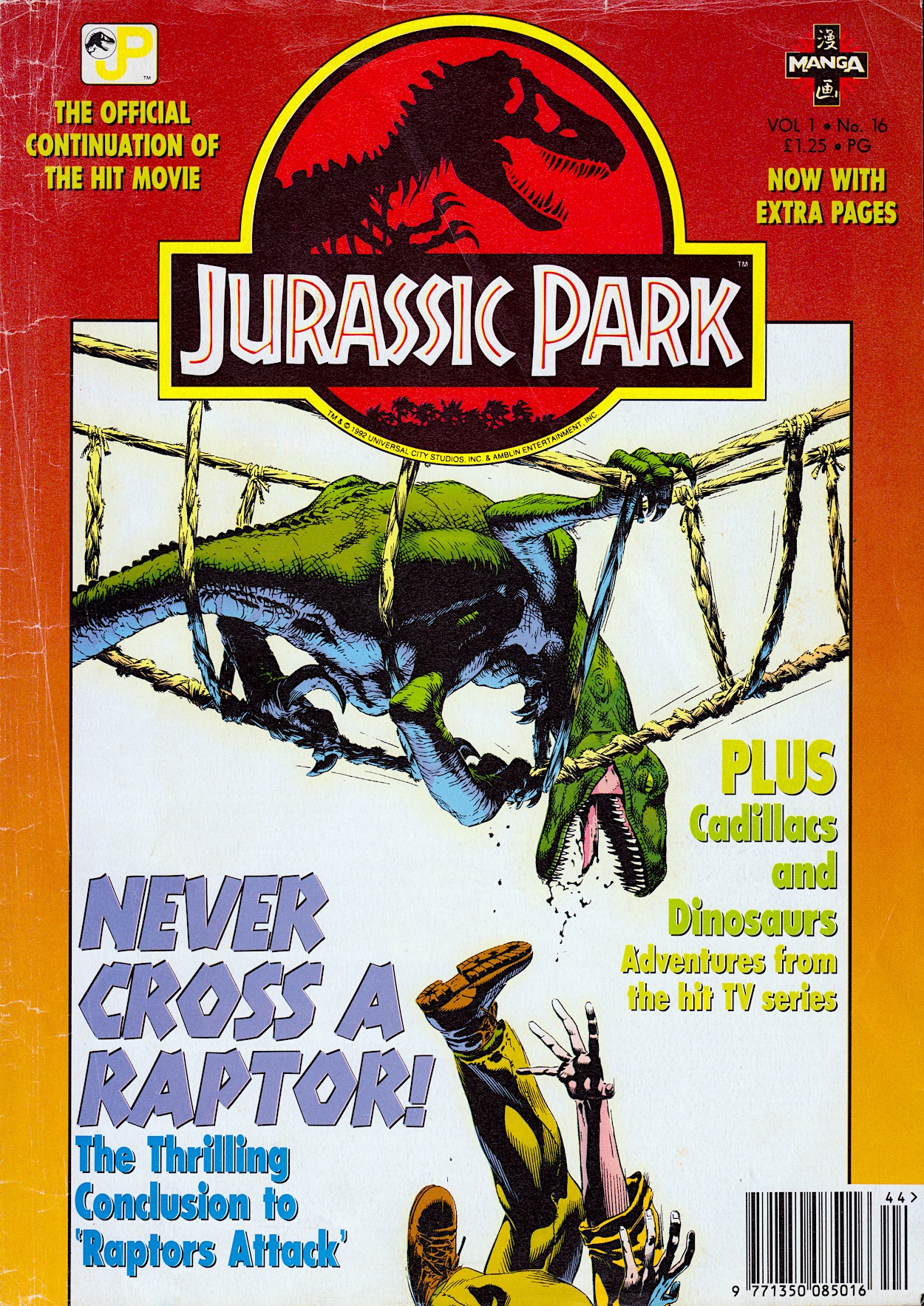
There’s no mention of it on the cover along with Michael Golden‘s image, nor in the editorial. In fact they’re still offering subscriptions to the comic, and there are just two little ‘The End’ captions attached to the final panels of each strip. But this is the last issue of Jurassic Park. As discussed last time, new publisher Manga Publishing knew this was going to be the end, so it’s rather misleading of editor Dick Hanson not to edit out the subscriptions!
We finish what was originally Dark Horse International’s series with another 40-page issue, although the inner 32 pages are of pretty poor stock compared to previous issues. The back up is the second half of last month’s Xenozoic Tales, but first we’ve the final part of the four-issue American mini-series ‘Raptors Attack’, which is the name referred on the cover. As mentioned before, this meant nothing to us UK readers because we didn’t know how the comic series was broken up into mini-series over there, so this just confused us.
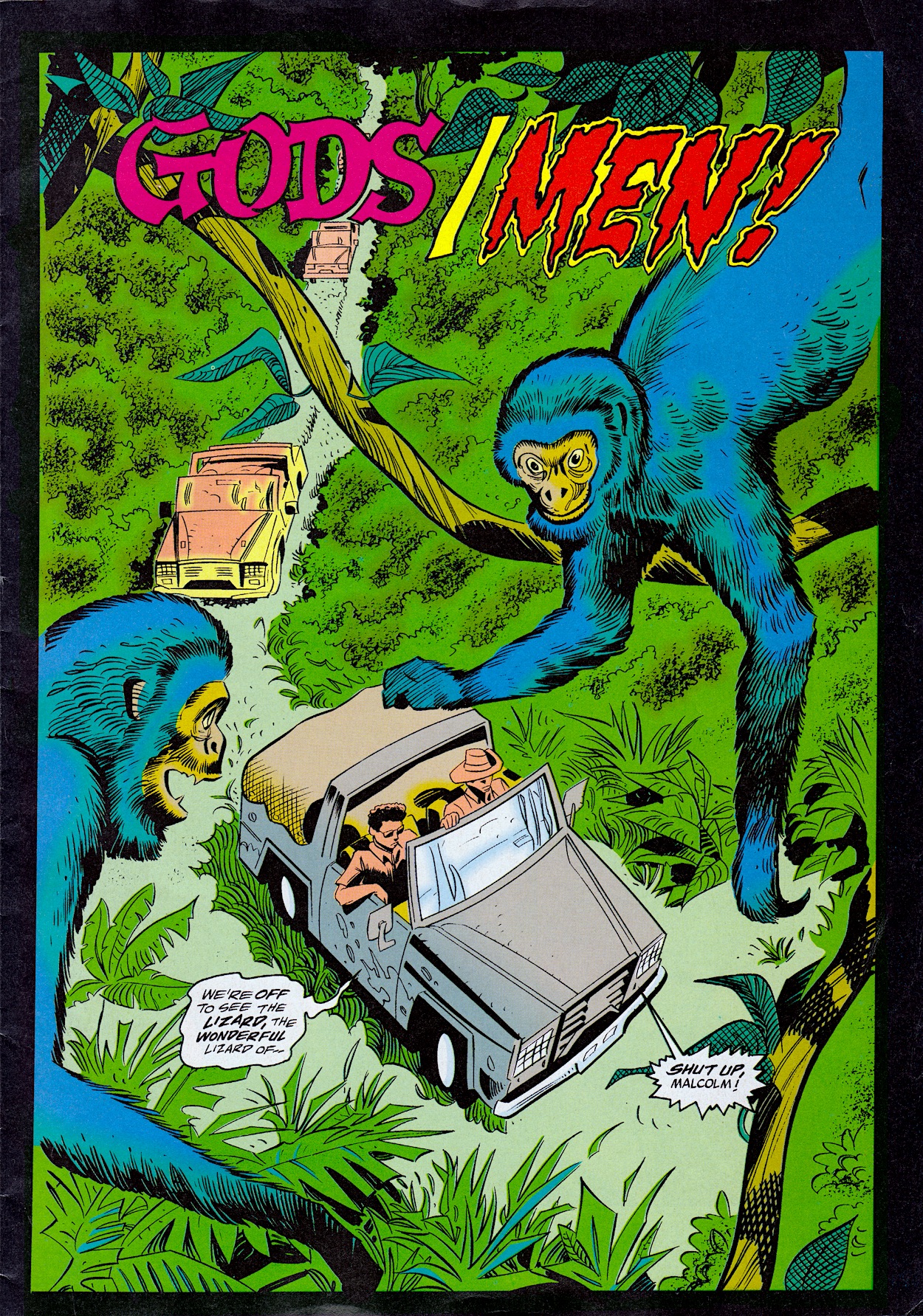
The first chapter of the mini-series was called Rush! but the following three had much more imaginative titles that changed to match the evolving storyline. Back in #14 we had Animals/Men, then Animals/Gods and this issue’s final story is Gods/Men as the now wild Velociraptors once more become the stars of the strip. Written by Steve Englehart who has been responsible for every chapter since the adaptation ended, it’s again pencilled by Chaz Truog and inked by Paul Fricke, letters are by new addition Brad K. Joyce (MarvelWhat The..?!, The Ren & Stimpy Show, The Sensational She-Hulk) and Renée Witterstaetter colours and story edits.
For a final chapter there’s more background character information than actual plot. There are quite a few pages given over to the history between Robert Muldoon and the late George Lawala, how even though they were rivals Lawala saved his life so Robert will avenge George’s. I don’t see the point in this at this late stage and it’s all rather predictable. Much better are the pages given over to developing our dinosaur characters Alf, Betty and Celia, mainly through a lengthy dream sequence as they finally sleep in peace away from us apes.
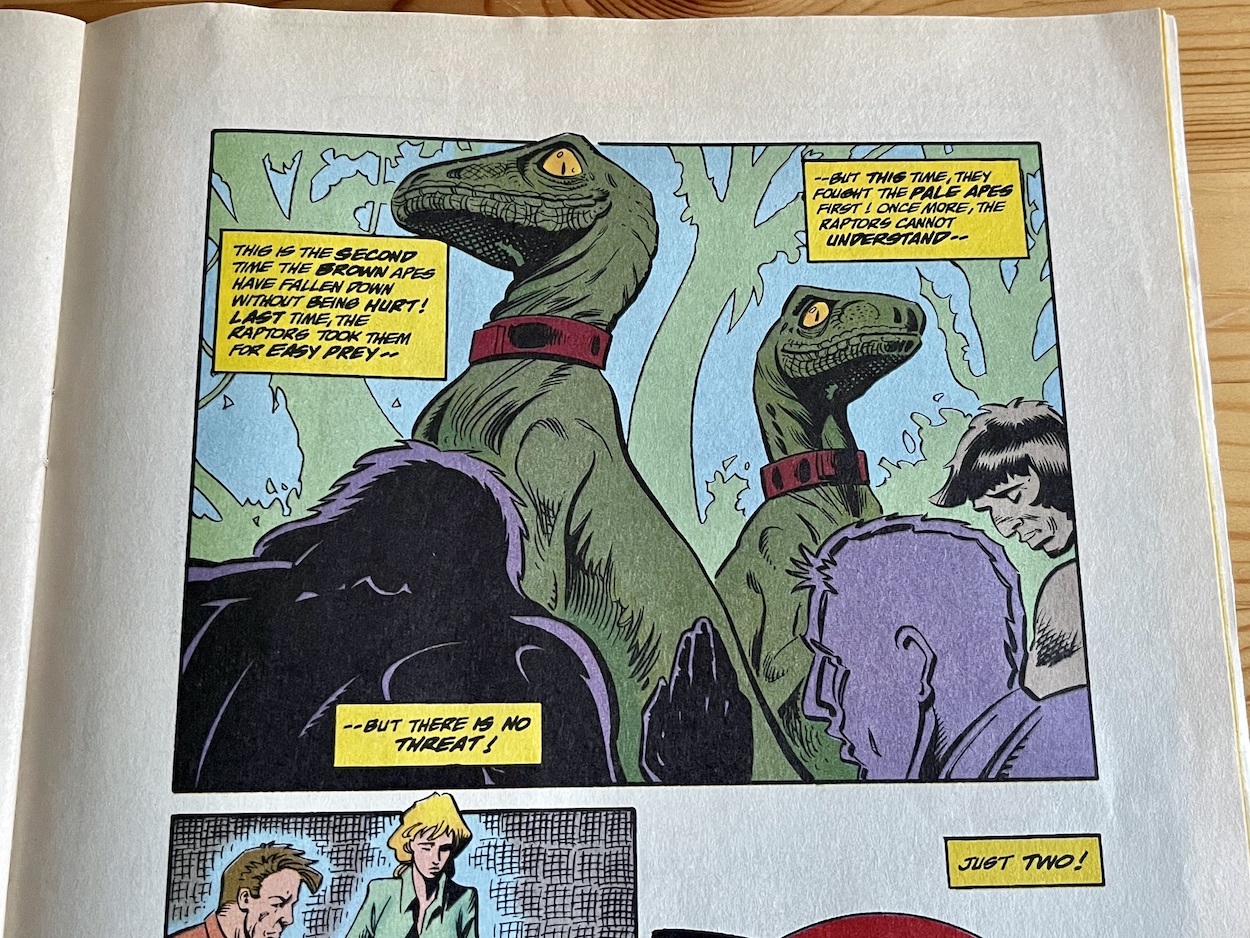
Clearly we’re getting a translated version of the information their mother passed on to them, correctly identifying the humans behind Jurassic Park as apes. The resting ‘raptors (only three of them left now) continue to dream about being captured and losing their family, reminding them that humans are their enemy. We get more chances to see them acting as regular wild animals too, drinking, playing and basically living and enjoying life. Then we find out one of the tribal men from last issue has survived and finds his gods, who are tempted to kill him as they did the rest, although he’s making such strange hand movements they begin to feel uneasy and take off instead.
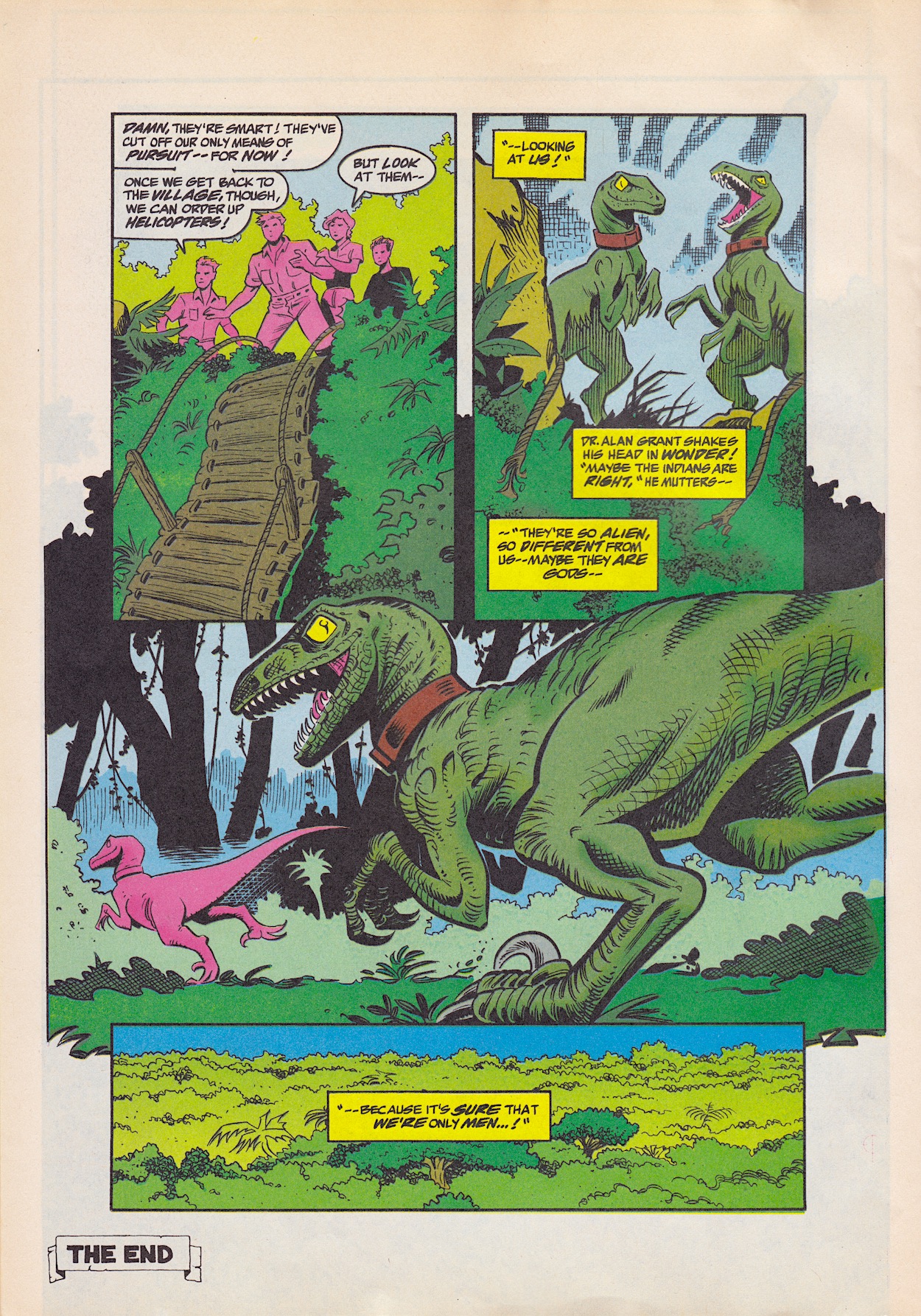
“They’re so alien, so different from us — maybe they are gods — because it’s sure that we’re only men…!”
Dr Alan Grant
He was trying to warn the ‘raptors of the humans nearby, our main characters, and how they were in the area to hunt his gods. Drs Ellie Satler, Alan Grant and Ian Malcolm have joined Muldoon as he hunts, the three of them making it very clear they are not there to kill. There are local villagers tagging along to help and Muldoon comes across as a bit of a racist, although thankfully called out on it by Alan. I really don’t like this version of the game warden character from the film and novel. Much more entertaining, as always, is Ian.
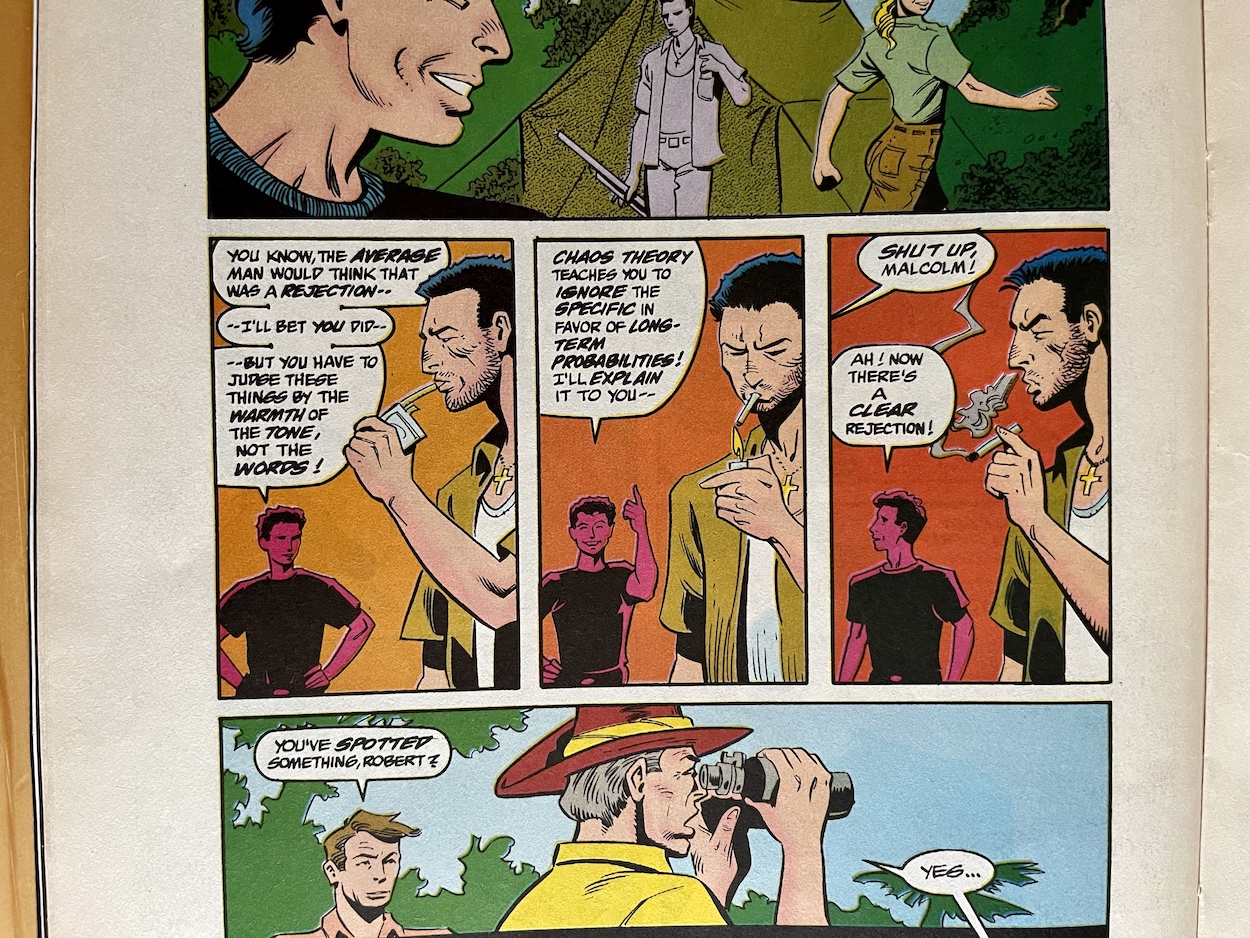
Still flirting with Ellie, despite Alan being right there, it’s clear it’s meant in good jest and his continual talking annoys Muldoon which is a bonus. Yes I still have a bee in my bonnet over the return of Muldoon and I’ve already gone into the ridiculousness of his survival. Here, it’s also explained that the reason the ‘raptors already had a family of adolescents was because they were able to escape their cage in Jurassic Park, find a secluded spot to lay their eggs away from the humans and then… went back inside their cage?!
Clearly this makes absolutely no sense whatsoever. It could easily have been avoided by having a larger gap between the end of the movie and the beginning of the comic’s continuation instead of picking things up only three days later (back in #6). The whole series hinges on these animals so it’s annoying to read this so-called explanation, it kind of ruins the whole set up. It’s ill-conceived and reads as a lazy way of getting the action going. Add in Muldoon’s survival and this official sequel is contradicting the movie it’s based on more and more.
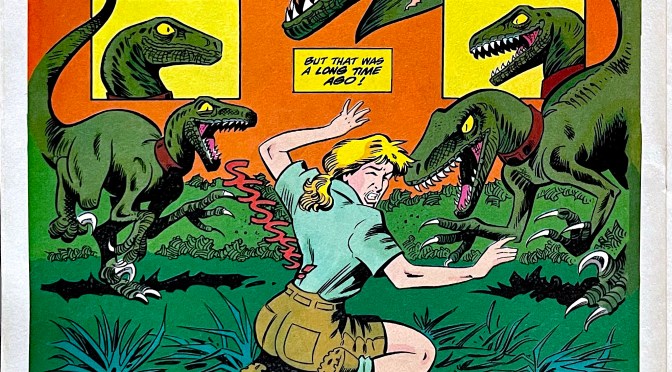
Shoving these inconsistencies to the back of my mind, the race towards this particular story’s climax is exciting. They track the Velociraptors to a part of the jungle separated from the humans by a long rope bridge. Muldoon is stopped from sniping them from afar by the locals, which attracts their attention. The ‘raptors sprint across the bridge to attack, coming face to face with an unarmed Ellie first of all.
Due to Ellie and Alan’s capture alongside the dinosaurs in previous issues and being forced to tend to Celia’s wounds, they’ve formed some form of cautious bond with these creatures. Indeed, we’ve seen Celia stop her siblings from killing them. But it looks like Alf and Betty no longer care about this. They’ve suffered enough at the hands of the apes. In the first of the two pages below I particularly like the ‘raptor on the bottom left, it’s a classic pose from the films and really gets across their ferocity.
Then the unthinkable happens.
This genuinely shocked me. I half expected Muldoon to fire at this point despite currently being attacked and restrained by the villagers and it was still sad to see one of them fall, despite the fact they were about to attack. However, who actually fired was the shocking part! This went against everything Alan stands for, everything he was trying to achieve. But he had no choice, it was either Betty or Ellie.
This was always the dilemma in the Jurassic franchise, the danger of these wild animals against the need to preserve them, to understand they’re just acting naturally, to nurture their instincts and let them be themselves. But of course, a little bit of Chaos Theory always got in the way and made it more exciting for us. In the end Muldoon is subdued by the villagers and the ‘raptors are poised to attack again, no longer in any mood to discern friendly human from foe. But the villagers and their strange movements jump in front of them and kneel before their gods.
With the death of their sister, the confusion over friend and foe and now these strange people Celia and Alf decide to take off. There are only two of them now. They know they’re the only ones but the world is a big place, so they run across the bridge, chew at its ropes to collapse it and head off in search of more of their kind. The last word is left to Alan Grant.
In America readers got another mini-series and an annual before a short-lived ongoing monthly, altogether another 14 stories which we never got here. In fact, it wasn’t until I was researching the comic’s origins for the blog that I discovered there had been any more after this. Back in the 90s it was a couple of months before I realised the comic had officially finished, what with it having taken a lengthy break before between #10 and #11 and of course the Christmas season kept me busy after this issue.
When I eventually realised the next issue was overdue I went back and checked and of course there was no date for its release, but as discussed above there wasn’t really any finality either. But I have to say I ended up really liking this ending, with the three ‘raptors out in the wild they could pop up anywhere in the world. Who knew what chaos could be sowed from having extinct creatures back in the world. In fact, 24 years later this was how Jurassic World: Fallen Kingdom ended.
Before this comic series is over there’s the small matter of what caused the future cataclysm in Mark Shultz’s Xenozoic Tales: History Lesson, written and drawn by him and coloured by Christine Courtier. It was renamed Cadillacs and Dinosaurs for these final issues (although a story has been chosen without dinosaurs) because the cartoon based on Mark’s comics had begun in the UK, but these are the original comic strips, so the blurb on the cover is somewhat misleading. So, do we get our answers as promised last month? Annoyingly, no.
My annoyance isn’t Mark’s fault though. This was an early story of his, meant to drop hints, not offer an answer. It was this comic’s editor who decided to use it as a finale and hype it up for Jurassic Park readers last time. As a result of this I’m feeling rather short changed.
Hannah discovers a shell of an atomic bomb in the secret library within the catacombs and we’re led to believe this is what caused the world to basically end. This is also what some of those present believe. However, researching the books it then transpires the world was on the cusp of nuclear war when the cataclysm happened and stopped it, so it was a separate event (thus no straight answer). Then the library descends into chaos in a way that’s scarily prophetic of where we find ourselves in the world right now.
Hannah and most of those present know the bomb is just a shell. It’s been dismantled and emptied, they know it didn’t cause the cataclysm because of facts in the books. However, there are a band of people who don’t care about facts and instead believe the bomb itself is ‘evil’ and should be destroyed, even if that means taking the library and the entirety of human history with it, along with everything they could learn about their history, the actual cataclysm and how they can overcome it.
In other stories in this enjoyable back up it hinted that the cataclysm was caused by climate change, not least thanks to Hannah’s disgust at Jack’s garage of old cars. These mechanical relics may have been converted by Jack to run on dino doo-doo but they were referred to as being partly responsible for the destruction in the first place.
The Jurassic Park comic was a big deal to me as a teen and I’ve really enjoyed reliving it 28 years later
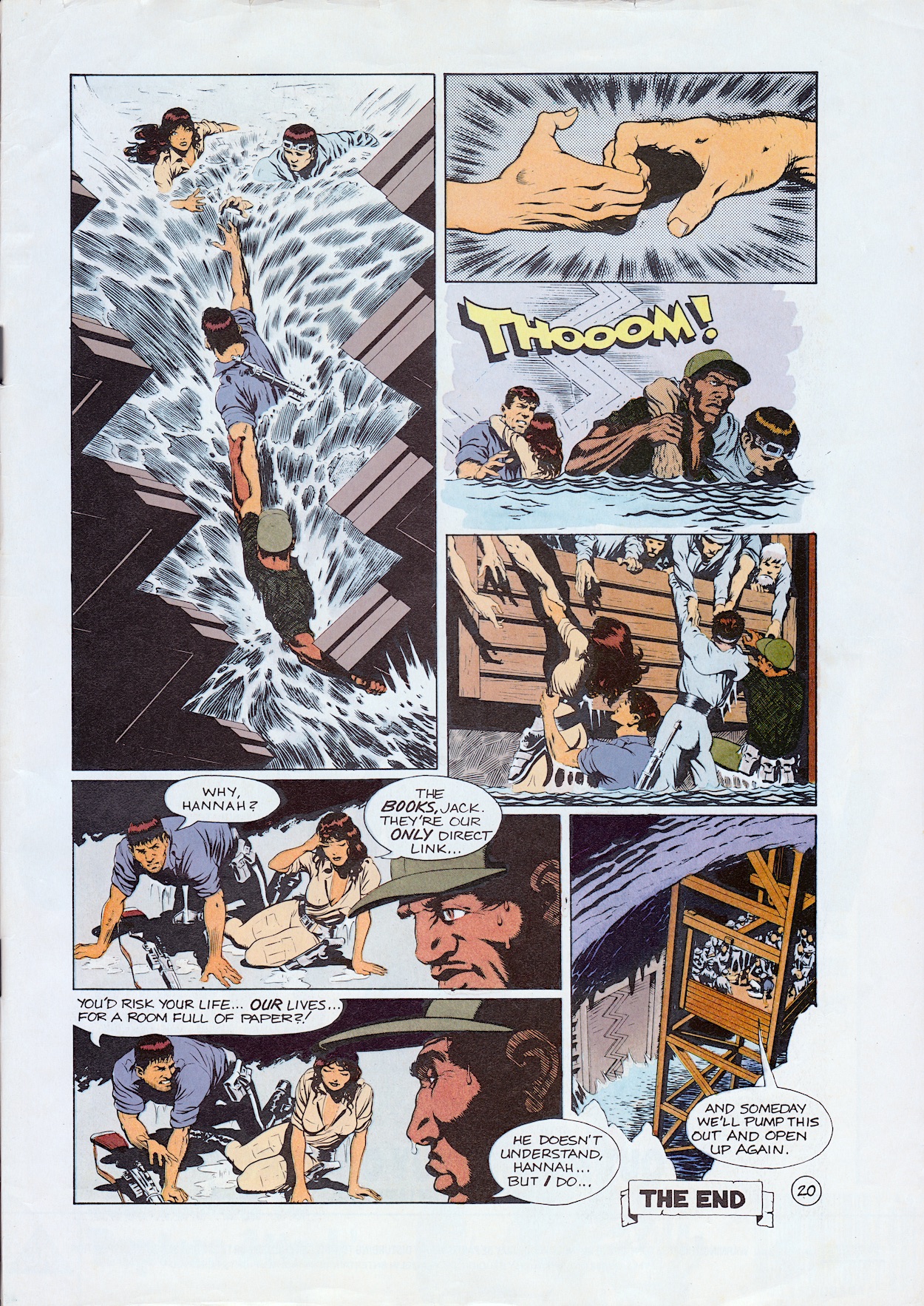
Back to this issue and Hannah’s frustration is palpable and I can imagine how this would’ve read in the early days of the original comic, so that’s how I’m reviewing it, instead of the disappointing climax it was never intended to be. She pulls a gun on one of the workers and demands to be taken to the sluice gate where she’s able to stop the flood and save about half the books from being completely destroyed, almost losing her life in the process.
Read in the correct order this would’ve solidified Jack and Hannah’s friendship (and perhaps more) for Mark’s original readers, with Jack’s concern for Hannah written as being something of a surprise to him. Then, as you can see on this final page he doesn’t understand the importance of the books, putting the two characters back to being at odds with one another as their relationship developed. Unfortunately we never got to enjoy this aspect of Xenozoic Tales because all our chapters were out of order.
So that’s it for the UK’s version of Jurassic Park. Back in the 90s the movie’s comic sequel was left hanging yet at the same time it felt like the perfect end. Taking these characters and dinosaurs so far outside of the confines of the movies had enthralled me and they’ve held up really well. Yes, I didn’t like the contradictions to the original film and so sadly by the end the strip simply can’t fit in with the movie sequels anymore.
Steve Englehart had been given free rein to do whatever he wanted, which is surprising given the high profile nature of the new franchise and the fact Amblin knew Michael Crichton was writing The Lost World novel. Clearly, having two sequels being written at the same time was never going to work. The Jurassic Park comic was a big deal to me as a teen and I’ve really enjoyed reliving it 28 years later.
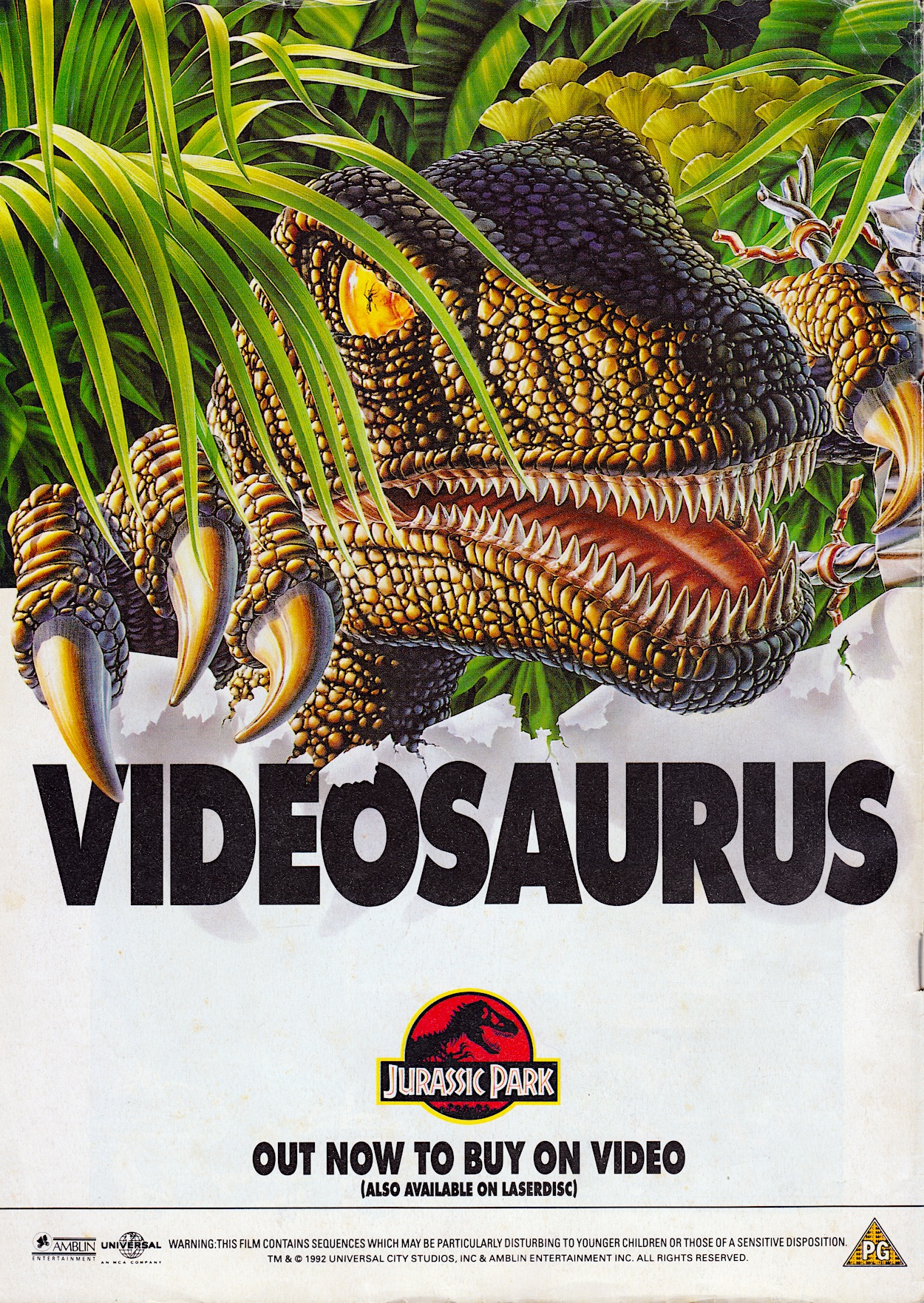
The last back page finally announced the release of the movie on VHS to buy, which I’d very gratefully receive for Christmas in a special fossil box (you can see an image of it in the original introductory post) and let’s not forget you could also buy it on Laserdisc! How very 90s.
As I close this final issue it’s reassuring to know that I’m not done yet with Jurassic Park on the blog. This isn’t the end, only a bit of a pause.
There was another, short-run UK Jurassic Park comic a few years later that I only recently discovered, so watch out for that in 2023 and while I can’t see me being able to collect the rest of Xenozoic Tales, thankfully the same isn’t true of the main strip. IDW reprinted the series in graphic novel form over a decade ago and I’ve finally been able to collect the ones I needed to finish the story. I haven’t read them yet, I will when I’m ready to write about them but I’m sure they’ll make an excellent addition to the blog. They’d better, given what they cost!
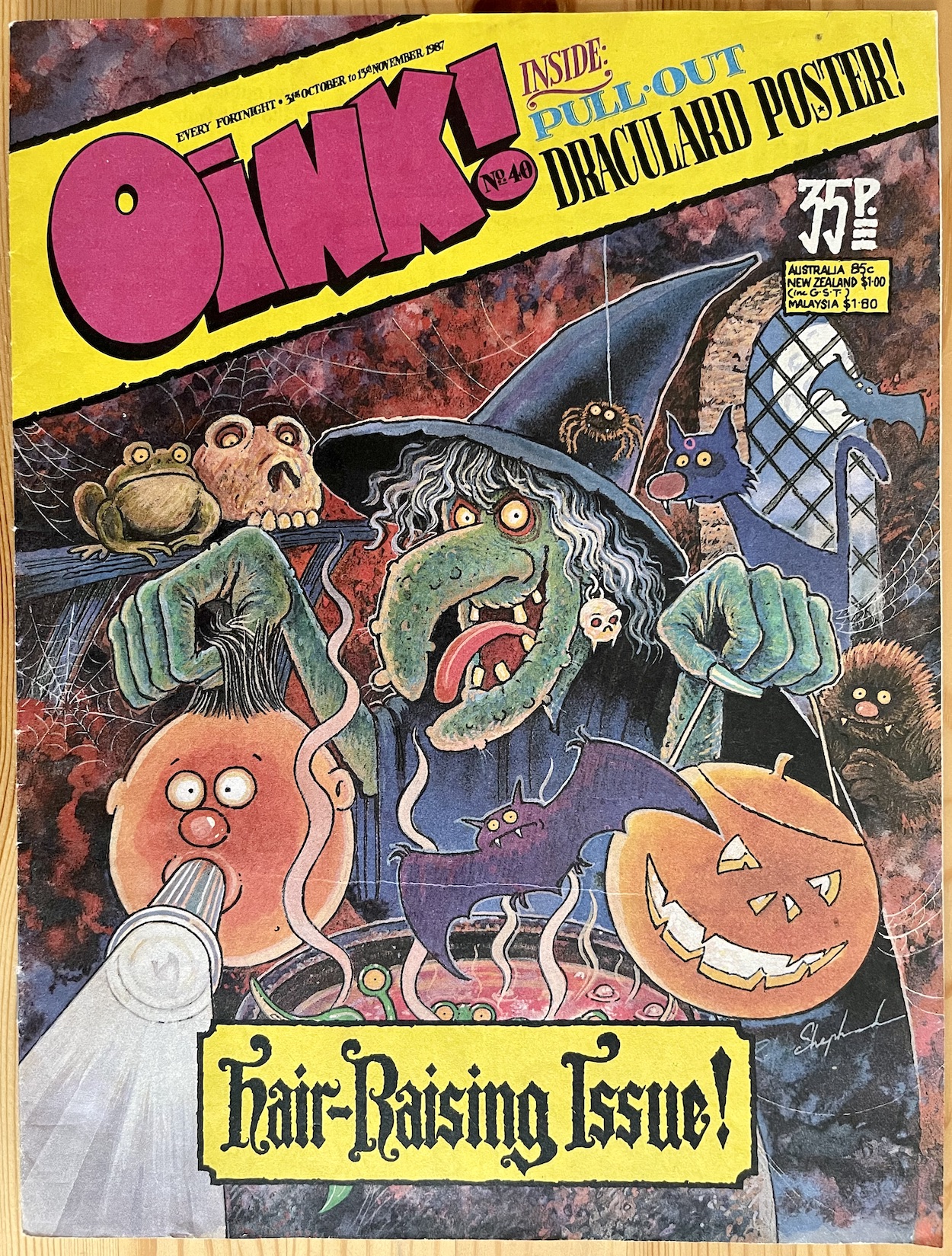
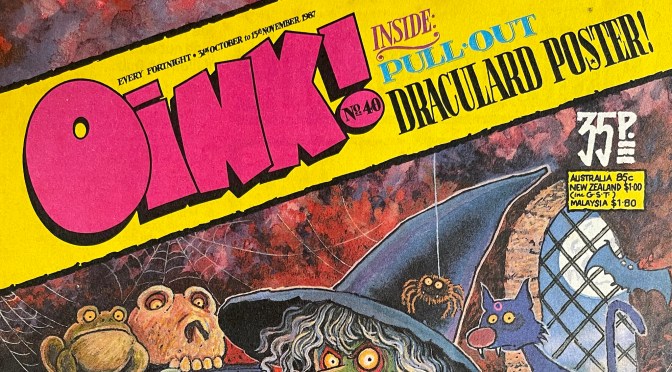
In 1986 OiNK’s timing was impeccable when it came to the spooky season, with the relevant issue being #13. A year later another happy coincidence saw the release of the 40th issue on Saturday 31st October, perfect for their second Hallowe’en special. Kicking things off is the triumphant return of Ralph Shephard (not seen since #23 and who wouldn’t be again until the second annual), an artist who drew so many great spoofs of childhood favourites in the early days of the comic. What an incredible cover this is.
Ralph’s bewitching front page is a fondly remembered classic, a gorgeous piece which takes advantage of the little bit of extra space the new smaller logo gives, and that background colouring effect is just beautiful, adding texture and really making it stand out on the shelves. (It’s also the second cover in a row for Harry the Head.) From now on we’d get one banner along the top instead of several, the cover images no longer needing gaps filled. I think it makes for a bolder, clearer cover for the rest of the fortnightlies.
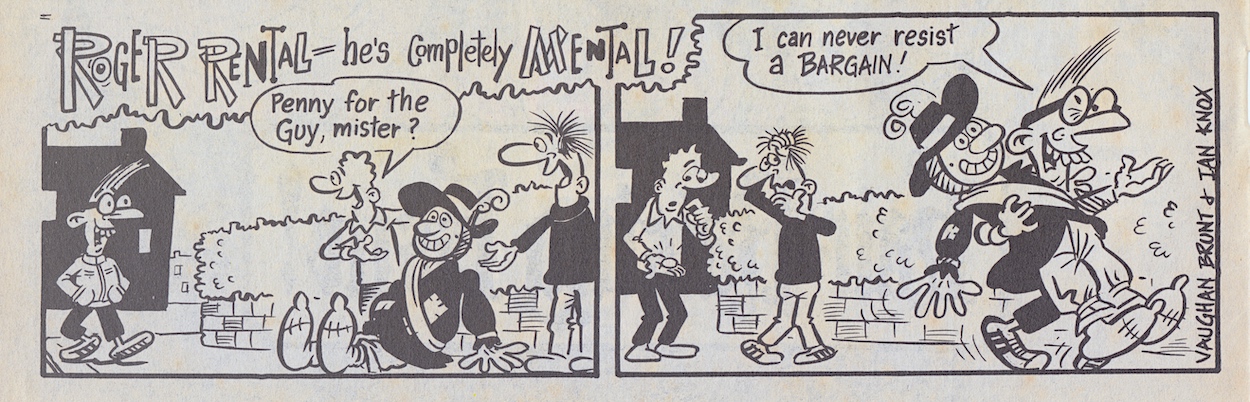
For me the stars of this issue are the smaller mini-strips; there are just so many of them this time out and every one is a cracker. This does make my job of selecting only a few choice highlights incredibly difficult of course but it’s a nice problem to have. On the inside front cover is Roger Rental, He’s Completely Mental as ever drawn by Ian Knox, now written by new OiNK scribe Vaughan Brunt.
May has passed away in recent years and it’s been nice to relive memories of reading OiNKs at her house
It’s strange to think how tiny little strips like this, with just two panels and two lines of dialogue, can stick in the brain for decades to come. This one certainly went on to do just that. Then again, Roger was such a memorable character in the first place. Ever since his debut in #3 all his strips have been genuinely laugh-out-loud funny, the premise letting the writers’ imaginations run wild. The job of writing Roger’s ability to turn any everyday situation into the complete opposite was in good hands with Vaughan.
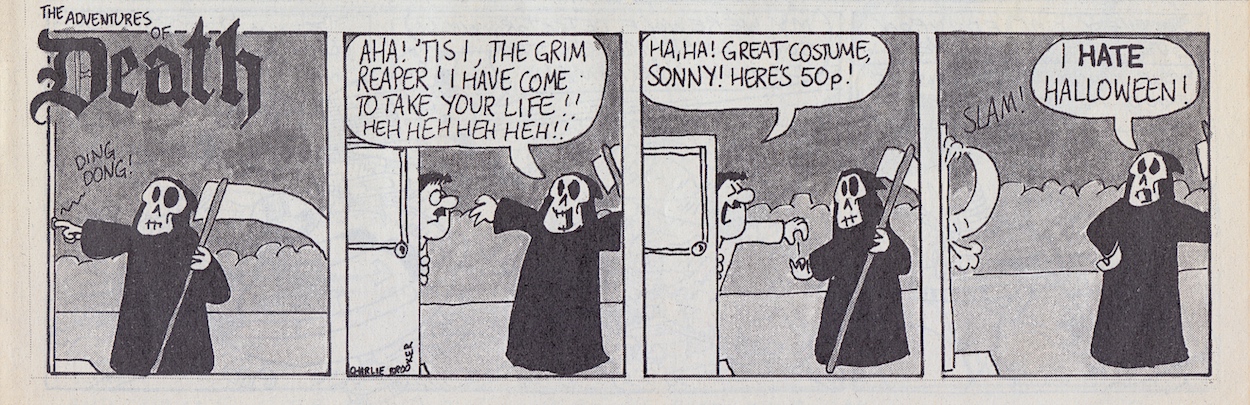
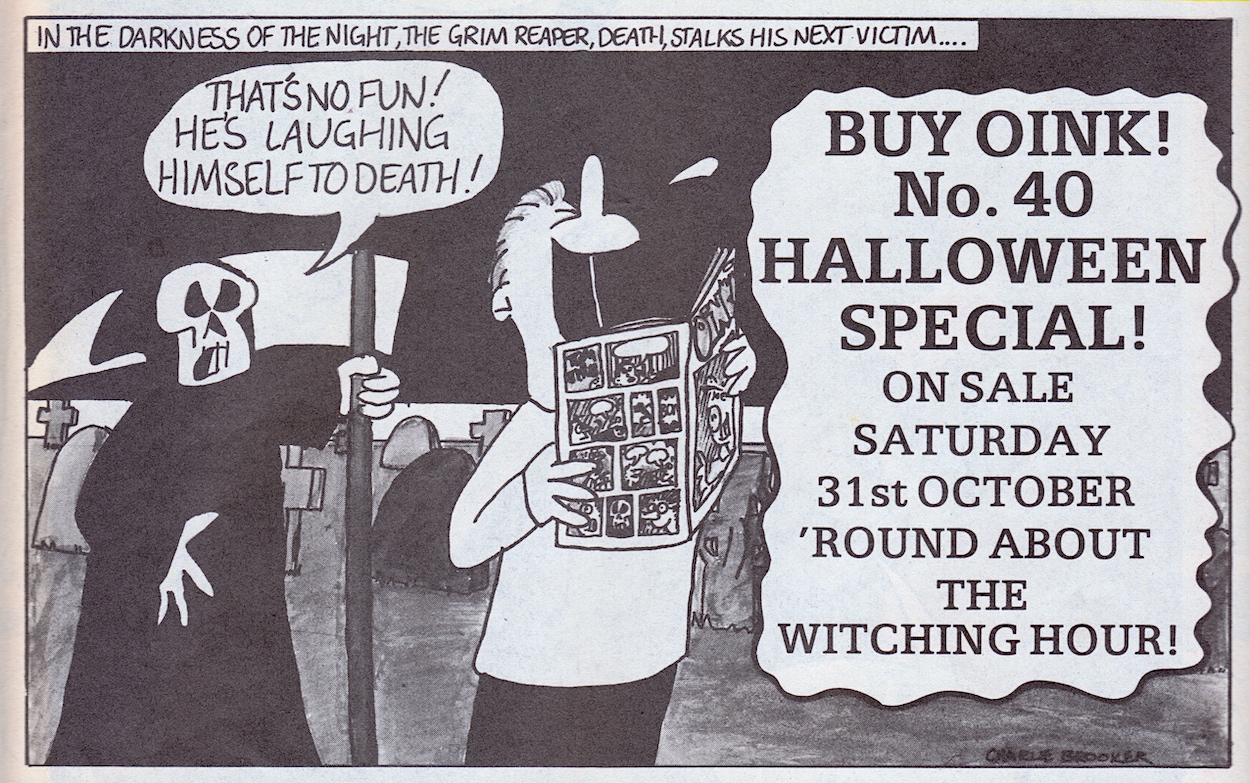
This issue is very memorable for me personally. I can remember reading it over and over again that Hallowe’en and in particular at my Aunt May’s house, a lovely lady who wasn’t actually related but who was my mum’s best friend and so got the honorary title of ‘Aunt’. May has passed away in recent years and it’s been nice to relive memories of reading OiNKs at her house (see also #37). This strip of The Adventures of Death I can remember giggling about while tucking into the plate of biscuits and juice May had brought out while I read.
Charlie Brooker’s Death (I hope that doesn’t pop up in search engines!) was a great little character and a firm favourite from the moment he first appeared. Having been the star of the half-page Next Issue promo in the previous issue I was surprised to see he wasn’t given more here, but that’s all the space Charlie needed. Both young me and older me loved this particular entry. I am aware of how it might seem, describing how this particular character brings back a specific memory of a late friend, but I also think there’s some kind of lovely poetry about that.
Not something Charlie would’ve considered about the character when he created these strips, I’m sure. The Adventures of Death is the perfect OiNK twist on a traditional comic character. We’d had fun monsters before in other comics but to turn the Grim Reaper himself into a funny little person like this is very much in keeping with the comic’s ethos. We loved him! Unfortunately, unbeknownst to his fans this was his last regular appearance after first appearing in #35 and every issue since. He’d pop back for just six more sporadically over the next year.
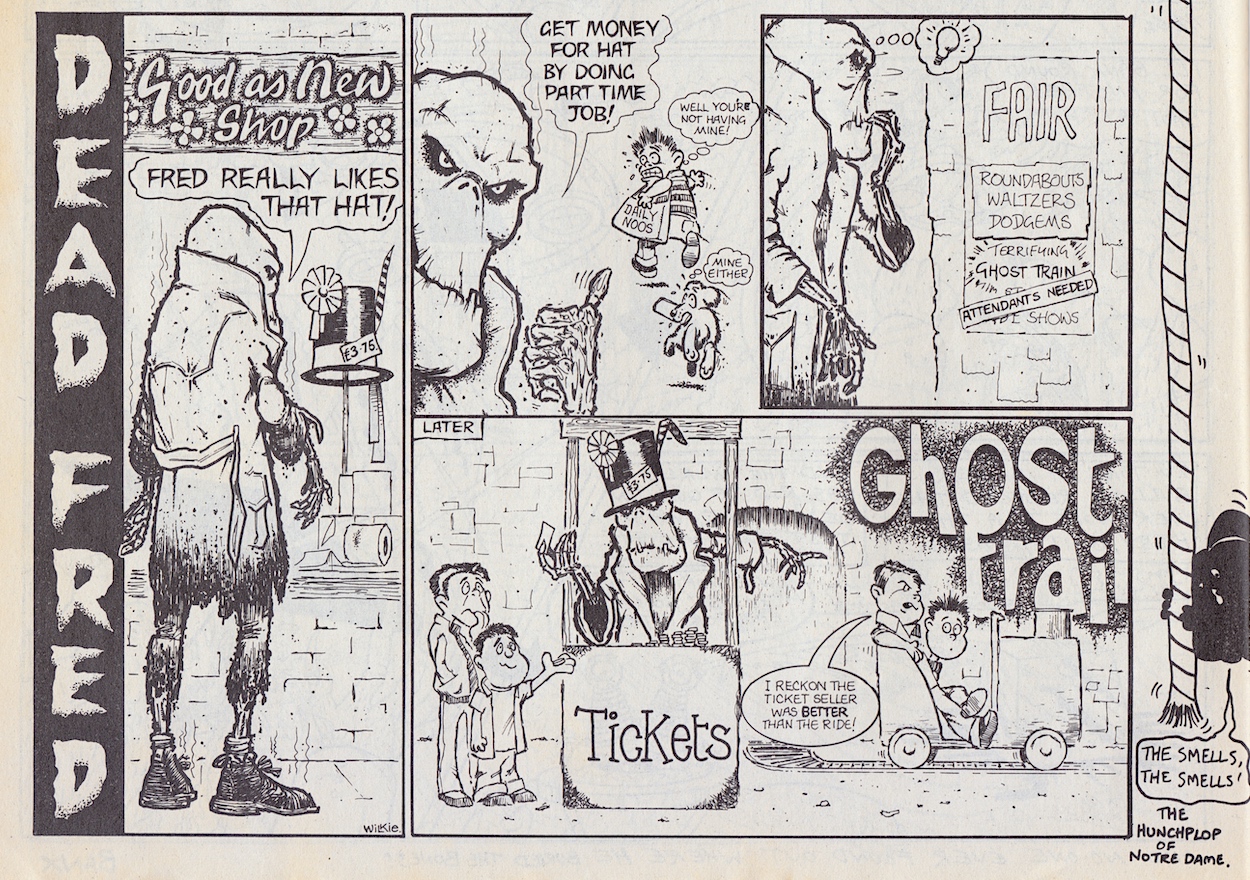
Another character perfectly suited for the theme is Dead Fred, the friendly undead zombie created by Eric ‘Wilkie’ Wilkinson. He contradicts my previous comments about memory though, because I thought he was a regular in nearly every issue, but instead he only rose up from the grave every now and again. Maybe he was comfy down there. But he couldn’t miss the Hallowe’en issue. I’ve only shown a couple of panels of his before so he’s well overdue for a full strip on the blog, one which reminds me of the attendant at the Ghost Train in Barry’s Amusements in Portrush as a child.
Just like Death, Fred would appear in twelve issues altogether although his were spaced apart in the expanse between #19 and #64, which boggles my mind. I know I did reread many of my OiNKs throughout the time it was being published and that must’ve messed up my memories somewhat. I always loved Wilkie’s art, his detailed textures conveying rotting flesh, clothes and bones perfectly. Under any other artist I don’t think the jokes would work quite as well, the contradiction between his friendly nature and his rotting corpse are what makes it funny.
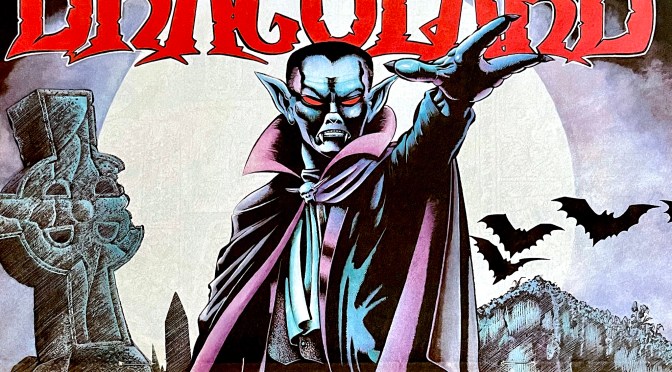
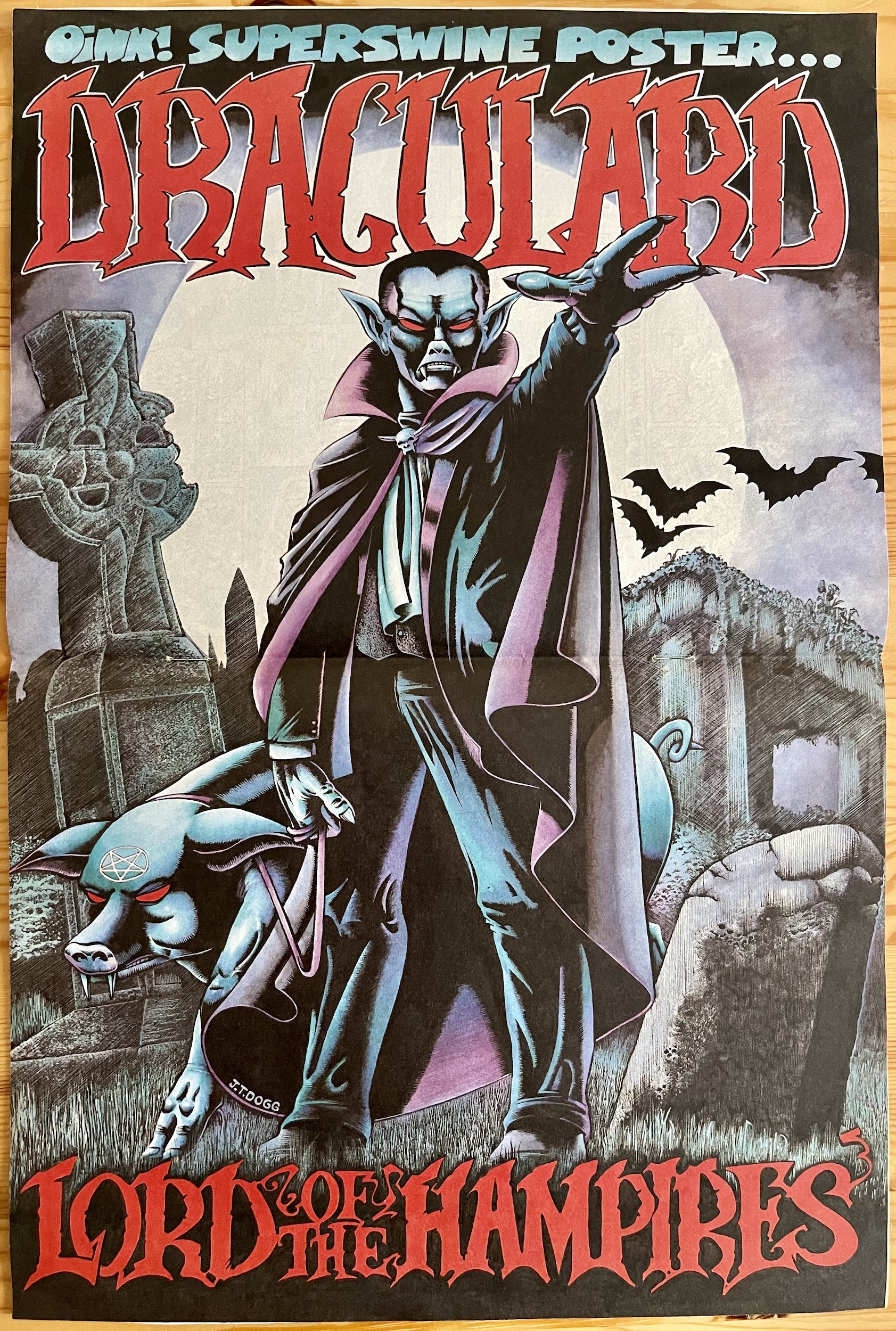
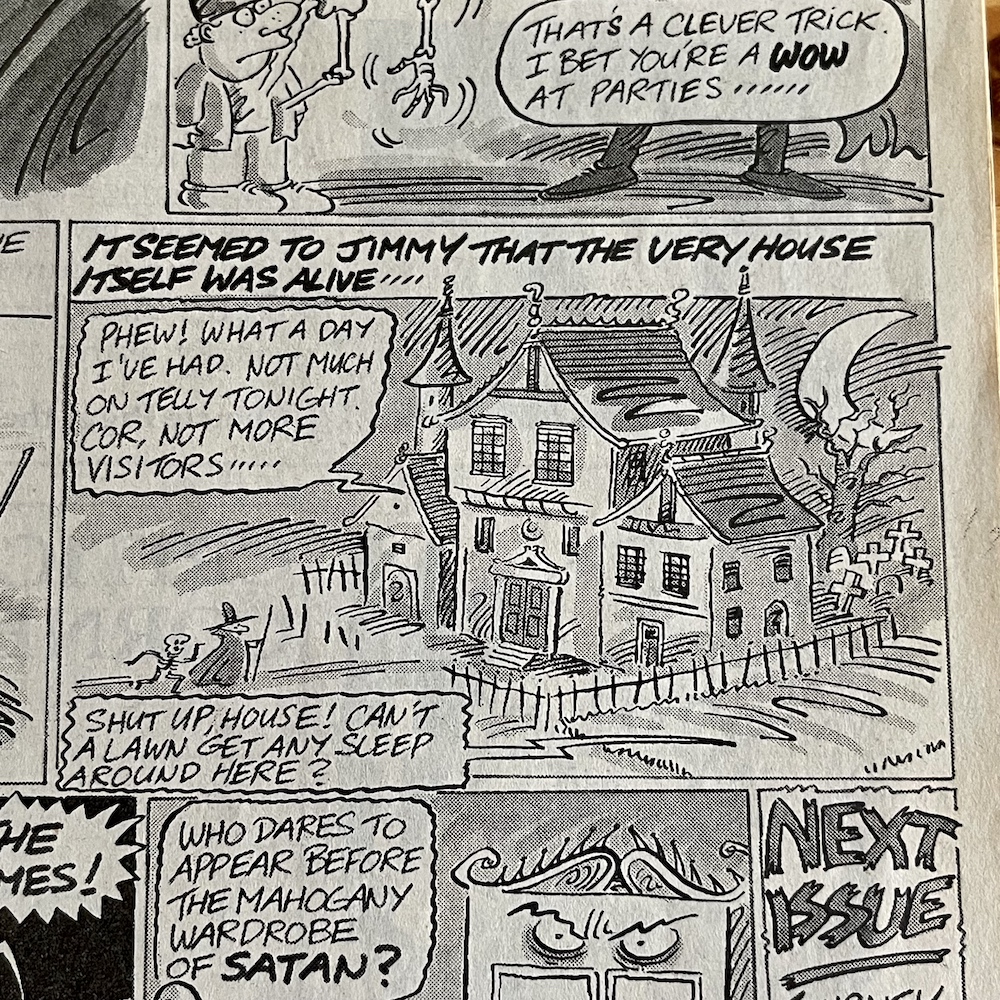
What a delight to turn the page and see a J.T.Dogg (Malcolm Douglas) poster. It’s been far too long since we enjoyed those OiNK Superstar Posters of his in the very first issues so it was a lovely surprise to see this ‘Superswine’ take on the classic Dracula, complete with his own Hell Hog. The colouring is as stunning as ever. I love the skin tones and cloak which give a gloomy yet somehow colourful finish. But just look at those gravestones and the finish Malcolm has given them. Simply stunning work.
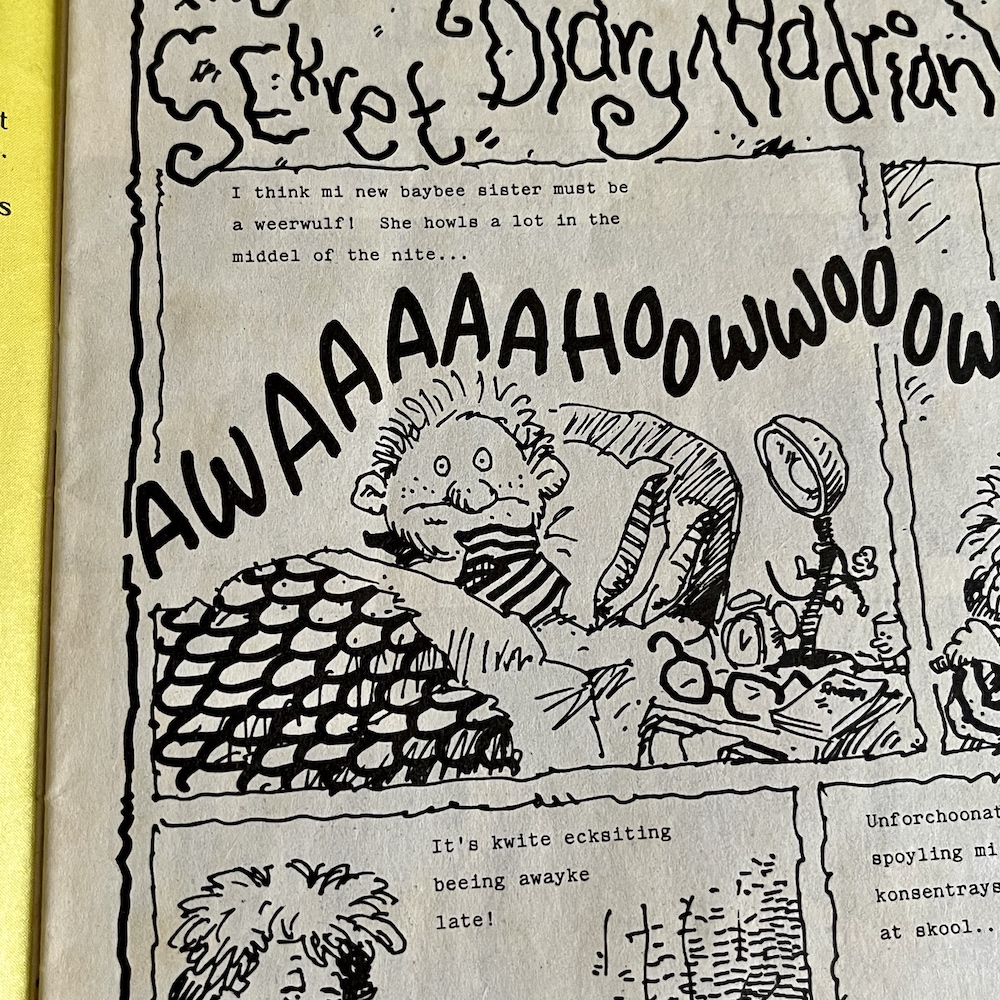
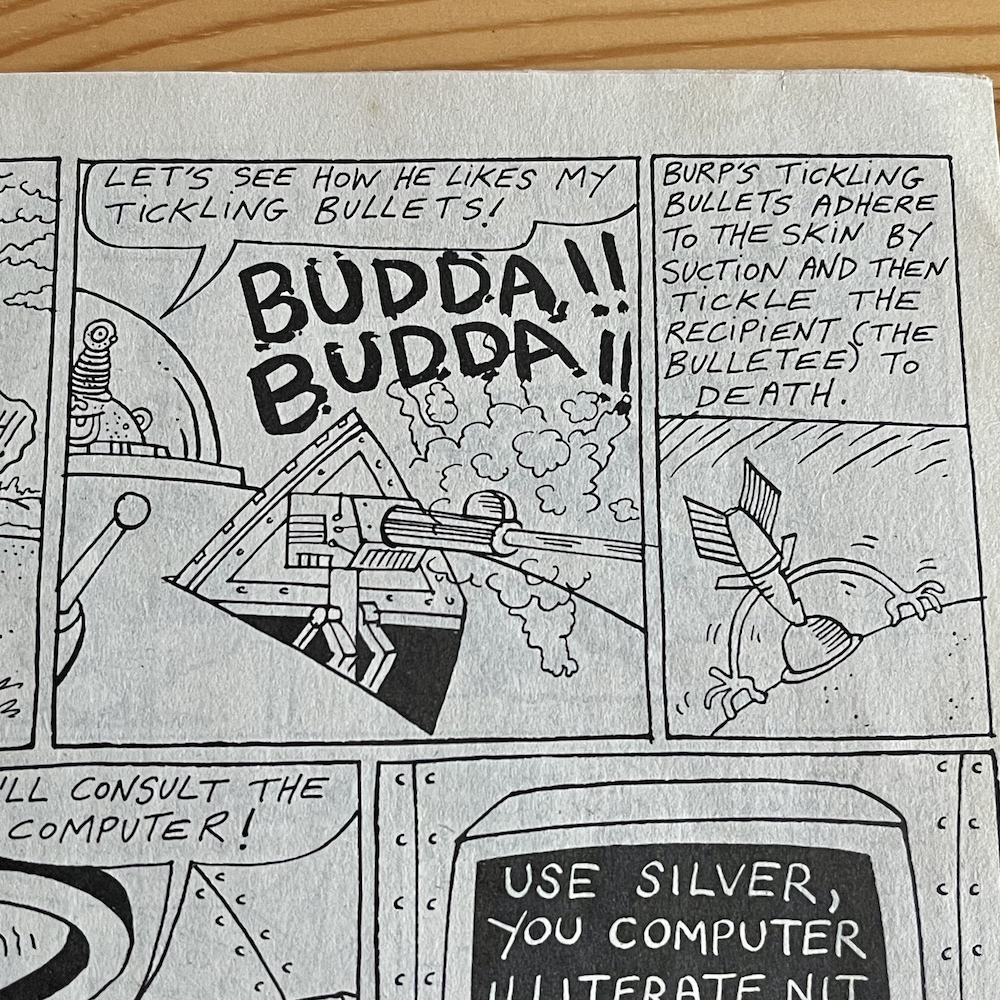
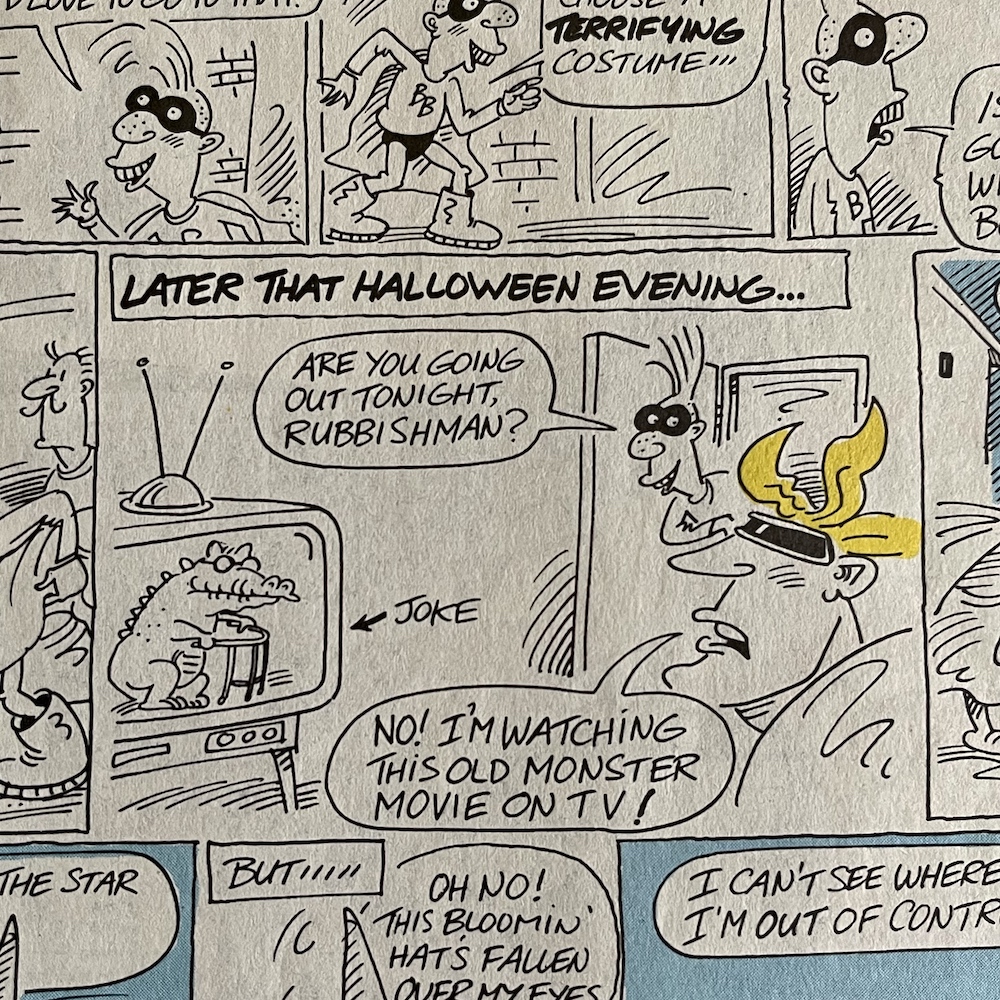
The only negative I can think of for this is that it wasn’t the return of the poster series. In fact, it would be the last poster by J.T. Dogg, although the original ones would be reprinted in the first few monthlies which is when I enjoyed them all for the first time as a kid. This Hallowe’en issue isn’t short of other highlights too. The Sekret Diary ov Hadrian Vile – Aged 8 5/8 (yearƨ) has me thinking about my friends’ latest little female addition to their family (and her older brother), and after Burp‘s tractor beam (#37) he has more inventive weaponry to show off. The biggest laugh of the whole issue comes from a background gag in Rubbish Man and the Jimmy FlynnJumps Out of his Skin strip plays up to an old horror movie staple.
Hadrian Vile written by Mark Rodgers, drawn by Ian Jackson Burp by Jeremy Banx Rubbish Man & Jimmy Flynn by David Haldane
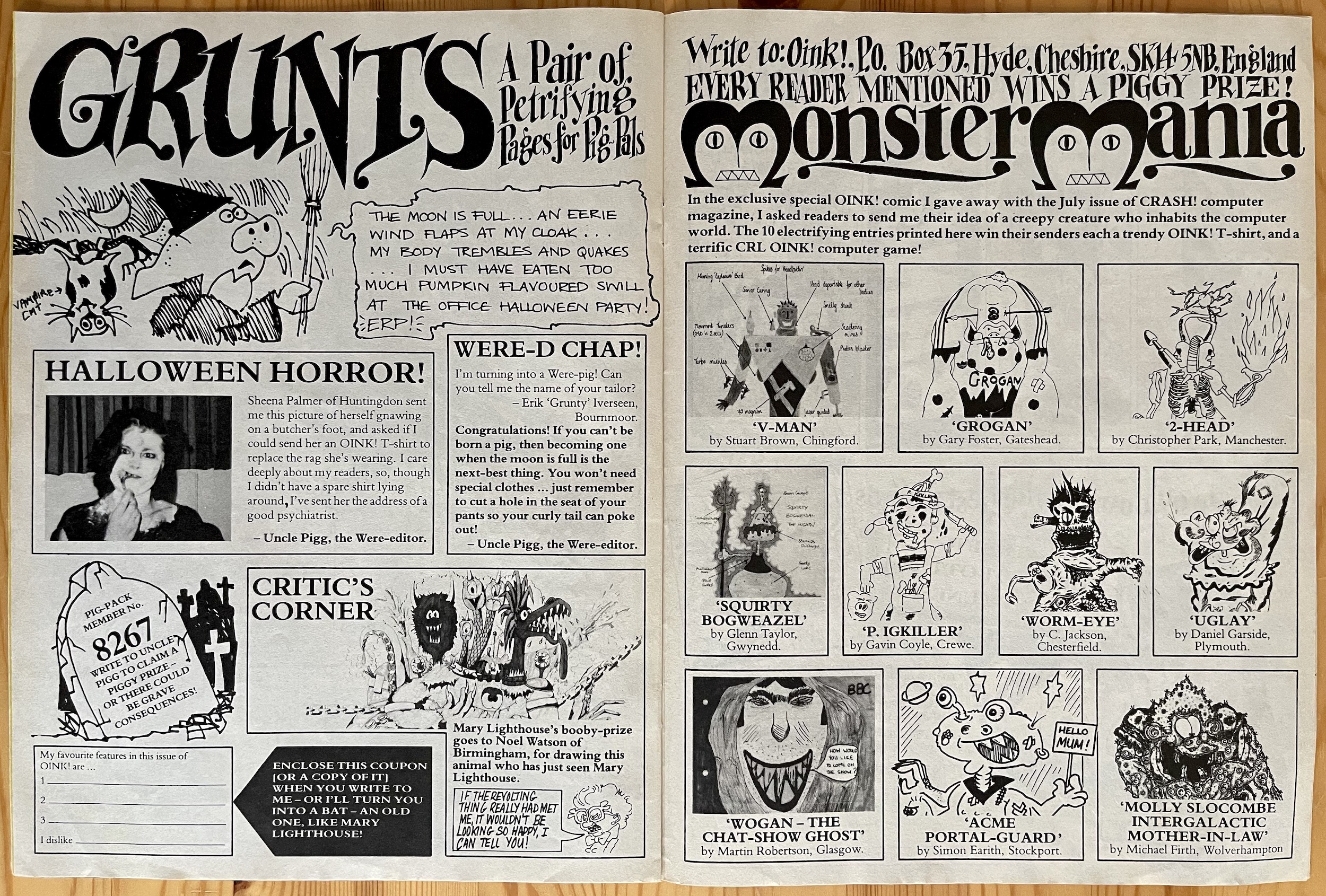
Back in July the free Crash magazine edition of OiNK ran a special competition. The Mutant Space Barbarian Magic Warriors of Doom ended with the readers being asked to send in drawings of what they thought had turned hero Macho Mike into a big pile of blancmange. Suitably enough the editorial team have decided to use the Hallowe’en issue to show off the winners, taking over one half of a Grunts spread. There were ten altogether, each of which received an OiNK t-shirt and a copy of the OiNK computer game for their chosen format.
The strip they were drawing the conclusion to was illustrated by J.T. Dogg, so no pressure, right? You can’t deny the pig pals had skills. My favourites are ‘Squirty Bogweazel’ by Glenn Taylor of Gwynedd and ‘Molly Slocombe Intergalactic Mother-in-law’ by Michael Firth of Wolverhampton. Just a shame they’re so small on the page really. Special mention to ‘Uglay’ by Plymouth’s Danial Garside who dare I say is obviously a fan of Tom Paterson. Also, have a look at Noel Watson’s fantastic multi-headed beast on the other page! Quality reader contributions all round.
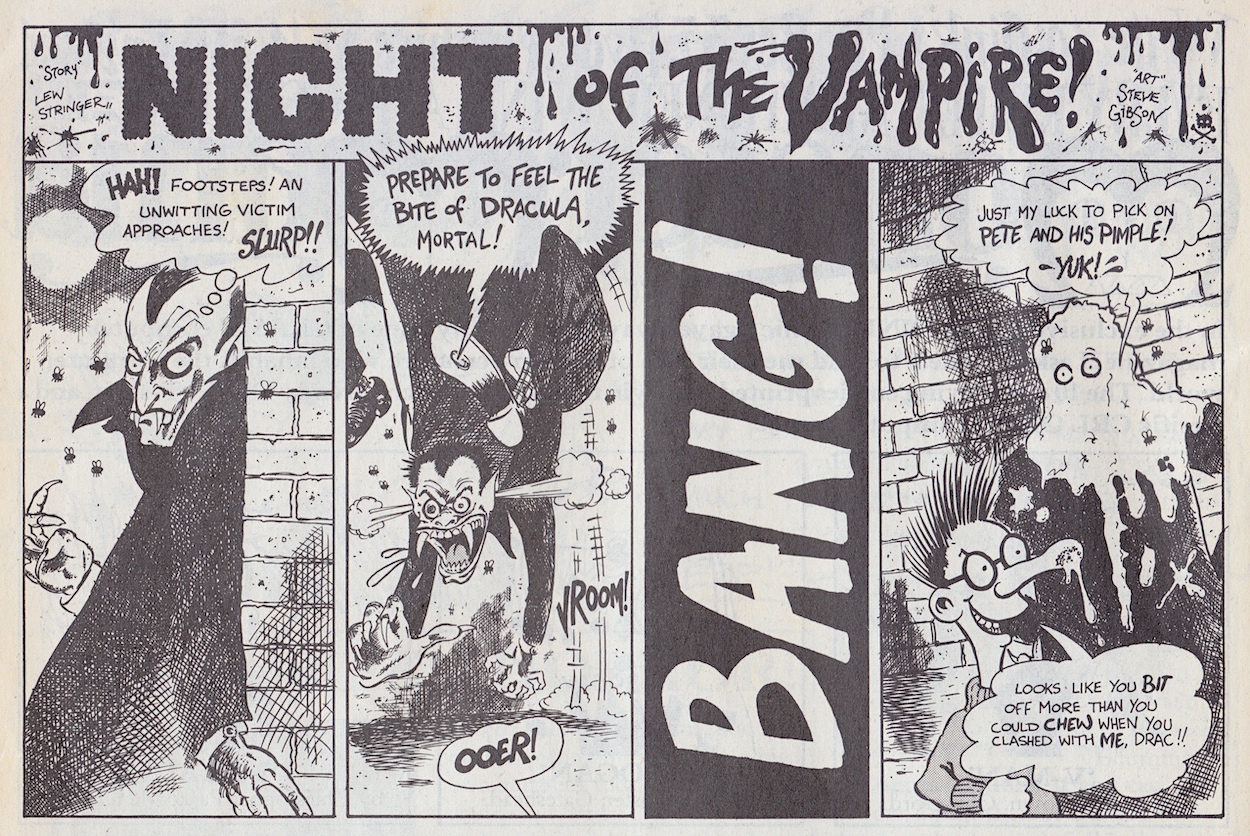
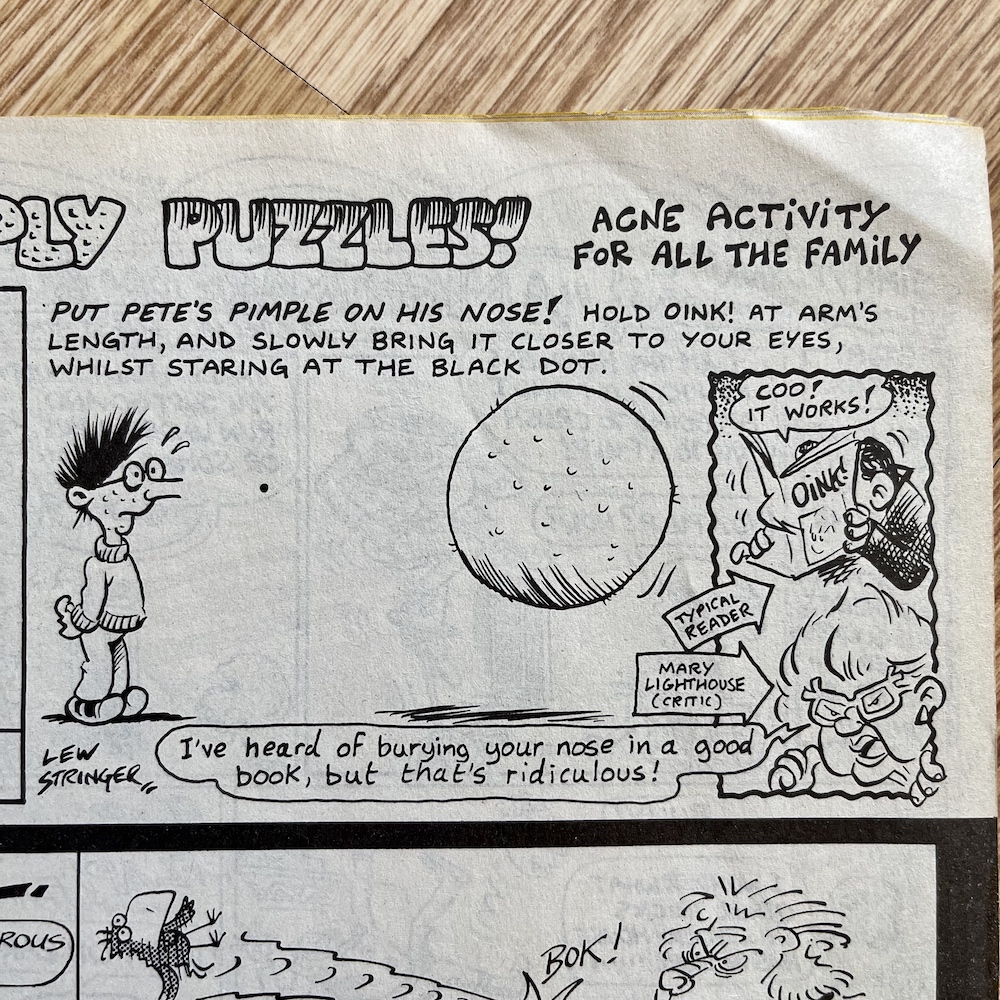
Lew Stringer’s Pete and his Pimple gets a half-page this issue but just across from him on the opposite page (right beside said strip when the comic is opened out) is Night of the Vampire written by Lew and drawn by the ever entertaining Steve Gibson. With OiNK’s artists having such a wide range of styles I always like it when they take on each other’s characters, and Steve’s interpretation of one of Lew’s, ‘popping’ up here in a particularly Steve-like fashion, is great!
Little did I know the very next issue would bring a lot more of this sort of thing as different artists would take on Pete Throb in a special pull-out comic dedicated to the fan favourite, as advertised in the Next Issue promo here. That’s something you won’t want to miss so make sure to follow the blog.
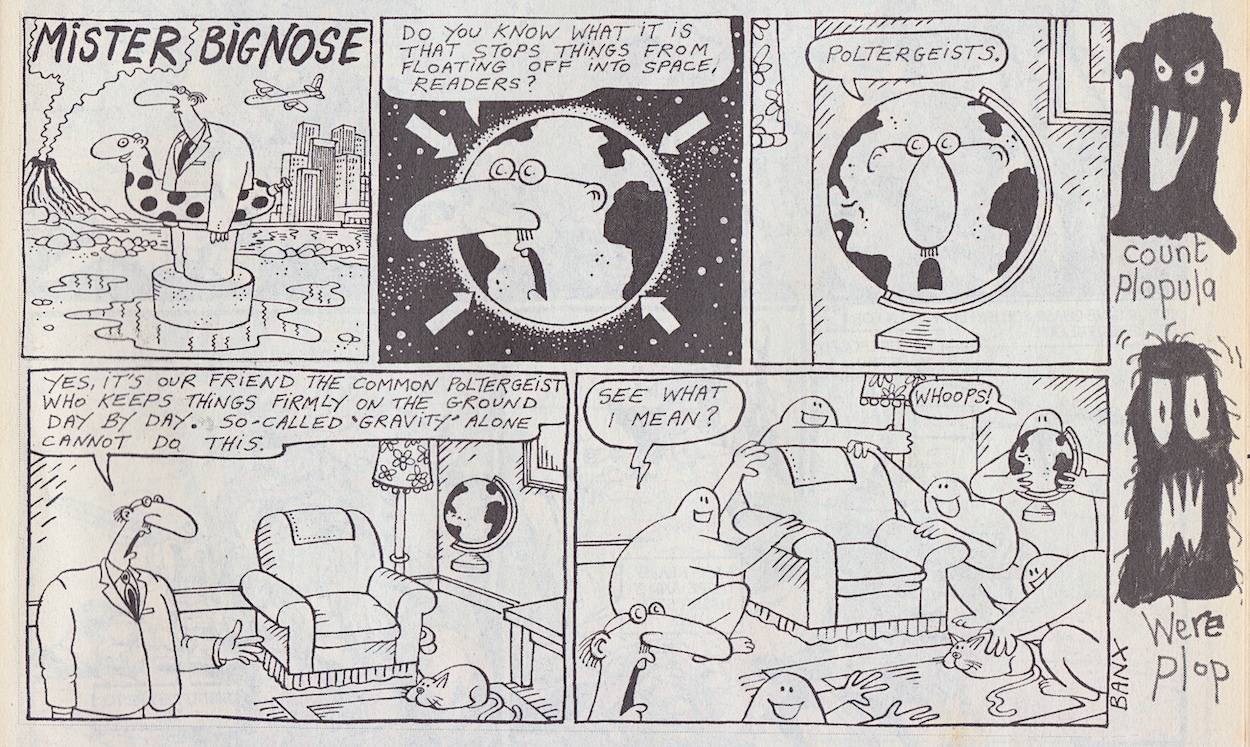
On the same spread is this little treasure from Jeremy Banx. Regular readers of the comic (or of this blog) will know all about the surrealist humour of Jeremy’s strips, in particular Mr Big Nose. From toothpaste squeezing competitions and starring as Rambo in Little Bo-Peep to the famous Keith the dolphin, there’s been a lot of memorable strangeness and he appears to be upping that with each new appearance. (Ploppy puns throughout the comic drawn by Patrick Gallagher.)
Where would you even begin if you attempted to describe this to someone who hadn’t seen it? The poltergeist idea itself is a brilliant one and looks hilarious in that final panel, complete with the one who let go of the globe that I bet you didn’t notice was floating. In those first images using Mr Big Nose’s face on the planet and the globe to tell us the story is weird but somehow it just works. It’s heartbreaking to think this character will disappear from the regular comic after the next four issues!
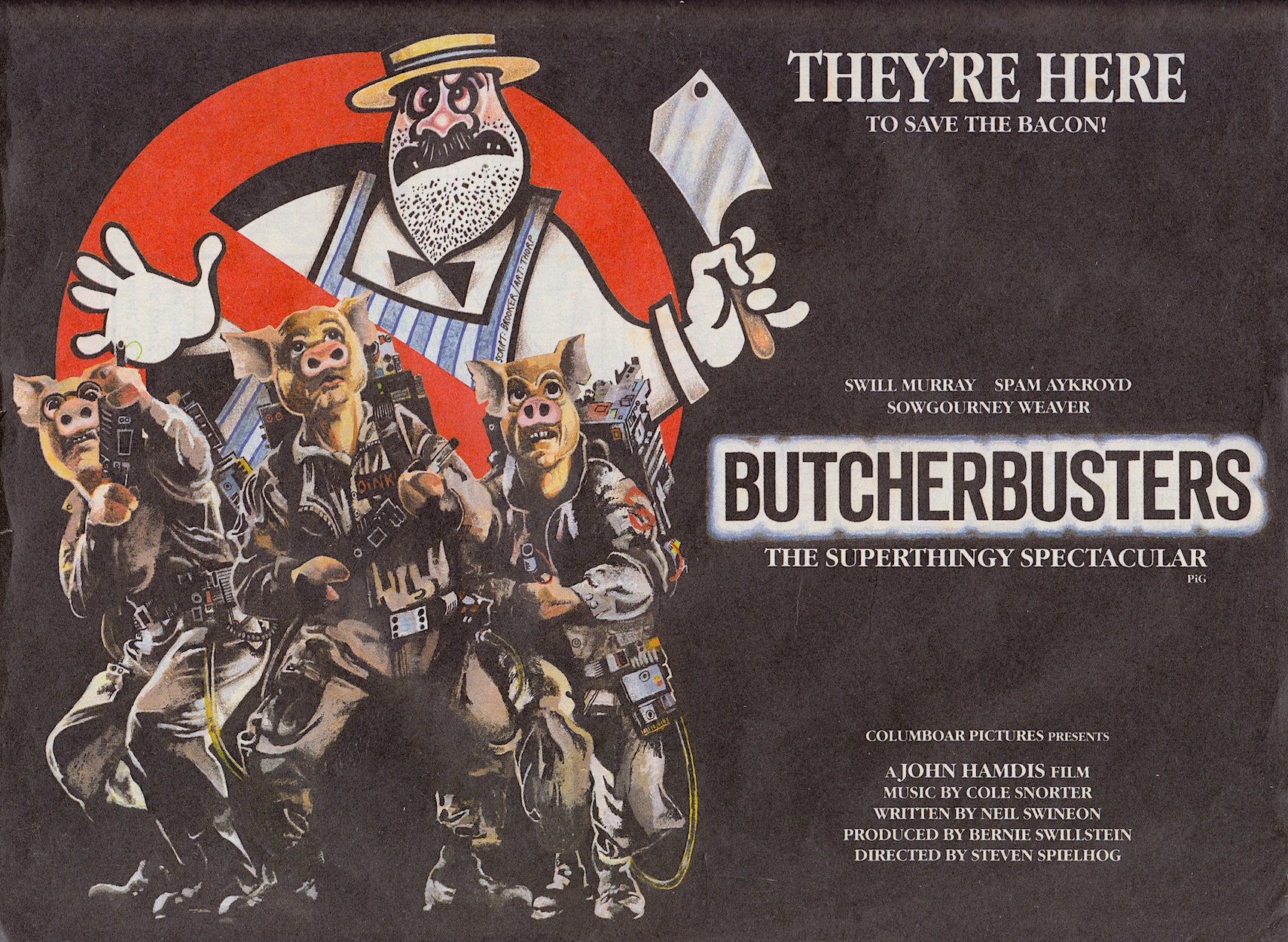
But let’s not get ahead of ourselves, let’s enjoy the rest of the year and these simply perfect issues of OiNK we were getting every single fortnight. This one ends with a truly classic OiNK back page, the latest spoof movie poster. Written by Charlie Brooker and again drawn so perfectly by Simon Thorp, it’s one which I particularly enjoyed at the time. In fact, while I hadn’t seen the original movie when I first saw this, it would become my favourite of Simon’s mini-posters as a child because the next year I became obsessed with the cartoon and Marvel UK comic. Take a butchers at this.
I can remember re-discovering this many months later after I’d eventually seen the movie and thought this was hilarious. Somehow, Simon has perfectly captured Bill Murray in pig form. It’s just a genius piece of work. Believe it or not, despite how great this is, as an adult it isn’t even my favourite of Simon’s pieces any more. That honour goes to a certain Half Pig, Half Machine hero who I’ll definitely be showing off when we get to that issue.
That’s a wrap on the latest OiNK and it’s been a genuine pleasure to relive every single thing this one has had to offer. Seriously, if you haven’t read a full issue since the 80s (or perhaps never have) then I’d heartily recommend #40 as the ideal starting point to your inevitable collection. The next issue, complete with pull-out Pete comic, is the Health & Fitness special and its review will be here on Monday 14th November 2022.
Just to finish off this Hallowe’en feast here’s a suitably terrifying mini-strip from Mark Rodgers and Ian Jackson. See you next time.
Coming up on Monday is the highly memorable 40th issue of OiNK, the second Hallowe’en edition. Featuring a simply gorgeous Ralph Shephard cover that any original pig pal will remember, I’ve my own very personal memories attached to this issue so expect a particularly nostalgic review in three days. The Next Issue promo from the previous issue set the tone perfectly for what was to come.
Promo by Charlie Brooker
Obviously The Adventures of Death from Charlie Brooker has to be included and the character is probably the perfect embodiment of the issue’s contents. He’s not the only highlight, though. The mini-strips are all firing on all cylinders in this issue and there’s a gorgeous J.T. Dogg pull-out to boot. That’s not the only pin up either, a certain spoof movie poster by Simon Thorp will round things off and for fans it’s one they’ll not want to miss seeing again! You can check it and more out in the full review when it hits the blog on Monday 31st October 2022.
Originally due on the blog at the beginning of February, like the Ring Raiders Special this had been loaned to a friend who I don’t get to see too often and I’ve just gotten it back. So here we are, rounding off the Super Naturals read through at last. The Adventure Book went on sale alongside #8 (the penultimate issue) and while it was a strange time of year for a special, it was probably originally aimed at all those potential new festive toy owners.
While reference is made to the comic it’s usually in a past tense, looking back at previous issues and stories. There’s no mention of it being on sale or placing an order in newsagents, even the page of readers’ drawings doesn’t include the address to send more in. Sadly, while the original idea may have been to lure new readers in it appears the writing was already on the wall by the time this went to the printers. But let’s concentrate on the fact we have an extra edition to enjoy.
It certainly feels special as soon as you pick it up. It’s a chunky 68-page book with high quality internal pages and a very glossy card cover with new, gorgeous painted Ian Kennedy art. Excuse the marks on mine, tracking this down was difficult (I didn’t know it existed until a few years ago) and I even had to hang it outside to get rid of the wet grass smell it had for whatever reason. It must’ve been stored in a garden shed by the eBay seller. It’s all good now though so I can read it without gagging.
There’s nothing from The Doll unfortunately but there is one particularly superb feature
That’s a very full contents list but when you go through the actual book it’s not as packed as it initially seems. There’s only one original Super Naturals strip with the main characters, although there are two new Ghostlings tales and a text story. There’s a lot of reprint though, like the preview issue’s cover, strip and free card, the masks given away previously (printed as basic images now, not masks), a Scream strip and some of the toy photographs are reused too.
There are some new photos though, as well as a disappointing quiz which amounts to nothing more than drawings of the characters and asking readers to identify them, some new illustrations from readers as mentioned and one particularly superb feature which I’ll get to in a bit. No, there’s nothing from The Doll unfortunately, the terrifying dummy being contained within the fortnightly only, but let’s take a look at the new stories beginning with Destruction Run.
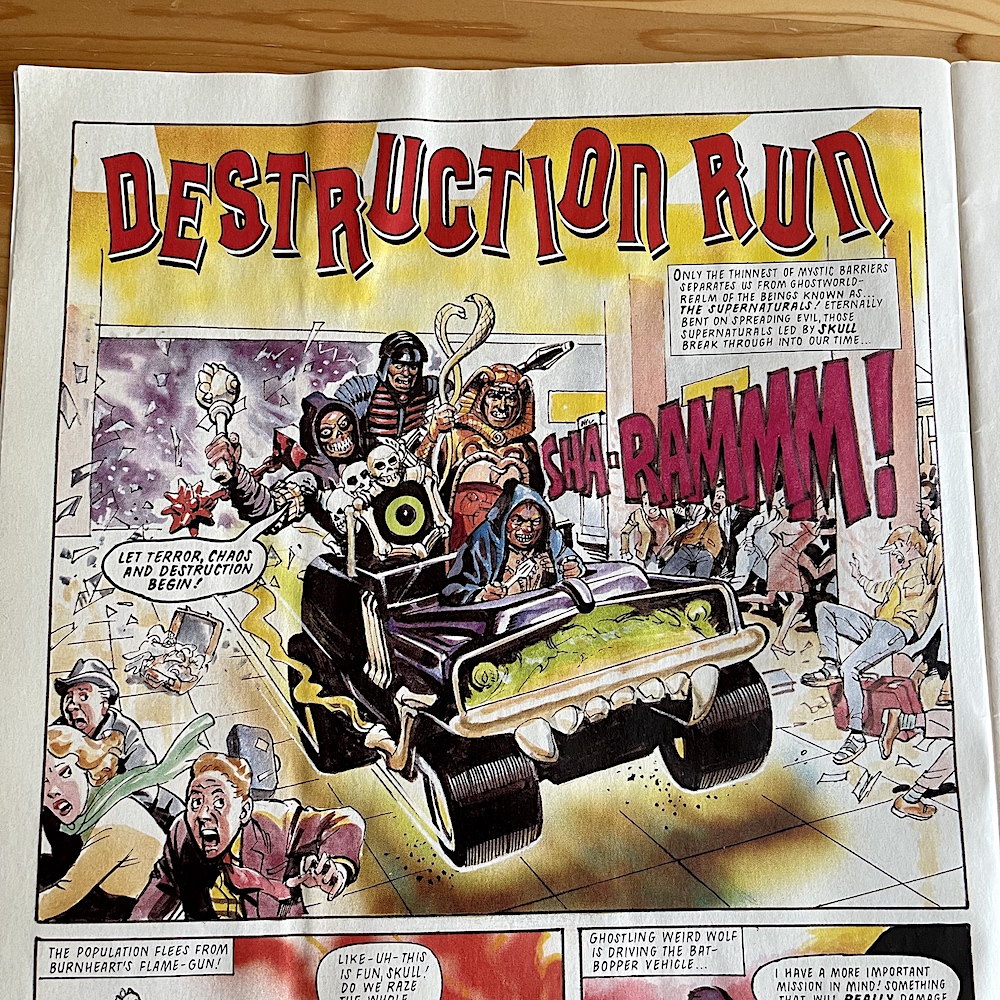
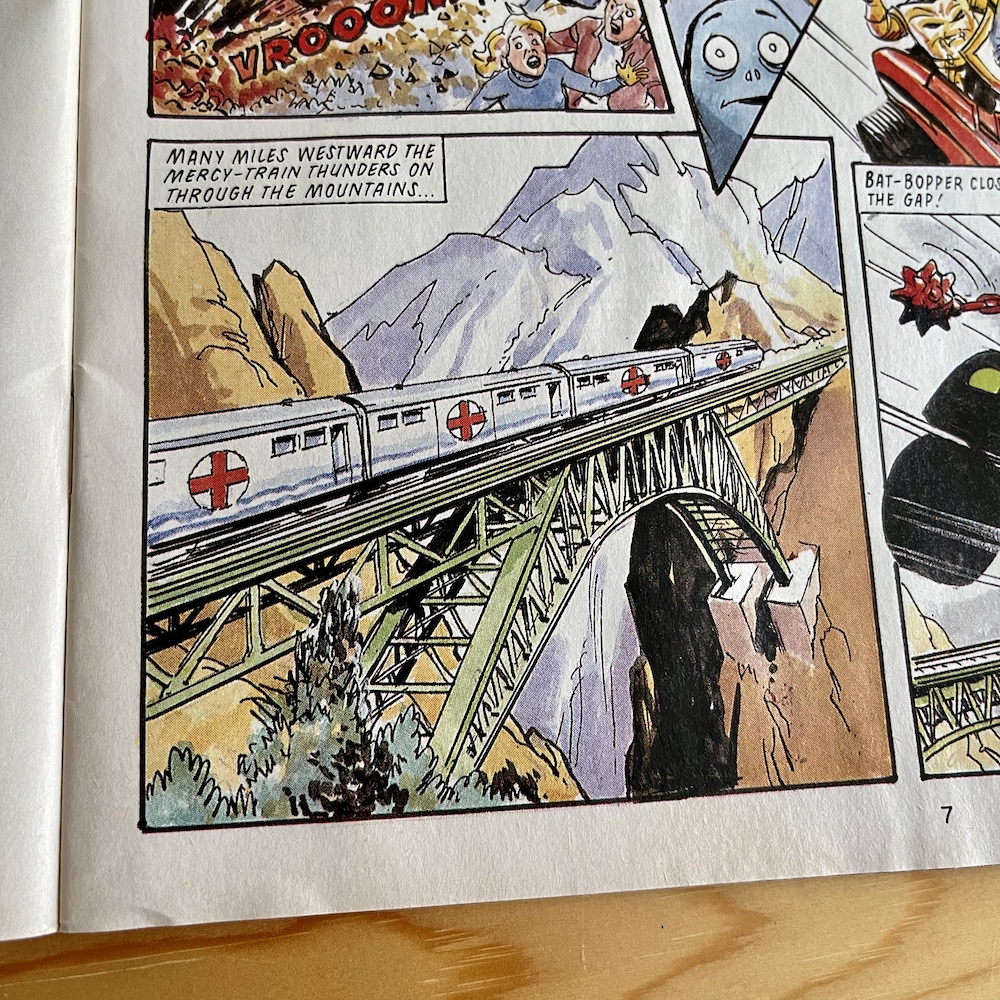
Skull, Burnheart, Snakebite and Weird Wolf break through into our world in the middle of a shopping mall. An earthquake has struck the west coast of America and an aid train is speeding its way there filled with vital medicines and personnel. The comic established the characters never knew where they’d end up but this contradicts that; Skull has a pre-formed plan to destroy the track ahead of the train with the Bat Bopper, causing a devastating crash to kill everyone on board and stop the supplies reaching those in need, leading to more deaths.
The artwork is more simplistic than we were used to in the fortnightly, in fact Geoff Campion (Lion, Valiant, Battle Picture Weekly) definitely doesn’t bring the level of detail fans of his would be used to. I loved his work in Ring Raiders but here it feels rushed. I do like his background colouring when our characters are in Ghostworld though. His version is a psychedelic nether region that would’ve been impossible in the comic’s black and white strips.
The story is a basic one, which is understandable as it’s really for new readers and doesn’t have the luxury of being multipart, with only a limited amount of pages to get a satisfying conclusion. The evil doers destroy the bridge as the train rumbles across it then somehow Eagle Eye’s ‘Powers of Truth’ create lightning bolts, his electrical charges holding the collapsing iron girders together just long enough. It makes no sense and contradicts Eagle Eye’s powers from the fortnightly so not a great start.
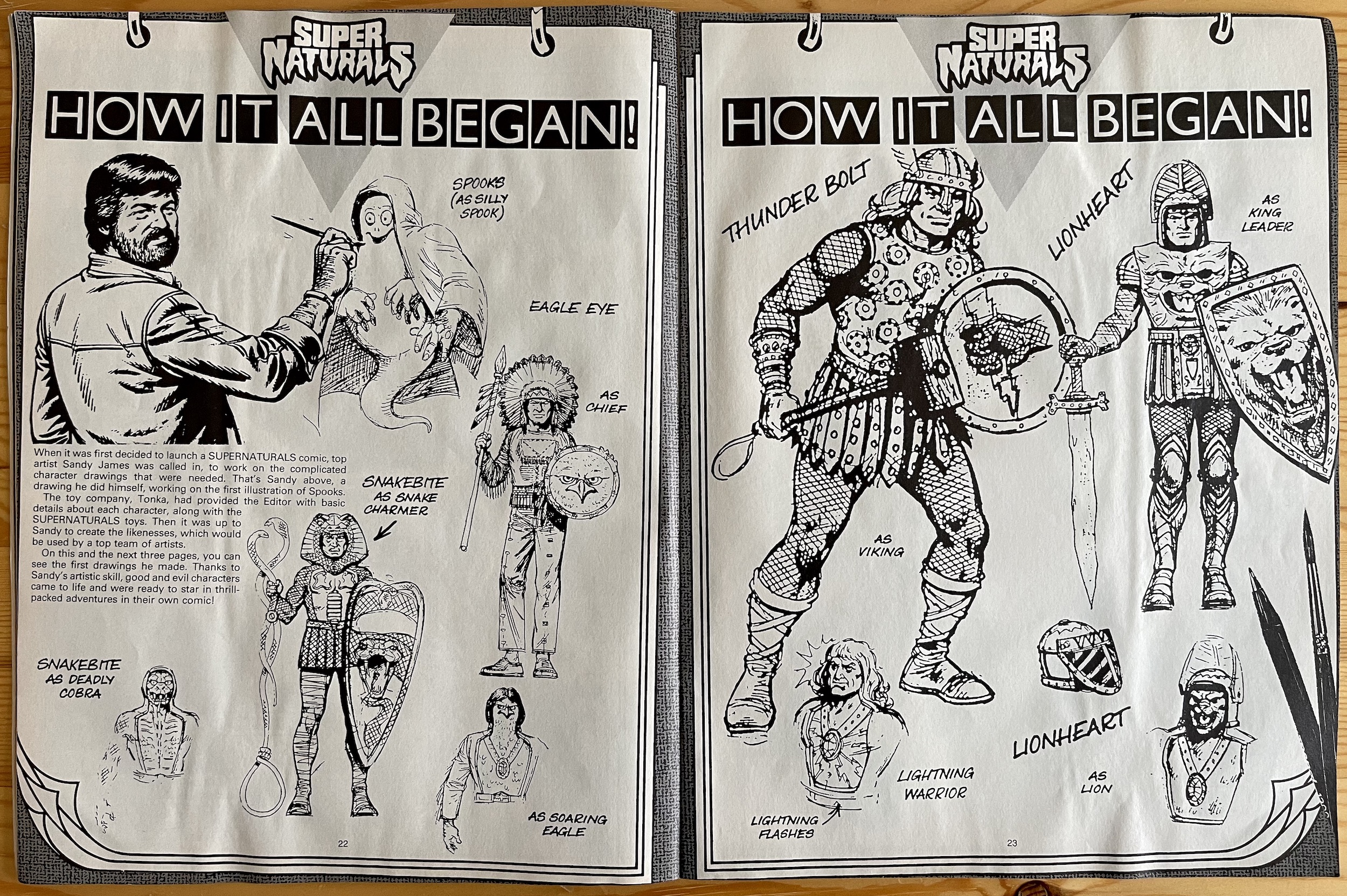
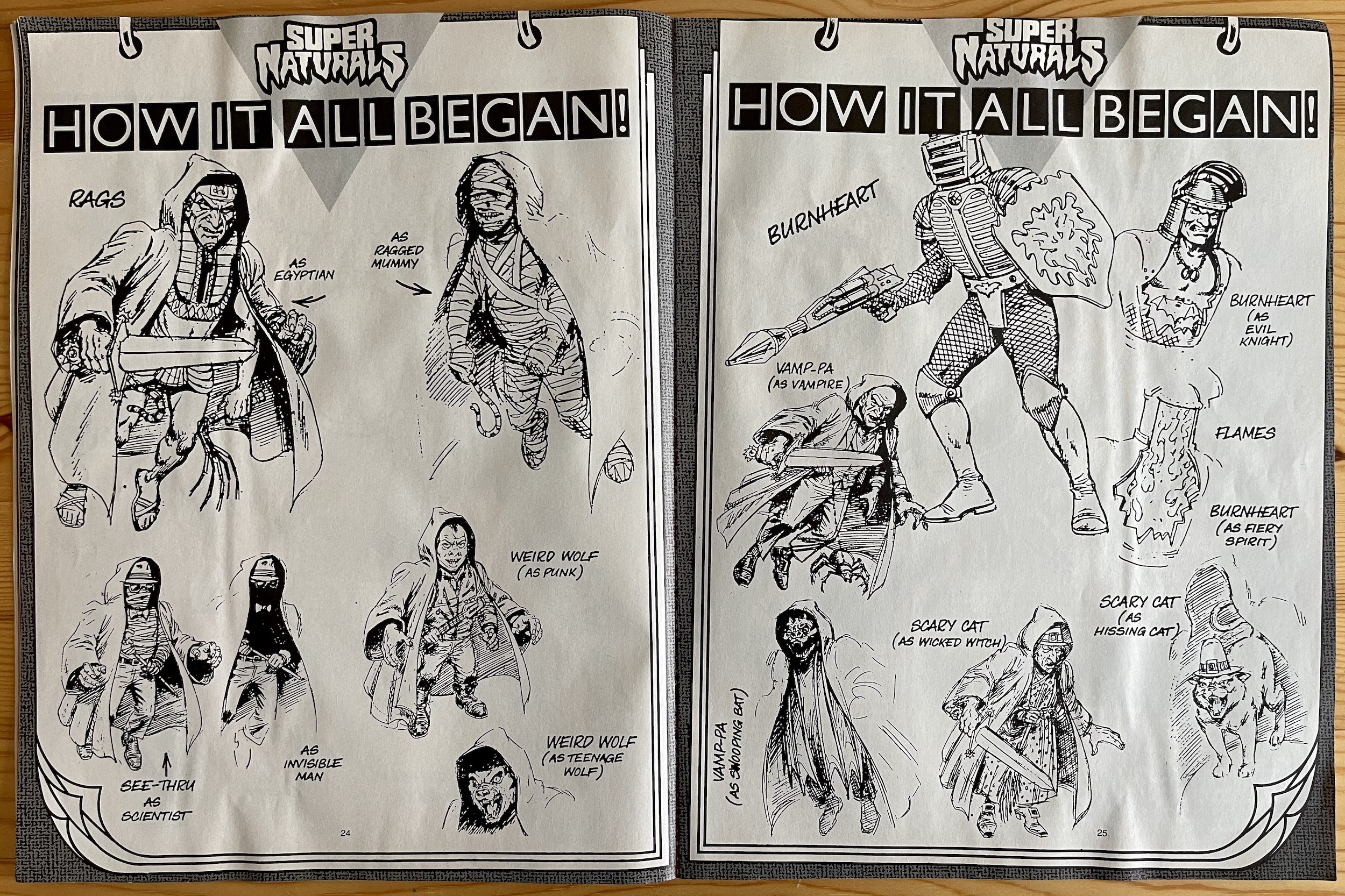
After several pages of toy photographs lifted directly from the comic and the aforementioned reprint of the preview issue (which ended on a cliffhanger, surely frustrating for new readers) we come to the first thing in this special edition that truly excited me as a fan. It’s a look at artist Sandy James’ original concept drawings which he created when the comic was being developed.
A brief introduction explains to the readers how Tonka would’ve supplied basic details about the characters and it was up to Sandy to take the toys and turn them into proper comics characters that other artists could work with. While Sandy never illustrated any of the strips in the comic he did produce some of the fun covers and his artwork made up the preview’s character introduction card, reprinted here.
Sandy’s ability to bring those plastic action figures (whose faces were only ever shown in holographic form) to life on the page is pretty incredible. Editor Barrie Tomlinson’s Wildcat comic would do something similar in its Holiday Special, although there artist Ian Kennedy was creating all original characters, not working from tiny toys. I loved Sandy’s bold, colourful work in Ring Raiders where he also brought toys to life in incredible fashion. It’s such a shame he never got to draw a strip for the Super Naturals.
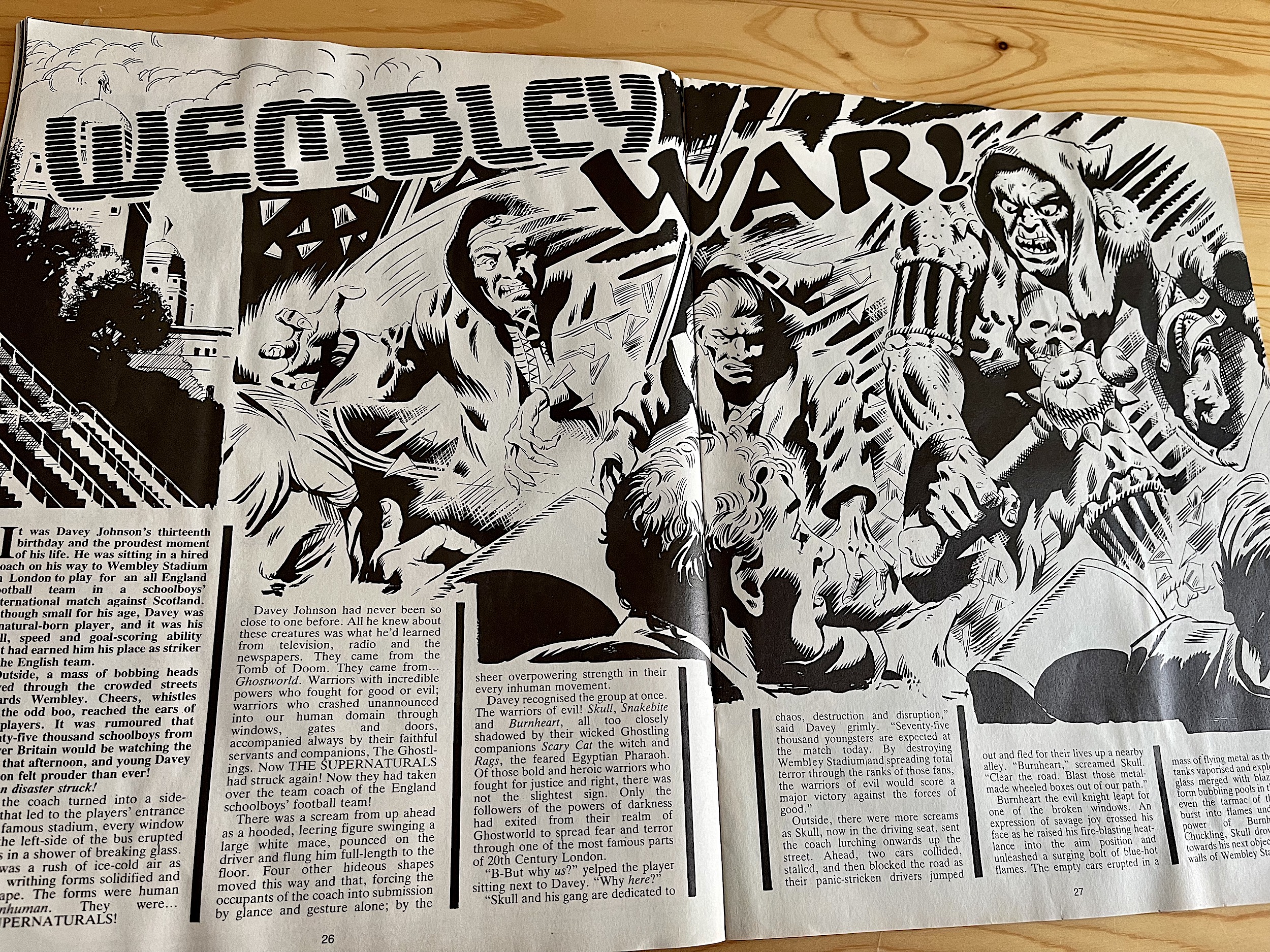
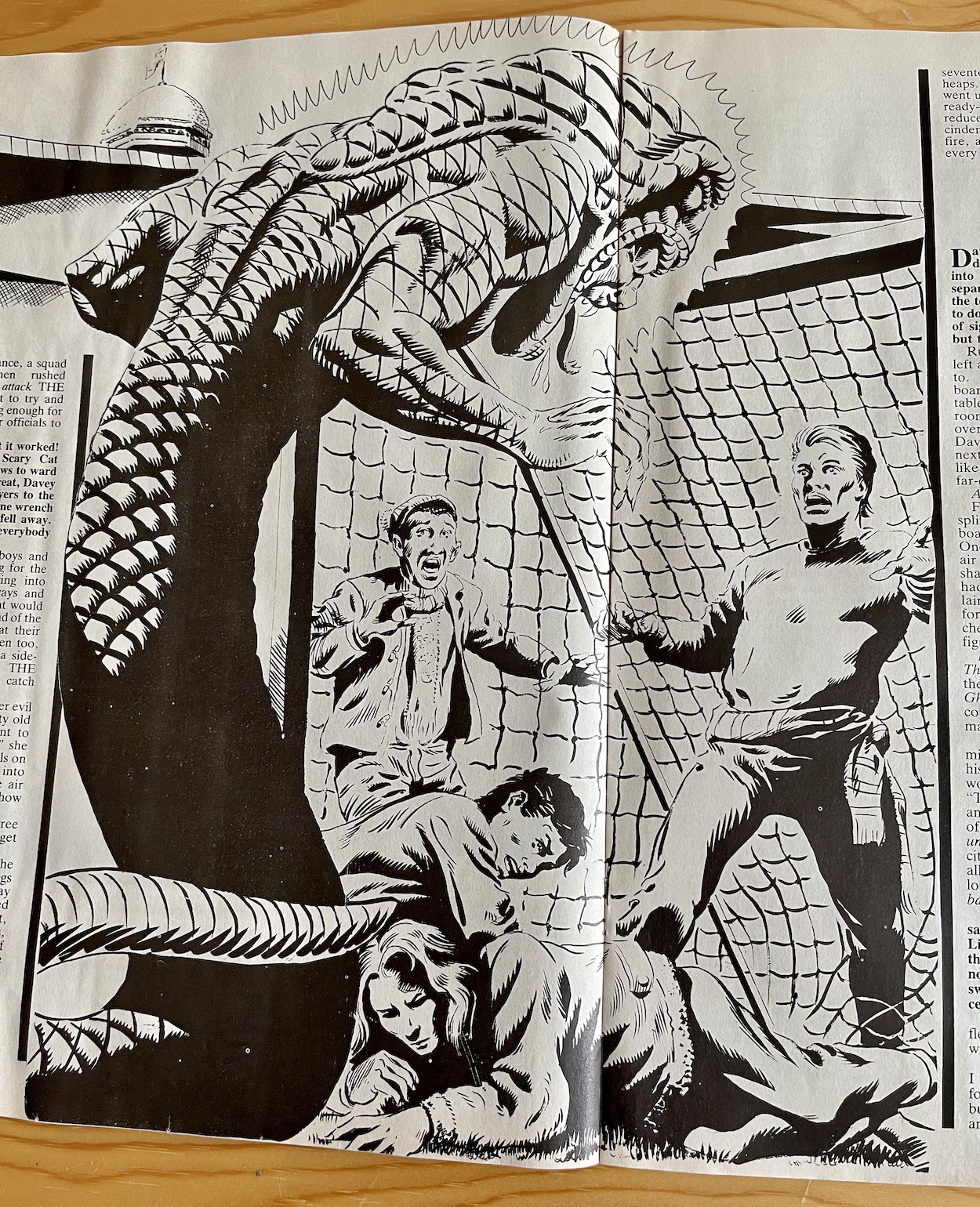
Given his fascination with football and the fact he also edited Roy of the Rovers, Tiger, Hot-Shot etc, it’s pretty clear our text story set inside Wembley Stadium was written by editor Barrie Tomlinson. Teenager Davey Johnson and his school team are on their way to a match when the windows of their bus suddenly cave in! This is a particular aspect of Super Naturals I liked, the fact any piece of glass could end up suddenly becoming a gateway from Ghostworld with terrifying skeletal monsters, witches and snakes piling out.
The story conjures up a pretty terrifying image of the windows of a school bus caving in around a load of children, then trapping them inside amongst the shards of glass with the evil Super Naturals. Skull’s plan this time is to destroy the stadium while it’s filled with 75,000 spectators, killing as many as possible and spreading fear through those that survive. What stands out in the story is how we humans know of the existence of the Super Naturals, even who’s who!
While it was only a matter of time until this happened it does seem very quick. The fortnightly was still building their mythology and they were scarier when humans didn’t know what they were. It also contradicts the strips in this very book where police opened fire on the good guys because they didn’t know there were two sides. But that’s just me quibbling. The story is well written and reminds me of the ‘Story So Far’ tales at the beginning of some Transformers Annuals which placed a young person into the fantastical world of the characters, painting a picture from the viewpoint of the readers themselves.
Particularly good here are the moments when Barrie takes his time to describe the abilities of the Super Naturals as they attack. Here’s a good example, as evil Ghostling Rags is hit by lightning from Viking Thunder Bolt‘s hammer: “Changing from Egyptian Pharaoh to wrapped Mummy, Rags gave a scream of pain and lurched forward, his dirty bandages flicking this way and that, every length of cloth eager to bind, hold and smother.”Wembley War is the best Super Naturals story here.
There are two Ghostlings stories included, the light-hearted strips in the regular comic that would cut through the children’s horror. It’s nice to see Mr Lucky and See-Thru get starring roles for the first time. Mr Lucky is pitted against Scary Cat, fulfilling the prophecies of a madman who thinks aliens are due to land on Earth, before it becomes a chase across the city, turning each other into ever more ludicrous creatures or objects via their magical spells. Drawn by Keith Page (M.A.S.K., Commando, Thunderbirds The Comic) it’s actually quite funny.
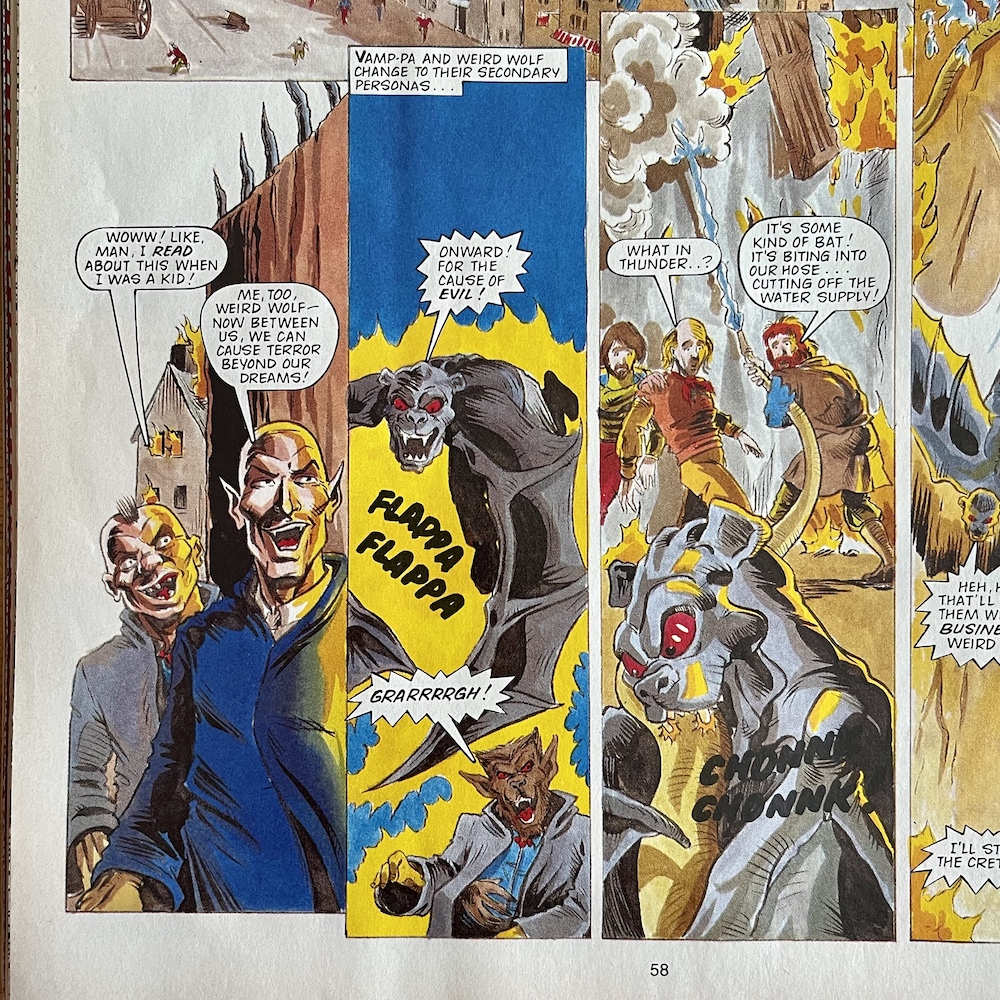
The other strip is drawn by regular Ghostlings artist Anthony Williams and sees the good and evil servants of the Super Naturals arrive during the Great Fire of London. The evil Ghostlings wish to use it to their advantage and it’s up to Spooks and See-Thru to head them off, all the while being careful not to help the humans too much or else they could affect history. Samuel Pepys even pops ups. It’s fun and interesting in equal measure and as the last strip with the licenced characters it rounds things off nicely.
He hides the body in the box alongside the puppets and simply goes to bed
The regular comic’s anthology series The Scary Cat Challenge, in which readers’ ideas were turned into full comic strips didn’t exactly hold back on the horror. For a kid’s comic it wasn’t afraid to kill off characters in some rather shocking ways, children included, for example in #6 which had the best entry of the series. Unfortunately we don’t get a reader idea here, instead it’s a Scream reprint from #7 of that legendary but equally short-lived comic of Barrie’s.
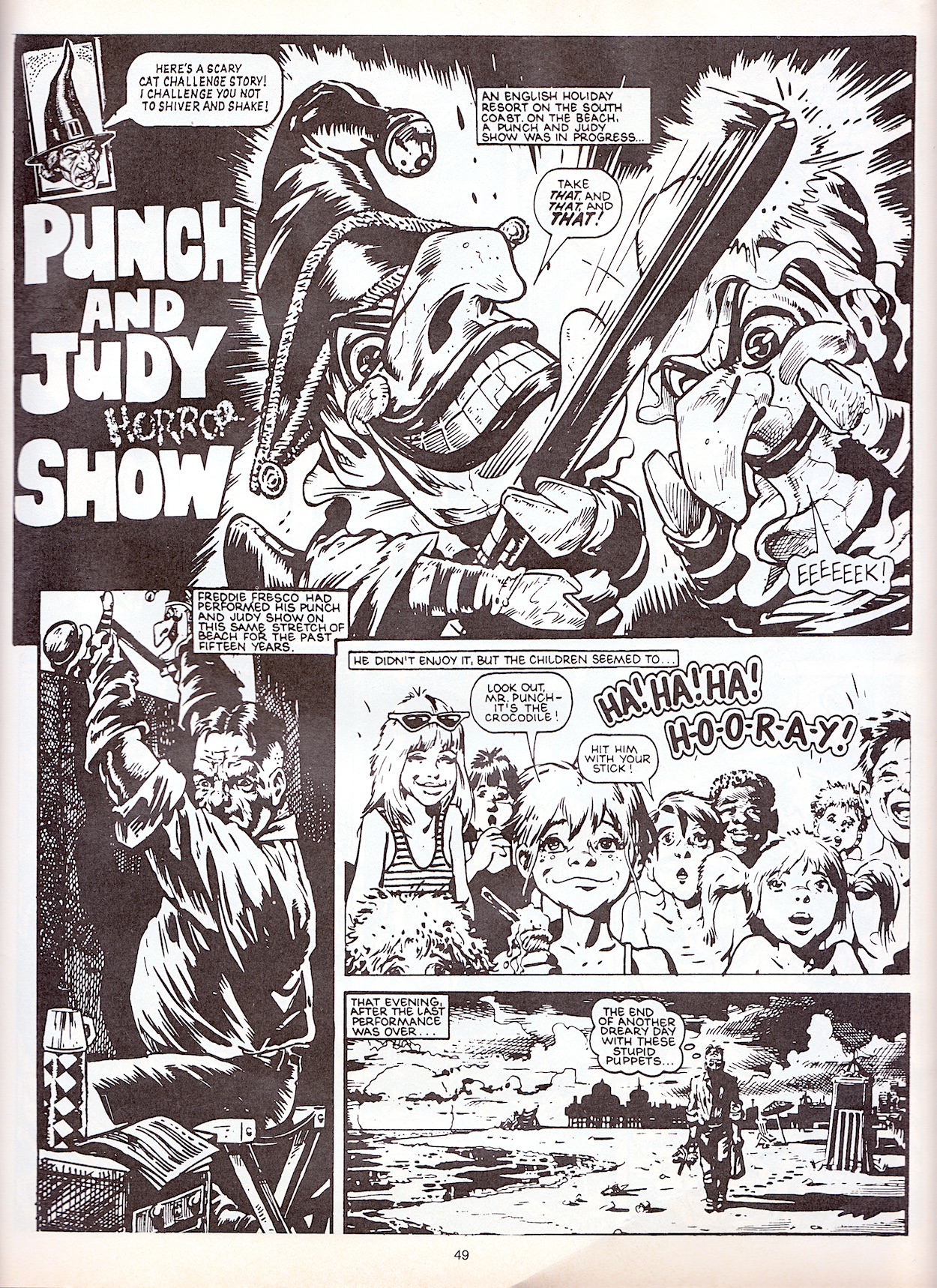
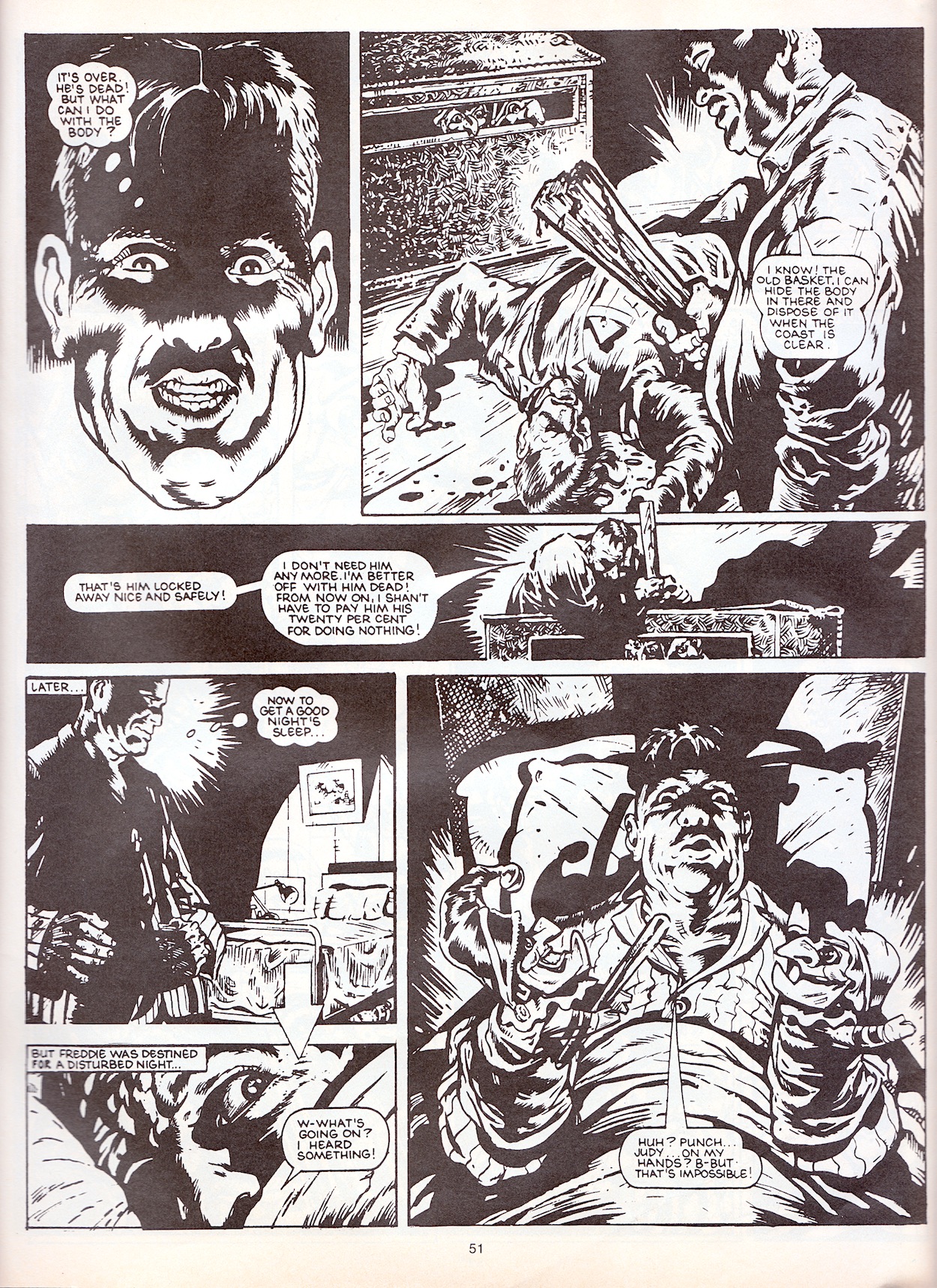
Freddie Fresco hates his job as a Punch and Judy performer, often cursing the puppets, kicking them into their box at the end of each day. But one night his manager tells him the show is over, the crowds have dwindled and he’ll no longer pay Freddie to perform. Already on edge with frustration and anger at his everyday existence this news pushes Freddie over the edge and he wallops Sam with a plank of wood, meaning to wound and scare him into changing his mind. Instead, he kills him.
He hides the body in the box alongside the puppets and simply goes to bed. He’s taken care of his problem and will dispose of the body the next day. It’s not like he has anybody in his life that could question it. But in the middle of the night he suddenly awakes to find his puppets have attached themselves to his hands and they threaten him, telling him they’ll turn him in for murder unless he takes them back to the booth on the beach so they can continue entertaining the children.
He tries to remove them but they beat him again and again with the hard wooden clubs he used on them for so long. Eventually he gives in and on the final page we see how the show goes on, day after day, week after week. At the end of the season Freddie doesn’t pack up and leave and when the council arrive to forcibly remove his sideshow they make a startling discovery.
The story is a great fit for the book, what with it being based around small toys. It’s written by James Tomlinson (credited as James Nicholas), Barrie’s son whose work I enjoyed so much in Ring Raiders the year after Super Naturals. The artist was Brendan McCarthy whose comics work includes 2000AD, DC’s Solo and Crisis. But it’s Brendan’s TV and film work which really astounds, as he went on to work as a designer on ReBoot and the original Teenage Mutant Ninja Turtles live-action movie (both childhood faves) and was co-writer on Mad Max: Fury Road.
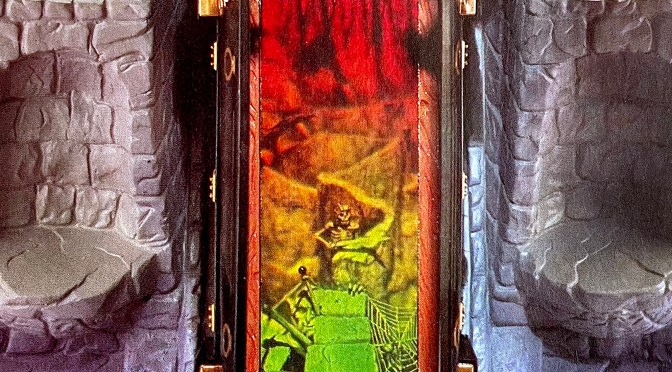
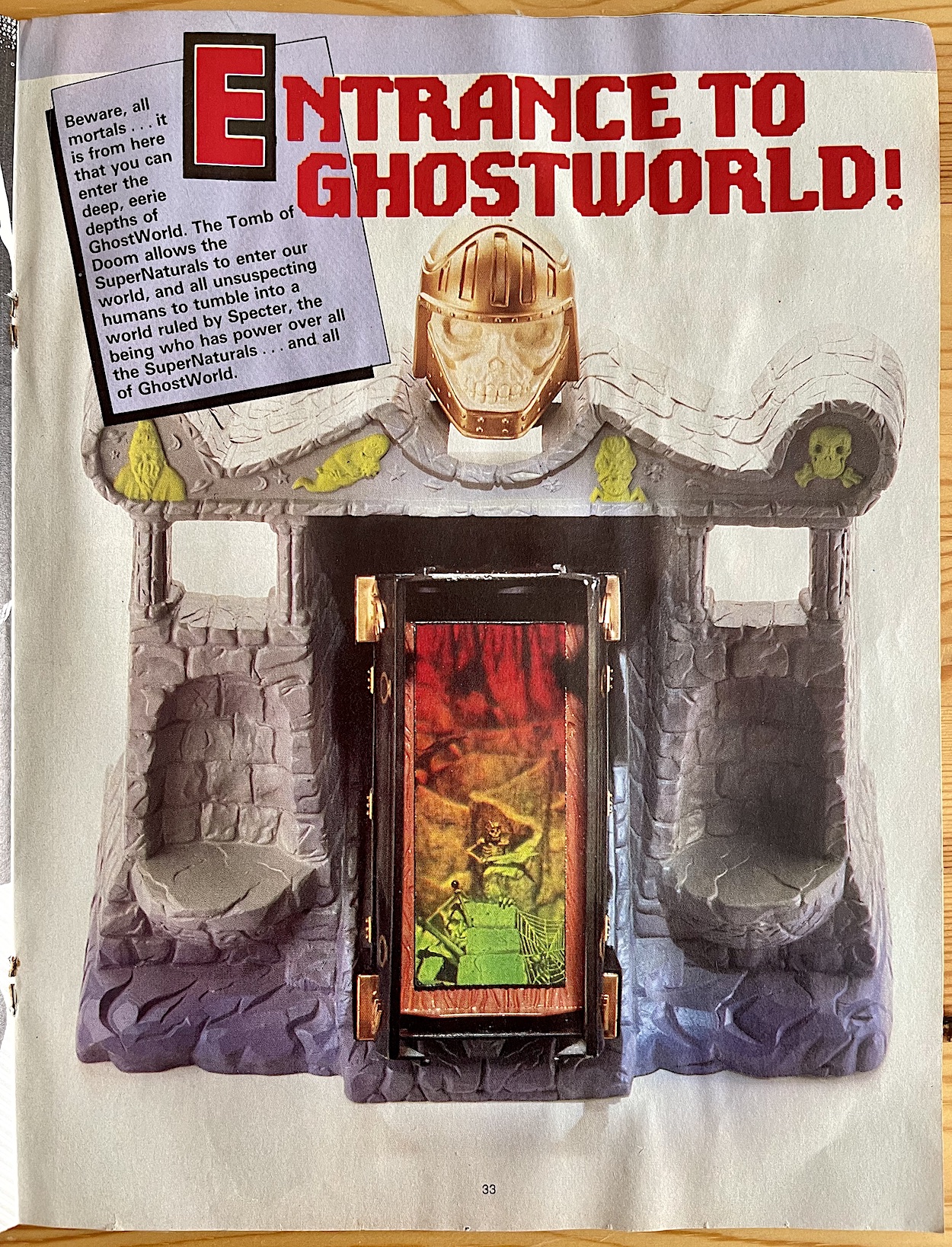
To finish off I’d just like to show you a couple of the toy pages which I think show the quality of the range. One hologram I’ve wanted to see since I started this read through is the inside of the Tomb of Doom but unfortunately every photo so far has had its doors closed. In the first part of The Legend of the Super Naturals back in the preview issue (and reprinted here) we saw a spooky staircase leading into Ghostworld drawn in the strip. It was all very atmospheric but what did the toy it was based on look like?
While photographs will never convey the full 3D nature of holograms it’s clear from this just how intricate the original models used to create them must’ve been. I’d love to see photos of the creation process. The holograms in each character model were just as good and the second spread above shows the tomb alongside more from the series. It’s just a shame the Bat Bopper is missing its superb vampiric hologram sticker on its front for some reason.
The Punch and Judy Horror Show ended up being a real highlight here, which when you consider it was made for another comic doesn’t seem to bode well for the review, but I think overall the Adventure Book would’ve done a good job introducing new toy owners to the Super Naturals comic. But then again, if the toys and thus the comic had been a success this would’ve been all new content. It doesn’t feel like the surprising children’s horror comic we’ve come to know on the blog, but then again the clue is in the name ‘AdventureBook’ I guess. It’s still an interesting addition to the series even if it doesn’t live up to what came before.
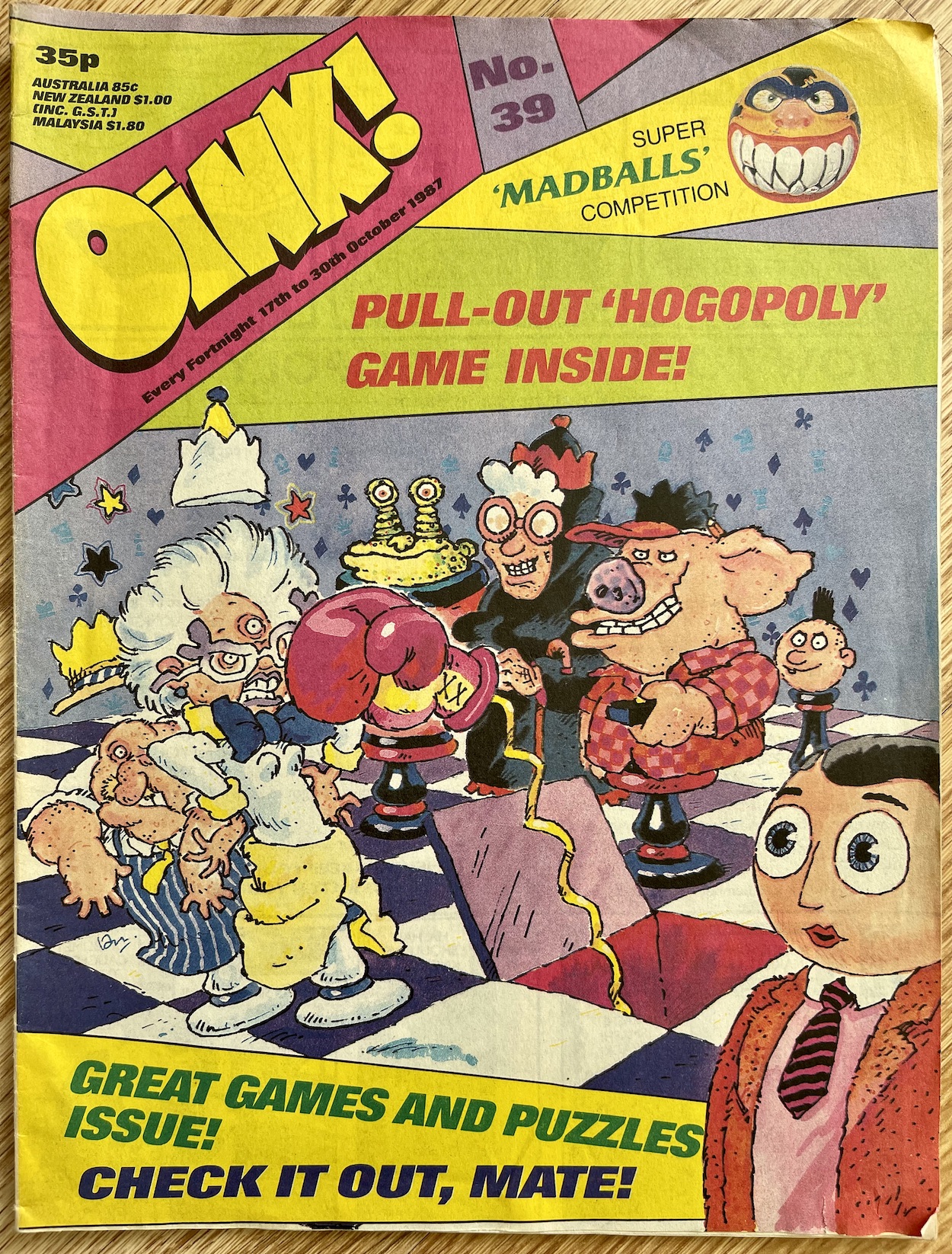
We’re in the midst of OiNK’s Golden Age now and the Great Games and Puzzles Issue is another corker, kicking off with Ian Jackson’s cover and his take on some favourite characters by other cartoonists, namely Jeremy Banx’s Burp, David Leach’s Psycho Gran, Marc Riley’s Harry the Head and Chris Sievey’s Frank Sidebottom. The colourful banners seem to be doing the job of covering over the empty space normally reserved for the logo before the redesign in #36 and they work, hyping some of the contents inside.
A few years ago a pig pal by the name of Becky Armstrong shared a photograph of this cover on social media and it was only through this that David Leach saw it for the first time, not previously aware his creation had made the cover or indeed been drawn by the incredible Ian. Becky kindly sent David the issue as a result! The OiNK community really is the best three-and-a-half decades on. Let’s open this up, shall we?
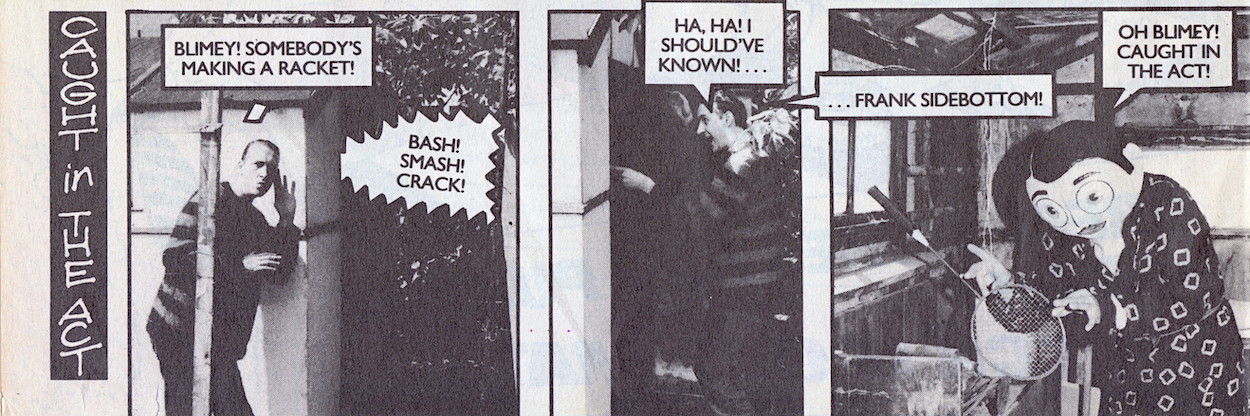
Once again we get a Frank Sidebottom and Snatcher Sam (aka Marc Riley) photo story, albeit a much smaller one than last time. When it’s so brilliantly crafted and as funny as this it doesn’t need any more space. Every time these two get together in the comic their friendship really does shine and I think this sets them apart, they’re always so much fun.
More strips than ever kept to the themes, giving each issue a really unique identity
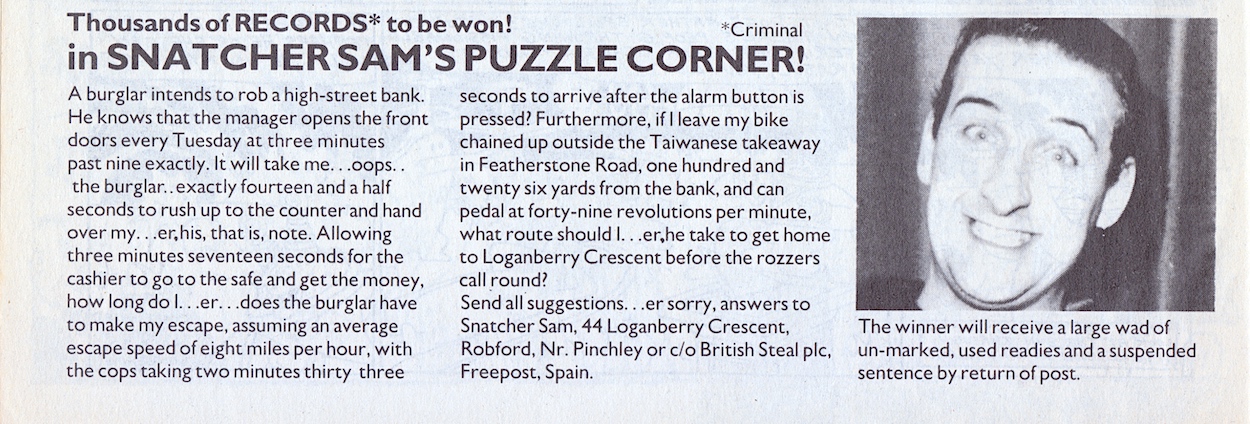
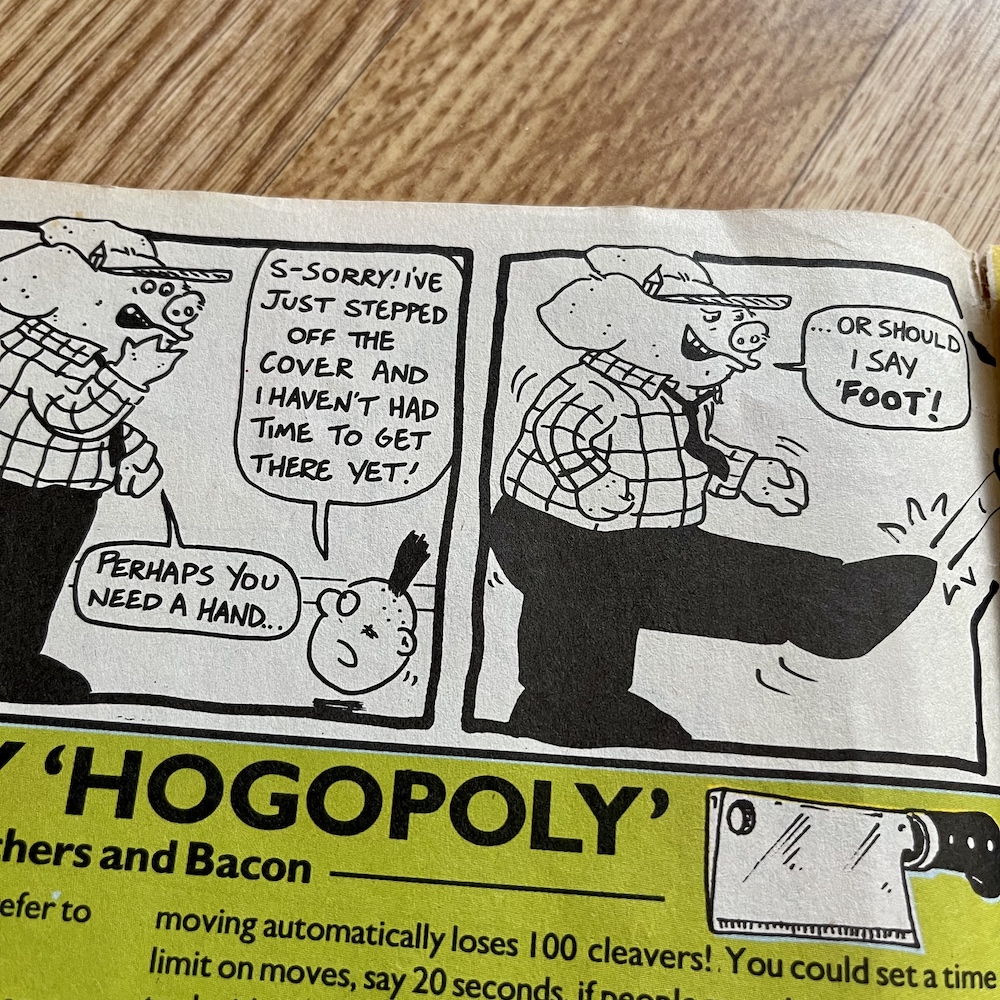
A few pages later Marc brings us a little puzzle corner for his character, although it appears it’s more of a suggestion box than a competition and his other creation Harry the Head also takes a starring role in this issue. He’s got an important part to play in the competition promoted on the cover and sliding on to page two he hasn’t had a chance to get there yet, so Uncle Pigg gives him a boot and we see him flying through the issue. We’ll get back to him further down the review.
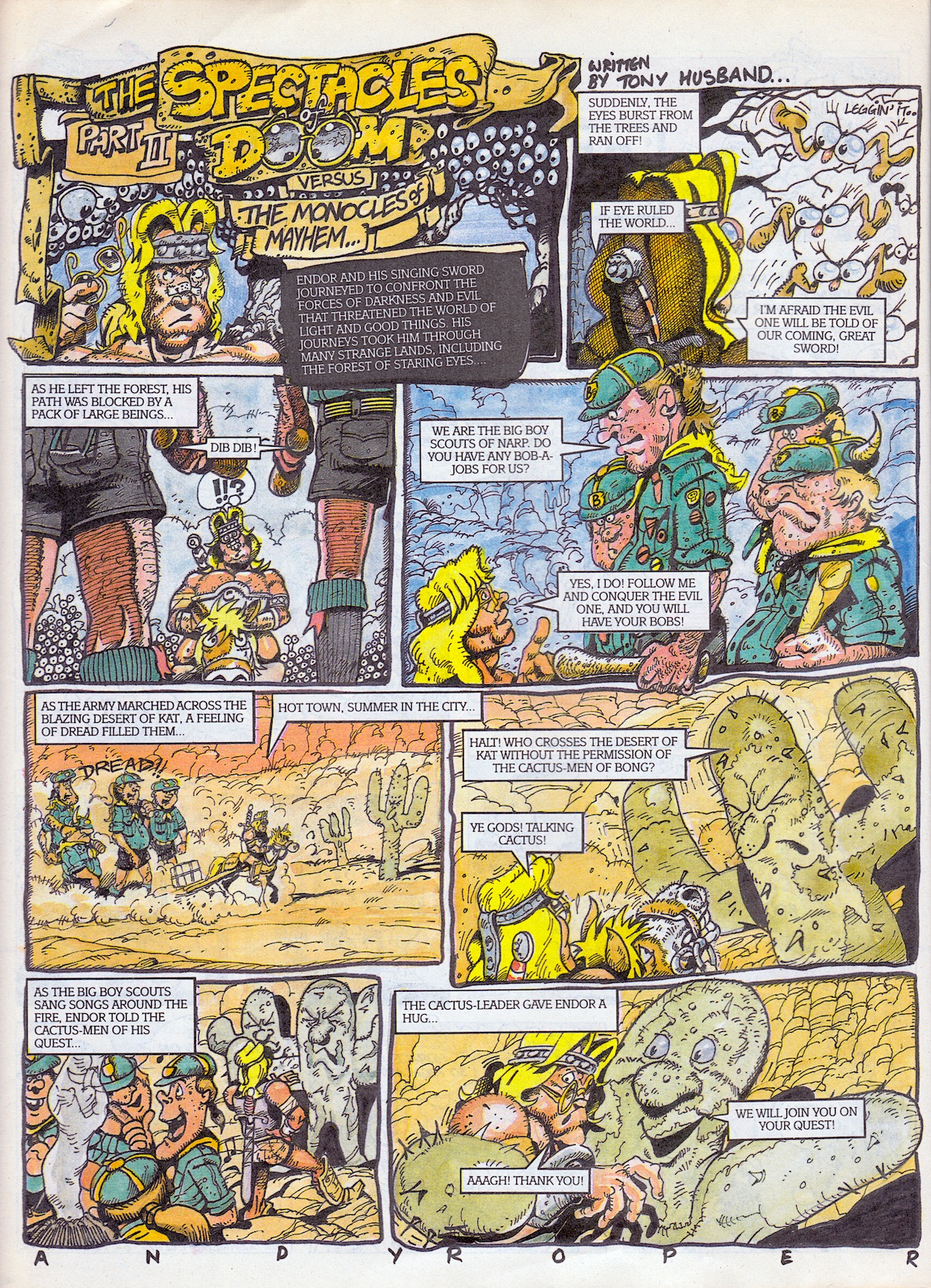
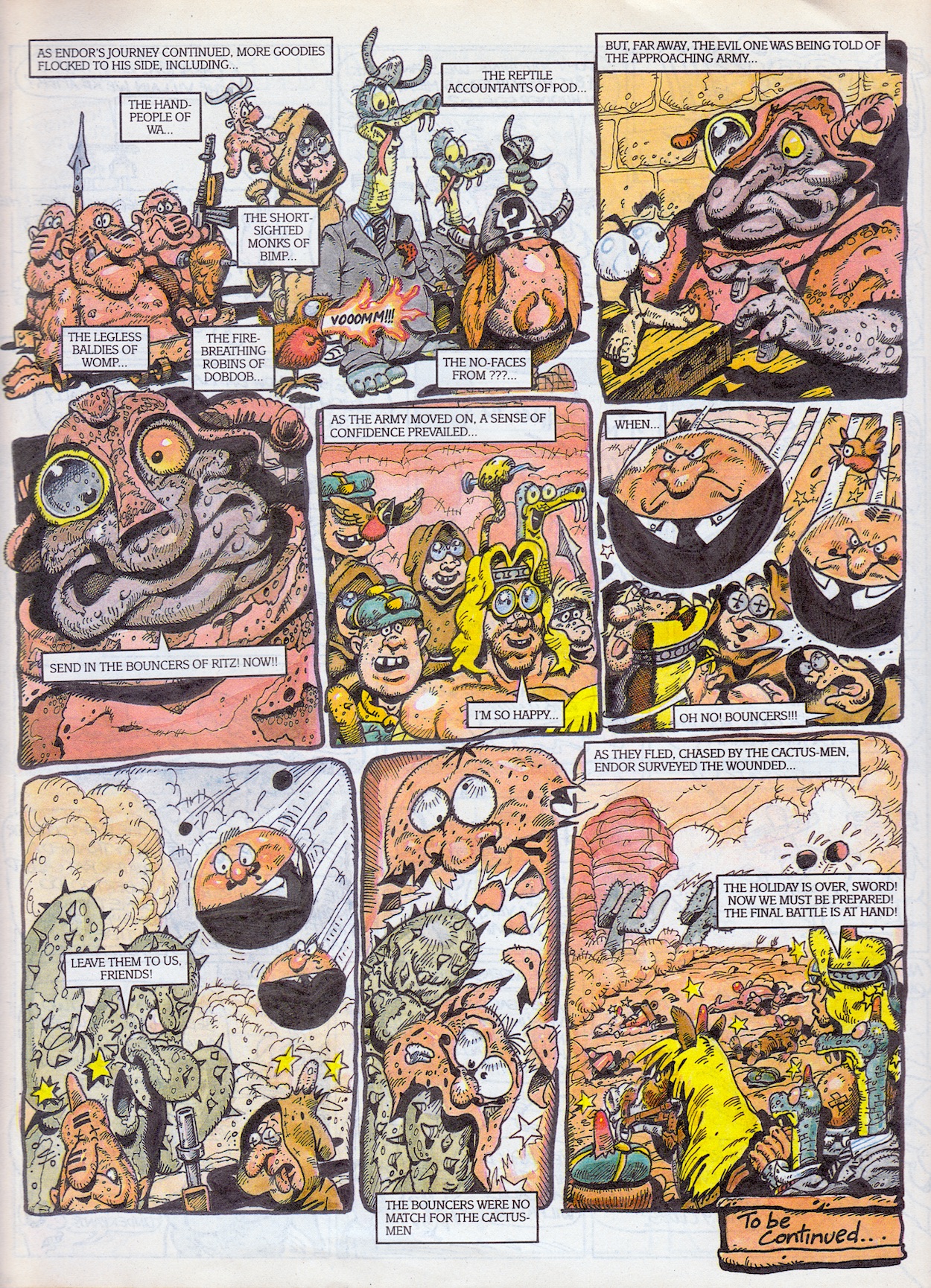
During this period of OiNK more strips than ever kept to the themes, giving each issue a really unique identity to every other OiNK (never mind compared to more traditional comics on the shelves). You’re always aware of the subject running throughout, somehow making each issue feel even more jam-packed with content. One exception to the rule would be the ongoing serials such as sequel tale The Spectacles of Doom Vs The Monocle of Mayhem, part two of which is in here.
During part one it looked like our inept hero Endor, his singing sword and glasses were going to be vastly outnumbered by the evil Gash and his hordes, so this chapter is all about evening the odds in that traditional fantasy adventure movie fashion of meeting allies along the way with ever more ridiculous names, from ever more ridiculous places. More than ever this strip feels like the spoof of 80s magic and fantasy films The Spectacles of Doom was always meant to be, thanks to the fertile imagination of writer Tony Husband.
The quick succession of gags that really land is quite surprising. We shouldn’t really expect any less from Tony but even for him this is on another level. Known for his freeform art, Tony’s scripting shines through here, his character descriptions are original and hilarious and it must’ve been a hoot for Andy Roper when he got the script and got to bring them to life. The laughs come thick and fast and this is just two part of five. If we ever get a reprint book of OiNK the collected Monocle of Mayhem story would definitely be a highlight.
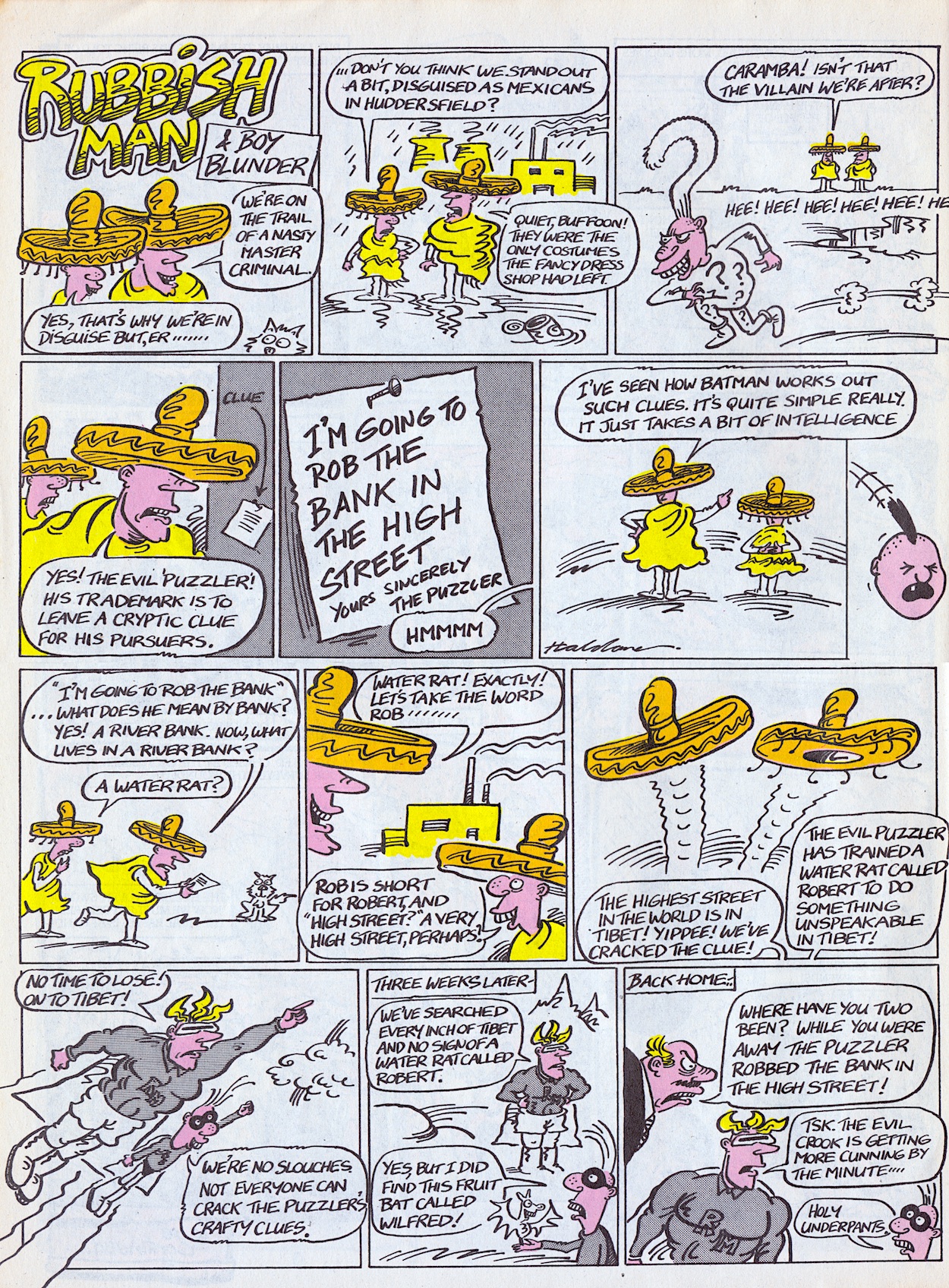
David Haldane’s Rubbish Man has been with us since the very beginning and he now seems to be accompanied by Boy Blunder every issue. From memory this wouldn’t last but for now it’s two-for-one as they battle their version of Batman’s eponymous Riddler, The Puzzler. I remember watching the 60s Batman show as a very young child and while my siblings and parents hated it for how silly it was, I was the target audience and I loved it.
There’s another myth surrounding OiNK that can be put to bed
In particular I remember the puzzles that had absolutely nothing to do with their apparent solutions and the completely unbelievable way Batman and Robin would solve them. David has obviously been inspired by these scenes and parodies them perfectly. So perfectly in fact, this one page is umpteen times better than the television series that inspired it.
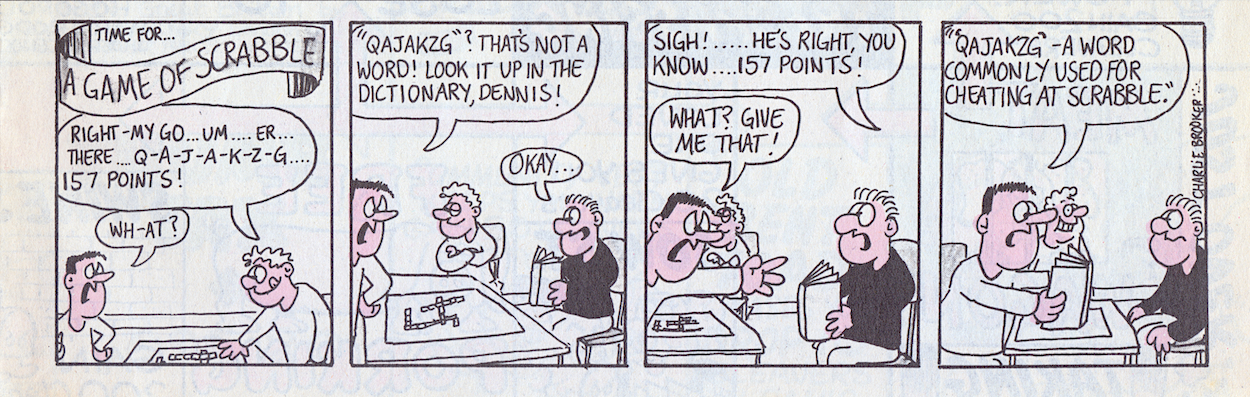
There are lots of little gems throughout this issue and not just from our usual mini-strip cast, the random one-offs are all top notch too. Standing out from the crowd is Time for A Game of Scrabble by the comic’s resident youngster, Charlie Brooker. There’s another myth surrounding OiNK, this time about Charlie and how he’s embarrassed by his early cartooning but this is yet another tall tale that can be put to bed nowadays.
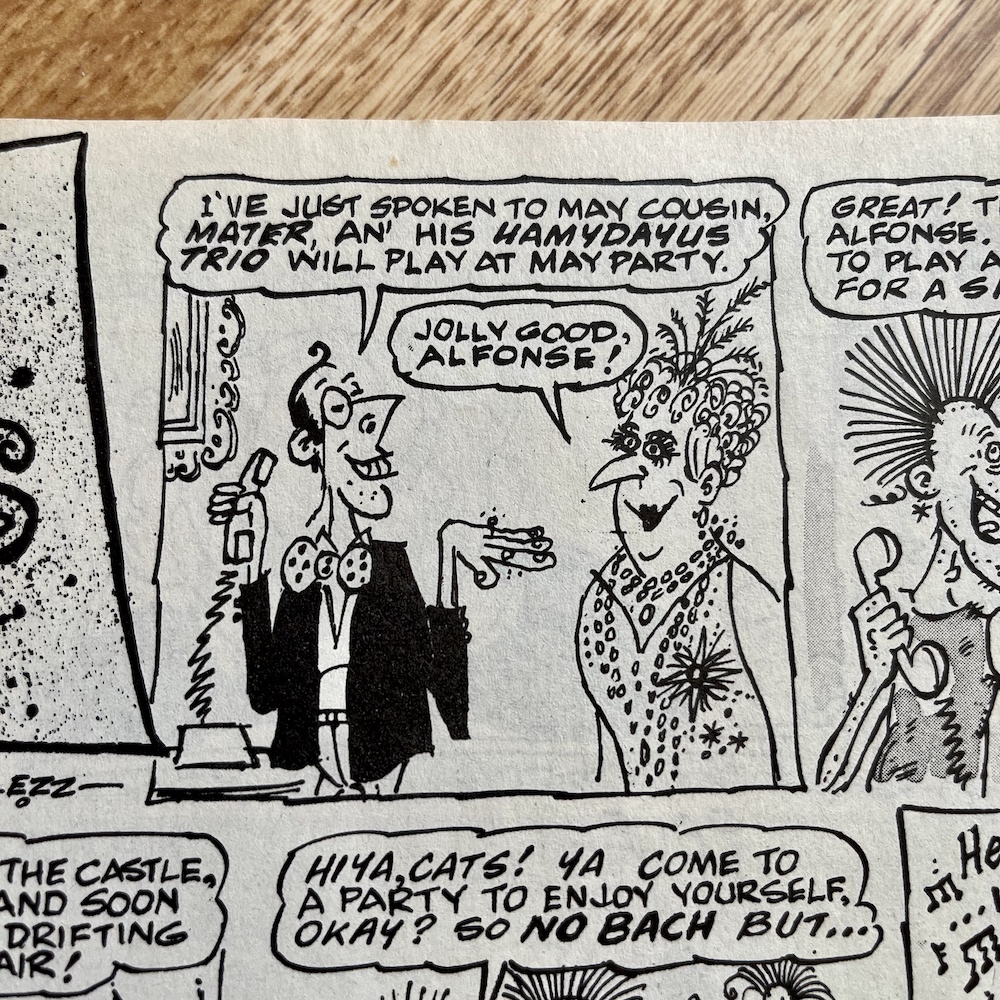
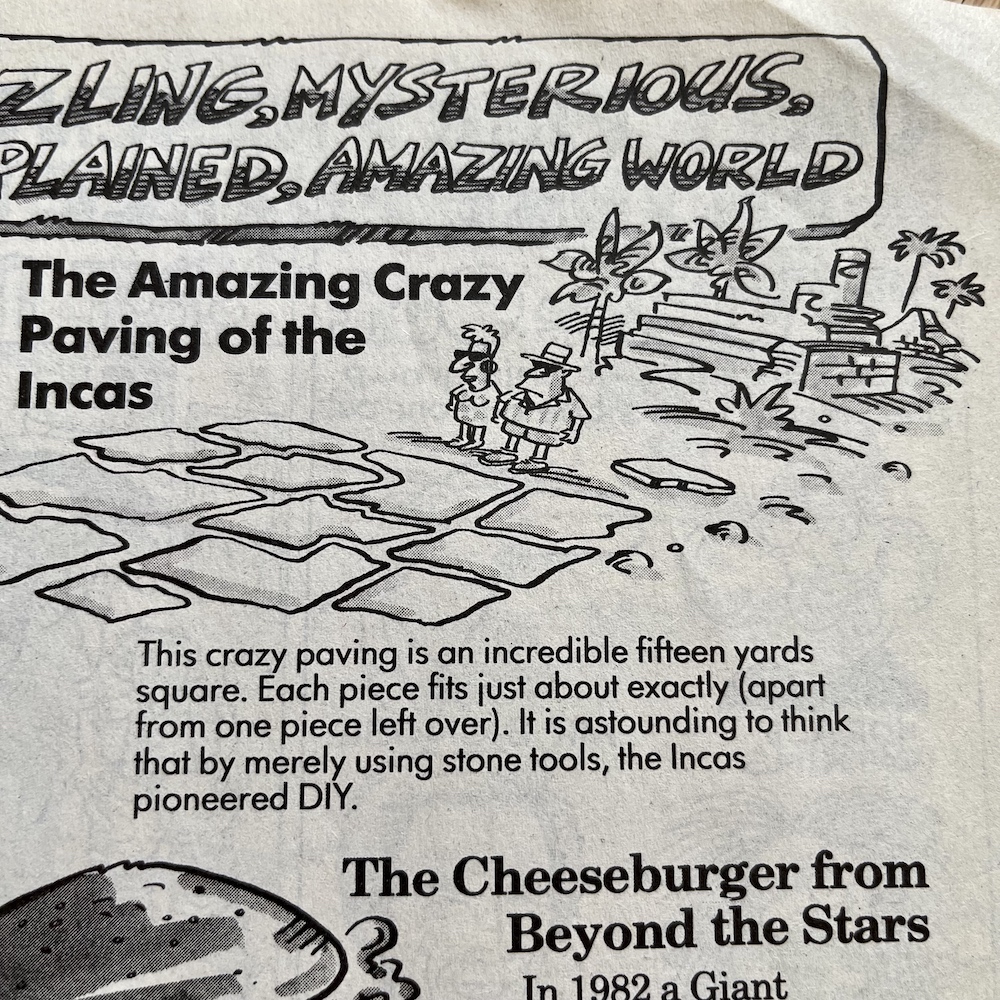
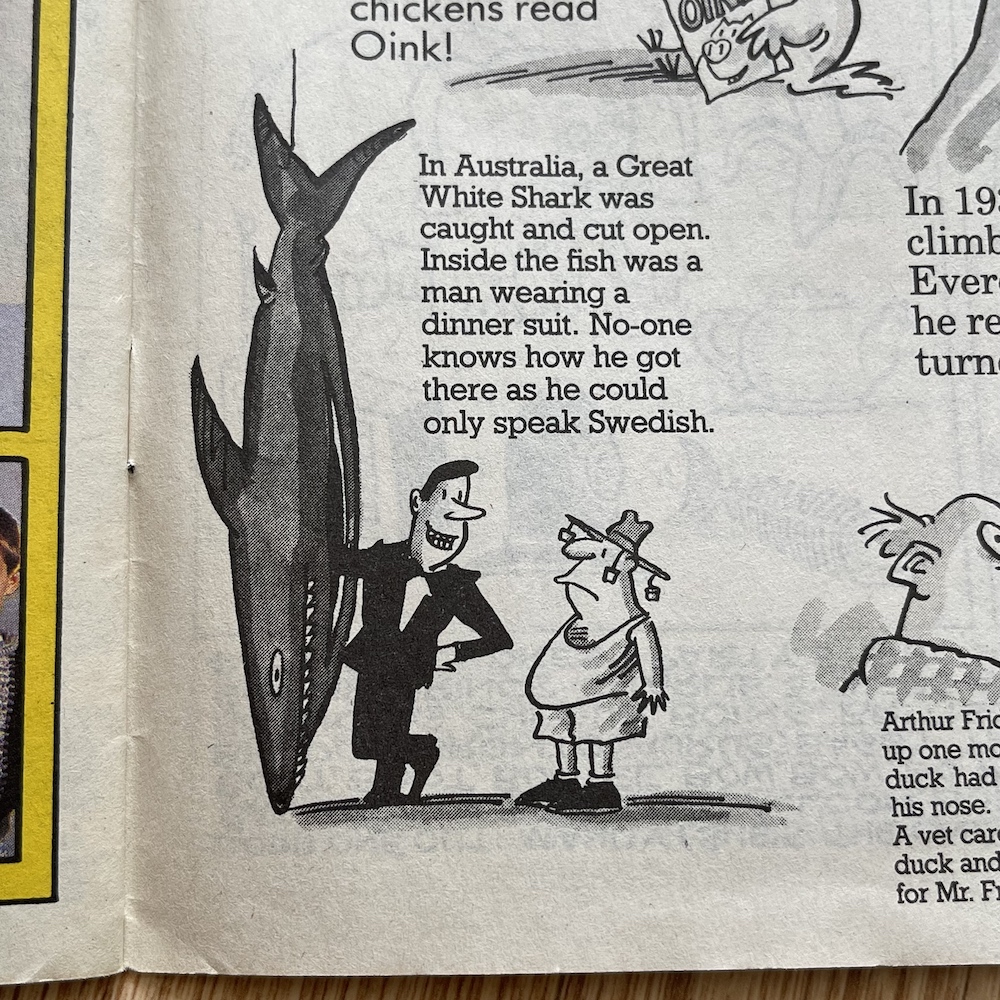
Some other highlights include perfect posh pronunciation in The Slugs, a puzzle section from Pete Throb that had all of us copying the side panel as kids (and adults) and there’s some genuine laugh out loud moments as we take a look at our Puzzling, Mysterious, Unexplained, Amazing World (including another comical shark which I had to include).
The Slugs written by Tony Husband, drawn by Lezz Pete and his Pimple by Lew Stringer Haldane’s Puzzling, Mysterious, Unexplained, Amazing World by David Haldane (who else?)
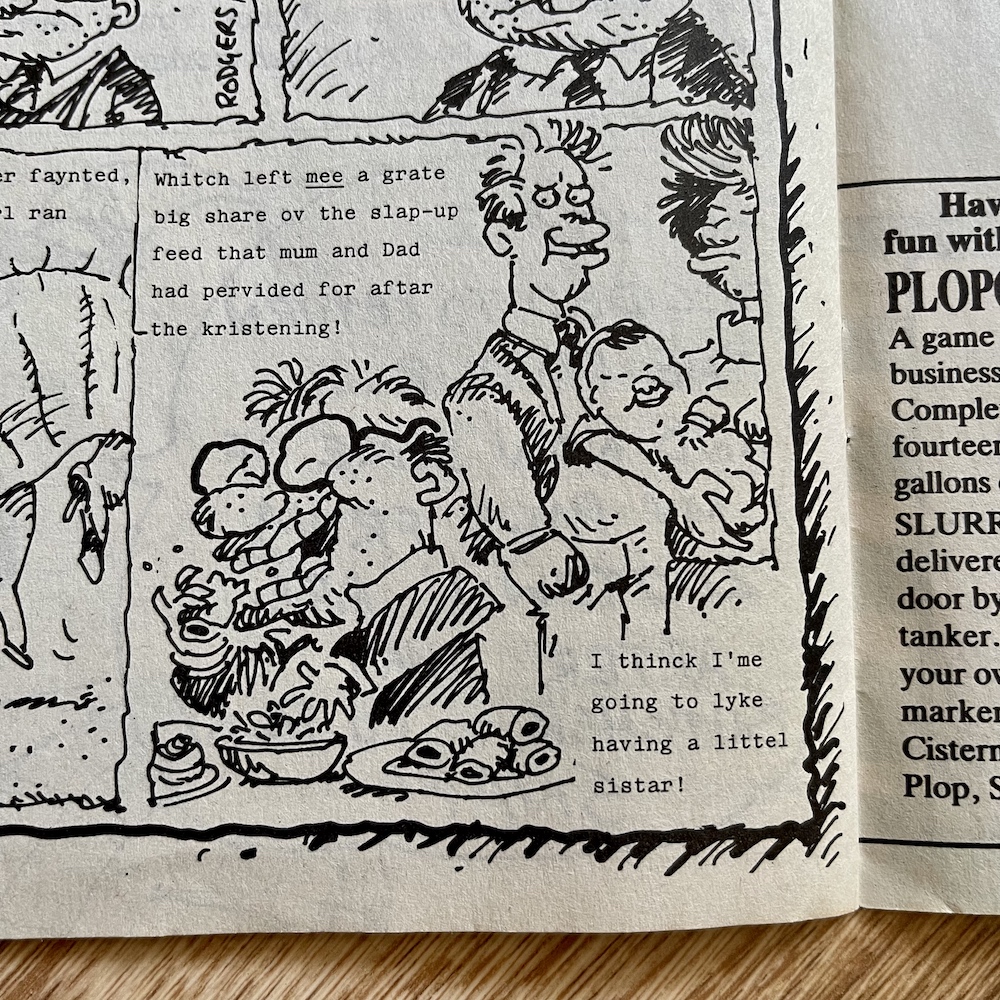
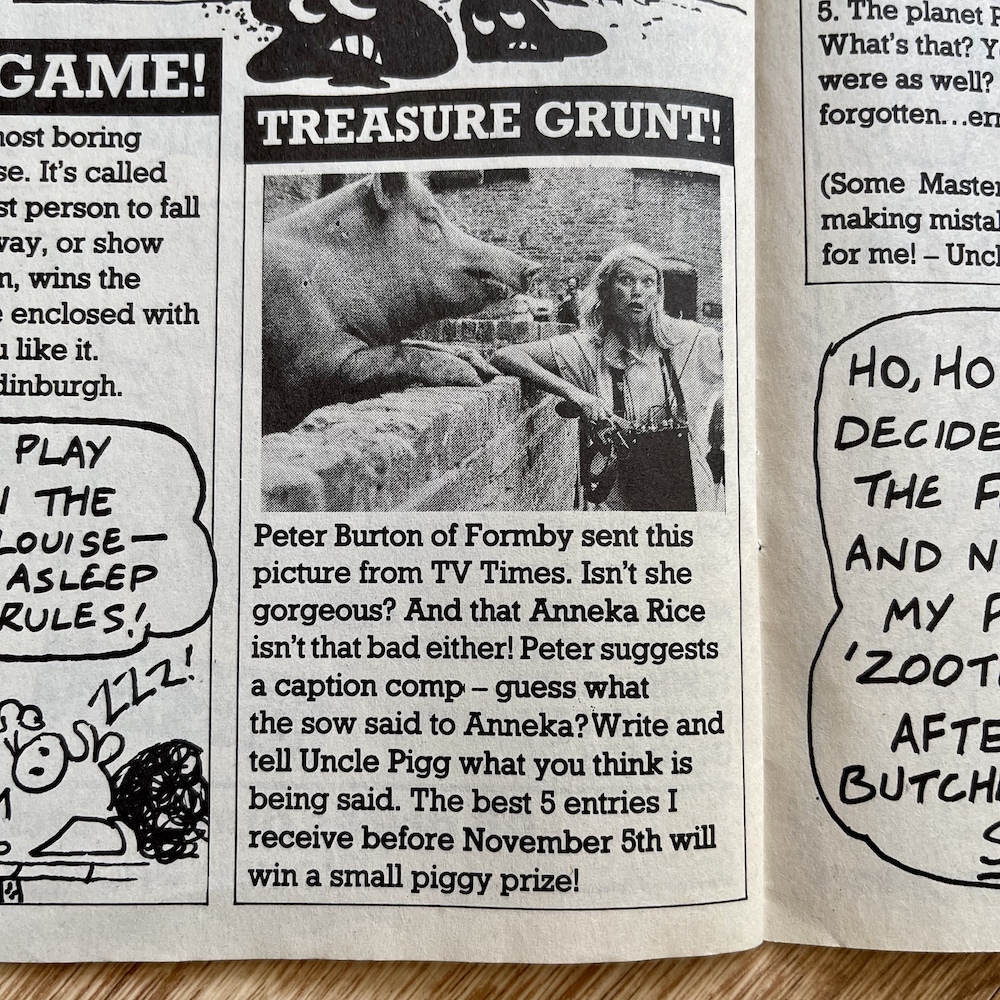
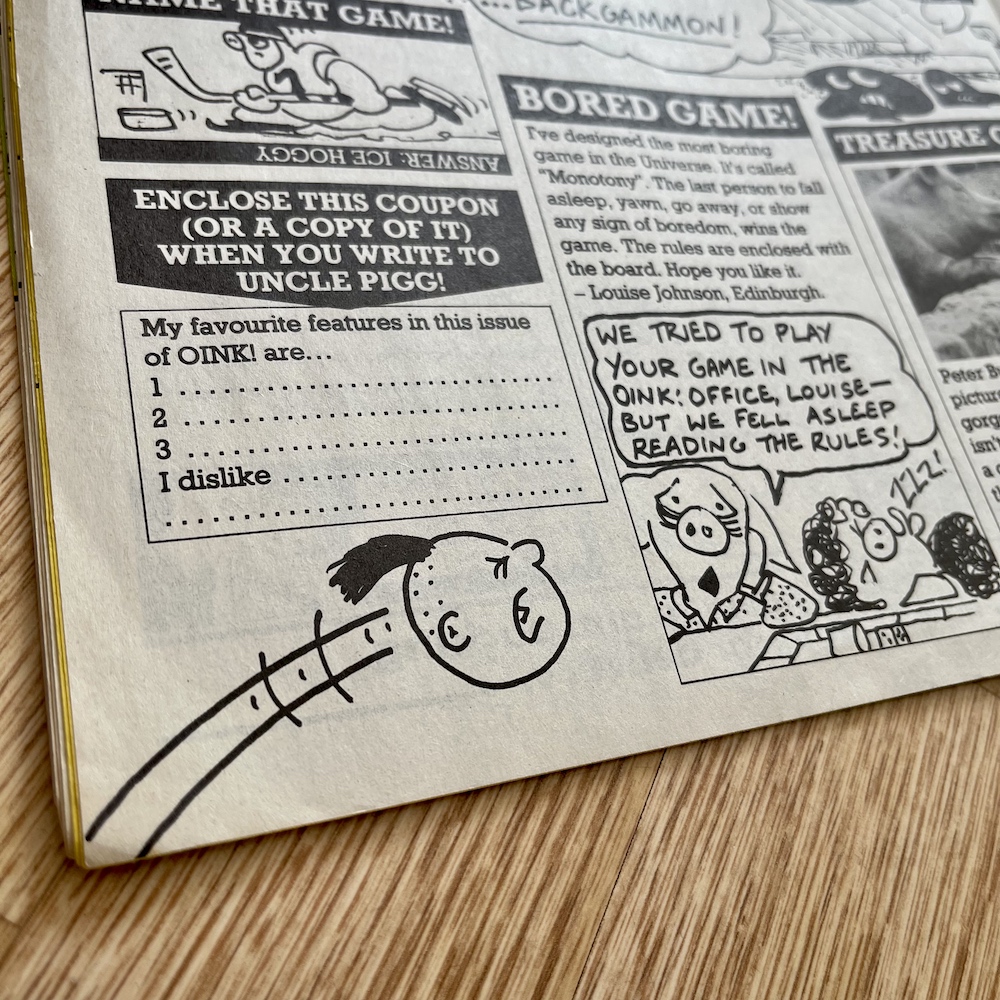
Below, a close look at a panel from The Sekret Diary ov Hadrian Vile – Aged 8 5/8 (yearƨ) may raise some eyebrows with pig pals. What’s that he’s eating? It can’t be! Not in OiNK! I’m not the only one to pick up on this as a future Grunts page will attest. Anneka Rice would later make a guest appearance on the letters page of an issue of Super Naturals and here she’s popped up in one of its sister comics, complete with a cheeky caption from Uncle Pigg.
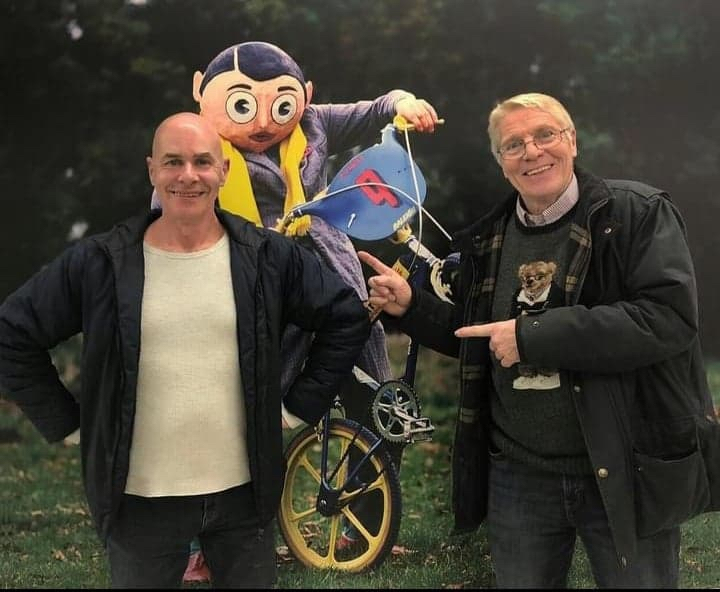
Hadrian Vile written by Mark Rodgers, drawn by Ian Jackson Grunts compiled by Patrick Gallagher GBH Games Catalogue photographed by John Barry John Barry (right) pictured with Patrick Gallagher
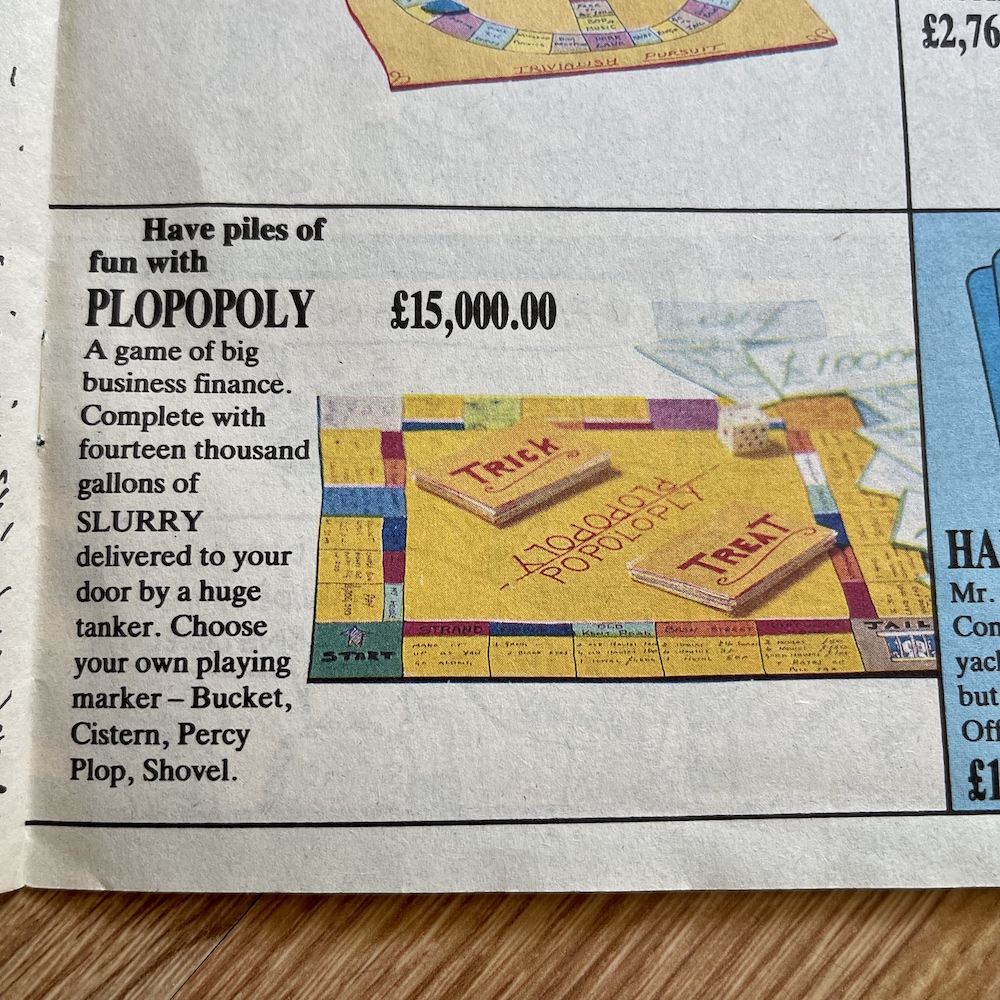
Finally, ace OiNK (and Frank Sidebottom’s official) photographer John Barry created a page of fully mocked up fake board games for a funny GBH Madvertisement. “Well beyond the call of duty!”, as Patrick Gallagher exclaimed to me recently. Take a closer look at that Plopopoly panel and you’ll see the board, cards and even the strange die (with an ‘8’ side) have all been crafted to great detail! All for just one small photo.
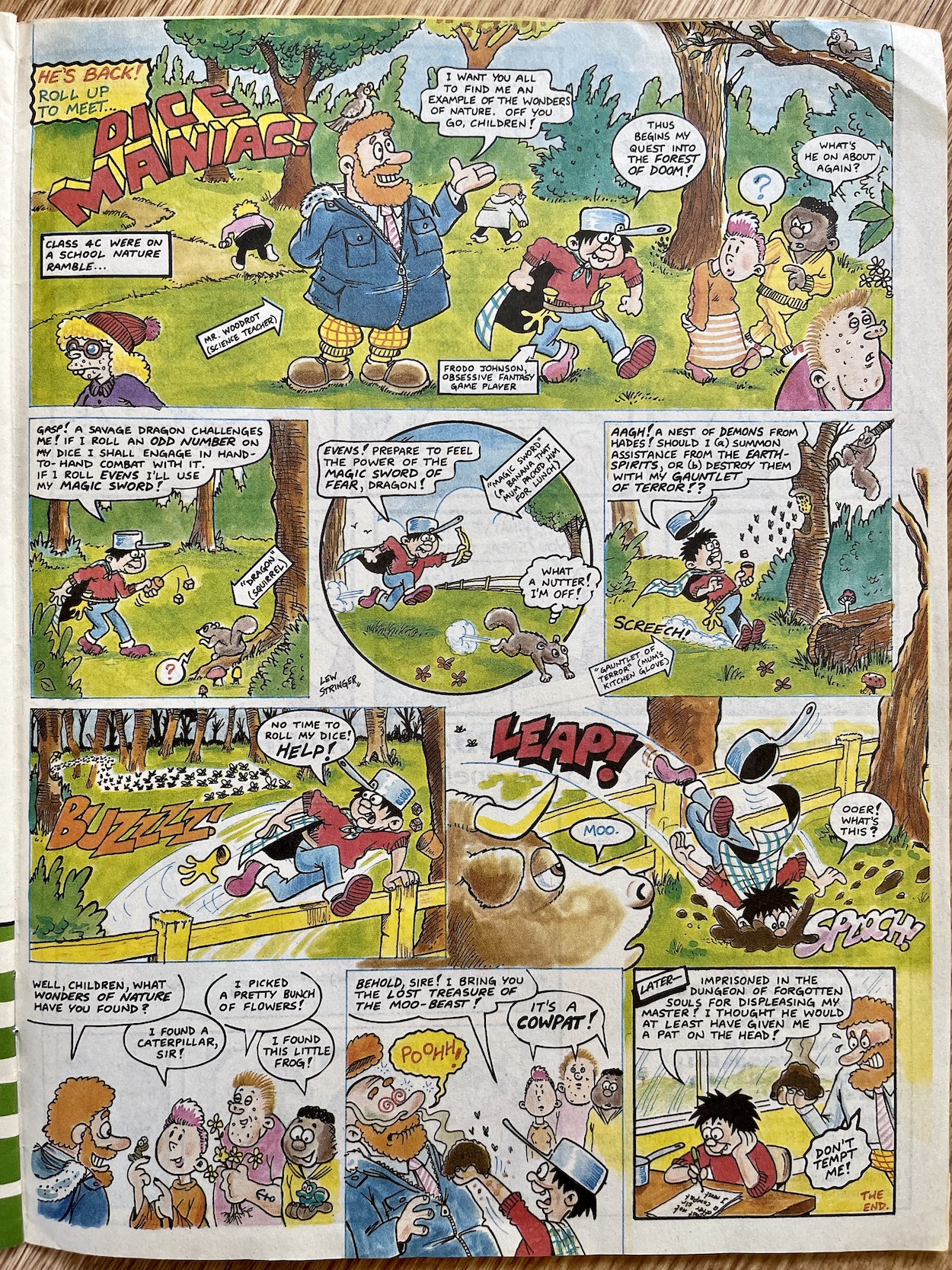
This issue contains the very welcome return of Frodo Johnson (previously in #22), otherwise known as the Dice Maniac, Lew Stringer’s parody of fantasy role players and 2000AD spin-off magazine, Dice Man. It’s somewhat bittersweet because this was his last of only two appearances but at least this time he’s in full colour. For the uninitiated, to Frodo life is the ultimate adventure and, no matter how mundane the task, how he goes about it is all up to the roll of his dice. Of course, these should not actually be trusted.
This is OiNK, so naturally with it being set in the countryside it had to have a cowpat and an accompanying pun at the end. What a shame the character would never return. He had the potential of being something of an OiNK spin on traditional strips but alas this would be all we’d ever see of any potential he had. With the Dice Man magazine only lasting five issues Lew tells me he didn’t think Maniac would be relevant anymore and thus he was created as a limited character.
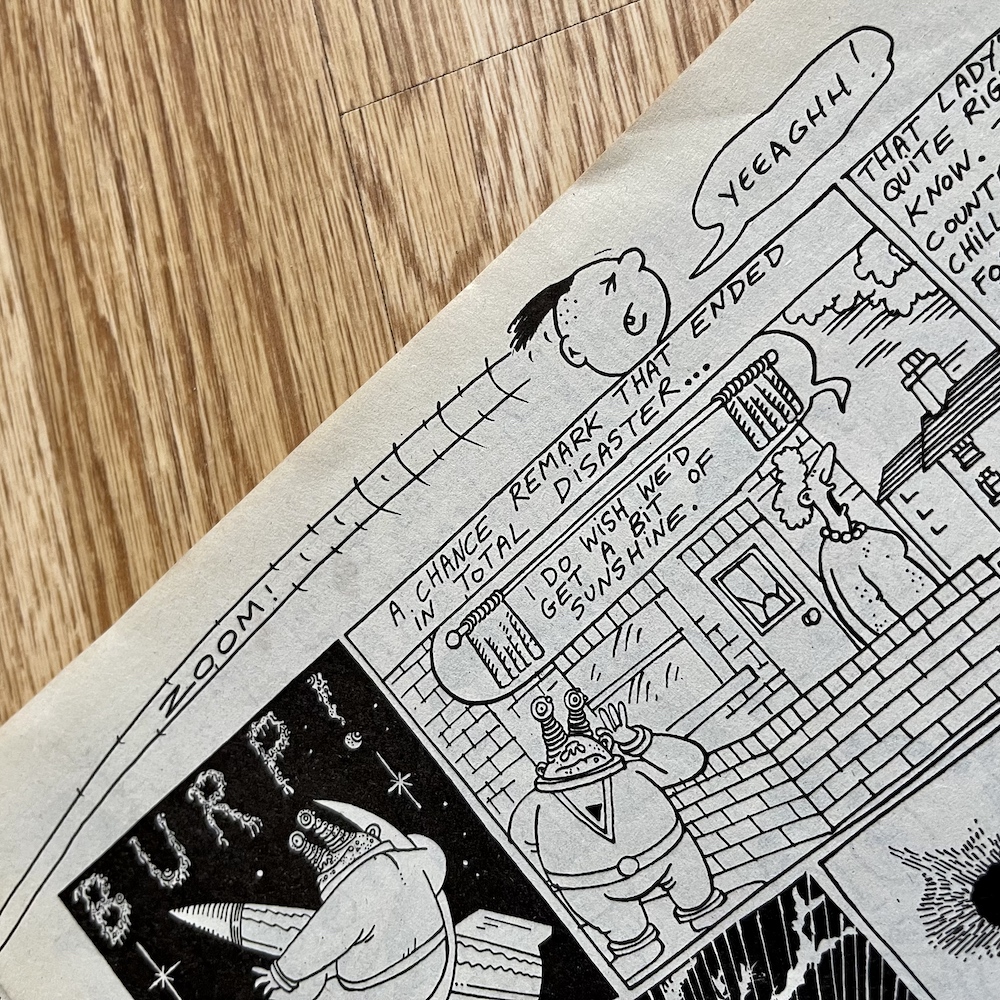
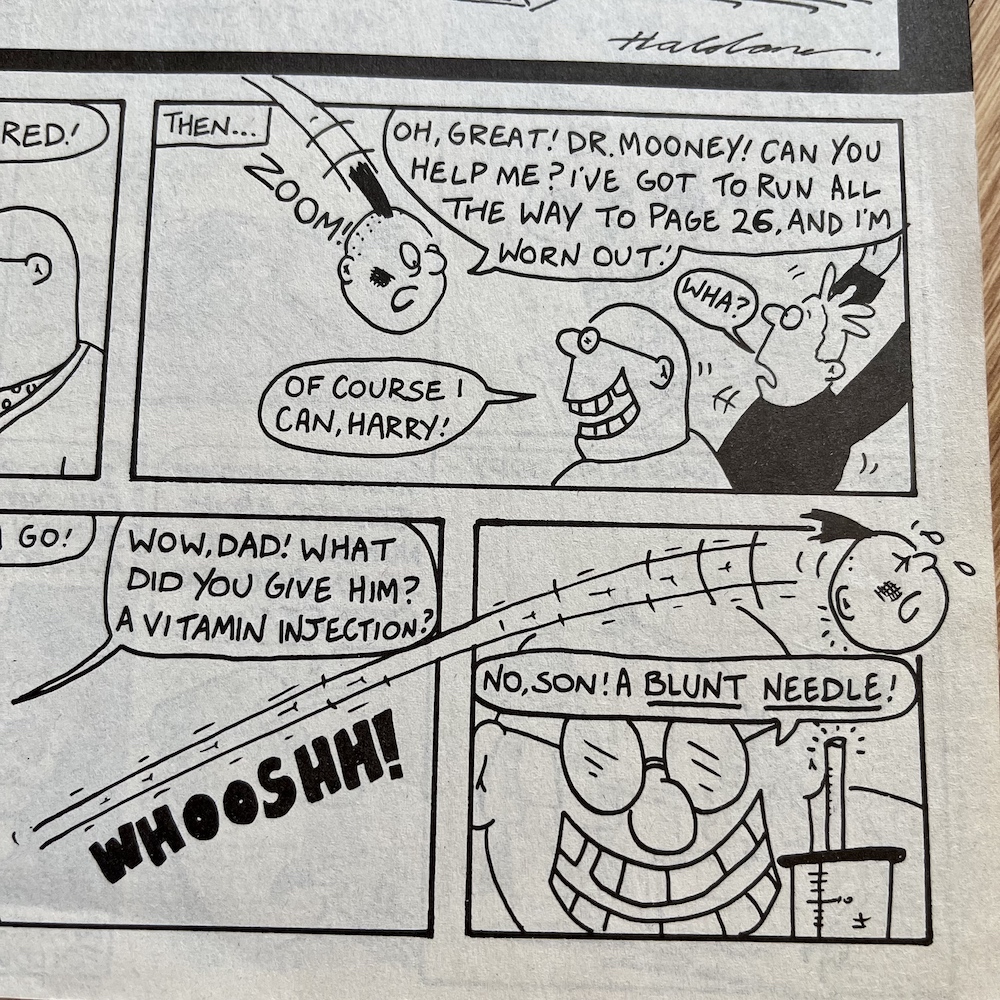
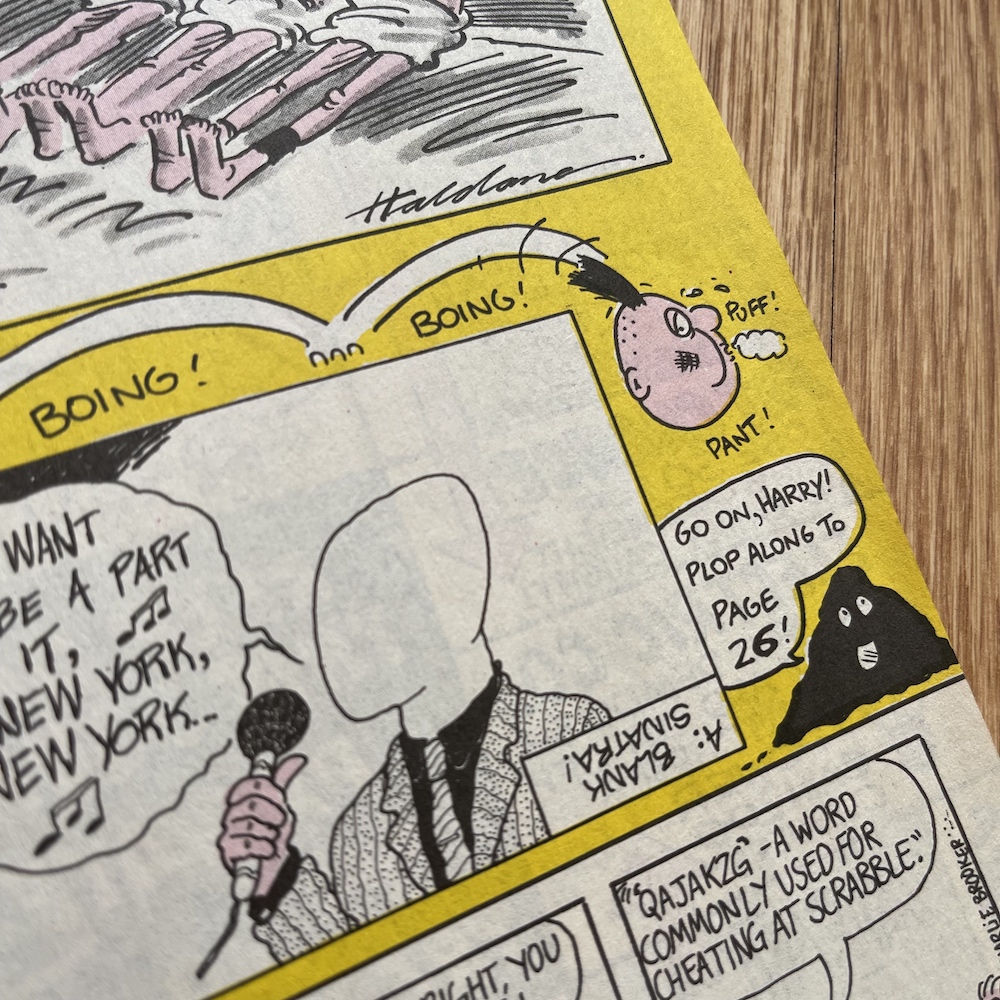
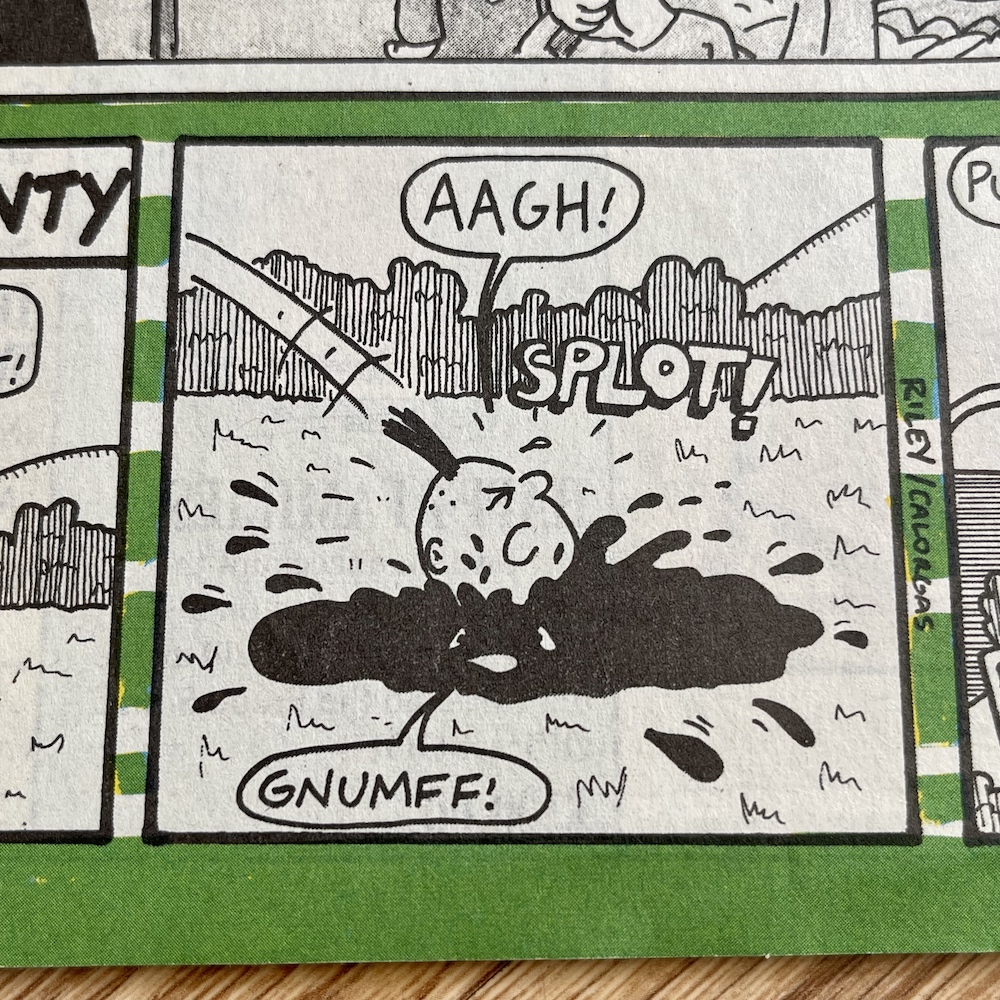
Last but certainly not least you may have noticed Marc Riley’s Harry the Head flying past one of Rubbish Man’s panels above. You saw him on the cover then on page two our esteemed editor gave him a kick to get him to his own page near the back of the comic. It was a hell of a kick because he makes a cameo in (or beside) no less than four other strips and the Grunts page.
Harry appeared alongside Jeremy Banx’s Burp, his creator Marc Riley’s own Doctor Mooney He’s Completely Looney, Mark Rodgers’ and Mike Green’s Blank Sinatra and Davy Francis’ Cowpat Country which this time is just an excuse to have Harry land as he does. Uniquely, it was by Marc and Patrick Gallagher instead of Davy, Patrick credited as ‘Calorgas’. According to Patrick, “Marc was pretending to be really pissed and trying repeatedly to pronounce my surname, but all he could manage was ‘Calorgas’”.
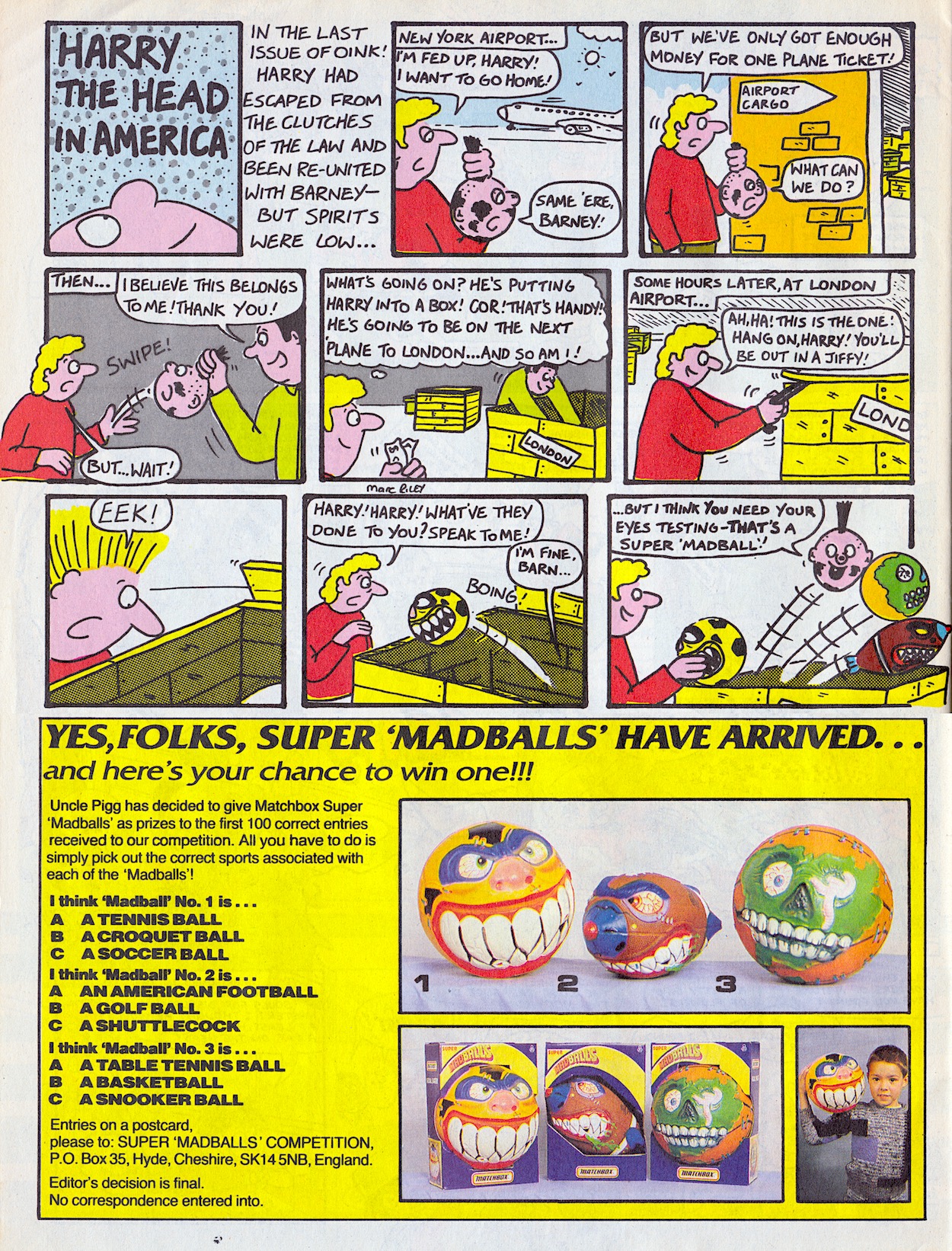
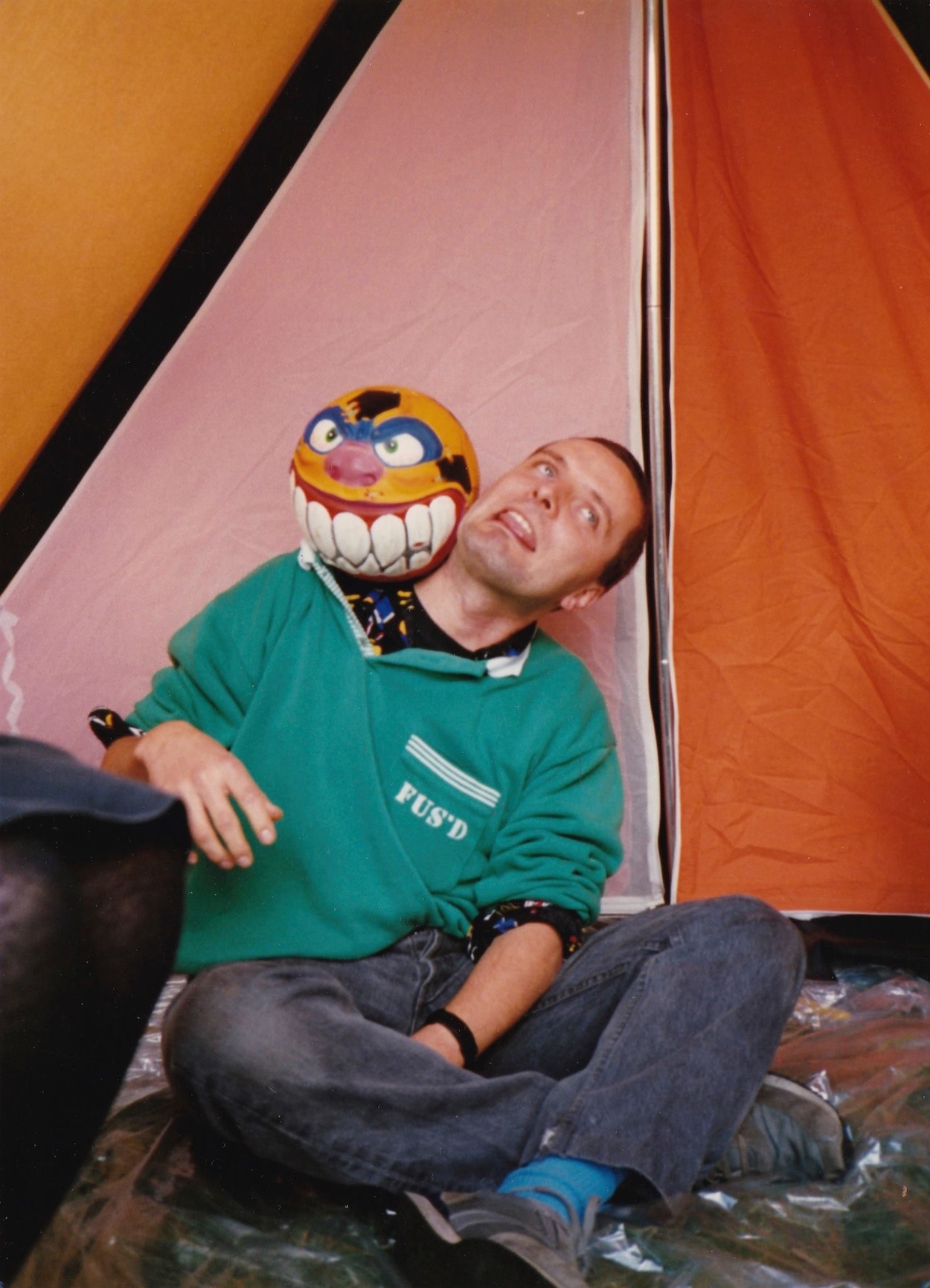
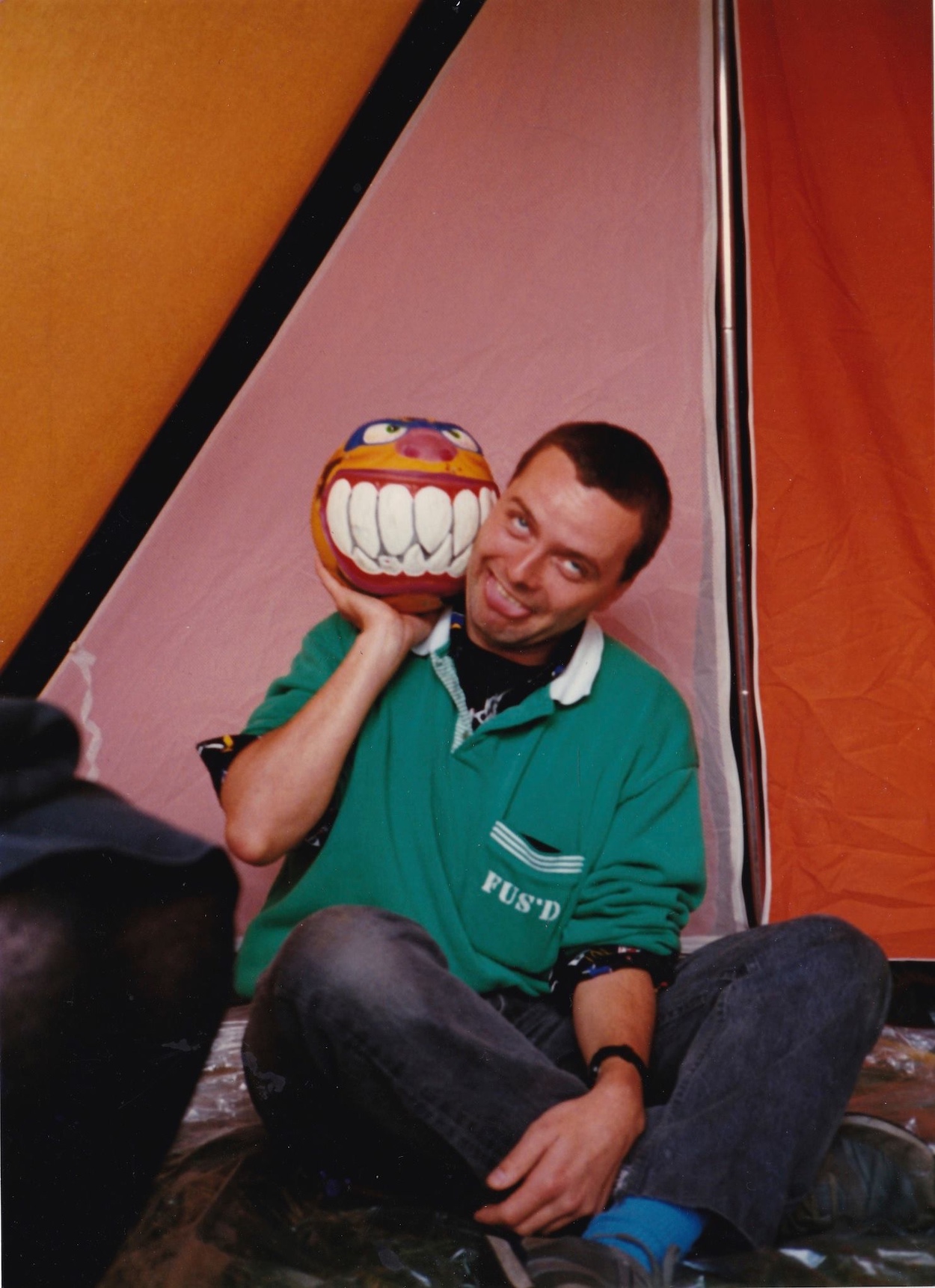
The reason for Harry’s harrowing journey? A special competition with no less than 100 of Matchbox’s memorable Madballs to give away to lucky pig pals. I remember having one but I’ve no idea which one it was, although I don’t think it was any of these three below. I believe I also had a teeny tiny squishy one too, or maybe that’s just my mind playing tricks on me. Below you’ll also see OiNK co-creator/co-editor Mark Rodgers with one of the Madballs he took on a camping holiday at the time.
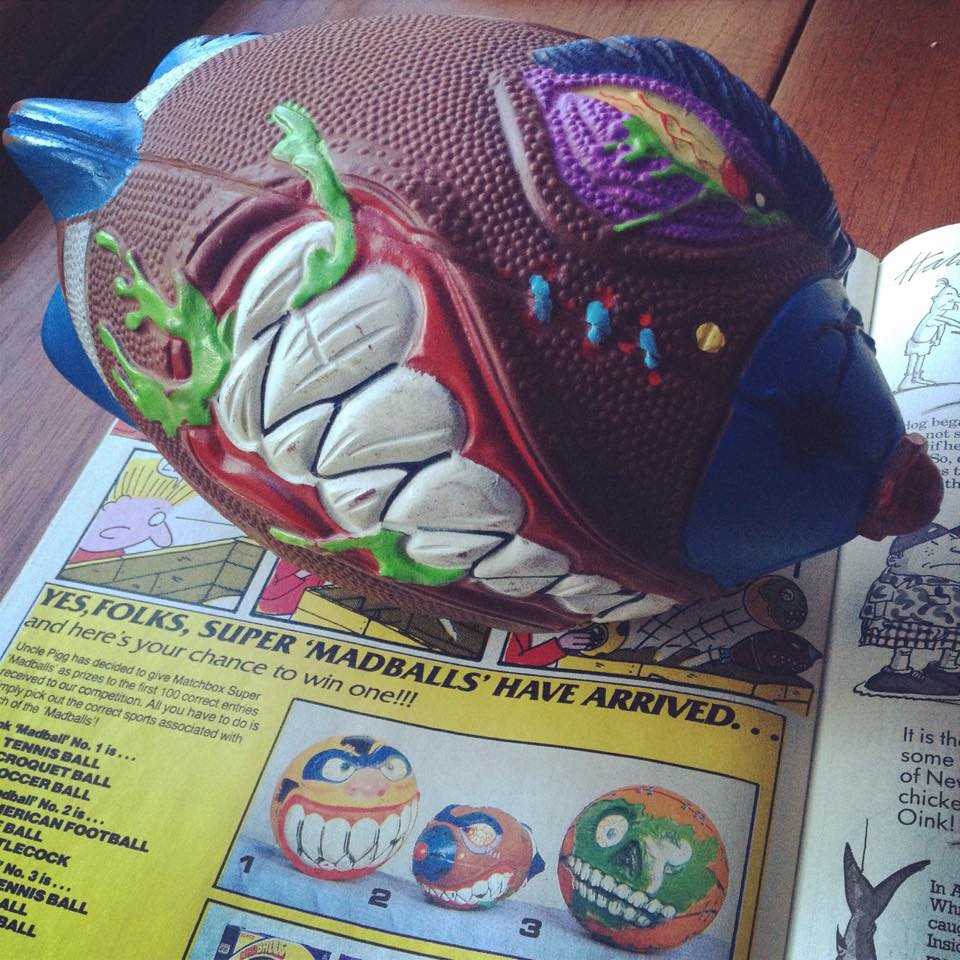
The photo of the rugby ball sitting on top of this issue is fellow pig pal Ross Murdoch‘s, one of the lucky 100 winners! I think most of my friends had at least one Madball and I even recall spotting a Marvel UK special in a newsagent at one stage too. They were really fun to kick and throw about since they’d bounce and roll in such unpredictable ways, but they were very well made and were more than up to the battering they took. Even though the competition ran in other Fleetway comics too they’re the perfect fit for an OiNK contest, aren’t they?
This is a brilliant issue! Again. OiNK was going from strength to strength but elsewhere in Fleetway’s range something had happened that would affect our treasured piggy publication. When they had taken over IPC’s comics, Fleetway grouped all the titles into various sales groups. Because there were so many of them and the market was shrinking, tracking individual sales was out. Instead, if any particular group’s combined sales weren’t up to par every comic in it would be cancelled.
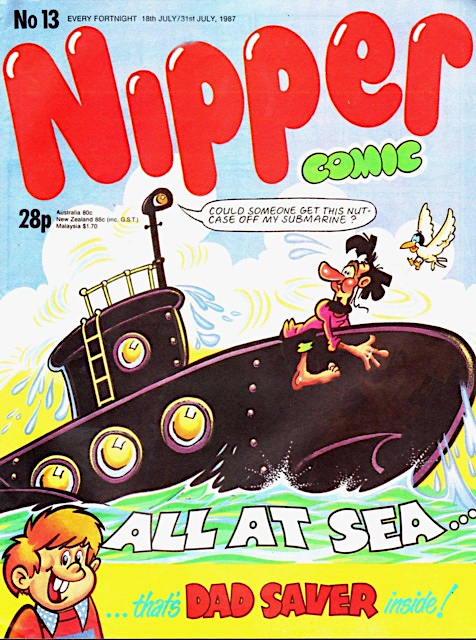
The likes of Buster and Whizzer and Chips etc were selling over 200,000 a week and were placed in one group. OiNK was unfairly (in my eyes) placed into a different one alongside the likes of the just-cancelled Nipper (image taken from Comic Vine). OiNK was selling 100,000 a fortnight, far beyond the others in its group and in September with the last of its siblings canned OiNK was left on its own. By Fleetway’s rules OiNK should’ve been cancelled at this point but its own sales saved it. However, the publisher wanted more and so they forced a big change on the team which would take effect in the new year. We’ll come back to that then.
For now that’s us for another issue and I’m really excited for the next one to come. A glorious Ralph Shephard cover that takes full advantage of the extra space from the smaller logo is one of the very best in the run. This suits the issue perfectly because #40, the second Hallowe’en edition, is one of the very best issues too. I’ve got particular memories attached to it as well so I can’t wait to read it again. Fittingly enough its review will be here on Monday 31st October 2022.
The next issue of OiNK will really play with your mind. It’s the Games and Puzzles Issue! You know you’re in for a treat when you see a front cover by arguably OiNK’s number one artist Ian Jackson in which he draws other cartoonists’ characters as special chess pieces! It’s a classic from the off.
Promo by Wilkie
Inside, Rubbish Man takes on The Puzzler in a brilliant spoof of 60s Batman, the Dice Maniac returns for his second (and last) appearance, Harry the Head takes a flying leap through the entire comic for a special competition and The Spectacles of Doom brings us the perfect parody of 80s fantasy movies. None of it should be missed, so click the ‘Follow’ button (bottom-right as you scroll) to subscribe via email or join us on Facebook or Instagram to be notified when the review goes live on Monday 17th October 2022.