Tag Archives: Armando Gil

THE LOST WORLD JURASSiC PARK #4: THE END?

Well here we are at the final issue already of Titan Magazine’s The Lost World Jurassic Park comic. In the States, just as with the original movie, Topps Comics released its adaptation as a four-part mini-series. When the original adaptation proved popular further stories were told as the first official sequel to the film, however in 1997 no further adventures after the sequel movie were forthcoming. In the UK, instead of simply having a one-off special consisting of all four chapters as had happened with other adaptations at the time Titan decided to also do a mini-series, with exclusive extras for UK readers of course.

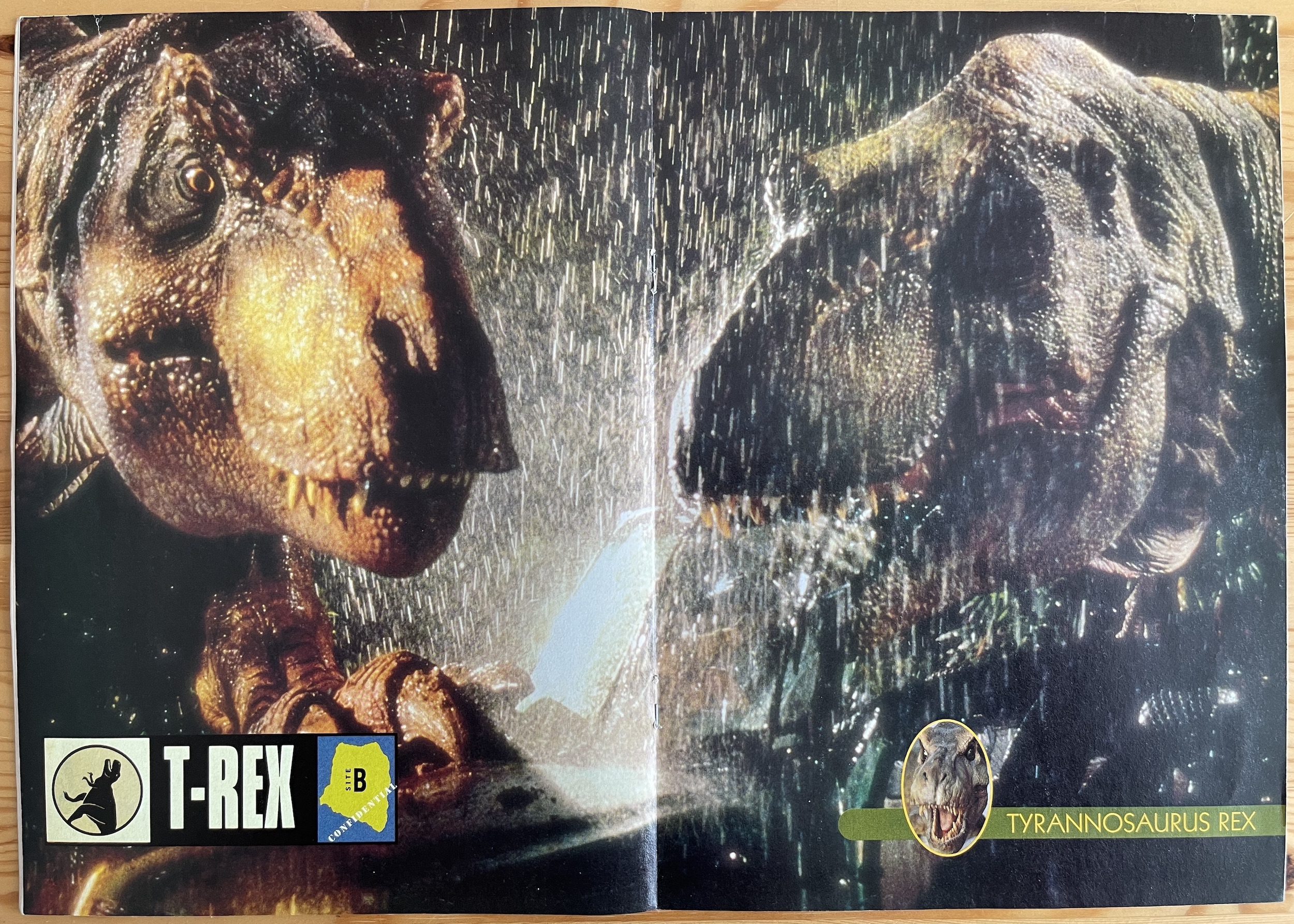
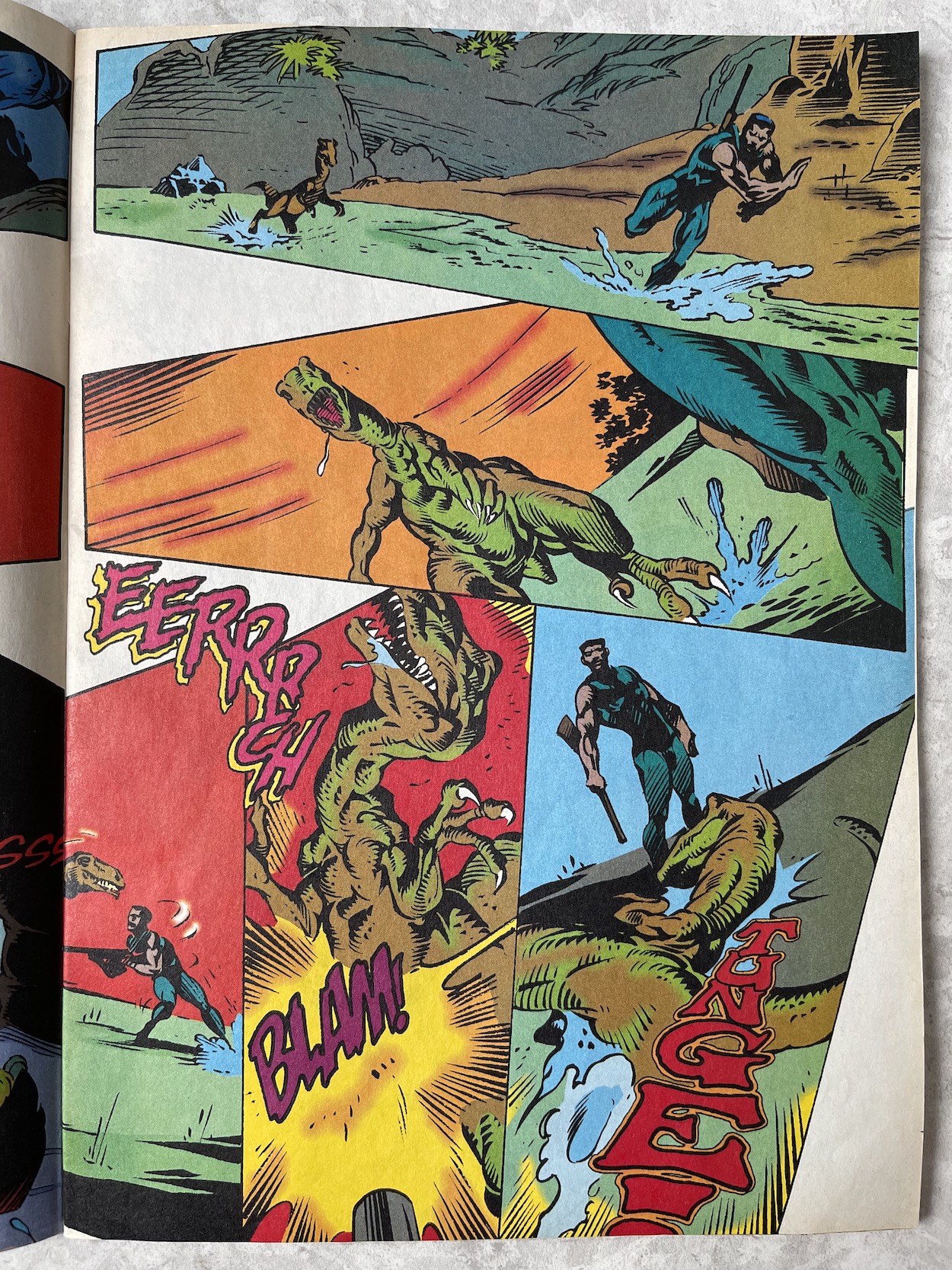
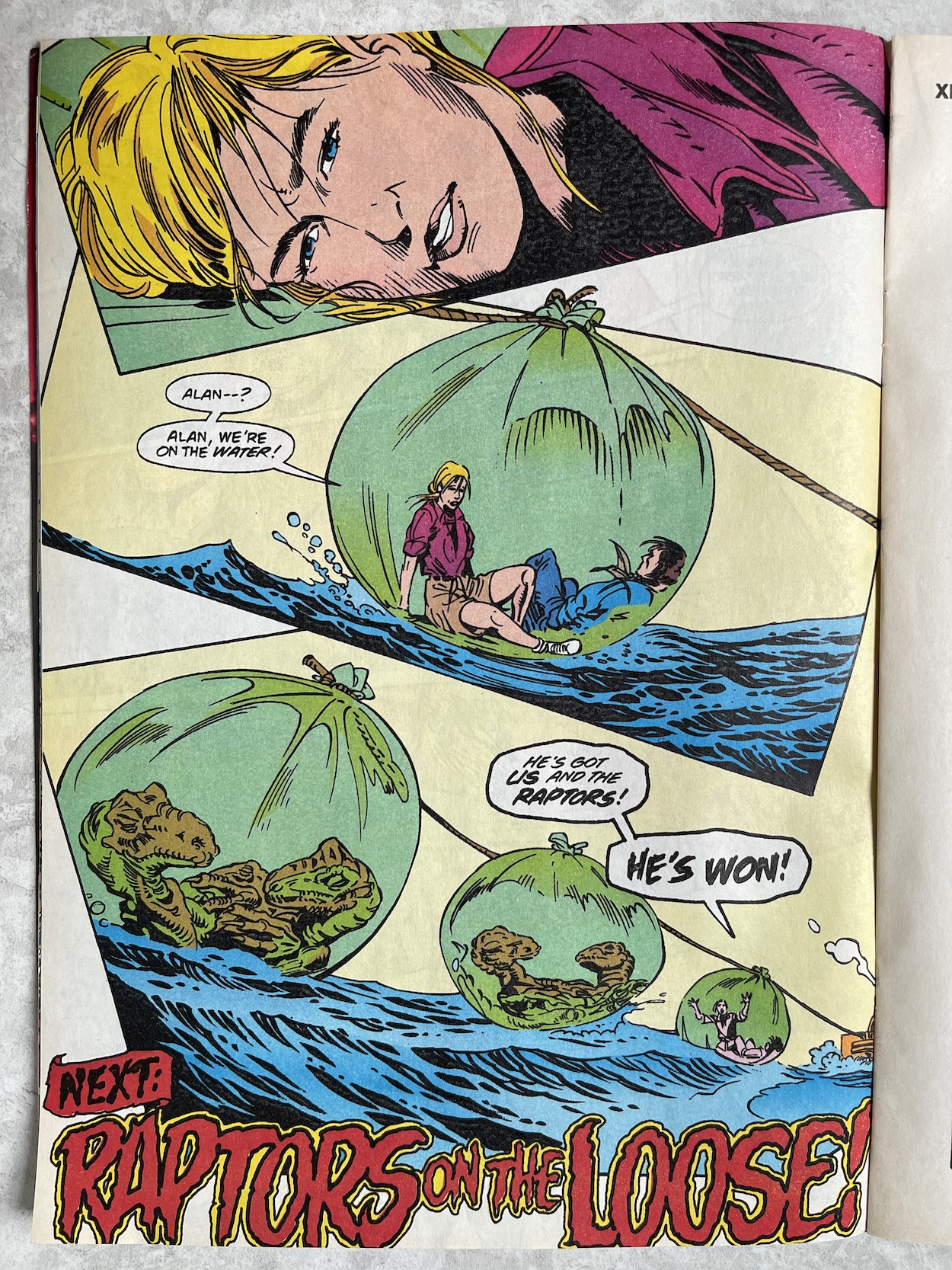
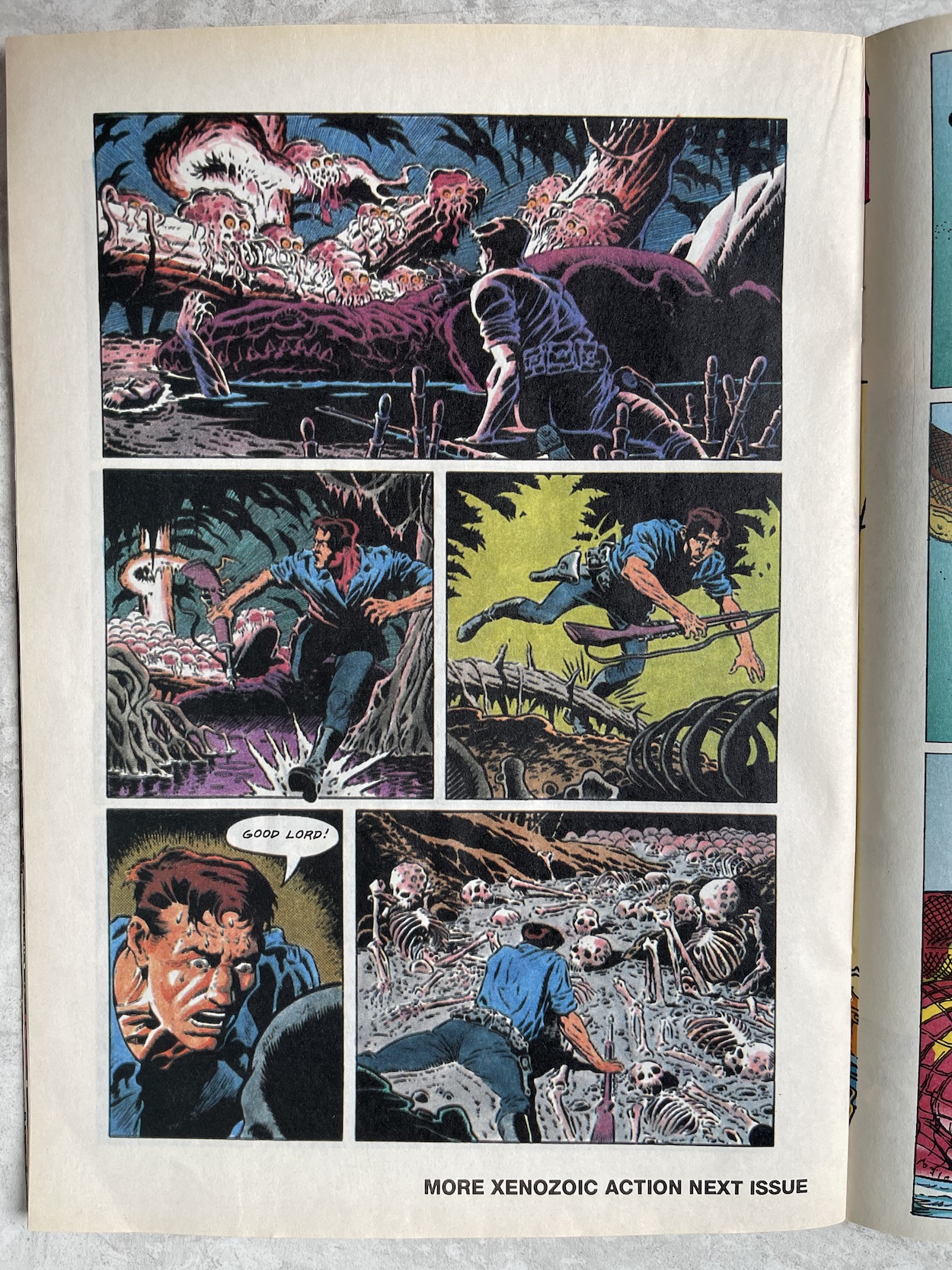
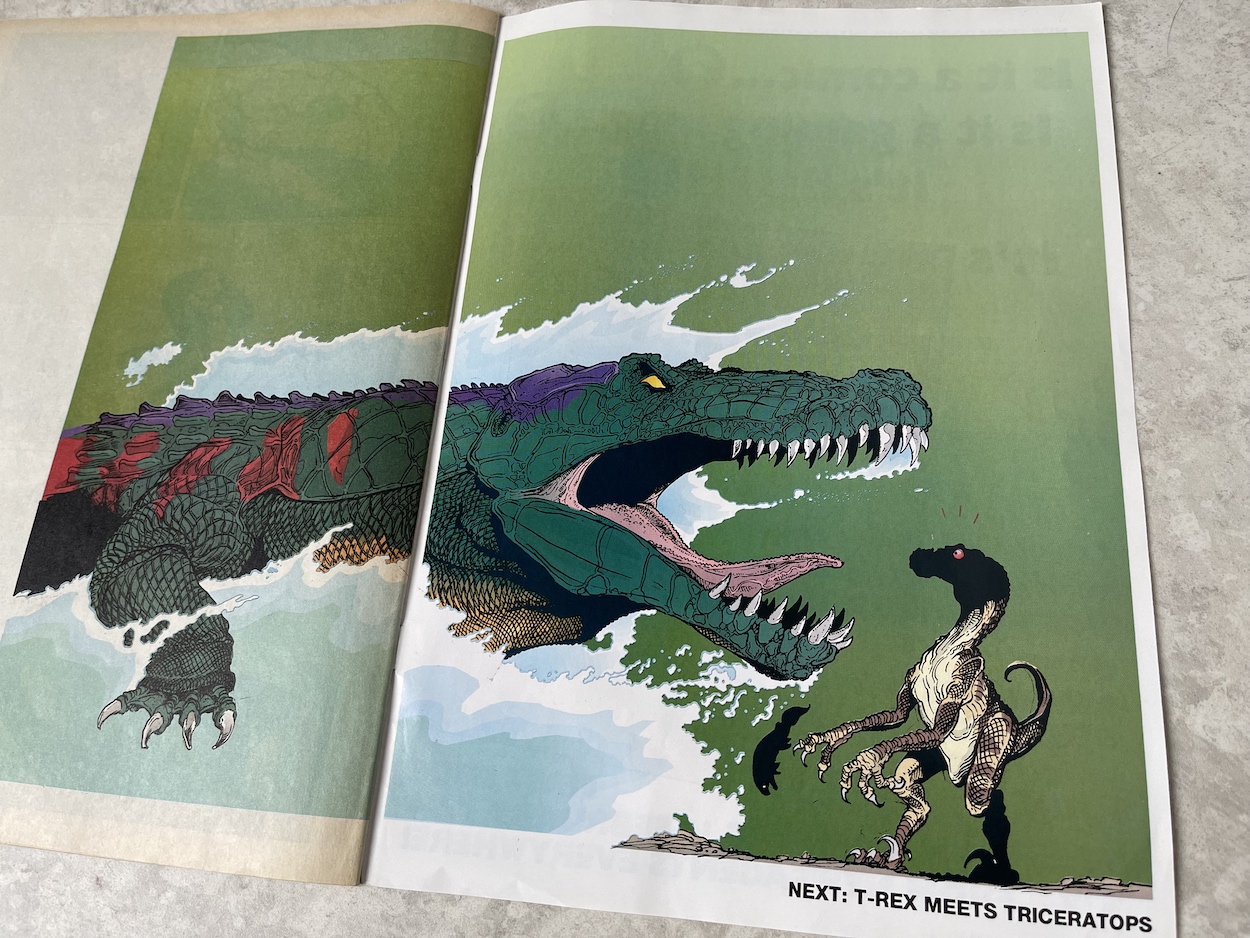
Unfortunately #2 remains the only issue to feature one of the gorgeous animatronic animals from the movie on the front but I do like this final cover by original adaptation writer Walter Simonson and Richard Ory, complete with an exceptionally cute little baby Tyrannosaurus rex. It also gets across the exciting moment from the movie a lot better than the strip. Inside we go and we kick things off with our heroes arriving at the workers’ village in a suitably eerie scene.

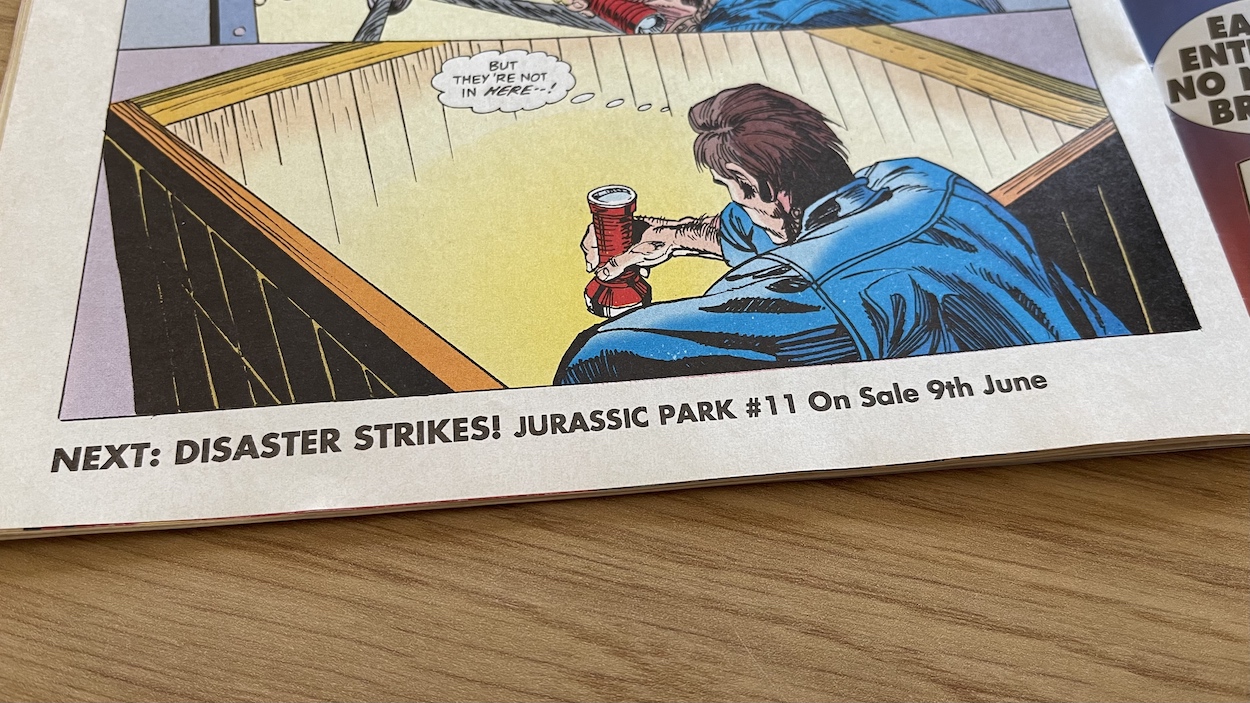
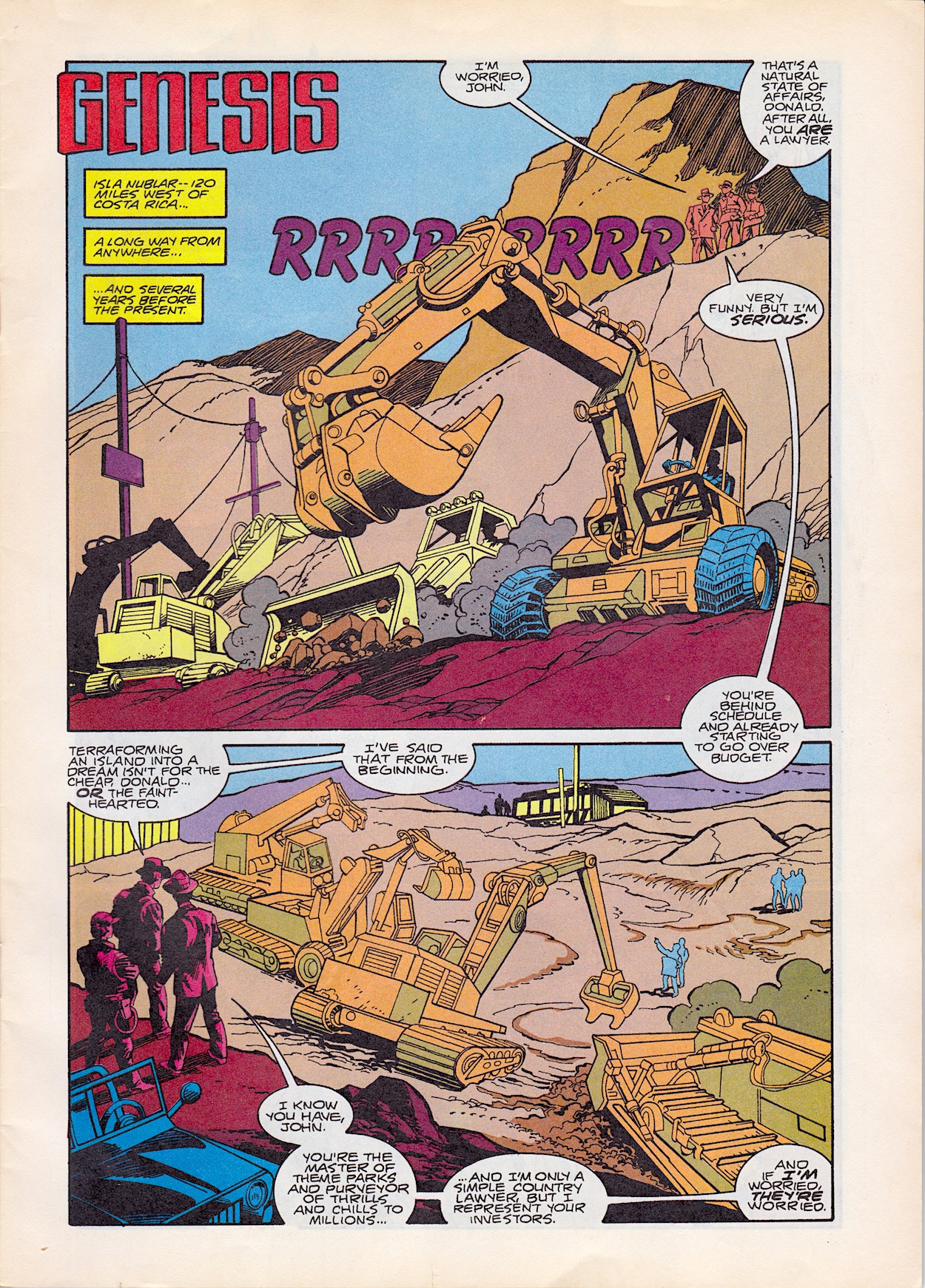
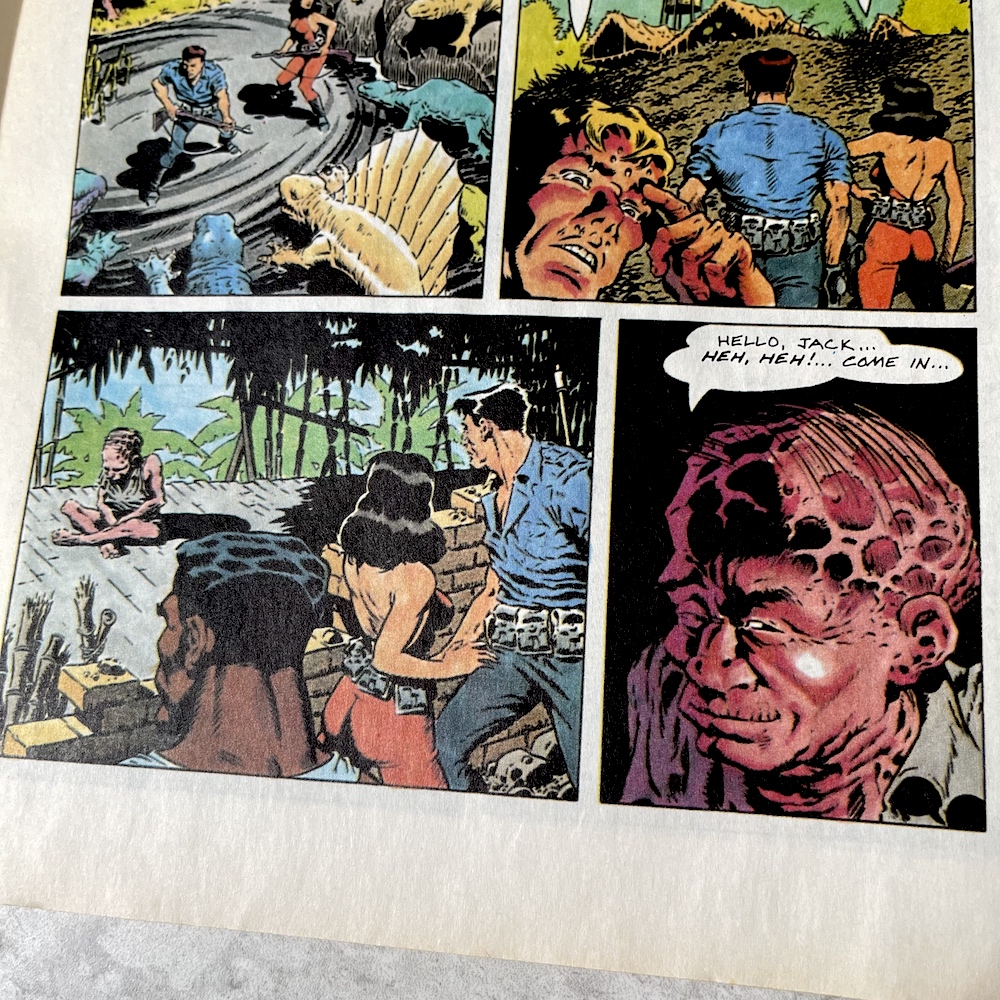
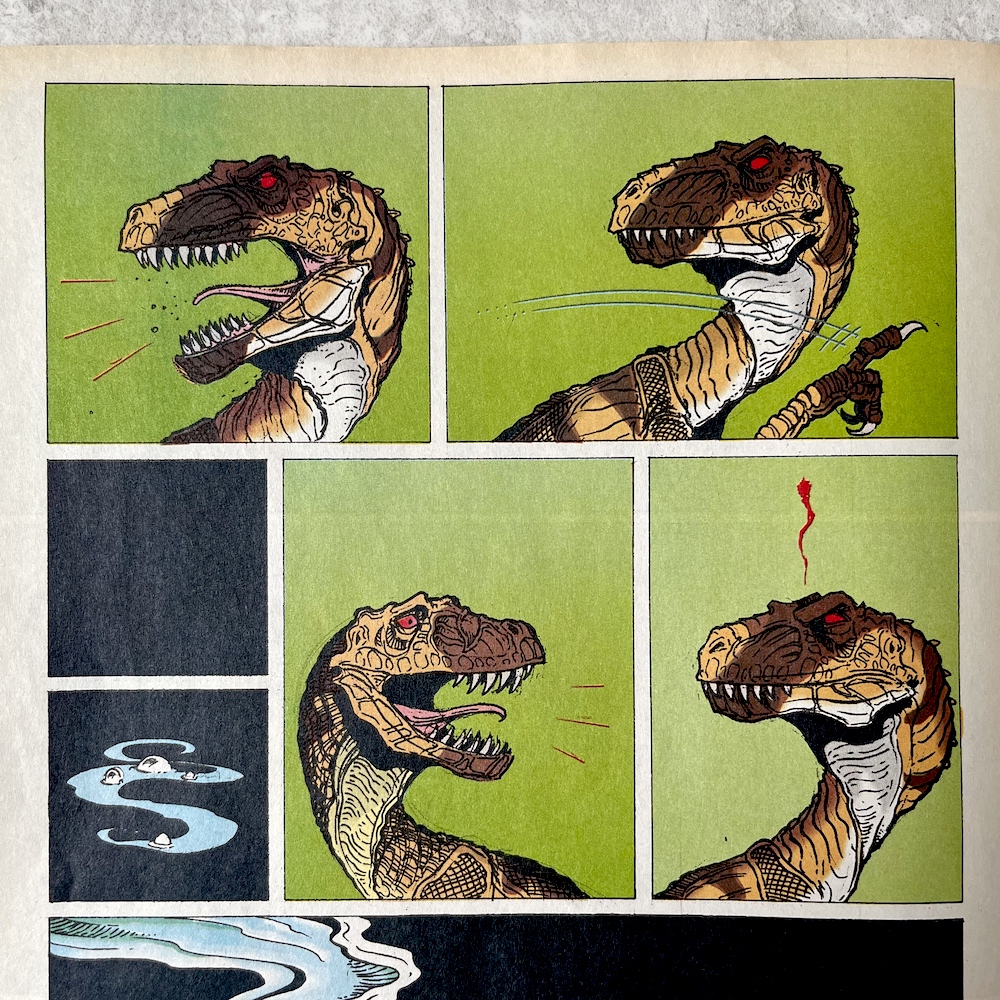
Once again the narration sets the scene, most likely taken directly from the script and unlike in previous issues it doesn’t feel like it’s trying too hard, writer Don McGregor’s captions perfectly balanced with the more subdued art on these first pages from penciller Jeff Butler, inker Armando Gil, colourist (and editor) Renée Witterstaetter, alongside the lettering by Ken Lopez. Even the lack of detail in the buildings adds a feeling of things being shrouded in mystery and shadows, capturing the feeling of this moment in the movie really well.

Nick Van Owen arrives alongside the rest of the characters, Ian Malcom, Sarah Harding and Ian’s daughter Kelly and I’m fine with this change, it helps get the same story beats across in a shorter time frame, one of the better decisions made in this adaptation. Then on the very next page my hopes for a better comic book climax than the original movie received are dashed when another brilliant part of the movie is hacked down to an unrecognisable state.

So much happens here in the movie and it’s all just excised including, yet again, anything to do with Vanessa Lee Chester’s character, Kelly. In the original film’s comic adaptation Samuel L Jackson’s Ray Arnold suddenly disappeared without explanation. Now we also have this movie’s sole black character unceremoniously edited out of all of their scenes.

There’s an overall feeling of this chapter being rushed

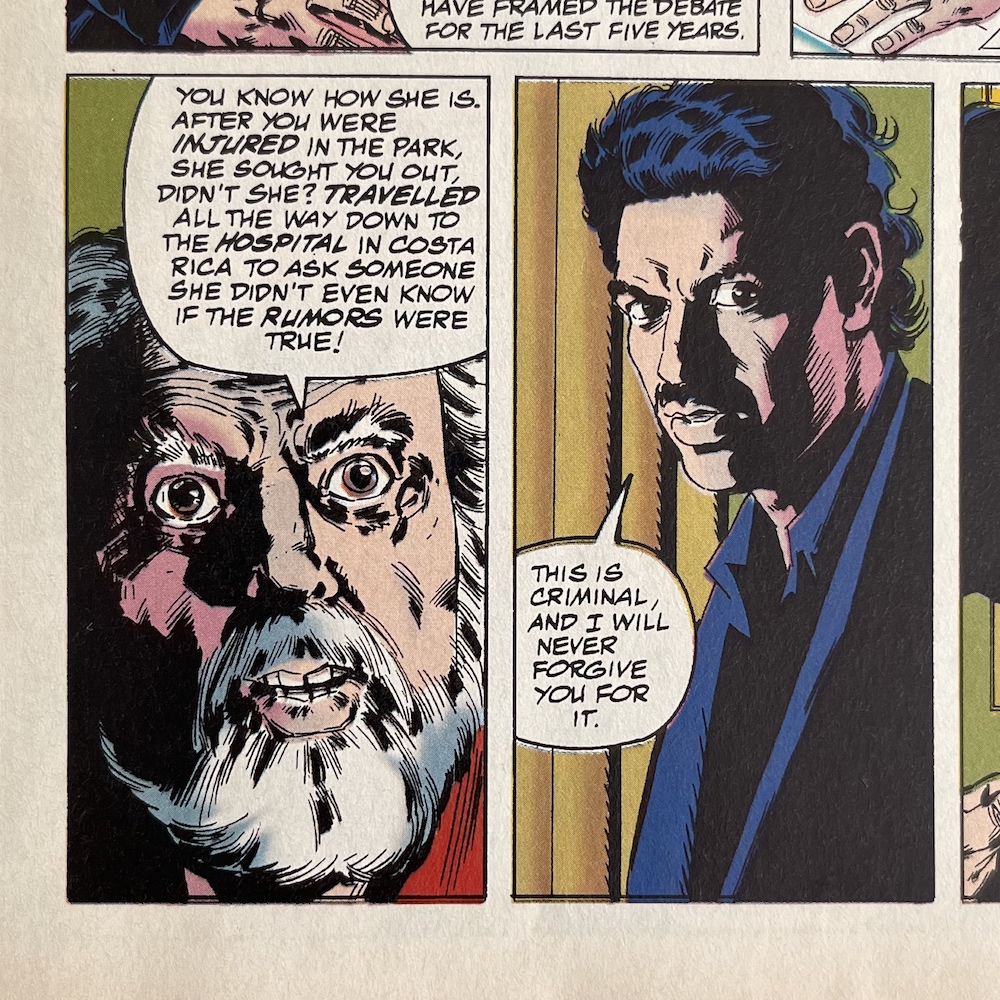
Yes, Ian’s moments being chased around here are nowhere to be seen but at least he’s still front and centre elsewhere, whereas Kelly is basically ignored throughout all the chapters, and to have her most important moment not even referred to is criminal. I’m also personally unhappy they removed the moment that in the cinema made me jump out of my seat, which in turn made my friend jump, which in turn made me jump again! (The bit with the ‘raptor under the wooden wall.) But hey, that’s just me.

Almost as annoying as all of this is the fact Roland Tempo is somehow still alive and well without a single scratch just like in the film, even though we blatantly saw him get killed off two weeks ago, something I was happy the movie didn’t do. Did Don forget this had happened in his version? There’s an overall feeling of this chapter being rushed and the art suffers just as much as the script. There’s an overall lack of detail and finesse throughout. Here are some key examples.
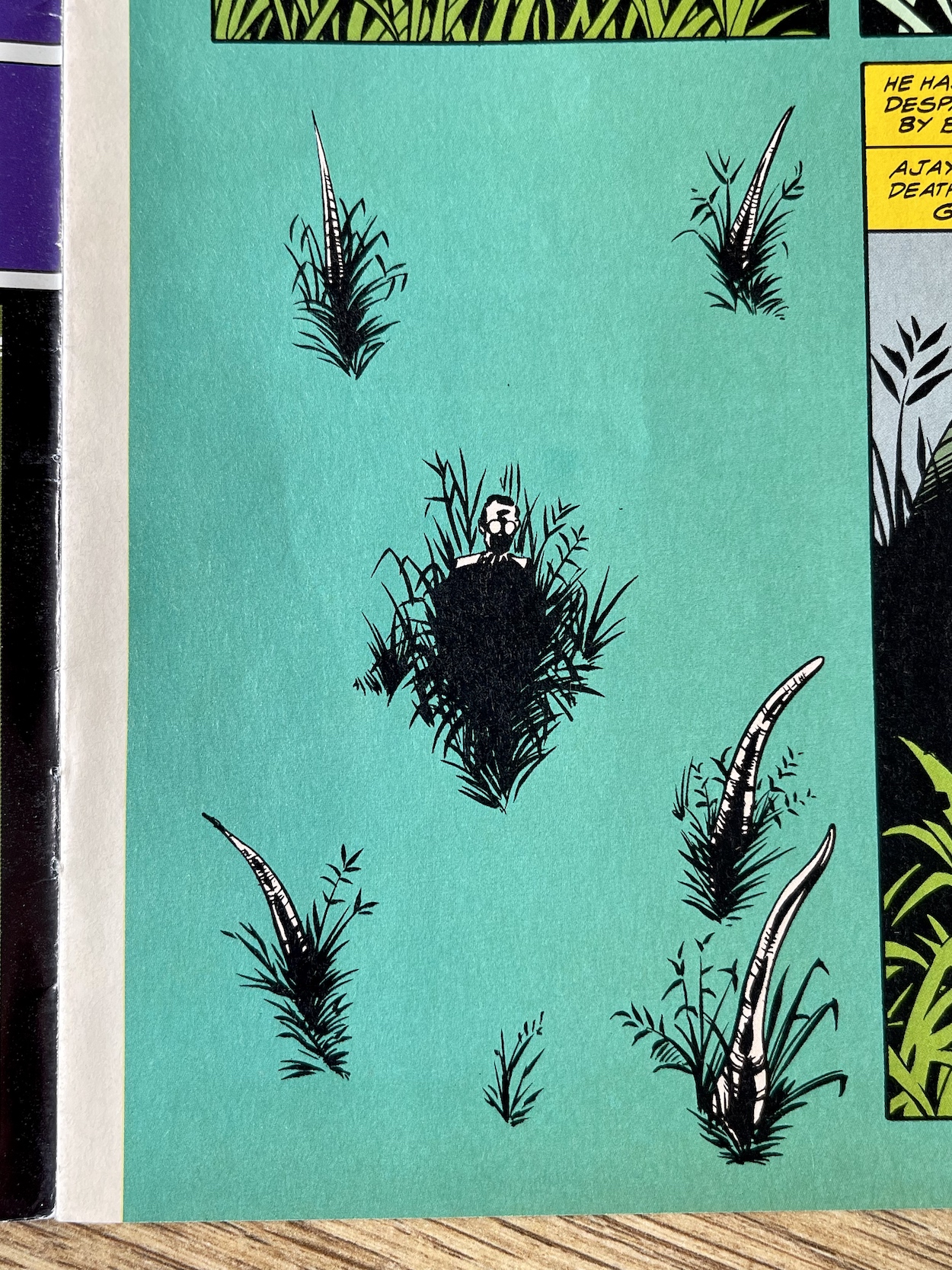
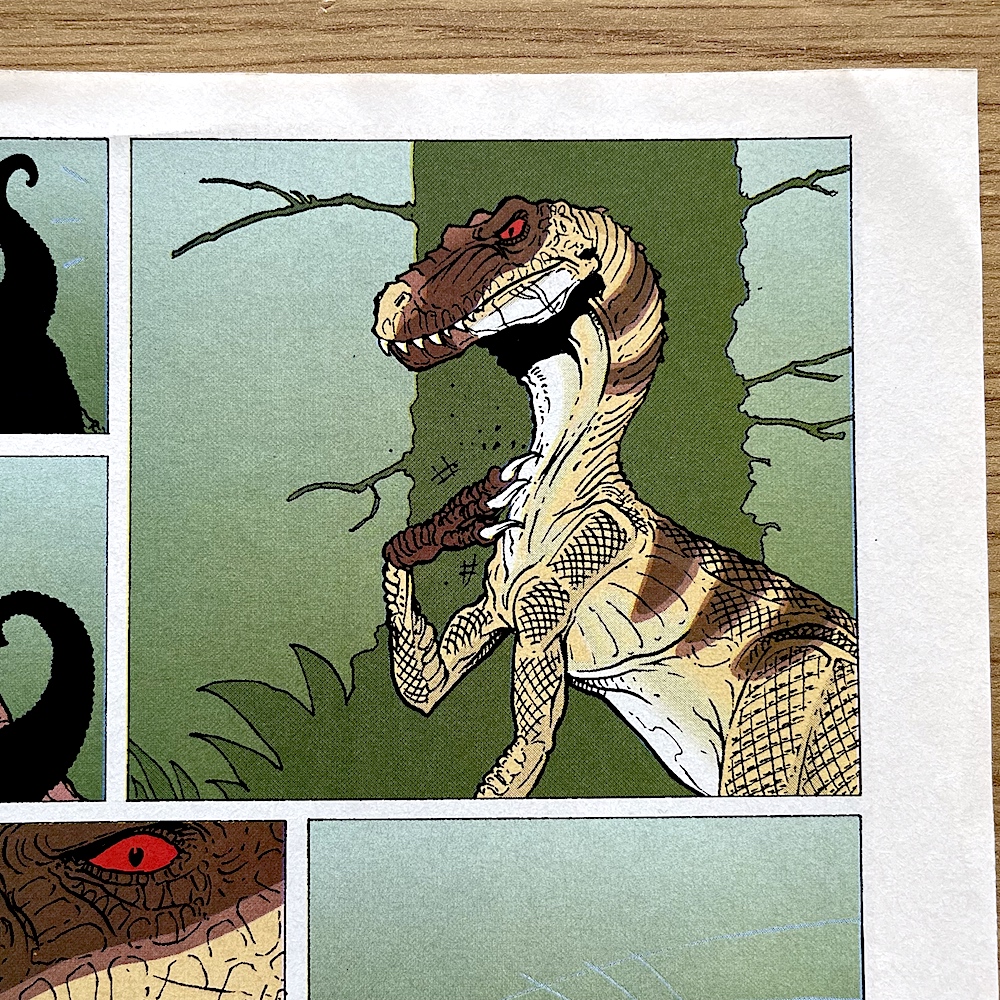
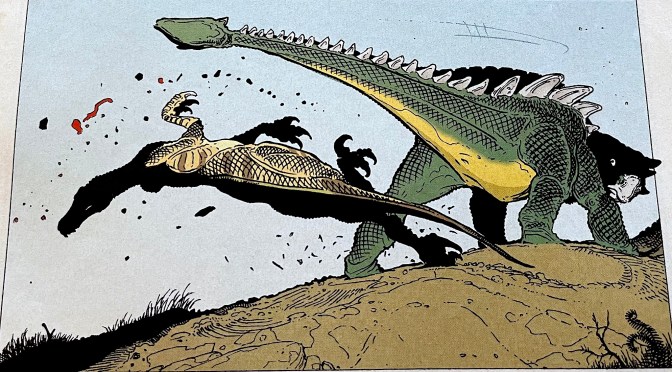
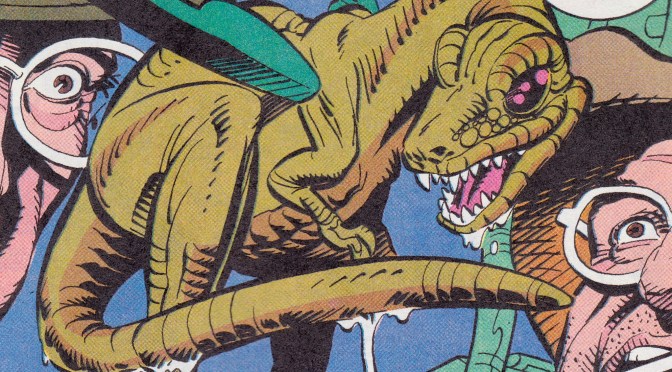
That scene of the Velociraptors in the long grass would make no sense if you hadn’t seen the film, characters no longer look like their onscreen counterparts and the gloriously detailed dinosaurs from the first couple of chapters give way to cartoonish monsters. The final chapter of Jurassic Park’s adaptation suffered the same fate and it would seem no one learned any lessons from it in the three years since.

I know I’m coming across as very negative and usually I only include comics on the blog that I enjoy; I like to keep this as a positive reading experience. The original Jurassic Park comic was awesome, I loved it and it holds a special place in my heart. It’s the whole reason there’s a section for JP on the blog in the first place. This mini-series is very much an extra aside to that, I don’t think I would’ve included this on its own. It’s a crying shame because I love the movie so much.
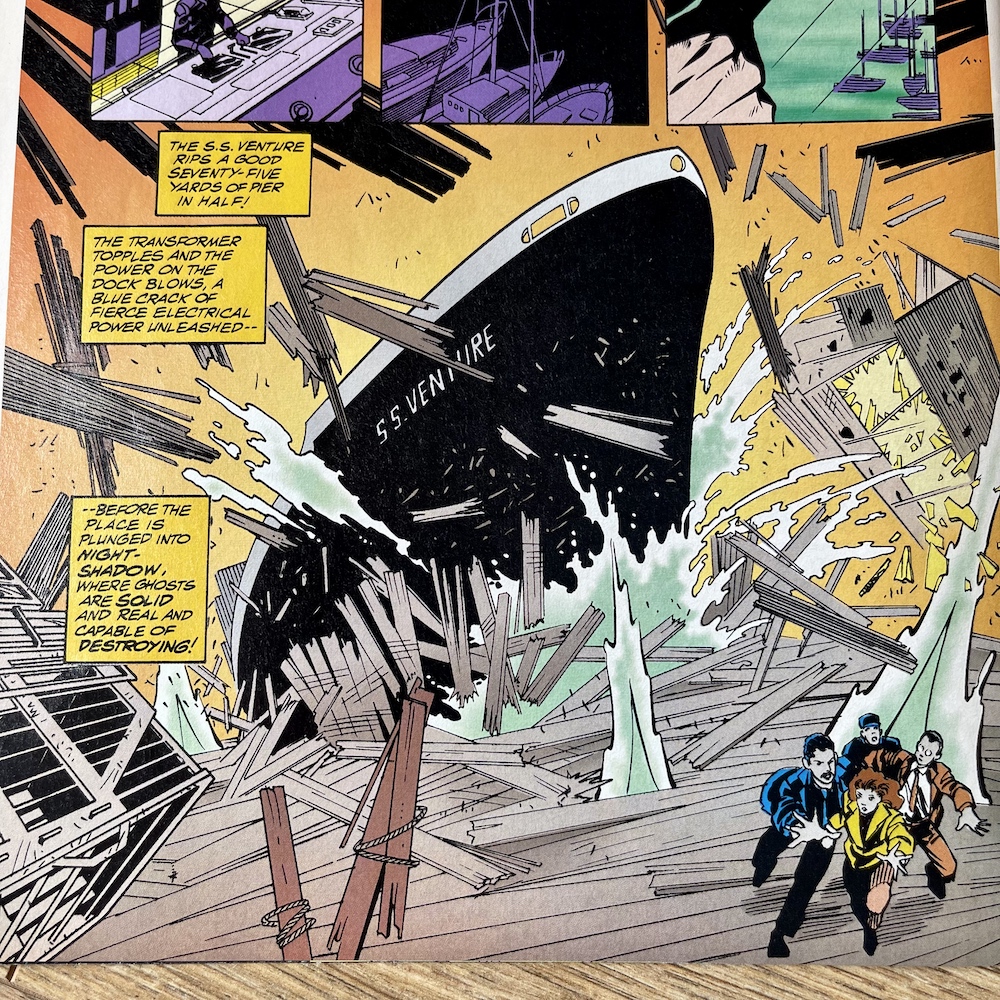
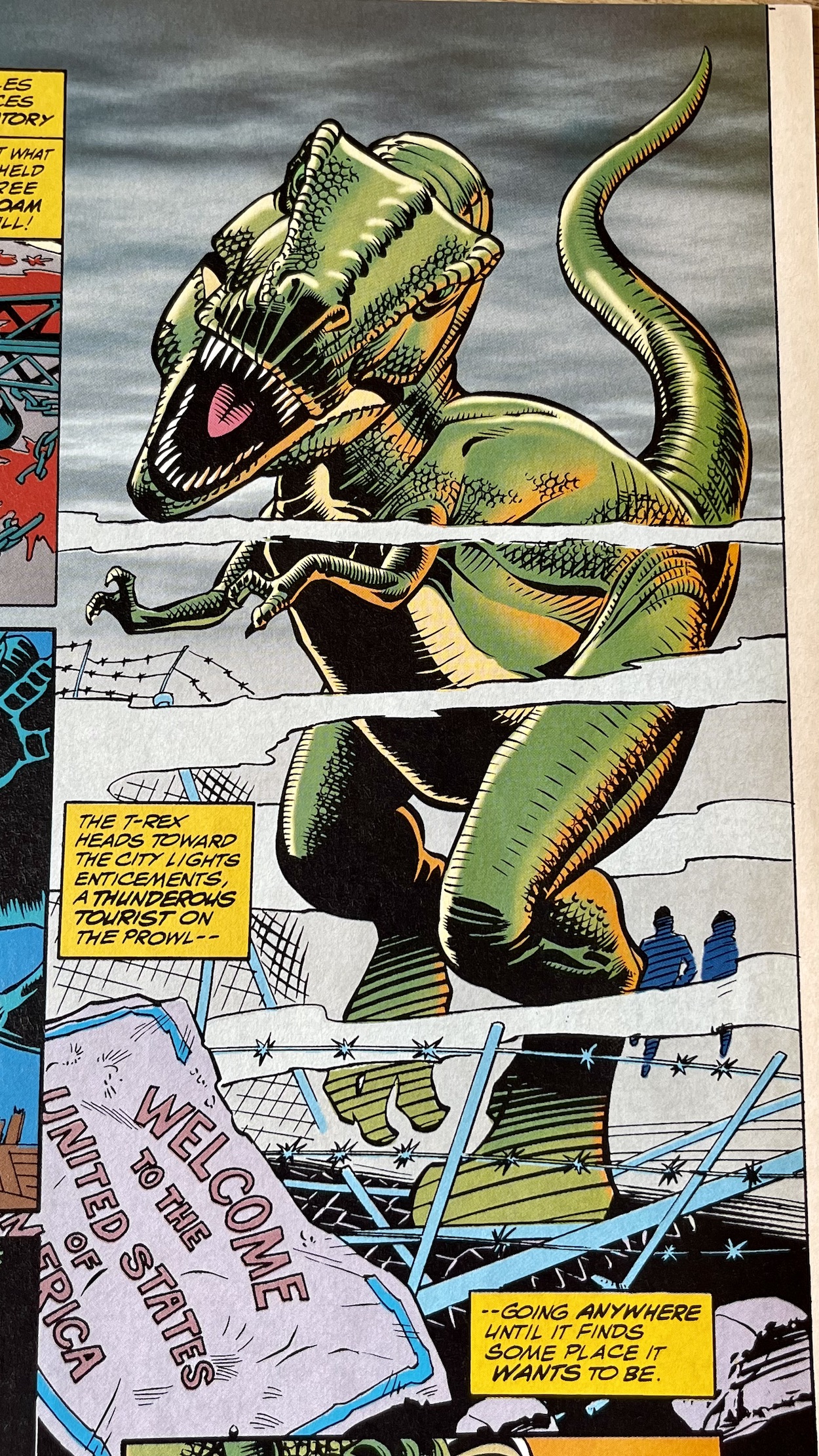
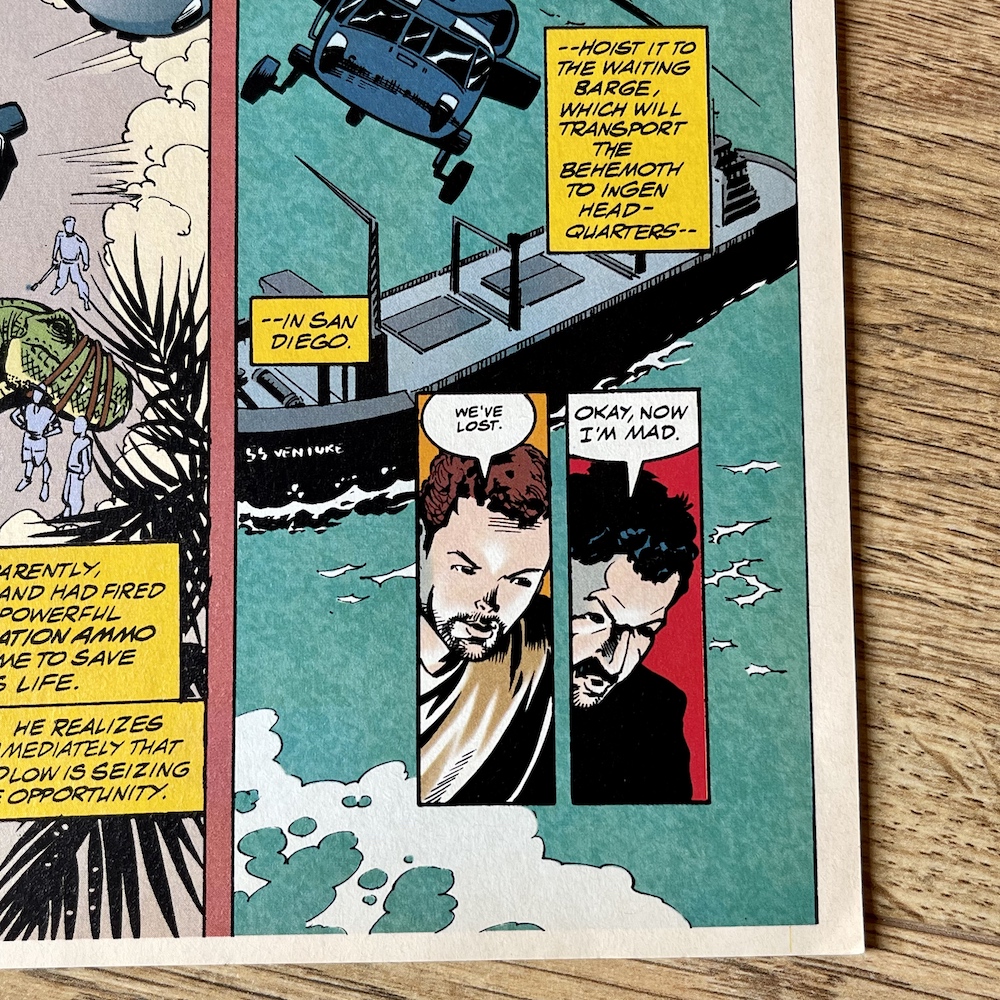
Towards the end of the story 11 pages are given over to the San Diego scenes, albeit a bare bones version of them. The panel above of the S.S. Venture crashing into the docks is about as detailed a panel as you’ll find in this final chunk of story. You wouldn’t even know any of this was taking place in a city because the backgrounds just don’t exist beyond one panel. Other than there being a sporty car involved this could all be happening back on Isla Sorna.

Below you’ll see the one and only panel that shows some hurriedly drawn buildings and the word “cinema” visible behind the T-rex’s tail. Next to it is a panel I’ll use to sum up these eleven pages. Look at the panel with the car. There are no backgrounds, not even a road! Storywise, we get the ‘rex leaving the ship, discovering Ian and Sarah have his baby, then we’re back at the dock. That’s it.
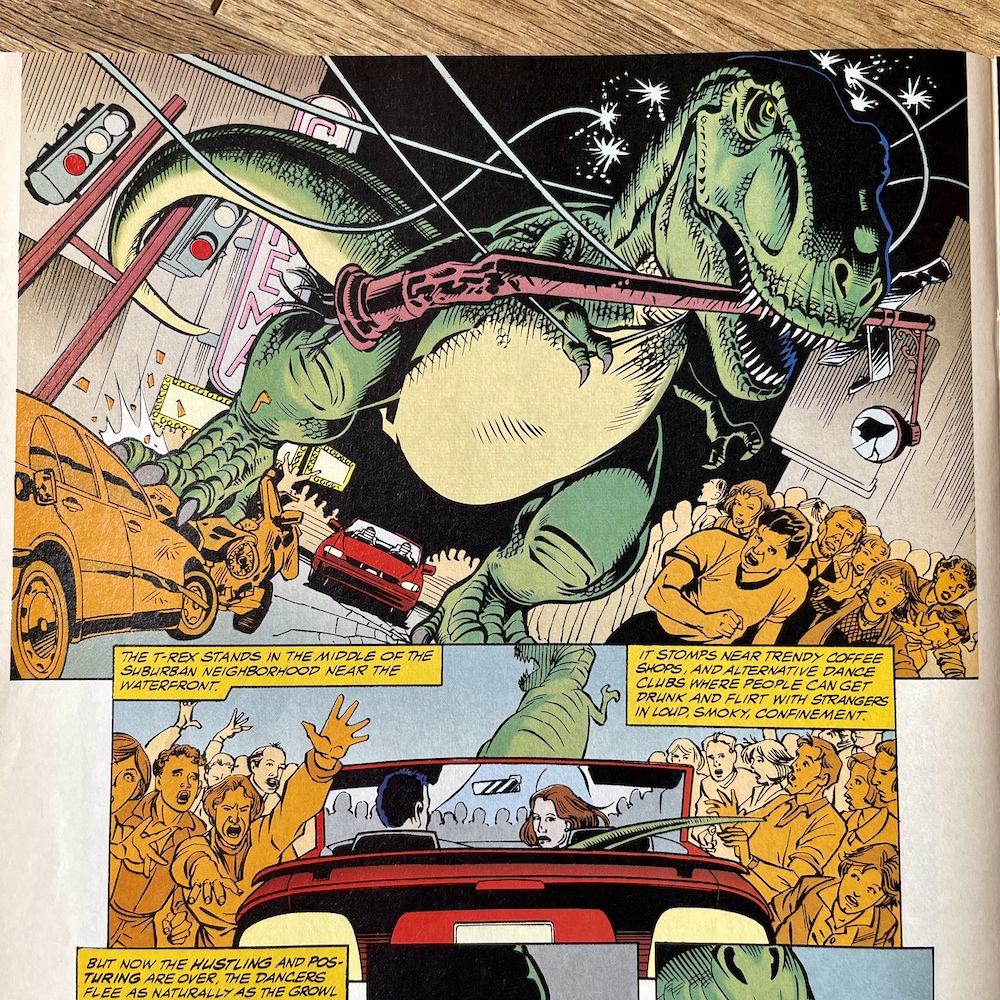
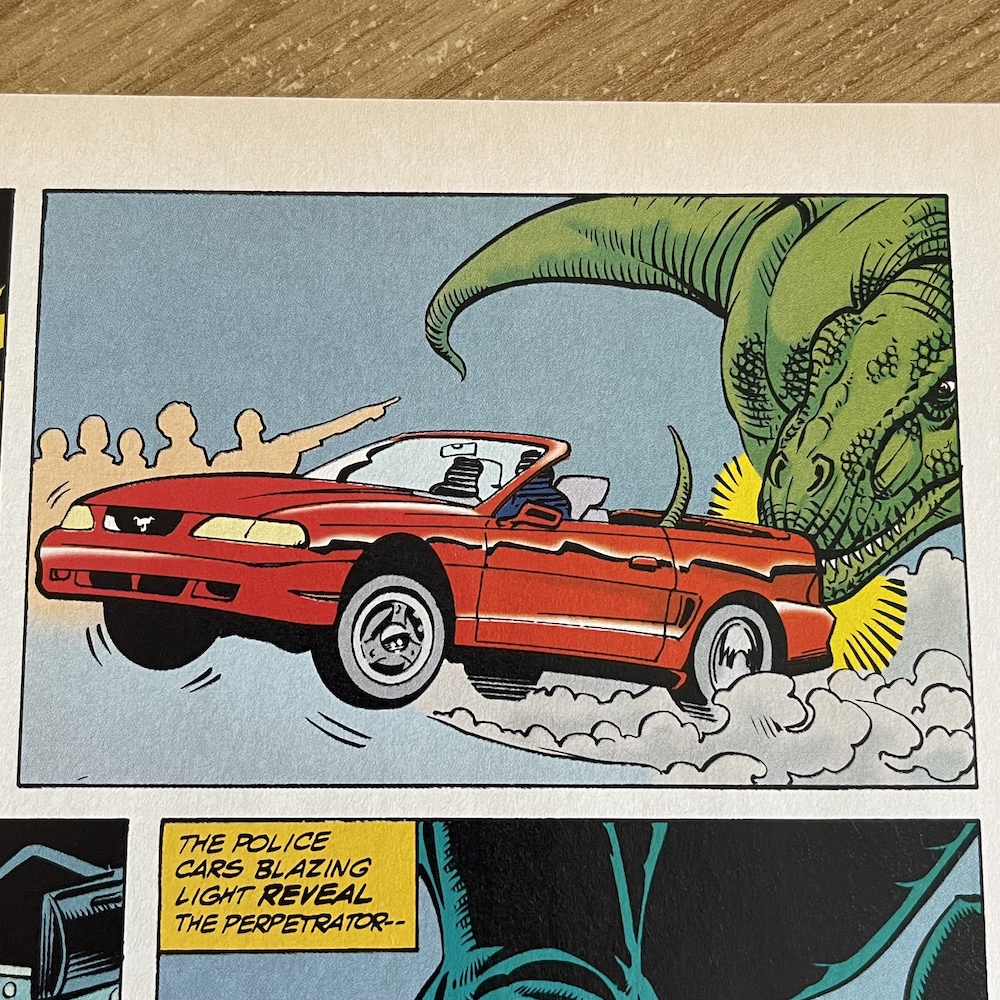
Thinking back to when I first saw this film in the theatre, the moment we saw the InGen helicopter and the camera panned down to show it was flying over a city was a real shock to the system. It was so unexpected from a Jurassic Park film (I hadn’t watched any trailers before seeing it) and as surprise endings go it’s right up there for me. There was so much to enjoy about it which is why its treatment here is so underwhelming.


“This is a parent teaching its young to feed on its own”

Narrative caption, Don McGregor

Surprisingly Peter Ludlow’s final scene gets three pages to play out fully. One of the most satisfying endings for a villain character, it pretty much happens as it does in the movie, even if the backgrounds are still conspicuously absent. To anyone unfamiliar, this is back on the boat now, Ian and Sarah having lured the adult back into the cargo hold by placing the baby there and then jumping overboard themselves, before climbing back on from the other side of the ship, ready to close the bay doors when the T-rex enters.

From Ian and Kelly to the adult and baby Tyrannosaurs, the theme of The Lost World Jurassic Park movie was one of family and parental instincts. Sarah is even an expert on archeological parental behaviours just to hammer the point home. Personally, more than any other film in the series this one showed the dinosaurs as complex characters in their own right, a far cry from how they’d been described before this franchise. But anyway, Ludlow is about to get eaten.
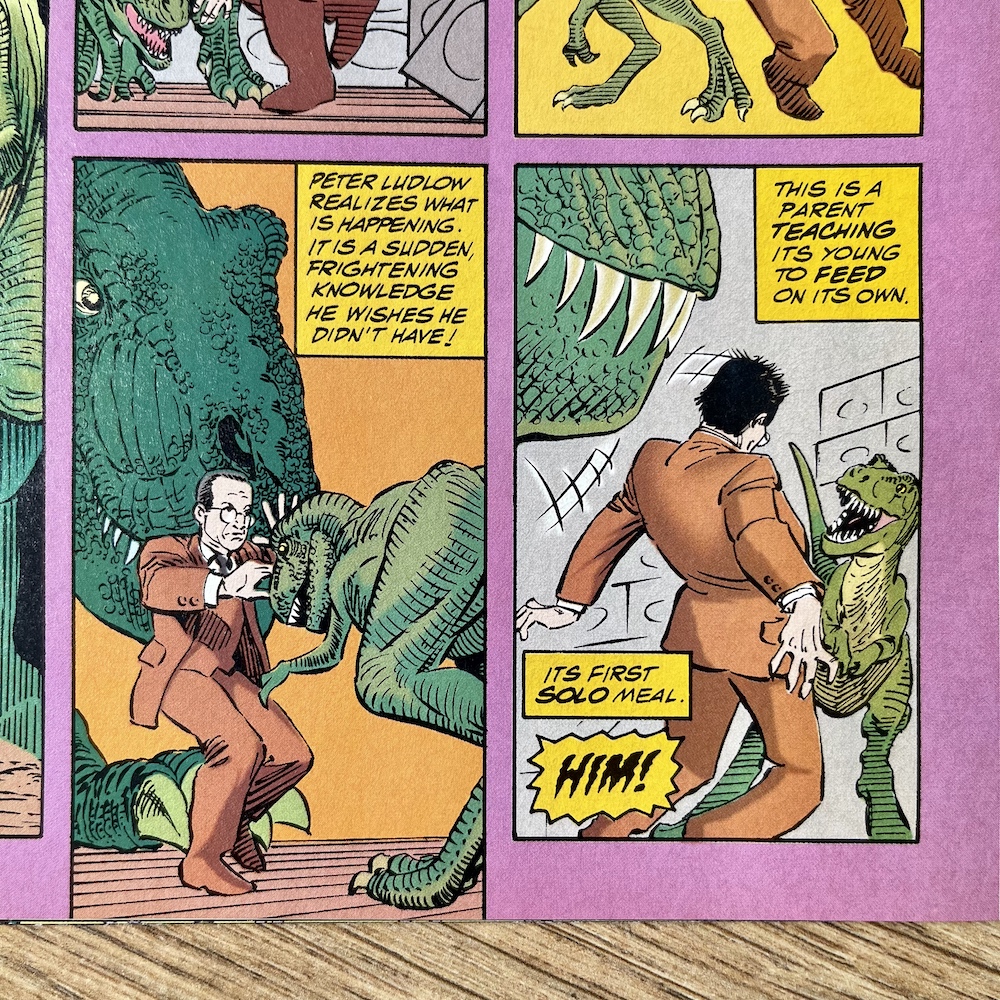
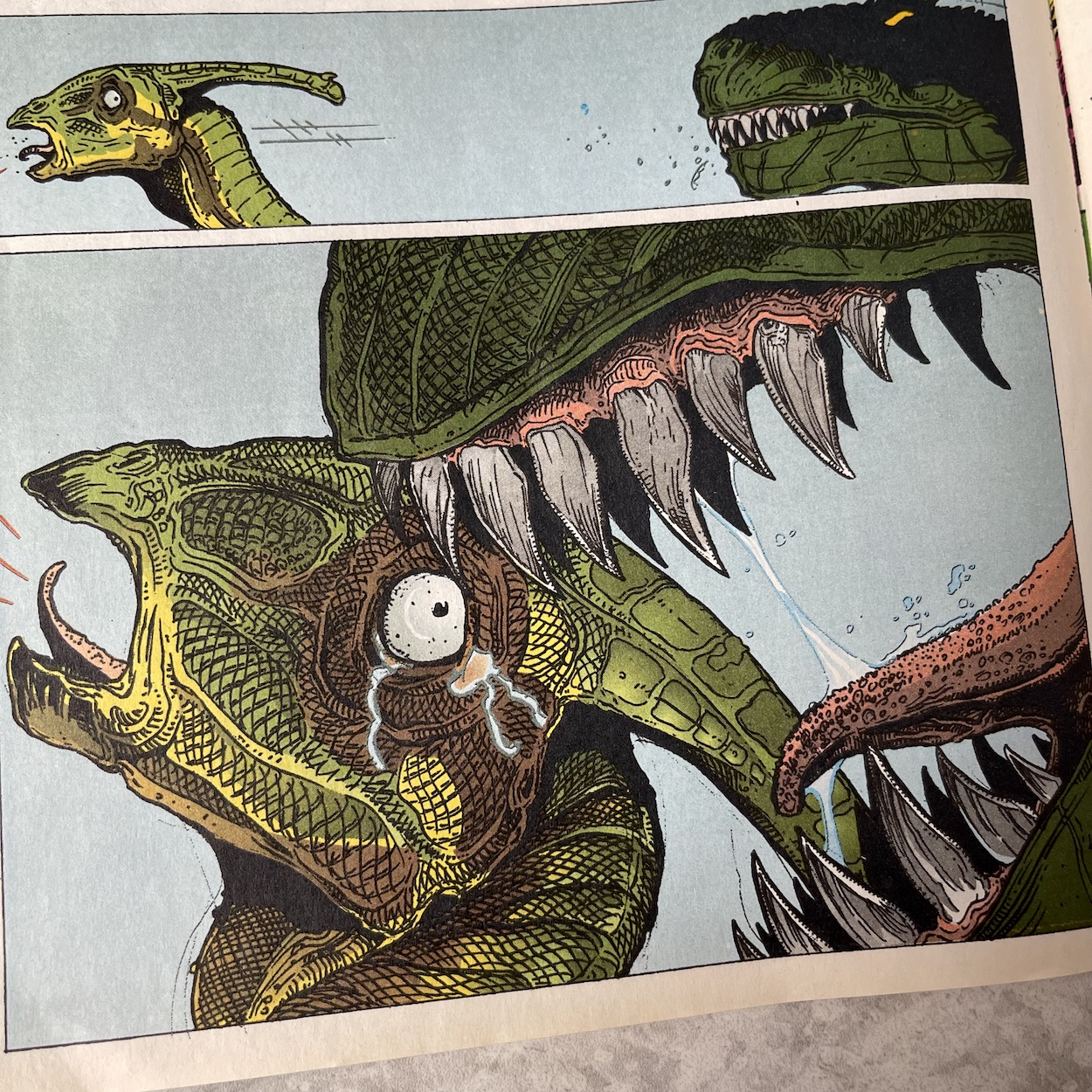
I’m glad this moment wasn’t cut because it shows the adult teaching the baby and it’s a particularly chilling moment in the film, even if it elicits a dark grin from the audience. Given how much has been left out these past two months it might seem like an odd moment for anyone reading who hadn’t seen the film and all of its moments between the Tyrannosaur family members, but for those reading this as a way of filling the gap before the home video release it would bring back memories of that scene really well.

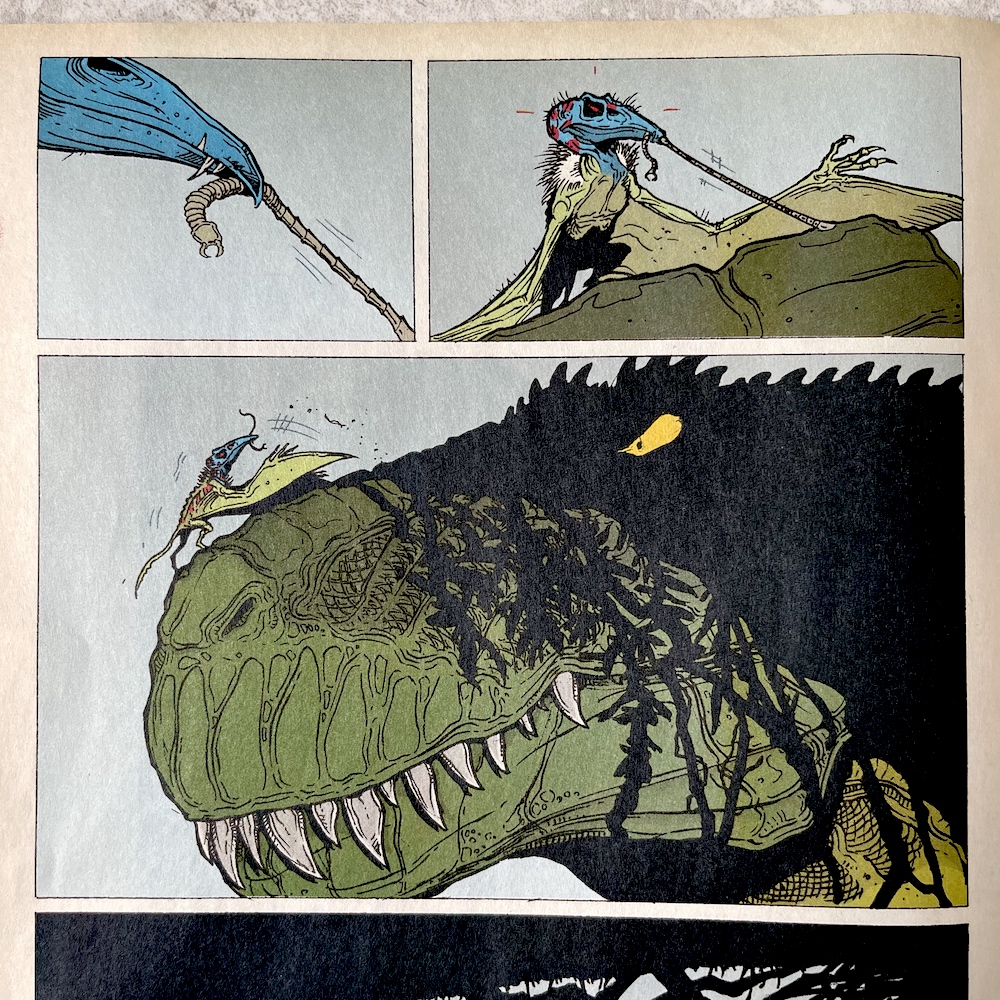
After all of my complaints about the lacklustre art in this final issue we finally get a moment that matches the potential those first couple of chapters had. As the InGen helicopter circles overhead trying to get a good shot to kill the ‘rex, Sarah shoots the tranquilliser dart first and we get this page with a particularly fantastic, expressive, dramatic panel when the dart strikes.
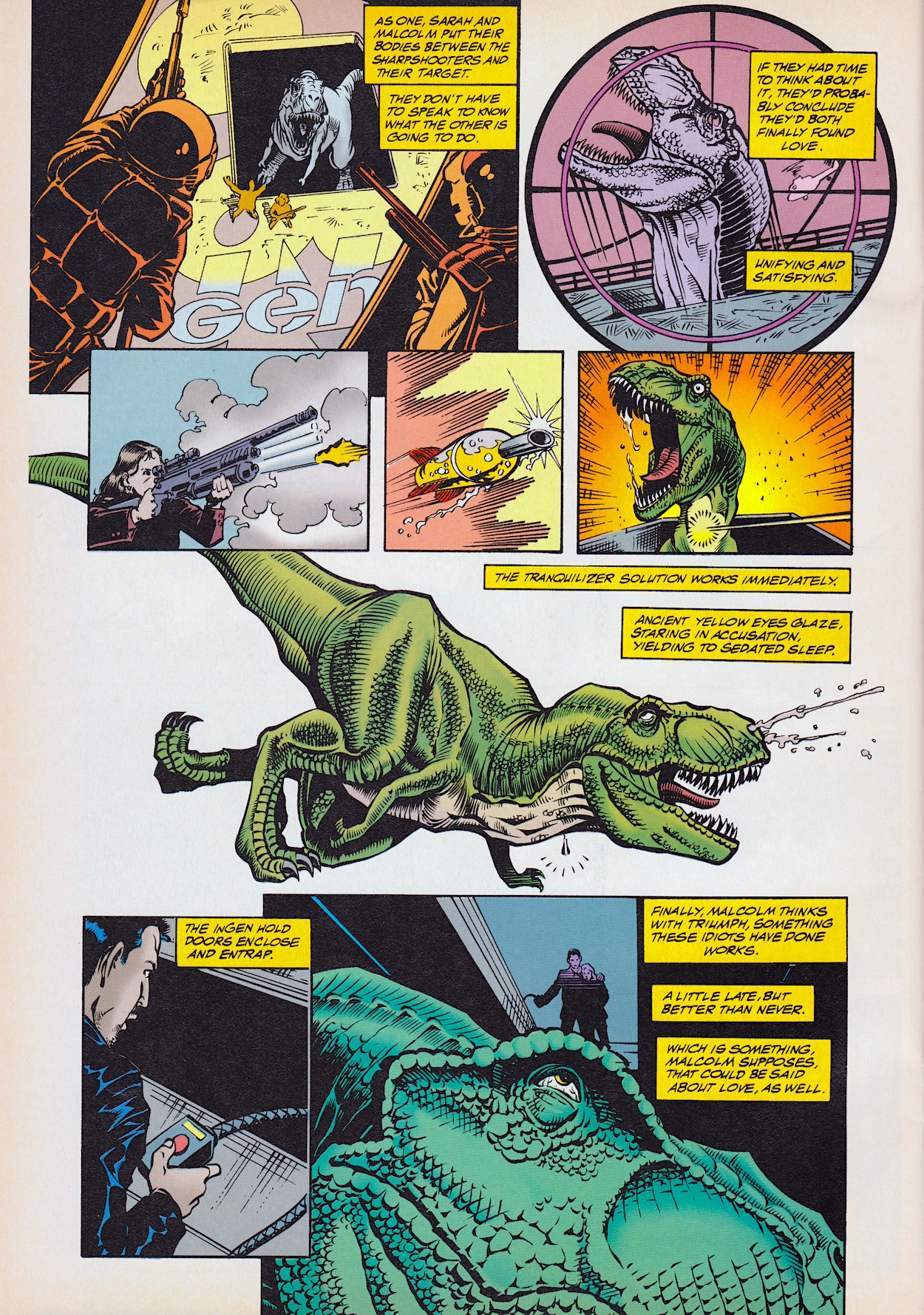
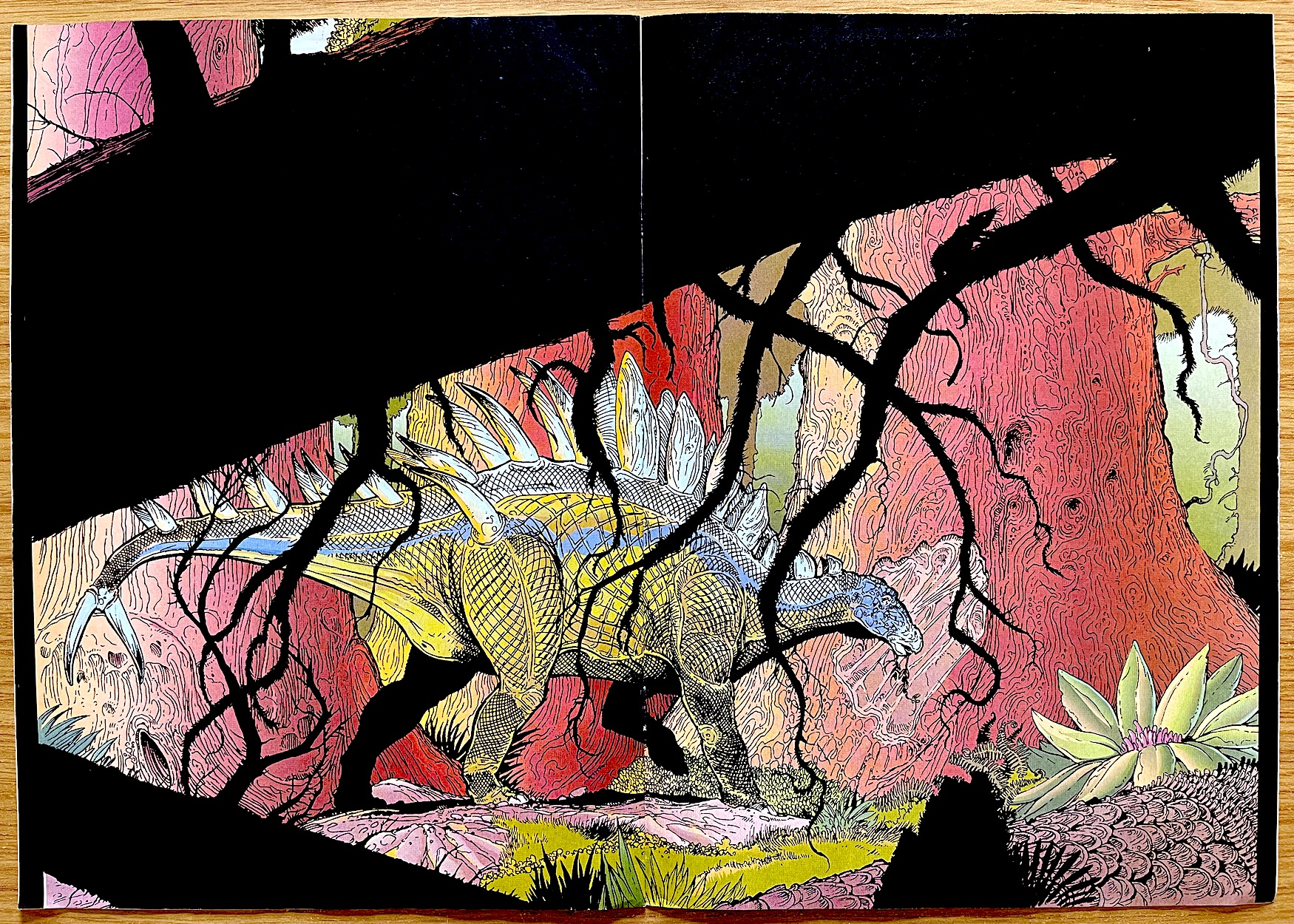
I look back at those first two chapters and the gloriously detailed scenes in the jungle with the Stegosaurus family and I can’t help but wonder what this series could’ve at least looked like, even if the script was still a shadow of the film. What if we’d had that early level of detail coupled with the dynamism of the page above? What an impact it could’ve made. The art team was definitely up to the task but it seems deadlines and a rushed story hindered them in the end.

Don’t get me wrong, I understand the task of taming a beast of a movie script down to four comics was monumental and I found Don’s explanations in a previous issue fascinating but in the end I think he boiled it down too much to the maths. I’ll get back to that in a little bit further down this review but let’s finish things off with the final page of the strip. Happily, Richard Attenborough’s beautiful John Hammond speech remains mostly intact, as does that famous Jurassic Park line first uttered by Jeff Goldblum’s Ian.

As you can see detail in anything other than the few dinosaurs in the immediate foreground is minimal and when you contrast this with #1 the difference is stark. My final thoughts on the comic strip itself in just a moment. First up though are the extras editor John Freeman and his team assembled, some of which have definitely been the highlights in previous issues.

First up is a competition to win a mug with the logo of the film on it. Not the most exciting of prizes, you’d expect this to be a runner up prize, but then again the original comic gave away a large variety of swag, everything from a simple set of glow-in-the-dark stickers to actual Sega Mega CD systems. So if this had been an ongoing comic I’m sure the same would’ve applied to future competitions, and at the end of the day I’d still like that mug!
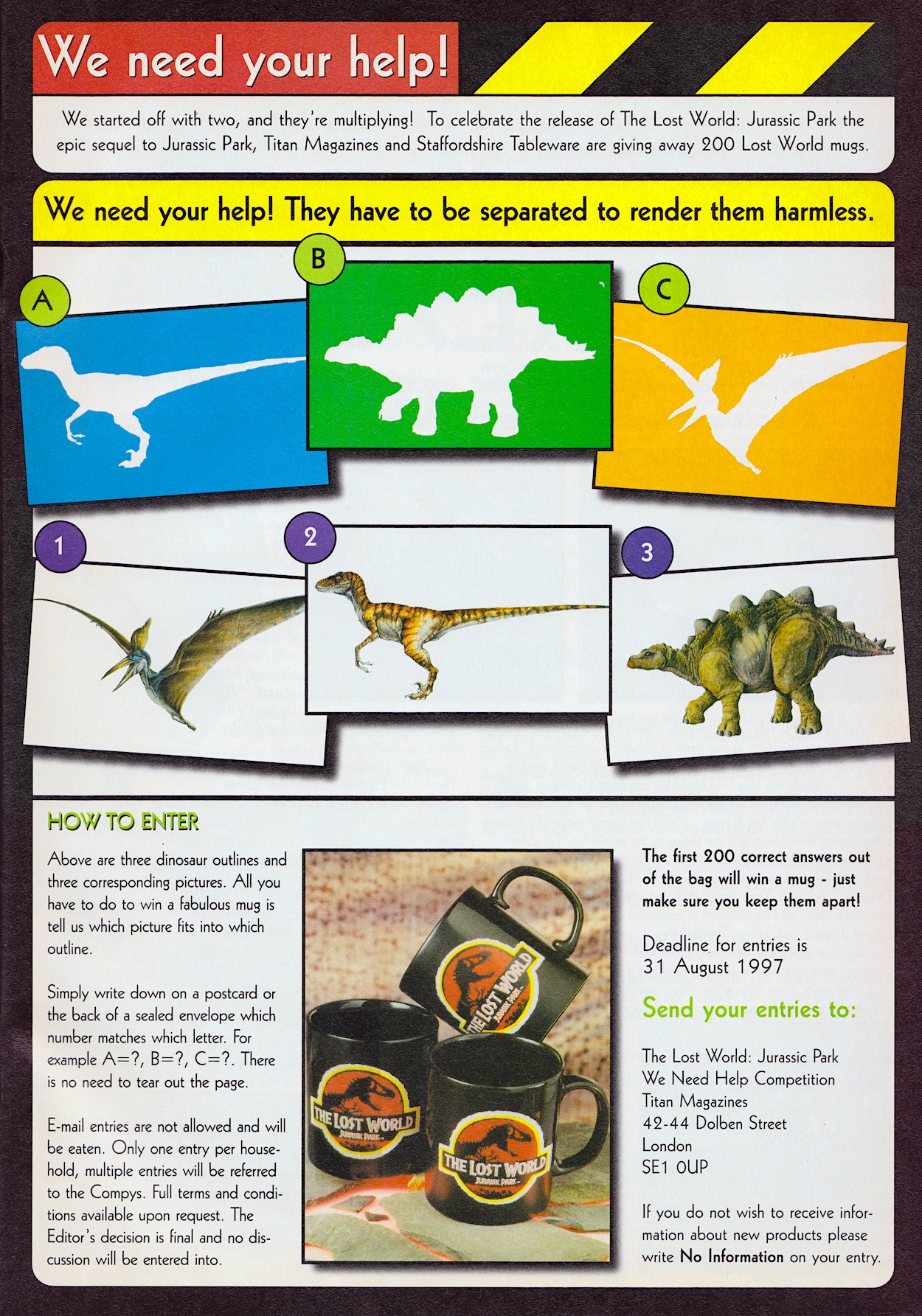
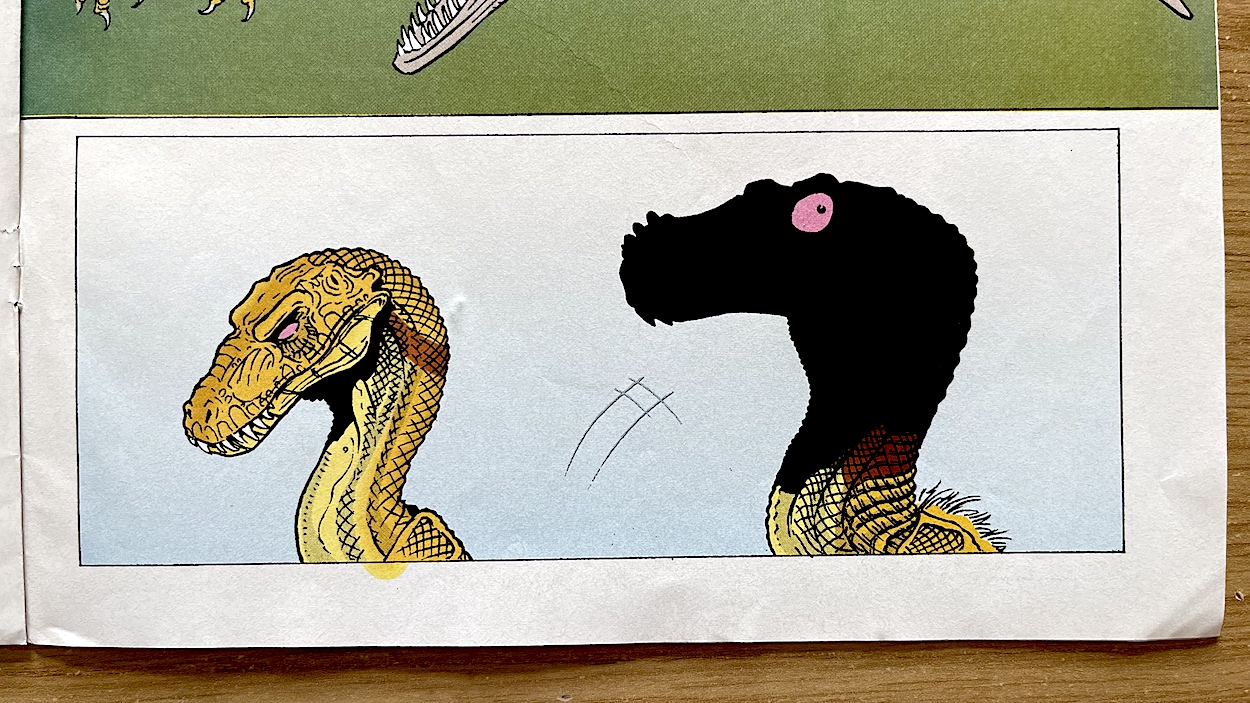
The competition itself is somewhat easy though, right? Upon first glance I thought it’d be a case of naming the dinosaurs, with the ones in silhouette form being the trickier ones, but actually it’s just a matter of matching them to the pictures in the next row. I remember competitions and quiz pages like that in my old Thomas the Tank Engine & Friends comics as a child and it seems very out of place for the target audience of a Jurassic Park title.

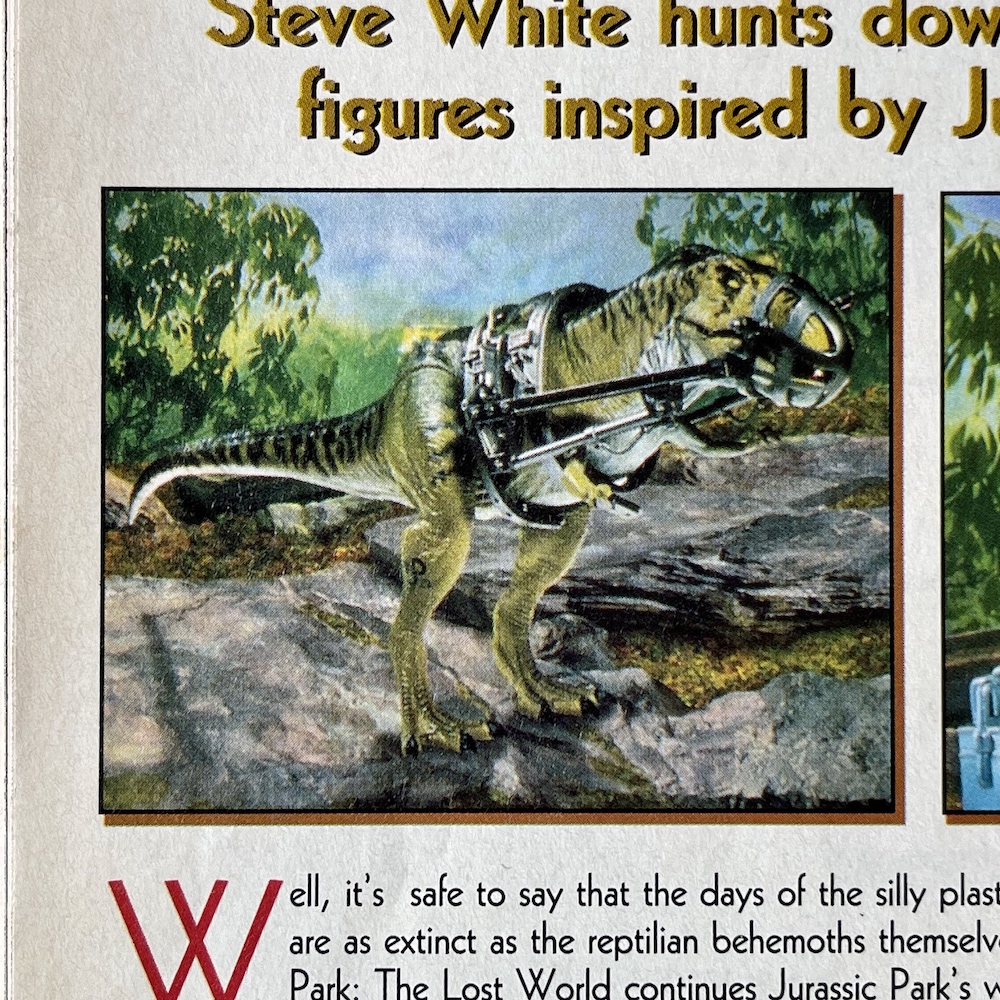
There are a wonderful couple of pages detailing a selection of the merchandise released to tie in with the hottest film of the summer of 1997. There are some action figures of the dinosaurs shown, including a T-rex apparently engaging in a spot of S&M and mention of a figure of Ian with a jet pack! Really? Sadly no pictures of that one. Of more interest to this retro gamer are screenshots of some of the videogame releases of that year.

My friends laughed as I jumped and slid about the seat in reaction to the dinosaurs

The first image shown is from the arcade game, where players would sit inside a mock jeep with tranquilliser guns and on the screen was a fast-moving on-rails shooter with graphics that were mind-blowing for the time. I’ve played this one. A local ten-pin bowling alley had it for a few years in the late 90s and early 00s, and I have distinct memories of my friends laughing as I jumped and slid about the seat in reaction to what was happening while another friend sat quietly shooting at the dinosaurs.
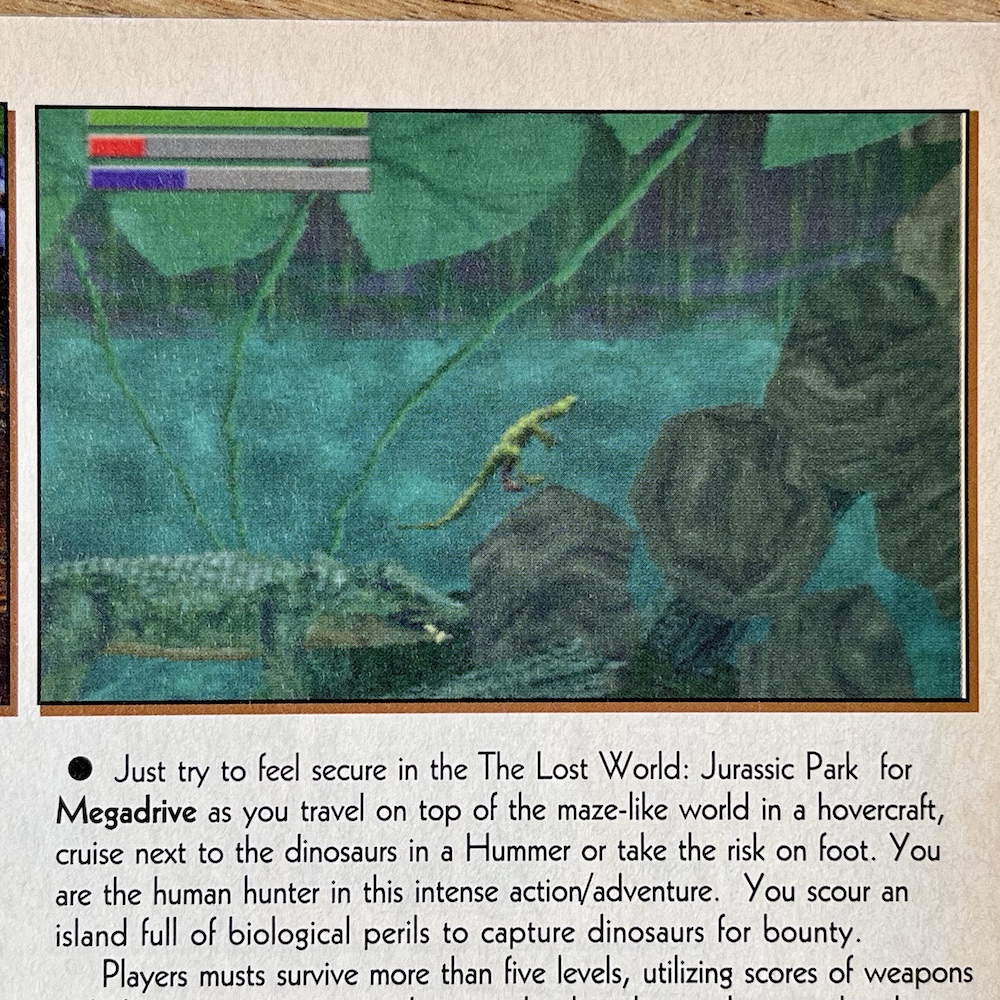
There are also screenshots from the platform game available on the Sega Mega Drive and the 3D game (that was a new thing at the time) for the Sega Saturn and the new Sony Playstation. Sadly there’s no mention of the Nintendo GameBoy Lost World game. I had a GameBoy in the 90s and adored the game of the first film which was also a competition prize in the original comic. (There just might be more about that on the blog later this year.)

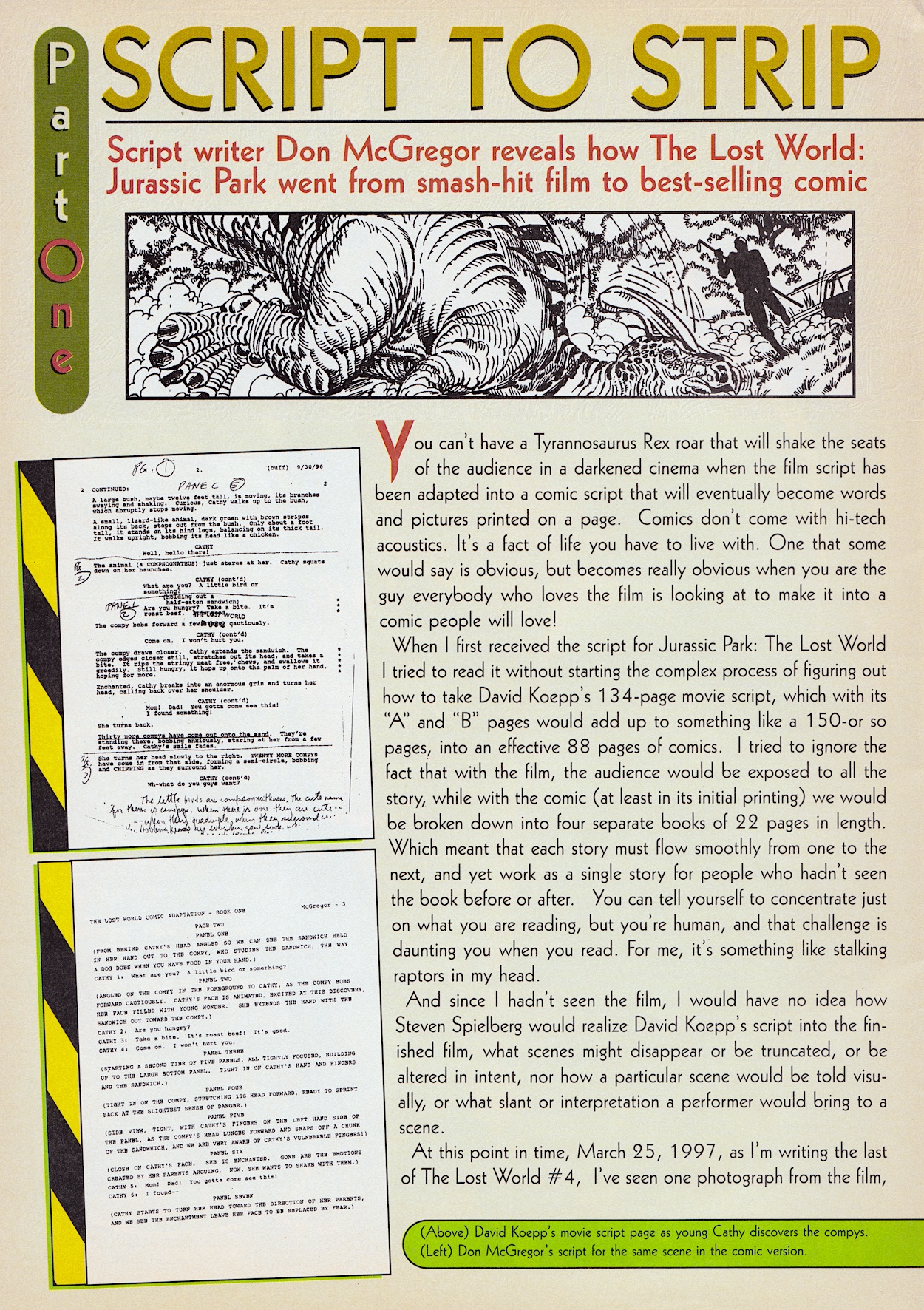
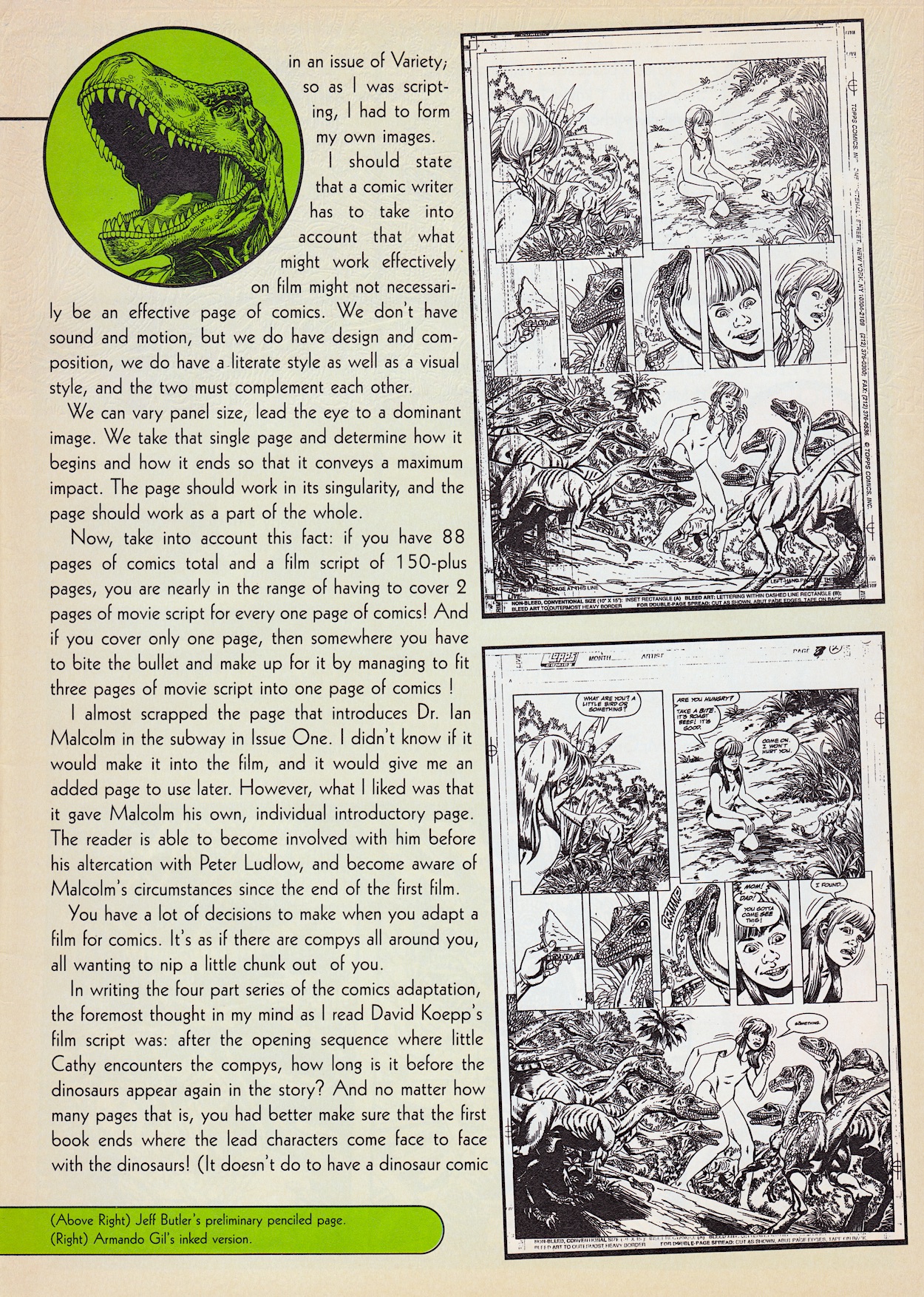
The Script to Strip article from #2 gets a second part here, although it’s a lot smaller and features less information. It would also have been a lot more interesting if the correct page of the movie script had been used in the comparison on the left. It does give a decent insight into the ‘Roar’ page from #3 though. It even mentions in Don’s original pages how the characters were meant to react to the sound, but in the finished page they did not.

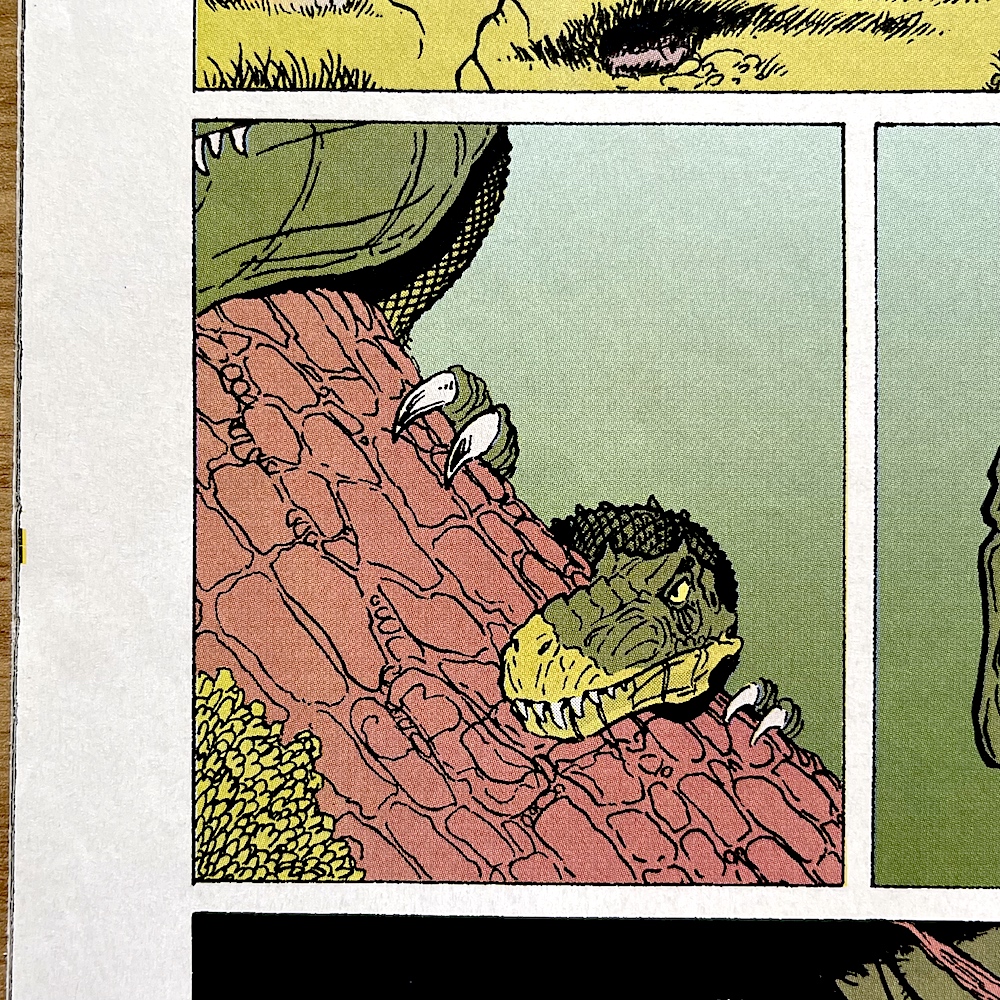
A quick personal note: That T-rex in the bottom-right is actually a version of the cover from my very first Jurassic Park comic as a teen.

This is the perfect point to reflect on the entire strip. I’ve said all along there have been moments of potential; the early art was fantastic and #2 was a vast improvement over #1 in terms of adapting the film to the medium. However, towards the end the art definitely suffered. I’m making an assumption here, I know, but it could’ve been due to tight deadlines towards the end to ensure it was released in America at the same time as the film. I also think Don’s articles have unintentionally summed up what went wrong, for me anyway.

Some lovely art and some fun extras have made this comic mini-series worth reading and the completist will definitely find those elements enjoyable

In part one of Script to Strip Don talked about the amount of pages David Koepp’s movie script had compared to how many the comic would have in total to tell the same story, and he explained how many pages of it he’d have to squeeze into each comic page. Now, after reading the whole story it feels like it was more about solving the problem by logic rather than creatively. The first chapter in particular of the original Jurassic Park adaptation showed how to include as much of the movie as possible while being very aware it’s a different medium, using imaginative ways to swap scenes or retell them in a new way. It felt like the film but it was different. A bit like adapting a novel into a movie you could say.

Towards the end though it felt like a checklist was being ticked off as it rushed from one scene to the next, paying lip service to moments the reader would remember from the film. With the sequel, in breaking everything down mathematically as Don did it’s felt like that throughout all four chapters, with some glimmers of the (that word again) potential here and there, which just made it all the more frustrating, knowing this team was capable of so much more.

So here we are at the final page of the final issue of The Lost World Jurassic Park which mentions a third novel by Michael Crichton. While there’s the occasional mention of such a thing on fan sites there’s nothing official anywhere to state he actually started it. Instead, Jurassic Park III and specifically Jurassic World would pull a lot from the two released novels. The rest of this page takes me back to all of the discussions at the time about DNA cloning and I can remember teenage me being very excited by documentaries and such on the subject.

So that’s us. Some lovely art in the earlier issues and some fun extras have made this mini-series worth reading and the completist will definitely find those elements enjoyable, just don’t expect anything ground breaking from yet another movie-to-comic adaptation. I do want to go and watch the movie again though! Remember, all 16 issues of the original comic, including the first official Jurassic Park sequel, have been reviewed and I’ll be returning to that series with the graphic novel collections of the rest of that story, which we never saw printed in the UK at the time, so I’ve never read them!

Definitely something to look forward to there. In the meantime, remember… “don’t go into the long grass”.
BACK TO iSSUE THREE

JURASSiC PARK MENU

THE LOST WORLD JURASSiC PARK #3: TRiMMiNG DOWN THE T-REX

We’re already at the halfway point in this little mini-series adaptation of The Lost World Jurassic Park. The first issue fell into the traps of many a movie adaptation but part two improved things somewhat. It wasn’t perfect, but those improvements and the article from writer Don McGregor about the size of the task at hand gave me high hopes for what was to come. So how has our third edition panned out? Ignoring that annoying “Free” poster bit on the cover (see last issue for more on that) let’s get stuck in and find out.

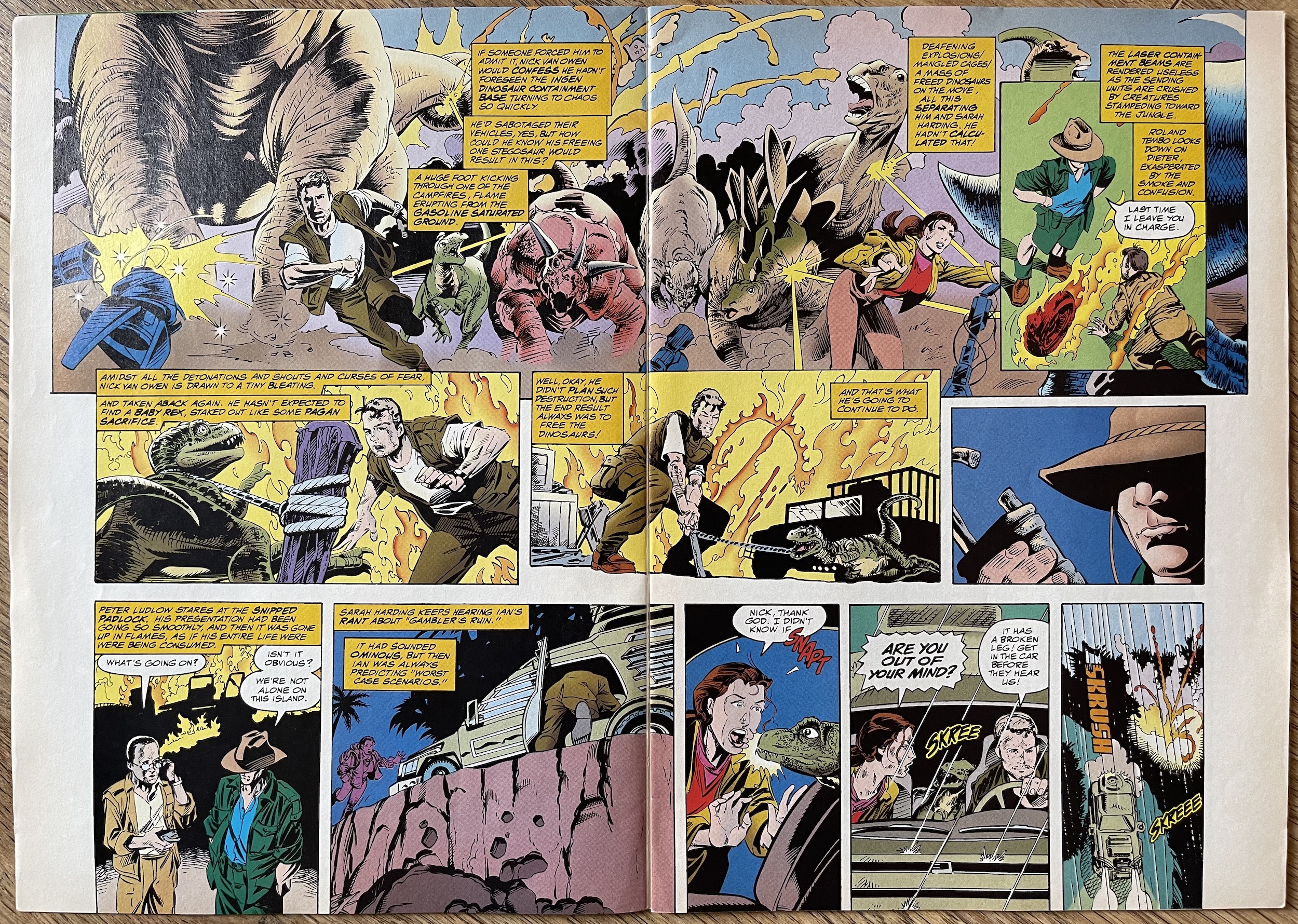
We left things a fortnight ago with the Triceratops smashing its way through Peter Ludlow’s presentation tent after Nick Van Owen had freed the dinosaurs, and right at the beginning of this chapter we see a spectacular scene of them all running from the camp back into the wild. In the movie we saw this from the perspective of the humans as the animals fled all around them, but here I particularly like the grander scale this first panel brings, and that’s not something you can often say about a comic adaptation.

Upon further inspection though, how on Earth did the Ingen hunters possibly capture and contain that giant dinosaur on the left? If we go by the previous movie this would have to be a Brachiosaurus. I’d love to have seen the cage they kept that in! The rest of the page instantly contradicts not only the film but even its own previous issue, where it had correctly shown the baby Tyrannosaurus rex captured by Roland and Ajay tied up away from the camp. Here, miraculously he’s now right where the chaos is, ready for Nick to easily rescue.

The next page is printed in landscape format and once you realise what’s going on it makes for a wonderful idea

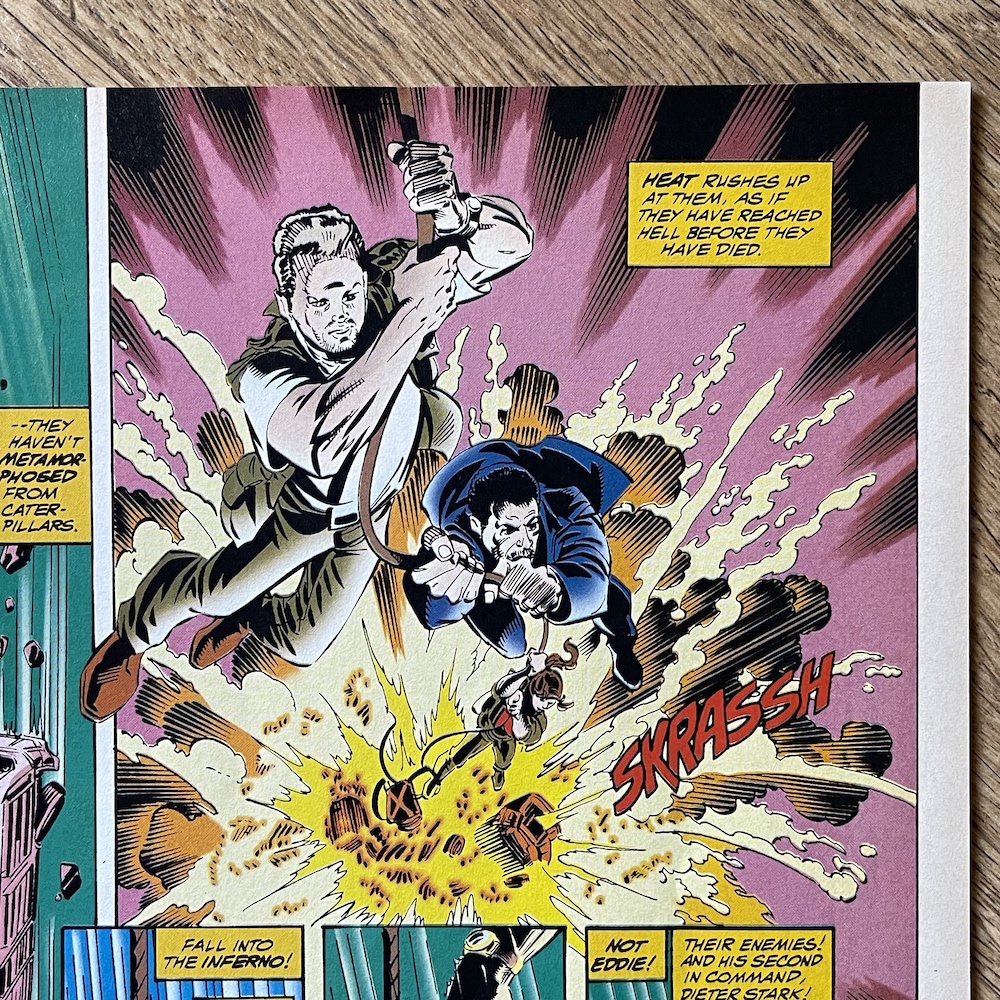
In fact, the page before this spread showed Roland and Ajay’s last second escape as a fiery jeep flew through the air and crashed onto the tree they were hiding in awaiting the adult Tyrannosaur, so really this is contradicting the very same issue! I’ve no idea why Don felt the need to do this. In the film we didn’t see Nick grab the baby, he appeared a little while later from a river nearby holding him in his arms.

The next page is printed in landscape format and once you realise what’s going on it makes for a wonderful idea and is brought to the page brilliantly by penciller Jeff Butler, inker Armando Gil, letterer Ken Lopez and editor and colourist Renée Witterstaetter. I know this film like the back of my hand so I know that while Dr Ian Malcolm, Eddie Carr and Ian’s daughter Kelly are in the High Hide at the upper tree level there’s a distant roar, the trees below shake and the stomps of both T-rex adults can be heard moving beneath them. However, despite this dramatic page, none of that is clear.

While it’s unlikely many would be reading this before watching the film (although I do recall my friends and I reading the adaptation for one of the Turtles films before we saw it), most readers will have only seen it once in the cinema by this stage. It would actually have still been playing in theatres when this was out. They’d be reading this to relive the story and as dramatic as that ‘ROAR!’ is on the page I’m not sure readers would’ve noticed it, instead possibly thinking it was just a unique set of panels to reinforce the moment. The characters not acknowledging the roar or any movement below doesn’t help either, making Ian’s decision feel decidedly random.

This of course leads to arguably the most terrifying sequence in the whole movie and one that had us on the edge of our seats in the cinema. Here it’s cut down, as it needs to be for reasons Don laid out last time, but the scale of the scaling back is quite shocking. When the adults arrive Ian simply danders out with the baby into the middle of the clearing instead of the tense moment by the door. He’s completely vulnerable but there’s no tension in his action. He’s even singing!

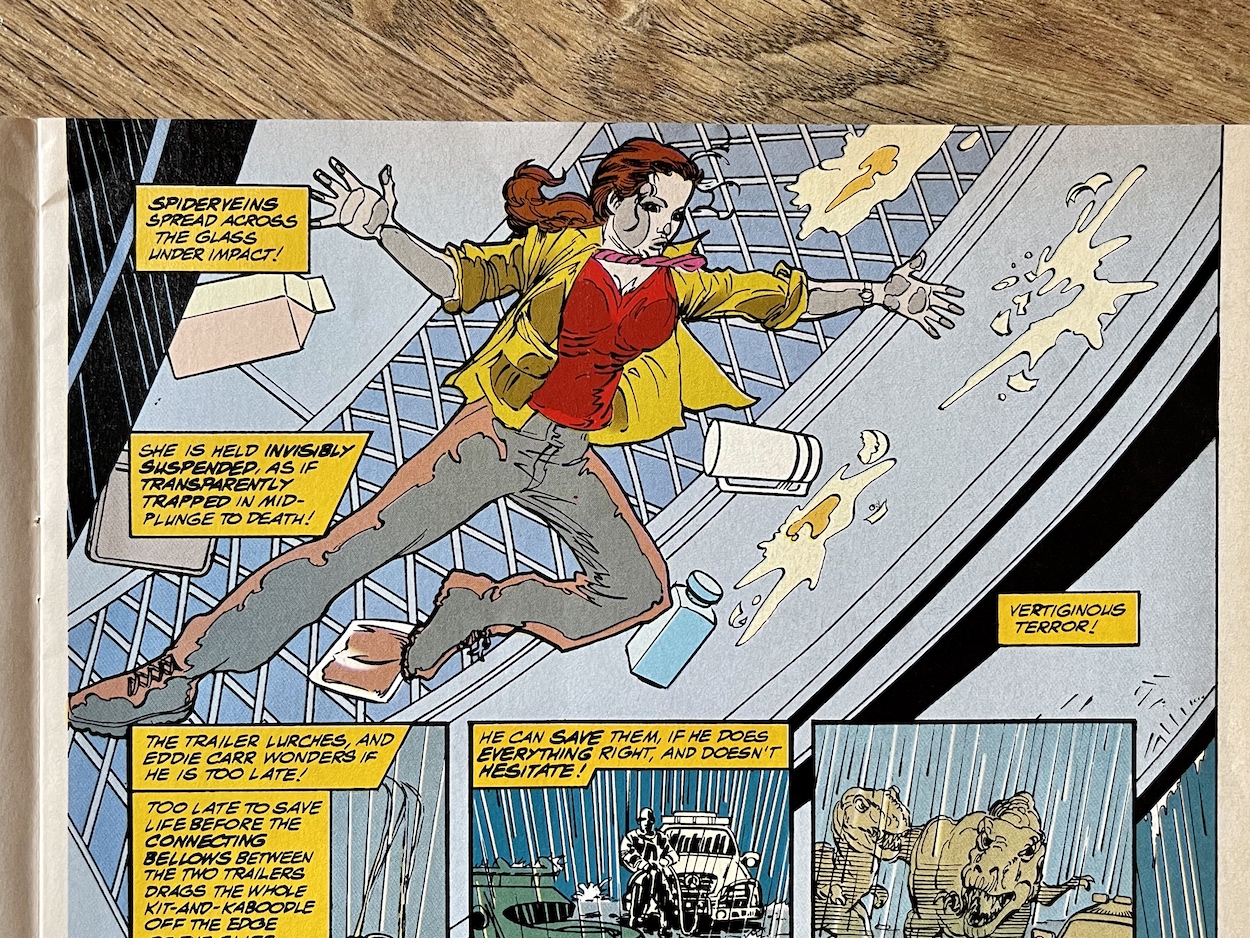
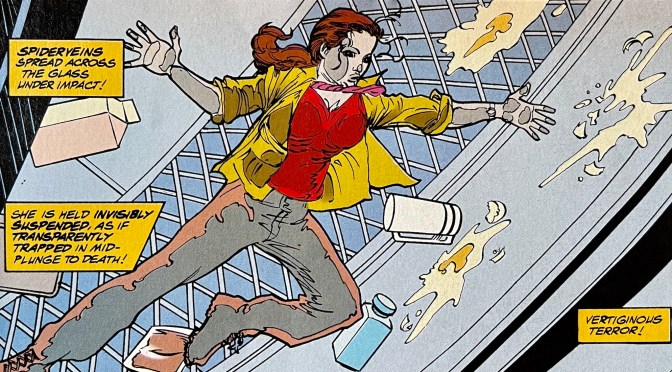
The next part of this scene is of course the moment when the two-part research vehicle is partly pushed over the cliff by the dinosaurs and while Eddie struggles to stop it from falling by winching it with his car he’s also trying to pull his friends up with a hand rope at the same time, and Dr Sarah Harding is on that slowly cracking pane of glass at the rear of the dangling half, looking right down the cliff towards the crashing waves far below. It’s all wonderfully tense.

Unfortunately one of the very best scenes in the film is reduced to a couple of pages. I did understand where Don was coming from in his article last issue but as I said in that review I don’t think he’s got the balance right; you’d think one of the biggest, most memorable moments would get a lot more space to breathe. Take the most basic key points of these ten minutes in the film (Sarah on glass, Eddie’s death, characters clinging to ropes as the transport falls) and eliminate everything else, that seems to be what the plan was.

There’s some fun art though.

I’m not sure if the narration is taken from the book or the draft script but it feels like it’s trying too hard, as if it’s attempting to make up for all of the missing bits. Not only is most of the action just not here anymore but the characters have absolutely no sense of fear about them, like they’re just going from one inconvenience to the next. Some lip service is played to Sarah’s fear of heights (something the film left out) but it’s not built upon.

I do love the art in the scene though, especially how it perfectly captures the invisible sheet of glass beneath Sarah. However the spider veins mentioned are conspicuously missing, and this won’t be the last time something like this happens which I’ll get to in a bit. Eddie’s whole ordeal trying to survive the T-rex attack is just not here but at least his end isn’t censored like the original movie’s adaptation would do. The final moment of the scene is also captured well here. The art is definitely the main thing driving me forward at this point. That and the great photography and extras.

The poster is a wonderful photo of one of the Velociraptors and I’m positive it would’ve been on my wall if I’d known about this comic at the time, showing off the gorgeous yet terrifying animatronic and the darker tone of this sequel. On the back of this is another dinosaur fact file with its terrible design once more not doing justice to Steve White’s interesting writing.

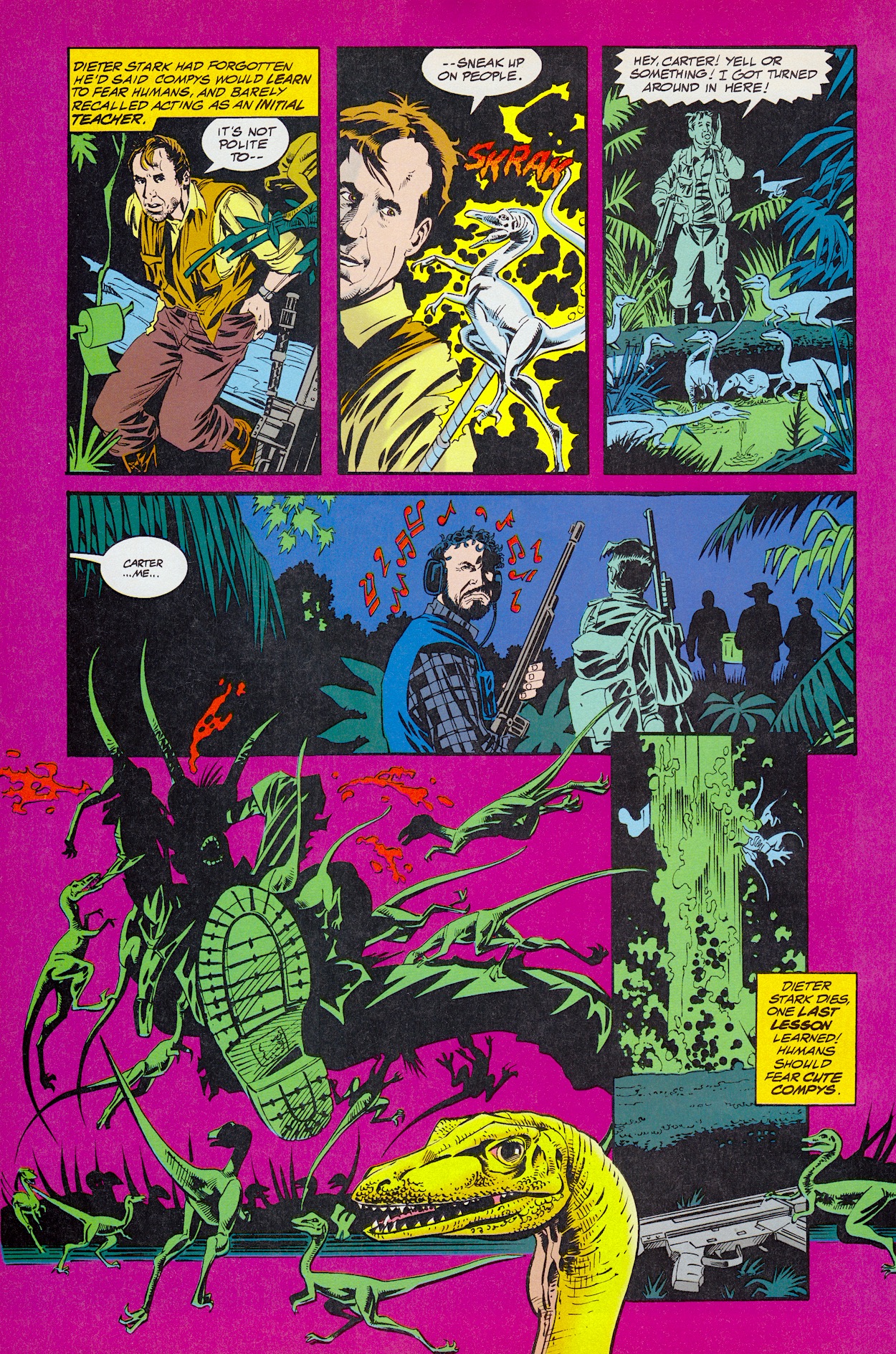
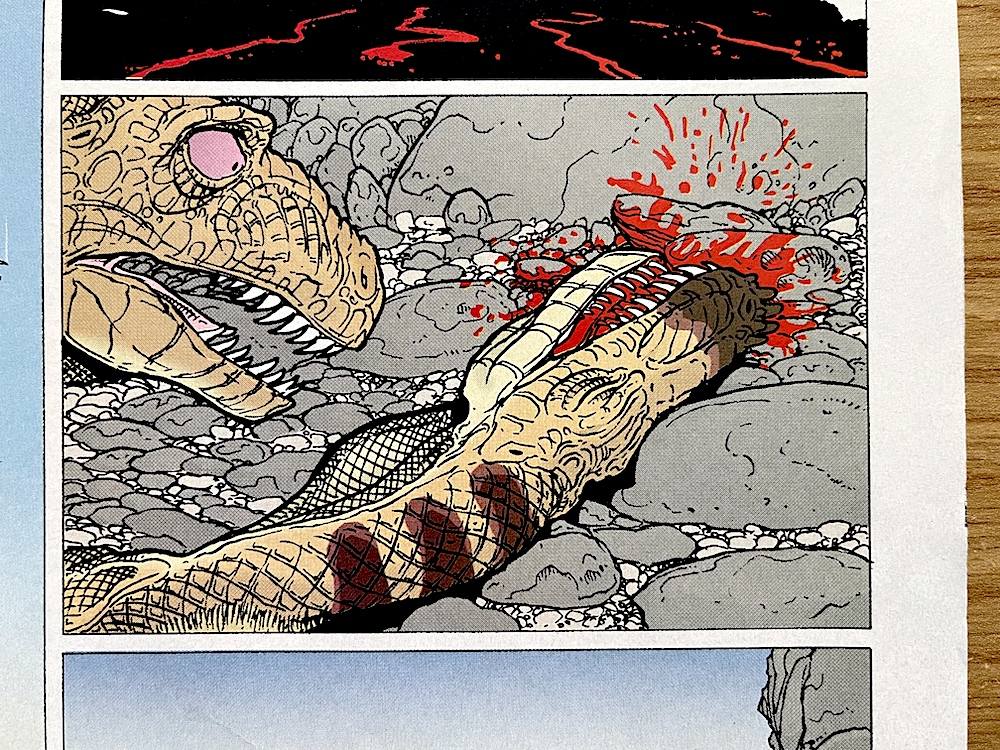
Back to the final pages of the strip which cover two large parts of the story and unfortunately after the promise of last issue it seems we’re back to rushing through the movie again just to get it over and done with. Dieter Stark is Roland’s second-in-command and his death in the film by the cute little Compsognathus pack may be rushed (with a sequence that’s just confusing for anyone not that familiar with the film) but I’m including it to show the two extremes of this strip; the rushed nature but the potential in the art (especially when you see the panel of his actual death).

I feel the beginning of that sequence can only really be followed if you’ve seen the movie and are familiar with the individual elements of how this transpired. Elsewhere we get some added character moments which again may have originally been in the earlier script, like some tender moments between Ian, Sarah and Kelly before we get to the T-rex pair catching up with our sleeping group. There’s a particular moment here in the movie which truly frightened me with its slow build up and drawn out danger for two of our characters. The suspense was a killer! Here it’s all reduced to one single, solitary panel that completely changes this to a game of peekaboo.

Something else missing is Ian’s moustache! From comments on social media after I posted the first two reviews this apparent inconsistency seems to have particularly irked some people when they read the comic, but for me it’s not really a big deal. It’s still kind of there, it’s now just part of a rough unshaven goatee area like Jeff Goldblum sported in the film. It could be it was decided Jeff wouldn’t sport a moustache after the first two parts of the comic were already drawn. Story wise, I’m happy enough to think that it’s all started to grow out again while he’s been stuck on the island for a few days. Either way, it looks much better now.

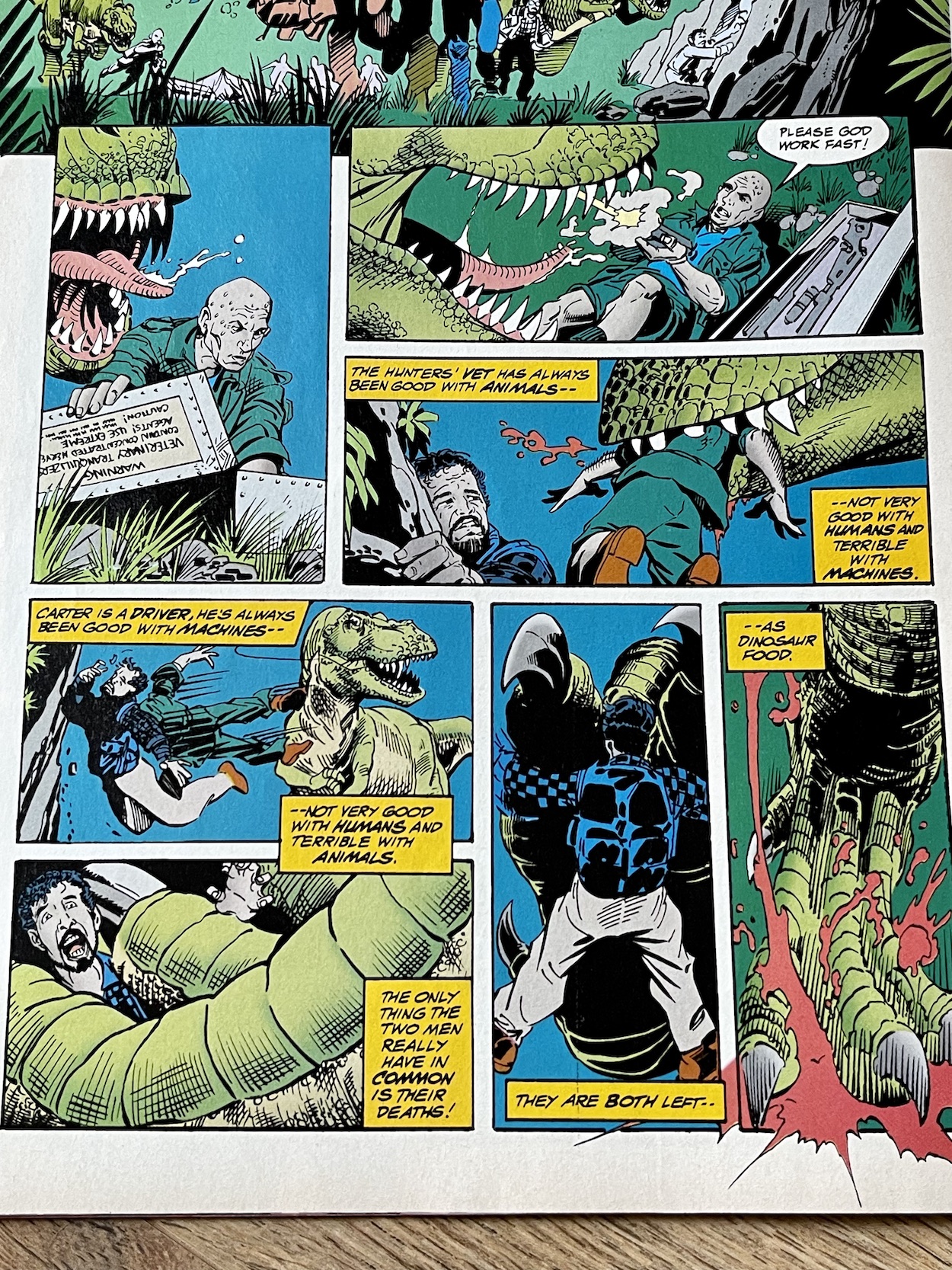
After the small additional character scene I mentioned we get a huge change from the film a few pages later when Roland Tempo, played brilliantly by Pete Postlethwaite in the film, is killed by the huge Tyrannosaurus buck! After finding his shotgun has been filled with blanks by Nick he reaches for the tranquillisers. So far, so familiar. But unlike in the film when the T-rex succumbs to it just in the knick of time, here he grabs Roland and throws him towards Carter, the man who gets trampled to death in the film.

This is one change I really don’t like. Roland was one of the best characters in the film and since he’s now dead we no longer get to see his solemn redemption later after Ajay’s death, when he tells Ludlow he’s seen quite enough death instead of accepting a job at InGen. The hunter became rather Ian-like in the end and accepting of his part in the inevitable chaos. This will all now be missing. If this was in the script Don was working from then I’m very, very glad screenwriter David Koepp and Steven Spielberg changed this character’s arc.

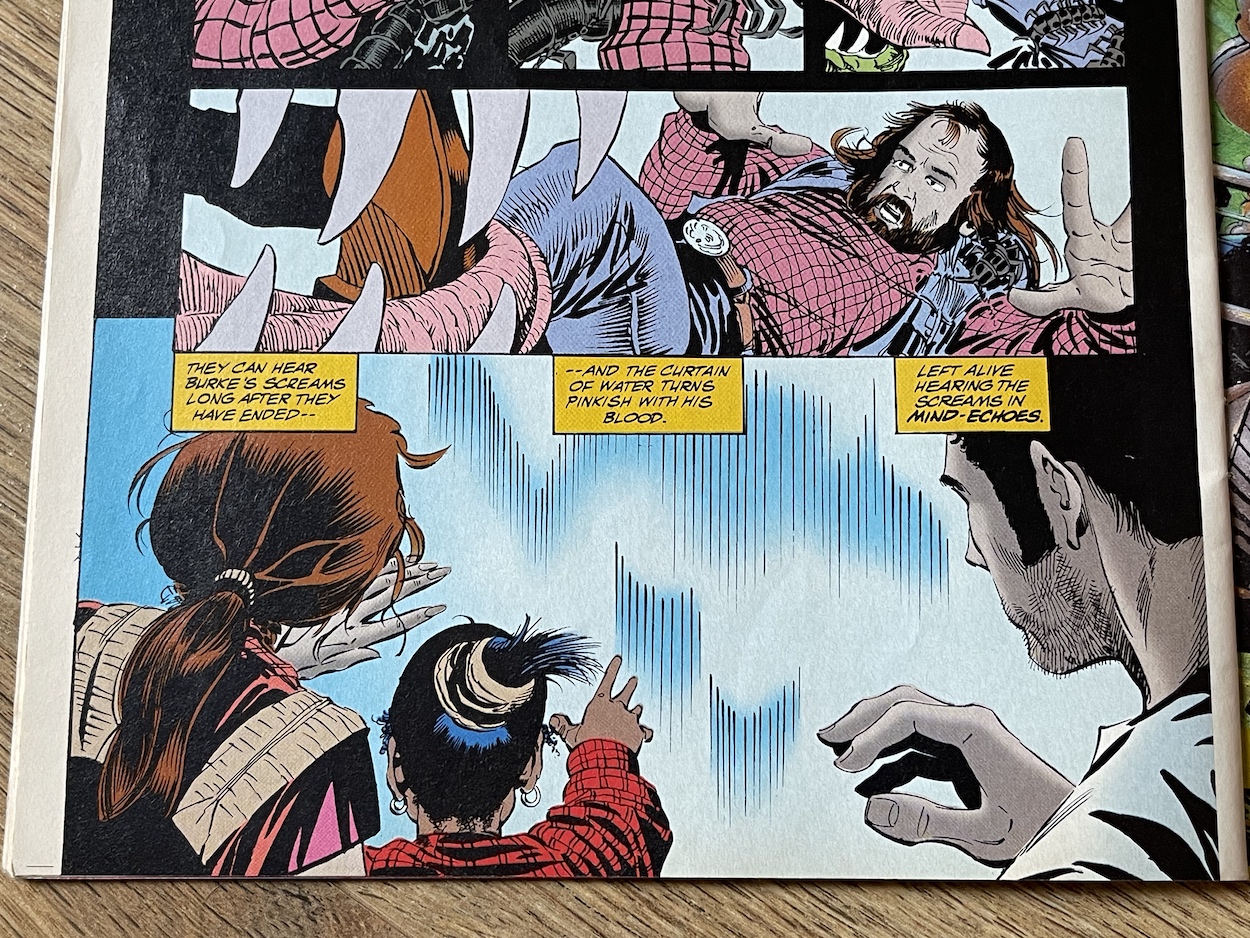
The penultimate chapter of the adaptation ends with our main characters trapped behind the waterfall (in a scene from the first Jurassic Park novel and depicted by Walter Simonson and Richard Cry on the cover) as Roland’s palaeontologist Dr. Robert Burke is grabbed by one of the T-rexes and dragged out. Just like the spider veins mentioned when Sarah was in danger, the curtain of blood described here is nowhere to be seen, somewhat dampening the moment.

Chapter three has certainly been a mixed bag then. I liked some of the extra character scenes but hated the death of another, although to be fair to Don that wasn’t his fault. Some of the very best moments of the film, (some of my favourite moments in cinema, period) were so rushed here they were barely recognisable, and the fun art has been on top form at times with some great images but plagued by inconsistencies elsewhere. I come away frustrated more than anything because of what this talented team could’ve created.

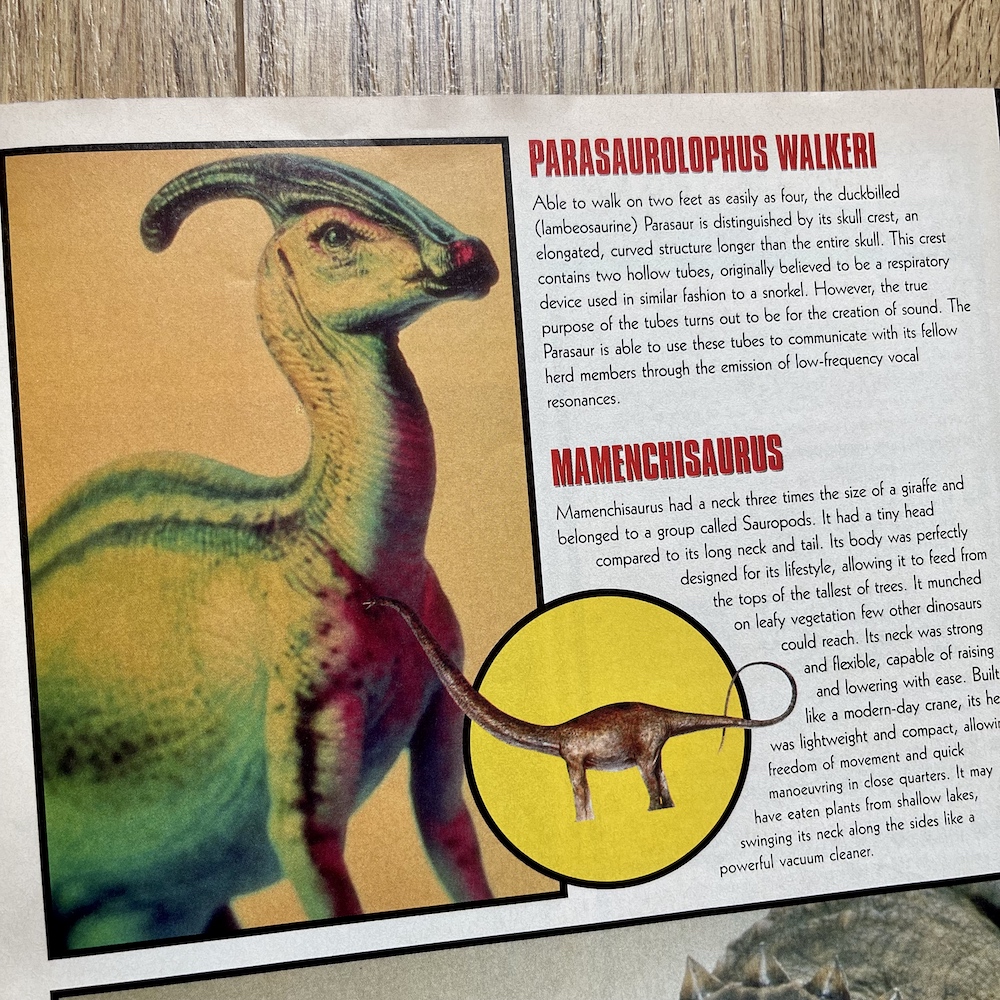
There’s no character mini-poster this time, instead we get five pages of a welcome pack for new employees to InGen and it contains a lot of photographs of model dinosaurs used in the pre-production of the first two films. I thought there was something strange about the little pictures of the animals in circles throughout #1 but now I know what they are they’re a delight to look at up close like this. All the main dinosaurs are covered, including this film’s Parasaurolophus Walkeri and the sick Triceratops from Jurassic Park.

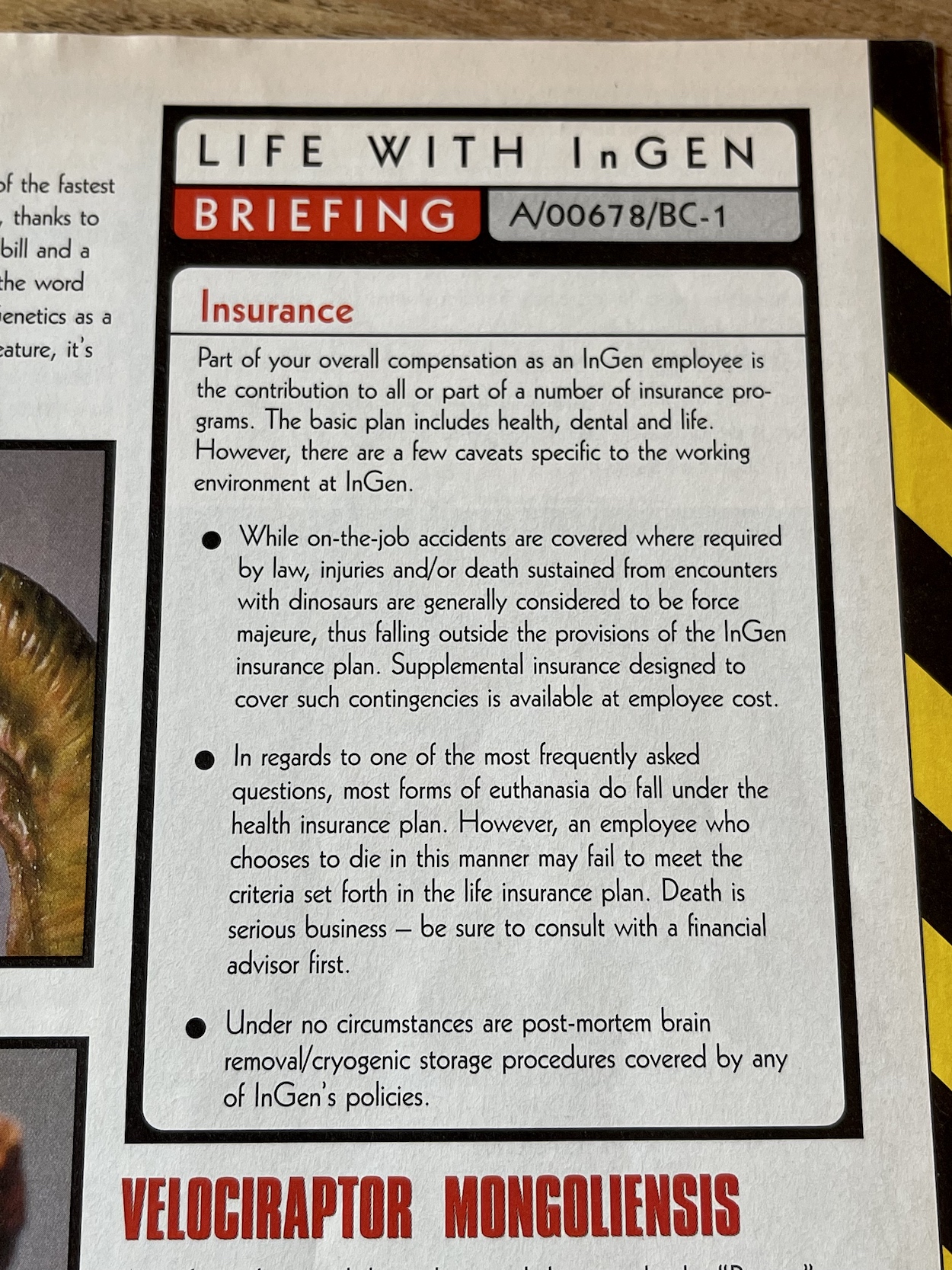
There are also some funny moments such as the exceptions to staff’s apparently comprehensive insurance policies, which absolve InGen of any responsibility whatsoever if Chaos Theory rears its head. As with the previous two issues I’ve found the extras more enjoyable than the strip, so kudos to editor John Freeman and his team, these pages add a lot to the overall package.

We’ve only one chapter of the story to go and I feel just like I did when the first film’s adaptation finished its penultimate chapter; there’s just no way they could possibly cover everything still to happen in 22 pages. It’ll be interesting if nothing else! We’ll find out what survives in #4 of The Lost World Jurassic Park on Monday 7th August 2023.

iSSUE TWO < > iSSUE FOUR

JURASSiC PARK MENU

THE LOST WORLD JURASSiC PARK #2: SUPERiOR SEQUEL

I’ll admit my eyes rolled a little when I saw this cover to the second issue of Titan Magazine’s The Lost World Jurassic Park comic for a couple of reasons. Not the photo of the glorious animatronic Tyrannosaurus rex of course, they’re always incredible to look at. No, the top-right and bottom-left made me sigh a little and to be honest it’s just me being pedantic, so apologies to all you blog readers for having to put up with me when you’re just trying to find out about some classic comics.

The Jurassic Park novels and films made a huge deal out of the fact that they were helping dispel the myth of dinosaurs being large, lumbering reptiles and who can forget the scene when Dr Alan Grant told people dinosaurs are more closely related to modern day birds. Hence why we saw fast, fluid movement from the animals in the films and yet here we’re asked “will the reptiles strike back”? Plus, it’s not a “free” poster when it’s part of the page count of the comic. To be fair many comics did this, OiNK included, but it niggles me. Or maybe it’s because I’m writing this at a very early hour and really should’ve got more sleep.

Anyway, eye rolling done, let’s move on to what is a much improved issue and one I enjoyed very much once inside!

I’ll give the Jurassic Park movie adaptations something, they certainly know how to write some atmospheric narrative captions. Walter Simonson did a superb job of this throughout his comic version of the first movie and here Don McGregor is certainly following suit. Of course, these could be taken from the script he was working with or indeed the novel, but we’ll give him credit where it’s due in pulling us in to specific moments like this on the opening page of part two. The art team are once again penciller Jeff Butler, inker Armando Gil, letterer Ken Lopez and those are editor Renée Witterstaetter’s gorgeous colours.

It’s just a shame these moments are rushed through for much of the comic strip. Don’t get me wrong, this is a much improved chapter over last issue’s. There are more character moments from the film left intact and even one or two which must’ve been part of that earlier draft of the script. We get the scenes of Dr Sarah Harding excitedly explaining her discoveries and Dr Ian Malcolm turning them around into accurately predictive doomsaying. But we also get a few moments here that weren’t in the film, such as this exchange between the two.

I’m not sure if this would’ve been in the script, I just can’t imagine Ian using the word “chick”. Then again, with so little room (88 pages in total) to convert the script to a comic I can’t see Don adding in extra dialogue either. When Roland Tempo’s team and the slimy Peter Ludlow turn up in their helicopters there are more examples of how the narrative captions can be used to eek out some characterisation that the brisk pace of the adaptation would normally struggle with. Nick Van Owen, as played by Vince Vaughn, was a good character and criminally unused in the climax of the film so I’m glad to see him getting some more exploration here.
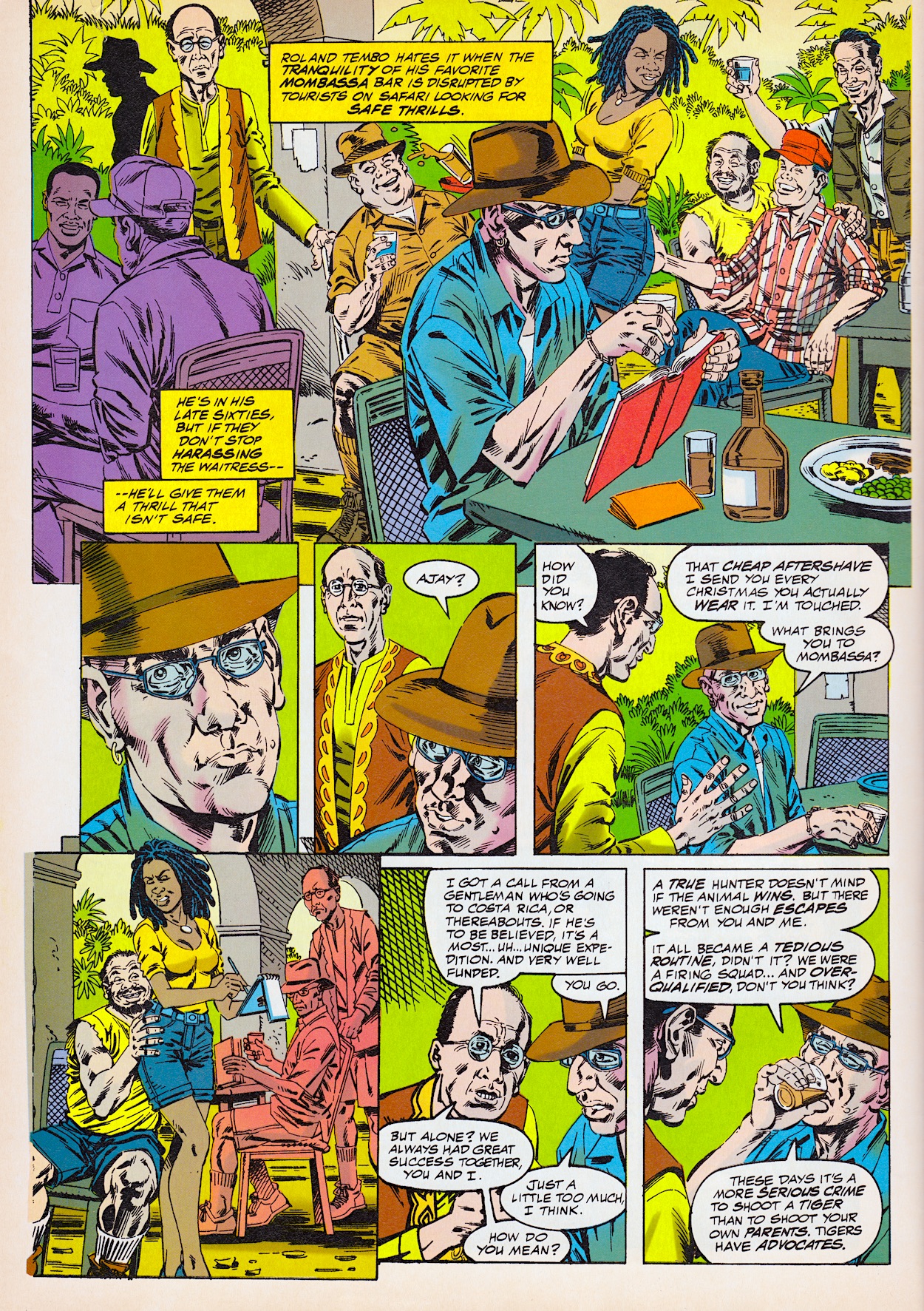
With the hunters now on the ground we get to that heartbreaking part of the film where they’re capturing as many dinosaurs as possible, caring not for the fact these are living, breathing animals, never mind a miracle of science. Roland made his debut in the film at this point but of course we’ve had the bonus of the entertaining deleted scene last issue so we feel like we already know him by this point. Here you can see the viciousness with which his second-in-command Dieter takes down the Parasaurolophus, or ‘Elvis’ as Roland called it.

It’s all over very quickly and it’s here that the unevenness of the adaptation comes to the fore. I’m finding it hard to figure out what Don’s rationale was for what he keeps in and what he jettisons. Later on in the issue there’s a fascinating article written by the man himself about the challenges of adapting a long movie script into a tight four-issue mini-series. He mentions keeping characterisation is very important and I can see that in some of the scenes he’s included but elsewhere that’s simply not the case.

I can’t help feeling I’d have preferred a more balanced approach

While the examples above are nice to see (Sarah and Ian’s exchange lasted for a few pages, for example), ones featuring Ian’s daughter are inexplicably missing or cut down to a few lines and other scene-setting moments have been taken out completely while some of the big dinosaur moments are rushed through, eliminating any spectacle or menace, which seems a strange choice in a Jurassic Park comic. Obviously I’m not a comic writer and Don lays out his reasoning in the article but as a reader I can’t help feeling I’d have preferred a more balanced approach.

We’ll come back to that in a moment but first the story takes a four-page break with some adverts, another dinosaur fact-file page and a double-page spread. This is on pages 18 and 19 of the comic, it’s not a separate entity and so it’s not a free gift (can you tell that’s still niggling me?). It’s a shame these weren’t large separate glossy posters but at least editor John Freeman made sure there were no strip pages on the back of them.

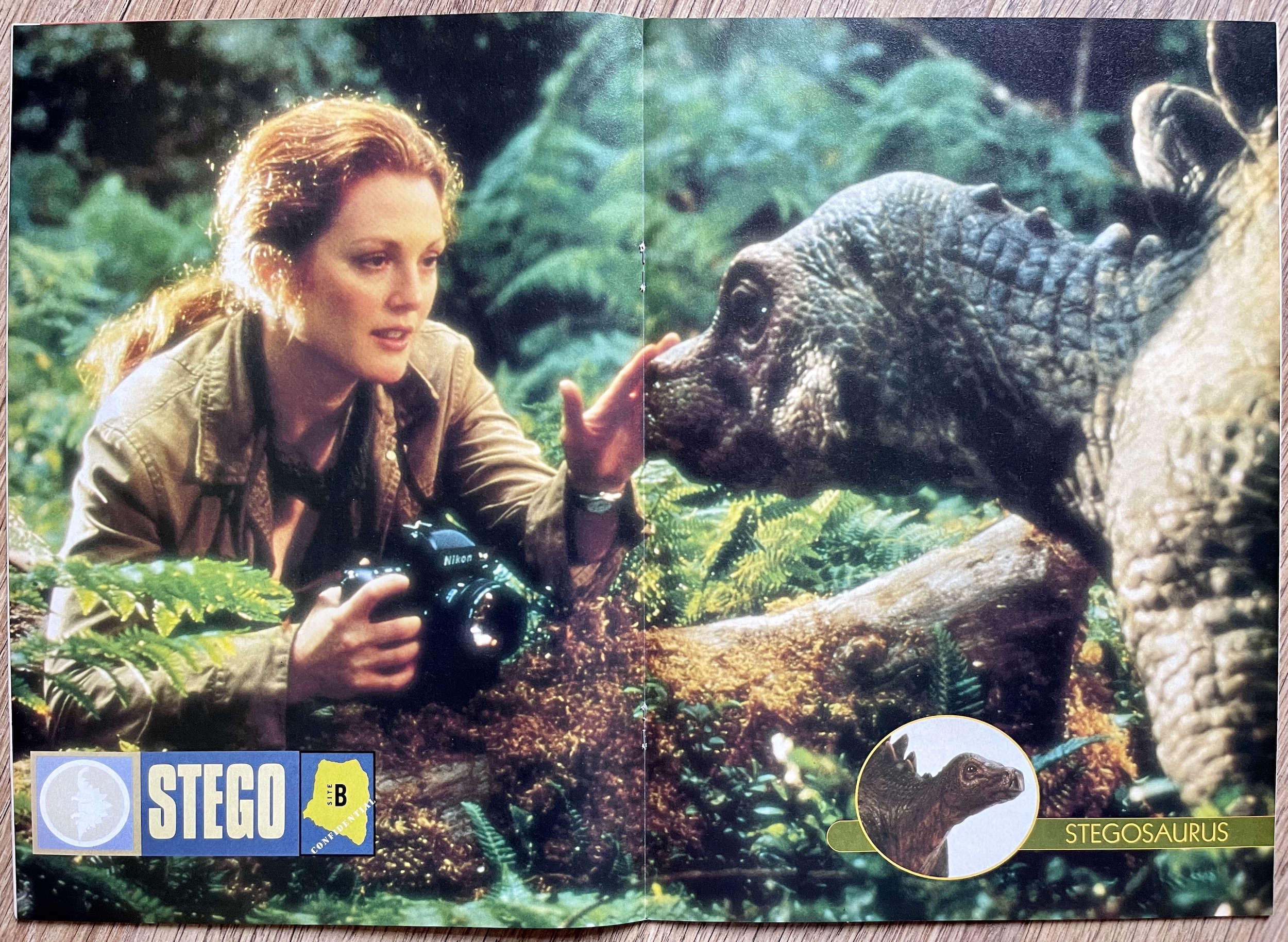
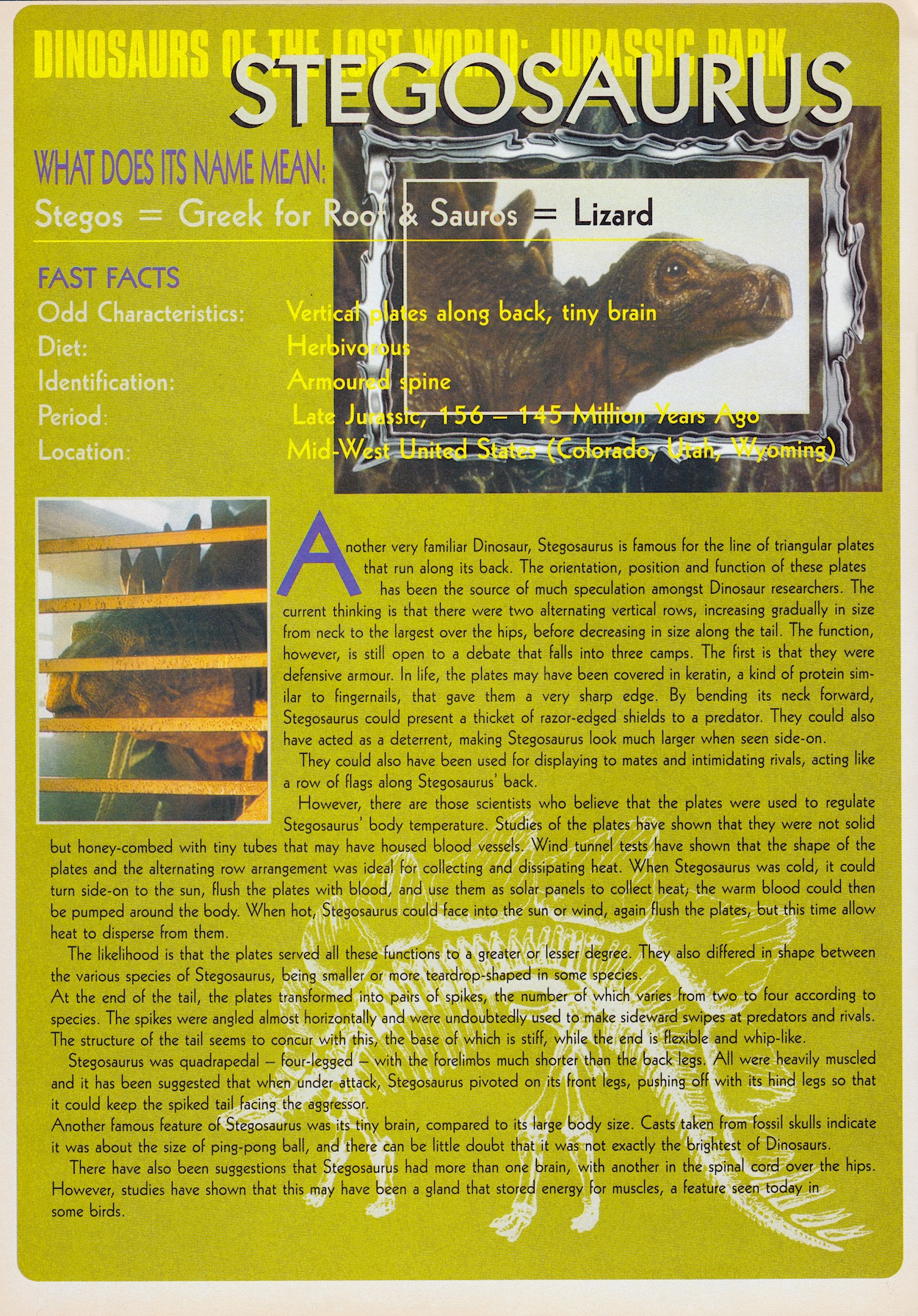
Julianne Moore as Sarah Harding reaches out and touches the snout of the baby Stegosaurus in a moment that was excised from the story last issue. Over the page is another fact-file dedicated to one species from the film and the Stegosaurus gets top billing this time. However, remember how I thought the design of the page wasn’t finished last time? It appears that is indeed the finished design. It looks awful and does no justice to the great piece written by Steve White.

An ardent dinosaur aficionado, Steve has clearly done his research (or knew the subject matter extensively already) and this would’ve been a fascinating read to young fans of the films, adding depth to the scenes in the movie featuring these animals. It’s still fascinating for this much older fan too. We then head back into the story and the last eight pages of this 22-page chapter, beginning with two new scenes I hadn’t been aware of until now.

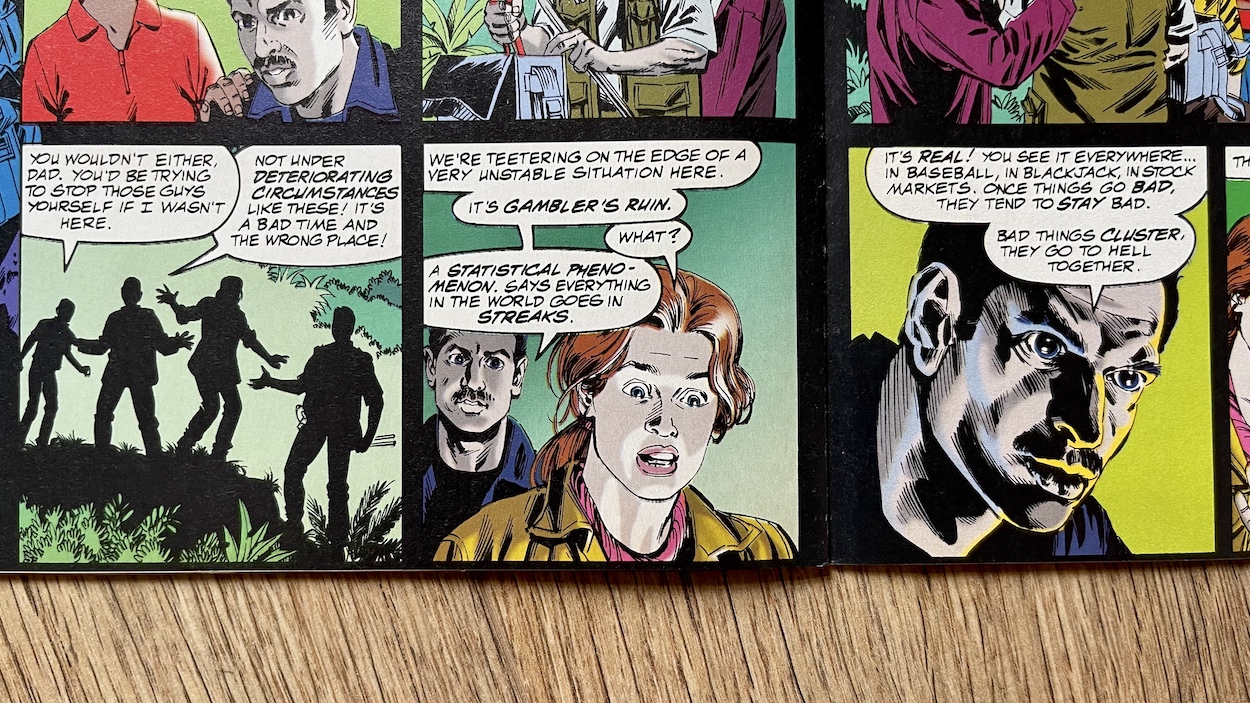
While overlooking the hunters’ camp it sinks into our team that the creatures are being taken off the island alive and exported to the mainland. After what happened in the park this is obviously a terrifying realisation and this is the part where we find out Nick was actually sent as back up by Hammond and he sets off with Sarah to free the dinosaurs. It’s during this we get the new element, one of Ian’s little speeches that we liked so much in the first film, this time about something called Gambler’s Ruin.

While it’s only for a couple of panels it’s something that’s referred to later in the strip and by Don in his article. Don states things like this are deemed important and must be kept in, which is ironic since it didn’t make it into the film. I reminds me of those little moments in the first movie that expertly summed up the pages and pages of fascinating monologue from Ian in the novel. It’s a shame it didn’t make it into the finished film, whereas I’m glad the next page didn’t.

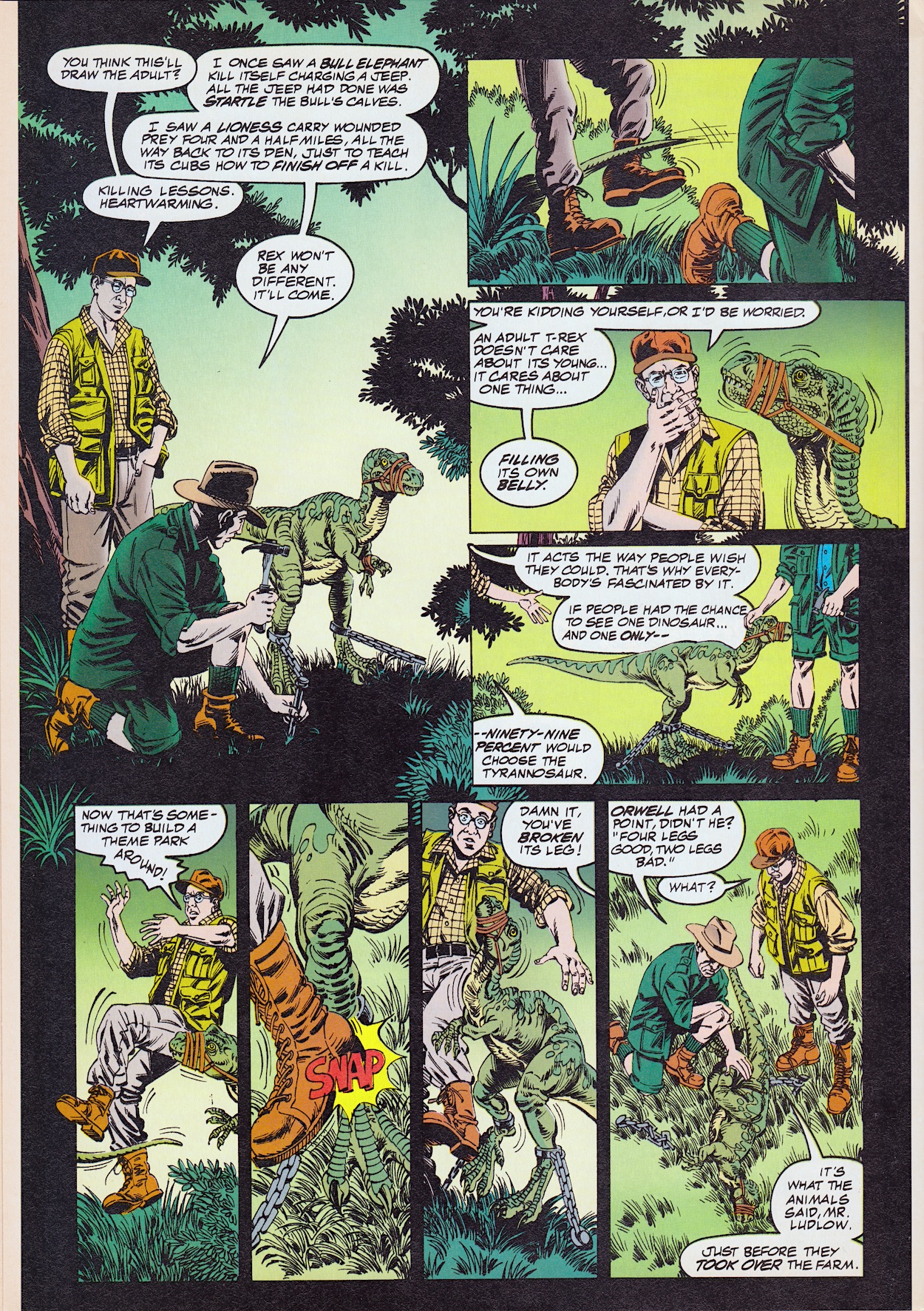
This scene isn’t a deleted scene in the movie’s extras so I can only assume Steven Spielberg chose not to film it. On the screen we see Roland and Ajay watching the baby T-rex and coming up with a plan to use him to lure the male adult back to the nest. A few moments later the baby is seen tied up with one of its legs covered in blood. Later we find out it has a fracture and Sarah and Nick try to set it for him (or else he’ll become food for a predator). The implication of how it happened is clear but here the real reason is meant to be a pratfall.

I really don’t like this and it’s not Don’s fault of course, it was in the script he worked from but I can’t blame Spielberg for not including it. Roland is meant to be a seasoned hunter, the very top of their game in the whole world, so bored with it now that only the promise of killing a T-rex buck could lure him back into picking up his gun again. When I watch the film I like the way the reason behind the baby’s leg injury is kept ambiguous.

Spielberg left it up to the viewer to assume either the baby struggled and did this to itself as the two men struggled to tie it up or, more viciously, they deliberately broke it so the baby would cry out in pain for his parents and the scent of blood would bring the adult male quicker. But to have it as a result of Ludlow clumsily tripping just feels wrong. I prefer the film without this scene and clearly the director agreed. After this the chapter rounds itself off with the moment a Triceratops breaks out of the camp after being freed by Nick and that’s us for another fortnight.

If you’re thinking I’m being overly critical it’s only because the previous Jurassic Park comic showed how much potential there is in bringing this franchise to the medium. The last chapter of the first film’s adaptation may have rushed things too much but the first three instalments were fantastic and showed me it could be done. Then the vast majority of the sequel strips were great fun, full of action without sacrificing the characterisations. It even gave depth to a group of Velociraptors!

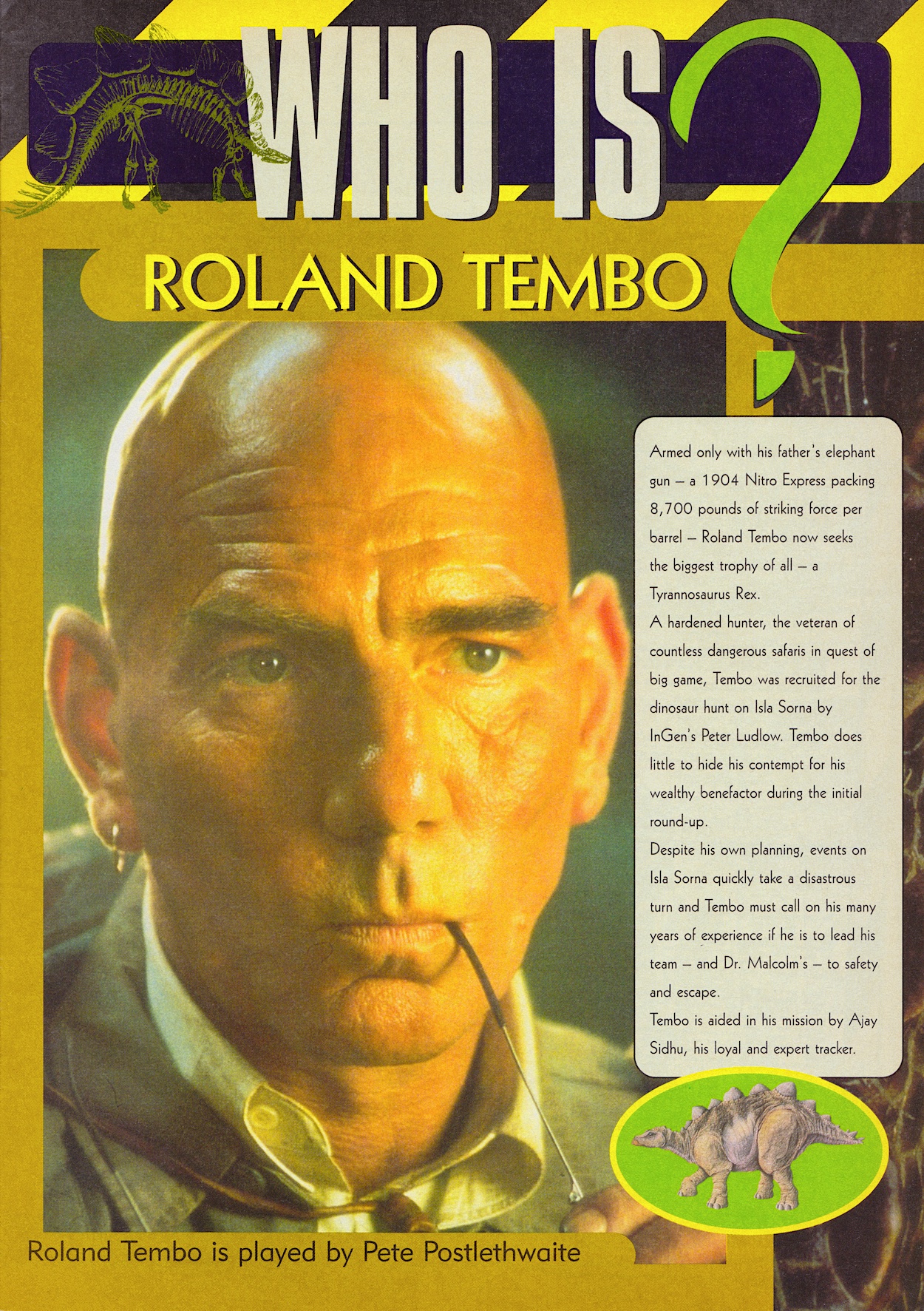
A pin-up of Pete Postlethwaite in character as Roland brings us to Don’s article, Script to Strip. I really do find this interesting. I like how he describes the difference in the comics medium, things we may not have considered as fans of the film. I found it shocking everything was written before he’d seen anything of the movie at all! Yes, the comic would be published to coincide with its release so deadlines would’ve been very early, but I expected him to have access to photos from set, pre-production art, maybe early footage but nope, he only had the written words to adapt into his own written words.

Part two really is a big improvement and after reading Don’s own words I can’t help but cheer him on

He makes several good points about the maths of adapting a film to a comic, namely the page count difference and when he lays this out for the reader you get a sense of the enormity of his task. I’m not sure I agree that each part of this mini-series should be able to work as a story in its own right though. Maybe if he was writing his own original comic but in adapting a movie it’s never going to come across like that to a reader, these are very much individual chapters of one story.

He makes good points about the risk of having no dinosaurs for too long, something a movie that’s building tension can do but a comic can’t. This was why Walter Simonson reworked the order of some scenes and added actual Velociraptors to Dr Alan Grant’s famous scene with the “That doesn’t look very scary” kid in his adaptation. I’ve mentioned Don’s characterisations and choice of scenes to include throughout the review, so without further ado here’s a fascinating look into how this insurmountable task was achieved.

While I agree with his sentiments and he clearly had good intentions I feel the adaptation hasn’t quite got the balance right. For example, instead of including every single word of some scenes and none from others would it not have been better to trim all of them down so that the essence of them all is still intact? Jenny (Ian’s daughter) in particular is badly served. The same with the dinosaur scenes; there are some great spreads (we got two pages of the Stegosaurus family walking away from Sarah at the beginning) at the expense of scenes that would’ve been the most memorable to readers waiting to watch it again on home video.

Part two really is a big improvement and after reading Don’s own words I can’t help but cheer him on for the second half of the comic’s limited run. I hope he’s successful, especially when there’s potential in his style and the art is so enjoyable. We’ll find out over the next month. The third of these four issues will be reviewed on Monday 7th August 2023 and if you’re just discovering the blog via this comic there’s a whole bunch of Jurassic Park comics already reviewed over the past couple of years that you can check out, including the first official sequel long before The Lost World Jurassic Park.

iSSUE ONE < > iSSUE THREE

JURASSiC PARK MENU

THE LOST WORLD JURASSiC PARK #1: LiP SERViCE

Well isn’t this a pleasant surprise? We thought we’d seen everything the UK comics scene had to offer for Jurassic Park fans back when Dark Horse International’s excellent comic came to an end with #16 in November 1994. While it was a suitably open-ended finish to the first official sequel it had actually been cancelled with several more chapters of the American comic to go. Not that we knew this.

Three years later in the summer of 1997 Steven Spielberg’s The Lost World Jurassic Park appeared in cinemas and I have very fond memories of going to see it, at one point jumping out of my skin so much (when one of the Velociraptors poked its head beneath a door, if you’ve seen it you’ll know the moment I’m referring to) that I made my friend beside me jump, which in turn made me jump again! Cue nervous laughter while our hearts came back down to a normal rate. I loved that film. I didn’t know there was a comic to match though, something I’m making up for now. Here is #1, edited by Down the TubesJohn Freeman, no less.

Despite this being from a completely different UK publisher (Titan Magazines) the US strip is once again from Topps Comics. Their continuation had come to an end and now their adaptation of this movie would contradict everything they’d previously created. Obviously this couldn’t be avoided, Michael Crichton’s second novel and the sequel movie were never going to follow what the comics had done. That ‘What Has Gone Before’ is lifted straight from those Dark Horse issues which is a nice touch.

However, the opening editorial seemingly makes some early errors straight out of the gate. Already established is how John Hammond spent many, many years with his dinosaurs before inviting Dr. Alan Grant and Dr. Ellie Satler to the island, it wasn’t something he threw together in a few years. More glaring for us with hindsight is the suggestion the dinosaurs were destroyed. We know they weren’t but only from later films and to be fair the sequel novel also said they were all destroyed, so that’s lifted from the book rather than the film.


“All along we have held significant product assets that we have attempted to hide, when we could have safely harvested them for enormous profit!”

Peter Ludlow

I should mention I haven’t read Michael Crichton’s second Jurassic Park book, in fact I was surprised to find out recently Dr. Ian Malcolm was the main character in it after he died at the end of the first book. (That’s properly explained, apparently.) Of course in the movie he didn’t die so we don’t need to worry about that here. The opening scene is from The Lost World movie but was actually based upon a story point from the first novel that didn’t make it into the original film. The differences between the second book and movie is something this issue will touch upon later. For now, let’s see how that story translates to comic form.

After the opening comes the first of two deleted scenes which were filmed but never made it into the final cut, although they can be viewed as extras on DVD, Blu Ray and digital. It involves the loathsome, slimy character of Peter Ludlow, nephew to John Hammond, perfectly portrayed by Arliss Howard in the movie. Cut by Spielberg because he felt it slowed the pace of the film, I initially thought it should’ve been included. While it’s particularly pertinent today when certain politicians seem more determined than ever to rape the natural world (as Ian Malcolm put it) for profit, now I agree it was right to cut it, although for different reasons.

It mentions the destruction of all the animals and the park after the first film and buying media and political silence, as well as paying out millions of dollars in wrongful death settlements to the families of the characters who perished. Just as a side note, for the first time John Arnold’s death is mentioned in comic form after he just disappeared in the first adaptation. As such, this scene’s inclusion means the editorial was actually correct for this version, but it’s good it was deleted from the movie so that the animals survived.

The other deleted scene involves Pete Postlethwaite’s animal hunter Roland Tempo. I’m still sad about this being cut from the film because it adds some more depth to his character. While a person who hunts animals for sport and money is always going to be loathsome, at the end of the film after he’s helped capture the Tyrannosaurus rex alive for InGen he’s mournful for what he’s done. Through his experience in the story he changes and realises the devastating consequences his actions have had.

A perfect balancing job of having a clear likeness without sacrificing what makes a good comic book character

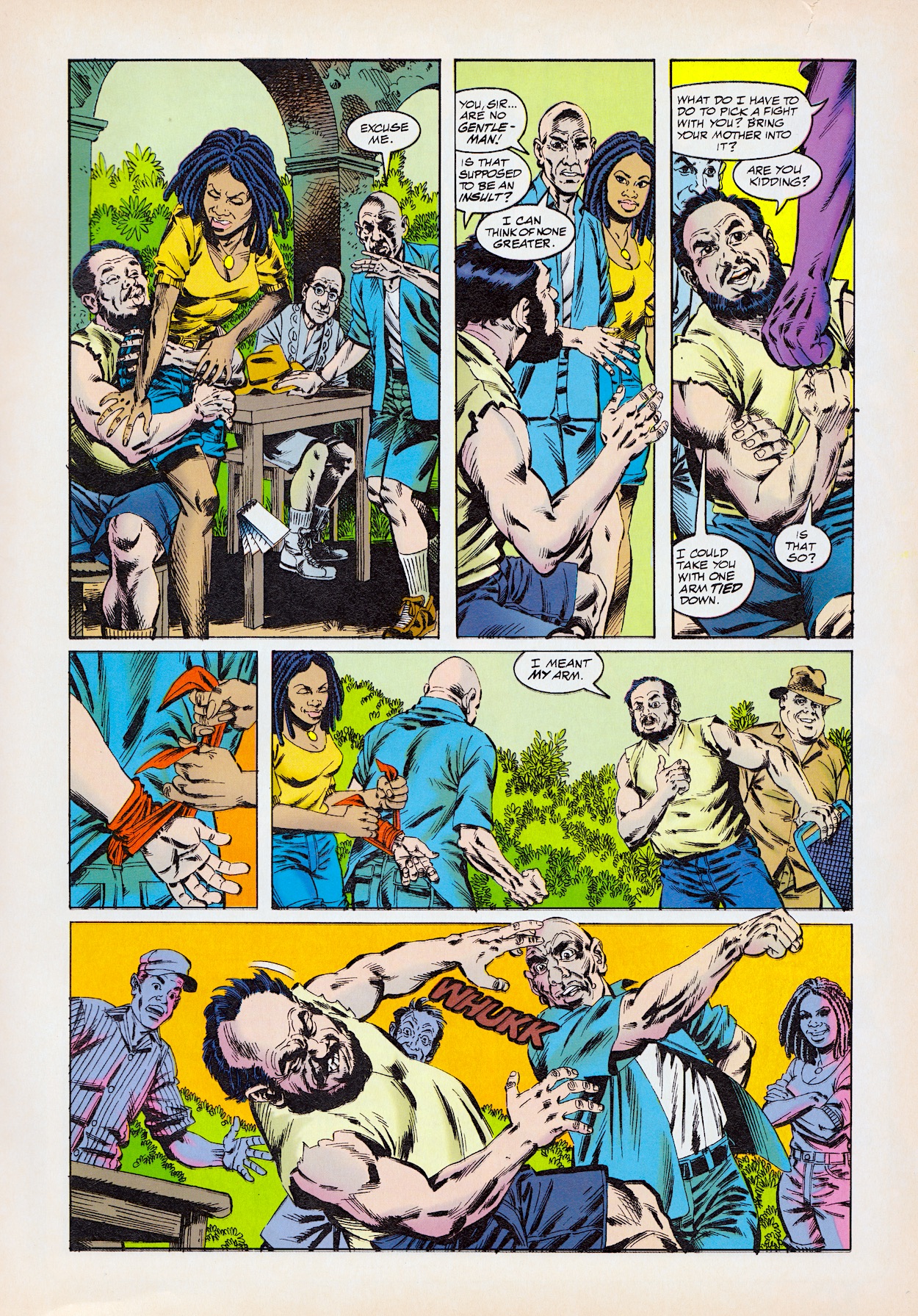
This scene sees him standing up for the honour of a lady some American tourists are hassling and he does it in a rather funny way, playing on the fact he knows they’ll assume he’s a fragile old man. He has no interest in further game hunting until his friend and assistant Ajay tells him what it is InGen want him to hunt! Again cut for pace, when viewed the scenery and setting do feel a bit too similar to the scene setting up the character of Denis Nedry in the original, even though it plays out very differently.

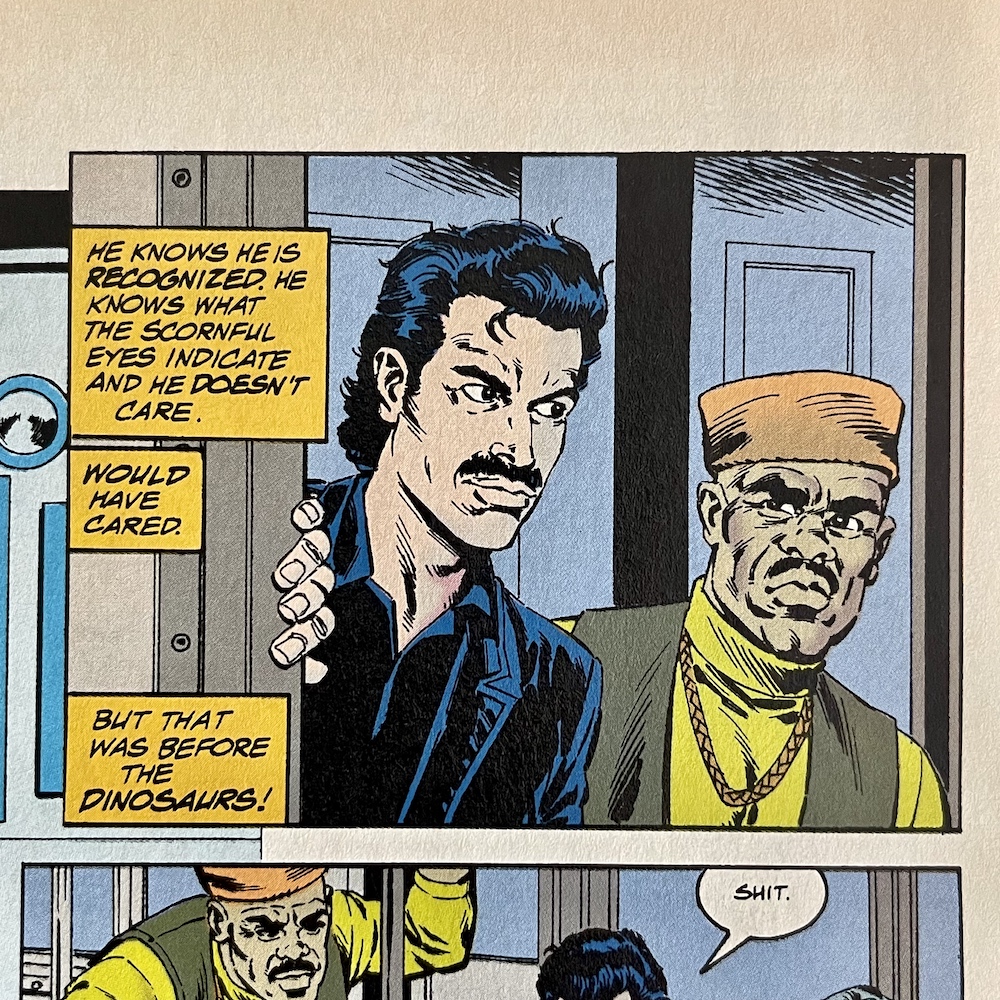
This is about as in-depth as I’ll go into the story of The Lost World during these reviews, after all it’s the movie’s story so I don’t really need to. Just as I did with the first five issues of the original Jurassic Park I’ll be assuming you know it already and I’ll be concentrating on the adaptation itself. The next big difference I notice is one I’m not sure I can come to terms with. Maybe it’ll grow on me as I read the series, but it’s an addition I just feel isn’t needed. I mean, just look at Jeff Goldblum’s moustache!

Maybe Dr. Ian Malcolm has one in the novel. Apart from that I am taken with the likenesses here. A lot of times in comics based on TV shows or movies the characters either look nothing like the actors or the artists concentrate so much on making them look identical that they lose all ability to emote. Here penciller Jeff Butler (Godzilla, The Green Hornet and TSR’s Dungeons & Dragons games) and inker Armando Gil (who brought a scratchy realism to the previous sequel strip) do a perfect balancing job of having a clear likeness without sacrificing what makes a good comic book character.

For most of this opening chapter it feels very much like your typical comics adaptation, writer Don McGregor (James Bond 007, Black Panther, Killraven) taking the main beats of the script and moving between them with as little fuss as possible, cutting and trimming a lot as he goes. Funny moments are pretty much eliminated too which is a shame because the movie was full of them. A particularly memorable scene when Ian, Eddie Carr (Richard Schiff) and Nick Van Owen (Vince Vaughn) are calling out for Sarah Harding (Julianne Moore) when they land on Isla Sorna is conspicuous by its absence.

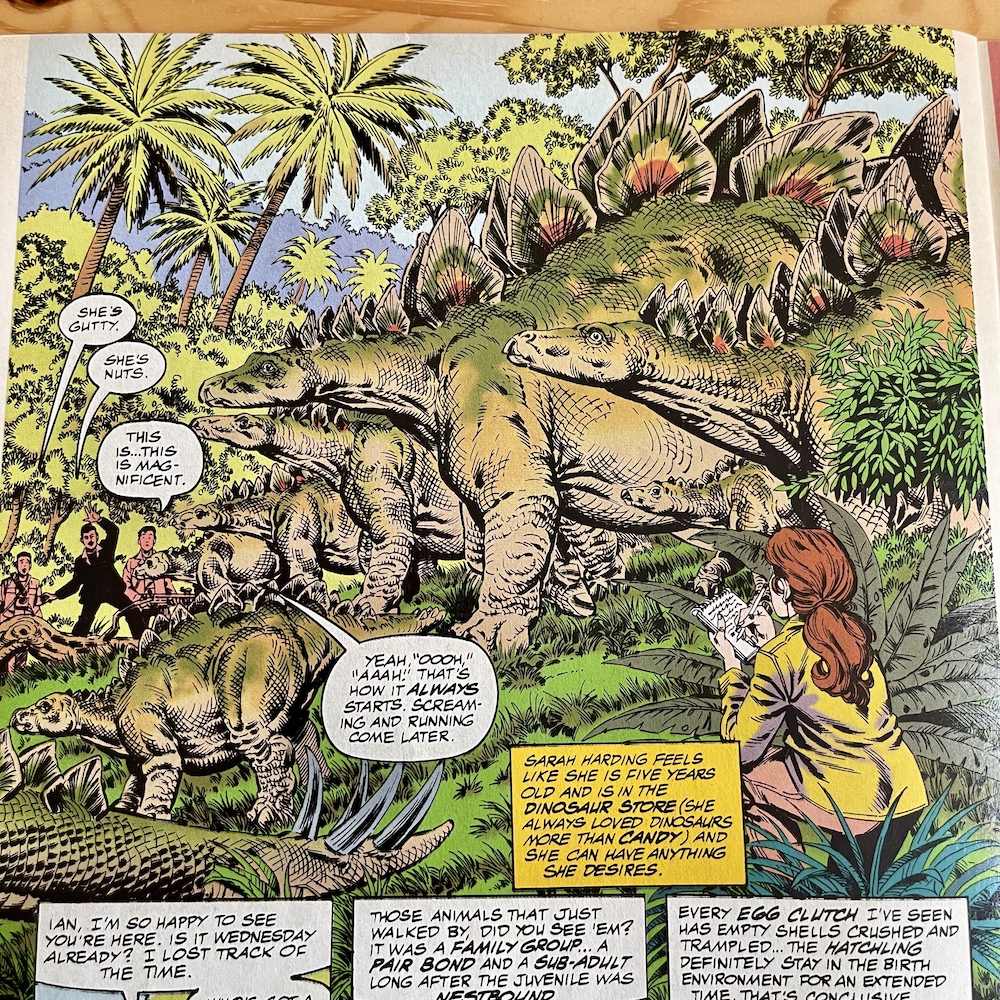
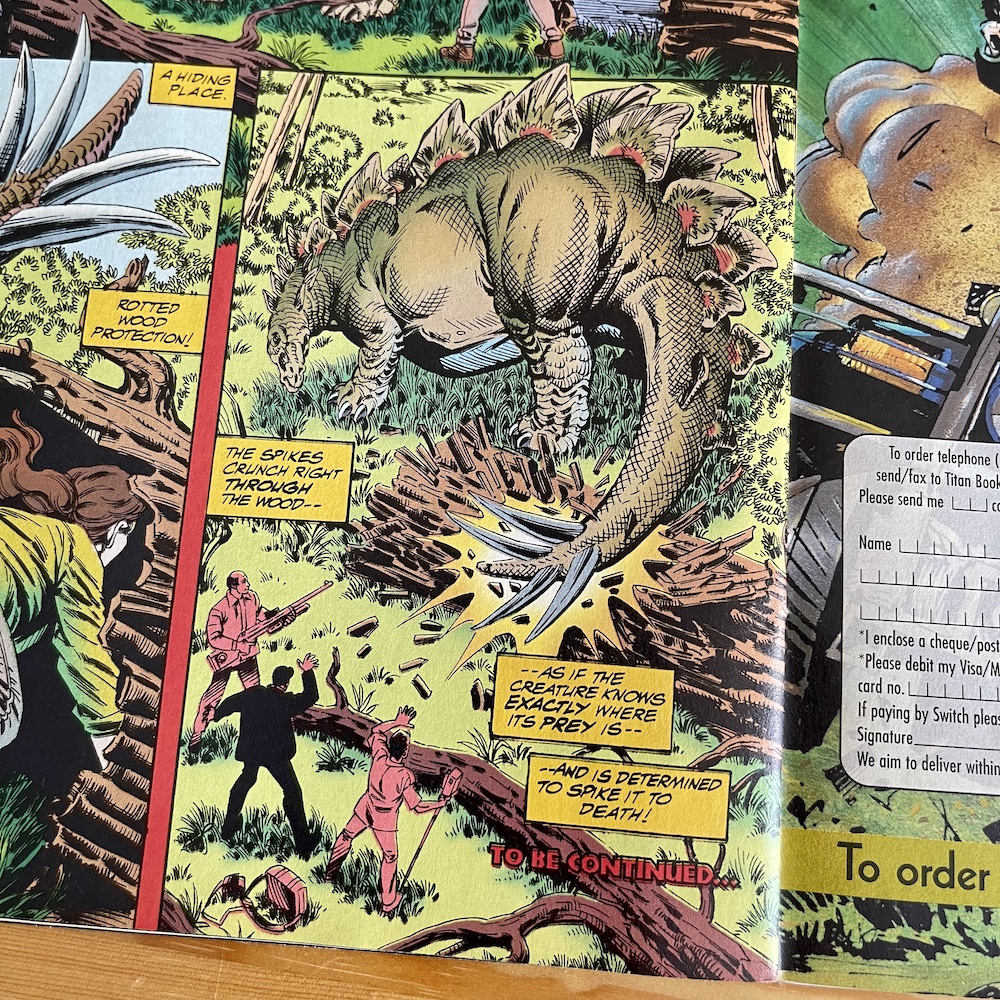
The scenes with Ian’s daughter Kelly (Vanessa Lee Chester) are there but again have been chopped down to their bare minimum which is a real shame as they felt really genuine on the screen. The chapter ends with the Stegosaurus scene although the grandeur of their entrance is lost when our characters are just miling about among them. Also the baby, key to what happened next, isn’t involved and it all feels rather rushed to get to some form of cliffhanger. But what is quite wonderful is the depiction of the Stegosauruses. It’s certainly more detailed than the previous adaptation and a lot more so than Armando’s sequel art.

Ken Lopez is our letterer for this story and returning story editor Renée Witterstaetter’s colours are a particular highlight, especially on these final pages in the jungle. In fact I’d say in the three short years between the comics there’s been a marked improvement across the board in terms of looks, even with a team made up of some very familiar names. Speaking of familiar names, that cover (taken from #3 of the American comic) is by original adaptation writer Walter Simonson and Richard Ory (Cloak and Dagger, Marvel Fanfare, Doctor Fate).

Regular blog readers will know I’m not usually a fan of movie adaptations but that the original Jurassic Park one had me thinking differently. At least for the first three chapters anyway, with their added information from an earlier script draft, passages from the book and interesting ways in which it shook up and changed key parts of the movie in order to make it work in a new medium. I enjoyed that. But the final two chapters became what I abhor about all other adaptations I’ve read.

Instead of being a considered reworking for the comic, the finale just jumped from one key scene to the next as quickly as it could to get to the end of the story, excising whole chunks of it in the process (including just suddenly forgetting about the only black character mid-story), eliminating anything that wasn’t basic plot, combined with what felt like rushed artwork to meet the deadline of the movie’s release. While the art is a big step up in my books, The Lost World Jurassic Park seems to be more along the lines of those final chapters, unfortunately. But it has time to improve and it’d be a shame if it didn’t, what with that lovely art.

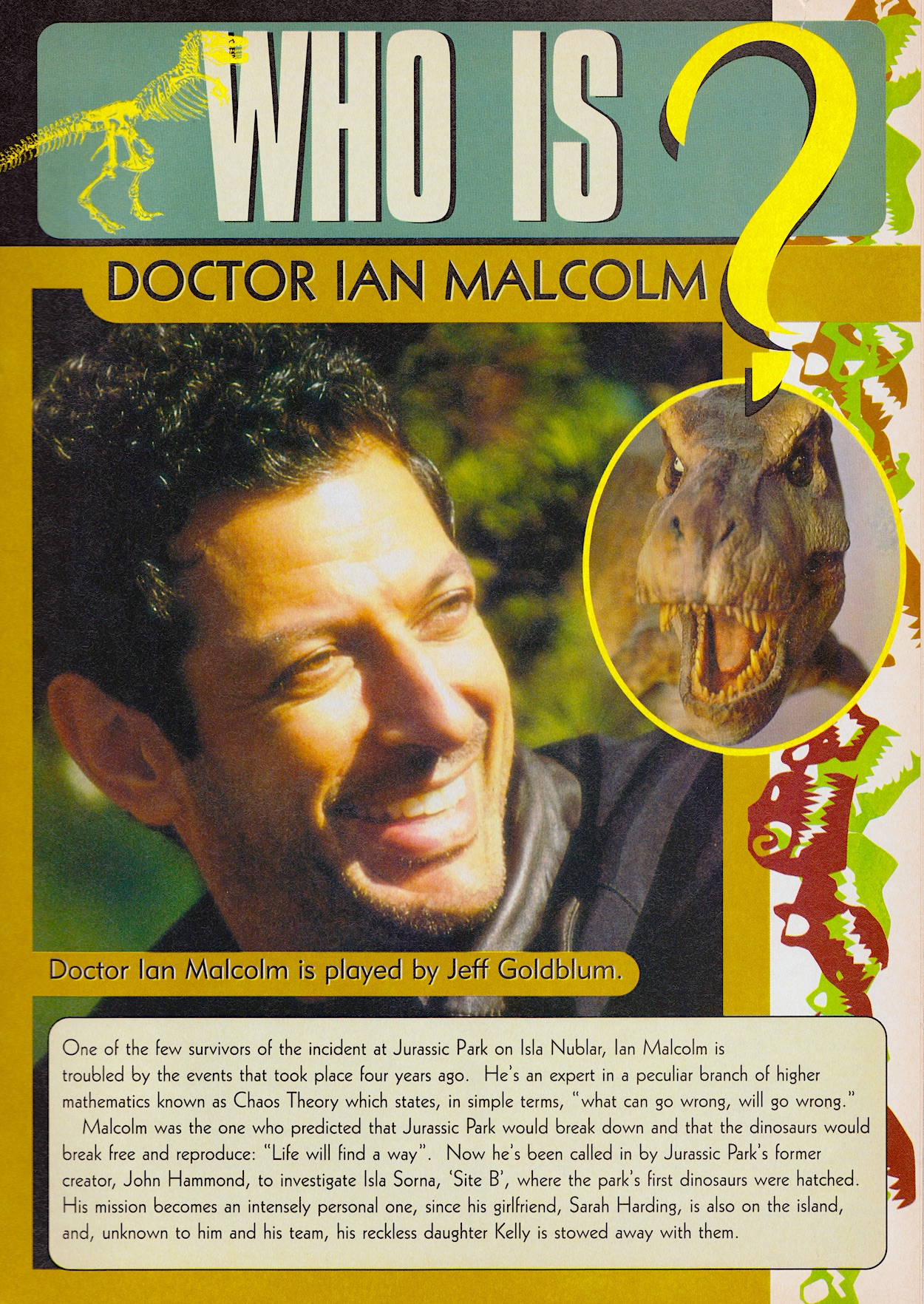
This being a UK comic there are of course extras. The four middle pages are made up of a poster of one of the film’s best scenes, a profile of the more rugged (but still sans moustache) Ian and a page about the T-rex written by Steve White. There’s a lot of information here but for some reason it doesn’t mention their visual acuity, the whole “it can’t see us if we don’t move” thing which was so important in these first two movies. The page actually looks messy and unfinished, with what seems to be a placeholder rectangle, a clip art frame and an image sitting waiting to be edited together, with text over the top that’s difficult to read as a result . Strange.

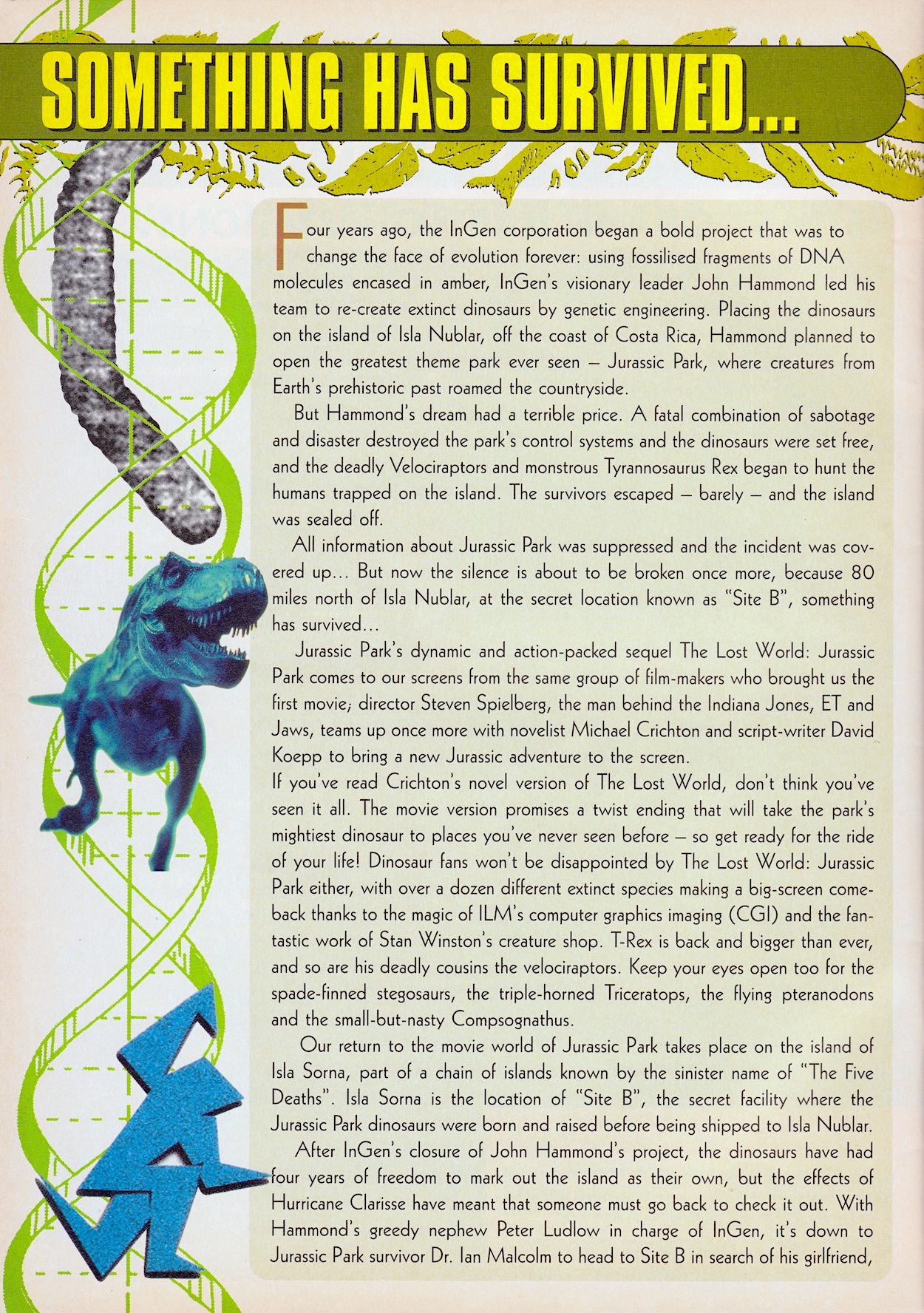
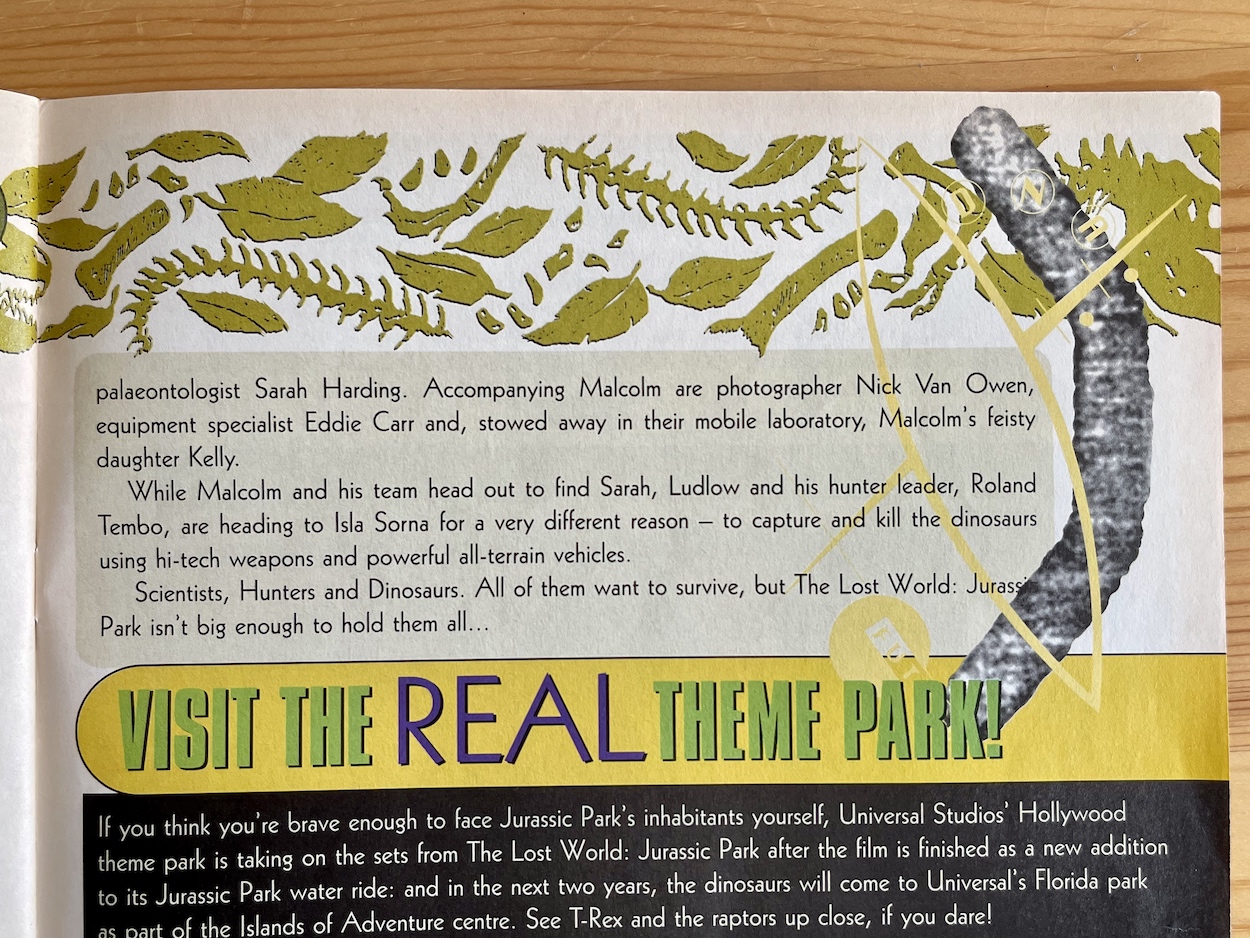
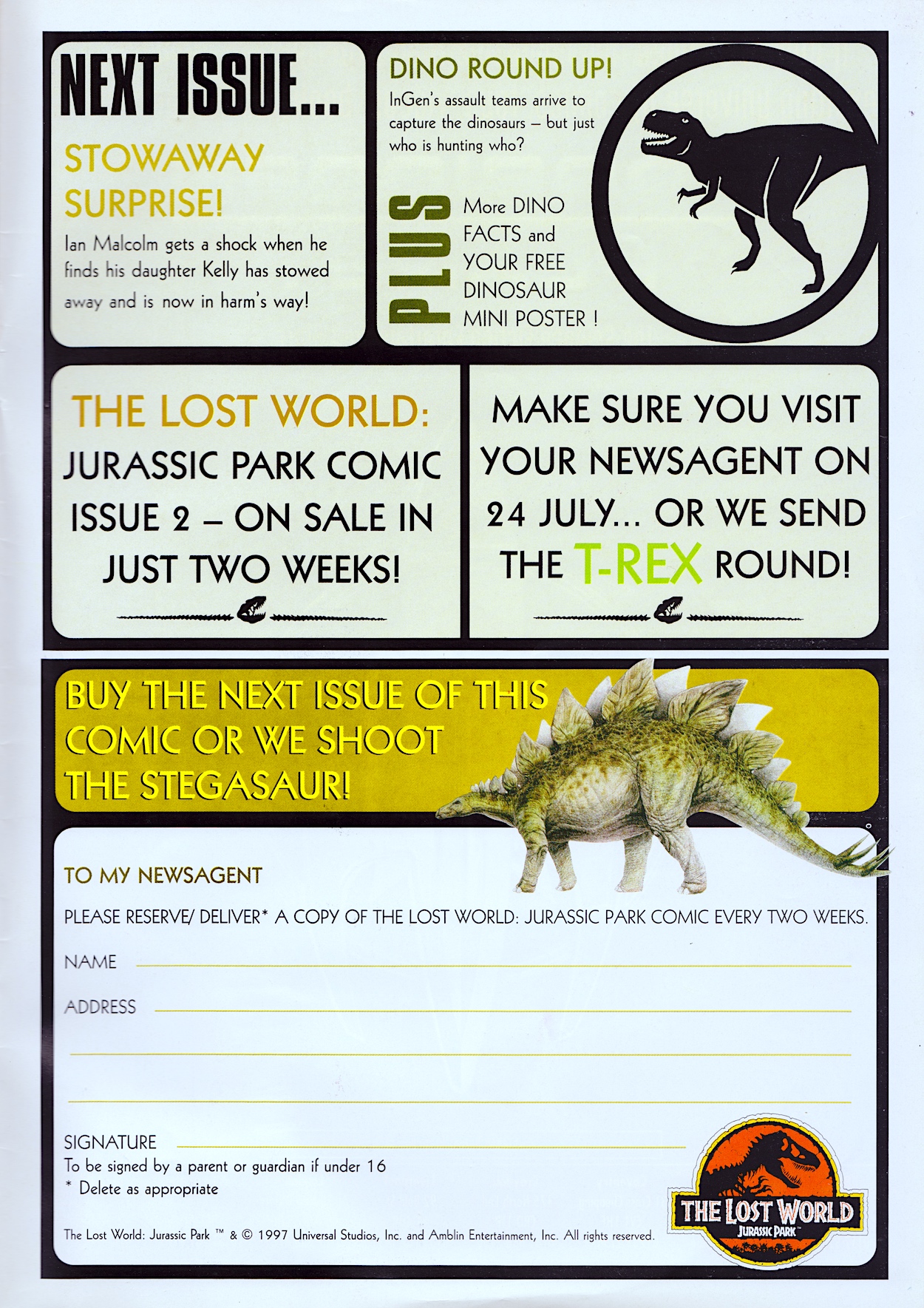
Towards the back is Something Has Survived by Jim Swallow (who’d go on to write Marc Dane, Sundowners and Warhammer 40,000 novels), a text article which basically reiterates what we know already from the strip, although it does give an interesting nugget of information about the film’s ending. There’s also an advert for the graphic novel of the comic which is a bit weird to include when you want people to buy it in individual chapters instead (although the original comic did run a competition for its graphic novel after it had printed the whole story already) and the Next Issue page is rather basic with two different versions of “buy it or else”, the second of which just feels wrong!

The most exciting extra for me is actually an advertisement for a completely different magazine.

I loved Babylon 5 from the moment I decided to tune in to the first episode broadcast on Channel Four. I was completely hooked and I remember the magazine fondly, placing a regular order before the first issue appeared if memory serves me right, so I must’ve seen an advert for it somewhere else. I remember being particularly fond of show creator J. Michael Straczynski’s column and his brutal honesty when discussing working in the television industry and how hard it is to make a living as a writer. I’d no idea John Freeman edited it until just recently. I’m beginning to think he and Steve White (colourist and editor at Marvel UK and who did exceptional colouring work for Xenozoic Tales in the original Jurassic Park comic) are a bit like Lew Stringer in that there seem to be very few publications from my youth they weren’t involved in!

Unlike most comics at the time The Lost World Jurassic Park was fortnightly rather than monthly. With no further strips coming from the States there was never any intention of continuing it beyond the adaptation so, just like over there, it was a mini-series of four. The artwork has saved this opening chapter, will the writing catch up? You can find out in two weeks on Monday 24th July 2023.

GO TO iSSUE TWO

JURASSiC PARK MENU

JURASSiC PARK #13: END OF AN AGE

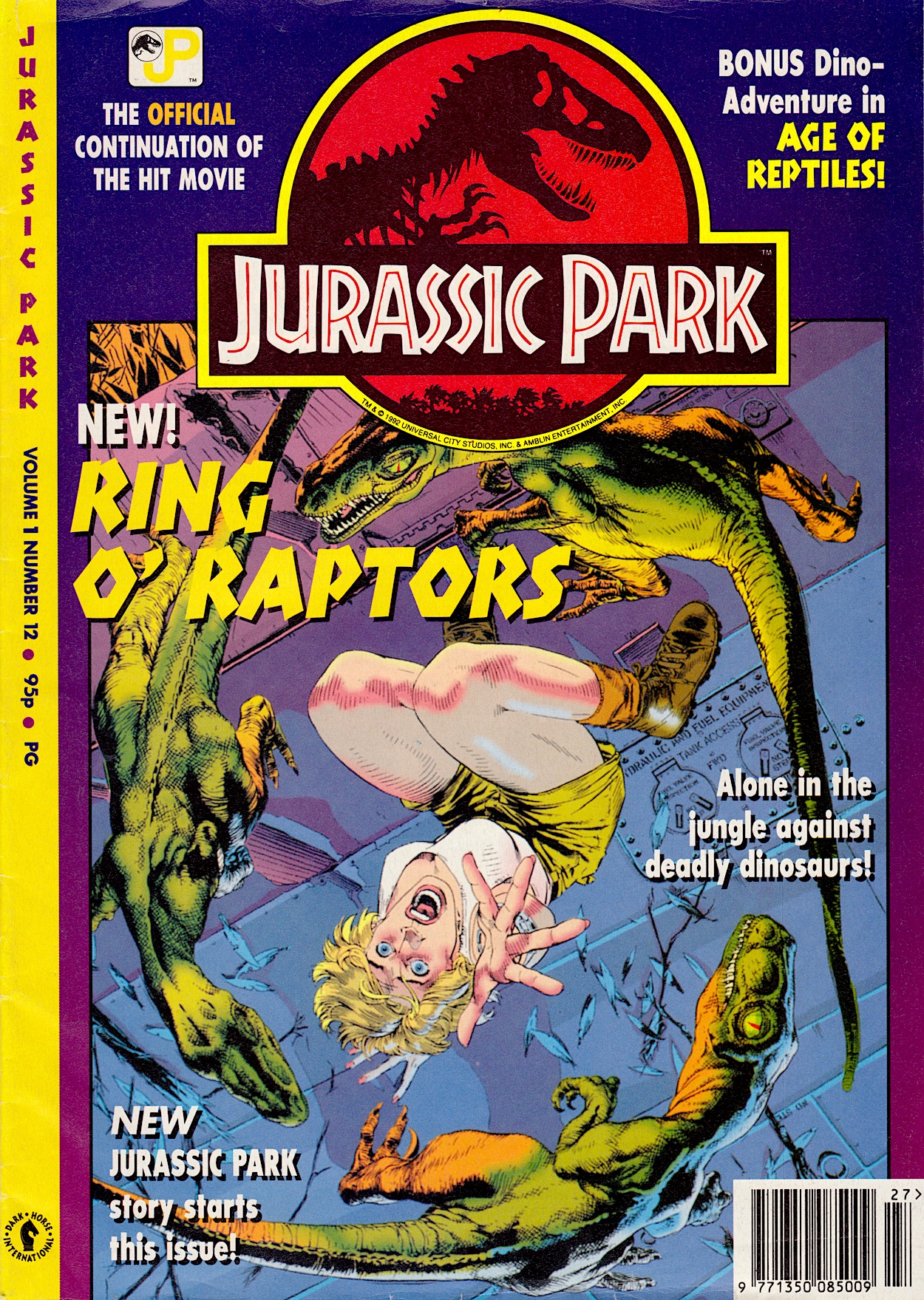
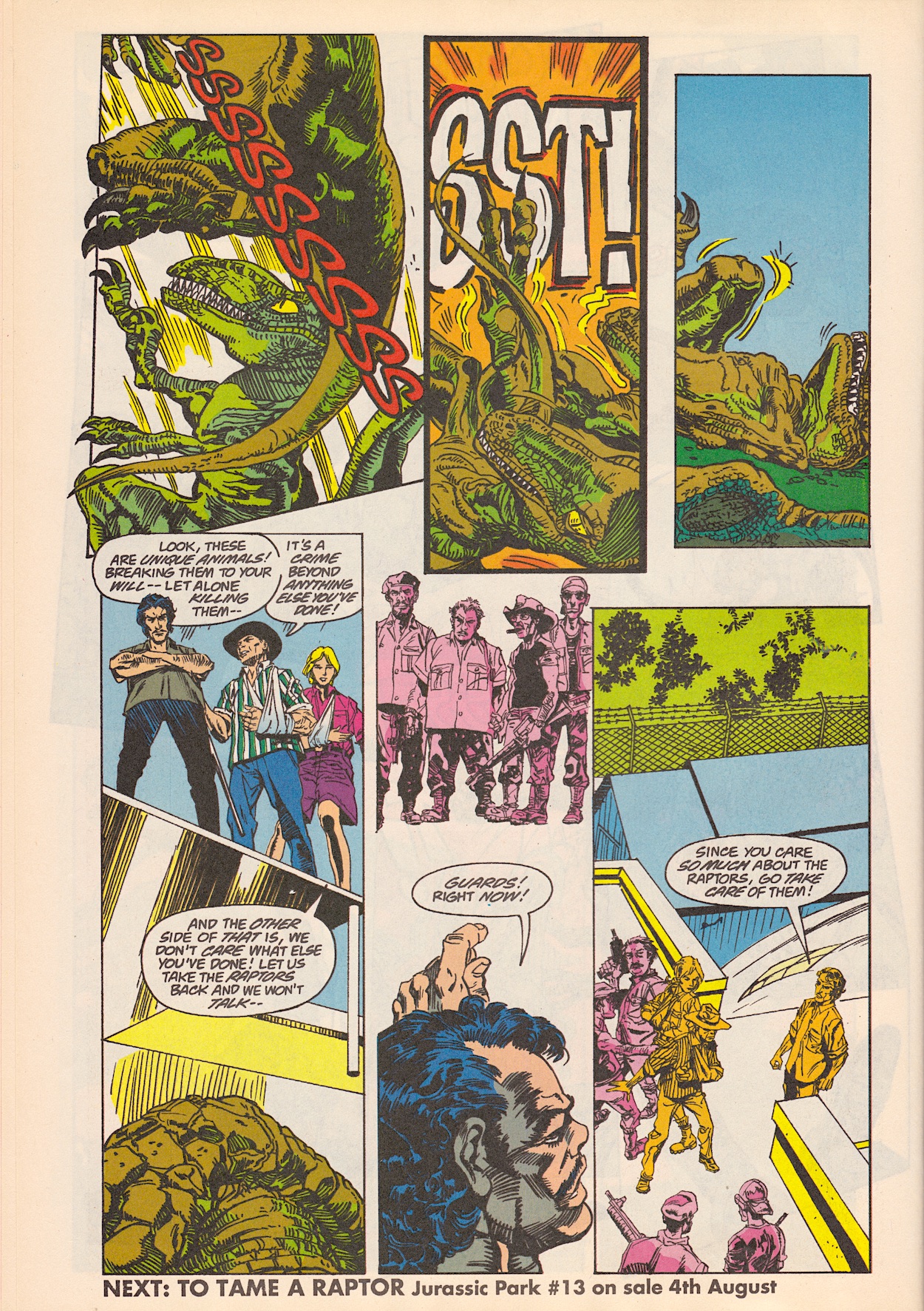
This would be the final issue of Dark Horse International’s Jurassic Park, but the comic would continue for a few months yet. No, that’s not a contradictory statement, as you’ll find out next month. This is, however, the last time the cover will have that distinctive banner down the left side. What a cover image that is too. On the contents page the credit for John Bolton’s image clarifies it’s “a scene from the classic movie”. A classic just months after its release? It would be, but it wasn’t even out on video at this stage!
John’s dramatic image was created for the American Topps Comics’ ongoing monthly, Return to Jurassic Park which had been released after the few initial mini-series, the second of which we were still reading in the UK comic. In fact, this edition saw the conclusion of the first issue in the second mini-series, Raptors Attack and was written by official sequel scribe Steve Englehart, pencilled by Armando Gil, inked by Fred Carillo, lettered by John Costanza and coloured/story edited by Renée Witterstaetter.
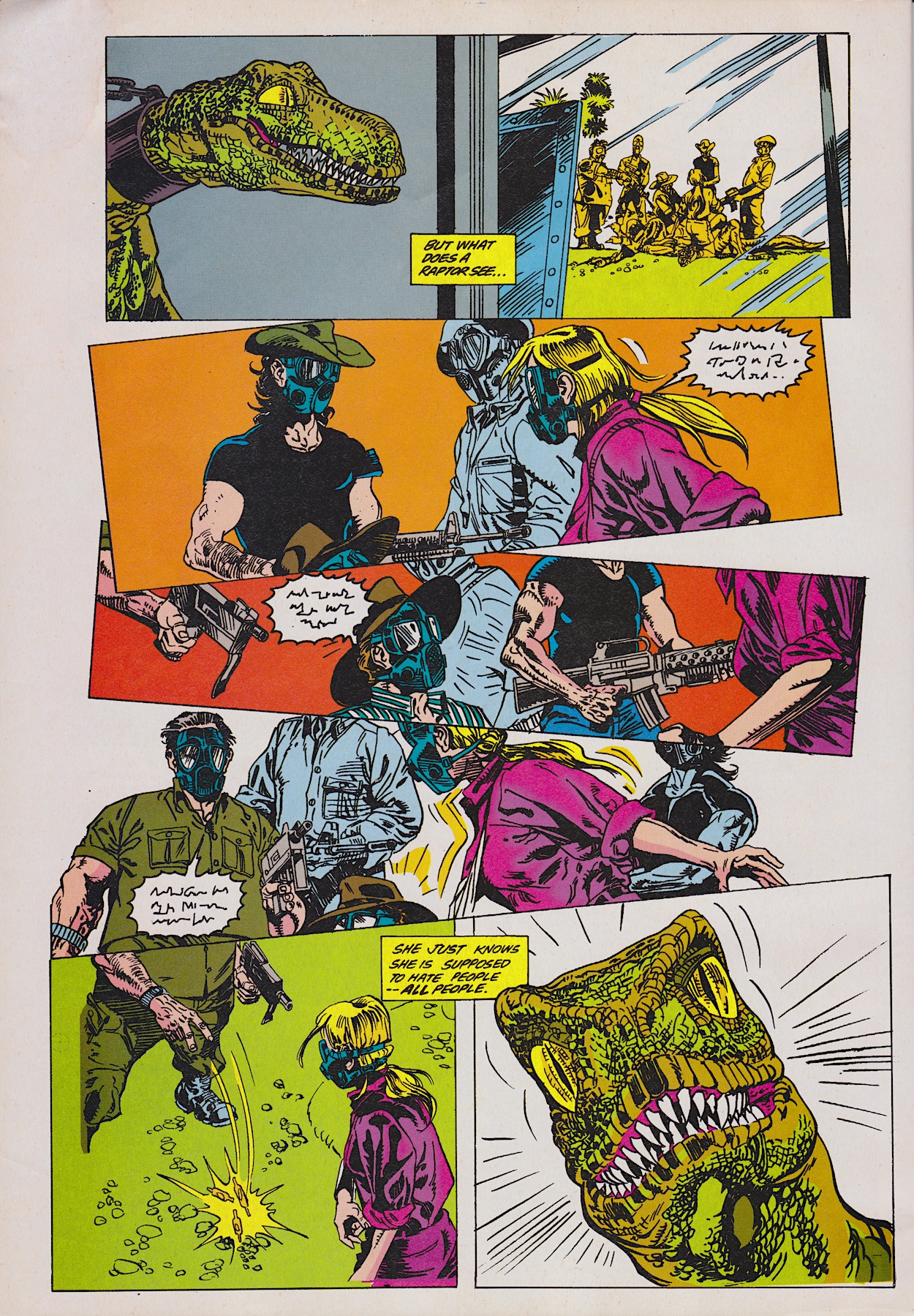
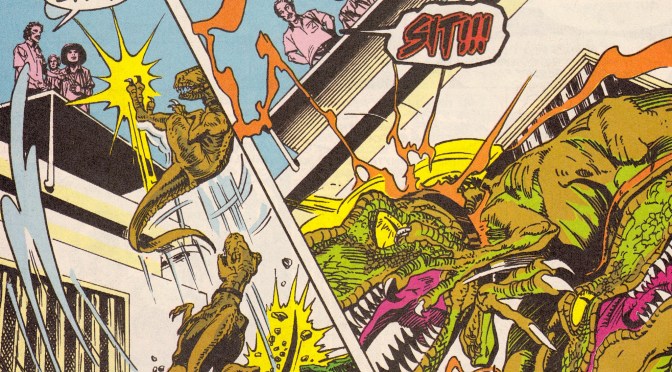
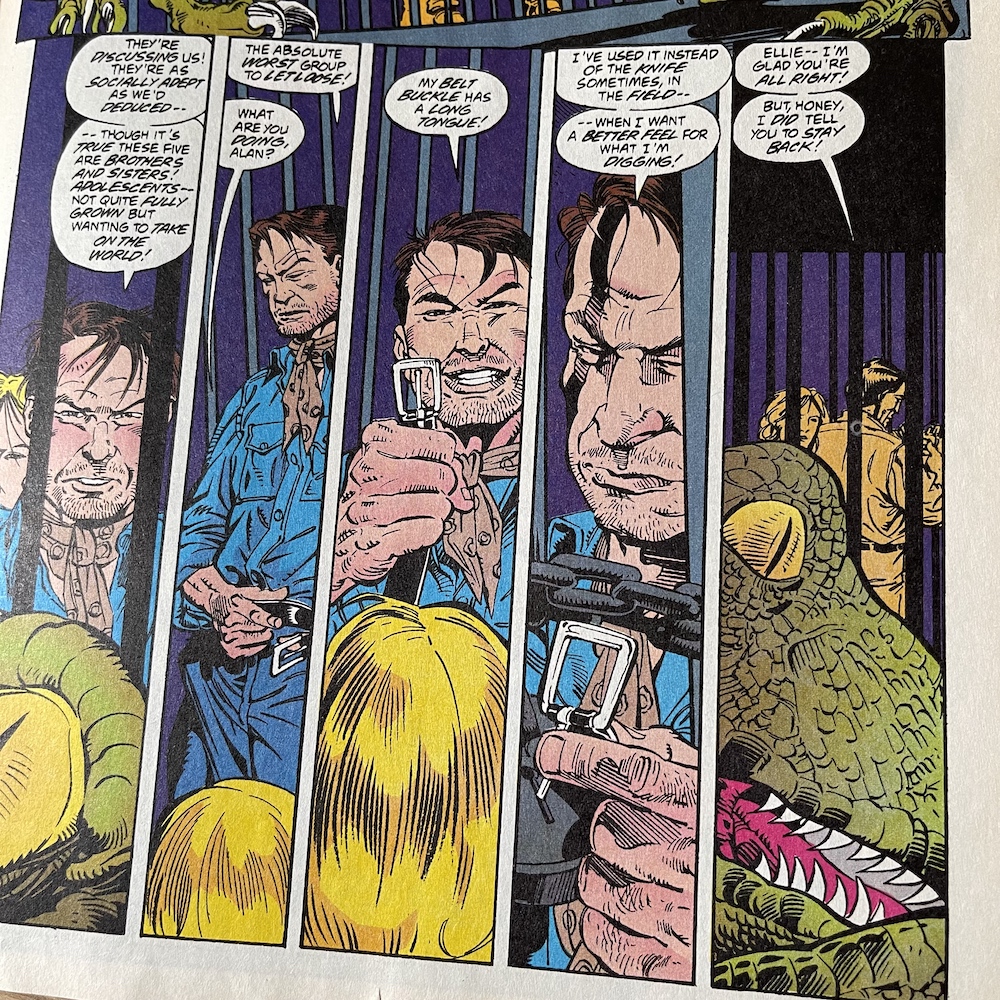
Part two of Rush! sees Doctors Alan Grant and Ellie Satler given the unenviable task of looking after the juvenile Velociraptors captured by Columbian drug lord Rafael. Training them via use of electroshock collars (the ‘raptors, not the doctors) the dinosaurs are becoming worn down and sick. Gassed and asleep, our heroes are sent in to examine them, not that Rafael is going to listen to any of their recommendations. As this is taking place the ‘raptor that was previously shot in #11 and saved by Ellie watches on from her cage.

What I particularly liked here was seeing some scenes from the point of view of the animals. For example, here the language of the humans is just a load of strange alien noises but she watches intently, trying to work out what’s happening, despite her base instincts. This storytelling technique isn’t used extensively, just enough for us to see their vantage point at specific moments, always treating them as intelligent wild animals instead of movie monsters,  a main theme of the novel and films. They’re individual characters and subject to development in this strip just like the humans. I like this a lot.


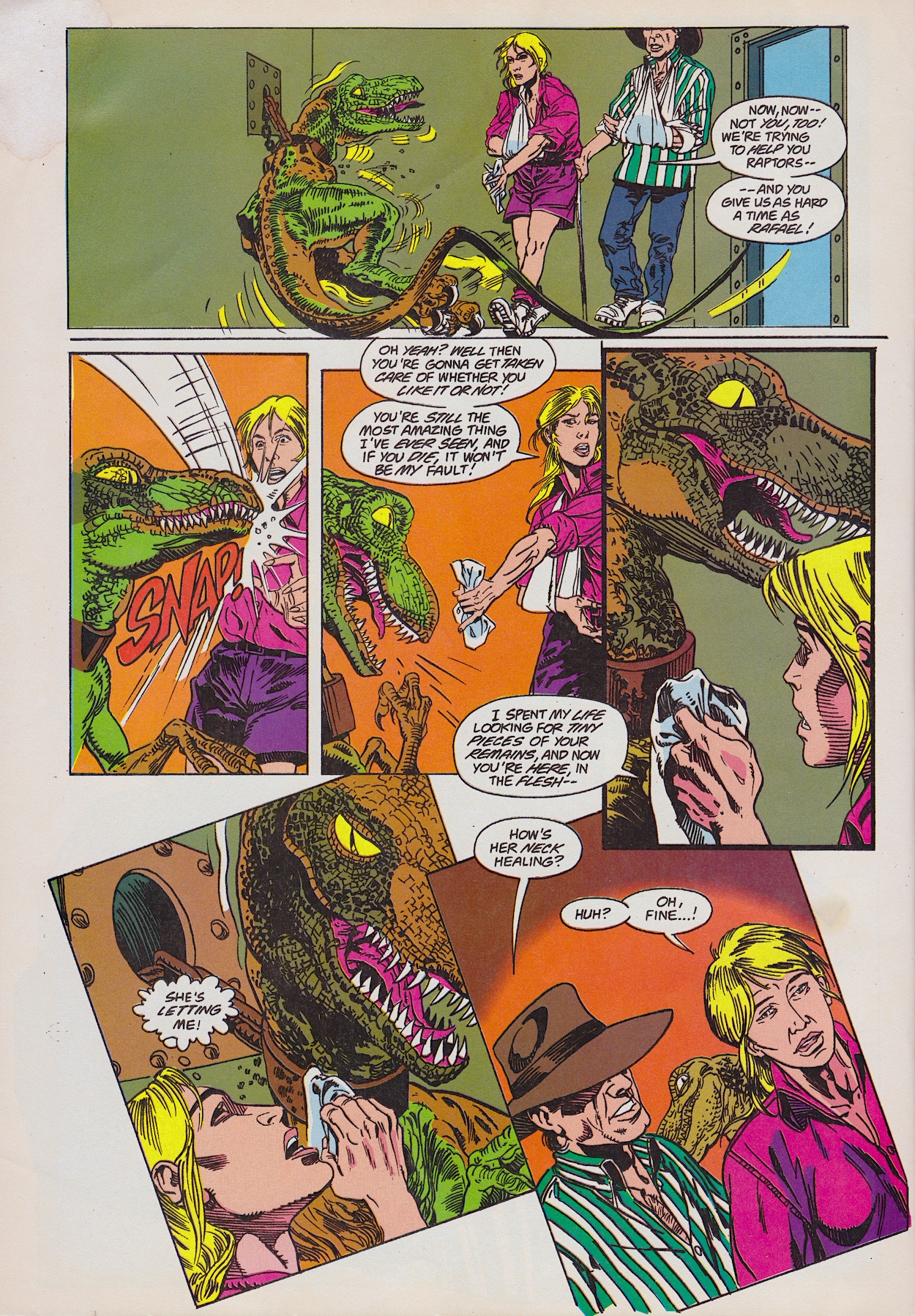
“I spent my life looking for tiny pieces of your remains, and now you’re here, in the flesh”

Dr Ellie Satler

Kept separate from her siblings she tries her best to attack Alan and Ellie as they approach her but she’s chained up and unable to make contact. Ellen then chastises her! How dangerous these animals are is always front and centre, and the others still terrify Ellen but after saving this one’s life she’s determined to help it. As she said in that previous issue, given half the chance she’d be torn apart by this creature but it’s still a miracle and she has an obligation to it as a scientist.

As you can see the ‘raptor eventually lets her tend to her wound, remembering she saved her life. From memory this is an important plot point and one the ongoing strip would return to in a key moment, but I won’t get ahead of myself. This, and the following page of the other two dinos preying on and destroying humanoid hay decoys reminds me a lot of the first Jurassic World, which is something else I’ll return to later in the run. But for now the constant training over several weeks seems to be reaping rewards for Rafael.

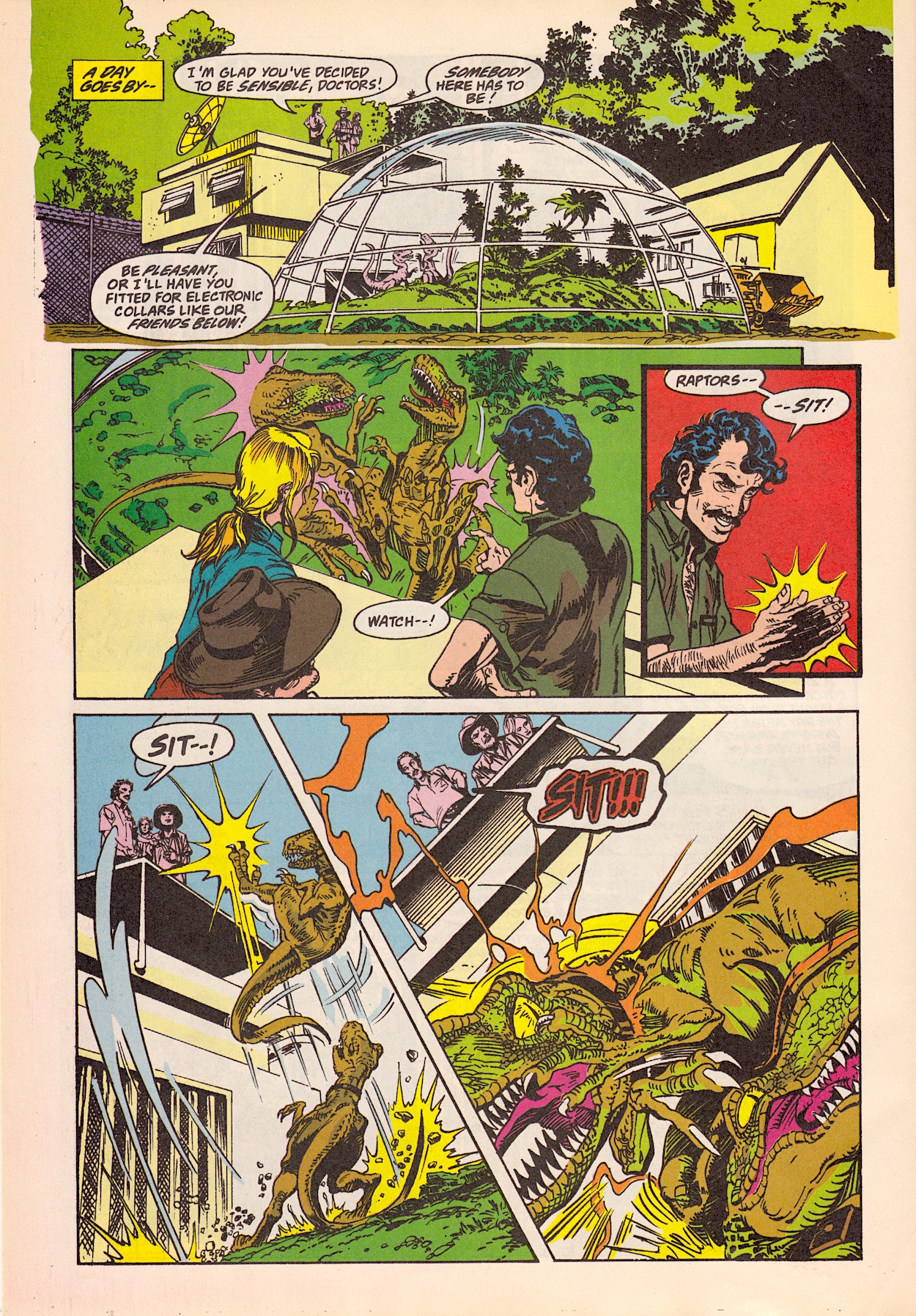
The ‘raptors are attacking on queue, and when they jump towards Rafael on the other side of their glass dome a simple command has them stop and obediently await their next instruction. But his successes can’t stop his paranoia about competitors and the government closing in on him, despite no evidence of the kind; a result of being secluded from the outside world for too long. When local soldiers are spotted searching the jungle he assumes they mean to steal his dinosaurs so he and his men take his newest recruits for a test.

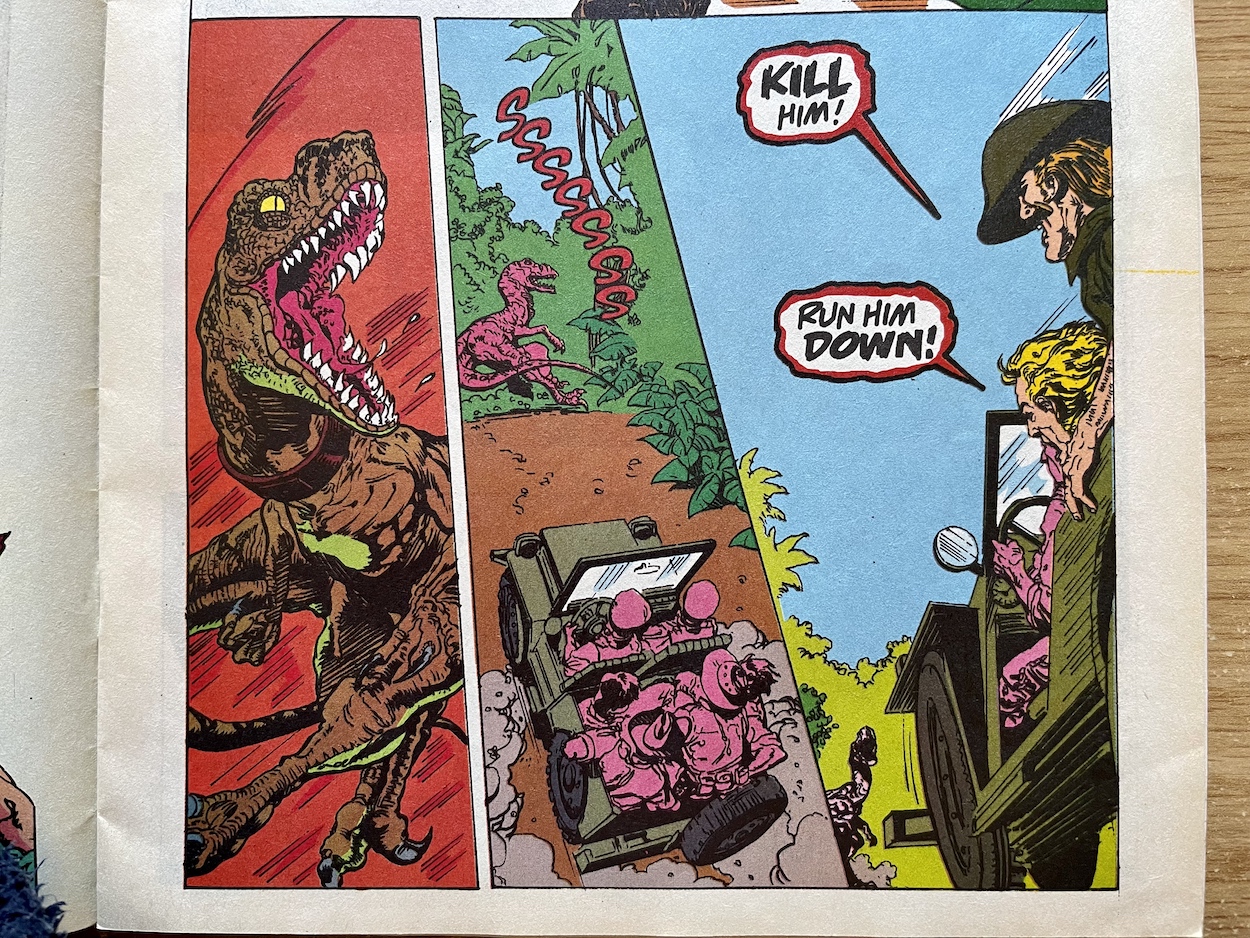
Ordered to attack, they take to their task with relish, dispatching the soldiers one at a time over a few pages. Armando Gil’s trademark use of dynamic angels comes into play here, one perfect example being the panel featuring the jeep trying to run down one of the ‘raptors, almost like its taking place on the top of a hill, the ground rounding towards the dinosaur. He’s just using two perspectives in one panel, one for the humans and one for the animal in the distance but it works to create a dynamic sense of excitement.

It’s clear these two “clever girls” have plans of their own

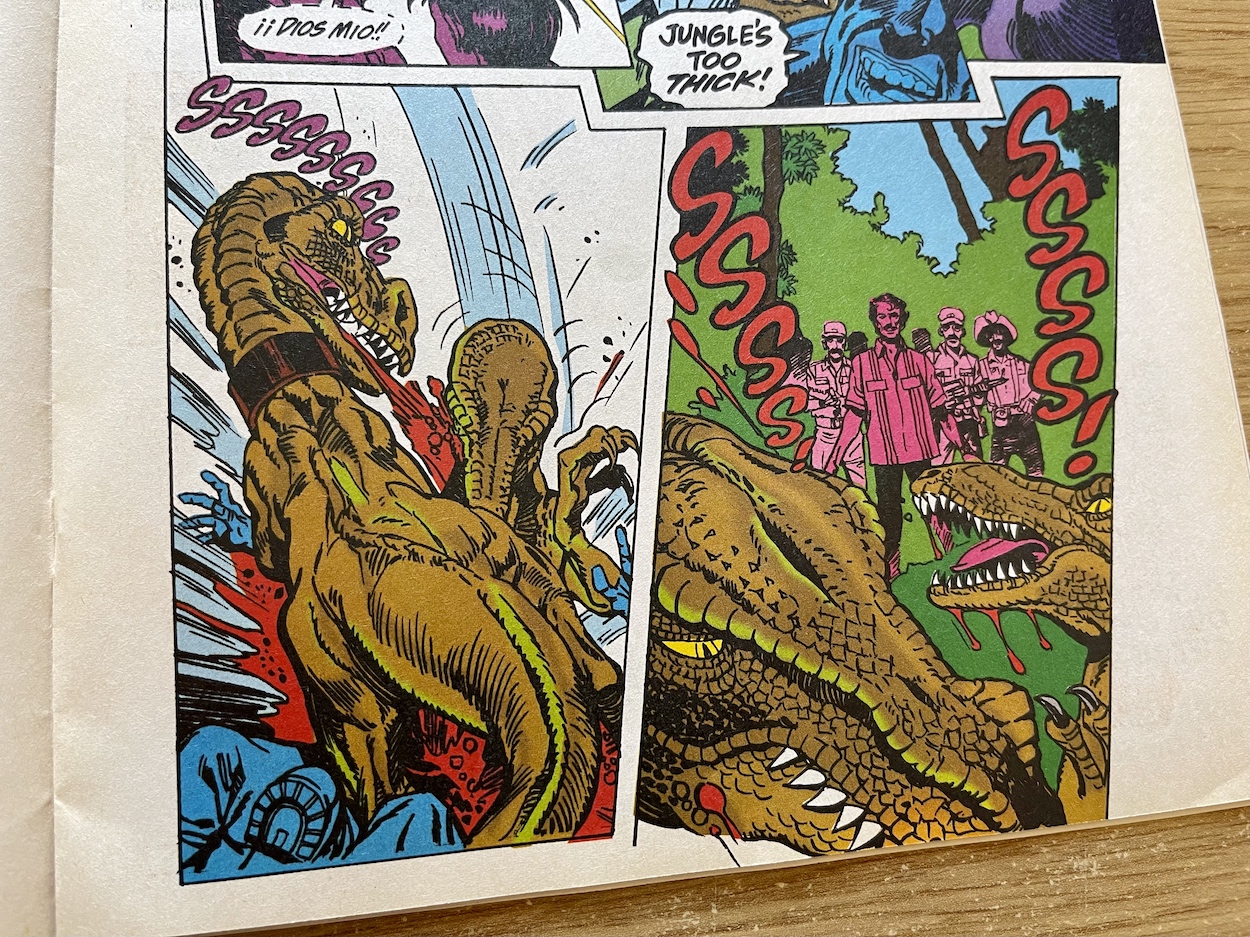
In the end she jumps on top of the car, making it crash into a tree where she rips the soldiers apart. As you can see the comic goes all in on the blood and guts. These pages are full of it. Yes, it’s tame compared to horror comics or modern action fare but as a licenced title I was surprised. As a teenager I lapped it up, but looking at it now it feels strange when the films use suggestion and good direction to avoid gore, letting our imaginations fill in the blanks which is much more effective.

With the soldiers dispatched they make a leap for Rafael, but he shouts “Stop!” and they do just that! Are they fully trained after all? Is this man about to become one of the most dangerous criminals the world has seen? Not if a look shared between these two “clever girls” (to quote the movie) is anything to go by. This final panel tells the reader a lot more than I initially caught on to when reading this in 1994, but knowing what transpired next it’s clear these two have plans of their own.

This was such fun, especially when read upon its original release before any of the movie sequels took the dinosaurs off Isla Nublar, beginning with San Diego in The Lost World: Jurassic Park and then of course we had Owen Grady’s training and bonding with Blue and the rest of the Velociraptors in Jurassic World. This was groundbreaking at the time and still fun to read today, if somewhat diluted thanks to those later stories on the big screen.

The ‘Next’ caption is very uninspiring I have to say. More interesting is the fact there’s a free gift in the next issue because I have no recollection of this whatsoever. So you’ll be finding out what that was at the same time as me. For now we move on to the second half of the comic and a thrilling but bittersweet strip. Age of Reptiles has been building to this moment for eight issues now and it was a thrill to read this, but sad to get to the end and say goodbye to these silent comic stars.

But creator/writer/artist Ricardo Delgado makes sure they go out in style.

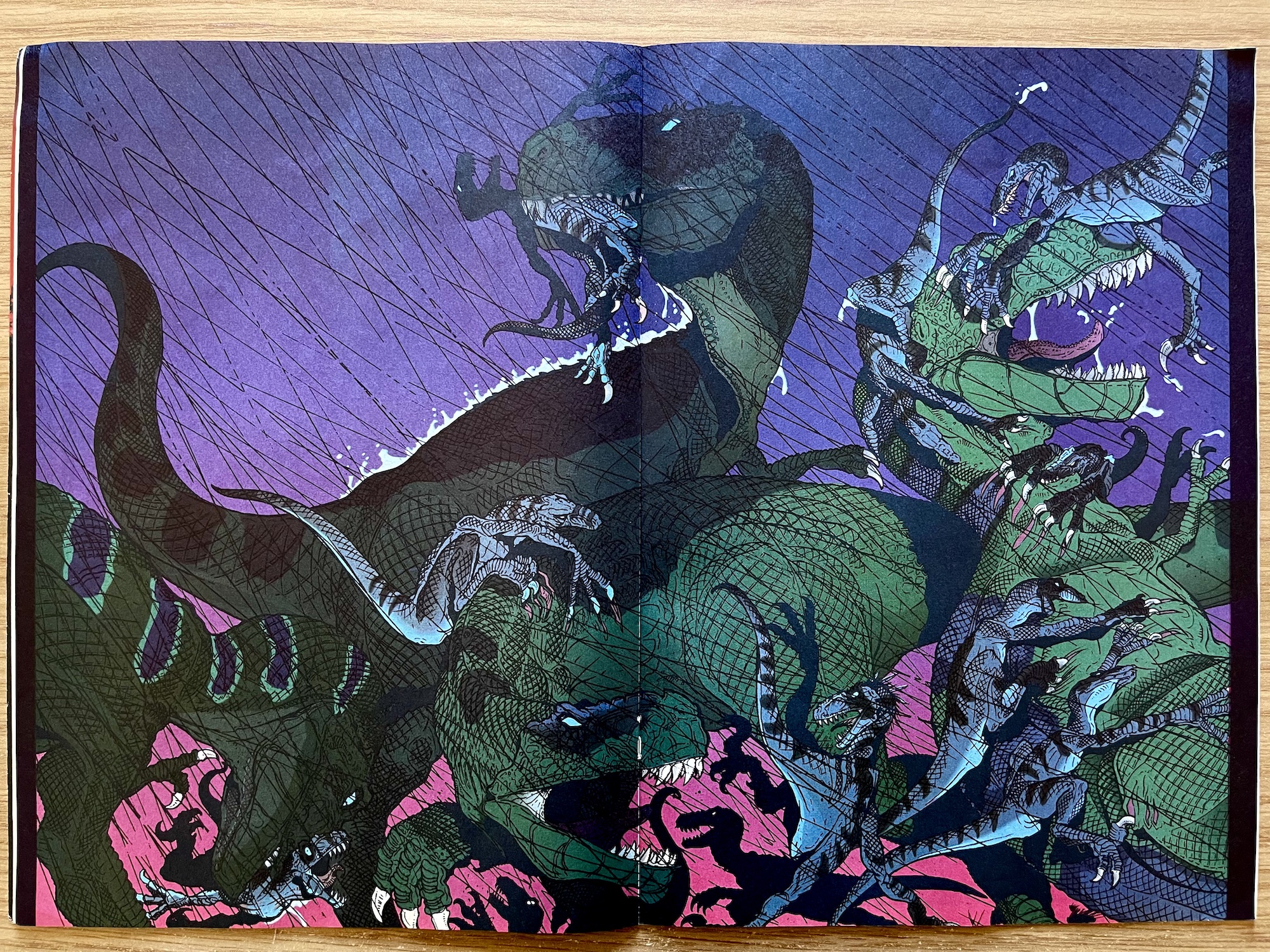
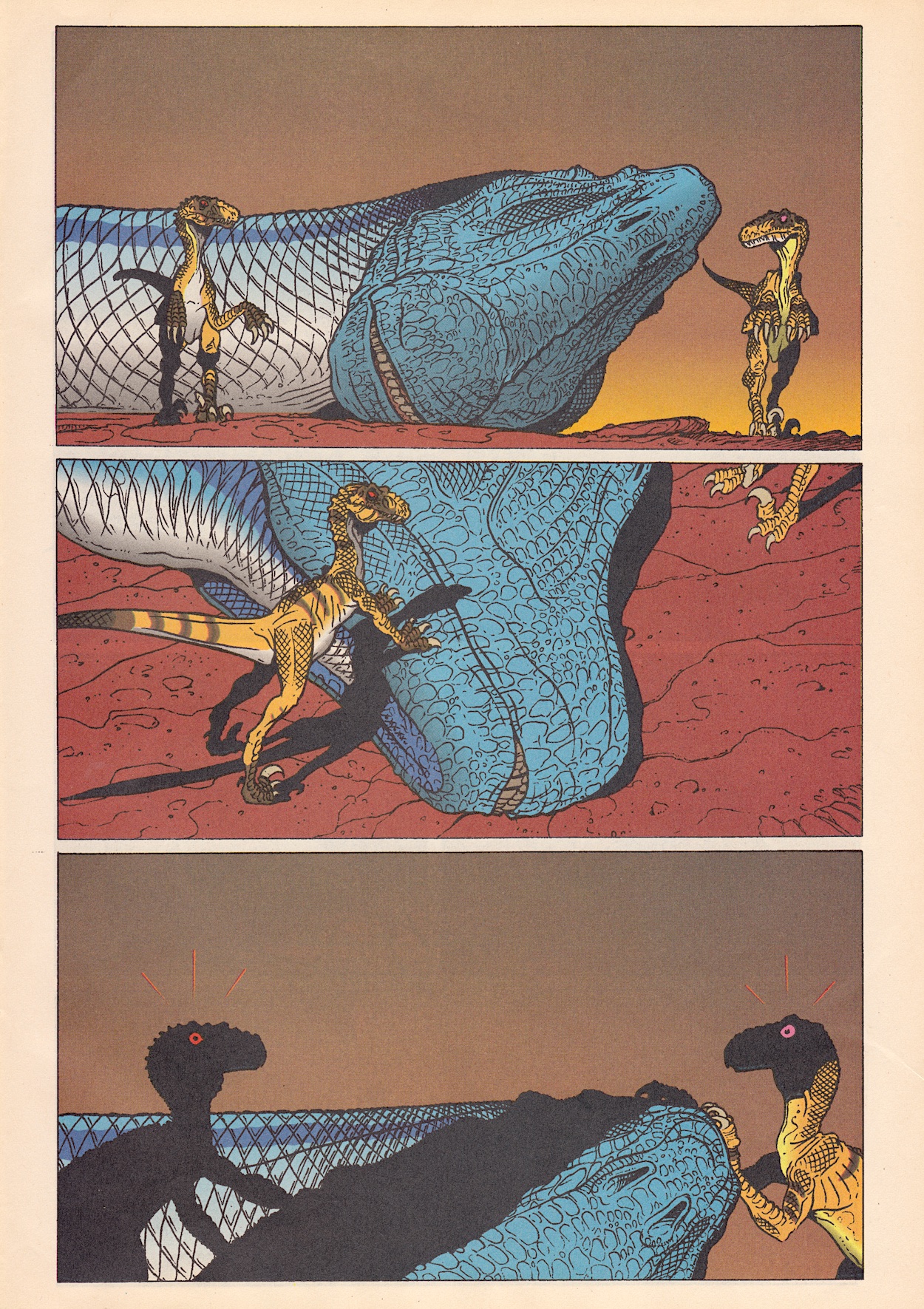
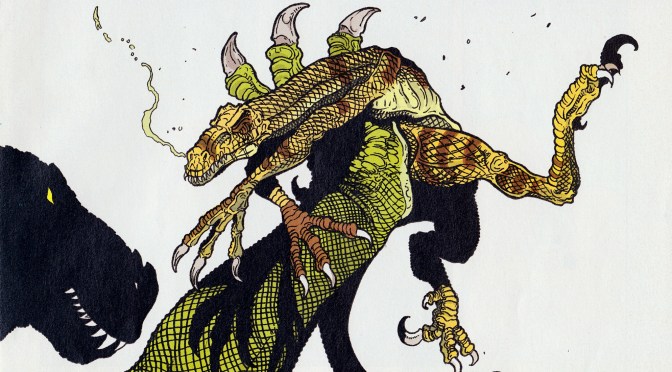
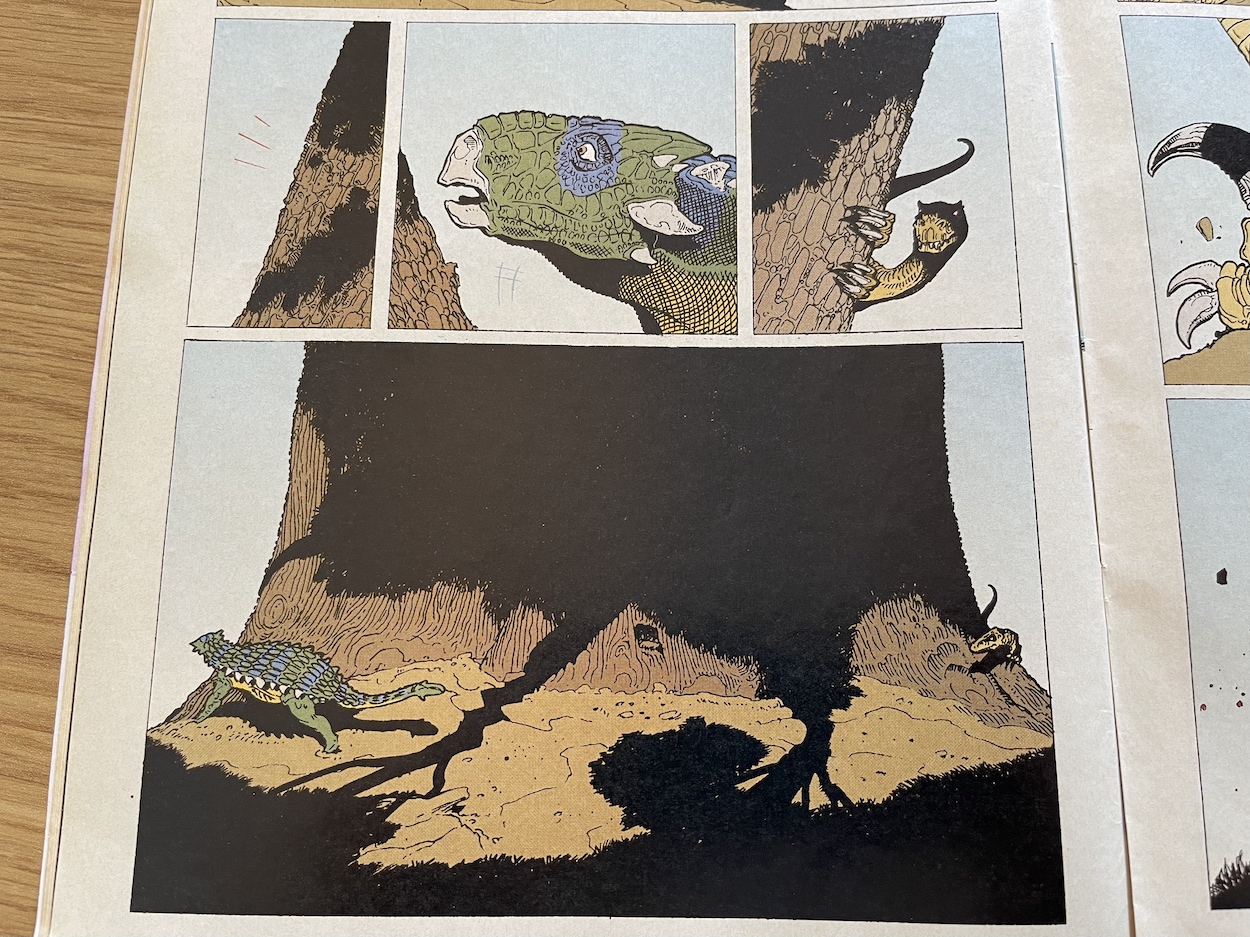
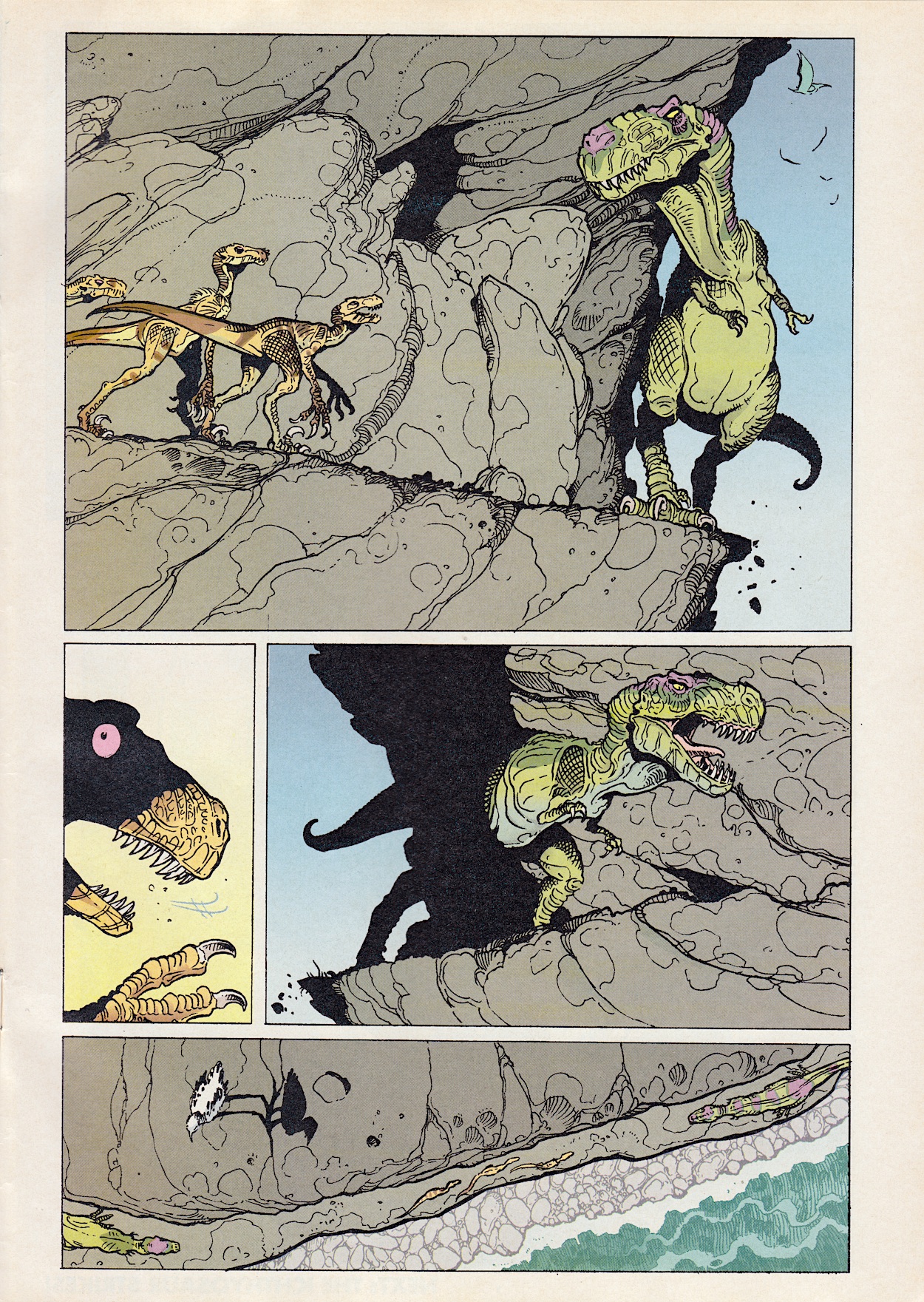
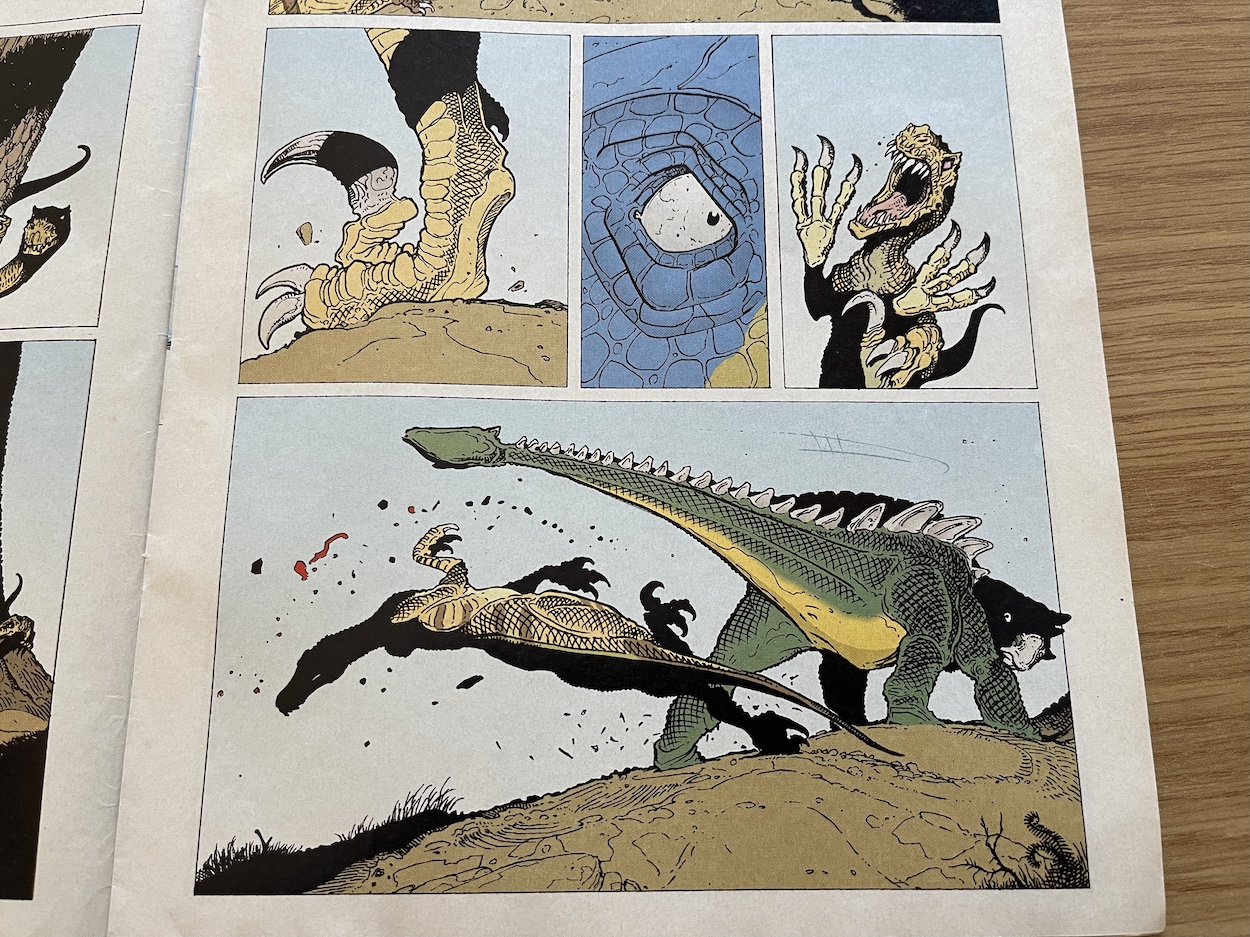
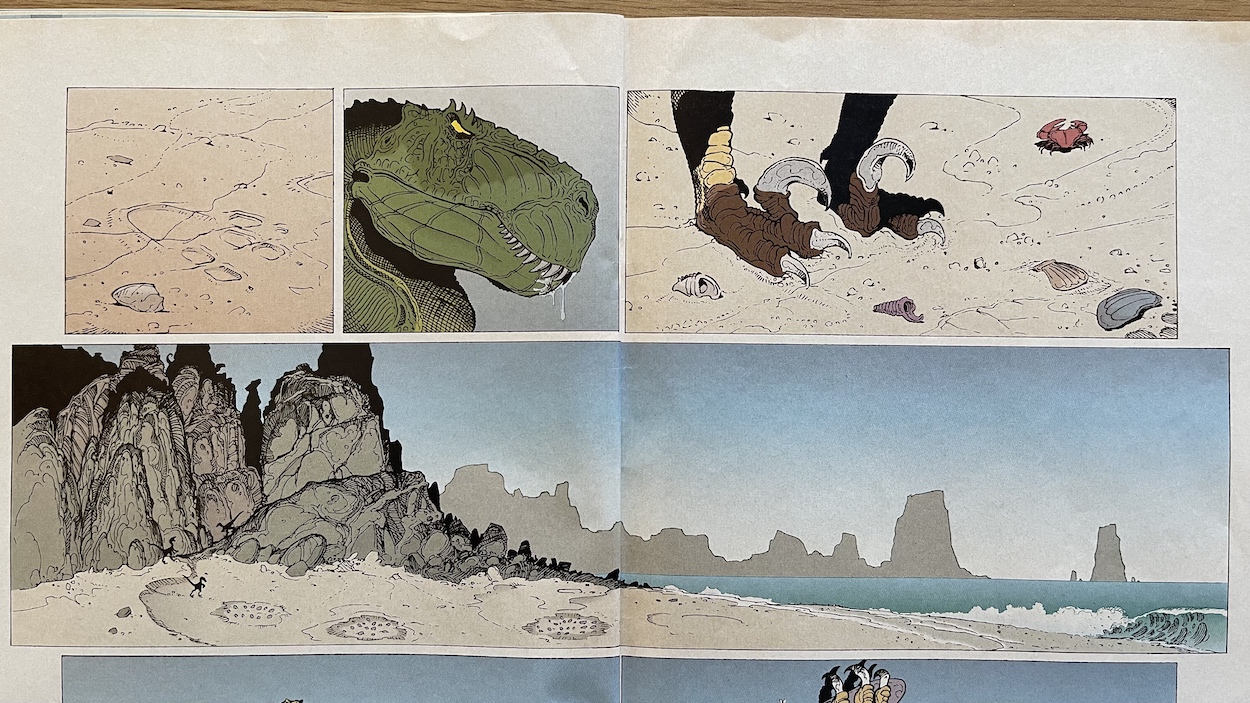
The drama, the suspense, the wonderful character moments have all been leading to this. However, having a final climactic battle between the Tyrannosaurus rex pack and the Deinonycuses wasn’t enough for Delgado, he takes it to another level and sets the finale at sunset and during a storm, pouring lashings of atmosphere into an already thrilling strip. Seriously, these final pages need to be seen and I can only show a few select highlights, so if you do see these comics for sale, buy them! This is worth the price of entry.

James’ colours have brought a deeply rich and vibrant world to life, perfectly matching Ricardo’s stunning artwork

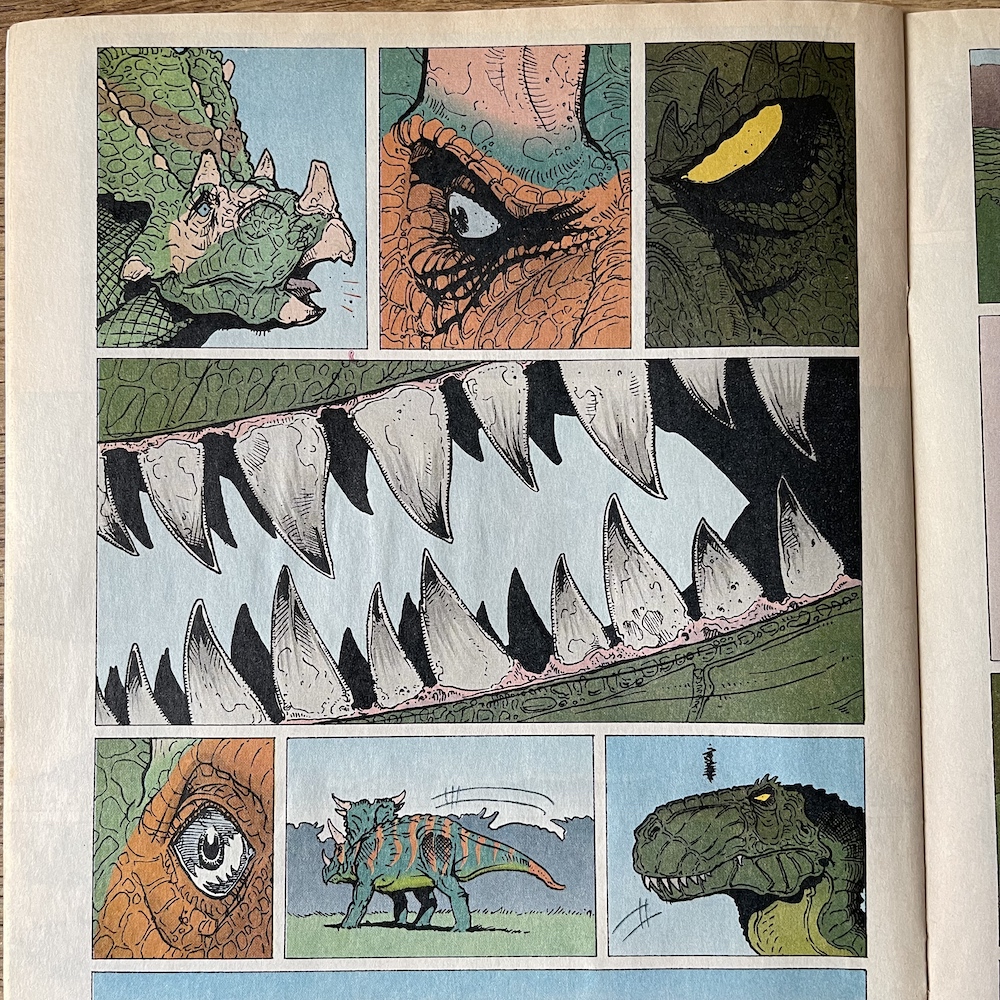
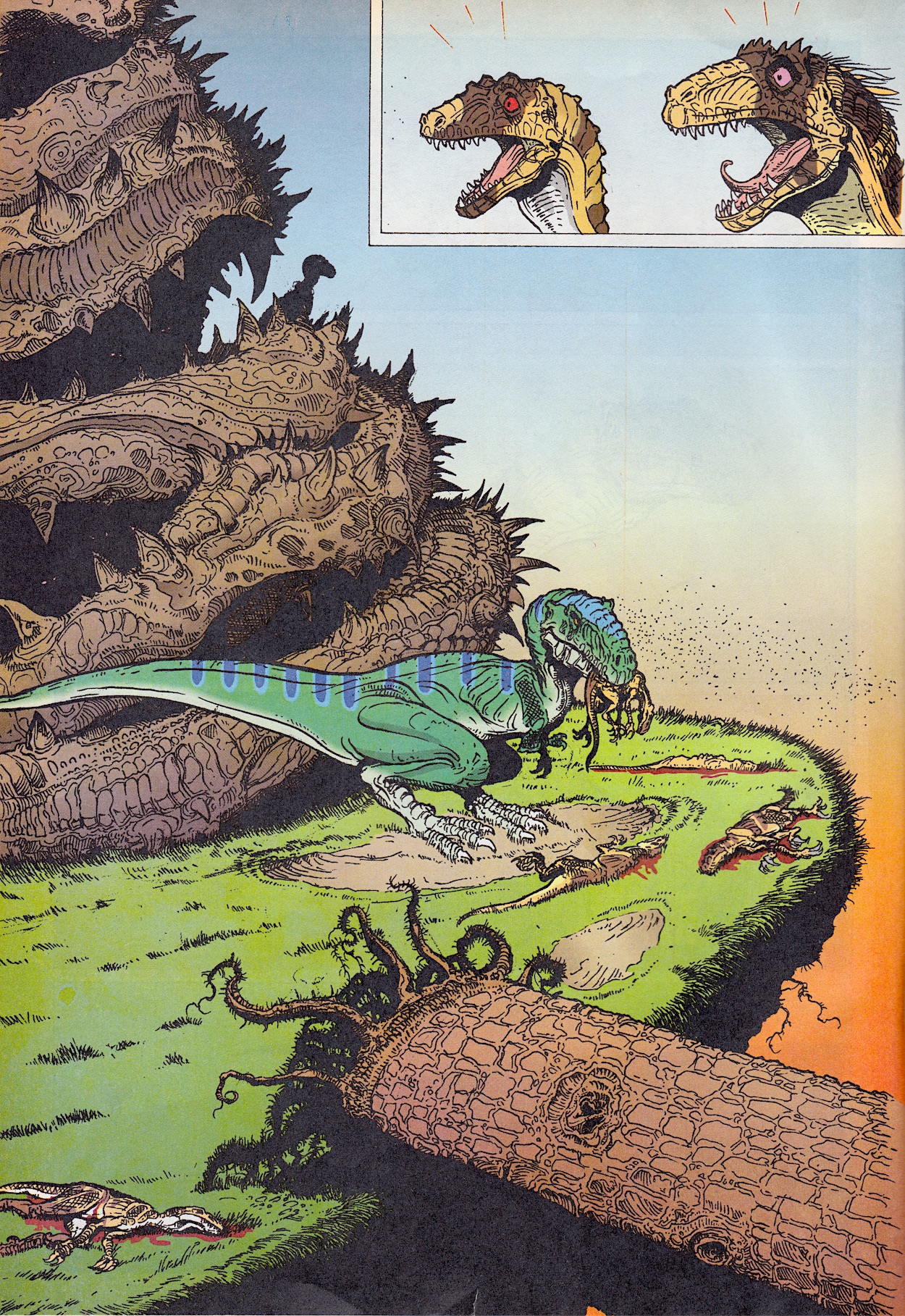
After a few pages of already stunning action we get to the spread above. There’s so much to love here. So many little details my eyes pick up anew with every pass. The rain splashing off Long Jaw’s back, the Deinonychuses sinking their teeth deep into Talon as her mouth waters, the depth of the battle with the silhouettes in the background and the sheer scale of the action in the foreground as the four giant T-rex dinosaurs dominate the scene.

James Sinclair’s colours add even more than normal, with a suddenly subdued palette portraying the time of day perfectly. All the way through Age of Reptiles James’ colours have brought a deeply rich and vibrant world to life, perfectly matching Ricardo’s stunning artwork. In fact, James’ colouring helped tell the story just as much as the line work, from the identifying markings on each character to the scene setting vistas and passages of time, culminating in these gorgeous final pages.

The battle feels suitably climactic after all this time and it certainly didn’t disappoint teenage me. With both sides playing to their strengths they always seemed evenly matched, despite being two very different species.  I was always interested to know who’d win in the end and I couldn’t remember this final chapter until I read it for this review. The answer of course is that neither side wins. This makes perfect sense in the end, as we’d gotten attached to various characters from both factions.

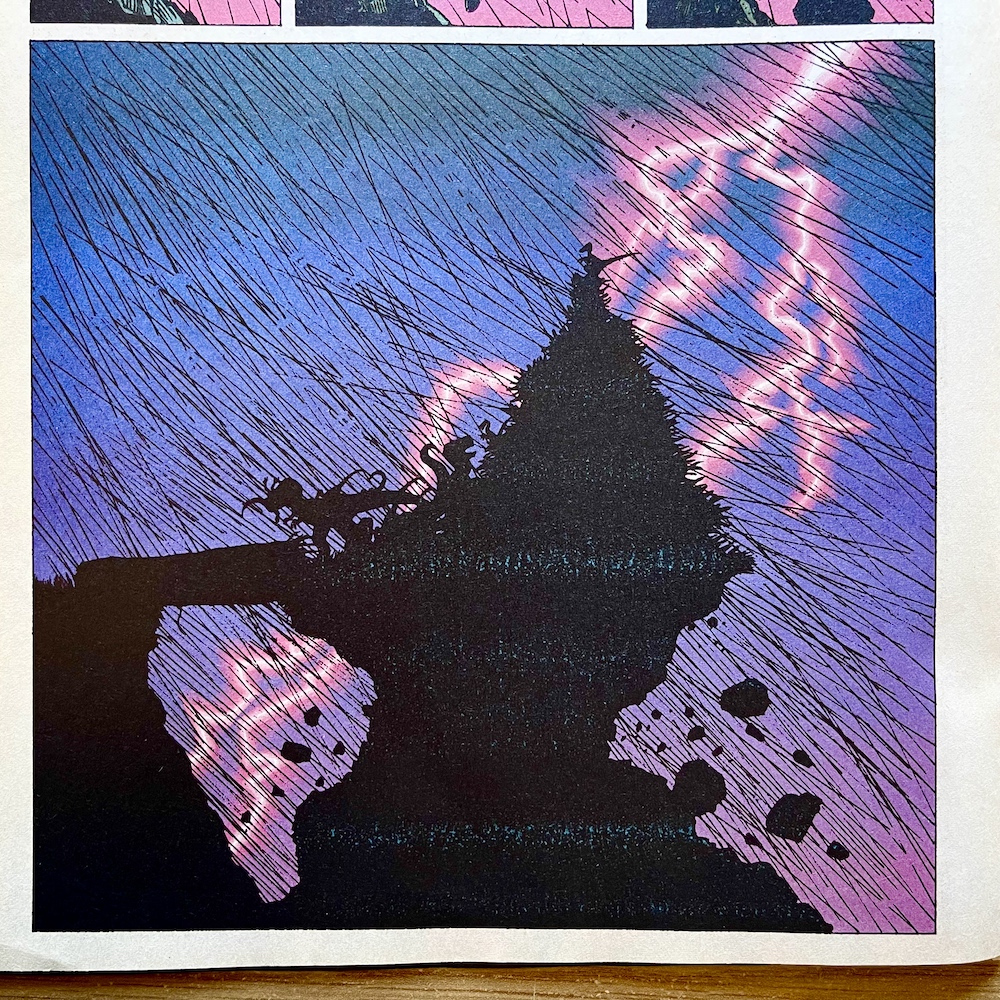
The pouring rain and the might of the battle on top of the nest is too much for the outcrop to bear. As the lightning strikes I can almost hear the thunder and the rain as the rocks begin to fall. Just as the T-rex pack begins to destroy the nest the ground shakes and everything and everyone hurtles down the cliff, seemingly to their doom. The story skips ahead to the next morning when all is quiet and we initially think that’s the end until one sole survivor breaks free from the rubble.

Long Jaw waits and waits but when no one else climbs out he makes his way through the jungle to the nest. There are always little extra details to catch our attention in Ricardo’s story, such as the huge Brachiosaur who seems to be almost timidly walking by so as not to disturb the T-rex. But Long Jaw’s only concern is getting home to protect the one remaining egg left in the wake of the Deinonychus attack back in #7. At least he can take solace in the fact that is now safe. Until we see the final page, that is.

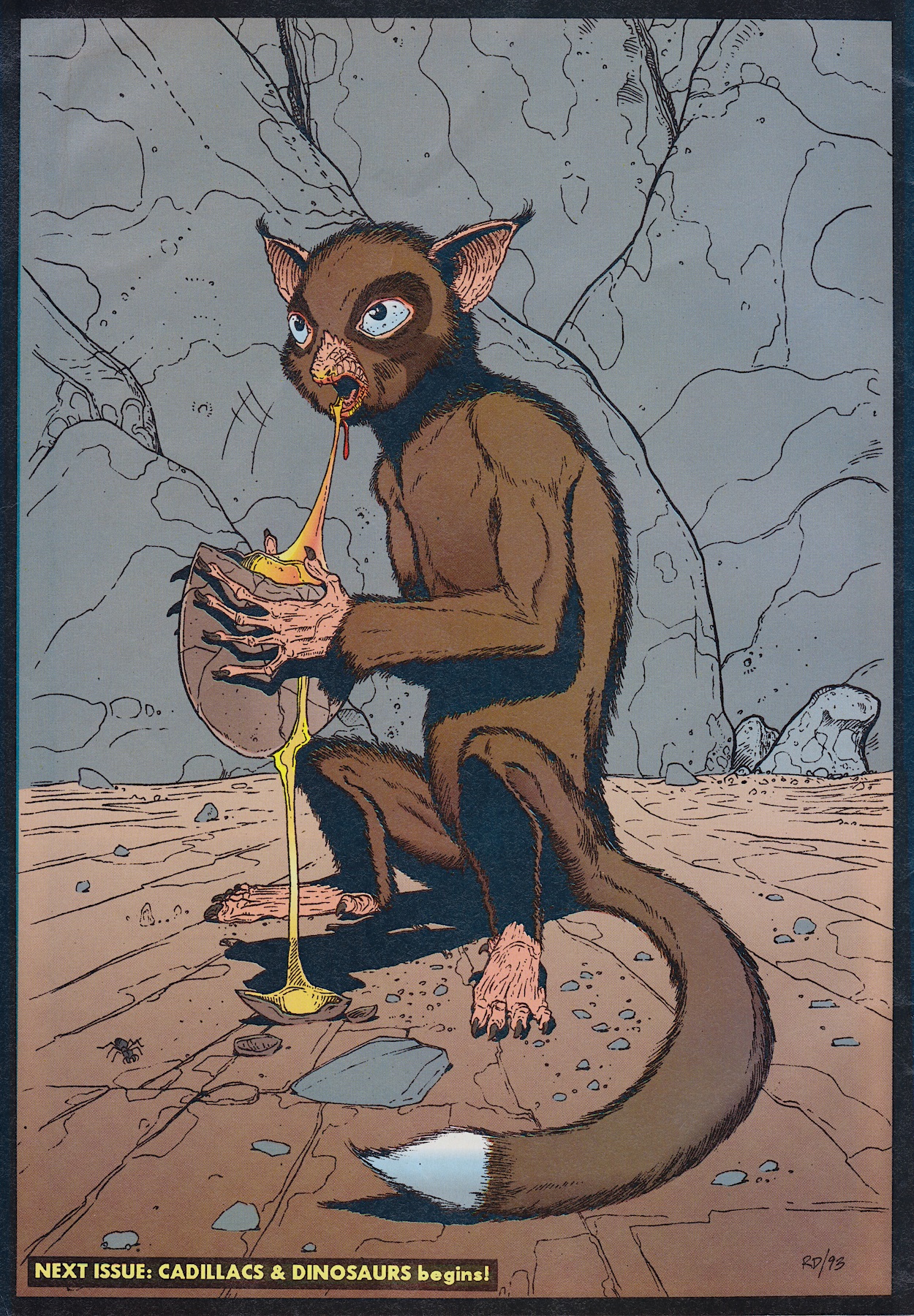
As he approaches the nest a bird lands on his back and squawks at him. Obviously communicating danger, Long Jaw runs towards the nest and on the penultimate page the look of surprise on his face is almost comical as he finds a strange little creature tucking into a tasty treat. There have been sequels to this told by Ricardo over the years but none had been created by the time of Jurassic Park’s printing so it’s with a heavy heart we say goodbye to the Age of Reptiles. It’s been a thrill every single issue, sometimes more so even than the Jurassic Park strips!

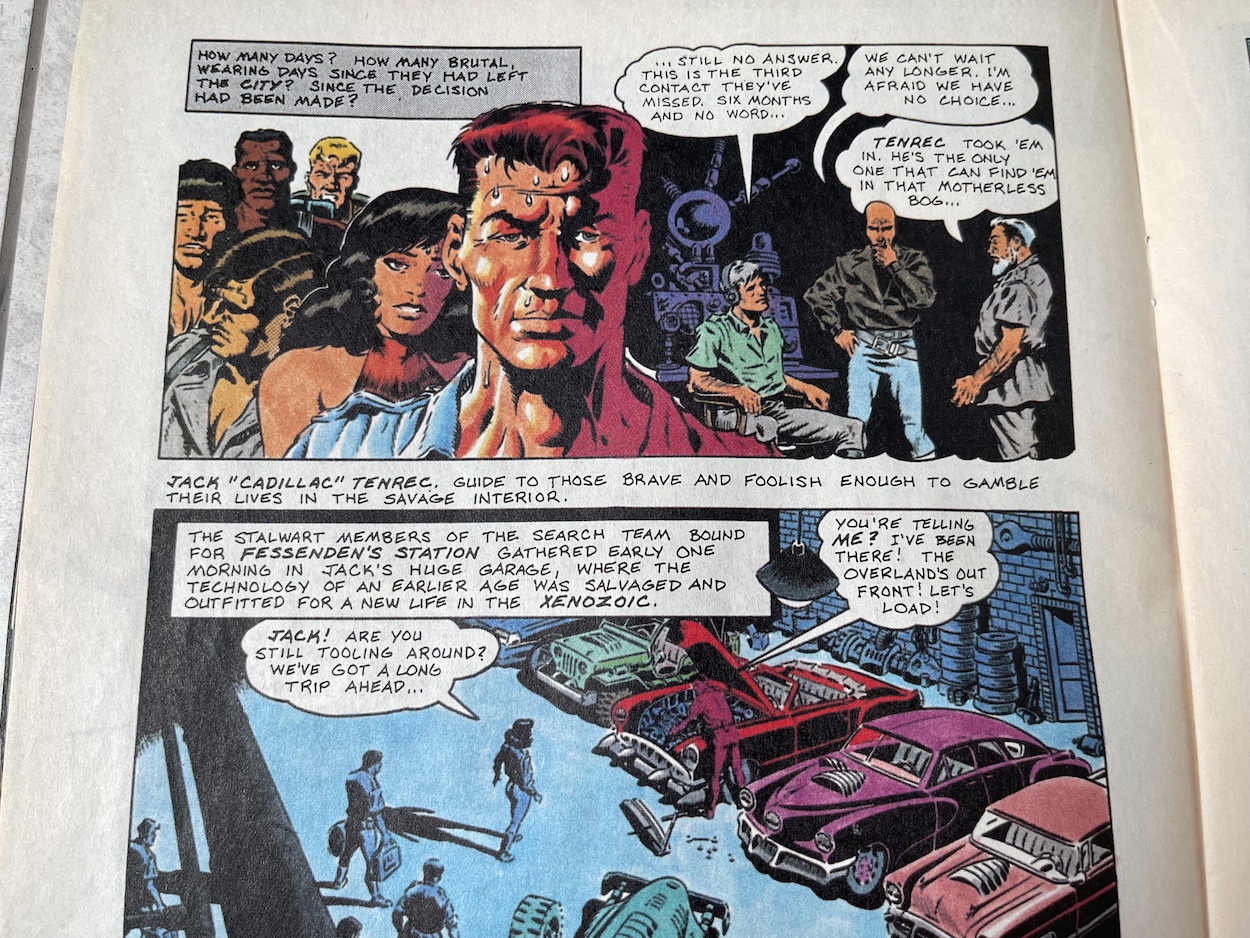
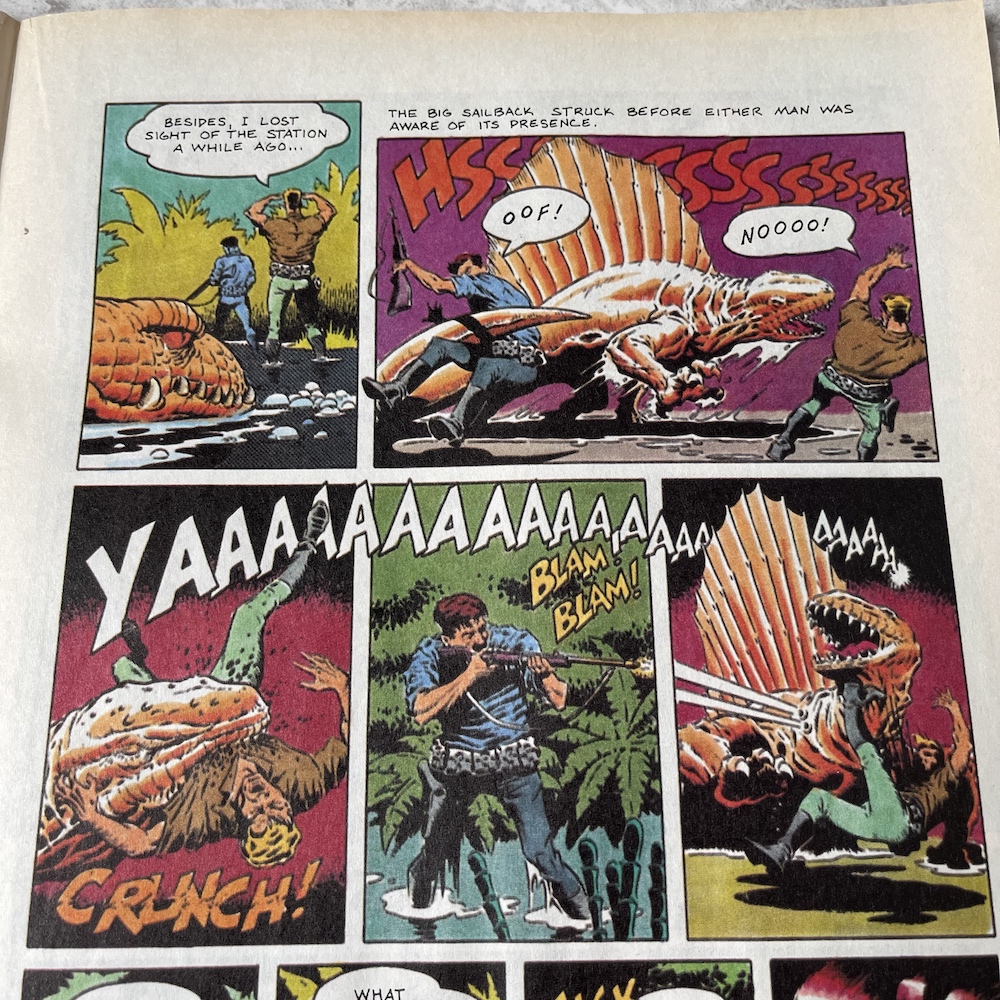
The caption at the bottom of the final page to Age of Reptiles tells us Cadillac and Dinosaurs begins next month, but if this sounds vaguely familiar that’s because it’s the Cartoon Network’s name for their adaptation of Xenozoic Tales, which we had as a second back up strip in issues #6 to #9, so it’s not a beginning, just a renamed continuation which I’m very happy about.

On the back page is an advert for a Street Fighter II comic based on the video game, which still feels rather random today. There’s no Dark Horse logo, but there is a Manga one. This’ll be an important detail for Jurassic Park from next month. You’ll see what I mean when we get there. The review of the next issue, which sees some welcome changes to the comic, will be here from Tuesday 8th September 2022. See you then.

iSSUE 12 < > iSSUE 14

JURASSiC PARK MENU

JURASSiC PARK #12: WHAT A RUSH!

Another issue of Dark Horse International’s UK version of Jurassic Park hit shelves 28 years ago today with a slight redesign to the cover, an even split inside once again and a few extra pages, although not quite the number it had before. Michael Golden’s cover is framed this time and the text is reduced, resulting in us being able to see more of his excellent art. Such a shame the best cover art of the series wasn’t given this treatment last month, eh?

The monthly comic had always totalled 36 pages but last month this plummeted to 28. There are 32 here so it’s slowly returning to its previous size and it’s made up of 16 outer pages made of a higher quality grade of paper, with the inner 16 the usual matt. Just like last month the Jurassic Park strip and the Age of Reptiles back up are given the same amount of room to breath, so with the increase in pages that’s 14 a pop. A nice chunky read this month and it’s a corker.

Steve Englehart’s official sequel to the first movie continues with the first part of Rush!, however on the contents page it’s listed as ‘Raptors Attack: Part One’, the name of the four-issue mini-series in the US, the first story of which was Rush. A strange decision by editor Dick Hansom, particularly when it’s not explained and at the time, without the aid of the internet to look such things up, I assumed the comic was making up a name on the contents page and I didn’t know why.

But that’s not important. What is, is that this sees the first steps in a story which may seem somewhat familiar to fans of later instalments in the movie series decades later. Doctors Ellie Satler and Alan Grant wake up after supposedly having blacked out when their plane crashed (we’re told the jungle was so thick it slowed their fall just enough) and find themselves guests of a man named Raphael in the middle of Colombia. But it’s not just our human characters he has taken in.

We find out Raphael is known as the “Columbian Criminal” by US politicians, although he says he’s innocent because the drug trade would continue whether or not he was in charge, he just profits. He comes across as a charming individual, but his isolation in the middle of the jungle, hiding from authorities while maintaining his empire, has made him somewhat paranoid. He believes the crash has delivered the perfect solution. Knowing all about Hammond’s island thanks to his links in the corrupt government, he’s going to train the Velociraptors to be his guard dogs to protect those profits.

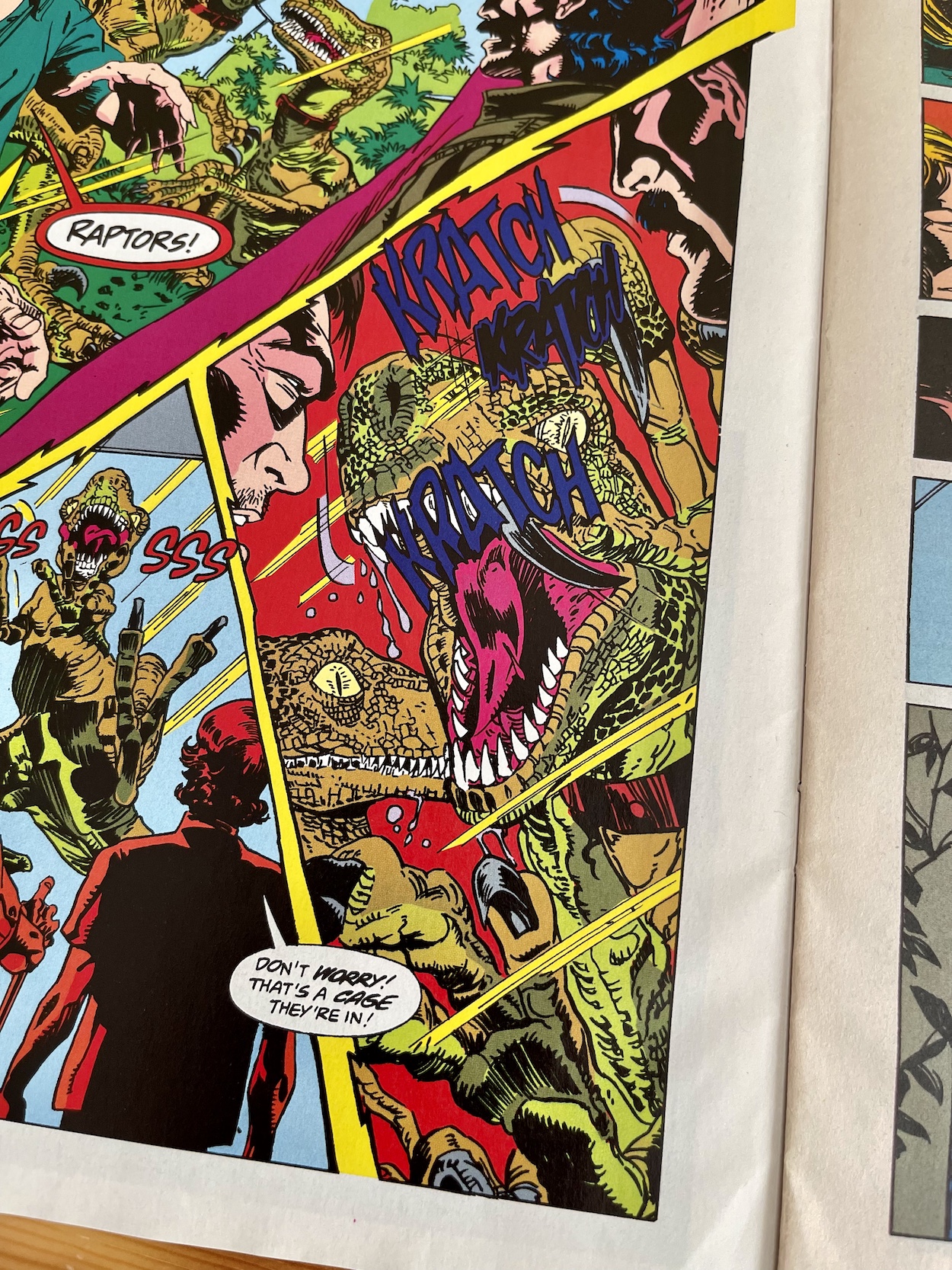
As you can see above the dinosaurs aren’t happy about this at all. Caged up with electronic collars, the ferocity of the animals trying to get at our heroes through the toughened glass is perfectly captured by penciller Armando Gill, inker Fred Carillo and colourist Renée Witterstaetter (who, as always, is also Story Editor), with John Costanza’s letters working a treat at conveying the sound of their fury. Only two ‘raptors are being trained so far though, the third is being kept separate and still recovering from their injuries, only alive thanks to Ellie’s intervention last issue.

While the American government continues to track their plane, the doctors try to convince Raphael what he’s attempting is impossible, but he uses humankind’s taming of wolves as an example to prove them wrong. Raphael even tells Ellie, while she tends to the wounds of the injured ‘raptor, that if it is indeed impossible he’ll have no more need of her and Alan. They’ve no choice but to help. Above you can see his first attempt at control while Alan and Ellie watch on helplessly.

This continues for a few pages and the reader begins to feel sorry for the ‘raptors as they continue to disobey, trying to escape, their anger at Raphael clear in their eyes and getting electrically shocked again and again. Alan and Ellie beg him to stop but it falls on deaf ears. He’s completely crazed and doesn’t understand why they’d wish to protect animals who would tear them apart given half the chance. Eventually they tire, looking beaten, completely defeated. But they’re faking it to stop the pain, regaining their strength for one final attempt at attack.

The artwork has definitely gone up a notch

Things conclude for now when our heroes’ protests become too much for Raphael and, combined with his annoyance at the dinosaurs’ disobedience, he orders them to go and tend to his new pets. A ‘raptor in a cage weakened from a shotgun wound is one thing, but being thrown into another with these two is something else! This is the cliffhanger for now and I can’t remember what happens next, so the dread is likely reminiscent of that I felt back in 1994 when I also had to wait a month for the answer.

While it’s the same creative team behind Rush! as we had for Dark Cargo, the artwork has definitely gone up a notch. The dinosaurs in particular look how they’re supposed to again and the story was incredibly exciting as a teenager. Remember, this was a few years before The Lost World: Jurassic Park so we hadn’t seen anything like this yet, we’d only seen these creatures on the island, nowhere else.

If you were to read this issue and the following chapters (from what I remember of them) for the first time now the impact may be somewhat diluted after the five movies that have followed, but I’m still just as thrilled as I was back then because that’s how I instantly feel when I open each issue, like it’s 1994 all over again. This was the only sequel and it was developing the original movie’s plot in ways I’d never imagined.

It feels epic yet it’s ultimately a small tale of two dinosaur packs so we’ve got to know the individuals involved

Moving on to the second half of the issue and it’s hard to believe we’ve only had seven parts to the simply brilliant Age of Reptiles, superbly written and intricately illustrated by Ricardo Delgado with the bright and vibrant colouring of James Sinclair. The connection I feel I have with these silent comic stars makes it feel like I’ve been enjoying the strip for a lot longer. It just feels so epic yet it’s ultimately a small tale of two packs of dinosaurs so we’ve got to know the individuals involved, each one standing out with their body language or distinct markings.

We begin with the Deinonychuses walking alongside a huge Ultrasaurus. Initially we think they’re maybe just heading in the same direction, or using the huge beast as cover, but then she begins to tire and eventually collapses, dead from a series of smaller wounds inflicted on her by the pack. But in a moment above that shows the brilliance and the humour of Delgado, they realise they’re not alone for this potential feast.

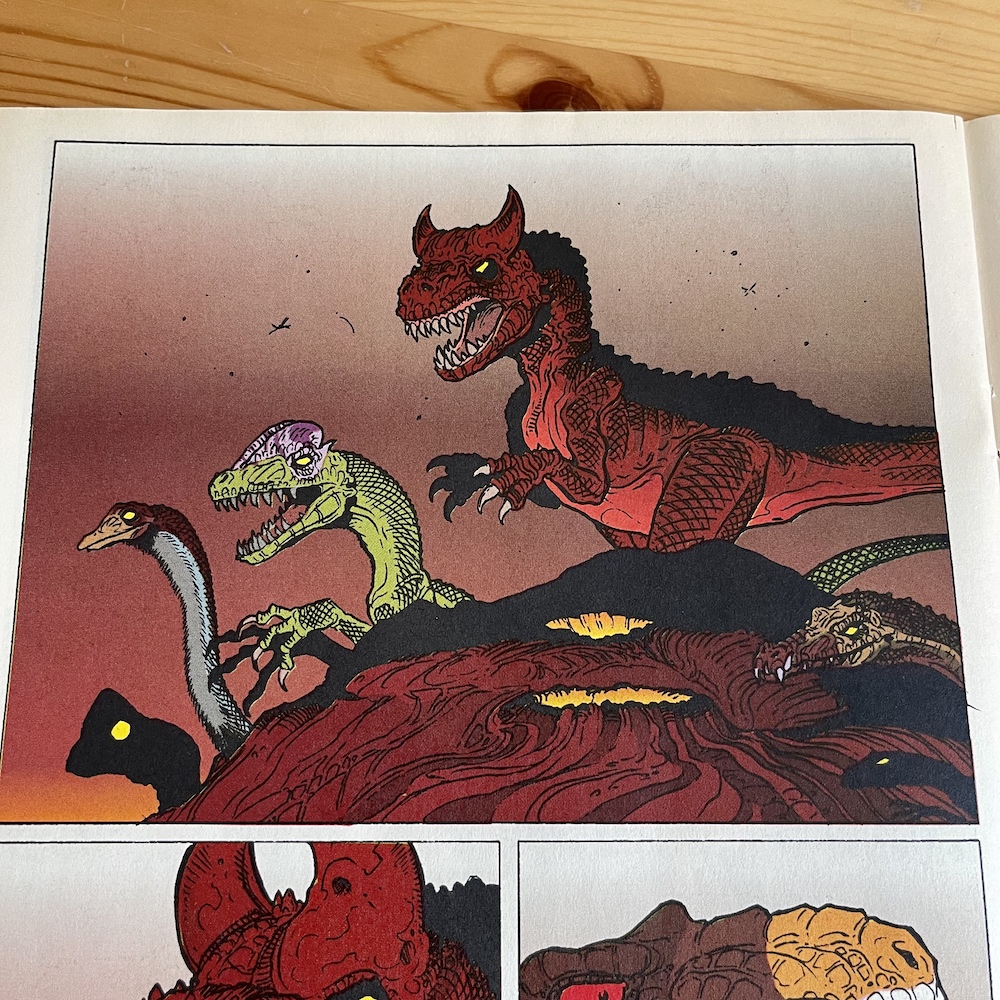
Regular readers of the blog may recognise some of the characters below, although I must say I’m a little disappointed they’re only in this for a page or two and that’s it. Being named in #9’s ‘Cast of Characters’ I was looking forward to their introduction, especially Hades, our red Carnotaurus friend here but they’re no sooner introduced when the story moves on. But their presence is important. As a result, all but one of the Deinonychuses want to make a run for it, as you can see in the funny series of panels below. This is what I meant by how Ricardo is so good at character through body language.

Surprisingly, while we’re led to believe Hades and his team’s arrival would lead to a fight over the food, instead a battle takes place between Dark Eye, the current Deinonychus leader who listens to the worry of the pack members and leads them away to fight another day (in the photo above see the bottom panel, dino on the right), and Quetzal who wishes to stay and claim their prize (the angry looking one).

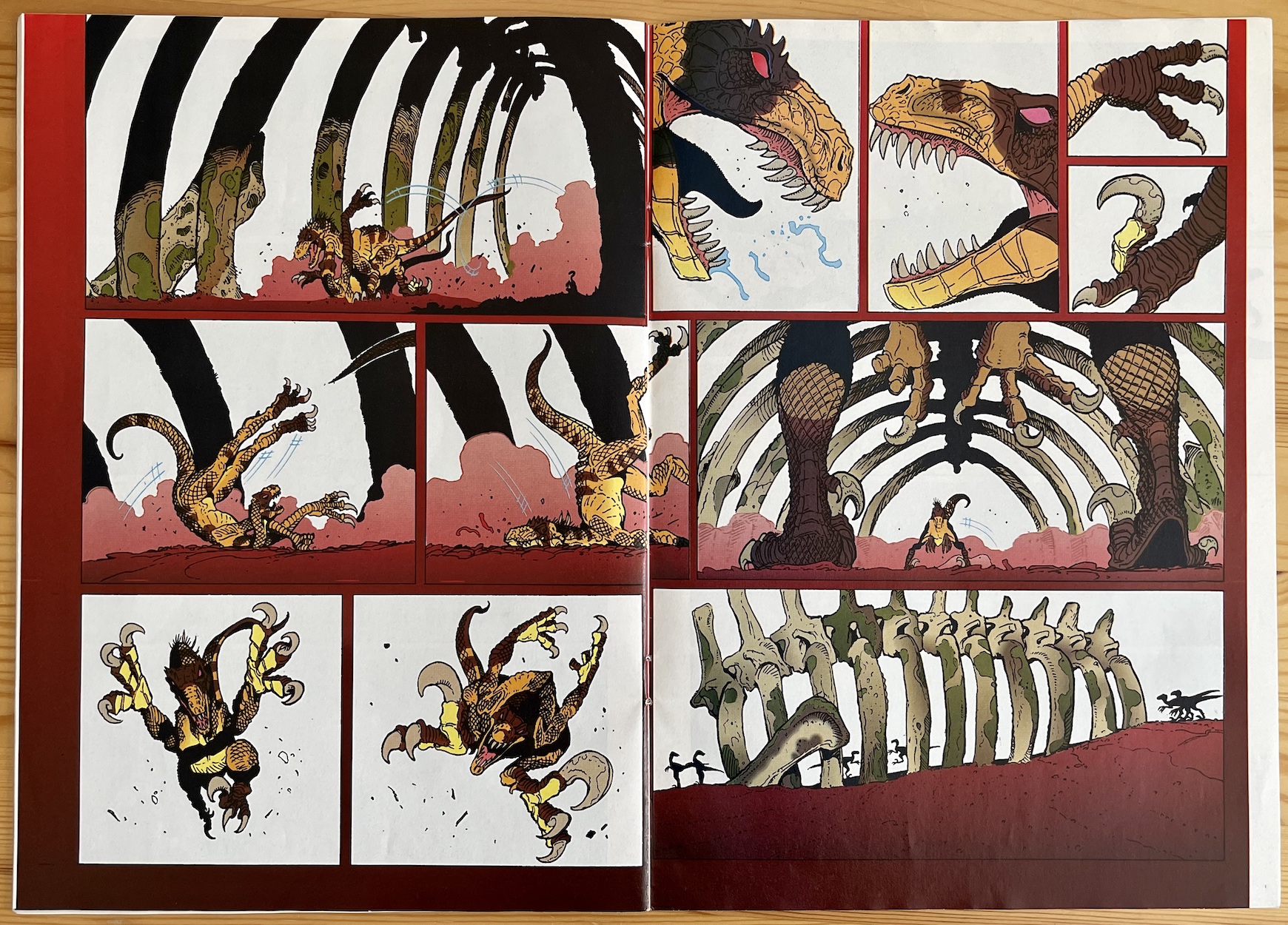
There’s a bit of back and forth, then the rest desert Quetzal to fight for the food alone, but she leaps on top of Dark Eye and next thing we’re underneath a huge skeleton in the barren landscape for a leadership battle.

This continues for another page or two and at one point they rush each other, claws bared as they pass and we see blood fill the frame. But whose was it? In the end, in a shock twist, Dark Eye is the one to fall, leaving Quetzal to assume control.

I loved the suspense here (played out over more space than I can show you) and was genuinely surprised when, panel by panel, I saw it was Dark Eye who had lost. I was even more surprised to see the amount of blood and to know they’d actually been killed.

Age of Reptiles isn’t a strip for those who like to rush through their comics, this is for people like myself who really take their time, savouring every little detail in each panel before moving on to the next. Especially since this strip contains absolutely no words at all, establishing characters, changing scenes, times of day and handling transitions all through visual queues. There are so many little details that come together to tell this story, you’ll spend just as long with it as you would with a wordy strip from any modern comic.

So what could this turn of events mean for the pack in their war against the Tyrannosaurus rex families? With their new, dangerous leader at the front the final page of this penultimate chapter sets a moody scene as they return to their nest where one of the rex females had previously killed so many of them. On the one hand it’s disappointing to know there’s only one more part of this wonderful story to go, but on the other it’s the moment it’s all been building to. I’m so glad my memory has failed me and I can’t remember how it ends because I’m as excited as I ever was. I can’t wait to see the conclusion.

A consistently great title, Jurassic Park has evolved and changed over the past year. My favourite format was definitely when we had three strips consisting of the film sequel, the strip set in the age of the dinosaurs and the sci-fi futuristic strip with added dinosaurs. But from memory the rest of the comic’s run would be two strips, with just the one back up, like this and last month’s issues. That’s not to say there are no more changes afoot, however. For now though, there’s another month’s wait ahead until I find out how these cliffhangers revolve themselves. Issue 13’s review will be up from Thursday 4th August 2022.

iSSUE 11 < > iSSUE 13

JURASSiC PARK MENU

JURASSiC PARK #11: ‘RAPTOR’ MEANS ‘BiRD OF PREY’

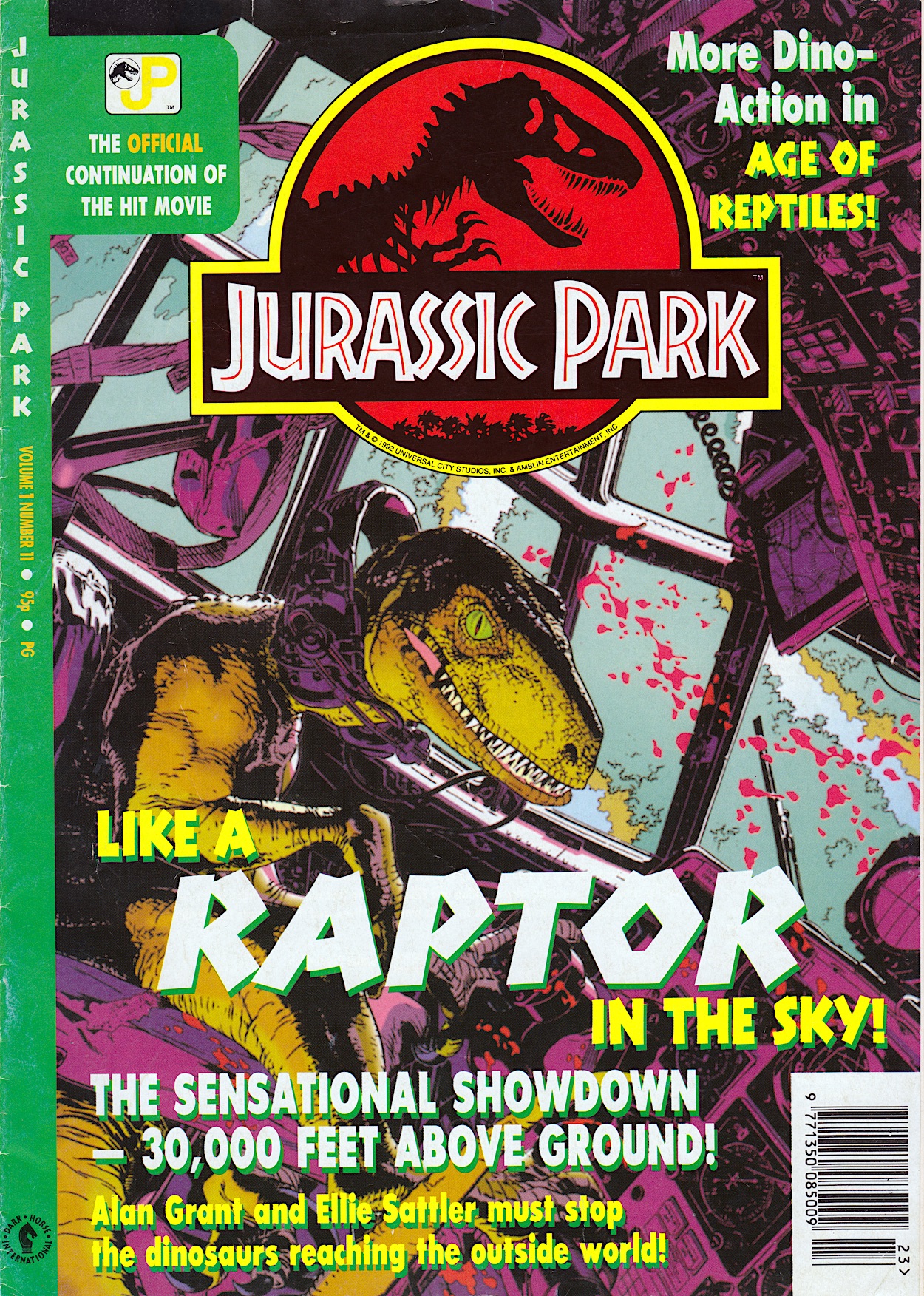
It’s been a long wait for this issue of Jurassic Park so I’m chomping at the bit to get stuck in. I can remember as a teen being overjoyed to finally see the comic appear again, however my initial reactions once I opened it were mixed. First of all this is my very favourite cover of the whole series. No, a Velociraptor doesn’t really take control of the plane, it’s just a funny reference to the main story inside. To this day Michael Golden‘s cover still raises a giggle which I’m sure was the intention. I just wish it wasn’t covered with so much text.

But then came a little bit of disappointment because I discovered there were eight less pages, reduced from 36 to 28 and there was only the one back up strip, no Xenozoic Tales in sight. I’d been really enjoying those stories but at least Age of Reptiles was still here and it was as magnificent as always. Things would (begin to) return to normal next month but initially I didn’t know this so I wasn’t sure if Tenrec and Hannah would return. What is here is great fun though, so let’s get going.

In the world of Jurassic Park small, seemingly inconsequential actions can have catastrophic consequences

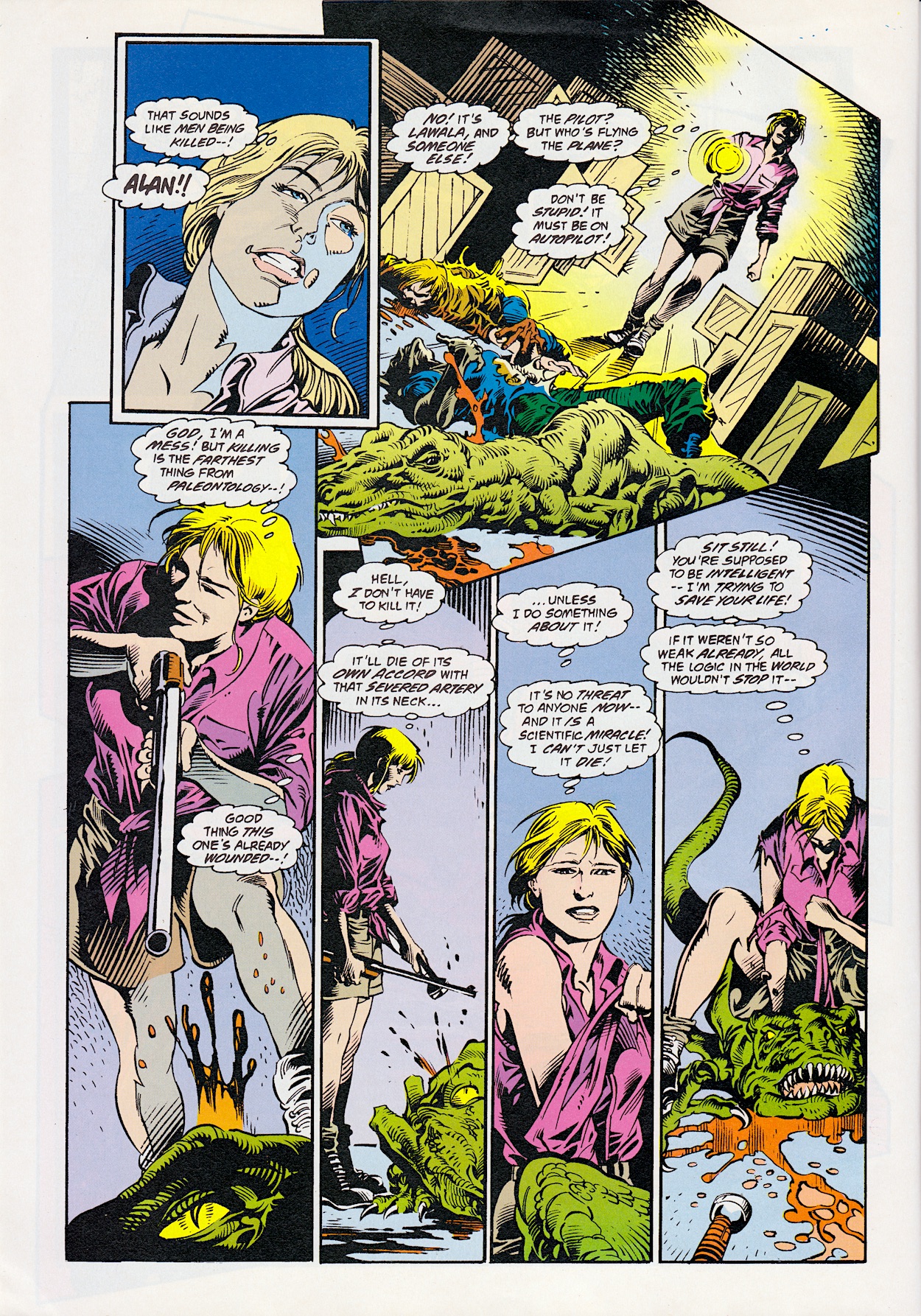
The final part of Steve Englehart’s Dark Cargo begins with the pilot doing what humans always do in the world of Jurassic Park; proving that small, seemingly inconsequential actions can have catastrophic consequences. Feeling the plane’s weight shift about he puts it on autopilot and goes to help George Lawala, finding he’s already killed one of the juvenile ‘raptors. But they don’t see another skulking in the shadows, hunting the two men. It attacks, killing the pilot and maiming Lawala, but not before he’s able to shoot it in the neck.

It’s here when Jurassic Park makes its real point of difference. Dr Ellie Satler (she and Dr Alan Grant were Lawala’s prisoners, check out the previous reviews) hears the gun shot and discovers the horrific scene, the dinosaur dying in front of her. Even knowing it would’ve killed her in a heartbeat and that its siblings must be nearby doesn’t stop her from trying to save its life. It was just doing what it does, hunting prey to eat. I love this page.

A quick note about the artwork. The final panel above is a strange one and at times penciller Armando Gil does seem to draw the ‘raptors in a way in which they’re not really identifiable (sometimes in this chapter it’s also confusing in regards to which one is which and we have to rely on the dialogue to decipher the images), but mainly he has done a great job of capturing the dinosaurs as real world animals (check out his magnificent Tyrannosaurus rex in #6). His action scenes can sometimes seem sparse, but inkers Dell Barras and Fred Carrillo imbue them with great texture and atmospheric shadowing. John Costanza is our letterer and Renée Witterstaetter brings bold colours alongside her role as Story Editor.


“The ‘raptors.. somehow, it’s got to be the ‘raptors..!!”

Dr. Ellie Satler

While Ellie ties a tourniquet around the animal’s neck another ‘raptor is looking on, which Alan spots and distracts, with both it and the final sibling giving chase. Panicking, he dives into an open crate but escapes through a side hatch as the dinosaurs jump in after him. Able to close the hatch and lid he traps them inside, attaches the pulley system and dangles them out the back of the bomber! Well, out there they can’t do any harm. Famous last words, Alan. This is Jurassic Park after all.

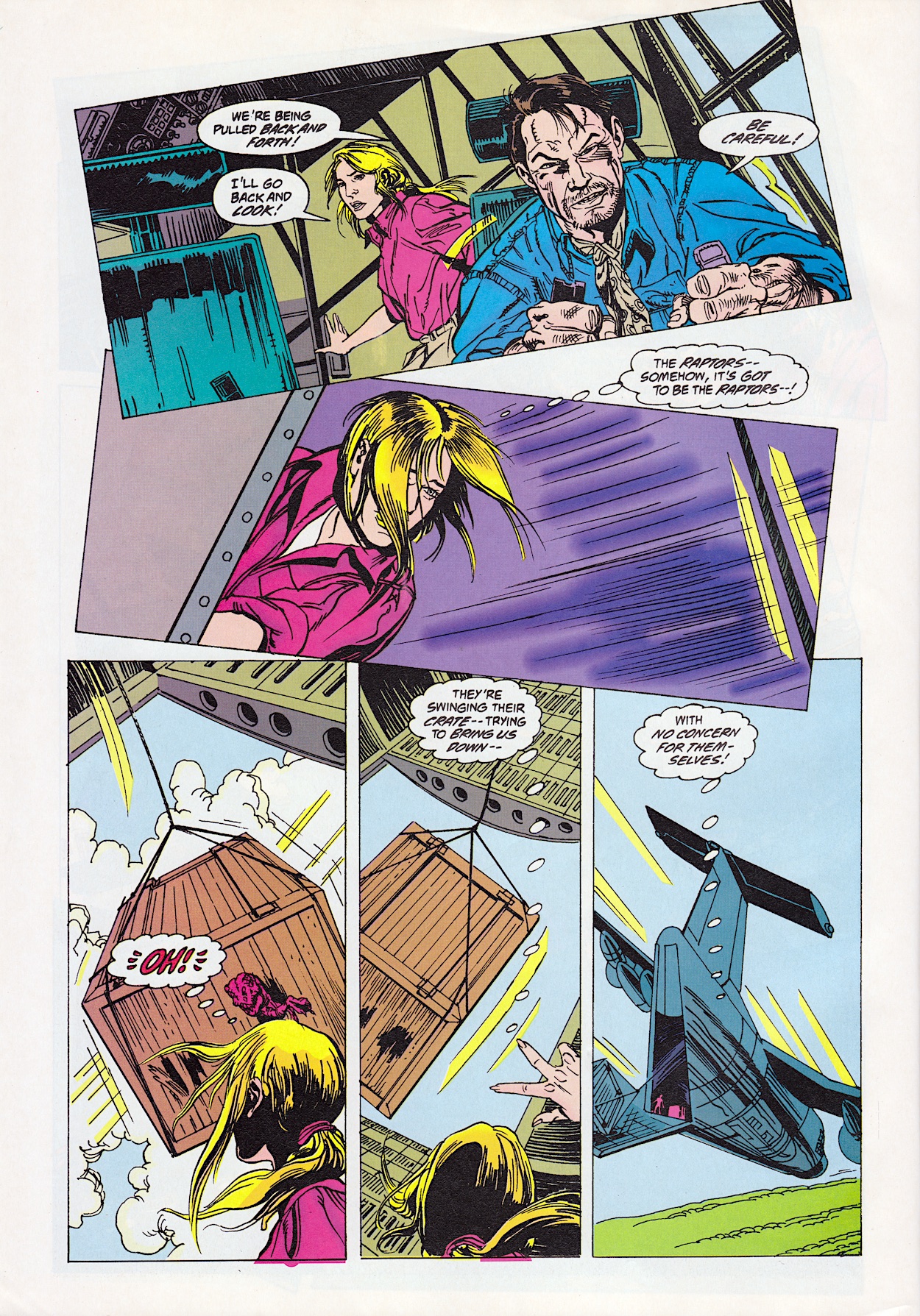
Suddenly the plane starts diving and they rush for the cockpit. Refreshingly, they don’t immediately take to the controls and somehow land the plane like in every movie and TV show ever. Instead, Alan admits the only thing he recognises is the wheel and he tries desperately to stop them crashing, not really sure what to do. The plane is being pulled about and the autopilot was knocked off, but why? Ellie is sure it has to be the Velociraptors, but how? Take a look at the page above.

I remember reading this at the time and being thrilled with the intelligence of the dinosaurs, especially this lot. You have to remember before the first movie came along the general public had a vision of dinosaurs as stupid big lumbering lizards. Jurassic Park changed all that and I can distinctly remember that same feeling of excitement from this comic. The swinging crate pulls the plane further down, Alan struggling to level it off in a desperate bid to stop it nosediving when we get to this month’s cliffhanger.

The voice from the other side of the binoculars is going to be key to how this story develops from here on. It’s a more exciting cliffhanger than the one which led to a two month wait, so thank goodness we’re back to a monthly schedule again. I can remember parts of the strips to come, in particular what Ellie saving one of the ‘raptors will mean later, and I can’t wait to revisit these stories and compare them to the movie series we’ve had since.

For now, take a good long look at this piece of gorgeousness.

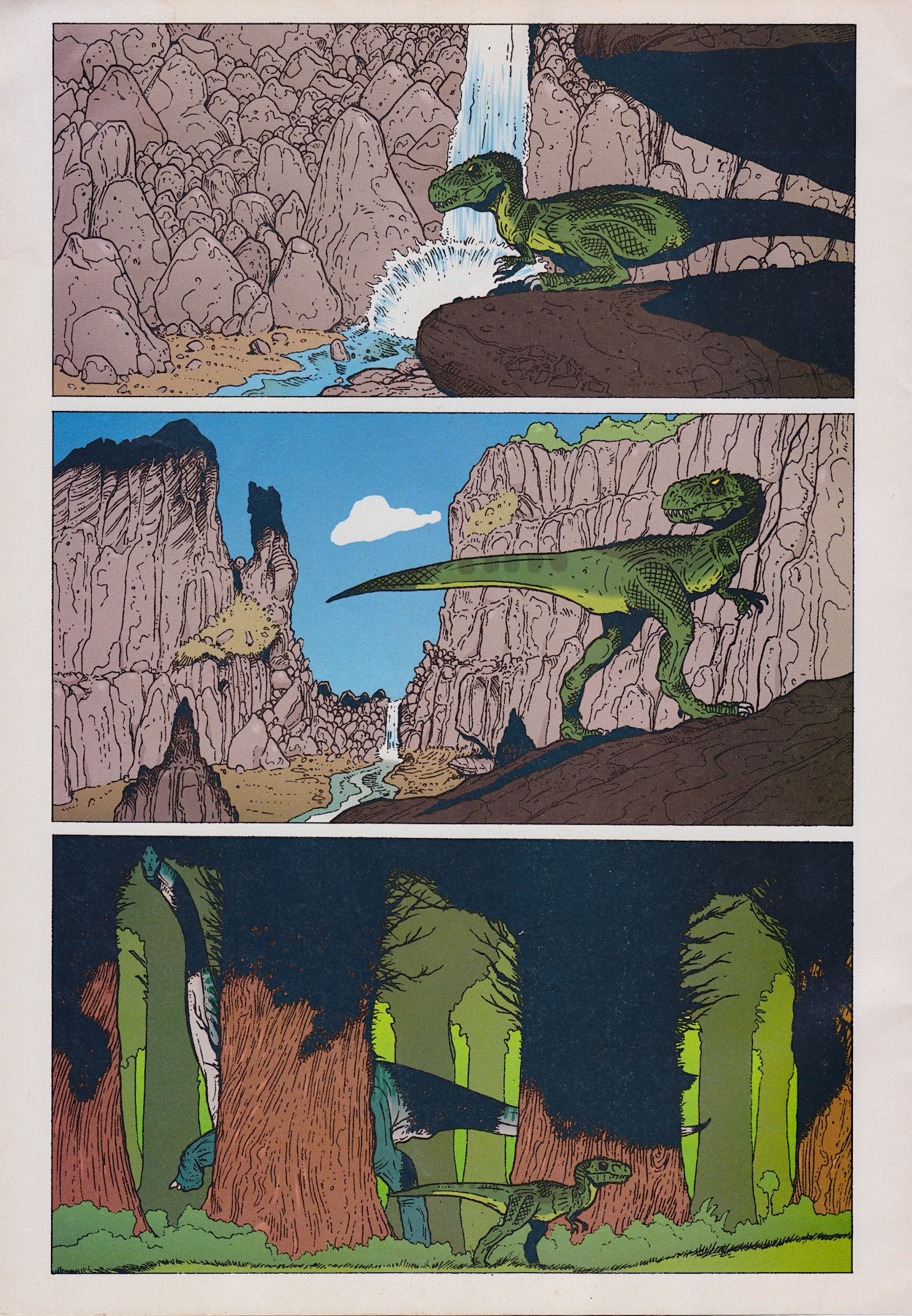
As I said at the top of the review there are only two strips this month, with our main story and the one back up getting equal space of 12 pages apiece. So we’re straight into the Age of Reptiles. It opens with the panel at the top of this post, which certainly sets the scene! That is followed with the above spread and I find myself just completely immersed in this world again. Still up upon the cliffs, the Deinonychuses attack the T-rex pair. They put their all in, I’ll give them that, but they never stood a chance.

One is kicked over the side and lands in deep water below, quickly swallowed up by a giant ocean predator. The remaining two are swiped off the side by a glancing blow from a ‘rex  tail, one landing hard on the rocks at the bottom of the cliff, dying instantly but breaking the fall of the other. Throughout this, and the rest of the story, the individual characters really shine through, as you can see from this selection of highlights below.

From being taken by surprise from behind, to the horror of their friend dying, to the little baby T-rex being coached to hunt by their parent Long Jaw, every dinosaur here is an individual brought to life by the genius of creator/writer/artist Ricardo Delgado and colourist James Sinclair.

The youngster spots Dark Eye who is clearly deliberately wanting to be chased, as you can tell from that final panel above. That pose almost says, “Me?”. Haha, it’s brilliant. The young inexperienced hunter doesn’t realise it’s a trap and gives chase. When his prey disappears behind a rock he follows blindly, right into an ambush of half a dozen of Dark Eye’s pack. Long Jaw is the adult T-rex and suddenly he realises he’s alone! He runs through the forest in desperate panic, following the trail or possibly the scent and finally comes upon this scene on the final page of the chapter.

I vividly remember seeing this image for the first time back in 1994. The towering Long Jaw roaring into the sunset, the flying predators already circling and the heartbreaking image on the ground. It was truly shocking. I’m sure I wasn’t the only reader who’d loved the tiny little ‘rex, such was his depiction in this and previous issues. We’re racing towards the climax of Age of Reptiles and I know it was big, I know it was ultimately a very satisfying conclusion, but for the life of me I can’t remember how it ends. It was 28 years ago after all. I’ll impatiently wait and see.

Both of these strips ratcheted up the tension so I’m really looking forward to the next issue. This one may have been thinner than any other in the series and down one strip but what is here is superb from start to finish. Plus, I’ll just mention how much I love that cover image again. To finish with the final two pages contain more of those retro adverts, the first of which is for a video release of a show I remember being on TV at the time, and the back cover is for a comic magazine from Dark Horse International that would end up saving Jurassic Park from an even earlier cancellation. More on that later in the summer.

Just on a personal note, it’s so strange to look back and see a video for £10 that only contained one episode of a show. I do remember buying Babylon 5 on VHS, each volume costing £8.99 and containing only two episodes. It’s crazy to think back to that now when we’re so used to box sets. Two Christmases ago I was able to purchase the entire five seasons of B5, 111 episodes for £40 on my Apple TV! (All restored to their original aspect ratio and remastered by the way, just to let fellow fans know.) How times have changed.

Anyway, back to Jurassic Park and that’s where we leave things for now. The next issue’s review will be here from Thursday 7th July 2022 and by then I’m sure most fans will have seen the brand new film which is due for release tomorrow as of the time of writing. Suddenly, remembering buying these comics is making me feel very old!

iSSUE TEN < > iSSUE TWELVE

JURASSiC PARK MENU

JURASSiC PARK #10: BETRAYALS, TAiLS & GOLDBLUM

Another exciting Gil Kane cover that bares absolutely no resemblance to anything that occurs inside, or any other issue or even the movie. It’s the second of two covers from the American preview comic, the previous one shown off last month. That Topps Comics preview contained two small strips set before the events of the movie and the first was underwhelming to say the least. The second, the headline story inside this issue, is far better and concentrates on the man we all loved to hate, the person behind all the chaos, Denis Nedry.

Portrayed by Wayne Knight in the film, Gil produces a great likeness here while not getting so hung up on it that he ends up expressionless. Betrayal is written by Walter Simonson and tells the tale of Nedry’s arrival on Isla Nublar to work on the computer systems that would be so instrumental in the creation and eventual downfall of the park; networking of computers, park systems, zoological simulations and crowd control measures all make up his complicated job. Dick Giordano (Detective Comics, The Sandman, Superman vs The Amazing Spider-Man) joins Jurassic Park to ink Gil’s pencils, John Workman returns as letterer, as does Renée Witterstaetter as colourist (and Story Editor for this and the sequel story later in the issue).

Some fans online have mistakenly said there’s an error in Nedry’s and Hammond’s relationship in the film. Hammond‘s favourite phrase was, “Spared no expense” and yet Nedry is constantly saying he’s underpaid, his boss unwilling to negotiate. Here, Simonson picks up on a plot thread from the novel that the film touched upon (and those fans missed) and elaborates on it. Nedry’s bid was very high, no expense was spared, but it was made before he knew the secret of what the attractions on the island actually were. Once he found out he thinks he underbid, but Hammond is a man who honours his word and expects others to do the same.

Realising the fortune Jurassic Park is going to make Hammond, Nedry constantly tries to spin that his work is going to be far more complicated than first estimated, but really it’s not true and he’s just pushing for more money. Hammond doesn’t budge. His computer experts perfectly relayed to Nedry what was required, the fact the animals are dinosaurs doesn’t change anything. Six months in however, Nedry begins to realise extra money will never be forthcoming from his computer work and when he overhears Henry Wu discussing the embryo laboratory he clicks that’s where the money is, in the dinosaurs, and their embryos are perfect for smuggling off the island.

The story ends with his first attempt at reaching out to Ingen‘s competitors but for me the real meat of the story is seeing the beginning of the relationship between these two characters. Also, unlike the previous prequel story (Genesis) foreshadowing isn’t shoved in our faces, instead it just concentrates on telling a good story based around a key plot point in the movie, with the characters at its heart. Hammond comes across as a bit too cantankerous at points compared to Richard Attenborough‘s charming portrayal and more like he is in the novel, but in the end it’s an interesting little prequel and a nice addition to the comic.

There’s no Xenozoic Tales this issue so the remaining strips get more room to breath, although I do miss Tenrec and Hannah. They’ll be back, though. Alongside the eight-page Betrayal and the ten-page Dark Cargo (for a meaty 18 pages of Jurassic Park) is Ricardo Delgado‘s always stunning Age of Reptiles which makes up 11 pages, sandwiched in the middle. It starts off serenely with a large Ankylosaurus enjoying some bark from a monstrously sized tree that dwarfs even this huge dinosaur. Then they hear a noise and step to the side to have a look around the tree. Personally, I think the way this simple gesture is drawn is just so full of character.

I was beginning to feel sorry for the peaceful beast who now found themselves outnumbered three-to-one against our favourite predatory rascals, the Deinonychuses. As you can see from what happens on the next page I needn’t have worried. This is enough to make the smaller dinos run off, beaten with one swipe of a tail. I just love this big action shot though, especially since the build up was so peaceful, it’s such a surprise! We get another little respite when we check in on the Tyrannosaurus rex pack as Long Jaw arrives back and nuzzles the noses of his mate Talon and their baby, with the other male Blue Back and his mate Climber looking on.

The whole pack is angry and soon Long Jaw sees why. The large circular nest is empty of all its eggs except for a few pieces of broken shell and one last intact egg, tucked in next to Talon. We then get a double-page spread and a really brilliant moment as he looks down at evidence of who robbed their nest and, even though a T-rex‘s face shouldn’t be that emotive, we can tell he knows exactly who was responsible. The way Ricardo lays this out with his face between the footprint and those same feet now on a nearby beach is just genius.

Look very closely at that big panel in the middle of the page. Have a look up into the cliffs and, amongst the silhouettes of the craggy terrain you should spot the shapes of a head and a tail. I’ll admit I don’t think I ever noticed this the first time around back in the 90s because it surprised me when I spotted them now. It’s so subtle, I love it. It also leads on to the climax of this issue’s chunk of the story.

After filling their bellies with the eggs the three thieves start making their way up a very narrow path along one of those cliff faces and come face-to-face with our two female Tyrannosaurs. Their size and power in comparison is perfectly captured and I particularly like the overhead view showing just how trapped the smaller dinos really are. There’s even a tiny bird looking on. Little details like this amongst all the action and drama is a trademark of Ricardo’s and one of the reasons I love his work so much.

The leader of the Deinonychuses turns and barks orders at the others, one of whom turns and runs at the T-rex coming up behind them, the story cutting off for this issue as they leap into the air, claws bared. Age of Reptiles was never intended to be told in this way; it was created as a graphic novel to be read from beginning to end in one sitting. But it just works so well, editor Dick Hansom doing a great job of knowing when to edit to make each piece feel like a complete chapter. It’s a great cliffhanger. (Yes, that was very much an intended pun.) However, it’s a particularly frustrating ending this time, which I’ll explain after the third and final strip.


“Phooey on your ‘Chaos’! We’ve got boats, planes, radar…!”
Renny

“So does the war on drugs.”
Dr Ian Malcolm


Steve Englehart‘s Jurassic Park: Dark Cargo continues with Dr Ellie Satler, Dr Alan Grant and the juvenile Velociraptors transported from boat to a huge air transport and during the flight our human heroes eventually awaken to find their cage surrounded by the hissing, clicking raptors. One tries to pick the lock of the cage just as they did to their own, but Alan’s broken belt buckle from his failed attempt, still caught in the lock, stops them. They run off, the pilot noticing shifting weight so George Lawala (the first in a long line of greedy humans who would underestimate the intelligence of dinosaurs) goes to investigate. He frees Alan and Ellie and gives them shotguns, the chapter ending with them all searching the huge plane.

That’s the main plot out of the way. That’s not to say it isn’t fun, it certainly is, it’s just there are two individual pages elsewhere in the story involving subplots that really stood out to me. The first involves the army’s continuing attempts to clean up the mess of the island’s failed park. Having tracked Alan and Ellie to the beach they’re at a loss as to where they are. For me it’s great to see the new character, INgen‘s Dr Fischer back again (he first appeared in #6) and I’m still hoping we get to see more development of him in the future. But it’s the person on the next page that elicited the highest level of excitement when I read this back in 1994.

Of course, nowadays we’ve seen Dr Ian Malcolm, so memorably played by Jeff Goldblum, in The Lost World: Jurassic Park and Jurassic World: Fallen Kingdom and he’ll be returning again in the sixth film, Jurassic World: Dominion later this year (at the time of writing). At the time his return was a complete surprise. If the comic had a proper editorial and Next Issue promos I’m sure this would’ve been mentioned before it happened, so for once I was glad of the minimalist approach. It meant the surprise was kept until this very moment. He just appears in this one sequence as he recovers from his injuries from the movie but it’s exciting to see the character in this first official sequel, and he’s perfectly drawn by Armando Gil and Dell Barras (with John Costanza on letters and Renne colouring).

Also mentioned here is ‘The United States Central American Command Center’, or ‘CENTAMCOM’, the comic’s own take on the real world CENTCOM and the resources they have in their search. It brings a larger scope to the background story that’s slowly developing while the main plot focusses on our two main characters. I always enjoyed these aspects of the films, always wishing they’d delve deeper into the inner workings of INgen and the larger world within which the stories were set. Then it all ends with the biggest shock of all. Under the final panel we’re unceremoniously told #11 wouldn’t be on sale until Thursday 9th June. What?

This issue went on sale on Tuesday 29th March 1994, so suddenly my favourite monthly comic was telling me I had to wait ten weeks for the next chapters to all these stories. Can you now understand why I was so frustrated earlier? The use of the JP logo on the cover instead of the previous title graphic (I love the logo but preferred the previous one for the comic) was just the first big change to come. Ironically, this issue felt once again like the first one I bought, settling back into a great format after a couple of months of trying to fit too much into its 36 pages. But that would all change. I’ll go into that next time because at this point originally I hadn’t a clue why there was such a long wait. You’ll just have to wait to find out too.

I’ll finish off with a look at the very-90s adverts this issue contains. There’s a teeny tiny liddle widdle radio which would’ve been right up my alley back then and it isn’t dissimilar to that given to Bond by Q in Skyfall many years later. The back cover has an advert for Dark Horse International‘s Manga Mania as the animation style started to take hold here, mainly thanks to Akira (with a hint of things to come for Jurassic Park on the bottom-left of its cover) and there’s a convention to match. Finally, those highly expensive phone-in competition lines which, when you think about it, should never have been in the pages of comics such as this (or the magazine Commodore Format I was collecting at the time which had plenty of them) when so many young readers could be tricked into spending a fortune on their parents’ phone bills. (No, I didn’t.)

So, with a clifftop battle in full swing and a pack of deadly Velociraptors on board a cargo plane we have to be patient and take a breather from the comic for a while. It’s difficult enough to not read ahead but this is going to be ridiculous! I’ll just have to cope somehow. The next Jurassic Park review will be here from (big sigh) Thursday 9th June 2022, just one day before the release of the next movie in fact. Oh, now I’m all excited again!

iSSUE NiNE < > iSSUE ELEVEN

JURASSiC PARK MENU

JURASSiC PARK #9: SPARED NO EXPENSE

This review was due on 22nd February, click here to find out about the delay. More catch-ups to come this week.

The cover for issue nine of Dark Horse International‘s Jurassic Park is a strange beast, showing what appears to be Dr Alan Grant killing a Tyrannosaurus rex! Drawn by Gil Kane it’s completely uncharacteristic not only of Alan but for the comic too, which so far has stayed true to the book and movie. Seeing one of our heroes with a massive gun taking down one of the animals like a clichéd action hero, while a second T-rex comes up behind has nothing to do with Jurassic Park!

The cover is taken from the US comic series’ preview issue which contained two small prequel strips. It had two different covers, neither of which reflected in any way to anything that happened within the stories (a pet peeve of mine). They were also seemingly drawn long before the artists even knew what the script for the movie contained. A bizarre thing to begin with then, even more so to choose it for the UK comic when so many other more suitable ones were available in the US series by now. But the real news was those prequel strips had arrived.

In fact there are no less than four strips this month, but with no extra pages some of our regulars have a little less room to breathe. Things kick off with the eight-page prequel story Genesis which shows us the moment ill-fated lawyer Donald Gennaro is shown the secret heartbeat (as John Hammond describes it here) behind the island, which up to this moment Donald thought was simply a luxurious tropical adventure park. Much of the movie adaptation team are back including writer Walter Simonson, Gil is pencilling, Renée Witterstaetter is on colours, John Workman‘s speech balloons are back and they’re joined by new-to-JP inker Mike de Carlo (Crisis on Infinite Earths, Legion of Super Heroes, Animaniacs).

Ground is being broken for Jurassic Park and Gennaro is there for the first of his many visits. Set several years before the movie there’s obviously going to be a distinct lack of dinosaurs for the most part, but this is all about the background to the story, which already had such a solid grounding thanks to Michael Crichton‘s original novel, from which writer Walter is choosing individual scenes. There’s also a baby T-rex and some lovely foreboding imagery, such as the use of an excavator’s clamp digging a deep trench beside the dirt road. It’s clear what this represents to the reader. A nice touch.

Hammond takes Gennaro to a small cabin and shows him some old monster movies, full of stop-motion dinosaurs and the like (a simple trick to get them into the comic), and gets really excited as he explains how these thrilled audiences and the advances in technology have made them more realistic and thus more exciting, a nod to the revolutionary CGI of the film. Gennaro doesn’t care and soon the two men are on their way to the famous hatchery where Dr Henry Wu has summoned them to see the birth of InGen‘s very first dinosaur. It’s a tiny T.rex but Gennaro is still unimpressed.

He’s a numbers man, he wants to see the final product, the things that are going to get people spending money on over-priced tickets to get there. While that much is in keeping with the movie character, I still feel he would’ve had some form of awe towards the first living, breathing dinosaur baby in millions of years! The fact he’s actually disgusted by it is a bit much. For me there are also too many instances of movie dialogue being used. It’s meant to come across as clever foreshadowing, but with the amount that’s used it just feels forced and unoriginal.

Because of the overuse of this dialogue for all three characters these final scenes come off as plain silly. Gennaro saying he wouldn’t walk out of a men’s room to see the T.rex is an oddly specific thing for someone to say, and of course it’s only written here because of how he’d memorably meet his fate in the film. Perhaps without all the other movie dialogue (and especially without Hammond’s retort!) it would’ve been a funny touch to end on. All-in-all, it’s a strange little strip. It adds nothing to the Jurassic Park story and actually does a bit of a disservice to the characters involved.

The war is on

Much better is the next chapter of Age of Reptiles. The ongoing Jurassic Park sequel is still in here but 11 pages of Ricardo Delgado‘s incredible creation is next up, breaking the comic up a little. After the cliffhanger last issue there are no prizes for guessing the pack of Deinonycuses are down another member. After one of their friends has his head bitten off and his body dragged back into the water we get a funny moment of the fish (which distracted him in the first place) wriggling its way across the rocks and plopping safely back into the lake.

The two remaining members of the group, leader Dark Eye and Quetzal are spending their day stalking a giant T.rex called Long Jaw, the same one we got acquainted with last time. What are they hoping to find out? That’s for another episode. This issue, they witness from afar the ‘rex challenging the leader of a herd of Triceratops, each one beautifully and individually coloured by James Sinclair. The leader of the herd isn’t backing down and roars at the ‘rex, the giant predator remaining silent, the small bird on his nose responding instead.

However, as you can see from the second photo above, after many cries from his mate the male Triceratops takes a look at the Tyrannosaur‘s slowly opening mouth and decides to heed her warnings, leaving a miffed T.rex behind in a moment that did make me laugh. It was a fight for the sake of a fight, it was never about predator and prey, but that panel with the little squiggly line above Long Jaw’s head depicting his annoyance is a great comedy moment after a few pages of tense build up.

We rejoin our two smaller dinosaurs as they return to their nest only to find that while they’ve been following one of the Tyrannosaurs, Blue Back (who they originally ran into back in #6 when all this began) took advantage of their absence and has killed everyone else in their pack in revenge for the theft of his family’s eggs in #7. Once he sees the shocked look on their faces he simply drops the final body and leaps across the chasm in an echo of their escape from him, disappearing into the jungle. The war is on.

Once again Ricardo’s pacing is superb and his art gorgeous, with James’ colours the perfect accompaniment. There’s action, an interesting story, individual characters and some genuinely funny humour. It was always a highlight of each issue and was the first strip I’d read every month. While it was originally released as a book I prefer getting little chunks of it at a time. It highlights the tension and obviously makes it last longer.

Every creature here is so full of character but where did I get those wonderful names from if there are no written words in the strip? Well, included in this issue is a bonus Cast of Characters page from the book. It would’ve been good to have had this alongside the first chapter but it’s better late than never. Also, there appear to be some interesting new characters to come. I can’t remember them so I’m excited to see where they fit in with everything. More exciting times ahead.

Our regular Jurassic Park strip has been cut down to only six pages but we can’t really complain when we’ve already had an additional prequel, totalling 14 pages for our title strip. Our regular sequel team return for the first (little) chunk of Dark Cargo; writer Steve Englehart, penciller Armando Gil, inker Dell Barras, letterer John Costanza and colourist/story editor Renée Witterstaetter. Confusingly, the story is called ‘Raptor – Part Four’ on the contents page because Dark Cargo was the second issue in the original American Topps Comics ‘Raptor’ mini-series, and the first (‘Aftershocks‘) was split across the three previous UK issues. This confusing decision to list the strip after the US comic’s individual series rather than the actual strips would continue all the way to the final issue.

Doctors Ellie Satler and Alan Grant awake locked in a cage on a cargo boat with big game hunter George Lawala in charge. The juvenile Velociraptors have been locked up separately right next to them, already wide awake and alert to everything going on around them. This is key (no pun intended for what I’m about to describe), as we see the ‘raptors in the background of nearly every panel of the humans talking, watching what they’re doing. Alan realises his belt is the one with the buckle he’s used as a substitute knife before on digs and perfect to pick the lock, before Ellie notices something happening in the other cage.

We also see the dinosaurs hissing and clicking at each other, Alan deducing they’re discussing them and how to escape. I can remember pieces of what’s to come and it’s definitely a story centred around the intelligence and learning capabilities of these juveniles, and their instincts and observations of the various humans around them. I’m looking forward to reading it again after so long with a fresh set of eyes, especially after enjoying the four movie sequels (so far) which have really delved deep into this.

There’s a funny moment when Alan comments how these are adolescents, the equivalent of human teenagers and says, “Not quite fully grown but wanting to take on the world! The absolute worst group to let loose!” But before they can warn Lawala of the lock picking he sprays them and the ‘raptors with a sleeping agent and off they all nod until next month. Before they pass out Lawala shows us he’s the atypical Jurassic Park villain (before there was such a thing); he’s never encountered a dinosaur before, but he’s a human, and a man, and thus is more intelligent and can control them just like any other animal he’s hunted. We just know that’s going to work out well, don’t we?


“The necessary sacrifices were made.”

Fessenden

It may be just one small scene on board the boat, but it’s atmospheric stuff and has plenty for readers to get their teeth into, building excitement for the chapters to come. I’m actually surprised at just how much of this could’ve been the basis for some of the main stories in the sequels, especially Jurassic Park III and Jurassic World which both did a superb job of building on the themes presented here. It also doesn’t feel like we’re being short-changed with only six pages this month because it’s a perfect little strip in its own right and acts as a prelude to the disaster to come.

Mark Schultz‘s Xenozoic Tales rounds off the issue, once more beautifully coloured by one of my favourite Transformers colourists Steve White (whose current dinosaur artwork needs to be seen) but we only get a measly four pages this time. Obviously, editor Dick Hansom would’ve had this all worked out in advance to give us as much as possible every issue, knowing we’d have extra content this month. As such, there were only four pages left of this particular story to tell. But what four pages they are.

It not only solves the mysteries of that cliffhanger but also grosses us out a little on the way to its conclusion

So Tenrec returns to Fessenden after the shock cliffhanger and demands a full explanation. The swamp had taken over body, mind and soul of his entire research team, everyone driven to the edge of nervous collapse. But Fessenden was getting incredible results from his experiments; he could solve the food shortage crisis. As you can see above he started performing autopsies on the local dinosaurs and experimenting on his own people, deliberately cutting them off from the outside world so they’d have no choice but to take part. Soon they were thriving in the swamp and even communicating with the animals. But then the physical changes began.

He doesn’t delve deeper, instead making a sudden run for the swamp. For the final page of the story and the comic we’re presented with this below. It not only solves the mysteries of that cliffhanger but also grosses us out a little on the way to its conclusion.

At its centre it’s a typical tale of humans messing with nature and suffering the consequences, so it’s quite appropriate for a Jurassic Park comic. However, it’s told in a very engaging way, is beautifully drawn and I’m so glad Steve was brought on to colour it, he takes it to a whole other level. Any fans of Mark’s comic really need to hunt this down because this particular coloured version is exclusive to Jurassic Park.

Despite the rather average headline prequel story this month, this is still one of the best issues yet thanks to just how enjoyable the three ongoing serials have been. It bodes well for next month, that’s for sure. The next issue’s review will be here from Tuesday 29th March 2022.

iSSUE EiGHT < > iSSUE TEN

JURASSiC PARK MENU

JURASSiC PARK #8: PURE ESCAPiSM

A simple cover of an iconic movie scene by Dave Cockrum welcomes us to #8 of Dark Horse International‘s Jurassic Park. The cover is from the first issue of the American movie adaptation so really shouldn’t make sense here, after all the Velociraptors are no longer caged up, but it reminded us of the danger from the film that was now running loose. Inside we’ve less adverts and more comics, making for a very satisfying read this month and the title strip no longer has the least amount of pages.

The well chosen cliffhanger last month saw the original US strip cut out at the point Dr Alan Grant and Dr Ellie Satler‘s theories were proven terrifyingly correct. Now they and new character, big game hunter George Lawala are faced with a fully grown mother raptor and her juvenile offspring and she isn’t happy. Grant pushes some boulders, causing a chain reaction, giving them just enough time to make their escape, but it isn’t long until she’s out and chasing Lawala.

Here we get a few action pages of a chase on the beach, ending with the raptor being shot. Lawala muses over the fact the injured animal isn’t what his employer wanted so he shoots it again to kill it. Surprised there are actual dinosaurs here, that it wasn’t some case of mistaken identity he lets his concentration slip, not realising she isn’t quite dead yet and with her dying breath she snaps her jaws around his ankles. He’s able to squeeze himself free and limps off in search of the others.

It’s hard to believe this is the same artistic team (penciller Armando Gil, inker Dell Barras and colourist Renée Witterstaetter) as those thrilling first few pages back in #6. This feels rushed by comparison and overly simplistic. To be fair this is only a problem for a few pages, but they’re the ones involving what should be the highlight of any chapter in a Jurassic Park comic strip, a dinosaur attack! It all feels rather muted as a result.


“He’s got us and the raptors! He’s won!”

Dr. Ellie Satler

Things pick back up again as we rush towards the end of the first chapter to our sequel story. Our heroes are captured by Lawala who had waited near the cave, knowing they’d return to make sure the dinosaurs were okay. Just as with the movies, while the Velociraptors are dangerous, it’s also important to protect them from the dangers of humans. A fight ensues and of course Alan and Ellie are outmatched, although they do give a valiant effort. Alan tries in vain to convince Lawala he must realise the animals can’t be taken off the island, that what happened to the park could happen to the world. But Lawala readily admits he’s too greedy to care.

Beaten unconscious, Ellie and Alan eventually wake to find themselves in a somewhat impossible position, just right for an almighty cliffhanger with suitably dramatic lettering by John Costanza. Although, it does unintentionally raise a few chuckles because it reminds me of the ending to Finding Nemo, which of course came much later. This story by Steve Englehart reminds me very much of where the Jurassic World trilogy has been heading. I’m writing this before the third movie (sixth in the overall series) is released, the previous movie having ended with dinosaurs out in the world among us. I’m really excited for that film and I think that’s the same excitement I had when I first read this back in 1994.

“The world swarms with the living evidence of a billion years of evolution!” Thus begins the next chapter in the ongoing Xenozoic Tales saga, the first of our two dino-themed backup strips. The story here (as ever written and drawn by Mark Schultz) is the classic sci-fi scenario of losing contact with a research outpost and going in to find out what’s wrong. We know it’s clearly going to be bad news but that’s not the point of the story, it’s all about what has gone wrong and exploring a little more of this strange new world, its dangers and having some action and excitement along the way.

The first thing I noticed was the bold colouring, which is a lot more colourful than in previous issues. This is because we have a new contributor and it’s none other than Transformers colourist and Visionaries editor Steve White. In the earlier years of Transformers the colours were all beautifully hand-painted, before a new system was introduced that produced much flatter results initially. But in the right hands it could be stunning. Steve’s were one such pair of hands. His colours really pop, bringing depth and excitement to a story that’s already fun to read.

I asked Steve about his time working on Jurassic Park and he told me that while it was a work-for-hire gig he was a big fan of Mark’s and of Xenozoic Tales. He produced these beautiful results with markers on photocopies of the art, and he’d travel to North London to Dark Horse International’s little (according to Steve) office to pick up and return the pages.

Months previous, a great scientist by the name of Fessenden had asked Jack Tenrec to take him and his team out to a swamp for their research, explaining he’d discovered a secret to saving their crops. Now returning with a rescue team, Jack faces off against vicious, overgrown versions of dinosaurs that are usually tiny and docile. They start to show hunting skills they’re simply not meant to have, circling the team and attacking systematically. Eventually they make it to the station which is now a crumbling wreck and discover the shocking transformation of Fessenden.

His team are nowhere to be found, he isn’t doing any of the work he was there to accomplish and his head has become a strange elongated shape, covered in what looks like pulsating veins, like his brain is trying to push itself out through his skull. Jack sets out to find the missing researchers, only to literally stumble upon creepy blob-like creatures not dissimilar to his old friend’s head, then a mass grave in the final panel.

While so far there’s nothing particularly original here, these little blobs are intriguing and having read Mark’s other tales printed in this comic so far I know the payoff will be excellent. Its pacing is perfect and I can’t overemphasise how much Steve’s colouring adds to the rich atmosphere.

While this is listed as ‘Chapter Five’ on the contents page it’s actually the first strip in the series, originally published in Death Rattle magazine in the States in 1986. It acted as a kind of pilot, a testbed for a possible series. This explains why this particular chapter is simply called Xenozoic. It was clearly well received because Mark would go on to sporadically release more stories in his own comic. Jurassic Park editor Dick Hansom decided to print the few strips already coloured in a Marvel US reprinting first so we’re getting the story out of order. But it did mean we could enjoy this one coloured by Steve so I’m happy he waited.

Moving on to Ricardo Delgado‘s Age of Reptiles (coloured by James Sinclair) and it takes up less space this issue to make way for much more of the title strip, but it’s no less enthralling. We were left wondering what was going to happen next after the Deinonychuses stole the unhatched eggs from the Tyrannosaurus rex nest, but this issue the battle of the species takes a back seat, the pace slowing down and showing the dinosaurs going about their lives as dawn breaks. It begins with a pack of Parasaurolophuses lazily drinking by a waterfall, unaware they’re being watched.

I don’t think I picked up on this until a later issue when I was a teenager, but this is clearly a different T-rex than the one we’ve seen in previous issues. Only when both appeared together in a later chapter did I notice the completely different sets of markings, probably because I didn’t go back and read previous issues of comics before reading new issues back then, so when I saw this T.rex I incorrectly assumed I knew who it was. I love the little bird picking out a borrowing critter from its head and the dark shadows obscuring the hunter as he stalks his prey. The Parasaurolophuses are so delightfully drawn I can’t help but feel sorry for this one.

We see the predator begin to feast before cutting away to the silhouettes of the Deinonychuses making their way through the thick jungle. We’re not sure where they’re going yet and we don’t find out this issue, but what does happen here is highly entertaining and builds to a surprise cliffhanger. One of them gets distracted by a fish flopping about on the ground near a body of water and wants to stop to feed. You can see the distinct head markings of each character here, their leader not impressed with being slowed down and this little silent exchange did make me laugh.

That little red wiggle and that glare are comedy gold.

In the panel before it you’ll see some little bubbles appearing in the water beside them. Ignoring their leader (and not noticing there’s something in the water), the hungry dino picks up the fish and opens wide, presenting us with a full page of this action, panel-by-panel, the shadow of the mouth engulfing the fish, saliva dripping from its mouth, only for us to turn the page over and be confronted with this image below.

This was such a surprise ending. I’d forgotten all about it in the intervening years but seeing it now brings back the memory of having a feeling of real impatience and frustration at having to wait a month to see the next part. I think you’ll agree that’s understandable.

So this is where my monthly dive into this brilliant comic comes to an end once more. Three superb cliffhangers (even though only one was originally intended as such), interesting stories, plenty of action, loveable characters and the surprise addition of a favourite Marvel UK colourist. It’s been an absolute joy yet again. It will continue in this format for a little while yet, so there’s much to look forward to over the coming months and the next bit will be here on Tuesday 22nd February 2022.

iSSUE SEVEN < > iSSUE NiNE

JURASSiC PARK MENU