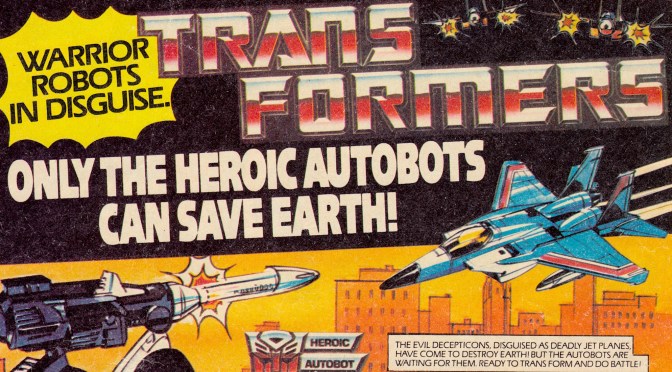
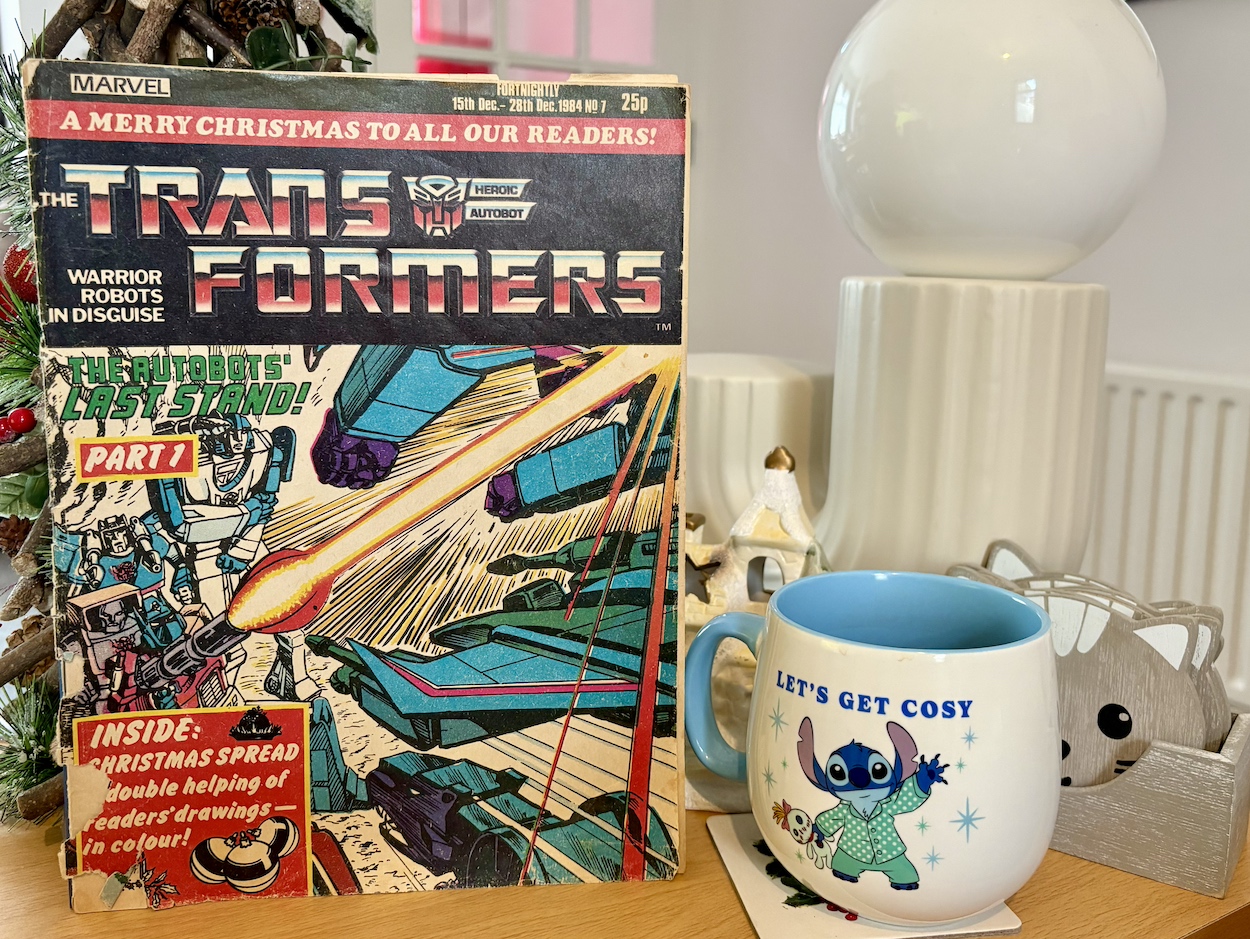
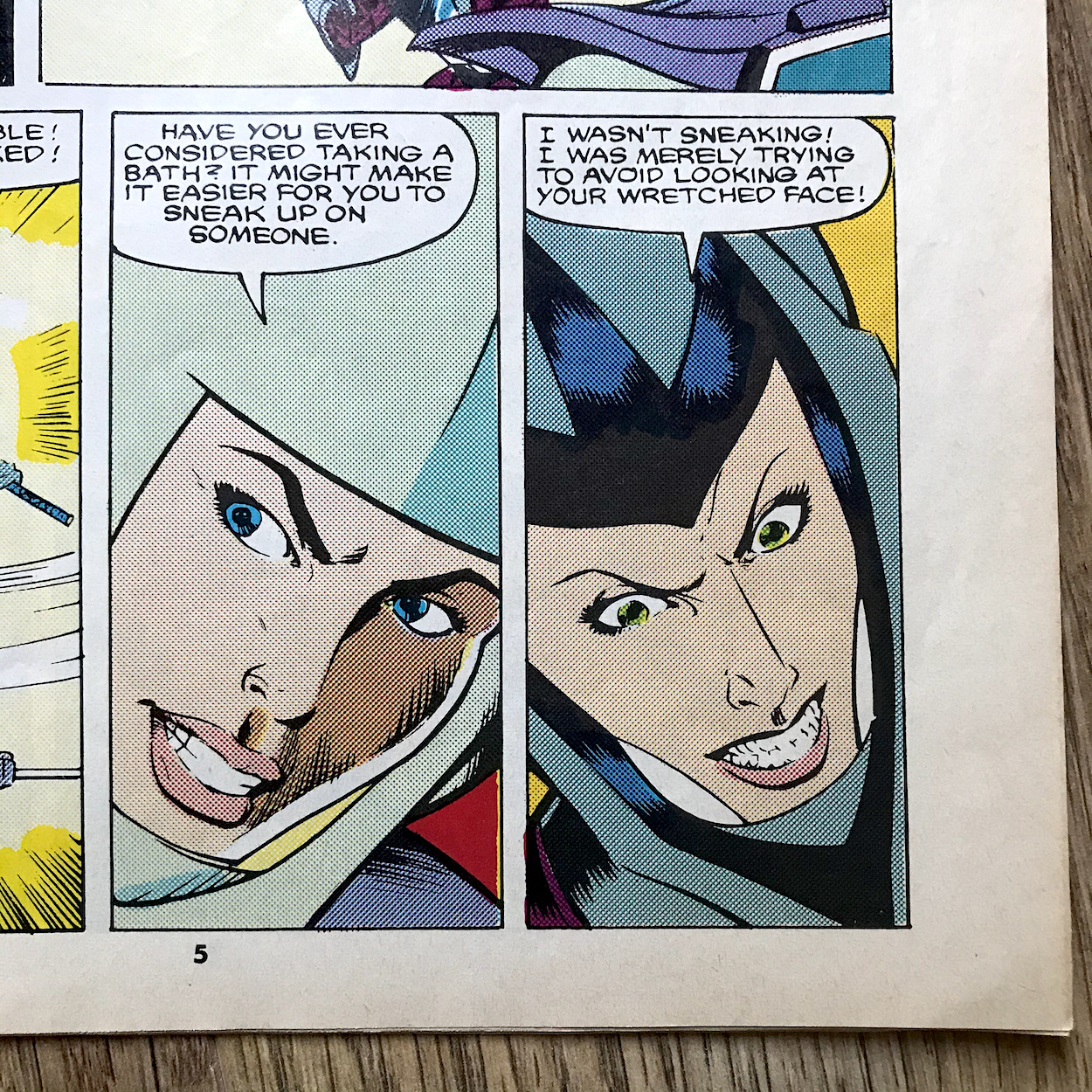
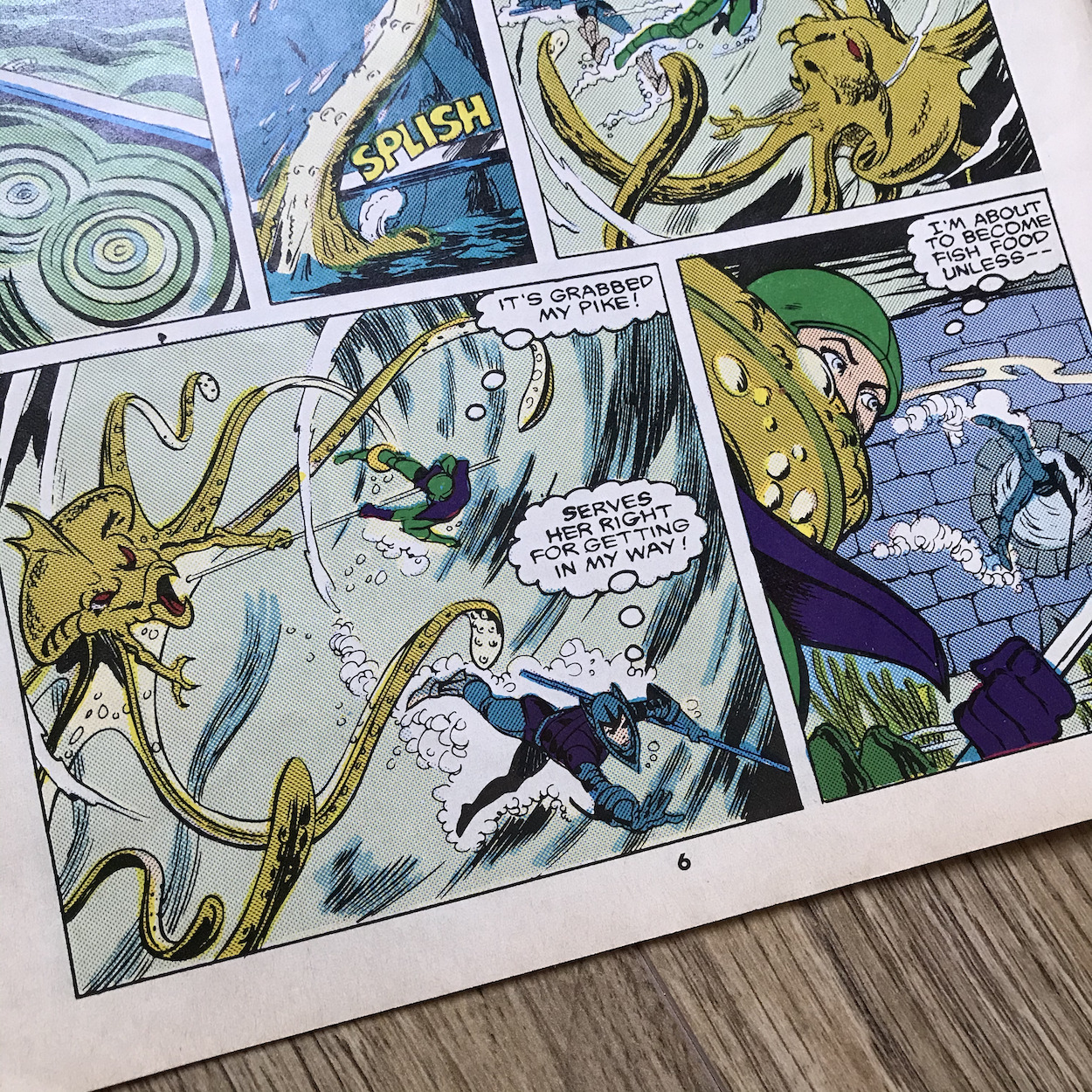
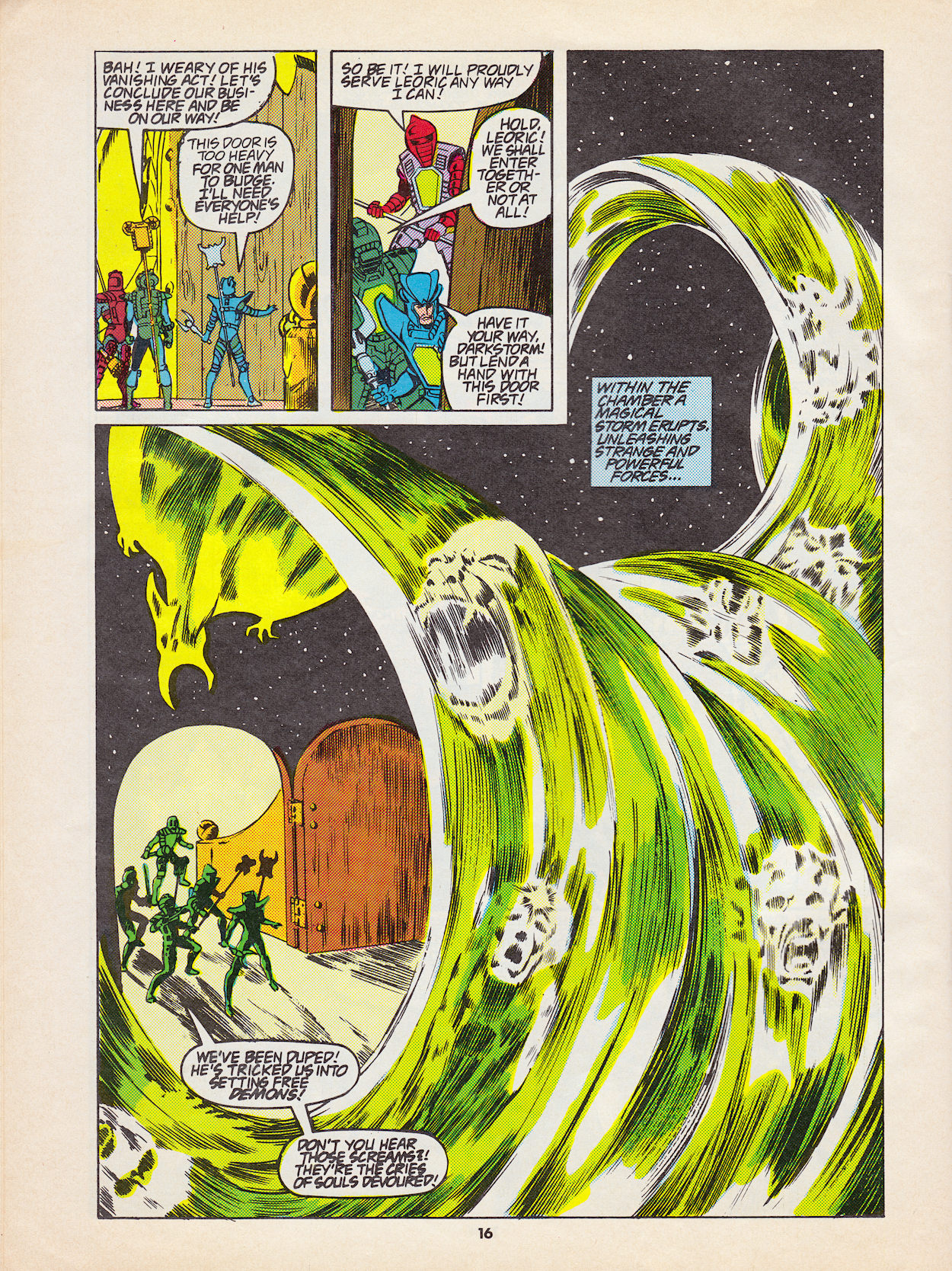
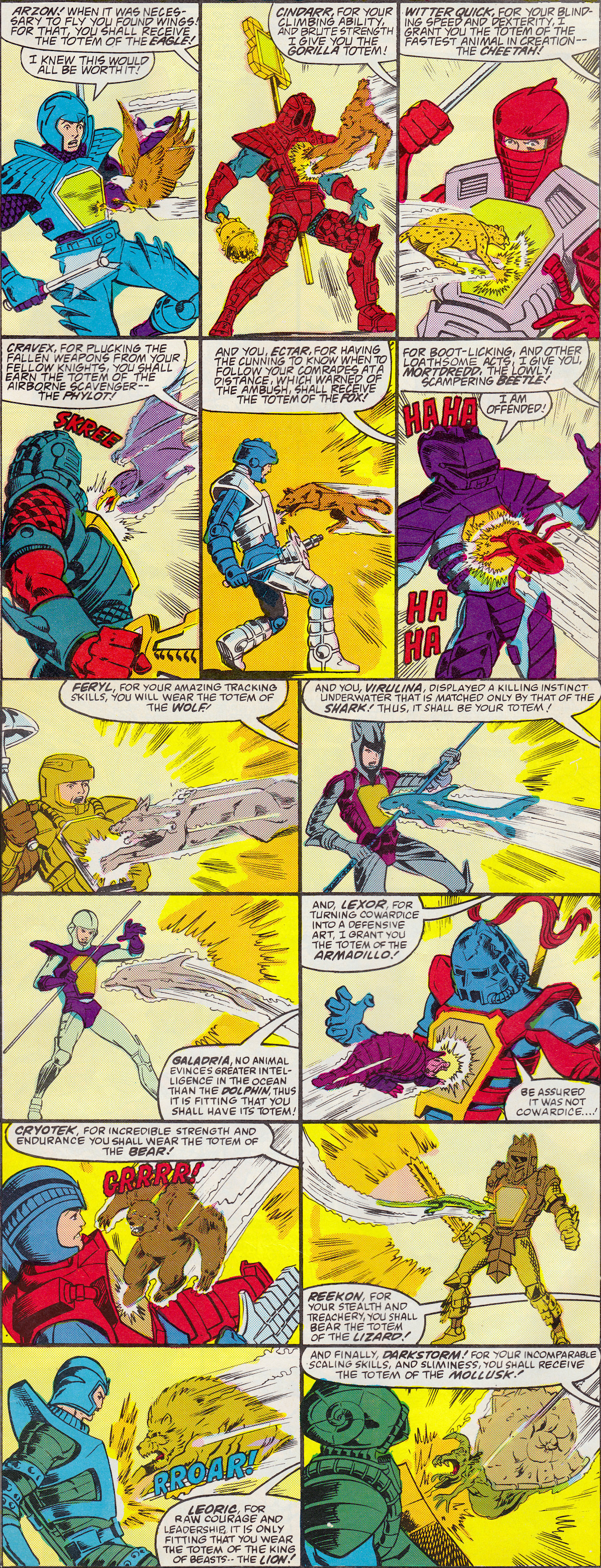
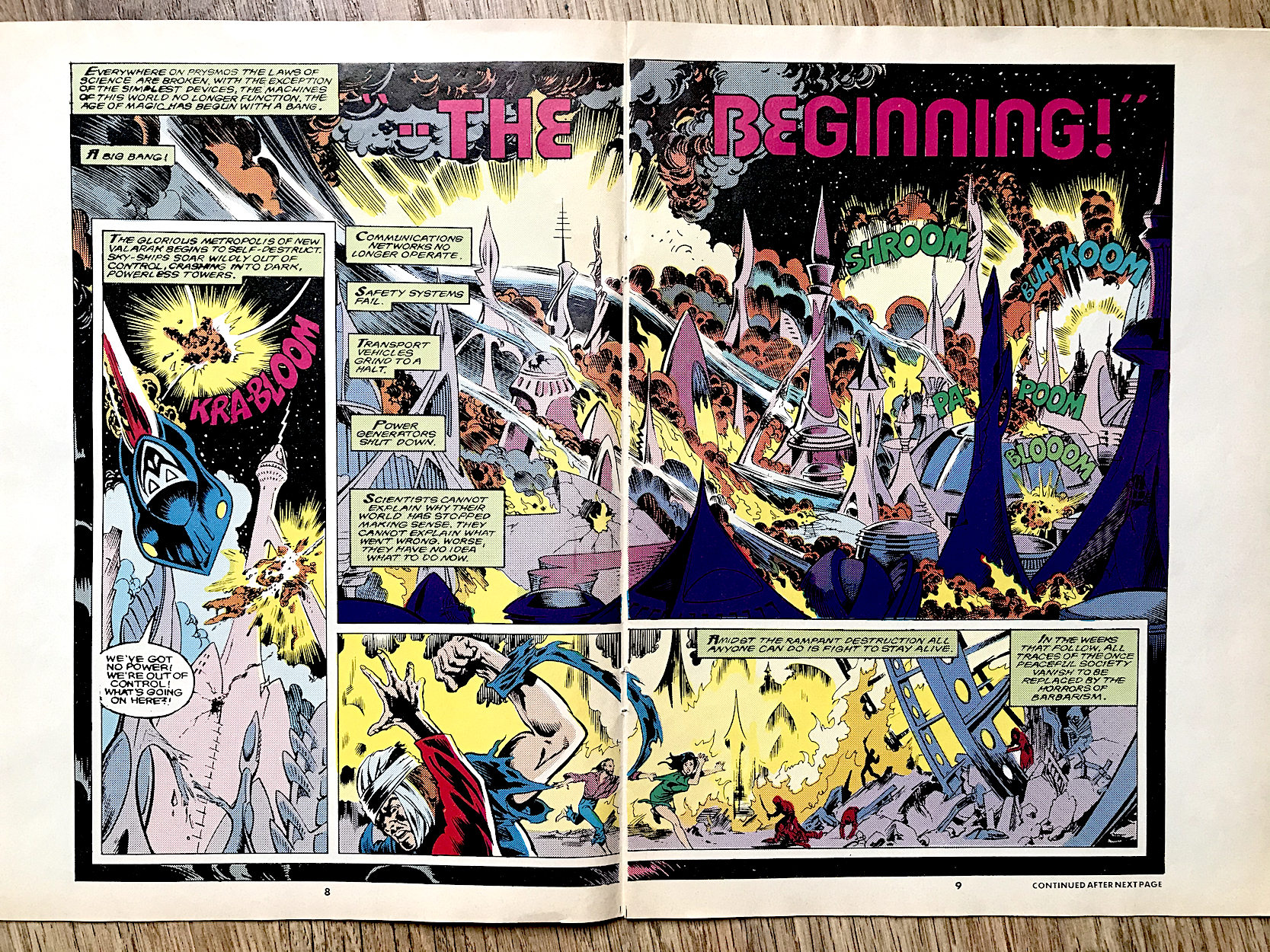
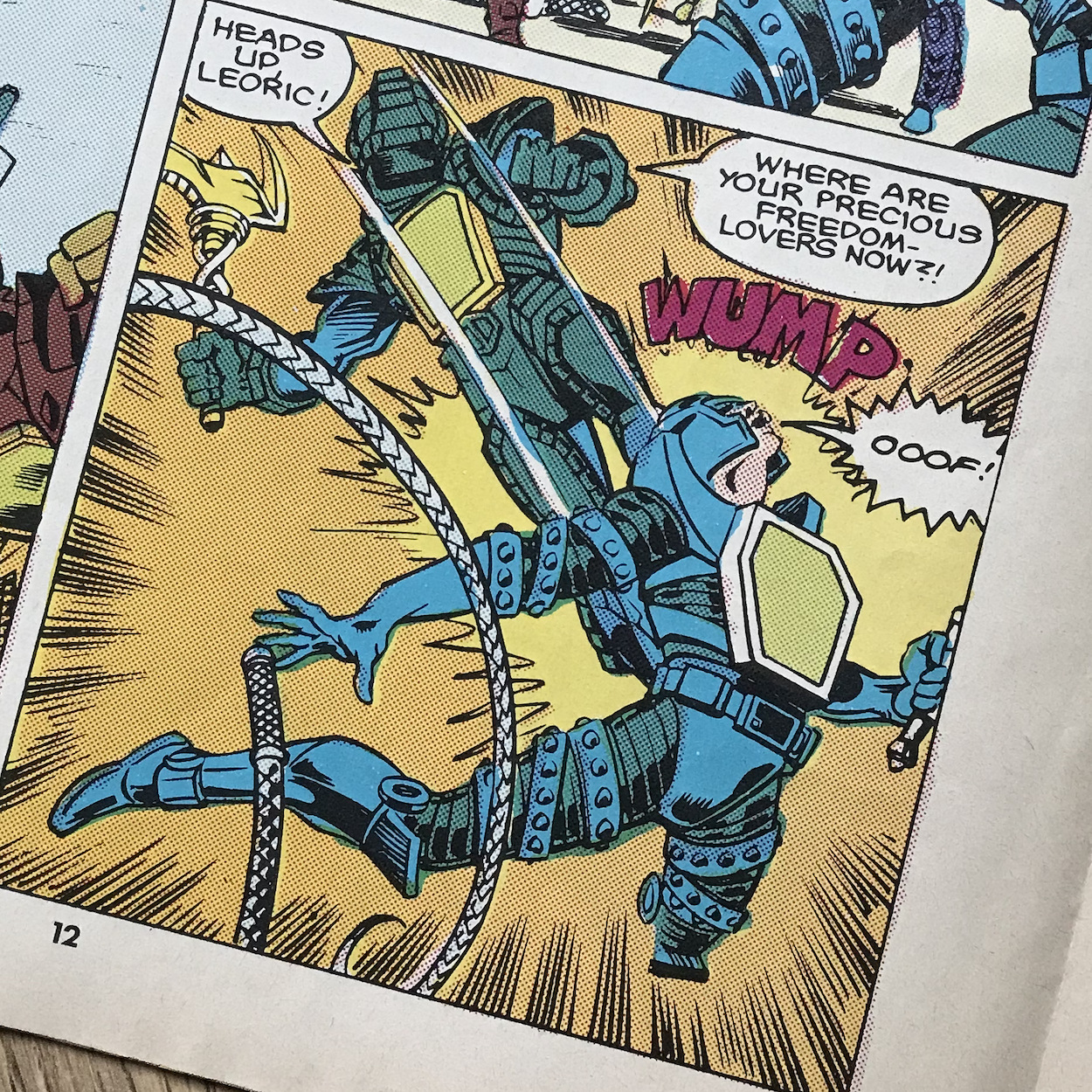
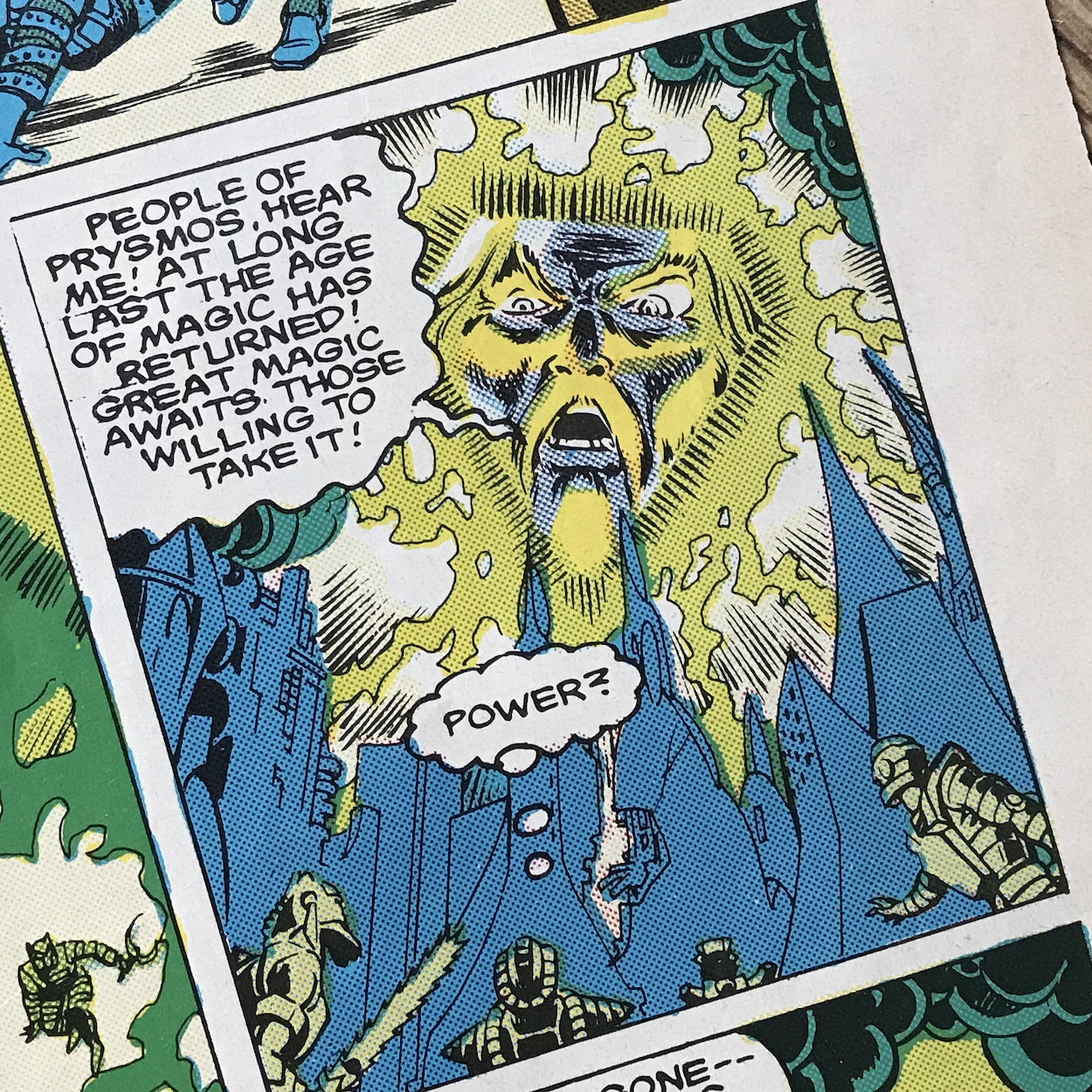
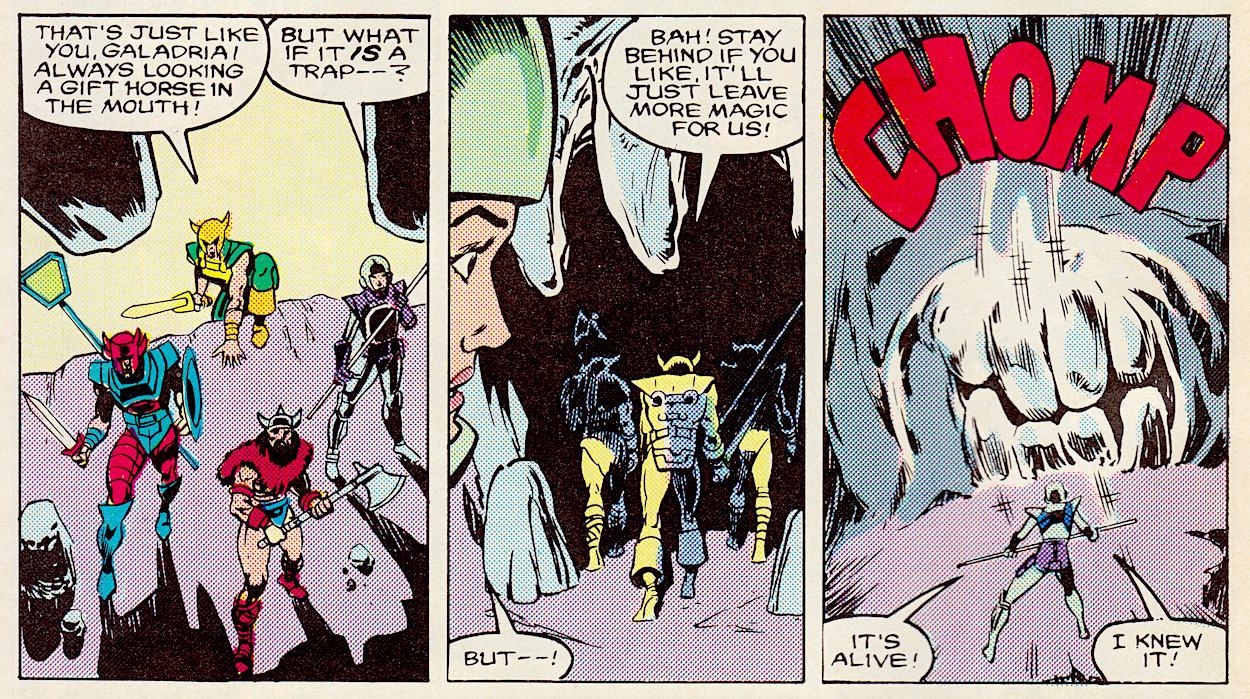
It’s been a long wait but finally here we are with month two (of 89) of our photographic journey through every single issue of Marvel UK’s Transformers comic. We’ve doubled up for October 1984 with two fortnightly comics filled not only with classic Transformers strip action, but also some of the finest retro goodness. Prepare to take a trip back to the 80s and come away feeling very, very old.
iSSUE TWO – 4th OCTOBER 1984
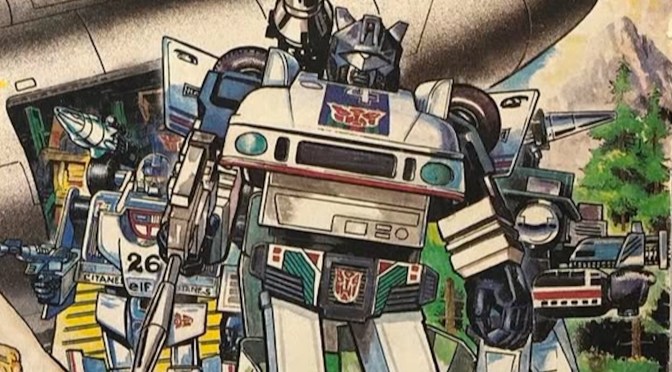
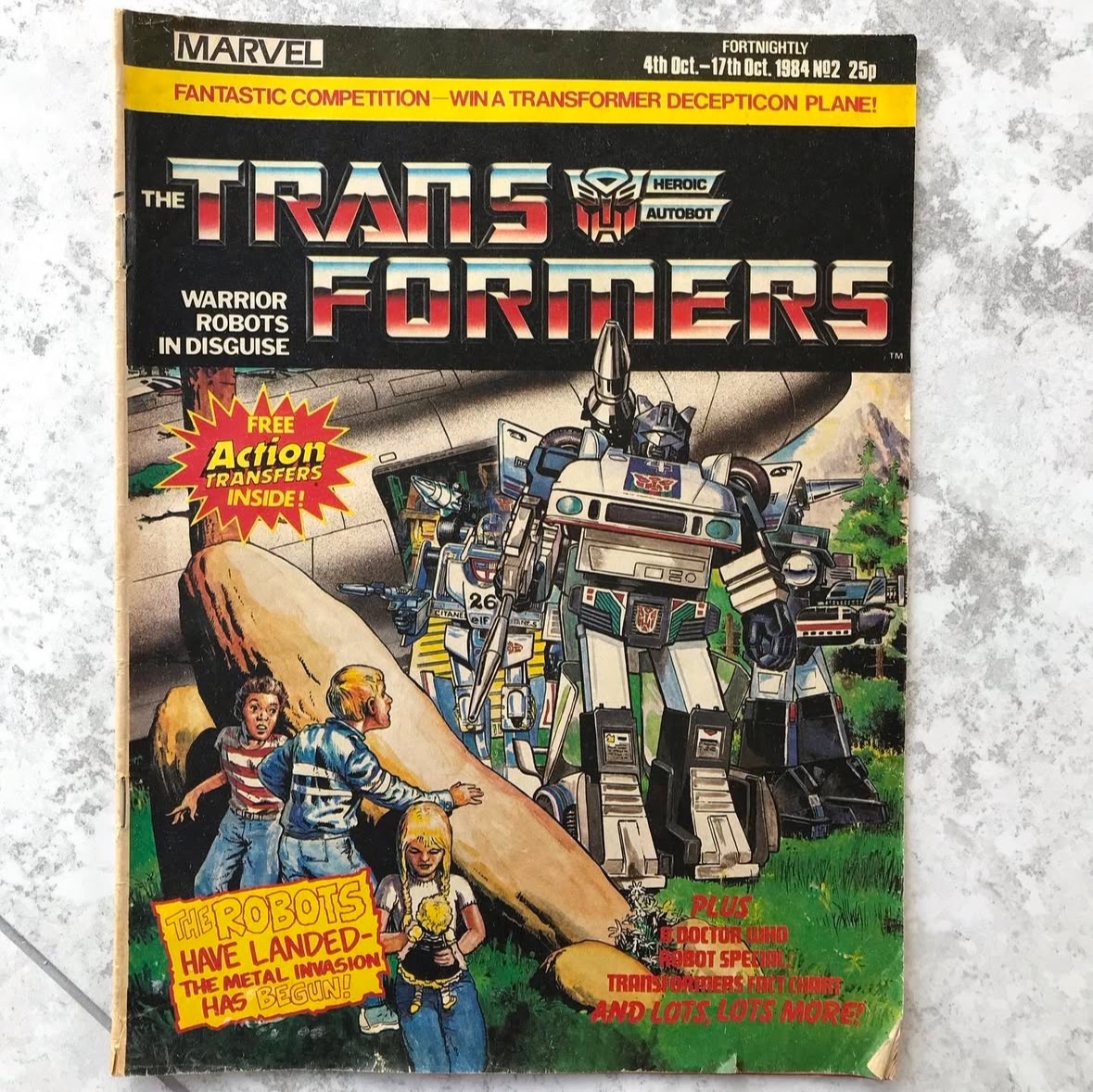
#2: Marvel UK’s sophomore Transformers release begins with a simply beautiful John Ridgway cover. It’s not linked to the story but then again neither was last issue’s and that’s not the point, it’s just a gorgeous piece of art and shows the toy models off in a great light, all while perfectly summing up children’s wonder at these new playthings. The cover would also be used for a future Collected Comics special where it better suited the story, albeit by coincidence. It would’ve made for a great free gift poster.
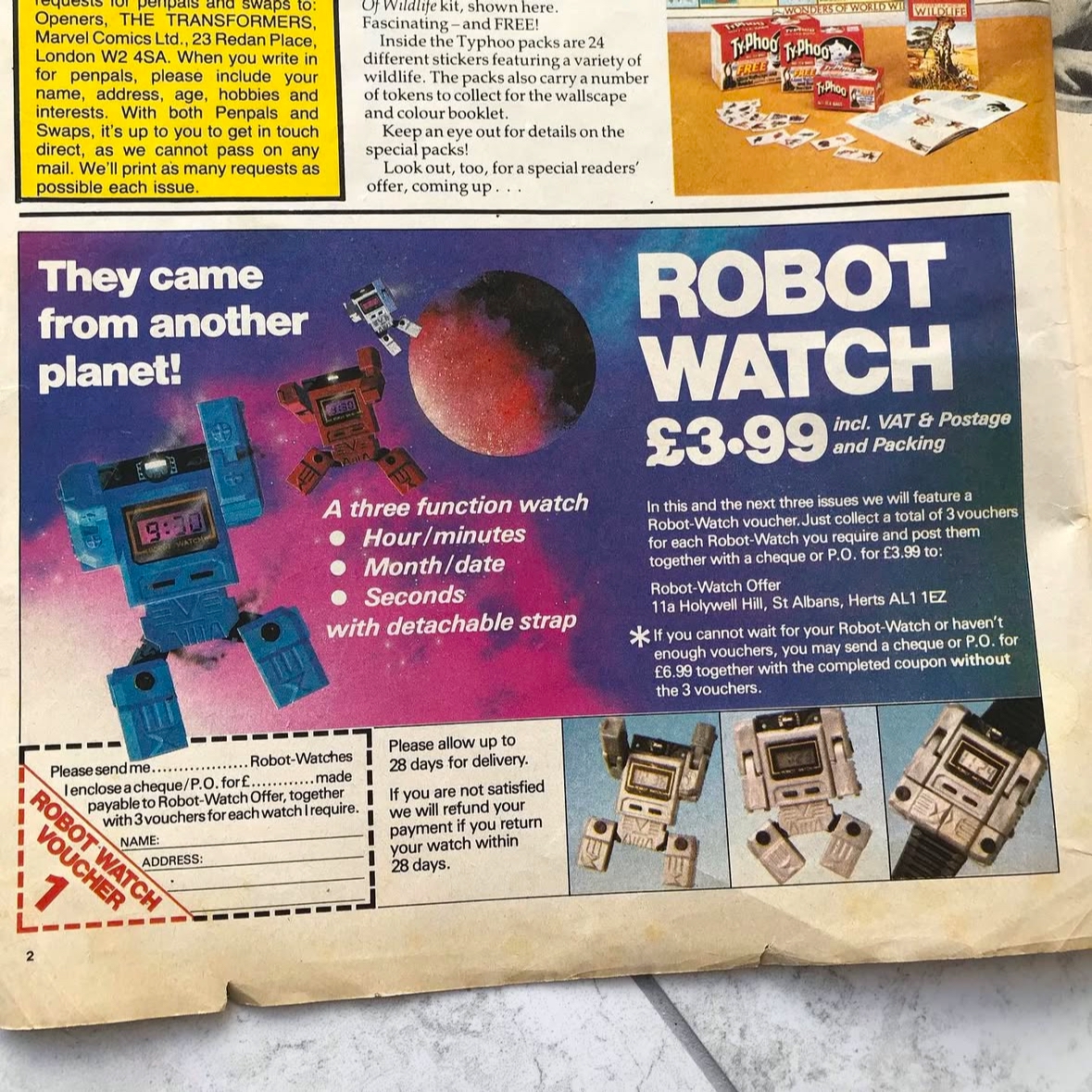
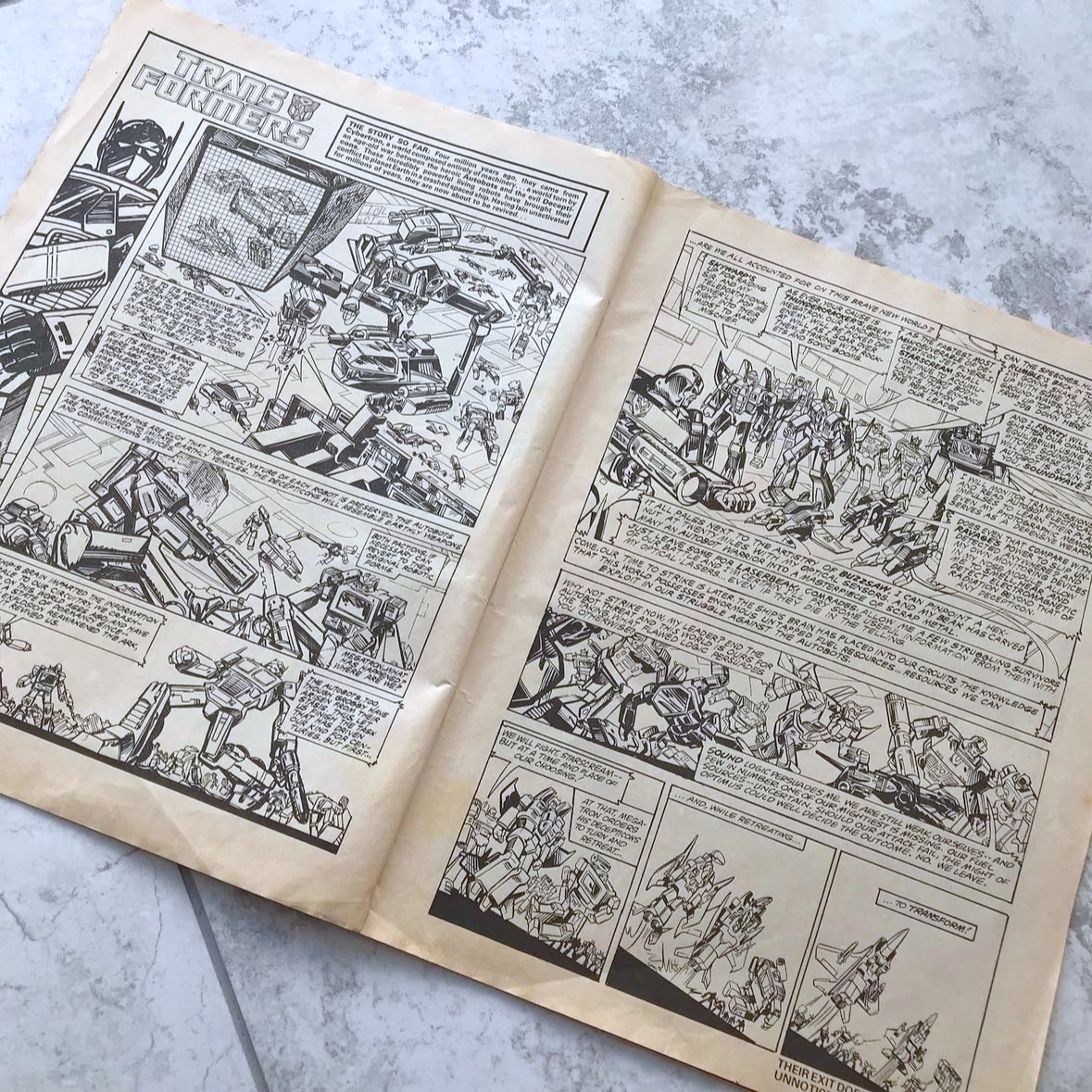
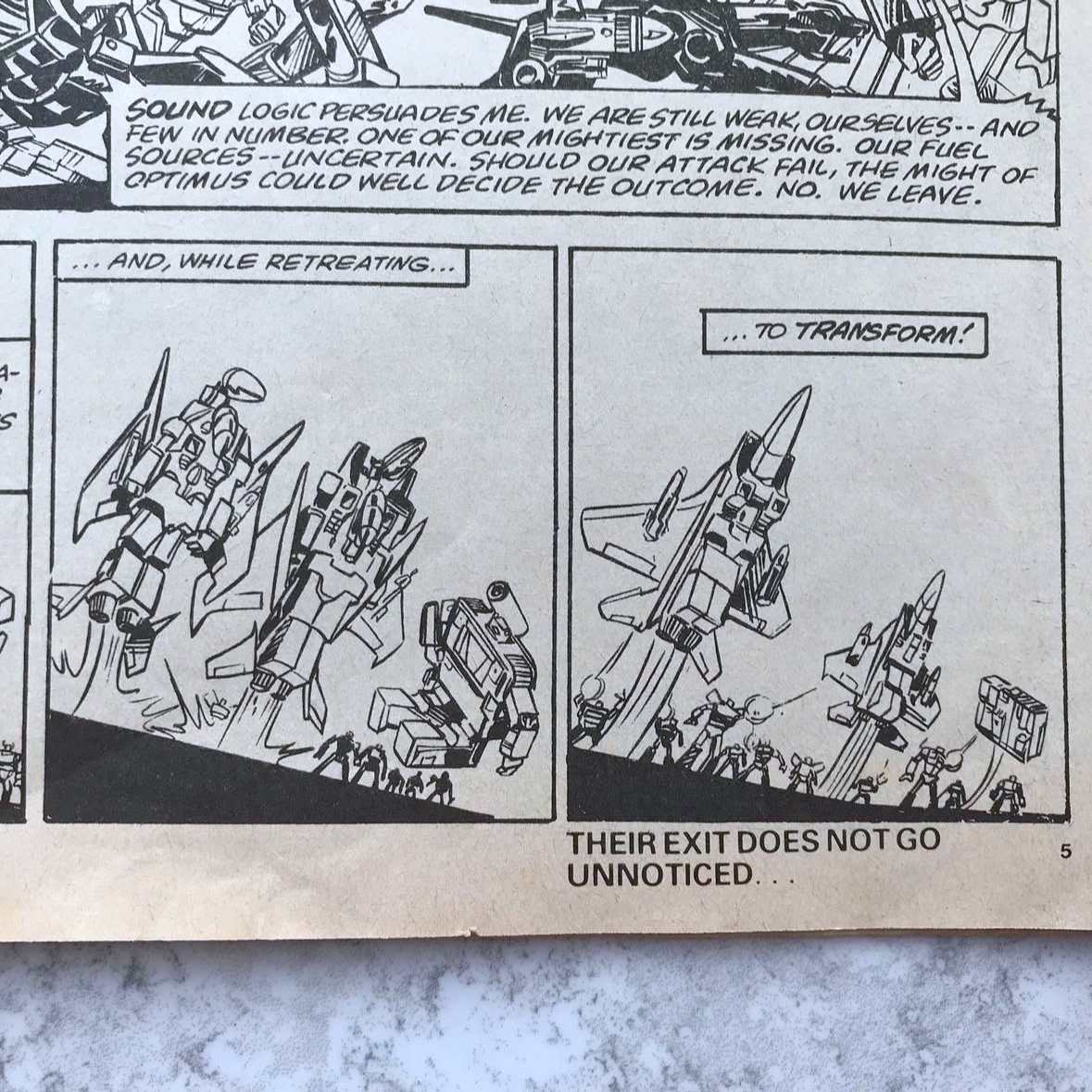
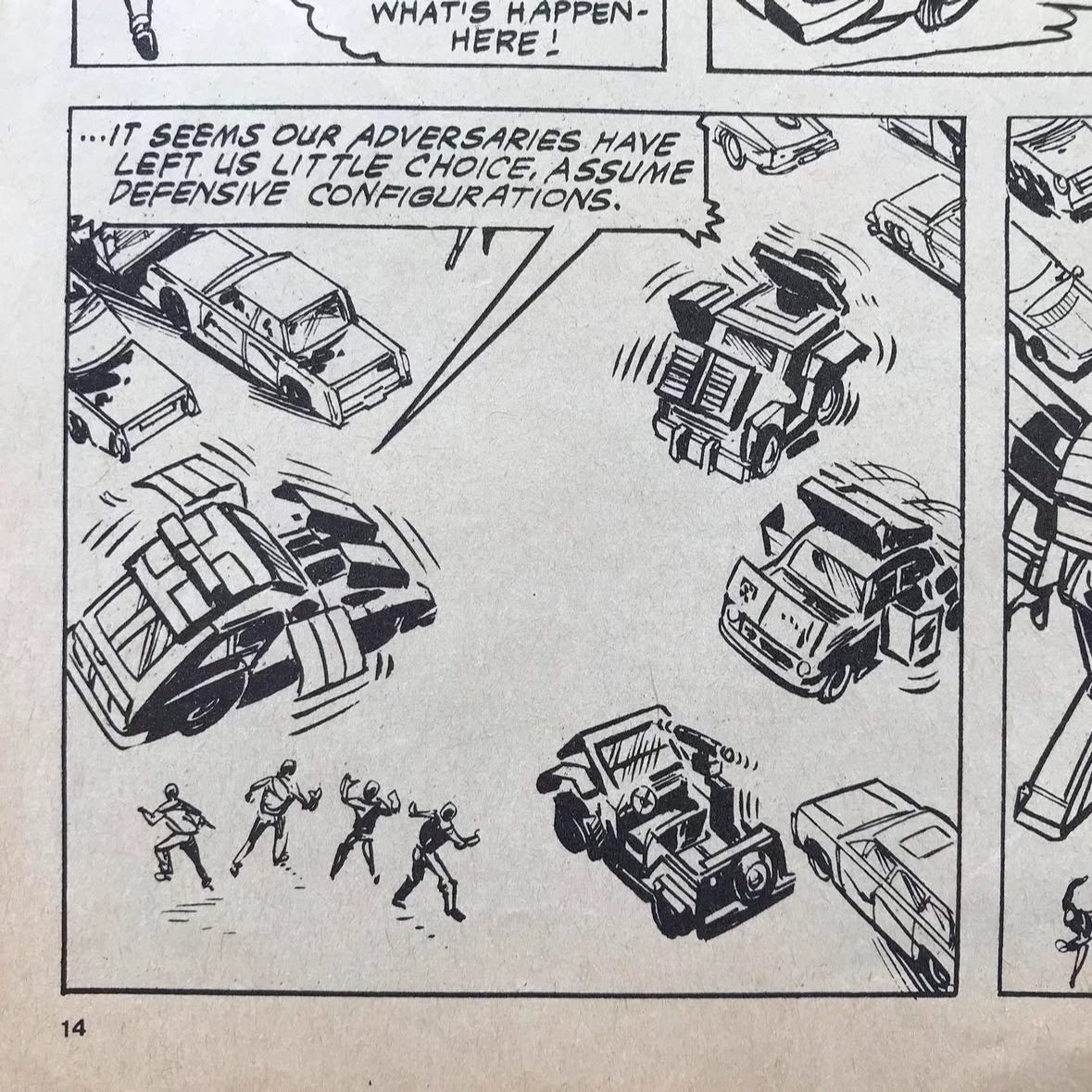
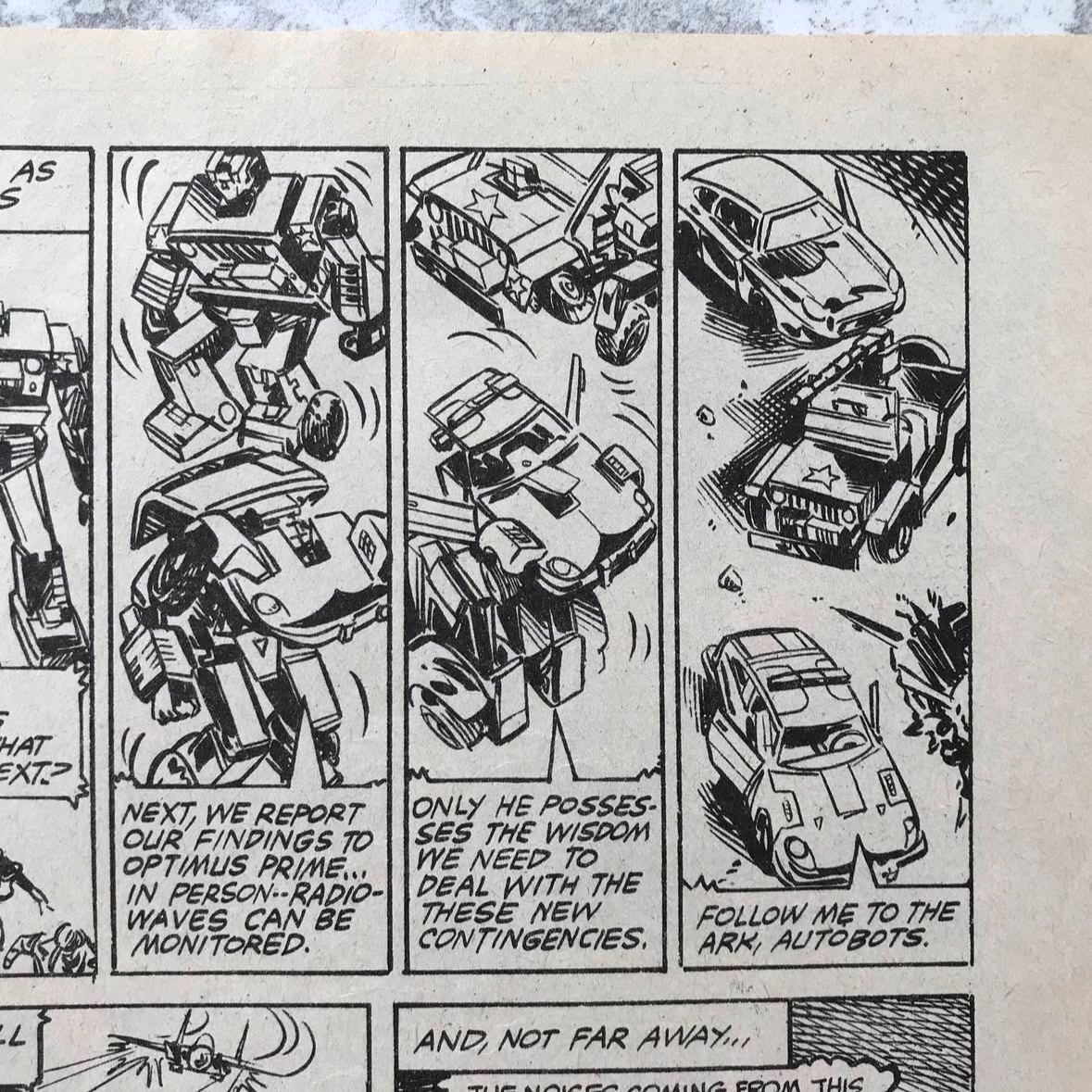
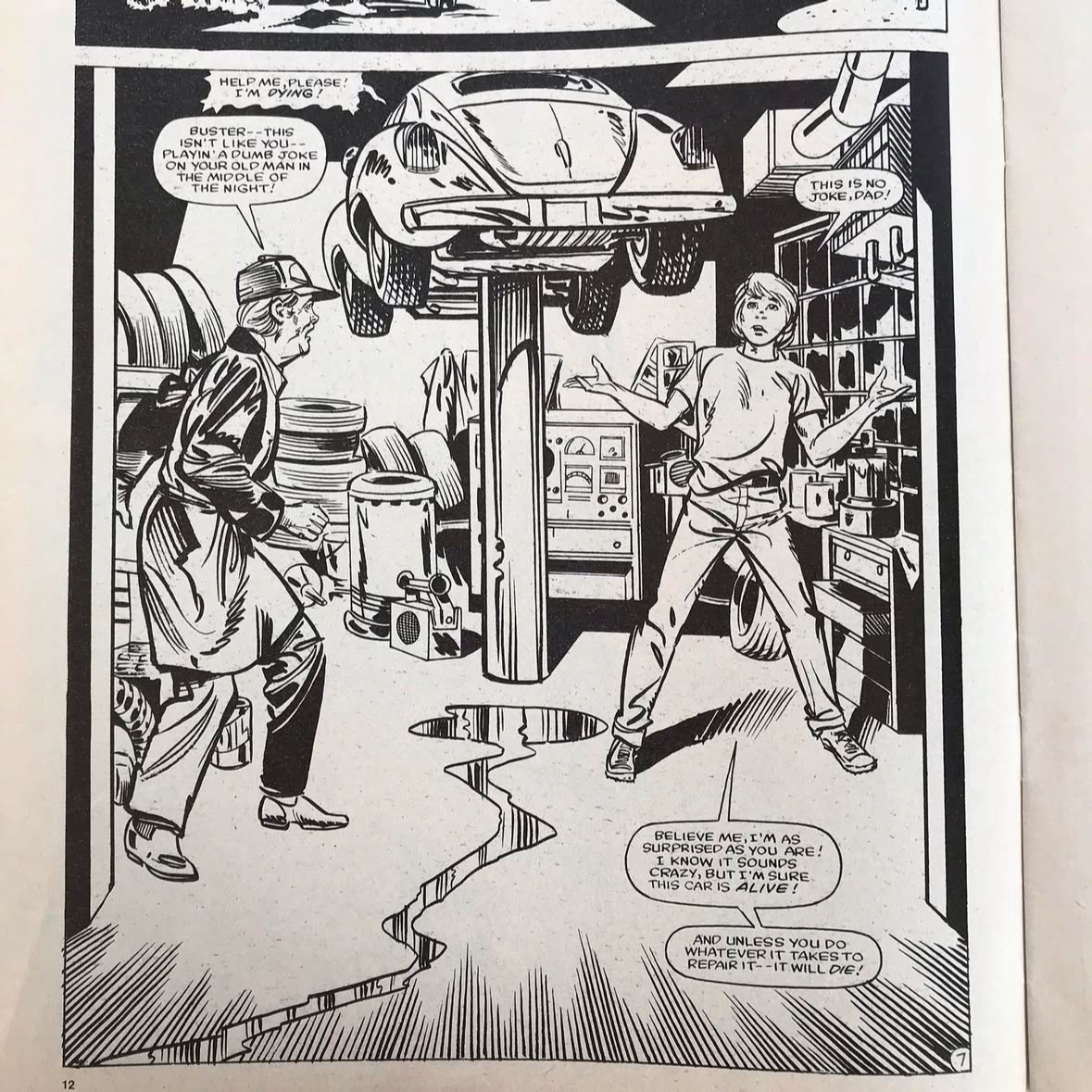
Inside, right from the off the nostalgia hits hard! Who else had one of these transforming watches? I did, although I can’t remember wearing it much so maybe it didn’t last too long. Then, in the main story (which is now partly black and white) there’s plenty of wonderful transforming images. In hindsight these could not have been easy to draw and some artists would end up not showing them mid-transformation like this. Lovely stuff.
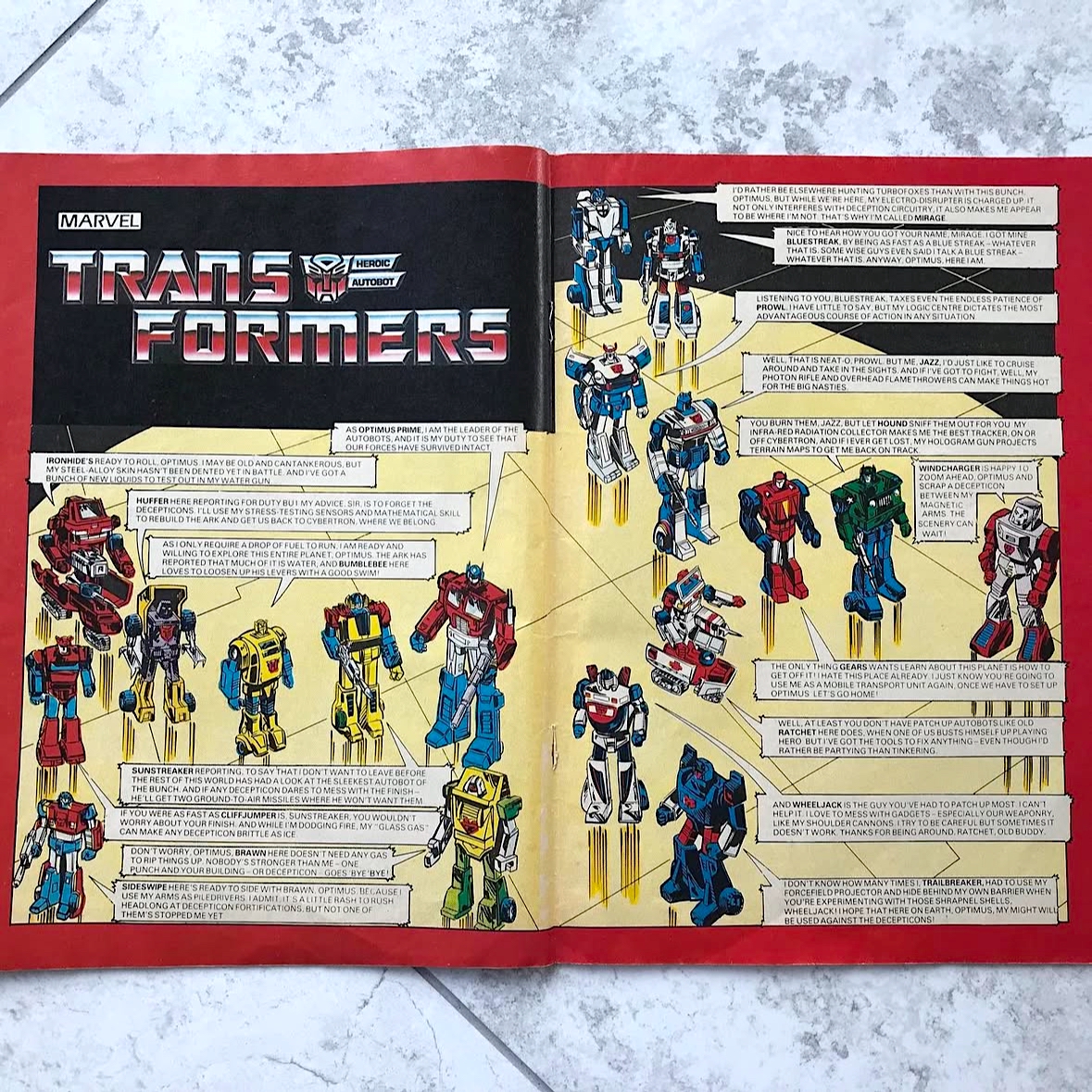
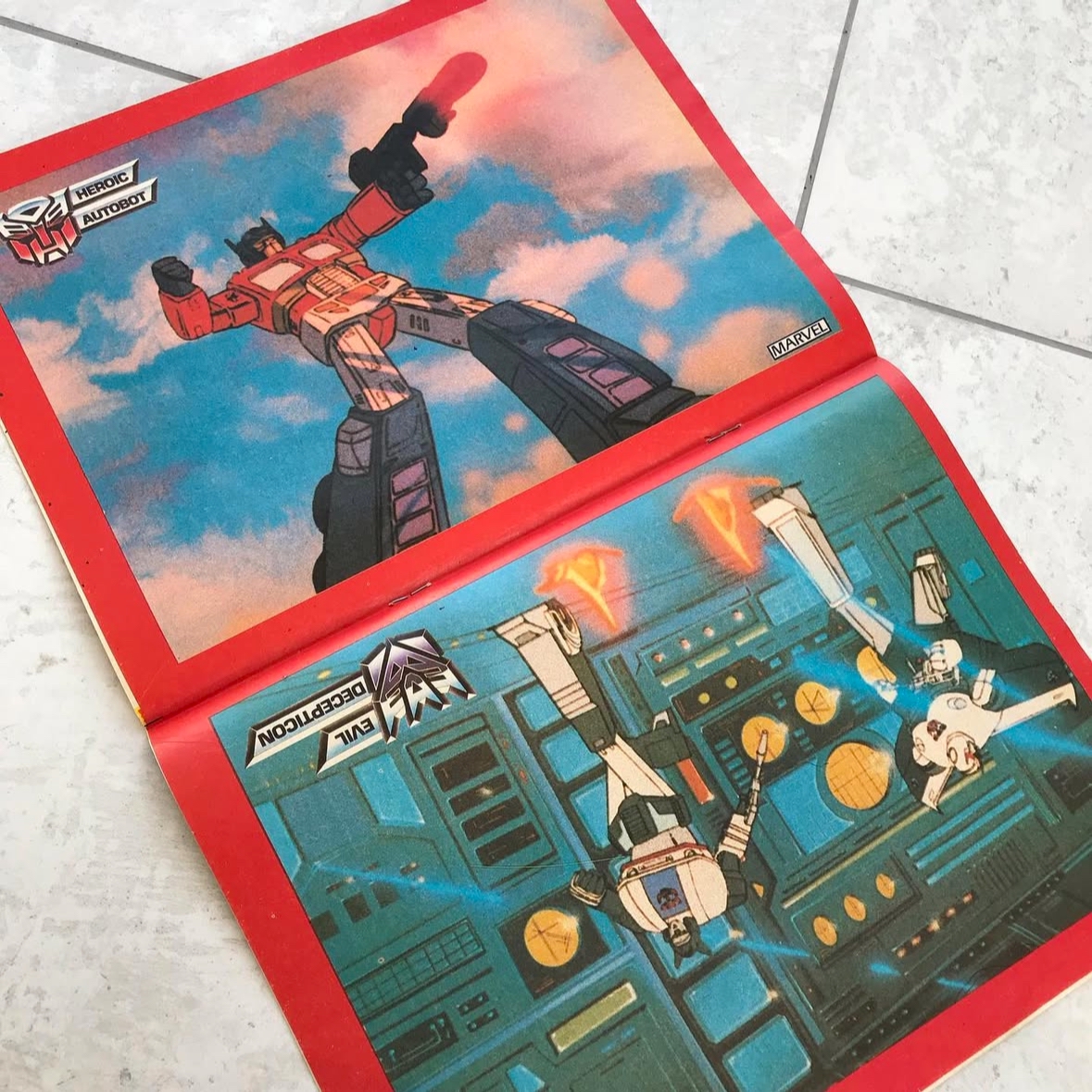
The Autobots’ introductory spread was edited out of the strip itself to make a great poster in the middle of the comic, replacing some panels with the franchise’s title logo. Given how huge and epic this comic’s tale would become I love the quaint feeling of this, with its awkward poses to make sure everyone can be seen, the toy-accurate Ironhide and Ratchet, and the stilted introductory dialogue for the young readers to learn all of their details.
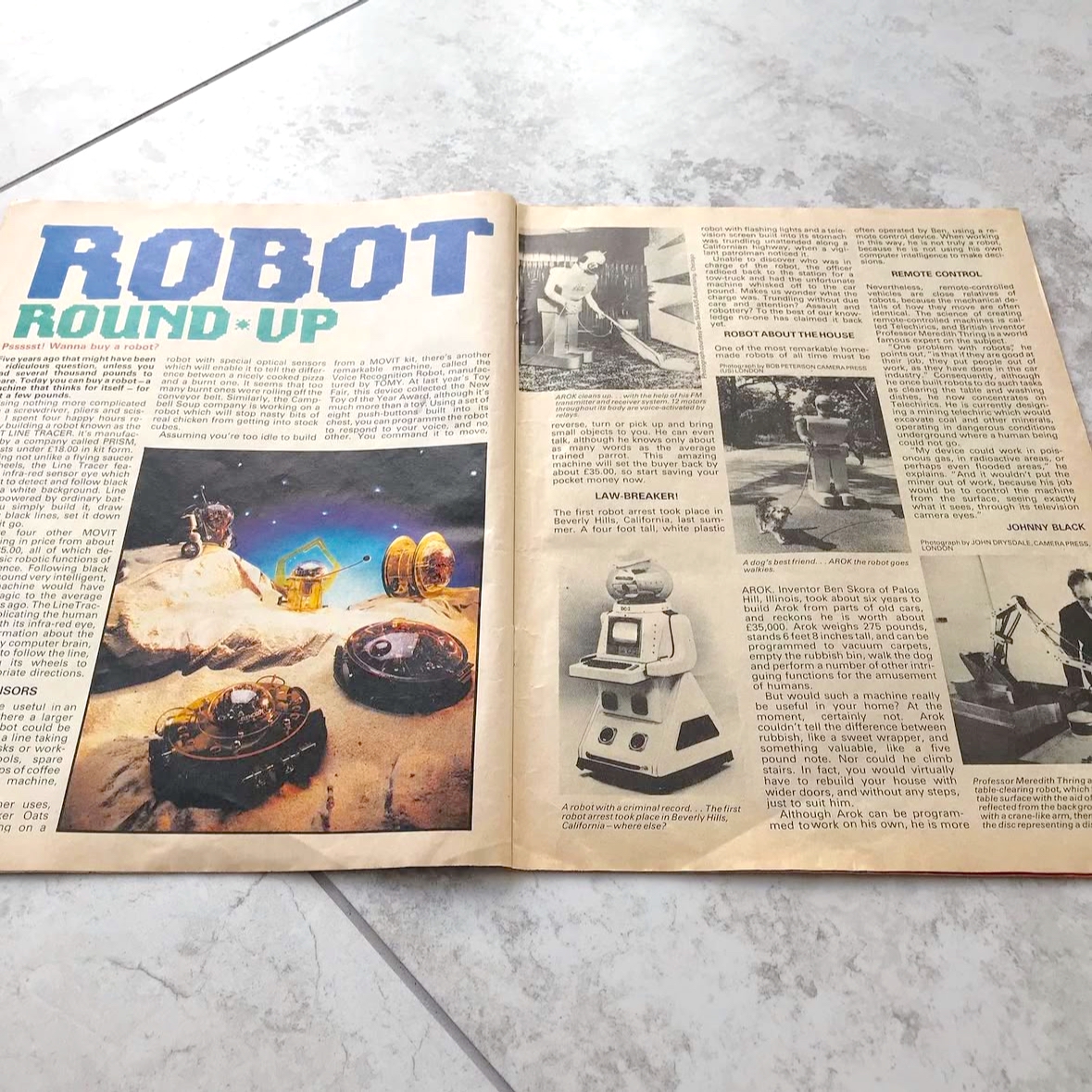
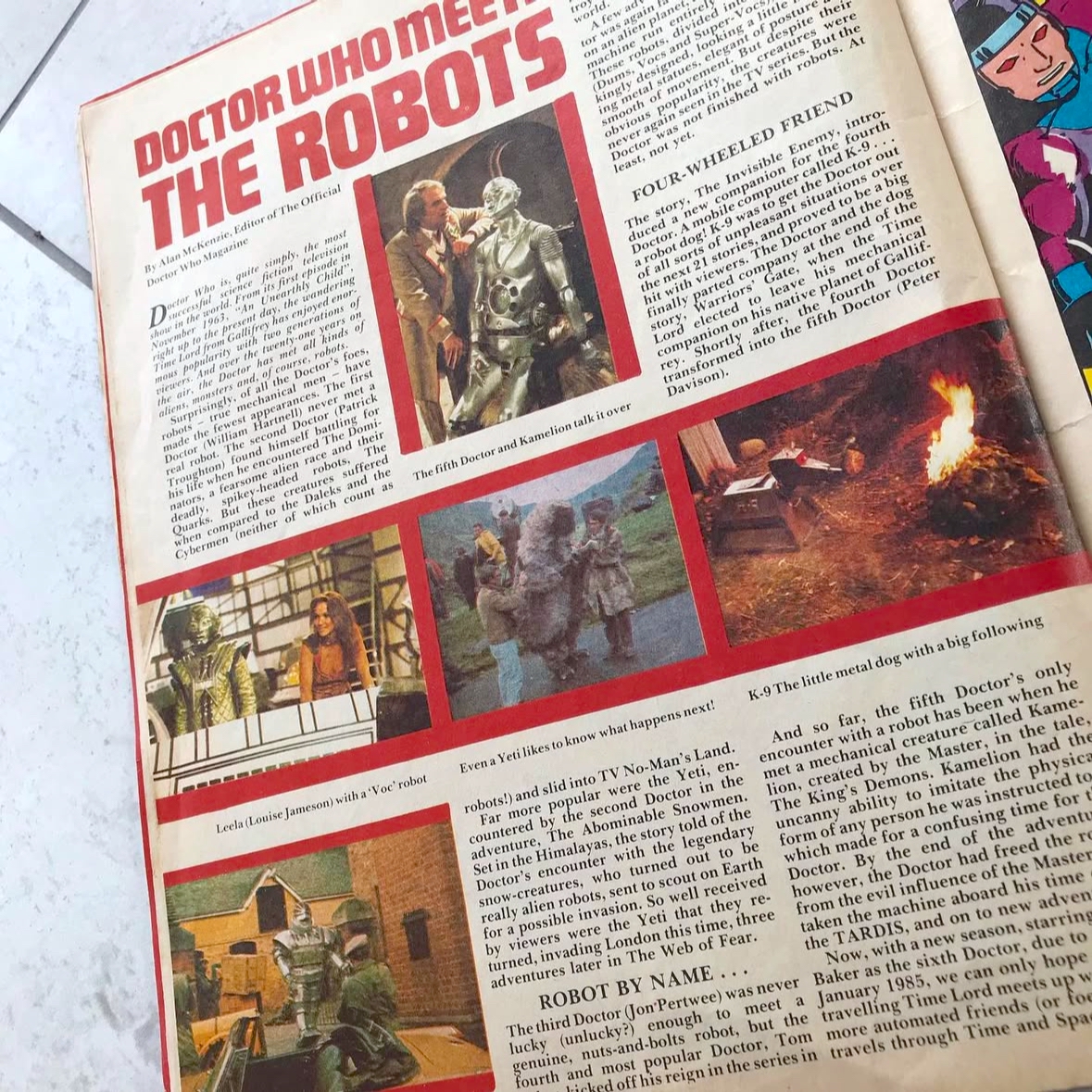
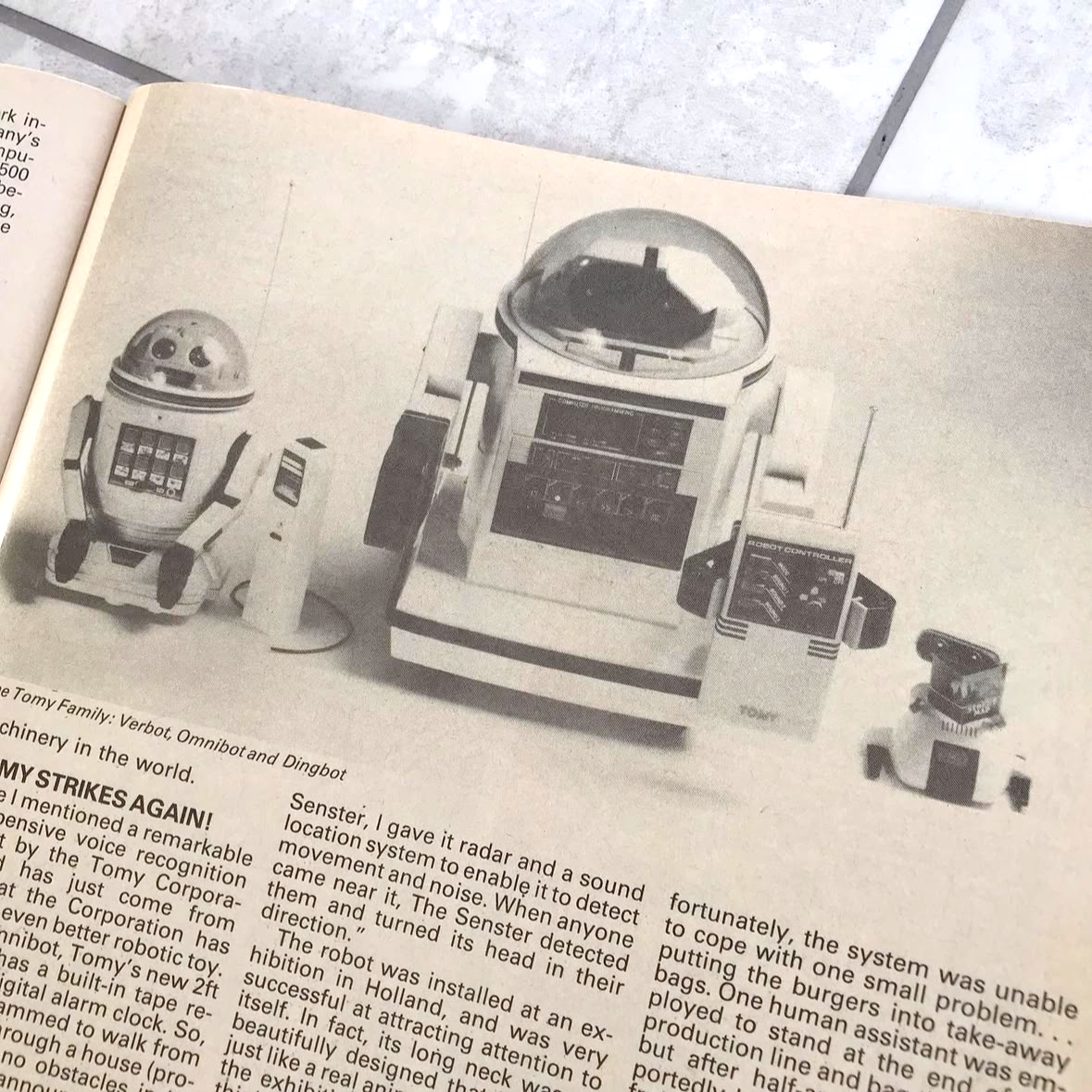
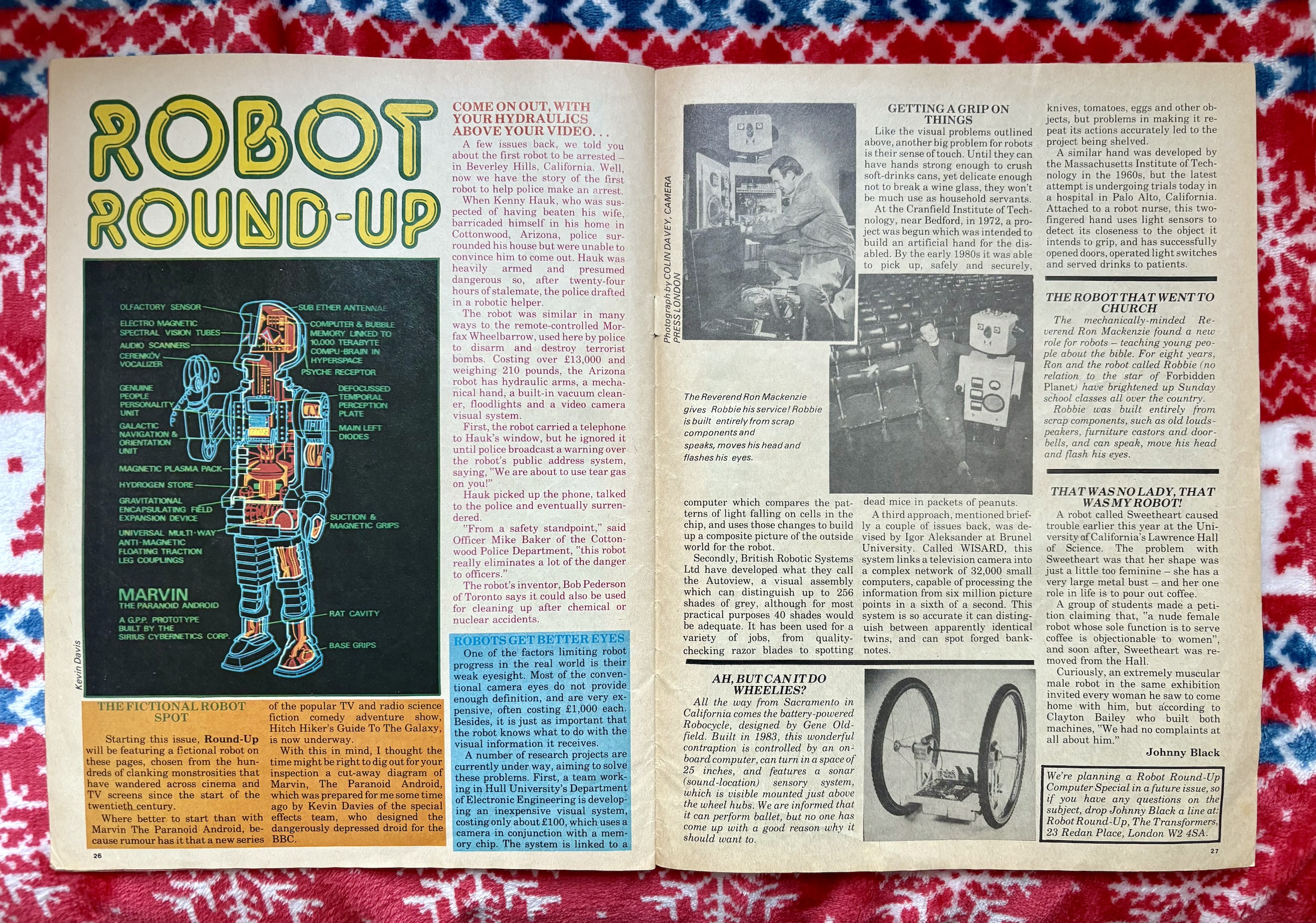
There are two prose features on robots this issue. The regular Robot Round-up takes a look at some of the most 80s-futuristic inventions imaginable, back when human-like robots were more fun and less terrifying. There’s also a special Doctor Who page on the robot props of the show at the time. Where are the Daleks, I hear you cry? Well, if you’re a fan you’d know why they’re not included. Glad to see the comic got that right. That just about rounds up our look at the second issue.
Cover by John Ridgway The Transformers: Part Two plot by Bill Mantlo, script by Ralph Macchio, pencils by Frank Springer, inks by Kim DeMulder, lettering by Michael Higgins & Rick Parker, colours by Nel Yomtov
iSSUE THREE – 18th OCTOBER 1984
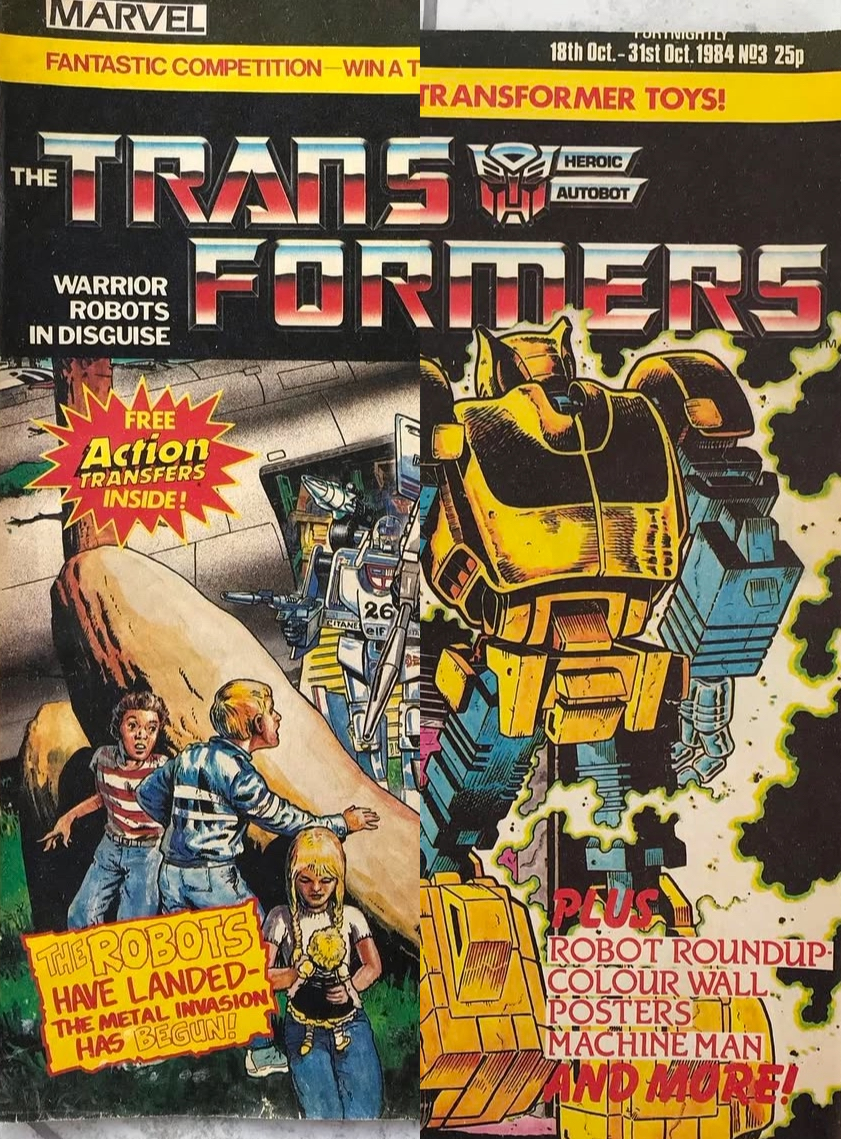
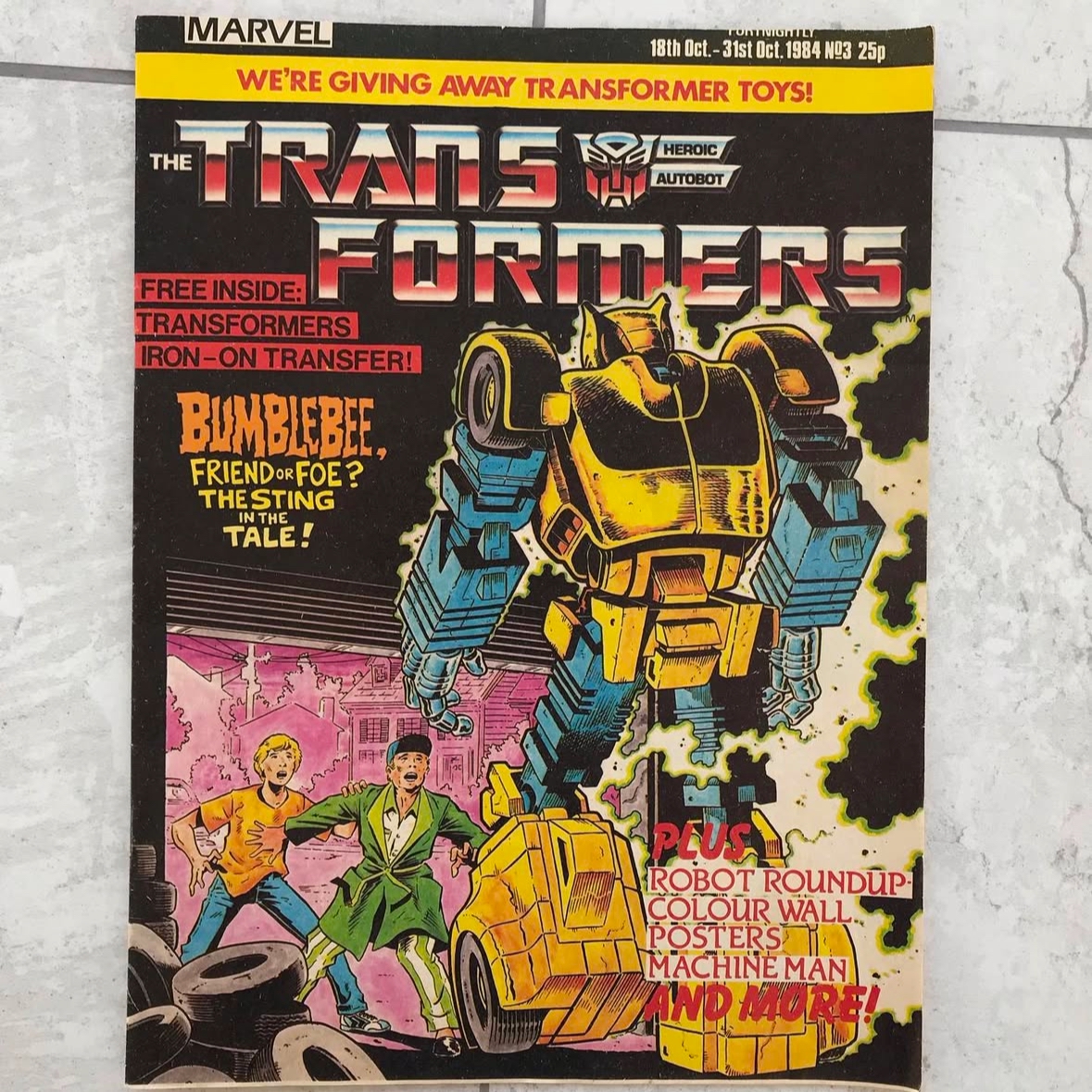
#3: Another fortnight, another Transformers UK comic from 42 years ago! Jerry Paris returns as cover artist for issue three and it’s another gorgeous piece of art with a big, chunky Bumblebee complete with toy-accurate limbs. Such a shame Jerry wasn’t a regular contributor, his work was perfect for this comic. He would return in the end much to readers’ delight, but not for another 164 issues!
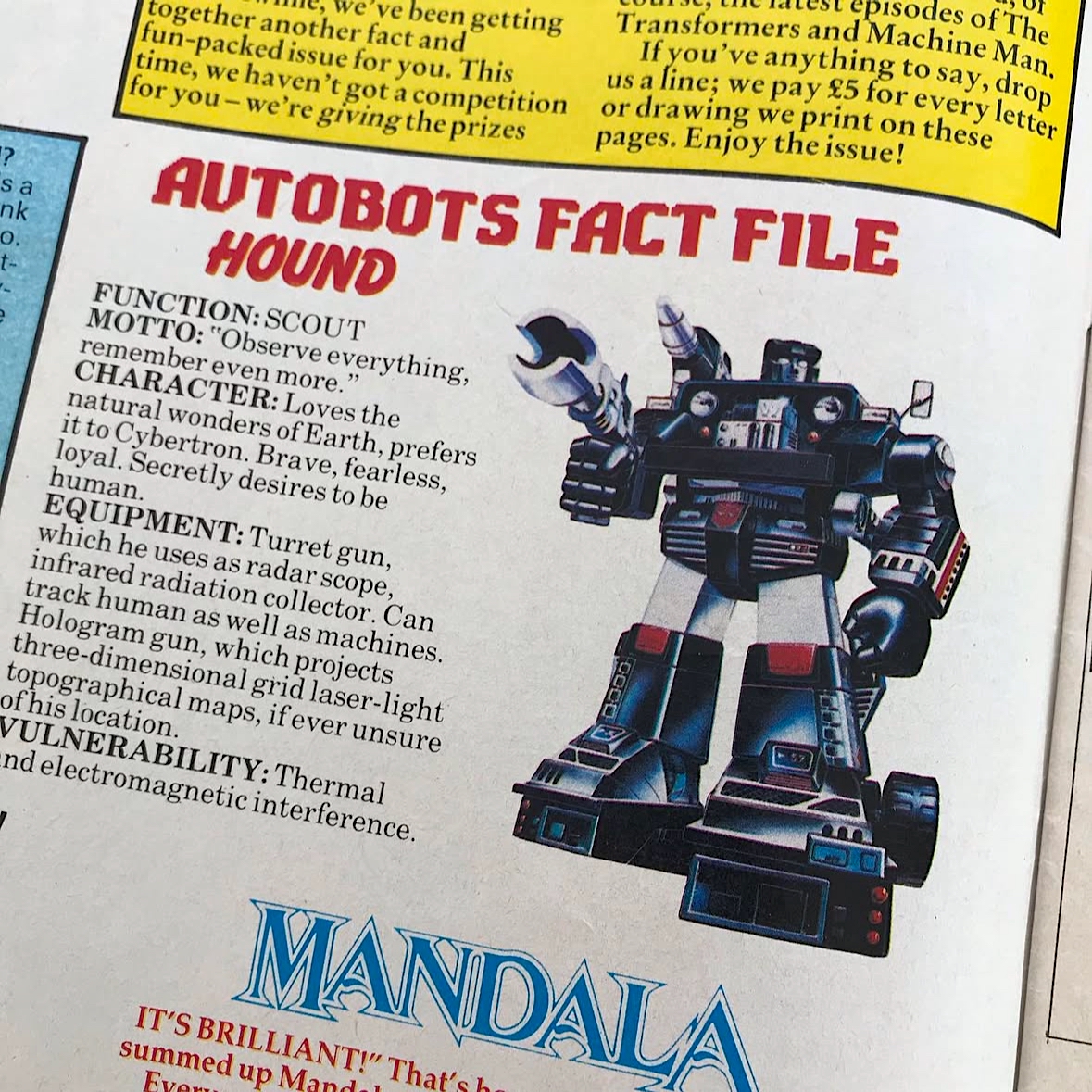
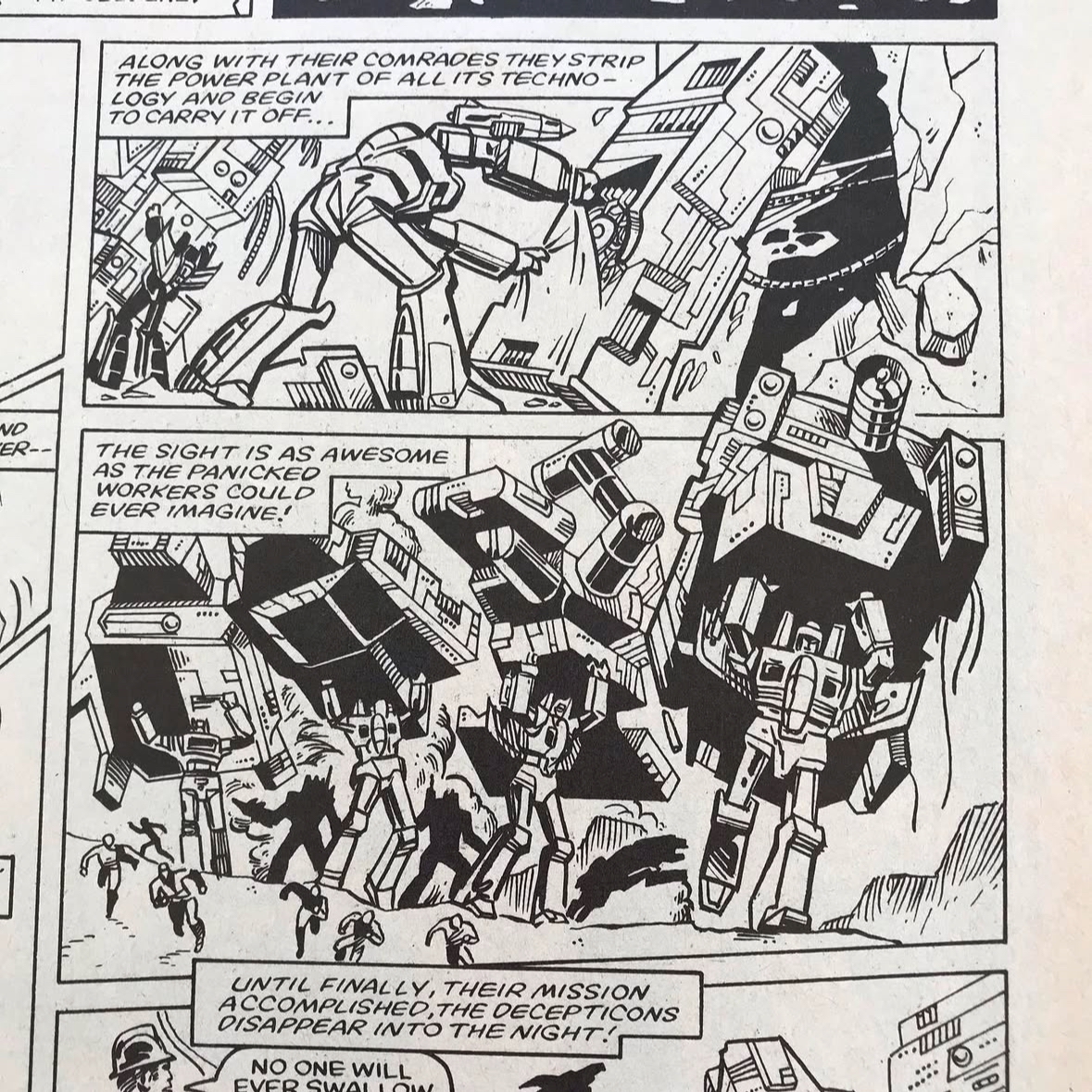
Inside, we kick things off with our first fact file. Not the A-Z we all remember so fondly, instead it’s a tiny entry on the editorial pages for Autobot Hound using information from the toy box. It would actually take a surprisingly long time for the A-Z format to appear. In the meantime, the main strip happily trundles along with both small and simply gigantic scale scenes. Seamlessly complementing each other, this successful juxtaposition of huge far-fetched sci-fi coupled with human storylines continues in the movies to this day.
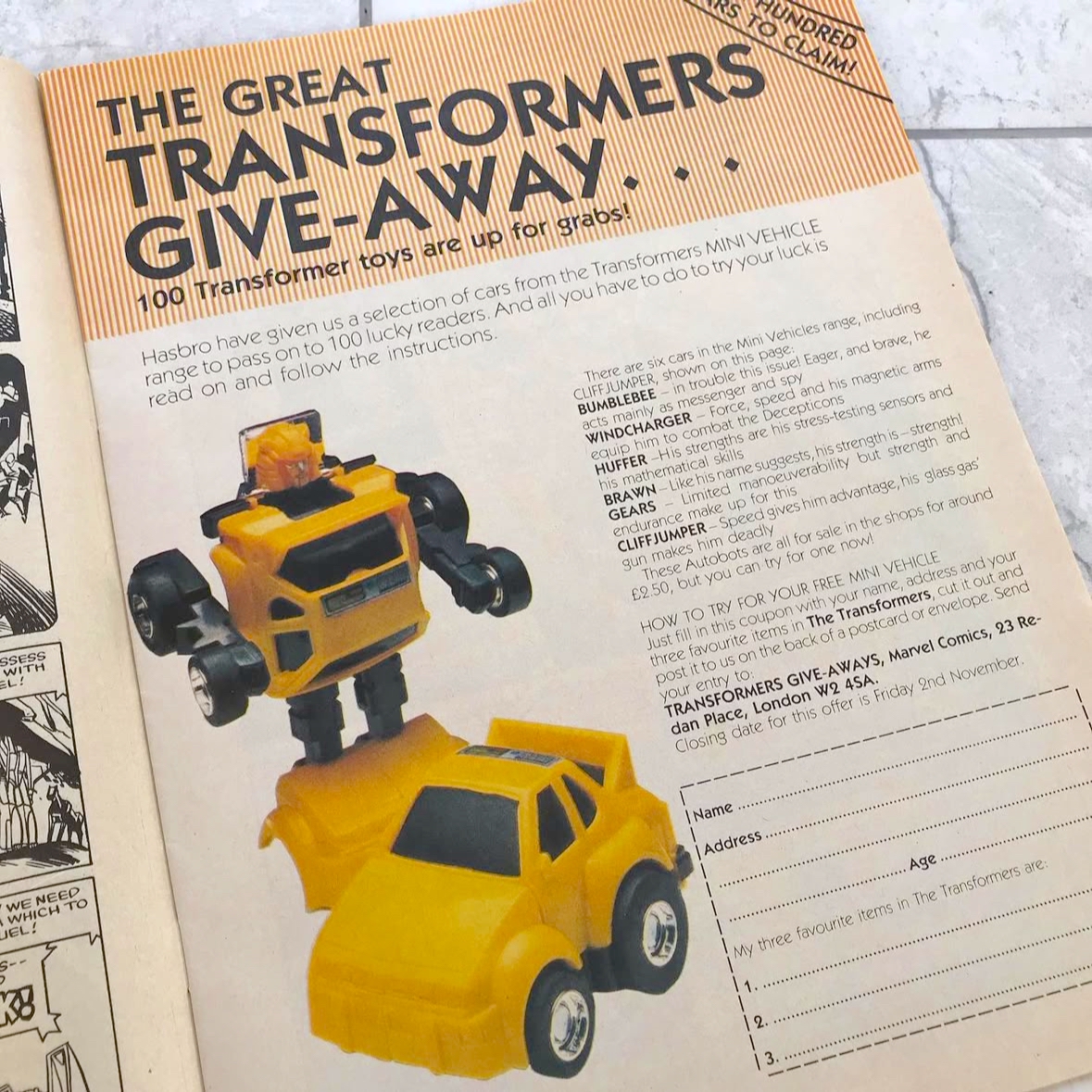
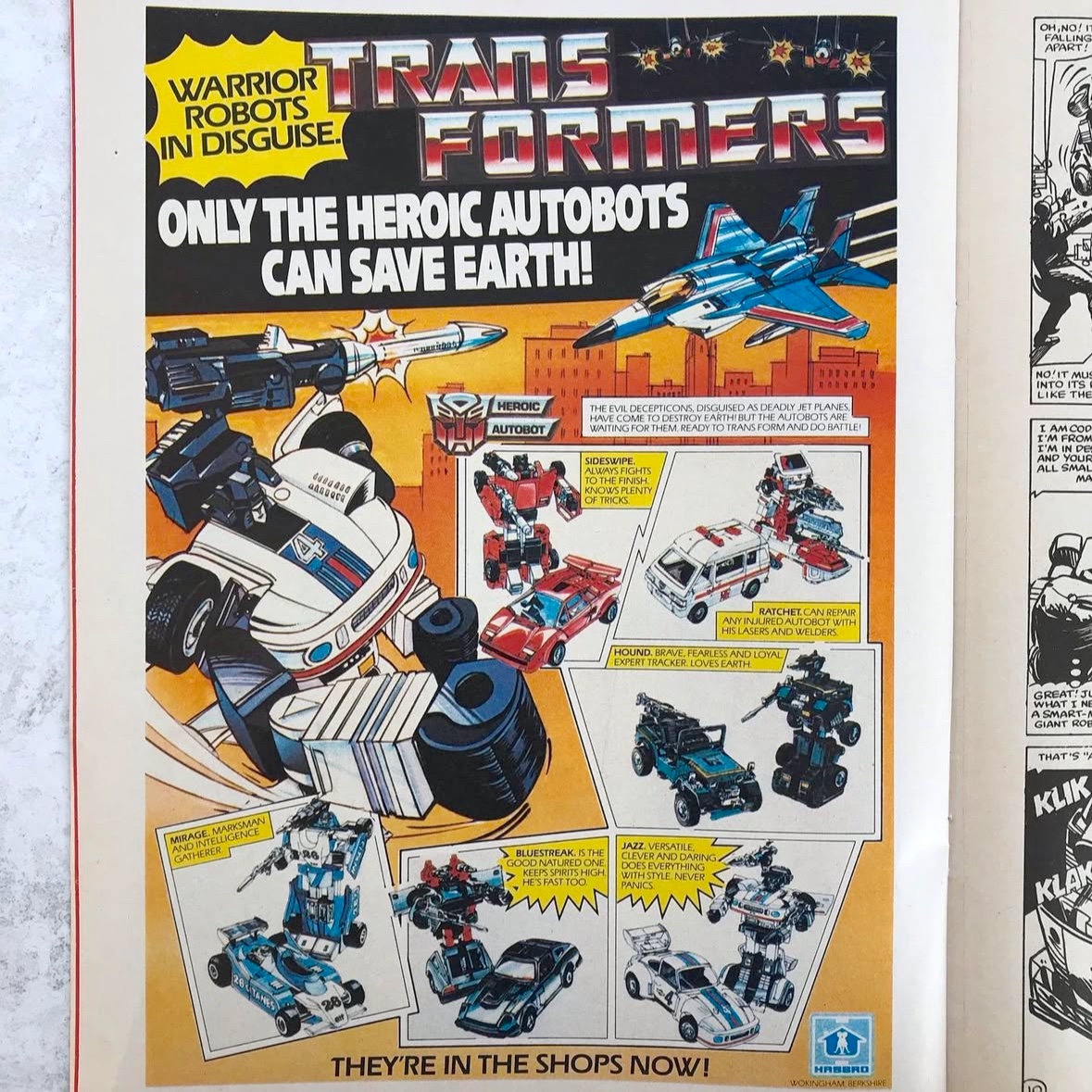
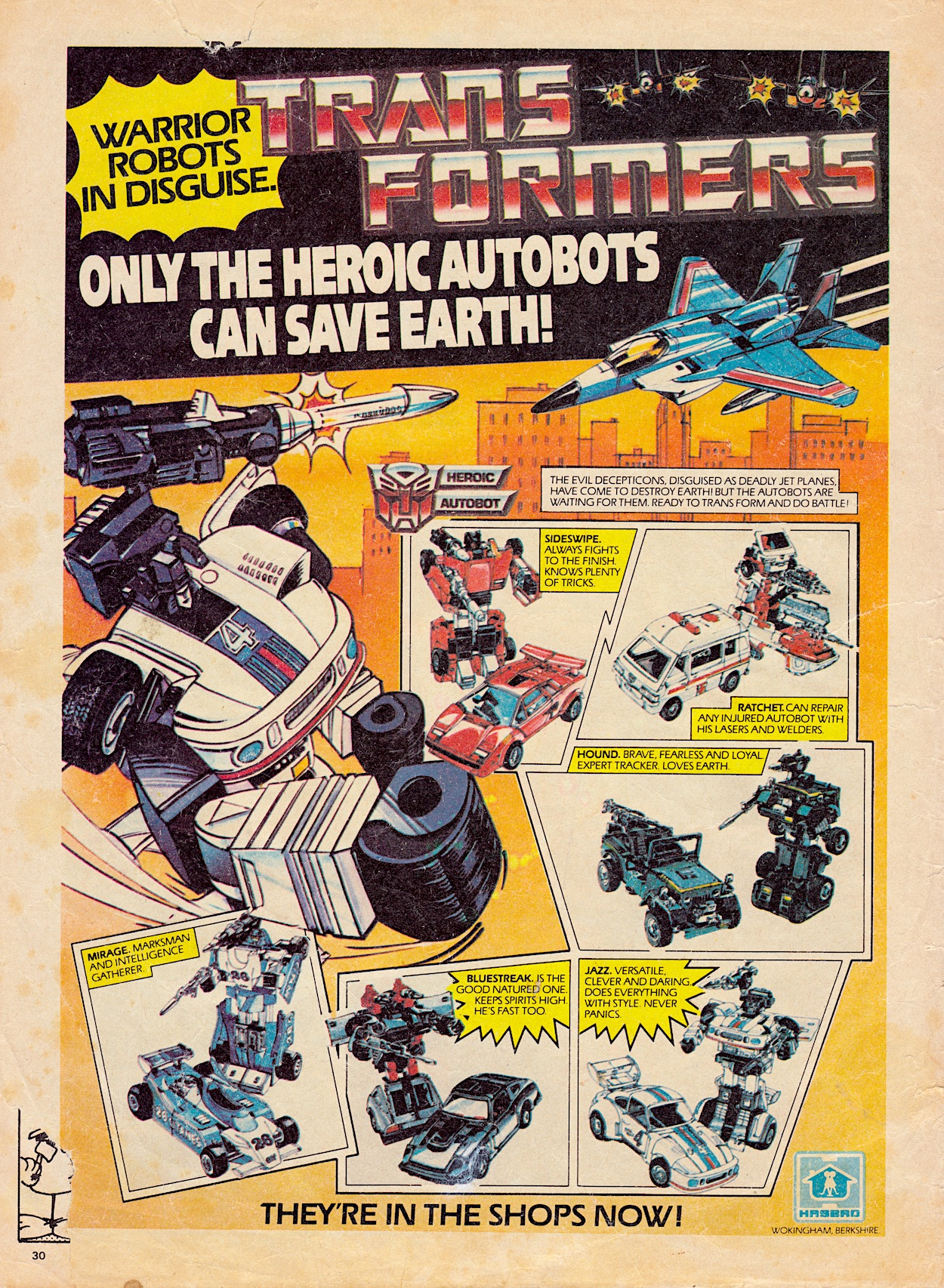
There’s a yellow Cliffjumper in the competition! Well, in this promo shot anyway. Speaking of the toys, the next Hasbro advert features more of the first wave of Autobots to hit the UK market. If you had to choose, which one would you go for? I think I’d have picked Hound, he looks the most intricate from the teeny, tiny drawings. Yep, that’s right, no such thing as actual photographs of the toys to choose from back then.
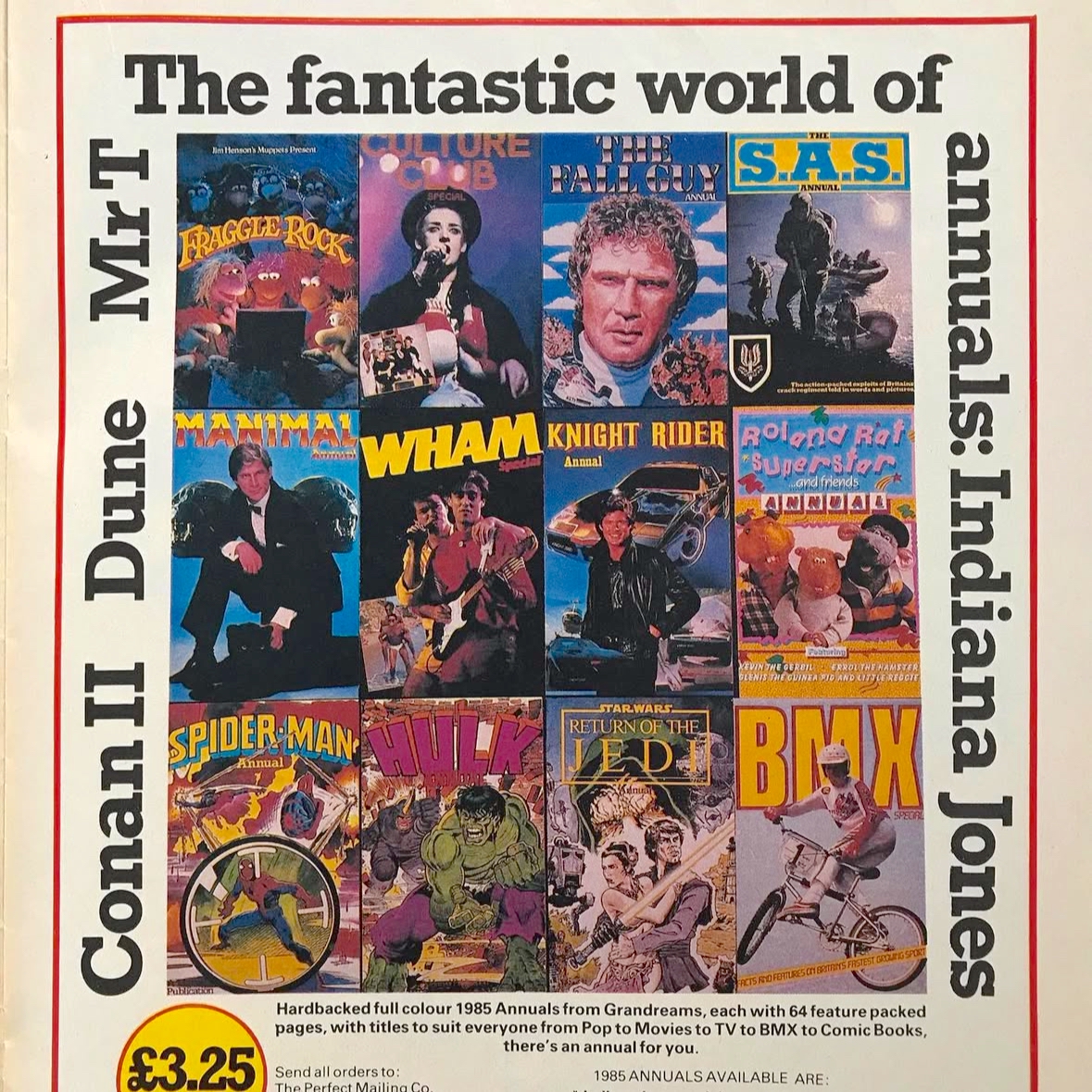
Robot Round-up details a somewhat familiar toy range. Who remembers coveting these in the Argos catalogue, only to be let down by them when you actually got to play with one at a friend’s house? There are also another couple of stills from the TV adverts masquerading as pin ups before the issue is rounded off with the 1985 Christmas annuals, one of which I’ve actually covered on the blog. You can check it out via the link at the bottom of this post along with a link to a post featuring all of Marvel UK’s annuals adverts during the comic’s lifetime.
Cover by Jerry Paris Power Play: Part One plot by Bill Mantlo, script by Jim Salicrup, pencils by Frank Springer, inks by Kim DeMulder, lettering by Janice Chiang & Rick Parker, colours by Nel Yomtov
If your memory of the Transformers comic is of a full-colour, 24-page weekly with one main Transformers strip and an Action Force back up, you’re not alone. What do you make of these early issues? They’re a bit different, aren’t they? As always, the blog’s comments section and its social media accounts are ready for you. We’re only at the beginning of our journey, let’s make it an interactive one!
Our next round up on Friday 20th November (one day before my decorations go up at OiNK Blog Towers!) will contain the first American cover, the first battle between Optimus Prime and Megatron, Robby the Robot (yes, him), the comic’s first humour strip and I’ll be wondering who on Earth is Sieve-Head?!
It doesn’t really jump off the cover that this is the first of Marvel UK’s Christmas issues of Transformers. Then again, the cover image isn’t even a cover image. It’s just a panel from the strip inside blown up to full size, something the comic did a few times in its first year. This is a shame because there are a small handful of gorgeous original covers among those first 26 issues.
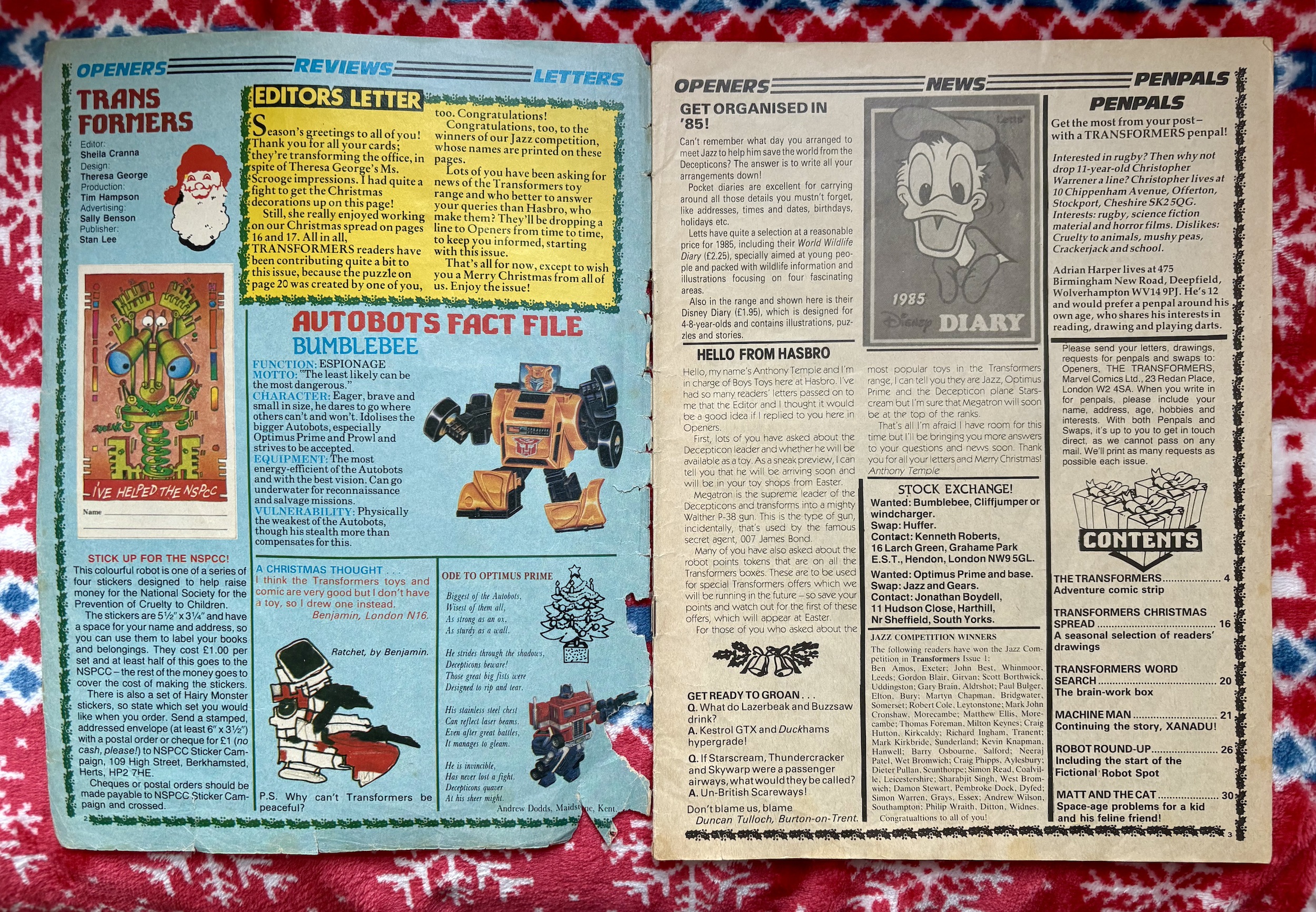
Originally a 32-page fortnightly made up of colour and black-and-white pages with its contents spread sporadically through each issue, it’s a far cry from the weekly format it would become known for later. Launch editor Shiela Cranna adds a couple of captions to the cover and a Christmas message in the two-page editorial, which contained a mixture of Transformers news and random items they thought would appeal to readers.
I’m not sure about Shiela having “quite the fight to get the Christmas decorations up” with designer Theresa George, seeing as how it’s a random selection of clip art-like bits and bobs thrown together. As someone who originally came to the comic much later in the run and loved snowy logos, Christmas strips and festive features, it was a bit of a shock just how little of this children’s comic seemed to celebrate the season in 1984.
That’s not to say this isn’t a good issue. Let’s face it, bad issues of this comic could be counted on one hand. In this series I’ll be taking a yearly look at the Christmas editions of Transformers between 1984 and 1990 on their individual 40th anniversaries. I’ve read the whole series in real time on the blog’s Instagram (you can check it all out in a special blog post) but here I’ll have the chance to take a deeper dive into these particular issues. So after an editorial which includes a reader poem that won’t be worrying Stan Bush anytime soon, and a cringey reference to “boys’ toys” (the gift of hindsight), what strip action was to be had?
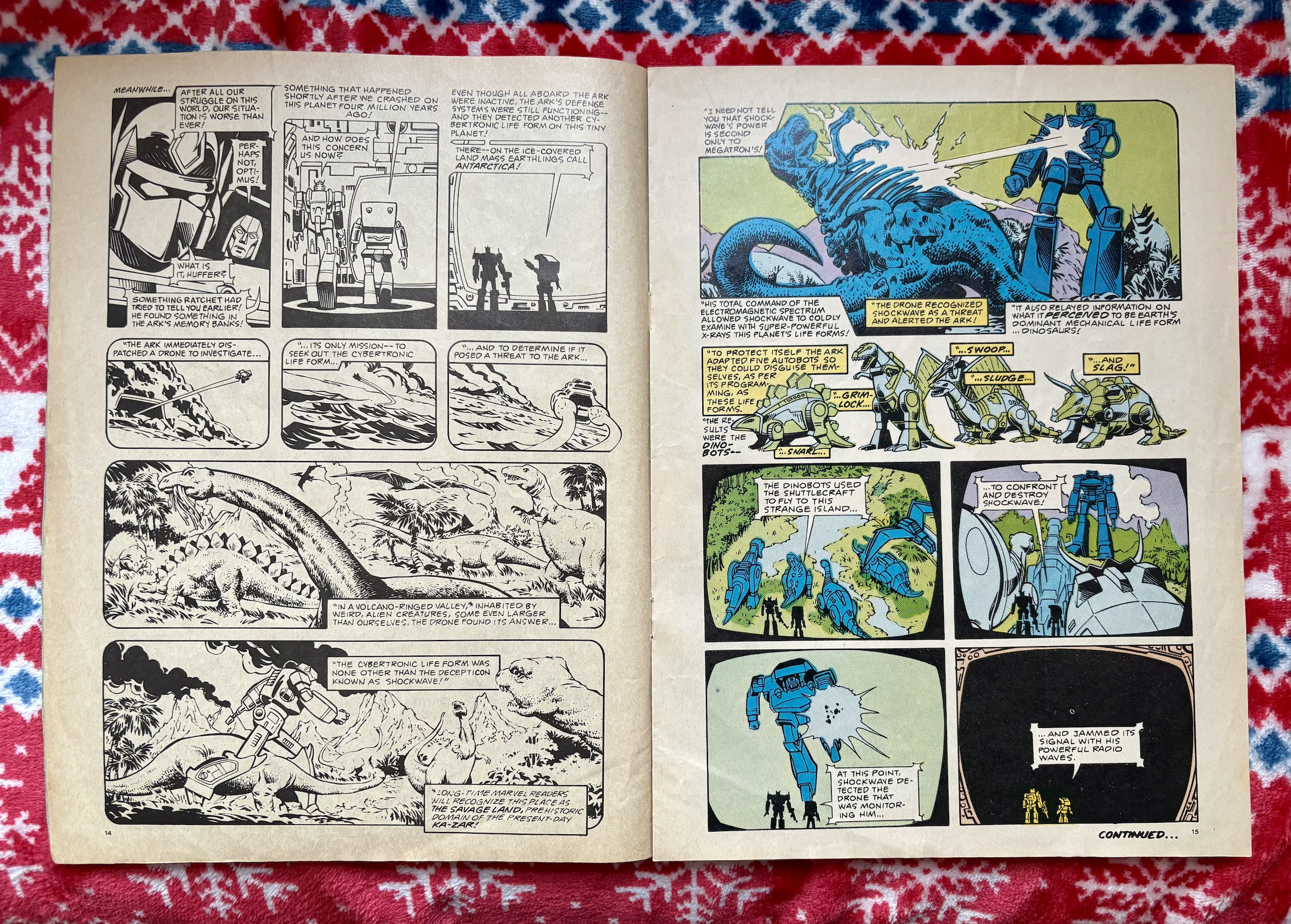
This is the big event of the issue, the introduction of the Dinobots
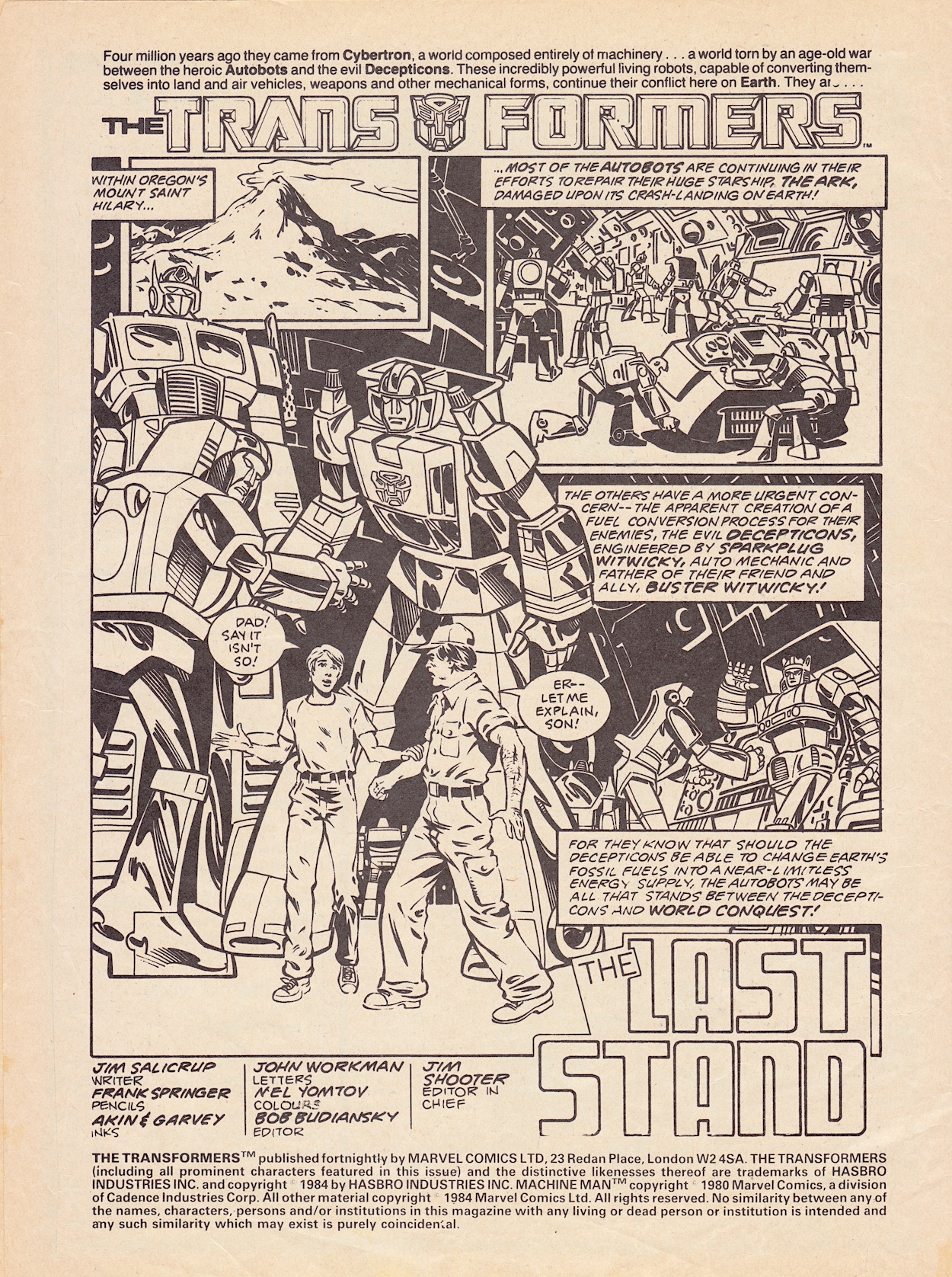
The main strip was still telling the origin story of the Transformers’ arrival on Earth, concluding in the next issue. The Last Stand: Part One was written by Jim Salicrup (editor on Spider-Man, Uncanny X-Men, Bram Stoker’s Dracula), pencilled by Frank Springer (Savage She-Hulk, Green Arrow, G.I. Joe), inked by Ian Akin and Brian Garvey (partnered on ROM, Iron Man, Firestorm) and lettered by John Workman (Jurassic Park, Incredible Hulk, Star Slammers), his work always recognisable with open balloons and captions along panel edges.
As you can see it’s in black and white, with only 5 of the 12 pages in the original colour provided by Nel Yomtov (every issue of the US Transformers, Amazing Spider-Man, Punisher Armory), with Bob Budiansky (Sleepwalker, Ghost Rider, Avengers) editing the story. Bob created many names of the characters and their abilities for Hasbro and would go on to write the comic for a few years.
In this chapter the Autobots find out Spike Witwicky has converted Earth fuel for the Decepticons and even the fact he was under duress doesn’t stop them from threatening him! They’re new to our planet and don’t trust us yet. Fear causes Spike to have a heart attack and during a Vietnam flashback we come to realise he’s poisoned the fuel he gave Megatron, which convinces the Autobots we’re on their side.
However, this is the big event of the issue, the introduction of the Dinobots! It’s a strange page to choose for colour given how it’s a flashback and in muted tones, but it was no less exciting for the young readers. Millions of years previous The Ark had detected more Transformer life and it relays how its surveillance drone had discovered Shockwave and created what it believed to be a disguise for five of the most powerful Autobots on board.
It’s a much better origin tale than the cartoon came up with and it’s even set in the Savage Land, a hidden prehistoric place in the Antarctic that featured prominently in X-Men comics and more recently in the Doctor Strange in the Multiverse of Madness movie. After Spider-Man had guest starred in the previous issue the comic’s ties to the wider Marvel Universe were a surprise for me. They’re a fun addition.
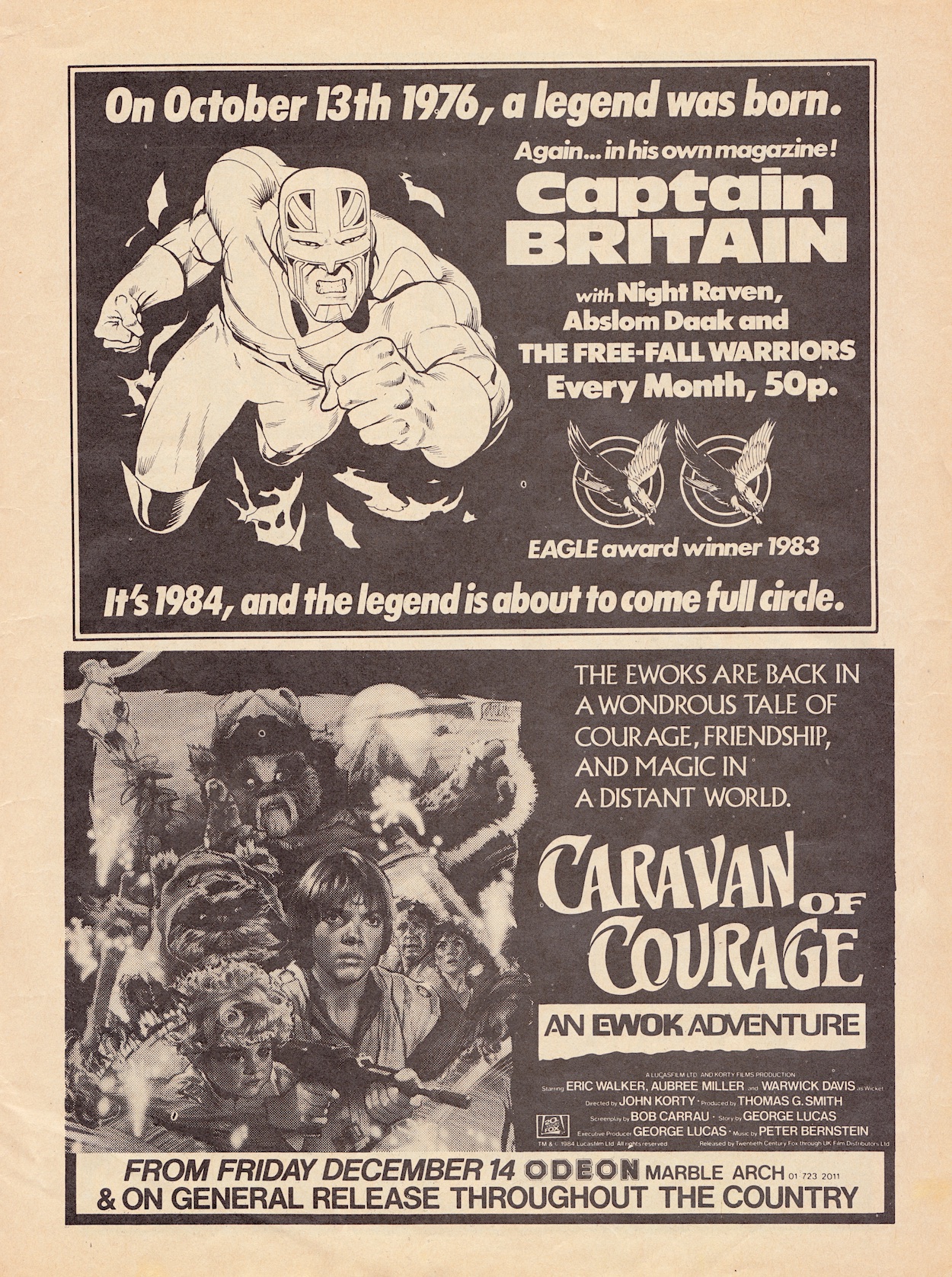
Speaking of other Marvel comics, here’s an advert for the monthly Captain Britain and below that the big Christmas movie was… Caravan of Courage? I’ll be honest, I’ve never heard of this Star Wars spin-off. This page interrupts the strip mid-flow. Much like the US comics these early editions break the strips up into several pieces with adverts and features seemingly randomly throw in here and there.
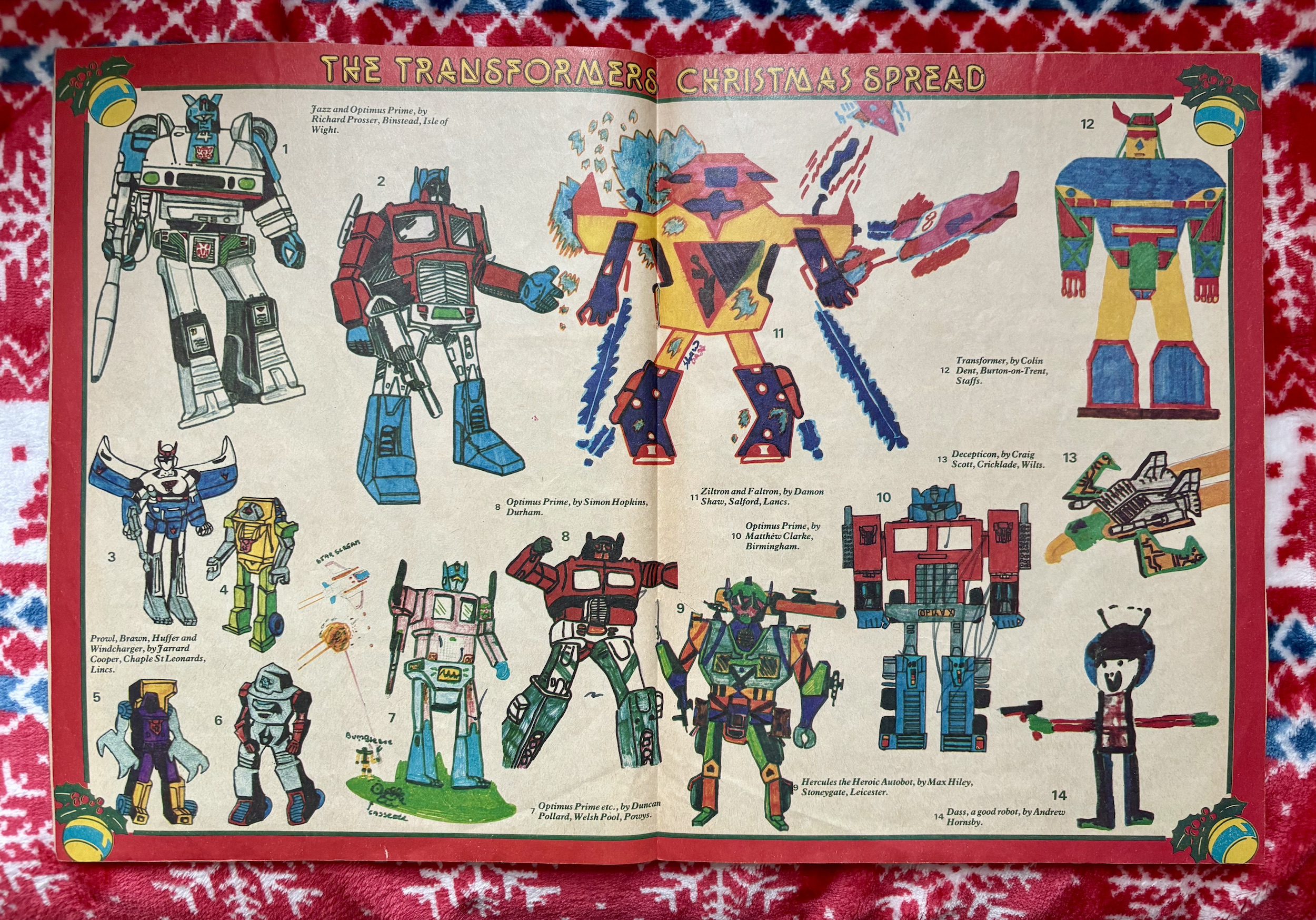
While in the American comic the adverts are more easily ignored (but no less irritating), having features to read in the middle of the stories results in the comic having a rather bitty feel. But one of those interruptions is the only real Christmas bonus so we’ll forgive it. While the readers’ drawings aren’t festive, Shiela decided to gather 14 of those sent in altogether as a special Christmas treat for those featured.
No ages are given but I think it’s safe to say the comic already had a wide audience, from the very young to at least the teen market if the high quality on display here is anything to go by. The ideas for original Transformers would even give some of the comic’s later attempts a run for their money.
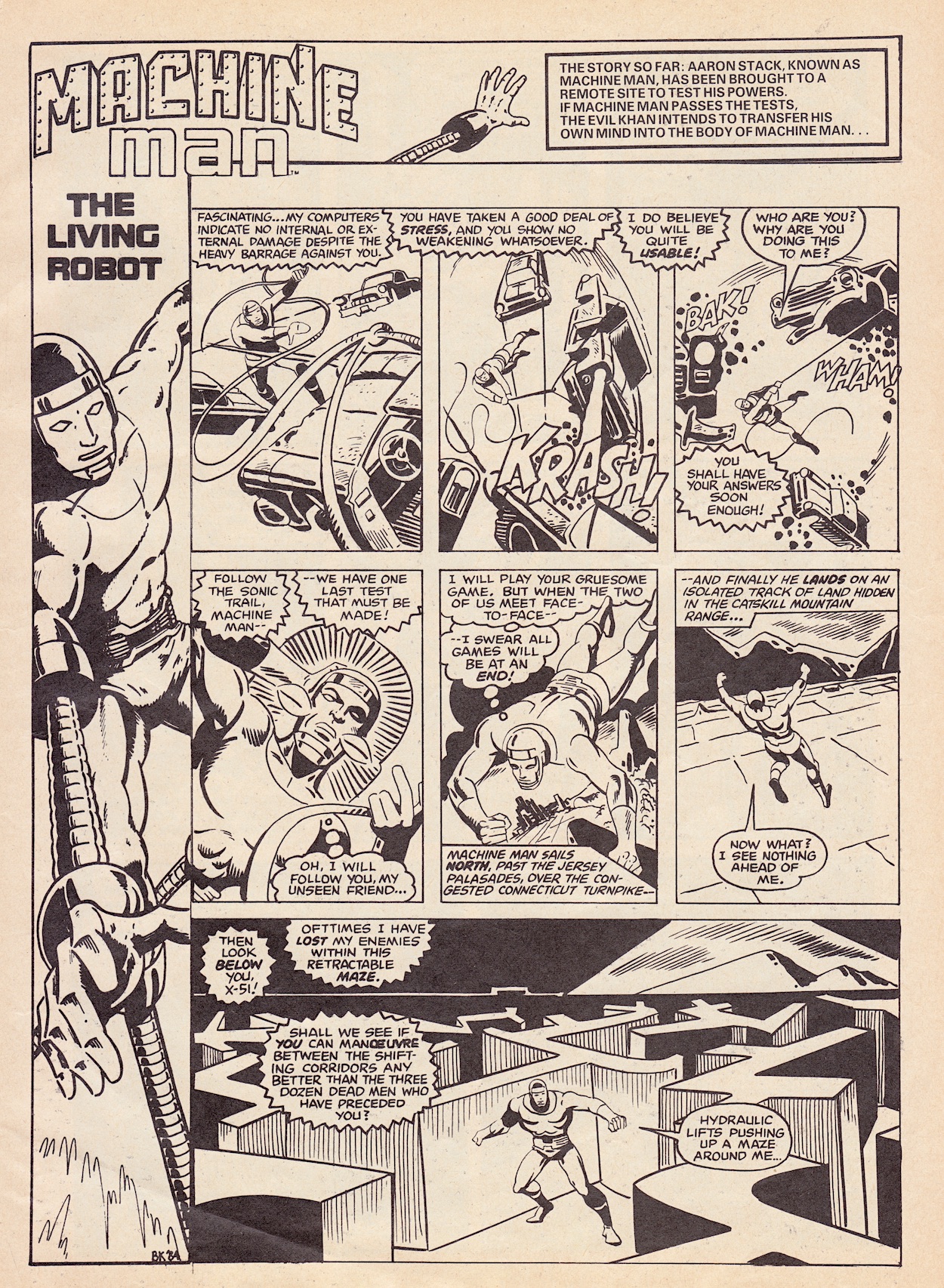
From robotic aliens to a robotic man created here on Earth. Aaron Stack was the last in a line of futuristic robots, the difference being he was raised by his creator as if he was his own son. After his creator was killed in an accident Aaron went out into the world, both as a human and as a new kind of superhero, Machine Man. Unlike Superman with his glasses, Aaron was much more convincing as he disguised himself with a fake face, hands etc.
The character was originally created by Jack Kirby and this is the first page of the second chunk of Xanadu, written by Marv Wolfman (Tomb of Dracula, Spider-Woman, Batman) with art by Steve Ditko (Blue Beetle, Amazing Spider-Man, Secret City Saga) and is lettered by Ira Watanabe (Cyclops, Incredible Hulk, Sub-Mariner).
I really enjoyed Machine Man, even with Marvel UK’s cherry-picking of stories which meant we didn’t get to see his full character arc before the strip disappeared from the comic, replaced by the more contemporary Machine Man of 2020. Aaron was a great character. He felt fully formed, his wish to live a human life was endearing and he had a cracking sense of humour which often shone in the middle of spectacular fight scenes.
Thrown in midway through the strip, Robot Round-Up was the best extra feature from the first year of the comic. An always interesting look at where our technology was at the time and how they perceived it would develop, it’s fun to contrast the future according to the 80s with how things have turned out. Such a shame how writer Johnny Black comes across in that last story though. Unfortunately, sometimes these things happen when we read old 80s publications. Oh well, it’s a reminder of how much better and more enlightened we are today.
Also standing in stark contrast to today were Hasbro’s Transformers toy adverts. While later in the run they’d include actual photographs, originally fans only had illustrations to go on (albeit intricately drawn). Even in the 90s I remember Commodore 64 games being advertised in Commodore Format with nothing more than the box art to tempt us to buy them. So strange to look back on that now.
Thus ends our first Christmas with Transformers. As you can see it was a very different beast to what most people will remember. Next year’s will feel more familiar to you and not only that, there’ll also be the first of seven Transformers Annuals as well! It’s a long time to wait, I know, so don’t forget you can check out the entire Instagram real time read through of the series that took me over seven years to complete. You don’t need an account and there’s a guide on the blog so you can check out all 375(!) posts in whatever order you like.
It’s time to bring the movie adaptation of Jurassic Park to a close with the last 12 pages of the final chapter, originally part of issue four of Topps Comics‘ mini-series in the States. For UK readers it was split in two, with new backup strip Xenozoic Tales bringing up the rear. However, due to the decision to keep the comic going the back up gets more pages this time around and there’s a simple explanation.
I’m going to assume last month’s issue was originally going to follow the same formula as the ones that came before, with a full chapter of Jurassic Park and a behind-the-scenes feature. In the US it had been decided new adventures would make up another mini-series, but there was going to be a small gap before it went on sale. To plug this in the UK this last chapter was split over two issues and the back up added to fill out the pages. This explains why there were only four parts to the behind-the-scenes series, with none this month (or ever again actually).
The opening chapter of Xenozoic Tales was quite short in length, so more of the Jurassic Park strip was included last time, but Mark Shultz‘s stories were of varying sizes, so working all of this out to spread over the two issues has resulted in 14 pages of the movie adaptation climax and 18 for Jack Tenrec and Hannah Dundee. It makes for a strange balance but that would all be corrected next month. More on this below.
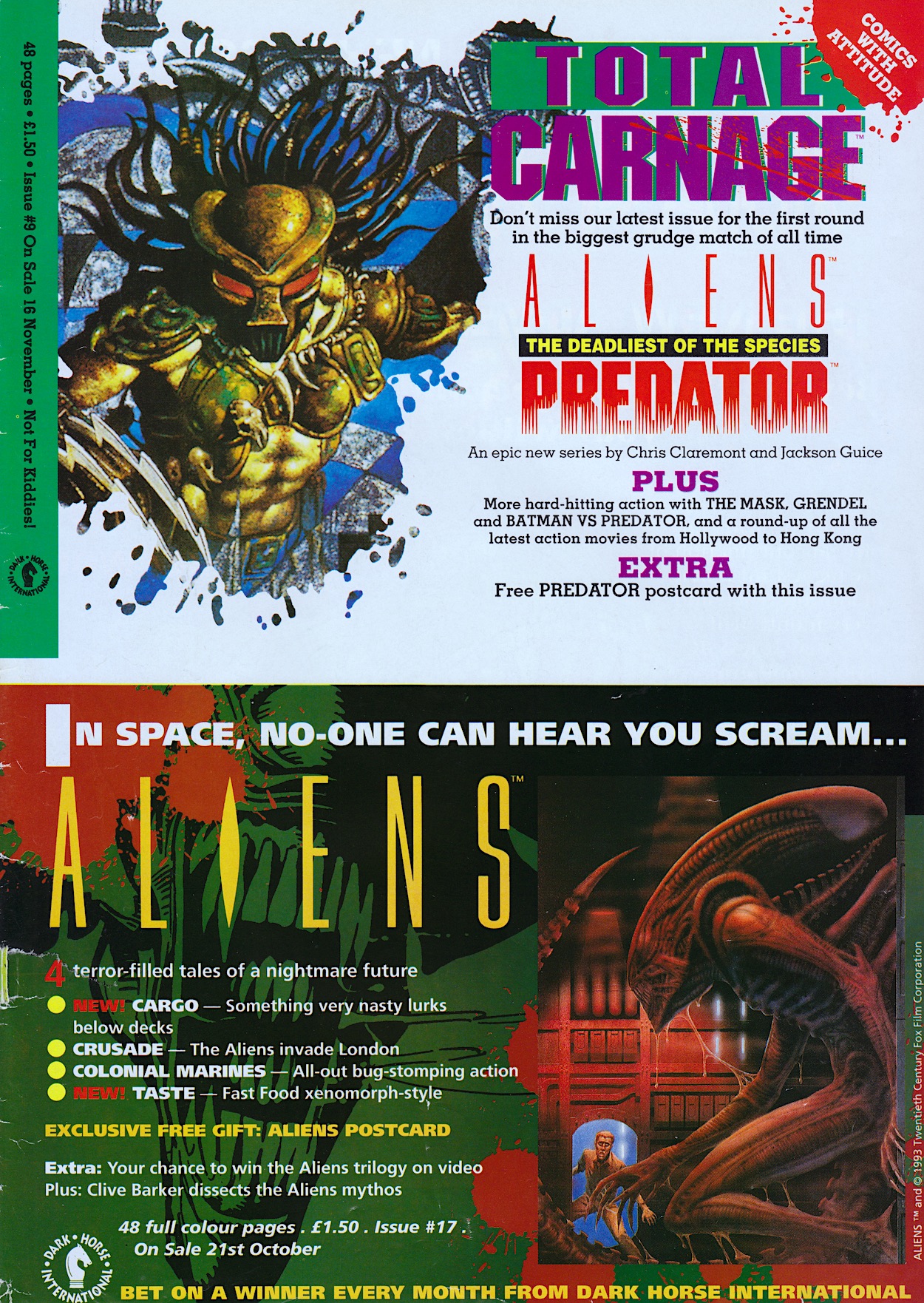
The monthly competition page acts as a kind of editorial this month, hyping the conclusion and the new strips to come. A strange choice of prize though, a graphic novel collection of the strip readers have read in the comic. Elsewhere, the lovely gloss paper of the covers makes these adverts for Dark Horse International‘s other mature titles really pop, especially that Aliens one. The more I see these adverts the more I want to add them to my collection at some point, even though I know they too were cut short.
So on to the end of the comic book adaptation of one of the biggest movies ever made. This month it crams in Dr. Ellie Satler‘s escape from the maintenance shed, the survivors reuniting, the Velociraptors infiltrating the visitor centre, the kitchen scene with the kids, the control room scenes, their escape and the final shock ending. That’s a lot for writer Walter Simonson and story editor Jim Salicrup to squeeze in and unfortunately just like last month it suffers as a result.
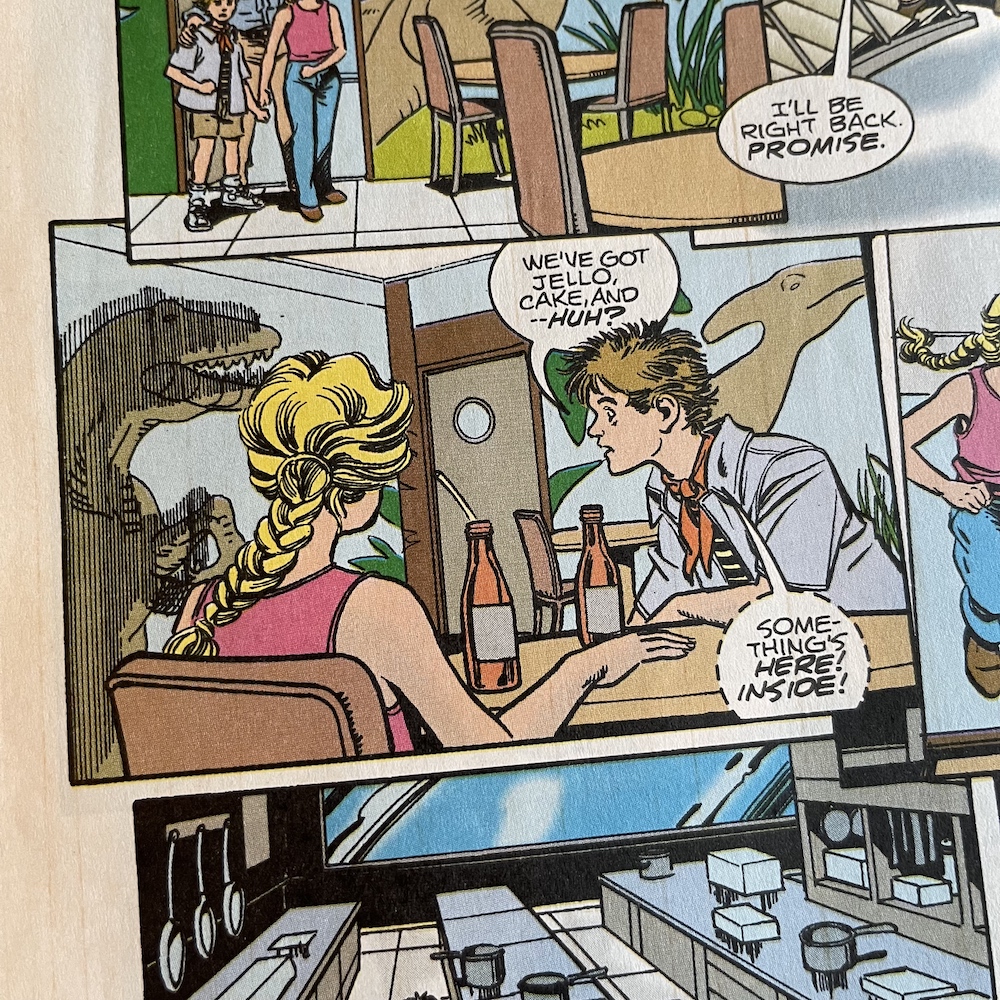
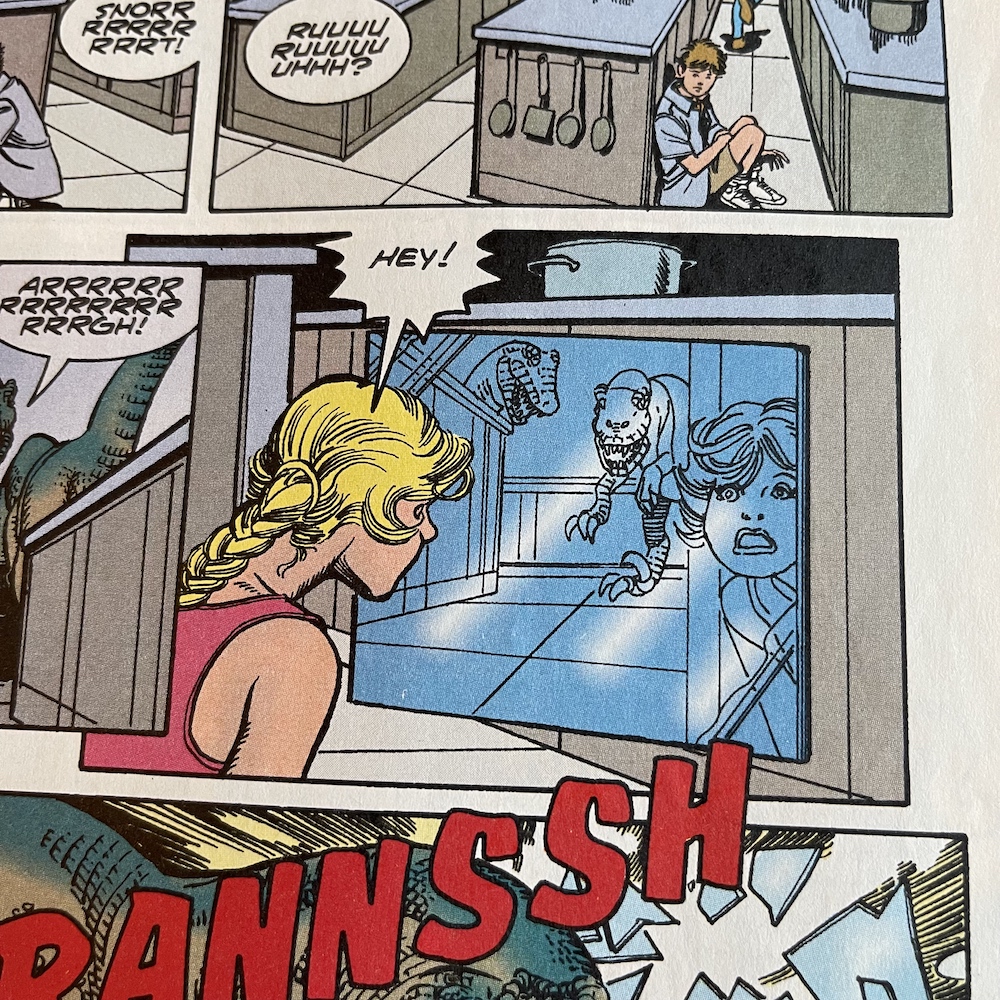
Case in point is the famous kitchen scene with Tim and Lex sneaking about and eventually getting one over on the ‘raptors. Tense in the movie, here it doesn’t make an awful lot of sense. For a start the shadow signalling danger is barely noticeable and the reflective surface of the kitchen appliances Lex used in her terrifying encounter in the movie seems to be floating in mid-air!
At least the kids get a few pages for their scene, the rest really are cut down to their bare bones. The idea behind each one is there and is solid, the main imagery is perfectly captured and the big scare moments are all present and correct. But with all the trims it rushes from one of these moments to the next every few panels, meaning their impact is diminished.
So ends the movie adaptation. But hang on, where’s Ray?
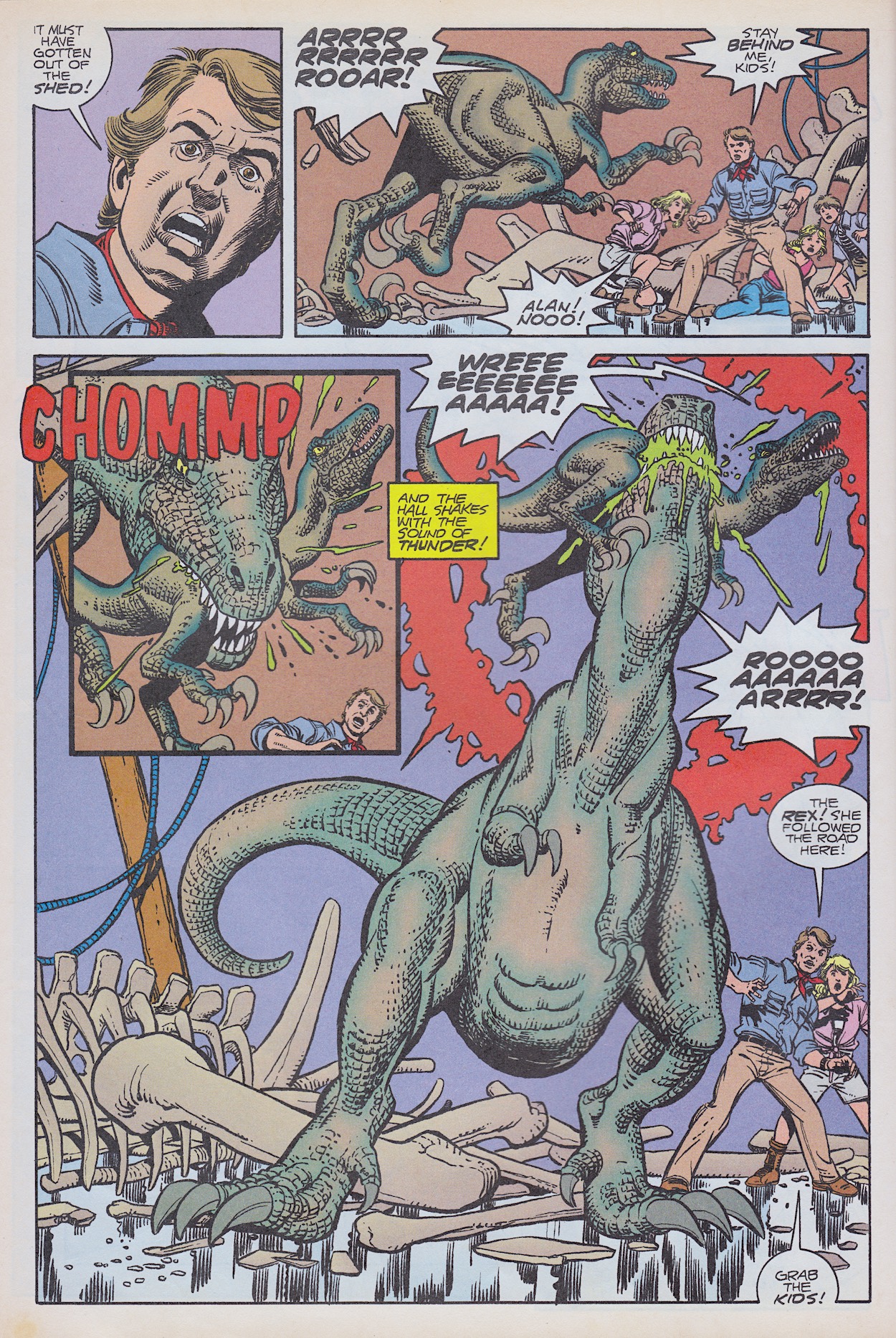
At least the dinosaurs themselves look good as you’ll see below, with penciller Gil Kane‘s and inker George Perez‘s Tyrannosaurus Rex and those ‘raptors looking suitably powerful in their final confrontation, which thankfully is given a bit more room to breathe. Not too sure about the green blood though. You’d have to ask colourist Tom Smith about that one. The random letter jumbles making up the noises of these animals are just plain bizarre, but at least John Workman‘s unique style of breaking the panels still looks the part.
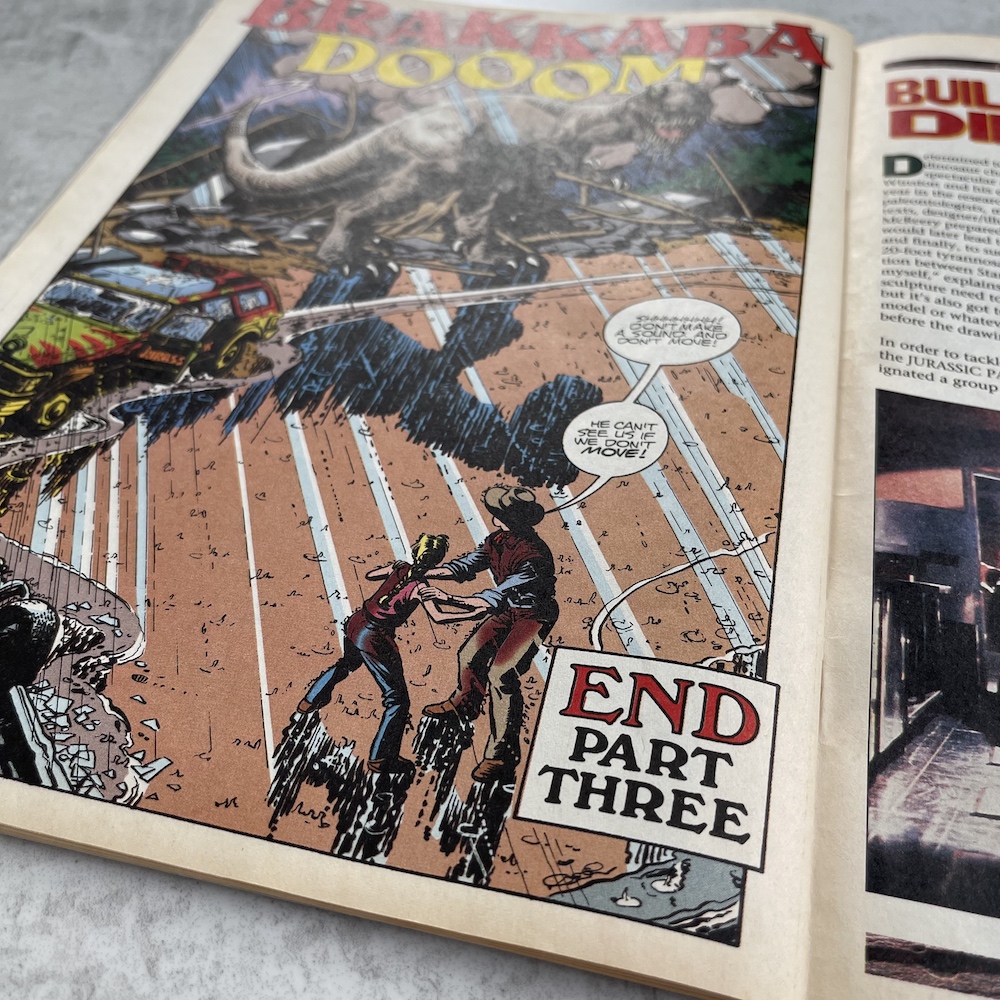
This dramatic angle of the Tyrannosaurus rex is so good it’s used twice over the double-page spread, but they both look so good we’ll forgive the repeating. There’s a lot of powerful red, at least giving the impression of a gory fight to the death despite that sanitised blood colour. But still, somehow it works and it’s the powerful, dramatic scene that’s been missing from so much of these two issues. I particularly like the fact the iconic ‘When Dinosaurs Ruled the Earth’ banner from the film is worked in as a caption.
“And behind them, receding into the distance Jurassic Park and the past are swallowed up in the gathering dark. The End.”
So ends the movie adaptation. But hang on, look at that final panel above. Where’s Ray? Yes, in the film he was killed in the maintenance shed off camera and Ellie discovered his severed arm when she went to reinstate the power grid. But last month Ellie volunteered first in a major change from the film. This meant Ray was still alive in the control room and yet here he’s nowhere to be seen. It seems the one black character has been completely forgotten about. It’s clear this final chapter was rushed with it’s art not being as detailed or polished and with huge chunks missing to get to the finish line in the page count, but still, just forgetting about a character is a massive oversight!
It’s such a shame it had to end this way because the first three chapters were so good that’s it’s more disappointment than anything else I’m feeling right now.
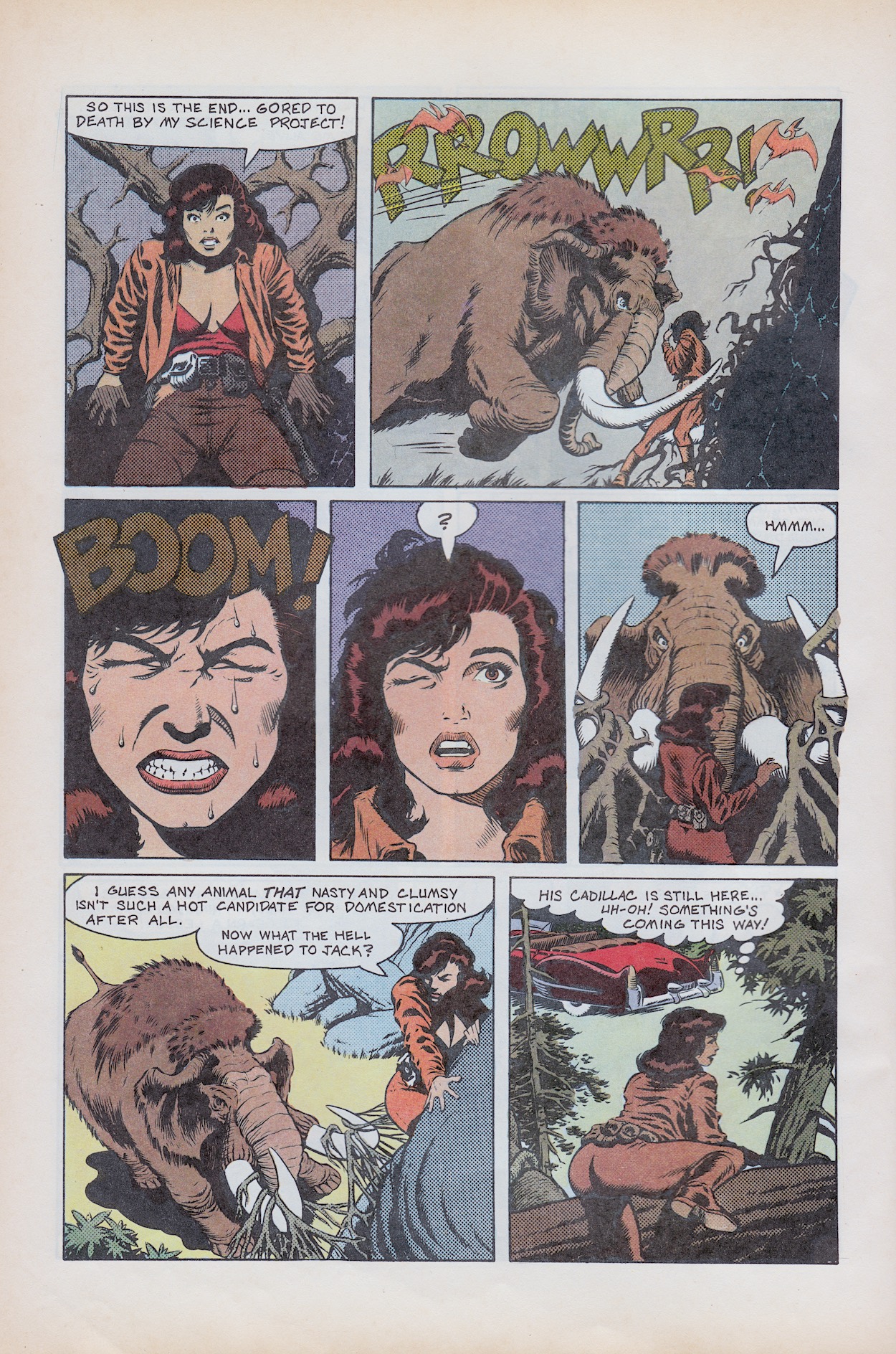
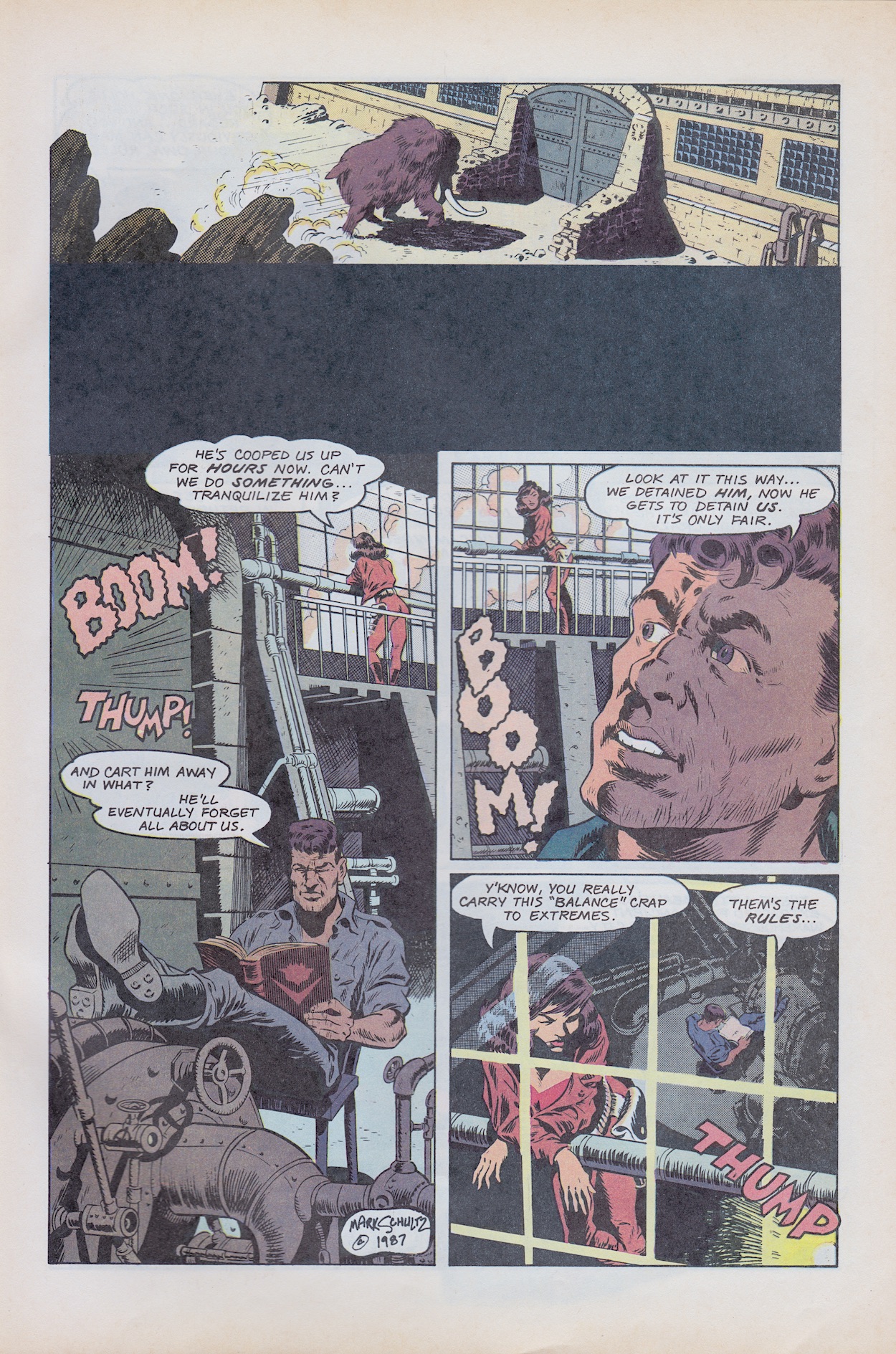
With no written feature to break up the strips this time we head straight from a natural island off the coast of Costa Rica to a manmade island group off the coast of North America for this month’s Xenozoic Tales:Mammoth Pitfall, written and drawn by Mark Schultz, coloured for a Marvel US reprint by Denise Prowell.
The story comes from the second issue of creator Mark Shultz‘s original series, but three stories which took place between last month’s introduction and this one have been skipped. That unfortunately means character development is going to be pretty spotty. For example, last month Jack and Hannah had just met, but here he’s trusting her in her attempts to capture a mammoth for domestication and she knows enough about him to know when he’s in trouble. It’s a shame we can’t appreciate their developing friendship properly but then again it’s only thanks to Jurassic Park we got to read them at all.
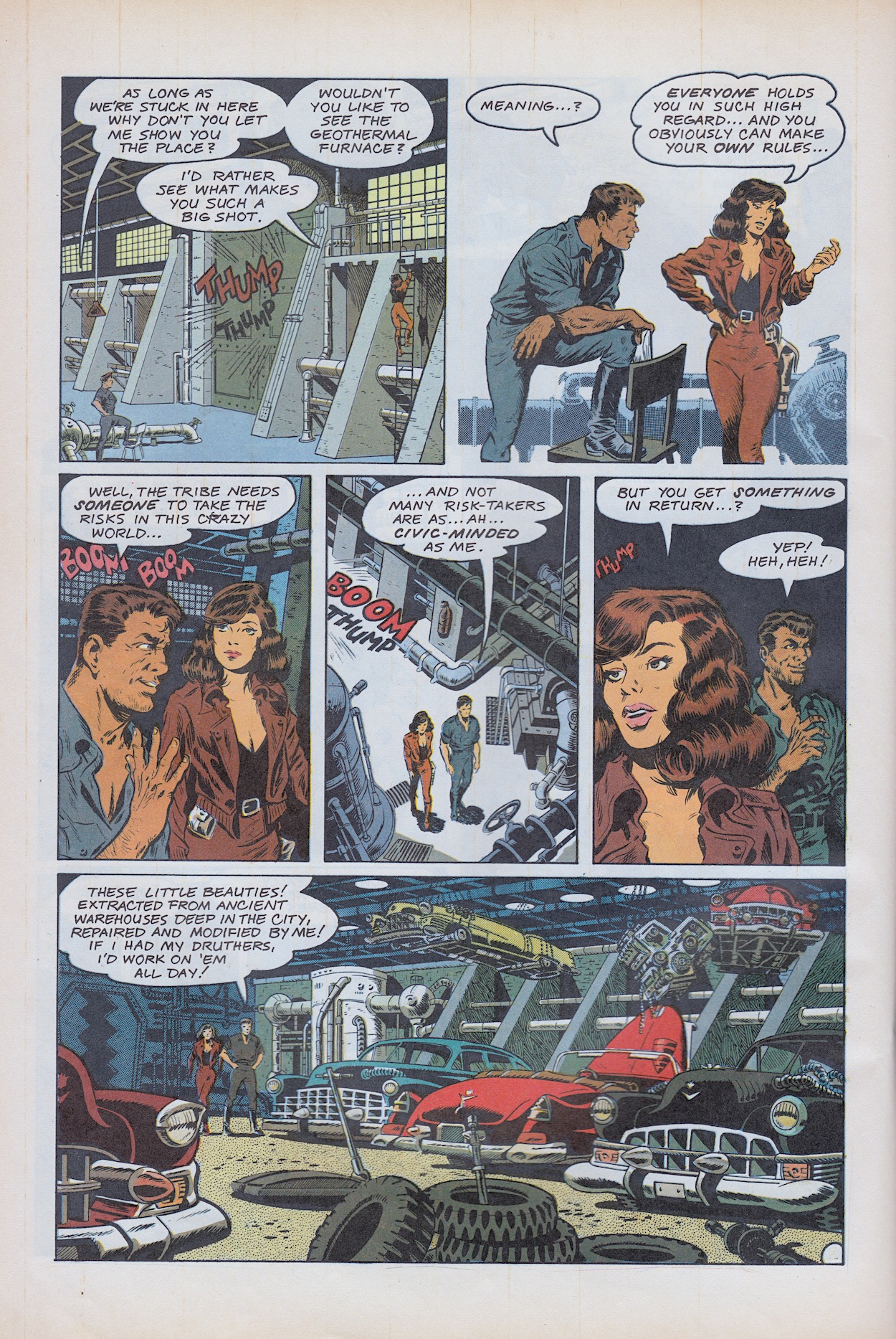
Jack knows nature has certain rules and understands a mammoth will always be a dangerous animal to humans. It should be respected and left alone. However, the reason the attempt fails is because of interference from another human who sabotages their attempt and sets Hannah up for a nasty death squish. After a very lucky escape she hides in the boot of Jack’s prized Cadillac. She later pops out and saves him from the man threatening to kill him if he doesn’t teach him the most prized skill of the time: how to drive!
Sometimes it seems nature bends the rules.
Mark Shultz, Xenozoic Tales
It’s all great fun and the wordplay between Jack and Hannah is natural and funny. Trapped inside his garage by the angry beast the action is put on hold and it’s testament to Mark’s writing how equally compelling these simple character scenes can be. The script is full of interesting contradictions too. The juxtaposition between the dinosaurs and the cars is effortlessly presented, Hannah seeks action while Jack wants the easy life, and Jack the environmentalist and animal lover has dedicated his life to restoring the very machines responsible for the great cataclysm. (Although he has converted them to run on dino guano.)
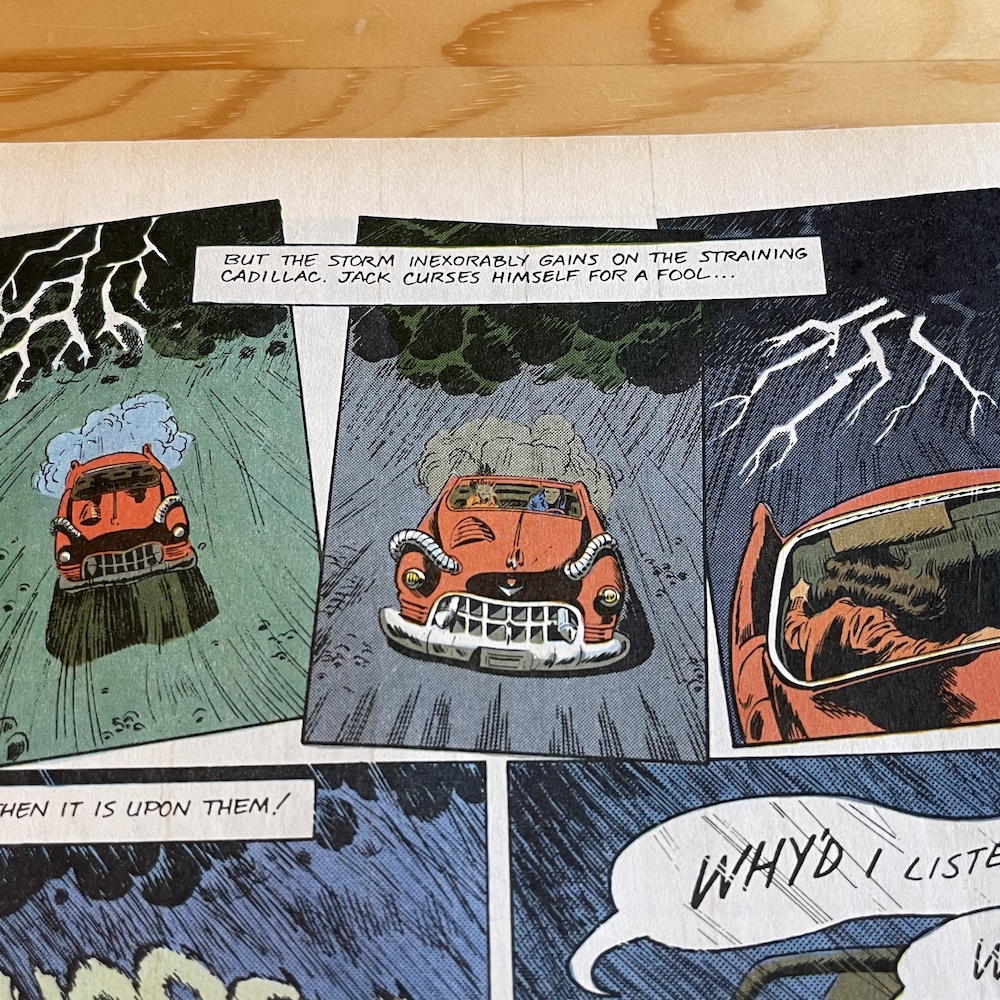
Curious to see what all the fuss is about with these ancient contraptions Hannah convinces Jack to take her for a ride, then to chase a storm back to the city. They discover the dead body of the mammoth she tried to capture, clearly the victim of a predator outside the garage. Jack is furious. “He should never have died here.” It’s great to see these characters learning about each other. Again, it pains me we’re not seeing it all.
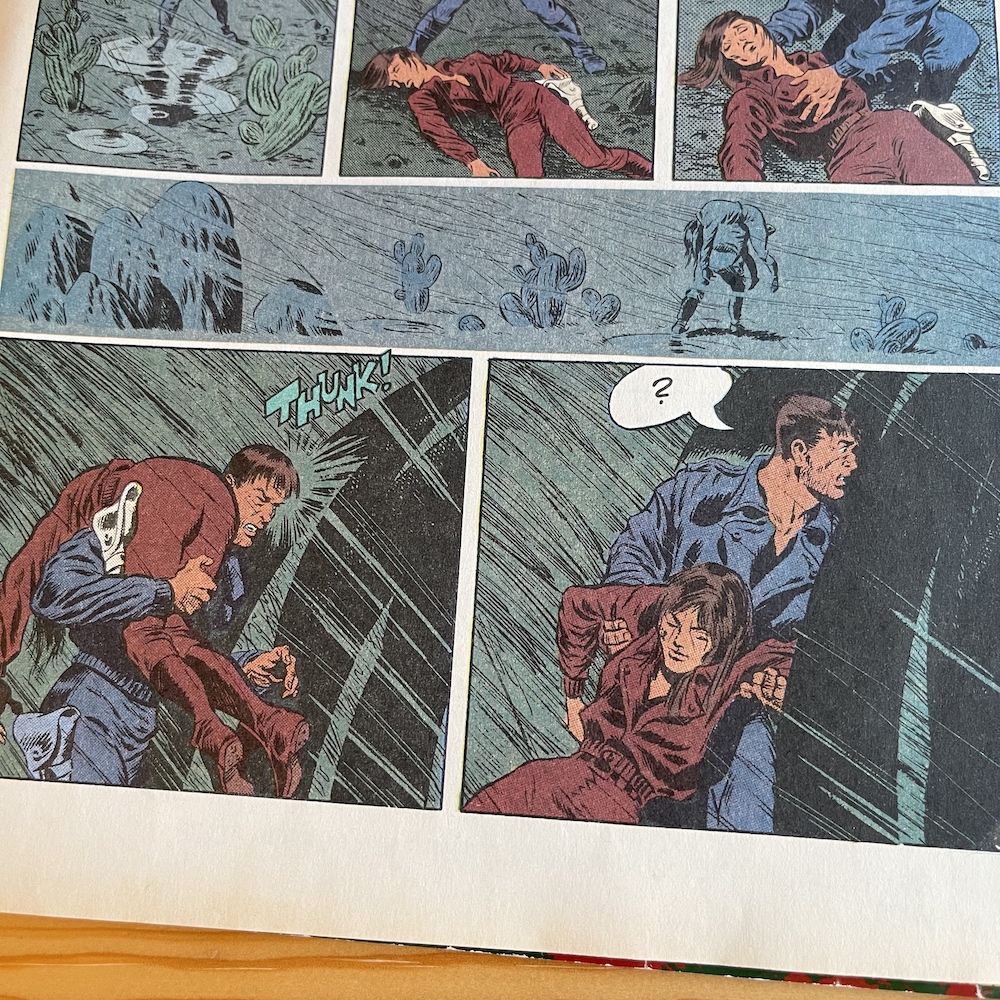
The storm chase naturally ends in disaster. They crash, the Cadillac becoming a write-off in a sodden ditch. Tenrec carries an unconscious Hannah through the driving wind and rain until he bumps into a sheltered building of some sort that he wasn’t previously aware of. With no time to question its sudden existence he places Hannah inside and tries to wait out the storm. Flood waters rush them and by morning the storm has revealed the shelter that saved their lives.
With this the story comes full circle. The mammoth that Hannah was so certain could help them rebuild their world has in the end saved their lives, by losing its own, because of her. It’s thought provoking and rather sad and I felt genuinely sorry for the mammoth in the end, and thought less of us as a species. Which I think was the whole point. It’s a very different strip, but it works perfectly as a back up in this comic. After all, both strips are about the interaction between dinosaurs and humans and what happens when we try to force our dominance on animals we were never meant to meet.
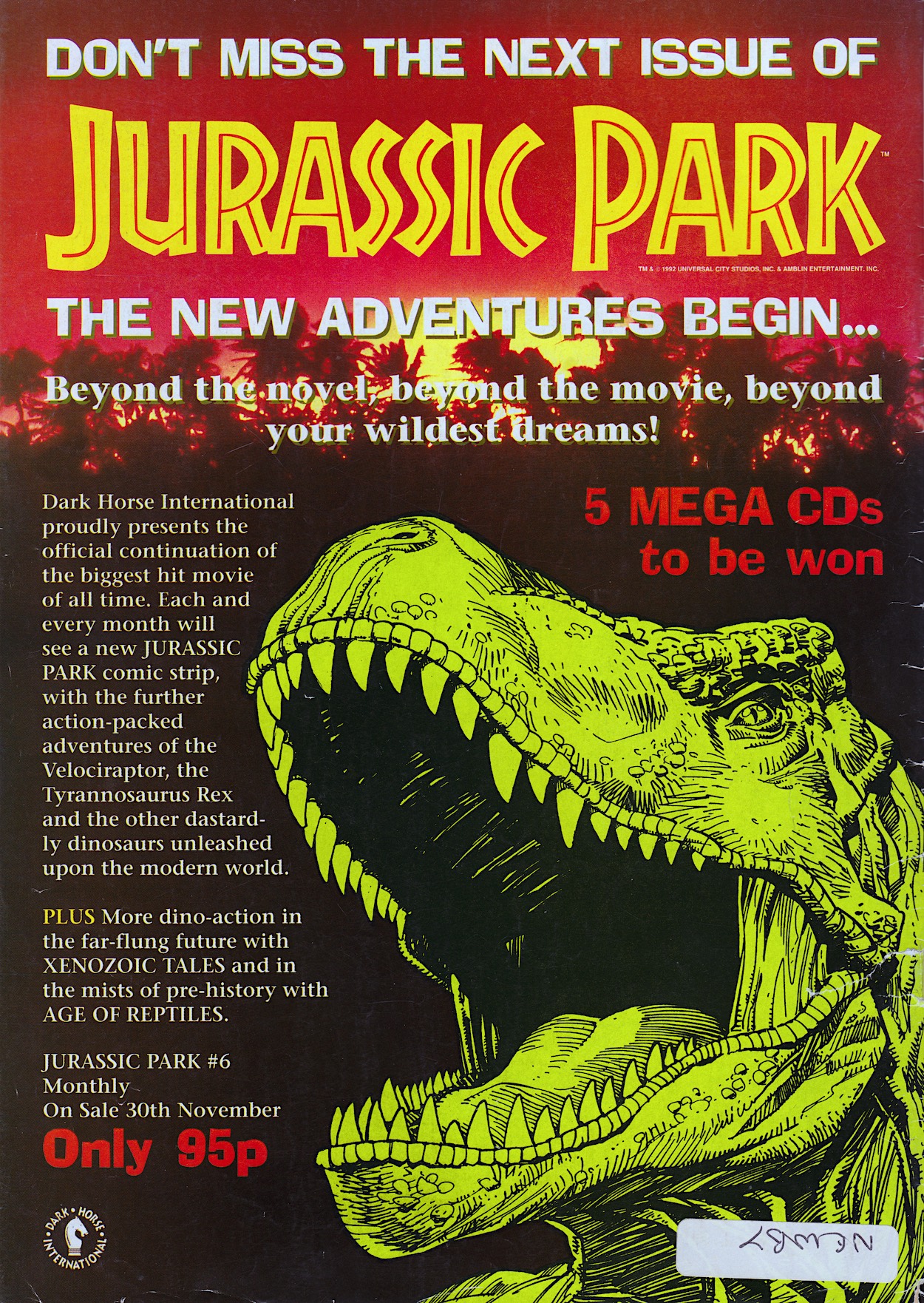
With this we reach the end of another issue and the back page has me very excited. Using a one-colour version of the cover to my very first issue, the announcement I’ve been waiting all these months for is finally here.
If I’d been collecting these issues in 1993 then I’m sure I’d have been hugely excited by this! Who wouldn’t have been? Even now I’m hyped. Discovering #6 on the shelves with the promise of new adventures inside was thrilling and this promo is bringing back all of those feelings again. The mention of the third strip and even the competition headline are bringing a big goofy smile to my face because I remember both so distinctly. It’s quite extraordinary.
As is normally the case with all of these real time read throughs I will have to practice will power, but this is going to be harder than most. I’ll do it though, I’ll wait for the correct date, no matter how impatiently. That date will be Tuesday 30th November 2021, so join me then as we embark once more toIsla Nublar for the original, forgotten sequel to Jurassic Park.
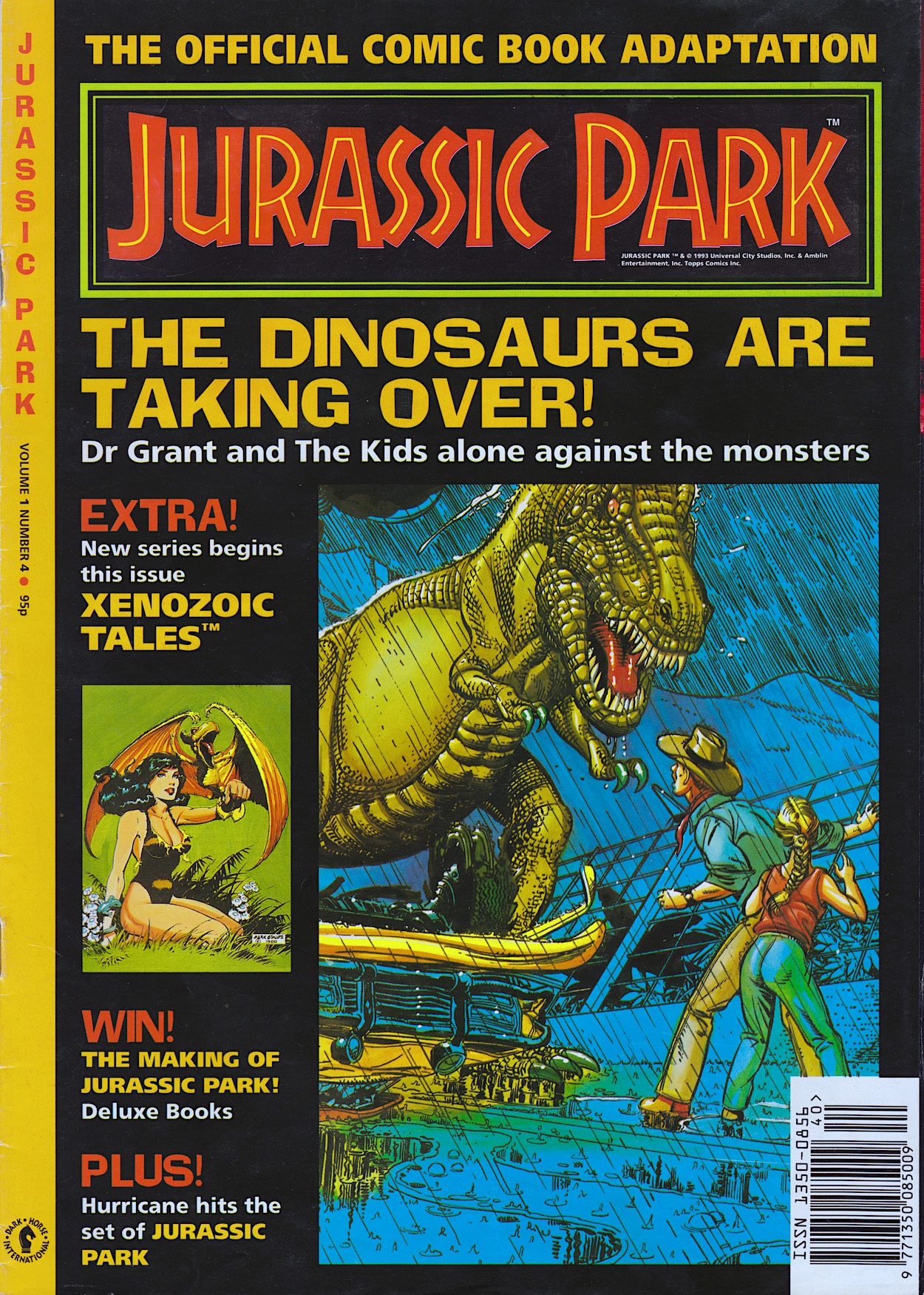
With issue four the UK version of Jurassic Park was evolving. As mentioned last time the US comic was no longer going to finish after the adaptation, with further mini-series now being produced. In the UK, Dark Horse International decided to turn their four-issue, three-weekly mini-series into an ongoing monthly, not that any fanfare is made of this because the reader wouldn’t have been any the wiser it had originally been due to end this issue (and a few weeks ago). Indeed, the comics checklist last issue erroneously said #4 was the end.
This change produced the delay in the release of this issue as plans were made for the new format of the comic and acquiring more content for each issue. This begins with the first back up strip here, bringing Jurassic Park more in line with the company’s other comics such as Aliens. The front page recolours a panel from the strip inside (and I love the font they’ve used) instead of having a proper cover image. This final chapter of the adaptation is being split in two, so the original cover was being kept in reserve for the following month.
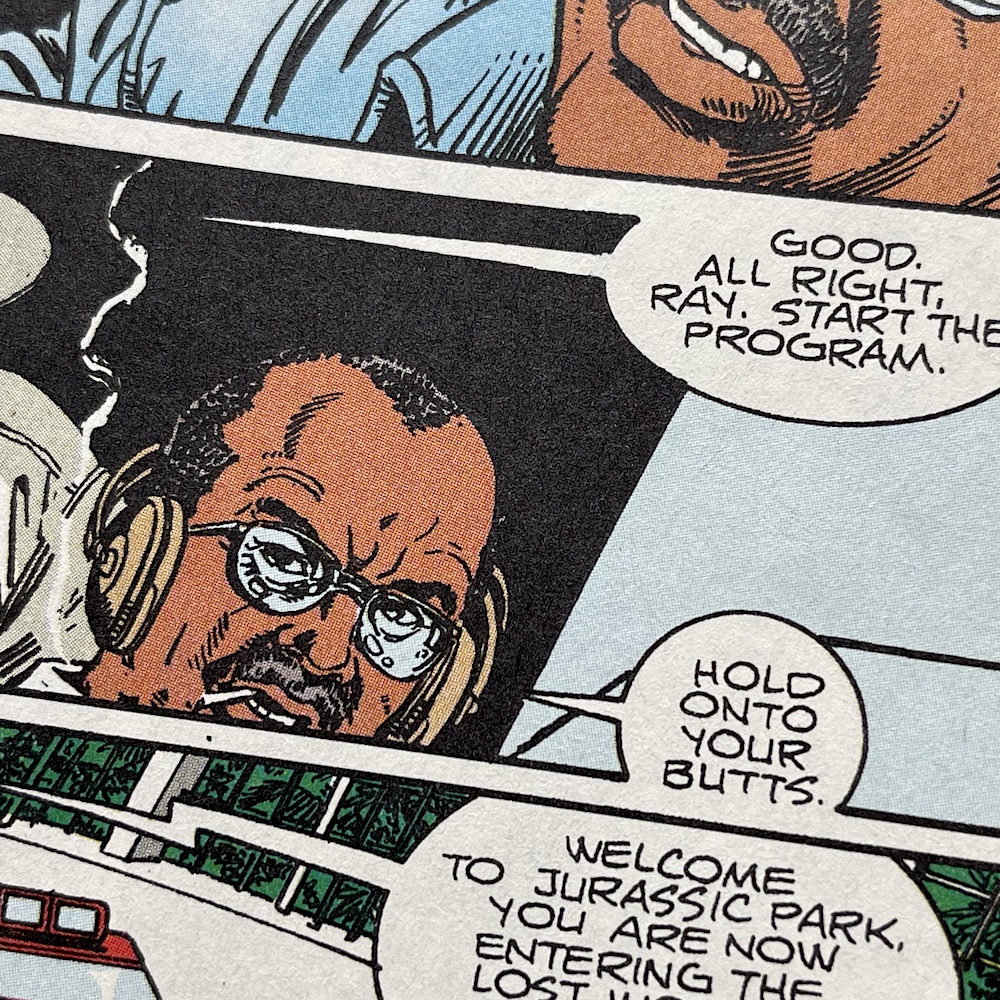
The sequence in the tree with Tim trapped in the Explorer has been completely excised!
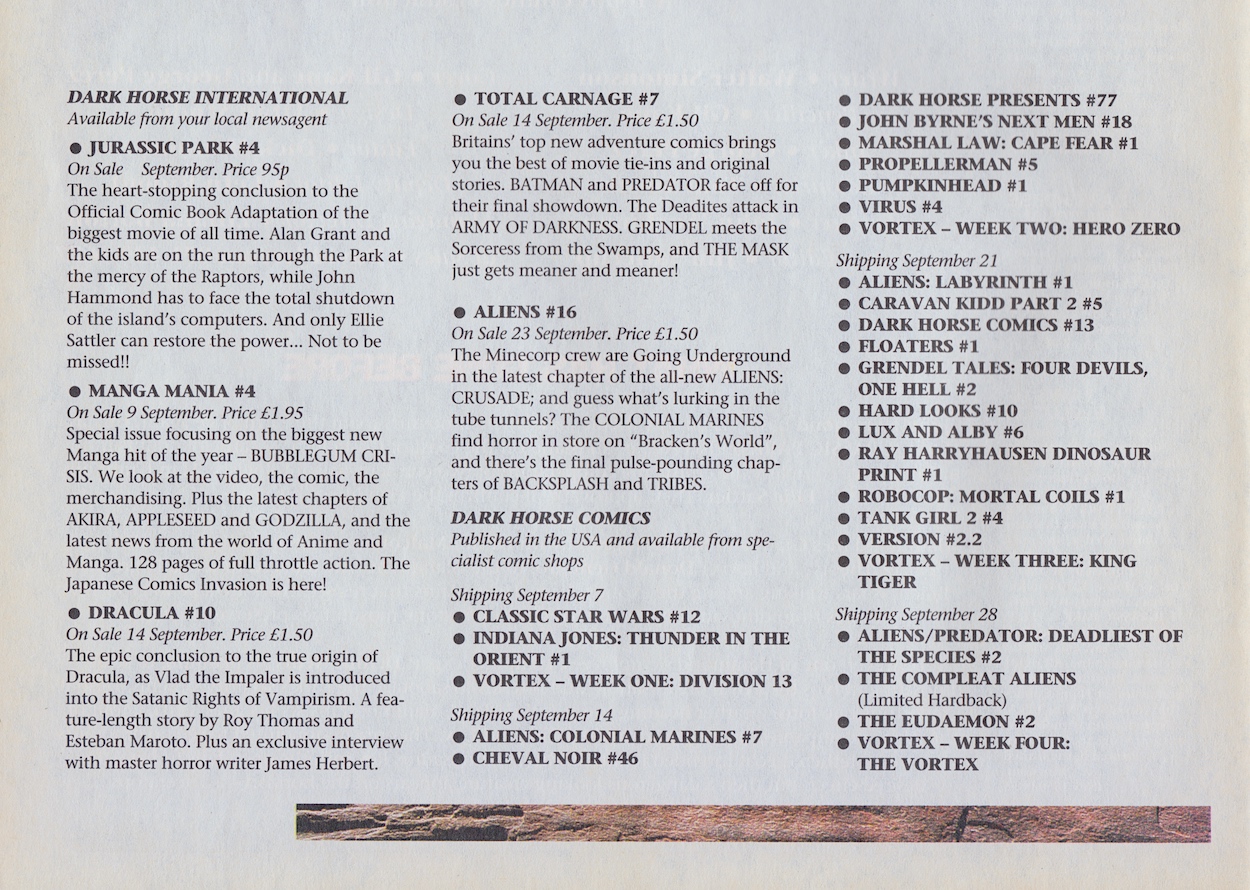
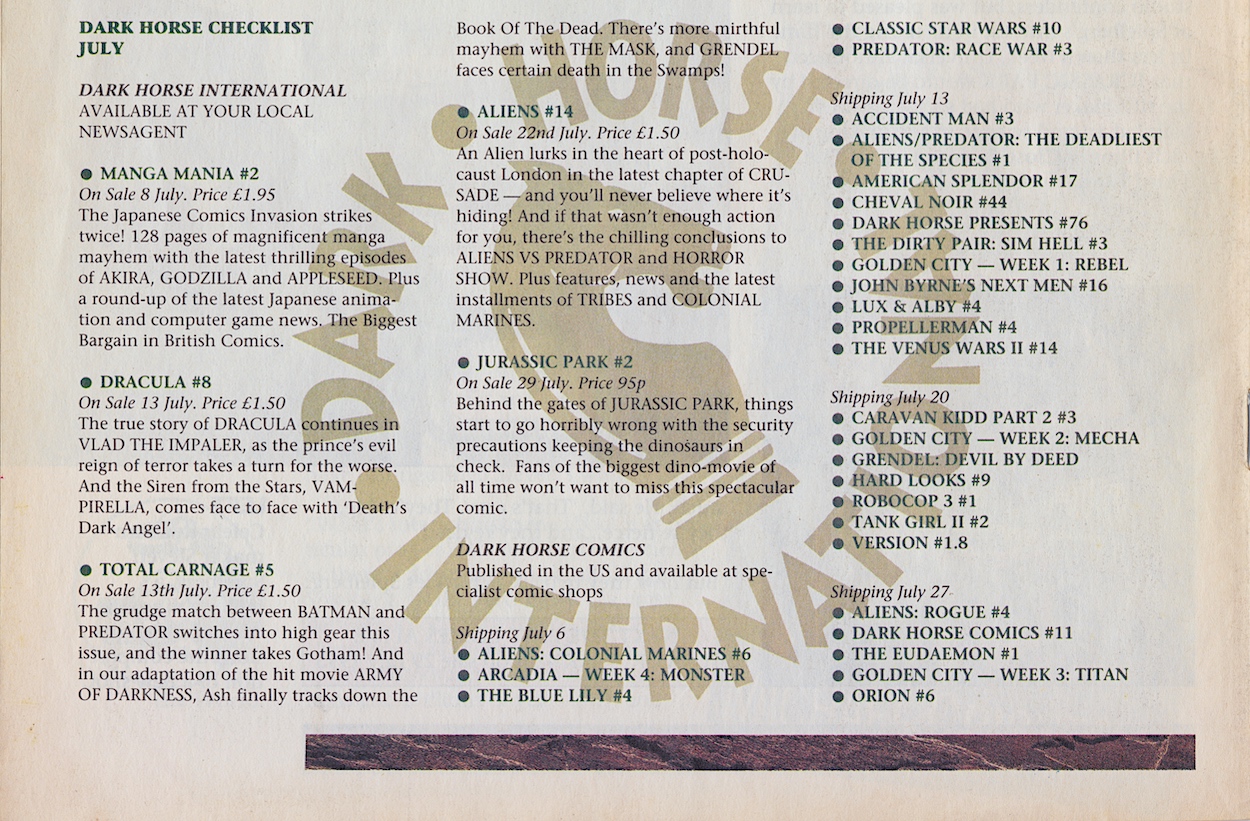
Check out this month’s comics checklist and you might get an idea of the make up of the company’s titles. The issue at hand begins with a competition for the excellent The Making of Jurassic Park. I actually bought this book at the time and it was a heavy tome, full of details on the making of the film and stands up today as one of the very best of its kind for any movie. You’ll also see an advert for Manga Mania, which fed off the new craze to hit these shores. Ultimately it’d also be a very important title for Jurassic Park fans. But that’s a story for another time.
Our freshly chopped final chapter is still a lengthy 16 pages so regular readers wouldn’t have felt short changed, at least with the page count. Unfortunately, the actual strip itself is another thing. Yes, this is the first time in the comic’s young life when I’ve been left disappointed.
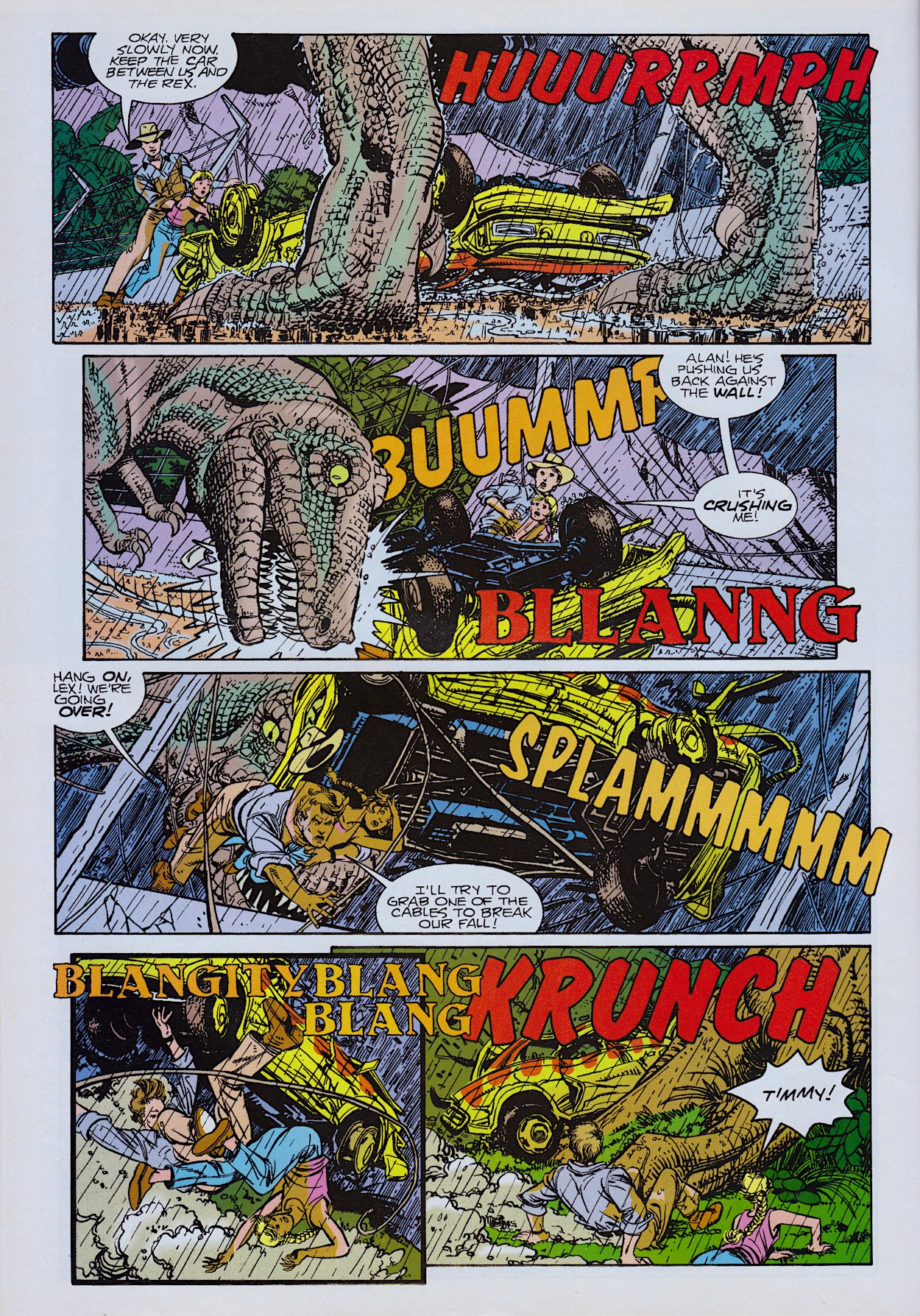
Last month the Tyrannosaurus rex attack was brilliantly handled with plenty of building tension and atmosphere so I was looking forward to seeing how the final act would begin. The opening is great, with Mrs Rex towering above Dr. Alan Grant and Lex, both trying to keep completely still.
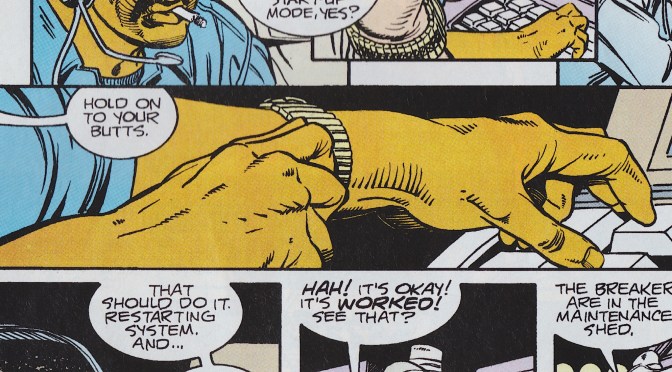
It’s all going so well until those final couple of panels. The sequence in the tree with Tim trapped in the Explorer has been completely excised! So it plummets to the ground instead and then he’s just unbelievably pulled out and off they go. Alan even has a map at hand to make their trip back to the Visitor’s Centre quicker, which is a rather cheeky shortcut. In previous issues scenes had been moved about, moments edited, others added to, all in order to properly adapt the film to the comic page and I’ve been really positive about it. But all throughout this issue huge swathes of story are just missing or reduced to a shadow of their former selves.
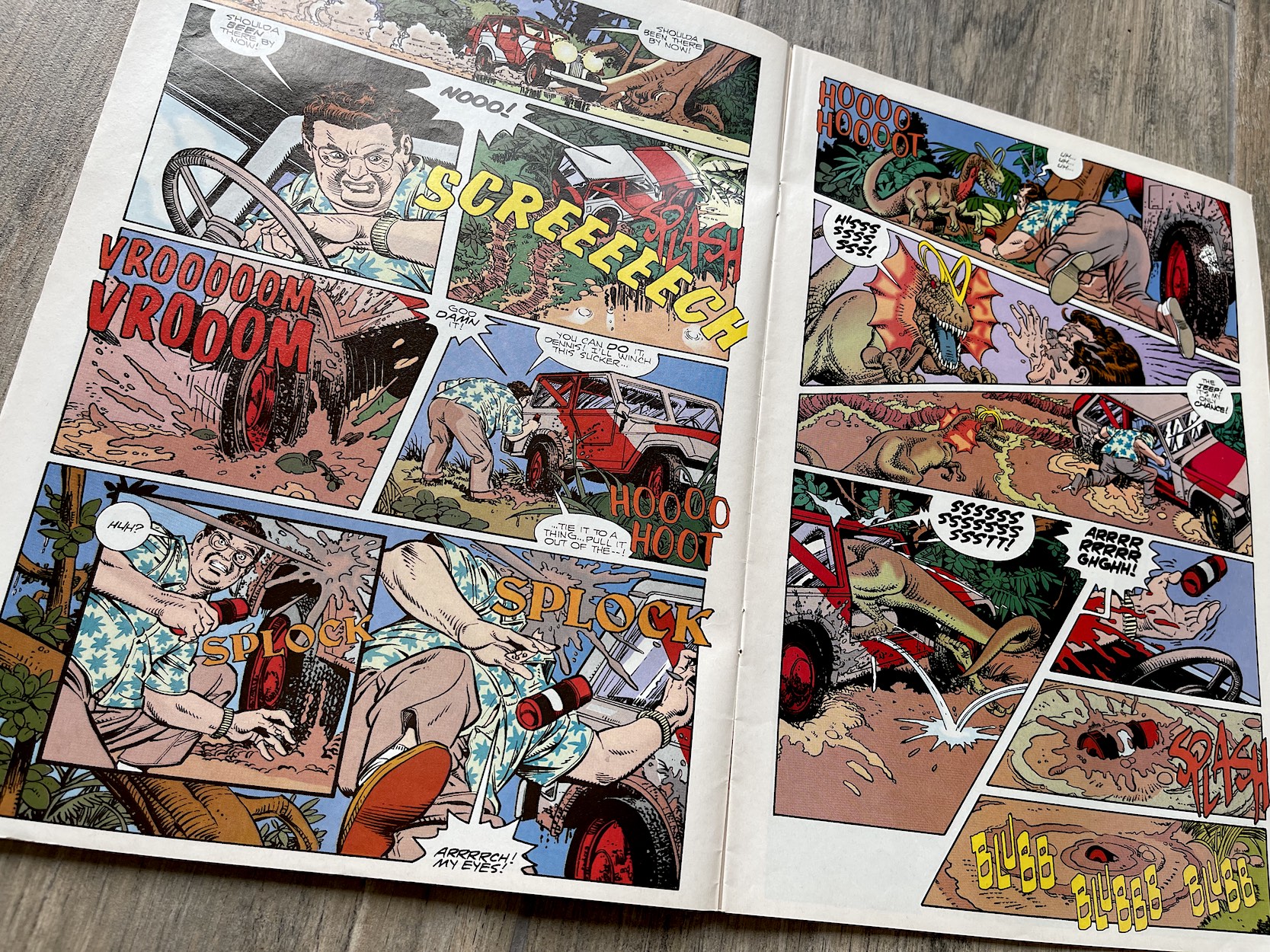
Case in point is the fatal encounter between Denis Nedry and the Dilophosaurus. The movie scene included plenty of misdirection and humour, putting the audience at ease before the shock, and that wouldn’t have been easy to translate here but they could have tried. Instead this very famous scene only gets two pages. It’s a very basic sequence now; the dinosaur may as well be a lion. Denis gets attacked as soon as he steps out of the vehicle, he jumps back in and we actually see the Dilophosaurus jump in after him (ruining the final moments of the original) and… well, that’s it.
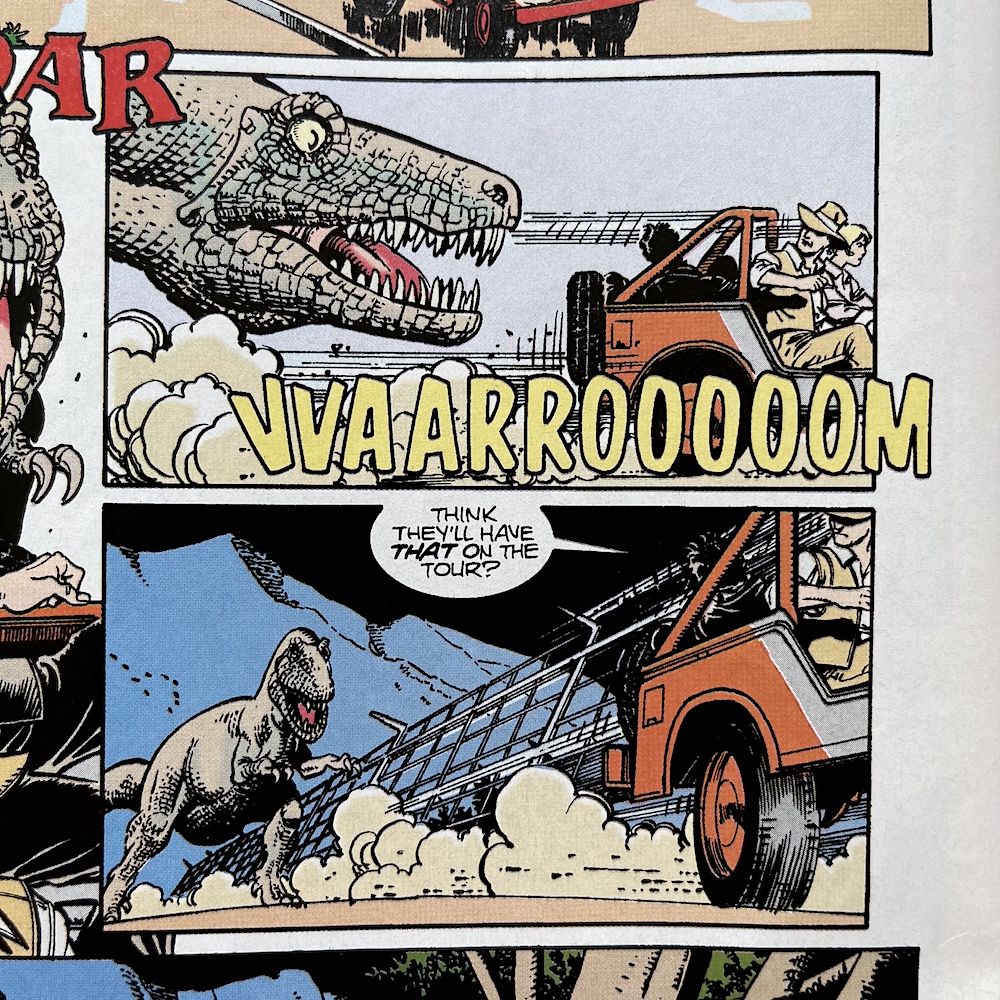
This truncating happens to basically every major moment, whether it’s the nighttime meeting with the Brachiosaurs, rescuing Dr. Ian Malcolm after the T-rex attack, even the electric fence scene (as you’ll see below) and Robert Muldoon‘s stalking of a Velociraptor. Each are reduced to fit on a page or two and basically follow a set pattern of only showing the first and last moments of the scene and erasing everything else, including almost all the humour.
“Think they’ll have that on the tour?”
Dr. Ian Malcolm
Right back at the beginning of this adaptation I stated how I didn’t usually like comic versions of films and this was the reason why. But up to this point Jurassic Park had been the exception to the rule, with a proper restructuring of the film to suit the format and it was working a treat as a comic in its own right. Maybe if they’d had five chapters instead of four (in the original US comic) it would’ve worked out differently, but then again maybe the pacing could’ve been plotted out better by writer Walter Simonson and story editor Jim Salicrup. Yes, having all the dino action in the final chapter would, in theory, make for a big climax but there’s just too much of it to fit in.
The result is a clichéd comics adaptation where it feels more like a way for people to reminisce about the movie they saw in the cinema months previous, rather than working as a good comic book. If I sound overly critical it’s only because the team had been doing such an amazing job so far, even adding in extra dialogue from either the original novel or earlier drafts of the script. So it’s more disappointment than simple negativity.
Don’t get me wrong, there are still things to enjoy here. It’s all on a lovely high quality gloss paper stock this month, some of the best lines from the film are still intact and the art in the first eight or so pages is top notch. However, in the second half even legendary artists Gil Kane‘s pencils and George Perez‘s inks start to feel a little rushed and Tom Smith‘s colours feel unfinished and flat, leading me to believe they were working very close to the deadline of getting the original US series out in time for the movie.
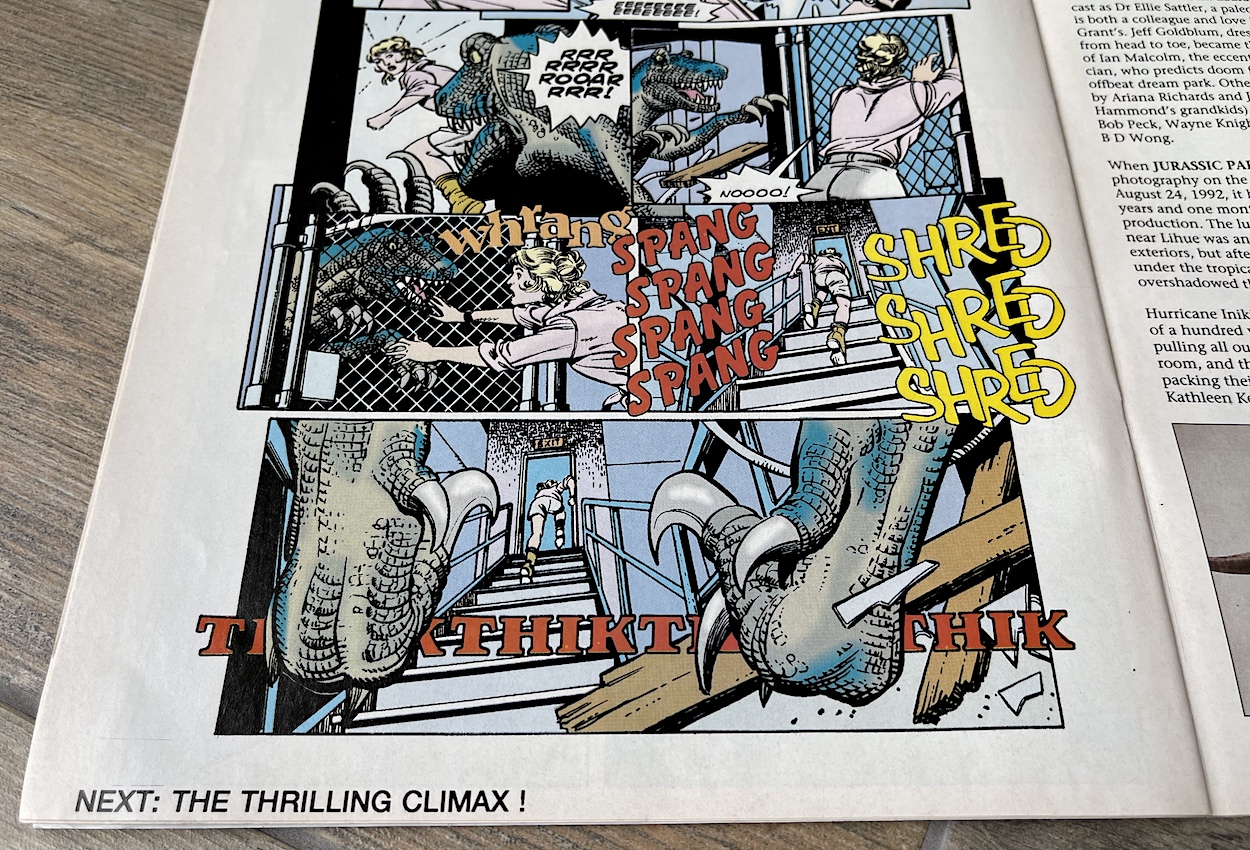
The chapter is cut off with a superb cliffhanger though. The view of a Velociraptor‘s feet as it chases Dr. Ellie Sattler is just as unnerving as it was in the film. It’s a shame then the terrifying Velociraptors, when viewed in full, are reduced to looking like miniature T-rexes. Below is this final scene with its positives and negatives, alongside that fence scene with the dramatic resuscitation of Tim also taken out.
I also noticed Ray didn’t volunteer to go to the maintenance shed as he did in the original story, where he met his grisly end. Instead Muldoon and Ellie head off while Ray looks on silently. This means he’s still alive, a big departure from the film. It’ll be interesting to see how that effects the rest of the story next month.
For now, the sun sets on the adaptation as we move on to something else entirely
With 16 pages to the main strip I assume there’ll be roughly 12 or 13 next month unless the final chapter was given a few more pages in the original American Topps Comics publication. Either way there’s a lot of the film left to cover in half a chapter. The kids and Alan are still out in the park which means their return, the kitchen scenes, the chaos of the Velociraptors in the Visitor’s Centre and the climax are all to come.
I’ll still hold out hope things can be turned around because so far it feels like spending 90 minutes being completely engrossed in a film only for its ending to let you down. Which of course is not what happened with Jurassic Park! For now, the sun sets on the adaptation as we move on to something else entirely.
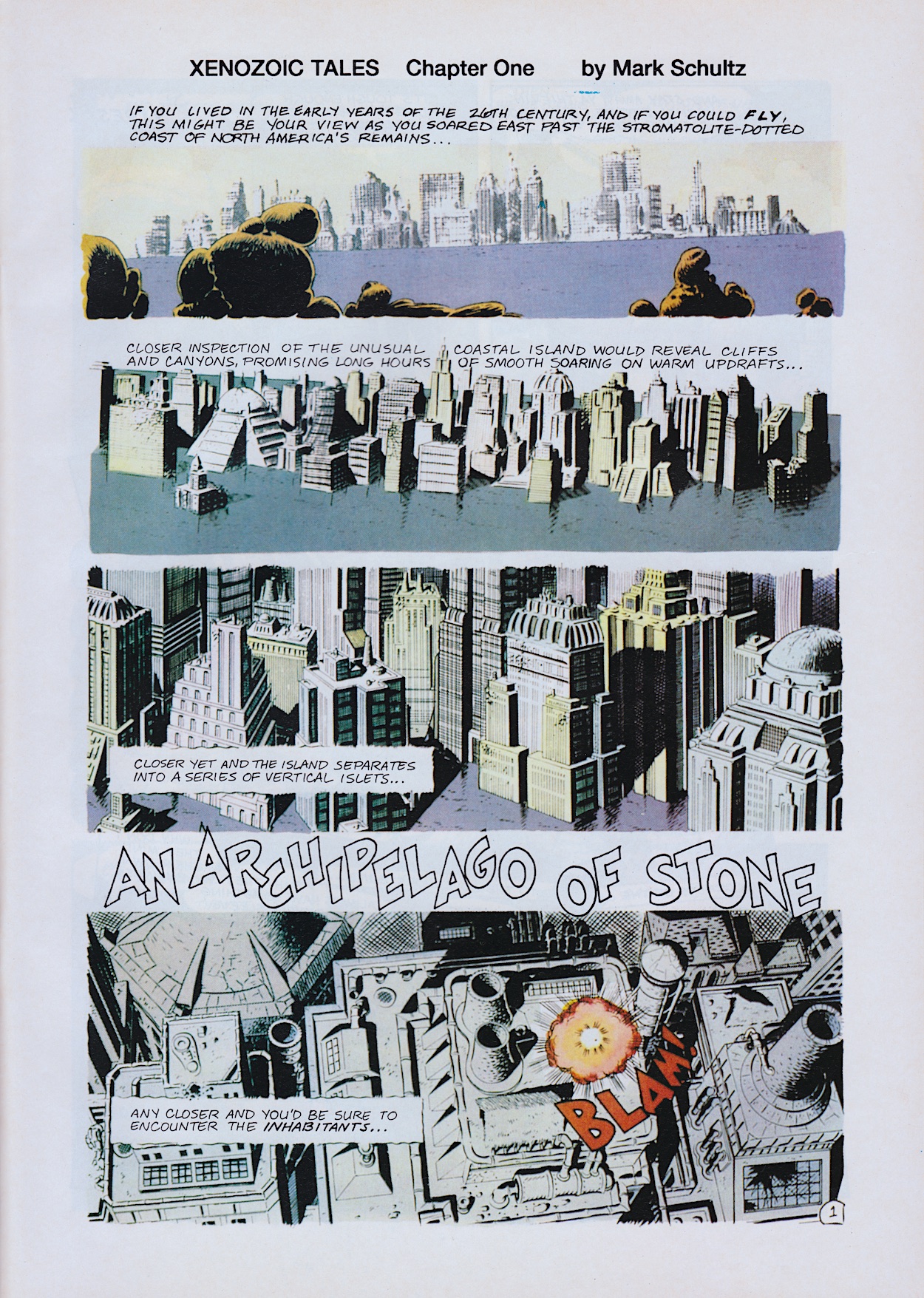
In the early days of Marvel UK‘s Transformers its back up strips were in some way related to the robotic theme, such as Machine Man or Iron Man. It wasn’t long before it instead became a way of bringing some of Marvel’s other US characters to these shores for the first time, but Jurassic Park kept its strips dinosaur-themed, much to the delight of teenage me. The second back up would appear in my first issue (#6) but here readers were introduced to Mark Shultz‘s Xenozoic Tales.
Later adapted into a cartoon TV series called ‘Cadillacs & Dinosaurs‘ it was an independent, alternative title Mark wrote and drew himself, running for 14 issues irregularly released between 1987 and 1996. Most of the strips were printed in black and white but Jurassic Park brought in artists to colour them exclusively for UK readers, this first one coloured by Ray Fehrenbach. This complete story was the first one written by Mark and what an introduction to something brand new this first page was.
Set in the 26th century, global warming has resulted in sea levels across the globe forcing humans to initially build underground. After 600 years they’ve reemerged to find their cities flooded, technology virtually non-existent and strangest of all the world is populated by dinosaurs once more. Anyone capable of mechanical work is seen as invaluable and this is where Jack Tenrec comes in, a car mechanic with a penchant for Cadillacs. Thanks to these skills he acts as an unofficial head of security and advisor to his tribe’s leaders and lives on an outcrop (formerly high hills) not far across the water from An Archipelago of Stone, the home of the tribe and in reality the remains of New York City.
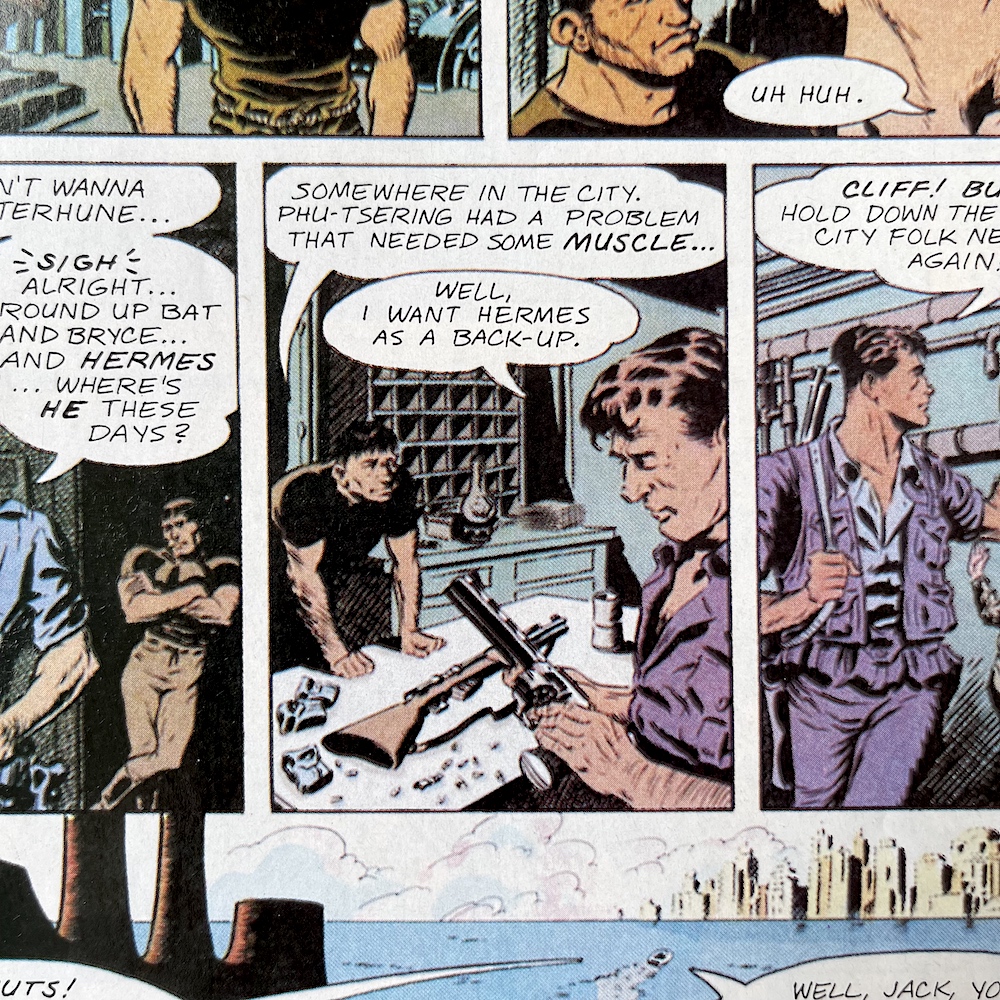
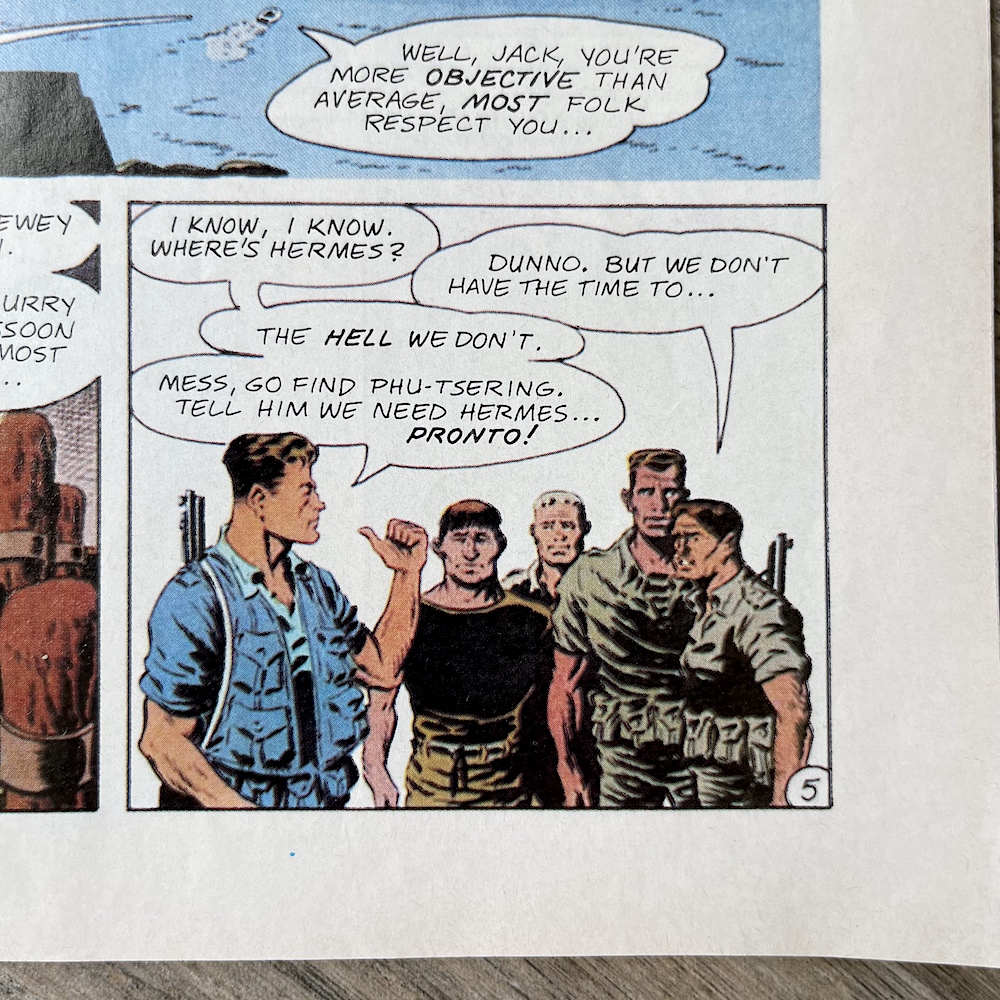
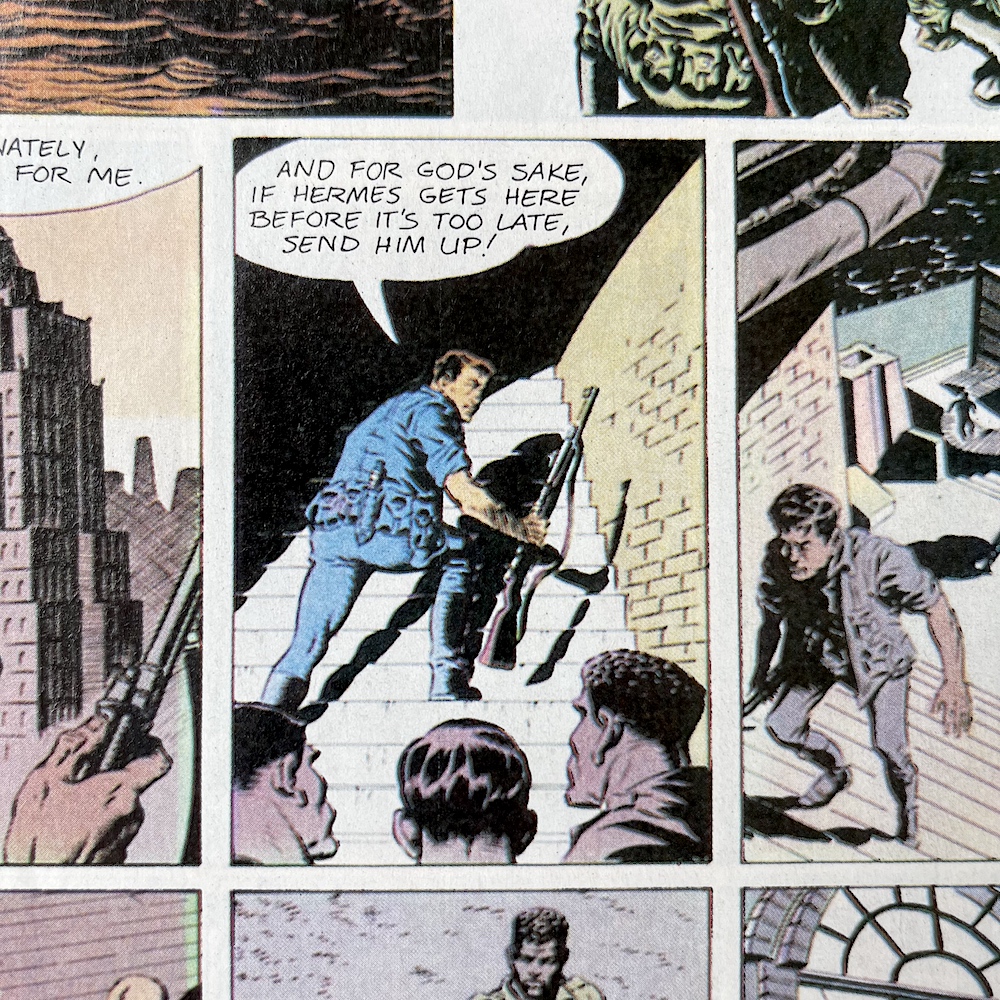
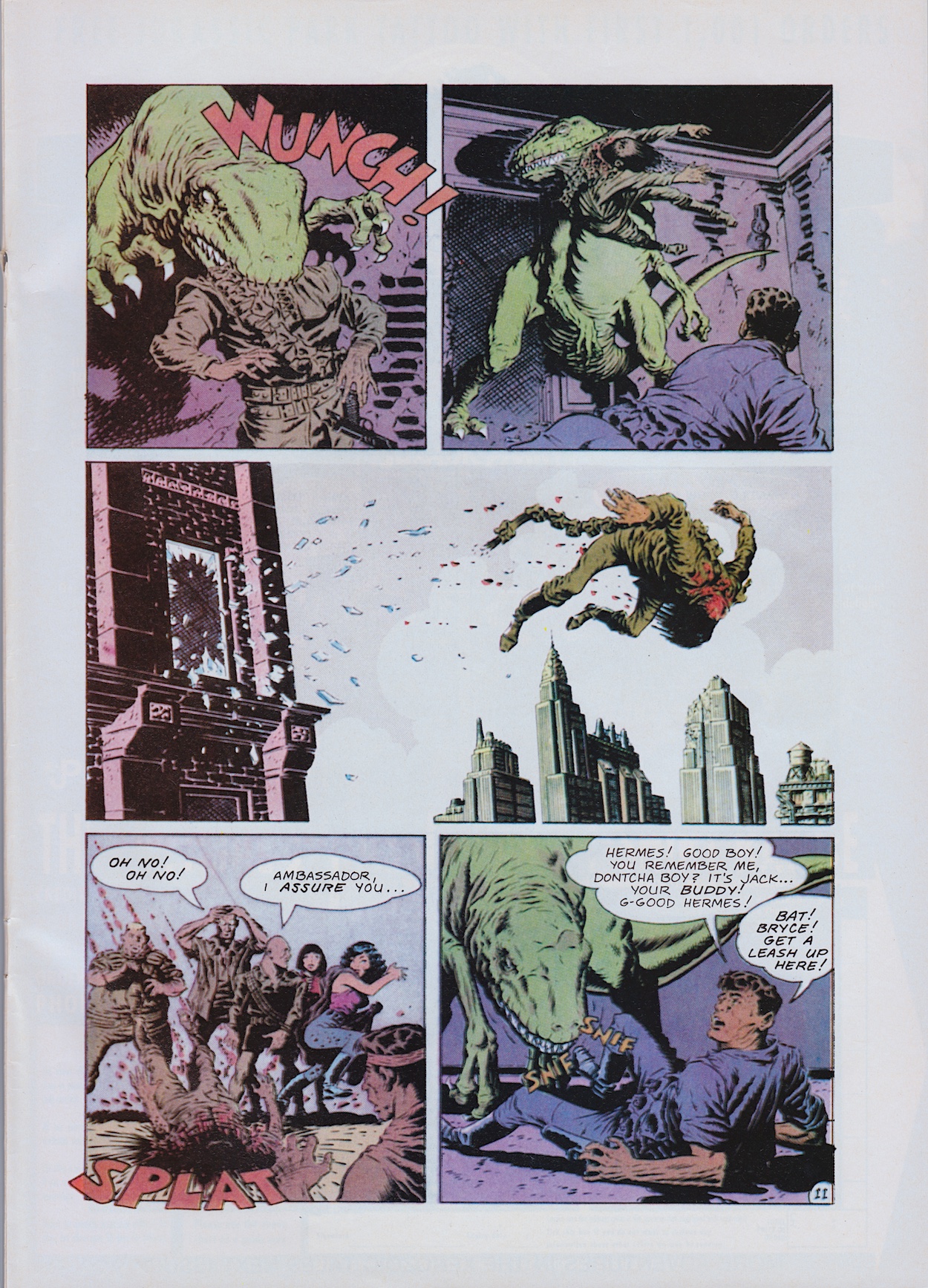
I love that first page, cleverly written from the point of view of a Pterodactyl. In the story a neighbouring tribe’s ambassador, Hannah Dundee arrives at the City in the Sea and a team of poachers who had previously stolen from her Wassoon Tribe want her dead before they’re found out. It’s up to Jack and his men to stop them. All the way through this strip, knowing he’s about to get in way over his head, Tenrec keeps telling his men to send someone called Hermes to help. Then, just as it seems he’s doomed a surprise arrival bursts in. That’s Hermes!
Well I certainly didn’t expect that. Hermes the Allosaurus disposes of the villain, munching on his head and throwing him out the window, before Tenrec thanks him, revealing who this is. That doesn’t mean he’s a pet of course and the usually cool and collected Jack knows it.
It’s brilliant stuff. Original, fun and surprising, introducing the main protagonists, the unique setting and the cast of regular and semi-regular guest characters, all in 12 pages while maintaining an interesting story and racking up tension is rather a phenomenal feat. No wonder Xenozoic Tales is so highly regarded even to this day. It may at first seem like a strange choice for Jurassic Park’s back up but it works perfectly and as a teen I remember being engrossed with the slowly developing back story that would become more apparent in later issues. (Sadly, Hermes never reappeared.)
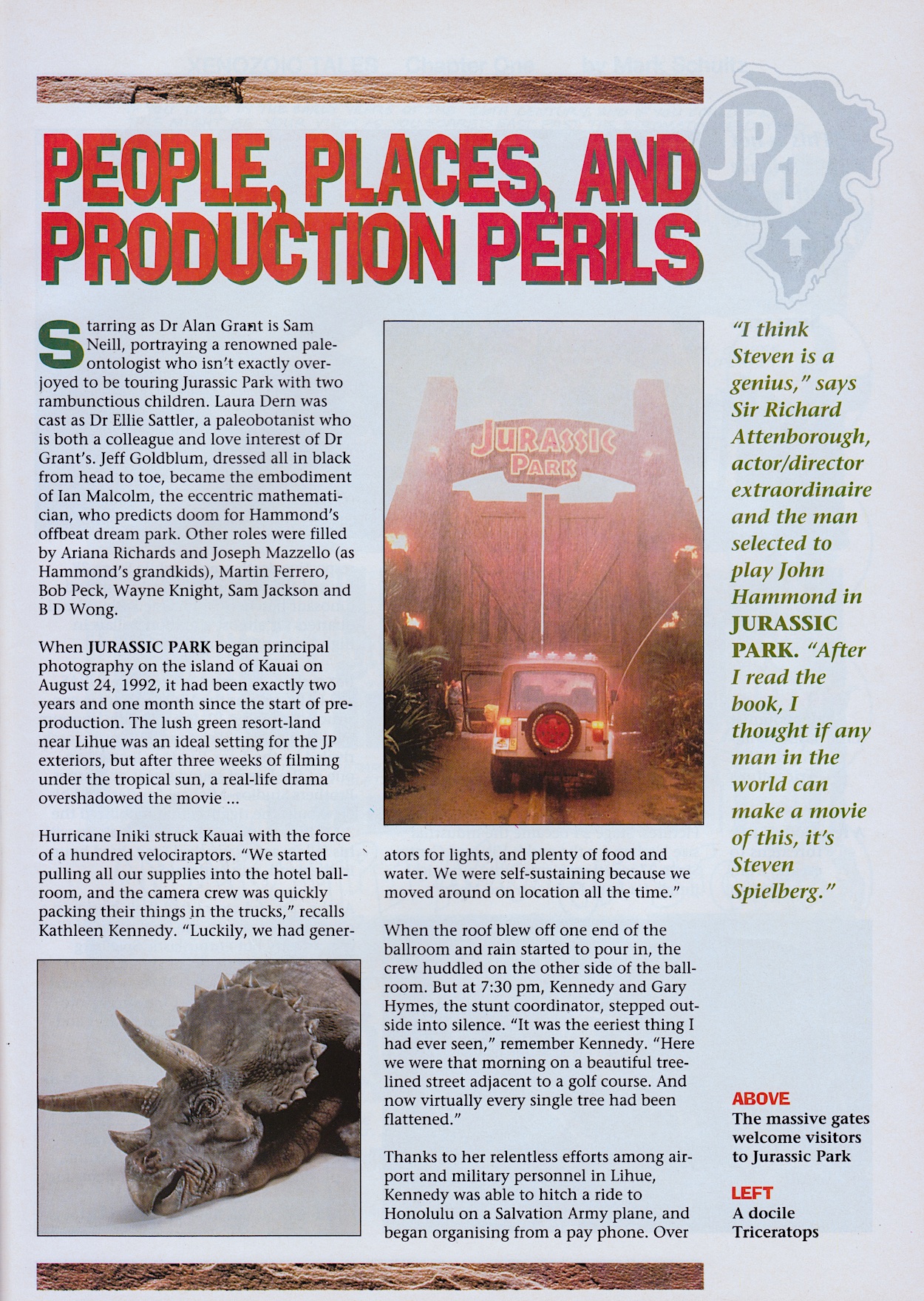
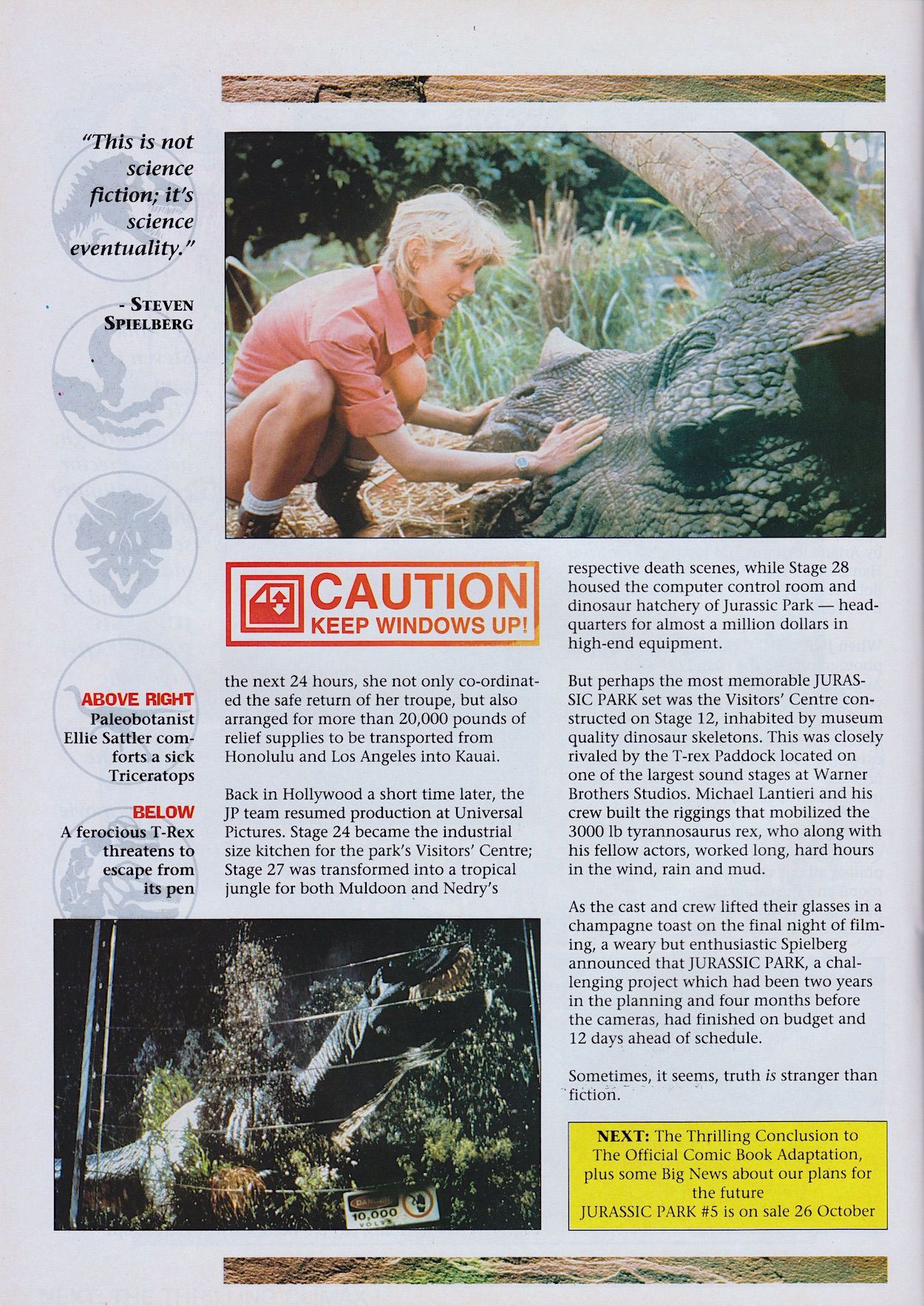
In between the two strips is this month’s look into the making of the movie, covering the famous disaster that hit Hawaii and the relief efforts the producers helped coordinate, plus the building of sets and the end of principal photography. At the very end of the feature is the teeny tiny box with the date of the next issue including a little tease that things were afoot for the future of the comic.
Thankfully they didn’t say “great news for all readers” or we’d have got the wrong idea. With these couple of pages, a long main strip and a back up it really does feel more like the kinds of UK comics we were accustomed to at the time. I may have enjoyed the extras more than the adaptation this month but I know from memory that what’s to come from Jurassic Park made this one of my very favourite comics growing up. So stay tuned for some terrific stuff from Isla Nublar, as well as from the far future and soon the distant past too!
The fifth issue and the conclusion of the movie storyline will be stomping its way on to the blog in one month on Tuesday 26th October2021.
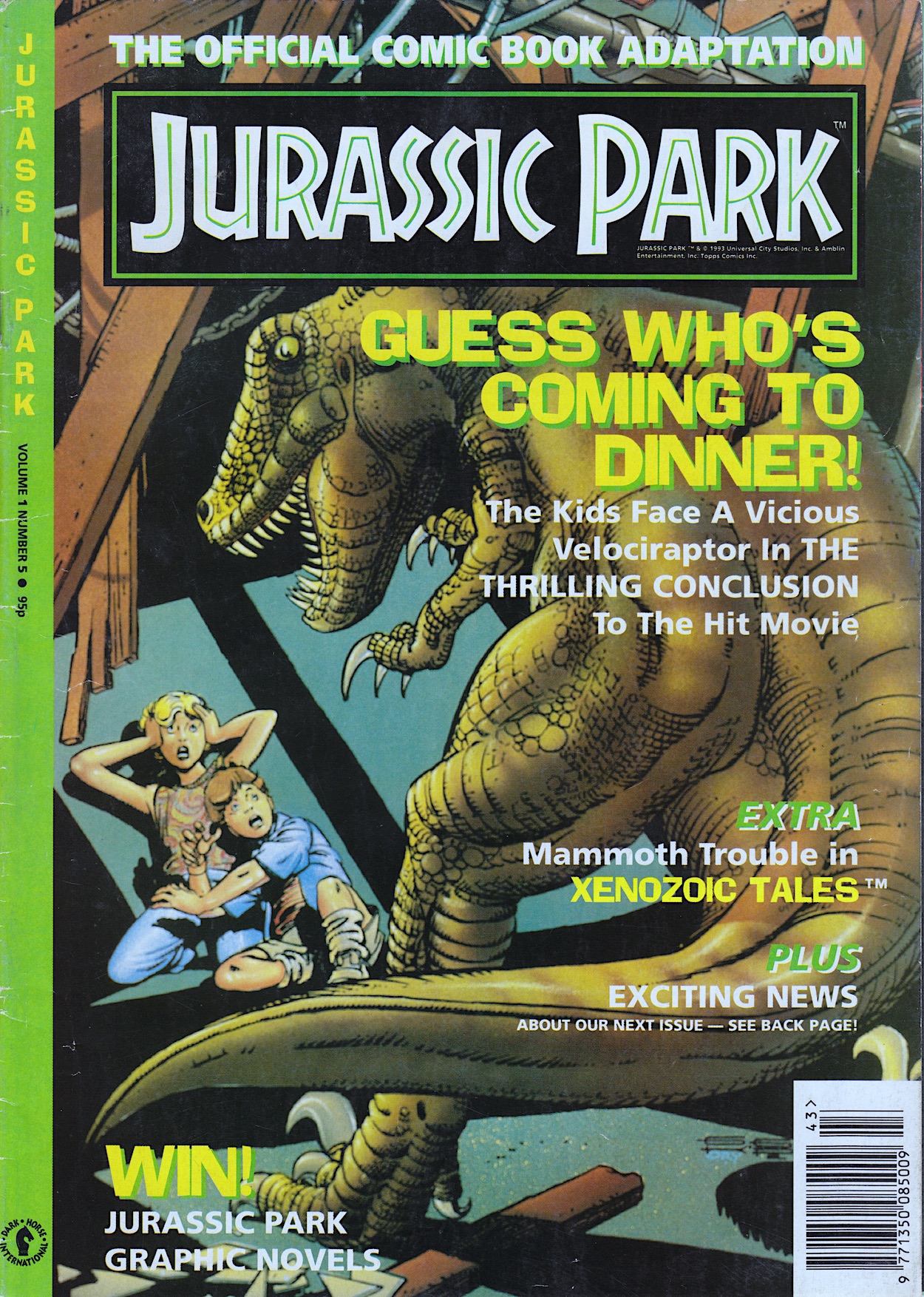
Don’t let the rather playful, pet-like Tyrannosaurus rex on the cover put you off, this is not a sanitised version of Spielberg’s monster movie. Things really do kick off for Dark Horse International‘s UK version of Jurassic Park comic this issue, as Dennis Nedry puts his plan into action just as the unfortunate coincidence of a tropical storm hits the remote island of Isla Nublar.
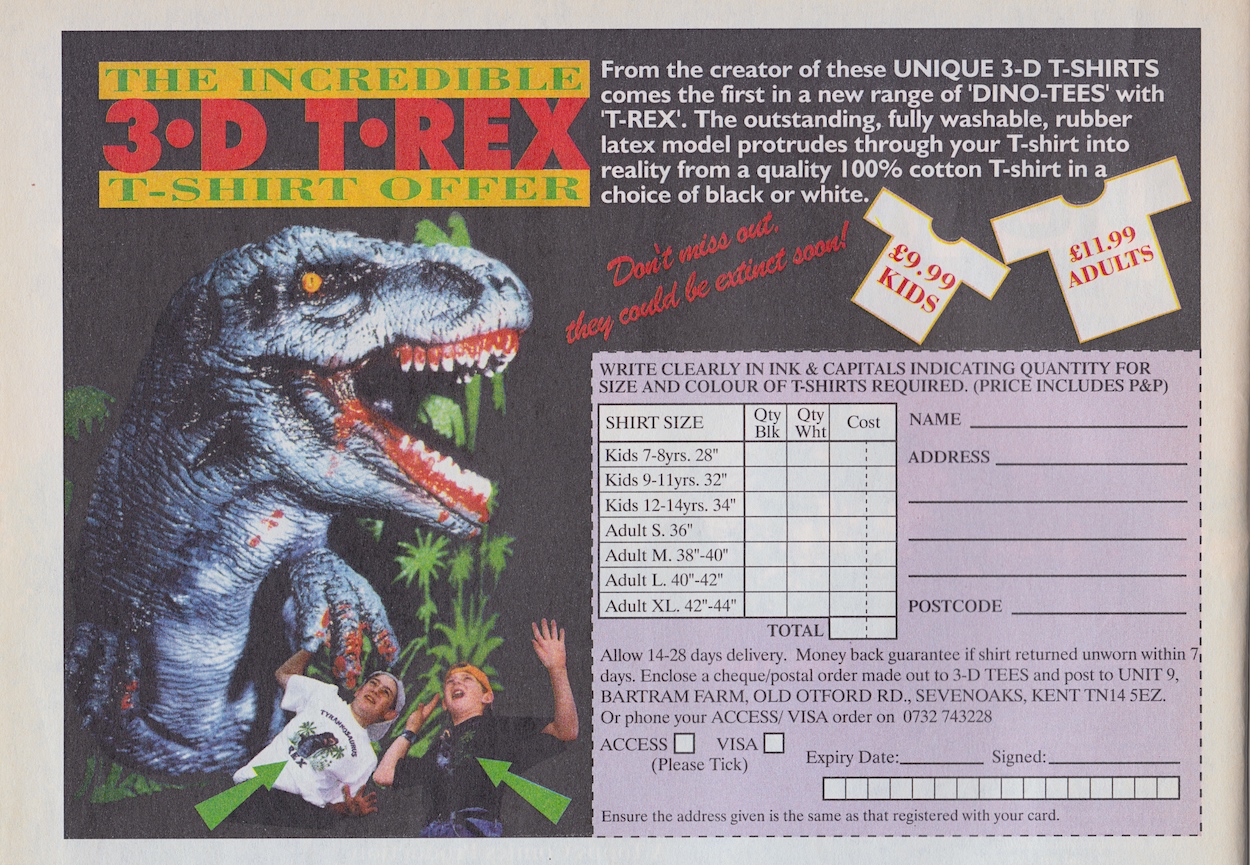
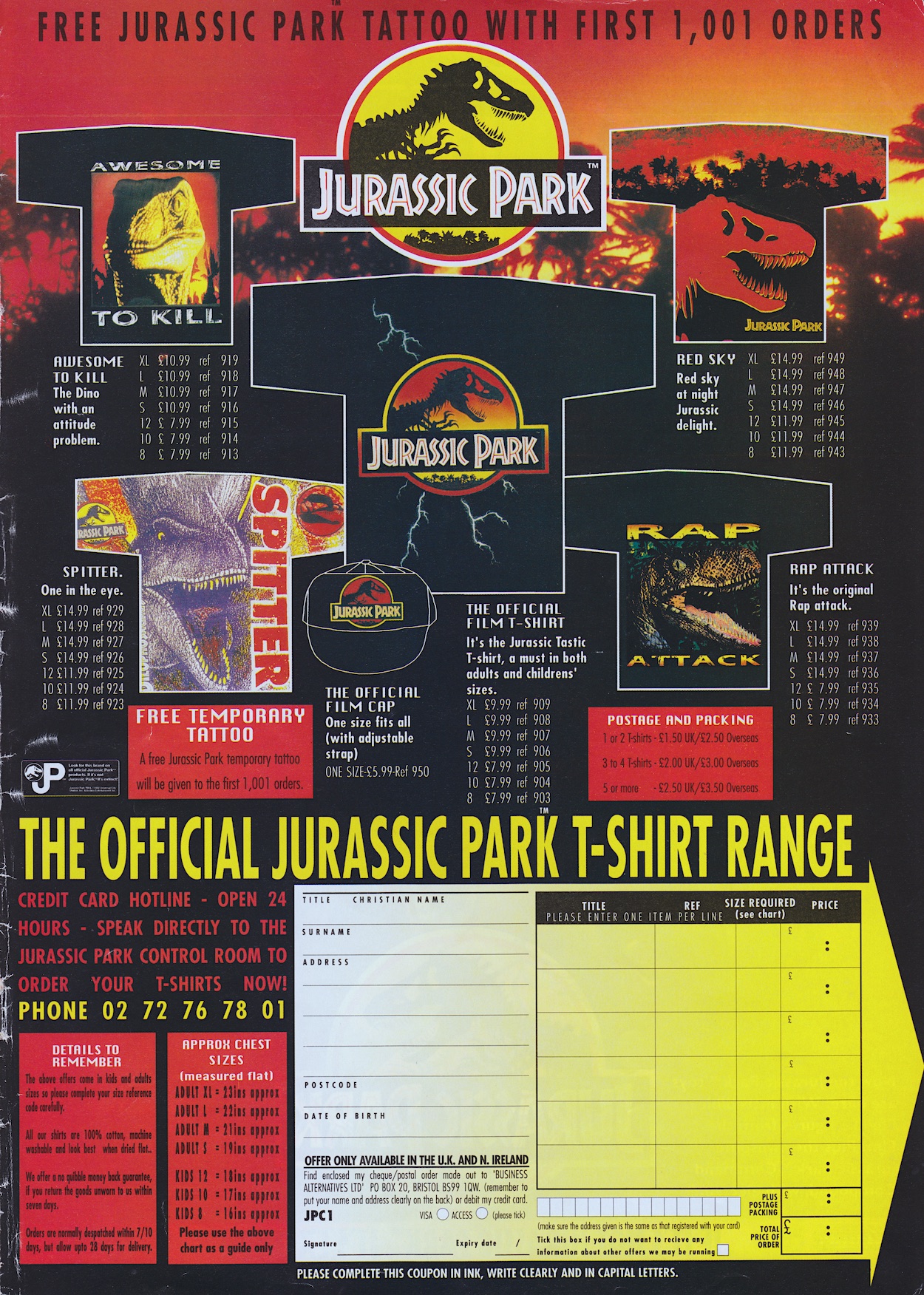
But before we get to that let’s take a look at some of the other bits and bobs included. The full comics checklist returns, featuring all five of the publisher’s UK titles and an extensive list of imports. You’ll notice the next issue of Jurassic Park has no specific date and I’ll get to that at the end of the review. There’s also an advertisement for possibly the worst idea in clothing ever to grace anybody’s chest. It’s difficult to make out but those of us who are old enough will remember these ridiculous t-shirts with a horrible rubber dinosaur sticking out, Alien-style. I remember there being Yoda ones in the shops too and they were just as garish.
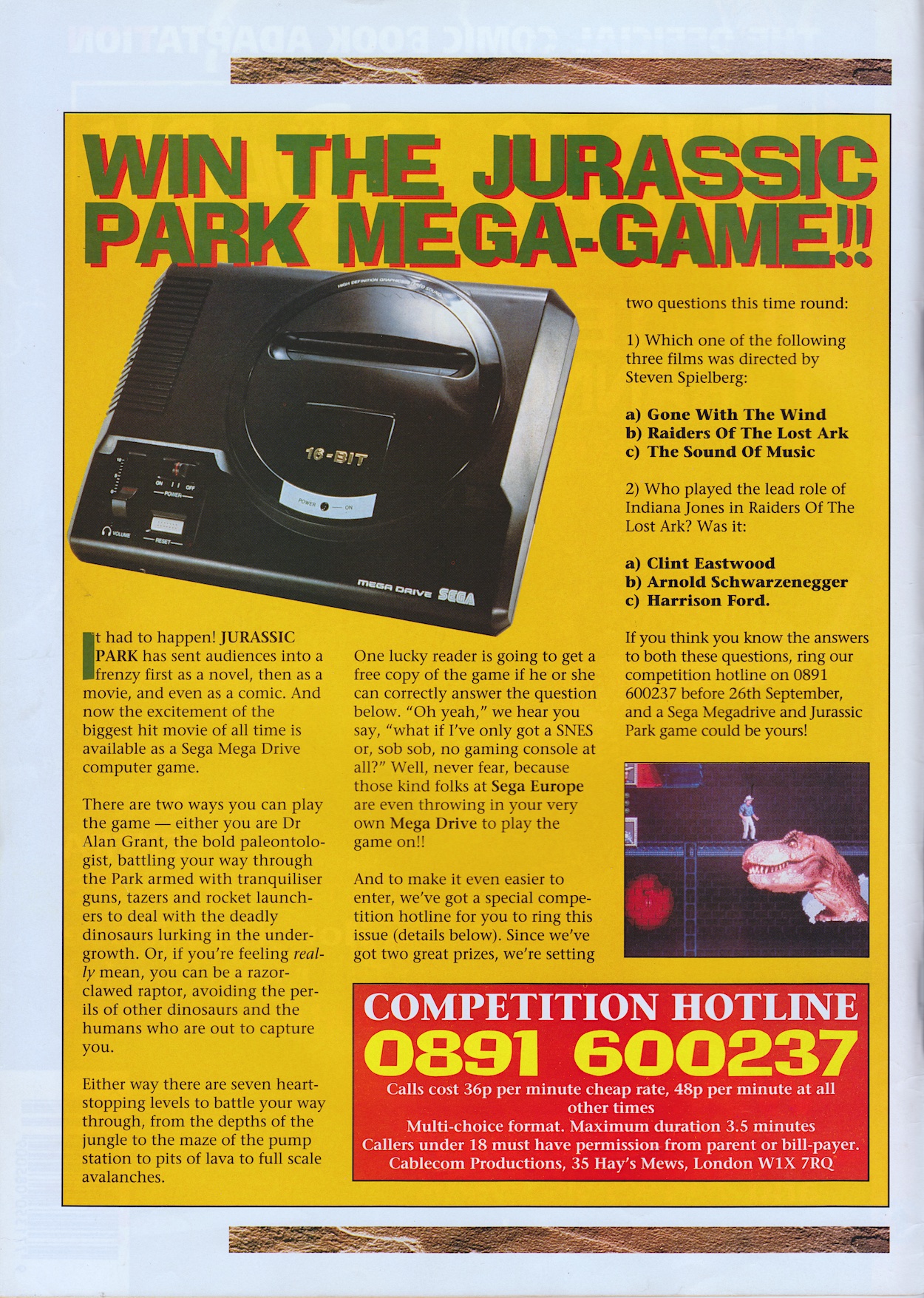
The issue opens up with the biggest competition yet on page two and oh, how this takes me back. My friend had a Sega Mega Drive back then and, while we never played this game, I’m reminded of the weekly trips to the local video store to rent the latest games. The writer certainly seems just as enthused. (It’s definitely a step up from glow-in-the-dark stickers.) If only this kind of hype were evident on the editorial page every issue instead of the straight contents list we got instead. It’s not like there wasn’t a lot of Jurassic Park news to get hyped about after all.
The constant presence of rain in the background and the subdued colours envelop the reader in the cold, wet nighttime scene.
Clearly there was an excited human team behind the comic. Readers who had seen the movie in cinemas would definitely have been looking forward to this issue too. Things kick off with the sick Triceratops scene now playing out like the movie after last issue’s cliffhanger. As it turns out, the supposedly terrifying creature (which wouldn’t have harmed them anyway) just collapses when the story begins, which makes that cliffhanger a bit of a cheat.
The scene uses more dialogue from the book that didn’t make it into the final cut of the movie, specifically the resolution of what made her sick in the first place which really showcased Dr. Ellie Satler, so it’s nice to have these details back in the comic.
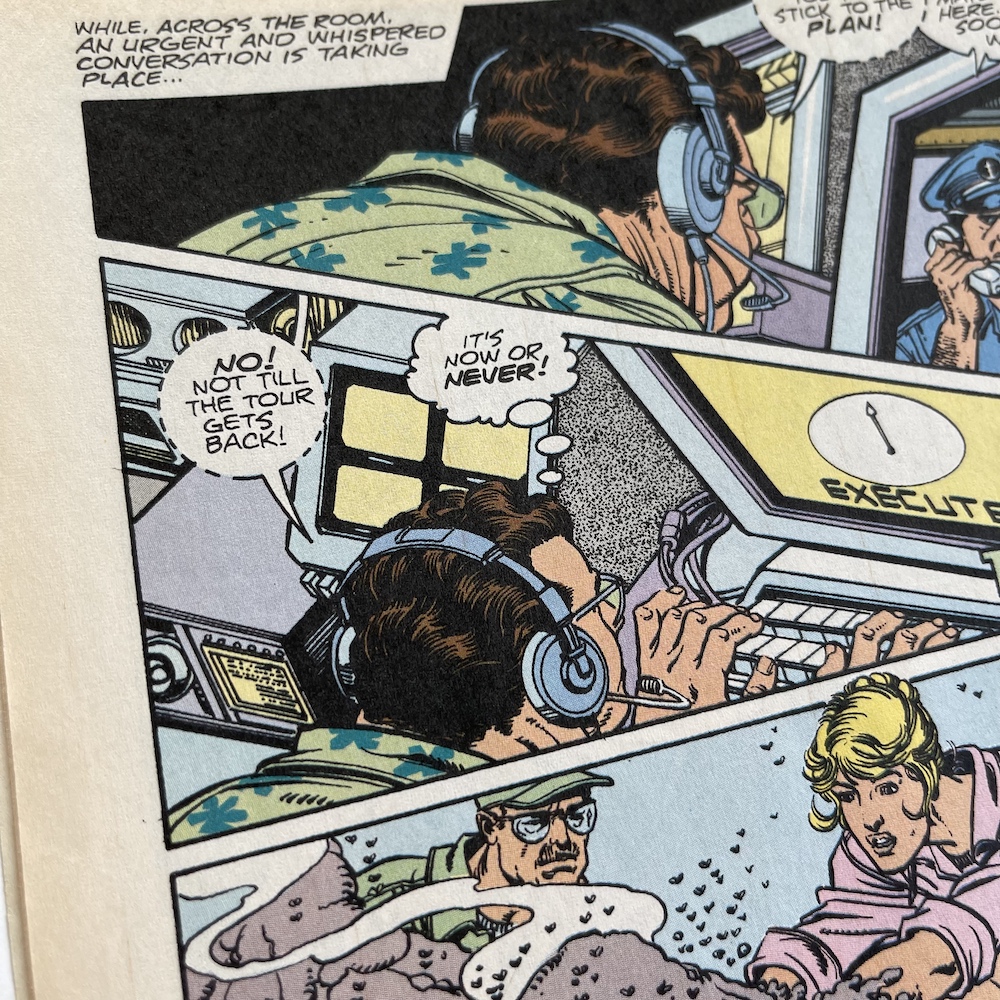
While Nedry’s ultimate fate isn’t played out yet we do at least get some extra characterisation for the man whose greed would ultimately lead to the park’s destruction. He’s actually worried about turning off the park’s security before the tour gets back. He doesn’t want to hurt anyone, he actually cares and his intention is to sneak off to the boat, hand over the embryos and get back before anything bad transpires from the temporary deactivation of the electronic gates.
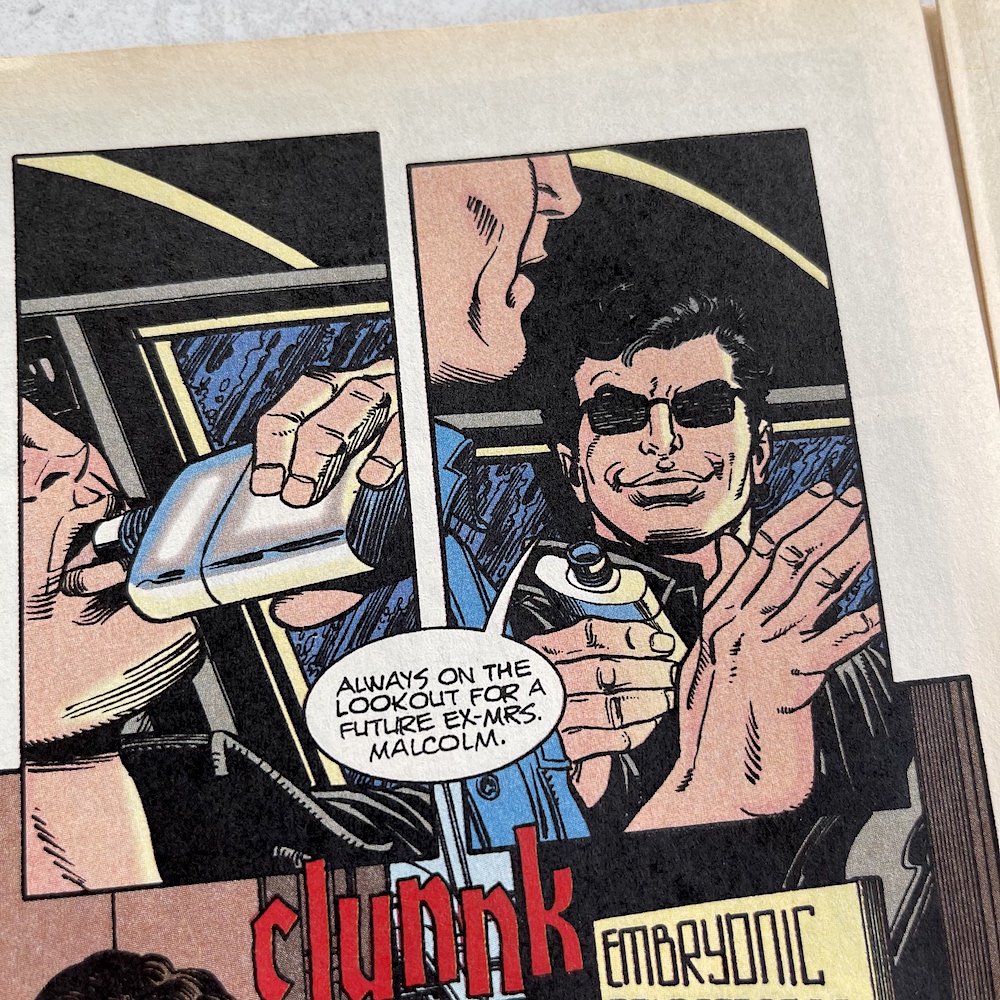
“Always on the lookout for a future ex-Mrs. Malcolm.”
Dr. Ian Malcolm
Of course, the storm would put a rush on things and we all know the outcome for everyone involved. Despite his worry he’s still an annoying hacker at heart and his “hacker crap” still keeps Ray out of the system long enough for his plan to be put into action.
The build up to the main event is superbly handled. The constant presence of rain in the background and Tom Smith‘s subdued colours envelop the reader in the cold, wet nighttime scene. Iconic moments such as Dr. Alan Grant and Dr. Ian Malcolm‘s chat and that famous moment the giant T-rex stares in at them, looking for a moving meal, are brilliantly captured.
GilKane‘s and George Perez‘s (our cover penciller/inker respectively) version of Ian continues to exude a darker presence, his humorous lines reading a little more cutting than Jeff Goldblum‘s perfect delivery. It’s such a shame then, how Walt decides to change a key moment in a way which has a detrimental effect on the character, which we’ll get to that in a minute. For now, let’s back up a little to the first appearance of the issue’s big selling point.
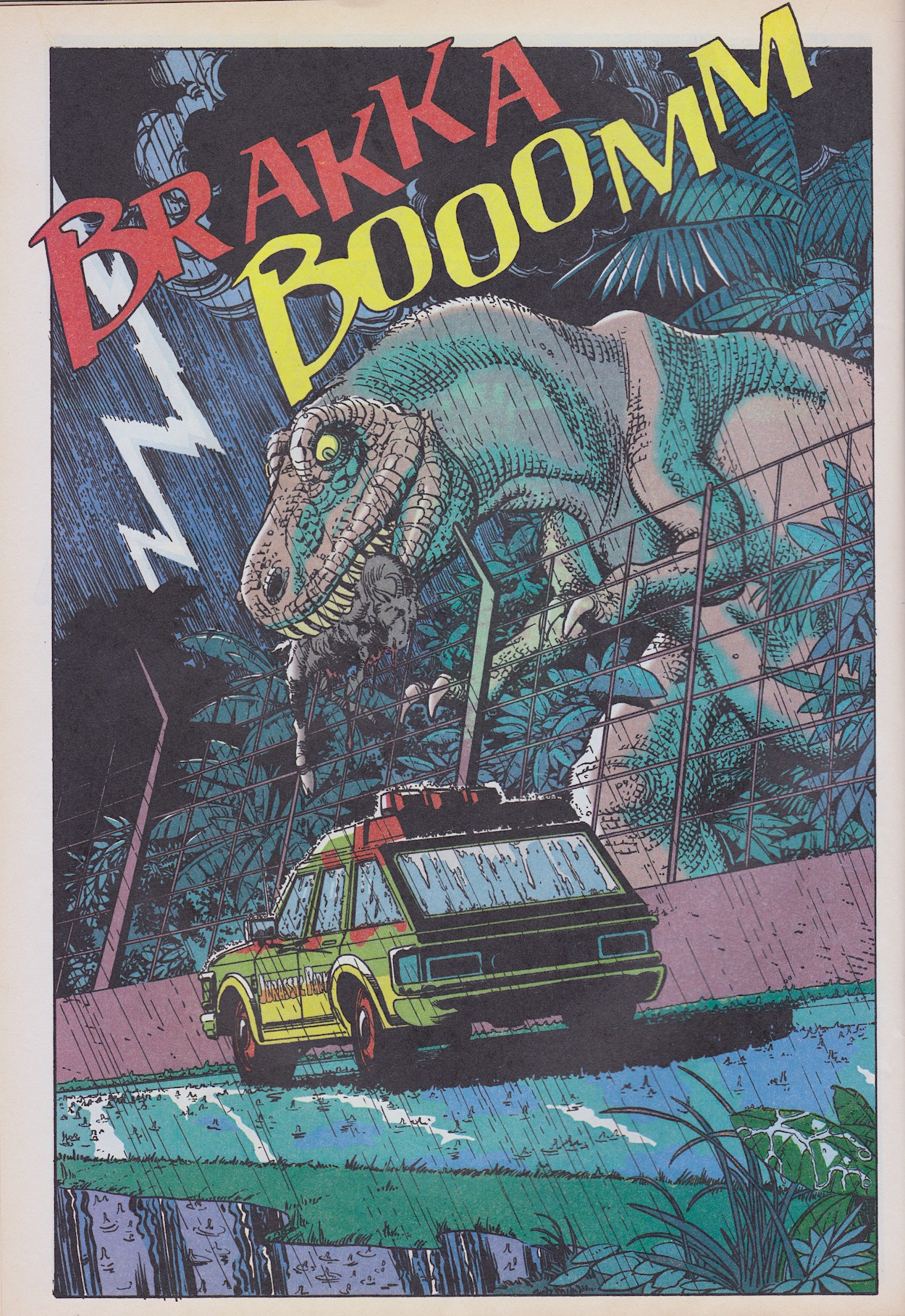
Three issues in the comic team finally get to have the big reveal and their first bit of proper dinosaur action, something they’ve only been able to hint at thus far. This was a key scene to get right and just as the tension rose to its crescendo in the movie, here we’ve got pages of rain, booming sound effects and progressively more frightened characters until we turn a page and are confronted with this next image.
Timing is everything and editor Dick Hansom made sure to add an additional advertisement page after the editorial so that later in the comic this would work as intended. Of course, on closer inspection you could critique this image and say the size of the T-rex means she could easily chomp down on cars even with the fence electrified (and also, that’s one huge goat), but then we’d be missing the whole point of this glorious splash page.
Sure there’s some artistic licence at play here but you can’t deny its impact. Those proportions are corrected for the rest of the attack scene and to be honest it was only upon the second reading that this reader picked up on it, such was the impact of this atmospheric rendering.
“It is a beautifully-designed killing machine!”
Panel caption (Walter Simonson)
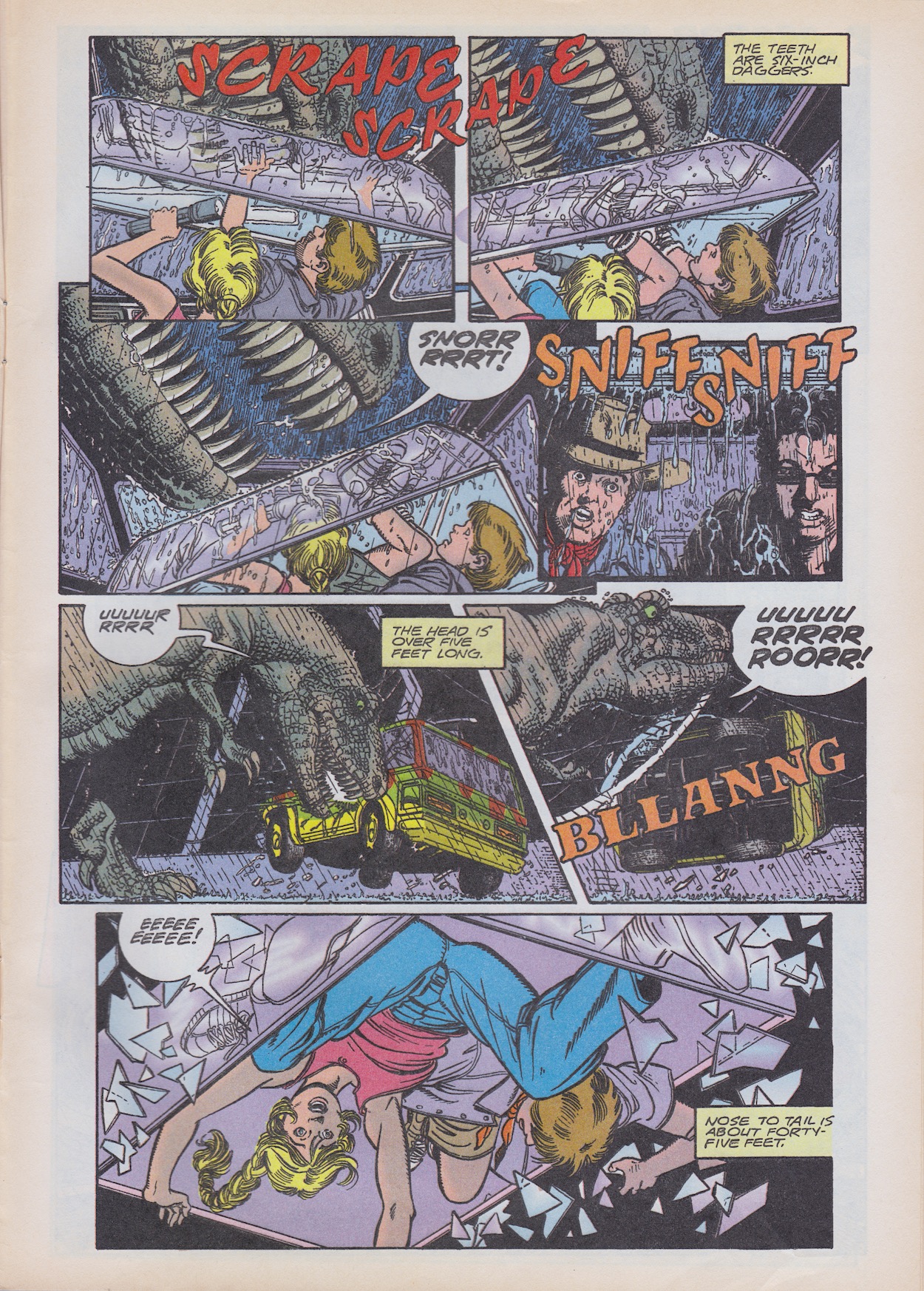
What follows are an intense few pages which I believe would work just as well on their own merit even without the memory of the movie. In the film the juxtaposition of the giant predator and the kids Lex and Tim made for a genuinely terrifying moment in cinema history. Conveying that to comics panels was never going to be easy but the simple addition of descriptive captions ends up being the perfect solution.
With the attack in full swing, every few panels we get a direct, to-the-point fact about the T-rex‘s size and strength. The attack spans four pages and each of these little captions brings another level of tension until they culminate in “It is a beautifully-designed killing machine” as it stands on the upturned car, its weight squashing the metal down into the mud, Tim still trapped inside. It’s a genius move.
What comes immediately after these superb pages is the first big disappointment in this adaptation.
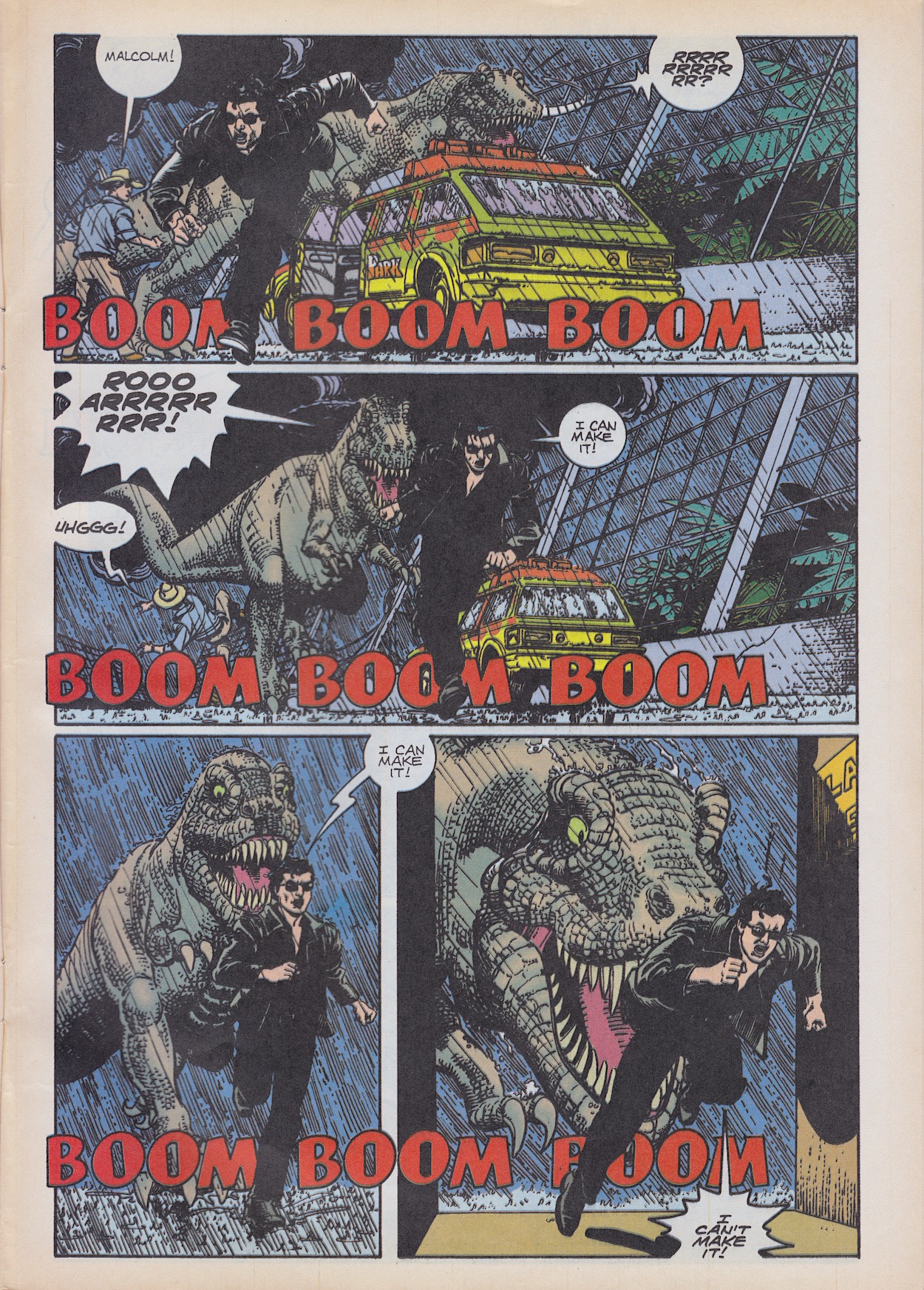
As you’ll remember, in the film Ian lights a flare to get the T-rex‘s attention away from the kids and only starts running once he knows he’s being chased. This gives Alan the chance to rescue the children. But here he just runs away, leaving everyone else to their fate. There’s no indication he’s doing it as the foolhardy yet heroic gesture of the movie. It’s completely out of character and if this had happened in the movie it probably would’ve turned the audience against him for the rest of the story.
A very odd choice and one I definitely do not like.
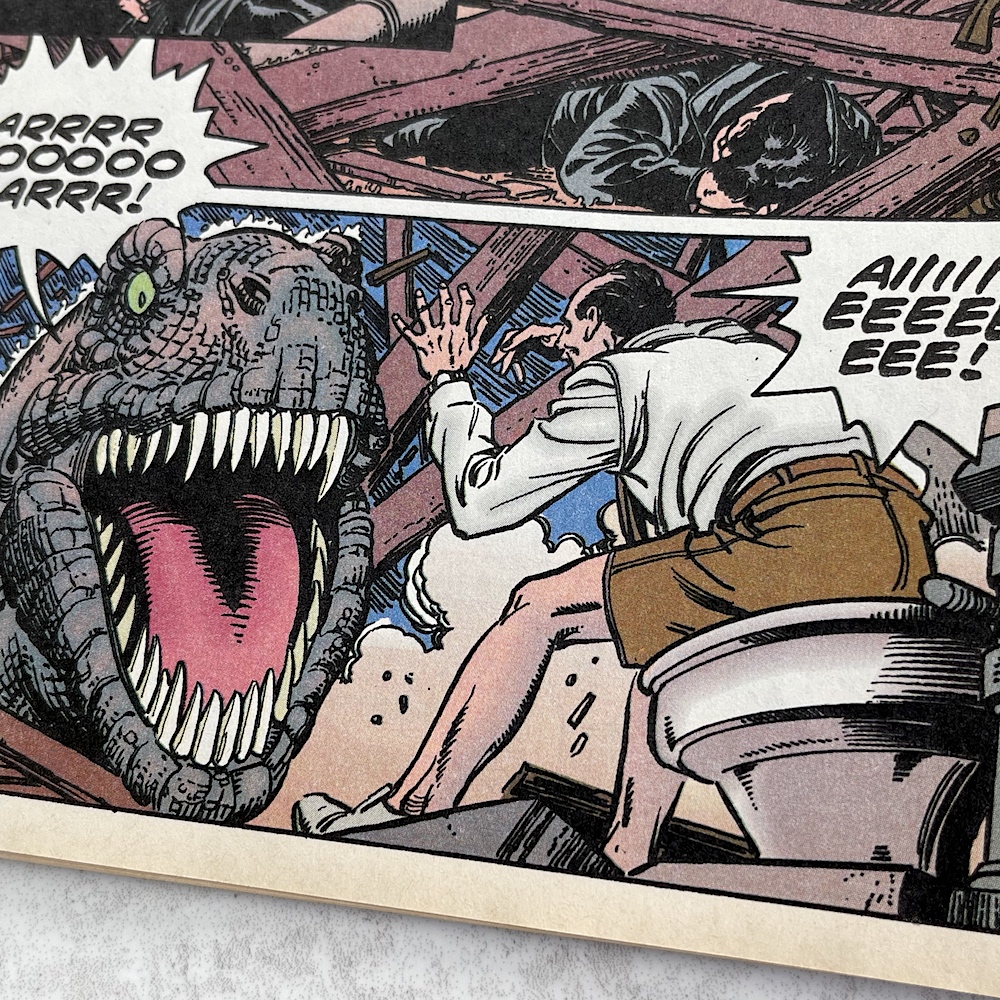
The end result is the same however, with Malcolm being tossed through the walls of the public toilet where lawyer Donald Genaro ran earlier to hide when he abandoned Lex and Tim. The ending to his particular story happens out of frame with only a scream in a speech balloon pointing off the page (in letterer John Workman‘s unique style). This seems like another rather odd choice seeing as how the vast majority of readers will have witnessed the scene play out in the film. Why censor it?
A couple of dubious choices by Walt and story editor Jim Salicrup aside the story rockets towards its cliffhanger. In America this would’ve been the penultimate chapter in a four-issue mini-series but here in the UK we actually still had two parts to come. How so? You’ll find out next month. (I have to try to get you back here somehow!) In the meantime this final page brings things to an end but the issue has more to give before we place it back on the shelf.
Last issue the behind-the-scenes feature introduced us to the various special effects departments and their roles in bringing Michael Crichton’s creation to the screen. This time the focus is fully on the mechanical dinosaurs themselves, created by Stan Winston and his team, in Building a Better Dinosaur.
We all know how the film led the way in its use of computer graphics, but what can’t be forgotten are the wonderfully lifelike creations that the cast actually got to interact with. As a huge fan of Jaws (which gets a humorous mention here), Jurassic Park always felt like a descendant of that original mechanical predator movie and this brief write-up is an interesting look at how they were created and operated. It’s just a shame it doesn’t contain any accompanying design or set photos of the details covered in the text.
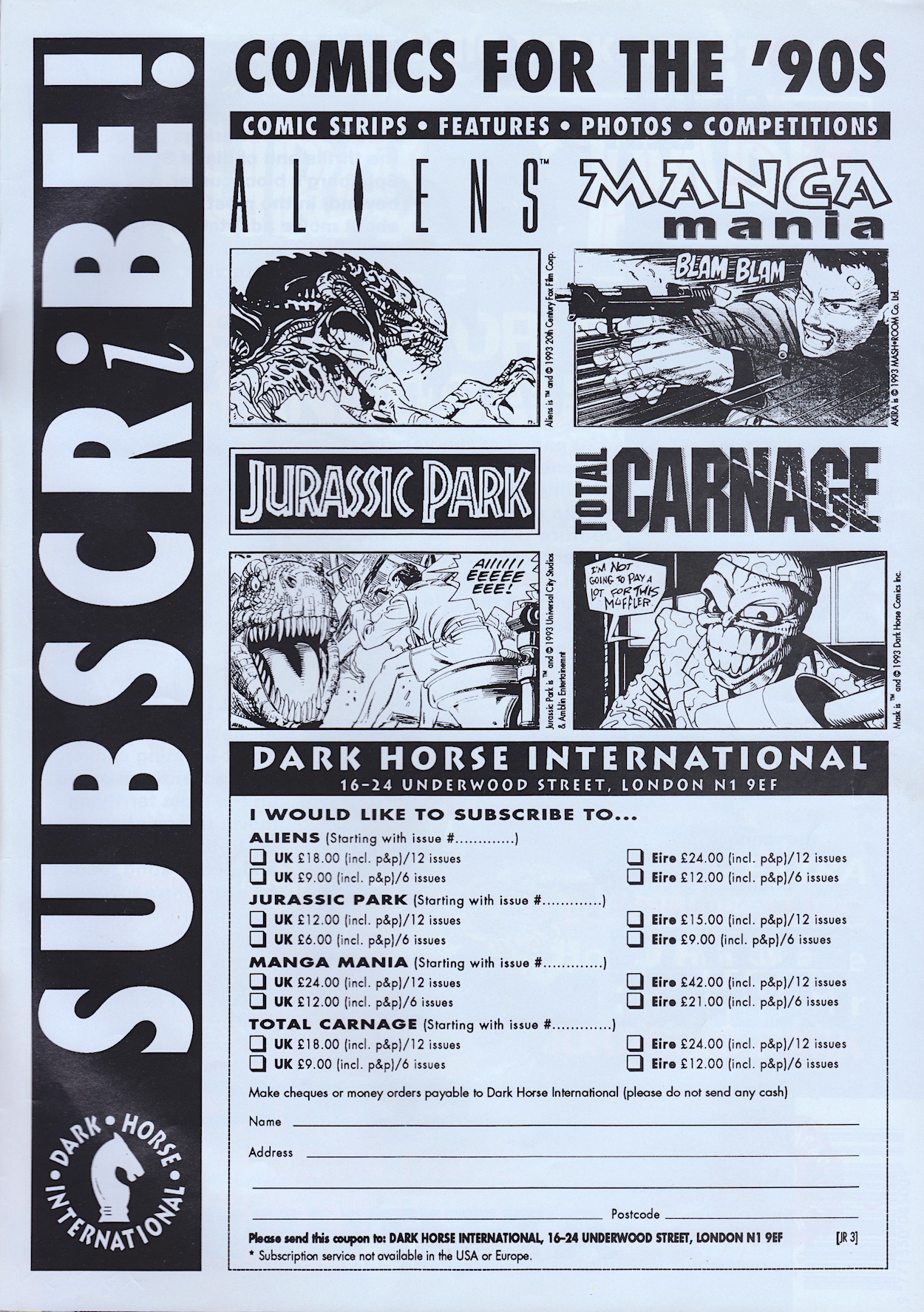
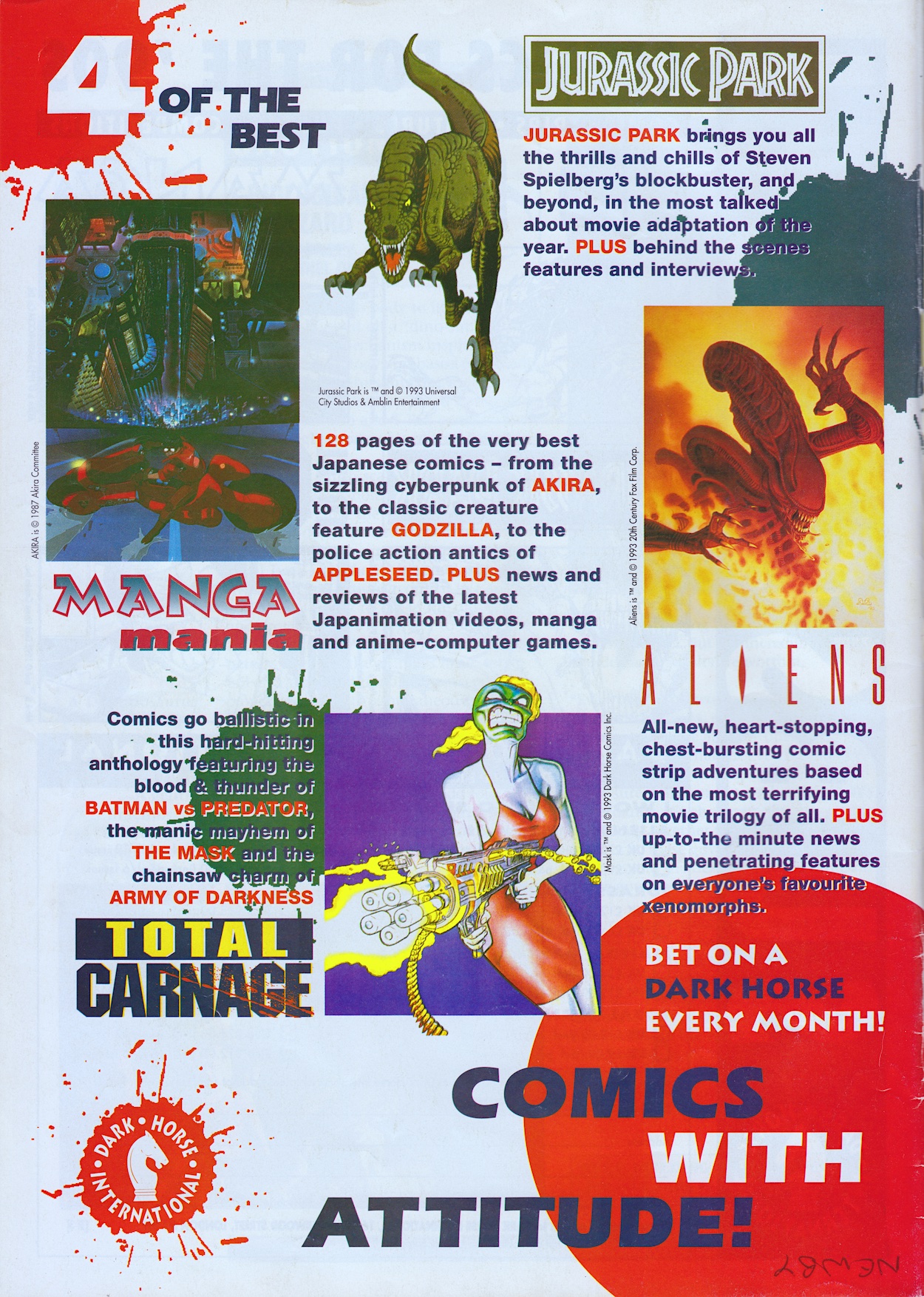
The back cover is a double whammy of information on Dark Horse’s range, beginning with a subscriptions page and then a colour advertisement on the back. The company was making real inroads into the UK comics market, bringing international comics to our shores on bigger, better quality paper, chock full of strips and features. It’s unfortunate that the whole market was shrinking rapidly and ultimately there wasn’t much time left for the imprint and its titles. But we’ve got plenty of issues of this comic to go so we’ll not get bogged down with endings just yet.
For now, we’ve got a bit of a wait until the next issue because the comic’s schedule was changing. With Topps Comics in the US now committed to further mini-series and the UK comic selling well enough it was decided it would continue past what was originally going to be a four-issue adaptation. Jurassic Park was now going to be a monthly ongoing comic, the date of the next issue unknown at the time of going to press. (Something similar happened with Bram Stoker’s Dracula.) The strip in the next issue was split in two so as to give the American comic enough time to get ahead before the new, original strips could be printed here.
Rejigging it into an ongoing comic would take a little planning and working out what to fill the pages with. So in the end Alan and Lex would have to stay completely still all the way until 28th September 2021 for Jurassic Park #4! So will you. Will it be worth the wait?
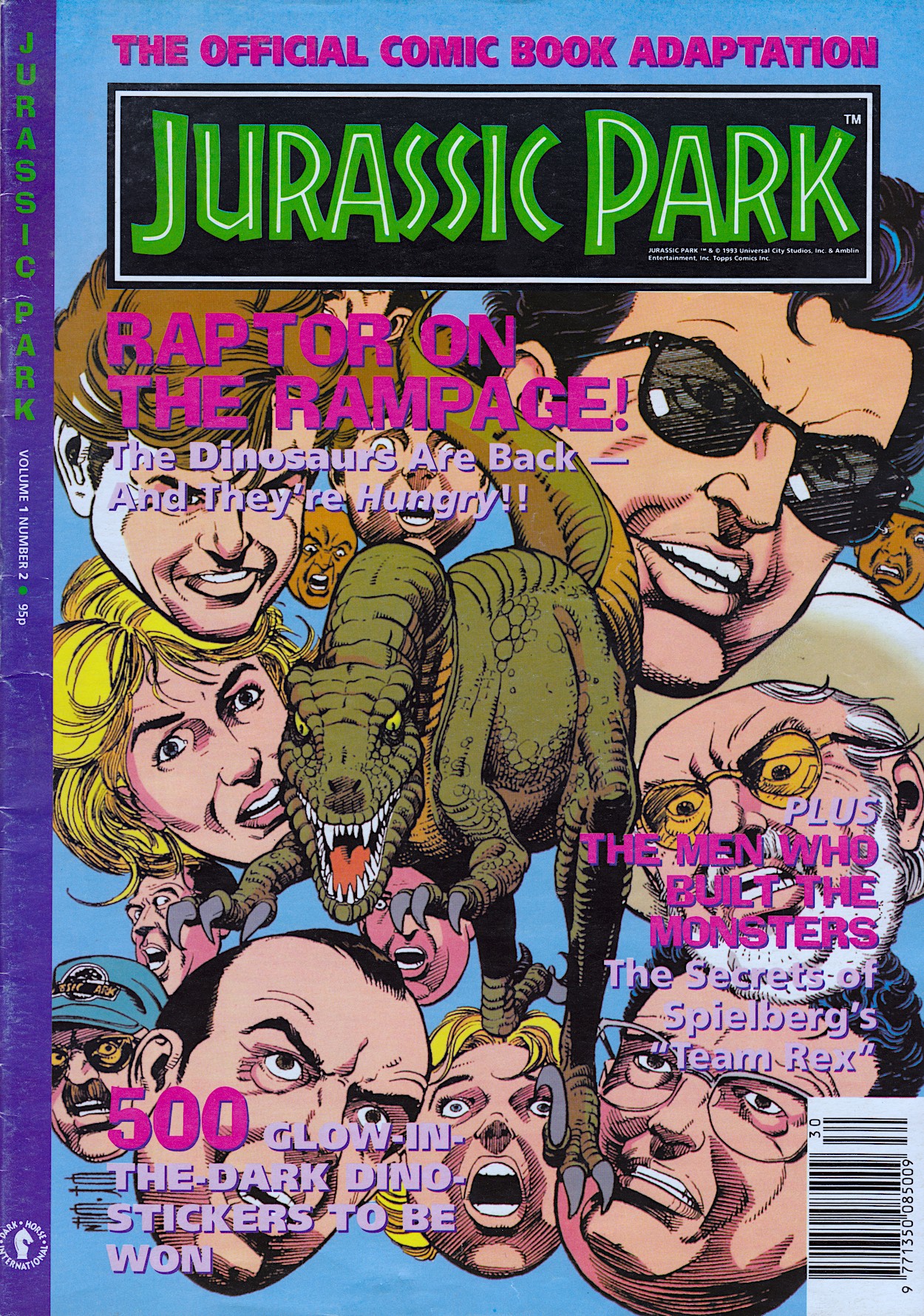
Welcome back to “Isla Nubar” (misspelled like this on the contents page) and Dark Horse International‘s UK version of Jurassic Park from 1993, edited by Dick Hansom. A rather strange cover by Gil Kane and George Perez, given how no dinosaurs have escaped yet. It’s a mishmash of named characters and extras, including a rather red-faced man in the middle. Maybe the raptor is holding his nose.
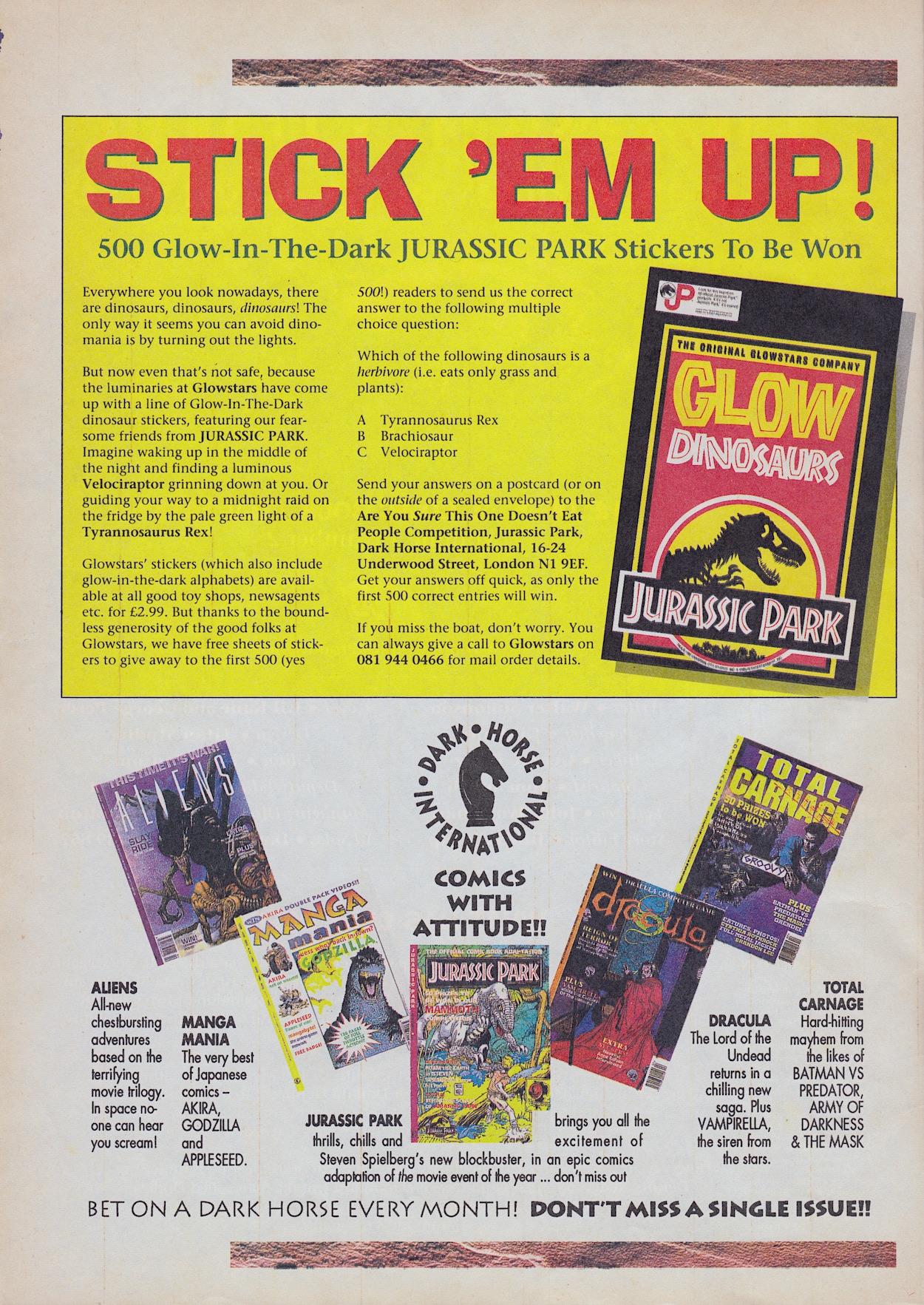
Inside is the second 28-page chapter of Topps Comics‘ adaptation and a few extras, something we were accustomed to this side of the pond. First up is an advertisement for John Williams‘ soundtrack album. I owned the CD at the time and have been listening to it on Apple Music while reading these. There’s a competition for glow-in-the-dark stickers, a somewhat unimpressive prize compared to later ones I remember. No comics checklist this issue, instead a glance at the other titles currently in publication.
The strip continues adding to existing scenes while moving others about in order to adapt the film to the medium, something I discussed in more depth last time. This chapter begins where we left off in the midst of that iconic brachiosaur scene and there’s quite a lot of additional dialogue from Michael Crichton’s novel, such as Dr Alan Grant‘s and Dr Ellie Satler‘s further observations.
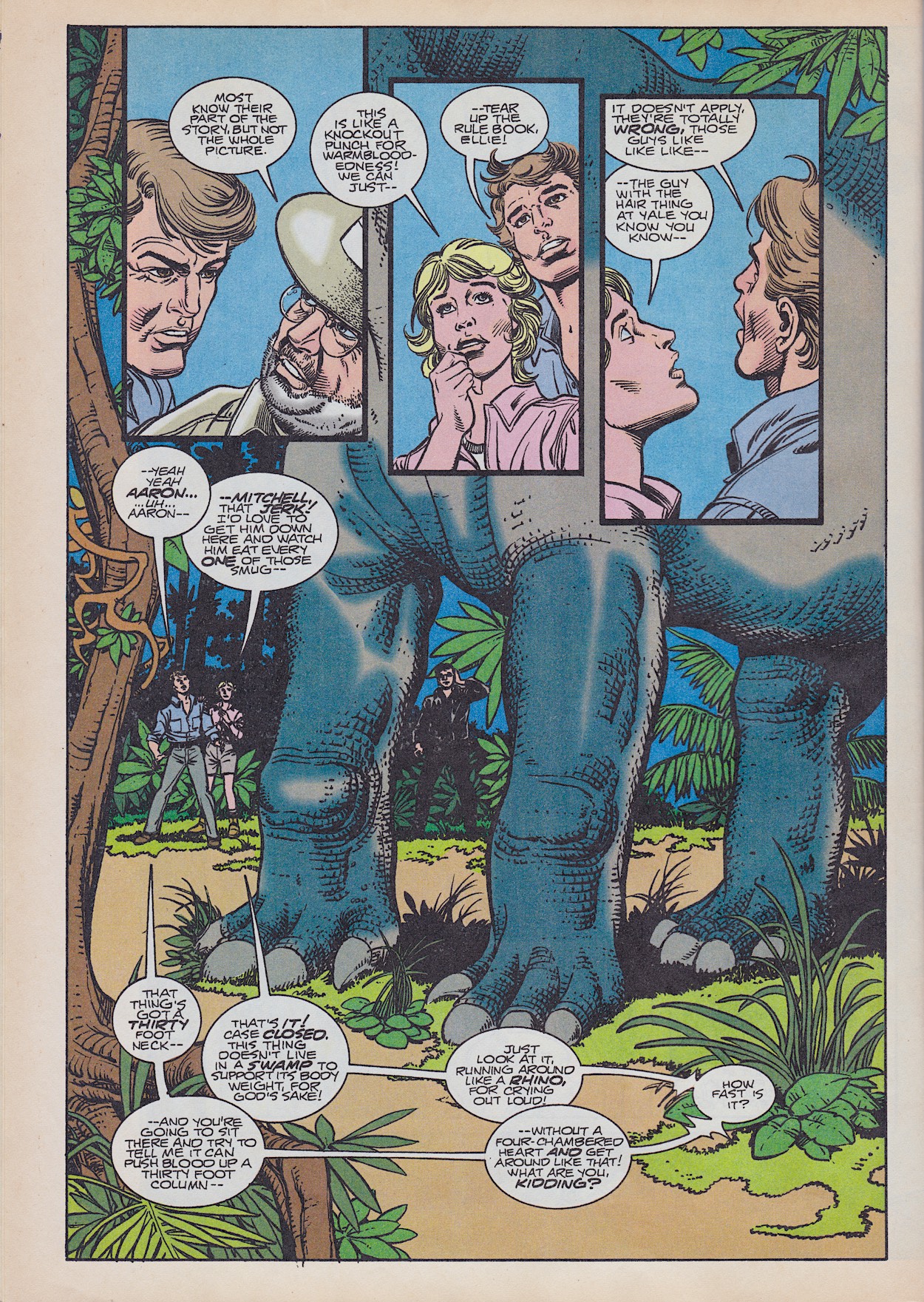
One part lifted directly from the book involves a little bit of background on the park itself. To achieve something of this magnitude would require more people than just those on the island, so John Hammond explains others were involved across the globe, knowing only their specific part of the puzzle. To maintain secrecy they were never let in on the bigger picture. The novel goes into things like this in a lot more detail to ground the fantastical story in the real world and if you haven’t already you really should read it yourself (or get the audiobook which is expertly brought to life by Scott Brick).
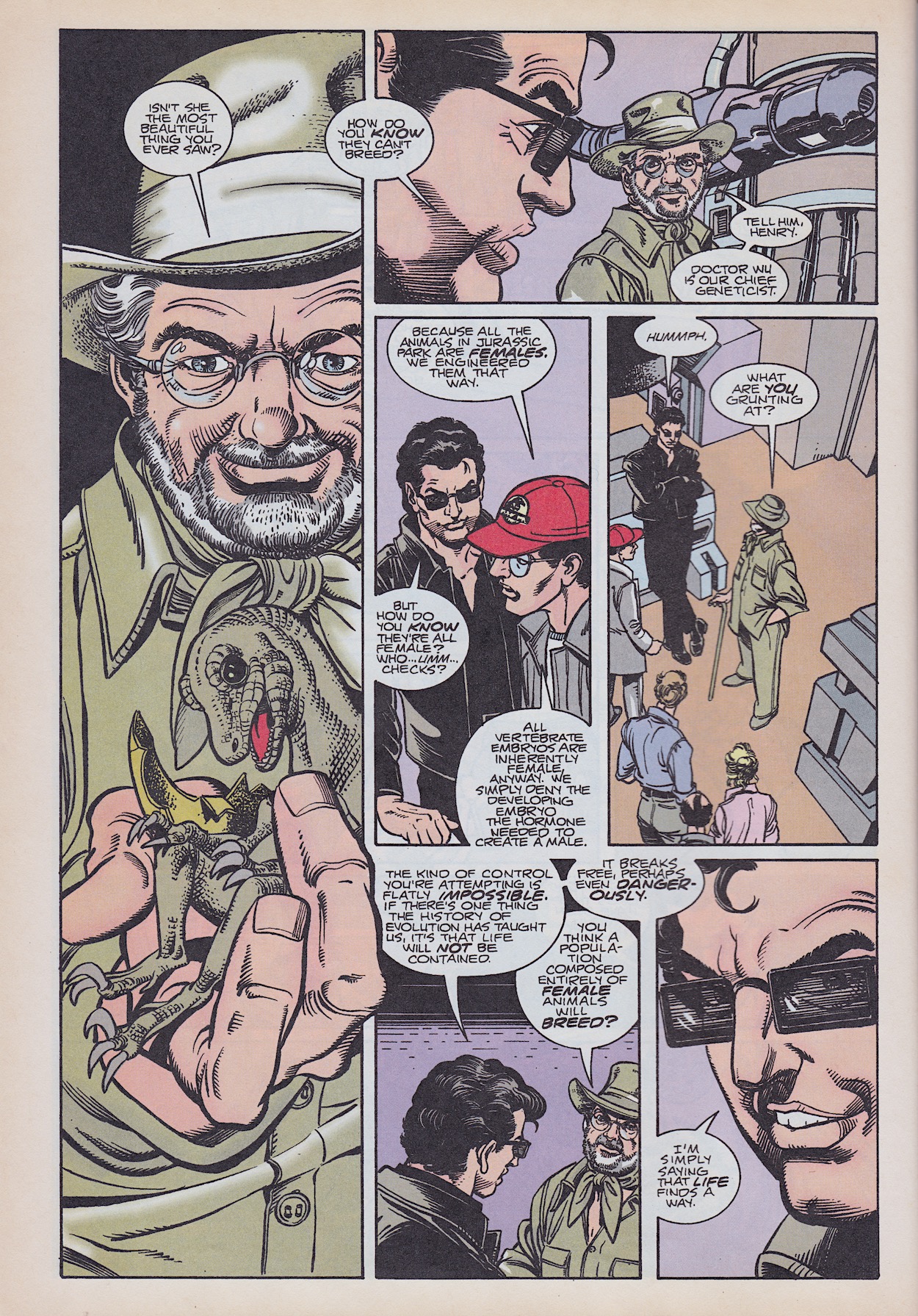
From here we make our way to the Visitor’s Centre, our characters excitedly discussing what they’ve seen, trying to take it all in. After the Mr. DNA sequence we find ourselves in the lab where we meet Dr. Henry Wu, who was played by BD Wong. In the novel Wu was a central character and certainly not the affable person we saw in the movie.
Crichton’s Wu was ruthlessly ambitious, believed the success of Jurassic Park was solely down to him and never saw the dinosaurs as real; they were engineered adaptations of the originals. He argued with Hammond about the ability to create any dinosaur they wanted, even new breeds, tailoring them to exact requirements to bring in the most money from paying tourists. All of this would of course form the main plot of the fourth movie, Jurassic World. However, in the comic his role is reduced even further than in the first film, appearing in only three panels with most of his dialogue given to Hammond.
“I’m simply saying that life finds a way.”
Dr. Ian Malcolm
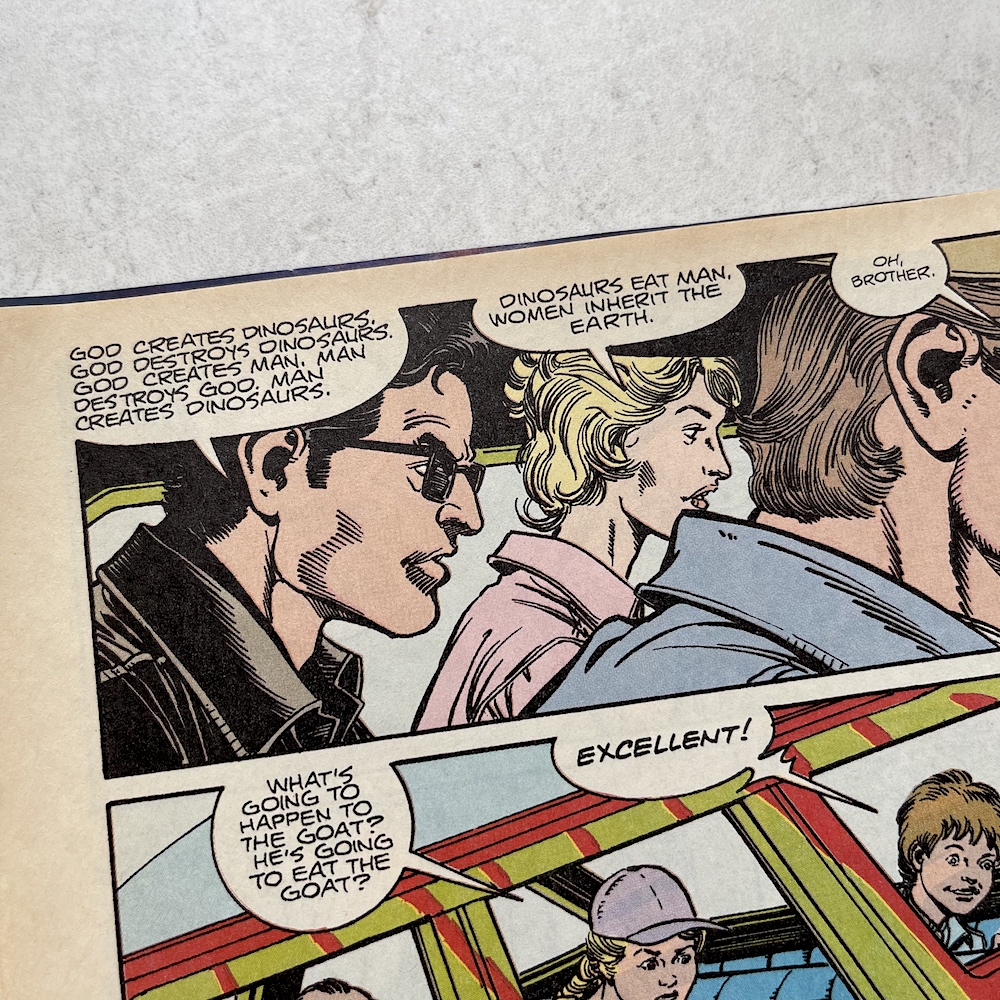
One character who definitely doesn’t suffer this indignity is Dr. Ian Malcolm, so memorably encapsulated by Jeff Goldblum that you can’t help but hear his voice when reading one of his many quotable lines. In the novel Malcom’s fascinating monologues ran to several pages and for the film their essence was broken down and brought to life by Goldblum’s very natural delivery, becoming the backbone of the story.
This continues in the comic although his characterisation is a little different thanks to Gil and George. Overall he’s still the cool mathematician but his facial expressions make the character a little darker in tone, lending his predictions a more sinister feel. This actually suits the comic. Scenes here don’t have the luxury of playing out over several pages to build tension, so this little tweak in tone works a treat instead. Below is one example as he delivers his most famous line, used as marketing for later movies in the series.
While the Tyrannosaurus rex was the biggest dinosaur and the most publicised, the stars were the Velociraptors. Apart from a baby their existence is merely hinted at and talked about for much of the film in an expertly crafted script that built tension for their final reveal and dominance in the latter acts. But young comic readers wouldn’t want to wait three issues to see them on the page.
Jurassic Park is a very quotable movie, with a surprising amount of dialogue taken directly from the novel
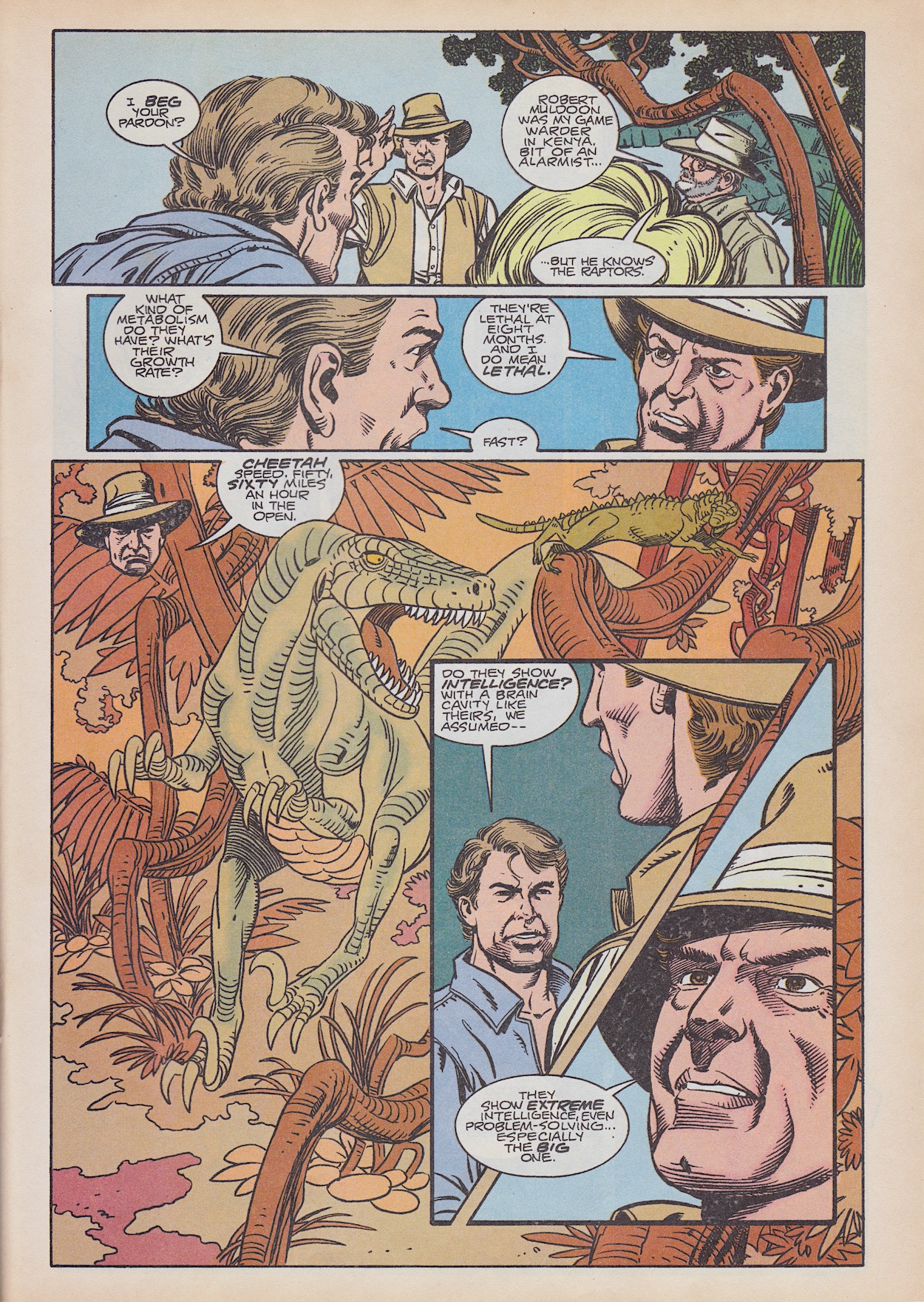
So, once again we’re treated to prehistoric flashbacks of these great hunters in their natural environment (highlighted by Tom Smith‘s change in colours) when game warden Robert Muldoon (Bob Peck) introduces them during that memorable dinnertime cow scene. With a graphic novel it’d be easier to follow the movie more closely, but writer Walter Simonson and story editor Jim Salicrup had to give readers a monthly dose (monthly in the States) of the ‘raptors and I think these scenes are a great solution and a natural fit.
Ian Malcolm‘s quotes aren’t the only ones to survive the transition to comic form. Jurassic Park is a very quotable movie, with a surprising amount of dialogue taken directly from the novel. Some would have to be excised for this shorter form of storytelling but here are a small selection of those to be found in this second issue.
For some reason the comic changes the recorded in-car voice to James Earl-Jones from the film’s Richard Kiley. Maybe Earl-Jones was better known to the comic audience? On a side note, Crichton chose Kiley’s voice in the book so I thought it was brilliant how Spielberg actually got Kiley to play the part!
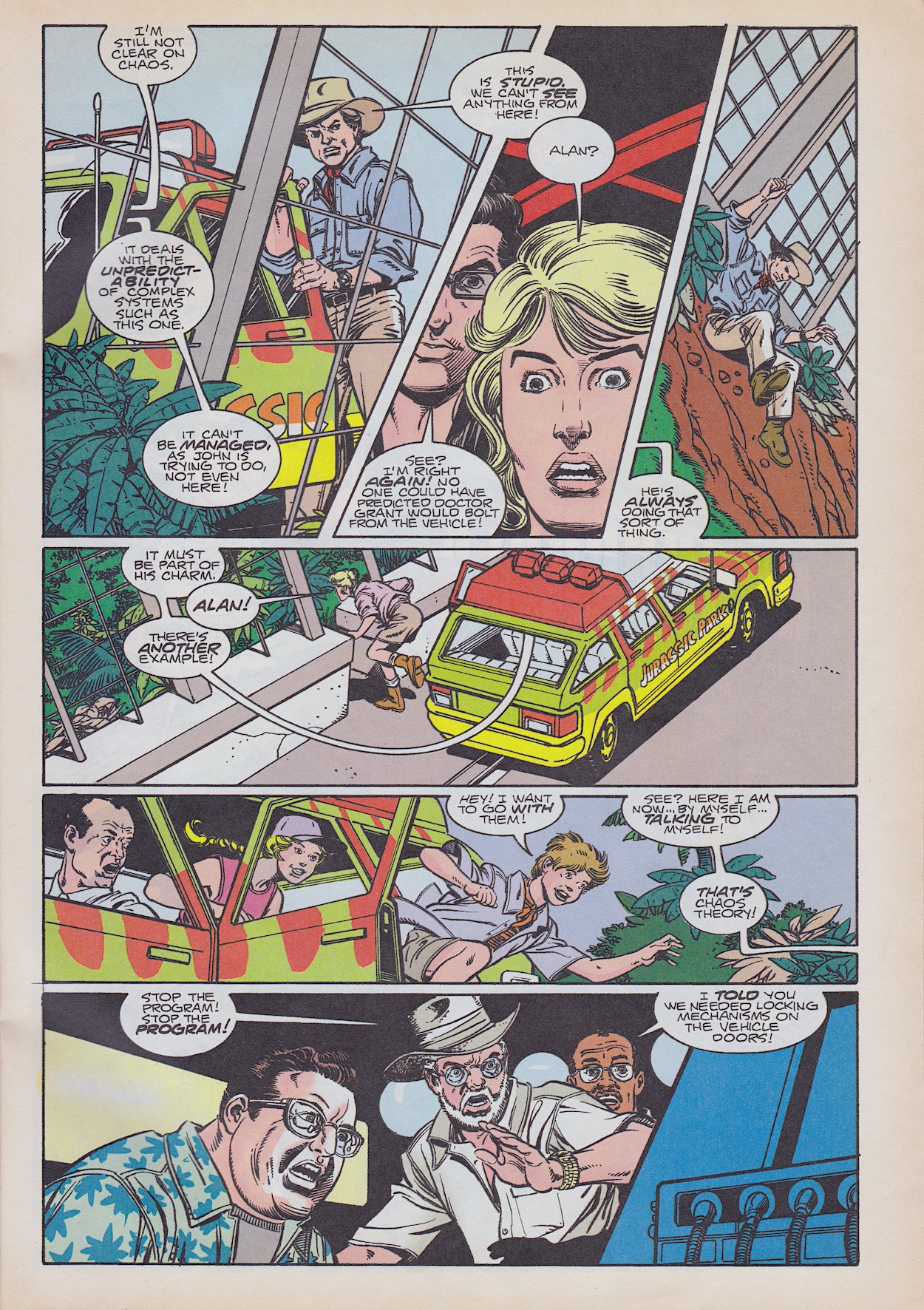
The story rolls along until we find ourselves at the T. rex paddock complete with a very worried goat and an almost gloating Malcolm. He knows the park can’t work, knows the natural systems in play are too complex to control and as far as he’s concerned chaos theory proves it. Unfortunately we lose the lovely butterfly effect scene between him and Ellie, but then again without Jeff’s delivery it would probably fall flat.
Maybe this is just a way of speeding the story along, because we’d never have bought Alan [Grant] doing this in the movie
However, after the others jump out of the vehicle we still get to laugh at him talking to himself about talking to himself, John Workman‘s speech bubbles pointing away from the action, highlighting the fact he’s chittering away on his own. It’s a very funny way to present this moment, I actually laughed when I read it despite seeing the film countless times already.
At this point we see more evidence of changes to the comic’s pacing in order to fit it all in. In the film Alan jumps out of the moving car when he sees and hears something in a field beside them. Here, he’s out of the car before it’s even started moving away from the T. rex paddock, climbing through a gap in the fence simply because he’s fed up of not seeing any dinosaurs.
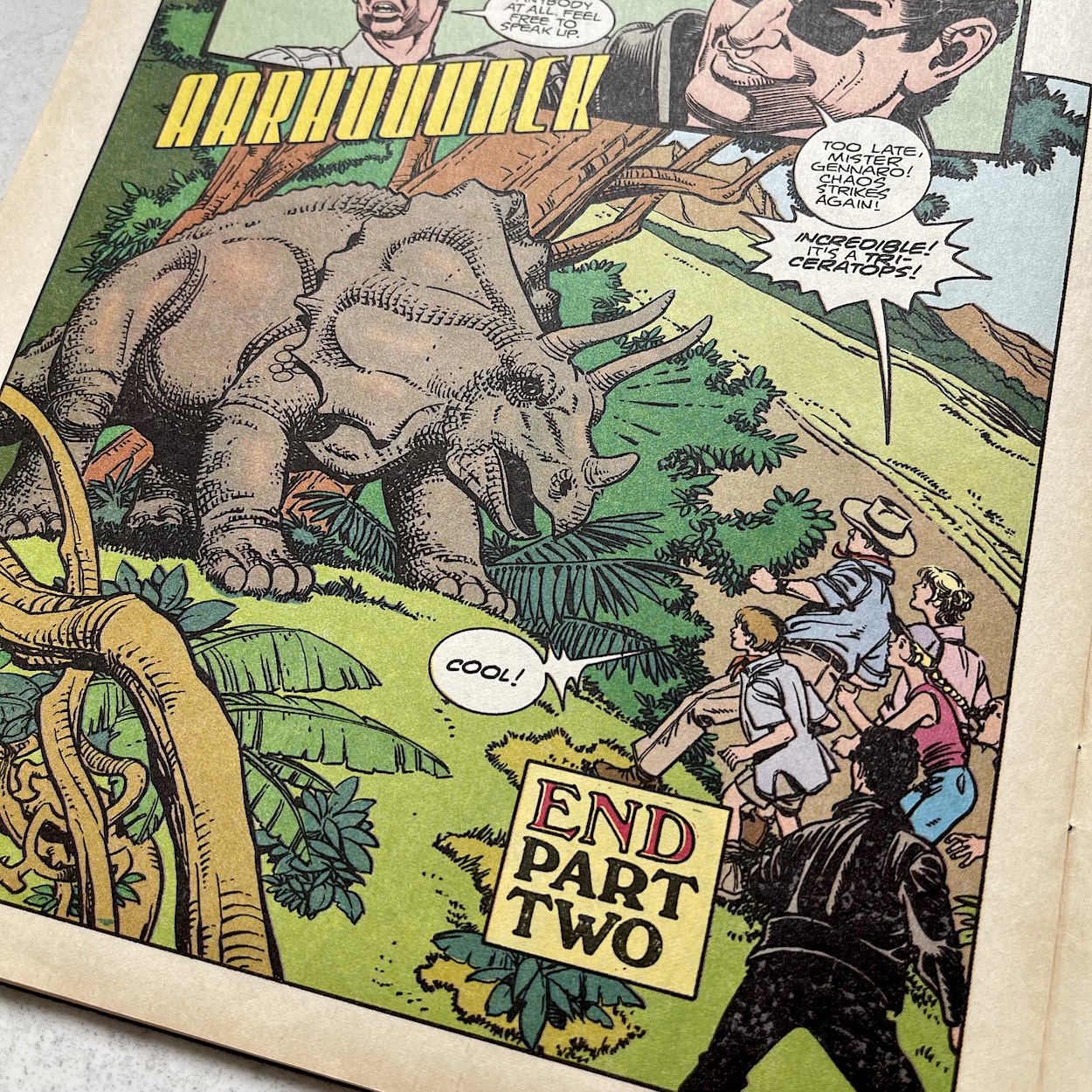
It’s not exactly the safest of places to go for a dander! So maybe this is just a way of speeding the story along because we’d never have bought Alan doing this in the movie. It’s the first time I’ve questioned a change made by the comic’s team. Yes, the very next page is the last but come on, they could’ve simply added a caption to indicate they’d moved away from the T. rex first!
This isn’t a case of going back to the book either because in that they see a vet with a sick Stegosaurus and walk over in a safe environment, whereas here you can see they get surprised by an apparently healthy Triceratops. Same species as the film but this isn’t how the encounter played out. Could there be a major change of plot here? Or just a quick cheat for a cliffhanger? We’ll find out next time.
If chapter one was the introduction to the story, the setting and the characters, this issue’s chapter has been the build up. We all know the next instalment will include the elements all coming together to create the disaster that befalls the park so I’m interested to see how that will be adapted for the comic and how successful it will be.
Straight after the strip is the second of the behind-the-scenes features, explaining the differences between the four special effects teams and what each of their roles were. Miniature photography for animatics and choreography, the full-motion live-action creations, the mechanics for those beasts and of course the CGI. It’s easy to forget these days just how far ahead of anything else Jurassic Park was in 1993. The fact it looks just as spectacular 28 years later is testament to the hugely talented individuals who worked so hard to create Spielberg’s vision.
I saw the film in a Glasgow cinema with my dad and then devoured the novel that summer, after which I bought a fantastic book called The Making of Jurassic Park by Don Shay and Jody Duncan. There had been such books for movies before but the level of detail in this one was second-to-none. Fascinating stuff but lost when I moved out of home years later. These features have me eager to read it again.
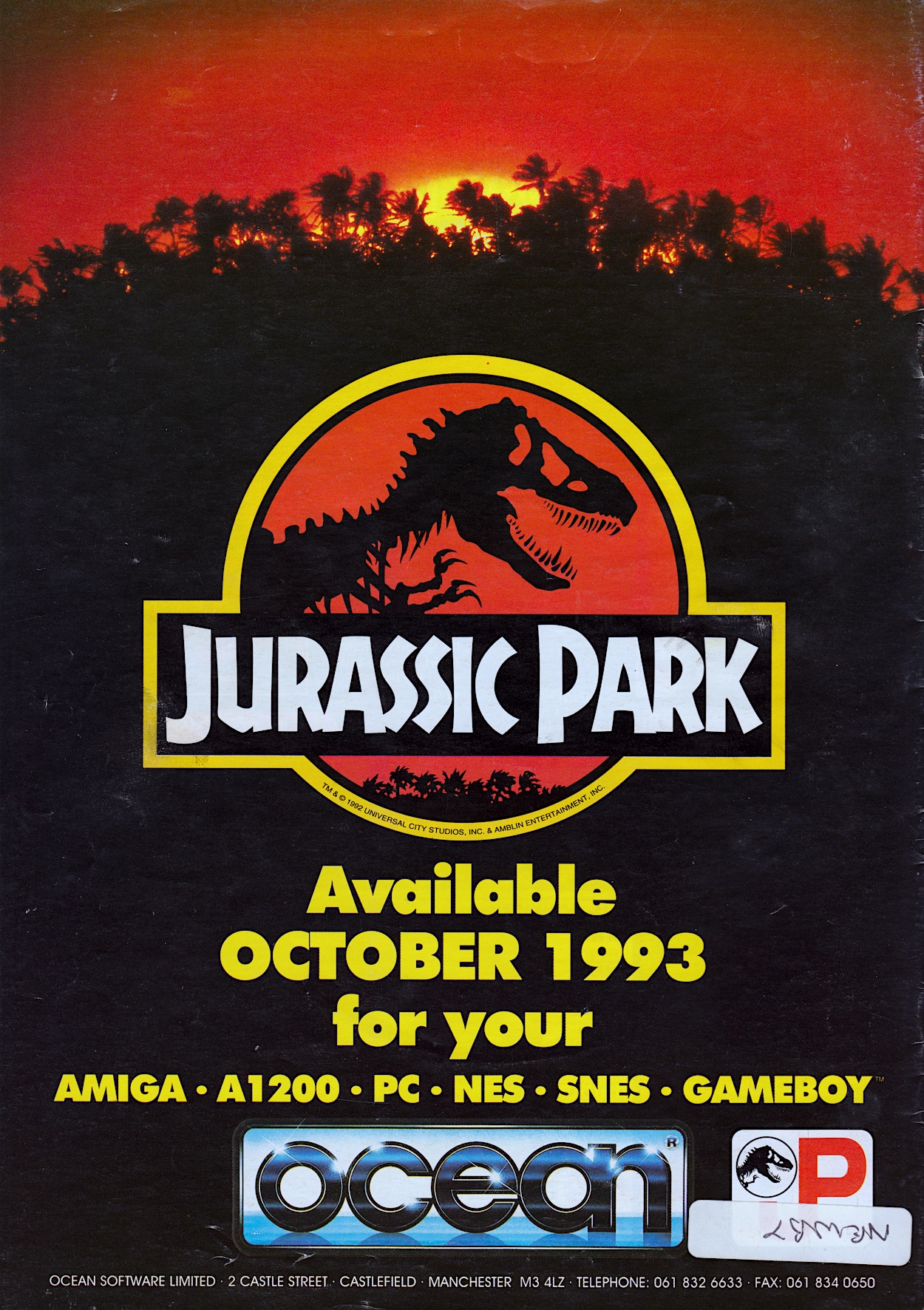
On the back cover was another advert with that timeless logo and the island sunset. More a tease, it announced the inevitable videogame coming to multiple formats in three months’ time. More memories are flooding back because I owned the Nintendo Game Boy game and spent many a late night in bed before school playing it under the covers with that massive, heavy light attachment on top of the little monochrome screen. Happy memories indeed.
These first few issues of Jurassic Park were released every three weeks, a schedule I never saw in any of my comics as a kid. Many years later I do remember taking out a gift subscription to Titan Magazine‘s Spongebob Squarepants comic for a girlfriend who loved everything to do with Bikini Bottom, and that felt strange coming as it did every three weeks too, so used was I to weekly, fortnightly and monthly comics.
But the main thing is that #3 is here in another 21 days’ time on Thursday 19th August2021. Until then, don’t move. It can’t see you if you don’t move.
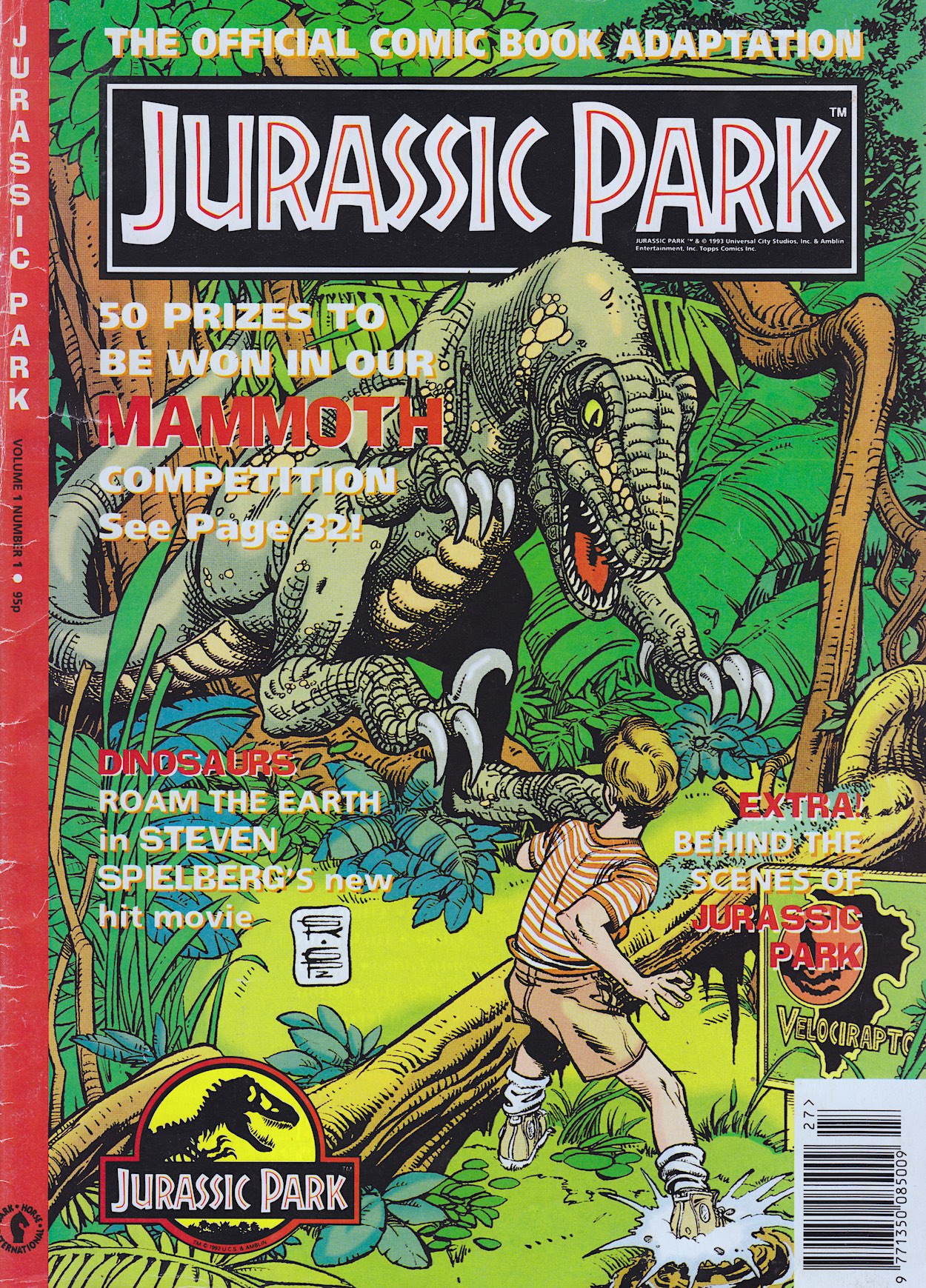
We’re jumping back 28 years now to the first issue of Dark Horse International‘s UK version ofthe Jurassic Park comic. How can that film be 28 years old? Anyway, published by Topps Comics in the States, over here it was repackaged on larger A4 paper of a higher quality, with that distinct Dark Horse banner and over the course of its run included extra features, competitions and back up strips like most UK comics.
By a happy coincidence 8th July was a Thursday in 1993 so it looks like each issue will be up on the blog on the same day of the week as the original run. Surprisingly this first issue went on sale before the movie was released over here, which didn’t stomp its way into cinemas until 16th July.
As I noted in the introductory post I’d originally spotted an issue of the adaptation in a shop but never bothered to buy it. I hadn’t enjoyed comics adaptations of movies previously and also felt I’d moved on from the medium. (We all make mistakes.) My first issue ended up being #6 and by then it contained three strips per issue, but it hadn’t started out that way. This first issue is cover-to-cover Isla Nublar, containing the first full chapter of the adaptation, a whopping 29 pages in length with the rest of the 36-page comic containing features that I’ll get to below.
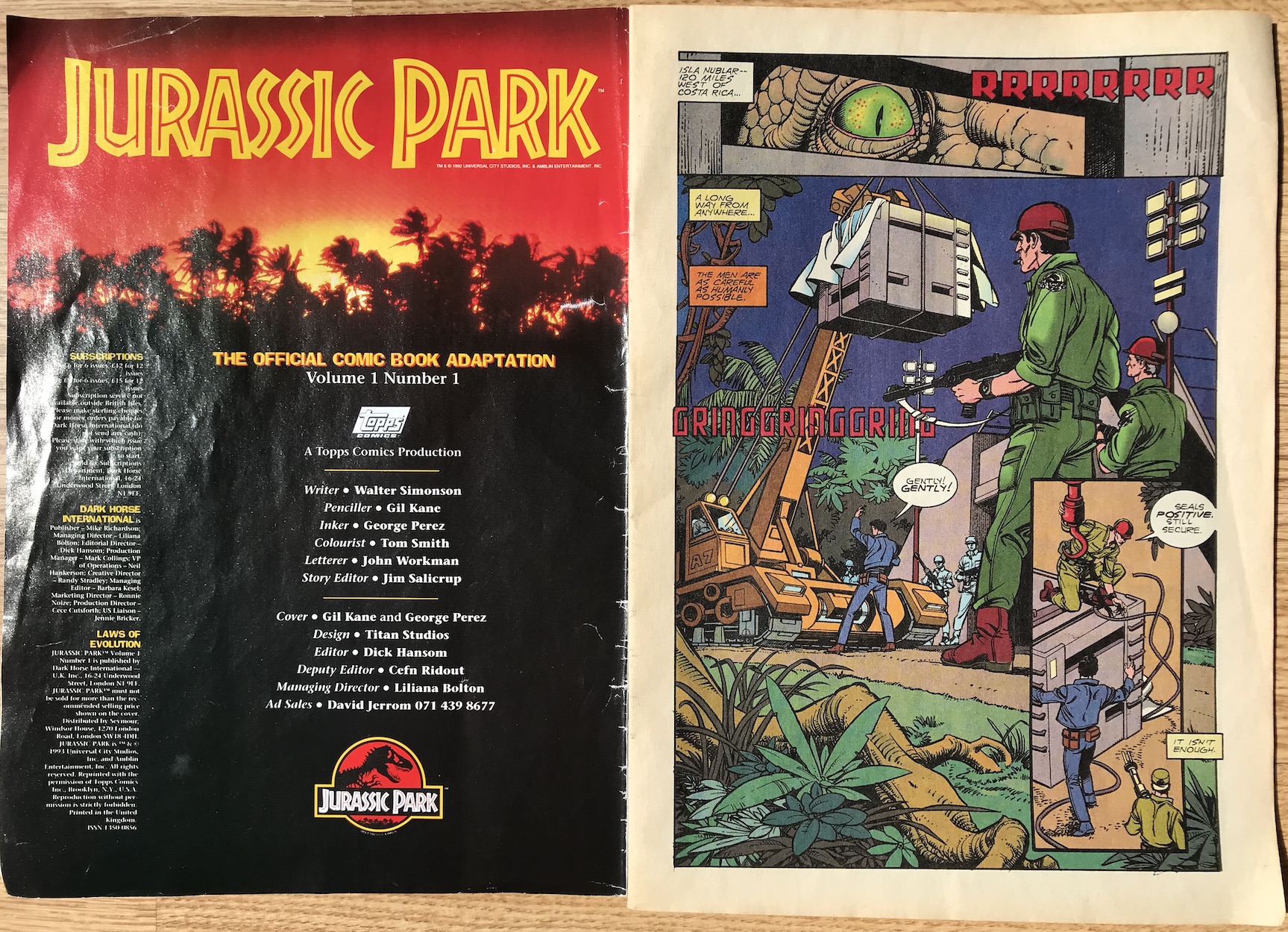
Edited by Dick Hansom (Aliens, Total Carnage, Speakeasy) there was never an editorial and instead a simple credits page for the strips, but the background of the island sets the scene. Let’s talk about that team Topps Comics assembled to adapt the film to comic form! As a fan of the franchise I’m pleasantly surprised by the names here. I may not have been aware of who all but one were at the time but I certainly am now.
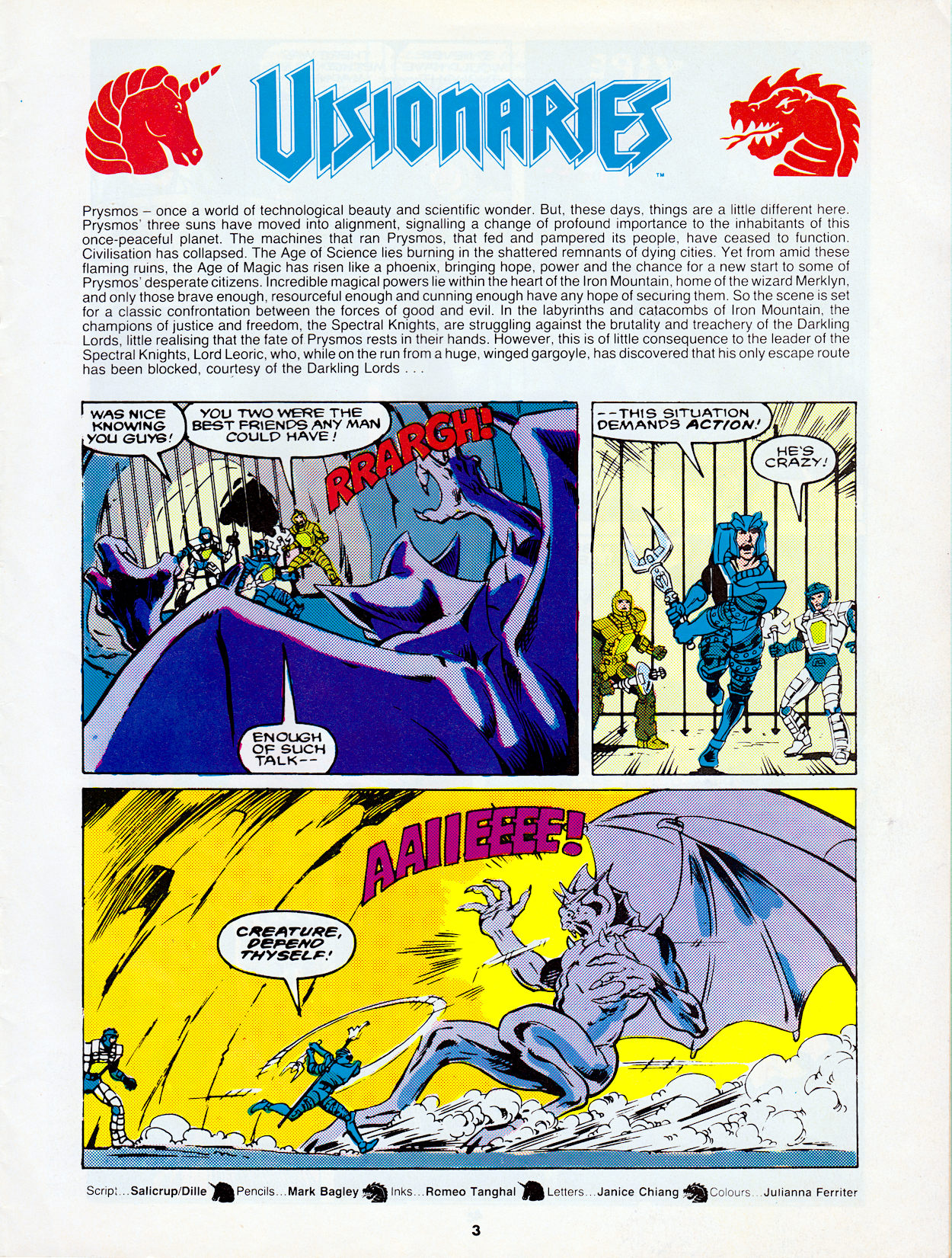
The one name I did recognise originally was Jim Salicrup thanks to Transformers and whose adaptation of the Visionaries origin story has also been reviewed here on the blog. He also edited multiple superhero comics for the company before moving to Topps and eventually to Papercutz where he now resides as Editor-in-Chief, alongside being a trustee of the Museum of Comic and Cartoon Art. Writer Walter Simonson was tasked with adapting the screenplay and is probably best known for creating Star Slammers (featured in Havoc comic here in the UK), writing/drawing Thor for nearly five years in the 80s, drawing Robocop vs Terminator and writing Iron Man 2020 who popped up in the UK version of Transformers.
“You’ll decide you’ll control nature, and from that moment on you’re in deep trouble, because you can’t do it.”
Michael Crichton
Penciller Gil Kane sadly passed in 2000 but leaves behind a wealth of comics work on everything from Action Comics to Teen Titans and co-creating Iron Fist for Marvel. He was the artist on landmark stories in The Amazing Spider-Man, tales which led the Comics Code Authority to rewrite their rules about the depiction of drug abuse. Inker George Perez has won several awards for his comics artwork throughout his career, co-creating the characters White Tiger and Taskmaster for Marvel and he was artist on Crisis of Infinite Earths, The Avengers and Teen Titans amongst many others. George also wrote and drew on the highly regarded Wonder Woman of the late 80s and early 90s.
Colourist Tom Smith has worked for so many comics companies it’d be impossible to fit them all in here. Marvel, DC, IDW, Topps, Top Cow, Malibu and more. The Avengers, Hulk, X-Men and Justice League are just some examples of his artwork and he’s coloured for such legendary artists as Jack Kirby and Steve Ditko. Finally, John Workman lettered the complete run of Doom Patrol and has been a frequent partner of Walter’s. His style stands out, opening up the panel frames when his speech balloons or captions touch them, as evidenced throughout these early issues of Jurassic Park. John has also created strips for Star*Reach and lettered critically acclaimed titles such as Thor and Michael Moorcock’s Multiverse. What a team!
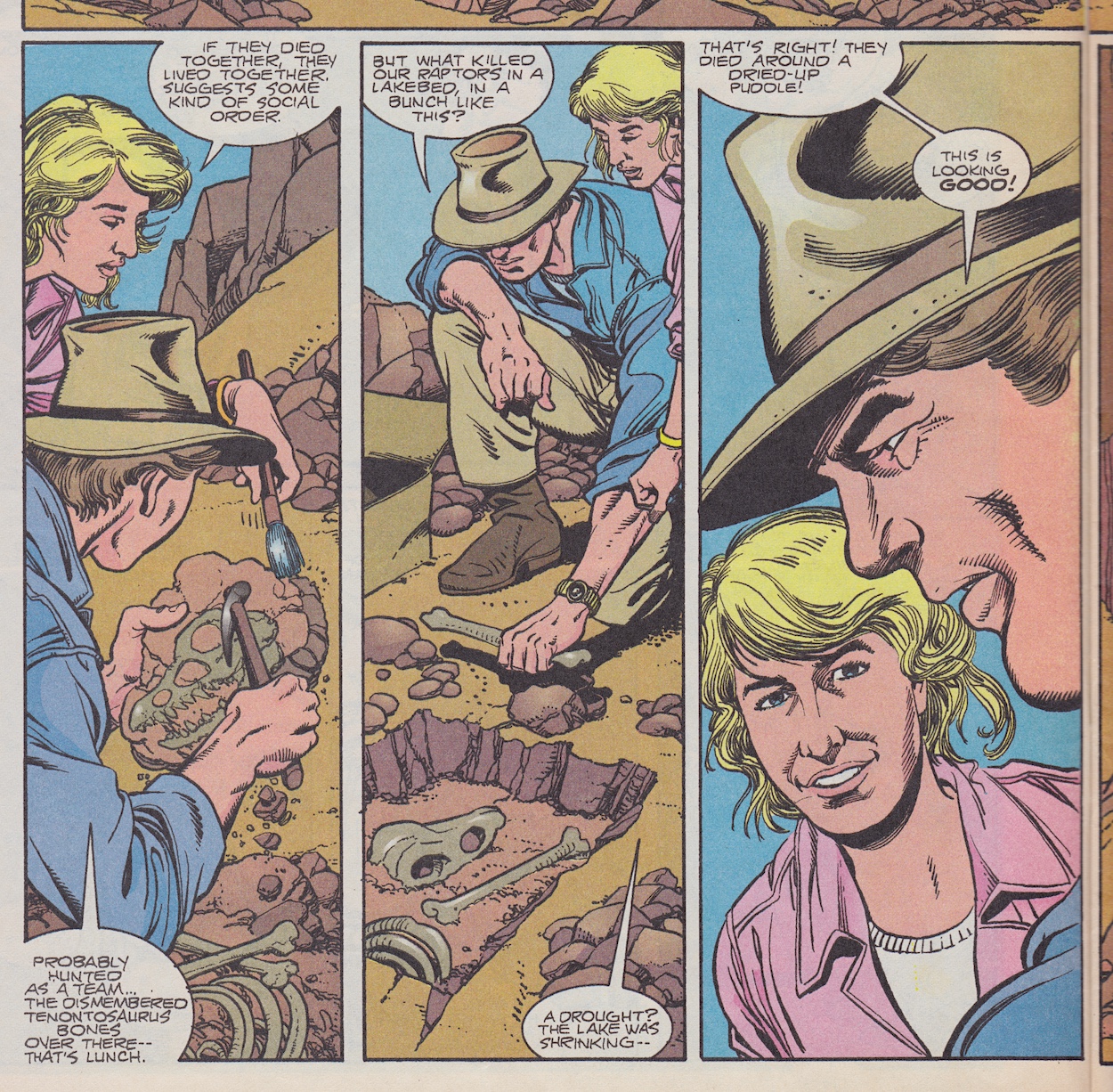
It’s important to put this story in the context of its time. Nowadays, mainly thanks to the film series we know details about dinosaurs and their social orders, hunting habits and intelligence. They’re no longer the lumbering, stupid lizards of stop-motion special effects. This all changed with the first Jurassic Park and reading this exchange between Dr. Ellie Satler (portrayed in the movie by Laura Dern) and Dr. Alan Grant, taken from the novel rather than the film, takes me right back to that time when this was all new information.
But taking me back also worries me. You see, as a kid I found comics adaptations of movies always seemed to have issues, such as excising whole scenes, leaving huge plot holes behind, or they’d copy some moments word-for-word but with artwork that failed to convey any of the drama, making exciting scenes rather dull. They felt very rushed with little thought given to what would work.
It’s brave to take up four pages with the opening of a gate!
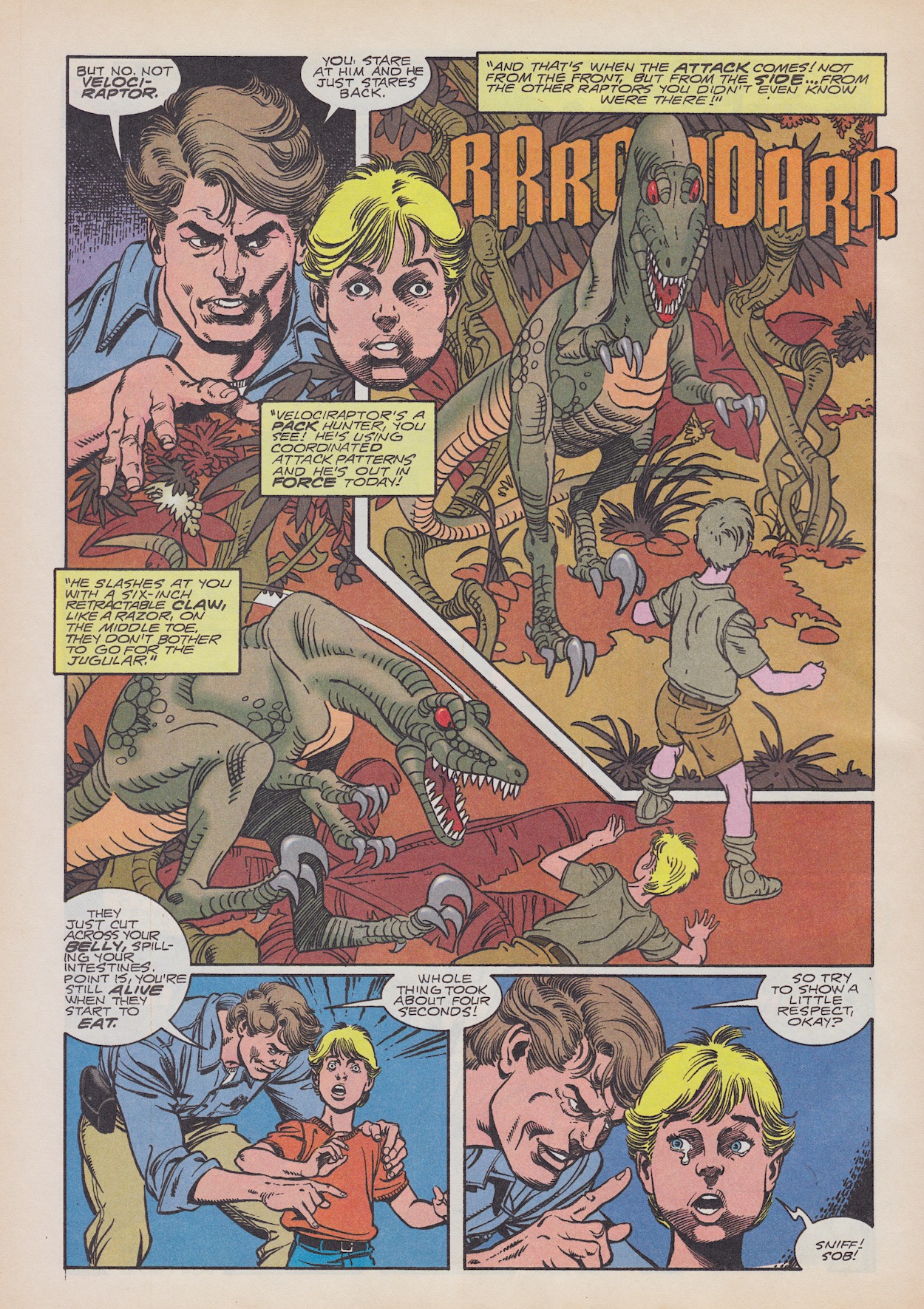
Instead of falling into the traps above for a quick cash in, Walter seems to be properly adapting the story for the comics medium. Take the scene above for example. In the movie Alan (Sam Neill) simply described the hunting techniques of a velociraptor to the child. With his raptor claw fossil in hand and using it with slow, deliberate movements, Neill’s tone and delivery made this scene foreboding and funny in equal measure. This wouldn’t work in a comic, so instead we’re shown what the kid could’ve been imagining at this moment. It’s from this we get our cover image too.
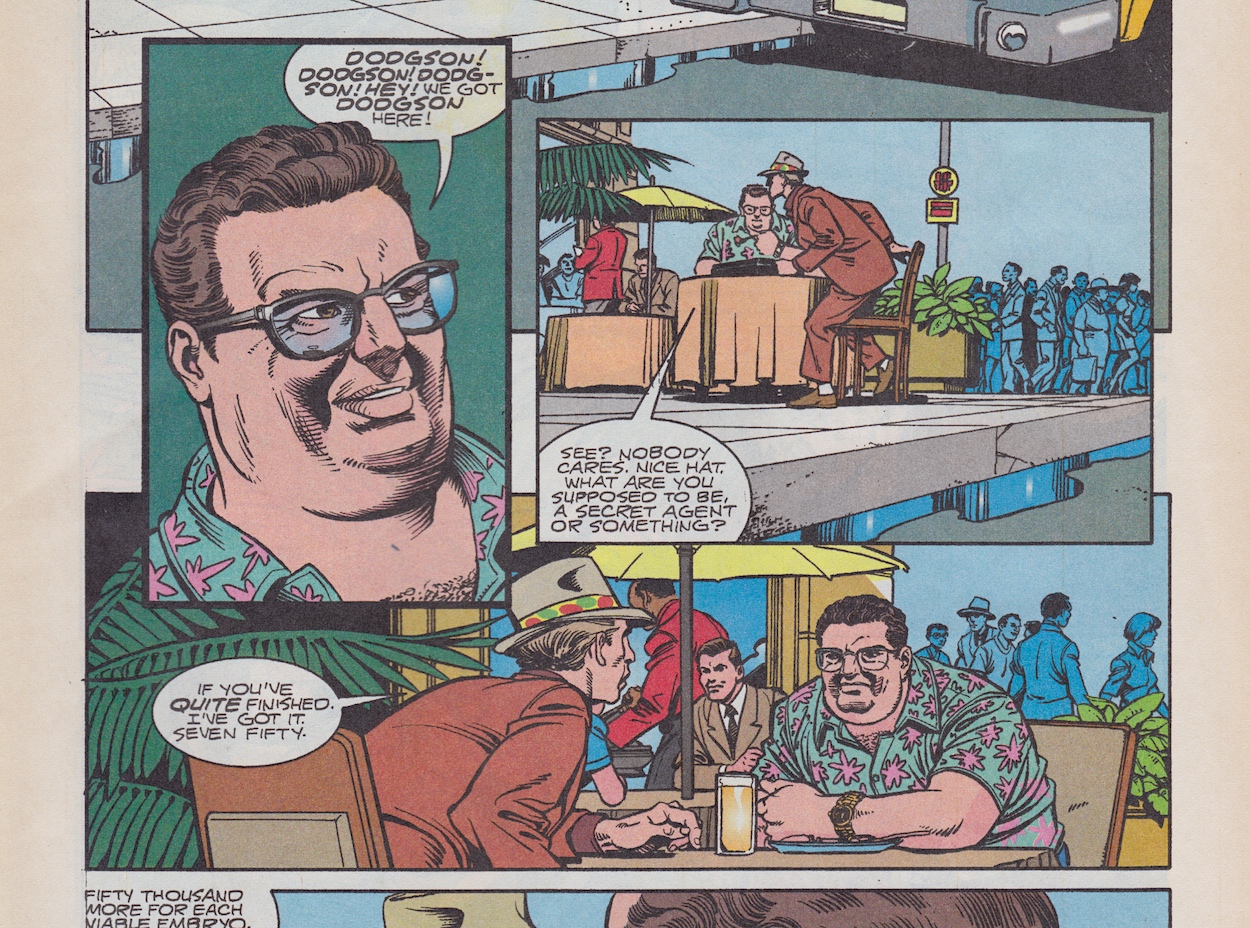
Some scenes remain unchanged, at least in their dialogue if not their setting. The classic Dodgson scene with Dennis Nedry (Wayne Knight) is played out pretty much as it is in the film, but then again what’s in the film is almost verbatim what Crichton originally wrote in his book. So when it’s already worked in written form it doesn’t require changing. Speaking of the book, on more than one occasion some of its original ideas and dialogue, changed for the film, can be found here.
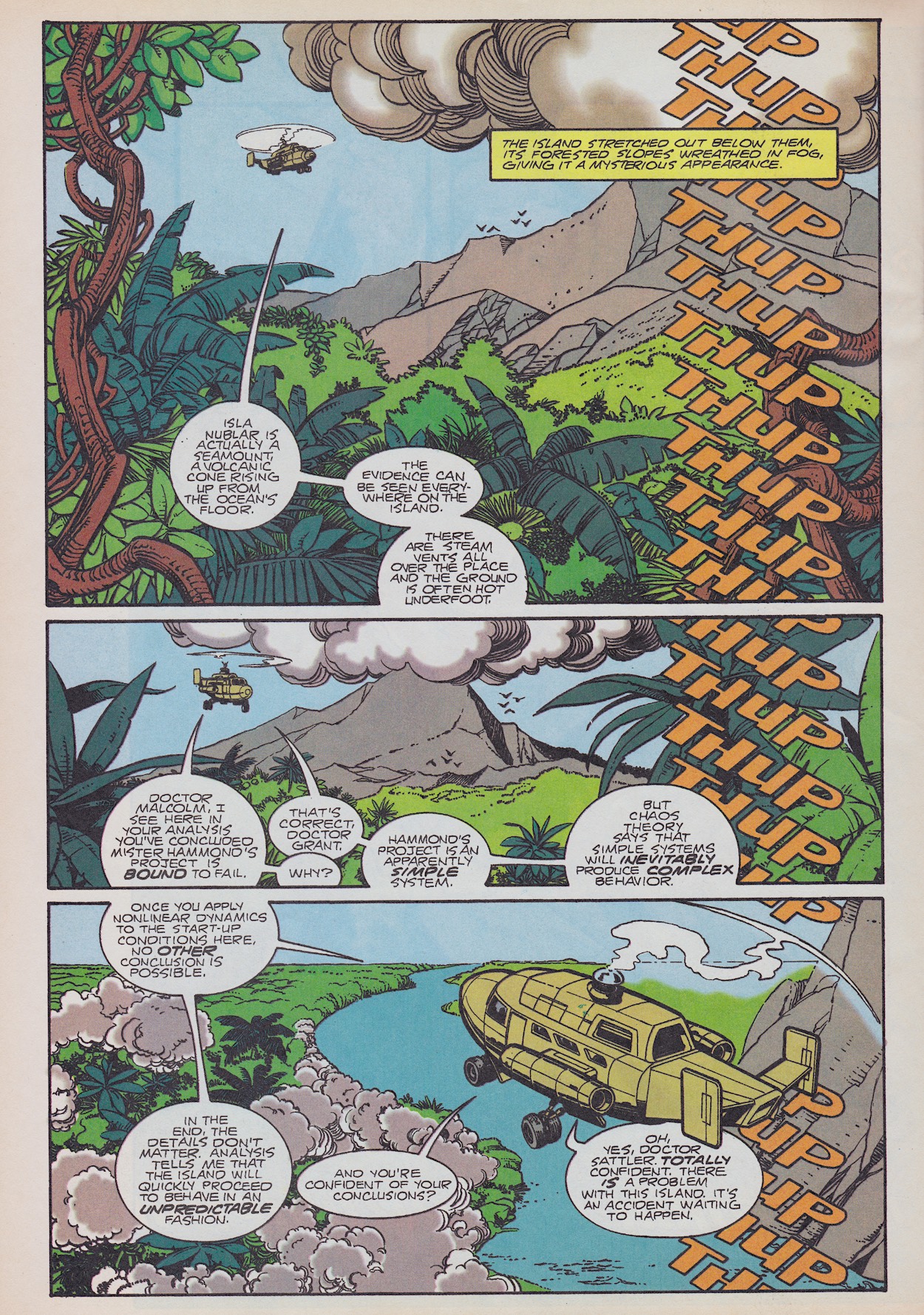
The following page is a good example, showing our main characters arriving on a helicopter at Isla Nublar, an island which covered in a thick fog in the original novel but not the film. There are also more details from Dr. Ian Malcolm (Jeff Goldblum) on how Chaos Theory predicts the experiment will fail. Crichton’s novel can often give several pages at once to Ian to describe his theories so obviously the movie had to simplify things, but they were utterly fascinating to read and in the comic just a little bit more of that original text is slipped in.
With an adaptation like this the aim is to have it on the shelves when the movie hits cinemas. This means work would commence with an earlier draft of the screenplay. As the screenplay changes from one draft to another some of those alterations come too late, meaning the comic could contain parts of the previous versions. In the case of Jurassic Park it makes for fascinating reading at times for a fan like me who knows the film so well.
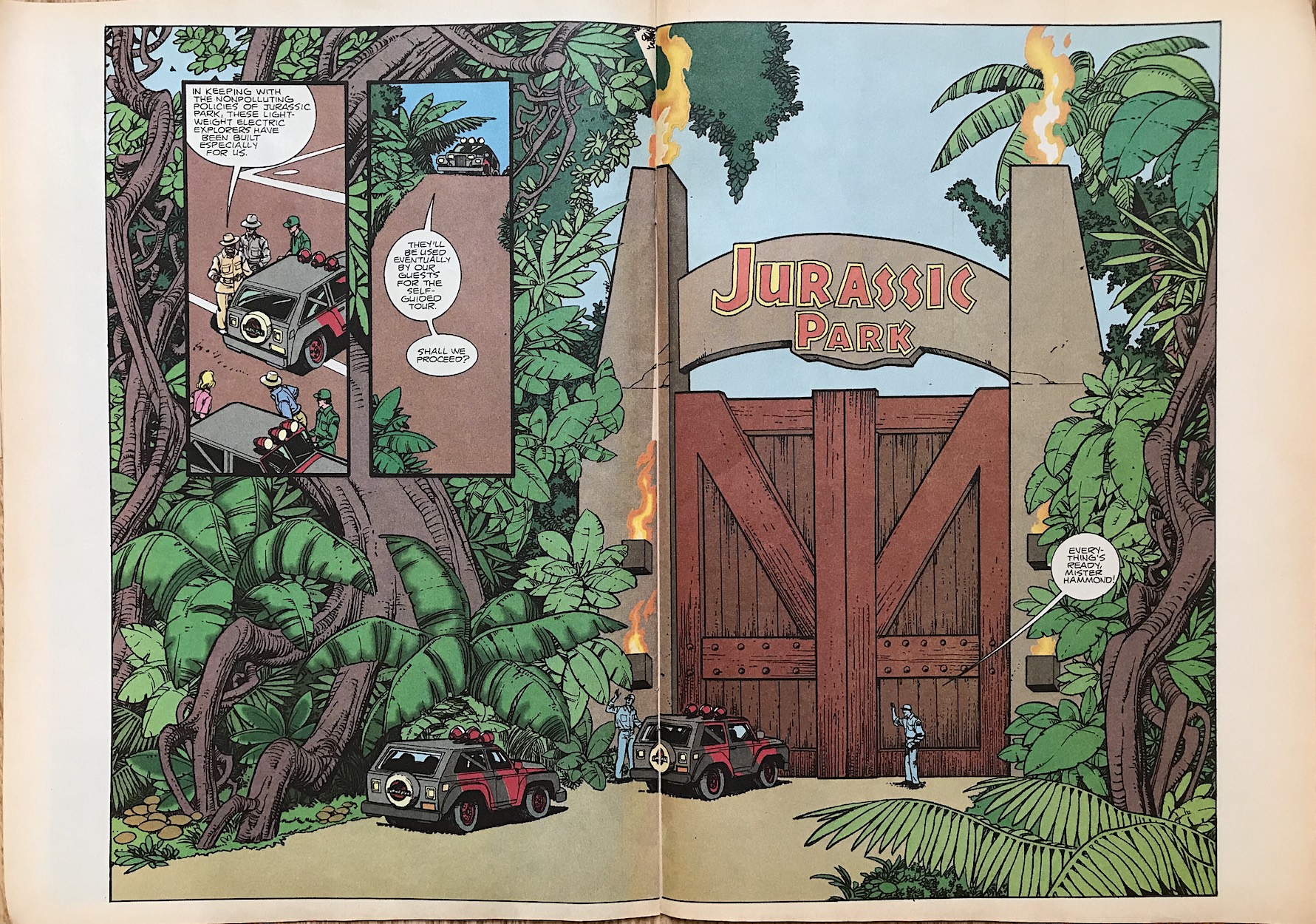
However, the biggest change in this first chapter definitely comes as a result of the medium and the requirement to split the film’s story into four chunks. If I were to tell you that the cliffhanger at the end of chapter one is the first encounter with the brachiosaur, where John Hammond (Richard Attenborough) had his “Welcome to Jurassic Park” moment in the film, fans should instantly be querying why these next four pages are in this issue. (Actually, Hammond had his moment in the comic when they landed in the helicopter.)
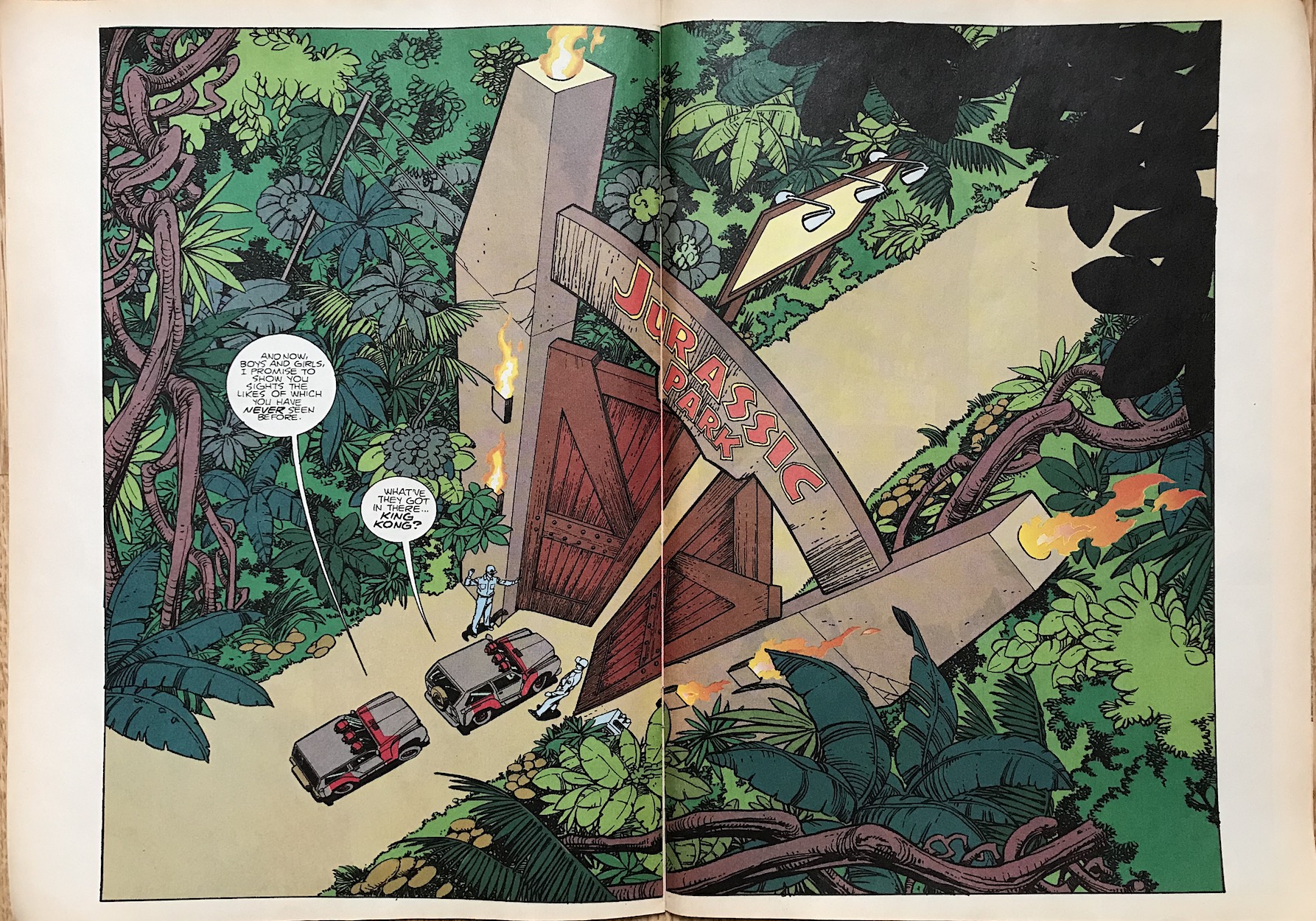
These pages do look wonderfully dramatic, though. It’s brave to take up four pages with the opening of a gate! In the film this didn’t happen until after we’d been fed all the science behind the park and the characters were heading out on the inaugural tour. But this isn’t the comic team taking liberties with the story. The first chapter is very much about making the introductions and with a distinct lack of dinosaurs some changes had to be made to grip readers to the overall story. If that means some iconic scenes have to be moved or elaborated on visually (like with the child’s imagination earlier), then so be it.
I think it was a smart move to rearrange the placement of this scene, but some people will always complain about such changes, like how movies have to change certain aspects of a book. Well of course they do, it’s a completely different medium. Books based on films also add and rearrange elements of the story or characters to suit the reading experience, but they’re still the same story, just adapted to suit. Having read the novel, I’ve always felt Spielberg did a perfect job of translating Michael Crichton’s novel to the screen and now the comic was adapting Spielberg’s adaptation!
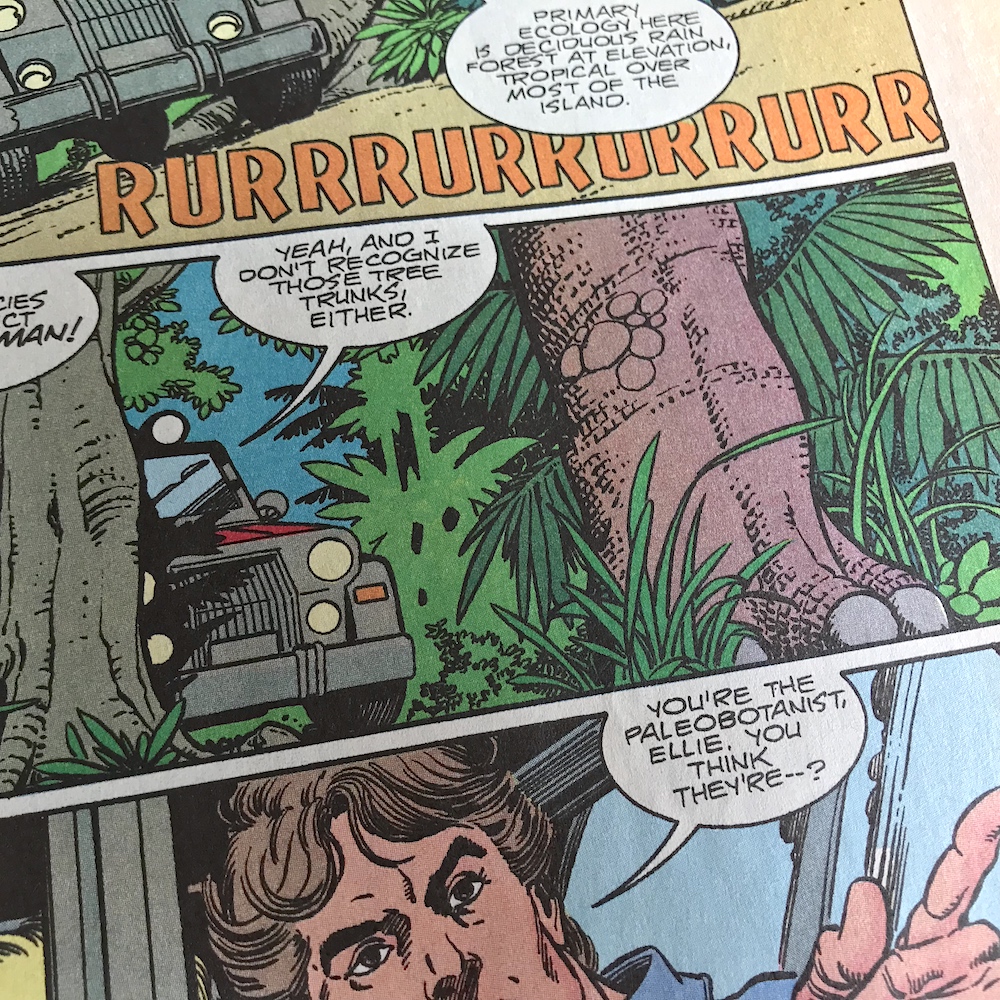
I do believe Hammond’s famous line would’ve worked better as part of this cliffhanger, but that’s just personal preference. There is one difference from the film I’m not keen on. In Crichton’s original story, while Grant overlooks the landscape he mistakes a brachiosaur’s neck in the distance for the trunk of a tall tree, until the dinosaur moves. Here, he’s meant to mistake a leg for a tree instead as they drive within a few metres of it. They didn’t see the giant tail or the belly over their heads? If this was the original idea for the film I’m glad they changed it.
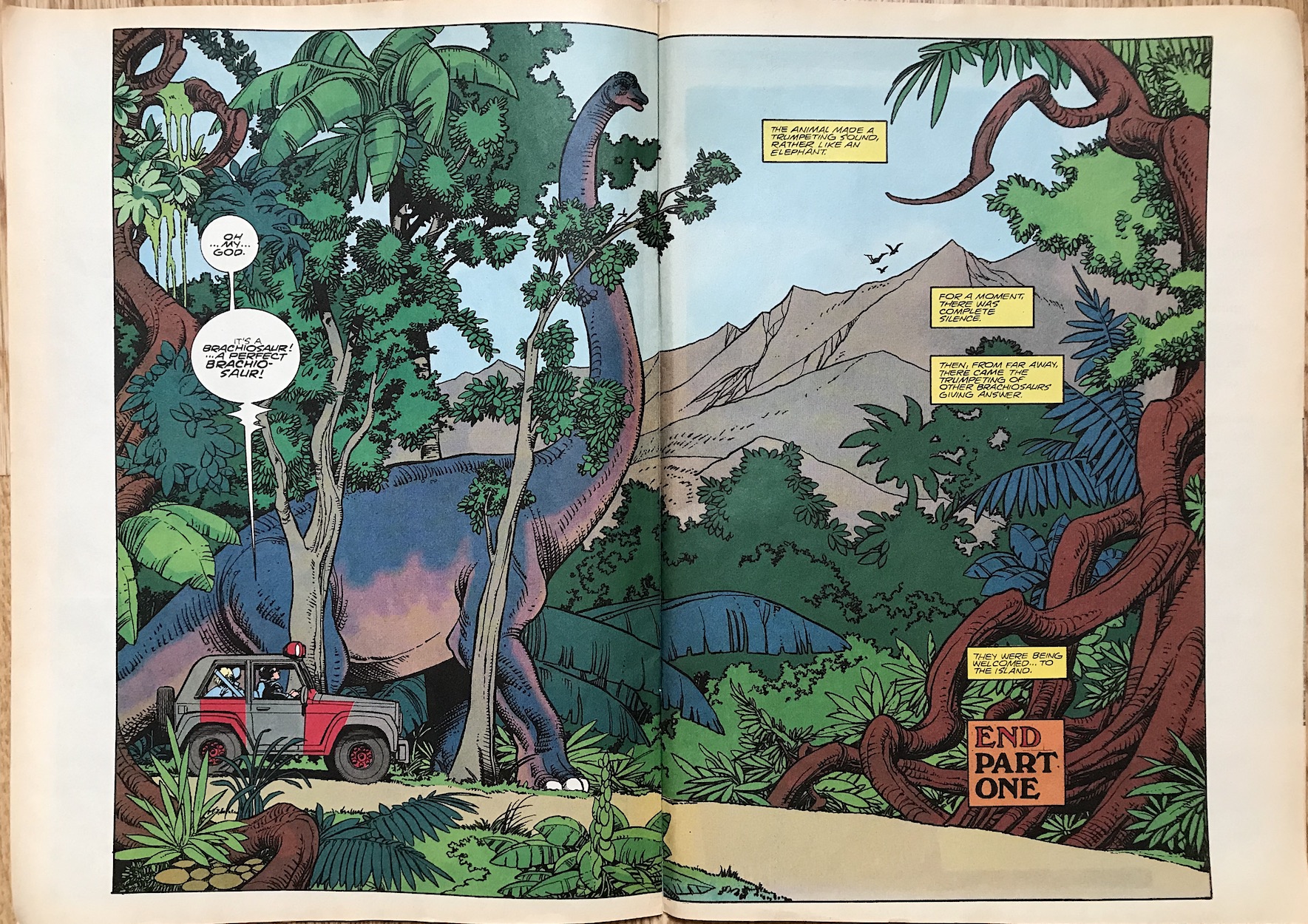
The final double-page is a beautiful image of their first encounter, with the remainder of this classic scene hopefully playing out next time. The captions make reference to the creatures welcoming them to the island and is also lifted straight from the book. In the novel the brachiosaurs come to this area whenever the helicopter approaches the island, eager to see the humans who they associate with looking after them. It’s a lovely, tender moment in the book designed to give a false sense of tranquility to the island.
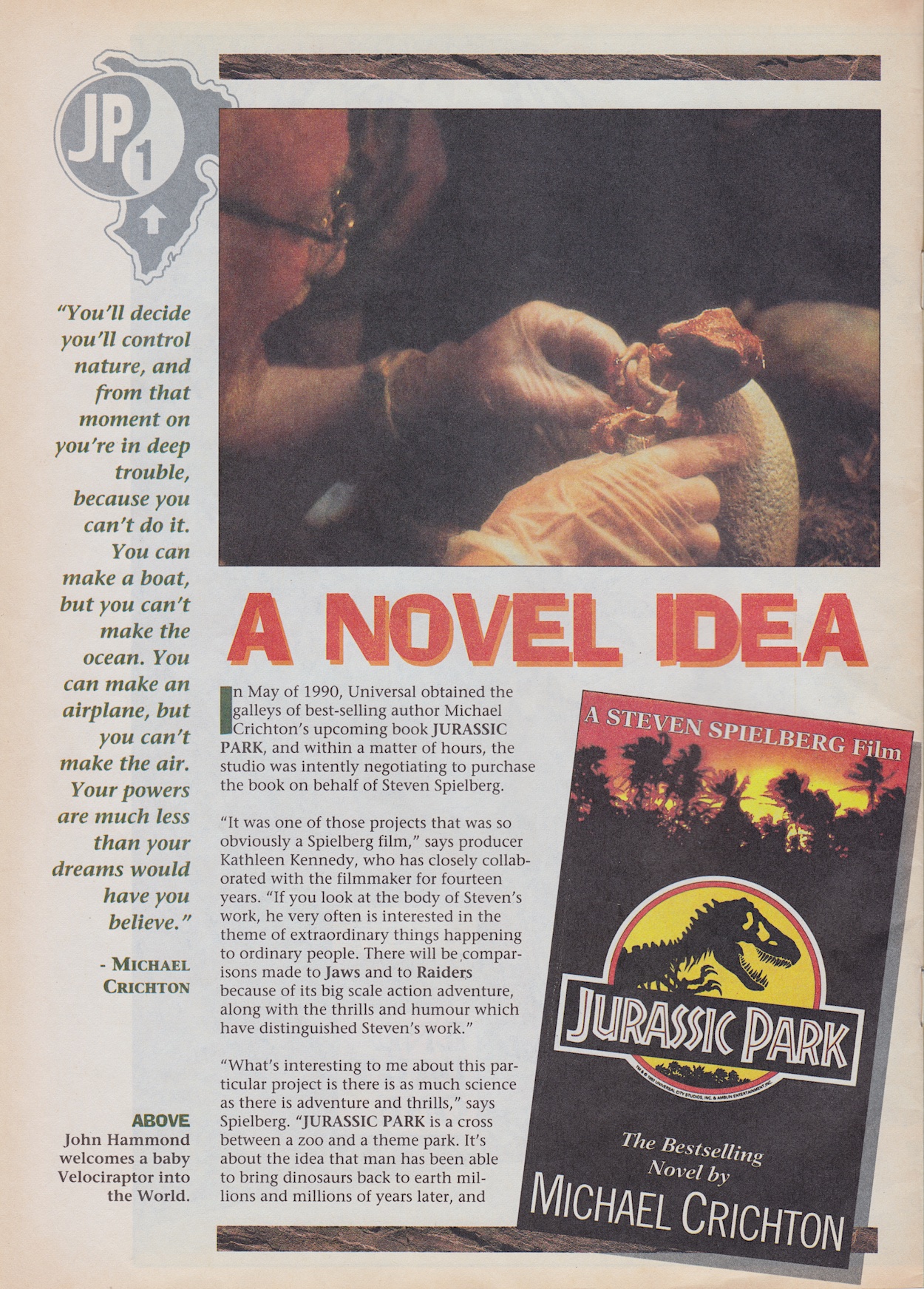
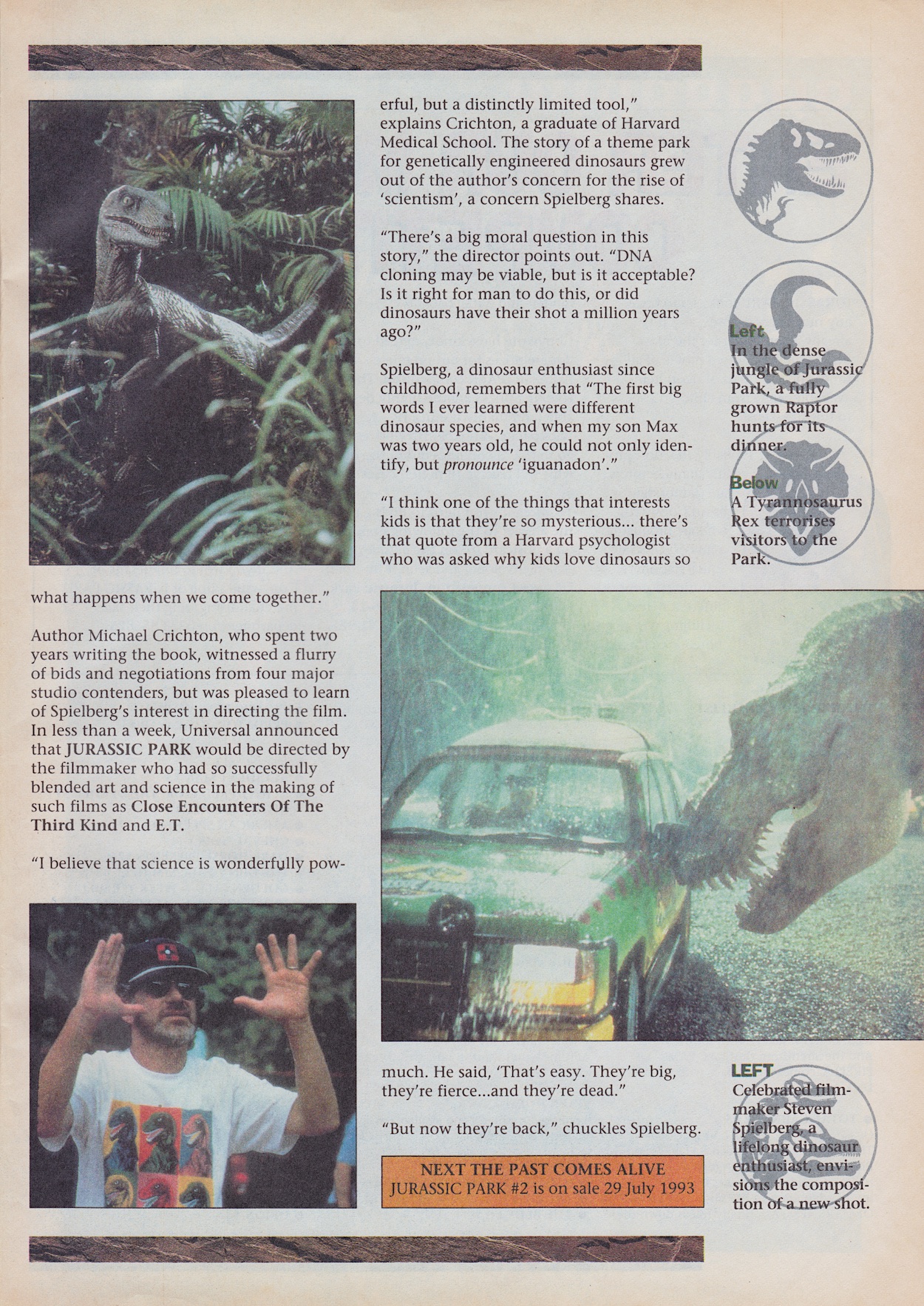
When I collected Jurassic Park back at the time it was cover-to-cover strips, with the occasional competition and comics adverts thrown in for good measure. It was a pleasant surprise to see a series of additional features about the making of the movie in these early issues.
They begin right back at the beginning, long before any filming had taken place, informing the reader about Amblin and Spielberg buying the rights, their first impressions and what they felt were the scientific and moral highlights. These were the important things they’d want to concentrate on when developing their own vision. It makes for a good if somewhat brief read and there’s more to come over the next few issues.
There’s also a checklist of Dark Horse’s local and import comics to be released over the next month. I can remember picking up an issue of their Aliens comic at some stage on a family holiday. Either it must’ve been before Jurassic Park or I was familiar with my friends’ copies because the trademark banner on the cover of this comic was already familiar at the time. I didn’t know there was a Dracula title and, while Jurassic Park has started out with just one strip every issue, it’s clear its stablemates were similar to other UK comic publishers’ titles, especially the aforementioned Aliens.
So there you go, our first look at Jurassic Park UK, a comic which has been sadly largely forgotten in the intervening years. I adored it and I can’t wait to share those later issues with you but so far I’m actually enjoying a comic movie adaptation, which is noteworthy in and of itself.
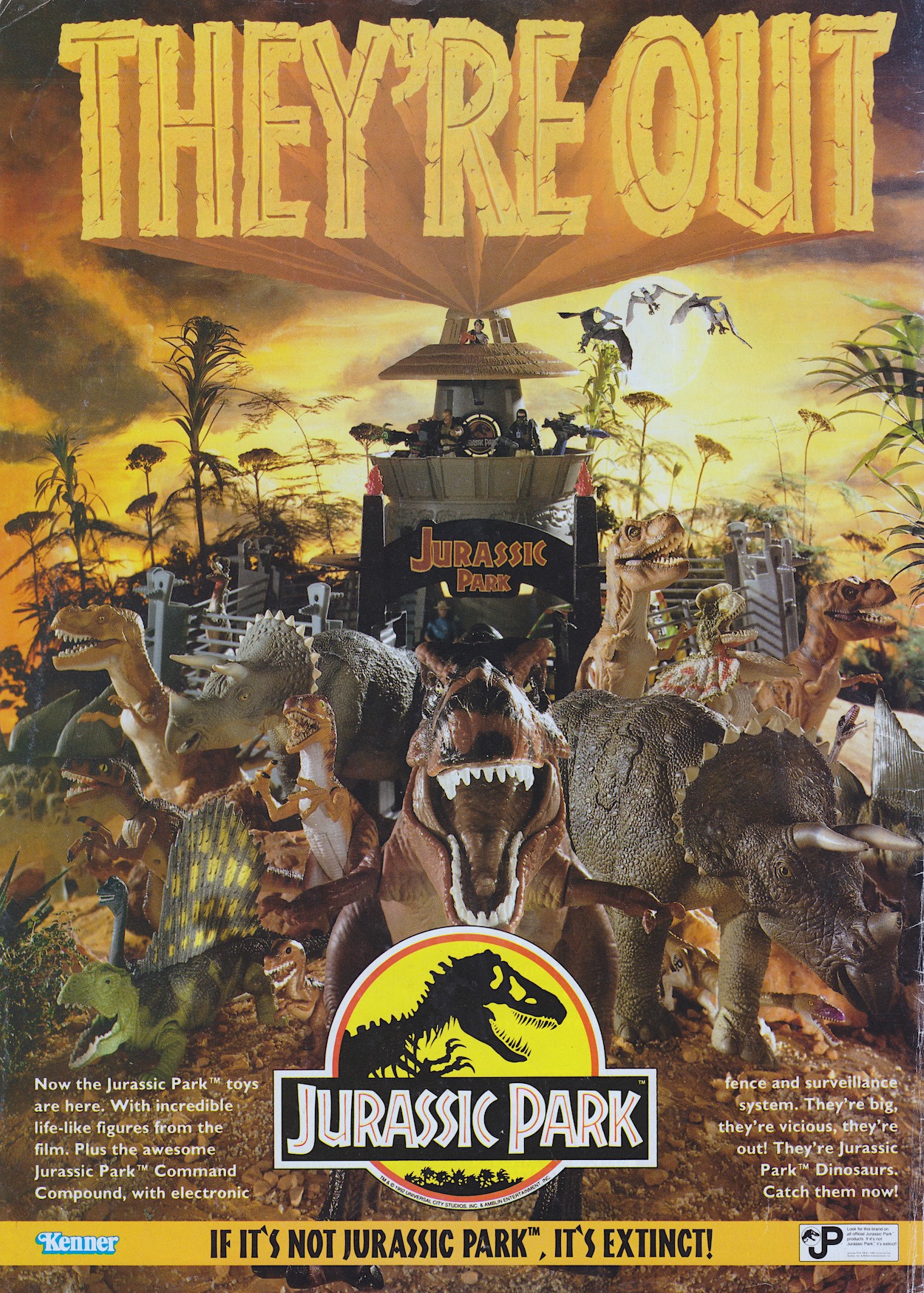
To finish here are your obligatory retro advertisements. I’m not too sure about some of those t-shirt designs but given half the chance as a 15-year-old I’d have jumped at the chance. On the back page is Kenner‘s toy range. I wasn’t even aware there was one. Obviously for a younger audience than I was but I’m still surprised I never spotted them in the shops.
There are some brilliant Jurassic merchandise adverts in this series and I’ll definitely be including them as we go, alongside those for some very-90s comics. I hope you’ll come along for the ride because it’s going to be great. After all, it has been 65 million years in the making.
Issue two of Jurassic Park will be roaring its way on to the blog in just three weeks (a unique release schedule for me) on Thursday 29th July.
Starting with this third edition of Marvel UK‘s monthly Visionaries are stories I’d never read before collecting them for the blog. The origin story I felt I knew almost verbatim, but now the comic was diverging away from the cartoon and forging its own path. Having missed the regular comic as a kid, I’ve looked forward to finally getting to read these stories.
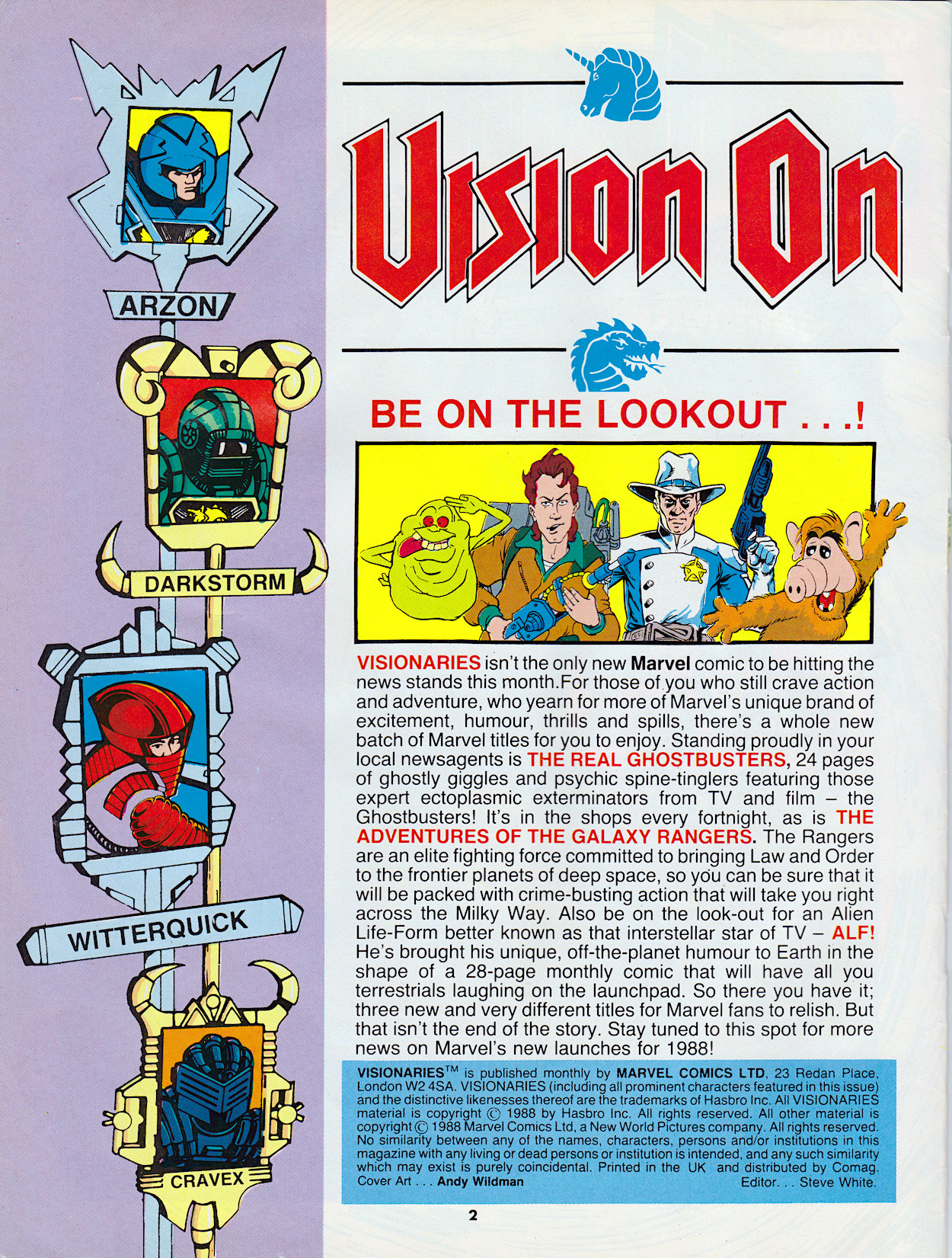
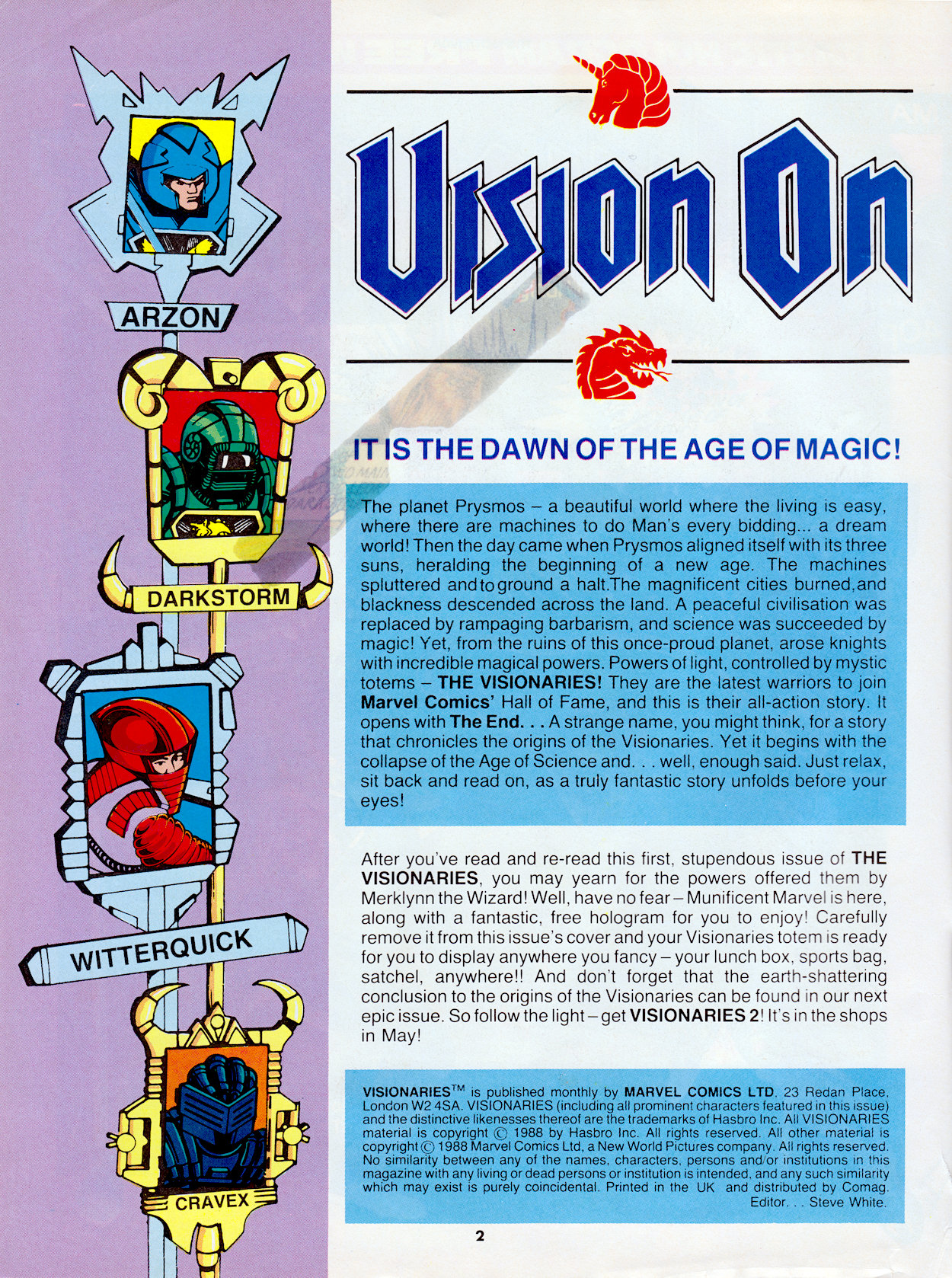
Being original creations and something fans of the cartoon may have been eager to read, it’s confounding to see once again the editorial page not mentioning the story at all. Even though it’s called Vision On it’s basically an advertisement for other titles again, this time the new Action Force Monthly and Dragon’s Claws (called by its original name here which was changed just before its release), both of which were of the smaller American format and designed to try to sell UK material back into the US market.
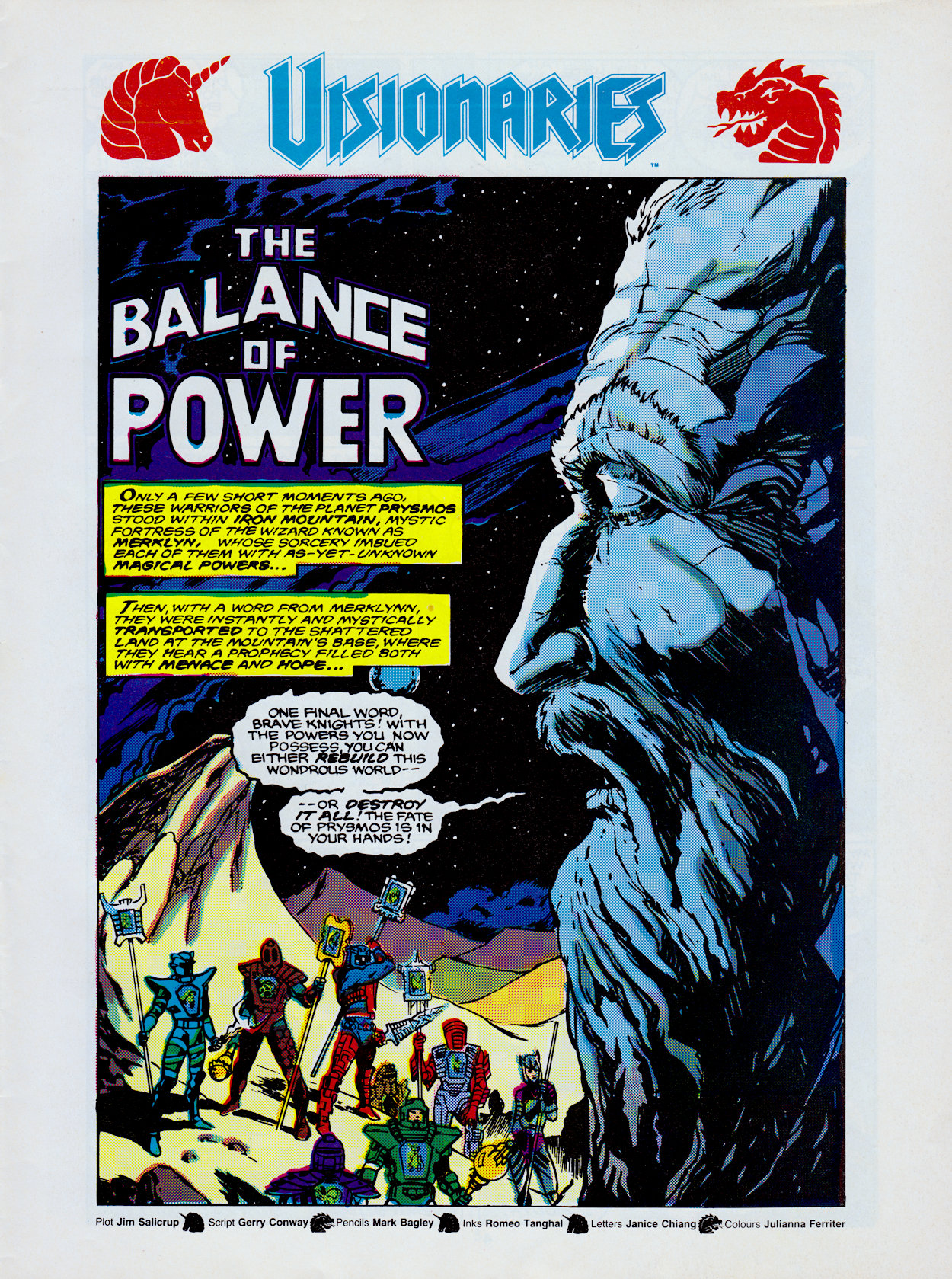
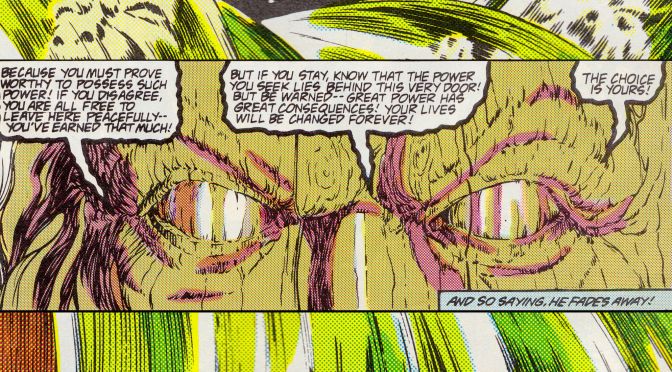
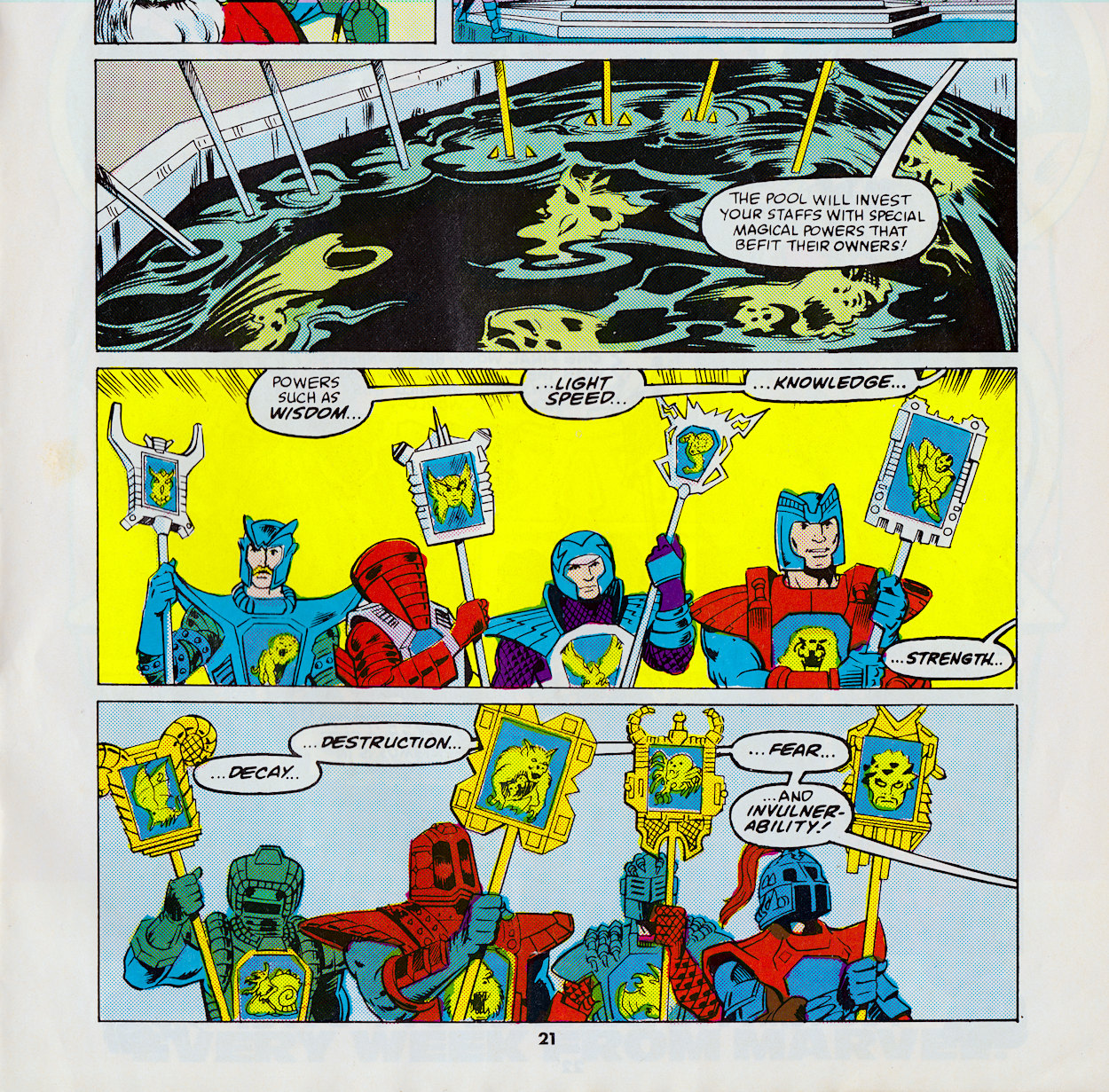
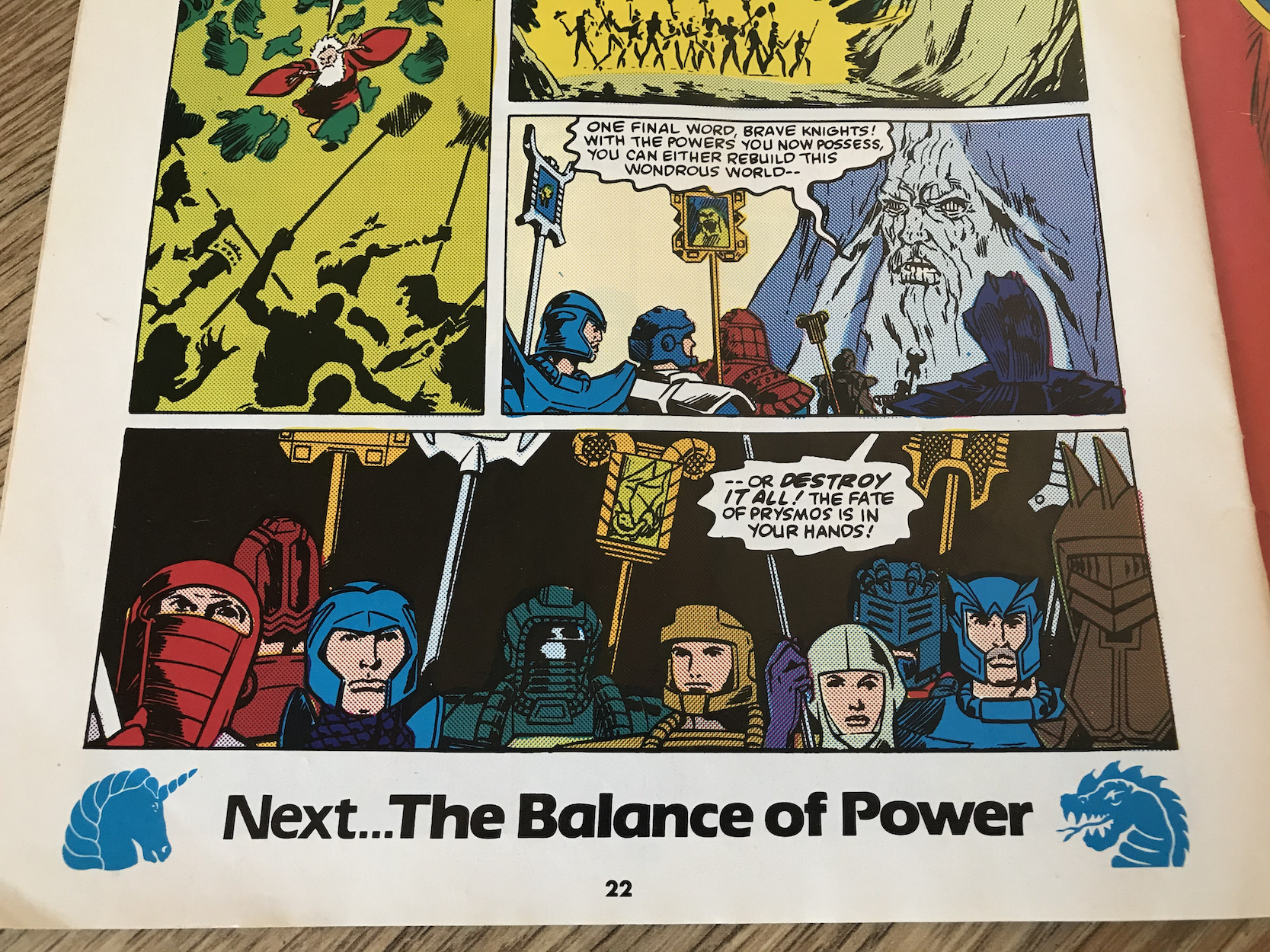
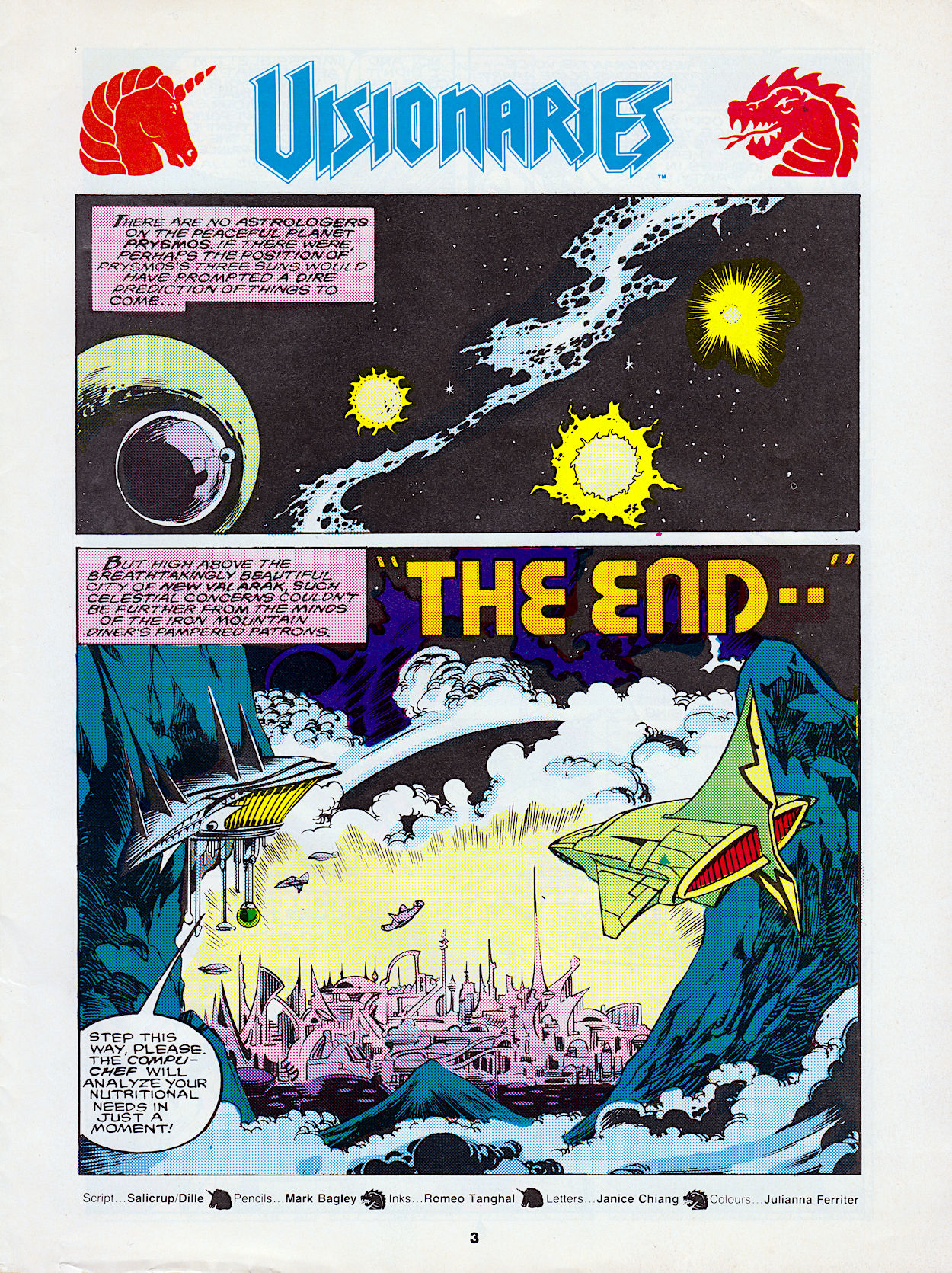
Next to the editorial the first page of Balance of Power is a bold image. On it, Merklynn‘s stone face stares down at the assembled Knights and reiterates the words from the end of last month’s story. Jim Salicrup, who adapted Frank Dille‘s teleplay origin story has created the plot this time around but full scripting duties fall to Gerry Conway (The Punisher, Spider-Man, Transformers and G.I. Joe cartoons, Diagnosis Murder) who would take over as the comic’s sole writer from the next issue.
The art team are the same as the previous story, with pencils by Mark Bagley, inks by Romeo Tanghai, letters by Janice Chiang and colours by Julianna Ferriter. Unfortunately, it’s in this final category that the issue is let down a little bit. There are quite a few colouring errors, which is something you don’t want when you’re still introducing characters and the colour of their armour is key to seeing who is doing what and to whom in battle. It’s a shame because at times it can really ooze atmosphere, such as with that splash page above.
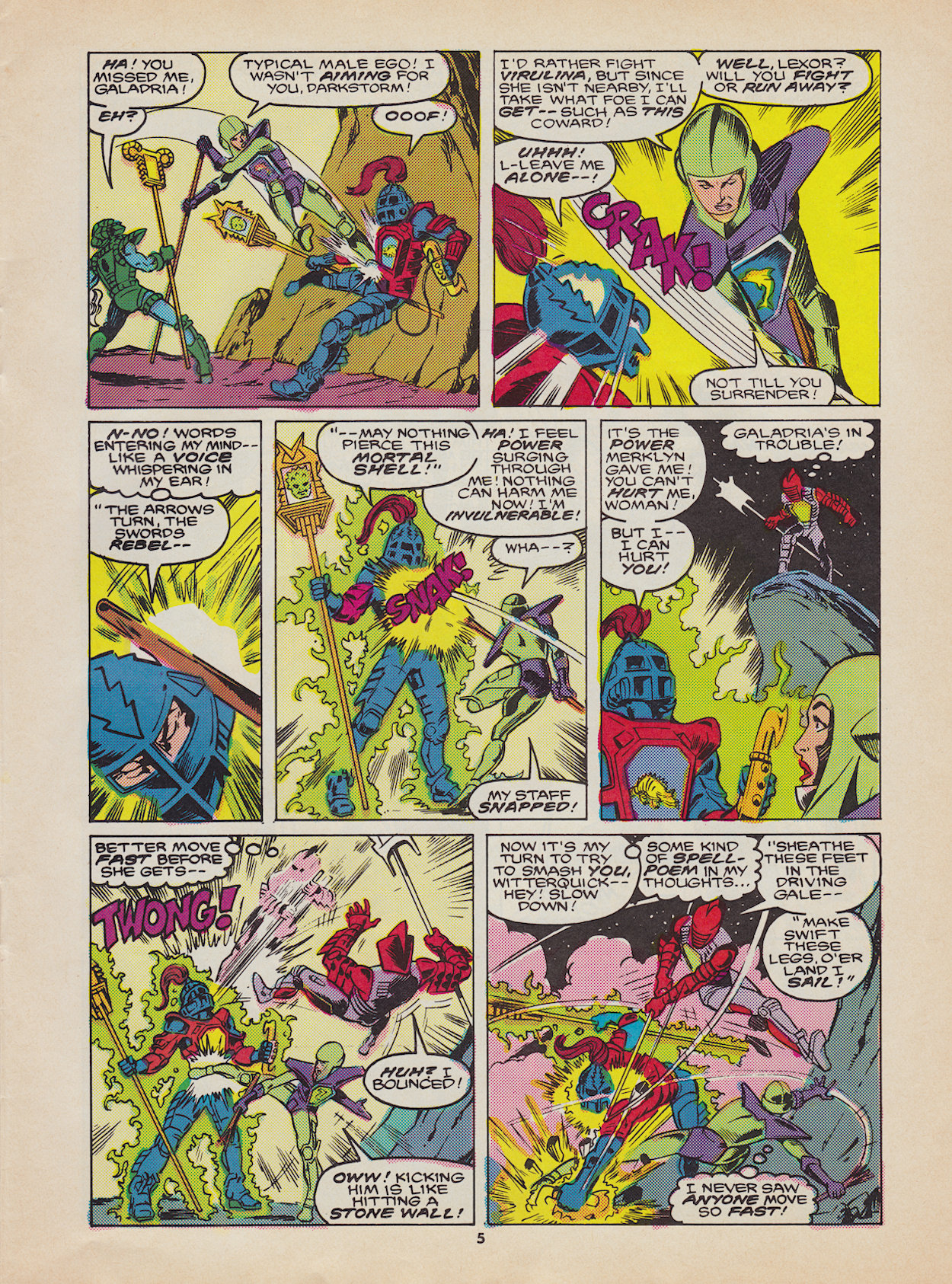
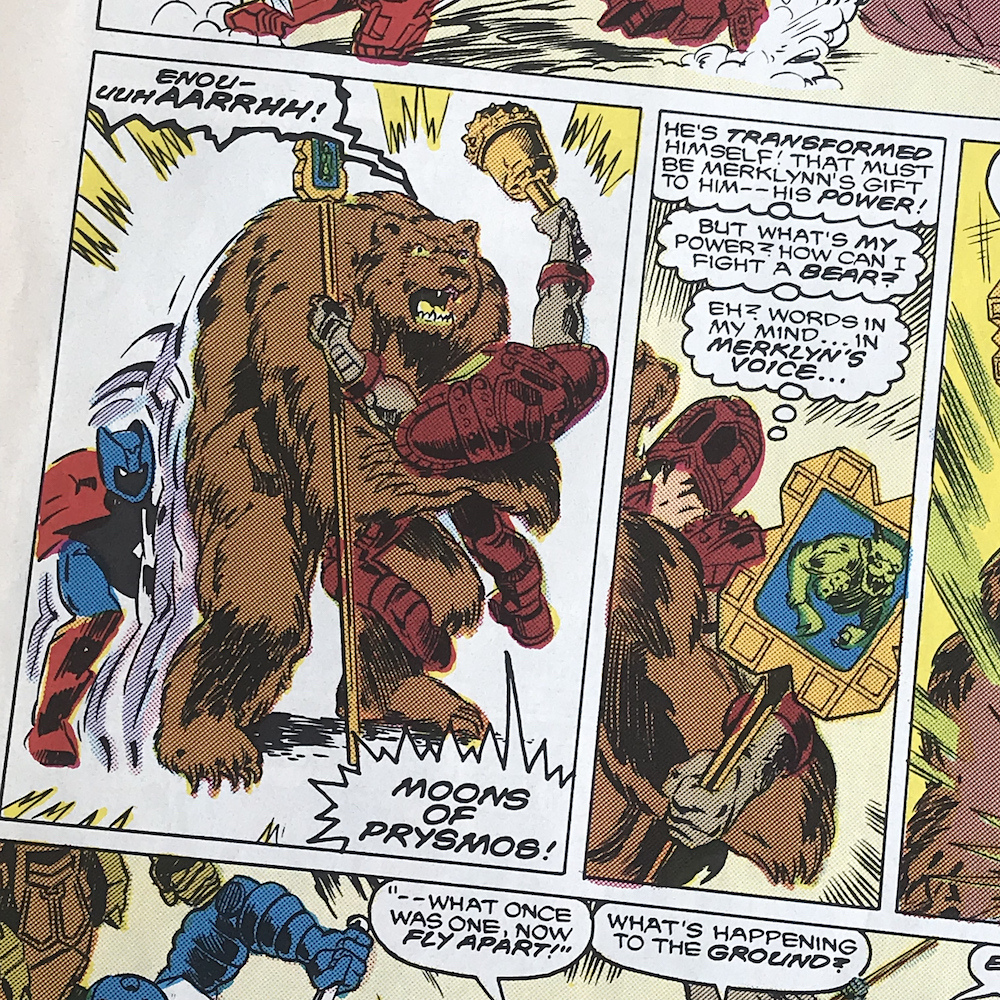
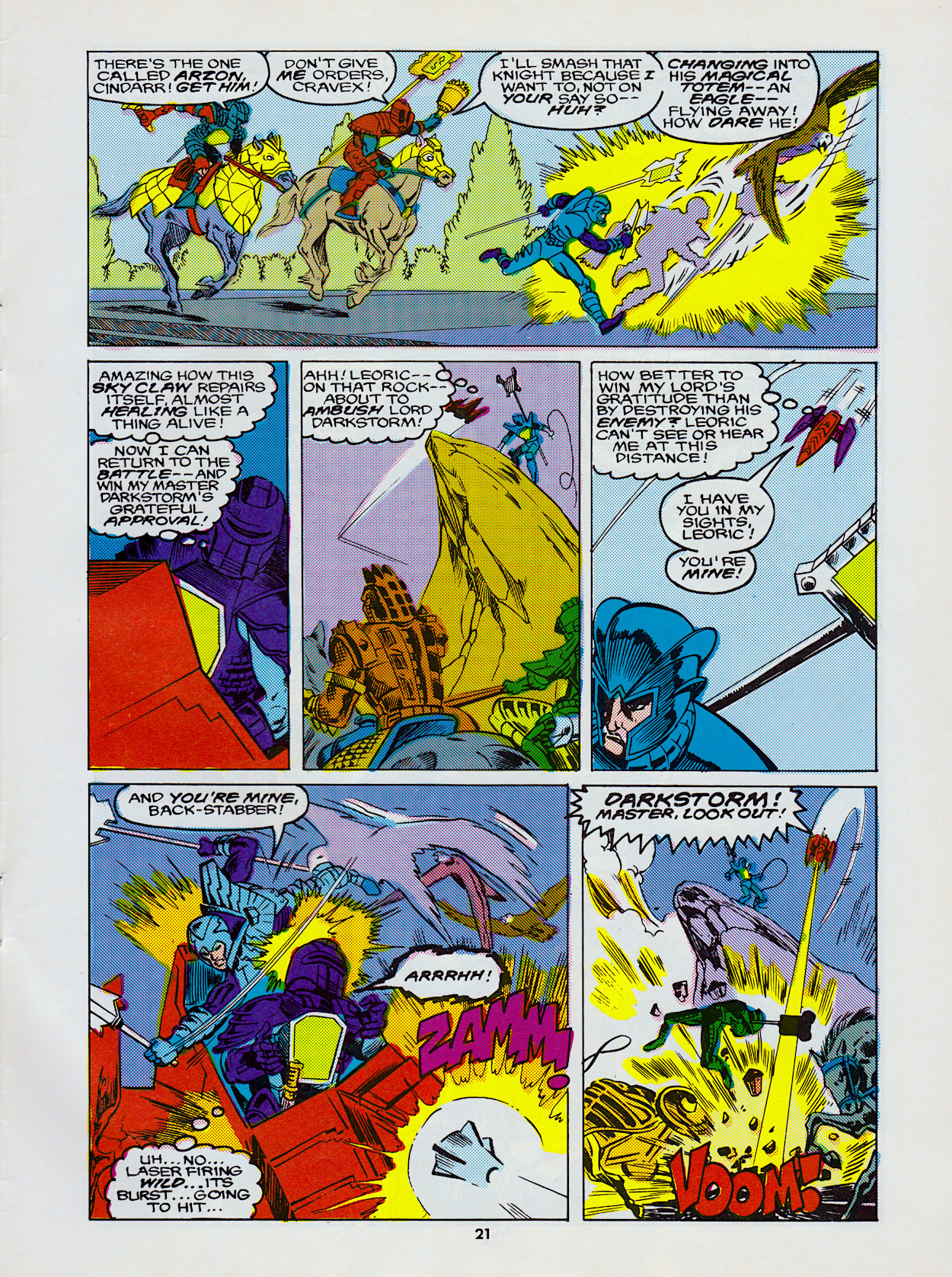
Something else this issue has in plentiful supply is action. As soon as Merklynn finishes his prophetic speech the Knights turn on each other, wishing to finish off the battles started inside Iron Mountain. Galadria gets the best line, then some of the characters start hearing a voice inside their head, telling them of incantations to summon the power of their magical staffs. Reading these again brings back memories of learning them off-by-heart from the toy packaging.
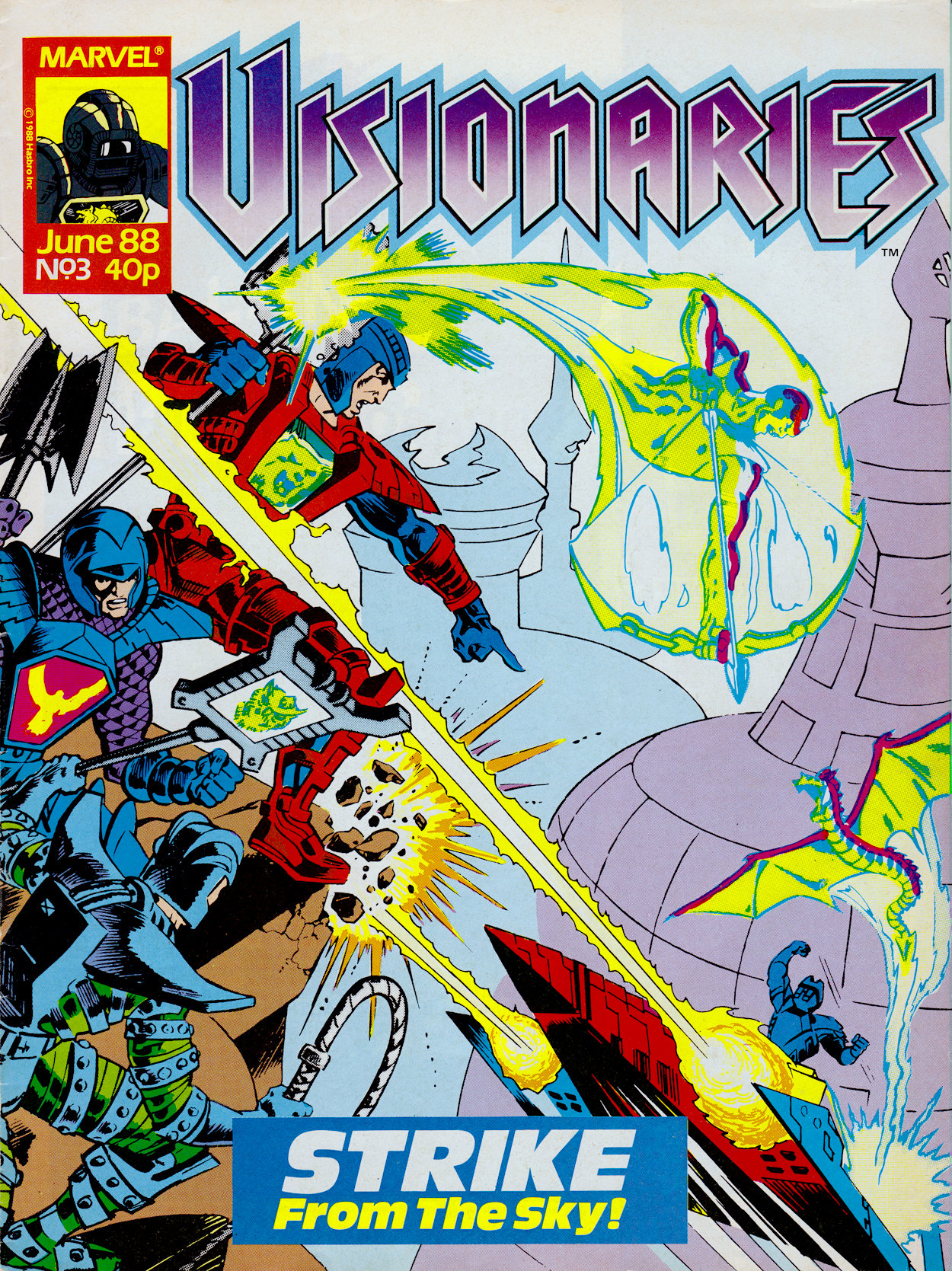
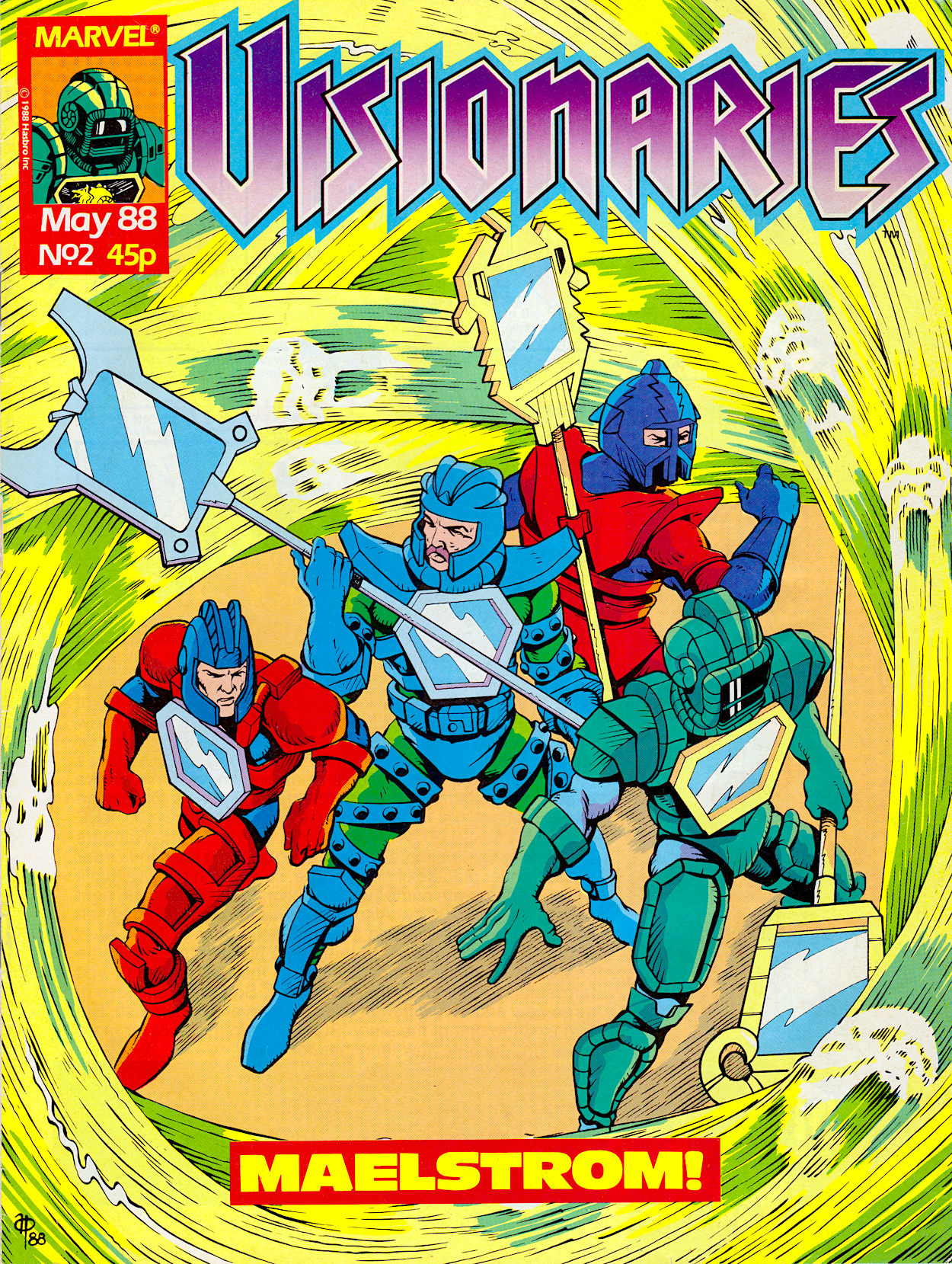
This is where some fundamental changes between the comic’s universe and that of the cartoon become apparent. Here, the staffs just sort of produce the desired effects, like making Lexor invulnerable, Witterquick superhuman fast and Cindarr‘s unleashes a mini-earthquake. But in the cartoon the holographic image on the staff materialised in the real world, for example a cyclone around Witterquick’s body or a giant monster wielding a club for Cindarr. Even the cover of this issue shows Cryotek’s archer, but none of these would appear in the strip. They’re missed and without them it’s not particularly clear what’s happening at times.
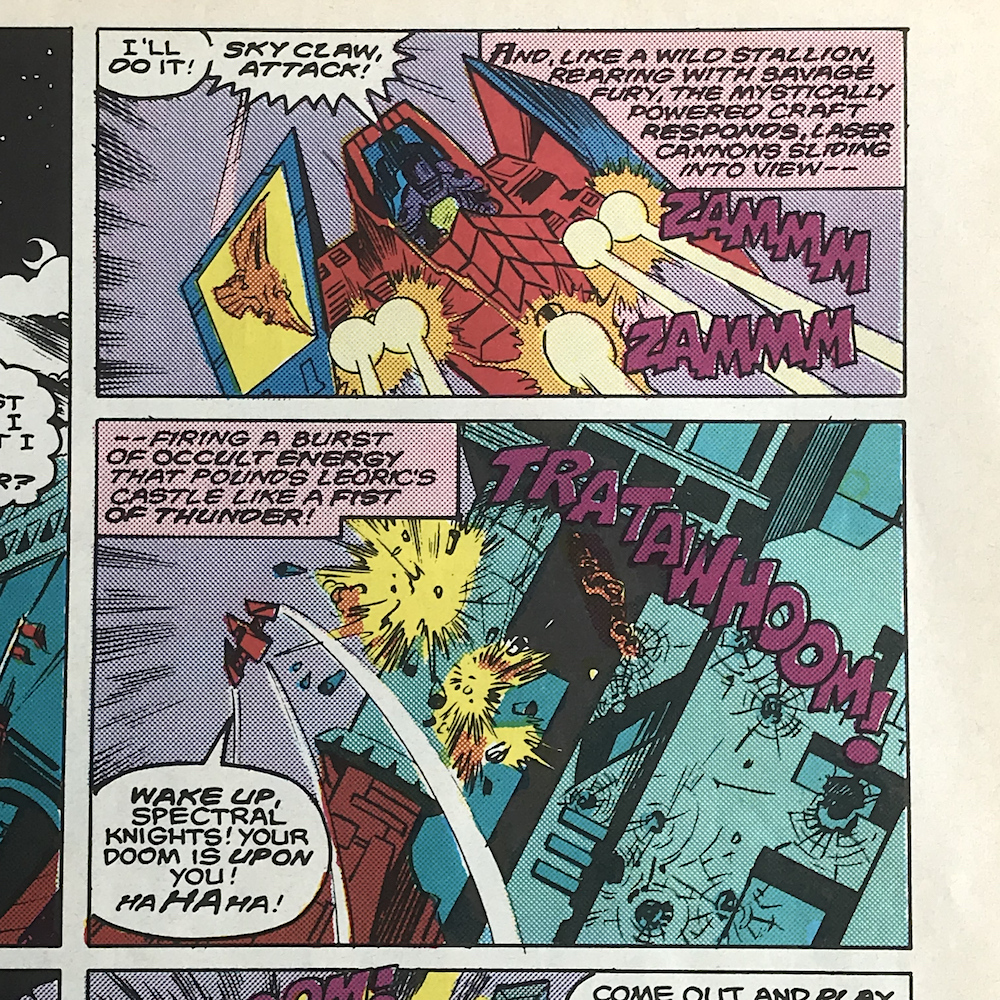
“And, like a wild stallion, rearing with savage fury, the mystically powered craft responds.”
Description of the Sky Claw
It also doesn’t help that when some of the characters transform into their magical animal totems these are mistakenly referred to as “magical powers”, when that’s actually what the staffs contain. Instead, the totems are an embodiment of their individual personalities, which they can change into, physically becoming said animal and harnessing its abilities (the actual animal rather than a magical representation like the cartoon). However, their magical powers are that of speed, strength, healing, decay, knowledge etc. Fans of the cartoon or toys would be able to follow along and it’s clear these are the intended audiences, but it must’ve been very confusing for anyone reading without prior knowledge.
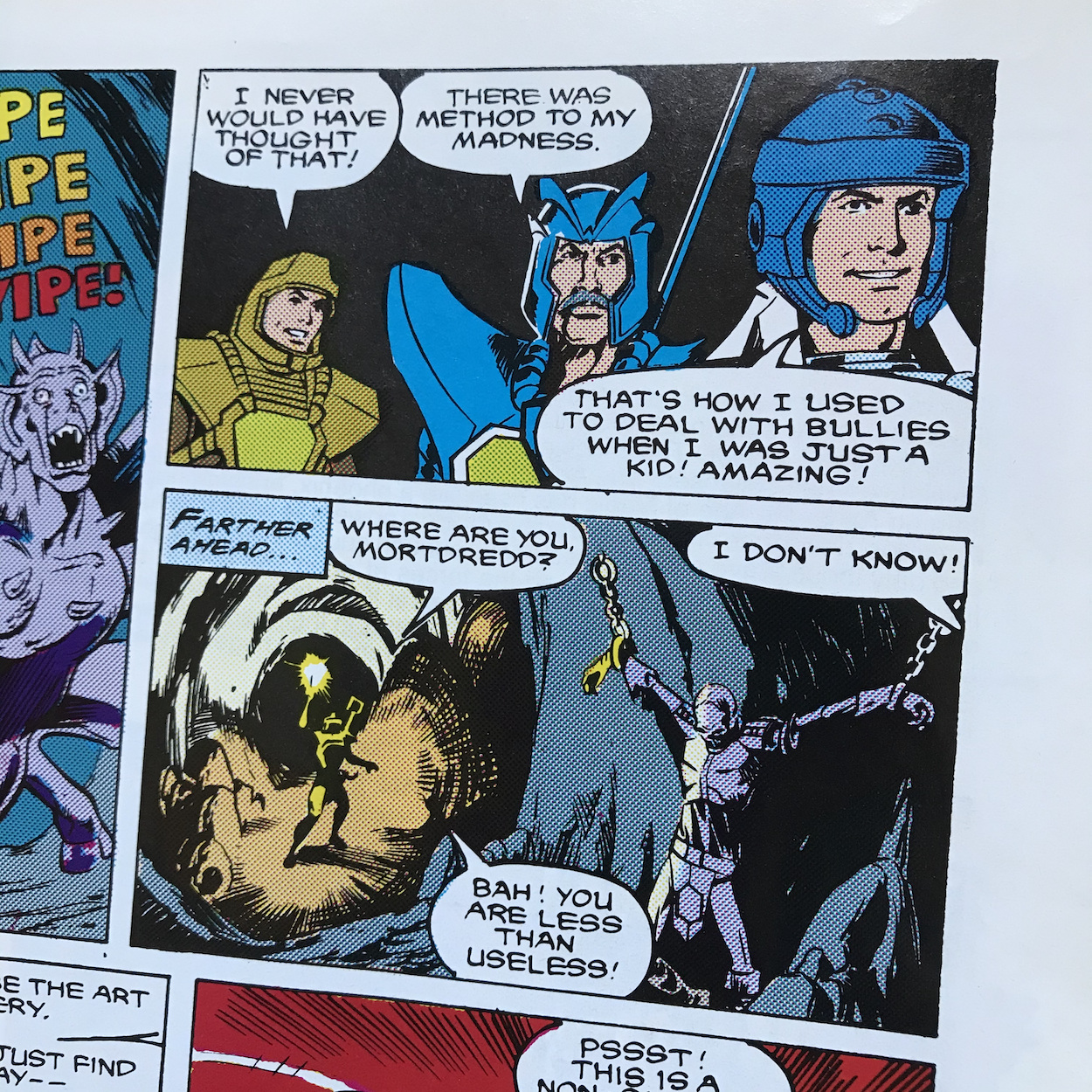
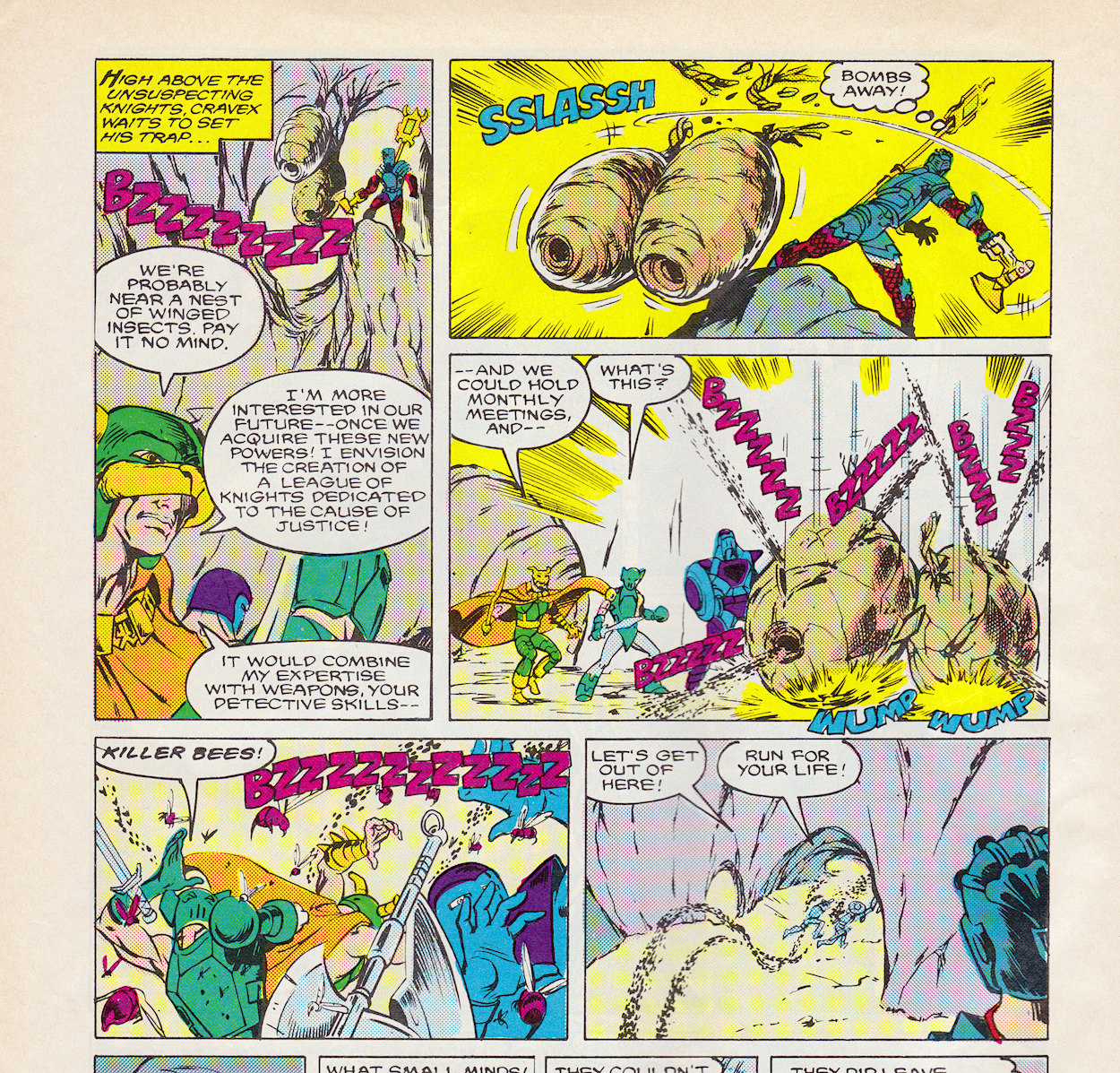
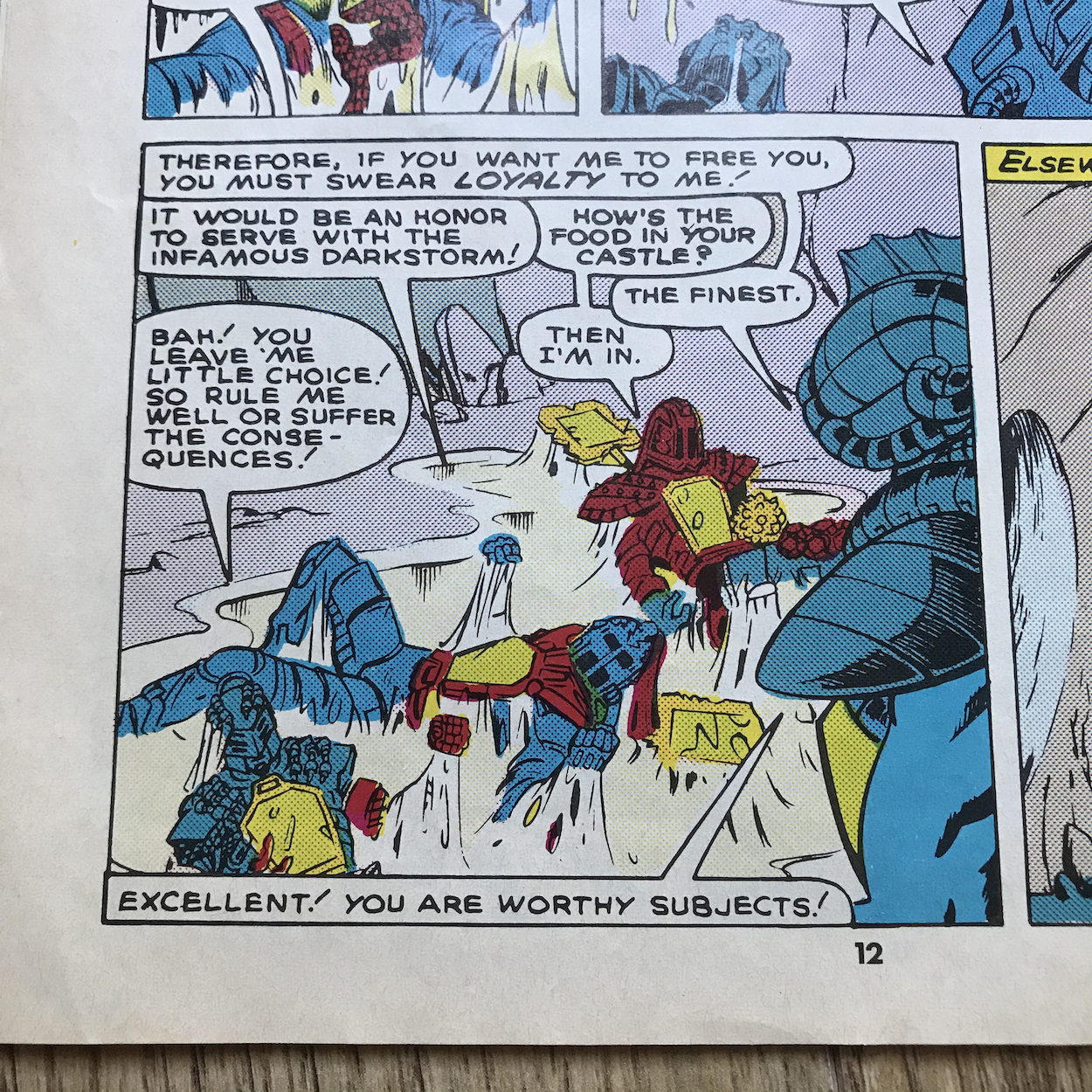
The plot is rather basic this time around. Even though both sides have yet to even experiment with their new powers and totems, Darkstorm insists he and Leoric’s Knights are now too evenly matched. How would he know this? Surely they should train with their new magical abilities before coming to that conclusion. He wants an advantage and, annoyed with some of his people complaining about their lack of staffs, he sends stealth master Reekon and the grovelling Mortdredd to find a new weapon to given them that edge.
It all feels rather convulted. Given the cover we know what they’re going to find, but the pacing is all wrong. If this had come later in the run, or even if we’d jumped forward a few months and they were having difficulties managing their powers and wanted something more conventional, it would have made more sense. The saving grace here is the world building in the background. Wanting to rebuild his world no matter the cost to anyone else, Darkstorm’s castle overlooks slums where the poor and hungry struggle to survive, through which Reekon and Mortredd trot along, uncaring of the devastation around them.
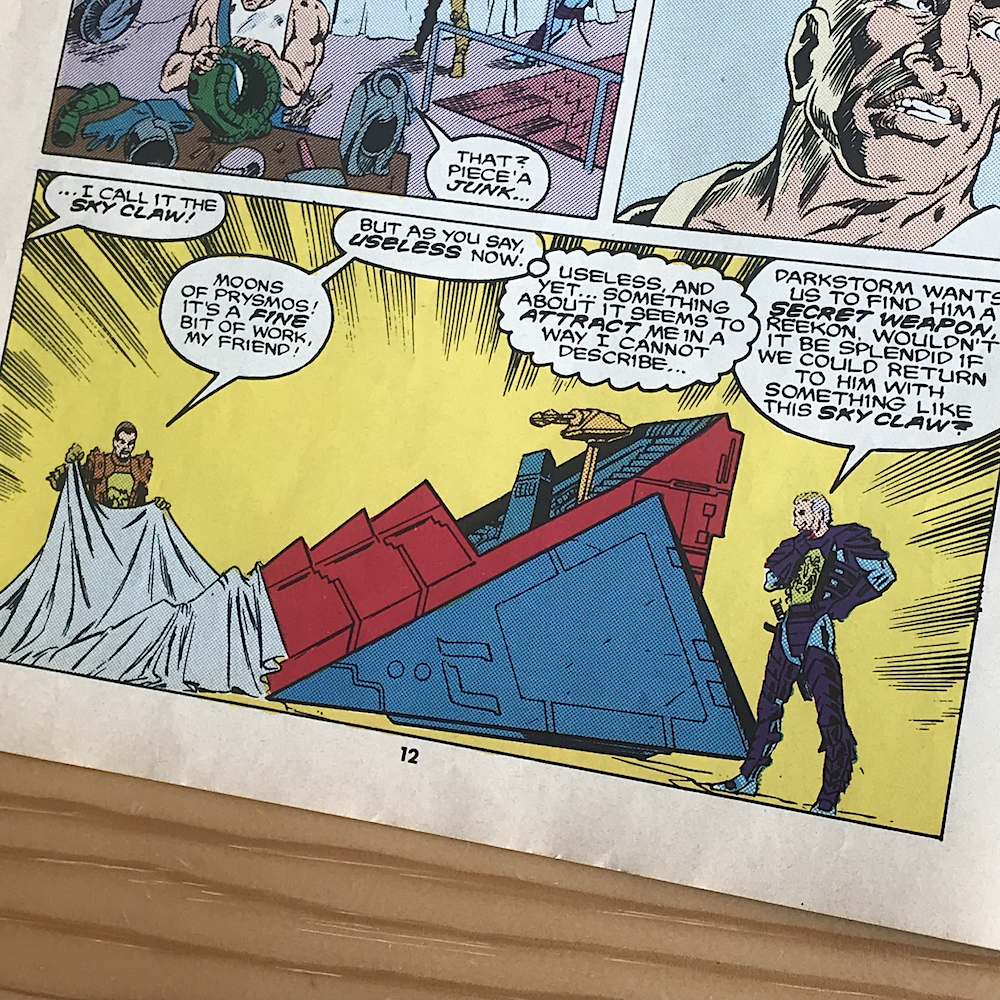
They make their way to a contact of Mortdredd’s at Harkon’s Blacksmith Shop. An engineer by trade, Harkon found himself without work in the new Age of Magic and retrained as a blacksmith, where he won the contract to repair and replace armour for the Darkling Lords. Underneath tarps scattered about his workspace are high-tech vehicles which are now nothing more than useless relics of the past.
I recognised the one above as soon as its covering was pulled back. It’s the Sky Claw. It was one of the large vehicles from the toy range and one of three that I personally owned. Covered with large holograms and movable levers and wings concealing a variety of awesome weaponry, it was a favourite childhood toy. It’s the whole raison d’être for this story so my excitement levels have been turned up a bit now.
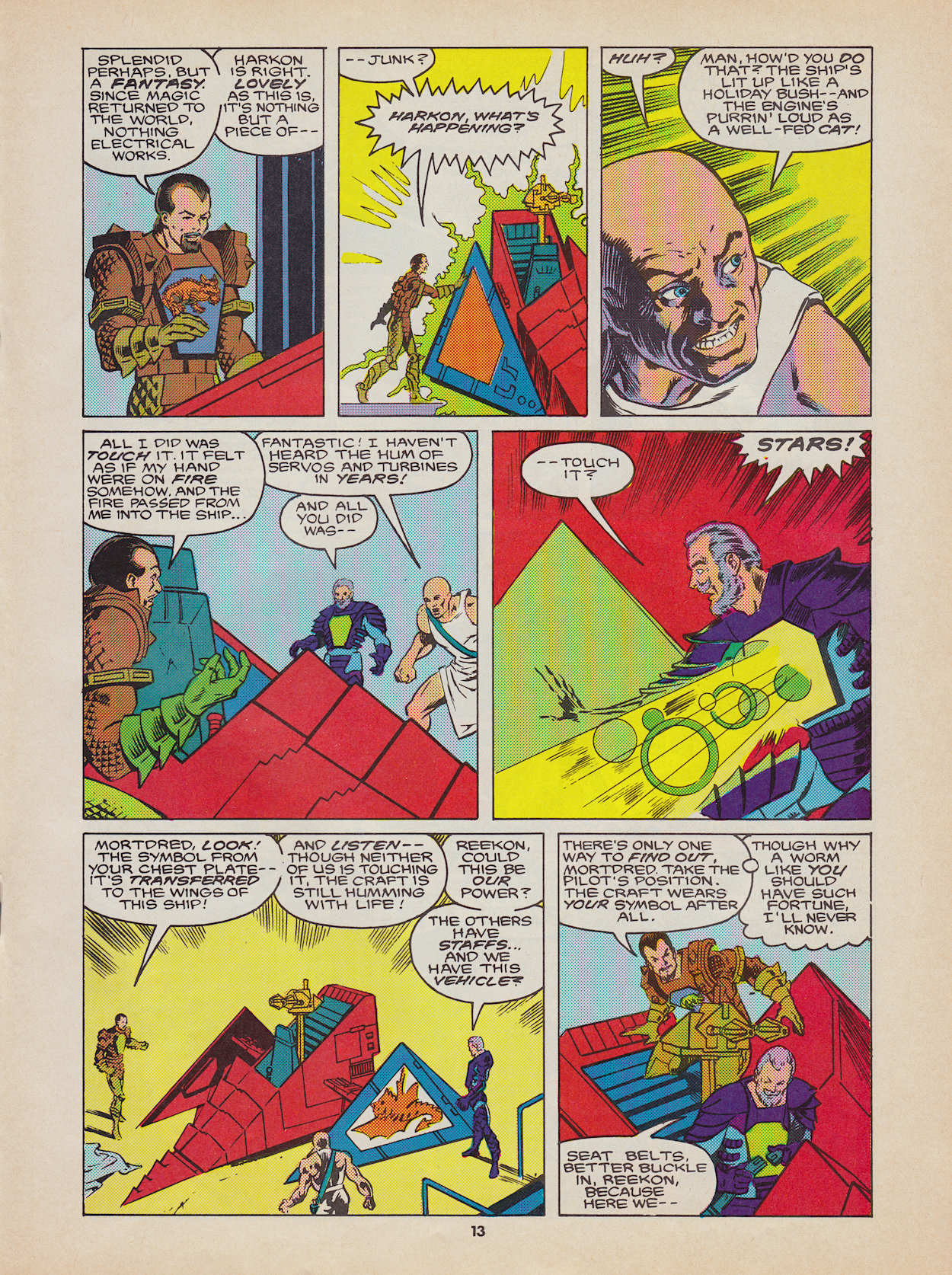
The machine responds to the energy of Reekon’s magical touch, but it’s Mortdredd’s proximity that really brings it to life. While the statement that the symbol from his chest plate transferred to the craft is completely wrong, it’s still a fun way of introducing it. I particularly like how magical powers erupt from Mortredd’s chest, while his hand almost disappears into the holographic panel, becoming nearly skeletal-like. Although, why does Harkon say he hasn’t heard the sounds of an engine in years when this follows on directly from the previous origin story?
Able to control it with but a thought, Mortdredd is eager to prove himself to his Lord and Master. Darkstorm wants to wait, plan, gather information before a strike (again, no mention of learning their new skills) and this leads to other Knights calling him a coward. Defending his leader’s honour, Mortdredd attacks the others but find it’s he who ends up pushed out. Seizing the moment, he takes the Sky Claw and launches a devastating attack on Leoric’s castle, hoping to show he’s worthy of his position within the Darkling Lords. None of the vehicle’s magical powers are used though, just the weaponry which is a shame because I was looking forward to seeing those holograms come to life again.
The descriptive panels here are excellent. In fact, throughout the comic they’re a unique mix of science fiction and what feels like medieval storytelling. The latter in particular sets it apart, the comic playing up to this aspect of the characters and setting particularly well. This attention to detail is great.
One of the more interesting magical powers makes an entrance here and that’s Arzon‘s power of knowledge, even though he’s incorrectly drawn as Ectar but we’ll skip that detail for now. He recites his incantation to find out what the Sky Claw is, because there has been no flying vehicle since the Age of Science and it takes them by complete surprise. However, he not only discovers the information he seeks, suddenly everything he’s ever known in his whole life temporarily returns to his mind.
Everyone having completely different powers […] could make for some epic battles
This could’ve set up some brilliant stories for the future. I could see something like that opening up old wounds, thoughts he’s tried to suppress or even things that he doesn’t wish to know. Unfortunately I can’t see this being explored in the short run the comic ultimately had.
On the surface a power like this could seem to give an individual an unfair advantage in any fight, but with everyone having such completely different powers, all with some form of vulnerability built in if not used correctly, it could make for some epic battles.
It all comes to a head when Arzon transforms into his eagle form and attacks the cowardly Mortredd from above. From there it all falls apart for the Darkling Lords, who had shown up to finish what the Sky Claw had started. Disobeying orders and nearly killing his leader sees Mortdredd locked up in the dungeon of Darkstorm’s castle at the end of the story, but not before he’s made reference to the Sky Claw feeling alive when it repairs itself during a moment away from the battle. It’s a passing comment for now, but if memory serves me right this could tie in to some revelations yet to come about all of the Visionaries’ magical powers.
The Balance of Power feels very much like an extension of the previous two issues and the cynical might say it’s nothing more than a couple of extended action scenes. There’s little in the way of characterisation but the main point here is to see more of this world and the characters inhabiting it, to see their magical powers and how they could turn the tide of battle. Hence the name of the story.
With Jim having set things up and established the potential for future stories, the authorship is handed over to Gerry for him to develop the comic as its full-time writer. So let’s wait and see what he brings to the table and if all that potential is realised. The next chapter’s review will be here from Wednesday 23rd June2021.
This gorgeous Andrew Wildman cover (Transformers, G.I. Joe, Venom: Carnage Unleashed) opens the second issue of Marvel UK‘s new Visionaries monthly, released on this day back in 1988, showing some of our heroes and villains surrounded by the magical totems that’ll become part of their very being. We’ll get to that further down the review, but is that a price increase already? It’s only 5p but back then that was quite the hike, especially for a second issue.
Not only is the price increase a bit strange, so is the Vision On editorial which doesn’t mention anything about the issue’s story, instead focussing solely on other Marvel releases. The recap of the previous chapter is then pasted on top of the next page, excising the top third of the strip! It is atmospherically written though.
Last time, Reekon pulled on a lever as a large stone gargoyle rushed towards Leoric, Ectar and Feryl but what the lever did could easily have been missed because of where the story stopped. The metal gates that trapped them with seemingly no hope of survival would have come down at the top of this page. So not only could it have been missed last issue, this time it’s been deleted by editor Steve White.
An even higher grade of paper really does justice to Andy’s cover and the opening pages of the strip
Thankfully the strip itself more than makes up for any shortcomings in repackaging it for UK readers plus the outer eight pages are made of an even higher grade of paper than last time. A shame the rest is of the usual stock because these glossy pages are lovely and really do justice to Andy‘s cover, as well as the opening pages of the strip from penciller Mark Bagley, inker Romeo Tanghai, letterer Janice Chiang and colourist Julianna Ferriter.
Adapted by Jim Salicrup from Flint Dille‘s animated teleplay it’s all action this time around, with the knights from across planet Prysmos now inside Iron Mountain facing the trials of Merklynn the ancient wizard. But that doesn’t mean there isn’t time for humour, as we see when the startled gargoyle runs off like a yelping dog, and then there’s this panel featuring Darkling Lord leader Darkstorm and (the voice of) Mortdredd, his snivelling follower.
In fact the first several pages contain some comedy gold. Below, Cravex hears some apparently noble knights talking of forming what sounds very similar to Leoric’s vision of the Spectral Knights. It’s all talk though, humorously told with mention of their skills and expertise but their actual plans amounting to nothing more than monthly meetings. It reminds me of some office managers I’ve had to work with in the past.
Then, after being surprised by an animated skeleton pushing him over a crevasse, Darkstorm’s superior climbing skills and cool head save him and he finds himself beside a vat of milk from a giant spider, which ominously looks on overhead. Realising that in order to fulfill his ambitions he’ll need underlings he traps three knights in the sticky goo and forces them to pledge their allegiance. Cindarr‘s sole requirement had me roaring.
Hmm, a League of Knights dedicated to Justice? One with a bird-like mask? Could this be a little joke at the expense of the DC Universe? (Thanks to blog reader David Teller for this snippet of information.)
We see some personal rivalries begin here too. The Cryotek-versus-Cindarr fight is interesting as it’s actually the Spectral Knight who loses his temper. Showing a fearsome, darker side and swearing to kill his enemy, his magical totem in the final pages is revealed to be the grizzly bear for his incredible strength and endurance, so I’m interested to see how these two aspects of his personality develop in tandem in future issues. But I want to concentrate on one particular grudge match here.
At the time, having only one or two female warriors was deemed enough in everything from He-Man and the Masters of the Universe to The Transformers. The former at least had a female-centric spin-off but the latter had only one female robot in a cast of hundreds. This has been remedied in the intervening years but we can see now just how woefully inadequate it was at the time. Galadria and Virulina, shown here in a thrilling underwater fight scene, weren’t even toys and were instead creations of Flint’s. I hope they’ll get as much coverage as their male counterparts in future issues.
While the comic’s origin was based on the cartoon’s, there were already key differences. Something that irked me about the same story in the cartoon was the fact only the characters who’d receive the magical powers in the end had the hologram-shaped chest panel. It kind of gave the game away, but in the comic they’ve shown several background characters with the same design. It’s not overly done, we’re always aware of who’s going to make it and who isn’t, but it’s a welcome change.
It may be over three decades later and it may be based on a toy line, but this is still a thrilling read.
Something else a comic can do is expose the inner thoughts of the characters and it’s used here in abundance, and not in that annoying way of just describing what we can plainly see is happening to them. Instead, it’s used to add depth to reactions and portray their inner doubts and fears.
As we approach the final pages a huge climactic battle between the knights is interrupted by a booming voice as a huge wooden door nearby contorts into the shape of Merklynn‘s face. Daring them forward, they’re faced with horrors on the other side.
It’s actually Darkstorm who feels a certain level of familiarity with the screaming souls in front of them. They march on and Merklynn explains this was their final test, the spirits really being mystical reflections of their deepest, darkest fears and in conquering them they’ve conquered their inner demons. It’s quite startling to turn the page over and see this image. It may be over three decades later and it may be based on a toy line, but this is still a thrilling read.
It’s at this point we finally get some more background into the previous Age of Magic. It’s played out over a page previously shown in the preview mini-comic but essentially Prysmos was a planet with a strong-willed race of humans, able to achieve anything they set their minds to for the good of their neighbours. The strongest were the Knights of Prysmos and from these arose the Mages of Prysmos. Only a few were able to predict the cataclysm when the Age of Science came, of which Merklynn was one. By secreting his power inside the mountain upon which his castle once stood he was able to ride out time until the suns aligned again and the ages were reversed.
“Be not afraid, Knights of Prysmos! Accept these totems as your just reward! Only you had the vision it took to succeed in finding this chamber! Truly thou art Visionaries!”
Merklynn the Great Mage
Then it’s on to the finale and the part I, as a fan of the toys and cartoon, had been waiting for. It was time for the new Knights of Prysmos to receive their totems, their magical emblems that would encapsulate each individual character, granting them unique special powers, regardless of their intentions beyond the mountain.
Looking over these particular images sparks happy memories. I had so many of these toys it’s like being reunited with old friends. It’s been a great start and we haven’t even seen any of their powers being used yet. But given what we’ve seen them all achieve as people grasping for the power to rule or rebuild, it’s already a compelling story and I think this is mainly thanks to the way the characters have interacted with one another. They feel real, which is no small feat given they’re based on action figures.
Judging by these beginnings, if Visionaries had proven more popular and had had the chance to develop over the course of a few years, I would say these human characters could’ve risen through the ranks of comics to sit proudly alongside the likes of Larry Hama‘s superlative G.I. Joe creations. I’m well aware I’m saying this after only one story, but I’ve a feeling the remaining issues are going to back that up.
For now The End… The Beginning finishes with everyone safely transported back to the entrance of Iron Mountain, where a rock formation in the shape of its soul occupant’s face (he does like doing stuff like that) ends the proceedings with some ominous words for all those assembled.
After this initial story the comic would diverge completely from the cartoon and I’m looking forward to seeing what direction it goes in, what with the animated series being one of the best of its time. I really do get the feeling all is set for a story unlike any other. The comic team should be proud of their adaptation (I usually can’t stand comic adaptations of films and shows) and now we’ll have to wait a whole month to see what they bring to the world of the Visionaries.
To round off here’s a quick look at the only two non-strip pages in the comic after the editorial. I know how much people love these retro advertisements. This month there’s another Marvel UK monthly looking for attention, then that small promotion in the preview comic for what I’m sure was a superlative poster gets the full back page treatment.
I can remember the whole family sitting down and watching ALF together on the TV every week. We’d giggle along with the canned laughter as we watched the adventures of the Alien Life Form, real name Gordon Shumway from the planet Melmac, taking shelter in the home of the Tanner family after his planet was destroyed when everyone turned their hairdryers on at the same time. I think I can remember buying an issue of the Marvel comic, which was a basic repackaging of the American title along the same lines as Visionaries.
It’s been great fun revisiting this story on the planet of Prysmos so far. I’m eagerly awaiting the next edition and I hope you’ll join me too, #3 of Marvel UK‘s Visionaries‘s review shall be here from Wednesday 19th May2021.
They were the latest toy line from Hasbro, the latest cartoon from Sunbow and now the latest comic from Marvel, kicking off with this superb Martin Griffiths (Thundercats, The Real Ghostbusters, Knights of Pendragon) and John Burns (Transformers, Judge Dredd, Nikolai Dante) cover. With Transformers and Action Force (G.I. Joe) still riding high what could possibly go wrong? Unfortunately this sure thing wasn’t to last, but while it did the Visionaries brought with them one of the greatest 80s cartoons, some of my favourite childhood toys and what could’ve been one of the greatest comic book epics.
But we’re not here to dwell on what could’ve been, this site is all about celebrating these classics by reading them in real time and on this day back in 1988 #1 of a brand new Marvel UK comic appeared in the shops. While it does have a lovely glossy, high-quality cover it only has 24 pages, the same as the weekly Transformers which seemed strange for a monthly. Inside it was cover-to-cover strip action too; no extra features, no fact-files, letters page, back up story and no sign of a Lew Stringer humour strip. (What kind of comic was this without that?)
What it did have for kids in the 80s was a free holographic sticker. Featuring two images of Merklynn the wizard (one a 2D outline and the other a 3D image of his face) I can’t begin to describe how bloody difficult this was to photograph.
Inside, Transformers colourist Steve White is the editor and welcomes us to the premiere issue with Vision On, an editorial page which looks a lot like the one from The Real Ghostbusters. Other than that, the comic is made up of 19 pages of strip, two Marvel UK adverts, another for the toys and that’s yer lot. It’s still an exciting introduction though and it hypes the strip very well. As a young teen I read this story later when it was printed in the annual so seeing these opening pages transports me right back to Christmas 1988.
The End… The Beginning is adapted by Jim Salicrup (Jurassic Park, Transformers, Spider-Man) from Flint Dille‘s (Transformers: The Movie and G.I. Joe: A Real American Hero cartoons) screenplay of the cartoon’s first episode. In the States, Marvel’s Star Comics released Visionaries bi-monthly (much like their parent company had with Transformers originally). The premiere issue had double the page count, but here in the UK the origin story was split into two and spread over the first two months. This means none of our characters actually become ‘Visionaries’ this issue.
Set on the planet Prysmos, Merklynn the wisened old wizard brings portents of doom as the three suns begin to align, signalling the end of the Age of Science and the beginning of a new Age of Magic. Angered at their reliance on technology, Merklyn states he’s watched humans grow weaker for eons, so he’s obviously a lot older than we think.
He has a point. It would appear that from birth to death technology is on hand to answer to these humans’ every whim. Even in this restaurant, sitting on the side of Iron Mountain, we see people being fed their food by robots, after the robot chefs have cooked it and the robot waiters have served it. They don’t even have to bother their brains with the task of choosing what they want to eat, instead their dietary requirements are scanned by the maître d’.
Then the suns align.
In an instant the world is plunged into darkness. The restaurant crumbles and falls, no longer held in place by the advanced machinery, destroyed completely as it hits the ground far below. To prove to the people around him this is truly the new Age of Magic, Merklynn teleports the diners to safety. All around them their world has changed forever in the blink of an eye. Completely out of their depth, unused to thinking for themselves, the first words anyone utters as the world ends around them is, “Anyone know a good restaurant near here?”. A brief moment of humour before the horrors on the next page. It doesn’t take long before the human race is fighting for survival in this powerful double-page spread.
The Age of Science has ended and the beginning of the Age of Magic is a terrifying and violent place. The once peaceful people of Prysmos, who didn’t want for anything, quickly descend into barbarism. But as society crumbles a new order slowly rises up “cobbled together from bits and pieces of the old”. The useless technology all around them is melted down and used as protective armour and weapons, both now a necessity. From the villages emerge knights, some ruling with iron fists and led by Darkstorm, others aligning themselves with Leoric, the former mayor of New Valarak who witnessed first-hand the scene at the restaurant.
There’s some great imagery throughout this issue, with pencils by Mark Bagley, inks by Romeo Tanghai, colours by Julianna Ferriter and lettering by Janice Chiang. In particular the fight scenes are exciting and during one particularly brutal confrontation the skies light up with a familiar face (inside a familiar free-hologram-like shape) and a booming voice.
Merklynn tells the knights of his Iron Mountain, where the destruction began. Inside, great power resides, enough to rebuild the world and take command in this new age. It’s too much of an opportunity for someone like Darkstorm to pass up so he and his men (the grovelling but loyal Mortdredd and the brutal mercenary-for-hire Reekon) take off to claim the power for themselves.
They believe these times call for a leader unafraid to make unpopular choices for their planet to survive, no matter the cost to the people. On the other end of the spectrum Leoric, Ectar and Feryl believe only by working together can the populace regrow and flourish. We also meet characters like Cravex who wishes to use the political climate to his advantage (he had the voice of Starscream in the cartoon, appropriately enough) and during the final pages we’re also introduced to Galadria, Arzon and my favourite, Witterquick.
With the world building complete we move on to the quest for their magical powers. Iron Mountain’s labyrinthine interior is home to tests of intelligence, fitness, strength, wisdom etc. Just as the toys set out each figure’s abilities, these tests are our chance to be introduced to them in a more natural way than resorting to the kind of long winded exposition we got in the earliest issues of Transformers.
For example, Galadria uses her keen senses to stop herself falling for a trap like the men ahead of her, Witterquick uses his speed to avoid deadly spikes and Arzon’s love of flight has him gliding away to escape danger. We even get a cheeky wink towards their Hasbro stablemates; as a ladder transforms into dozens of intertwined snakes Arzon exclaims, “There’s more than meets the eye here.” Brilliant.
Our original six characters from earlier in the story round things off for this issue when they discover a giant stone gargoyle, snoring loudly in a corner. It’s alive! But at least it’s asleep. Sneaking past it, Mortdredd puts on a weakened voice and tricks Leoric’s team into coming to the aid of an apparently fallen comrade.
There’s actually a nice bit of humour here too. Mortdredd’s character sucks up to Darkstorm constantly, eager to please him by carrying out any sinister task no matter how horrible, keen to have his protection. Darkstorm is constantly exhausted of the grovelling but recognises Mortdredd’s diabolical talents are crucial to his plans.
It’s at this point the story, which has been building momentum nicely from its atmospheric beginning, gets unceremoniously cut in half. Below is the final strip page. If you look closely at the penultimate panel you’ll see a metal portcullis. This is what Reekon is controlling with that lever. This could be easily missed so its effectiveness as a cliffhanger is debatable. From memory of the annual, showing the next panel or two at the top of the next page would’ve been much better, with maybe a ‘Next Issue’ promo filling out the rest of the page.
The overriding feeling I get from this issue is how these are already well developed characters, grounded in a magical kind of reality, their reactions and relationships with each other all very real. It’s a well thought out world full of possibilities for future storytelling and this is before we’ve even concluded the origin story. It’s great fun reading something so full of far-fetched magical elements, action and adventure, yet with such believable characters at its centre. This gives real meat to the bones of the story and something to care about and draw you in.
By the end the lack of anything other than the strip itself isn’t an issue anymore. The story has been very satisfying in its own right. It certainly wouldn’t be the last Marvel UK comic to go this route either. Slimer, Alf, Inspector Gadget and others simply repackaged their American comics on larger paper with a new editorial and maybe a letters page, which perhaps Visionaries would’ve contained eventually.
Speaking of other Marvel comics.
Apart from the cover and editorial, the only non-strip pages are a toy advert (which you can see in this previous post) and two promotional pages for other comics. The Real Ghostbustershad just launched while Thundercats was celebrating its first birthday by this stage. The ‘Cats had also been launched as a bi-monthly in the States by Star Comics, proving popular enough to warrant going monthly from #8 onwards that side of the pond.
Despite knowing in advance a comic won’t last long when I’m covering it, that won’t take anything away from the enjoyment of reading them in real time. I’ve certainly loved reading this one. Although, whole month feels like an agonisingly long time right now. But I shall follow my own rules, and wait.
Issue two shall be read and reviewed on Wednesday 21st April2021. Join me then, won’t you?