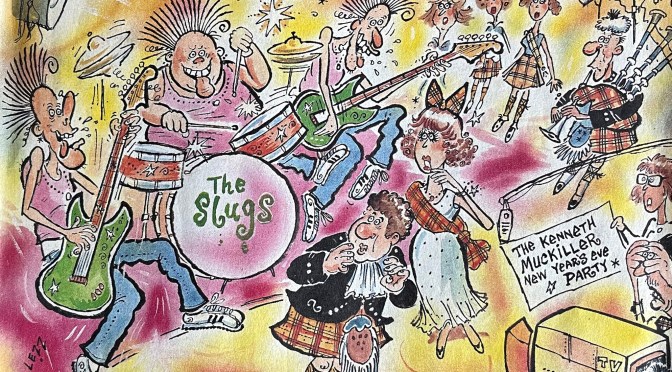
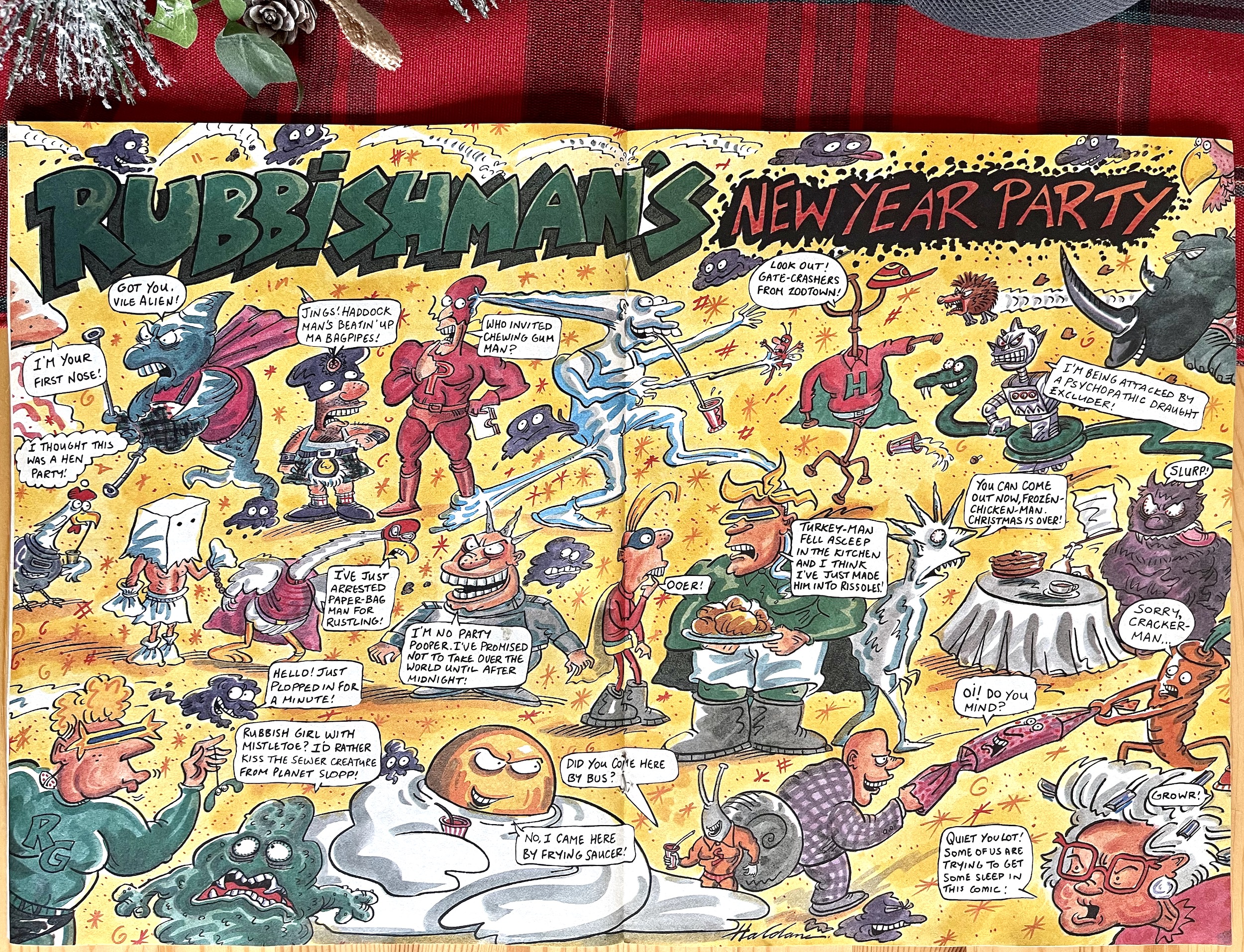
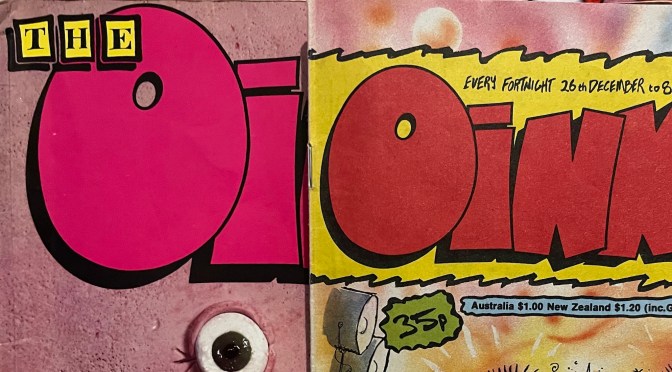
Happy New Year everyone, I hope 2023 brings you much joy, love and kindness. I know for some people tomorrow is just another day but I’m a firm believer that each day is what you want to make it, so if some want to make the 1st January a new beginning I’m all for it. 2022 has been something of a transitional year for me in my personal life, so I’ve got my sights set on 2023 to be something special. Time to celebrate then! So let’s join David Haldane‘s Rubbish Man’s New Year Party, shall we?
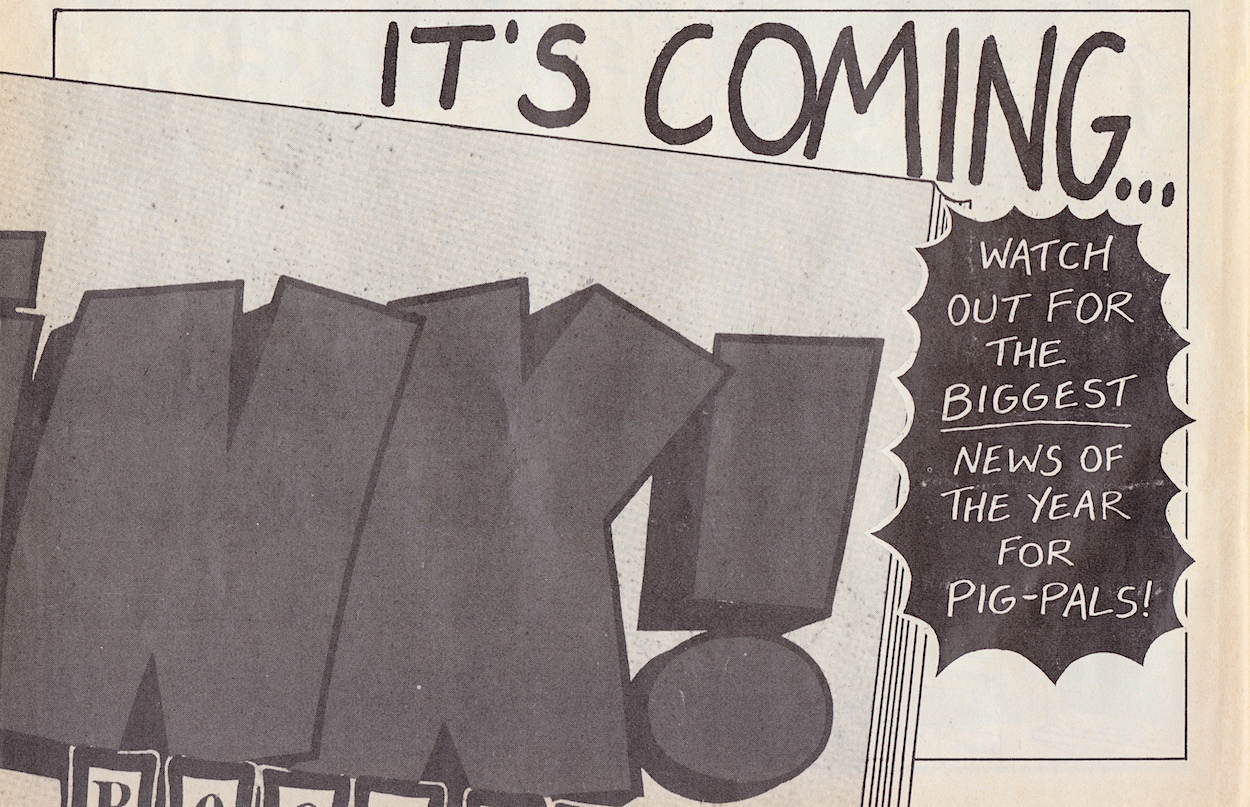
Taken from #44 of OiNK (the image at the top of the post is part of its cover), the comic turns weekly from its next issue so buckle up for more of pretty much everything for the next while. This year on the blog will also see the addition of not one but two new real time read throughs of Marvel UK fan favourites that many have requested (but which I always planned on covering anyway), there’ll be a sequel to one of the blog’s most popular comics and plenty more!
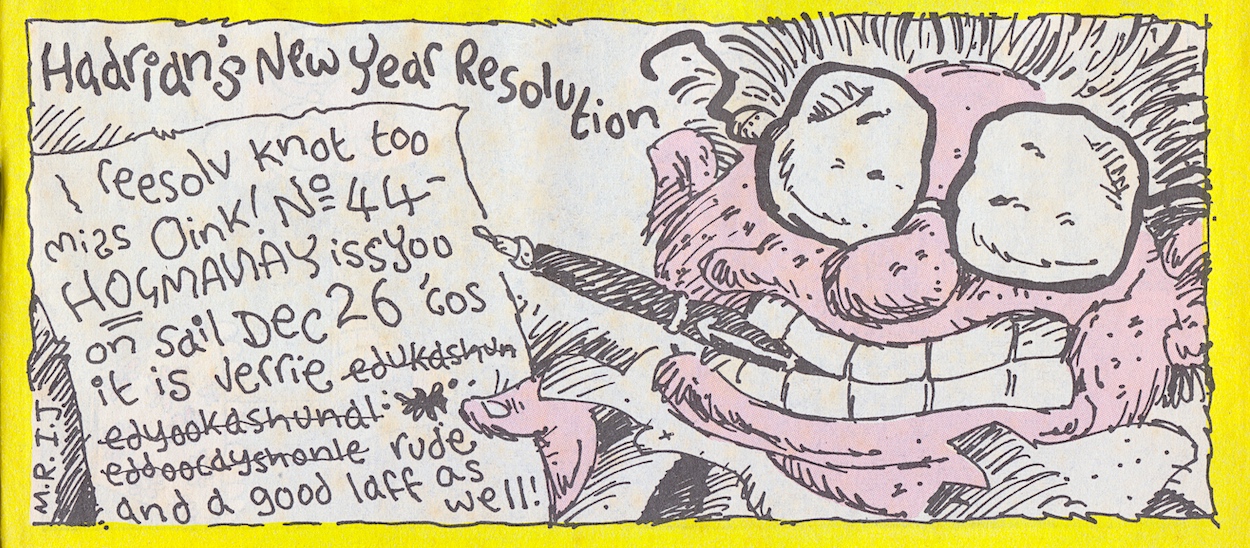
Big year ahead then. Thanks to everyone for your continued support, December has been the second most popular month on the site so far and the average stats are increasing all the time. I can’t begin to tell you how appreciative I am of every single one of you and I hope I can continue to write stuff you all want to read! Thanks again, and Happy HOGmanay!
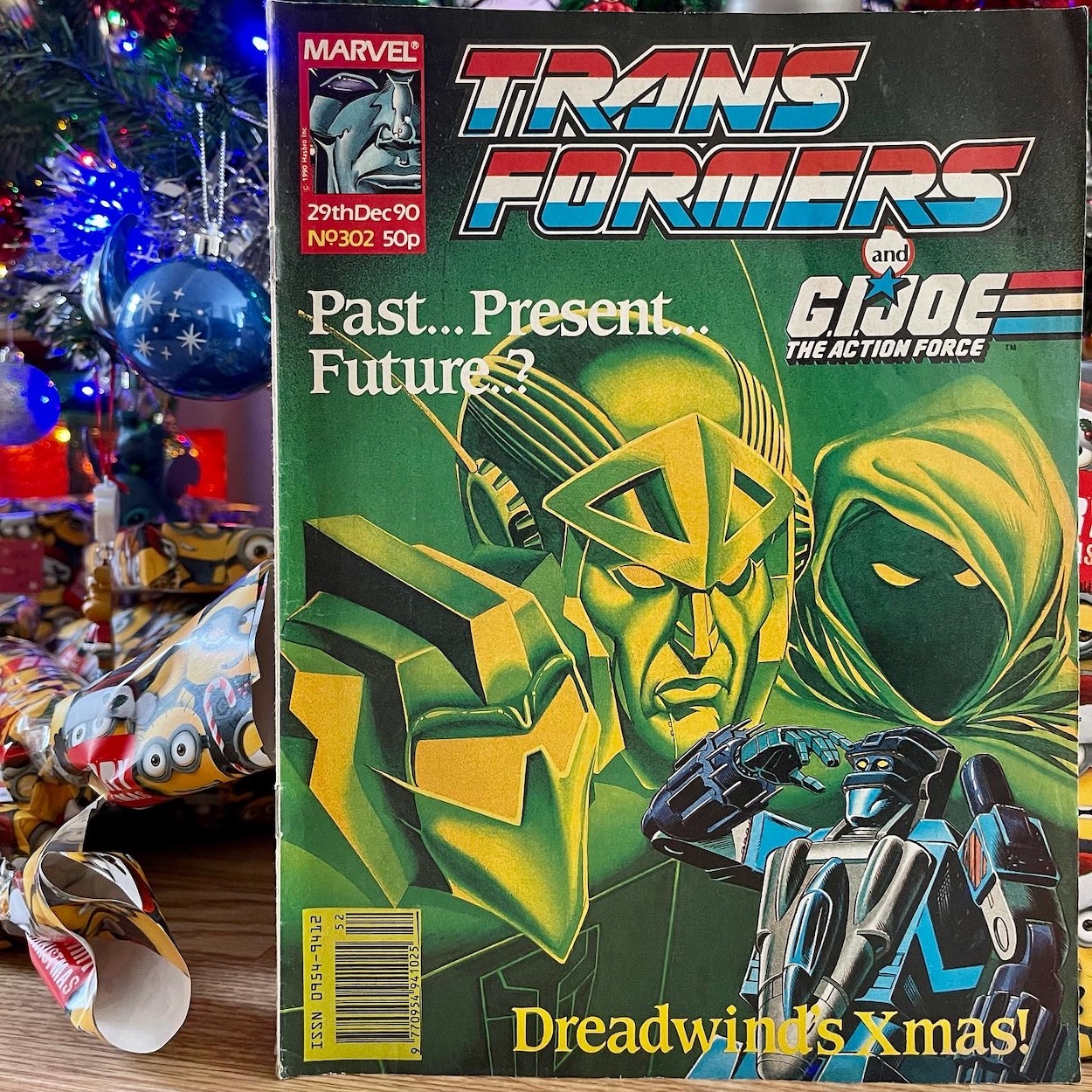
So you’ve opened all your presents, eaten your own weight in food and want to relax on the sofa with a good book this Christmas season. The holidays aren’t over yet and this week, which some refer to as ‘Void Week’ when we lose track of what day it even is, was always the time I’d start getting stuck into my annuals when I was a kid. You can carry on this fine tradition, not only here on the blog itself with the review of The OiNK! Book 1988 but also on Instagram where the real time read through of Marvel UK‘s Transformers has reached its seventh (yes, seventh) Christmas!
Cover by Stewart Johnson
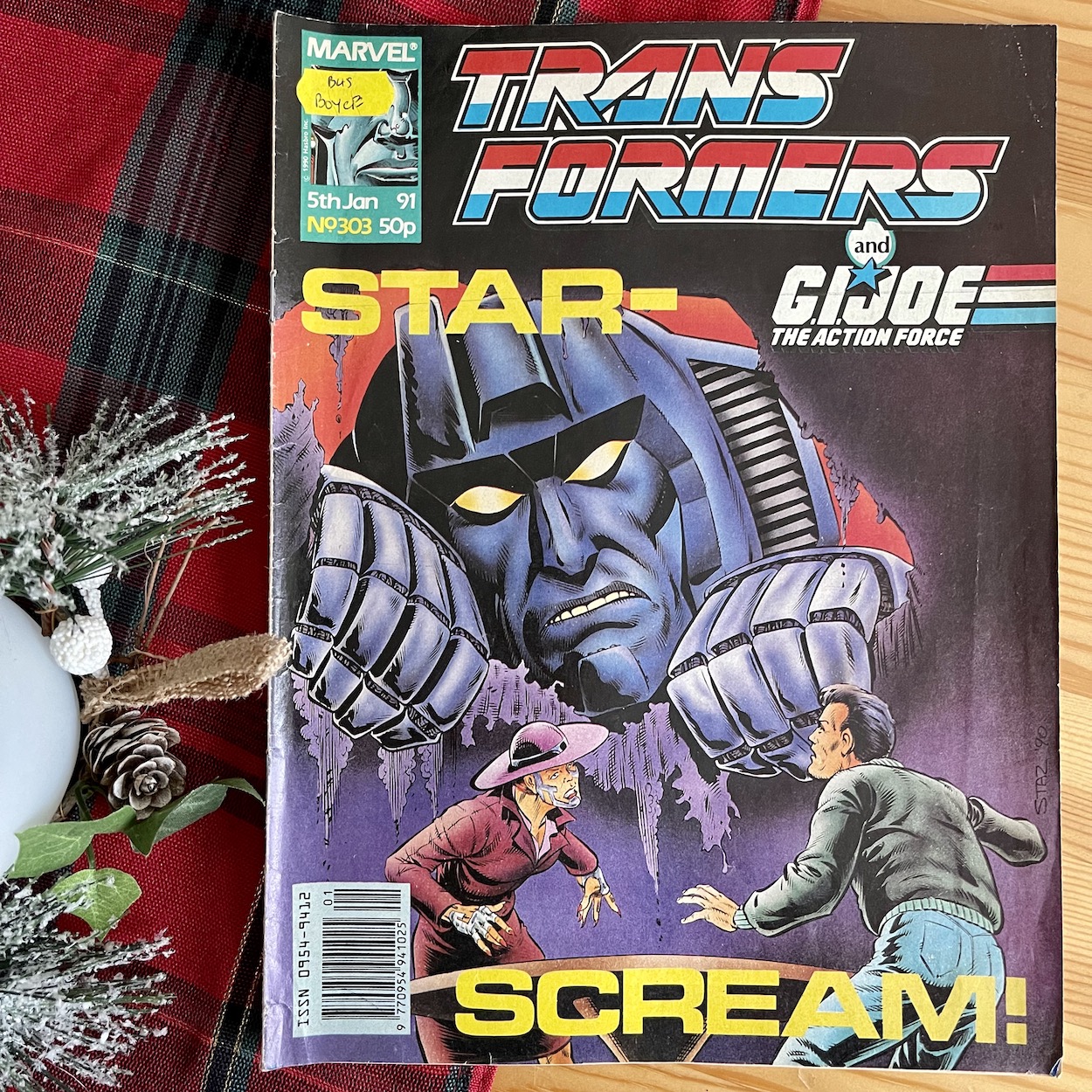
This post is just to let everyone know of that other read through, one that’s been carrying on since the days of the original blog. For over six years I’ve been reading this wonderful comic in real time, never reading ahead, always waiting for each Thursday to roll around (the dates corresponding to Saturdays at the time) to read the next chapter in the ongoing saga of the Autobots and the Decepticons, now at over 300 issues! As you’d expect, the issues are a bit extra special this time of the year and sit alongside the hardback book Santa would’ve brought us.
Cover by Geoff Senior
At this stage in its life the comic really is the best its ever been in my honest opinion, and from memory this final year (the read through will come to an end in January 2024) has some of the best stories, the most incredible art, the greatest characters and the biggest epics imaginable. It goes fortnightly soon which will make the wait between issues even more of a test of will power but each one will be worth the wait, I’m positive of that.
Cover by Stewart Johnson and Robin Bouttell
So come on over to the OiNK Blog‘s Instagram and follow along for some of the very best comics, licenced or otherwise, I’ve ever read! The Christmas and New Year issues and the annual from 1990 are the latest additions. The covers alone these next 12 months are worth the price of admission (which is nothing). The profile is public so if you don’t have an Instagram account and don’t want to sign up you won’t have to, just bookmark this page: https://www.instagram.com/oink_blog/
Happy New Year to one and all from David Haldane‘s Zootown! Wait, what? That can’t be right, it’s still Boxing Day! Actually, this second Hogmanay issue of OiNK was released even earlier, before Santa came to visit all of us pig pals. Boxing Day was the official date on the cover but with publishers closed for the holidays (and the shops themselves closing their doors for more than one day back then) comics and magazines are released earlier than normal over the festive period. I received my subscriber copy of Edge’s January issue weeks ago!
As such, this OiNK came out during the week before Christmas. I’ve no way of telling which day I received it in 1987 and I’m just going to stick with the cover date on this occasion, so while you recover from a day of eating and prepare for another, put your feet up, pop the paper hat back on your head and have a giggle with some highlights from OiNK #44, our last fortnightly issue.
I personally didn’t read this until Boxing Day as a child, although The Slugs finally making the cover (drawn as ever chaotically by Les ‘Lezz’ Barton) was very tempting. But even back then I wanted to wait until I’d read my OiNK! Book 1988 first. In fact, Boxing Day that year brings back many happy memories of sitting down and reading the annual cover-to-cover after dipping in and out over the course of Christmas Day, then in bed that night finally grabbing this issue.
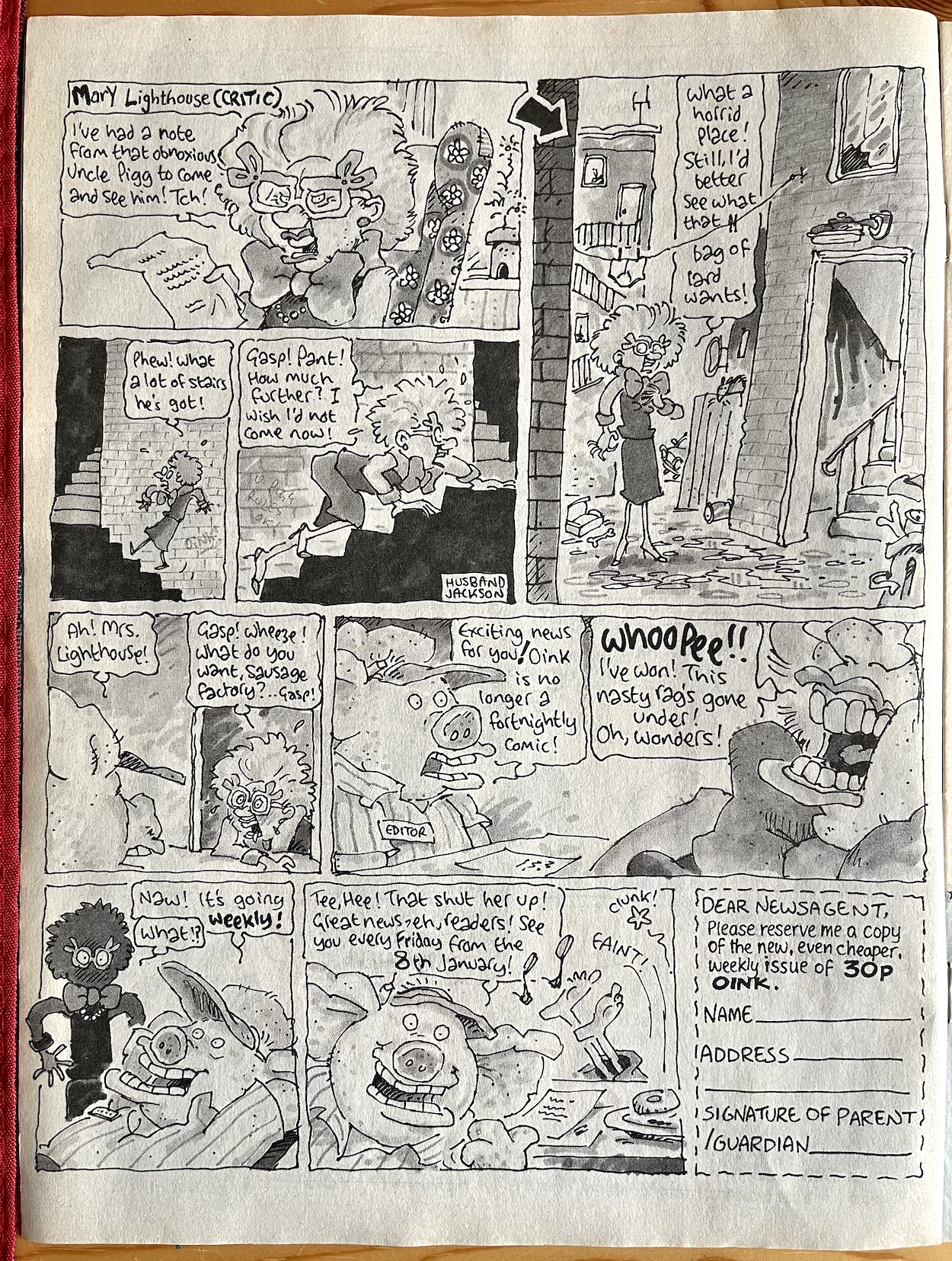
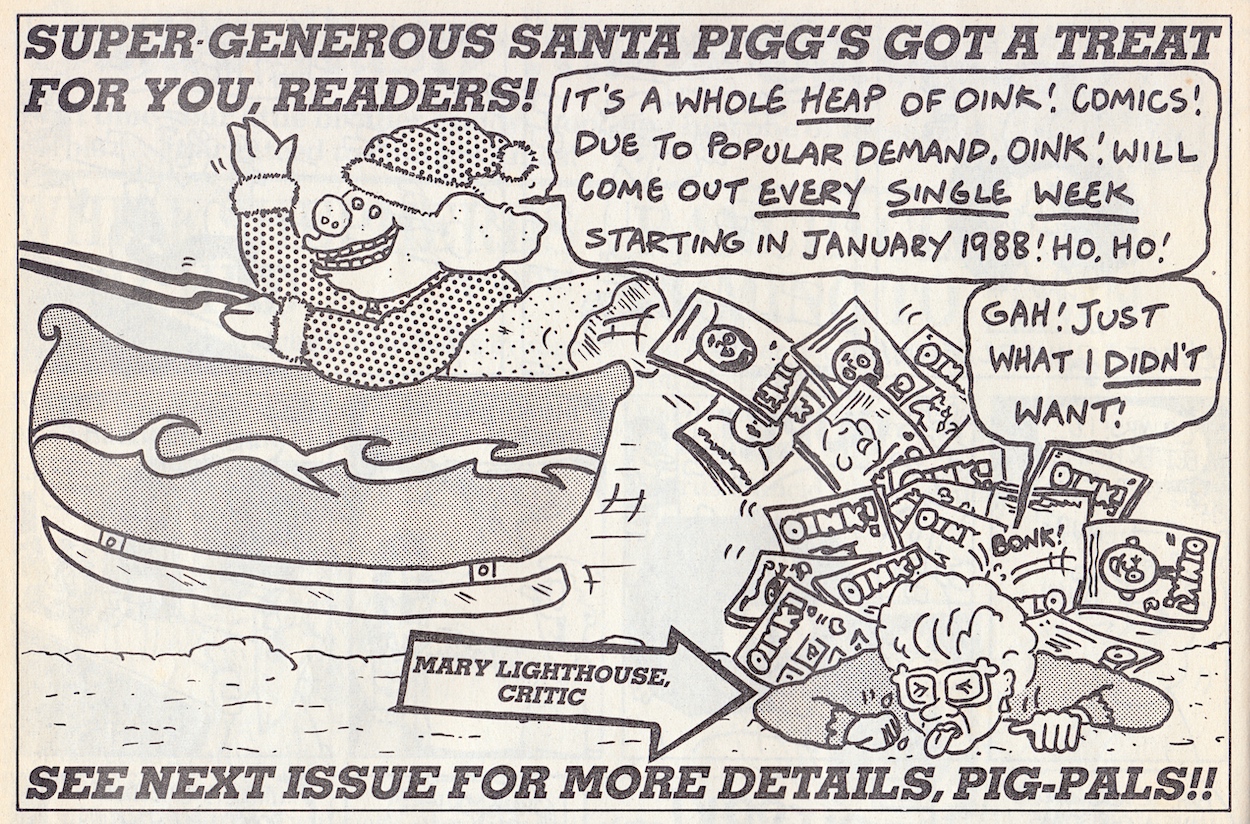
For young me the highlight wasn’t the theme, the festivities and the crazy parties our characters got involved in, instead it was all about the future of the comic, the big change I eluded to in #39’s review after Nipper, the last comic in OiNK’s sales group was cancelled. Given publisher Fleetway’s rule that if a whole group’s total sales weren’t up to par then every title in it would be cancelled, would OiNK’s own impressive sales possibly save it from cancellation? Uncle Pigg had some news for Mary Lighthouse (critic) on this front, as written by Mark Rodgers and drawn by Ian Jackson.
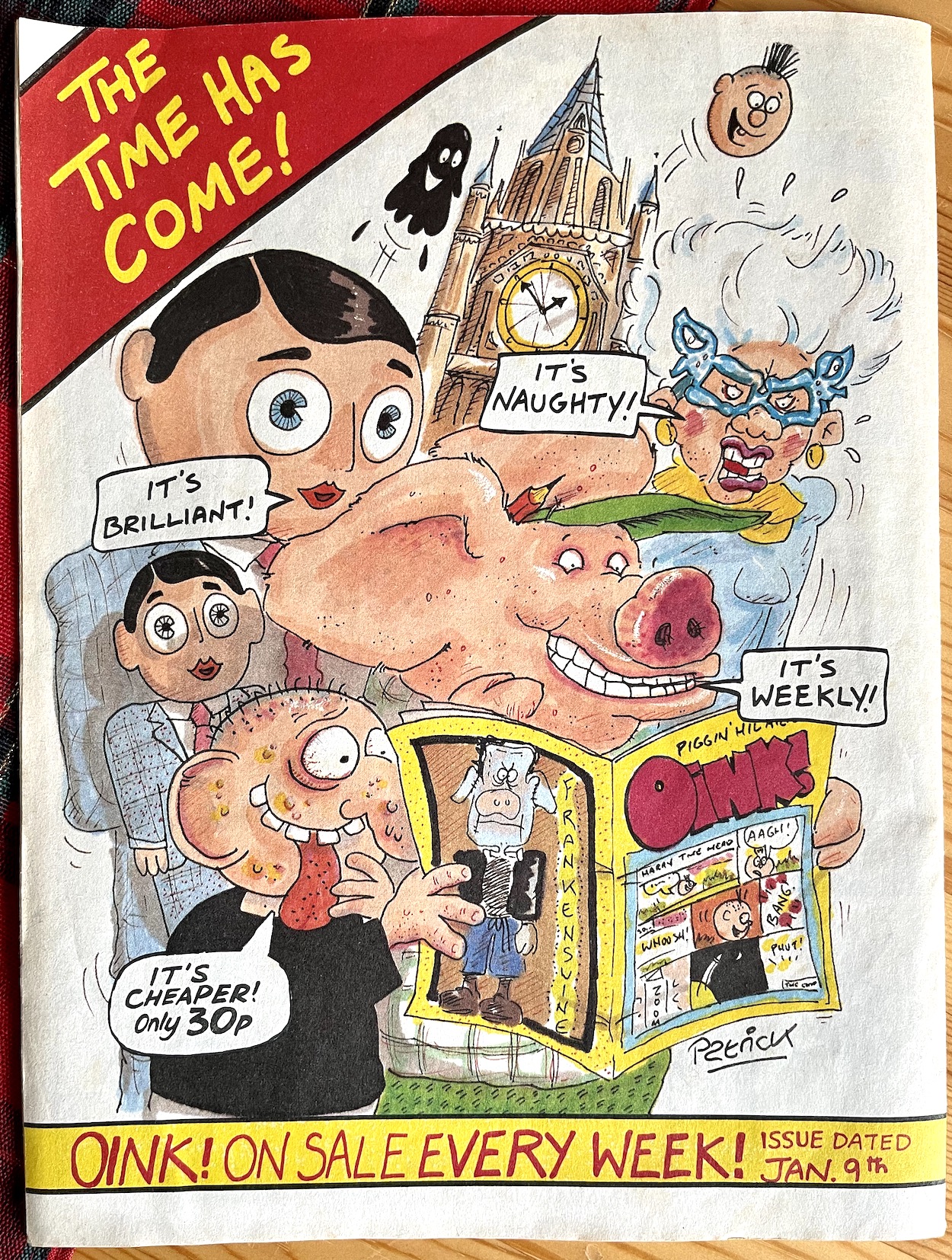
So while the other titles had been canned, and OiNK’s own sales may not have been in the same league as Buster or Whizzer and Chips, as an independently produced comic fortnightly sales of 100,000 weren’t to be sniffed at. But Fleetway (and retailers) wanted more. Doubling the amount of issues equals doubling the sales, right? Much hype had been made of the comic’s transition to a weekly in recent issues and I’ve included a couple of examples in the posts for #41 and #43.
I can remember the excitement of this moment after enjoying the Christmas issue and the book, the fact it was now going to come out every single week was almost too much for my young mind to handle! The price decreasing by 5p softened the blow for parents somewhat too. We were unaware of certain changes to be made to the physical comic and its contents but for now let’s enjoy the final issue in my own Golden Age of OiNK and the return of the increasingly shocking Butcher Watch.
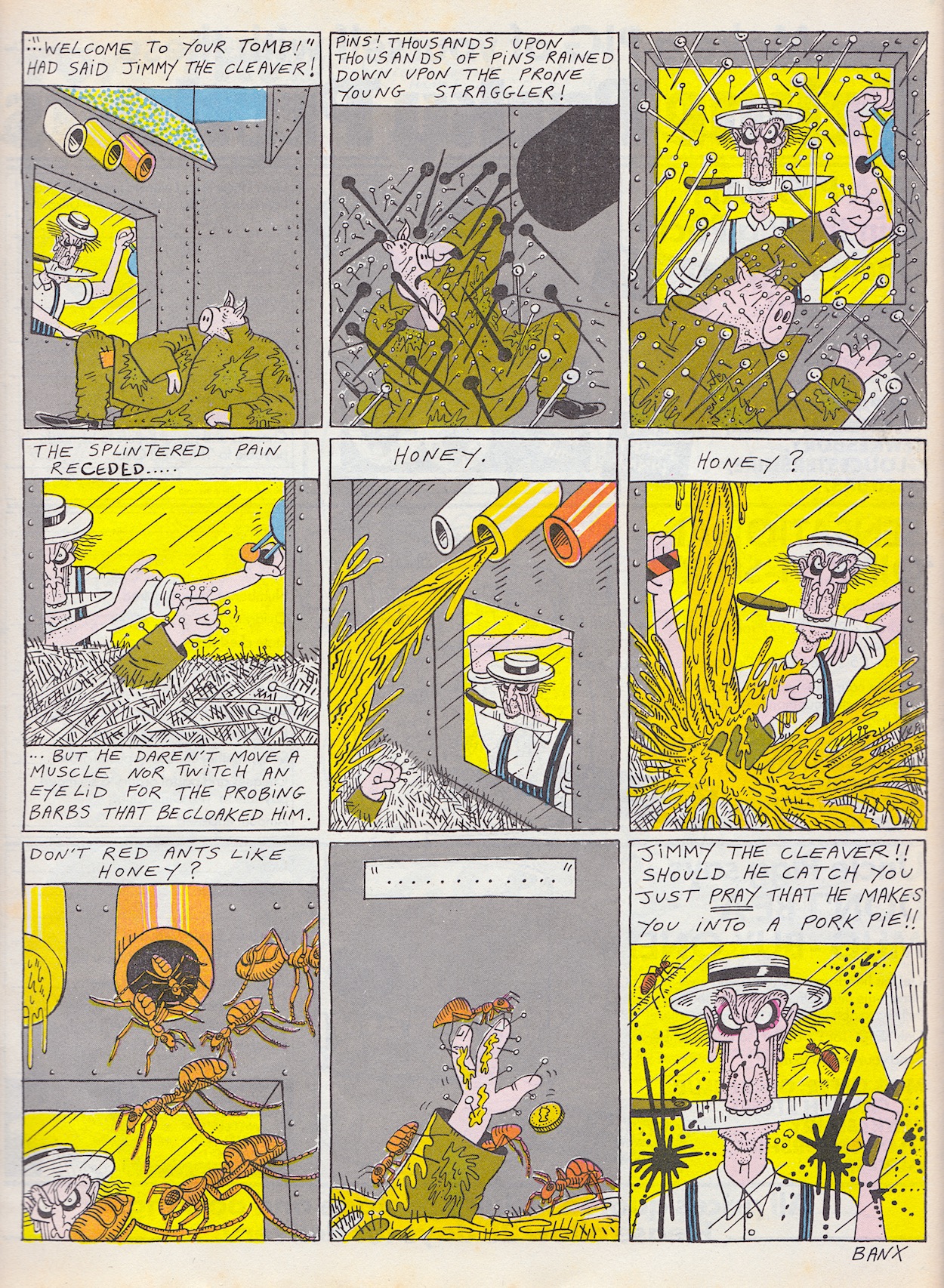
Given what would come from Jeremy Banx in a new mini-series in the weekly OiNK this dark strip acts almost like a precursor, reminding us just how twisted the evil butcher Jimmy ‘The Cleaver’ Smith really was. Have to give him points for imagination though. This would come to the fore with Jimmy as a regular character for at least some of the weekly issues. I was engrossed as a kid and now as an adult I find it all deliciously funny in a most ridiculous way.
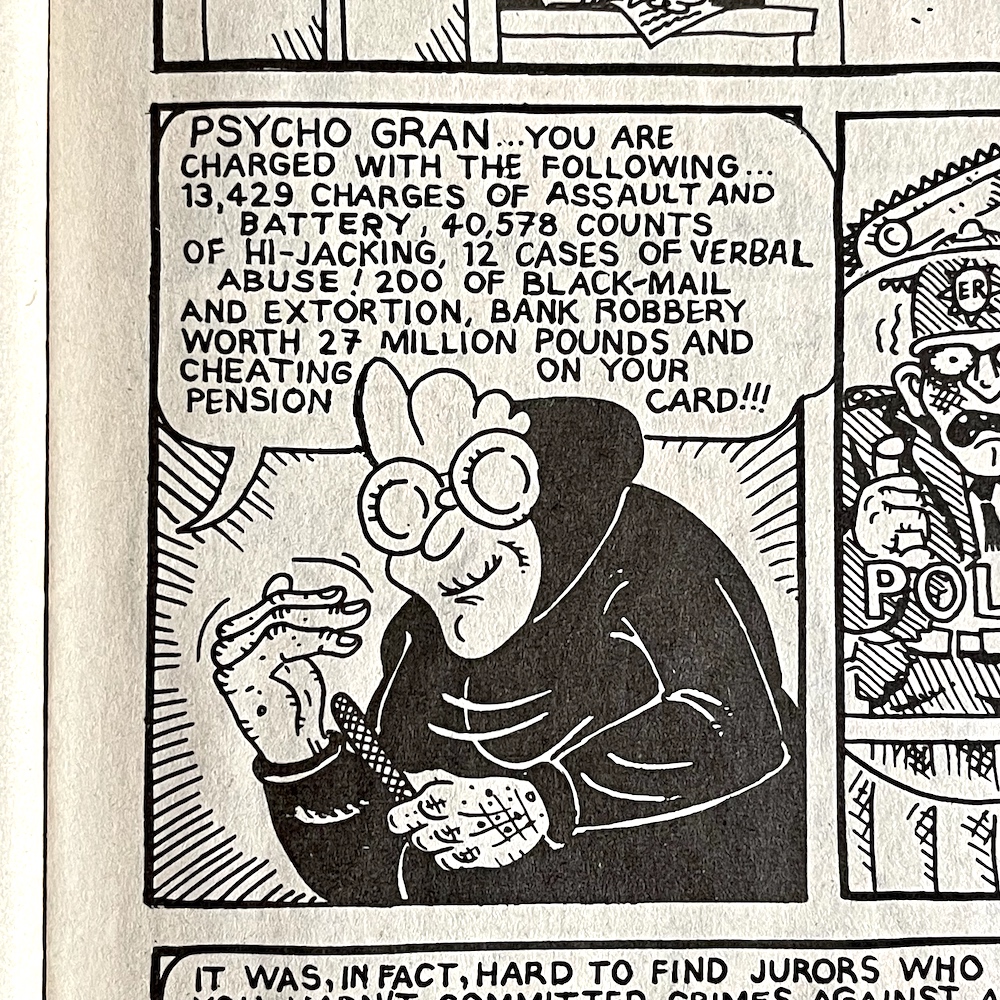
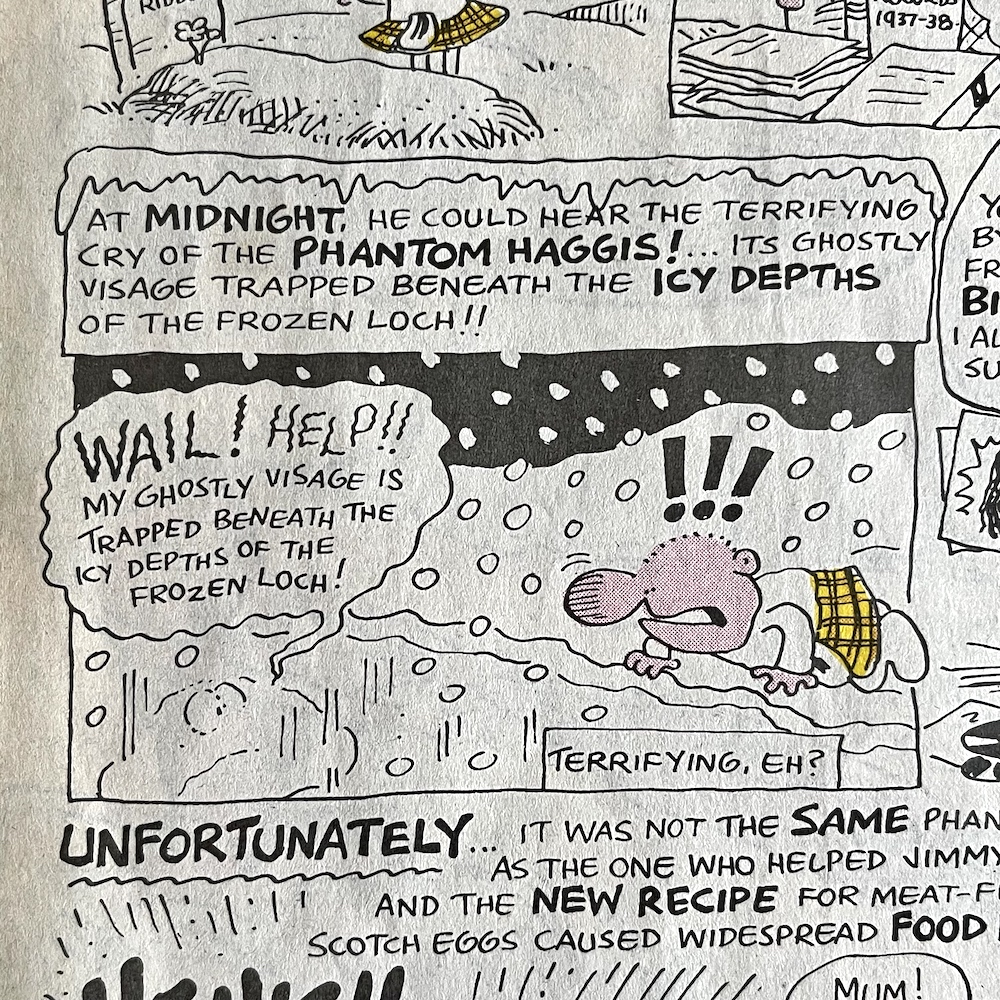
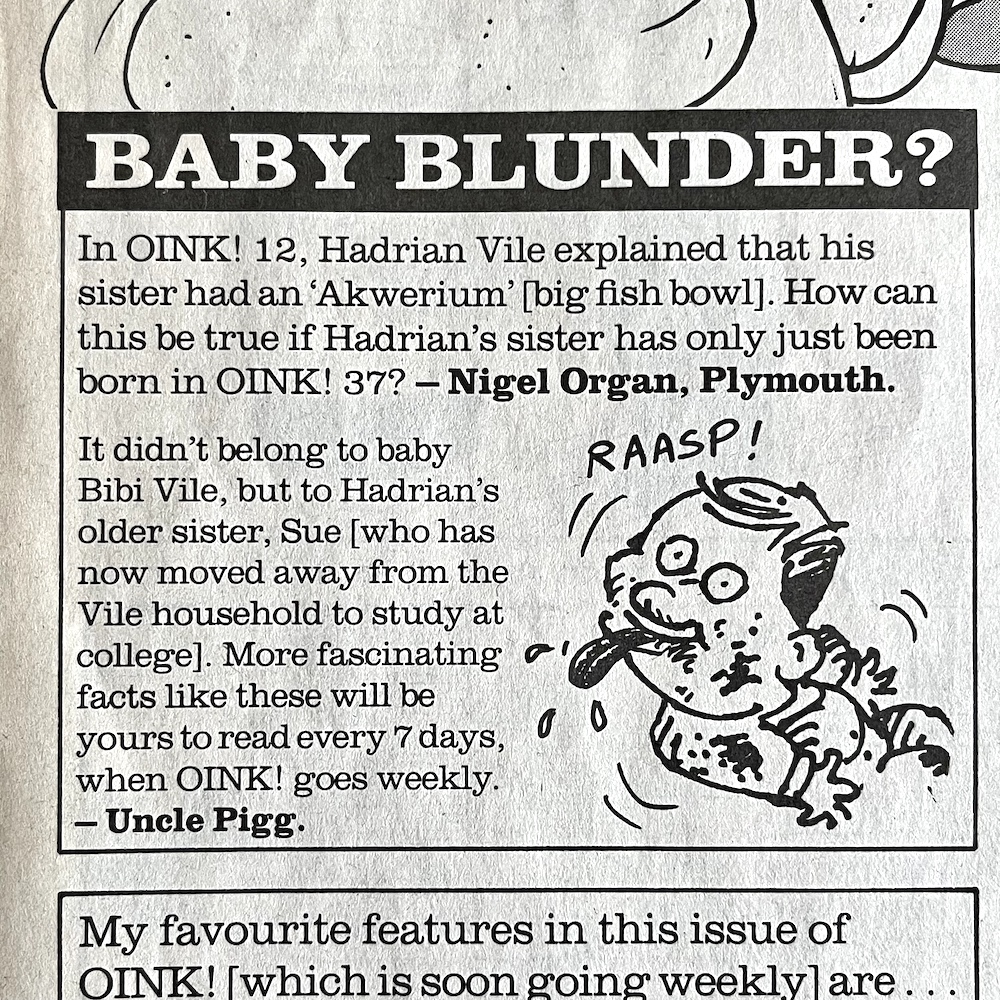
Let’s take a look at some other highlights of our last 32-page issue, shall we? After joining OiNK in #15Psycho Gran has racked up quite the list of examples of being a sweet but naughty (to say the least) old dear. Surely she couldn’t have been that bad? David Leach sets the record straight this issue. The Tale of Wee Jimmy Riddle tells us a horror story about a phantom haggis and on the Grunts page an old random line in a Diary ov Hadrian Vile from #12 gets picked up on by a reader following recent events.
Psycho Gran by David Leach Jimmy Riddle written by Vaughan Brunt, drawn by Mitch Grunts compiled by Patrick Gallagher
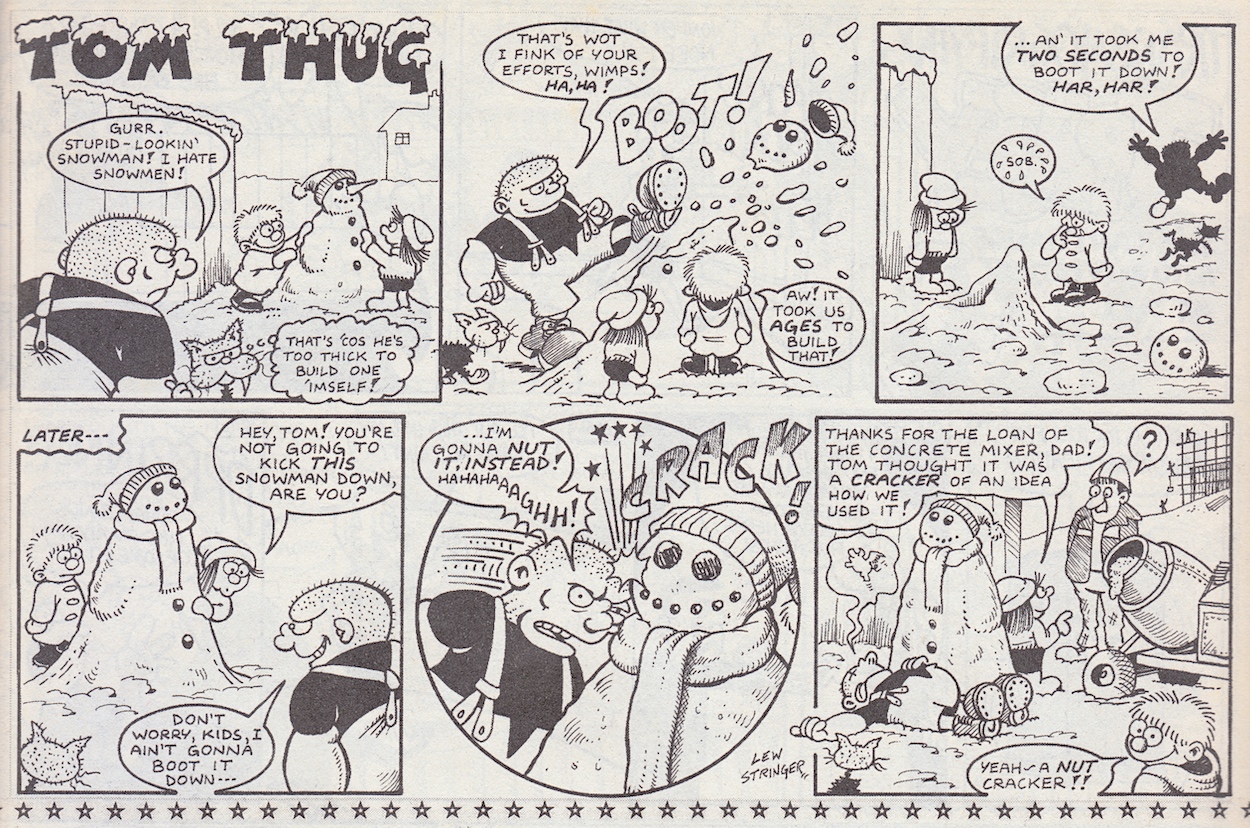
Tom Thug and Pete and his Pimple were two of the comic’s strips that would make their way into the pages of Buster by the end of 1988 and when OiNK goes weekly they’d permanently be full-page stories, rather than surprising us every issue with strips of various lengths which I have preferred. With the more random nature we were sometimes treated to lengthy stories with a great pay off, sometimes a quick gag. This next one falls somewhere in between.
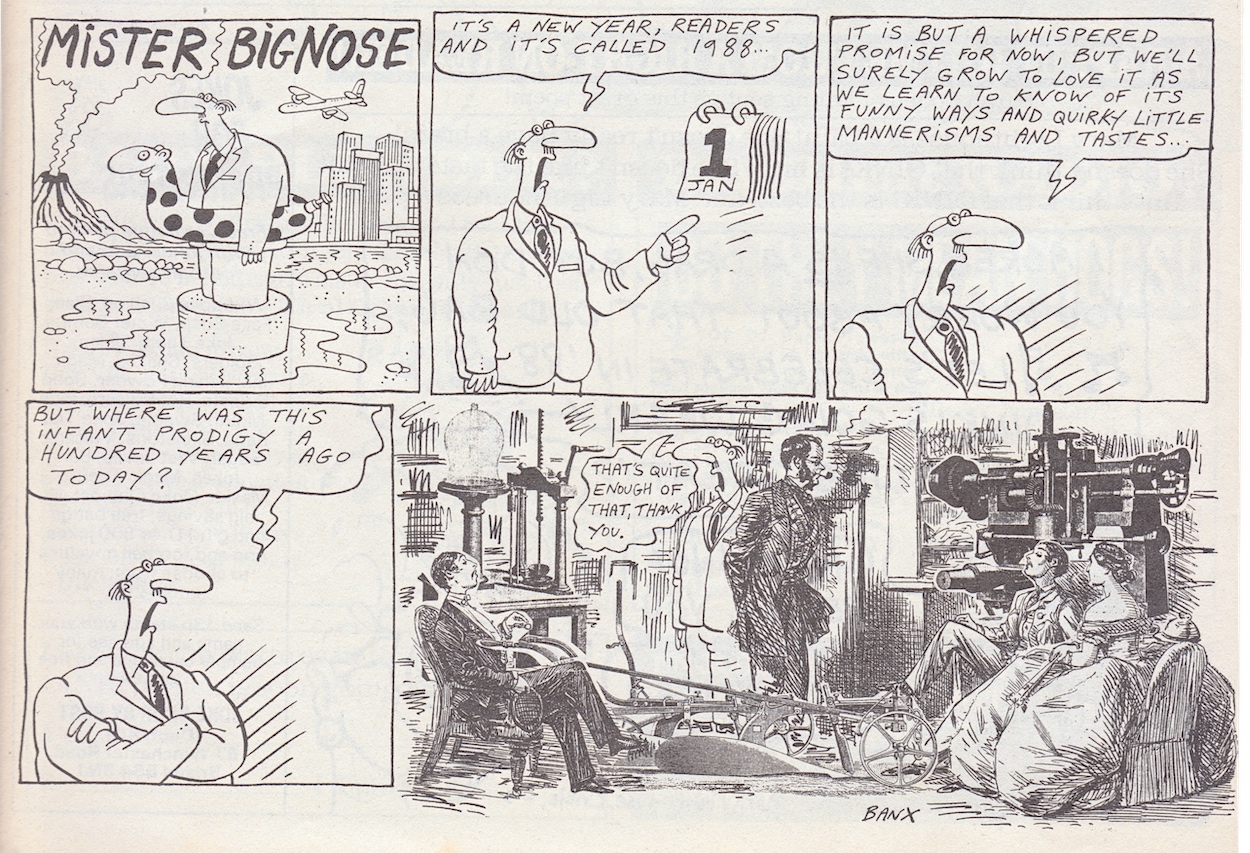
So long Mr Big Nose, it’s been funny, surreal, confusing and memorable in equal measure
Now that I’ve read this I have clear memories of giggling away at it on at least one of the many occasions I read and reread my OiNKs back then. Lew Stringer always said the whole point of Tom was for there to be a strip where a bully (and the usual intelligence level of a bully) was the butt of the joke every single issue. I don’t think there’s any better example than this one right here.
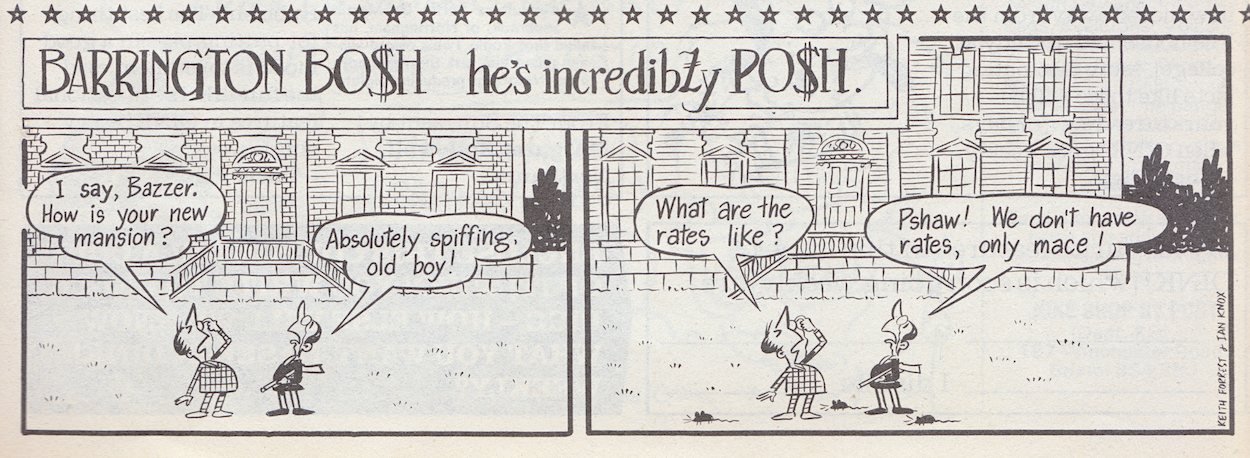
Another character who would pop up in strips of various length was Barrington Bosh, He’s Incredibly Posh who was always drawn by Ian Knox and scripted by a variety of writers. This time it’s Keith Forrest who uses Barrington’s posh accent to great effect here. Small, simple but brilliantly crafted, the teeny tiny small strips were always a joy in OiNK and pretty much guaranteed to raise a laugh, as well as breaking up the larger contributions to each issue.
Moving on, he’s entertained us ever since #3, introduced us to surreal humour, was never predictable and of course brought us the dolphin named Keith. Jeremy Banx’s Mr Big Nose was about as unique as you could ever get in a children’s comic and is one of the most fondly remembered characters from OiNK as a whole. I’ve always said a collection of his strips would make for one of the funniest books you could read, even now 35 years later. That makes the fact this is his final issue all the more sad.
He wouldn’t even pop up in any special or annual, this is it, the final Mr Big Nose. The weekly comic would have fewer pages and Jeremy would continue with Burp and that aforementioned mini-series featuring Jimmy. I originally thought perhaps the weekly comic was aiming at a younger audience (there’d be promotional crossover strips in Buster and Whizzer and Chips) and the surreal humour of Mr Big Nose wouldn’t be a good fit, but that Cleaver series is very dark indeed so it can’t have been that.
But at least he goes out in style.
Explain that one! Of course, the best of his strips defied explanation and, while I’m saddened to know I won’t be reading any more of his wonderful surrealism, this is the perfect example to end on. That final line could almost be taken as a little sign off. With space at a premium in the weekly and Jeremy already committed to two full pages it just boiled down to something having to give and Mr Big Nose stepping aside to make way for other strips. So long dear friend, it’s been funny, surreal, confusing and memorable in equal measure.
To end on, a little nursery rhyme. Innocent little stories for kids. Nothing could possibly be twisted with these, surely? The Rotten Rhymes series periodically popped up throughout OiNK’s run and proved nothing was sacred. Many of these quick little rhymes (often ending by tossing away the need to rhyme at all) have proven surprisingly memorable. How many have pig pals recited in the years since? Here’s the latest in the series and the first one by Charlie Brooker.
Well that’s it. Not only is this the end of the issue, it’s also the end of the only year in which we had regular OiNKs from beginning to end, it’s the end of it in its original form and it’s the end of what I called OiNK’s Golden Age. That’s not to say what’s to come isn’t great of course! It takes a while for the comic to settle into the new weekly version of itself (same when it turns monthly later next year) but when it did it was easily the best weekly out there.
It’s just that this period of time, between #36 and this one and including The OiNK! Book 1988, were just so good they could each be listed as examples of the very best OiNK had to offer. If all issues were ranked I think these would all be at the top of that list, and we got to enjoy them in one glorious chunk, one after the other. I’ve had a fantastic time reliving these and, while there are changes ahead, we’re still going to be getting weekly OiNK reviews for the first five months of the new year.
More OiNK is always good, right? Of course it is, as illustrated by co-editor Patrick Gallagher‘s back page here.
The review of OiNK! Weekly #45 will be up on the blog on Saturday (yes, a change of day) 7th January 2023, just 12 days from now.
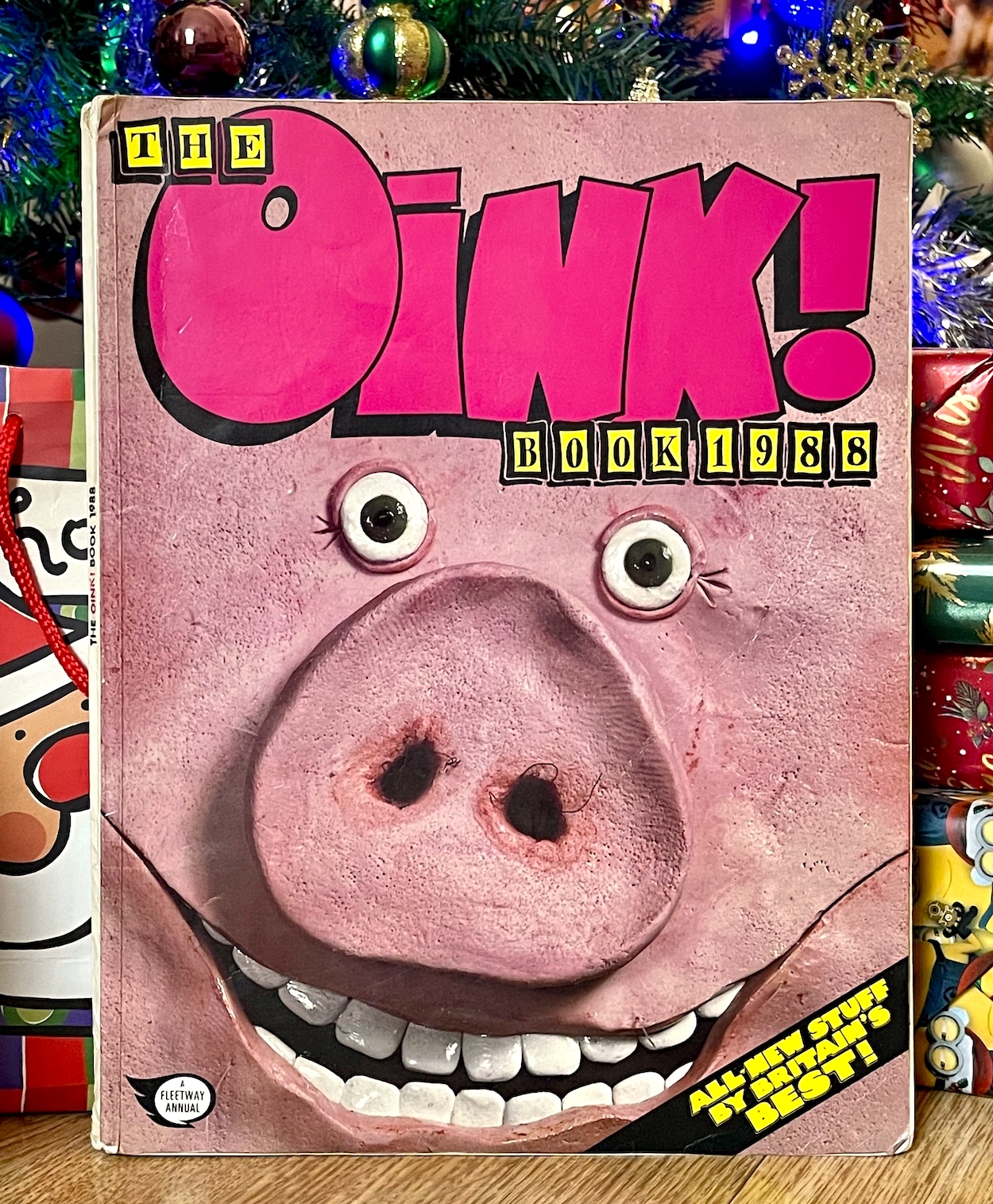
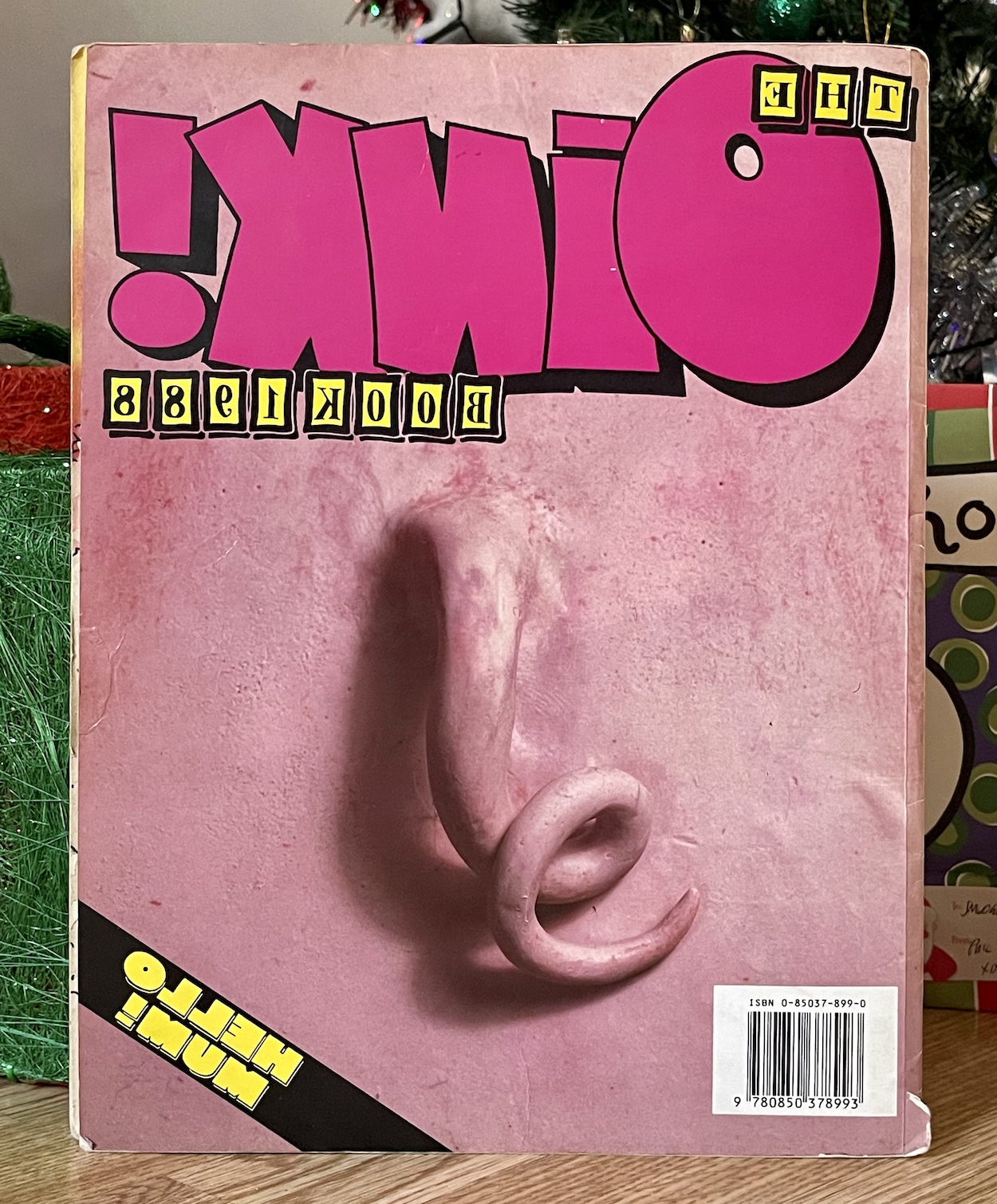
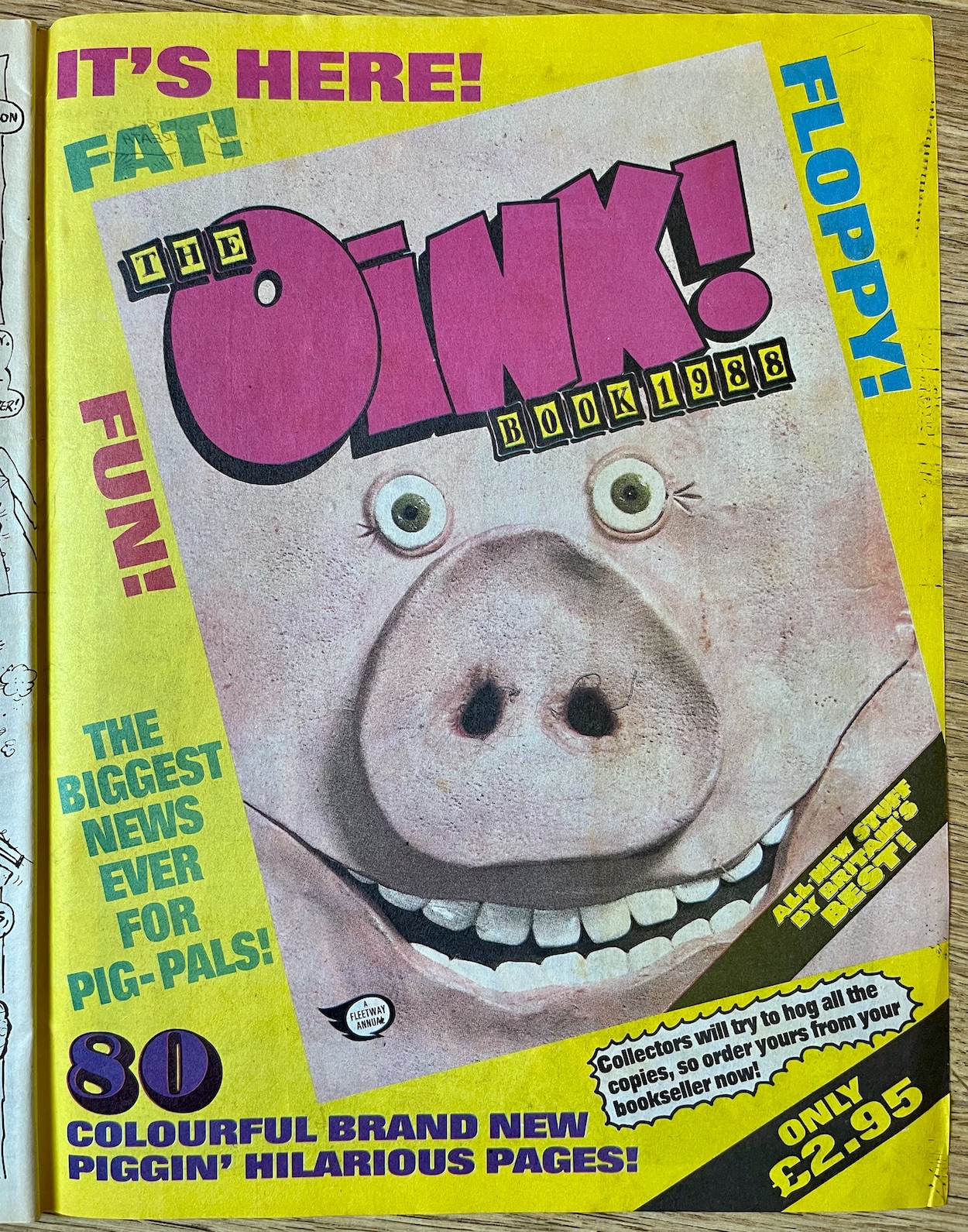
How many of you can remember coming downstairs on Christmas morning and seeing this cheery face staring back at you? I’d been giddy at getting my hands on this ever since I saw it in my local newsagents a few months previous. It really stood out with its glossy soft cover in the sea of cardboard hardbacks. Inside, all 80 interior pages are made of a thick, high quality stock, giving the book a heavy, expensive feel. Co-editor Patrick Gallagher tells me, “The higher-quality paper stock of the book was the idea of Bob Paynter at Fleetway. Bob was completely on our wavelength and knew it would appeal. The floppy glossy cover and back also seemed to really suit the enlarged shots of the plasticine pig face and bottom models Ian Jackson made by capturing the detail so well.”
UPDATE: I’ve since spoken with Ian (some three years later) and the cover wasn’t made by him! You can read more about this and see the original rear cover in a special post of when I chatted to photographer Ian Tilton.
Before this I’d read some of my brother’s Beano annuals but to my young mind they felt just like regular stories but with bigger panels to fill more pages. But The OiNK! Book 1988 was, as ever, different. This first book packed in as much as it possibly could to every single page. As a result, it may have had roughly 30 pages less than its contemporaries but it had so much more in there to read and enjoy. It all began with that famous cover, especially when you flipped it over but we’ll get to that later. While it didn’t really sink in as a kid, that claim on the bottom right is bold and of course completely correct. Inside, a special bookend of Uncle Pigg and Mary Lighthouse introduced that team to readers.
This was innovative for a time when signatures in humour comics were rare, but OiNK’s young readers knew the names of their favourite cartoonists thanks to its creators Patrick Gallagher, Mark Rodgers and Tony Husband and their wish to shakes things up. As an adult I can’t help but look at this page in wonderment at the list of talent involved. It really was a selection of Britain’s best and it was all for us kids. We were spoiled. I also love how the chiselled words work their way around the characters and speech balloons, which makes zero sense to the chiseler!
It’s a wonderfully varied read, containing strips from our favourite regulars, some returning stars of early issues, spoofs of those other annuals I mentioned, puzzles (not filler here but typical OiNK-style funnies) and even letters and drawings from readers, something annuals just never included. So how on Earth am I going to choose a few highlights? There’s just too much brilliance on offer. It’s been painstaking but I hope I can do it justice with this selection.
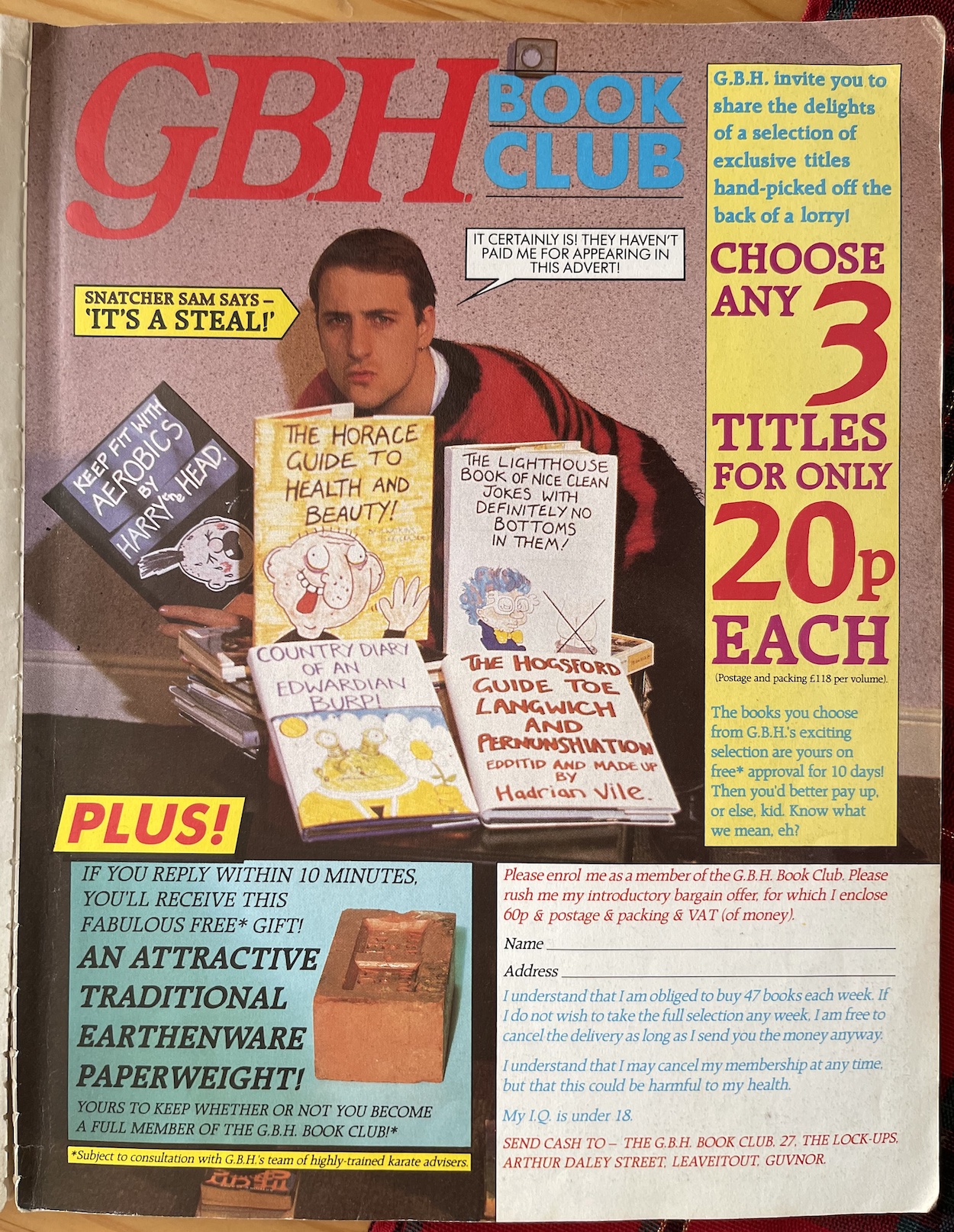
This is one of my most memorable pages, with Marc Riley as the not-at-all inconspicuous burglar, Snatcher Sam in GBH’s Book Club, a take on those book and video clubs that were so popular in the 80s and 90s. Magazines and comics were filled with them, promising cheap titles to begin with as you sign yourself up to buying a certain amount at full price over a year. I was a member of the Britannia Video Club, remember them? That’s why I loved this so much, along with the usual over-the-top nature of the GBH madverts and just look at all those book covers they’ve created for the photograph. Now, 35 years later it’s the effort put into these daft pages that I really appreciate.
Released for Christmas 1987, this was the year I would turn ten-years-old in the festive season and I was hearing a lot of rumours in the playground about Santa Claus. Thankfully I soon found out they were just rumours when he left my book under my parents’ wardrobe before Christmas because demand for it was so high and he didn’t want to disappoint me. The rumours of his existence were conclusively put to bed with a script by Lew Stringer that’s spectacularly brought to the page by 2000AD stalwart Kevin O’Neill, who we sadly said goodbye to earlier this year. There’s more to The Truth About Santa than we probably wanted to know as ten-year-olds.
There’s an image that’ll stay with you. Or haunt you. I remember this being the strip any friends who read this book at the time seemed to laugh at the most. I may have been the only one of my closest friends who collected OiNK but they all enjoyed reading my issues and in particular this book. In fact, in the year 2000 when I decided to return to college at the age of 23 the book ended up shared around that class too. I can’t remember how it came up in conversation originally, but I dug it out from my cupboard and it made its way around most of my fellow media students, each one of which found it just as hilarious as I had.
To this day it’s still one of my favourite books (of any type) of all time and definitely my favourite from childhood. In fact this is my original copy from back then, only one of three OiNKs that survived various clear-outs (by my dad) and moving out years later. Its timeless comedy is a testament to the talent it boasted about on the cover. Just like the regular comic it sets itself apart from other annuals. While they’d have had huge multi-page versions of their regular strips, here for the most part OiNK kept them to the size they’d normally be, meaning there was a hell of a lot more of them packed in.
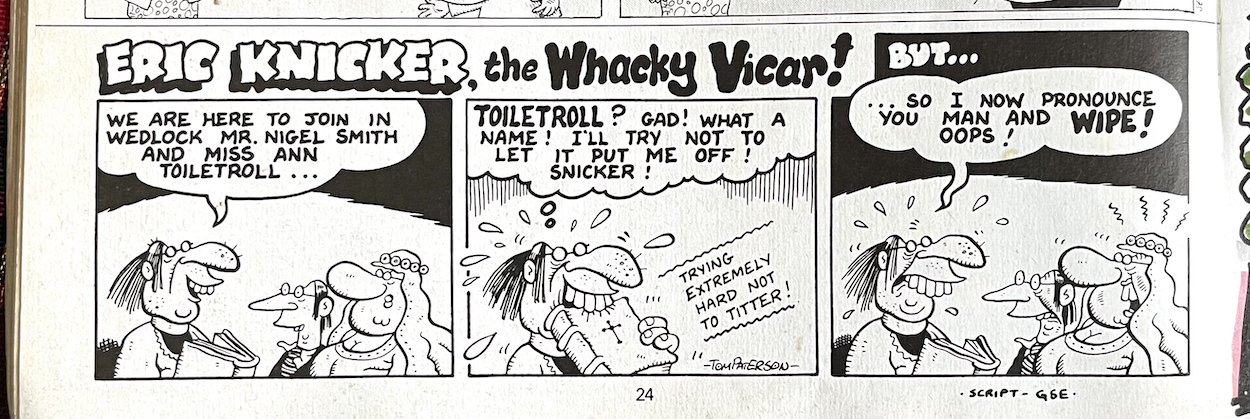
Annuals are created far in advance of their release dates so when this one was being put together the ever fantastic Tom Paterson was still a contributor to the comic. Written by the pun-tastic Graham Exton, Eric Knicker the Whacky Vicar may only have been a tiny quarter-page strip but it left a lasting impression on little me during Christmas 1987 as I tittered and giggled and shared the joke with friends and family. A lot better than any cracker joke.
So yes, the annual kept to the format of the comic, only more so. It’s a delight to see the creative team took the opportunity to simply cram much more in of what made OiNK so great in the first place. For a child of ten there was just so much to enjoy. We even got a short Ham Dare strip. His two-page story is a hoot and is followed by this even funnier, wonderful cutaway of his and Pigby’s ship.
Written by Lew Stringer and drawn by the incredible talent that was J.T. Dogg (Malcolm Douglas) it’s chock full of little details that my young eyes really enjoyed pouring over. My favourite parts are the comfy chair and its very dangerous sidestool, and the middle of the spacecraft showing the difference between our heroes, with Ham’s gym next door to Pigby’s very full pantry.
A quick note about the title box at the top of the spread. It makes a great point! My Transformers and Real Ghostbusters annuals would have had “pin-ups” and “mini posters” and I always wondered if anyone actually cut up their fantastic annuals, losing whatever was on the backs of those pages to the walls of their room. I’m glad I wasn’t the only one at the time who thought this was a ridiculous idea.
Hadrian Vile’s usual diary entries take a back seat to a selection of pages chronicling his Interleckshual guide toe Nacheral Histry
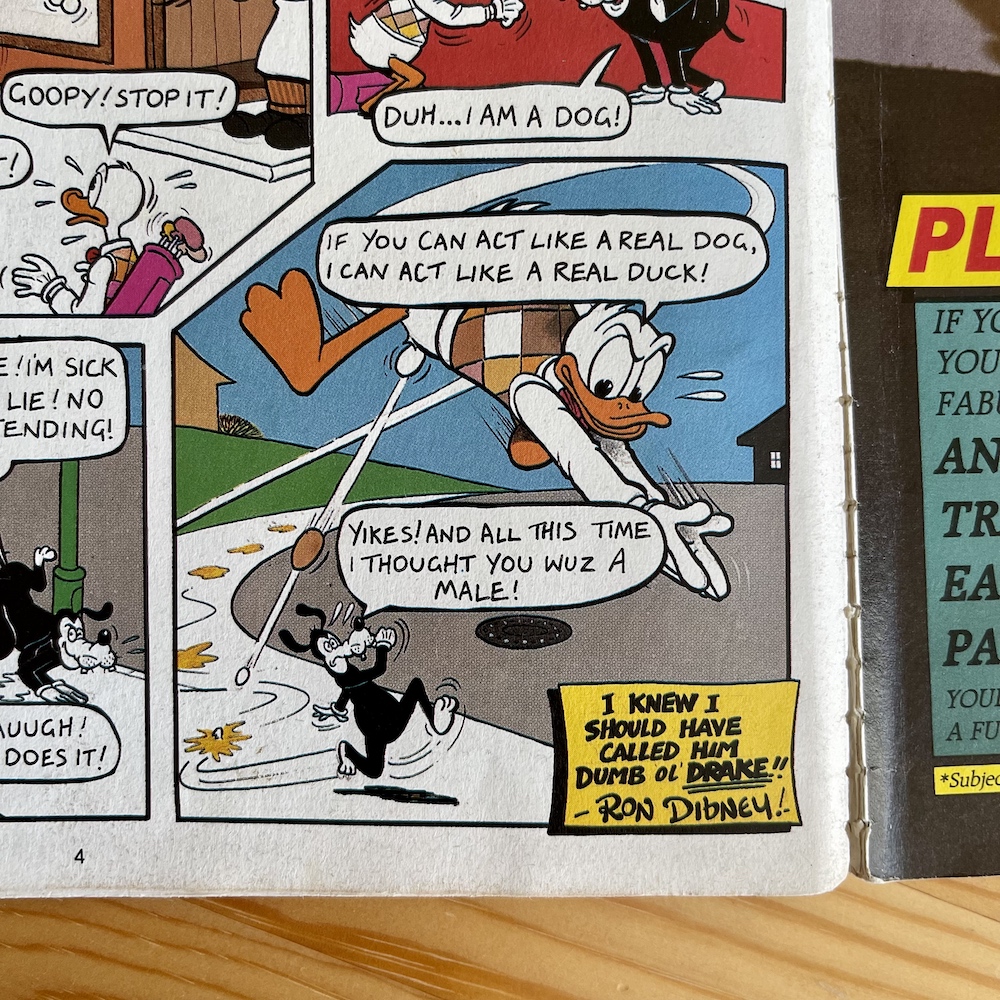
A quick glance over some other highlights now. Ron Dibney’s Dumb Ol’ Duck reveals another side to himself, Police Vet makes his debut (he’d return in the monthlies the following year) many years before Jim Carrey took on a similar role and Star Truck makes a very welcome return. Just as in #3 the crew make their presence felt throughout the book in between chapters of their own strip. Here, Mark Rodgers literally pops up as Captain Slog in one of Horace (Ugly Face) Watkins‘ pages.
Dumb Ol’ Duck written by Mark Rodgers, drawn by Swoffs Police Vet written by Mark Rodgers, drawn by Wilkie Horace Watkins by Tony Husband
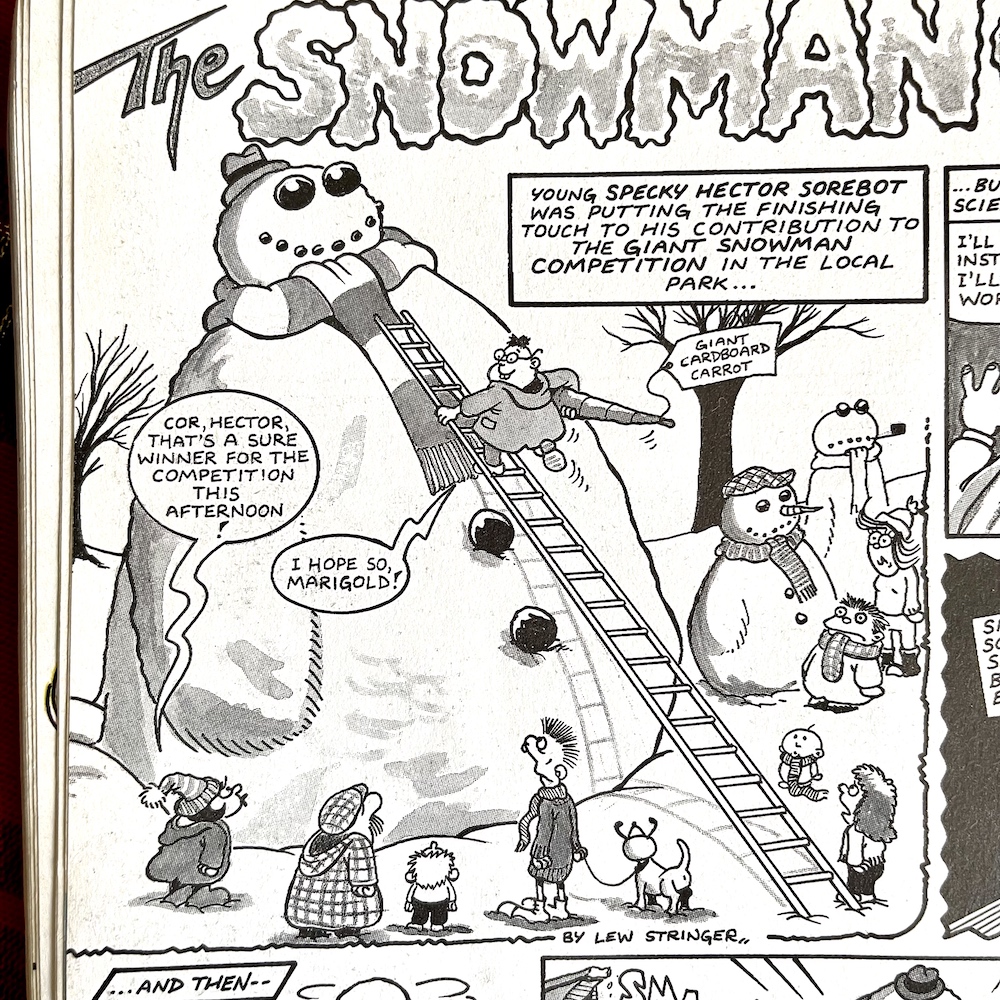
Pigswilla only appeared in seven issues of OiNK altogether but he was still a firm fan favourite, so naturally he had to appear in the annual, with Specky Hector Comics Collector (with added surname) making a funny cameo I’d forgotten all about. Early in the book Frank Sidebottom found out Little Frank had used up all his felt tips and gave him until page 69 to fix the situation, which he does, sort of. It appears young me at least started to lend them both a hand.
Pigswilla by Lew Stringer Frank Sidebottom by Chris Sievey Hadrian Vile written by Mark Rodgers, drawn by Ian Jackson
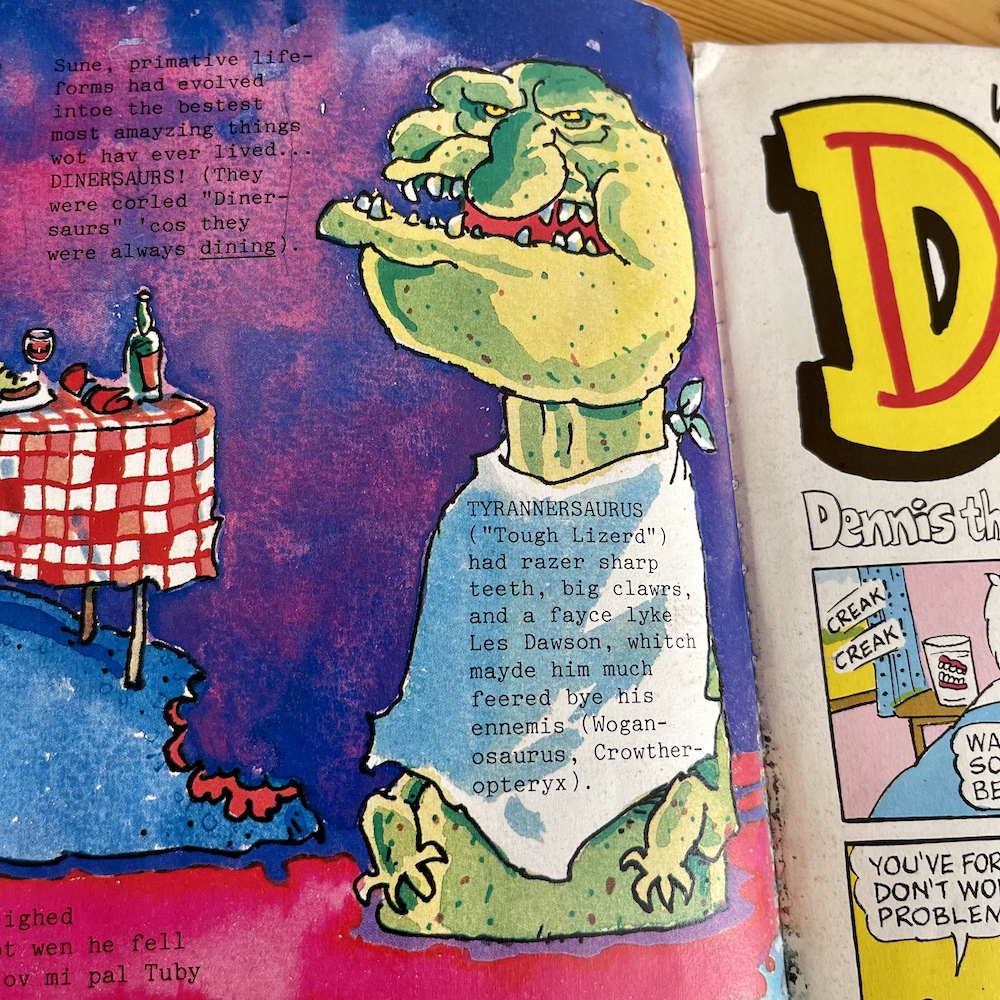
Hadrian Vile’s usual diary entries take a back seat to a selection of pages chronicling his Interleckshual guide toe Nacheral Histry, although he does take some short cuts to get from the evolution of life to the 1980s. His usual know-it-all persona is, as always, hilariously wrong in almost every way. In his fortnightly diary he was the most intelligent person in any room. Well, in his own mind anyway and here his guide to everything from dinosaurs (the hilarious looking Tyrannosaurus rex above is a highlight) to Ford Sierras.
In fact, after spending the first two parts of his guide covering prehistoric Earth he only has one page left to finish up and so this third page makes the leap from the ice age to the aforementioned car in the blink of an eye, clearly skipping millions of years as completely uninteresting. It’s all as hilarious as you’d expect from Mark Rodgers, made all the more special with full colour Ian Jackson art. In fact, so good is it that when the weekly comic itself gets going the diary will eventually be replaced with a series of similar guides.
1987 also saw the 50th anniversary of The Dandy (with Beano’s to come in 1988) hence why OiNK took aim at DC Thomson’s comics with regular digs about how old the characters would really be, such as #38’s Deano. In fact, I received the commemorative 50th anniversary book alongside my OiNK! Book (and The Big Comic Book 1988), although in hindsight I think it was originally for my brother but he stopped reading comics not long before Christmas. Oh well, his loss was my gain.
Returning to that spoof comic name, here the OiNK team take it to even greater heights (although this was probably created first) with a mini-comic inside the annual featuring such characters as Dennis the Pensioner and his dog Flasher, Desperate Old Man and the The Lash St. Old People. All are very funny and then we get a double-page spread of no less than five spoof strips which as a kid were funny, but as an adult are hugely surprising because four are drawn by none other than John Geering!
John was a regular artist for DC Thomson, in fact that’s the publisher he’s most closely associated with, most famously for Bananaman and Puss’n’Boots. To see him take on some of DCT’s characters in OiNK just makes these even funnier than they already were in my opinion. I do remember showing these to my friends who were huge fans of The Beano at the time. Can you blame me?
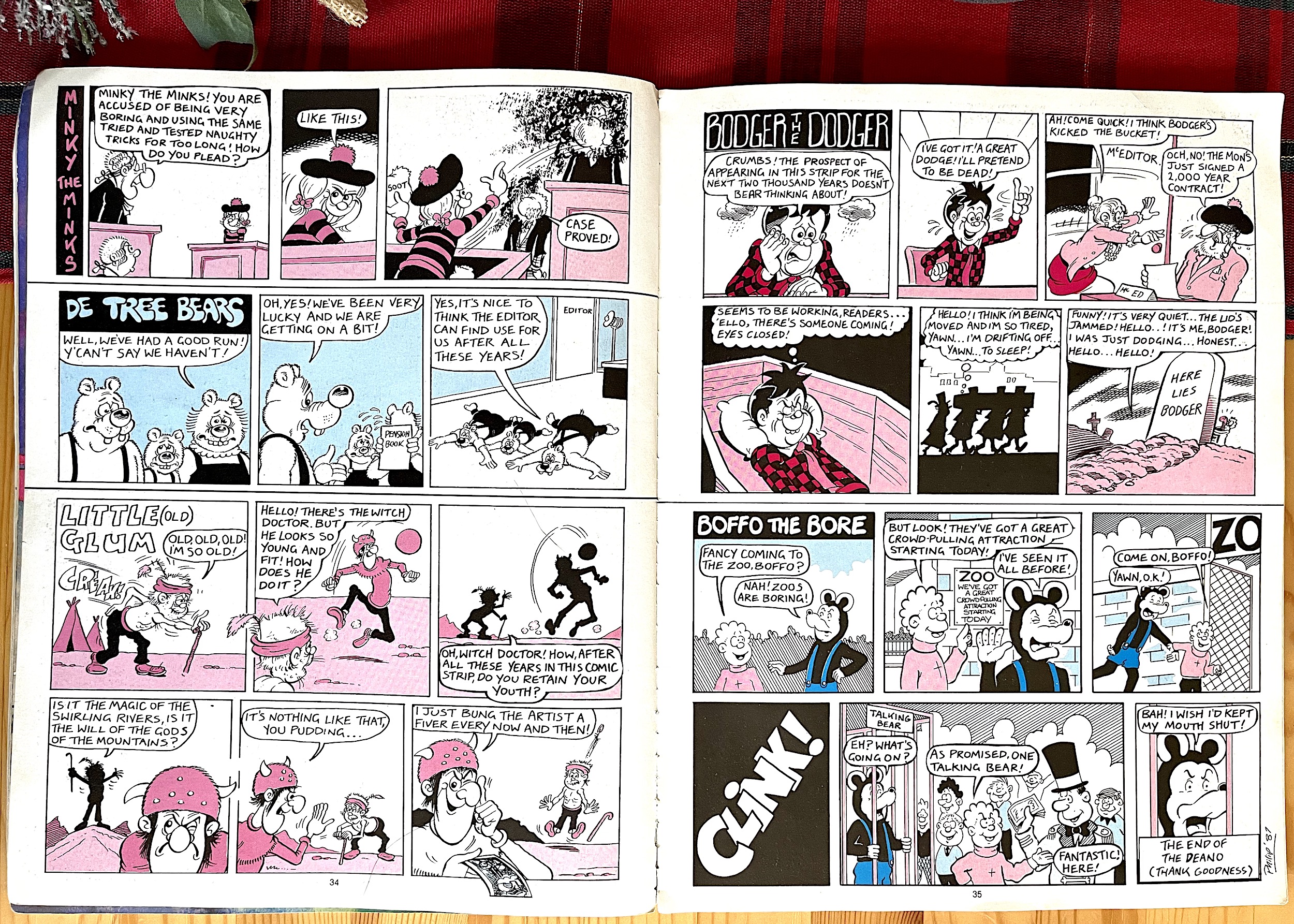
Unfortunately, I simply don’t know who ‘Philip’ is at the time of writing. His work only appeared in two OiNKs (this and #9), here with Boffo the Bore and two other like-minded strips called Georgie & Zip’s Party and Postman Fat and his Slightly Flat Cat. He’s not mentioned on the intro page either, but needless to say I’m always on the hunt for more information on OiNK’s creation so when I find out I’ll let you know. After The Deano and a ‘Fun-Hour’ pre-school comic we get another special section for adventure fans.
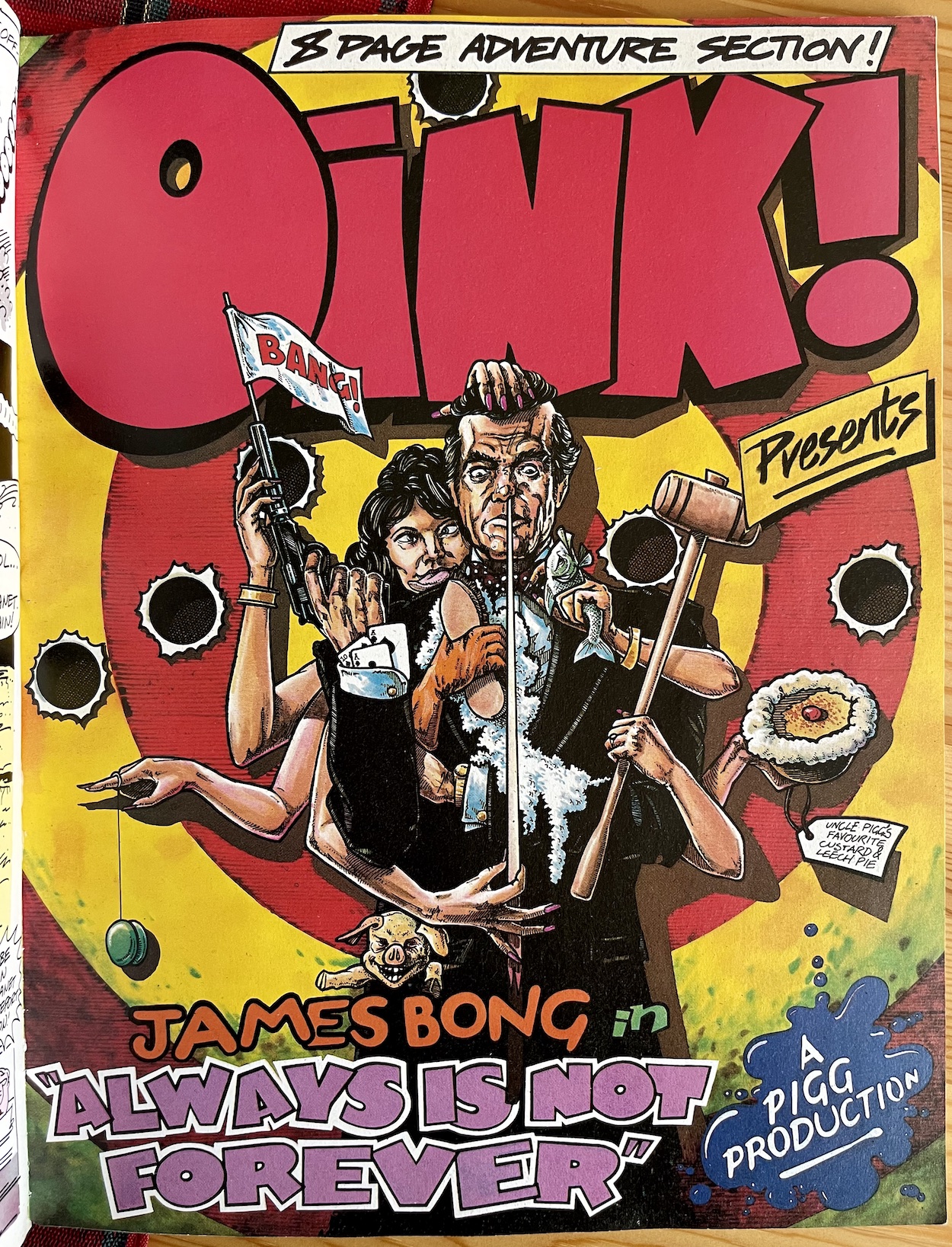
Eagle-eyed blog readers may recognise the brilliant caricature of Roger Moore on the first page from a previous issue (although I didn’t spot this first time around). If you go and take a look at the TV listings page in OiNK #17 you’ll see a tiny part of this image was used the previous Christmas. In it you can even see the OiNK logo behind Roger’s face so it just goes to show how far in advance this was created. This is something that continues to this day. If you follow the likes of Lew Stringer on social media or his own blog he’ll often show us snippets of annuals he’s working on over a year before their release, for example.
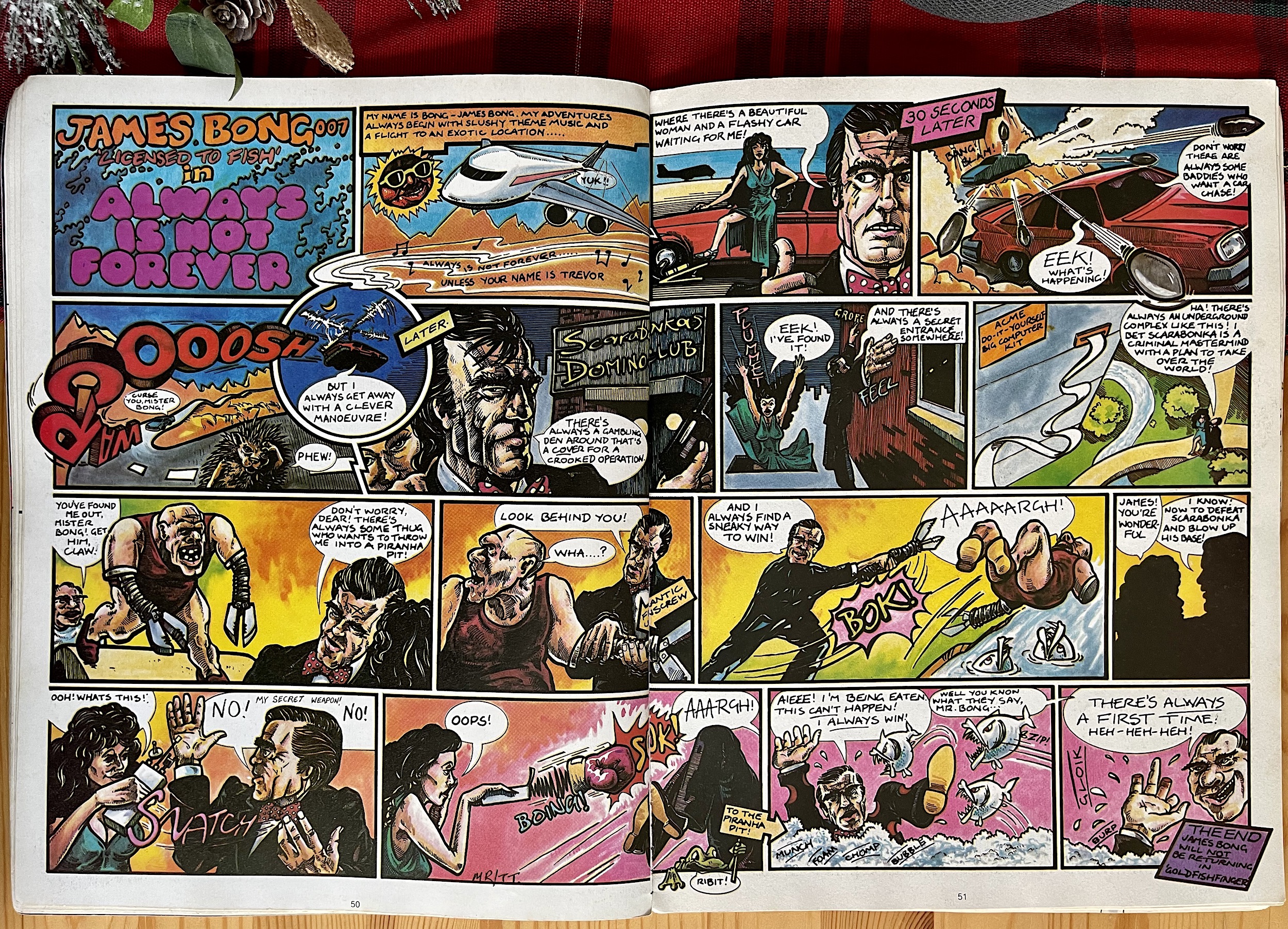
I’ve been a huge James Bond fan since all the Goldeneye hype hooked me in the mid-90s and I started renting out whatever films I could from the local video shop. It was discovering Timothy Dalton as Bond that sold me on the whole franchise, whose first film had only just been released the same year as this book, so the previous 007 (and his films) was still the target of this fun, frantic strip written by Mark Rodgers and drawn by Tim Thackery.
This was Tim’s sole contribution to OiNK. An illustrator and graphic designer he actually went on to work on CBBC animated series Minuscule Milton with Ian Jackson. Tim told me how he sees this James Bong strip now looking back: “A long time ago, but yes, that was me. Not my best work, but I was a bit pushed for time on it and had to knock it out at a fairly rough level.” Personally I love the art style here as it matches the nature of the strip and brings a real sense of pacing and chaos to the proceedings. You can check out Tim’s official website here.
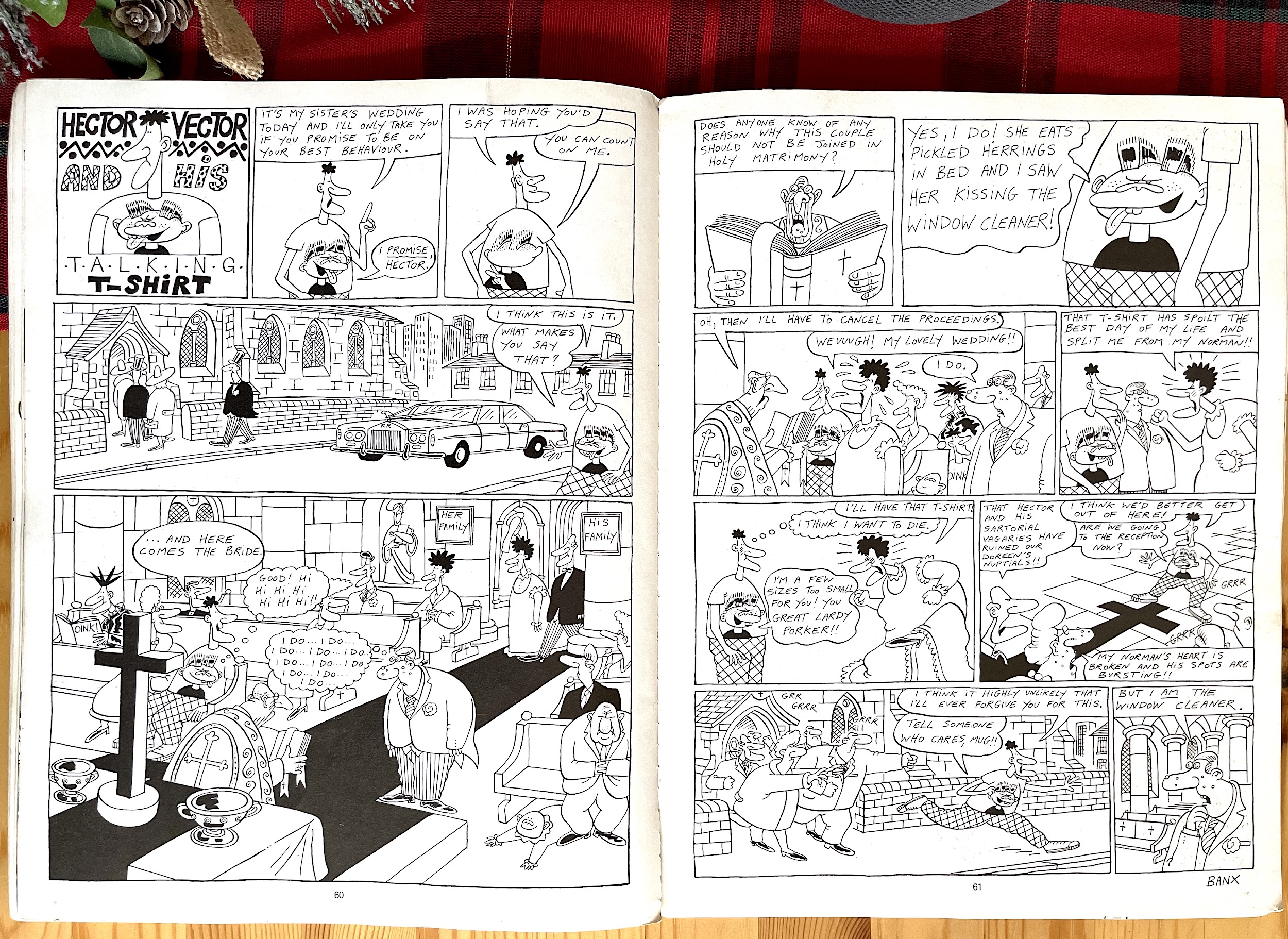
“She eats pickled herrings in bed and I saw her kissing the window cleaner!”
Keith Disease
The Adventure Section also contains that Police Vet strip I mentioned above, a GBH madvertisement for their ‘Personal Hand-Glider’ capable of speeds of up to 100mph (downwards) and another strip, Ena Blighty’s Five Go Adventuring Yet Again. An annual will never have a theme in the same way as the regular comic did at the time, although the festive season does come up a lot for obvious reasons. These dedicated sections feel like mini themes, three for the price of one in fact, and are some of the best pages in the whole book.
One character (or rather two) I always found incredibly funny were Hector Vector and his Talking T-shirt. Unfortunately, Jeremy Banx’s strip made its last appearance in #35, disappearing when the comic changed publishers and gave itself a bit of a face lift. With new characters and cartoonists and the very best issues the team ever produced, I hadn’t even noticed these two weren’t in amongst the madness until they popped up here in this brilliant, larger strip.
As pig pals knew, this wasn’t a strip where the brat got his comeuppance at the end of each story; we never knew who’d come out on top between the pair. For their very final appearance I have to admit I was happy to see it was Keith Disease (the t-shirt) who had the last laugh as those stories were the best examples of Jeremy’s creation. There were plenty of laughs to be had in this particular strip but it was always that very final panel that had me in creases. It still does.
It’s with a heavy heart but a smile on my face that we come to the end (almost) of the review of the very best edition of OiNK the team created. This has been both the most fun and yet hardest thing to write so far on this whole blog. It’s been great fun to finally get the chance to reread this book and to tell you all about it, but incredibly difficult to pluck out just a few highlights to try and sum it up. I hope I’ve been able to do that. Two more chuckles to go though. First up, the opposite page to that great opener drawn by Ian Jackson.
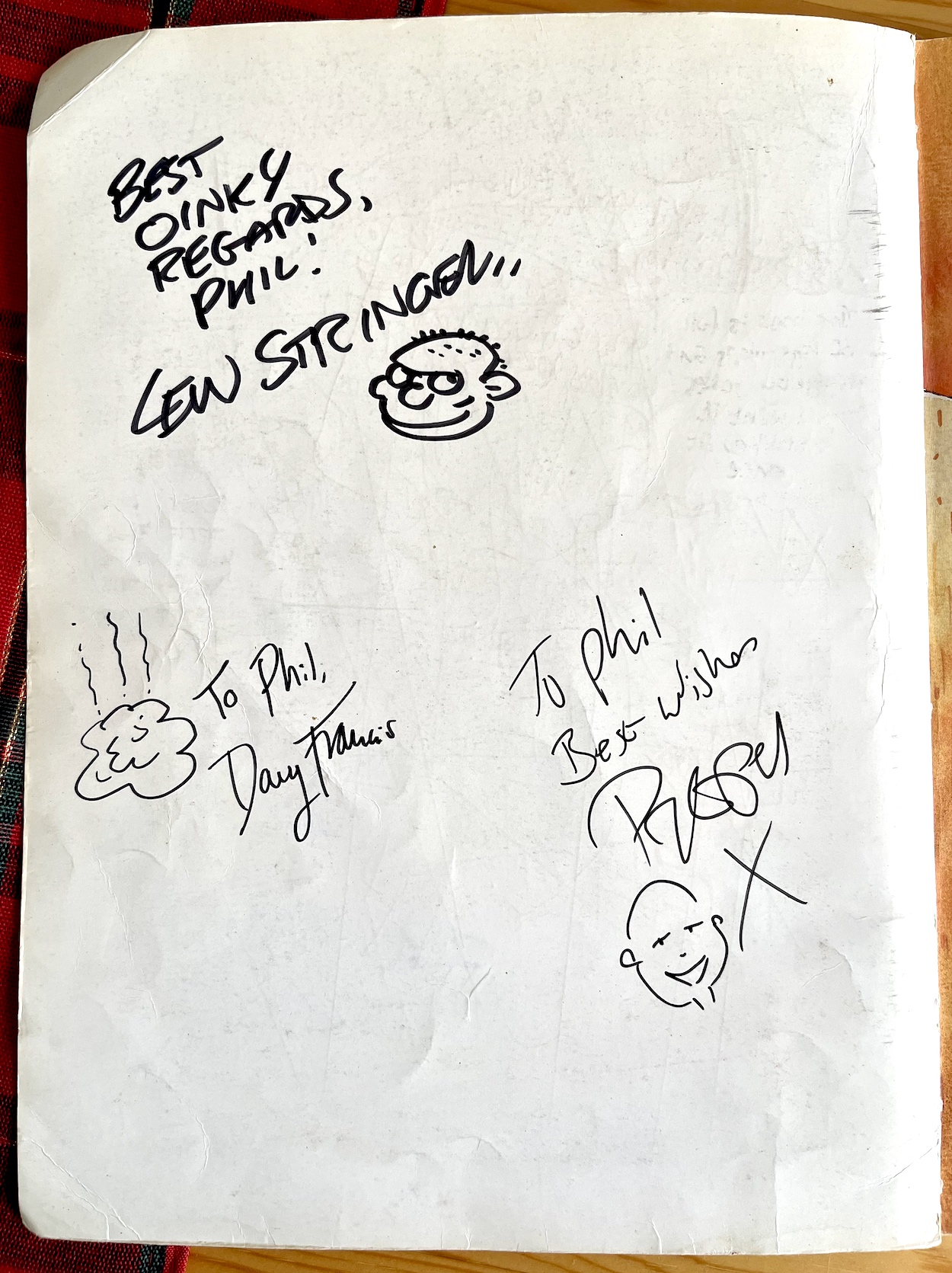
A couple of puns, funny art and a grinning Uncle Pigg reminding us (and telling those who were introduced to OiNK with the book) of his fortnightly comic, even if it wouldn’t be fortnightly for much longer. It’s a perfect end to a perfect book. It’s such a treasured item for me these days that it came with me to a comic con where Lew Stringer and Davy Francis signed it for me, and when Patrick Gallagher visited me at my home a few years back he added his. I intend to get the inside covers covered with as many squiggles as possible.
With that, I’m going to close the back page over now and here’s why ten-year-old me pestered my parents, my siblings and any visitors to our house over the holidays that year to have a look at my new book.
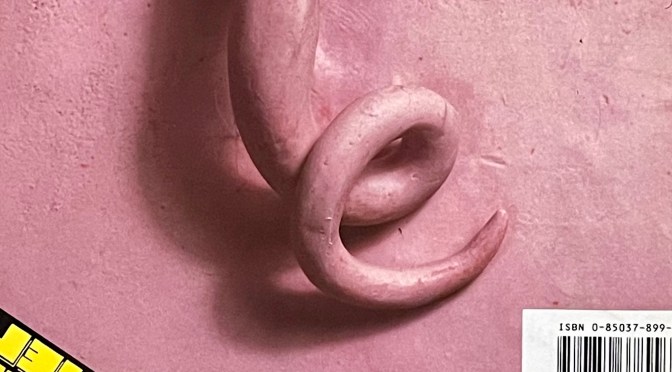
The plasticine cover was a step up from Ian’s already brilliant one for the first OiNK! Holiday Special and is probably the most iconic OiNK cover of all, with a story to match. “When we sent in the transparencies of the pig face and bottom with the artwork for the printer to process, Bob Paynter at IPC didn’t spot that the pig’s star-shaped bum was partly exposed and not completely hidden by the pig’s curly tail,” explains Patrick. “It was only when the proofs came back from the printer that Bob spotted it and deemed it too rude to be published. So we had to get photographer Ian Tilton to retake the shot with the pig’s tail completely obscuring the star-shaped bottom.” (You can read all about that and actually see those original transparencies in my chat with Ian.)
It’s still a cheeky cover and perfectly encapsulates OiNK’s unique, naughty yet innocent sense of humour.
From showing off its covers and hearing the raucous laughter of anyone I could grab over that festive season, to rereading it in my 20s, 30s and now 40s, and lending it to friends many years after OiNK was a distant memory… this book will never, ever get old. It’s OiNK in its purest, most concentrated form. Every page feels fresh and new, like it was written this year, not 35 of them ago. Receiving my favourite issue of the regular comic, the Christmassy #43 and this back-to-back made my Christmas in 1987, and reliving them has done it again in 2022. If you’re reading this post on the day of publication I hope you have a wonderful day and a very Merry Christmas!
Are we all set? Ready for the man with the bag? (Yes, I know I’ve described Santa that way a few times already this festive season, that’s because I’ve just discovered Seth MacFarlane‘s version of that song.) David Leach‘s Psycho Gran is certainly ready as you can see from the back page of our recent issue of OiNK. Although I’m not sure he’s ready for her.
I just wanted to pop on here before going to bed this Christmas Eve to wish all pig pals, and fans of all the other comics covered here on the blog of course, a very Merry Christmas. I hope you all have a wonderful holiday season and keep an eye on the blog for some festive treats in the reviews department over the next couple of days. Have a great one!
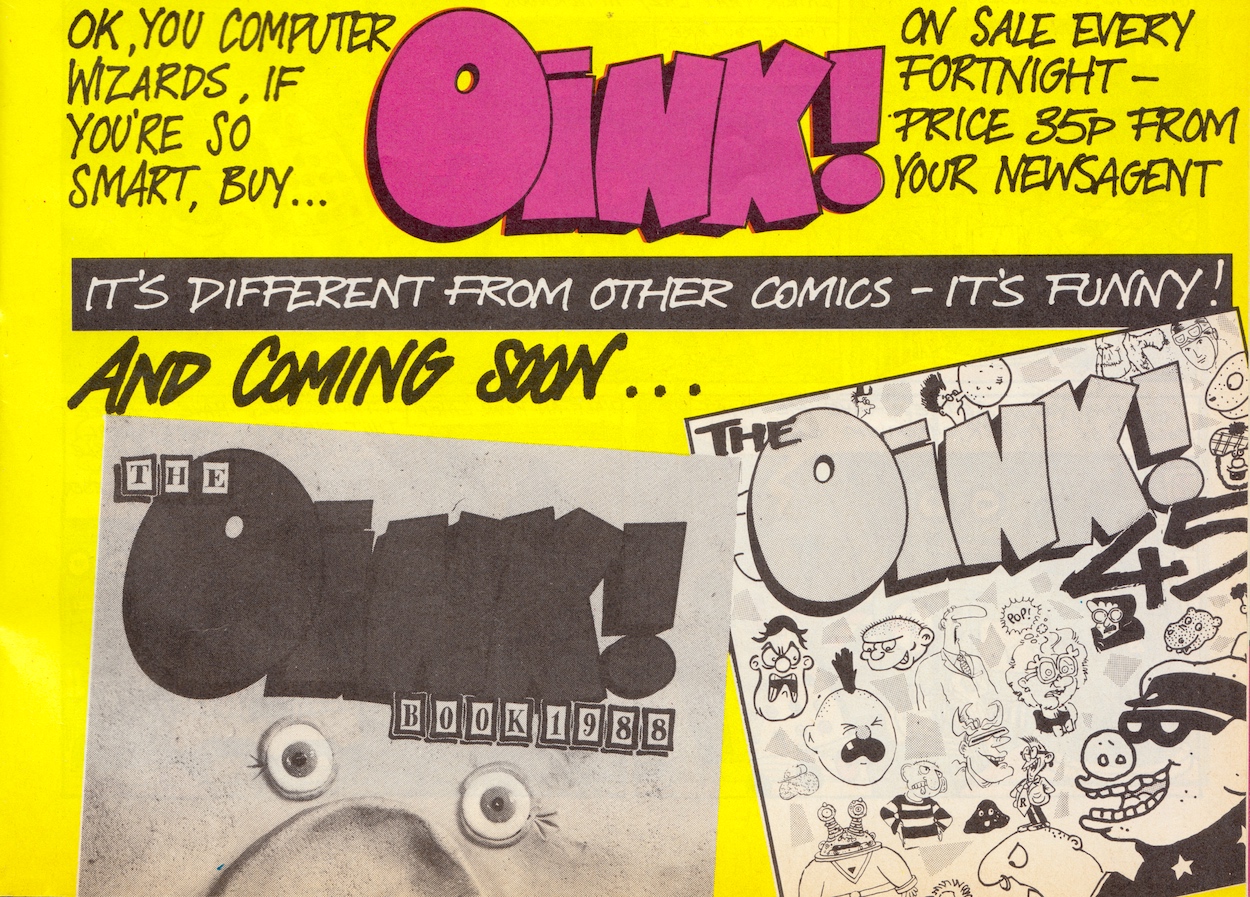
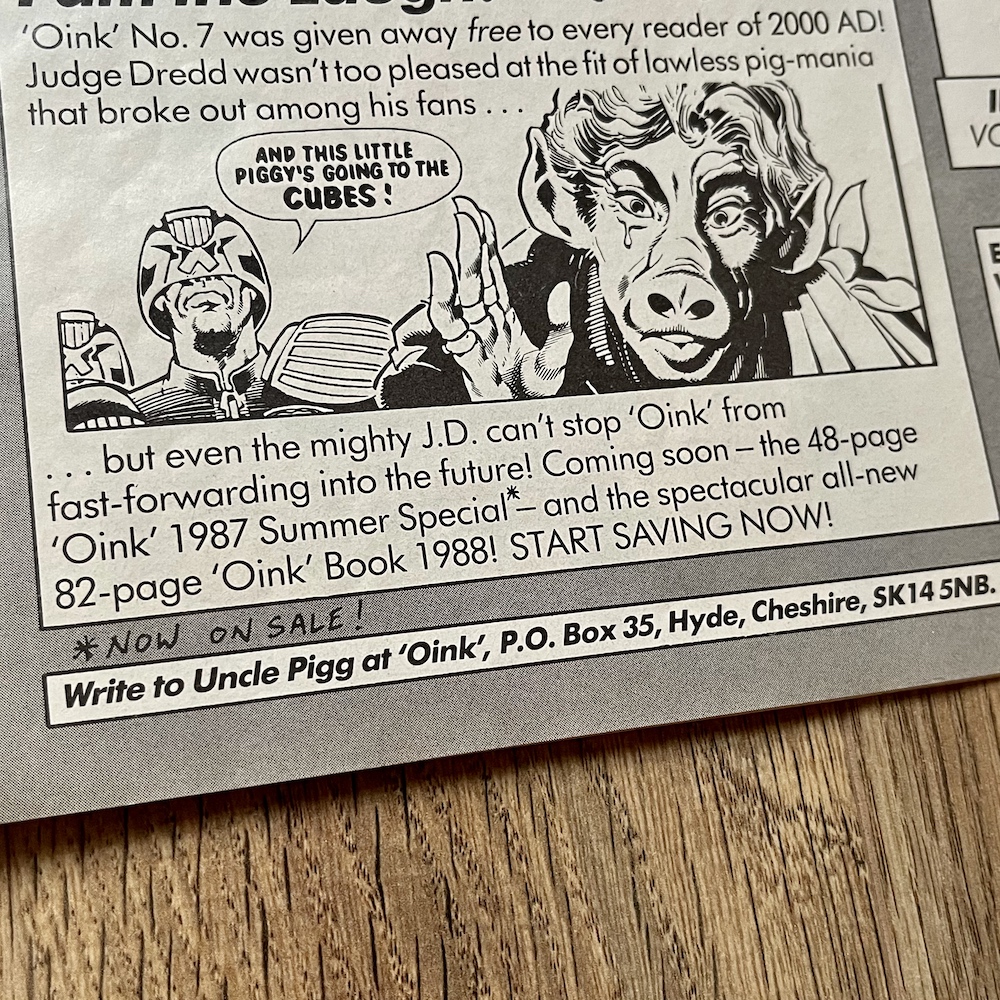
Way back in the mists of time that was June this year the special edition of OiNK that was given away free with Crash computer gaming magazine teased at a couple of upcoming treats for pig pals. The OiNK 45 record you can check out in its entirety already on the blog. As for the other part of the announcement, I was thrilled to see that plasticine piggy face for the first time in this read through!
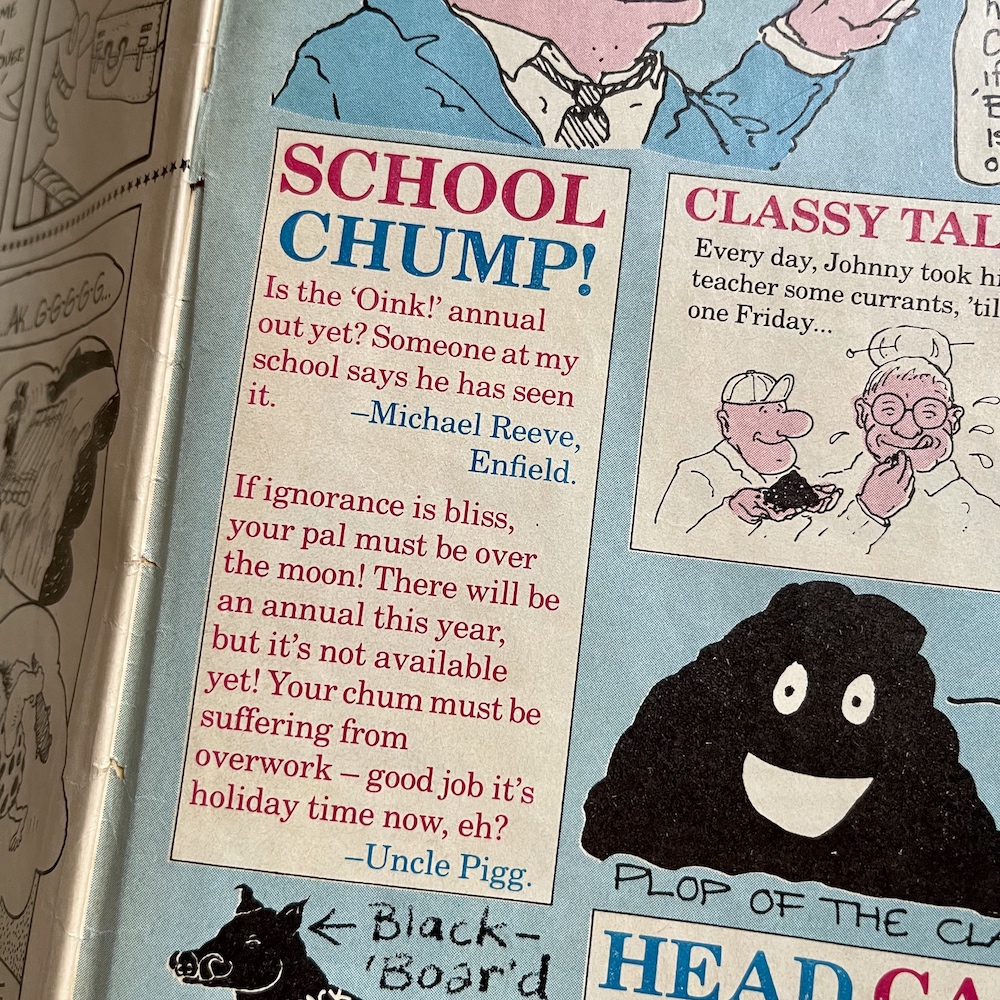
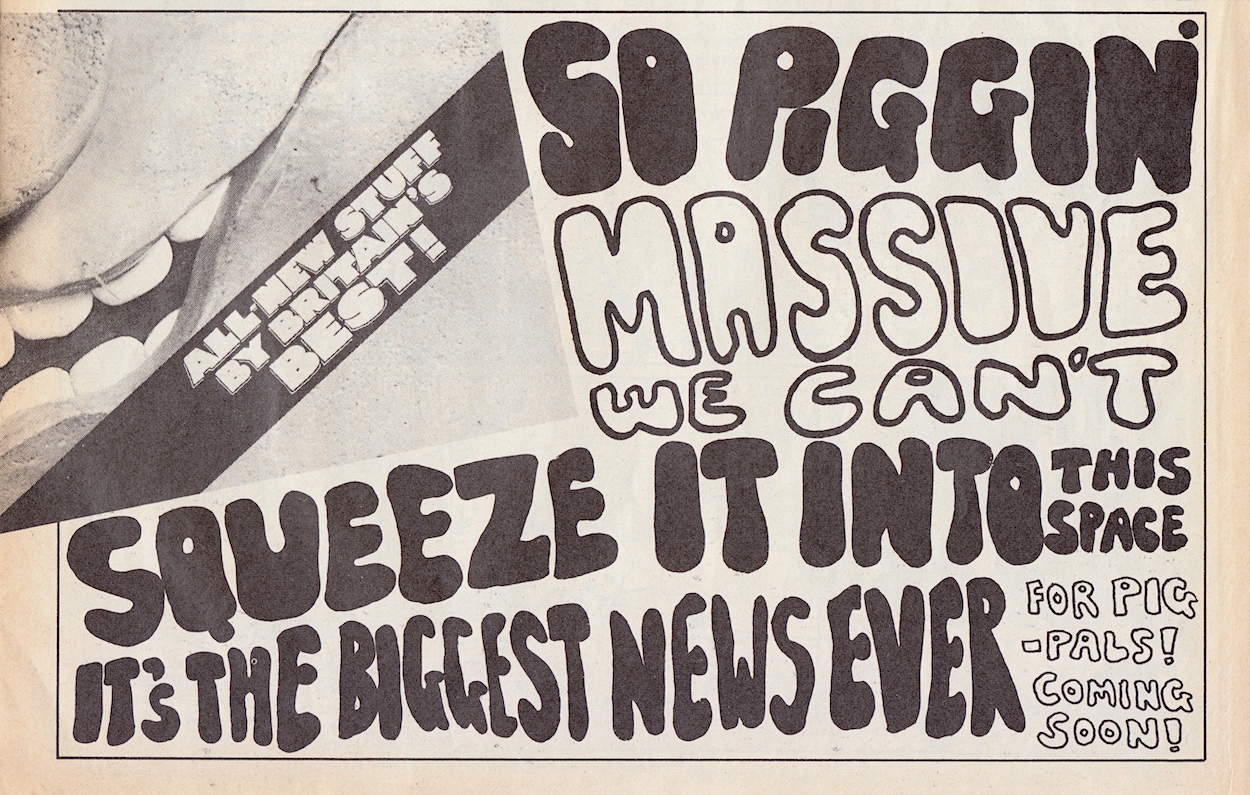
Over the course of 1987 little mentions would be placed into some issues, beginning with the first birthday edition in April in a blink-and-you’ll miss it moment on the Grunts letters page, and again in a May issue. Then during the summer half-page teasers began to appear, before finally in the fantastic #36 the first full-page reveal showed us that glorious book cover in full for the very first time!
This brings me so much joy. That cover represents everything about OiNK to me and I can’t wait to share its review with you in a couple of days. The OiNK! Book 1988 is thebest edition of Uncle Pigg‘s comic that was ever produced. How do I know this before the review and before I’ve covered the whole run? Because it’s always been my favourite (with the recent Christmas issue being my fave regular issue) and remains my favourite childhood book to this day. It’s been reread at least once every few years since!
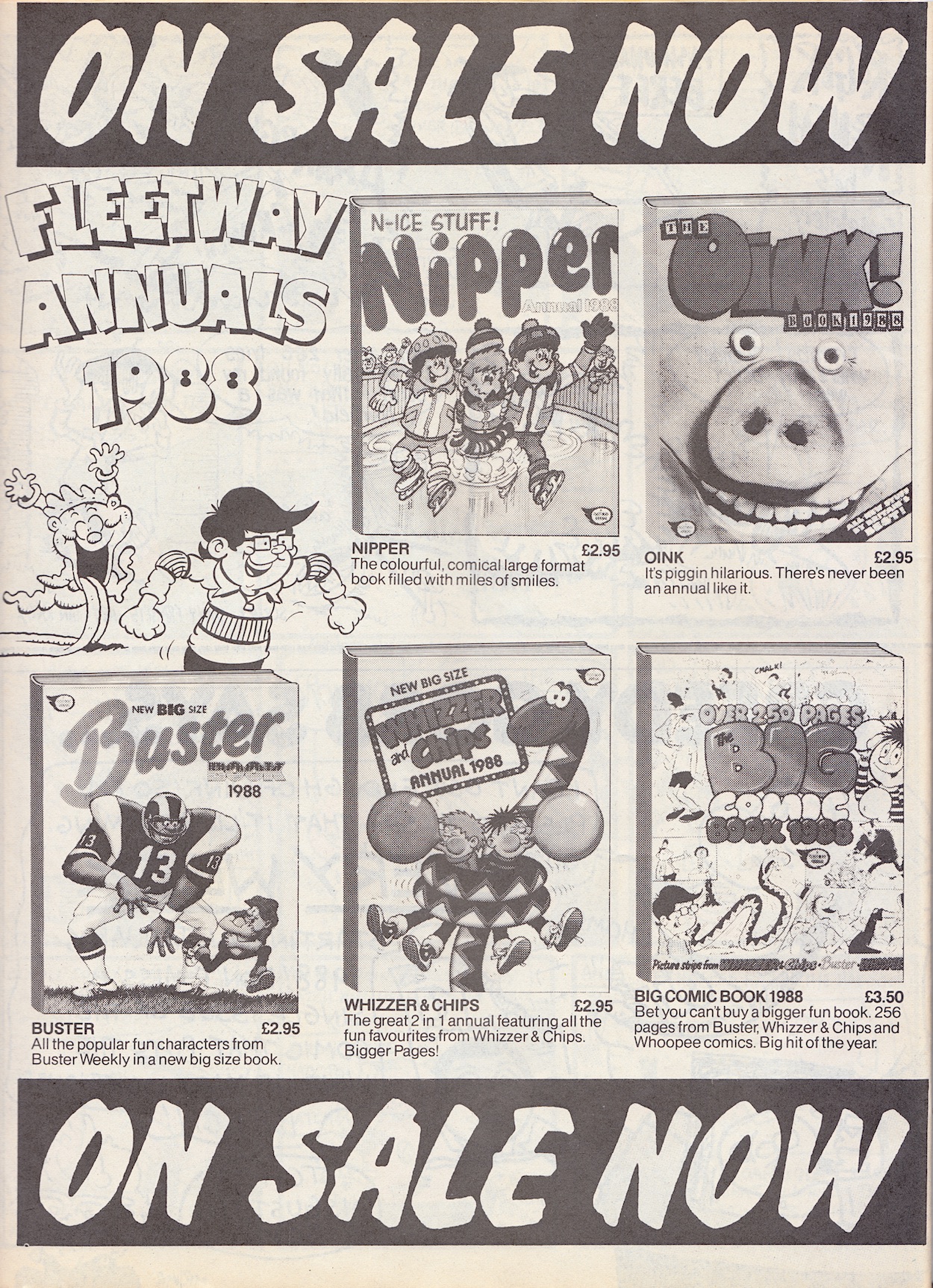
Here it is advertised alongside Fleetway‘s other annuals from 1987. I can remember it standing out so much from all of the other comics annuals on the huge display table in my local newsagent. It was a hugely exciting prospect, but even though it was there in the shop from September, as with all annuals we wouldn’t get our hands on it until Santa brought it to us on Christmasmorning. So that’s when you can expect the review of course!
Promo drawn by Ian Jackson
The very next day (on Boxing Day) you’ll get even more OiNK in the shape of #44, the second Hogmanay issue and the last fortnightly one. It’s the end of my own personal Golden Age of OiNK (not to take away from what follows of course) and it goes out with a bang, like all years do with their fireworks and parties etc. It’s quite the festive celebration this weekend.
So when you’re full to bursting with turkey, stuffing and sprouts you can kick back, let the kids’ new toys do their job and catch up with The OiNK! Book 1988 on Christmas Day and then see off 1987 all over again with #44 on Boxing Day. Before then there’ll be a quick message from me and Psycho Gran in the evening of Christmas Eve. The holidays are here and so is OiNK, big time!
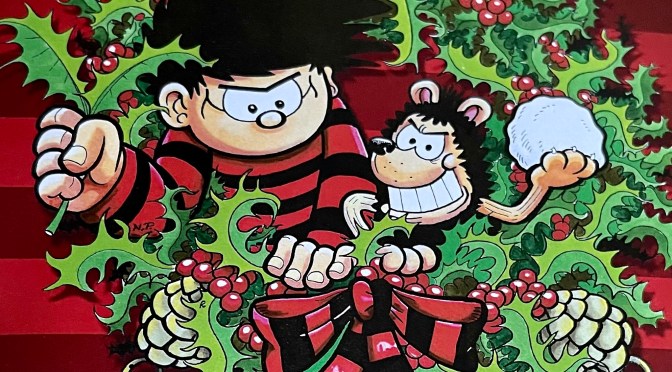
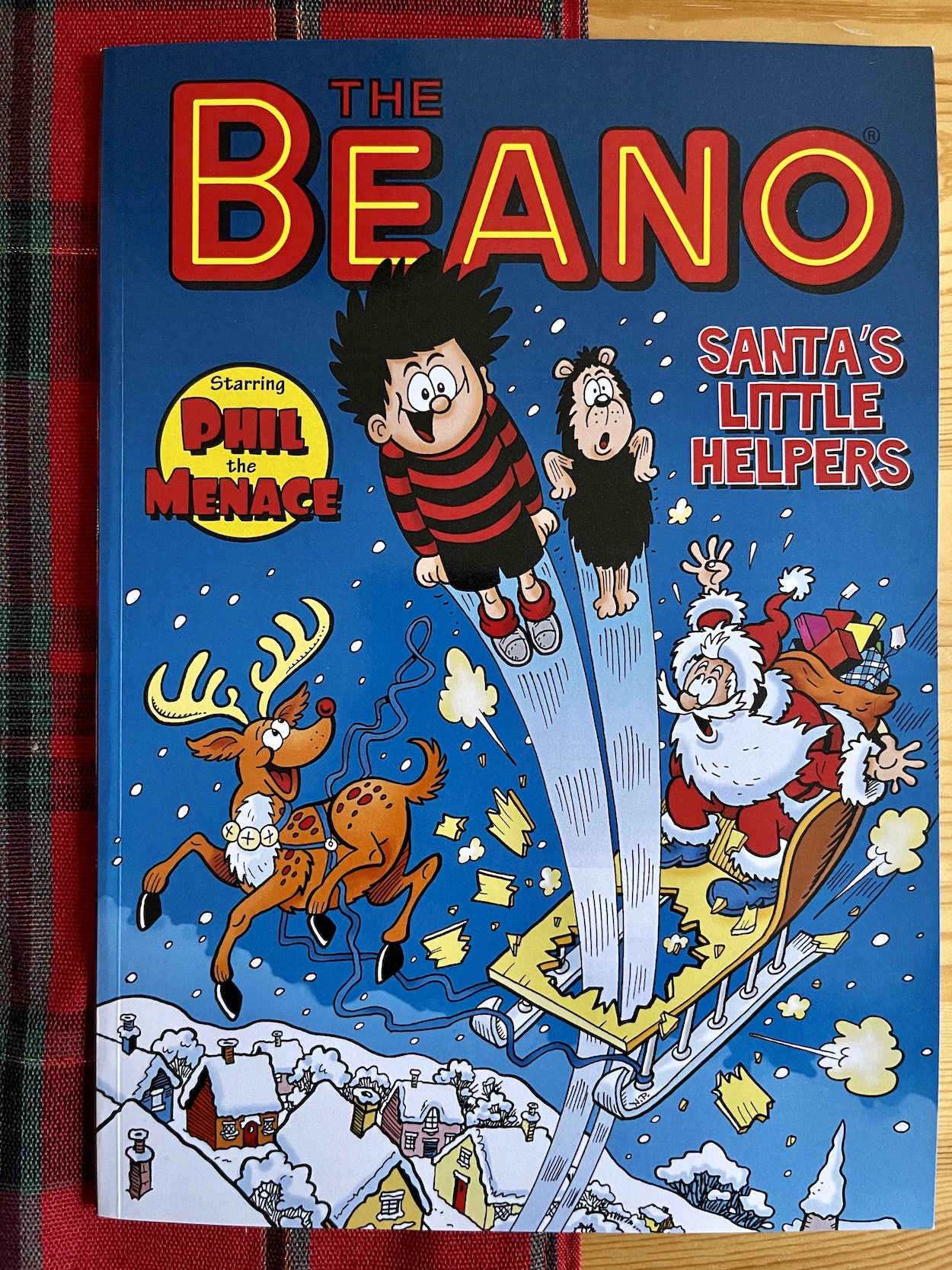
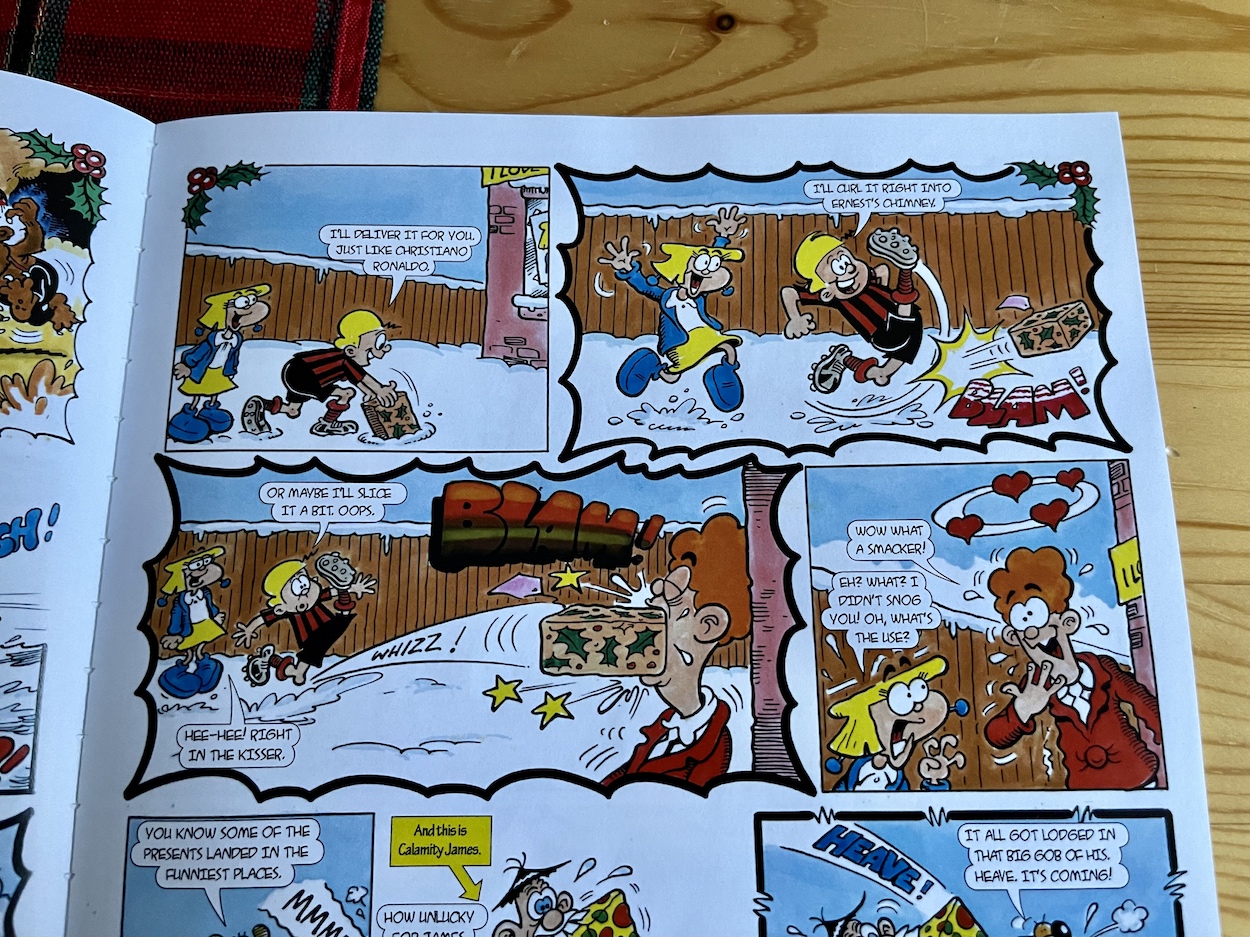
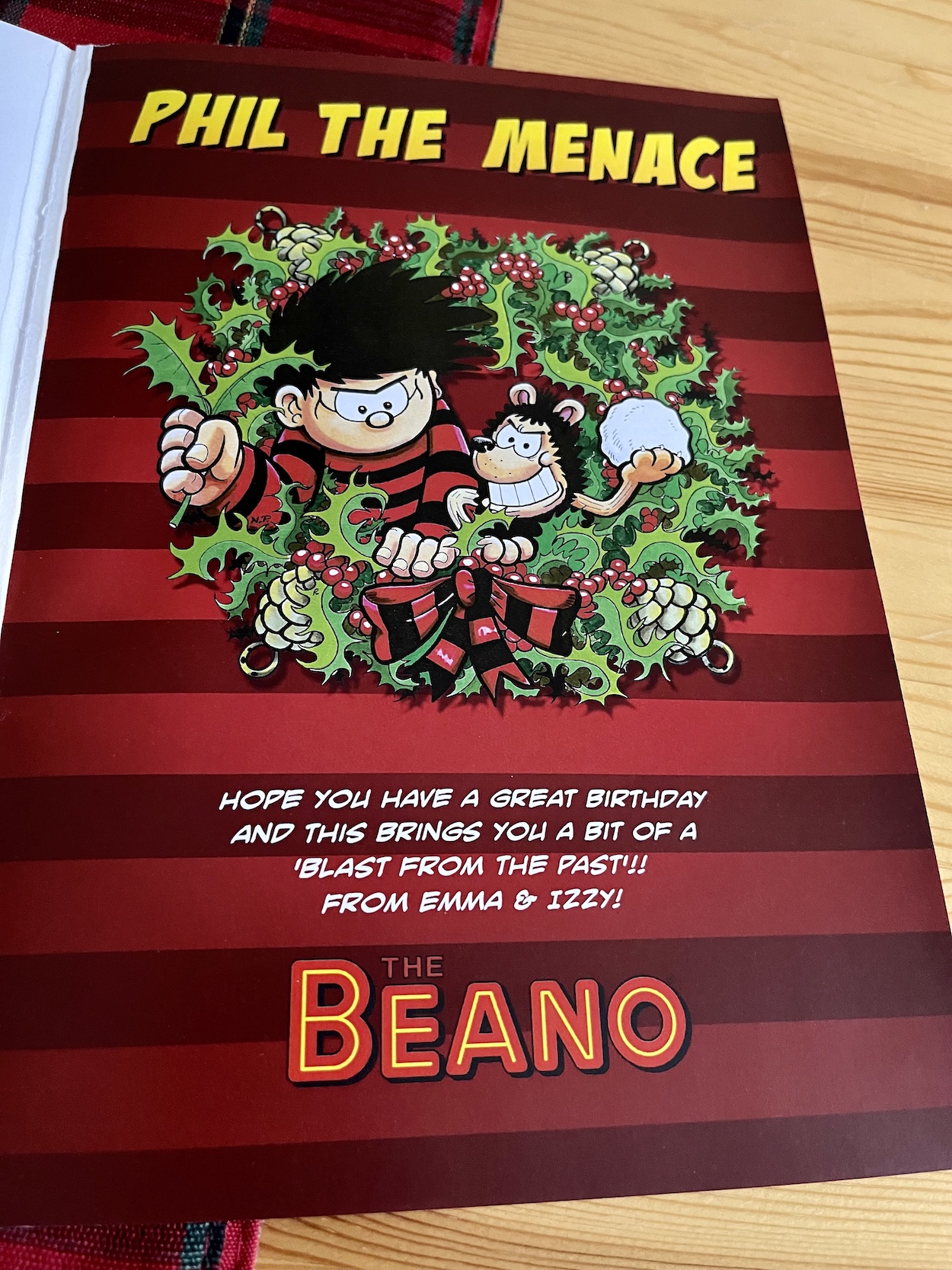
No, after all the completely unnecessary hoo-ha by middle-aged men when a children’s comic changed the title of its main strip a few years back, DC Thomson aren’t about to face their wrath again by changing him to ‘Phil’. This is a very special one-off comic featuring characters called Phil, Emma and (not so strangely) Roger, created for a birthday boy a few years back. Namely, me. Well, I say a few years back but it appears they have somewhat flown by.
The fact ‘the Menace’ has been dropped from Dennis for quite a while will be the first clue. I’m publishing this post on my 45th birthday and this was a gift from my friend Emma (and her dog Izzy) for my 38th, so it’s actually seven years old! (How did that happen?!) That’s right, for my 38th. Then again, you’re reading this blog so you already know I’m a big kid at heart. Emma was able to substitute the names of three characters with mine, hers and our mutual friend, Roger.
Beano megastar Dennis was unfortunate enough to be given my name for the issue and, as luck would have it, Roger’s was given to Rodger the Dodger! I never knew the name of the character who became Emma but upon checking with Lew Stringer it appears she’s from Nick Brennan’s Crazy for Daisy. Coincidentally, she bares an uncanny resemblance to the real person, so that just made it all the funnier for me.
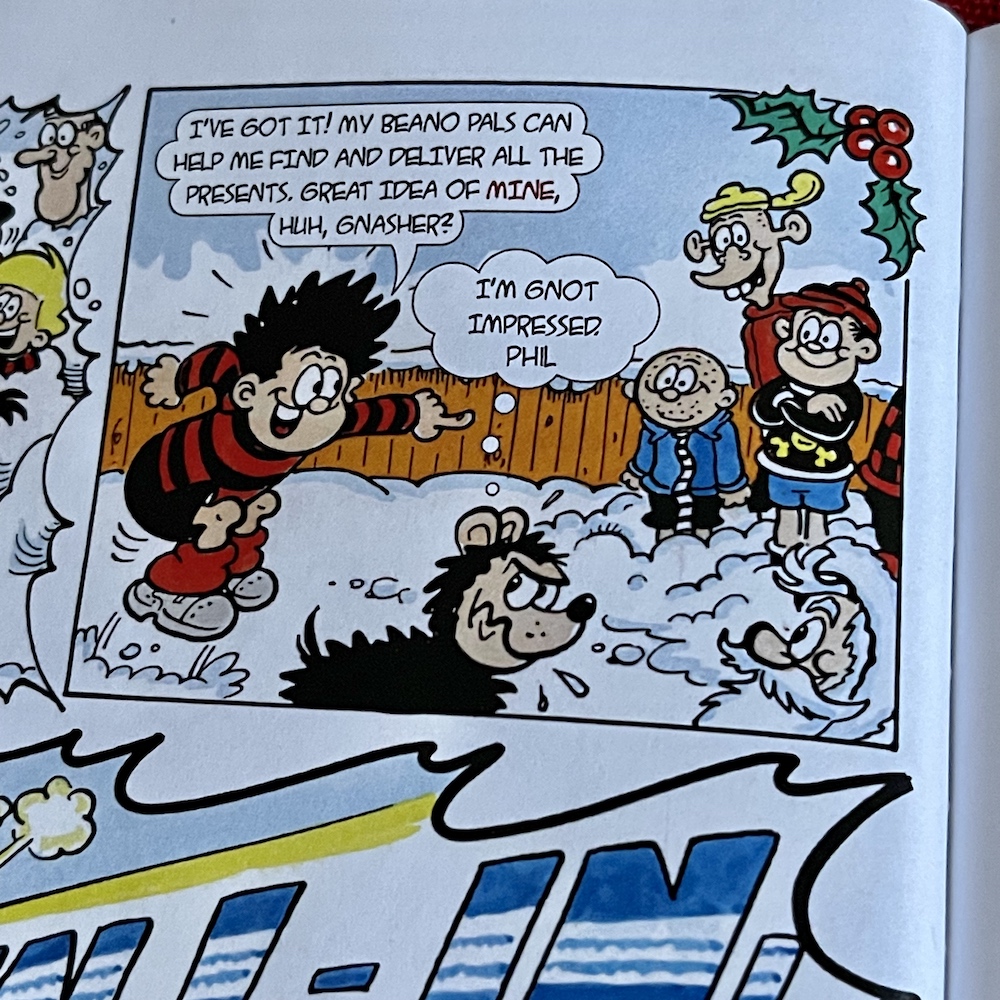
The basic plot is that Santa and Rudolph, distracted by the warbling of carols by Walter and his friends puts himself directly in the flight path of Dennis… erm, me and his… erm, my pet dog Gnasher, after a sleigh stunt using a homemade ramp shoots us into the air a tad too high. It’s actually Gnasher who comes up with the idea of asking for help from some of the other Beano stars to help deliver the presents to everyone in Beanotown. However, as he’s unable to communicate this I take the credit. (Which Roger then tells me is an uncharacteristically smart idea. Thanks!)
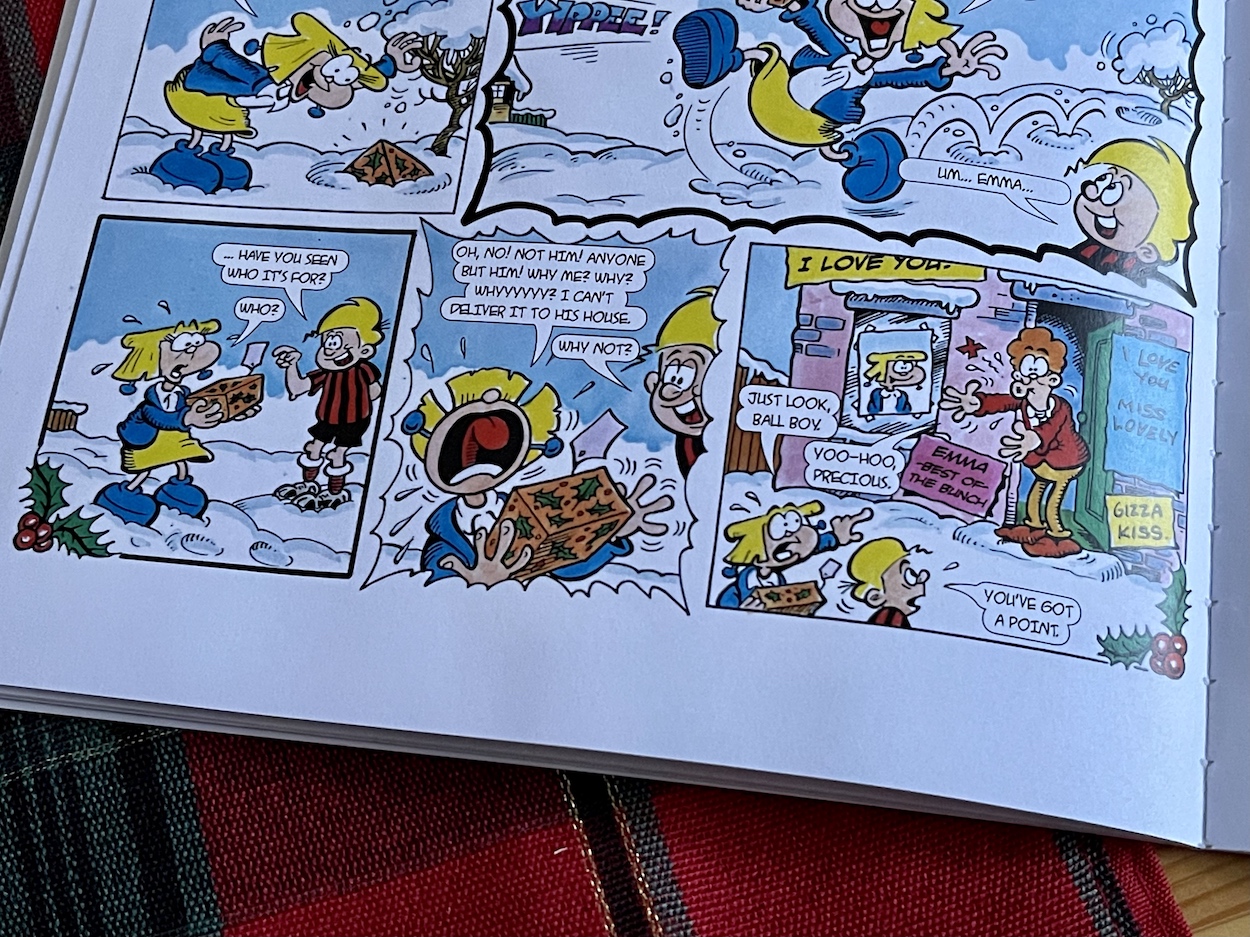
This part involving Emma’s character I found particularly funny, for completely personal reasons. This little bit of the strip suited her character perfectly and makes me laugh aloud every time I see it. It resulted in some mickey-taking on my part and is still referred to now and again when the occasion calls for it. I loved this gift. It was a thoughtful present and certain parts of it really seemed to suit the three of us to a tee, making it seem all the more personalised than probably originally intended by the publishers.
With 32 high-quality pages and a thick, glossy card cover complete with a small spine, it was a high quality comic and a great idea for any young Beano or Dennis fan, or for those who used to be when they were much younger. Unfortunately Signature Gifts no longer have any Beano items for sale but DC Thomson have picked up the mantle for their own characters and offer something even better today.
DCT’s personalised Beano lets parents not only name but also create the look of a new character based on their child. It’s chock full of strip, puzzles and activities all starring any young fan of Dennis et all. Not only that, but the website includes a wealth of customisable Beano items, like various comics and books, clothes, lunch boxes, mugs and a whole lot more. Perfect for your child (or yourself).
I was elated to discover how well the first Knight Rider Annual held up today when I reviewed it a few days ago. Any fears I had of a cheap cash-in were quickly dispensed with when I saw the comic strips inside. They were simply gorgeous. Coupled with fun prose tales and backed up with interesting articles featuring photographs which enthralled me as a kid, it was a superb package and one I felt proud of as an absolutelymassive fan of the show.
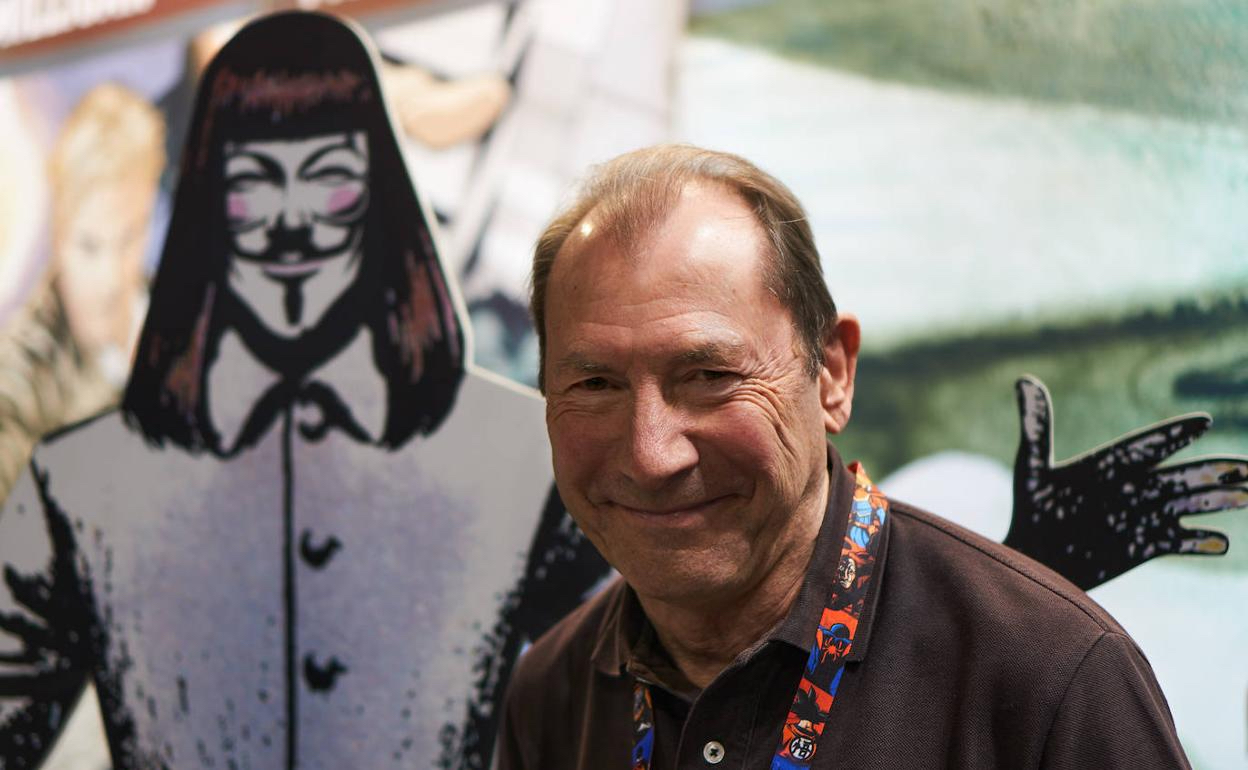
I was thrilled to find out none other than David Lloyd (V for Vendetta, Wasteland, Hellblazer) was responsible for all of the art, both the strips and the illustrations for the prose stories. David is the editor of Aces Weekly, the superb digital anthology comic which has featured on the blog before. I thought I’d reach out and ask David if he’d be willing to answer some questions about his time working on the Knight Rider books. He said yes!
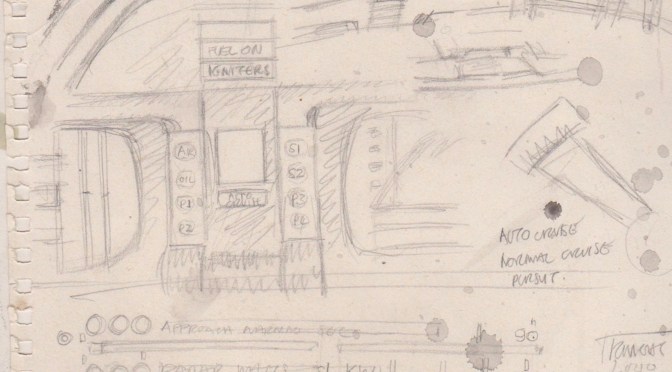
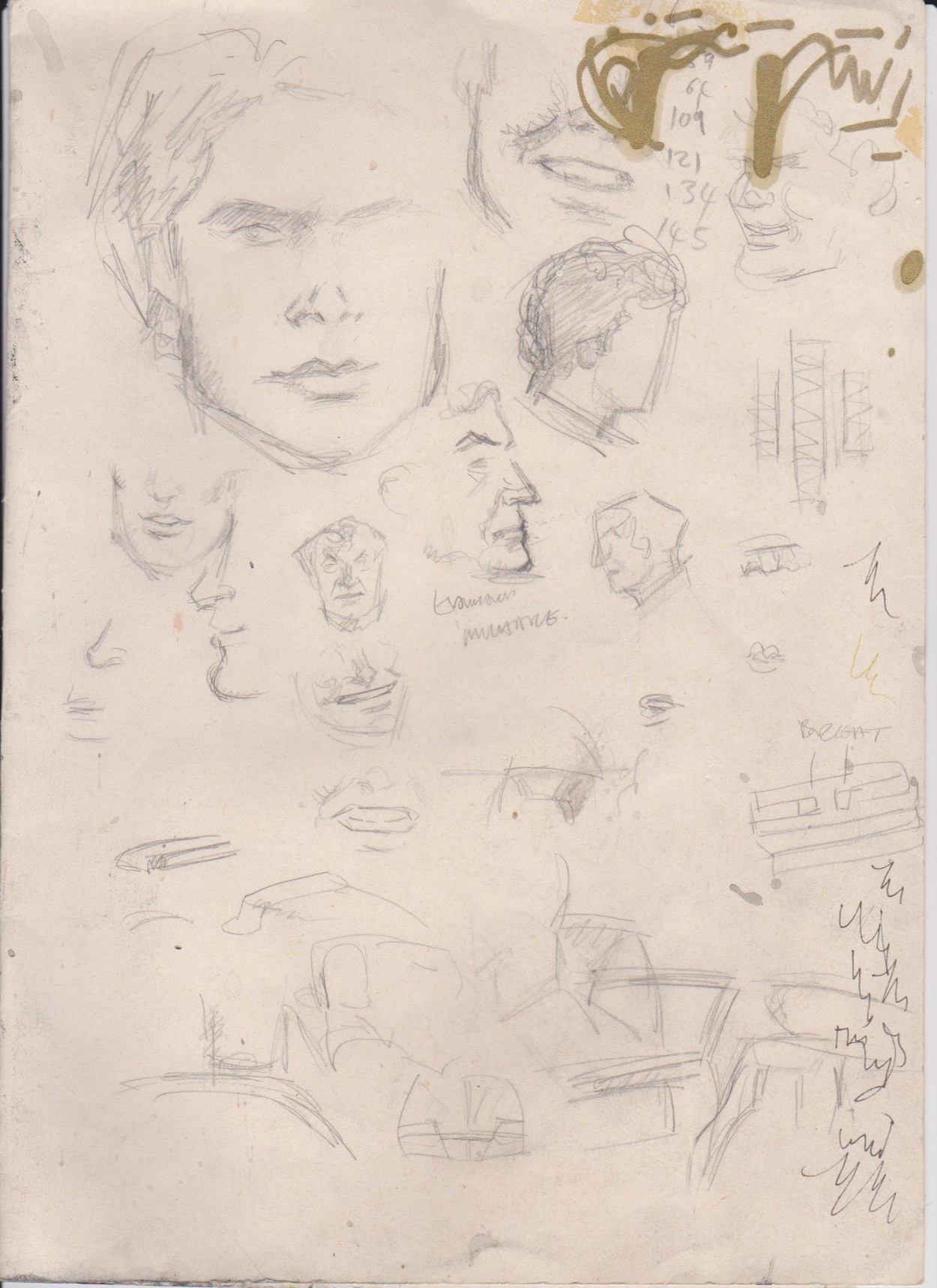
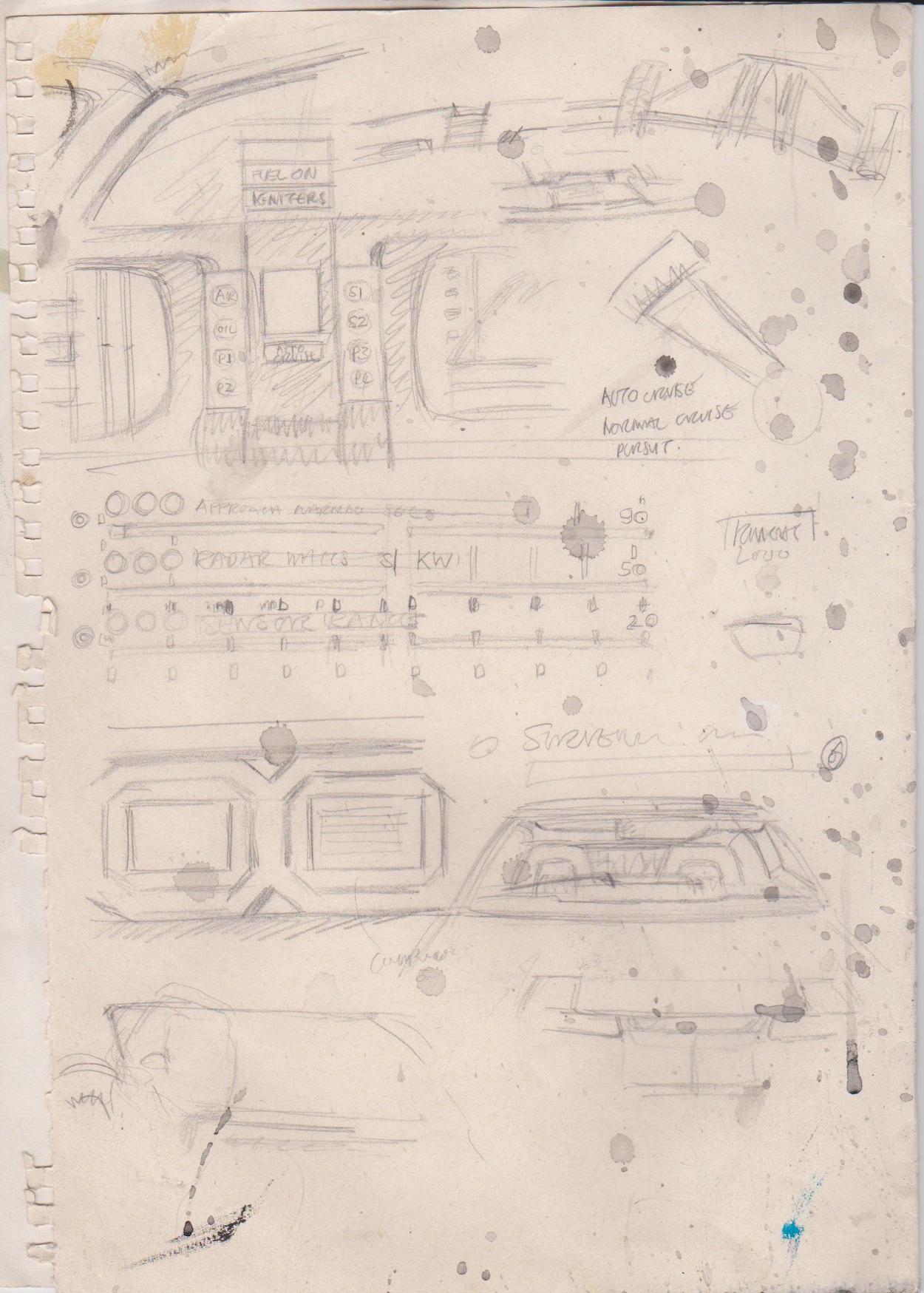
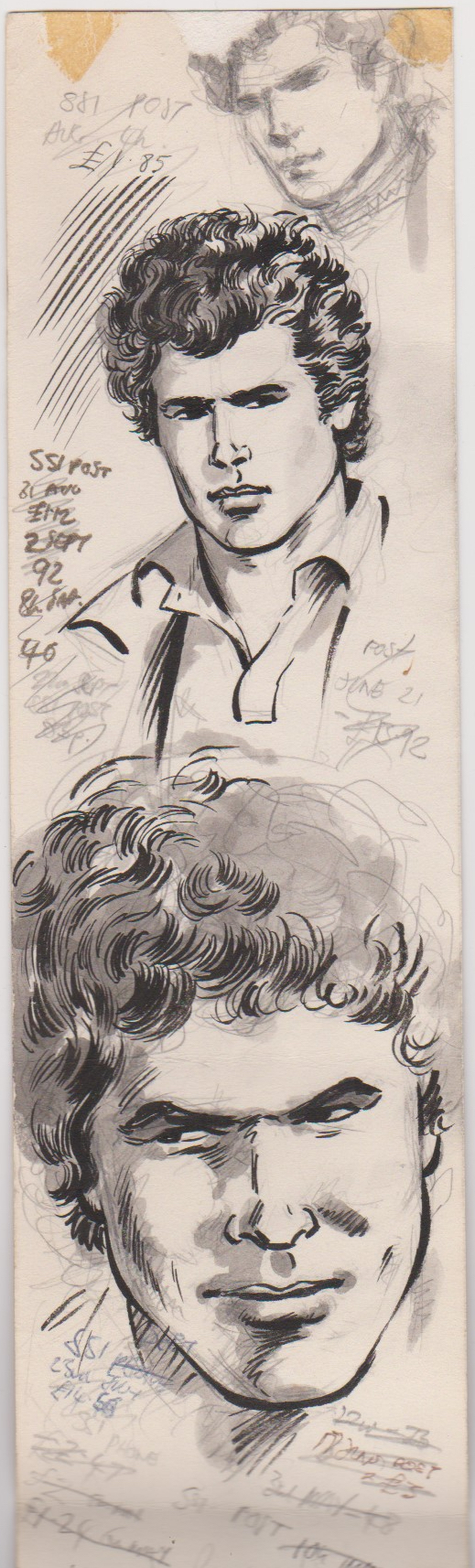
Not only was David very forthcoming with some fascinating information he also sent over scans of some of his early sketches, drawn while watching a recording of the series. These show his initial designs for K.I.T.T. and Michael, including a study of David Hasselhoff. I’m thrilled to include this post on the blog and I’m sure it’ll be as interesting to comics and Knight Rider fans alike.
OiNK Blog: I was (and I’ll admit still am) rather obsessed with Knight Rider. The show was a massive hit with families and kids of all ages. How familiar were you with it before working on the strips?
David Lloyd: I liked Knight Rider at the time too, though not quite as much you, obviously!
OB: I just love the finish of the drawings you did for the first two annuals, especially on the strips, they seemed to capture the darker atmosphere of the pilot movie in particular.
DL: I have particularly good memories about the first annual because I was very happy with the work I’d done on the wash drawing. Loved using wash and there were few places you could use it in regular comics art at the time. I had fun with the illos (illustrations in the prose stories – Phil), too.
OB: The show couldn’t have been on for very long when you started work on this, did that hamper you in any way?
DL: No problem with it not being long-running [yet] and no one’s going to wait for you to become familiar with it all before you can draw an adaptation of it. You do your job and get on with it as a professional! And anyway, annuals were usually planned during a first season of a new series in expectation of some success, enough to justify the publishing of them, and also as part of some package of various launch/promotional agreements that might have been made, so you’d normally be drawing one for a new series before it had become massive, if it was going to.
OB: The show’s newness may not have hampered David but he did have to get creative in gathering references.
DL: By the way, to add some detail, I did that first KR annual before I had a video recorder, so I asked the help of a friend who did have one, and went round to sit and sketch some details from one of the shows I’d asked him to tape for me – pausing to sketch dashboard detail, etc. If you’re interested I can scan some of those scribbles, and some Hasselhoff studies I did before starting the job. I think you’d probably like to see them.
OB: What did a study entail?
DL: Just trying to study the likeness and get his face right enough.You’ll see these were hanging around for a while on my drawing board, which is why they have all kinds of notes and stuff on them!
OB: There were no credits in the Grandreams annuals but David has let us in on who wrote the strips and prose stories.
DL: The comic scripts and the shorts were all written by the brilliant Steve Moore. In fact, he wrote everything I ever drew on all the annuals I did for Grandreams. He was so good he could write any character to be exact to their personalities in any TV show he had to write stories for. And in some of the annuals, I think his stories were better than the TV scripts.
OB: I haven’t heard of the name Steve Moore before but you’re right, his stories in these were fantastic, especially the text stories. One in particular involving an art heist would’ve made a fantastic episode and I completely agree, some of his stories were better than some of the TV scripts! He definitely got the funny partnership between man and machine perfect.
DL: I’m surprised you hadn’t heard of Steve as I’d imagined you knew a lot about Brit comics as someone running a blog named after OiNK. Everyone who was around at the period of that particular comic were mostly aware of the general scene in Brit comics at the time and its denizens. If you have heard of Alan Moore, though, then you should know that Steve – no relation but a long-time friend – taught Alan how to write comics. Steve was a great writer but never busted through into making a great international profile for himself as some including Alan were lucky enough to do. He was just a fabulous craftsman in a specialist field of writing. And he wrote a book on the I Ching called the Trigrams of Han. No ordinary guy.
OB: David went on to name some of the other titles Steve wrote for, many of which were published before I started collecting comics as a young child with OiNK (and so haven’t been covered on the blog). These titles are classics through and through.
DL: On Steve Moore – he did most of the backup strips in Doctor Who magazine that I did, he created Laser Eraser and Pressbutton for Warrior, amongst other things, and Abslom Daak Dalek Killer and Hercules comics. Check them out if you can sometime.
OB: As far as choosing which parts of those wonderfully written prose stories to illustrate…
DL: The brief on the short stories in Knight Rider, and on all the other annuals I did, was to do a bunch of scenes that you could pick yourself, so it was very freeing creatively to do those. And I had particular fun using coloured inks on the KR stuff.
OB: Can I just ask about your drawings of K.I.T.T. himself? After the first two annuals Jim Eldridge took over and it was more traditional line work rather than the painted look of yours. How difficult (or indeed, fun) did you find drawing the Trans-Am in these action strips, especially that complicated dashboard?
DL: Not difficult, though I’m no great fan of drawing cars. If you have a good story to tell and enough reference to do it well and you can enjoy yourself with good characters and settings, it’s fine. I sketched enough of what I needed to sketch and used what I could from elsewhere. I don’t know who did the following KR books but annuals publishers generally used talents of varying quality – some straight out of art school, some who were just jobbing illustrators who had no real feeling for comics art, and sometimes guys who knew exactly what they were doing : ) I did a Knight Rider colouring book, too, so if you’re a completist and want to seek that out from somewhere! (I’ll add that to my eBay searches then – Phil)
OB: Of course it wasn’t just K.I.T.T., the character of Michael was just as important and thankfully you and Steve realised this too. Can I just ask you about your process for drawing the strips? They’re unlike anything else from the time that I read. Most used more standard line work, whereas yours was completely different. How did you achieve the finished look?
DL: I can’t say much about the process it would take too long. It still begins with some degree of line drawing to start with except the shading that might be done in line drawing only – with cross-hatching, etc – is substituted with black watercolour washes of varying strengths. As I said, there wasn’t much wash drawing used in most comics at the time, as you attest, so it was good for me to be able to take the opportunity I could with KR.
OB: Just one more question, all of the images of K.I.T.T. (drawings and photos) have “Knight 2000” on his bodywork somewhere, no matter the angle. This was never the case on the show, he was meant to blend in, but I remember all of my toys as a kid had the same thing. I’m guessing it was to differentiate between Knight Rider and Pontiac Trans-Am merchandise in licensing, can you remember this being something you had to add and why?
DL: The car branding, I don’t remember any instruction about that and there are drawings of mine in the strips and illos where it isn’t added – so I forgot about it if I had been – but I think it must have been a requested requirement from the licensor because on the second page of Crime Buster K.I.T.T. in the second annual the car has the branding, but badly done, so it wasn’t done by me. Yes, so, perhaps a contractual need from Trans-Am.
I just want to say thanks so much to David for his time, I can’t begin to describe how appreciative I am to have the chance to chat to him about Knight Rider and a book which brought so much joy to not only six-year-old me, but also to the 44-year-old who now writes about these childhood comics and books. To see more of David’s work from the first Knight Rider Annual you can check out the full review and then wait (patiently or impatiently) for the next one in twelve months’ time.
Don’t forget to subscribe to David’s Aces Weekly too, the digital anthology comic. Each volume is made up of seven weekly issues for only £7, that’s just £1 each! The entire back catalogue is also available on the website and even features work by OiNK cartoonists David Leach and Lew Stringer. So don’t miss out, click on the title below and off you go!
“No matter what’s going on in the world or in my life, putting an episode on can bring a huge smile to my face. Don’t we all have something in our lives that does that? This is mine.”
My late grandad Ted came to my house one Sunday morning when I was a child and asked my parents if I’d seen the film on TV the night before about the fantastic car that was filled with computers, could talk, drive itself and even jump in the air. My mum hadn’t heard about it but luckily enough my grandad knew it was going to be a TV series starting the next week and he thought I might like it. He wasn’t wrong. Thus began a lifelong obsession with Knight Rider.
I may have grown out of it temporarily by the late 80s but when repeats began airing in the mid-90s my love for Michael and K.I.T.T. returned and has never gone away. Every decade since may have brought its own obsession, from Babylon 5 to Stargate SG-1, from Doctor Who to NCIS, but Knight Rider has a special place in my heart and, no matter what’s going on in the world or in my life, putting an episode on can bring a huge smile to my face. Don’t we all have something in our lives that does that? This is mine.
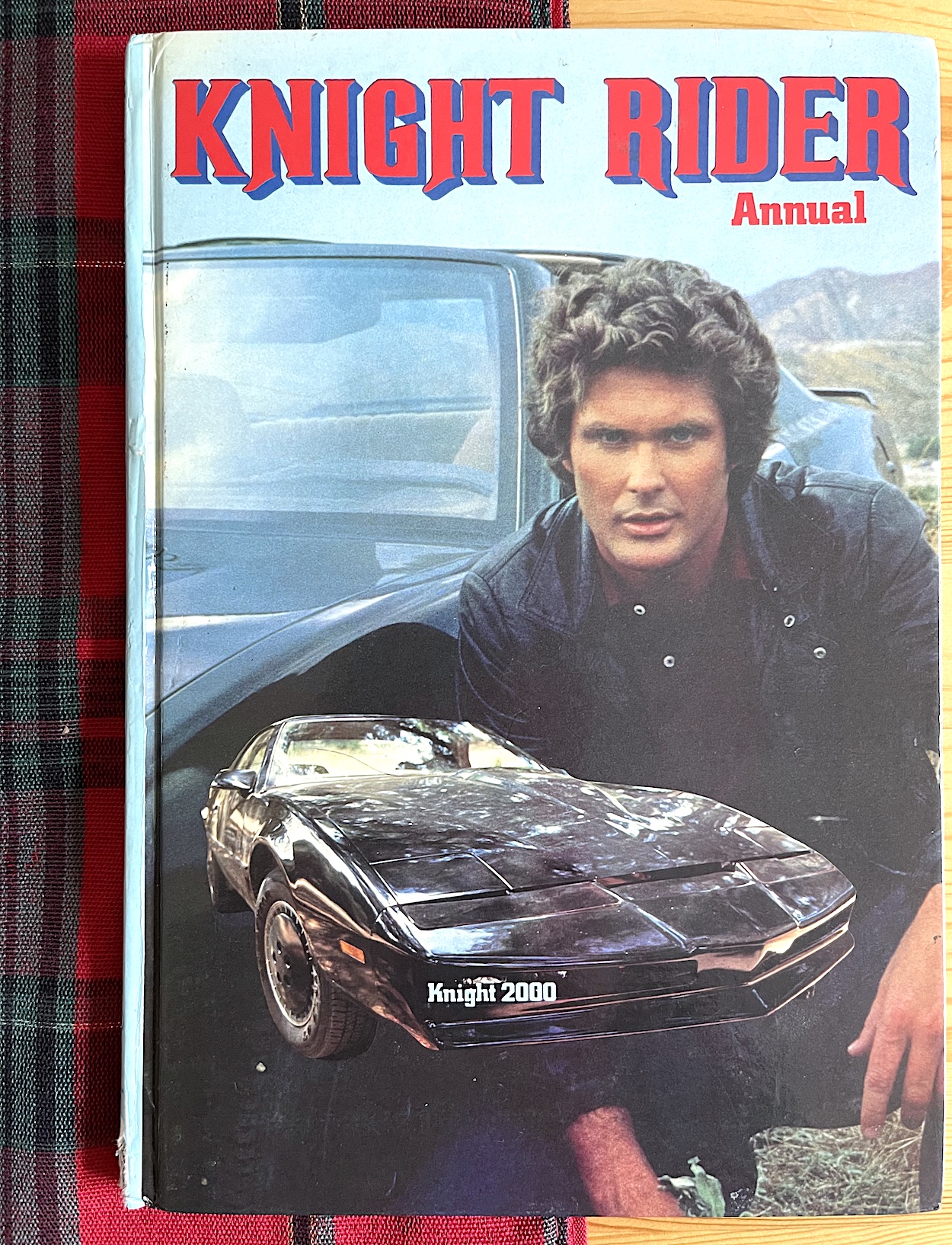
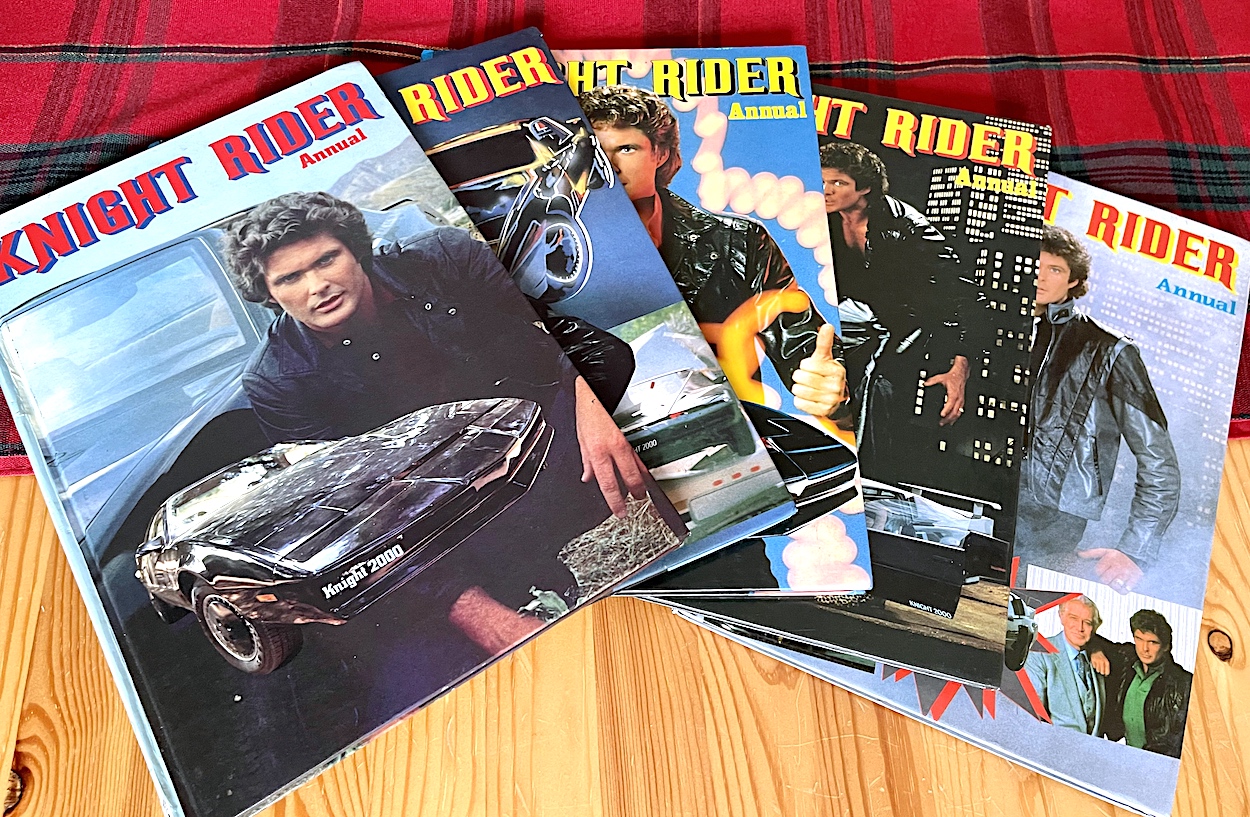
There wasn’t a Knight Rider comic because the trend at that time was to feature popular series in strip format inside our magazines such as Look-In, a young person’s TV guide which featured the series alongside the likes of The A-Team and Airwolf. But between 1983 and 1987 Grandreams released five Knight Rider annuals filled with strips, prose stories, puzzles, pin-ups and behind-the-scenes features and interviews. I think I only ever owned this one from 1983 though.
The series debuted this side of the Atlantic in February 1983, with the first annual released at the end of the summer and my eager young hands got a hold of it that Christmas, hence why I’m reviewing it now as part of the blog’s festivities. I remember reading the two-page Look-In strips in my sister’s magazine, with their weekly cliffhangers similar to the 60s Thunderbirds comics. However they were line drawings, not the gorgeous greyscale wash we get here.
Upon picking this annual up for the blog I wasn’t sure what to expect. I really hoped for something entertaining but over the years I’ve seen some horrible annuals quickly thrown together in order to cash in, without much love nor care for the property. As long as this wasn’t like that I’d be happy. What I didn’t expect was something of such high calibre, with an excellent creative team behind great stories illustrated with gorgeous art, alongside some fun articles. I couldn’t be happier Knight Rider received this treatment.
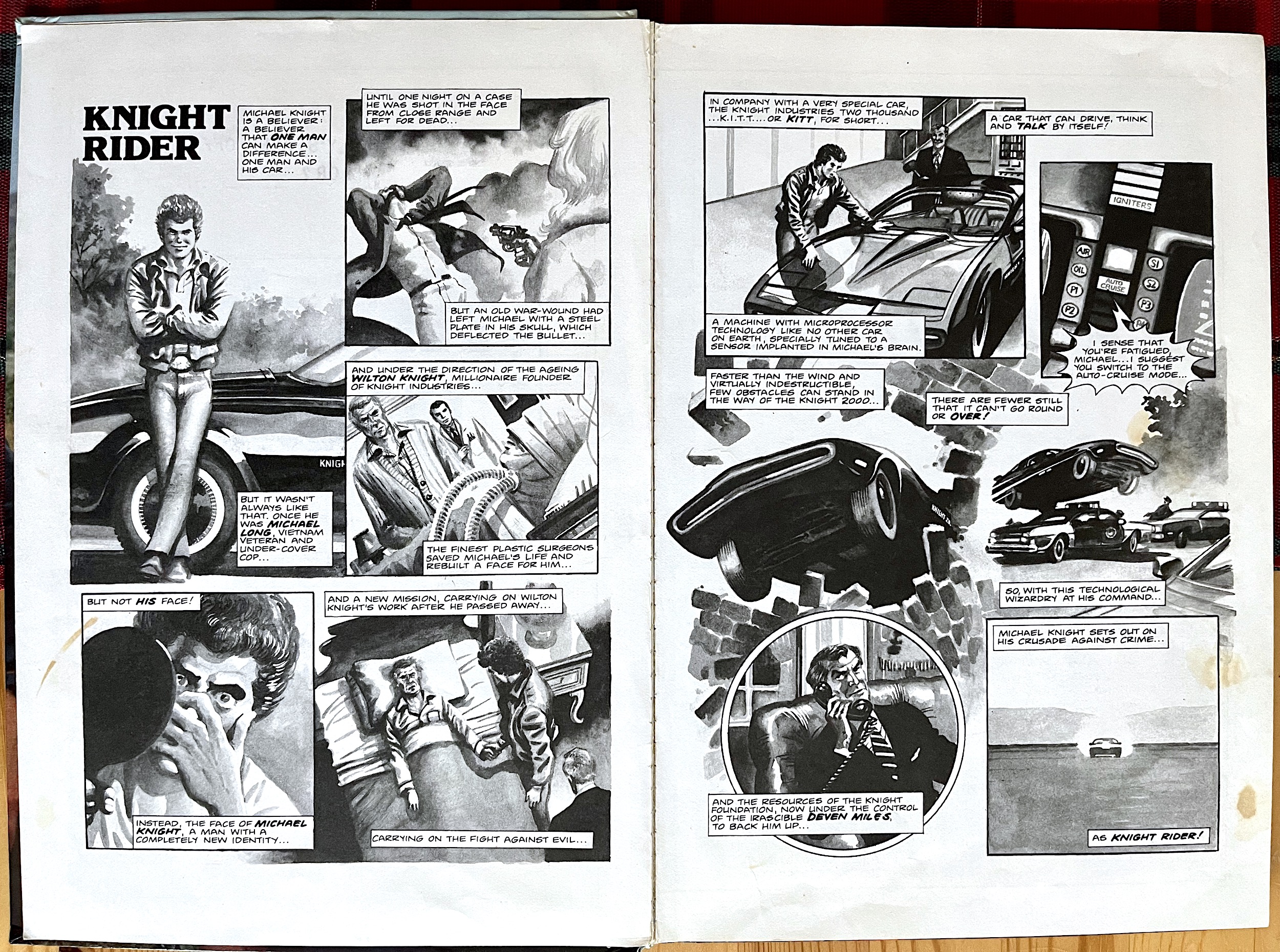
When I opened the book and saw the two-page introductory strip above which recaps the set up for the series not only was I in awe of the art, I was instantly transported back to that Christmas. Quickly telling the tale of Michael Knight’s original identify, being double-crossed, shot in the face and left to die, and the reconstructive surgery which resulted in his new identity and new life, we’re instantly up to speed and ready to get stuck in to what promises to be a much better book than I thought it was going to be.
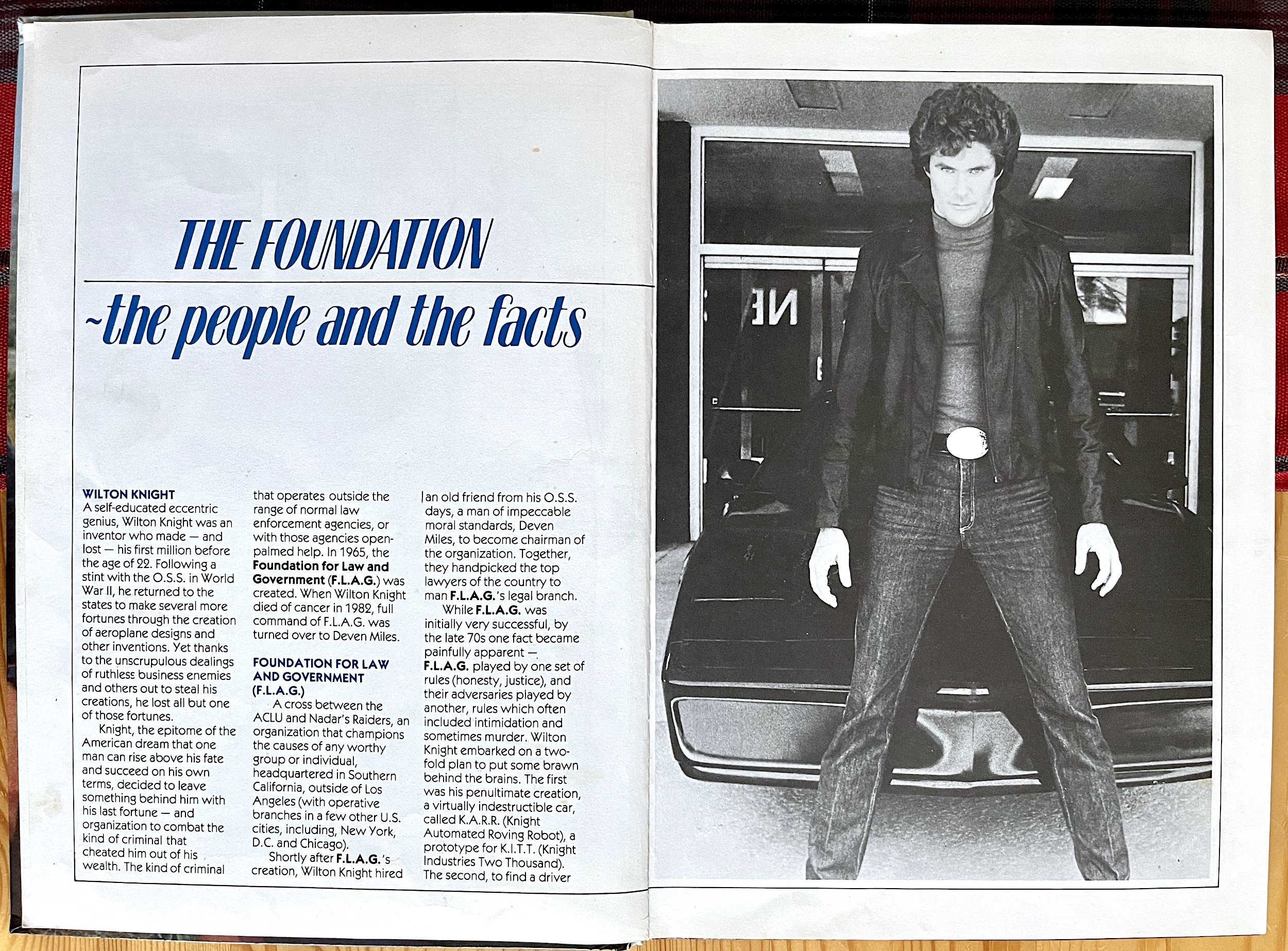
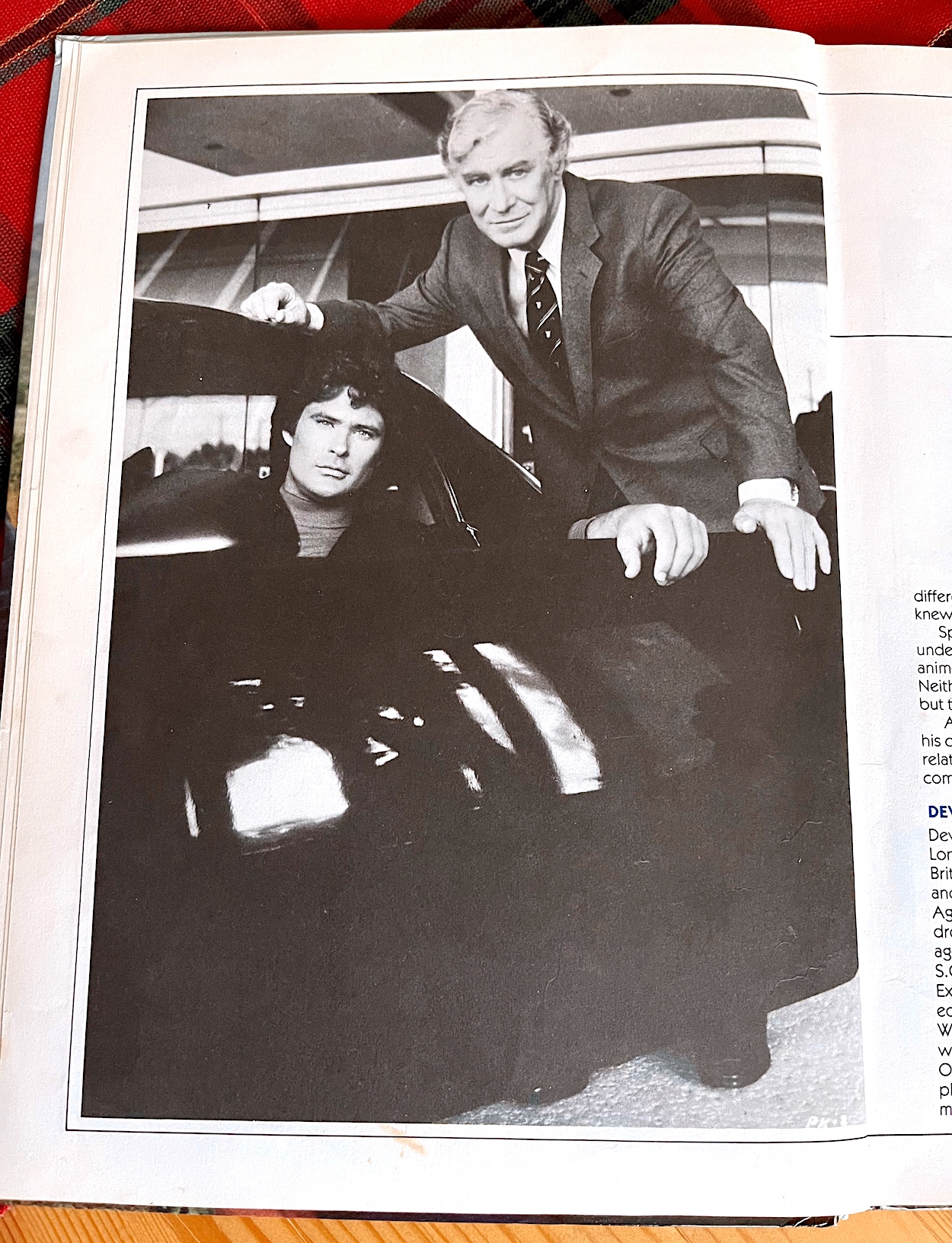
The intro strip is followed by a feature explaining the background to the characters, the Foundation for Law and Government (F.L.A.G.) and the story behind the series. Some of the details here didn’t even make it into the show and were pulled from the series bible, put together by Glen A. Larson when the show was created. For the uninitiated, Wilton Knight’s Knight Industries set up F.L.A.G. as a non-profit arm of his company to help ordinary citizens fight those untouchable criminals who operate above the law.
Court battles and legal wrangling made up the majority of their work (though for obvious reasons we only heard about these happening off camera) but sometimes “direct intervention” was called for and that’s where the Knight 2000 project came in; one man in one car, that car offering him all the funding and resources of the Foundation to make a real difference in the lives of people the justice system had let down. Sounds like a good set up for a show, doesn’t it? Well, it sure was.
Of course, that one car was K.I.T.T., or rather the Knight Industries Two Thousand artificial intelligence inside the Knight 2000 car. That’s something the show (and I’m glad to say this annual) made perfectly clear; K.I.T.T. wasn’t the car, he was the A.I. inside the car; a car that could jump, drive on two wheels, create fog and oil slicks and so much more, all inside the near-indestructible molecular bonded shell capable of 300+ kph. Add in K.I.T.T. who could control all of this, drive it, remotely hack computers (a big deal back then) and give Michael computerised, forensic and scientific resources that’d make NCIS envious.
There’s even information which was new to me today. It’s full of wonderful little details fans will lap up
Knight Rider was that rare thing, a television show my whole family gathered around to watch together. It was unlike anything anyone had seen before. My sisters may have had David Hasselhoff posters on their walls, but mine were adorned with K.I.T.T., shelves packed with models of the car, books, electric toys… you name it, I had it. I remember when ITV repeated the show in the 90s and my mum, dad and a then-teenage me would still watch it together. Today, the remastered HD Blu-Ray collection takes pride of place in my own home. My love for this show will never wane.
So, intros out of the way and my obsession detailed, I can happily declare this opening feature is anything but a basic round up. Michael’s boss Devon Miles (played by the excellent Edward Mulhare) may be misspelled ‘Deven’ but there are details here from the series bible the show didn’t elaborate on until later seasons, so it must’ve been fascinating reading it in 1983. There’s even information which was new to me today. I never knew Devon originally met Wilton on a mission in France for the British S.O.E., or that his parents were killed in the blitz. Technician Bonnie Barstow’s father was a pilot who worked for Wilton and she has a Masters in Computer Science and a Doctorate in Robotics. It’s full of wonderful little details fans will lap up.
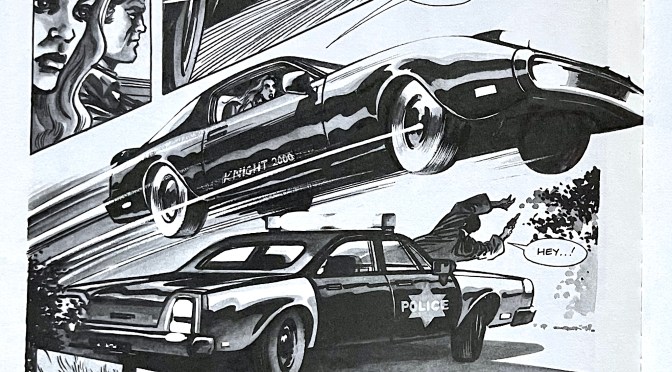
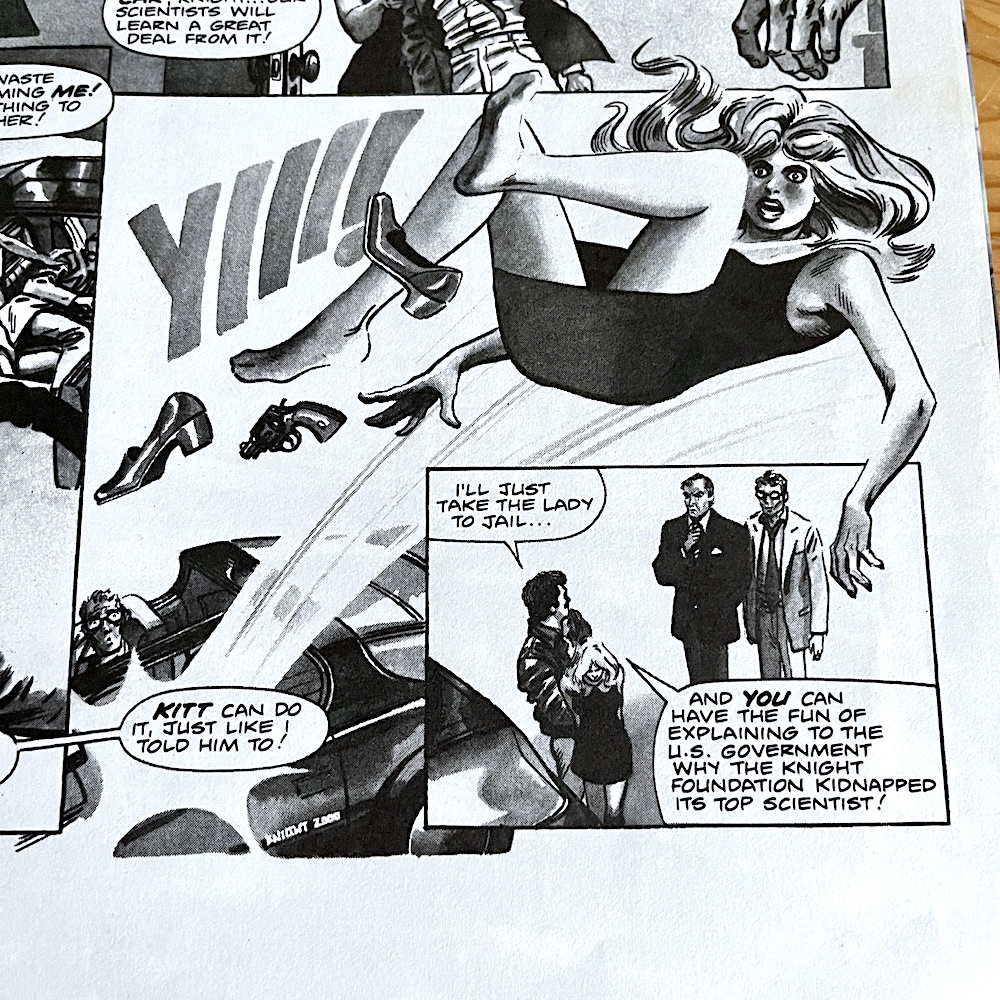
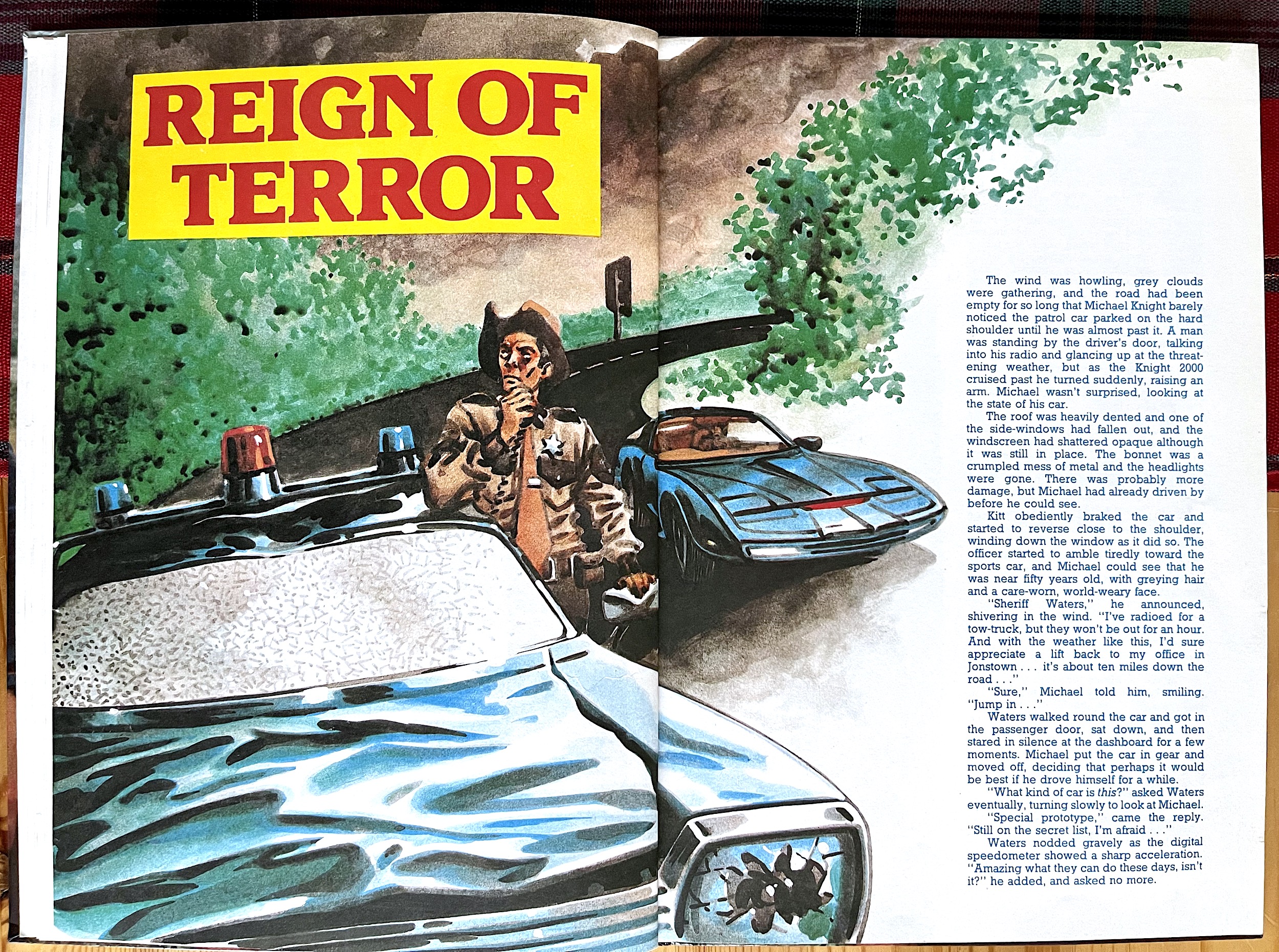
This image is taken from the first strip, Break-Out. There are two strips in the book, both of which act like the final part of an episode, so all of the detective work and build-up is out of the way and the strips can concentrate on some fun action. For example, here we see the results of the supposed damsel in distress trying to double-cross Michael only for K.I.T.T. to quite literally eject that plan. So who was behind these exciting, fun stories and the simply gorgeous, atmospheric art?
I was thrilled to find out my favourite thing in the universe was handed over to none other than David Lloyd, he of V for Vendetta fame (as well as Wasteland, The Territory and Hellblazer). Yes, that David Lloyd! His unmistakable style and that lovely wash suit Knight Rider perfectly. The original pilot movie was rather dark with a lovely atmosphere and David’s art is reminiscent of the direction of that particular episode. With Marvel UK’s Transformers letterer Annie Halfacree bringing her talents to the page the only question left to ask was who wrote these?
While speaking with David recently (more on that at the end of this review) I was finally able to find out it was Steve Moore (Abslom Daak Dalek Killer, Hercules, Warrior) who wrote many of the stories for Grandreams tie-in annuals at the time. Steve nails the characters of Michael and K.I.T.T. and, best of all, their dynamic interplay. This evolved as the series progressed and at this early stage could still be quite antagonistic at times, Michael’s patience sometimes wearing thin with the analytical and logical computer. I’m very happy to say that’s here in spades.
The prose stories, beautifully drawn and coloured by David, are lengthier than any in Marvel UK’s annuals, giving Steve the scope to give us a more detailed adventure for our heroes. Although, I must note Bonnie is conspicuously absent outside of the features. This could be because the stories had to be written so far in advance that the pilot movie was all Steve had to really go on (Bonnie didn’t appear until the first regular episode). But then again the stories take place out on the road already, so by this stage in the episodes it would be all about Michael and K.I.T.T. anyway.
Reign of Terror uses that old 80s staple of the bad motorcycle gang, one the show itself used in its first season. In fact, the episode Good Day at White Rock would’ve been broadcast months before this annual hit the shops. Also, K.I.T.T.’s functions are limited to those shown in the pilot movie, so again I think these were written before much of the series was broadcast. Given this, it’s nothing short of incredible how well Steve nails everything from the characterisations to the tone.
The distinction between K.I.T.T. and the car are particularly enjoyable, especially since this was something the series would only really begin to highlight in season two (after it was set up in the pilot). For example, in one paragraph here, “K.I.T.T. brought the car round the buildings and came up behind them.” It’s enthusiastically written and I get the impression Steve was having fun with this. Michael and K.I.T.T. throw everything at the bikers and it’s not just a checklist of the car’s functions, there’s a proper plan here, perfectly thought out and executed with panache, a plan that could only be achieved by this unique partnership.
Reign of Terror’s plot may not have been all that original but it paints an entertaining picture. The other prose story, The Long Chase is a more original idea. The US Customs Department asks F.L.A.G. for help in an art forgery case, where they believe a legit art business is also smuggling stolen works. They’ve tried tracking their trucks but are always met with car accidents, traffic jams, road blocks etc., too many to be a coincidence. Enter Michael and K.I.T.T.
In the end it boils down to a situation where they have a choice of two trucks to follow, each going separate ways on the highway. They deduce which one to tail and are met with the same impediments, but they’re no match for these two and we get a wonderfully written sequence of them barging their way through everything thrown at them, much to the terror of Marshall, the Customs Agent along for the ride.
These images have a lovely retro feel to them that many would pay good money to have painted and framed today
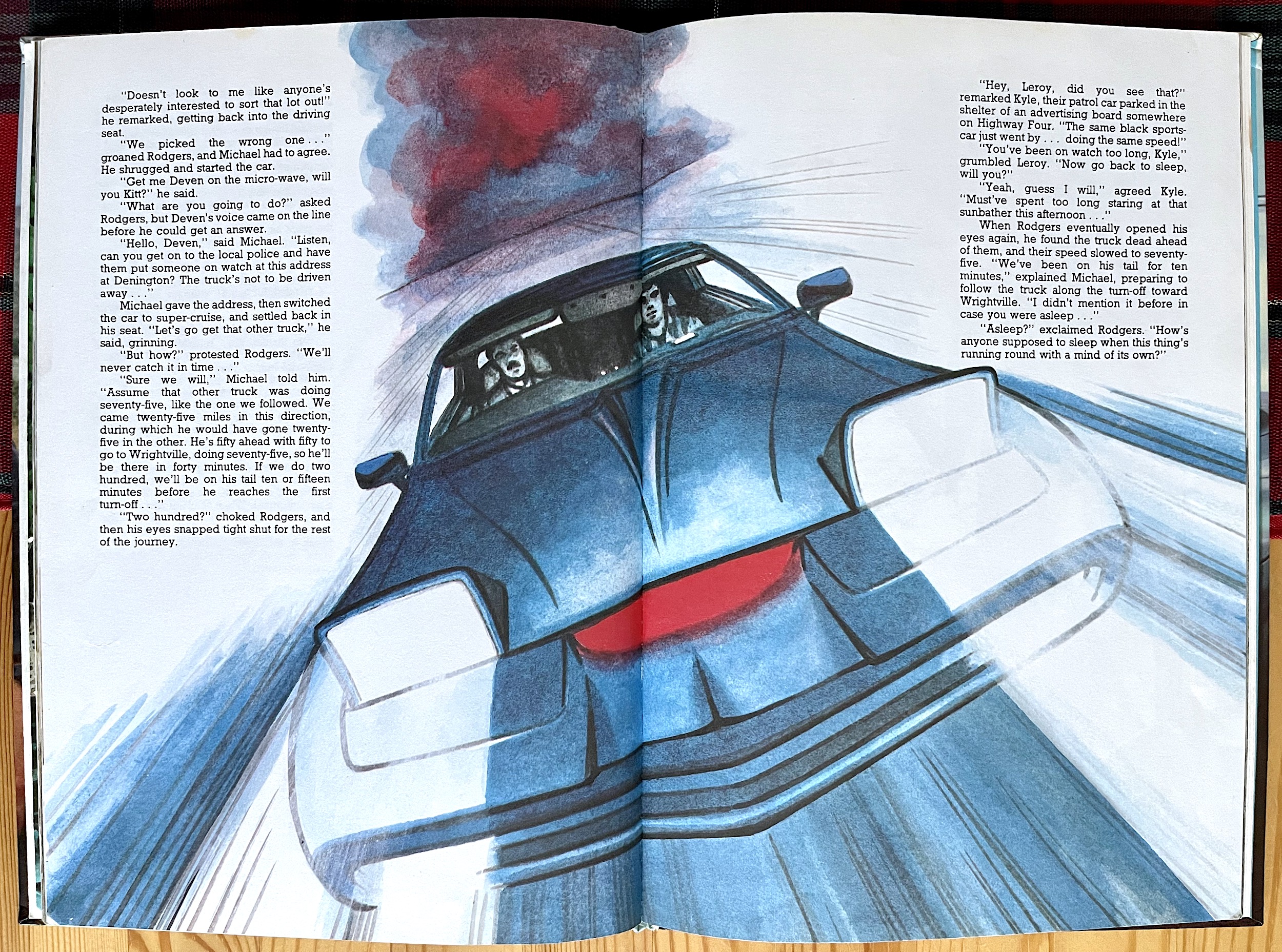
When it’s clear they’ve followed the truck with the legitimate art (sent on a wild goose chase with the diversions) Marshall is about to quit, what with the other truck now hundreds of miles away. But this is a challenge our pair relish. There are some really nice scenes involving Michael and K.I.T.T.’s burgeoning partnership. It’s intriguing, well-paced and all round a thoroughly entertaining little tale. There are also some brilliant night scenes drawn by David, my favourite being a double-page spread of K.I.T.T. coming head on towards the reader, scanner and headlights cutting through the night. These images have a lovely retro feel to them that many would pay good money to have painted and framed today.
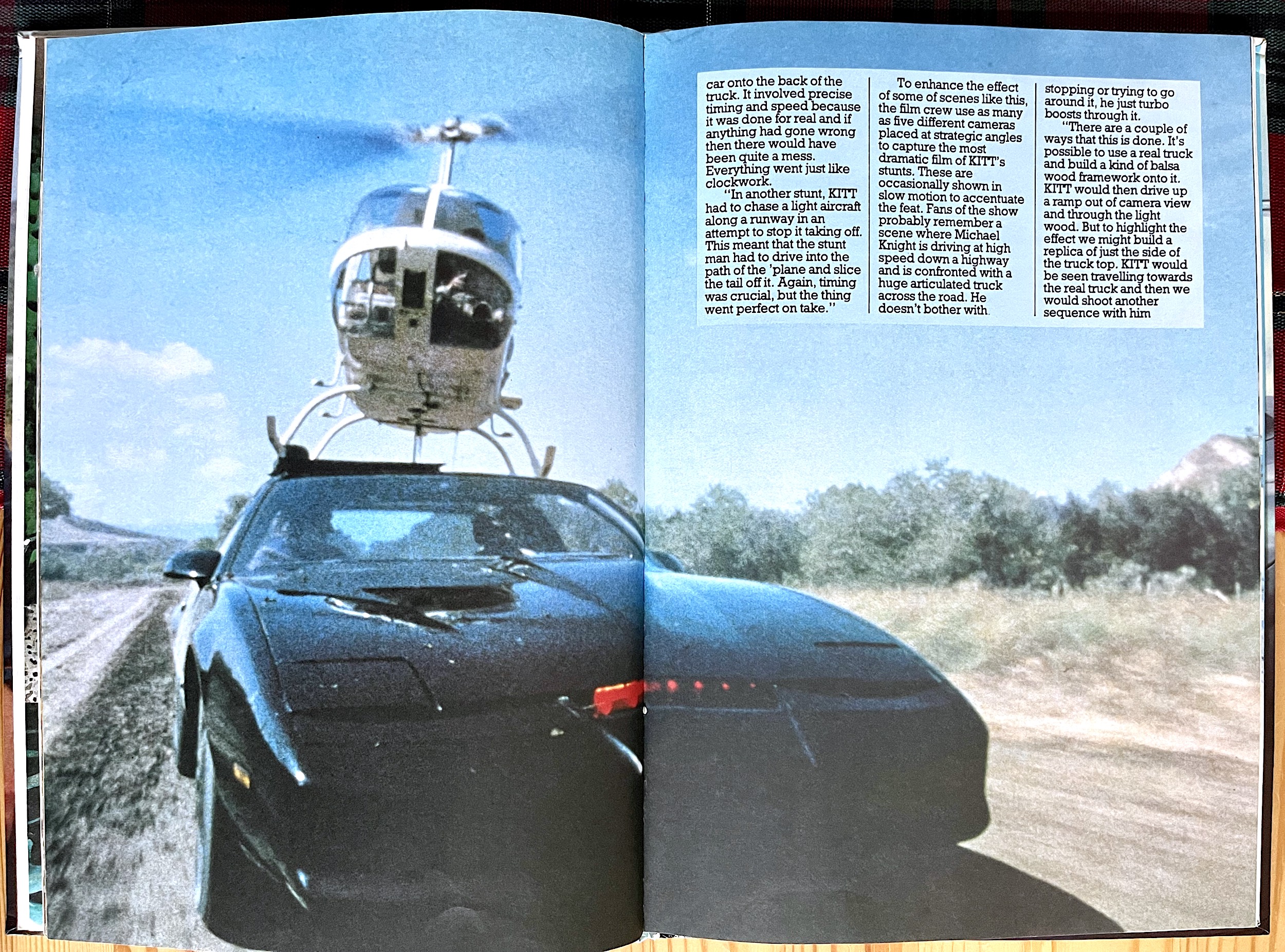
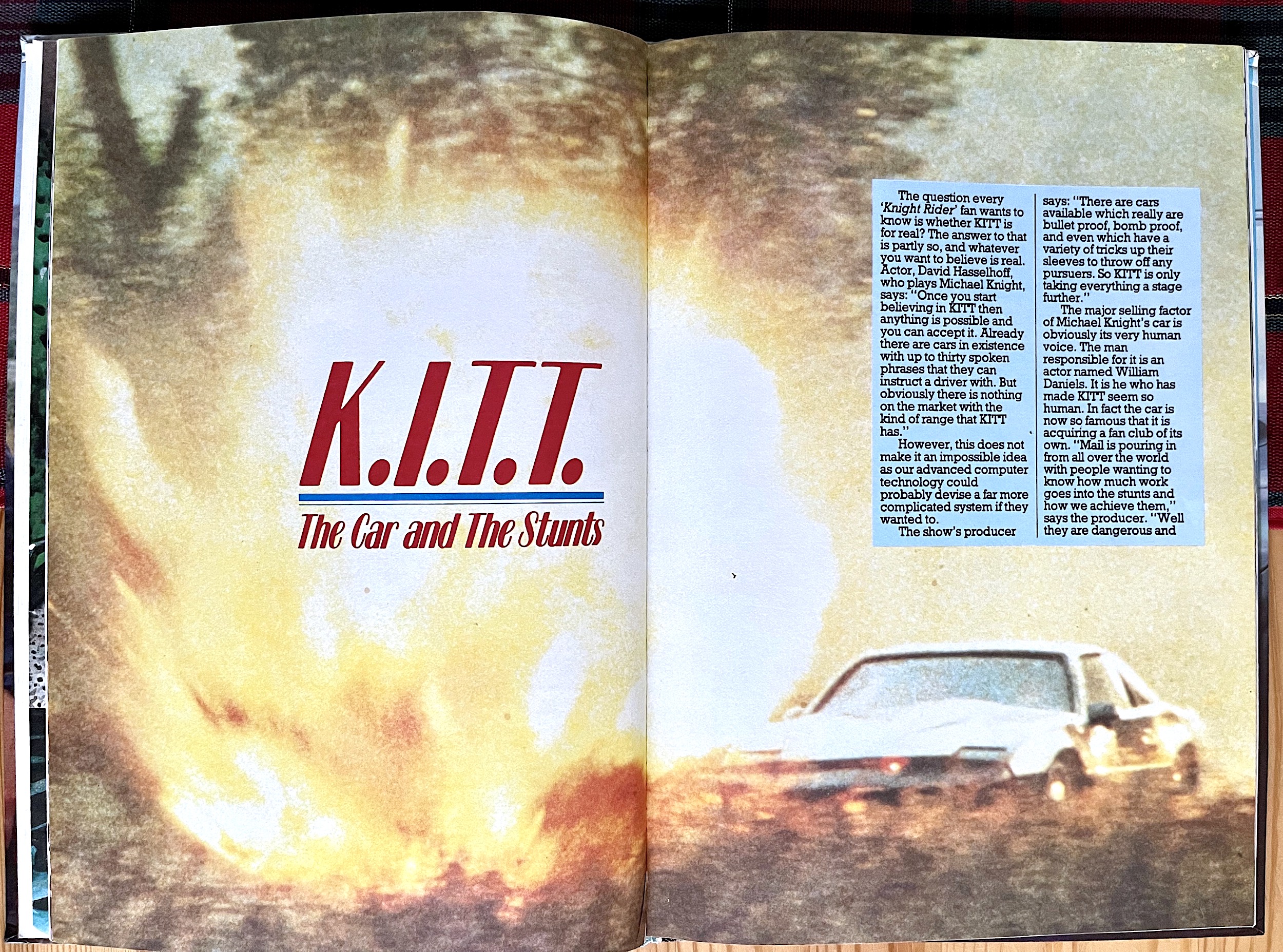
Alongside a brief bio of The Hoff there are two features centred around our other main character. K.I.T.T. – The Car and the Stunts is pretty self explanatory and is apparently based around an interview with one of the producers, although they go unnamed and give inaccurate information, which is odd. I wonder if the book did speak to someone involved with the show or if they got these details from elsewhere and reprinted them.
There’s a reference to turbo boosting on to the back of a truck being done for real, but the scene in question was actually achieved through clever editing and effects. The ‘producer’ also says the only thing that isn’t done for real is the ejector seat, but in reality this was really installed into one of the cars used on the show. Indeed, since this book there have been numerous interviews with the stunt people on the show which have been very funny, especially the story about when they were trying to calibrate the ejector seat for the first time and the stuntman went flying into the air higher than a palm tree next to the car! Unfortunately, this isn’t referenced here.
But at the time of this book it was just exciting to see photos of K.I.T.T. in action. You have to remember this was way before the internet. Even VHS video recorders were only starting to be installed across the UK. That meant the only way to see your favourite TV show was when it was broadcast or repeated, and the only chance to see photos was in printed publications. There may not have been any photos of him turbo boosting over anything which I remember being disappointed with, but there are explosions, a ski mode (up on two wheels) and a very memorable chase where the stunt performer jumped from a flying helicopter right down into the driver’s seat of the speeding, self-driving (on the screen at least) K.I.T.T., all without wires!
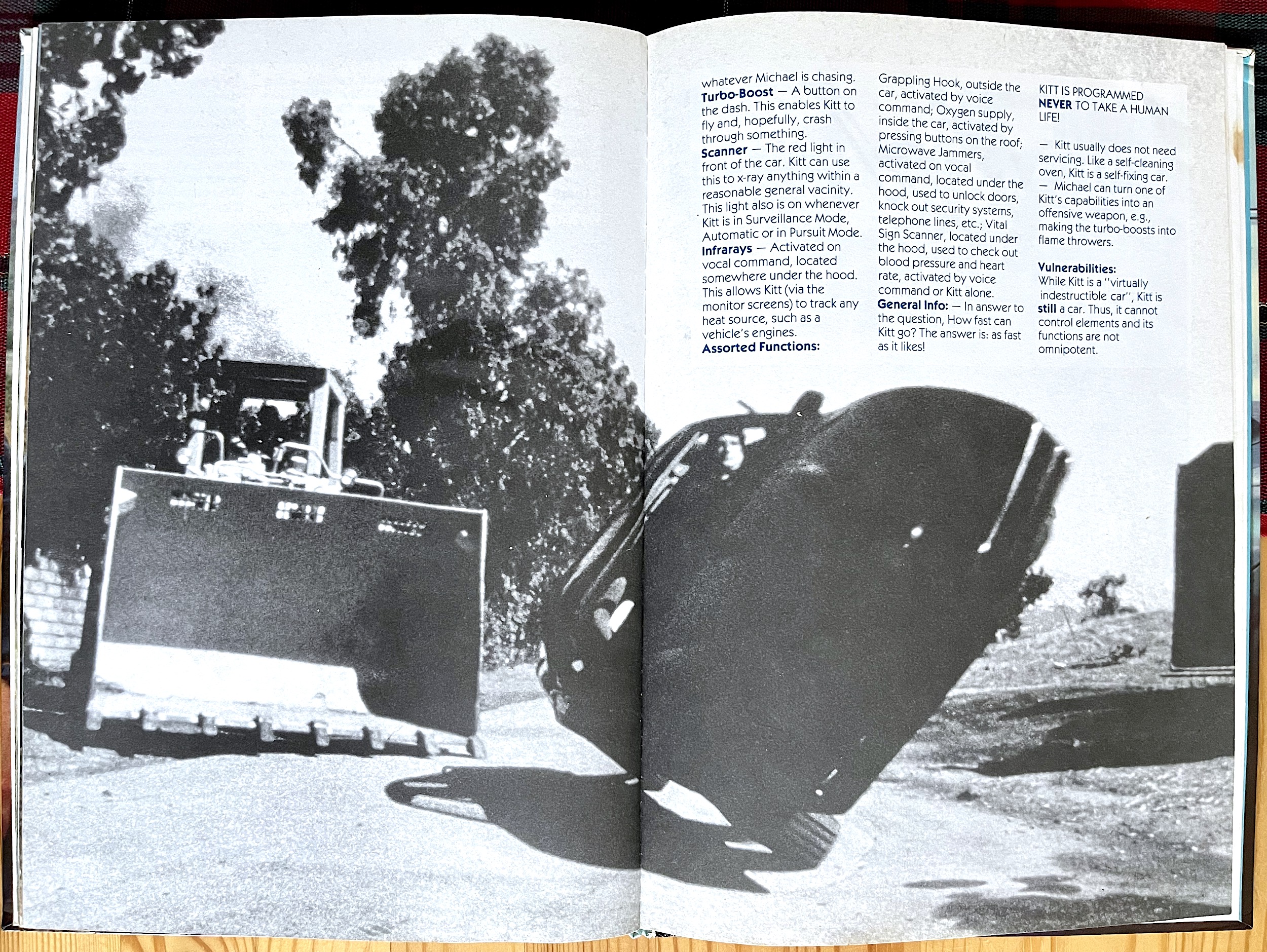
What’s interesting is how the book credits actor William Daniels as K.I.T.T.’s voice when the show didn’t. In fact, Daniels insisted he not be credited so as not to ruin the illusion for the kids, so given who the target audience is for this book it’s strange to include his name. The second car feature, K.I.T.T. – Equipment and Functions deals specifically with the fictional side of the car, meaning its artificial intelligence and futuristic abilities.
There’s a particularly well written introduction to this part of the annual, especially when discussing the different ways he interacts with the human characters.
“Michael and K.I.T.T. are true partners: they bicker, they rib one another, but they are fiercely loyal to each other. K.I.T.T. is a little bit of a know-it-all. He’s pragmatic, sometimes arrogant, often fussy and peevish. And since he’s (yes, he is described as a “he”) completely logical, he has a difficult time understanding this most illogical of humans, Michael Knight.”
Of course he’d soften as his character developed over the series, as he learned from his human companion and their missions together.
“K.I.T.T. has a great sense of humour and he is incessantly interested in human emotions and feelings, things he seems to pick up on as time goes on.”
It’s clear these details were taken from the series bible because when this was written they were the future plans for the character, rather than anything seen yet. Also, maybe an early draft of that document was used because even here there are some inaccuracies, such as claiming K.I.T.T. can’t have independent thought unless put into surveillance mode. This mode is for scanning the area, K.I.T.T. always had independent thought. (Elsewhere in the same article this mode is described correctly.)
It’s rather strange that the publishers obviously had access to information from the show itself yet these errors still slipped in. Could it be the series bible was further refined as the pilot was created but after it was handed out to licensees? Or perhaps the book elaborated where they thought they could, not thinking they were contradicting anything. Most glaringly are the two oft-cited errors that peeve fans off: no, turbo boost does not enable K.I.T.T. to fly and no, he does not have offensive weapons.
Saying all that, as a child I really didn’t care. We were much more forgiving back then. Books such as this were the only way we could see photos of the super cool car and enjoy new stories away from Saturday evenings in front of the family telly. My own copy of this annual disappeared many, many years ago and I remember it falling apart from being read that many times. It rarely left my side for months after Christmas 1983. I’d even clutch it tightly while watching the latest episode.
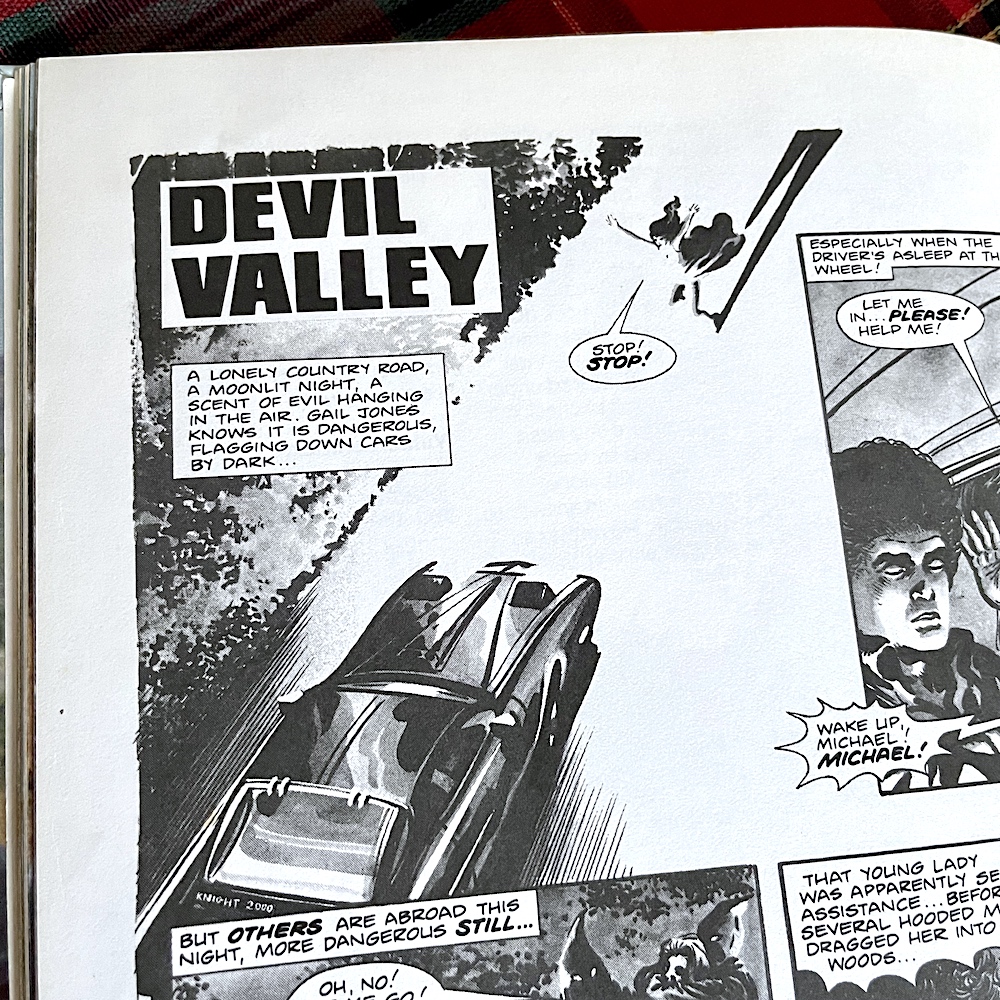
To finish this childhood favourite is Devil’s Valley, our second gorgeous strip and it’s even better than the first. It may have been a family show but Knight Rider never shied away from dealing with issues you’d see in more adult dramas, such as murder, kidnap, drug dealing and terrorism. All defeated by one person making a difference of course. Another topic it would touch upon more than once, which this strip also does, was racism.
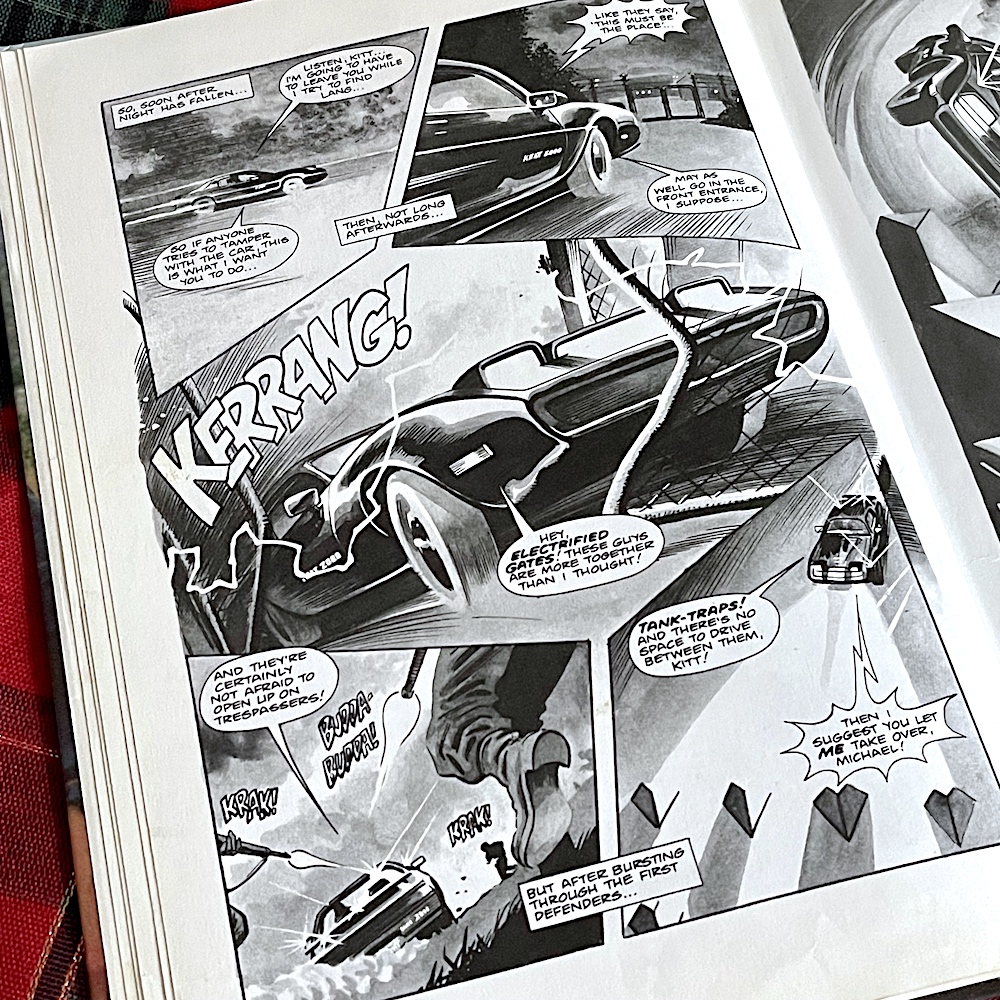
A variation of the Ku Klux Klan seem to have kidnapped a young lady to make some sort of religious sacrifice. She escapes and runs out in front of a self-piloting K.I.T.T. (Michael is having a doze). Once again, it plays out like the final scenes of an episode and all of the car’s capabilities are the same as the movie but it’s huge fun. The spread above is an exciting collection of panels and shows the potential a regular Knight Rider strip could have had when coupled with a deeper story.
One thing I have noticed throughout the book is the incessant need to have ‘Knight 2000’ plastered all over the car. It looks like it’s been added later and David confirmed he can’t remember any instruction to do so. (It’s particularly jarring on the cover.) I remember any toy K.I.T.T.s I owned as a kid had stickers of this all over them and I’d always remove them. After all, K.I.T.T. was meant to blend in. It could be a licensing thing, to separate merchandise for Knight Rider from that of car manufacturer Pontiac, but adding it to the strips feels unnecessary.
As you can see this is only the first of five Knight Rider Annuals and if this one is anything to go by I’m glad I’ve finally been able to track them all down (those later ones seem to be somewhat rare) and I’m really looking forward to the next one. When will that be? Why, next Christmas of course! This blog is in real time after all. It’ll be an agonising wait but nope, I won’t be reading ahead, it’ll make the experience all the better for it.
For this year however, I have a very special treat in store for both Knight Rider and comics fans in general. Artist David Lloyd very kindly agreed to answer questions about working on the annuals and not only did he supply some fascinating insights, he also sent me some of his original sketches for K.I.T.T. and a Hasselhoff study! You’ll be able to check all of these out in just a couple of days on Saturday 17th December 2022. For now, I’m off to have my yearly viewing of the show’s sole Christmas episode, appropriately enough titled ‘Silent Knight’.
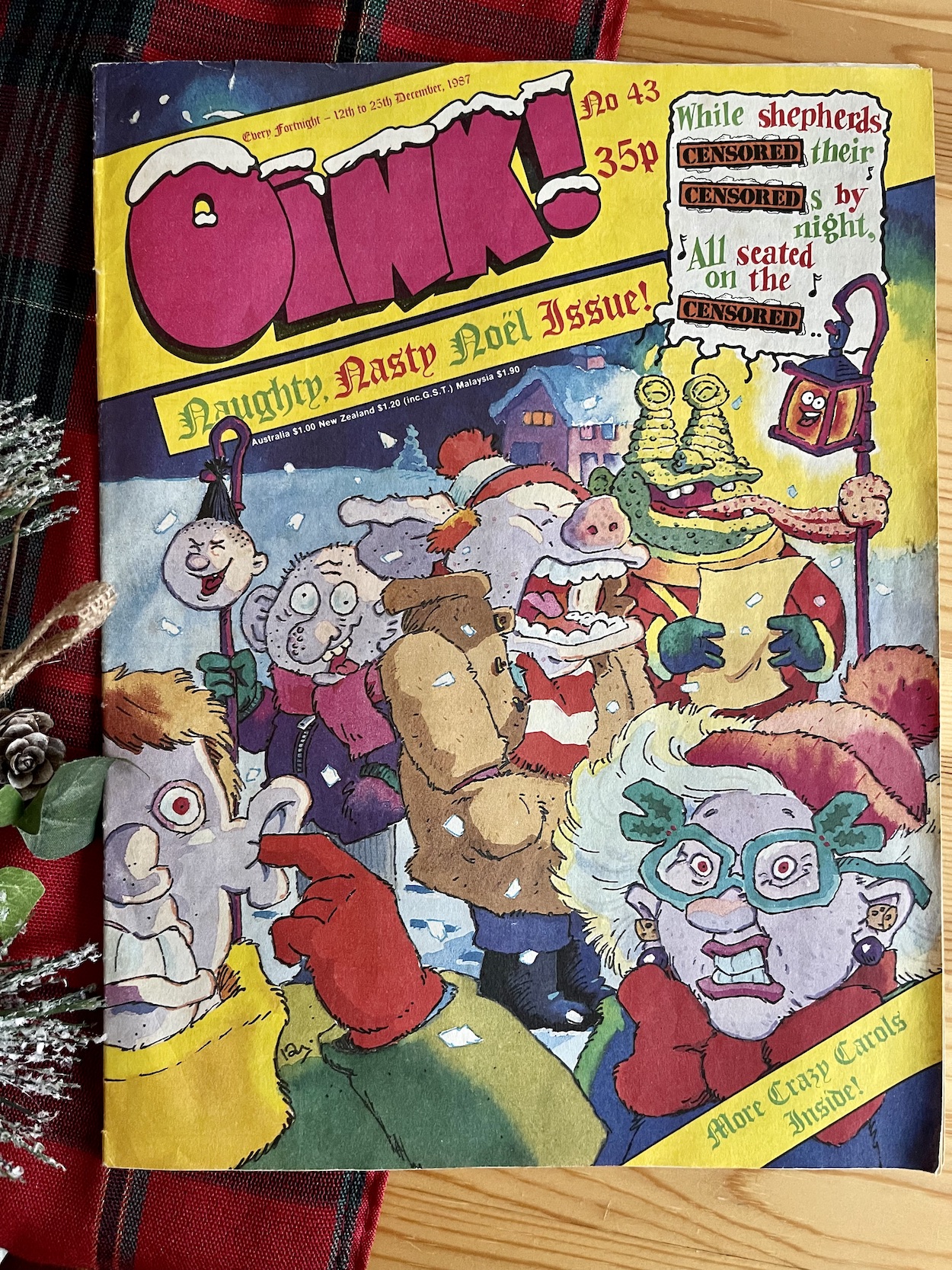
I have so many happy memories associated with OiNK, none more so than in and around Christmas 1987 when the comic was at its height. First up was this superb second festive issue, followed 13 days later on Christmas Day with The OiNK! Book 1988. The double whammy of these two editions can’t be overstated as far as I’m concerned. This issue ended up being my favourite regular issue of the comic and the book my very favourite edition of all! Do they live up to the memories? Let’s start with #43.
Just like all the best issues it begins with an Ian Jackson cover, possibly my favourite of his in fact, with apparently obscene words for us kiddies to guess at the time. I always looked forward to the festive issues of my comics and seeing the snow covered logos always made them feel extra special. There may be no multi-page Uncle Pigg strip like last year’s (by this point he and Mary Lighthouse seemed to be limited to the Grunts page and promotions) but it still manages to outdo even that issue with its plethora of Christmassy contents.
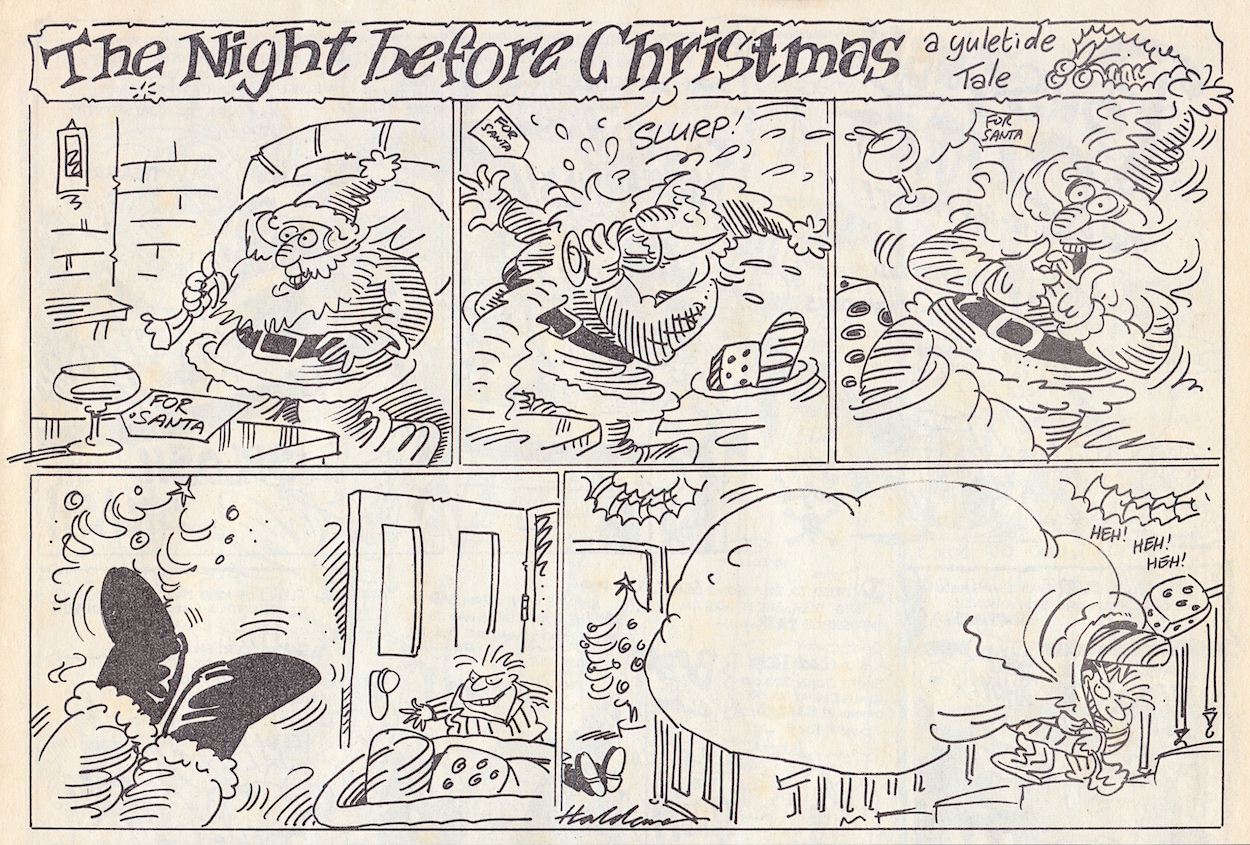
Let’s begin with The Night Before Christmas, a Yuletide Tale from David Haldane. Sounds nice and traditional, doesn’t it? It does and it’s right there at the very beginning of the comic, setting the anarchic tone for all that follows. OiNK was always great at taking traditional comic elements and turning them on their head. Surely nothing could be more traditional than Christmas comics, and upon reading this issue the feeling you come away with is one of the whole team having a blast with poking fun at the season and everything we loved about it.
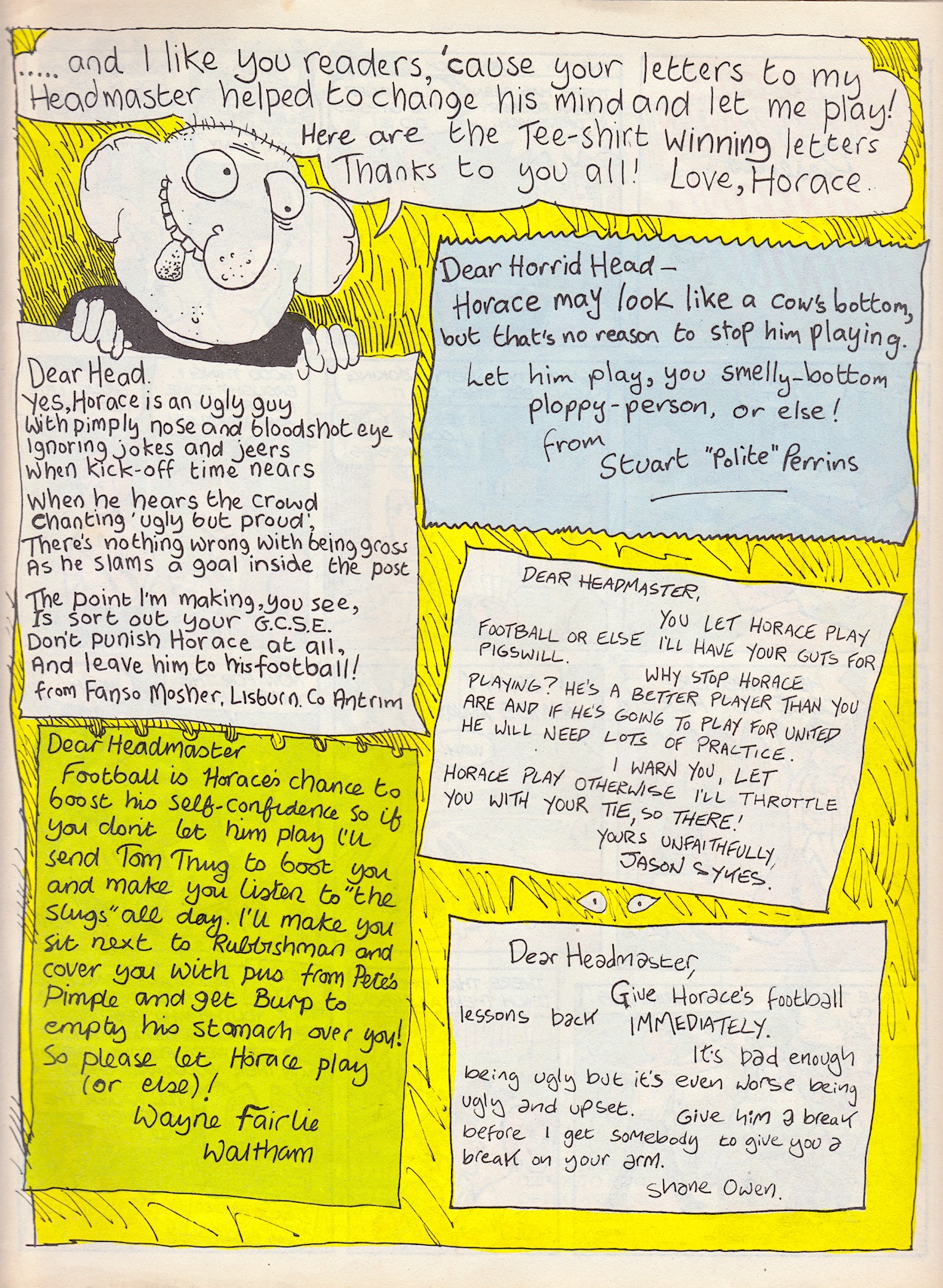
Haldane’s naughty child was the epitome of an OiNK reader wrapped up in one quick half-page strip. No, we didn’t really steal all the other children’s gifts from Santa but this cheeky, irreverent nature of the comic was what we lapped up, encapsulated here in the first strip of the issue. Things are looking good. A few pages later Horace (Ugly Face) Watkins gave readers a chance to appear as themselves and show just how irreverent they could be with letters to his headmaster.
After being banned from playing for Melchester United, Horace asked readers to send in letters begging his headmaster to change his mind. Well, the word “begging” was replaced with “telling” by those who wrote in, including one Stu Perrins, an OiNK fan who in recent years has written comics series such as Megatomic Battle Rabbit and Chrono-Cat. All of these readers won a Horace t-shirt which is something I’ve yet to see.
Way back in the mists of time when I reviewed #3 of OiNK I loved a particular spoof of some favourite comic and movie stars of mine, the Transformers. Named The Transformoids and drawn by Ralph Shephard, the go-to guy for such stories at the time, it made fun of the characters and their abilities. This issue the target is the Hasbro toy line itself, in the very capable hands of Dave Huxley. This reminds me of my parents’ attempts at following the instructions of my Transformers toys when I got into them about a year or so later.
I remember my dad in particular treating my Headmaster Slapdash like some kind of elaborate Rubik’s Cube puzzle on Christmas Day, following the instructions step-by-step and still not being completely sure he’d got it right in the end. Similarly, the above was based on Dave’s own struggles with his sons Alan’s and John’s Transformers toys which he described as “near lethal” in an article in Crickey! magazine some years later. He even drew his sons into the madvertisement, although apparently they weren’t too impressed.
This next page is so clearly the work of the mind behind Screen Wipe and Black Mirror
Dave’s work would only appear in three issues altogether, going on to become Dr. David Huxley at the Manchester School of Art and for a while had a page of his work, including one or two OiNK pieces, on their website. Unfortunately he no longer appears on there so must have moved on. However, look out for a post about that Crickey! article at a future date on the blog.
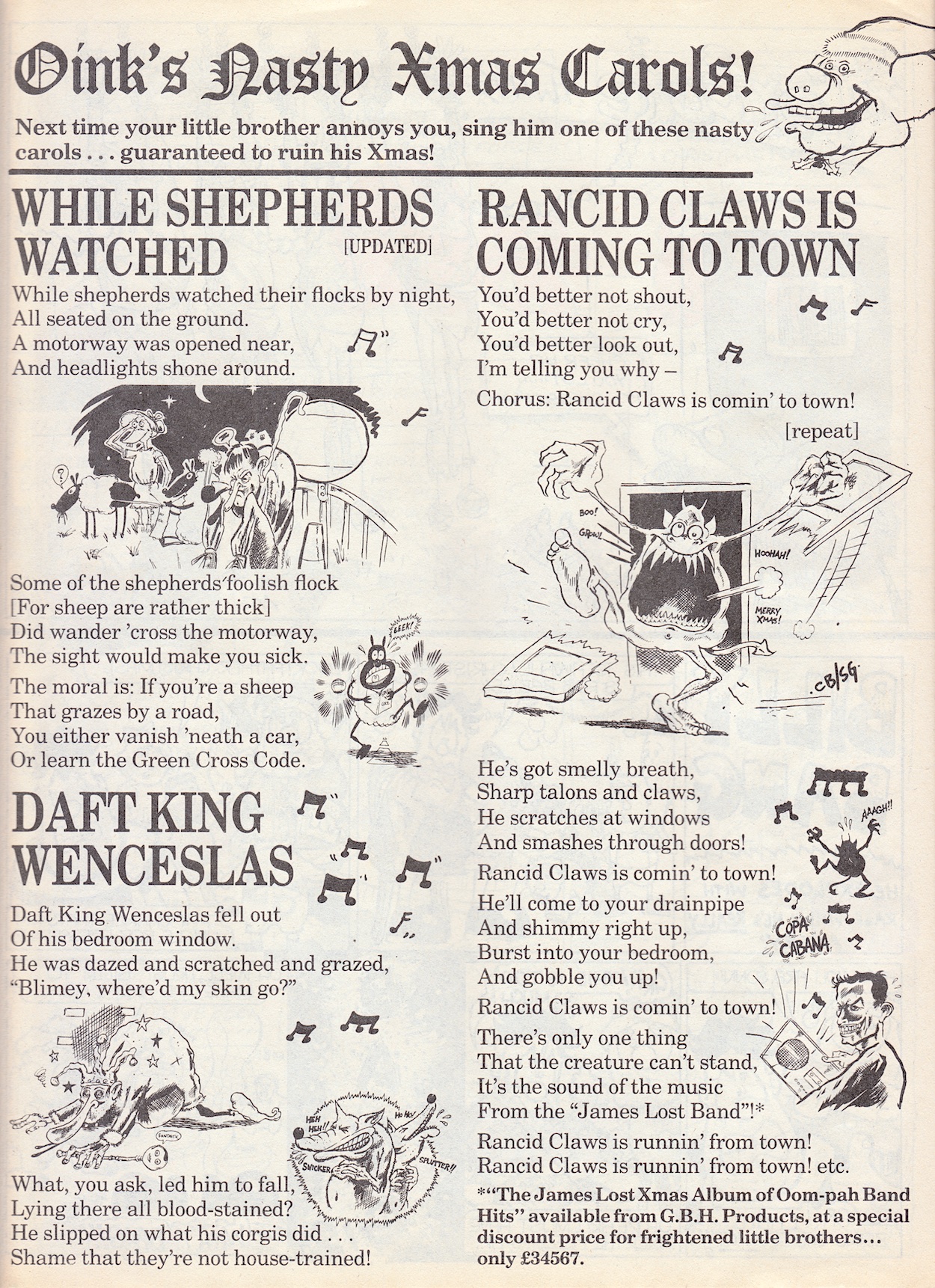
After that hilarious cover, thankfully the OiNK team weren’t done with spicing up our favourite Christmas Carols and who better to write some than Charlie Brooker? As we all know he was still at school at the time of contributing to the comic but this next page is so clearly the work of the mind behind Screen Wipe and Black Mirror. These are great fun and next to the carols is a Christmas pop song, the Jackson 5 version of which I have on my Christmas playlist every year, but now I can’t help but replace the words in my head when it comes on.
Alongside Charlie’s words are some crazy illustrations by Steve Gibson, whose tiny drawings always added so much to the text-based pages of OiNK. If social media is anything to go by these carols are fondly remembered and recited to this day by many pig pals. Oh, and in case you’re wondering ‘James Lost’ is a reference to the ‘happy music’ of James Last, who wasn’t a stranger to releasing some top-selling Christmas ditties.
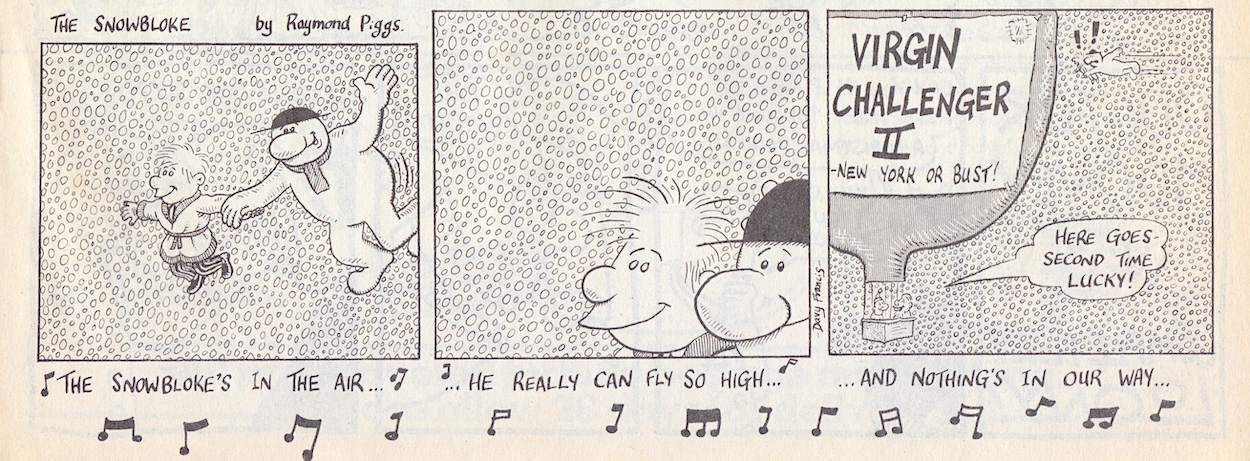
If like me you make a bit of an occasion out of wrapping your Christmas presents, you might have a TV show (usually Channel Five) counting down favourite Christmas songs and music videos on in the background while you wrap. At some point during it you’re very likely to hear the inspiration behind our next strip, just as you’re guaranteed to see the animation itself on Channel Four. Every. Single. Year. Raymond Briggs’ name is easily changed into a piggy pun and Davy Francis doesn’t disappoint with that and the quick gag of his The Snowbloke.
Despite only having sat down and watched the original The Snowman once when I was a kid, seeing even small parts of it on the TV and hearing that song never fails to make me smile because it reminds me my favourite time of the year is here, and hearing a song we hear every year at Christmas reminds me of all the things I like to do every festive season. Even seeing this small spoof brings those same feels. I’m really enjoying this issue.
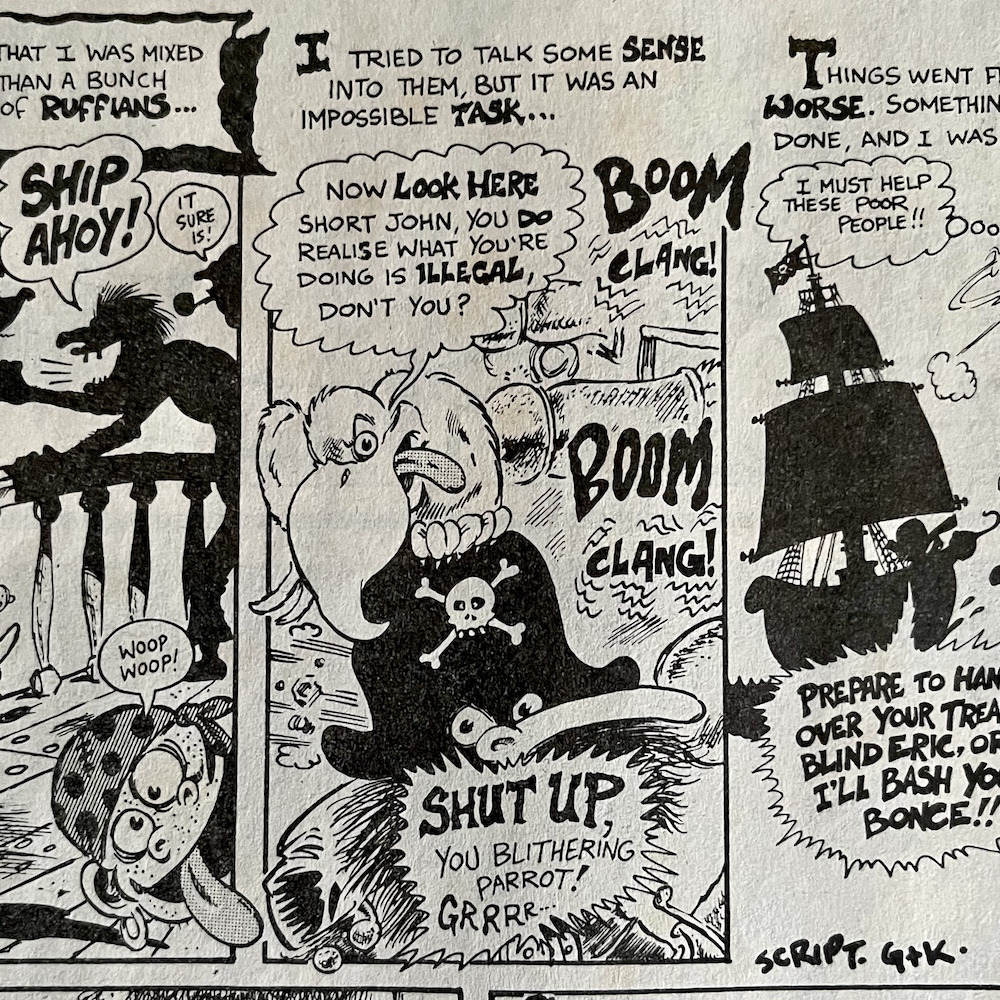
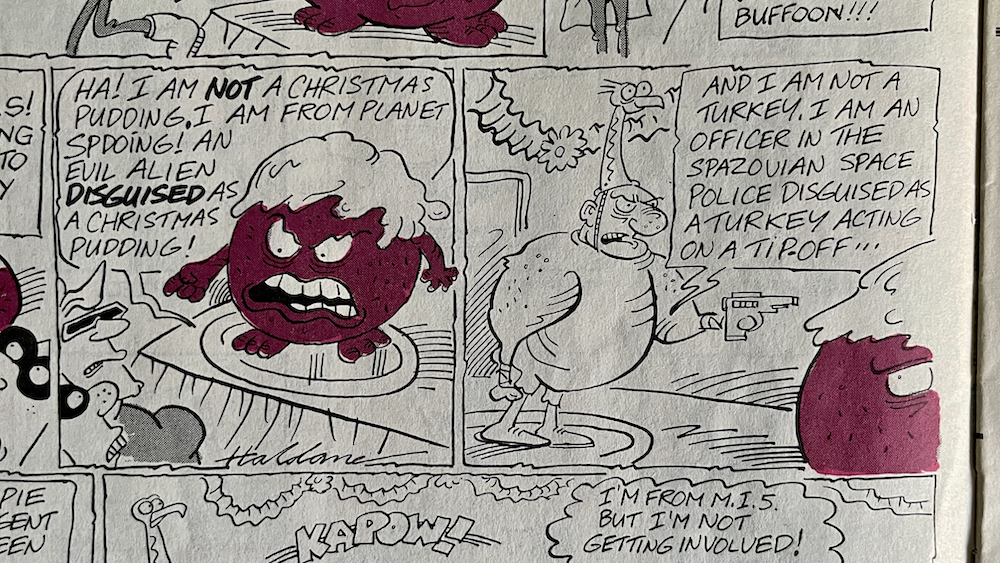
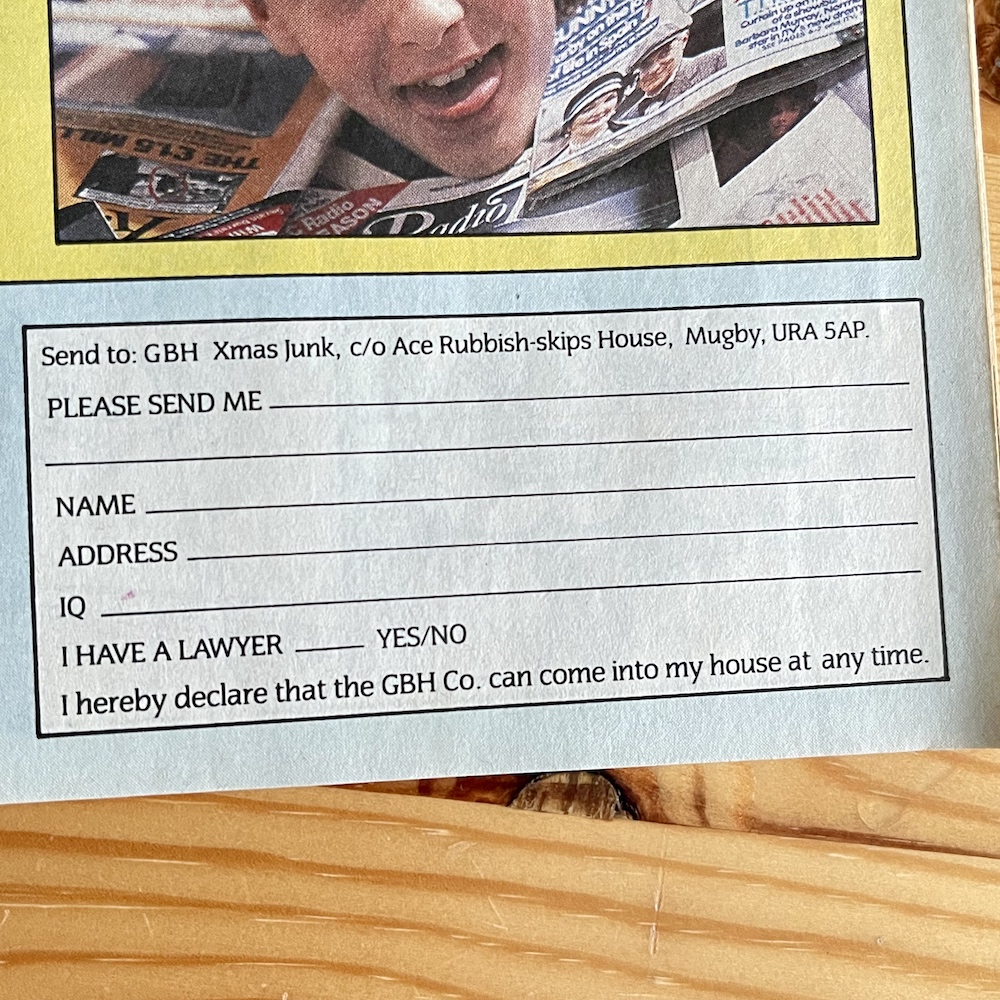
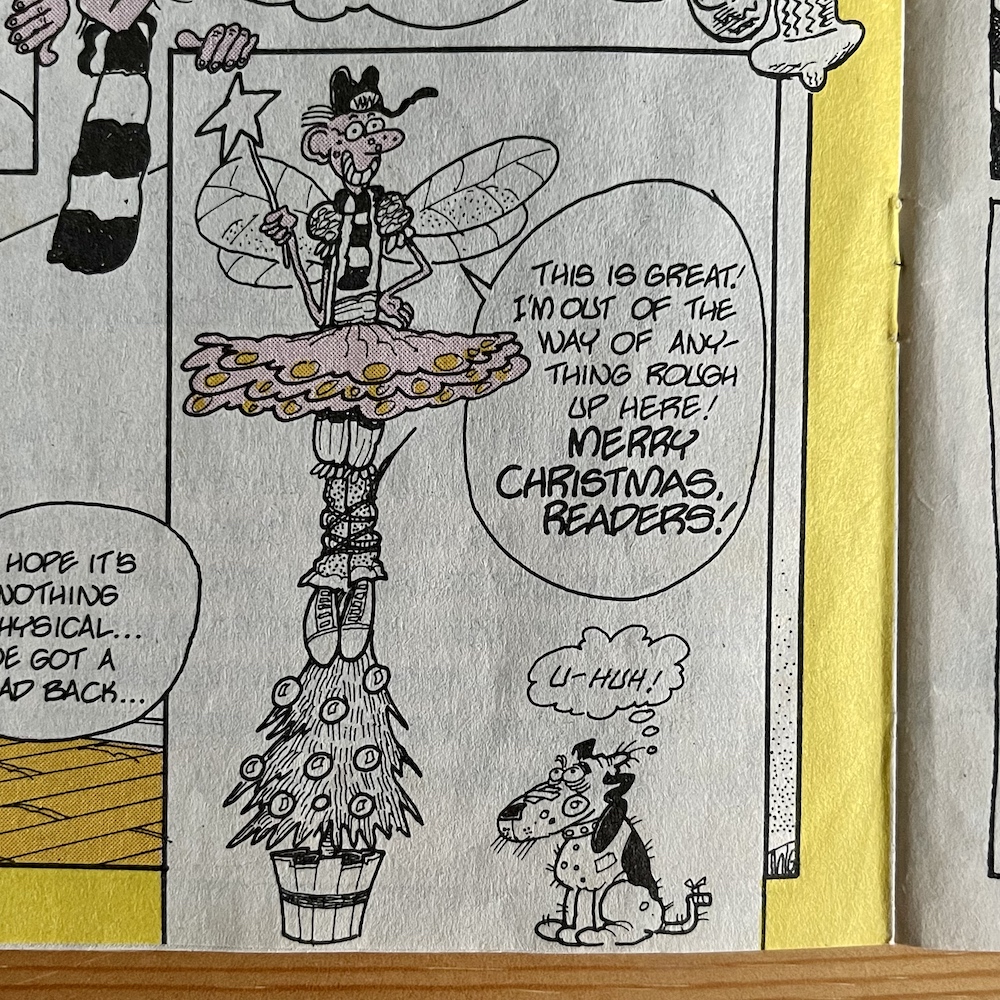
Other highlights here include Ponsonby Claret, the Know-It-All Parrot taking the pirates he lives with to task, Rubbish Man and Boy Blunder’s Christmas dinner has more hidden surprises than any pack of crackers, the GBH Christmas Catalogue order form has one particular addition I found very funny (the Yes/No part) and Weedy Willy finds something he’s capable to contributing to at Christmas that doesn’t strain/exhaust/scare him.
Ponsonby Claret written by Griffiths+Kane, drawn by Steve Gibson Rubbish Man by David Haldane Weedy Willy written by Howard Osborn, drawn by Mike Green
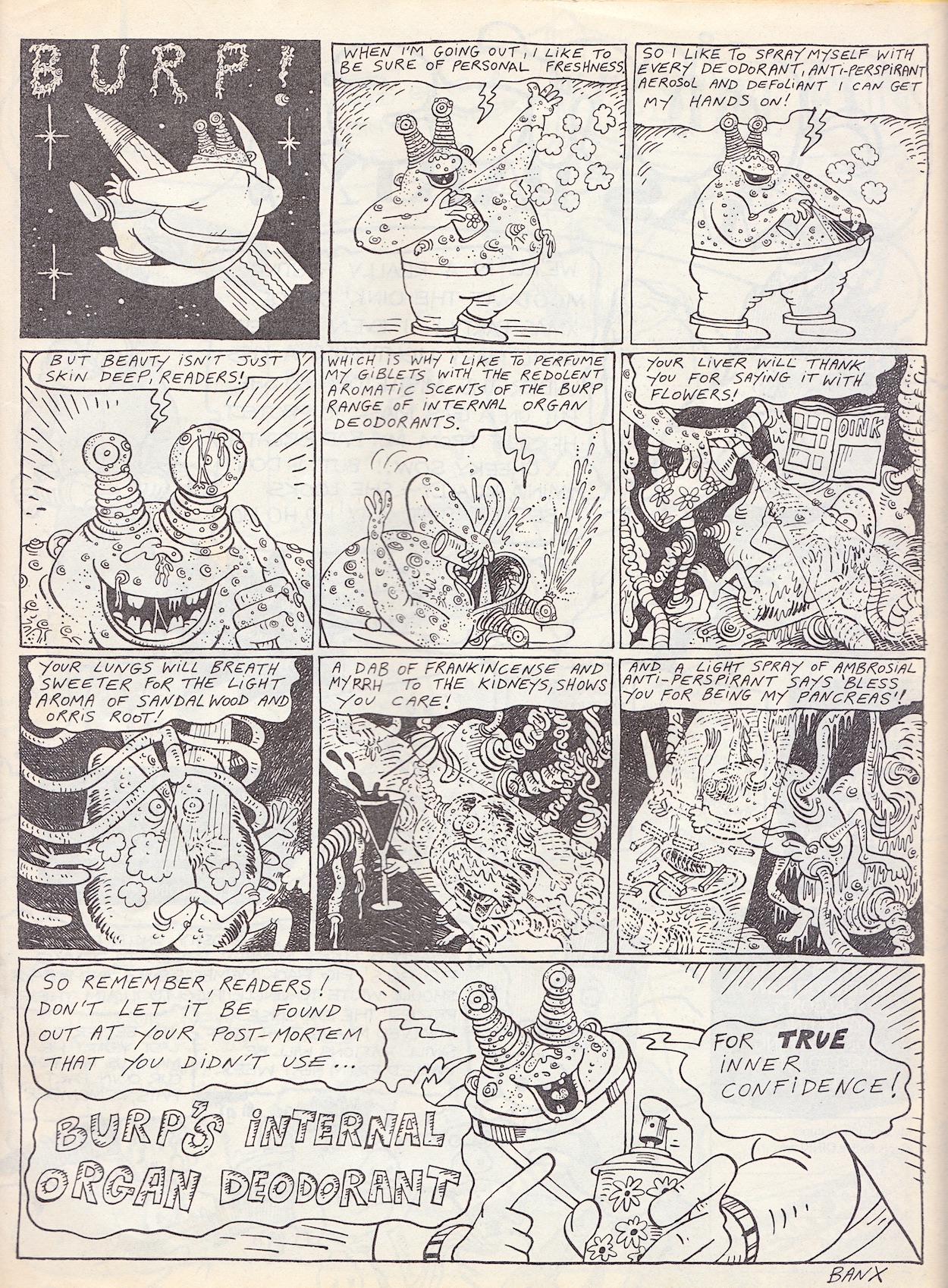
Something you’ll see on the TV every year from about October onwards are a plethora of extravagant, clearly very expensive advertisements for various brands of perfume. It always confused me how they’d spend so much on these every year and yet not one of them actually tells us anything about what the product smells like. This might be a blessing for this next piece of fragrance marketing however, because Jeremy Banx’s Burp appears to have released his own to cash in on the gift giving.
This being Burp of course this particular spray (a deodorant) isn’t straight forward. We’ve all seen how Burp interacts with his internal organs, how many of them act independently of their host, even leaving his body to go and live the lives of villains, superheroes and lovers in the outside world. So, after a suitably moral reminder that beauty is not just skin deep the following strip really takes a turn for the bizarre.
I love how Burp is interrupting each of his organs as they go about their daily lives inside his body, reading OiNK, eating dinner or simply having a nice, relaxing glass of wine. Then, just as the stupidity and weirdness ends Burp reminds the reader that all of these fragrances etc. are really about inner confidence, not the glamorous models on TV. A good message but also a wonderful way of poking fun at those advertisements and with a laugh in every panel.
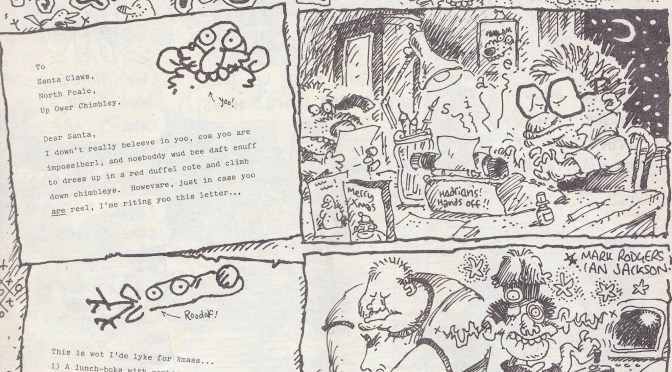
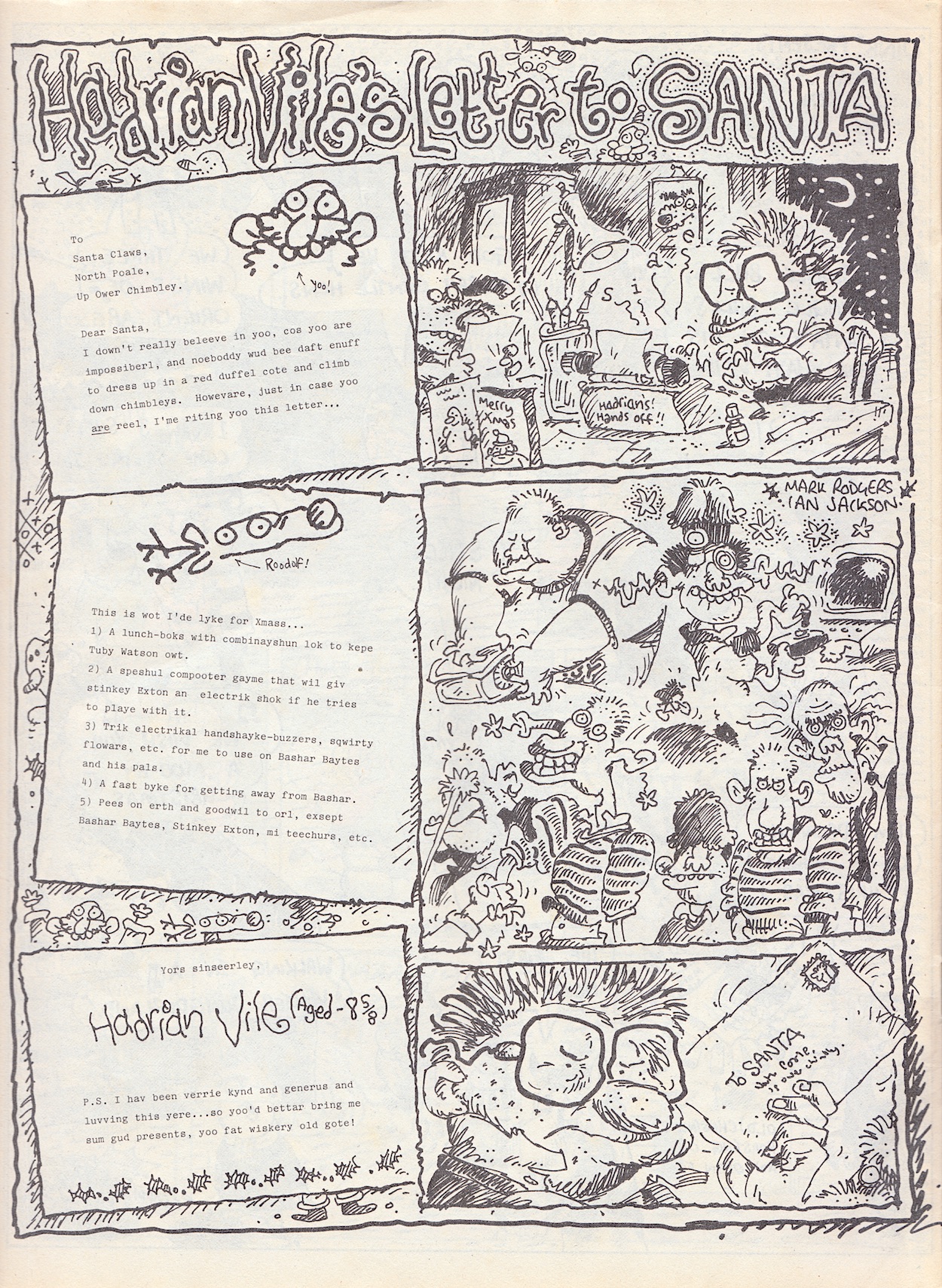
The last page I want to show you is another of those traditions we loved as kids, namely writing the letter to Santa Claus and who better to type out one in OiNK than Hadrian Vile, as ever written by Mark Rodgers and drawn by Ian Jackson. I remember writing my letter several months before Christmas, my parents reading it over and over (it was as if they wanted to memorise it for some reason) before it went up the chimney to Santa.
“Noeboddy wud bee daft enuff to dress up in a red duffel cote and climb down chimbleys.”
Hadrian Vile
I’m glad Hadrian waited until now to write his though, it makes for a great strip near the back of the issue just as young readers were preparing for their holidays and the arrival of the man with the bag. There may only be three drawn panels to go alongside the pages of the letter but they’re packed with detail and lots of sight gags and cameos from other characters in Hadrian’s regular diary. Watch out for a special mention of Mark’s friend and OiNK writer Graham Exton too!
After this issue it was only 13 days until Christmas Day itself when that gorgeous big, floppy and ultra glossy book would be brought down “ower chimbleys”. I’d seen it on the shelves of my local newsagents for a couple of months now and marvelled at its shine and the big piggy grin on the cover. It really stood out amongst all the other annuals and I’m so excited to almost be at the point when I’ll be reviewing it for the blog. When can you see it? That’ll be on The Big Day itself of course. While it had been in the shops for a while, we all received our annuals from Santa, didn’t we?
Of course, I’ll be breaking the rules of the real time read through a little bit and reading it a few days in advance simply because it’s Christmas, but it’ll be published first thing Christmas Morning so you’ll have a bit of OiNK to wake up to as we did 35 years ago. One more rule break: the Hogmanay issue’s date is Boxing Day so it appeared early back in 1987. I can’t be sure of the exact date and I didn’t read my issue until Boxing Day because it just didn’t feel right back then to celebrate the New Year before Santa had even been. So I’ll be keeping to the cover date for that one. A double whammy for you, OiNK reviews two days in a row.
With all of this to look forward to back in 1987, the news of the comic turning weekly in January (drawn above by Patrick Gallagher) was just the icing and the marzipan on the cake. Of course, we weren’t to know yet of the changes to come when it went weekly but the excitement at this time was electric for pig pals; the festive season had so much to enjoy and the future looked very bright and very pink indeed.
For now it’s time to sign off, but watch out for a little extra OiNK-related post on Christmas Eve as Psycho Gran prepares to welcome the jolly man down her chimney and in the meantime I hope you’re all having as good a holiday season as I am. The blog is jam-packed with content this month and it’s nowhere near over yet! Check out this post for more details (including a special make-your-own OiNK Christmas Angel from this issue), then the review for The OiNK! Book 1988 will be here on Christmas Day with #44 quickly following on Boxing Day.