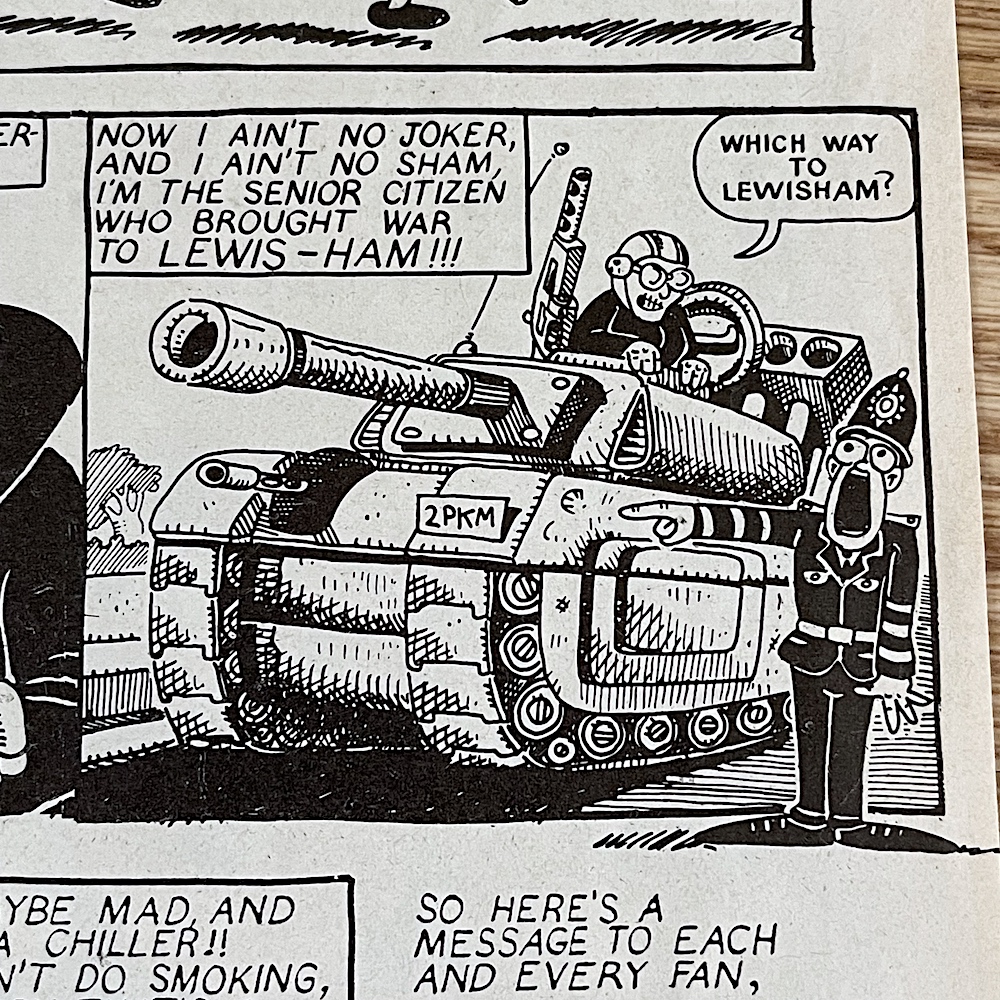
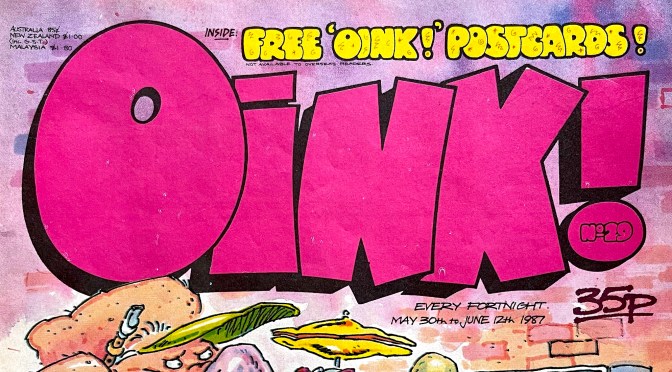
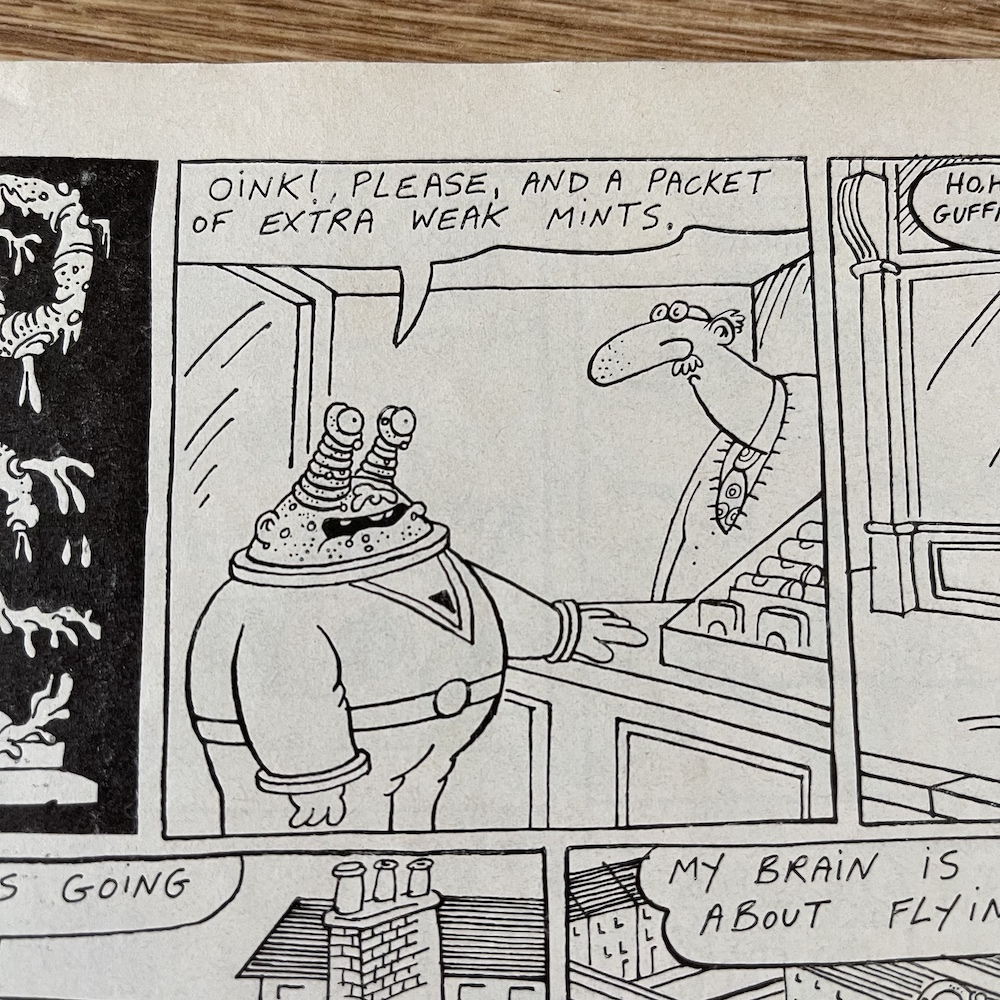
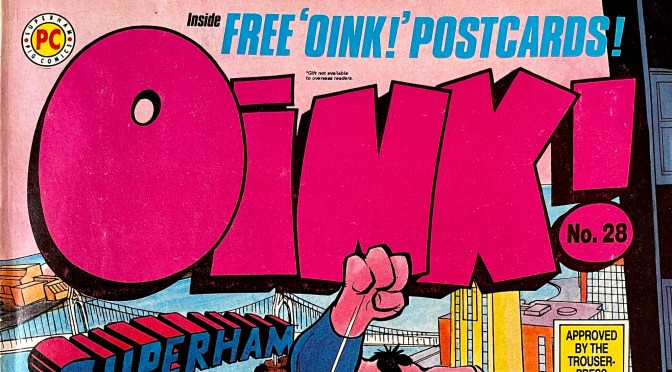
Coming up in a few days on the blog is the all-American issue of OiNK, complete with a snazzy new colouring of the famous piggy pink logo. There’s a special feature film spoof starring a giant ape-pig (no, really), some big news for Hadrian Vile‘s future, a new writer appears in OiNK for the first time and in just half a page Mr Big Nose sums up the very soul of the US of A.
Promo by Lew Stringer
My #31 is without its staples so has to be read very carefully for fear of it falling apart, but that’s not because of wear and tear from me as an overly eager youngster. No, there’s a very specific reason we were asked to take our issues apart (carefully) and it involves the return of none other than the Street-Hogs! To find out what I’m wittering on about you can check out the review of #31 from Monday 17th June 2022.
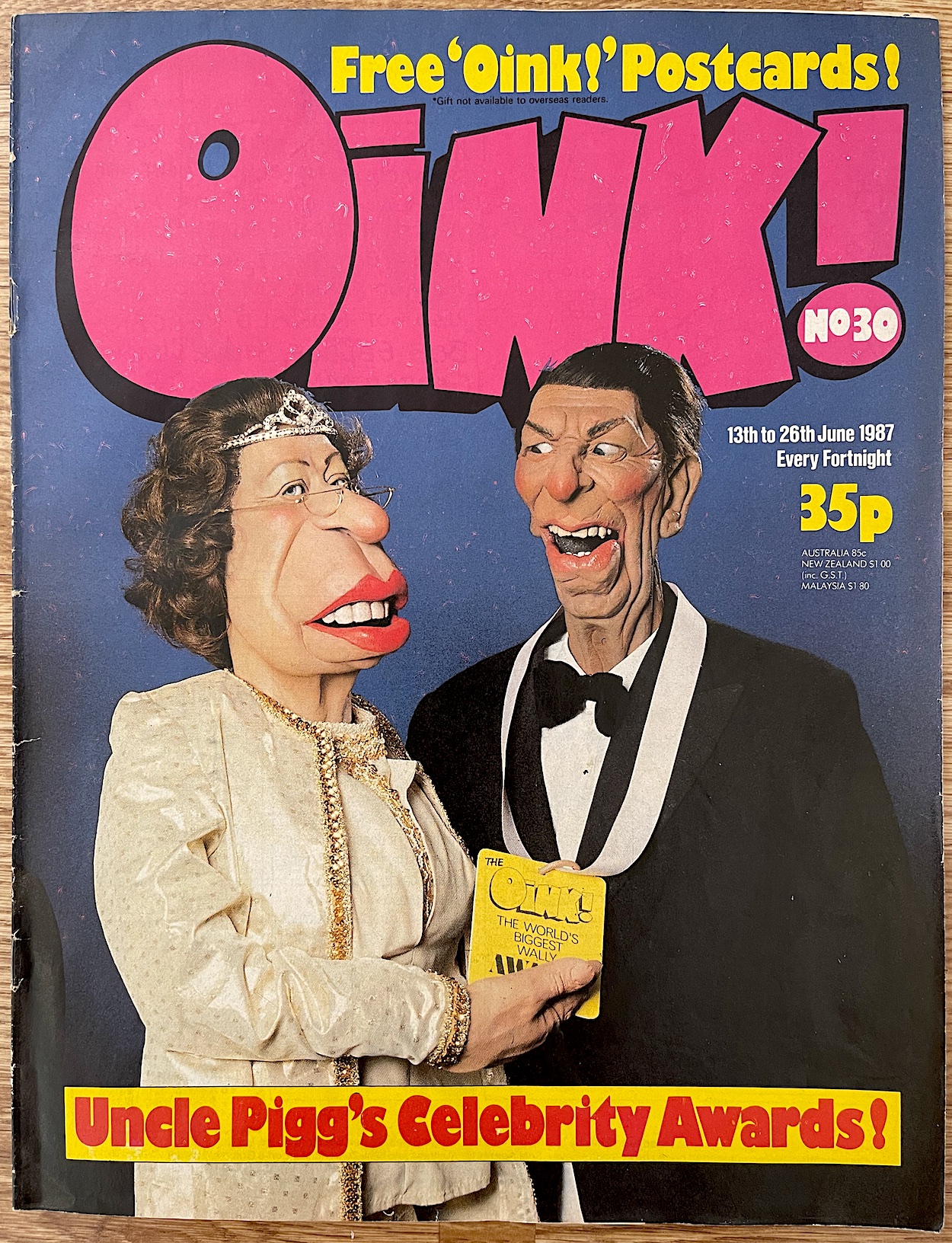
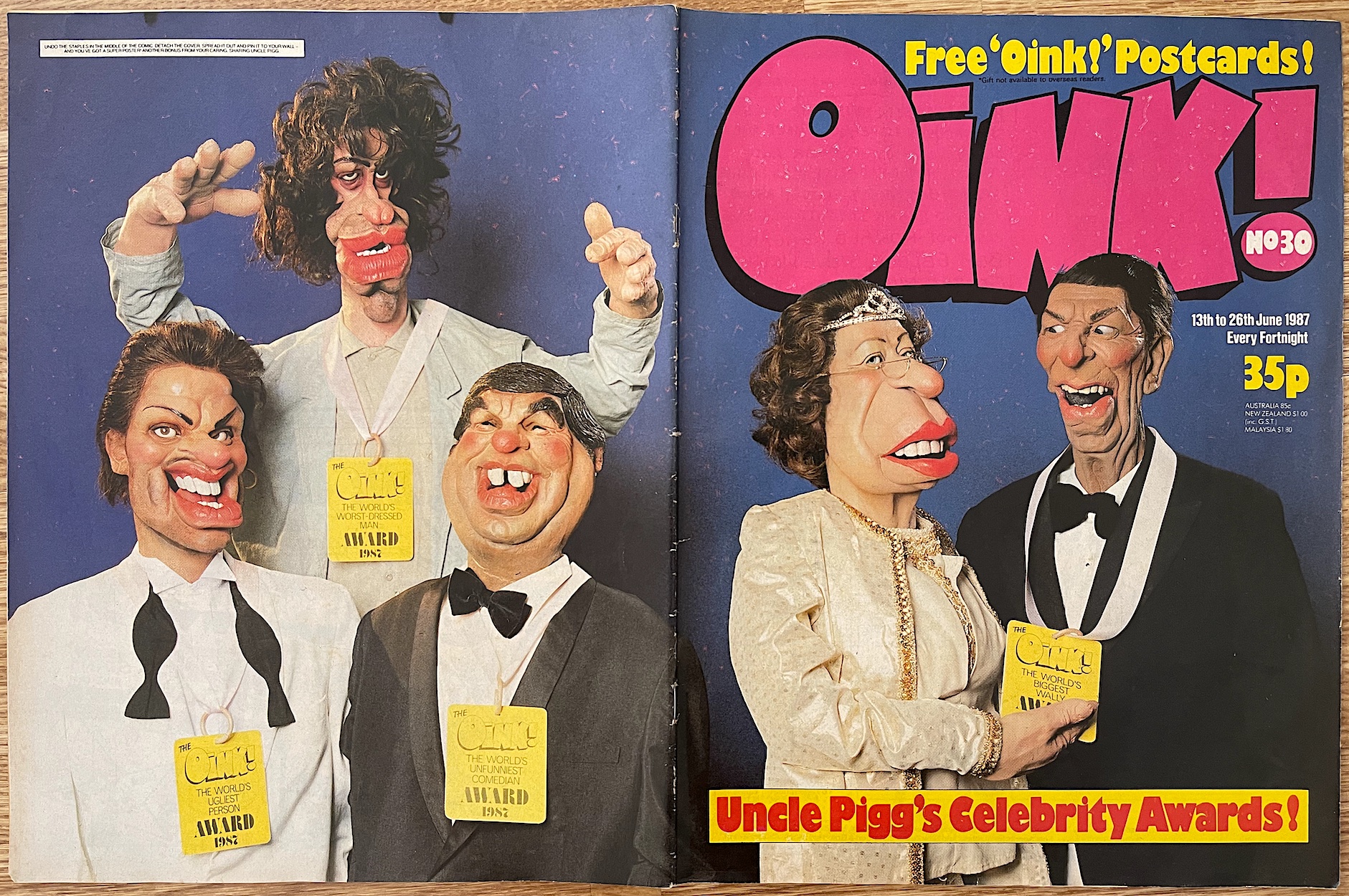
This cover really takes me back and I’m not just talking abut OiNK itself. I’m clearly referencing the classic puppet satire show Spitting Image, whose characters were used in this edition. I was also a big fan of the series even if at that age a lot of the jokes went over my head. But there were always enough to keep me giggling for half an hour on a Sunday night. For our 30th issue they’ve collaborated with Uncle Pigg for the results of the OiNK Awards as voted for by pig pals.
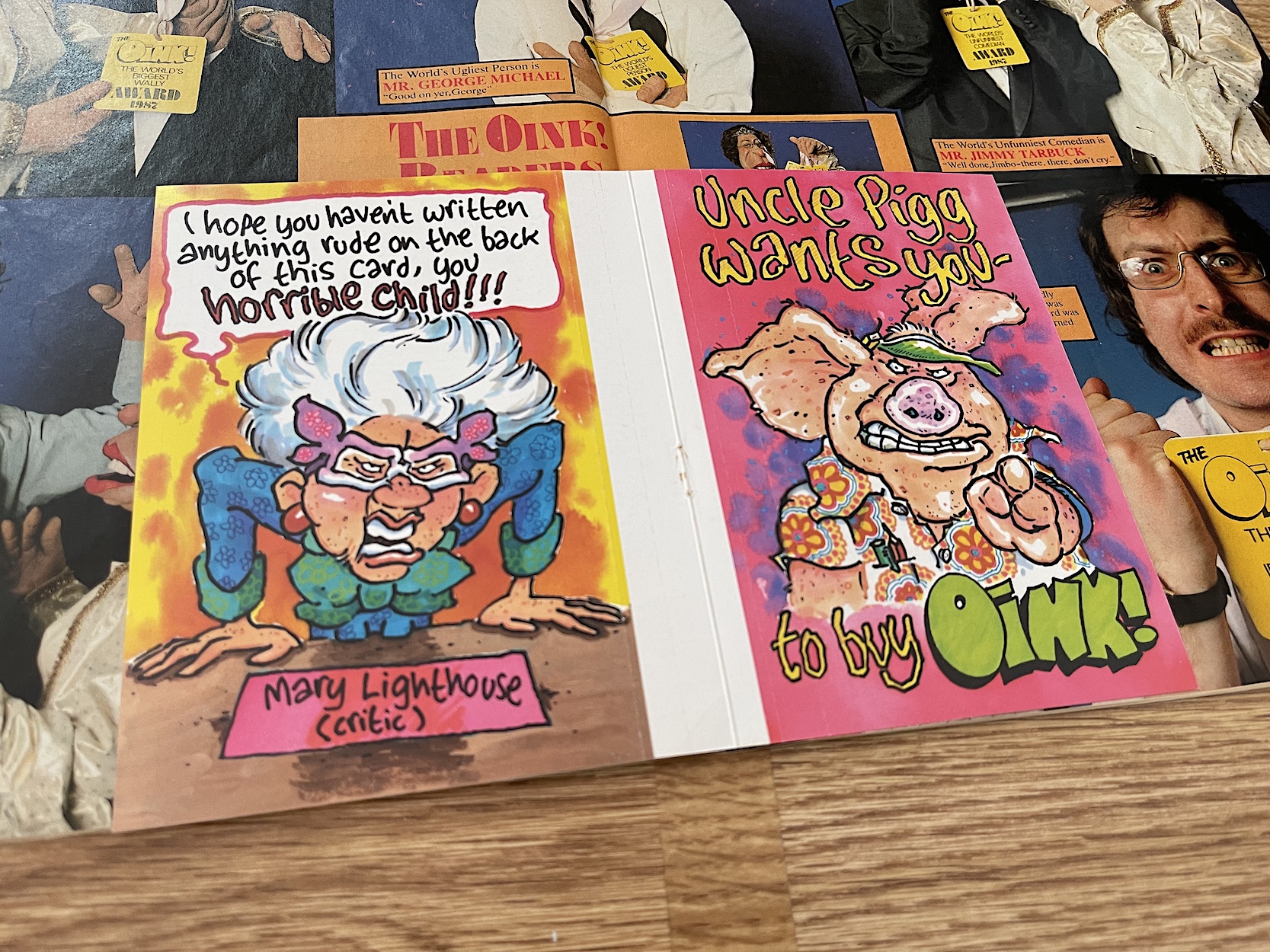
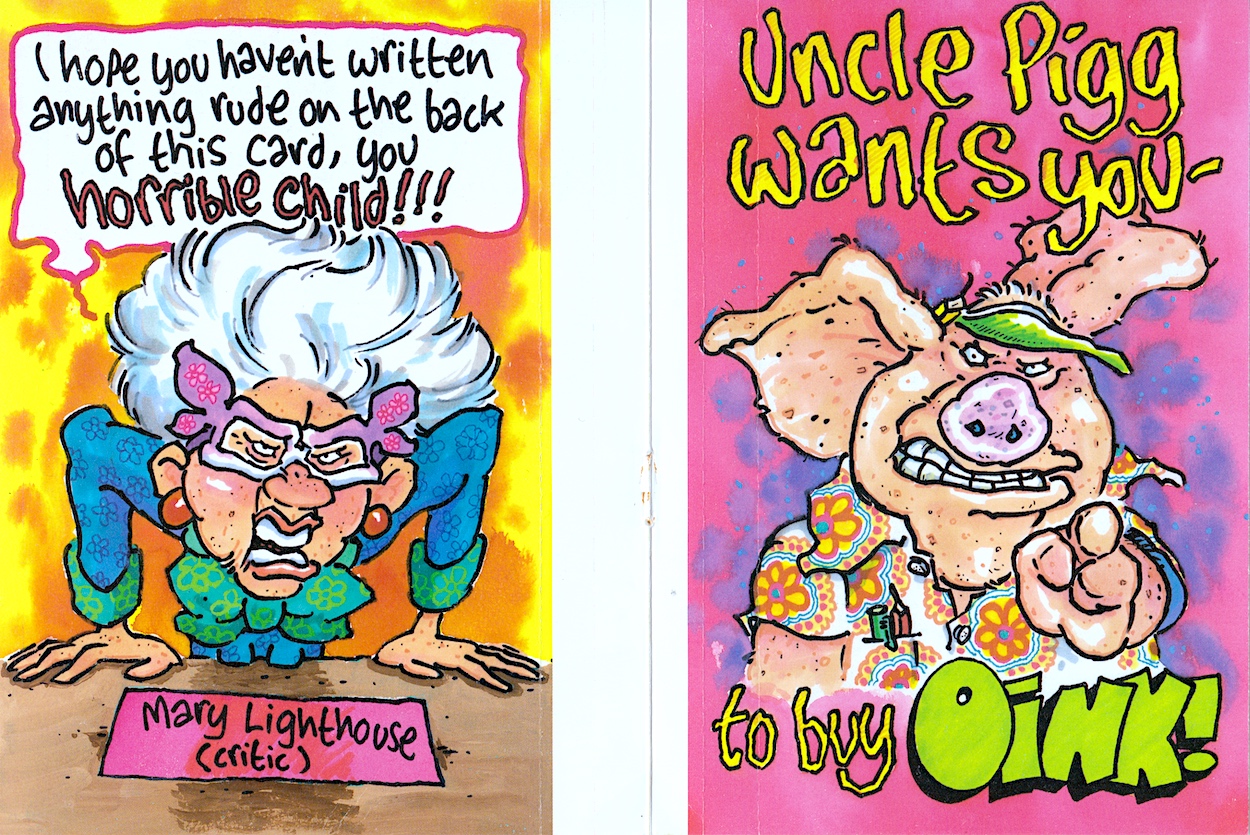
We’ll get to that in a bit, although you can see from the front cover who won The World’s Biggest Wally. We kick off with our final set of free postcards, plonked in the middle of the award ceremony itself. Following up on Jeremy Banx and Lew Stringer is Ian Jackson with these brilliant Uncle Pigg and Mary Lighthouse (critic) cards. I think both of these would’ve been great advertisements in other comics for OiNK, or made for very funny postcards to drop through the letterbox of unsuspecting family members waiting for a picturesque beach or mountaintop.
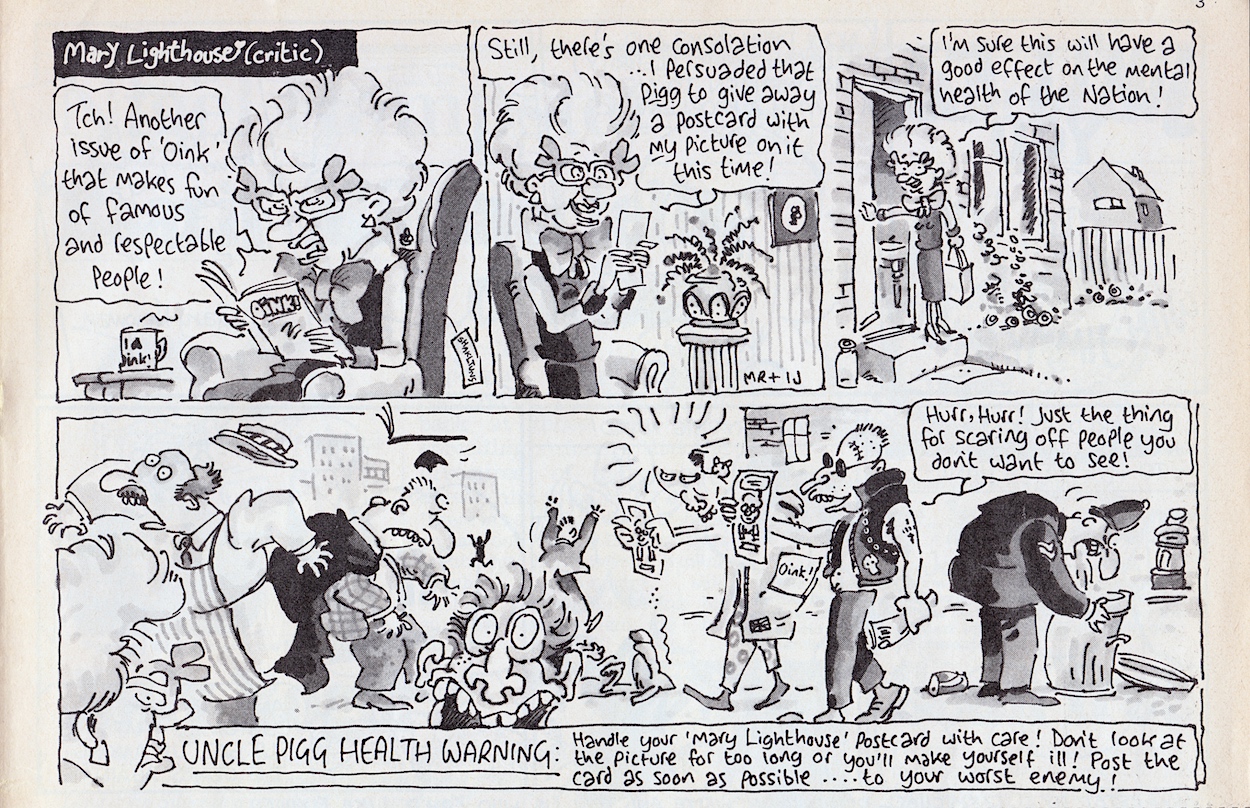
The issue itself begins with Mary’s own strip welcoming us to the subject of celebrities. Written as ever by Mark Rodgers and again drawn by Ian, she’s disgusted that respected famous people would be getting the OiNK treatment like this, but thinks the inclusion of herself on one of the postcards will send the right message. Naturally, it doesn’t quite work out as she planned and my favourite funny moment here comes right at the end with that poor policeman.
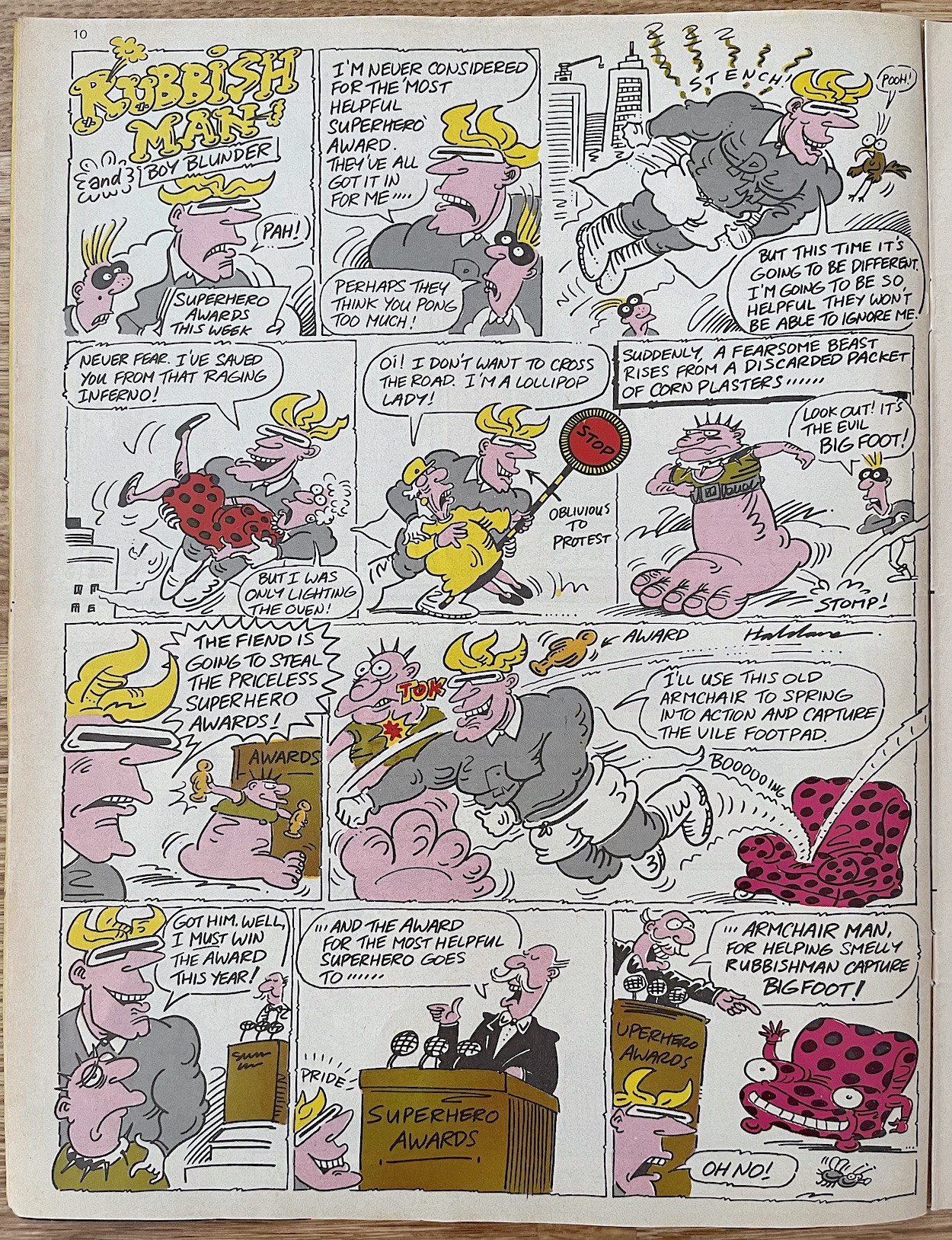
There’s another very important award to hand out this issue, the ‘Most Helpful Superhero Award’ so surely that means our resident high-flying, highly smelly Rubbish Man by David Haldane is up for a gong. Well no, apparently his whiffy antics aren’t award material. While he can make a hash of things, most times he does end up saving the day, but with that comes the pong and the mess left behind; not of destroyed buildings and terrified citizens but of mouldy mashed potatoes and cold spaghetti bolognese left everywhere. However, now he’s on a mission to prove he deserves recognition as a true hero.
This is one of my favourite Rubbish Man strips and contains nearly all of the elements that made David’s creation so enjoyable. We’ve got a ridiculous situation to begin with, an introduction of another completely random enemy character, an unsurpassed level of ever-increasing daftness in every single panel, our hero trying his best but failing epically and an ending you won’t see coming. In fact, the only thing missing is those aforementioned rotting foodstuffs he’d secrete from various parts of his body, with only his stench in the first panels reminding us of his unwelcome powers.
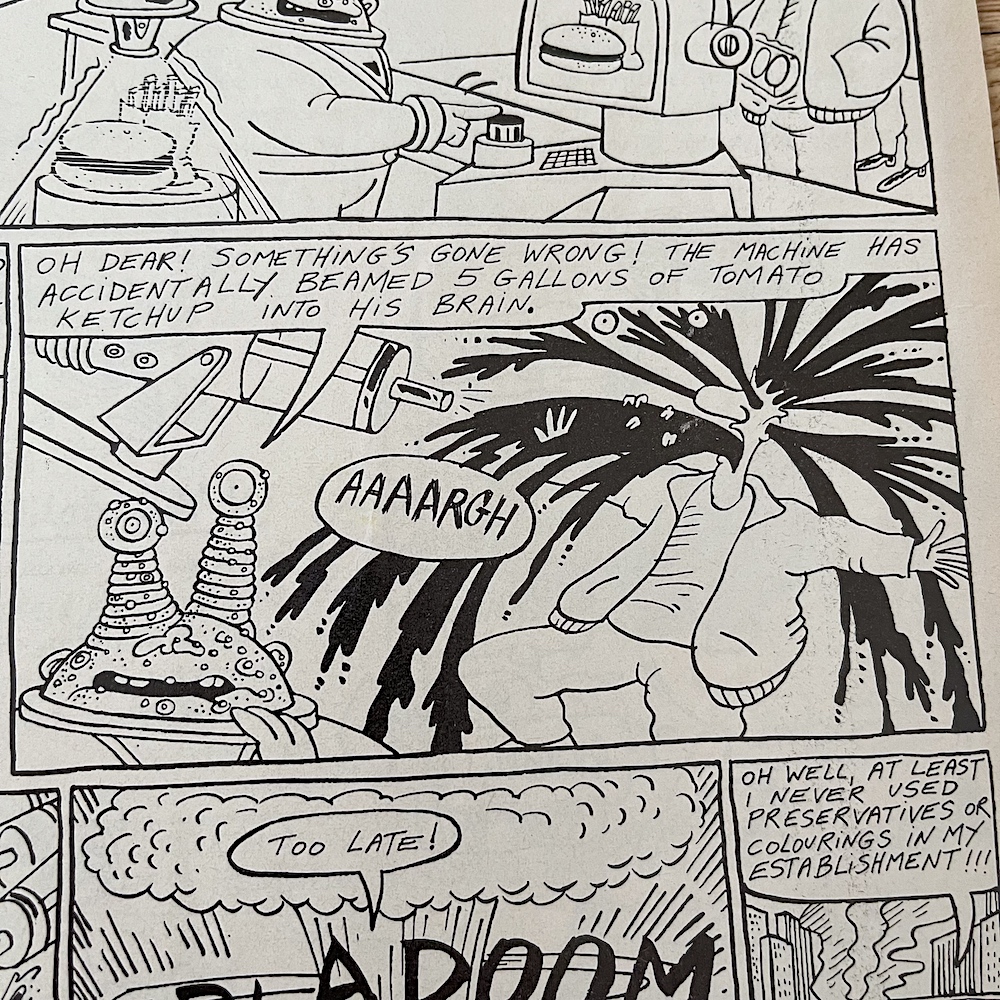
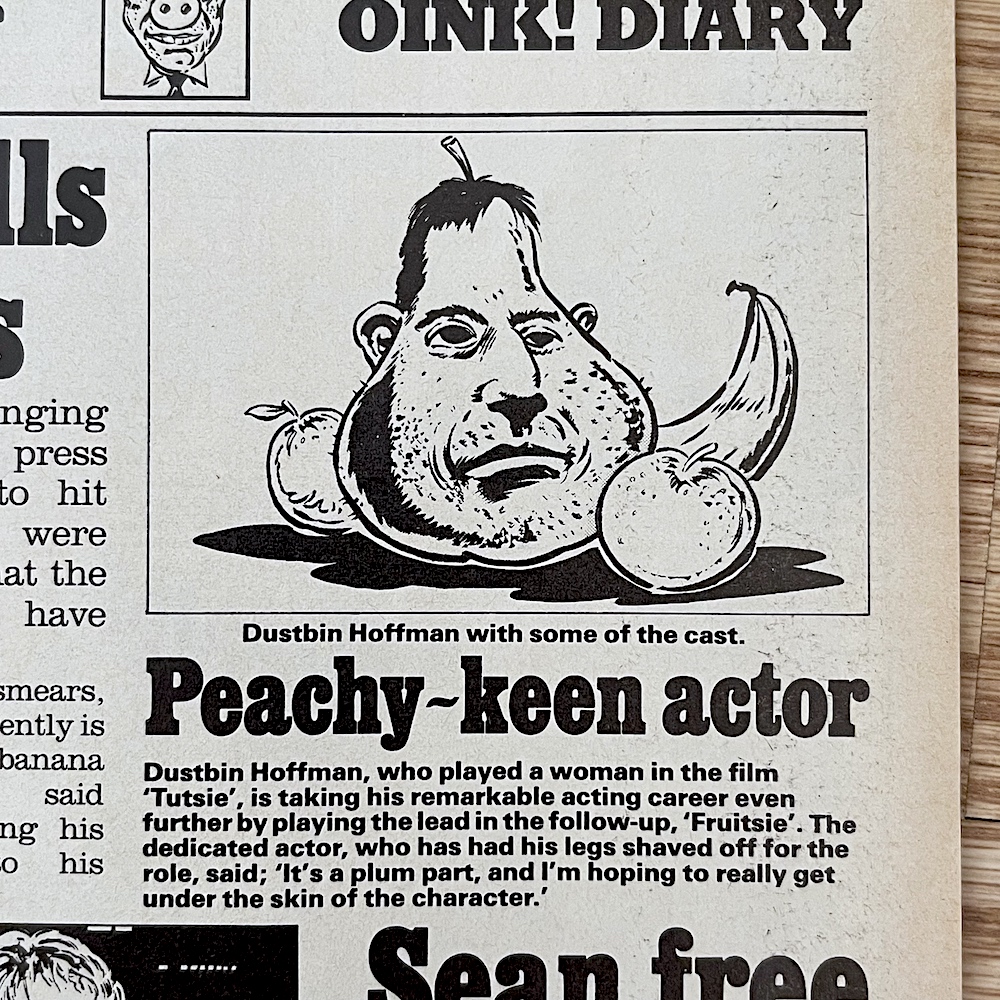
Even an old armchair can be a superhero in Haldane’s world, and even an old armchair that’s in the right spot by pure chance is a more welcome hero for the populace it would seem. Poor Rubbish Man. But Jimmy Bung (his alter-ego) isn’t the only character whose attempts at helping others regularly backfires, as equally (if not, more so) smelly alien Burp can attest. In this issue his latest invention teleports fast food straight into people’s stomachs so they don’t have to taste it but as always it doesn’t go quite as planned, as you can see in one of this issue’s many highlights. Also, check out Steve Gibson’s fruity version of Dustin Hoffman on the celebrity news page and our Wonder Pig gets yet another new name.
Burp by Jeremy Banx Nigel Hamster Diary drawn by Steve Gibson Lattie written by Tony Husband, drawn by Chas Sinclair
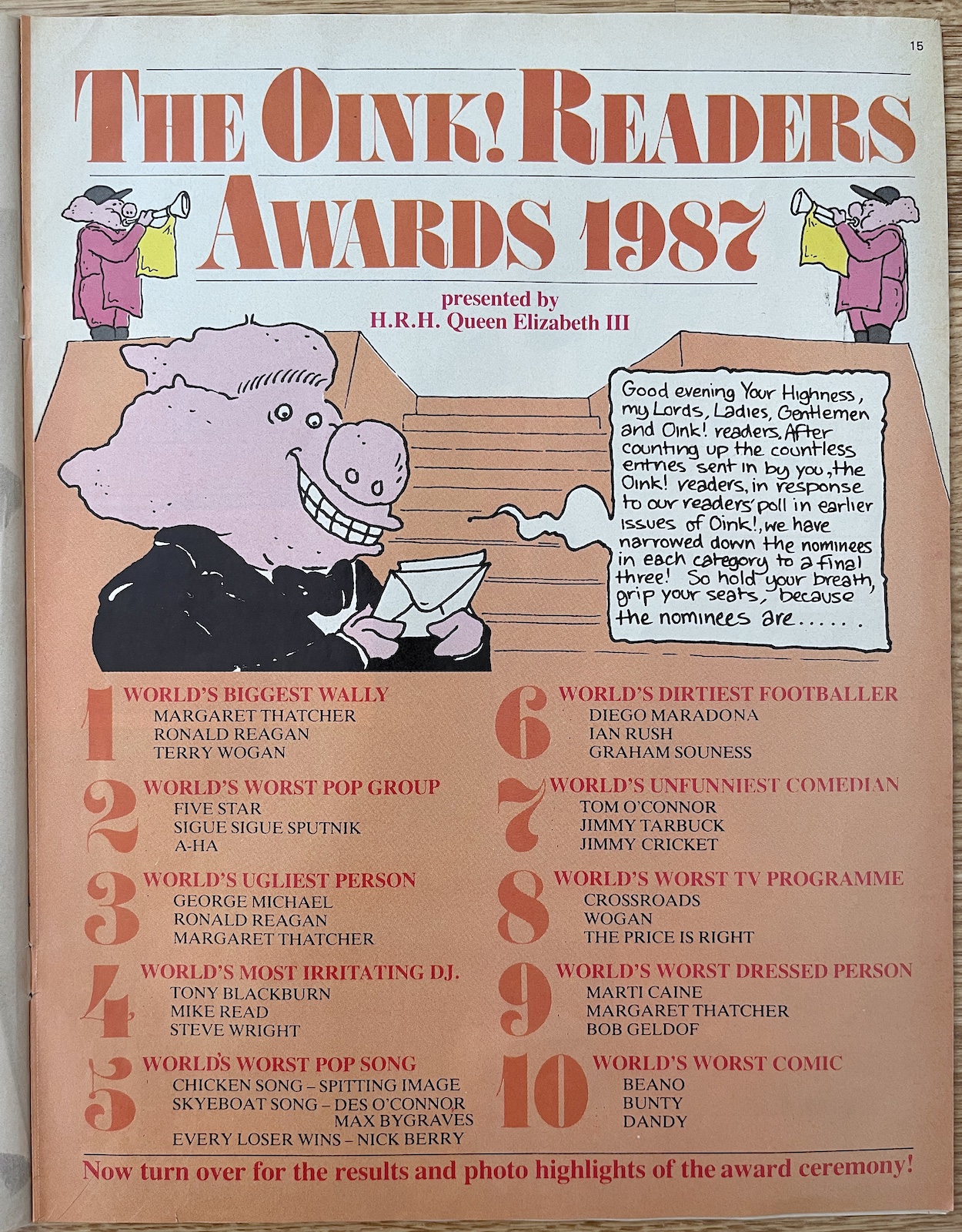
It’s time for the main event. With categories such as Worst Pop Group, Worst Dressed Person, Unfunniest Comedian and even Worst Comic, the readers of OiNK didn’t hold back in sharing what they thought of celebrities and 80s culture. There are quite a few on the shortlist, and even some I was a huge fan of at the time but it was all in good jest, giving the young readers the chance to take their own pot shots at the likes of those OiNK had targeted since the very beginning.
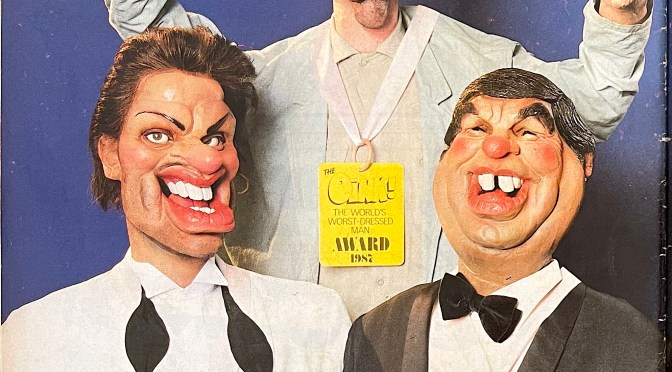
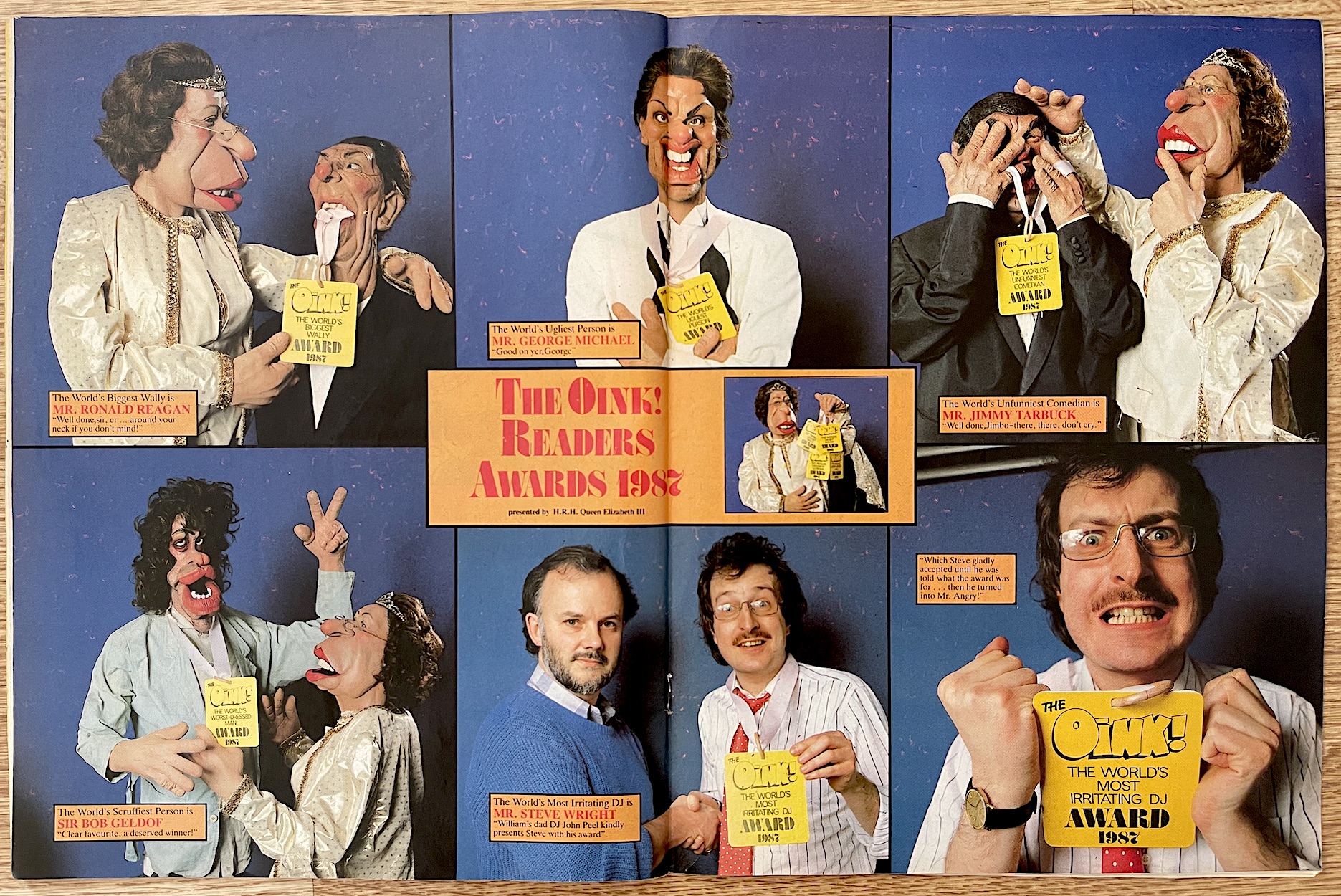
Taking up four pages in the middle of the issue we first get a chance to see each of the ten categories and the top three contenders in each, assembled by co-editor Patrick Gallagher. This opens out into the spread in the middle of the comic with those glorious Spitting ImageWorkshop puppets accepting the awards (a printed piece of card on a lanyard), although there was a particular recipient who looked incredibly lifelike as you’ll see. Tony Husband organised the photoshoot with the programme and Ian Tilton was the photographer (as an aside, Ian’s brother Mark was in the band The Creepers with OiNK’s Marc Riley), with radio DJ John Peel presenting the Most Annoying DJ Award. John had already contributed to #16 and had even played the flexidisc on air.
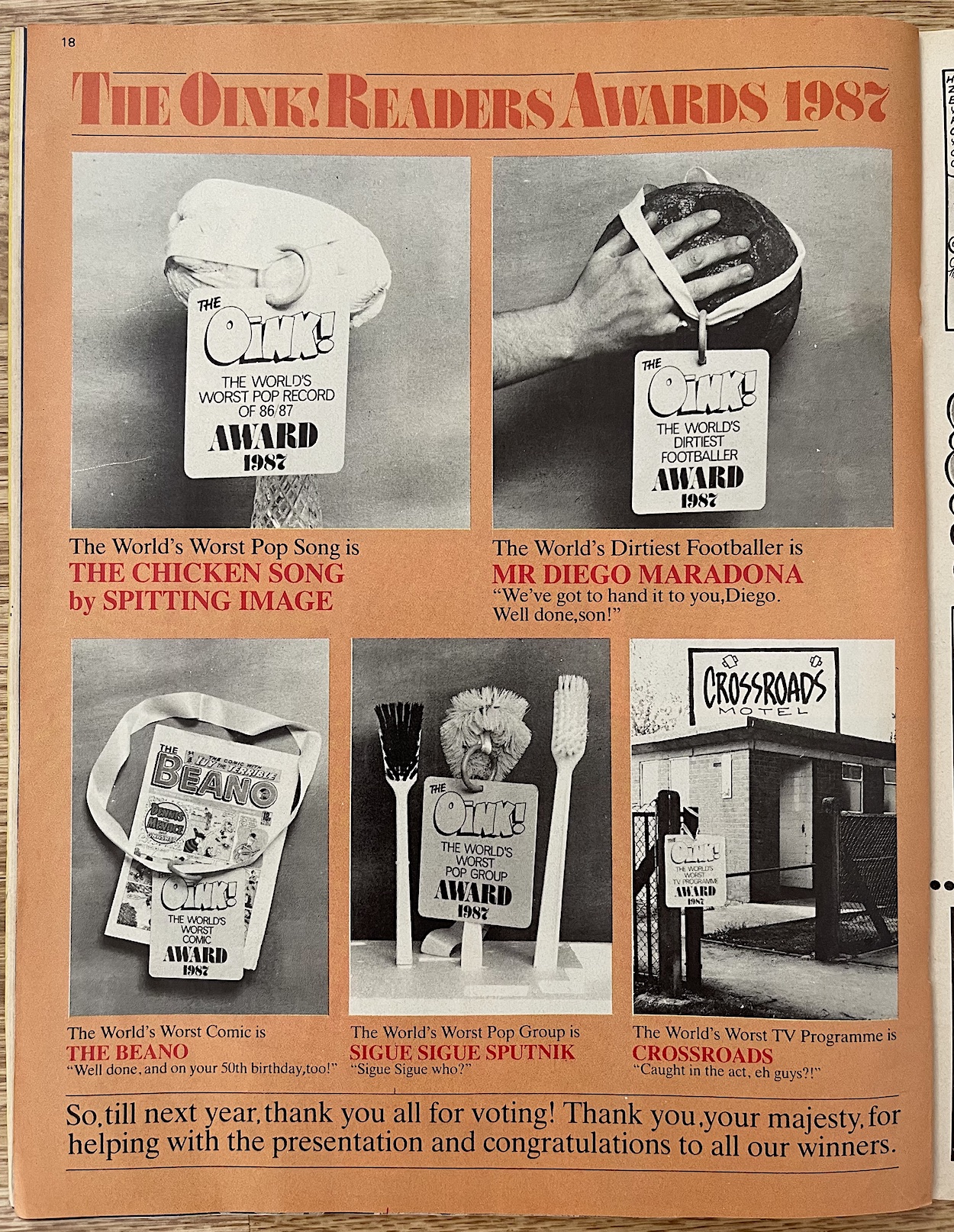
Kudos to Steve Wright for playing along. Tony told me recently Steve was great on the day and had a brilliant sense of humour about the whole thing when he found out. Given who helped with this it’s a surprise to see The Chicken Song take away the World’s Worst Pop Song Award. Although let’s face it, Spitting Image’s song was purposefully written to be very annoying, a parody of the string of summer pop entries that were filling the 80s charts. Bob Geldof and Ronald Reagan get well-deserved titles, although I can’t help but disagree with George Michael‘s and I’ve at least a few female friends who might take issue with the pig pals over that one.
The OiNK team would go on to work closely with the Spitting Image Workshop on their Round the Bend TV series
All British comics are eclipsed by Beano, a regular target of OiNK’s for its safe humour and out-of-date characters at the time so it had a good chance of winning the Worst Comic Award. It’s completely reimagined itself over the intervening years and today contains a lot of rebellious, anarchic humour that would make Uncle Pigg proud, not least thanks to some cartoonists who grew up with our piggy publication. It’s a great comic and if you’ve any kids yourselves then you should definitely take advantage of the superb online subscription offers they always run.
The OiNK team would go on to work closely with the Spitting Image Workshop on their Round the Bend TV series, the puppets of which were designed by co-creator/editor Patrick Gallagher, and later in the 90s he’d be a commissioned writer on Spitting Image for six years. What a shame this was the only awards ceremony the comic would do, despite these being labelled as the first. It’s brilliant fun and looked like it was a blast to be a part of. As far as this reader is concerned it remains one of the most memorable highlights of the comic’s whole run. For now, let’s move on to something more “interleckshual”.
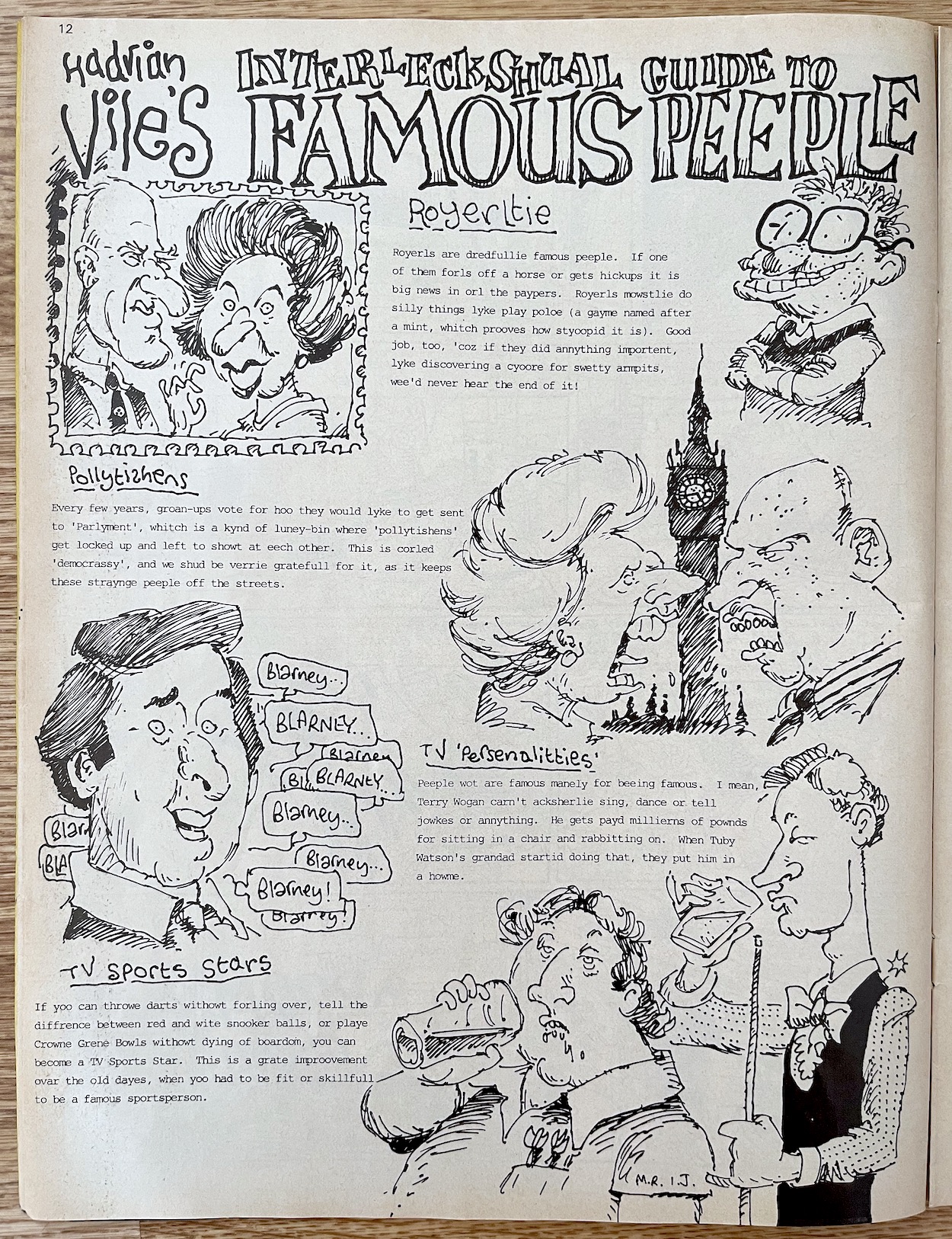
Hadrian Vile’s unique perspective perfectly matches the subject matter here. Taking a fresh look at the royals, politicians and more from the viewpoint of a child is a good idea on its own, but Hadrian’s character elevates it. He always thought of himself as being intellectually superior to pretty much everyone around him, so his child’s viewpoint is presented very matter-of-fact, very seriously in his young mind. Of course this means it’s all completely bonkers, just perfect for the 80s in fact.
Written by Mark Rodgers and illustrated by Ian Jackson, it’s always funny to see Ian’s interpretation of famous people, his jagged, exaggerated style perfectly capturing personalities as well as looks. In a way this page seems to go hand-in-hand with all of the television puppets contained in this issue. It’s also not the only time that British Prime Minister popped up in the issue, in fact she gets a starring role in the origin story of a certain critic and nemesis of our editor hog.
Two legs bad. Four legs better.
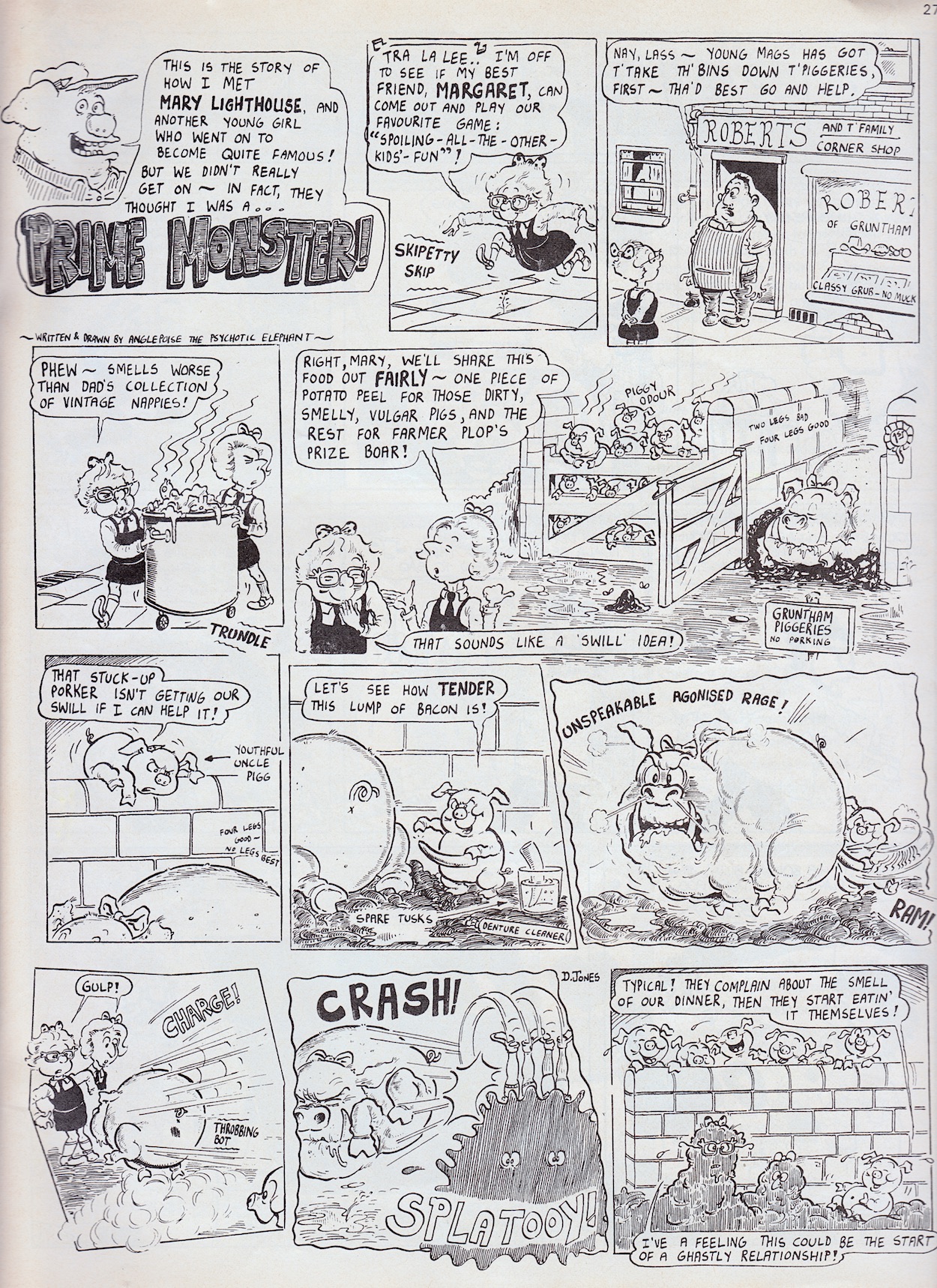
Davey’s Jones’ Prime Monster
Davey Jones brings us Prime Monster (as ever with Davey it’s even signed in a silly way), which takes place a few decades before the 80s when we find two young girls by the names of Margaret and Mary down on the pig farm. The two spoilt brats have reckoned with the wrong set of little piglets to bully because in amongst their number is one teeny tiny pig who has already got the prerequisite pencil behind his ear. Amongst all the chaos Davey has even seen fit to include a couple of very OiNK-like riffs on a famous George Orwell quote. A great strip. Here it is, have fun.
Of course these two women would’ve been the best of childhood friends! At least in OiNKtown anyway. Yes, the characters and their stories were set in ‘OiNKtown’, a basic take on Beanotown. In the earlier issues PORKsmouth was used a couple of times but more as a place to ridicule and, obviously, somewhere Mary Lighthouse loved to visit. Surely Porksmouth would’ve been a better name than OiNKtown though? Anyway, I digress (as I do). For now that’s the end of the review, with just enough space to tell you about what’s coming up next.
The next regular OiNK will be an all-American issue and its review will be here from Monday 13th June 2022 but before that there’s a special extra to watch out for in the shape of Crash magazine #42. Regular readers of the blog will know what this is in reference to, but if you’re not up to speed go and check out the post about Zzap!64 #26from last month. Crash not only contained an interview with OiNK’s three creators and an original Frank Sidebottom page, there was also the small matter of a special, free, original 16-page edition of our favourite comic! Check out Crash from Saturday 25th June, the free OiNK a few days later. It was an exciting time to be a pig pal in 1987, I hope I can recreate a little of that excitement right here.
Remember those OiNK Awards back in #18, the first issue of 1987? The comic asked its young readership to vote on everything from World’s Biggest Wally to Most Irritating DJ. Well, the results are in. In the next issue of OiNK it’ll be time to see exactly what us pig pals thought of the world of celebrity back in the 1980s. Better still, a certain puppet-based satire TV show steps in to help out. This one is going to be good.
Promo drawn by Ian Jackson
Highlights in the review will also include Rubbish Man‘s own attempts to receiving an award and finally get some recognition, Hadrian Vile breaks down famous people of the 80s for us in his inimitable style and we have an origin story for Mary Lighthouse (critic) with a special guest star. Not a surprise guest star though. This Iron Lady just had to be friend’s with Uncle Pigg’s nemesis, as you’ll see. The review for #30 of OiNK will be right here from Monday 13th June 2022.
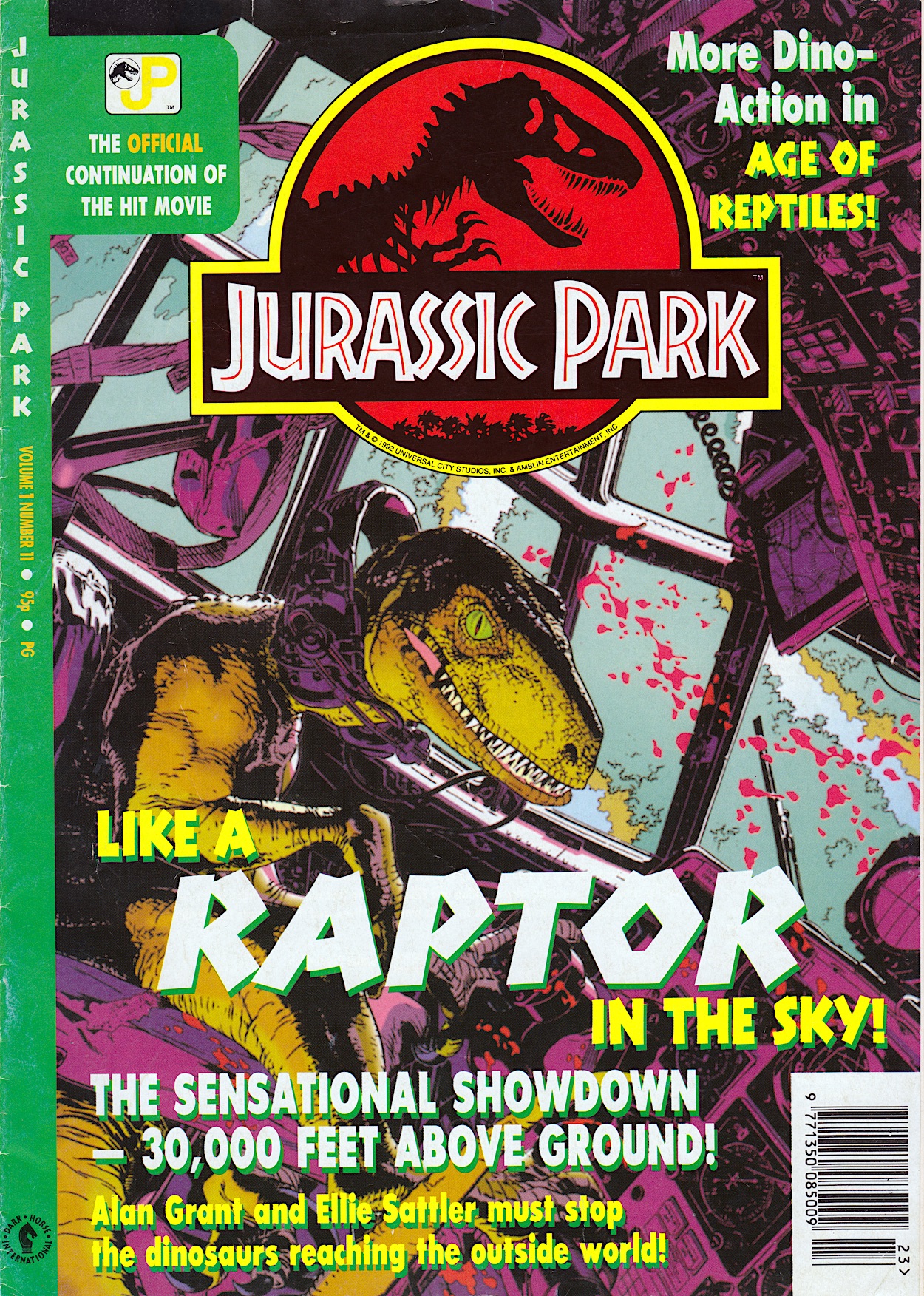
It’s been a long wait for this issue of Jurassic Park so I’m chomping at the bit to get stuck in. I can remember as a teen being overjoyed to finally see the comic appear again, however my initial reactions once I opened it were mixed. First of all this is my very favourite cover of the whole series. No, a Velociraptor doesn’t really take control of the plane, it’s just a funny reference to the main story inside. To this day Michael Golden‘s cover still raises a giggle which I’m sure was the intention. I just wish it wasn’t covered with so much text.
But then came a little bit of disappointment because I discovered there were eight less pages, reduced from 36 to 28 and there was only the one back up strip, no Xenozoic Tales in sight. I’d been really enjoying those stories but at least Age of Reptiles was still here and it was as magnificent as always. Things would (begin to) return to normal next month but initially I didn’t know this so I wasn’t sure if Tenrec and Hannah would return. What is here is great fun though, so let’s get going.
In the world of Jurassic Park small, seemingly inconsequential actions can have catastrophic consequences
The final part of Steve Englehart’s Dark Cargo begins with the pilot doing what humans always do in the world of Jurassic Park; proving that small, seemingly inconsequential actions can have catastrophic consequences. Feeling the plane’s weight shift about he puts it on autopilot and goes to help George Lawala, finding he’s already killed one of the juvenile ‘raptors. But they don’t see another skulking in the shadows, hunting the two men. It attacks, killing the pilot and maiming Lawala, but not before he’s able to shoot it in the neck.
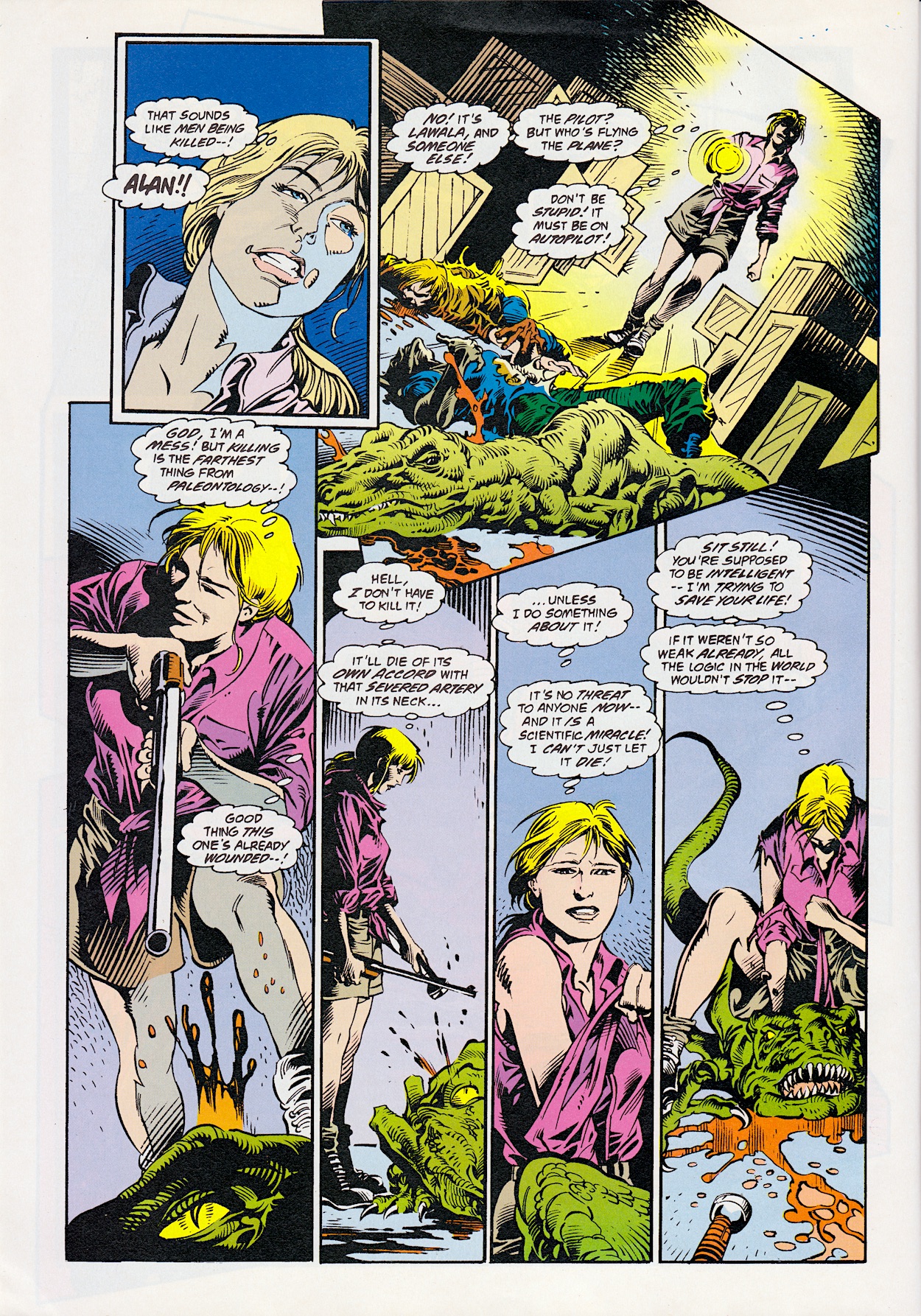
It’s here when Jurassic Park makes its real point of difference. Dr Ellie Satler (she and Dr Alan Grant were Lawala’s prisoners, check out the previous reviews) hears the gun shot and discovers the horrific scene, the dinosaur dying in front of her. Even knowing it would’ve killed her in a heartbeat and that its siblings must be nearby doesn’t stop her from trying to save its life. It was just doing what it does, hunting prey to eat. I love this page.
A quick note about the artwork. The final panel above is a strange one and at times penciller Armando Gil does seem to draw the ‘raptors in a way in which they’re not really identifiable (sometimes in this chapter it’s also confusing in regards to which one is which and we have to rely on the dialogue to decipher the images), but mainly he has done a great job of capturing the dinosaurs as real world animals (check out his magnificent Tyrannosaurus rex in #6). His action scenes can sometimes seem sparse, but inkers Dell Barras and Fred Carrillo imbue them with great texture and atmospheric shadowing. John Costanza is our letterer and Renée Witterstaetter brings bold colours alongside her role as Story Editor.
“The ‘raptors.. somehow, it’s got to be the ‘raptors..!!”
Dr. Ellie Satler
While Ellie ties a tourniquet around the animal’s neck another ‘raptor is looking on, which Alan spots and distracts, with both it and the final sibling giving chase. Panicking, he dives into an open crate but escapes through a side hatch as the dinosaurs jump in after him. Able to close the hatch and lid he traps them inside, attaches the pulley system and dangles them out the back of the bomber! Well, out there they can’t do any harm. Famous last words, Alan. This is Jurassic Park after all.
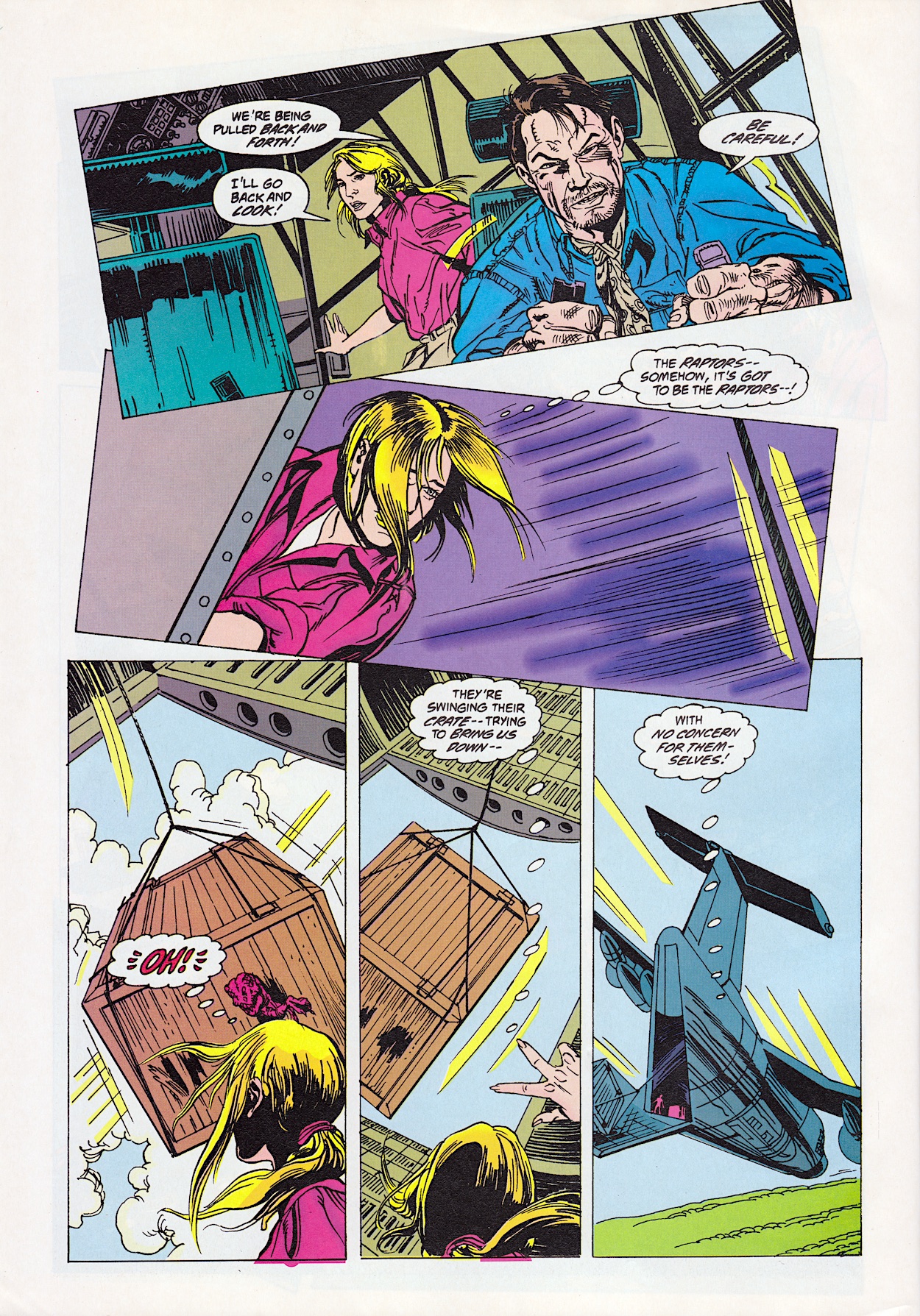
Suddenly the plane starts diving and they rush for the cockpit. Refreshingly, they don’t immediately take to the controls and somehow land the plane like in every movie and TV show ever. Instead, Alan admits the only thing he recognises is the wheel and he tries desperately to stop them crashing, not really sure what to do. The plane is being pulled about and the autopilot was knocked off, but why? Ellie is sure it has to be the Velociraptors, but how? Take a look at the page above.
I remember reading this at the time and being thrilled with the intelligence of the dinosaurs, especially this lot. You have to remember before the first movie came along the general public had a vision of dinosaurs as stupid big lumbering lizards. Jurassic Park changed all that and I can distinctly remember that same feeling of excitement from this comic. The swinging crate pulls the plane further down, Alan struggling to level it off in a desperate bid to stop it nosediving when we get to this month’s cliffhanger.
The voice from the other side of the binoculars is going to be key to how this story develops from here on. It’s a more exciting cliffhanger than the one which led to a two month wait, so thank goodness we’re back to a monthly schedule again. I can remember parts of the strips to come, in particular what Ellie saving one of the ‘raptors will mean later, and I can’t wait to revisit these stories and compare them to the movie series we’ve had since.
For now, take a good long look at this piece of gorgeousness.
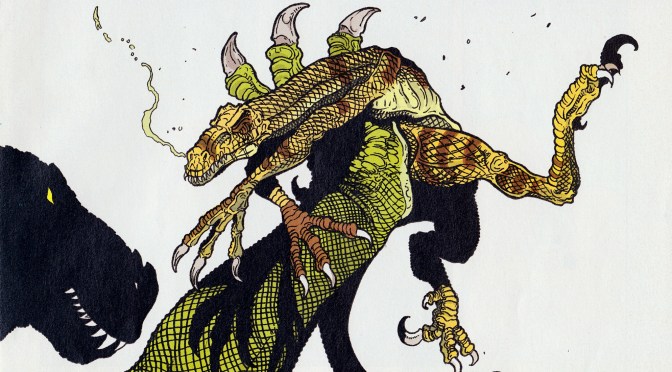
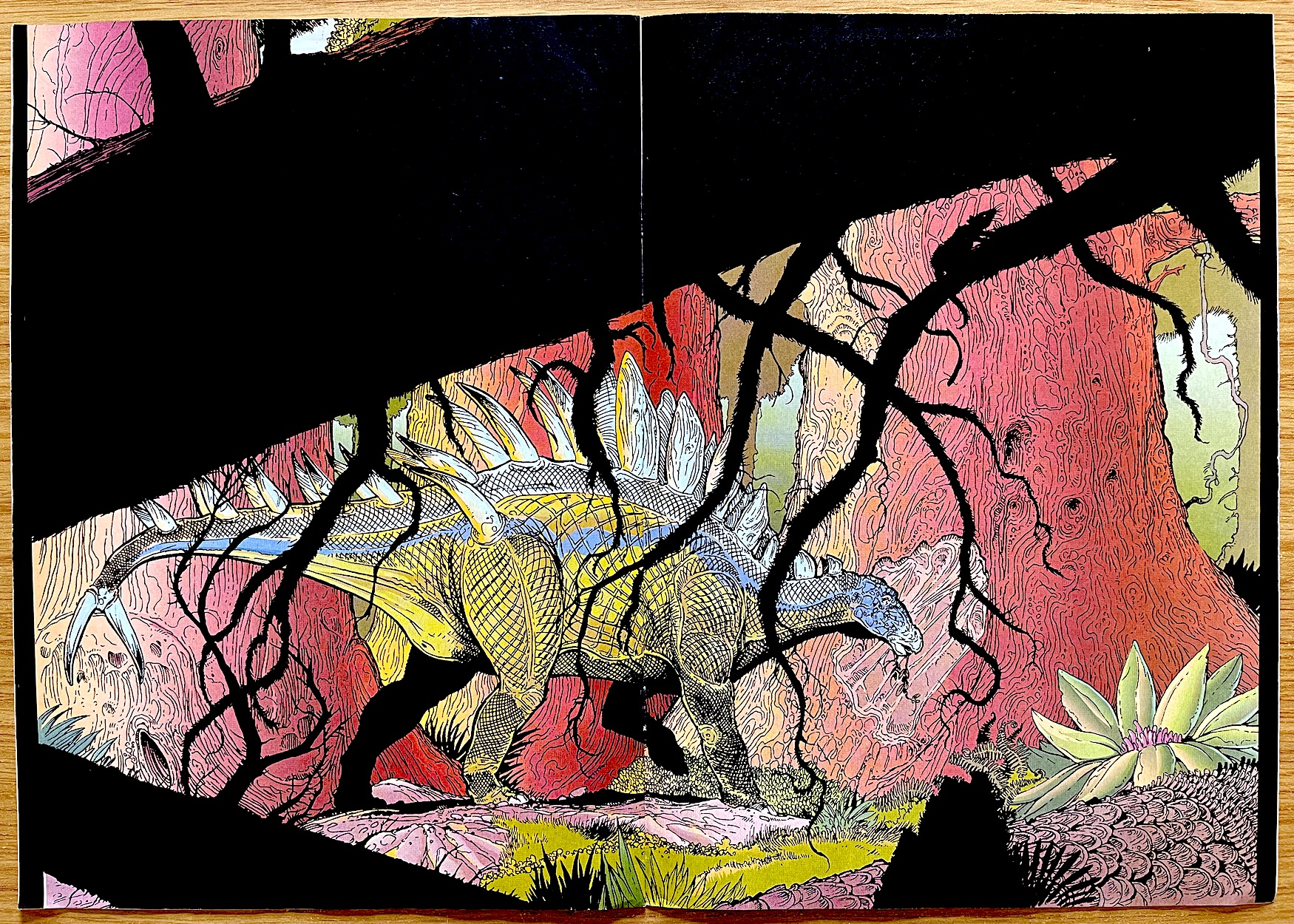
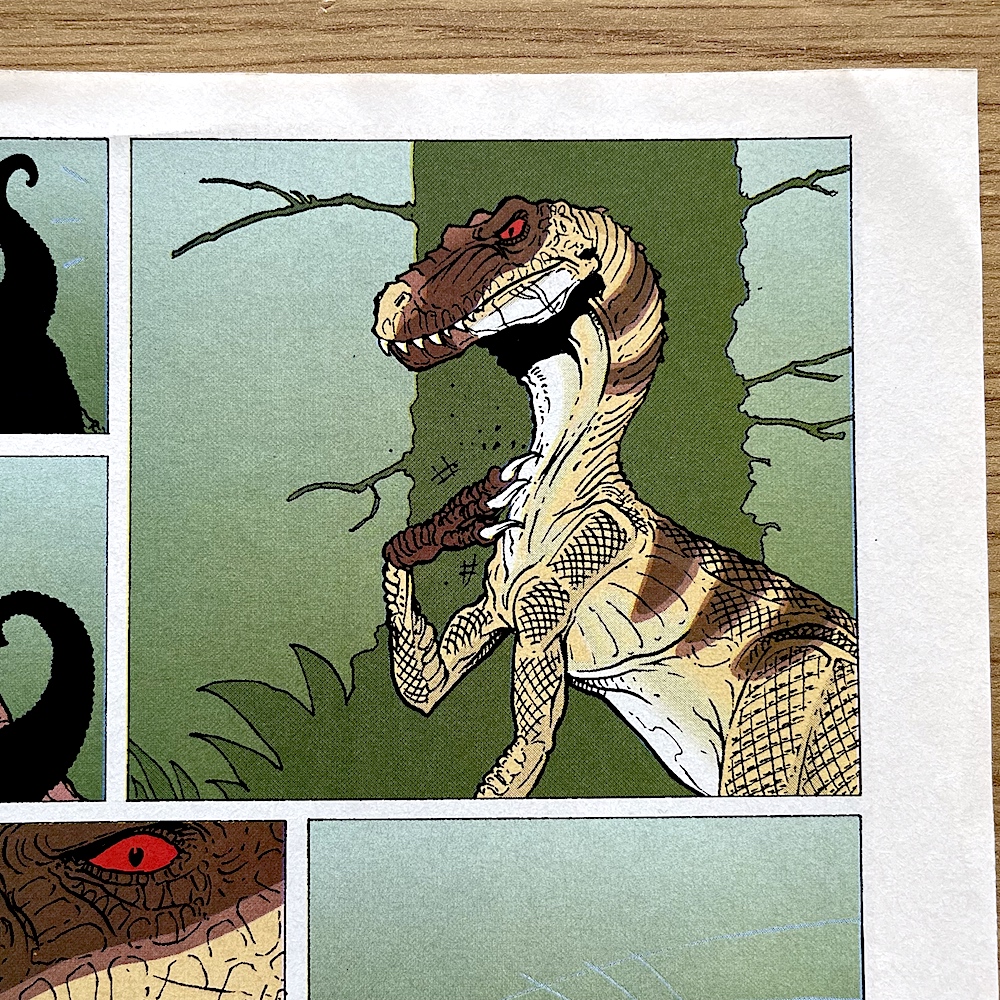
As I said at the top of the review there are only two strips this month, with our main story and the one back up getting equal space of 12 pages apiece. So we’re straight into the Age of Reptiles. It opens with the panel at the top of this post, which certainly sets the scene! That is followed with the above spread and I find myself just completely immersed in this world again. Still up upon the cliffs, the Deinonychuses attack the T-rex pair. They put their all in, I’ll give them that, but they never stood a chance.
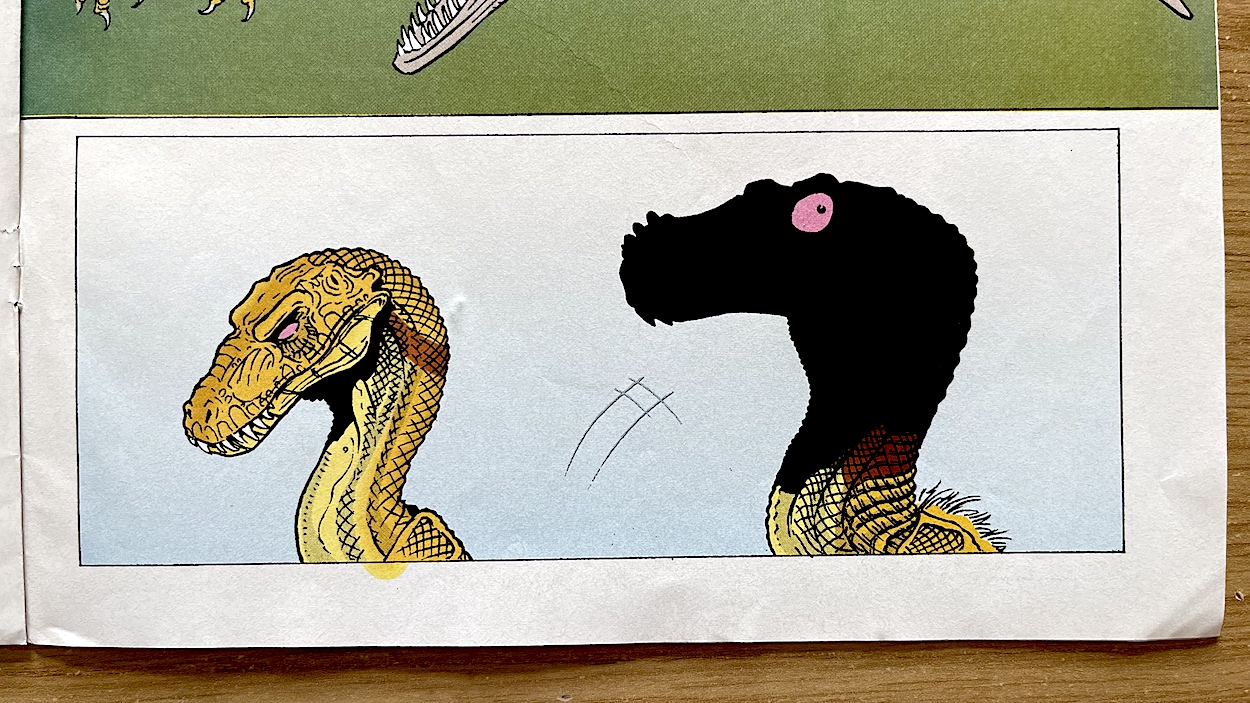
One is kicked over the side and lands in deep water below, quickly swallowed up by a giant ocean predator. The remaining two are swiped off the side by a glancing blow from a ‘rex tail, one landing hard on the rocks at the bottom of the cliff, dying instantly but breaking the fall of the other. Throughout this, and the rest of the story, the individual characters really shine through, as you can see from this selection of highlights below.
From being taken by surprise from behind, to the horror of their friend dying, to the little baby T-rex being coached to hunt by their parent Long Jaw, every dinosaur here is an individual brought to life by the genius of creator/writer/artist Ricardo Delgado and colourist James Sinclair.
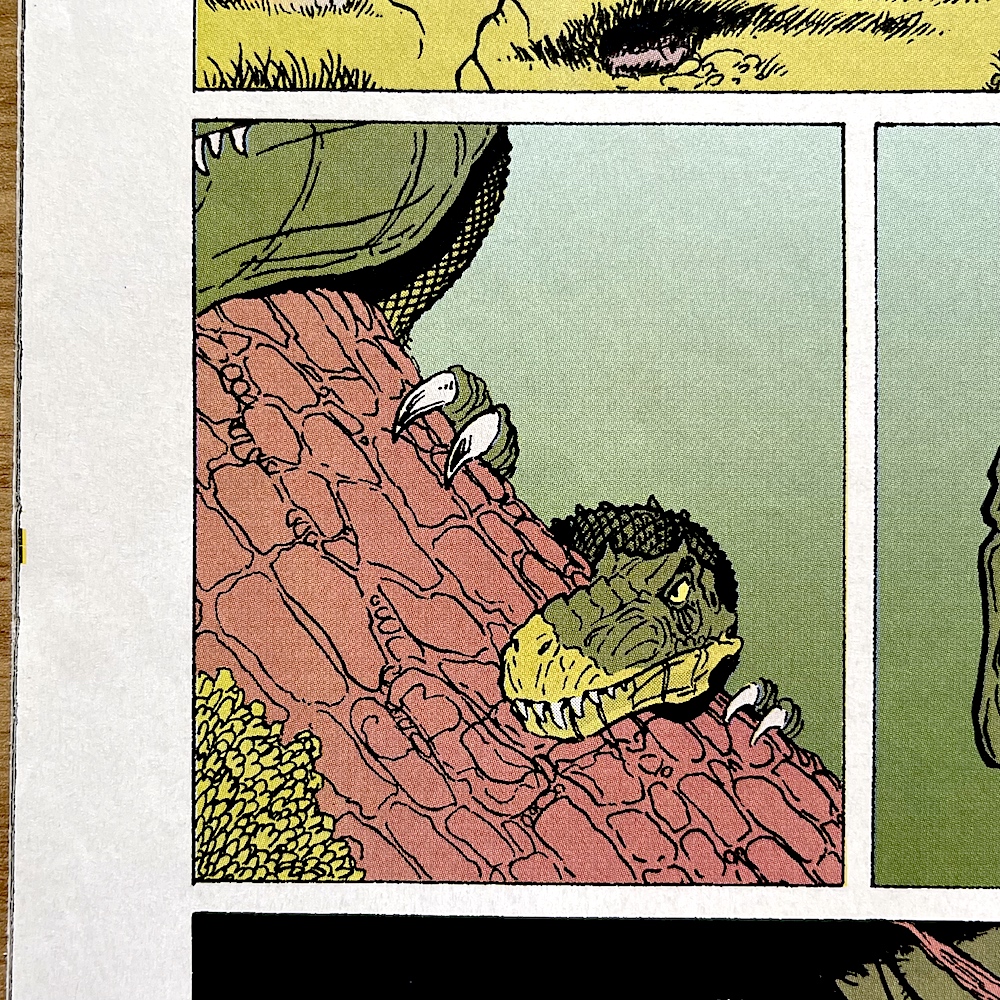
The youngster spots Dark Eye who is clearly deliberately wanting to be chased, as you can tell from that final panel above. That pose almost says, “Me?”. Haha, it’s brilliant. The young inexperienced hunter doesn’t realise it’s a trap and gives chase. When his prey disappears behind a rock he follows blindly, right into an ambush of half a dozen of Dark Eye’s pack. Long Jaw is the adult T-rex and suddenly he realises he’s alone! He runs through the forest in desperate panic, following the trail or possibly the scent and finally comes upon this scene on the final page of the chapter.
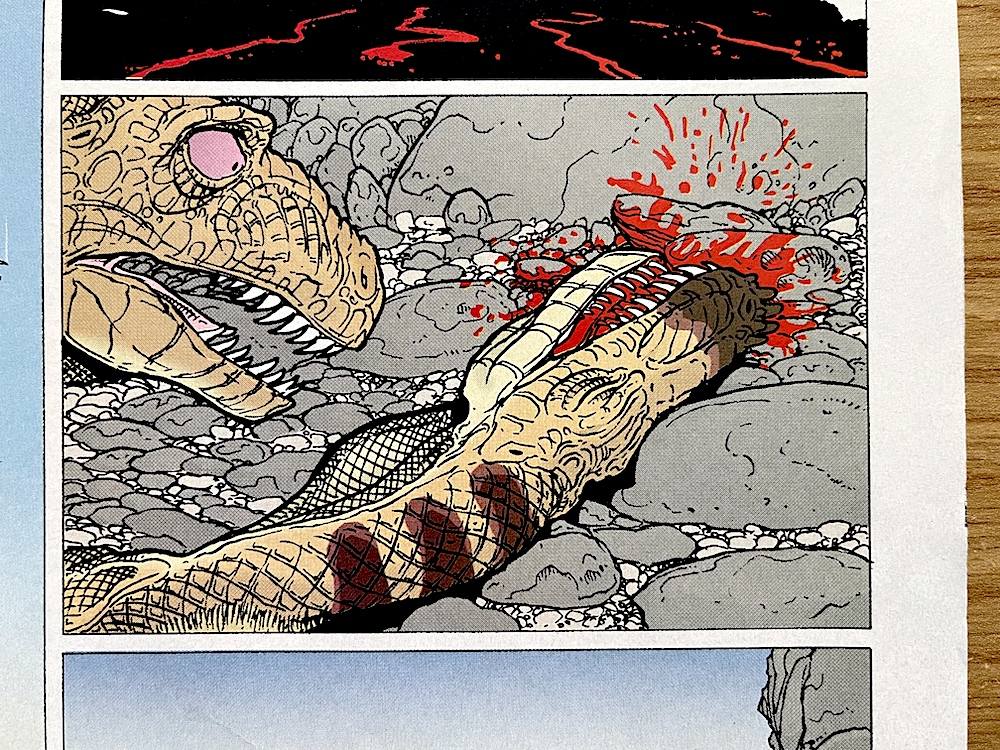
I vividly remember seeing this image for the first time back in 1994. The towering Long Jaw roaring into the sunset, the flying predators already circling and the heartbreaking image on the ground. It was truly shocking. I’m sure I wasn’t the only reader who’d loved the tiny little ‘rex, such was his depiction in this and previous issues. We’re racing towards the climax of Age of Reptiles and I know it was big, I know it was ultimately a very satisfying conclusion, but for the life of me I can’t remember how it ends. It was 28 years ago after all. I’ll impatiently wait and see.
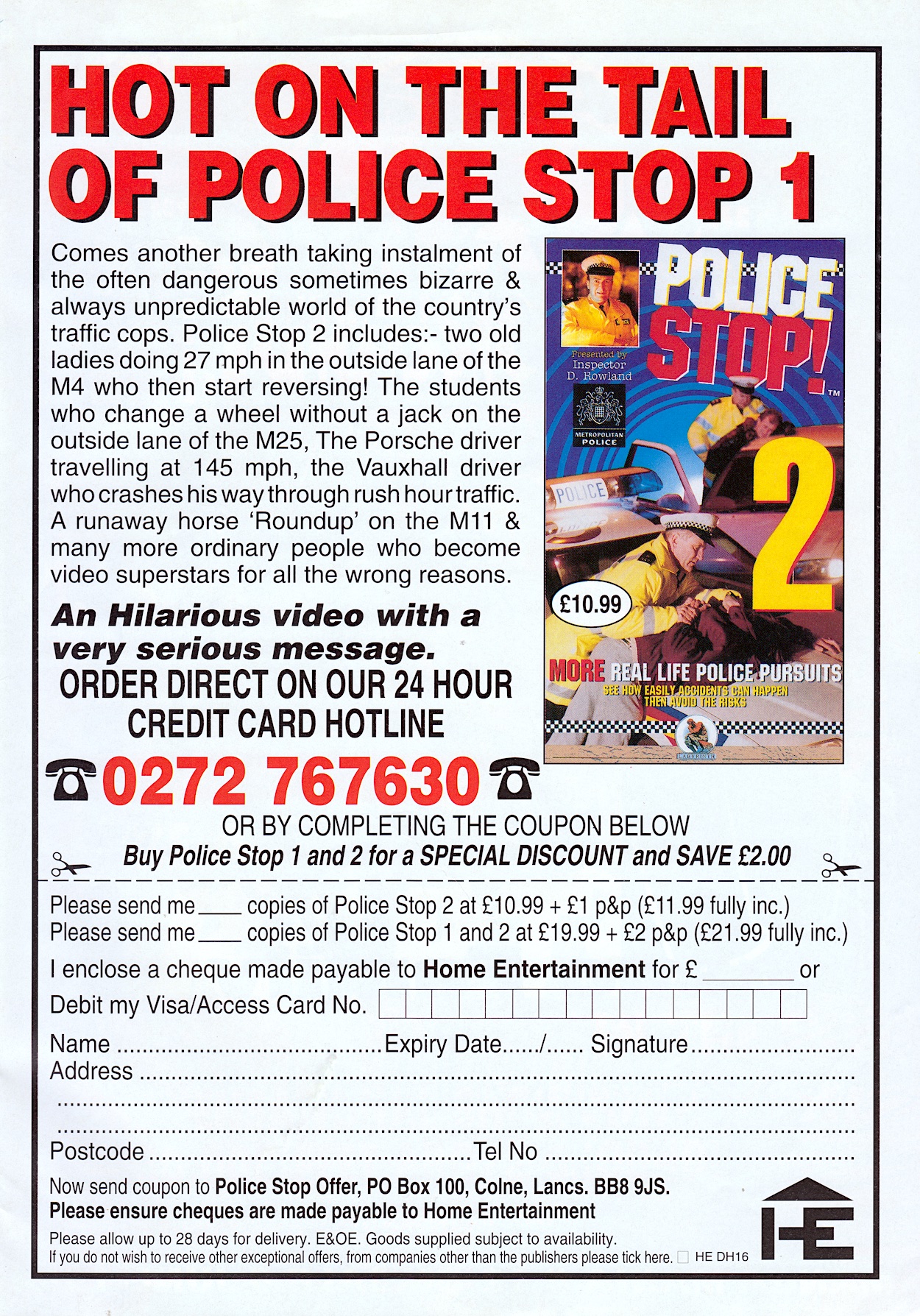
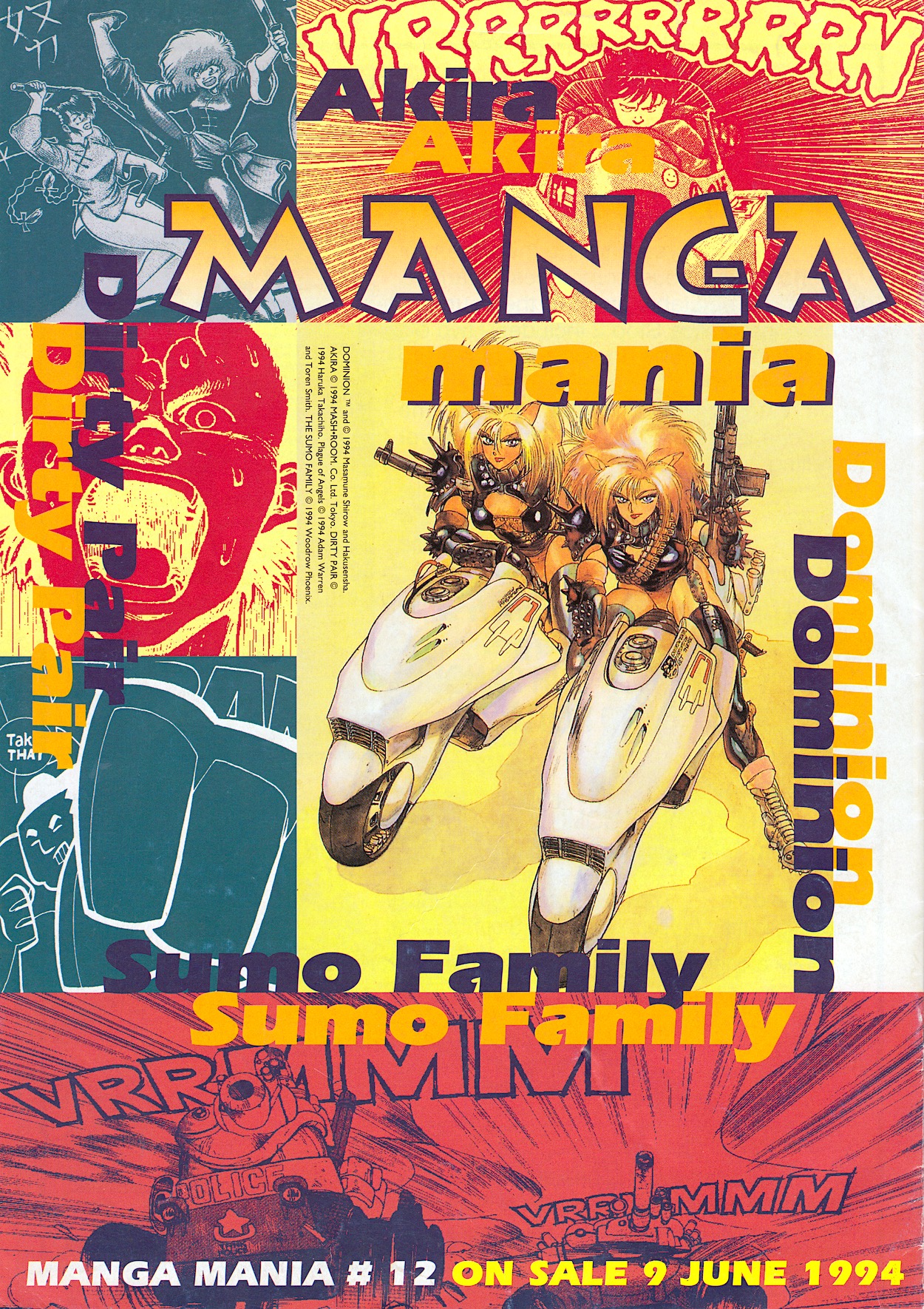
Both of these strips ratcheted up the tension so I’m really looking forward to the next issue. This one may have been thinner than any other in the series and down one strip but what is here is superb from start to finish. Plus, I’ll just mention how much I love that cover image again. To finish with the final two pages contain more of those retro adverts, the first of which is for a video release of a show I remember being on TV at the time, and the back cover is for a comic magazine from Dark Horse International that would end up saving Jurassic Park from an even earlier cancellation. More on that later in the summer.
Just on a personal note, it’s so strange to look back and see a video for £10 that only contained one episode of a show. I do remember buying Babylon 5 on VHS, each volume costing £8.99 and containing only two episodes. It’s crazy to think back to that now when we’re so used to box sets. Two Christmases ago I was able to purchase the entire five seasons of B5, 111 episodes for £40 on my Apple TV! (All restored to their original aspect ratio and remastered by the way, just to let fellow fans know.) How times have changed.
Anyway, back to Jurassic Park and that’s where we leave things for now. The next issue’s review will be here from Thursday 7th July 2022 and by then I’m sure most fans will have seen the brand new film which is due for release tomorrow as of the time of writing. Suddenly, remembering buying these comics is making me feel very old!
Okay, so full disclosure before we kick off this review: I bloody love 80s music! During that decade, as the youngest of five children I heard a constant stream of music coming from the bedrooms of my siblings. Sunday afternoons would find them all in one room listening to the radio chart show, and Top of the Pops gathered the family together every week (usually with complaints from the parents). One-by-one as my brother and sisters moved out in the 90s they’d leave their cassettes behind and I began to discover my own musical tastes. Decades later songs from the 1980s fills up the majority of my Apple Music library.
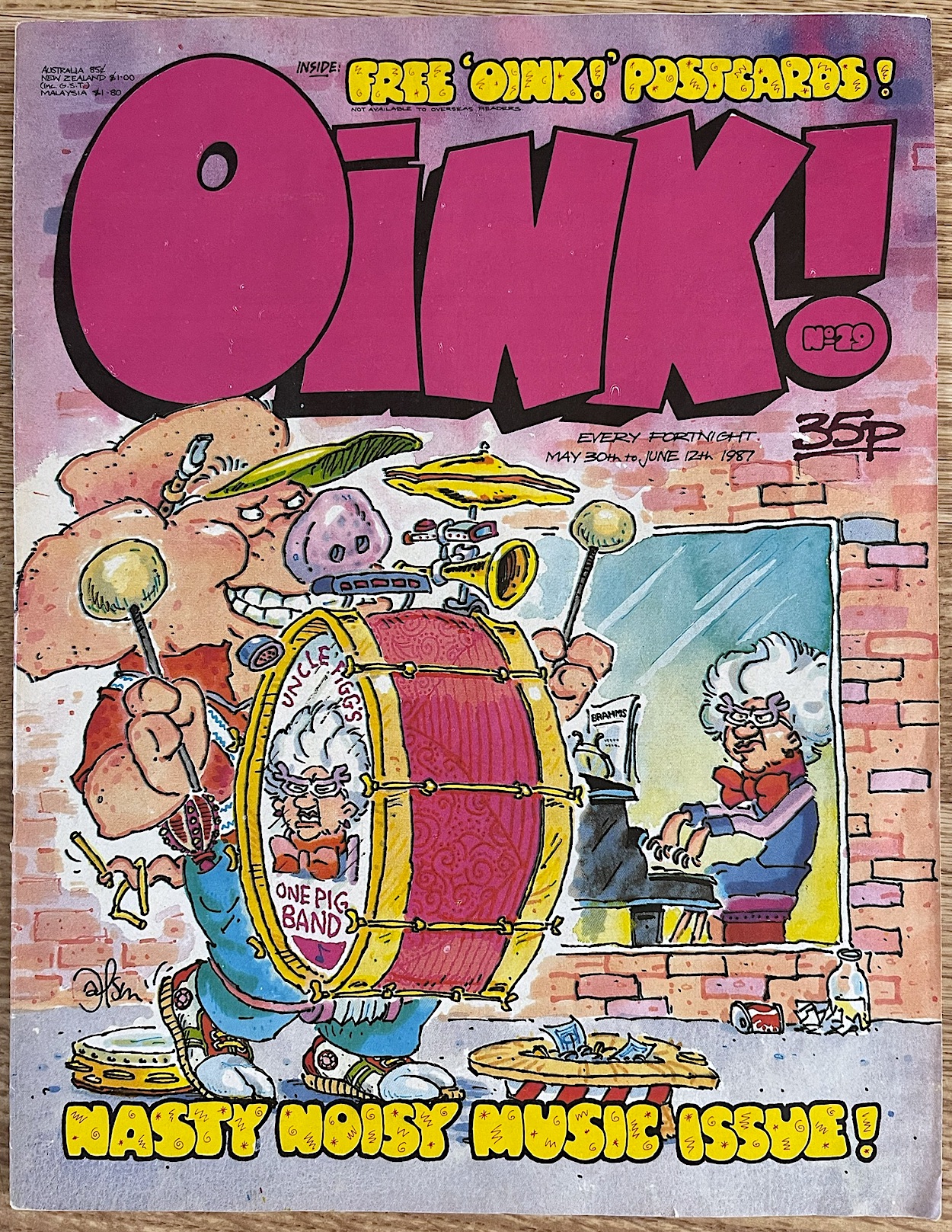
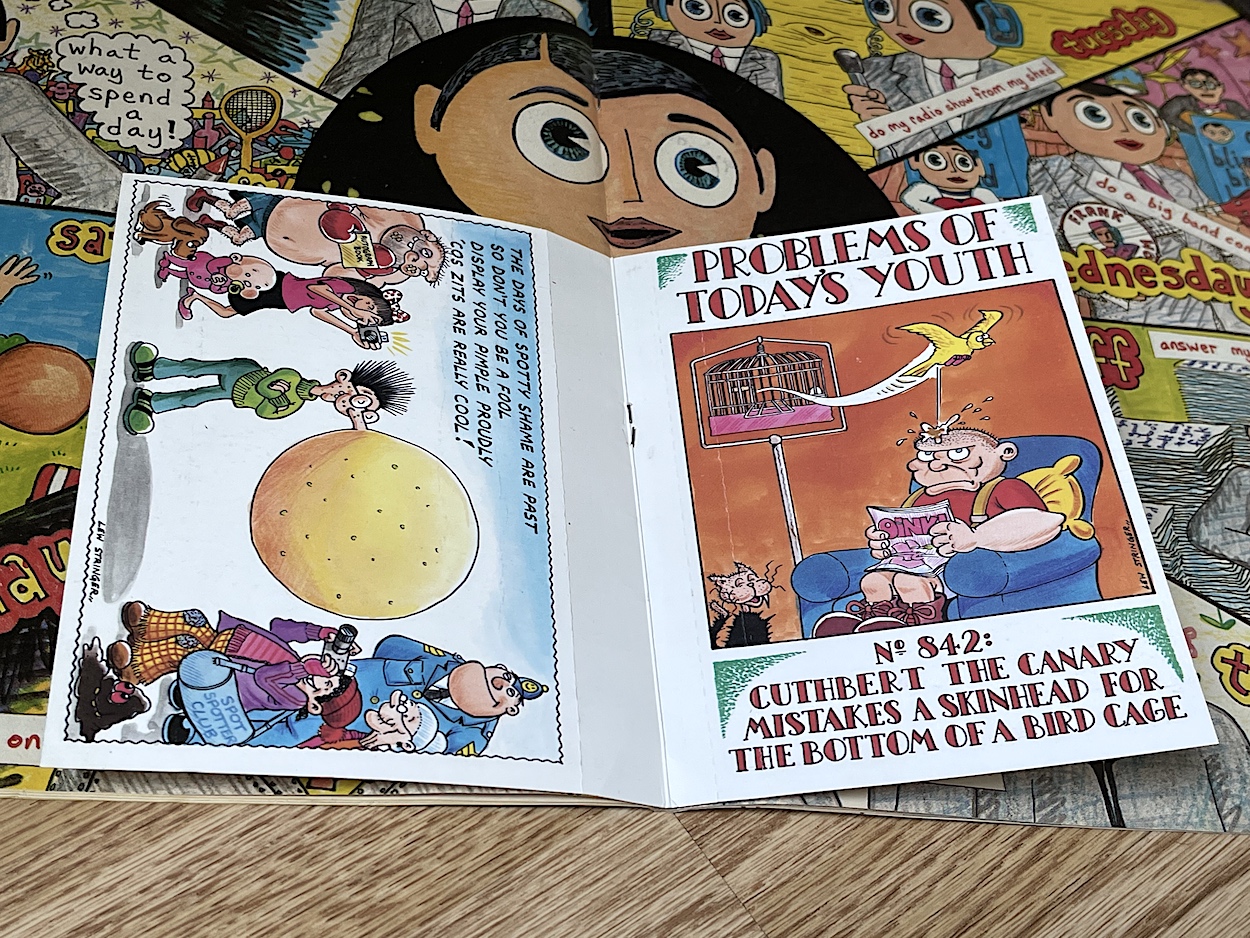
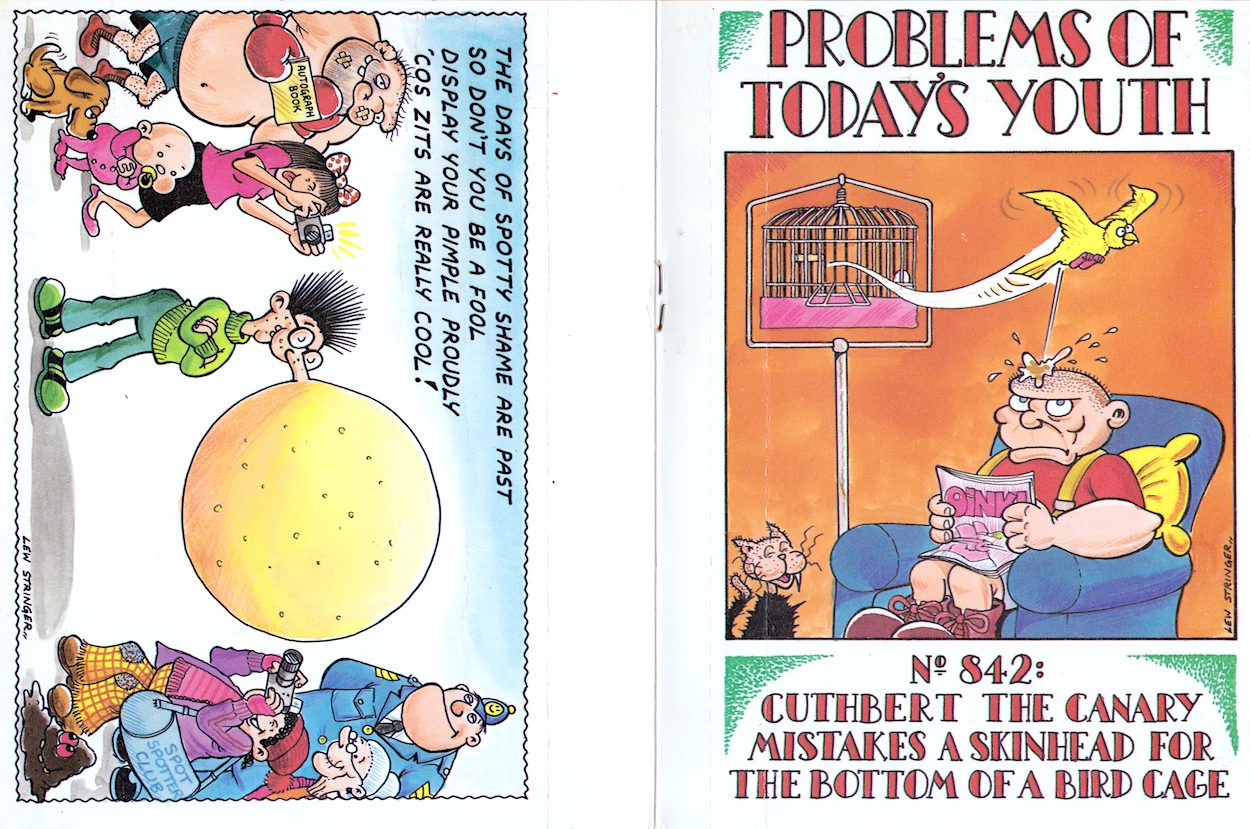
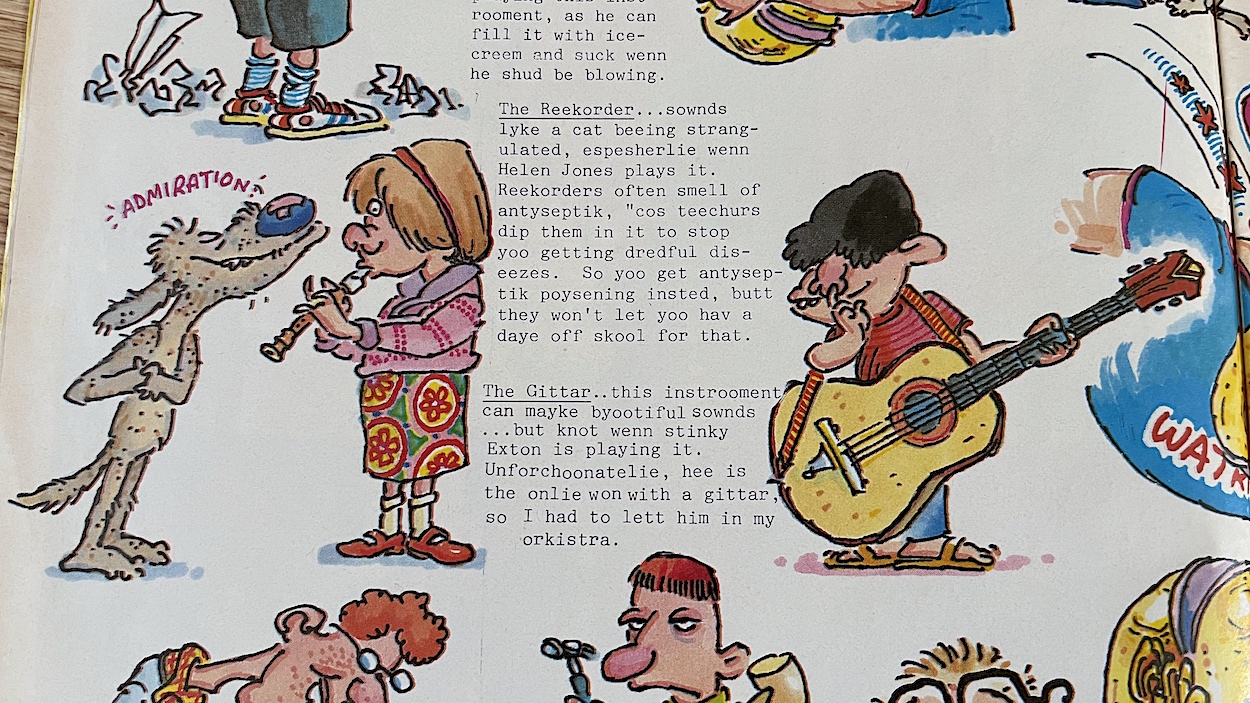
So with that in mind I’m very happy to introduce you to #29 of OiNK, the Nasty, Noisy Music Issue which kicks off with another fun Ian Jackson cover and more free postcards. Having Ian’s jagged, colourful Uncle Pigg serenading critic Mary Lighthouse promises much hilarity inside and it’s not a spoiler to say that promise is well kept. Prolific OiNK cartoonist Lew Stringer brings his two famous creations Pete and his Pimple and Tom Thug to the pieces of card tucked away in the centre of the comic, and thus began pimples and bird droppings zooming around the world’s postal services in the summer of ’87.
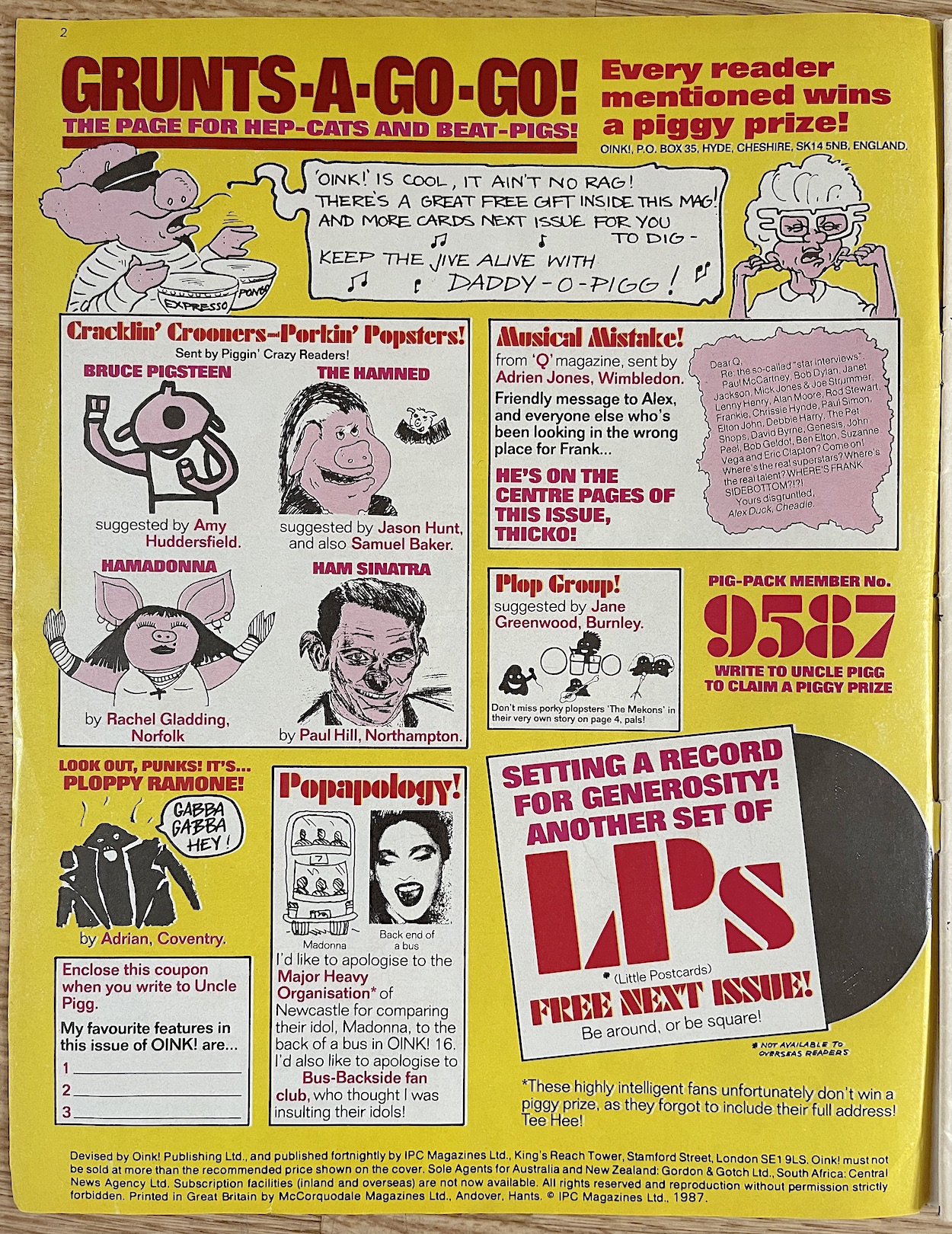
Upon opening the comic the first thing I saw on the Grunts page (compiled by co-editor Patrick Gallagher) was an apology to a Madonna fan club for a cheeky reference to the pop star back in #16, the pop music issue. You can see the original ‘Celebrity Lookalike’ they ran with the so-called apology underneath. Of course, the club members should’ve known better, or perhaps they would’ve fully expected Uncle Pigg to make a joke of it somehow. But they definitely should’ve provided their address, that bit of ridicule was completely their own fault.
I always loved the variety of input from readers on the Grunts pages and this is a great example. If you ever featured in the pages of OiNK do drop me a line in the comments here or on the blog’s social media (Instagram, Facebook). I’ve a list of every contribution made by readers so I’ll happily dig yours out. I have to say I do particularly like the ‘Set of LPs’ promo here too.
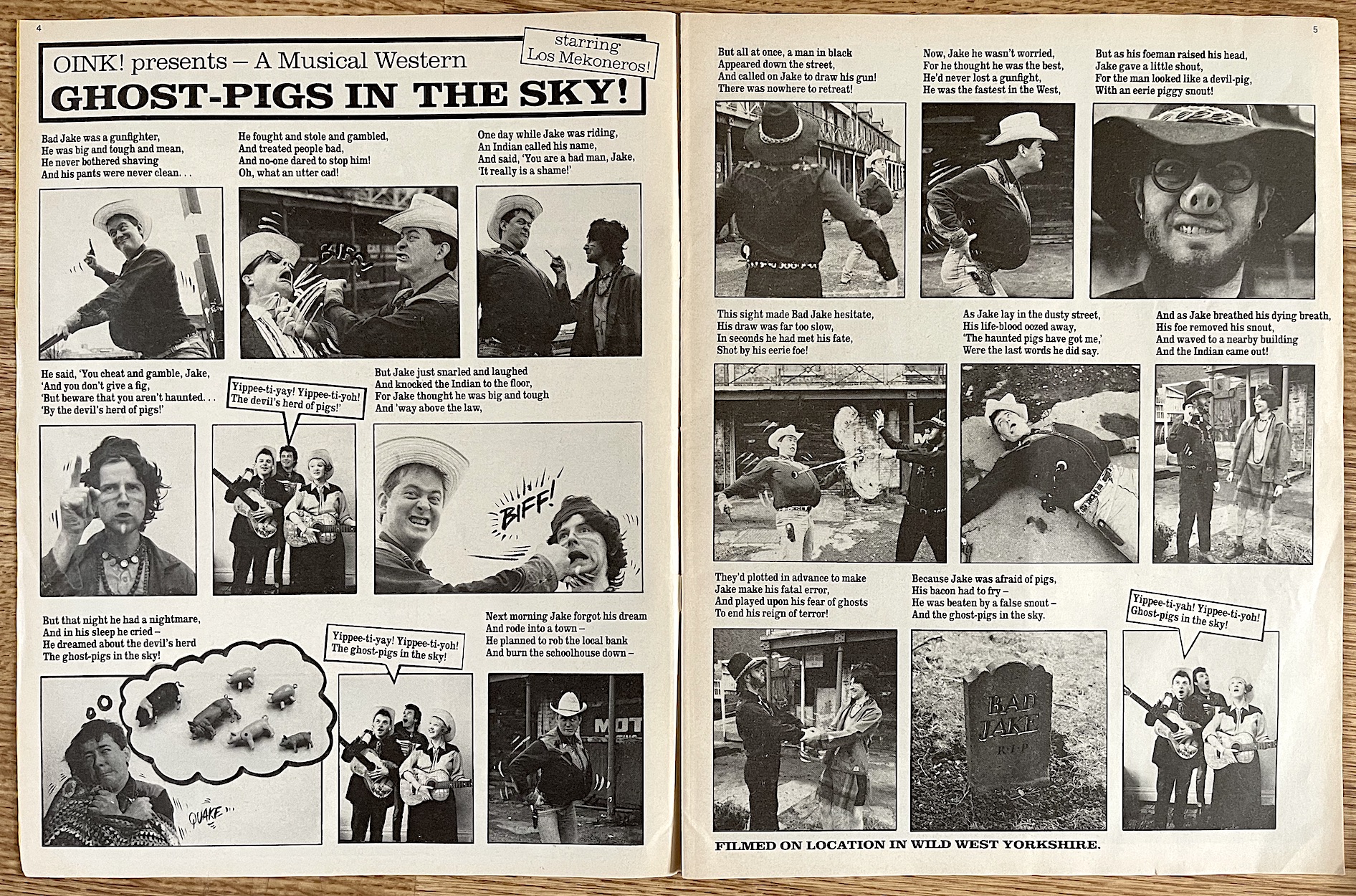
Just a few turns of the page later there’s the latest photo story but this one has some very special guest stars. Post-punk band The Mekons were headlined by Jon Langford, a musician and artist who had already contributed some anarchic art to OiNK. He and Marc Riley are good mates and at the time were putting together a tribute album to Johnny Cash, an album that’s even been attributed to reviving Cash’s career! (The cover of which was drawn by Jon with help from Mike Taylor, an editorial assistant and artist on OiNK.)
For this issue Jon wasn’t just going to draw a strip, he was going to star in it and he brought his bandmates with him. Going by the name The Mekoneros it took place in the Wild West (filmed in Yorkshire) and was set to a song about ‘The Devil’s Herd of Pigs’. Jon himself stars as Bad Jake and looks to be having the best time gurning to the camera and, as with all OiNK photo strips, exaggerating every movement and story beat.
This wouldn’t be the last time we’d see The Mekons in a photo story either, they’d come back to fight off dinosaurs (well, cheap dinosaur toys) in a trip to the distant past in that typical OiNK fashion not being wholly unconvincing.
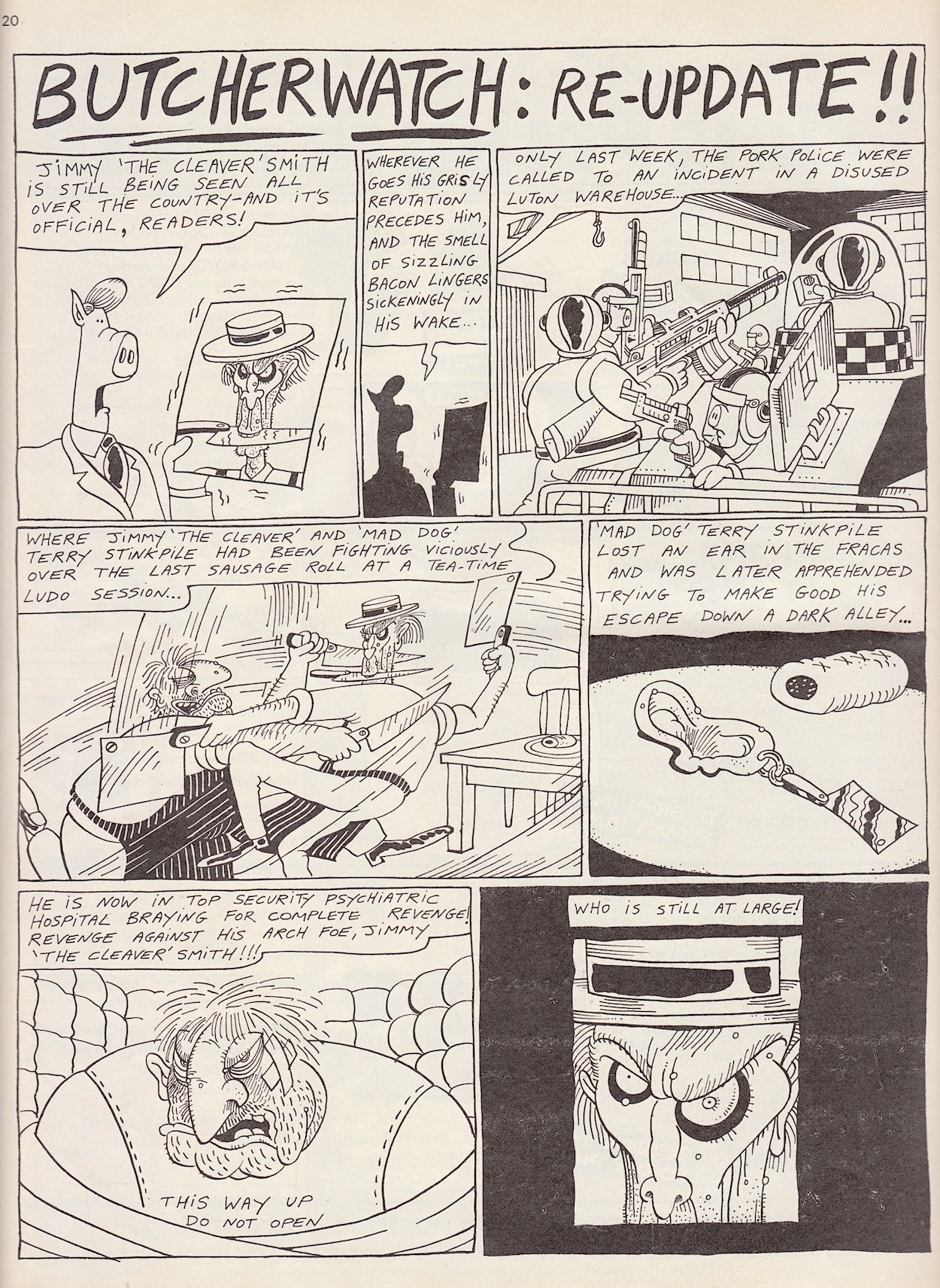
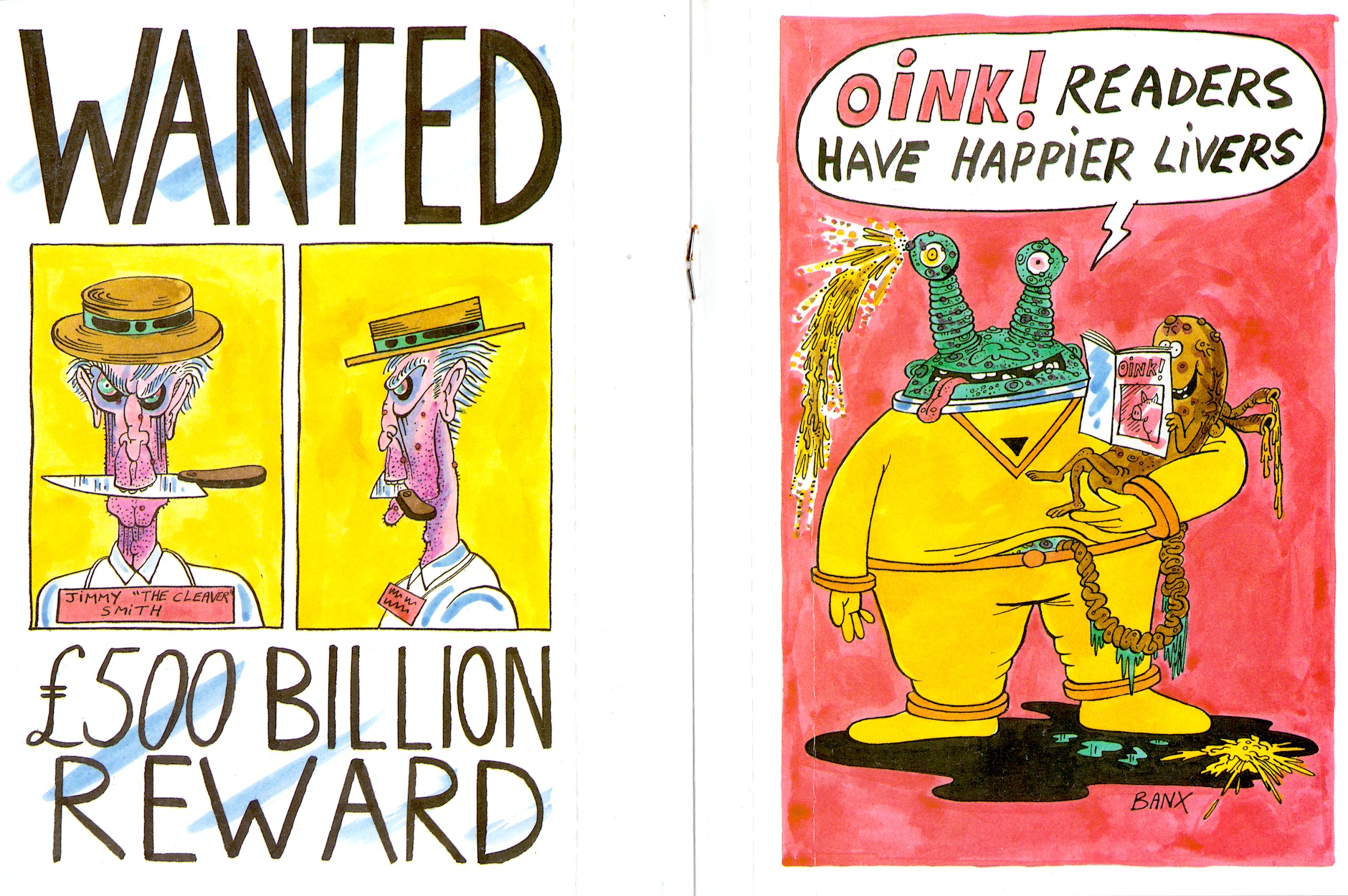
Jimmy (The Cleaver) Smith’s look was perfect, a fantastically creepy design that thrilled the young pig-loving readers
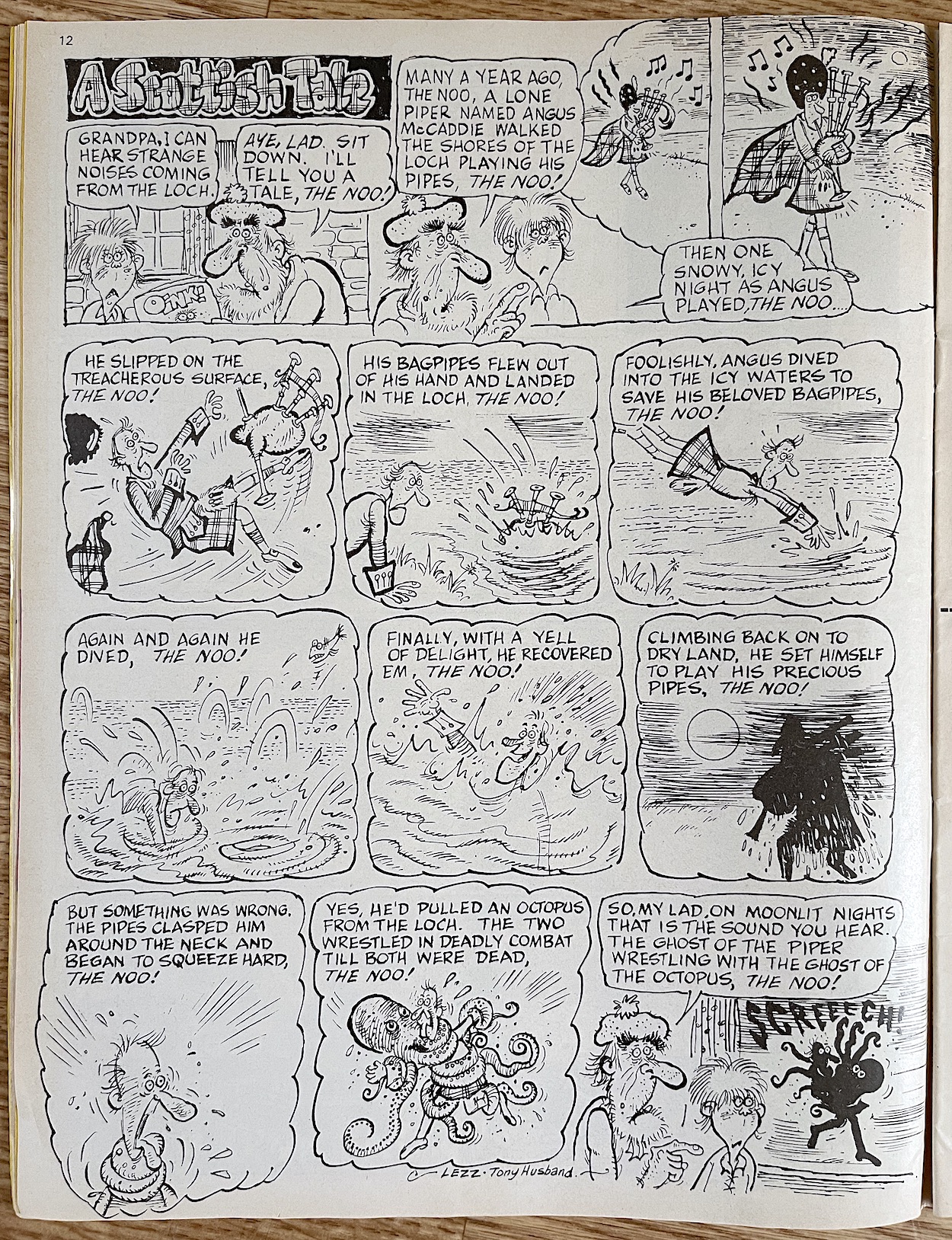
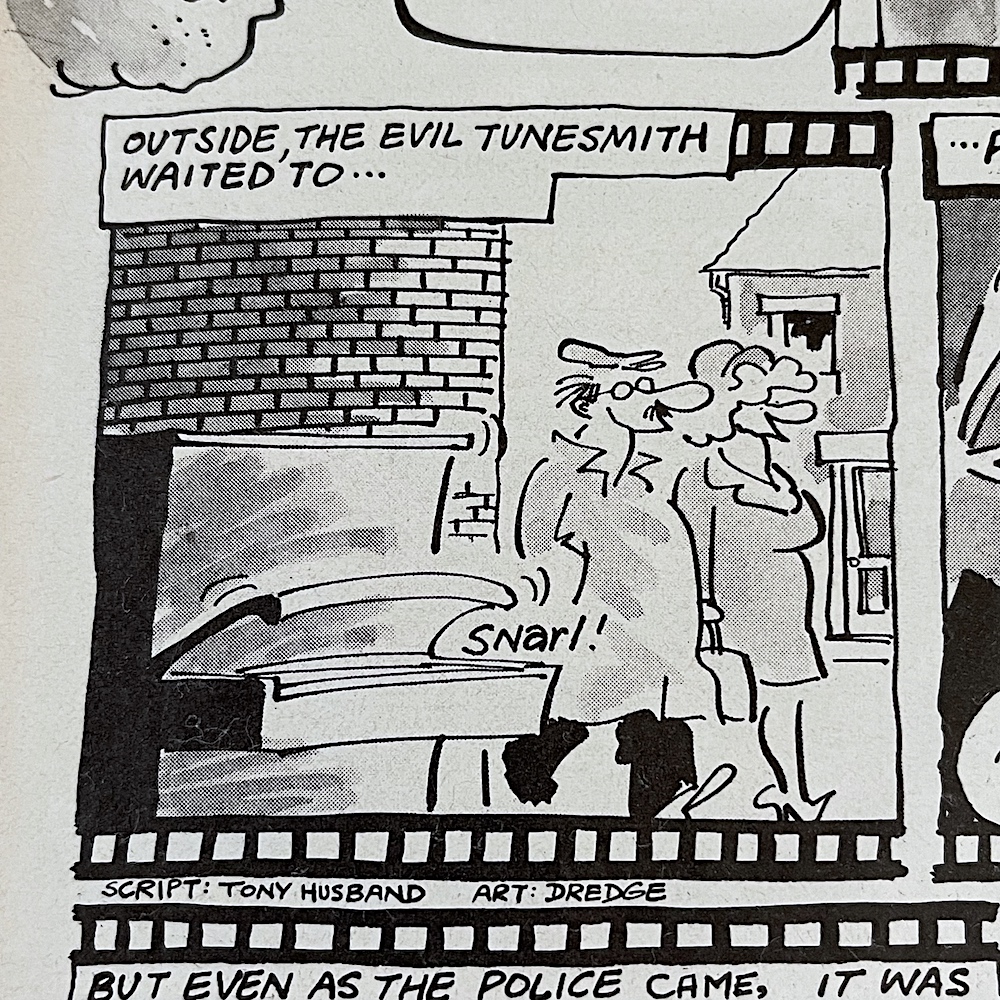
Next up Tony Husband pens a ghost story brought to the page by artist Les ‘Lezz’ Barton. It keeps all of the usual trappings of such a tale while weaving in the theme of the issue and having a genuinely laugh-out-loud ending. A staple of ghost stories are the lone figures found to return time and again to one particular place, often performing a particular action from their life or accompanied by a horrible, terrifying noise, perhaps related to the moment of their death or a past traumatic event.
I love Tony’s fresh twist on this idea, while also answering the mystery of how to accurately describe the noice bagpipes make. Tony expertly plays up to traditional ghost stories and stereotypes with affection and gentle digs, from the initial set up to the overuse of the phrase “the noo”, with that ending providing the biggest laugh of course.
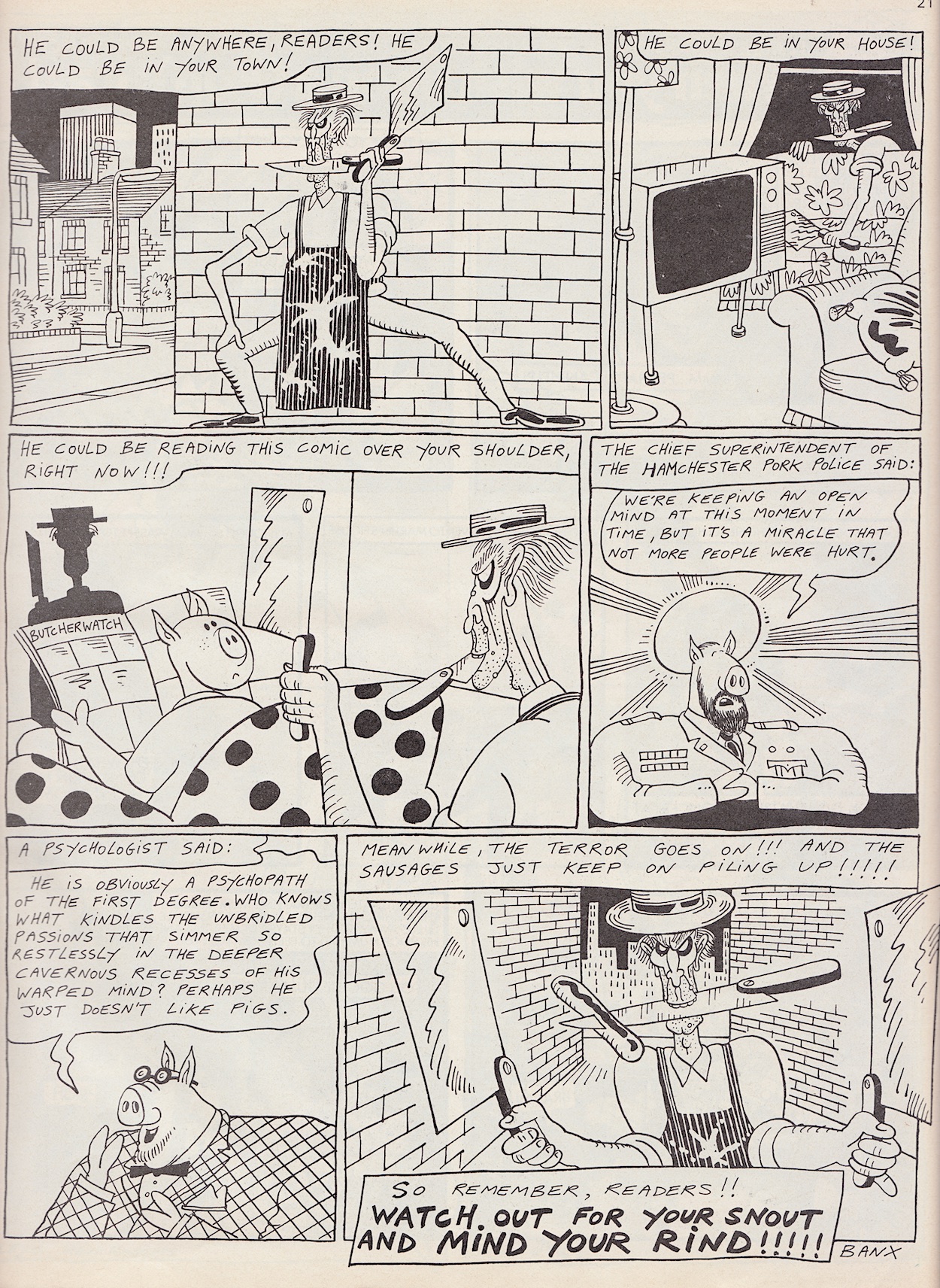
Jeremy Banx brings us a Butcher Watch Re-update (after all a simple ‘Update’ or ‘Part Two’ is just too normal) on the whereabouts of notorious butcher (and the comic’s in-house nemesis) Jimmy ‘The Cleaver’ Smith. Now established as a firm fan favourite, Jimmy would appear randomly for the rest of the comic’s run, even in a regular strip in the weekly issues as the villain of a piece about a famous butcher-hunting pig. Jimmy’s look was perfect, a fantastically creepy design that thrilled the young pig-loving readers.
That panel with the caption about the possibility of him being in the reader’s house, while he silently clambers in through an open window at night is especially unsettling. Don’t get me wrong, that’s not a criticism about unsettling images in a kid’s comic, not at all, we lapped this up! We loved the shudder strips like this gave us and the more horrific Jimmy’s antics were the better! Of course, there was never anything actually unsuitable, he was more like our version of a good Doctor Who villain for the kids; someone to thrill us from the safety of our comic’s pages.
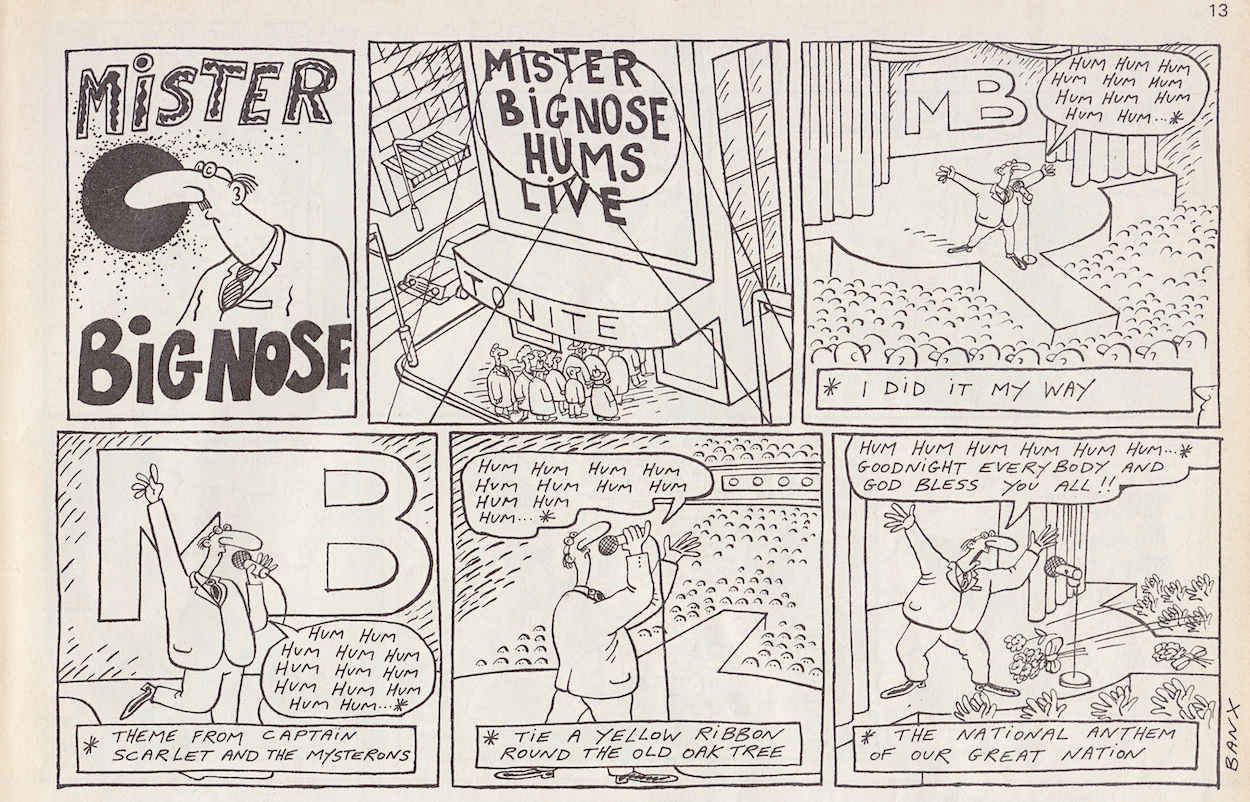
Just before we move on I had to include another of Jeremy’s classic characters, Mr Big Nose. Co-editor Tony Husband once told me he loved Jeremy’s work so much because he would just let his mind go wherever it led, and that’s the best way of describing his OiNK work. Here, Mr Big Nose is putting on a sold-out concert where he hums popular songs, because of course he would.
The joke is right there in the first panel of the strip and it’s just played out again and again over the next four. But it doesn’t get stale. In fact that’s what I find so funny about it, how we get example after example of the ridiculous set up. Genius. As always.
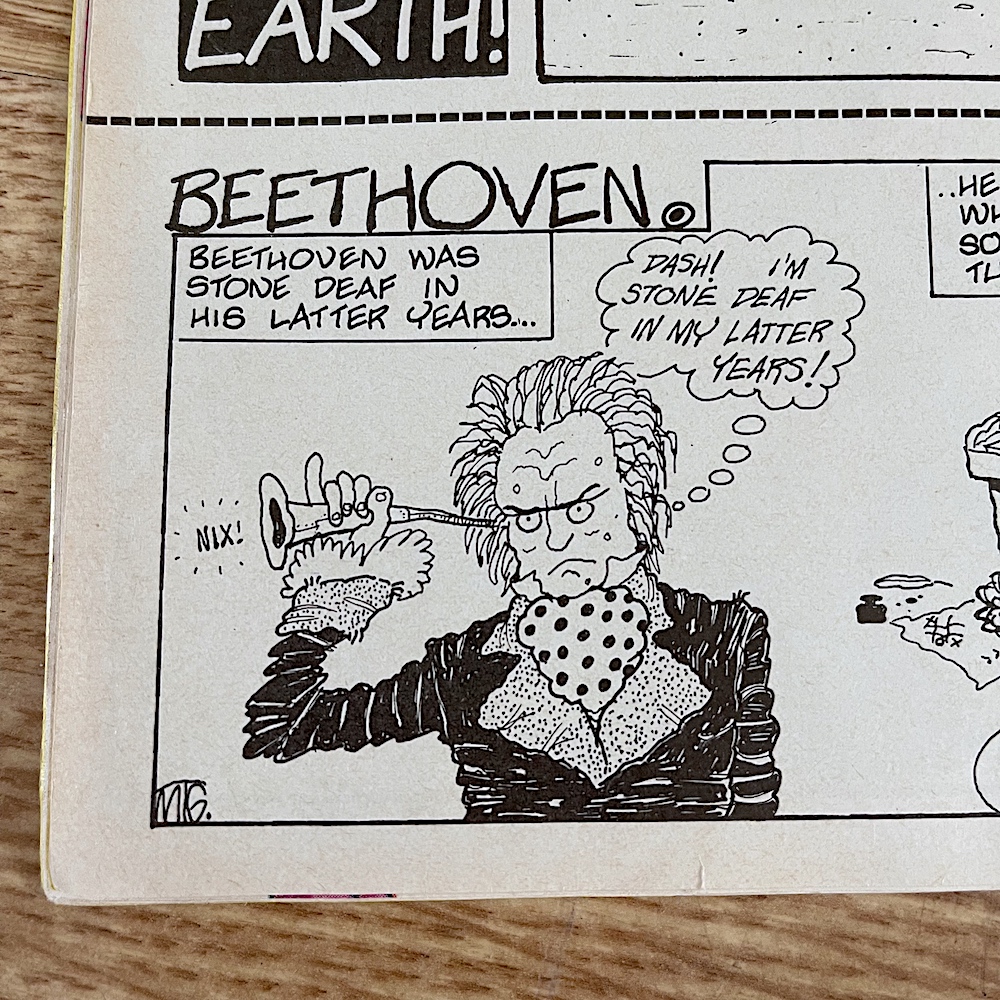
Other highlights this issue include educating the young ‘uns about classic music with Beethoven, in The Golden Trough Awards: The Piano From Hell! piano lessons bite back, there’s a special (and I quote) “Psy-Psy-ss-Psycho-o Gr-Gr-an-Gran Rap’ and Helen Jones and Graham Exton make cameos (whether they like it or not) in A Yung Person’s Gyde to the Orkistra bi Hadrian Vile. Helen was co-editor Mark Rodgers partner and Graham a close friend.
Beethoven by Mike Green Golden Trough Awards written by Tony Husband, drawn by Pete Dredge Psycho Gran by David Leach Hadrian Vile written by Mark Rodgers, drawn by Ian Jackson
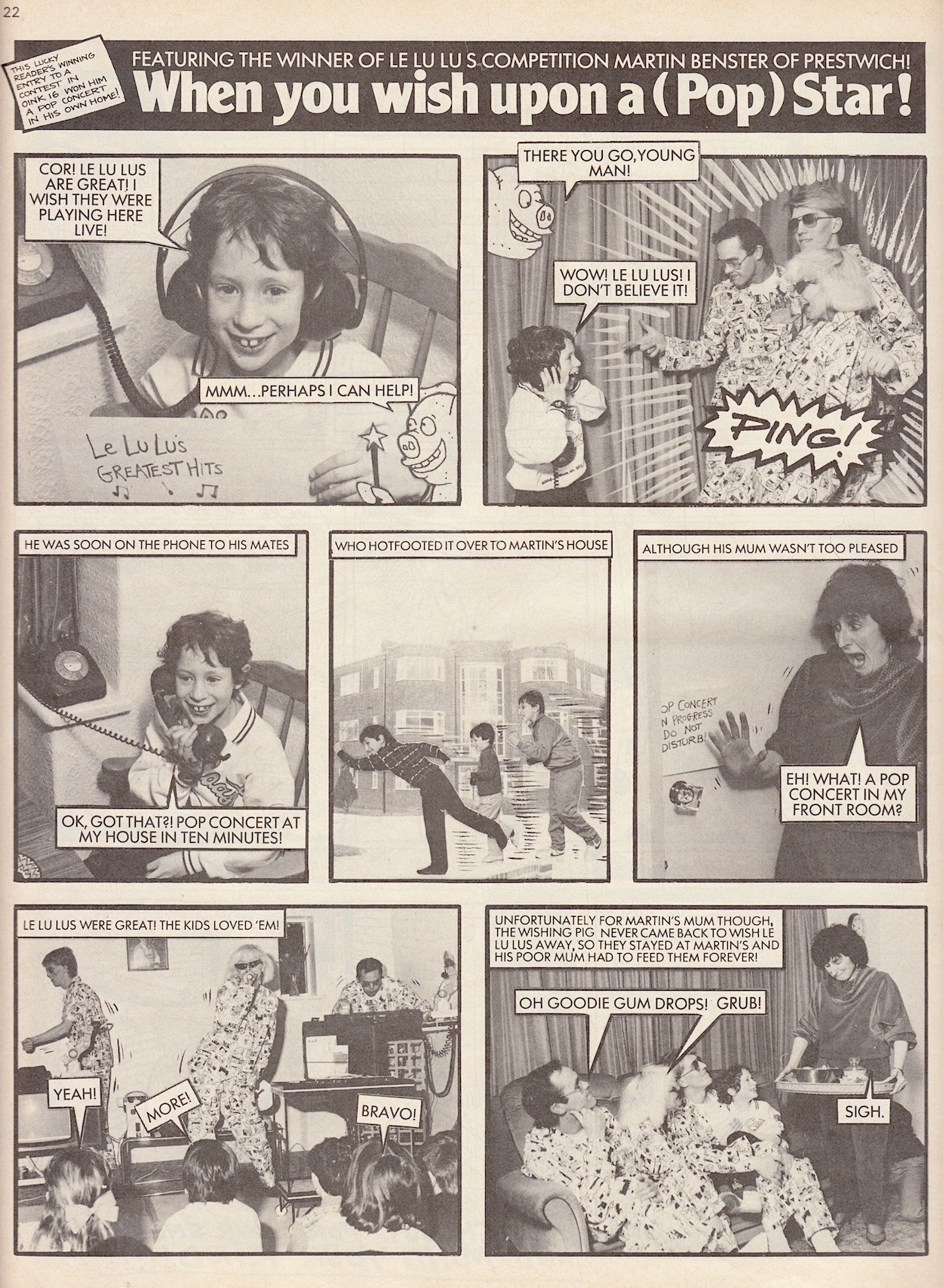
Madonna’s face isn’t the only link back to #16’s pop music theme. That issue also had the most unique competition I’ve ever seen in a comic, to win a pop concert in your own home. Le Lu Lus were fans of OiNK and contacted the team about collaborating. This ultimately resulted in Martin Benster from Prestwich and his friends (as well as his poor mum) watching a performance of the band in the comfort of their own house. Best of all a full strip was created so Martin could actually appear in the comic, with his mum as part of the punchline at the end.
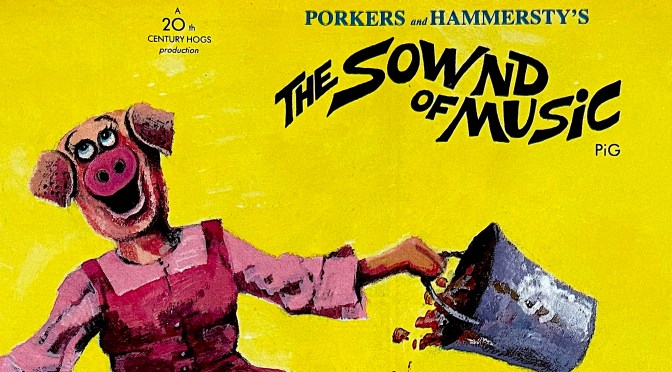
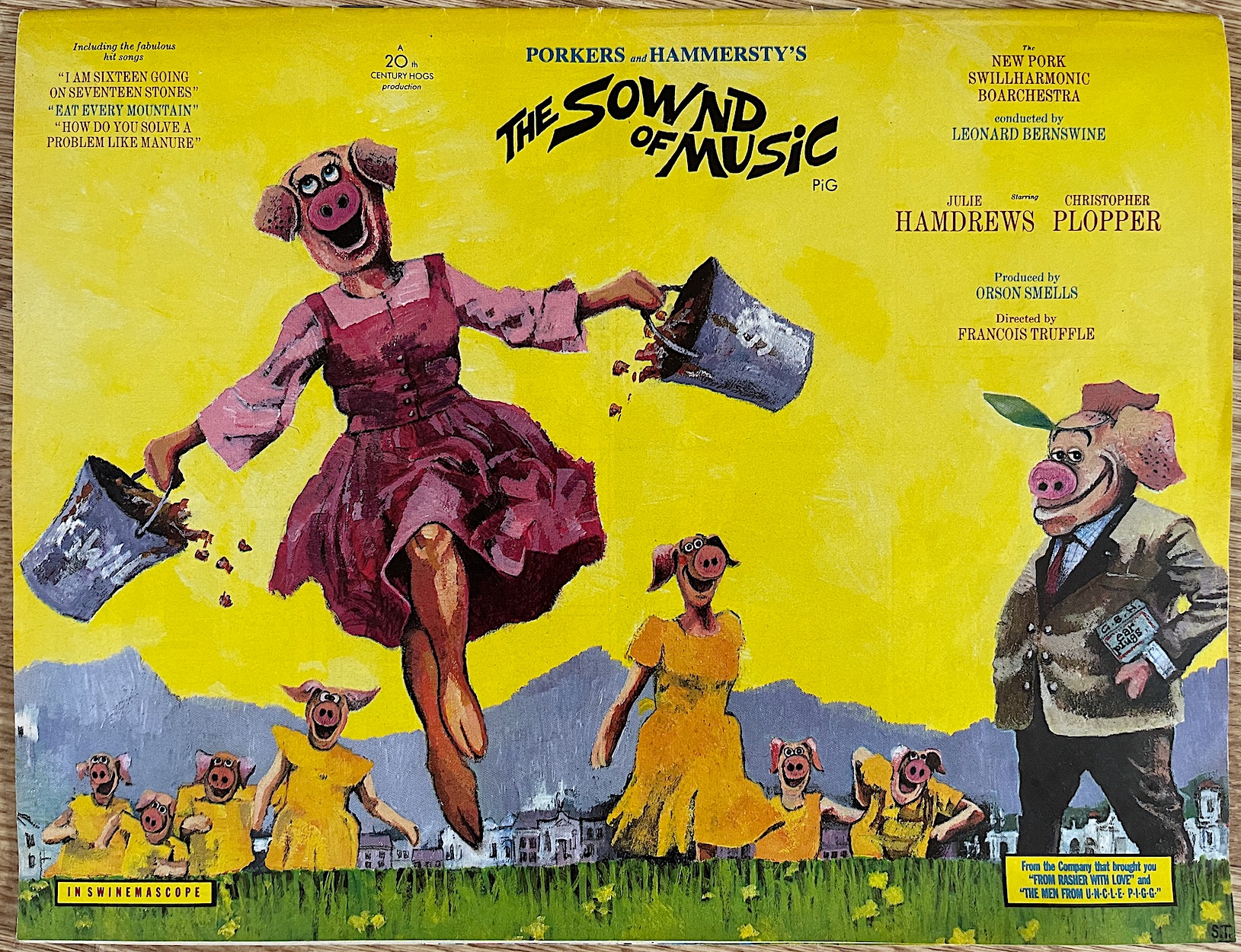
On the back cover is a glorious colour pin up from Simon Thorp and it’s just the first in a line of spoof movie posters that would become fan favourites over the next several months. From RoboChop to Butcherbusters, Simon’s brilliant take on popular movies with a piggy twist are some of the most requested pages for inclusion on this blog. He kicks off his semi-regular series with The Sownd of Music.
Simon even includes credits, with everything reworded into piggy puns and ploppy parodies, right down to the little production company name beside the title and his take on Cinemascope. Back when movie posters were all hand-painted rather than photographs or CGI these really felt close to the original designs. However, even with all that hard work Simon has put into creating that brilliant image I laughed the most at the simplest little joke, the movie’s certificate; adding just one lower case ‘i’ ends the issue with one of its best gags.
That’s us for another two weeks. The next issue of OiNK is very special indeed. Do you remember those silly award categories readers were asked to send in nominations for back in the Hogmanay issue at the start of the year? It’s nearly time to find out how they all voted. It’s a who’s-who of 80s culture, all brought to life by none other than Spitting Image! It’s an absolute hoot and the highlights will be here in the next review from Monday 13th June 2022.
Coming up next on the OiNKBlog is another musical issue of our favourite comic. Back in the latter parts of last year #16 was a hilarious pop music special and it ended up being a very unique issue. Will the next one measure up to it? Well, with a photo strip featuring the post-punk band The Mekons in a Wild West shoot-out it’s very promising, that’s for sure. Here’s the Next Issue promo, drawn by Davy Francis from a script by Mark Rodgers, taken from #28.
There are a couple of references back to the previous music-themed edition including the results of that Win A Pop Concert In Your Own Home competition. There’s also another Butcher Watch Update from Jeremy Banx which were always brilliant of course, the first of Simon Thorp‘s excellent spoof movie posters and much more, all wrapped up in yet another Ian Jackson cover. You can check out the latest review from Monday 30th May 2022.
Also mentioned in the image above is the first OiNK Holiday Special which I reviewed back in April, so make sure you catch up on that review too, pig pals.
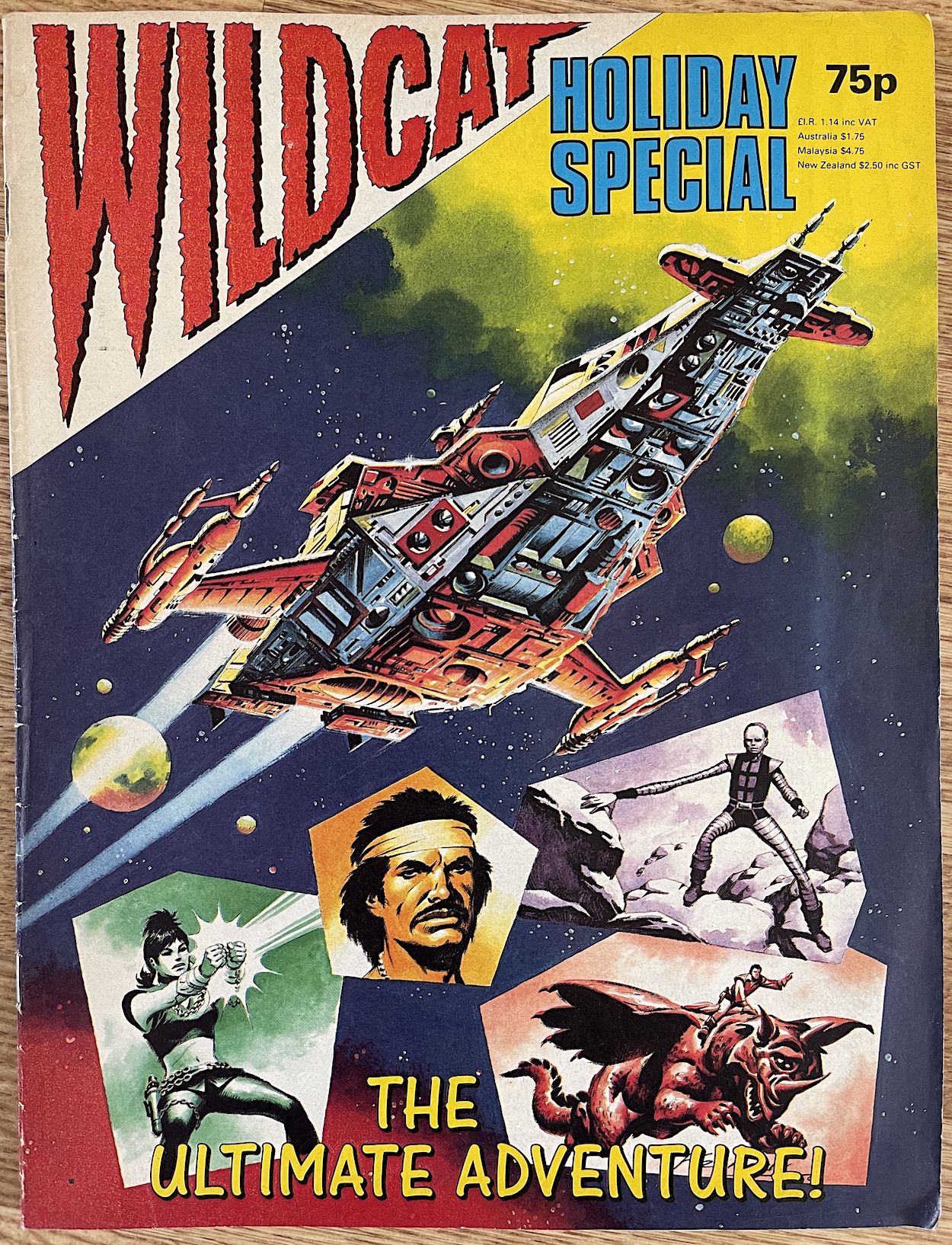
It hasn’t really been that long since the final issue of Wildcat, two months in fact, but it’s great to hold another edition in my hands, especially one I’ve never actually read before. I wasn’t aware of it as a child because I hadn’t followed the characters into Eagle when the comics merged. There’s a rather lengthier wait after this but I’ll get to that at the end of the review. So what we have here is the standard Fleetway Holiday Special format of 48 large, glossy pages full of strips, a prose story and extra features thrown in for good measure.
After a contents page and a recap of the set up from the preview issueTurbo Jones reclaims his position as the lead strip (now drawn by Keith Page) and like all of the stories here it’s a standalone tale and not linked to the ongoing serials that all ended with cliffhangers in the last issue. Of course, by now those stories could have concluded or moved on to goodness knows what in the pages of Eagle. (That’s something I’ll look into in future posts.) Some of these read a little strangely because of this.
For example, as far as I was concerned Turbo was still languishing on his quest through the Valley of Death, but here we’ve skipped forward to the next chapter in his adventure on the new planet. We find him and his robotic friend Robo accidentally stumbling across two aliens out for blood (or whatever runs through their veins. If they have veins). This isn’t a quick summing up of things either, in the end they realise the two creatures have no interest in our heroes, they have literally stumbled upon this fight. But of course if they don’t defend themselves they’ll go the same way as the loser.
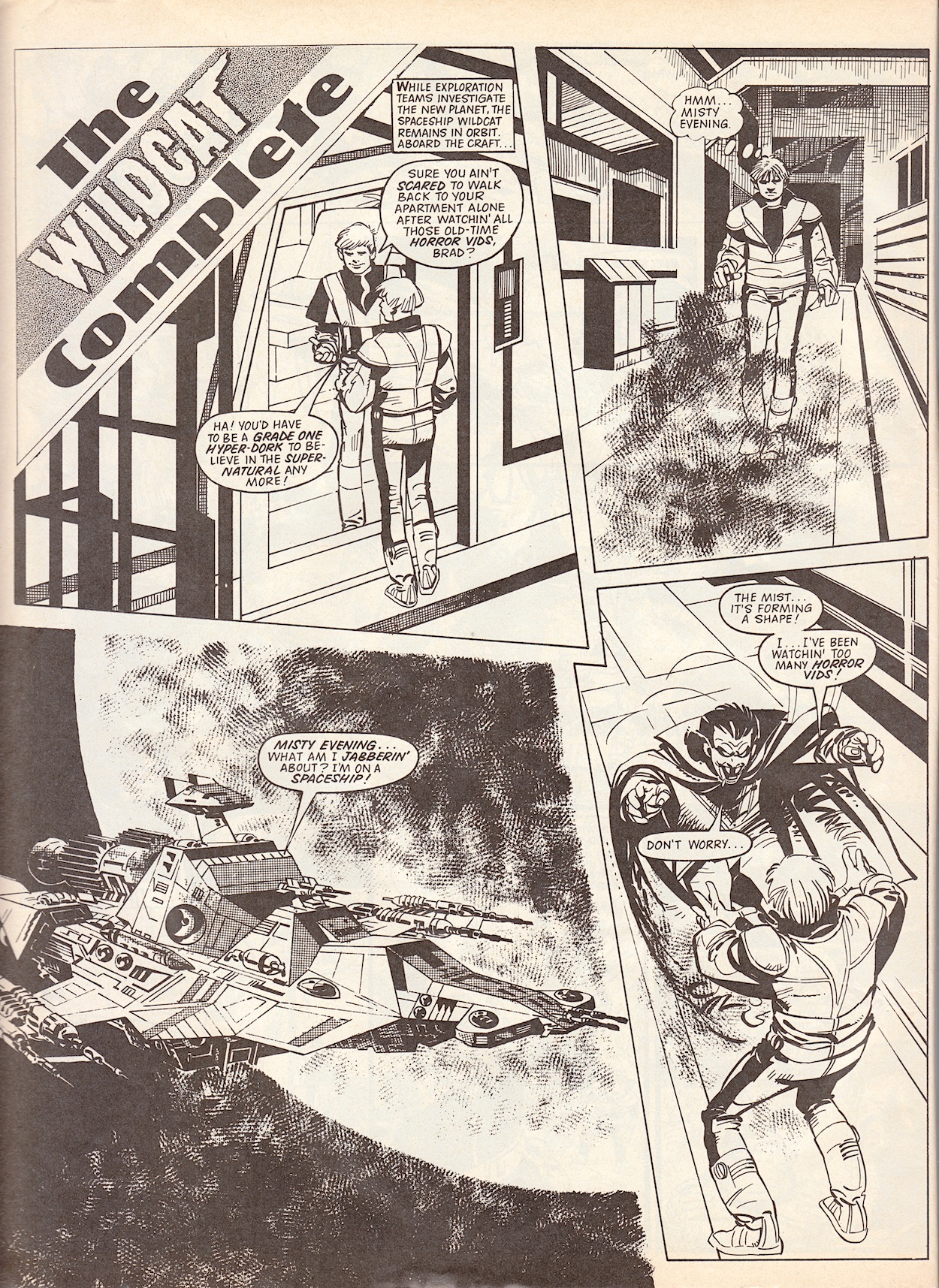
Turbo is knocked unconscious by a falling branch and Robo saves the day by knocking coconut-like fruits off the trees onto the heads of the aliens. No, really. It ends with Turbo disbelieving this tale of heroism and Robo talking directly to the reader, asking them to write in and tell Turbo what happened. It’s a fun diversion of an opener but feels very slight in comparison to the fortnightly. However, I do love that alien design. Moving on now to something somewhat darker stalking the corridors of the Wildcat itself in The Wildcat Complete, brought to life by Jesús Redondo.
That’s right, we have an actual vampire onboard. There’s also plenty of well-judged humour here too so it’s unfortunate we don’t know who wrote the script. Here on the first page the casual thoughts of our victim raise a laugh as he catches himself on about the “misty evening” before meeting his end, and later on as another victim is running late in getting home he thinks to himself how he’ll “get it in the neck” from his wife! These are the only people we see die (taking the Wildcat Death Toll up to 40) but mention is made of them being only the latest in a series of disappearances, so our toll is actually unknown.
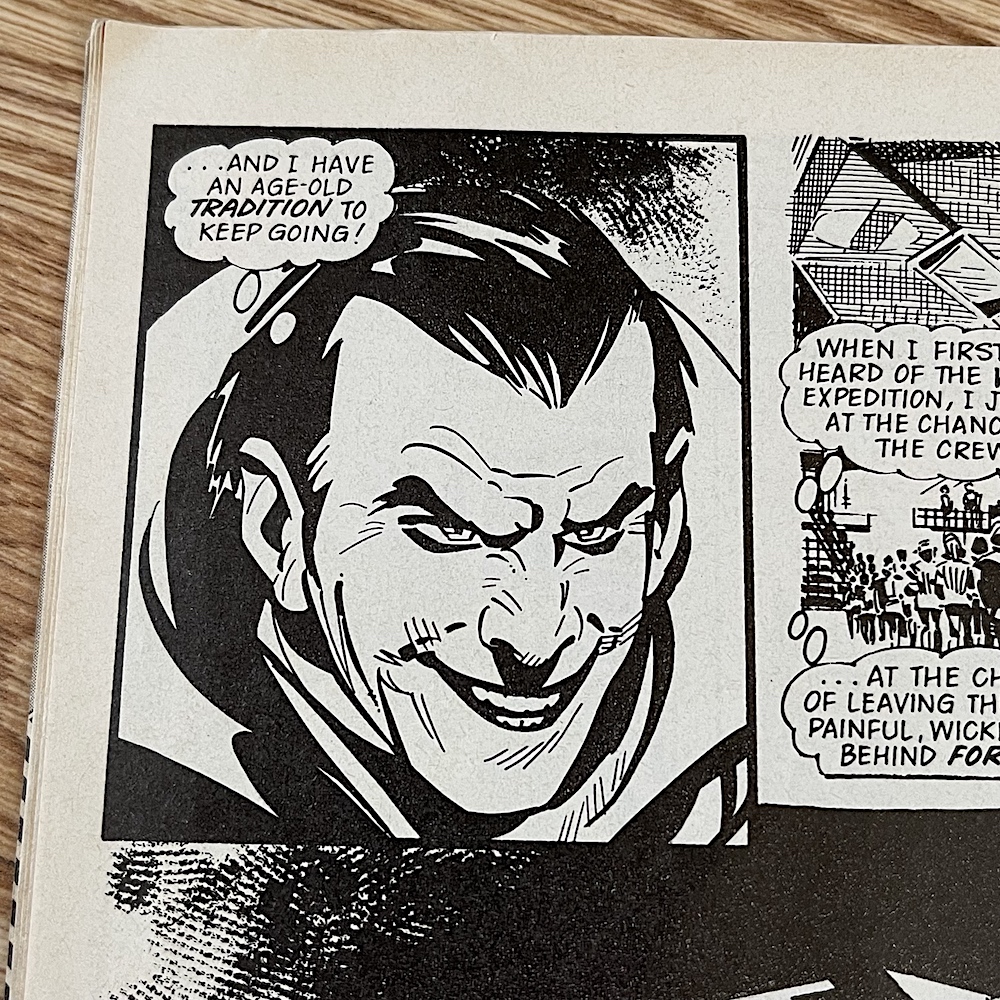
During the day our vampire goes by the name Dr. Joseph Lugosi, obviously a play on the name of renowned actor Bela Legosi who is probably best remembered for playing the title character in the 1931 film Dracula. It’s not just his name the story pays homage to either, just take a look at the doctor in this close-up frame.
There’s a rather dark moment where we see him dispose of a body by taking it to the food recycling plant, which is basically a bunch of retro-futuristic robots munching down on anything thrown into their pit. We get a little internal monologue of how Lugosi applied to be on Wildcat because there’d be no sunlight in space to stop him feeding, and we see him queued up to get on board, everyone else in casual gear, him in his dark cloak, standing out a mile. Given his appearance and dress sense, when he thinks his plan is foolproof and no one would ever suspect him it seems ridiculous, but it’s actually all explained in the end.
When an attack is disturbed mid-feast he has to leave the body behind and as Wildcat Commander Griffin reviews the tapes he sees Lugosi disappear into thin air. He ends up tricking Lugosi into believing he’s replacing an ill doctor on an expedition to one of the planet’s moons, but before anyone else boards the shuttle craft it’s launched out of the Wildcat on autopilot. The last page of the strip is below and very neatly wraps up the story.
I really like how Griffin had to research what a vampire is (so far into the future are we, their legends appear to have been lost) and that he simply reacts logically to the problem. There’s no disbelief, just a problem to solve and the history tapes give him the answer. While I can only show you a little bit here he’s a cool-as-a-cucumber character and one I wish we’d gotten to know properly in the comic. Check out that final caption too, vampires are now extinct! Another great anthology story, one that’s made me realise just how much I’m missing them every two weeks.
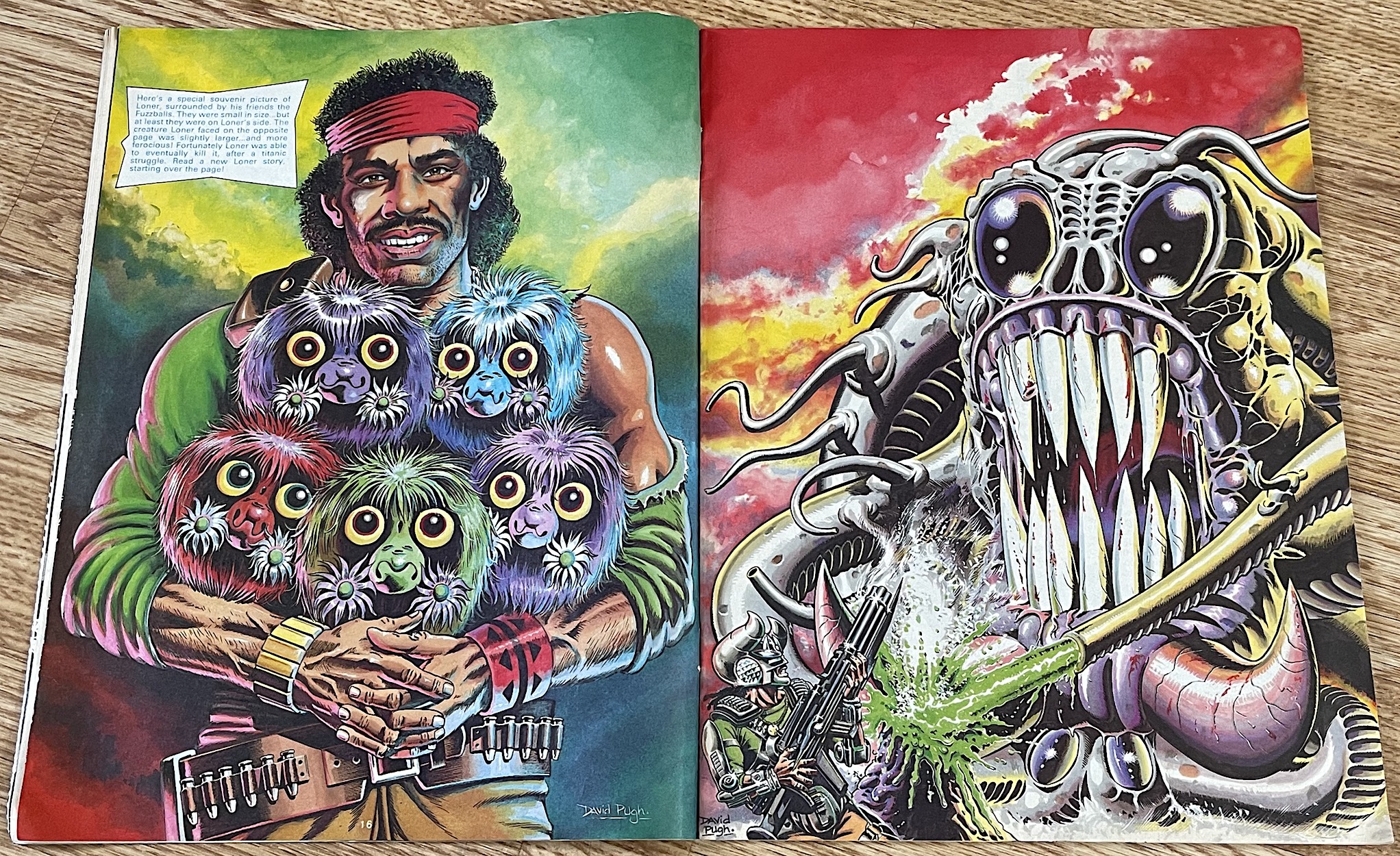
Loner gets a good bit of space in the special but unfortunately there’s not a comic strip in sight. There’s a two-page spread of pictures taken from the early issues and his initial scraps with, and ultimately friendship with, The Fuzzballs. There are also two pin ups, both drawn by David Pugh. One is brand new and the other is a reprint of the cover to #7 which was so good it deserved another outing as a mini-poster without the title and issue details. To this day it’s probably my favourite piece of art from Wildcat. In fact it’s one of my favourite pieces of comic art ever.
On top of all this we get a Loner story written by editor Barrie Tomlinson, however it’s told in prose with images of David’s taken from the regular comic. At five pages and full of text it’s a meatier read than I expected and actually a whole lot better than the strip we’d been reading for the last handful of issues. Falling into a chasm he’s apparently rescued by an alien slug creature who carries him to a large cave full of slugs where he also sees another, two-headed alien. They have to fight to the death for the entertainment of the slugs! (Are they an unfriendly relation of the Dargonlites from the Joe Alien story?)
It’s a struggle. The two-headed creature is relentless but soon Loner is able to escape by causing chaos in the audience (he throws one of the slugs into the crowd as a distraction). Back outside the alien is on Loner’s tail and in what looks like the end of the fight Loner’s gun Babe ends up pressed against the creature’s throat. But Loner backs off, trying to communicate he doesn’t want to kill him, he has no beef with him.
Both heads broke into hideous grins, then it turned and walked away.
Loner prose story
Communicating is difficult however and relies on body language more than anything, which is interesting. However, I’m disappointed he no longer has the headband from previous stories. It’s only given a passing explanation that he’d returned to Wildcat and had it removed before coming back down. This completely contradicts the story where he received it! Such a shame, but perhaps a necessary evil because the images they had to use didn’t include it, rather than it being a story choice.
Anyway, the two-headed creature continues to follow Loner at a distance. When our mercenary gets back to his shuttle it appears to attack, throwing Loner to the side and leaping into the craft. Are they going to steal it? Nope, there was a deadly snake-like predator inside. The alien had saved Loner’s life. But before Loner can try to communicate a thank you, he’s attacked by the alien again! He wins the battle by unhappily having to end its life, or be killed himself.
In the end, the creature had been a warrior and it was always going to be a fight to the death, but Loner had saved him from the underground slug beings and he’d had to repay that debt first. This would’ve made for a great multipart strip in the regular comic, it’s full of character and paints a wonderful, exciting picture. Such a shame it’s only illustrated by images from unrelated stories.
There’s one more special to come and I’m very excited by it
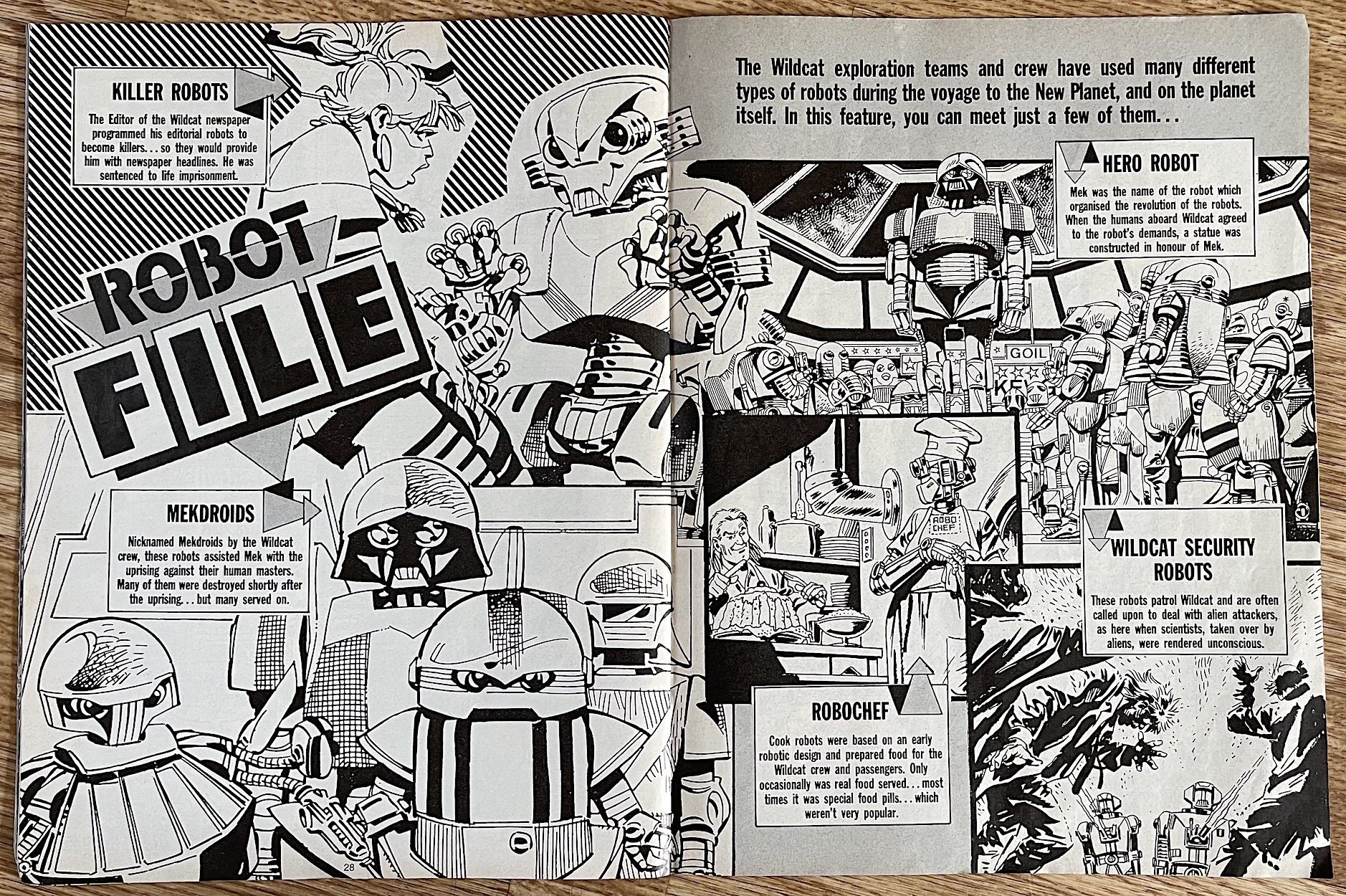
Alongside the double-page spread of Loner’s furry friends there’s a four-page feature about some of the robots that reside aboard the Wildcat and which have featured in previous stories, most notably the Wildcat Complete series. Features like these act as a nice way for new readers to catch up and get an idea of what Wildcat is all about, but unlike some of the Super Naturals Holiday Special features which felt like filler, these are nicely put together and are still enjoyable for regulars.
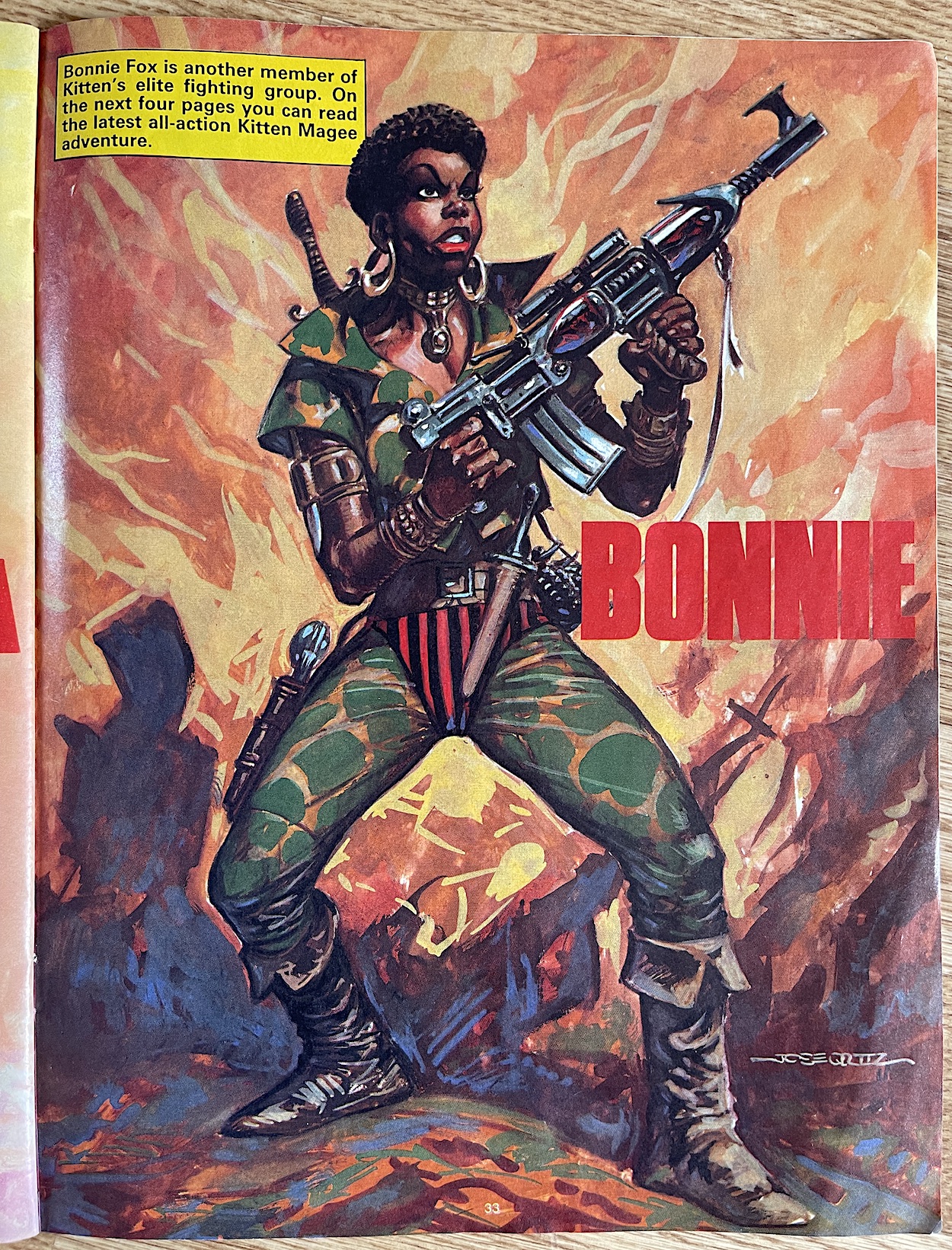
Alongside more reprinted pin ups there’s another new one which hadn’t made its way into the fortnightly and it’s of one of my favourite characters from the Kitten Magee story, Bonnie. As regular readers of the comic (or even these reviews) will attest, Kitten’s team were just starting to get fleshed out some more, even going on their own adventure without their leader in the final issue. I look forward to reading the ongoing tales in Eagle and Wildcat at a later date, mainly for them.
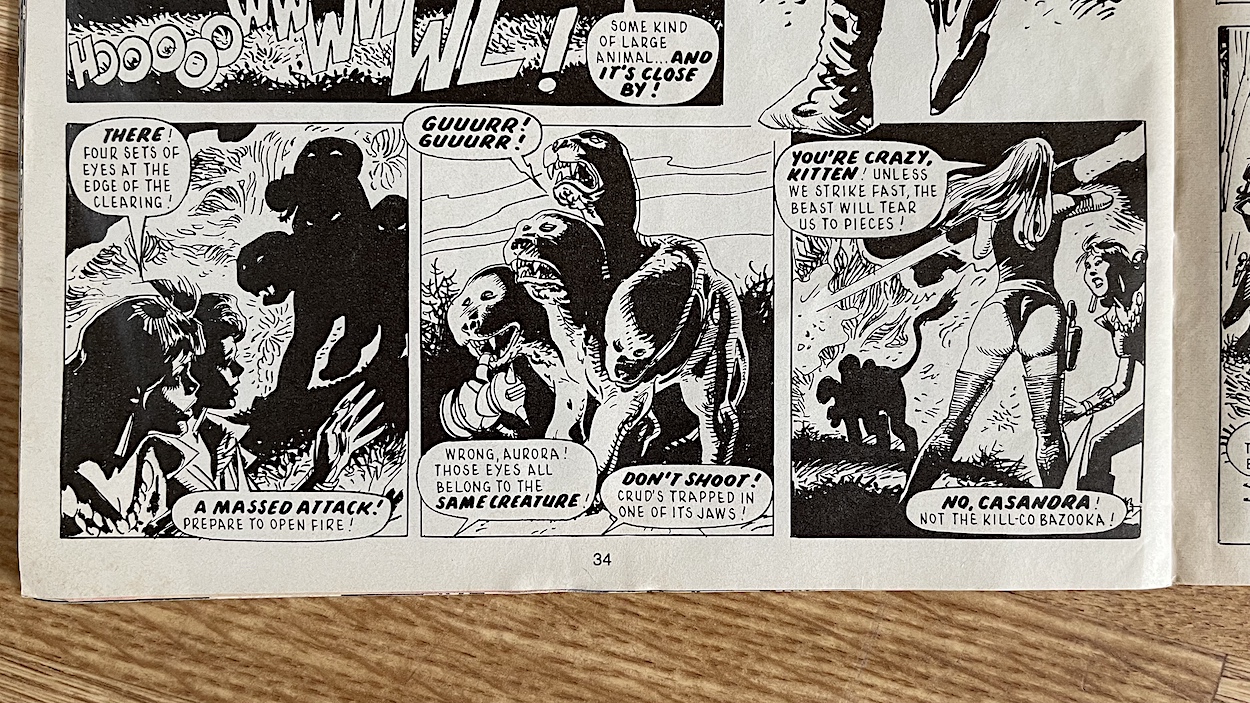
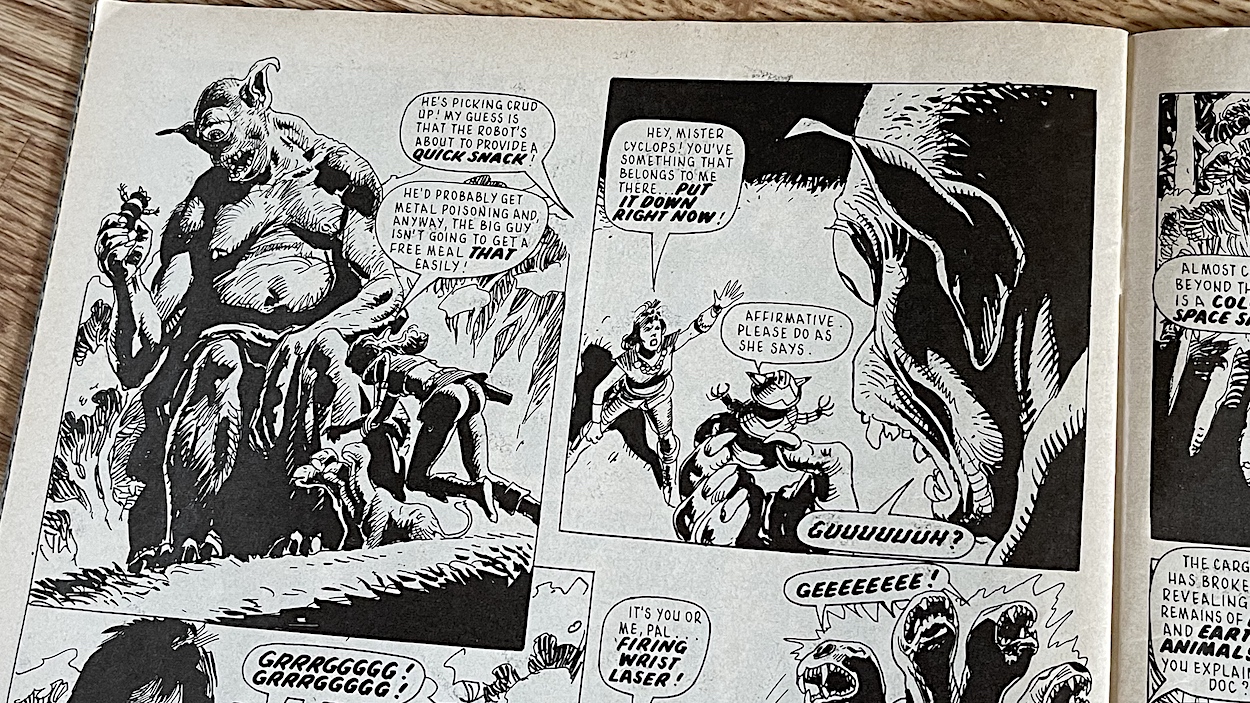
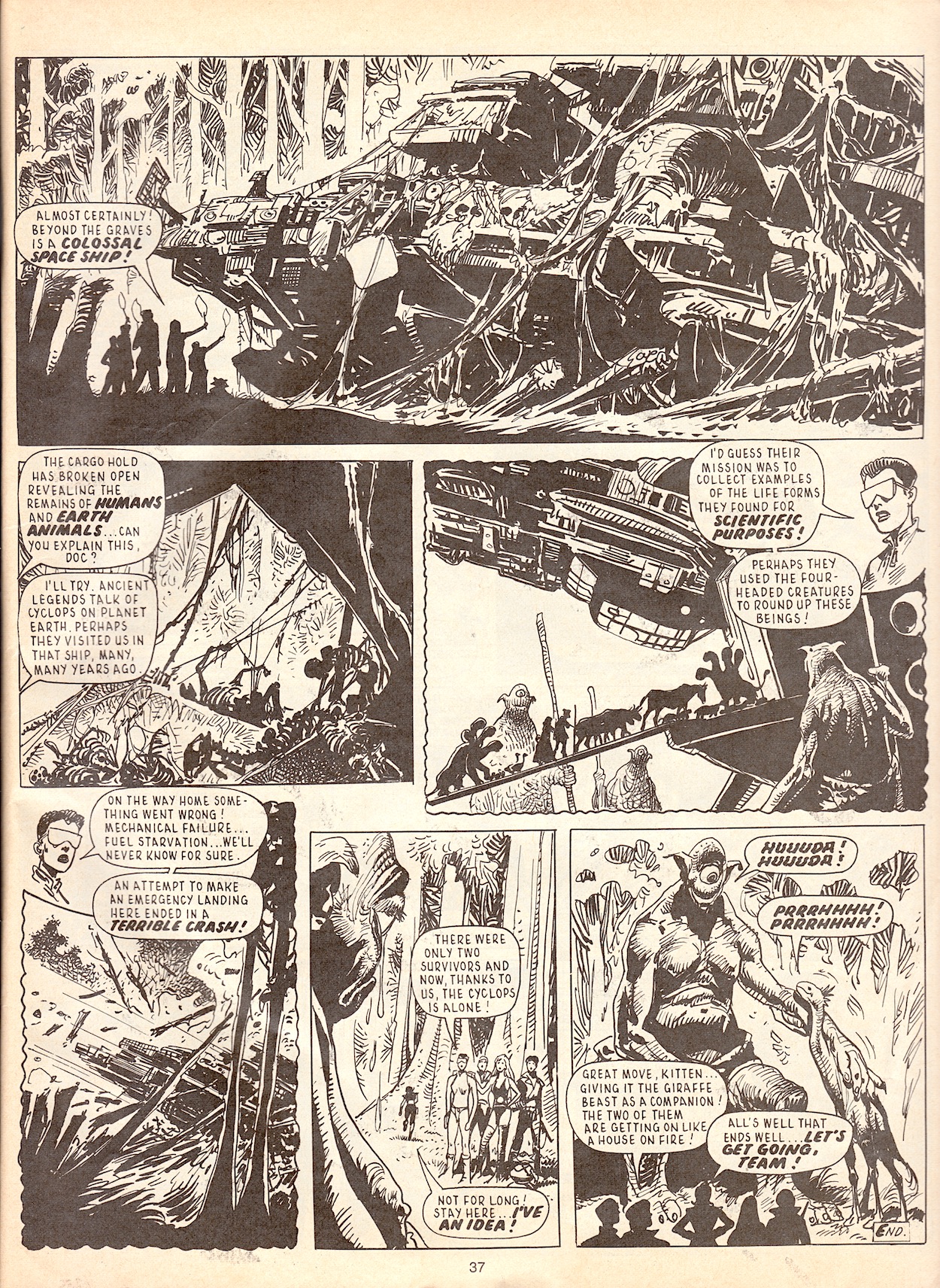
Their story is up next in fact, as always (and just like the pin ups) drawn by José Ortiz and written by James Tomlinson. Stalked by a three-headed giant cat-like predator it ends up capturing Kitten’s robotic pet, Crud. Tracking the beast down they find a ginormous cyclops, but as they try to save Crud the cat-like creature attacks and is shot and killed. The previously monstrous cyclops bursts into tears and the team realise they’ve made a horrible mistake, they’ve killed the giant’s pet. Not only that, but upon discovering a giant spacecraft overgrown with weeds they piece together a fascinating backstory.
It’s important for me to note here that at the beginning of the strip the team had captured a docile kind-of-giraffe animal for study by Doc. You’ll see below how that comes back right at the end. This story contains hints at the world building Wildcat could have achieved if it had carried on for years to come. We had some in the twelve regular issues but of course everything was still in its early stages of development. We can only imagine the epic, overarching stories editor Barrie Tomlinson and his team could’ve concocted over time.
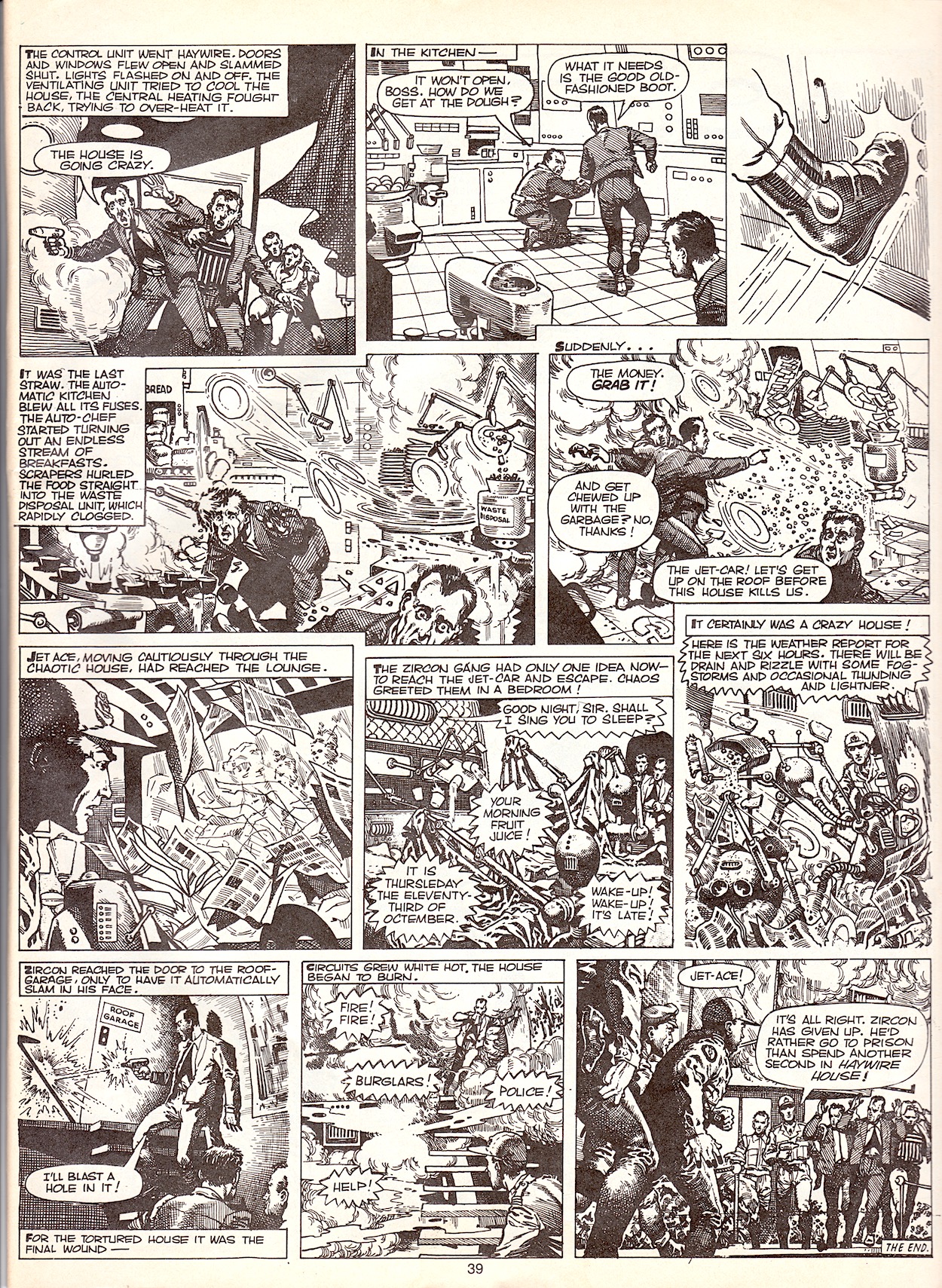
Four pages within this special are made up of a Tiger comic reprint called Jet-Ace Logan, a pilot who works for the futuristic interplanetary C.I.D. approximately 100 years in the future. Two stories are included here, two pages apiece and the one I wanted to show is called Haywire House. A modern home exhibition is about to be robbed and Logan stops the burglars in their tracks in a suitably ingenious way. I particularly like the art by Brian Lewis (Eagle, TV Action, Countdown), with so much of it crammed on to the page and jam-packed with details, all without losing any of its clarity.
In his book Comic Book Hero, Barrie explains how he was the editor of Tiger from 1969, after these strips appeared originally. He turned the comic into one with exclusively sports-related strips but he always had a fondness for Logan. Back to the special and perhaps the couple of reprinted pin ups and the Logan pages were marked for something else but after the cancellation of the comic plans changed. A very real possibility.
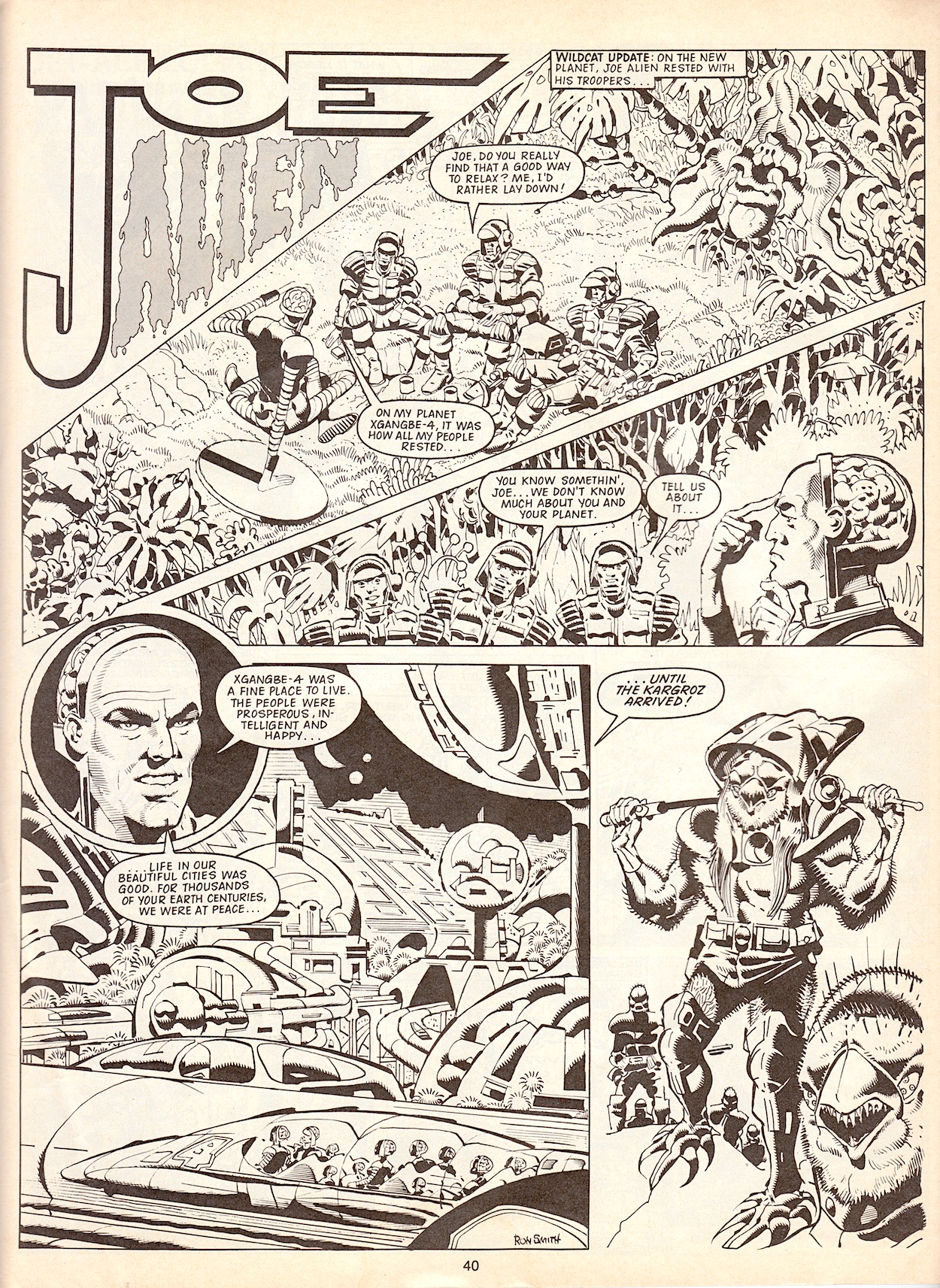
Before a very special ending to the issue there’s one more strip to read. Wildcat fans will know that must mean it’s time for David Robinson‘s Joe Alien, although not in his usual full-colour format which is a shame (in fact apart from the pin ups and a readers’ drawing spread the whole issue is black and white) but Ron Smith’s artwork still shines. The strip itself finally gives us some background information on the interesting character and how he ended up as the last of his race. In fact, for fans of his this was a hugely important strip!
Tracking a massive meteoroid heading towards their planet, his people soon discovered it was being pushed from the other side by a fleet of Kargroz ships. Joe’s race had long before abandoned space travel, keeping only one small shuttle and so he was sent up to negotiate, but the Kargroz kill for fun and for honour and couldn’t be bargained with. Almost blasting Joe out of existence they hurled the meteoroid into his planet, destroying it and all who lived there.
Fuelled by revenge Joe hijacked one of the enemy ships and crashed it into the side of one of the others, all of which were in a straight line formation, side-by-side with each other. Where Joe had crashed, his ship now faced down the long line of enemy ships. Firing one huge laser blast it tore through them all, killing everyone and leaving him the only survivor of the battle and of his race. This next page of Ron’s reminded me he drew for Marvel UK‘s Transformers. It has that feel about it. Looking into that however, I was surprised to see he only ever drew one strip (#82)! Such was the impact he must’ve made on me I thought he’d been a semi-regular artist on it.
Joe’s men console him and try to tell him they agree with his seeking revenge, but the strip ends with our hero rejecting this. “Revenge? How can any revenge balance the millions who were killed? I am only pleased that my external brain pack allows me to switch off such memories… forever!” That is about as heartbreaking an ending as you can get as he switches off all memories of his loved ones.
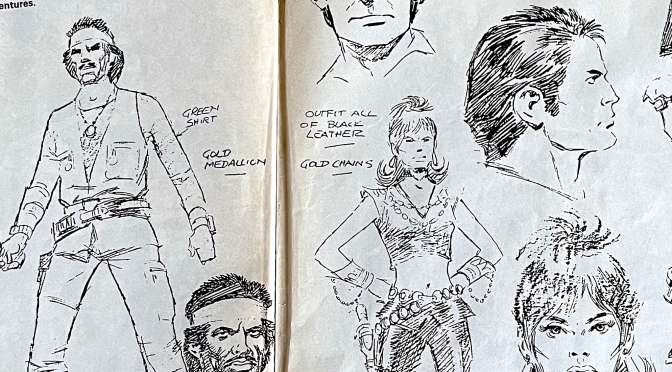
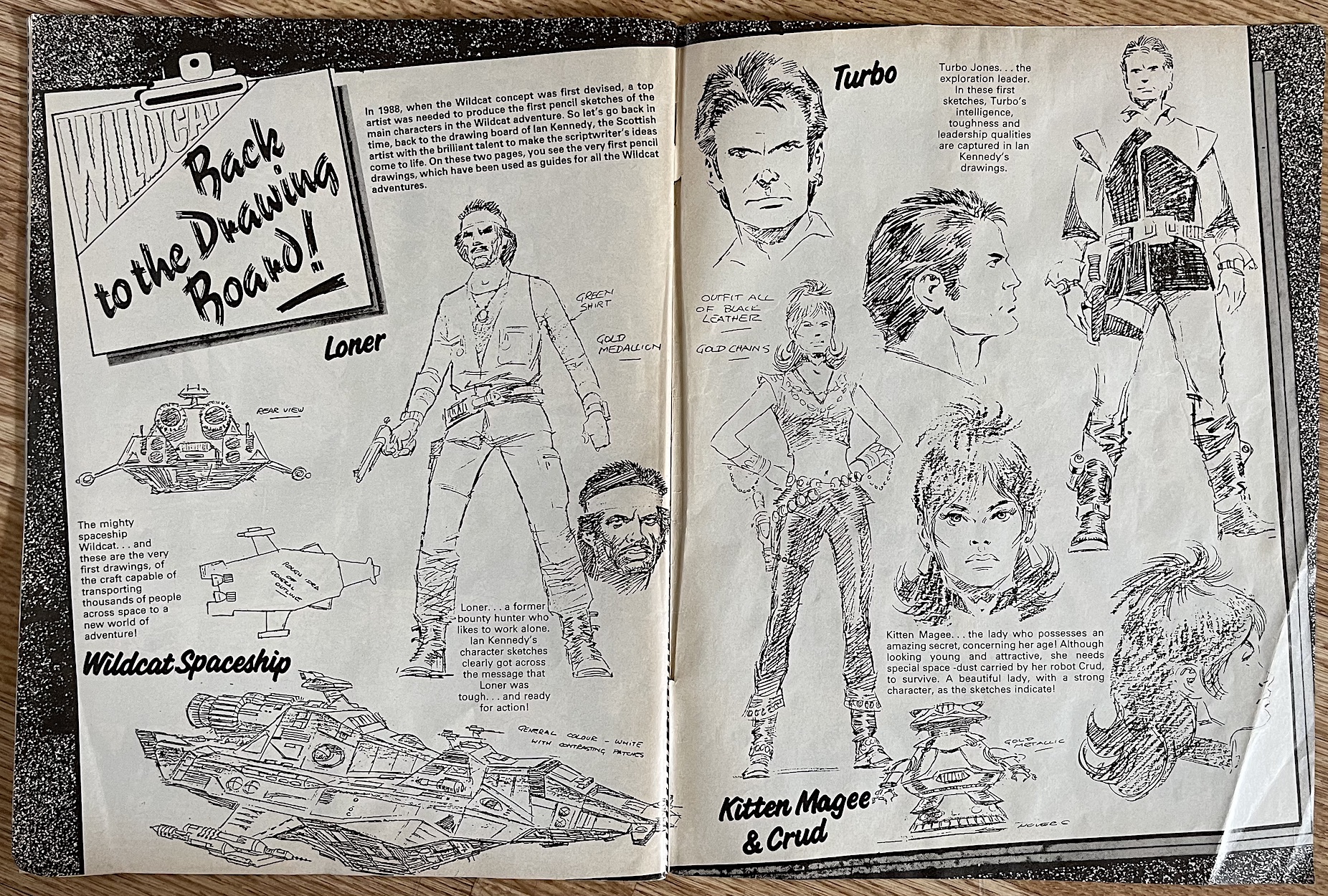
One final feature rounds off this edition and it’s a special Back to the Drawing Board spread of Ian Kennedy’s original design sketches for the Wildcat itself and some of its characters. At the time of writing this Ian has only recently passed, so seeing these drawings and his superb cover (which is on the back as well) is tinged with sadness. I’ve always loved his Wildcat design and his originality, not only with its shape but also its bright colours. I think we can all agree he also did a superb job of realising Barrie’s desire for a truly diverse cast of exciting heroes, which was rare.
Thus ends our look at the Wildcat Holiday Special from 1989. As I’ve said before I do own the graphic novel collections for two of the characters so I’ll be covering them at a future date, and I’m going to be tracking down the others through the individual issues of Eagle and Wildcat. But in the meantime we haven’t quite finished with Wildcat in its own form just yet.
There’s one more special to come and I’m very excited by it. Once again it’s an issue I’ve never read before. It’s even bigger than the Holiday Special and comes with a simply gorgeous high gloss, high quality cover. The Wildcat Winter Special was released several months later so look out for its review on Thursday 17th November 2022. Now that’s going to take some will power on my behalf, it’s sitting on that shelf right over there looking at me! I’m sure it’ll be worth the wait though.
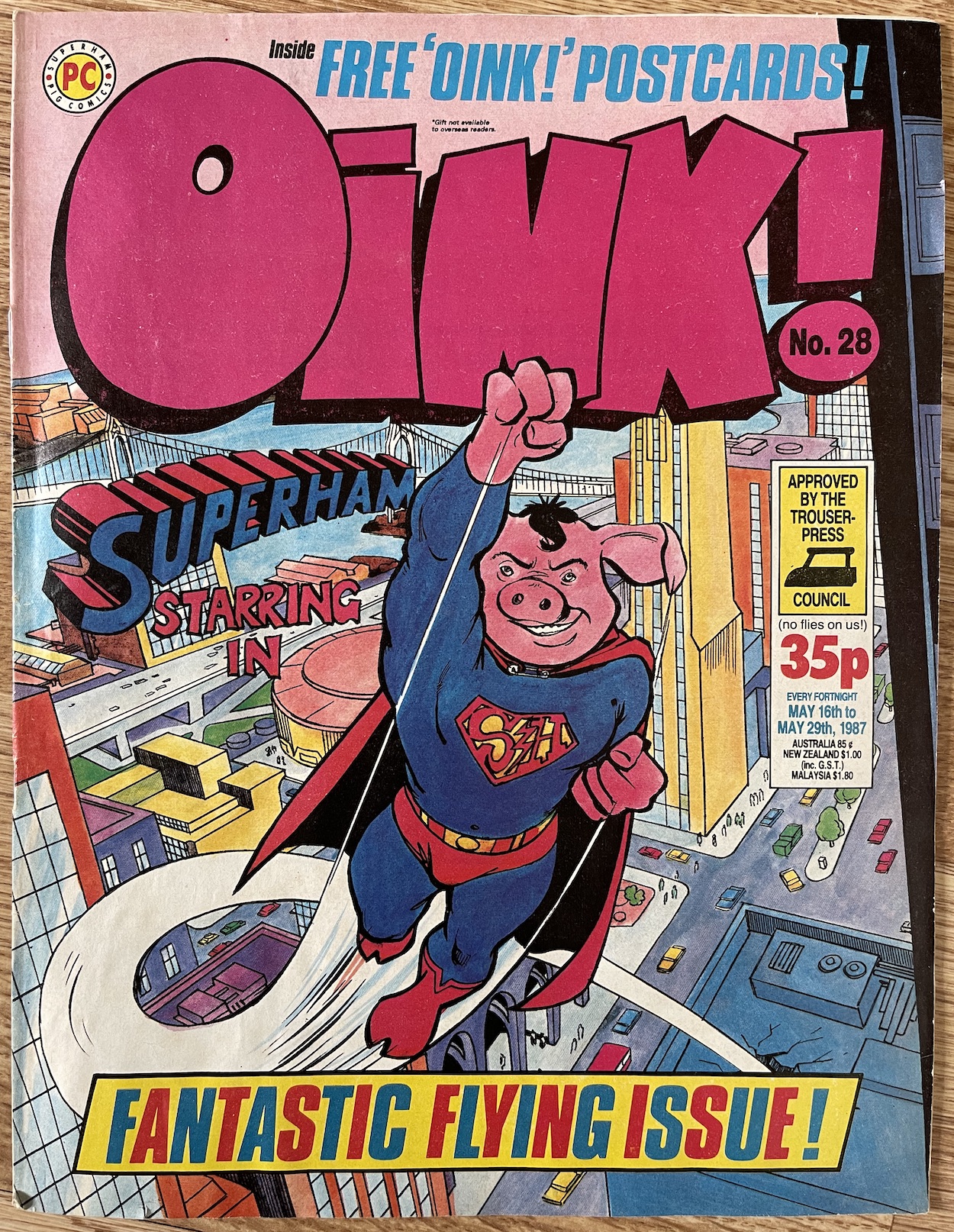
There are a lot of exciting and funny things on this cover, beginning with the main event of Superham as drawn by Ron Tiner. Look closer at the accompanying details for more laughs, such as the “Trouser Press” approval spoof of the Comics Code Authority, and OiNK‘s own version of DC Comics‘ logo from the time tucked away in the top corner. We’ll get to the Ham of Steel in a little bit, but there’s an announcement on the cover for the latest free gifts too.
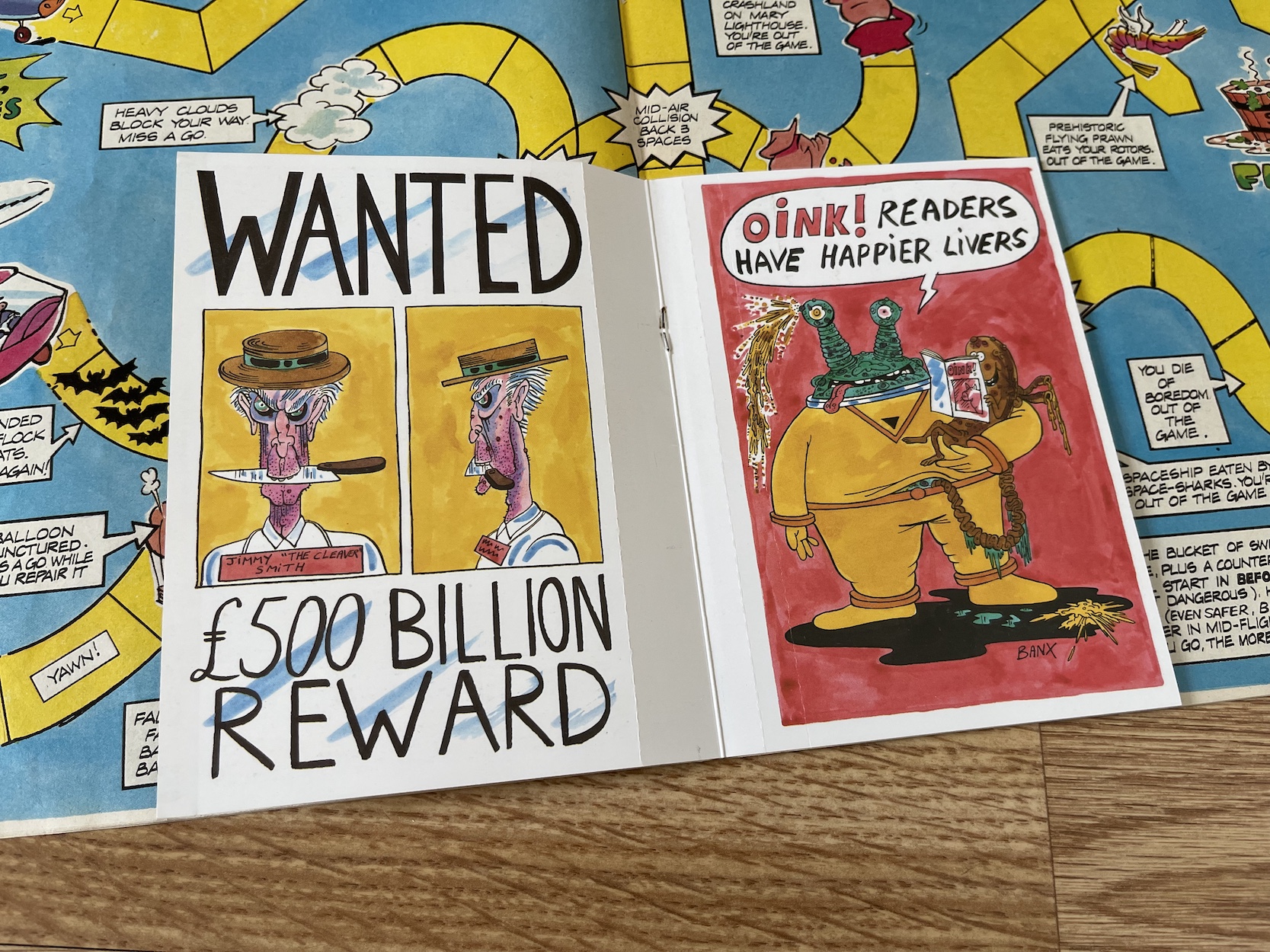
The last gift given away by OiNK was the gigantic three-part poster calendar at the end of the previous year (check out #17 for the full product) and again we have three issues in a row with something extra tucked away inside. Unlike the cut-out postcards in #7 these are actual cards which can be easily removed and sent by readers. Each pair would be drawn by a different artist, beginning with Jeremy Banx.
I can remember taking a couple of these on holiday with me back in 1987, definitely the Burp one. I can’t remember using them though, whether through forgetfulness or changing my mind and not wanting to send them away. Are postcards even a thing anymore when people can just check in on social media or send photos instantaneously back home? I’m not sure, but in the 80s these freebies were a great idea and each one is a brilliant little gift in its own right. The next two issues will contain postcards by Lew Stringer and Ian Jackson, so make sure you check them out.
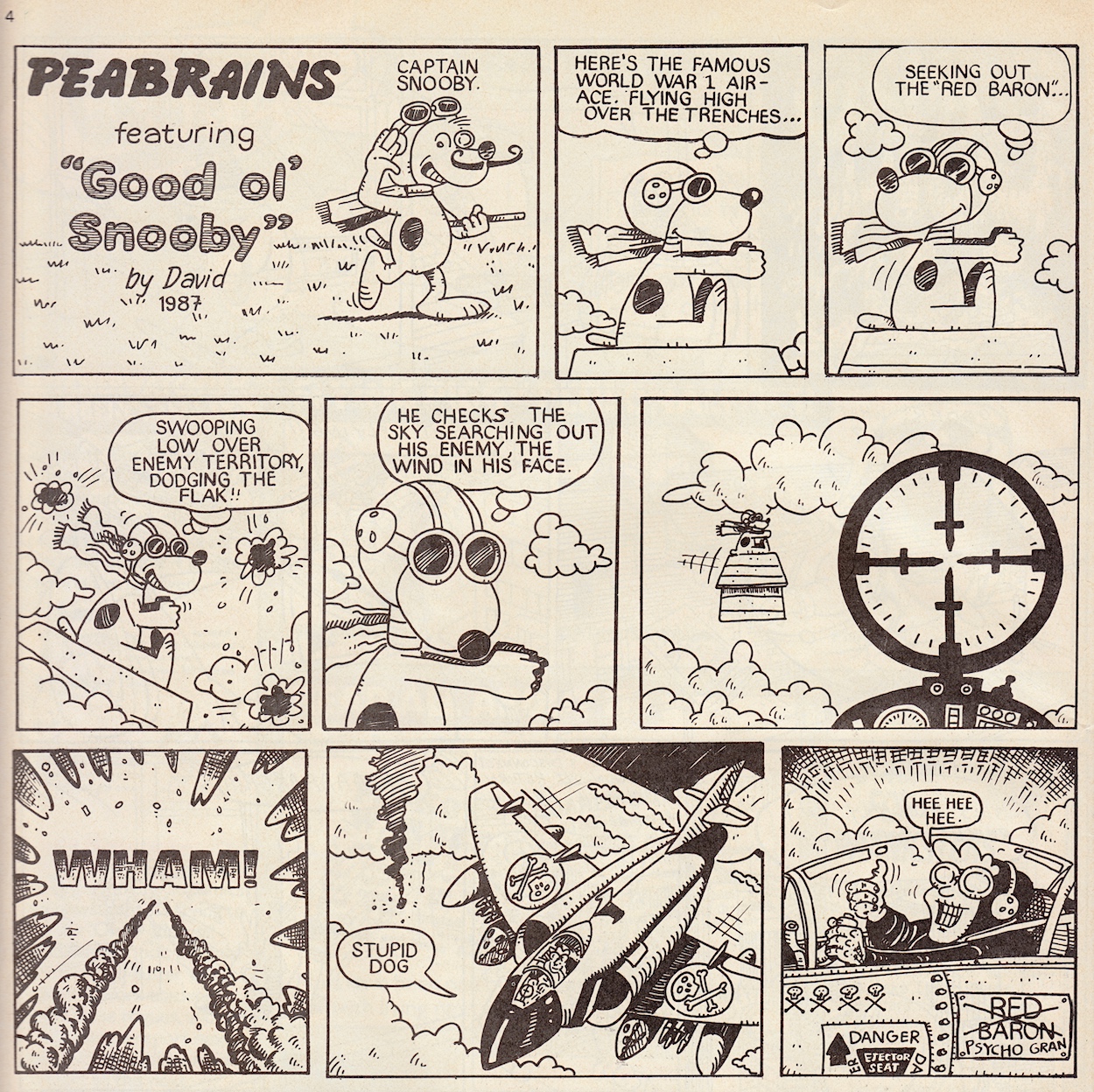
Back in the Valentine’s issue the Peanuts gang, namely Charlie Brown, Snoopy etc. got renamed the Peabrains in a one-off (I assumed) strip complete with some spoof merchandise advertising. As I said at the time I was never a fan of the cartoon or newspaper strips but I still enjoyed OiNK’s version which was created by Patrick Gallagher. Surprisingly, the strip returns but this time ‘Snooby‘ is drawn by David Leach, best known for Psycho Gran. Here, the little dog is daydreaming, something he was known for in the cartoon and which we’d see brought to life by his imagination. Sitting on top of his kennel he imagines being a heroic fighter pilot. But this is a strip by David so expect the unexpected.
Well I did say that’s who David was known for, didn’t I? I’d forgotten all about this ending, although as soon as Snooby metaphorically took to the air it all came back to me. I’d like to think as a child I didn’t spot Psycho in the final panel until I’d read the full strip because the reveal of the jet itself is so brilliantly drawn and her grin at the end just hilarious. As a side note, David was inspired by Roy Lichtenstein’s famous Whaam! art for this.
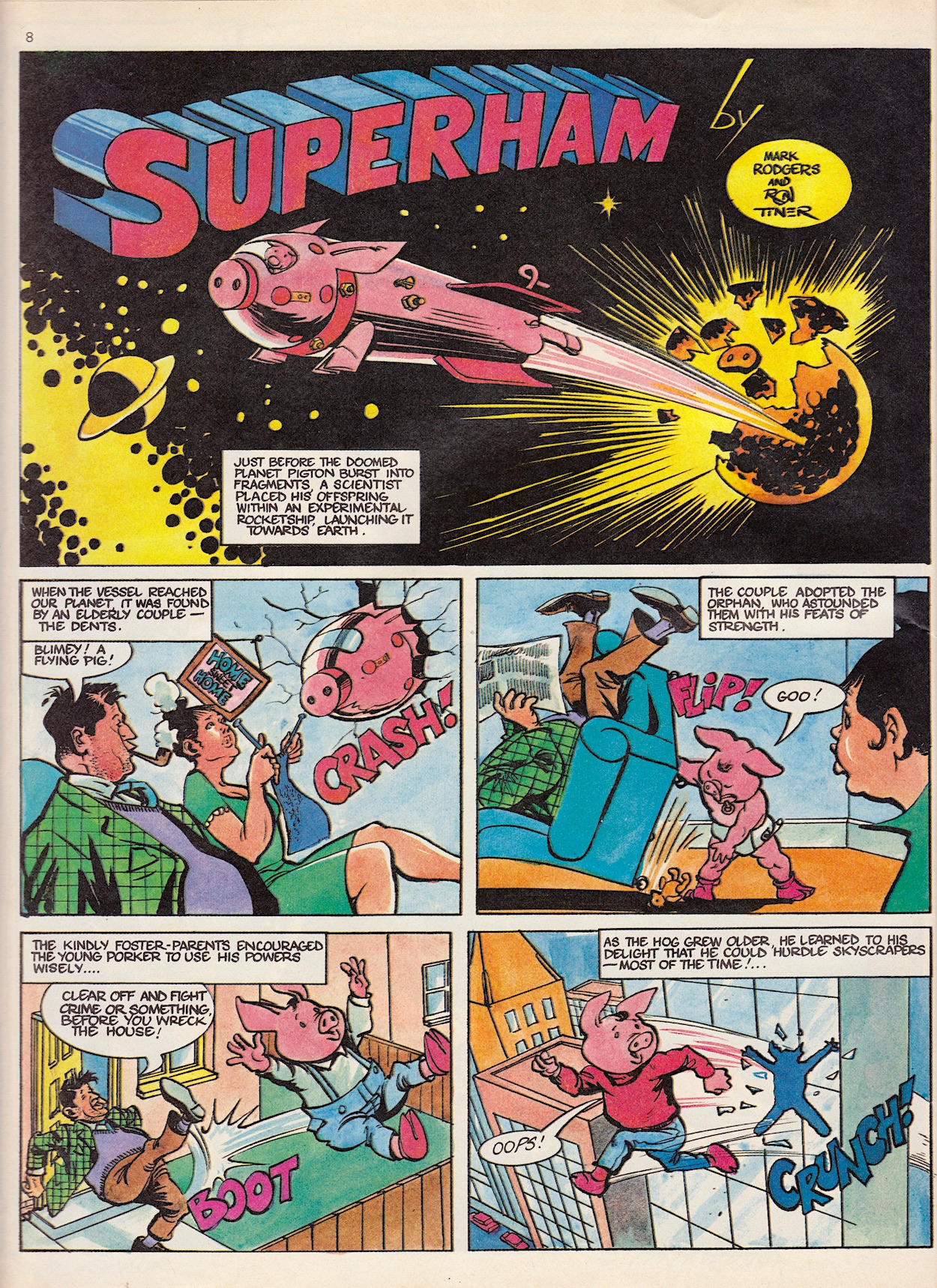
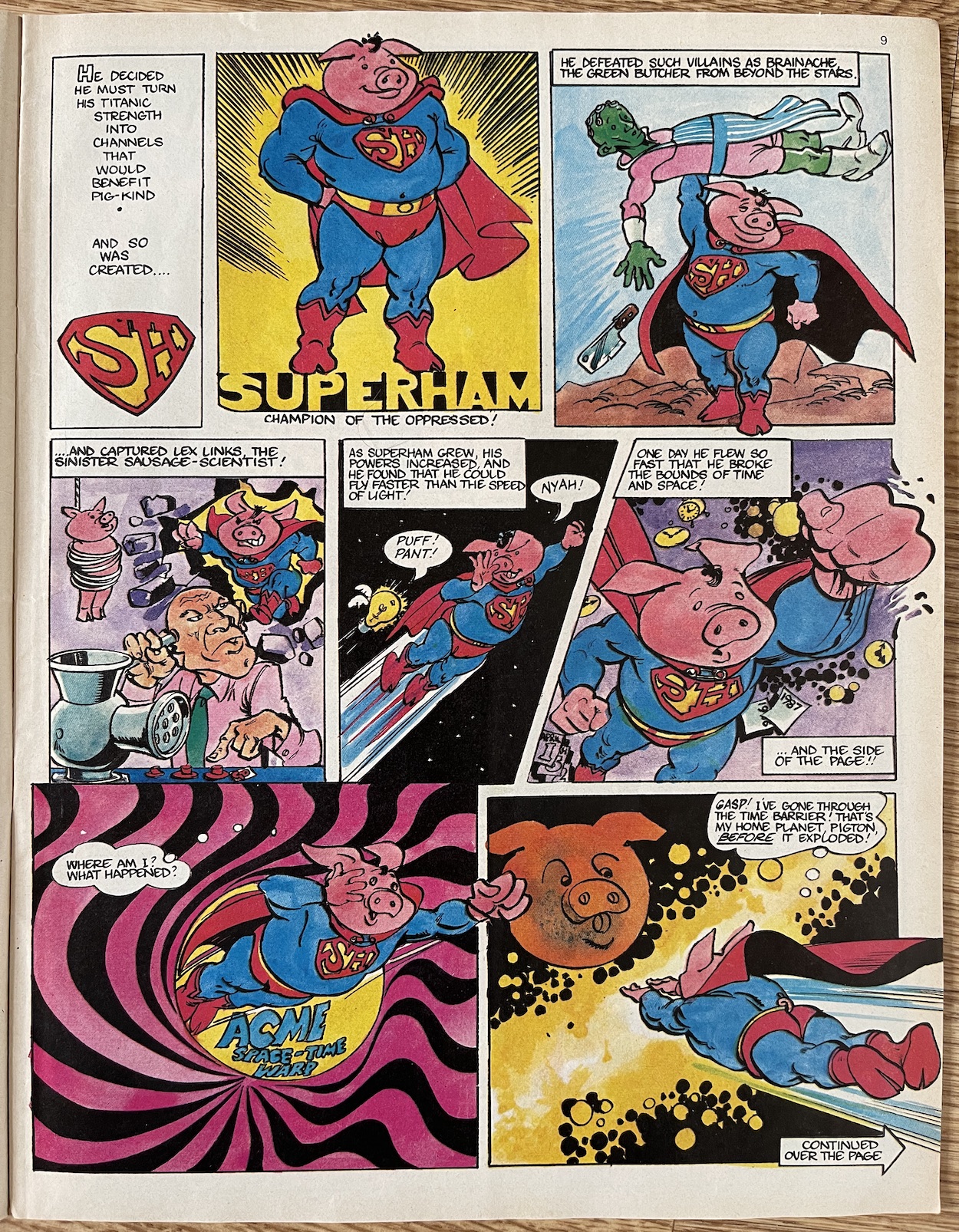
Alongside the captions the images tell a different, highly exaggerated version of the same events
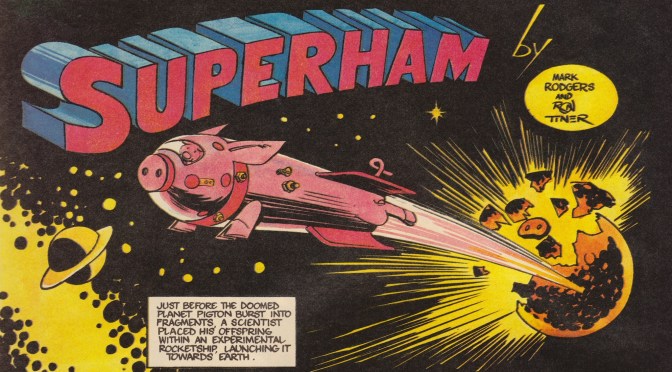
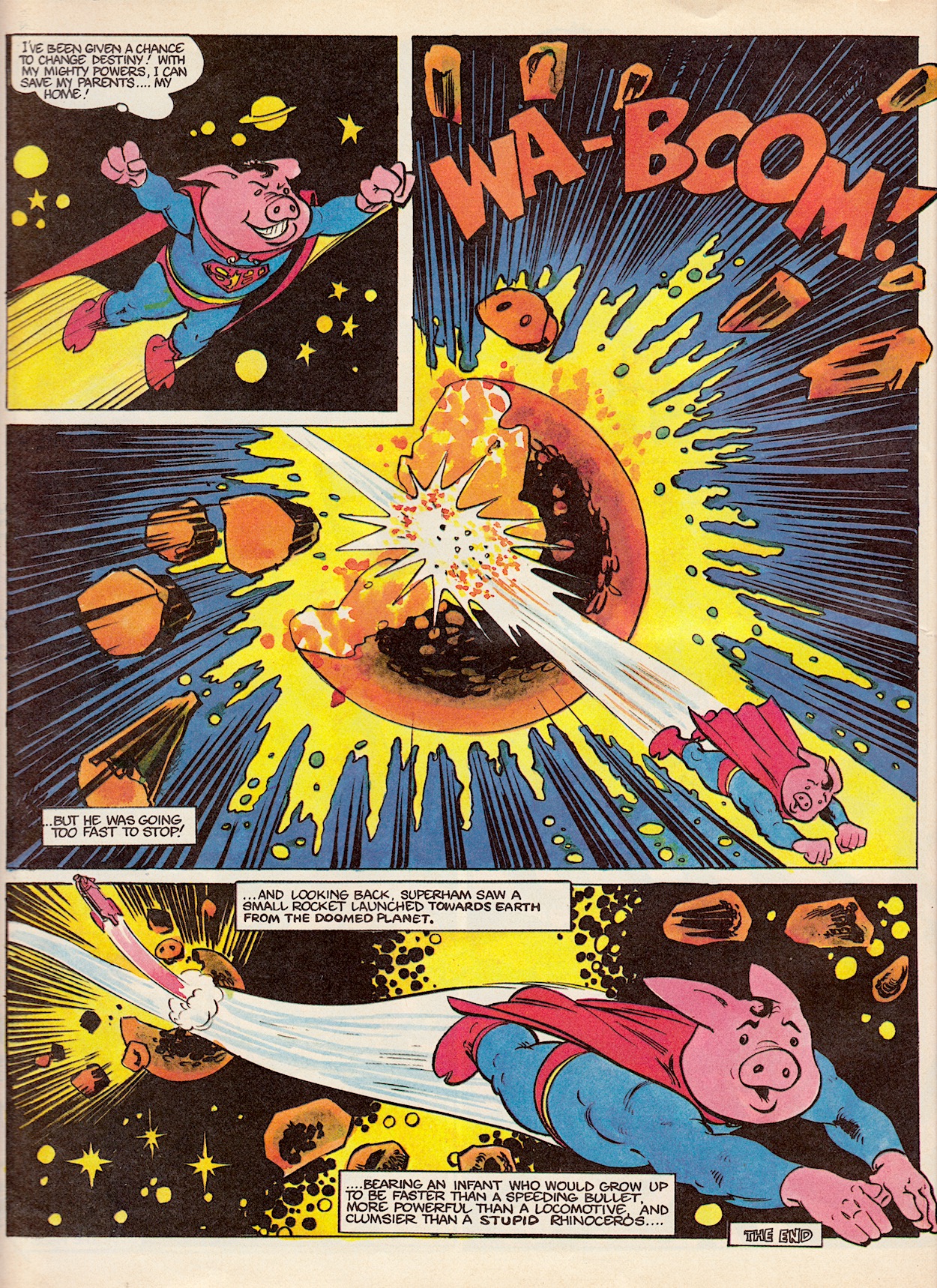
In 1987 Superman IV: The Quest For Peace had just been released in cinemas and, while not the most successful of the franchise, its marketing was surely everywhere, making him a big, timely target for OiNK. Mark Rodgers took on writing duties for Superham and cover artist Ron Tiner returns for the three-page strip. It all kicks off on familiar territory, the narrative captions keeping surprisingly true to the tale of the lone refugee from an alien world movie goers were all too familiar with.
However, alongside those captions the images tell a different, highly exaggerated version of the same events and this is where the laughs come from. The story continues with highlights of Superham’s fight against evil, including a brilliant panel depicting him flying faster than the speed of light. So fast in fact he breaks through time itself and comes upon a spectacular sight. I won’t ruin the surprise because it’s on that third page we get the big punchline.
This is classic Mark, with a very funny twist in the tale with the ever-perpetuating series of events brought on by the “stupid rhinoceros” of a superhero. I’ll admit the recent movies did little to endear me to the inspiration behind this spoof, but with a much more entertaining version of the character taking pride of place on BBC One’s Saturday teatime schedule this feels like another timely read for this funny take on the original superhero. Great stuff.
I say well done to the OiNK team for printing this page and standing up to the bullies
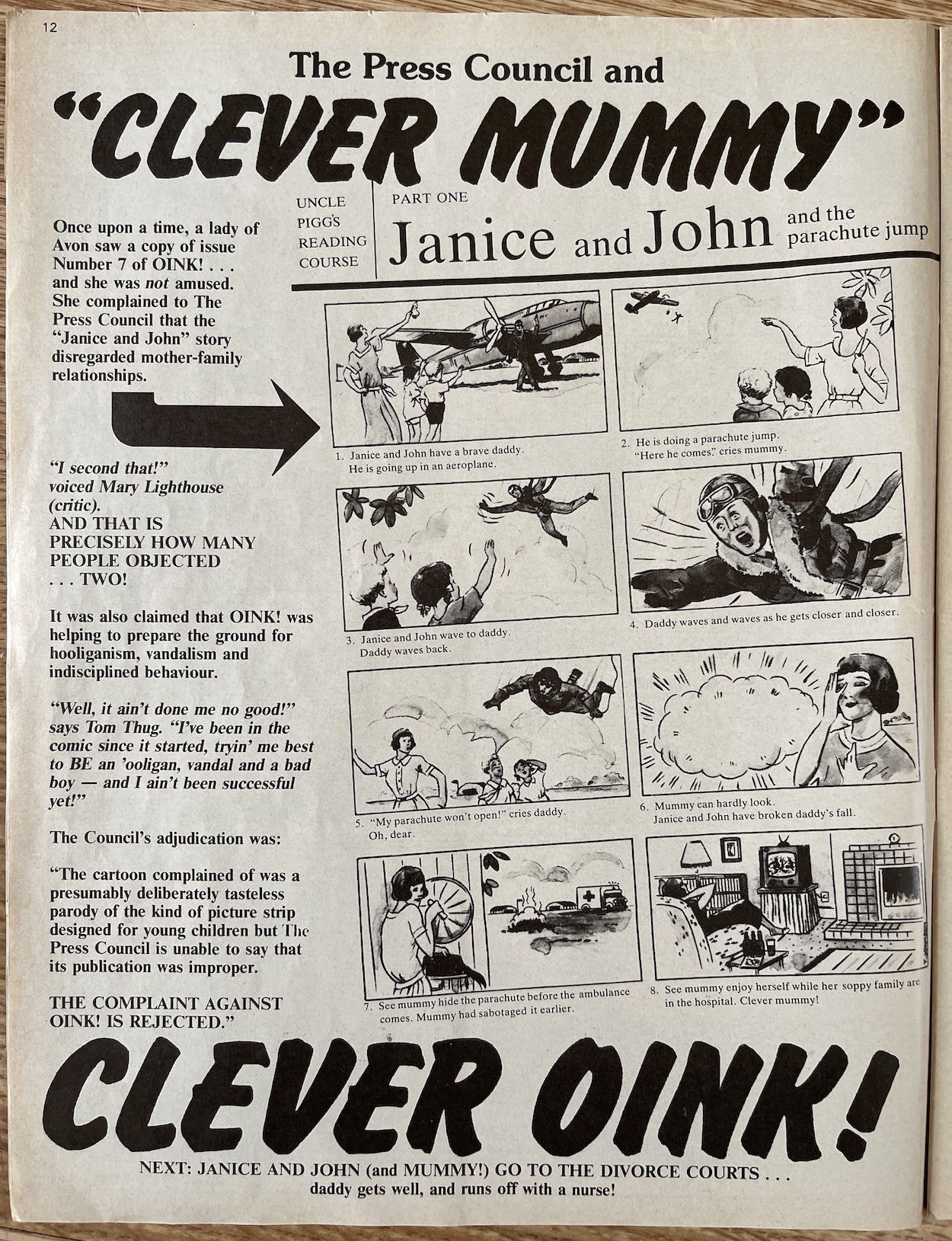
The next page is as unique as you’ll find in any of our childhood comics. Back in #7 a strip called Janice and John and the Parachute Jump appeared which has (incorrectly) gone down in history as making a bigger furore than it did; it’s even been written that it was the reason behind OiNK’s cancellation 61 issues later, which is just ridiculous. Yes, an official complaint was made with The Press Council who looked into the story in question, but the complaint was dismissed in the end. However, OiNK wasn’t about to just let this moment pass, as you can see with the following page.
I can’t remember reading this as a child so I haven’t a clue what I made of it, but nowadays it reminds me of working in BBC Complaints many years back and the amount of people who’d want an entire series cancelled because they personally didn’t want their licence fee paying for it (never mind the millions who watched it and were also paying their licence fee), or the myriad of Daily Mail comments Dave Gorman would use to great effect in his Modern Life is Goodish TV show. Even today in the UK and America we have books and comics being banned all in the name of “freedom” without a hint of irony.
So I say well done to the OiNK team for printing this page and standing up to the bullies! It’s refreshing and damned funny in its own right, especially how it can’t help but stir things up a little more with that final gag at the bottom referencing a non-existent next chapter. Janice and John would return in a story about a thermonuclear reactor though, as promised at the end of #7’s story. That wouldn’t be seen until #41, possibly held back until the outcome of the complaint was known and the whole thing was in the past.
I don’t think any other comic would’ve been this brave and I commend the editors for doing this. Recently, Mark Rodgers’ partner Helen Jones very kindly sent me a wonderful package containing the original complaints and responses including those from The Press Council and IPC’s John Sanders. They’re a fascinating read and will be on the blog at some point. A famous moment from OiNK’s history but one which very few seem to accurately write about. I hope I can help set the record straight.
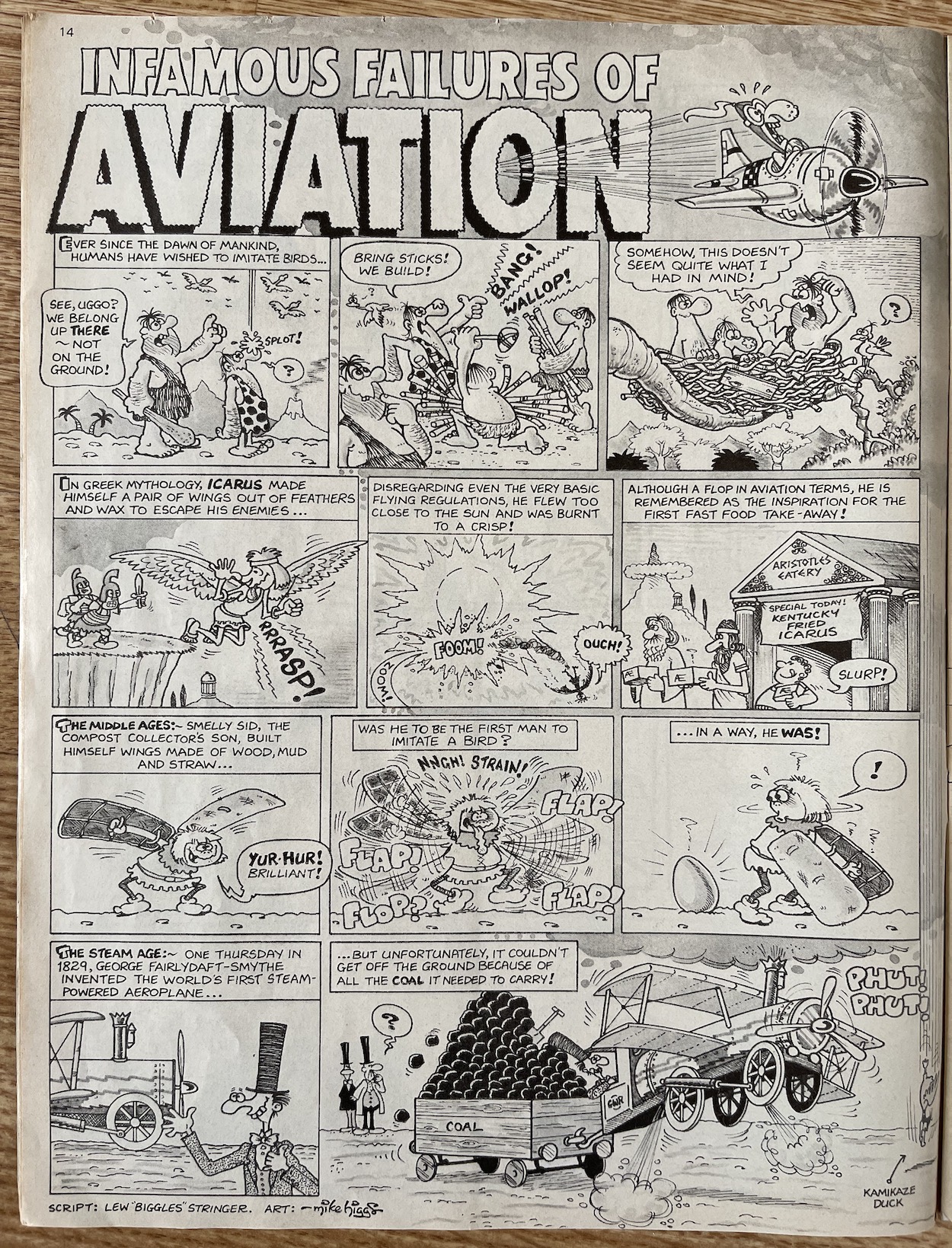
Moving on for now and another superstar of the comics world joins the sty as Mike Higgs draws Infamous Failures of Aviation, written by Lew Stringer.
It’s a cracker script by Lew (or ‘Biggles’) and Mike’s work really stands out, his style easily identifiable to anyone familiar with his strips elsewhere. Mike was best known for creating The Cloak in 1967 for Pow!, as well as bringing his unique artwork to Space School and Thundercap for Whizzer and Chips and Buster respectively. He (and The Cloak in particular) was a big influence on Lew when he was creating his Combat Colin character for Action Force comic.
Lew worked as Mike’s assistant in the early 80s for a range of children’s books and they became good friends. When OiNK came along Lew suggested bringing Mike back to comics for the first time in years to co-editor Mark Rodgers. This was his first appearance in the comic and he’d be back another eight times. Even though he’s better known for appearing in more traditional titles, there was never anything traditional about his work. As such, I think he’s a perfect addition to Uncle Pigg’s team and I look forward to seeing what else he brings to future issues.
Writer Graham Exton (whose name I haven’t seen mentioned in the fortnightly in several months) and artist Davey Jones produced another funny little OiNK mini-strip but this one is a little special because Davey has previously shared an original rough sketch by Mark Rodgers as well as his own thoughts on his finished product. I’ve saved this away for future reference and I will share this little insight into its creation, so watch out for it in the Creating OiNK section of the blog.
Mike Higgs’ son also makes an appearance this issue, sort of, in a scrawled shout out on an office desk in Lew’s Pete and his Pimple as the young Mr Throb dreams of being the high-flying Captain Pimply superhero. Smelly alien Burp isn’t being anywhere near as daring at the beginning of his strip though. More classic highlights of long-running OiNK favourites.
Pete and his Pimple by Lew Stringer Burp by Jeremy Banx
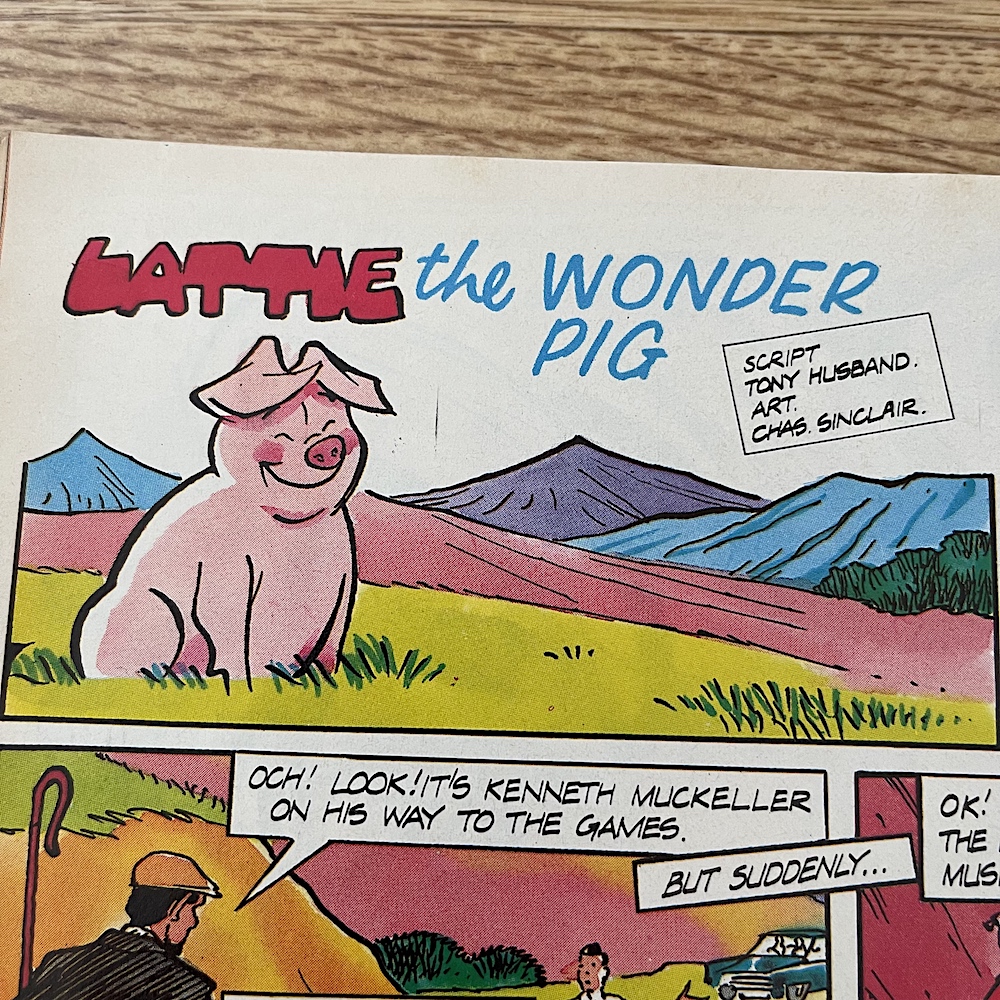
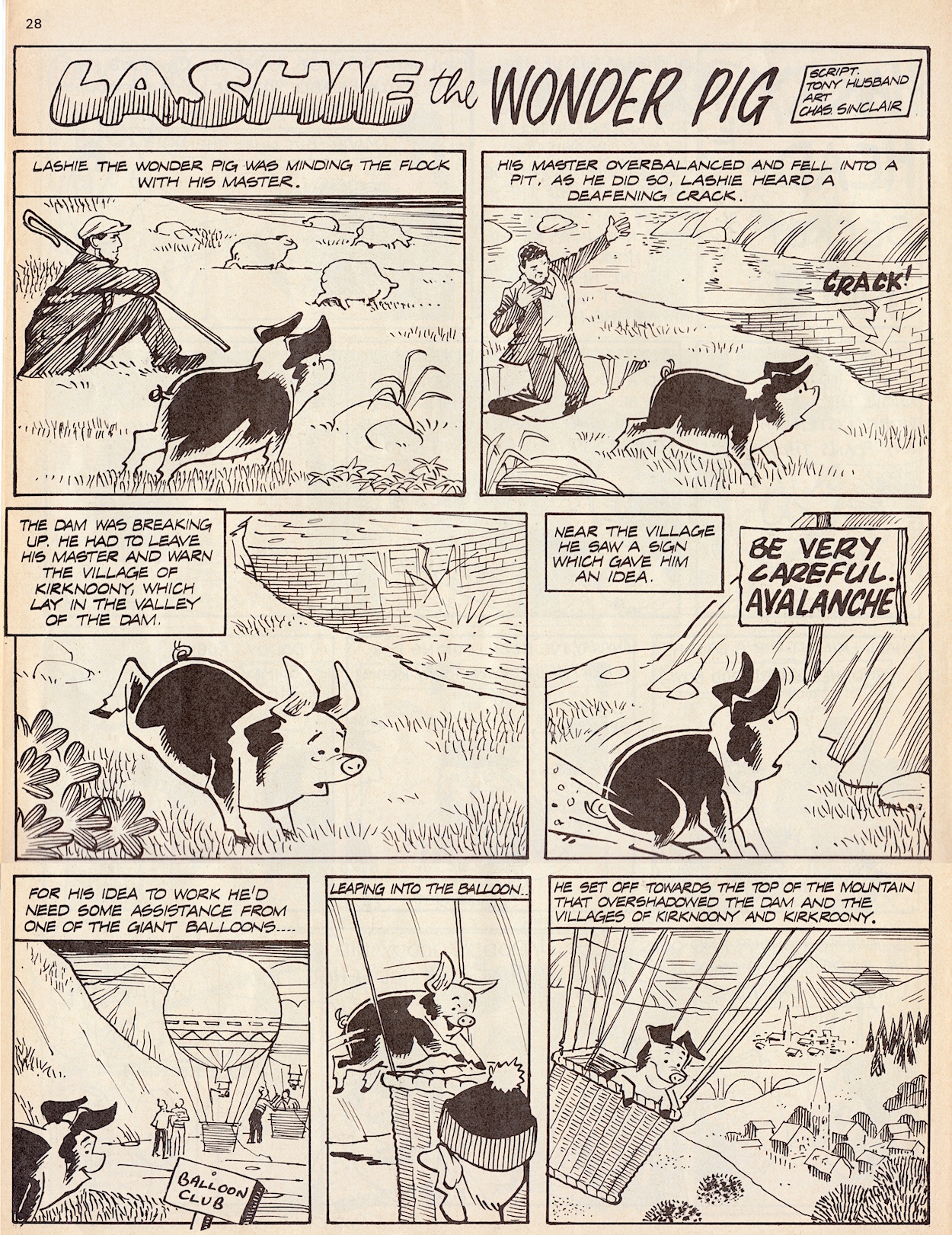
Our heroic Wonder Pig is back again with another name change, another ill-fated attempt at heroism and it all kicks off when his owner falls down another pit. Lashie the Wonder Pig is written by Tony Husband and drawn by Chas Sinclair and it’s this repetition of events which makes it so very funny indeed. In fact, this issue’s strip will be all the funnier if you’ve read the one I included in the highlights to #18. So go read that first and then come back here to read this next strip. Go on then!
This is a great way of parodying the TV series and movies of a certain Border Collie and their own repetitive nature. Lassie‘s fans didn’t mind and our own Lashie’s fans craved the same things happening again and again. The more strips that appeared the funnier these got. They wouldn’t appear too regularly, if they had maybe we would’ve grown tired of the formula but as such their semi-regular surprise appearances were always a hit.
Our flying special comes to an end with news the next issue is a ‘Mirthful Musical Issue’. Regular readers may be thinking this is a repeat of the subject from #16 but that one was all about the world of pop music, our next one takes in the whole of the musical world and nothing is off limits. Think of the difference between #6‘s ‘Animal Crackers Issue’ and #27‘s ‘Big, Soft Pets Issue’. There’s even going to be a very special appearance from a famous post-punk band in a photo story, so it’s definitely not to be missed.
So save your bookmarks, follow on socials or sub to the blog so you’ll get notified on Monday 30th May 2022 of the latest OiNK review!
Back in 1991 I received one of the greatest Christmas gifts of all, a Commodore 64 home computer. I adored that machine and I adored the magazine I collected alongside it, namely Commodore Format. Through that computer I met a chap named Colin who would go on to be one of my closest friends. He was a long-time reader of Format’s rival, Zzap! 64 and we’d take plenty of well-meaning jabs at each other’s favourite magazine over the next few years. (Actually, this continues to this day.) For the blog I now find myself buying my first copy of Zzap.
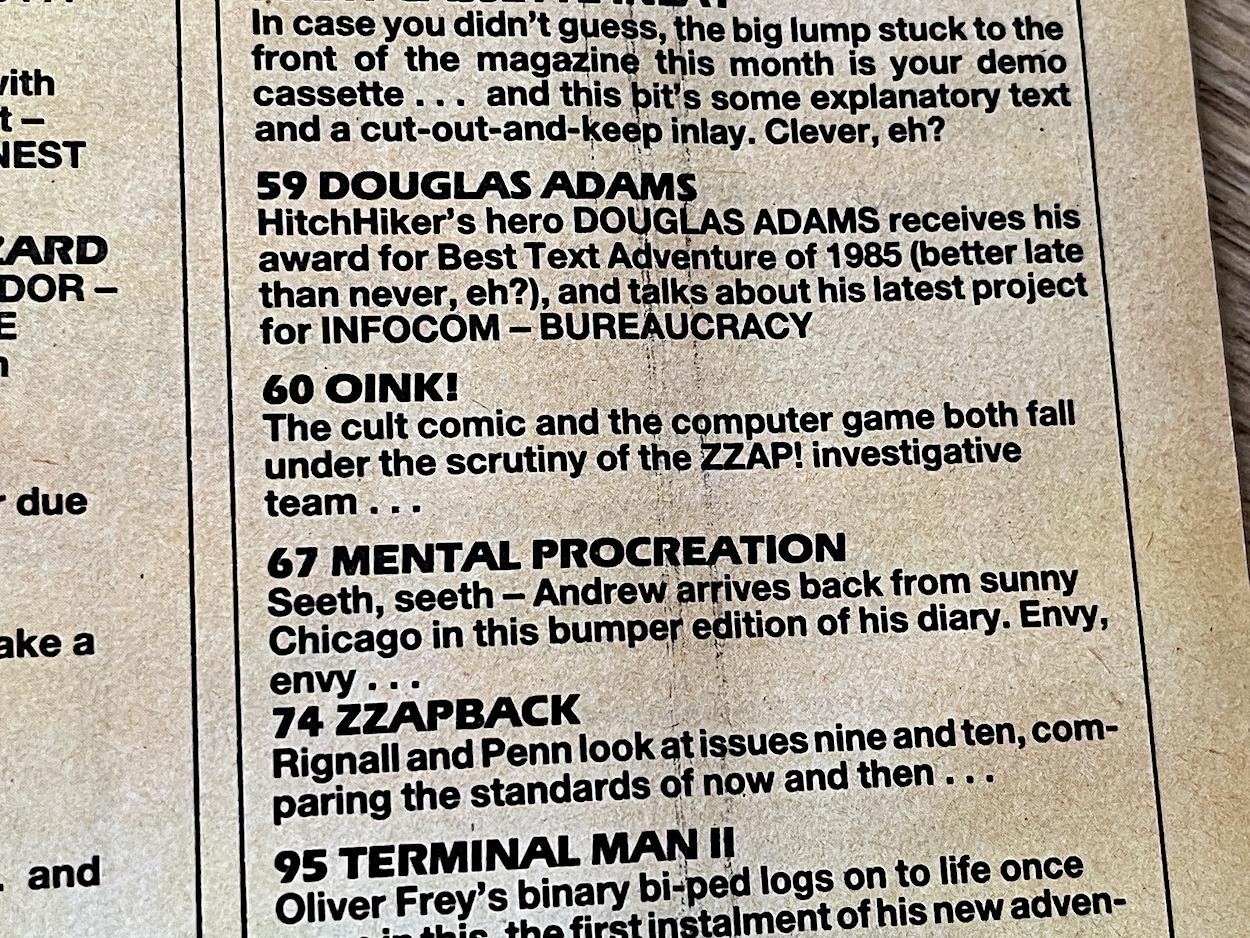
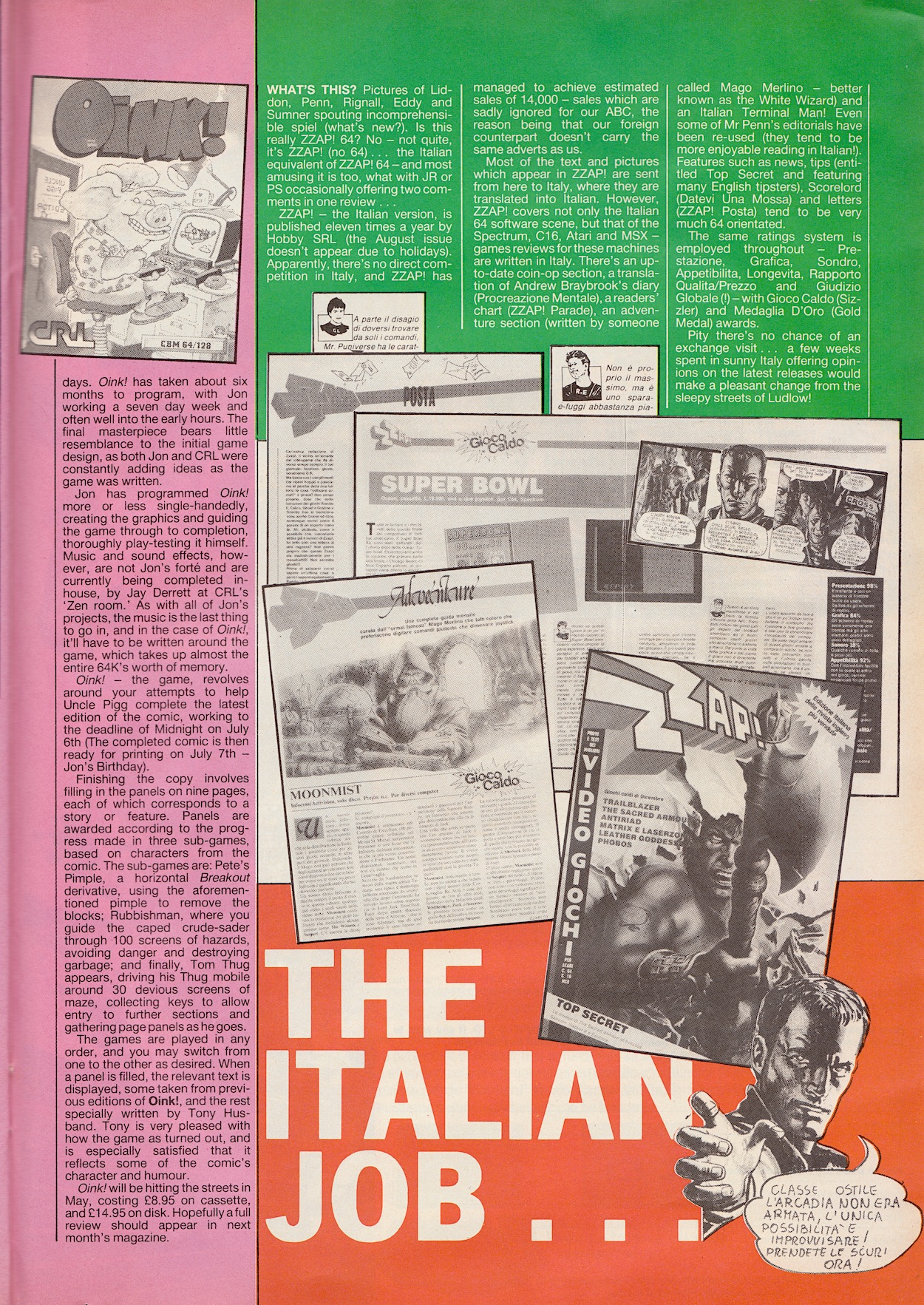
In the summer of 1987 the OiNK computer game would be released on the three main 8-bit computer systems of the day, the Commodore 64, the Spectrum range and Amstrad CPCs. I must’ve seen the adverts for it in the comic but having no interest in computer games at that stage it slipped my mind by the time I was loading up cassettes and disks at the beginning of the next decade. Over these next few months on the blog I’ll be covering this unique piece of piggy merchandise, showing you previews, interviews, a review and more. It’ll even include a special issue of OiNK!
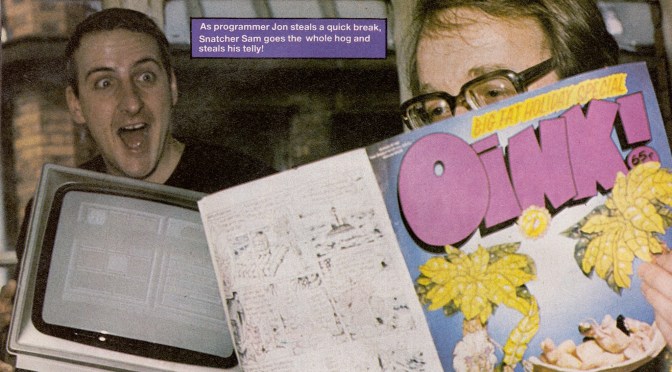
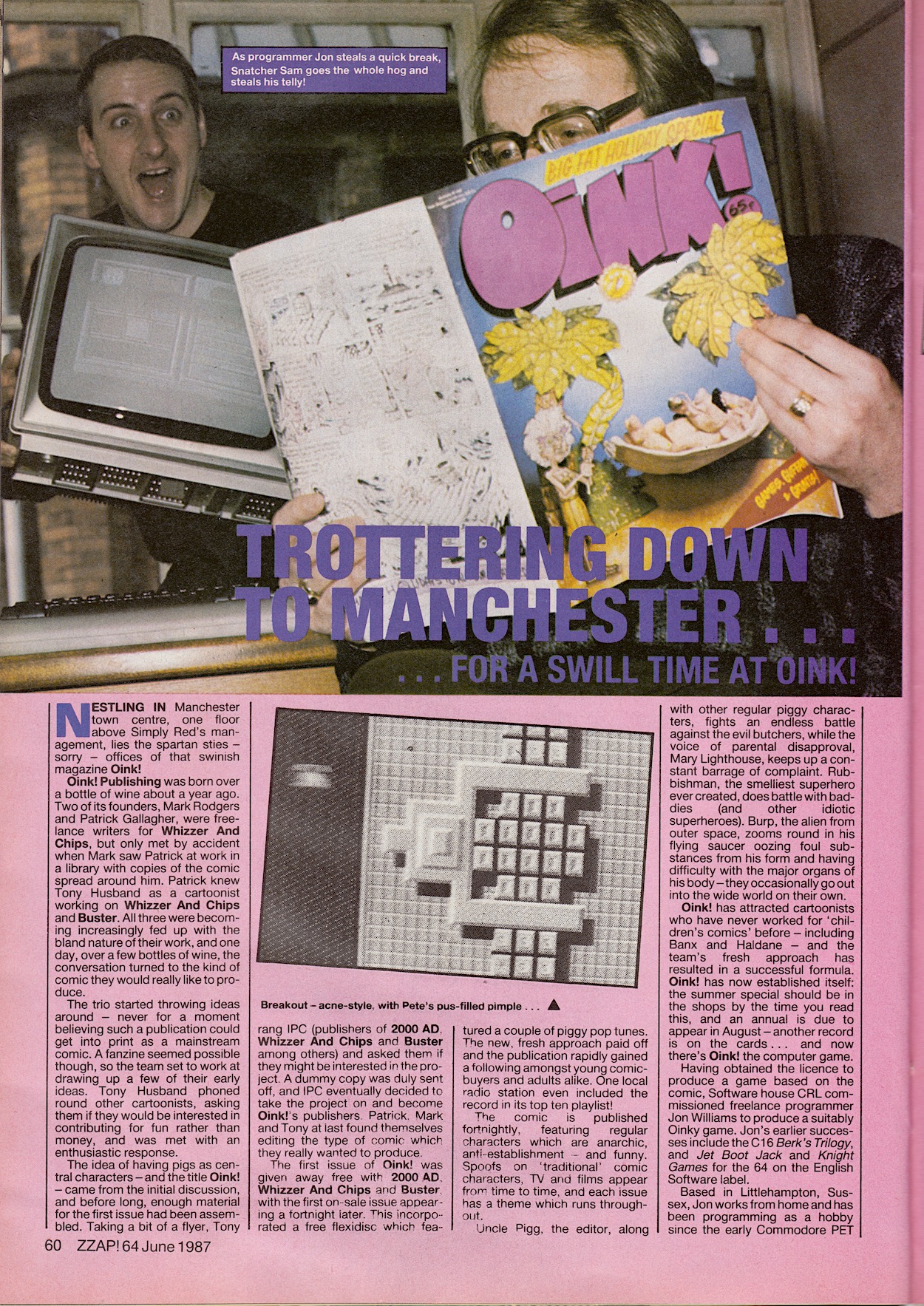
The first mention of the game came in issue 26 of Zzap! 64, released on this day 35 years ago. Inside the June 1987 issue the preview followed an interview with none other than Douglas Adams, which was a bit of a scoop! But I digress. The article contained a look at the origins of the comic itself and, unlike modern day press reference to OiNK, it’s an accurate depiction of those events (in other words there’s no mention of Viz). There are also some interesting nuggets of information for seasoned pig pals and a cameo by Marc Riley in his Snatcher Sam guise.
There’s a mention of the original idea for the comic being that of a fanzine, so unsure were Patrick Gallagher, Tony Husband and Mark Rodgers of whether a publisher would pick it up, which is new information to me. However, when the dummy issue was produced (a lot of which made its way into the preview issue) it went down a storm with IPC Magazines and our favourite publication was born. Also here is the first mention of the forthcoming OiNK record and a quick mention of the original flexidisc being played on a local radio station (we already knew John Peel played it on his BBC show).
Here’s the article in full, the opening paragraphs of which do beg the question of how many times can you mention Whizzer and Chips?
As OiNK fans who played the game will attest, the finished product had little-to-nothing to do with the individual characters it was meant to represent. There were some comic panels in it written by Tony Husband to try to bring a bit of the comic’s humour to the game, but that was really about it. As such, the general consensus seems to be that the game sucked because of its lack of OiNK content, but is this actually an unfair conclusion? You’ll find out in a couple of months when Zzap! 64 reviews it.
Already on the blog you can check out a Retro Gamer article featuring an interview with the game’s coder Jon Williams. There’s more to come, including a special issue of OiNK inside Crash magazine, which also had a special article and an extra page from none other than Frank Sidebottom, so look out for that on Saturday 25th June 2022. Then just a few weeks later I’ll show you the Zzap! 64 review of the game to see how it was received at the time, on Saturday 9th July. Later in the year I’ll tell you how I was finally able to play the game decades later when it was released under a completely different name, plus there’ll be a full guide to beating the game. These both relate to Commodore Format and in keeping with the real time nature of the blog I’ll be covering those issues on Thursday 13th October and Thursday 10th November.
It’s free gift time again! Well, for me anyway as I’m the one getting my trotters on it. The Next Issue promo in #27 may not have given us any clues as to what that gift was but I can tell you it was the first of three sets of OiNK postcards. Not the cut-out kind we’ve seen before, these would be proper individual cardboard postcards ready to be written on and sent in the post. All three sets are brilliant and you’ll see the first, drawn by Jeremy Banx in the next review.
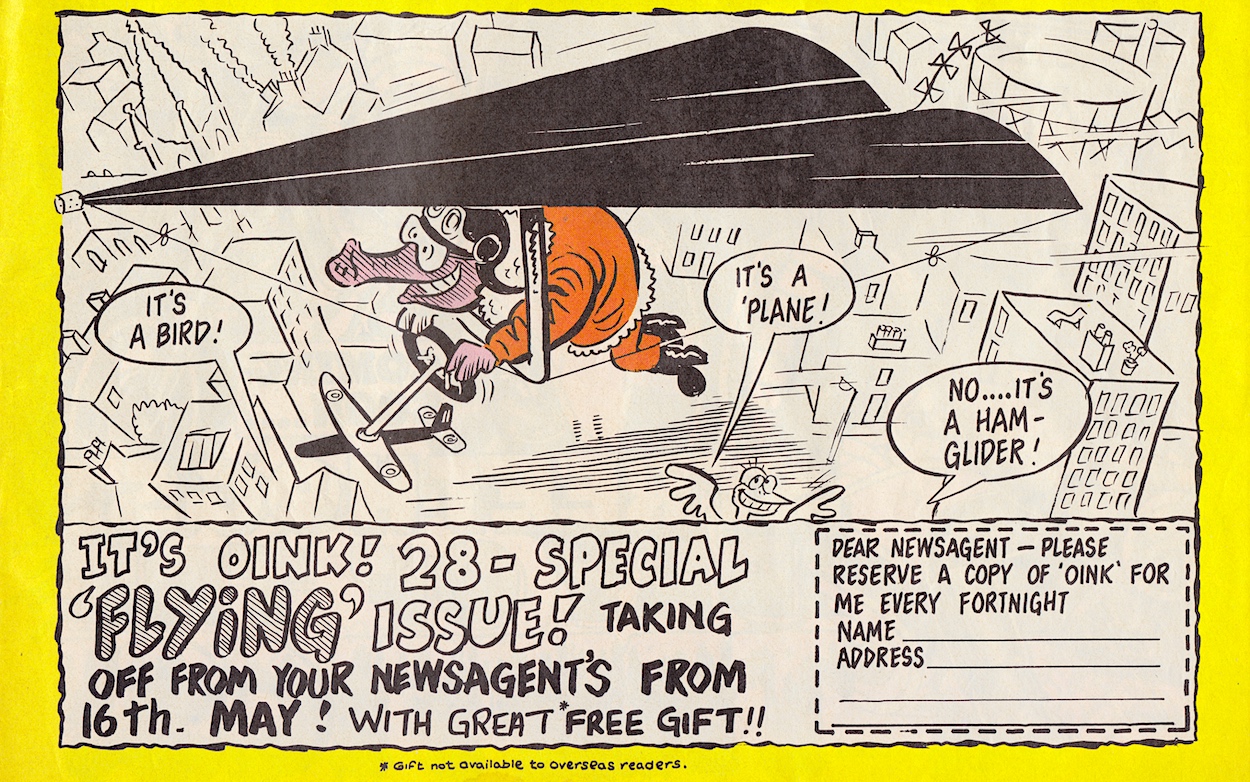
Promo drawn by Ian Knox
The theme for the issue is flying and the cover is a great spoof of Superman with a strip inside to match, both of which are very fondly remembered by this pig pal, so I’m looking forward to getting reacquainted with him. As well as high-flying humour, soaring sows and piggy pilots there’s a very unique page in the next issue. Remember Janice and John and the Parachute Jump from #7 and how it resulted in a couple of complaints to The Press Council? Well, after the council responded to say it wouldn’t be upholding the complaint the OiNK editors decided to respond in the pages of the comic itself!
So come back for the full review to find out all about that and more. It’ll be here from Monday 16th May 2022.