I began this series two years ago, believe it or not. It doesn’t feel like it, yet it’s almost to the day, on 23rd February 2024 I posted the movie advertisements from throughout OiNK’s run and I’ve really enjoyed writing each entry since (for food and drink, toys and games, comics and books, and 80s electronics). I’m always surprised how much the adverts in all the comics covered on this blog take me right back, sometimes more so than the comics themselves.
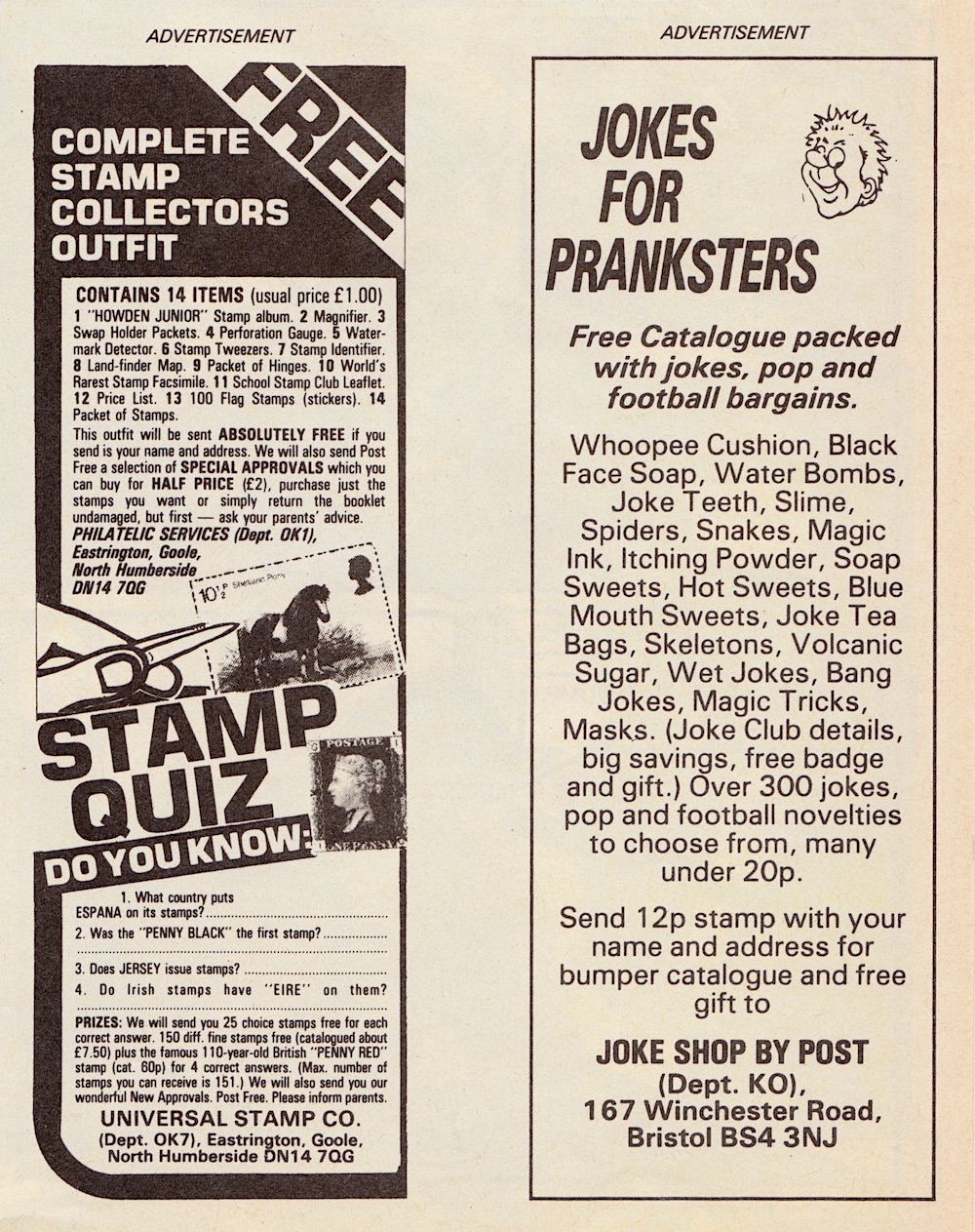
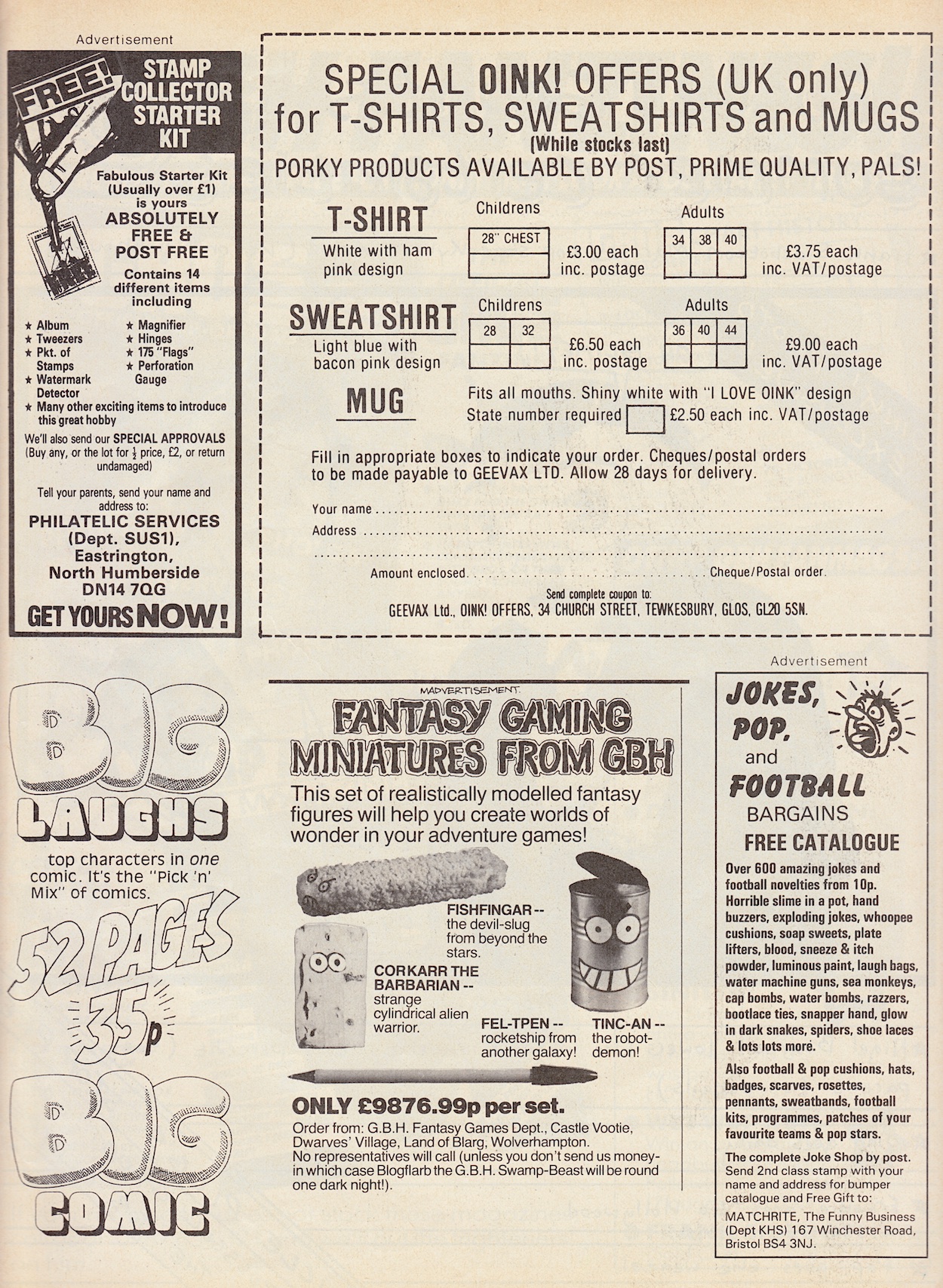
But now it’s time to wrap it all up and we’ll do so with a little random selection of the miscellaneous adverts that didn’t fit into the previous five categories. There are some here everyone who ever picked up any IPC or Fleetway comic in the 80s will instantly recognise, especially these first two mini adverts. These seemed to be squeezed into every letters pages or any tight space that needed filled up.
The practical jokes one even popped up in the Classifieds ads that Marvel UK ran for a while. They were so ubiquitous in the pages of our comics that I quickly began to ignore them, thinking “oh, those things again” and not paying them any heed. Did anyone actually send off for a catalogue of practical jokes? Personally, any gag gifts from joke shops were always a huge letdown and never worked properly. But they must’ve sold enough because they were always there on the high streets and in our comics!
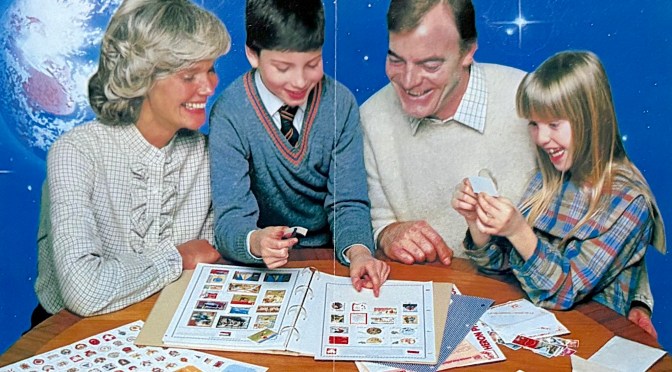
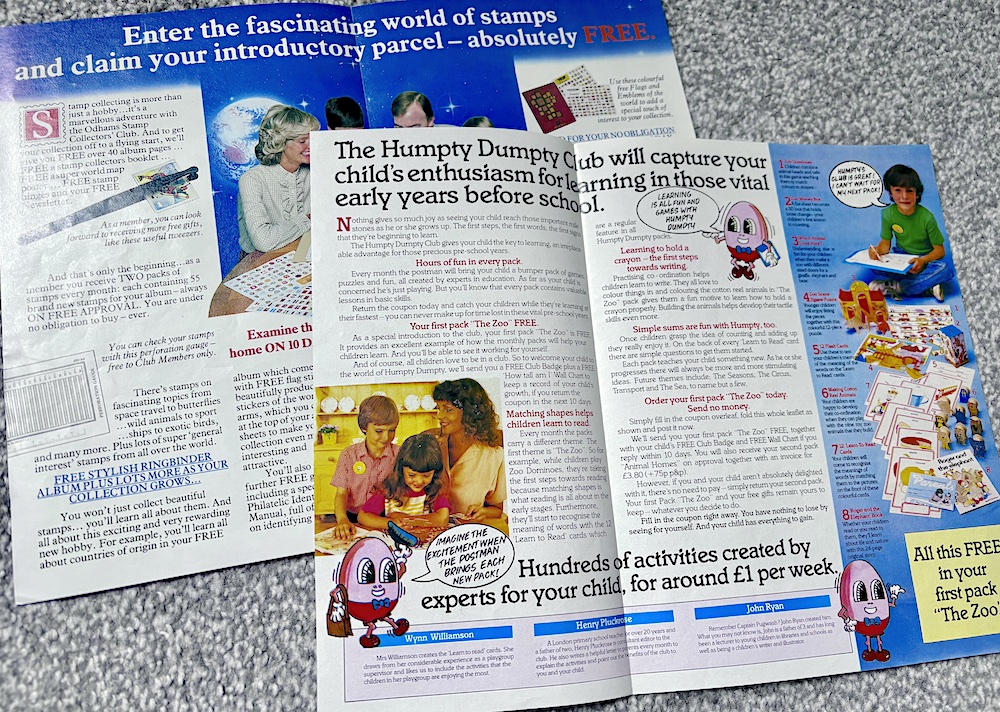
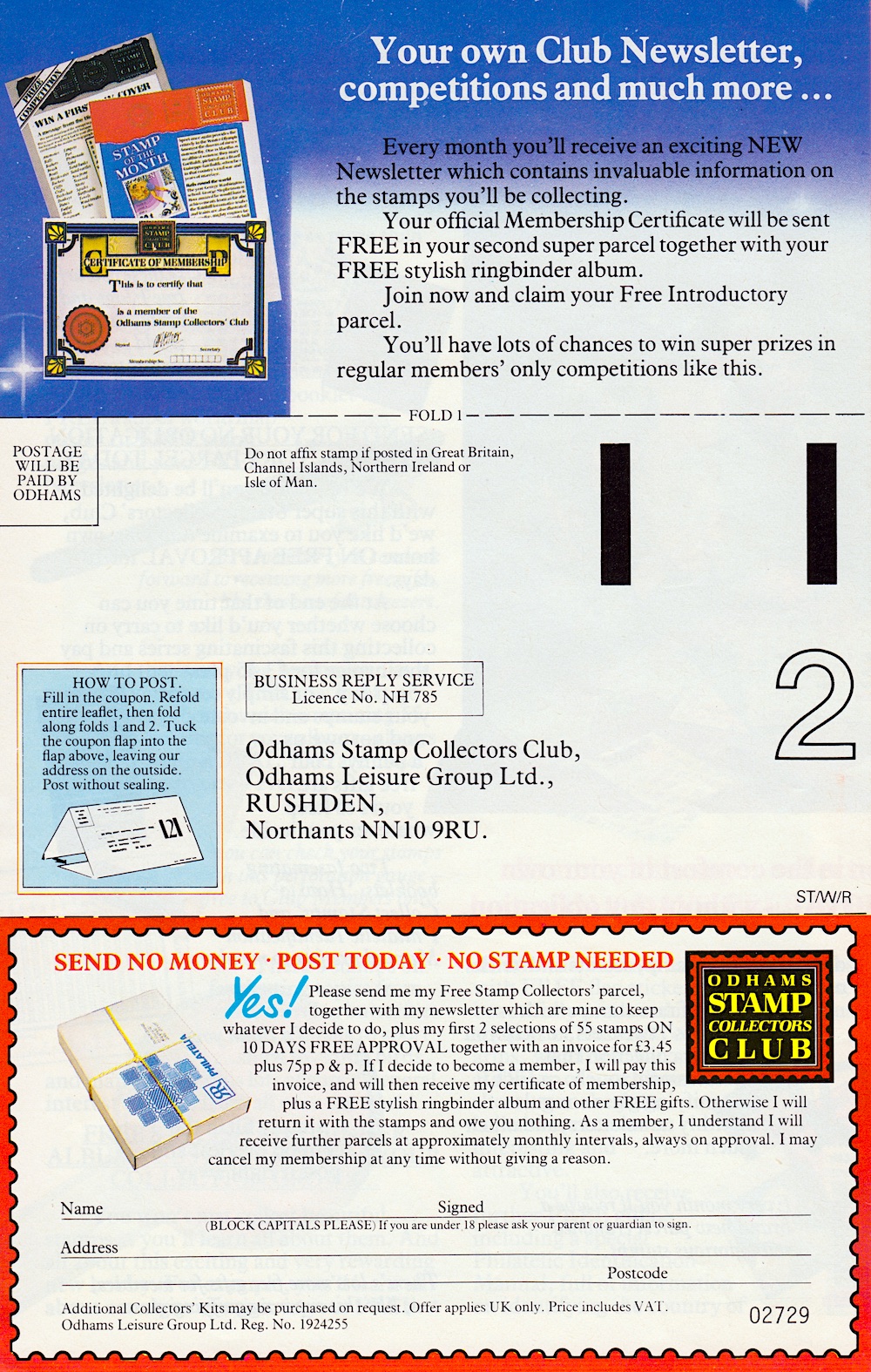
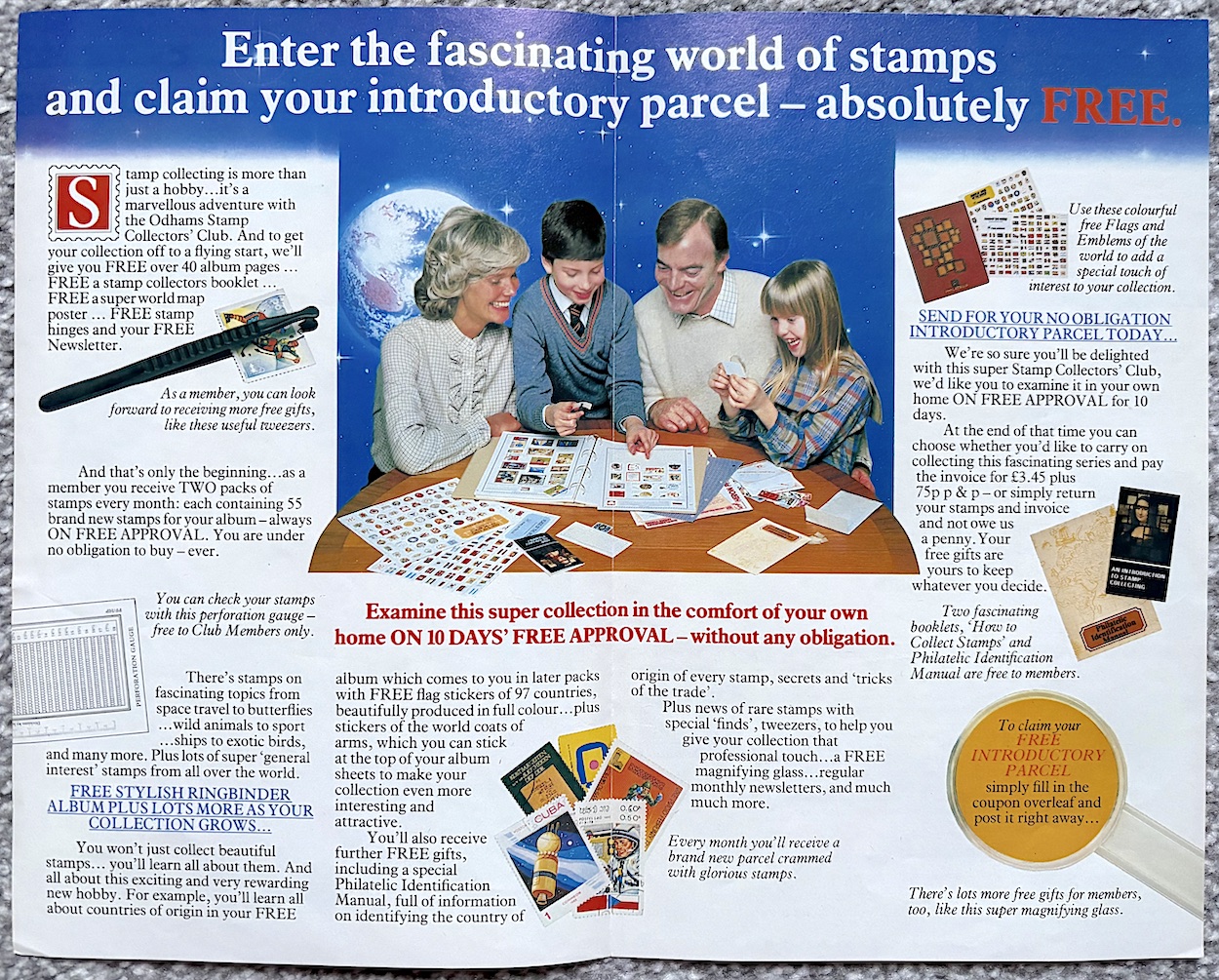
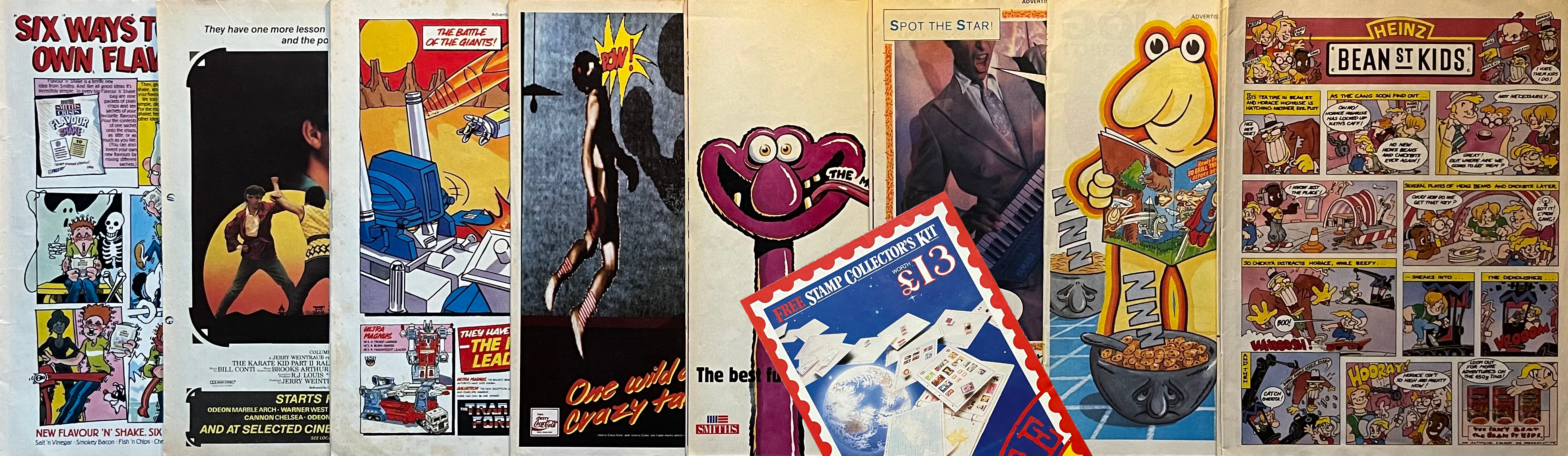
In #9 of OiNK we received a little folded leaflet that tried its very best to hype up stamp collecting. For any younger readers of the blog this was a hobby that even I was confused with as a child. I was watching new and exciting types of high-tech TV shows like Knight Rider and Airwolf, home computing and computer games were exploding in popularity, and I was also reading a truly anarchic comic. Stamp collecting felt like something from the past even then.
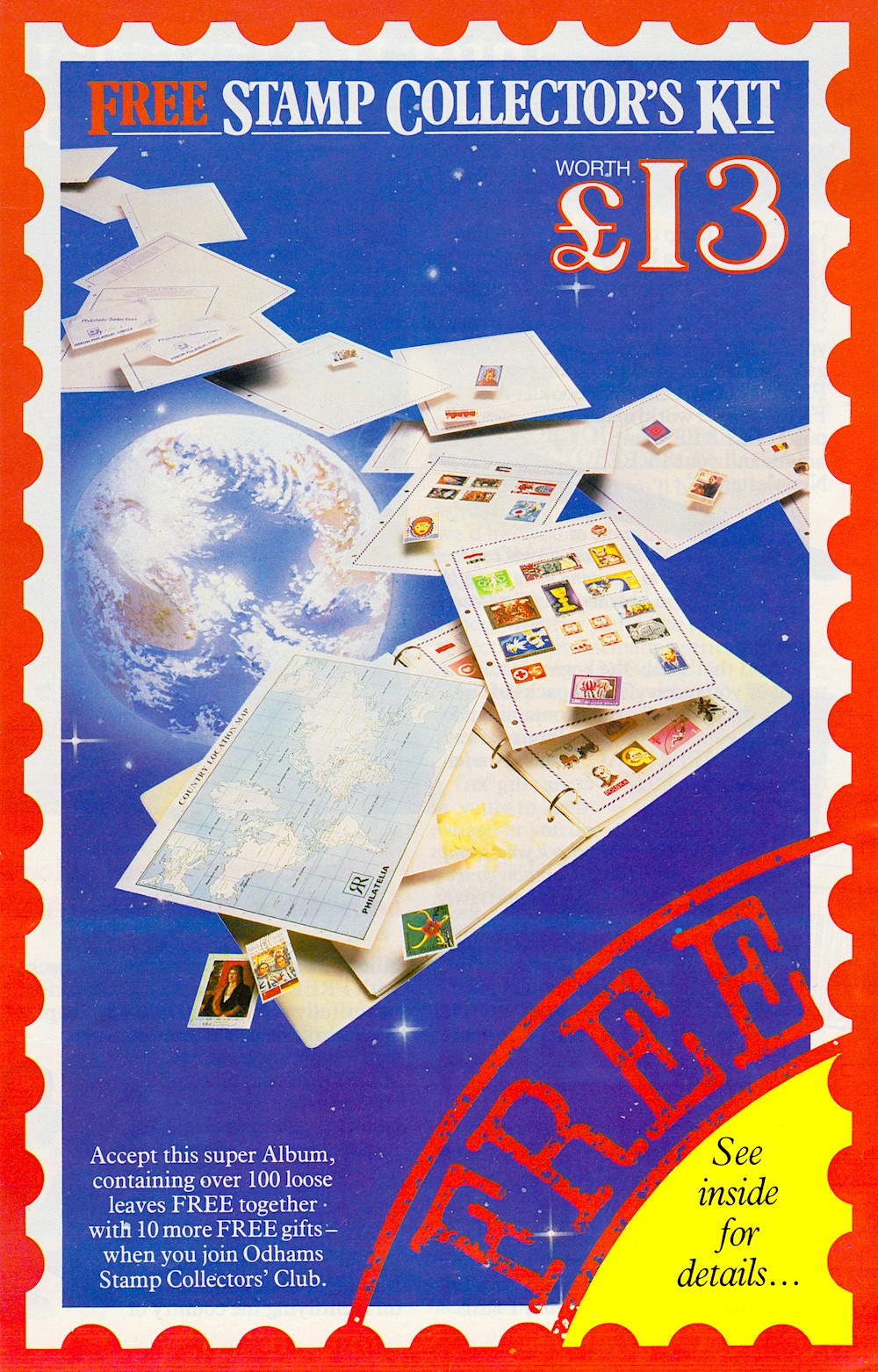
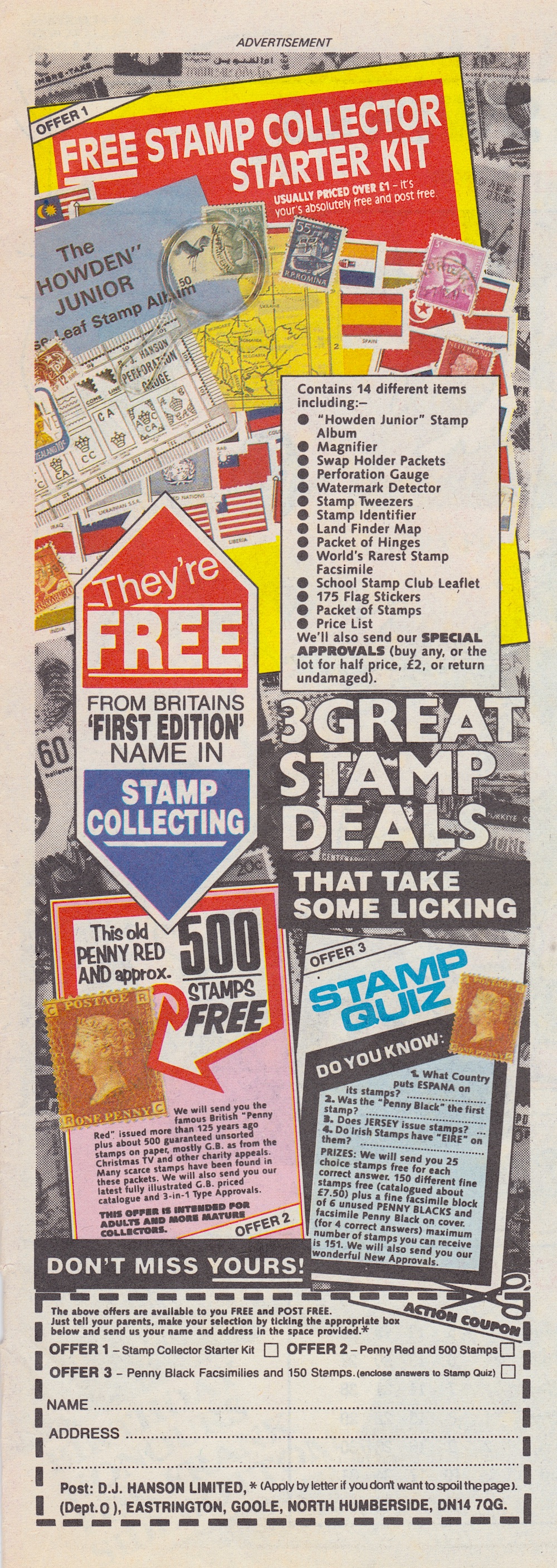
That little girl is really trying to sell it though, I’ll give her that! I had one or two friends who shared a stamp collecting hobby with their dads and none of them had half the excitement for it as this girl has clearly been told to have. I did reply to an advert on the back of one of my mum’s magazines that offered a giant starter kit with a load of stamps and things to do, much like the one in this next advert from #50.
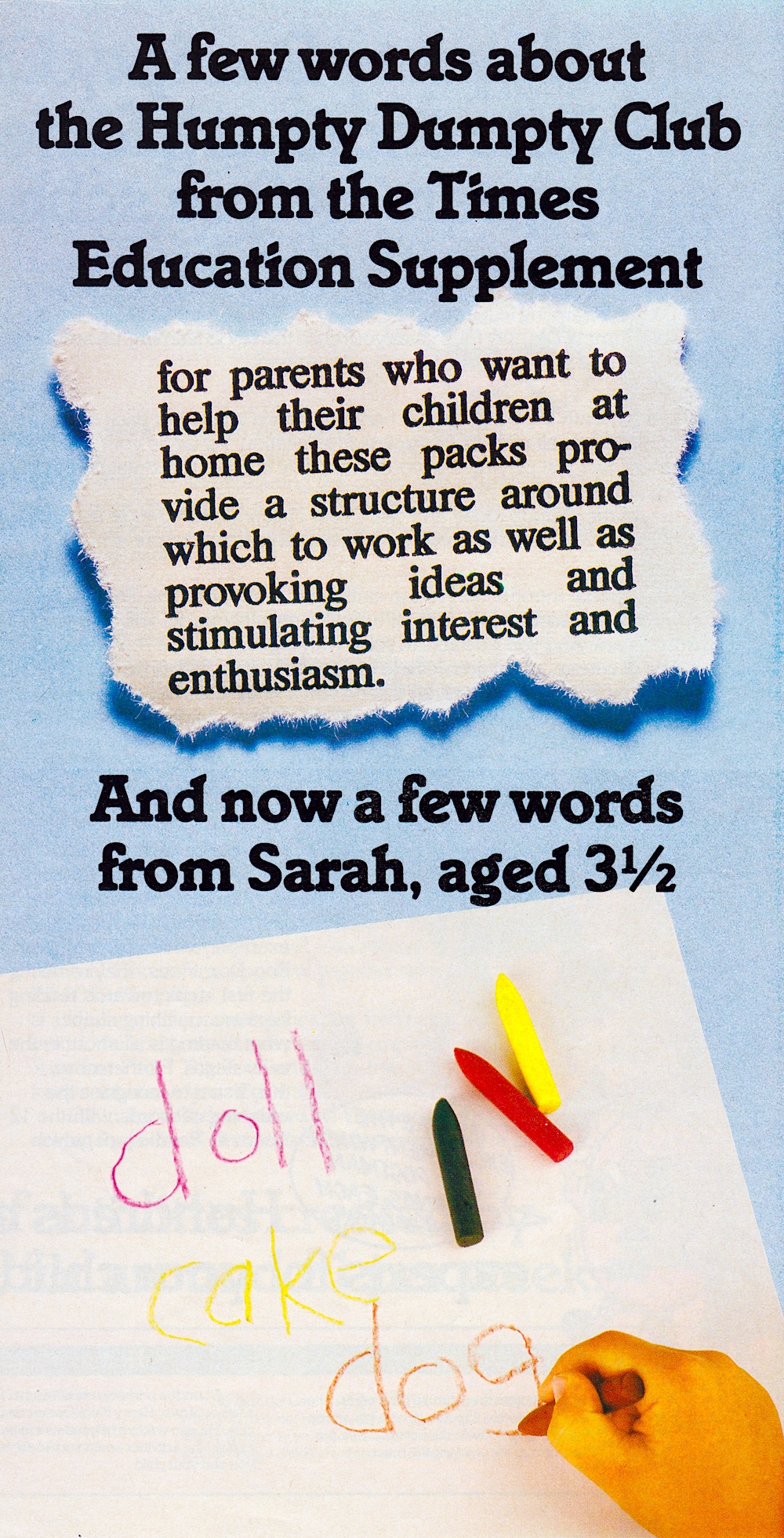
I can remember when it arrived my dad and I sat down to see if it was something we’d like to do together. I think it took us less than half an hour to lose interest. Instead, I went back to collecting Panini stickers for my Real Ghostbusters album. Another advertising leaflet came just three issues after the stamps one, in #12, although it’s an even worse fit for the piggy pink publication.
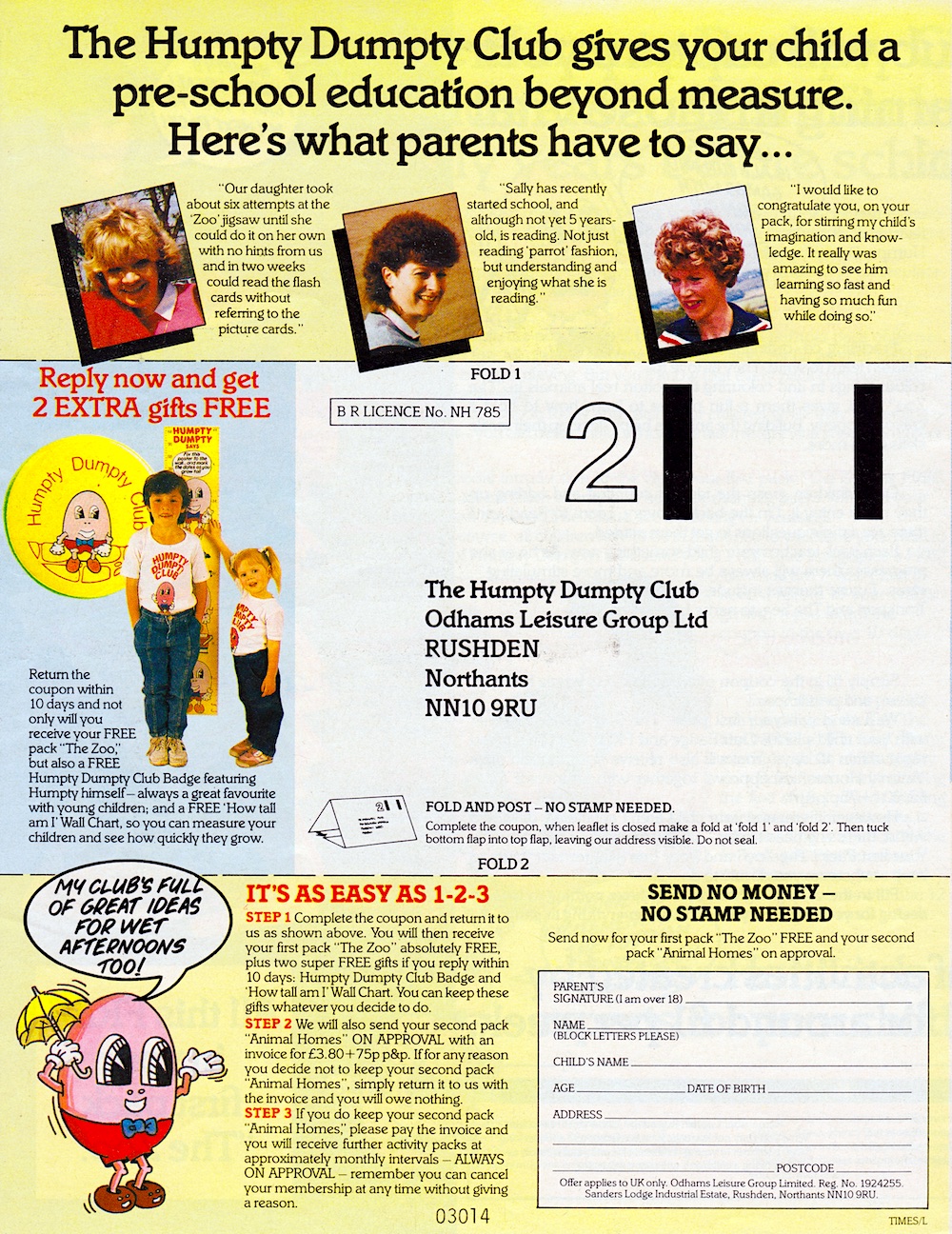
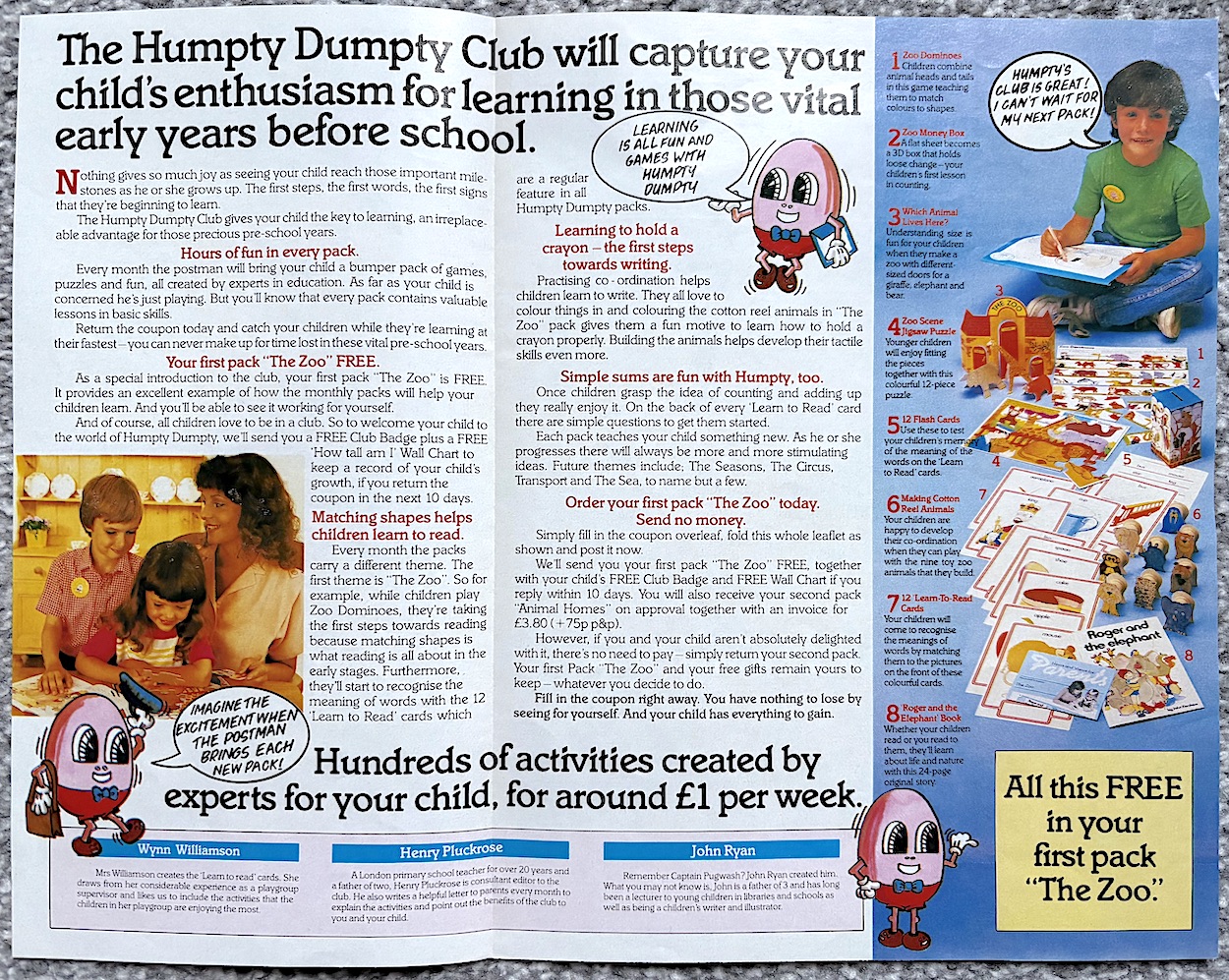
Don’t get me wrong, the Humpty Dumpty Club was well regarded at the time and a quick read of this leaflet shows why. It looks like it would’ve been great for the pre-schoolers it was aimed at, although that’s why it’s a strange fit. It’s not like pre-schoolers were reading OiNK. Of course, there’s every chance it was found inside all of IPC Magazine’s comics and the readers could easily have had younger brothers or sisters. I have to say though, some of those kids in the photos are definitely not pre-schoolers!
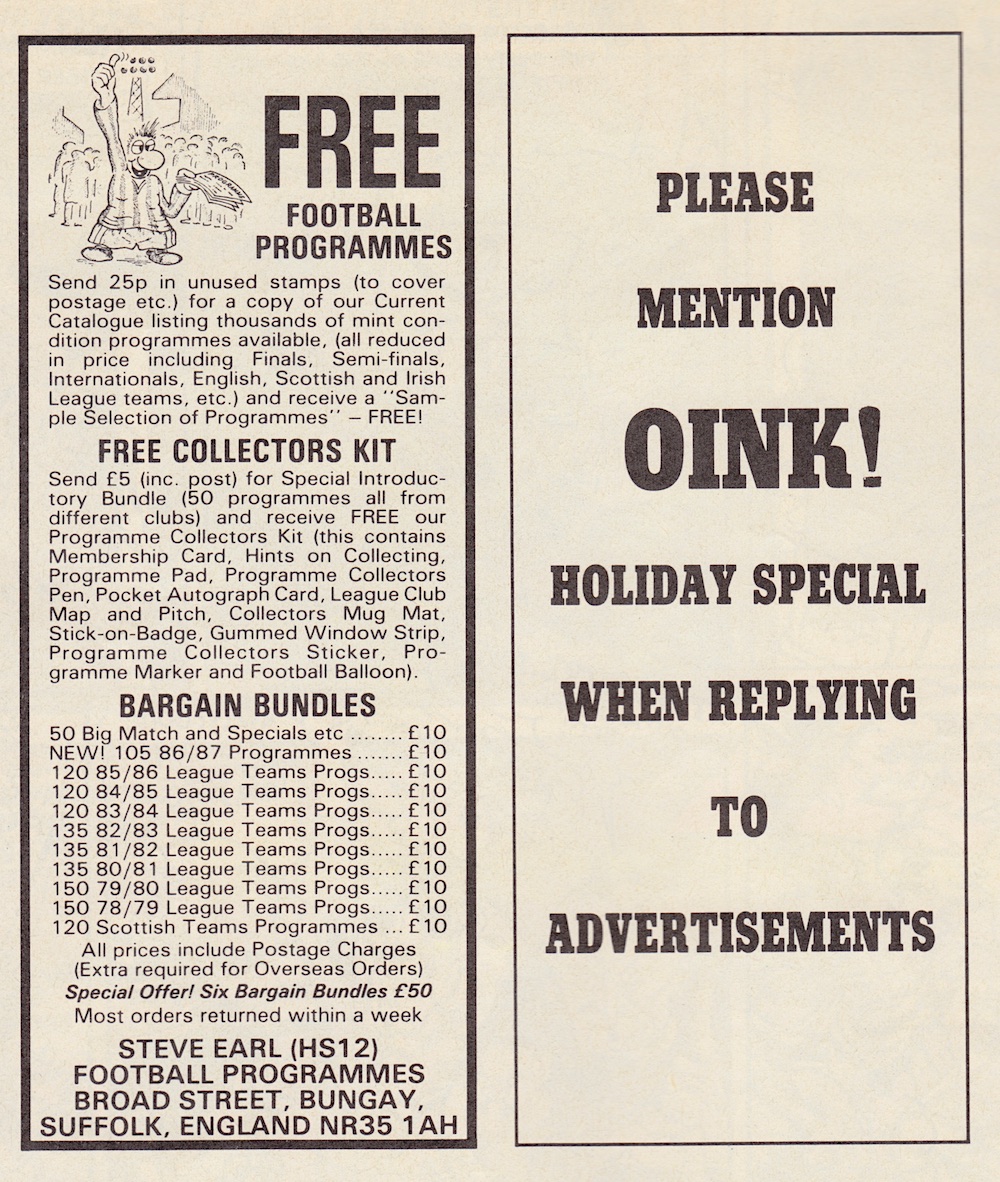
Betting isn’t something you’d expect to see advertised in a children’s comic and it’d certainly be outlawed today, and rightly so. Same with those competition telephone lines in the pages of Jurassic Park that could easily have led to extortionate phone bills. It’s unbelievable such things were ever allowed in comics, but back in the 80s both of OiNK’s first two Holiday Specials had tiny little adverts like this below, right next to those practical jokes and stamps.
If memory serves me right my dad would play the football pools every week and I think I used to play the spot-the-ball competition on the piece of paper he filled out. He’d fill out the form and take it down to the local sweet shop where he could place his bets. It really was a different time, wasn’t it? These adverts were easily ignored by us kids of course but it’s still insane to think they were included in the first place.
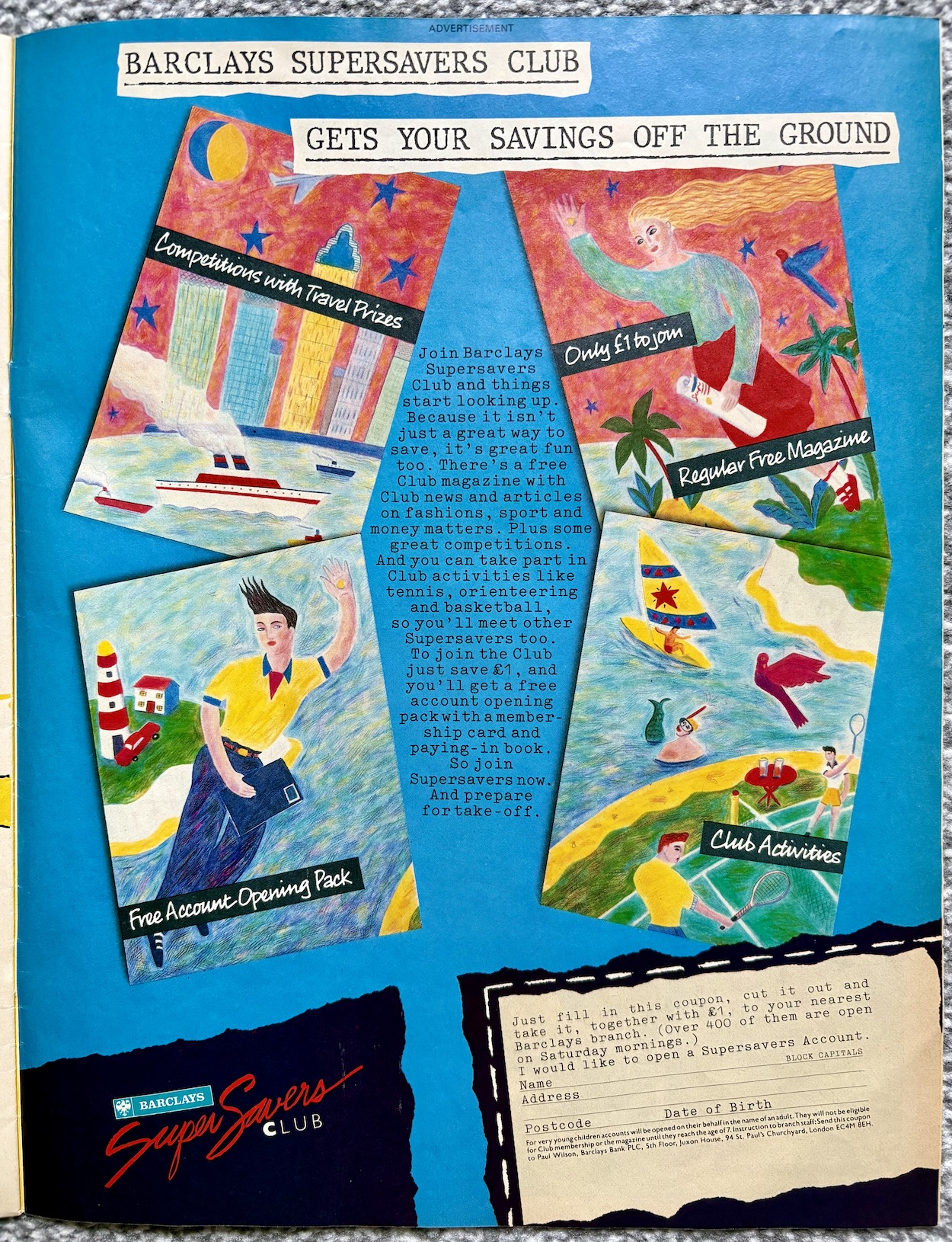
Do you remember joining a bank when you were young? Where I lived we had one bank in the town, and mum and dad thought it was important that I had an account early in life. Not that I ever used it, I spent my pocket money far too easily and that attitude carried over into my teens and any money earned from part-time jobs, unfortunately. I did get a large blue plastic elephant however, to keep all of my parents’ 1p and 2p coins in. (When using their coins I seemed to be able to save up, no bother. Funny that.)
This Supersavers Club advert from #13 may sound familiar if you’ve seen any ad breaks on TV the past few years, but this particular club was formed long before money saving websites existed and you wouldn’t have been getting a visit from Dame Judi Dench. This was a basic incentive the likes of which many banks used in order to get kids through the doors. Although, living in Northern Ireland I doubt the in-person activities would’ve included us. Back then we were used to being reduced to small print at the bottom of adverts as an exception to any special offers.
Well, that’s yer lot, pig pals. I’ve really enjoyed putting together this series. It’s been an unexpected window back to the 80s and the world in which some of us lived throughout our formative years. For some of us it’s been a trip down memory lane and for others I’m sure it’s been a look into a strange past. It’s really hit home to me just how much the world has changed and just how long ago OiNK actually was!
So yes, it’s been fun but now I have to go and lie down.
I really do enjoy this series, a lot of the advertisements featured so far have taken me right back to my youth (which was a long, long time ago now), but I’ll admit the promotional pages contained in this fifth part didn’t result in any purchases or gifts for me in the 80s. That’s not to say they don’t bring back certain memories, though.
In the 80s there was one teeny, tiny little thing that made a huge impact on our daily lives, despite the fact we rarely saw it. From toys to VCRs, from washing machines to the explosion of home computers that entered our homes. It could even be found resting on our wrists. That little, unassuming thing that hid inside more and more of the devices we used was, of course, the microchip.
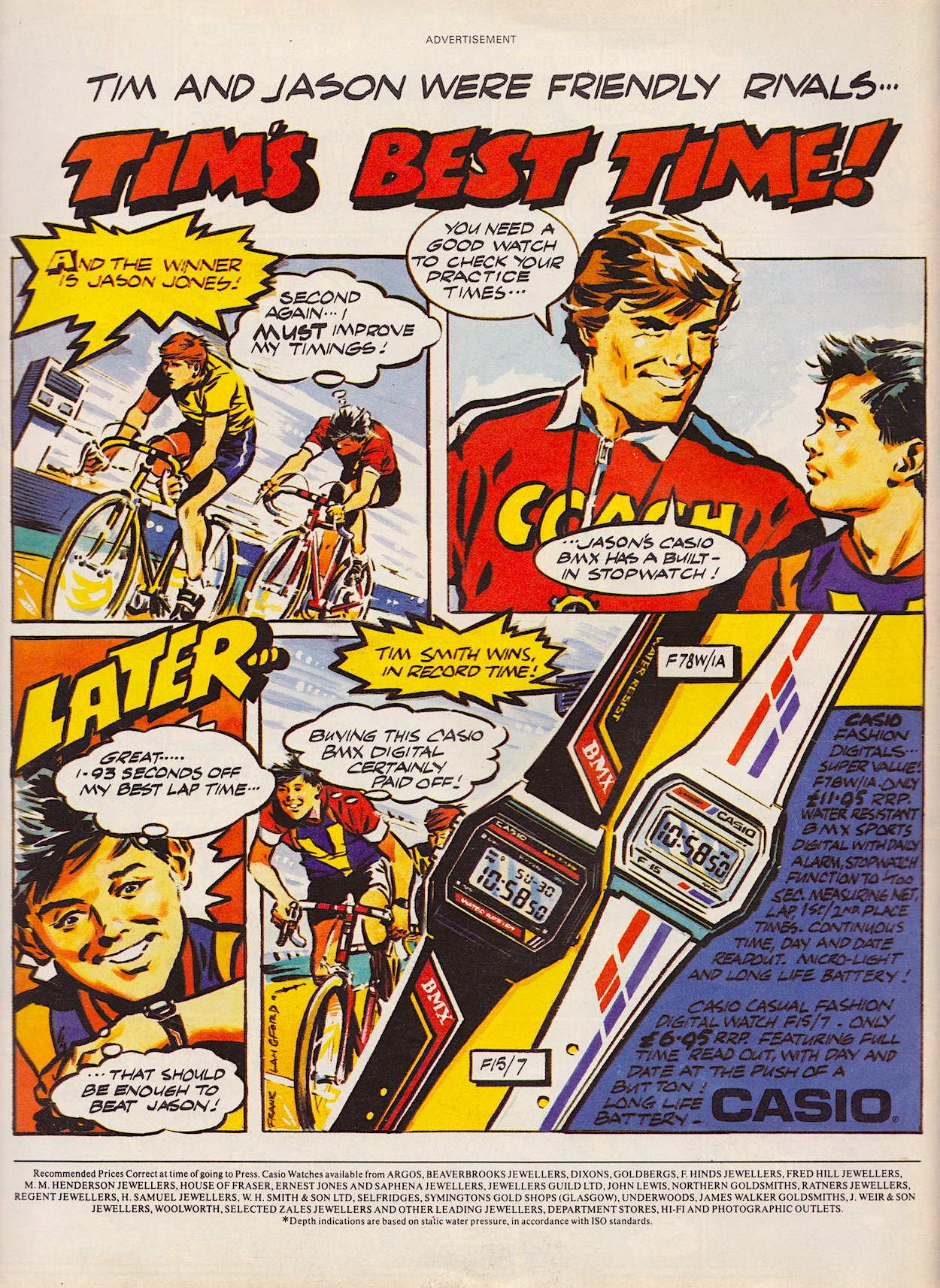
It’s something that links all of our adverts, too. Beginning with Casio’s watches containing those elaborate stopwatches! Don’t laugh, I remember being very jealous of a friend who had a digital watch that recorded lap times, even though I’d no need for such a feature. Remembering my own basic watches of the time and seeing Michael Knight talk to K.I.T.T. through his, every time I use my smart watch today I feel like I’m living in some sci-fi future.
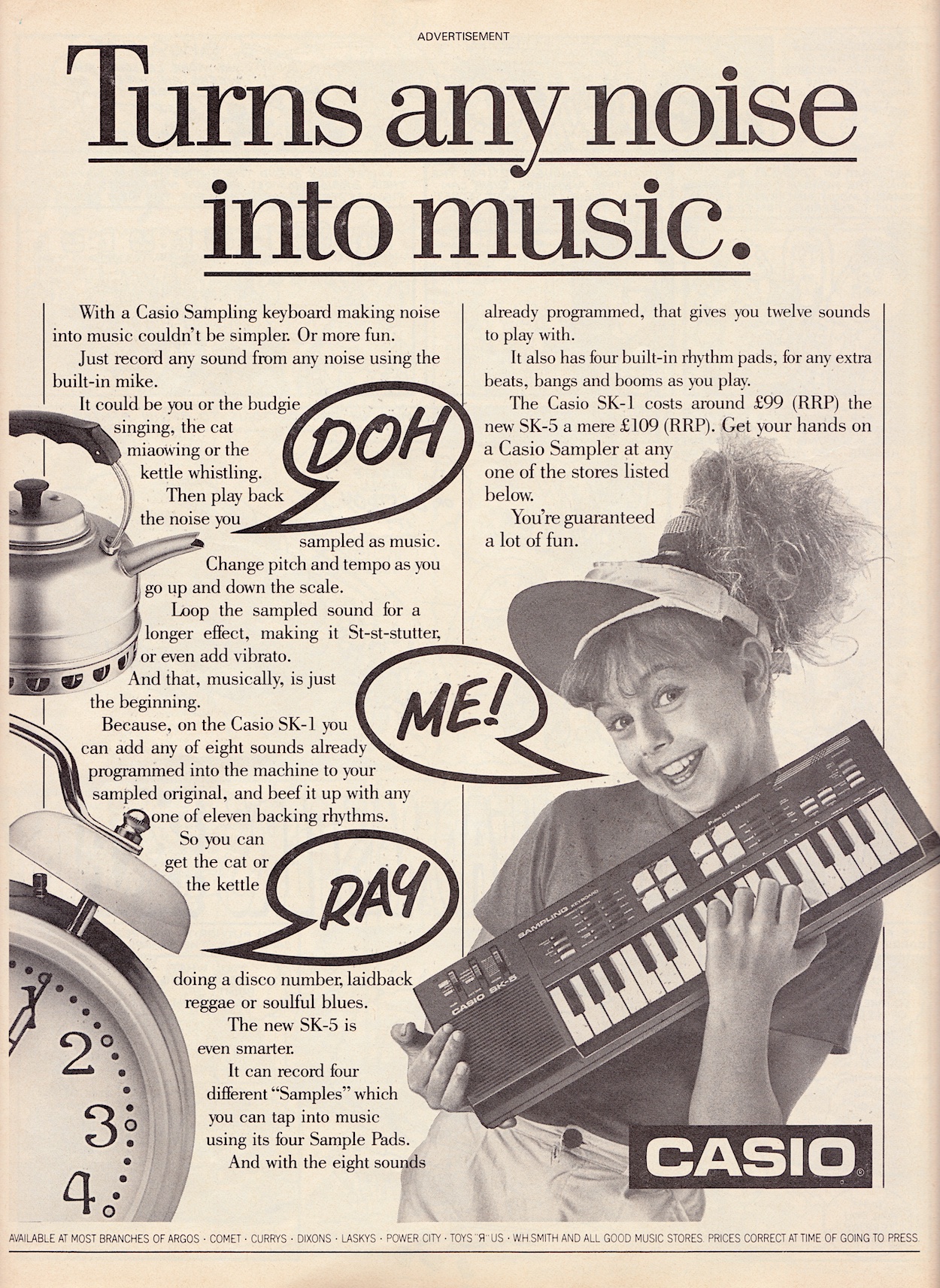
It’s not only the passage of time and the leaps in technology compared to the 80s that’s making me feel old. I think the fact the next item sounds so absolutely horrific is because I’m now a boring old fart. As a kid I may have gotten about ten minutes of fun out of a keyboard that used sampled sound effects from around the house to produce “music”, but as an adult I can think of nothing worse than this thing.
As it’s nearly Christmas, I’m reminded of a scene in my favourite Christmas movie, Fred Claus. At one point Santa’s brother, who is desperately trying to avoid anything to do with the season, is subjected to a taxi ride with a radio station playing nothing but Jingle Bells with the notes replaced by cat meows and dog barks. It’s horrific! That’s essentially what this keyboard is.
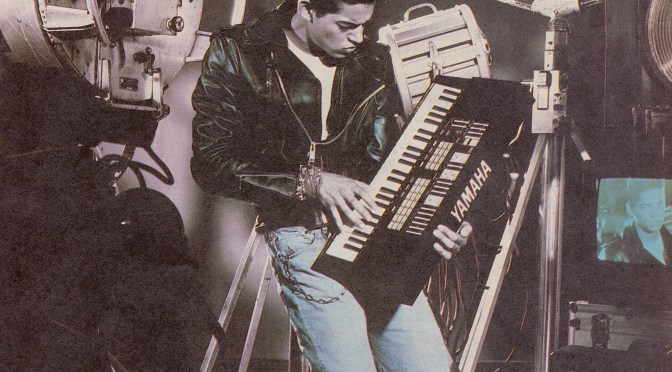
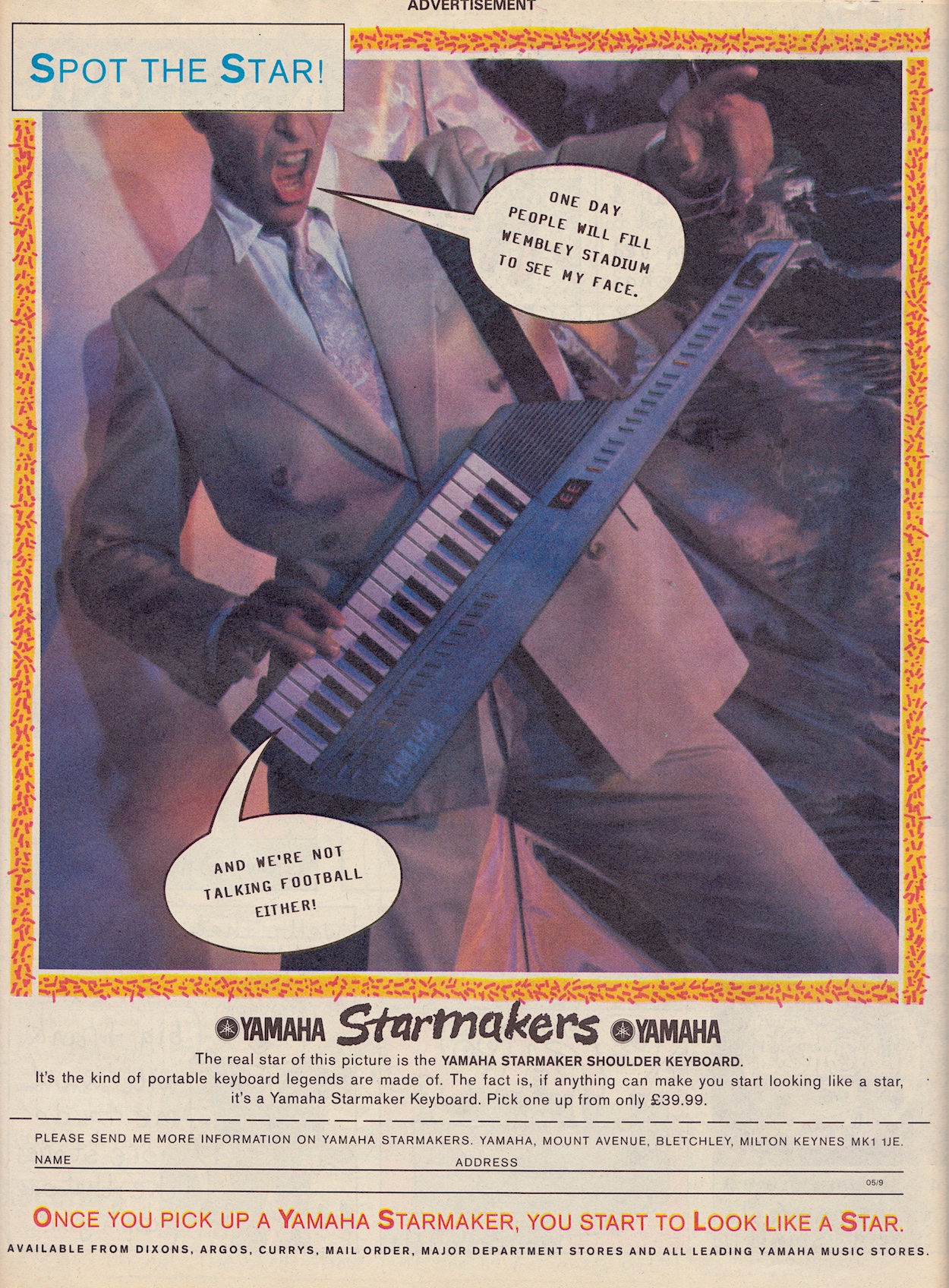
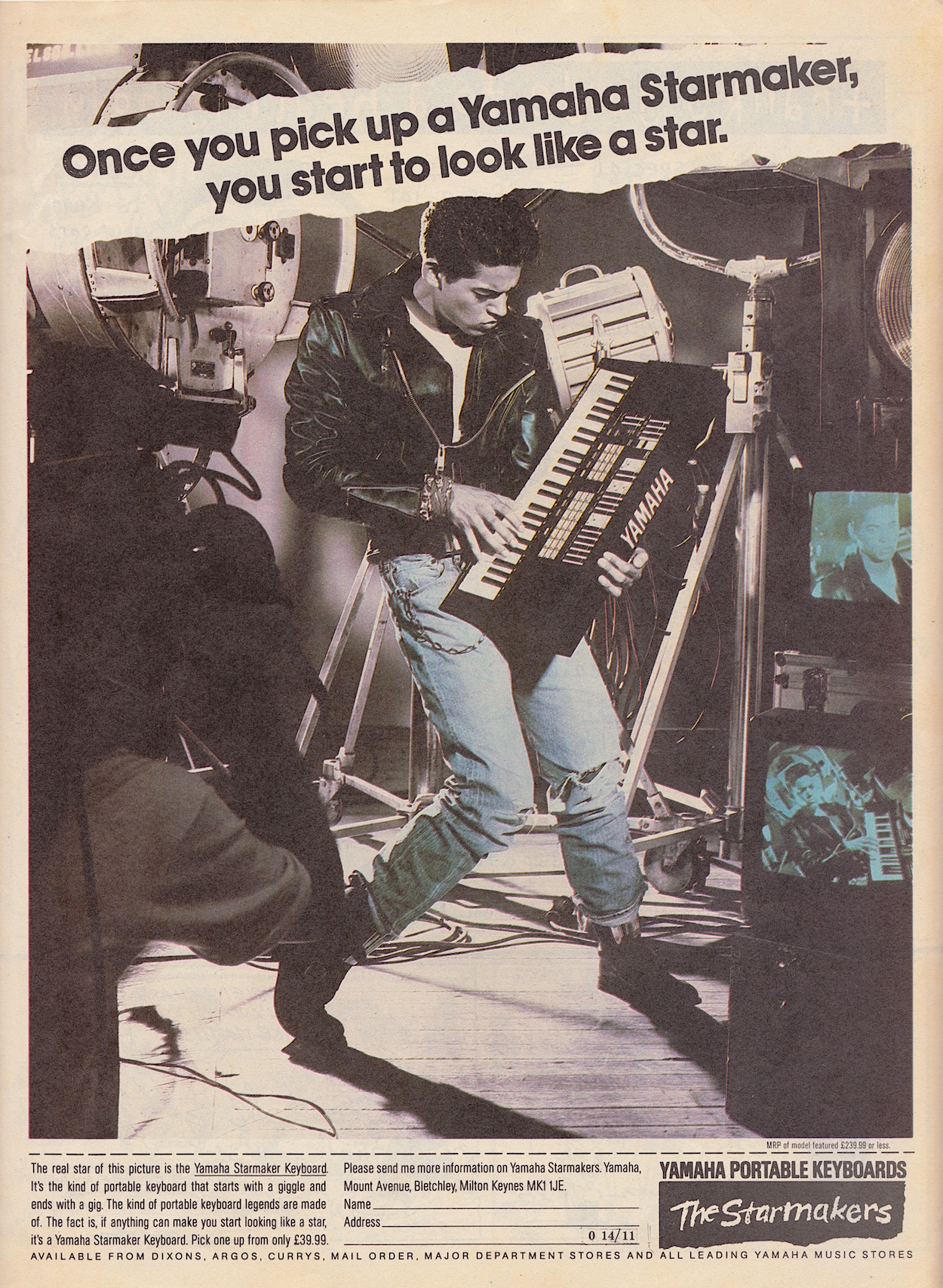
Much better for the kids would’ve been a real keyboard on which they could learn to play actual music and up stepped Yamaha who ran these next two ads over a handful of OiNKs. The Starmakers would’ve appealed because the reason behind it is right there in the name; let’s buy our child this so they can learn to play proper music, become famous and support us later in life. Well, maybe not. But you get my point. I do like the ads though, especially the guitar-shaped one, it’s so very 80s.
I remember a friend of mine in high school was incredibly talented musically. He could literally listen to a tune once or twice and play it back on a piano. He also had two huge Yamaha keyboards in his bedroom and I sat in awe one day as he spent no more then three hours one Saturday afternoon turning the Airwolf theme tune (which wasn’t sampled, he played it from scratch) into a dance track. He should’ve released it!
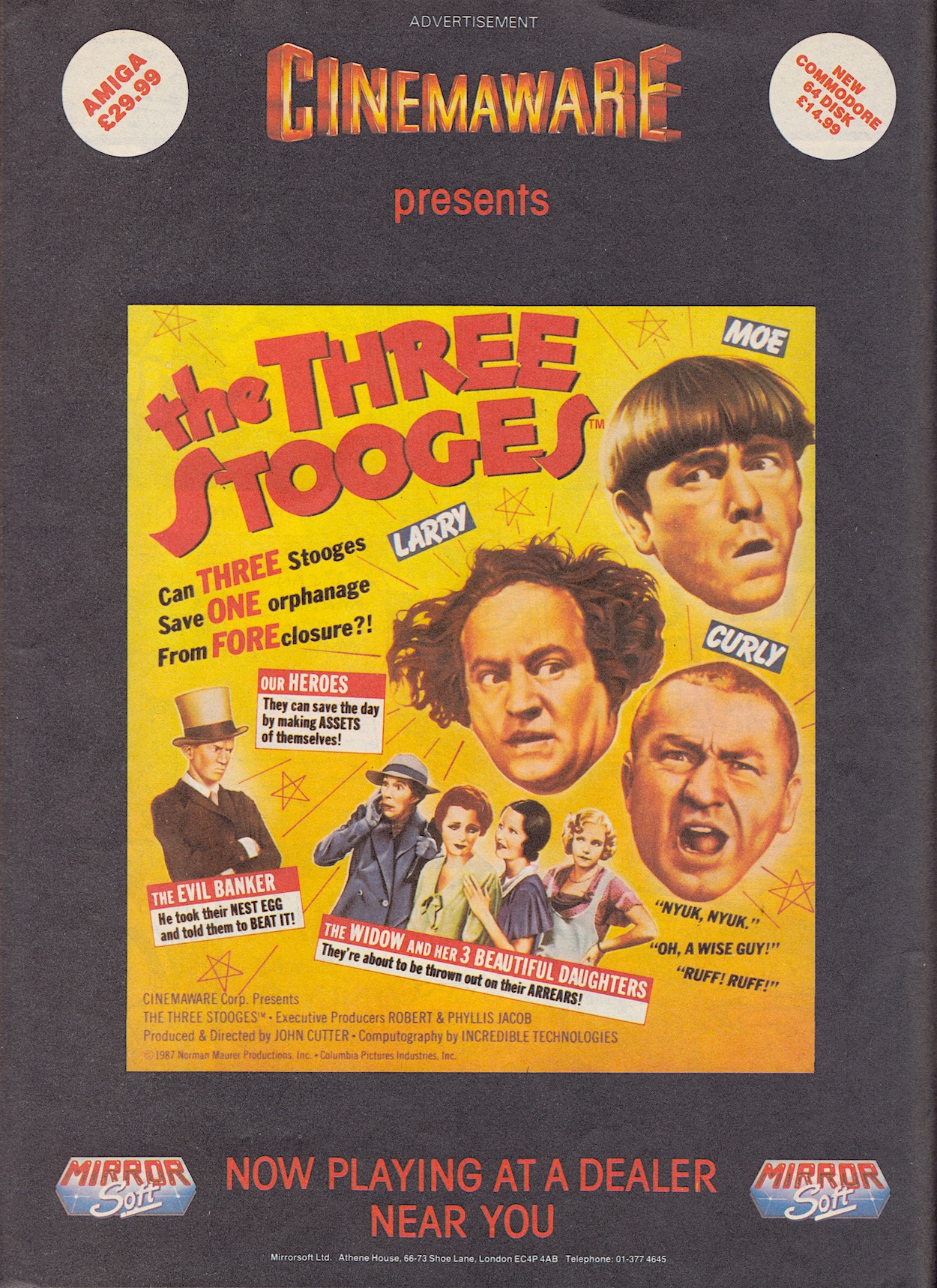
In the later weekly editions of OiNK an advert appeared for a new computer game and its release confused me at the time. I was aware of The Three Stooges and I think we all saw the odd live-action or animated clip growing up, but I always felt their humour was too old-fashioned for me. So I didn’t understand why they were suddenly appearing in a computer game for us young ‘uns.
I must’ve been an outlier though because apparently the game was very popular, doing well enough to be adapted to consoles such as the GameBoy Advance in the next decade. Throughout the 80s VHS collections of their TV shows were also released and an arcade game was revealed in 1984, followed up with this for home computers. In the game the Stooges had to partake in odd jobs to raise money to save their local orphanage.
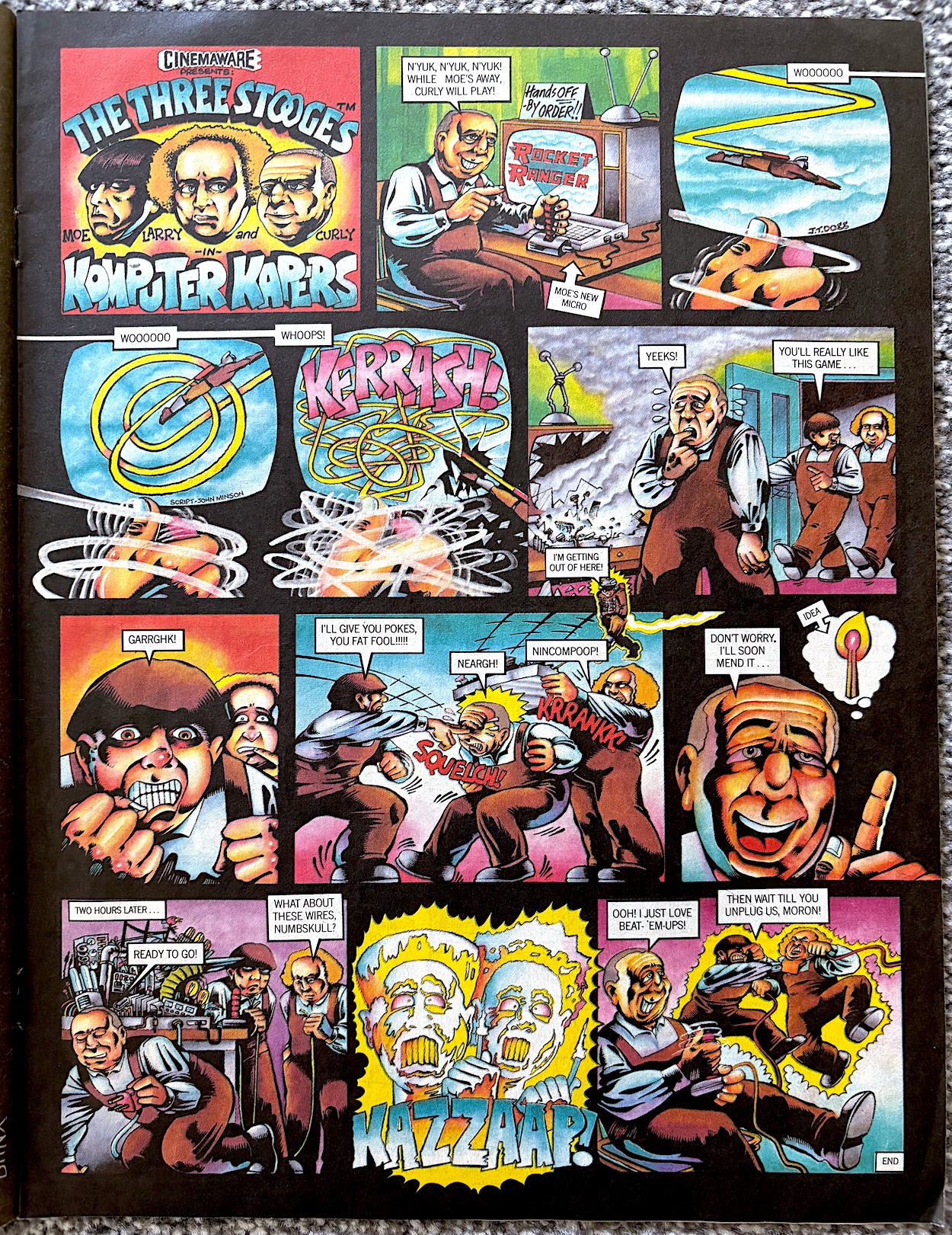
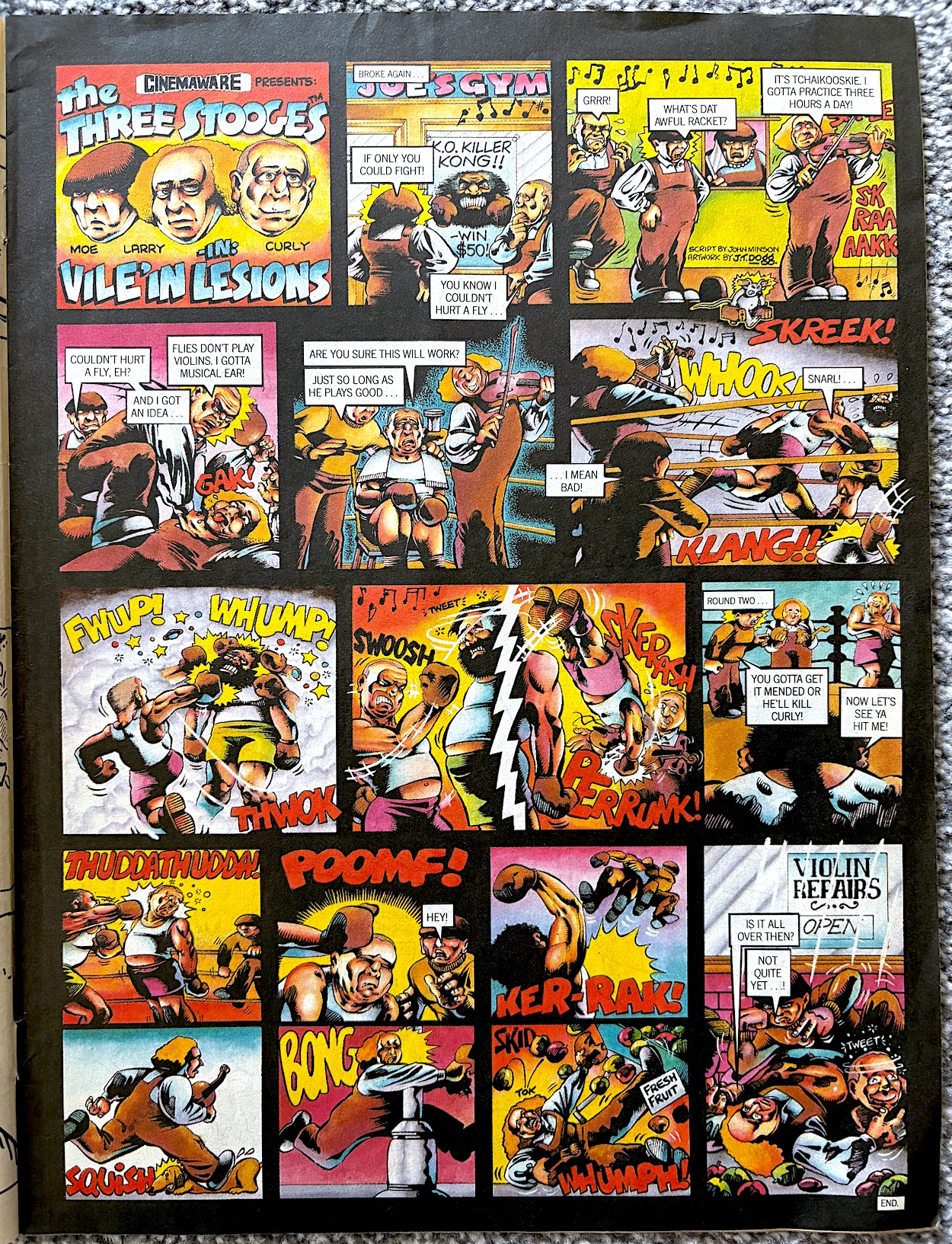
Given how outdated I personally felt their humour to be as a young boy I was even more surprised to see some gloriously illustrated strips appear in two issues of OiNK. Co-editor Patrick Gallagher has confirmed these were exclusive to OiNK and were made to tie in with the release of the game. It’s not the comic’s fault I never got on with the Stooges’ humour, a lot of people loved them and I’m sure many enjoyed the strips so I’m glad these little oddities exist, especially as they give us a reason to enjoy some more art from the incredible Malcolm Douglas (aka J.T. Dogg).
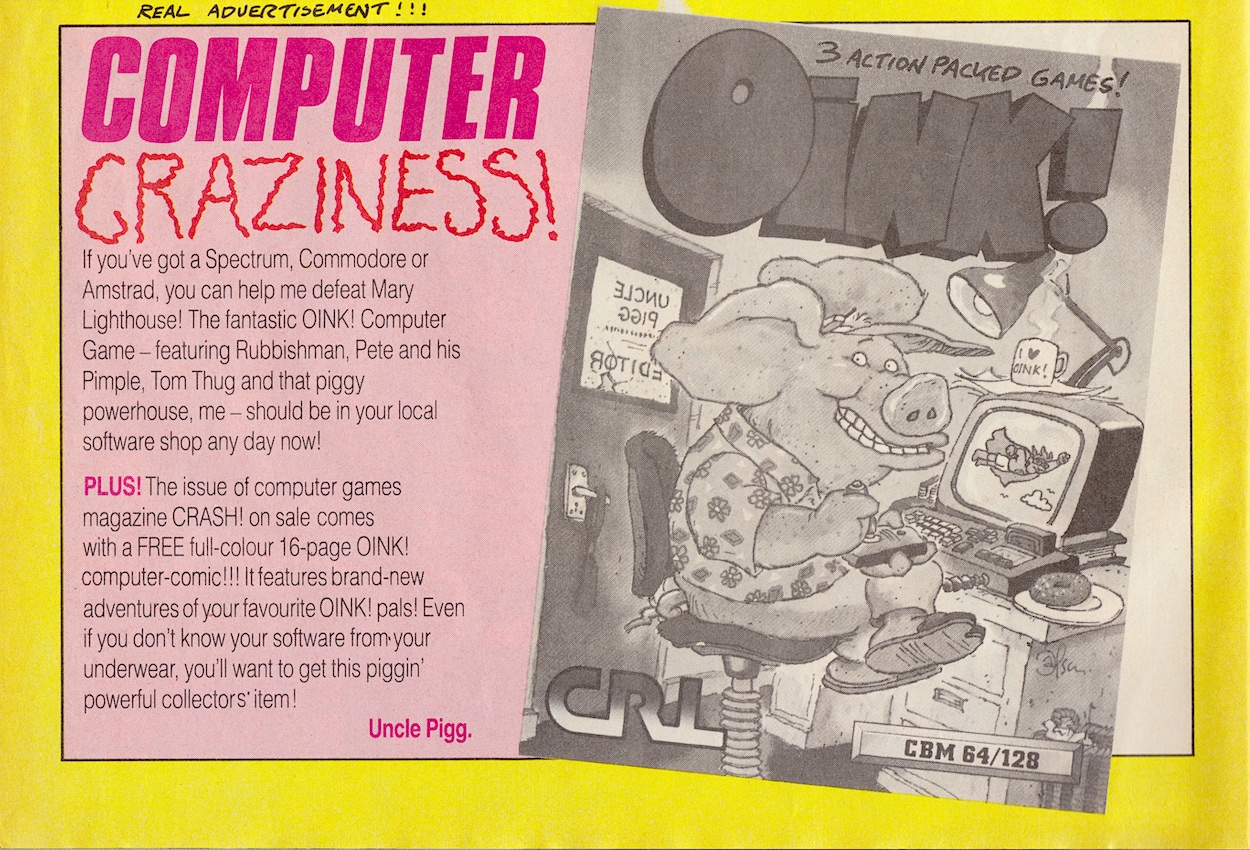
The final advert for an electronic piece of entertainment wasn’t an advert in the traditional sense but rather a promo OiNK pieced together to tell us about the free comic sitting inside the pages of Crash magazine on our newsagents’ shelves, as well as the comic’s own computer game of course. You can check out the free comic, the special feature inside that issue of Crash and the game itself in a special section of the blog devoted to the game.
The rise of the microchip and computerised technology in the 80s was a wonder to be a part of, especially at such a young and impressionable age. I’ve stared in wonder at my friend’s very young kids and how quickly they’ve grasped iPads and iPhones and I think I now know how my own parents felt four decades ago!
Right, so we’ve only one more part of this series to go, in which I’ll be rounding up the leftover miscellaneous ads from the pages of OiNK. Look out for that in 2026.
Welcome to part four of our look back at the real advertisements in OiNK (rather than the spoof Madvertisements), a series of posts taking us all back to life in the 1980s. After reminiscing about the toys we received for Christmas it’s now time to check out some new reading material, namely the other comics and books we’d while away the days with between issues.
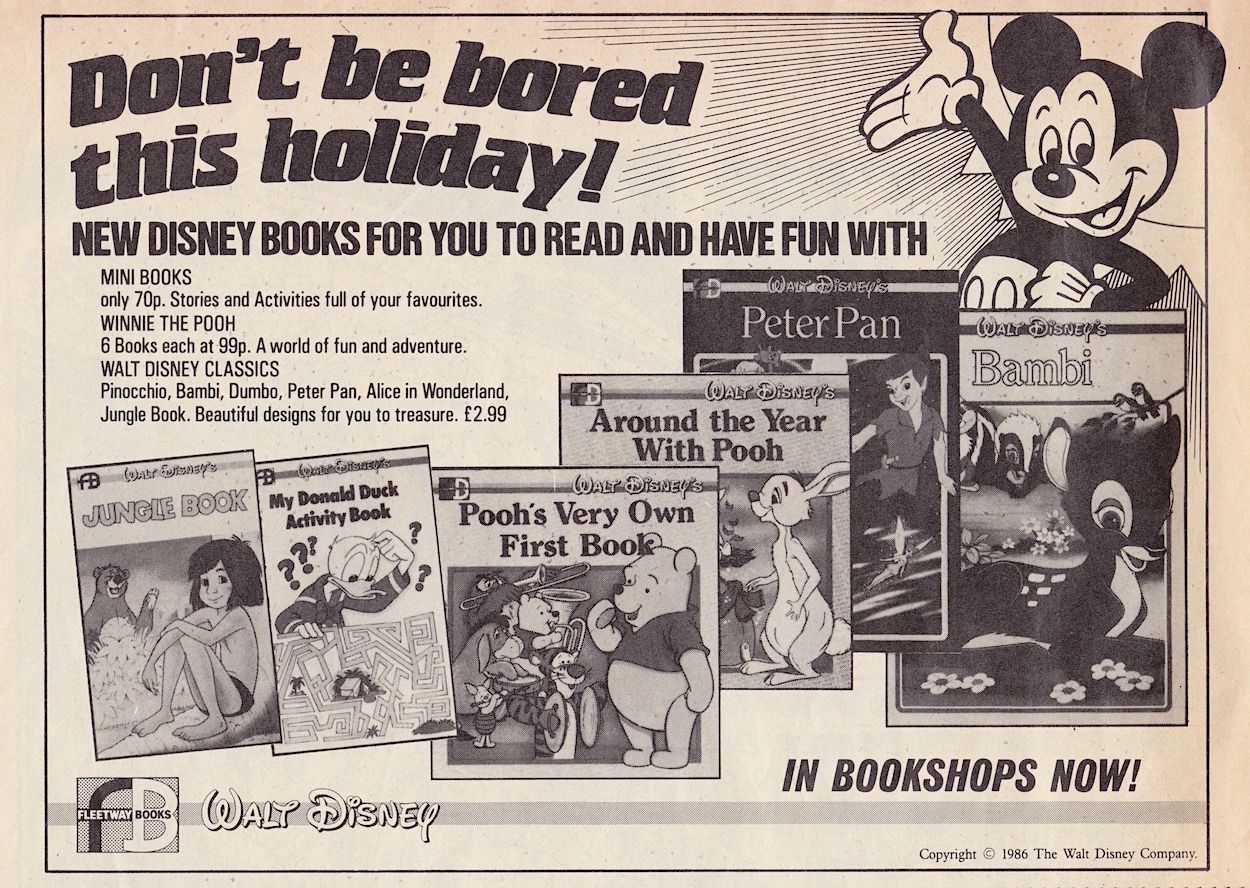
Disney was a target for OiNK’s writers and cartoonists on several occasions, but right back near the beginning (#9) while the comic was still in the capable publishing hands of IPC Magazines, a division of its future publisher Fleetway advertised a set of Disney books to apparently help beat the boredom of school holidays! Did the person who came up with that tagline even remember their own childhood summers?
Around that time I wasn’t a huge fan of Disney. I much preferred Warner Bros cartoons and my shelves were filled with Railway Series/Thomas the Tank Engine & Friends books, so this advert wouldn’t have had any impact on me. It’s just as well they advertised this early though, once OiNK began its ‘Ron Dibney’ madverts and strips we may have been looking for the gag here.
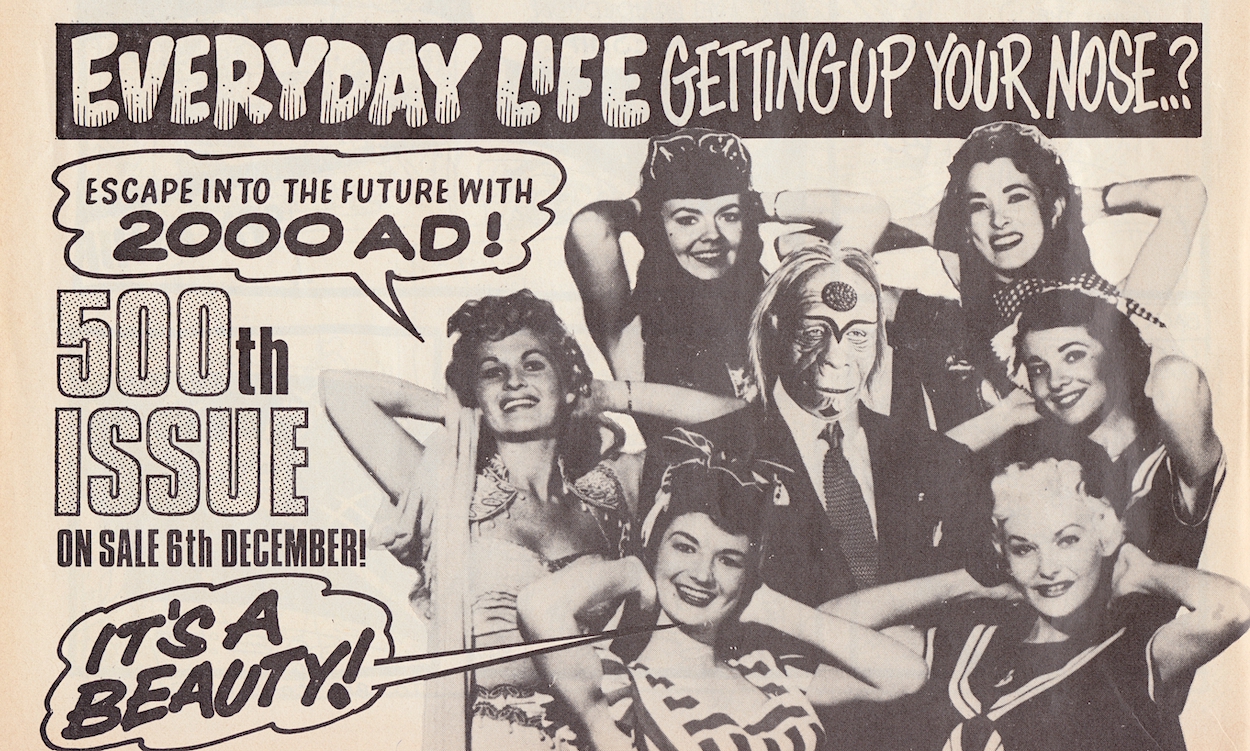
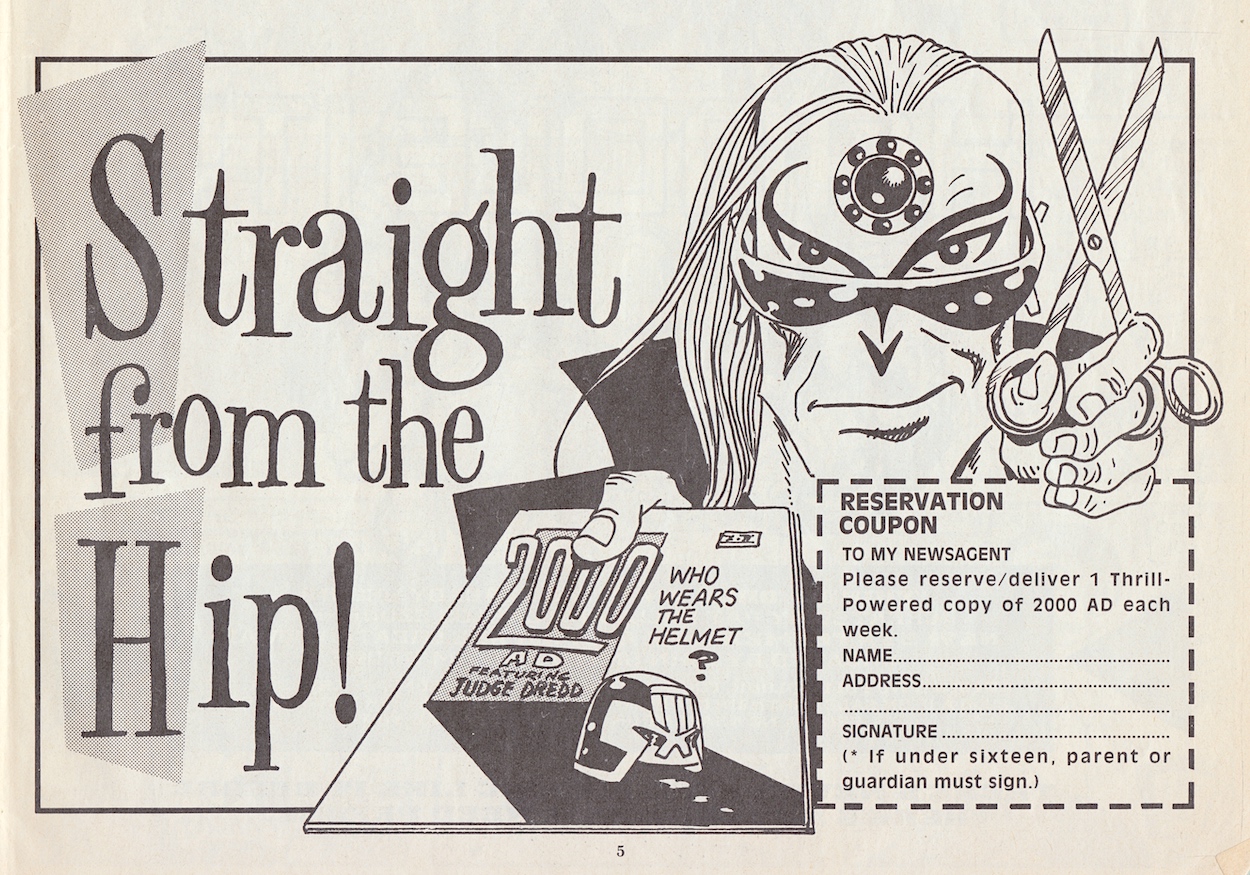
In only my third issue of OiNK in December 1986 (the third comic I’d ever bought myself) another of IPC’s titles was celebrating a mammoth 500 issues! True be told I’d never even heard of it at this stage of my life but I’d become acquainted with it a few years later in high school when I’d meet friends who were obsessed. 2000AD’s fictional editor Tharg the Mighty is apparently surrounded (or rather, superimposed into) a group of beautiful 1960s or 70s women in a funny advert that poked fun at celebrity culture.
Is it any wonder I was so confused as a kid when OiNK ended after only 68 issues? Of course, little did we know celebrating 500 issues would end up feeling somewhat quaint, what with 2000AD still being published on a weekly basis all these years later and clocking up 2,427 regular issues at the time of writing! Much later in OiNK’s run 2000AD’s newsagent reservation coupon would replace OiNK’s own in the penultimate issue, a change we didn’t think anything of until a month later.
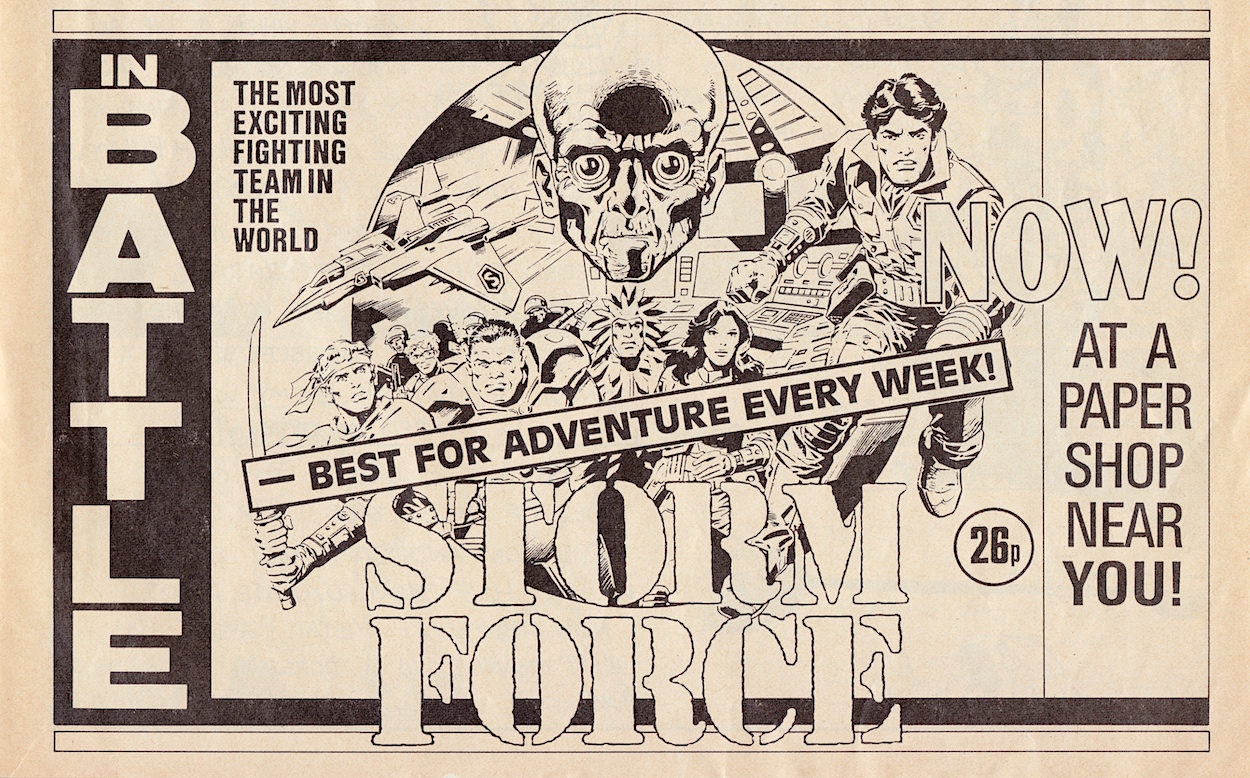
Two comics of friend-of-the-blog Barrie Tomlinson’s (Ring Raiders, Wildcat, Super Naturals) were also advertised at various points in OiNK’s lifetime, namely Battle and Eagle. After losing the Action Force licence to Marvel UK, Barrie created Storm Force, which was basically a toy line strip without the toy line. He’d later speak about it in depth in his Comic Book Hero book, a review of which you can also read on the blog.
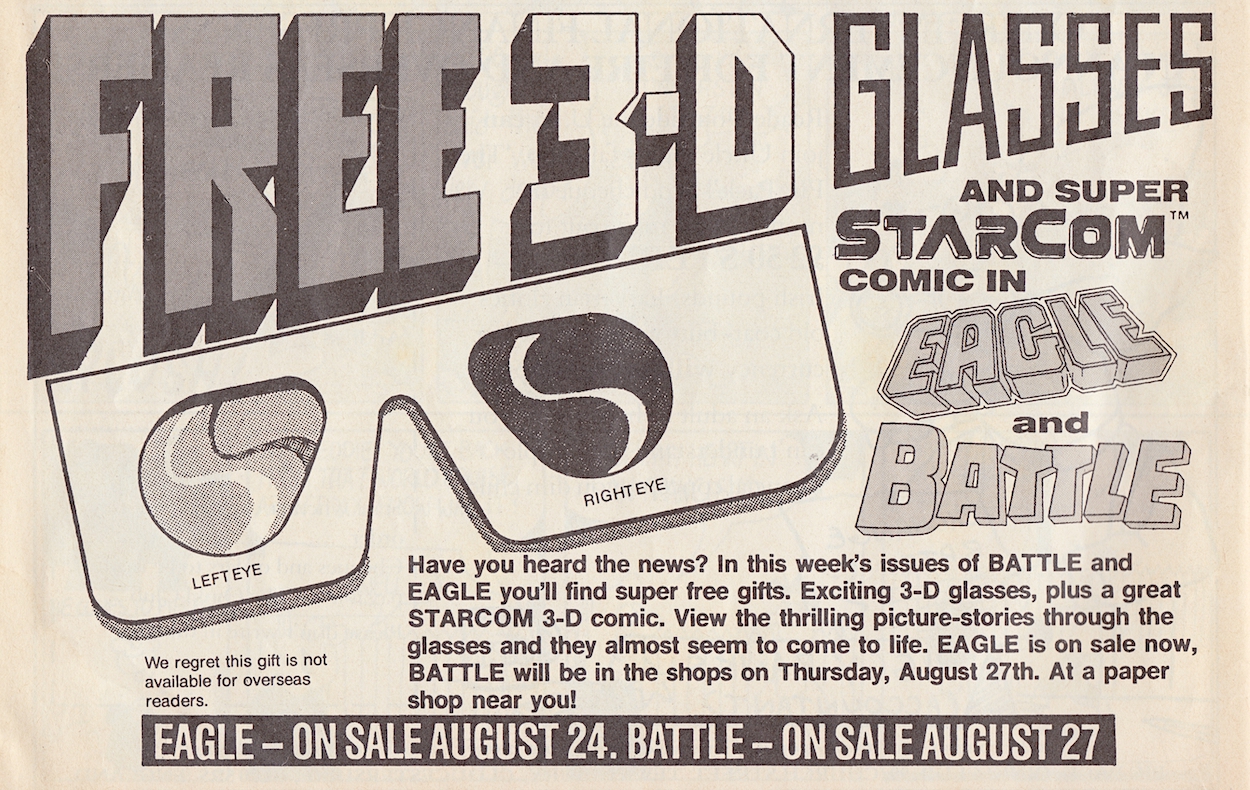
Coincidentally enough, Battle’s announcement of the new Storm Force was advertised in OiNK’s war-themed issue (#20) and during the following year both it and Eagle were advertised together when they gave away a pair of those flimsy green and red 3D glasses. This was part of a promotion for the short-lived toy line and cartoon series StarCom about astronauts battling alien invasions. Just a few short months later, Battle would actually merge into Eagle.
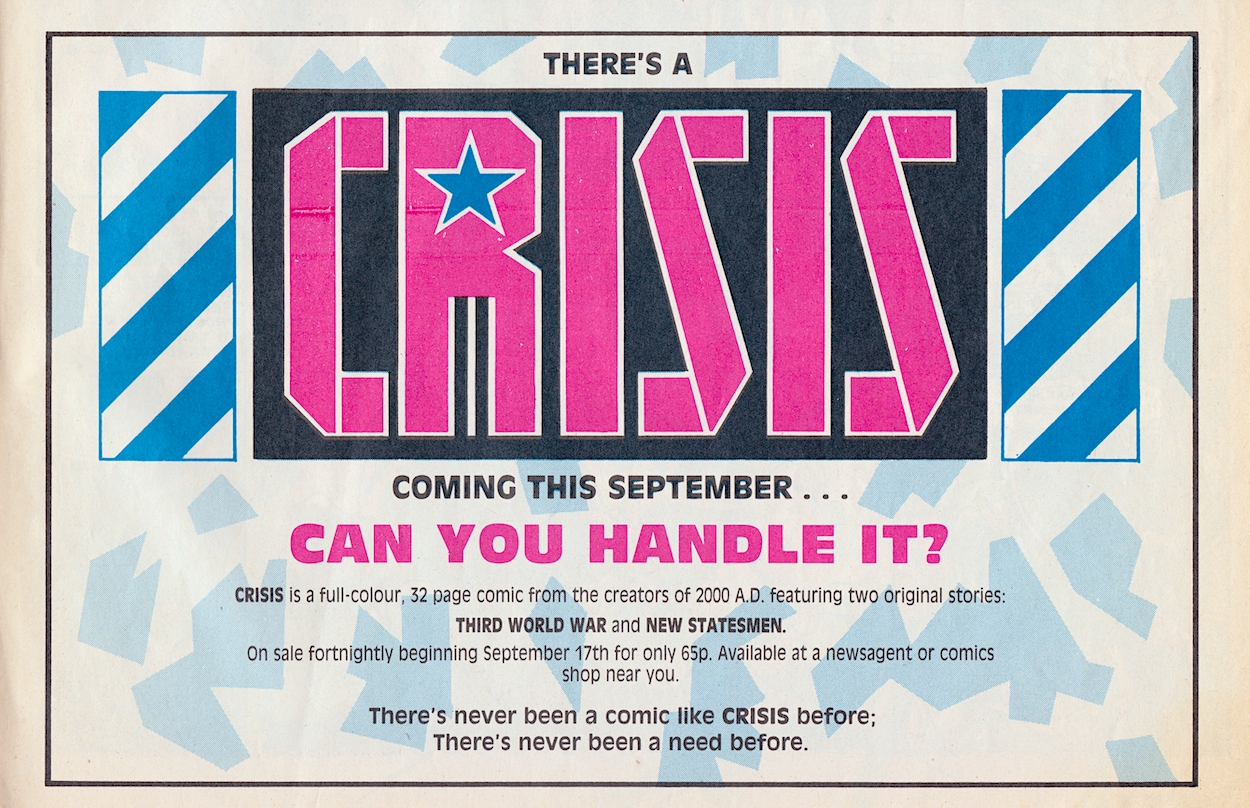
Towards the end of OiNK’s time a new comic from Fleetway Publications hit shelves and I think I picked up an issue or two, although I can’t be completely sure. I have vague memories of a fortnightly comic full of detailed artwork and the occasional swear word, the latter of which was of great fascination to find in a comic for my friends and I at our tender young age. The character in the full-page advert below also feels familiar but I can’t tell if that’s because I read about her at the time or if I’m just recalling these adverts.
Overtly political (one issue was also produced in partnership with Amnesty International) and adult in tone, Crisis was initially fortnightly and later monthly, which will sound familiar to readers of this blog, I’m sure. In fact, Crisis almost lasted as many issues as OiNK, eventually being cancelled at #63 in 1991. It eschewed traditions in the UK comics industry such as free gifts and annuals, which is about as tenuous a link to our next adverts as I can muster.
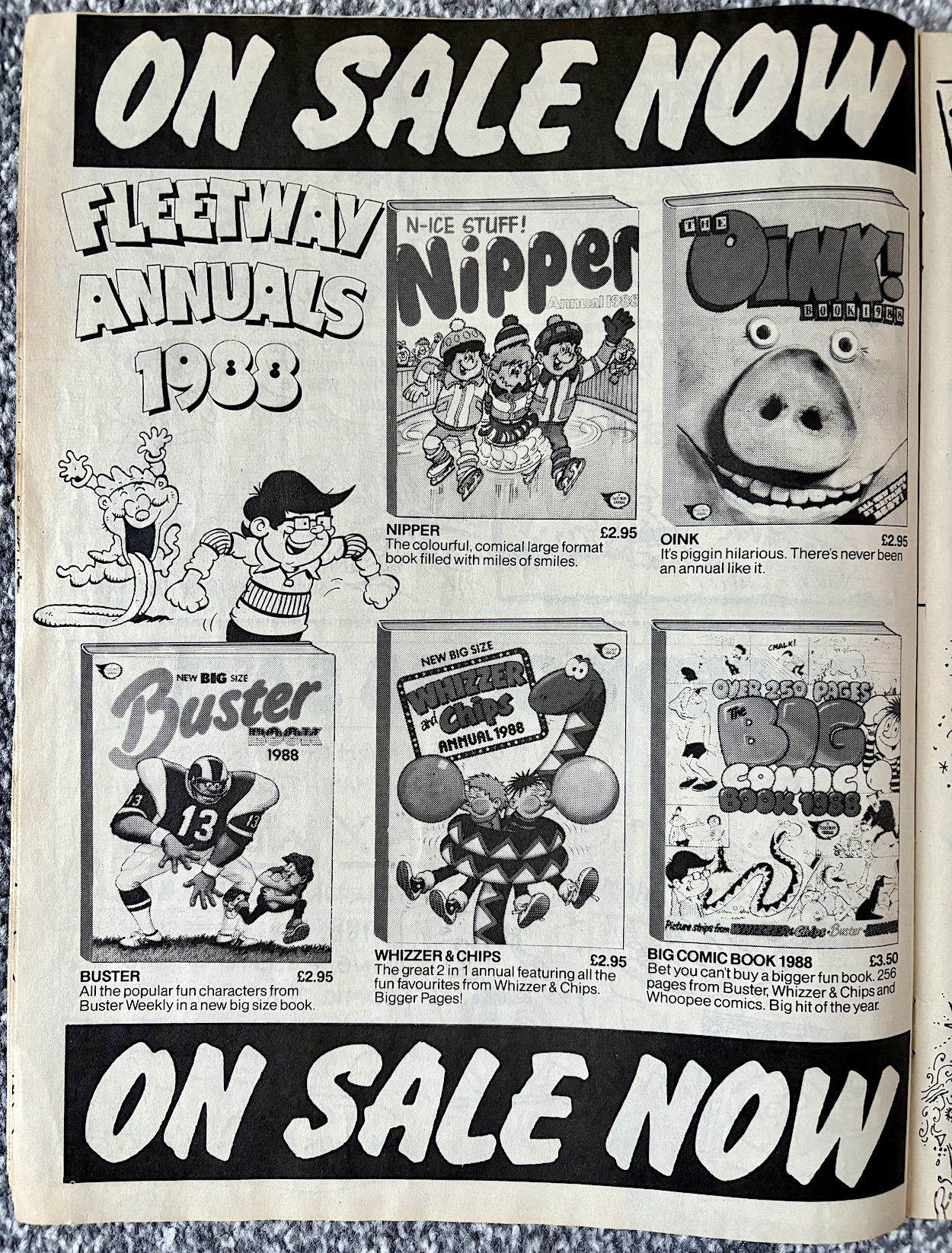
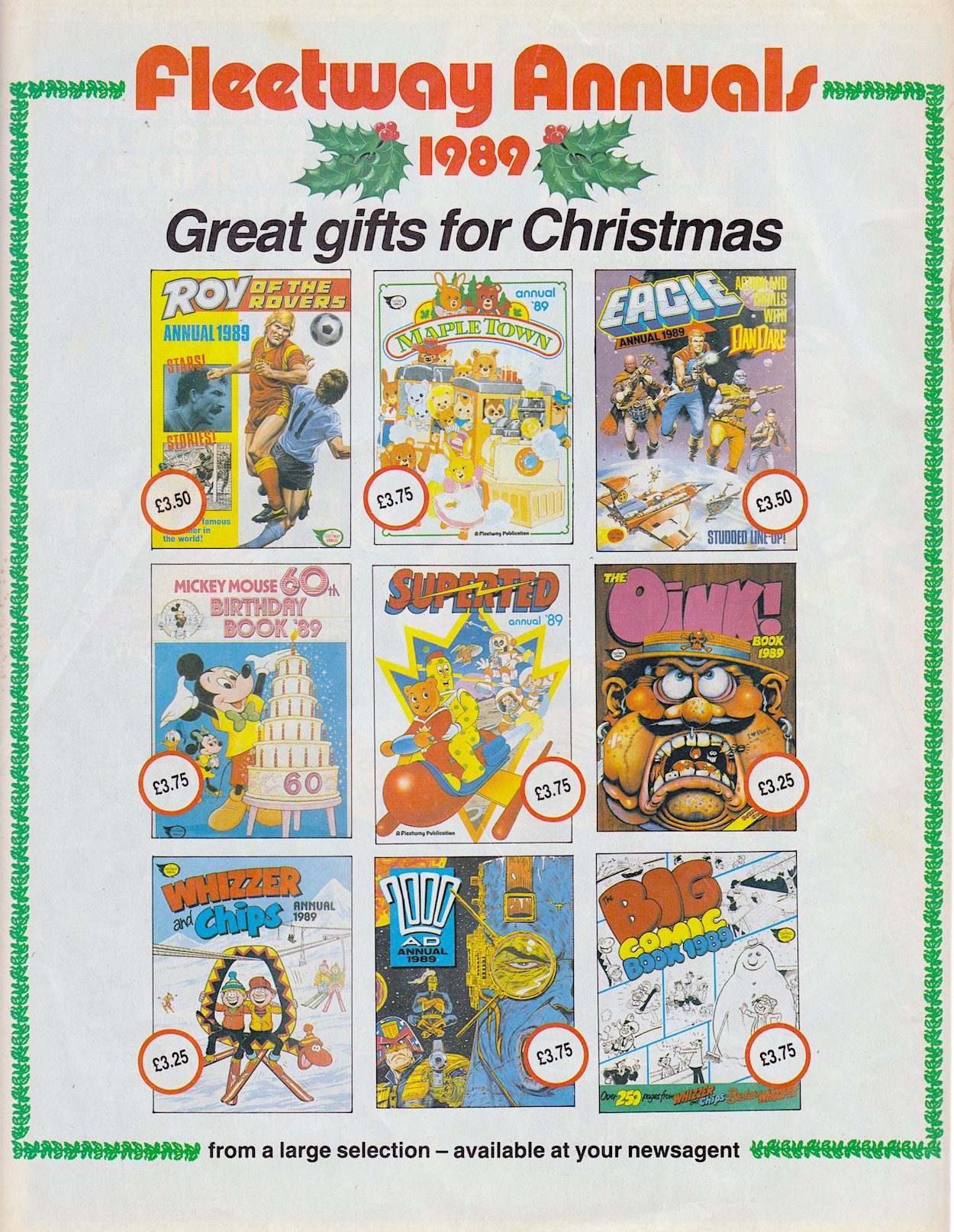
Below are promos for Fleetway’s annuals in 1987 (for the 1988 volumes) and 1988 (for the 1989 volumes) and you can’t deny OiNK’s really stand out! Especially that first annual, The OiNK! Book 1988. The advert understates it somewhat by simply saying, “There’s never been an annual like it”. The cover image compared to the other more traditional titles already got that across the second readers glanced at this page.
The next year’s advert, pulled from the final regular issue of OiNK, used the original colours for the OiNK logo before the yellow and pink were reversed to stand out more on the shelves before publication of The OiNK! Book 1989. There’s quite the variety here, with everything from action and sport to comedy and nursery comics. We even see the return of Mickey Mouse from our first advert, who was still a sprightly 60-years-old that year.
I was surprised at how few comics adverts there were in total over OiNK’s run, especially when you compare them to Marvel UK which had promos for their other comics as a regular staple, alongside their fondly remembered checklists. In fact, the final such advert seems to have been literally squeezed into the OiNK Holiday Special ’89; a favourite childhood comic of mine is seemingly used to fill a gap on a page of both real and spoof ads.
We may not have seen much in the way of other comics inside the pages of OiNK, but over the course of its lifetime it was the subject of a blockbuster pull-out ad, crossover strips, free editions in comics and magazines, on top of regular adverts. Maybe Uncle Pigg just didn’t want to share the limelight.
We’ve still got two parts of this series to come that should jolt the old grey cells of original readers and the curiosity of you younger ones out there. Next up are the hip and chunky electronics of the 80s. It was a decade of technological revolution as the microchip introduced itself to every aspect of our lives. Watch out for those samples of another time when this occasional series returns this winter.
So did you remember to buy enough batteries before Christmas Day for your children’s toys? Did you remember to charge the others? Is your house now a cacophony of tiny electric motors, repetitive music and flashing lights? Of course, it all depends on the age of your kids, but that’s what Christmas was like for us back in OiNK’s days. What were we playing with back then? What did Santa bring us?
For the third part of this series the topic is toys and games, and the pages from OiNK we’d shove in front of our parents’ faces before writing the details on a piece of paper and firing it up the chimney. We kick things off in the very first edition, the OiNK Preview Issue and it’s promoting a smörgåsbord of delights that could have been part of our previous selection of food and drink adverts.
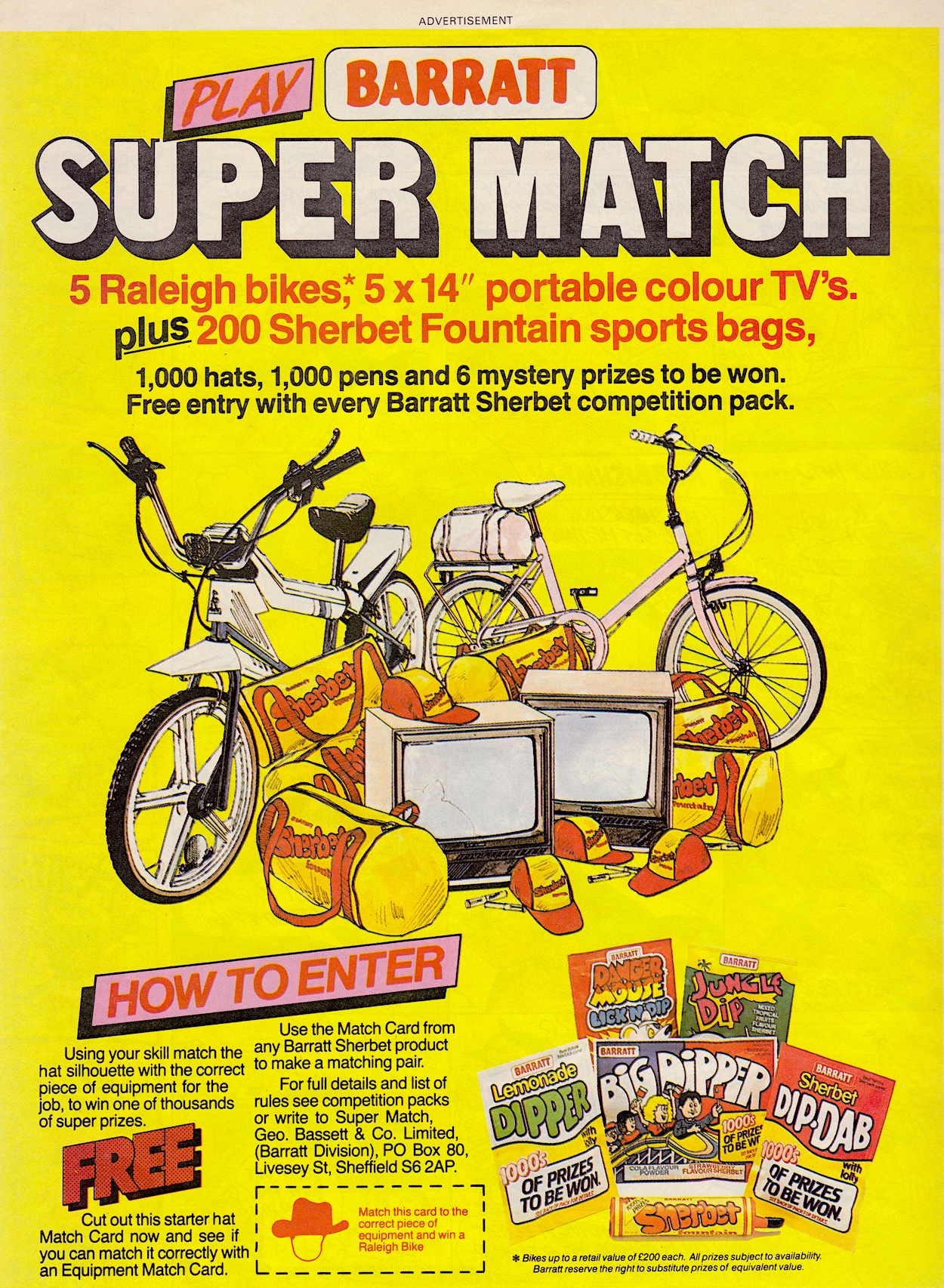
Forget the bags, hats and pens, I can remember my first BMX bike and portable TV, both of which I very gratefully received from Santa Claus. Although I’m sure any younger readers will probably be wondering what’s so “portable” about a very heavy CRT television with a 12” screen. Well, it was so portable we could move it all the way from one corner of the bedroom to the other any time we wanted!
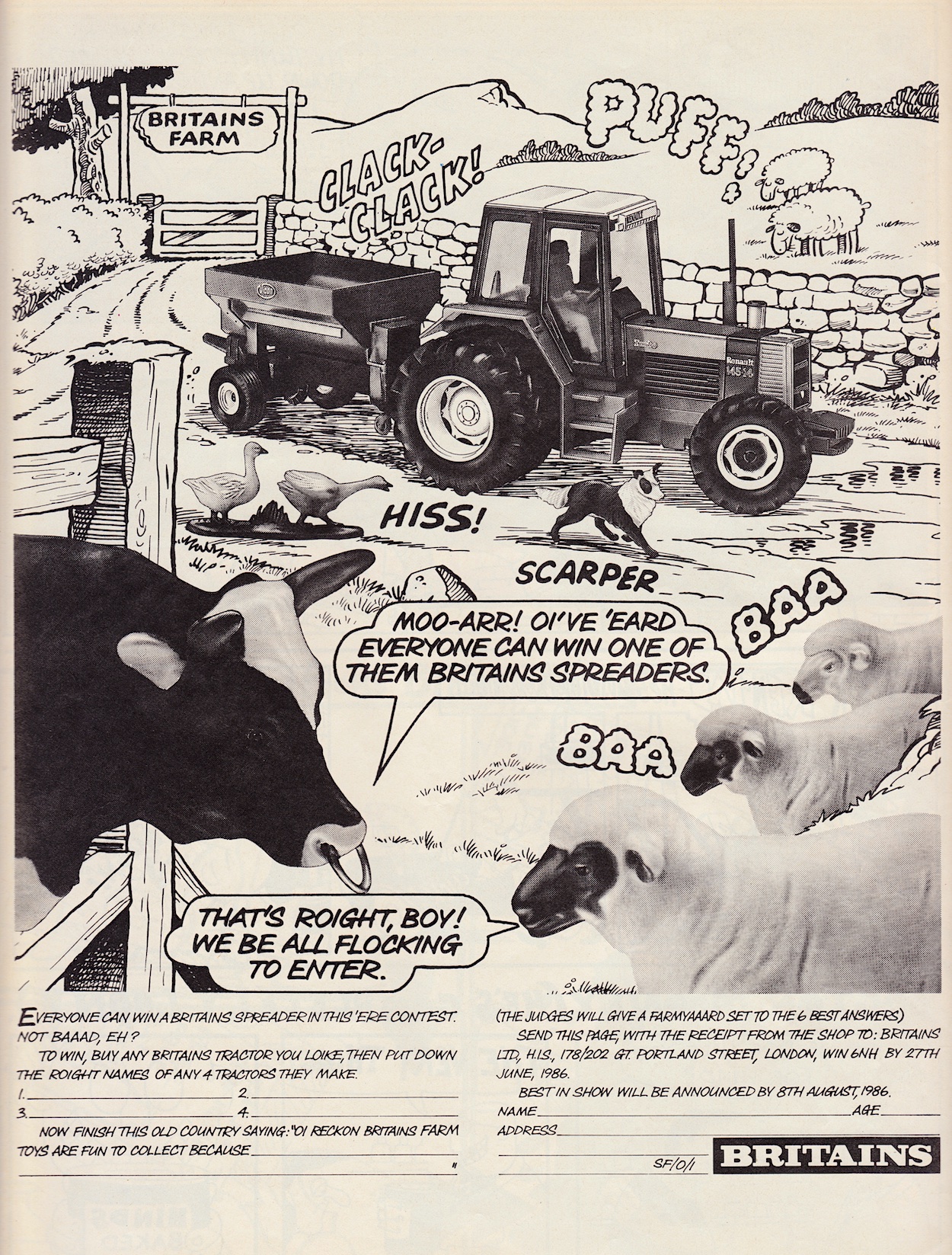
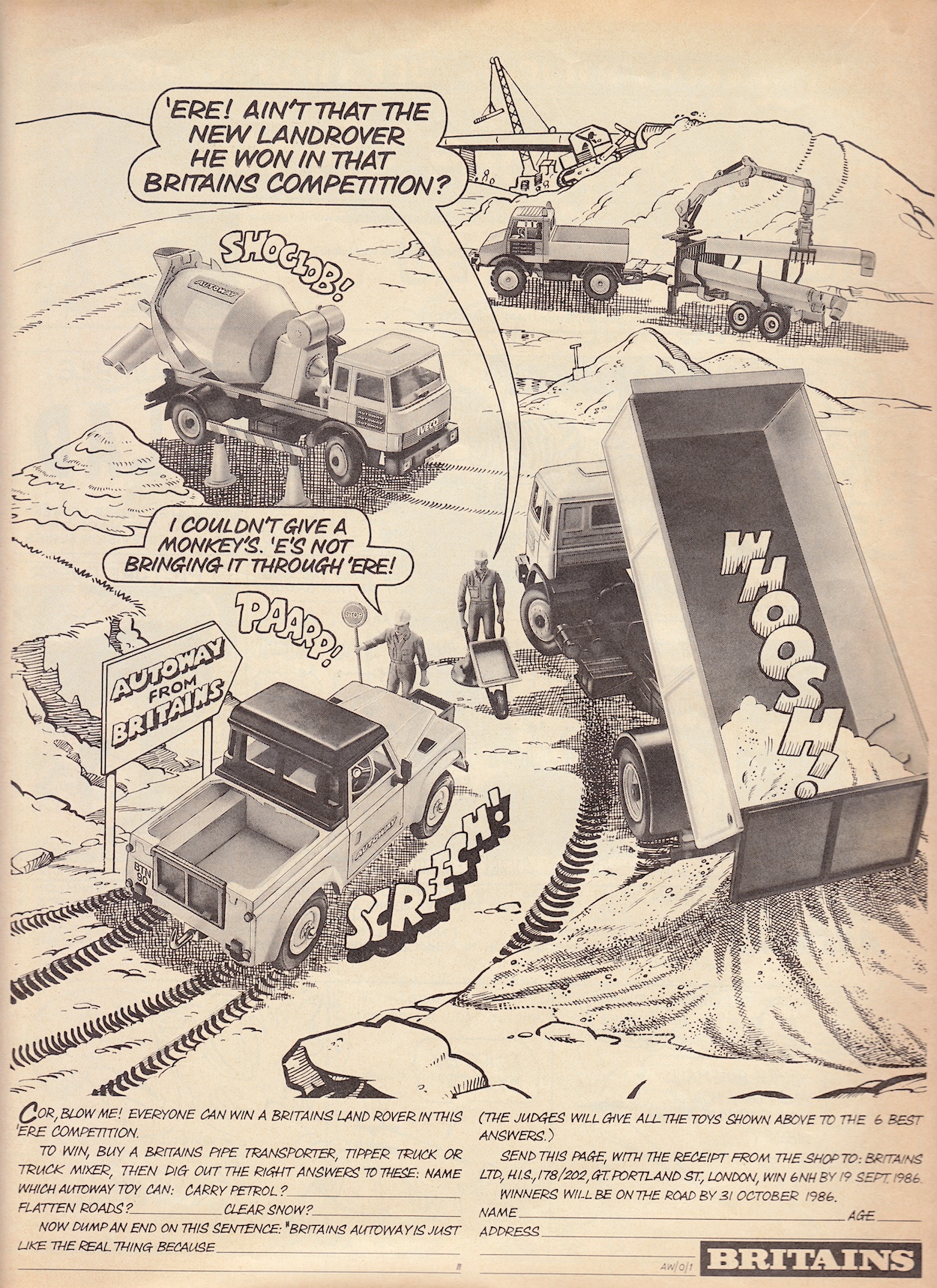
This is of course a competition set by Barratt of Sherbert Dip fame but it showcases some of the hottest tickets in town as far as those chimney lists were concerned. I’m not so sure the next range from Britains would’ve had me as excitedly entering their competition though. Don’t get me wrong, I’m sure there was a market for them but these adverts make toy cars and trucks seem rather old fashioned even by 1986 standards.
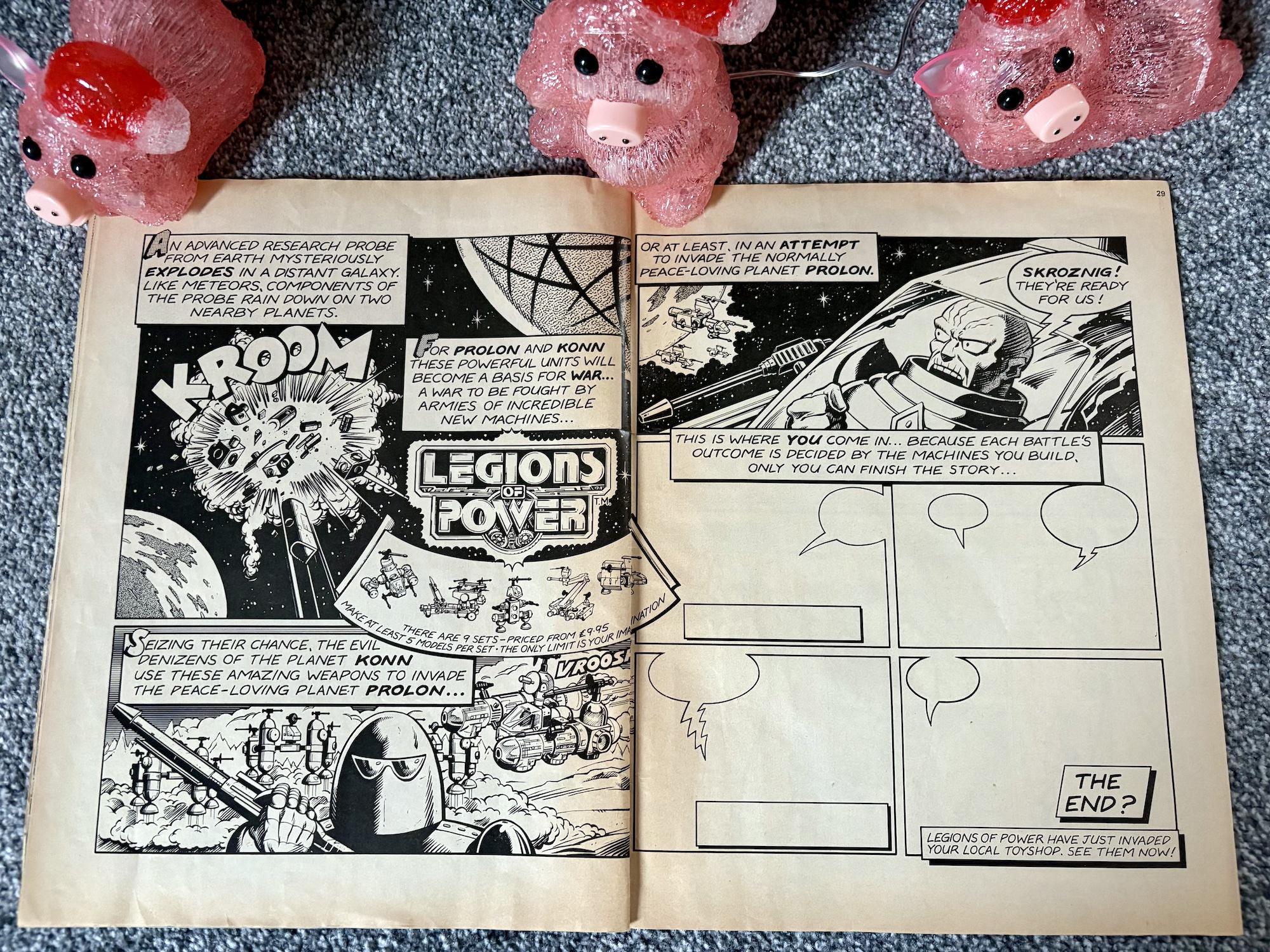
They weren’t the only company that would try to tailor their adverts to the comics medium by introducing panels, captions and speech balloons to make them feel less out of place. Perhaps it was an attempt to get us kids reading their adverts before realising they were ads, or perhaps it was just for a bit of fun. I like to think it was the latter. However, finishing your comic strip would be nice.
I’m not sure whether to laugh at the idea behind this advert or laugh at the audacity! I get the idea obviously; we’re meant to go and buy the toys and finish the story for ourselves and it does get that point across in an original way. Still, you’ve got to hand it to them, it’s a rather cheeky way to cut back on the effort (and cost) to produce it.
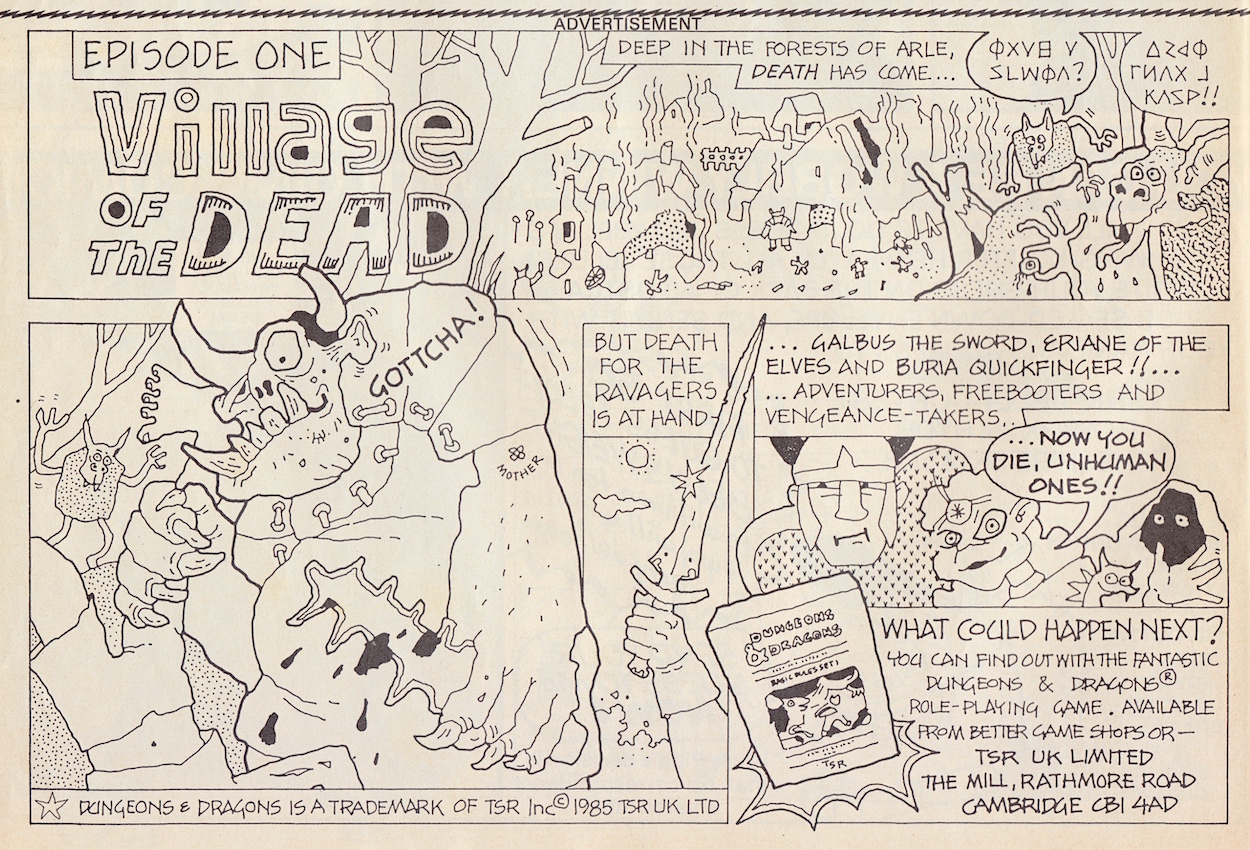
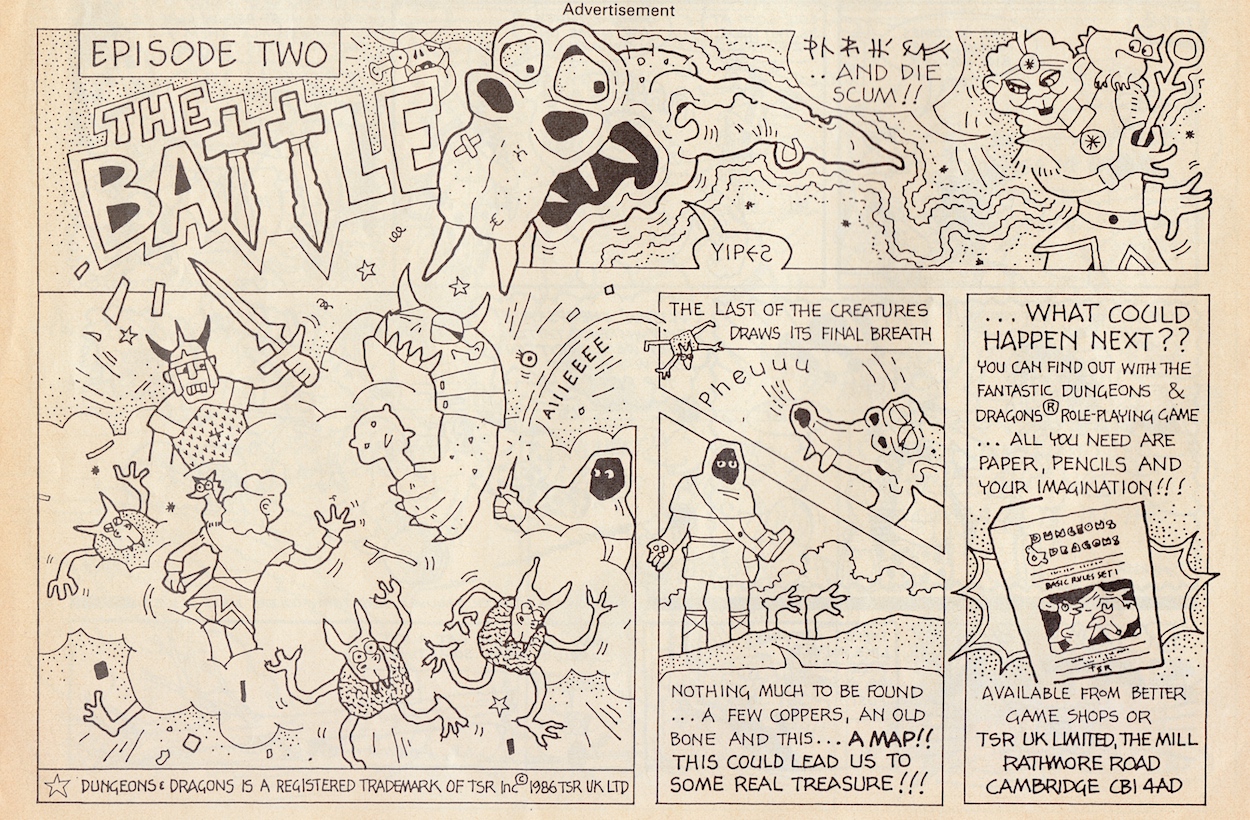
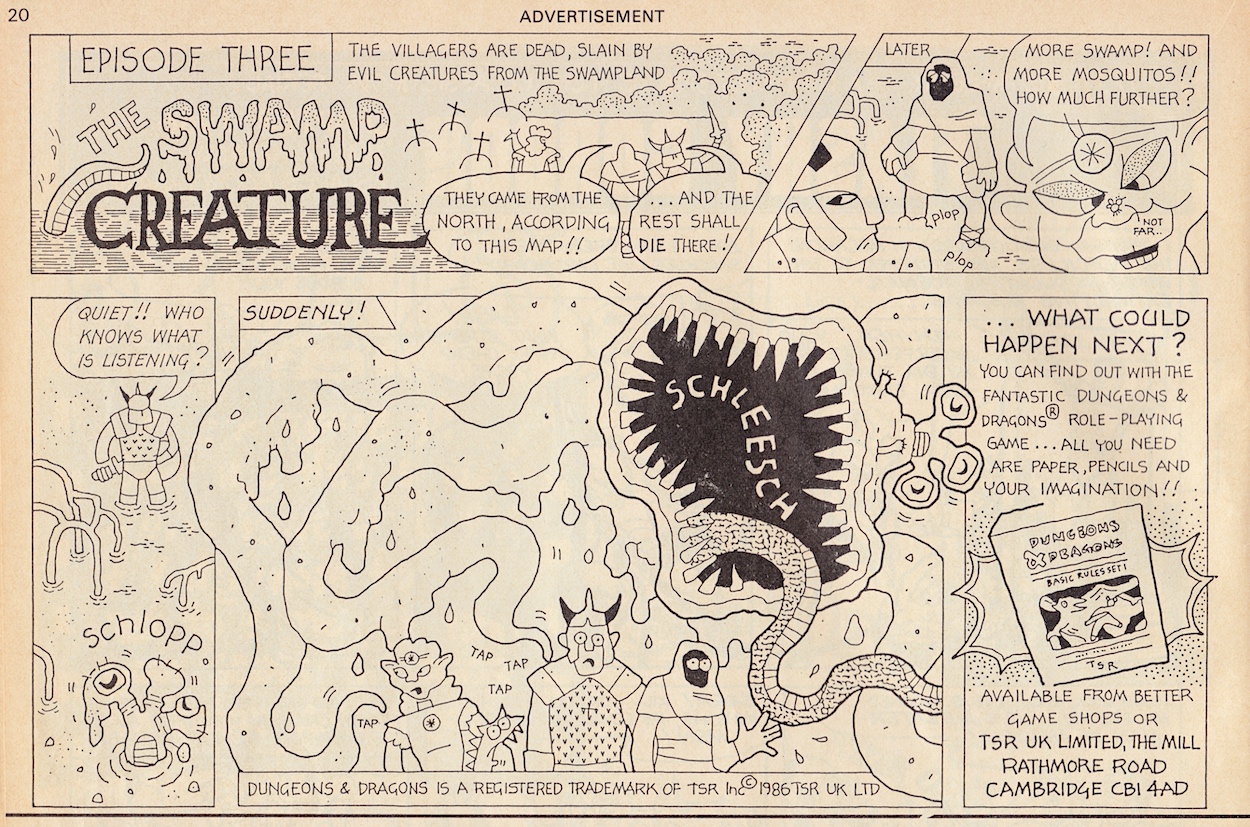
In the early issues a series of adverts appeared that actually told a story in three parts. They were for TSR’s Dungeons & Dragons role-playing game, something a handful of my friends at school were into. I never understood the appeal at the time of playing a game completely in their imaginations, nor did I have the patience to learn. In later years I’ve met friends in my adult life who have D&D nights and the way they’ve explained it does make it sound like fun.
I think as a kid I was used to games that had pieces and a board and rules etc. I couldn’t wrap my head around how D&D worked and always figured it would be too easy to cheat and just make stuff up as you went along. I know better nowadays, of course. I worked beside a guy in an office for over a year who was the Dungeon Master of his group of friends and I’m now very aware of how much preparation goes into a good session.
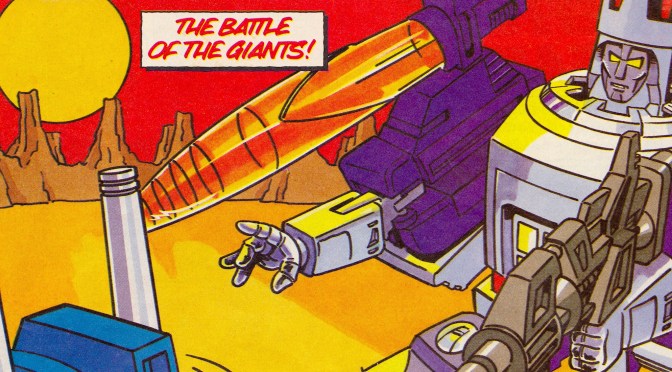
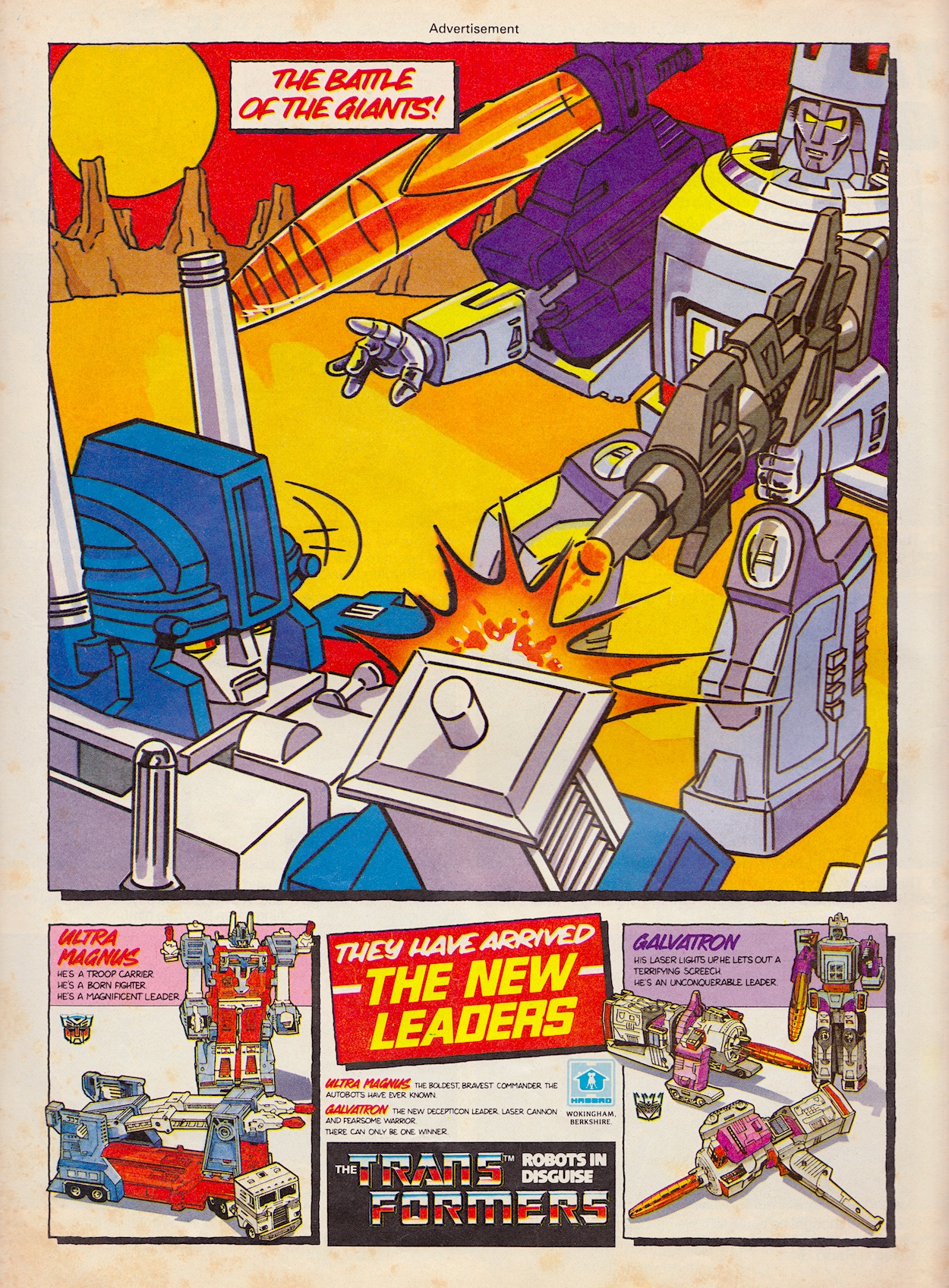
In 1986 Hasbro’s Transformers toys showed no signs of slowing down but that didn’t stop them from wanting to replace the original line up with a fresh batch of Autobots and Decepticons. What better way could there be of getting that point across than replacing the iconic Optimus Prime and Megatron with new leaders? And what better way to introduce them to the world than through a movie at the cinema?
While Ultra Magnus was leader was five minutes, Galvatron would be rather more successful. My old school friend Roger (who I know reads the blog, so hi Roger) had both of these toys and as a young child they felt massive my tiny hands. They really were incredible, and just in case Magnus turned out to be a naff leader he had a hidden Optimus Prime inside. That’s right, isn’t it? Of course. It certainly wasn’t a way to cut costs and recycle part of a previous toy, no.
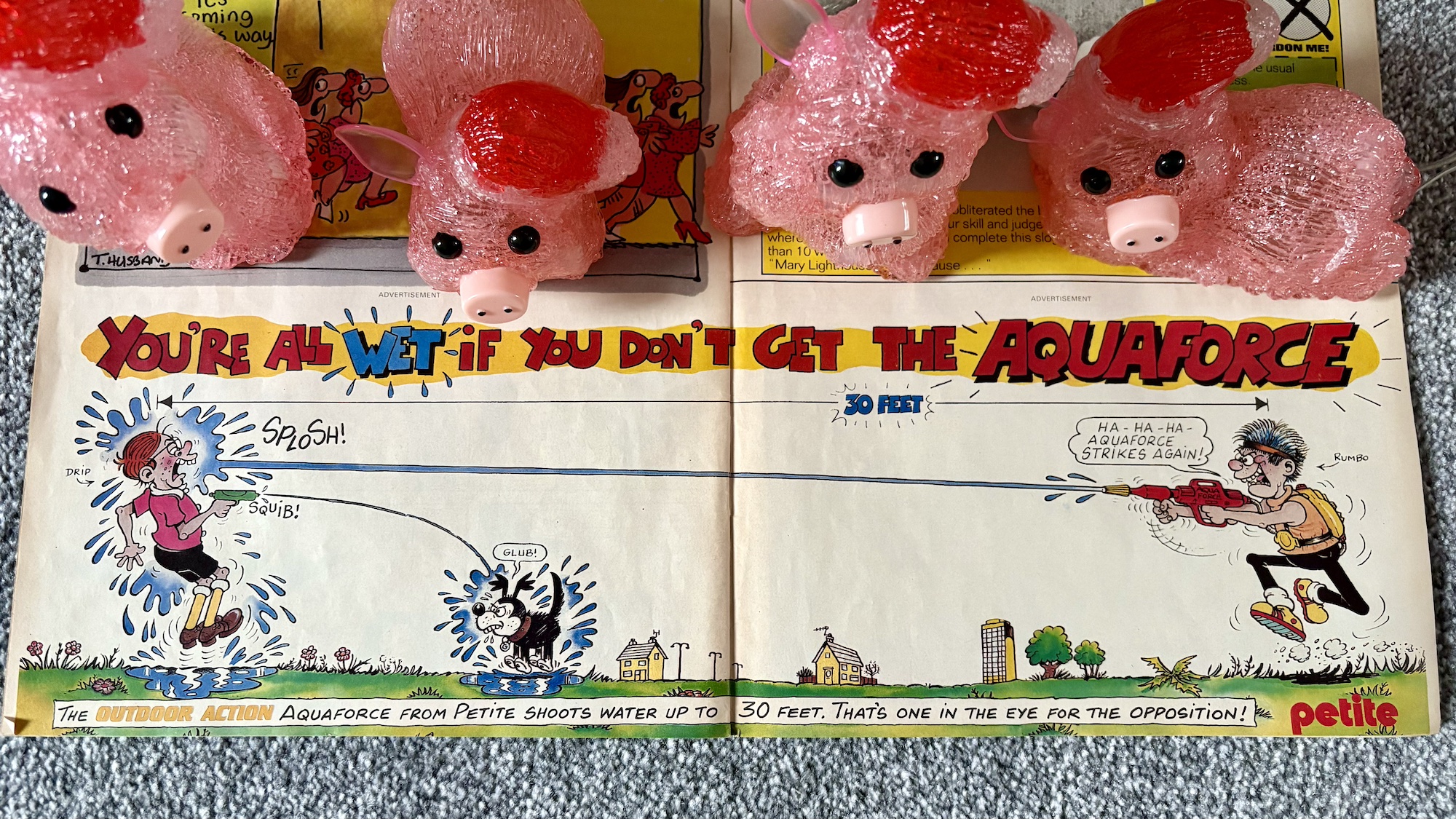
There are moments in your life when you realise you’re a lot older than you care to admit. I remember playing with water pistols and threatening to soak the adults around us, never fully understanding why they didn’t want to play such games in the middle of winter. As my best friend Vicki now has two kids of her own and her eldest, Ollie, is approaching six-years-of-age I’ve been on the receiving end of many such “threats”… and of many Nerf bullets! Yep, I’ve become one of those adults.
Given the fact this advert is 38-years-old that’s a pretty damned good water pistol/cannon that fires over 30 feet. Saying that, I’ve no idea how far today’s top-of-the-line toys squirt water and I’m hoping I won’t find out any time soon. At least not until the summer please, Ollie!
That’s us at the end of our Christmas look back at the toys and games advertised within the pages of OiNK between 1986 and 1988. We’re halfway through this occasional series now and I’ve lined up the next two instalments for next year, beginning with one close to all our hearts: comics and books. Watch out for that during 2025, which is on the cusp of greeting us as I type.
I’ve really been looking forward to diving back into this occasional series of posts in which we take a look at all of the real advertisements published in OiNK between April 1986 and April 1990. Still to come are adverts for comics and toys amongst other things, however in a surprise turn it was seeing the adverts for all of the food and drink of the 80s that really transported me back in time.
There were plenty of them in OiNK too, far too many to include in one post, so I’ve whittled them down to 11 of my favourites, all for things I’d have happily chomped down on or guzzled back when I was a kid. Well, there’s one exception to that and as you scroll I’m sure you’ll be able to guess which one. Some of these are no longer available, but even for those that are their adverts are so quintessentially 80s they just had to be included. So let’s get things started with some breakfast, shall we?
I remember those adverts on TV with kids walking down the street with a superimposed red glow around them after eating their bowls of hot, filling Ready Brek, advertised here in #52 from February 1988. I did like that cereal, although I preferred my mum’s huge pots of porridge she’d rustle up. I don’t know about you, but I think a list of ’50 Brill Things To Do Before Breakfast’ would’ve been wasted on me. Getting out of bed and washed and fed was enough to do before school!
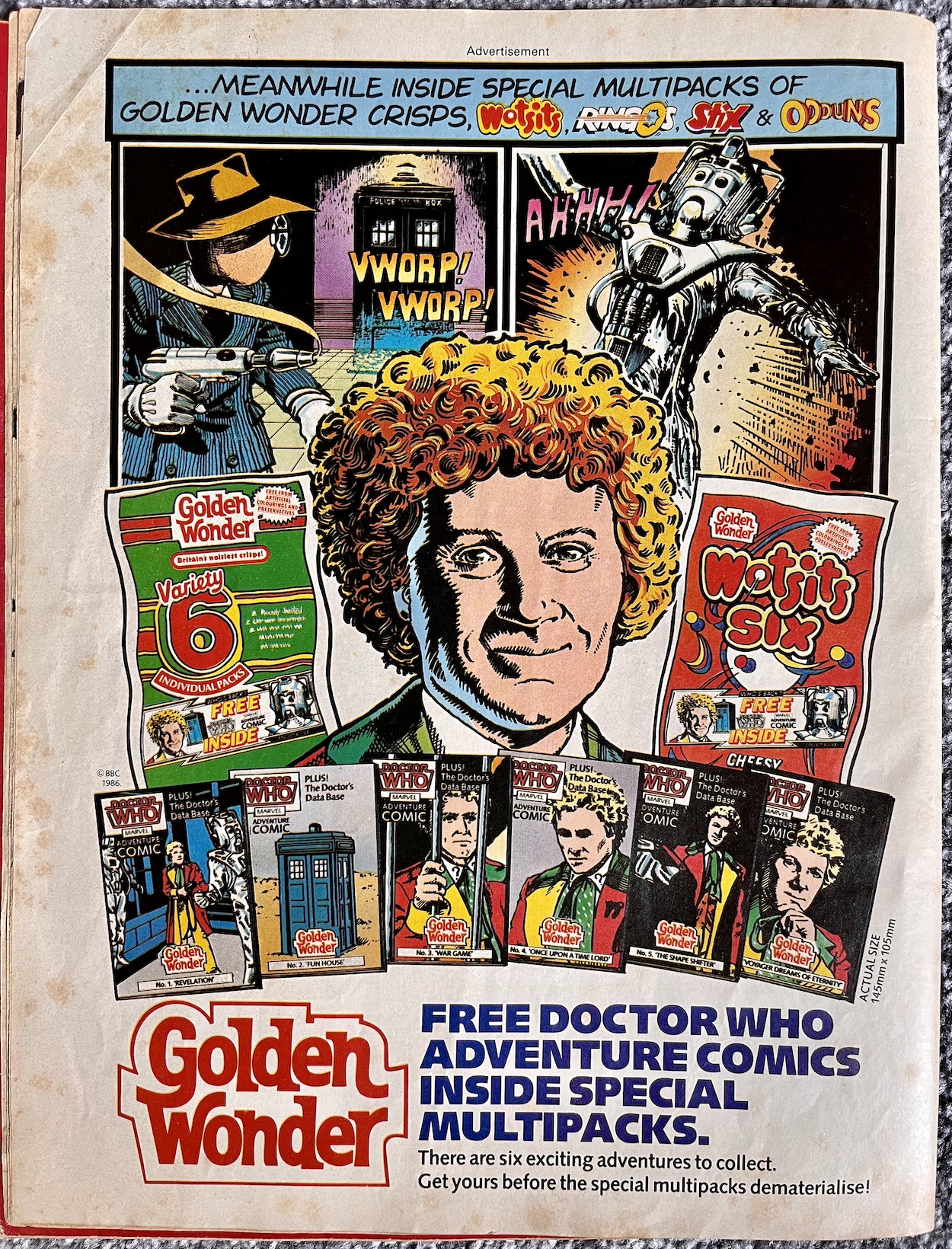
“Get yours before the special multipacks dematerialise!”
Golden Wonder crisps
The Bean St. Kids (#39, October 1987) had animated cartoon adverts on TV I seem to recall, complete with cackling villain, but the tins sold themselves. I know we’re told our tastebuds change as we age, so either mine really have or those tins of mini sausages have changed, because as an adult I think they’re completely vile! I tried one of those ‘All-Day Breakfasts’ in a tin of beans and my word, never again. But as a child I loved them, especially with crispy bacon and eggs for breakfast at the weekend.
As our day in the 80s continues it’s time for a mid-morning snack and our house always had multipacks of crisps for us to rummage through, although more often than not they were Crazy Prices’ Yellow Pack crisps (ask your parents, kids). Sometimes we got treated to others though and apart from Wotsits (I remember devouring all of the barbecue flavours before my siblings could) the other household favourites were all advertised in OiNK.
My dad still eats the Salt-n-Shake crisps to this day, although you can only get the salted ones now. This is just as well really because I remember the other flavours didn’t really work. No matter how much we shook the bag like the fella in this advert from #6 (July 1986) we’d always get a mixture of bland crisps and others with so much flavouring on them they’d burn our tongues. Needless to say that “mixing different sachets” to “invent your own flavours” was an atrocious idea too.
I’ll admit I still have a fondness for Monster Munch (#33, July 1987) to this day; the pickled onion ones are a favourite but I just can’t walk past a shelf of roast beef packets without filling the trolley! I was sure the regular Golden Wonder crisps disappeared for a while many years ago but that doesn’t seem to be the case. While they did go into administration in 2006 they were bought by my local Northern Irish crisp company, Tayto and continue to be made here, which surprised me!
“You can meet Jo-Jo, Bruno and our own super hero, ‘Mar-Might’…””
Marmite spread
I remember the Golden Wonder bags of my youth had a little window on the front through which you could see the crisps. The packets were horrible though, becoming very jagged when crumpled and they felt horribly greasy on the inside, things people seem to forget on those talking heads documentaries on Channel 5 where celebrities go all misty-eyed for such things. Here in #15 (November 1986) the promotion to lure us kiddies in was a range of exclusive Sixth Doctor comics, although the lure was lost on me as I didn’t start watching the show until 1988.
On to lunchtime sandwiches and no prizes if you guessed the first of these two adverts (#22, February 1987) is the thing I mentioned above that I didn’t like. I still don’t. I’ve only ever tasted Marmite once but I didn’t eat it. I’m probably sharing too much information when I say I was in my early 20s, I’d been out for a night for a few drinks and at the end I kissed a lady who had just eaten some. Gagging and recoiling from a kiss isn’t a great impression to make.
In #25 (April 1987) bread was advertised in a children’s comic. How exciting. To be fair, it was promoting a free sports bag emblazoned with the loaf’s logo and Champion was heavily advertised during children’s programming as the bread of choice for fit and athletic kids. I hated it back then with all of the little ‘bits’ in it but these days I do love a good granary loaf. Showing my age probably. Mother’s Pride make a vast amount of different breads these days in their Hovis range. I wonder if one of them is the modern day equivalent of this?
Imagine that was your foot!
On the way home we’d visit the sweet shop and long before Jamie Oliver’s sugar tax came in (something I cursed him for at the time but which I now think was for the best) any can of soft drink was so loaded with sugar they were main staples of kids’ diets in the 80s! Cherry Coca-Cola was the latest craze and was advertised with very surreal images on both the telly and in publications. They made little sense but were certainly eye-catching and worked a (sugary) treat, the first two here taken from #28 (May 1987) and #34 (August 1987) respectively.
It doesn’t taste the same anymore. For some reason when the sugar tax came in Coke changed the recipe for Coke Zero (the brand under which the different flavourings now reside) and suddenly it tasted like that horrible Diet Coke stuff (I’ve never been a fan). I moved over to Pepsi Max and actually much prefer it and its range of flavours, so thanks Jamie! I still buy my sugar-full Coke to slow cook my Christmas ham though. (Damn, that’s still too many months away.)
“2p off Milky Way!”
Milky Way chocolate bar
In hindsight ring pulls were so bloody dangerous on a product kids loved, never mind asking us to actually collect the sharp little things, and that advert (#30, June 1987) makes me wince nowadays. Imagine that was your foot! Anyway, collecting them is exactly what we did. I didn’t send any off for this particular product but I’m going to guess many blog readers of a certain vintage will have done so for their Coke or Fanta yo-yos, am I right?
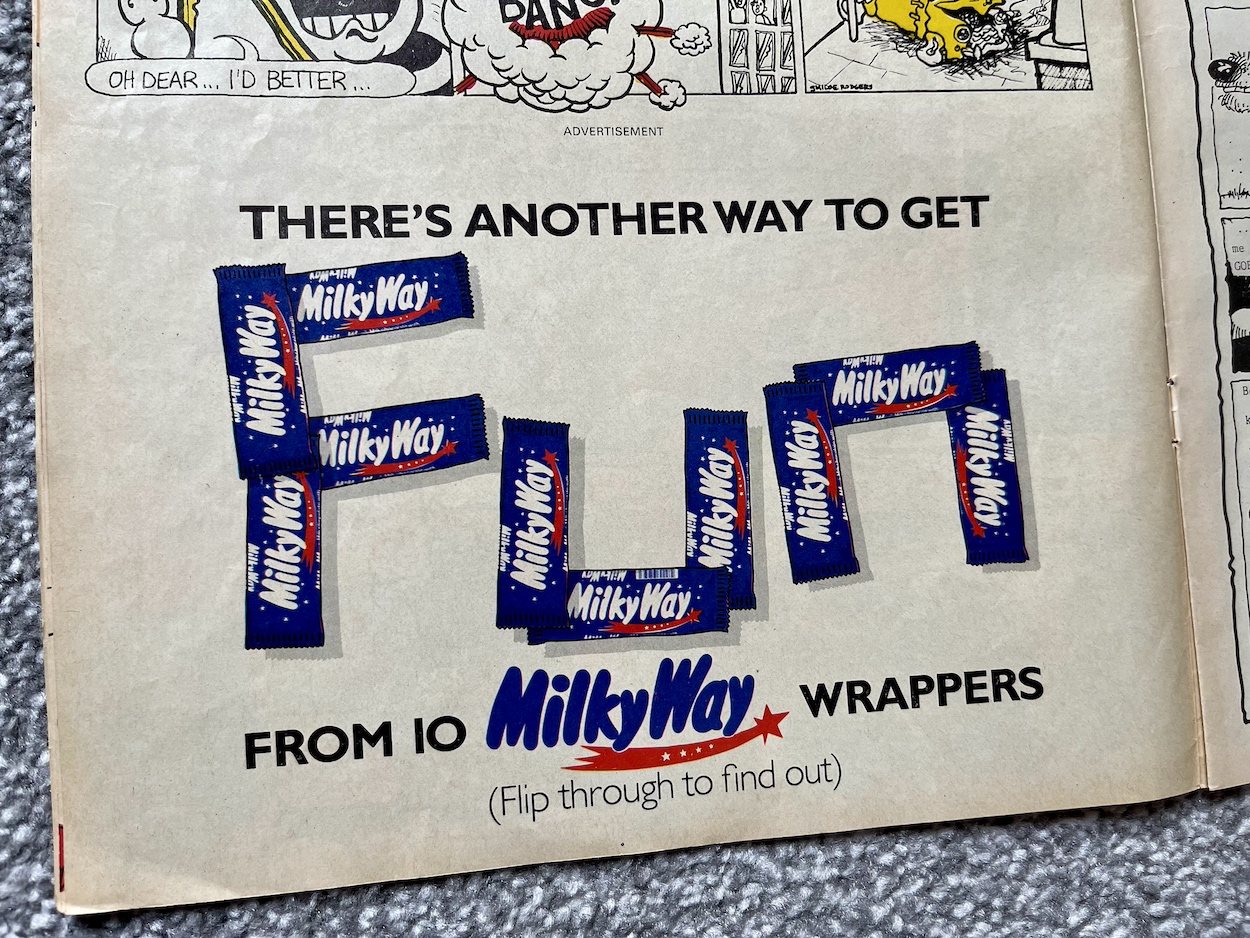
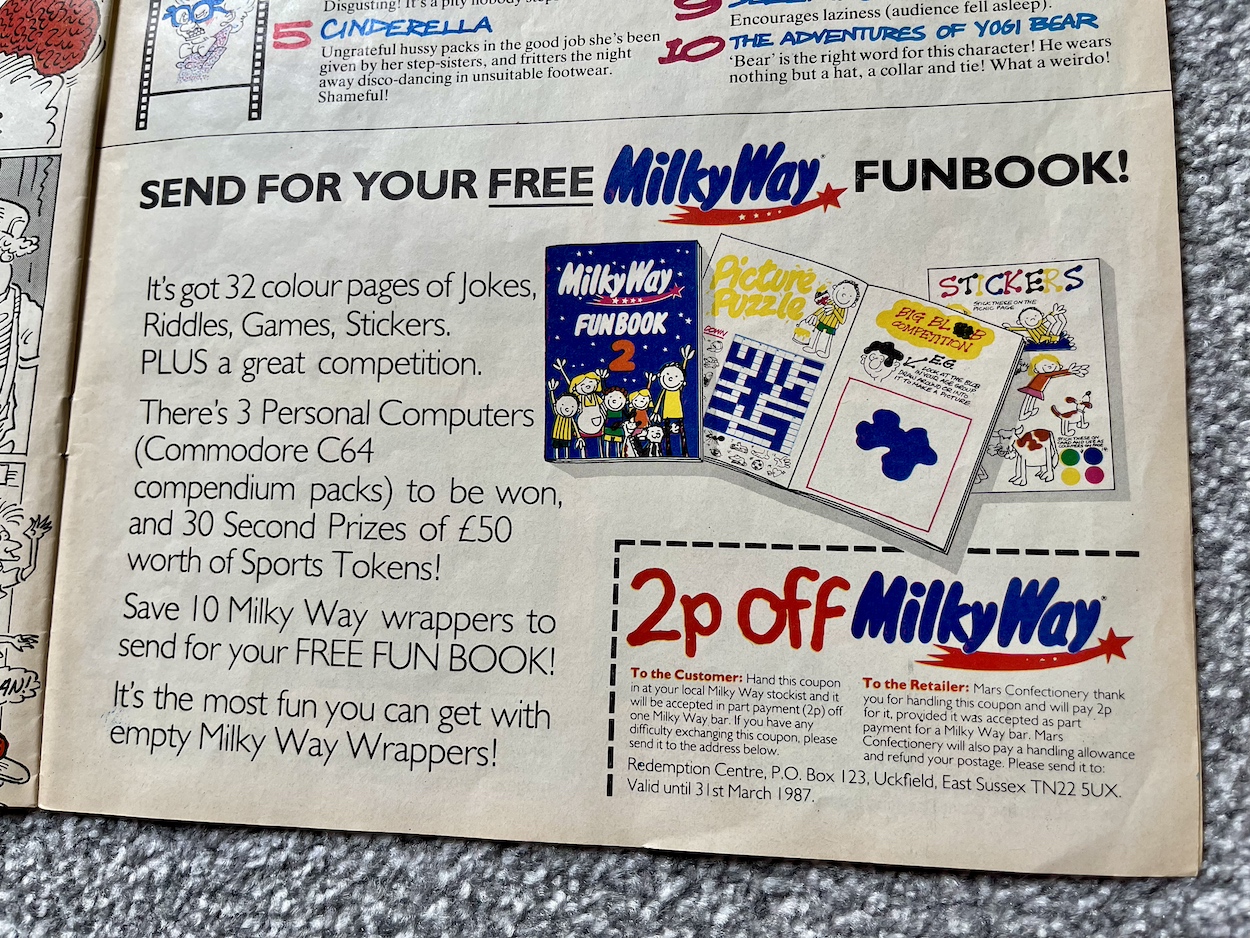
With most of our pocket money spent on crisps and soda what were we going to do about our chocolate cravings? We couldn’t have a can of Coke without a chocolate accompaniment! But we also couldn’t spoil dinner, so we needed something we could eat “without ruining our appetite”. Luckily, Mars gave us a handy coupon for a whopping 2p off our next Milky Way. Hey, don’t knock it, that was a good chunk off back then. The advert was also split in two and spread over the issue (this one appeared in #12, October 1986).
The competition for a Commodore 64 also catches my eye today, it being my first proper home computer, although I didn’t get mine until Christmas 1991. The inside of a Milky Way was chocolate flavoured back then but was changed to vanilla in 1993 and I hated it. Although, Mars’ Flyte came along in 1996 and used the original recipe in a bar aimed at adults. Once I discovered this they were a very frequent purchase. Such a shame they’ve been discontinued since.
This really has been a whirlwind trip down memory lane for both my mind and my taste buds. I feel suitably qualified to appear on Channel 5 now. You can see companies knew how to appeal to us 80s kids. As well as adverts taking the form of comic strips, many offered their own magazines and comics to send off for, and there was always something magical about collecting silly little tokens (or ring pulls) that had the desired affect on us and on their bottom line.
In the next part of this series I’ll be taking a look at the toys advertised during OiNK’s run and you can expect that at Christmas (naturally).
Welcome to the first in a new occasional series of posts taking a retrospective look at the contemporary advertisements found within the pages of OiNK between its launch in 1986 and its final special in 1990. The real adverts that is, not the spoof Madvertisements. During the comic’s real time read through I found it wasn’t just the antics of thecomic’s gangster-led mail order company GBH that transported me back in time, these real ads often brought back many happy memories too.
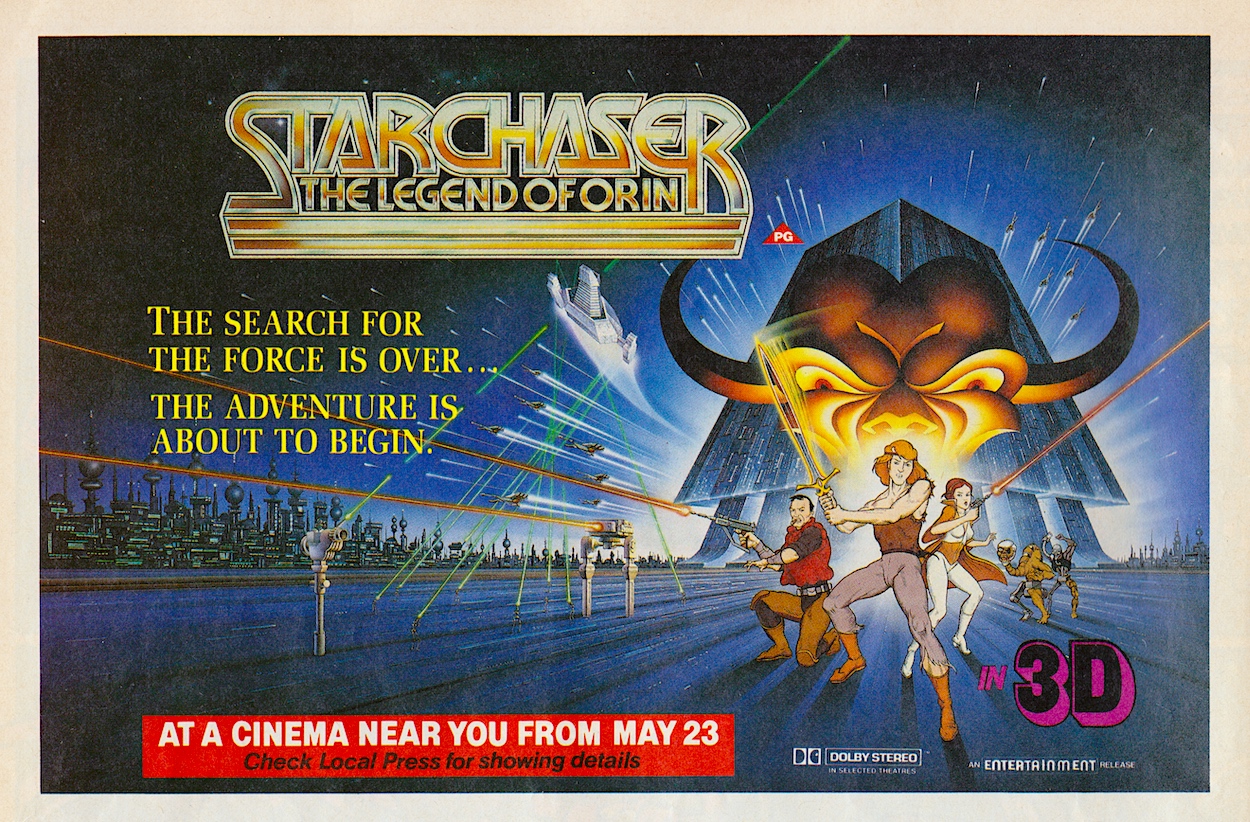
I’ve separated the adverts into six categories. Coming up you’ll see marketing for 80s food and drink, toys, electronics, comics and books, then finishing with a miscellaneous collection to round things off, but we begin with movies. This was an easy selection to make because there were only five of them featured throughout the comic’s entire run. I present them here in the order of their release, and first up is one I’d never heard of before.
The 80s saw a resurgence in 3D movies for a few years, my favourite being Jaws 3D, a fun sequel to my favourite film of all time which has proper, American theme park style in-your-face 3D. Star Chaser: The Legend of Orin was a cartoon but used a combination of traditional art and computer generated animation to produce its effects. Advertised as the first 3D animated film (it was actually the second after a small Australian movie) the story revolved around human slaves being ruled by a ‘God’ who turns out to be a human masquerading as one.
It sounds quite Stargate-like and starred Stargate SG-1’s Carmen Argenziano (Jacob Carter). However, it was it’s very close resemblance to Star Wars’ story which saw it panned in reviews at the time and it flopped at the cinema, which wasn’t great when it was more expensive to produce than other cartoon films. The advert appeared in OiNK #3 in May 1986 and that summer a much more successful movie sequel popped up in the pages of #7.
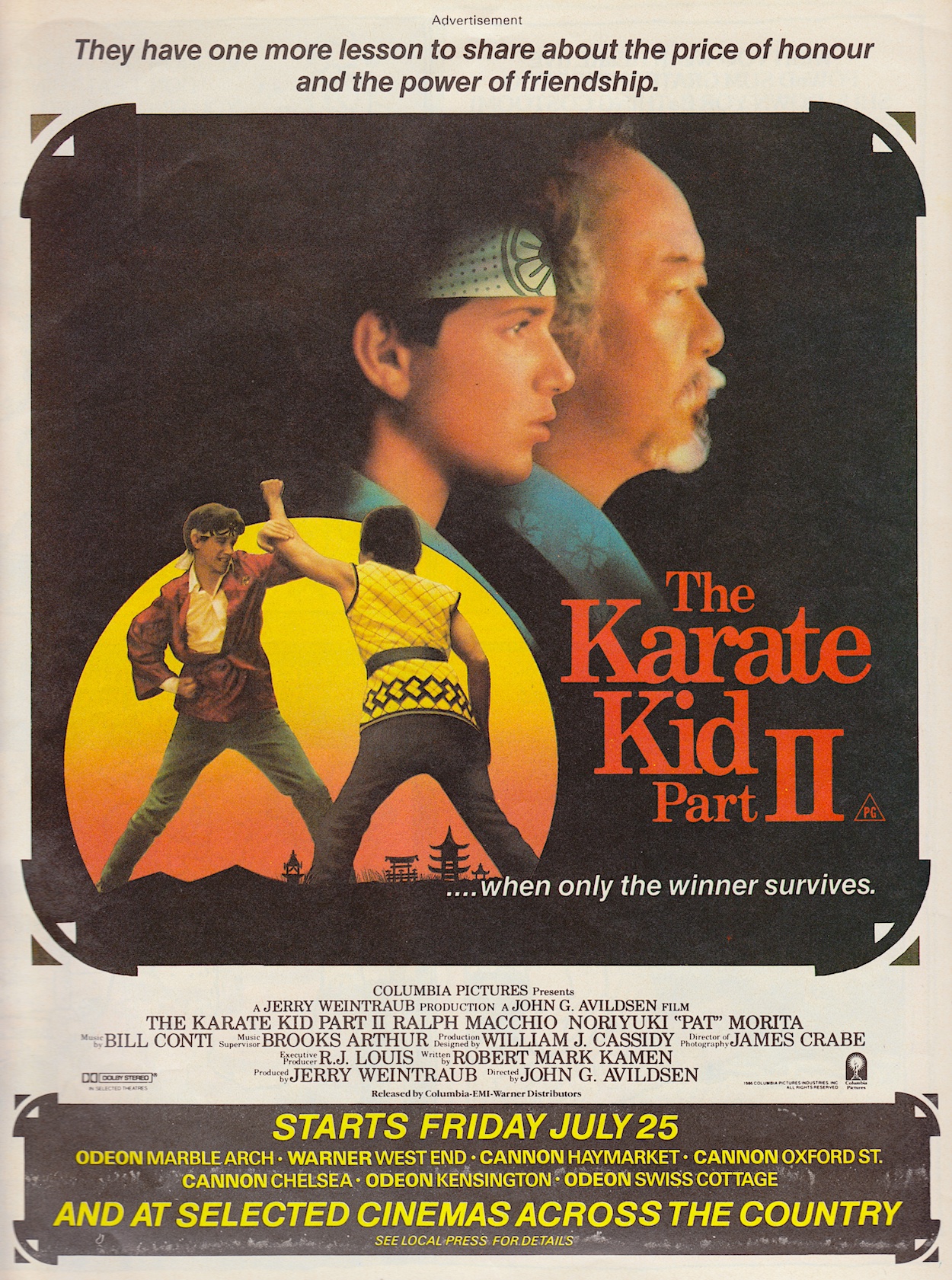
Once again starring Ralph Macchio and Pat Morita, The Karate Kid: Part II’s box office not only eclipsed Star Chaser’s, it equalled the original movie’s and spawned a couple more sequels in the original series. While researching for this post I discovered it never actually filmed in Okinawa, the location that was a major selling point for the film. In reality, the heavy military presence there led the filmmakers to choose Hawaii instead.
The first scene in Part II was originally written to be included at the end of the original so, like James Bond’s Quantum of Solace did many years later, this literally picked up straight after the previous film. I recall my brother renting these from our local video store and I can remember the action, the famous training scenes from the first film and some bits and pieces here and there, but mainly it’s the memory of enjoying them with the family that remains.
I finally succumbed to the years of friends talking about how great David Bowie was as the King of the Goblins
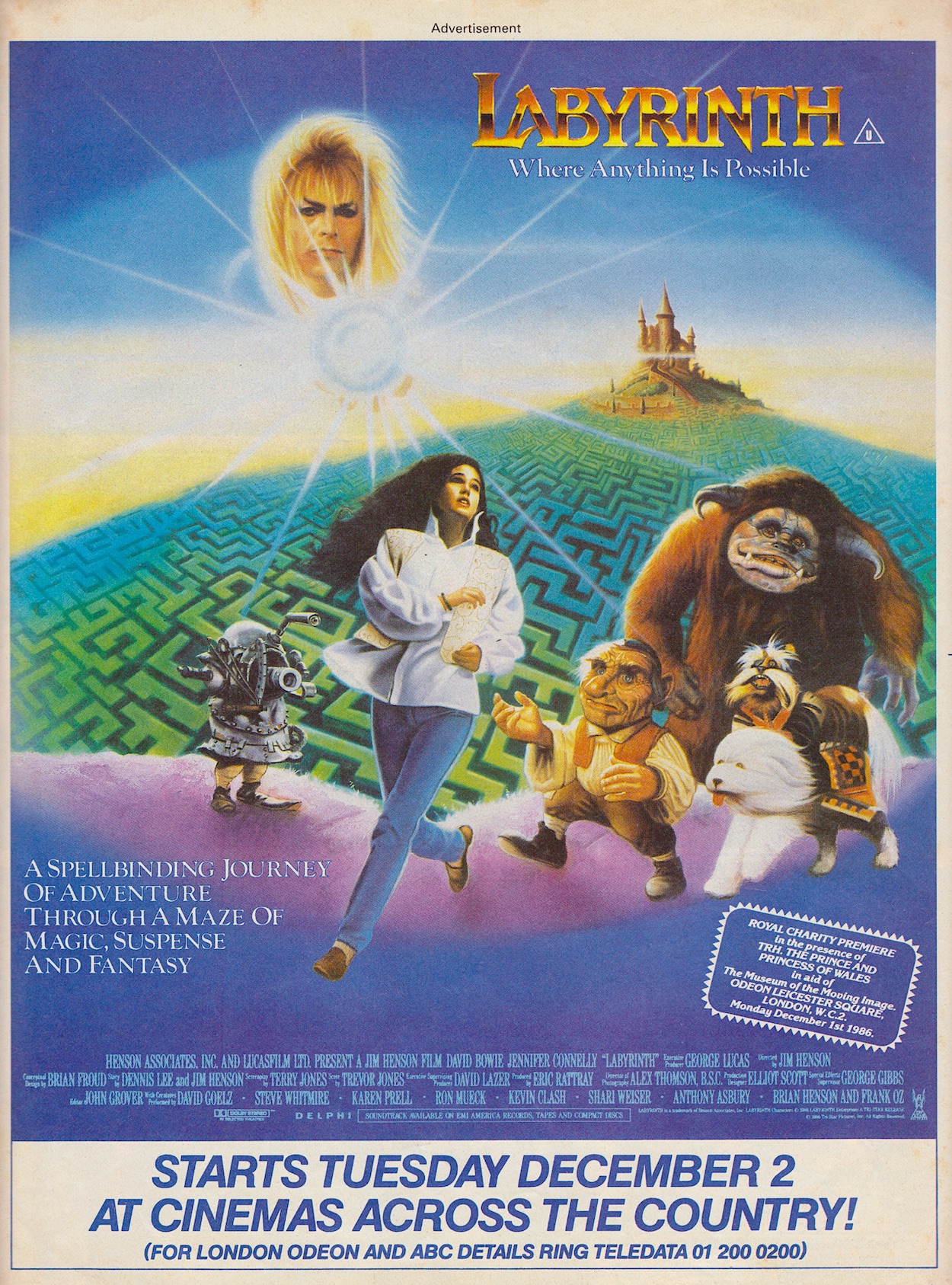
The next film (advertised in #15) completely passed me by as a kid, although as the youngest of five siblings I’m sure they rented it at some stage for themselves or at least watched it on TV during more than one Christmas. It was only during this last festive period (2023) that I finally succumbed to the years of friends talking about how great David Bowie was as the King of the Goblins and sat down to watch it on the BBC one afternoon.
Not only did I love David Bowie (his interactions with the goblin puppets producing some wonderfully funny moments), Jennifer Connelly was also superb. I’ve become a fan of hers through the Snowpiercer TV series in recent years and it’s just incredible to see such a great performance at only 14-years-of-age, especially considering the characters she was interacting with. As for the film, directed of course by Jim Henson (and written by Terry Jones, although rewritten by uncredited others) it still flopped but that hasn’t stopped it from gaining in popularity ever since.
For me personally, it was a fun movie although I do think I’d have loved it more as a kid; the imagination on show is brilliant and very 80s. I really loved the fantastic M.C. Escher-inspired staircase scene too. There’s one movie out of these five I adored from the moment I saw it on VHS at a friend’s 11th birthday party in October 1988, almost a year after this advert for its cinema release in OiNK #16. I’m really not sure why we didn’t go to the cinema as a group when it was out!
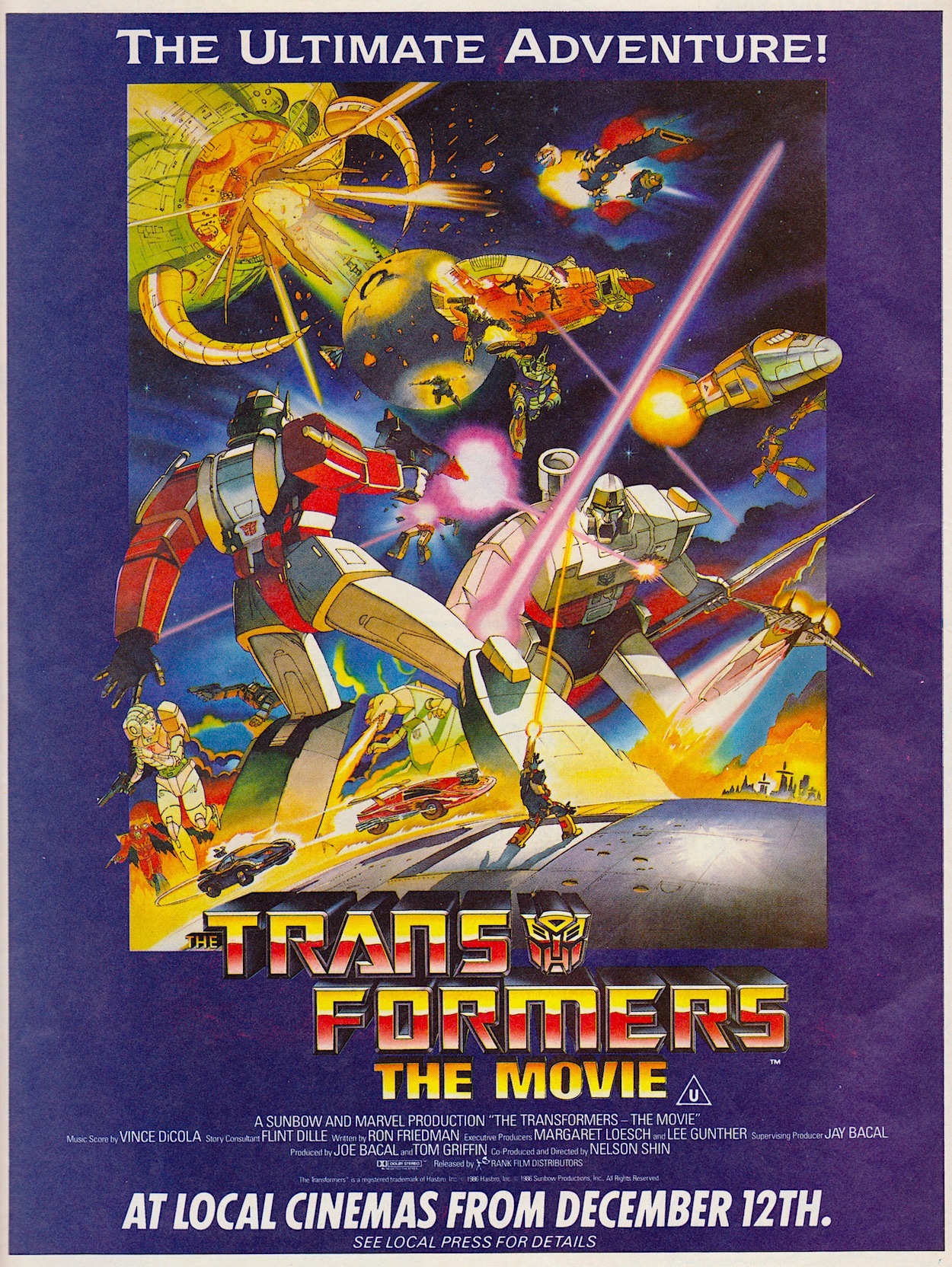
I didn’t really get into The Transformers until the following year, but once I did this movie was rented a lot! It was basically a way for Hasbro to refresh the toy line, hence killing off most of the TV series’ original cast, Optimus Prime’s death famously upsetting children in American and resulting in an added narration at the end when it reached these shores, promising his return. It also flopped (there’s a theme here) at the time and has been derided by critics ever since as a glorified toy advert.
The Transformers: The Movie is also notable for being Orson Welles’ final film, believe it or not
If you’re already a fan of Transformers you’ll love this, if not then it’s not really going to win you over. As an adult I can appreciate its retro goodness, especially its 80s soundtrack, although I find it does work much better as part of the animated series than a standalone film. I just wish they’d stop cutting the top and bottom off it every time they remaster it. It was created in a 4:3 ratio but every time it gets rereleased they seem to think people will only want to watch it in widescreen, the full-screen version usually left to languish, non-remastered, in the extra features. Such a shame.
It’s also notable for being Orson Welles’ final film, believe it or not. Over the years it’s been said he hated it but in reality he really liked the script; he accepted the role after reading it and was happy to be working on a children’s movie. He may not have fully understood all the characters and their relationships with each other but which adult of a young Transformers fan ever did? As a fan of the modern films (Transformers, Dark of the Moon and Bumblebee being my favourites) this can feel quaint today but during my recent read through of the original Marvel UK comic the 1987 film was an epic, dramatic and really fun part of the experience.
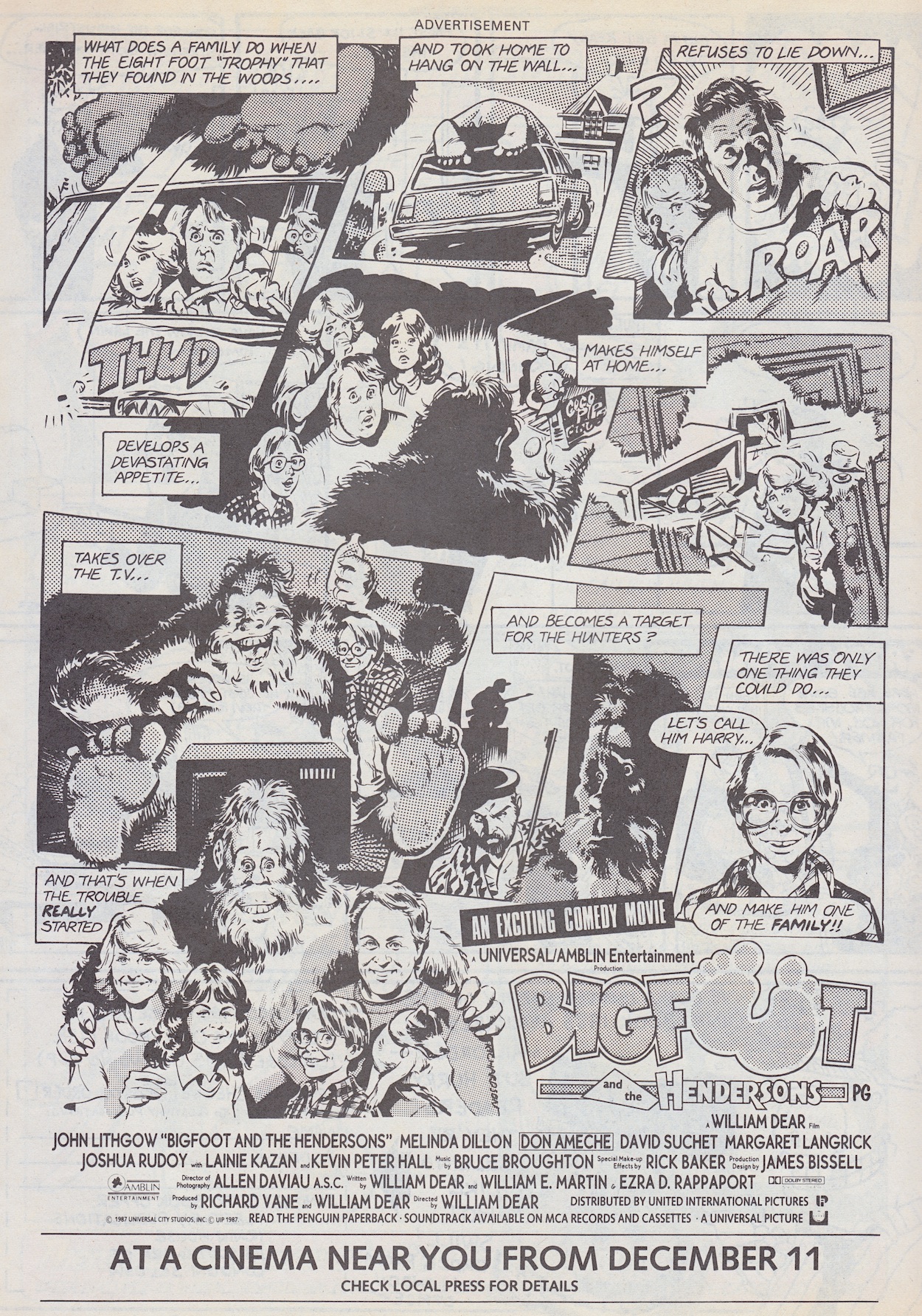
To any readers living outside of this part of the world this poster might be a bit confusing, but this is indeed Harry and the Hendersons, advertised in #42. It was renamed for the UK market, perhaps to better describe what Harry actually was to potential cinema goers not familiar with the legend in the States. John Lithgow seemed to pop up in every American film when I was a child but I never complained, he was always funny in every role he took on. The film was essentially E.T. with a big hairy fella instead of a short, wrinkly alien but I do remember finding it very funny as a child, although I’ve never seen it again since.
There we go. There may only have been five movie adverts throughout OiNK’s run but they’re a nice snapshot of the films that would’ve appealed to young readers at the time and their retro artwork is a joy to look at. There are a ton of adverts for the next category of food and drink though, including everything from crisps and fizzy drinks to Marmite and bread! Look out for that during the summer later on this year.
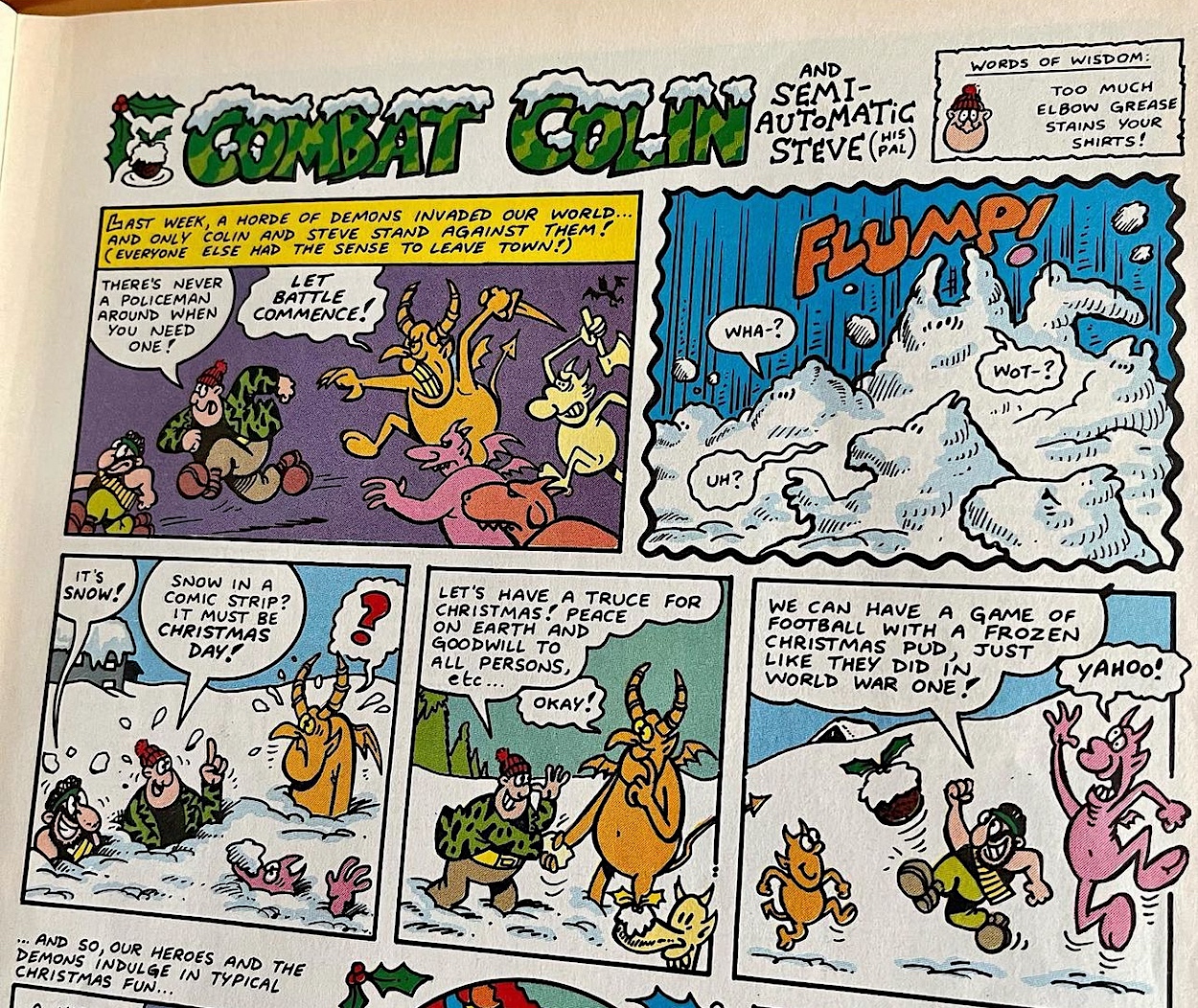
Combat Colin by Lew Stringer from Transformers #302
When I was a kid most of my comics were fortnightly so their Christmas editions arrived very close to the Big Day itself, complete with snowy logos and cheery happenings on the cover. It always felt like extra effort went into the creation of these special editions, and reading them just days before the annuals arrived from Santa was guaranteed to raise already high levels of excitement even further.
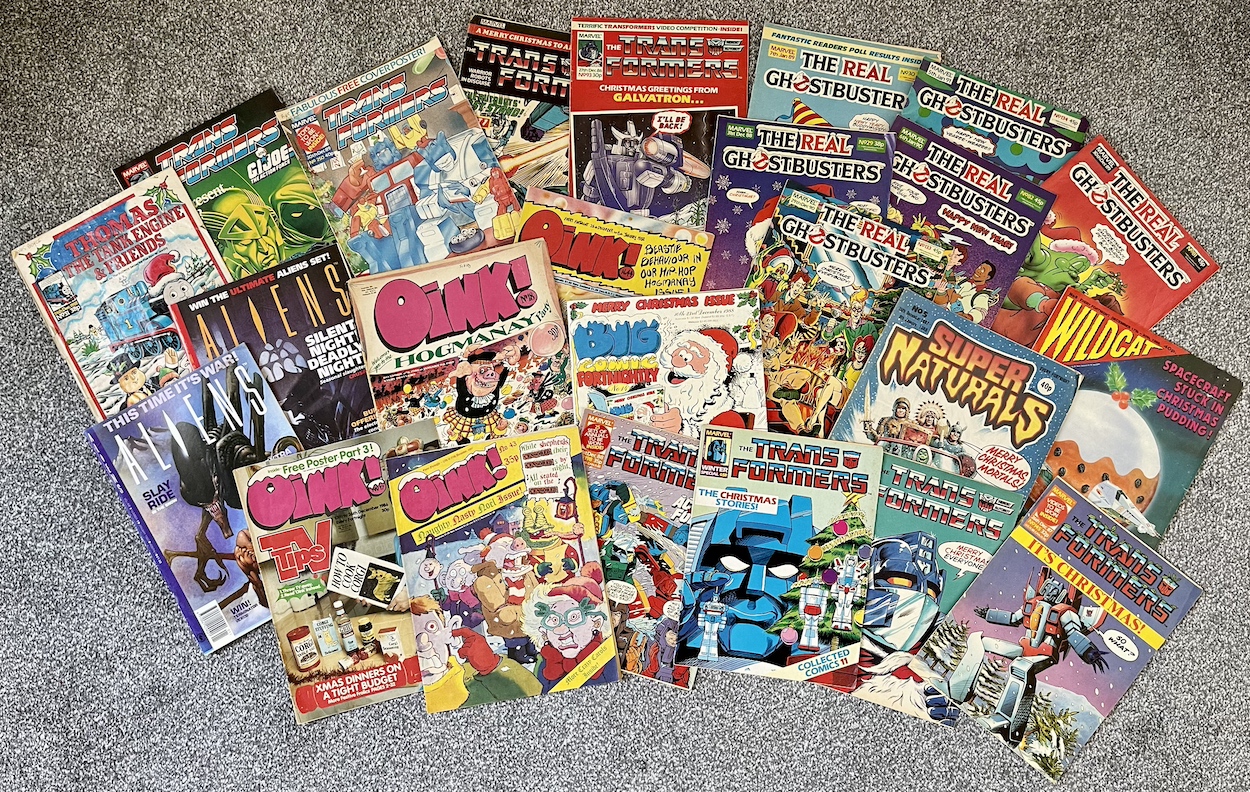
The classic Christmas comics covered so far had that same effect on me even as an adult. So I decided I wanted to do something a bit special this year with all of the seasonal covers in my collection, and to do it right at the beginning of December to kick off the excitement on the blog this year. Below you’ll find a smorgasbord of festive fun from four comics titles I’ve already covered, one I’ve been reading for the blog’s Instagram for seven years(!), another I’m reading annually, a popular title I’m still in the collecting stage of and, for the first time, I’ll reveal one of the new real time read throughs beginning in 2024 by showing you its two Christmas covers!
That’s 21 covers altogether. “Holidays Are Coming!”
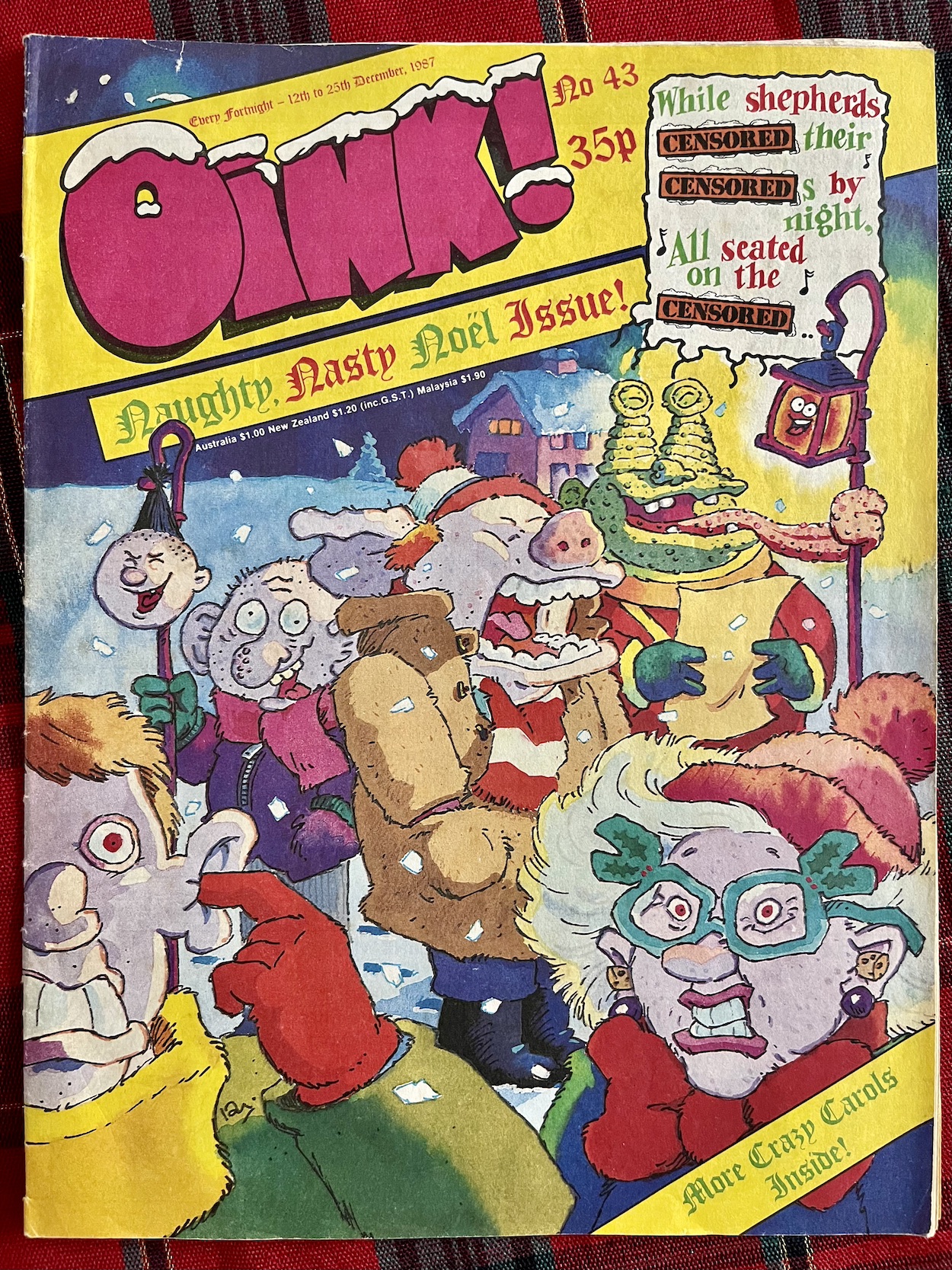
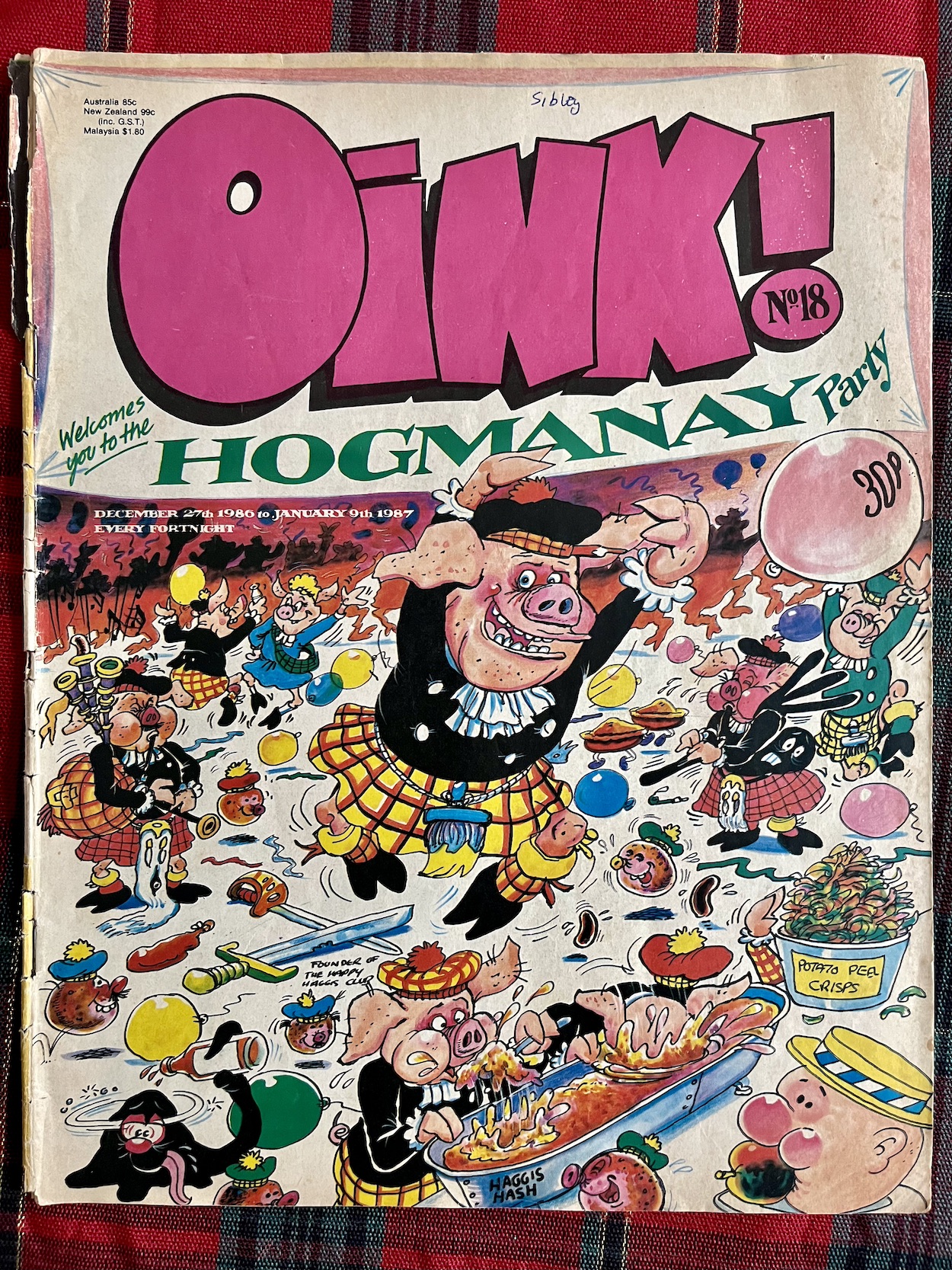
#43 cover by Ian Jackson #18 cover by John Geering #44 cover by Lezz
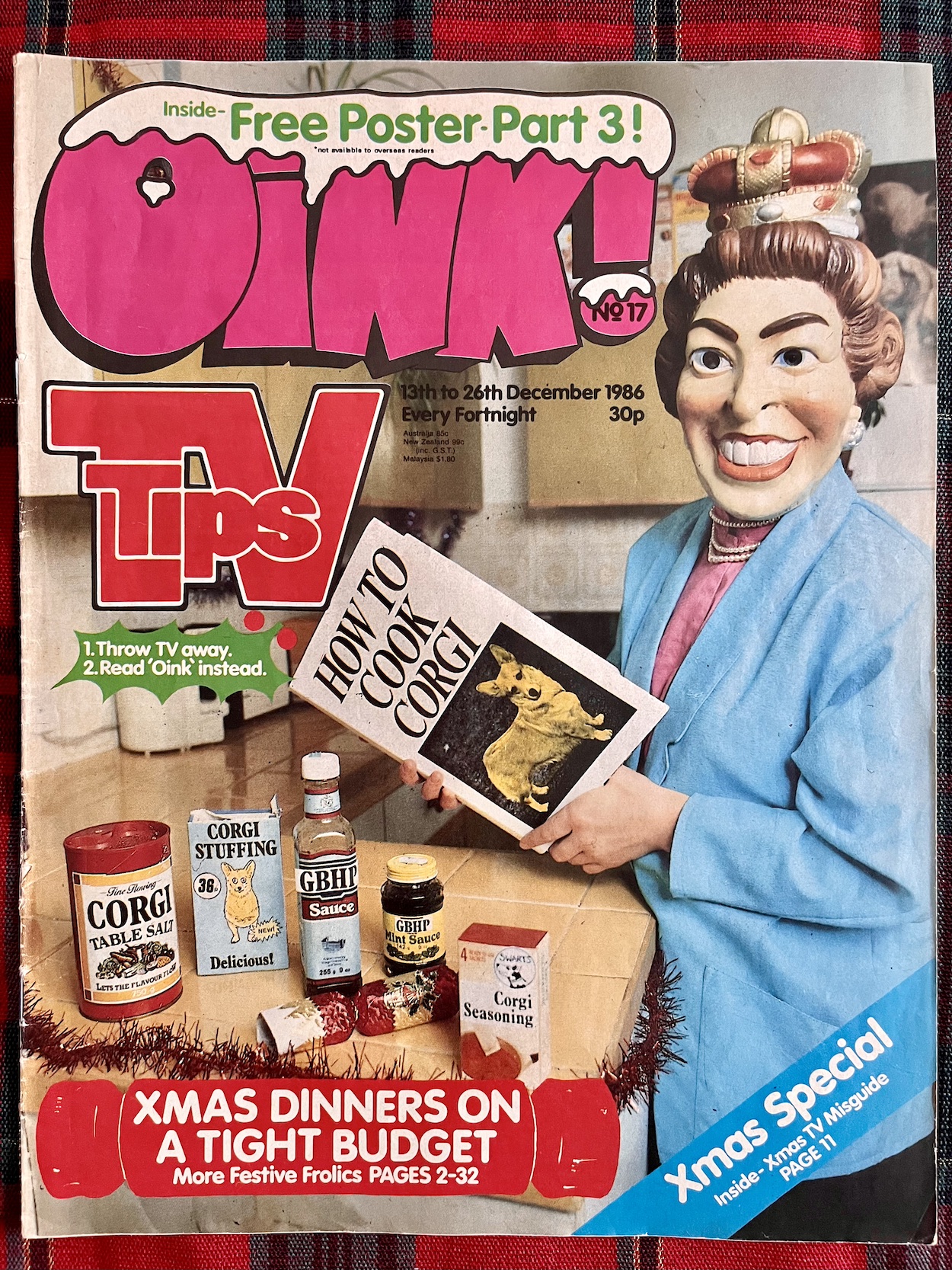
Of course we have to kick things off with the blog’s namesake, don’t we? My very favourite comic had two special issues for my very favourite time of the year. A great spoof of our family’s traditional Christmas TV magazine (which I still buy in December) or a hilarious Ian Jackson cover, which is the best? The second of these issues is my favourite regular issue of OiNK out of its whole 68-issue run, so that particular cover always makes me smile the most.
With the New Year holiday named HOGmanay in Scotland it’d be rude not to do a themed issue in a comic called OiNK for that part of the season. Both of these celebratory issues are also some of the best the team ever produced, with covers by the legendary John Geering and Les ‘Lezz’ Barton respectively. In fact, #43 and #44 form the final two issues of what I personally saw as OiNK’s Golden Age, a run of pretty perfect comics which also included The OiNK! Book 1988.
Super Naturals’ Christmas issue is one of my favourites from this whole blog experience
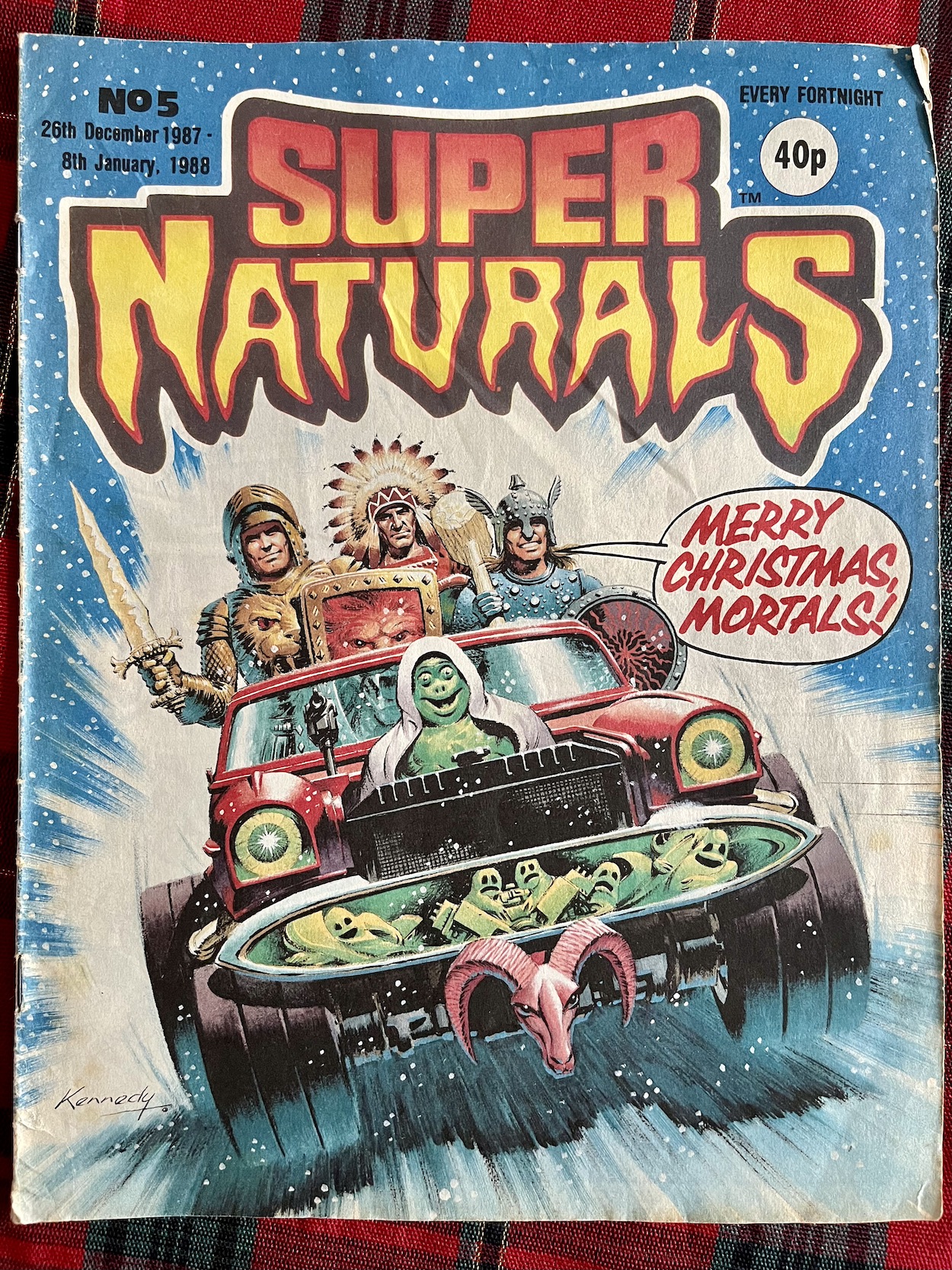
There’s nothing quite like a good Christmas ghost story. So, when I began collecting Fleetway’s Super Naturals comic for the blog (after only having owned the first and last issues as a kid) I was thrilled to not only see #5 was a special Christmas issue but that it also had a simply joyous, painted Ian Kennedy cover. Inside, the team really went for the spirit of the season, with even the ongoing serials containing themes and plots centred around Christmas. My favourite issue of the run and one of my favourite issues from this whole blog experience.
Super Naturals #5 cover by Ian Kennedy
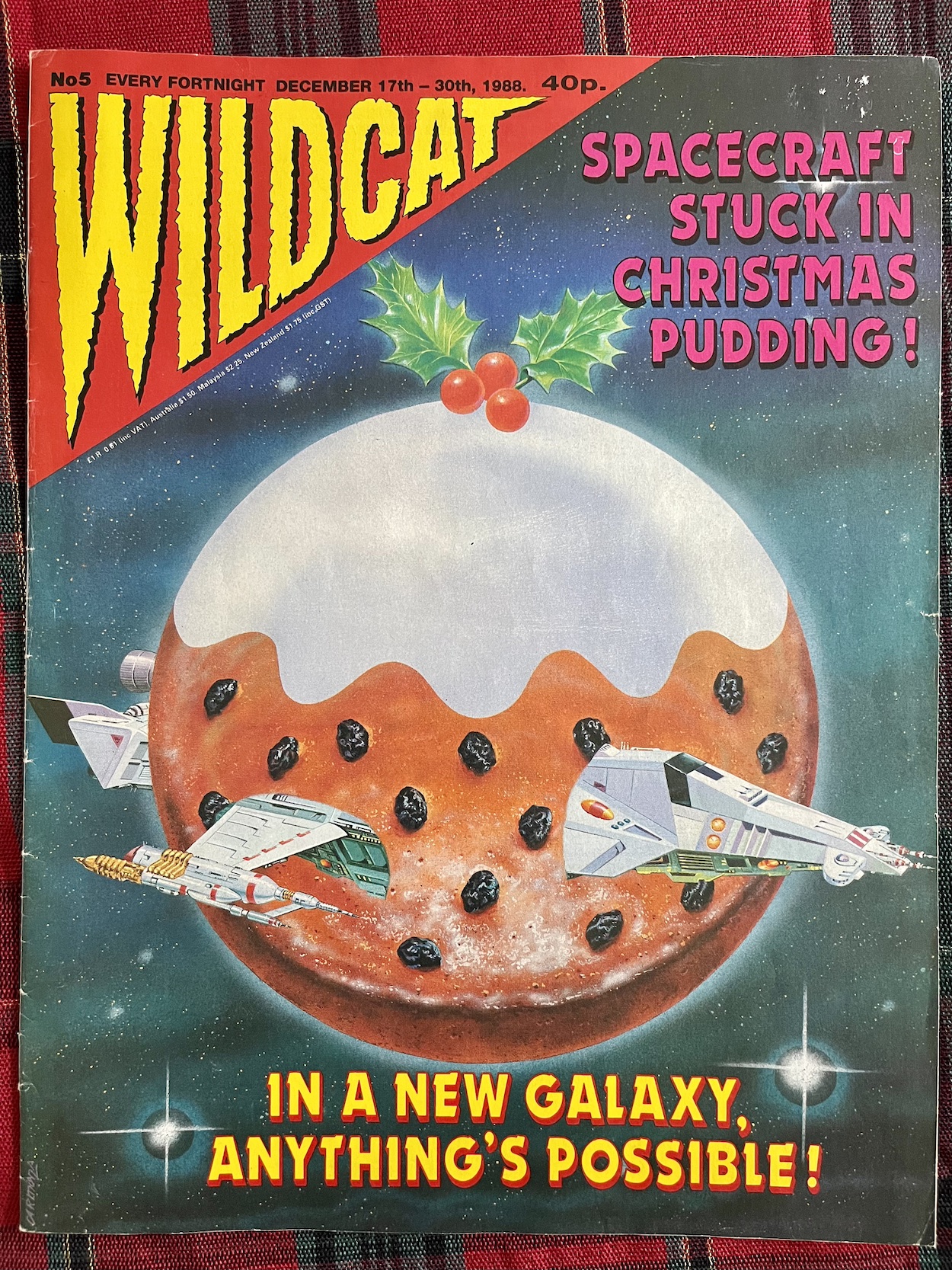
By coincidence, a year later it was also #5 of Super Naturals editor Barrie Tomlinson’s Wildcat that fell at the right time, with a somewhat memorable front page! With its ongoing serials set upon the surface of a distant world as we searched for a new home planet it was left up to the complete anthology story to tell a tale on board the Wildcat spacecraft itself which, yes, did include that image from the cover. Even more surprisingly it actually explained it!
At the time of writing this post those are all of the Christmas comics I’ve covered as part of real time read throughs on the blog so far. However, over on the Instagram account for over seven years I’ve been patiently reading Marvel UK’s superlative Transformers comic. I’m actually reaching its conclusion very soon, in January 2024. In its last December the issue on sale over Christmas was the penultimate edition so it didn’t take a break from the ongoing story for a Christmas special, meaning I’ve read all of its seasonal issues.
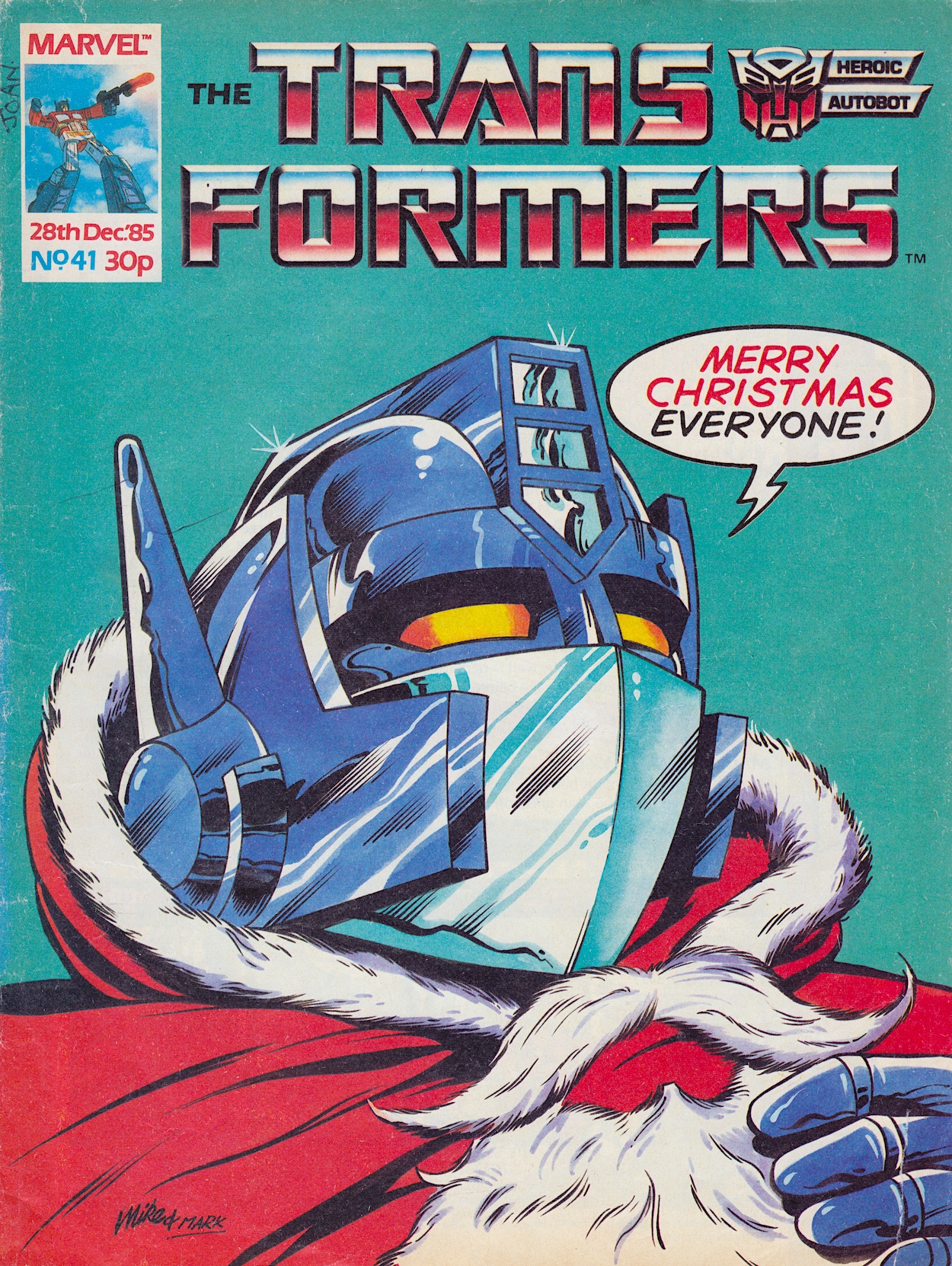
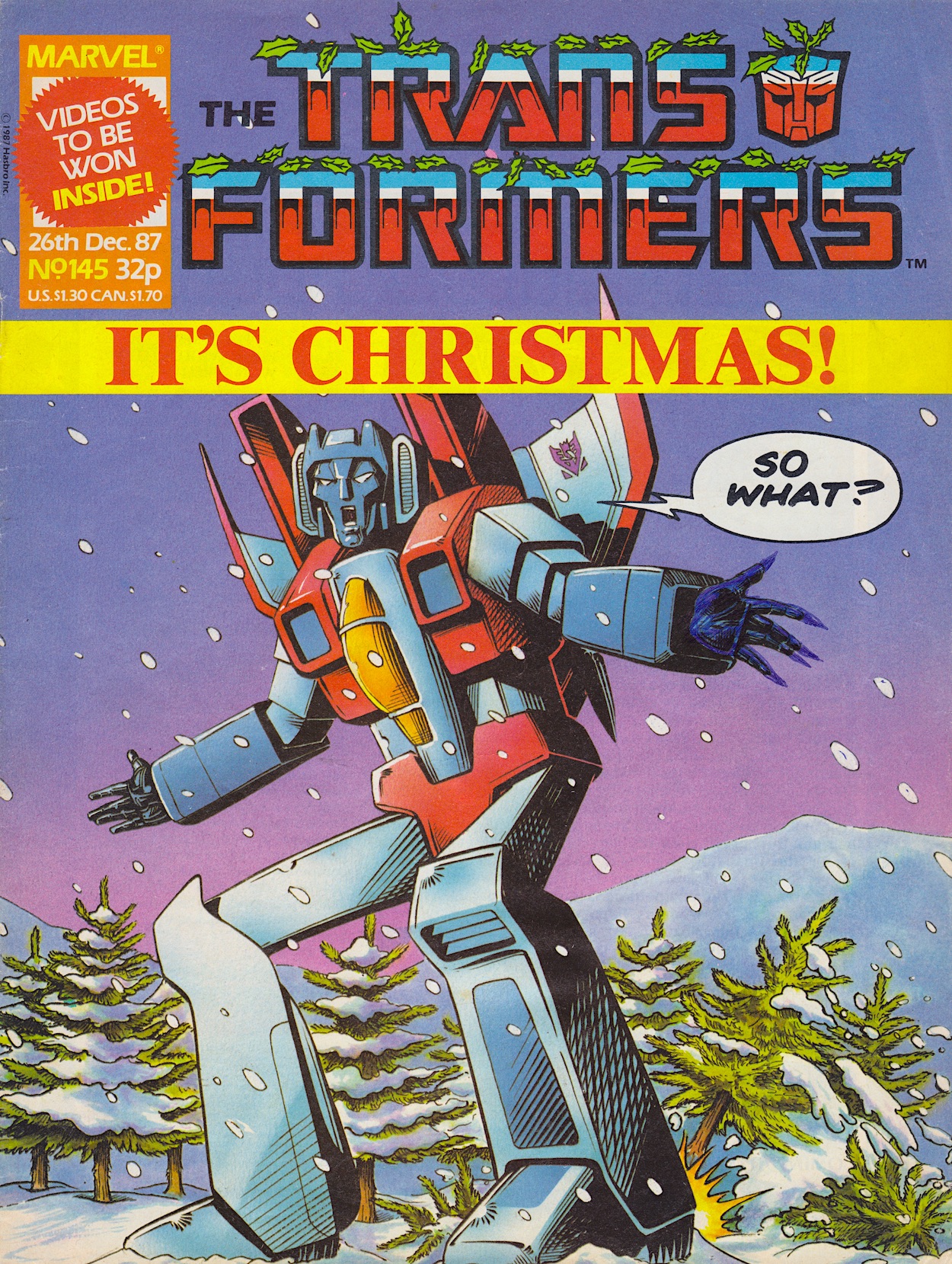
It’s Christmas! “So what?”
Starscream
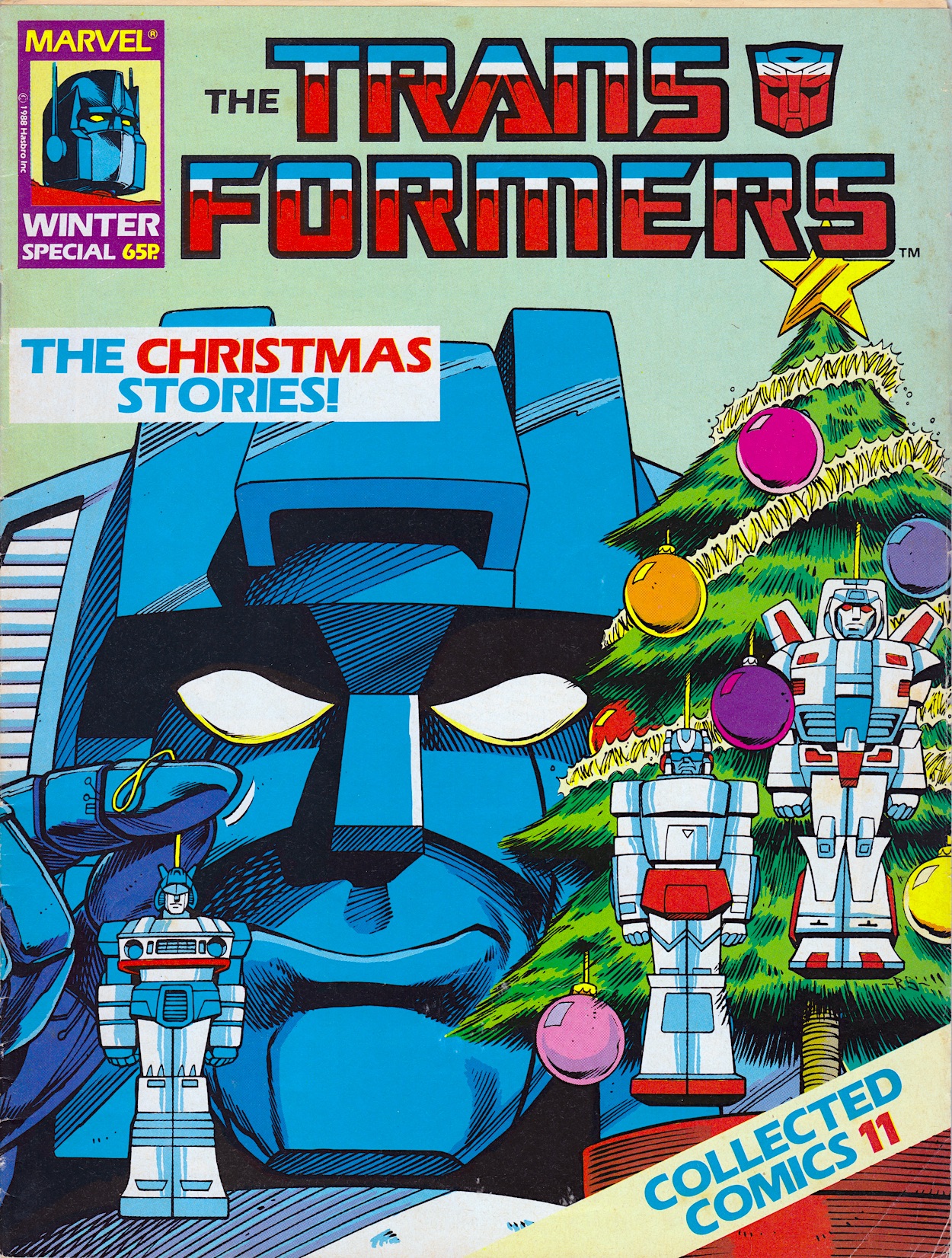
In fact, it was a particularly Christmassy Winter Special that began my lifelong love of the Cybertronians. By 1988 I’d enjoyed many episodes of the cartoon and owned a few of the videos so when I fell ill my mum bought me a comic to cheer me up. That comic was Transformers Collected Comics 11. It contained three reprinted Christmas stories and I loved every page! It was a revelation compared to the cartoon. Within a few days I had a regular order at the newsagent and 35 years later I’m first in line at the cinema every few years and have been enjoying Image Comic’s brand new series (which began just a few months ago).
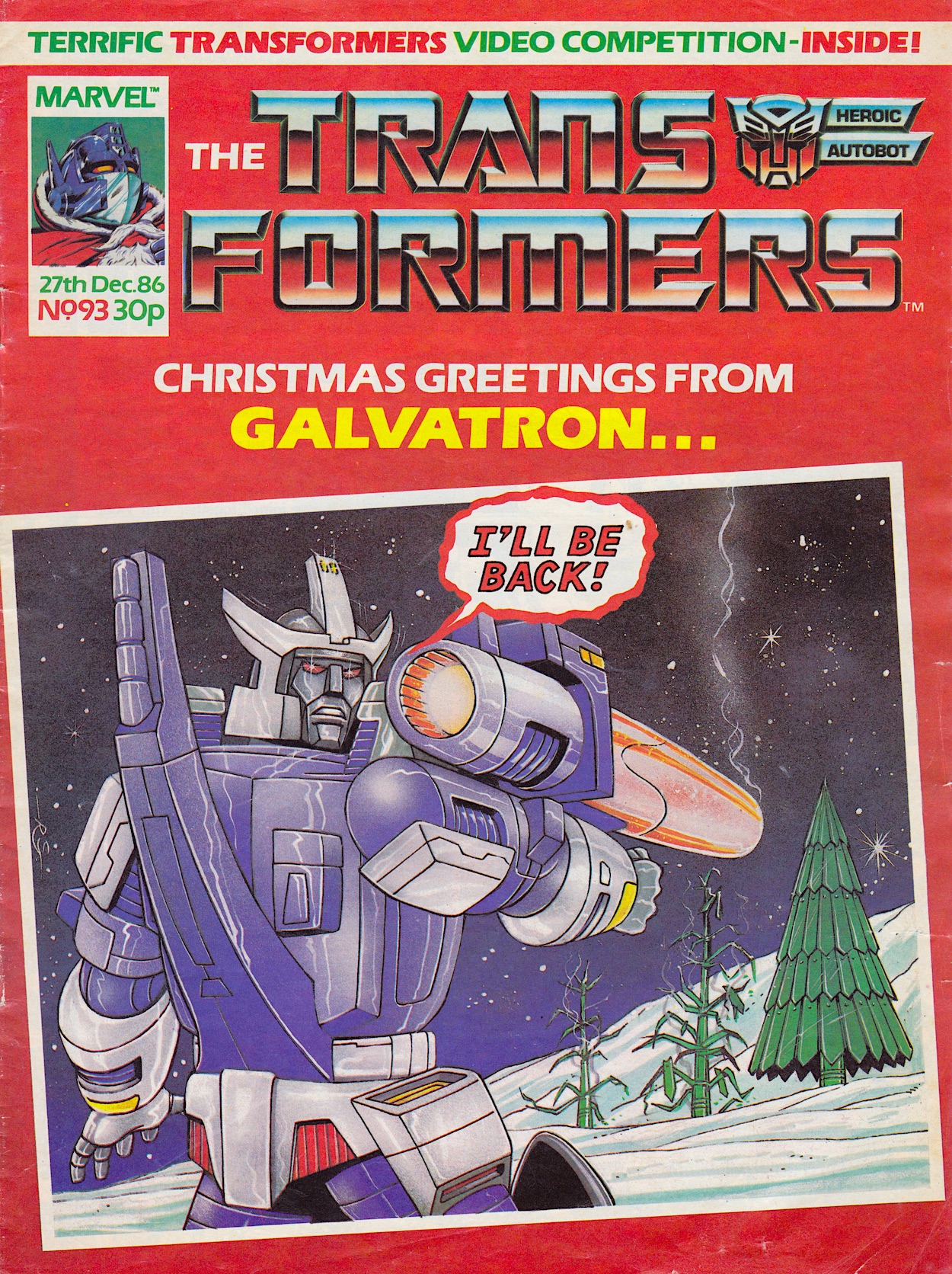
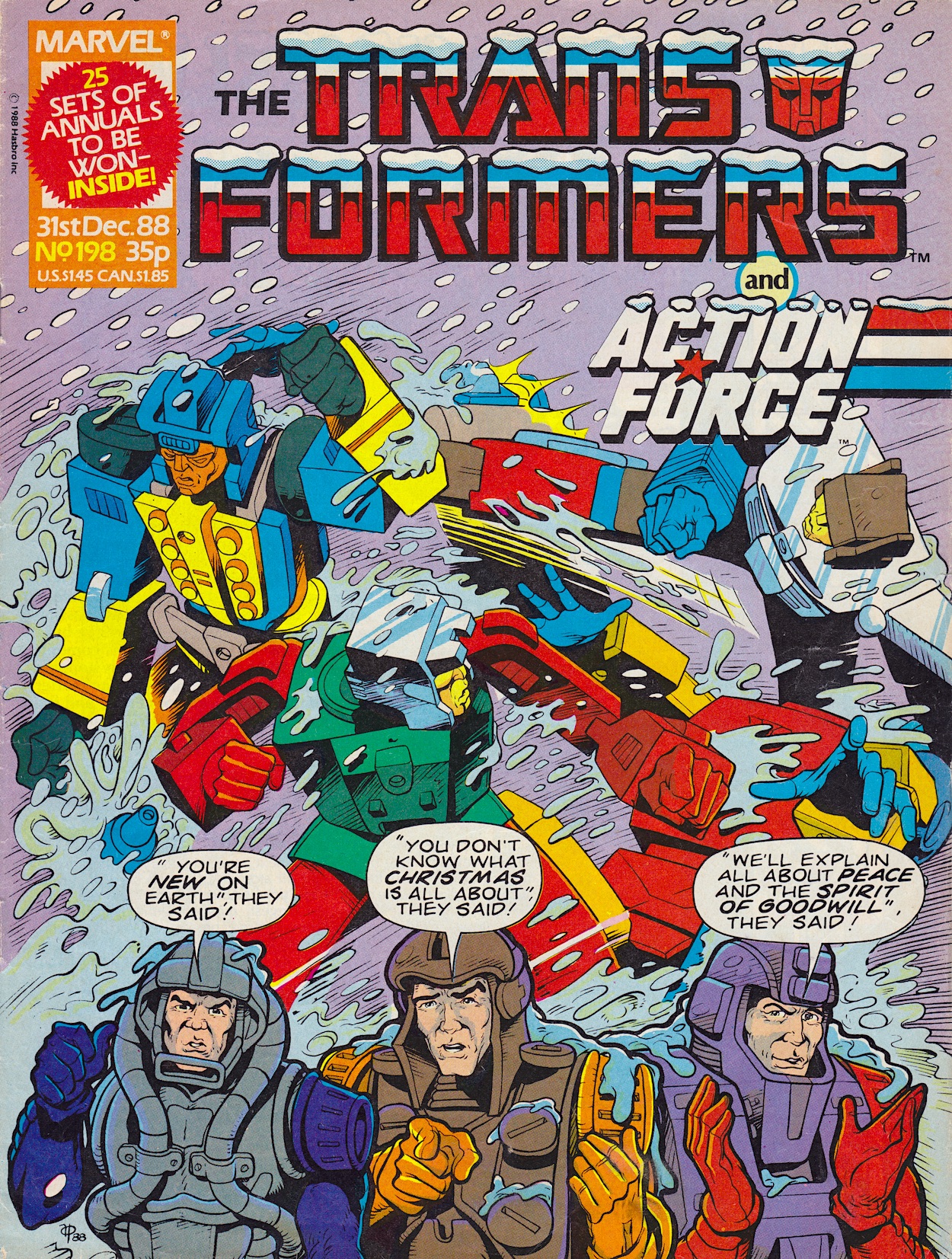
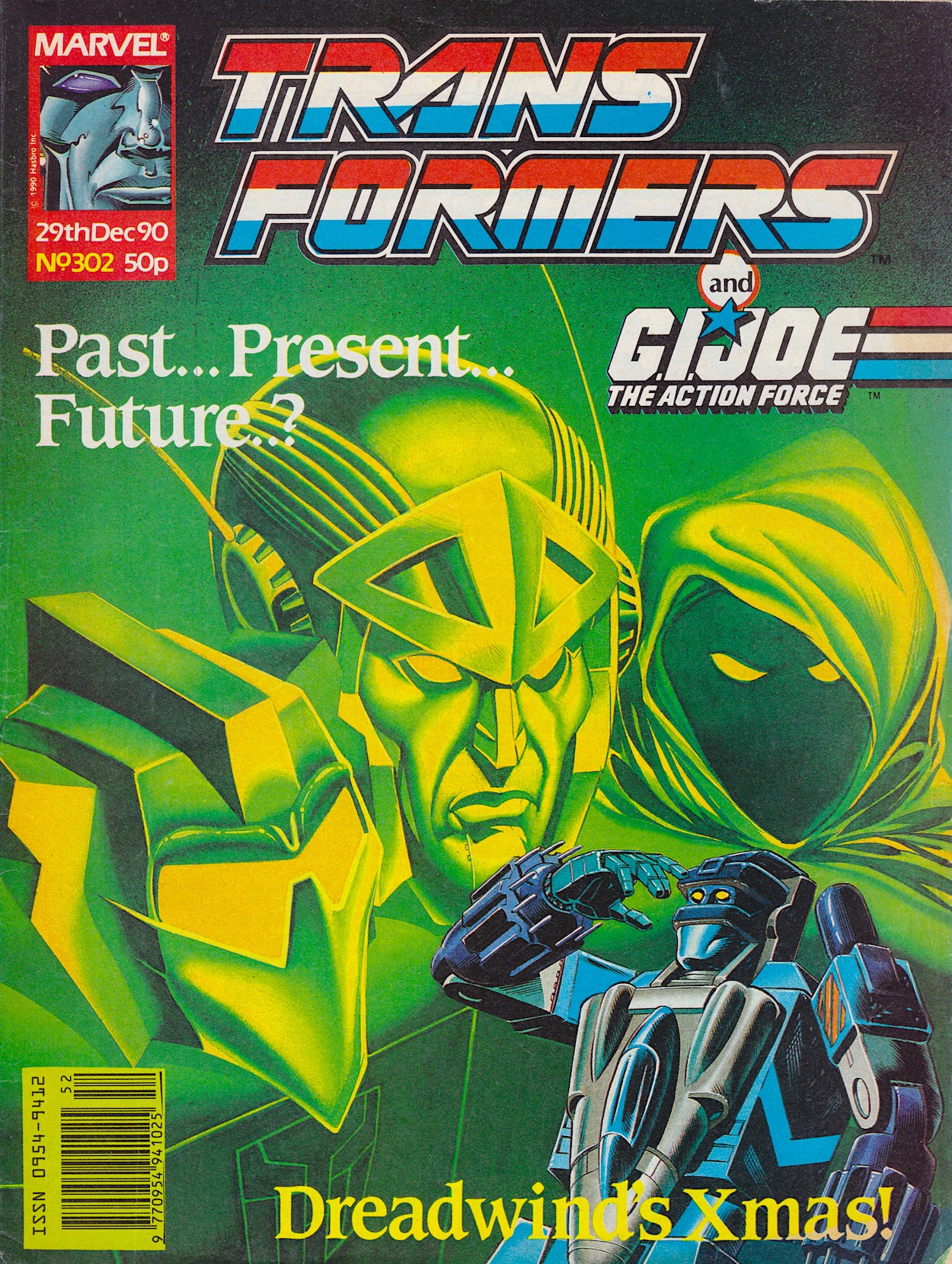
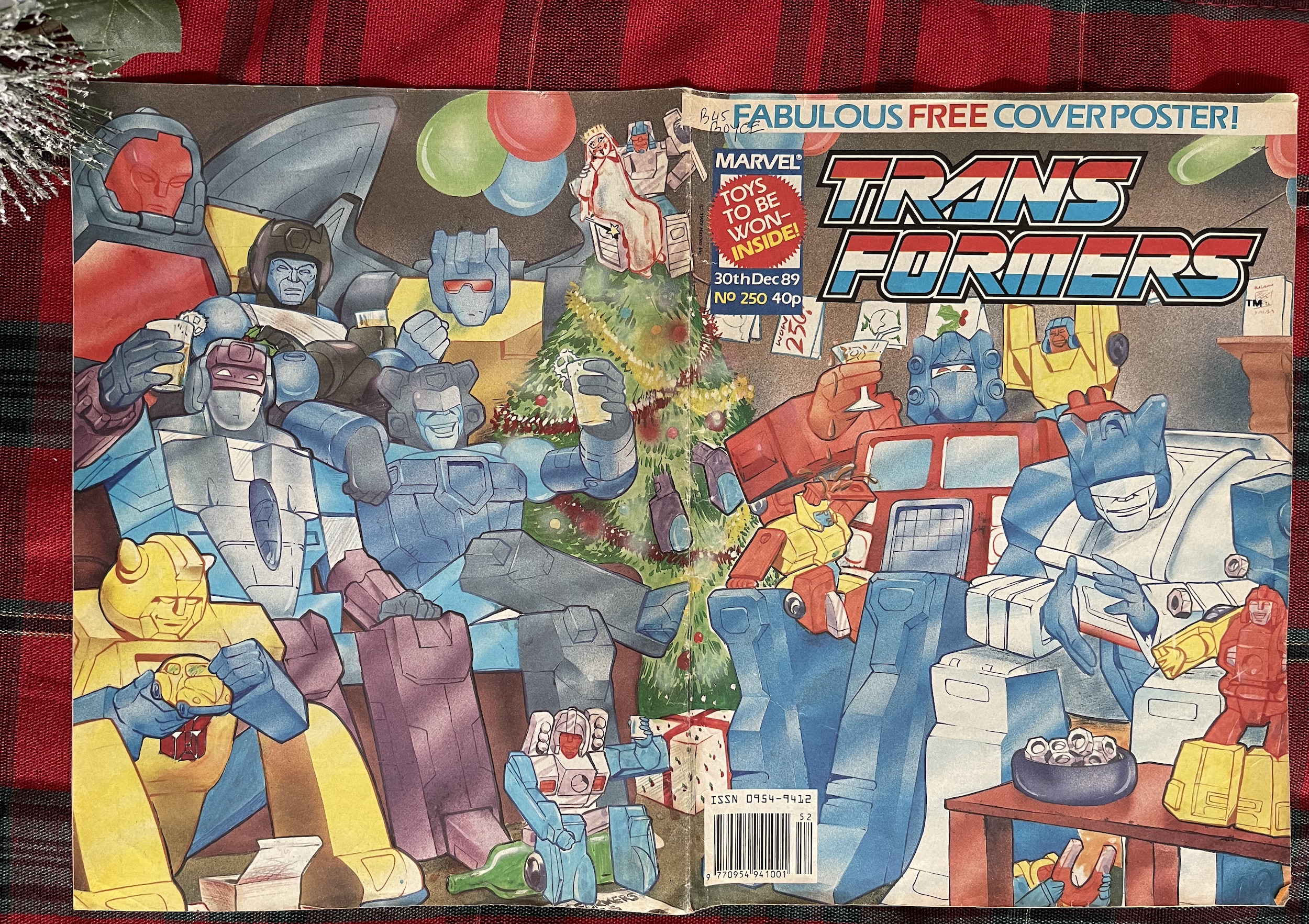
#7 cover taken from The Last Stand: Part One, pencils by Frank Springer, inks by Ian Akin & Brian Garvey #41 cover by Mike Collins & Mark Farmer #93 cover by Robin Smith #145 cover by Barry Kitson & Robin BouttellCollected Comics #11 cover by Robin Smith #198 cover & #250 wraparound by Andrew Wildman #302 cover by Stewart Johnson & John Burns
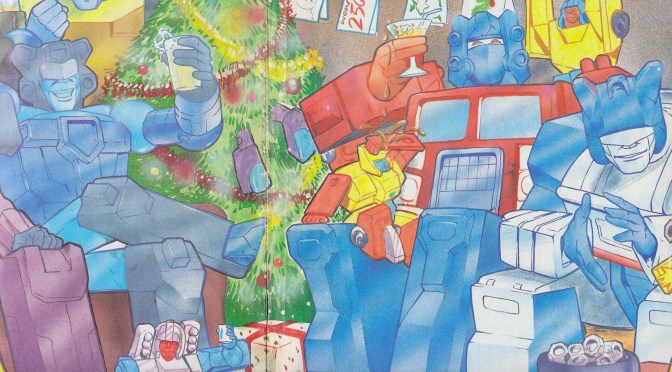
That earliest issue from the comic’s first year may only pay lip service to the festivities on the cover but as you can see from then on they celebrated with some of the most fun issues they ever produced. There’s snow or holly on a couple of the logos and even Optimus Prime dressed as Santa which, much like Wildcat, is actually explained in the story and isn’t just a cover image. Although they play up to that with the next year’s Christmas card image of Galvatron, who wasn’t inside.
The issue with all the snow was actually one of my first issues back at the time. It was doubly exciting for me because it was a special issue for Christmas and had one of the toys I received that year on the cover (Slapdash, the one on the left). The celebratory 250th issue fell on just the right date and as the comic surpassed an incredible 300 editions former letter answerer Dreadwind hilariously had to answer to the ghosts of the past, present and future Transformers to hold that post.
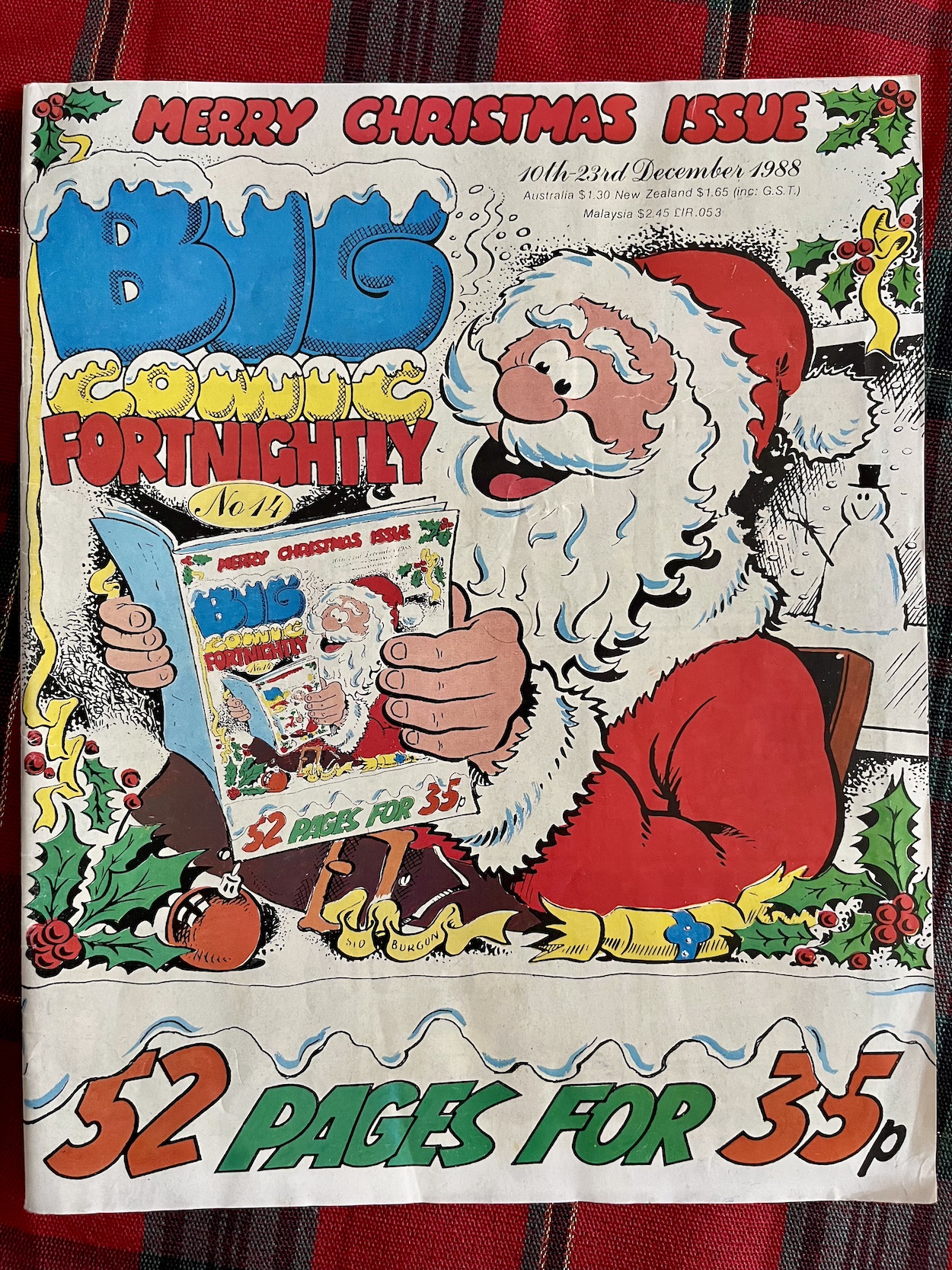
Big Comic Fortnightly #14 cover by Sid Burgon Thomas the Tank Engine & Friends #31 cover by Tim Marwood
Thirty-five years ago I very gratefully received The Book Comic Book 1988 for Christmas (reviewed just three days ago) and was thrilled to suddenly see a new fortnightly baring the same ‘Big Comic’ brand during the following summer. I just had to track down this fondly remembered issue for this post. Of course, the cover was a reprint too, reworked from #35 of Jackpot. Big Comic never felt like a random selection of reprints but rather a properly curated collection that made each issue unique. It even had a special Leo Baxendale issue. Its Christmas specials were similarly packed with related material.
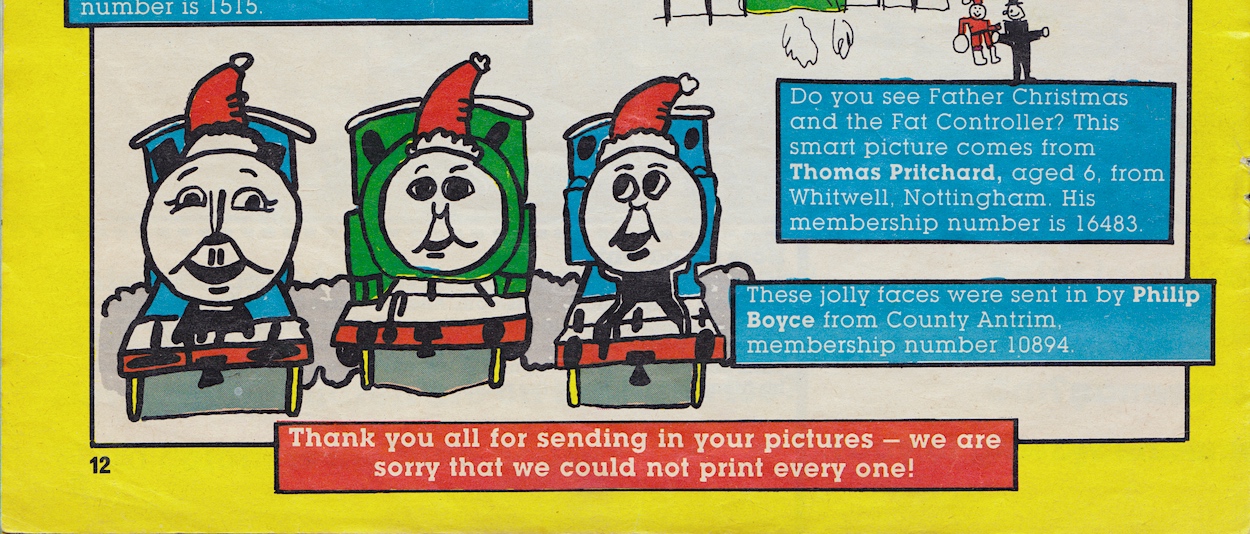
Next to it is the second Christmas edition of Marvel UK’s Thomas the Tank Engine & Friends, one of two issues I’ve kept all these years and for a very personal reason. Namely, it was the first time young me saw his name in print when my drawing of Thomas, Gordon and Percy with Santa hats was published inside. I can still remember that moment of excitement upon turning the page that year. If you want to see it, you can check out the Thomas retrospective (marking an incredible 800 issues), the link to it and all of the issues featured here can be found at the bottom of this post.
I’ve also written a five-part series about my top Christmas comics for former Marvel UK editor John Freeman’s Down the Tubes website
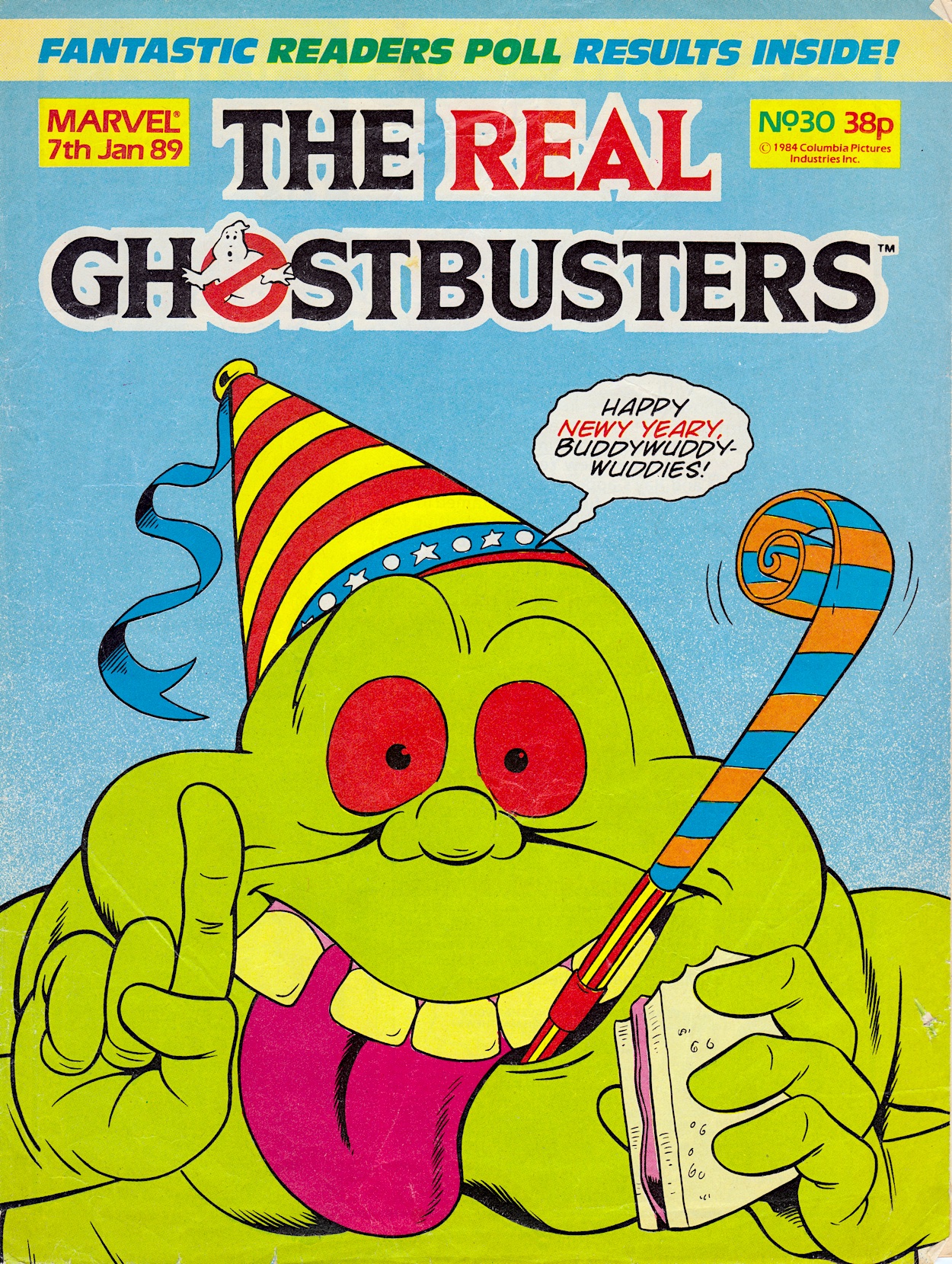
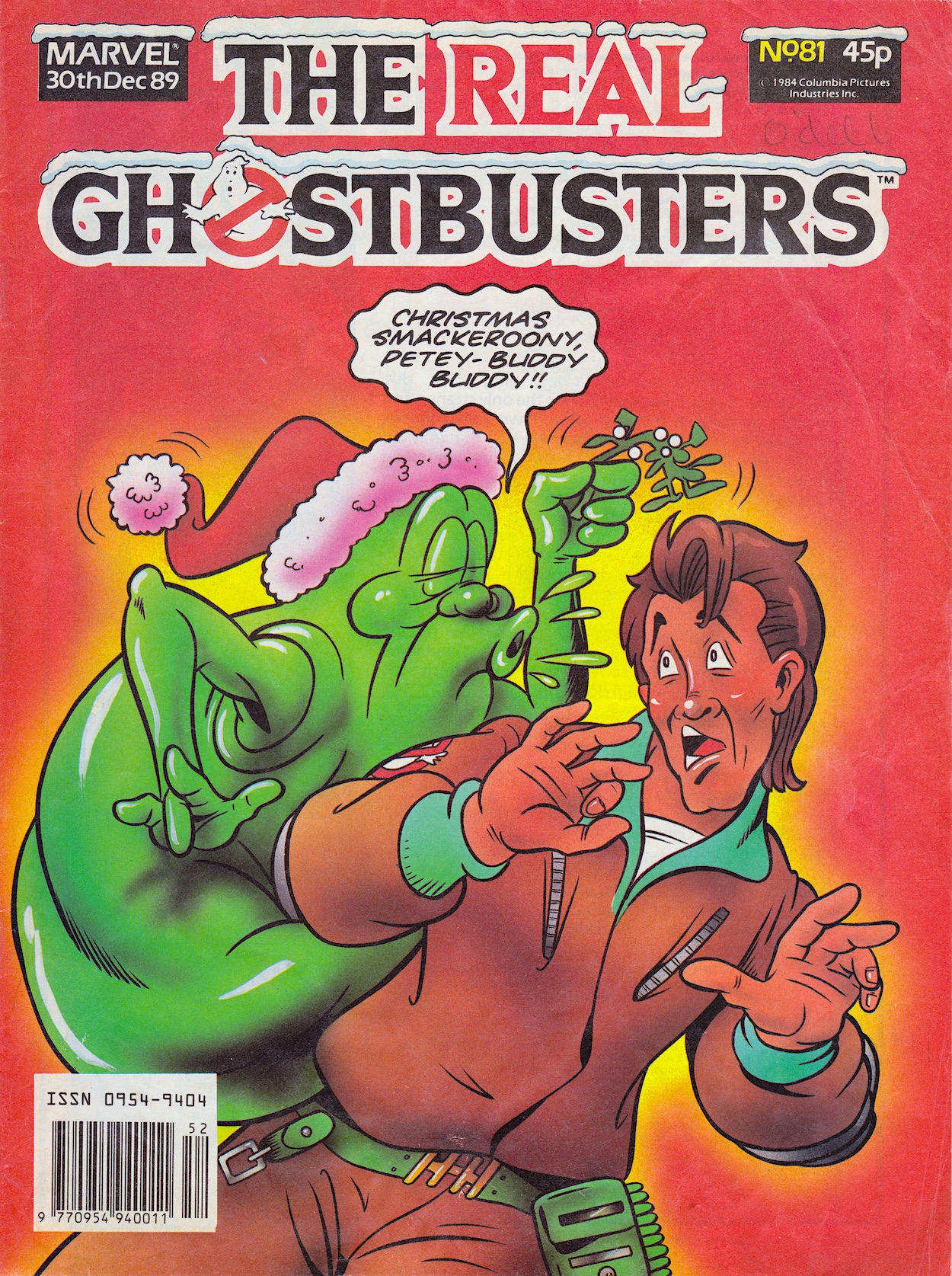
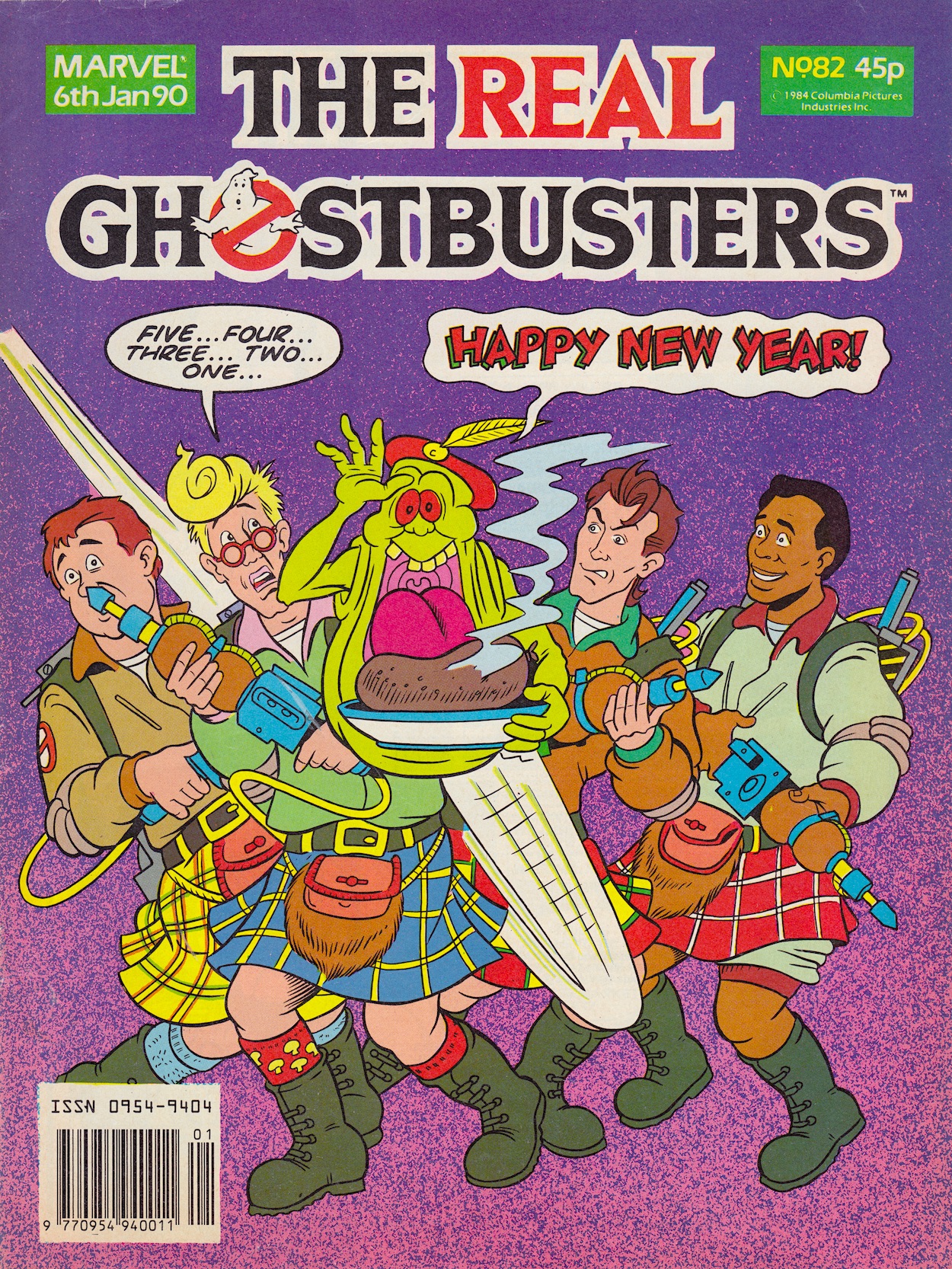
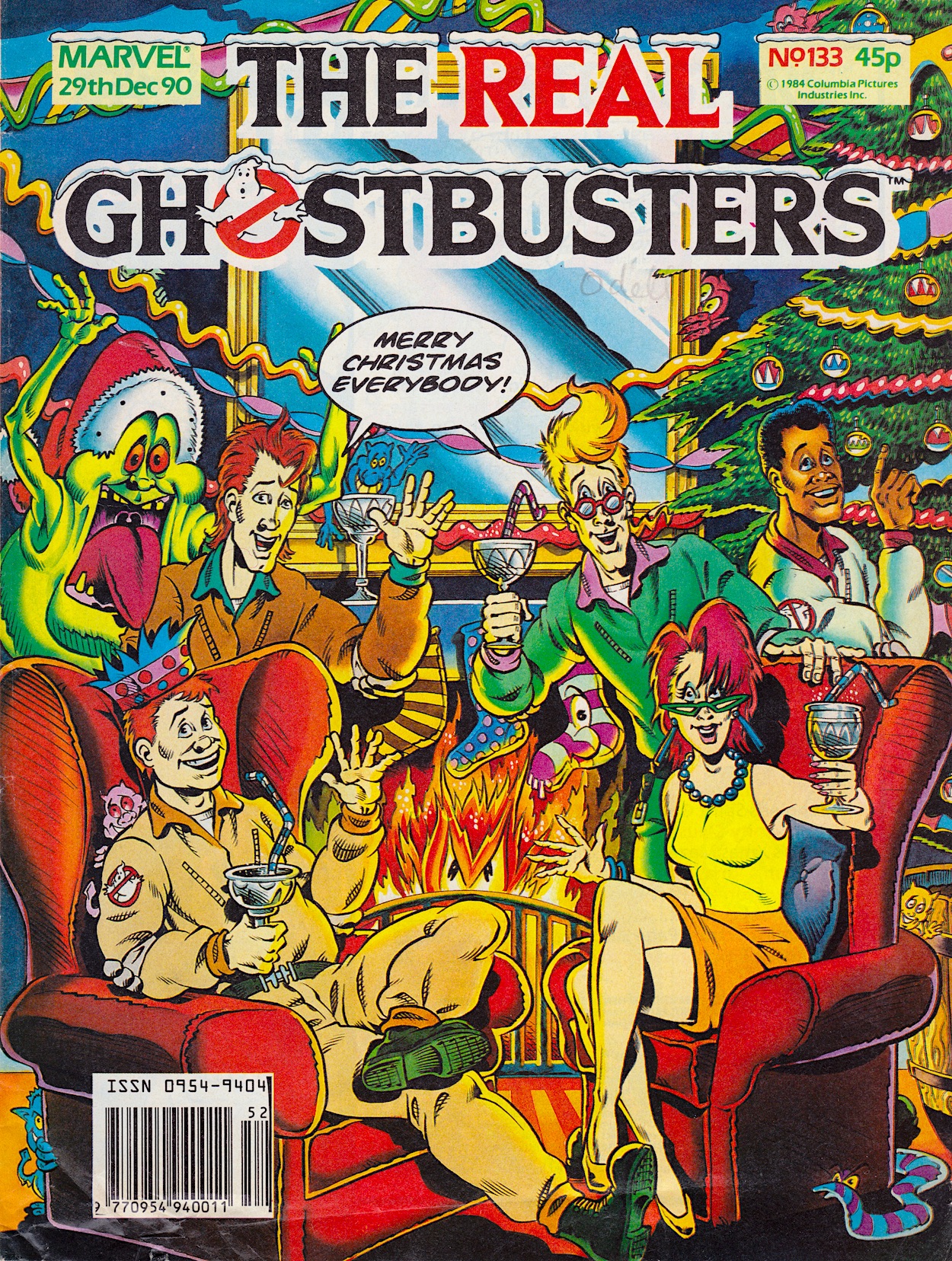
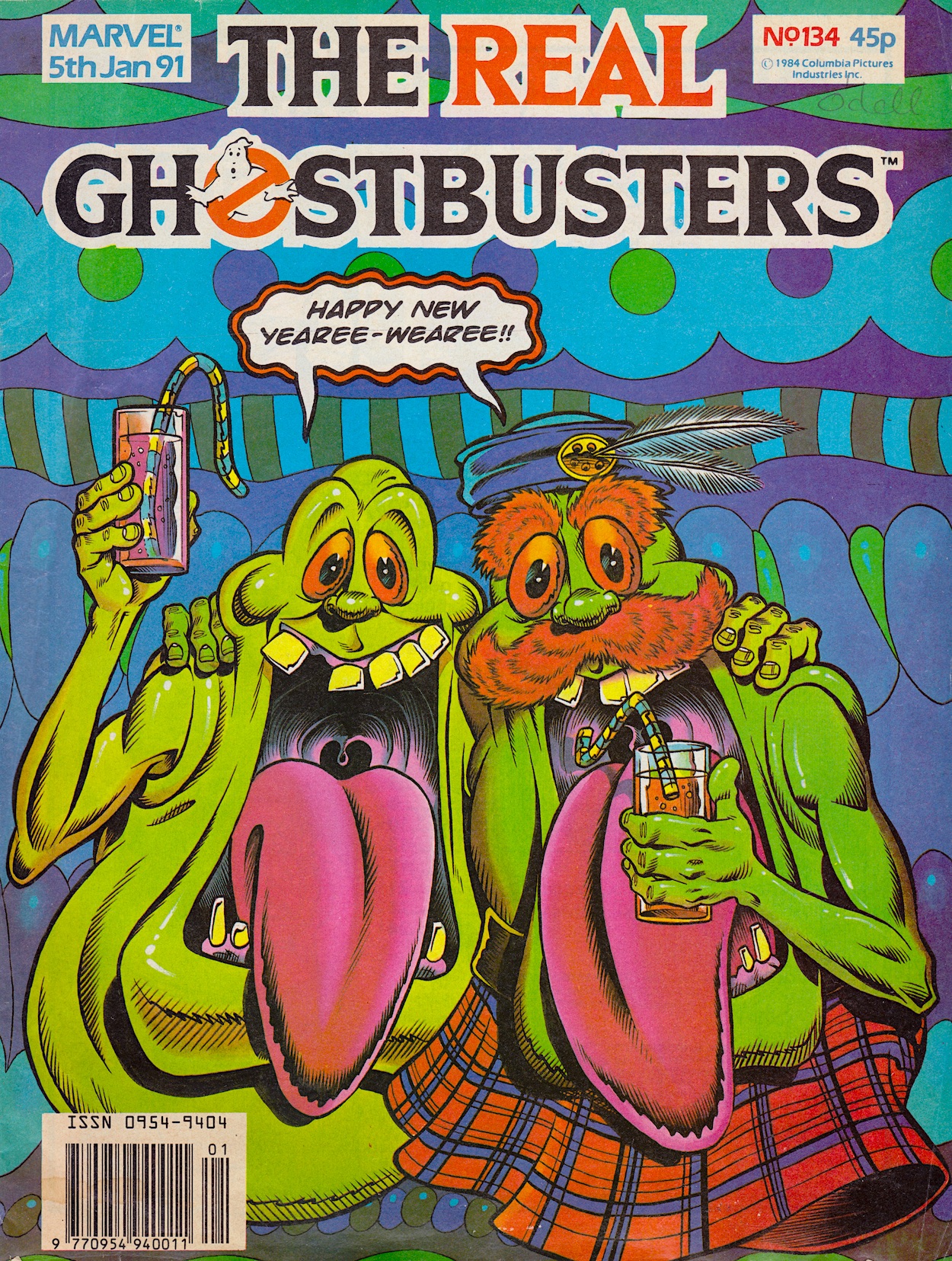
Moving on to a comic I wrote about for the 33rd anniversary of its first issue. I enjoyed that so much I committed to covering the comic in some fashion in the future. However, with over 190 issues to collect first it’s going to take a while. (Remember, these cost money!) What I can show you now are the first three years of festive fun. Taking advantage of its weekly schedule, The Real Ghostbusters had two celebratory issues every year, one for Christmas and one for the New Year, as you can see below.
#29 cover by Martin Griffiths #30 & #82 covers by Brian Williamson & Dave Harwood #81 cover by Brian Williamson, Dave Harwood & Robin Bouttell #133 & #134 covers by Brian Williamson, Stephen Baskerville & John Burns
With at least three stories (two strip and one prose) every issue we were treated to a couple of themed stories and of course Slimer’s humour strip would also join in. One of the New Year issues also contained the results of a reader survey told in comic strip form, complete with the winners at Marvel UK meeting the characters on stage!
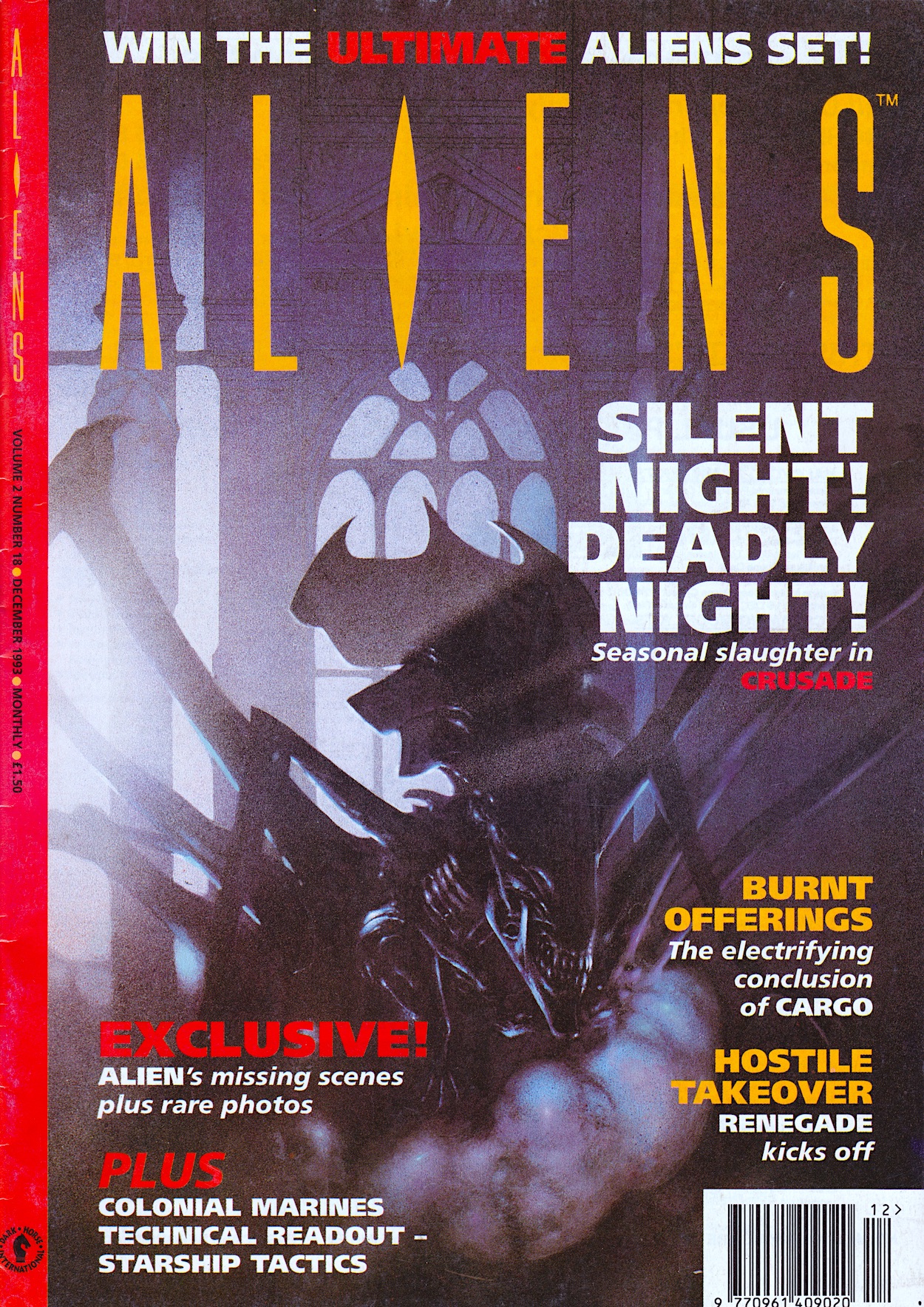
I promised at the top of this post I’d be introducing one of 2024’s brand new real time read throughs with a preview of its two Christmas covers. It’s time to reveal the title that will finally be keeping Jurassic Park company in the Dark Horse International drop-down menu. It’s not one you’d expect to have a nice, cheerful Christmassy cover… and you’d be right. They’re not exactly the usual fluffy fare.
Covers by Chris Halls
With the strips all being imports from the US, split into ongoing serials, I doubt there are any stories inside to match the covers but this is one of those rare occasions when covers not correlating to the contents doesn’t annoy me. The fact Aliens of all things marked the season at all (and with funny headlines to boot) is brilliant as far as I’m concerned. All of the Aliens issues I’m covering have arrived and I’m eager to start reading them next year. Listen out for the motion tracker bleeps in May 2024.
There we go, my look at all of the Christmas covers currently residing in my classic comics collection. Writing this has me wanting to read them all over again. Well, the ones I’ve already featured anyway, the last two titles will have to wait until it’s their time, that’s the rule of the blog after all.
I’ve also written a five-part series about my top Christmas comics for former Marvel UK editor John Freeman’s Down the Tubes for this festive season. Below you can see the banner John created for the series (Smudge the cat is becoming very famous these days) and links to the five individual posts from fifth place to my top Christmas comic.
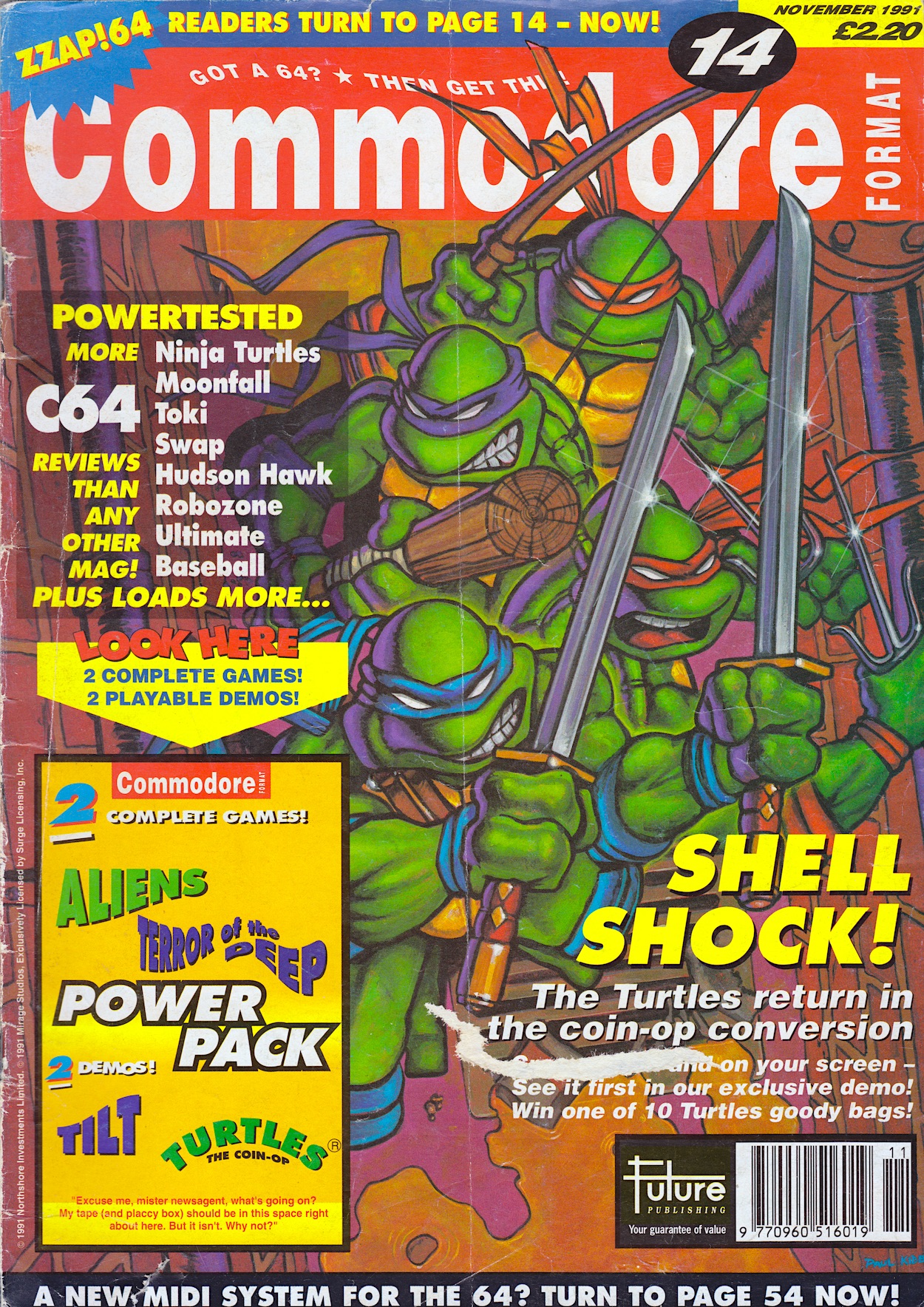
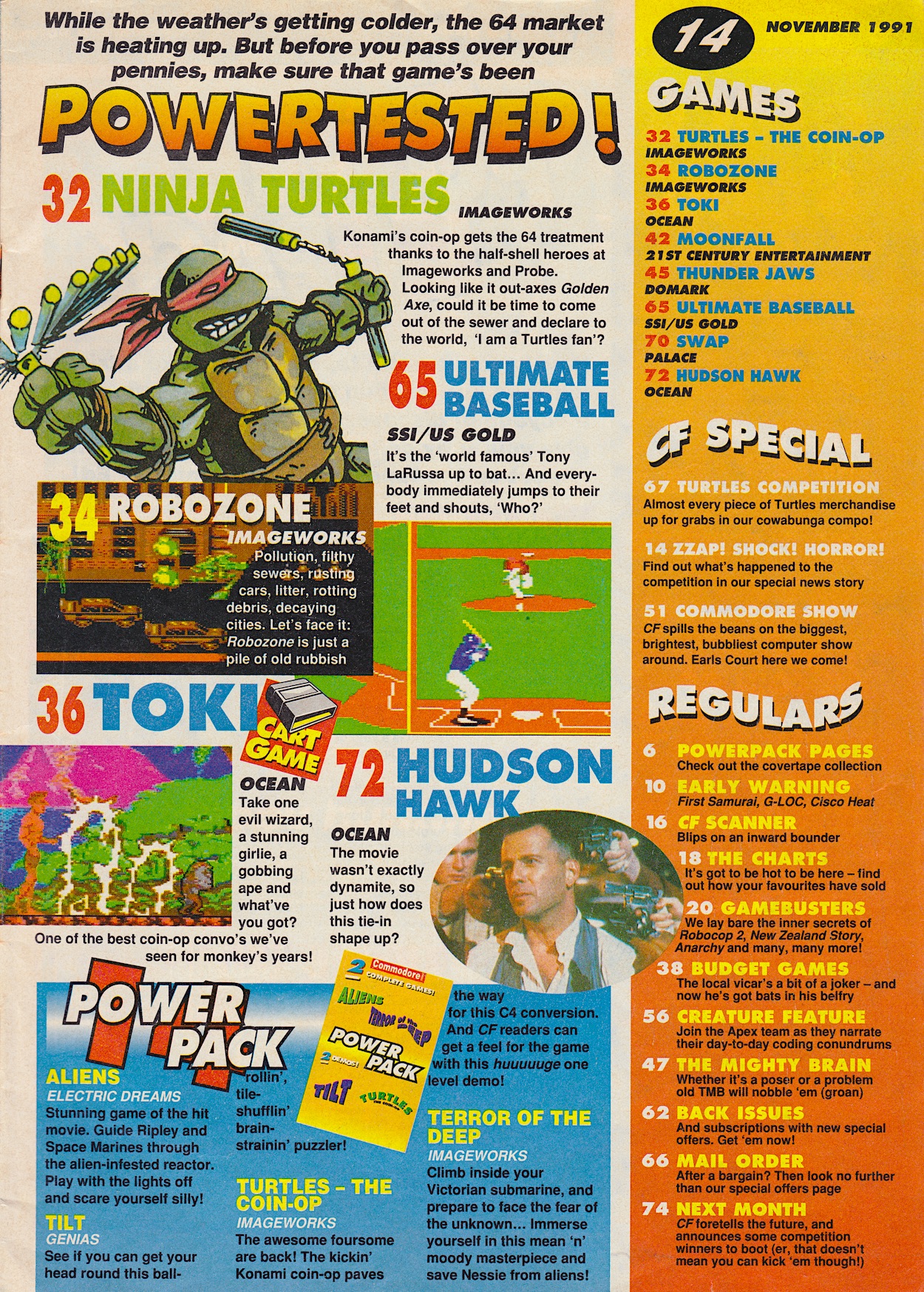
Now here’s a publication, and indeed a specific issue of said publication, that I have a huge soft spot for. It’s my first ever magazine, on sale today 32 years ago. In the summer of 1991 when asked what I’d like for Christmas, and having spent a lot of time playing on my friends’ Spectrum and Amstrad computers, I really wanted something to play computer games on. My parents made me a deal: I could get a computer, not a console. I had to have something I could use for school too.
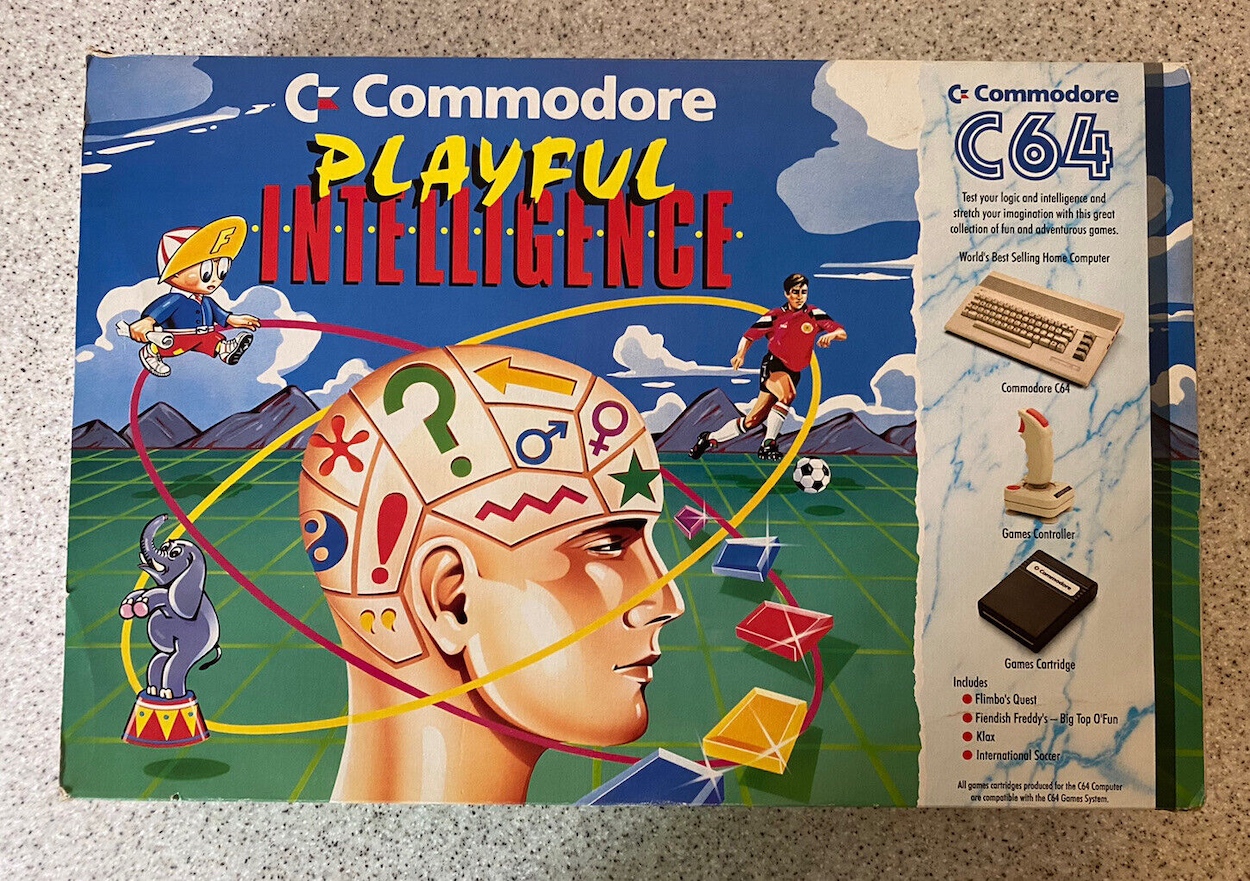
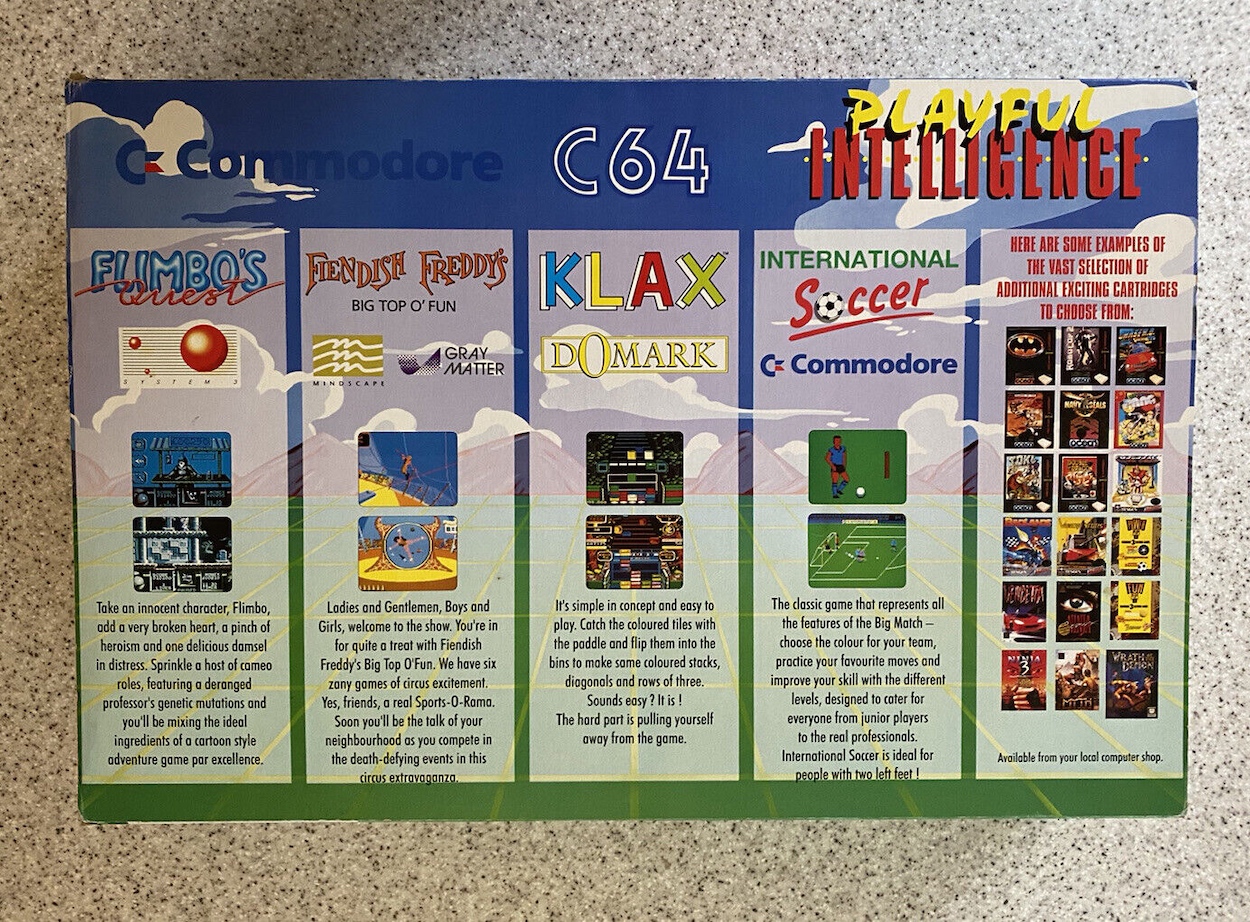
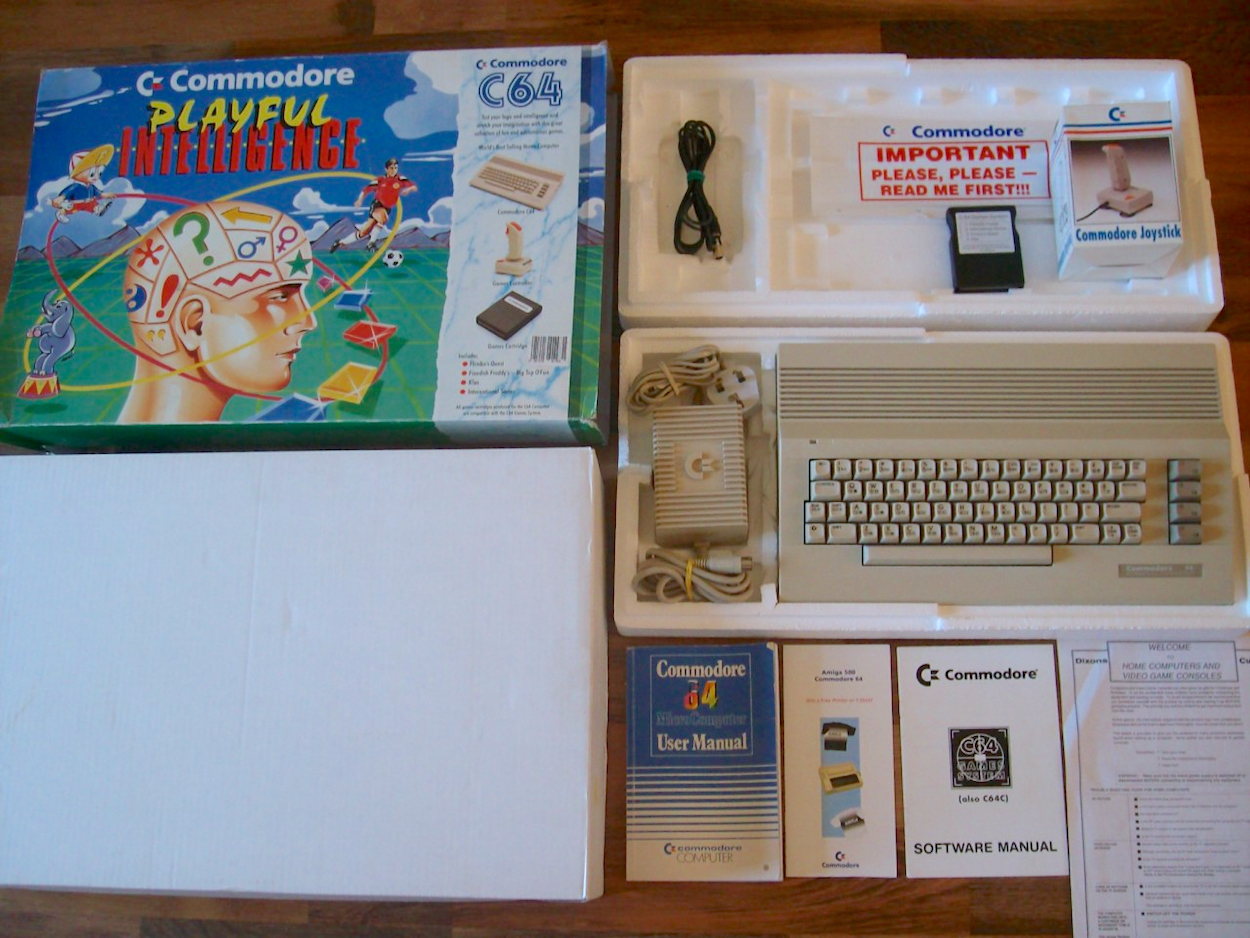
My mum handed me her Littlewoods catalogue and despite the new, more powerful Atari ST and Commodore Amiga computers on the page I was instantly drawn to the Commodore 64, mainly due to it having accessories I recognised such as cassette players and external disk drives. I’d heard of the machine and knew it was more powerful than the ones I’d been playing with friends so that’s the one I chose.
I knew of a magazine called Zzap!64 and decided I wanted to check it out but couldn’t find it at the newsagent. However, I did see Commodore Format and, even better, it had a cassette on the cover full of games, which reminded me of the Story Teller partwork I’d collected years before. I went back the next day to buy it once I’d got my pocket money and it was gone, but I knew from years of buying comics this could mean the new one was due. It was.
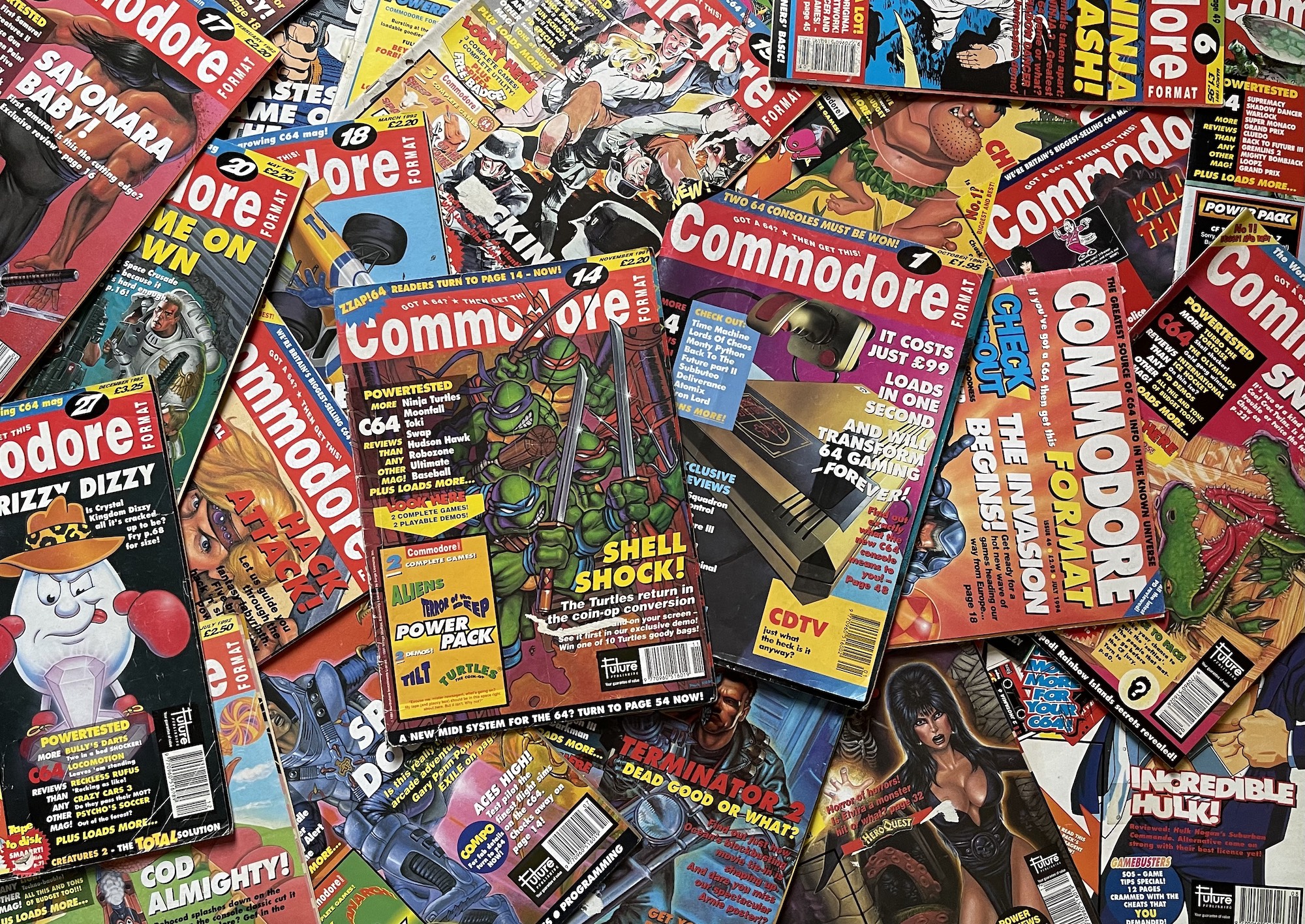
The next day #14 of CF (as readers called it) arrived and featured the Teenage Mutant Hero Turtles on the fantastic Paul Kidby cover, which just excited me further because I was a fan. I devoured the issue, reading it over and over, excitedly anticipating the machine which was still a couple of months away. I’d definitely made the right choice of present! So to mark this issue’s anniversary I wanted to write a special retrospective and explain why I loved it so much.
Edited at this stage by Steve Jarratt, in later years CF would go on to influence me in a key way. It was instrumental in my development in those important teen years, making as big and lasting an impact on me as OiNK had a few years previous, hence its inclusion here. I’ll get to that in a future post, but for now let’s go through what is personally a very special issue. This most superb of 90s magazines had 76 pages packed full of content. There was no filler in sight and every page was rammed full of great writing, information, loads of hype for me while I awaited my computer and a feeling of being part of a form of club, a sense of the magazine talking to me directly. Plus, it had a cracking sense of humour. (Check out the bottom of most pages below for example.)
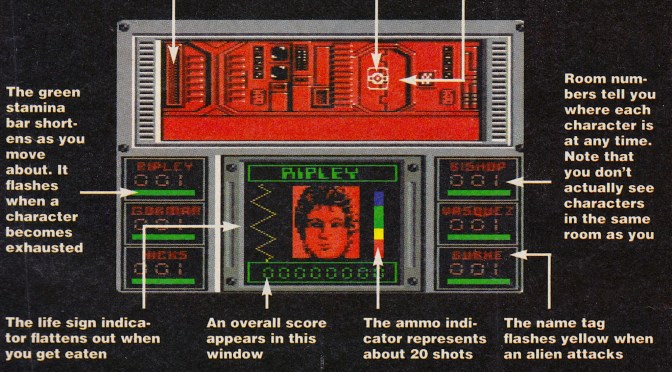
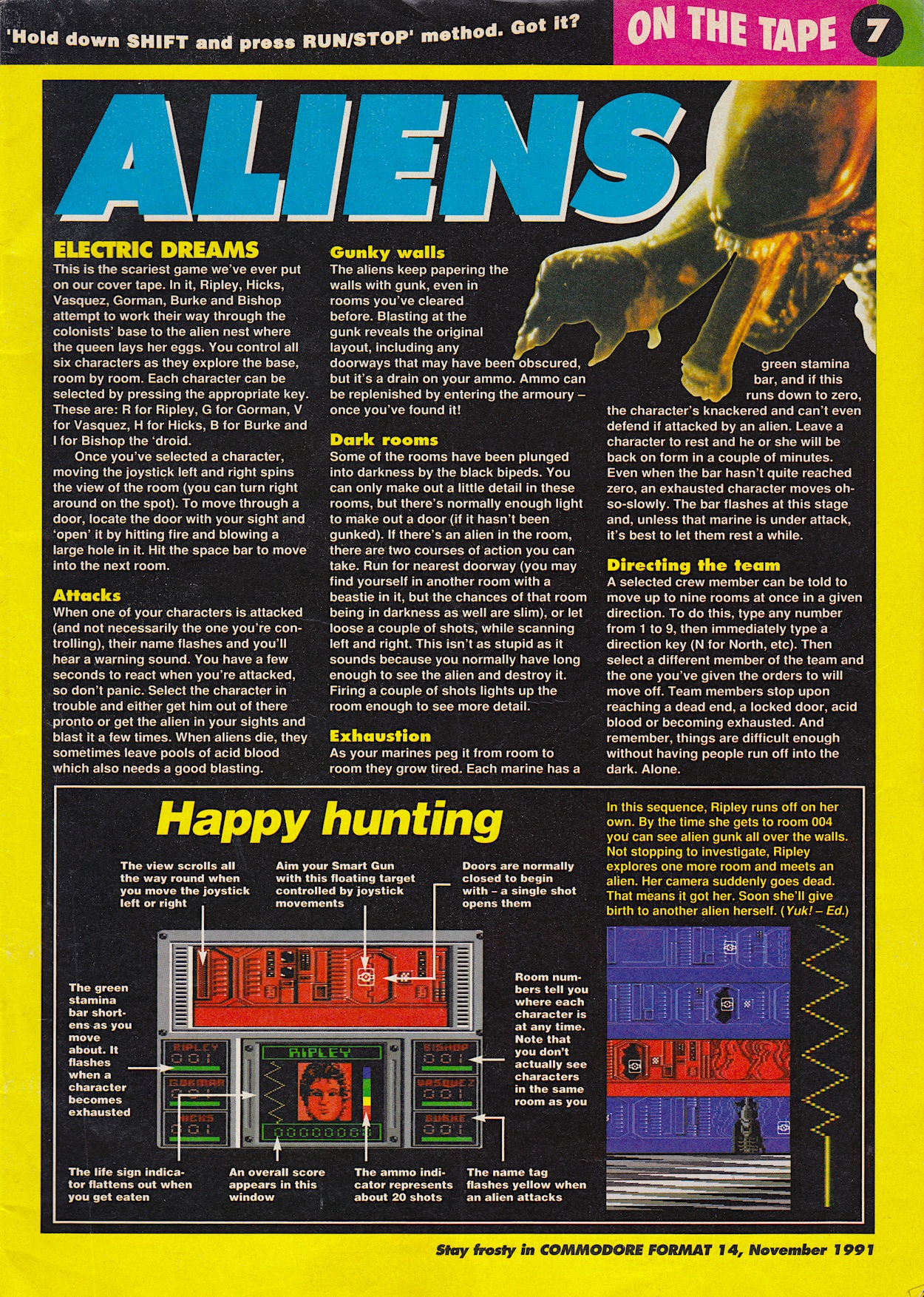
I also couldn’t believe what was on the tape stuck to the cover! I’d loved playing my brother-in-law’s Turtles game on his Nintendo NES, now it was coming to the C64 and this issue’s tape had a free level to play. But better than that was the full Aliens game that had terrified my friends and I so much when we played it late one night in the dark on a mate’s Amstrad. Here I was getting it free with this superb magazine. I was sold on CF within its first few pages.
I have distinct memories of playing this over the Christmas holidays that year; waiting until it was dark I’d turn the lights off and the sound up on my 12” Pye portable TV. I never lasted long before I had to stop! Fast forward 31 years and this year I’ve struggled to play Alien Isolation on the Nintendo Switch for any longer than an hour at a time for the exact same reasons.
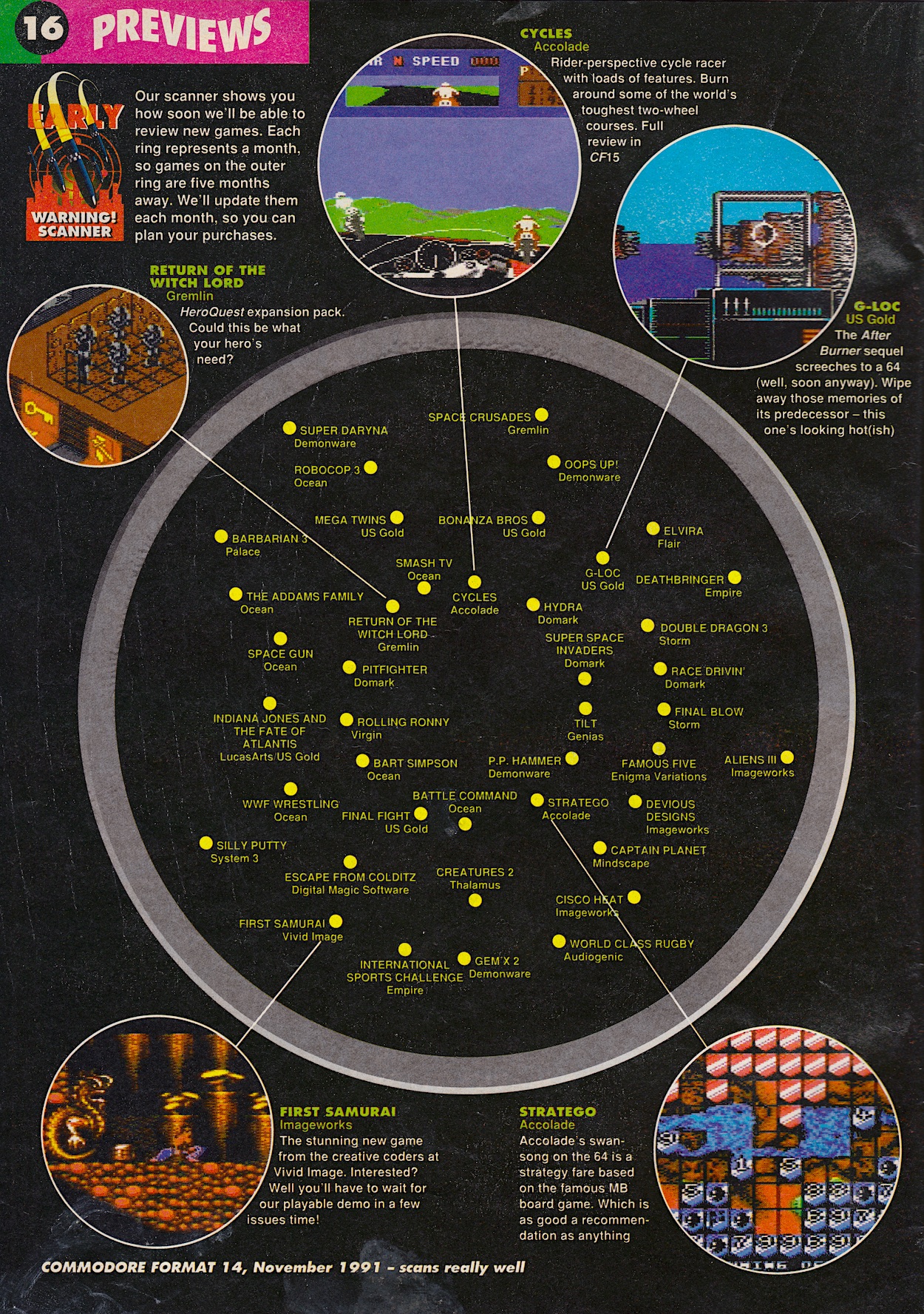
Among the impressive previews there was also a unique page called the Early Warning Scanner which summed up all of the forthcoming releases in a neat radar-type image; the closer to the centre each game was the sooner they were due to arrive. It was so much better than a boring list and kept readers up-to-date on their hotly anticipated games. As a new reader and (almost) owner, I looked at this page and was almost drooling at some of the games to come.
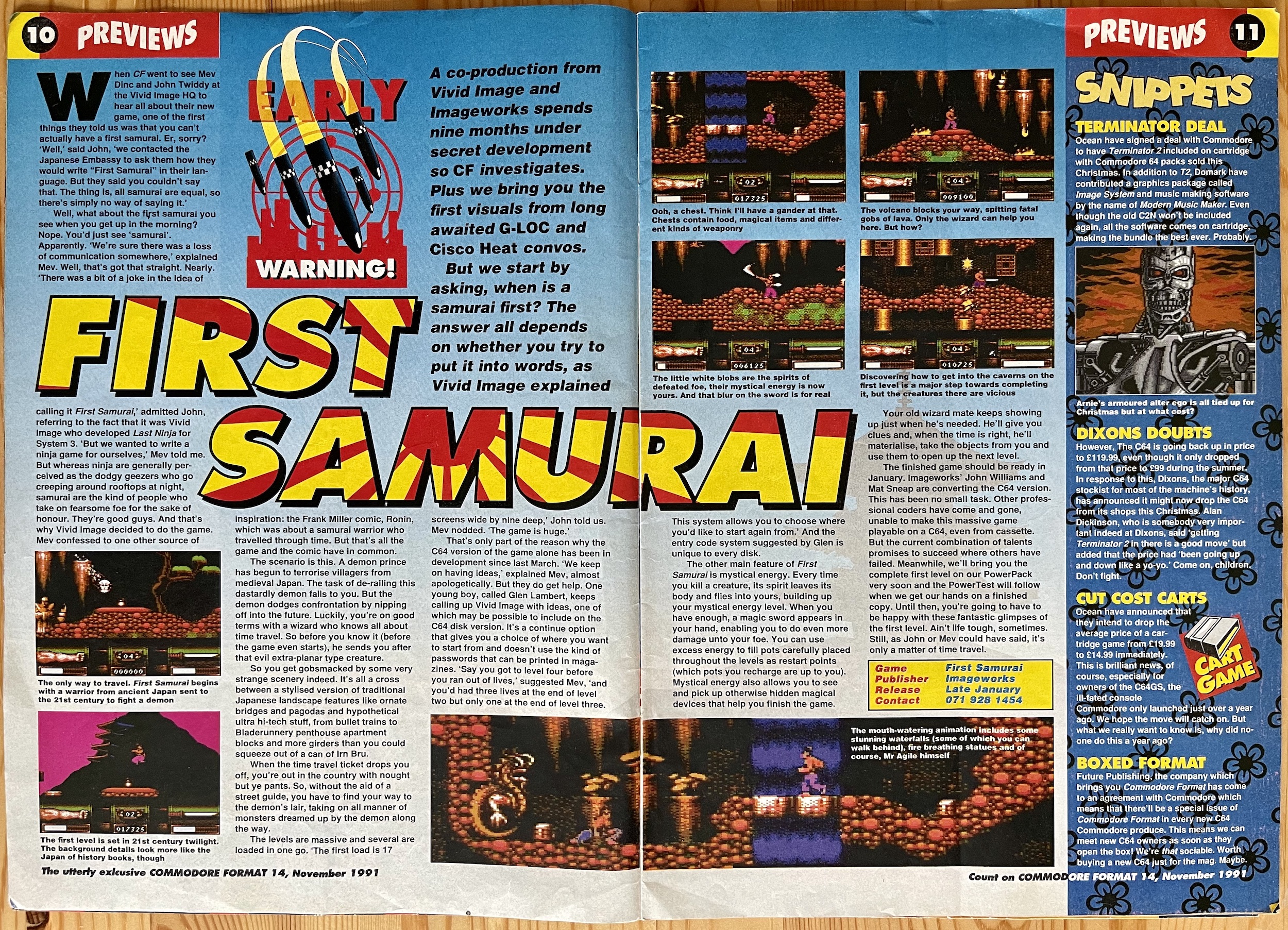
While some people in school mocked me for picking a C64 instead of a more powerful computer, within these pages I was in awe at the graphics this allegedly dated machine could produce. Also, to me the scanner dispelled any notion the format was in its final days. Most importantly, my choice also meant I met a fellow C64 owner in school who became a lifelong friend. (Hi Colin!) Back to the games, and even today something like First Samurai is still impressive when you know it’s running on an 8-bit machine. It played brilliantly too. (I also loved the programmers’ reason for the name, in the preview below.)
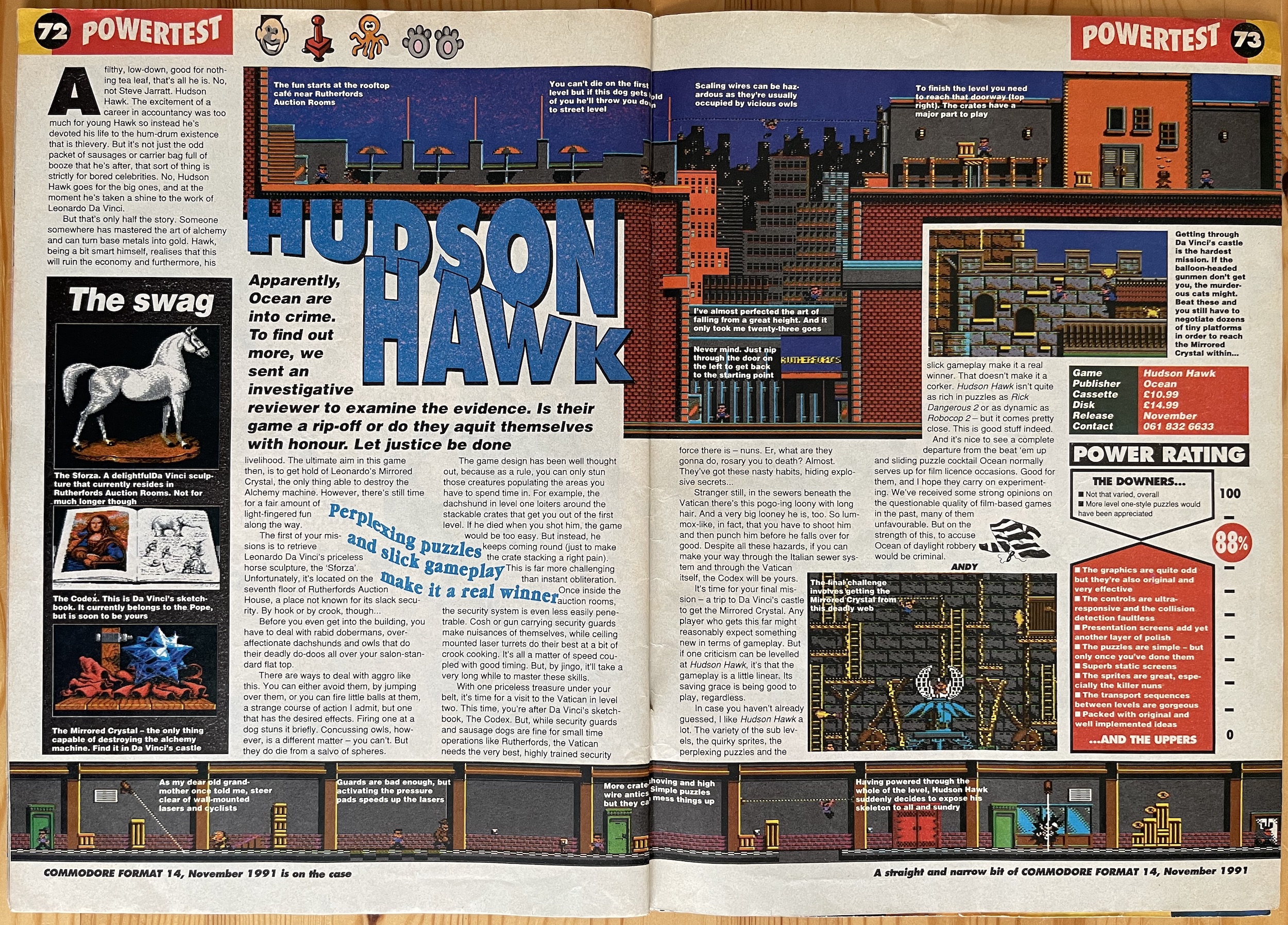
The Turtles arcade conversion may not have been the best example of what the Commodore could produce graphically but I did have fun with the demo although ultimately passed on paying for the full game. The same could not be said of Hudson Hawk. Based on the apparently terrible (I’ve never seen it) Bruce Willis film it looked a lot like the console games I’d played and proved to me this computer could have all the fun of those games at a fraction of the cost. Plus the 64 was so much more than just a games machine at the time, of course.
Commodore Format’s scoring system did away with the clichéd scores for graphics, gameplay, sound etc. and instead replaced them with a simple run down of the game’s main good and bad points at opposite ends of a scale, with the score being where they met. (Games with a score of 90% and higher were awarded the prestigious “It’s a Corker!” award.) It was a sleek design by art editor Ollie Alderton and made for some funny comments during the magazine’s lifespan. When racing game Cisco Heat was so atrocious it received 12% the ‘Uppers’ was just large enough for one comment: “Erm… it comes in a nice box.”
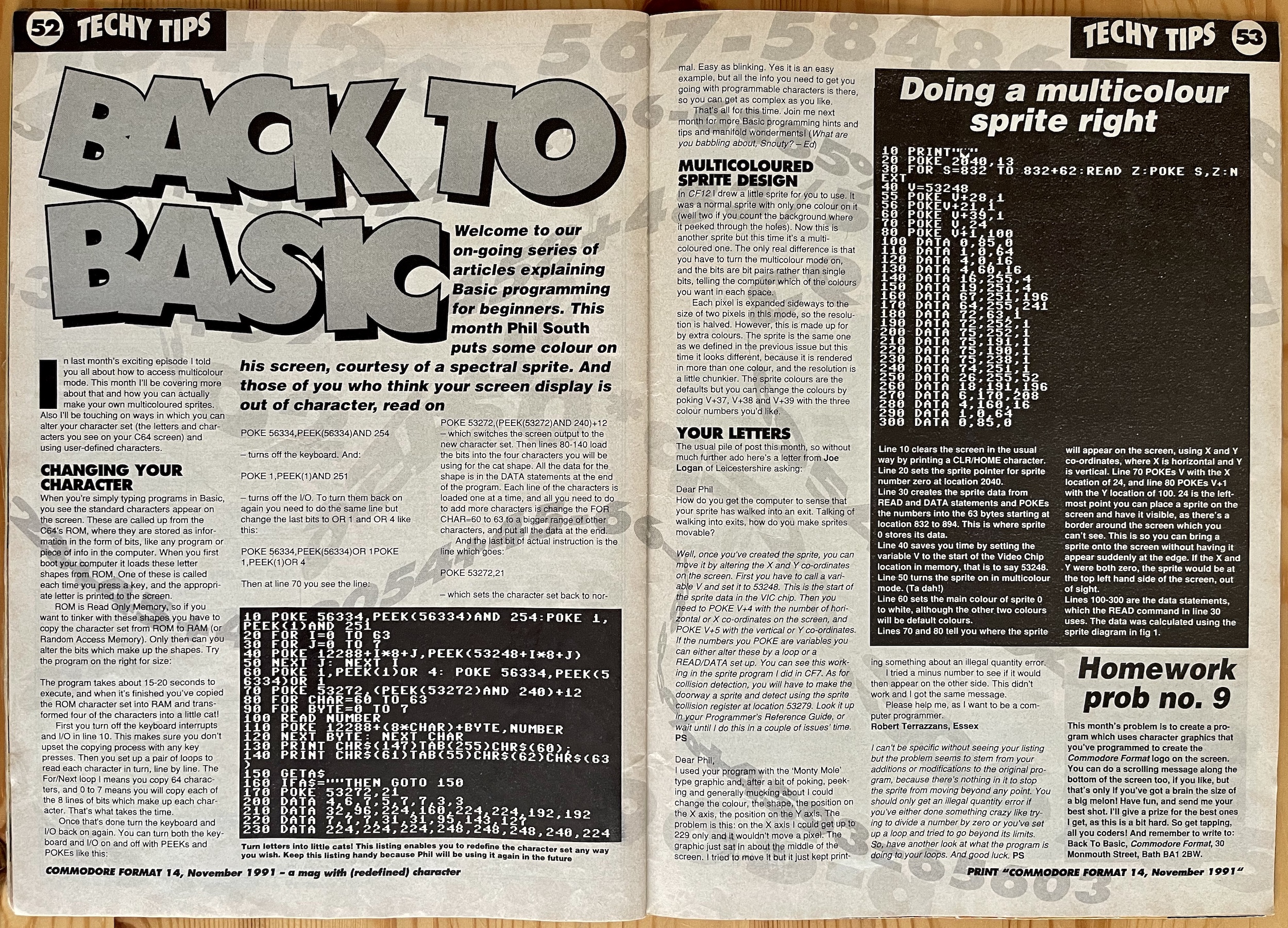
Commodore Format was different to Zzap in other ways too. While that magazine focussed almost exclusively on games, CF followed in the footsteps of its stablemates like Amiga Format, ST Format and PC Format and contained technical features such as an ongoing series of readers’ programming and hardware questions and loads of tips and tricks for the more established coders. For me, I was glad to see Phil South‘s tutorial series for complete newbies. With games on the cover and games all over the inside of the magazine, I made sure to show my parents these pages to prove I wasn’t just getting a games machine.
While naturally my focus was on the games to begin with, I was surprised how quickly I wanted to start digging a little deeper into the computing side of things. Commodore Format was a key part of this and the first three issues I owned before that Christmas were fascinating. I may not have fully understood these tutorials but I read them just as much as the rest, over and over. I was just as excited about that aspect of my new machine as any other.
Speaking of games being a fraction of the cost of their console counterparts, the Roger Frames Buys Budjit Games section collected together all the £2.99/£3.99 cassette games (originals and rereleases of former full-price games) in a handful of funny mini-reviews every month written by the fictional Roger Frames, a tight-fisted miser of a child who detested parting with his pocket money. Accompanied by brilliant comic-style misadventures you can check out this issue’s instalment in the review for OiNK #10. Why? Because Roger was drawn by that issue’s brilliant cover illustrator Mike Roberts, and I’d wanted to show off an example of his CF work I enjoyed so much. Off you pop and check that out before we go on.
Commodore Format led me to Edge and Cube magazines over the years via a detour to the equally fantastic 3DO Magazine
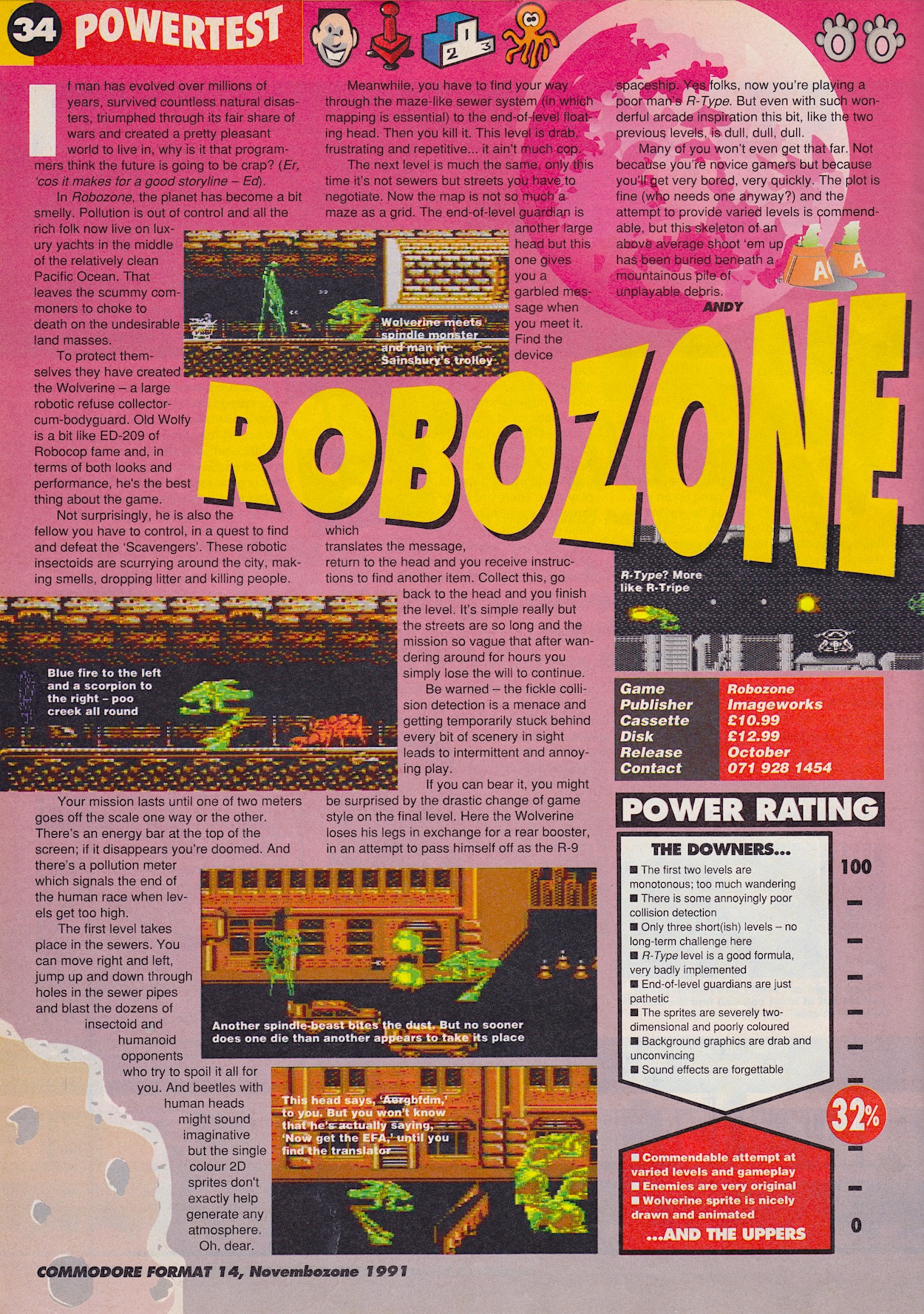
Welcome back. Anyway, Commodore Format also spoiled me for life when it came to review magazines of any kind, from games to movies and everything in-between. Below is a review from this issue for Robozone and by all measures it should be a terrible game that no one would want to spend their pocket money on. But the score is just the opinion of the writer, not a fact, and I always felt the way CF’s reviews were written was more important than the number at the end. Context was key.
In the case of Robozone it was clear why staff writer Andy Dyer personally didn’t enjoy the game but something from his review told me I might. So I bought it a few months later and yep, I did enjoy it. It wasn’t superb, and if I hadn’t got it from a bargain bin maybe I wouldn’t have purchased it, but it was fun for a few weeks. CF’s writers never tried to tell people that their opinions were facts. Throughout my gaming hobby I’ve come across magazines I felt were above their station, who thought what they opined was gospel (a bit like internet comments sections today). CF was never like this.
Commodore Format led me to Edge and Cube magazines over the years (also from Future Publishing) via a detour to the equally fantastic 3DO Magazine. Many others were tried but failed to talk to me on a level playing field like CF did. I’ve actually begun subscribing to Edge again last year for my Nintendo Switch. That’s the legacy of Commodore Format. It never spoke down to us. It never pretended to be anything other than a group of friendly people passing on advice. Well, perhaps one ‘person’ had a bit of an ego…
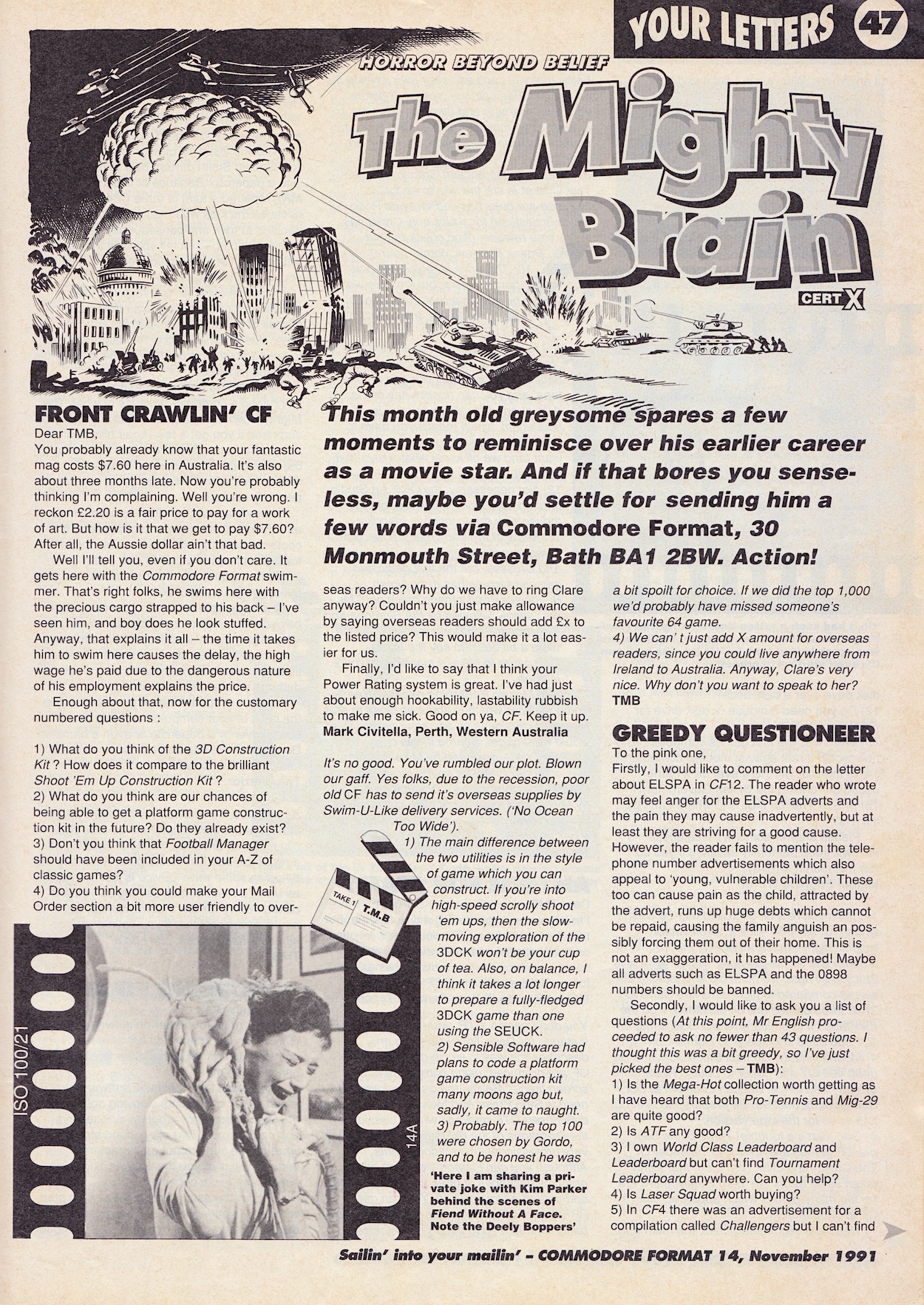
There were a whopping four pages of letters in each of these issues, hosted by The Mighty Brain, a ‘B’-movie star who knew everything in the knowable universe (and beyond). I mean, who better to answer readers’ questions, right? Even though these pages would be answered by different people as the magazine changed over time, his persona never changed and his cocky nature reminded me of the sassy letter answerers in childhood comics such as OiNK and Transformers. Great fun.
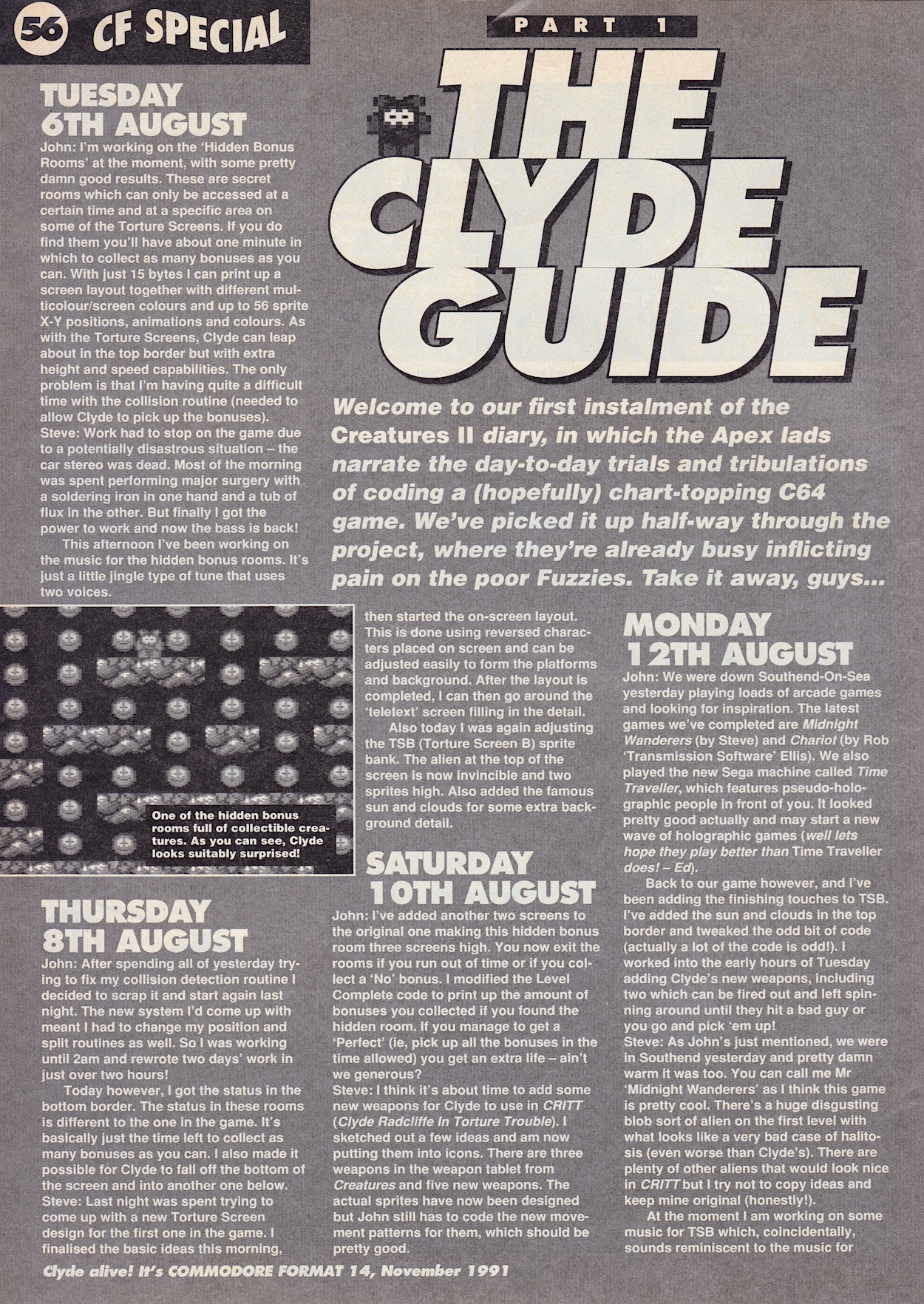
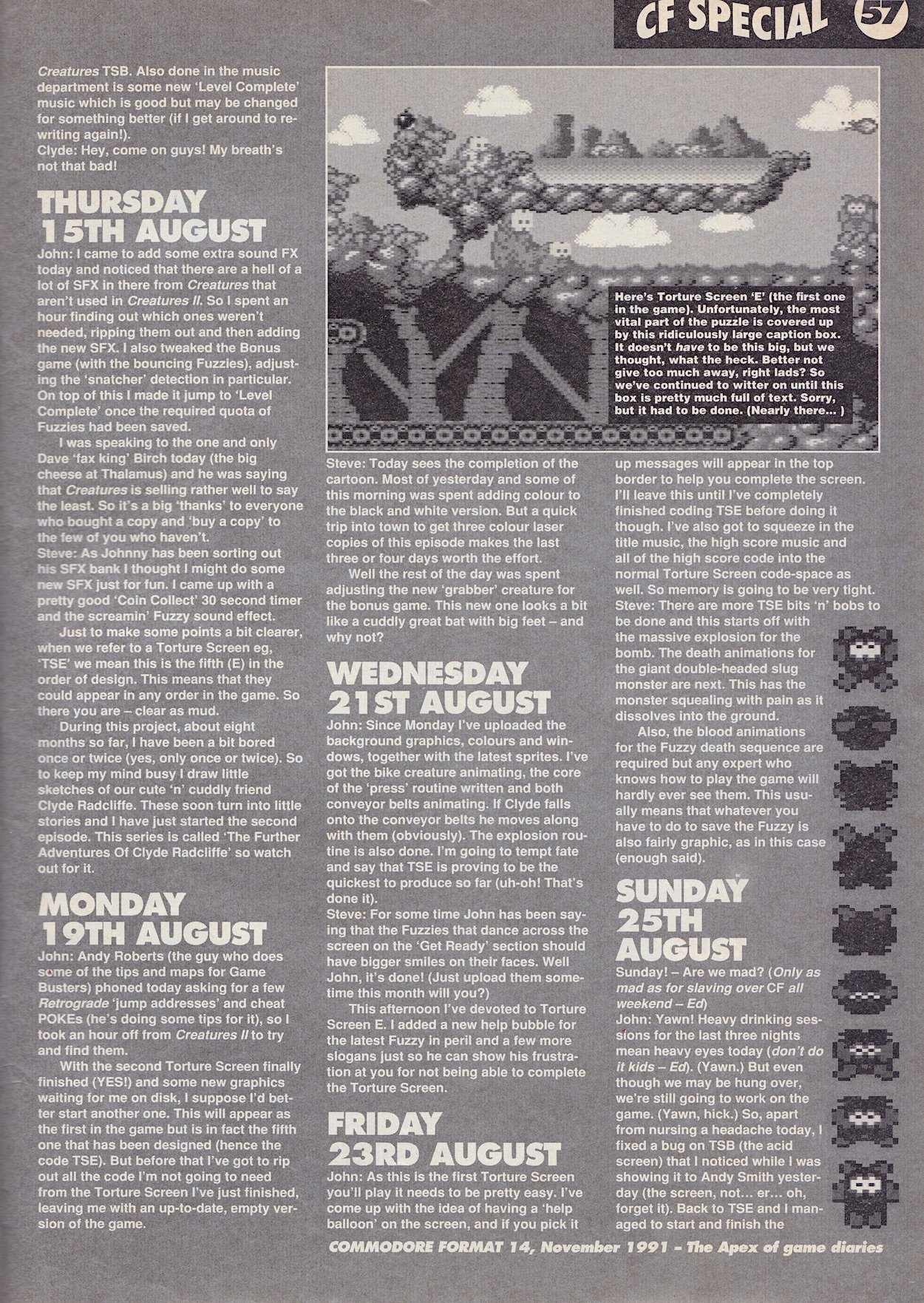
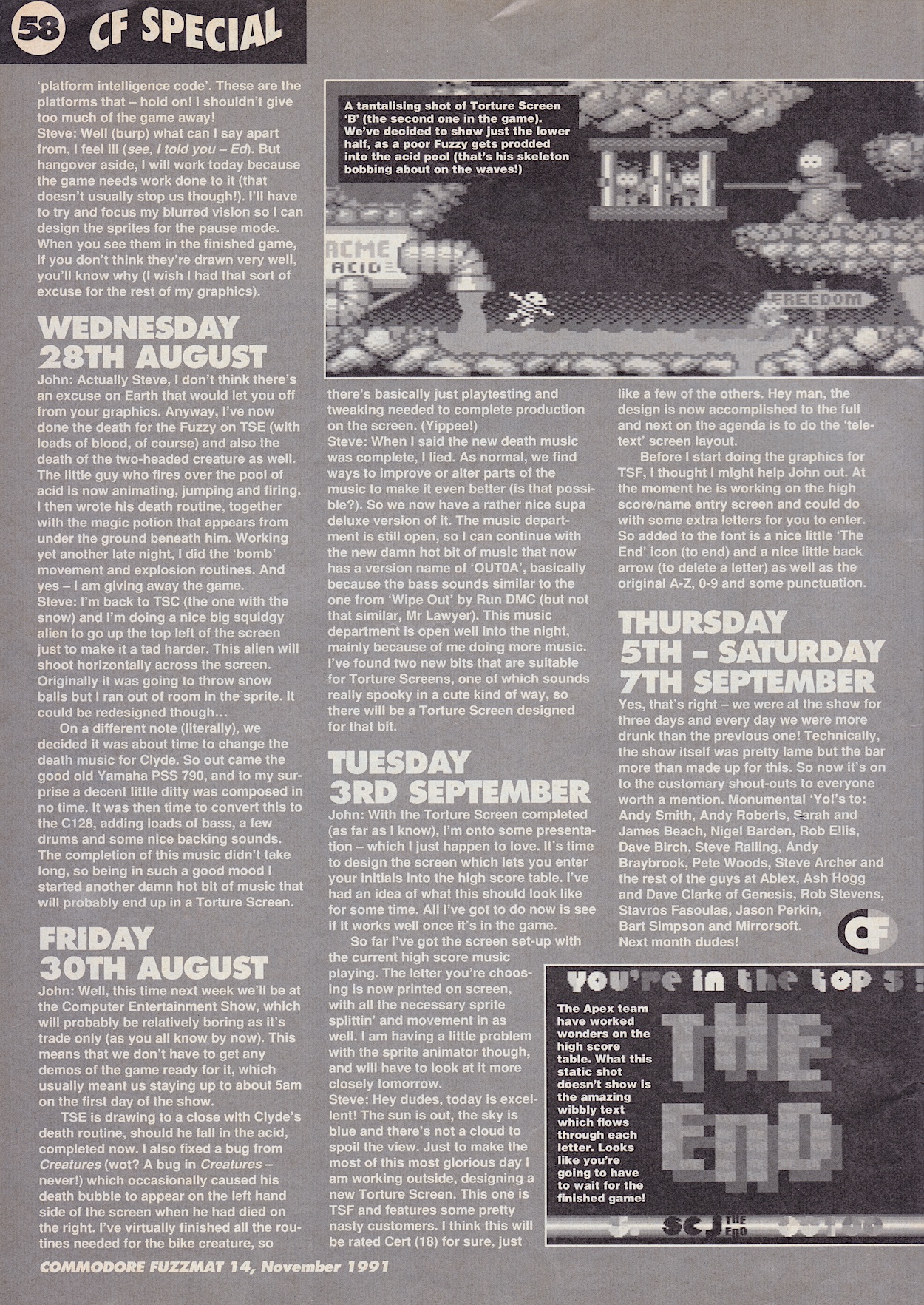
Zzap64’s publisher was going through administration at the time (hence the blurb at the top of the cover) and for a few months CF’s competitor didn’t appear. It worked out perfectly for me because I’d discovered this superior magazine instead and inside a regular feature from the abruptly (and temporarily) cancelled competition made its transition to CF. The Clyde Guide was a Making Of series about the upcoming Creatures II: Torture Trouble, a game that’s still in my top five games of all time on any platform to this day.
A cute and cuddly looking game with devious puzzles, huge boss fights and gorgeous animation, it had a hilarious sense of humour with over-the-top gore that would surprise players when things went wrong. All cartoony and ridiculous gore splashed all over the cute graphics of course, this was still a basic machine compared to today’s after all. The Rowlands brothers John and Steve gave a fascinating insight into the creation of a brand new game, month-by-month. This wasn’t a look back at how a game was made, this was happening in real time.
On a side note, I contributed to Bitmap Book’s Commodore 64: A Visual Compendium for their Creatures II spread
I was hooked from this first chapter (CF’s first chapter but obviously the game was a long way into development by this stage) and it would often be the first thing I’d read in subsequent months. Later in the magazine’s life the brothers would also create the incredible Mayhem in Monsterland game which they’d chronicle in the pages from the very beginning. I’d never read anything like these diary entries before and was amazed at the access the magazine had. On a side note, a few years back I contributed to Bitmap Book‘s Commodore 64: A Visual Compendium for their Creatures II spread.
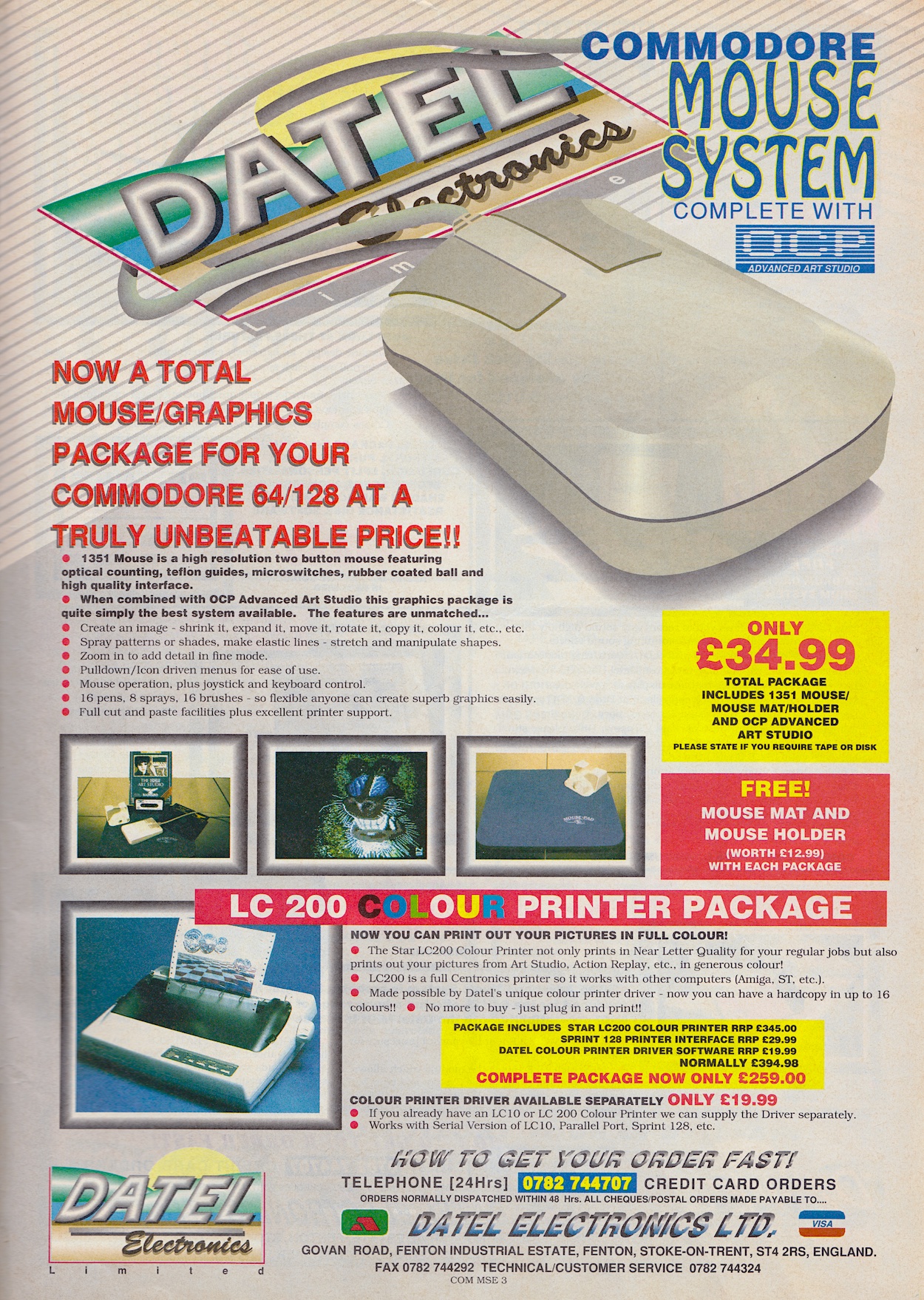
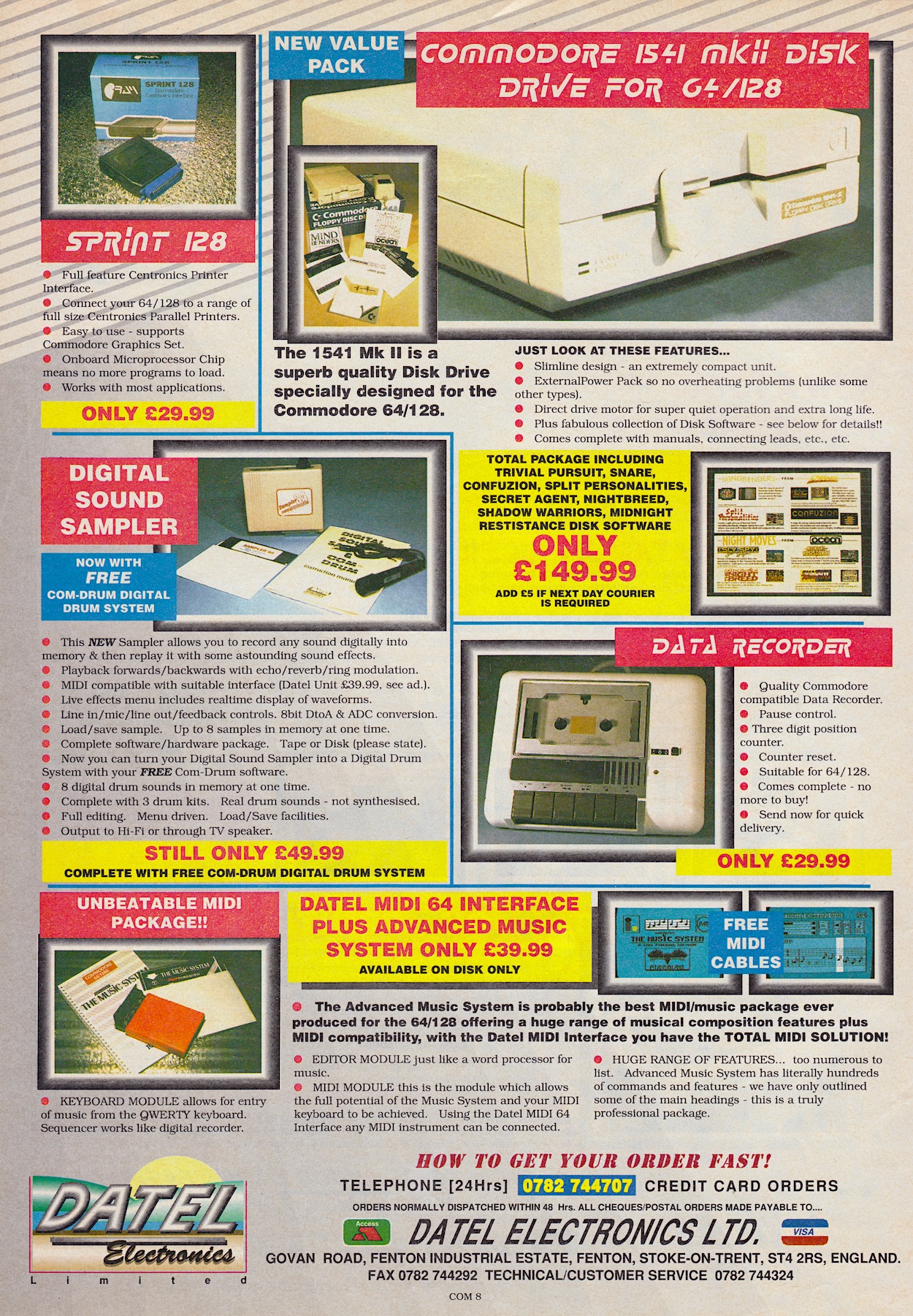
That Christmas I finally received my C64 with a cartridge full of games, a few joysticks and a cassette deck. The following Easter my dad was made redundant and with his payoff I was promised something for my computer. I chose a disk drive after seeing it advertised every month in these Datel Electronics adverts. The following Christmas I also added the printer shown here along with the mouse and art package, all set up on a desk made by my dad in the alcove in my bedroom.
Some friends may have thought the C64 was past it but I was using it for everything! Writing my own stories and magazines, a diskzine (more on that in the specific post I mentioned, coming next year), homework, running a Public Domain software library, making games… In fact, I was using it for a lot more than my friends were using their more powerful machines for. Oh man, the memories are flooding back as I read through this issue again. Those were such enjoyable years thanks to that machine and this magazine.
CF eventually succumbed to a loss of sales only six months before the release of the first Sony Playstation!
Commodore Format was created by Future Publishing when they saw an opening in the market. The C64 was still selling really well as an entry-level computer, while also being handed down to younger siblings. CF was an instant success and soon became the biggest selling C64 magazine in the world! Deservedly so. It would last right up to #61, eventually succumbing to a loss of sales only six months before the release of the first Sony PlayStation! That’s incredible for a machine which people told me was on its last legs before I even got mine.
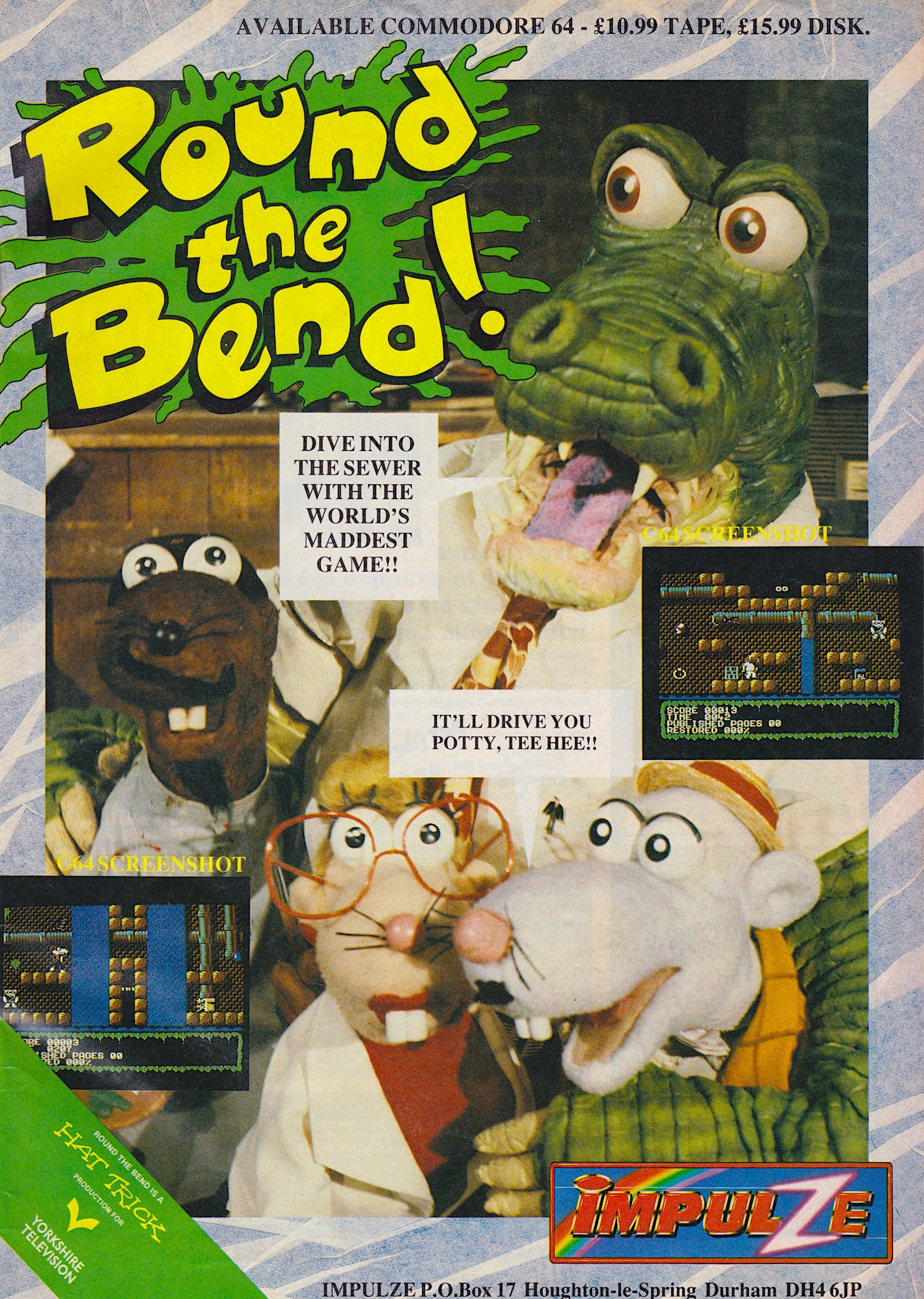
Regular blog readers may have noticed the issue number for my first ever magazine is the same as that for my first ever comic, #14 of OiNK. With that tenuous link I’ll wrap up this retrospective with an advert for an upcoming game pig pals may have been particularly interested in. After OiNK was cancelled the creative team of Tony Husband, Patrick Gallagher and Mark Rodgers went on to create a certain TV show that shared many familiar aspects with our piggy publication.
The game already looks like it’s closer to its inspiration than the OiNK game. Round the Bend would get reviewed in #17 of Commodore Format, so in keeping with the real-time aspect of this blog I’ll show you that very review and take a look at the game itself on Tuesday 16th January 2024.
I feel like I’d need to show you every single page of this issue over a series of posts in order to fully get across just what an impact it had on me and how formative it was. I hope I’ve been able to do it justice. I have an almost complete set of the magazines here at home, despite not owning a Commodore 64 anymore and I’ll never get rid of them; I love to dip in and out and I’ll forever treasure them and the memories they contain.
In the days of magazine contributors being named and photographed for the editorial pages, over time it felt like we’d grown to know these people and we trusted them as a result. This was a key component in that club feeling and later in its lifespan Commodore Format would be instrumental in my life and the person I became! Really. That’s a whole other story for another time, but for now I just wanted to concentrate on a retrospective look at this beloved issue of a beloved mag.
Commodore Format has featured elsewhere on the blog already. The cover cassette of its second edition contained the OiNK game in its entirety as you can see in a post from the game’s coverage. Then in their third issue the team produced maps to help people struggling with the game and I’ve included them on the blog as well. Both posts also take a look at some of the other articles and contemporary adverts featured in those early editions. Finally, the Roger Frames Buys Budjit Games section was a favourite feature of every issue for me and was illustrated by Mike Roberts, a brilliant illustrator who also produced the cover to OiNK #10, and in that OiNK review I’ve included Mike’s art of Roger’s misadventure from this issue of Commodore Format. Enjoy.
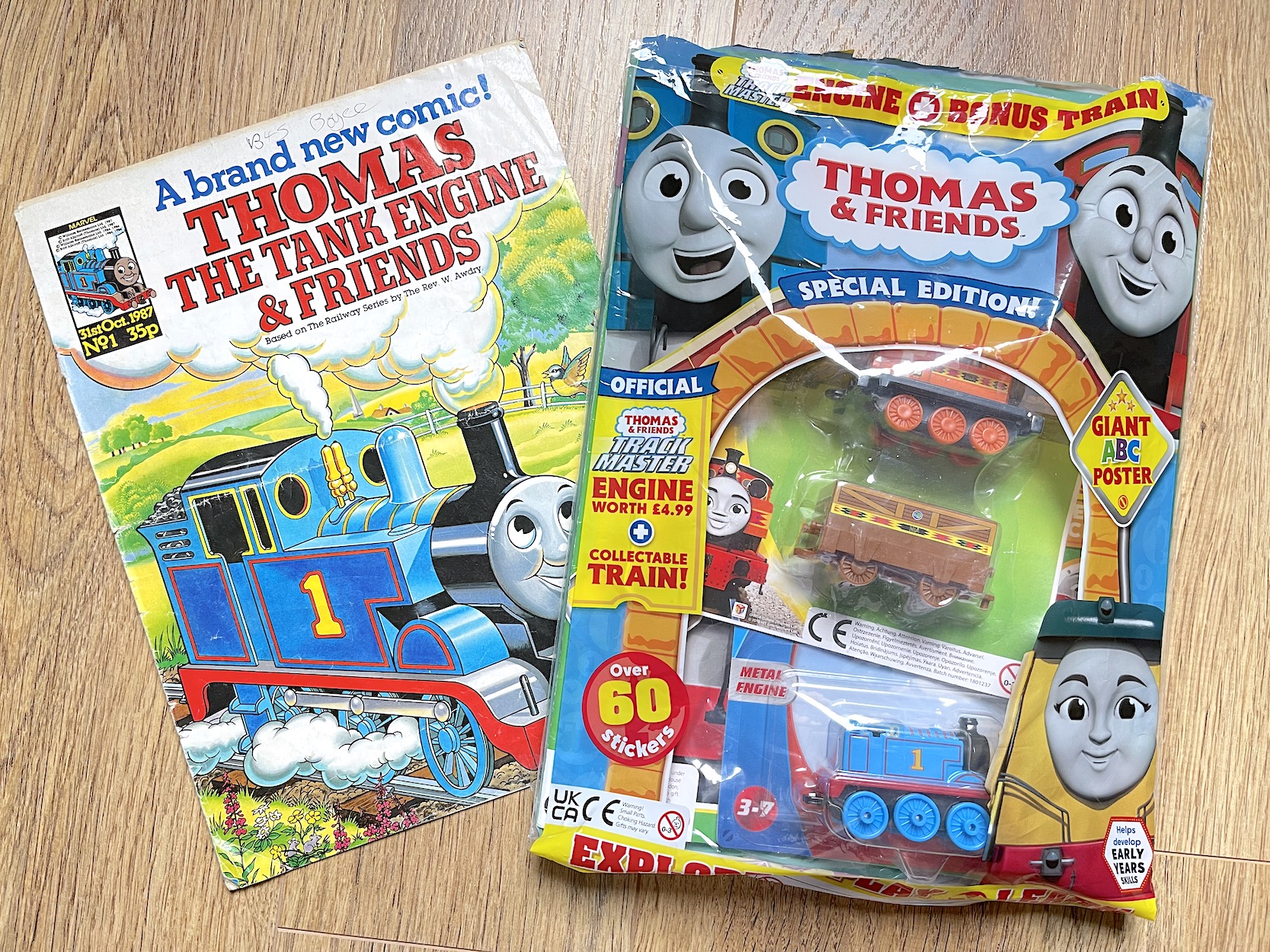
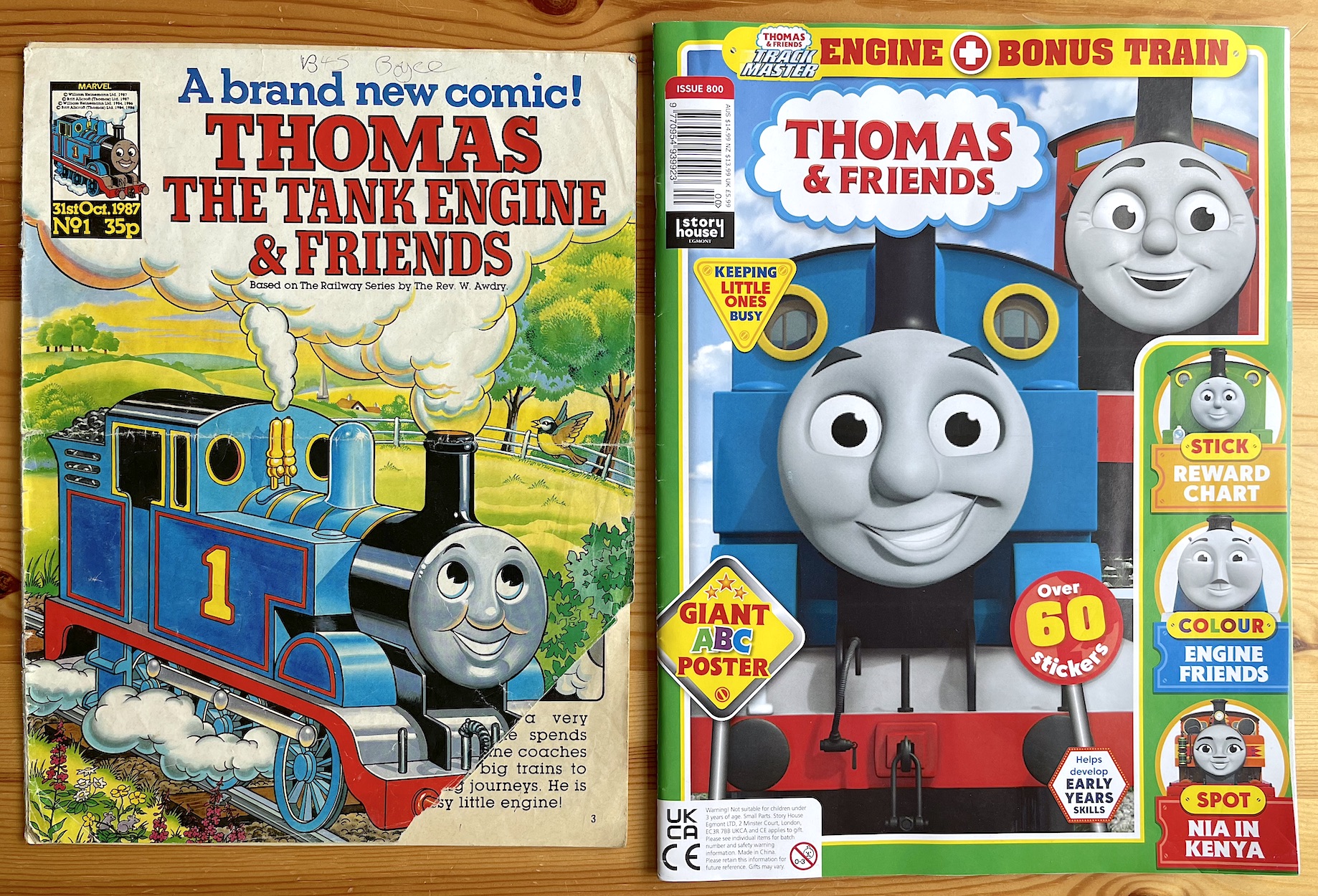
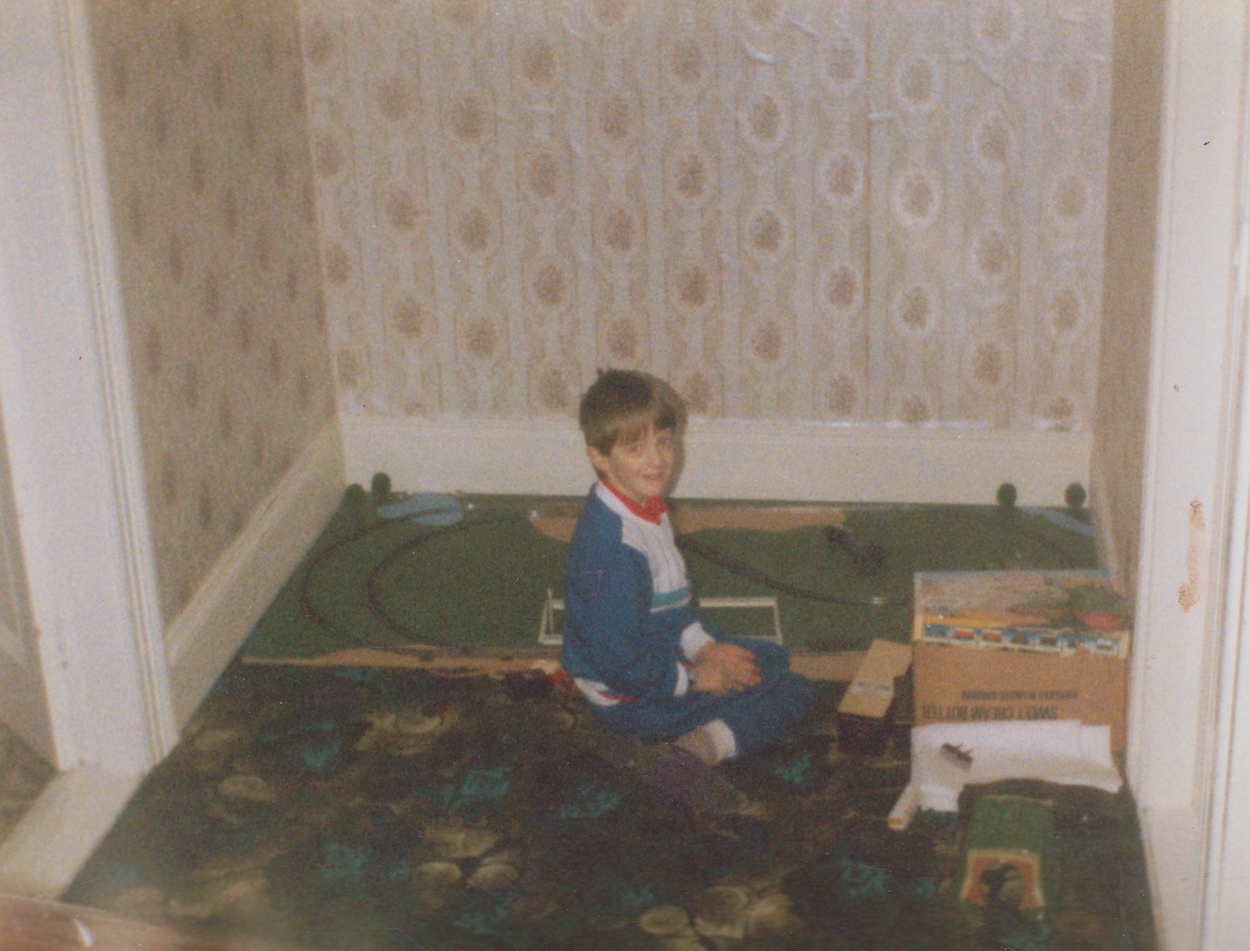
Back in 1987 I was nine-years-old and already a bit above the target audience for Thomas the Tank Engine & Friends, but growing up in a town with actual steam trains (the headquarters of the Railway Preservation Society of Ireland were just around the corner from my house) a lot of the kids in my town loved the original Railway Series books by the Rev. W. Awdry and the subsequent TV series with those stunning model layouts. In October ’87 I found myself in the newsagent to pick up the latest issue of OiNK, the only comic I was collecting at the time and I spotted “A brand new comic” on the shelves.
This was my first ever Marvel comic, believe it or not. I even got my drawing printed in a Christmas issue!
I collected it for about two years before finally moving on but over the years I’ve seen younger family members and friends’ kids become fans just as I had been. Working in newsagents over the years I was aware the comic was still ongoing, surprisingly keeping the original numbering even though it had gone through a couple of different publishers. Then a few months ago while browsing the children’s comics for a friend’s wee boy I discovered Thomas & Friends (as it’s now called) was at #797!
So fast forward to the present and I’ve bought #800 for him and thought I’d open it up to see what’s inside and compare it to the original. But first let’s just dwell on that issue number for a second. The 800th issue! This makes it the longest-running UK licenced comic ever. It’s an amazing achievement and I doubt it’s going to come to an end any time soon, the TV series is as popular as ever.
Now, when I mention modern children’s comics there’ll inevitably be a chorus of middle-aged men complaining that they’re “nothing more than flimsy leaflets” with “cheap tacky toys” in plastic bags “pushing the price up”. Well let’s just put this to rest once and for all, shall we? While the comic magazine itself doesn’t mention it’s celebrating the milestone it’s still packaged as a ‘Special Edition’ and contains a die-cast metal Track Master Thomas which on its own sells for £4.99 in the shops. Not a bad start!
For just £1 more than the cost of the toy, for £5.99 (usually it costs £4.99) you also get a 36-page issue printed on really great quality matt paper with a gloss cover and it’s chock full of content for younger fans. There’s also a second, plastic toy set produced specifically for it, a large double-sided wall chart, a poster and loads of stickers which are used throughout the pages as you’ll see below. I’d say that’s a bargain.
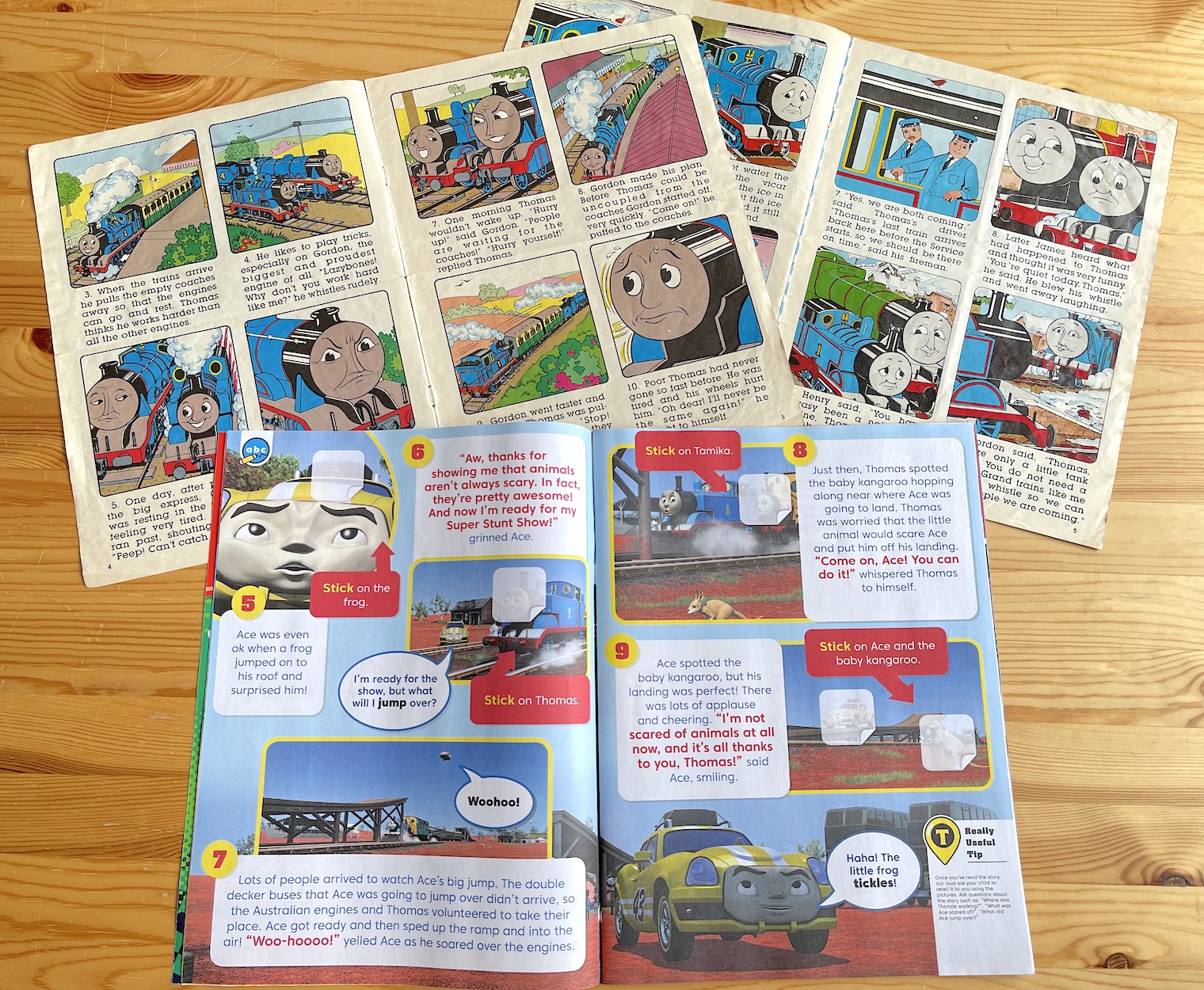
Interiors of the first and latest issues show it’s very much the same beast at its heart
So how does it compare to the original comic I bought for 35p back in 1987? I’m not mentioning the cover price for comparison reasons, it was 34 years ago, of course it’s going to be a lot more expensive, just as 35p was a lot more expensive than comics from 34 years before that. But I thought it’d be interesting to see how things have evolved after 800 issues, so below are some of the interiors of the first and latest issues and as you’ll see, it’s very much the same beast at its heart.
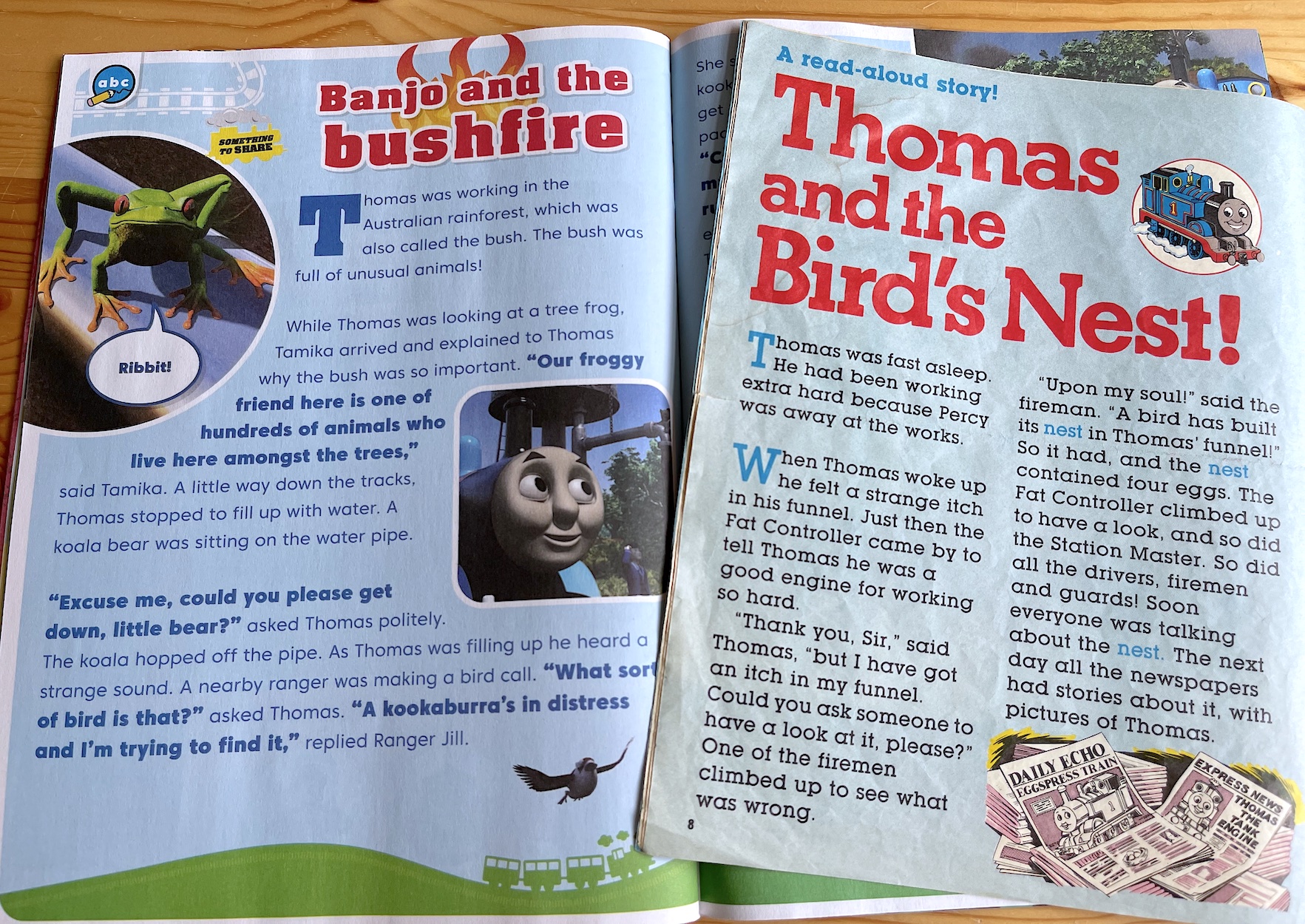
The main element of the original comic was the picture panel stories, which for the first year were adaptations of the TV stories (which in turn were adaptations from the books) then after that were all original, written specifically for the comic, some being adapted back on to the TV. There was also a short prose story every fortnight which readers were encouraged to “read aloud”.
These formats remain although with so many years of the show to pull from now they all seem to be adaptations and use stills from the current CGI series rather than original illustrations. What’s neat is how those stickers I mentioned are used throughout to fill the gaps in stories, features, puzzles and more. For the young readers it’s like a really fun old-school Panini sticker album on top of everything else is contains.
Obviously back when I was nine my attention span didn’t last long enough for me to finish colouring this image of Thomas and it’s remained as such all this time. The activity can be found a few times in the current publication, on two dedicated pages and even the editorial credits page.
As a nine-year-old I was already too old for the comic if I’m completely honest, evidenced by the ABC collection and some very simplistic puzzles such as Henry the Green Engine highlighting other green things the younger readers were meant to identify. I just ignored these and kept to the stories, editorials and letters page, as well as the middle-page spread below. But for the target audience they brought a level of interactivity to the comic and this is something the modern version continues.
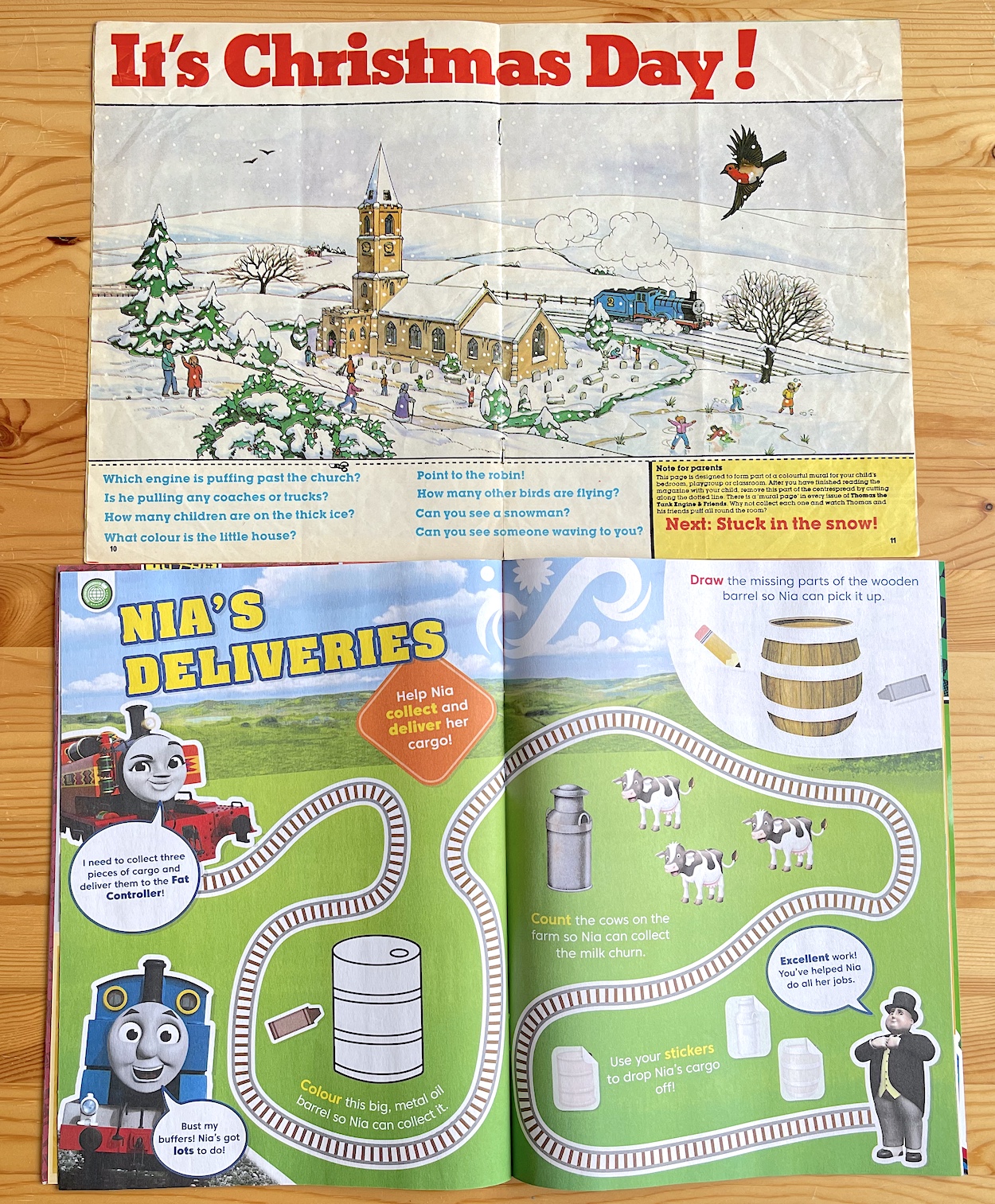
The middle pages of my #1 are missing so this is from the only other issue I kept (#31) which was the second Christmas issue and the one I had my drawing published in. The middle pages had very simplistic questions about what could be seen in the picture but the reason it’s missing from my first issue is because they could be cut out and hung on the wall, issue after issue creating one long drawing around the Island of Sodor, wrapping its way around our bedrooms.
I’m clearly not the target audience so the final word has to go to Ollie
There may not be murals but there are plenty of CGI shots from the show used for spot-the-difference pages, mazes, pin-ups, puzzles and so much more. Even the competition in #800 reminded me of the one we got in #1. Thomas & Friends may look very different from the Marvel comic on first glance but take a closer look and it’s a very natural progression. In fact, I’d go so far as to say I’m surprised just how much it’s kept to the original ideas.
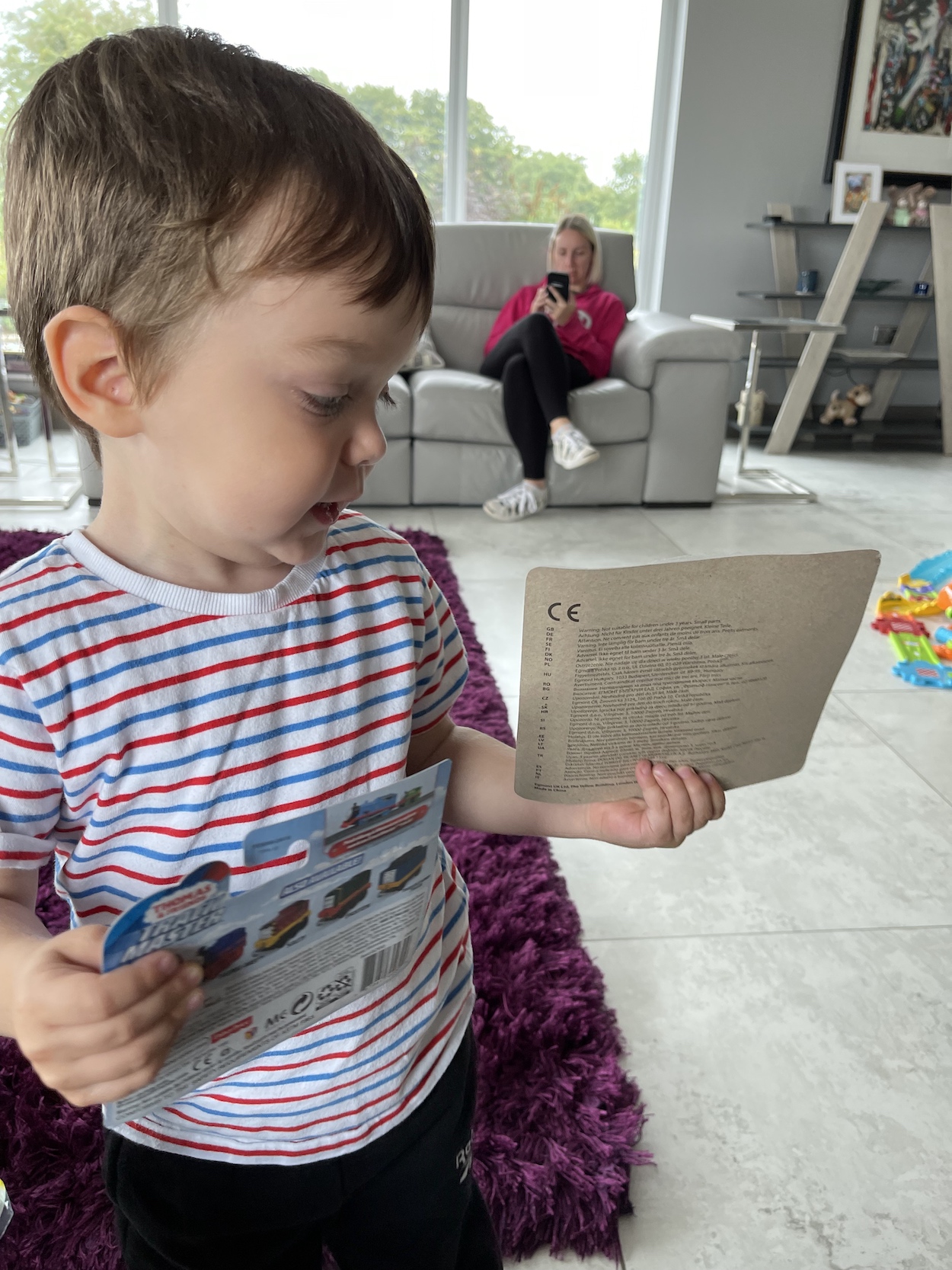
But I am clearly not the target audience so the final word has to go to the little person I bought it for, my friend’s baby boy, Ollie. As you can see, he’s clearly very happy with the gifts that came with it. In fact, three months before his third birthday he saw them and came out with, “Thomas the train”, which he’s never said before! A very cute moment.
His mum Vicki had a look through the comic itself, at the wall chart, stickers and the contents as a whole and remarked at how much was in it. Not expecting it to be much more than an excuse to package the toys in with something, she was pleasantly surprised at the value.
So there you go, if you have a young child in your life who watches Thomas & Friends on TV this is a top comic magazine for them. Usually £4.99 every four weeks, #800 is £5.99 but then again you are getting a toy which is normally a fiver on its own (and by the looks of it #801 has one too). It’s available online but everywhere I looked was charging around £10.00 for it because of bulky postage, but you’ll find it in most newsagents and supermarkets easily enough.
To finish with, here’s a look at the original audience and the current one.
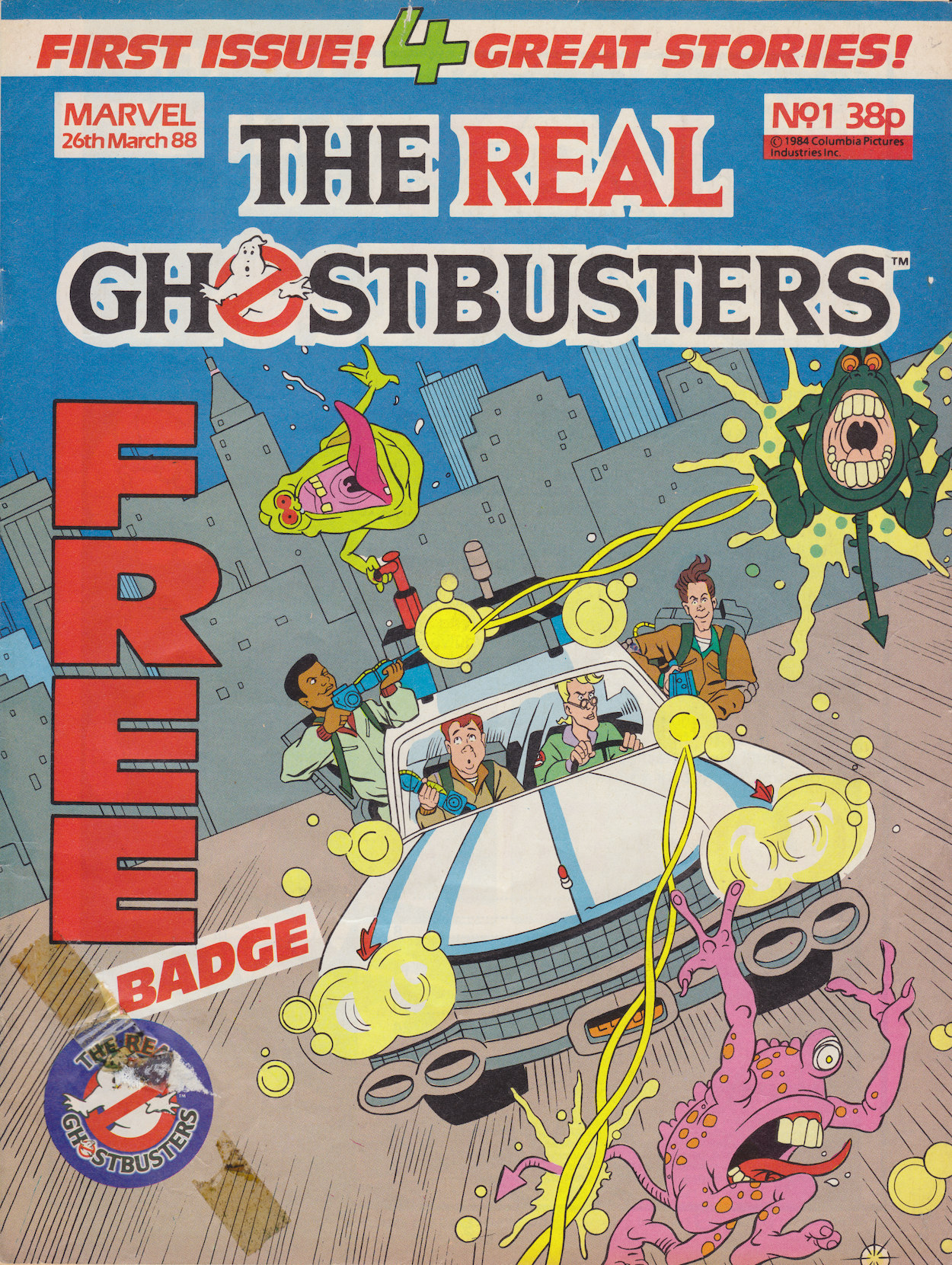
I’ll admit that back in 1988 when I finally got to open my copy of The Real Ghostbusters‘ premiere issue I was a little confused. I’d been looking forward to something more along the lines of Marvel UK‘s Transformers comic, with a lengthy multi-part story and certainly no text stories which I associated with comics aimed at much younger kids. However, any initial disappointment evaporated as soon as I started to read.
By the end of its 24 pages I was hooked and didn’t regret placing the order with my newsagent before even reading it. In fact, I stayed with the comic for the majority of its run. Now, 33 years later I’ve just finished reading issue one for the first time in decades. How does it hold up to reading today?
That front cover is nothing short of iconic, often copied by my young self back in the day on several school exercise books. Andy Lanning (The Sleeze Brothers, Superman, Majestic) and Dave Harwood‘s (Action Force, Swift Sure, Conqueror) introduction to this new title perfectly captures the light-hearted tone of the comic. Unlike the aforementioned Transformers I’d enjoyed reading at my friend’s house, The Real Ghostbusters would focus on smaller, complete stories aimed at getting a chuckle out of its readers. A unique approach, brave even, but they pulled it off and created a comic like no other.
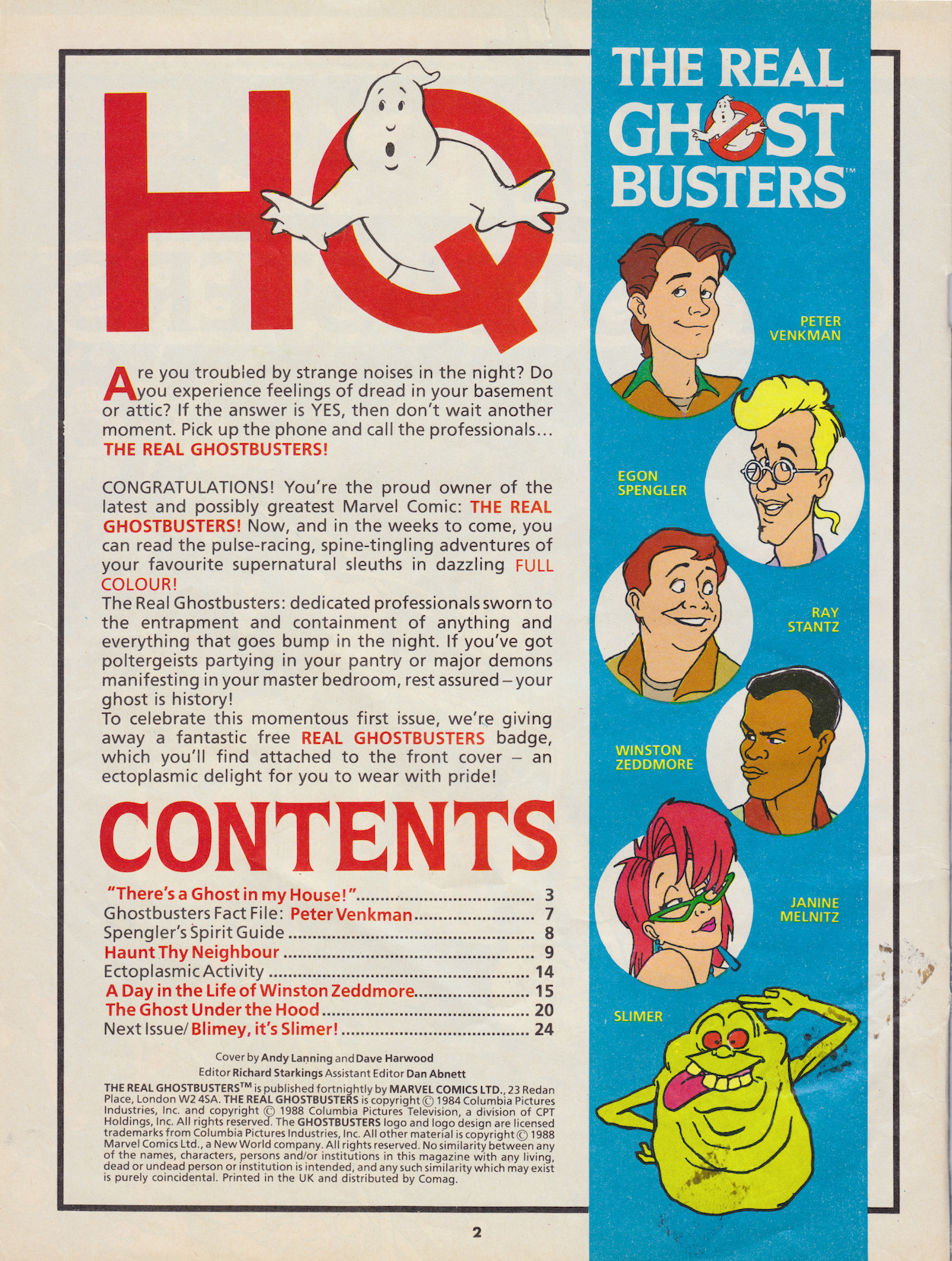
The first issue has no less than three strips and a text story, fact-file, activity page, ghost guide, request for readers’ letters and of course a Lew Stringer strip. (What Marvel comic was complete without Lew?) It’s all introduced on the HQ page which starts the whole shebang off by reciting the movie, setting the tone perfectly for this comedy comic (a term I’ll clarify later). The overall design wouldn’t change, there’d be no ‘new look’ every 50 or so issues, instead the cover and feature pages remained the same almost until the very end.
There’s certainly a confidence about it from the very start.
All of the strips here are written by John Freeman (of Down the Tubes). Editor of Doctor Who Magazine at the time, he was asked by the comic’s launch editor Richard Starkings to supply stories for the first issue. John told me this was literally his first regular writing gig, which is incredible since this was the launch of a brand new comic based on such a hot property. Needless to say, John knocks it out of the park.
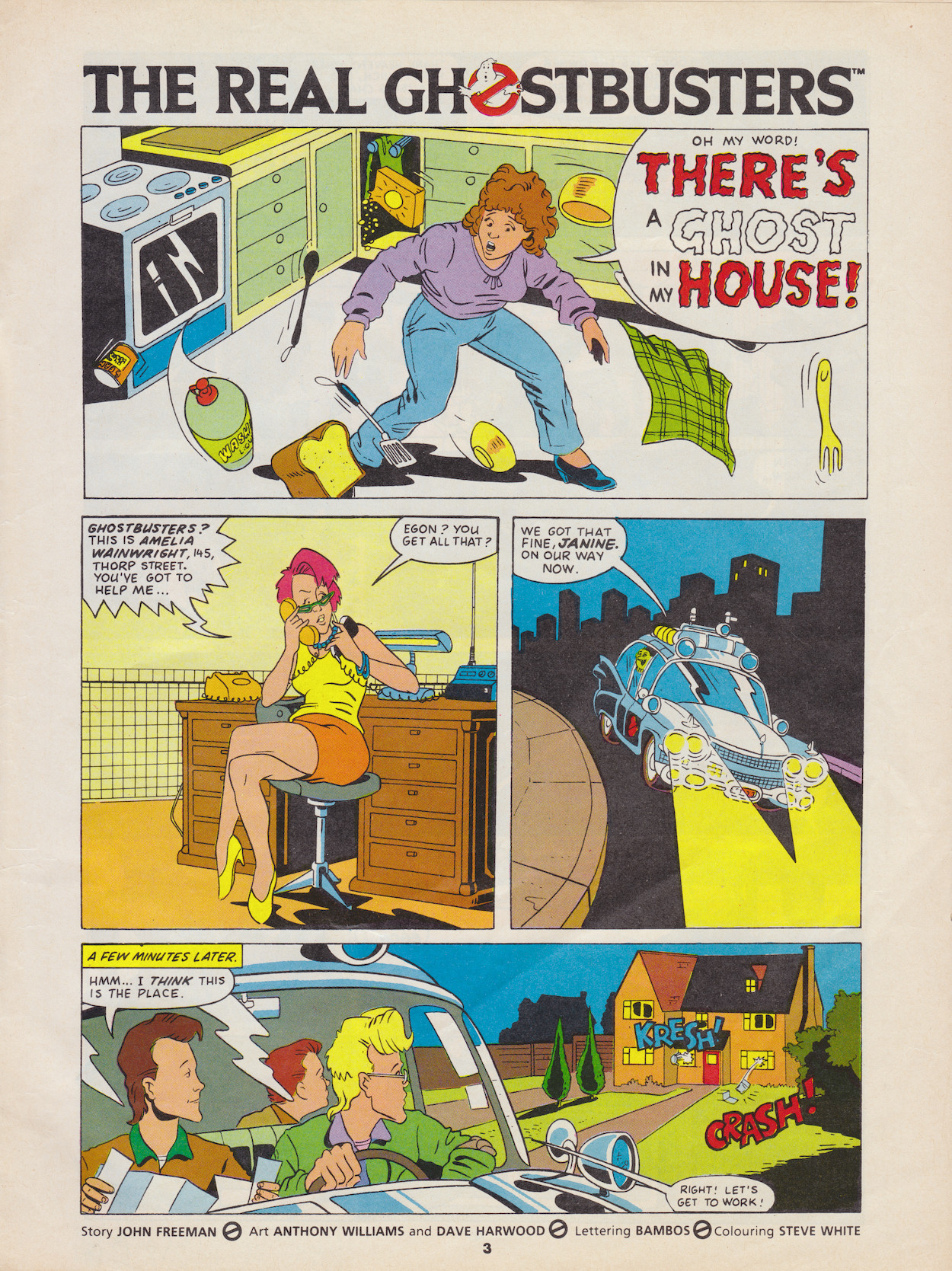
As with the other stories, “There’s a Ghost in my House!” takes place with the team already on the job and gives us an idea of the pacing we can expect, as well as acting as an introduction to the Ghostbusters’ equipment, interactions and most importantly their humour. That’s all it really needs to do, but there’s still a twist. The ghost itself is a buggane, a house ghost and harmless if treated right. The homeowner ends up feeling sorry for it and in the end keeps it as a pet!
Dave’s inking added ample shadow work to gloomy, haunted scenes in the annuals
The strip is drawn by Anthony Williams (Judge Dredd, Fate, Sinister Dexter) with Dave Harwood on inking, lettering by future Slimer! artist BambosGeorgiou (Knights of Pendragon, Spectacular Spider-Man, James Bond Jr.) and coloured by Steve White (Transformers, Jurassic Park, editor of Visionaries). One of the other stories, The Ghost Under the Hood is also drawn by Williams but with Dave Hine (Detective Comics, X-Men, Night of the Living Dead) inking and there’s quite the difference. In the annuals Dave’s inking added ample shadow work to gloomy, haunted scenes and made for some atmospheric illustrations. Finally, this strip is coloured by Paul Jacques (Adventures of the Galaxy Rangers).
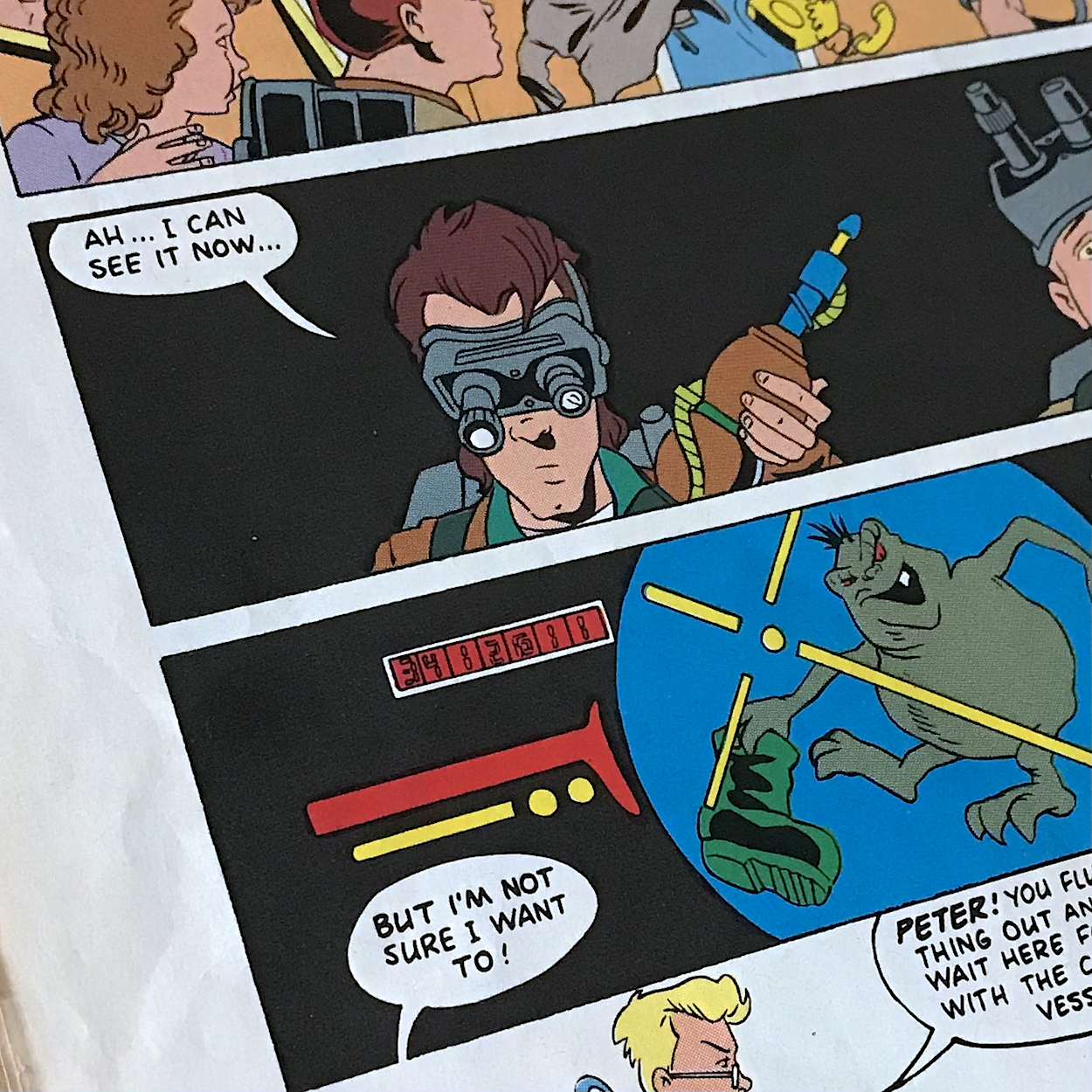
Again, it’s full of action and humour and plays out like one scene has been plucked from an episode of the cartoon. This was Richard’s intention; each story to take place right in the midst of the action whenever possible. Here, Ecto-1 is out of control, with Egon unable to steer or brake. You can see from the page above the plan isn’t to Peter‘s liking and in the end the car suddenly stops, sending him flying. Now parked outside a Chinese takeaway, their perpetually hungry pet ghost Slimer appears from under the hood.
To establish a scene and scenario, pack in some action, wit, character and a funny conclusion in just three pages is quite the achievement. Indeed, by the time I finished reading the comic I was a little breathless (metaphorically speaking) with the fast-paced nature of the stories and gags.
The humour in their interactions was always well developed and genuinely very funny
The covers were mainly used to illustrate the text stories, doubling up as their title pages inside. So yes, basically we’d be getting two identical pages in our comic but we didn’t care, some of the front covers would have us frantically flicking straight to that story. This was especially true later in the run with some simply stunning cover artwork.
I’ll admit it took me a handful of issues before I read one of the prose stories as a kid because of a false perception they were aimed at younger readers. But I remember discovering just how good they were and reading all the ones I’d glossed over one very enjoyable afternoon. From then on they often became the first thing I would read. Space constraints might have been a factor here, but they would often focus on just a couple of members of the team per story. This would give each individual character time to shine, and in doing so the humour in their interactions was always well developed and genuinely very funny.
None were funnier than the Winston’s Diary series which ran in alternate issues, with Brian Williamson‘s (Doctor Who, TotallyPrimeval, Batman) panels repeated each time. In this issue, my favourite character takes us through a typical day in the life of the team. Over the course of a few busts Winston’s cool head provides a hilarious contrast to the others. Here’s just one example when a rock star is hearing strange noises in their apartment:
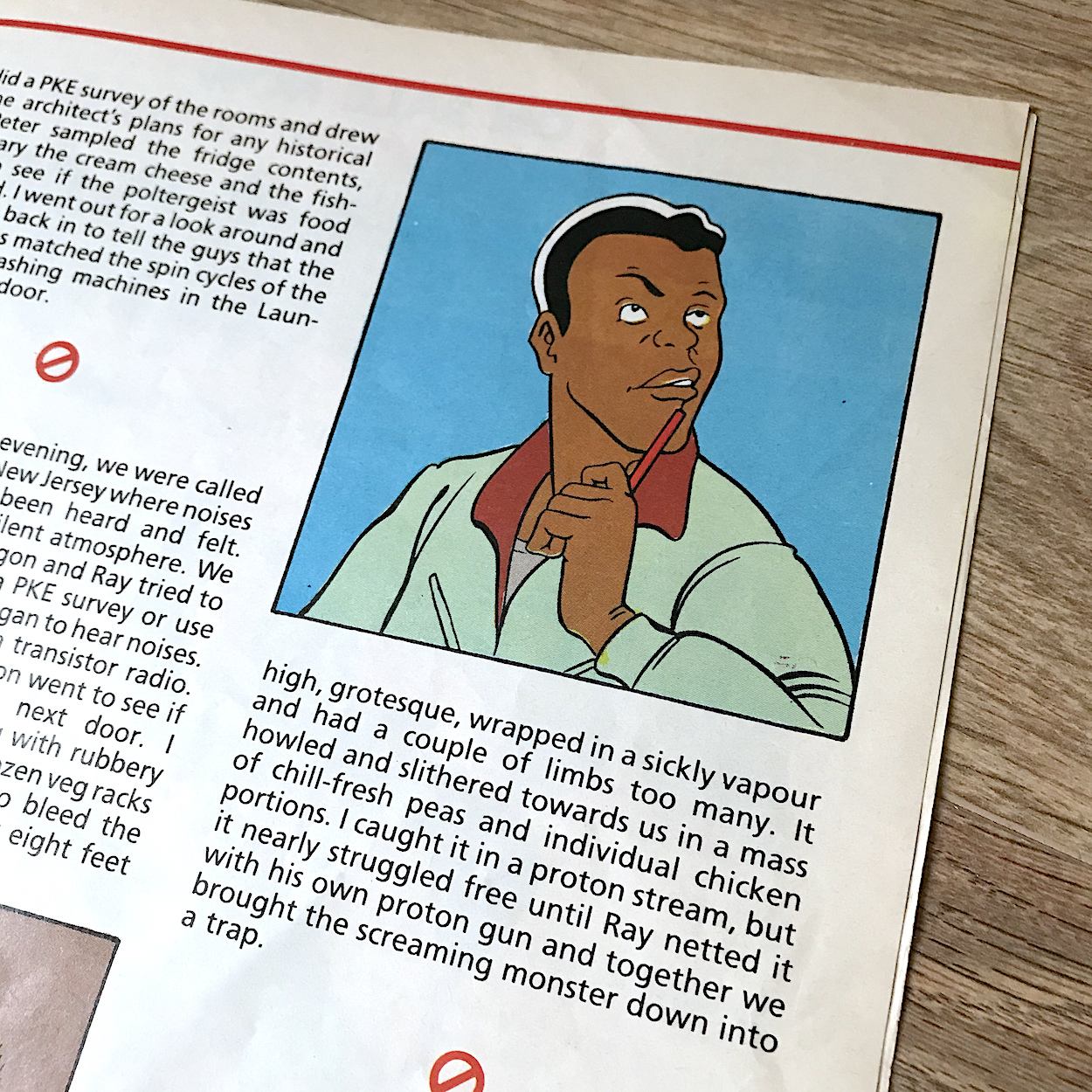
“The apartment was newly decorated and equipped. Egon took PKE readings in all the rooms. Ray spectra-scoped the walls and balcony. Peter explained that he must carefully examine the rock star’s expensive Hi-Fi and video in case the ghost was lurking there. We all heard weird noises, groans and whines. I bled the air bubbles from the newly-installed radiators and the noises stopped.”
Winston Zeddmore (written by Dan Abnett)
This repeats throughout the day. Egon and Ray go to ever more extreme methods of scientific ghost hunting, Peter finds something to distract himself with and Winston solves the problem with common sense. It’s deadpan humour at its best.
Another text feature would also be a highlight every issue.
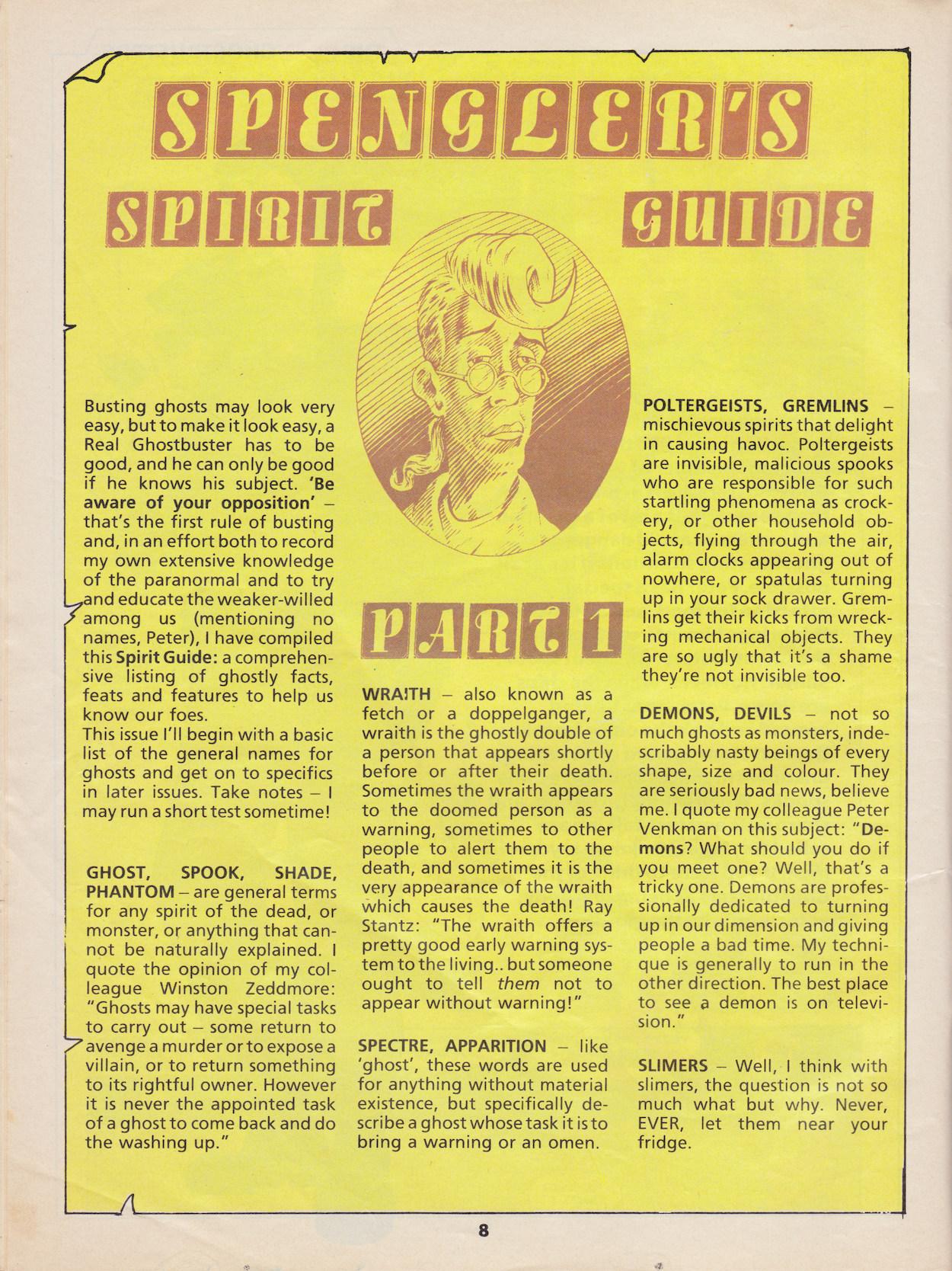
Spengler’s Spirit Guideappeared in every issue until just before the end. In the film and cartoon Egon would make reference to ‘Tobin’s Spirit Guide’ and this ongoing series was his own version of said tome. These were all written by Dan Abnett (Knights of Pendragon, Death’s Head II, Sinister Dexter), which is no small feat when you think about how the comic went weekly from issue 14 onwards and he created well over 150 altogether! In the first weekly issue which featured The Four Horsemen of the Apocalypse the Guide detailed the other half dozen or so Horsemen that don’t get talked about. I can remember laughing hard at that one in particular!
I’ve found out only recently the little illustration of Egon was drawn by none other than future Marvel US, DC Comics and 2000AD artist Cam Smith (Supergirl, The Incredible Hulk, Gen13). This means Cam’s work appeared in more issues than anyone else’s, technically speaking.
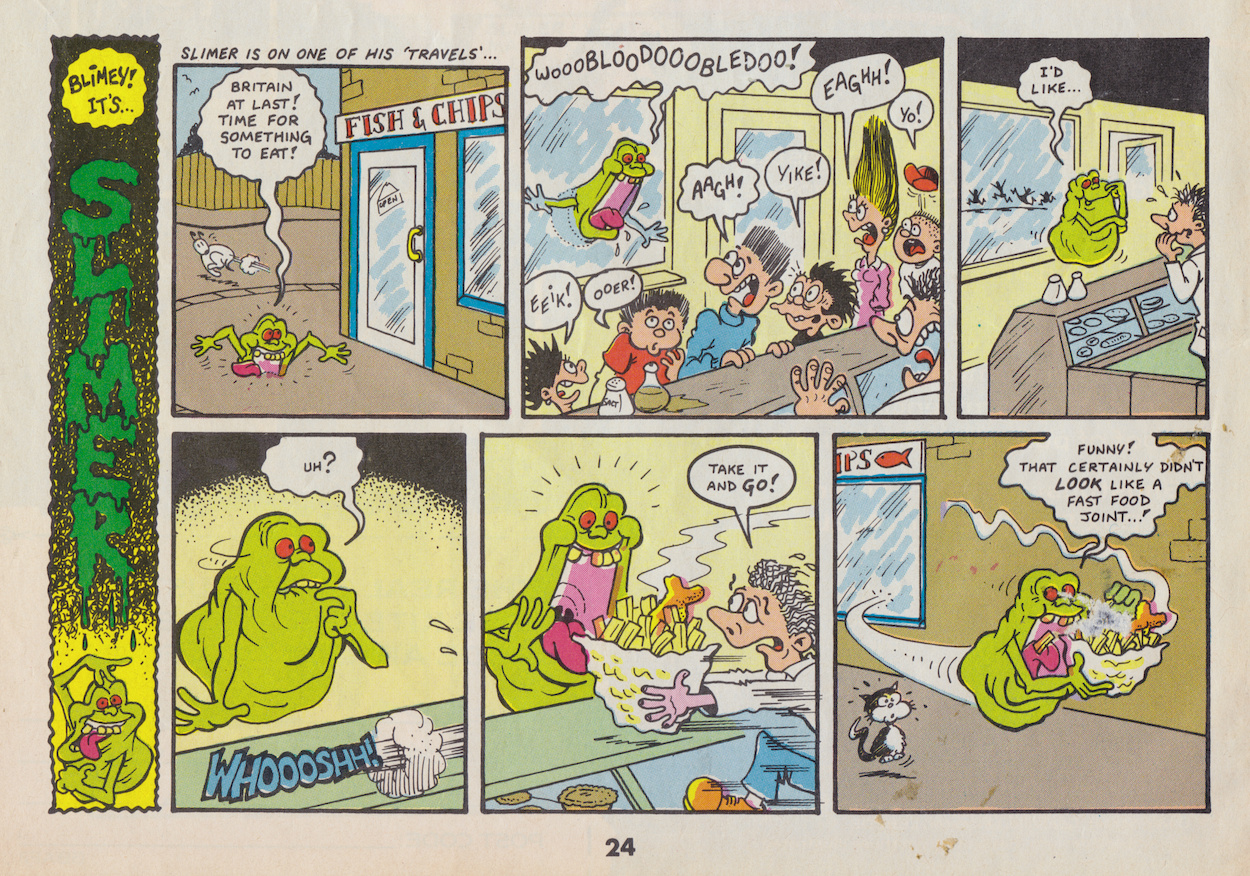
With Lew Stringer at the helm Slimer made his way to Britain for a slap up feed
This issue also contains the first fact-file. As a child I drew a combined figure of the Ghostbusters based on that final sentence. From what I remember Egon was the brain, Winston the heart, Slimer the stomach (obviously) etc. It was a real Frankenstein’s monster which I decided not to send in to the letters page because, well, some things just aren’t meant to be seen.
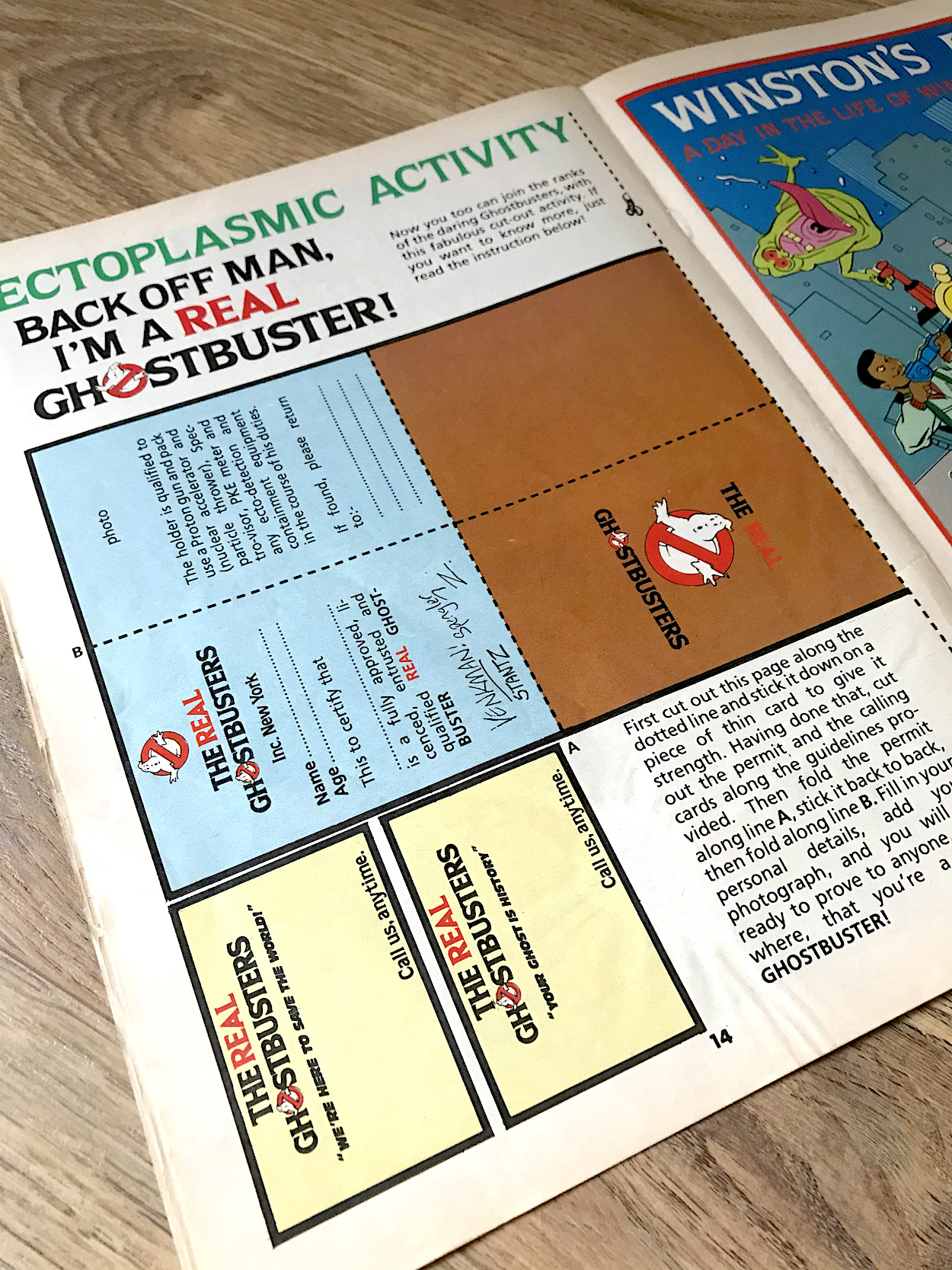
Once in a while the comic would include what it called Ectoplasmic Activity, such as this membership card and masks in a couple of future issues but it didn’t appear much, unlike Blimey! It’s Slimer. While it wouldn’t be too long until Bambos (letterer on our first strip) took over, at the beginning the little green blob was in the hands of OiNK‘s very own Lew Stringer. Of course, with Lew at the helm Slimer is going to make his way to Britain for a slap up feed. Lew has written a blog post about his time on the comic, which you should really check out.
A review of a classic comic wouldn’t be complete without a look at the advertisements within, especially when they’re connected to the subject matter. I welcomed these action figures into my toy collection during Christmas1988, along with Ecto-1, Slimer, the Stay Puft Marshmallow Man and a few other ghoulish monstrosities, and I recall I ate far too many packets of these crisps that summer too. They were surprisingly nice for a tie-in.
So how did this 33-year-old comic hold up for this 43-year-old? Brilliantly. I was surprised at how many times I chuckled while reading it, even though I’m not exactly the original target audience anymore.
I called it a “comedy comic” earlier, a term I’ve never used before. The definition of “funny comics” conjures up images of OiNK, Beano, Buster etc. While this is indeed a comic which sets out to be as funny as it can be (and it succeeds) it’s more the sitcom to OiNK’s sketch show. I also think calling it some combination of action/adventure/funny would sell it short. The Real Ghostbusters was a unique comic and remains so to this day.
Finally, just look at this little Easter egg I found in the pages of IDW‘s Ghostbusters Crossing Over comic from 2006!