DRAGON’S CLAWS #3: SNiFFiNG OUT THE ENEMY

Another sharp, exciting cover from Dragon’s Claws co-creator Geoff Senior welcomes us to #3 of Marvel UK’s comic which, judging by these first three issues at least, really deserved to find a bigger audience and last a lot longer than it did. The premiere issue basically dealt with Dragon himself in an 80s action flick-style story that set up the world we find ourselves in, the Greater Britain of the year 8162. Then last month we properly met the rest of the team and their nemeses The Evil Dead in what felt like part two of that movie.

So with the introductions out of the way it’s time to get into the meat of the next story and I’m glad to see Simon Furman‘s script isn’t going to be as episodic as I assumed a monthly from Marvel UK would be. This reads great in its own right while setting lots of things up for future issues, expanding the background plot the previous issues have hinted at and ending on not one, but two cliffhangers. The splash pages so far have been just as good as the covers, with colours by Steve White and letters by Annie Halfacree. I really do like the way editor Richard Starkings uses the Fastfax to introduce the stories within the setting itself rather than using a typical editorial style.
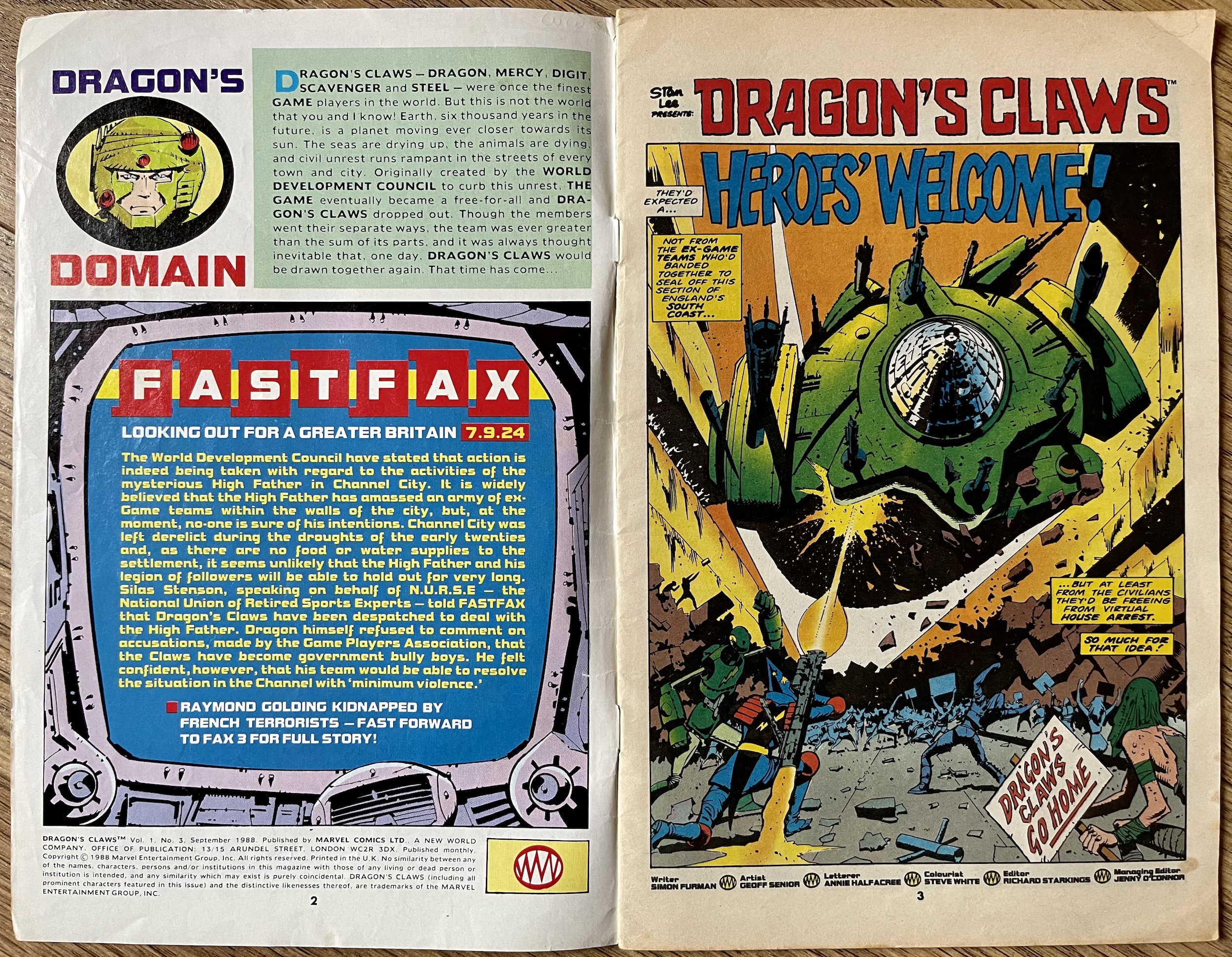
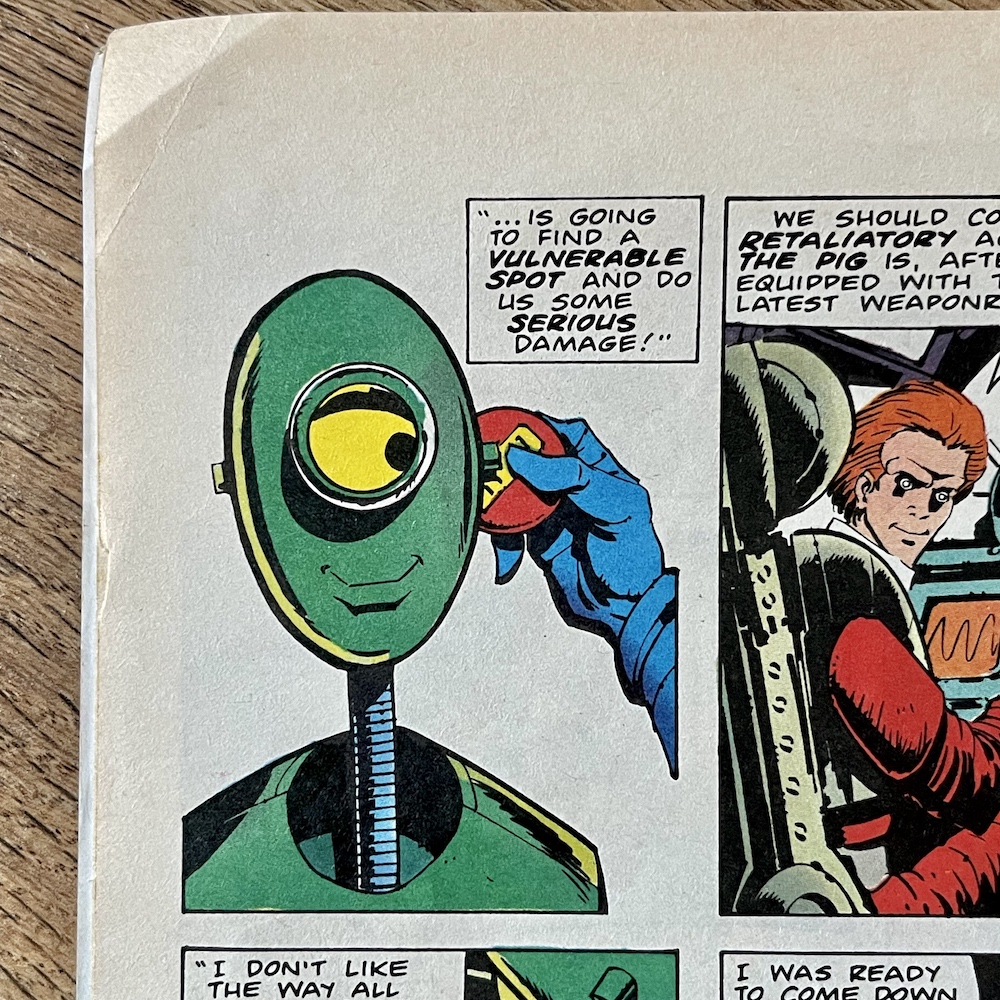
That’s The Pig, Dragon’s Claws’ ship, which feels rather suitable for this blog, doesn’t it? Even though they’ve only just been hired by N.U.R.S.E. (National Union of Retired Sports Experts) to bring in The Game teams still at large across the country who are abusing their positions of power, it seems some of the public are already turning on our heroes and viewing them as nothing more than government lackeys.

Their particular mission here is to head to Channel City, a huge metropolis that was built out over the English Channel to help with the overcrowding on the mainland, although it now overlooks nothing but a dried up seabed. No less than 20 teams have formed an army to protect someone called The High Father, an individual who the Claws were told had imprisoned hundreds of people in their own home. But now as they approach they’re under attack by those very civilians. Why? As the Claws discuss this and how they’re going to accomplish their mission without harming any innocents, unbeknownst to them a funny little moment plays out on the hull.
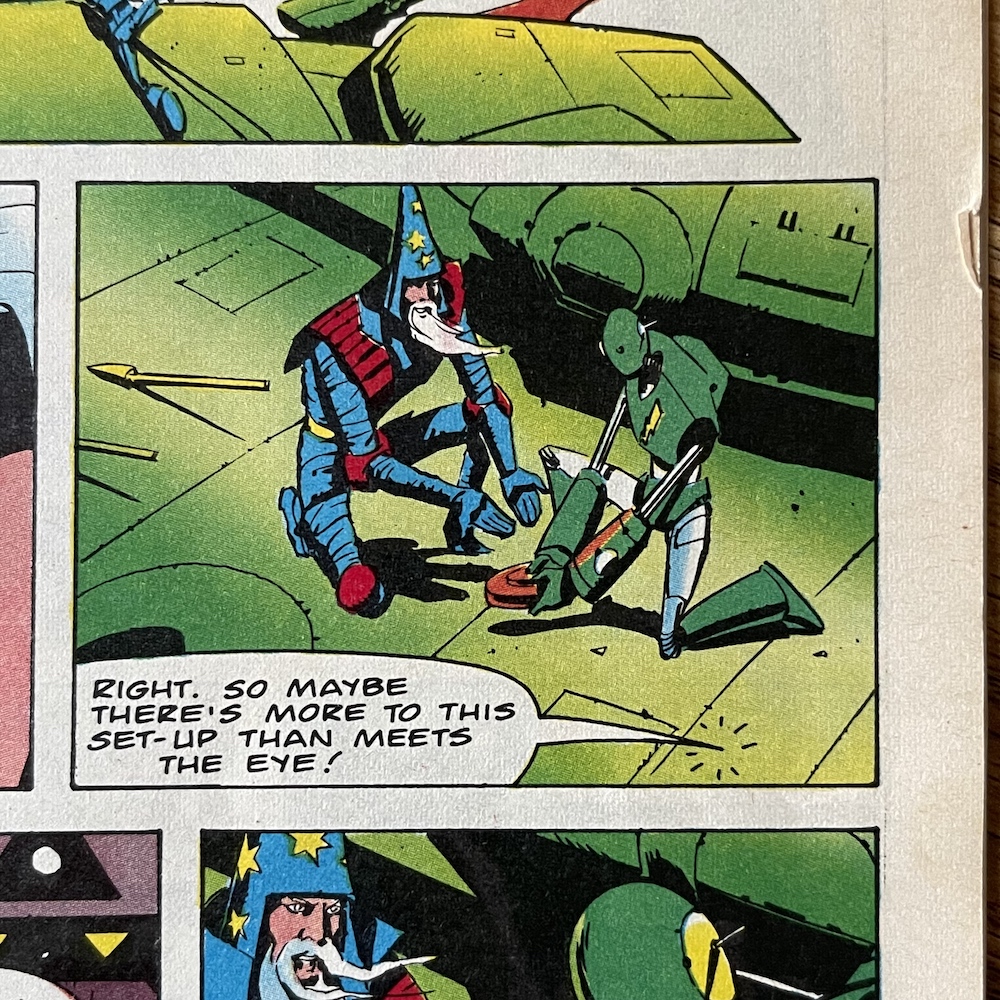
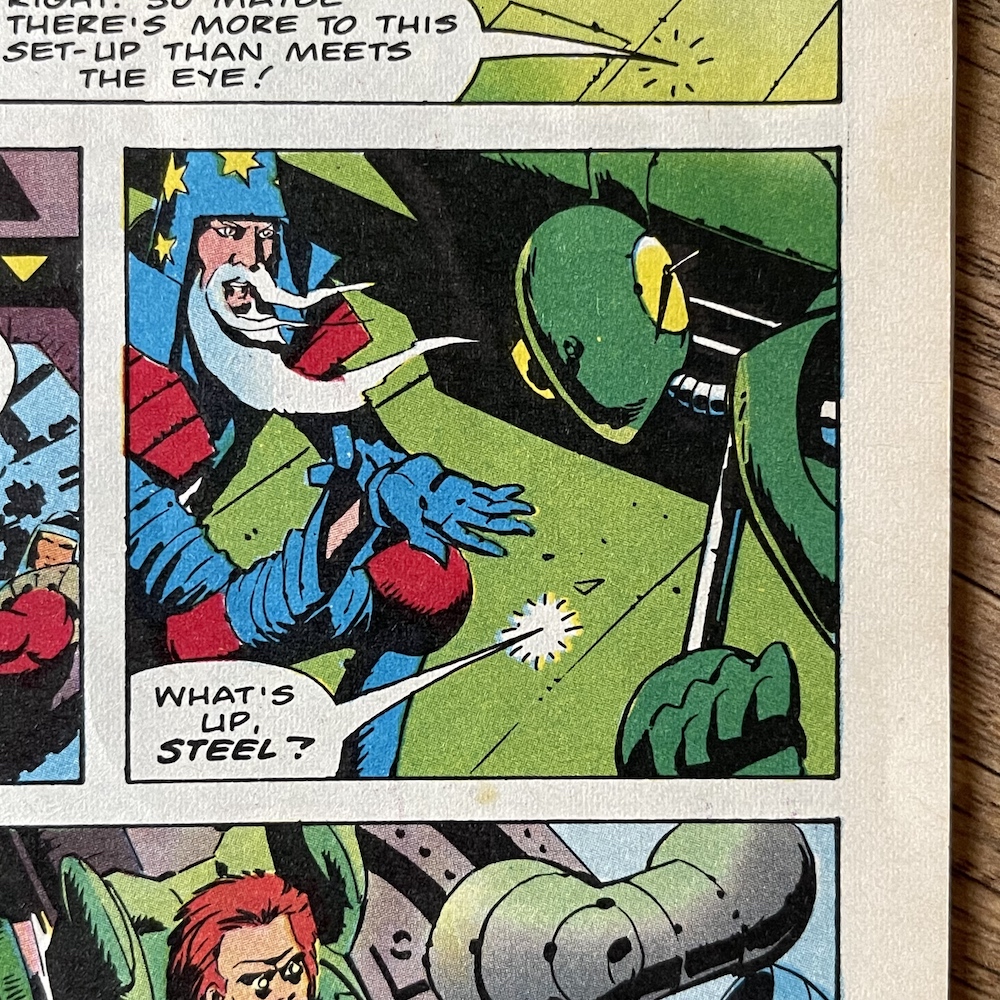
So why do these people not want rescued from this army and their apparent martial law? The strip does get to that by the end of the issue but first there are a few subplots thrown in for good measure. Kurran, brother of one of the Wildcats killed by Dragon as he protected his family, is out for revenge it would seem, at least in the interlude in the middle of the strip (more below). We also catch up with Tanya as she continues to try shielding their son Michael from Dragon’s violent TV coverage, but Michael wants his dad and it looks like she has no choice but to confront the situation and talk to his father.

I like these very human moments, although the most intriguing of the subplots this issue comes courtesy of N.U.R.S.E.’s Mister Stenson and Deller, the ex-Game player whose jealousy over Dragon leading the Claws almost ended with his death last month. It looks like they specifically need Dragon more than they’re letting on to him; having him as their poster child will mask their real intentions behind a cloak of heroism. But it’s the final couple of panels that interest me the most. Just who is giving these orders?
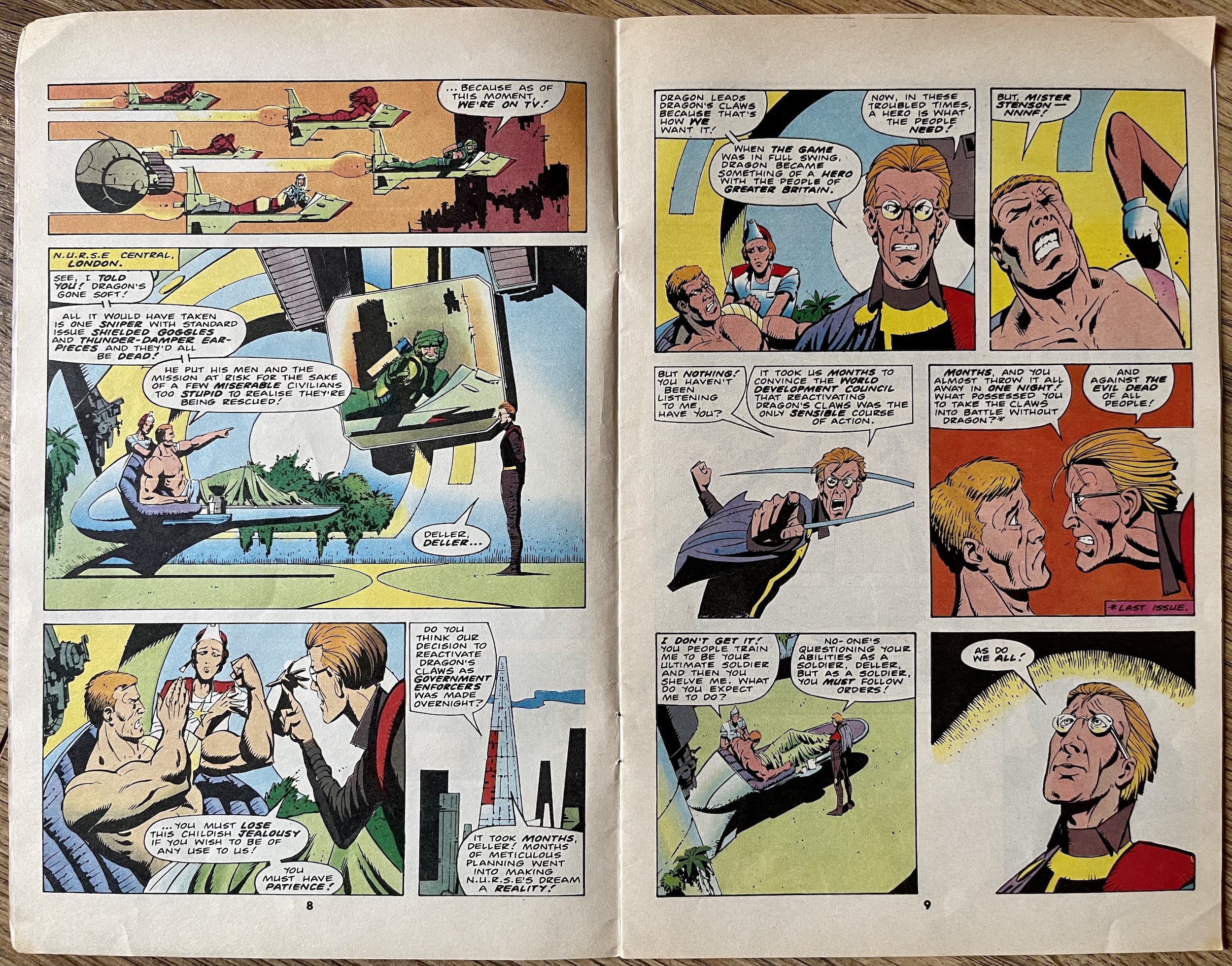
Any fan of Marvel UK’s Transformers comic will recognise the classic Geoff Senior pose there in panel three of page nine. So the main background plots thicken and I hope there’s enough time to give us a satisfying amount of development for these before the comic’s cancellation with #10. I’m particularly looking forward to seeing where the Kurran/Wildcats arc goes because on the final page of this issue he’s no longer concerned about Dragon. He’s smart enough to know that Dragon could easily have taken out the entire Wildcat team on his own (which he did do) so now he’s pursuing the reason behind the confrontation.

He knows his brother was stupid, but he wouldn’t have been stupid enough to go up against Dragon just because he hurt their pride. He beats up a woman at their hideout, wanting to know who paid them to do it and finds out it was Deller. Now that’s a cliffhanger. Even moreso than the main story’s, which we’ll lead up to now. With The Pig out of commission the Claws take to hover pads to make their way to Channel City and come up against a Game team hinted at in the pre-release marketing, The Vanishing Ladies.

There’s a particularly gigglesome moment when the strong and ever so macho Steel gets taken down a peg in the simplest of ways

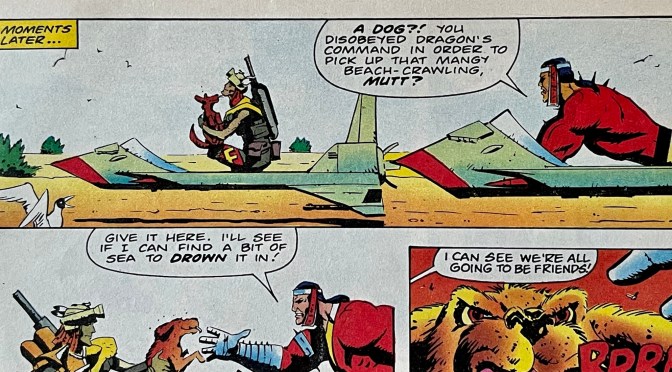
First though, the mysterious Scavenger (already my favourite) breaks formation and takes off across the desolate landscape, disobeying Dragon’s direct orders. It’s such a sudden and dangerous move the reader instantly thinks something terrible is about to happen, that Scavenger has blasted away to stop it and save his teammates from whatever it is. The camaraderie between the members of this team is so tight it has to be something huge, right?
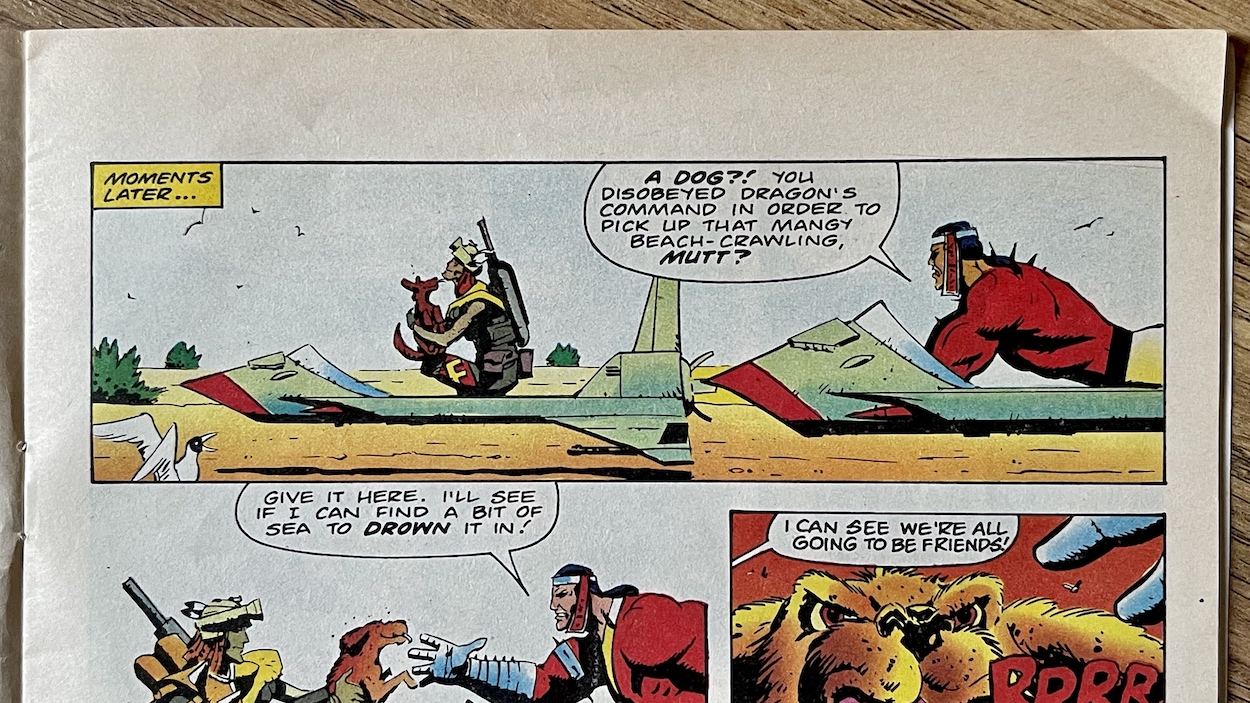
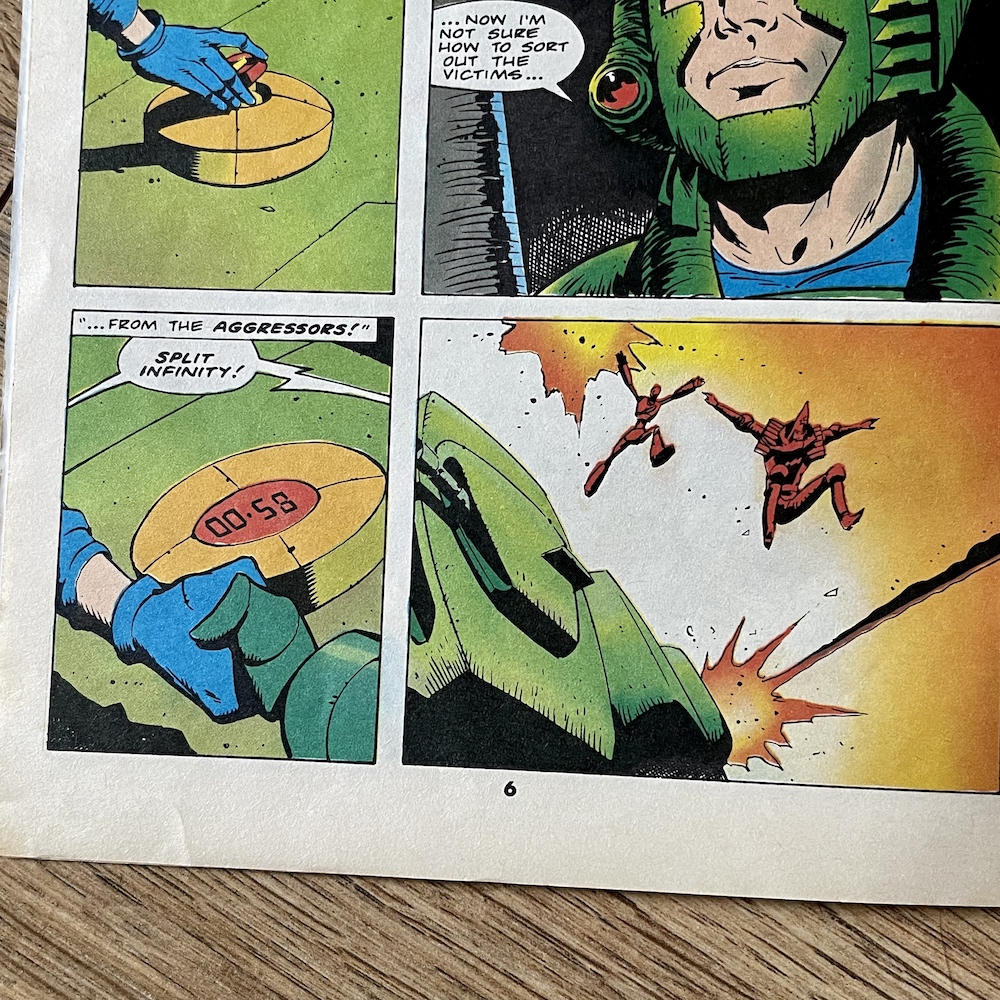
Well yes, as a matter of fact. I mean, an abandoned, starving animal is a big deal to this reader. It’s still funny of course. We now have our final member of the team. After all, this mutt was in those adverts for the comic too. He also gets named Lady Killer after what happens next. The Vanishing Ladies have special clothing that can bend beams of light (that old chestnut), essentially making them invisible. Cue lots of pictures of our team getting beaten up and using ingenuity to try to fight back.

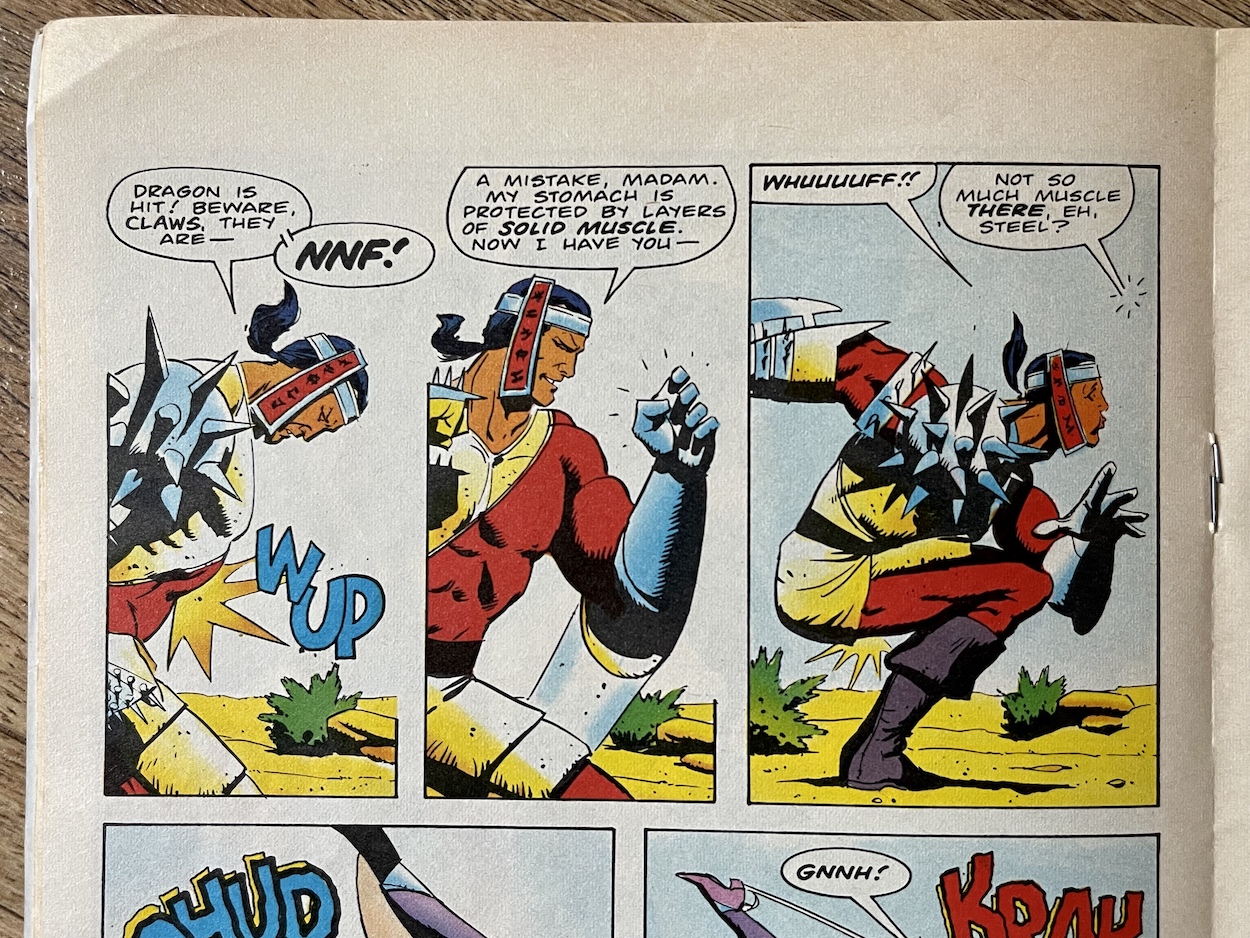
There’s a particularly gigglesome moment when the strong and ever so macho Steel gets taken down a peg in the simplest of ways. Mercy isn’t so easily incapacitated and as she gets punched she deliberately rolls with the hit and is able to backflip and kick her attacker in the face without clapping eyes on her. Digit uses his computerised brain to accurately calculate probabilities for blocking attacks to find out where his attacker is. Dragon and Scavenger don’t have it quite so easy though.
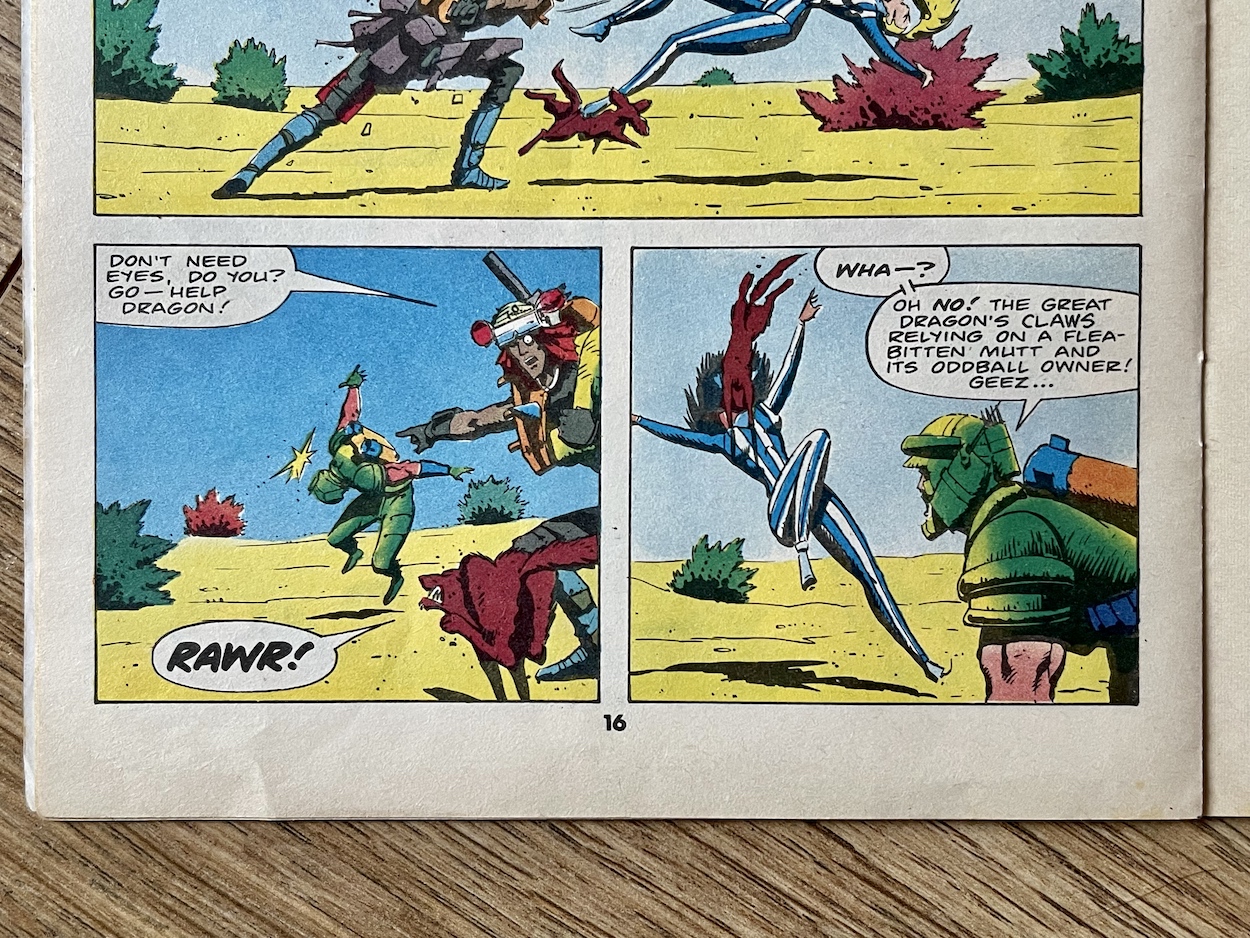
Scavenger is getting strangled by one of the invisible foes and the only thing that stops him from being killed is his new dog who’s able to sense her and bite her on the leg, making her visible again. The newly named Lady Killer then helps Dragon and his reaction is another funny moment. I’m really looking forward to seeing this dynamic play out further in future episodes. The mightiest Game team ever now has a pet, one who is just as much a part of the team as the rest, whether they like it or not!

All of this is being televised across Greater Britain just as The Game was, N.U.R.S.E. adamant the people need to see Dragon’s Claws doing the government’s work in order to change public perceptions as they see fit. Then, as the team fight The High Father’s minions his voice panics Stenson. He recognises him, but he should be dead! He runs off to warn his superiors and stop the broadcast, and as Dragon’s Claws blast their way through into the area being protected by his army they come across a surprising scene, one of land cultivation and farmed animals!
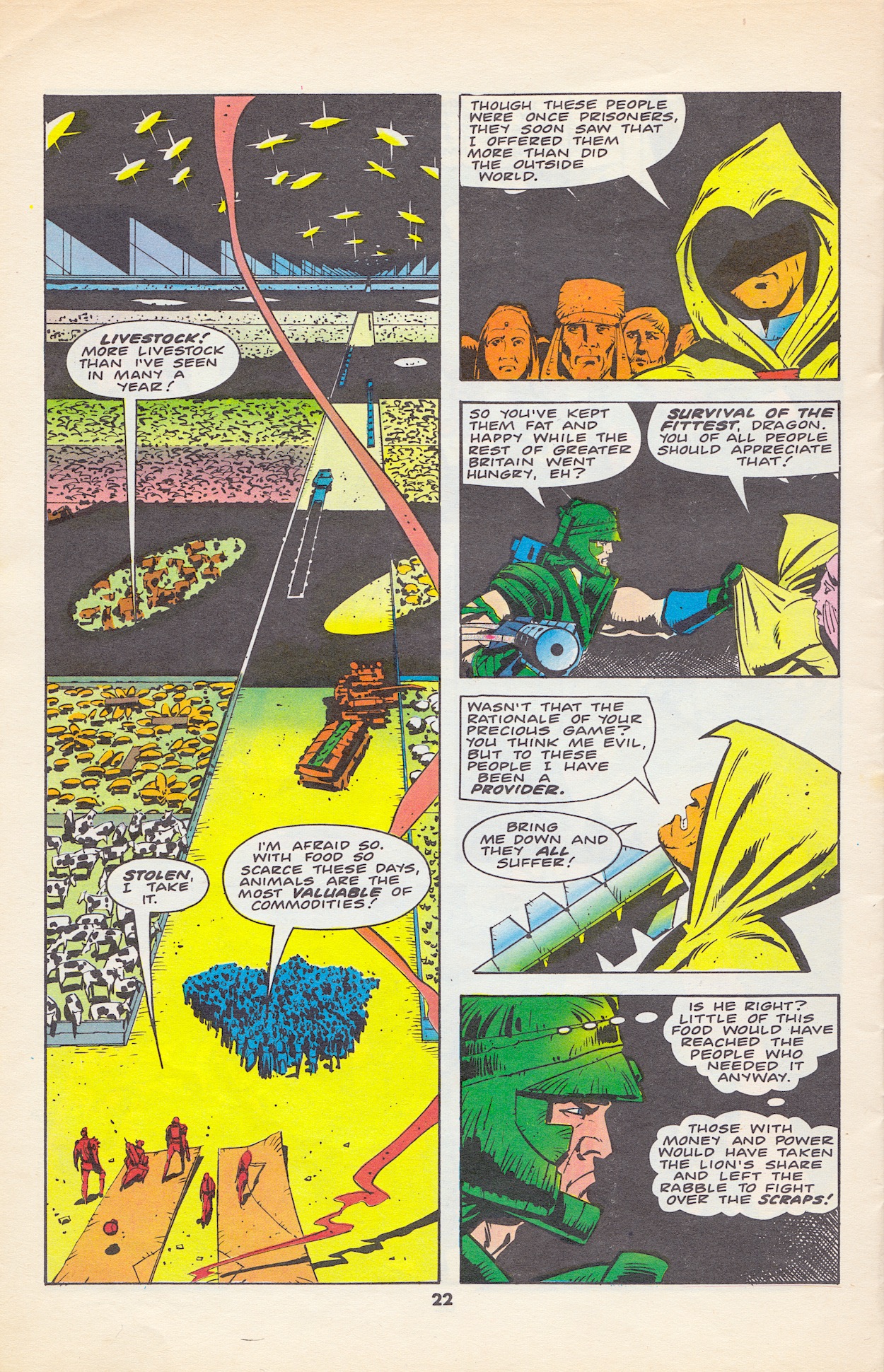
As you can see there’s a moment when Dragon accuses The High Father of being just as bad as the government, that he’s creating his own privileged class. However, there’s a part of Dragon that doubts he’s really the bad guy in all of this. It’s when The High Father, unmasked as someone called Starick (to Stenson’s horror) explains further that we get our main cliffhanger. He says his former employers were good teachers, but they want him terminated now because they’ve found out how he’s actually looking after his people. The employers’ name is revealed when he tells Dragon he understands his surprise, “After all, you haven’t worked for N.U.R.S.E. for as long as I have!”

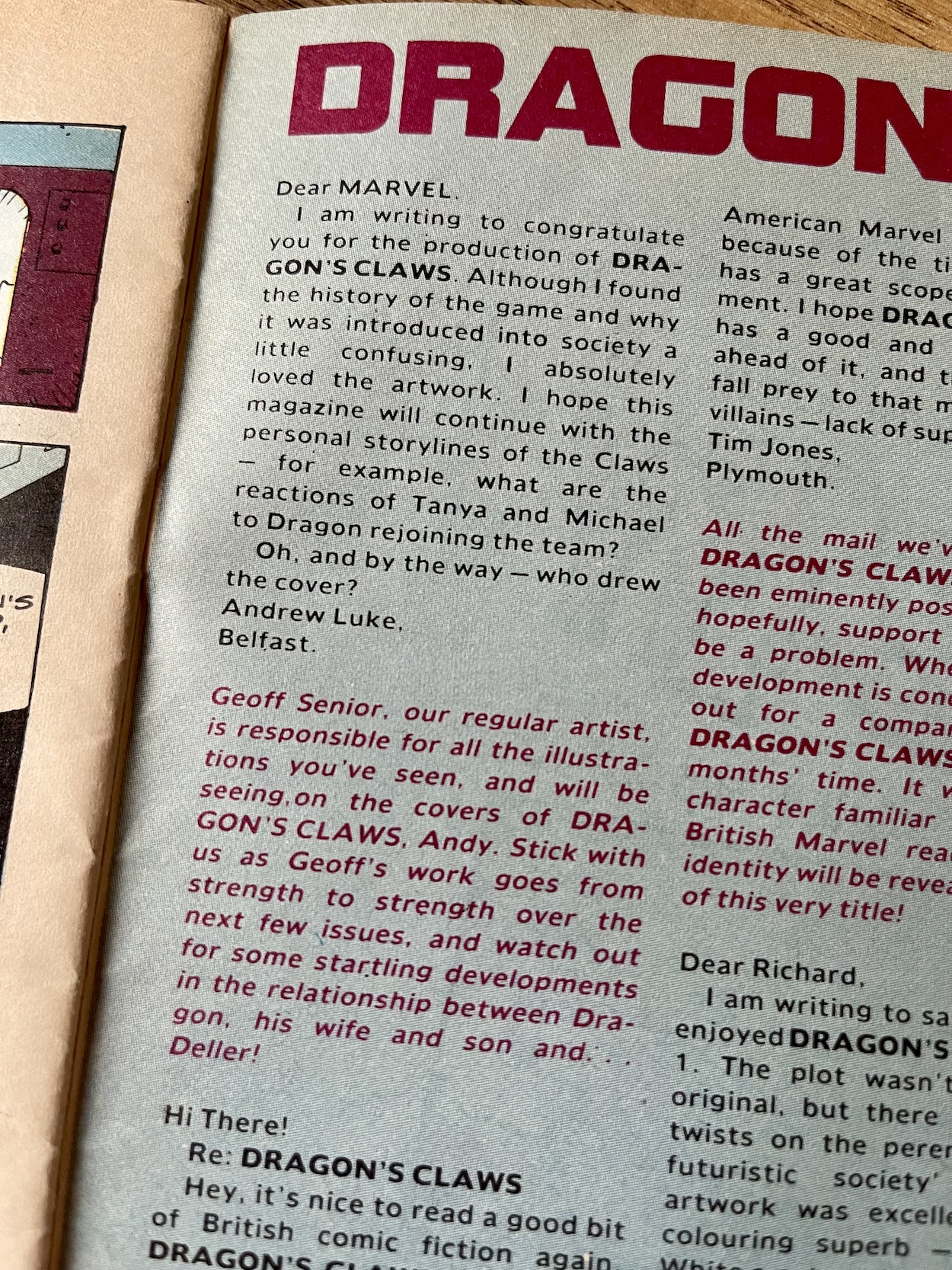
I love all this double-crossing, playing politics and subterfuge amongst the action. Add in the more human moments too and what we have here is a surprisingly deep action comic that manages to fit an awful lot into its 22-page strip without it ever feeling cramped or rushed. It’s quite ingenious really. Maybe a little too ingenious for the first letter writer on the new Dragon’s Nest page? Surprisingly, this first letter came from friend of the blog Andy Luke, whose podcast I previously appeared on to discuss OiNK for its 35th anniversary!
The first two chapters for Dragon’s Claws were highly entertaining and gave hints as to what the regular stories could be like. I could not have guessed the very next issue would’ve been so completely satisfying, that the comic would find its feet so quickly. I have a good feeling about the next seven months. The next one can’t come soon enough, but wait I shall for Sunday 10th September 2023. Join me then, won’t you?

iSSUE TWO < > iSSUE FOUR
DRAGON’S CLAWS MENU

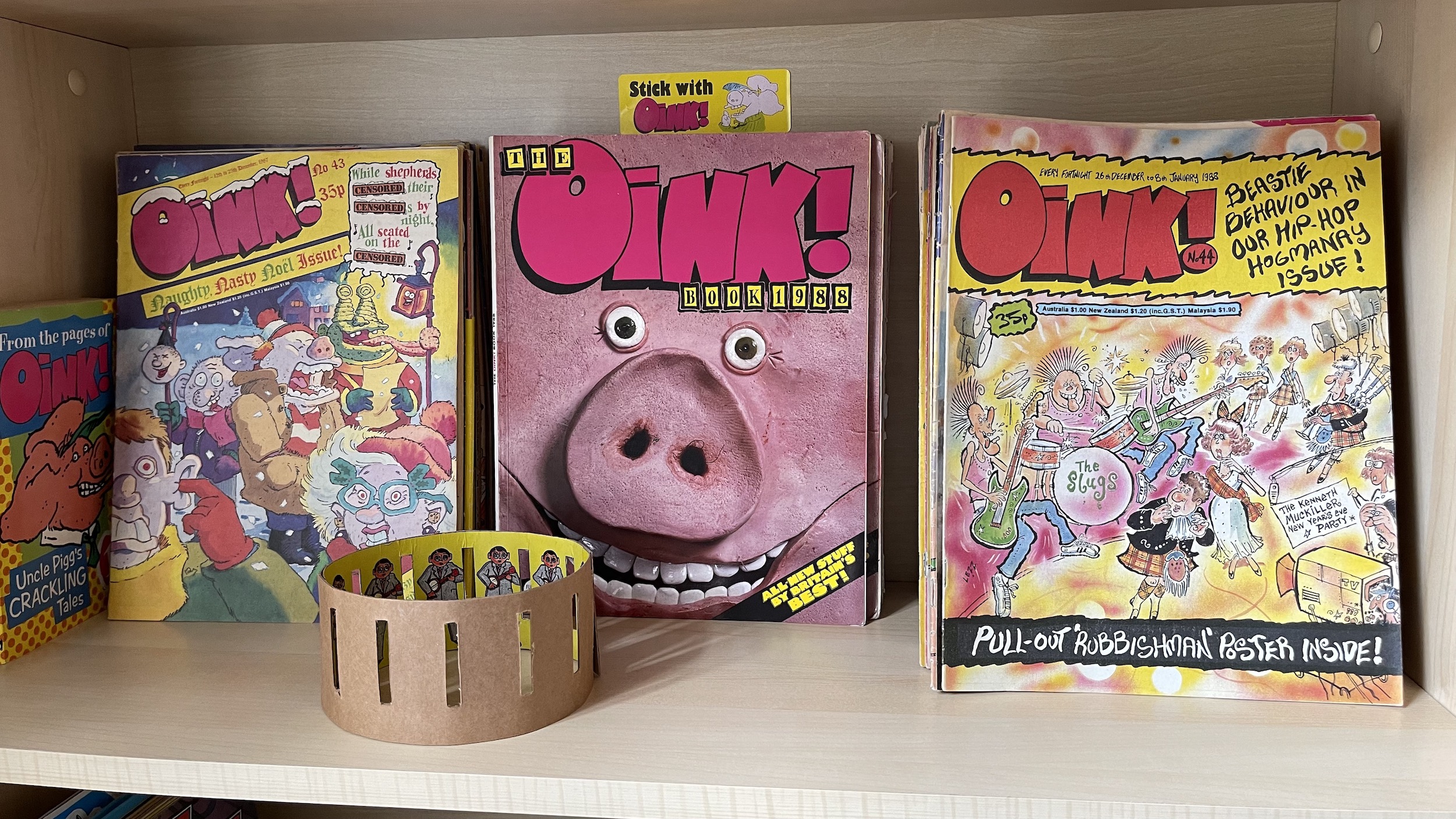
KNOW YOUR OiNK!: CARTOONiSTS’ PROFiLES

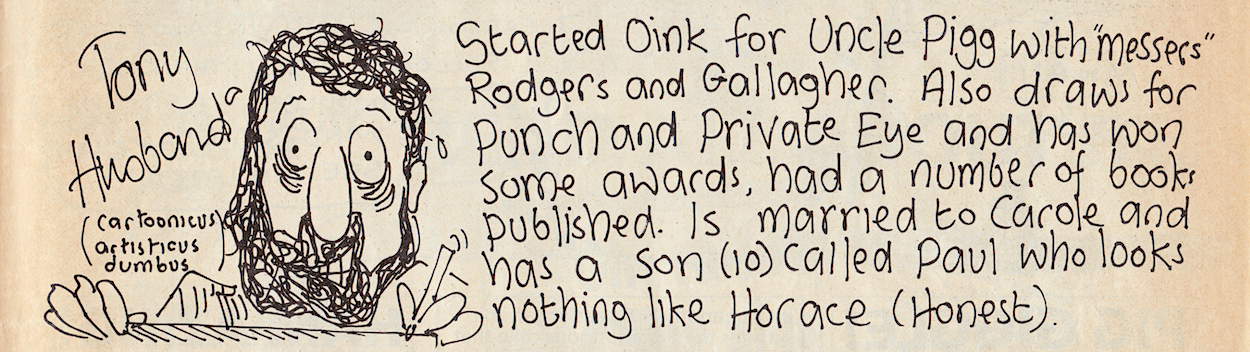
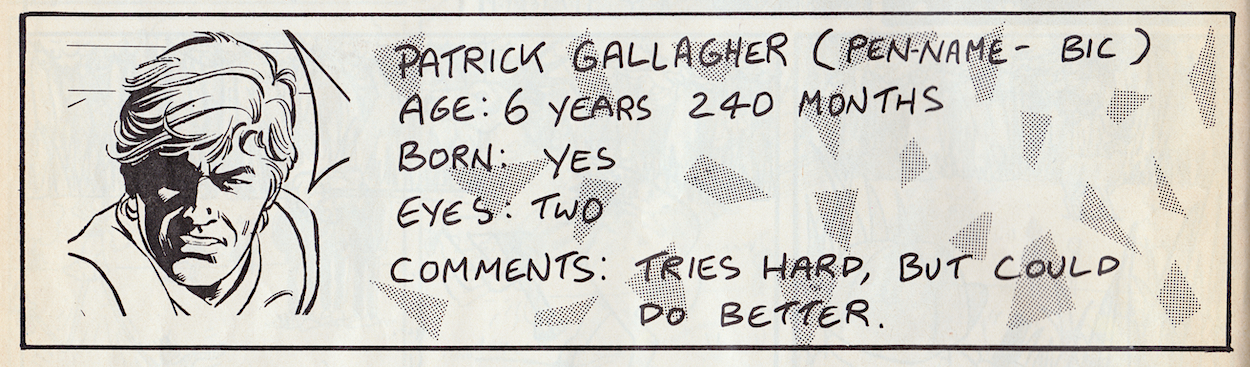
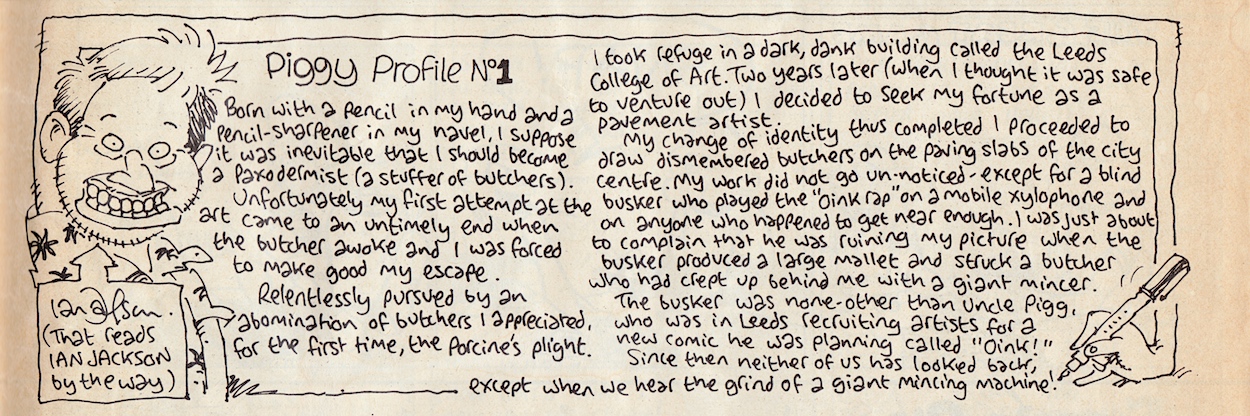
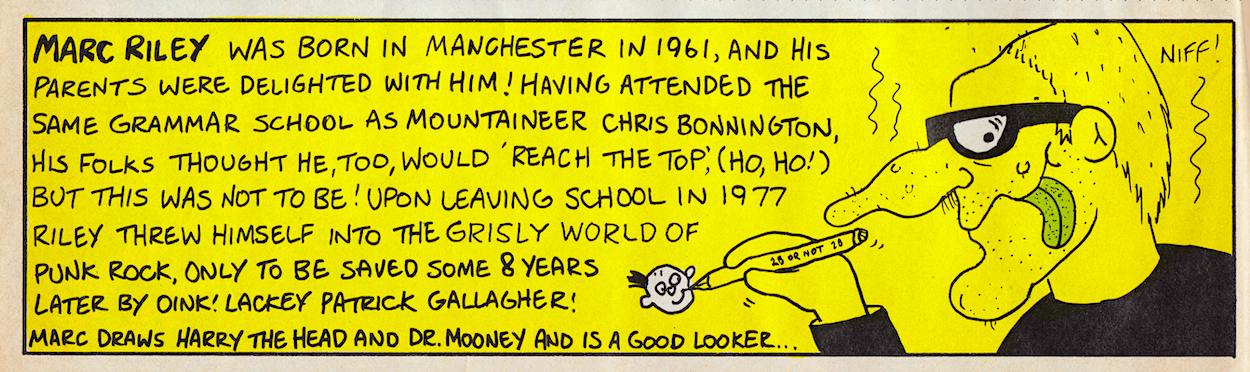
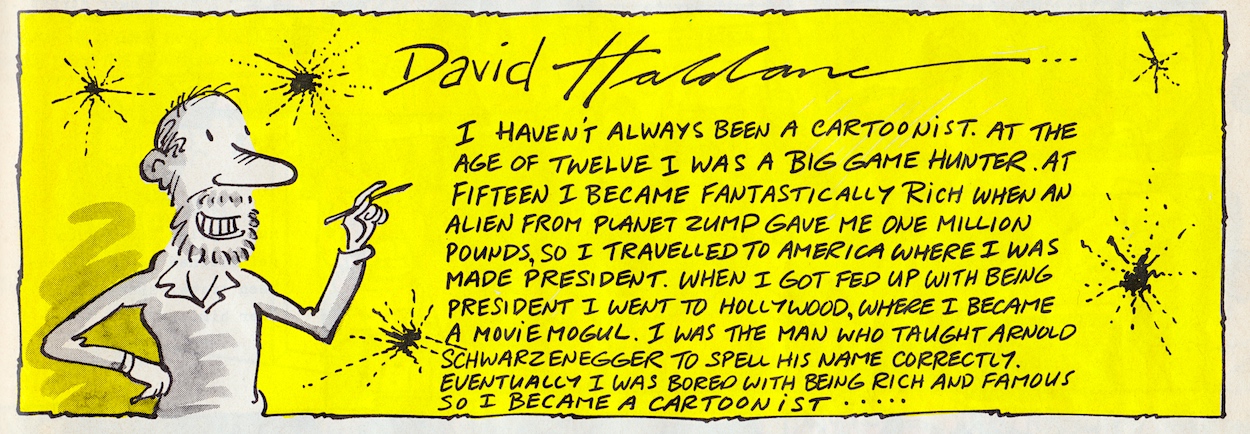
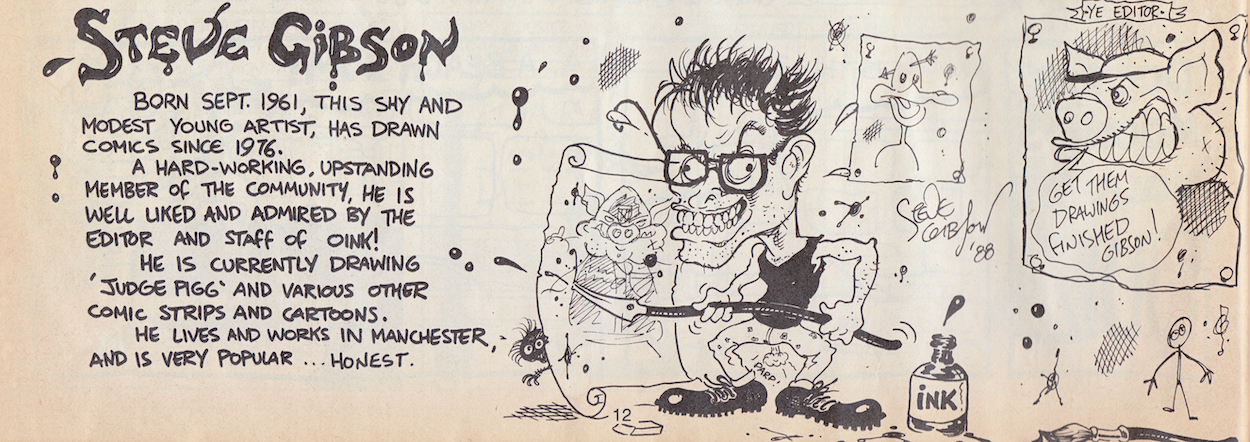
This is a nice little bonus post even if I do say so myself. Although I can’t take any of the credit, that must go to ten of OiNK’s top contributors who each decided to tell us a little bit about themselves in the second Holiday Special, released in March 1988. Sprinkled throughout the issue were fun little quarter-page profiles containing a self-portrait of some sort and a description of the cartoonist or editor in their own words.

The last part of that sentence is key. Don’t be expecting any actual real information here. This is OiNK after all. If you chose ten of its talented team and asked them to tell the readers something interesting about themselves do you really think they’d waste that opportunity with actual facts? Or would you prefer they took the chance to use their unique senses of humour to have a laugh instead? It’s a no brainer. Let’s kick things off with the three people responsible for OiNK in the first place, shall we? Here are the comic’s creators and editors. These were the people in charge!

I particularly like Patrick Gallagher’s pen name and his unique way of presenting his age, and it’s hilarious to have the incredibly talented Mark Rodgers’ profile presented as so amateurish. Tony Husband’s artistic depiction of himself is so funny but poor Paul Husband! If you take a look at the very first OiNK, the special preview issue, you’ll see he doesn’t actually look like Horace (Ugly Face) Watkins. If readers had wanted to see what all three of these individuals really looked like they would’ve had to check out the article in Crash magazine from the previous year.

As a kid I never knew of Crash (or the unique free edition of our comic tucked away inside that issue), so as far as I was concerned these profiles were the closest I was going to get to really knowing those who made us laugh so much. As a kid I had no idea it was Patrick and Mark who had appeared in photo stories such as Castaway and Star Truck previously. The latter also starred Tony albeit behind an evil alien (chicken) mask,  but we never knew who they were in those strips. That’s what makes these silly not-so-fact files so funny of course; this is how readers would imagine the amazing talent behind the comic. It’s just a shame we didn’t get more!

Ian Jackson is synonymous with OiNK and did appear in a photo story alongside Mark way back in the Valentines issue but, like Tony, he was behind expensive (not really) alien special effects. In fact it was only two years ago, not long after I started this website, when John Freeman‘s Down the Tubes website published a spotlight article about Ian that I finally found out what the person behind Uncle Pigg, Mary Lighthouse and Hadrian Vile looks like.

This imaginative profile not only sums up his wacky sense of humour with far-fetched nonsense, he also manages to highlight the truth about being a cartoonist

Marc Riley appeared as another anonymous kind-of-actor in Star Truck but was probably best known for portraying Snatcher Sam during the first year of the comic and The OiNK! Book 1988. The grisly world of punk rock he refers to is The Fall, the band he was a part of for four years between 1978 and 1982 before forming The Creepers. Of course, Frank Sidebottom needs no introduction or indeed a silly drawing! We all knew him from countless children’s television appearances already and the man behind the papier-mâché, Chris Sievey, was always so brilliant with his fans that of course he’d take any opportunity to give them a chance to get in touch directly.

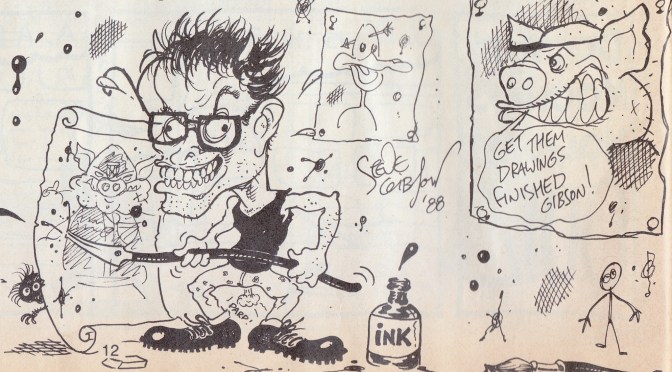
Below is David Haldane’s profile, he of Hugo the Hungry Hippo, Rubbish Man and Torture Twins fame and this imaginative profile not only sums up his wacky sense of humour with far-fetched nonsense, he also manages to highlight the truth about being a cartoonist! Then Steve Gibson, who’d go on to produce a range of very adult comics after OiNK brings us a depiction of himself that’s really rather disturbing and perfectly illustrates (no pun intended) his art style. If you’re interested in a full-page strip of that Judge Pigg he’s drawing then check out the review for #58.

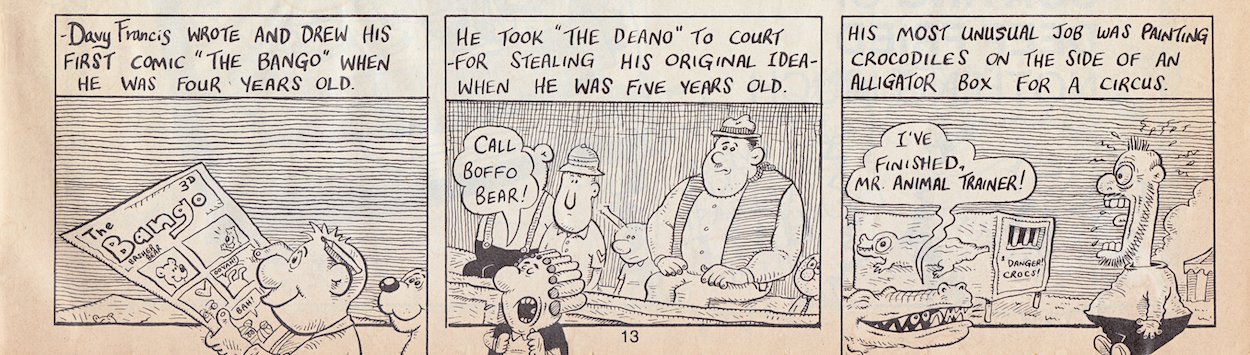
Quite a few years ago now, perhaps about a decade back I had the pleasure of meeting Davy Francis a few weeks before Christmas and had the chance to purchase some of his original OiNK artwork which currently takes pride of place on my wall. I didn’t even know he lived in Belfast like me until I was at a film festival earlier that year, and while chatting about comics to someone and mentioning OiNK they told me they knew Davy. An absolute gent with a brilliant sense of humour and an incredible caricaturist his contribution here keeps to the theme of telling us absolutely nothing about him and instead giving us a good chuckle.

Like Ian and David, Davy works his usual signature into his profile so readers can instantly recognise who this is and then we finish the Holiday Special off with Davy’s good friend Ed McHenry. The drawing in Ed’s is in my mind probably the most accurate, based on my completely unknowledgeable assumptions about cartoonists’ work areas. I really like how he’s tried to incorporate as many of the little random details from his description into the drawing too, it’s packed full of little sight gags and details. Absolutely classic Ed.

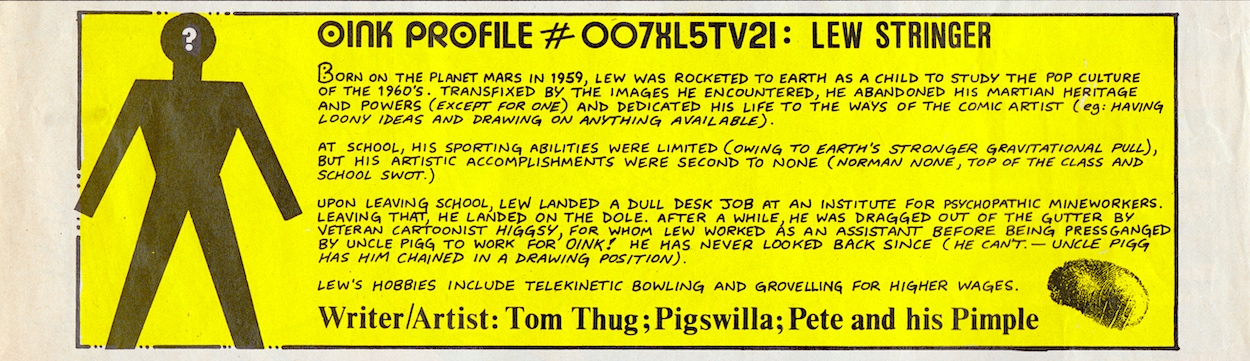
A few months after the special one more profile appeared in one of the monthly issues, OiNK #66. While it got my hopes up there’d be more in future issues this was sadly the last but it’s a nice little bonus. Especially since it’s by one of my favourite cartoonists of all time and was in an issue where he contributed almost a third of the contents! Lew Stringer is very much a child of the 60s and plays up to that here, beginning with the profile number being made up of three key 60s movie/TV/comic series. I just wish I’d thought of his excuse for why I sucked at school sports!

There we go. Don’t you feel completely informed about who made the funniest comic of all time? Me neither. Or maybe we should. The details may not be entirely accurate but they portray the sense of humour OiNK encapsulated, the craziness and imagination that captivated us and the combination of comic talent that was like no other. These great profiles inside the second OiNK Holiday Special may not have been an introduction to these cartoonists, but they could very well be the perfect introduction to OiNK itself.

‘MORE OiNK’ MENU

MAiN OiNK MENU

THE LOST WORLD JURASSiC PARK #3: TRiMMiNG DOWN THE T-REX

We’re already at the halfway point in this little mini-series adaptation of The Lost World Jurassic Park. The first issue fell into the traps of many a movie adaptation but part two improved things somewhat. It wasn’t perfect, but those improvements and the article from writer Don McGregor about the size of the task at hand gave me high hopes for what was to come. So how has our third edition panned out? Ignoring that annoying “Free” poster bit on the cover (see last issue for more on that) let’s get stuck in and find out.

We left things a fortnight ago with the Triceratops smashing its way through Peter Ludlow’s presentation tent after Nick Van Owen had freed the dinosaurs, and right at the beginning of this chapter we see a spectacular scene of them all running from the camp back into the wild. In the movie we saw this from the perspective of the humans as the animals fled all around them, but here I particularly like the grander scale this first panel brings, and that’s not something you can often say about a comic adaptation.

Upon further inspection though, how on Earth did the Ingen hunters possibly capture and contain that giant dinosaur on the left? If we go by the previous movie this would have to be a Brachiosaurus. I’d love to have seen the cage they kept that in! The rest of the page instantly contradicts not only the film but even its own previous issue, where it had correctly shown the baby Tyrannosaurus rex captured by Roland and Ajay tied up away from the camp. Here, miraculously he’s now right where the chaos is, ready for Nick to easily rescue.

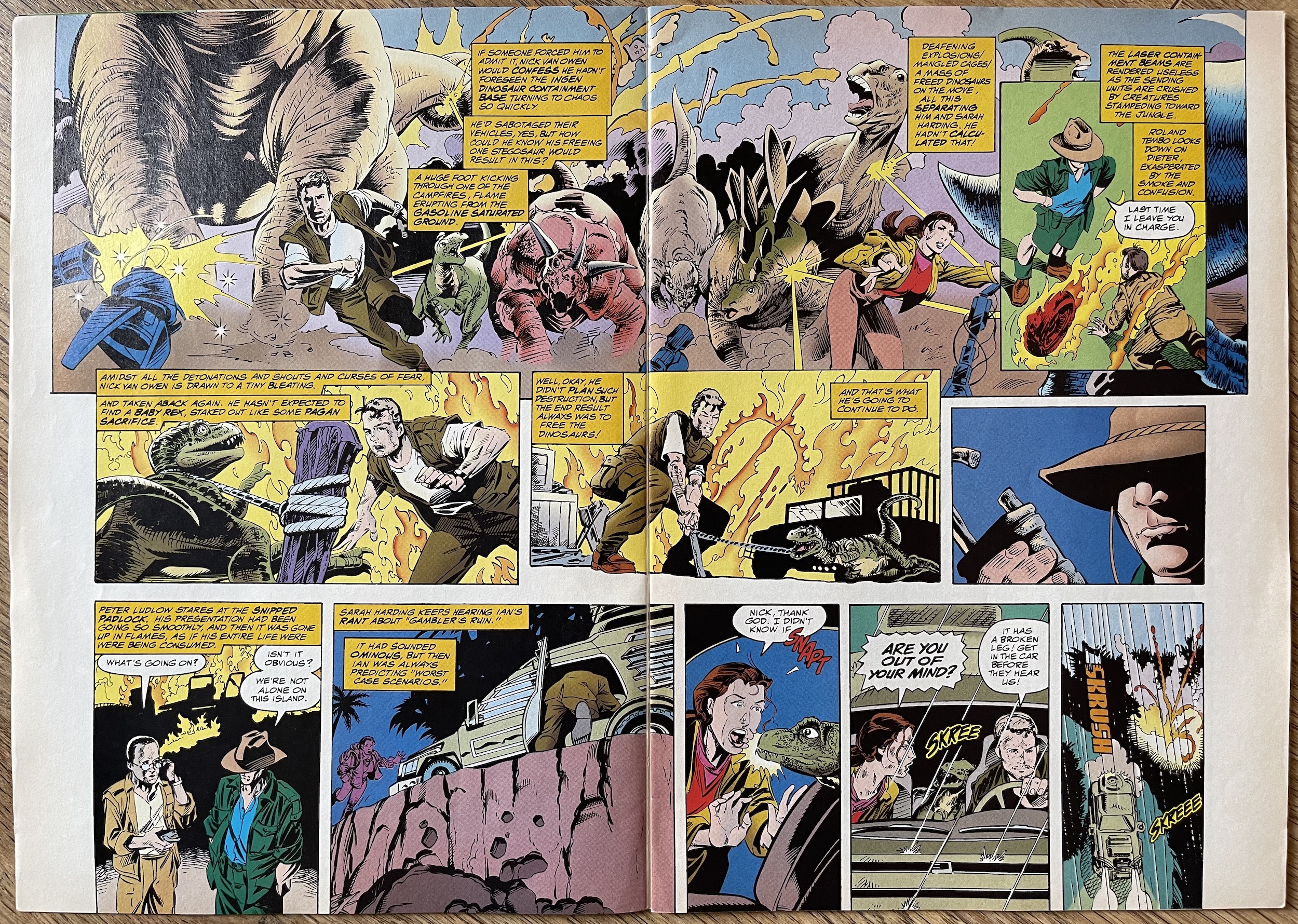
The next page is printed in landscape format and once you realise what’s going on it makes for a wonderful idea

In fact, the page before this spread showed Roland and Ajay’s last second escape as a fiery jeep flew through the air and crashed onto the tree they were hiding in awaiting the adult Tyrannosaur, so really this is contradicting the very same issue! I’ve no idea why Don felt the need to do this. In the film we didn’t see Nick grab the baby, he appeared a little while later from a river nearby holding him in his arms.

The next page is printed in landscape format and once you realise what’s going on it makes for a wonderful idea and is brought to the page brilliantly by penciller Jeff Butler, inker Armando Gil, letterer Ken Lopez and editor and colourist Renée Witterstaetter. I know this film like the back of my hand so I know that while Dr Ian Malcolm, Eddie Carr and Ian’s daughter Kelly are in the High Hide at the upper tree level there’s a distant roar, the trees below shake and the stomps of both T-rex adults can be heard moving beneath them. However, despite this dramatic page, none of that is clear.

While it’s unlikely many would be reading this before watching the film (although I do recall my friends and I reading the adaptation for one of the Turtles films before we saw it), most readers will have only seen it once in the cinema by this stage. It would actually have still been playing in theatres when this was out. They’d be reading this to relive the story and as dramatic as that ‘ROAR!’ is on the page I’m not sure readers would’ve noticed it, instead possibly thinking it was just a unique set of panels to reinforce the moment. The characters not acknowledging the roar or any movement below doesn’t help either, making Ian’s decision feel decidedly random.

This of course leads to arguably the most terrifying sequence in the whole movie and one that had us on the edge of our seats in the cinema. Here it’s cut down, as it needs to be for reasons Don laid out last time, but the scale of the scaling back is quite shocking. When the adults arrive Ian simply danders out with the baby into the middle of the clearing instead of the tense moment by the door. He’s completely vulnerable but there’s no tension in his action. He’s even singing!

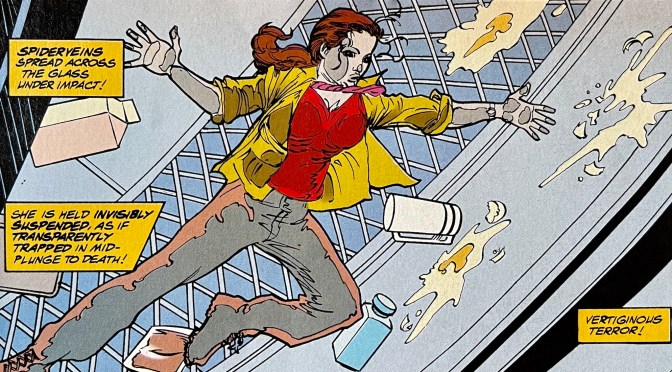
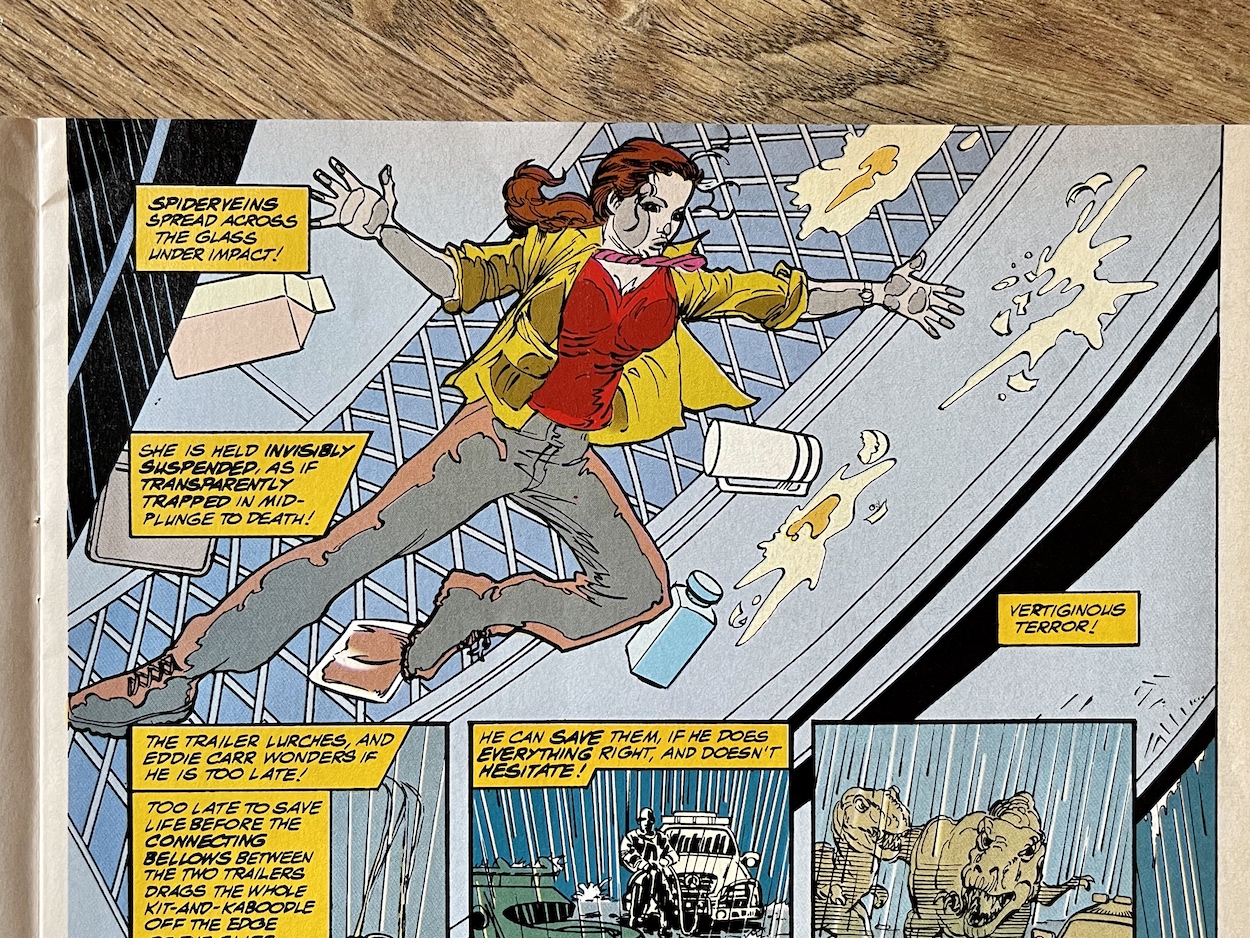
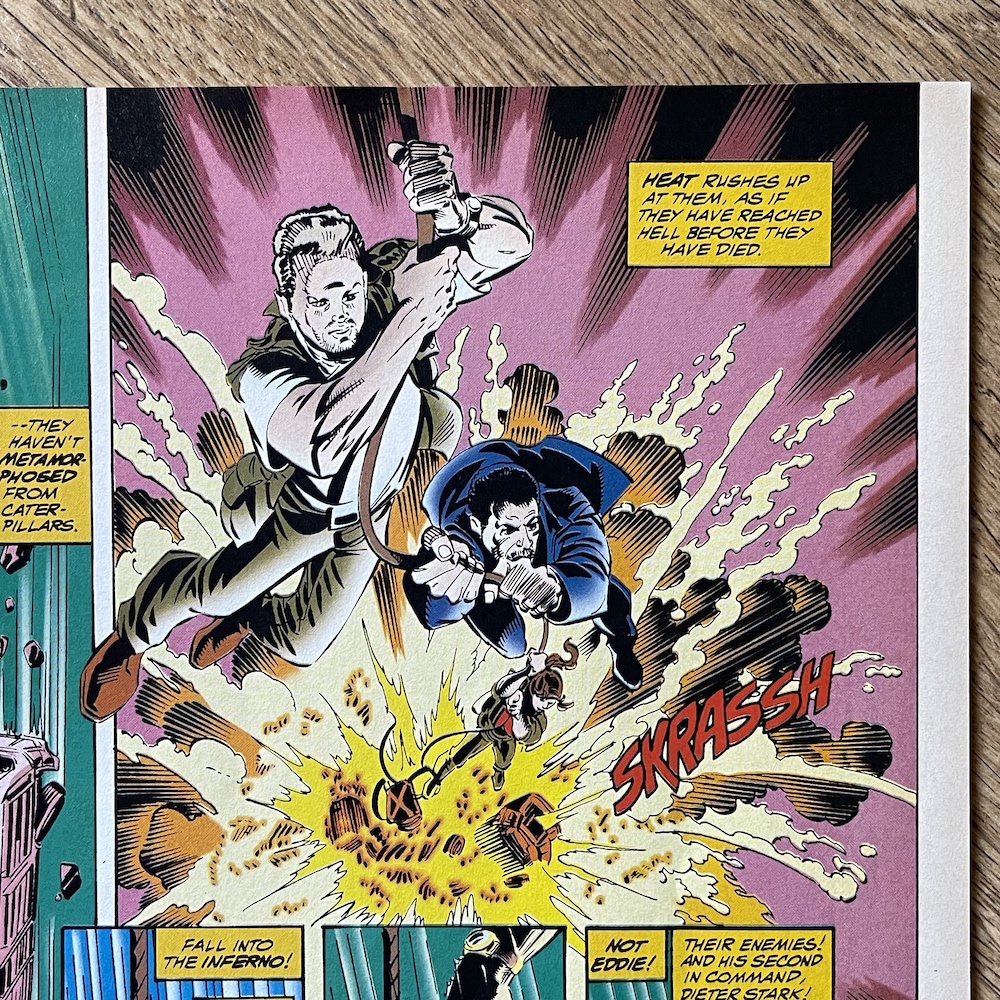
The next part of this scene is of course the moment when the two-part research vehicle is partly pushed over the cliff by the dinosaurs and while Eddie struggles to stop it from falling by winching it with his car he’s also trying to pull his friends up with a hand rope at the same time, and Dr Sarah Harding is on that slowly cracking pane of glass at the rear of the dangling half, looking right down the cliff towards the crashing waves far below. It’s all wonderfully tense.

Unfortunately one of the very best scenes in the film is reduced to a couple of pages. I did understand where Don was coming from in his article last issue but as I said in that review I don’t think he’s got the balance right; you’d think one of the biggest, most memorable moments would get a lot more space to breathe. Take the most basic key points of these ten minutes in the film (Sarah on glass, Eddie’s death, characters clinging to ropes as the transport falls) and eliminate everything else, that seems to be what the plan was.

There’s some fun art though.

I’m not sure if the narration is taken from the book or the draft script but it feels like it’s trying too hard, as if it’s attempting to make up for all of the missing bits. Not only is most of the action just not here anymore but the characters have absolutely no sense of fear about them, like they’re just going from one inconvenience to the next. Some lip service is played to Sarah’s fear of heights (something the film left out) but it’s not built upon.

I do love the art in the scene though, especially how it perfectly captures the invisible sheet of glass beneath Sarah. However the spider veins mentioned are conspicuously missing, and this won’t be the last time something like this happens which I’ll get to in a bit. Eddie’s whole ordeal trying to survive the T-rex attack is just not here but at least his end isn’t censored like the original movie’s adaptation would do. The final moment of the scene is also captured well here. The art is definitely the main thing driving me forward at this point. That and the great photography and extras.

The poster is a wonderful photo of one of the Velociraptors and I’m positive it would’ve been on my wall if I’d known about this comic at the time, showing off the gorgeous yet terrifying animatronic and the darker tone of this sequel. On the back of this is another dinosaur fact file with its terrible design once more not doing justice to Steve White’s interesting writing.

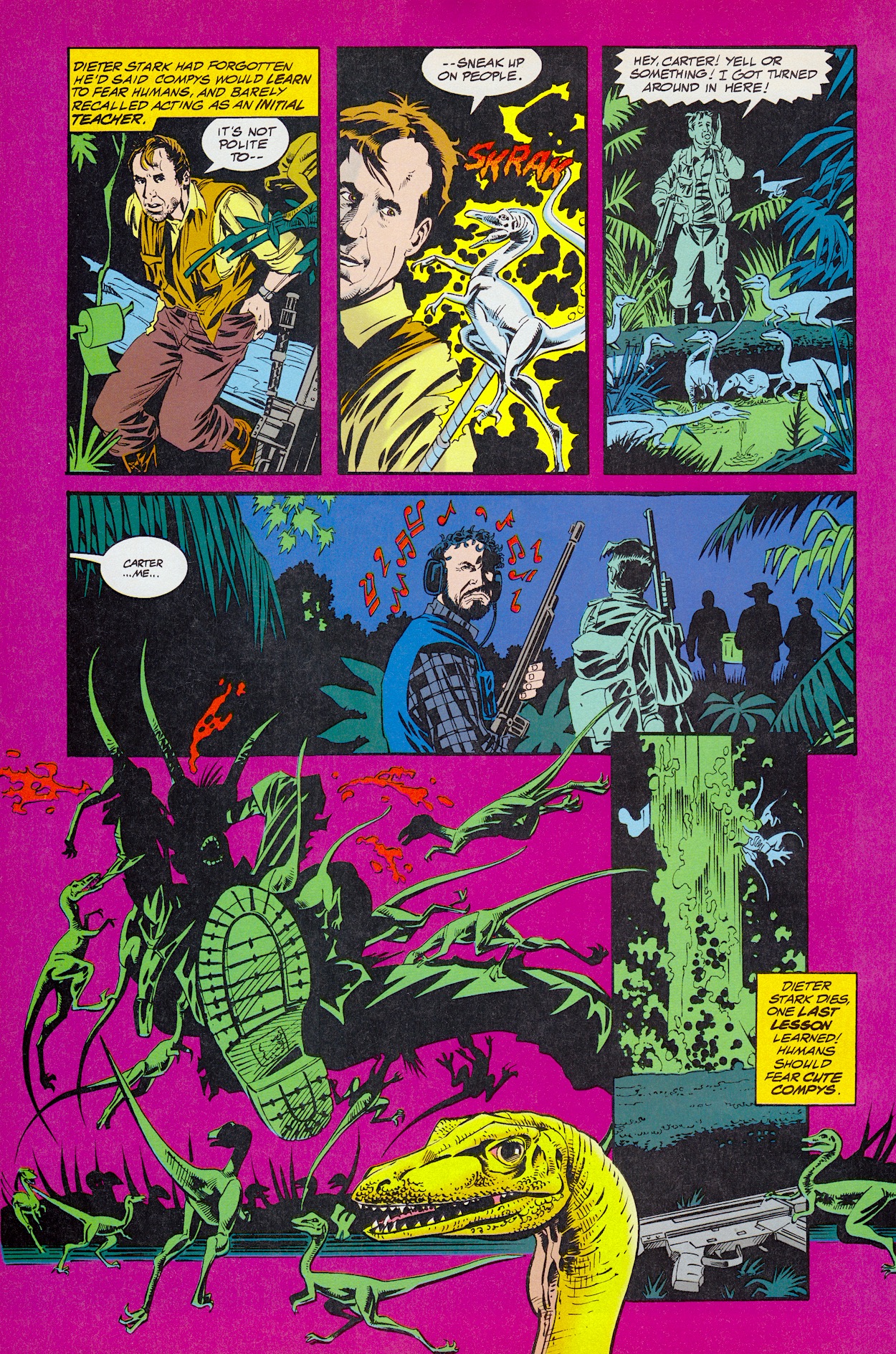
Back to the final pages of the strip which cover two large parts of the story and unfortunately after the promise of last issue it seems we’re back to rushing through the movie again just to get it over and done with. Dieter Stark is Roland’s second-in-command and his death in the film by the cute little Compsognathus pack may be rushed (with a sequence that’s just confusing for anyone not that familiar with the film) but I’m including it to show the two extremes of this strip; the rushed nature but the potential in the art (especially when you see the panel of his actual death).

I feel the beginning of that sequence can only really be followed if you’ve seen the movie and are familiar with the individual elements of how this transpired. Elsewhere we get some added character moments which again may have originally been in the earlier script, like some tender moments between Ian, Sarah and Kelly before we get to the T-rex pair catching up with our sleeping group. There’s a particular moment here in the movie which truly frightened me with its slow build up and drawn out danger for two of our characters. The suspense was a killer! Here it’s all reduced to one single, solitary panel that completely changes this to a game of peekaboo.

Something else missing is Ian’s moustache! From comments on social media after I posted the first two reviews this apparent inconsistency seems to have particularly irked some people when they read the comic, but for me it’s not really a big deal. It’s still kind of there, it’s now just part of a rough unshaven goatee area like Jeff Goldblum sported in the film. It could be it was decided Jeff wouldn’t sport a moustache after the first two parts of the comic were already drawn. Story wise, I’m happy enough to think that it’s all started to grow out again while he’s been stuck on the island for a few days. Either way, it looks much better now.

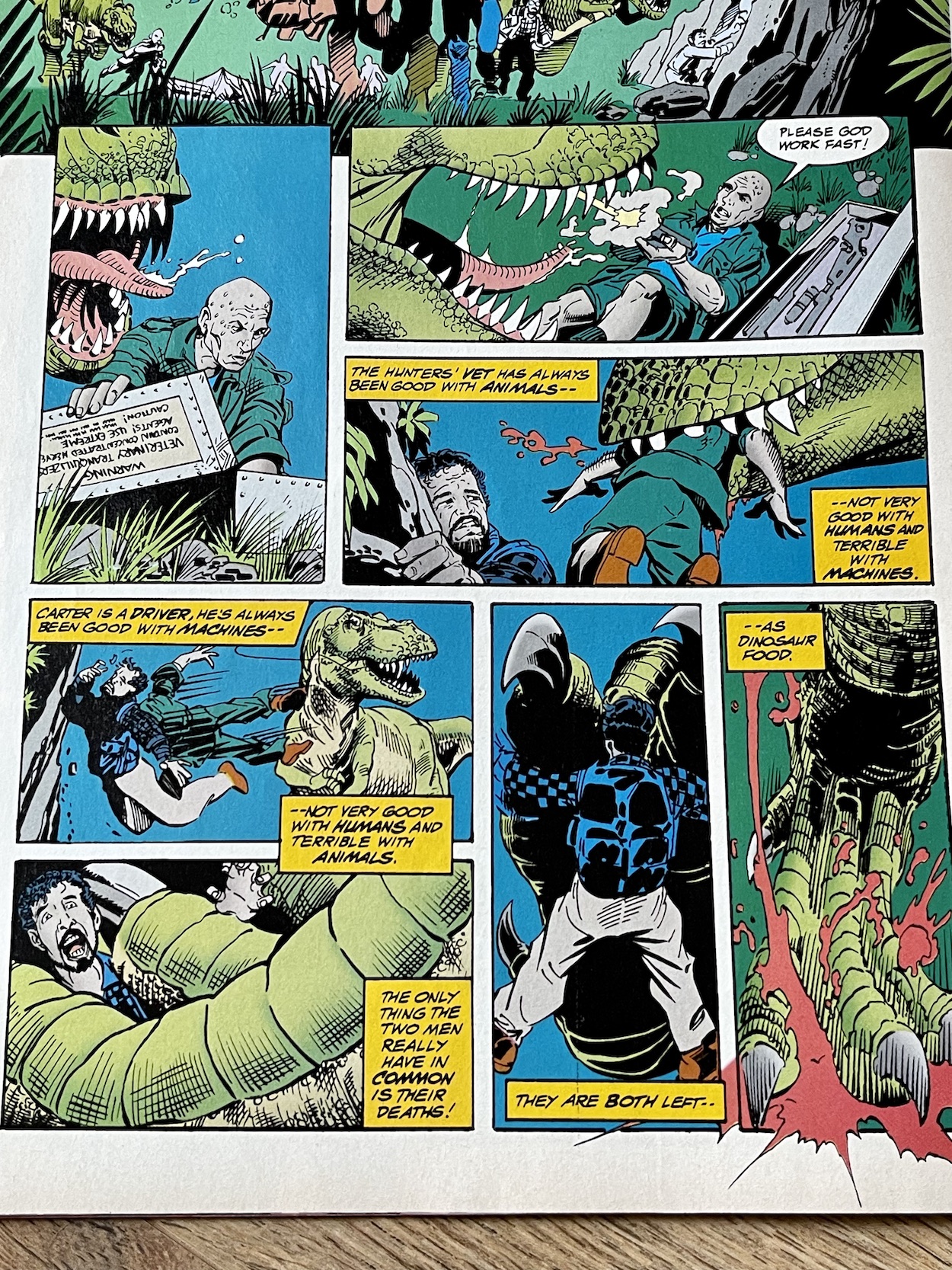
After the small additional character scene I mentioned we get a huge change from the film a few pages later when Roland Tempo, played brilliantly by Pete Postlethwaite in the film, is killed by the huge Tyrannosaurus buck! After finding his shotgun has been filled with blanks by Nick he reaches for the tranquillisers. So far, so familiar. But unlike in the film when the T-rex succumbs to it just in the knick of time, here he grabs Roland and throws him towards Carter, the man who gets trampled to death in the film.

This is one change I really don’t like. Roland was one of the best characters in the film and since he’s now dead we no longer get to see his solemn redemption later after Ajay’s death, when he tells Ludlow he’s seen quite enough death instead of accepting a job at InGen. The hunter became rather Ian-like in the end and accepting of his part in the inevitable chaos. This will all now be missing. If this was in the script Don was working from then I’m very, very glad screenwriter David Koepp and Steven Spielberg changed this character’s arc.

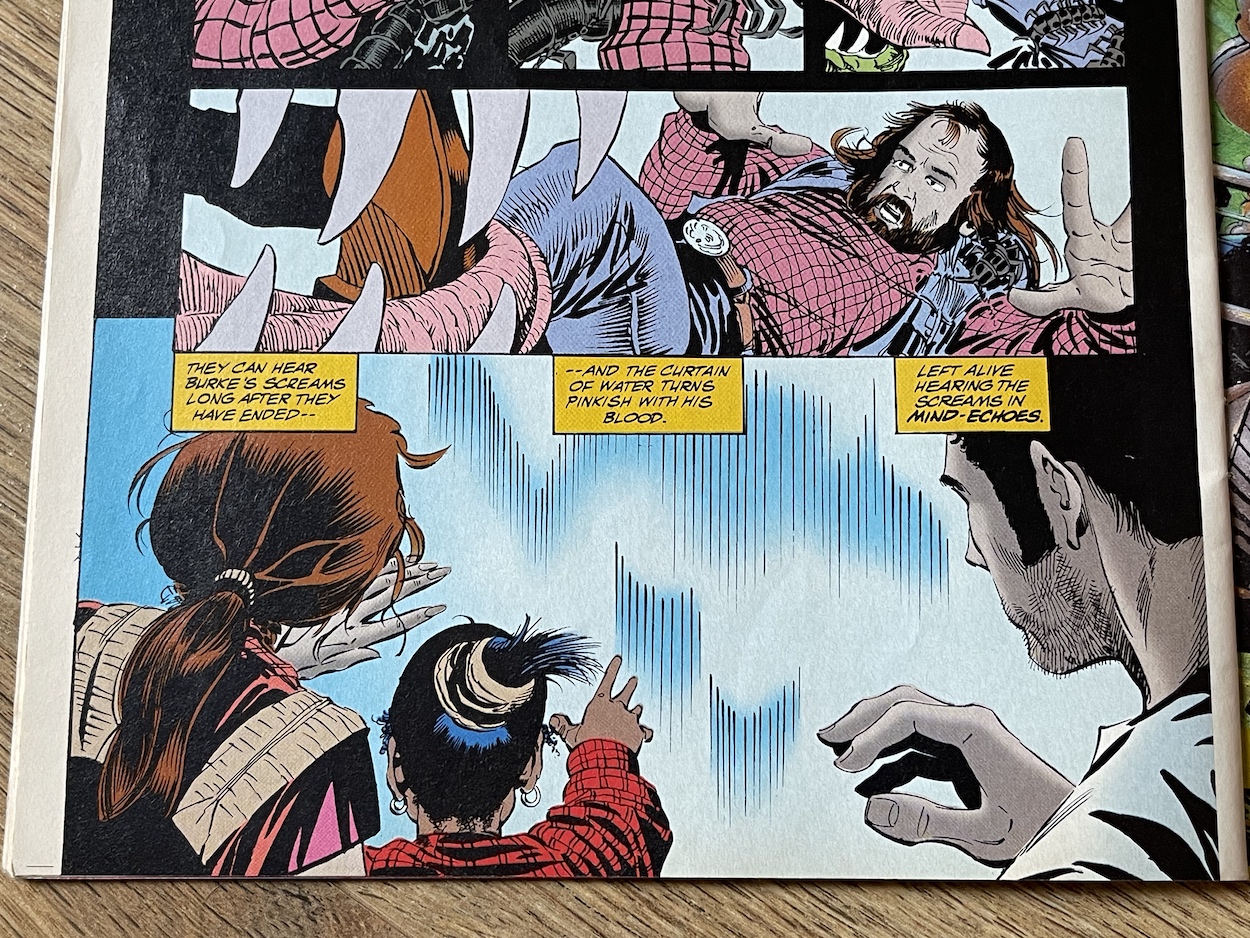
The penultimate chapter of the adaptation ends with our main characters trapped behind the waterfall (in a scene from the first Jurassic Park novel and depicted by Walter Simonson and Richard Cry on the cover) as Roland’s palaeontologist Dr. Robert Burke is grabbed by one of the T-rexes and dragged out. Just like the spider veins mentioned when Sarah was in danger, the curtain of blood described here is nowhere to be seen, somewhat dampening the moment.

Chapter three has certainly been a mixed bag then. I liked some of the extra character scenes but hated the death of another, although to be fair to Don that wasn’t his fault. Some of the very best moments of the film, (some of my favourite moments in cinema, period) were so rushed here they were barely recognisable, and the fun art has been on top form at times with some great images but plagued by inconsistencies elsewhere. I come away frustrated more than anything because of what this talented team could’ve created.

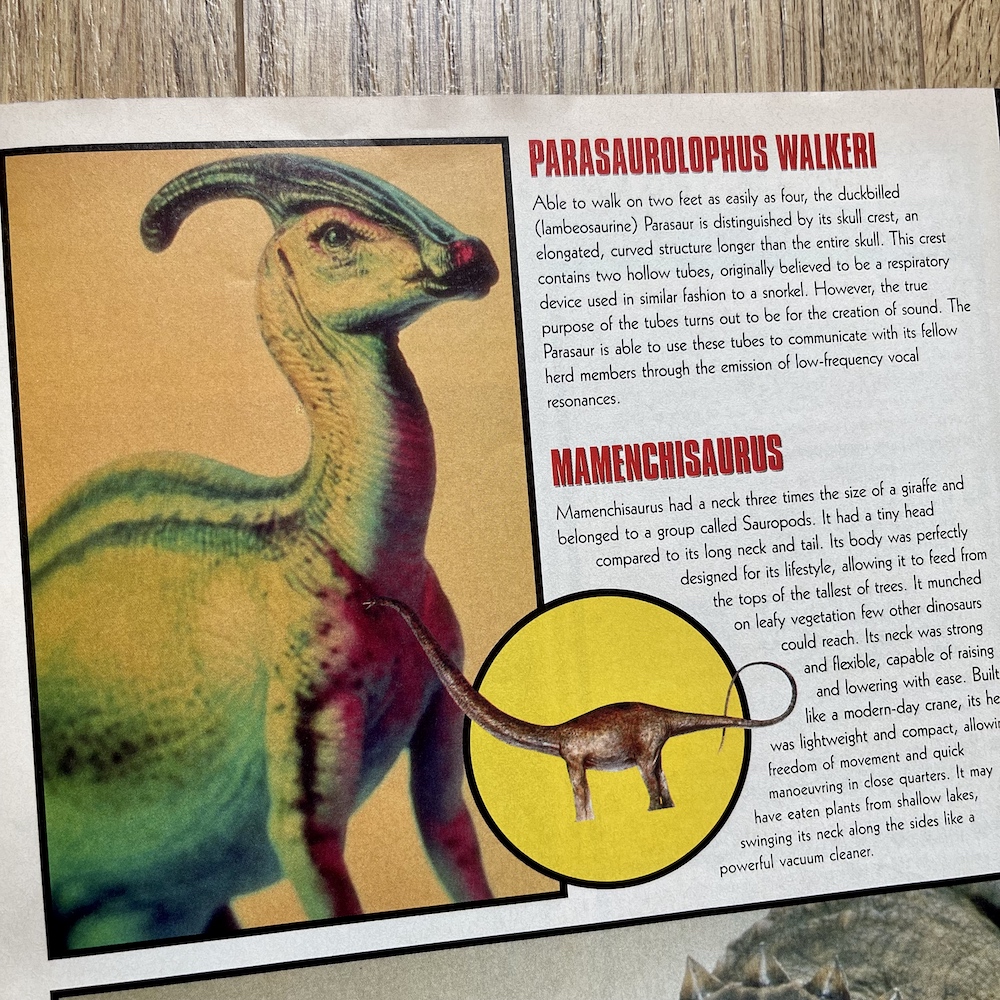
There’s no character mini-poster this time, instead we get five pages of a welcome pack for new employees to InGen and it contains a lot of photographs of model dinosaurs used in the pre-production of the first two films. I thought there was something strange about the little pictures of the animals in circles throughout #1 but now I know what they are they’re a delight to look at up close like this. All the main dinosaurs are covered, including this film’s Parasaurolophus Walkeri and the sick Triceratops from Jurassic Park.

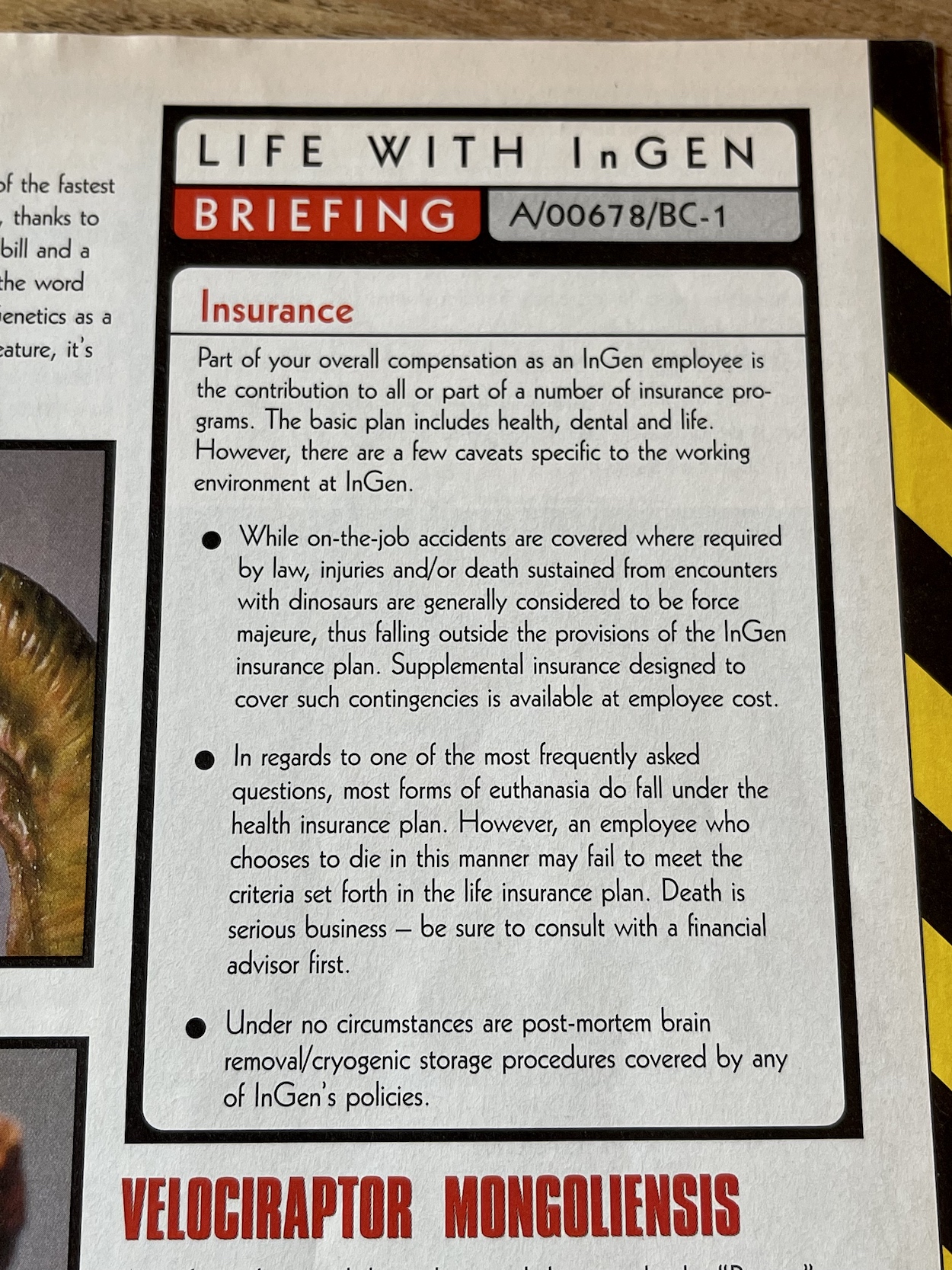
There are also some funny moments such as the exceptions to staff’s apparently comprehensive insurance policies, which absolve InGen of any responsibility whatsoever if Chaos Theory rears its head. As with the previous two issues I’ve found the extras more enjoyable than the strip, so kudos to editor John Freeman and his team, these pages add a lot to the overall package.

We’ve only one chapter of the story to go and I feel just like I did when the first film’s adaptation finished its penultimate chapter; there’s just no way they could possibly cover everything still to happen in 22 pages. It’ll be interesting if nothing else! We’ll find out what survives in #4 of The Lost World Jurassic Park on Monday 7th August 2023.

iSSUE TWO < > iSSUE FOUR

JURASSiC PARK MENU

THE LOST WORLD JURASSiC PARK #2: SUPERiOR SEQUEL
I’ll admit my eyes rolled a little when I saw this cover to the second issue of Titan Magazine’s The Lost World Jurassic Park comic for a couple of reasons. Not the photo of the glorious animatronic Tyrannosaurus rex of course, they’re always incredible to look at. No, the top-right and bottom-left made me sigh a little and to be honest it’s just me being pedantic, so apologies to all you blog readers for having to put up with me when you’re just trying to find out about some classic comics.

The Jurassic Park novels and films made a huge deal out of the fact that they were helping dispel the myth of dinosaurs being large, lumbering reptiles and who can forget the scene when Dr Alan Grant told people dinosaurs are more closely related to modern day birds. Hence why we saw fast, fluid movement from the animals in the films and yet here we’re asked “will the reptiles strike back”? Plus, it’s not a “free” poster when it’s part of the page count of the comic. To be fair many comics did this, OiNK included, but it niggles me. Or maybe it’s because I’m writing this at a very early hour and really should’ve got more sleep.

Anyway, eye rolling done, let’s move on to what is a much improved issue and one I enjoyed very much once inside!

I’ll give the Jurassic Park movie adaptations something, they certainly know how to write some atmospheric narrative captions. Walter Simonson did a superb job of this throughout his comic version of the first movie and here Don McGregor is certainly following suit. Of course, these could be taken from the script he was working with or indeed the novel, but we’ll give him credit where it’s due in pulling us in to specific moments like this on the opening page of part two. The art team are once again penciller Jeff Butler, inker Armando Gil, letterer Ken Lopez and those are editor Renée Witterstaetter’s gorgeous colours.

It’s just a shame these moments are rushed through for much of the comic strip. Don’t get me wrong, this is a much improved chapter over last issue’s. There are more character moments from the film left intact and even one or two which must’ve been part of that earlier draft of the script. We get the scenes of Dr Sarah Harding excitedly explaining her discoveries and Dr Ian Malcolm turning them around into accurately predictive doomsaying. But we also get a few moments here that weren’t in the film, such as this exchange between the two.

I’m not sure if this would’ve been in the script, I just can’t imagine Ian using the word “chick”. Then again, with so little room (88 pages in total) to convert the script to a comic I can’t see Don adding in extra dialogue either. When Roland Tempo’s team and the slimy Peter Ludlow turn up in their helicopters there are more examples of how the narrative captions can be used to eek out some characterisation that the brisk pace of the adaptation would normally struggle with. Nick Van Owen, as played by Vince Vaughn, was a good character and criminally unused in the climax of the film so I’m glad to see him getting some more exploration here.

With the hunters now on the ground we get to that heartbreaking part of the film where they’re capturing as many dinosaurs as possible, caring not for the fact these are living, breathing animals, never mind a miracle of science. Roland made his debut in the film at this point but of course we’ve had the bonus of the entertaining deleted scene last issue so we feel like we already know him by this point. Here you can see the viciousness with which his second-in-command Dieter takes down the Parasaurolophus, or ‘Elvis’ as Roland called it.

It’s all over very quickly and it’s here that the unevenness of the adaptation comes to the fore. I’m finding it hard to figure out what Don’s rationale was for what he keeps in and what he jettisons. Later on in the issue there’s a fascinating article written by the man himself about the challenges of adapting a long movie script into a tight four-issue mini-series. He mentions keeping characterisation is very important and I can see that in some of the scenes he’s included but elsewhere that’s simply not the case.

I can’t help feeling I’d have preferred a more balanced approach

While the examples above are nice to see (Sarah and Ian’s exchange lasted for a few pages, for example), ones featuring Ian’s daughter are inexplicably missing or cut down to a few lines and other scene-setting moments have been taken out completely while some of the big dinosaur moments are rushed through, eliminating any spectacle or menace, which seems a strange choice in a Jurassic Park comic. Obviously I’m not a comic writer and Don lays out his reasoning in the article but as a reader I can’t help feeling I’d have preferred a more balanced approach.

We’ll come back to that in a moment but first the story takes a four-page break with some adverts, another dinosaur fact-file page and a double-page spread. This is on pages 18 and 19 of the comic, it’s not a separate entity and so it’s not a free gift (can you tell that’s still niggling me?). It’s a shame these weren’t large separate glossy posters but at least editor John Freeman made sure there were no strip pages on the back of them.

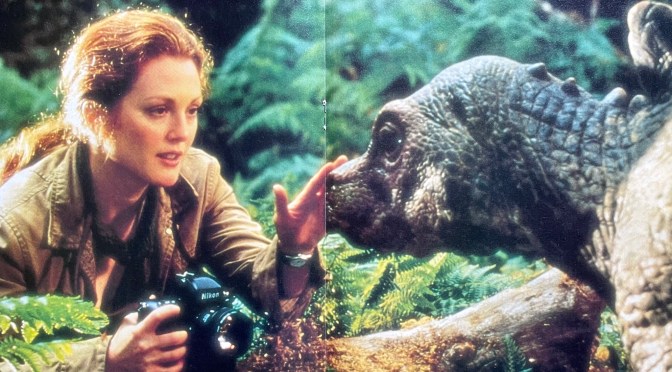
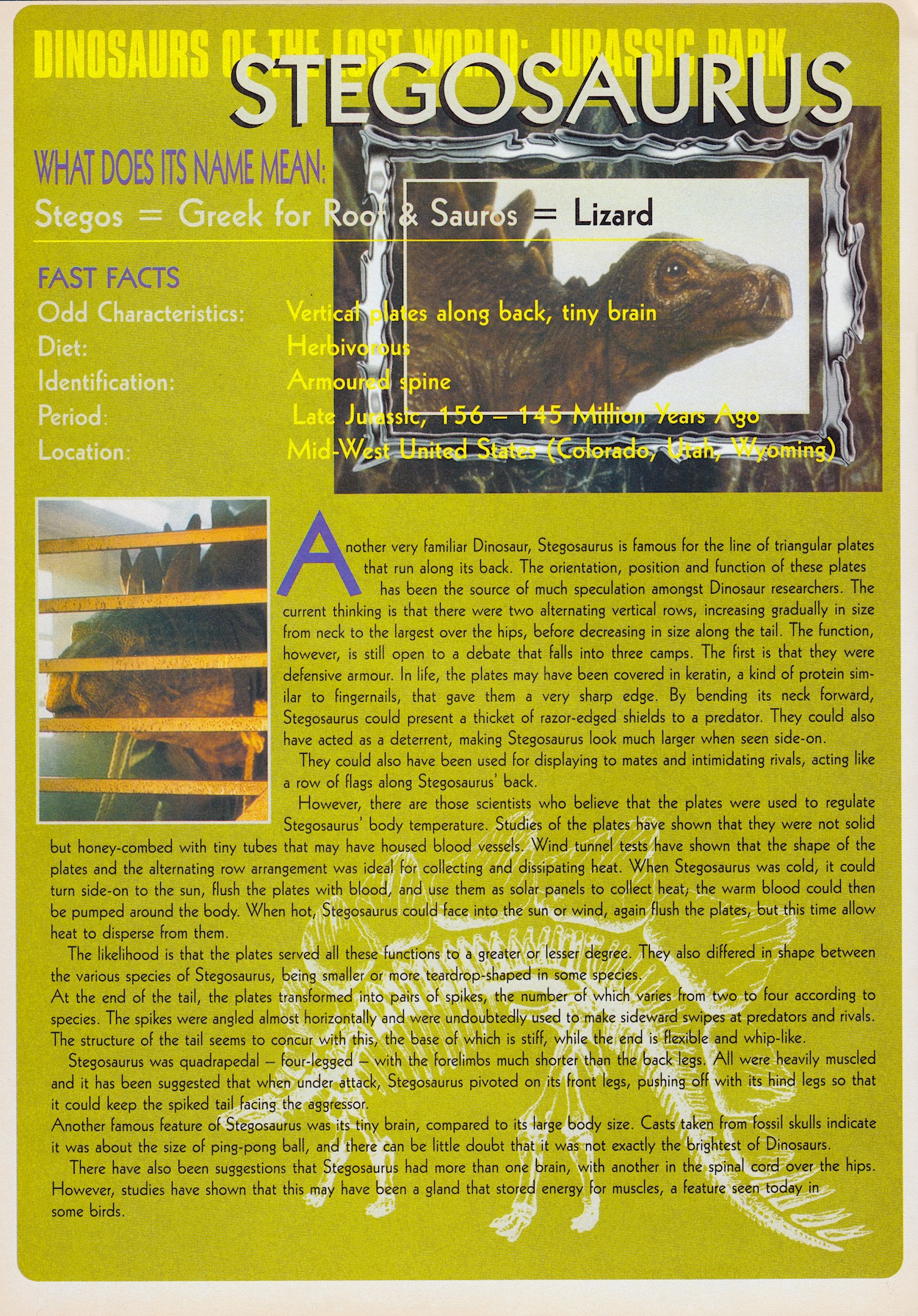
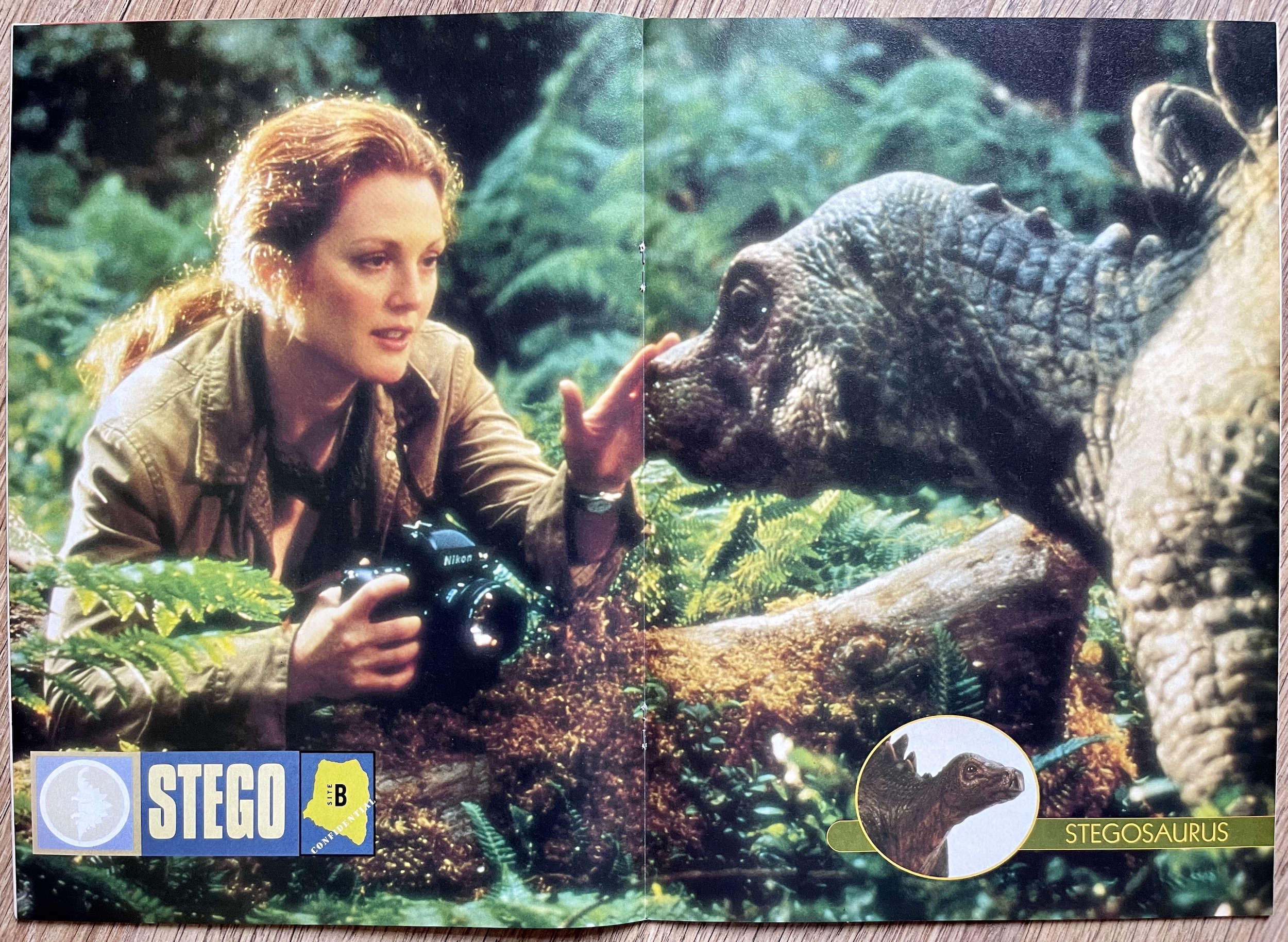
Julianne Moore as Sarah Harding reaches out and touches the snout of the baby Stegosaurus in a moment that was excised from the story last issue. Over the page is another fact-file dedicated to one species from the film and the Stegosaurus gets top billing this time. However, remember how I thought the design of the page wasn’t finished last time? It appears that is indeed the finished design. It looks awful and does no justice to the great piece written by Steve White.

An ardent dinosaur aficionado, Steve has clearly done his research (or knew the subject matter extensively already) and this would’ve been a fascinating read to young fans of the films, adding depth to the scenes in the movie featuring these animals. It’s still fascinating for this much older fan too. We then head back into the story and the last eight pages of this 22-page chapter, beginning with two new scenes I hadn’t been aware of until now.

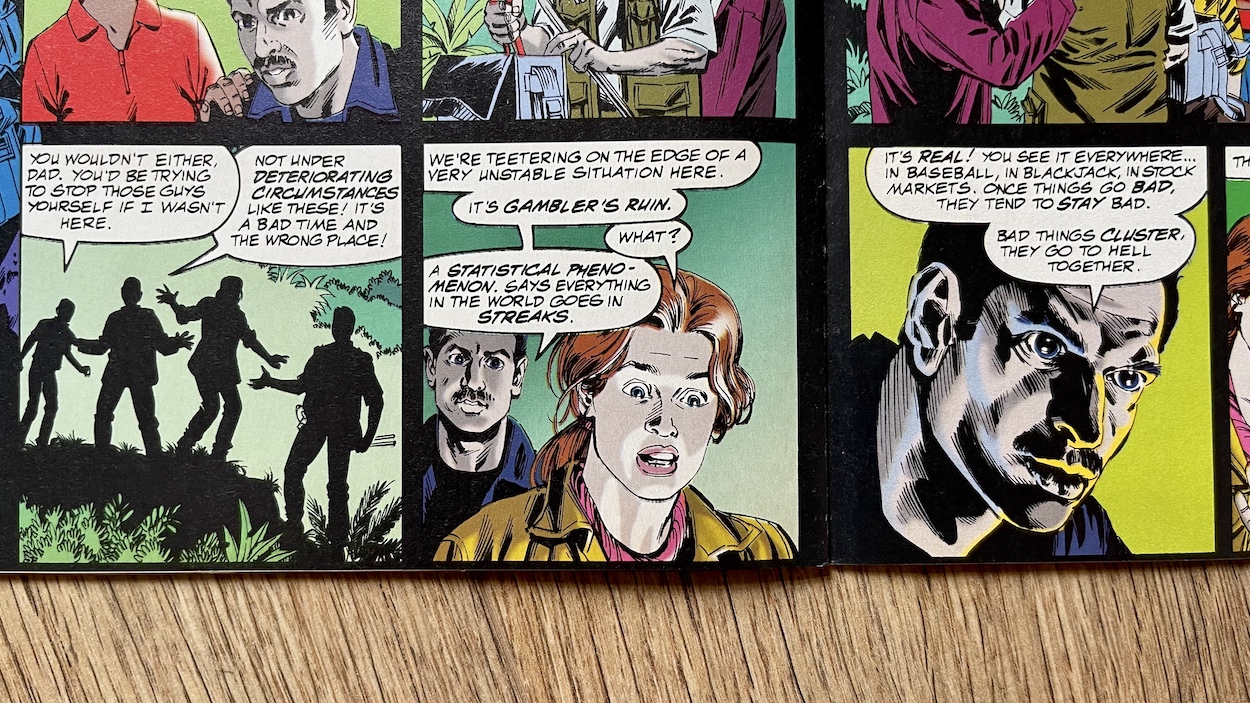
While overlooking the hunters’ camp it sinks into our team that the creatures are being taken off the island alive and exported to the mainland. After what happened in the park this is obviously a terrifying realisation and this is the part where we find out Nick was actually sent as back up by Hammond and he sets off with Sarah to free the dinosaurs. It’s during this we get the new element, one of Ian’s little speeches that we liked so much in the first film, this time about something called Gambler’s Ruin.

While it’s only for a couple of panels it’s something that’s referred to later in the strip and by Don in his article. Don states things like this are deemed important and must be kept in, which is ironic since it didn’t make it into the film. I reminds me of those little moments in the first movie that expertly summed up the pages and pages of fascinating monologue from Ian in the novel. It’s a shame it didn’t make it into the finished film, whereas I’m glad the next page didn’t.

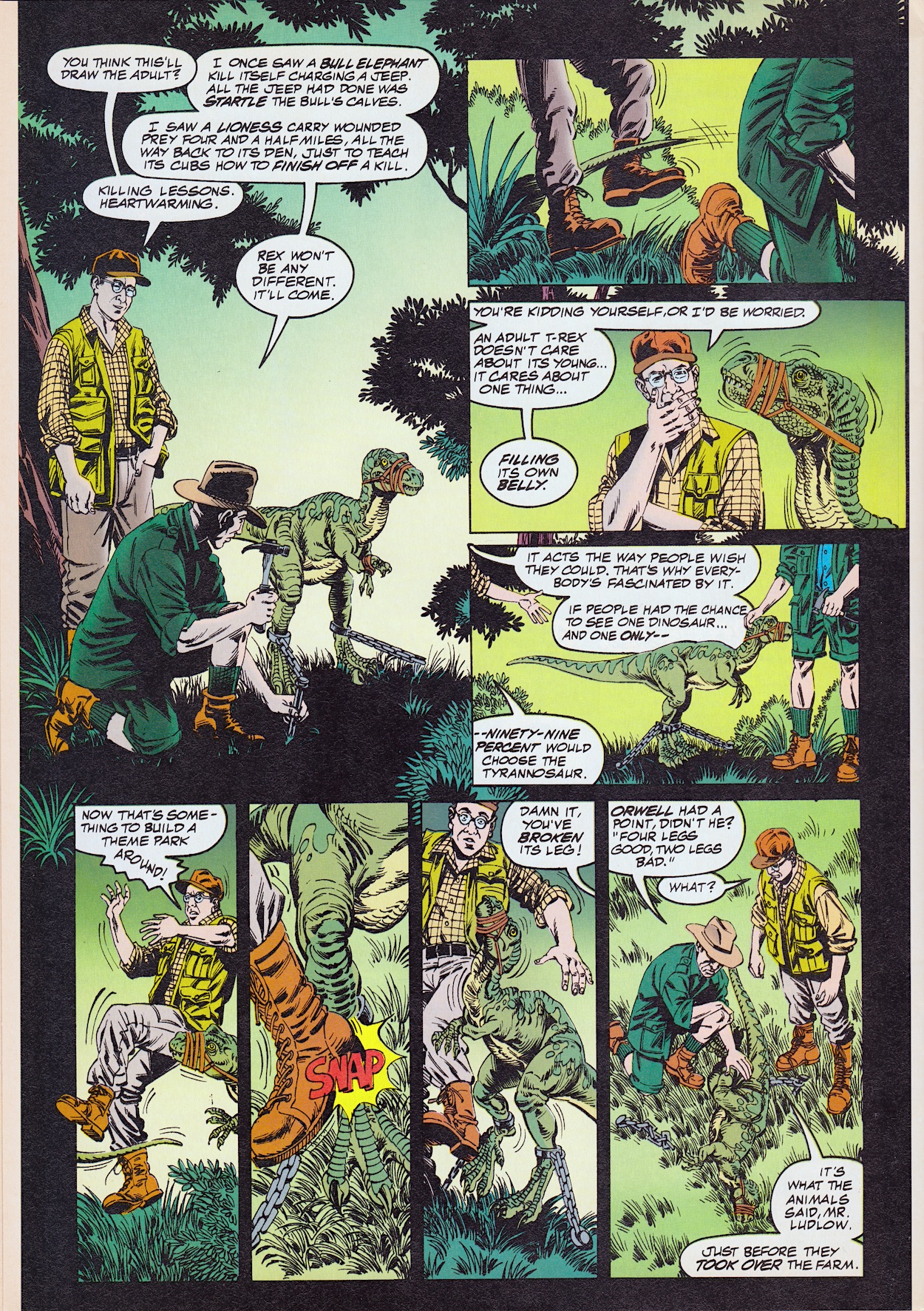
This scene isn’t a deleted scene in the movie’s extras so I can only assume Steven Spielberg chose not to film it. On the screen we see Roland and Ajay watching the baby T-rex and coming up with a plan to use him to lure the male adult back to the nest. A few moments later the baby is seen tied up with one of its legs covered in blood. Later we find out it has a fracture and Sarah and Nick try to set it for him (or else he’ll become food for a predator). The implication of how it happened is clear but here the real reason is meant to be a pratfall.

I really don’t like this and it’s not Don’s fault of course, it was in the script he worked from but I can’t blame Spielberg for not including it. Roland is meant to be a seasoned hunter, the very top of their game in the whole world, so bored with it now that only the promise of killing a T-rex buck could lure him back into picking up his gun again. When I watch the film I like the way the reason behind the baby’s leg injury is kept ambiguous.

Spielberg left it up to the viewer to assume either the baby struggled and did this to itself as the two men struggled to tie it up or, more viciously, they deliberately broke it so the baby would cry out in pain for his parents and the scent of blood would bring the adult male quicker. But to have it as a result of Ludlow clumsily tripping just feels wrong. I prefer the film without this scene and clearly the director agreed. After this the chapter rounds itself off with the moment a Triceratops breaks out of the camp after being freed by Nick and that’s us for another fortnight.

If you’re thinking I’m being overly critical it’s only because the previous Jurassic Park comic showed how much potential there is in bringing this franchise to the medium. The last chapter of the first film’s adaptation may have rushed things too much but the first three instalments were fantastic and showed me it could be done. Then the vast majority of the sequel strips were great fun, full of action without sacrificing the characterisations. It even gave depth to a group of Velociraptors!

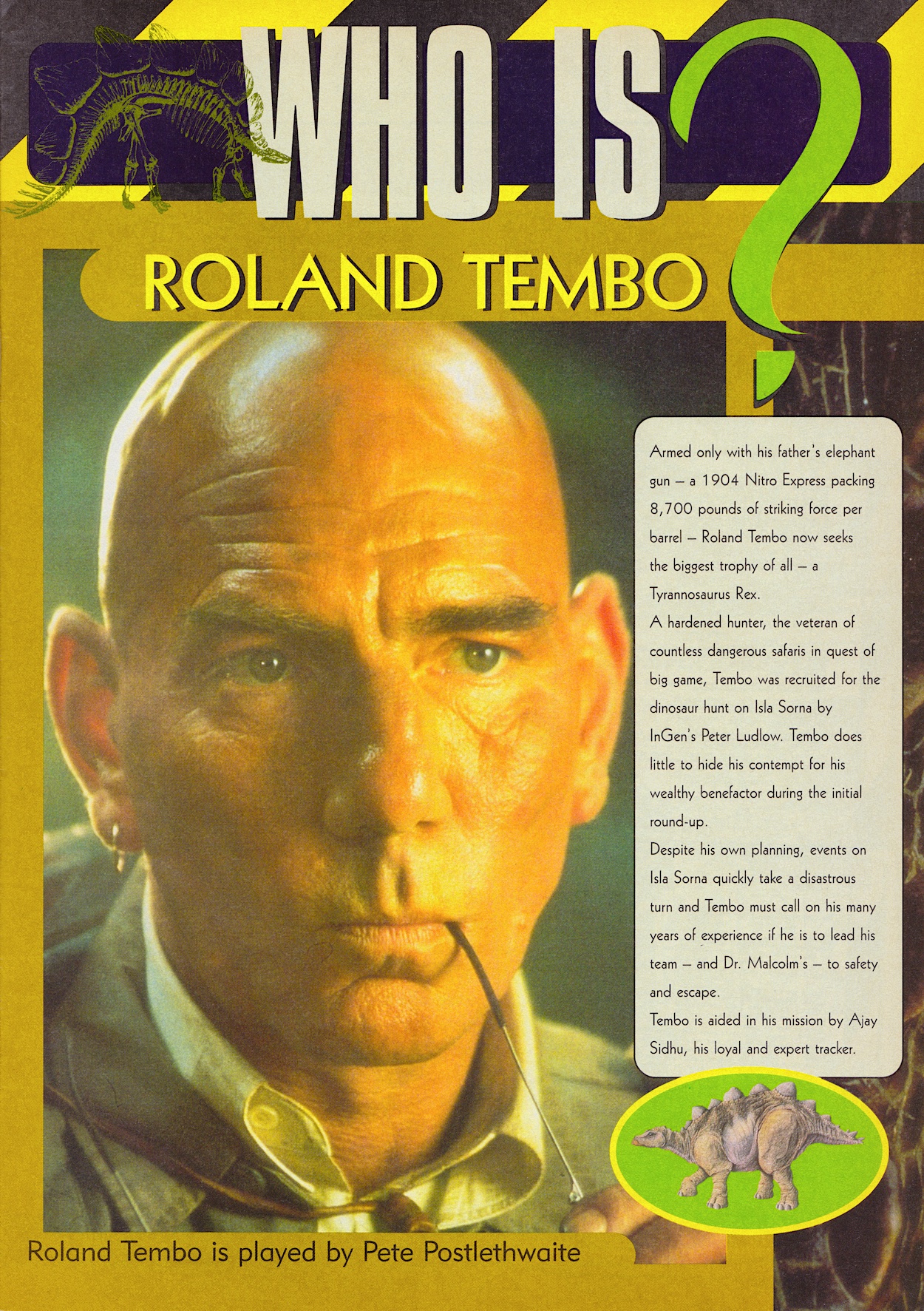
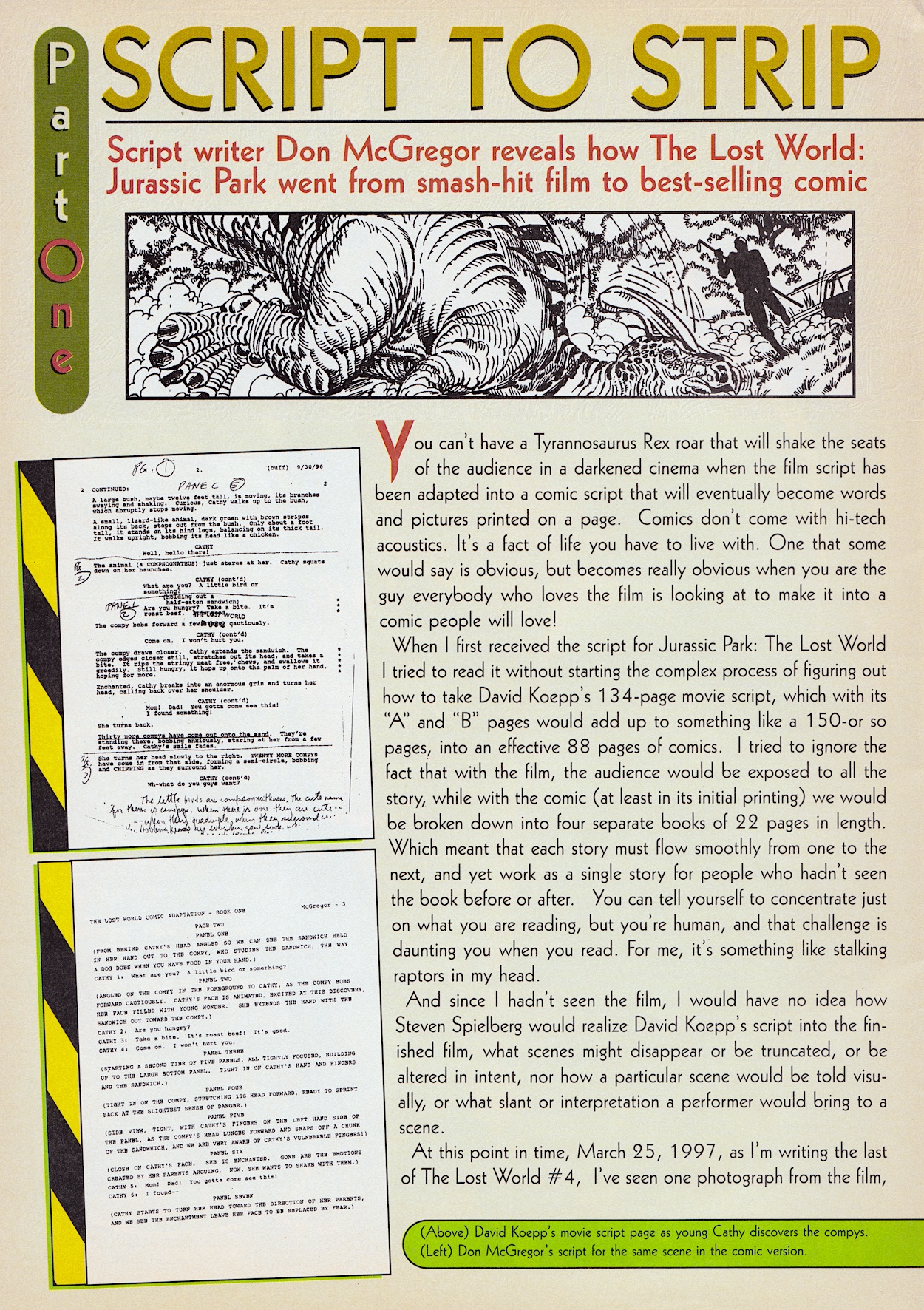
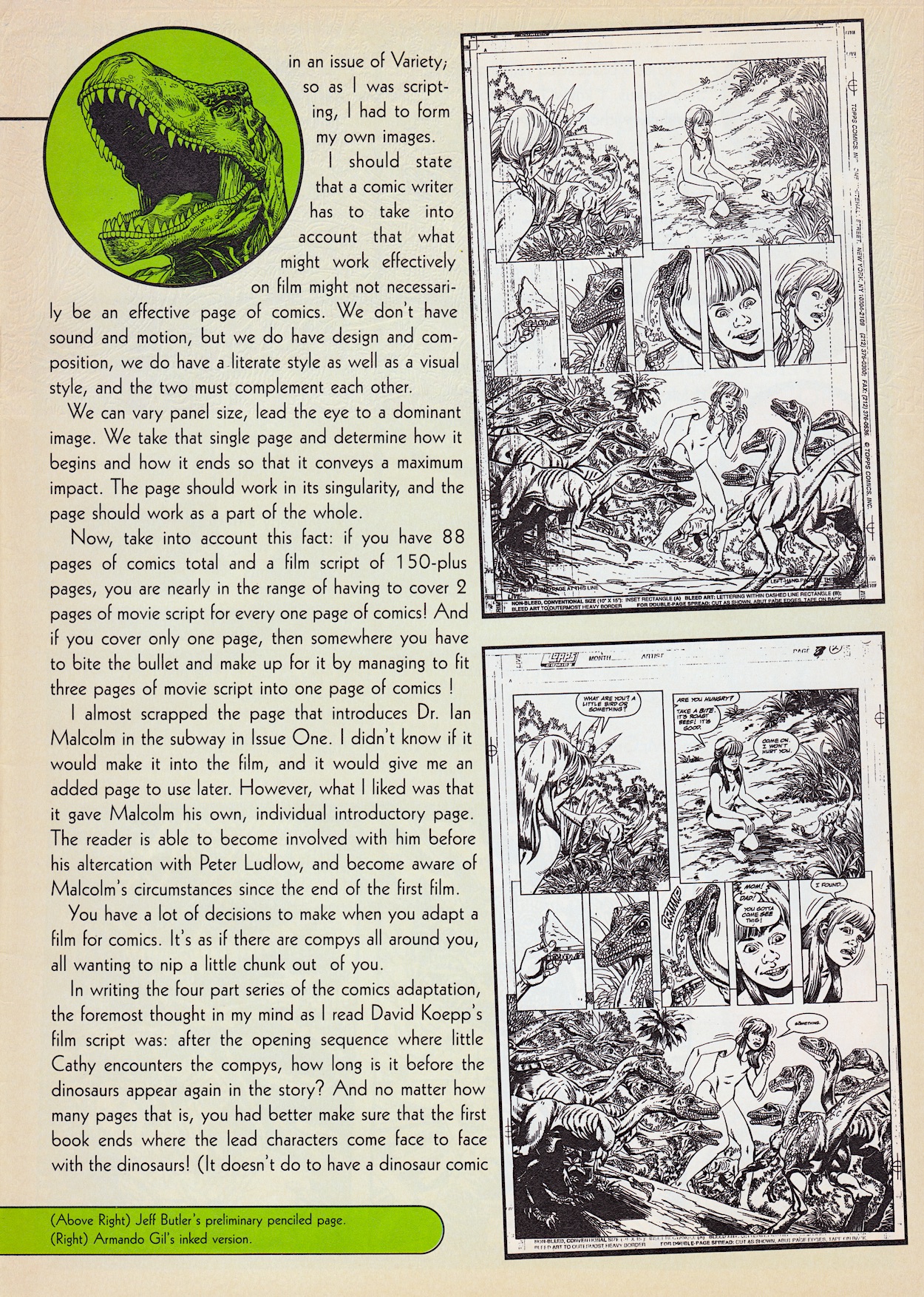
A pin-up of Pete Postlethwaite in character as Roland brings us to Don’s article, Script to Strip. I really do find this interesting. I like how he describes the difference in the comics medium, things we may not have considered as fans of the film. I found it shocking everything was written before he’d seen anything of the movie at all! Yes, the comic would be published to coincide with its release so deadlines would’ve been very early, but I expected him to have access to photos from set, pre-production art, maybe early footage but nope, he only had the written words to adapt into his own written words.

Part two really is a big improvement and after reading Don’s own words I can’t help but cheer him on

He makes several good points about the maths of adapting a film to a comic, namely the page count difference and when he lays this out for the reader you get a sense of the enormity of his task. I’m not sure I agree that each part of this mini-series should be able to work as a story in its own right though. Maybe if he was writing his own original comic but in adapting a movie it’s never going to come across like that to a reader, these are very much individual chapters of one story.

He makes good points about the risk of having no dinosaurs for too long, something a movie that’s building tension can do but a comic can’t. This was why Walter Simonson reworked the order of some scenes and added actual Velociraptors to Dr Alan Grant’s famous scene with the “That doesn’t look very scary” kid in his adaptation. I’ve mentioned Don’s characterisations and choice of scenes to include throughout the review, so without further ado here’s a fascinating look into how this insurmountable task was achieved.

While I agree with his sentiments and he clearly had good intentions I feel the adaptation hasn’t quite got the balance right. For example, instead of including every single word of some scenes and none from others would it not have been better to trim all of them down so that the essence of them all is still intact? Jenny (Ian’s daughter) in particular is badly served. The same with the dinosaur scenes; there are some great spreads (we got two pages of the Stegosaurus family walking away from Sarah at the beginning) at the expense of scenes that would’ve been the most memorable to readers waiting to watch it again on home video.

Part two really is a big improvement and after reading Don’s own words I can’t help but cheer him on for the second half of the comic’s limited run. I hope he’s successful, especially when there’s potential in his style and the art is so enjoyable. We’ll find out over the next month. The third of these four issues will be reviewed on Monday 7th August 2023 and if you’re just discovering the blog via this comic there’s a whole bunch of Jurassic Park comics already reviewed over the past couple of years that you can check out, including the first official sequel long before The Lost World Jurassic Park.

iSSUE ONE < > iSSUE THREE

JURASSiC PARK MENU

ANNUALS: iN REAL TiME

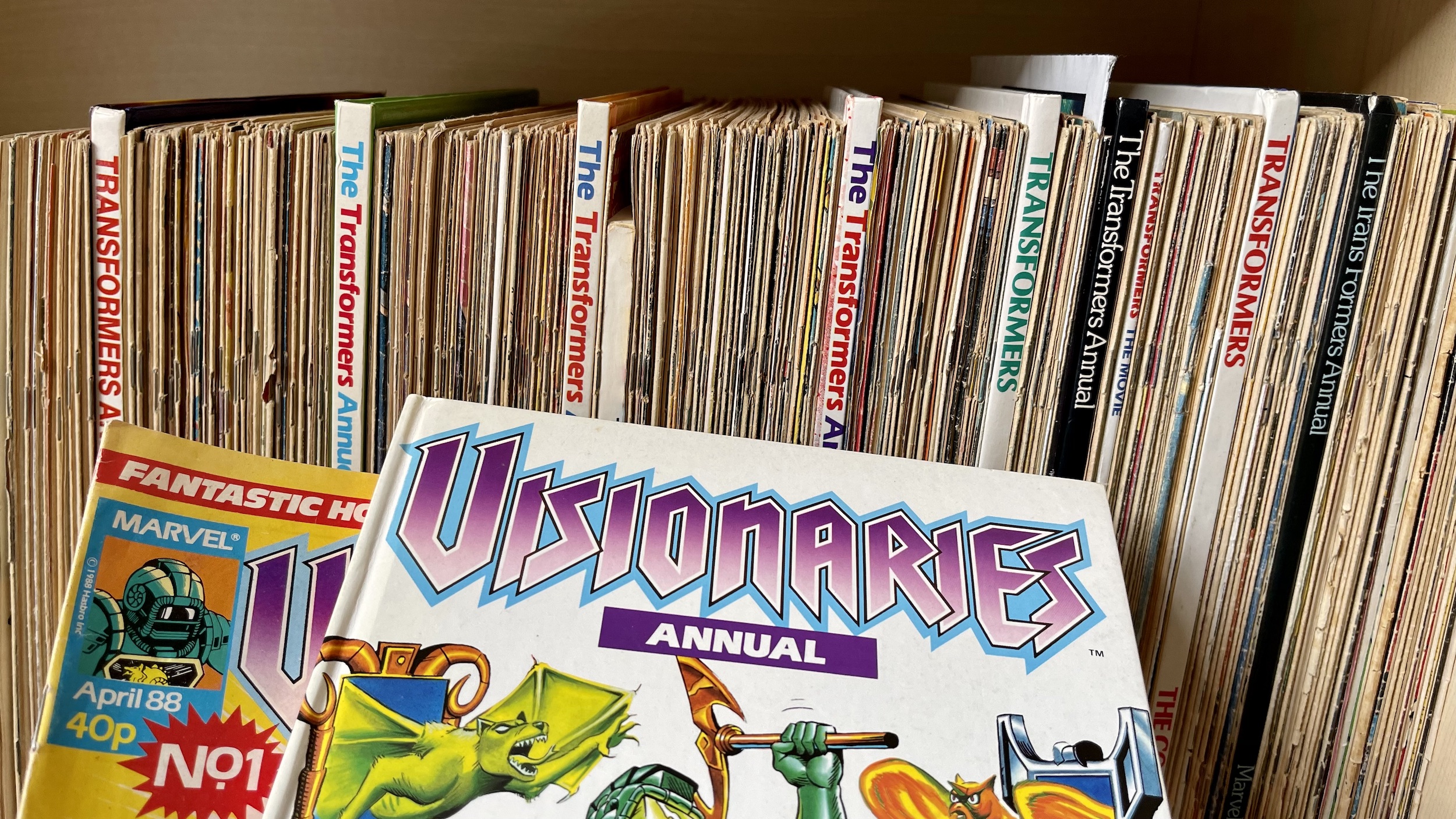
Classic comics in real time. It’s what this blog is all about, it’s right there under the title at the top of the screen. Each issue of the various comics are reviewed on the dates we originally would’ve got our hands on them. Normally that means on the date they were released, but applying the rule to this section of the blog poses a bit of a problem. So we’re going to do things a little differently here. Just a little.

As anyone who collected books like these as a kid will know, they went on sale around the time we’d return to school after the summer holidays, usually mid-September. But we didn’t get our trotters on them until Christmas Day when the jolly man himself would bring them down our chimneys. So when do I review them? On their release dates or when we got them? Those aren’t the same dates for annuals.

I’ve fond memories of looking endlessly at the huge variety of annuals on the shelves of my old hometown’s newsagent’s, or their large table displays set out at just the right eye level for kids. But as tempted as I was I never looked inside any of them, believe it or not. I didn’t want to ruin the surprise of finding out what they contained during my very favourite time of the year. Instead, I’d let the anticipation build over those few months until I was looking forward to them just as much as the toys and games (and the food)!

So I’ve decided to review these during the festive season. They were always a Christmas treat, many of them including themed content and even if they didn’t they were still very clearly marketed for that time of the year. So this is where I bend the rule a little. As much as I love you all I’m not going to be spending my Christmas Day every year writing a handful of reviews, not even for Knight Rider (my favourite thing in the universe)! Many of the reviews will be spread over the month of December, with any relating to an ongoing comic series published on The Big Day itself (so they’re in the right position in their own read throughs elsewhere on the blog).

A section of the blog I have a particular fondness for

Patience will be a virtue with this particular section. The books were released once per year (the clue is in their name) so depending on the amount of books in a series they could take quite a while to cover. Also, the overall collection of reviews won’t be listed in the order in which they’re written for obvious reasons (they’re essentially all different read throughs).

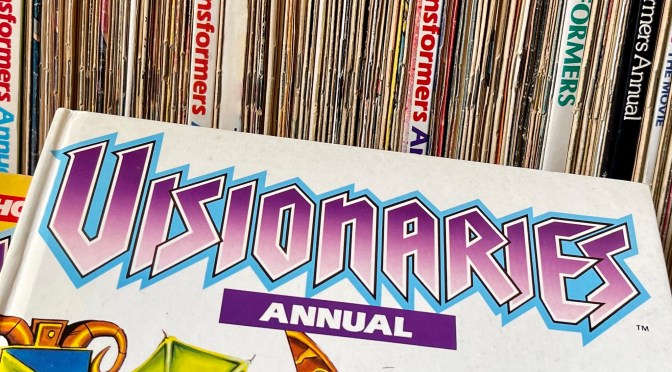
Instead they’ll be listed in original release order, meaning you’ll be able to take a trip right through the years covered. Perhaps you’ll remember those holidays when you received these books, or check out ones you recall from those newsagents’ tables, or discover ones you never knew existed. (For example, a lot of people contacted me about the Visionaries Annual after the review asking if I had a spare, having seemingly slipped under the radar of many fans in 1988.)

All these years later I’m still just as much a fan of Christmas as I ever was, perhaps more so. As such, this is a section of the blog I have a particular fondness for and the fact I have to wait so long between new additions just makes it even more exciting when the time comes around again. So, even though it’s a once-a-year thing you can expect just as much attention paid to these as anything else, including the occasional special feature.

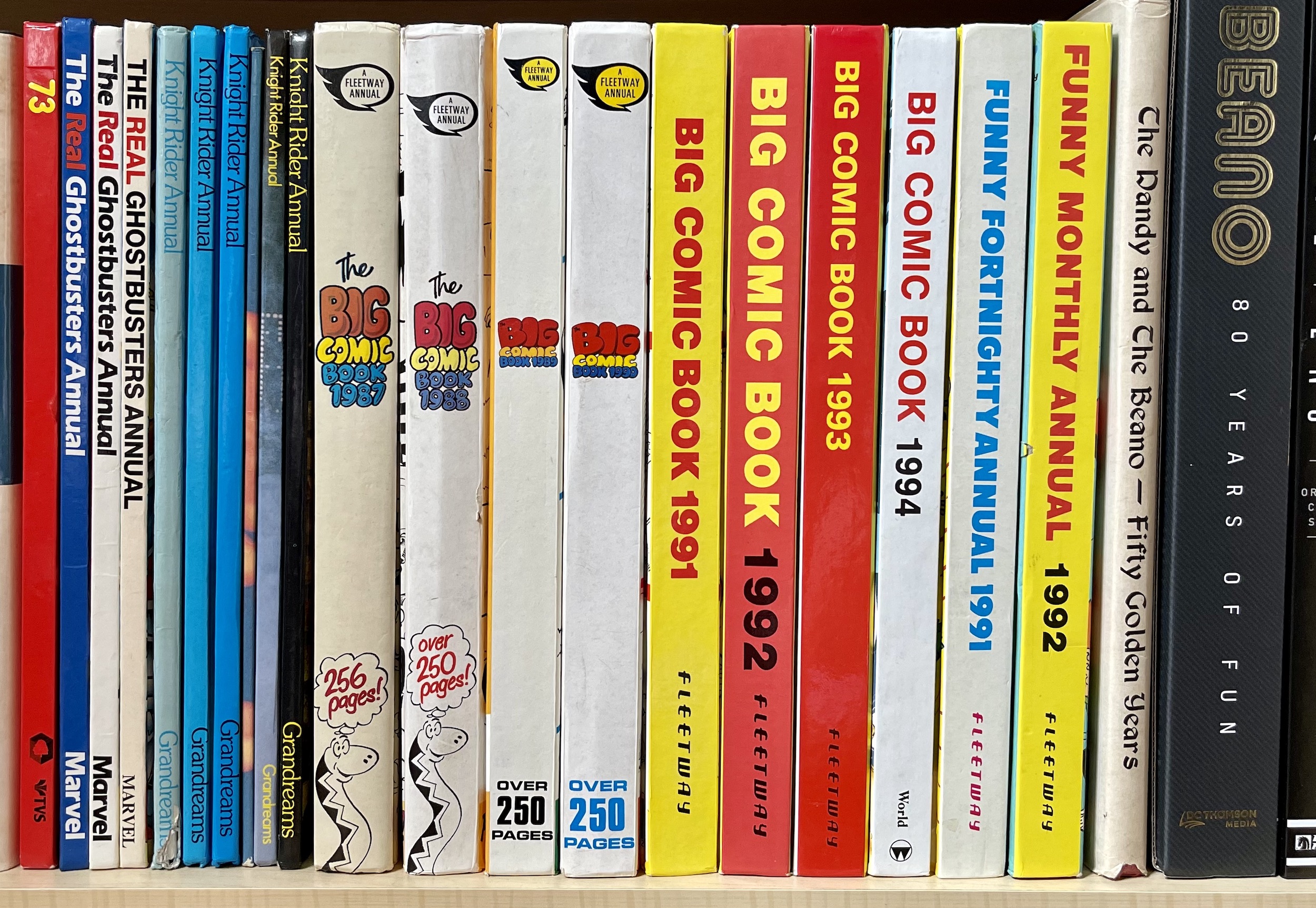
As you’ll see it won’t just be annuals based on comics, although those based on other properties such as televisions series will have comics content. You can expect a nice mixture of the books I collected at the time and those I wished I had. This is going to be a really fun section of the blog. I’ve a shelf full of content just waiting for each year to roll around (the will power is strong with this one, it has to be) and more on the horizon.

I hope you’ll enjoy this section of the blog as much as I am.

ANNUALS MENU

Classic Comics in Real Time