Tag Archives: Steve White

HAVOC #3: PSYCHOTiC GOOD BUDDiES

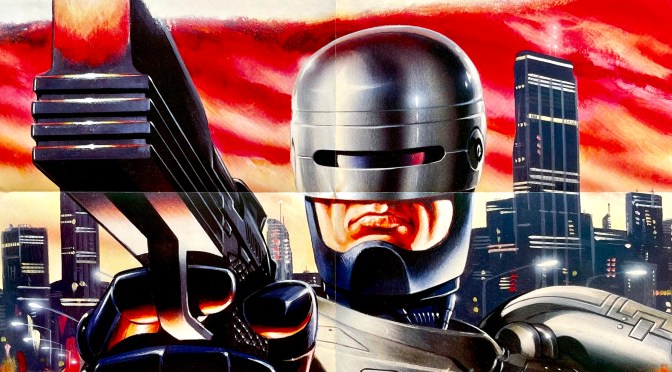
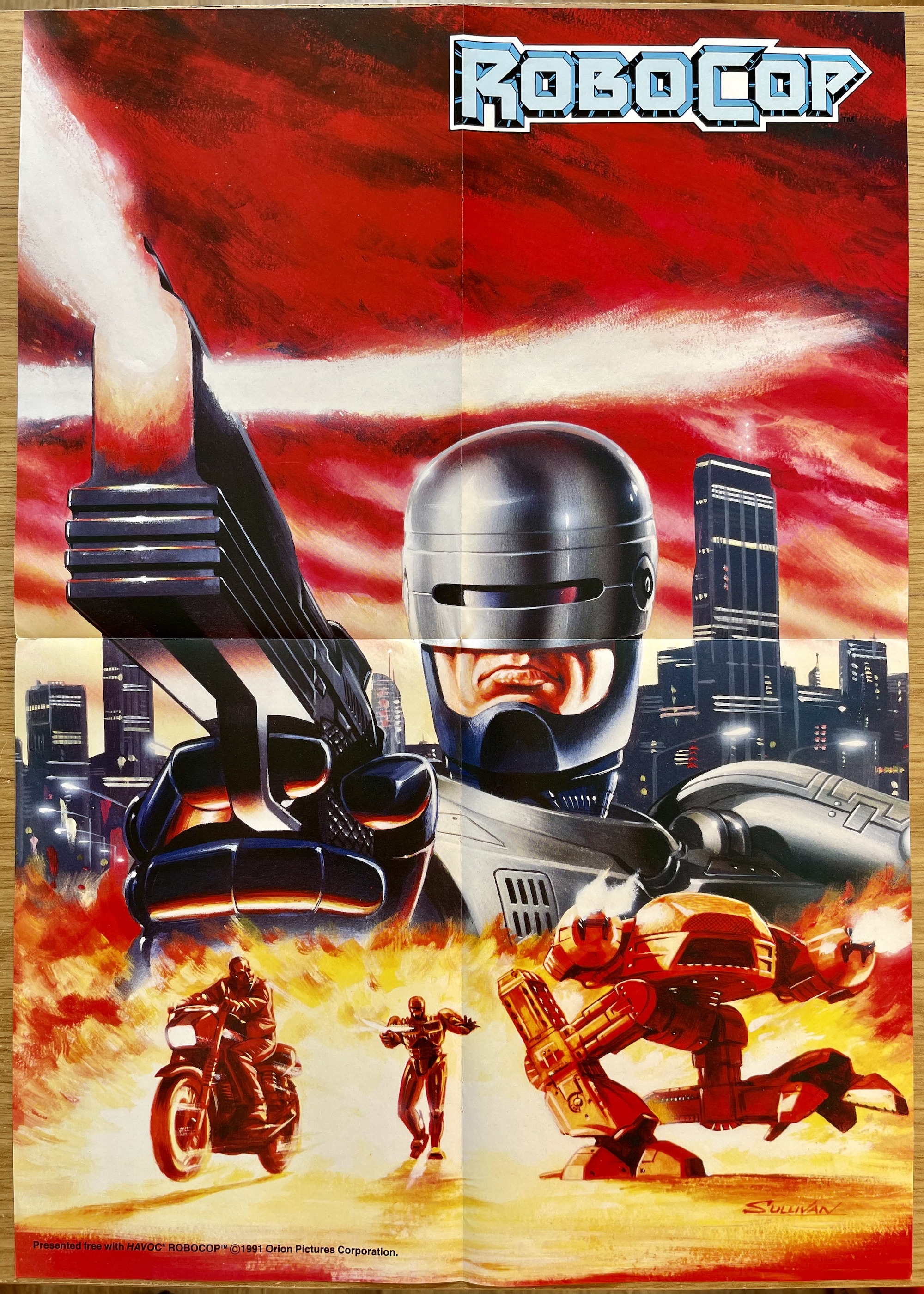
The third issue of Havoc begins not only with a RoboCop cover, the ‘Half Man, Half Machine, All Cop’ detective is also the star of the free gift poster. It would be a few years before I’d become a big fan of the character through the series, but I had enjoyed the film and was curious about him at this stage, so I remember this cover eliciting an excited response from 13-year-old me. As a 44-year-old adult now though, I’m not too sure about boasting how there are “predators” inside! It was a different time.
What a glorious poster! Lee Sullivan’s painted image looked incredible on my wall and I may just have to put this one up in the home office too. We’ve definitely been spoiled with Havoc’s free gifts so it’s disappointing we wouldn’t get any more for the rest of the characters, or the “psychotic good buddies” as they’re described on the contents page. Inside the 36-page comic the strips have been swapped about a bit with the beginning of a new Conan the Barbarian tale up first. Whether the choice of order was deliberate or just to shake things up, I think having the first chapter of a new story as our opener was a good move.

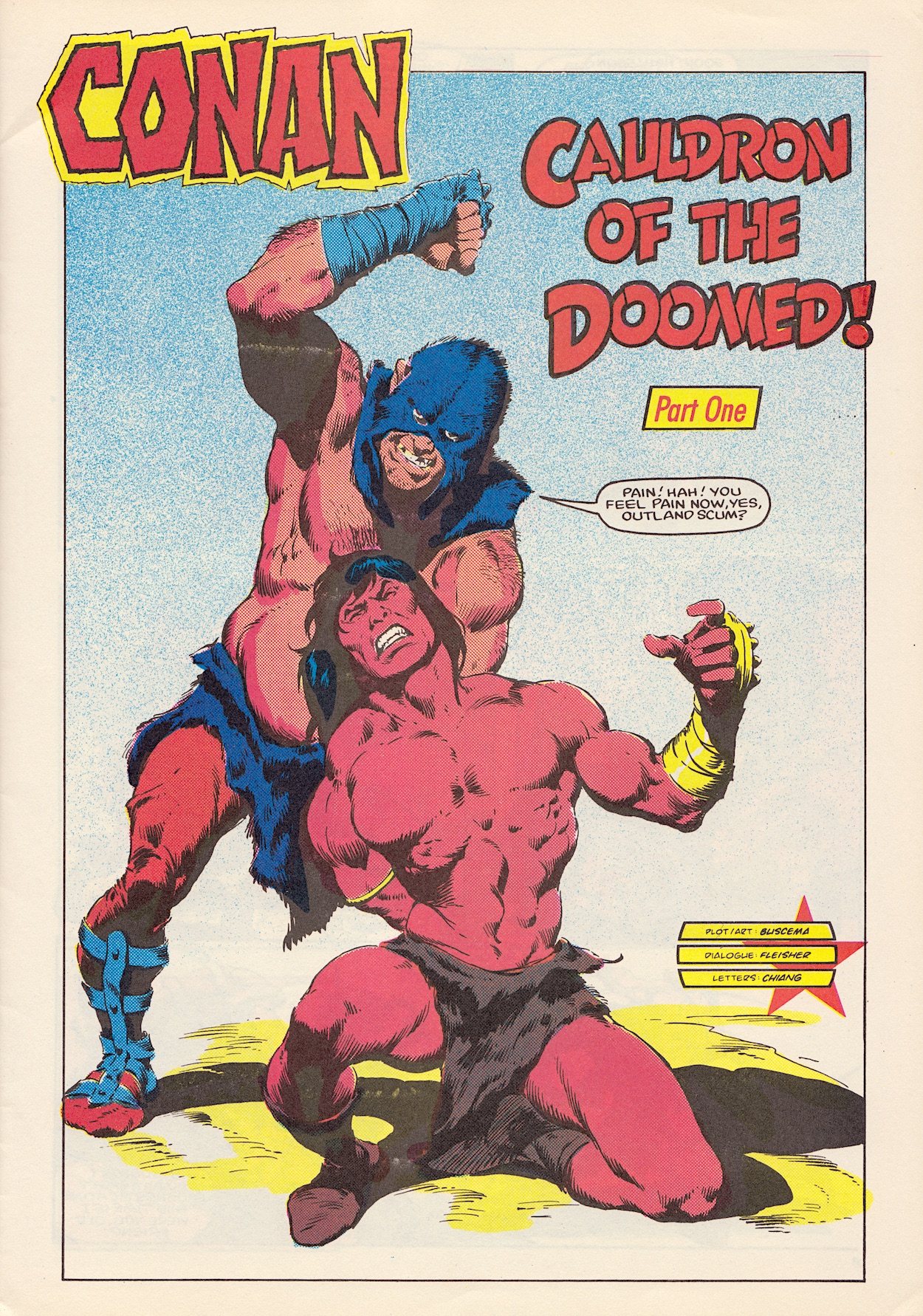
Last week I spoke about how I wasn’t enamoured with the character of Conan after it felt like he was preying upon the mysterious woman he met in some snow-covered mountains. From some comments on social media about the review I see I’m not alone in this thinking. It was based on one of the original Robert E. Howard tales but his next adventure, Cauldron of the Doomed! is a Marvel original, with a plot by the strip’s artist John Buscema (The Avengers, The Punisher, Kull the Conqueror) however the dialogue has been written by Michael Fleischer (The Spectre, Jonah Hex, Rogue Trooper), with lettering by Janice Chiang (Batman, DC Super Hero Girls, previously featured on the blog in Visionaries).

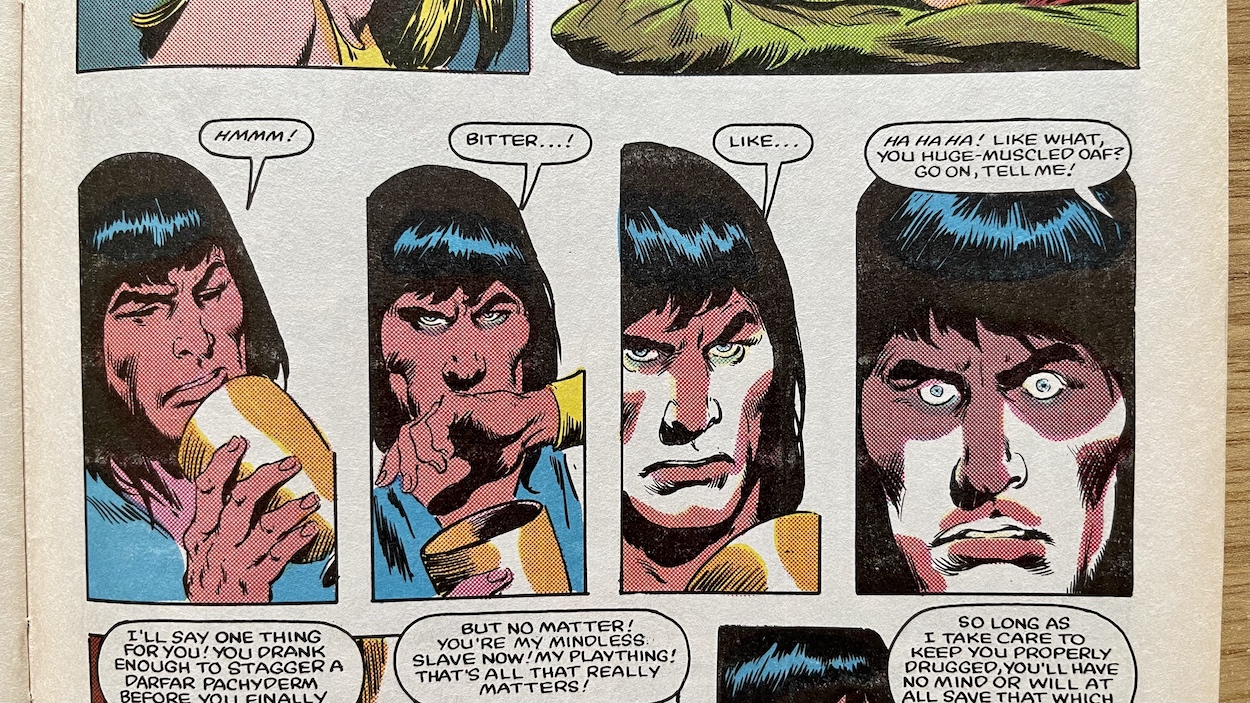
In these first seven pages Conan comes across as much more heroic and chivalrous (well, for Conan) than the brute last time, which is good because I really didn’t want to read more of what we had been previously. Of course we start things off with some brutal violence, it is still Conan after all. Taking part in a paid-for fight in a town he’s passing through in order to afford a horse for his further travels, he eventually defeats the local champion much to the delight/horror of those placing bets. During this display he also catches the eye of a woman watching from the stands.

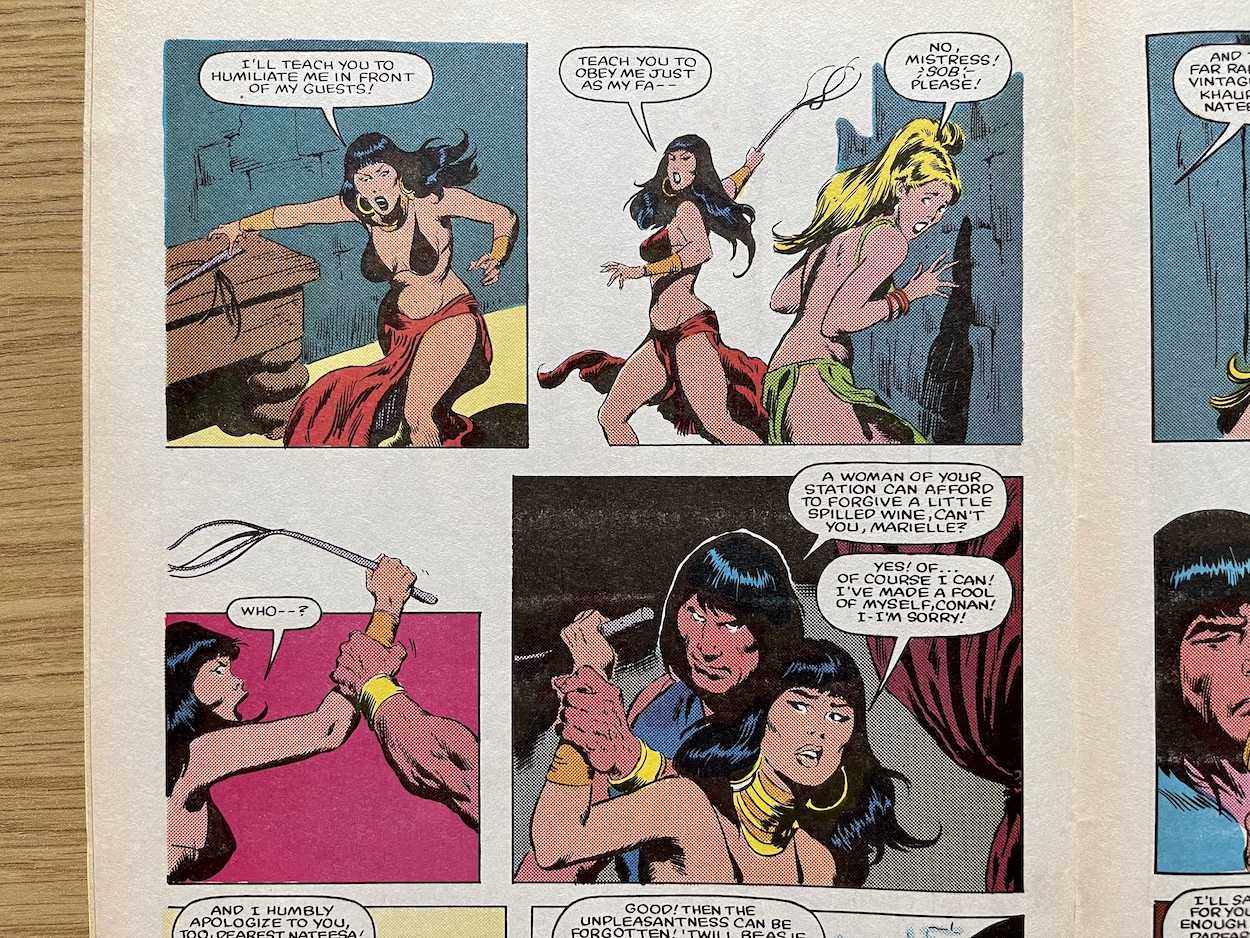
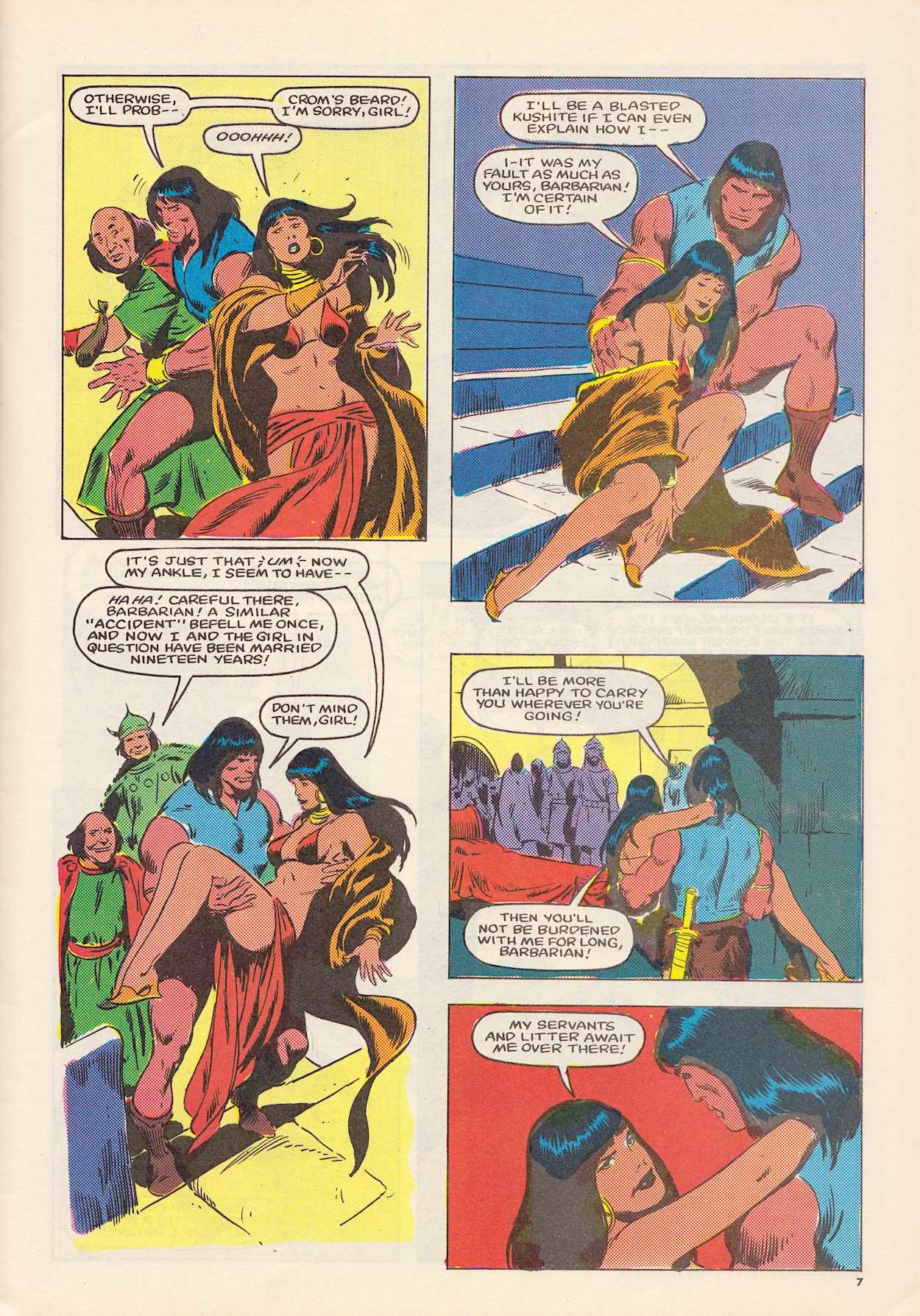
Marielle De Bruvahr fakes an injury to grab his attention, a trick one of the onlookers is all too familiar with in a funny panel above. Conan isn’t falling for it but he plays along and on this one page alone he comes across as a completely different person than the one in the first two issues. He takes her home, making sure she’s safe. She shows him a massive mansion full of statues of strong men she admires, including her father. The strip ends when it’s revealed she is the sculptor.

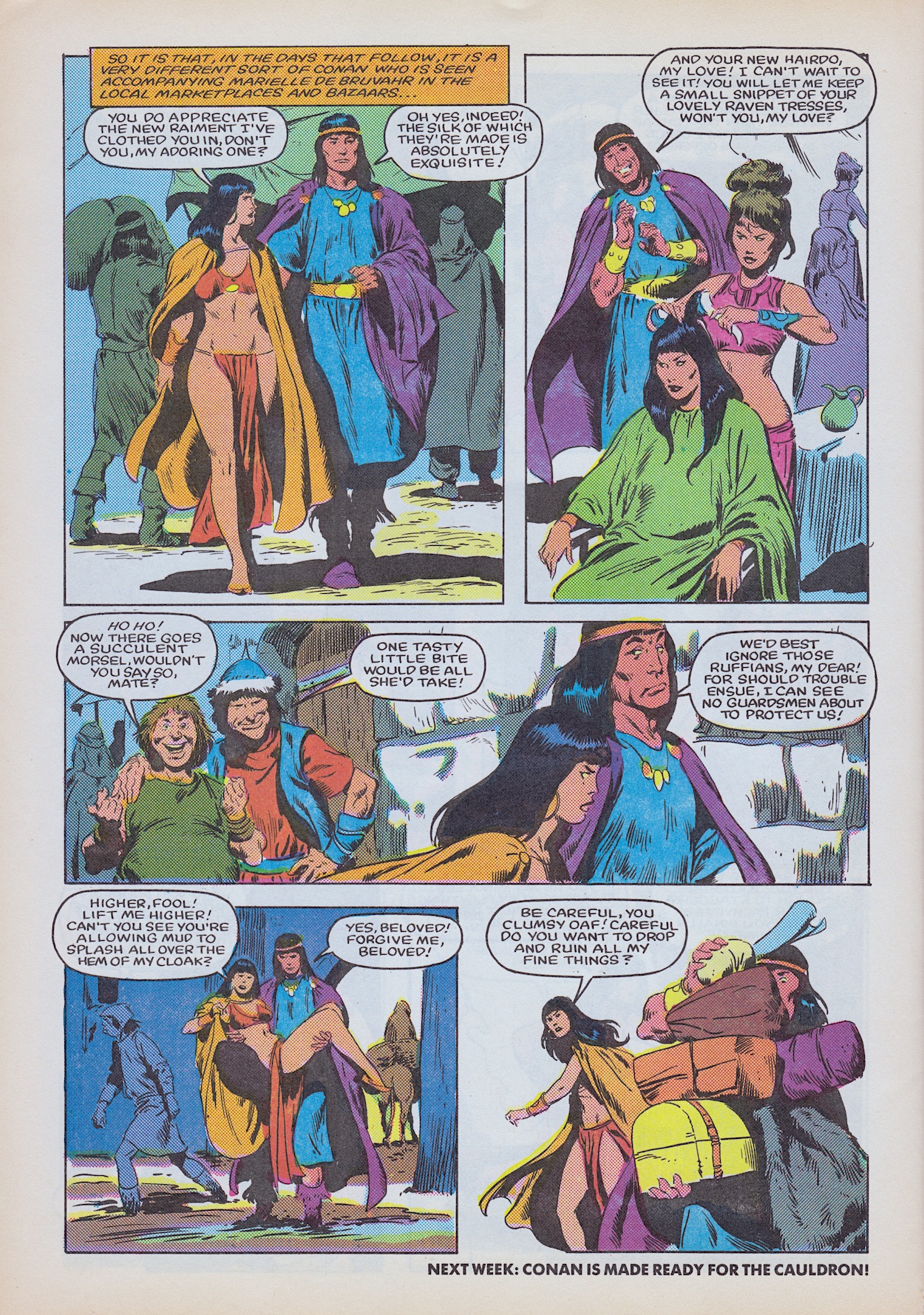
While she is clearly intelligent and talented, she also barks orders at her slaves and clearly manipulated Conan into coming home with her. What she wants from him isn’t known yet, nor whether she’s friend or foe, but it’s clear she’s isn’t another damsel in distress. I’m intrigued and I’m rather enjoying this strip, it’s a world of difference compared to what came before. A good start then to #3 and it continues with Howard Mackie‘s reinvented Ghost Rider, pencilled by Javier Saltares, inked by Mark Texeira, coloured by Gregory Wright and lettered by Michael Heisler.


“The innocent blood spilled here tonight must be avenged! It is my solemn duty.”

Ghost Rider

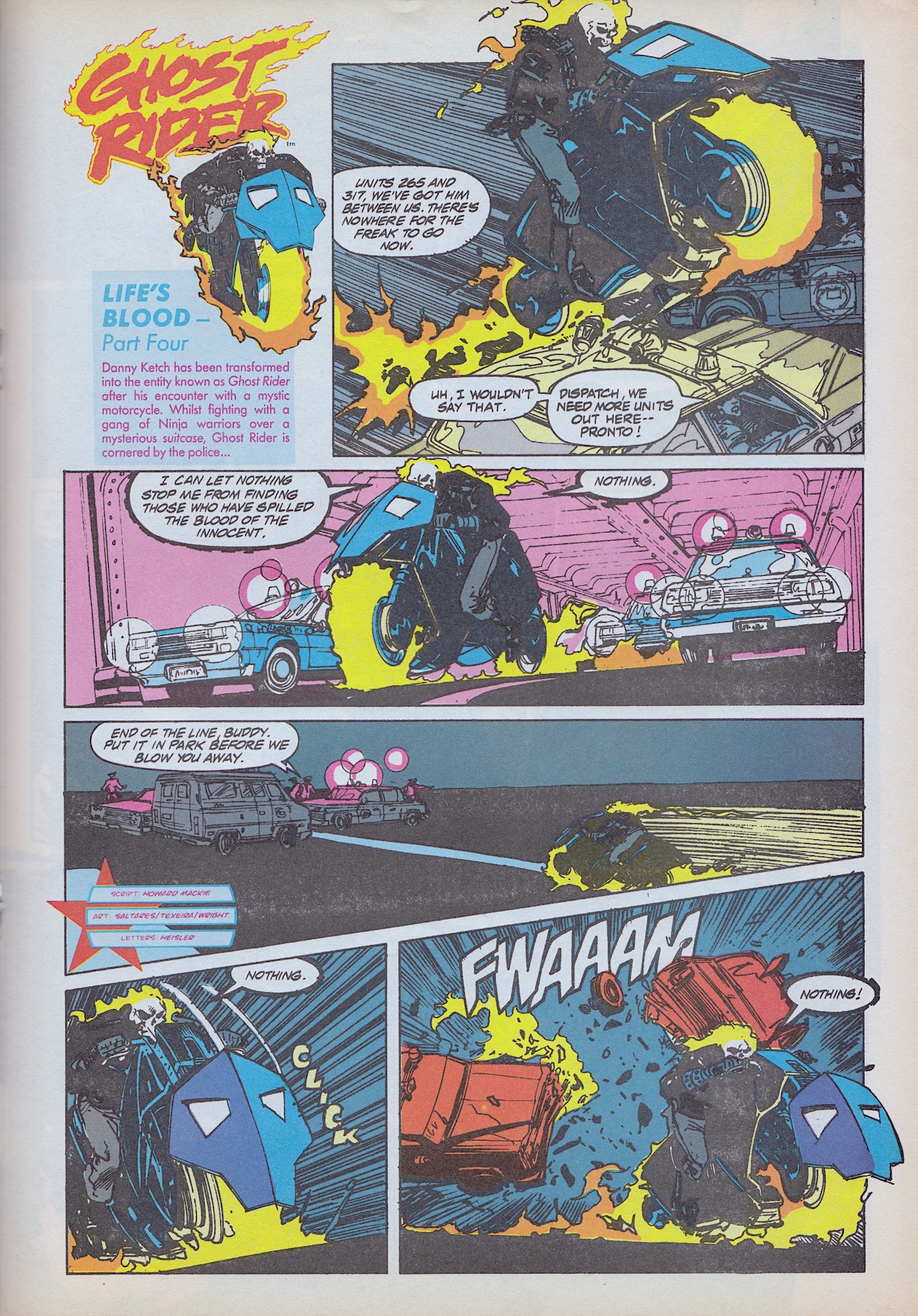
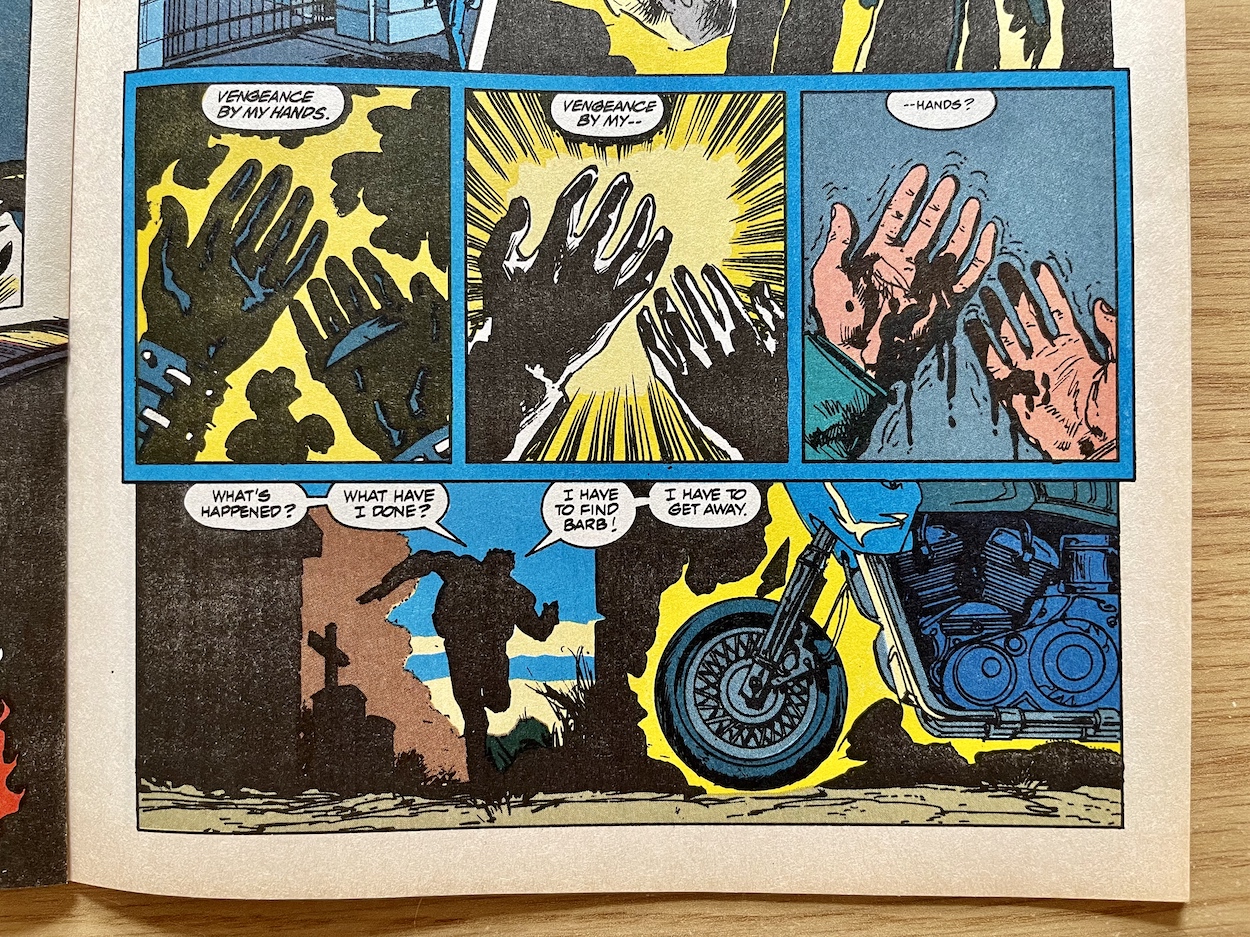
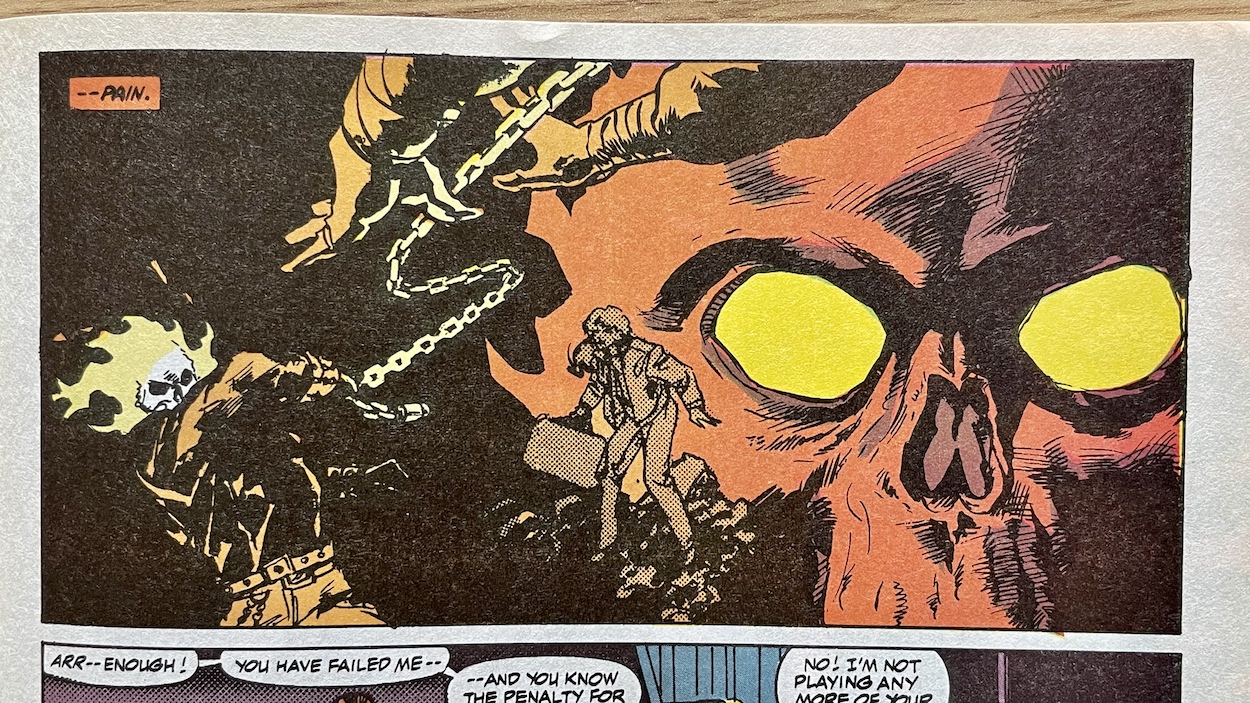
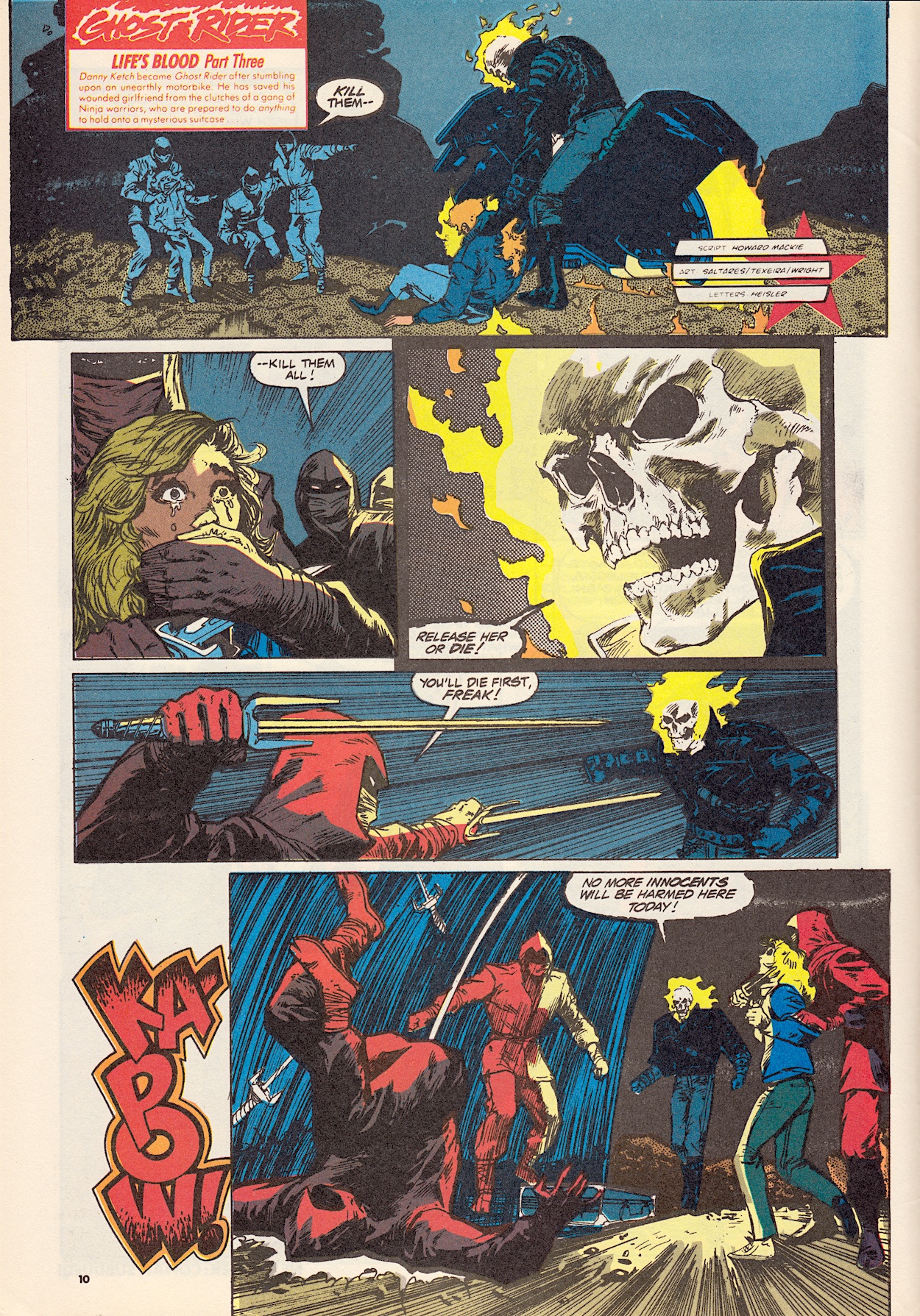
Remember, this was my introduction to the character and actually I’ve never read any more after the cancellation of Havoc, so all these years later this is my re-introduction. With the build up complete and that wonderful reveal on the final page last week we can jump straight into the action with Danny Ketch now fully transformed. A flaming skull is something you’d think was the embodiment of evil, so of course this is the first impression he leaves on those around him, but in reality he’s pretty much the embodiment of that “psychotic good buddie” line.

I love this juxtaposition, the frightening creature instilling fear into the bad guys. Yes, that idea isn’t new, but this isn’t Batman with his strict rules, this is something… else. My first impression is this Spirit of Vengeance needs to be battled by Danny; will he be able to control its murderous ways, what is he able to remember afterwards, is he fully aware while in this form but can’t control it, or maybe he doesn’t want to control it while transformed? Please, no answers, I’m discovering this fun character anew.

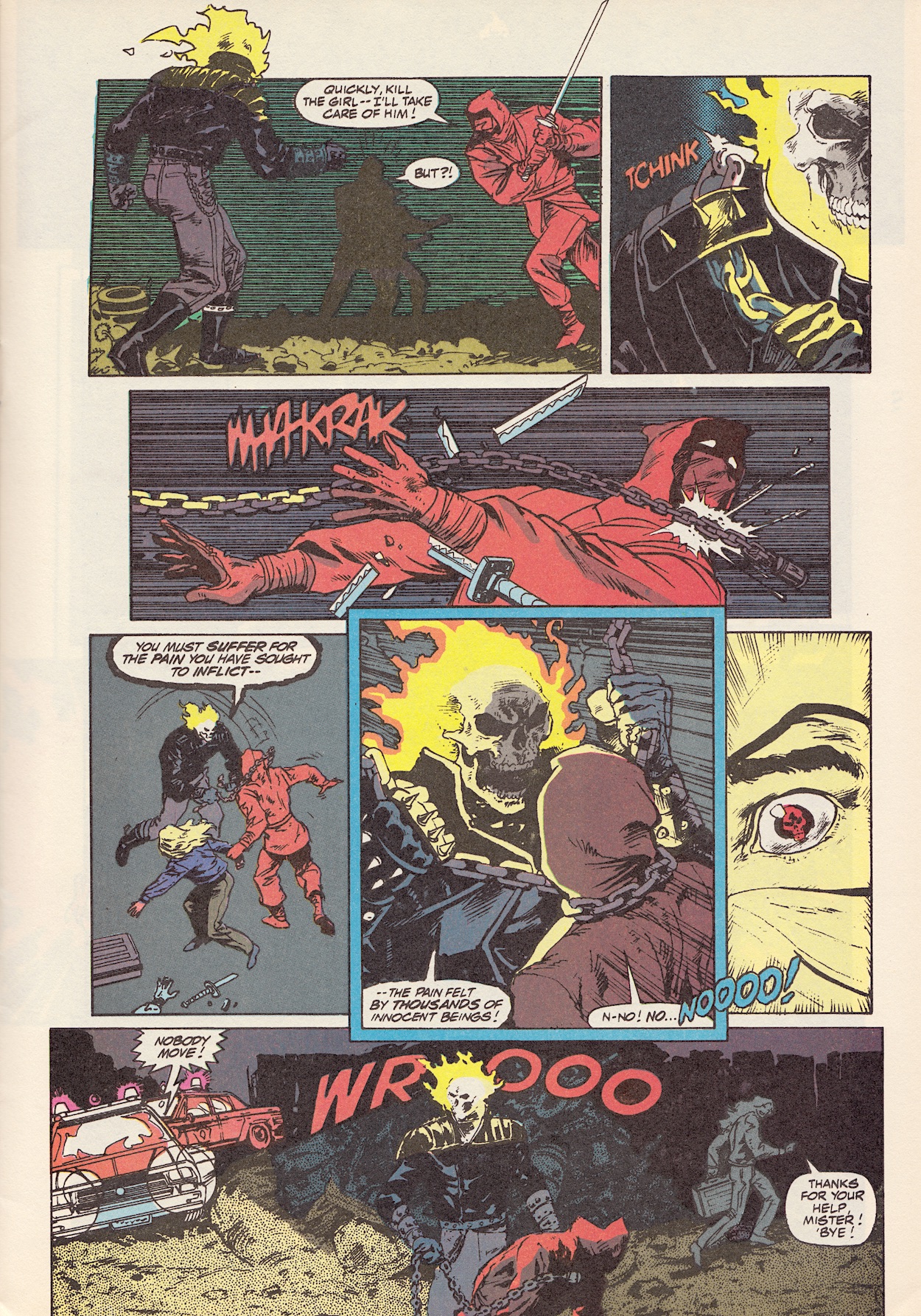
“The innocent blood spilled here tonight must be avenged! It is my solemn duty.” I love that quote, especially coming from a character that looks like this as he holds a police officer up in the air. Even with his instruction to the police that his sister Barb (again incorrectly described as his girlfriend in the opening dialogue box) needs medical attention and the fact he’s saved one of the hoodlum kids, the police still assume he was responsible for Barb’s condition and the deaths of those men strewn about the place.

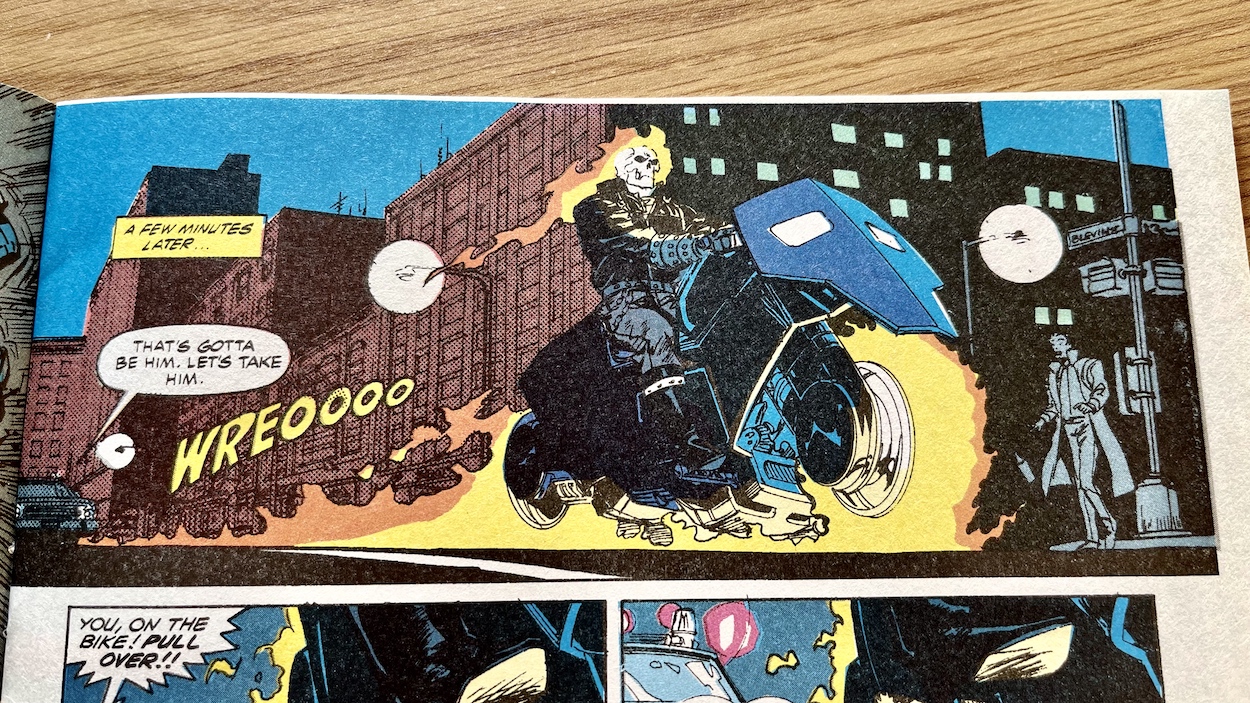
Fired upon, the Ghost Rider doesn’t injure any of the cops, instead throwing the one he held aloft at his colleagues in order to escape and flipping one of their cars over onto the other to stop them pursuing, as he rides off on that really cool bike. No wonder I loved this strip so much as a young teen. This is definitely the one I’m most looking forward to in the next issue. The character already has my full attention. Although, I do remember almost every issue my favourite would change and that’s probably likely to happen again if these first three reviews are anything to go by.

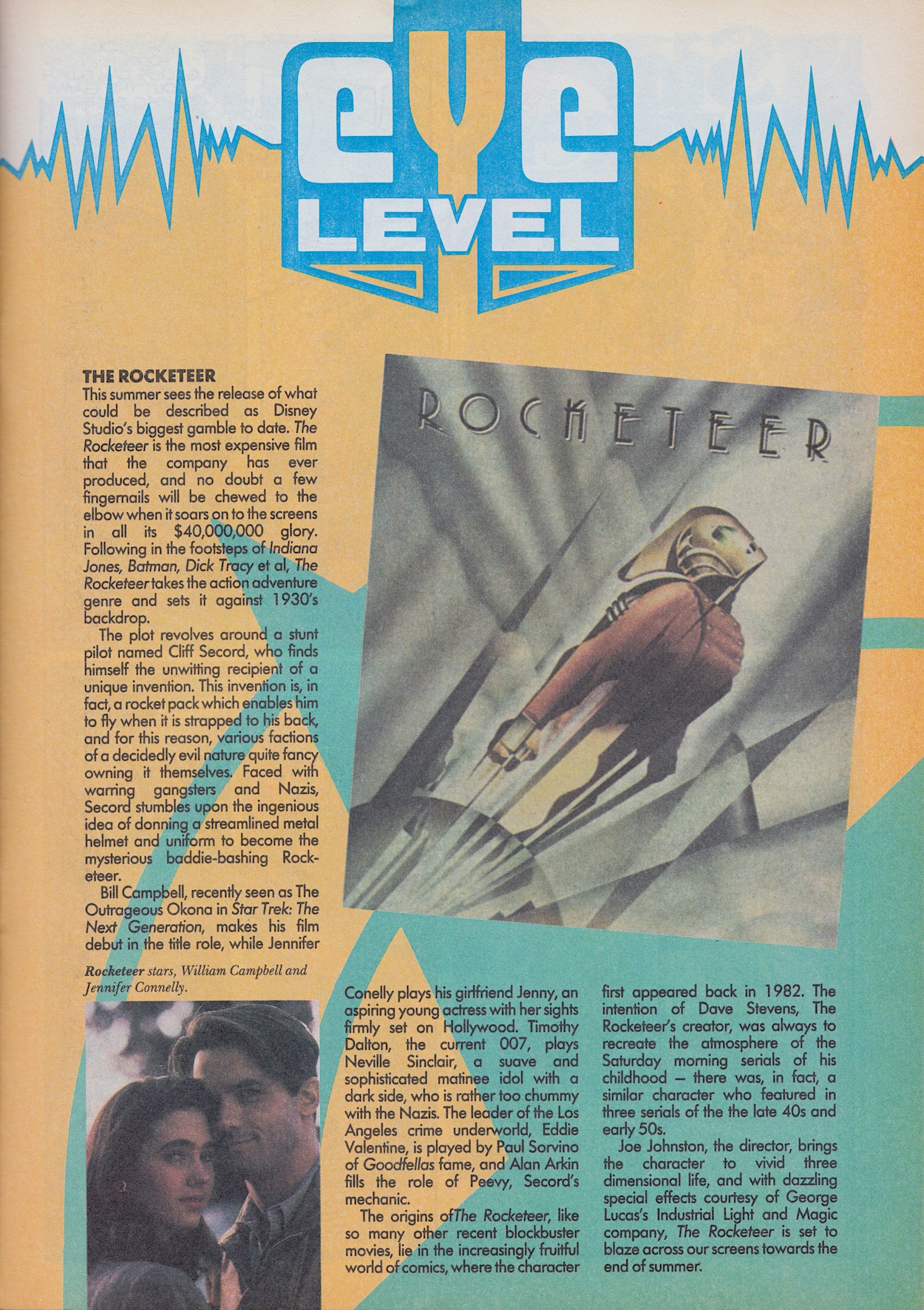
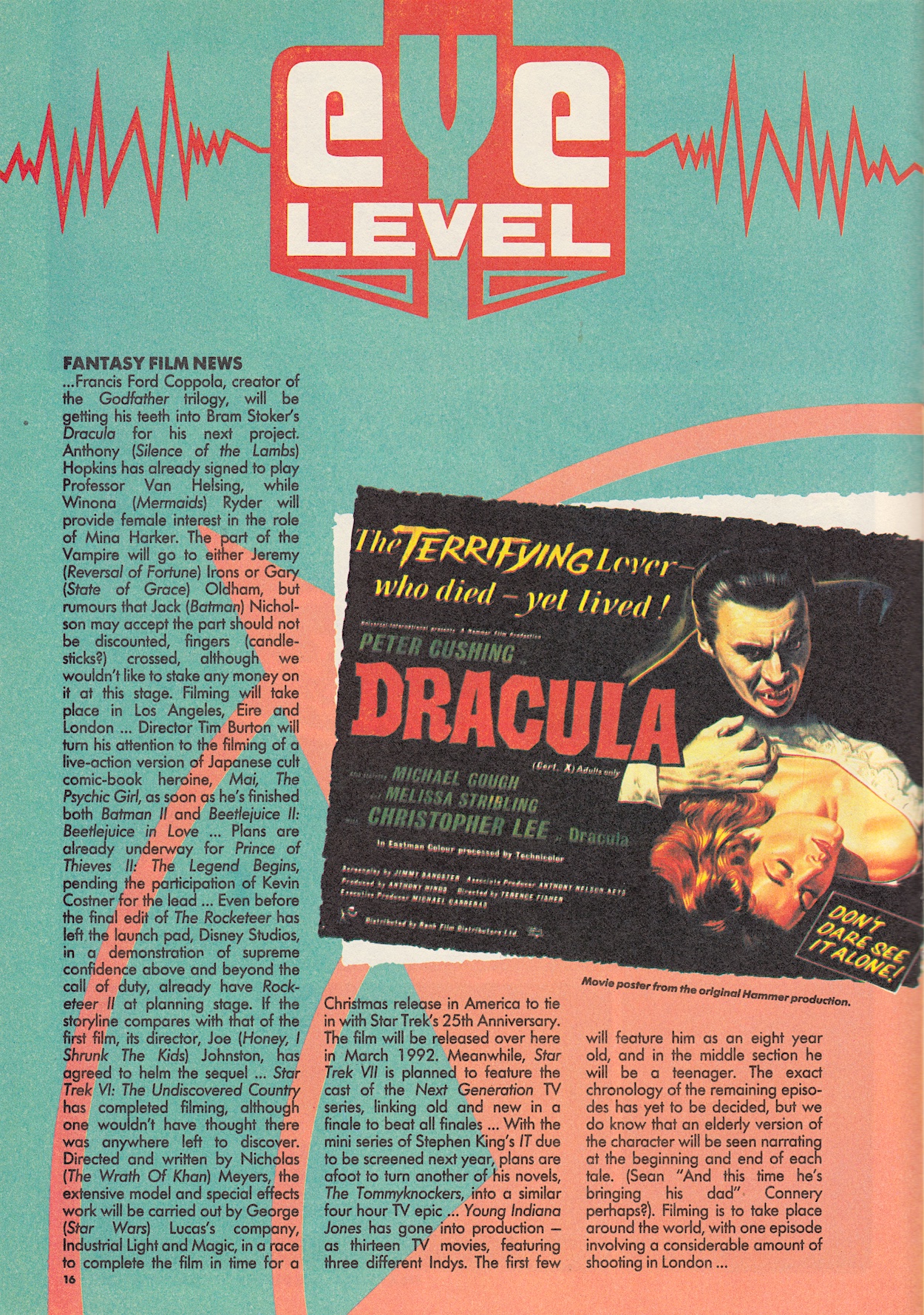
The Eye Level news page brings us all the latest from the world of fantasy films this time. It begins with news of a film I love, Francis Ford Coppola’s Dracula, but from what the column says here it could have been very different indeed. (I’m relieved the article’s writer crossing their fingers didn’t make any difference.) Although, how reliable is that bit of news when no less than three sequels announced here never made it to the screen?

Of course, at the time of The Rocketeer’s release a sequel looked like a sure thing but a disappointing box office return soon put that idea to bed. At least for a few decades anyway, with news just last year of a long-awaited sequel, the original film having gathered quite the cult following in the years since (and a cartoon series a couple of years back). As a fan of the movie, let’s hope this Eye Level isn’t as wrong as it reads and perhaps was just 30 years ahead of its time.

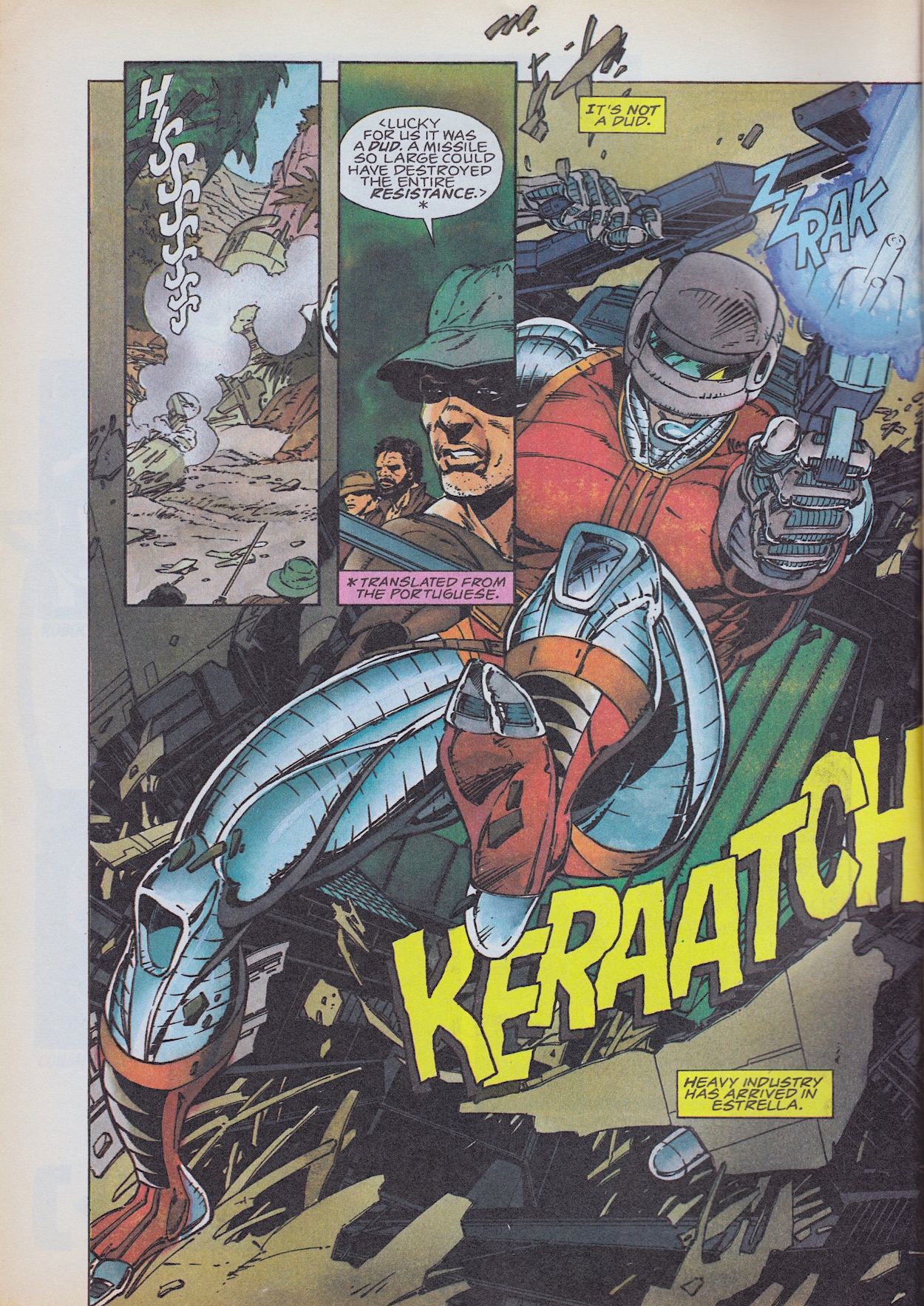
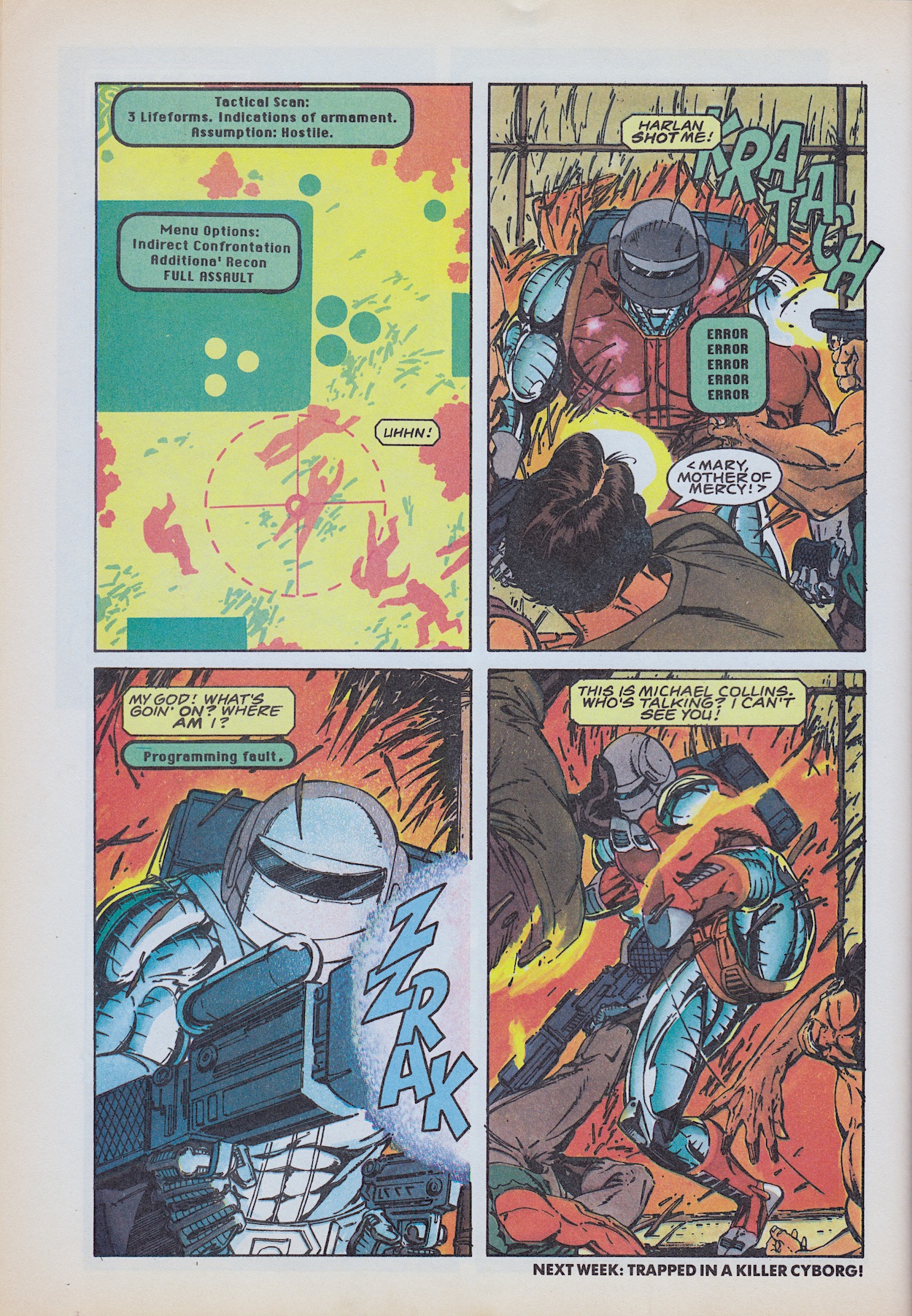
The lead strip in the first two issues, and cover star for the premiere edition, Dwayne McDuffie and Gregory Wright’s Deathlok is tucked away in the middle of the comic with the story taking a big step forward in its set up. Michael Collins, the loveable family man from #2, heads off to work at Cybertek where he develops artificial intelligence software in robotic limbs for amputees, believing he’s helping make the world a better place. Sudden demands from on high and being locked out of classified systems he previously had access to worry him. So he decides to hack in and see what’s really going on.

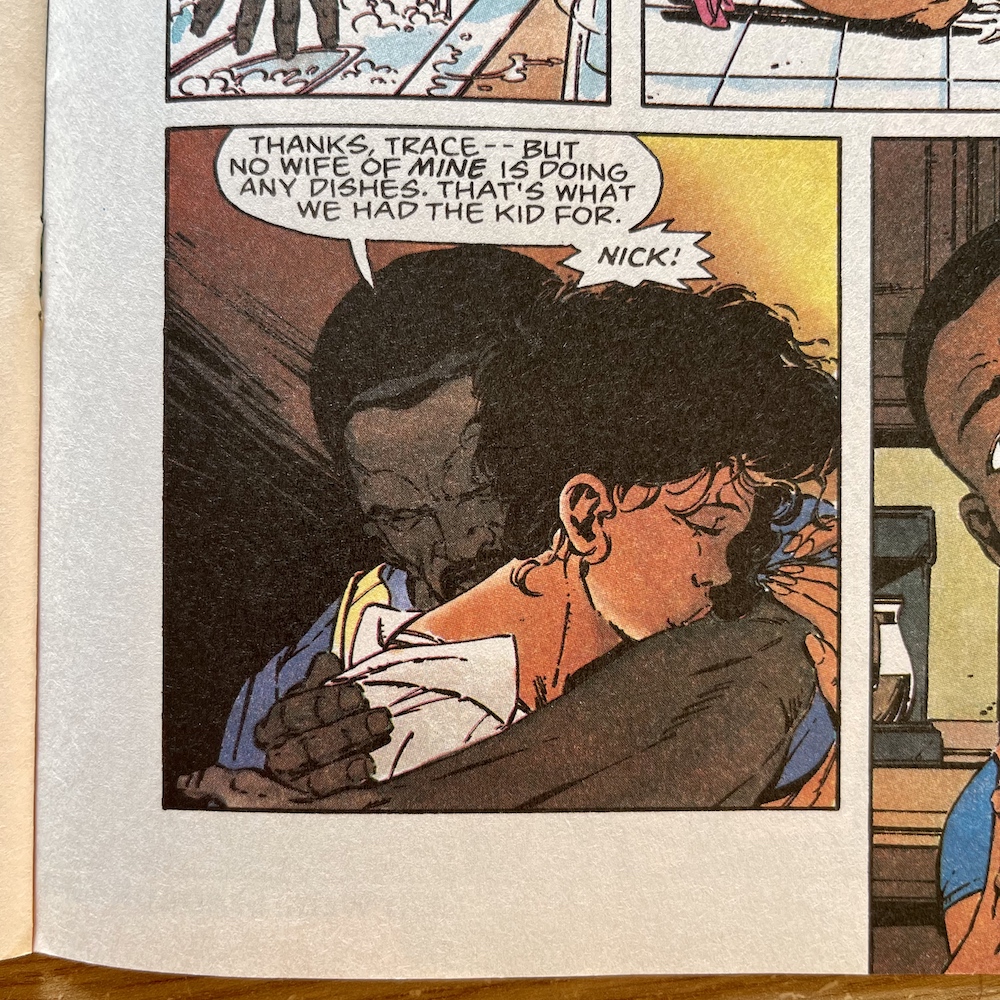
He discovers the Deathlok programme and sees footage of the death of Colonel John Kelly’s brain (from #1). Furious that one of his colleagues knew about this (he’s told, “Everybody who could handle it knew”) and believing there’s a conspiracy within the company he confronts Ryker, who he sees as a friend and confidant. First though, we get a tender scene of him at home where he asks his wife what she’d think if he quit his job on moral grounds. She backs him and there’s even a funny moment involving the dishes amongst the drama.

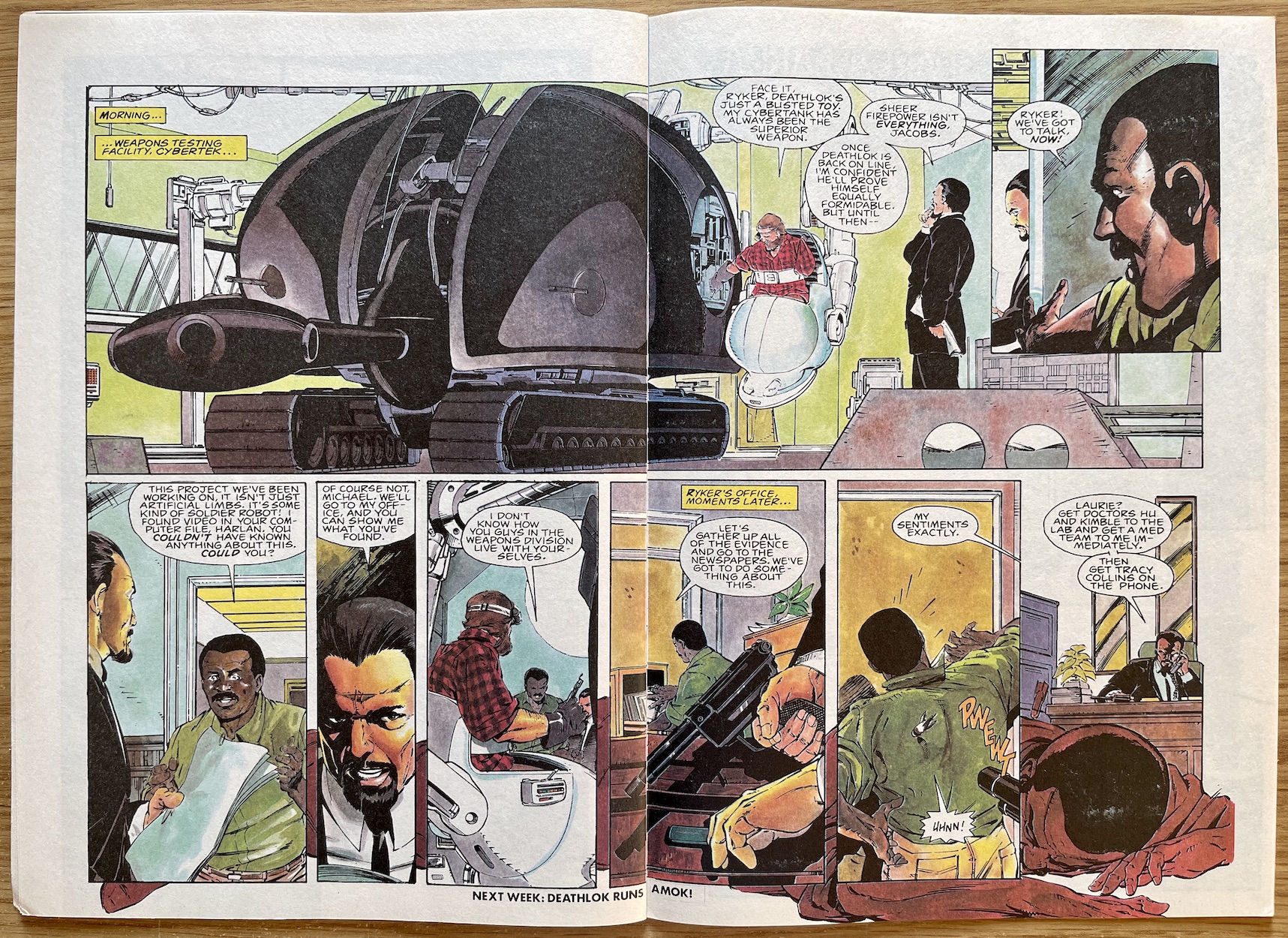
Having been able to share his frustrations (although not telling Trace what he found out in order to protect her and Nick) he plucks up the courage and goes to see Ryker, not knowing he’s actually the man behind Deathlok. Drawn by Wright and Jackson Guise with lettering by Richard Starkings, this double-page spread below ends the story for now and it’s all building momentum brilliantly. I like these small, weekly chunks. We’re all set now for the next phase in the story, seeing Deathlok again but with a murdered, peace-loving family man within it.

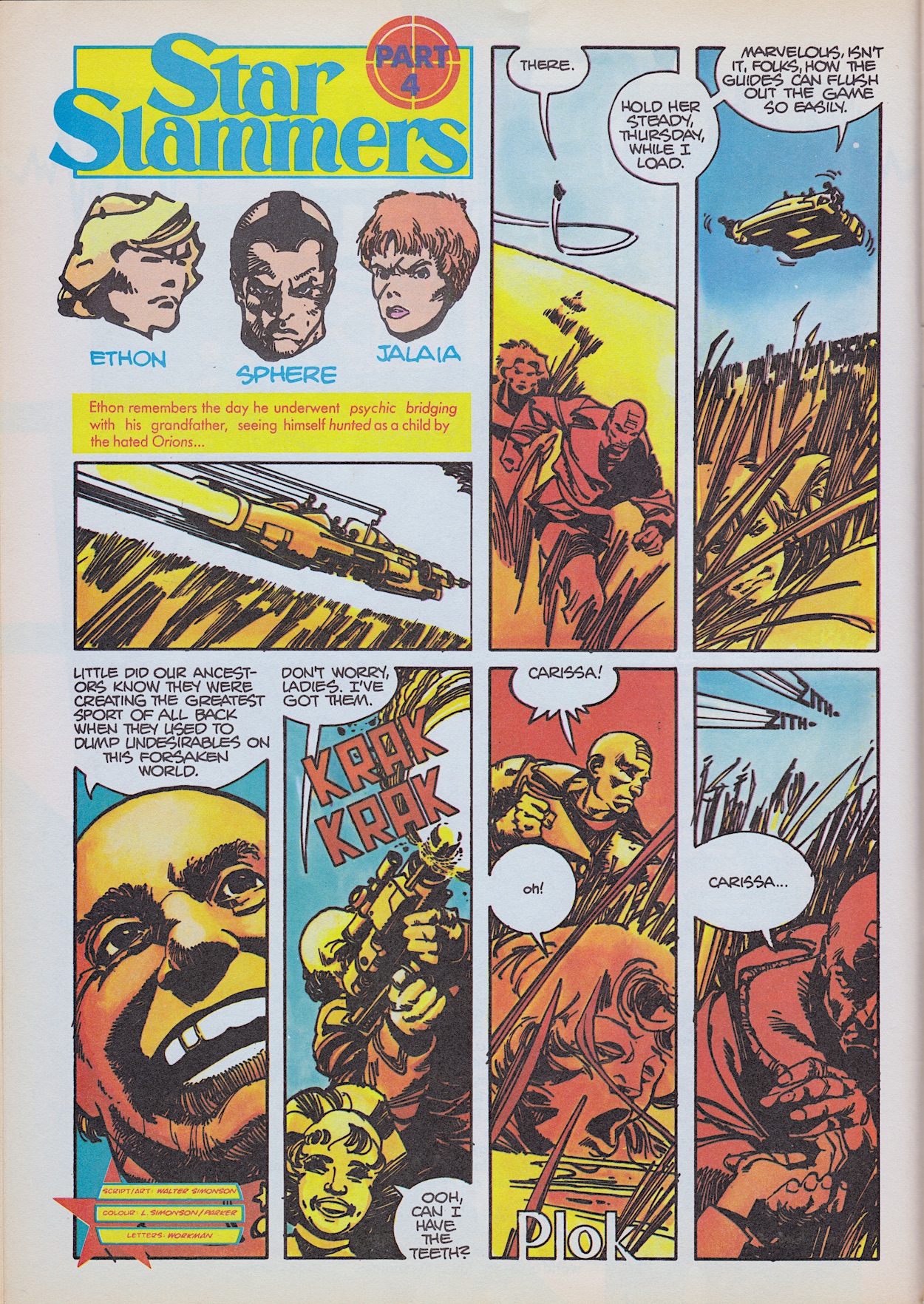
You just know Michael is going to end up going toe-to-toe with that huge tank, don’t you? That’s a Chekhov’s gun if ever there was one. Moving on to writer/artist Walt Simonson’s Star Slammers next and that shuttle craft last issue was more important than I thought. Somehow Lackland had made it far enough away in a few seconds to jump into it, take off and attack the Slammers. It all comes to an end just as quickly when the one dressed in red, Sphere (we’re finally getting their names) uses a catapult to fling a rock through the cockpit, causing her to crash.

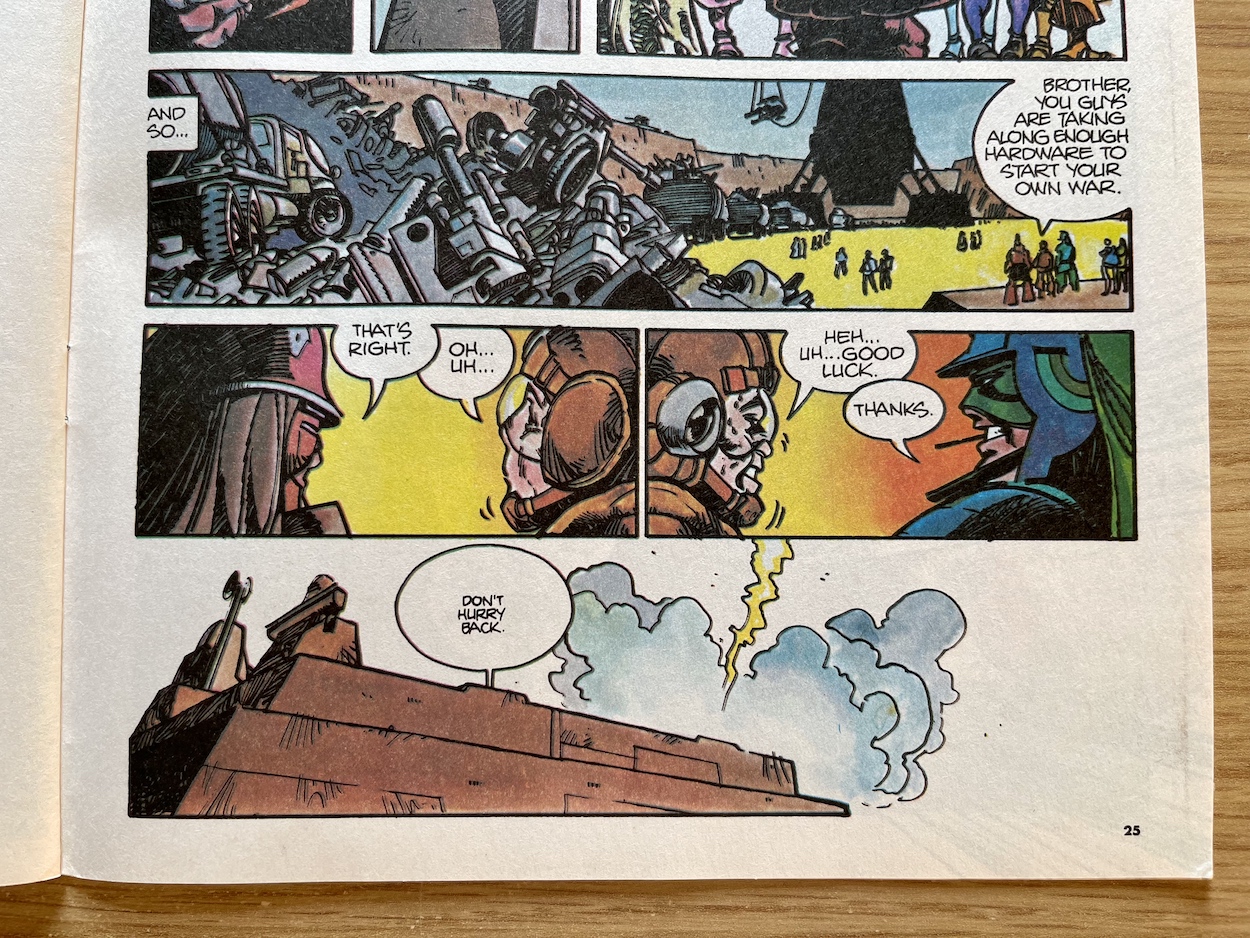
According to the terms of their contract, the Slammers are awarded any spoils of war and they take this to the extreme, commandeering the Skriks’ ship and any and all weaponry the citadel had used against them. As you can see below it’s quite the selection. It’s here they take off and we realise for the first time, three issues in, that this planet and the skirmish on it were merely an introduction to the main characters and not part of the overall plot. Instead, said plot only begins now.

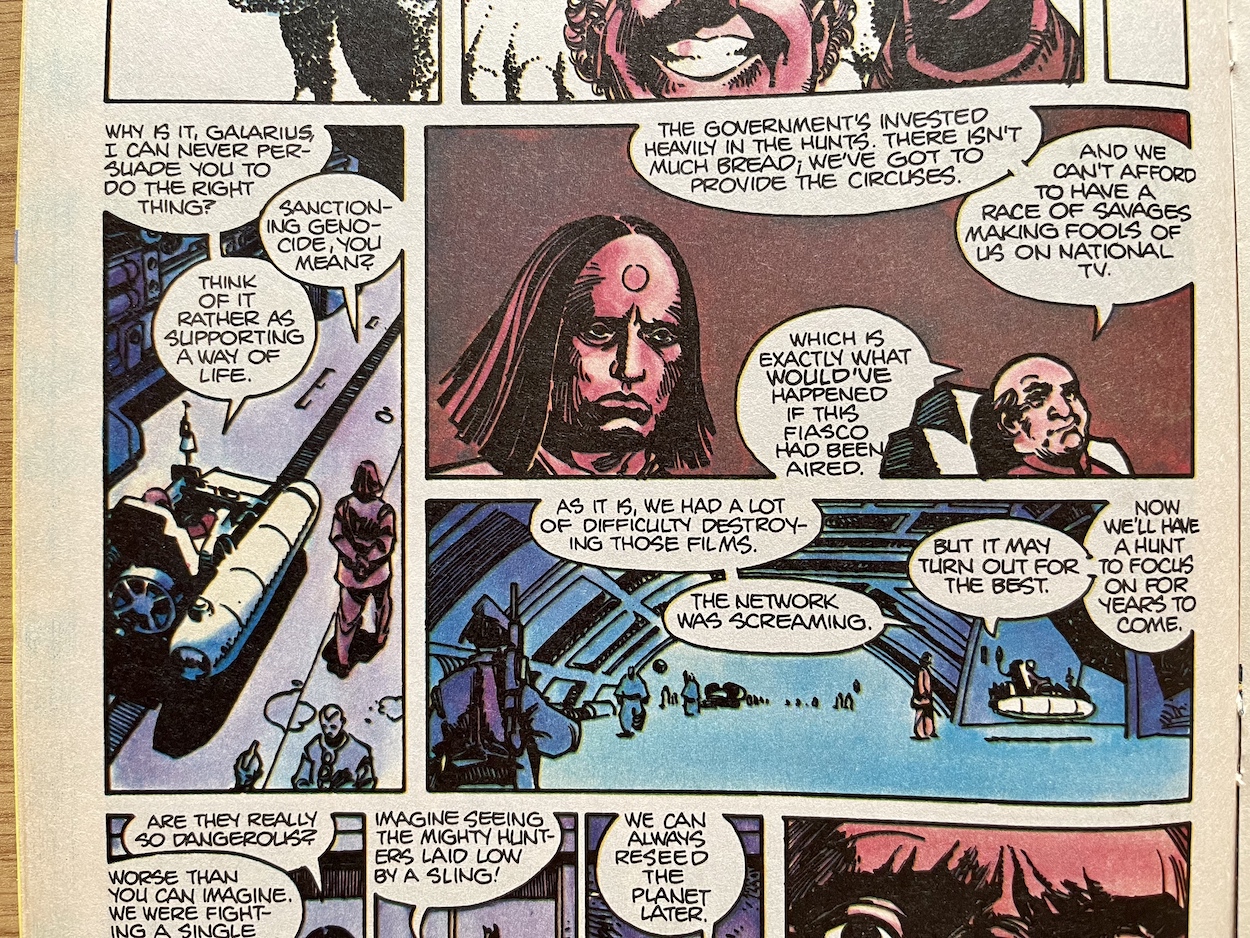
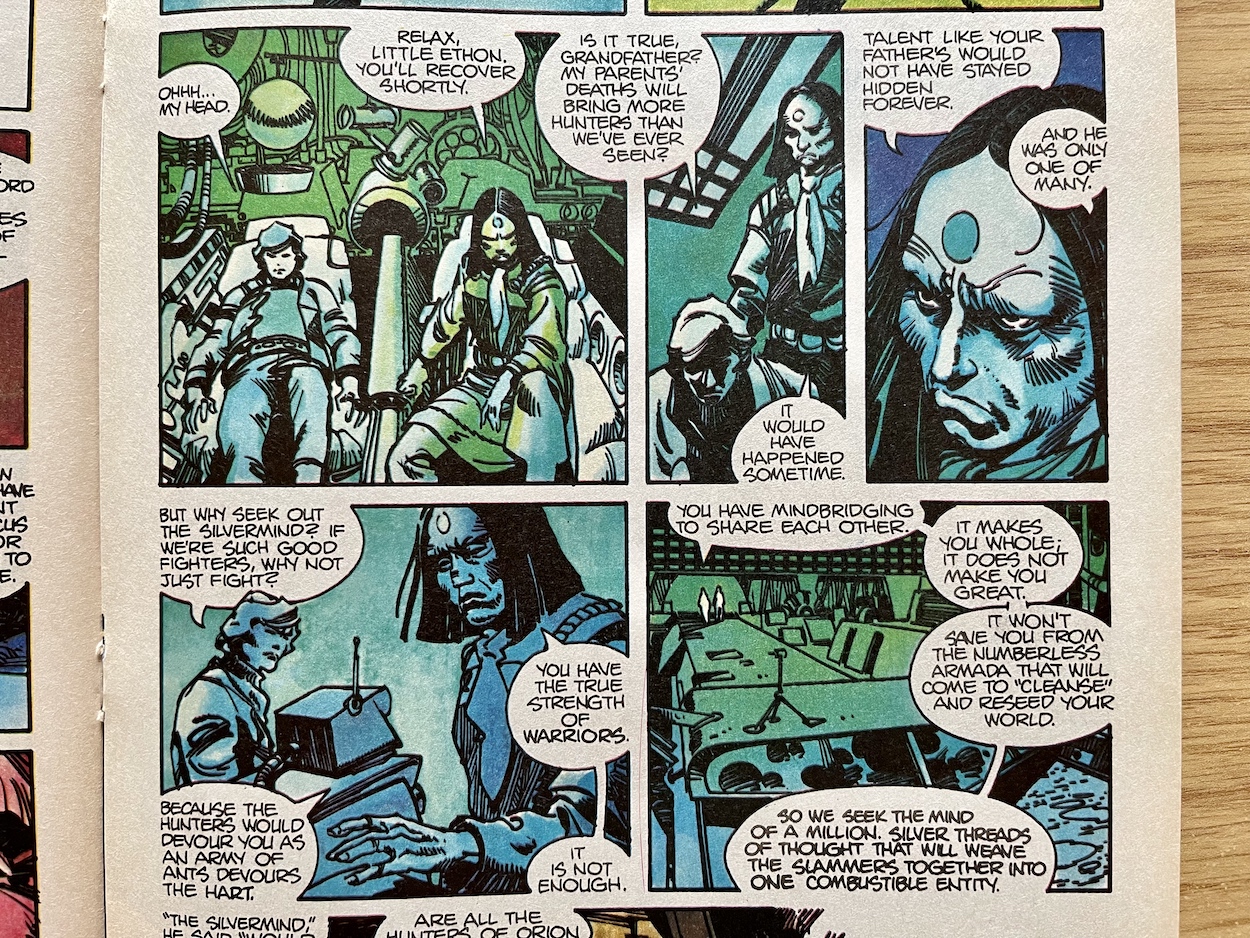
Alongside leader Sphere are female Slammer Jalaia and young boy Slammer Ethon. In the booklet that came with #1 the Slammers’ page was made up like a Wanted poster by the government of the planet Orion. It said they were associates of the traitorous Galarius of Orion, who it was believed moulded them into the army they had become. In this issue our three protagonists are taking a break while their ship travels through hyperspace and we’re finally able to get a bit of an insight into each of them and the background to the whole tale.

All of the weaponry they’re collecting, the spoils of all the jobs they’re hired to do, aren’t being used in a war just yet. Instead, it’s been foretold that Orion is going to invade their planet, although when this is meant to happen hasn’t been determined. Instead, they’re putting their faith in the predictions of ‘The Grandfather’, a former resident of Orion. This must be Galarius.

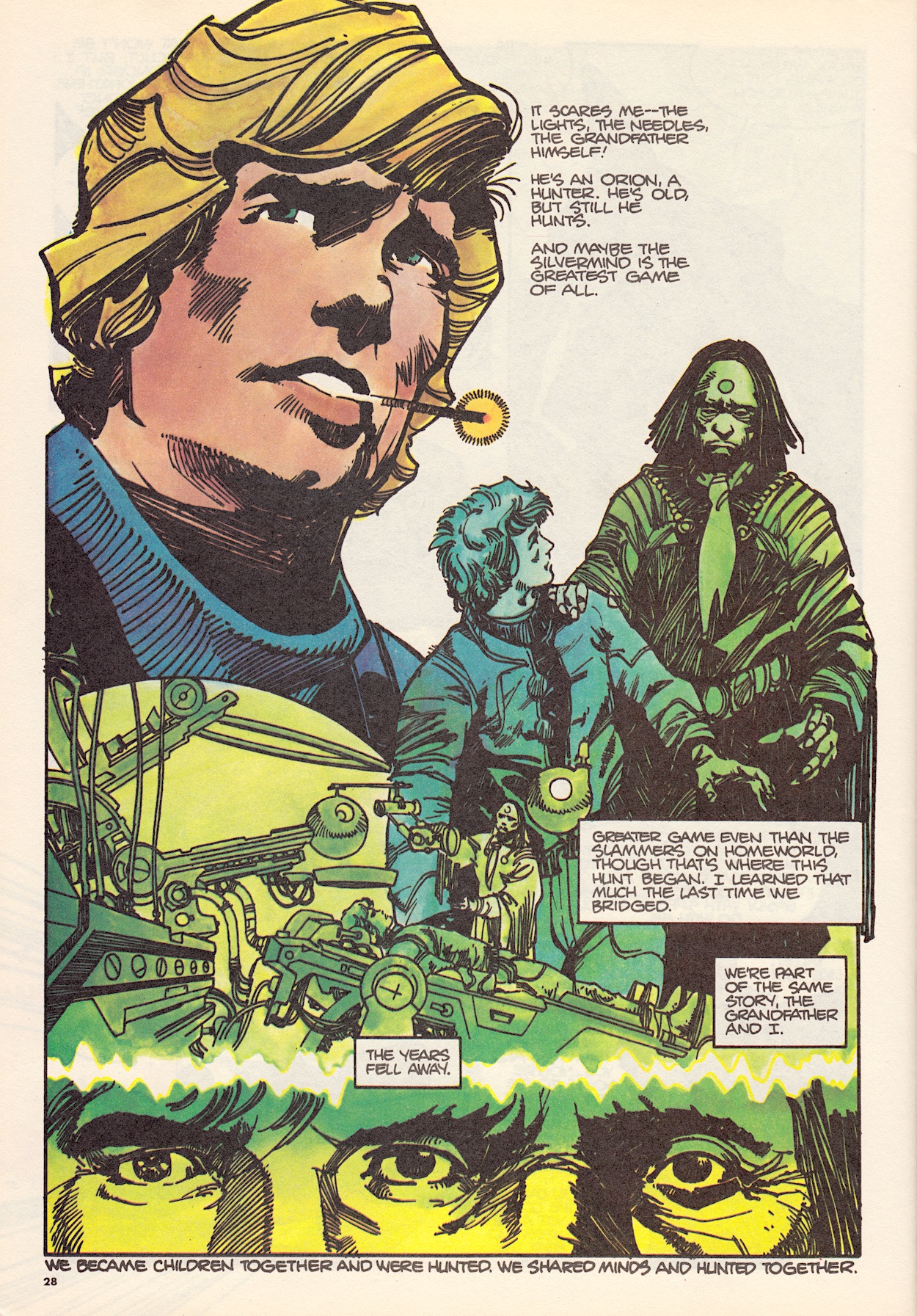
Most interesting is the fact the Star Slammers have a sort of hive mind. They call it ‘bridging’. Ethon is a newbie and has bridged with Jalaia but not with Sphere yet, however he has been the Slammer to bridge with The Grandfather the most and is being lined up to be the deepest mind-bridger of them all. What this actually means and how it will help them in the coming war is anyone’s guess right now.

So far this strip still feels ill-suited to the anthology format. All of the others seem to suit Havoc, giving us enough every week to satisfy. They were written as monthly comics with roughly 22 pages of strip so each tale is only being split into four (as far as I can tell so far), however Star Slammers was written as a large one-off, graphic novel-size strip so its pacing is going to be vastly different. That could be why younger me didn’t take to it at the start because nothing seemed to happen. Hopefully as we get further along into the meat of the story that’ll change. The art is lovely though, coloured by Louise Simonson and Deborah Pedler, with distinctive lettering by John Workman.

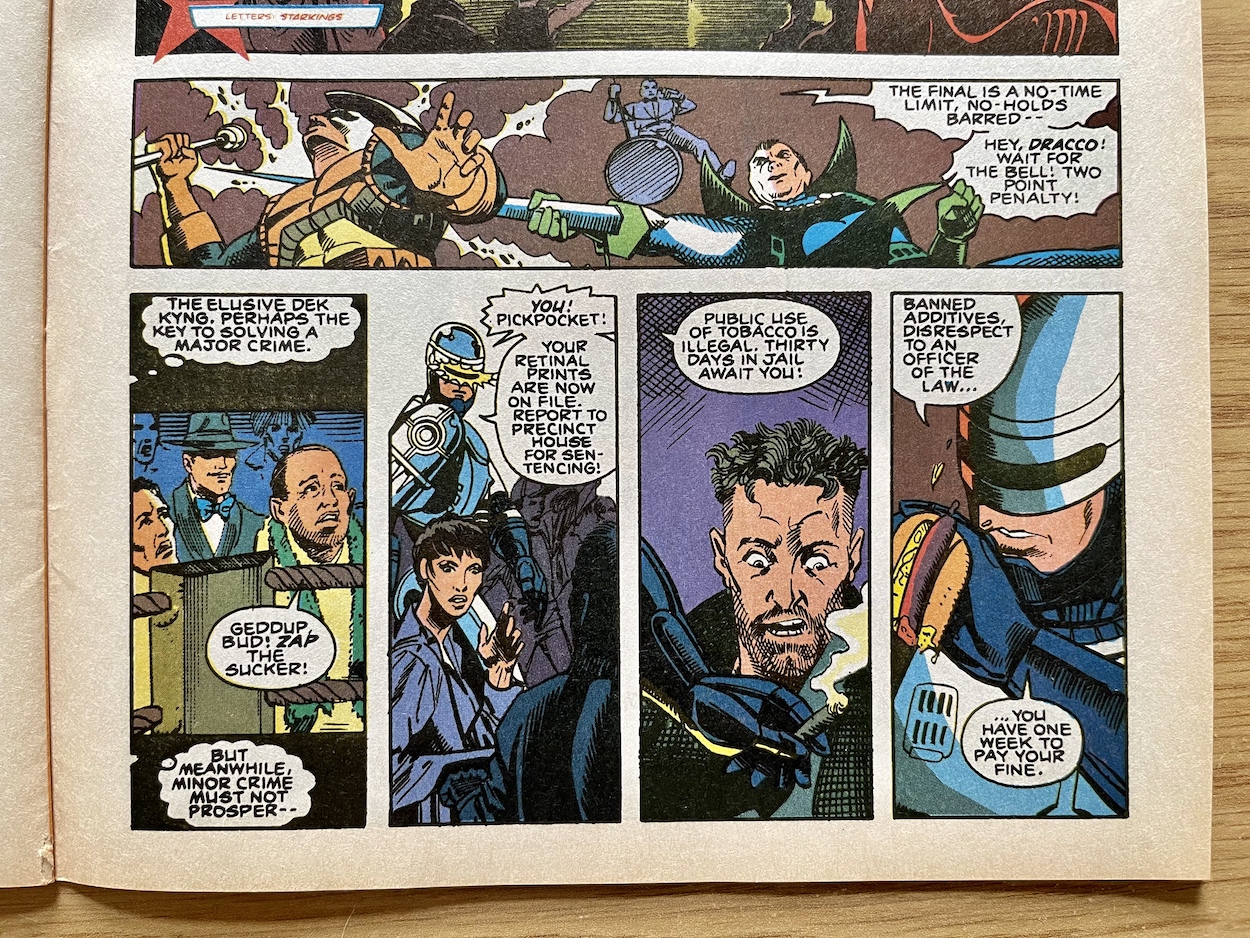
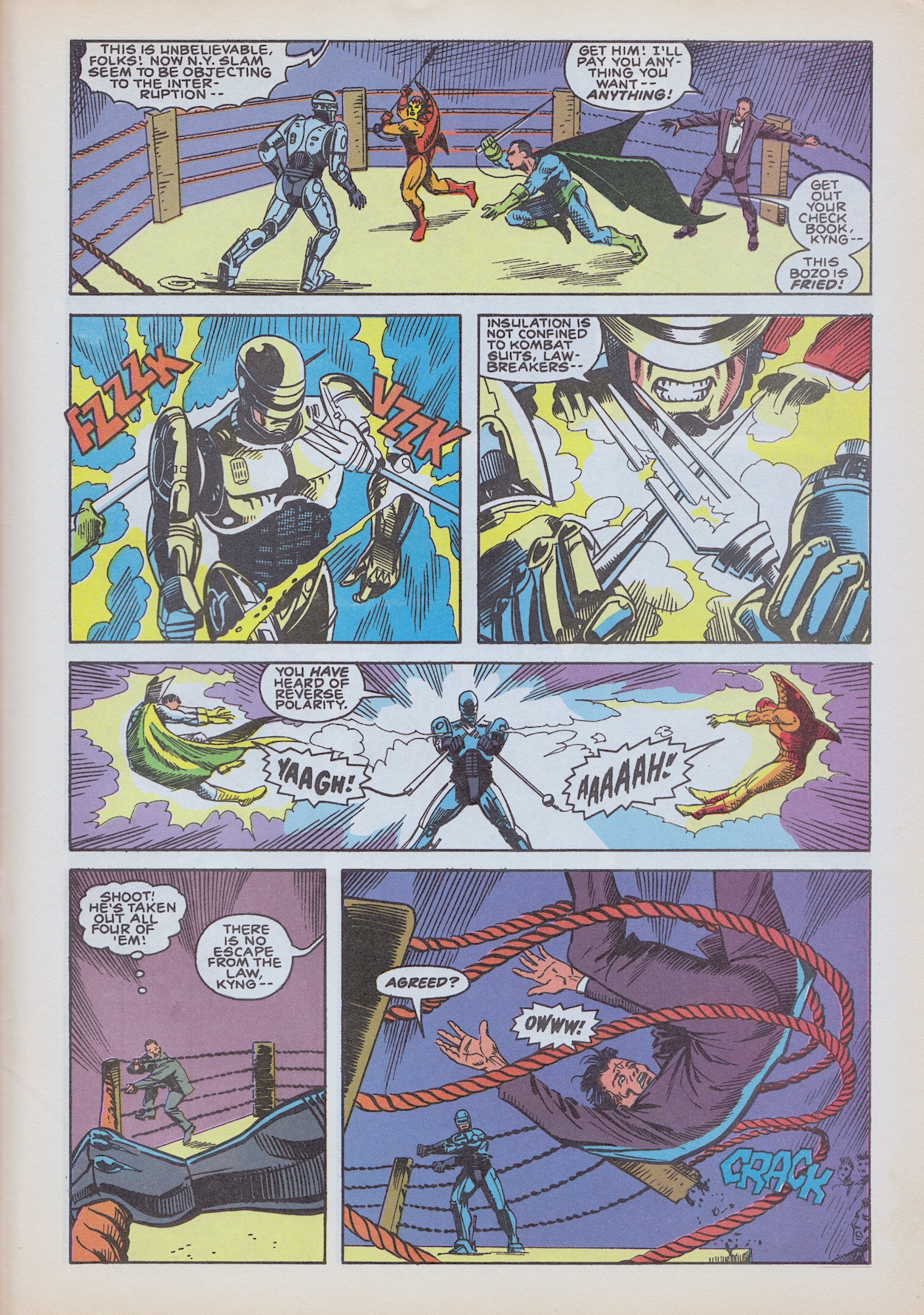
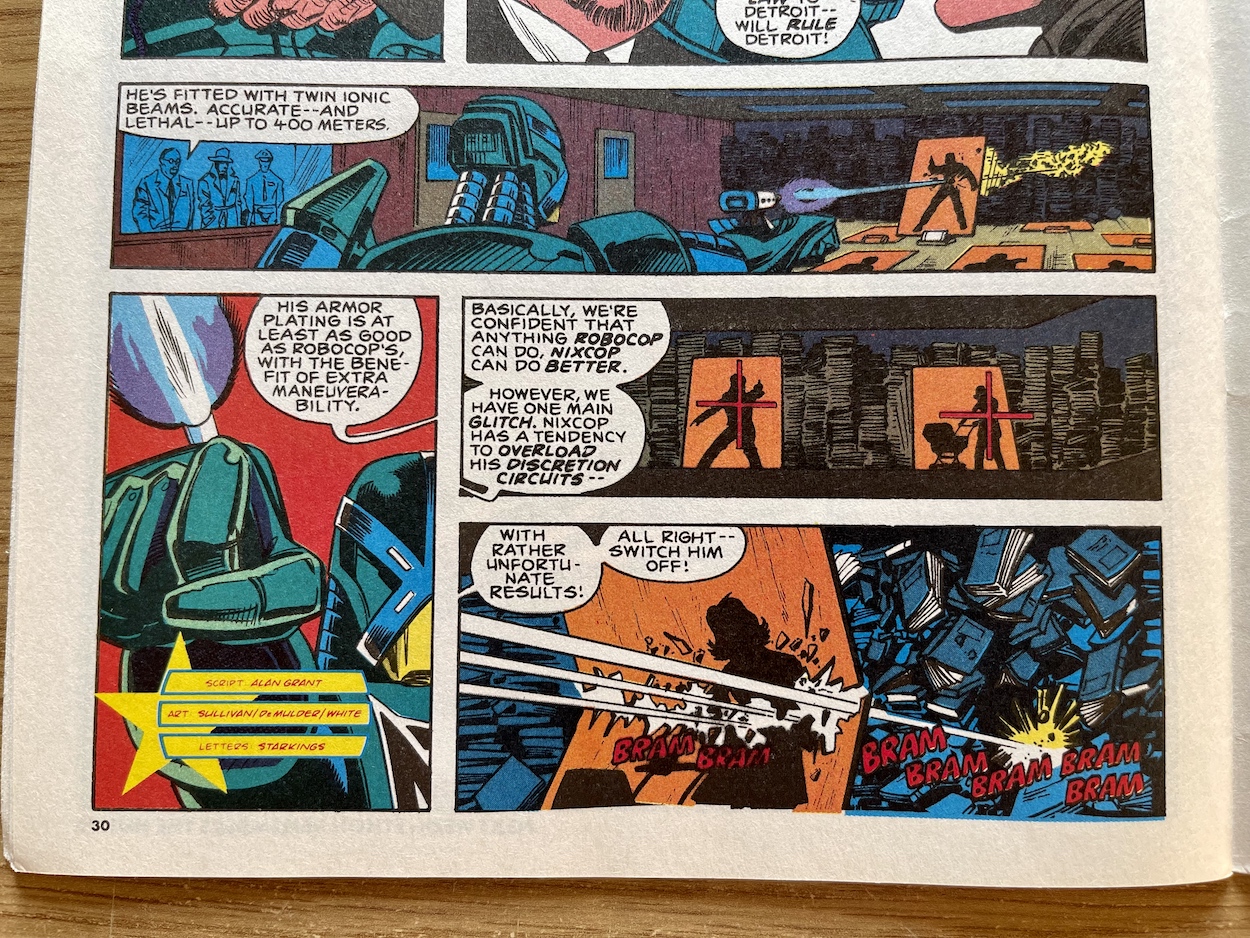
It would appear Nixco’s potential RoboCop replacement isn’t exactly the most accurate of crime stoppers if these panels from the next part of Kombat Zone are anything to go by. There were meant to be a couple of twists in this chunk of the story, namely how Kombat promotor Dek King (who Murphy is looking for) is involved in the Nixco robot and that he has x-ray film of RoboCop’s inner circuitry to help them. Unfortunately both of these story elements are given away in the dialogue box at the top of the first page, which is only meant to catch us up on what happened last time.

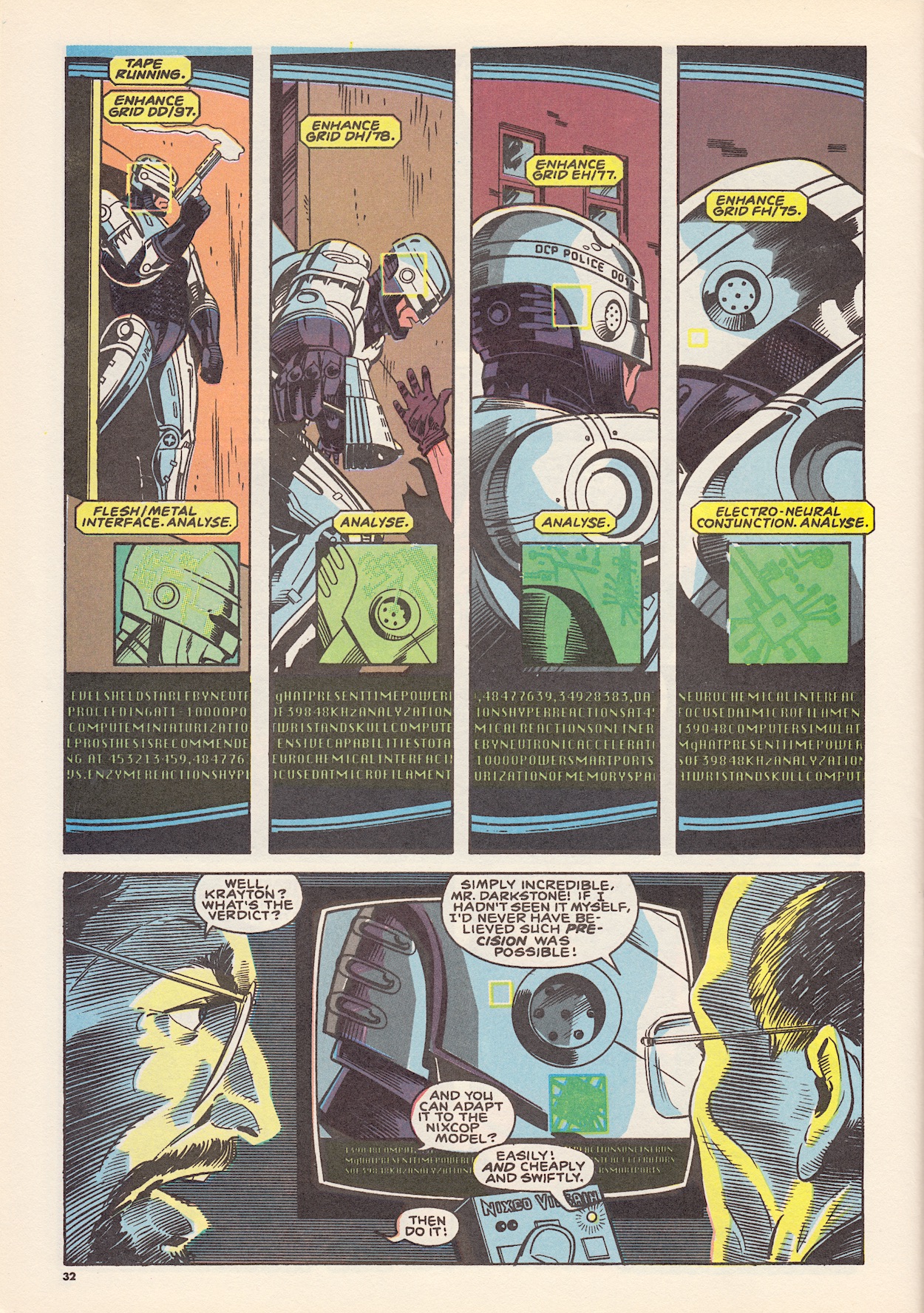
This is rather careless and ruins the main plot points before we have a chance to read them. It’s a real shame because Alan Grant’s story so far, while it does have much in common with RoboCop 2, is so far a lot more enjoyable. I also really like the scene when Nixco’s Krayton and Mr. Darkstone look over the film of Alex’s circuitry to see where they’ve gone wrong. I’m not going to pretend I understand how these scans could solve their programming errors, but I don’t think we’re meant to dwell on it that much. Lee Sullivan’s pencils, Kim DeMulder’s inks, Steve White’s colours and Richard Starkings’ letters set the scene in such a good way I just went along with it.

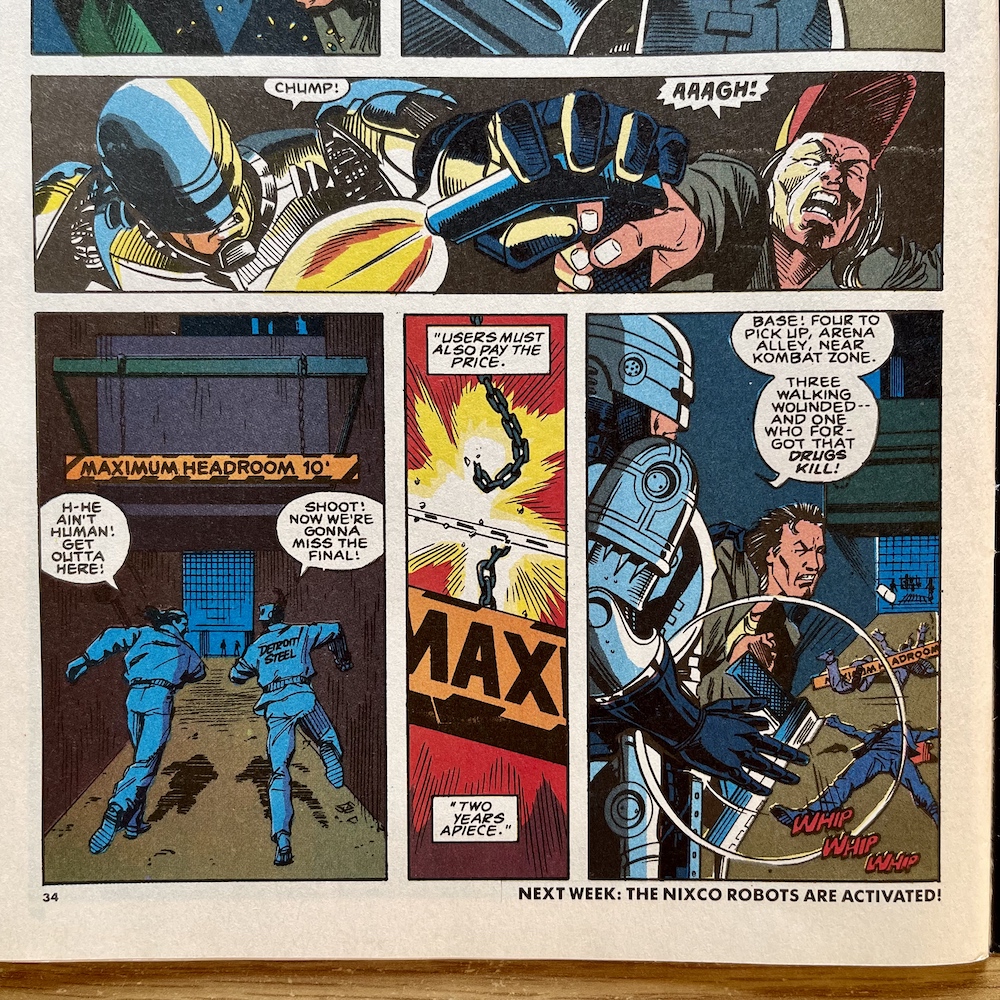
After another Media Break in which we find out Spain has declared war on four North African countries and the Detroit Zoo is miniaturising its animals to alleviate their cramped conditions, Murphy shows up at another Kombat game in search of Kyng, coming across some drug dealers outside. It’s here I find the strip is kind of a cross between the over-the-top violence of the original movie and the later TV show I was such a fan of.

One of the dealers opens fire on Robo, trying to take him out (this is set in the earliest days of his time on the beat and they’re still surprised to see a robot cop) and returns fire and kills him. However, the others are captured alive, two of them ingeniously knocked out in a way that really does remind me of the more fun ways he’d subdue criminals in the series rather than just opening fire indiscriminately like he does in the movies. Save for the Havoc error with the dialogue box this is great fun!

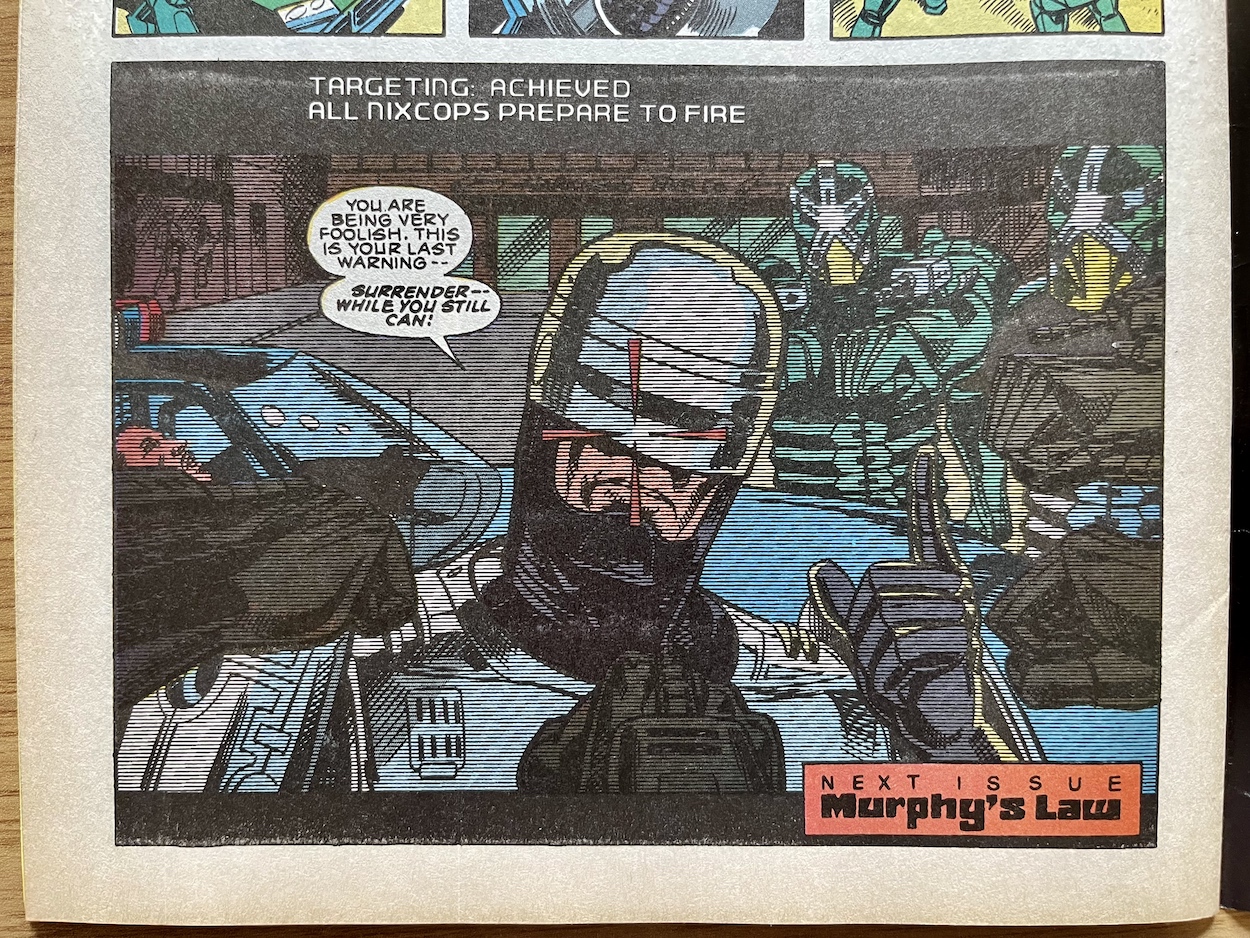
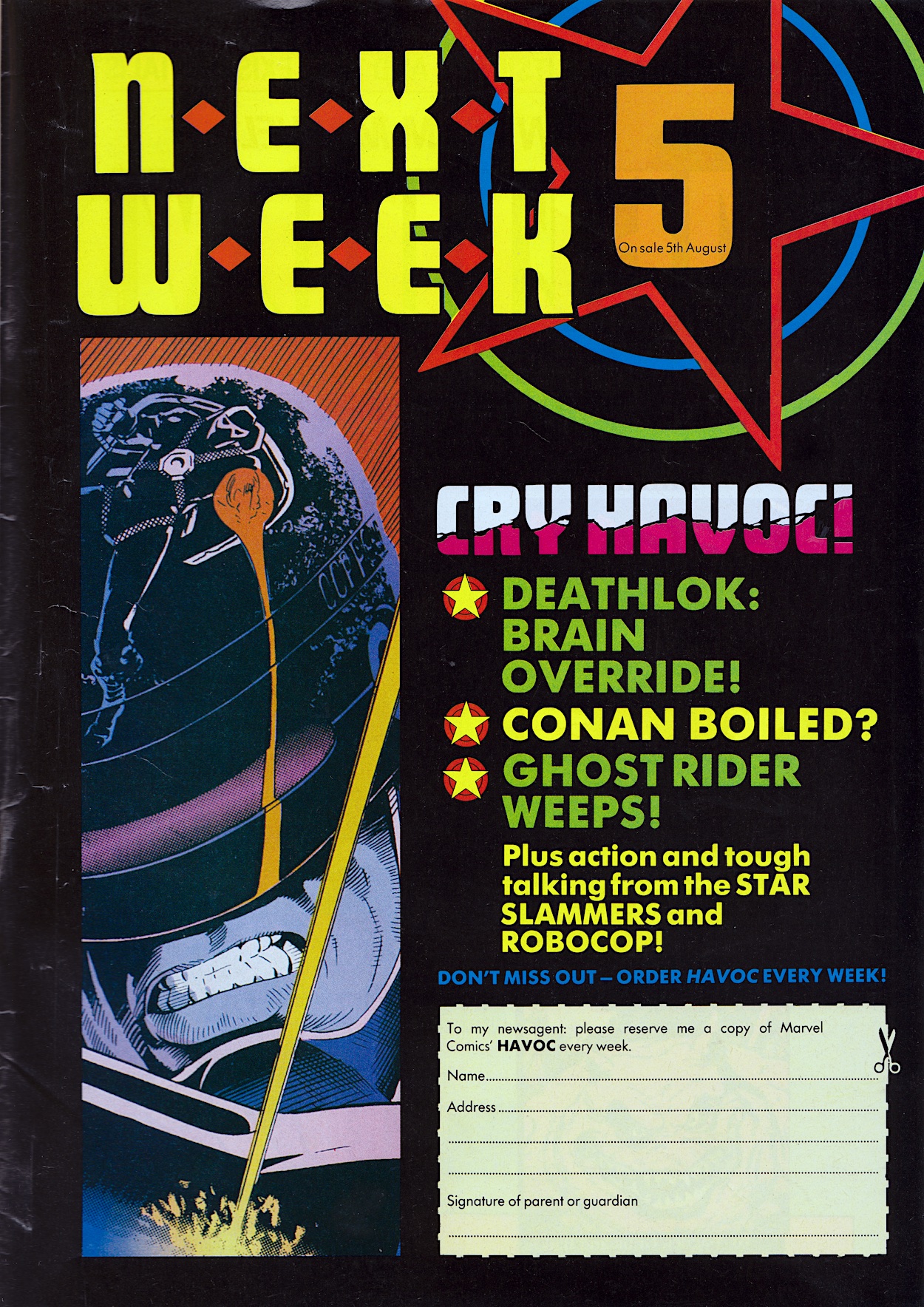
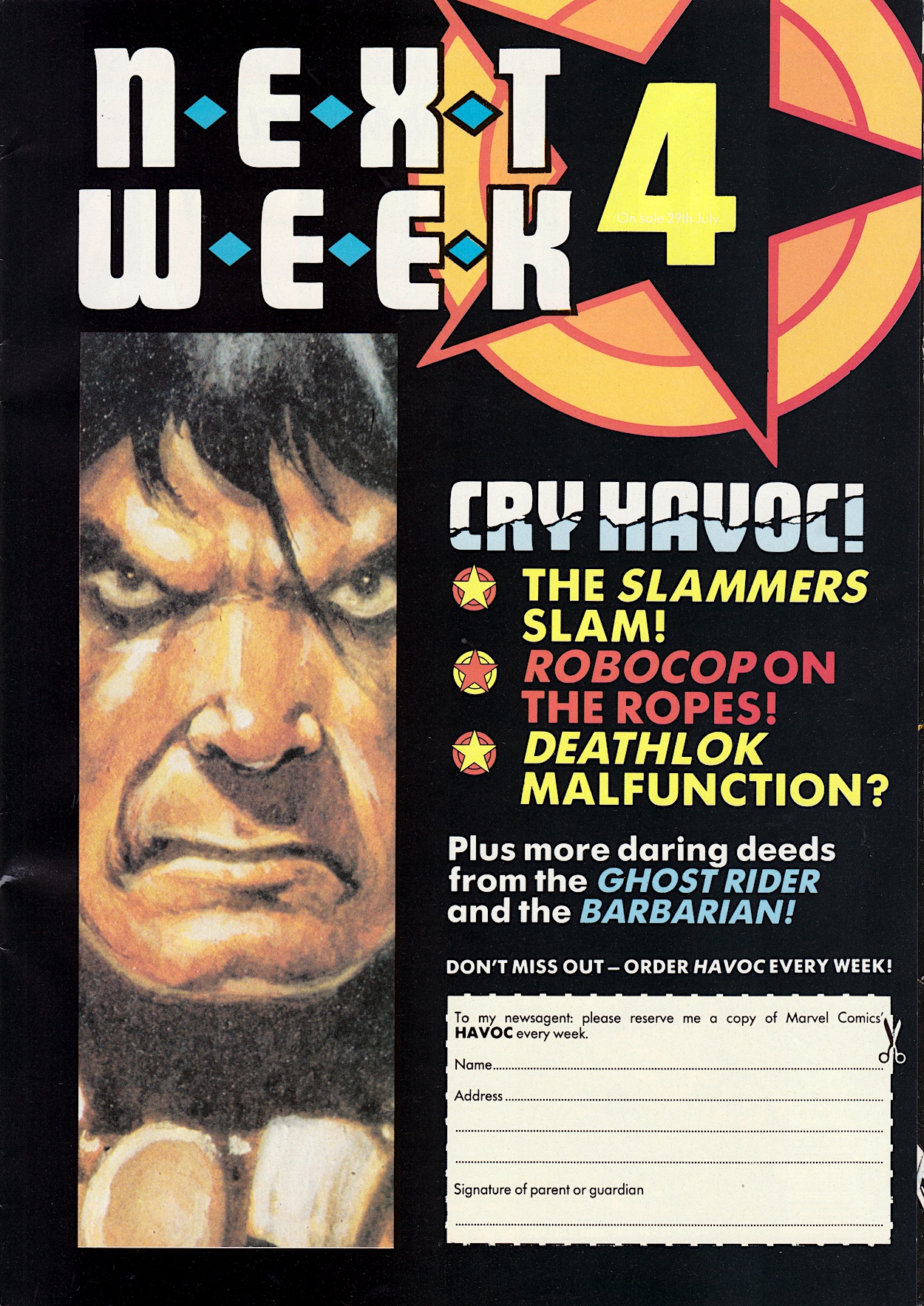
That’s us at the end of another issue, already a third of the way through a run which should’ve been so much longer. The Next Issue page doesn’t really give too many hints about what’s to come, although we can deduce that RoboCop will somehow end up in the fighting ring and Michael’s brain will be causing some grief for the Deathlok computer. I’m interested in seeing how the Star Slammers story adds to their grand background tale and Conan has redeemed himself somewhat, but it’s still the other three strips I’m gagging to read more of.

I’m glad I only have to wait seven days! While there’ll be no more wonderful posters to gawk at hopefully there’ll be plenty to enjoy inside. The review of the fourth edition of Havoc from Marvel UK will be here from Wednesday 27th July 2022.

iSSUE TWO < > iSSUE FOUR

HAVOC MENU

ViSiONARiES SPRiNG SPECiAL: FiNAL RERUNS

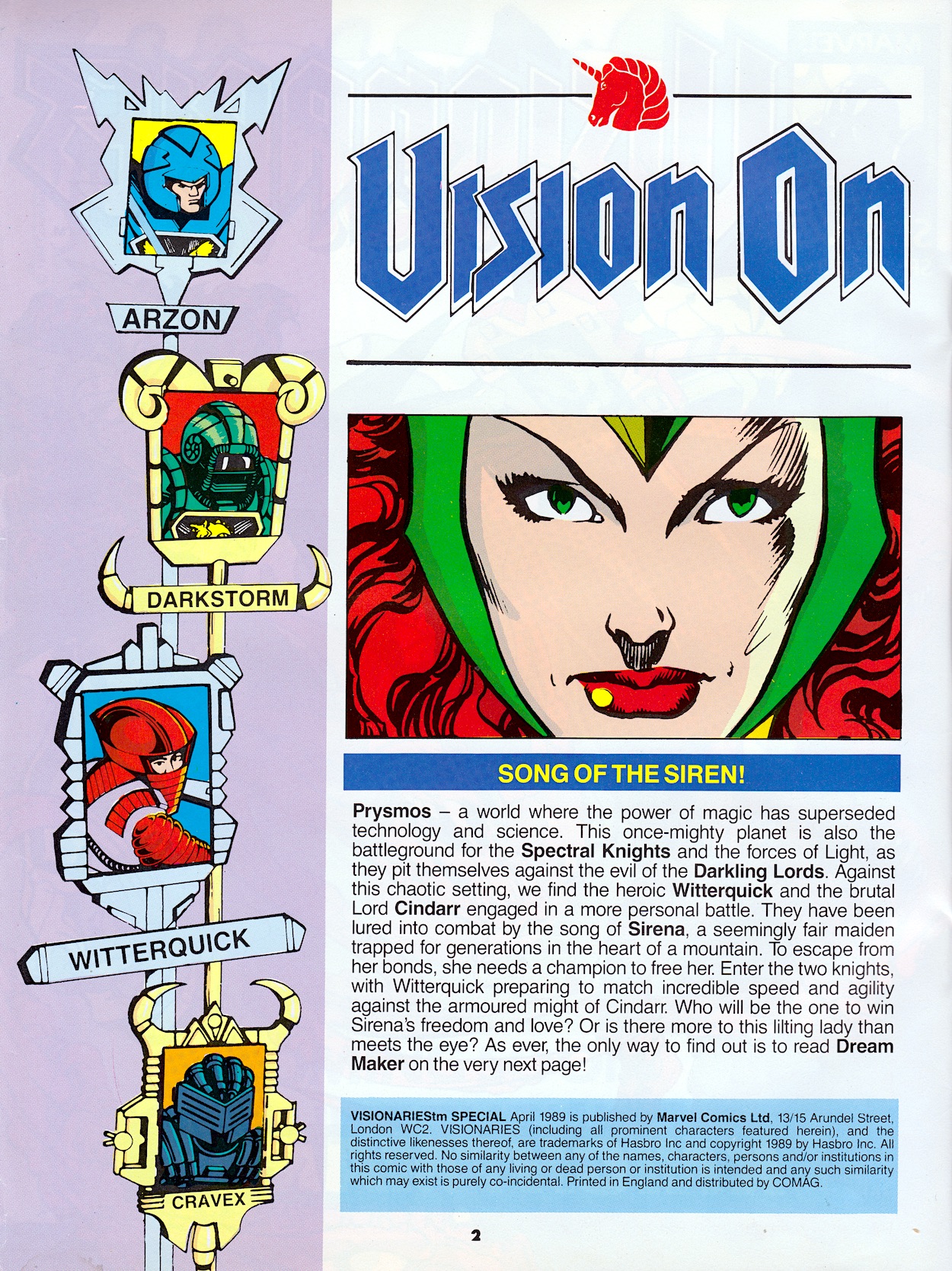
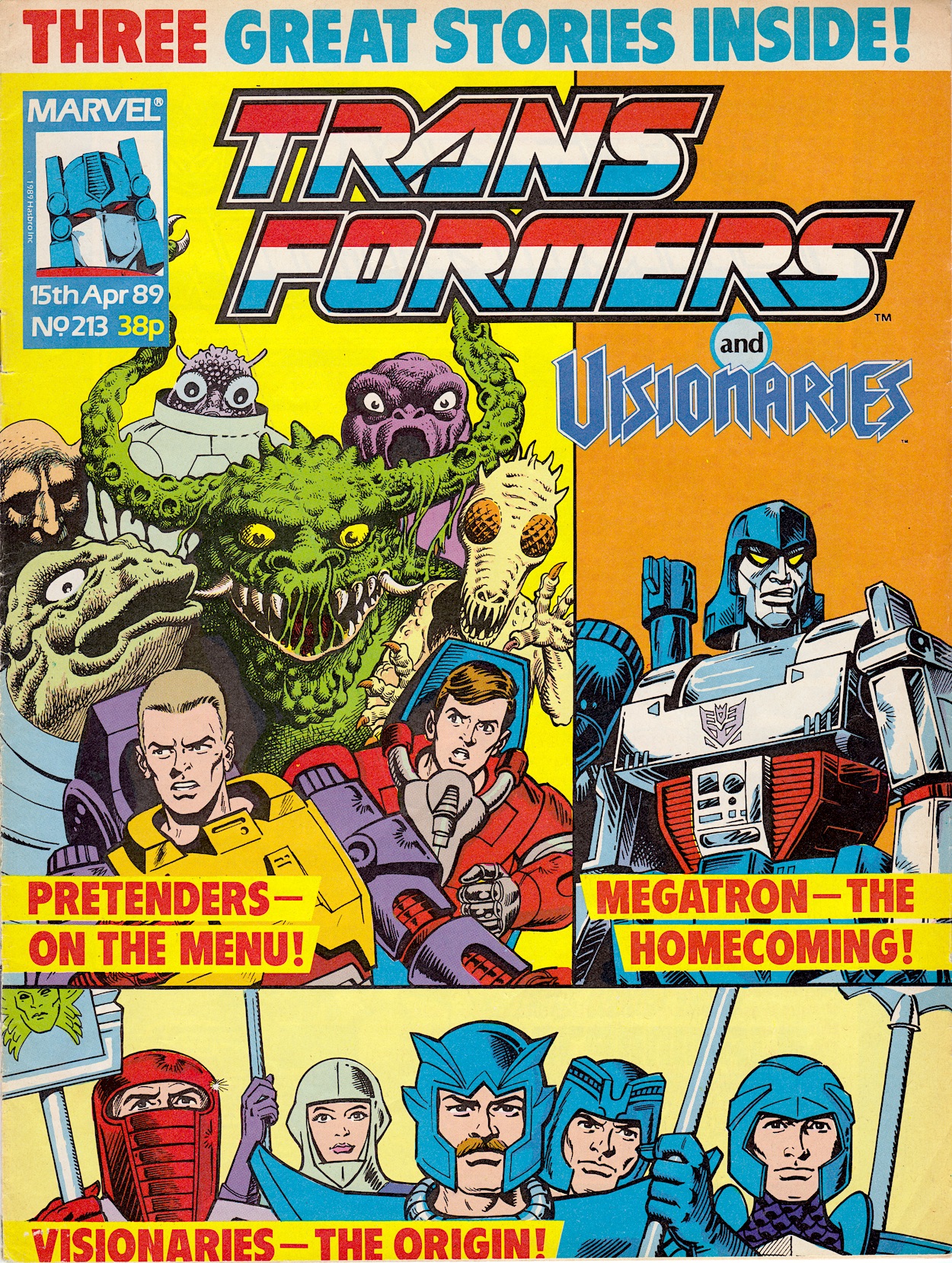
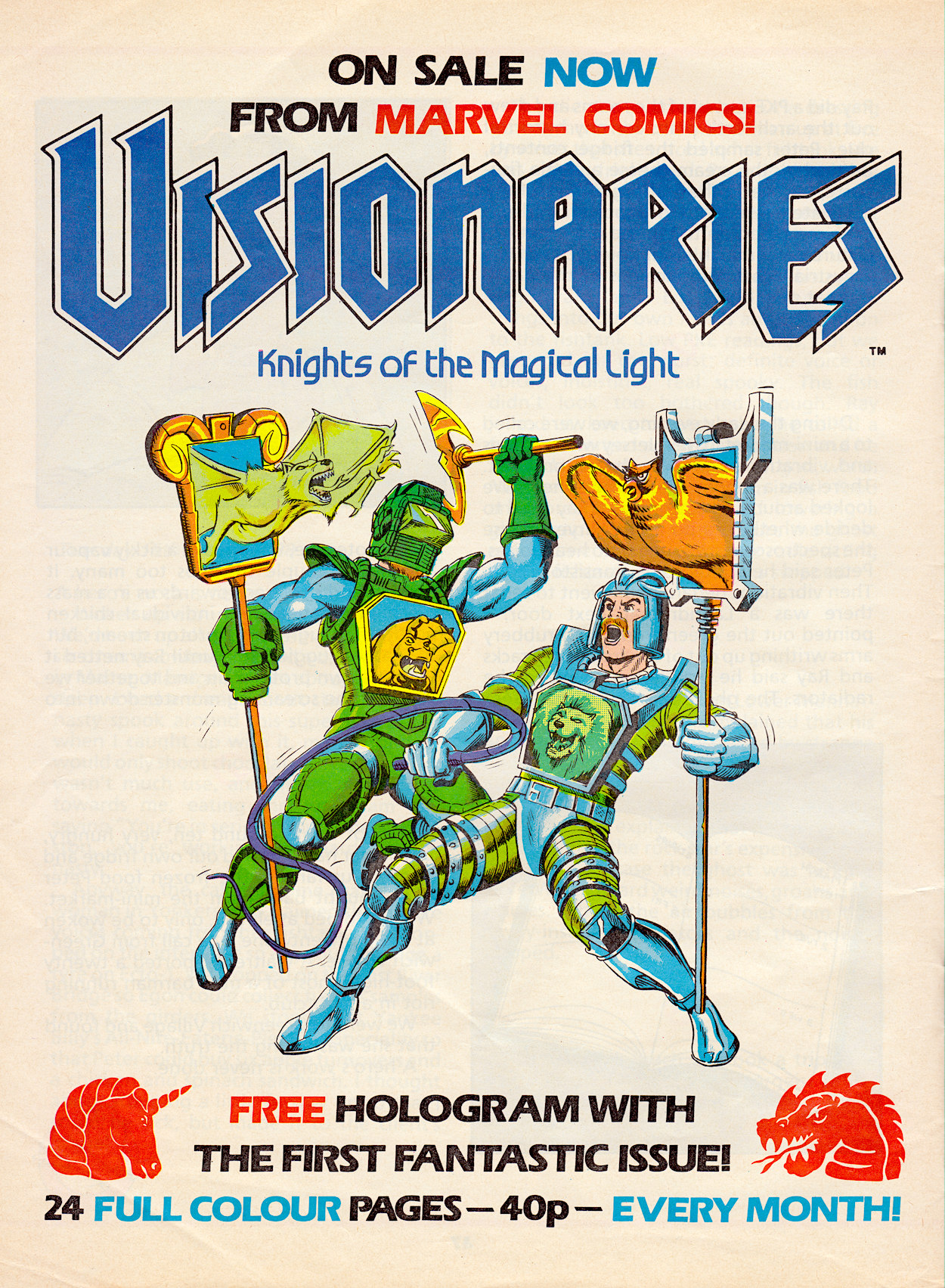
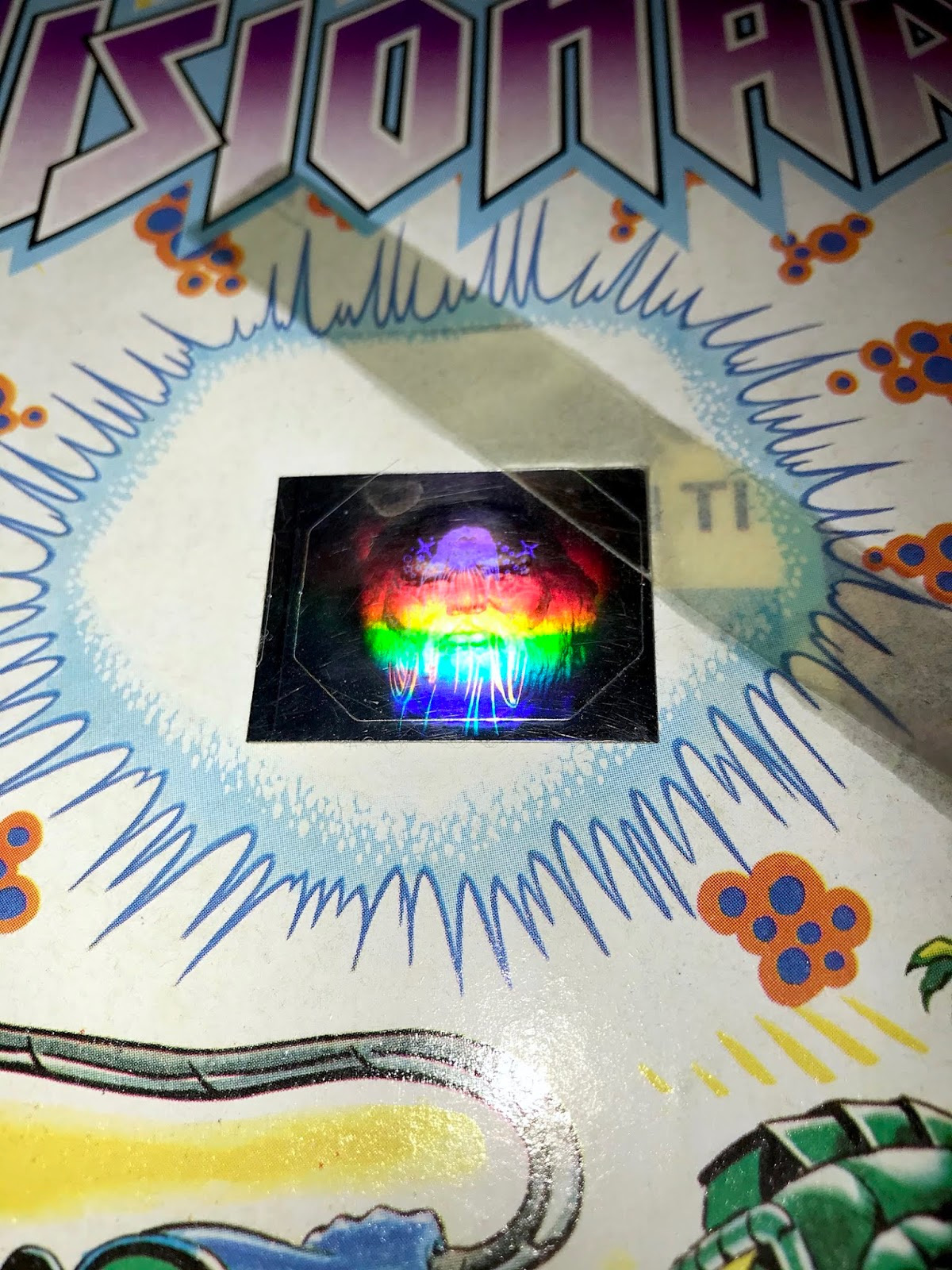
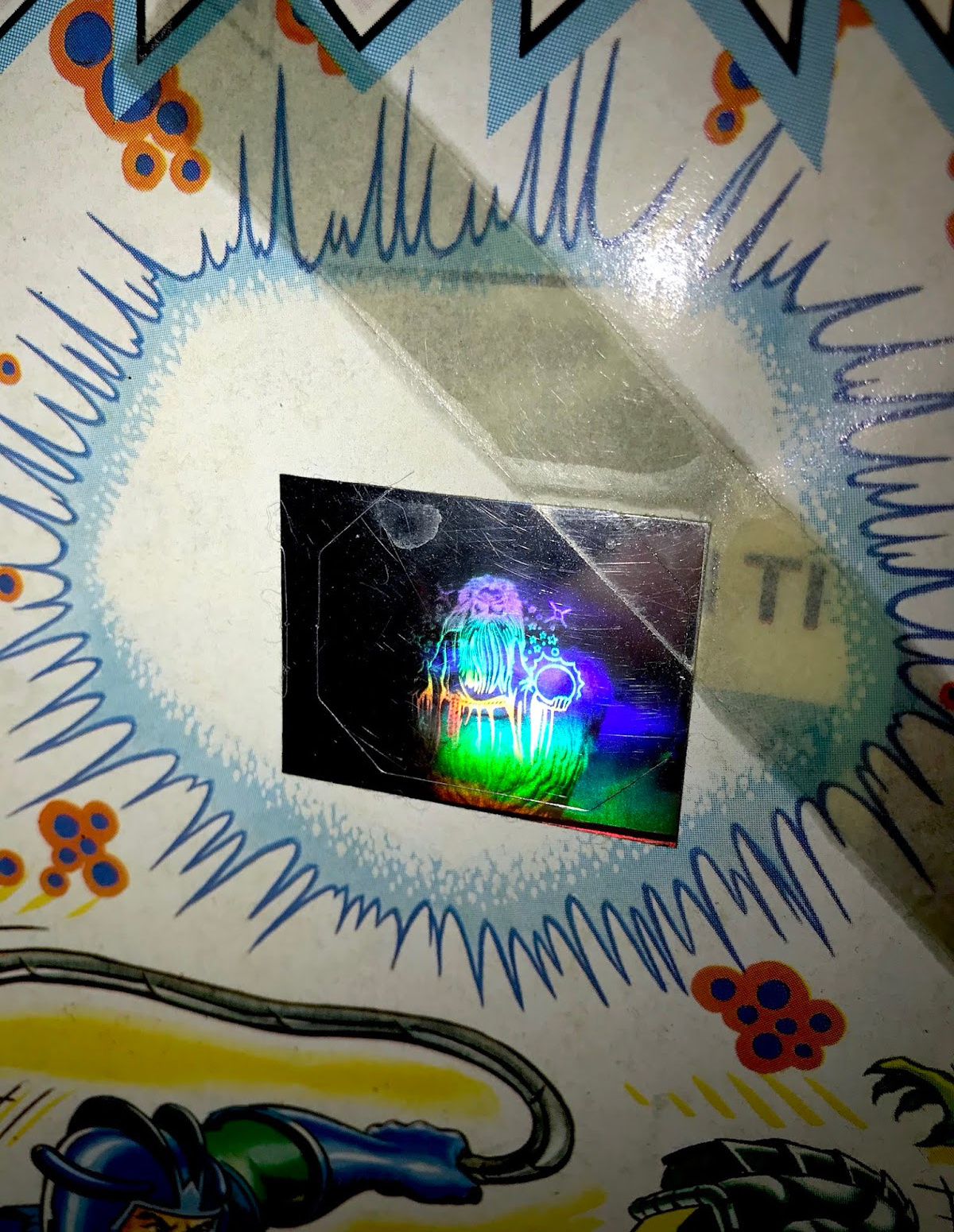
So I’ll be honest, I can’t really describe this as a comic review, that would be rather cheeky of me. But then again, it was a bit of a cheat for Marvel UK to call this the Visionaries Spring Special too. Don’t get me wrong, when I spotted this on the shelf back in 1989 I was thrilled. I hadn’t known there was a monthly comic the previous year, having only become interested through the cartoon which aired here in the UK after the comic had already ended. I received the annual for Christmas and then in April their origin story (which I’d just read in the Annual) was reprinted as a back up strip in The Transformers, which I’d just started collecting a few months prior. It was after that I spotted this edition.

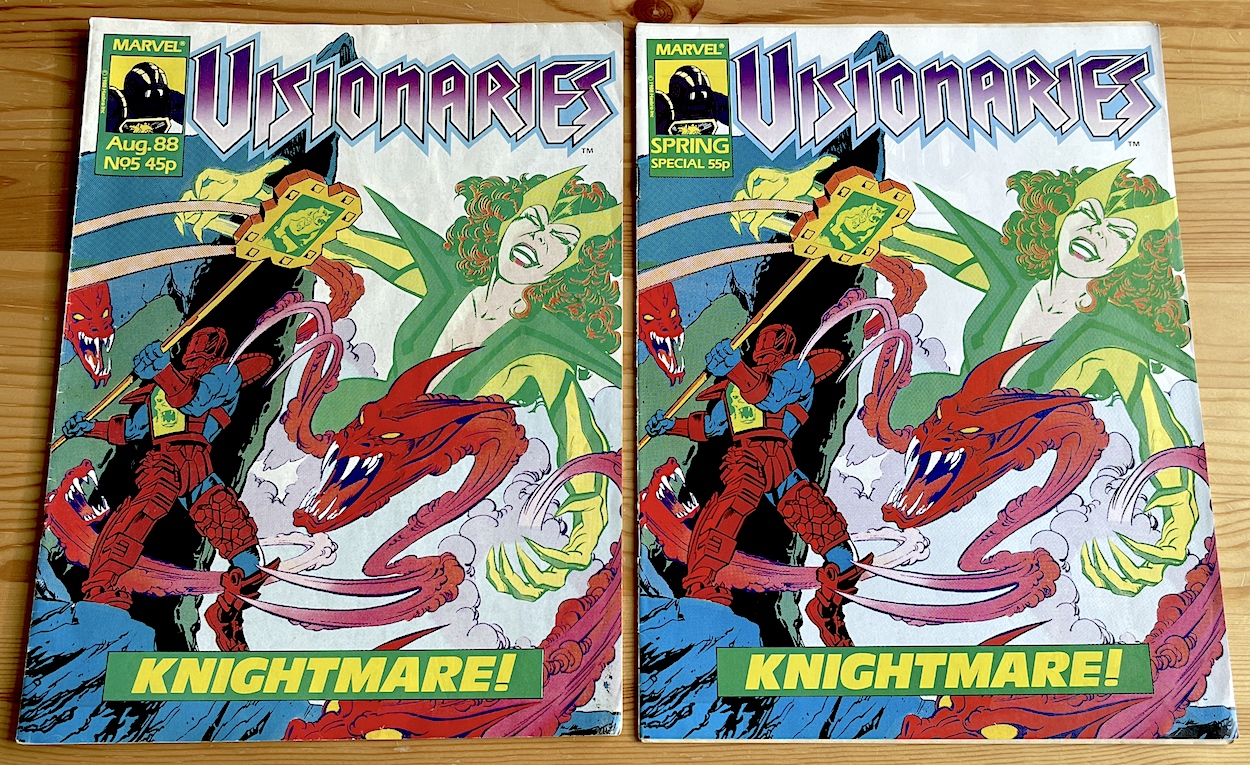
Through these I discovered there had been a regular comic, albeit a very short-lived one and I was sad I’d missed out on the further adventures of these characters. So this special was all new to me. A brand new strip featuring two of my very favourite characters from the cartoon, whose toys I owned and whose origin story I was now (very) familiar with. I was in comics heaven. But readers of the monthly may have felt somewhat shortchanged. Have a look at the ‘Special’ next to #5, the final edition of their comic.

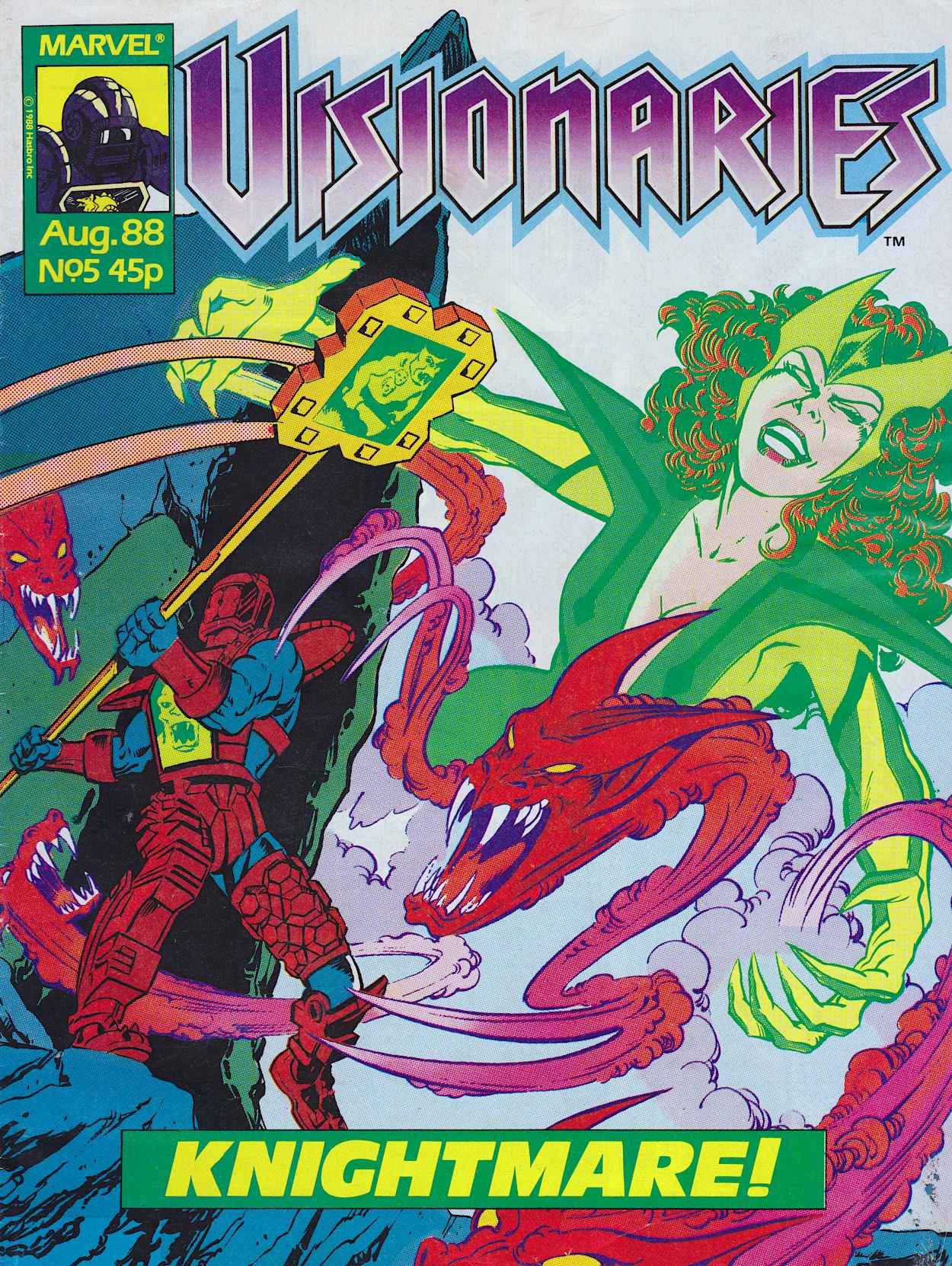
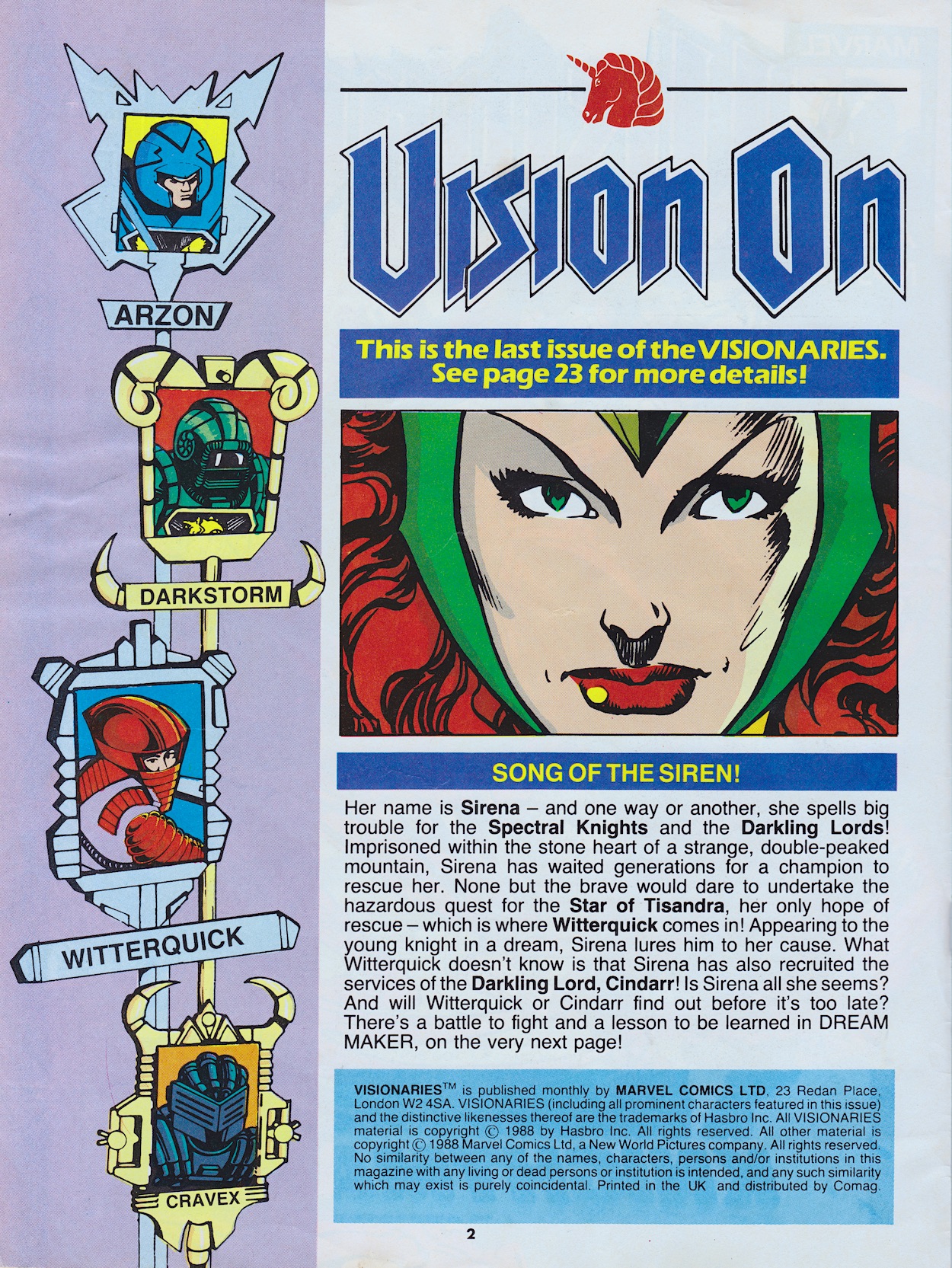
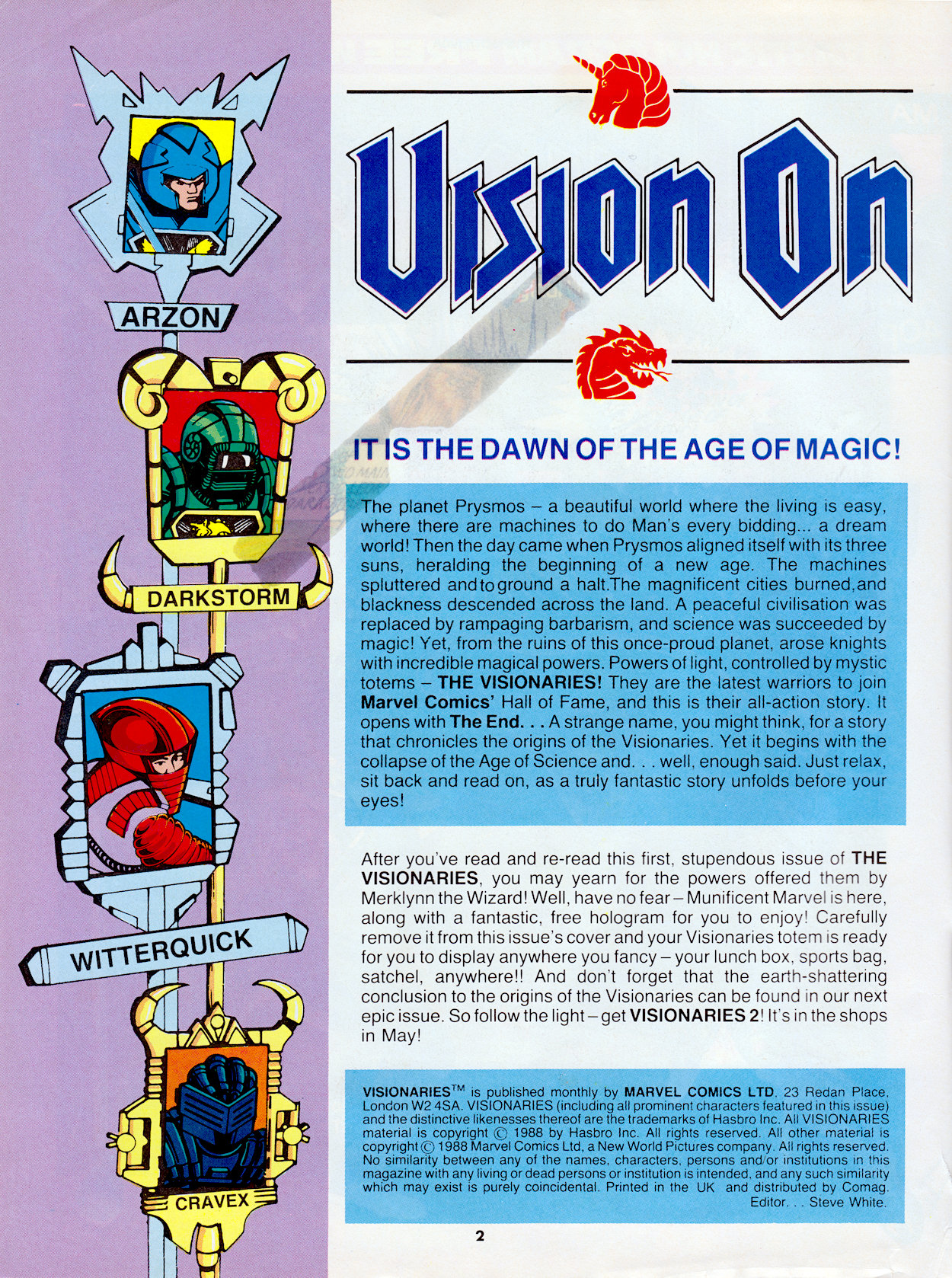
They look somewhat similar, don’t they? This continues inside. In fact, this is an exact copy of #5 bar only a few exceptions. Obviously the issue number has been changed on the cover (although the incorrectly coloured Darkstorm remains) and the editorial on page two has been rewritten, aimed now at more casual readers rather than those who had been following along. The layout and images originally created by the monthly’s editor Steve White remain the same, however.

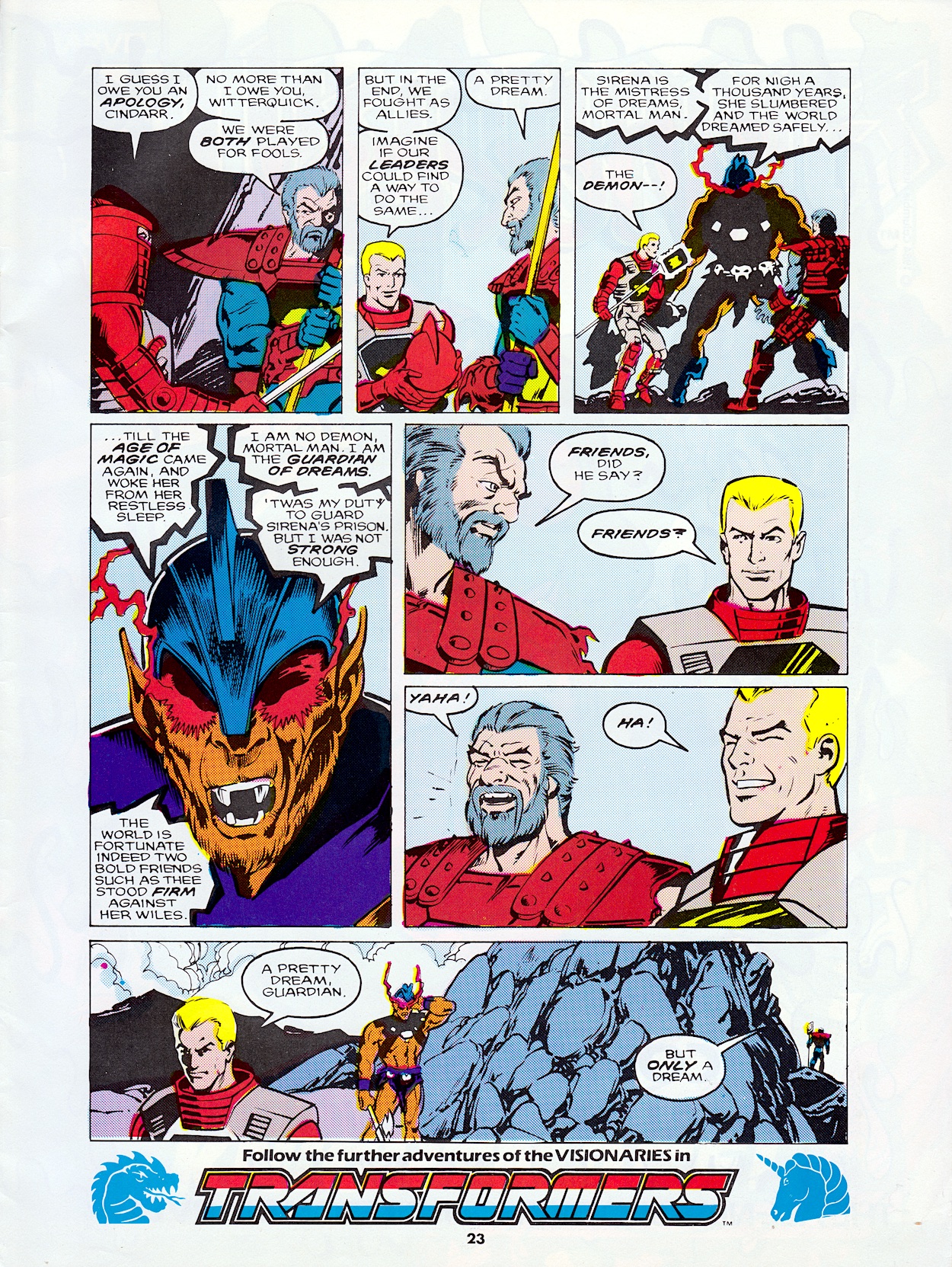
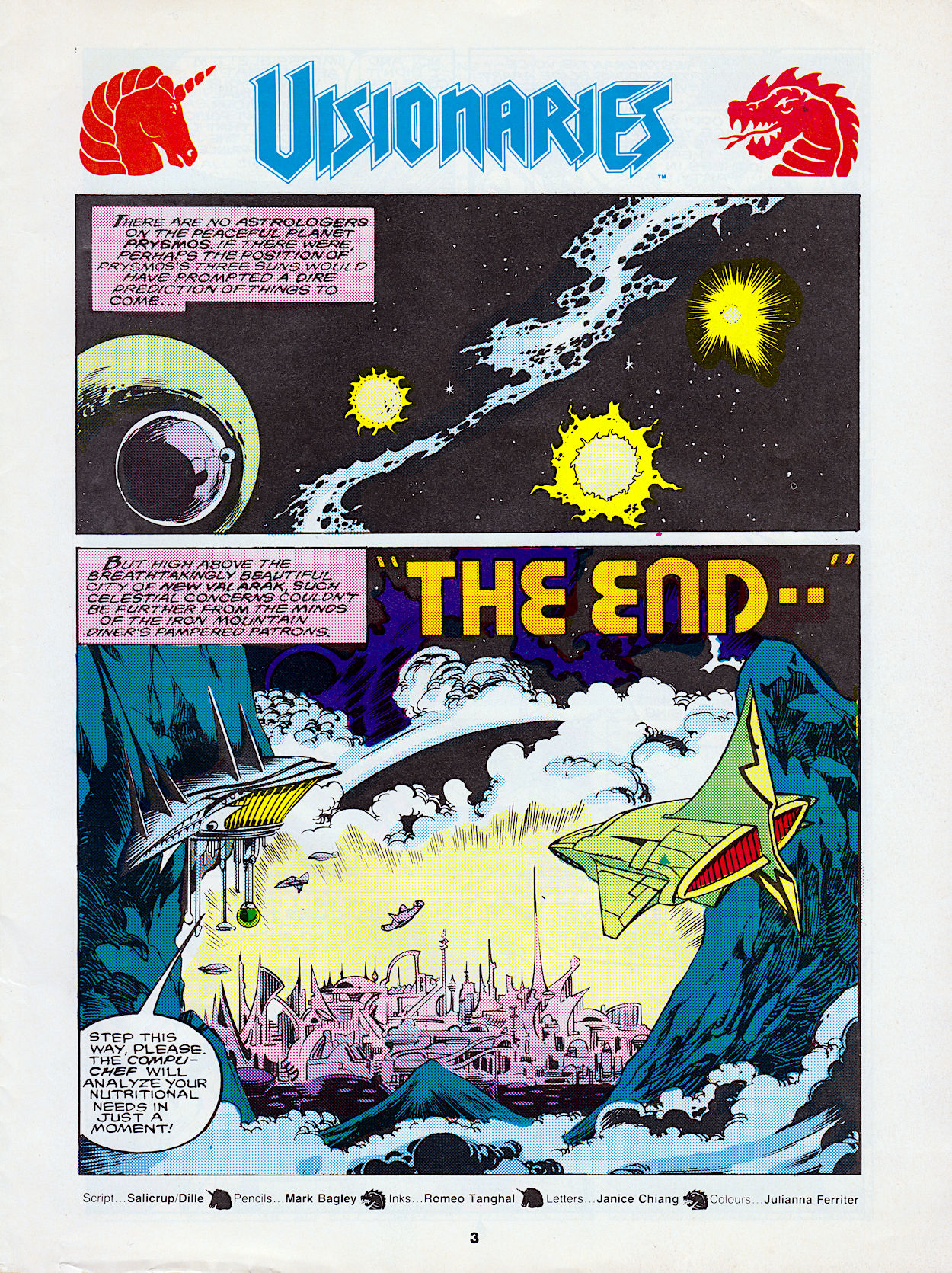
The strip, Dream Maker, is presented once again in its entirety and makes up the remainder of the comic’s interior. Written by Gerry Conway, with pencils by Mark Bagley, inks by Romeo Tanghai, letters by Janice Chiang and colours by Julianna Ferriter it’s a great strip, that much is true. Altogether there are 24 pages here with the exact same external gloss paper making up the outer eight pages and the regular Marvel UK stock for the rest. On the last page of the strip, page 23 of the comic, the final message has been edited to include the new logo for Transformers and the issue number and date of the original merge have been removed.

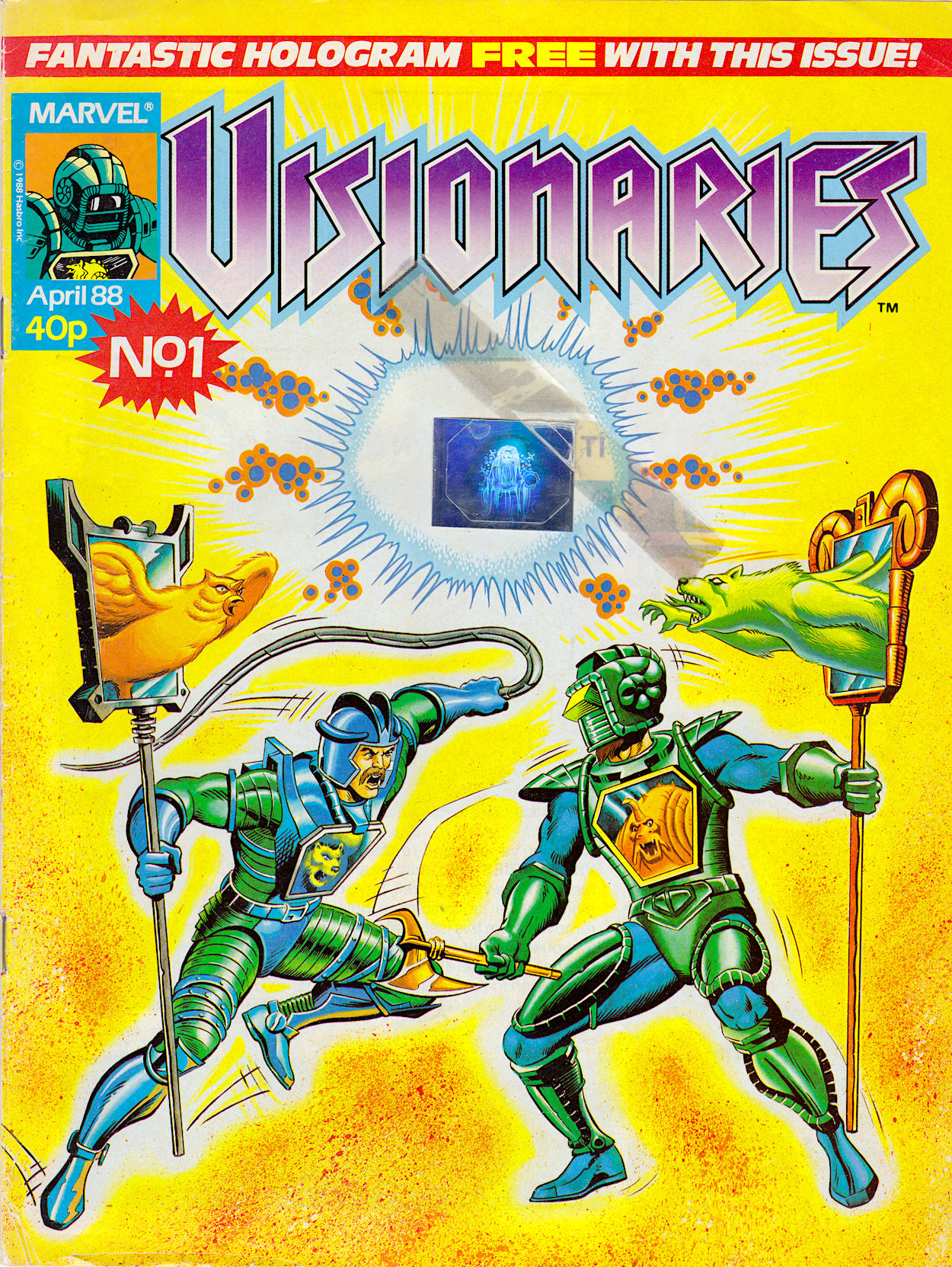
At this time Transformers was changing to a three-story format and to mark the first seven issues of the new look they were reprinting the first Visionaries story (this would mark the third time we saw it in one year). It kicked off with this lovely cover promoting the new look, including the return of the Knights, drawn by John Stokes.

The reason behind this was to let the G.I. Joe story get ahead and create a buffer between the monthly US publication and their weekly UK printings. So really, to say at the end of the Spring Special that fans could “Follow the further adventures of the Visionaries” wasn’t exactly true. Instead, anyone picking this up and then buying Transformers would be met with one reprinted story and then nothing after that, so no further adventures at all.

This is the first comic series on the blog to reach its conclusion

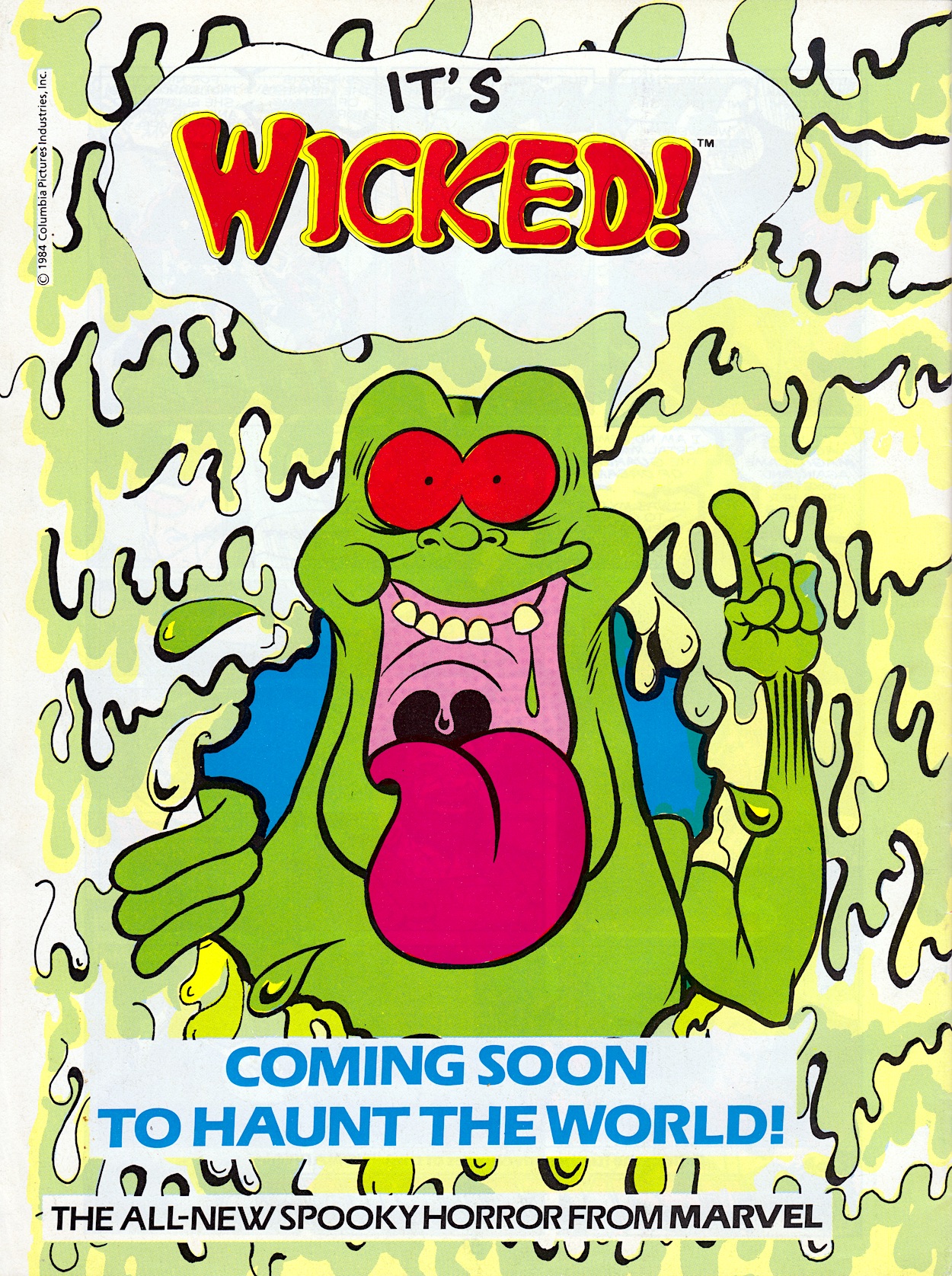
So, as I’m sure you can understand there’s no point whatsoever in me reviewing this story all over again when I did so in depth in July last year. It is a great story though and if you see this edition on eBay and want to dip your toes in I’d highly recommend it, although it appears to be a somewhat rare item and I was very lucky to spot it. I only bought it myself to complete the set. We do get a nice new advertisement on the back for something of an experiment by Marvel UK to launch their own humour comic in competition to Beano and The Dandy, which had something of a surprising mascot.

The Visionaries Spring Special comic brought me so much joy as a kid. It gave me a glimpse into the world of the Visionaries as presented in their comic form and I loved it. It was read several times and felt so mature, so grown up compared to the other toy-based comics I’d collected previously, something I’ve gone into throughout the series on the blog.

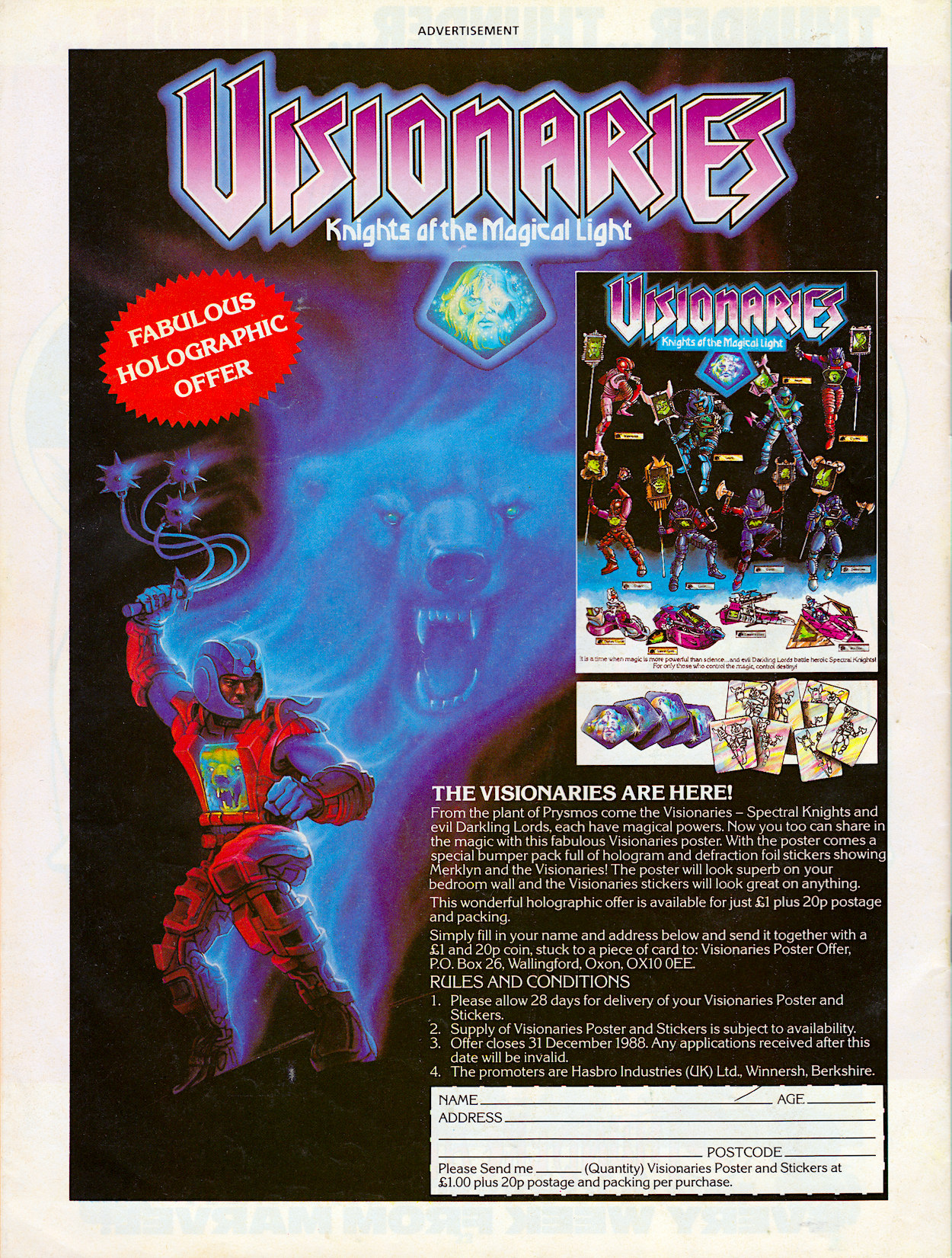
Nowadays though, as the final comic we’d ever get it’s clear this special was nothing more than a bit of marketing to get some additional readers to buy Transformers. Even the advert for it in the pages of other Marvel UK comics was exactly the same as that used one year previous (almost to the day) to promote the monthly, with only the issue details changed.

A curious addition to the series but it does complete my set. I’d already come to terms with the fact there’d be no more new stories after the annual but seeing this story again just reminds me of the potential the Visionaries had to become one of the very best licenced comics stories ever.

This is the first comic series on the blog to reach its conclusion so if this is the first you’re seeing the Knights of the Magical Light there are ten other posts just waiting to be read. I hope you enjoy reading them as much as I did writing them! As clichéd as that reads, it’s still true.

BACK TO ViSiONARiES ANNUAL

ViSiONARiES MENU

JURASSiC PARK #9: SPARED NO EXPENSE

This review was due on 22nd February, click here to find out about the delay. More catch-ups to come this week.

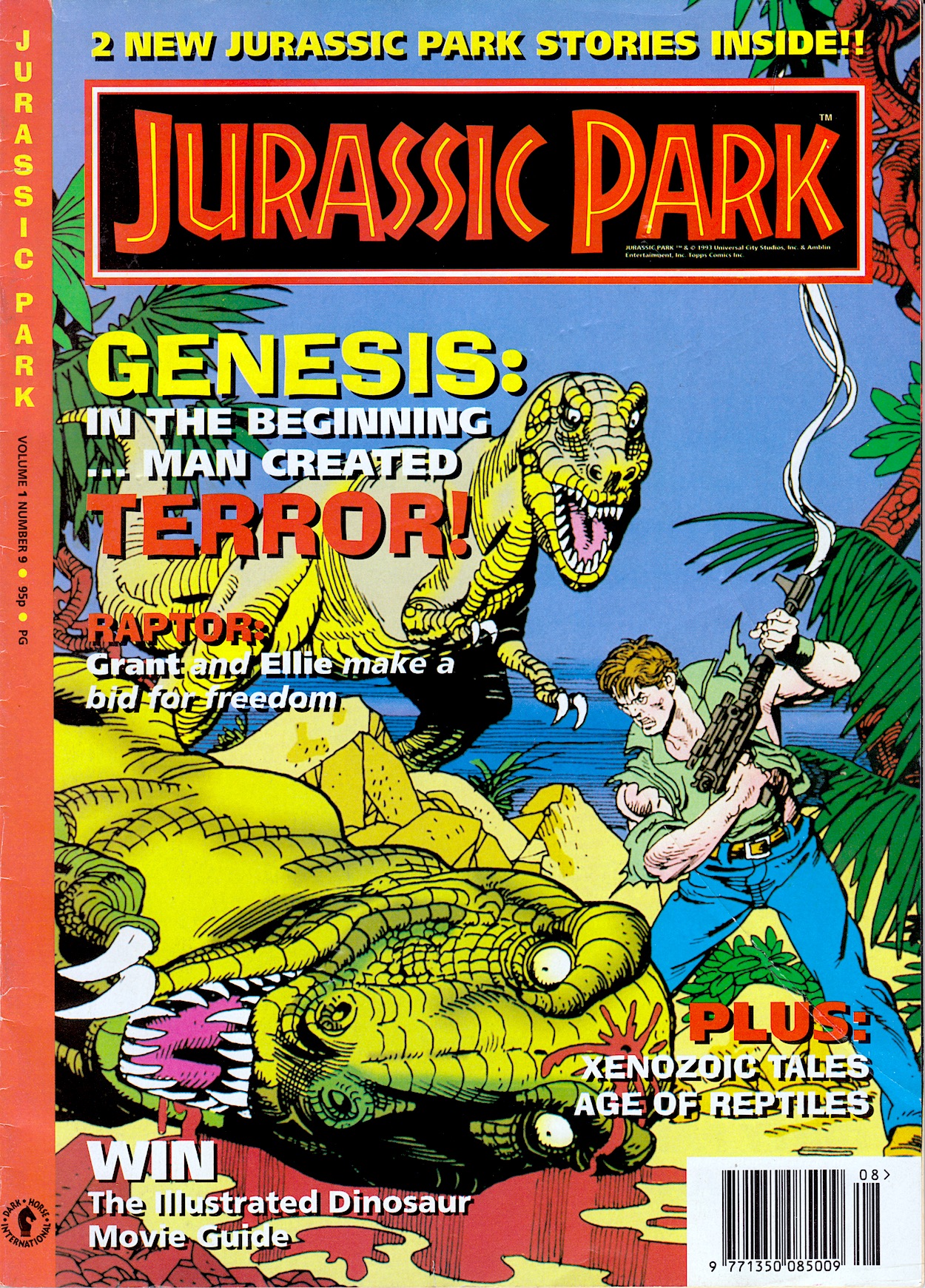
The cover for issue nine of Dark Horse International‘s Jurassic Park is a strange beast, showing what appears to be Dr Alan Grant killing a Tyrannosaurus rex! Drawn by Gil Kane it’s completely uncharacteristic not only of Alan but for the comic too, which so far has stayed true to the book and movie. Seeing one of our heroes with a massive gun taking down one of the animals like a clichéd action hero, while a second T-rex comes up behind has nothing to do with Jurassic Park!

The cover is taken from the US comic series’ preview issue which contained two small prequel strips. It had two different covers, neither of which reflected in any way to anything that happened within the stories (a pet peeve of mine). They were also seemingly drawn long before the artists even knew what the script for the movie contained. A bizarre thing to begin with then, even more so to choose it for the UK comic when so many other more suitable ones were available in the US series by now. But the real news was those prequel strips had arrived.

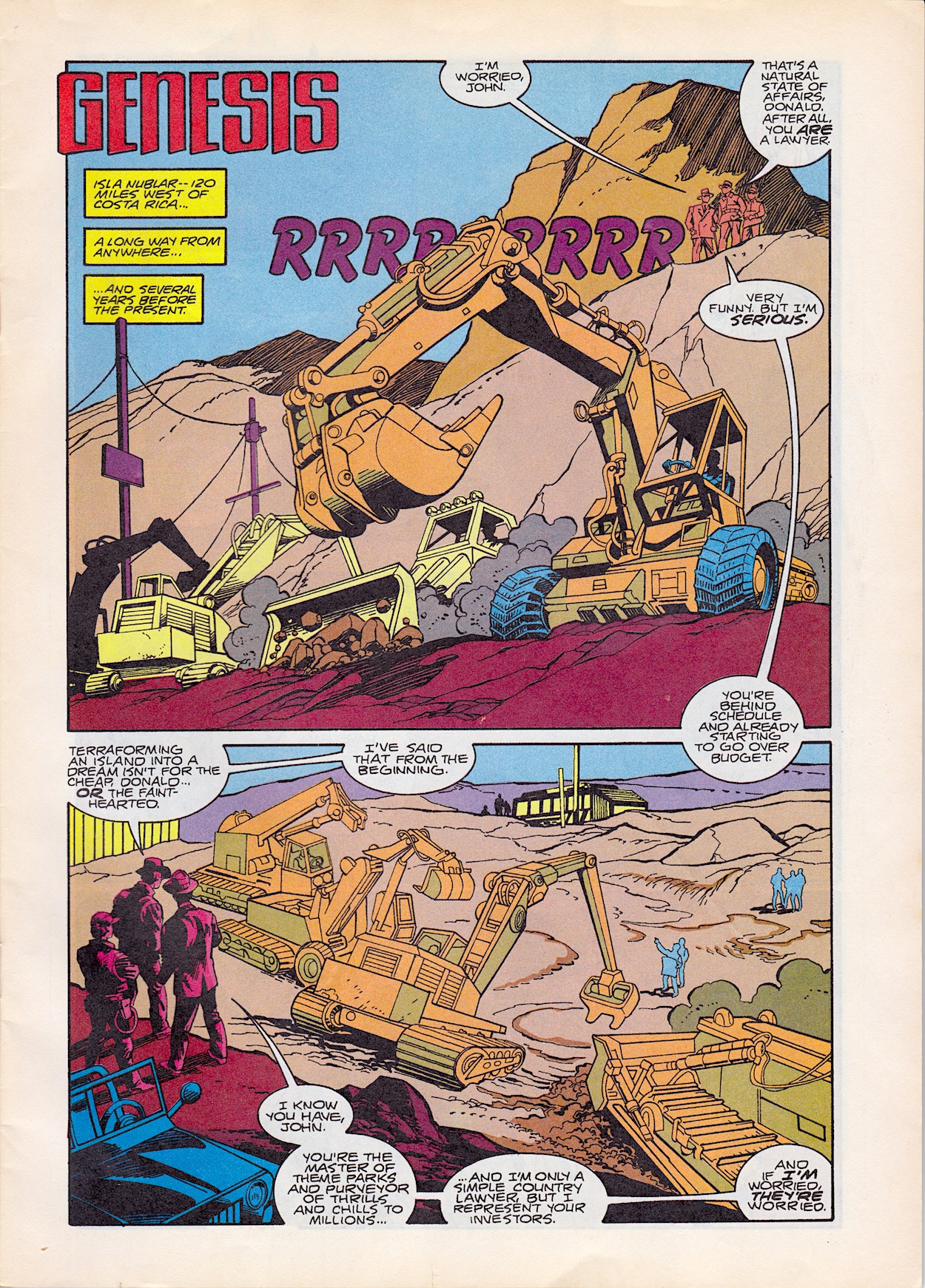
In fact there are no less than four strips this month, but with no extra pages some of our regulars have a little less room to breathe. Things kick off with the eight-page prequel story Genesis which shows us the moment ill-fated lawyer Donald Gennaro is shown the secret heartbeat (as John Hammond describes it here) behind the island, which up to this moment Donald thought was simply a luxurious tropical adventure park. Much of the movie adaptation team are back including writer Walter Simonson, Gil is pencilling, Renée Witterstaetter is on colours, John Workman‘s speech balloons are back and they’re joined by new-to-JP inker Mike de Carlo (Crisis on Infinite Earths, Legion of Super Heroes, Animaniacs).

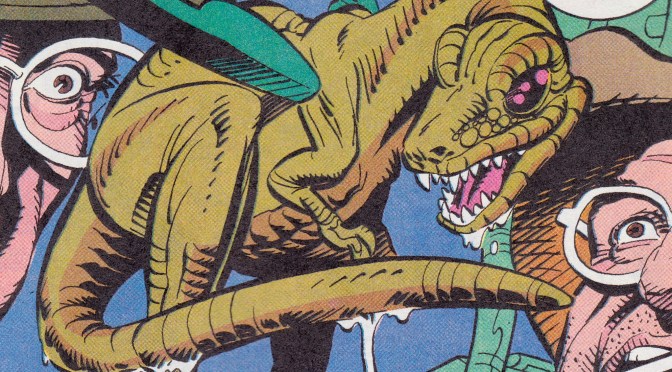
Ground is being broken for Jurassic Park and Gennaro is there for the first of his many visits. Set several years before the movie there’s obviously going to be a distinct lack of dinosaurs for the most part, but this is all about the background to the story, which already had such a solid grounding thanks to Michael Crichton‘s original novel, from which writer Walter is choosing individual scenes. There’s also a baby T-rex and some lovely foreboding imagery, such as the use of an excavator’s clamp digging a deep trench beside the dirt road. It’s clear what this represents to the reader. A nice touch.

Hammond takes Gennaro to a small cabin and shows him some old monster movies, full of stop-motion dinosaurs and the like (a simple trick to get them into the comic), and gets really excited as he explains how these thrilled audiences and the advances in technology have made them more realistic and thus more exciting, a nod to the revolutionary CGI of the film. Gennaro doesn’t care and soon the two men are on their way to the famous hatchery where Dr Henry Wu has summoned them to see the birth of InGen‘s very first dinosaur. It’s a tiny T.rex but Gennaro is still unimpressed.

He’s a numbers man, he wants to see the final product, the things that are going to get people spending money on over-priced tickets to get there. While that much is in keeping with the movie character, I still feel he would’ve had some form of awe towards the first living, breathing dinosaur baby in millions of years! The fact he’s actually disgusted by it is a bit much. For me there are also too many instances of movie dialogue being used. It’s meant to come across as clever foreshadowing, but with the amount that’s used it just feels forced and unoriginal.

Because of the overuse of this dialogue for all three characters these final scenes come off as plain silly. Gennaro saying he wouldn’t walk out of a men’s room to see the T.rex is an oddly specific thing for someone to say, and of course it’s only written here because of how he’d memorably meet his fate in the film. Perhaps without all the other movie dialogue (and especially without Hammond’s retort!) it would’ve been a funny touch to end on. All-in-all, it’s a strange little strip. It adds nothing to the Jurassic Park story and actually does a bit of a disservice to the characters involved.

The war is on

Much better is the next chapter of Age of Reptiles. The ongoing Jurassic Park sequel is still in here but 11 pages of Ricardo Delgado‘s incredible creation is next up, breaking the comic up a little. After the cliffhanger last issue there are no prizes for guessing the pack of Deinonycuses are down another member. After one of their friends has his head bitten off and his body dragged back into the water we get a funny moment of the fish (which distracted him in the first place) wriggling its way across the rocks and plopping safely back into the lake.

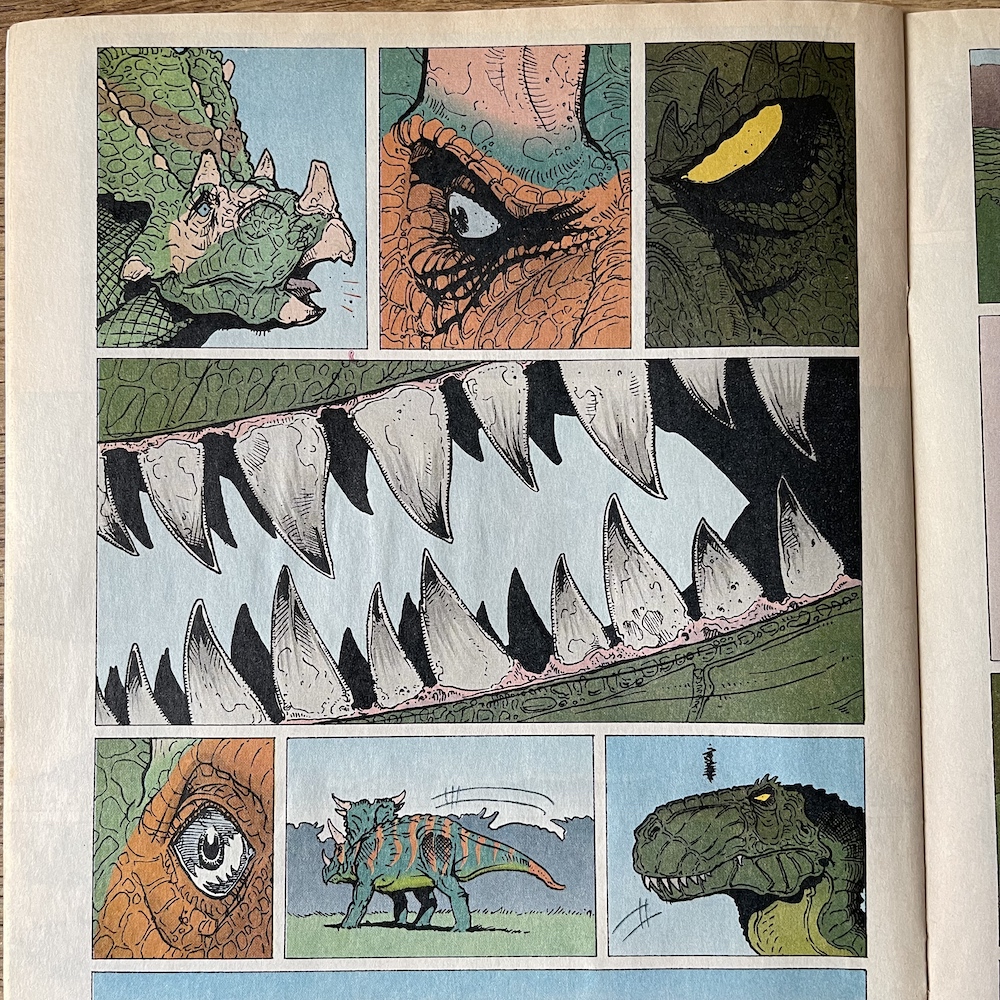
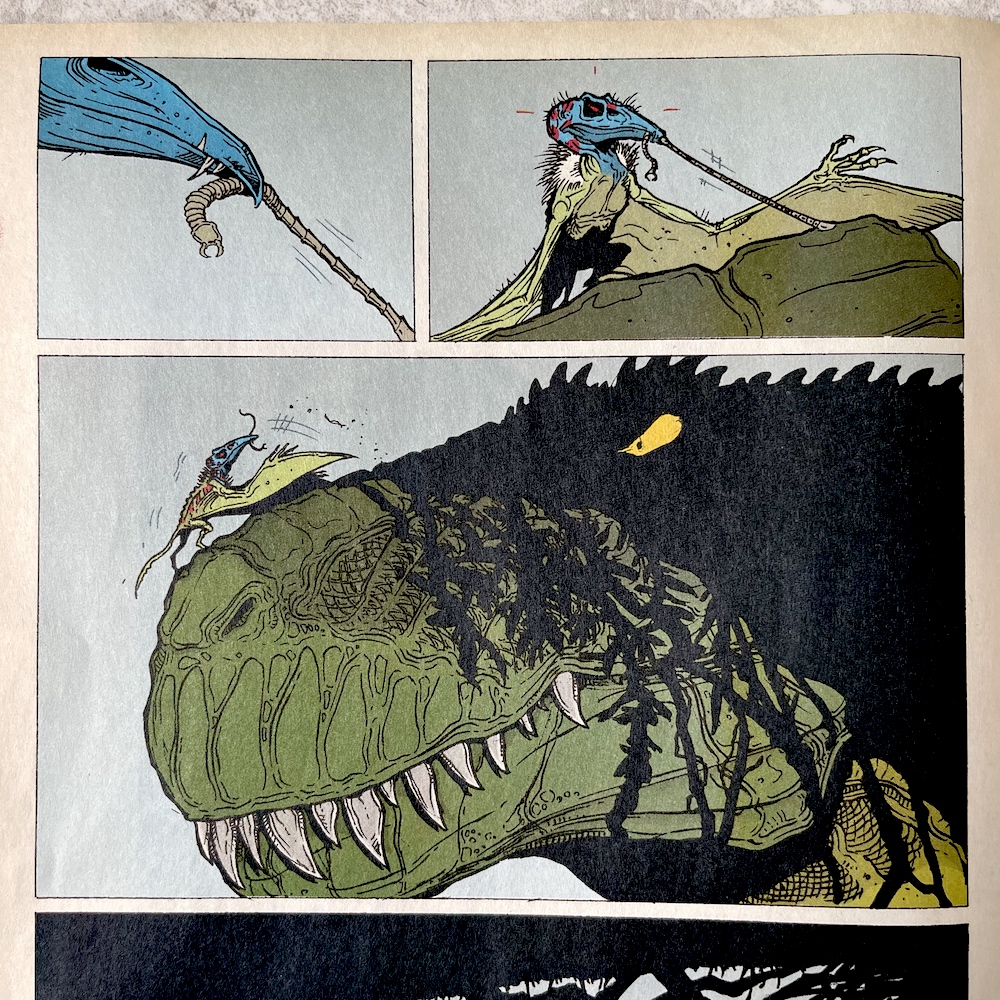
The two remaining members of the group, leader Dark Eye and Quetzal are spending their day stalking a giant T.rex called Long Jaw, the same one we got acquainted with last time. What are they hoping to find out? That’s for another episode. This issue, they witness from afar the ‘rex challenging the leader of a herd of Triceratops, each one beautifully and individually coloured by James Sinclair. The leader of the herd isn’t backing down and roars at the ‘rex, the giant predator remaining silent, the small bird on his nose responding instead.

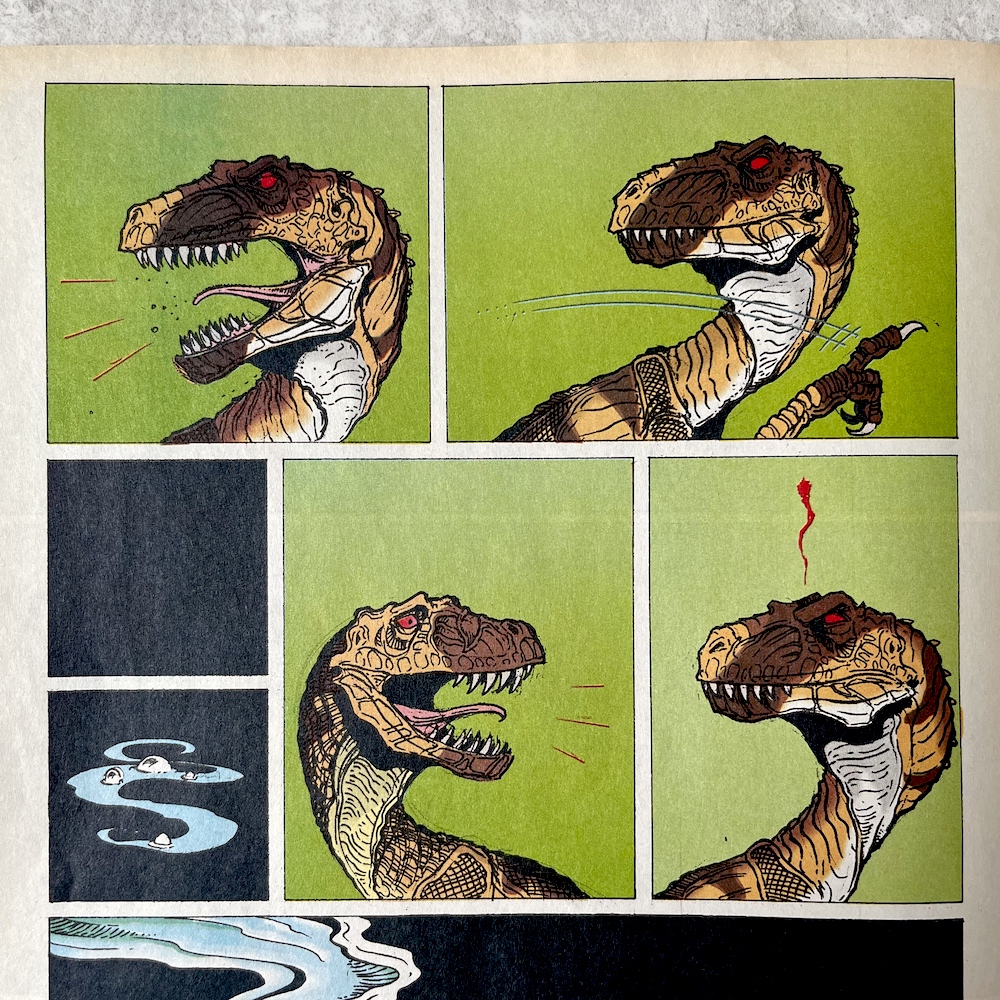
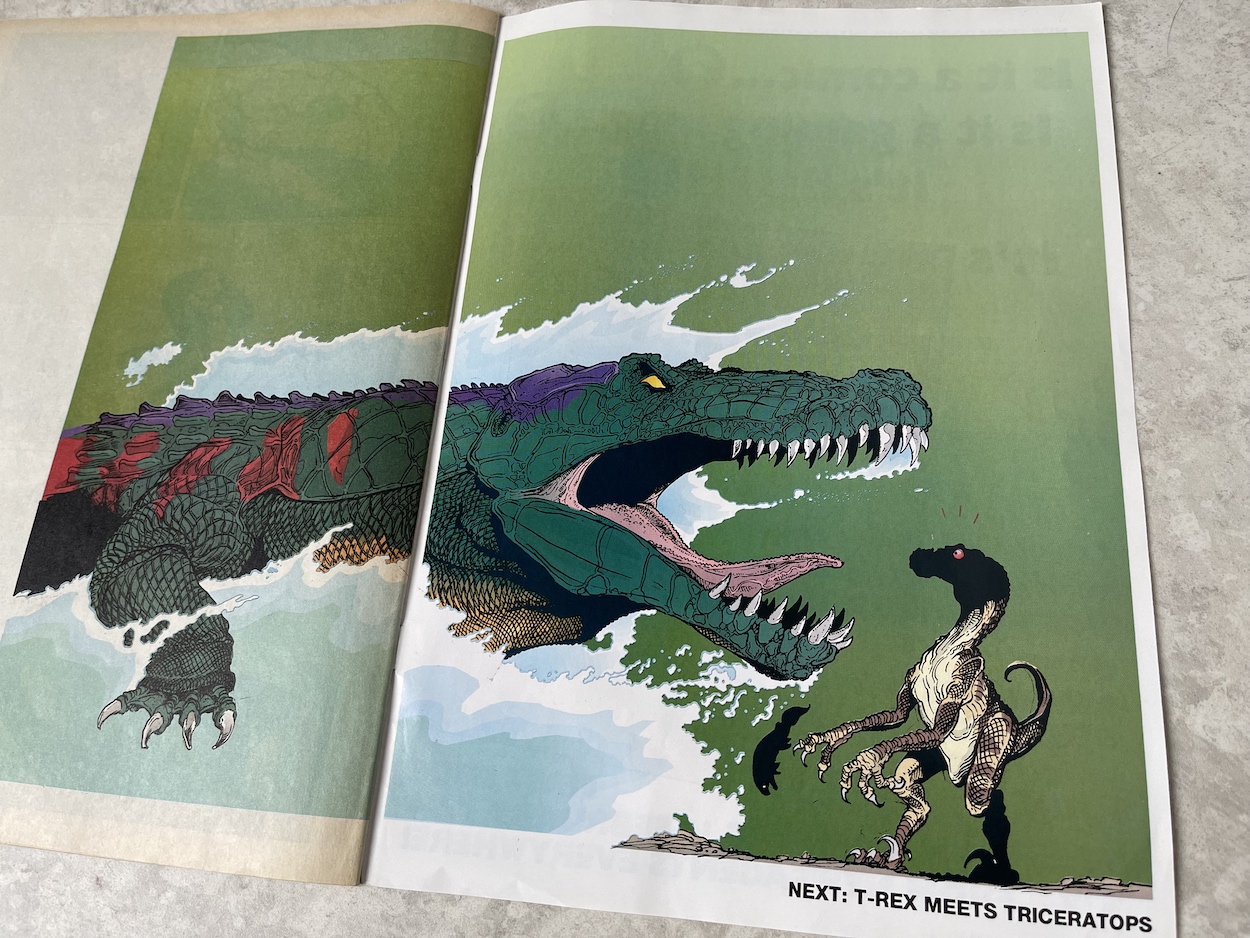
However, as you can see from the second photo above, after many cries from his mate the male Triceratops takes a look at the Tyrannosaur‘s slowly opening mouth and decides to heed her warnings, leaving a miffed T.rex behind in a moment that did make me laugh. It was a fight for the sake of a fight, it was never about predator and prey, but that panel with the little squiggly line above Long Jaw’s head depicting his annoyance is a great comedy moment after a few pages of tense build up.

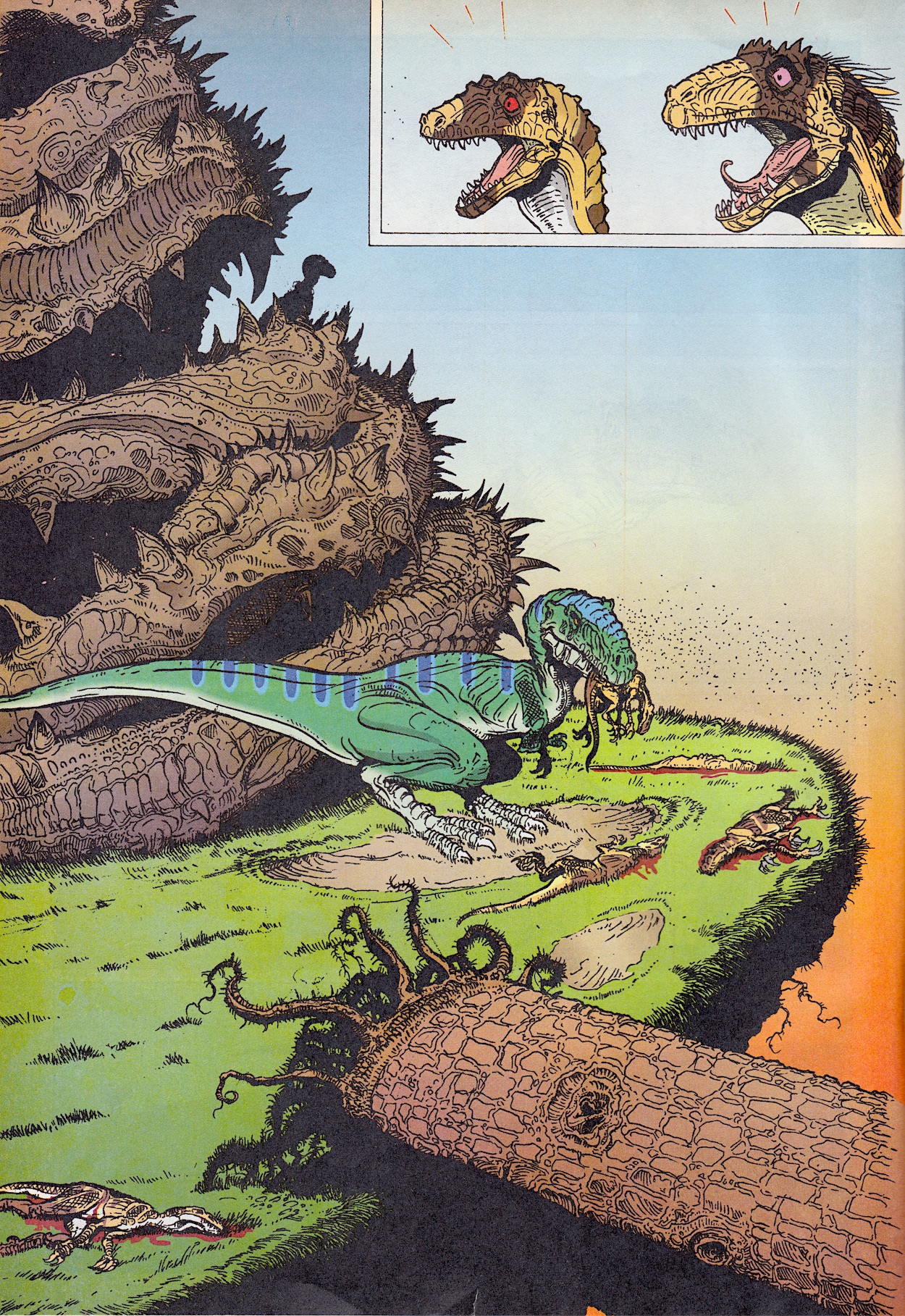
We rejoin our two smaller dinosaurs as they return to their nest only to find that while they’ve been following one of the Tyrannosaurs, Blue Back (who they originally ran into back in #6 when all this began) took advantage of their absence and has killed everyone else in their pack in revenge for the theft of his family’s eggs in #7. Once he sees the shocked look on their faces he simply drops the final body and leaps across the chasm in an echo of their escape from him, disappearing into the jungle. The war is on.

Once again Ricardo’s pacing is superb and his art gorgeous, with James’ colours the perfect accompaniment. There’s action, an interesting story, individual characters and some genuinely funny humour. It was always a highlight of each issue and was the first strip I’d read every month. While it was originally released as a book I prefer getting little chunks of it at a time. It highlights the tension and obviously makes it last longer.

Every creature here is so full of character but where did I get those wonderful names from if there are no written words in the strip? Well, included in this issue is a bonus Cast of Characters page from the book. It would’ve been good to have had this alongside the first chapter but it’s better late than never. Also, there appear to be some interesting new characters to come. I can’t remember them so I’m excited to see where they fit in with everything. More exciting times ahead.

Our regular Jurassic Park strip has been cut down to only six pages but we can’t really complain when we’ve already had an additional prequel, totalling 14 pages for our title strip. Our regular sequel team return for the first (little) chunk of Dark Cargo; writer Steve Englehart, penciller Armando Gil, inker Dell Barras, letterer John Costanza and colourist/story editor Renée Witterstaetter. Confusingly, the story is called ‘Raptor – Part Four’ on the contents page because Dark Cargo was the second issue in the original American Topps Comics ‘Raptor’ mini-series, and the first (‘Aftershocks‘) was split across the three previous UK issues. This confusing decision to list the strip after the US comic’s individual series rather than the actual strips would continue all the way to the final issue.

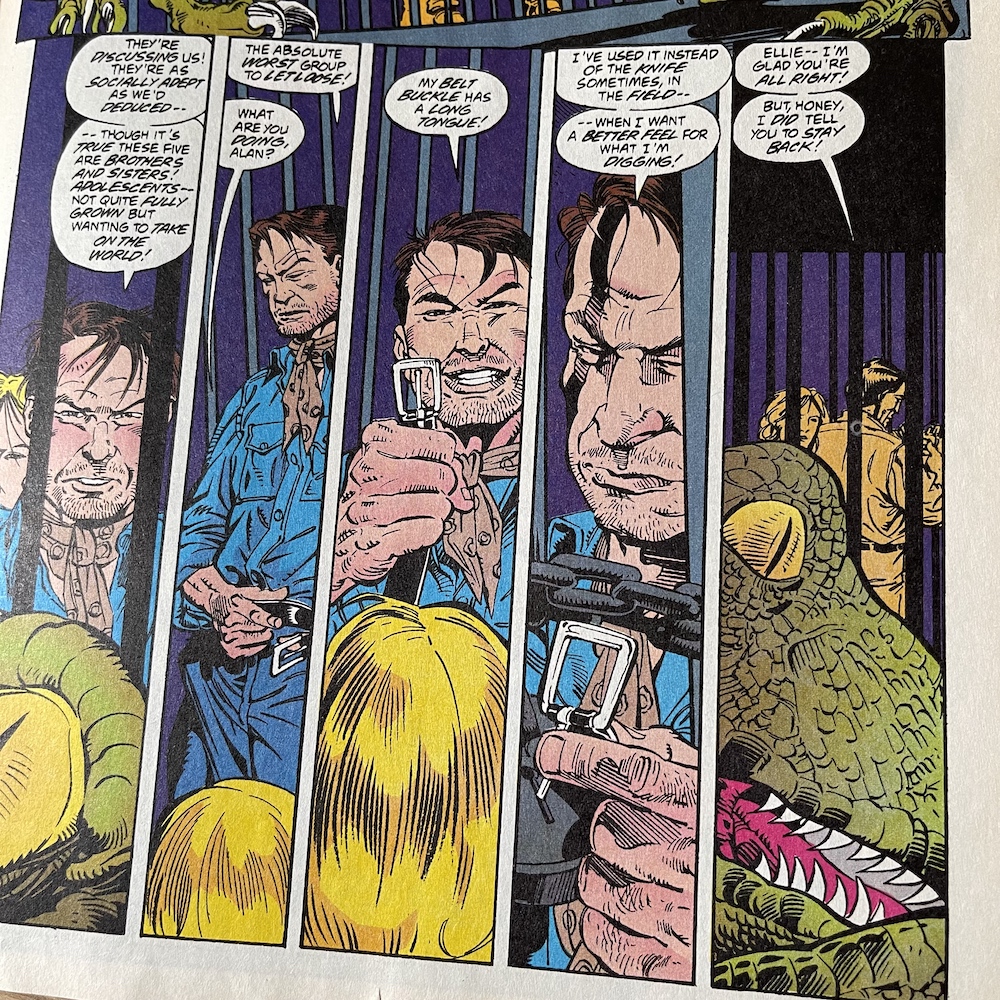
Doctors Ellie Satler and Alan Grant awake locked in a cage on a cargo boat with big game hunter George Lawala in charge. The juvenile Velociraptors have been locked up separately right next to them, already wide awake and alert to everything going on around them. This is key (no pun intended for what I’m about to describe), as we see the ‘raptors in the background of nearly every panel of the humans talking, watching what they’re doing. Alan realises his belt is the one with the buckle he’s used as a substitute knife before on digs and perfect to pick the lock, before Ellie notices something happening in the other cage.

We also see the dinosaurs hissing and clicking at each other, Alan deducing they’re discussing them and how to escape. I can remember pieces of what’s to come and it’s definitely a story centred around the intelligence and learning capabilities of these juveniles, and their instincts and observations of the various humans around them. I’m looking forward to reading it again after so long with a fresh set of eyes, especially after enjoying the four movie sequels (so far) which have really delved deep into this.

There’s a funny moment when Alan comments how these are adolescents, the equivalent of human teenagers and says, “Not quite fully grown but wanting to take on the world! The absolute worst group to let loose!” But before they can warn Lawala of the lock picking he sprays them and the ‘raptors with a sleeping agent and off they all nod until next month. Before they pass out Lawala shows us he’s the atypical Jurassic Park villain (before there was such a thing); he’s never encountered a dinosaur before, but he’s a human, and a man, and thus is more intelligent and can control them just like any other animal he’s hunted. We just know that’s going to work out well, don’t we?


“The necessary sacrifices were made.”

Fessenden

It may be just one small scene on board the boat, but it’s atmospheric stuff and has plenty for readers to get their teeth into, building excitement for the chapters to come. I’m actually surprised at just how much of this could’ve been the basis for some of the main stories in the sequels, especially Jurassic Park III and Jurassic World which both did a superb job of building on the themes presented here. It also doesn’t feel like we’re being short-changed with only six pages this month because it’s a perfect little strip in its own right and acts as a prelude to the disaster to come.

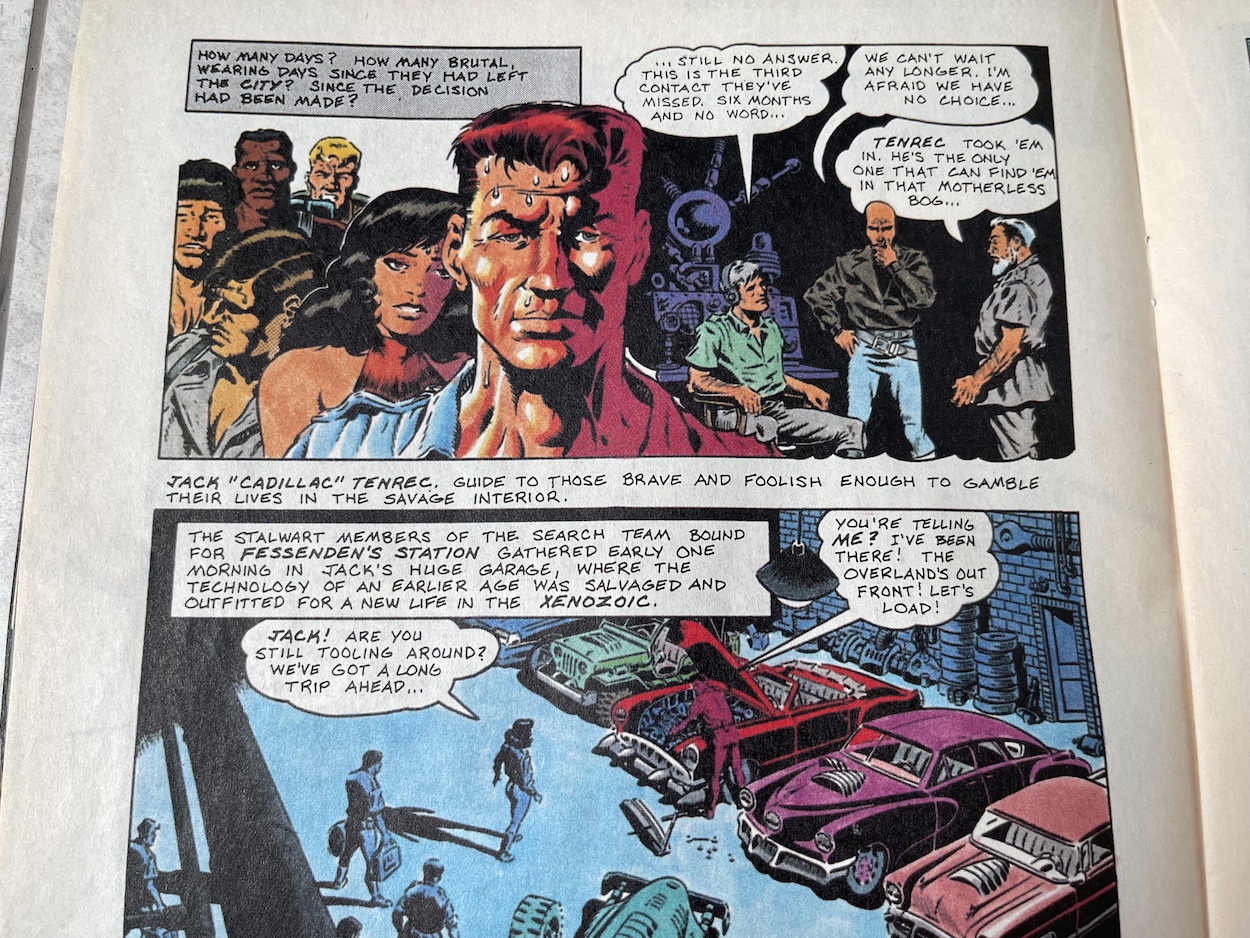
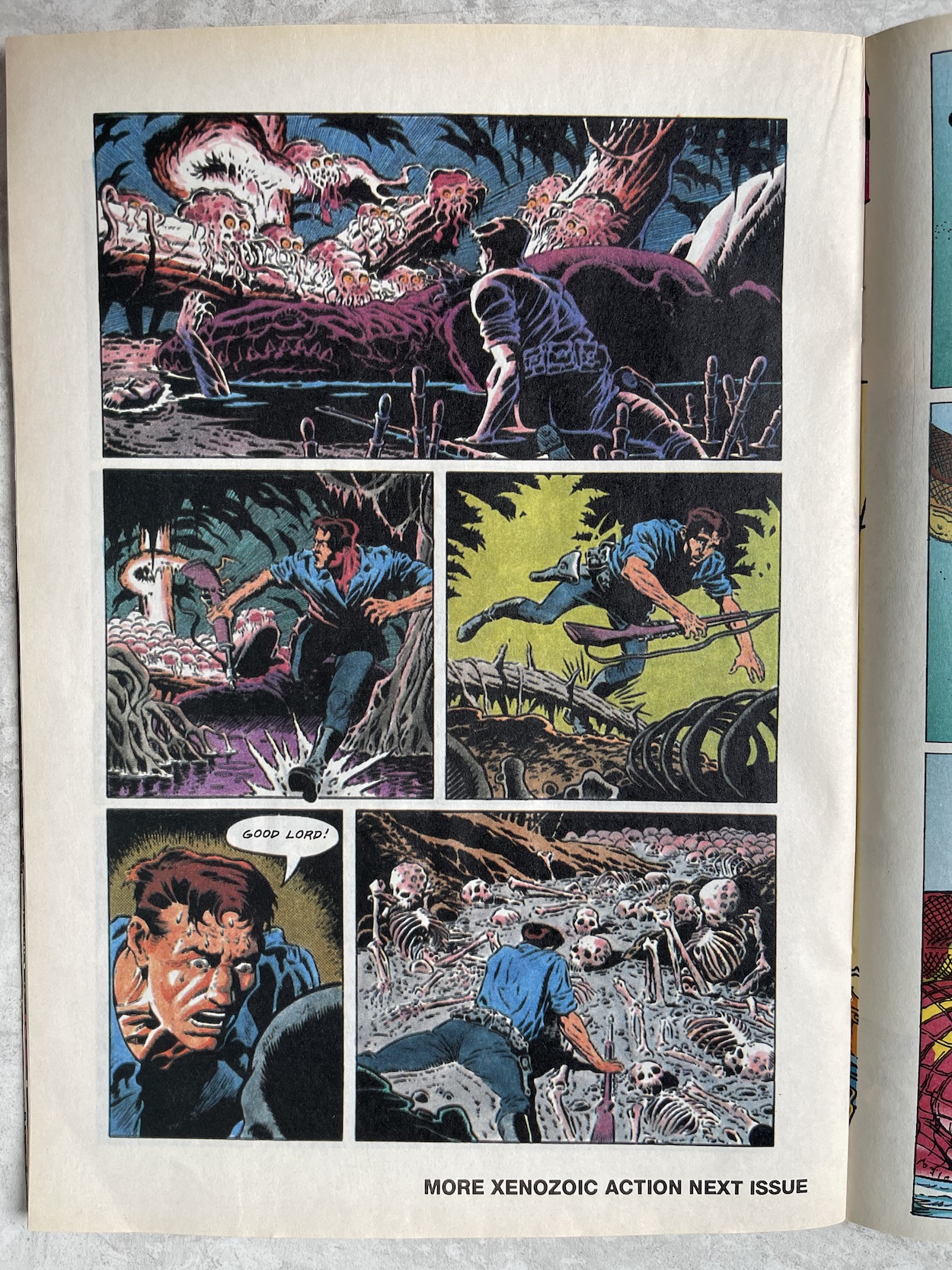
Mark Schultz‘s Xenozoic Tales rounds off the issue, once more beautifully coloured by one of my favourite Transformers colourists Steve White (whose current dinosaur artwork needs to be seen) but we only get a measly four pages this time. Obviously, editor Dick Hansom would’ve had this all worked out in advance to give us as much as possible every issue, knowing we’d have extra content this month. As such, there were only four pages left of this particular story to tell. But what four pages they are.

It not only solves the mysteries of that cliffhanger but also grosses us out a little on the way to its conclusion

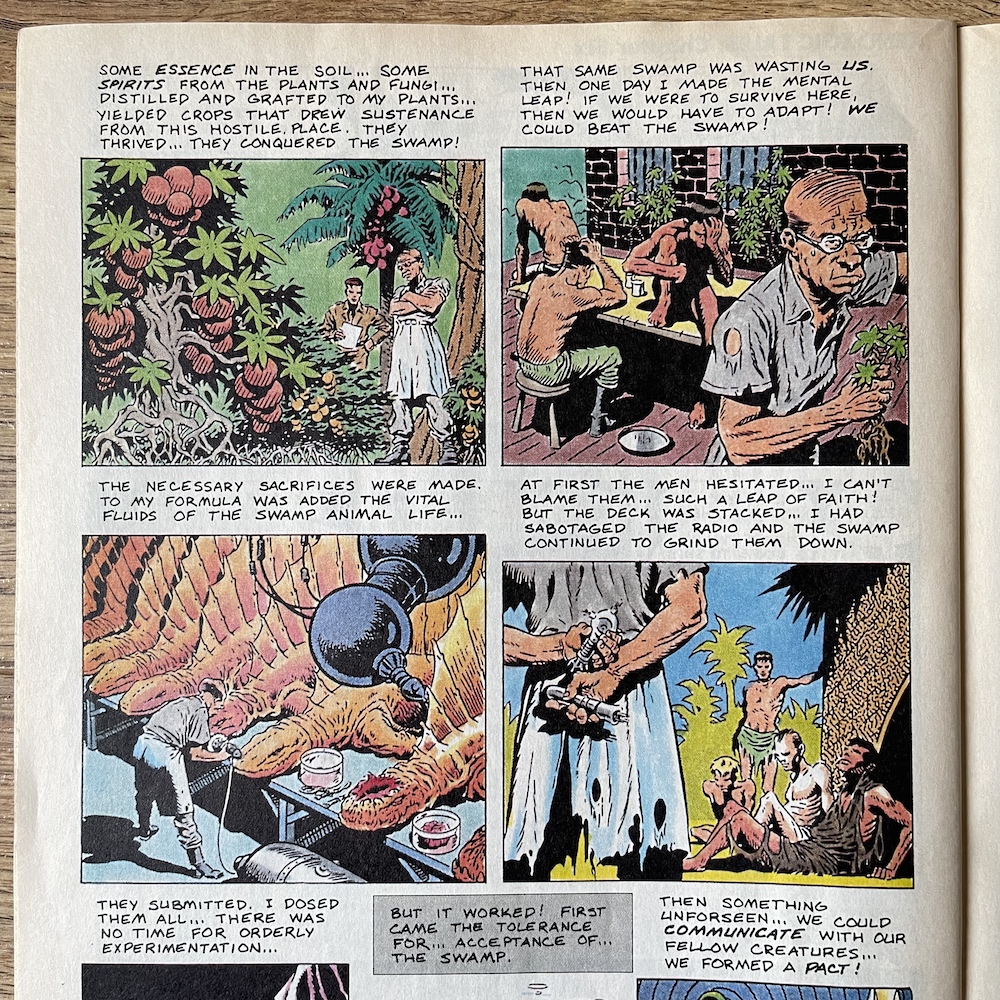
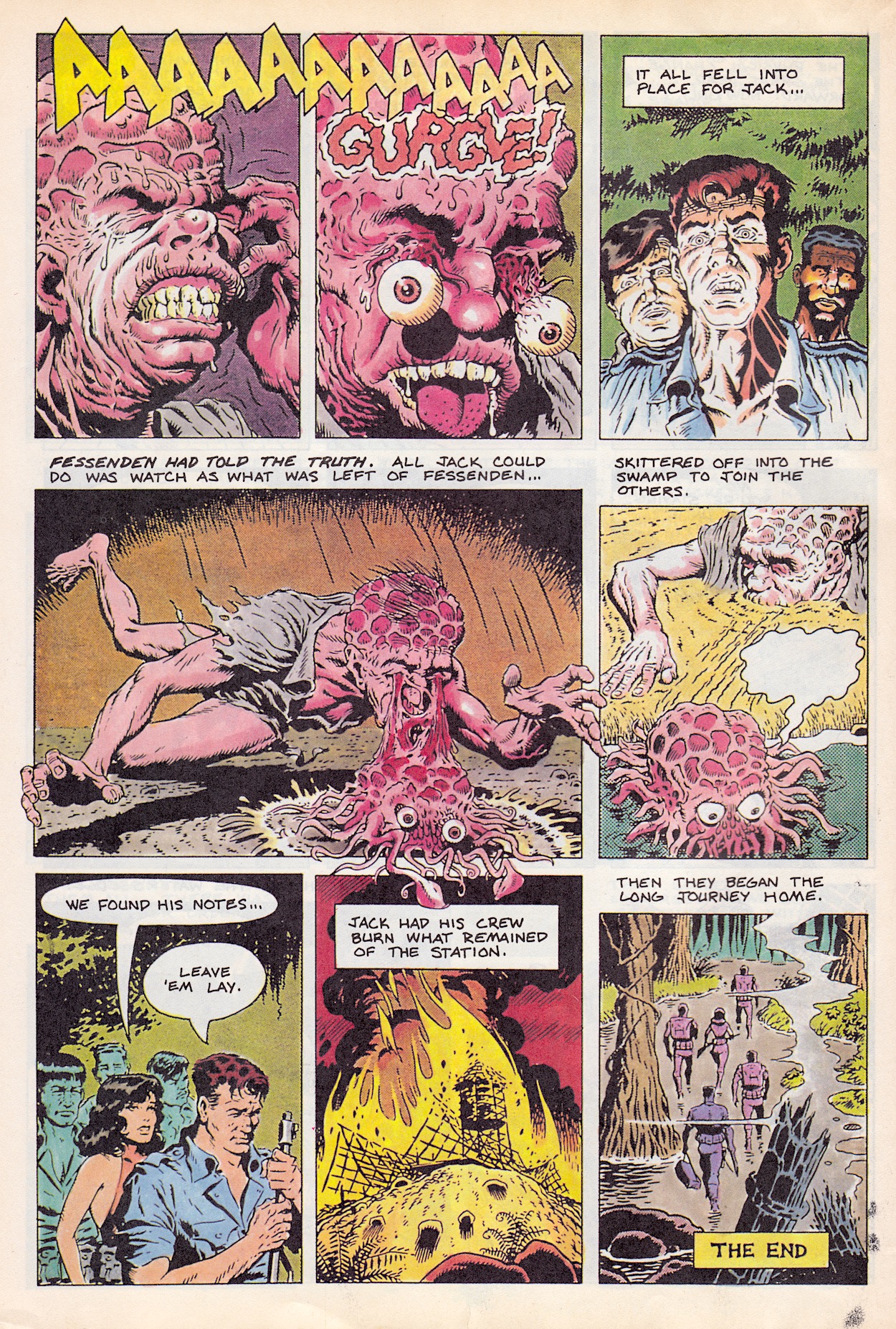
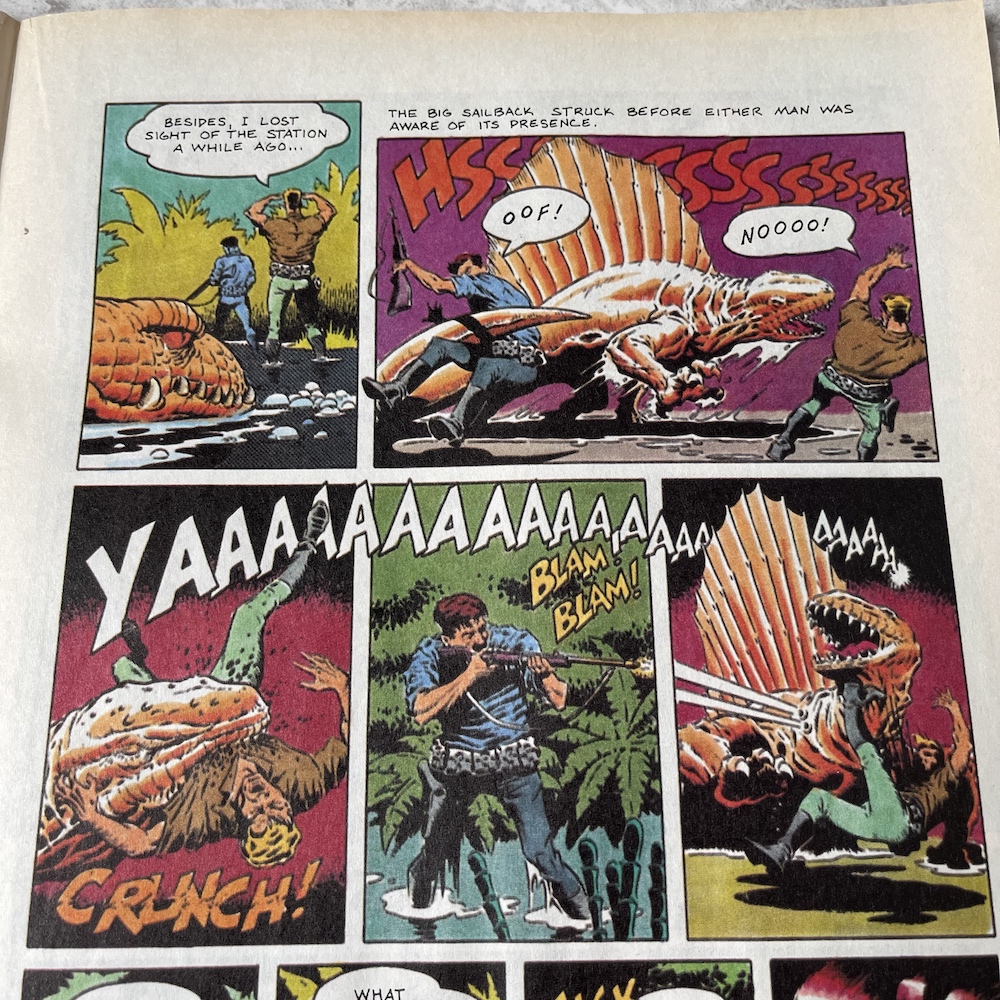
So Tenrec returns to Fessenden after the shock cliffhanger and demands a full explanation. The swamp had taken over body, mind and soul of his entire research team, everyone driven to the edge of nervous collapse. But Fessenden was getting incredible results from his experiments; he could solve the food shortage crisis. As you can see above he started performing autopsies on the local dinosaurs and experimenting on his own people, deliberately cutting them off from the outside world so they’d have no choice but to take part. Soon they were thriving in the swamp and even communicating with the animals. But then the physical changes began.

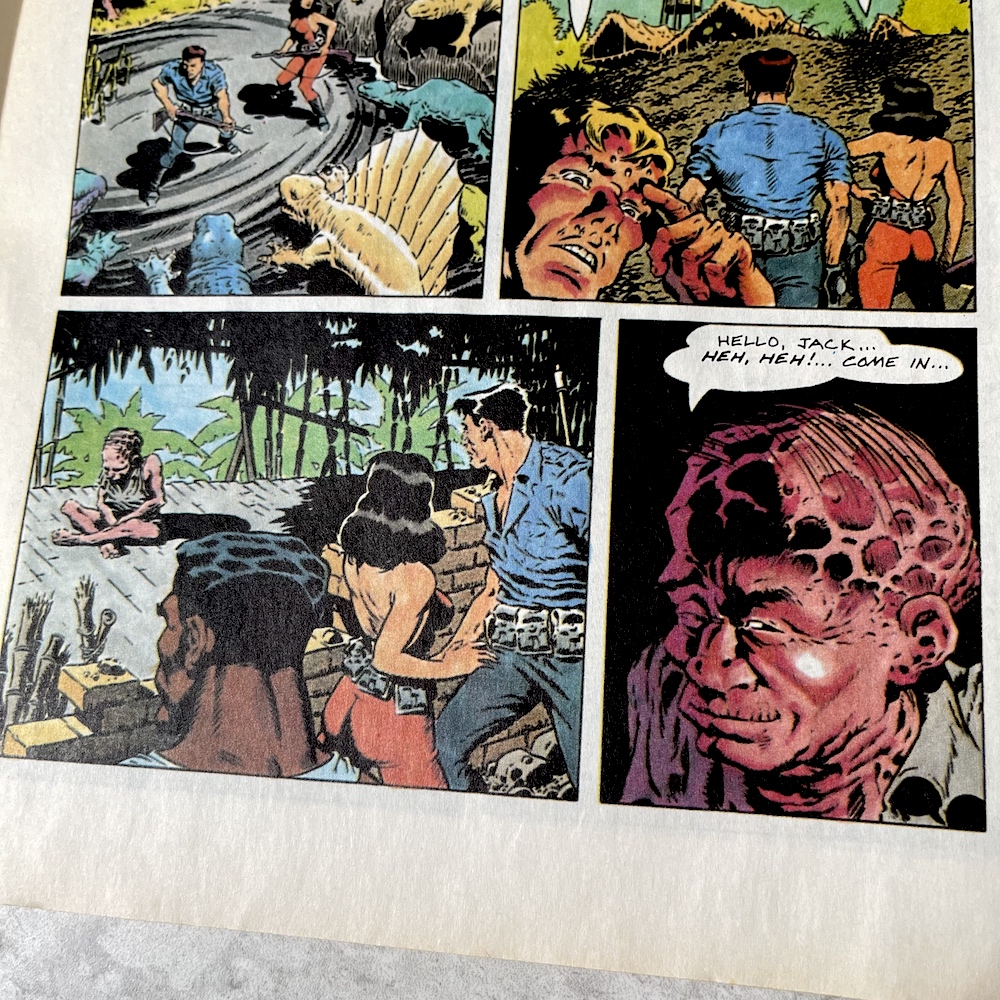
He doesn’t delve deeper, instead making a sudden run for the swamp. For the final page of the story and the comic we’re presented with this below. It not only solves the mysteries of that cliffhanger but also grosses us out a little on the way to its conclusion.

At its centre it’s a typical tale of humans messing with nature and suffering the consequences, so it’s quite appropriate for a Jurassic Park comic. However, it’s told in a very engaging way, is beautifully drawn and I’m so glad Steve was brought on to colour it, he takes it to a whole other level. Any fans of Mark’s comic really need to hunt this down because this particular coloured version is exclusive to Jurassic Park.

Despite the rather average headline prequel story this month, this is still one of the best issues yet thanks to just how enjoyable the three ongoing serials have been. It bodes well for next month, that’s for sure. The next issue’s review will be here from Tuesday 29th March 2022.

iSSUE EiGHT < > iSSUE TEN

JURASSiC PARK MENU

JURASSiC PARK #8: PURE ESCAPiSM

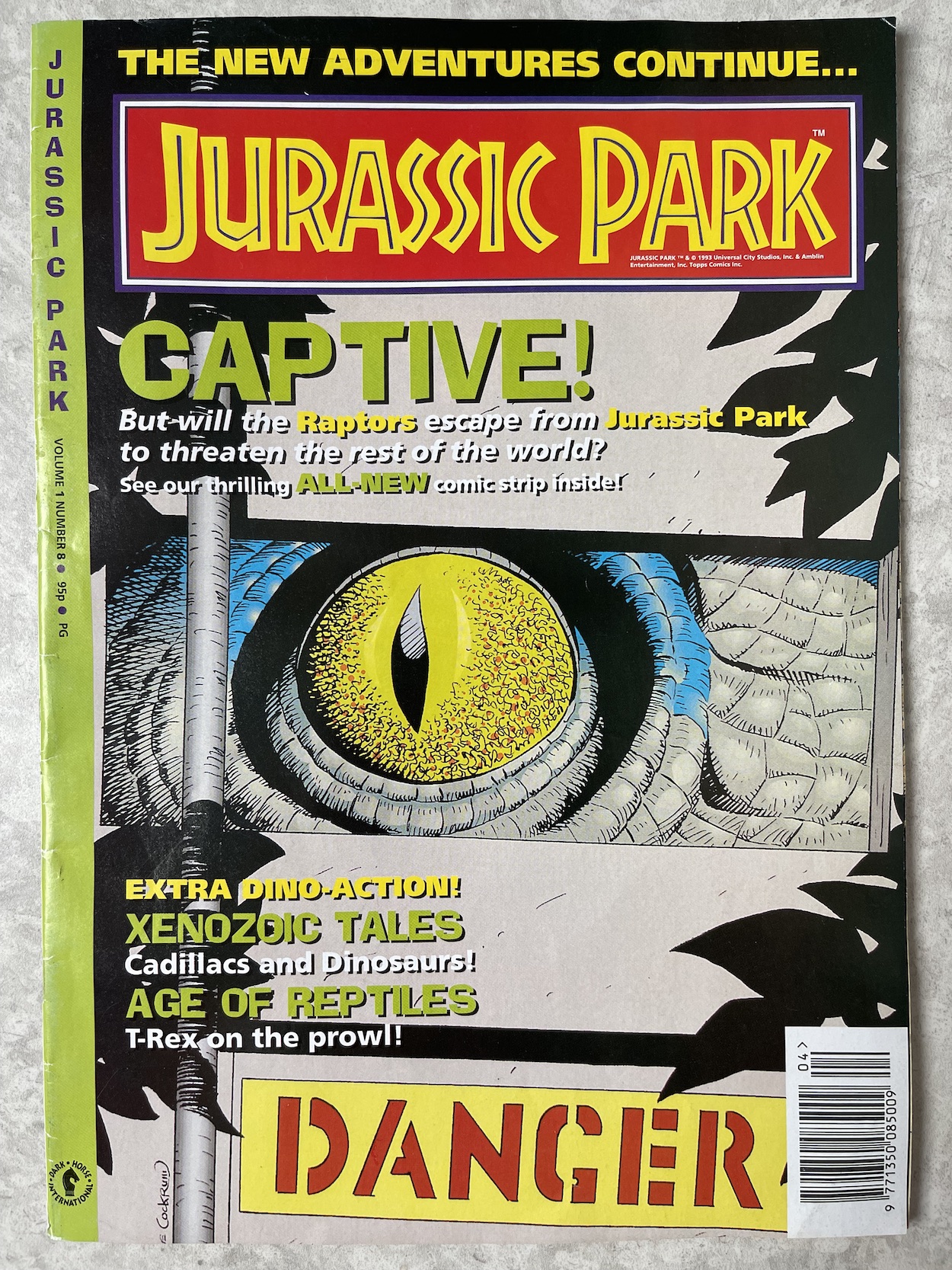
A simple cover of an iconic movie scene by Dave Cockrum welcomes us to #8 of Dark Horse International‘s Jurassic Park. The cover is from the first issue of the American movie adaptation so really shouldn’t make sense here, after all the Velociraptors are no longer caged up, but it reminded us of the danger from the film that was now running loose. Inside we’ve less adverts and more comics, making for a very satisfying read this month and the title strip no longer has the least amount of pages.

The well chosen cliffhanger last month saw the original US strip cut out at the point Dr Alan Grant and Dr Ellie Satler‘s theories were proven terrifyingly correct. Now they and new character, big game hunter George Lawala are faced with a fully grown mother raptor and her juvenile offspring and she isn’t happy. Grant pushes some boulders, causing a chain reaction, giving them just enough time to make their escape, but it isn’t long until she’s out and chasing Lawala.

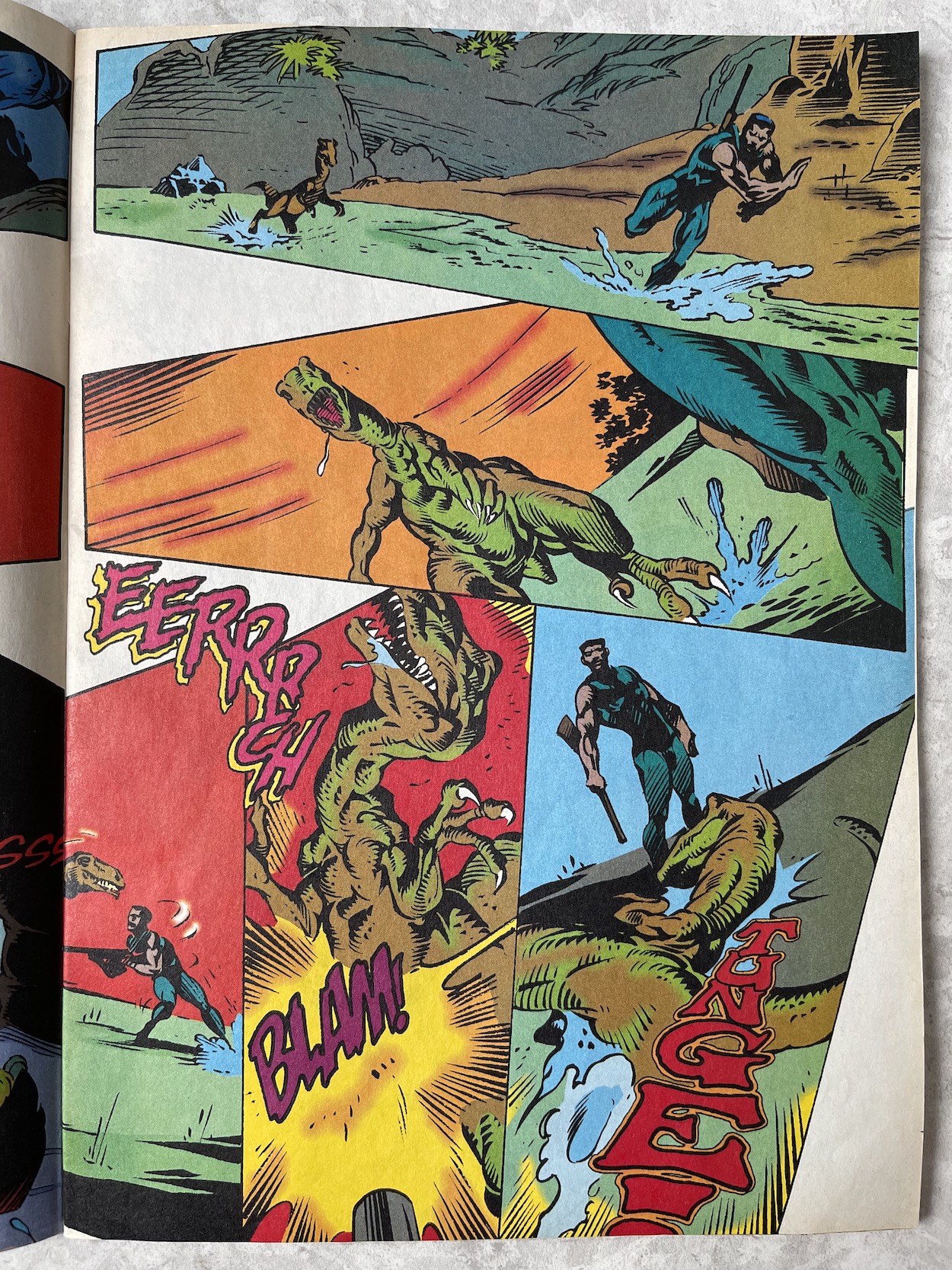
Here we get a few action pages of a chase on the beach, ending with the raptor being shot. Lawala muses over the fact the injured animal isn’t what his employer wanted so he shoots it again to kill it. Surprised there are actual dinosaurs here, that it wasn’t some case of mistaken identity he lets his concentration slip, not realising she isn’t quite dead yet and with her dying breath she snaps her jaws around his ankles. He’s able to squeeze himself free and limps off in search of the others.

It’s hard to believe this is the same artistic team (penciller Armando Gil, inker Dell Barras and colourist Renée Witterstaetter) as those thrilling first few pages back in #6. This feels rushed by comparison and overly simplistic. To be fair this is only a problem for a few pages, but they’re the ones involving what should be the highlight of any chapter in a Jurassic Park comic strip, a dinosaur attack! It all feels rather muted as a result.


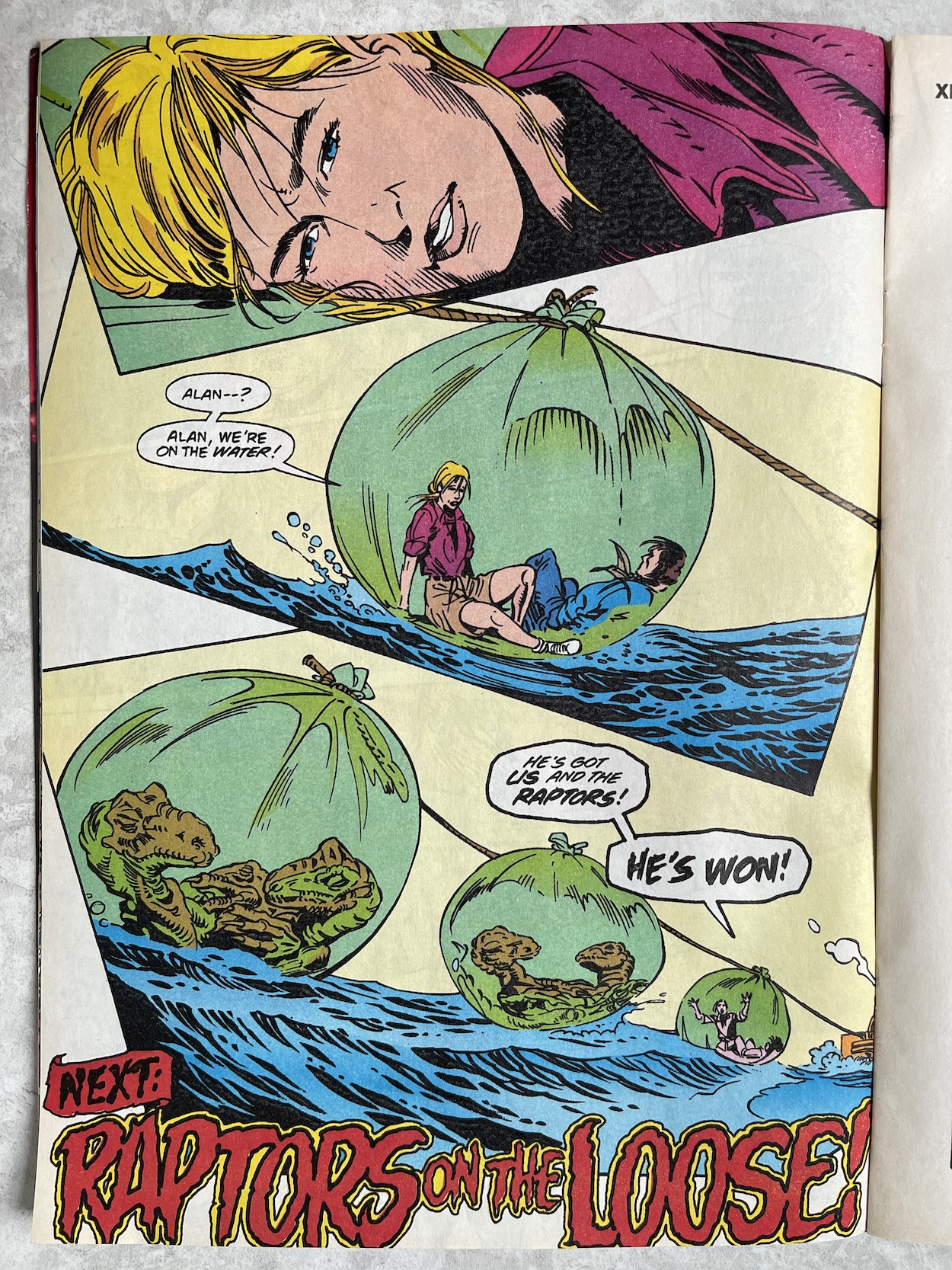
“He’s got us and the raptors! He’s won!”

Dr. Ellie Satler

Things pick back up again as we rush towards the end of the first chapter to our sequel story. Our heroes are captured by Lawala who had waited near the cave, knowing they’d return to make sure the dinosaurs were okay. Just as with the movies, while the Velociraptors are dangerous, it’s also important to protect them from the dangers of humans. A fight ensues and of course Alan and Ellie are outmatched, although they do give a valiant effort. Alan tries in vain to convince Lawala he must realise the animals can’t be taken off the island, that what happened to the park could happen to the world. But Lawala readily admits he’s too greedy to care.

Beaten unconscious, Ellie and Alan eventually wake to find themselves in a somewhat impossible position, just right for an almighty cliffhanger with suitably dramatic lettering by John Costanza. Although, it does unintentionally raise a few chuckles because it reminds me of the ending to Finding Nemo, which of course came much later. This story by Steve Englehart reminds me very much of where the Jurassic World trilogy has been heading. I’m writing this before the third movie (sixth in the overall series) is released, the previous movie having ended with dinosaurs out in the world among us. I’m really excited for that film and I think that’s the same excitement I had when I first read this back in 1994.

“The world swarms with the living evidence of a billion years of evolution!” Thus begins the next chapter in the ongoing Xenozoic Tales saga, the first of our two dino-themed backup strips. The story here (as ever written and drawn by Mark Schultz) is the classic sci-fi scenario of losing contact with a research outpost and going in to find out what’s wrong. We know it’s clearly going to be bad news but that’s not the point of the story, it’s all about what has gone wrong and exploring a little more of this strange new world, its dangers and having some action and excitement along the way.

The first thing I noticed was the bold colouring, which is a lot more colourful than in previous issues. This is because we have a new contributor and it’s none other than Transformers colourist and Visionaries editor Steve White. In the earlier years of Transformers the colours were all beautifully hand-painted, before a new system was introduced that produced much flatter results initially. But in the right hands it could be stunning. Steve’s were one such pair of hands. His colours really pop, bringing depth and excitement to a story that’s already fun to read.

I asked Steve about his time working on Jurassic Park and he told me that while it was a work-for-hire gig he was a big fan of Mark’s and of Xenozoic Tales. He produced these beautiful results with markers on photocopies of the art, and he’d travel to North London to Dark Horse International’s little (according to Steve) office to pick up and return the pages.

Months previous, a great scientist by the name of Fessenden had asked Jack Tenrec to take him and his team out to a swamp for their research, explaining he’d discovered a secret to saving their crops. Now returning with a rescue team, Jack faces off against vicious, overgrown versions of dinosaurs that are usually tiny and docile. They start to show hunting skills they’re simply not meant to have, circling the team and attacking systematically. Eventually they make it to the station which is now a crumbling wreck and discover the shocking transformation of Fessenden.

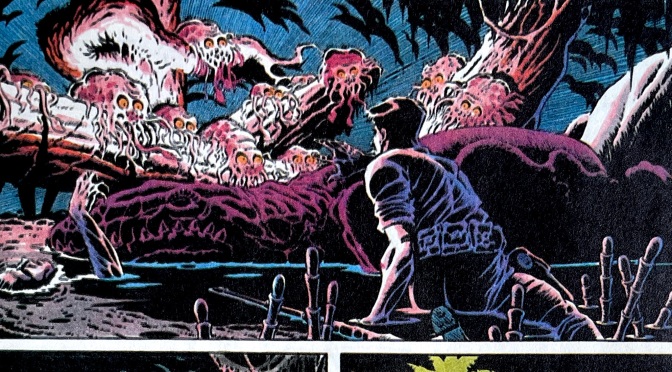
His team are nowhere to be found, he isn’t doing any of the work he was there to accomplish and his head has become a strange elongated shape, covered in what looks like pulsating veins, like his brain is trying to push itself out through his skull. Jack sets out to find the missing researchers, only to literally stumble upon creepy blob-like creatures not dissimilar to his old friend’s head, then a mass grave in the final panel.

While so far there’s nothing particularly original here, these little blobs are intriguing and having read Mark’s other tales printed in this comic so far I know the payoff will be excellent. Its pacing is perfect and I can’t overemphasise how much Steve’s colouring adds to the rich atmosphere.

While this is listed as ‘Chapter Five’ on the contents page it’s actually the first strip in the series, originally published in Death Rattle magazine in the States in 1986. It acted as a kind of pilot, a testbed for a possible series. This explains why this particular chapter is simply called Xenozoic. It was clearly well received because Mark would go on to sporadically release more stories in his own comic. Jurassic Park editor Dick Hansom decided to print the few strips already coloured in a Marvel US reprinting first so we’re getting the story out of order. But it did mean we could enjoy this one coloured by Steve so I’m happy he waited.

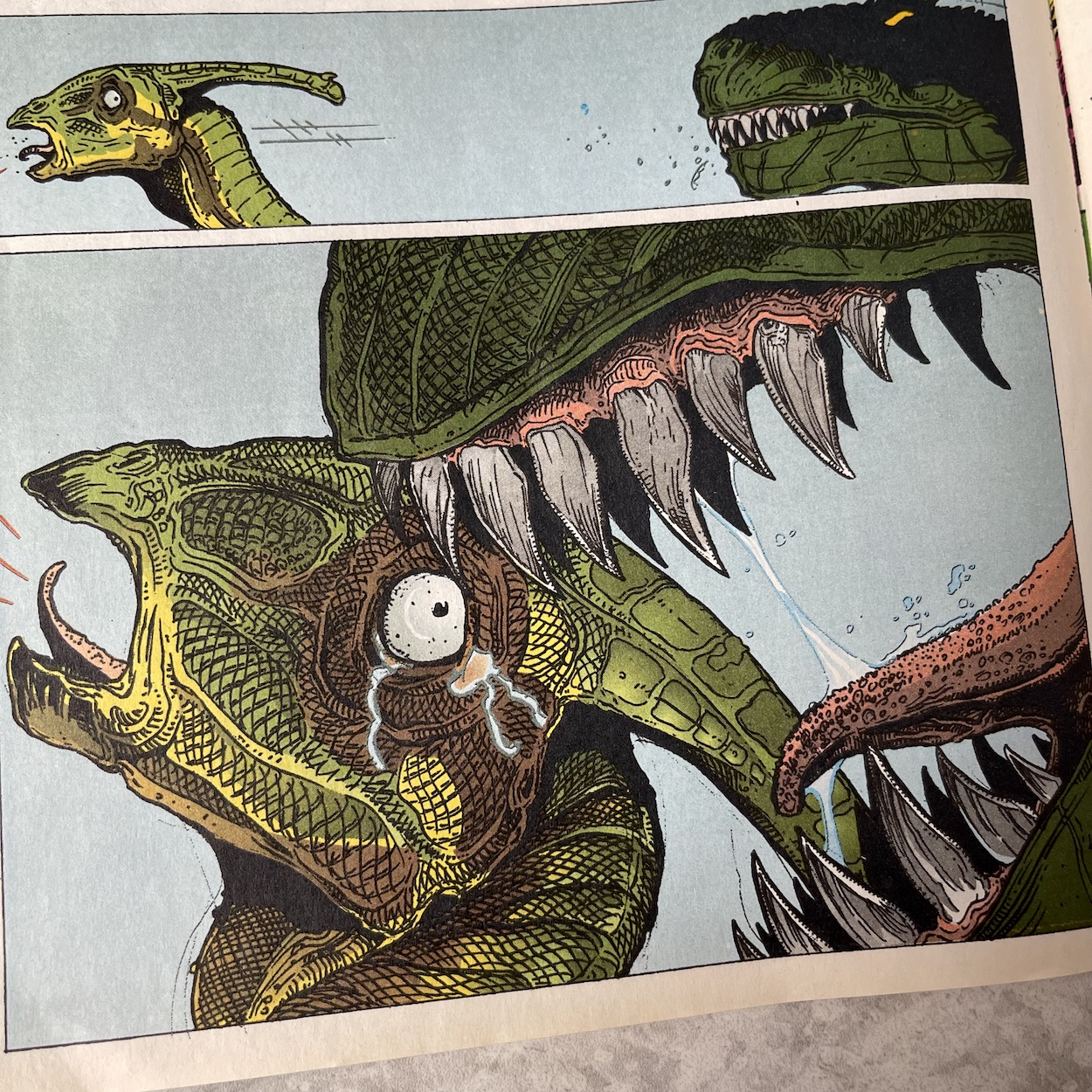
Moving on to Ricardo Delgado‘s Age of Reptiles (coloured by James Sinclair) and it takes up less space this issue to make way for much more of the title strip, but it’s no less enthralling. We were left wondering what was going to happen next after the Deinonychuses stole the unhatched eggs from the Tyrannosaurus rex nest, but this issue the battle of the species takes a back seat, the pace slowing down and showing the dinosaurs going about their lives as dawn breaks. It begins with a pack of Parasaurolophuses lazily drinking by a waterfall, unaware they’re being watched.

I don’t think I picked up on this until a later issue when I was a teenager, but this is clearly a different T-rex than the one we’ve seen in previous issues. Only when both appeared together in a later chapter did I notice the completely different sets of markings, probably because I didn’t go back and read previous issues of comics before reading new issues back then, so when I saw this T.rex I incorrectly assumed I knew who it was. I love the little bird picking out a borrowing critter from its head and the dark shadows obscuring the hunter as he stalks his prey. The Parasaurolophuses are so delightfully drawn I can’t help but feel sorry for this one.

We see the predator begin to feast before cutting away to the silhouettes of the Deinonychuses making their way through the thick jungle. We’re not sure where they’re going yet and we don’t find out this issue, but what does happen here is highly entertaining and builds to a surprise cliffhanger. One of them gets distracted by a fish flopping about on the ground near a body of water and wants to stop to feed. You can see the distinct head markings of each character here, their leader not impressed with being slowed down and this little silent exchange did make me laugh.

That little red wiggle and that glare are comedy gold.

In the panel before it you’ll see some little bubbles appearing in the water beside them. Ignoring their leader (and not noticing there’s something in the water), the hungry dino picks up the fish and opens wide, presenting us with a full page of this action, panel-by-panel, the shadow of the mouth engulfing the fish, saliva dripping from its mouth, only for us to turn the page over and be confronted with this image below.

This was such a surprise ending. I’d forgotten all about it in the intervening years but seeing it now brings back the memory of having a feeling of real impatience and frustration at having to wait a month to see the next part. I think you’ll agree that’s understandable.

So this is where my monthly dive into this brilliant comic comes to an end once more. Three superb cliffhangers (even though only one was originally intended as such), interesting stories, plenty of action, loveable characters and the surprise addition of a favourite Marvel UK colourist. It’s been an absolute joy yet again. It will continue in this format for a little while yet, so there’s much to look forward to over the coming months and the next bit will be here on Tuesday 22nd February 2022.

iSSUE SEVEN < > iSSUE NiNE

JURASSiC PARK MENU

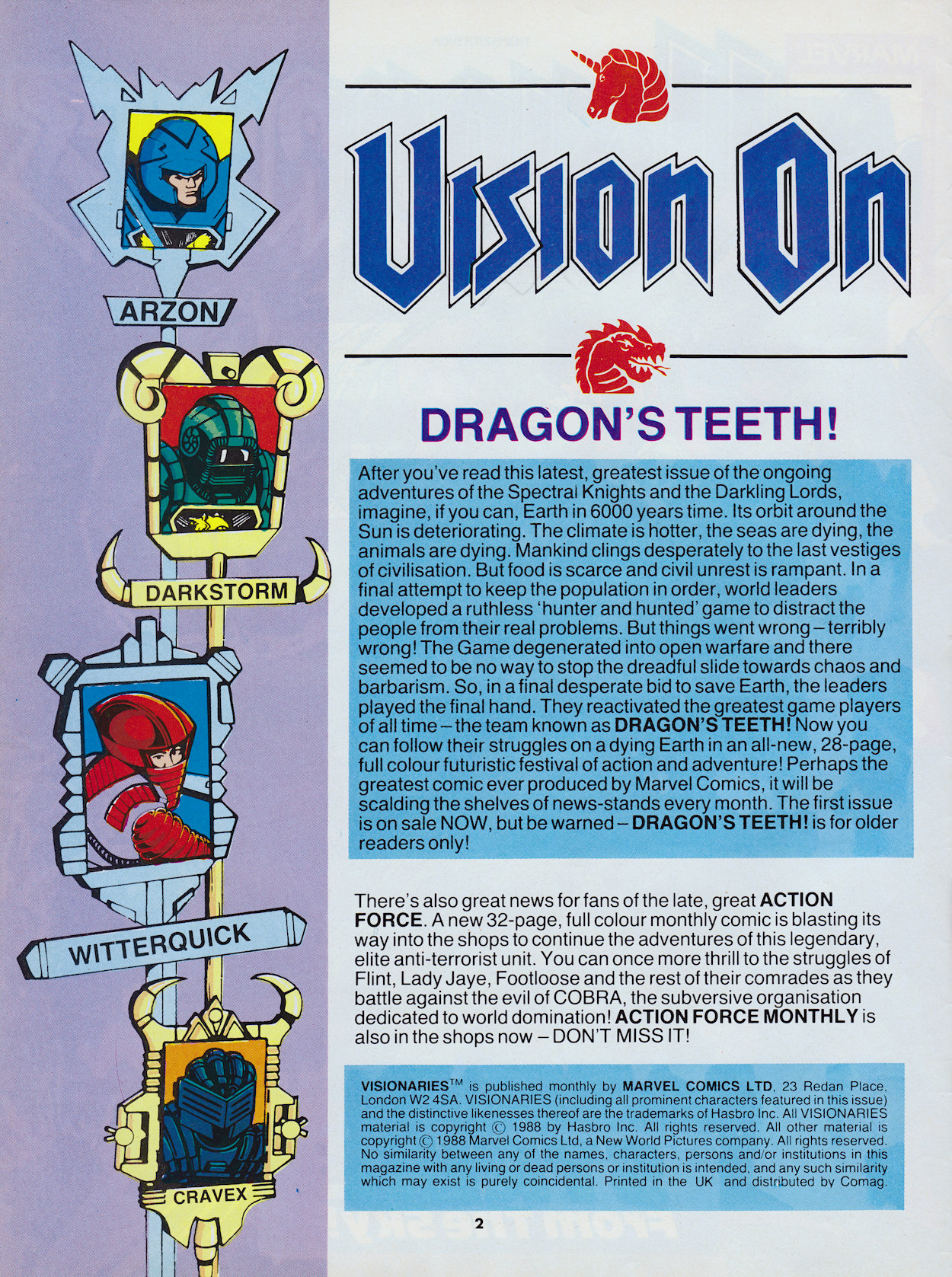
ViSiONARiES #5: SiRENA SONG

If you were to take a quick glance through this latest issue of Marvel UK‘s Visionaries from 1988 you’d think it was business as usual, with another lengthy strip featuring the Knights of the Magical Light and their quest to rebuild their crumbling planet. After last month’s superb story by new writer Gerry Conway anticipation is also high. But look beyond the brilliant cover by Mark Bagley and we discover some bad news on the editorial page.

There we find a tiny message from editor Steve White announcing the horrible news that this, only the fifth issue, will be the last. He says there are more details to come so we’ll concentrate on the strip first and see what those details are later. As with the previous issues, it’s written by Gerry Conway, pencils are by Mark Bagley, inks by Romeo Tanghai, letters by Janice Chiang and colours by Julianna Ferriter.

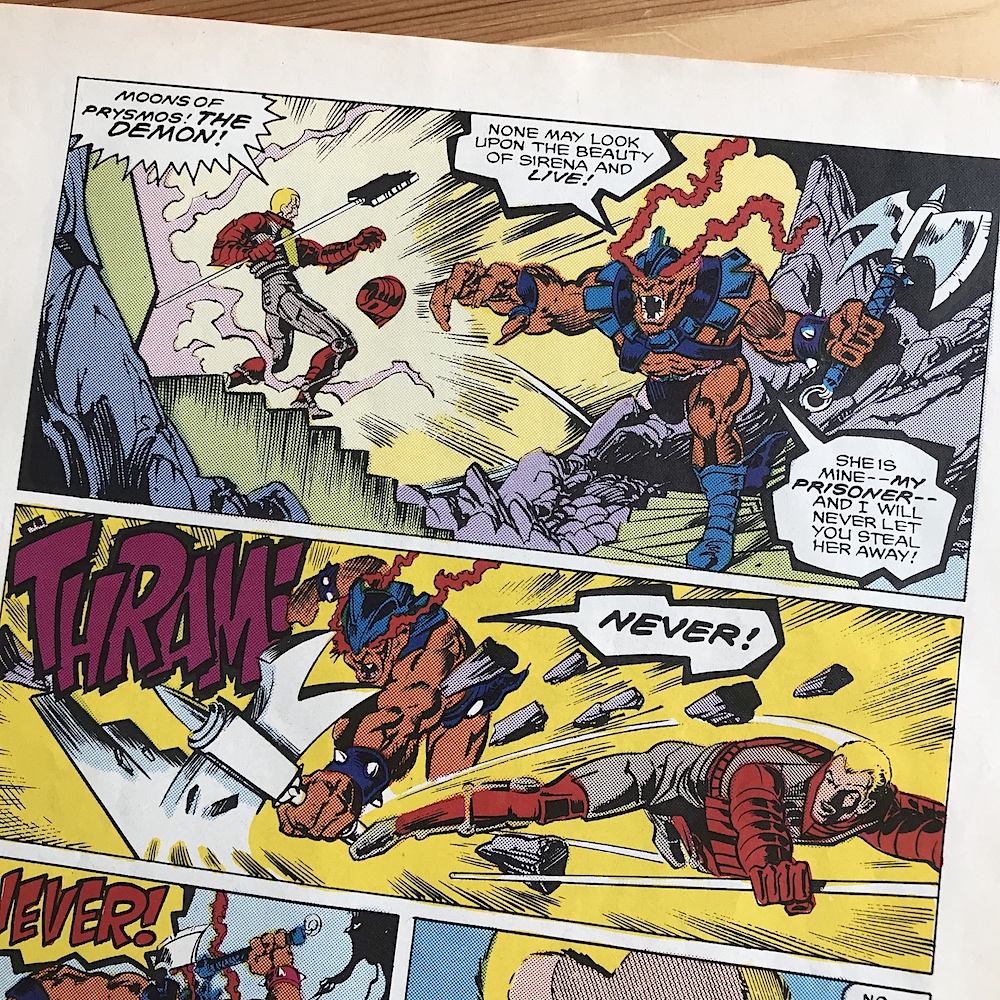
This issue’s story is called Dream Maker and begins with my favourite Visionary from the cartoon, the lightning fast Witterquick atop a cloud covered mountain answering the cries of a beautiful but entombed woman called Sirena. As he attempts a rescue a demon appears, apparently threatening to kill our hero for looking upon the woman’s beauty. It might appear this demon is jealous and has trapped his great love to be wit them forever, but as we find out later it’s just a bit of clever writing.

I say clever writing, but with a name like Sirena and a front cover showing her in control of monstrous forces the game has kind of been given away. If there was any doubt left the comic’s editorial made sure to erase all mystery beforehand. It’s still a compelling read though. I get the distinct impression Gerry, co-creator of The Punisher, really enjoyed developing these toys into three-dimensional characters. This issue concentrates almost exclusively on Witterquick and the Darkling Lord Cindarr, who we also see awaken from the same dream, with him in place of the Spectral Knight.

Sirena tells both men she’s a former Queen who has reached out telepathically to the only man able to recover the magical stone that can open her prison. Not convinced the dream is real, Leoric knows there’s no stopping Witterquick’s impetuousness so he wishes him well but offers no help or resources. On the other hand Cindarr has to fight off Reekon and Mortdredd who accuse him of abandoning his post at Darkstorm‘s castle. While you might wonder why a Darkling Lord would care about an imprisoned woman, it’s the first sign of there being more to Cindarr than we initially thought.

Witterquick’s impulse to save the poor villagers is soon overpowered by his desire for Sirena

The scene shifts to a crumbling mountain road where the giant ‘Bronze Warrior’ statue looks down upon a ramshackle village led by a despot warlord. The statue is a rusting metal ruin of unknown origin from the previous Age of Magic, now a tourist attraction with a gleaming jewel eye. Witterquick’s initial impulse to save the poor villagers from their maniacal leader is soon overpowered by his desire for Sirena, such is her power over him.

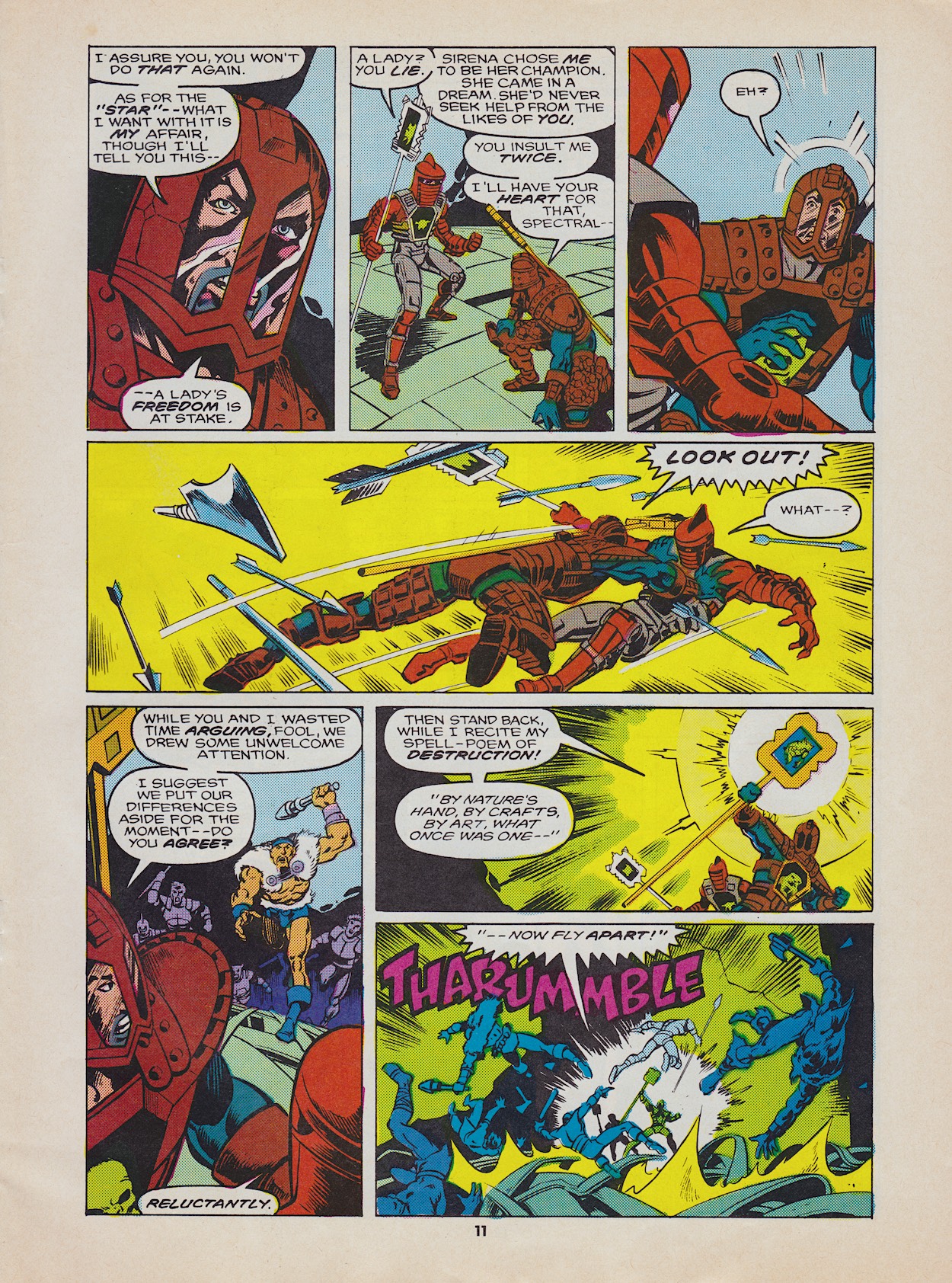
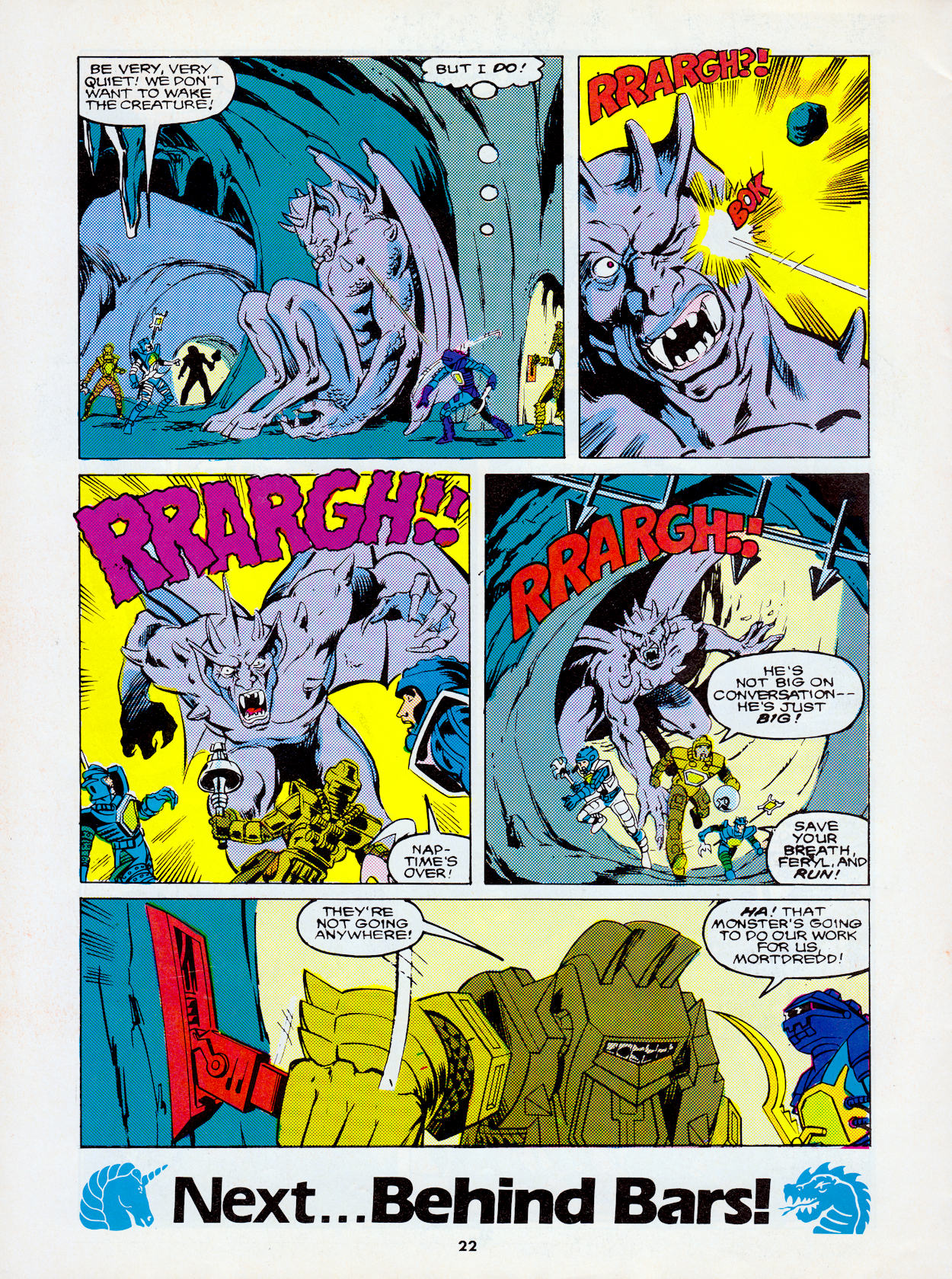
Soon he and Cindarr are in a race to claim the key, the jewel. Both use their magical poems, Cindarr unleashing ground-shattering destruction, Witterquick giving himself incredible speed which he uses to grab the key first. Despite this, Cindarr still saves Witterquick’s life when they’re suddenly attacked by the villager’s warriors.

It’s a gut reaction by Cindarr and a big surprise for the reader. He’s the highlight of this story and showcases the potential for complex character arcs to come between the warring factions. How heartbreaking that this is showcased in the final issue. Offering up a temporary alliance he uses his incantation to shake the very ground upon which the statue stands, scattering the warriors and allowing both of them to escape, the statue left wobbling in the wind.

Both characters seem to be fighting against where they’ve been placed in this new world, seeking to find their true selves

We also see Witterquick open up about who he really is, flaws and all, through thoughts and the well written (as always) narrative captions. In the comic his magical speed also seems to apply to his heart. He’s quick to fall in love, quick to jump to conclusions, quick to leap into danger, all of which can get him into trouble, all easily avoidable if he just took a step back and thought things through first.

Struggling with his thoughts, Witterquick dreams once more. Today I wouldn’t bat an eyelid at the image below, but in a toy comic of the time I think it shows Visionaries was aimed at a slightly older audience than Transformers, albeit an audience that still played with action figures. We’d have seen the likes of this in Conan comics so I thought it was interesting in the middle of a Hasbro toy licence.

Nudity in dreams is said to represent vulnerability, perfectly summing up Witterquick’s thoughts at this juncture in the story. The bewitching hold Sirena has over him, believing it’s true love, makes him shake off the doubts and carry on. From here on we see both Knights frequently cross paths with each other, more as competitors than enemies, creating an interesting dynamic and lots of fun moments.

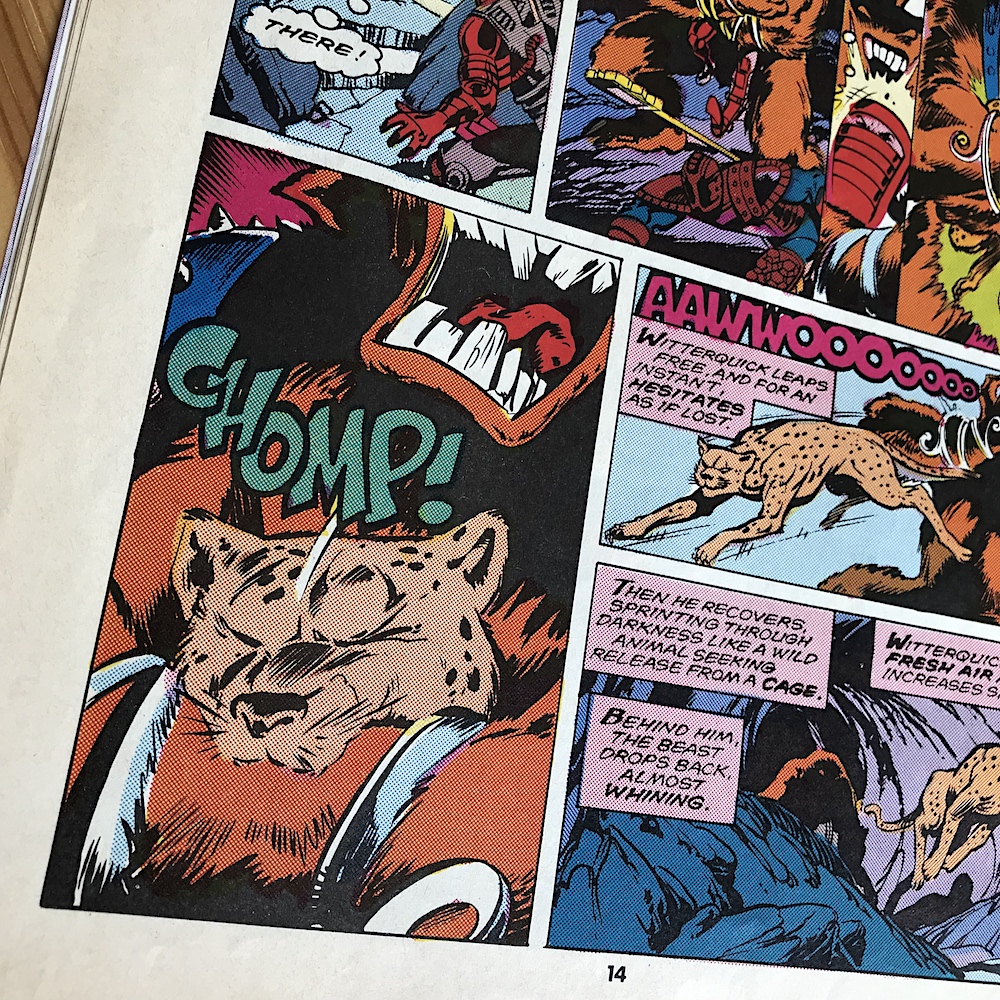
They come up against a monstrous beast guarding the caverns underneath the toppled statue, providing us with an example of their back and forth race. Cindarr scoots past in the background (above right) as Witterquick struggles with the beast before transforming into his cheetah totem, biting the beast and escaping, the captions hinting at themes covered in last month’s review.


“But in the end, we fought as allies. Imagine if our leaders could find a way to do the same.”

Witterquick to Cindarr

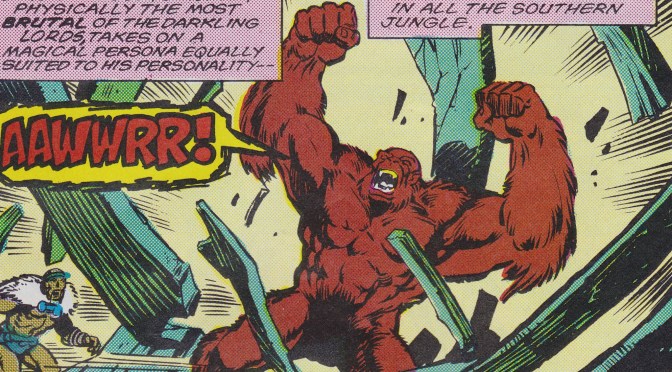
These caves take our Knights back underneath the statue where Witterquick uses his speed spell once again to grab the jewel before it collapses. The Darkling Lord is buried under tons of metal but not before changing to his gorilla form for protection. After bursting out, in a moment of revenge he shames and embarrasses the warlord in front of all of his followers, freeing the people from his rule.

It’s another surprising Cindarr moment I didn’t see coming for a character so simplistically depicted in the cartoon, and it would appear it surprised him too. Both characters seem to be fighting against where they’ve been placed in this new world, seeking to find their true selves inside all of the magical armour that now defines them.

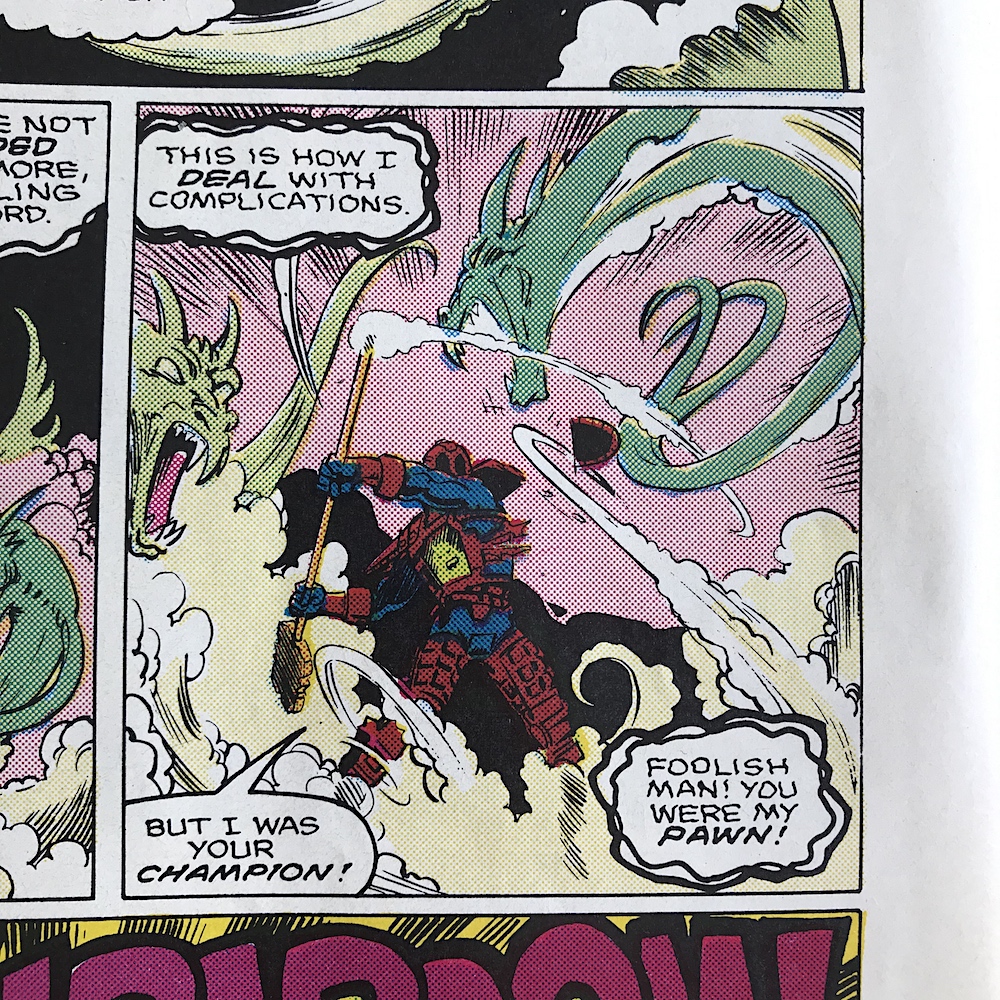
Attacked and ashamed by Sirena’s demons, the truth is laid bare and Cindarr’s heart is broken. About to be set free, she no longer needs him, he is but a complication. I actually felt for Cindarr here; the spell had him genuinely believing he was in love and doing the right thing, something he shouldn’t care about doing.

Now in the area foreshadowed earlier we see the demon attacking Witterquick but it’s holding back, not wishing to kill our hero, claiming he’s there to stop evil from being released. It’s at this point we realise those panels at the top of this review now read very differently.

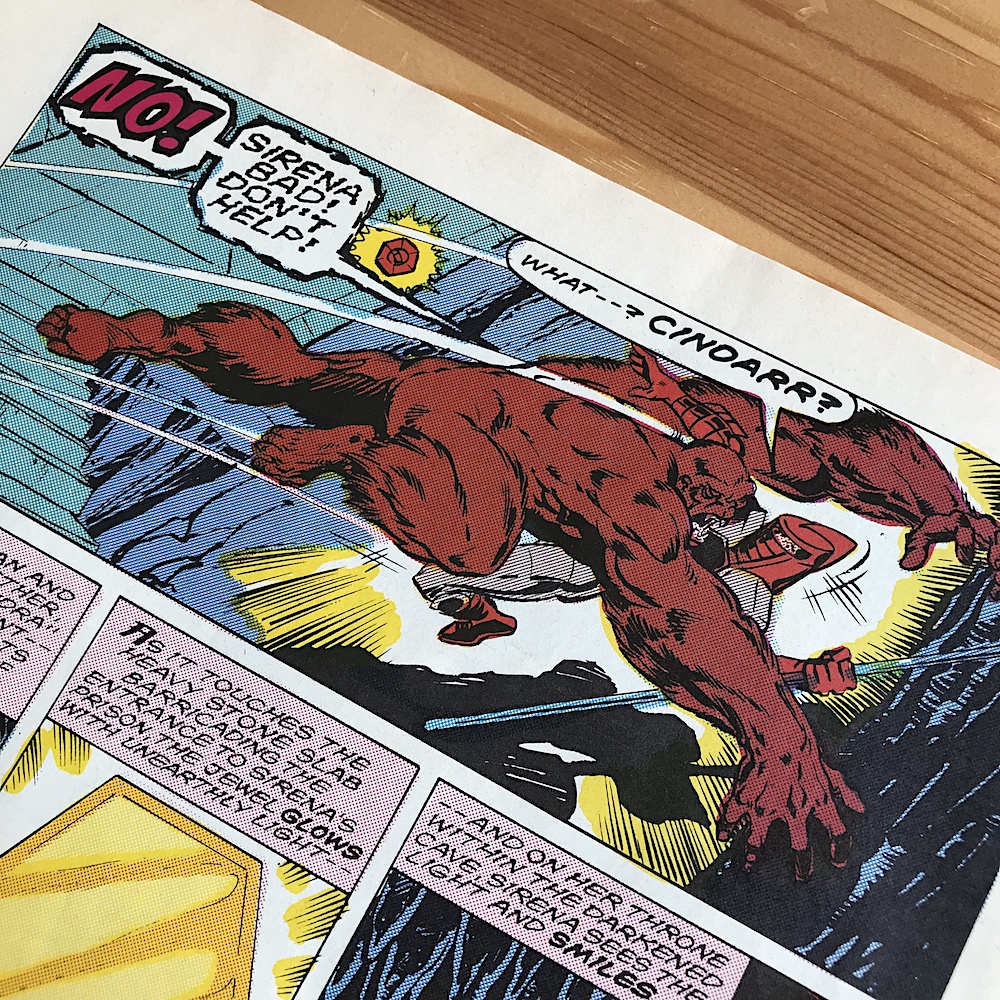
Witterquick is unable to listen to reason and only the intervention of a vast gorilla (complete with Grimlock-like speech in this form) stops him from unleashing Sirena. Cindarr could have simply walked away; more evil being unleashed into the world and one less Spectral Knight should be a good thing, should it not? But he’s become an unlikely hero, trying to keep the witch imprisoned and saving a warrior he’s come to respect.

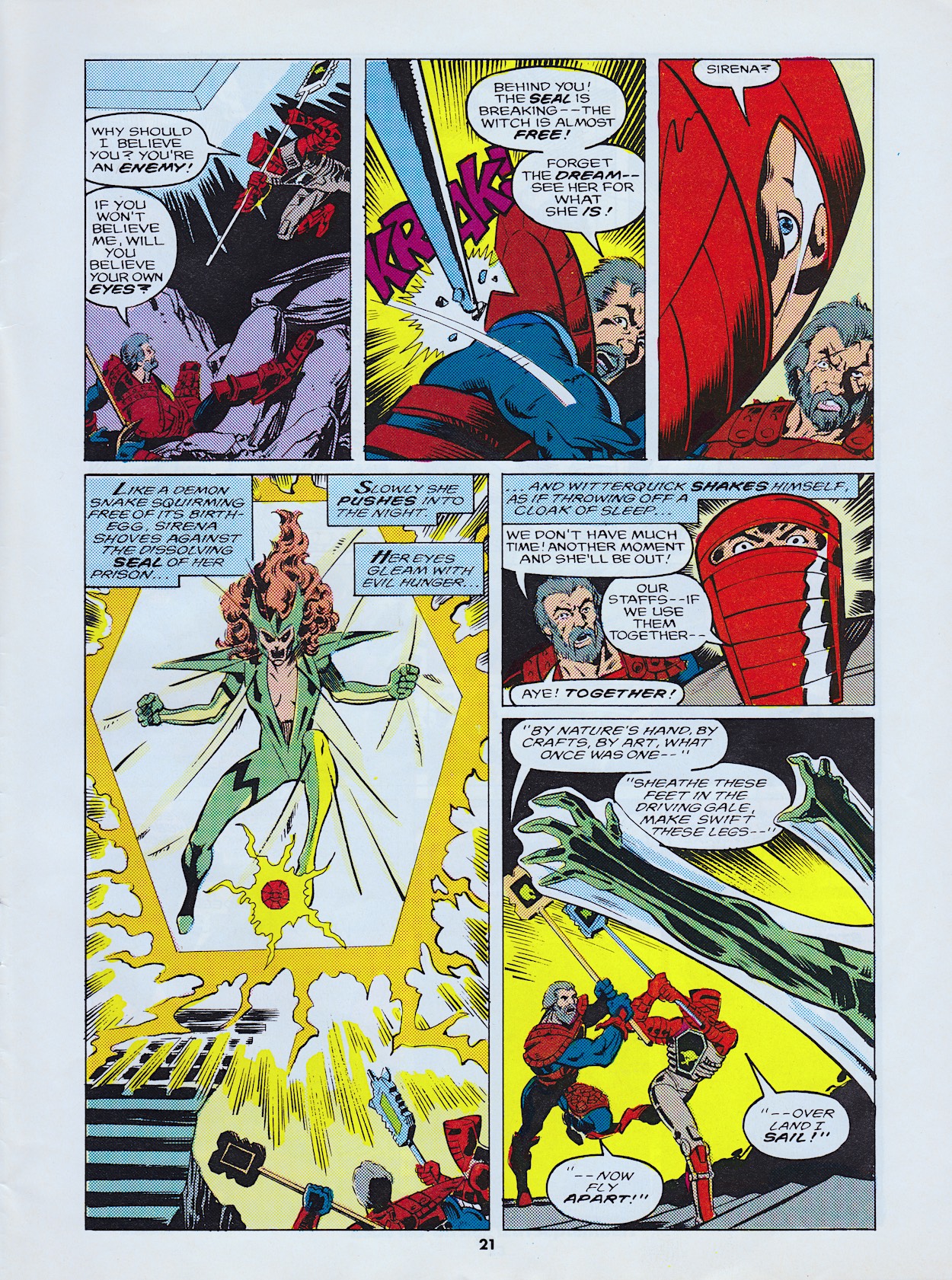
But unwittingly they’ve gotten too close and the jewel floats on a magical current right into the lock of Sirena’s tomb. Here her true appearance is revealed as she pushes against the dissolving seal in a scene reminiscent of scenes from popular mini-series V just a few years previous.

His mind set free at last, Witterquick’s horror is clear. Working together, this leads to a final desperate bid to not only save their planet but also their dignity, as they use both staff powers together, combining speed and destruction into an unstoppable force and unleashing it directly upon the dissolving force field.

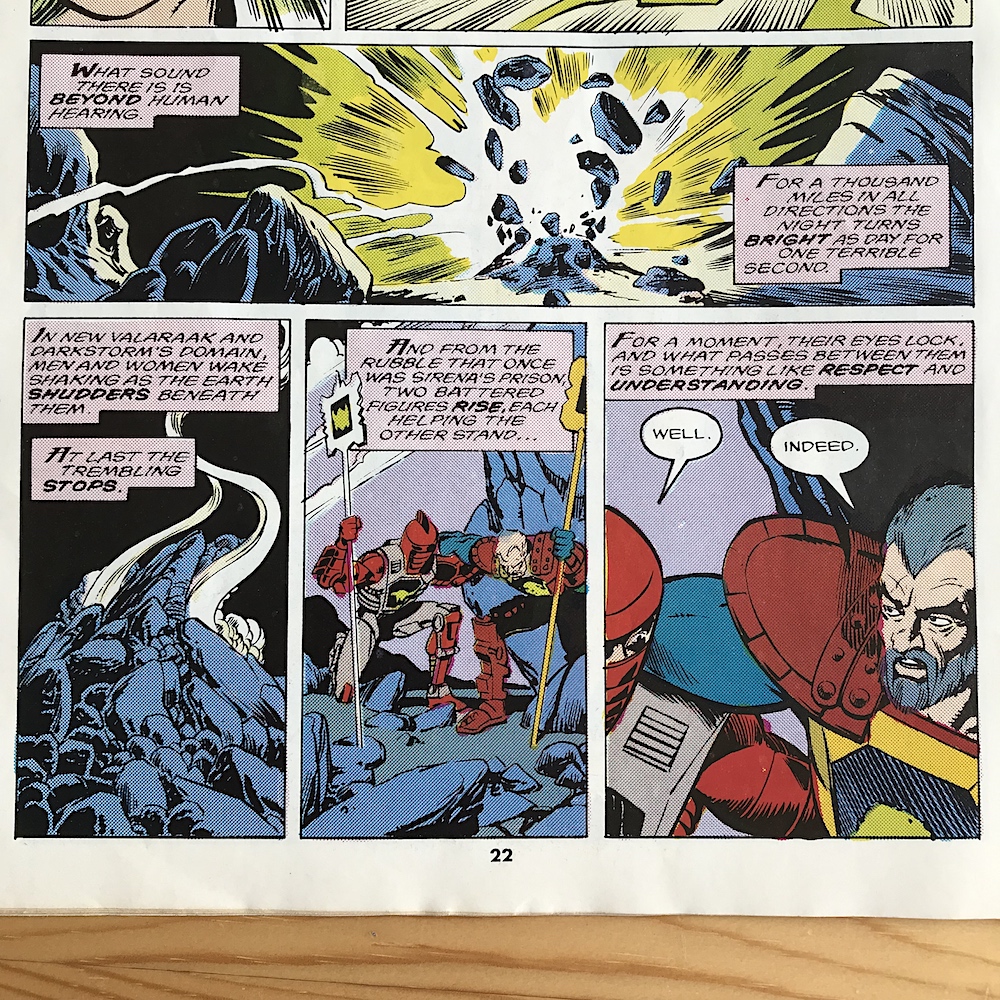
The prison explodes, taking Sirena with it. My favourite part is not this appropriately action-packed finale itself, but rather the immediate aftermath when the two enemies help each other out of the rubble and share this moment.

I laughed when I read this. Gerry’s scripts are just so beautifully written in these quieter character moments. After being at loggerheads through the long quest and intense action these two simple words sum everything up for the men. The next page also reveals a little about their views of the ongoing battle for the planet. I’d have been disappointed if the story hadn’t included this conversation after all they’ve been through.

It’s a nice final page, the second panel summing up a lot of conflicts in our real world. The respect and understanding between Cindarr and Witterquick is clear and it’s left very open ended. There can be no other outcome, for now at least. No, they’re not friends but can they truly be enemies again? At least they get to end their adventure with a shared laugh and as far as the comics go I’ve got a new favourite character in Cindarr.

This dynamic is just crying out for further exploration but for now Visionaries bows out. At least it does so in style with another superb story, nicely developed characters and plenty of surprises. As you can see the promised “details” don’t amount to much, just the date on which their remaining stories will be serialised in the weekly Transformers comic.

It’s quite the wait but a new look was coming up in Transformers so a new back up strip (temporarily replacing Action Force/G.I. Joe) would help launch it and bring in Visionaries readers eager for more. There are still a couple of dedicated publications to come for our intrepid magical heroes in the form of the Visionaries Annual at Christmas time and a Spring Special next year. That annual may have been released in August but let’s face it we all got them as Christmas presents. So that’s when it’ll be covered here, following the real time nature of reading these as originally intended.

Speaking of further publications, on the back cover is another gorgeous contemporary advert. Dragon’s Claws was created by the ace Transformers team of Simon Furman and Geoff Senior. Set in the distant future of Britain it was a comic I’d seen advertised as a kid and had always wanted to try but never got around to. This is going to be corrected in 2023. The complete collection is sitting on my comics shelves waiting patiently for their own real time read through on the blog. Watch out for that.

In the meantime you can expect reviews of the final two Visionaries stories on the dates of their respective conclusions in the pages of Transformers. Each story was split into four parts as was custom for the back ups, so the first story’s review will be on the OiNK Blog from Friday 1st October 2021.

iSSUE FOUR < > TRANSFORMERS PART ONE

ViSiONARiES MENU

ViSiONARiES #4: KiCKiNG OFF TOO LATE

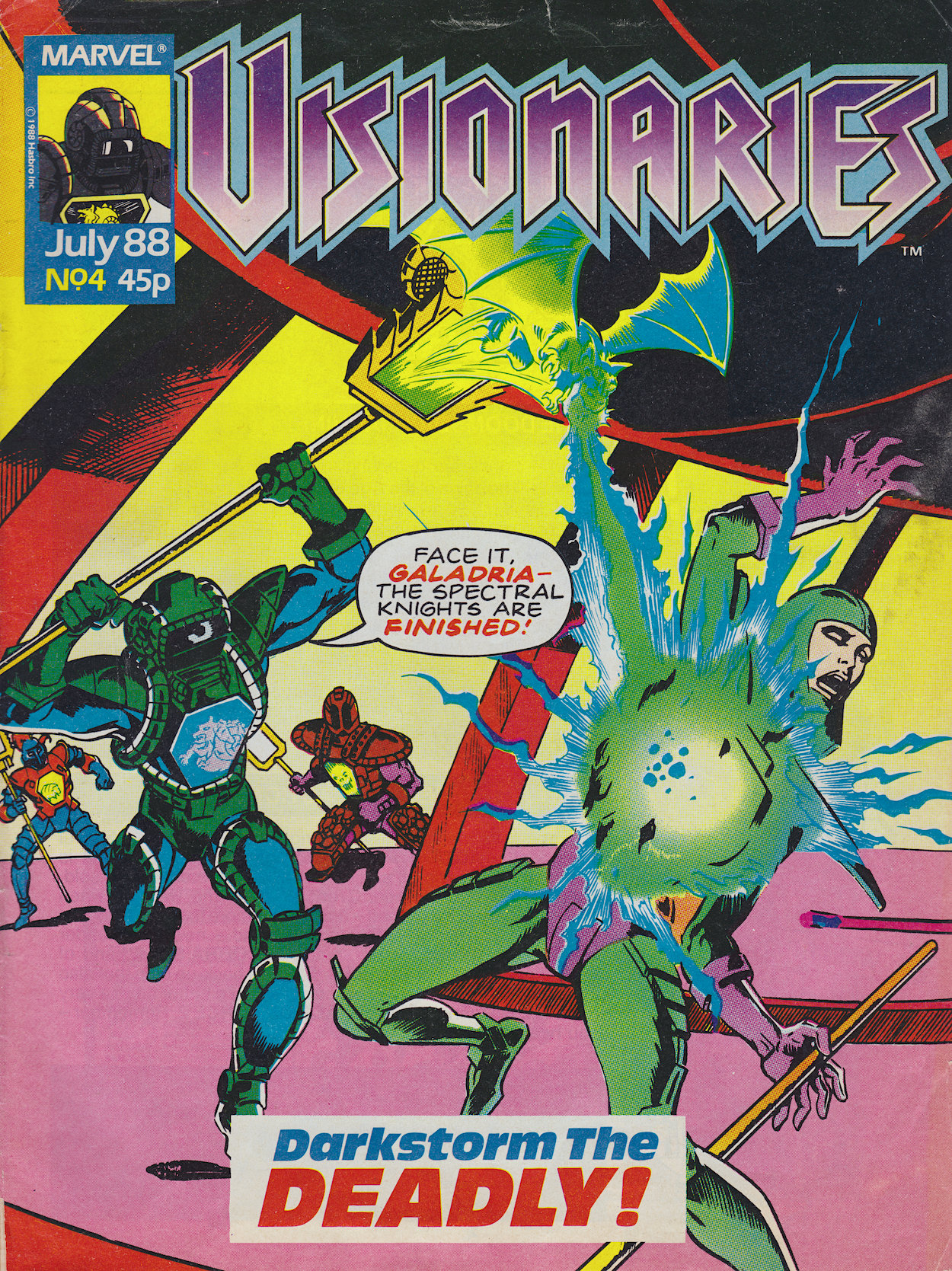
With hindsight I know the next issue of Marvel UK‘s Visionaries will regrettably be the last, but for readers at the time there would’ve been a real feeling of the comic taking off this month, ironically enough. With the introductions now out of the way this feels like the first proper story about these characters and their new abilities upon the ravaged planet Prysmos. Unfortunately, the writing may have already been on the wall at Marvel UK, evidenced by a downgrade in the physical comic.

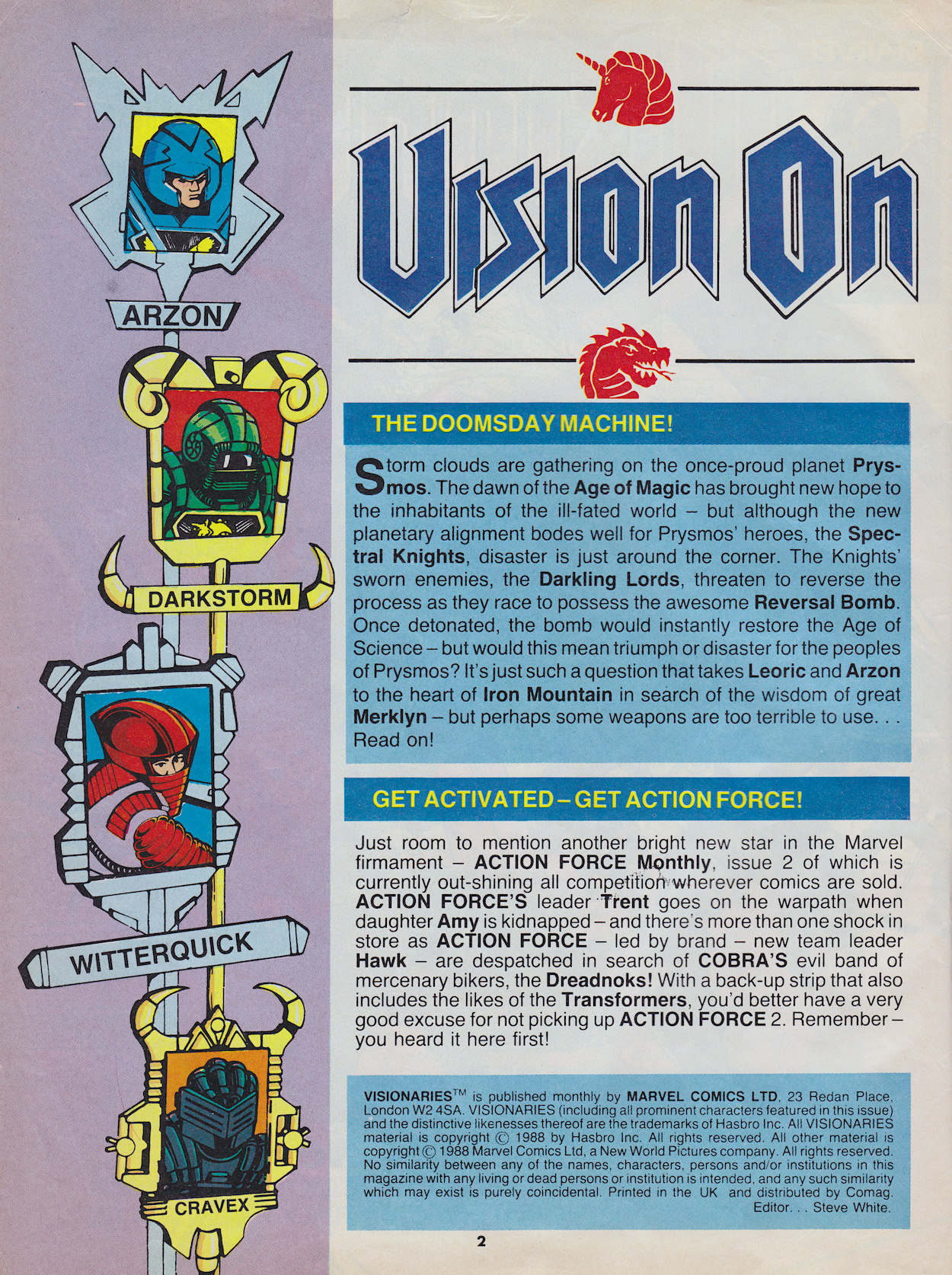
The outer eight pages are no longer of a thicker, glossier stock and instead the whole issue is made up of the same paper as the weekly Transformers. At least editor Steve White is introducing the story in the editorial rather than solely plugging other titles. Action Force Monthly still gets a mention though, they must really have wanted to push it, but the main thing is we finally get a proper editorial for the Visionaries.

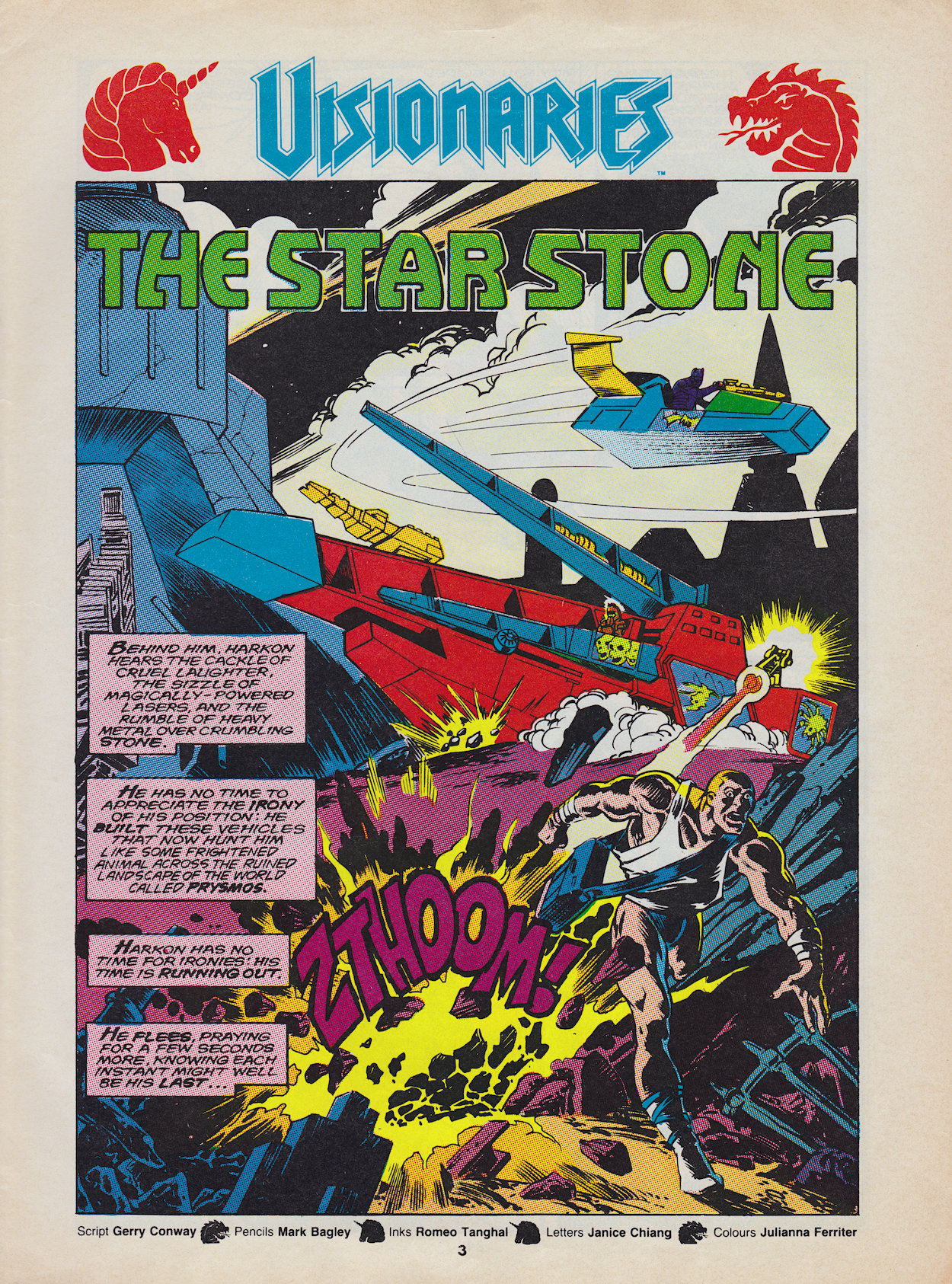
With characters beginning to develop beyond the information on the back of the toy packaging and some larger scale world building taking place, The Star Stone is a brilliant story which asks big questions about the choices we make and why, as well as clearly setting things up for as-yet-unknown events further down the line. Gerry Conway was now in charge of developing the storyline and it’s clear he understood the subject matter and its potential.

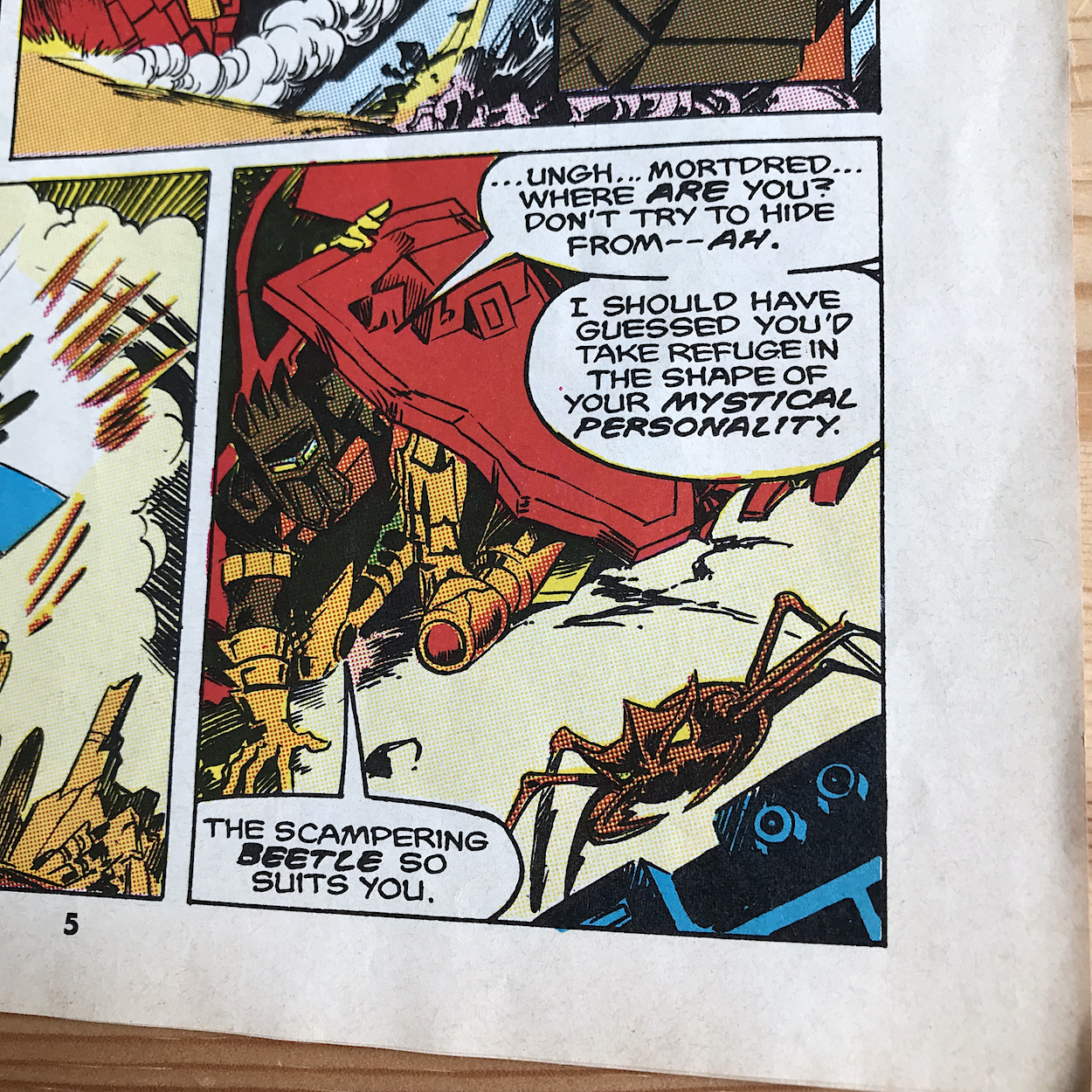
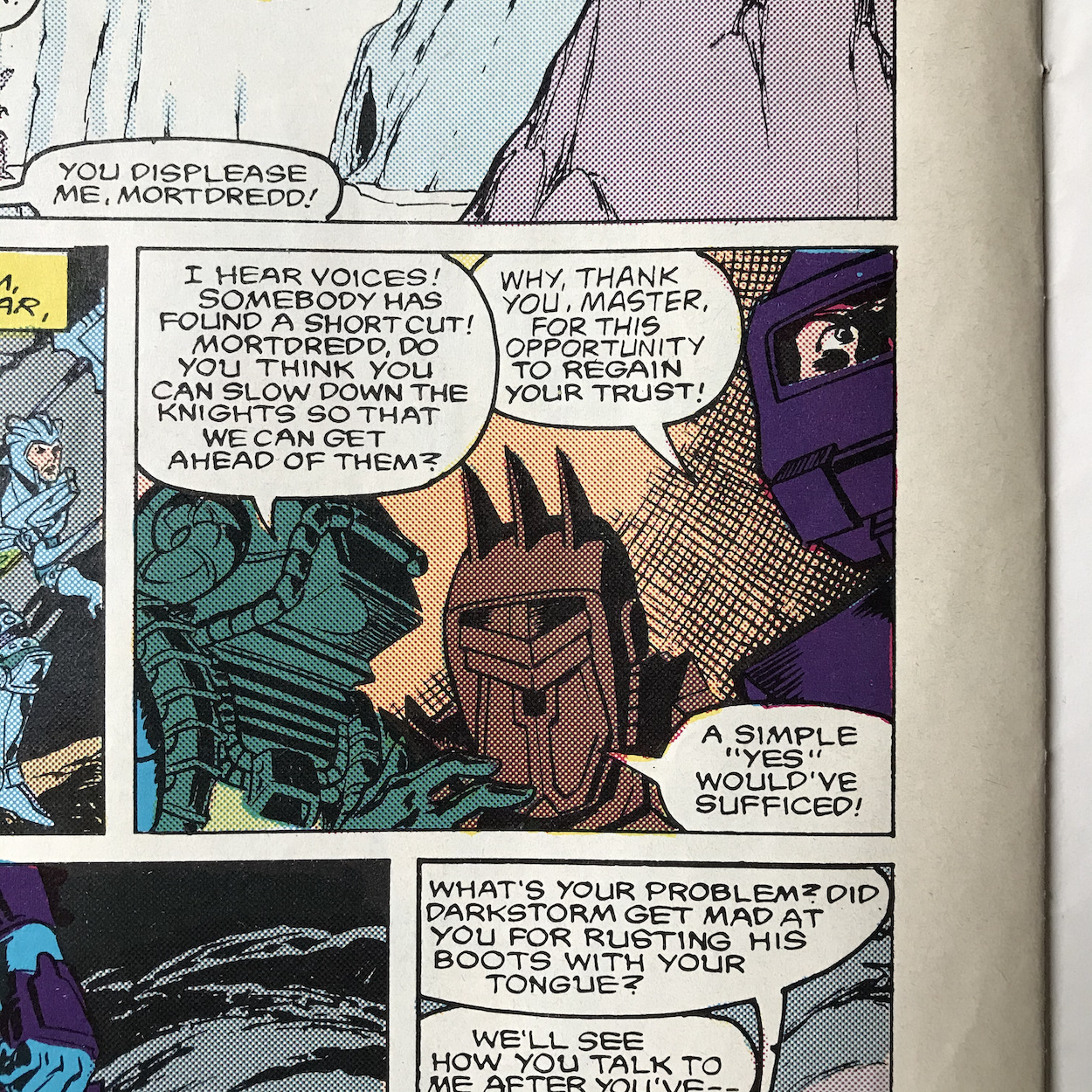
It kicks off with plenty of action as Reekon‘s new Dagger Assault, the biggest and best of all the toys in the range, tries to eliminate the Darkling Lords‘ contractor Harkon to stop him supplying any magical vehicles to the Spectral Knights. Reekon also goes up against the Sky Claw which is still in the hands of their enemy, but its owner Mortdredd recaptures it this issue, sneaking into Leoric’s castle in beetle form to steal it back. This act also introduces one of the changes from the cartoon that I actually prefer.

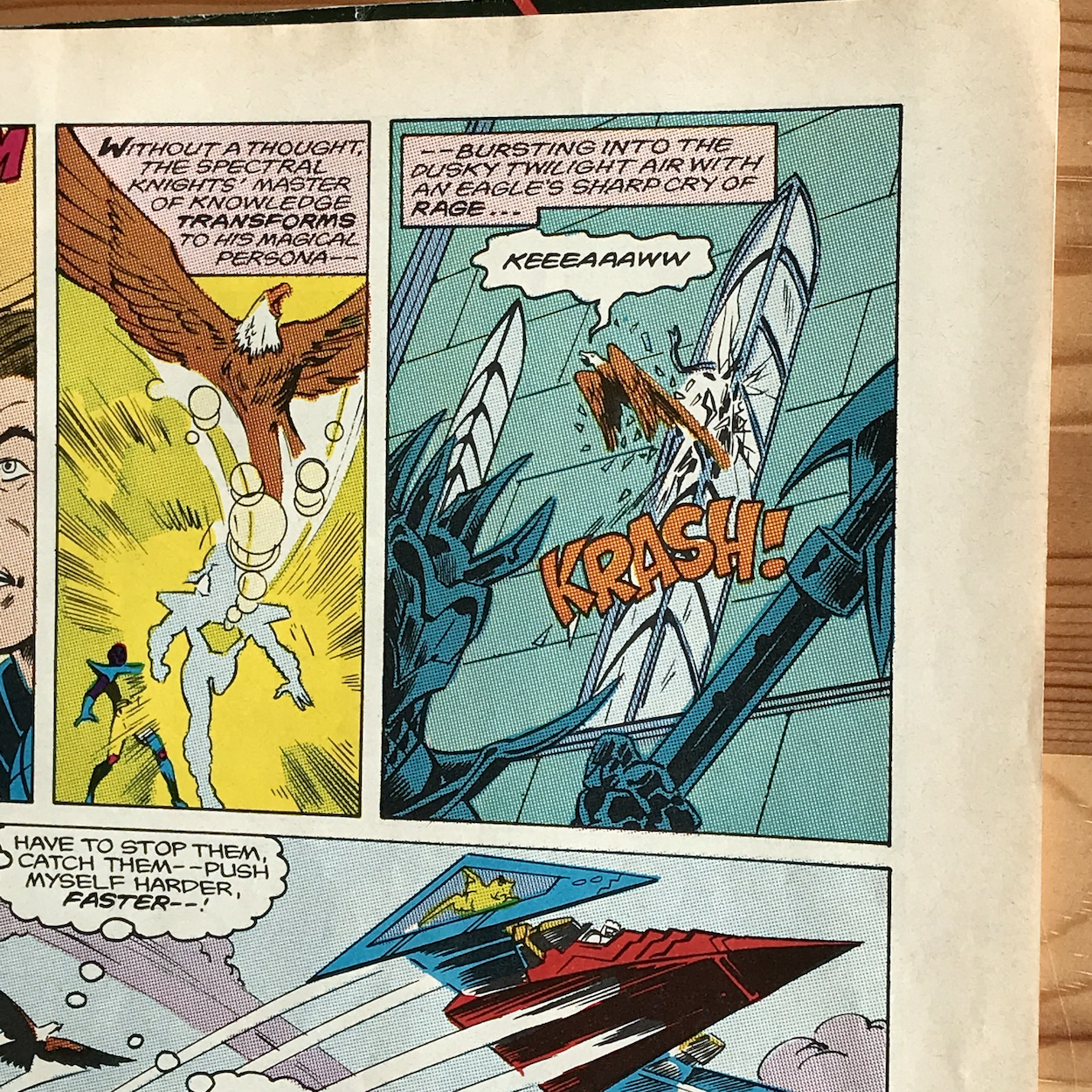
The characters’ magical totems would emerge from their chest plates and become fully formed as the human behind them faded away. The totems in the cartoon looked like glowing holograms to match the toys and in the context of a cartoon it did look brilliant. But comics are a different medium and in this more serious take on the story their animal selves maintain the colour of their real world counterparts, meaning they are a proper disguise. This is used to great affect several times this issue.

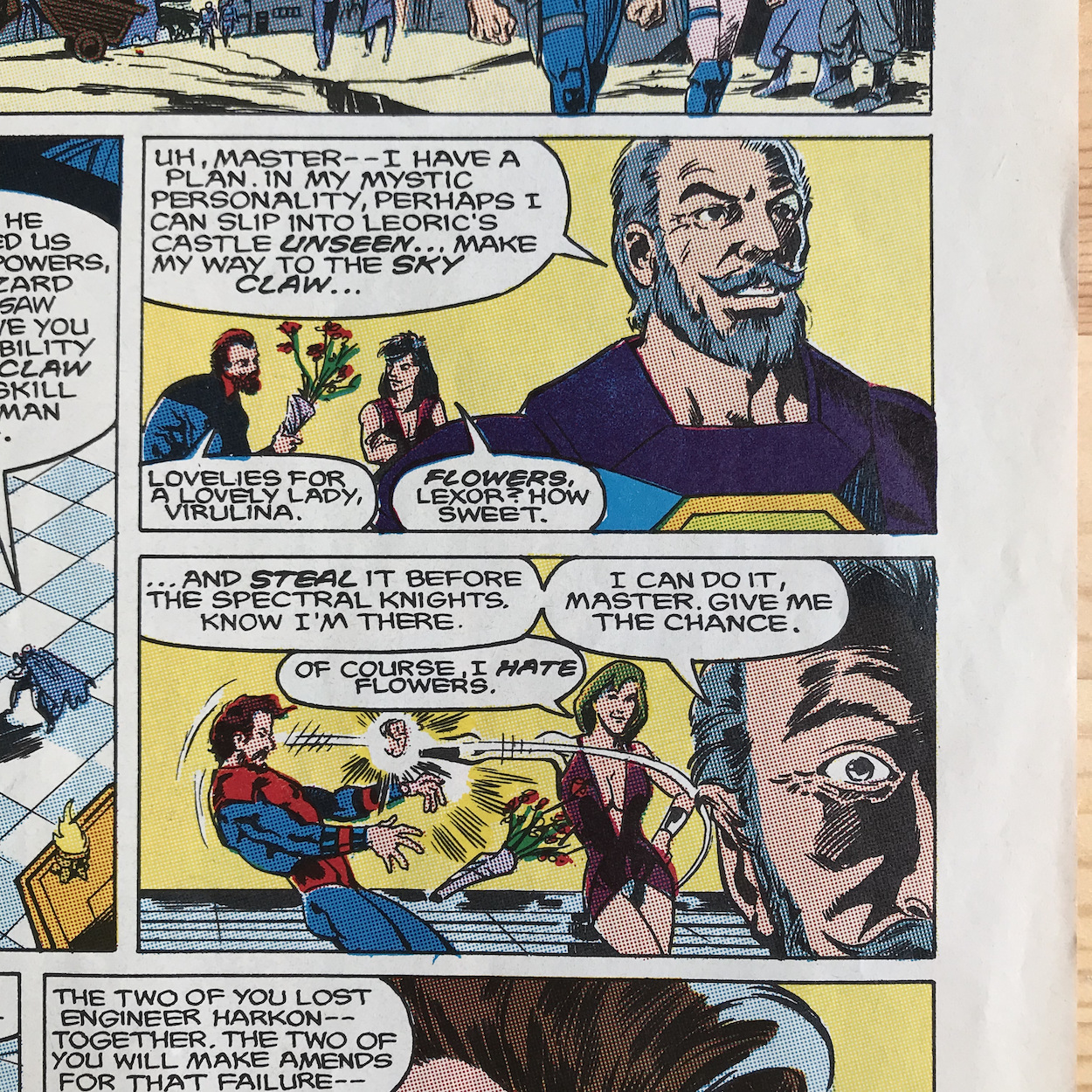
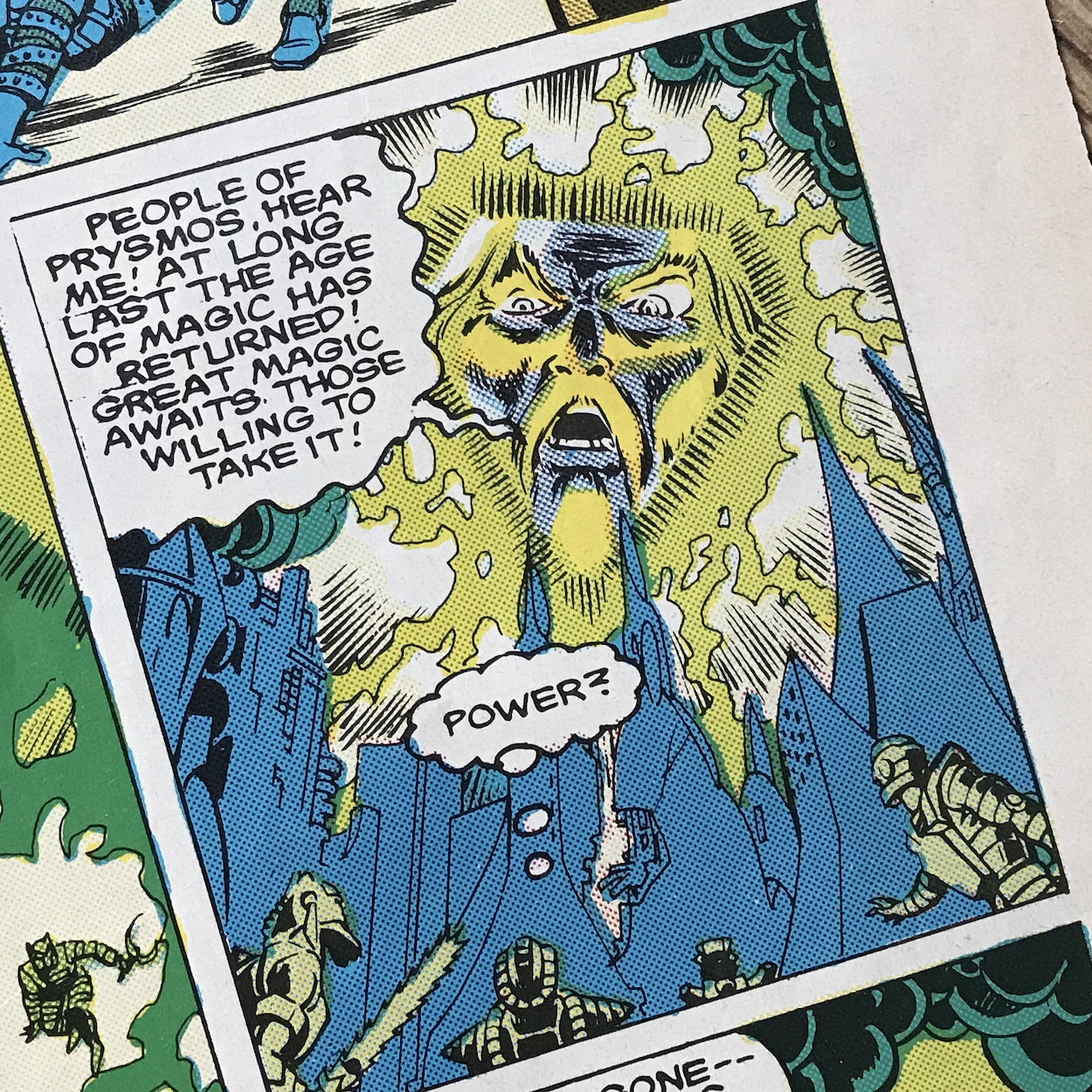
More humour slips in too, for example that background exchange between Lexor and Virulina happening behind a major plot point. The main story itself, once the characters are all in place, sees the discovery of an ancient scroll which tells of a hidden device, forgotten about for millennia that could end the Age of Magic and return the world to the Age of Science. This is revealed after a startling discovery by Arzon.

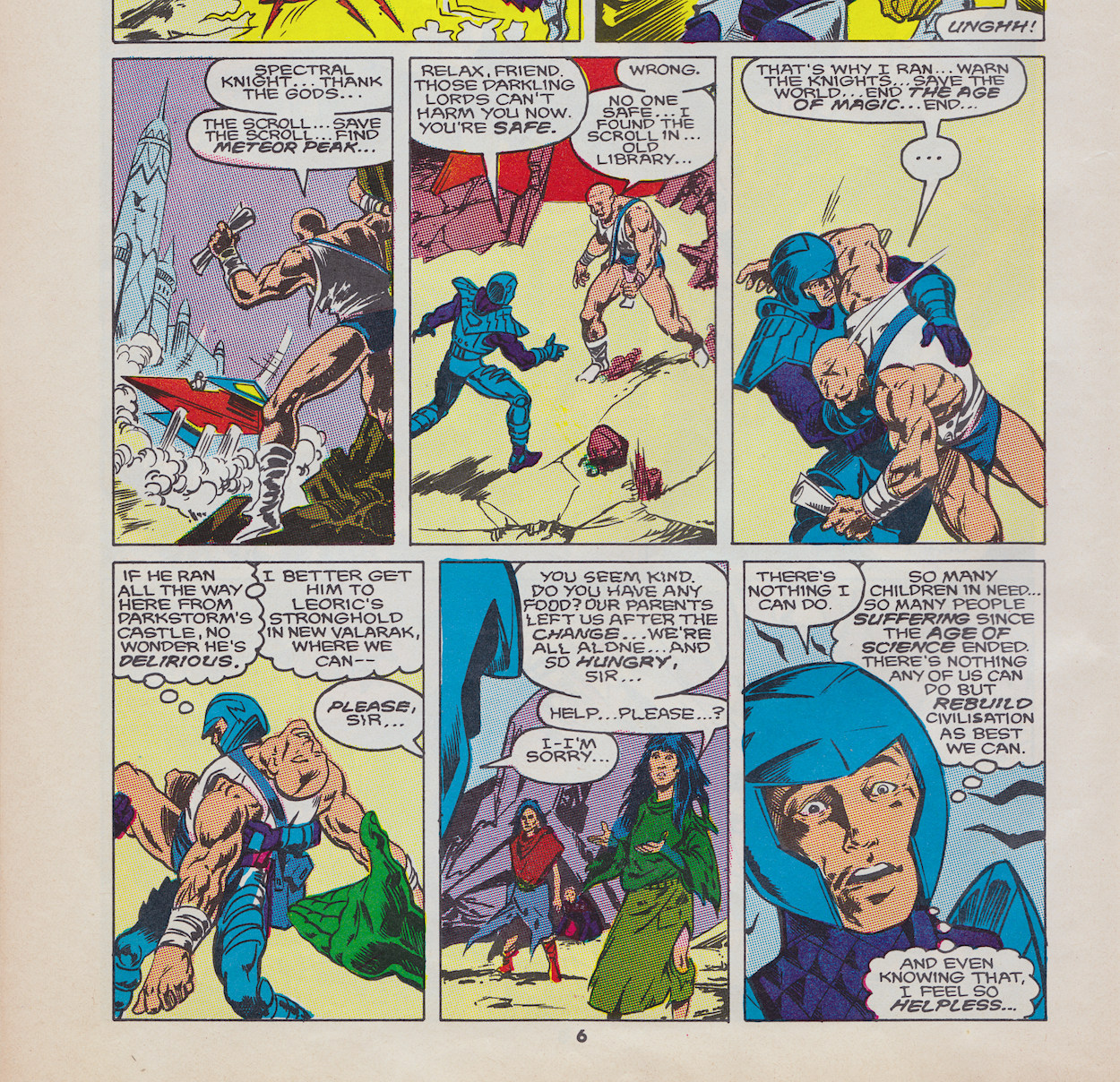
After the initial battle Arzon finds himself approached by child beggars, homeless and desperate for food after being abandoned by their parents following “the change”, which is how the cataclysmic events of the origin story are referred to. This is where Gerry’s world building comes in. The toys and the cartoon hype this fancy new age, the wonderful powers that came with it and all the action and adventure kids could hope for. But Gerry’s Prysmos is a grittier, medieval place where Arson finds himself suddenly faced with the harsh truth.

The origin story placed a lot of emphasis on how reliant humans were on their technology. At the end only a few Knights were deemed worthy of Merklynn’s magic, the future of their world placed on their shoulders. You could view it as an allegory of the dangers of relying too much on technology (technological advancements were happening at a breakneck pace in the 80s), or a reference to the class system and how those in a position of power, whether earned or not, have a responsibility to those less fortunate. The Spectral Knights and the Darkling Lords just have differing views on what their responsibility is.

While all the magical action is there, seeing them have philosophical debates, questioning their powers and being properly affected by the world around them has been a very pleasant surprise

The coming of the Age of Magic has left many suffering and having these starving children approach Arzon, who is unable to help, is a particularly dark moment for a toy licence. It makes for a surprisingly mature thread throughout, one of many planted by the comic’s new writer.

Arzon thinks returning to the previous age is a way to end this suffering. His leader Leoric isn’t so sure. Suffering still occurred before and humans had lost their way, lost their compassion and their true worth. The Age of Magic is a chance to rebuild together, to fix all that was wrong before. But at what cost in the short term? The scene in which this is discussed is a lovely, quieter moment between them and shows how they’re now being treated as three-dimensional characters who just happen to have magical powers.

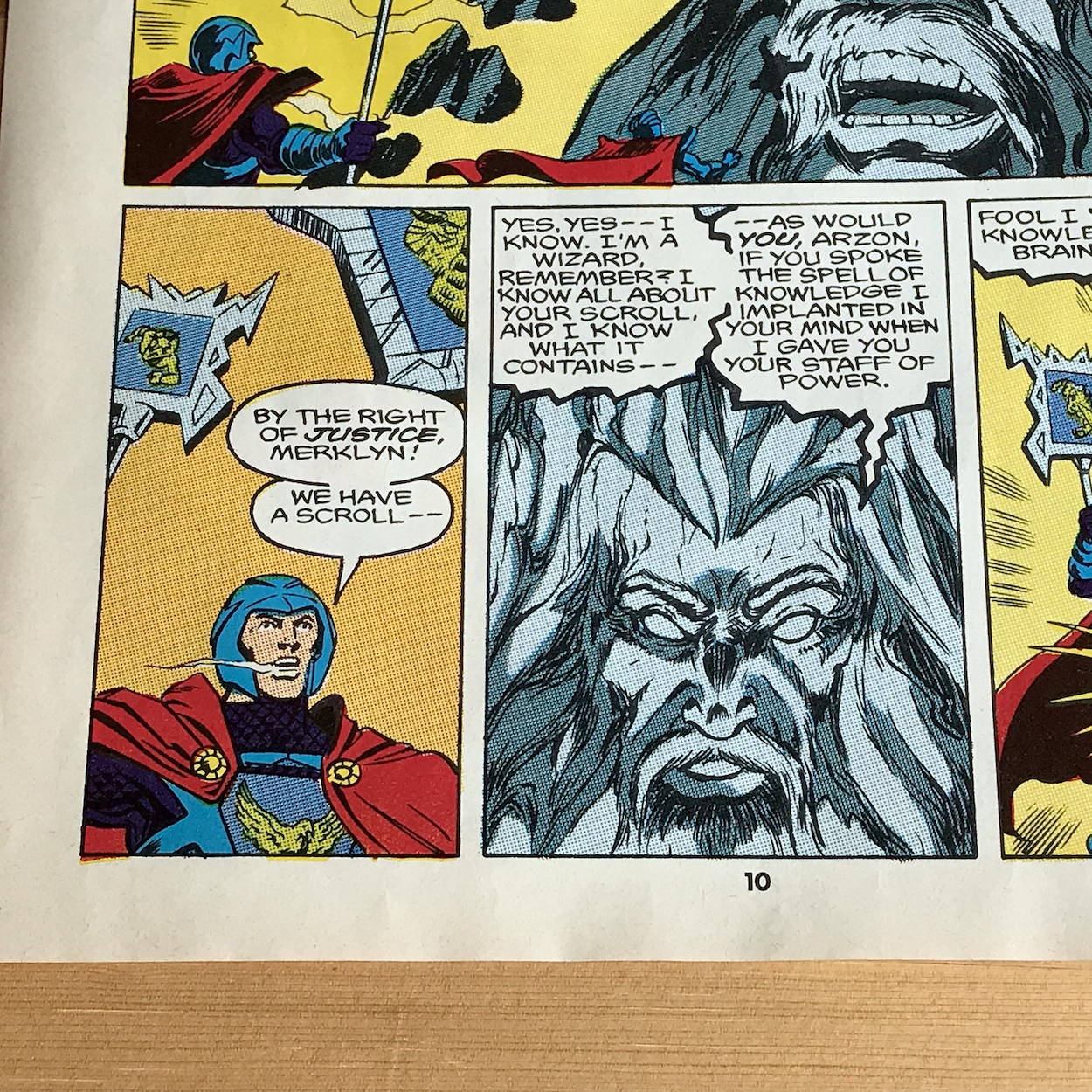
But when Mortredd steals the Sky Claw it’s clear he could be taking the information from the scroll back to Darkstorm, so Leoric has no choice but to track down the device. We see Arzon in his eagle form, a true animal and not a holographic projection, alongside more lovely atmospheric captions. He’s unable to catch the Sky Claw, so he and Leoric leave to seek knowledge from Merklynn about the scroll, which results in a rather funny exchange from the usually serious wizard.

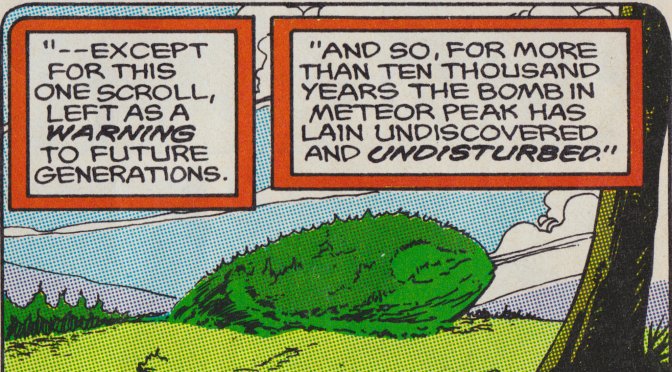
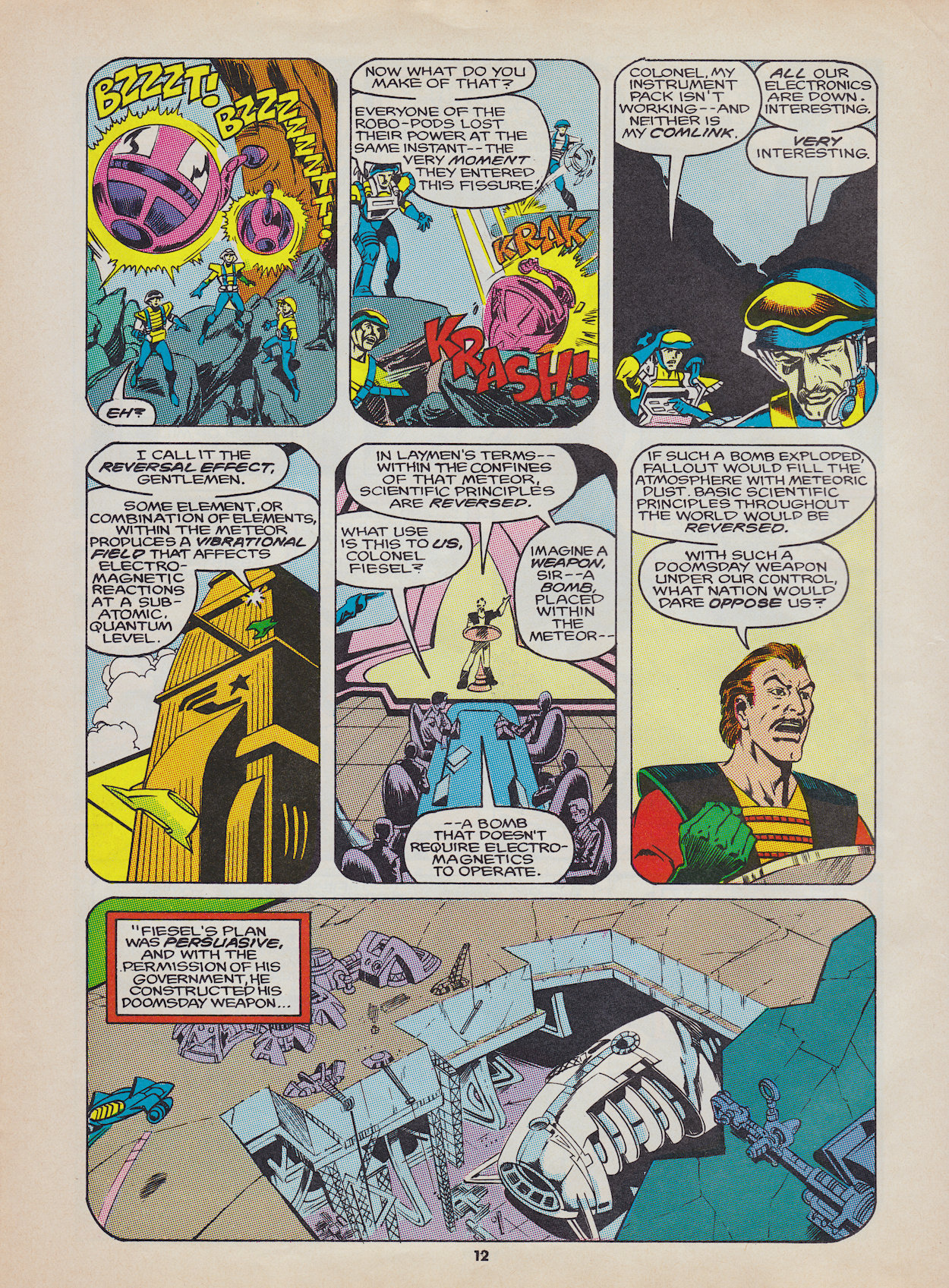
We now get a few pages told through Arzon after he casts his Power of Knowledge poem, telling us of a time ten thousand years ago during the earliest days of the Age of Science when a meteor fell to the ground. Upon its discovery the military’s head scientist, Tech-Colonel Ragni Fiesel found none of his equipment worked within its vicinity.

Identified as a ‘Reversal Field’, Fiesel ordered the building of a bomb containing the meteor as a way of deterring any other region from invading. It was promoted by the government as a way of keeping the peace. But Prysmos had been at peace for millennia, there was no need for such a threat against other nations. Some things never change and it would appear the mythical world of Prysmos was in reality no better than our own.

It was clearly a ploy by a corrupt government, one which was soon overthrown in a coup. But not before the bomb had been built and secreted in a mound of earth, over time becoming overgrown and part of the landscape, indistinguishable from its surroundings. All records of the bomb vanished, apart from the one scroll discovered by Harkon, who as an engineer longed for the return of that age.


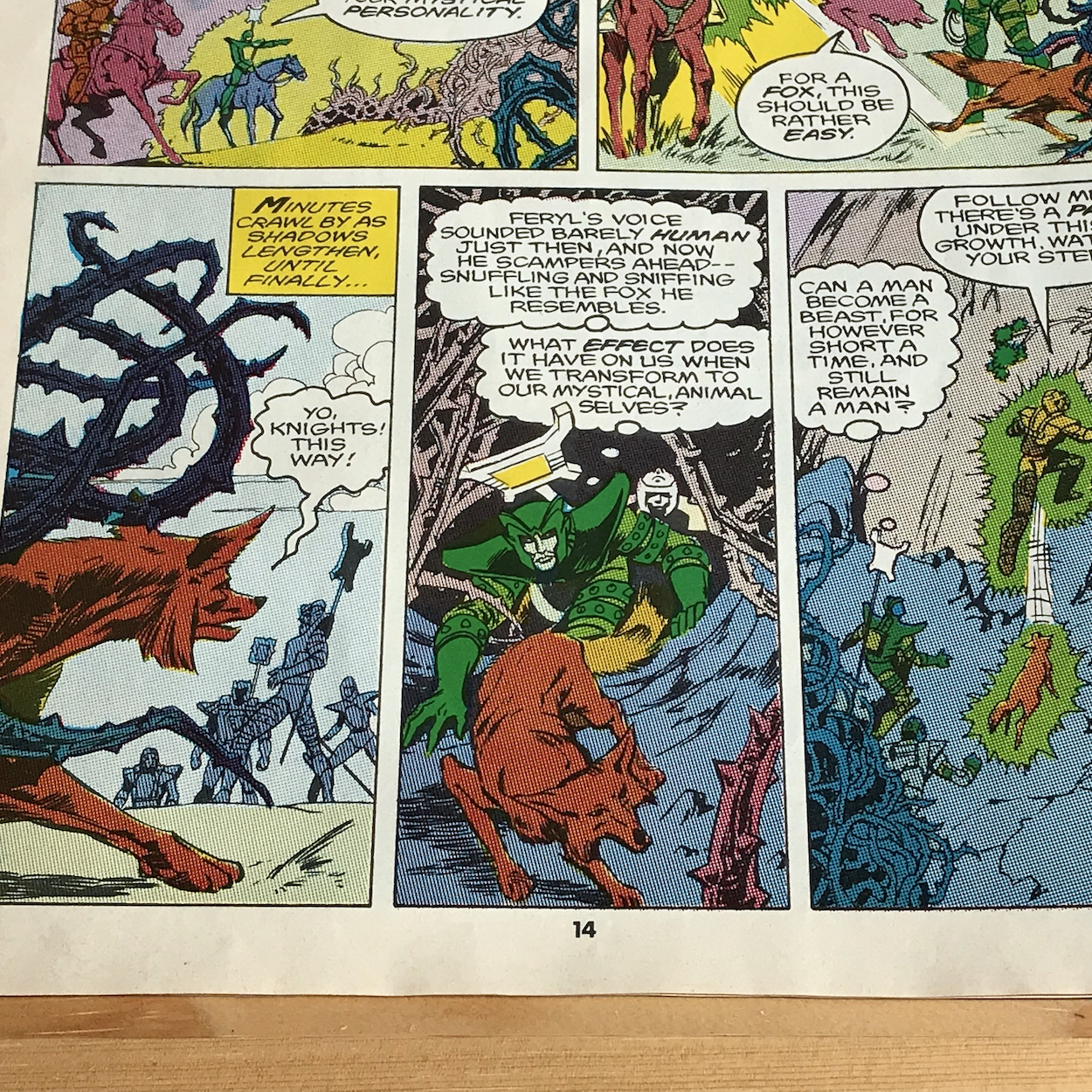
“Can a man become a beast, for however short a time, and still remain a man?

Leoric

During their quest to find the bomb Leroic gets to muse to himself about the magical totems they now possess. After witnessing Feryl find a path through twisting thorns as a fox (this is an error, Ectar is the fox and Feryl is a wolf), Leoric notices his friend’s voice sounds less human every time he transforms. It surprised me they can speak in their animal forms at all! But that’s not the point I want to make. Leoric’s foreboding thoughts set up possible future storylines about just how much these powers change those who use them.

I’m loving all of this extra depth because I just didn’t expect it. While all the magical action is there, seeing them have philosophical debates, questioning their powers and being properly affected by the world around them has been a very pleasant surprise. It’s bittersweet of course and I can’t help thinking how this could’ve developed if it hadn’t been cancelled so early.

Gerry clearly had plans for the future and he was carefully planting seeds here. But the main thread this issue concerns how little they know about their planet’s current situation, enough to throw doubts on whether they should attempt to change their future yet again. With all these unknown factors they could make things even worse.

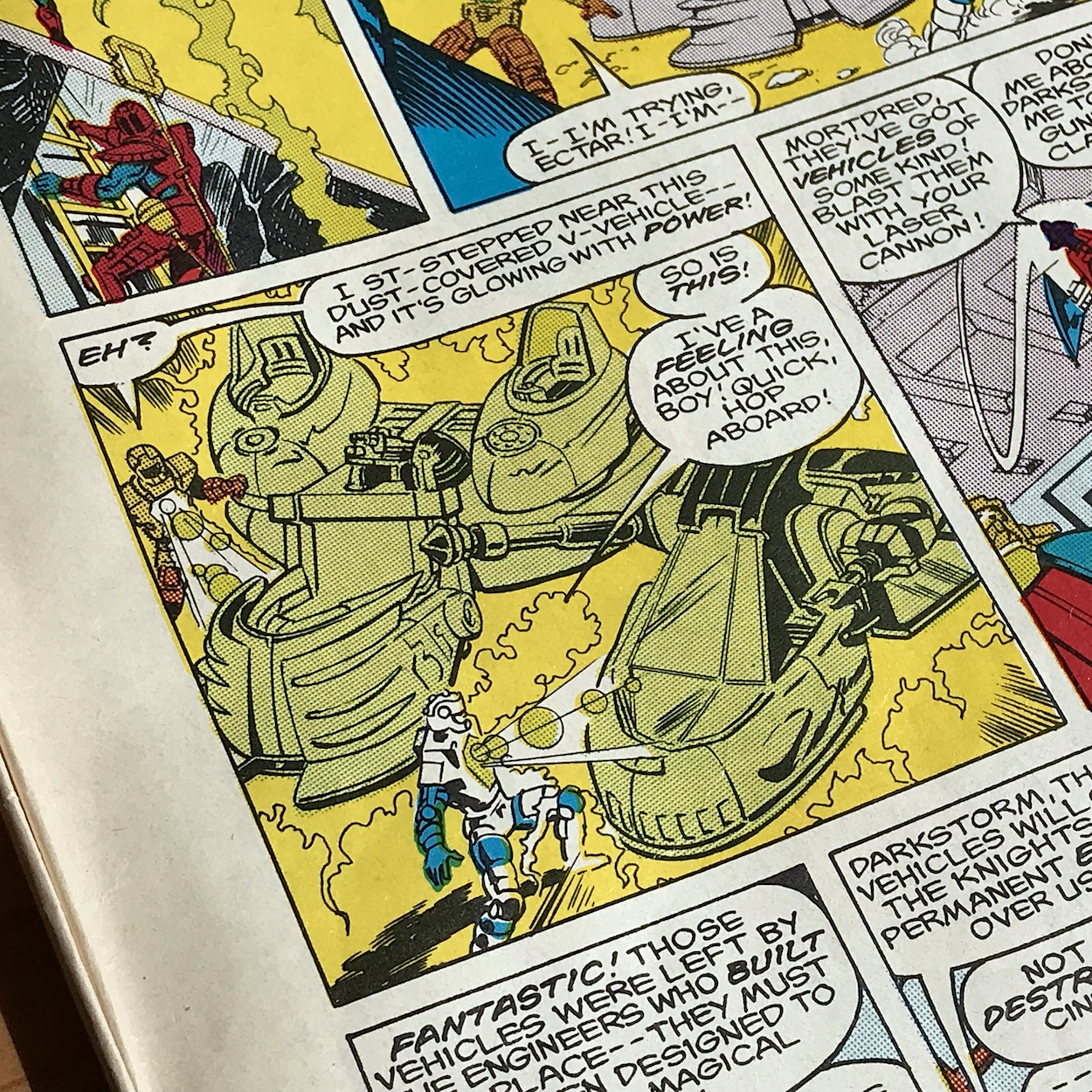
Fortunately for the Spectral Knights, and for Hasbro, inside the meteor’s casing their ancestors saw fit to place vehicles which could work near the Reversal Field by drawing energy from a magical source instead of a scientific one. Fiesel knew that if his government really did have to throw the switch, they’d need some kind of advantage.

Say hello to the Capture Chariot (the one vehicle I didn’t possess) and the Lancer Cycle, completing the comic’s take on the toy line.

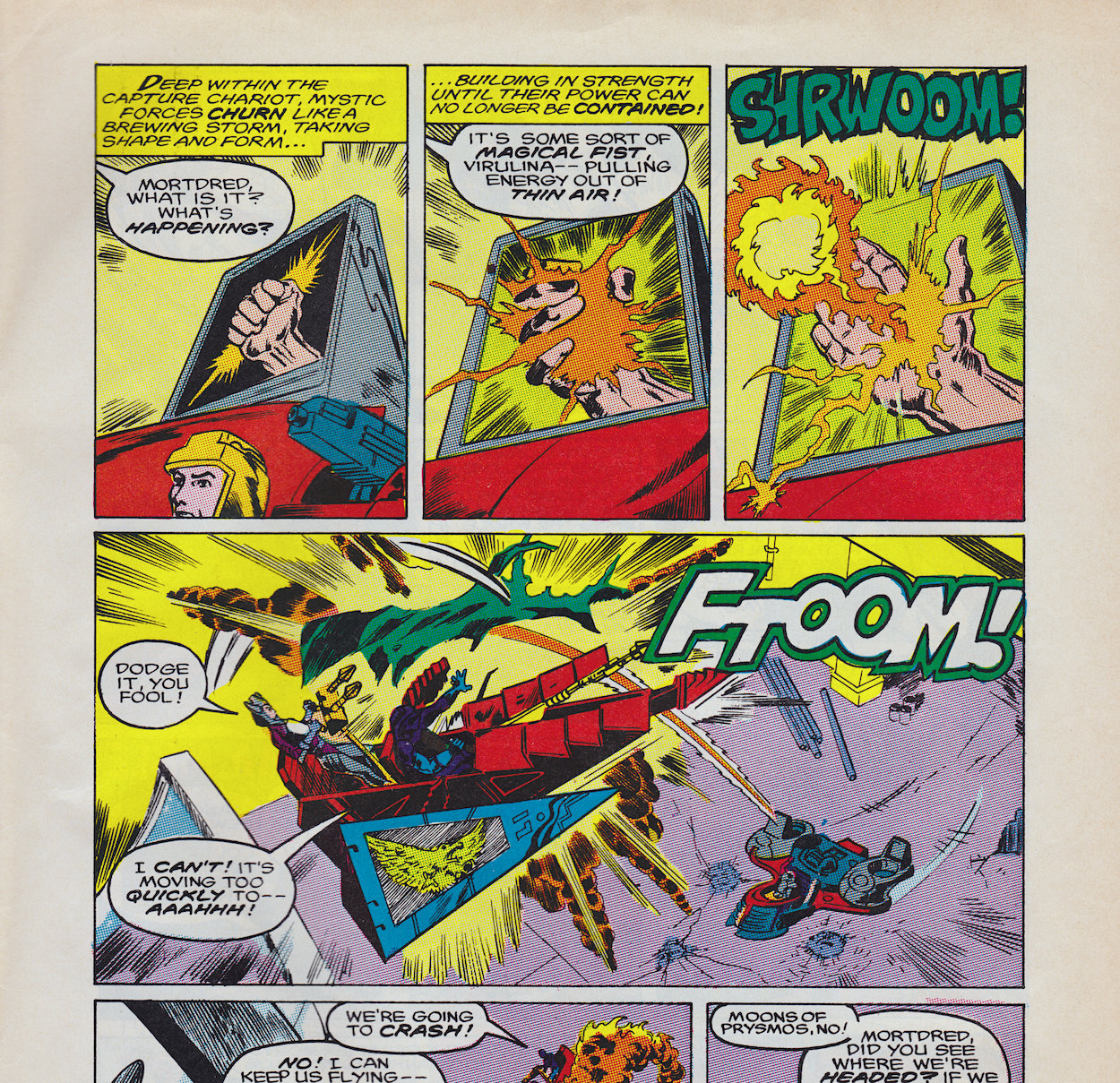
The large scale battle at the end of this issue is brilliantly brought to life (with no more mistakes I should add) by penciller Mark Bagley, inker Romeo Tanghai, colourist Julianna Ferriter and letterer Janice Chiang. We even get to see the Capture Chariot‘s power and I was thrilled to see it resemble that of the cartoon’s. There really was no other way to show it and, even if it’s not in the ghostly green colour I was used to as a kid, it’s still pretty neat to this old fan.

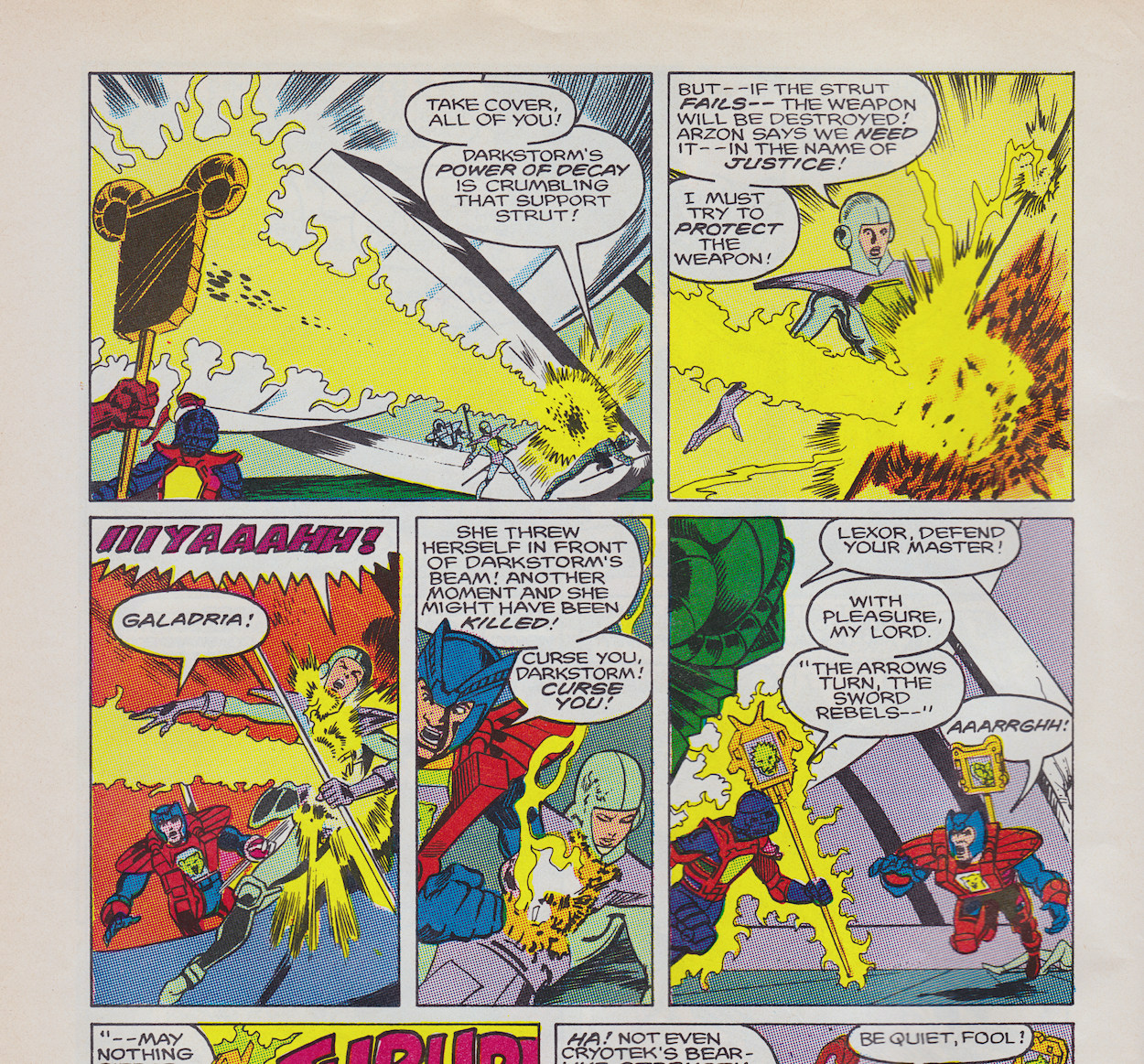
In a moment of desperation against ever decreasing odds Darkstorm uses his staff’s Power of Decay to try to destroy all of the Spectral Knights in one swift move and it’s Galadria who saves the day, throwing herself into its path. She may not have her own powers yet, but here she shows her willingness to sacrifice herself to save others. This sets her up to receive her Power of Healing from Merklynn. See also how cowardly Lexor now throws himself into battle, but only because his Spell of Invulnerability can stop anything in its tracks.

In a clever moment Leoric’s Power of Wisdom and Arzon’s Power of Knowledge are shown to be two very different things indeed. The Spectral Knight leader isn’t sure the reversal bomb should be set off and Arzon questions this, “Think of all the pain we’ll save the world!” Leoric’s response isn’t the kind of thing you’d expect from a toy licence comic.

“But pain is a part of life, Arzon. When a mother gives birth, she knows pain. Would we deny the newborn child to save the mother pain?”

As Arzon then notes, knowledge and wisdom must be used together.

In the end Darkstorm accuses Leoric of being weak and reference is made to their opposing plans to rebuild their world. Leoric sees a better world, Darkstorm a stronger one. Most of the time the villains in our cartoons and comics in the 80s were evil simply because they were. Darkstorm genuinely believes only by ruling with an iron fist can his beloved Prysmos regain its strength and position in the heavens. Leoric believes in compassion and fairness instead, even if rebuilding takes longer to achieve. It’s an interesting dynamic.

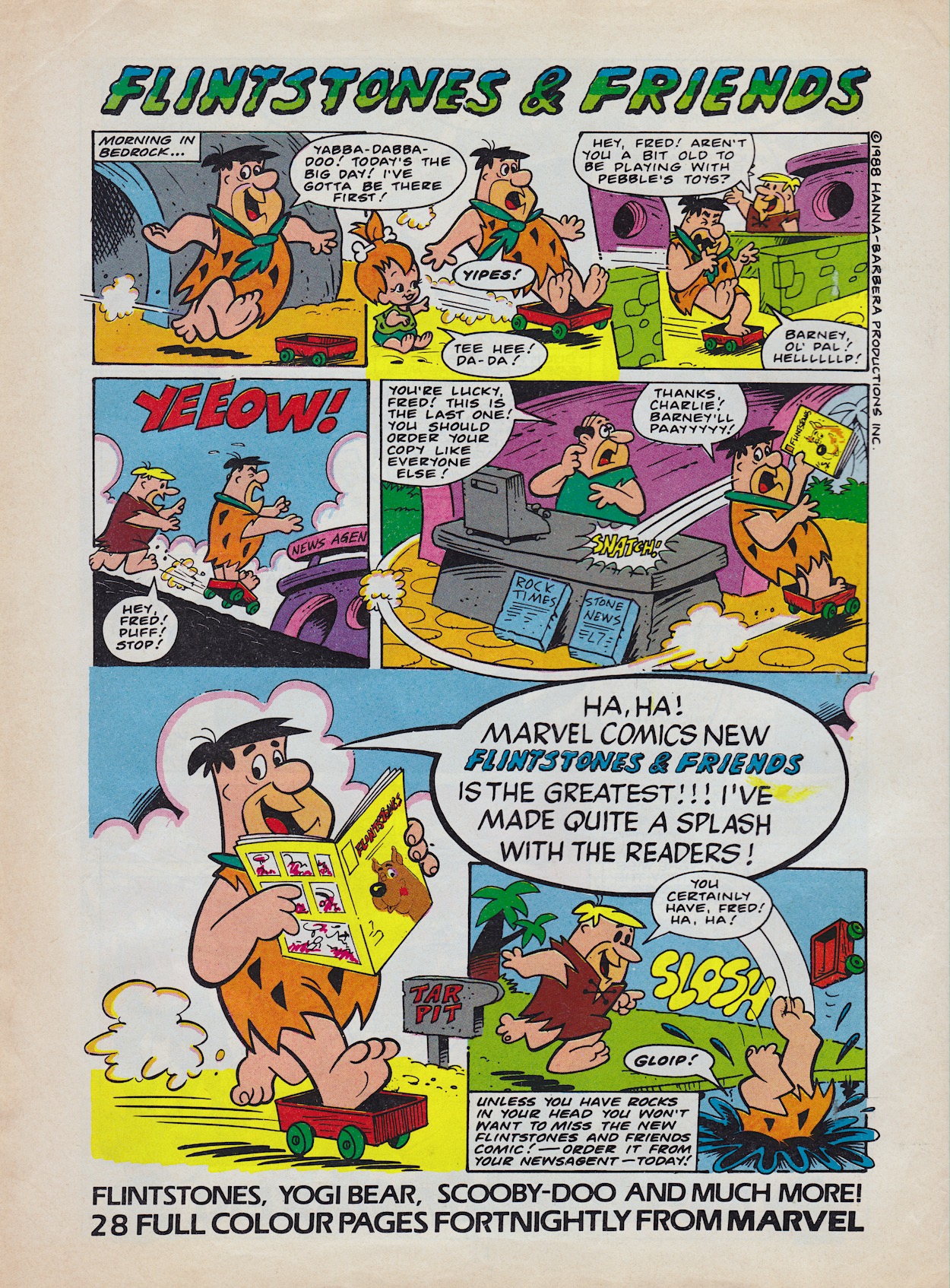
As discussed before Visionaries has no extra features, in fact this issue even has only one advertisement and it’s a bit of an abrupt change of pace! It isn’t even for the toys the comic is based on which seems a strange choice. Instead it’s a promotion for the new Flintstones & Friends title. It feels rather out of place here; surely it had a different target audience? The fact it’s out twice as often as Visionaries yet has more pages is a bit of a blow for fans too. The Flintstones comic would last for just under a year, managing 24 issues before being cancelled and rebranded as Cartoon Time.

It’s sad to think of this as the penultimate issue of Visionaries already when it seems to have so much promise. However, there is at least some more to come even after the final issue next month. I’ll let you in on what that is in the next fateful review, it’ll be here on Wednesday 21st July 2021.

iSSUE THREE < > iSSUE FiVE

ViSiONARiES MENU

ViSiONARiES #3: CLAWiNG AT THE SKY

Starting with this third edition of Marvel UK‘s monthly Visionaries are stories I’d never read before collecting them for the blog. The origin story I felt I knew almost verbatim, but now the comic was diverging away from the cartoon and forging its own path. Having missed the regular comic as a kid, I’ve looked forward to finally getting to read these stories.

Being original creations and something fans of the cartoon may have been eager to read, it’s confounding to see once again the editorial page not mentioning the story at all. Even though it’s called Vision On it’s basically an advertisement for other titles again, this time the new Action Force Monthly and Dragon’s Claws (called by its original name here which was changed just before its release), both of which were of the smaller American format and designed to try to sell UK material back into the US market.

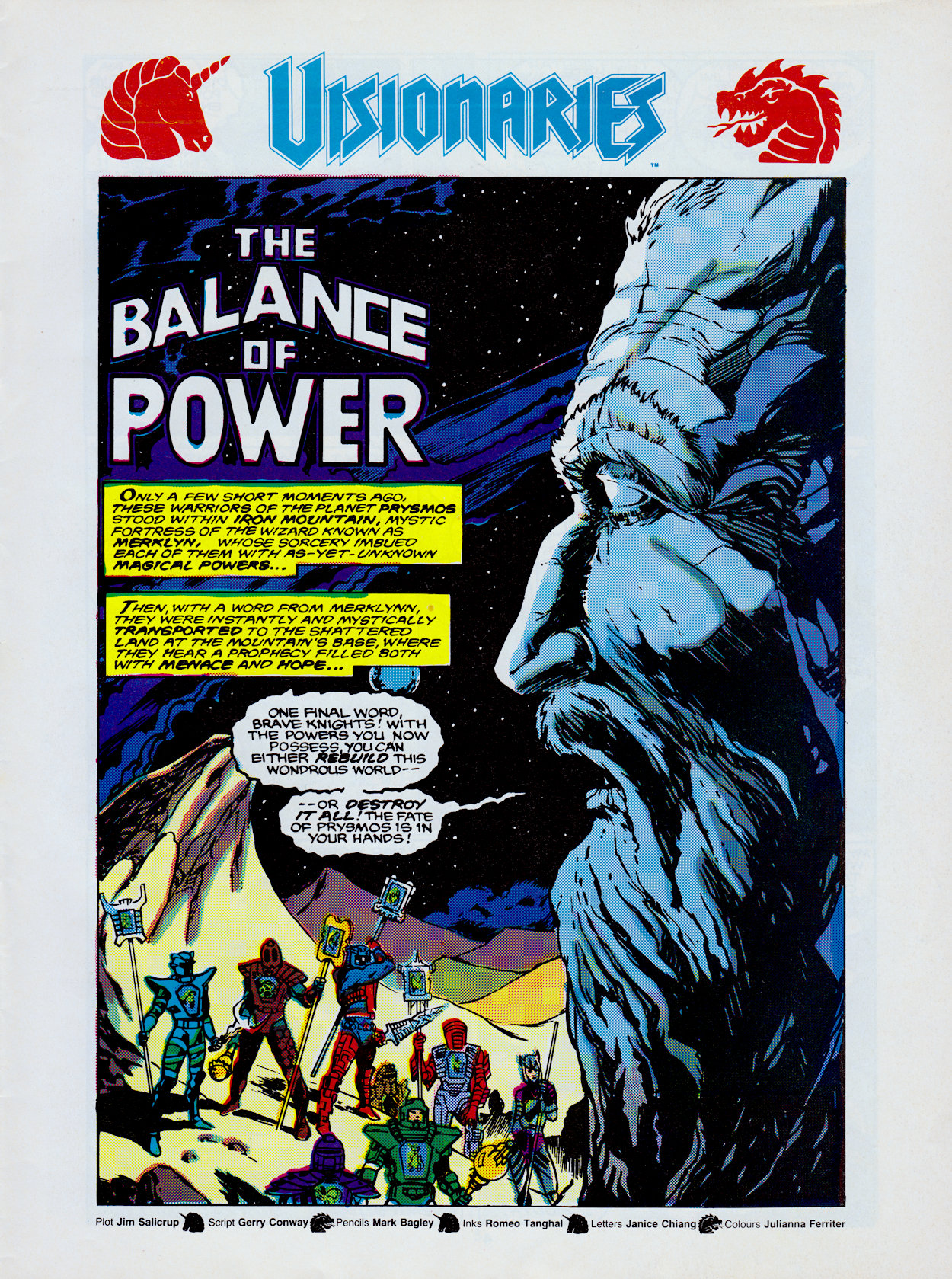
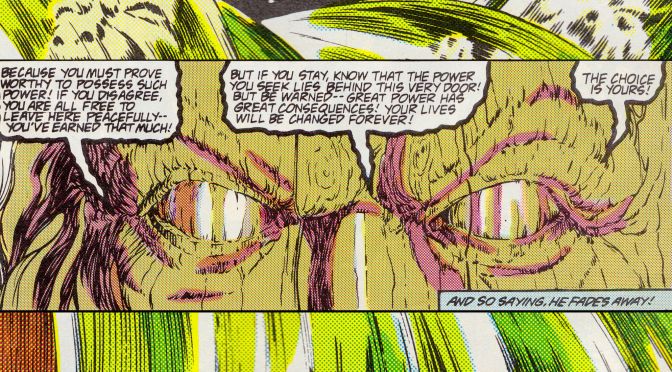
Next to the editorial the first page of Balance of Power is a bold image. On it, Merklynn‘s stone face stares down at the assembled Knights and reiterates the words from the end of last month’s story. Jim Salicrup, who adapted Frank Dille‘s teleplay origin story has created the plot this time around but full scripting duties fall to Gerry Conway (The Punisher, Spider-Man, Transformers and G.I. Joe cartoons, Diagnosis Murder) who would take over as the comic’s sole writer from the next issue.

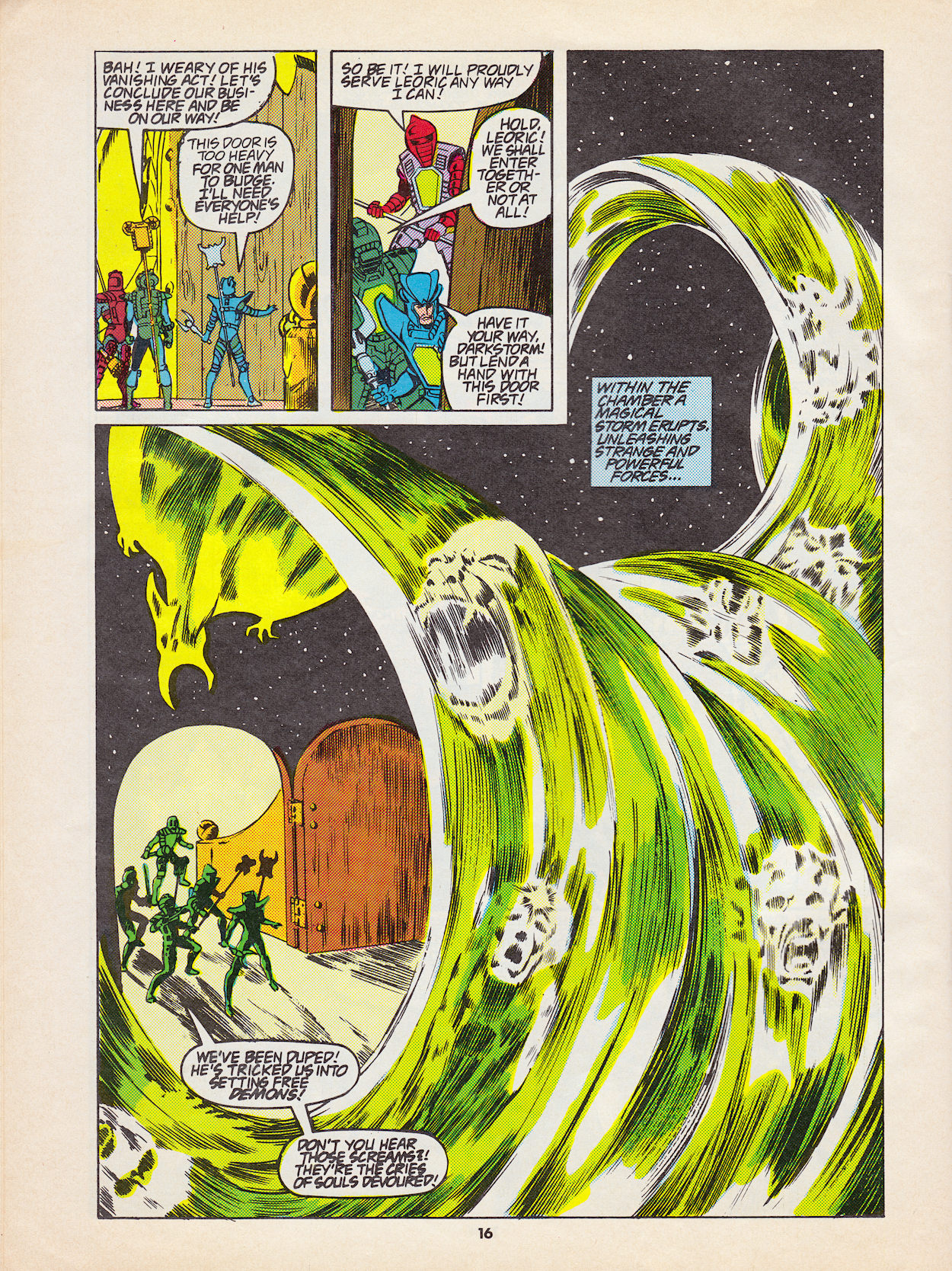
The art team are the same as the previous story, with pencils by Mark Bagley, inks by Romeo Tanghai, letters by Janice Chiang and colours by Julianna Ferriter. Unfortunately, it’s in this final category that the issue is let down a little bit. There are quite a few colouring errors, which is something you don’t want when you’re still introducing characters and the colour of their armour is key to seeing who is doing what and to whom in battle. It’s a shame because at times it can really ooze atmosphere, such as with that splash page above.

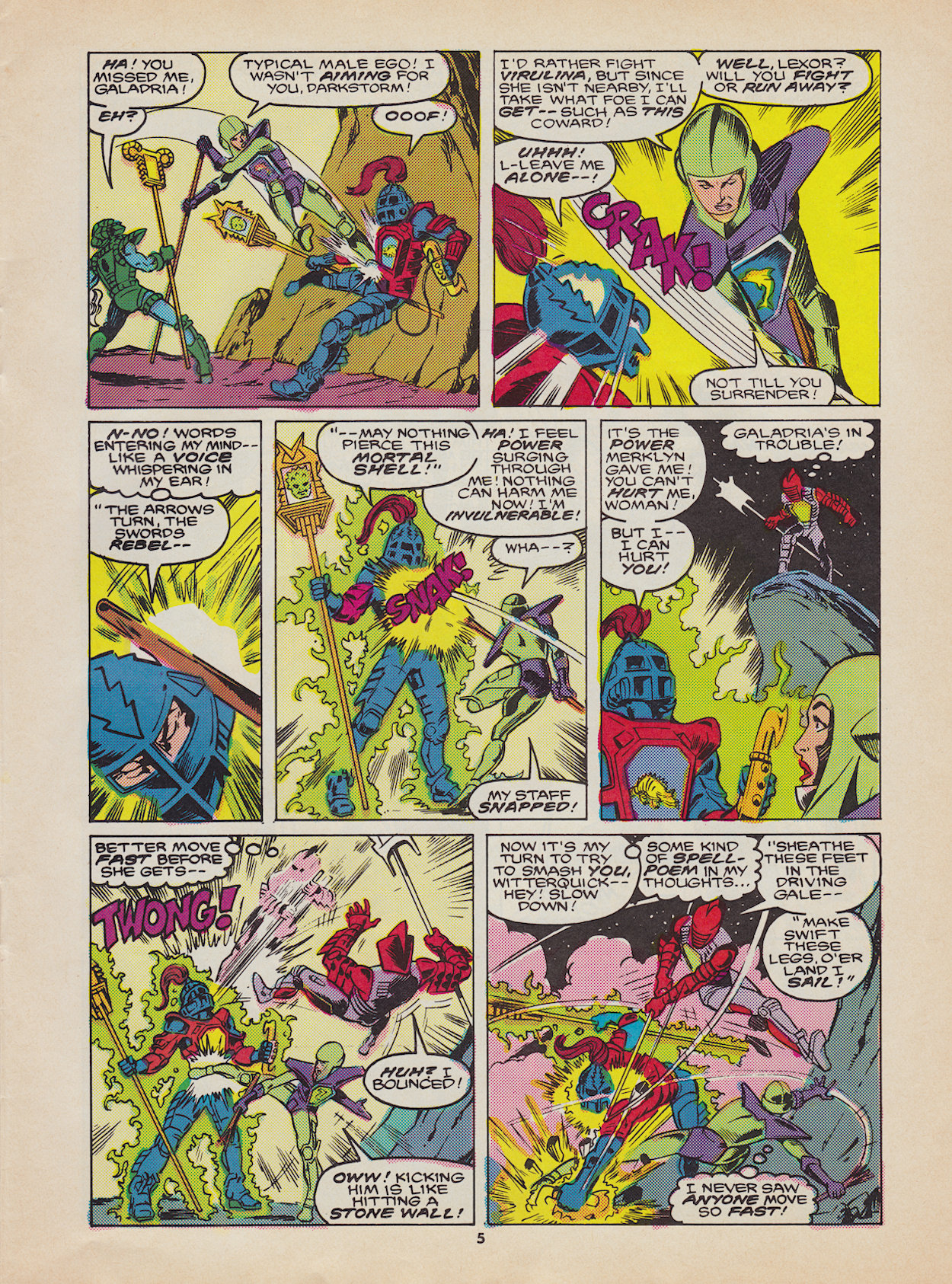
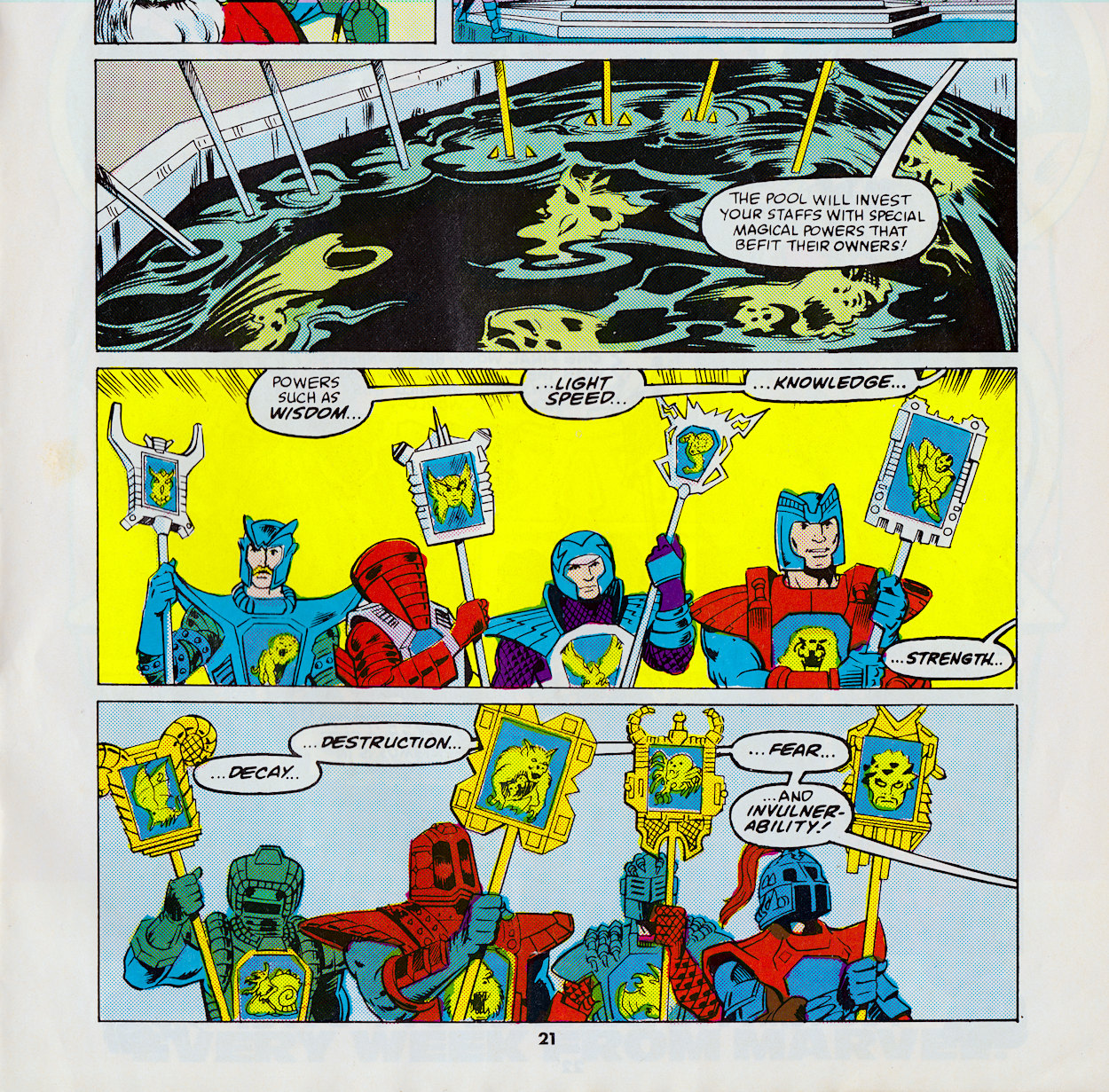
Something else this issue has in plentiful supply is action. As soon as Merklynn finishes his prophetic speech the Knights turn on each other, wishing to finish off the battles started inside Iron Mountain. Galadria gets the best line, then some of the characters start hearing a voice inside their head, telling them of incantations to summon the power of their magical staffs. Reading these again brings back memories of learning them off-by-heart from the toy packaging.

This is where some fundamental changes between the comic’s universe and that of the cartoon become apparent. Here, the staffs just sort of produce the desired effects, like making Lexor invulnerable, Witterquick superhuman fast and Cindarr‘s unleashes a mini-earthquake. But in the cartoon the holographic image on the staff materialised in the real world, for example a cyclone around Witterquick’s body or a giant monster wielding a club for Cindarr. Even the cover of this issue shows Cryotek’s archer, but none of these would appear in the strip. They’re missed and without them it’s not particularly clear what’s happening at times.


“And, like a wild stallion, rearing with savage fury, the mystically powered craft responds.”

Description of the Sky Claw

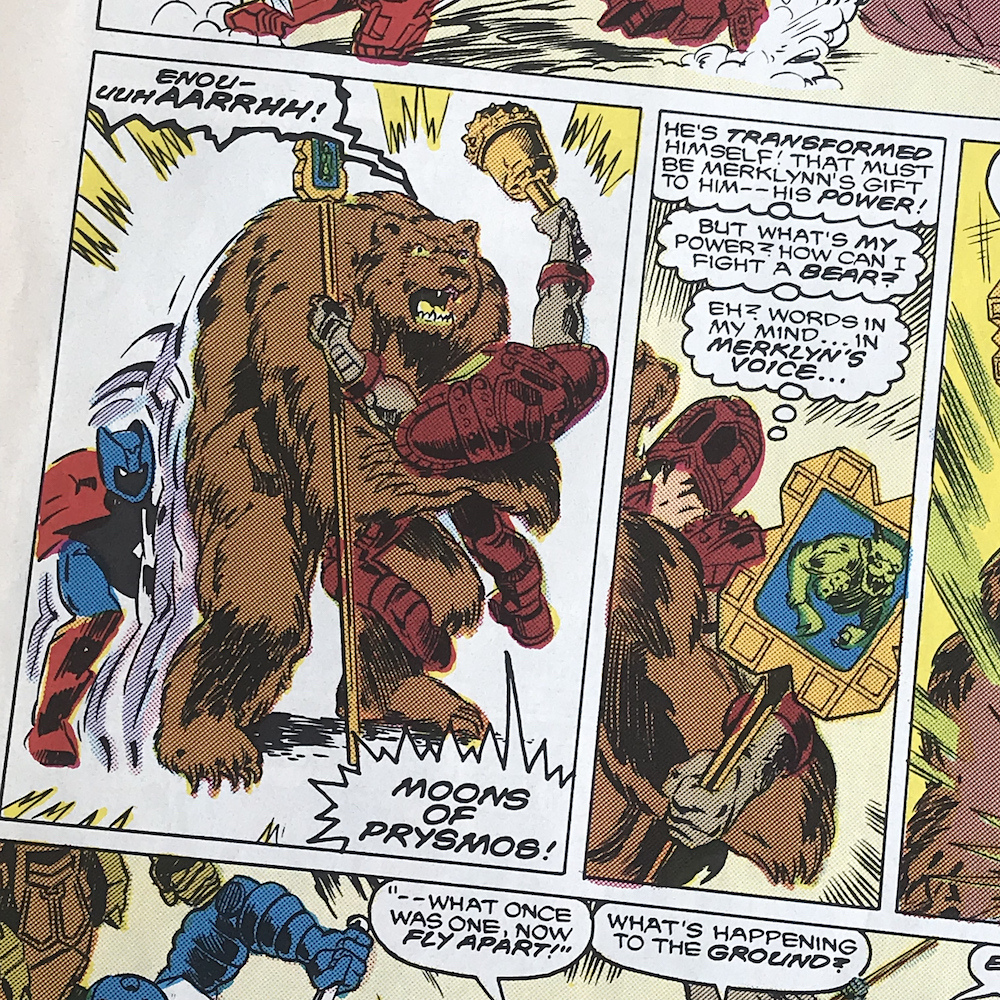
It also doesn’t help that when some of the characters transform into their magical animal totems these are mistakenly referred to as “magical powers”, when that’s actually what the staffs contain. Instead, the totems are an embodiment of their individual personalities, which they can change into, physically becoming said animal and harnessing its abilities (the actual animal rather than a magical representation like the cartoon). However, their magical powers are that of speed, strength, healing, decay, knowledge etc. Fans of the cartoon or toys would be able to follow along and it’s clear these are the intended audiences, but it must’ve been very confusing for anyone reading without prior knowledge.

The plot is rather basic this time around. Even though both sides have yet to even experiment with their new powers and totems, Darkstorm insists he and Leoric’s Knights are now too evenly matched. How would he know this? Surely they should train with their new magical abilities before coming to that conclusion. He wants an advantage and, annoyed with some of his people complaining about their lack of staffs, he sends stealth master Reekon and the grovelling Mortdredd to find a new weapon to given them that edge.

It all feels rather convulted. Given the cover we know what they’re going to find, but the pacing is all wrong. If this had come later in the run, or even if we’d jumped forward a few months and they were having difficulties managing their powers and wanted something more conventional, it would have made more sense. The saving grace here is the world building in the background. Wanting to rebuild his world no matter the cost to anyone else, Darkstorm’s castle overlooks slums where the poor and hungry struggle to survive, through which Reekon and Mortredd trot along, uncaring of the devastation around them.

They make their way to a contact of Mortdredd’s at Harkon’s Blacksmith Shop. An engineer by trade, Harkon found himself without work in the new Age of Magic and retrained as a blacksmith, where he won the contract to repair and replace armour for the Darkling Lords. Underneath tarps scattered about his workspace are high-tech vehicles which are now nothing more than useless relics of the past.

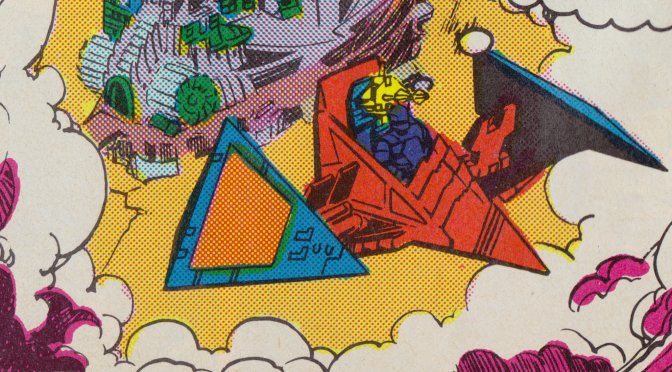
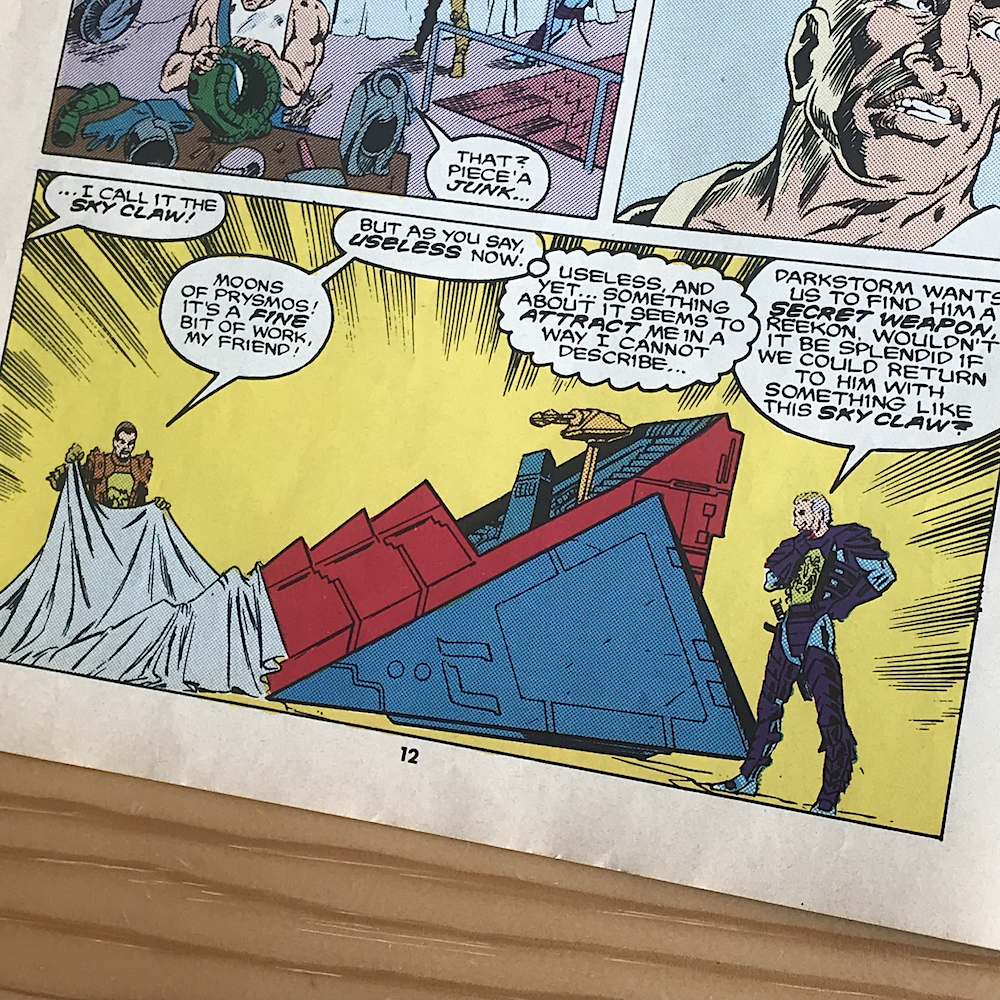
I recognised the one above as soon as its covering was pulled back. It’s the Sky Claw. It was one of the large vehicles from the toy range and one of three that I personally owned. Covered with large holograms and movable levers and wings concealing a variety of awesome weaponry, it was a favourite childhood toy. It’s the whole raison d’être for this story so my excitement levels have been turned up a bit now.

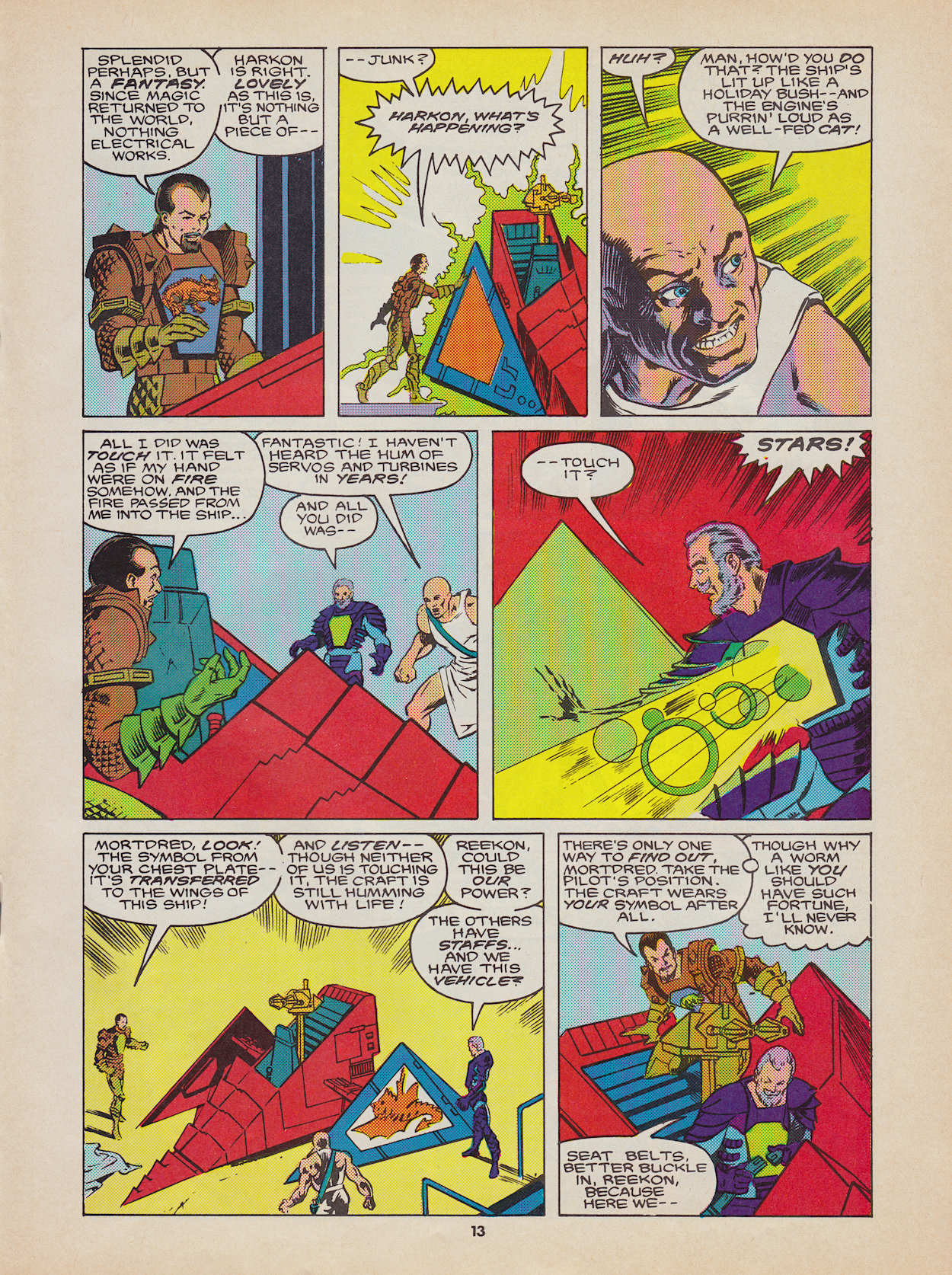
The machine responds to the energy of Reekon’s magical touch, but it’s Mortdredd’s proximity that really brings it to life. While the statement that the symbol from his chest plate transferred to the craft is completely wrong, it’s still a fun way of introducing it. I particularly like how magical powers erupt from Mortredd’s chest, while his hand almost disappears into the holographic panel, becoming nearly skeletal-like. Although, why does Harkon say he hasn’t heard the sounds of an engine in years when this follows on directly from the previous origin story?

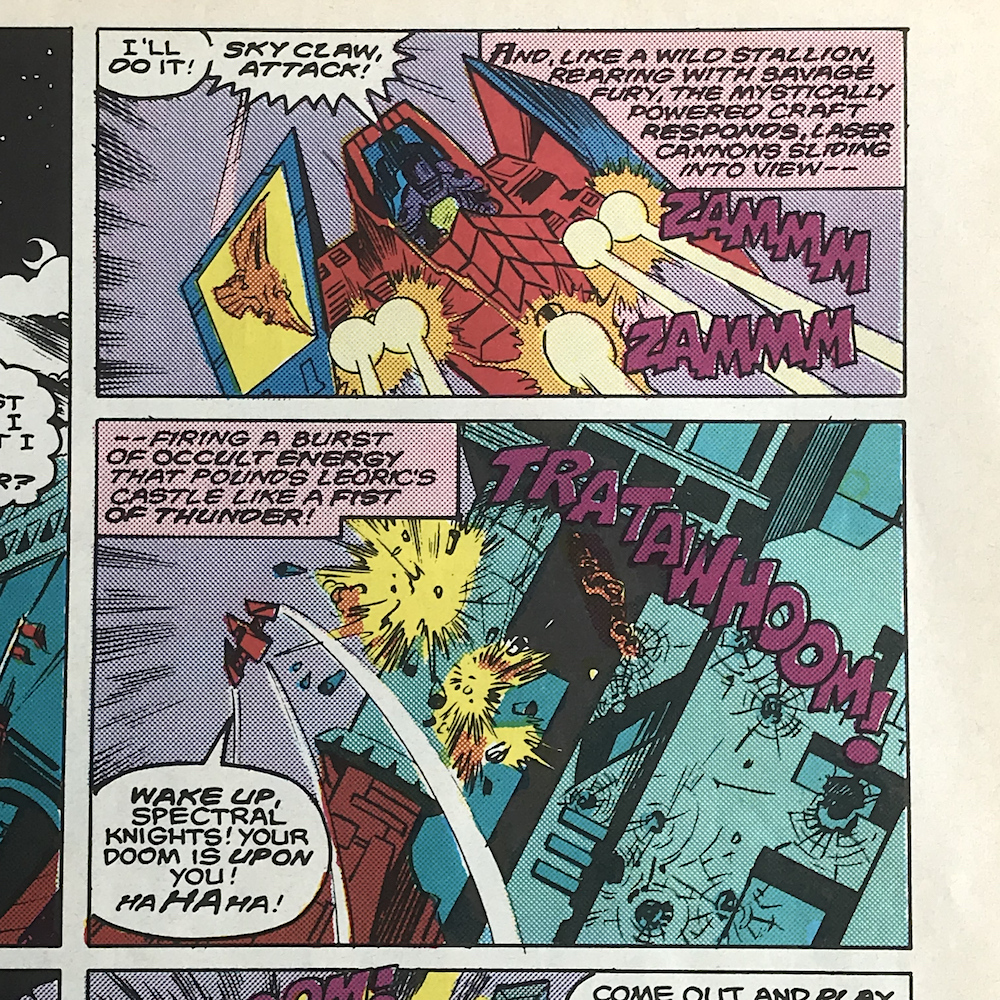
Able to control it with but a thought, Mortdredd is eager to prove himself to his Lord and Master. Darkstorm wants to wait, plan, gather information before a strike (again, no mention of learning their new skills) and this leads to other Knights calling him a coward. Defending his leader’s honour, Mortdredd attacks the others but find it’s he who ends up pushed out. Seizing the moment, he takes the Sky Claw and launches a devastating attack on Leoric’s castle, hoping to show he’s worthy of his position within the Darkling Lords. None of the vehicle’s magical powers are used though, just the weaponry which is a shame because I was looking forward to seeing those holograms come to life again.

The descriptive panels here are excellent. In fact, throughout the comic they’re a unique mix of science fiction and what feels like medieval storytelling. The latter in particular sets it apart, the comic playing up to this aspect of the characters and setting particularly well. This attention to detail is great.

One of the more interesting magical powers makes an entrance here and that’s Arzon‘s power of knowledge, even though he’s incorrectly drawn as Ectar but we’ll skip that detail for now. He recites his incantation to find out what the Sky Claw is, because there has been no flying vehicle since the Age of Science and it takes them by complete surprise. However, he not only discovers the information he seeks, suddenly everything he’s ever known in his whole life temporarily returns to his mind.

Everyone having completely different powers […] could make for some epic battles

This could’ve set up some brilliant stories for the future. I could see something like that opening up old wounds, thoughts he’s tried to suppress or even things that he doesn’t wish to know. Unfortunately I can’t see this being explored in the short run the comic ultimately had.

On the surface a power like this could seem to give an individual an unfair advantage in any fight, but with everyone having such completely different powers, all with some form of vulnerability built in if not used correctly, it could make for some epic battles.

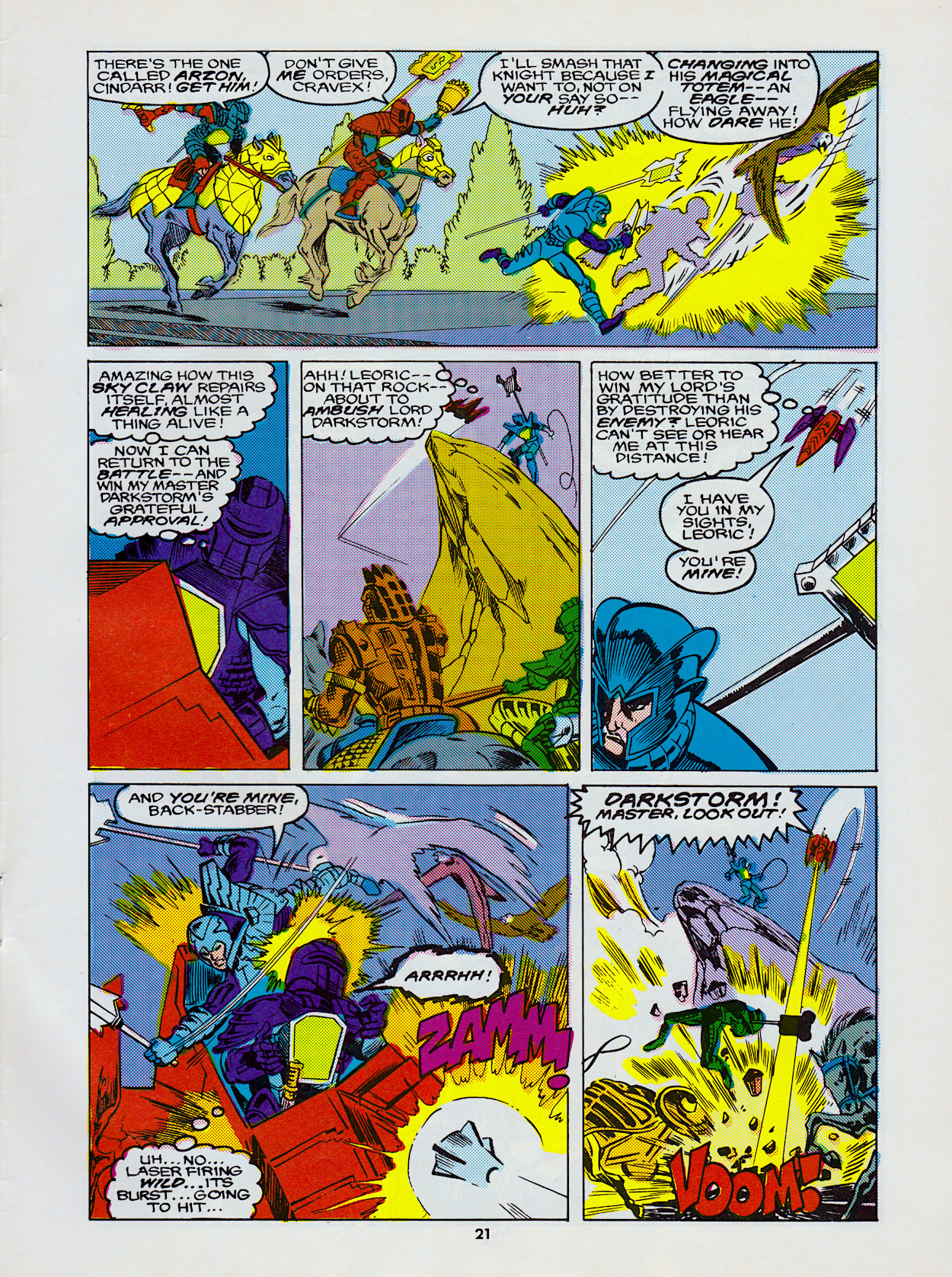
It all comes to a head when Arzon transforms into his eagle form and attacks the cowardly Mortredd from above. From there it all falls apart for the Darkling Lords, who had shown up to finish what the Sky Claw had started. Disobeying orders and nearly killing his leader sees Mortdredd locked up in the dungeon of Darkstorm’s castle at the end of the story, but not before he’s made reference to the Sky Claw feeling alive when it repairs itself during a moment away from the battle. It’s a passing comment for now, but if memory serves me right this could tie in to some revelations yet to come about all of the Visionaries’ magical powers.

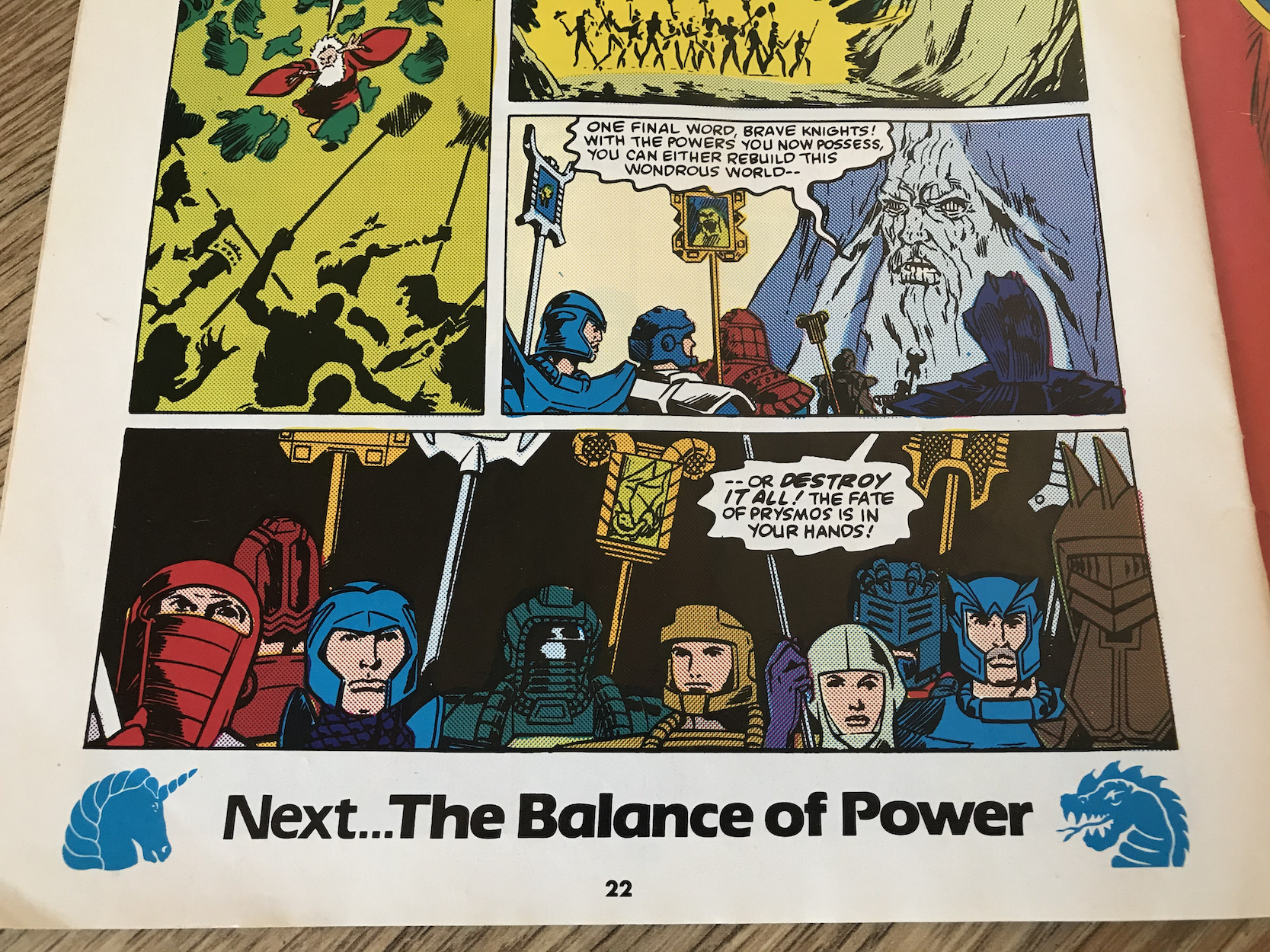
The Balance of Power feels very much like an extension of the previous two issues and the cynical might say it’s nothing more than a couple of extended action scenes. There’s little in the way of characterisation but the main point here is to see more of this world and the characters inhabiting it, to see their magical powers and how they could turn the tide of battle. Hence the name of the story.

With Jim having set things up and established the potential for future stories, the authorship is handed over to Gerry for him to develop the comic as its full-time writer. So let’s wait and see what he brings to the table and if all that potential is realised. The next chapter’s review will be here from Wednesday 23rd June 2021.

iSSUE TWO < > iSSUE FOUR

ViSiONARiES MENU

ViSiONARiES #2: THE BEGiNNiNG

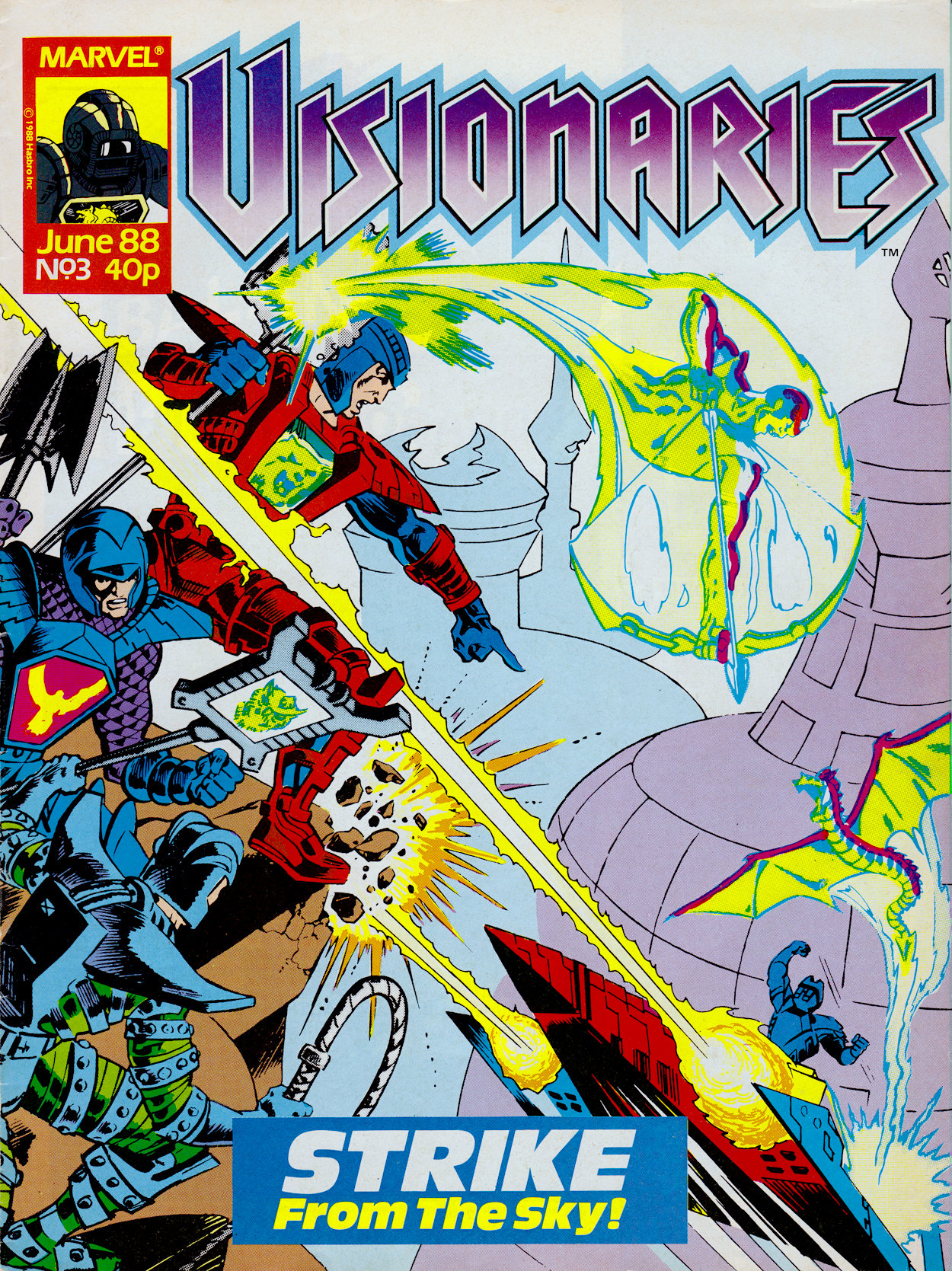
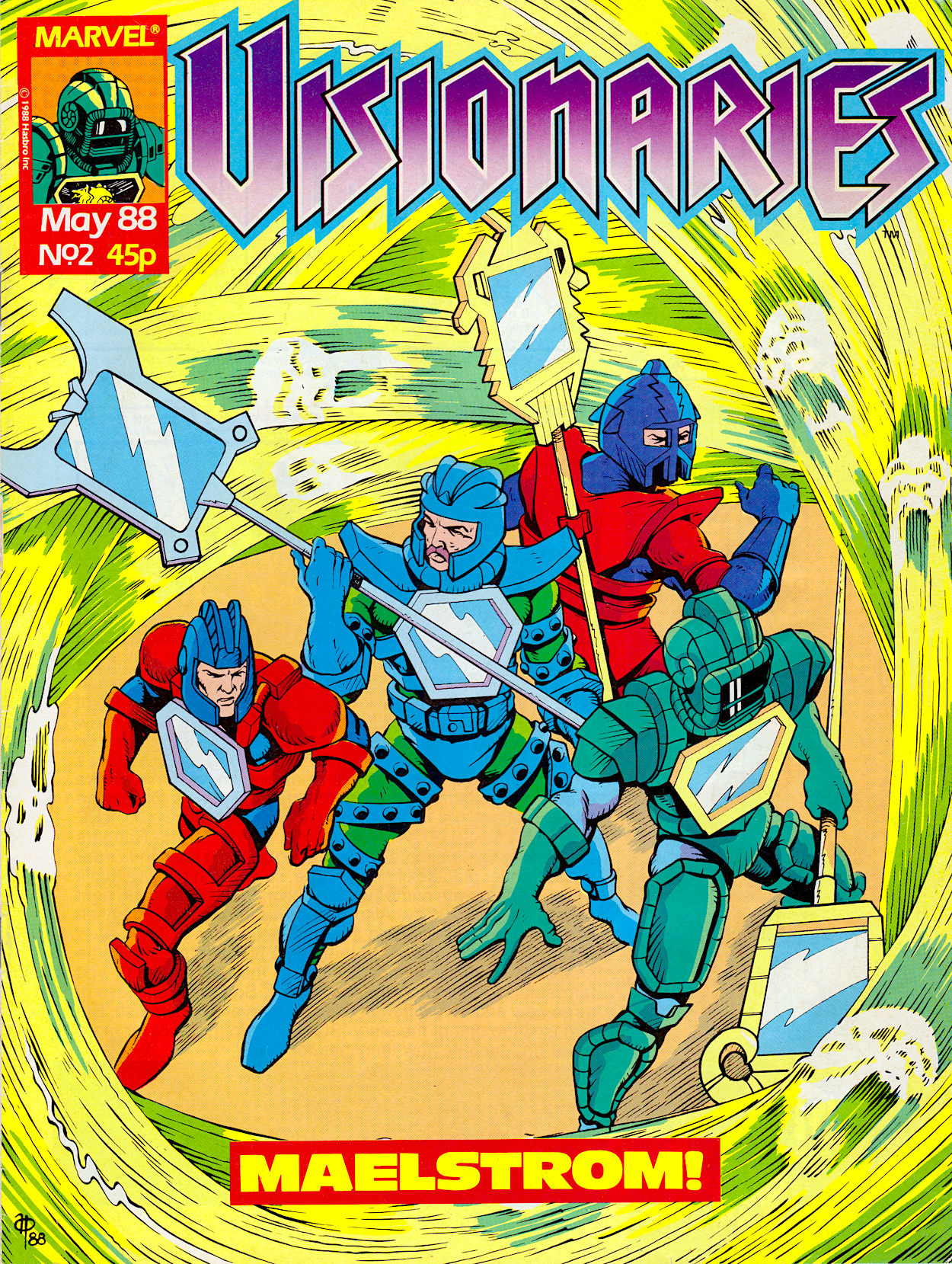
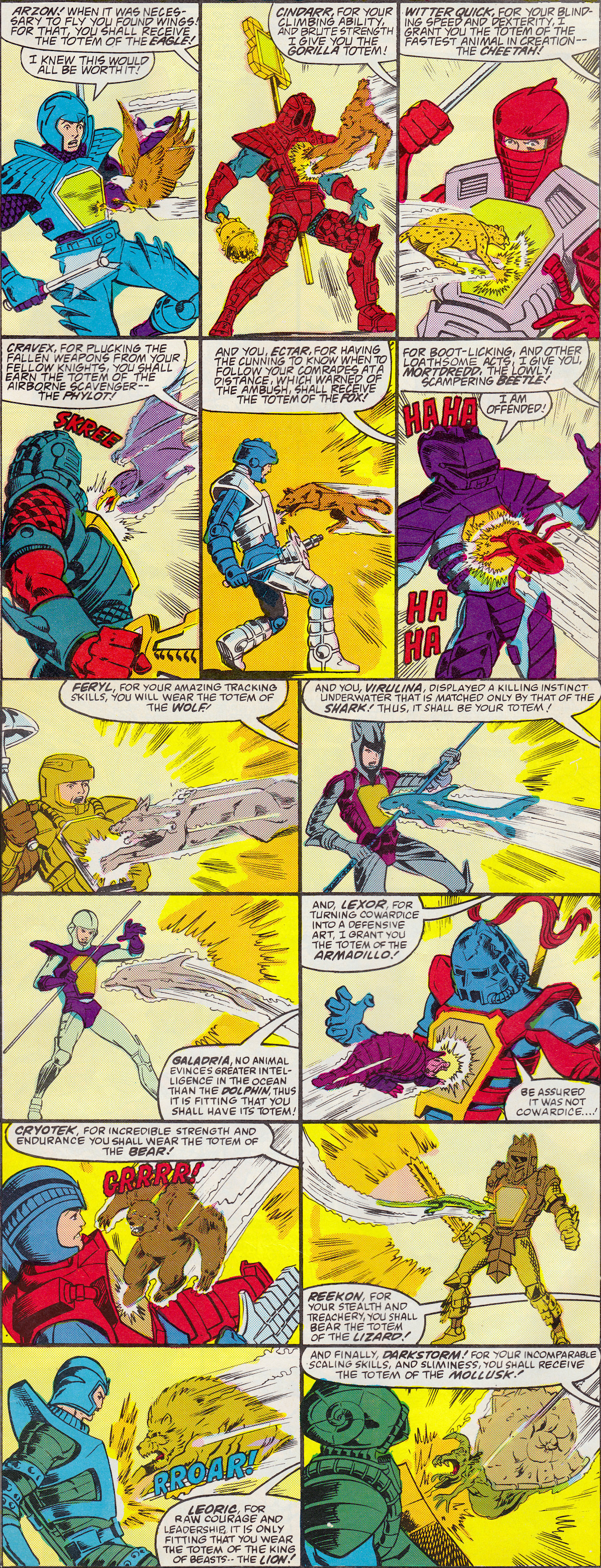
This gorgeous Andrew Wildman cover (Transformers, G.I. Joe, Venom: Carnage Unleashed) opens the second issue of Marvel UK‘s new Visionaries monthly, released on this day back in 1988, showing some of our heroes and villains surrounded by the magical totems that’ll become part of their very being. We’ll get to that further down the review, but is that a price increase already? It’s only 5p but back then that was quite the hike, especially for a second issue.

Not only is the price increase a bit strange, so is the Vision On editorial which doesn’t mention anything about the issue’s story, instead focussing solely on other Marvel releases. The recap of the previous chapter is then pasted on top of the next page, excising the top third of the strip! It is atmospherically written though.

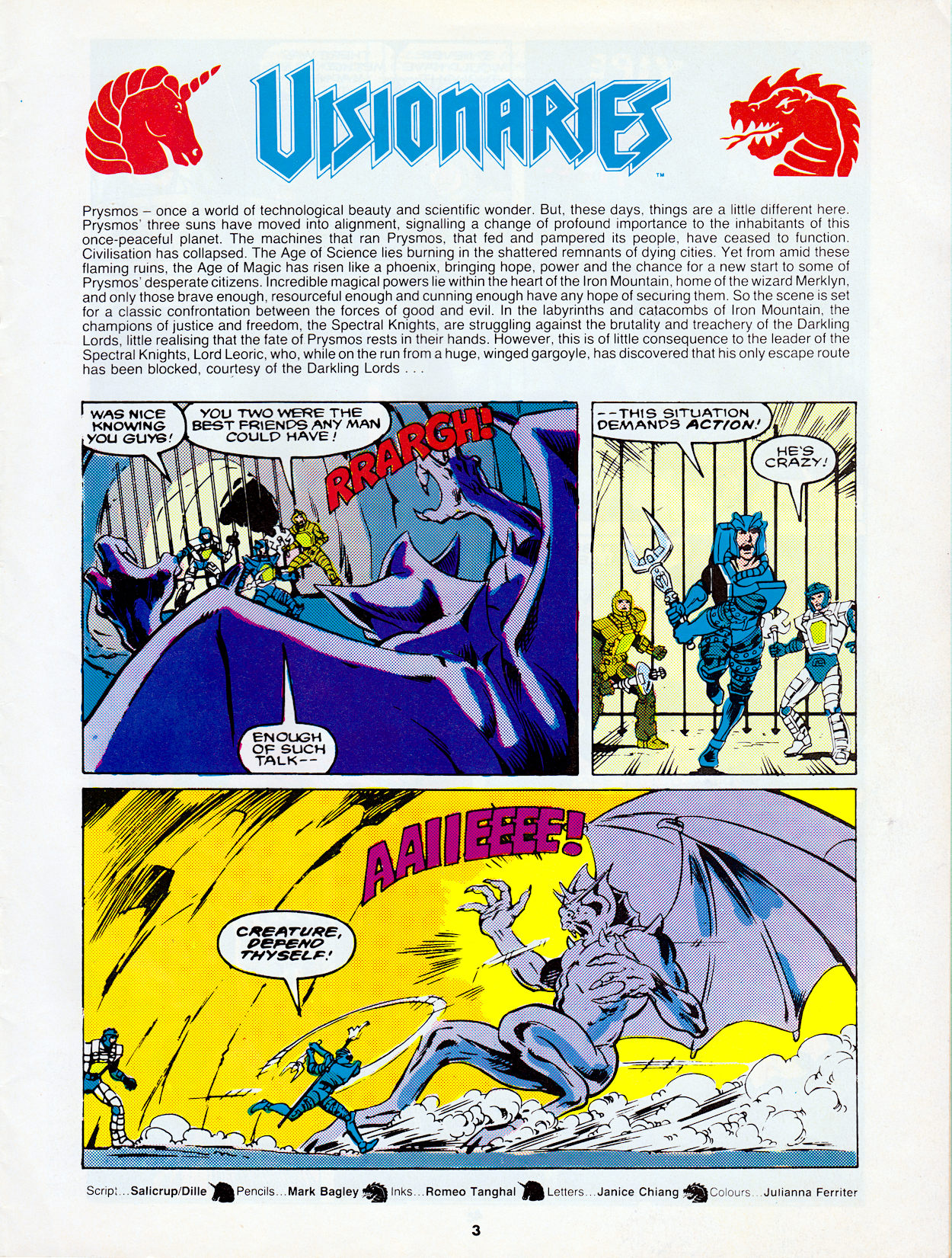
Last time, Reekon pulled on a lever as a large stone gargoyle rushed towards Leoric, Ectar and Feryl but what the lever did could easily have been missed because of where the story stopped. The metal gates that trapped them with seemingly no hope of survival would have come down at the top of this page. So not only could it have been missed last issue, this time it’s been deleted by editor Steve White.

An even higher grade of paper really does justice to Andy’s cover and the opening pages of the strip

Thankfully the strip itself more than makes up for any shortcomings in repackaging it for UK readers plus the outer eight pages are made of an even higher grade of paper than last time. A shame the rest is of the usual stock because these glossy pages are lovely and really do justice to Andy‘s cover, as well as the opening pages of the strip from penciller Mark Bagley, inker Romeo Tanghai, letterer Janice Chiang and colourist Julianna Ferriter.

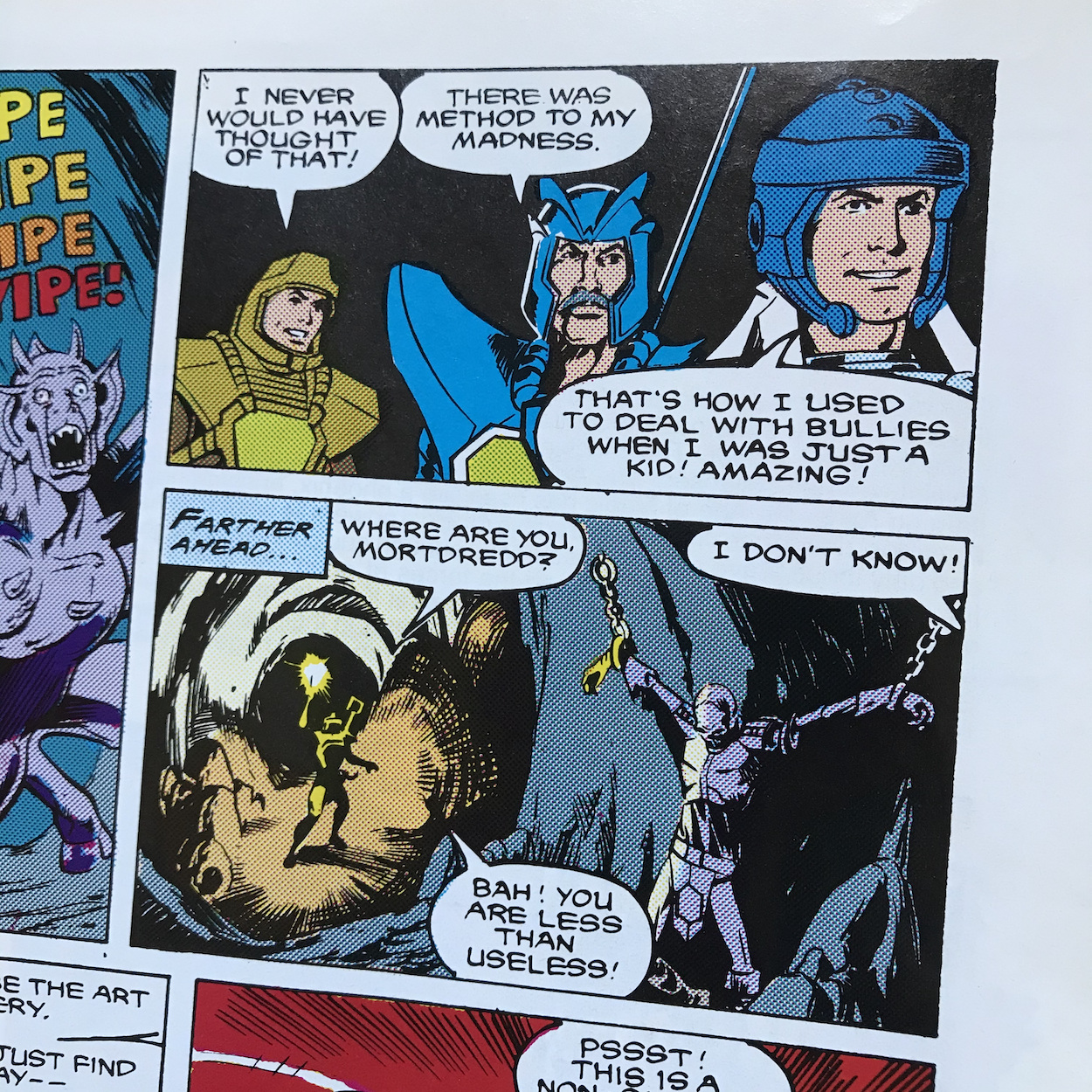
Adapted by Jim Salicrup from Flint Dille‘s animated teleplay it’s all action this time around, with the knights from across planet Prysmos now inside Iron Mountain facing the trials of Merklynn the ancient wizard. But that doesn’t mean there isn’t time for humour, as we see when the startled gargoyle runs off like a yelping dog, and then there’s this panel featuring Darkling Lord leader Darkstorm and (the voice of) Mortdredd, his snivelling follower.

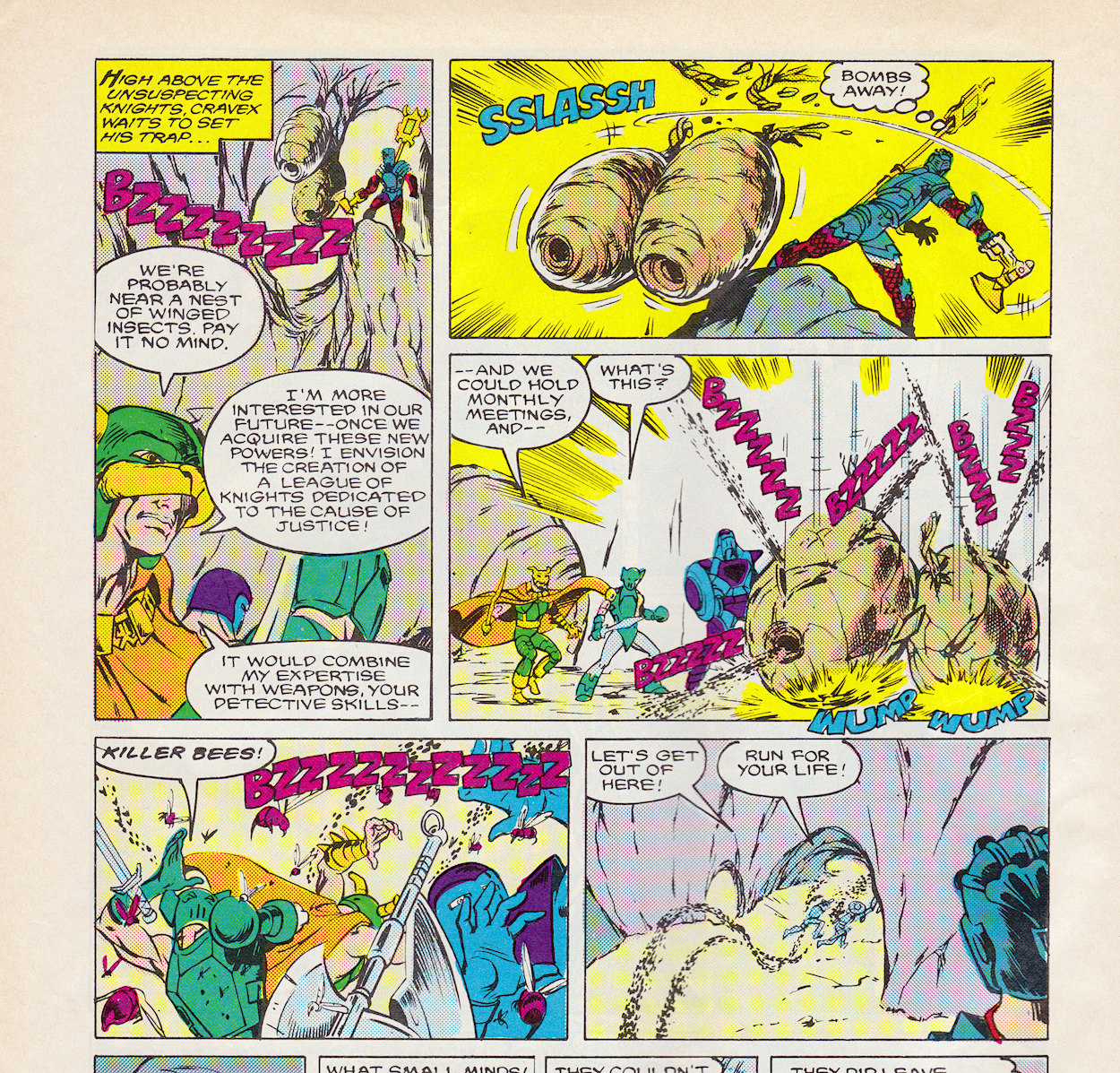
In fact the first several pages contain some comedy gold. Below, Cravex hears some apparently noble knights talking of forming what sounds very similar to Leoric’s vision of the Spectral Knights. It’s all talk though, humorously told with mention of their skills and expertise but their actual plans amounting to nothing more than monthly meetings. It reminds me of some office managers I’ve had to work with in the past.

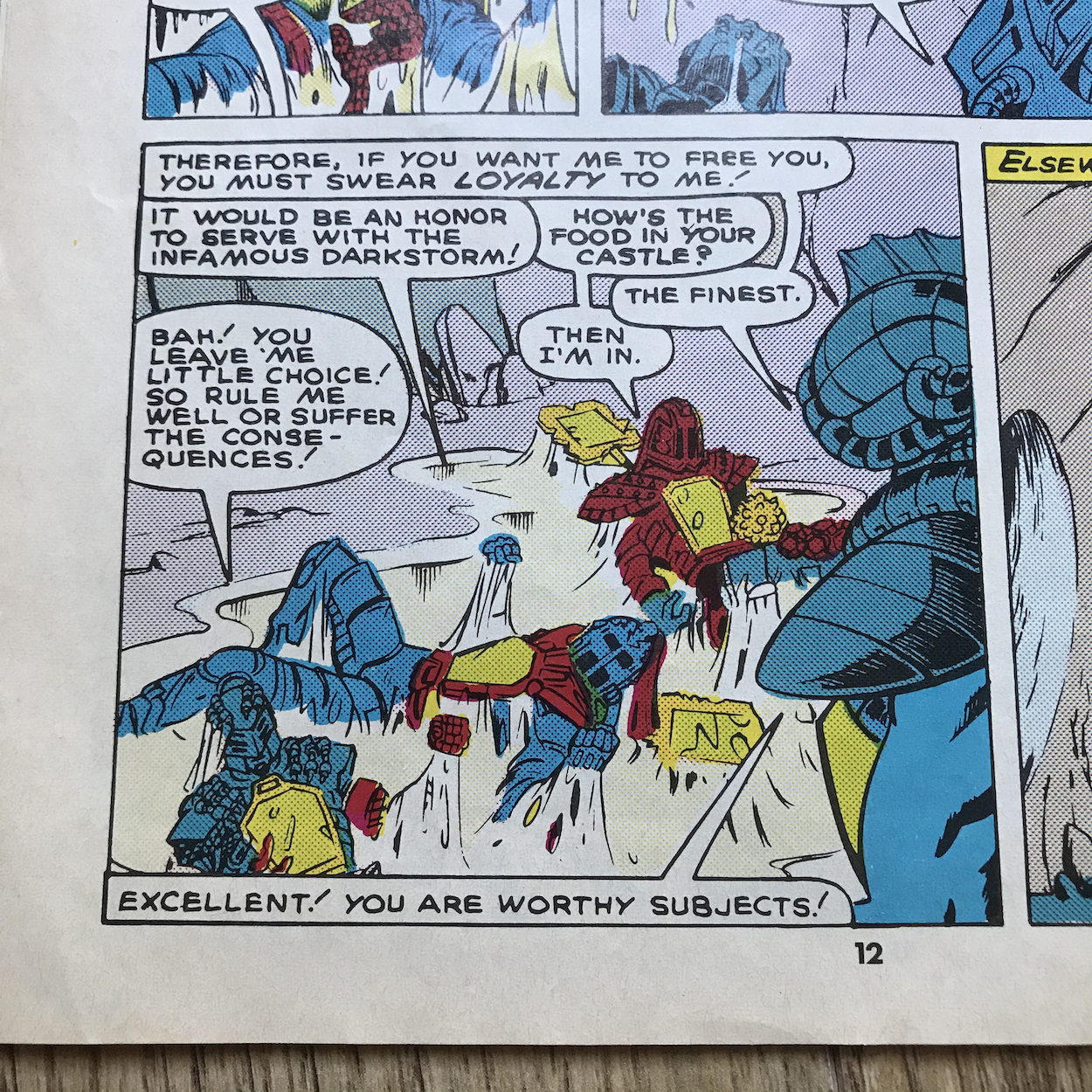
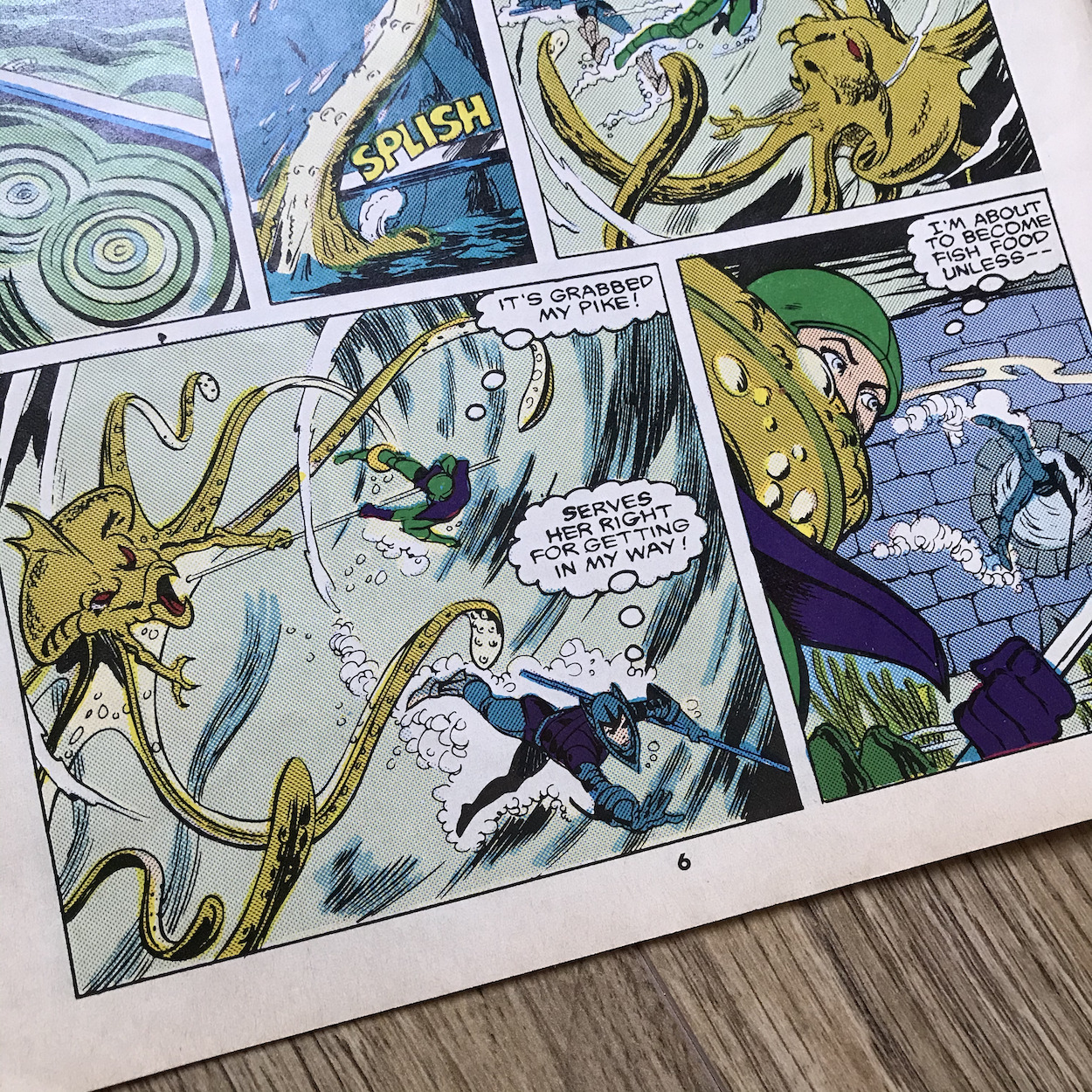
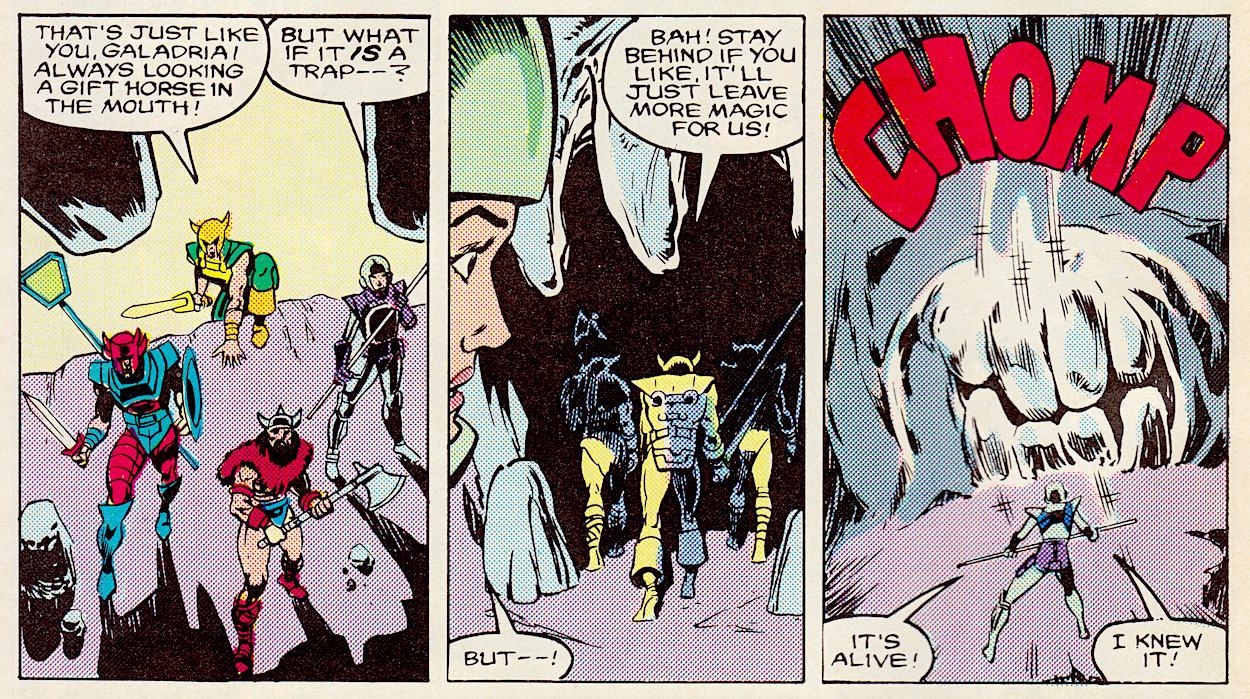
Then, after being surprised by an animated skeleton pushing him over a crevasse, Darkstorm’s superior climbing skills and cool head save him and he finds himself beside a vat of milk from a giant spider, which ominously looks on overhead. Realising that in order to fulfill his ambitions he’ll need underlings he traps three knights in the sticky goo and forces them to pledge their allegiance. Cindarr‘s sole requirement had me roaring.

Hmm, a League of Knights dedicated to Justice? One with a bird-like mask? Could this be a little joke at the expense of the DC Universe? (Thanks to blog reader David Teller for this snippet of information.)

We see some personal rivalries begin here too. The Cryotek-versus-Cindarr fight is interesting as it’s actually the Spectral Knight who loses his temper. Showing a fearsome, darker side and swearing to kill his enemy, his magical totem in the final pages is revealed to be the grizzly bear for his incredible strength and endurance, so I’m interested to see how these two aspects of his personality develop in tandem in future issues. But I want to concentrate on one particular grudge match here.

At the time, having only one or two female warriors was deemed enough in everything from He-Man and the Masters of the Universe to The Transformers. The former at least had a female-centric spin-off but the latter had only one female robot in a cast of hundreds. This has been remedied in the intervening years but we can see now just how woefully inadequate it was at the time. Galadria and Virulina, shown here in a thrilling underwater fight scene, weren’t even toys and were instead creations of Flint’s. I hope they’ll get as much coverage as their male counterparts in future issues.

While the comic’s origin was based on the cartoon’s, there were already key differences. Something that irked me about the same story in the cartoon was the fact only the characters who’d receive the magical powers in the end had the hologram-shaped chest panel. It kind of gave the game away, but in the comic they’ve shown several background characters with the same design. It’s not overly done, we’re always aware of who’s going to make it and who isn’t, but it’s a welcome change.

It may be over three decades later and it may be based on a toy line, but this is still a thrilling read.

Something else a comic can do is expose the inner thoughts of the characters and it’s used here in abundance, and not in that annoying way of just describing what we can plainly see is happening to them. Instead, it’s used to add depth to reactions and portray their inner doubts and fears.

As we approach the final pages a huge climactic battle between the knights is interrupted by a booming voice as a huge wooden door nearby contorts into the shape of Merklynn‘s face. Daring them forward, they’re faced with horrors on the other side.

It’s actually Darkstorm who feels a certain level of familiarity with the screaming souls in front of them. They march on and Merklynn explains this was their final test, the spirits really being mystical reflections of their deepest, darkest fears and in conquering them they’ve conquered their inner demons. It’s quite startling to turn the page over and see this image. It may be over three decades later and it may be based on a toy line, but this is still a thrilling read.

It’s at this point we finally get some more background into the previous Age of Magic. It’s played out over a page previously shown in the preview mini-comic but essentially Prysmos was a planet with a strong-willed race of humans, able to achieve anything they set their minds to for the good of their neighbours. The strongest were the Knights of Prysmos and from these arose the Mages of Prysmos. Only a few were able to predict the cataclysm when the Age of Science came, of which Merklynn was one. By secreting his power inside the mountain upon which his castle once stood he was able to ride out time until the suns aligned again and the ages were reversed.


“Be not afraid, Knights of Prysmos! Accept these totems as your just reward! Only you had the vision it took to succeed in finding this chamber! Truly thou art Visionaries!”

Merklynn the Great Mage

Then it’s on to the finale and the part I, as a fan of the toys and cartoon, had been waiting for. It was time for the new Knights of Prysmos to receive their totems, their magical emblems that would encapsulate each individual character, granting them unique special powers, regardless of their intentions beyond the mountain.

Looking over these particular images sparks happy memories. I had so many of these toys it’s like being reunited with old friends. It’s been a great start and we haven’t even seen any of their powers being used yet. But given what we’ve seen them all achieve as people grasping for the power to rule or rebuild, it’s already a compelling story and I think this is mainly thanks to the way the characters have interacted with one another. They feel real, which is no small feat given they’re based on action figures.

Judging by these beginnings, if Visionaries had proven more popular and had had the chance to develop over the course of a few years, I would say these human characters could’ve risen through the ranks of comics to sit proudly alongside the likes of Larry Hama‘s superlative G.I. Joe creations. I’m well aware I’m saying this after only one story, but I’ve a feeling the remaining issues are going to back that up.

For now The End… The Beginning finishes with everyone safely transported back to the entrance of Iron Mountain, where a rock formation in the shape of its soul occupant’s face (he does like doing stuff like that) ends the proceedings with some ominous words for all those assembled.

After this initial story the comic would diverge completely from the cartoon and I’m looking forward to seeing what direction it goes in, what with the animated series being one of the best of its time. I really do get the feeling all is set for a story unlike any other. The comic team should be proud of their adaptation (I usually can’t stand comic adaptations of films and shows) and now we’ll have to wait a whole month to see what they bring to the world of the Visionaries.

To round off here’s a quick look at the only two non-strip pages in the comic after the editorial. I know how much people love these retro advertisements. This month there’s another Marvel UK monthly looking for attention, then that small promotion in the preview comic for what I’m sure was a superlative poster gets the full back page treatment.

I can remember the whole family sitting down and watching ALF together on the TV every week. We’d giggle along with the canned laughter as we watched the adventures of the Alien Life Form, real name Gordon Shumway from the planet Melmac, taking shelter in the home of the Tanner family after his planet was destroyed when everyone turned their hairdryers on at the same time. I think I can remember buying an issue of the Marvel comic, which was a basic repackaging of the American title along the same lines as Visionaries.

It’s been great fun revisiting this story on the planet of Prysmos so far. I’m eagerly awaiting the next edition and I hope you’ll join me too, #3 of Marvel UK‘s Visionaries‘s review shall be here from Wednesday 19th May 2021.

iSSUE ONE < > iSSUE THREE

ViSiONARiES MENU

ViSiONARiES #1: THE END

They were the latest toy line from Hasbro, the latest cartoon from Sunbow and now the latest comic from Marvel, kicking off with this superb Martin Griffiths (Thundercats, The Real Ghostbusters, Knights of Pendragon) and John Burns (Transformers, Judge Dredd, Nikolai Dante) cover. With Transformers and Action Force (G.I. Joe) still riding high what could possibly go wrong? Unfortunately this sure thing wasn’t to last, but while it did the Visionaries brought with them one of the greatest 80s cartoons, some of my favourite childhood toys and what could’ve been one of the greatest comic book epics.

But we’re not here to dwell on what could’ve been, this site is all about celebrating these classic comics by reading them in real time and on this day back in 1988 #1 of a brand new Marvel UK title appeared in the shops. While it does have a lovely glossy cover it only contains 24 pages, the same as the weekly Transformers which seemed strange for a monthly. Inside it was cover-to-cover strip action too; no extra features, no fact-files, letters page, back up story and no sign of a Lew Stringer humour strip. (What kind of comic was this without the latter?)

What it did have for kids in the 80s was a free holographic sticker. Featuring two images of Merklynn the wizard, one a 2D outline and the other a 3D image of his face, I can’t begin to describe how bloody difficult this was to photograph.

Inside, Transformers colourist Steve White is the editor and welcomes us to the premiere issue with Vision On, an editorial page which looks a lot like the one from The Real Ghostbusters. Other than that, the comic is made up of 19 pages of strip, two Marvel UK adverts, another for the toys and that’s yer lot. It’s still an excitable introduction though and hypes the strip very well. As a young teen I read this story later in the annual so seeing these opening pages transports me right back to Christmas 1988.

The End… The Beginning is adapted by Jim Salicrup (Jurassic Park, Transformers, Spider-Man) from Flint Dille‘s (Transformers: The Movie and G.I. Joe: A Real American Hero cartoons) screenplay of the cartoon’s first episode. In the States, Marvel’s Star Comics released Visionaries bi-monthly (much like their parent company had with Transformers originally). The premiere issue had been a double-length edition, but here in the UK the origin story was split into two and spread over the first two months. This means none of our characters actually become ‘Visionaries’ this issue.

Set on the planet Prysmos, Merklynn the wisened old wizard brings portents of doom as the three suns begin to align, signalling the end of the Age of Science and the beginning of a new Age of Magic. Angered at their reliance on technology, Merklyn states he’s watched humans grow weaker for eons, so he’s obviously a lot older than we think.

He has a point. It would appear that from birth to death technology is on hand to answer to these humans’ every whim. Even in this restaurant, sitting on the side of Iron Mountain, we see people being fed their food by robots, after the robot chefs have cooked it and the robot waiters have served it. They don’t even have to bother their brains with the task of choosing what they want to eat, instead their dietary requirements are scanned by the maître d’.

Then the suns align.

In an instant the world is plunged into darkness. The restaurant crumbles and falls, no longer held in place by the advanced machinery, destroyed completely as it hits the ground far below. To prove to the people around him this is truly the new Age of Magic, Merklynn teleports the diners to safety. All around them their world has changed forever in the blink of an eye.

A brief moment of humour before the horrors on the next page

Completely out of their depth, unused to thinking for themselves, the first words anyone utters as the world ends around them is, “Anyone know a good restaurant near here?”. A brief moment of humour before the horrors on the next page. It doesn’t take long before the human race is fighting for survival in this powerful double-page spread.

The Age of Science has ended and the beginning of the Age of Magic is a terrifying and violent place. The once peaceful people of Prysmos, who didn’t want for anything, soon descend into barbarism. But as society crumbles a new order slowly rises up “cobbled together from bits and pieces of the old”.


“Great magic awaits those willing to take it!”

Merklynn

The useless technology all around them is melted down and used as protective armour and weapons, a necessity in these new times. From the villages emerge knights, some ruling with iron fists and led by Darkstorm, others aligning themselves with Leoric, the former mayor of New Valarak who witnessed first-hand the scene in the restaurant.

There’s some great imagery throughout this issue, with pencils by Mark Bagley, inks by Romeo Tanghai, colours by Julianna Ferriter and lettering by Janice Chiang. In particular the fight scenes are exciting and during one particularly brutal confrontation the skies light up with a familiar face (inside a familiar free-hologram-like shape) and a booming voice.

Merklynn tells the knights of his Iron Mountain, where the destruction began. Inside, great power resides, power enough to rebuild the world and take command of this new age, to rise up and become strong again. It’s obviously too much of an opportunity for someone like Darkstorm to pass up so he and his men (the grovelling but loyal Mortdredd and the brutal mercenary-for-hire Reekon) take off to claim the power for themselves.

They believe these times call for a tough leader, someone unafraid to make unpopular choices in order for their planet to survive, no matter the cost to the people. On the other end of the spectrum Leoric, Ectar and Feryl believe only by working together can the populace regrow their communities and flourish. In the background we also meet characters like Cravex who wishes to use the political climate to his advantage (he had the voice of Starscream in the cartoon, appropriately enough) and during the final pages we’re also introduced to Galadria, Arzon and my favourite, Witterquick.


“Anyone know a good restaurant near here?”

The first words uttered after the apocalypse

With the world building complete we move on to the main part of the origin story and the quest for their magical powers. Iron Mountain’s labyrinthine interior is home to tests of intelligence, fitness, strength, wisdom etc. Just as the toys had set out each figure’s specific ability, these tests are our chance to be introduced to them in a more natural way than resorting to the kind of long winded exposition we got in the earliest issues of Transformers.

For example, Galadria uses her keen senses to stop herself falling for a trap like the men ahead of her, Witterquick uses his speed to avoid deadly fast moving spikes and Arzon’s love of flight sees him gliding away to escape danger. But not before we’ve had a cheeky wink towards their Hasbro stablemates; as a ladder transforms into dozens of intertwined snakes Arzon exclaims, “There’s more than meets the eye here.” Brilliant.

Our original six characters from earlier in the story round things off for this issue when they discover a giant stone gargoyle, curled up in a corner and snoring loudly. It’s alive! But at least it’s asleep. Sneaking past it, Mortdredd puts on a weakened voice and tricks Leoric’s team into coming to the aid of an apparently fallen comrade.

There’s actually a nice bit of humour here too. Mortdredd’s character sucks up to Darkstorm constantly, eager to please him by carrying out any sinister task no matter how horrible, keen to have his protection. Darkstorm is constantly exhausted of the grovelling but recognises Mortdredd’s diabolical talents are crucial to his plans.

It’s at this point the story, which has been building momentum nicely from its atmospheric beginning, gets unceremoniously cut in half.

Below is the final strip page. If you look closely at the penultimate panel you’ll see a metal portcullis and this is what Reekon is controlling with that lever. This could be easily missed so its effectiveness as a cliffhanger is debatable. From memory of the annual, showing the next panel or two at the top of the next page would’ve been much better, with maybe a ‘Next Issue’ box filling out the rest of the page.

The overriding feeling I get from this issue is how these are already well developed characters, grounded in a magical kind of reality, their reactions and relationships with each other feeling very real. All-in-all a well thought out world full of possibilities for future storytelling and all before we’ve even concluded the origin tale. It’s great fun reading something so full of far-fetched magical elements, action and adventure, yet with such believable characters at its centre.

This gives real meat to the bones of the story and something to care about and draw you in. By the end the lack of anything other than the strip itself isn’t an issue anymore, the story having been very satisfying in its own right. It certainly wouldn’t be the last Marvel UK comic to go this route either. Slimer, Alf, Inspector Gadget and others simply repackaged their American comics on larger paper with a new editorial and maybe a letters page.

Speaking of other Marvel comics.

Apart from the cover and editorial, the only non-strip pages are a toy advert (which you can see in this previous post) and two promotional pages for other comics which I’ve included above, because why not? The Real Ghostbusters had just launched this same month and Thundercats was celebrating its first birthday by this stage. The ‘Cats had also been launched as a bi-monthly in the States by Star Comics, proving popular enough to warrant going monthly from #8 onwards that side of the pond.

Despite knowing in advance a series won’t last long when I’m covering it for the blog, I won’t let that take anything away of the enjoyment of reading them in real time. I’ve certainly loved reading this one. A whole month feels like an agonisingly long time right now though. But I shall follow my own rules and wait.

Issue two shall be read and reviewed on Wednesday 21st April 2021. Join me then, won’t you?

MiNi-COMiC < > iSSUE TWO

ViSiONARiES MENU

THE REAL GHOSTBUSTERS: PREMiERE iSSUE ANNiVERSARY

I’ll admit that back in 1988 when I finally got to open my copy of The Real Ghostbusters‘ premiere issue I was a little confused. I’d been looking forward to something more along the lines of Marvel UK‘s Transformers comic, with a lengthy multi-part story and certainly no text stories which I associated with comics aimed at much younger kids. However, any initial disappointment evaporated as soon as I started to read.

By the end of its 24 pages I was hooked and didn’t regret placing the order with my newsagent before even reading it. In fact, I stayed with the comic for the majority of its run. Now, 33 years later I’ve just finished reading issue one for the first time in decades. How does it hold up to reading today?

That front cover is nothing short of iconic, often copied by my young self back in the day on several school exercise books. Andy Lanning (The Sleeze Brothers, Superman, Majestic) and Dave Harwood‘s (Action Force, Swift Sure, Conqueror) introduction to this new title perfectly captures the light-hearted tone of the comic. Unlike the aforementioned Transformers I’d enjoyed reading at my friend’s house, The Real Ghostbusters would focus on smaller, complete stories aimed at getting a chuckle out of its readers. A unique approach, brave even, but they pulled it off and created a comic like no other.

The first issue has no less than three strips and a text story, fact-file, activity page, ghost guide, request for readers’ letters and of course a Lew Stringer strip. (What Marvel comic was complete without Lew?) It’s all introduced on the HQ page which starts the whole shebang off by reciting the movie, setting the tone perfectly for this comedy comic (a term I’ll clarify later). The overall design wouldn’t change, there’d be no ‘new look’ every 50 or so issues, instead the cover and feature pages remained the same almost until the very end.

There’s certainly a confidence about it from the very start.

All of the strips here are written by John Freeman (of Down the Tubes). Editor of Doctor Who Magazine at the time, he was asked by the comic’s launch editor Richard Starkings to supply stories for the first issue. John told me this was literally his first regular writing gig, which is incredible since this was the launch of a brand new comic based on such a hot property. Needless to say, John knocks it out of the park.

As with the other stories, “There’s a Ghost in my House!” takes place with the team already on the job and gives us an idea of the pacing we can expect, as well as acting as an introduction to the Ghostbusters’ equipment, interactions and most importantly their humour. That’s all it really needs to do, but there’s still a twist. The ghost itself is a buggane, a house ghost and harmless if treated right. The homeowner ends up feeling sorry for it and in the end keeps it as a pet!

Dave’s inking added ample shadow work to gloomy, haunted scenes in the annuals

The strip is drawn by Anthony Williams (Judge Dredd, Fate, Sinister Dexter) with Dave Harwood on inking, lettering by future Slimer! artist Bambos Georgiou (Knights of Pendragon, Spectacular Spider-Man, James Bond Jr.) and coloured by Steve White (Transformers, Jurassic Park, editor of Visionaries). One of the other stories, The Ghost Under the Hood is also drawn by Williams but with Dave Hine (Detective Comics, X-Men, Night of the Living Dead) inking and there’s quite the difference. In the annuals Dave’s inking added ample shadow work to gloomy, haunted scenes and made for some atmospheric illustrations. Finally, this strip is coloured by Paul Jacques (Adventures of the Galaxy Rangers).

Again, it’s full of action and humour and plays out like one scene has been plucked from an episode of the cartoon. This was Richard’s intention; each story to take place right in the midst of the action whenever possible. Here, Ecto-1 is out of control, with Egon unable to steer or brake. You can see from the page above the plan isn’t to Peter‘s liking and in the end the car suddenly stops, sending him flying. Now parked outside a Chinese takeaway, their perpetually hungry pet ghost Slimer appears from under the hood.

To establish a scene and scenario, pack in some action, wit, character and a funny conclusion in just three pages is quite the achievement. Indeed, by the time I finished reading the comic I was a little breathless (metaphorically speaking) with the fast-paced nature of the stories and gags.

The humour in their interactions was always well developed and genuinely very funny

The covers were mainly used to illustrate the text stories, doubling up as their title pages inside. So yes, basically we’d be getting two identical pages in our comic but we didn’t care, some of the front covers would have us frantically flicking straight to that story. This was especially true later in the run with some simply stunning cover artwork.

I’ll admit it took me a handful of issues before I read one of the prose stories as a kid because of a false perception they were aimed at younger readers. But I remember discovering just how good they were and reading all the ones I’d glossed over one very enjoyable afternoon. From then on they often became the first thing I would read. Space constraints might have been a factor here, but they would often focus on just a couple of members of the team per story. This would give each individual character time to shine, and in doing so the humour in their interactions was always well developed and genuinely very funny.

None were funnier than the Winston’s Diary series which ran in alternate issues, with Brian Williamson‘s (Doctor Who, Totally Primeval, Batman) panels repeated each time. In this issue, my favourite character takes us through a typical day in the life of the team. Over the course of a few busts Winston’s cool head provides a hilarious contrast to the others. Here’s just one example when a rock star is hearing strange noises in their apartment:


“The apartment was newly decorated and equipped. Egon took PKE readings in all the rooms. Ray spectra-scoped the walls and balcony. Peter explained that he must carefully examine the rock star’s expensive Hi-Fi and video in case the ghost was lurking there. We all heard weird noises, groans and whines. I bled the air bubbles from the newly-installed radiators and the noises stopped.”

Winston Zeddmore (written by Dan Abnett)

This repeats throughout the day. Egon and Ray go to ever more extreme methods of scientific ghost hunting, Peter finds something to distract himself with and Winston solves the problem with common sense. It’s deadpan humour at its best.

Another text feature would also be a highlight every issue.

Spengler’s Spirit Guide appeared in every issue until just before the end. In the film and cartoon Egon would make reference to ‘Tobin’s Spirit Guide’ and this ongoing series was his own version of said tome. These were all written by Dan Abnett (Knights of Pendragon, Death’s Head II, Sinister Dexter), which is no small feat when you think about how the comic went weekly from issue 14 onwards and he created well over 150 altogether! In the first weekly issue which featured The Four Horsemen of the Apocalypse the Guide detailed the other half dozen or so Horsemen that don’t get talked about. I can remember laughing hard at that one in particular!

I’ve found out only recently the little illustration of Egon was drawn by none other than future Marvel US, DC Comics and 2000AD artist Cam Smith (Supergirl, The Incredible Hulk, Gen13). This means Cam’s work appeared in more issues than anyone else’s, technically speaking.

With Lew Stringer at the helm Slimer made his way to Britain for a slap up feed

This issue also contains the first fact-file. As a child I drew a combined figure of the Ghostbusters based on that final sentence. From what I remember Egon was the brain, Winston the heart, Slimer the stomach (obviously) etc. It was a real Frankenstein’s monster which I decided not to send in to the letters page because, well, some things just aren’t meant to be seen.

Once in a while the comic would include what it called Ectoplasmic Activity, such as this membership card and masks in a couple of future issues but it didn’t appear much, unlike Blimey! It’s Slimer. While it wouldn’t be too long until Bambos (letterer on our first strip) took over, at the beginning the little green blob was in the hands of OiNK‘s very own Lew Stringer. Of course, with Lew at the helm Slimer is going to make his way to Britain for a slap up feed. Lew has written a blog post about his time on the comic, which you should really check out.

A review of a classic comic wouldn’t be complete without a look at the advertisements within, especially when they’re connected to the subject matter. I welcomed these action figures into my toy collection during Christmas 1988, along with Ecto-1, Slimer, the Stay Puft Marshmallow Man and a few other ghoulish monstrosities, and I recall I ate far too many packets of these crisps that summer too. They were surprisingly nice for a tie-in.

So how did this 33-year-old comic hold up for this 43-year-old? Brilliantly. I was surprised at how many times I chuckled while reading it, even though I’m not exactly the original target audience anymore.

I called it a “comedy comic” earlier, a term I’ve never used before. The definition of “funny comics” conjures up images of OiNK, Beano, Buster etc. While this is indeed a comic which sets out to be as funny as it can be (and it succeeds) it’s more the sitcom to OiNK’s sketch show. I also think calling it some combination of action/adventure/funny would sell it short. The Real Ghostbusters was a unique comic and remains so to this day.

Finally, just look at this little Easter egg I found in the pages of IDW‘s Ghostbusters Crossing Over comic from 2006!

THE REAL GHOSTBUSTERS RETROSPECTiVE

THE REAL GHOSTBUSTERS ANNUAL 1

RETROSPECTiVES MENU