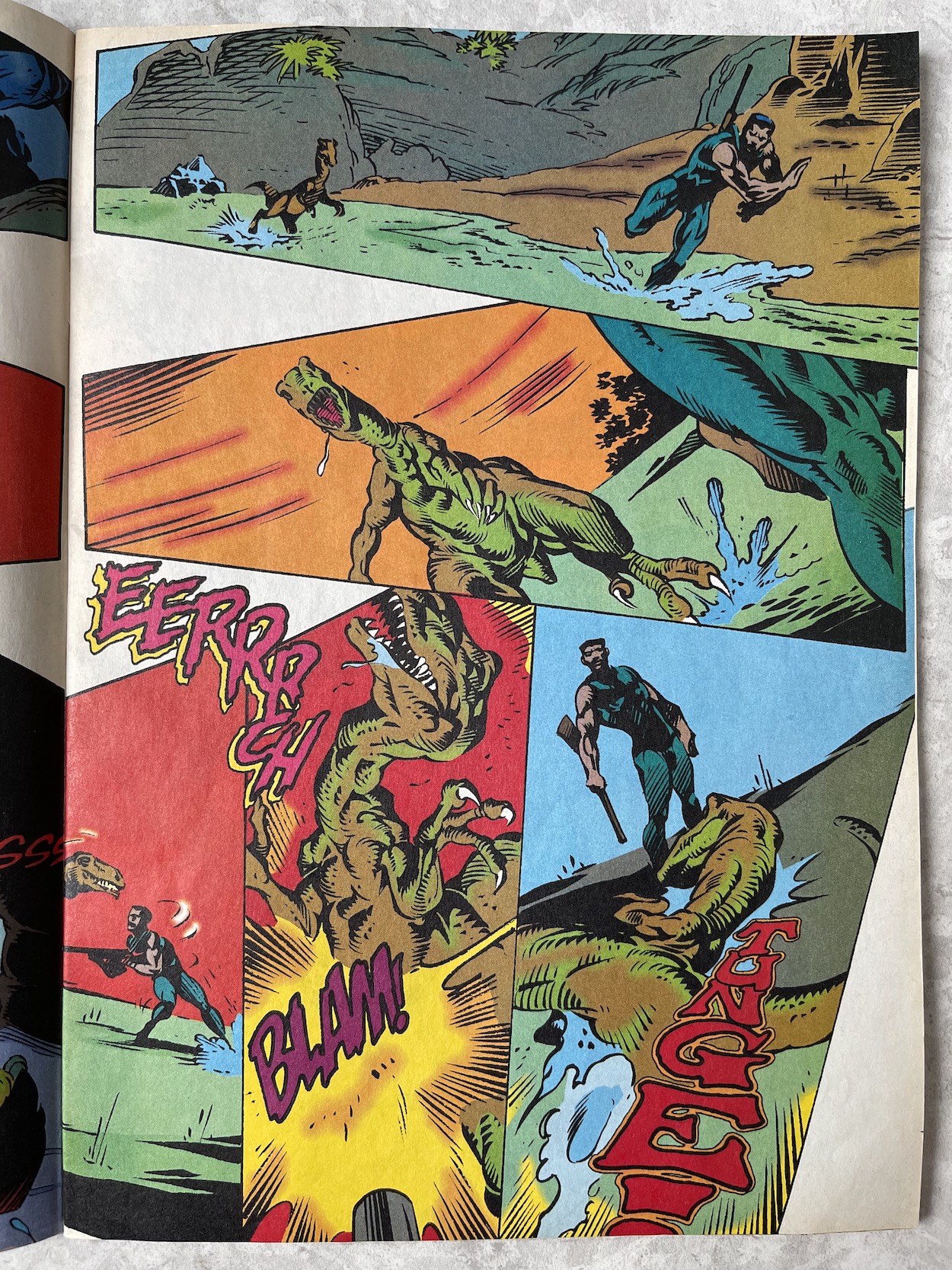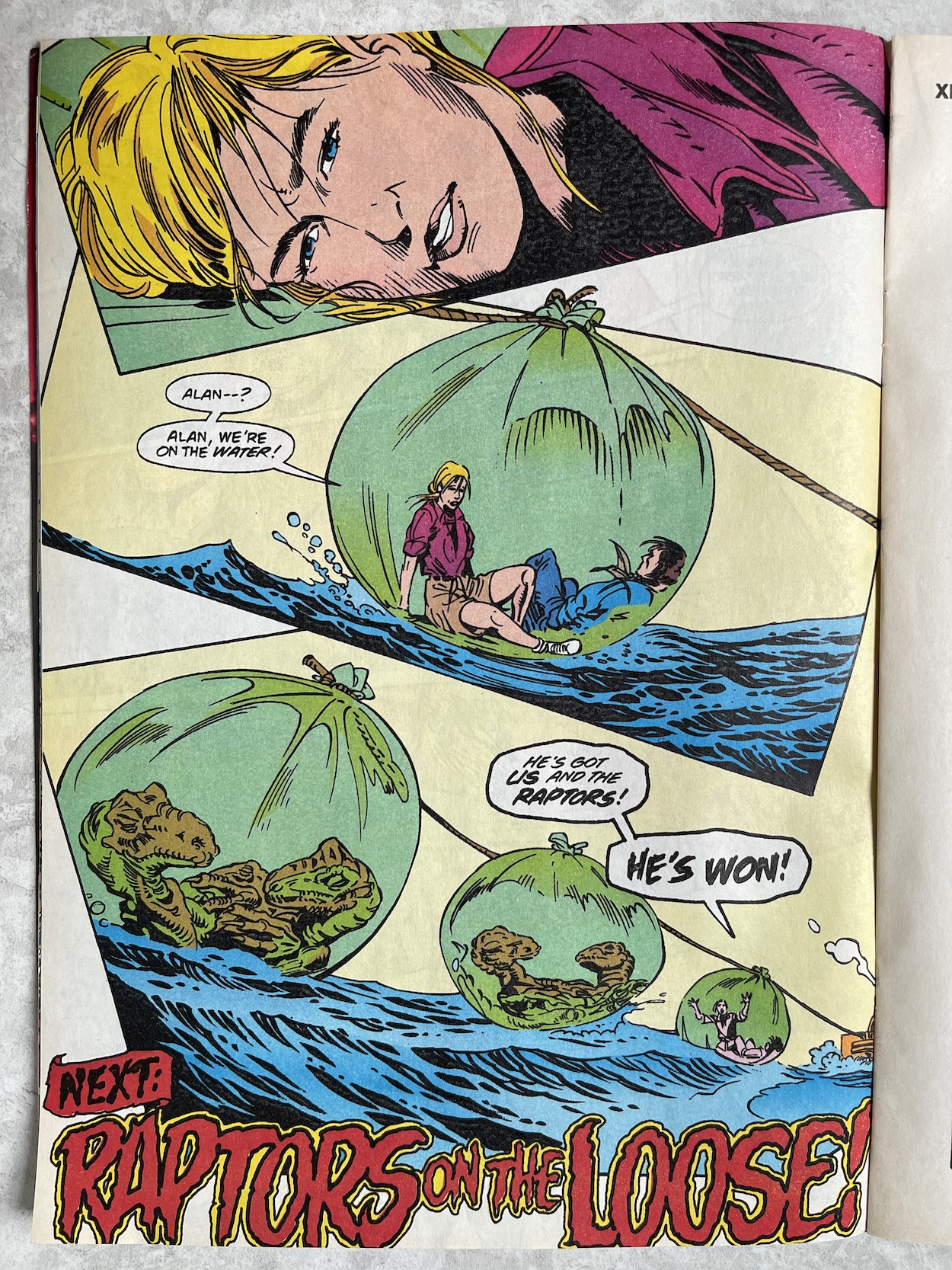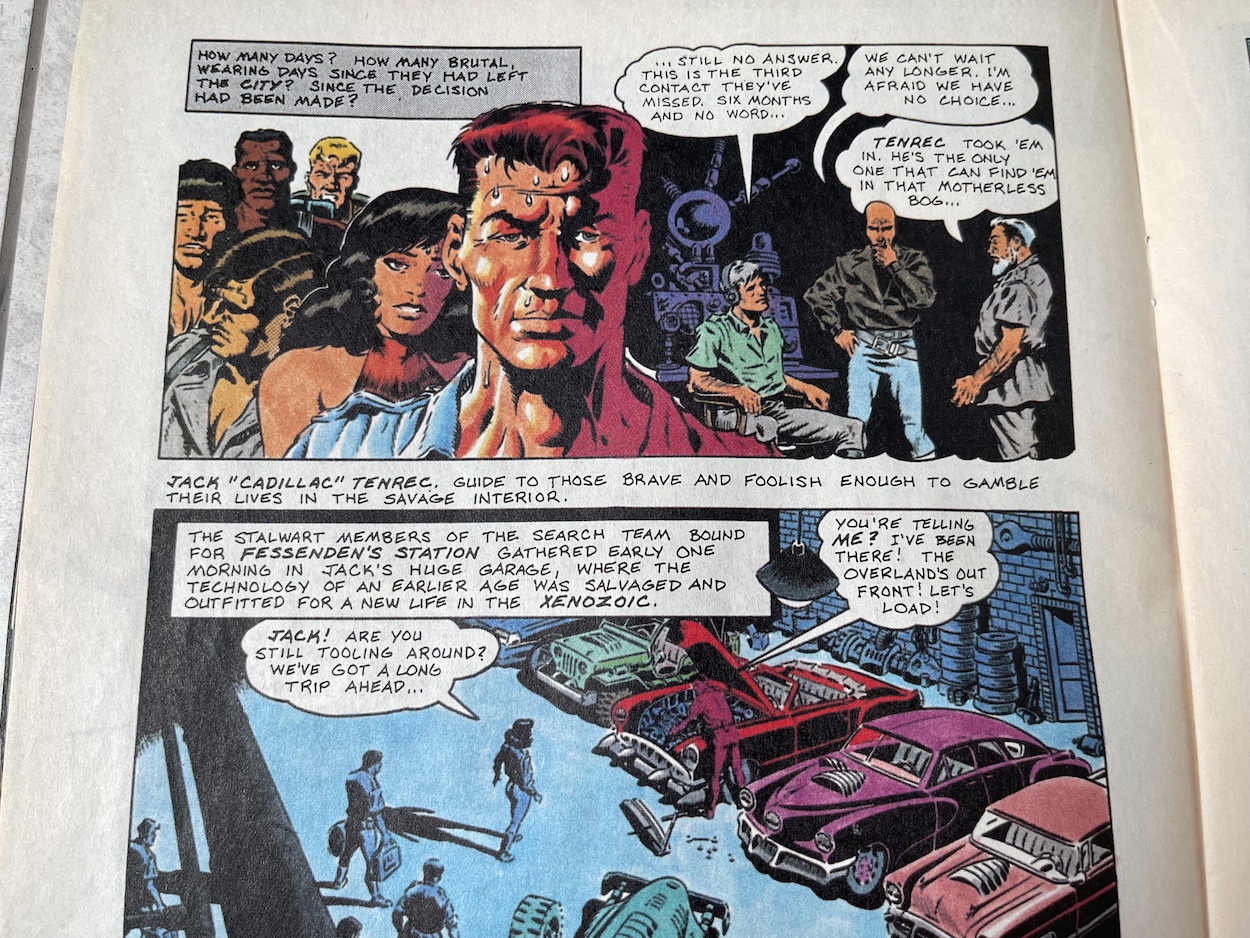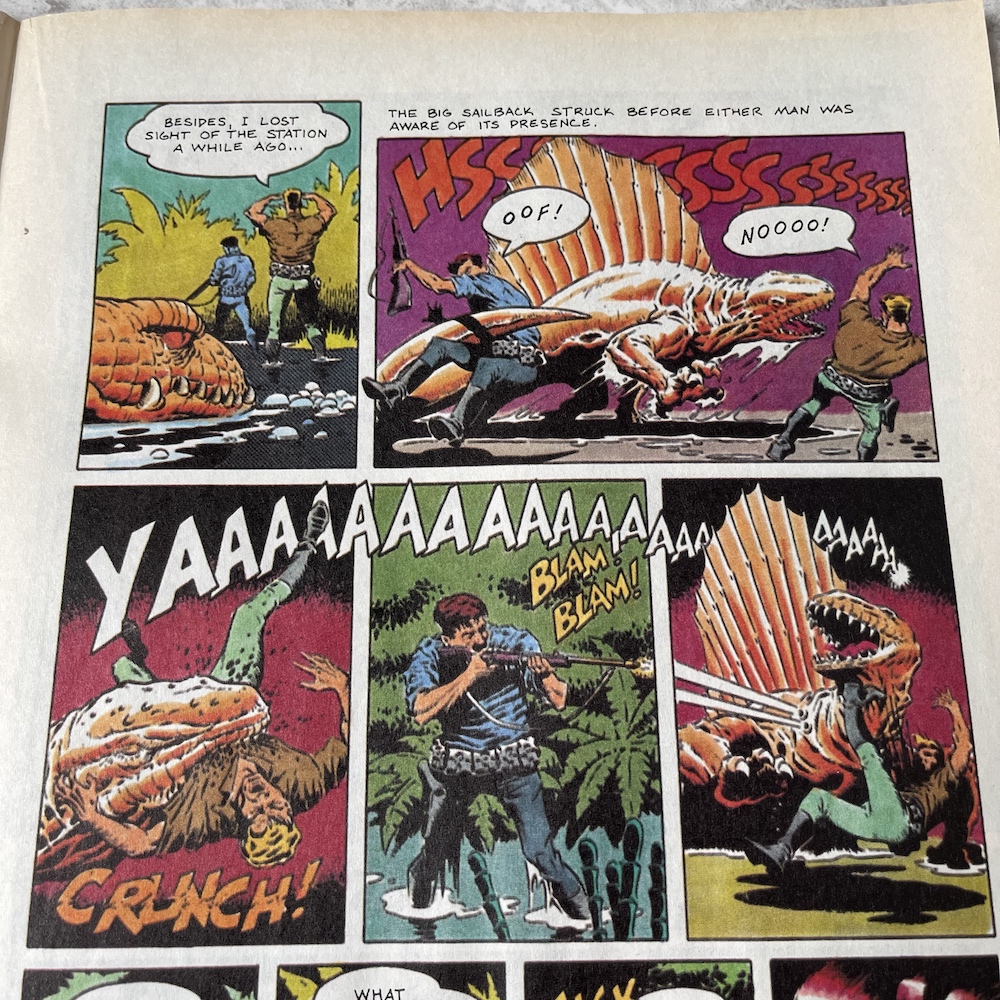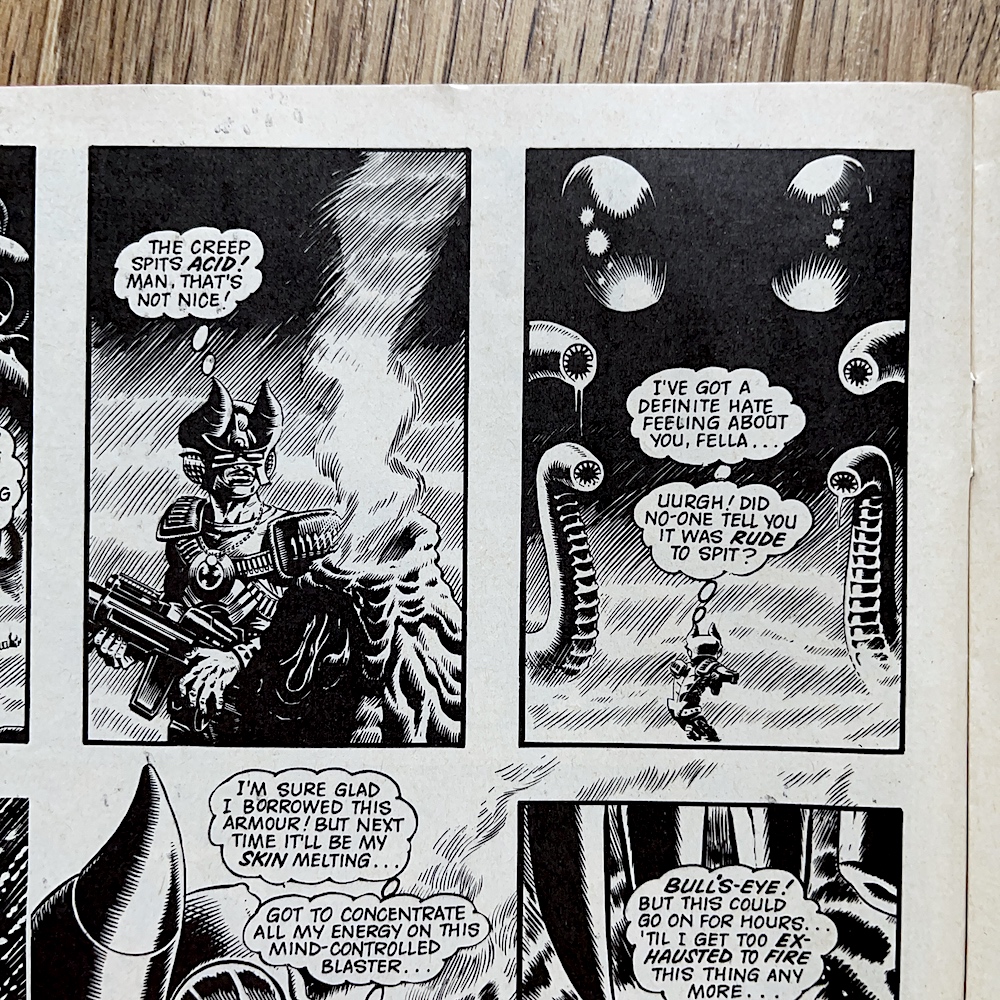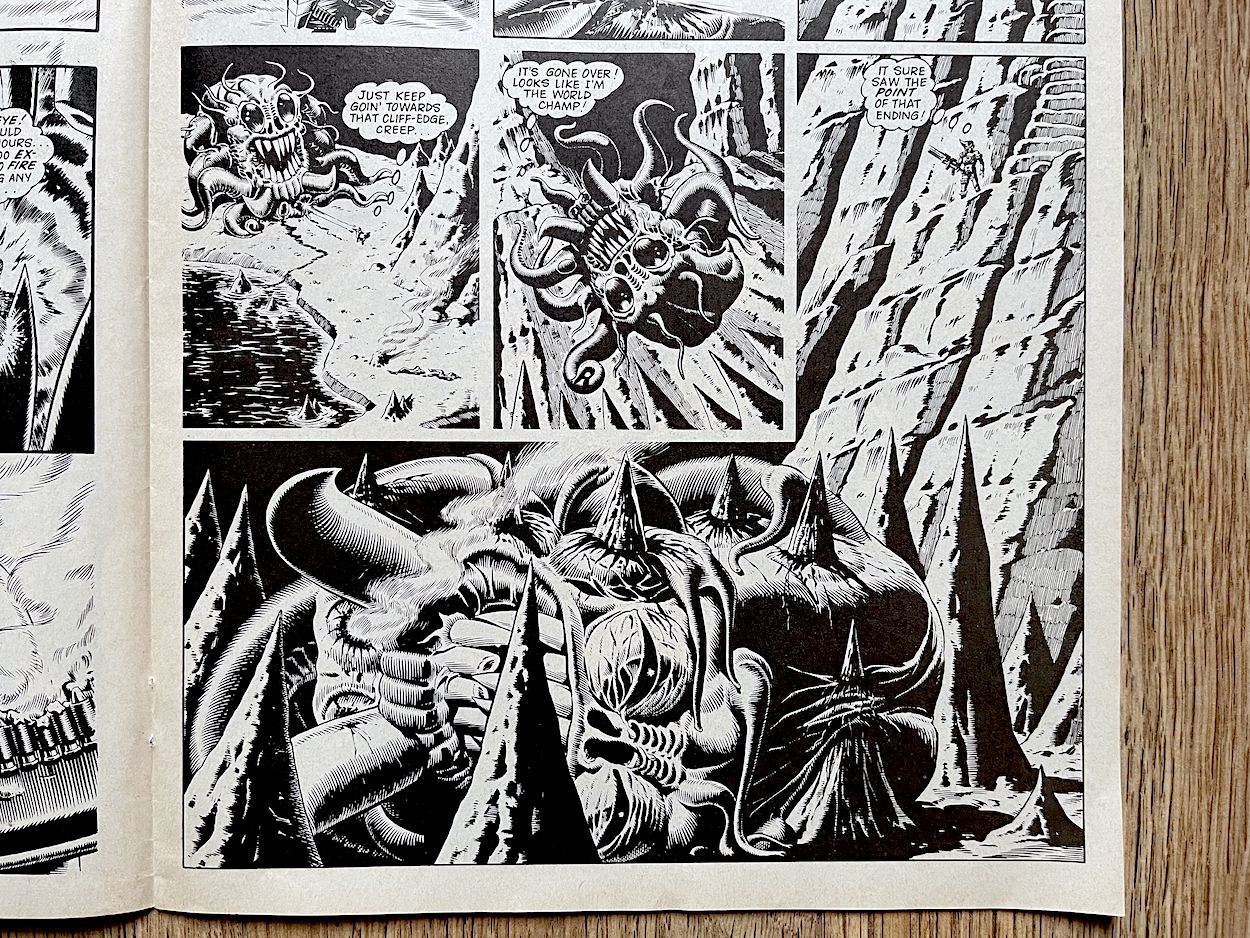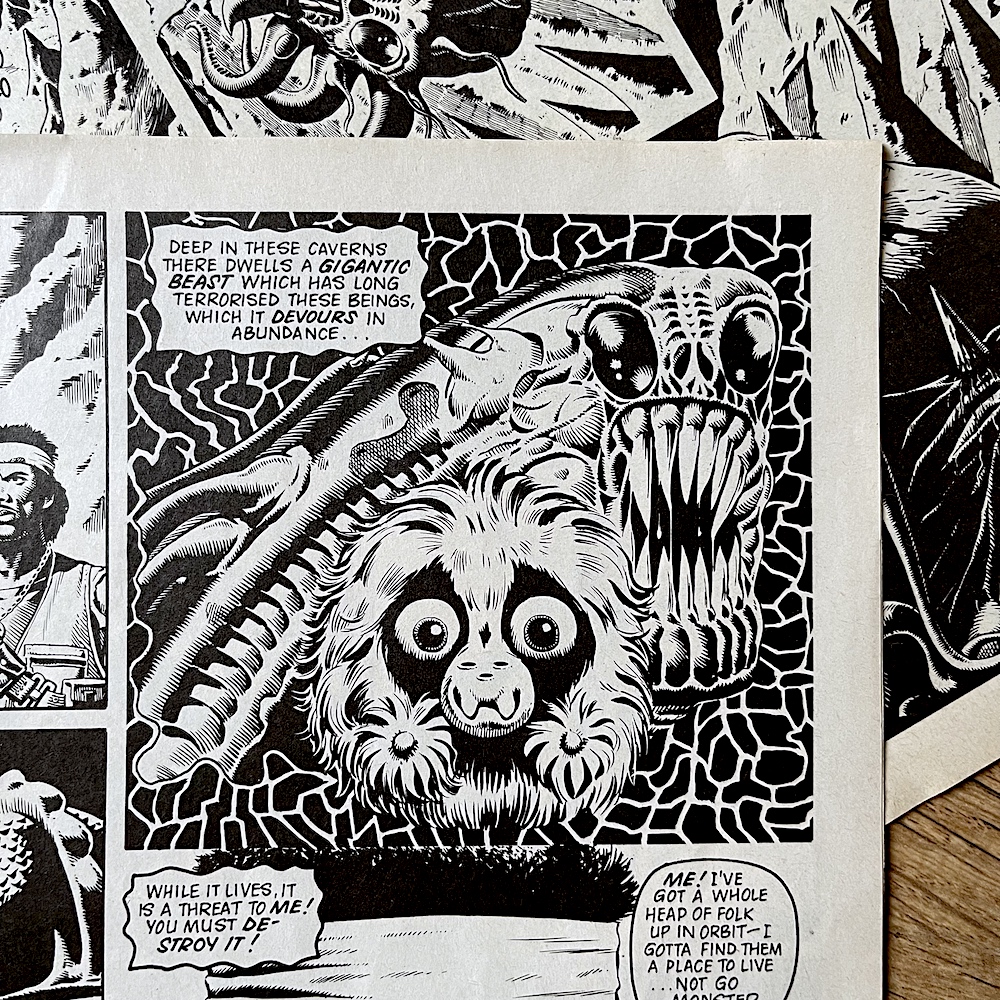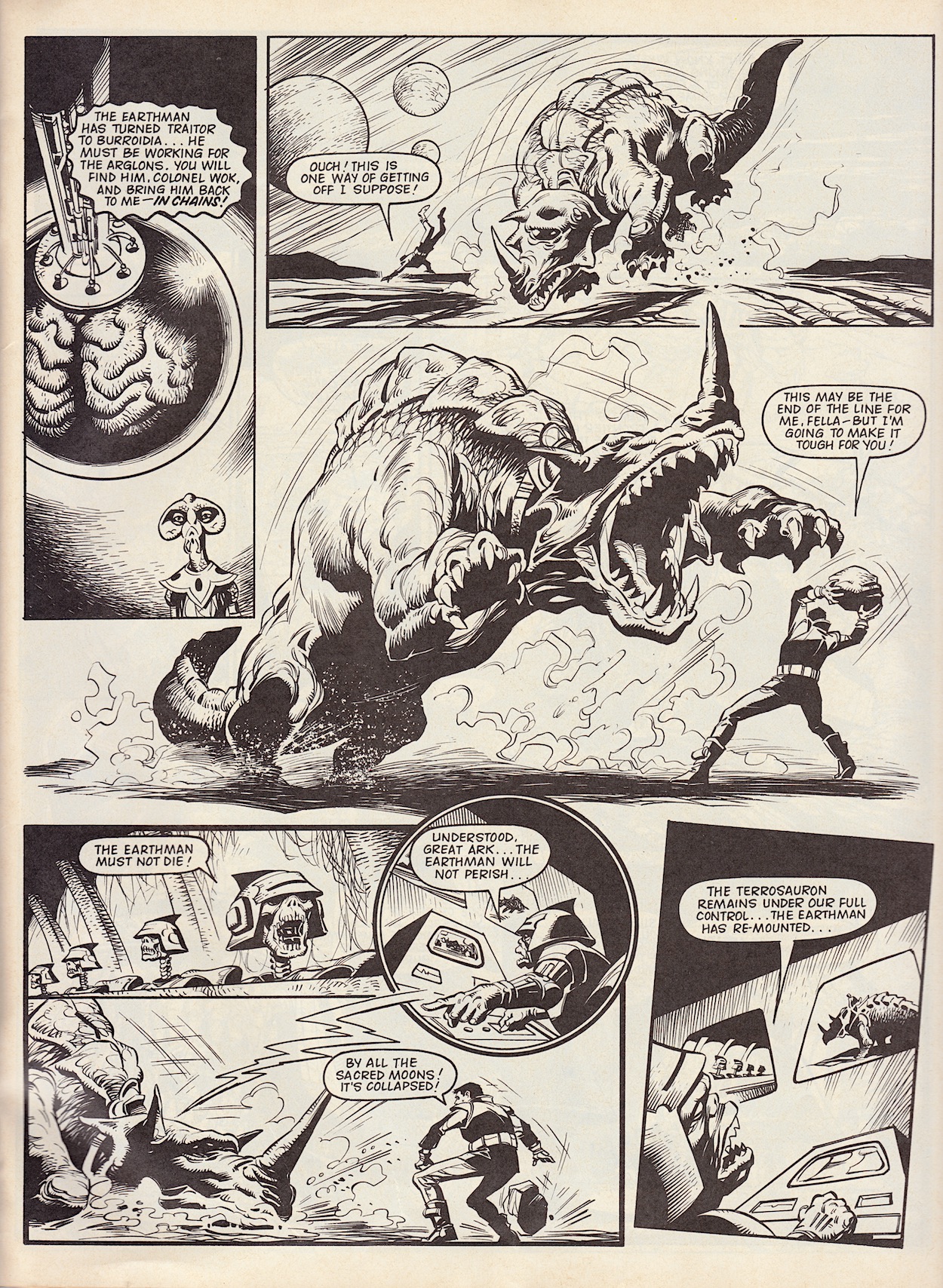
DEATH’S HEAD #4: DOG-GEDLY BRiLLiANT

The front cover to this fourth issue of Death’s Head may be drawn by the familiar team of Bryan Hitch and Mark Farmer but inside Plague Dog is drawn by renowned Transformers artist Lee Sullivan (also Havoc (RoboCop), Doctor Who), with Annie Halfacree on letters, Nick Abadzis colouring and Simon Furman writing of course, with Richard Starkings editing. While I love Geoff Senior’s art being in every issue of Dragon’s Claws, I like the mixing of styles here.
Last month we saw Death’s Head’s new office wasn’t the perfect purchase Spratt seemed to think it was, having spent his new partner’s hard earned cash before he’d earned it. This issue sees that picked up and developed into two separate stories, one for each of our main characters. While our mechanoid anti-hero is hired by one gangster to hunt down and kill his rival’s pet mutt, Spratt comes face-to-face with it in their new property.

We kick things off with Death’s Head arriving at Jules ‘Kneecap’ Venici’s birthday party in his usual understated style. A huge birthday cake arrives but Venici has seen this movie before and fills it full of lead. Surprised at finding no one inside he still insists on killing whoever sent it because his own actions have made him look stupid. He then sits down to eat a slice, not noticing the highly conspicuous waiter in his latest in a long line of ridiculous wigs.

Predictably a huge shoot-out occurs between all of the gangsters and our lone hero, although even in this dire situation there’s time for some comedy. Elsewhere, Spratt is checking out their new digs and the lights are out. After we see a clawed hand swiping down in the darkness he lets out a blood-curdling scream and we’re led to believe the hand has made contact, until you read the following caption. Simon once again playing with our expectations.

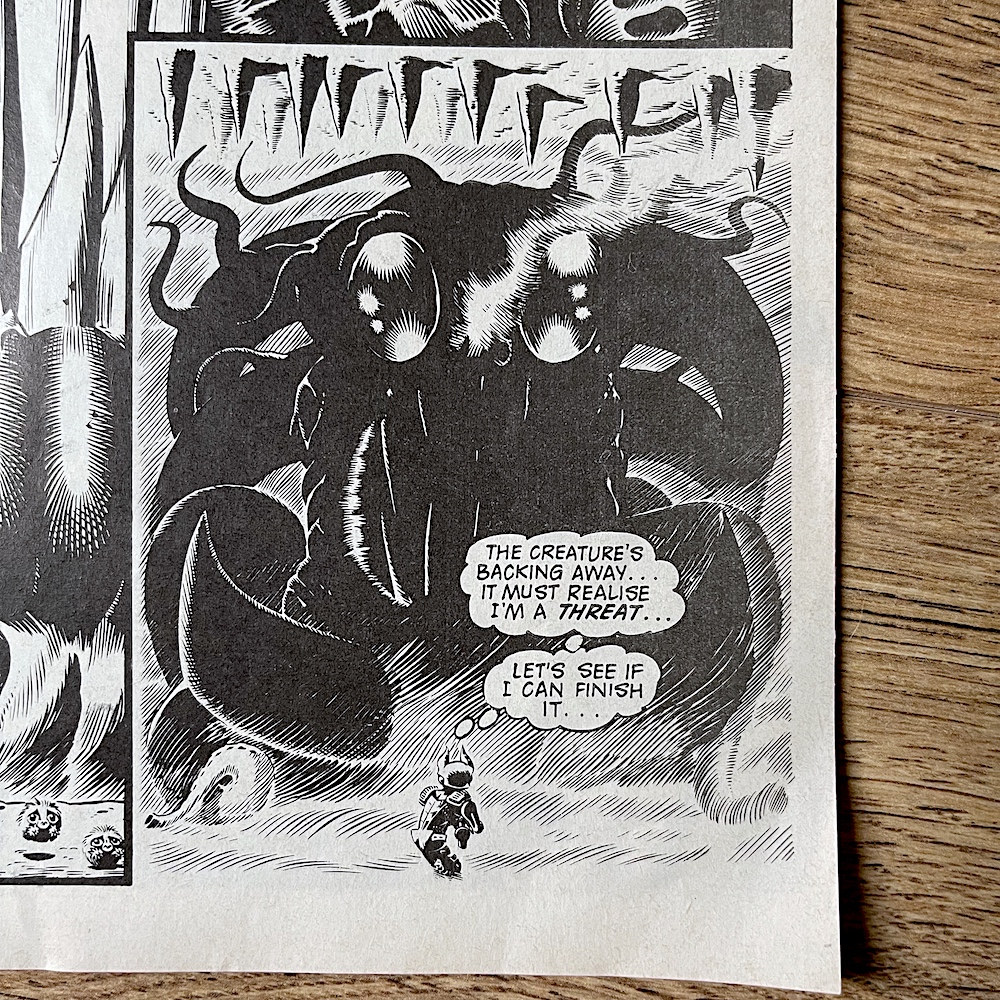
I particularly like Spratt’s reaction to the sound effect of the plague dog, the alien monster used by Venici to take revenge out on those who wrong him. Last month we saw someone who looked like an undertaker sell the office to Spratt and in this issue we find out he is in fact called The Undertaker, a killer-for-hire whose method of assassination is somewhat gruesome.

But yes, that sound effect. We get all sorts of wording to describe sounds in our comics. Sometimes they’re downright bizarre to say the least. The fact Spratt correctly names this rather random sound effect is very funny and just shy of the character breaking the fourth wall and identifying he’s in a comic. It genuinely made me laugh. Back in the other half of the story, as the issue constantly flicks back and forth between the two scenes, Death’s Head is still at it even when cornered and out of ammunition.

Death by cocktail sausages! As a form of getting back at the bad guys it seems appropriate for this blog. Death’s Head isn’t the only one up against the odds, nothing to shoot with and having to use his ingenuity to get out of a tough scrape. As the rotten internals of the office building collapse around him, Spratt is trying desperately to escape but is hopelessly out of his depth.

In fact, the crumbling of the building saves him on more than one occasion, luck playing a huge part in keeping him alive. He could be learning a thing or two from his new boss though, or perhaps they’re just more suited than the mechanoid realises, because despite his fear (or perhaps because of it) he can’t help making quips.

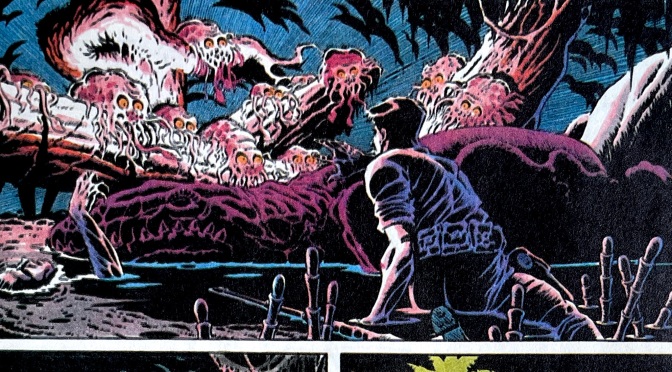
Slipping out of his boot and shoving it into the monster’s mouth (complete with another joke) he makes a run outside and finds a car parked (well, hovering, it’s in the future after all). This is Spratt’s speciality. Quietly boosting cars is a particularly useful skill that Death’s Head needs him for. There’s a little bit of tension here as Spratt struggles to get inside, panicking as the plague dog bears down on him.

The engine doesn’t immediately kick in either and the tension rises further as the thing makes a leap for him and crashes through the rear window, clawing at the interior, getting closer and closer to Spratt until it finally places a claw on his shoulder. The escape vehicle now seems to have become a death trap. We know Spratt can’t die, but even if he takes off surely the thing’s head and arm are already inside so what can he do? Well…

Just like last month when an accidental slip of the hand by Spratt turned the tide of battle, here his mistake with the gears sends him rocketing backwards, squashing the monster against the building. Fuel tank ruptured, the dog roaring out to his “Foood!” as it starts to push the car off itself, Spratt characteristically can’t help but bask in his glorious victory, no matter how accidental.

The final spread of the issue sees The Undertaker making a phone call, apparently to activate the plague dog at its lair. So are we to assume he actually sold the lair to Spratt? His job also done, Death’s Head makes his way to the office and finds chaos has ensued, although Spratt seems somewhat subdued and not showing off for once. Of course, our mechanoid friend can always turn a situation around when money is concerned and our story ends.

On the next page a somewhat tacked on cliffhanger has The Undertaker hiring someone called Big Shot, a muscly man with a big gun. I can’t help but be a little underwhelmed with this after last month’s ending. Surely having a plague dog lying in wait was the more dramatic cliffhanger. I’m aware I haven’t read the next issue to see how good this guy is with his gun, but I feel this is a bit of a muted ending by comparison and the two should’ve been the other way around.

Head to Head is the comic’s new letters page and there’s an anonymous letter from my home city of Belfast. Although, if this person had actually read Death’s Head’s adventures in Transformers and properly understood them I don’t see how they could think he’s commonly seen as a full-blown villain. Not too sure who “Bob” is that the first letter is addressed to (Richard Starkings is the editor and Jenny O’Connor the Managing Editor) but there’s definitely a lot of high praise here and I agree with it all.

I just wish Lierne Elliot had been right when he said “seems we have a hit here”. Of course, it may have seemed that way at the time, especially since this was a comic based on a very popular character from another Marvel UK title, but alas the sales figures wouldn’t be good enough to make up for the cost of producing the comic, as Richard explained to me in the introductory post to this series.

But let’s not dwell on that, we’ve another six months of this to go!

On the back page is an advertisement for a new fortnightly Marvel comic that would never actually appear. The William Tell TV series was apparently shown on ITV, although I don’t ever remember seeing it advertised. There’s a chance it either wasn’t broadcast on Northern Ireland’s UTV or it didn’t last long before ITV pulled the plug, despite it running for three seasons of 72 30-minute episodes in France and elsewhere, where it was known as Crossbow.

I remember this comic advert alerting me to the TV series and yet I still never caught it in any TV listings magazines. Marvel’s confidence must’ve been knocked as the plan for a fortnightly changed to a Summer Special, an annual and a run of strips in the Marvel Bumper Comic, plus a collected graphic novel, the strips for all of these already created for the defunct fortnightly. This is why I think the show must’ve failed to pick up viewers here in the UK, as Marvel suddenly realised the audience wasn’t there for what they’d assumed was going to be a hit.

You just might see some of it on the blog at some point though, as the Bumper Comic is on the cards for the future, I just don’t know when yet, but you heard it hear first! (As if you’d hear it anywhere else.) For now, that’s us finished with another outing for Death’s Head… well, really more of an outing for Spratt this month. We return to Earth of the far future on Monday 4th March 2024.

iSSUE THREE < > iSSUE FiVE

DEATH’S HEAD MENU

DRAGON’S CLAWS #9: OOH, MATRON!

Last month there was a feeling this fantastic comic was shifting gears towards a suddenly imposed ending, which with hindsight we know is coming in #10. At the very end of this penultimate issue of Dragon’s Claws it feels like there’s a rush to finish it all off before the unfortunate cancellation. For the majority of the strip however this isn’t obvious and it’s another belter of a chapter with these sadly short-lived characters.

The issue’s FastFax, normally a way of adding depth to the world in which the comic resides or hinting about future storylines or guest characters, is a more straightforward ‘Story So Far’ page like we’d get in other comics. While the fictional news service would obviously focus on the events in N.U.R.S.E.’s headquarters, it adds to the feeling of the title wrapping things up, when I was so used to this page being used as a way of looking forward. A sad reminder the end is nearly here.

The strip itself is called Treatment and the main focus is Matron’s capture of both Dragon and The Evil Dead’s leader Slaughterhouse. All three of them are linked up to a mind control machine Matron uses as a way of accessing their memories, then torturing them with those same memories. Yes, it’d be much easier to just kill them both and she mentions this at one point, but like all the best James Bond villains she wants to have her fun first.

She’s completely confident in her success and feels the destruction of both teams and the deaths of Deller and Golding are inevitable, so she wants to drag it out and savour it as much as possible. Despite an underwhelming cliffhanger involving Matron last month, the character is superbly written by Simon Furman here, her psychotic nature making me wish we’d seen more of her all along.

We get to see inside the minds of both team leaders, with Dragon being made to watch as his wife Tanya and son Michael confront him before being killed by Deller, which as we know didn’t happen despite Matron’s orders. In fact, I’m assuming their arc will be the final part of the story to get wrapped up next time. In a particularly dark and shocking scene Deller shoots and kills the young boy! We see the shot and then his dead body on the ground in the next panel!

It’s all rather harrowing for a Marvel UK title young Transformers fans may have been collecting after it was heavily promoted in that comic. Outside of his mind we see Dragon curled up and crying desperately, his own insecurities around the ones he loves leading to that scene playing out in his mind, Matron merely triggering them rather than forcing the scenario. At this point I was intrigued as to what resided in Slaughterhouse’s mind!

But first we head back down the building to catch up with the rest of the characters. Matron has seen on her screens that Stenson is dead, The Evil Dead and Dragon’s Claws are about to decimate each other’s ranks and World Development Council ambassador Golding and Deller are trapped in a burning room dozens of floors up from the ground. No wonder she’s confident.

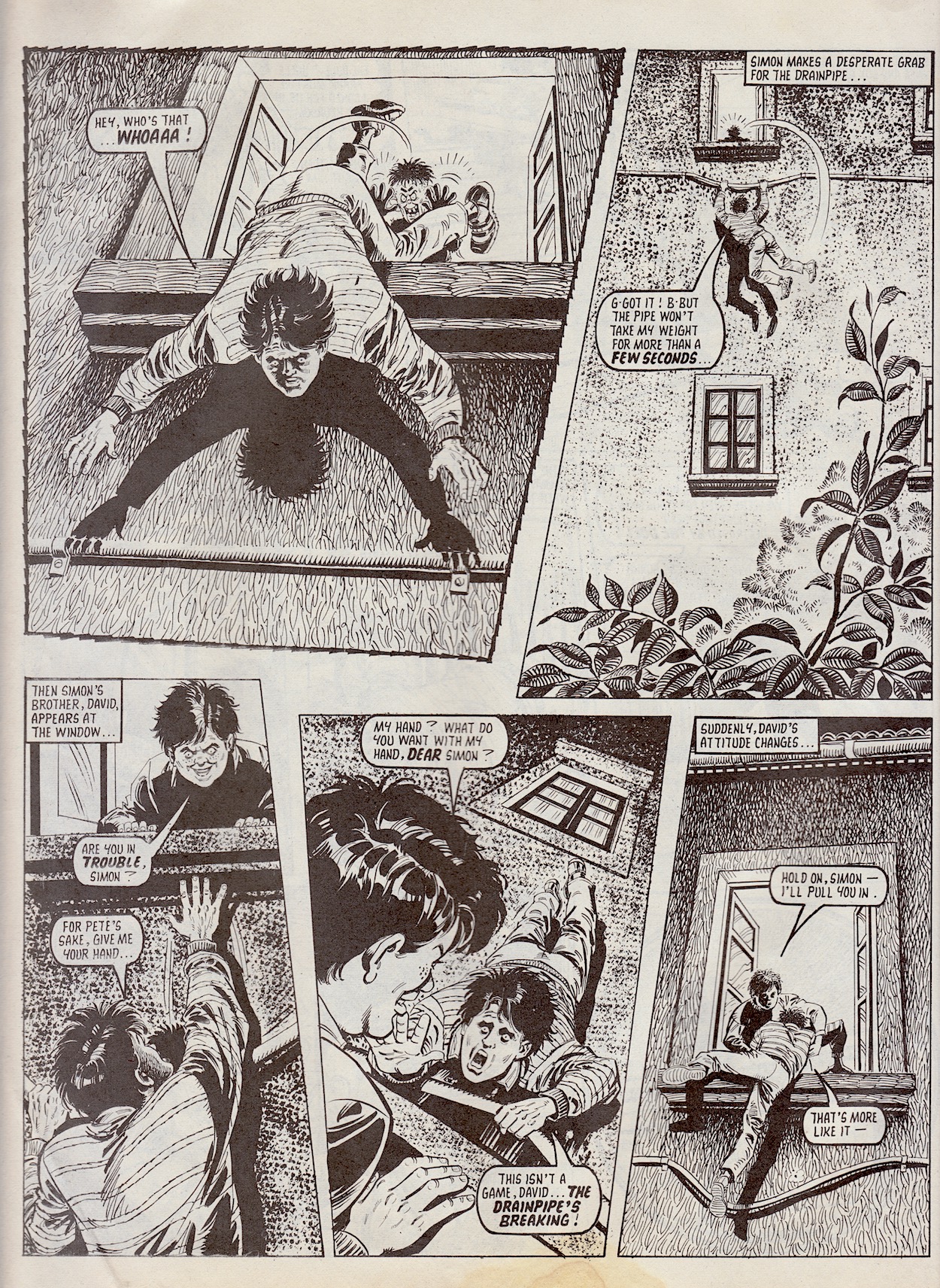
For the unlikely pairing of Golding and Deller there’s only one option for escape, and that’s out the window and back in again to a different room. There’s a pole sticking out from the building which Deller can use to swing out and back in again through another window, then break down the locked door to get Golding out. But first he must overcome his fear of heights!

This is something that hasn’t cropped up before simply because the story has never put him in such a position. It adds drama to a sequence that plays out over a few pages scattered throughout the rest of the issue. In fact, we come back a few pages later to see he’s frozen to the spot and it’s Golding who encourages him to take the leap, to believe in himself after all the humiliation he’s faced in previous issues (albeit by screaming at him).

There’s a definite theme this issue of people from all sorts of backgrounds and from completely different sides coming together to fight a greater enemy. An enemy that’s using them all, that’s creating division and fomenting hatred to turn the populace against each other for their own selfish needs. I’ve said it before and I’ll say it again, Dragon’s Claws could easily be released today and be just as relevant, if not more so than it was in the 80s.

Death Nell and Steel’s romantic history gives the story an opening to bring the two teams together to launch a united frontal assault on the upper floors of the building where the majority of security has amassed to protect Matron. As a reader you know it’s coming, even as the opposing sides continue to fight, Mercy in particular sticking the boot in. (Boom, boom!)

On a side note, I was surprised to read Nell saying, “Wise Up!” because as far as my friends and I were concerned this was always a Northern Ireland phrase. Indeed, when I used it myself in Scotland with some friends there in my teenage years it completely confused them. Perhaps we were wrong, but most likely it’s just a coincidence and wasn’t known to be a popular phrase in this part of the UK.

It’s at this point we finally get a look into the mind of Slaughterhouse. I was really looking forward to this and Simon doesn’t disappoint. His memories start off hard with an abusive father hitting him with a baseball bat because Slaughterhouse’s own mum died during child birth. Damn, this goes dark. This was enough to lead him to a life of crime, then once captured the corrupt government experimented on him in return for reducing his sentence.

The side effects included his pointed teeth, his skin colour and blood red eyes and Slaughterhouse, who was very much the victim of his life’s circumstances, couldn’t handle it and he turned on the whole world, the world that had beaten him down so cruelly time and again. But his mind was lost by this stage and he began killing people, seeing everyone as an imaginary enemy, and within just a couple of pages Slaughterhouse’s entire origin story is told.


“We do this my way!”
“The weak way… the stupid way!”
“Let’s just kill ’em!”
“Try it, curly!”

Dragon’s Claws and The Evil Dead

We can only guess if it would’ve been told at this stage (or so quickly) had the comic not been cancelled but somehow it doesn’t feel rushed. In fact, it just makes me lament the fact we can’t see more character development for him now that we (and Dragon) know the truth. The whole chapter is a great piece for both leads. Dragon’s own insecurities while leading his team and in his position in the world could’ve made for a wonderfully deep character too.

As the Claws and The Evil Dead make an uneasy alliance to take down N.U.R.S.E. and rescue their respective leaders, the two men’s minds are thrown into a climactic final battle, one which Matron fully expects will mentally tear them apart, leaving them gibbering wrecks and essentially dead. But she hasn’t reckoned on the power of said minds. Dragon slowly realises he’s in his old Game uniform and tries to convince Slaughterhouse it’s all fake.

He does so through reasoning. Yes, they’re physically fighting of course, we have to have our action in an action comic, but they come to realise they’re flip sides of the same coin, that they both do what they do because they believe in it, they’ve both been manipulated into becoming what they are and they agree giving in now would be the easy way out. But they don’t do easy. For once the hardest thing to do isn’t to fight each other, it’s to work together and they turn their minds on Matron’s.

They start to take her mind down in another physical battle but we’re inside her thoughts now so she’s all-powerful and the two men have to fight side-by-side if they’re to survive. Dragon only wants her beaten, so she can face justice for her crimes in the real world, but Slaughterhouse can’t stop himself. His thirst for revenge is too much and inside the mind machine he slits her throat just as Nell does so to her physical body.

It’s a shock ending but then it all kind of deflates on the next page, the final one of the strip. In just five panels we get a lot of exposition and explanations about what takes place next instead of actually seeing anything. The Evil Dead are let go, Dragon knowing they could never work together, Deller is somewhat redeemed in his own eyes, the team decide what they’re going to do now their employer is no more… a lot happens ‘off-screen’, dealt with through a very quick conversation between the team.

I understand the next issue is the last and it’ll most likely wrap things up for the Dragon family’s arc, but so many other important story arcs just seem discarded far too easily, like one of those final scenes you’d see at the end of an old 80s cartoon. To be clear, it’s only disappointing because of the quality of what came before, not just in this exciting chapter but in the whole run up to now.

The team should be incredibly proud of this chapter though. Writer Simon Furman, artist Geoff Senior, colourist Steve White and editor Richard Starkings are to be congratulated. What the final page lacks is what the other 21 pages do superbly, quickly wrapping up as much of the main story as possible without feeling rushed. Which is why page 24 feels so unlike what we’ve come to expect.

To round off this penultimate review is Digit’s fact-file and more interesting tidbits of information on Dragon’s teammate that would’ve been elaborated on in future issues. These include the fact he’s Scottish, a missing amount of time in his life and just how stable/unstable he actually is. I bet his lost memories would’ve made for some great stories. Instead, we must say goodbye. That’ll happen a little over a month from now. The final issue didn’t go on sale the same day as Death’s Head for the first time, instead it appeared a week later. So watch out for the review of #10 of Dragon’s Claws on Monday 11th March 2024.

iSSUE EiGHT < > iSSUE TEN

DRAGON’S CLAWS MENU

TRANSFORMERS: WHAT’S NEXT? LOTS!

I’ve just completed an epic real time read through of a mammoth comic series over on the blog’s Instagram, so what’s next?

First, let me tell you a story from about 12 years ago. I discovered hit television show NCIS through a crossover episode between Hawaii Five-0 and NCIS: Los Angeles. I was immediately hooked and wanted to go back to the beginning, the very beginning of the show NCIS itself spun off from originally, Jag, about Navy lawyers. I remembered watching some of it with my parents in the 90s and, created by Airwolf’s Donald P. Bellisario I’d enjoyed it. So I started there.

One season of Jag ended with a helluva cliffhanger when a main character stood on a landmine and had their leg blown off! I had the next season on DVD already and immediately binged all 22 episodes in two weeks. In that fortnight the character had gone through physical and mental anguish, rehabilitation and was walking on a prosthetic. That was quick, I thought! It felt anti-climactic. But that wasn’t Jag’s fault, it was mine.

That storyline was meant to last about nine months, not half of one. I’d completely ruined the drama of this character’s arc. I swore I’d never binge to that level again. Several years later, having started the original OiNK blog site and already reading that comic in real time, I decided I wanted to do something with Marvel UK’s Transformers, a comic I’d binged all of in about six months around ten years previous (before the Jag incident). Knowing how that Jag arc had felt, how would reading Transformers in real time over seven-and-a-half years differ to bingeing? 

Reading OiNK in real time is one thing, but here was a comic with great character arcs, epic storylines and its fair share of cliffhangers, and I relished the challenge of using all my will power to not jump ahead in what was a massive read through! The UK version of Transformers had a whopping 332 issues and (during its run) 19 specials, seven annuals and a variety of other books. The word “epic” can be overused in comics, but it’s the right one to use here and reading it one issue per week just heightened that to a completely new level. Every Thursday I became a kid again, eagerly anticipating the next issue.

Why did I do this on Instagram instead of the blog? When I began I thought the stories were so well known that I wouldn’t be bringing much new to the table. However, showing off every UK issue, including covers, back up stories, letters pages, Lew Stringer strips, features, adverts and more could be a unique angle not covered before, especially for international fans. Instagram was the perfect outlet for doing a photographic journey through my collection rather than in-depth reviews.

My decision proved successful and my Transformers posts became the blog’s most popular on Instagram for seven years, and you can now check it all out in whatever order you wish via a special blog post. But what’s next for the Cybertronians on the OiNK Blog? I’ve adored every single second of this read through and the thought of not covering them doesn’t bear thinking about. First up though is Transformers: Generation 2, the short sequel series also written by Simon Furman. I’ve never read it but recently completed the collection. This is the American original I’m talking about, a first for the blog.

In the UK it was actually Fleetway (OiNK’s second publisher) who acquired the rights for Generation 2 but their monthly only lasted five months. (For me at the time it only lasted one!) They’re very hard to come by for a decent price these days so I’m going to cover the full story in its original form first and do the UK version later. In the US it also began life in G.I. Joe so for this fan of the Joes it’s going to be exciting getting reacquainted with their original comic after it was unceremoniously dumped from later issues of the UK’s Transformers.

Watch out for that in a few months here on the blog, but what about Generation 1? I could say it’s been covered already and it’s time to move on, but a key design flaw with Instagram has me thinking otherwise. My original plan for this post had been to reminisce over the past seven years and give you links to key issues so you could work your way through it all if you so desired. But when I link to an individual Instagram post there isn’t any way to navigate beyond it, which is a strange thing indeed. So unless you wanted to scroll back over seven years’ worth of Instagram posts you’d only see the issues I linked to.

As a result, and given the nature of social media, in a few months anyone visiting the account wouldn’t even know I’d covered the comic! So yes, I do want to review the collection I’m most proud of in a more in-depth, permanent fashion here on the blog. But not yet. For two reasons. The first being that I’ve just finished it. I want to have a lengthy break again so that it feels fresh and it can surprise me once more; my ageing memory and the sheer amount of them will both help.

The other reason is it’ll require a huge amount of my time and over the next four or five years there are a range of other comics I wish to cover first. Yes, I do plan very far ahead! If I was to start many years’ worth of in-depth weekly Transformers reviews before then I’d have to cut back on the others. That’s not something I want to do just yet. But all is not lost. To bridge the gap between now and being able to dedicate the time needed to one of the greatest comics ever created, I’ll be doing something special every Christmas.

You all know I love my Christmas comics and the annuals we received from Santa Claus as kids, and Transformers did a particularly great job of both every year. From 2024 onwards each of these festive issues and hardback books will be celebrating their 40th anniversaries and it felt like a waste not to do something on the blog. So I’ll be celebrating those festive editions and books every holiday season for the next eight years! More on that much, much later in the year.

Plenty to come from the Robots in Disguise for the foreseeable future then (and hopefully beyond). I’m always receiving comments from people who are shocked when I reach the end of a read through, no matter its length, telling me the time has flown in, so be patient and you’ll not see the time go in either for more Transformers content. Yep, I’m promising much more OiNK Blog content for many years to come. As long as people keep reading it then it’s not going anywhere! I hope you’ll stick around too.

BACK TO THE READ THROUGH

MAiN TRANSFORMERS MENU

ROUND THE BEND GAME: COMMODORE FORMAT #17

This issue of the simply superb Commodore Format, on sale this day 32 years ago, was my fourth at the time and the first I bought after finally receiving my Commodore 64 computer for Christmas. (You can check out a more personal look at CF in my retrospective on #14.) This was a memorable issue for sure, with certain game reviews leading me to some lifelong favourites which I’d countless hours of fun with, as well as having a super addictive covertape game. However, I’m including it on the blog for none of these reasons.

Instead, CF makes its fourth appearance on the OiNK Blog because of a review inside for a game I didn’t purchase. It may have been based on a favourite TV show but there was only so much pocket money I could splash out on my C64 and it had very stiff competition this month. Now, decades later it’s time to take a closer look at that review because the game is based on a series dear to the hearts of pig pals everywhere, namely Round the Bend.

Originally intended to be an OiNK television show (much more on that at a later date) Round the Bend was an electronic comic show created by the same trio of Patrick Gallagher, Tony Husband and Mark Rodgers. With the huge Spitting Image Workshop puppet of Doc Croc as its editor and various animated comic strips with a certain sense of humour, it was OiNK in all but name. Running very successfully for three series, and winning awards as it did so, it was inevitable we’d see a computer game at some point.

Taking the tired old formula of turning a licence into a platform game, the general consensus appears to be that it plays well but was far too easy. So it was fun but not for long enough to justify the full price. As was customary at the time this would be rereleased a year or so later as a budget game for a few quid, but at a tenner or more it got knocked down for its value for money. It seems to concentrate completely on Doc Croc and his ratty writers too, which seems a waste as the show was chock full of zany characters who could’ve brought many different forms of gameplay. At least John Potato Peel makes a cameo!

Like the OiNK game before it there was nothing too original then, but what was there was fun. A quick glance at a “64%” score and it’d be easy to dismiss it, but reading Stuart Campbell’s review has me thinking it may have got a higher score upon rerelease. I can find no evidence of a further CF review, however Zzap!64 scored it 52% initially but this jumped to 74% after its price drop. Nothing to write home about then, but an interesting look into a curious OiNK-adjacent piece of merchandise nonetheless.

As is customary when looking at these old magazines I can’t help but reminisce and have pulled out some other highlights that had me fondly remembering reading this for the first time. First up is one of the games on the covertape. According to some sources online this was a copyrighted piece of software hacked and distributed illegally through the public domain, CF unknowingly giving away commercial software. But as you can see here in the first paragraph of the instructions page that’s incorrect; a piece of misinformation that gained traction in C64 circles despite the explanation of a hacker’s name on it being front and centre here.

The idea is a simple one but it is oh so addictive. You control that little silver circle and must destroy all the tiles on the screen and make your way to the exit. Thing is, the tiles explode one second after you touch them, so forward planning is essential. You must plot out your route over increasingly complex layouts because once you’re moving you can’t stop or else you’ll explode too. It’s just as addictive today as it ever was and is best played on a real machine with a joystick. One of my top C64 games of all time and it was a freebie!

Speaking of favourites.

In the Commodore Format retrospective I showed you the preview for First Samurai and the Making Of feature for Creatures II: Torture Trouble (and I also embellished on the magazine’s scoring system), both games impressing me from my first issue. Now at last both were available to buy! They blew away anything I was playing on friends’ consoles at the time and each had me glued to the screen for hours. For a computer created long before Nintendo even released their first console, these were pretty incredible.

The little egg character was a megastar in the 8-bit computer days

They both played like a dream too. As I’ve said before, Creatures II remains in my top five computer and video games of all time to this day. I remember buying it on cassette to begin with, but the mutliload (where each level has to load individually for a few minutes) was destroying the flow, so when my parent’s bought me my disk drive a few months later I used my pocket money again to buy it on 5.25” floppy disk (loading was so much faster) and never looked back! Two glorious games. No wonder Round the Bend never got a look in.

Also this month was the concluding part (obviously, the game was finished) of The Clyde Guide by the geniuses that were John and Steve Rowland, creators of Creatures, who provided a fascinating look into the creation of the game. I loved things like this and when they returned later in the magazine’s life it was for a game called Mayhem in Monsterland which they documented from the very earliest design stages.

Elsewhere in the budget games section was a game with a title that rather stood out. It was a difficult one I remember. You had to avoid all the buildings and enemy craft (even UFOs) until you got a chance to crash into and destroy the enemy HQ and rescue the hostages! Dizzy also makes an appearance this issue. The little egg character was a megastar in the 8-bit computer days and despite simplistic graphics and controls his adventures proved extremely popular thanks to great gameplay and puzzles.

That feature about the user-created, free-to-distribute software that made up the public domain showed what this little machine could really do graphically. A few years later I even put together my own Public Domain Library (amongst others who did the same) to help distribute said software. Parallel Logic Public Domain (thanks to lifelong friend Colin McMaster for the name), or PLPD as it went by, was even listed in CF as the third best PD library in the whole of the UK! I was dead chuffed.

I’ve also pointed out before how the game adverts of the day often didn’t even show us what the thing looked like in action, instead relying on exciting artwork and descriptions. Given how the games would look completely different across the many formats they’d be released on I can understand why. No one wants to buy a game thinking it’s going to look one way and then realise those images were from a much more powerful computer. One such advert in this issue was for the conversion of the arcade hit, Smash TV (think ‘The Running Man: The Game’).

Smash TV was a corker of a game. Copying the controls of the arcade cabinet you could use two joysticks to control your character, one for their feet (their movement) and one for their gun (which direction they’re firing). Hand one joystick to a friend and the shouting and hollering as you try to work together, clearing rooms of enemies in this violent gameshow while trying to pick up brand new toasters etc. was hilarious. Even seeing this advert brings back all the feels.

Finally, a look to the future. Not the future of the 21st century though, instead let’s take a look at the future according to Commodore in 1992 and their CDTV. The 90s would be a hotbed for CD-ROM machines promising us a multimedia future. I personally invested in one of Panasonic’s 3DO machines (3DO was to be a new standard like VHS) and to this day I think it’s criminal it was never the success it deserved to be.

They were expected to revolutionise our world

Of course these days we’re used to our electronic devices doing pretty much everything, but at the beginning of the final decade of the last century it was the norm to have a dedicated machine for each piece of entertainment, like games, music, movies etc. While 3DO at least tried something new and the various machines looked cool, Commodore went with a rather boring rectangle, possibly thinking it wouldn’t alienate people too much if it looked like their current VCR or HiFi (I assume).

Needless to say it never took off. It was basically a Commodore Amiga with a CD drive and no keyboard; the fact you could buy a keyboard, mouse and even a floppy disk drive for the CDTV didn’t help distinguish it from the computer range either. For me it’s always fascinating to read contemporary magazines from around that time and the hype for The Next Big Thing, and how they were expected to revolutionise our world. It took a little longer but in the end we got there.

I’ve had great fun reading this magazine again and reliving the hype I felt at the time for the games inside it. Commodore Format remains my top mag even to this day and you can check out other issues on the blog if you like. Namely, the one that gave away the OiNK game on the cassette, another which printed maps for said game, and as mentioned above my first issue as well, which just so happened to be my first ever magazine too. It also contained that advertisement for Round the Bend. Great memories. Still a great read.

THE OiNK COMPUTER GAME MENU

OiNK MERCHANDiSE MENU

MAiN OiNK MENU

RiNG RAiDERS LiCENSEE STYLE GUiDE: PART ONE

A few years ago the wonderful former UK comics editor Barrie Tomlinson and his writer son James Tomlinson very graciously answered my questions about a favourite childhood comic of mine, the very short-lived Ring Raiders, based on the Matchbox toy planes of the same name. Created by Those Characters From Cleveland and with a range of merchandise, a UK comic and even an American cartoon, Ring Raiders was set to be the next big franchise.

It wasn’t to be but I still loved the toys and I collected a mountain of them including all of the extras I could get my hands on. I also owned whatever videos were made available over here but the comic was far superior. I’ve covered the series already and you can read all about it, as well as the interviews with Barrie and James, in the Ring Raiders section of the blog. However, chatting with me wasn’t the only thing these two gentlemen very kindly did. They also sent me this folder.

This is the official licensee folder sent to Fleetway Publications (and other companies wishing to produce anything related to the franchise) in 1989 with all of the information needed to create an accurate depiction of the characters, their aircraft and the world they inhabited. A ‘Style Guide’ if you will. It includes details on the backstory, the individual pilots and even the correct colour codes to be used on each plane to ensure the exact right tone of each was used.

It goes much further too, showing a selection of suggested merchandise 12-year-old me would’ve given his right arm for, images of how the packaging would look on shelves, and logos and the variations allowed. It even contains the legal side of things, guides to marketing whatever the companies were producing and fun promotional ideas for children’s favourite planes if it had all been successful. As a fan this is a bit of a holy grail, but I think a lot of blog readers may find it just as interesting.

A lot of the comics covered on the OiNK Blog are based on franchise properties such as toys and cartoons. These licenced titles made up a huge part of my childhood and were quality publications in their own right. Each would’ve had their own variation on a folder like this, so I thought it would prove to be a fascinating look into producing a licenced comic, not only for Ring Raiders fans but for those of licenced comics in general.

Over this and the next four months (on the 13th of each) I’ll break down the folder into its separate parts and show you all of the details within, from designs to copyrights and beyond. We begin this month with the introductory section, under the banner ‘Philosophy’. This contains the background information on the potential franchise and its storyline; a storyline that both the cartoon and the comic would pull from, despite producing two very different final products.

First up is this ‘The Command is in Your Hands’ page, which was the tagline for the toys. Now, remember this was the late 1980s, a time when toys were marketed strictly at one gender or the other. This continues today of course but thankfully to a much lesser extent and with much more crossover. There’s less stigma today with boys and girls just playing with whatever they want, which is much healthier in my opinion. This first page sums up not just the thoughts behind Ring Raiders but all so-called “boy’s toys” of the time.

That last paragraph in particular is a bit cringe-worthy 35 years after the fact, but you can just imagine how other toys such as Transformers and Masters of the Universe may have been similarly marketed, can’t you? The regular use of the word “confidence” is a rather strange one to focus on for a children’s toy, is it not? For me, they were about a pre-Pokémon kind of “gotta collect ‘em all” mentality as well as the time travelling storyline, which was used to explain the huge variety of aircraft in the collection.


The year is 1998 and the world is on the brink of a cataclysmic war. There were always pilots who, twisted by war’s cruelties, were willing to join the evil air force.

The then-future storyline of Ring Raiders

Next up is the overall scenario, which I’ve covered before during the real time read through, detailing how the comic changed some elements, such as giving the individual Ring Raiders planes the ability to time travel. Originally it was meant to be this interesting set up including the major difference between how the two sides conducted their time travel. But it felt like a natural progression in Barrie’s comic and an obvious one for the stories included. The comic also introduced a range of gadgets tucked away inside the rings which as a kid really fired my imagination (I constantly wore one of them that winter).

Again there’s a focus on the noble elements of the characters involved, something the various licensees could pull from to appeal to parents I’m sure, while we kids focussed mainly on the action and the dogfighting in the palms of our hands. We’re only two pages into the folder and I can already see (even before any images or photos of the toys) how this could’ve stood out at the time amongst the vast array of other wannabe franchises vying for position.

They fired up the imaginations of kids just like me and gave us ideas for our own bedroom battles

Unfortunately, the late 80s and early 90s were awash with unsuccessful toys that at other times could very well have been hits. Even a lot of toys that had been enjoying success were floundering by then; a bit like the UK comic scene in those same years, when over saturation helped to dilute the success of individual titles. Ring Raiders would succumb, the comic and cartoon cancelled after only a few outings, although the toys would continue throughout 1990 with two more series of planes to collect.

However, as you’ll see later in this series the Ring Raiders were meant to be on far more than just the toy shelves. For now, I’ll finish with these two examples of the fold-out mini-comics that came bundled with the plane sets. They fired up the imaginations of kids just like me and gave us ideas for our own bedroom battles.

Of course this was before Barrie’s comic came along and blew us away with its incredible battle scenes coupled with three-dimensional characters and epic twisty-turny storylines that only a full-sized 24-page comic could do justice to. Having Barrie, James and a plethora of top UK comics talent (Ian Kennedy, Angus Allan, Carlos Pino, Don Wazejewski, John Cooper, John Gillatt, Sandy James, Scott Goodall, Tom Tully, Geoff Campion and Terry Magee) didn’t hurt either!

That’s it for this month and that’s just the introduction out of the way. Next month I’ll show you all of the leaders’ planes in the Ring Raiders half of the range, each with character introductions the comic would develop further, as well as the colour codes and details that the artists would have to abide to. That’ll be here for your delectation on Tuesday 13th February 2024.

GO TO PART TWO

LiCENSEE FOLDER MENU

RiNG RAiDERS MENU

Classic Comics in Real Time