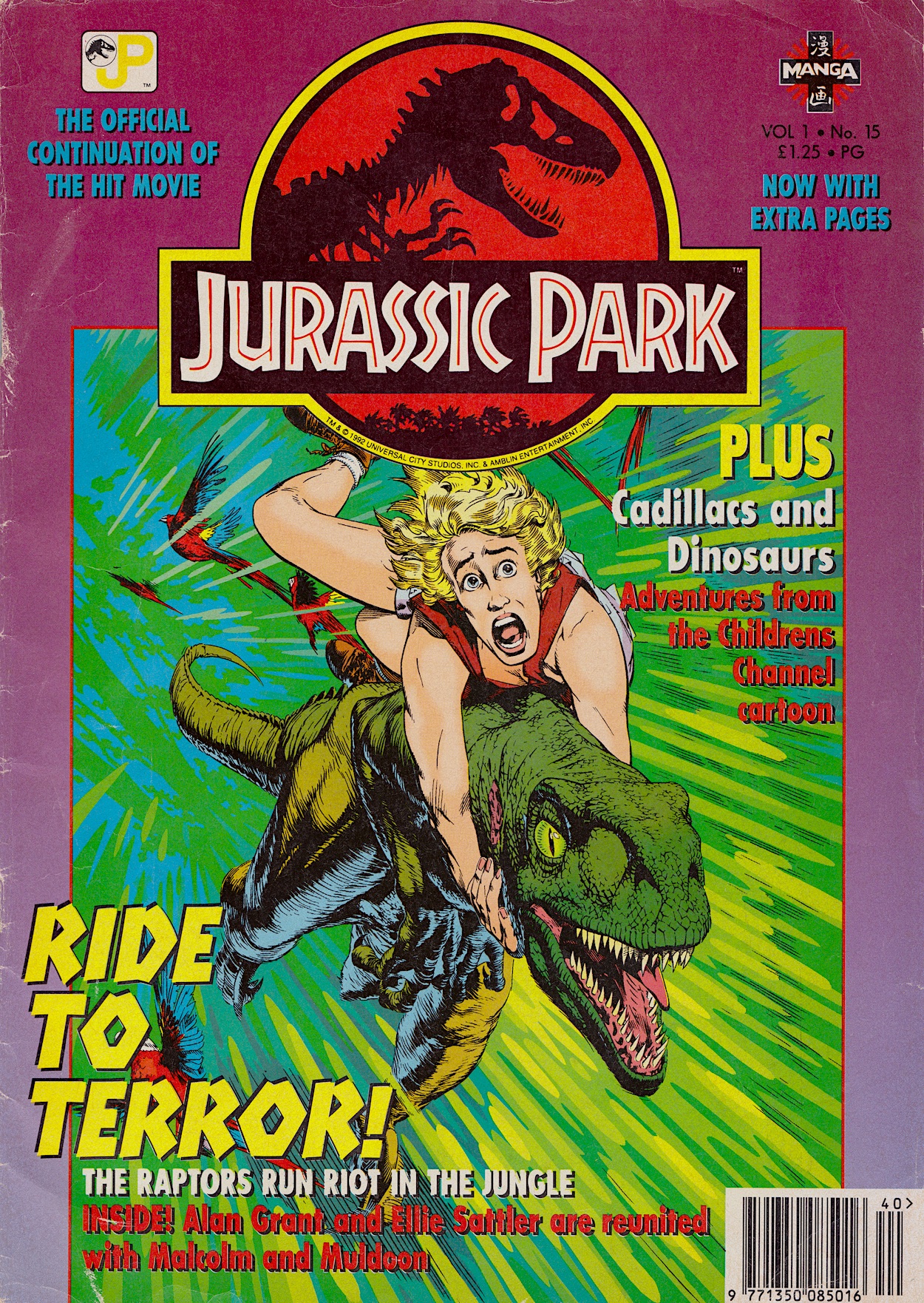
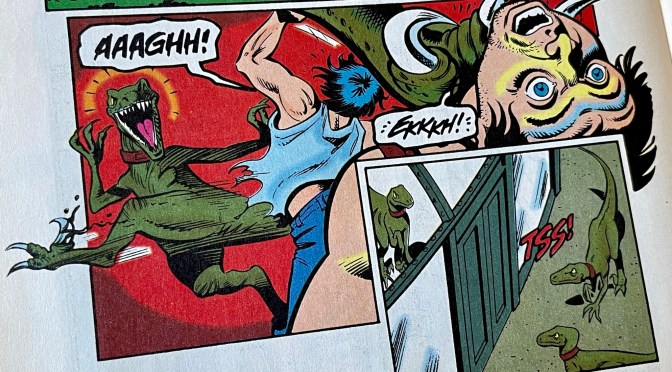
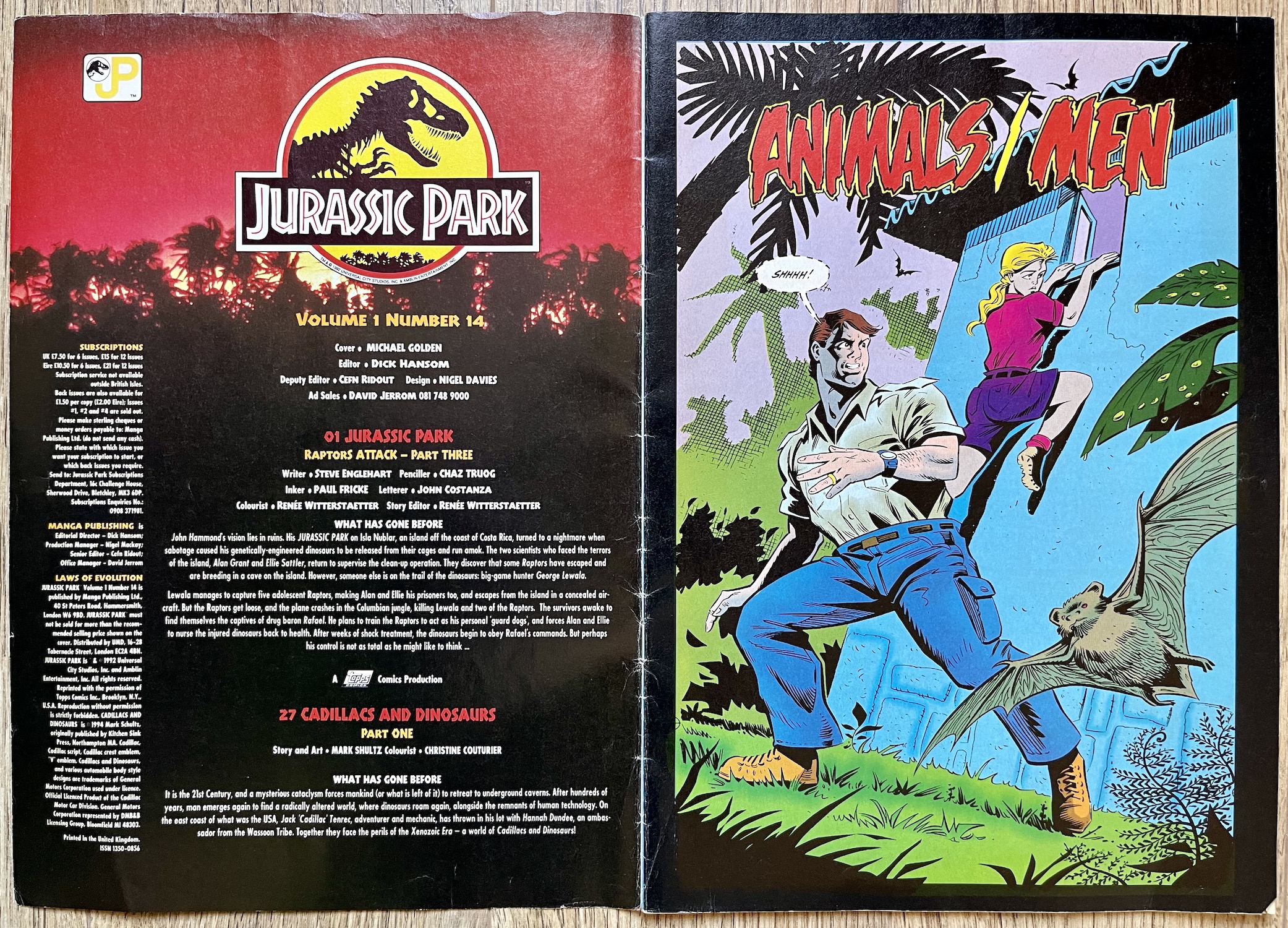
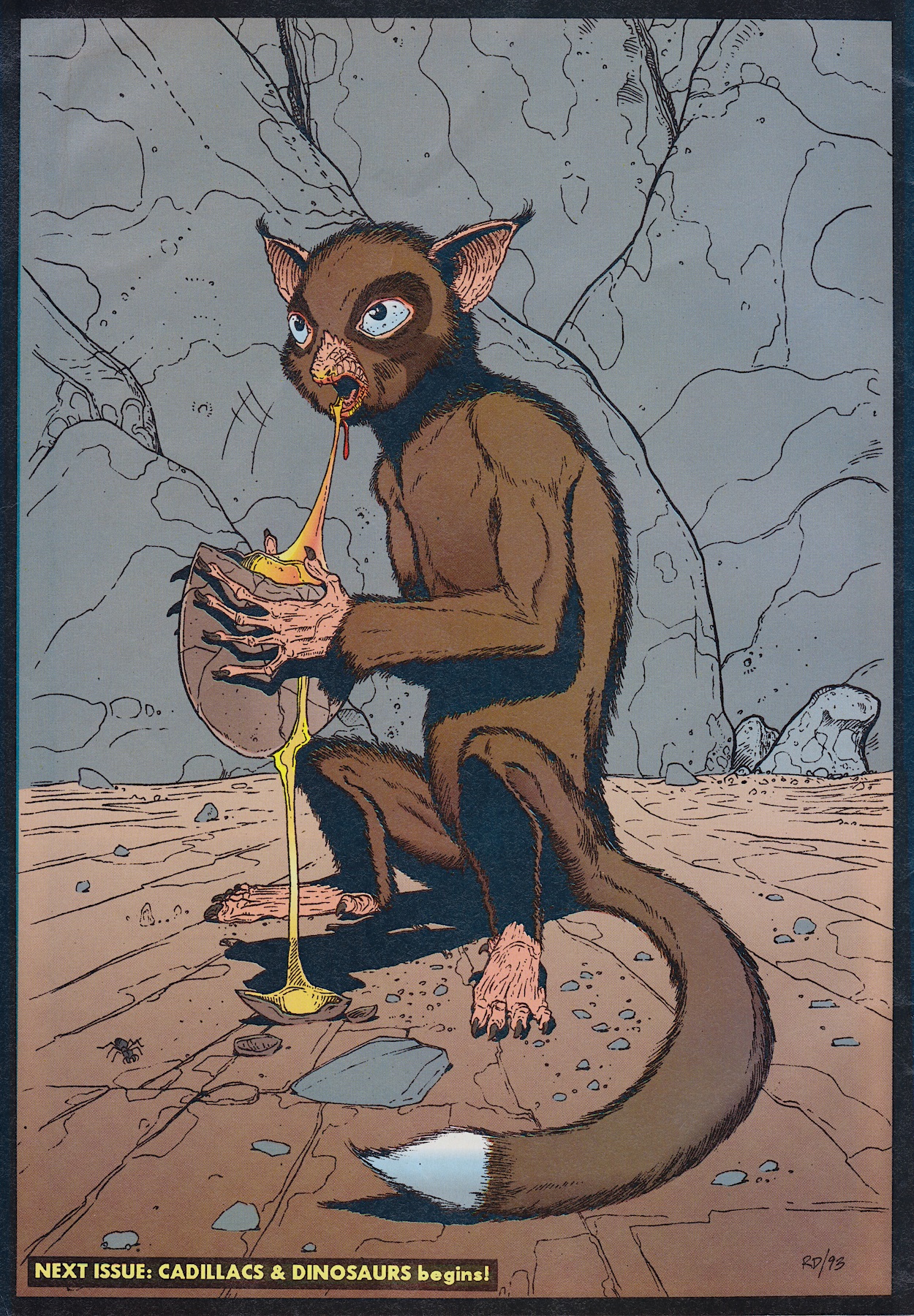
Another exciting cover from Michael Golden, right? Shame it has absolutely nothing to do with what’s inside. In fact, Drs Ellie Satler and Alan Grant don’t even see the Velociraptors, none of our regular human characters do, so this is a somewhat misleading choice by editor Dick Hansom to pull readers in. That’s not to say the strip isn’t entertaining, it’s just not Ellie-holding-on-for-dear-life entertaining.
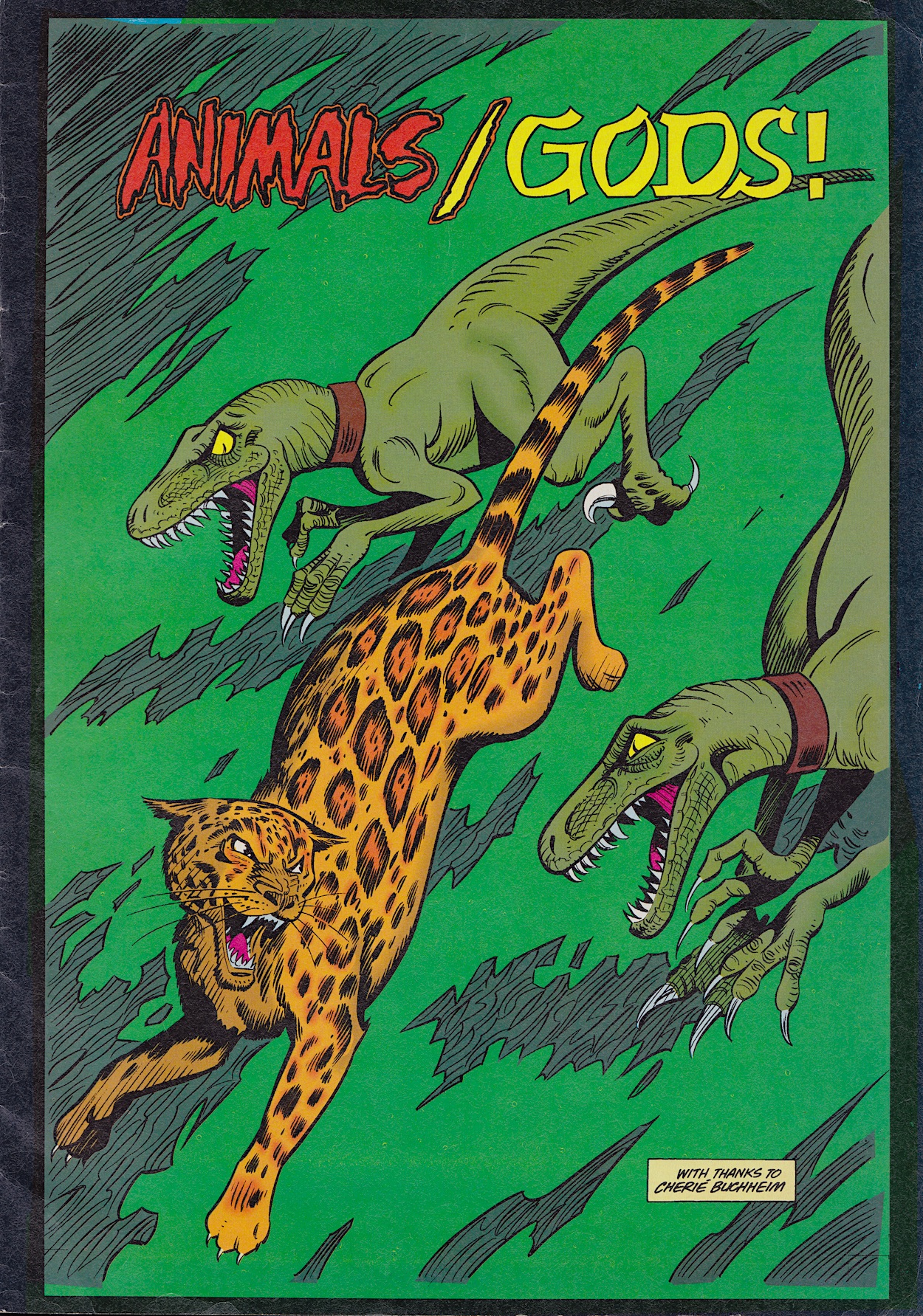
After last issue’s ‘Animals/Men’ story comes Animals/Gods!, as ever written by official sequel scribe Steve Englehart with the same art team as last time I’m very happy to say. Chaz Truog is on pencils, Paul Fricke is inking, letters are by John Costanza with Renée Witterstaetter bringing it all to colourful life as well as being story editor.
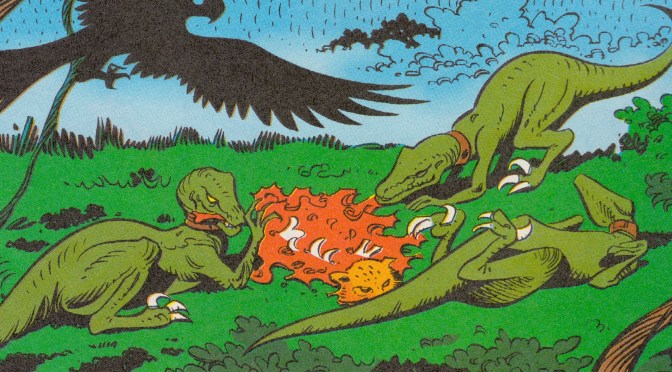
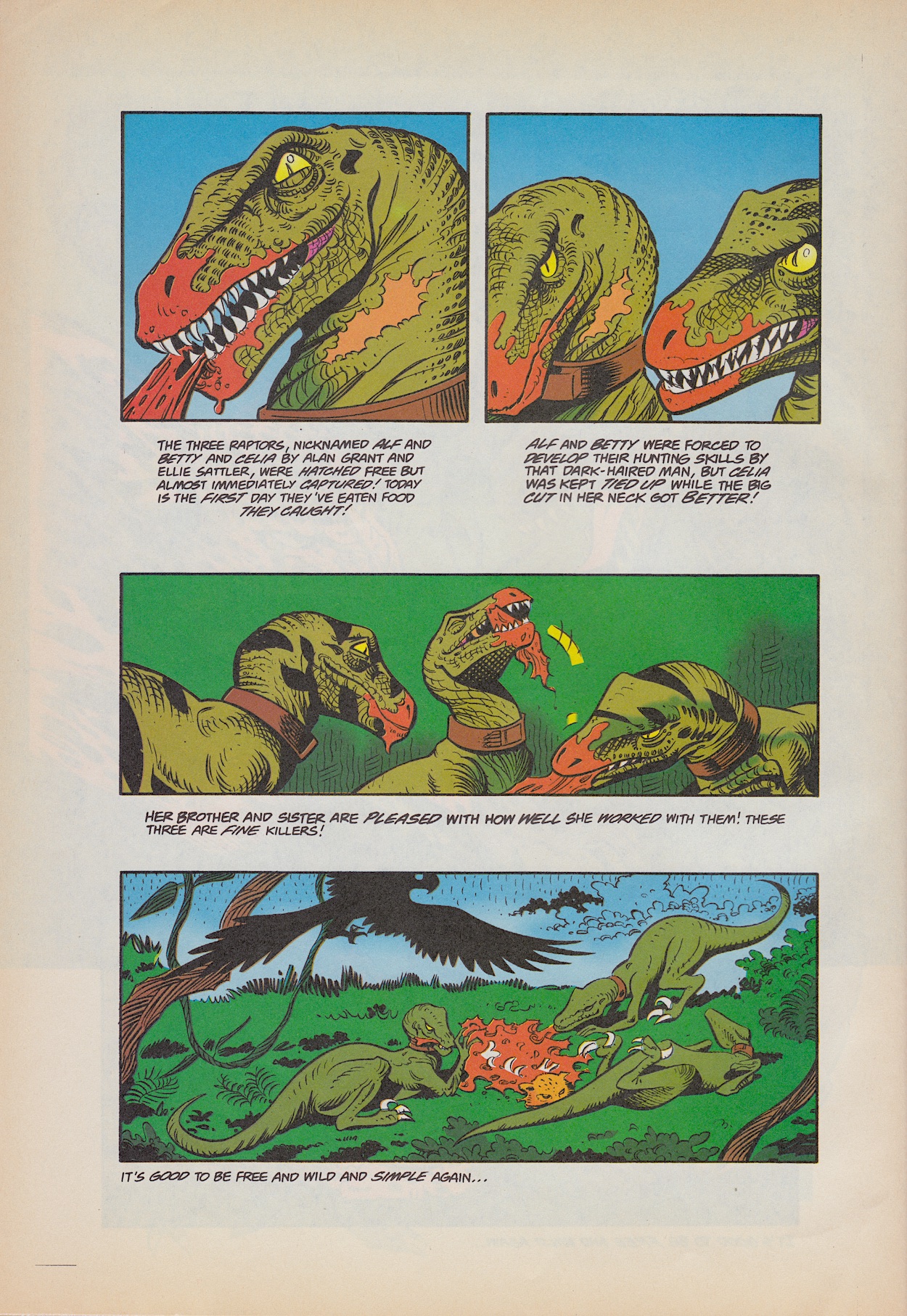
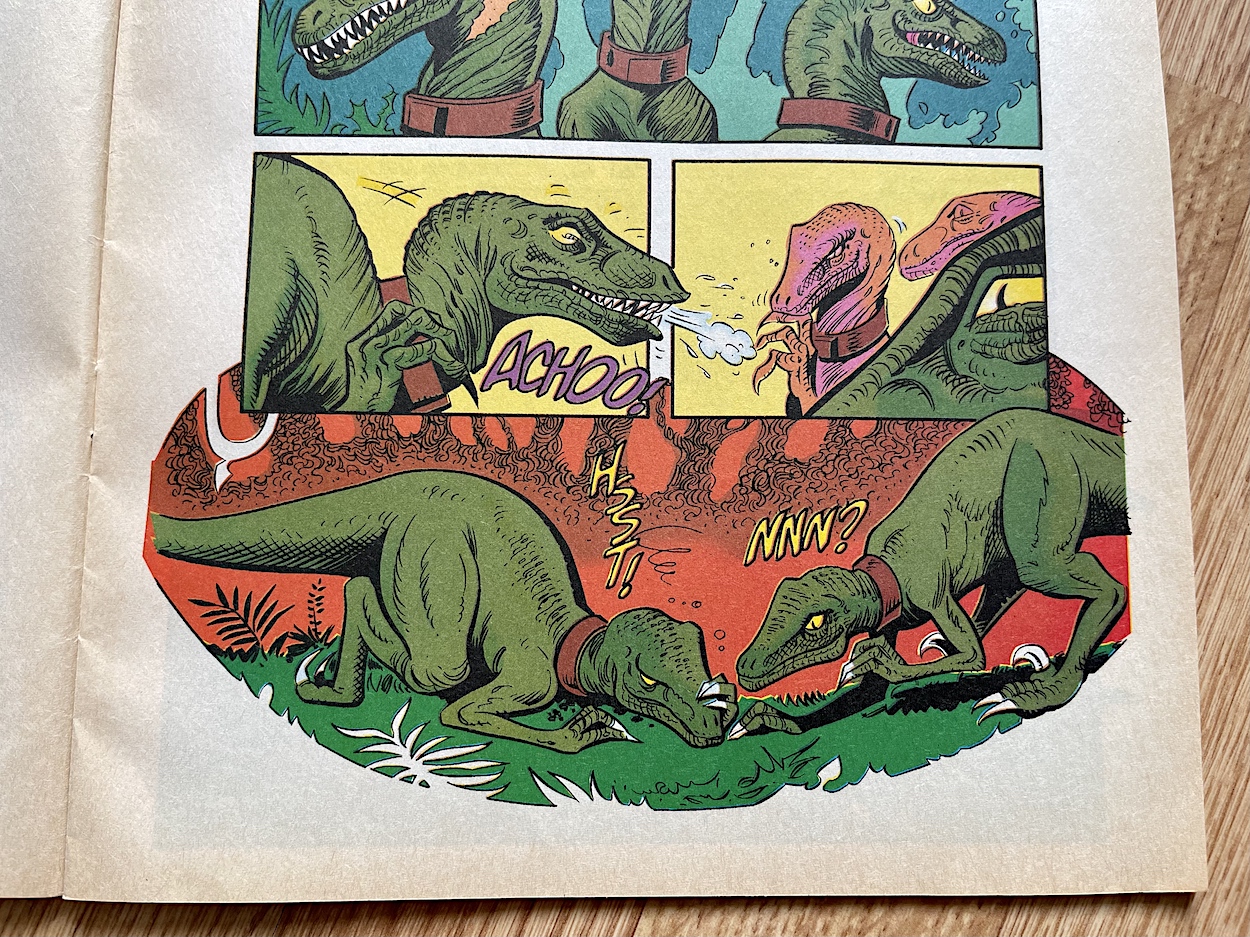
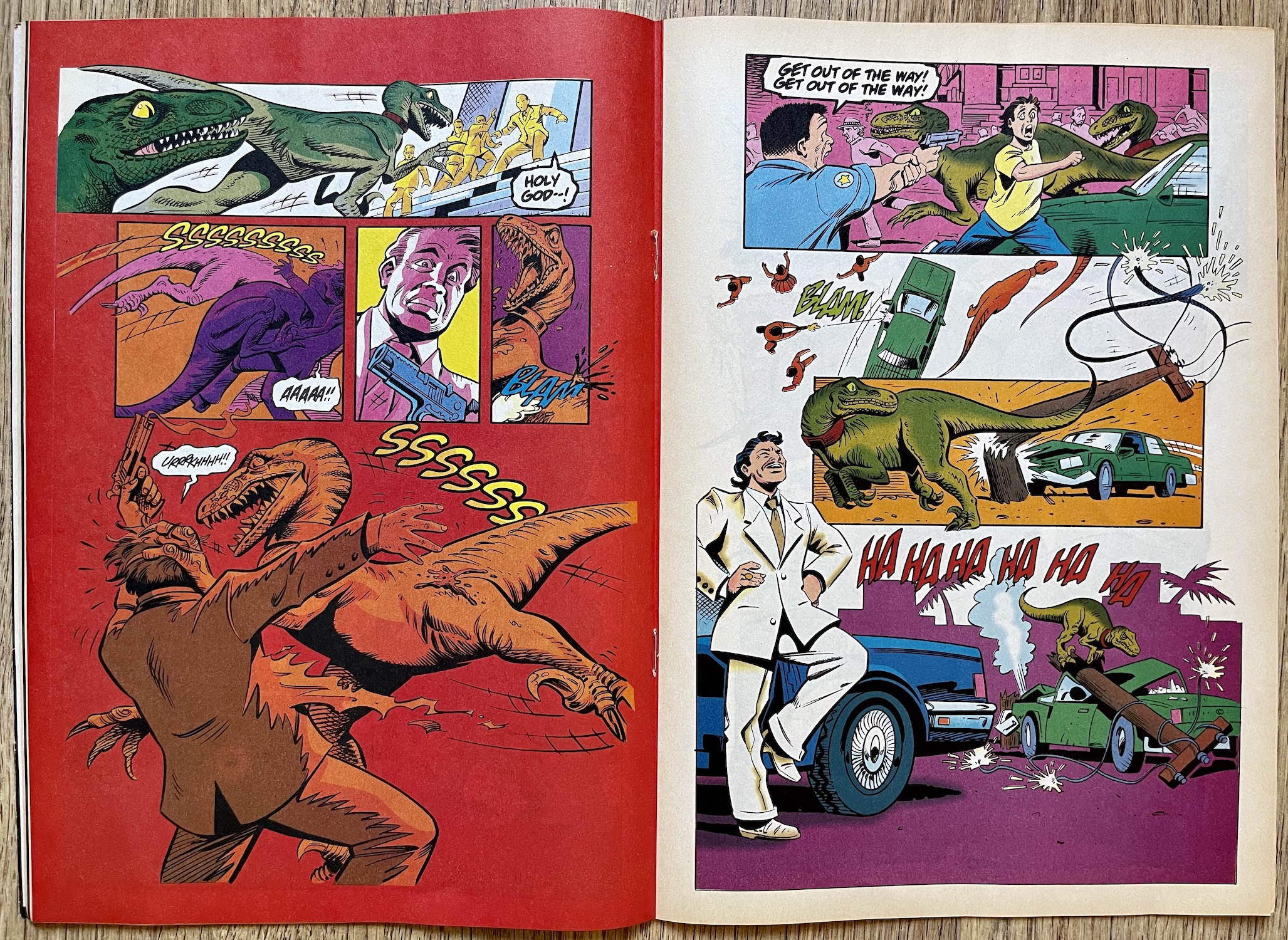
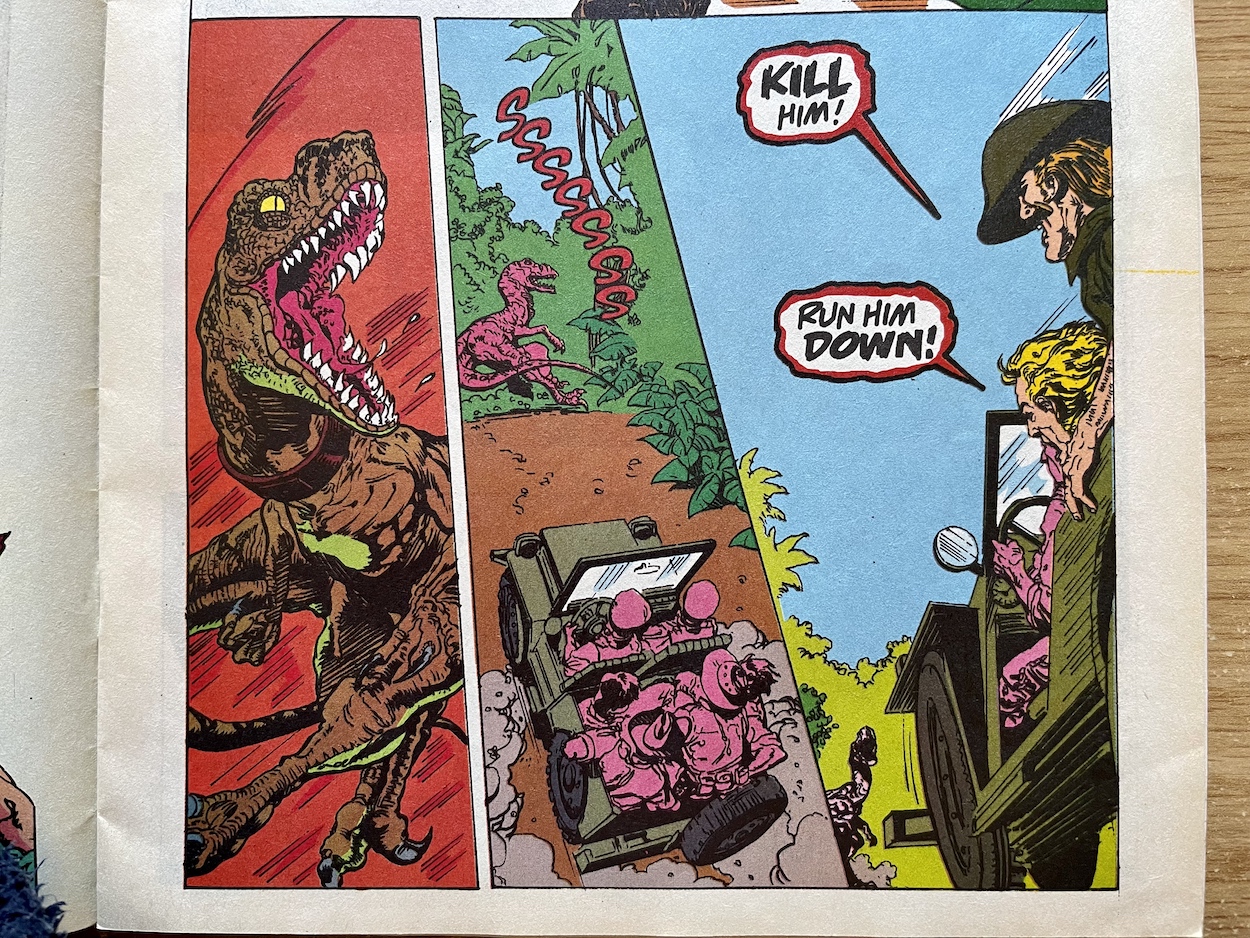
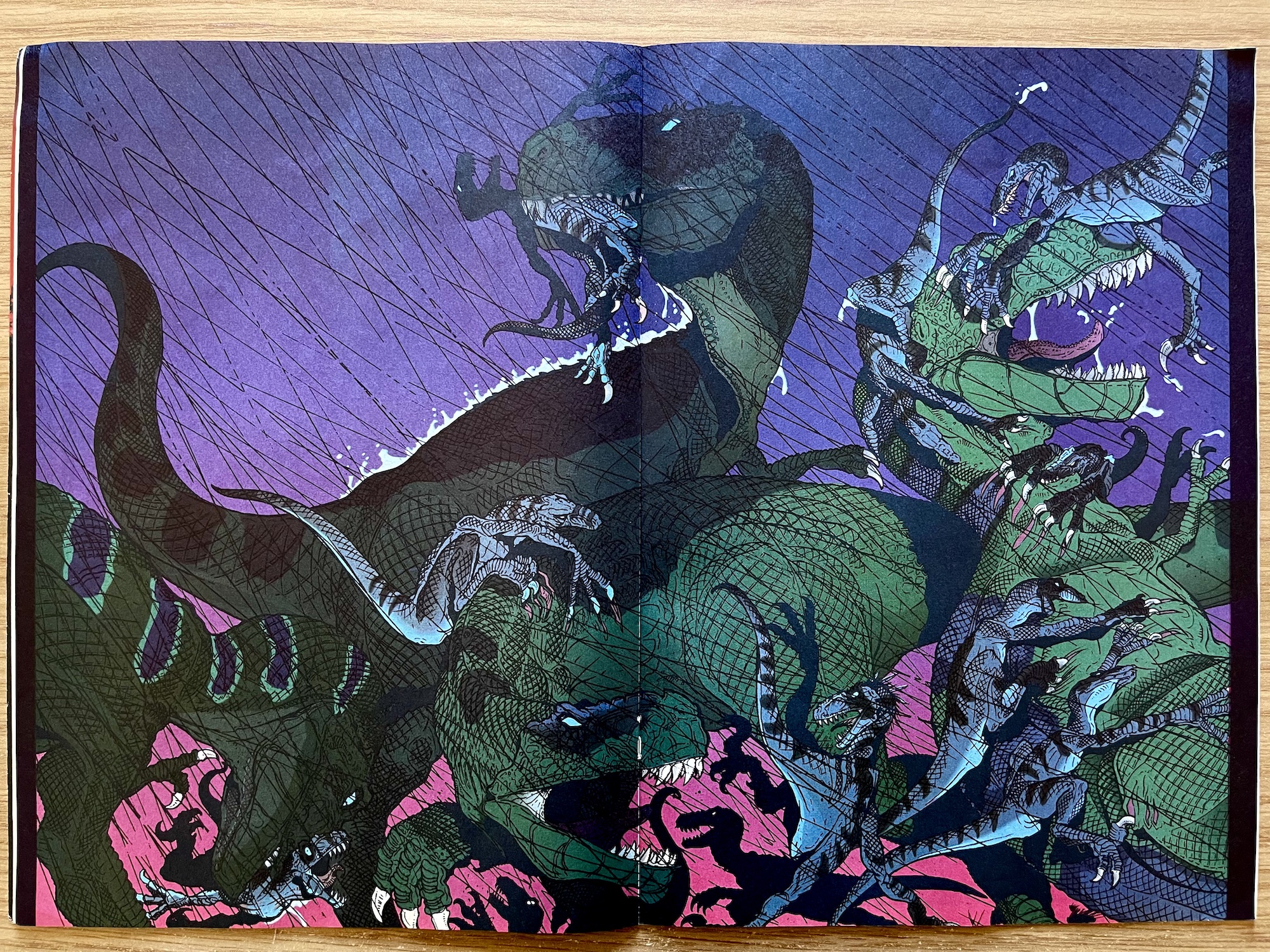
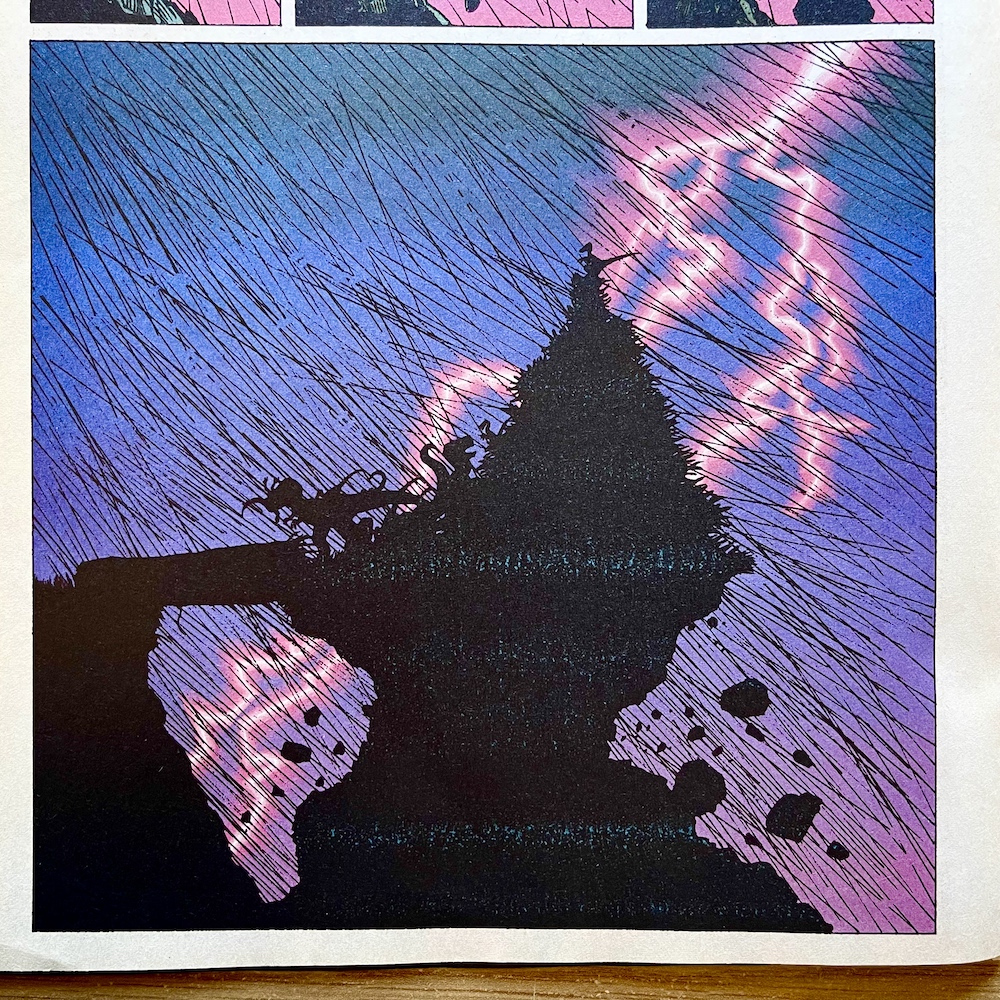
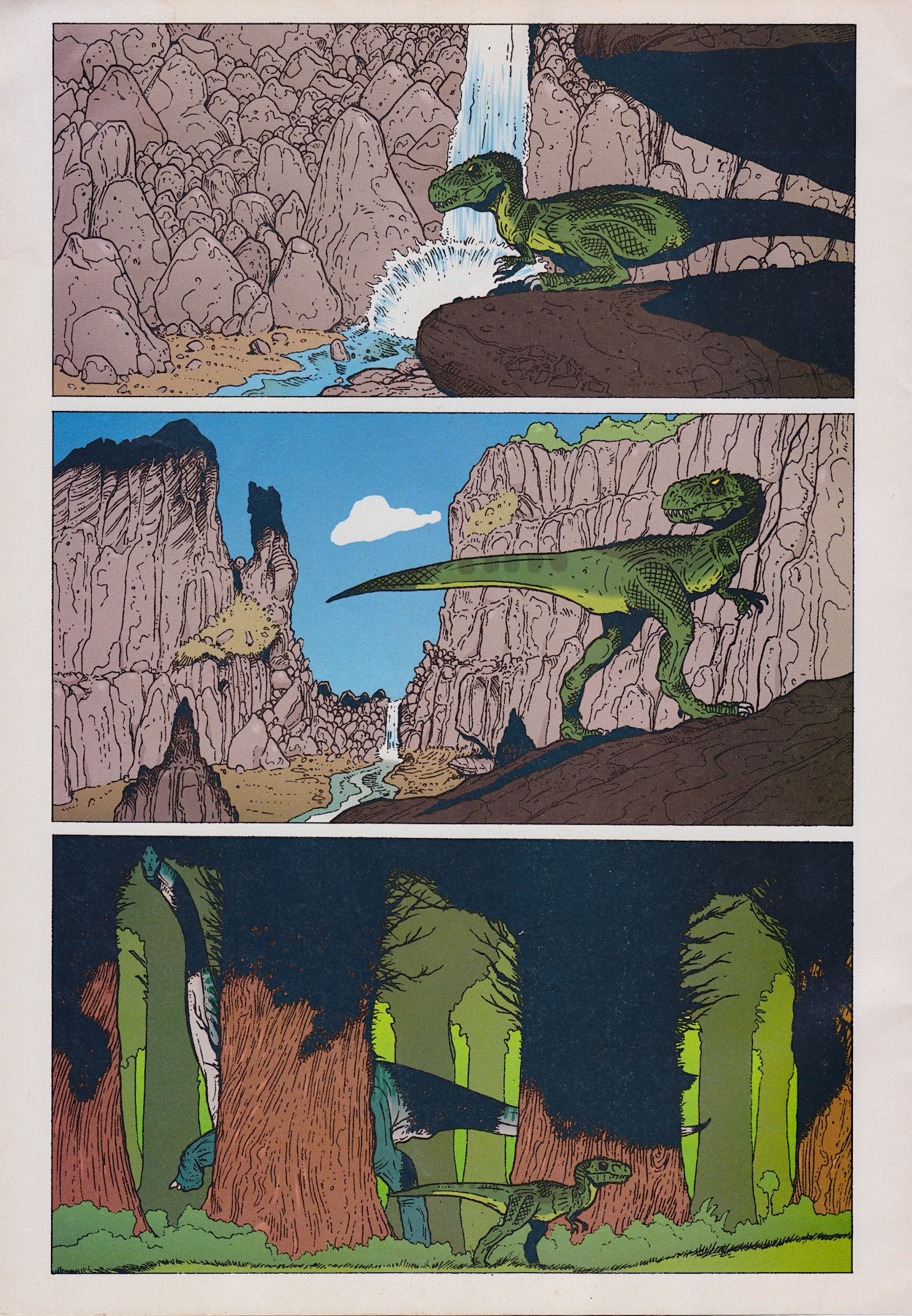
We have two completely separate stories happening here, our people becoming reunited while the ‘raptors enjoy life as wild animals. Things kick off with the dinosaurs hunting down a cheetah. Naturally the big, powerful cat comes off the worst against these new-old predators but it’s still a thrilling chase. We get four pages of Alf, Betty and Celia living free, ending with them relaxing as they finish off their meal, having a roll about in the sun and simply enjoying time together as a family unit without us humans ruining everything.
They really are the stars this issue, but then Alf starts to become ill, sneezes and collapses. During the human half of the story we find out there’s been a severe flu virus going around and both Alan and Robert Muldoon have come down with it. As Ian Malcom suggests, the Velociraptors aren’t predictable, they aren’t simple free animals (despite the animals thinking this themselves). Interacting with humans, something dinosaurs were never meant to do, will change them.
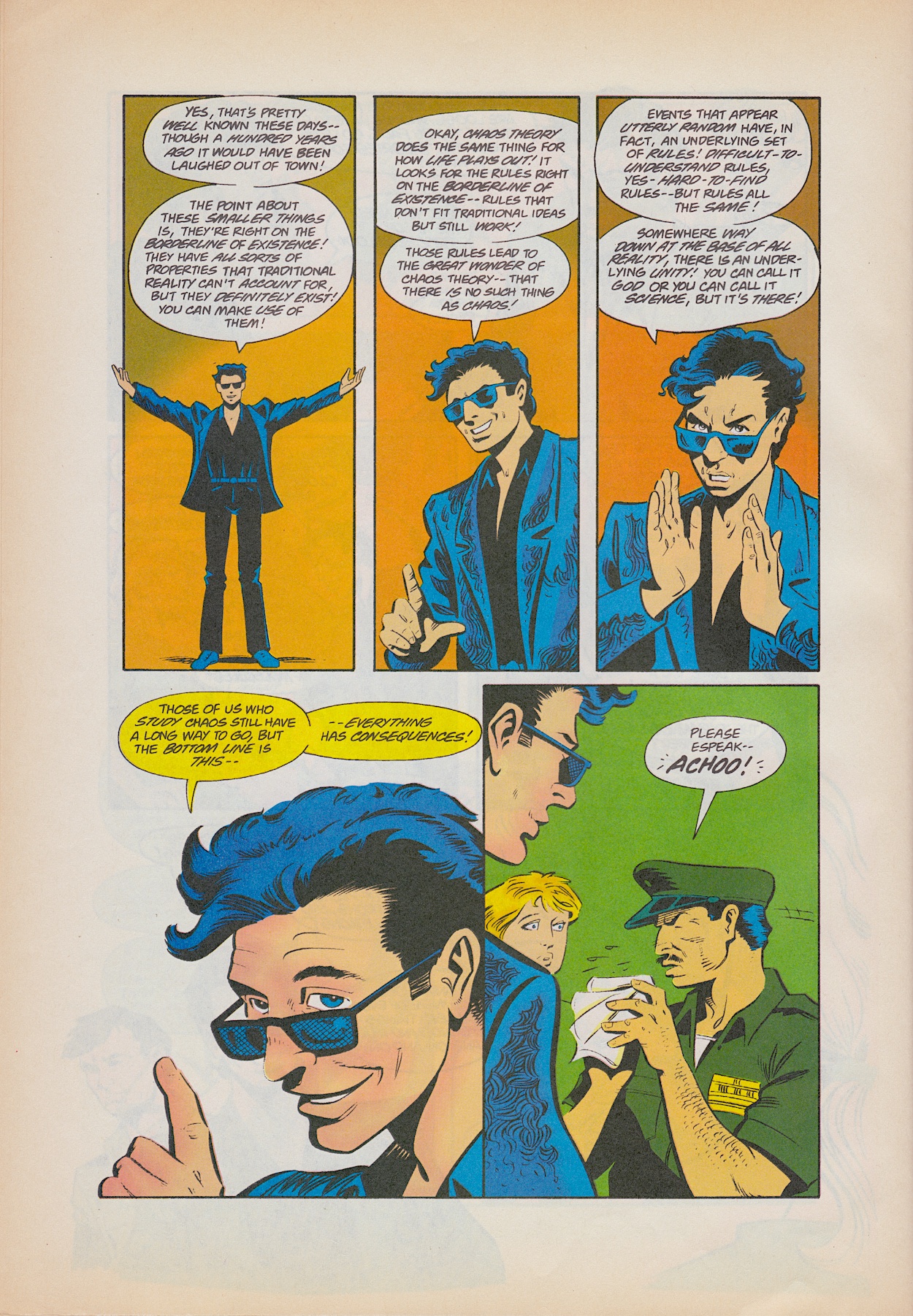
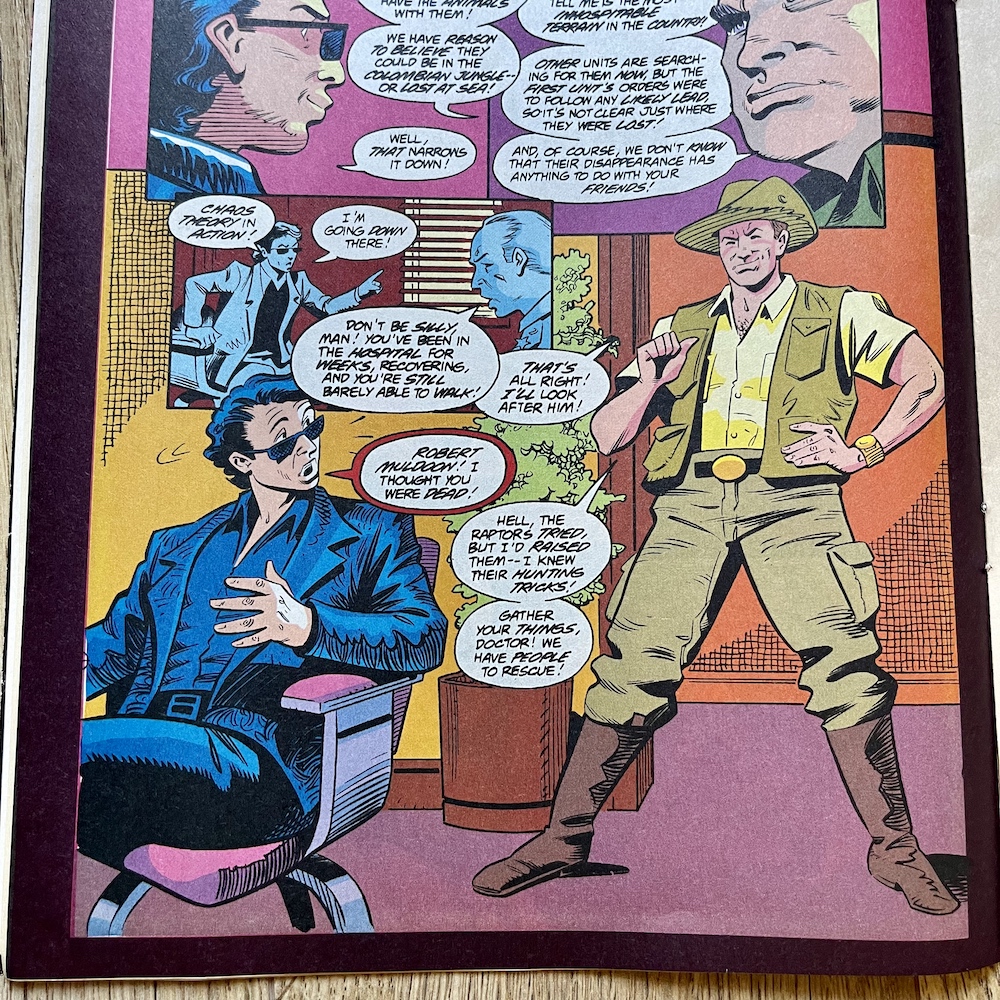
Ian’s scenes are the most interesting in the other half of the story. I still take issue with Muldoon having survived and his explanation just doesn’t make any sense, completely contradicting what we saw with our own eyes in the film. It’s also rather insulting for the reader to see him up and about perfectly fine, yet have Ian tells us he was laid up in hospital for months on end with his injuries, and he didn’t have a raptor’s jaw squeeze his skull! Anyway, we have to live with this for now and we find out Muldoon knew big game hunter George Lawala, the man whose work started this whole mess back in #7.
What I do enjoy though is any chance Ian Malcolm gets to talk Chaos Theory. If you haven’t read Michael Crichton’s original novel I highly recommend it for the pages and pages of monologues we get from Ian describing the intricacies of Chaos and his predictions for the park. It’s fascinating stuff. The movie did a great job of distilling these into short little scenes to get the essence across and here we get something of a cross between the two extremes. It’s clear Steve has gone back to the original source material when writing this.
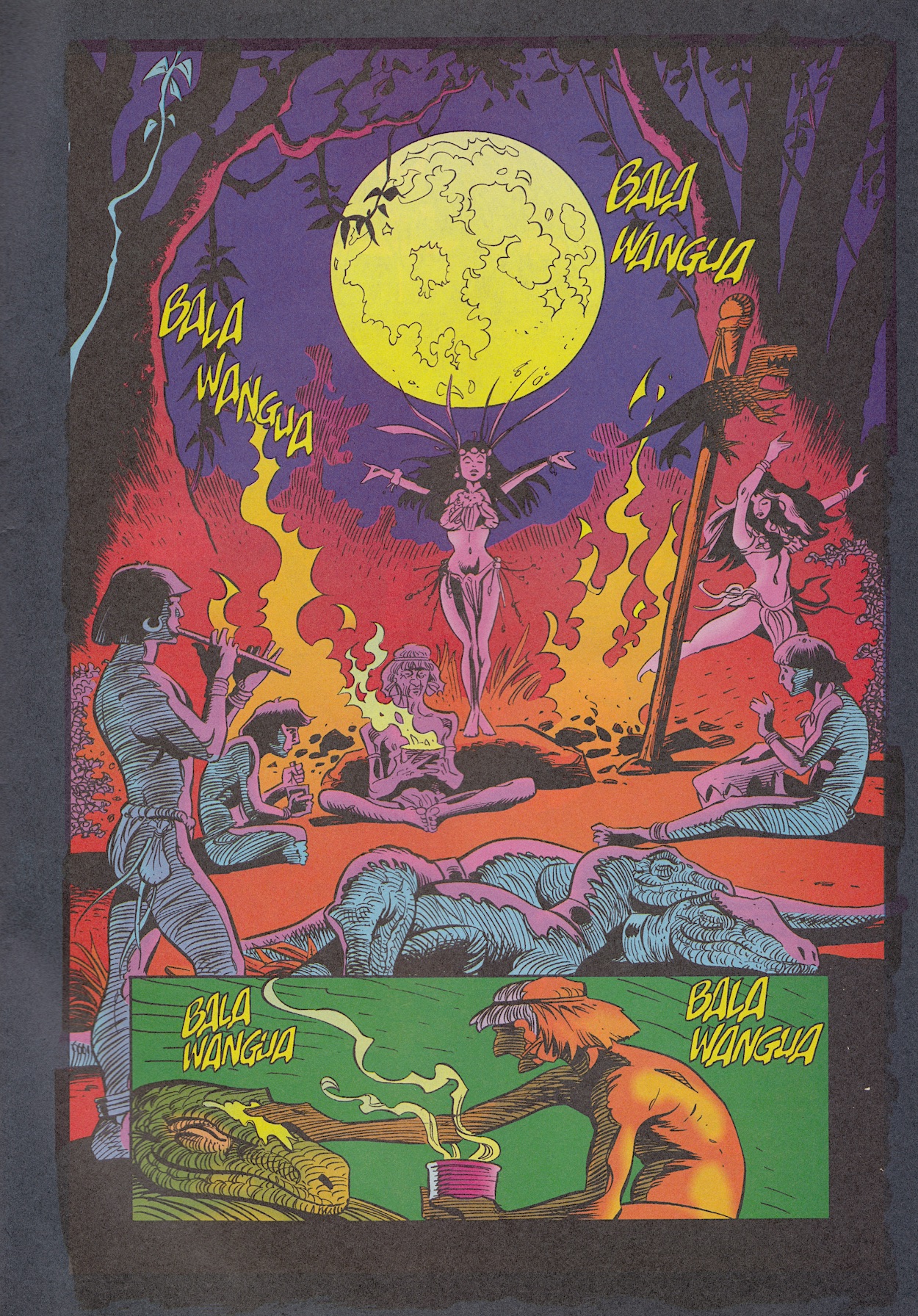
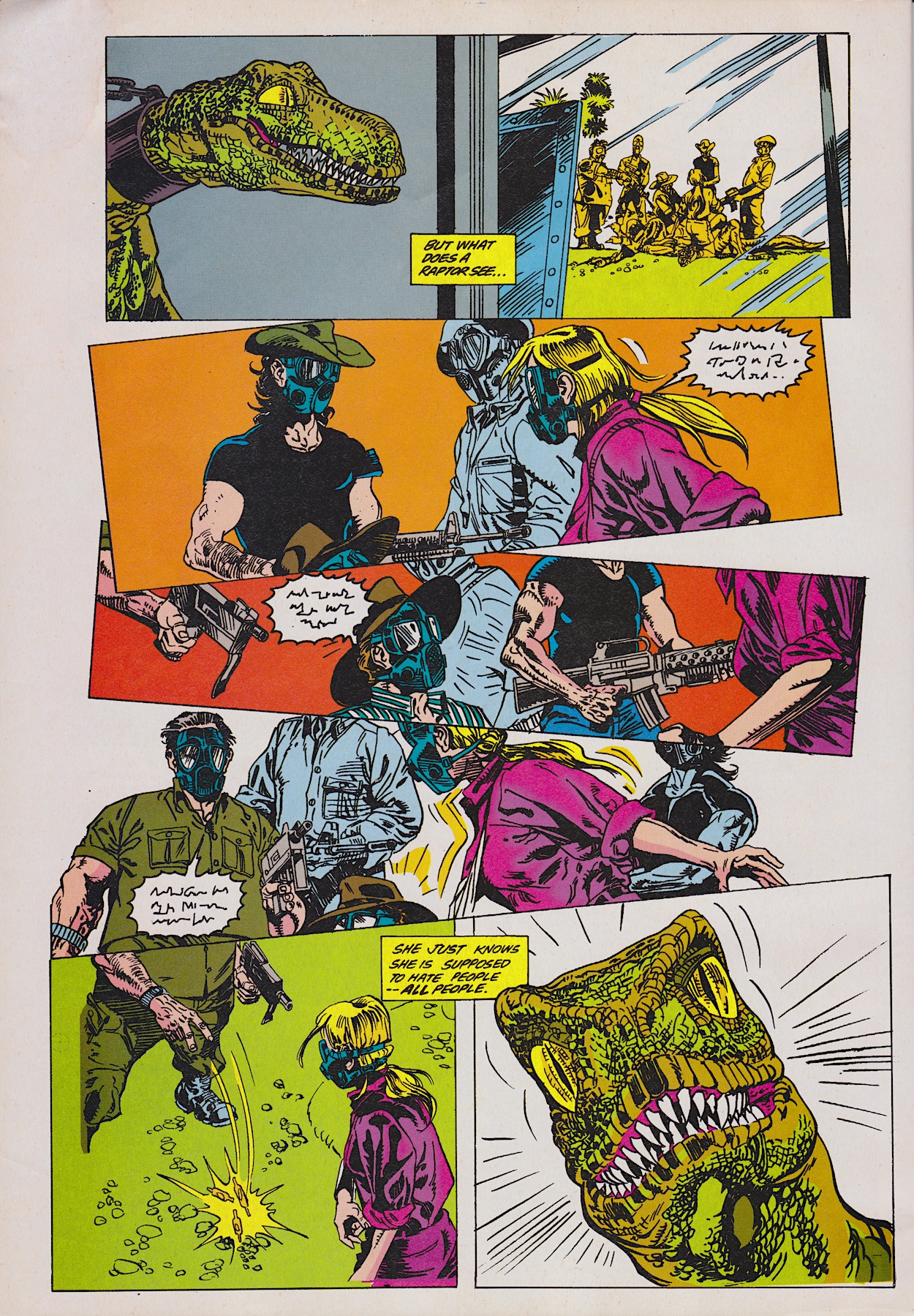
That’s basically the entirety of the human story this time, to give some context to the story of the ‘raptors who take up a whopping 19 of the 27 pages of Jurassic Park strip. As I said, they really are the stars this time. We catch up with them as a local indigenous tribe watches these unknown animals succumb to their illness from a safe distance, believing them to be their gods taken animal form. Celia realises they’re being watched and attacks but despite the anger in her eyes she’s too weak to take them all on, reminding us that she may have shown a kindness towards Ellie last time but she’s still very much the same animal.
She finds a dead, sacrificed animal and tries to drag it to her siblings but struggles to do so and collapses. We get a few pages of the tribe gathering around their gods, feeding them elixirs, bringing idols of worship, generally looking after them and taking part in religious chants to impart strength. A long time passes and slowly they return to full strength. The tribe gather tentatively but it doesn’t quite go as they’d thought.
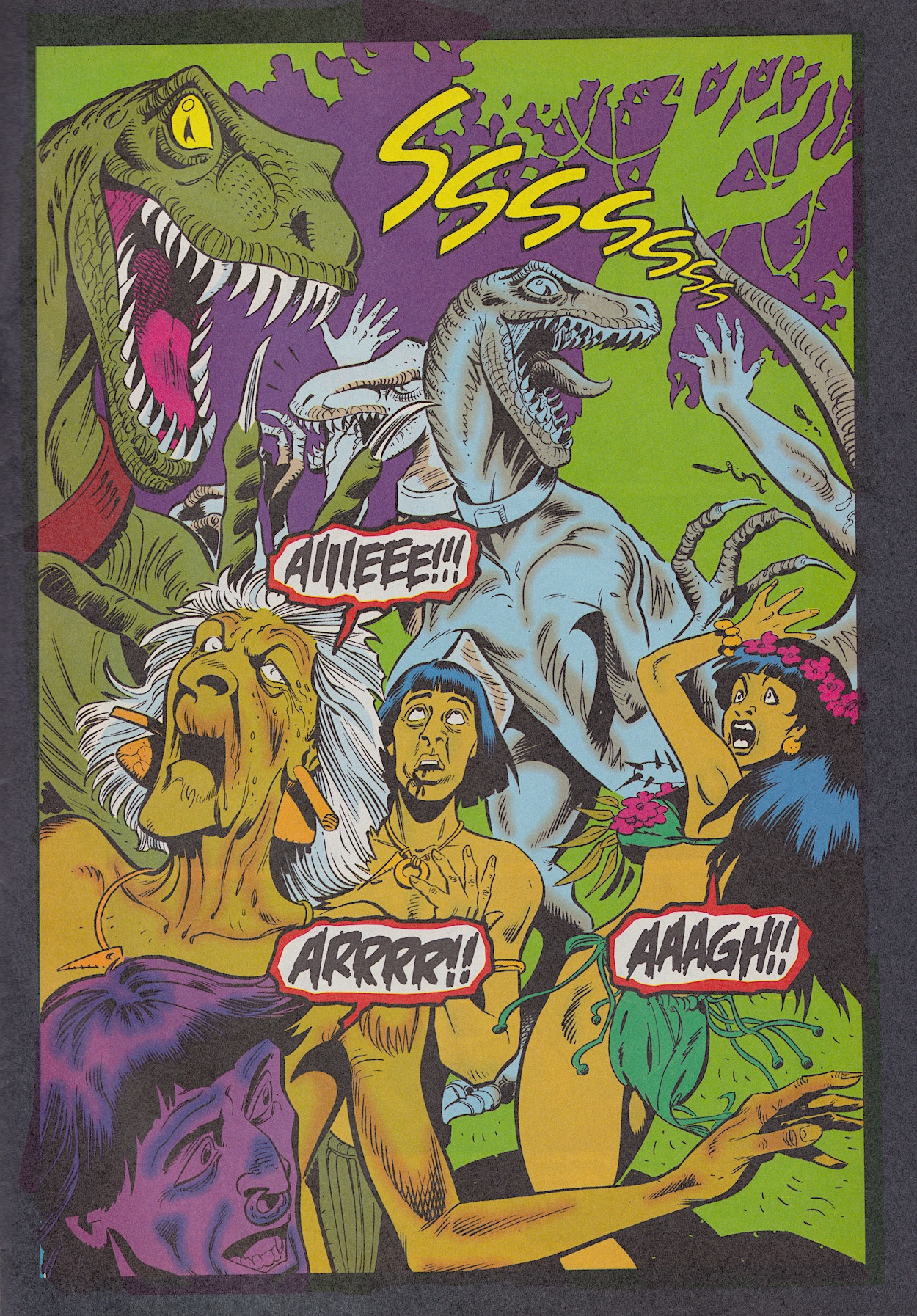
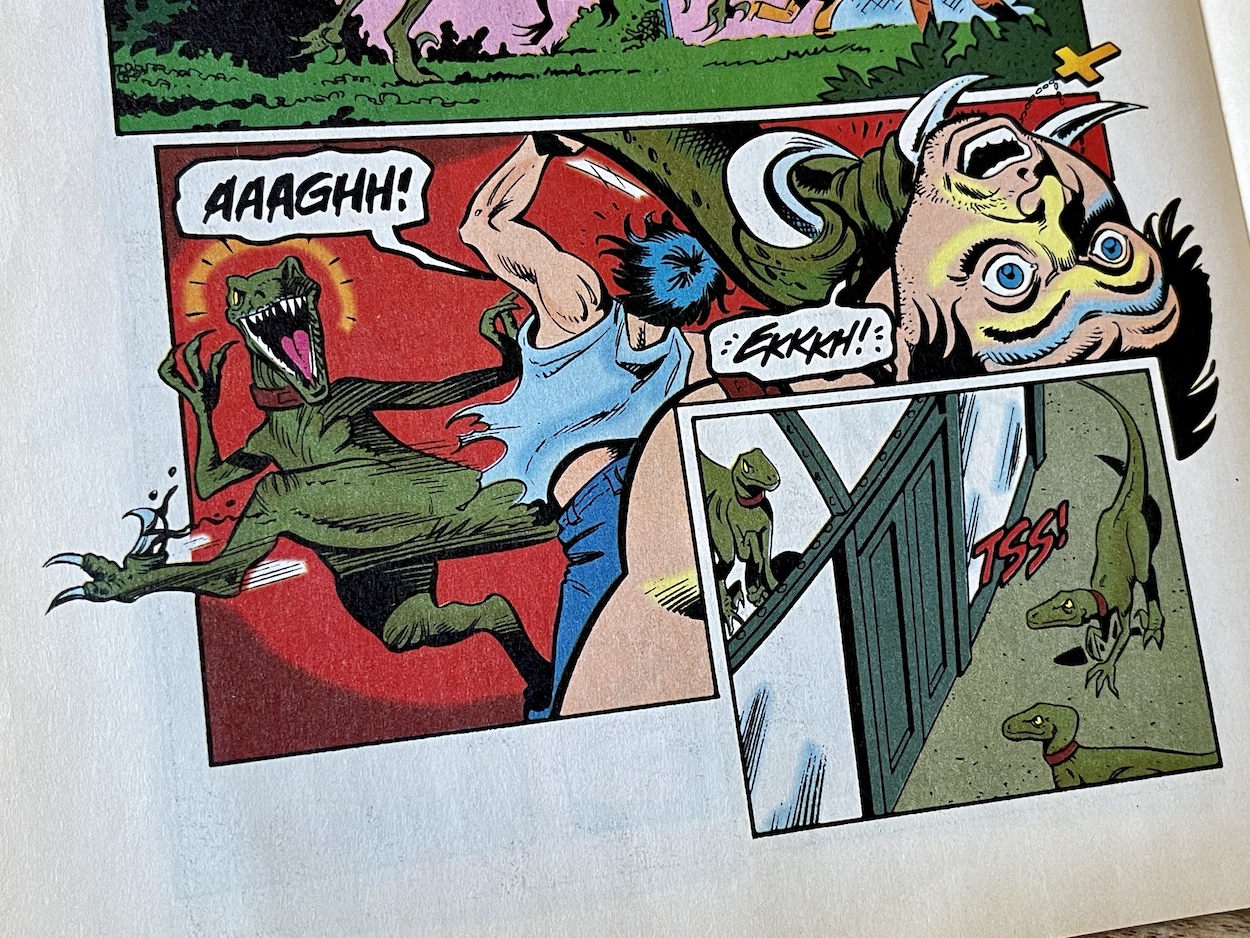
Everyone is slaughtered, but not eaten. These human creatures are now the enemy after all they’ve done to them. It’s as simple as that. The chapter concludes with the Velociraptors disappearing off into the jungle once more, one simple caption underneath: ‘It’s good to be free and wild again…’
While I do enjoy seeing the ‘raptors portrayed in this way I have to say this is probably the weakest of the strips so far because not enough happens. The main bulk of the story could’ve been told in a fraction of the pages without losing any of its impact and the human half is simply a (albeit good) speech by Ian and that’s about it. It feels like a stop-gap, like the comic was taking a beat while it puts the pieces into place for the next story. Transformers would sometimes do this for example and you’d know what it was up to. But with the gift of hindsight there’s one key difference here: the next issue is the last.
At the end of the strip is the line, ‘Next: The Thrilling Climax!’. As a teen I just thought it meant the end of this particular story before the next one kicked off, so this issue’s breather felt like it was gearing up for an awesome finale with the Veliciraptors before leading on to further adventures with the human characters. I now know this meant the end of the comic. Only for UK readers though, which I’ll get into next time.
It’s sad to think this real time read through is almost over
While not designed as the penultimate story it was for us and in this regard it’s lacking. Previous back up strip Age of Reptiles told a better story in a fraction of the pages in any one issue, which is a hard thing for me to say because I’ve been such a fan of the main strip up until the moment they brought back Muldoon, and now it feels like it’s padding itself out, treading water. Maybe it’ll make sense next month and read better as a result, but as it stands this was a fun strip but not worth the 26 pages it took to tell it and would’ve worked much better as a shorter, additional back up.
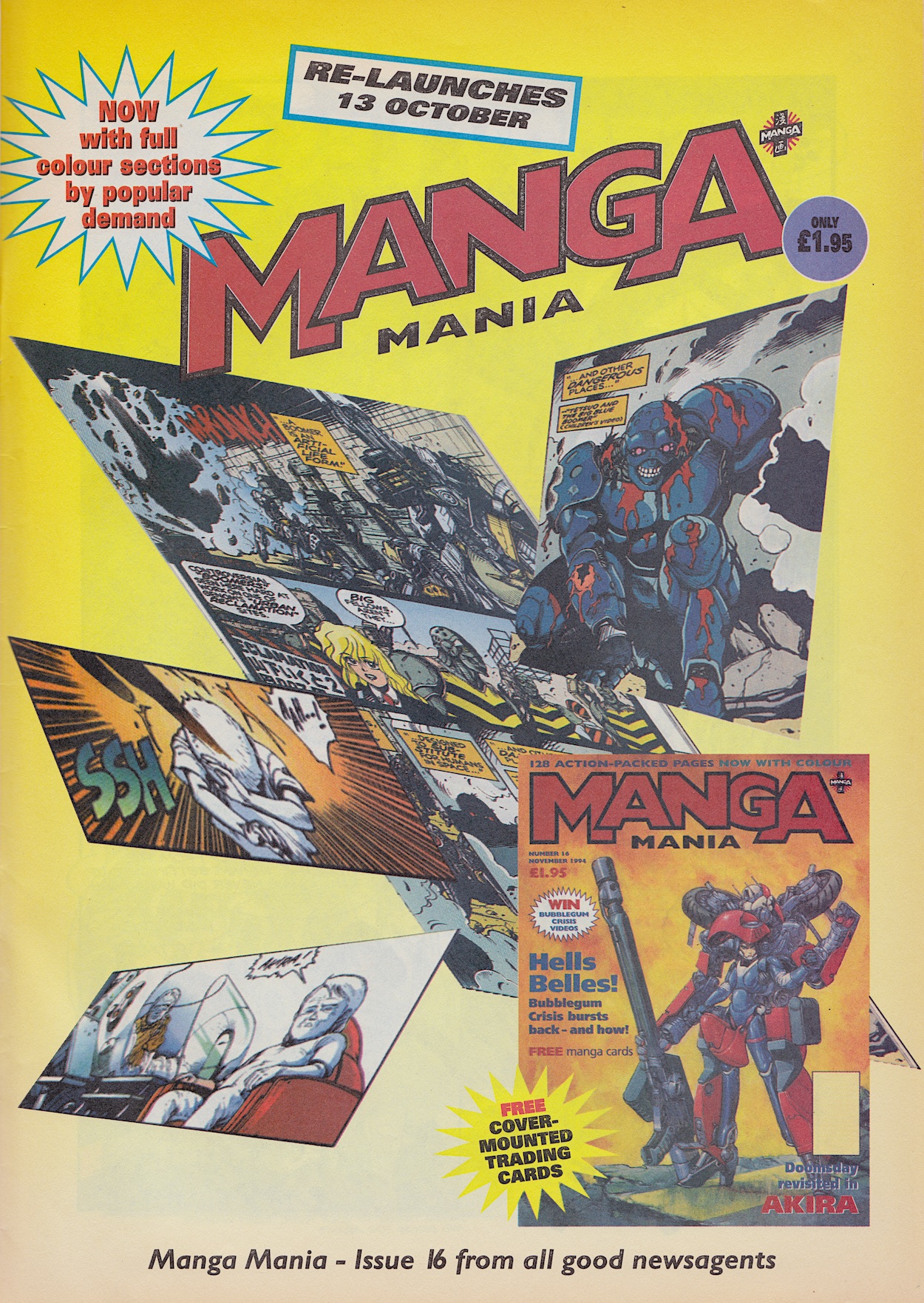
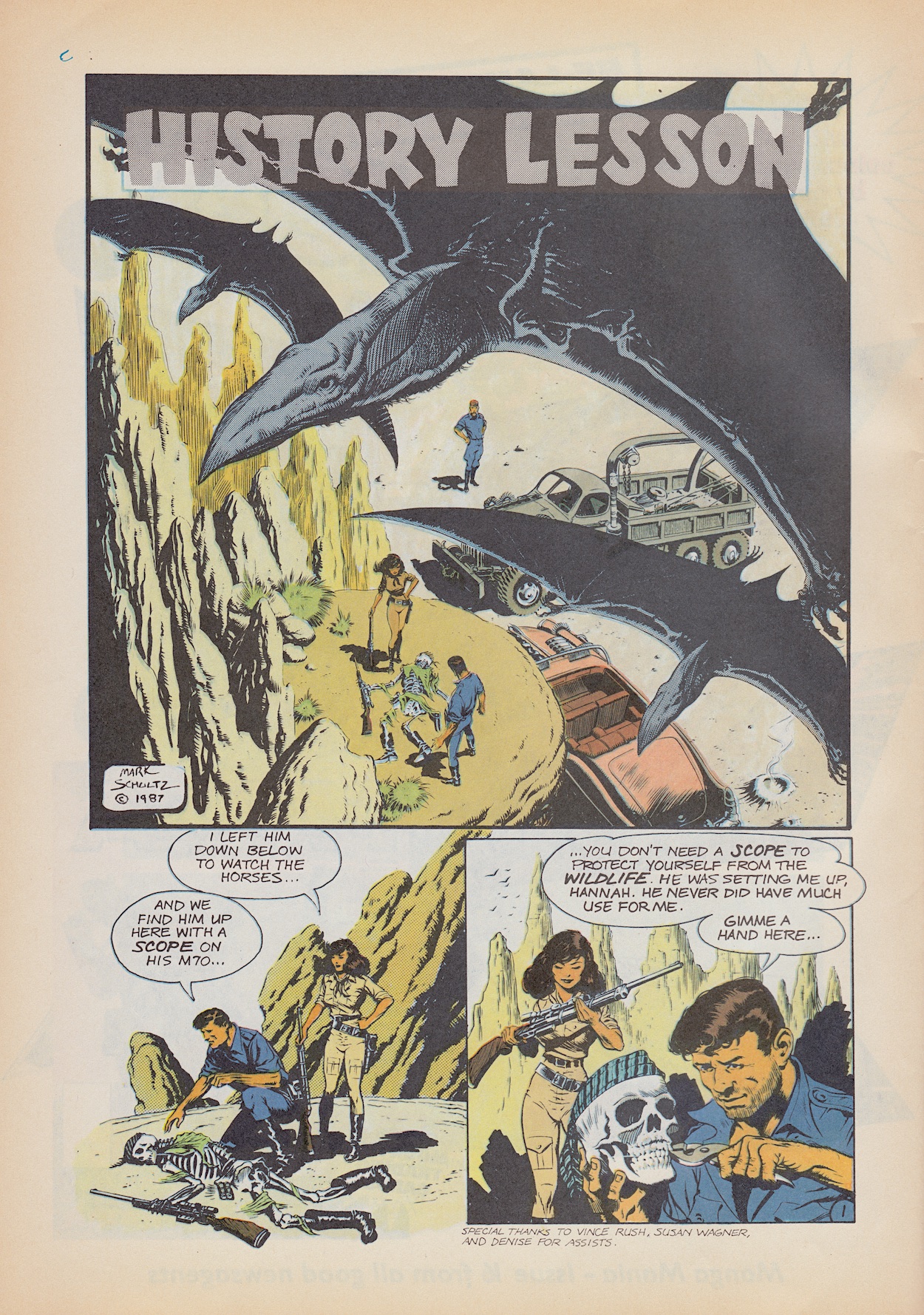
Moving on and after an advert for the soon-to-be-relaunched Manga Mania (now that the new publisher had gotten their hands into it properly) we move on to Cadillacs and Dinosaurs, or Xenozoic Tales by another name. History Lesson is one of those rare things, a quite lengthy story by creator Mark Shultz (coloured by Christine Courtier), lengthy enough for it to be split into two parts over these final two issues. Taken from #4 of Mark’s original comic it takes place before some of the strips featured already in Jurassic Park.
In fact this picks up directly from the story in #7 and didn’t make a lot of sense to me at the time. It made it seem like they’d had all these other adventures before realising Gorgostamos was missing. I now know better but in the days before having the internet to research it just felt off. Obviously it wasn’t Mark’s fault. What is also not his fault is the fact nothing much of consequence happens here either. Perhaps when both halves are read altogether the story will be much more interesting, but it’s cut off before it gets going.
After finding Gorgostamos’ remains Tenrec and Hannah debate whether the Grith killed him in order to save them, and Hannah once again wants to know more (remember, this happened long before last month’s story). Tenrec tells her of catacombs underneath the city where a library has been found, guarded by keepers of knowledge who don’t want outsiders let in. They fear that with knowledge of how to rebuild humans will just cause another cataclysm. Hannah insists on seeing it and these ten pages are about Tenrec meeting with allies to get them inside. Then, just as they do get in the story frustratingly stops for now.
The only really exciting part is the caption beneath the final panel! As a teen I looked forward to finding out the mystery once and for all but now, knowing the previous strips were actually later chapters in the story and the mystery wasn’t solved in them, I don’t think we’re going to get as many answers as this suggests, which actually makes me all the more intrigued as to what the caption means. If it gives at least a hint of what happened (or maybe the answer without the characters knowing) then at least that would explain why it was used as the final story for this comic.
I may have been none the wiser but it’s clear the new MangaPublishing knew the end was nigh, even if they were still offering subscriptions on the contents page. It’s sad to think this real time read through is almost over. This is the first issue I’ve been disappointed with as a whole, but after 15 of them that’s not a bad track record. It feels like no time since I was reviewing the very first issue and thinking back the comic has changed a lot in a relatively short amount of time. Let’s hope for a spectacular send off. Well, a send off for the time being anyway. I’ll elaborate in #16’s review on Thursday 3rd November 2022.
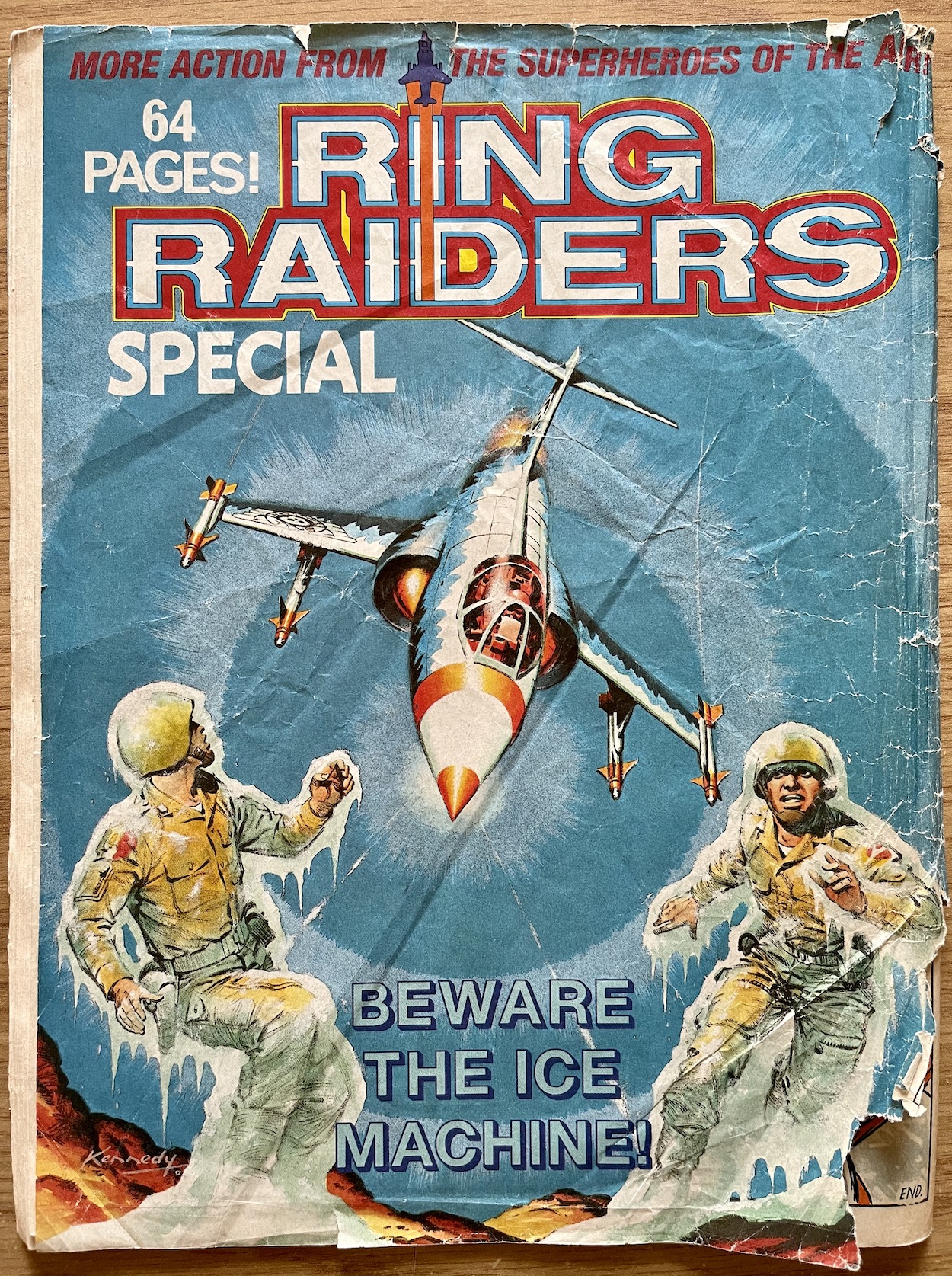
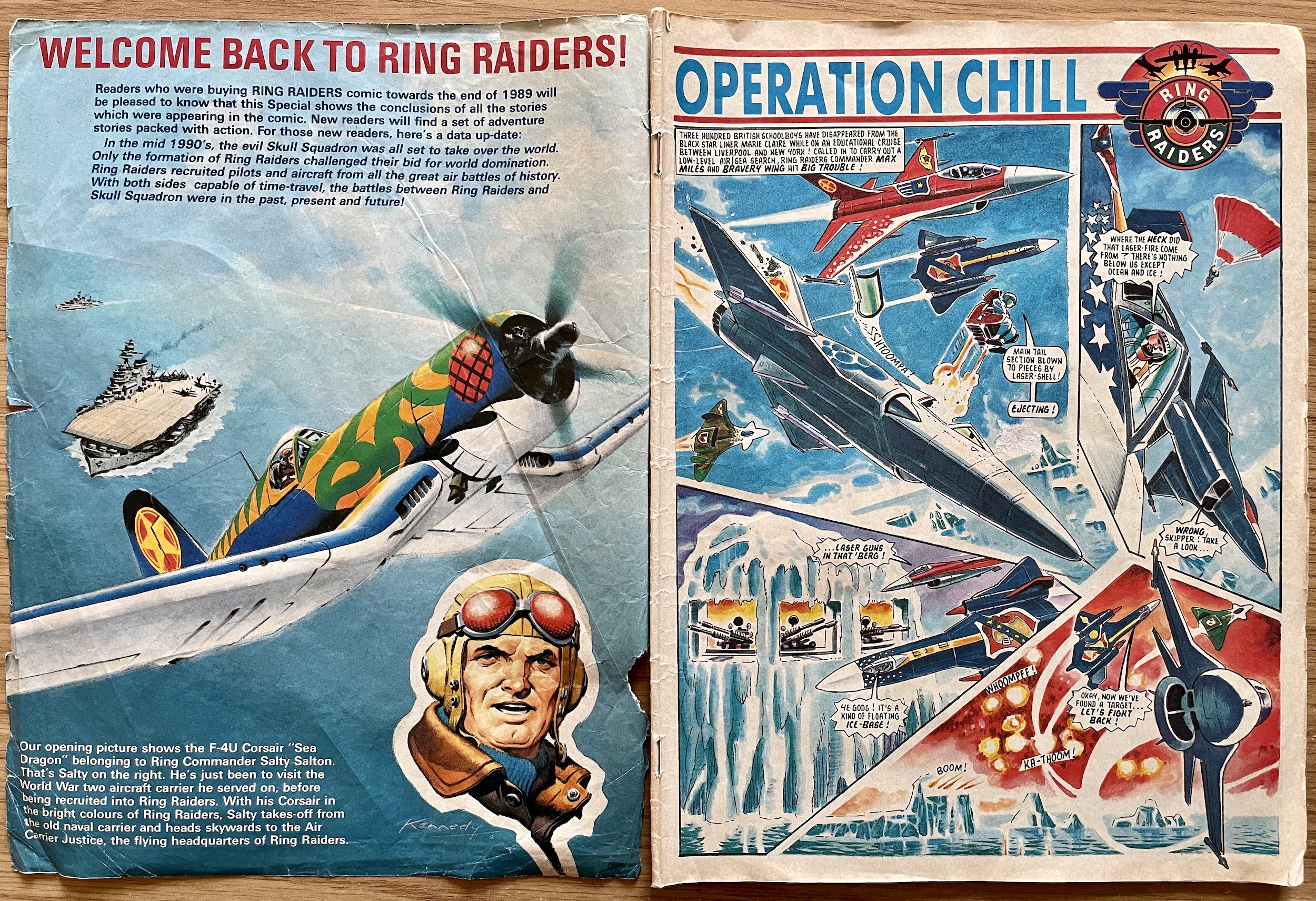
When editor Barrie Tomlinson gave us the bad news that #6 of Fleetway‘s Ring Raiders was to be the last, he told us they hoped to produce a special the following year to finish off all the stories frustratingly left on cliffhangers. Given how comic specials usually appeared in April or May, and the fact I didn’t know if it’d even be published, you can imagine my surprise when my parents came back from the shops with this some time in February of 1990. With its gorgeous Ian Kennedy cover and a hefty weight to it, I immediately ran to my room where all my planes and bases could be found.
Also in my room were my comics and after giving the special a quick flick through and seeing glimpses of exciting aerial action I decided to spend the whole day with these characters and read through all of the previous issues, every single story (including the ones that had already finished) before settling down for this mammoth 64-page feast of an issue. The regular comic was 24 pages so this felt like a real treat! Especially when we got not one, but two covers from Ian.
Was #7 meant to be the start of the comic recolouring the logo each issue? Or was it just for this special? Who knows? But clearly Ian had finished the next two covers and I think this inner page (likely #8’s cover) is just beautiful, evocative of the Commando covers he was so well known for but with a modern (for the time) splash of colour on the Corsair. Wonderful. You’ll have to excuse the state of the pages though. This is my original comic and it was read so many times back then, devoured over and over. The creases and tears tell a story though, of a much loved comic I couldn’t get enough of as a kid.
I really enjoyed reading through the fortnightly and was meant to cover this several months ago but had forgotten I’d let a friend borrow it (and the Super Naturals Adventure Book) and she’s not someone I see too often. But here we are at last. I’ve been looking forward to this. As you can see we kick things off with Operation Chill as colourfully brought to life by Carlos Pino, which only began in the final issue. When a cruise ship carrying a talented bunch of school kids crashed at its destination port with no one on board Wing Commander Max Miles and his Freedom Wing were dispatched to track them down.
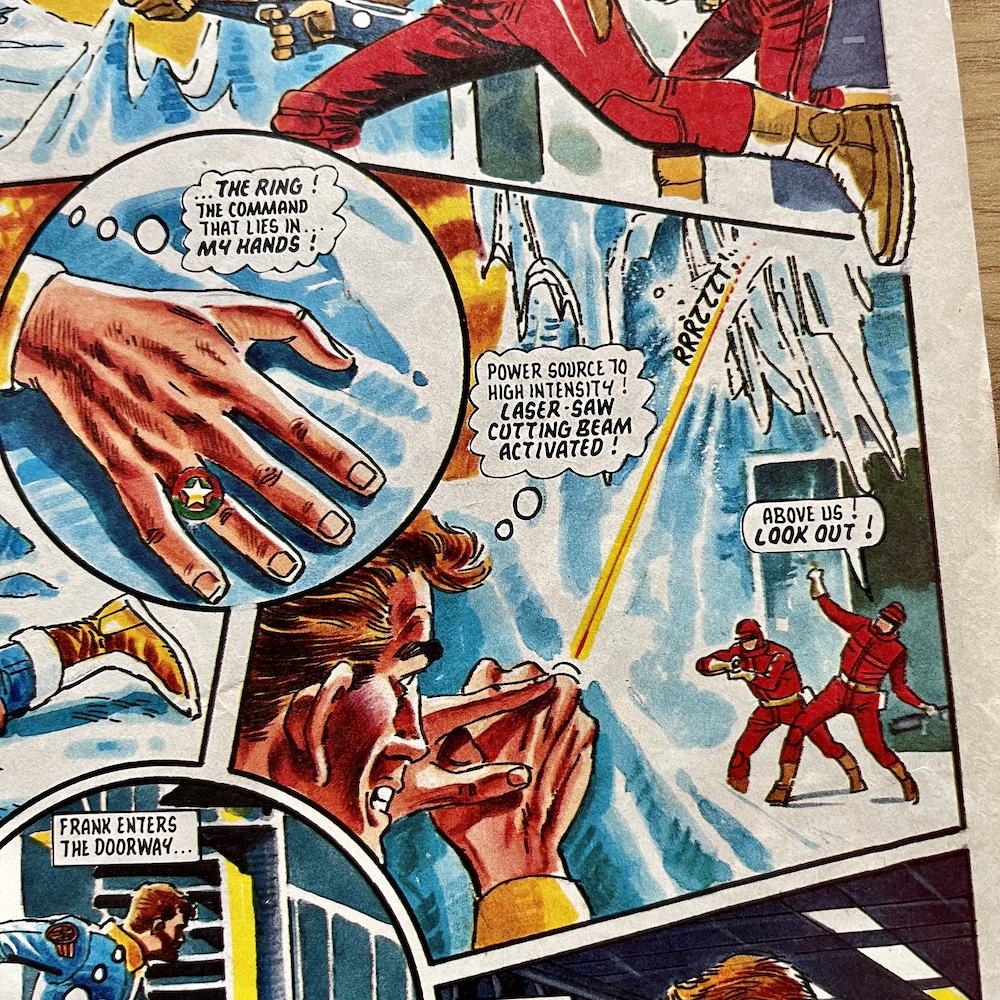
His wing ended up over chilly Arctic waters and fired upon from an unknown source, with only giant icebergs beneath them. On the first page of this issue’s strip you can see gun ports in one of them and it’s on this that our ejected pilot Frank Turner finds himself. Another character named by the comic, Frank is soon set upon by Skull Squadron goons but he’s not as unarmed as it would seem, using another of the miniature gadgets the comic invented for the rings.
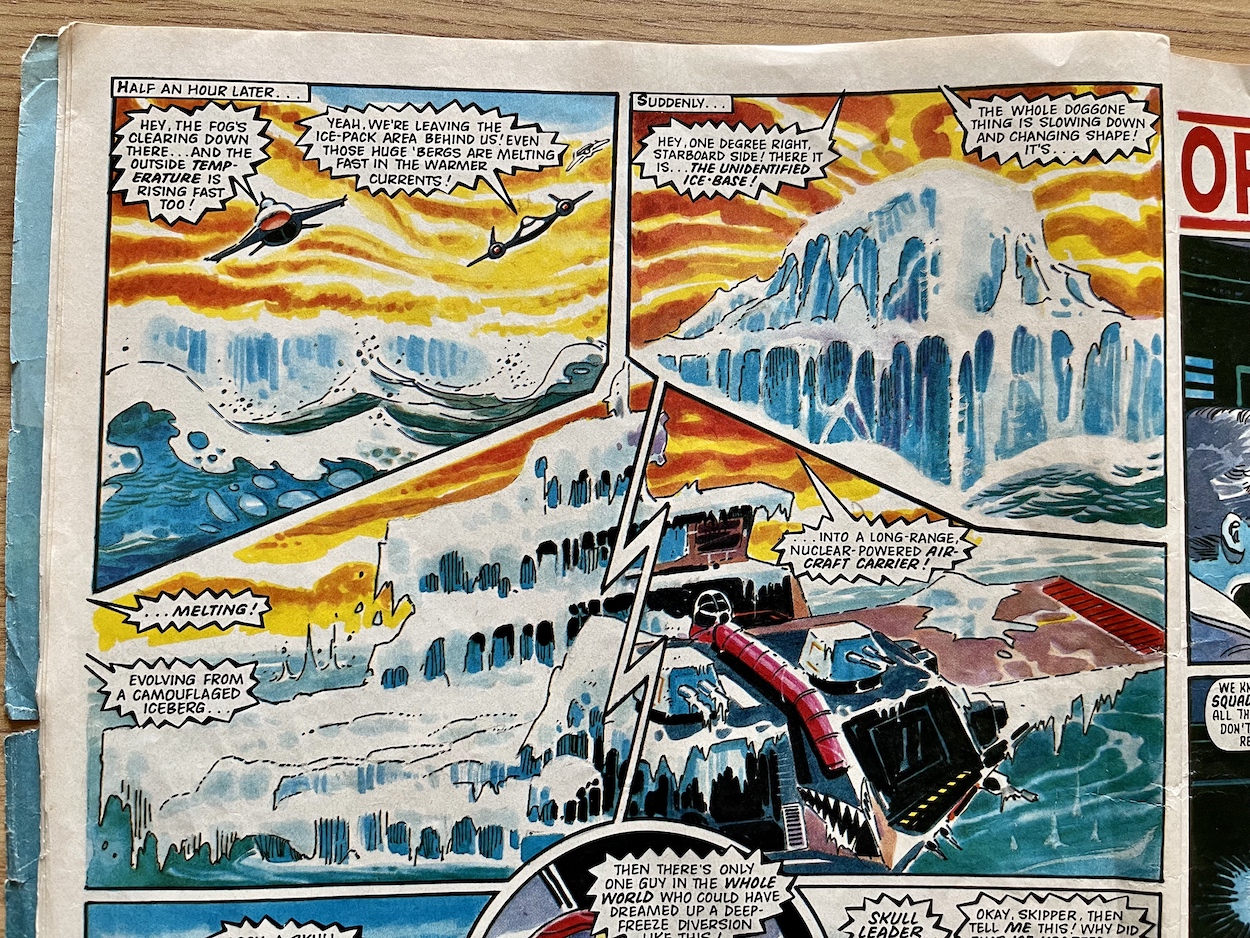
The iceberg was also on the move! At this point as a kid I had an idea of what was really underneath the ice and the next part of the story confirmed my suspicions. This particular segment would’ve been in #8 with a release date of 23rd December, the Christmas issue. If all had gone according to plan eager kids awaiting Santa would’ve read this just a few days in advance, and no toy in the series was more sought after than the Skull Action Assault Base!
While readers had seen the base in the Trackdown strip we have to remember these are time travel stories and so, much like with Doctor Who for example, timelines can be presented out of order. Even though this takes place a few years after Trackdown in order of actual date, for the time travelling characters it occurred before it. This is when the Ring Raiders themselves first encountered Skull Squadron‘s new mobile HQ. Over time it would’ve been fun to piece together these events into a timeline.
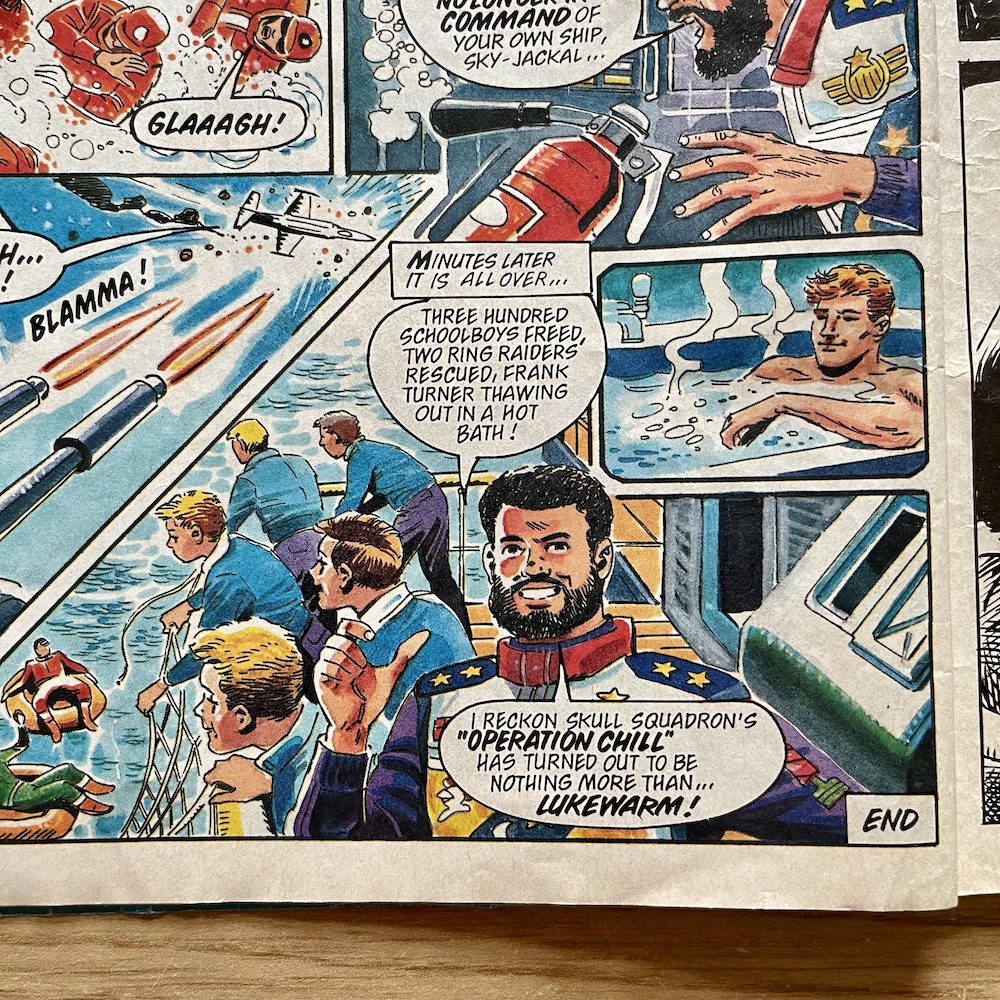
The villain is of course Chiller, the most used in the comic and simply the most sinister, not to mention the most fun for the reader. The plan is to re-educate the kids as mind slaves but, even after Chiller takes to the skies with his new ice weapon and takes out two of the Raider planes, Commander Miles doesn’t give in, making the most audacious of moves by landing on the base. Staying inside the cockpit and using the plane’s weaponry to disable the base he soon overpowers the enemy and commandeers it.
This final panel has Miles posing as he does on the toy packaging. Hmm, he’s called Max Miles and his plane is the Knight Fighter… and in Knight Rider we had Devon Miles… oh I’m just overthinking that, right? Anyway, with the funny image of Frank using the Skull base’s facilities Barrie’s story comes to an end with four parts here, making five altogether so originally it was due to conclude in #10. Who knows if the next story would’ve seen Skull Squadron coming for their base, but it would’ve made for an excellent battle if they had.
This would’ve sealed the deal for Ring Raiders as one of the very best action adventure comics in the UK
On to what was the main strip in the comic for me, the epic Trackdown written by Angus Allan and drawn by famous British artist John Cooper. It always felt epic in its scope, story, use of character and pace, and as it turned out it truly was as epic. With five four-page episodes in the special, altogether it was 11 parts and 48 pages in length. Beginning in #1 on 16th September 1989 it wouldn’t have come to its explosive finale until #11 on 3rd February 1990. Getting the final 20 pages here feels like a bit of a cheat, but these are the best pages in this special, and indeed the series.
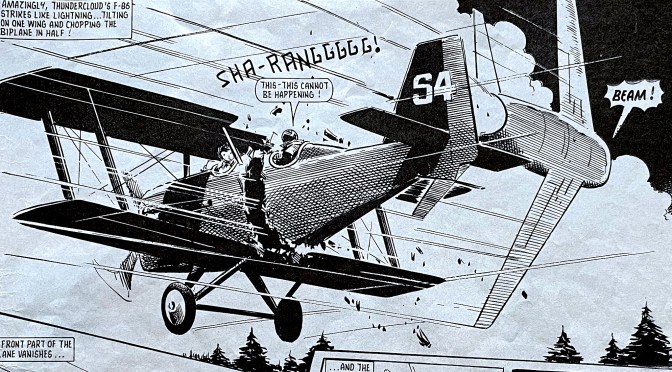
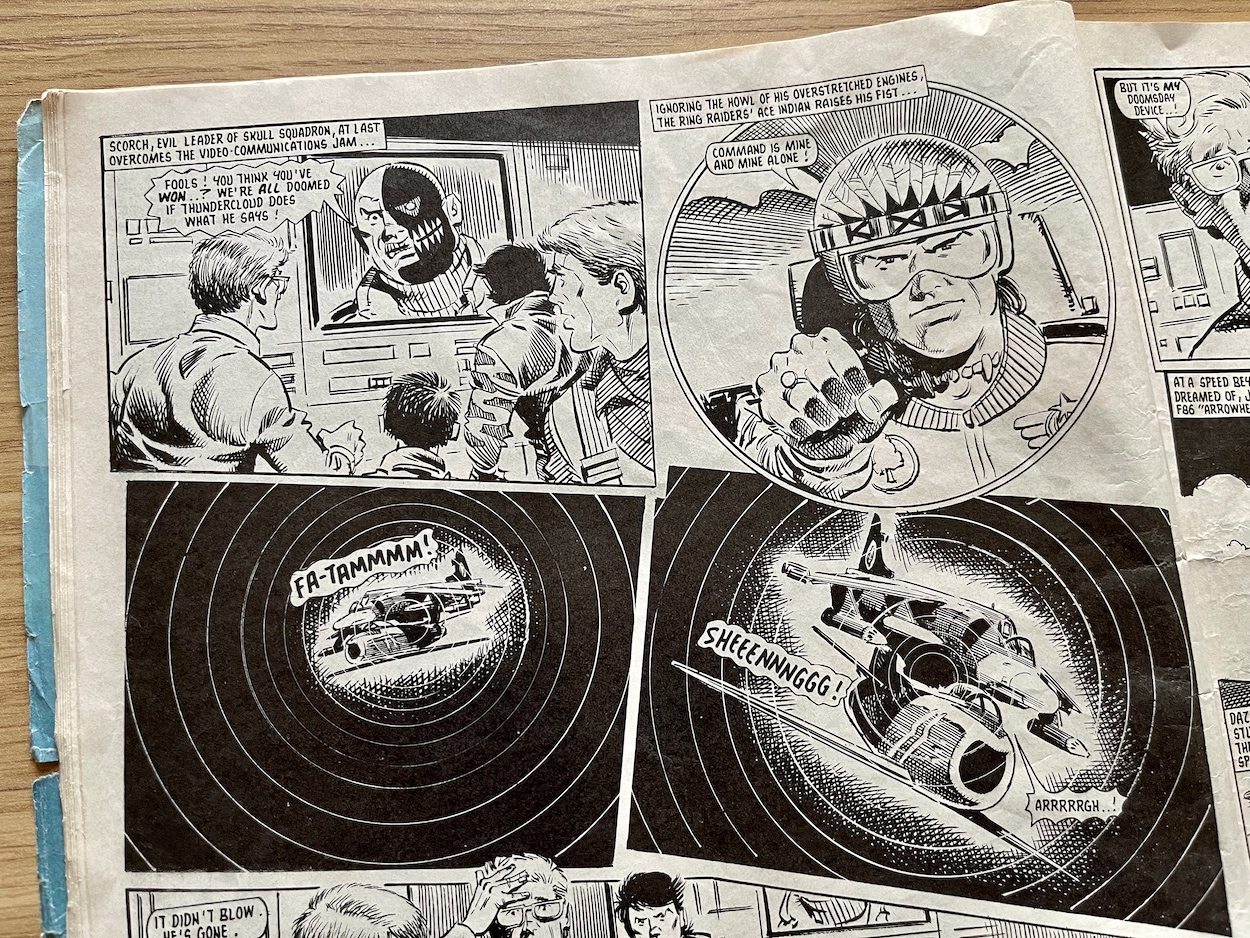
In fact, the very first part here (which we’d have enjoyed in #7) would’ve sealed the deal for Ring Raiders as one of the very best action adventure comics in the UK. The Doomsday Device is on its way back to Skull Squadron in Blackjack’s auto-piloted Harrier while he’s taken a young boy hostage in a biplane, threatening to throw him out. Wing Commander Joe Thundercloud of Rescue Wing can only chase one, but which one? Much to Blackjack’s surprise he takes off after the Harrier, or so it seems.
This sequence is thrilling today, so imagine reading this at 12-years-of-age surrounded by all the toy planes, including the one featured here! Scorch orders Blackjack to toss the boy out of the plane to his death, but Blackjack hesitates, just long enough for Joe to swing his plane round and come at the biplane at a 90 degree angle and slice it in half, giving the Air Carrier Justice the order with split second timing to beam up based on his location. The boy (and half the plane) materialise on the Ring Raiders’ flying base while the rest plummets to the ground.
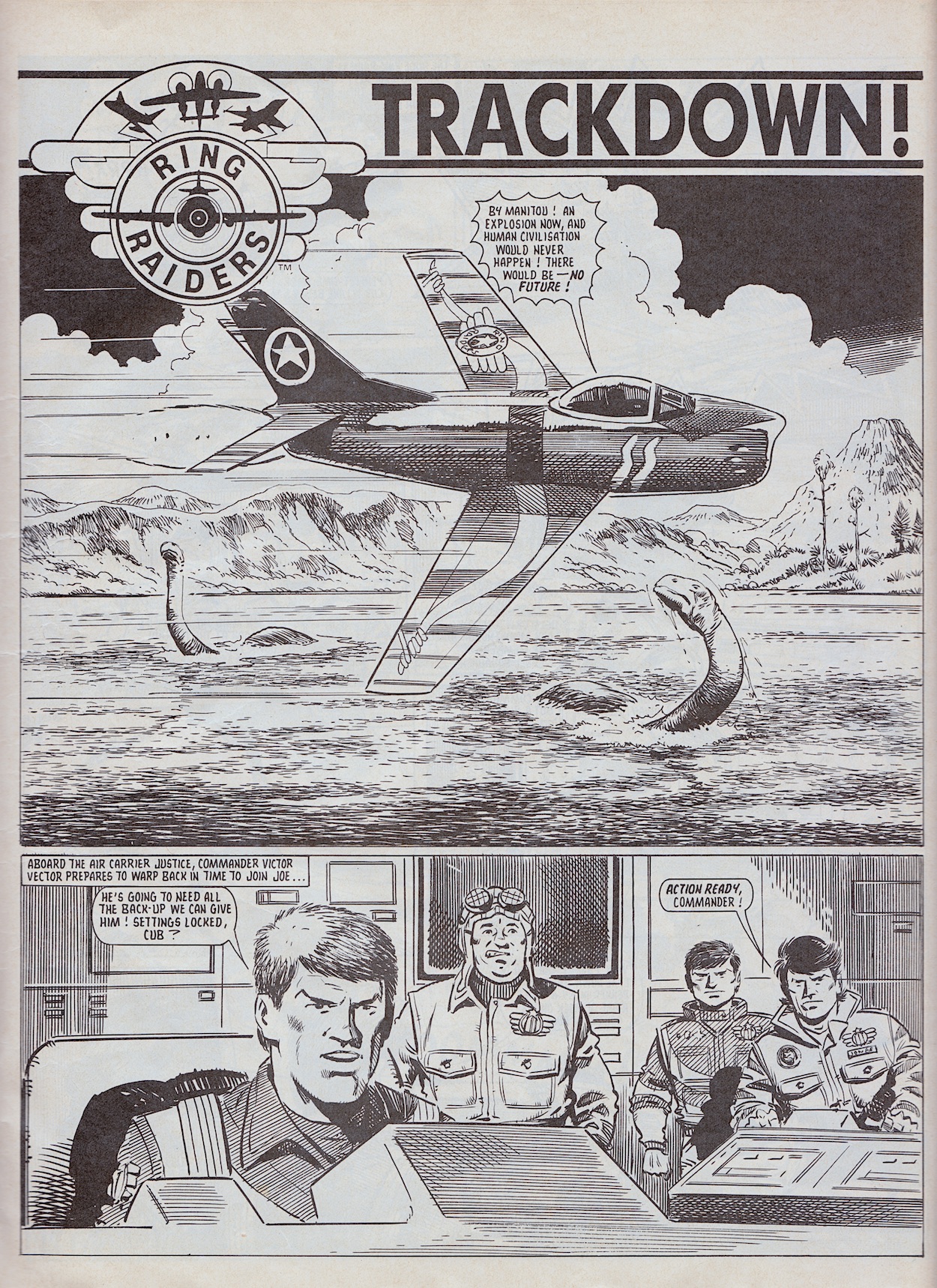
Where could this story go from here? Clearly anything is possible and next Angus has the Wing Commander catch up with the Harrier. With Blackjack out of the picture, Joe disables its engines and then picks it up with his own F-16, using the power of the ring to convert his own body’s energy into extra power to try to get the pilotless plane to the Justice.
But as a caption reminds us, “Use of the rings means terrible physical exhaustion” and, tapped into his mind as well as his body, Joe’s wish to protect those he holds dear and the panic over the screaming engines accidentally sees him activate the time jump engines with his thoughts, ending up back in prehistoric times, now flying above dinosaurs! As you can see the Harrier is no longer balanced atop his plane. The strain was too much for his body to bare and he lost control, the Harrier tumbling into the lake below.
How amazing was this scenario for young comics fans? Ring Raiders deserved a much larger audience than it got in the end because this was top comic action with or without the licence. But as a fan of the toys this was the most amazing thing I’d ever read in my young life as far as I was concerned. (We love hyperbole as kids.) It was a story I’d replay with my Matchbox planes over and over. I think I even created a tiny biplane out of Lego so it could be cut in half, that’s how much I loved this.
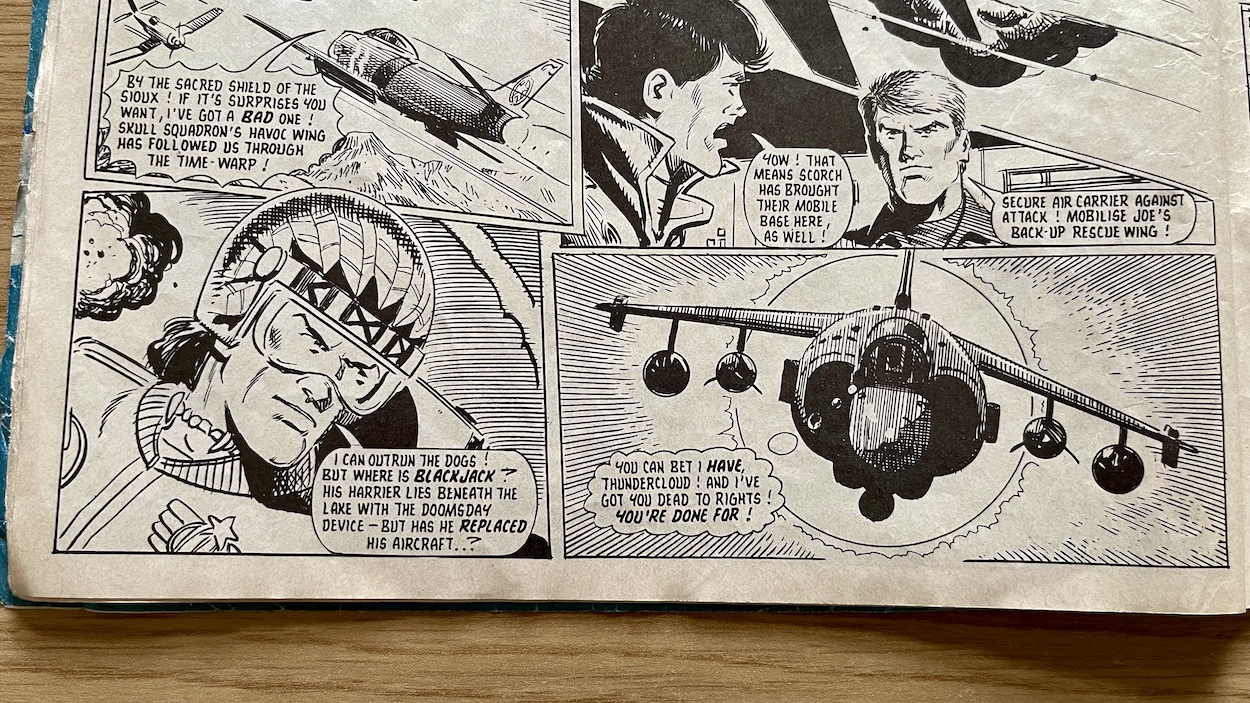
Contacting the Justice over millions of years via more use of the ring (and nearly passing out as a result) the rest of the force arrives, giving Joe time to get his energy back and load up the F-16 with Super Sidewinder missiles which he uses to destroy the side of the lake (it overlooks a cliff), draining its water and exposing the Harrier with the Doomsday Device in its cockpit. But the sky suddenly fills with more explosions. Blackjack in his replacement aircraft and his Havoc Wing were tracking his original plane all along.
It may be black and white but that last panel of part nine (third episode here) exudes atmosphere. The sun feels hot, the Harrier ominously coming out of silhouette as Joe looks desperately for his arch enemy. My memory had this as a cliffhanger in the fortnightly, such was the impact it had on me but nope, it’s right here with the next part on the very next page. Simply gorgeous imagery by John Cooper there.
Using the ring has consequences and must be used sparingly, unlike in the cartoon version
The characters having replacement back up planes may initially seem to ruin the drama and tension somewhat but it’s not uncommon. Later in Castle of Doom Yasuo needs his reserve machine in a hurry but the landing crew try to dissuade him as you’ll see. Clearly each character has their main craft and a reserve, which makes sense militarily and they’re never presented as a cheap way of continuing the action. It adds another layer of authenticity to something so fantastical.
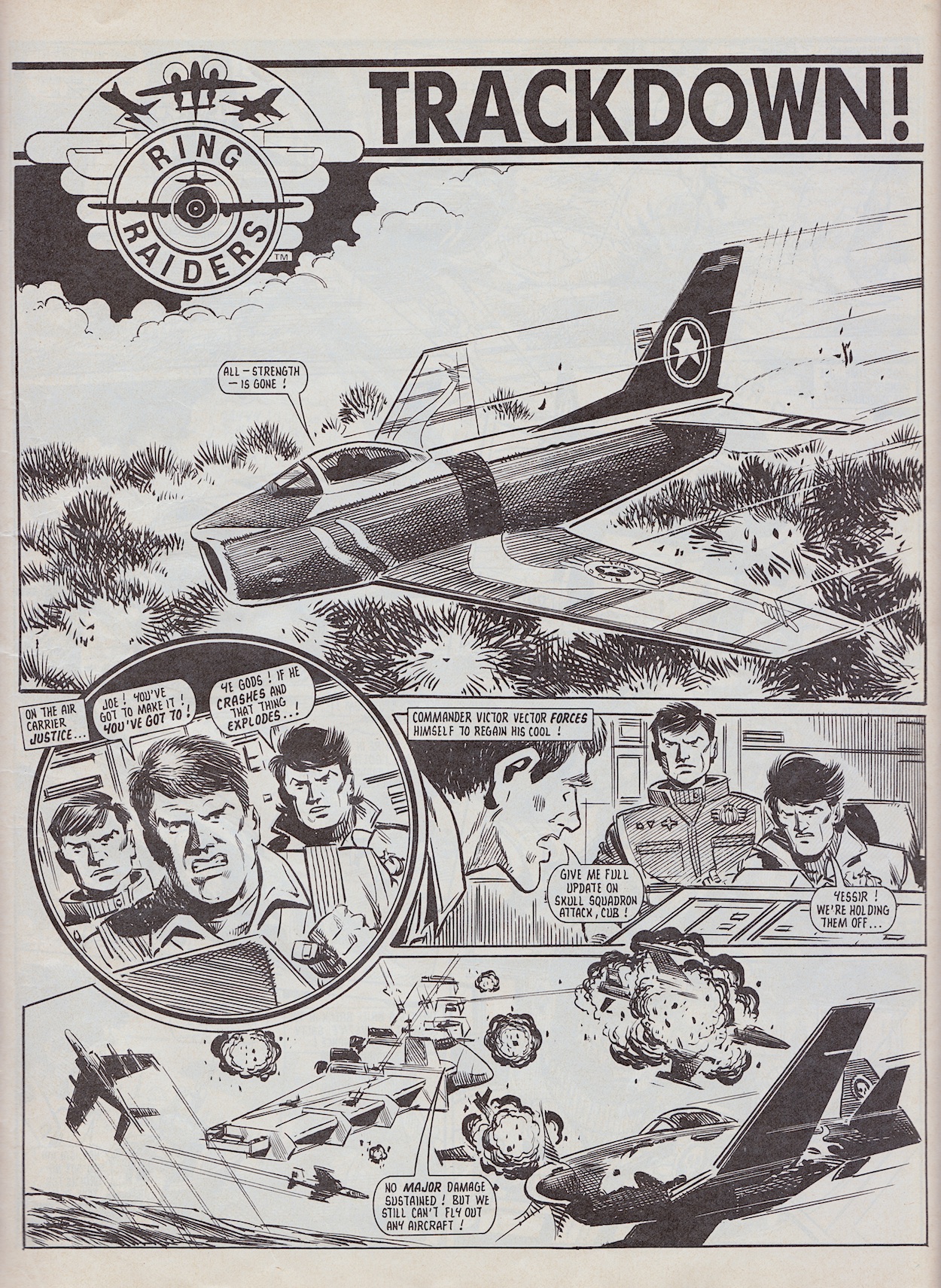
The story comes to its conclusion as Blackjack steals the device back while Skull Squadron keep anyone from launching from the Justice with an all-out assault. But, with the device dangling from a claw under Blackjack’s cockpit Joe blasts it, opens his own cockpit and uses the power of his ring like a form of tractor beam to pull it aboard. Thing is, the ring was never meant to be used that way and with too much toll on his body already he loses control. Scenes like this establish that the ring isn’t a get-out-of-jail-free-card, it has consequences and must be used sparingly, unlike in the cartoon version.
The story constantly flips back and forth between which side is winning, every time success is within grasp of someone it flips again. It makes for genuinely tense, exciting reading, even as an adult. It’s also nice to see other characters milling about in the background or helping out here and there, giving more of an ensemble feeling to the cast than normal. Joe just about touches down without crashing and taking the future of the planet with him. Then our inside cover star Salty Salton launches against orders, his slow but manoeuvrable F-4U Corsair making it to the ground just in time to punch a hole in Blackjack’s cockpit, making him scarper.
Salty uses the ring to reenergise Joe’s and in turn Joe himself, the story wrapping up with doomsday averted and the device launched into deep space. What a ride. Ever since those early episodes with Rescue Wing’s Freddie Riley and the professor it’s been non-stop, the tension always building, with high-flying, high-octane stuff fans of the toys longed to see with one-on-one dogfights, crash landings, huge battles and at the centre of it all two characters driving the story forward. The story was never forgotten for a single page, never sacrificed to show off the action. These final Touchdown chapters were a worthy climax to the comic as a whole, even though that was never the intention.
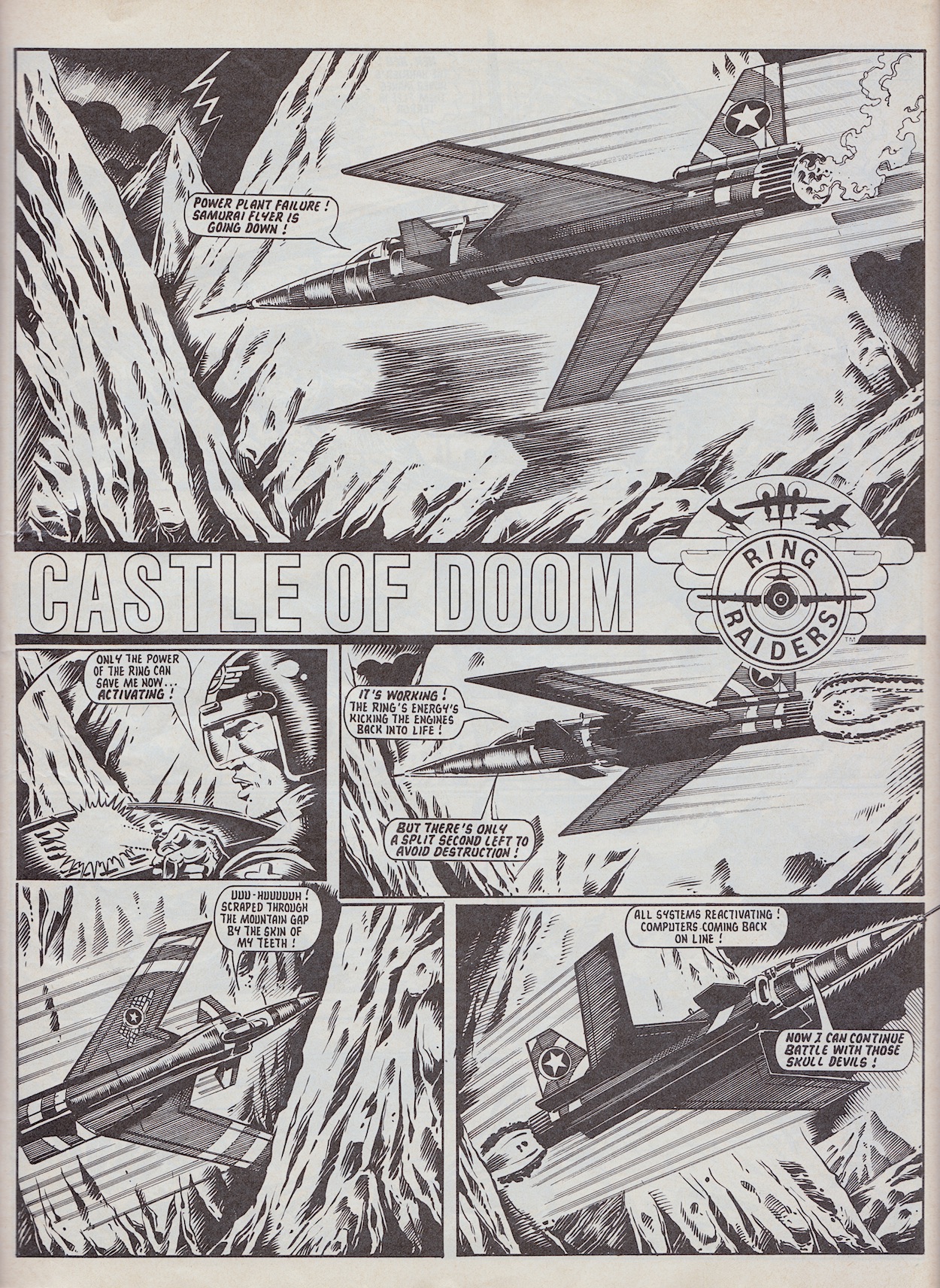
Castle of Doom began in #6 and was instantly a favourite because it starred my two favourite characters, Wing Commander Yasuo Yakamura and Skull Leader Wraither, their planes being the first I ever purchased, so naturally I had a soft spot for them. Following on from the cliffhanger last time, how does a jet pilot rescue a man hanging by a branch on a cliff face? With this rather ingenious Rescue Pod above, that’s how. I love that.
This story has six parts here which would’ve taken it up to #11 with seven parts in total, so as you can see there was no standard length to a Ring Raiders story. This would’ve made for a wonderfully unpredictable reading experience if the comic had continued. Castle of Doom’s plot was all about using time travel to the past in order to affect future events, something which had always intrigued writer James Tomlinson (who went by James Nicholas at the time), and it’s clear he had great fun crafting this tale as it jumps about time zones within the isolated castle setting, layering the plot slowly over the first few episodes.
Basically, in 1989 (two hundred years hence) this castle would be seen as the ideal secure location for various governments of the world to gather and discuss the growing threat of Skull Squadron, a meeting which would be key to the formation of the Ring Raiders. So Wraither and Vulture Wing have ventured back centuries to hypnotise (using a nose mounted ray of some sort) the family living there, planting a seed that wouldn’t be activated until hundreds of years later in the minds of their descendants.
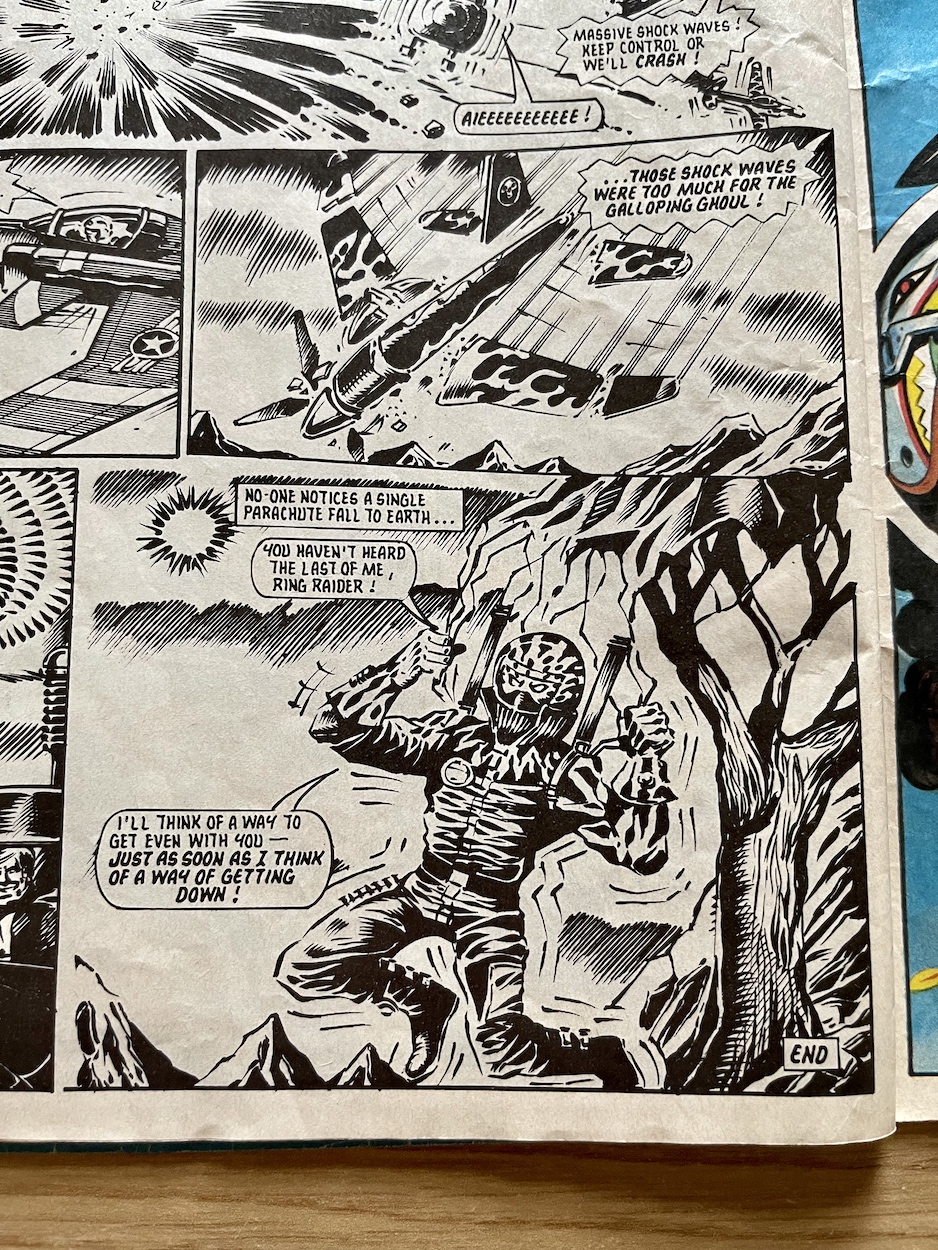
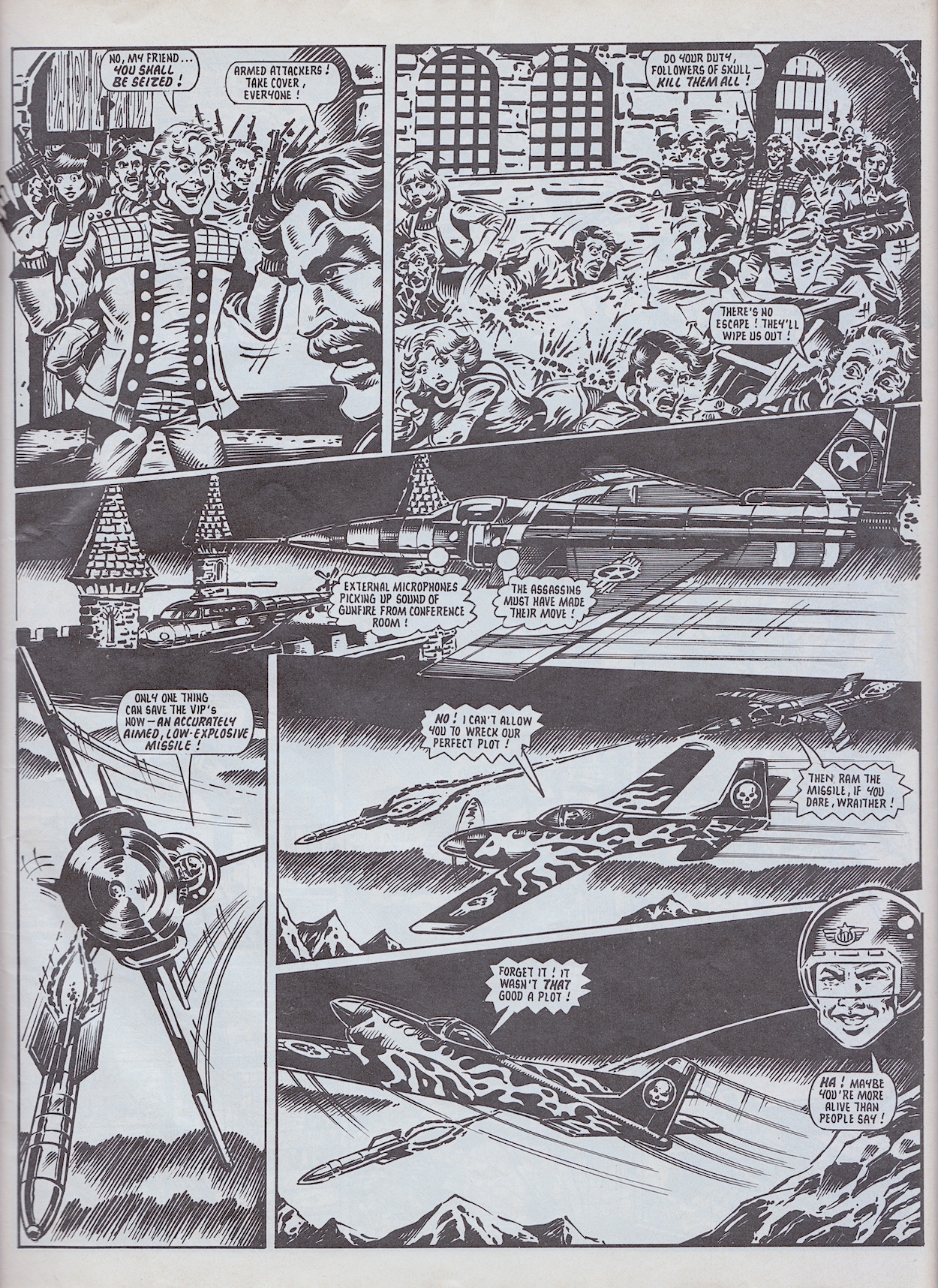
This manifests itself as a mass shooting in 1989, the owners of the castle suddenly falling into a trance and opening fire with automatic assault weapons on all of the representatives present! Yakamura wins the day by using a low-yield missile to knock out a wall of the castle and take out half of the assassins, but the head of the family escapes and throws a grenade into an ammunition store. In the end the survivors evacuate just in time. The rest of the assassins are captured (I’d assume to come round later and be exonerated) and Wraither’s P-51 Mustang Galloping Ghoul is shot out of the sky, the mysterious pilot left abandoned in that time zone until Skull Squadron come to rescue him.
That’s it pretty much summed up but there are two main reasons I love this strip so much: the fact it’s full of great action between my two favourite pilots and planes and how it was delving into some of the backstory, taking tentative steps at setting up some mythology. It reads as an important early chapter in what I’d hoped would be a long-running comic. Wraither and Yakamura were likely chosen because they formed a special two-plane Matchbox Starter Pack (my Starter Pack in fact) and because of this it seemed they were destined to duke it out forever.
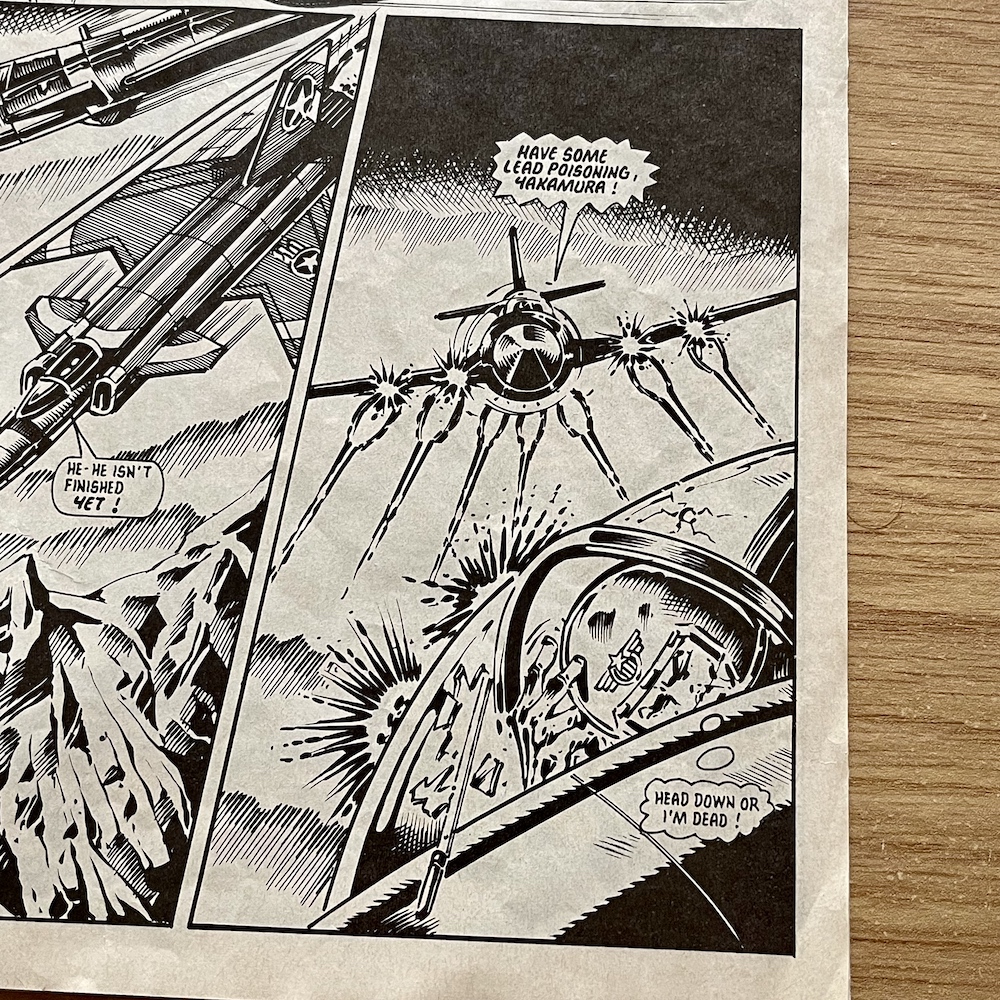
To the uninitiated it might seem daft to have two such vastly different planes engage in battle but it’s actually believable. Yasuo’s jet has speed on his side but is unable to make the kinds of quick manoeuvres over short distances Wraither can, and the latter’s ability to fly so close to the ground and mountains and use cloud cover to disappear and reappear at will evens the odds somewhat. In fact, the Grumman X-29 is almost trashed at one stage and Yasuo has to time jump back to the Justice for his reserve machine.
Untested and with unfinished computer systems which were such an integral part of his plane (Yasuo usually relied heavily upon the computer), it made for a tense showdown with Yasuo outnumbered four-to-one against Vulture Wing, the castle under attack by assassins, his inability to land to help and the castle poised to explode, wiping out the Ring Raiders before they’re even formed. The last three chapters were clearly not finished by the time the comic was cancelled as they are combined into one, 12-page finale.
Artist Don Wazejewski again brought James’ script to life and there are some lovely atmospheric visuals here (my favourite being the panel of Yasuo “almost hearing” Wraither’s laughter) and aerial battles that feel genuinely fast and exciting. I also like his chunky depictions of humans, especially on board the gigantic, high-tech Air Carrier Justice; there’s a certain Thunderbirds-esque feel to these particular scenes. Over 24 pages it’s a real thrill ride and it’s such a shame this would be the last meaty read of the special and the last time I’d see these characters.
It hasn’t lost any of its ability to excite for this 44-year-old. But then again, all those happy childhood memories of favourite characters and those little toy planes all bubble to the surface when I read any issue of this comic.
In such a serious storyline, with the tension ratcheting up page after page, there’s a genuine laugh-out-loud moment during the fast-paced climax as Yasuo delivers his missile. The story had made a lot out of the supposed mystery of who, or even what, was behind the mask of Wraither and his sinister character is perfectly portrayed, making this moment towards the end of the story even funnier for the fan in me.
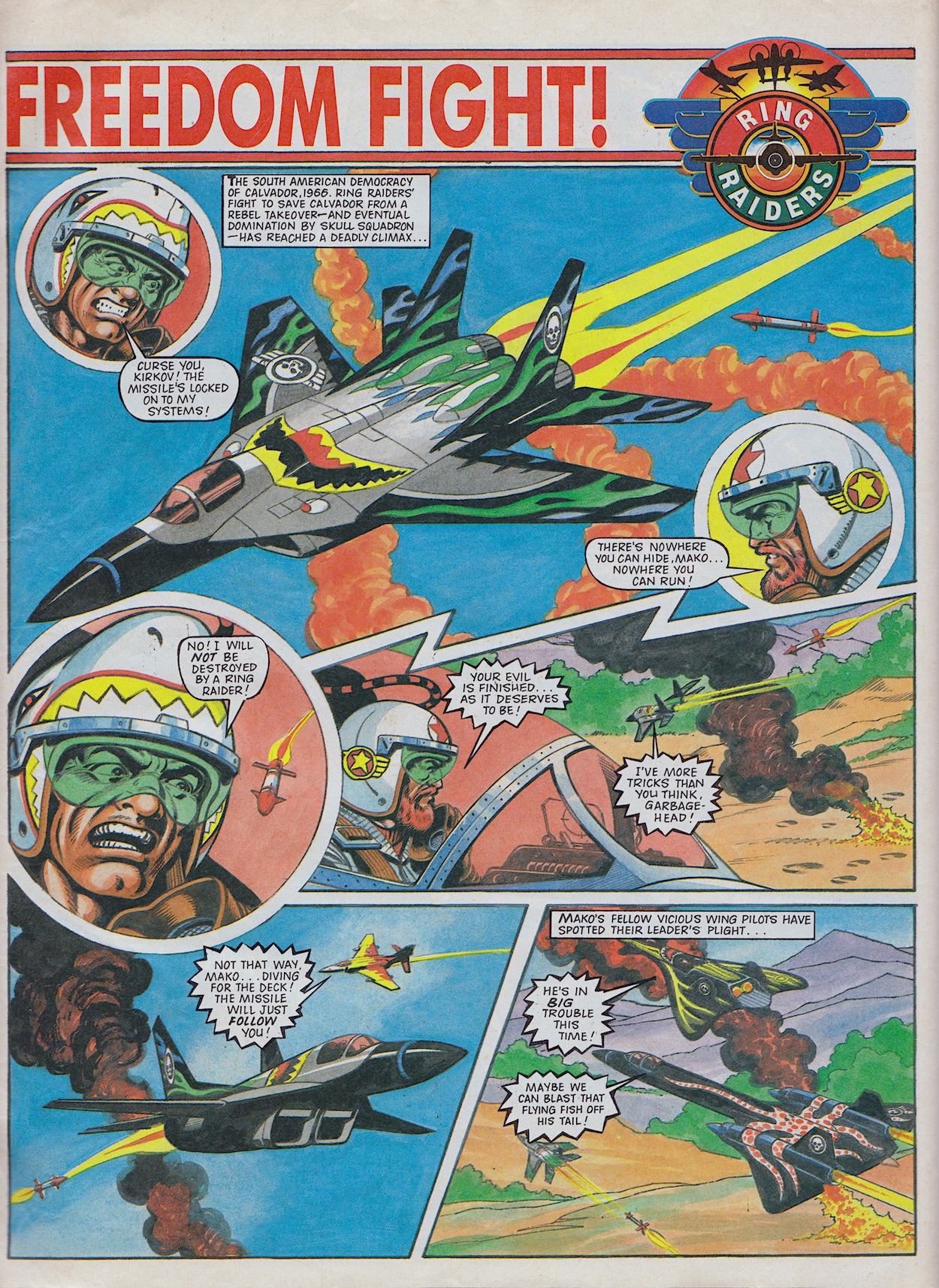
After that momentous blockbuster we’ve only got two individual chapters to go. Next up is the seventh and final part of Freedom Flight. Tom Tully’s story involved Skull Squadron using a band of rebels for their own ends, assisting them in their attempts to overthrow a democratically elected government in South America. The story ended on a cliffhanger in #6 which had Skull Leader Mako’s ‘Sea Hunter’ MiG-29 about to be blown out of the sky by Raider Yuri Kirkov’s missile, fired from his ‘Comet’ F-4 Phantom.
As the young readers could be fans of either side of the never-ending war we would sometimes see the cliffhangers sway towards Skull Squadron, although this was used sparingly in the issues published. Still, it made for a refreshing change. Speaking of which, after 40 pages of beautiful black and white art, turning the page to see Sandy James’ full colour pages is a shock to the system.In the best possible way of course.
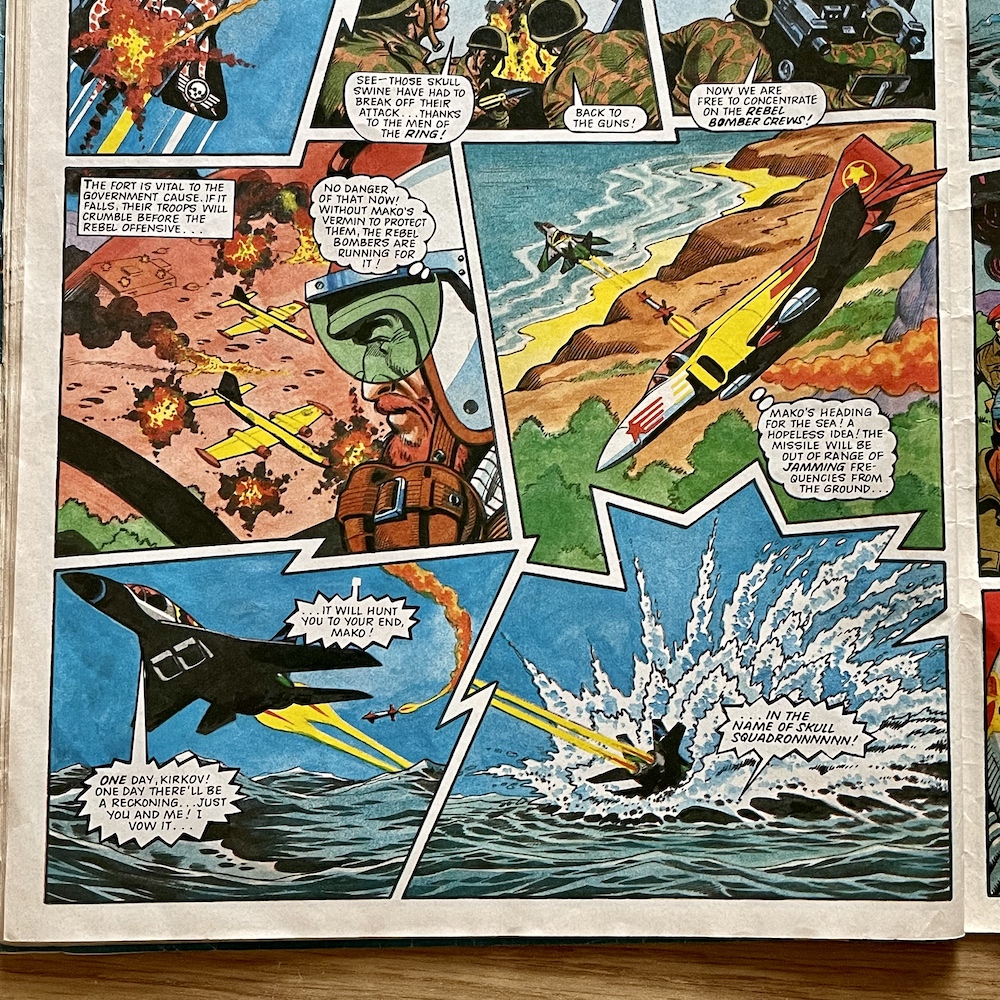
This being just the one chapter it’s basically the end of the battle that was raging months ago in the comic, so alongside the juicier stories in the special it unfortunately feels rather slight. However, in actual fact, if read with the previous half dozen instalments it’s the perfect, exciting ending with Kirkov finally fighting his way to victory after the hardships of other issues. His missile closes in on Mako and he even sees off the wingmen who attempt to come to the rescue.
Usually this would mean the end of the plane and most certainly the character, what with him not bailing out before impact, but as we readers know and as Kirkov suspects, Mako’s craft can operate underwater so the Ring Raiders must content themselves with the fact he’s escaped. Without the futuristic back up the rebels are soon defeated and our heroes travel back to the Justice to await their next mission, their work in the air complete.
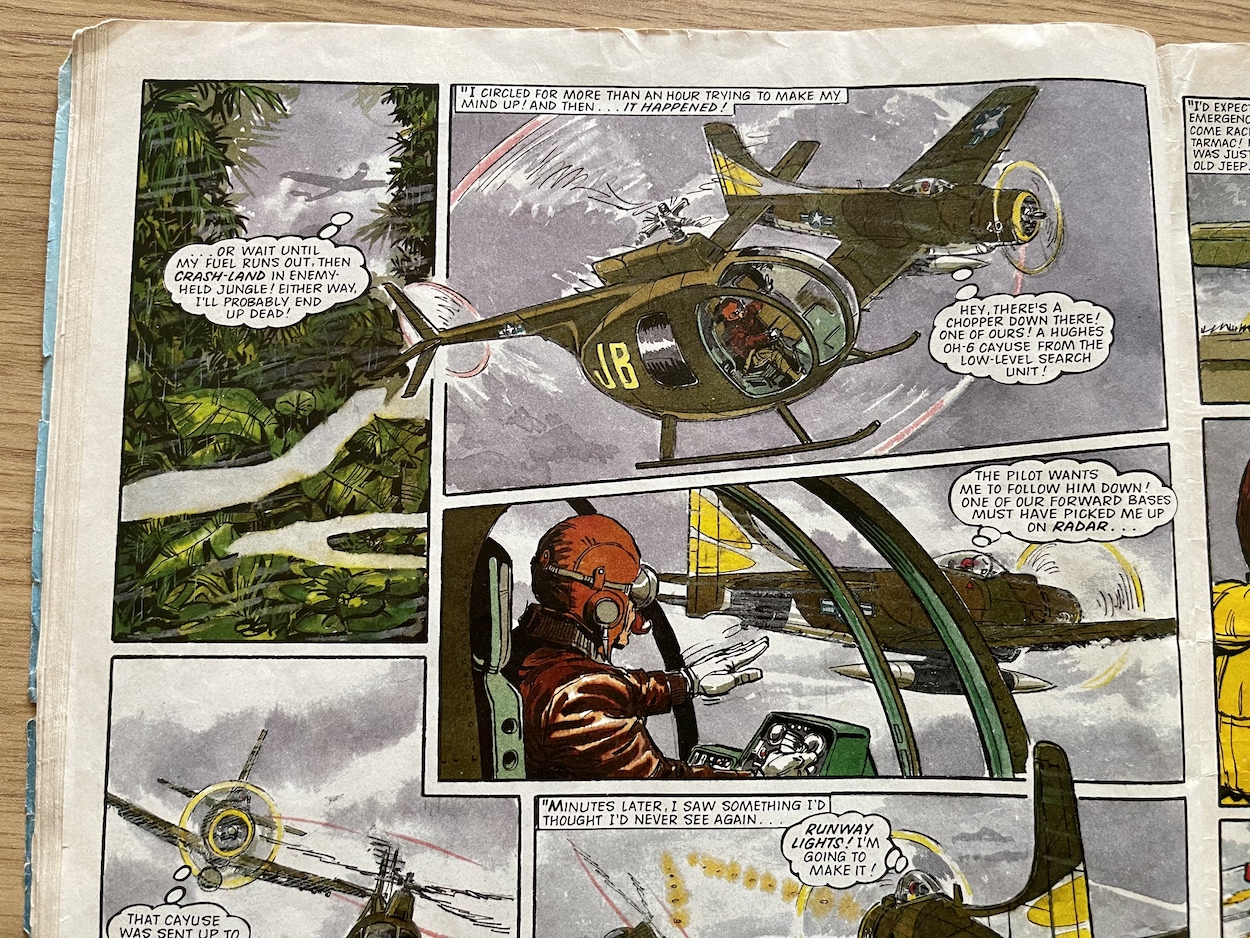
Just one page later Kirkov returns in the one-off character story we would’ve read in #7 and it’s quite possibly the best one of the series, or at the very least right up there with Chiller’s in #3. As usual it kicks off with an air battle against the Skulls. Wraither again actually. As he expertly uses clouds to vanish into thin air during battle, Kirkov is reminded of the mist covered skies of Vietnam through which he flew in his Douglas A-1 Skyraider after defecting from Russia to fight for the United States.
Those of us who grew up in the 1980s will remember most of our heroes in primetime television had fought in the war, each one suffering some degree of personal trauma (Thomas Magnum, Magnum PI), physical damage (Michael Knight, Knight Rider) or psychological issues (Stringfellow Hawke, Airwolf). So as a young teenager this lent a credibility to Ring Raiders, seeing a character caught up in a real world war, one that we were all too aware of at the time and of the devastation it caused.
I think it could’ve reached beyond those obsessed with the toys if given the chance
The story was a real treat and as the last strip the comic would ever publish it made an impact; its gritty, rain-and-mist-shrouded panels evoking the same atmosphere we were used to in flashbacks in those aforementioned television shows (and later in the 90s when Bravo showed Tour of Duty which I became completely hooked by). Reading it now, Scott Goodall’s well-paced script and John Gillat’s superb artwork take me right back to those times. In fact, it feels all the more mature reading it now through adult eyes when compared to the other strips in this issue.
The story is a bit well worn by now, with a mysterious character helping our hero in their desperate time of need, only for us to find out that person had actually died and it must have been an illusion of some sort (although implied to have been their spirit continuing to help people as they had done in life). It’s the fact this story is in Ring Raiders and is illustrated in the way that it is that makes it so very special.
The perfect way to wrap up Ring Raiders, not just this special but the comic as a whole. Not only is it a superb strip, it shows the real potential this comic had in the range of its storytelling and how I think it could’ve reached beyond those obsessed with the toys if given the chance. It’s heartbreaking to finish the final story but I think it just proves the point I’ve been making since the beginning. Rounding off the issue is the second Photo File by James, this time one of his favourites and cover star the F-104 Starfighter,.
Well, that’s it.
James and Barrie were able to tell me the names of some further adventures that we never got to see. Hill Kill was written by Scott Goodall so possibly another character piece, Viking Job was by Tom Tully and Sandy James (their follow up to Freedom Flight and most likely set in the distant past), Surprise Attack, Skull Surprise was by Barrie Tomlinson himself so most likely was to be drawn by Carlos Pino and there was an unnamed Christmas story by James Tomlinson and Don Wazejewski, plus another story by the same team called Blow Bubbles, whatever that was about. A Christmas issue of this comic would’ve been nothing short of awesome for me! Oh well.
Proof that licenced toy comics could be taken seriously and produce excellent results
Ring Raiders could effortlessly flip between the futuristic and the historical, the fantastical and the realistic, keeping its feet grounded with believable, likeable characters, exciting action, superb art and interesting stories. If it had continued goodness knows how much better it would’ve got as it developed. It’s anthology style worked a treat and for those few short months I didn’t just run, I sprinted to the newsagents every other week to get my next fix.
OiNK aside, the fact this comic remains my number one from childhood with only seven issues to show for itself should tell you something.
Ring Raiders was a superb comic and is well worth picking up, although be aware issues can go for a pretty penny on eBay and you’ll be very lucky indeed to find this special. (There were also two annuals but they were by Grandreams, had nothing to do with the comic and are really poor, with no strips, just bad text stories and basic art.) Ring Raiders was proof that licenced toy comics could be taken seriously and produce excellent results. Kudos to Barrie and the whole team, thank you for a superb comic and for some really enjoyable memories.
It’s all change this issue as Dark Horse International has now become Manga Publishing. The UK arm of Dark Horse had gone out of business but the success of its Manga Mania comic and the rapidly growing interest in the UK for the art form saw a purchase of the titles and a rebranding across them all. (The company changing hands could account for the delay between #10 and #11.) I’d assumed all their comics were cancelled by the end of 1994 but Manga Mania (at #15) would carry on all the way through to #39. Jurassic Park wouldn’t be so lucky.
But at least this temporary reprieve enabled our comic to reach a decent ending point in #16 instead of just stopping on a cliffhanger (I’m looking at you,Havoc!). Michael Golden’s cover would’ve been better suited to last month’s issue but it’s still a striking image, even if it’s somewhat disappointing to lose that distinctive border on the left. You’ll notice ‘Cadillacs and Dinosaurs’ is mentioned, is this a new back up strip? Not quite, as you’ll see below. Finally, the mysterious free gift mentioned last issue ended up being temporary tattoos, long lost to the mists of time.
The contents page retains its atmospheric design and still offers up subscriptions so the plan must’ve been (initially at least) to carry the comic on for some time to come. In reality, the boast of “Now With Extra Pages” on the cover meant we were up to 40 pages which, while a good increase over the previous three, is only four more than we had in the first ten issues. It does mean we now get a full chapter of the American story per issue though, with the aforementioned back up bringing up the rear.
There’s now a whopping 26 pages of Jurassic Park to enjoy but it’s still listed using the name of the US mini-series comic it was taken from, rather than the name of the story itself. This was confusing because we were unaware of the mini-series’ name, so to the uniformed (like me) it looked like laziness on the part of UK editor Dick Hansom, like he didn’t check what the strip he was printing was called. As you’ll see over the course of this and the next two issues, Animals/Men was the beginning of a trilogy of stories, the title of each a variation on this theme.
It feels very much like the Jurassic Park movie had been given a cartoon makeover in the same way Ghostbusters had with The Real Ghostbusters
As you can see the art team has changed. Steve Englehart is still the writer of this official sequel, John Costanza is still letterer and Renée Witterstaetter remains as colourist and story editor. However, joining them are penciller Chaz ‘Atlas’ Truog (Green Lantern Corps, Animal Man, Coyote) and inker Paul Fricke (The Fly, El Diablo, Secret Origins). At the time I was a little disappointed in the change from the more scratchy, hard-edged artwork but nowadays I absolutely love this.
Even Renée’s colouring appears to have changed to suit the new style, boldly coloured backgrounds highlighting each frame. The cartoonier style put me off initially as a teenager but it did grow on me. Today, it feels very much like the Jurassic Park movie had been given a cartoon makeover in the same way Ghostbusters had with The Real Ghostbusters. It’s great. It’s a lot more animated and dynamic, and as you can see having better defined facial features means our characters now actually look like cartoon versions of the actors.
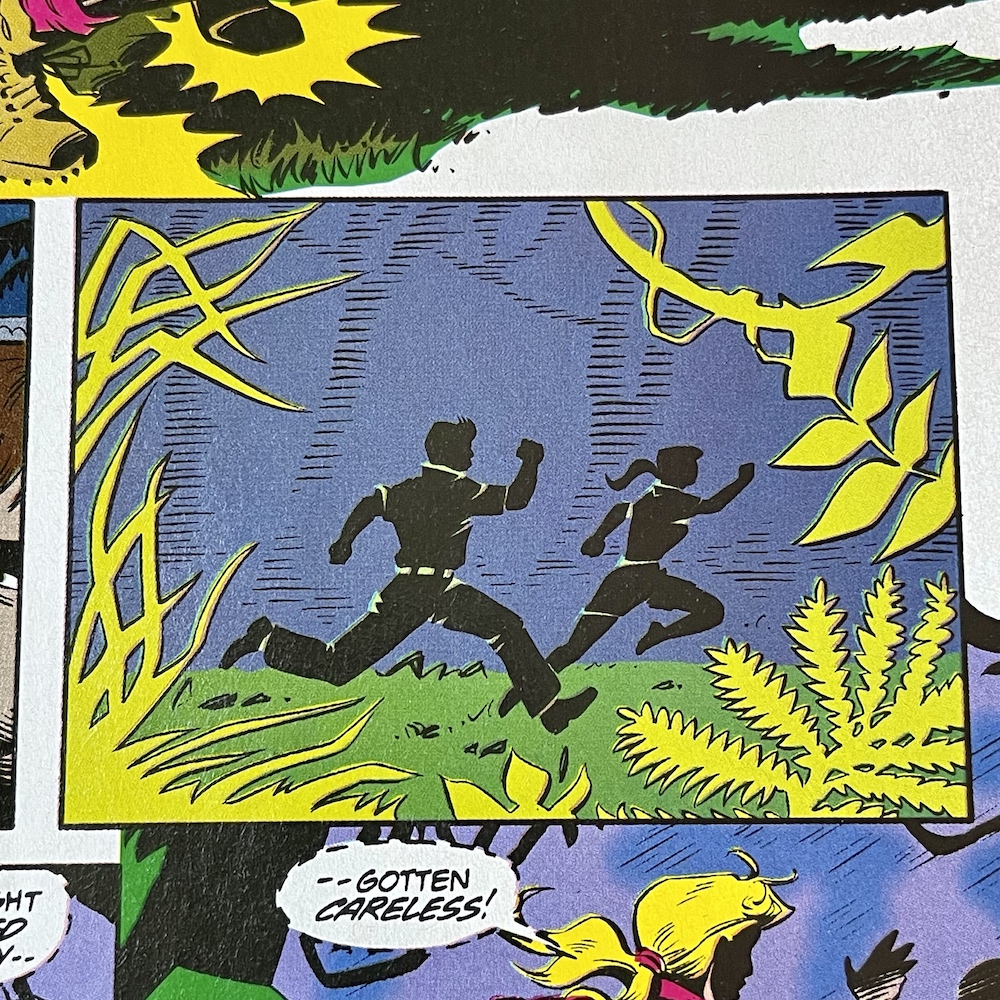
Drs Ellie and Alan Grant attempt to escape from Rafael’s compound deep in the Columbian jungle but accidentally set off a hidden alarm, in response to which Rafael immediately unleashes his supposedly trained Velociraptors. Trying to escape their reach up a tree, a vine Alan clings to is grabbed by one of the ‘raptors and suddenly he finds himself flat on his back, exposed and an easy target. That is, until Rafael catches up.
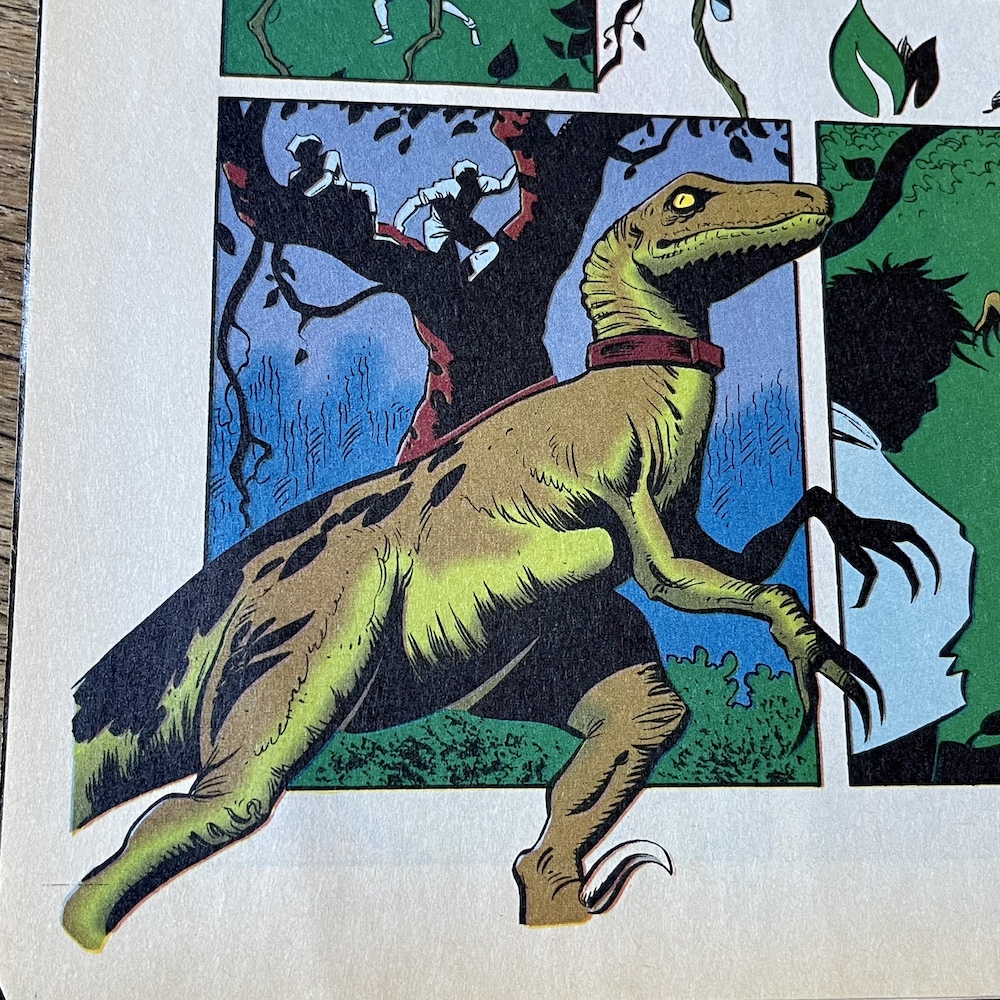
During the attack we find out Alan and Ellie have named the dinosaurs. The alpha is called Alf, the beta is Betty and the injured ‘raptor who is still within her cage is Celia. If this rings a bell you’re not alone. Much later in Jurassic World, released 21 years after this comic, Owen Grady named his four Velociraptors after the second to fifth letters of the alphabet too (Blue, Charlie, Delta, Echo, with Owen as the ‘alpha’). Was the movie inspired by this comic, or was it just a coincidence? Either option is likely.
Having game warden Robert Muldoon alive and well is just stupid
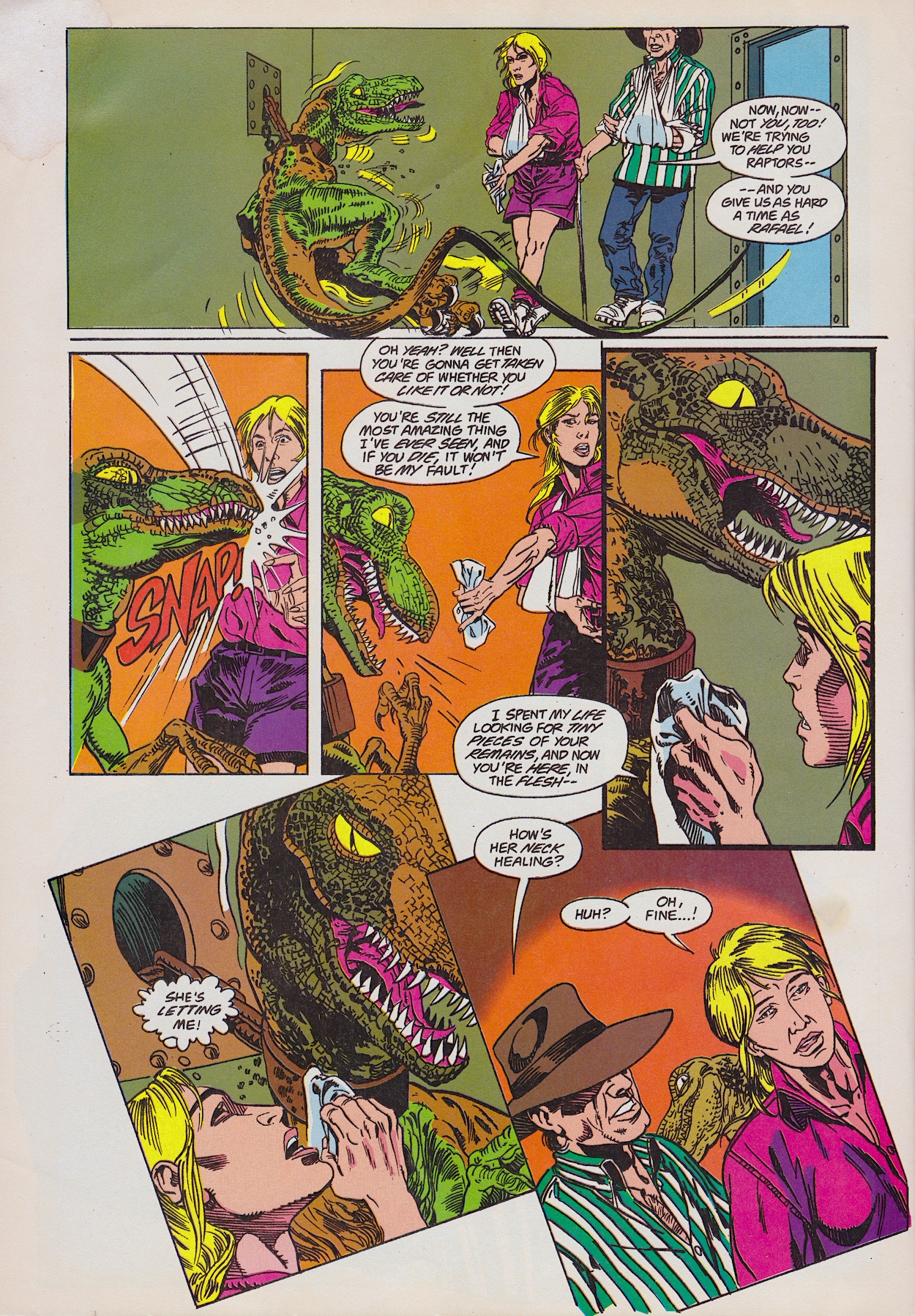
Ellie and Alan are ordered to return and look after the injured Celia, who continues to let Ellie do so, knowing she saved her life. But our doctors think if she wasn’t restrained they’d be on the menu. They’re very aware of how they’ve romanticised the dinosaurs’ place in nature, but they’re still killers. This leads on to a dark scene in which one of Rafael’s men suggests they take it in turns raping Ellie to relieve their boredom and he’s immediately shot and killed by his boss, telling his men to feed him to one of the ‘raptors, so he clearly wants his creatures to maintain their taste for human flesh. But why?
Then, after all the action, tension and interesting story developments the strip unfortunately takes a turn for the absurd.
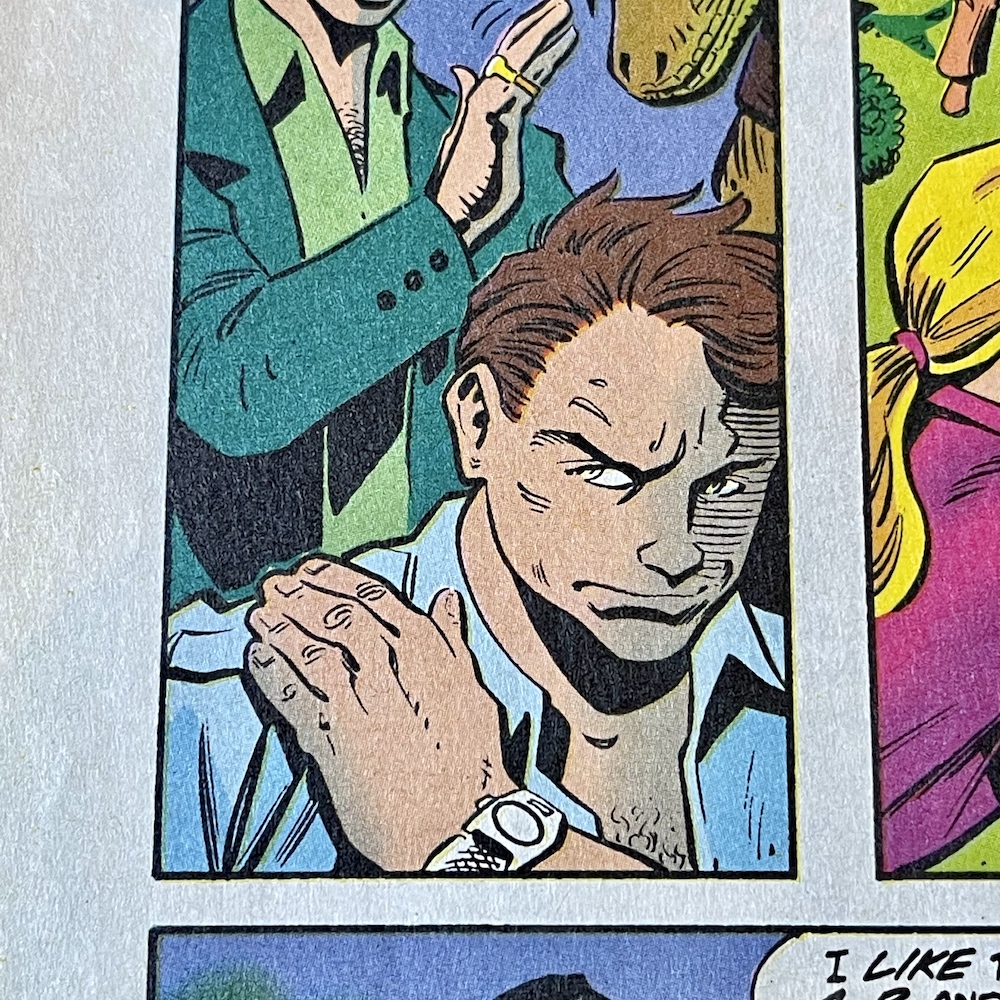
Even as a teenage reader I didn’t find this to be the thrill it was hyped as on the cover and my opinion hasn’t changed since. Having game warden Robert Muldoon alive and well is just stupid. Remember that “clever girl” scene in the movie? He looks awfully healthy after that, doesn’t he? What elaborate explanation is given for him surviving a Velociraptor jumping on top of him and apparently eating his head? He raised them. I hate this. Not only is it ridiculous to think he survived but if he did it completely ruins that whole scene in the movie.
According to #10Ian Malcolm had to spend months in a hospital after his injuries but Muldoon gets the kind of return we’d expect from a superhero comic that finds some trick to retcon a character’s demise. I remember feeling let down by this but thankfully it isn’t dwelled upon beyond this one page (for this issue anyway) so we can get back to the meat of the story which is much, much better.
“It seems ‘raptors can remember a kindness”
Celia’s training commences but she isn’t cooperating. She responds to commands but doesn’t go for the head of the human-like hay dummies like the others, instead biting an arm or leg, never going for the kill. The ever-paranoid Rafael thinks it’s a trick but we’ll find out the real reason soon enough. Meanwhile the government’s leader is planning to announce new indictments against him in the murder of dozens of law enforcement officials, and the next day as the judges leave the courthouse a van pulls up and out of the doors rush Alf and Betty!
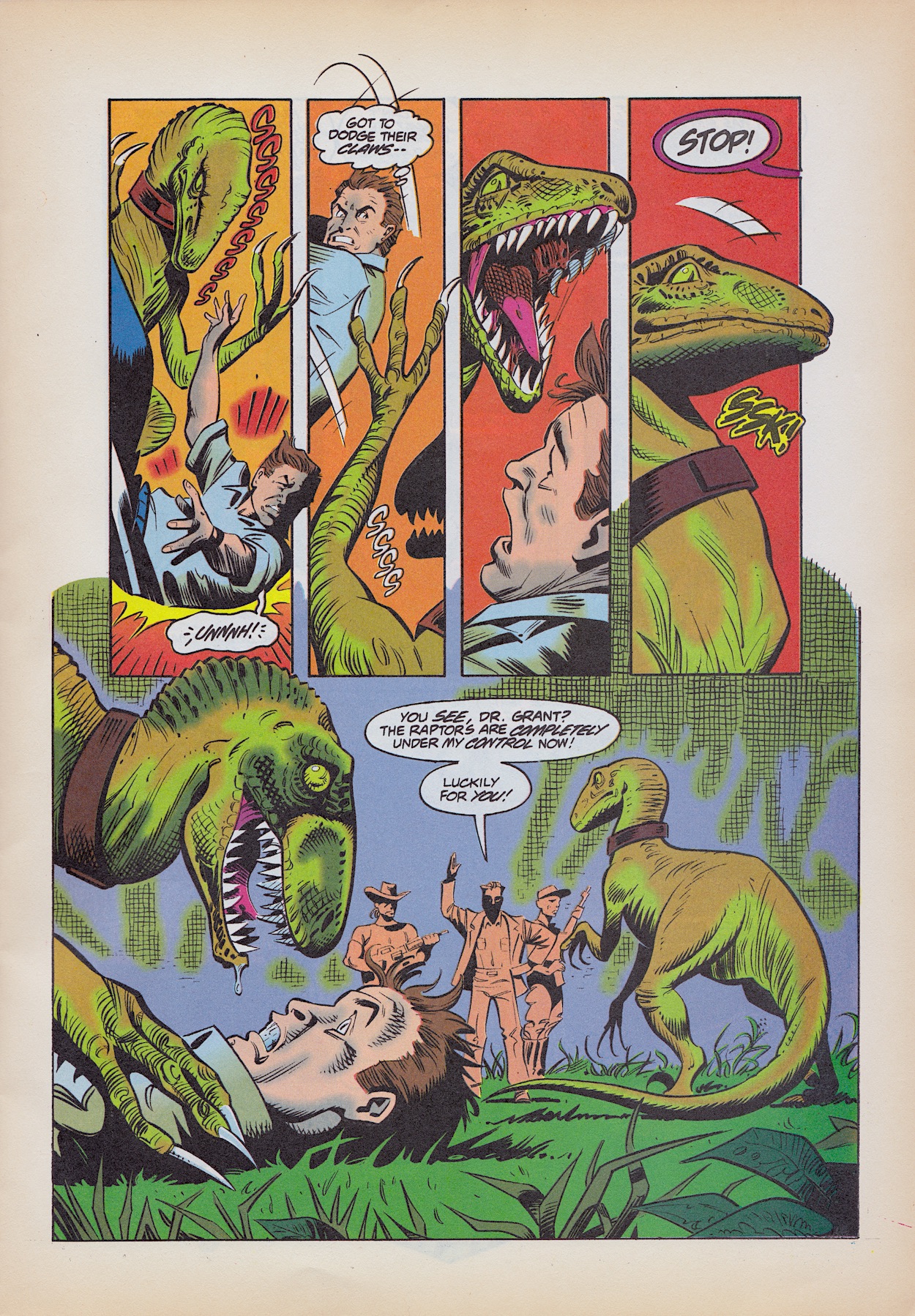
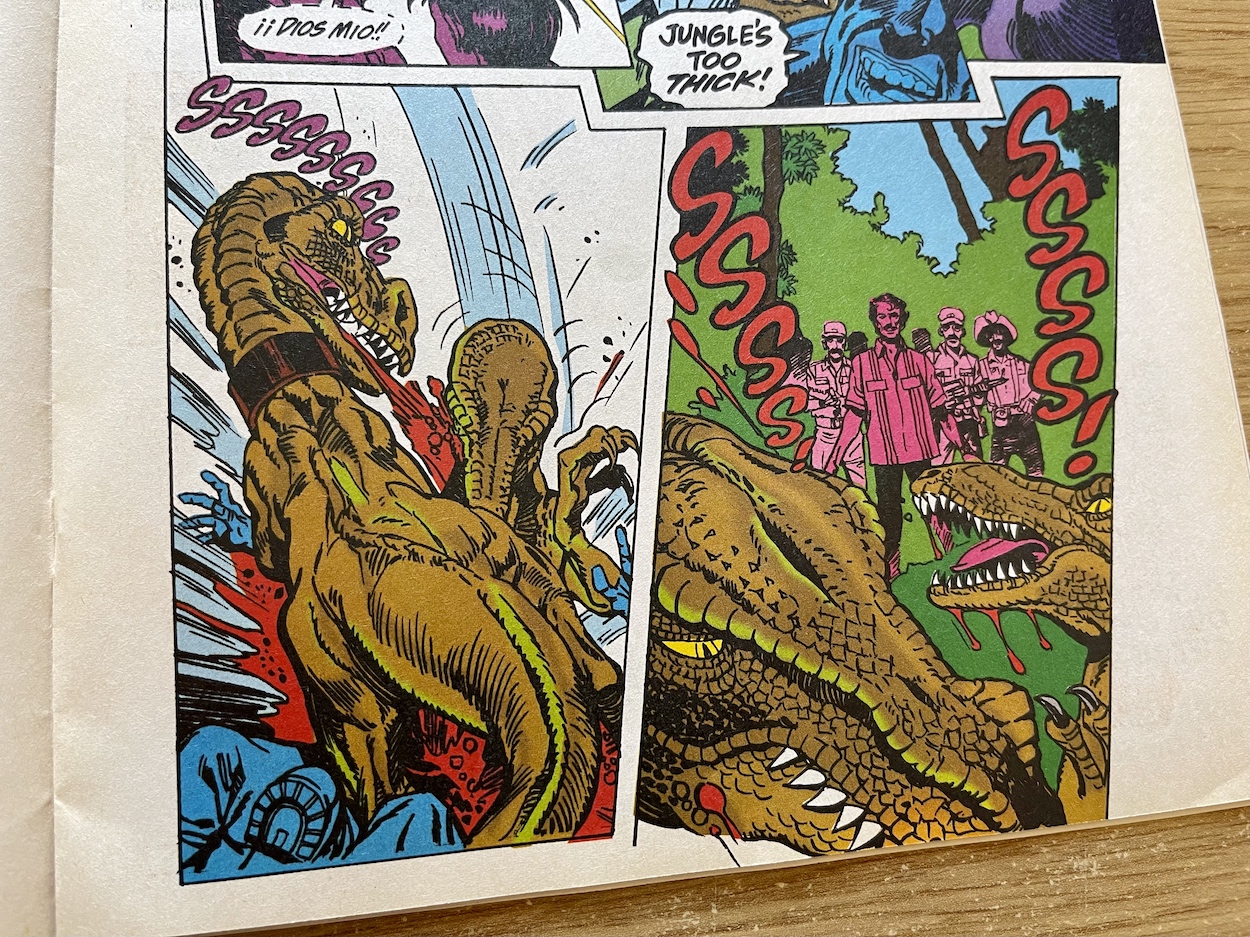
During the attack an electrical cable is damaged which zaps one of them. As the two animals looks quizzically at the electrical sparks they come to realise something and they run off. Rafael’s men can’t take control, somehow the ‘raptors realised the collars were no longer being controlled, the broken power lines causing interference. Free of their painful, torturous shocks they immediately run back to free Celia, taking out with relish the men who previously had all that power over them.
They kick in the large metal doors holding their sister and in no time at all everything has changed. Rafael had thought he was in control, but during the execution of his own plan something unpredictable happened and within minutes all three of the dinosaurs are free to roam and hunt, killing Rafael and the remainder of his men as they unsuccessfully try to shock them into submission once more. Another perfect example for Ian Malcolm’s Chaos Theory.
We see Celia wince from the shocks, but the others’ collars no longer work well enough to stop them. When Alan and Ellie come out to see what’s happening and make their own escape they’re cornered by the three ‘raptors. Alf and Betty prepare to pounce, after all these two humans are just another part of all this, but in a surprising moment Celia steps up to stop her sisters, even though she isn’t the alpha herself.
I remember this aspect of the story. Celia stopping her sisters from attacking Alan and Ellie would resurface and emphasised (once again) how the Jurassic franchise treats its dinosaurs as real animals rather than simple movie monsters. Was this also why she wouldn’t ‘kill’ the hay dummies? Does she no longer see all humans in general as prey? Either way, it’s clear the ‘raptors saw Rafael as a means to an end, to get out of the compound to freedom. The sly looks at each other and the development of their own characters over previous issues now clear with hindsight.
This was even before the Tyrannosaurus rex got off Isla Nublar to run amok through San Diego looking for his baby
The story ends on a superb cliffhanger as they take off into the jungle; three Velociraptor out in the wild, on the loose! Of course, this is now the conclusion to Jurassic World: Fallen Kingdom and the starting point for the final film in the series, Dominion, but this was published in 1994. As a teenager this was even before the Tyrannosaurus rex got off Isla Nublar to run amok through San Diego looking for his baby in The Lost World: Jurassic Park, so I can’t emphasis enough how excited I was for the next issue back then.
Despite the unnecessary return of Muldoon this was a hugely enjoyable adventure strip for Jurassic Park and one of the best so far, reading like the proper sequel to the original film it was intended as. It’s certainly a worthy follow up, continuing to build upon its story month after month and now, with the new art style bringing a freshness, a larger sense of excitement and better representations of the characters, I’m looking forward to seeing where it all leads.
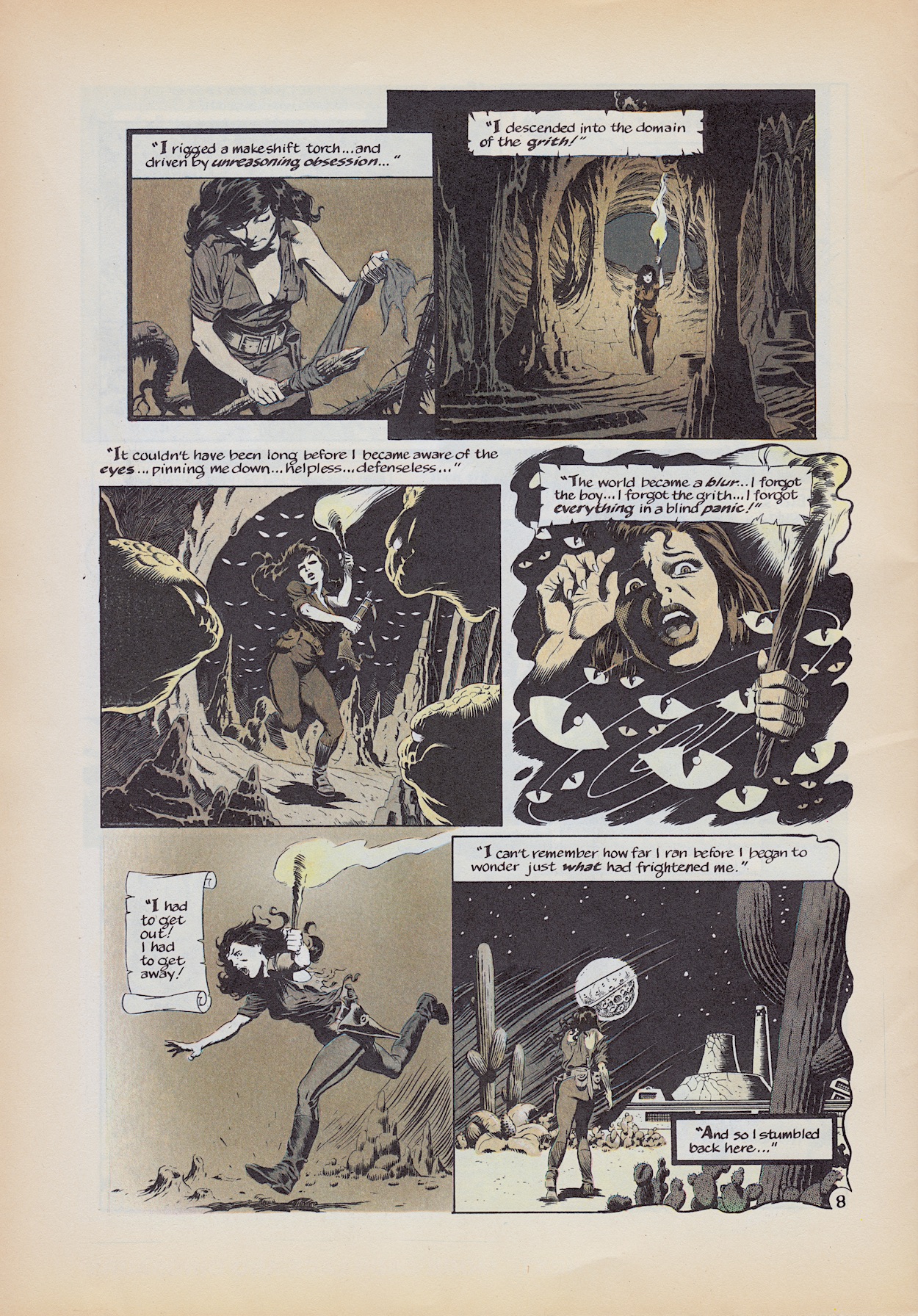
After a huge chunk of dino action the issue is rounded off with Foundling, our nine-page back up Cadillacs and Dinosaurs strip. A quick glance at the first page will show regular blog readers this is actually Xenozoic Tales (second back up in six issues from #4) under a new name. The Cadillacs and Dinosaurs cartoon series was based on creator/writer/artist Mark Shultz’s cult comic and had just started broadcasting on the Cartoon Network in the UK, so while the strips were still the same, the cover and contents page changed the name to try to entice fans of the cartoon.
Christine Courtier is back on colouring duties and, while I miss Steve White’s colours, in an episode told mainly in flashback Christine’s darker, more atmospheric palette perfectly suits the story. Again Jurassic Park is selective about which stories from the original comic series to reproduce (page count could be a major reason) and in this case we jump forward to #6 of Xenozoic Tales, missing out a handful of tales from the last time we saw Tenrec and Hannah.
“I could feel his hot breath on my neck, then he galloped past me as if I wasn’t even there.”
Hannah Dundee
At points the story is actually a flashback within a flashback. Hannah is telling Tenrec about Maia Abrelatas, a lady whose son went missing years before when he was only three-years-old. She’d begged the governors to renew the search but they’d refused and Tenrec apparently just looked on as they did so. Within this flashback we flash back again to the time when the boy went missing out the back of her home. Later they’d found hyena tracks and blood and concluded he’d been dragged inland, where it was too dangerous for humans in this future world populated by dinosaurs.
Back to the original flashback and Hannah went out to track him after Maia saw him at her window. The governors dismissed this claim but Hannah found a child’s footprints and tracked them. She was almost about to turn back after a day when she eventually found him. Unable to speak, the boy instead drew words using stones, each letter inside a square. This instantly reminded Hannah (and me) of the Grith using Scrabble tiles to communicate with Tenrec. Just like them the young lad can understand her but can’t speak.
Above, the dinosaur that charged her was just a distraction (she does comment how this was strange for that animal) because she then lost the boy in the think forest, spotting him latter with the Grith far off in the distance. Continuing to track them to the entrance of a cave the scene below is terrifically designed by Mark, full of atmosphere and thrills. The story ends with Hannah confronting Tenrec, his association with the Grith and apparent nonchalant attitude earlier leading her to the conclusion he knew about the boy all along.
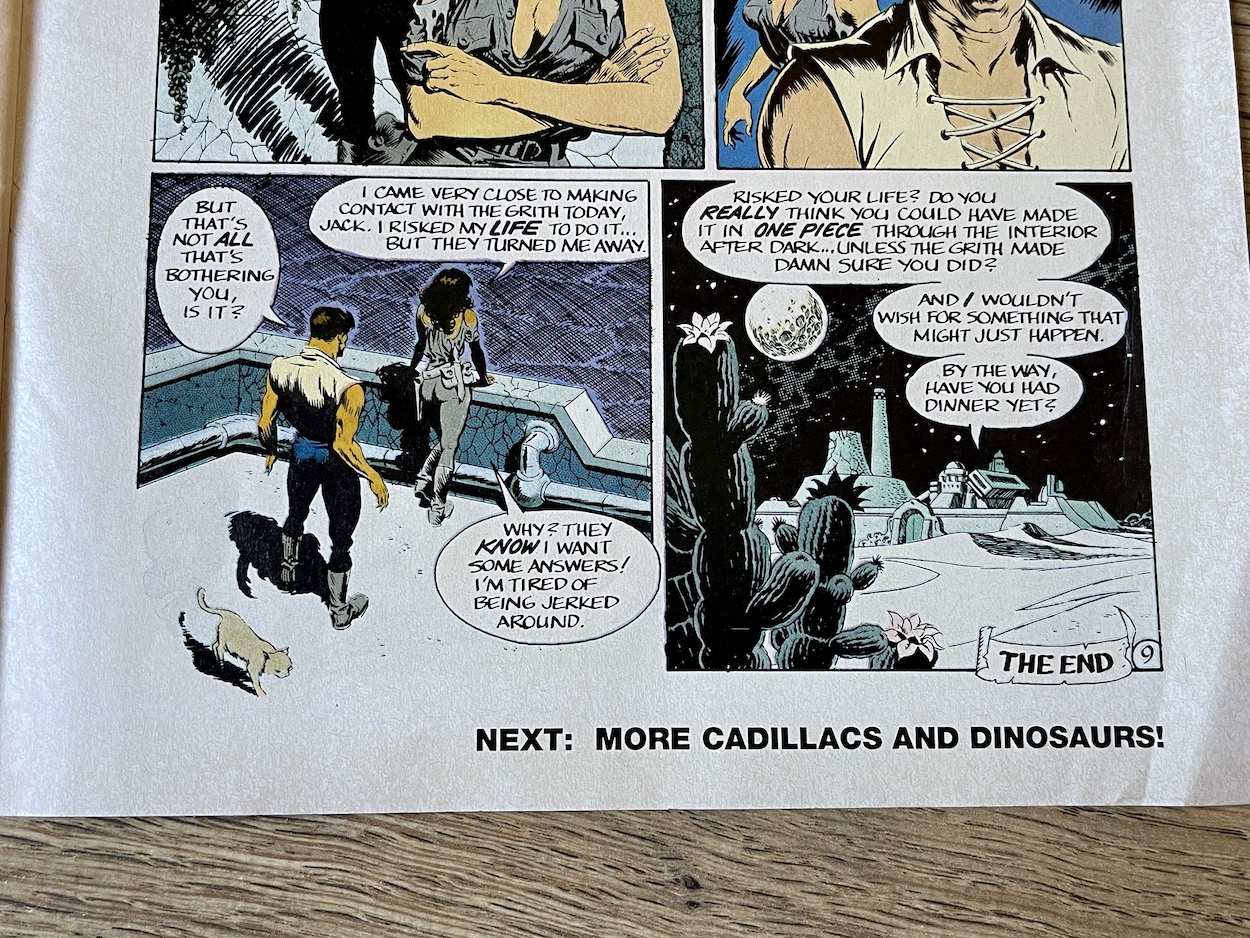
It turns out the Grith saved the boy after he was mauled by the hyenas and raised him, but now they can’t let him return home because he knows too much about them, even thinks like them. However, he’s at that age where his curiosity is putting him in a dangerous position as he tries to find out more about his origins, so the only solution is for them to take him far away from his mother and for Tenrec to continue the lie. What started out as another adventure strip ends on this heartbreaking reveal, which is a complete surprise.
Then, so it doesn’t end on too much of a downer the last two panels reveal all that horror faced by Hannah was actually the Grith trying to make sure she found her way back home, all finished off with Tenrec being his usual, casual self and asking about food. I’m sure any child buying the comic after watching the cartoon would’ve got a bit of a shock at the tone and the mature storytelling. As a Jurassic Park comic reader this is a great return to the unique and original Xenozoic Tales, no matter what name the editor gives it.
The last three pages are all advertisements, beginning with the latest issue of Manga Mania which I mentioned earlier and the first issue of a new comic based on the Street Fighter II videogame which was all the rage. I saw this and thought that couldn’t have lasted long but I was wrong, Manga Publishing in the UK released 16 issues altogether, the same as Jurassic Park in the end. I know which one I thought deserved to run longer though.
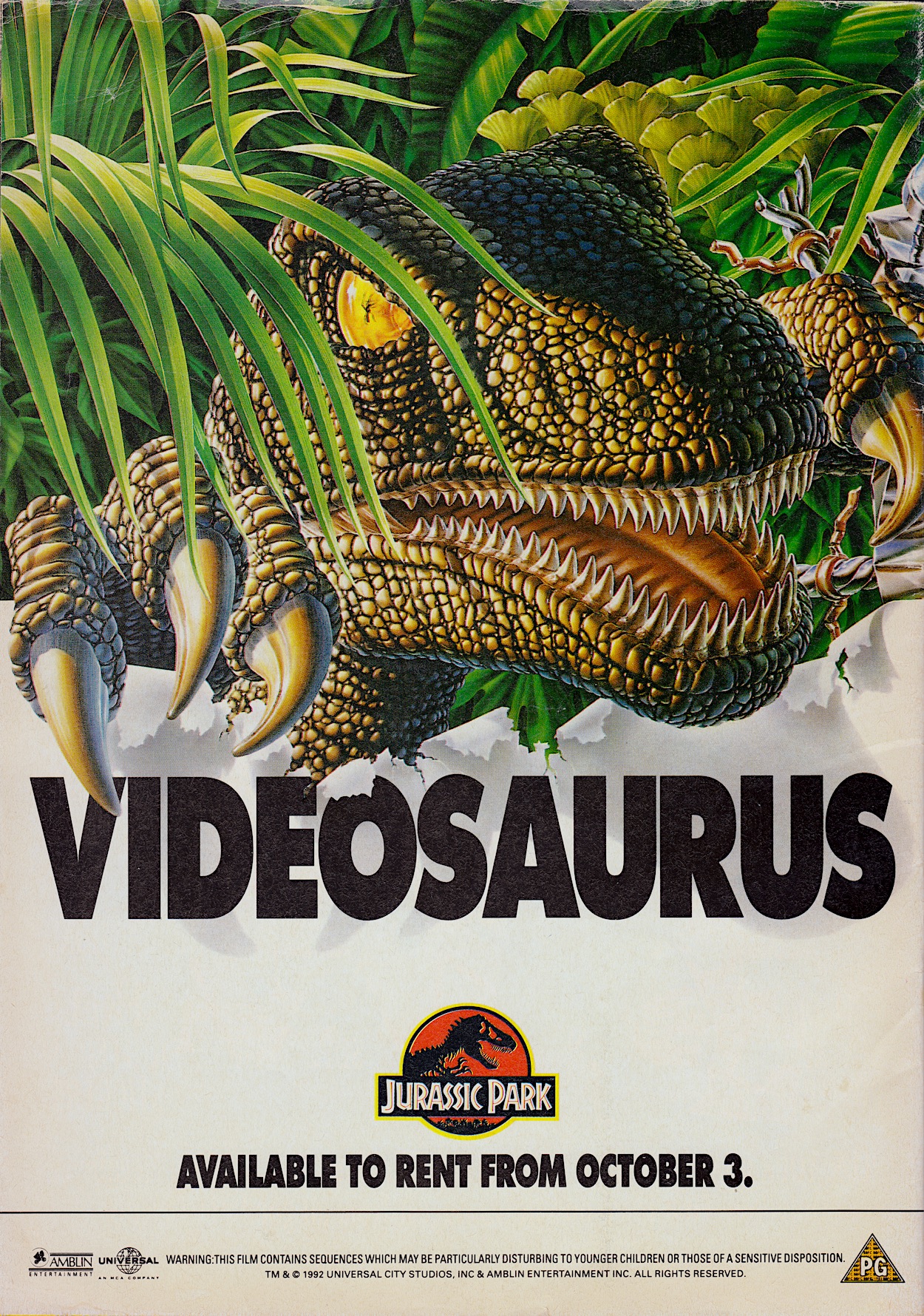
Finally for this month there was big news for fans of the movie on the back page.
I love the way the Velociraptor‘s eye is made to look like the amber that was so important to the film’s plot. Even though I visited our local rental store every single Saturday (because it was closed on Sundays you had the tape for twice as long for the same price) I never rented Jurassic Park. The reason was simple, I knew I was getting it for Christmas to own so I wanted to wait for my own copy before seeing it again for the first time since the cinema. So I waited (im)patiently instead.
While getting a much lengthier main strip was exciting I still prefer the comic’s three-strip format. To this day my favourite issues belong in that first handful after the sequel began in #6. But with hindsight, knowing we’ve only two issues left I’m very glad it changed so we could get three more full stories before the rug was pulled. The next of those stories will be reviewed inside Jurassic Park #15 on the blog on Thursday 6th October 2022.
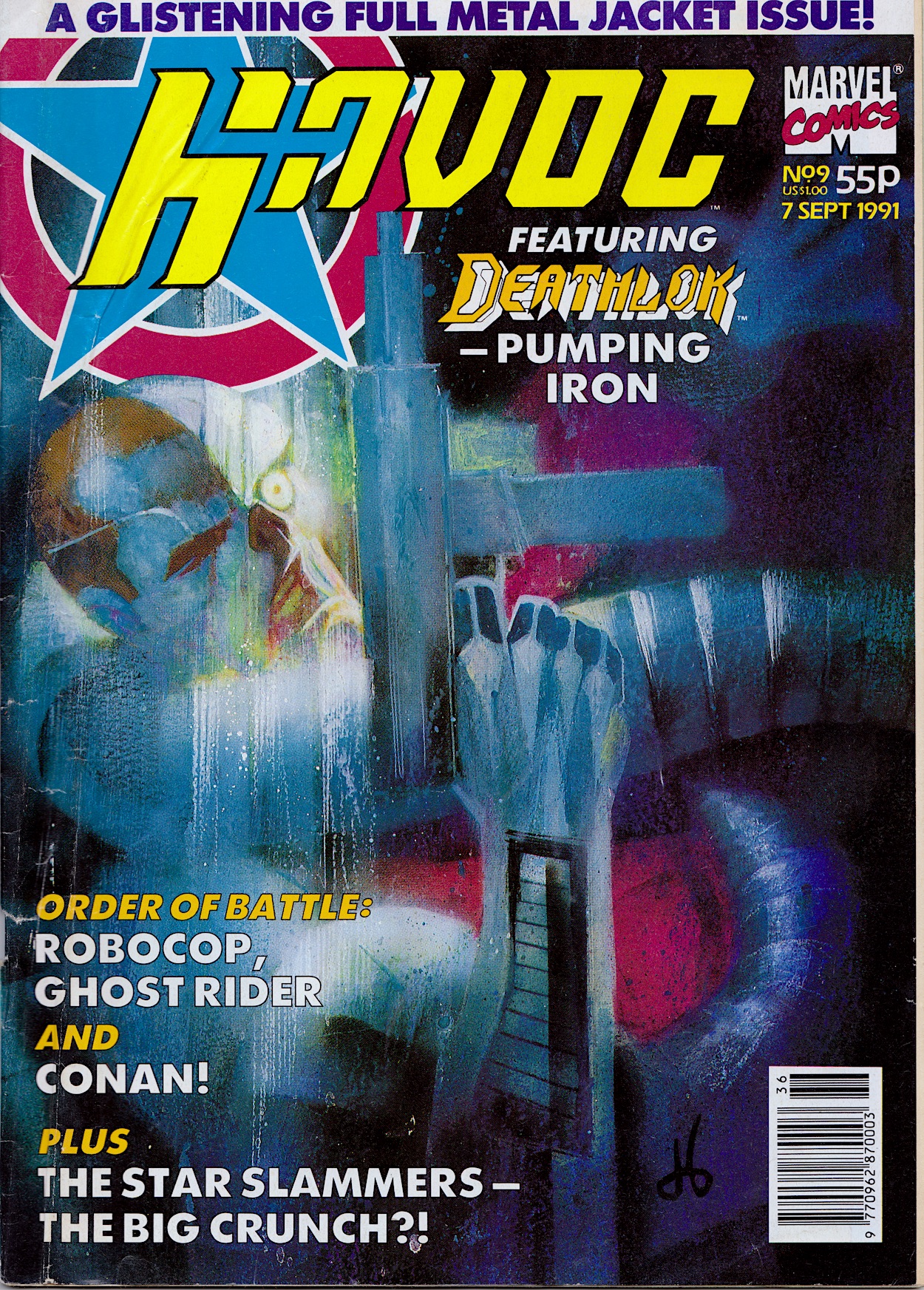
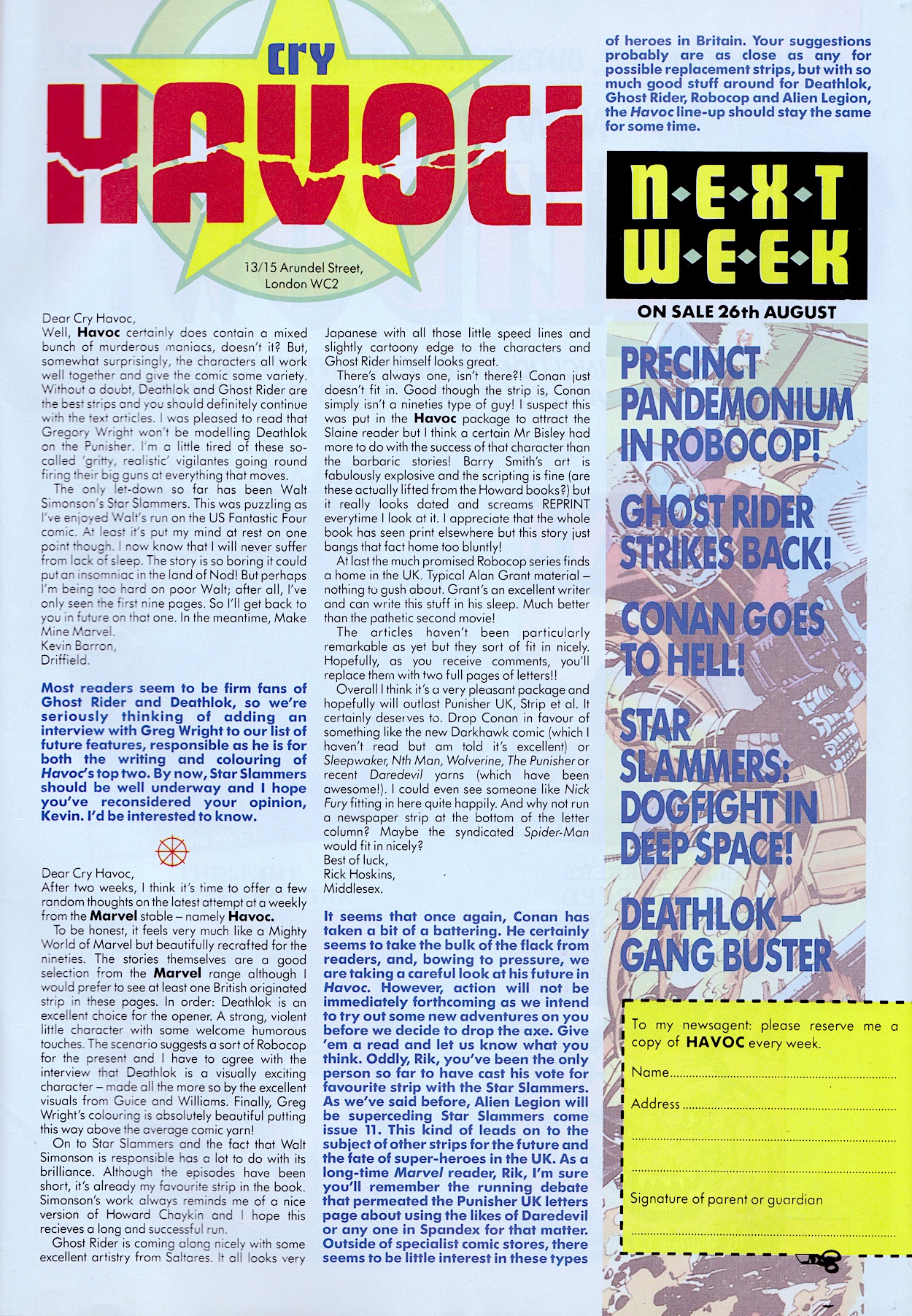
This just isn’t fair. That’s how I felt during September 1991 when #10 of Havoc failed to appear, the comic unceremoniously cancelled without so much as a note to the readers. This issue continues on as normal with cliffhangers and ‘Next Issue’ promos as well as hints of what was yet to come. Clearly pulled after it went to print, Havoc was the latest in what felt like a long line of comics I’d committed to which ended up the same way. Now having enjoyed the series 31 years later in real time I’m left with that same feeling of unfairness as I finish off #9.
If you look at the cover date you’ll see the next issue was due 7th September 1991. With #1 arriving as soon as the school summer holidays had begun, #10 would’ve been the first after the next school year began, Havoc’s brief run perfectly wrapped up in the holidays. When I returned to school I found out several of my friends had also been excitedly collecting it and we ended up sharing our disappointment in its disappearance.
Goodbye Havoc, it’s been a blast and you deserved better
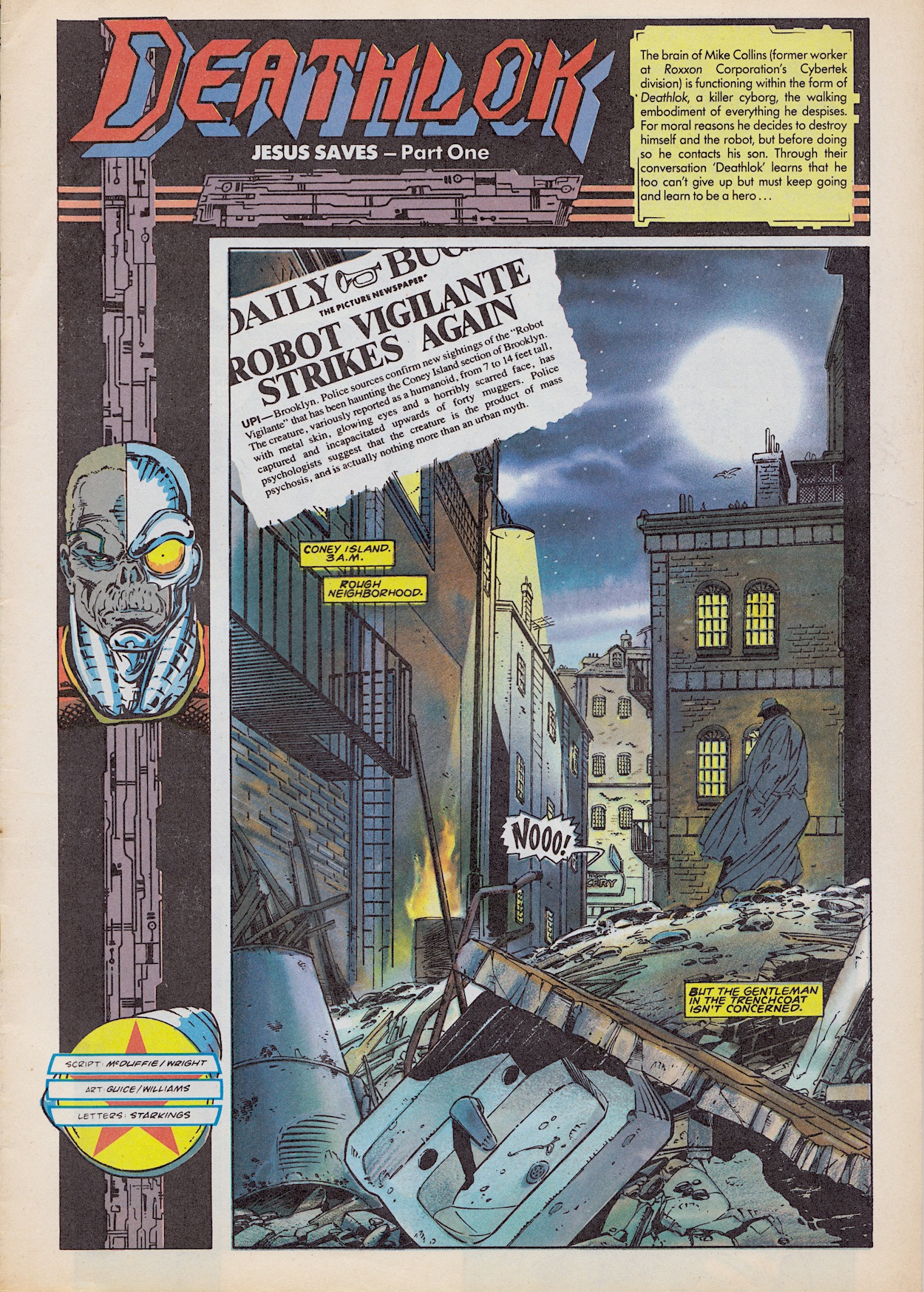
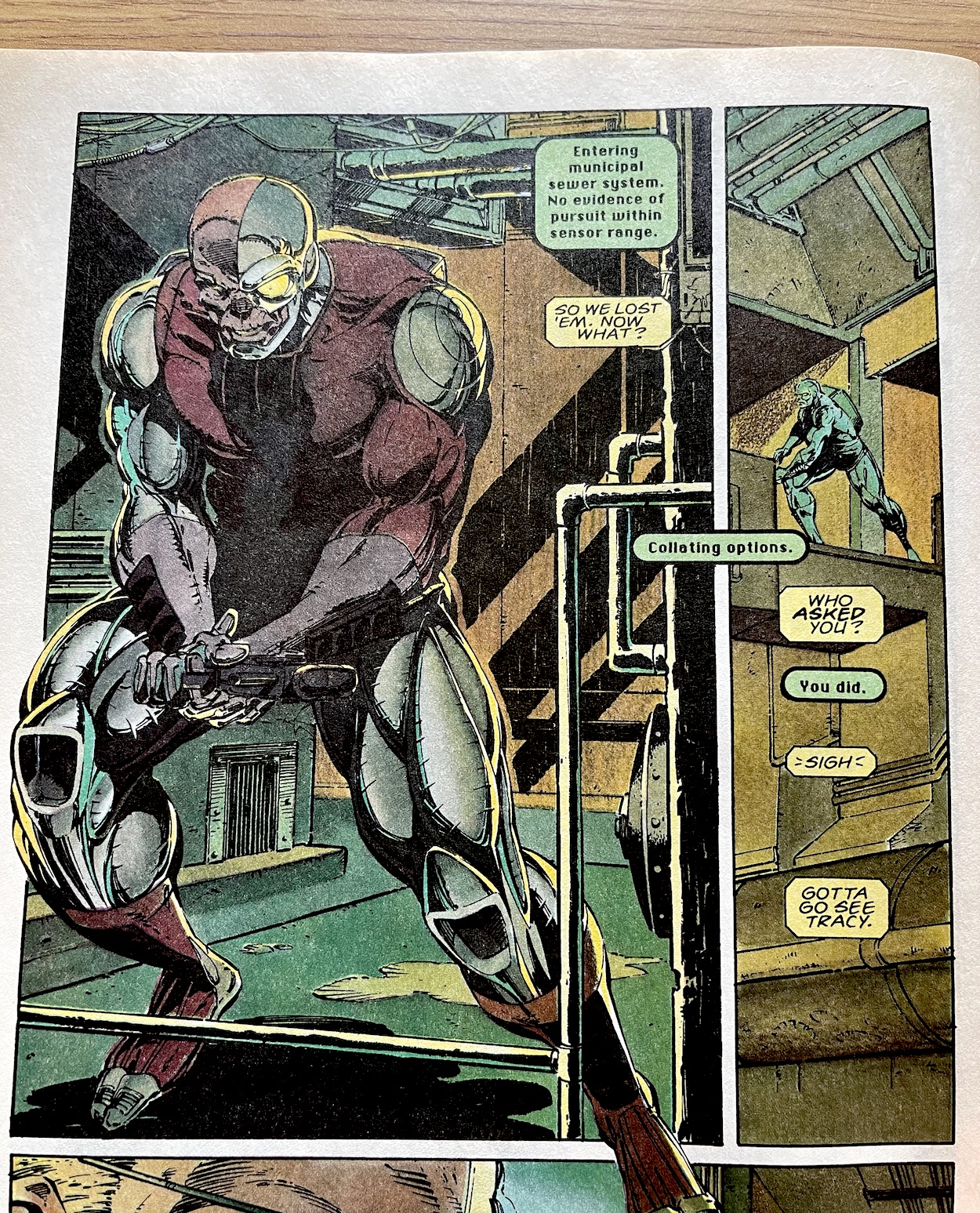
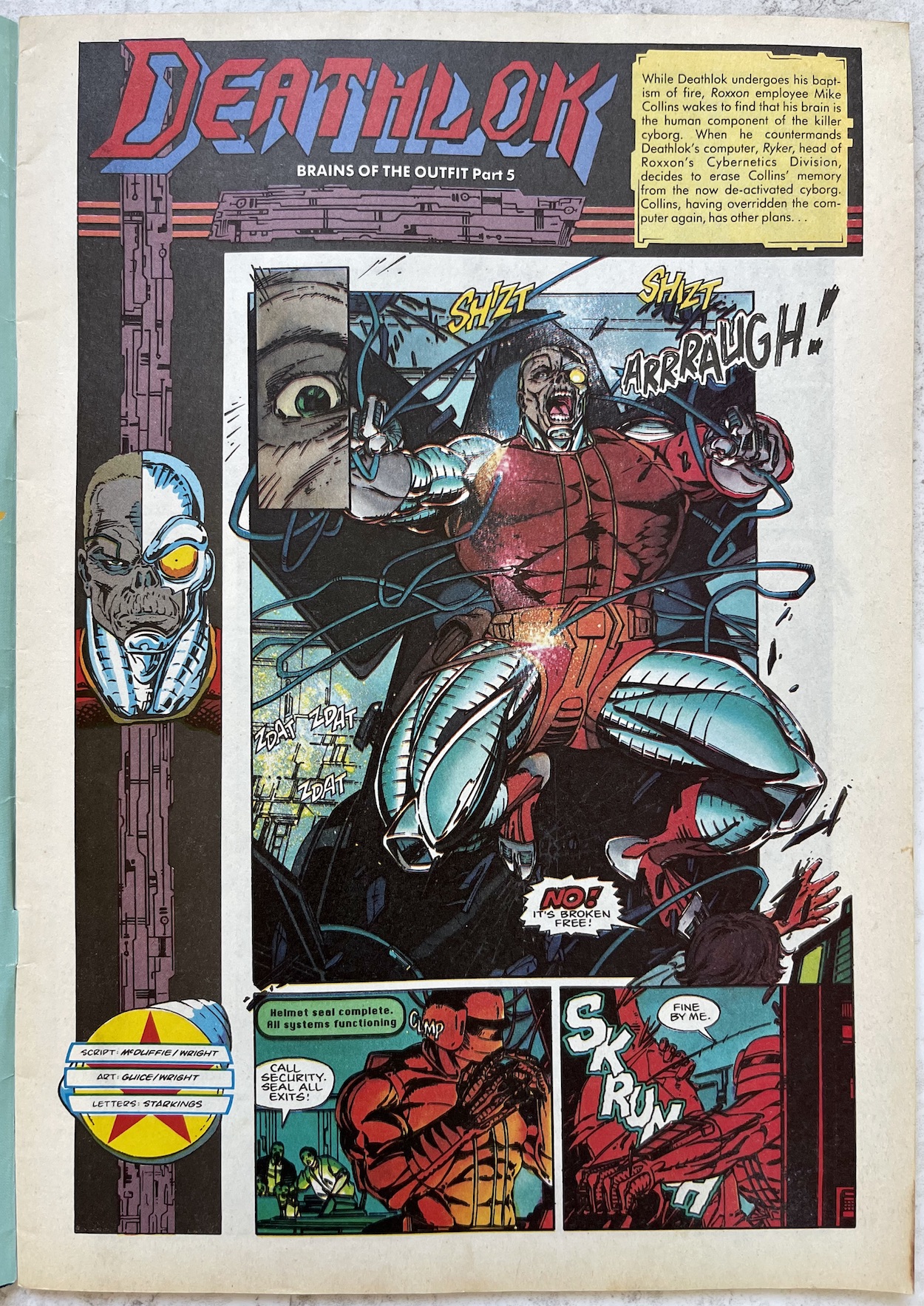
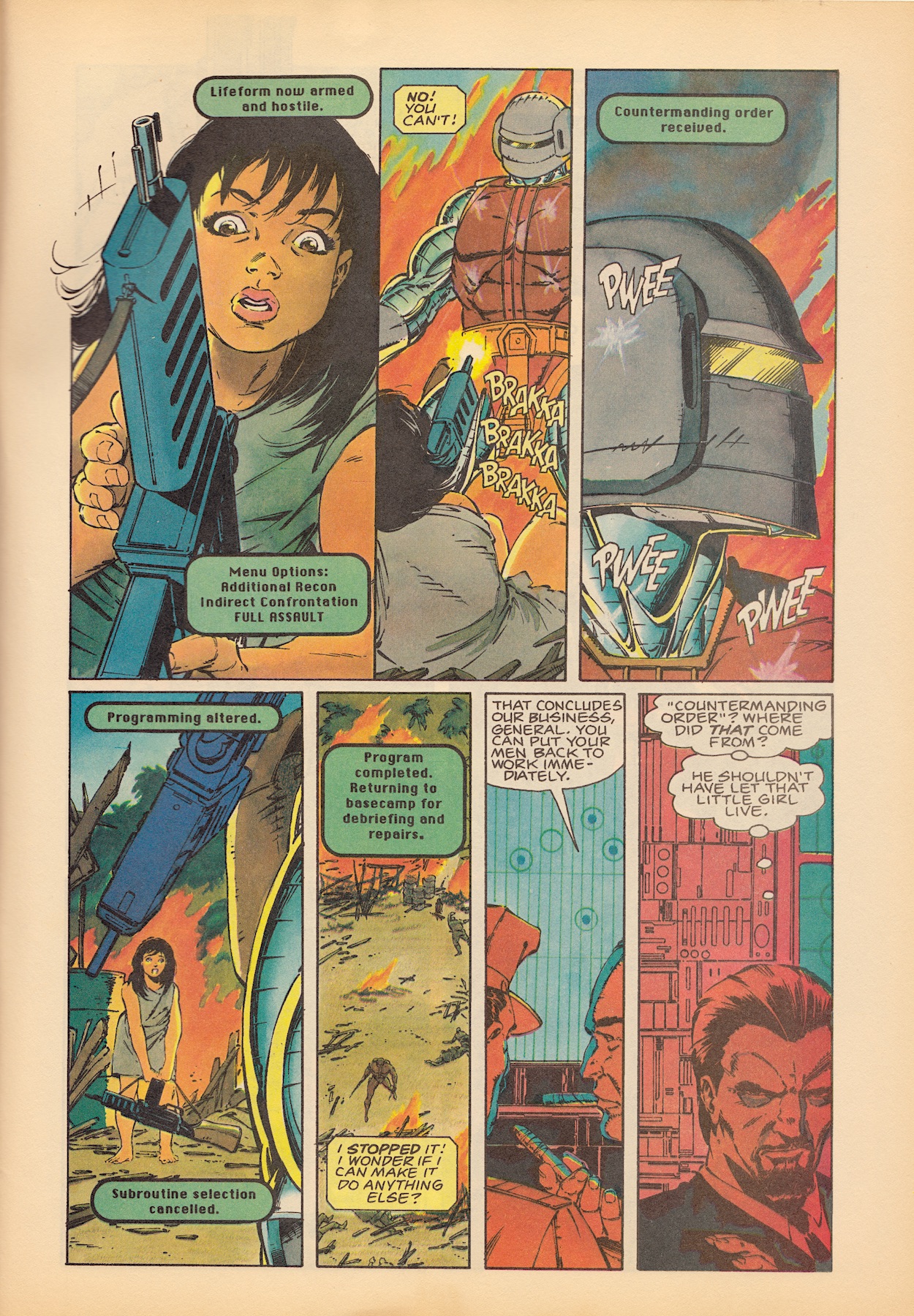
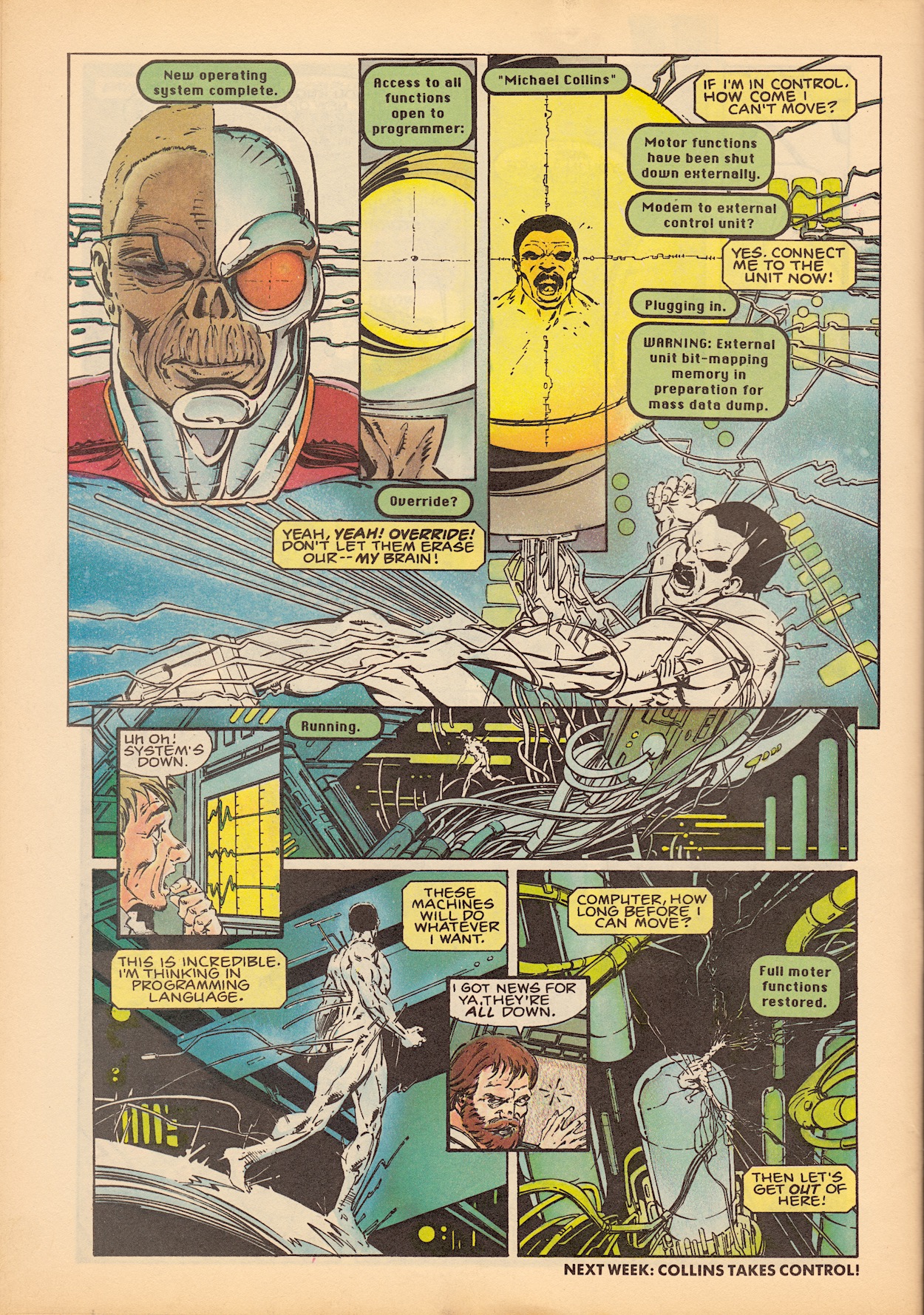
None of the included strips saw a conclusion and two new stories actually begin here, such as the first for Deathlok after Michael Collins’ origin story. Even though it’s the beginning of a new tale we still got a catch up banner to bring new readers up to speed, something no other ‘Part One’ received. Jesus Saves adds new talent with Scott Williams (New Mutants, Superman Unchained, Batman: Hush) joining as inker with Gregory Wright now only writing, and Paul Mounts (Fantastic Four, Friendly Neighborhood Spider-Man, Ultimates) as colourist, although he goes uncredited here. Joining Gregory on writing duties is co-creatorDwayne McDuffie, pencils are by Jackson Guise and lettering by Richard Starkings.
Nice use of the Daily Bugle there, as ever doing what any tabloid does and using exaggerations and shock journalism to strike fears into its readers, with the almost mythical rumours of Deathlok reported as fact on the front page, something Spider-Man fans will be all too familiar with. I’d never read a Spider-Man comic at this point in my life so was completely unaware of the Bugle being a part of the Marvel universe. Through this the strip also establishes our setting as Coney Island.
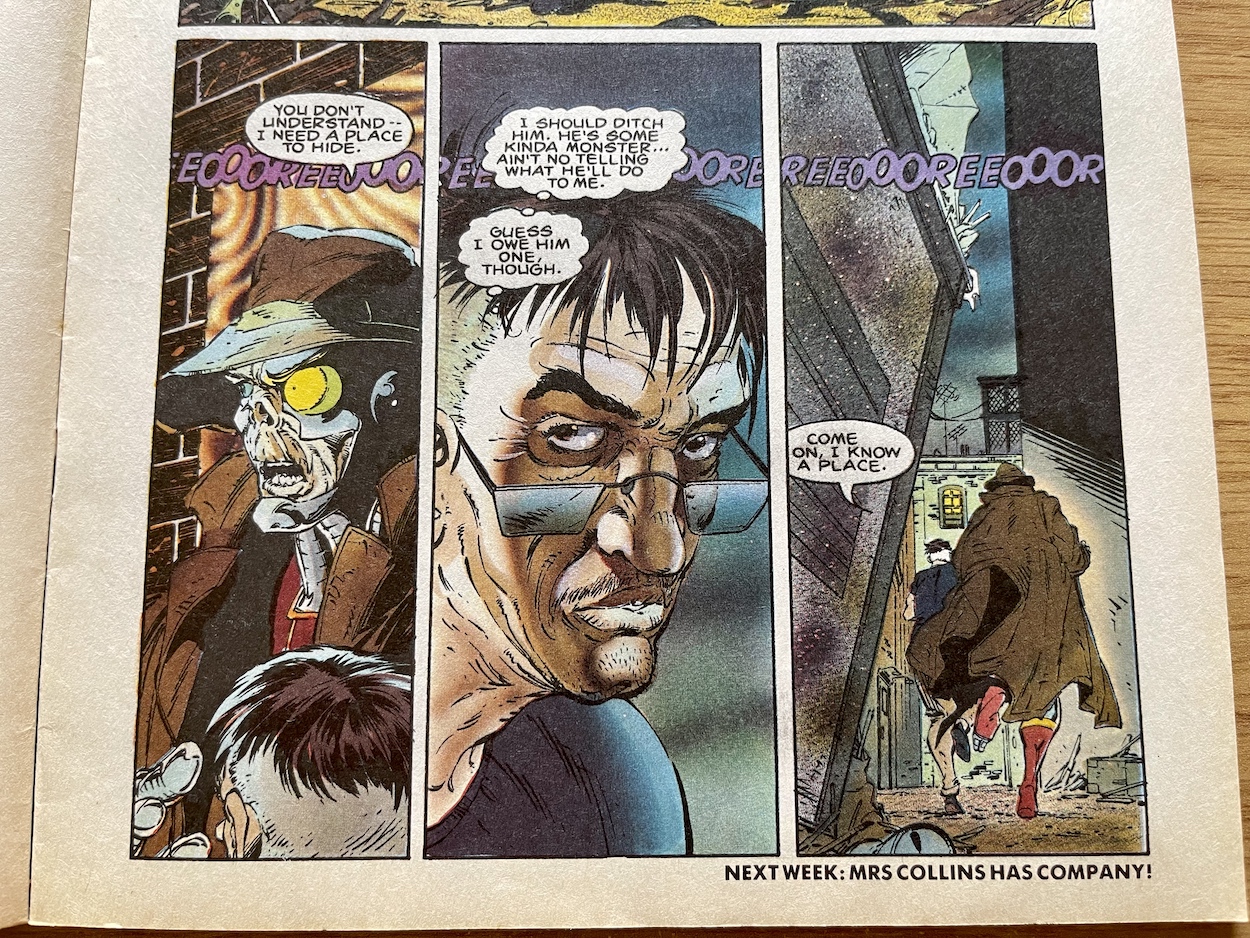
The Jesus the title refers to is Jesus Badalmente, a homeless man who would end up becoming a roommate and companion to Michael as he battled against Cybertek and tried to find a way back to his body, which he would find out was being kept alive. These are points I only found out in researching who this person was because the way he’s presented here I had a hunch he was being introduced as a regular. Jesus makes robots and is a bit of a cybernetics whiz, which I’m sure will come in handy at some point.
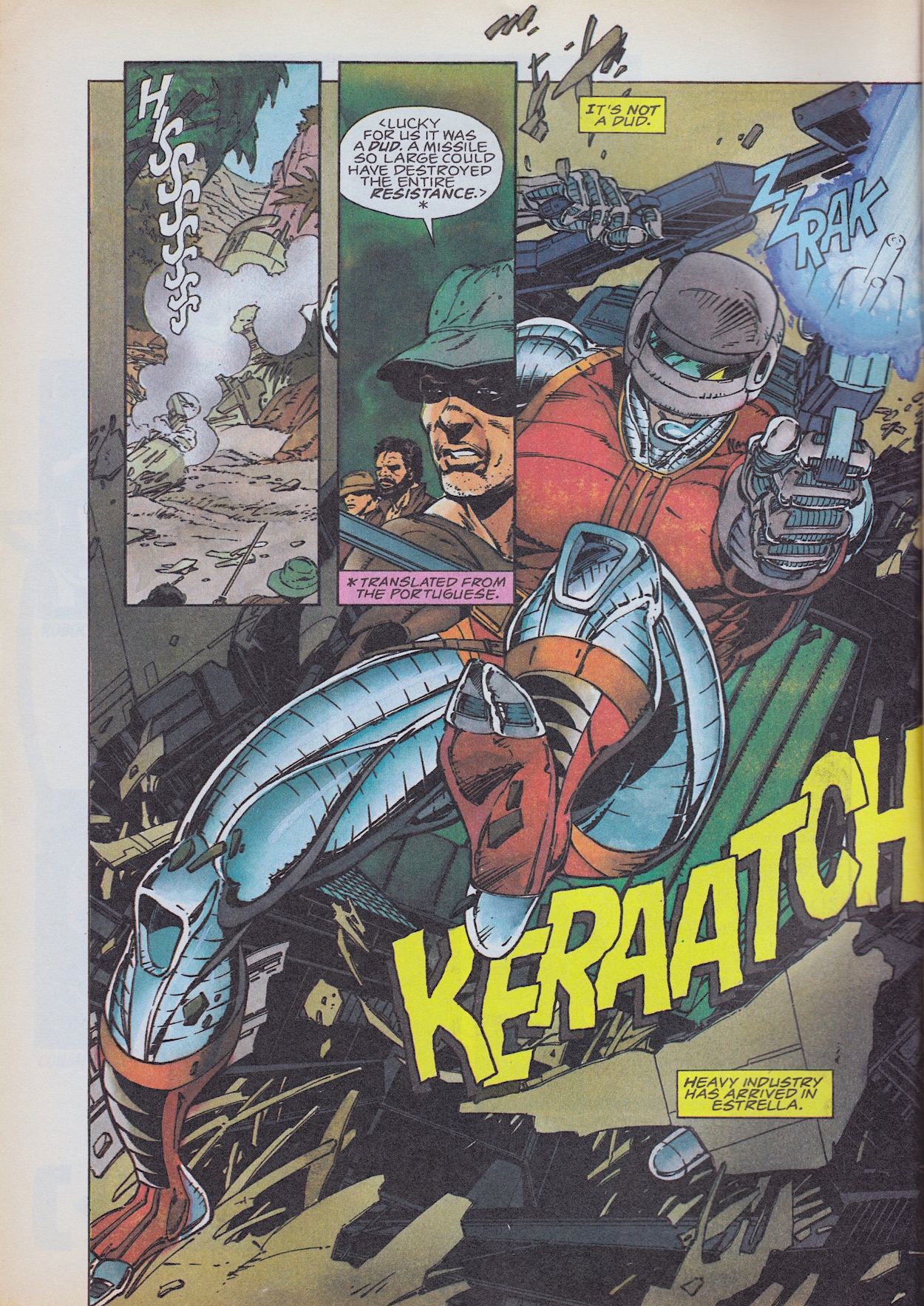
These first five pages of the story basically see Deathlok rescue Jesus from a mugging and in return he’s taken somewhere safe as the police arrive. Jesus’ first reaction is one of fear and revulsion, as will probably become the default as Michael encounters people. But just as he thinks Deathlok has only seen off the muggers so he can kill him, he is then saved by the cyborg from one of the muggers trying to run them down in a car. That’s enough for him to take a chance on this strange individual.
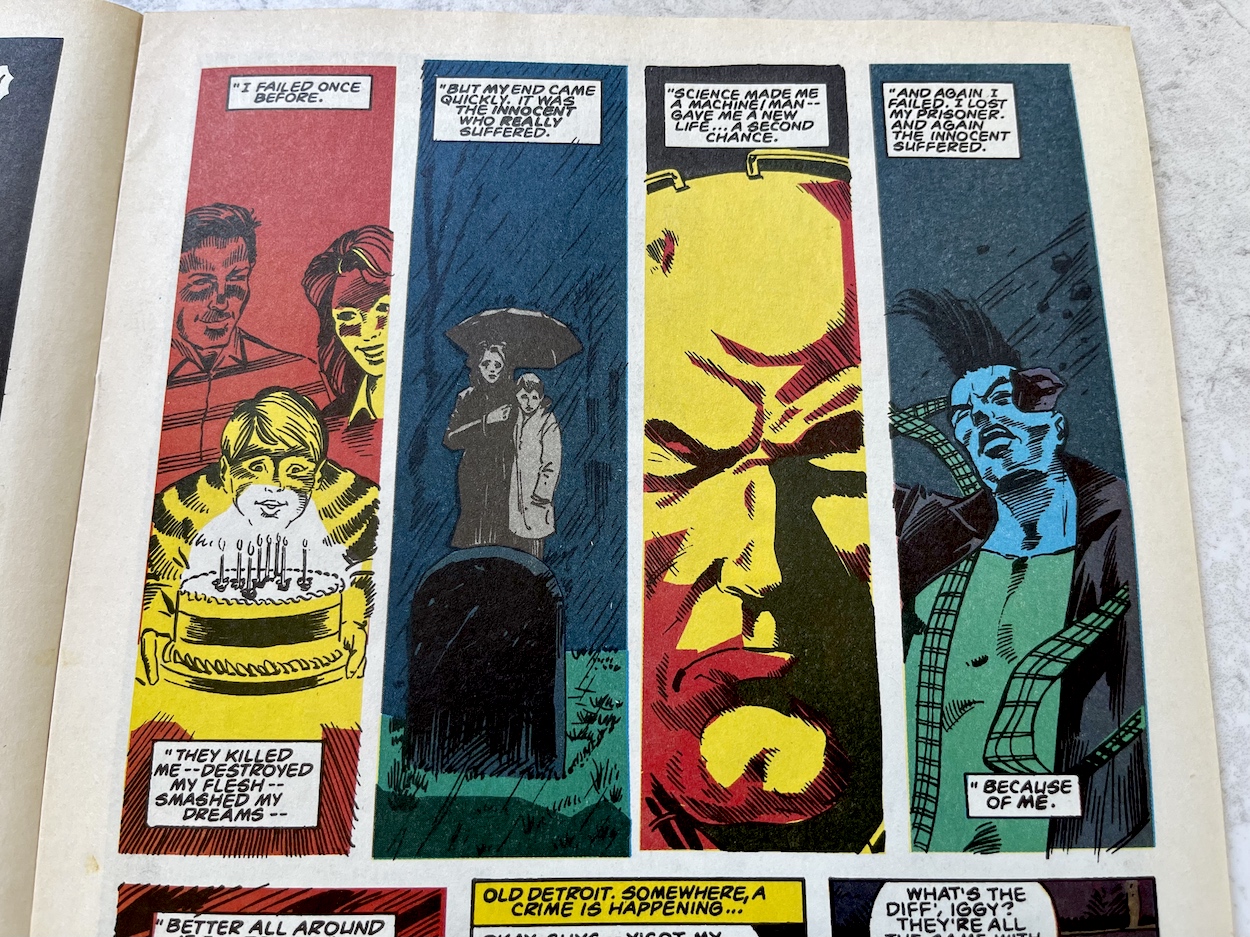
I’ve really enjoyed Deathlok. He was my favourite as a teen and it’s been brilliant to catch up with him again. The origin story was full of character and Dwayne McDuffie and Gregory Wright strike me as writers who’d make sure character development was key to the strip’s success. The action has been great, the interactions between Michael and the computer genuinely funny and I find myself really caring about what happens to them. One to track down for sure.
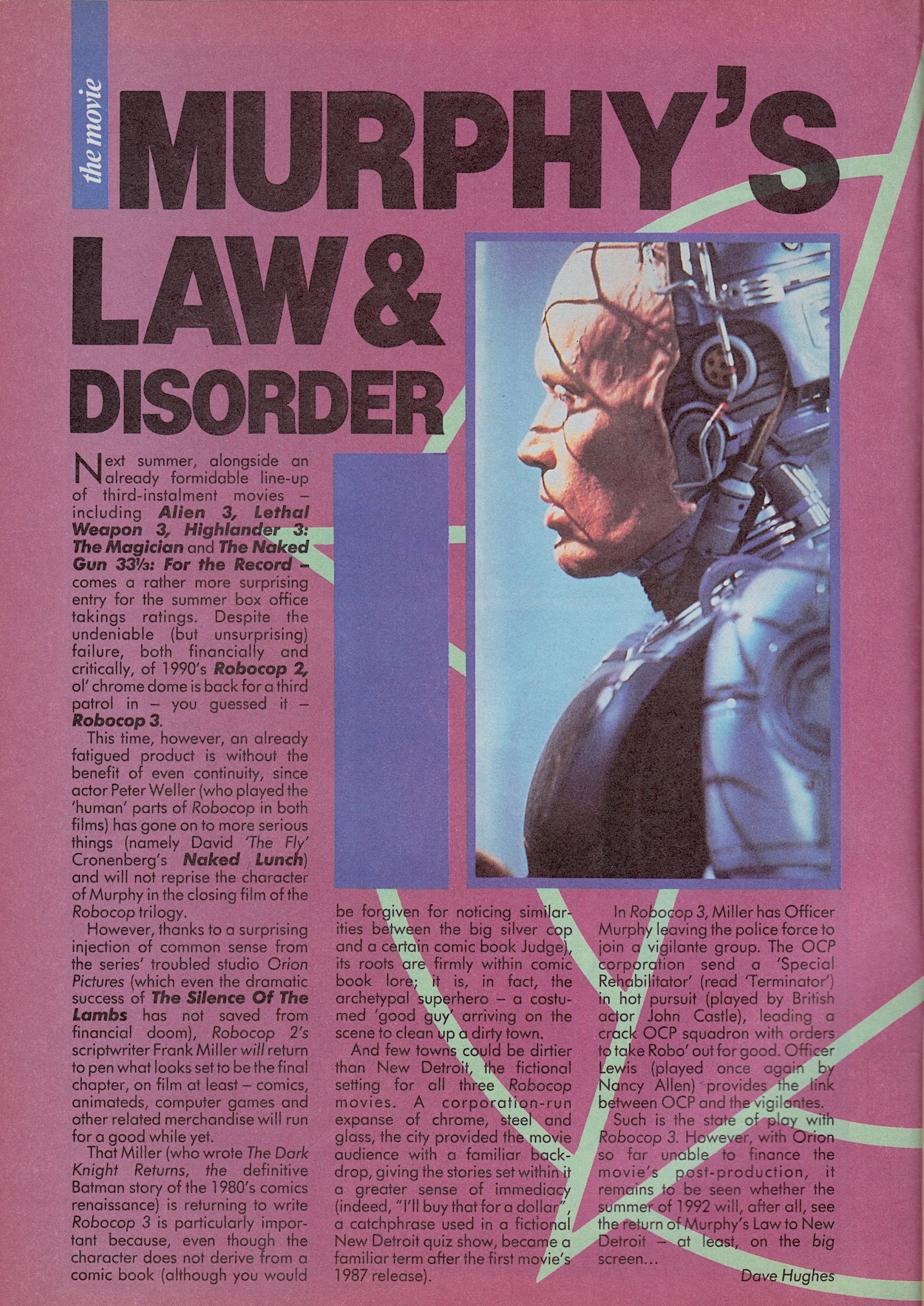
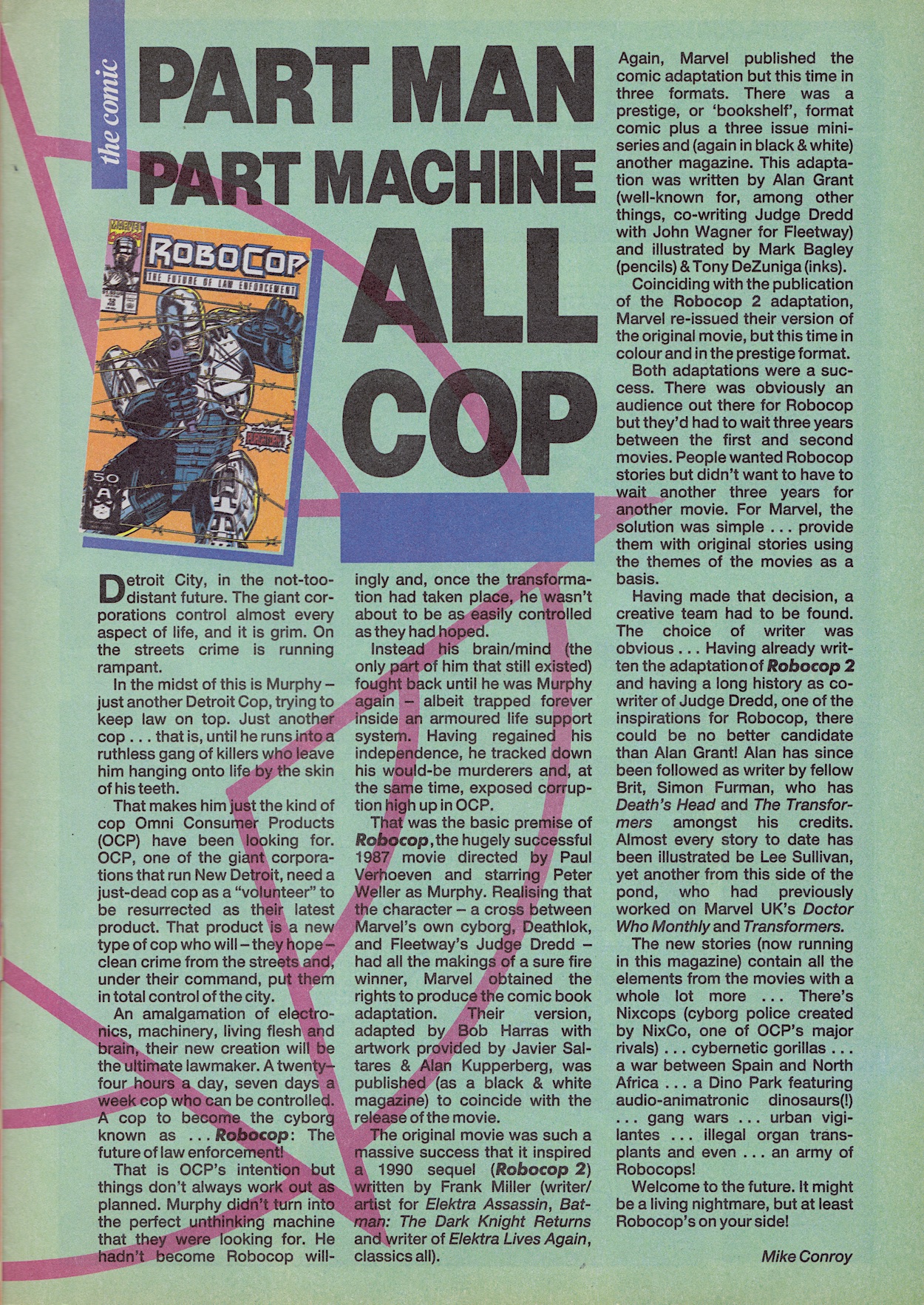
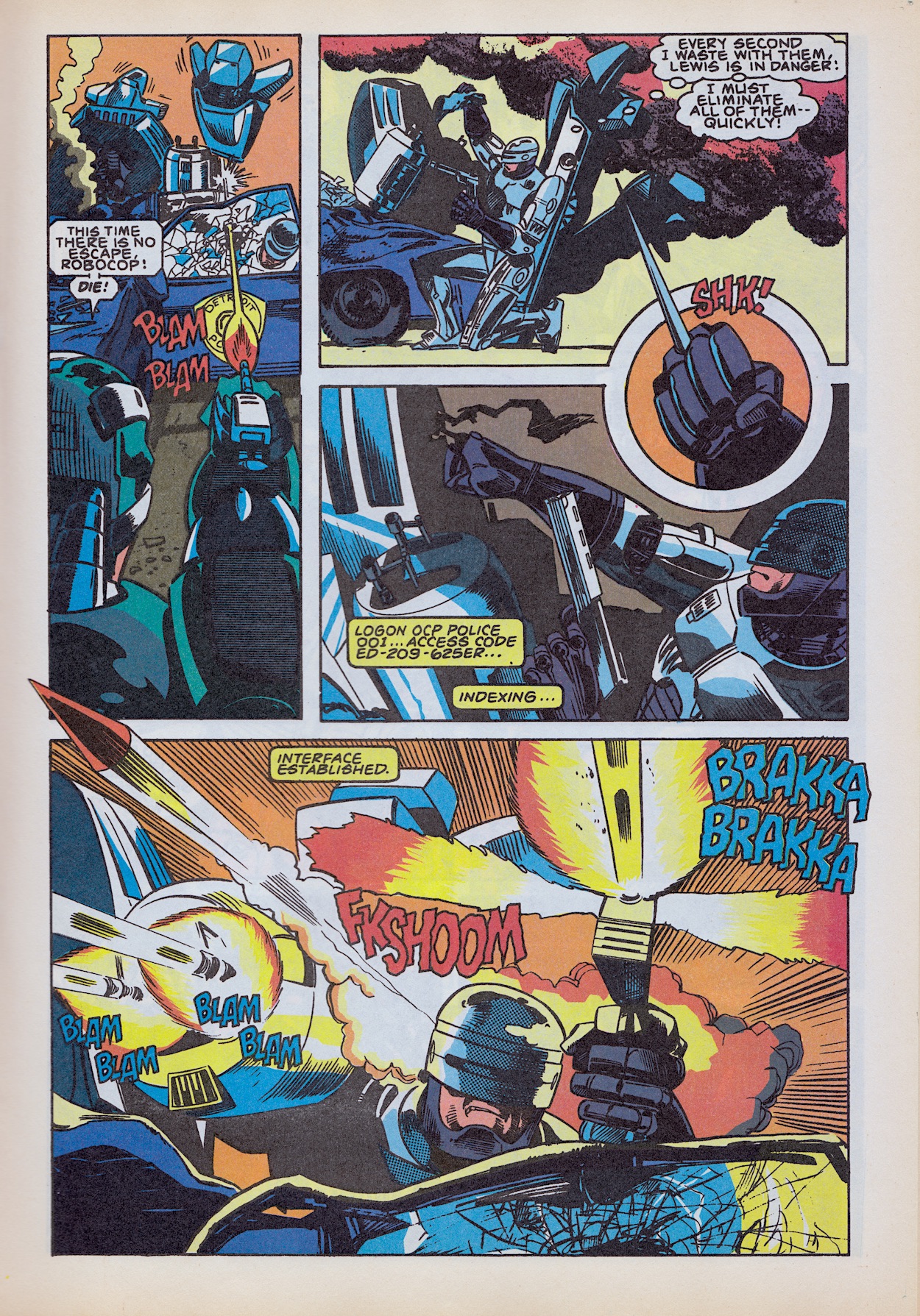
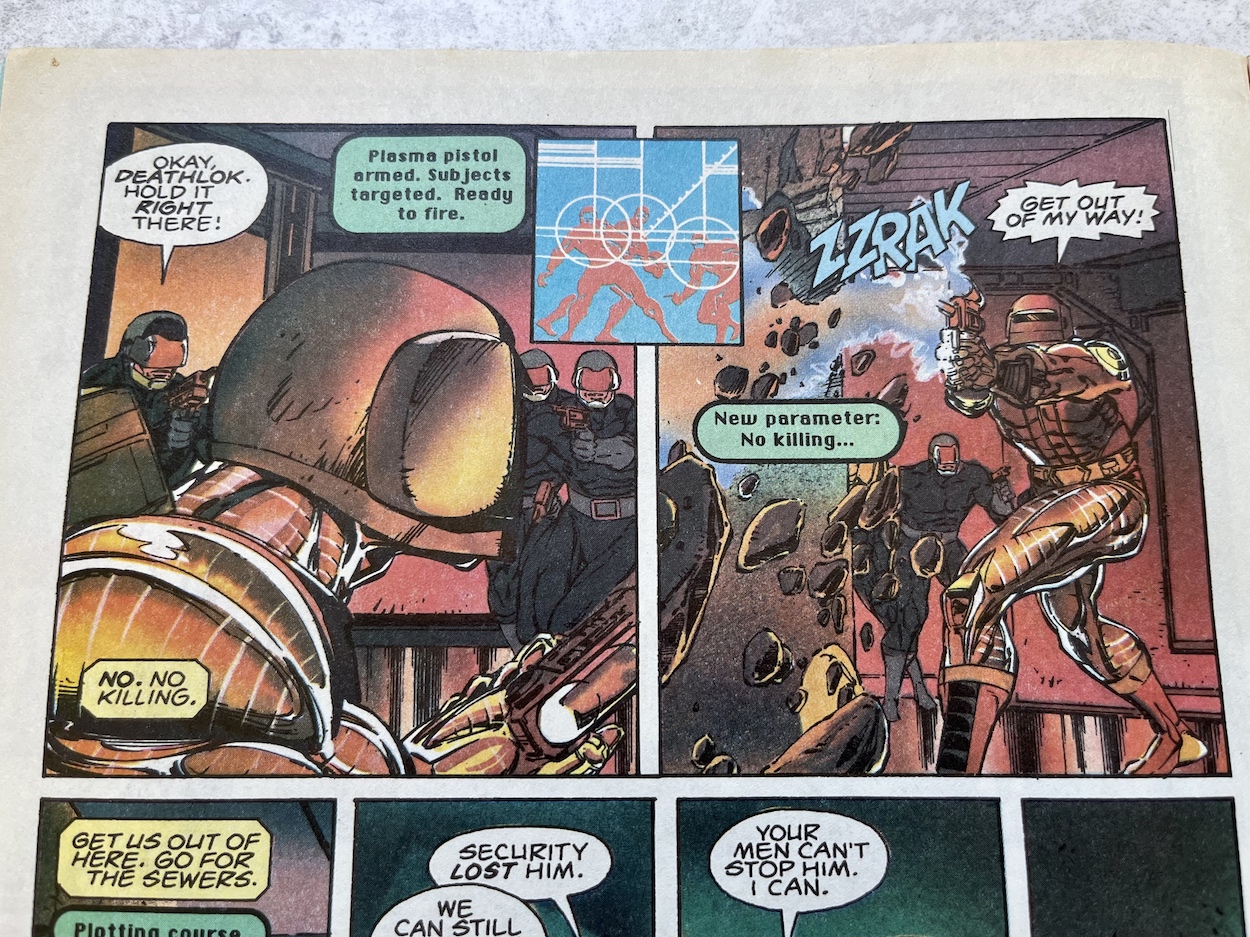
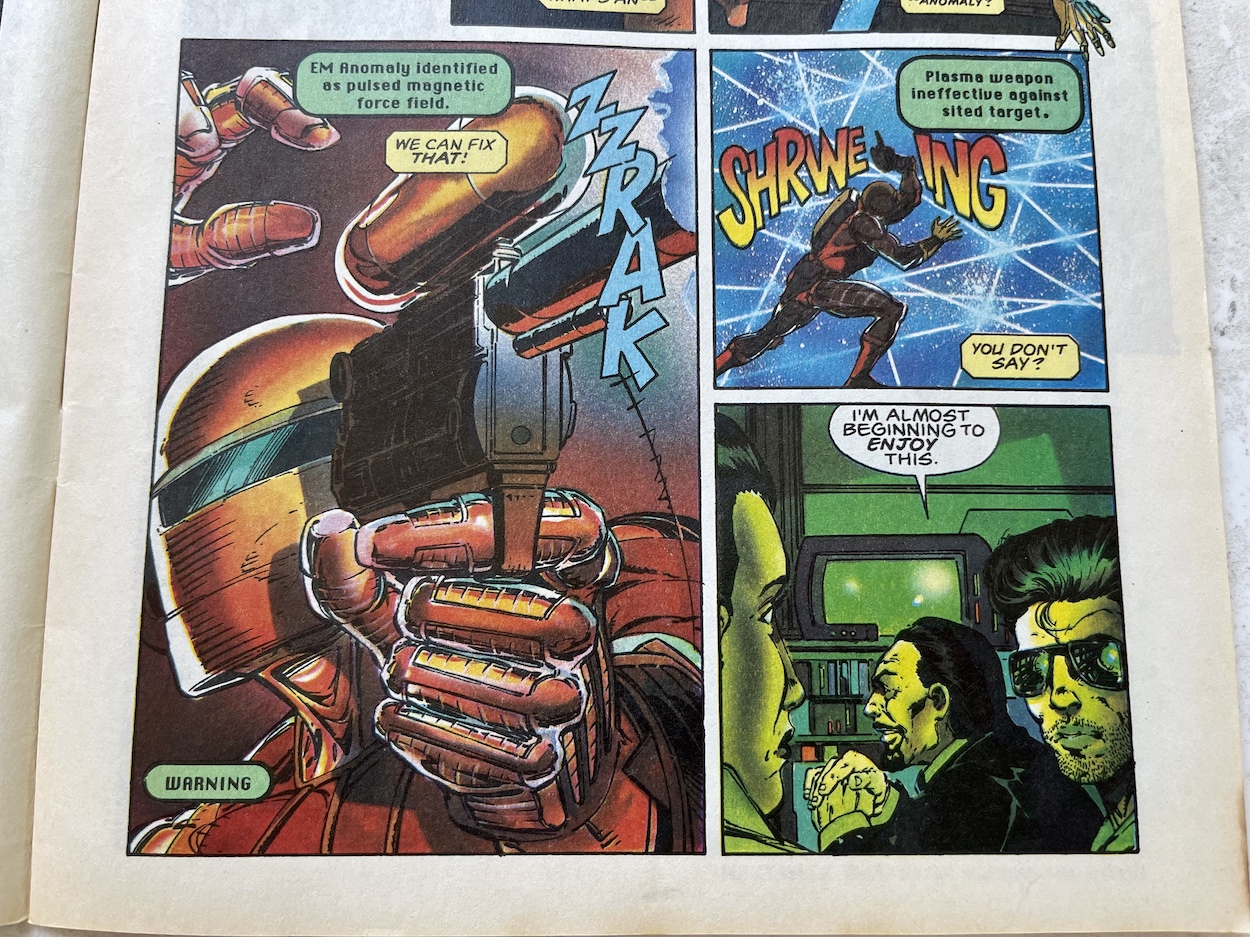
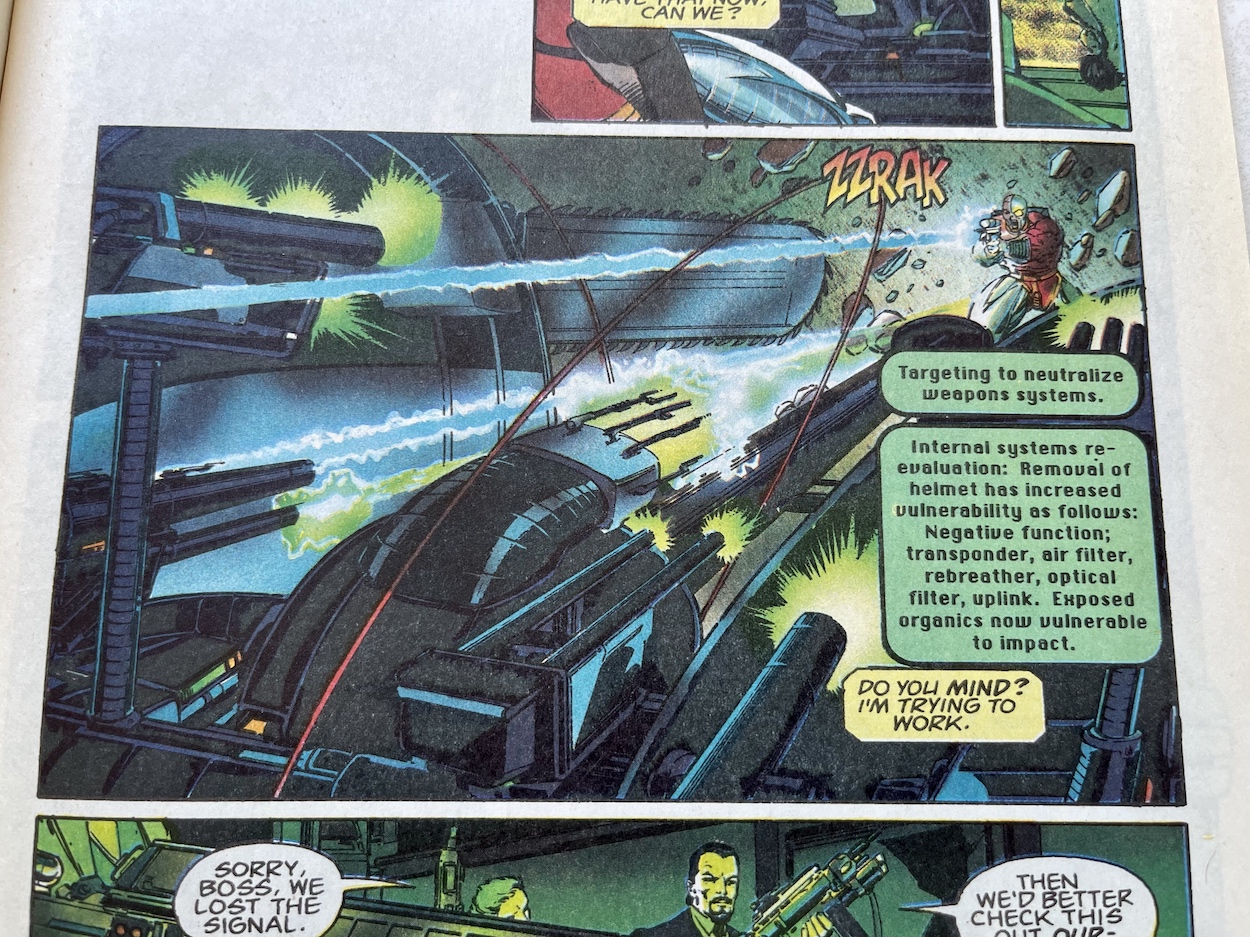
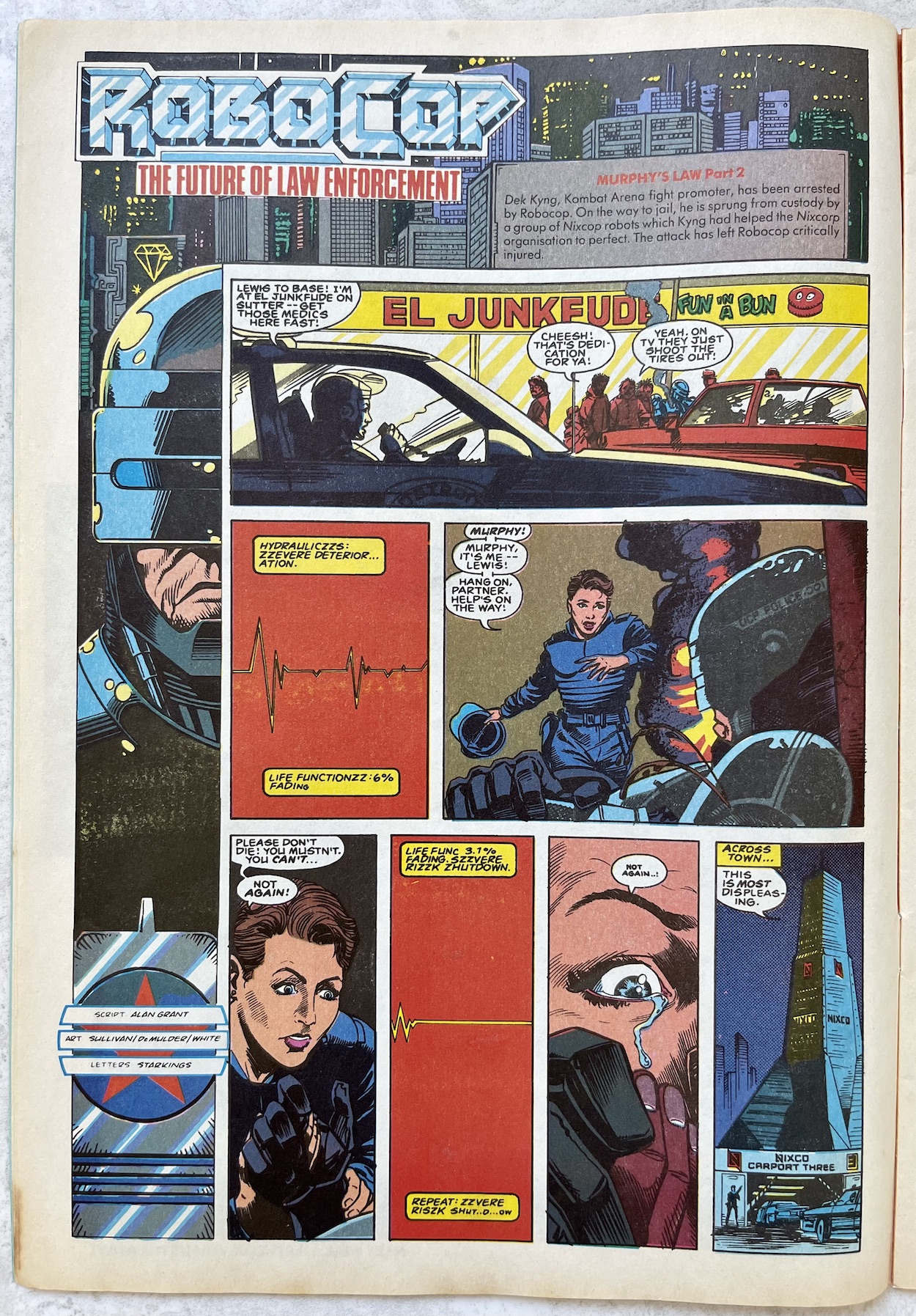
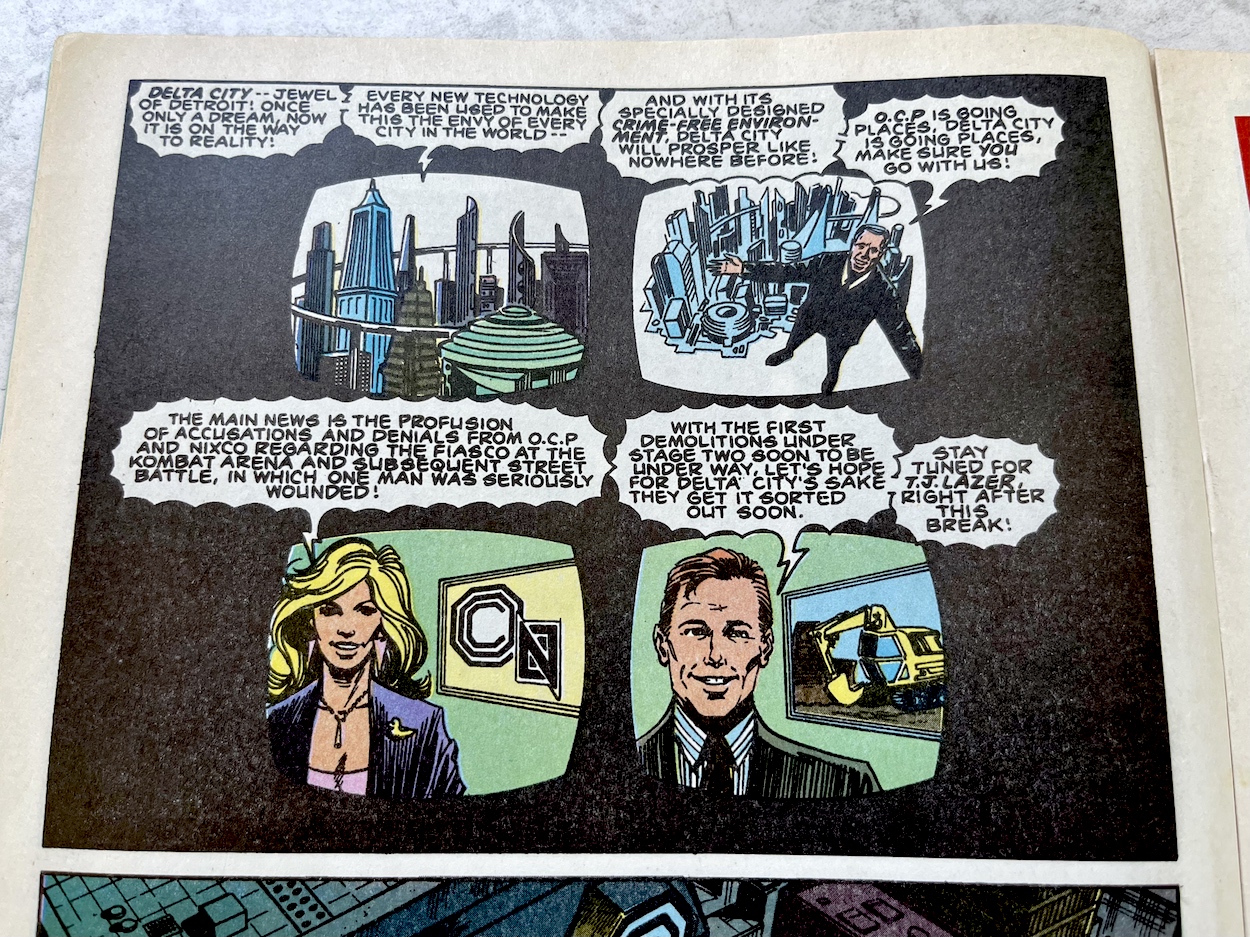
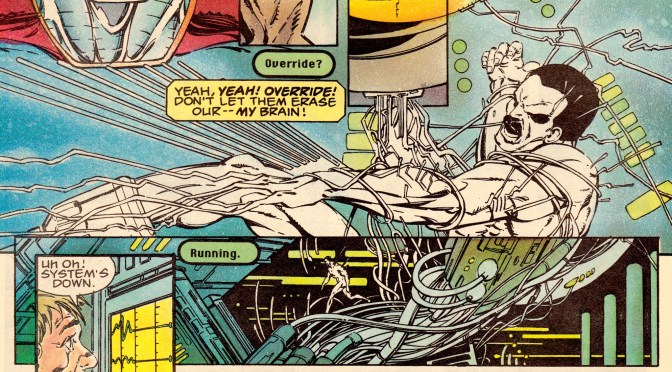
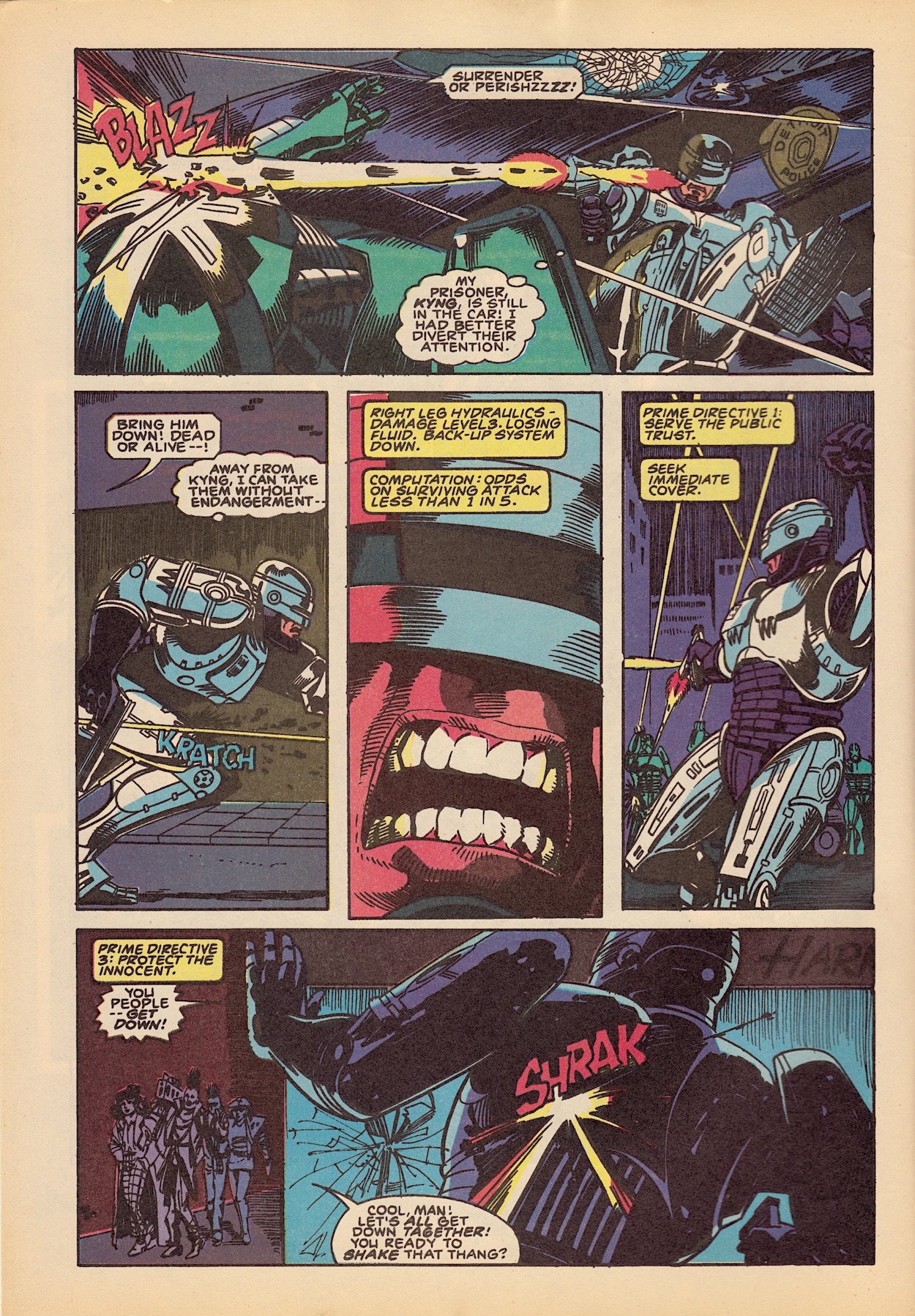
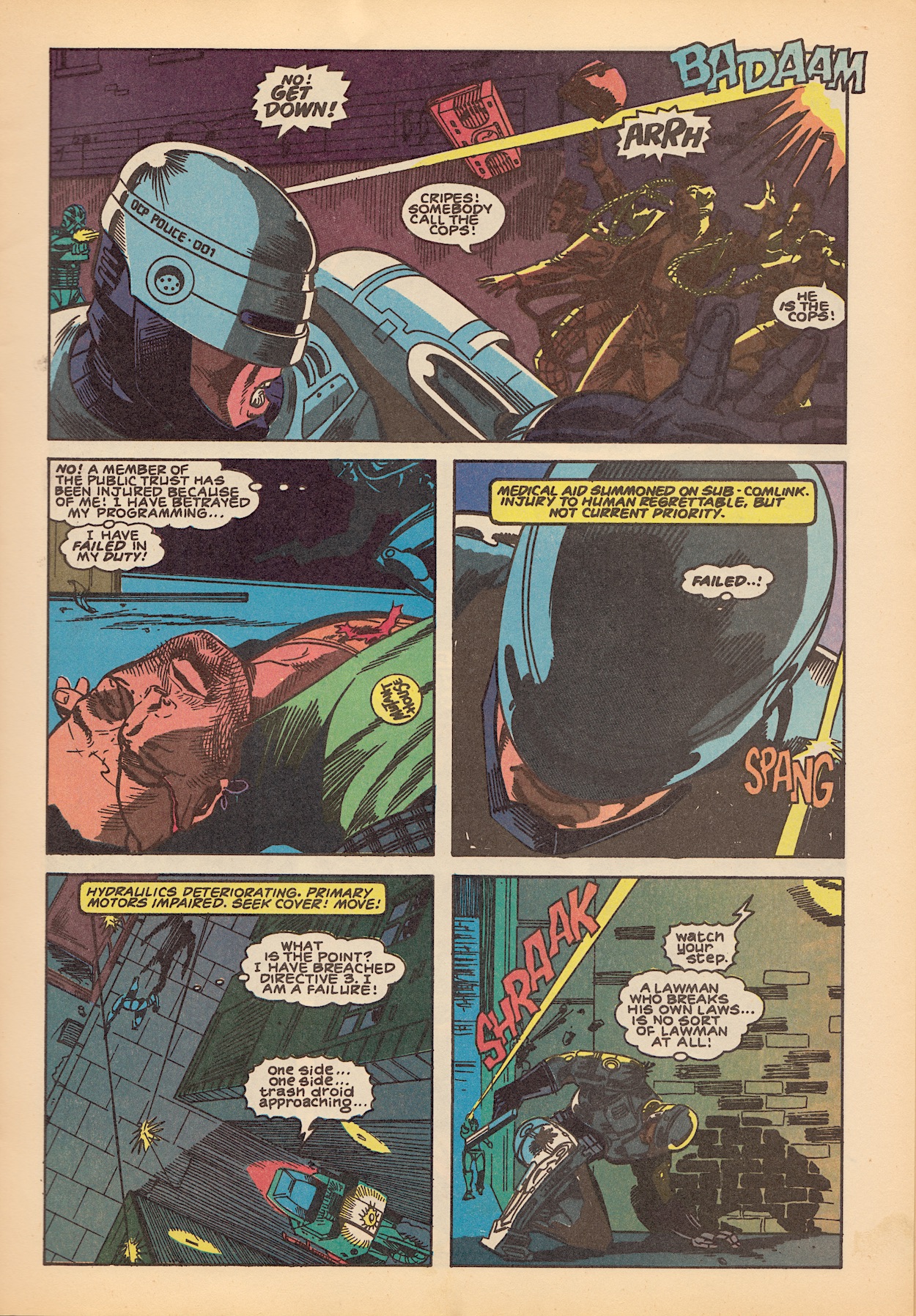
Before Murphy’s strip are two RoboCop features, with a third later in the comic. The first one concentrates on the franchise itself, in particular the in-progress RoboCop 3. The second movie had been released the year before and while it had proved to be a moderate financial success it was generally panned for not living up to the original. I remember being disappointed by it because Robo himself felt flat and boring.
What’s strange here is that Dave Hughes‘s feature describes the franchise as a “fatigued product” in a comic printing strips based on that product! How did that make it past the editor? He also criticises Robocop 2 but praises the fact that its head writer Frank Miller would be returning for the third film. Yes, I’m aware Miller’s screenplay went through various rewrites by other writers but it’s still a strange thing to be thankful for after not enjoying his first RoboCop sequel.
This second feature is meant to be all about the comic strip, a major selling point of Havoc’s anthology. Unfortunately, Mike Conroy really does take his sweet time getting to the stage of discussing them. It’s not really until the third column that he gets into the meat of it all and then it’s over. There really wasn’t a need to reiterate so much of the lore and background to RoboCop for people who would already have been up to speed on all of that.
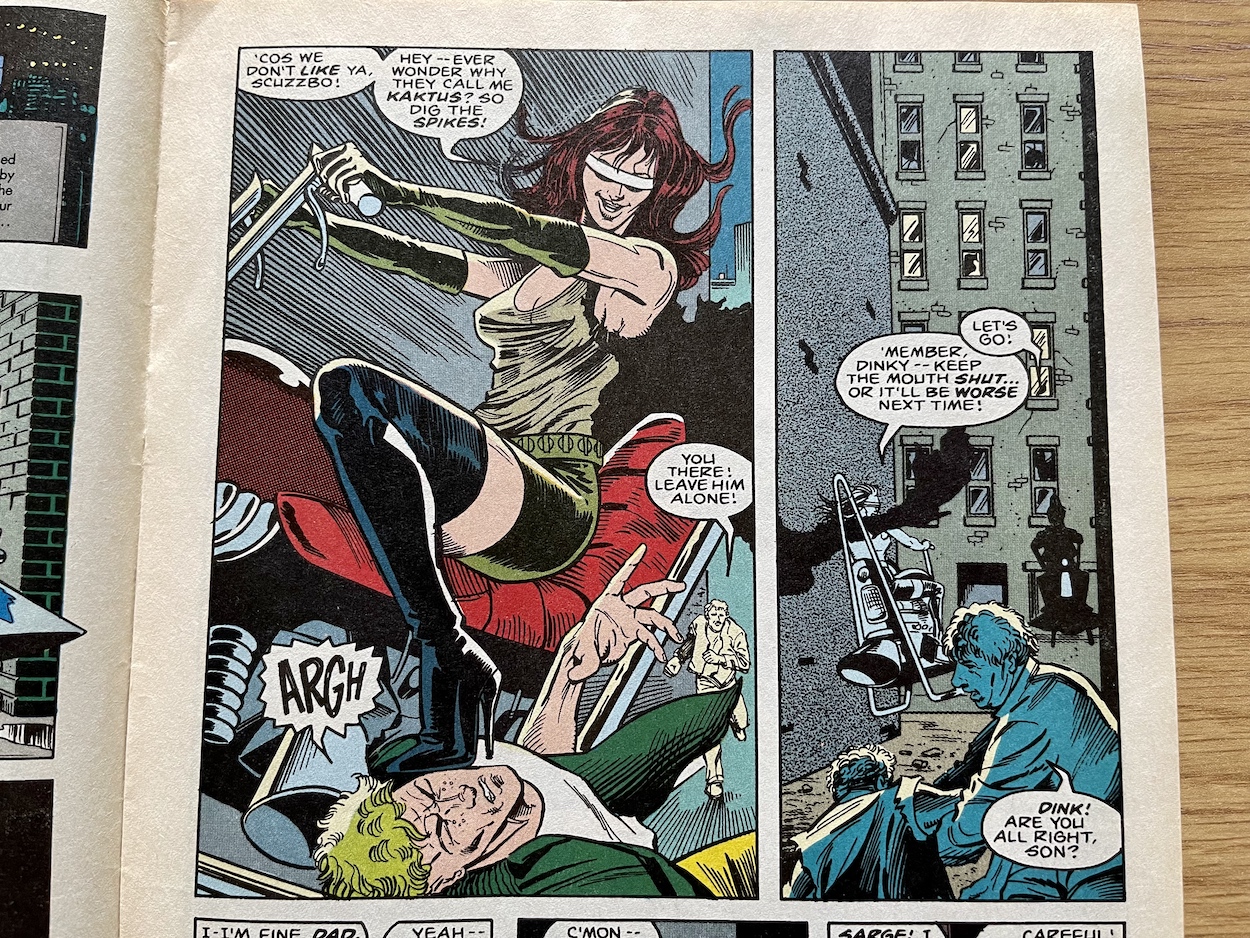
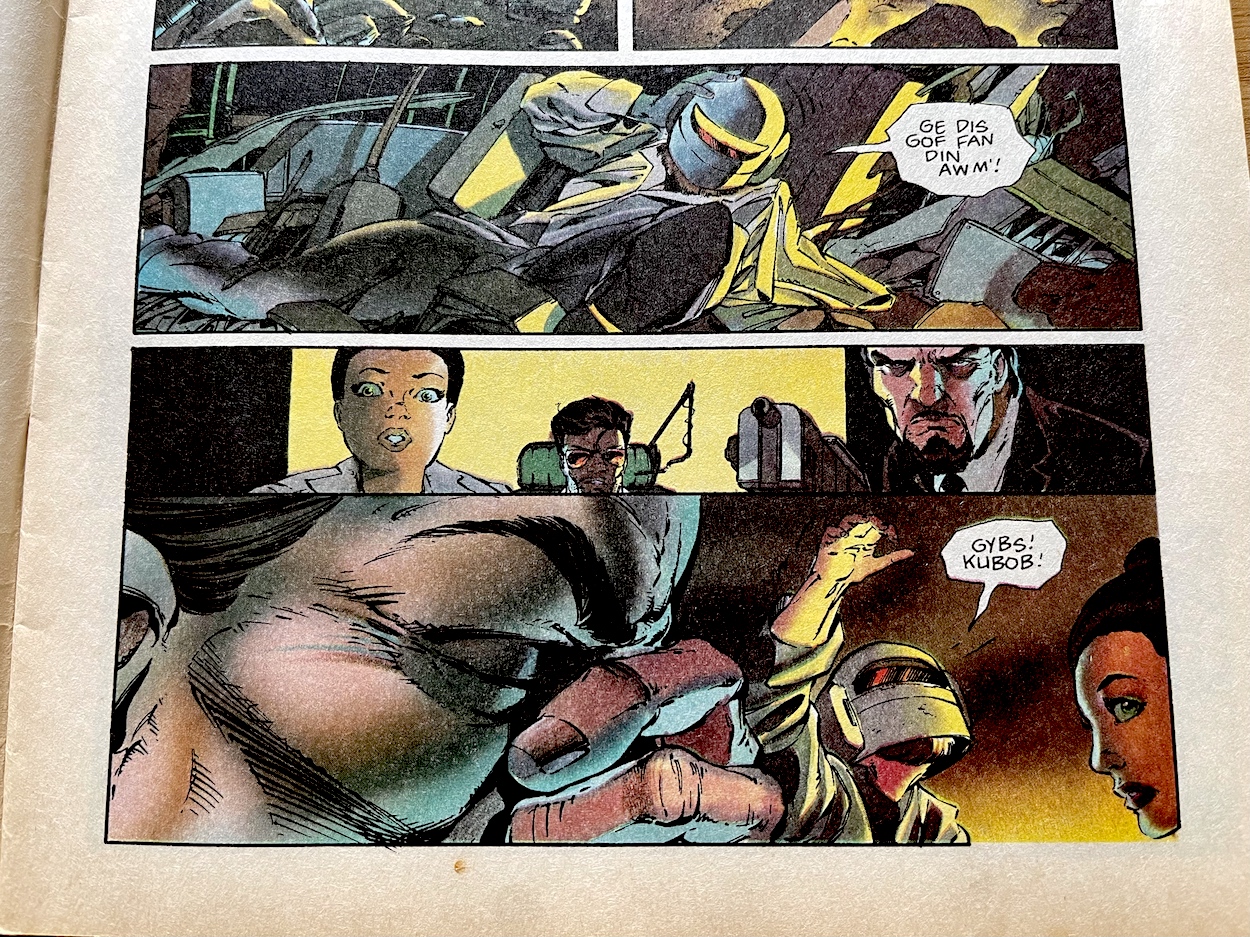
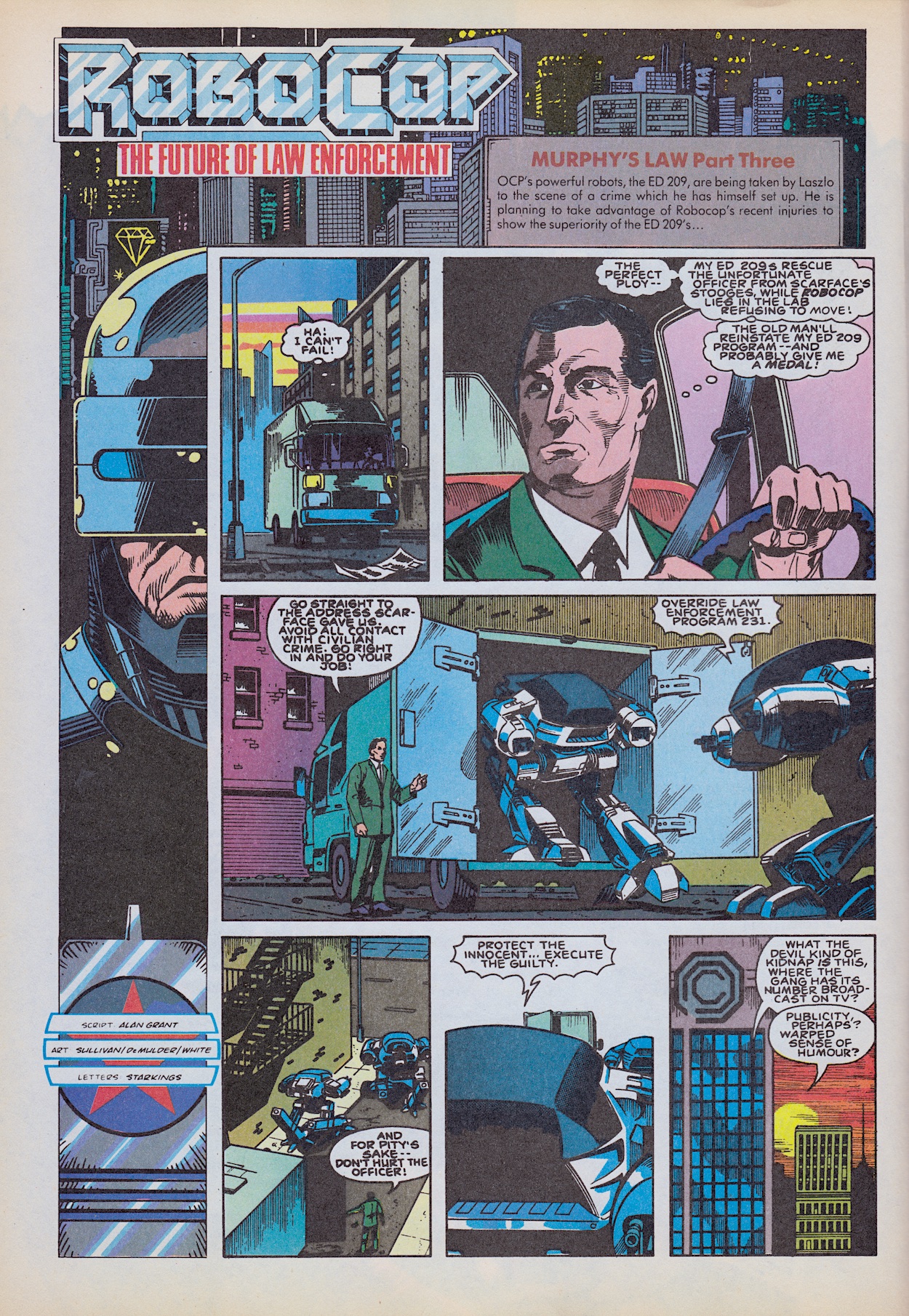
Let’s move on to the strip itself, part two of Vigilante by Alan Grant (with pencils by Lee Sullivan, inks by Kim DeMulder, colours by Steve White, letters by Richard Starkings) and it kicks off with muggers on hover bikes, showing how the comic would go all-in on the future setting, taking the strip more into the sci-fi fantastical than the original movie, which was more grounded. But this is a different medium and it works well to get across the setting and how dangerous Old Detroit really is. After this, the father of the victim complains about how the police are locking up people like General Power from last issue when the city needs them more than ever.
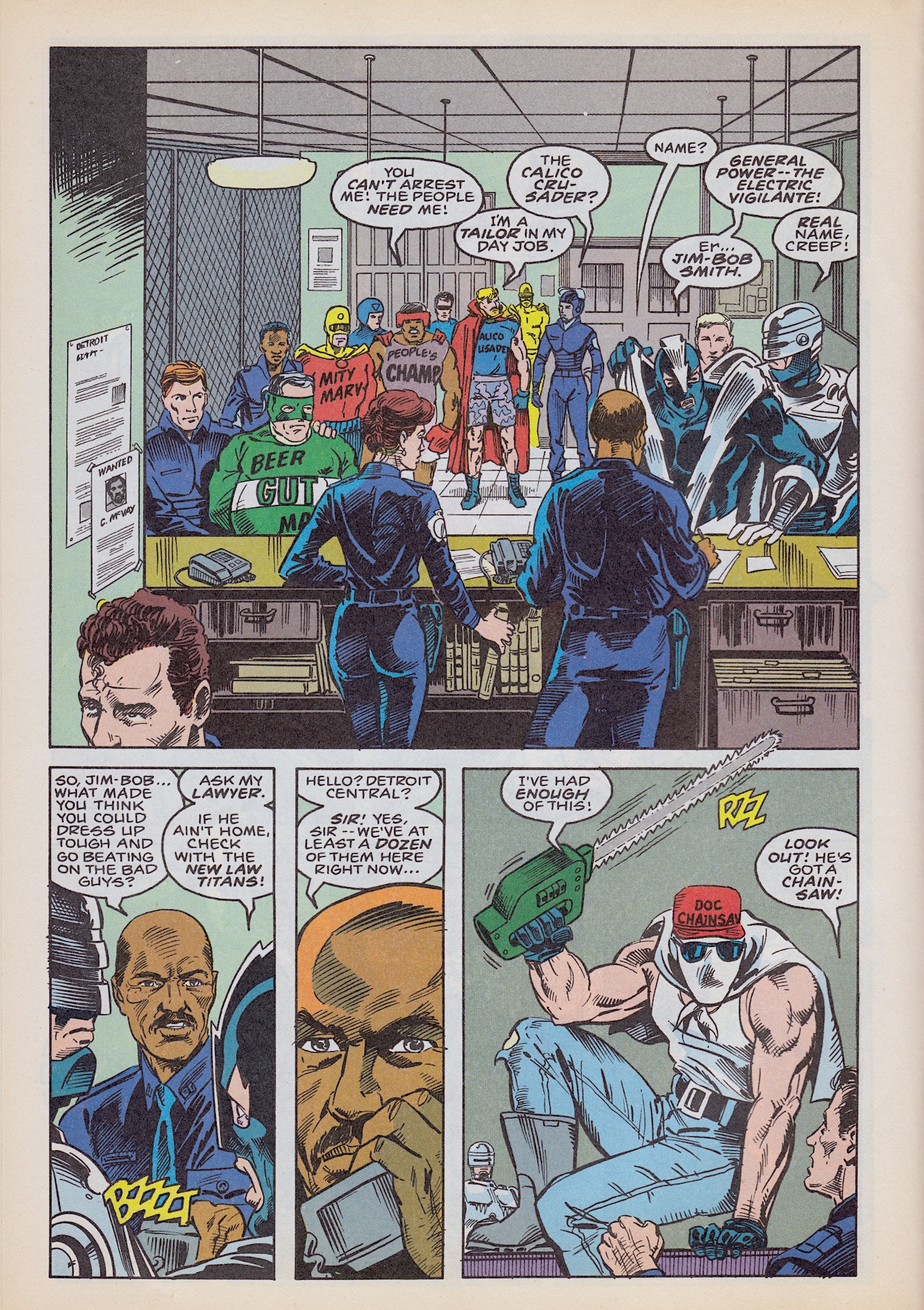
These masked vigilantes’ reputation is a lot better than the reality of the people behind the costumes. Take General Power for example. After frazzling the man he was trying to save last issue he’s brought to the desk of Metro West by Murphy and told to give his name. After declaring himself as ‘General Power’ he’s ordered to give his real name which he hilariously admits is Jim-Bob Smith.
With a precinct full of wannabe superheroes, one of them has had enough and what comes next is a bit of a shock when read today.
RoboCop was set in the not-too-distant future and the first movie and the TV show were, in hindsight, really rather prescient. So much so its surprising at times watching the series to see how well they predicted our world thirty years in the then-future, providing a scary insight into where we could be going. Bear this in mind when you see this next panel of that wannabe you saw in the final panel above, going by the name ‘Doc Chainsaw’.
He says it’s not against the law to “put on a suit an’ prowl the night” (which itself sounds more creepy than I think he intended) right in front of RoboCop. As if his red hat wasn’t enough, his general attire and his choice of words when confronted by Alex would be a bit on the nose if written today!
I don’t think I need to make any more comment on that one. Soon the sarge barks an order; all the vigilantes are to be charged with misdemeanours and set free. This happens much to the chagrin of the officers but has come down from the “very top” and thus the main mystery of the new story begins. Robo leaves to see if there’s something he can do (but we’re not given any more hints as to what this could be) and then we see former mugging victim Dink and his dad settling down to watch the city’s latest reality show, ‘The Detroit Vigilante‘ and that’s where it ends.
Deathlok and RoboCop have similar set ups but they’re handled in such unique ways you wouldn’t think they were unless you stopped to break down what’s at the core of their main protagonists. I was never a fan of the movie sequels to RoboCop so initially had some trepidation about these strips since they were also direct sequels, released before the TV show. But I’ve been pleasantly surprised to find a nice halfway point between the original film and the show, with Alan Grant grasping the character much better than the movie studio did around the same time.
“Pain is inflicted quickly and harshly upon those who would harm innocent children.”
Ghost Rider
It’s hard to judge a comic strip series based on only the first couple of stories but I’ve been impressed with this version of Murphy so far. The first story brought the action, the second concentrated more on the characters and this one feels like it’s settled in more to the episodic nature of the storytelling, this first part setting things up nicely. Normally I’d be eager to see the next chunk but it’s just not forthcoming right now. Sadly, it’s goodbye to another favourite for the time being.
To soften the blow (although this wasn’t the original intention) we get a third feature for our part man, part machine, all cop hero, billed on the contents page as an interview with Marvel UK artist Lee Sullivan who did superb work on RoboCop for the American arm of the publisher. Calling it this is a bit of a stretch though. It reads as if two quotes by Lee were pulled from a general career interview, with one answer about RoboCop and the other about Doctor Who, filled out with information about the artist.
“…and because we know where everything is, we methodically begin to eliminate anything that ought not to be there!”
Star Slammers
Don’t get me wrong, it’s interesting information and a good article but I was looking forward to an actual interview about Lee’s work on this particular strip. That’s two of the three features about this character that feel like they included an awful lot of padding to make up the page count. Such a shame because I do enjoy Havoc’s extras but I’d have preferred those two to have been combined into one and another Eye Level included instead.
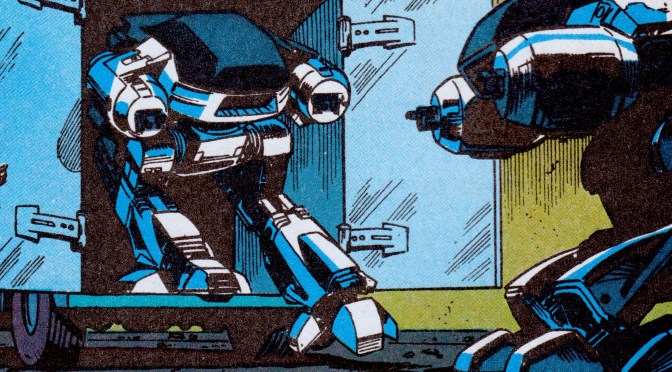
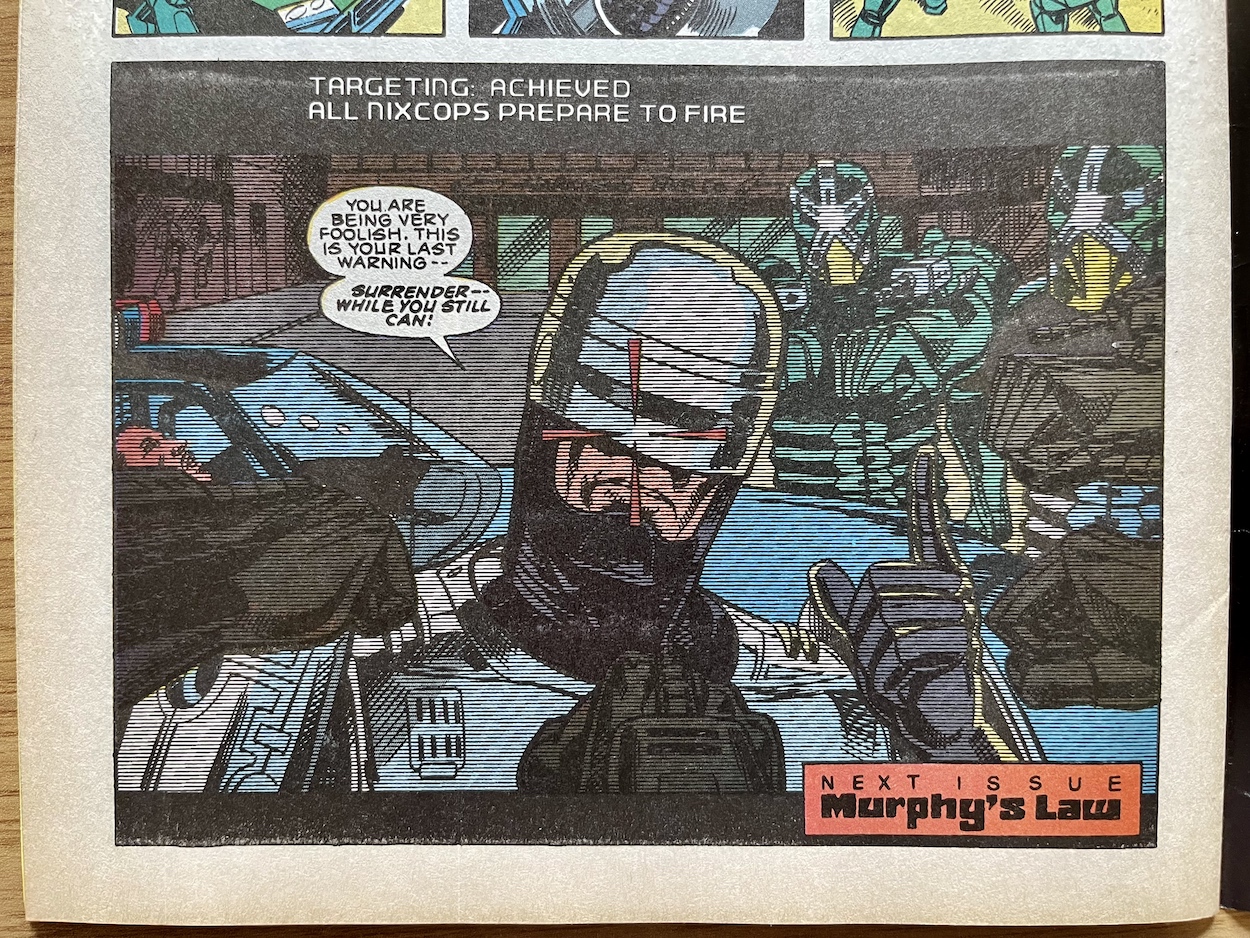
There’s mention here of Marvel no longer having the RoboCop licence which again is a strange thing to include when you’re trying to entice readers back for more. About a year before this, Marvel UK’s Transformers announced the forthcoming release of a new RoboCop fortnightly comic. It was never released, with Robo appearing the next summer in Havoc instead.
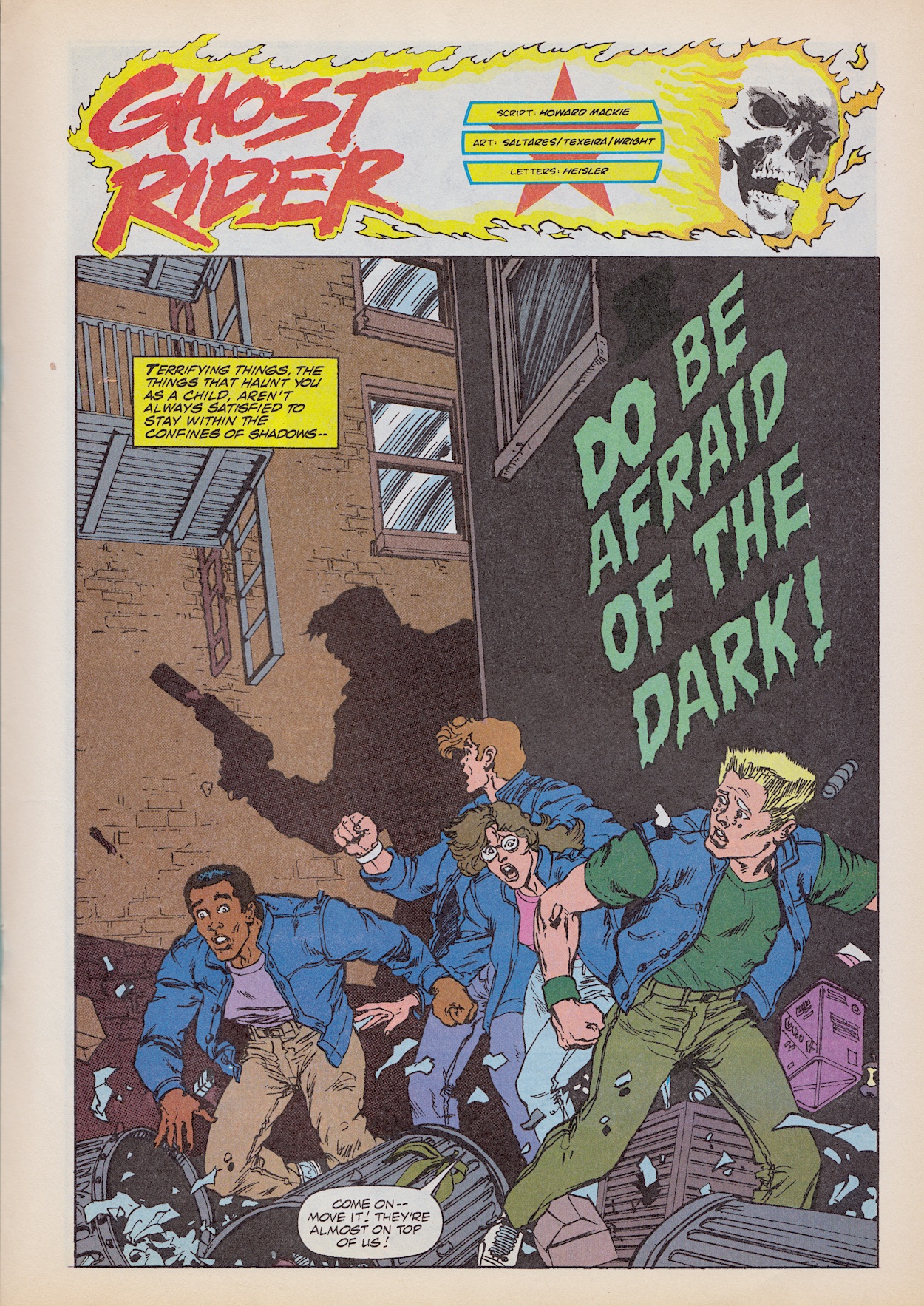
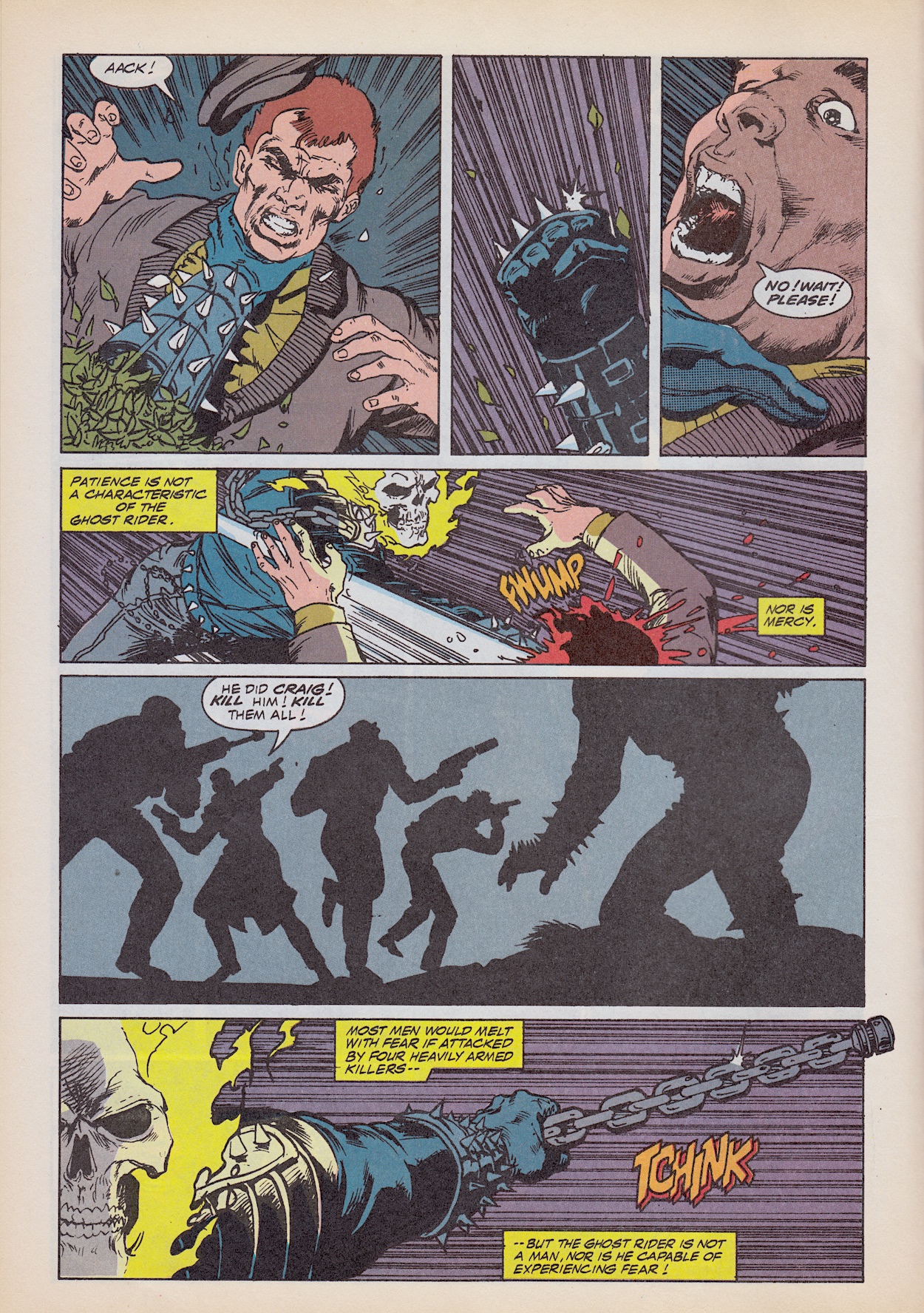
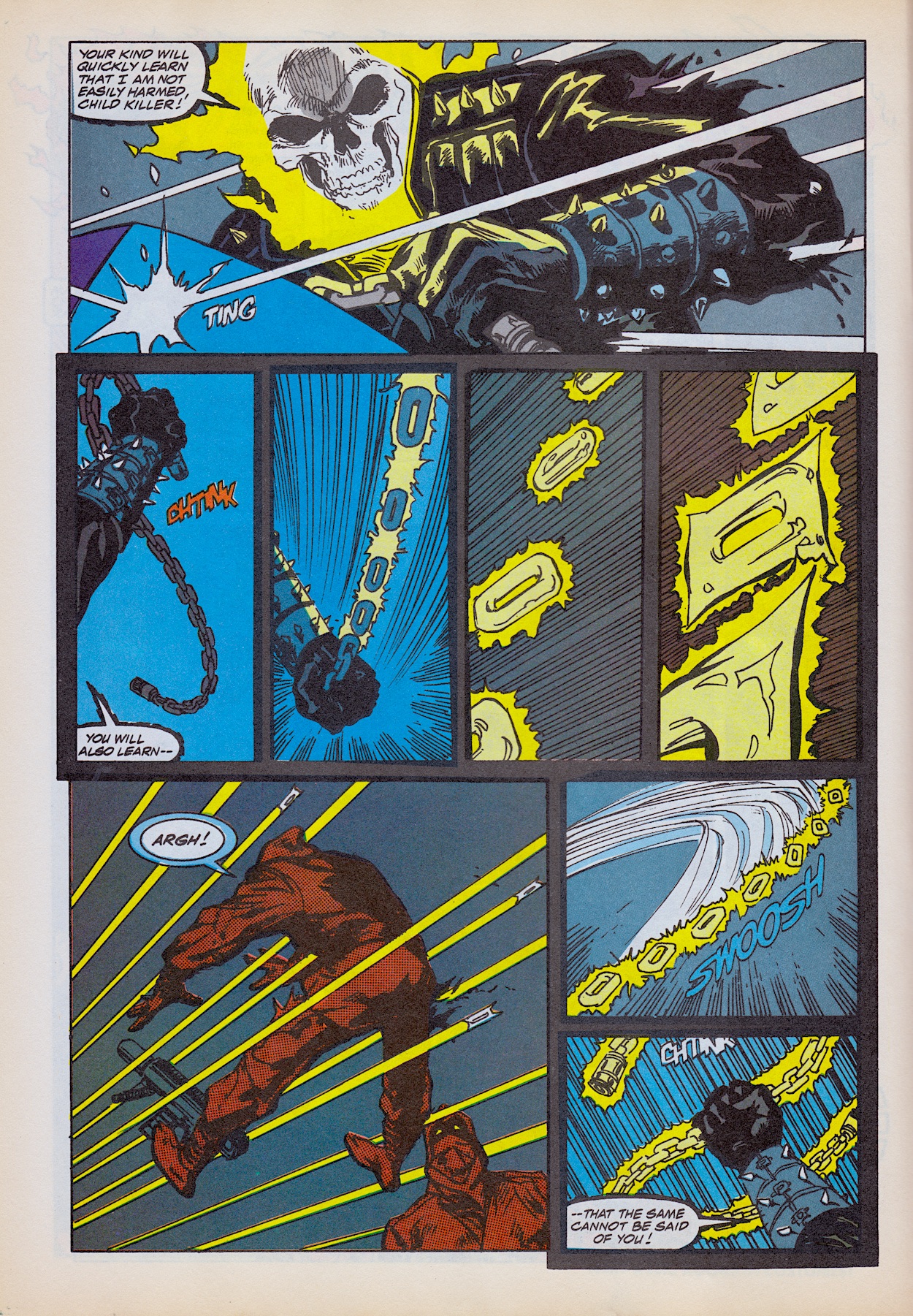
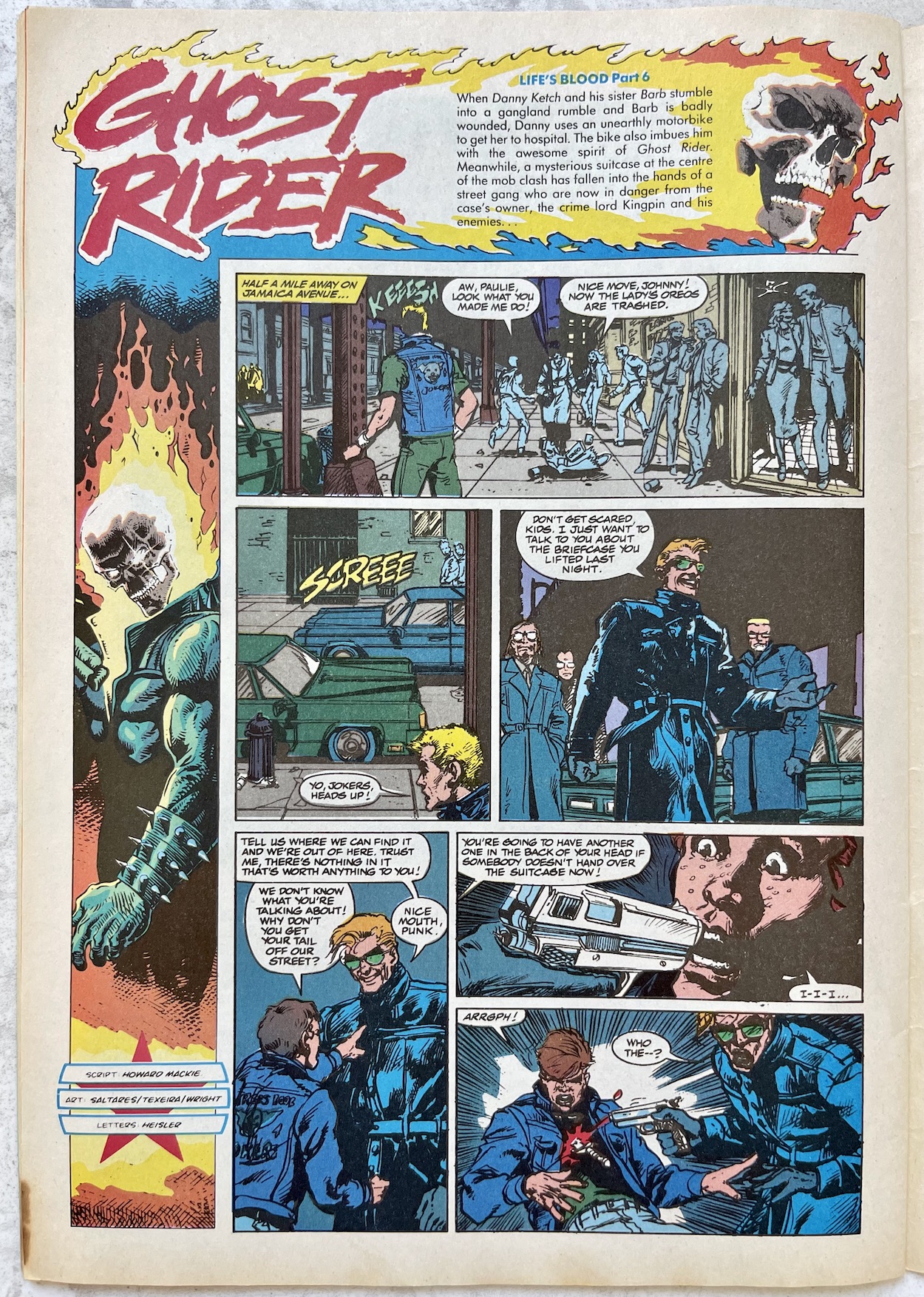
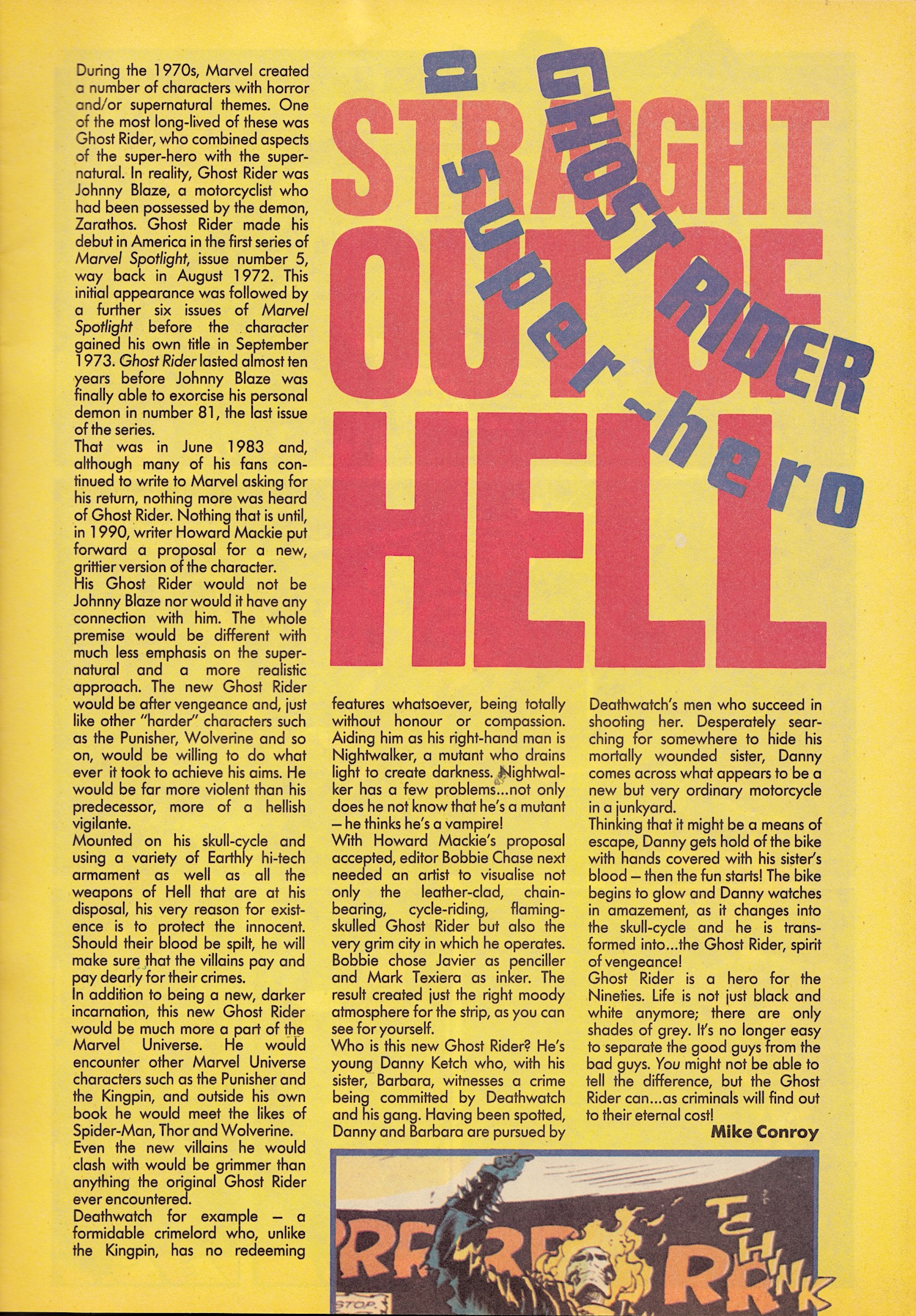
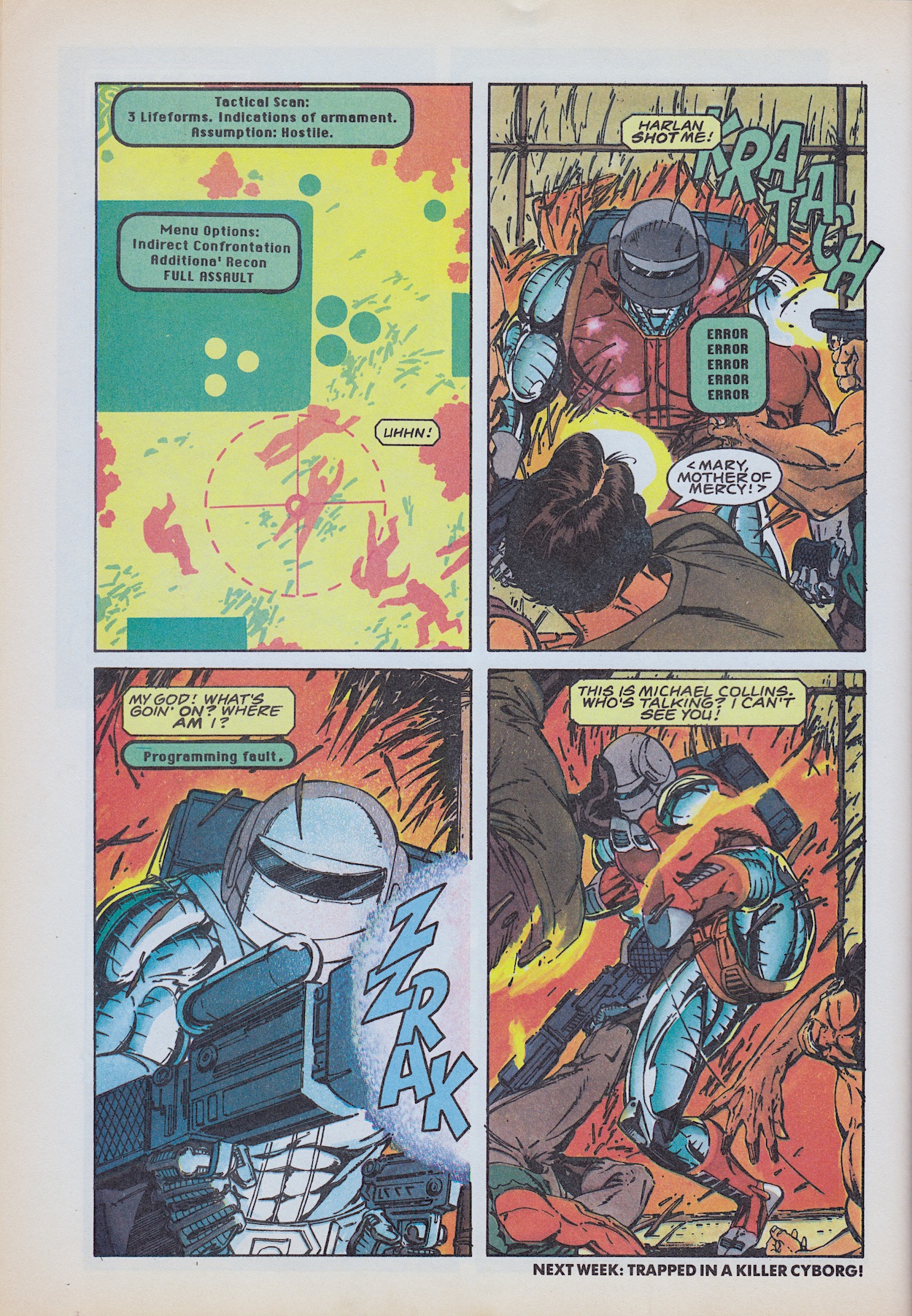
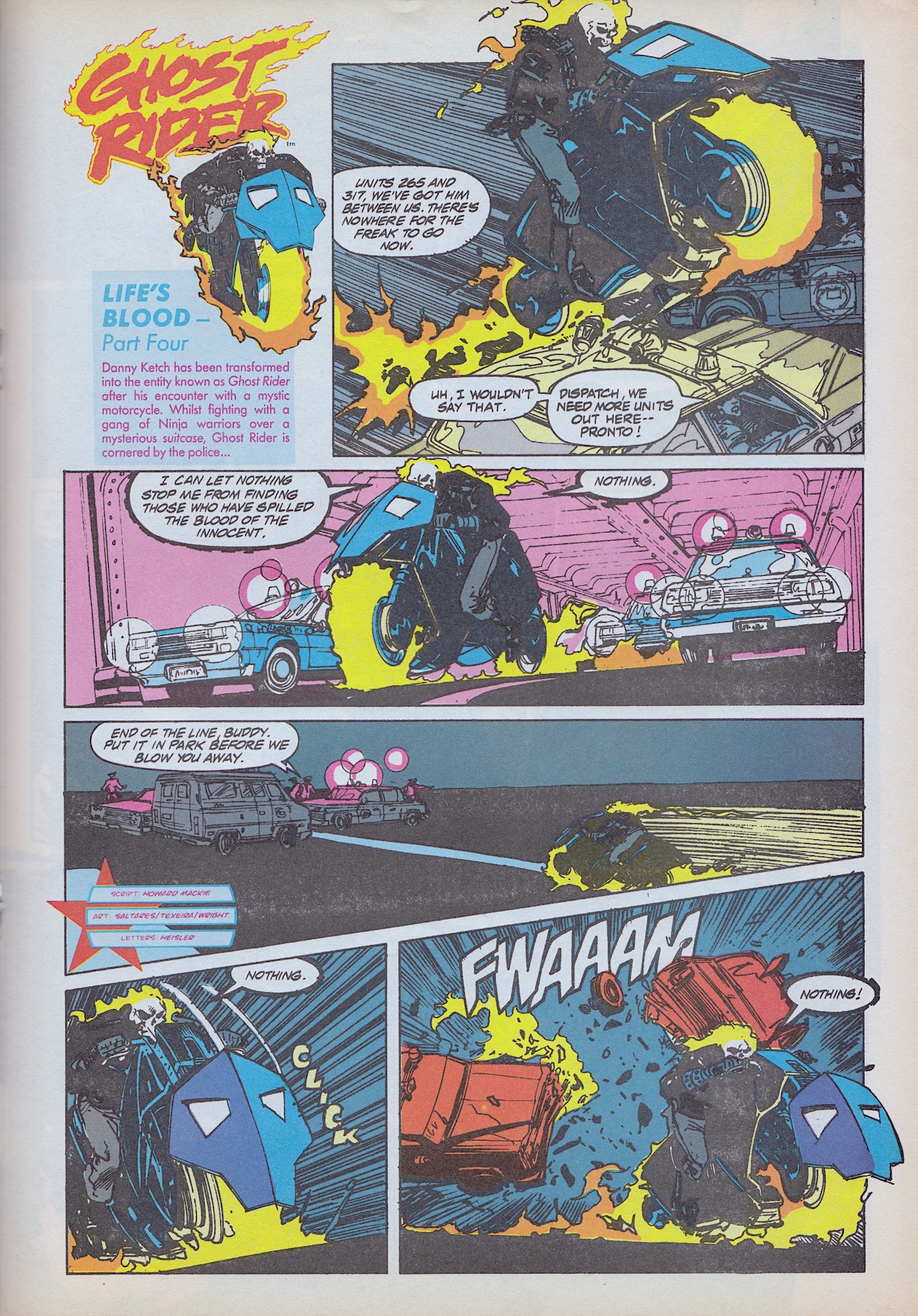
Danny Ketch and his Spirit of Vengeance get the bulk of pages this issue with part one of Do Be Afraid of the Dark (written by Howard Mackie, pencils by Javier Saltares, inks by Mark Taxeira, colours by Gregory Wright, letters by Michael Heisler) which begins with the gang of kids from previous issues, now referred to as the Cypress Pool Jokers, hunted down by who we assume are Deathwatch’s minions. Demanding to know where the canisters are, they’re threatening the lives of the kids at gunpoint when a bright light and roar of a motorbike from a nearby hedge halt proceedings.
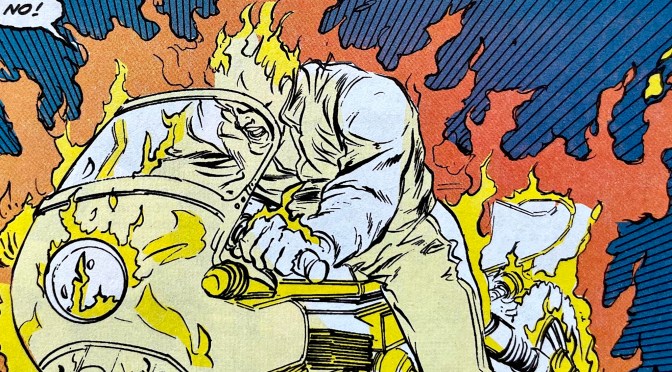
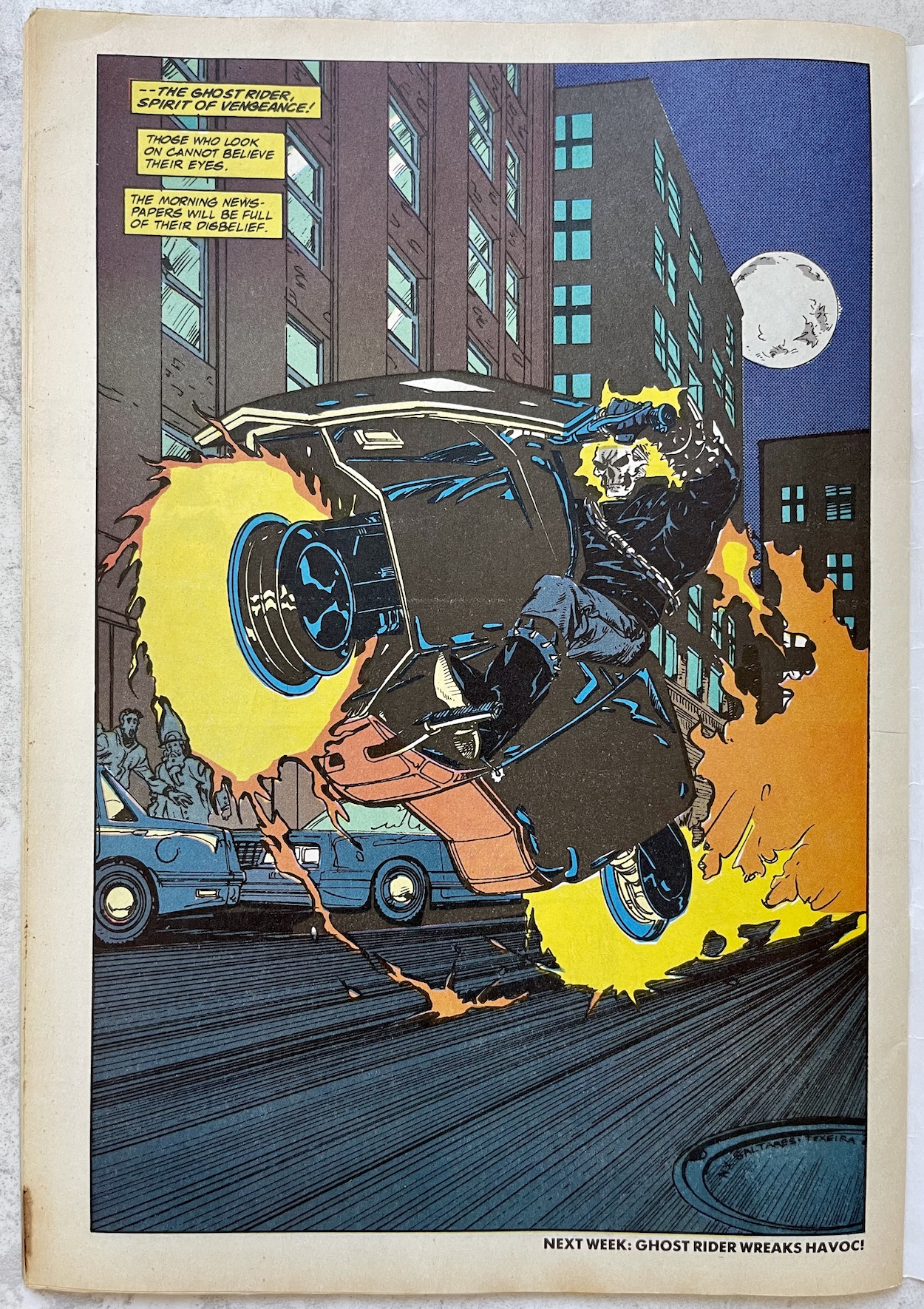
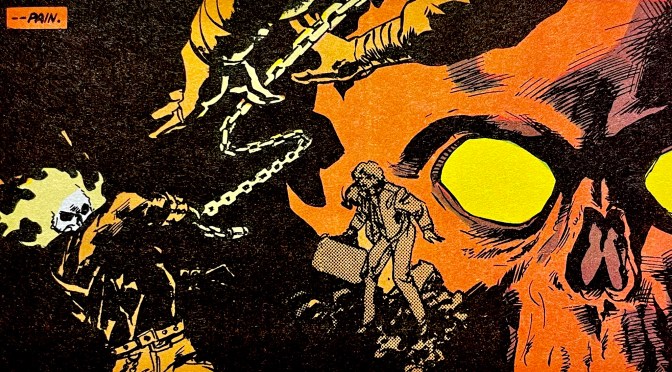
Out zooms the Ghost Rider, glowing against the night sky, only to be met by a hail of bullets. What’s interesting is that everyone knows his name already, his presence in the city plastered all over the newspapers and of course the criminal underworld would be all too aware of him after he took some of them out. Falling off the bike and back into the hedge, the night goes dark again, the Ghost Rider’s flame apparently extinguished. Until the next page that is.
Scenes involving the Ghost Rider when apparently surrounded and outnumbered are always great fun but I can only imagine how awesome these would’ve seemed to a teenage me. (I’m sure they were but my memory has let me down.) I can confidentially say this was unlike anything I’d ever seen before. Brutal but thrilling in equal measure, this first part of the new story really hits the ground running. Essentially a direct follow up to the origin story, it’s unfortunately not clear in these first seven pages whether any other main plot would be introduced.
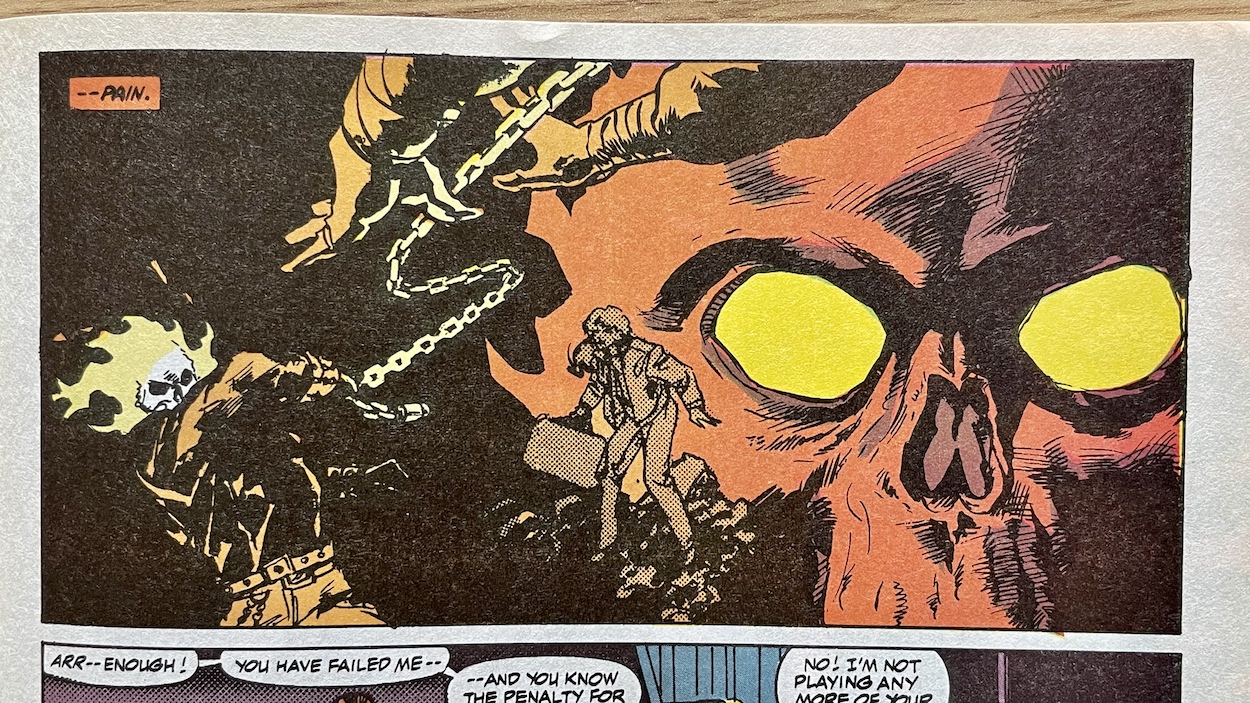
On the next page it’s stated how Ghost Rider would normally take his time, ensuring to inflict the most pain possible on these men, equal to the pain of each individual’s past offences. But this night he needs answers and so he lashes his magical chain around one of them and drags them away off the back of his bike, the criminal’s body bouncing up and down on the road over the ghostly flames.
Hung over the side of a very tall building Eldon finally admits he’s not part of either criminal enterprise. Instead, he’d heard about Kingpin looking for the mysterious canisters and so he thought he’d take his gang out to find them, present them to the criminal mastermind and get in his good books. Ghost Rider gets no answers but that image of him, followed by the fate of Eldon have me gagging for more.
The kids see him drive off, recognising him now as one of the good guys. “Man, he’s hot!”, exclaims one as he disappears from their sight, and from mine. This appears to be the most serialised of Havoc’s strips rather than individual stories, at least for the time being and I’m gutted this is my cut off point again. As my introduction to Ghost Rider he’s been a brilliant character in a very well written strip illustrated in a scratchy, mature fashion that perfectly suits him. Defintley my favourite part of Havoc and the one I’ll miss the most.
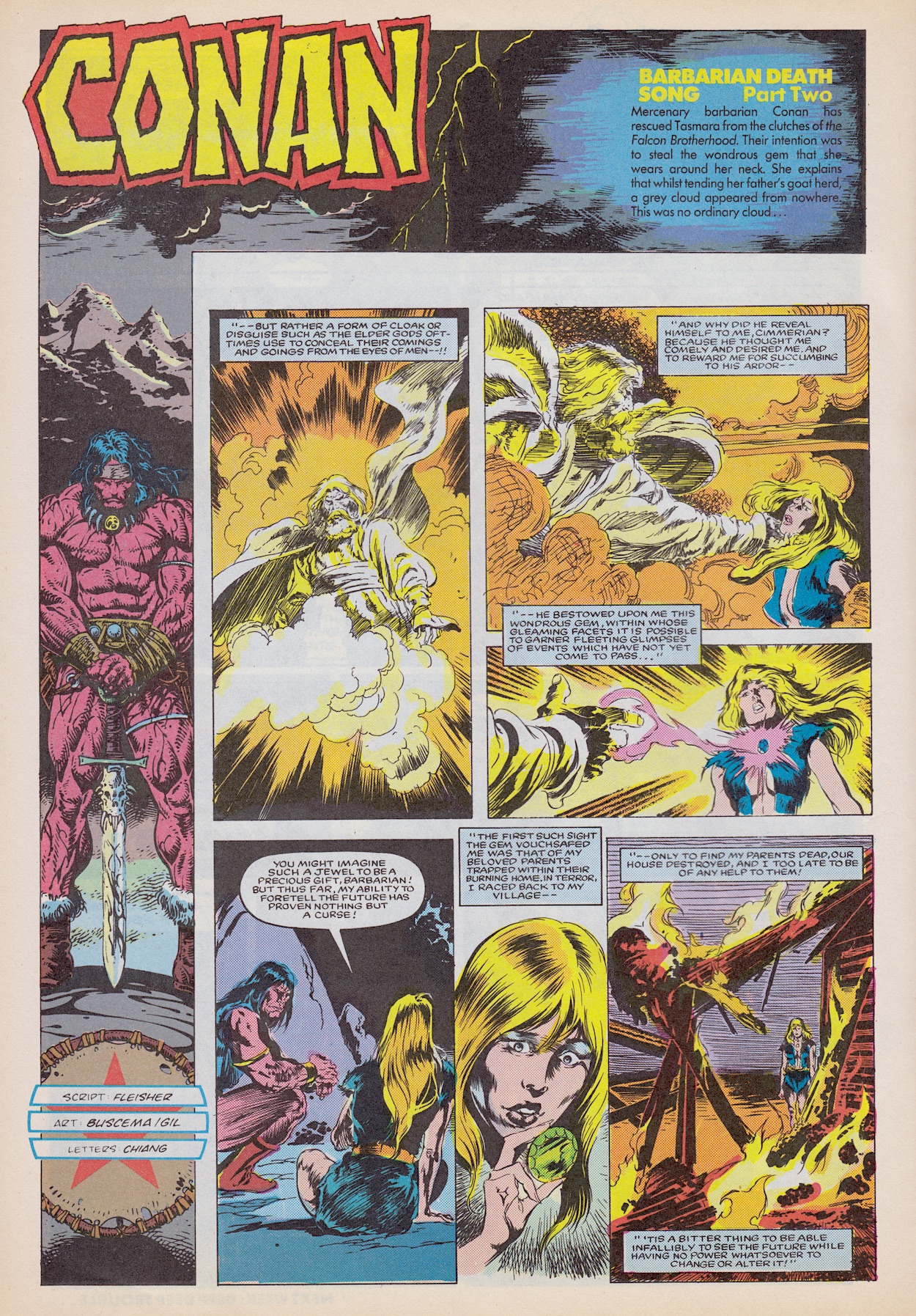
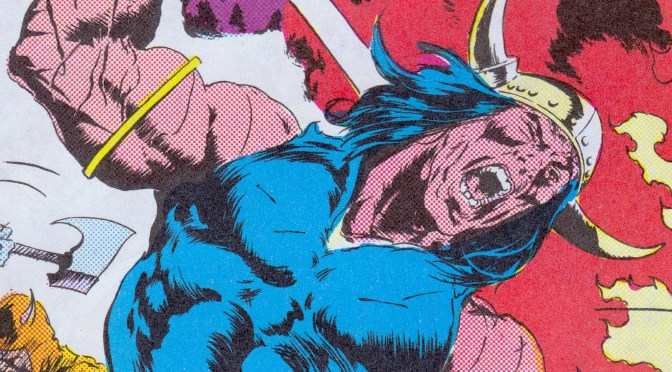
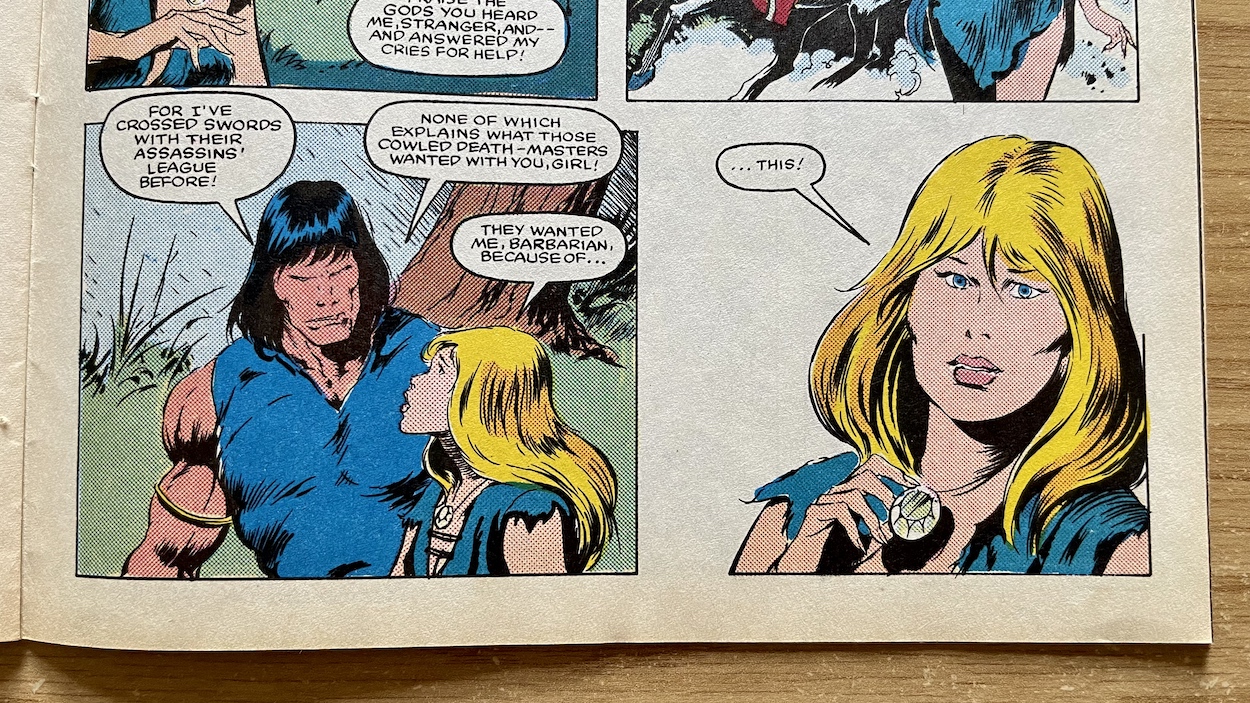
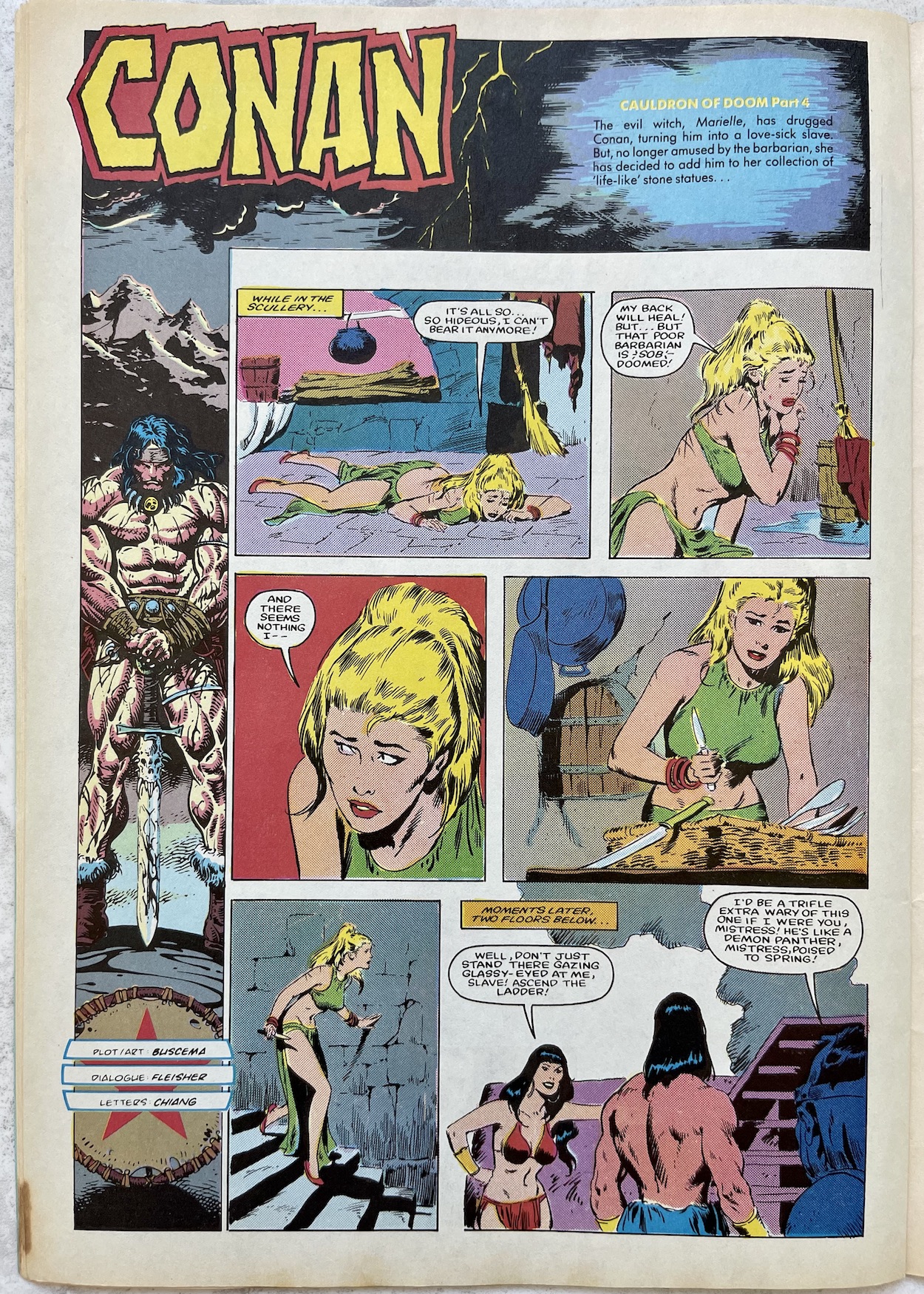
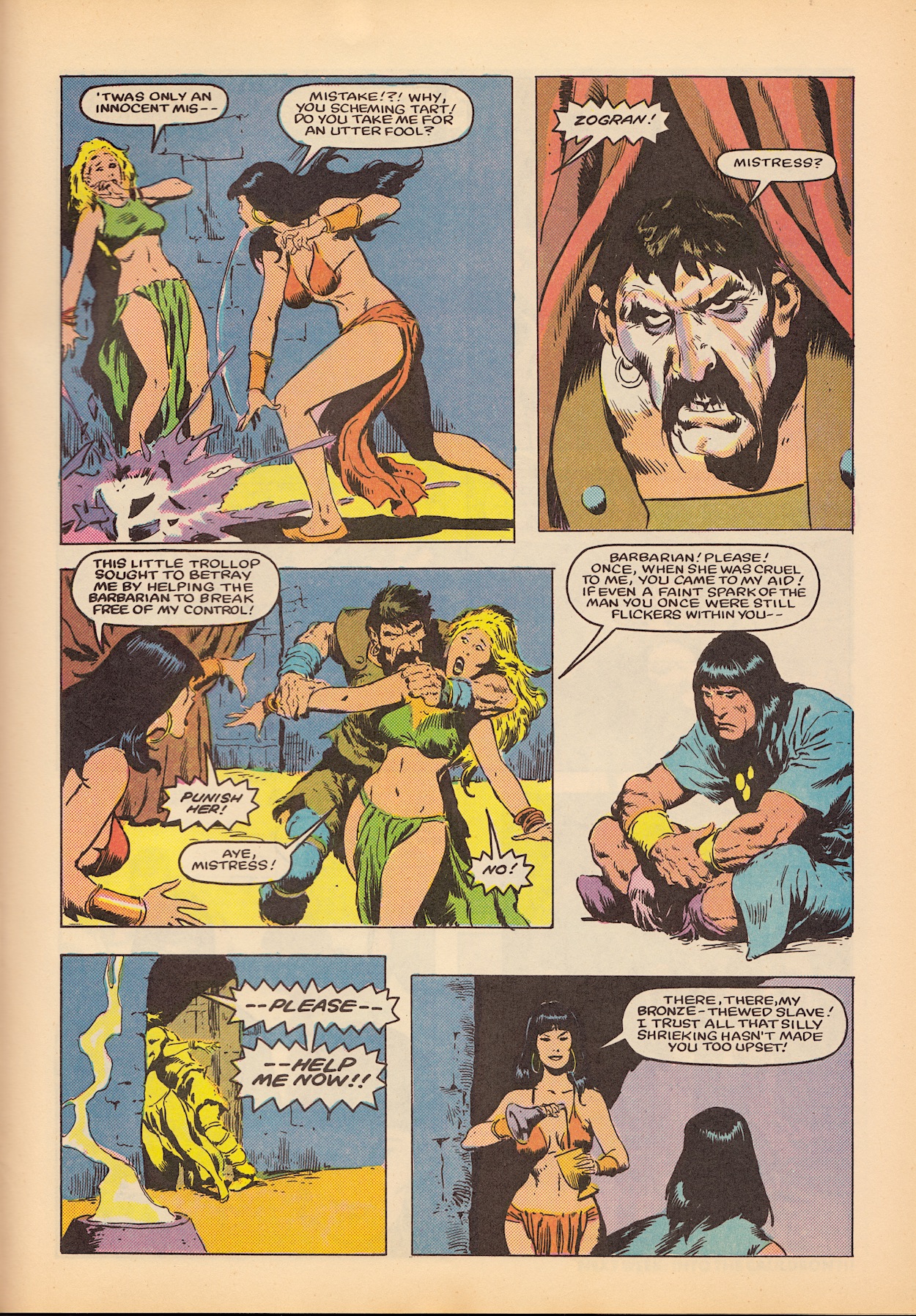
Part two of Conan’s Barbarian Death Song (written by Michael Fleischer, pencils by John Buscema, inks by Armando Gil, letters by Janice Chiang) sees our female guest character finally named (Tasmara) and she explains the cloud from last time was actually some random god who bestowed the jewel upon her neck because he was so enraptured by her beauty. She’s now being chased down by Baron Gerdeg and his Falcon Brotherhood because it gives her the ability to see the future, something she realised through tragedy as you can see above.
This gives this fantastical element a sense of foreboding right from the start; it’s a curse rather than the gift it was intended as. As they chat she sees something else shocking, Conan’s death! Her vision includes his funeral procession, accompanied on either side of his coffin by both allies and foes he’s previously fought alongside and against, taken directly from the poem this story uses as inspiration. For more on that check out last week’s review which explains Conan’s last ever story.
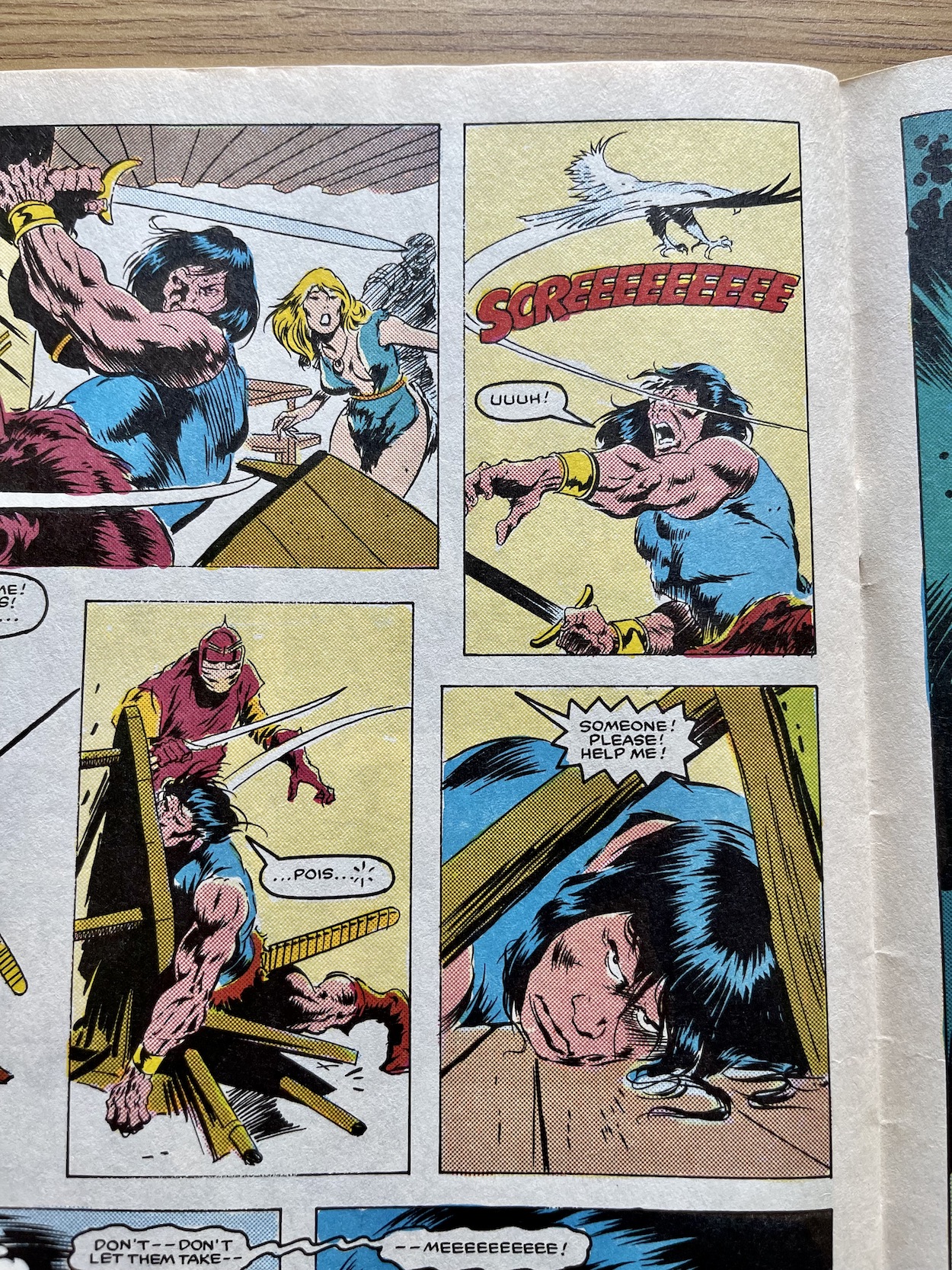
Conan and Tasmara head into the local town to eat and drink before making their way elsewhere, hoping to beat death by getting far away from danger. But the Brotherhood, who also have history of being defeated by Conan, have bribed a dancer in the tavern to dance for Conan using birds they supply her with, their talons tipped with a deadly poison.
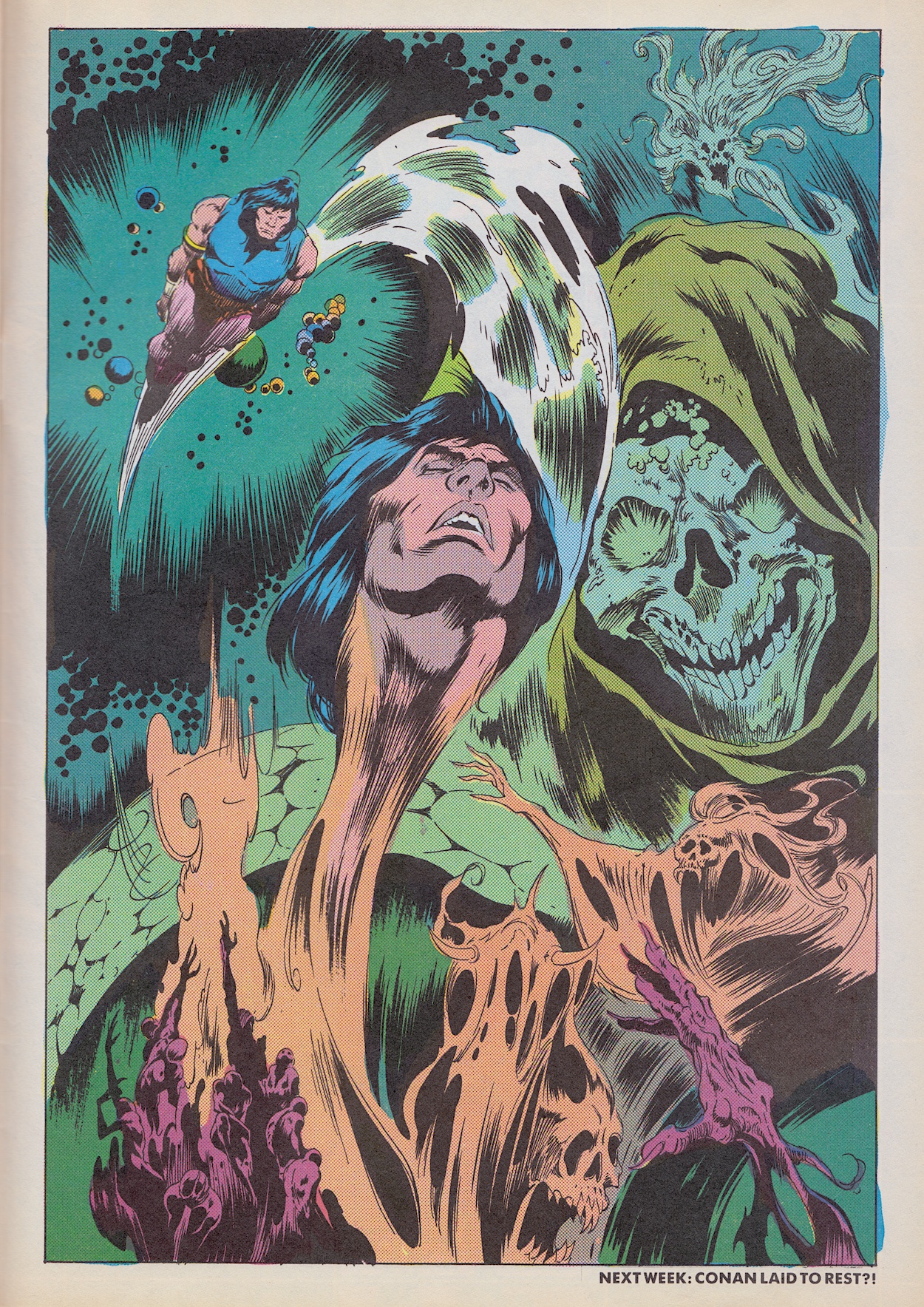
Conan collapses and his last view before he blacks out is of Tasmara being taken. We then see his consciousness slip into another realm, a realm of death and decay by the looks of it. You can see the Next Issue caption at the bottom of this next page. Yes, this is how Conan ends!
It would have been a great cliffhanger normally, but this was where we were left hanging as we desperately waited for #10 to appear. Now knowing it never would makes this all the more frustrating of course. Conan’s first story may have been somewhat outdated and out of place in Havoc, but the second story made up for that somewhat with its humour despite its underwhelming ending. This story seemed to have more going for it and, knowing the poem it was based on, I was eager to see how it turned out. Alas, for now I can’t.
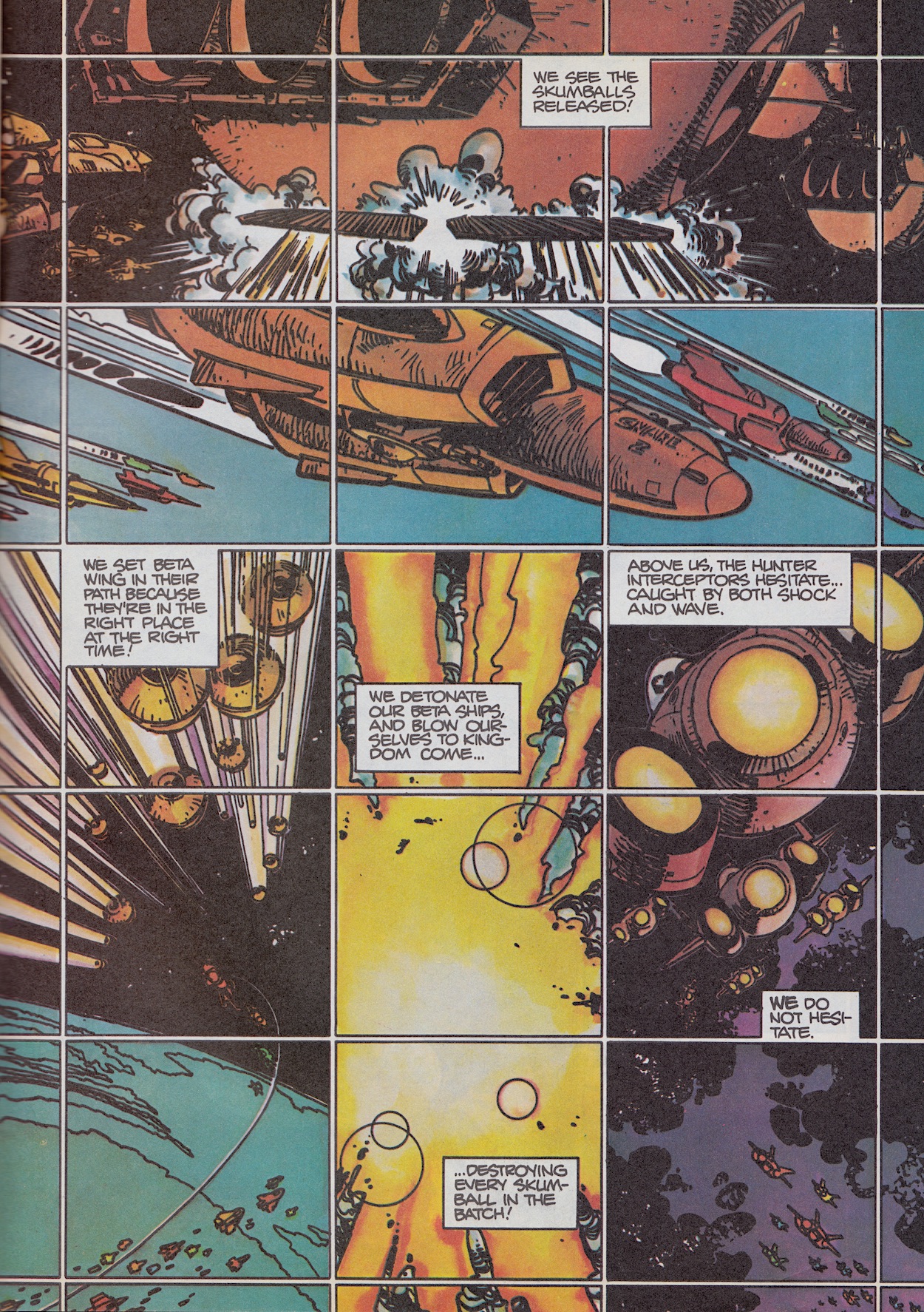
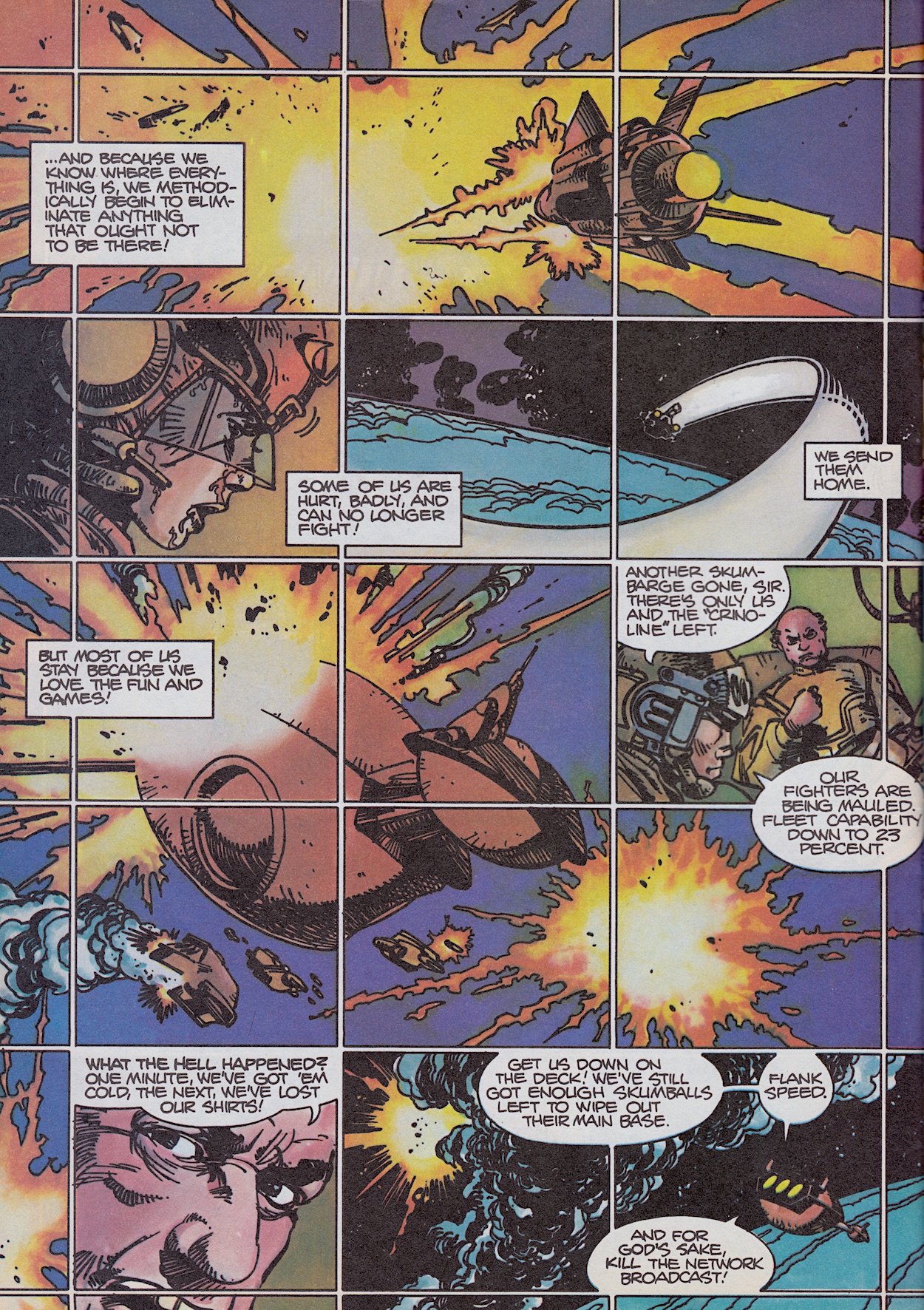
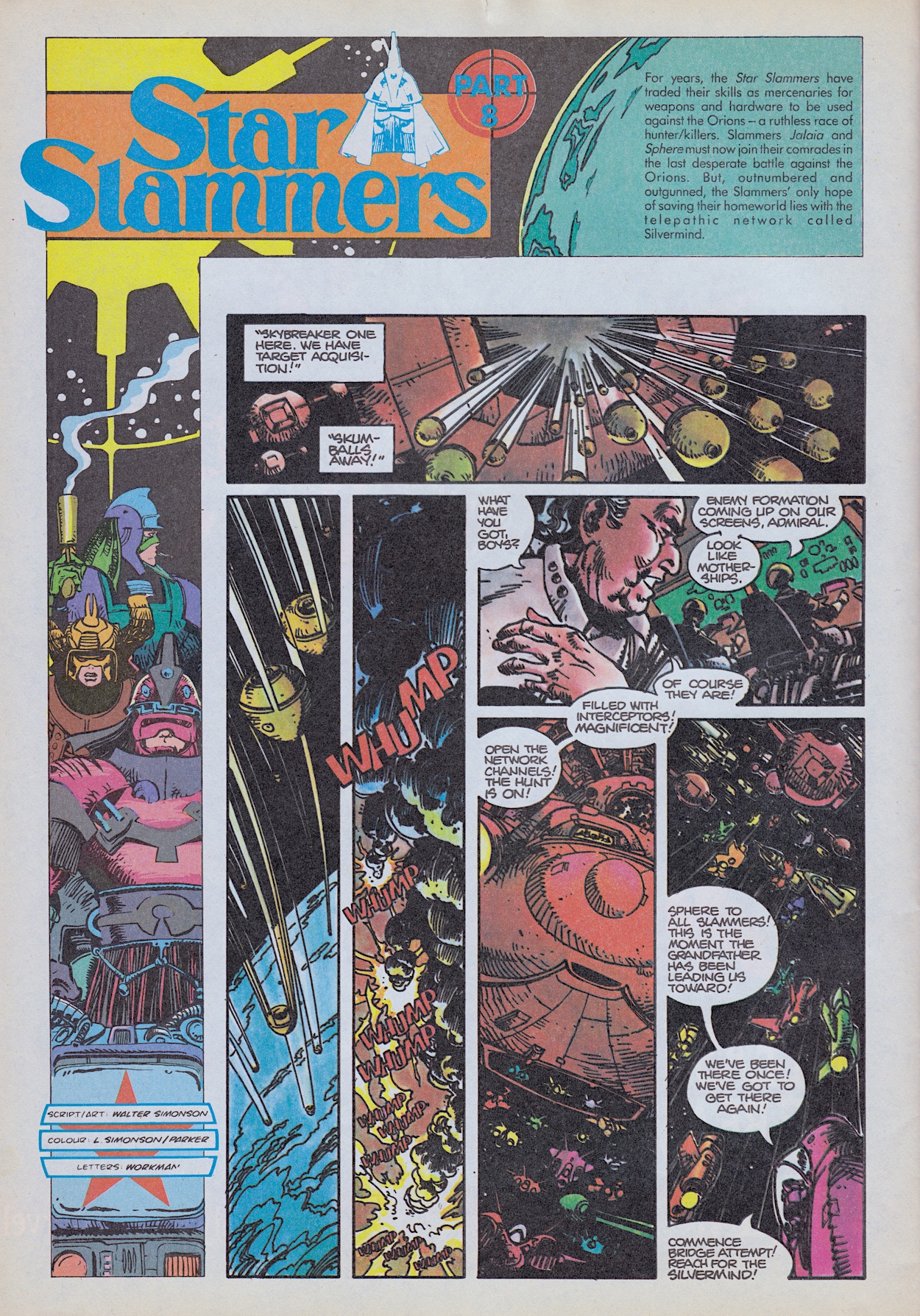
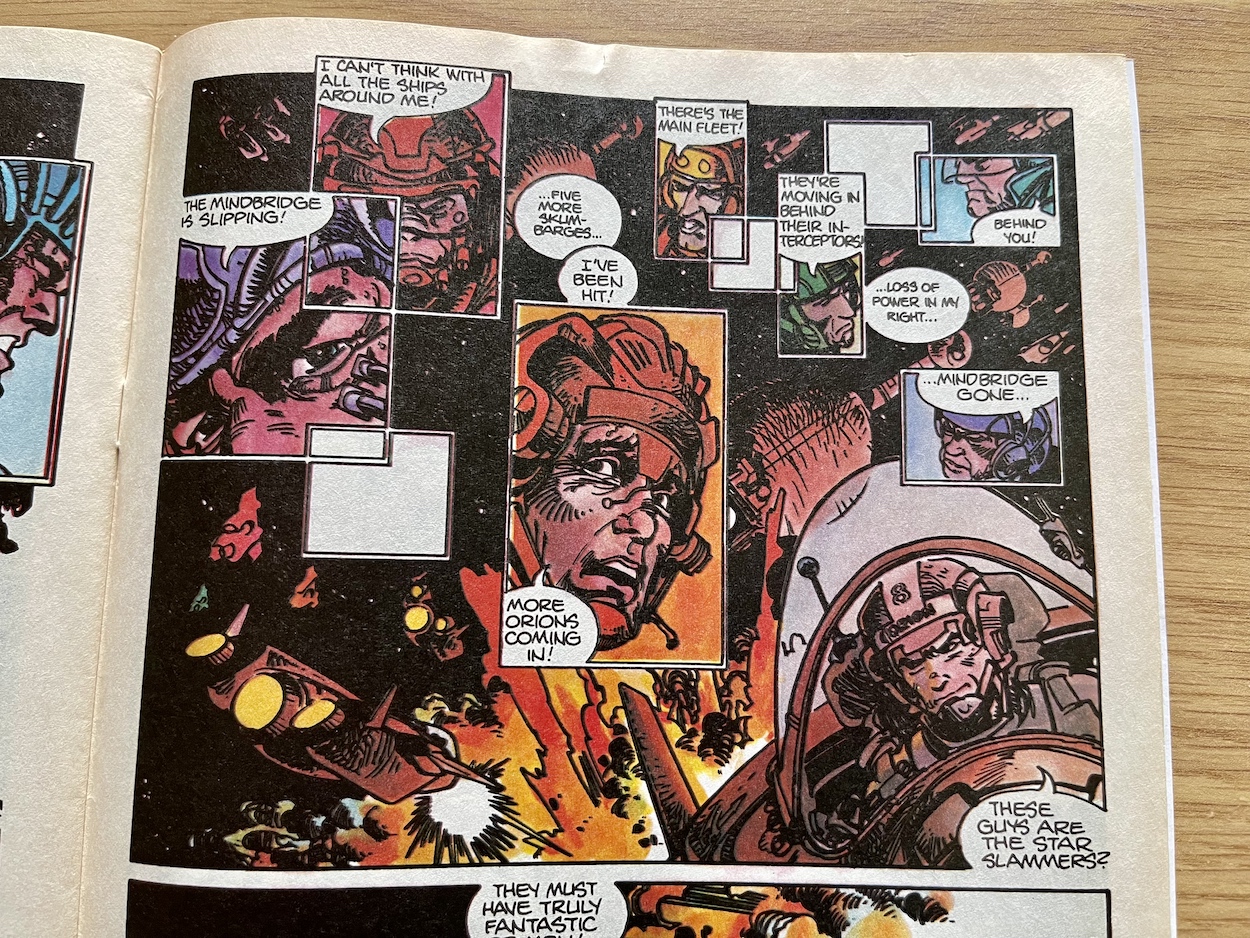
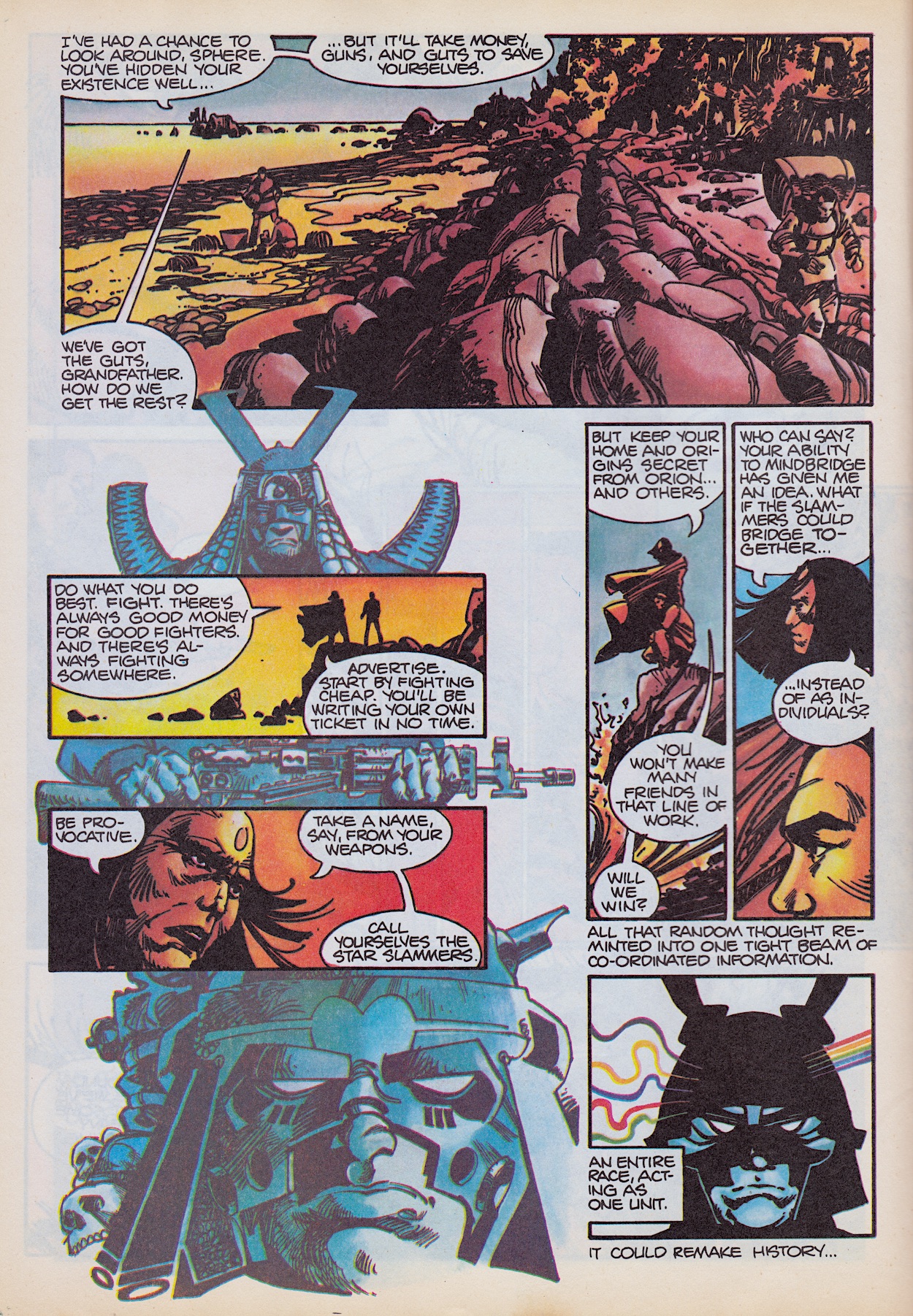
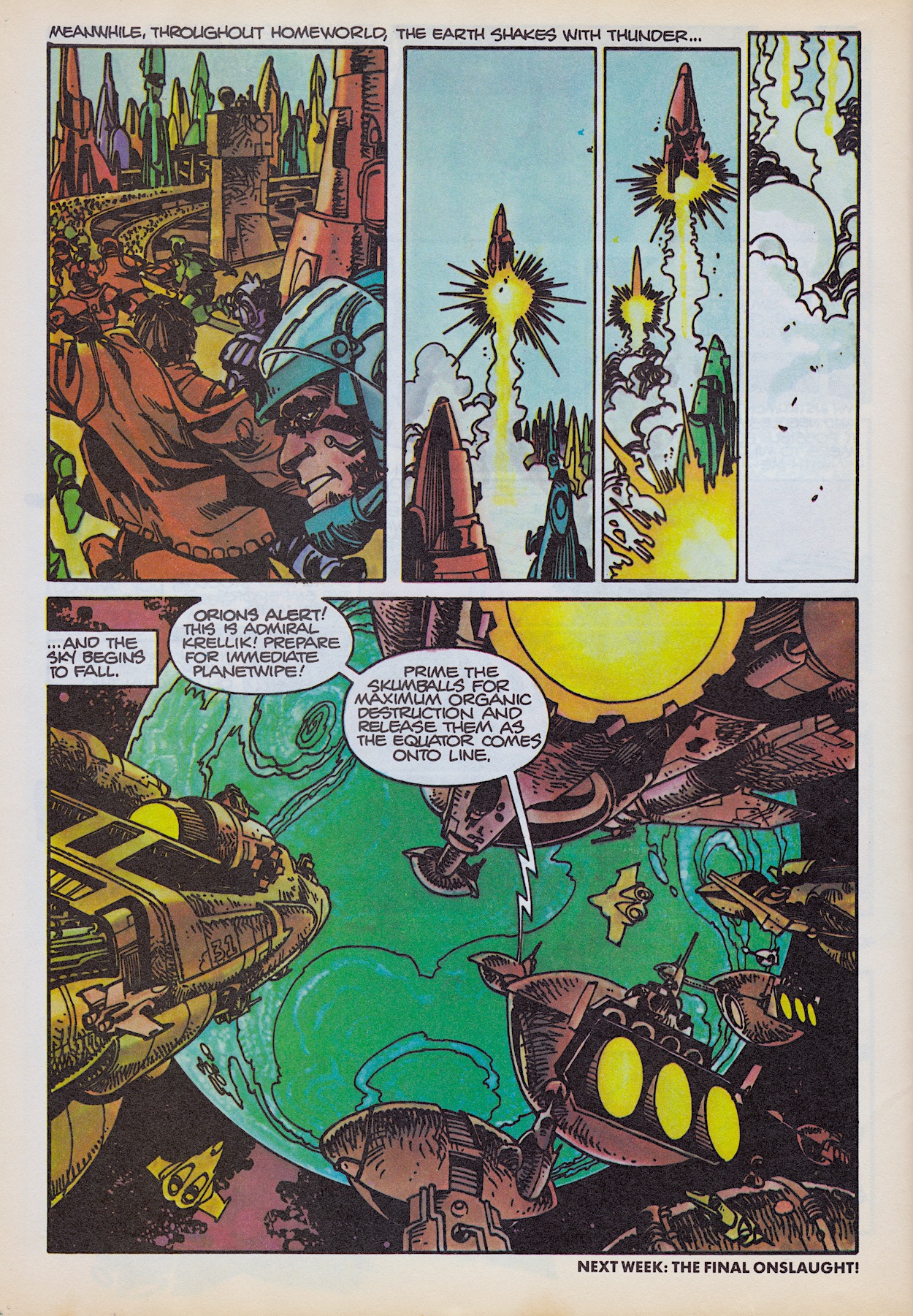
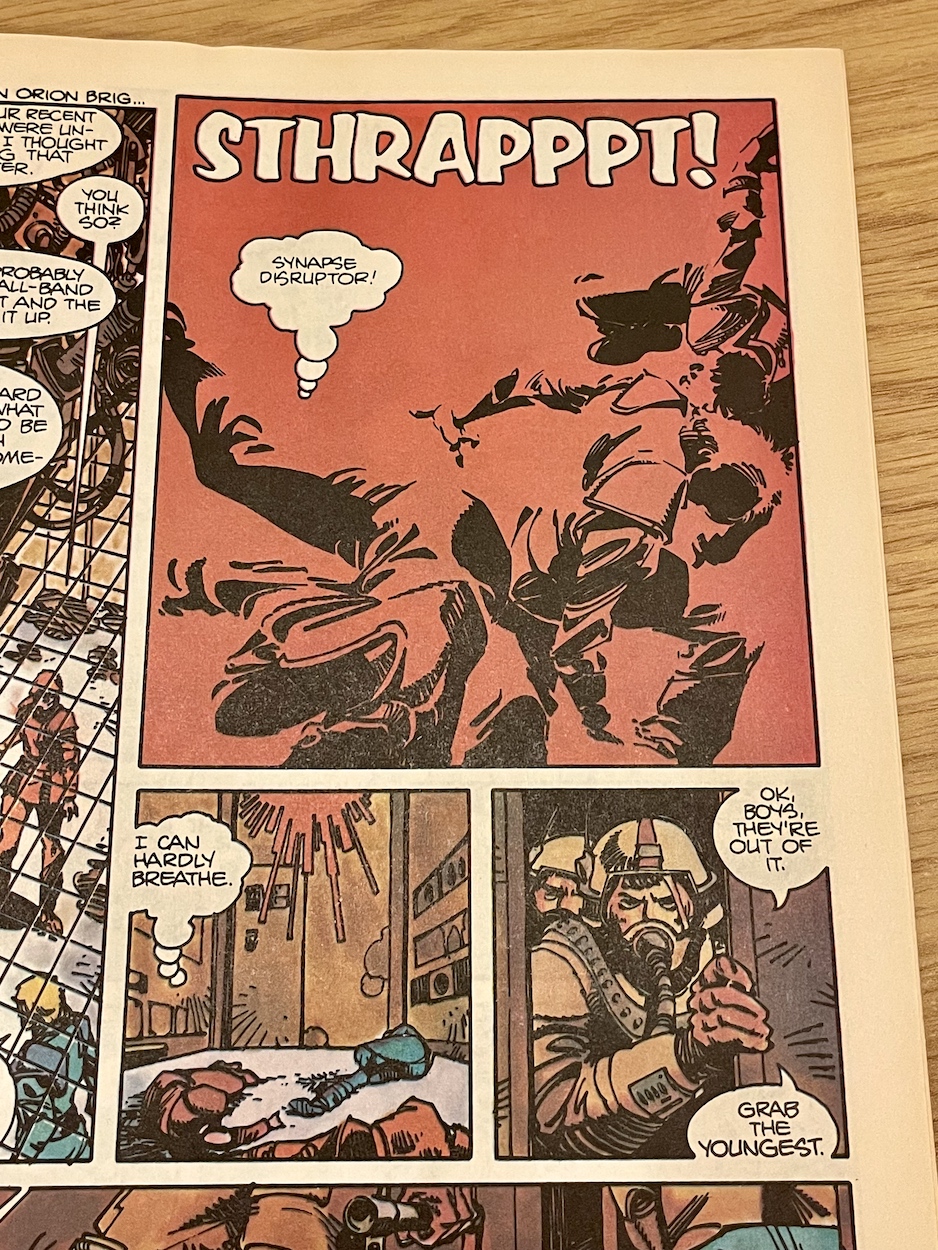
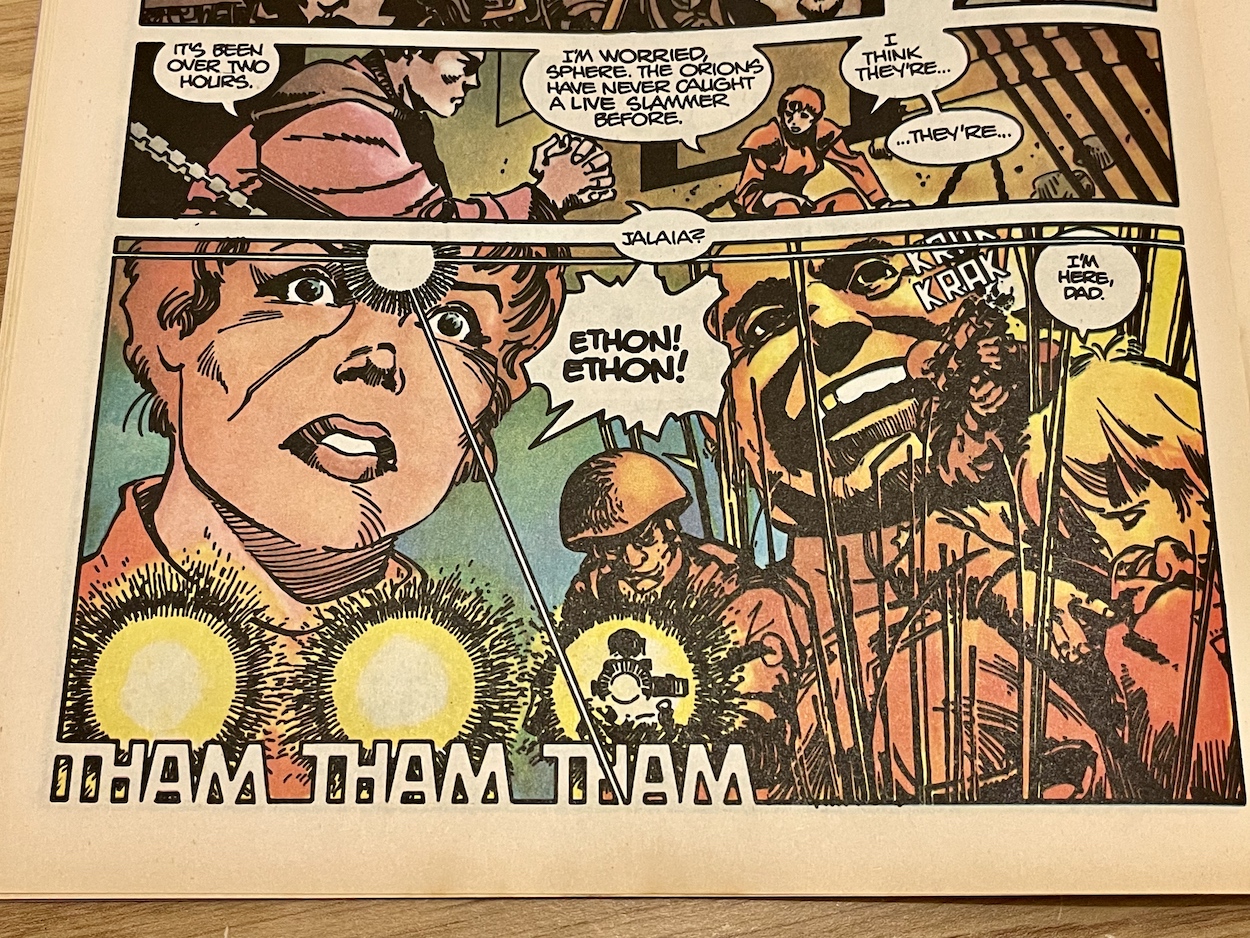
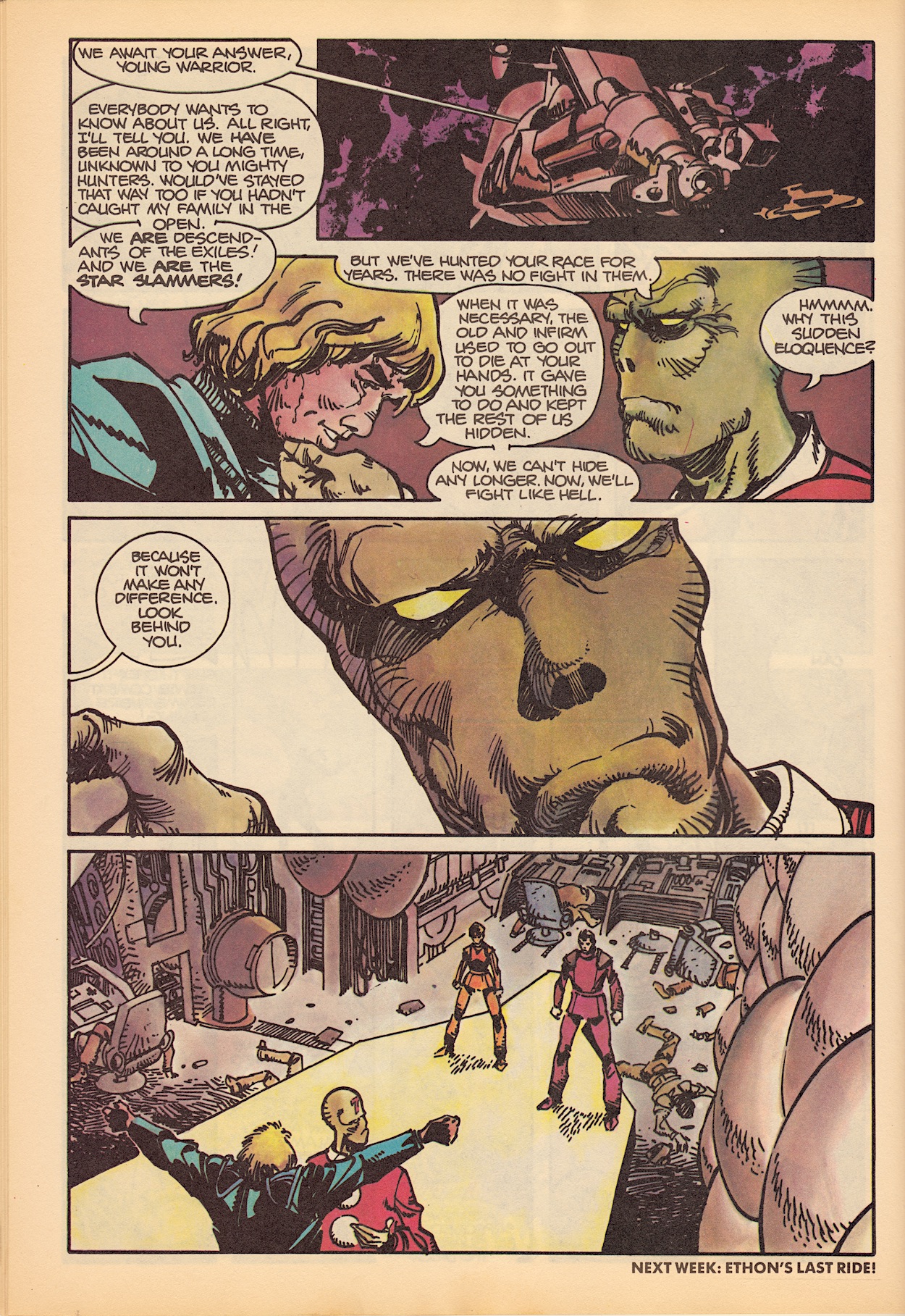
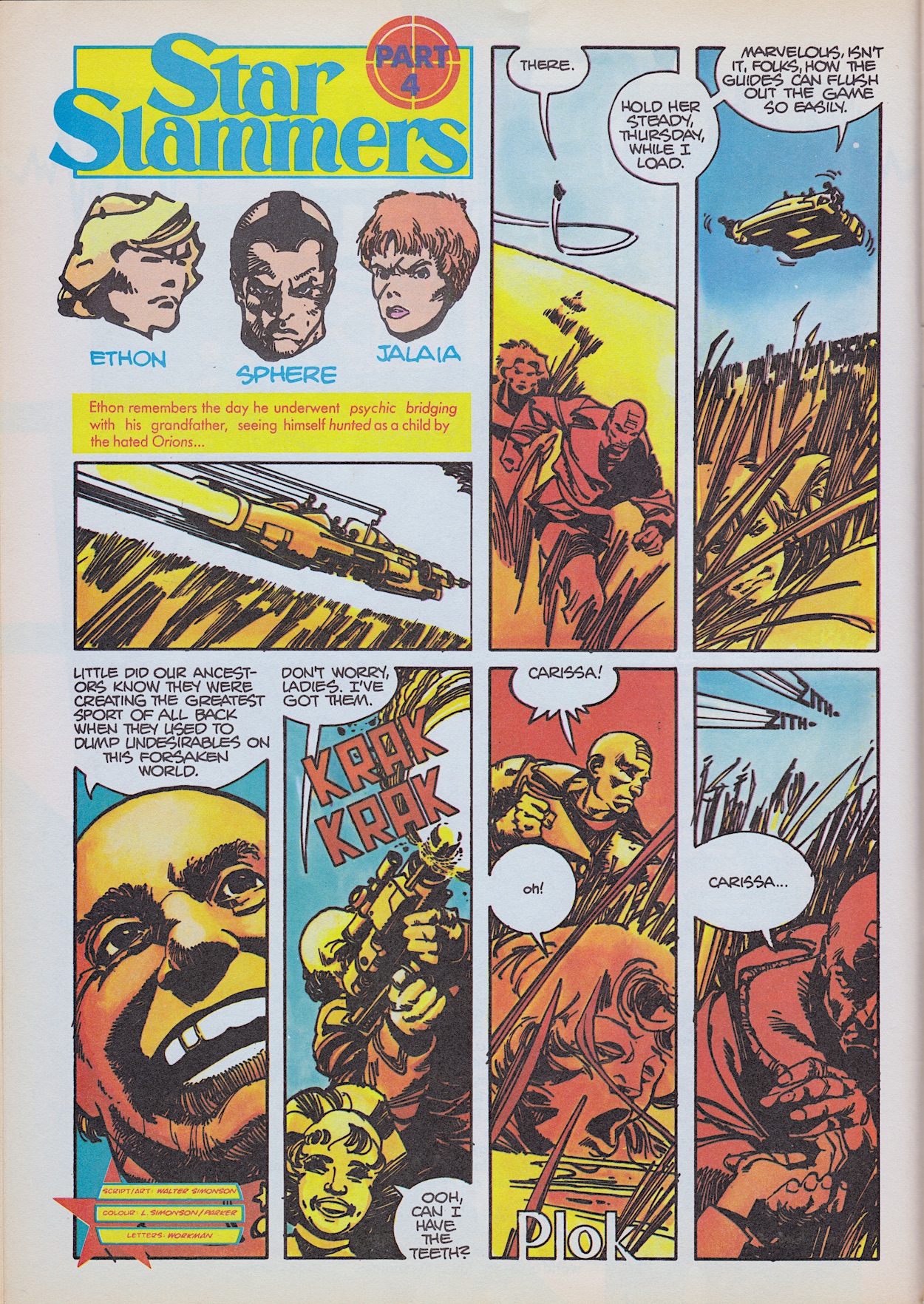
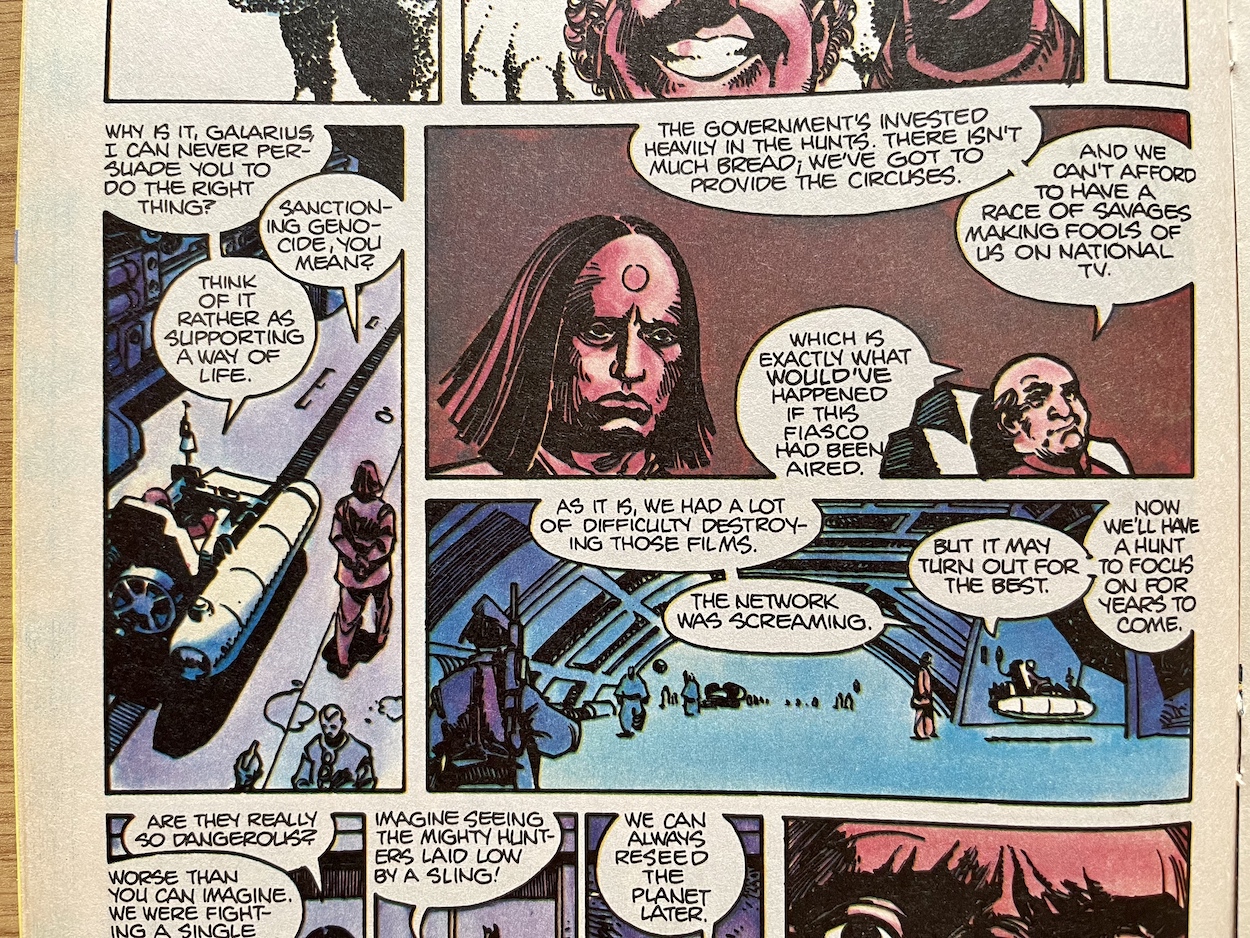
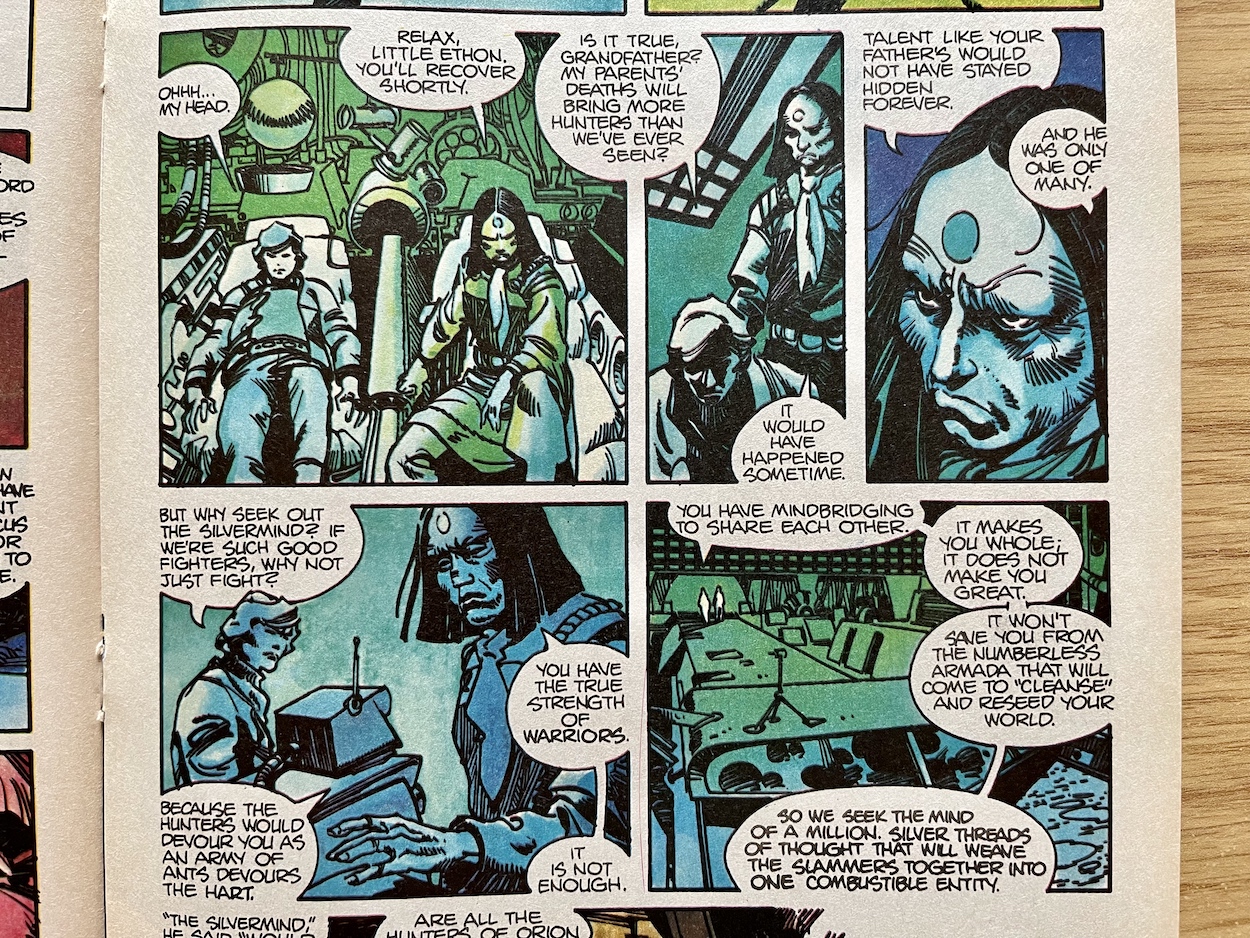
I’ll admit this issue’s Star Slammers (written and drawn by Walt Simonson, colours by Louise Simonson and Deborah Pedler, letters by John Workman) is eye catching, I’ll give it that. Each of its five pages are split up into these smaller panels, carrying on the theme of the Silvermind from last time. In fact, this penultimate part of the story kicks off with Jalaia finally reaching that near death point and activating the hive mind of the Slammers. Suddenly every single one of them can see, sense and hear everyone else, turning the tide of the battle against the Orions. So naturally Admiral Krellik cuts the televised feed to his home world in an attempt to control the narrative.
The way this is depicted, how they’re able to instantly react to the enemy from anywhere in the battle, how it turns on a dime from a slaughter to potential victory much to the shock of the enemy, is really very good. Alien Legion was due to replace Star Slammers in #11, so one week before its conclusion this strip finally became something of interest. It’s a cool few pages but with the lack of characterisation or storytelling in many previous parts it’s just too late to save it.
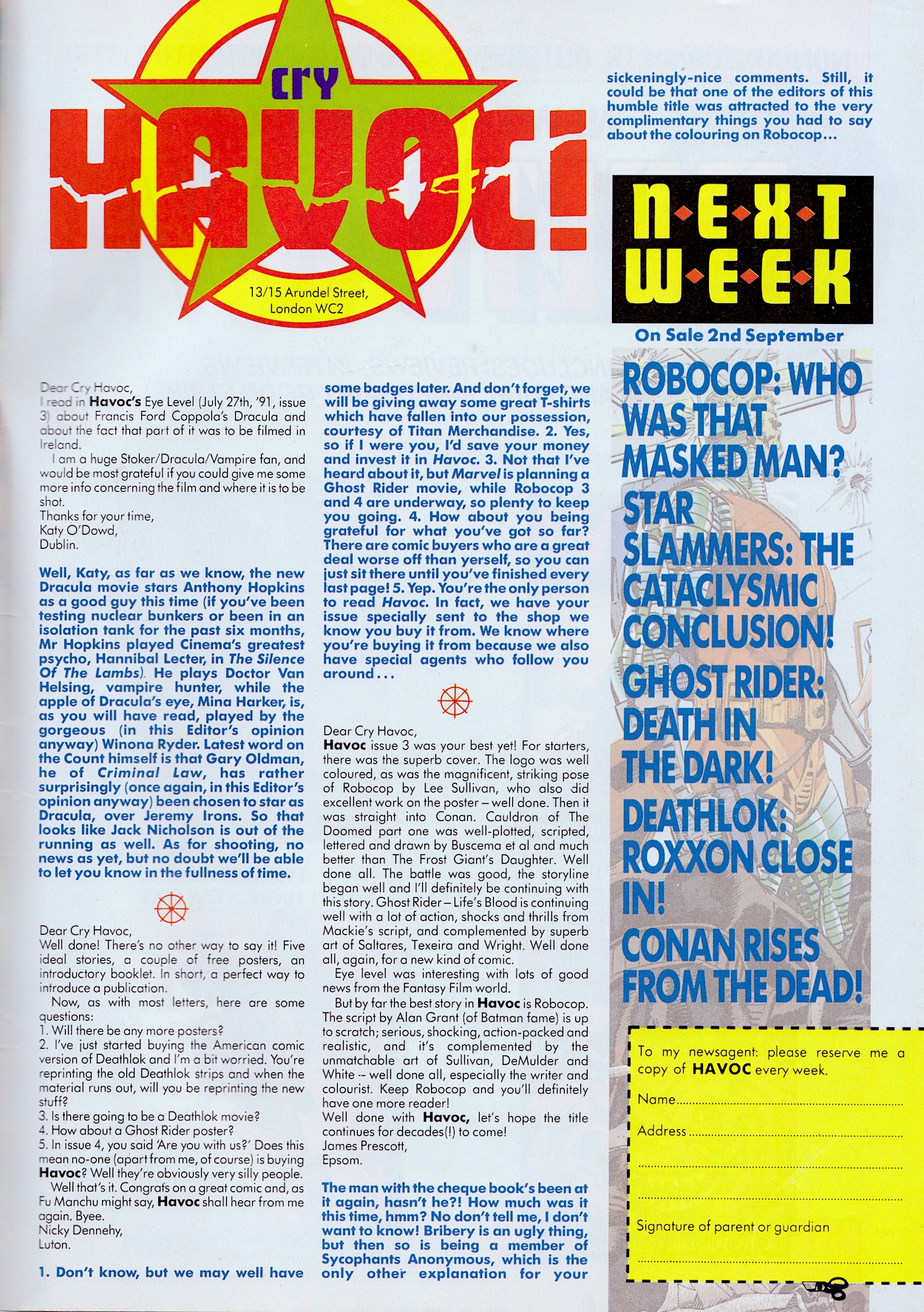
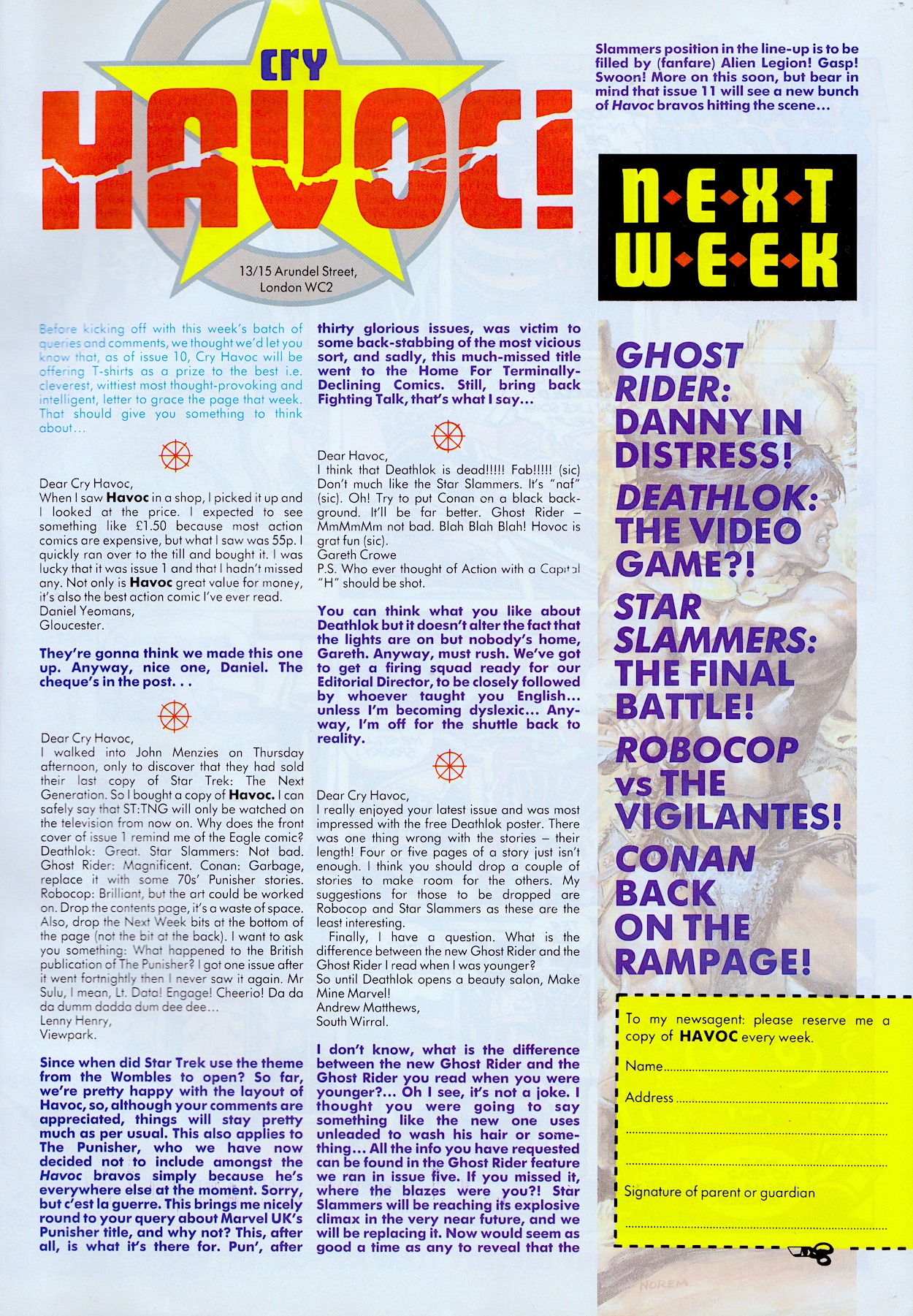
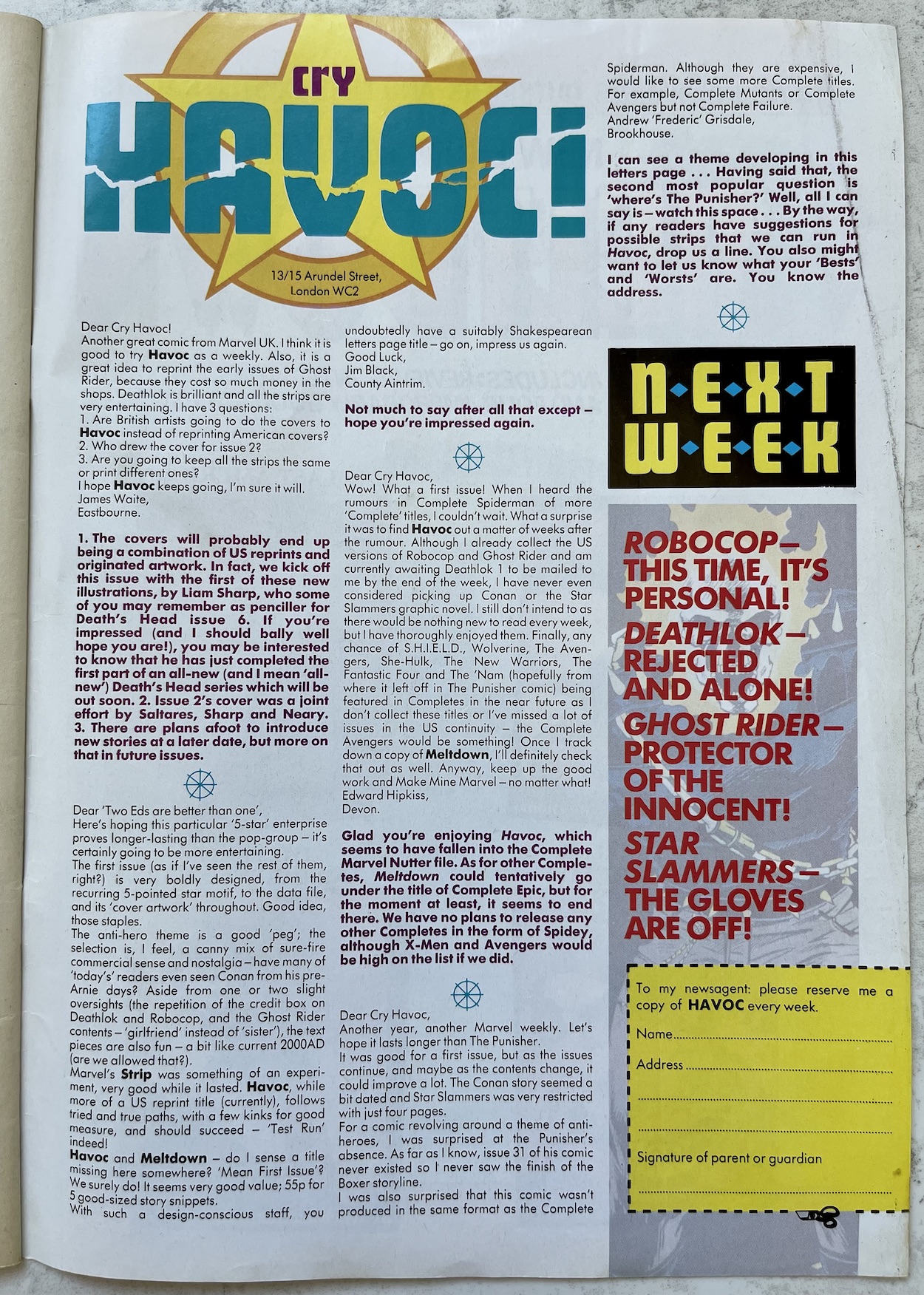
Our last Cry Havoc finishes things off and once more it’s got that exciting fan club feel to it which just makes it all the more heart wrenching that this is the end. But before we go there’s just time for a few more letters and typical Marvel UK-style replies which I loved so much as a kid. Highlights include some dismay at Gary Oldman’s casting in Dracula (oh, how he’d prove the naysayers wrong) and word of an upcoming Ghost Rider movie which wouldn’t actually become a reality for another 16 years.
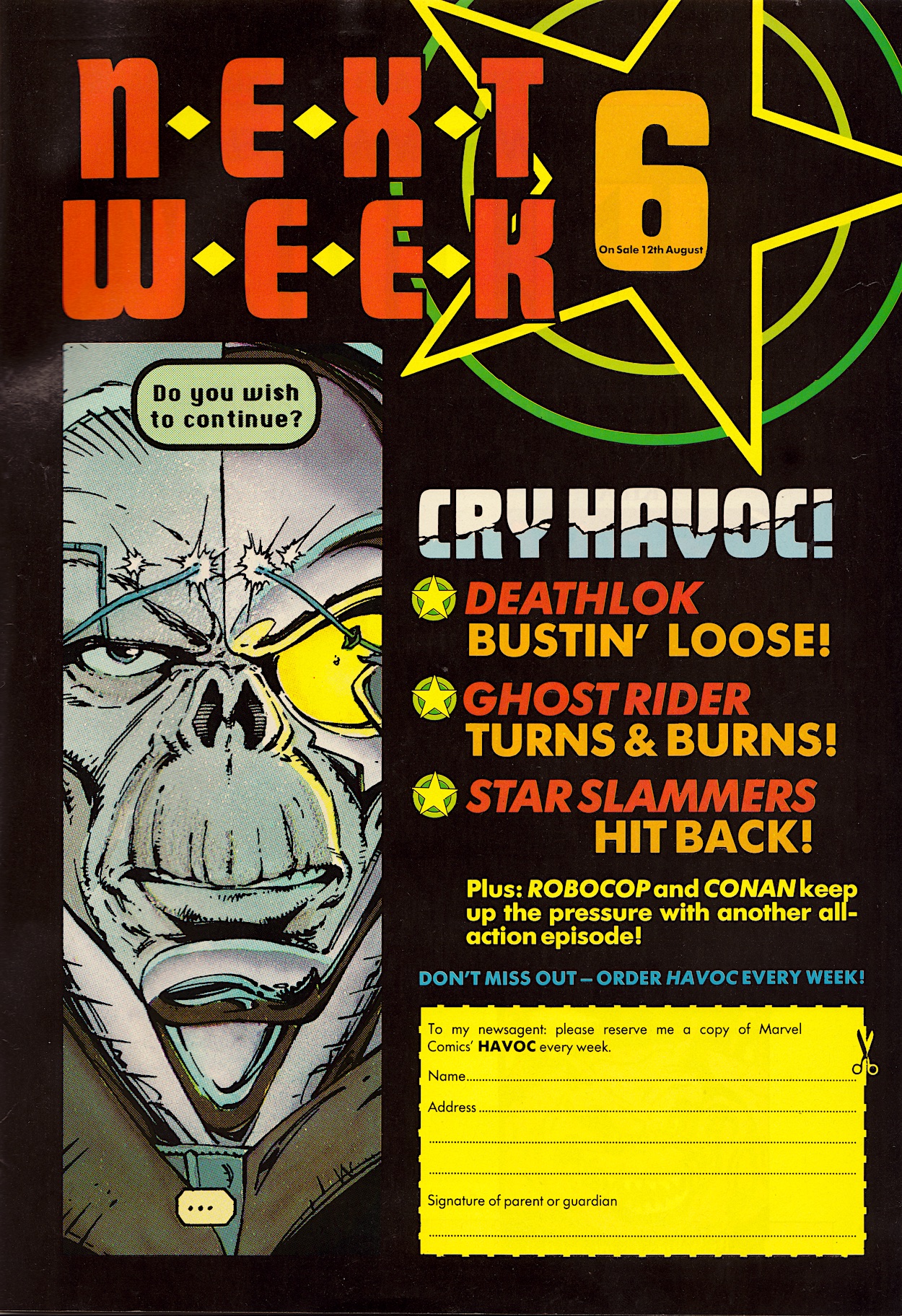
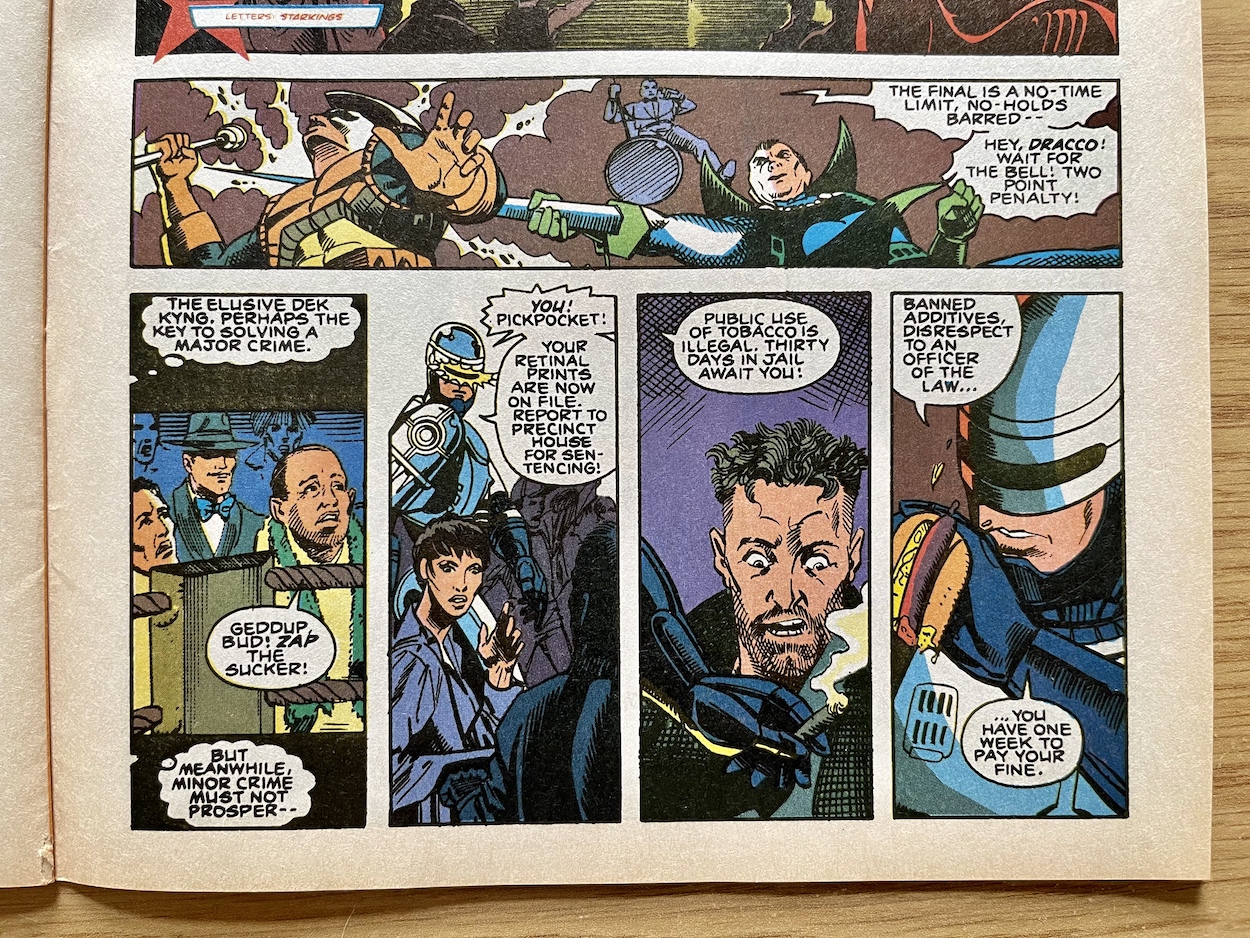
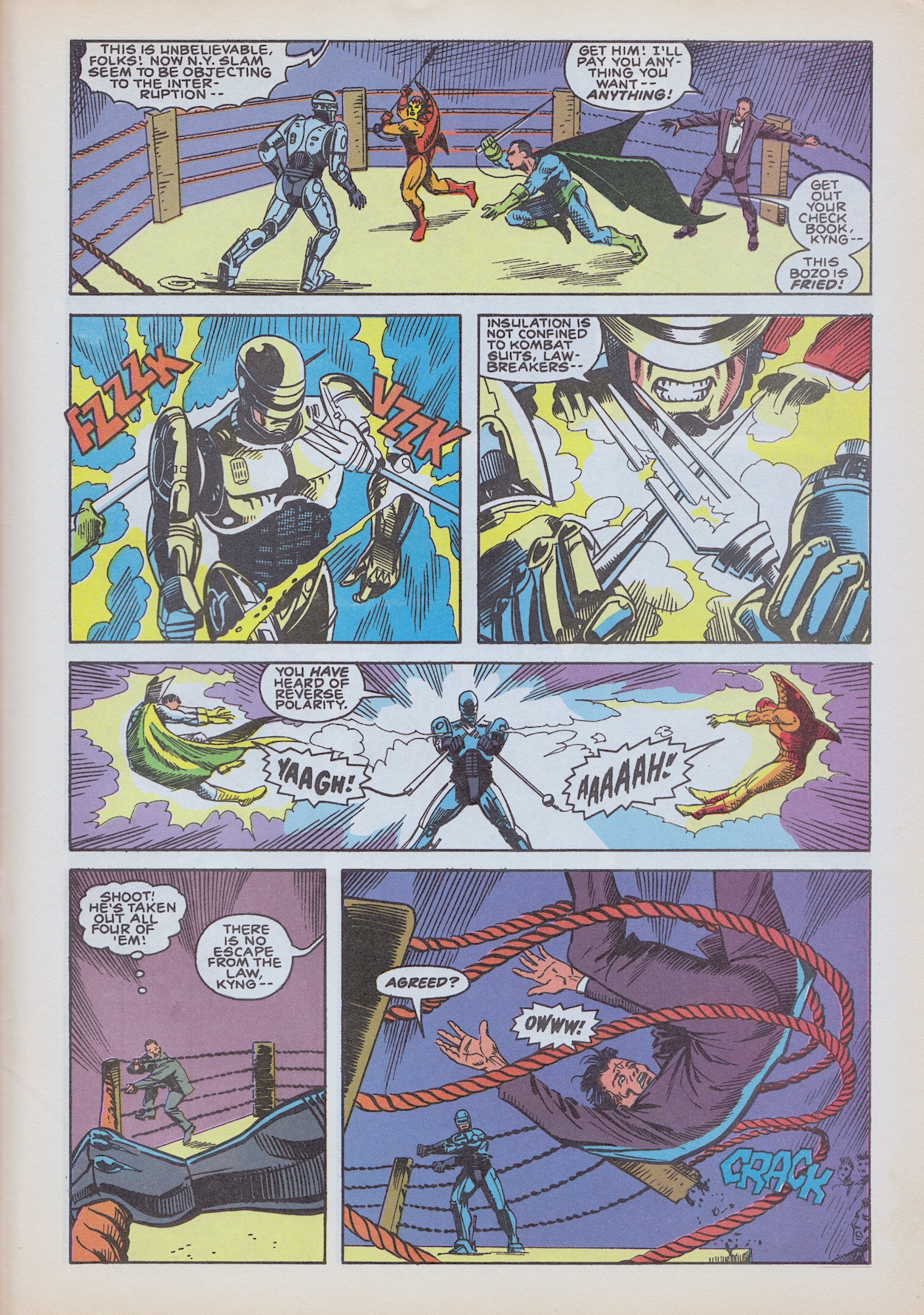
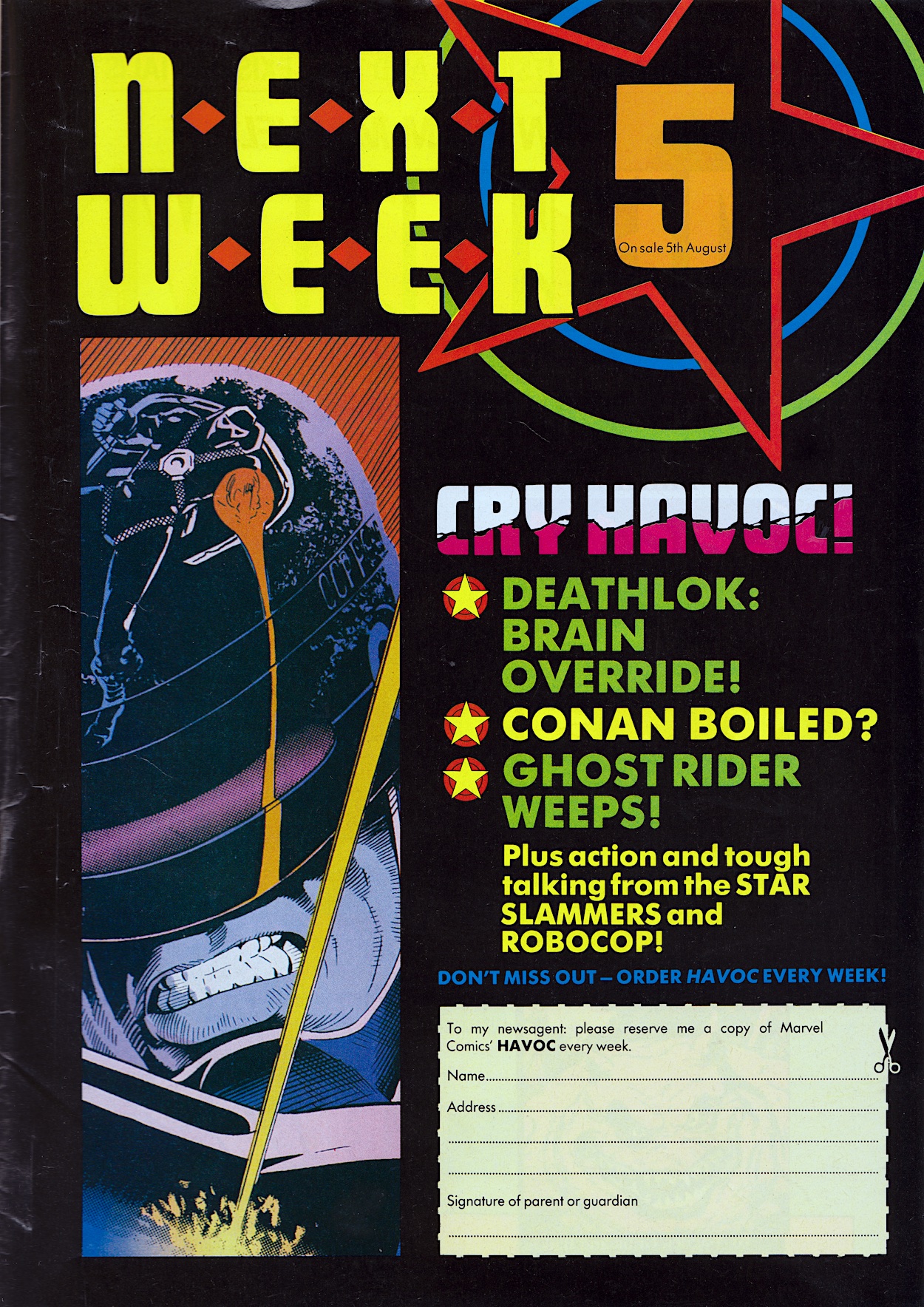
There are some cheeky answers here too (“How about you being grateful for what you’ve got so far?”) which is very Marvel UK indeed, instructions to invest in the future of Havoc for new Deathlok (oh deary me, you’ll start me off again) and a funny final answer which refers to the fact RoboCop was coincidentally coloured by Havoc’s editor. Then just to rub salt in the wound is the Next Issue box and a reservation coupon. This is not the end this comic deserved.
It took a couple of weeks to realise Havoc wasn’t just running late. With this I became so fed up of fantastic comics with a potentially very bright future being cancelled early that I swore off trying new ones after Havoc, solely collecting Transformers which I’d begun buying years before. I’ll admit this changed when Thunderbirds The Comic appeared in October 1991 but I stuck with it for only about a year before Commodore Format enticed me to the way of magazines. Even Transformers was cancelled just five months after Havoc!
It feels like no time since I took this photo for Havoc’s introductory post and given the potential here it really was no time at all. Havoc deserved to run and run. My school friends who had collected 2000AD for a few years already loved it even more than Tharg’s mighty organ. From the first issue I loved three of the strips and over the course of these nine short weeks I’ve come to enjoy a fourth. The final one was to be replaced soon so I could have been a fan of everything in the end.
As it stands it’s still a remarkable little collection of top quality characters. I think that sums it up best for me. It’s not just a random selection of strips, the stories I’ve enjoyed have all been about remarkable characters. Characters I want to read more of. Look out for a special blog post soon when I chat with freelance designer Paul Chamberlainwho worked on several Marvel UK comics and created Havoc’s logo. Until then, it’s goodbye Havoc, it’s been a blast and you deserved better.
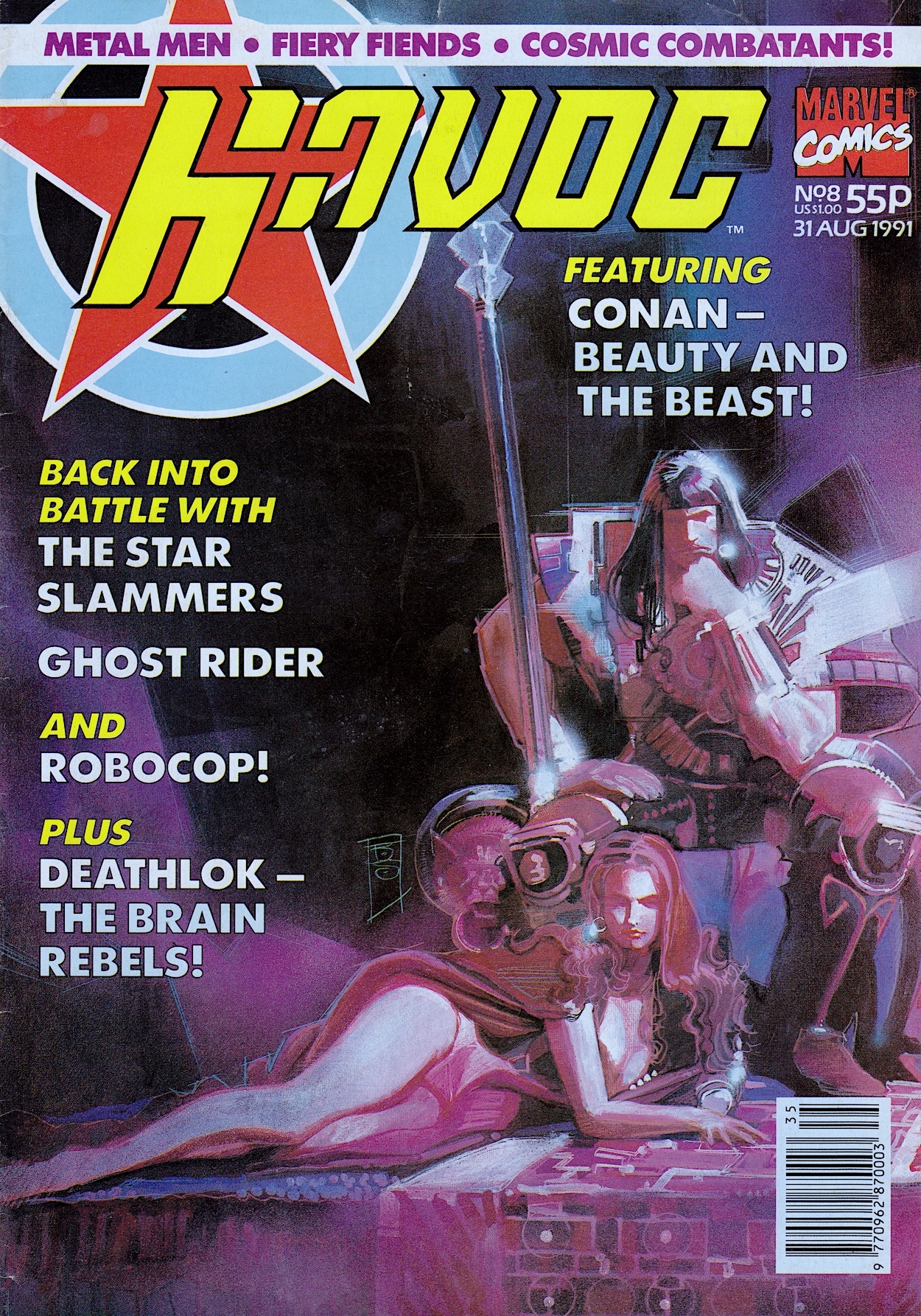
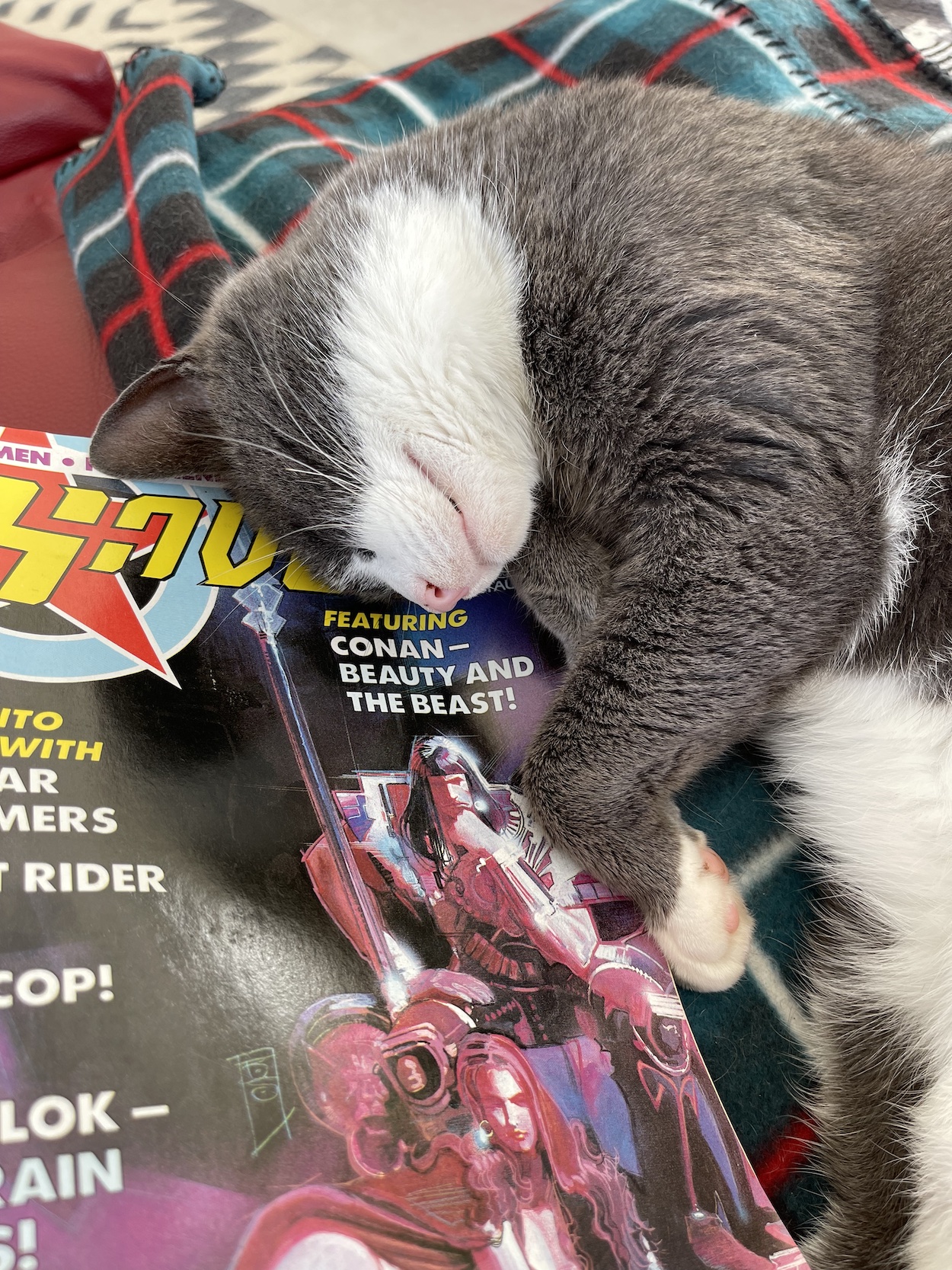
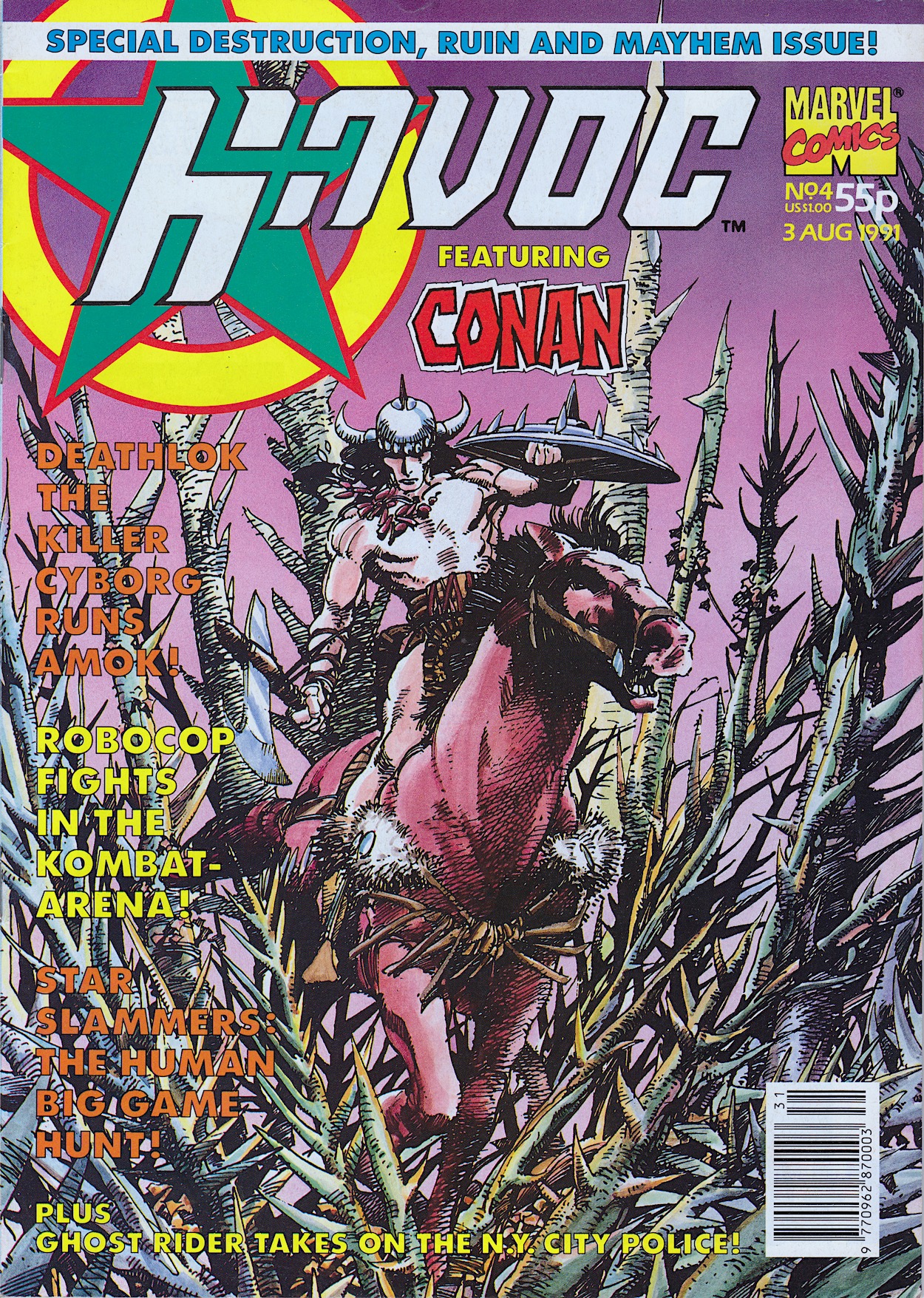
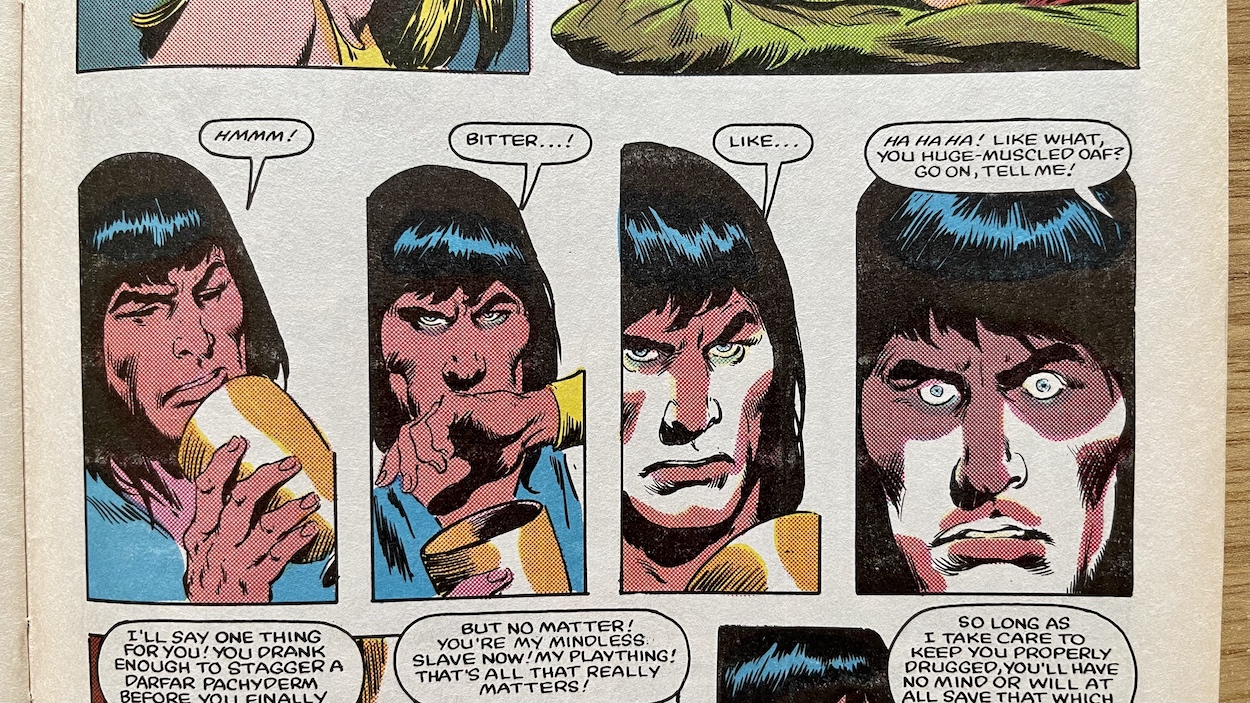
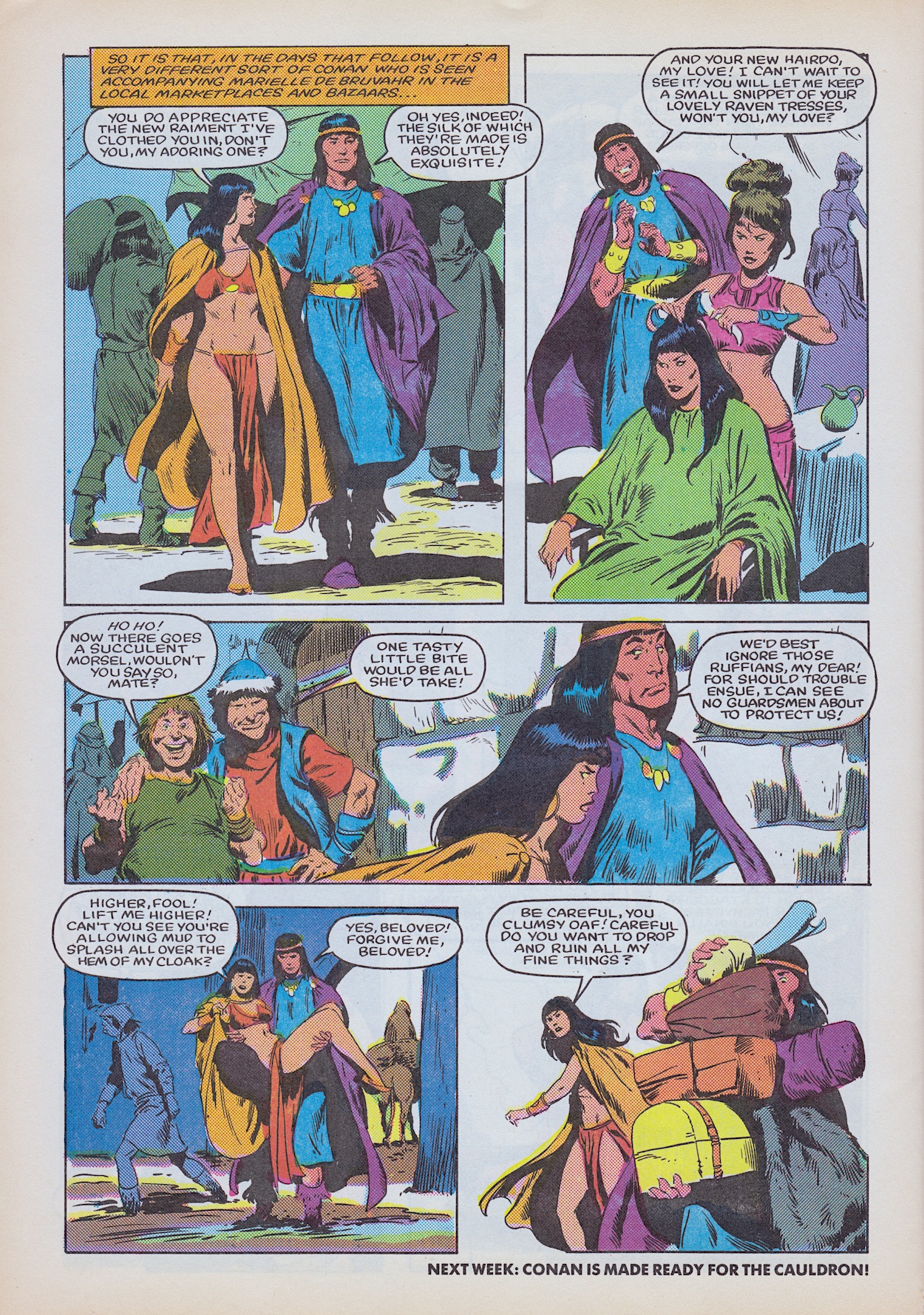
Conan the Barbarian was back in style. After taking a one issue break not only did a new story begin for the Cimmerian inside Havoc #8, he also got this glorious piece of cover art to announce his return. Although, ‘Beauty and the Beast’ could be the tagline for any of the Conan stories featured so far to be honest. It’s a nice cover nonetheless and it may only have been a week but I’ve missed having all five strips included.
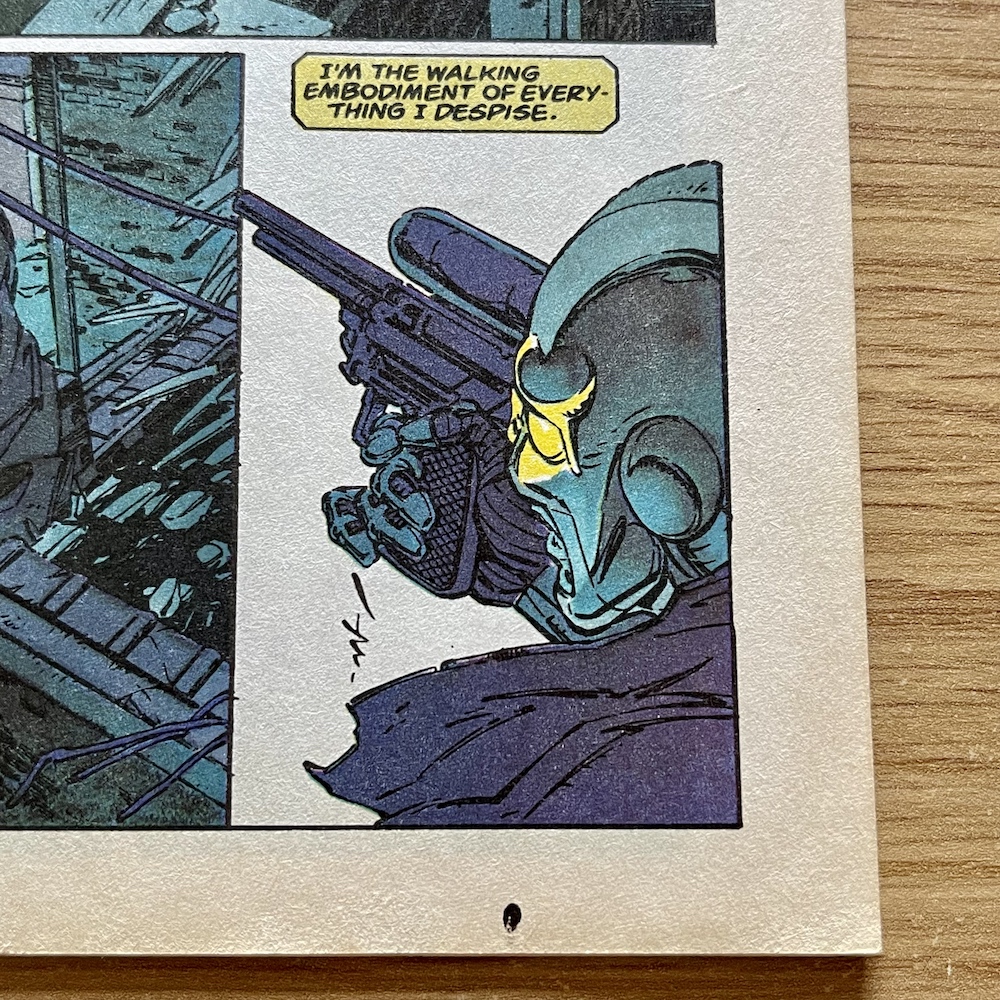
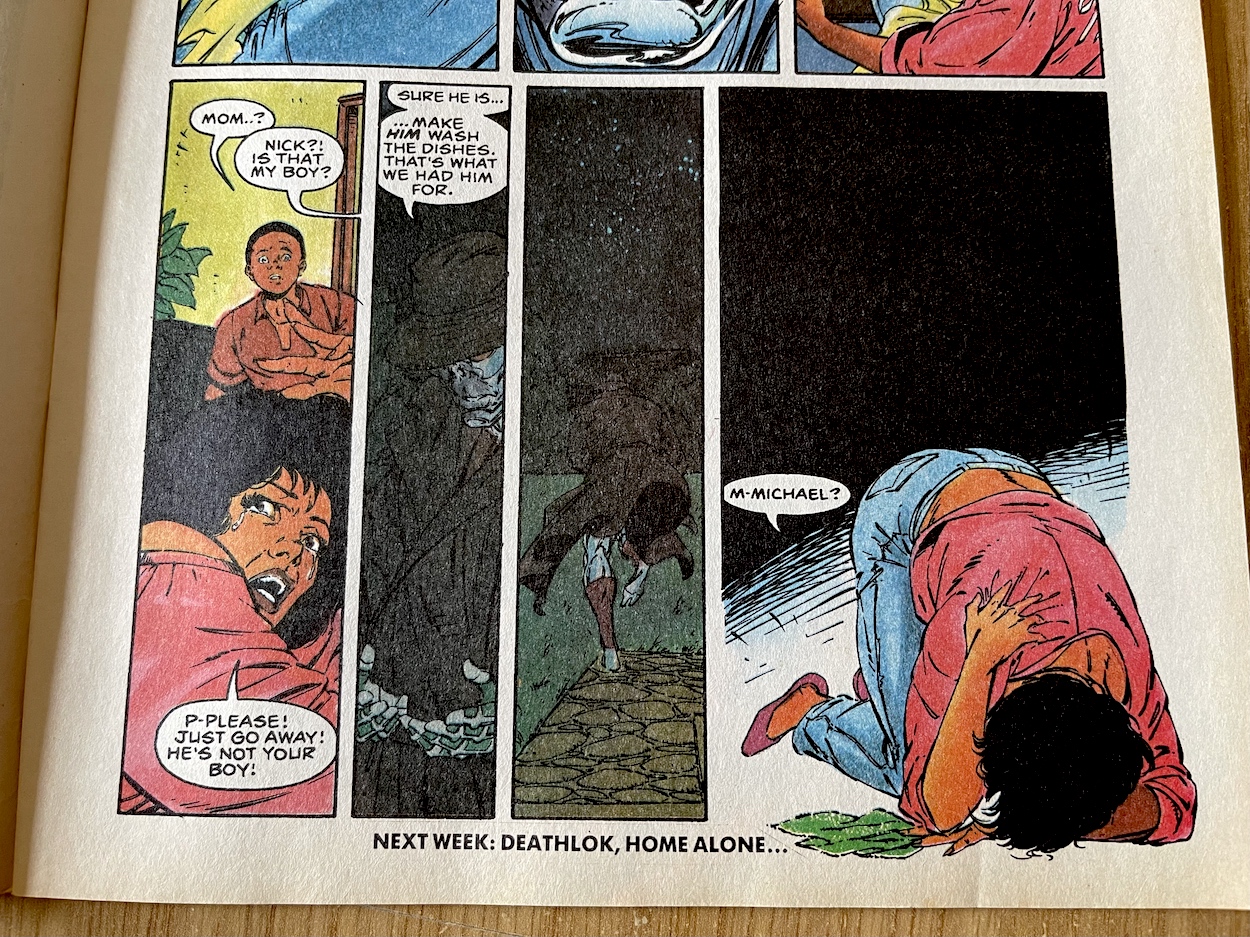
Beginning again with Deathlok (written by Dwayne McDuffie and Gregory Wright, art by Gregory and Jackson Guise, letters by Richard Starkings) we finally get to the end of his origin story after seven hugely entertaining weeks, with the finale to Brains of the Outfit. It’s all wrapped up brilliantly well. After last issue I wouldn’t have been able to guess how they’d conclude Michael Collins’ first outing after that action packed strip. Now that I’ve read these final seven pages there was simply no other way they could’ve done it. It’s great.
That panel above is the beginning of an incredibly dark moment as Michael/Deathlok takes to a roof above the city and contemplates ending it, even placing his high powered gun into his mouth. But he knows the Deathlok machine would just be found, he’d be stripped out and some other poor soul would be forced inside instead. Nothing would be stopped, nothing solved. He hooks himself up to electrical wires on the building to overload and explode instead, but decides he needs to call his son first to say goodbye and uses the phone lines instead.
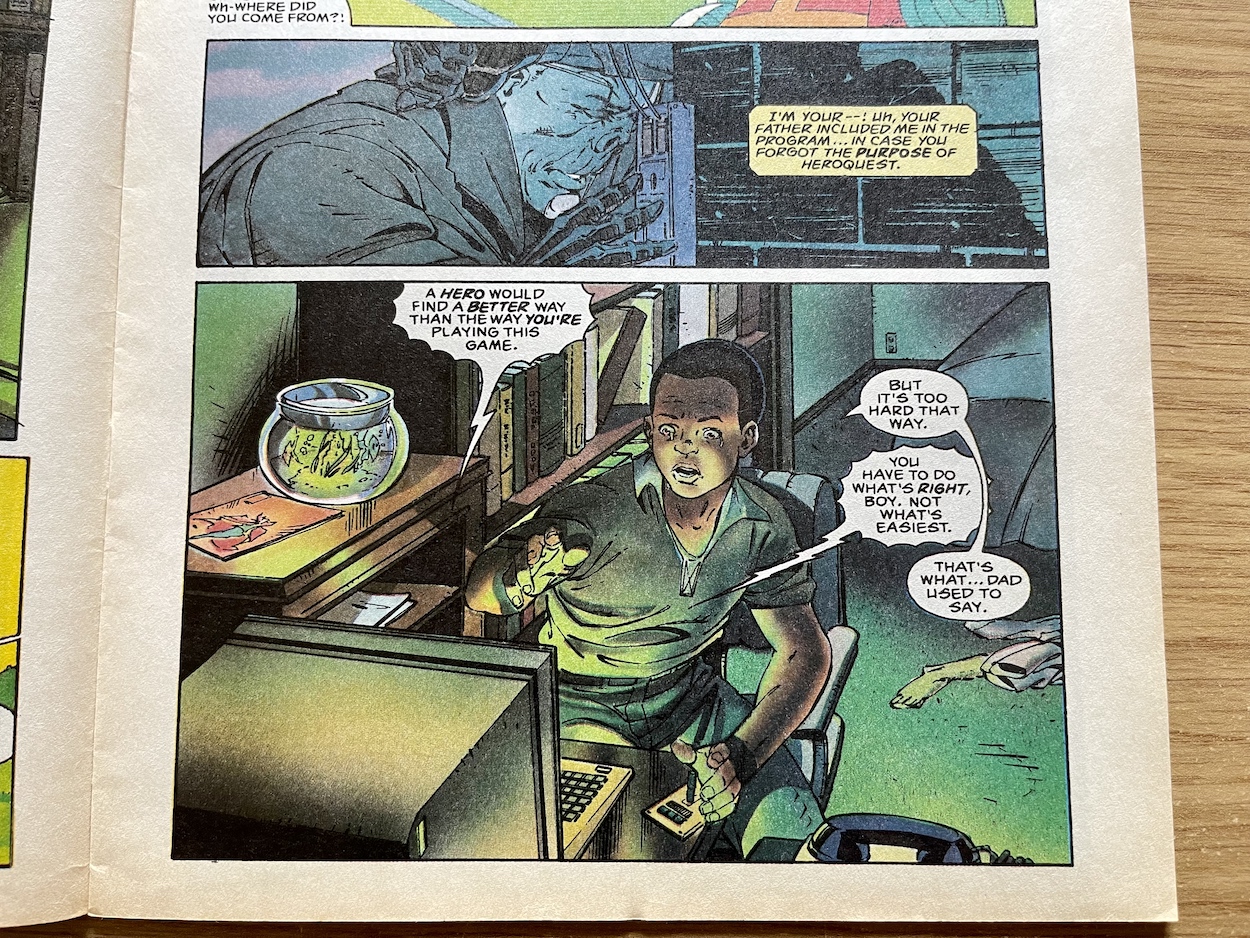
The Deathlok computer detects a ‘HeroQuest’ program running at the number given to it (how topical for 1991) and it creates an avatar for itself to interact with the player, young Nick, who knows his dad has died. This is the game we saw him play previously, when Michael tried to explain to him how bigger and better weapons don’t make the hero, it’s about being brave against the odds and, telling him that he’s a friend of his dad’s he reminds him of this in a touching scene.
In fact this scene takes up the main bulk of this final part and I think it’s just perfect. Nick tells the character on the screen that his dad isn’t there anymore and in response he’s told this doesn’t matter, it doesn’t make it any less true: “You want to win at this game, you’ve gotta learn how to be a hero.” With a few tears running down his face, Nick promises he will and turns the computer off, unaware of who he made that promise to.
Disconnected from the call, the Deathlok computer asks if it should continue with the self-destruct and as you’ll see below Michael looks to the sky as a new day dawns and thinks about the advice he’s just given his son. This feels like the perfect ending to such a character driven story, one that I’ve been really invested in for the whole summer. I love this final page, especially that last panel with the hint of a smile on our true hero’s face.
What a brilliant origin and I’m already a fan of the character. I could see his family being involved in future stories very much in the same way Alex Murphy’s were in some episodes of the RoboCop TV series, although the difference here is that Michael has already tried to tell his wife who Deathlok really is. That could lead to some great moments. To say I’m eager to read more is an understatement so, although the next issue is the last I’ll look forward to its small chunk of storyline to get an idea of what the future could’ve held.
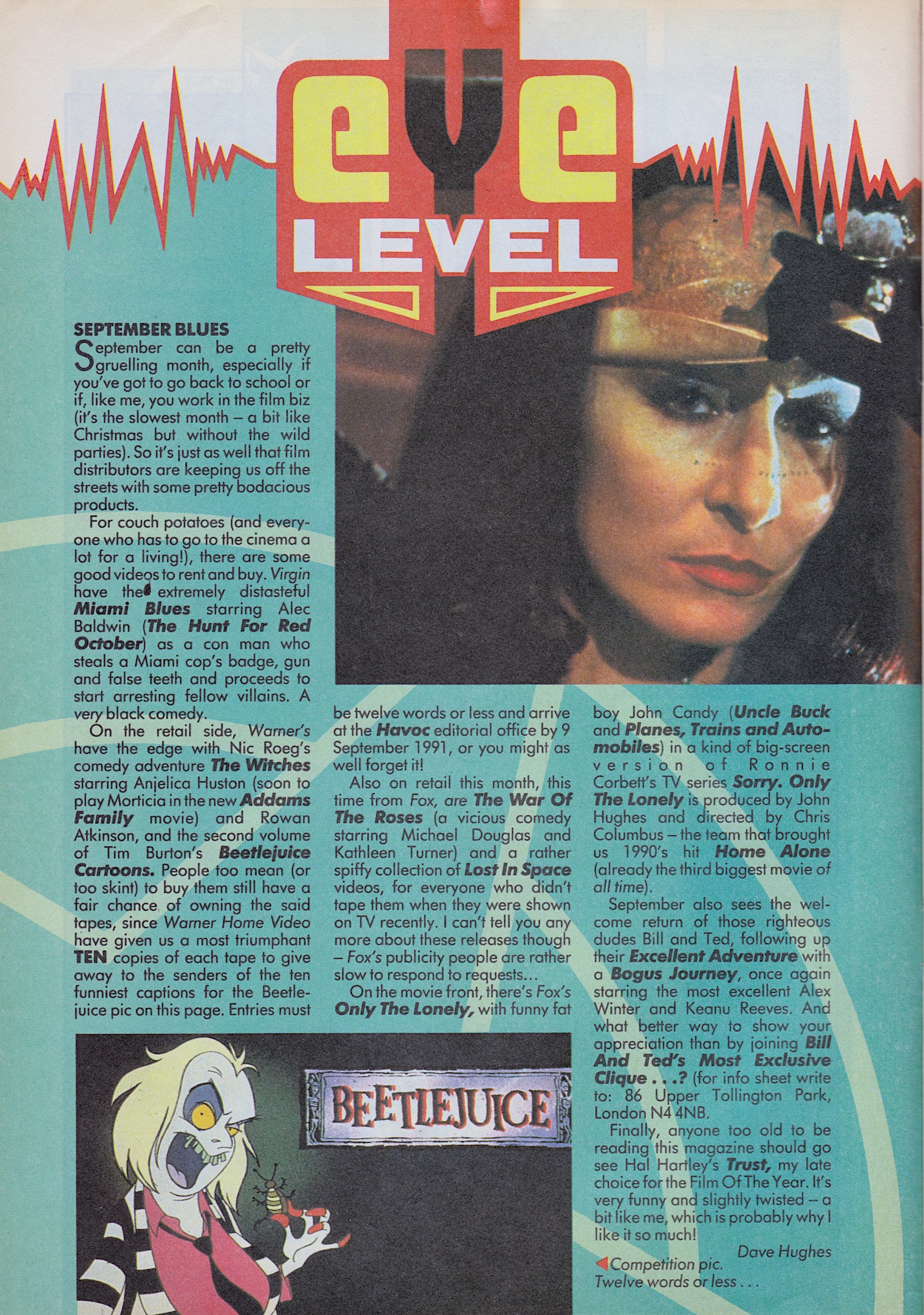
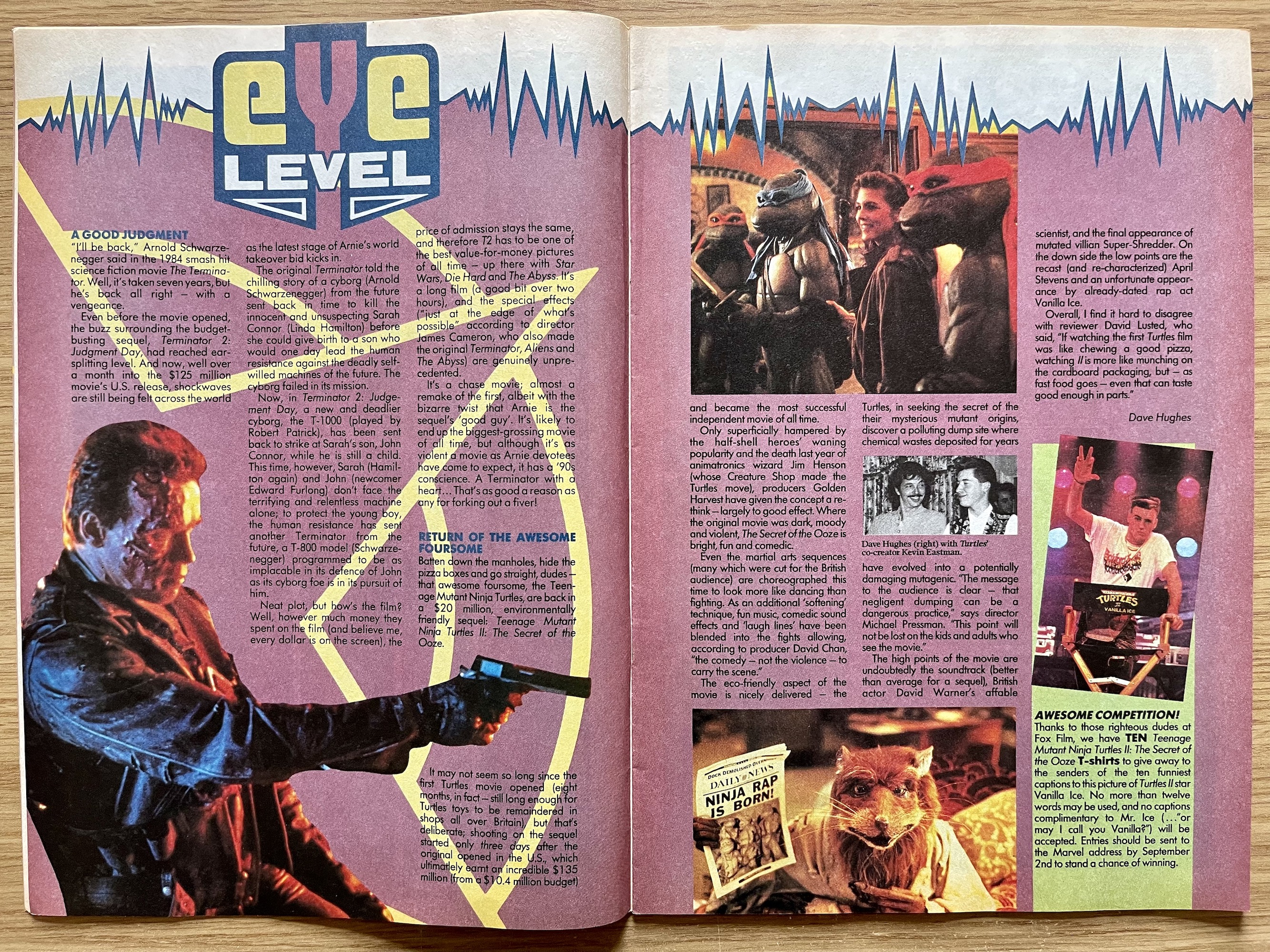
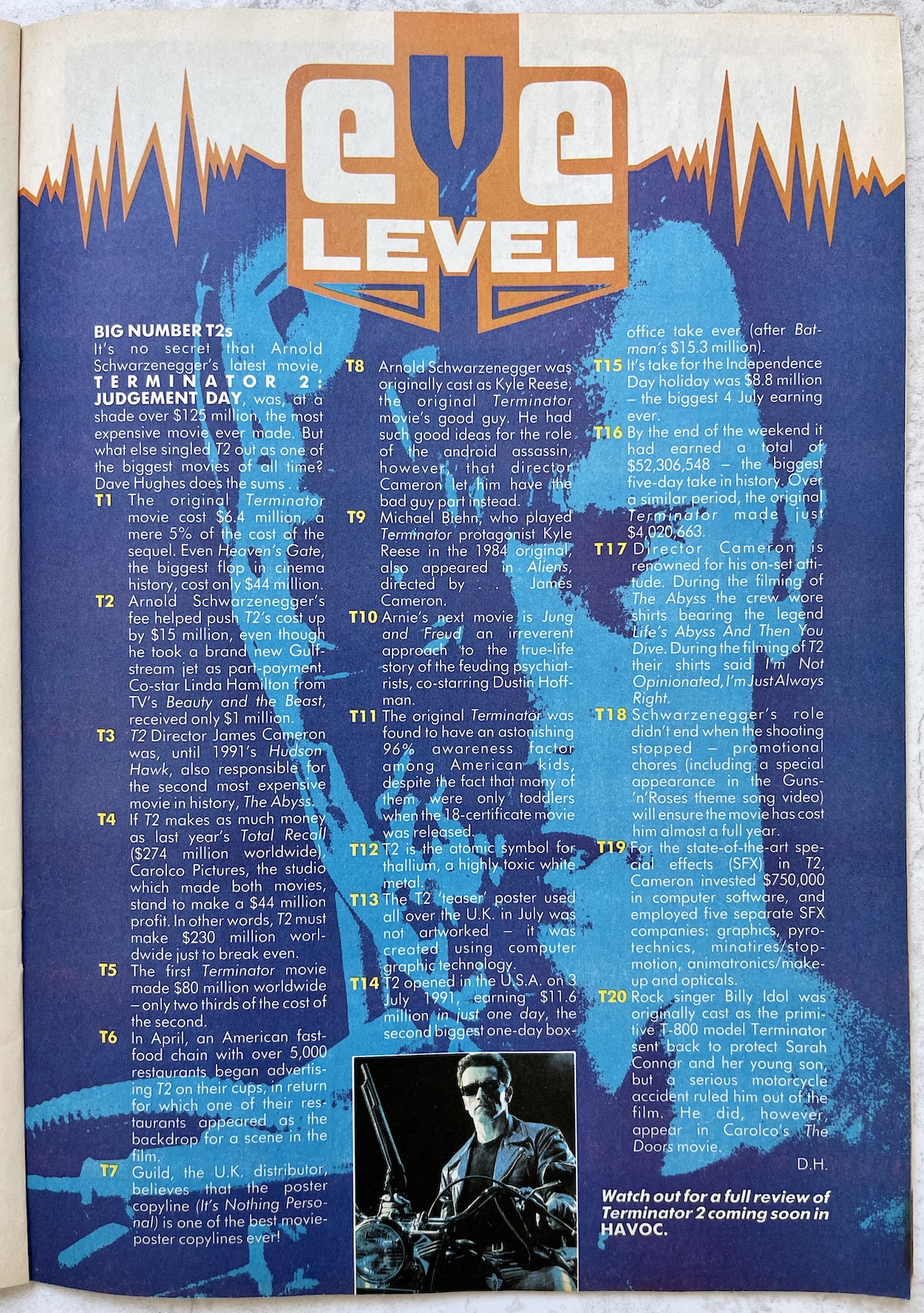
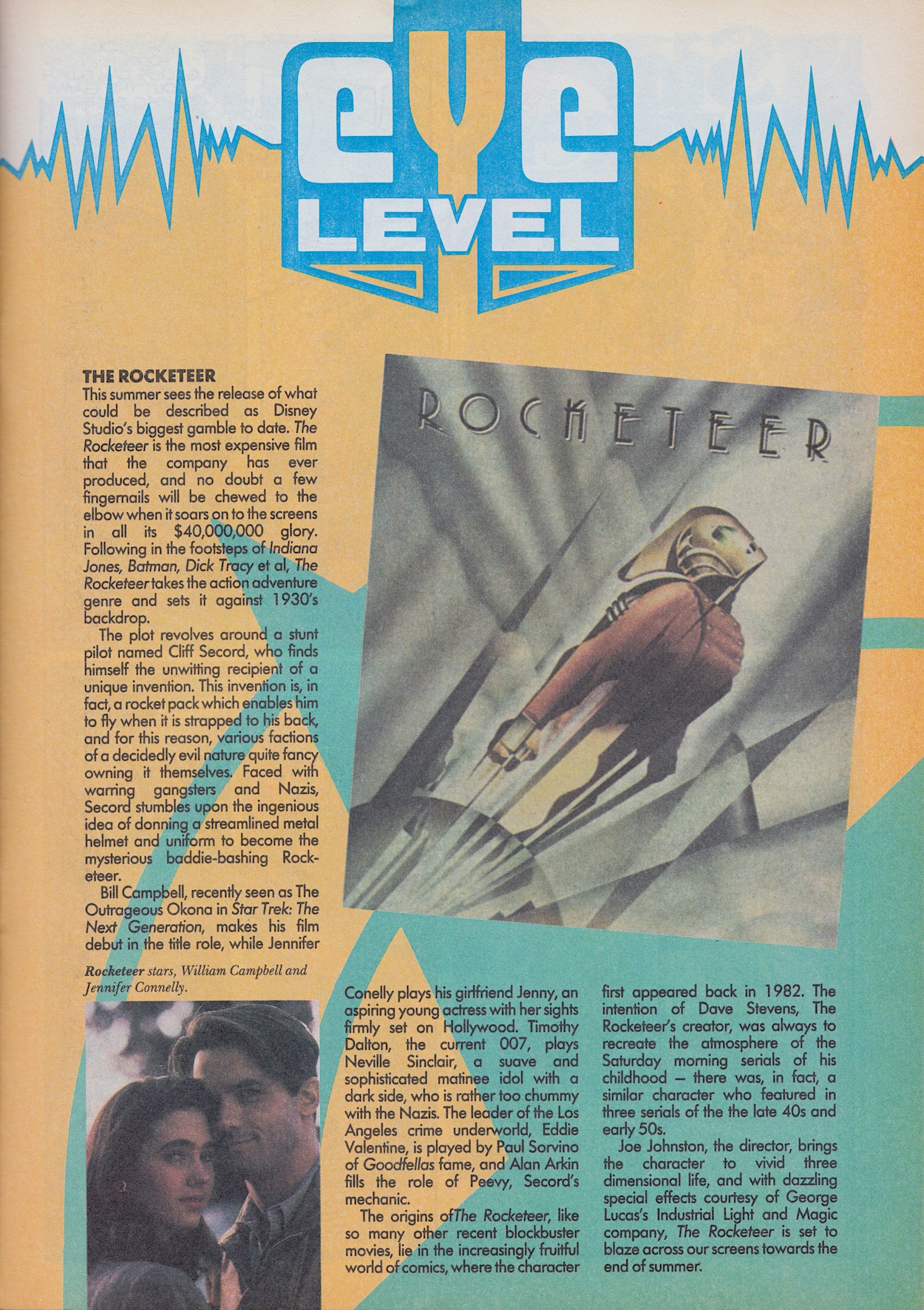
Next up we take a break from the strips for Eye Level, the news page compiled by Dave Hughes this issue. It may be back to one page after the larger spread it had a week ago for the cinema releases of Terminator 2: Judgement Day and Teenage Mutant Ninja Turtles II: The Secret of the Ooze, but a quick glance down the article at all those movies and TV shows in bold and it was quite the busy release schedule wasn’t it?
There are a few I’d never heard of (Miami Blues, Only the Lonely and Trust), a couple of childhood favourites (Bill and Ted’s Bogus Journey and The Witches) and a cartoon series that completely passed me by because I never saw the film it was based on until much later in life. Even the references to the films recently released remind me of why I loved the 80s so much! Speaking of 80s movies, the official RoboCop continuation is up next and venturing into the world of superheroes.
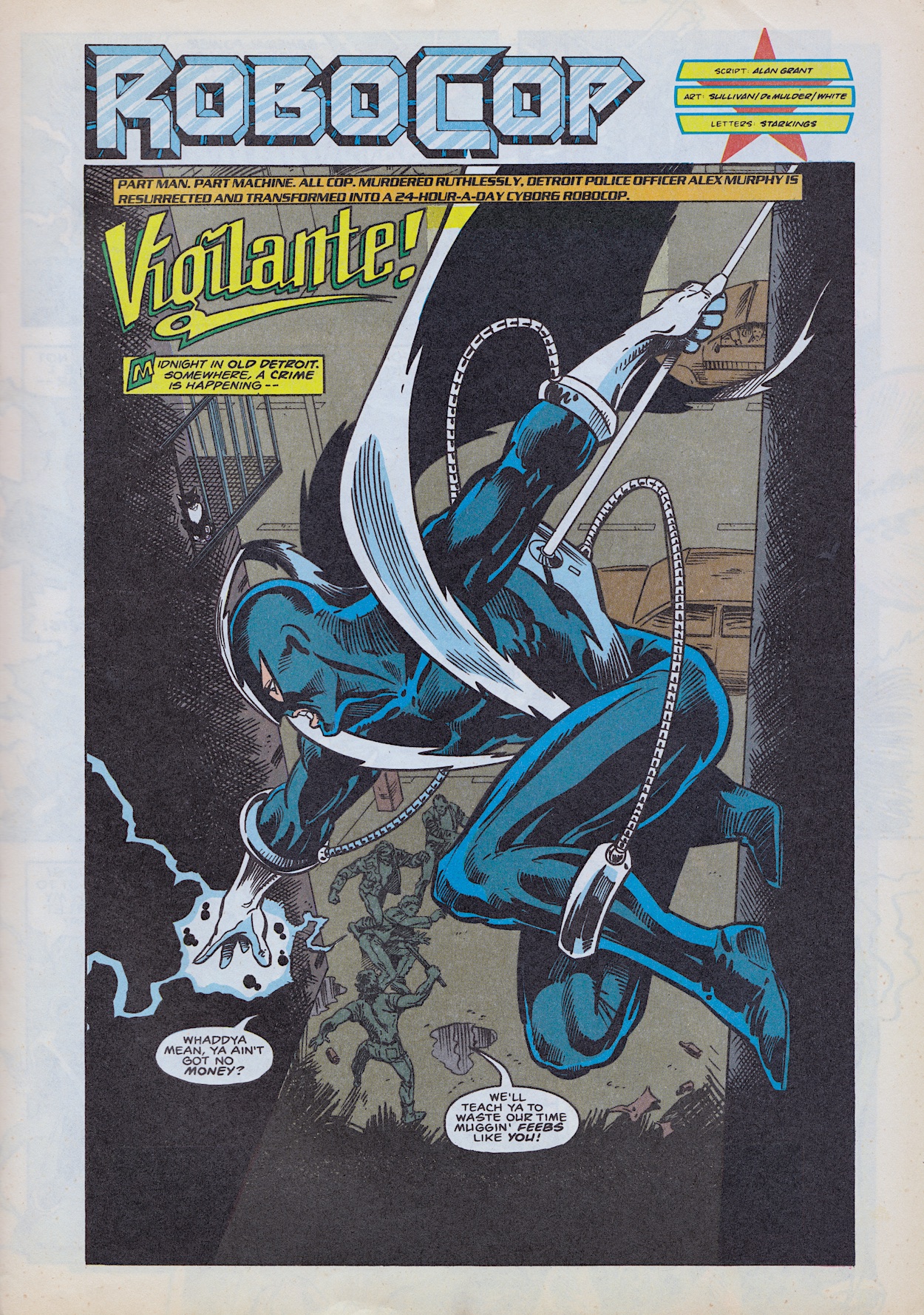
Well, wannabe superheroes anyway. As you can see from this opening splash page it certainly looks like Old Detroit has a new warrior in the fight against a seemingly insurmountable level of crime and violence in the forgotten city. I like how the story starts off with that famous RoboCop quote about a crime happening somewhere and how we’re led to believe it’s in reference to the mugging happening on the ground. A clever piece of misdirection by writer Alan Grant.
The next page plays out like an old-fashioned, clichéd superhero comic with ‘General Power’ using his ‘Electro Gauntlets’ to incapacitate the muggers, complete with corny one-liners such as, “General Power: The shock that crime needs!” It’s an exaggerated, almost spoof-like homage and it’s all going swimmingly for the masked crime fighter until he tries to help the victim to his feet but forgets to turn off his gauntlets, frying the person he was trying to save!
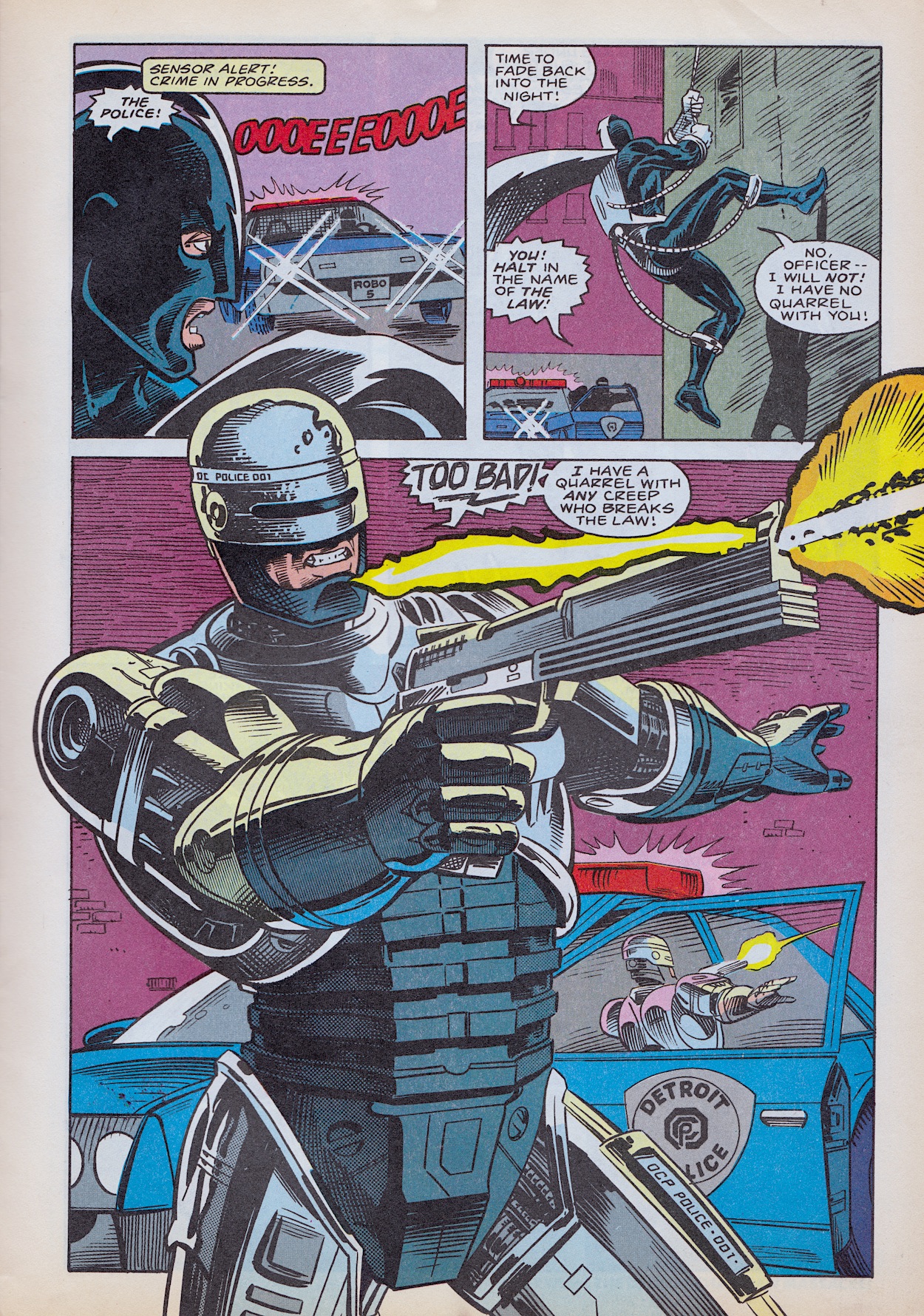
Cue sirens and a police car pulls up. Our panicked wannabe begins to scale the wall in a bid to fade back into the night like any good vigilante but he hadn’t bet on two things, his own incompetence and the officer being Alex Murphy aka RoboCop, who makes his entrance into the story in this glorious drawing by penciller Lee Sullivan and inker Kim DeMulder (colours by Steve White, letters by Richard Starkings). A great page, this.
A quick shot through the wire General Power was using sees him fall to the ground but the victim, all charred from the accidental electrocution, pleads with Alex to let the man go. They try to convince him that he’s on the same side as the police but Robo stands firm, no one can take the law into their own hands and when Power tries to use his gauntlets on the metal cop it backfires big time. The story ends with Murphy radioing into HQ that he’s picked up “another vigilante”.
This third RoboCop story shows the creative team have well and truly settled into the character
“Another”? Intriguing. Has there been a rash of such people trying to fight crime recently? I’m going to guess it can’t be a coincidence, that there must be some nefarious reason behind it all, so I’m interested to see how much of the mystery is revealed in our final issue next week. There’s definitely a confidence in this third RoboCop story that shows the creative team have well and truly settled into the character, especially in the art. Lots of potential here for future stories. I’m going to miss them.
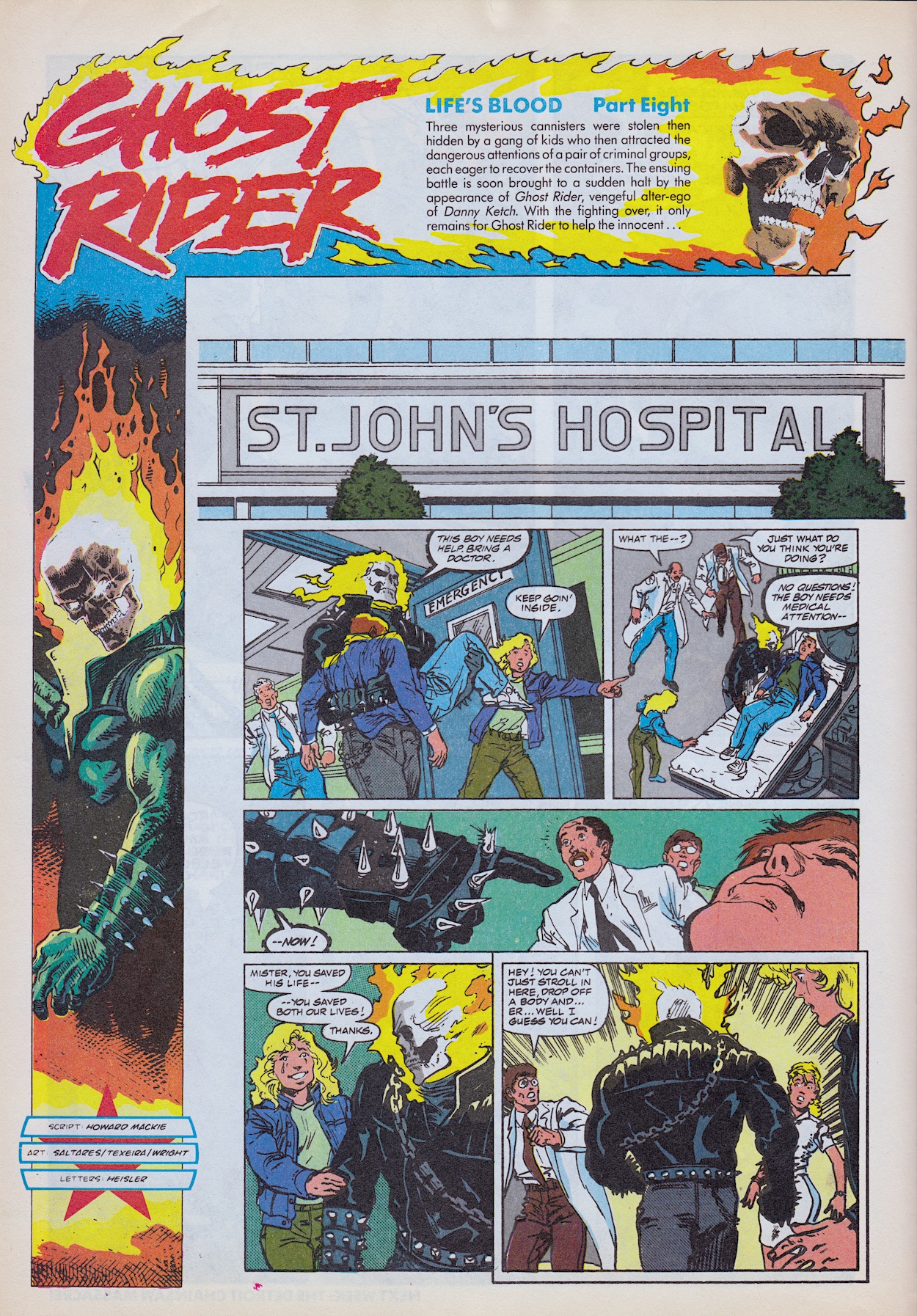
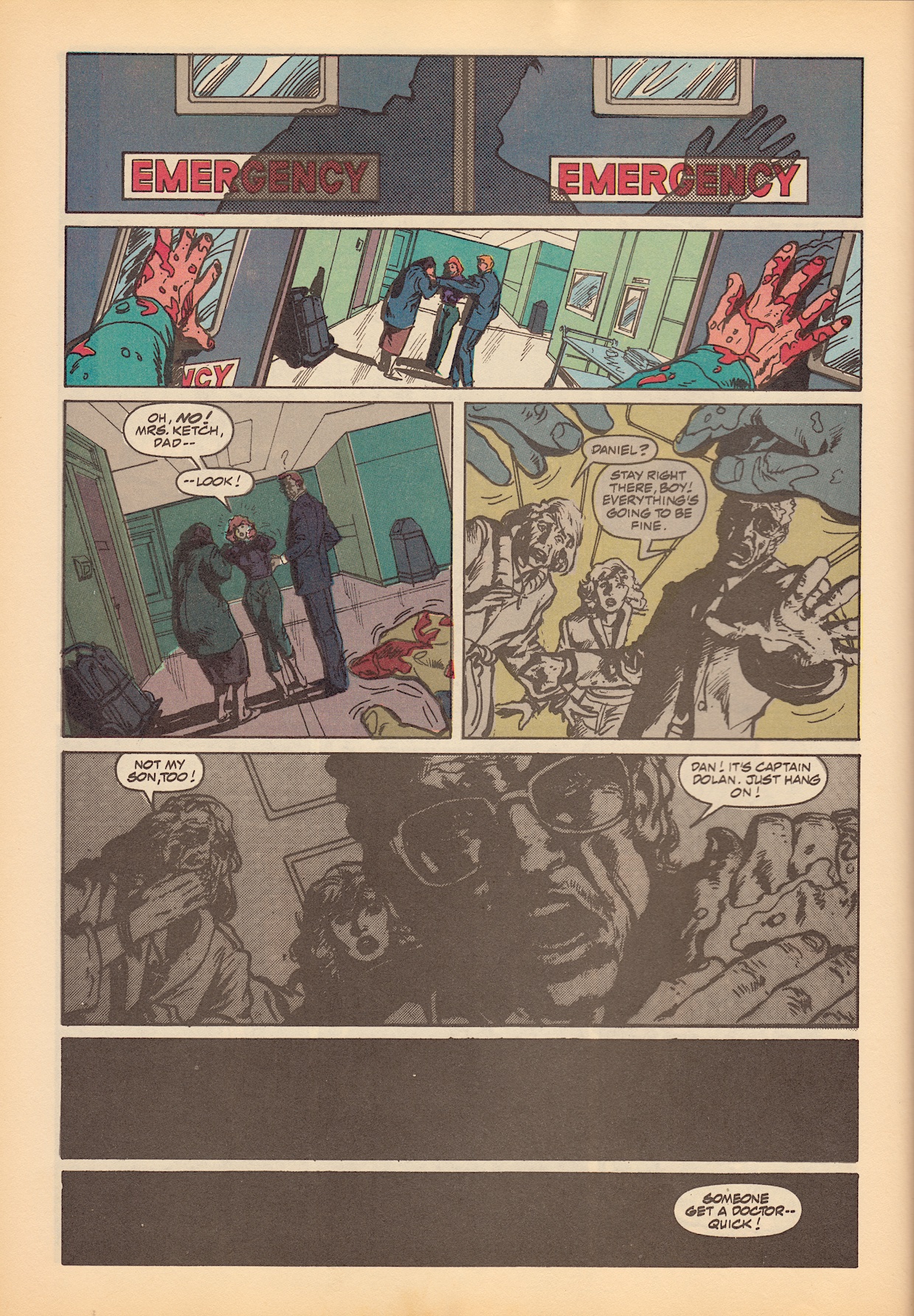
Alongside Deathlok, Ghost Rider’s origin story also ends this issue, with part eight of Life’s Blood ((written by Howard Mackie, pencilled by Javier Saltares, inked by Mark Texeira, coloured by Gregory Wright, lettered by Michael Heisler)) which acts as a kind of epilogue. In his demonic form Danny Ketch bursts into the local hospital to deliver the young gang member who initially scared him back in #1, injured in the battle between Kingpin’s and Deathwatch’s cronies over the mysterious suitcase and its canisters. After this first page he reverts back to human form for the rest of the story.
But as I’ve said before the strip has always been about more than just the Ghost Rider himself, I’ve enjoyed the character of Danny and the building blocks being put in place for future stories. For example, we get the obligatory conflict character, someone in Danny’s life who thinks his alter ego is a menace to society and this comes in the shape of Captain Dolan, the father of a friend of his and his sister Barb. The Ghost Rider is all over the press and Dolan has made his mind up.
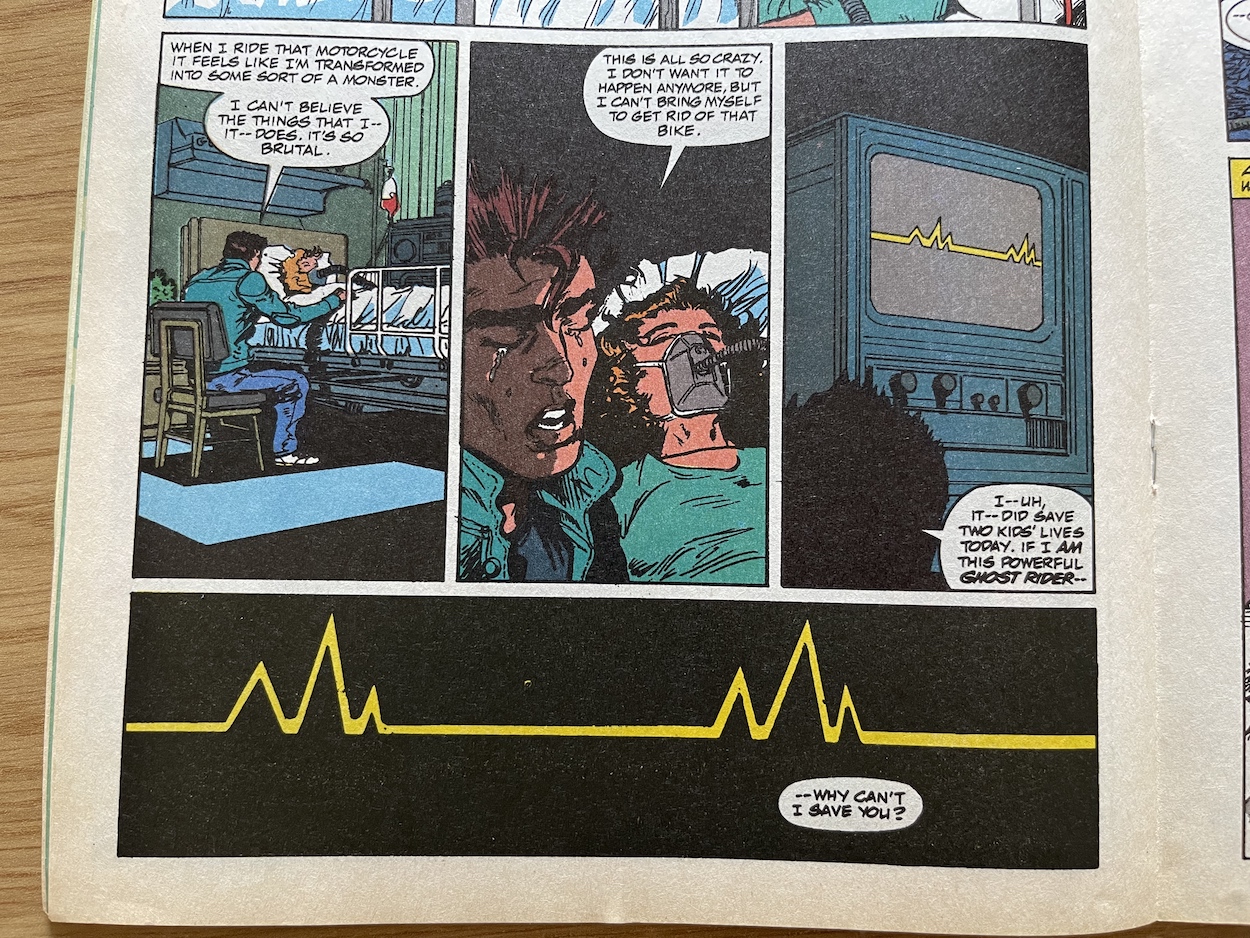
Danny tries to reason with him but we know already this won’t help, this is a character who’ll go up against the Spirit of Vengeance in future issues without knowing who it really is. It’s a bit of a cliché but Danny is such a sympathetic character and the Ghost Rider such a fascinating idea that I’d love to see where this relationship goes. For now though, Danny concentrates on his sister who remains in her comatose state as the story ends.
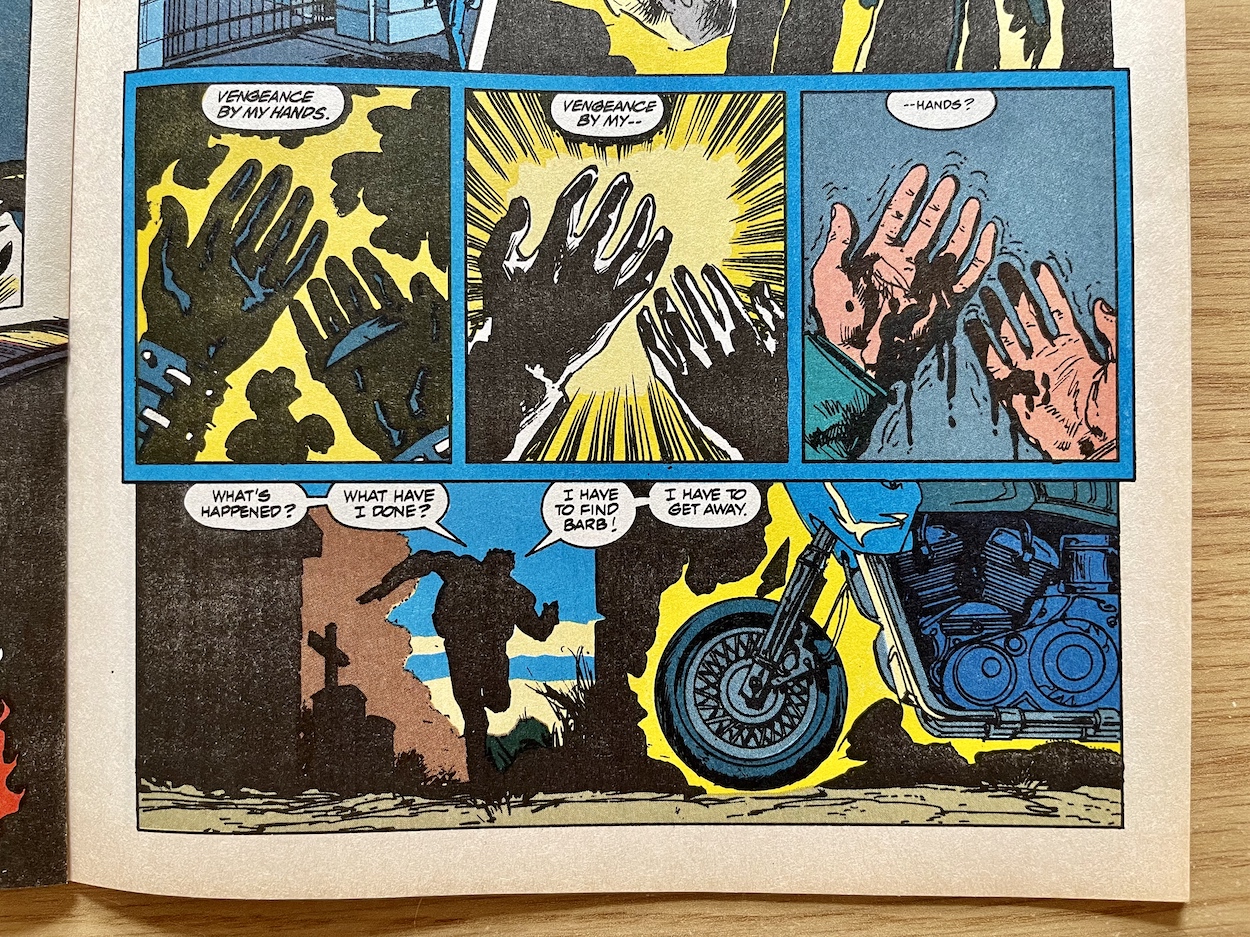
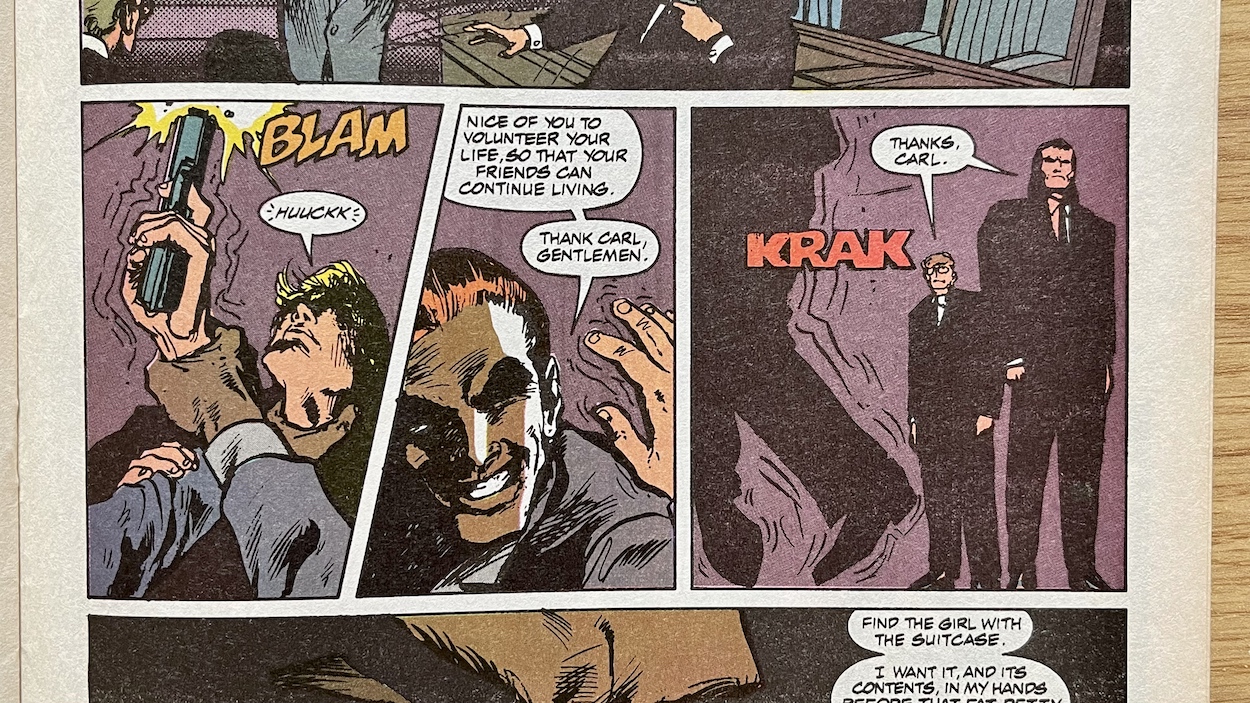
After this scene we get two large panels showing Kingpin shouting at his men that his entire operation is in jeopardy if those canisters aren’t found, and one in which new villain Deathwatch has killed one of his men for losing the suitcase and declares all witnesses are to be eliminated. But this scene in the hospital is the more dramatic ending for me, with Danny struggling to understand what’s happened to him, scared for his sister’s life.
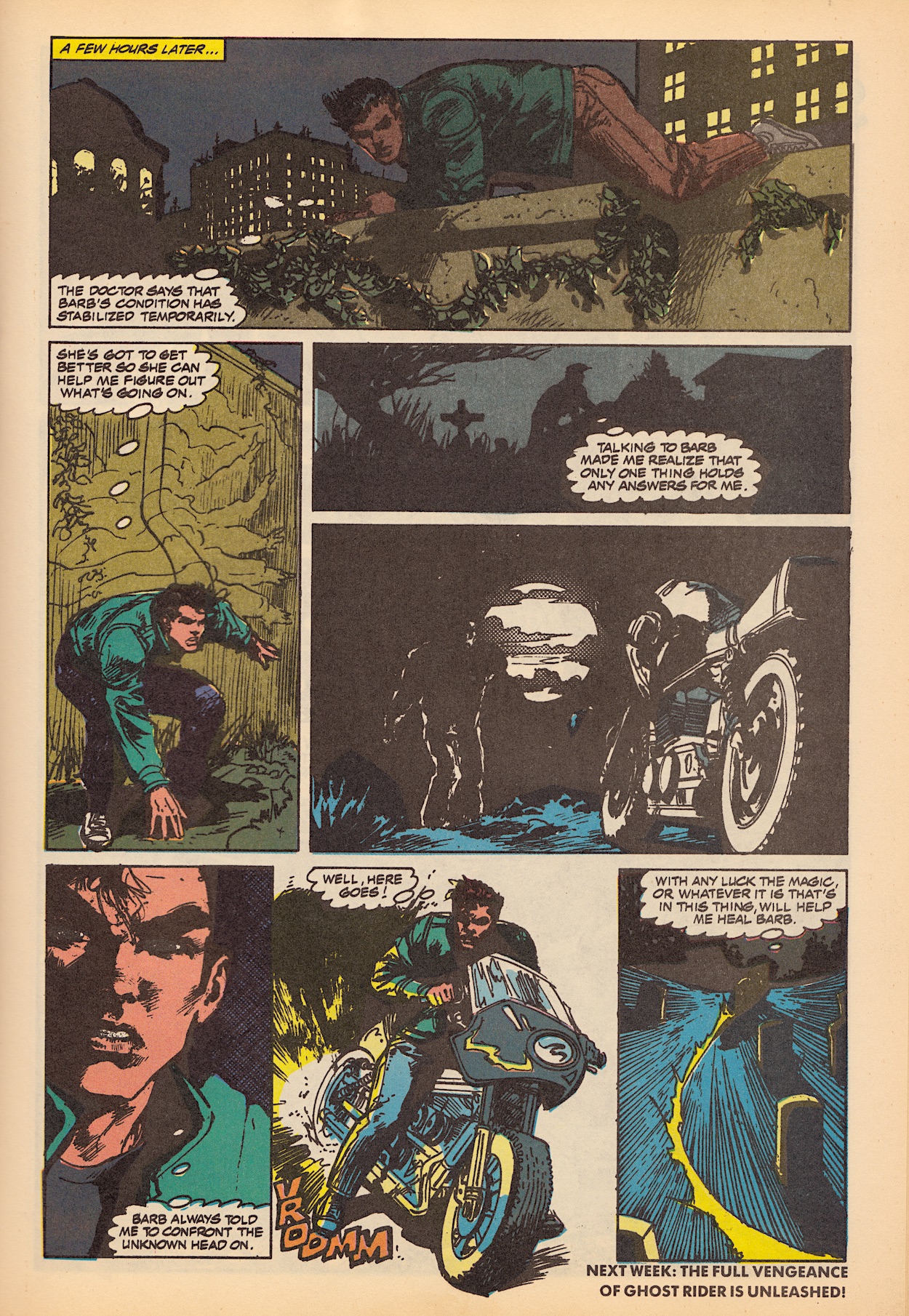
It leaves me thinking is there something his Ghost Rider form can do for Barb? Having this scary, demonic, vengeance-fuelled being caring for his host’s sister could make for interesting storylines in the future. This may be the first series I want to try to collect in graphic novel form after Havoc finishes in just seven days. Watch this space. On the next page we’ve got a special feature about the Star Slammers, or at least that’s how it was described on the contents page.
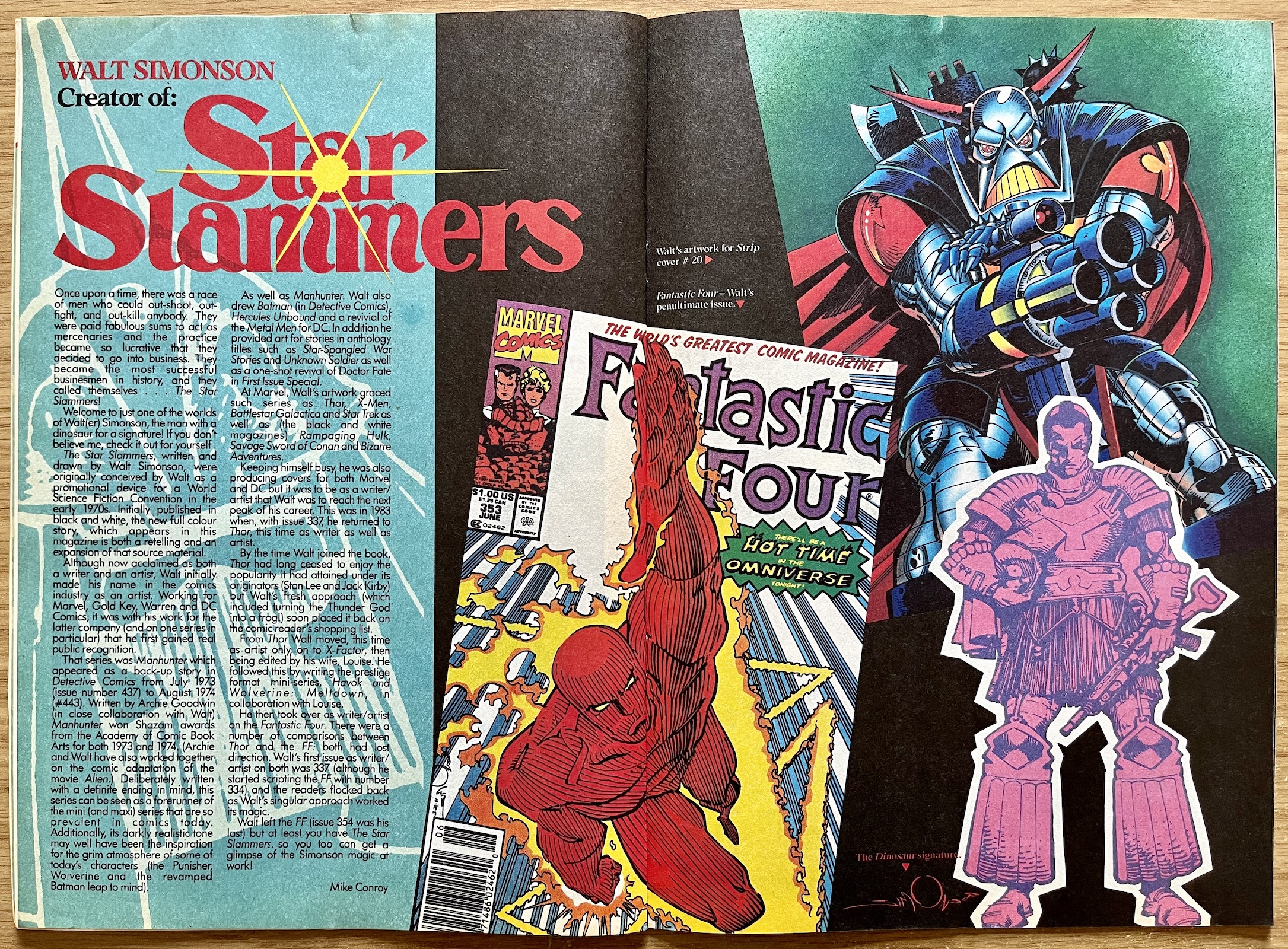
It’s actually an article about the creator of the Star Slammers, Walter Simonson and his illustrious career. I’ll admit as I read it I was a bit miffed it didn’t mention Walt’s adaptation of Jurassic Park, which featured in the first five issues of the UK’s comic based on that original movie and covered on the blog. Then I had a bit of a moment when I realised Havoc was published two years before the movie was even released. Whoops.
I certainly didn’t think I’d see Death’s Head in Havoc though, there’s always that.
Before we move on to Walt’s strip we have the return of Conan the Barbarian after his one-week hiatus and his next story is entitled Barbarian Death Song. The credits box has been accidentally left blank. Michael Fleisher, who provided the dialogue to the previous story has written this one, with pencils by John Buscema, inks by Armando Gil (Jurassic Park, What If…?, Ka-Zar the Savage), colours by George Roussos (G.I. Joe, Fantastic Four, The Avengers) and letters by Janice Chiang.
In 1972 writer Lin Carter wrote a poem called Death-Song of Conan the Barbarian which is the last story for the character, chronologically speaking. Written for a Robert E. Howard (Conan’s original creator) fanzine and later reprinted in Marvel’s Savage Sword of Conan, in it Conan reflects on his life, those he’s met, those he’s fought and the people he’s killed. Themes include the inevitability of death and living a fulfilling life and crossing over to the other side, which he does travelling alongside those he knew in life.
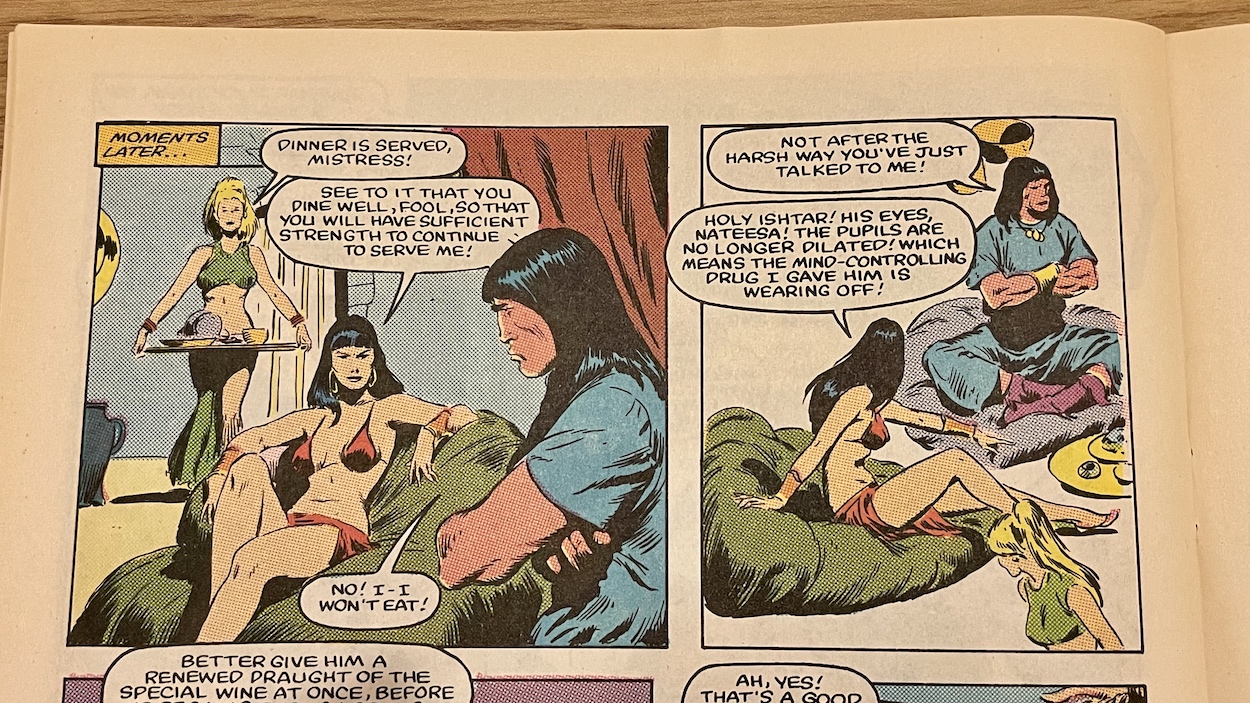
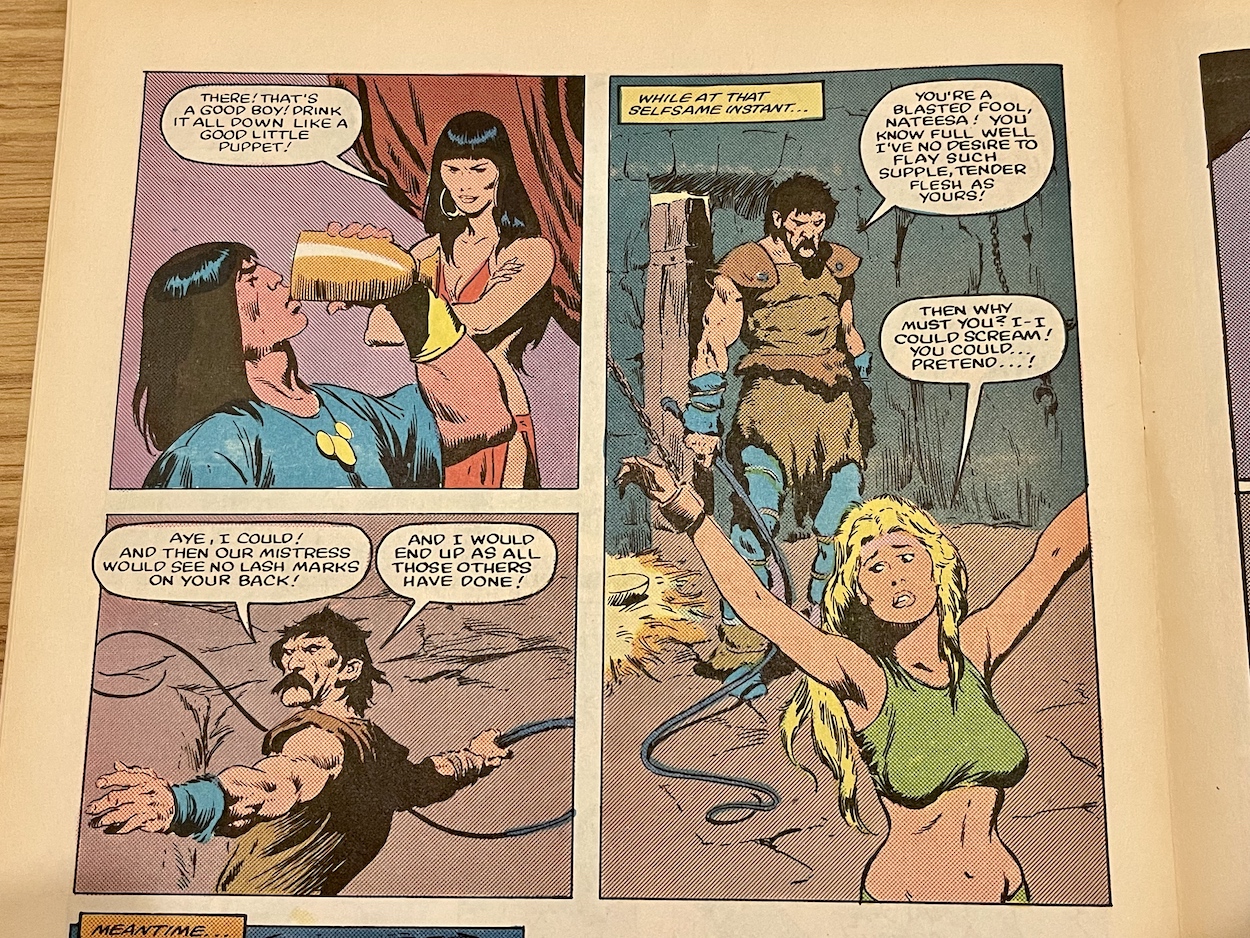
Is this going to be reflected in this comic strip with a similar name? So far the answer is no but remember this would’ve been cut into at least four smaller parts for Havoc. Originally published by Marvel US in 1985 the story begins with Conan turning down the offer of the Nemedian King to take up a ranking position in his army. He then stumbles upon an assassins league called The Falcon Brotherhood (who he has dealt with before) and rescues a damsel in distress who I initially thought was Nateesa from the previous story.
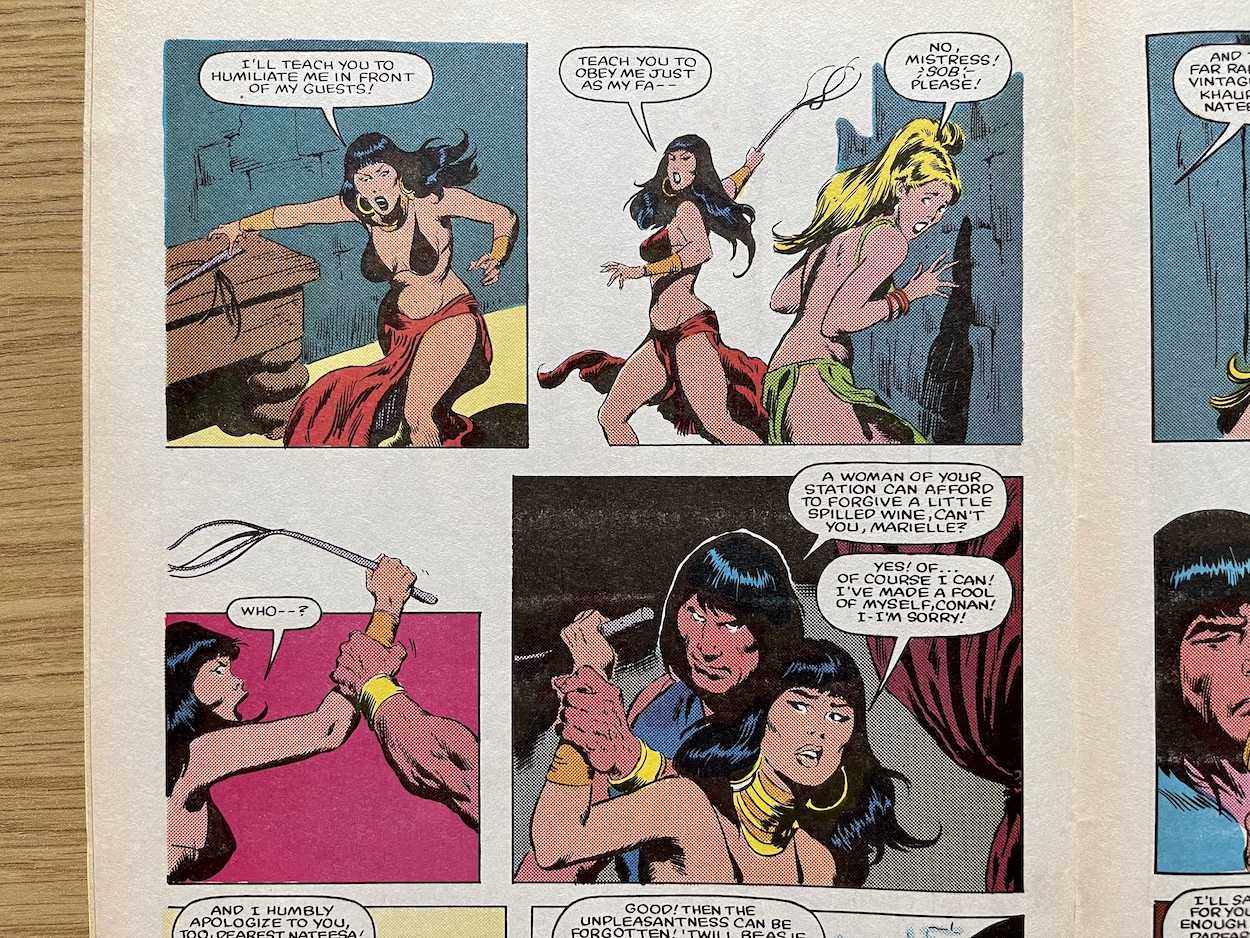
Nope, this is meant to be a completely different character even though she is identical to the damsel from last time, giving me the impression female characters are somewhat interchangeable in these stories (which isn’t a good impression to have). Her name isn’t given yet and she has just about enough time to start telling us her story before she’s unceremoniously cut off for seven days. The jewel around her neck is what the Brotherhood sought and she tells Conan that while tending to her father’s goats a few days previous a cloud “which was not a cloud” appeared before her.
The best bit is the opening page with its fierce battle but it’s immediately forgotten
That’s it, we’ll have to wait until next week to see what that’s all about. A strange place to stop the tale but sometimes it’s inevitable that sometimes the forced cliffhangers won’t quite hit. However, as a result there’s not much to say about these first five pages. The best bit is the opening page with its fierce battle but even it is immediately forgotten as the story jumps forward to a few days later. Hopefully the story begun here will be elaborated upon lots more next week.
Between Conan and the final strip is an advert for a Marvel UK comic I never bought as a kid. This is actually the first time I’ve even seen a colour advertisement for it as it always appeared in black and white in Transformers. I’ve heard nothing but good things about The Knights of Pendragon so it could be something for me to look into at a later date when I’ve covered all the comics I did buy back then.
So, we finish our penultimate issue with the Star Slammers (written and drawn by Walt Simonson, colours by Louise Simonson and Deborah Pedler, letters by John Workman) and if I thought Conan’s strip didn’t have much going on then this one has absolutely nothing. At first glance it all looks very exciting, with a unique layout to the battle scenes and it entices the reader in, only to find not much there upon closer inspection.
We begin seeing their home world which the Orions use as their hunting grounds being devastated from above, the cowardly hunters staying out of harm’s way for now. The pages have that aforementioned uniqueness about them. They’re made up of lots of small squares in apparently random fashion, meant to represent the Silvermind, the ability of their race to share all their thoughts as one. Knowing everything that everyone else is doing all at once could turn the tide of the battle.
But Jalaia realises Ethon was only able to heighten his own telepathic powers to the Silvermind when he knew he was about to die.
In that moment Ethon let all his defences down, even the ones he didn’t know his mind had put up. Jalaia decides to put herself in harm’s way so she can be the trigger. I do like how over a few pages the many squares holding faces of Slammers start to go blank one by one, as more lose their psychic connection with their comrades. But it’s not enough. Even with Jalaia making what could be the ultimate sacrifice, I still found myself struggling to care for any of the characters.
There really hasn’t been the character development necessary for something trying to be so epic. I should be on the edge of my seat with this story but I just haven’t been able to connect with anyone involved, despite the earlier issues having some interesting world building. That’s it in a nutshell really; the story has concerned itself with the big scale events at the expense of the small scale moments and characters. As it stands, I find myself rushing though it to get to the letters page!
I always liked how Marvel’s comics wouldn’t hold back on printing criticism received, with the first letter really not holding back on their opinion of my least favourite strip. That being said, these letters were sent in by readers after #2, so opinions expressed are still limited to those first two issues. I laughed when Deathlok was described as “a RoboCop for the present”. Robo was only released upon the public in 1987! The same letter even praises the Slammers. There’s just no accounting for taste I suppose.
Interestingly the reply states Conan is the strip receiving the most negative feedback. Given how these letters were written after only his first adventure I can understand that though. It also appears that back in 1991 the UK didn’t have the same appetite for spandex as it does now. How times have changed. The next time we read Cry Havoc will be the last so none of the proposed changes would get the chance to take effect. But I’m still looking forward to it. Each issue was growing in confidence and with the origin stories out of the way the future looked brighter than ever.
The suddenly cancelled Havoc’s swansong review will be right here from Wednesday 31st August 2022.
Alex Murphy returns to the cover once more as Havoc #7 hit newsagent shelves back in 1991. There’s something missing from this wonderful looking cover though and that’s any mention of Conan the Barbarian. As stated in the previous issue the Cimmerian would be taking a break for one week and on the contents page under his banner are simply the words “Back next week”. So why has he been forced out of the issue?
Two of the strips here, namely our title star RoboCop and Star Slammers get more pages apiece, particularly Robo who ends up with more than any strip has been given in any issue so far and this brings his current story to an end after three issues instead of the usual four. Each character would get a different number of pages every issue depending on what was happening in their individual stories, while also taking into account the following chapters, cliffhangers, endings etc.
For example, on the letters page this week the replacement for Star Slammers in #11 is mentioned. Swapping out finished strips, working out suitable lengths for each chunk of story and planning for each issue to have as much content as possible would require some flexibility, especially as they were dealing with strips not written for this anthology format. To get the best out of each strip, including Conan, they may have to drop one for an issue to ensure things run smoothly in the long run.
Speaking of the editorial team, there’s been a bit of a shake up. Launch editors John Freeman and Harry Papadopooulos have jumped ship already, leaving the tiller in the capable hands of Jacqui Papp (editor for titles such as Motormouth, Die Cut and Battle Tide, all comics from the Marvel UK Genesis Project) and Steve White (colourist for Transformers, Jurassic Park’sXenzoic Tales and editor on Visionaries). Their first issue is a doozy, so let’s get started with Deathlok: Brains of the Outfit written by Dwayne McDuffie and Gregory Wright, drawn by Gregory and Jackson Guise and lettered by Richard Starkings.
Up to this point Deathlok has been full of action, strong character development and some rather terrifying moments when Michael Collins awoke. I’ve previously mentioned how I remembered there being a lot of humour too, particularly between Michael and the monotone computer operating the Deathlok cyborg. We get to see quite a bit of this in part six of Brains of the Outfit, such as the computer’s recalculating moment and when they finally destroy the massive tank and it looks like the killer cyborg is about to see off its driver Ben, a former colleague of Michael’s, only for his head to be squished inside Deathlok’s helmet instead.
“Who asked you?” “You did.” *sigh*
Exchange between Michael Collins and the Deathlok computer
It shows how Michael has successfully reprogrammed the machine and the humiliation of Ryker is probably all the worse for the head of Cybertek; not only is he spectacularly defeated, but his cyborg war machine has avoided murdering someone again and it’s had a laugh at his expense in the process. Brilliant stuff! In the sewers we get more of this sort of thing as Michael forgets his thoughts are now part of the machine.
However, as you can see the strip can flip in an instant, from genuinely funny moments to those of heartache. Michael arrives home and obviously Tracy isn’t going to believe him when he tries to tell her who he is. Already devastated by the news of his death, this is almost too much to bare. That final moment when he repeats his funny comment about their son from #3 before running off is a much more perfect cliffhanger than any action scene could be. For all its bravado, Dwayne and Gregory’s story has a human heart running through it that’s just as compelling.
For only being seven pages, this really had it all. What a superb story and he’s definitely a Marvel character that deserves much more exposure today. It’s a crying shame he hasn’t had his own movie or TV show by now. Speaking of movies, Eye Level doubles in size this issue thanks to two of the most hotly anticipated movie sequels of the 90s. One would go down as an absolute classic, the other not so much.
On first reading I don’t think the writer was too enamoured with Terminator 2: Judgement Day, although they were right in that the film did end up as one of the most successful of all time. Personally I loved it and remember watching it on VHS in school on the last day of term after it came out in the home market. Not the best way to watch it first time around but it still made an impact and I enjoy it to this day. All of the things about Teenage Mutant Ninja Turtles II: The Secret of the Ooze meant to improve upon the original are the reasons why my friends and I never liked it, so these were massive misjudgements on the part of the director and studio.
That competition at the end though: “No captions complimentary to Mr. Ice will be accepted.” How very Havoc.
RoboCop uses his hand spike to take control of the ED-209’s weaponry
RoboCop: Murphy’s Law Part Three (written by Alan Grant, pencilled by Lee Sullivan, inked by Kim DeMulder, coloured by Steve White, lettered by Richard) takes up the centre of the comic with a large nine page chapter this issue, ending the story earlier than expected. OCP’s Laszlo has ordered his criminal contacts to kidnap a police officer so that his reprogrammed ED-209s can rescue them and prove their superiority over RoboCop while Murphy’s brain (distraught from losing a civilian) has shut his systems down. But Nixco have also sent their new Nixcops to do the same. RoboCop awakens when he learns that his partner Lewis is the officer in question, snapping him back to life. It’s all set for an explosive climax.
But first, either the ED-209s have shrunk since the movie or that’s one hell of a big van. I’m nitpicking, so I’ll just ignore this and get on with the main bulk of the story. The two sets of rogue robots start to take each other out, both believing they have the proper authority to rescue Lewis and that the other is breaking the law. An ED-209 even attempts to kill Alex because it deduces he’s trying to stop it rescuing her.
Pinned down on all sides, his car trashed and time running out for Lewis, Robo’s solution is one that I wish we could’ve seen in a movie or the show. Using his spike (a way of interfacing with other computer system ports) he accesses the ED-209 that tried to shoot him and takes command of its weaponry, eliminating all of the Nixcops in a few seconds flat.
Lewis may be tied at the wrists but she isn’t a damsel in distress. The commotion outside distracts her kidnappers enough for them to be lined up at the first storey window, so she rushes them and pushes two of them out to their death. But the final one slaps her to the ground and takes aim at her head just as Alex enters the building downstairs. Knowing he won’t reach her in time he scans up through the ceiling and I just wanted to let you see how another of his well known abilities is represented in comic form, thanks to (new editor) Steve’s colour work in particular.
You can see what’s going to happen here and after the kidnapper crashes through the floor, landing at his feet, RoboCop appears to be back to normal again. It’s been a more action-packed story than that from the first four issues, but taken together they work really well to bring us both sides of the character: the logical and the human. You’d think having both this and Deathlok together in one comic would feel repetitive but they work really well together as two completely different takes on the same basic idea. I’m looking forward to seeing what’s next for Murphy.
Part seven of Ghost Rider: Life’s Blood (written by Howard Mackie, pencilled by Javier Saltares, inked by Mark Texeira, coloured by Gregory Wright, lettered by Michael Heisler) is up next as the lengthy origin story continues and it feels like it’s wrapping up the action quotient of the tale here, so I can only guess that perhaps next week’s part will feel like an epilogue and deal with the aftermath for the characters involved. If I’m right I’m all for that, the variety in these little weekly chunks heightening the tight scripting by Howard Mackie.
The gangs fighting over the suitcase are destroying whole city blocks in their war for the canisters, with the kids who stole it in the first place caught in the middle. No longer the cocky street gang of earlier issues, now they’re cowering for their lives after seeing one of their own killed. But one roar of a motorbike engine later and things take a decidedly different turn. Danny Ketch has transformed again into the Spirit of Vengeance and I love this particular page above, introducing another skill of the flamed rider’s.
This is just the kind of thing teenage me would’ve lapped up. Oh, who am I kidding? I’m lapping it up right now at the ripe old age of 44. Ghost Rider approaches the kids, the same gang that terrified Danny in the first issue and reaches out his hand, telling them he means them no harm. I was surprised at this because I just didn’t expect it from the character and it’s a nice touch. However, he’s soon involved in the fight again and one of Kingpin’s men has had enough, pulling out what looks like a rocket launcher from the boot of his car!
With the demon rider (the gangs may have named him this but they still believe he’s just a person wearing a flaming helmet) the gangs are down to their last two survivors. Joining together to force a confession out of the girl who took the suitcase, while ready to double-cross each other at the same, the tension builds until a sudden chain flick from behind knocks them both out and in their place stands that flaming skull, with his hand outstretched once again to help her to her feet.
Again, this proves what I said earlier about the cliffhangers Havoc’s editors would choose, not always relying on the shocking action scenes. For example, it would’ve been easy to end Ghost Rider with the rocket scene above but instead we get a further couple of pages and this ending of the terrifying demon reaching out his hand to help the innocent. It’s just as much of a surprise as the explosion and it works so much better in my opinion as a moment to end on. I want to see more of this character, much more.
If you’re only coming to these reviews now let me explain that this was my introduction to the character back in the early 90s and in the intervening years I haven’t read any Ghost Rider comics or even seen the movies. This is pretty much introducing me to him all over again, so it’s basically all new. As with some of the other Havoc stars there’s a lot more beneath the surface to discover and I for one find him a fascinating creation so far. I’m eager to learn more, so little moments like this are huge to me.
Less fascinating are the Star Slammers (written and drawn by Walt Simonson, coloured by Louise Simonson and Deborah Pedler, lettered by John Workman). Also getting a good portion of the comic we see how Grandfather and Sphere first met, the former as a senator bringing a warning of a future planet wipeout, the other the leader of the people on the planet used for sport. As the Slammers prepare for the war at last they reminisce about that first meeting, how the elder had to prove himself and how he engineered the Mindbridge.
Able to communicate psychically already, his equipment and injections were to lead them to a point when they could all communicate as one, the whole race combined as one unstoppable force. Only then could they face their hunters, the Orions. The name ‘Star Slammers’ is taken from one of their weapons and name they use as they fight for others to make money and collect the weapons and ships they need. There’s also a hint about the exiled humans being closer to their ancestors than the ones consumed by hatred (the ones who hunt them for sport because they’re different).
It’s here the main problem with pacing rears its ugly head. At some points in previous issues nothing much has happened at all, in others we’ve been treated to some nice action or background details. But more often than not it’s felt a bit muddled, as if it was just buying time until the next issue. As we all know by now, Star Slammers wasn’t written as a monthly comic, instead it was a complete story in #6 of Marvel Graphic Novel. I’ve said previously how it maybe wouldn’t have these problems if read in one go as originally intended. I’m not so sure anymore.
Even here, with the flashback to those early meetings it just reads like forced exposition, a far cry from similar scenes in #4 when we got the background to the animosity between Grandfather and Kryllik. Now it seems any interesting story sections are being rushed through, like space is running out and writer Walt Simonson has to suddenly squeeze everything in. This is the same feeling I got when reading the final chapter of the Jurassic Park movie adaptation, also written by Walt.
What could’ve been a fascinating origin story isn’t helped with pretty bad dialogue either, combining to give an impression of everything being forced just to get the story to the actual battle it’s been predicting since the beginning. Could Simonson’s galaxy-spanning tale full of relevant social commentary simply have been too ambitious for the page count in Marvel Graphic Novel? Perhaps. But at least we get an inkling some excitement could finally be on the cards next issue.
With the war about to begin we close off all of our strips for this week with Cry Havoc and the second instalment of readers’ letters. Kicking things off with the promise of t-shirt prizes for star letters, ironically the start issue given for this would actually be the first to never appear. Then it seems the issue after that was to be the first with a new strip since #1. Intriguing little hints about a future that was not to be.
That’s us at the end of another issue and, despite it being one character short and extra pages given to my least favourite strip, it was another goodie. I look forward to a full deck of anti-heroes next week though. Speaking of which, that’ll be the penultimate one already! Where has this summer gone? Join me again soon. Havoc #8’s review will be here from Wednesday 24th August 2022.
This is a wonderful original Marvel UK cover by Liam Sharp (a first for the title) showing Deathlok breaking free just as he finally does inside, with Michael Collins’ mind now fully aware and communicating with the military computer inside the cyborg. It really kicks off this issue. That headline about the Star Slammers is obviously meant to shock, but given my love-hate relationship with that particular story and its characters I’m really not feeling bothered either way. But that doesn’t detract from how excited I am to read another issue of Havoc!
I can’t believe I’m already at the sixth issue and I really, honestly do look forward to this day every week, but of course the more we fly through this on a weekly basis the closer we get to its premature end. Still, it’s clear from this issue the intention was originally to have this as a long running title, what with the inclusion of the first letters page and some of the answers given. We’ll get to that in due course. First up is the cover star and as you can see the strip now has a traditional Marvel UK border to the first page to bring us up to date. In fact, every strip has one now and I’ll show you each one.
You’ll see on these first pages that every one has the credits star inside something unique to that strip. For example, you’ll see it inside Robocop’s gun barrel, a monitor on the Star Slammers’ ship or an animal skin drum for Conan. Dwayne McDuffie and Gregory Wright’s (re)creation of Deathlok really does show off this time what the whole remit is about with an all-action entry in his origin story, with art by Gregory and Jackson Guise and letters by Richard Starkings.
This issue’s chunk of story really highlights how Collins and the computer will interact and work together. Now recognised as its new programmer, he’s able to give the cyborg new instructions on the fly. The first thing is to tell it that killing enemies is off the table. After trying and failing to stop it previously in the jungle (apart from just about stopping it from killing a small child), now recognised as the authorised input a simple command changes all of that. The computer must now be smarter and work around this new parameter, which it does with aplomb as the story continues.
Ryker watches on and tries to stop them with every security measure possible and the straight-laced, logical computer and the flying-by-the-seat-of-his-pants Michael make a great team. Even though the computer is just a machine, it almost comes across as banter between the two thanks to Michael’s very human reactions to its very logical statements, and vice versa. Ryker is having way too much fun though in trying to kill his former friend and colleague!
Remember that huge tank thing a few of issues ago? I knew it wasn’t for nothing and as Deathlok crashes through another wall to get around the force shield they come across the tank and suddenly it whirrs into life. They scan it and find another former workmate at the wheel. Questioning how he could possibly have gotten there so quickly when no one would’ve known which route they were taking, the computer informs Michael of the trackers in the helmet. There’s only one option, to remove it and take on the tank with Deathlok vulnerable for the first time.
This is the penultimate panel of the strip and is a great summary of the action we’ve been treated to in these wonderful five pages. This is just our main character trying to escape the compound of Cybertek, never mind the adventures that could come next. This lone cyborg going up against impossible odds, the computer’s monotone (in my head anyway) voice and Collins’ interactions could make for great fun. What’s interesting is how Collins isn’t in control of the cyborg’s body. Instead, it’s moving autonomously with instruction fromMichael. An interesting dynamic I’m looking forward to the writers exploring more of.
Our second strip this time is part two of RoboCop’s Murphy’s Law, written by Alan Grant with pencils by Lee Sullivan, inks by Kim DeMulder, colours by Steve White and letters by Richard. At the end of last week’s episode, in the midst of his own mental breakdown, RoboCop let go of the hovering garbage droid to land on top of a car being stolen by a gang of thieves. Causing the car to crash with Murphy between it and a lamppost, it’s almost too much for his systems which were already under stress from the Nixcops attack and then watching a member of the public die because he couldn’t protect them, breaking one of his Prime Directives.
At Nixco, Dek Kyng is now in their hands so they immediately set to work making sure he won’t be causing any more problems, setting an automated surgical system on him to hack into his brain and turning him into another one of their robots. Meanwhile, Alex lays dormant on a table in his police district. A tough job lies ahead for the engineers but they see this as an opportunity to install some amendments and they’re given the go ahead to proceed, much to the chagrin of a new character called Laszlo.
Laszlo’s plan involves having a police officer kidnapped who the ED-209s will rescue
You see, Laszlo was in charge of the ED-209 programme which RoboCop fans will know looked cool but were pretty awful at law enforcement. Believing the problems to have been fixed (yet the EDs are still the big, lumbering robots of the movie) Laszlo sets about making sure OCP have no choice but to terminate RoboCop and choose his path instead. His plan involves contacting a street gang and arranging to have a police officer kidnapped, who the ED-209s will rescue.
First up though it’s time for a commercial and some news updates from Media Break. I loved these in the first film and in particular in every episode of the TV series. I’d completely forgotten Delta City didn’t actually exist yet in the movie, I’m so used to seeing it complete (or at least in a more advanced state) in the series complete with its self-aware central intelligence, that reading this feels like a prequel to the RoboCop I grew up with.
Eventually his engineers realise it’s the human part of RoboCop that’s not operating correctly (for want of a better phrase) but they can only speculate on what’s going on inside his mind. They put out a call for his partner Lewis to return to HQ and help, and in the meantime we get one of those trademark RoboCop memory scenes. While all of this is going on the various strands of the story come together before we leave things for another week.
Lewis is currently in the middle of an arrest which in reality is a set up by Scarface’s men, the gang Laszlo contacted to kidnap a random officer. When news of her disappearance reaches Media Break the bosses at Nixco see an opportunity to send in their own Nixcops to rescue her and prove their cyborgs are the future of law enforcement. What a mess this could be! Great stuff. Writer Alan Grant feels much more comfortable with this second story and is really getting stuck into the lore and the action, one never at the expense of the other. Perfect.
Next up is Star Slammers, created, written and drawn by Walt Simonson, with colours by his wife Louise Simonson and Deborah Pedler, with John Workman‘s trademark lettering. So, with Ethon being tortured in last week’s strip it’s no surprise to find out he’s the one who bites the dust. There’s a quick bit of mourning from Jailaia and Sphere before they decide to use the body of their fallen comrade to help them escape. Wow, that’s pretty cold. They don their gear and before boarding their own ship moored outside they tie Ethon into the pilot’s chair of the prison ship and set the controls.
I have to say this next part is really rather good. The main ship of the fleet is watching on and receives a distress call from the prison ship after someone on board discovers what’s happened. The huge vessel getting silently and ominously closer and closer is a truly terrifying sight for those watching and I think Walt has done a superb job with this particular sequence, which culminates on the next page.
Of course the escape is immediately covered up (as an unwarranted attack) by Krellik, who is no longer a senator but an all-powerful Admiral. Declaring the hunt on and how much the television networks will love it, he alerts the entire fleet to set out after the escaped Slammers. It feels like we’re finally getting somewhere, so adding this to the fascinating (and very relevant today) background politics from #4 we could be in for a treat in coming issues.
One film that stood out above all others in the summer of 1991 was Terminator 2: Judgement Day
I’m still not sure if it’s really working being split up into chunks though. Maybe the coming issues will prove me wrong, but at the moment it may have worked better in its original form. Two out of the these first six chapters held real promise, so if the remaining parts of the story build on those and we get a nice mix of story and action in the limited space afforded here, it may prove to have been worth the wait to get to this point.
This issue’s Eye Level is a particularly interesting one. During the summer of 1991 cinema goers were treated to a vast array of blockbusters with everything from City Slickers and The Naked Gun 2 1/2: The Smell of Fear, to The Rocketeer and Robin Hood: Prince of Thieves. But one film that stood out above all others was Terminator 2: Judgement Day and it’s the impending release of this movie that takes up the whole page, with 20 facts about the film and its star.
While I can’t find any evidence that the so-called ‘Jung and Freud’ film was ever made, there are other tidbits here which I never knew about, such as the fact Arnold Schwarzenegger was originally intended to be Kyle Reese in the first film, and before Robert Patrick was cast as the new T-1000Billy Idol was hired for the role. I’m a fan of the series (the first four films anyway) so it’s interesting to see the contemporary coverage the best one received at the time, and it’s a clear indication this was a Marvel UK comic aimed at the older teen audience.
Conan the Barbarian’s Cauldron of Doom (plot and art by John Buscema, dialogue by Michael Fleischer, letters by Janice Chiang) comes to its conclusion this issue and as feared it basically boils down to Conan coming out of his hypnotised state and punching a few people. How this happens is rather good though, with slave girl Nateesa coming to his rescue. Terrified of her mistress Marielle, Nateesa can’t get close to Conan so she resorts to desperate measures and throws a stolen knife at him. She’s a very good shot from so far away!
Once returned to his senses Conan easily disposes of the two men guarding the cauldron filled with whatever liquid would’ve killed him and seized his body into a solid statue for Marielle’s collection. (The opening dialogue box refers to her as a witch for the first time.) As for the villainess herself, she chases after Nateesa who punches her out cold and… that’s it. It’s all neatly tied up in a big bow as Conan and Nateesa ride off into the sunset together. After the intriguing build up, the interesting Marielle in the first chapters and the very funny moments in previous weeks, it’s such a shame it has such a clichéd ending.
Robert E. Howard died only four years after creating Conan so he never got to see his meteoric rise
At the end a caption states Conan won’t return until #8. No idea why he won’t be in #7 yet. Is one of the other strips due to get extra room for some reason? Are special features planned? Who knows, we’ll find out in seven days.
As if to soften the blow of the longer than normal wait for the next Conan story we get a two-page feature about the history of the character written by comics historian Mike Conroy. Coming from a position of knowing nothing about Conan this was all brand new information to me. Most surprising was how young Robert E. Howard was when he died, and only four years after creating the character so he never got to see his meteoric rise. That’s such a shame.
Other surprises for me are that the original Red Sonja was much different than the one in the movies, that she wasn’t part of Conan’s stories and the Conan movie was written by Roy Thomas (who adapted Havoc’s first story from Howard’s books) and Gerry Conway who blog readers may remember was the head writer on Marvel’s fantastic Visionaries comic. The feature does raise a couple of questions though, namely if the US comic was still in print why was Havoc using such early stories rather than the latest ones, which surely would’ve been a better fit? Also, what on Earth is Captain Carrot and his Amazing Zoo?!
The final strip this week is Ghost Rider (written by Howard Mackie, pencilled by Javier Saltares, inked by Mark Taxeira, coloured by Gregory Wright, lettered by Michael Heisler) and it’s all about that mysterious suitcase and the young gang of kids who stole it. Kingpin’s men have tracked them down and sent in that well worn stereotype, the bad guy who is so overly polite you just know he means the exact opposite of what’s coming out of his mouth. We must remember these stories are nearly 30 years old. His hints soon turn to actual threats until one of the kids is stabbed by a flying knife.
New Marvel bad guy Deathwatch has sent his ninja-like minions for the same purpose, to retrieve the briefcase that kicked all of this off in #1 and all hell breaks out in the streets of the city. It’s clear this version of Ghost Rider is going to make for a very violent strip, much like the rest of Havoc really, and despite the central character being of supernatural origin it all comes across gritty and serious. I like this juxtaposition.
Our reluctant hero Danny Ketch is driving about on his apparently completely normal motorbike and beginning to wonder if he imagined the whole thing from the night before. He’s trying to determine whether he wants to coax out whatever it was he turned into, thinking it might have some knowledge to help his hospitalised sister Barb. However he’s terrified of doing so, but once he hears the gunfire and commotion the petrol cap on the bike starts to glow. He doesn’t want to touch it, but feels compelled to. He instantly regrets it.
I love this transformation scene, Danny’s skin engulfed in fumes and then lit up, you can feel the heat radiating off the page in that close up of his face, followed by the exciting panel of him and the bike becoming one. Depending on how each individual story in Havoc is chopped up into various lengths, each issue we could get a lot of plot or a more character-focussed bit of the tale, and sometimes we get a quick shot of excitement which keeps us hanging on for more the following week.
This week’s Ghost Rider definitely falls into the latter category and I’m not complaining one bit, especially when the next page ends this week’s strip with this image.
The gang war over the briefcase has escalated to murderous levels, endangering innocent lives and the Spirit of Vengeance is having none of it. There’s a lot of mystery still around the main flaming character and Danny is only slowly beginning to realise this could be his life now. It’s building momentum, it’s pace is quickening but it’s also taking time to establish its characters. As a result this feels like the most bedded in strip in Havoc. Plus, that’s just a really cool image to end the issue on.
We come to the end of another brilliant edition but instead of the usual full-page Next Issue promo we’ve got our first letters page in the shape of Cry Havoc. At last! I’d forgotten all about the fact we even had one. I don’t recall ever writing in, but given the short life of the comic I probably never got around to it. The letters here are all very positive and that’s the feeling I come away with; if this was the summer of ’91 I’d be thinking this appears to be a very successful new comic, such is the reception on display here.
There are definitely a couple of recurring themes on this page, for example a few mentions of The Punisher (and more received according to an answer) and his cancelled comic, which leads on to the other theme of hoping Havoc isn’t another short-lived Marvel weekly. Sadly at the time it did seem like every decent new comic didn’t last long. Unbeknownst to us Havoc was to be yet another casualty. But I’m enjoying it while it’s here.
One final note, Jim Black’s letter mentions the five-pointed star motif and I asked Paul Chamberlain (who designed it) if this was related to the fact there were five strips. It was actually just a happy coincidence. Watch out for a chat with Paul here on the blog soon! There are more Havoc comics to review first though, so join me again in one week. The review of #7 will be here on the OiNK Blog from Wednesday 17th August 2022.
This would be the final issue of Dark Horse International’s Jurassic Park, but the comic would continue for a few months yet. No, that’s not a contradictory statement, as you’ll find out next month. This is, however, the last time the cover will have that distinctive banner down the left side. What a cover image that is too. On the contents page the credit for John Bolton’s image clarifies it’s “a scene from the classic movie”. A classic just months after its release? It would be, but it wasn’t even out on video at this stage!
John’s dramatic image was created for the American Topps Comics’ ongoing monthly, Return to Jurassic Park which had been released after the few initial mini-series, the second of which we were still reading in the UK comic. In fact, this edition saw the conclusion of the first issue in the second mini-series, Raptors Attack and was written by official sequel scribe Steve Englehart, pencilled by Armando Gil, inked by Fred Carillo, lettered by John Costanza and coloured/story edited by Renée Witterstaetter.
Part two of Rush! sees Doctors Alan Grant and Ellie Satler given the unenviable task of looking after the juvenile Velociraptors captured by Columbian drug lord Rafael. Training them via use of electroshock collars (the ‘raptors, not the doctors) the dinosaurs are becoming worn down and sick. Gassed and asleep, our heroes are sent in to examine them, not that Rafael is going to listen to any of their recommendations. As this is taking place the ‘raptor that was previously shot in #11 and saved by Ellie watches on from her cage.
What I particularly liked here was seeing some scenes from the point of view of the animals. For example, here the language of the humans is just a load of strange alien noises but she watches intently, trying to work out what’s happening, despite her base instincts. This storytelling technique isn’t used extensively, just enough for us to see their vantage point at specific moments, always treating them as intelligent wild animals instead of movie monsters, a main theme of the novel and films. They’re individual characters and subject to development in this strip just like the humans. I like this a lot.
“I spent my life looking for tiny pieces of your remains, and now you’re here, in the flesh”
Dr Ellie Satler
Kept separate from her siblings she tries her best to attack Alan and Ellie as they approach her but she’s chained up and unable to make contact. Ellen then chastises her! How dangerous these animals are is always front and centre, and the others still terrify Ellen but after saving this one’s life she’s determined to help it. As she said in that previous issue, given half the chance she’d be torn apart by this creature but it’s still a miracle and she has an obligation to it as a scientist.
As you can see the ‘raptor eventually lets her tend to her wound, remembering she saved her life. From memory this is an important plot point and one the ongoing strip would return to in a key moment, but I won’t get ahead of myself. This, and the following page of the other two dinos preying on and destroying humanoid hay decoys reminds me a lot of the first Jurassic World, which is something else I’ll return to later in the run. But for now the constant training over several weeks seems to be reaping rewards for Rafael.
The ‘raptors are attacking on queue, and when they jump towards Rafael on the other side of their glass dome a simple command has them stop and obediently await their next instruction. But his successes can’t stop his paranoia about competitors and the government closing in on him, despite no evidence of the kind; a result of being secluded from the outside world for too long. When local soldiers are spotted searching the jungle he assumes they mean to steal his dinosaurs so he and his men take his newest recruits for a test.
Ordered to attack, they take to their task with relish, dispatching the soldiers one at a time over a few pages. Armando Gil’s trademark use of dynamic angels comes into play here, one perfect example being the panel featuring the jeep trying to run down one of the ‘raptors, almost like its taking place on the top of a hill, the ground rounding towards the dinosaur. He’s just using two perspectives in one panel, one for the humans and one for the animal in the distance but it works to create a dynamic sense of excitement.
It’s clear these two “clever girls” have plans of their own
In the end she jumps on top of the car, making it crash into a tree where she rips the soldiers apart. As you can see the comic goes all in on the blood and guts. These pages are full of it. Yes, it’s tame compared to horror comics or modern action fare but as a licenced title I was surprised. As a teenager I lapped it up, but looking at it now it feels strange when the films use suggestion and good direction to avoid gore, letting our imaginations fill in the blanks which is much more effective.
With the soldiers dispatched they make a leap for Rafael, but he shouts “Stop!” and they do just that! Are they fully trained after all? Is this man about to become one of the most dangerous criminals the world has seen? Not if a look shared between these two “clever girls” (to quote the movie) is anything to go by. This final panel tells the reader a lot more than I initially caught on to when reading this in 1994, but knowing what transpired next it’s clear these two have plans of their own.
This was such fun, especially when read upon its original release before any of the movie sequels took the dinosaurs off Isla Nublar, beginning with San Diego in The Lost World: Jurassic Park and then of course we had Owen Grady’s training and bonding with Blue and the rest of the Velociraptors in Jurassic World. This was groundbreaking at the time and still fun to read today, if somewhat diluted thanks to those later stories on the big screen.
The ‘Next’ caption is very uninspiring I have to say. More interesting is the fact there’s a free gift in the next issue because I have no recollection of this whatsoever. So you’ll be finding out what that was at the same time as me. For now we move on to the second half of the comic and a thrilling but bittersweet strip. Age of Reptiles has been building to this moment for eight issues now and it was a thrill to read this, but sad to get to the end and say goodbye to these silent comic stars.
But creator/writer/artist Ricardo Delgado makes sure they go out in style.
The drama, the suspense, the wonderful character moments have all been leading to this. However, having a final climactic battle between the Tyrannosaurus rex pack and the Deinonycuses wasn’t enough for Delgado, he takes it to another level and sets the finale at sunset and during a storm, pouring lashings of atmosphere into an already thrilling strip. Seriously, these final pages need to be seen and I can only show a few select highlights, so if you do see these comics for sale, buy them! This is worth the price of entry.
James’ colours have brought a deeply rich and vibrant world to life, perfectly matching Ricardo’s stunning artwork
After a few pages of already stunning action we get to the spread above. There’s so much to love here. So many little details my eyes pick up anew with every pass. The rain splashing off Long Jaw’s back, the Deinonychuses sinking their teeth deep into Talon as her mouth waters, the depth of the battle with the silhouettes in the background and the sheer scale of the action in the foreground as the four giant T-rex dinosaurs dominate the scene.
James Sinclair’s colours add even more than normal, with a suddenly subdued palette portraying the time of day perfectly. All the way through Age of Reptiles James’ colours have brought a deeply rich and vibrant world to life, perfectly matching Ricardo’s stunning artwork. In fact, James’ colouring helped tell the story just as much as the line work, from the identifying markings on each character to the scene setting vistas and passages of time, culminating in these gorgeous final pages.
The battle feels suitably climactic after all this time and it certainly didn’t disappoint teenage me. With both sides playing to their strengths they always seemed evenly matched, despite being two very different species. I was always interested to know who’d win in the end and I couldn’t remember this final chapter until I read it for this review. The answer of course is that neither side wins. This makes perfect sense in the end, as we’d gotten attached to various characters from both factions.
The pouring rain and the might of the battle on top of the nest is too much for the outcrop to bear. As the lightning strikes I can almost hear the thunder and the rain as the rocks begin to fall. Just as the T-rex pack begins to destroy the nest the ground shakes and everything and everyone hurtles down the cliff, seemingly to their doom. The story skips ahead to the next morning when all is quiet and we initially think that’s the end until one sole survivor breaks free from the rubble.
Long Jaw waits and waits but when no one else climbs out he makes his way through the jungle to the nest. There are always little extra details to catch our attention in Ricardo’s story, such as the huge Brachiosaur who seems to be almost timidly walking by so as not to disturb the T-rex. But Long Jaw’s only concern is getting home to protect the one remaining egg left in the wake of the Deinonychus attack back in #7. At least he can take solace in the fact that is now safe. Until we see the final page, that is.
As he approaches the nest a bird lands on his back and squawks at him. Obviously communicating danger, Long Jaw runs towards the nest and on the penultimate page the look of surprise on his face is almost comical as he finds a strange little creature tucking into a tasty treat. There have been sequels to this told by Ricardo over the years but none had been created by the time of Jurassic Park’s printing so it’s with a heavy heart we say goodbye to the Age of Reptiles. It’s been a thrill every single issue, sometimes more so even than the Jurassic Park strips!
The caption at the bottom of the final page to Age of Reptiles tells us Cadillac and Dinosaurs begins next month, but if this sounds vaguely familiar that’s because it’s the Cartoon Network’s name for their adaptation of Xenozoic Tales, which we had as a second back up strip in issues #6 to #9, so it’s not a beginning, just a renamed continuation which I’m very happy about.
On the back page is an advert for a Street Fighter II comic based on the video game, which still feels rather random today. There’s no Dark Horse logo, but there is a Manga one. This’ll be an important detail for Jurassic Park from next month. You’ll see what I mean when we get there. The review of the next issue, which sees some welcome changes to the comic, will be here from Tuesday 8th September 2022. See you then.
With this, only the fifth edition of the superb Havoc weekly we’re already halfway through its run. Not that we knew this as readers of course. So let’s concentrate on the issue at hand and Ghost Rider makes his second appearance on the cover after #2, leaving the Star Slammers as the only characters not to grace the front page. That’s because these covers are reprints of Marvel US ones and the ‘Slammers never had their own title, appearing in an anthology series instead.
So Danny Ketch and the flaming skull are the main draw for new readers and as you can see the title logo not only changes colour each issue but the headline strip does as well. This issue Danny’s hellfire alter ego also has a special one-page feature, replacing Eye Level for one week. But let’s kick things off with the first story and it’s Alex Murphy inside RoboCop in the first part of his second story, which takes pole position just as Conan did when he began a new tale in #3. It’s still written by Alan Grant with pencils by Lee Sullivan, inks by Kim DeMulder, colours by Steve White and letters by Richard Starkings.
Murphy’s Law (nice) begins with Robo battling a group of new Nixcops. Programmed as his replacements they believe our hero is now impersonating an officer and must be destroyed, and his prisoner taken into custody. In reality his prisoner, Dek Kyng, could expose the corruption at Nixco and so the bosses are using their new cops to put an end to Robo’s investigation. His internal thoughts alongside the readouts of his systems are very similar to Deathlok’s but this isn’t a complaint. Alex is much more in control of his systems, they are him, so it’s different to the other cyborg strip.
It’s nice to see his Prime Directives come into play here when he ends up putting himself in even more danger to protect innocent passersby. But the Nixcops have no such qualms and one of the citizens is killed. As Alex makes a run for it his head is filled with doubt. He keeps playing the word “failed” over and over, his computerised half seeking cover while his human half thinks there’s no point anymore, he should just give up, he’s failed his third directive and broken his own laws. This shows how how binary his thoughts can still be despite his human side.
In the original film and TV show his outward speech wasn’t as free-flowing and natural as it reads here, which of course was very deliberate. It made his internal thoughts, memories and the times he’d act with surprising humanity all the more important to the character because they were so jarring with the machine cop he was presented as. It’s what made him unique. I’m glad to say, while the strip has him speaking more like a regular human, these moments filled with doubt are superb and somehow still maintain that jarring feel.
The weight of breaking one of his Prime Directives is almost too much for him. These are core to his very existence and because of this it’s almost too much to bear for his human brain. Most action heroes would shrug it off until later when they’d manage to get revenge for the killing, but RoboCop struggles straight away. He’s just about able to commandeer a flying garbage droid and make his escape but I’m really interested in seeing where this goes next week.
The whole Spirit of Vengeance thing was brand new at the time
Next up is that Ghost Rider feature. It’s rather strangely designed with a huge title and just a teeny tiny picture of the character almost cropped off the bottom of the page, but it reads very well. I’d always assumed the original version of the character had the same modus operandi as this 90s reboot but it appears I was wrong, the whole Spirit of Vengeance thing was brand new at the time. My knowledge of the character is very limited, but with the movie sequel having this title while being based on the original character I had just assumed.
I’m sure reading this feature excited me as a teenager, with how it hypes the strip as a new Ghost Rider for the 90s. It certainly reads like the kind of page that would’ve pumped me up even further for the character and the future of the comic. I was so sure this was just the beginning of a long and happy journey with Danny Ketch and his spirit.
On to the story itself and reading this now I’m reminded of just how much I preferred reading the American strips on these larger Marvel UK pages (not just Marvel but also things like DC’s Batman in their larger UK editions) and I have to say I’m loving it.
Ghost Rider: Life’s Blood is written by Howard Mackie with pencils by Javier Saltares, inks by Mark Texeira, colours by Gregory Wright and letters by Michael Heisler. We begin this issue by catching up with Marvel villain Wilson Fisk, aka Kingpin as he trains, his large size certainly not slowing him down.
The mysterious briefcase apparently contains something which poses a great danger to Kingpin’s organisation but we’re not told what it is, not even when we see the gang of kids open it in their cemetery hideaway, just that it contains little canisters. The main thing to happen here though is Danny finally arriving at the hospital to check in on his sister, Barb. Greeted by his mum, a friend and her dad, Captain Dolan, the events of the night finally prove too much.
The story picks up later and after Danny tells the police captain he can’t remember much of the monstrous man who the police think was responsible (we can see how they’re being positioned for future conflict with each other) we get a tender scene of Danny watching over his unconscious sister, the bleeping of the machines the only response he gets as he opens up about what had really happened.
Previously having discarded the bike in fear of his life, on the last page Danny actually makes his way back to where he left it, it sitting in its regular motorbike form. He needs answers, so following previous advice from his far more adventurous sister (we saw this dynamic back in #1) he sets off in the desperate hope that he’ll be able to help her recover, thinking the bike has some magical powers to it. Little does he know!
Ghost Rider gets the star treatment this issue with the most pages of any of our stories and even though none of the eight pages actually feature the Spirit of Vengeance itself it certainly isn’t any less compelling. In fact, quite a lot of ground is covered here between Kingpin, the gang, the briefcase and the introduction of important new characters. Most of all though it’s about Danny. He’s not an infallible hero, he’s just a regular guy caught up in something beyond his understanding. This is the kind of hero I enjoy.
Passing out, lying to police, crying by his sister’s bedside and then finally using some of her strength to go back to the bike in some belief that, despite how terrifying the experience was for him, somehow it might help Barb. The Spirit of Vengeance residing within the bike is silent for now but I wonder what they make of Danny at this point. I’m finding the story really interesting and that’s been the biggest surprise for me. I just hope we can get far enough along in the set up of everything before Havoc comes to its early close.
Star Slammers is written and drawn by Walt Simonson, coloured by Louise Simonson and Deborah Pedler and lettered by John Workman, and our main characters leave hyperspace to find themselves immediately surrounded by enemy craft and captured. They’re soon knocked out and Ethon is taken off to be questioned, seemingly an easy target as he’s the youngest. The mind link they share shocks Sphere and Jalaia as it suddenly hits them that Ethon is being tortured. Not by humans like the senator from previous issues though, instead by an alien creature we haven’t seen before, although the people working for him are humans.
This alien could be an inquisitor for hire, or the true leader of Orion, we just don’t know and this is a bit frustrating if I’m honest. Because the strip was created as a lengthy one-off it continues to stutter and jerk about from week-to-week. Last time we got a nice, decent chunk of background and the story was beginning to gel, but now we’re back where we were with what feels like hastily written dialogue and bad pacing. For example, the guards say out loud they’re meant to be watching the prisoners but want to watch the torture instead, and in the next panel Sphere mentions the guards have gone and that he and Jalaia should “Shift to extreme combat regime”, whatever that means. It’s not exactly subtle.
It leads on to this final page and it seems Sphere and Jalaia have easily escaped off-page. It just seems too handy, that the plot is being forced along rather than any attention being paid to how these things happen or any thought given to the characters. At least we get a bit of context at last, adding a bit more information to last week’s info dump, but overall it comes across as rather amateur, like a fan strip, which is shocking when you remember this was written by Walt Simonson. Last week’s chunk still gives me hope for future instalments, let’s hope it reads better as a whole when it’s all over.
Moving on to Conan: Cauldron of the Doomed which is plotted and drawn by John Buscema, with dialogue by Michael Fleischer and letters by Janice Chiang. Last week’s Conan the Barbarian ended with the caption, ‘Next Week: Conan is made ready for the cauldron!” Well, it’s only in the final panels here that the sinister Marielle tells her servants to prepare Conan for said cauldron, so the editor seems to have gotten ahead of themselves again. The story begins after the entranced Conan and Marielle return home and as he attempts to fawn over her she snaps and scolds him, suddenly deciding she’s had enough.
Conan begins to weep and after Nateesa is ordered to bring them food and wine we huffs and begins to rebel. He may still be under her influence but he’s not meant to talk back. Suspecting he needs further drugging, Mariella orders Nateesa to give him more wine filled with the toxin but quickly realises Nateesa has been giving him regular wine, trying to help bring him out of this state naturally.
Marielle orders another servant, a vile man by the name of Zogran to take Nateesa away and punish her. Conan doesn’t flinch at her pleading as she’s dragged away and soon Marielle is feeding him more of the laced drink. We see Nateesa trying to convince Zogran not to harm her and it appears he’s well aware Marielle is evil. But he’s still a creep and soon he’s whipping her for his own pleasure, the screams echoing throughout the mansion.
Things end for now as Conan is led towards a giant cauldron. Marielle has finished with him. (Her male servants tending to the pot are shocked he lasted almost a week!) With the spoiler in the summary box last week it’s clear whatever is in this cauldron turns men into stone for Marielle’s collection of lifelike statues. (So in a way I guess she did create them after all.) I think we’re set for the conclusion next time and it’s been a fun ride with some surprising dialogue so far. I hope it keeps the surprises coming and doesn’t just end with a clichéd fight.
Our final strip for this issue has been my most eagerly anticipated, what with Michael Collins just beginning to wake inside the Deathlok cyborg. Tearing its way through the settlement from last time, killing any and all forms of resistance, Michael can do nothing but look on in horror at what his brain is helping achieve (it’s confirmed here in a scene in Ryker’s control room that the live human brain is only meant to be used for storage). He tries to mentally battle with the computer and it appears to be working when the termination program (see #1) fails.
Michael’s brain proves to be a formidable foe for the computer and later we find out its new operating system won’t allow the computer to destroy the brain after what happened to Colonel Kelly. Deathlok asks headquarters if it should proceed and Ryker obviously instructs it to do so. Michael screams at Ryker but no one can hear him except the computer. Then Deathlok comes across a young girl who picks up a large gun in desperation, with no idea of how to use it. The Deathlok computer selects ‘Full Assault’ but Michael’s reaction actually stops it. This is where things get really interesting!
Michael now knows he can interact with the program running the machine and Ryker’s response to it letting the child live is truly shocking. Clearly there’s nothing this man won’t instruct Deathlok to do for his client’s money. Days later the techs are going over Deathlok with a fine-toothed comb and Ryker has his suspicions about Collins being “in there”. With the cyborg in its recharge cradle, unable to move, Michael asks the computer to open up the operating system and thus begins what I loved the most about this strip.
Deathlok: Brains of the Outfit is written by Dwayne McDuffie and Gregory Wright, with art by Gregory Wright and Jackson Guise and letters by Richard Starkings. So, Michael’s countermanding order was enough for the computer to accept him as its new programmer and finally we get to see the two of them interact. These interactions between Michael’s Everyman language and the computer’s monotone voice would lead to some great moments from what I remember, including some well placed humour, very much reminding me of the earliest episodes of Knight Rider when K.I.T.T. hadn’t yet loosened up from interacting with that show’s own Michael.
I’d completely forgotten about this visual representation of Collins as he hacks into the computer systems Ryker’s team were about to use in order to wipe his brain clean, to effectively kill him all over again. That last panel with Deathlok confirming they’re now able to physically move has me super excited for #6. Hoo boy, I can not wait! Between Ghost Rider and Deathlok it’s impossible for me to pick the strip I’m most looking forward to over the coming weeks, I keep switching back and forth between them. That’s not a bad problem to have in writing these reviews!
As always, ignore the date on the Next Issue page above, the next review will be here from Wednesday 10th August 2022. There may only be four issues left before the comic was unceremoniously pulled by Marvel UK but I’ve a feeling it’s going to be a great month! See you in seven.
Another week, another issue of Marvel UK’s fantastic anthology comic, Havoc. With it having started just as we finished school here for the two summer months there was nothing to get in the way between Saturdays and each instalment of my new favourite strips. It was the perfect set of circumstances, making Havoc even more special for this young reader in 1991. There may be no more free posters but that didn’t make this issue any less special, in fact this is probably my favourite so far.
It feels like the strips are all settling in and finding their rhythm. This is understandable when you think about how these were American imports chopped up into smaller chunks; RoboCop finishes the first chapter in his story, Ghost Rider is in full swing and in Deathlok we’re seeing the start of what will make the character so unique and fun. The Star Slammers, being a graphic novel is finally giving us some depth at last and Conan’s second adventure is proving to be a vast improvement over his first, with some unexpected comedy! So let’s get started.
We’ll skip by the ill-advised “Fear the holocaust of Havoc!” on the contents page (really!) and straight into Deathlok. The Federative Republic of Estrella is a natural beauty, vast swathes of country untouched by human hand. So naturally the Americans want to tear it down and take its natural resources. They fire what appears to be a dud missile into the country and out crashes Deathlok to battle with local soldiers protecting the land.
Ryker is hateful here, which is great because that’s what he’s meant to be. A construction company representative has paid a lot of money for Cybertek to eliminate the local resistance to the building of a new dam, which would destroy the lush forests in return for making the Americans wealthy. Clearly the resistance is no match for the Deathlok machine as it tears through their small village killing all who oppose it. It’s a brutally violent sequence, which is the point, then on the last page the brain powering the computer begins to wake.
Only on this final page do we get a hint of what’s to come. Michael Collins, our likeable father and dedicated Cybertek programmer who was duped into developing software for the Deathlok project and shot last issue, was actually shot with a tranquilliser and only now, his brain removed from his body and implanted into the cyborg, is he beginning to come to (which obviously was not meant to happen). It’s quite a horrific scenario when you really think about it, similar to when Alex Murphy’s consciousness awoke inside RoboCop, but this feels more brutal.
It’s certainly an exciting place to leave things for the next seven days. I can remember loving the character once everything was in place and it even had some elements of humour. But right now we must go through the terrifying transition and writers Dwayne McDuffie and Gregory Wright are building the tension nicely, Gregory and Jackson Guise’s artwork captures the action perfectly, with Richard Starkings’ lettering showing how we’ll differentiate between the two elements inside the cyborg from now on. Exciting stuff.
This was a delight to see! I remember seeing The Rocketeer on video back in the 90s and really enjoying it. Earlier this year I decided to watch it for the first time since on Disney+ and I was pleasantly surprised at just how brilliant it was, becoming a fan all over again. I’m even reading the new comic from IDW. The original film was released the same summer as Havoc and has been mentioned in #1 and #2’s Eye Levels and now it gets a well deserved page all to itself.
Although, I can’t find information confirming Eye Level’s statement The Rocketeer was Disney’s most expensive film at the time. Either way, it failed to live up to expectations at the box office, but its success in the home market since resulted in a cartoon a couple of years ago and rumours of a new live-action sequel. I didn’t know this was Bill Campbell’s first film role (though he was a TV series/movie actor) which makes his performance all the more remarkable. The mention of Timothy Dalton as “the current James Bond” brought a feeling of sadness because ultimately my favourite 007 wouldn’t return to the role, although this wasn’t known at the time.
From being a strip I wasn’t too bothered about to being probably the most fascinating of the issue
The Star Slammers, who have been somewhat short-changed in the page count department in previous issues get a whopping eight all to themselves this time, which is needed to tell quite a brutal part of their history. Young Ethon is remembering being on their home planet when Orion hunters came down to kill him and his entire family. Things kick off with a new opening panel to name our three main characters and give us a quick recap.
It appears “undesirables” were captured by the Orions and exiled on a planet with no resources to live off, placed there for the rich to hunt in a sick sport. I think we can take this to mean anyone but the privileged were captured and dumped there. Ethon saw his parents slaughtered, although his father did put up a fight using a handmade catapult (which we saw Ethon use as an adult in a previous issue) to kill one of his pursuers. This led to hunting party member Senator Krellik using this to further his fascist agenda.
Labelling the entire planet’s population as “savages” because one dared to stand up and fight back, he preys on his public’s fears, manipulating them into voting for extermination. It’s really not that far-fetched a tale given our real world in recent years and suddenly I find myself enthralled with this strip. If it had been written today it would be rather on the nose, so maybe writer Walter Simonson saw what was coming. His art and in particular Louise Simonson and Deborah Pedler’s colours during the flashback scenes are gorgeous (and we always love John Workman’s lettering and panel use, no matter what). This continues with the washed out feel to the senate scenes which Ethon can remember through shared memories with The Grandfather, Galarius.
As well as explaining the origins of Galarius, the supposedly traitorous Orion senator, we see how the government have lied to keep control of the population, even with a lack of food and resources (sound familiar?) the hunts and the resulting footage keep people in step and applauding their overlords. The previously mentioned Silvermind is also explained here. The Star Slammers race can share thoughts and memories, and Galarius believes that in taking this to the ultimate end game of uniting them all psychically they can seek victory and justice for the oppressed.
If written today the Silvermind could be seen as social media, or at least the internet as a whole; a way of uniting people together in a common goal to overcome the oppressors and stand up for what’s right. But just like the internet, is this something evil can use too? From a strip I wasn’t too bothered about to being probably the most fascinating of the issue is quite a shift in my opinion of Star Slammers. A breather is needed before our next character, so here’s a quick Marvel UK advertisement.
At £1.75 this was quite the bargain, the equivalent of four comics in one. Today I collect DC’s Batman via Panini Comics’ monthly UK title Batman Guardian of the Knight. It may be almost two years behind but with two full comics’ worth of strips for £2.99, it’s even cheaper than just one of those American comics. I’m guessing The Complete Spider-Man would’ve appealed for the same reason even with the strips being about a year old across the Atlantic. It ran for 24 issues before being replaced with The Exploits of Spider-Man.
Ghost Rider is up next and again we get a new opening panel to bring us up to speed. The first couple of pages see him battle the police in his pursuit of justice for the innocent. As a new reader to the world of Ghost Rider I’m loving this supernatural level of determination to seek vengeance for the wronged. When I say he battles the police he makes sure not to injure them. In pure A-Team fashion we see the cops all safe and sound after he tears through their roadblock.
In the end he gets away by driving vertically up a building’s outer wall before disappearing across the rooftops. There’s definitely plenty of action, that’s for sure and after the perfectly paced opening issues the action has some heft thanks to us getting to know the character trapped inside this entity first.
Ghost Rider: Life’s Blood is expertly written by Howard Mackie, pencilled by Javier Saltares, inked by Mark Texeira, coloured by Gregory Wright and lettered by Michael Heisler. The story then flips back to Danny Ketch when Ghost Rider stops in a secluded alleyway and, while reciting his duty over and over, we see his hands slowly transform back into human form.
Clearly terrified (and who could blame him) by what’s just happened, he runs off to find his sister Barb who was so seriously injured a couple of issues ago, while the motorbike morphs back into a regular, normal shape. Meanwhile, somewhere on Wall Street the boss of a large financial company is revealed to be Deathwatch and upon hearing news of the disappearance of the suitcase (that his and Kingpin’s men were fighting over in #1) and the unbelievable tale of the flaming skull motorbike rider, he grabs one of his men’s head and psychically sees the truth.
Even though it’s revealed as the truth he still blames his man for the failure, who reaches for a gun but he’s no match for Deathwatch. This darkly comic scene perfectly sets him up as a force to be reckoned with as he sends his remaining forces off to recover the briefcase from the gang of kids who stole it before “that fat, petty thug has a chance to recover it”. The ‘Next Week’ caption states, “The Suitcase Is Opened!” so I’m interested to see what this is all about, what Danny and Barb have accidentally stumbled into.
So far in Ghost Rider we’ve had some enjoyable main characters introduced, a well-paced set up, a strip which is an origin story while also having an interesting plot in its own right, a brief action-packed introduction to the main character and a brand new Marvel villain. Ghost Rider has consistently been one of my favourites every week and it’s clear to see why; this strip has everything Havoc promised us and as a teenager it had everything I wanted from a new comic reading experience. I may be turning into quite the fan again at this rate.
If there’s one Marvel UK title that doesn’t need any introduction surely it’s Doctor Who Magazine, which continues to this day, albeit now published by the aforementioned Panini. As of the time of writing this review DWM is currently on #580(!) and shows no signs of slowing down. This advert heralded the arrival of the first yearbook, a tradition that continues to this day.
A strip that may not have been as consistent as Ghost Rider, but which is certainly improving week-on-week, is Conan the Barbarian. What a shame then that the opening dialogue box, used to catch us up on what had previously transpired, ruins some of the story yet to come, just like RoboCop’s did in earlier issues. Could they not have checked where we were in the story more closely? We’re told here in the supposed recap that Mariella has only tricked Conan into thinking the statues from last time were carved by her. As I read these pages of the story it becomes clear this is a huge spoiler!
The cool and calm woman that tried to seduce Conan last time is clearly not all she appears to be. To be fair, Conan did see through her charade but took her home anyway, however even he is surprised by her lashing out at one of her servants. Trying her best at pretending to be truly sorry, she dismisses Nateesa and the wine she brought, replacing it with what she says is a much more expensive blend. But as Natessa leaves the look of worry on her face is clear. Does she know what’s about to happen?
As Conan takes a long drink, devouring everything in the glass, he slips into a trance, completely unable to move.
Claiming he is now her mindless plaything, her slave, it’s obvious to me now that all of those incredibly lifelike statues she was meant to have meticulously carved by her own fair hands are most likely real men, all drugged into motionless, mindless beings until called upon. Of course, I don’t think we were meant to have put this together yet if it weren’t for that opening dialogue box.
But I won’t dwell on that spoiler because the last page here (the strip is down to only four pages this week) is just so funny I don’t care anymore. Funny? A Conan strip? Indeed. Given the clear vicious nature of this femme fatale and this apparent lifelong fate for our hero, having the strip turn out a bit of comedy might be the last thing you’d expect. It certainly was for me. But it’s delivered perfectly and I found myself roaring. Given who Conan is (his build, his fearsome battles and the epic quests he’s endured), what he’s put through here is written completely for laughs, the idea for which was dreamed up by John Buscema and brought to life with Michael Fleischer’s dialogue and John’s art, with Janice Chiang on letters.
Taking a character and placing them into a situation where they act completely against type isn’t a new idea of course, but it’s written brilliantly here, right down to his worry about there being no guardsmen around to protect them both from ruffians that I couldn’t help but laugh at. The only downside is that it ends far too quickly, such is the nature of Havoc when each strip needs as suitable a cutoff point as possible within the page limit, so individual lengths vary from issue to issue. Oh well, it just means there’s more to look forward to next time.
We’re already on to our final strip and we get to the end of Kombat Zone, the first full chapter for RoboCop, whose monthly US stories were chopped up into the usual four parts à la all those back up strips in Transformers. (I can only assume Ghost Rider – as the only other US monthly here that has continued the same story since #1 – had a bumper first chapter.) Robo is inside the venue of the Kombat final looking for Dek Kyng, all the while dealing with crimes with every step he takes.
I love this, it really feels like the RoboCop I enjoyed as a teenager in the TV series. Finding Dek beside the ring, one look at the police officer that’s investigating him is enough to make him run for it. He attempts to do so through the ring, thinking the contestants can take care of the interference. Warning them that obstruction is against the law they obviously don’t listen and Murphy simply tosses them out of the ring as if they were cardboard cut outs.
He’s chasing down Dek to question him about malfunctioning suits of armour in these games and who he thinks could’ve killed Powky, who was one of Dek’s men. RoboCop doesn’t actually know Dek is involved at this stage, nor that he secretly filmed Robo’s suit with an x-ray camera for Nixco, a rival to OCP who are building their own law enforcement robots. Ironically, if Dek had just answered the questions he’d have been fine, but his guilt makes him run and “fine” is not how he and the remaining contestants end up.
It’s all quite light action for RoboCop but this is only the ending of the first story, ending with a cliffhanger. It’s also an especially bittersweet read, with writer Alan Grant having passed away just this past week. A huge talent who’ll be greatly missed, I’ll admit I haven’t read much of his work but his influence is well known. I’m certainly enjoying his take on a favourite character of mine. (The credits are completed with Lee Sullivan’s pencils, Kim DeMulder’s inks, Steve White’s colours and Richard Starkings’ letters.)
With Kyng arrested, Nixco executives are getting nervous about their illegal behaviour in raising the funds for (and how) they developed the Nixco police robots. The tests are still incomplete but they’re sent out into the field anyway to intercept Alex and his prisoner. The thing is, these robots have already been programmed to think they’re the law, so when they catch up with him they block him off and surround him.
There’s a missed opportunity here, surely RoboCop’s famous phrase should’ve been used instead of a stern wagging finger. Instead of “Surrender — while you still can”, I was hoping for, “Surrender, or there will be… trouble!” Maybe next time. Speaking of next time, the strip ends with the original comic’s ‘Next Issue’ banner, meaning we’ve reached the conclusion of the character’s first issue from the States. I’ve enjoyed the emphasis on detective work within the futuristic sci-fi setting, which is what the character was all about for me. Well, that and his painful past of course.
A good start anyway. For now we just need to wrap things up with the promo for the next issue. As per usual the actual on-sale date is different than the one here, so the next Havoc review will be available to read from Wednesday 3rd August 2022. What this page below means by “Conan boiled?” is anyone’s guess, but I am intrigued by “Ghost Rider weeps” and can’t wait to see the next chunk of Deathlok now Michael is awake. I’ll find out all about it next week. As shall you.