HAVOC #1: EXPLOSiVE START

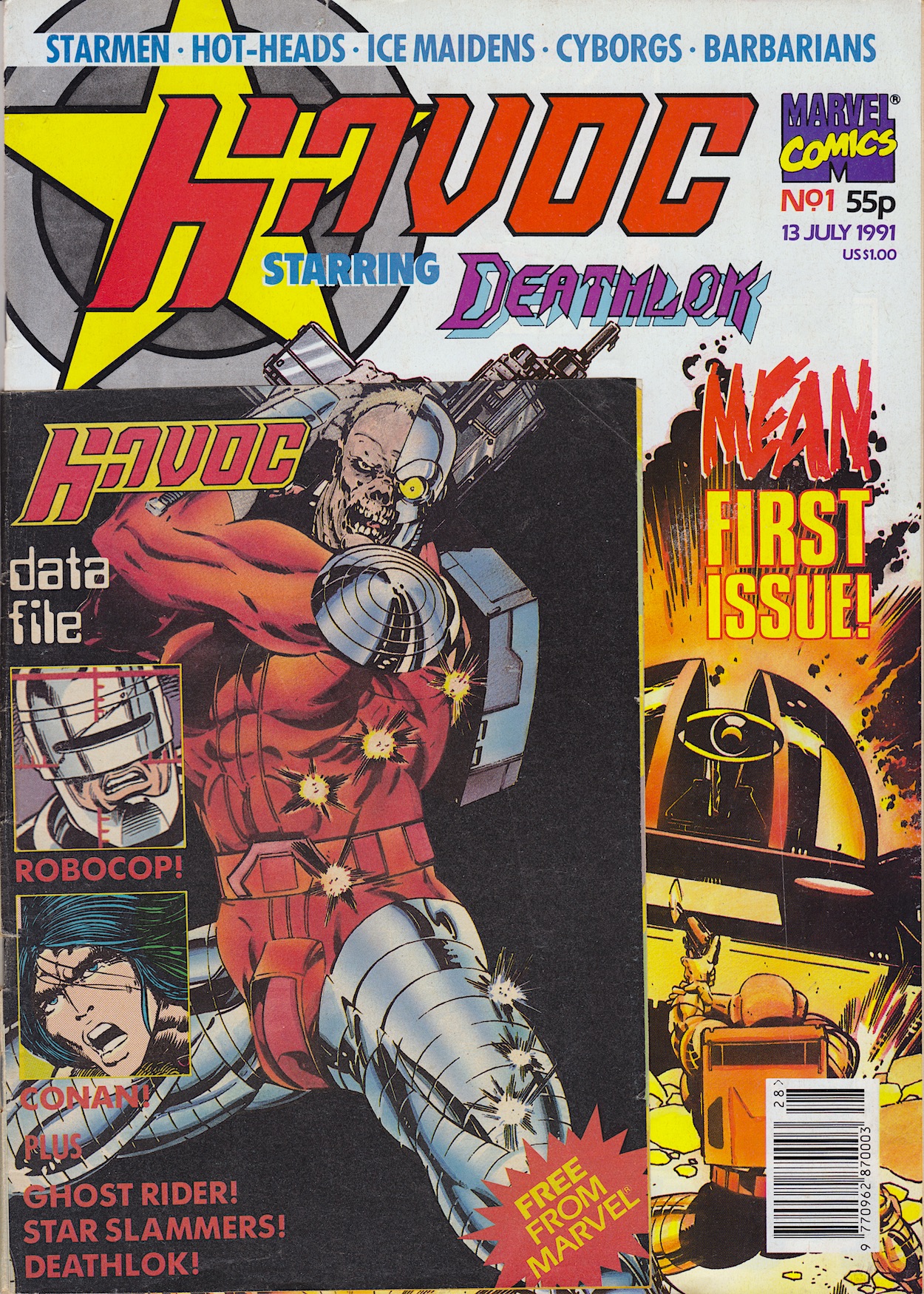
While I’d been allowed up to four comics on order at the local newsagent, by the summer of 1991 this number had been whittled down to just two, The Real Ghostbusters and Transformers. Most comics I’d tried had ended up cancelled very quickly, so I’d become a bit disillusioned. Then, after months of not bothering, I decided to have a look at the comics shelves one Saturday morning and was met with this.
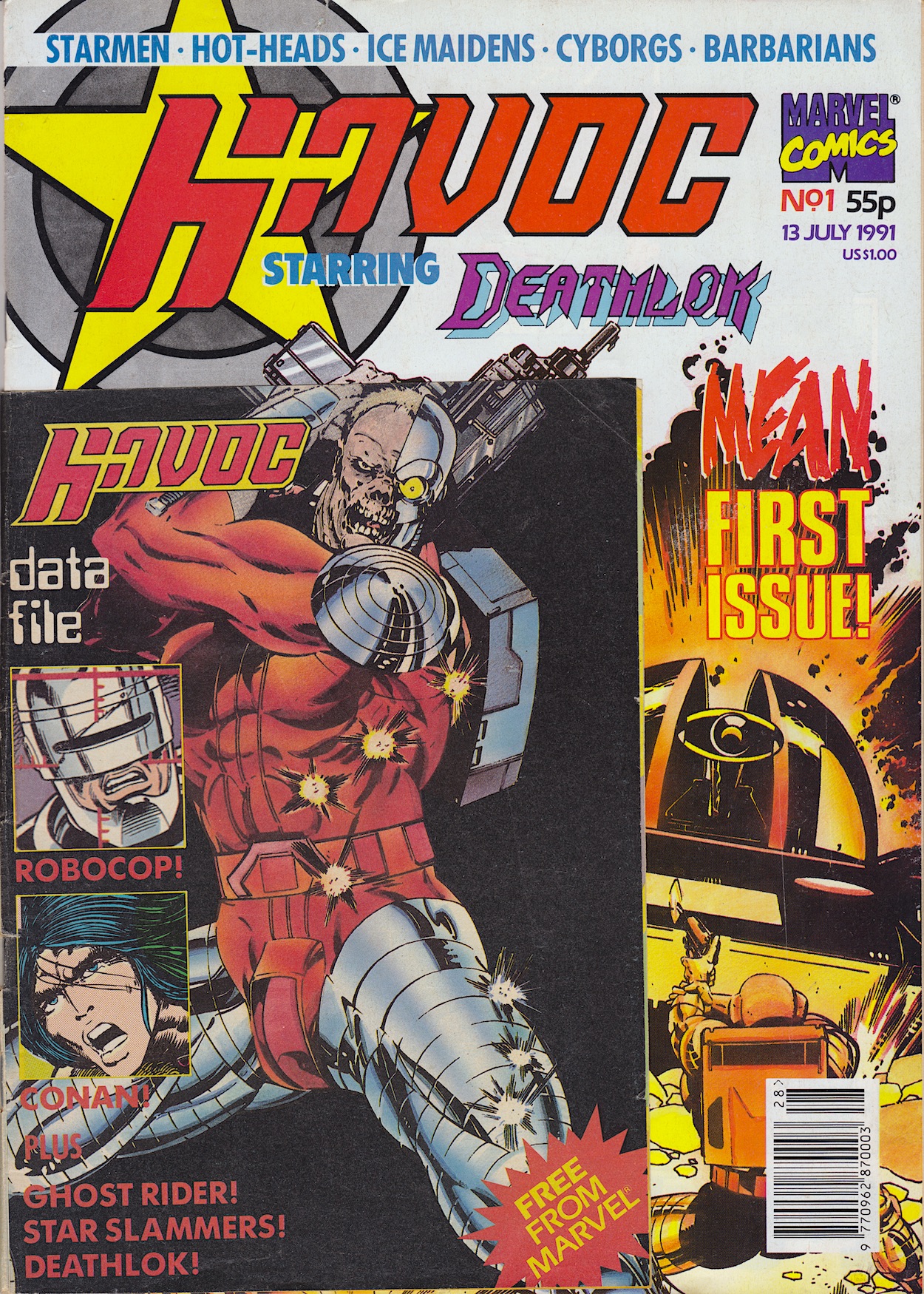
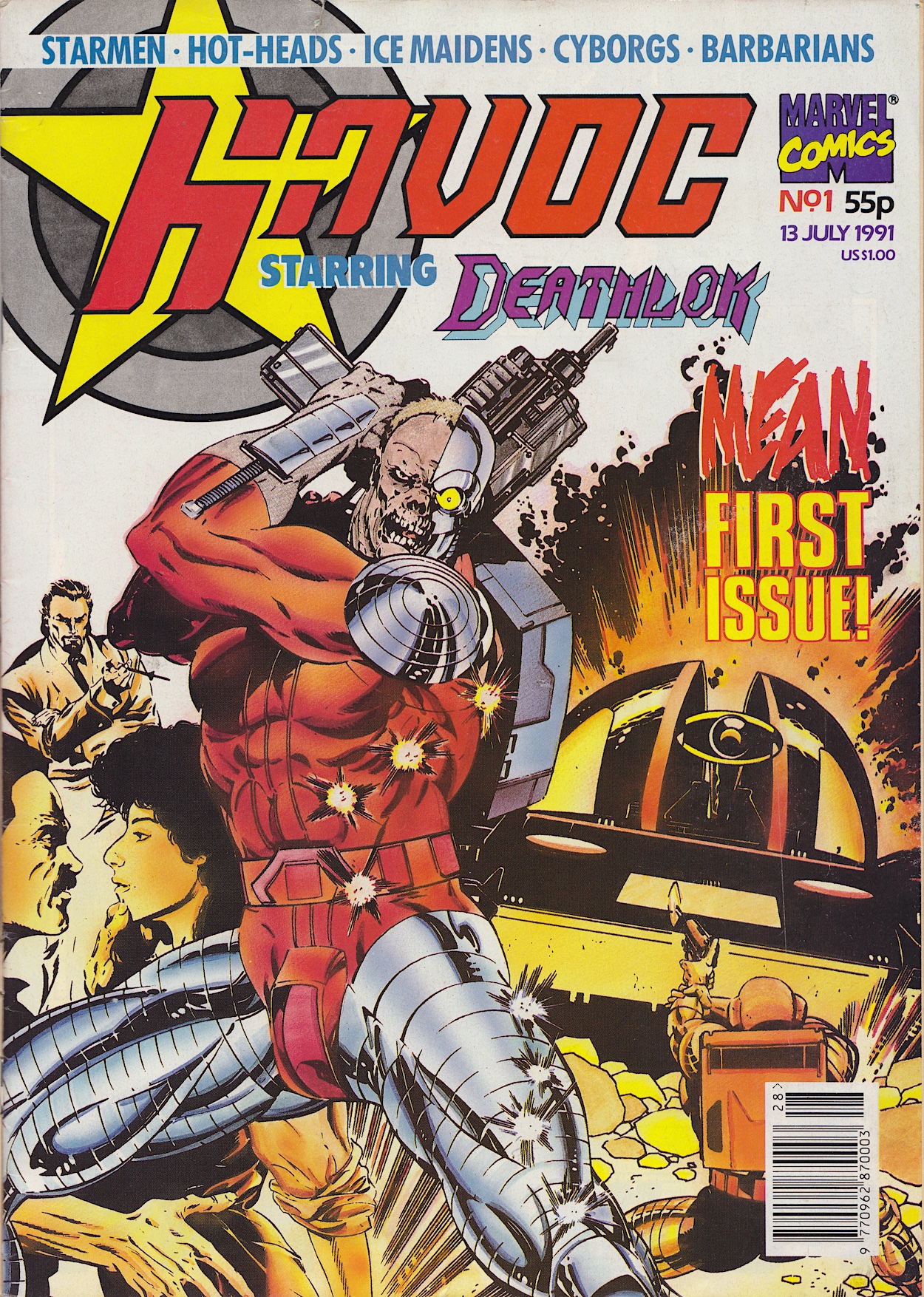
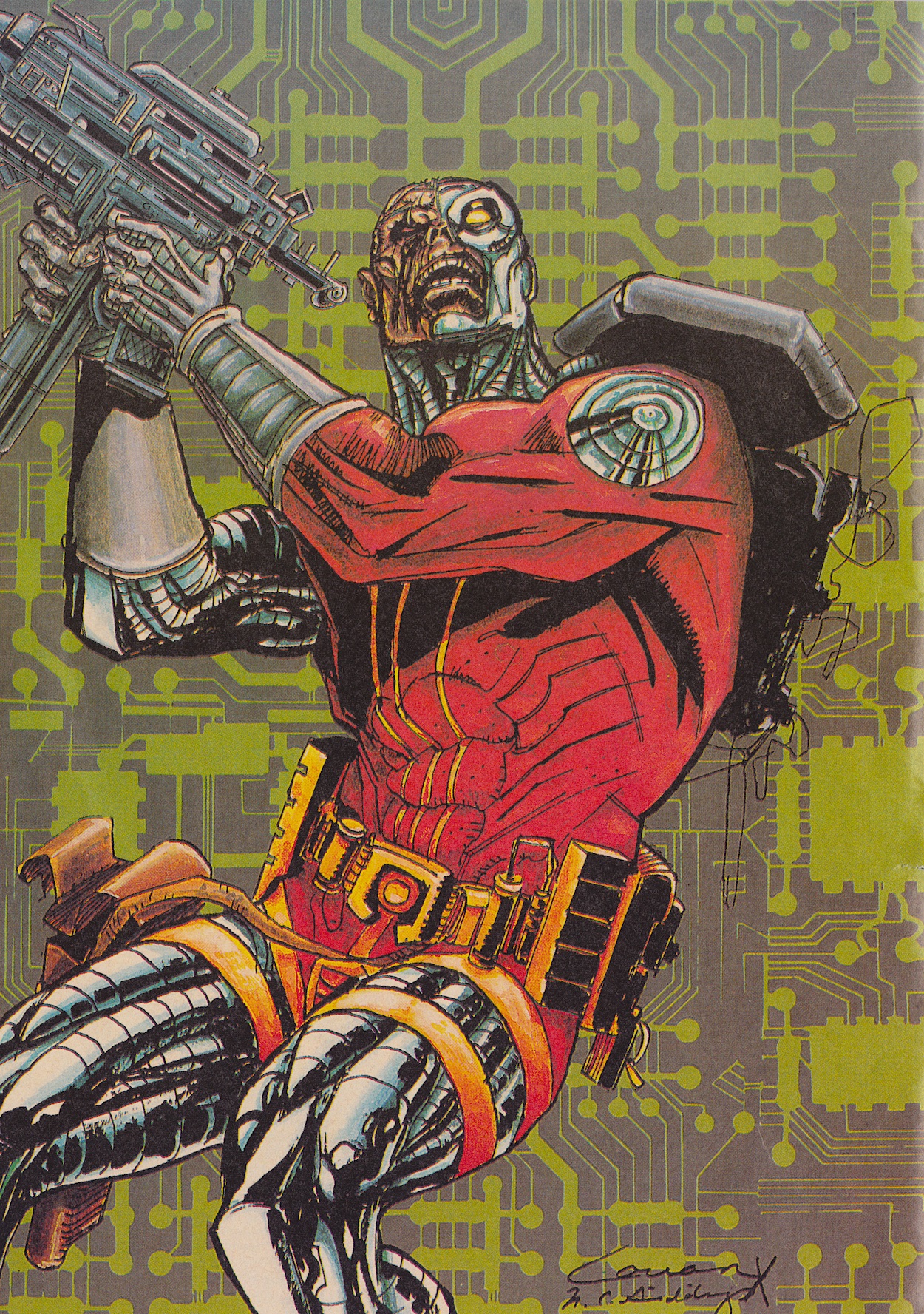
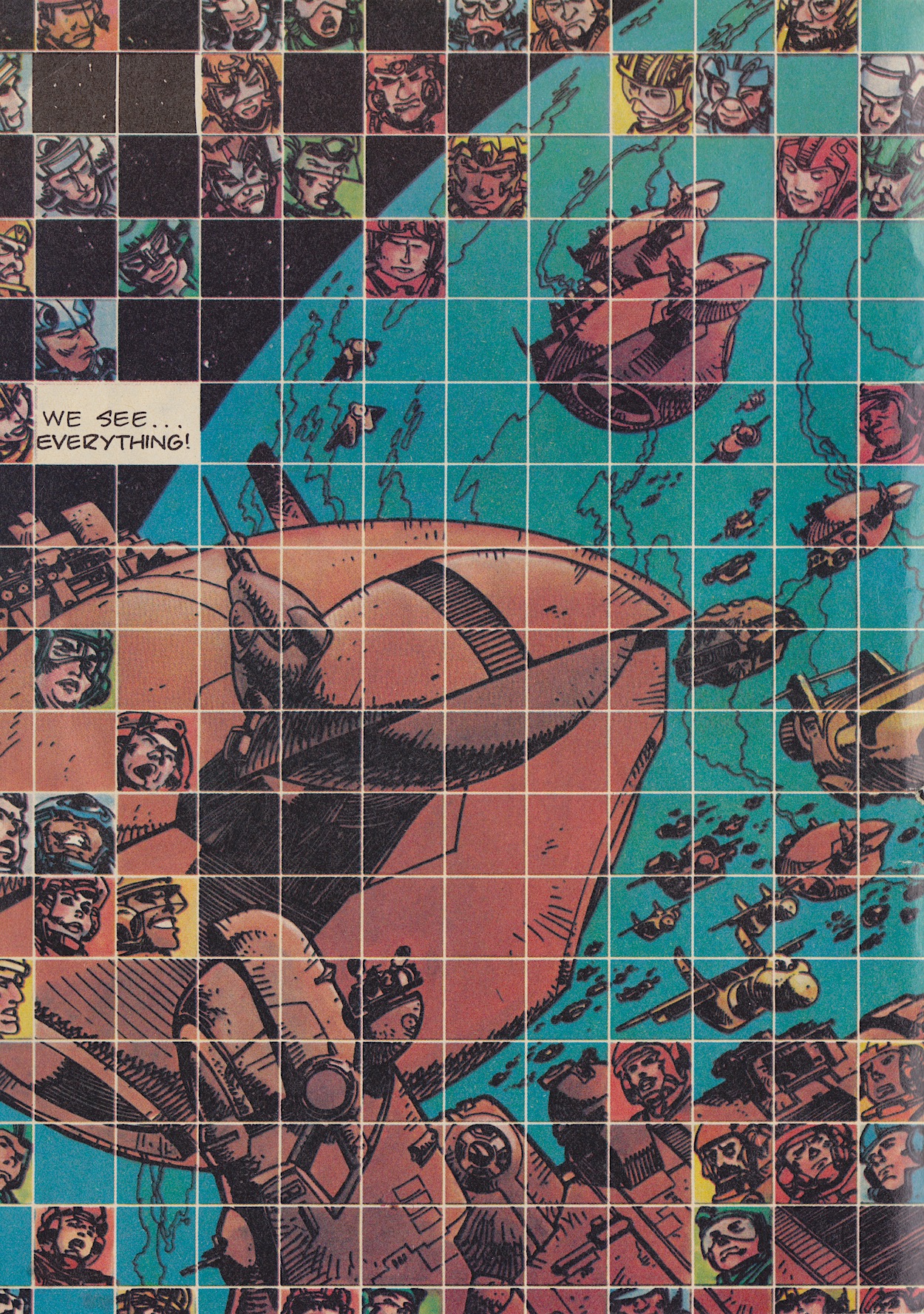
While I’d spotted RoboCop on the cover it was the bigger character called Deathlok that really grabbed my attention, especially when I pulled aside the free introductory booklet (images from which can be seen in the introductory post). How the booklet blacked out everything apart from Deathlok just looked really cool and having a quick flick through I also saw Conan who I’d heard of from friends, and a fiery skeleton on a motorbike. I had to try this out! At only 55p for 36 pages Havoc was a bargain, the same price as Transformers which was two-thirds the size and on smaller paper.

There was also that 16-page booklet which introduced us to each of the five main protagonists: Deathlok, RoboCop, Ghost Rider, Conan the Barbarian and the Star Slammers. It was a meaty read (edited at lauch by John Freeman and Harry Papadopoulos) and I enjoyed it so much I cancelled my order for The Real Ghostbusters after 150+ issues to reserve Havoc instead. Little was I to know only nine issues would ever see print. But for now let’s relive this excellent title, which coincidentally lasted for the exact amount of time I was off school for the summer holidays (in Northern Ireland kids get all of July and August off).
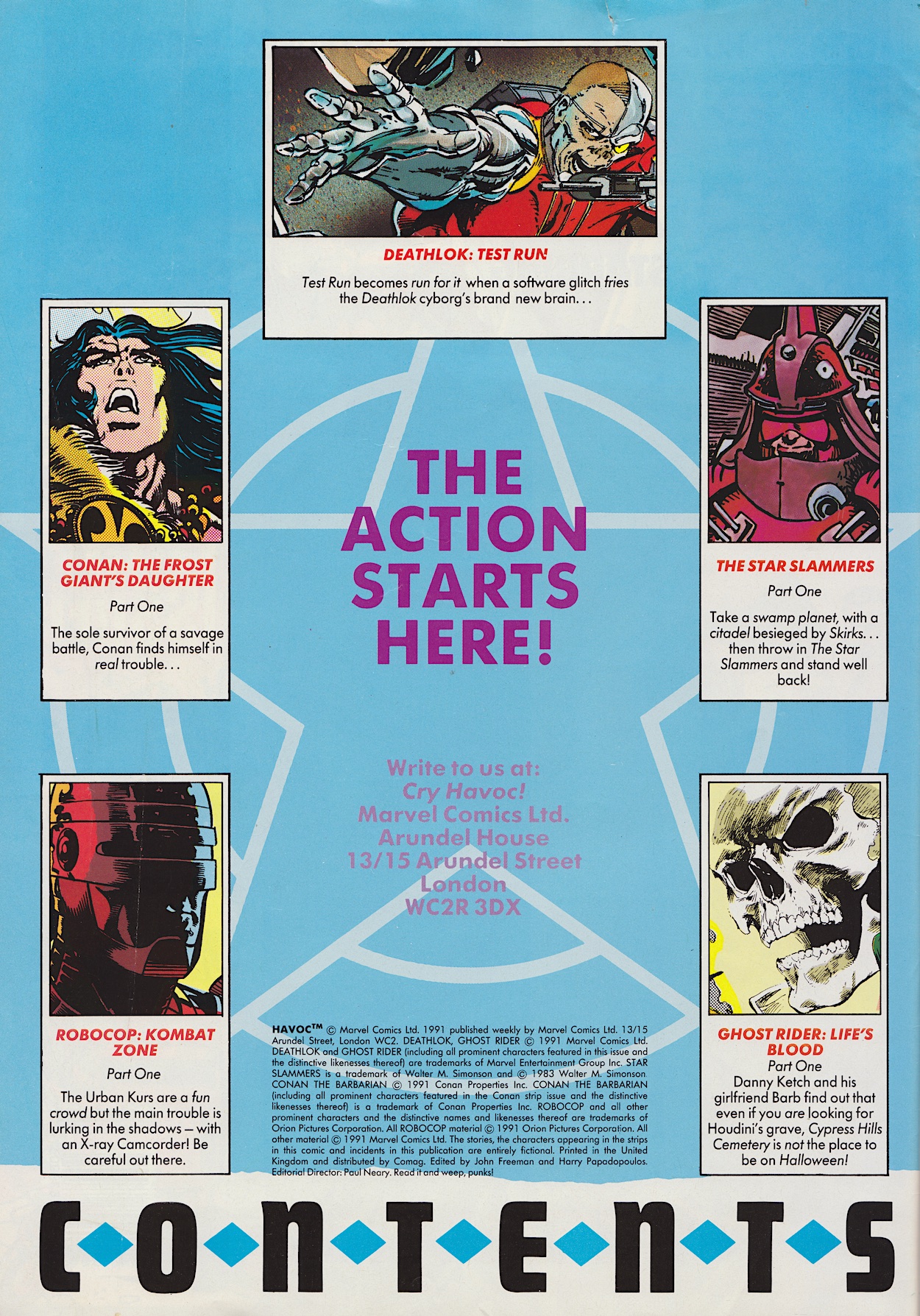
Upon returning to school some of my 2000AD-reading friends were raving about Havoc and the comparisons are clear. Havoc was also an anthology title and while the stories were imports from America the sci-fi settings and hard action had grabbed their attention in the same way as Tharg’s comic. I’d only read a few issues of 2000AD at that time and found Havoc to be much better; it was in full colour for a start, it had RoboCop and the action and characterisations seemed (to my teenage self) to be more mature. This was a huge step away for my usual comics.

So first up is Deathlok, a character I’d never heard of and who Marvel US had resurrected a year earlier. Originally created by Rich Buckler in 1974 in Astonishing Stories, there’d eventually be various characters with the same name, all deceased humans brought back as cyborgs. Dwayne McDuffie (Batman, Back to the Future, Damage Control) and Gregory Wright (The Punisher, Daredevil, Nick Fury) brought the idea back with a new human character in a mini-series and then an ongoing comic between 1991 and 1994, the first time Deathlok had had his own title. It was this run we were to be treated to, drawn by Wright and Jackson “Butch” Guice (Supergirl, Black Panther, Winter Soldier) with letters by Richard Starkings (Elephantmen, Zoids, Transformers).
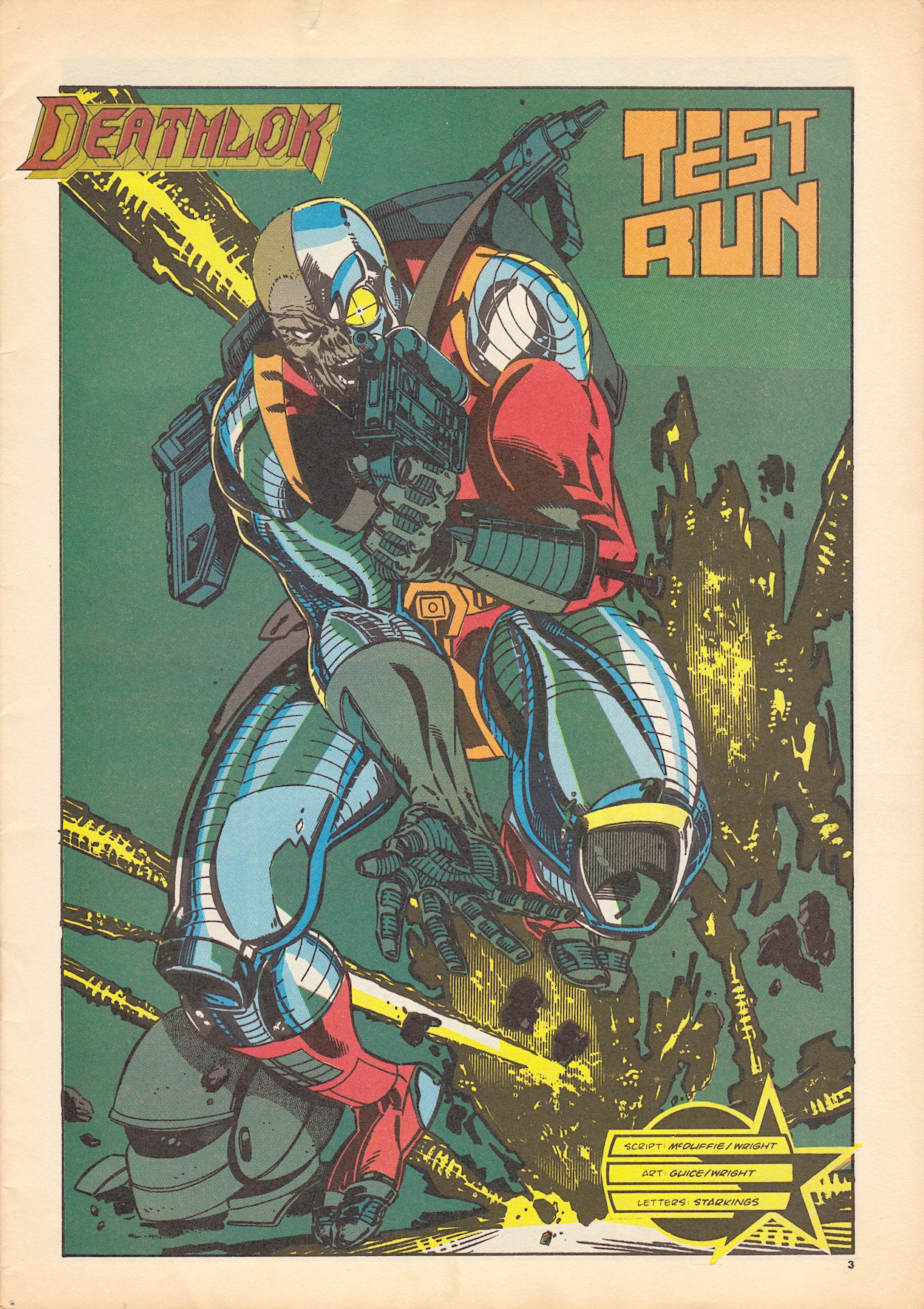
Between the end of the mini-series and the start of the ongoing an eight-page prelude tale was published in Marvel Comics Presents and it’s this that Marvel UK decided to use first. (From #2 they’d go back and print the mini-series.) This gives us a proper action-packed introduction to the technology and the idea behind the strip. No, it wasn’t hugely original by the time 1991 rolled around, with Terminator movies and RoboCop himself on the scene, but something would set Deathlok apart and that was the interaction between the human brain and the computer. That’s something for a future review though.

It’s smart to begin the premiere issue with a complete story and it perfectly sums up the set up and the kind of action we can expect. Former army colonel John Kelly volunteered to have his brain transplanted into Cybertek‘s Deathlok and become the ultimate tactical weapon. Sent on a Test Run, he’s armed with paint pellets while 12 mercenaries try to take him down with live ammo. The communications between human brain and computer are relaxed, even jovial, but when Kelly decides on a little grandstanding things take a shocking turn.
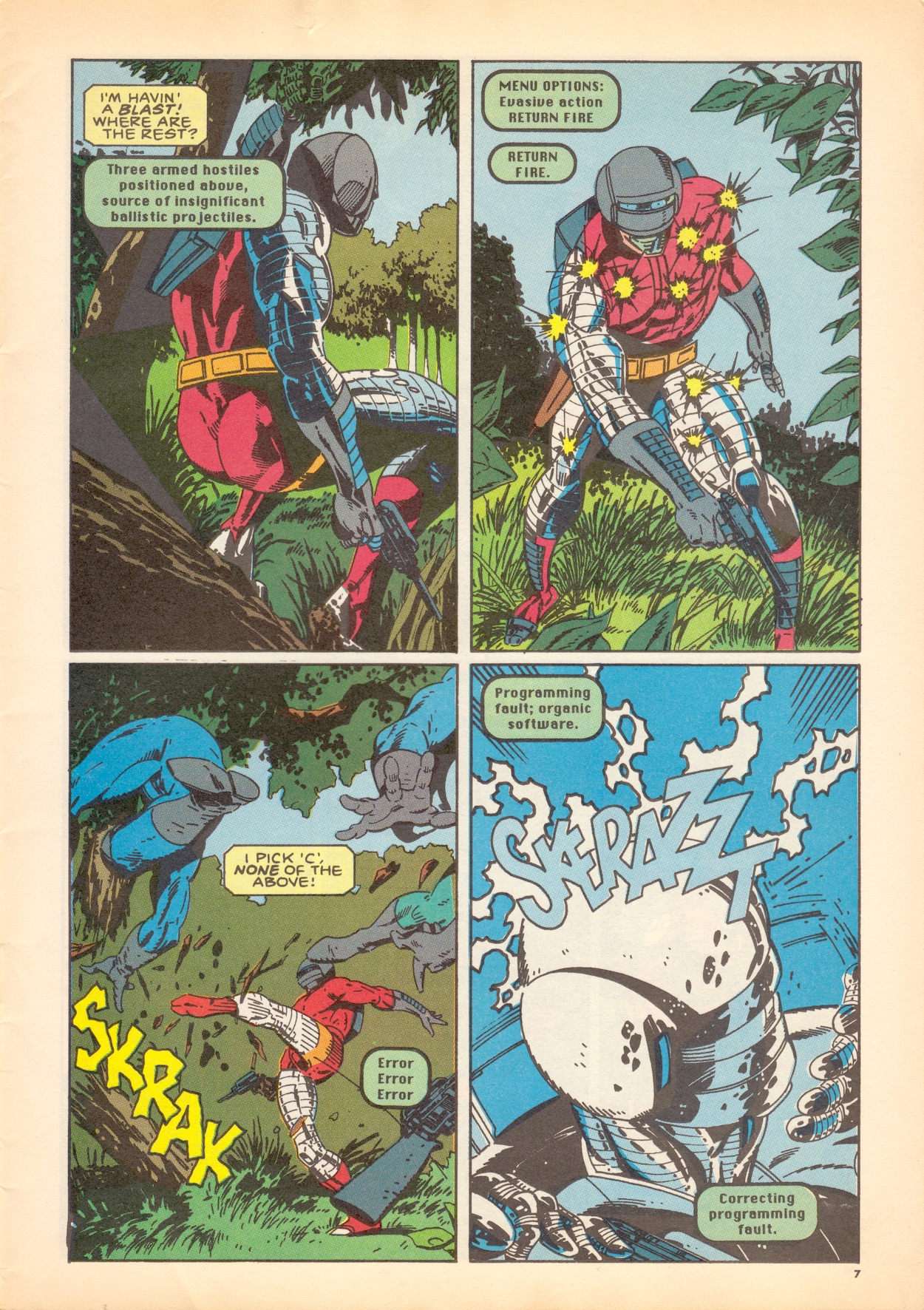
The computer has calculated that Kelly’s thoughts are an input error, sending an electrical charge to eliminate the problem and killing him instantly. Its system now “de-bugged” the programming for a live scenario takes over and immediately replaces the paint gun with a live plasma pistol. But Mr Ryker of Cybertek doesn’t stop the test, even as he watches the mercenaries die one-by-one. There’s just too much money at stake. The story ends with the company casually discarding what happened because they have a deadline and Mr Ryker’s final foreboding words show us the direction it’s about to go.
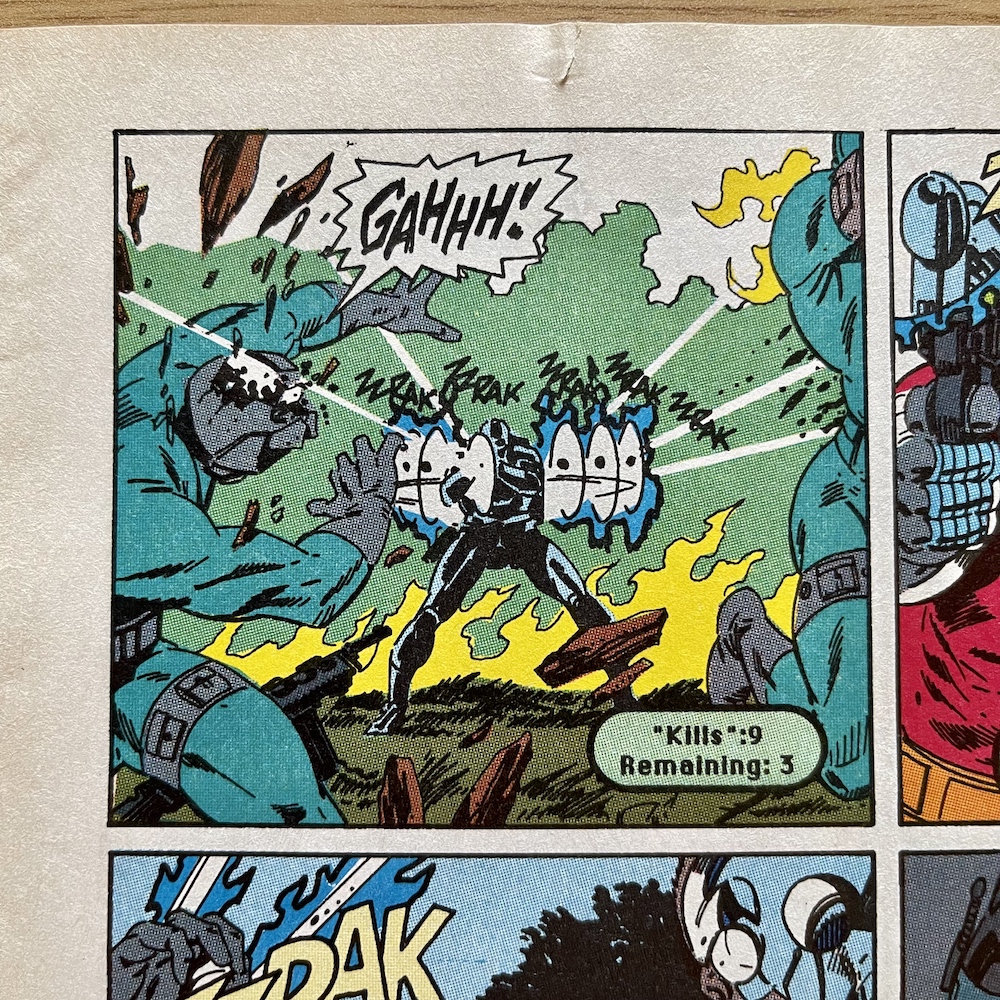
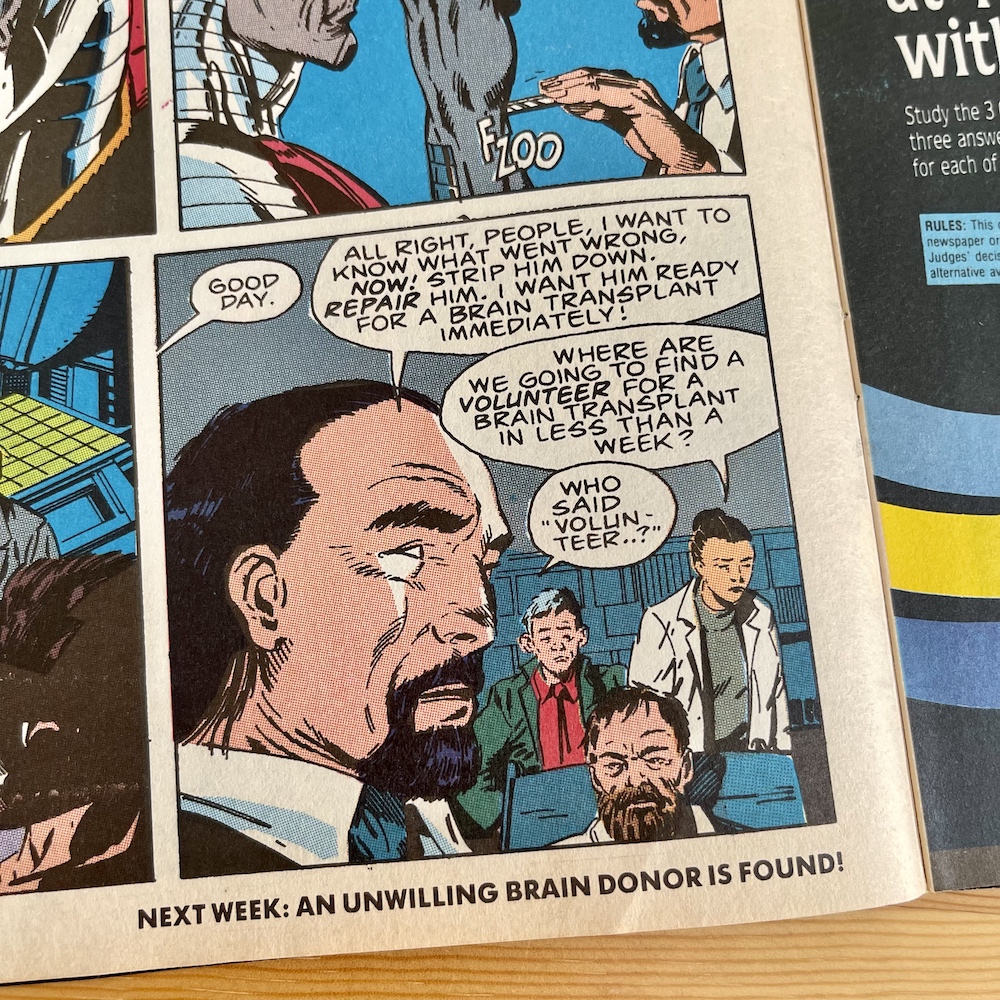
In the introductory booklet a little bit of information popped out at me as a fan of Transformers. It appears Cybertek Systems Inc. is a division of the multinational oil company, Roxxon. This company name appeared a couple of times in Transformers as a competitor to Blackrock. It was just in passing, but it tied the characters in to the larger Marvel universe around the same time as Spider-Man helped out the Autobots.

Test Run is a great introduction to not only Deathlok but to the whole remit of Havoc. I particularly liked Richard Starking‘s (launch editor for Marvel UK’s The Real Ghostbusters) lettering during the interactions between Kelly and the computer. I remember the intrigue as a teenager and how I lapped up the action, thinking that if the rest of the issue was anything to go by I’d discovered a winner.

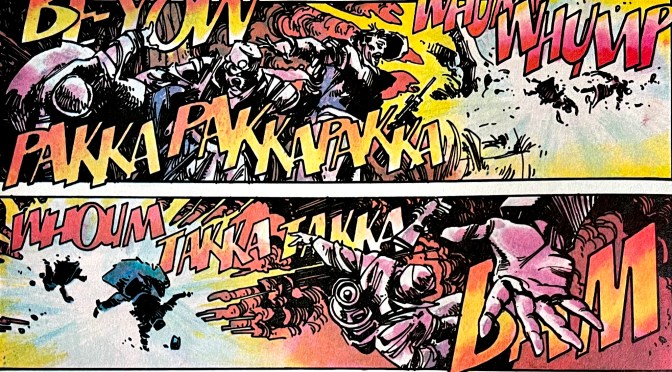
John Workman’s trademark style adds bold, in-your-face lettering to Star Slammers, perfectly suiting the narrative

Havoc may have been a meaty 36-page read for us but to fit in five ongoing strips originally written as much larger chapters (while giving each one a satisfying chuck and a cliffhanger every week) couldn’t have been an easy task. But the team pulled it off. The next strip is Star Slammers which originally saw print in #6 of Marvel Graphic Novel in the States back in 1983. Given just the four pages in this premiere issue, it acts as a nice tease for the characters created, written and drawn by Walter Simonson (Jurassic Park, Hawkgirl, Detective Comics), coloured by his partner Louise Simonson (writer on New Mutants, Warlock, Action Comics) and Deborah Pedler (Alien, Marvel Graphic Novel, Conan) although Deborah is mistakenly listed as “Parker”.
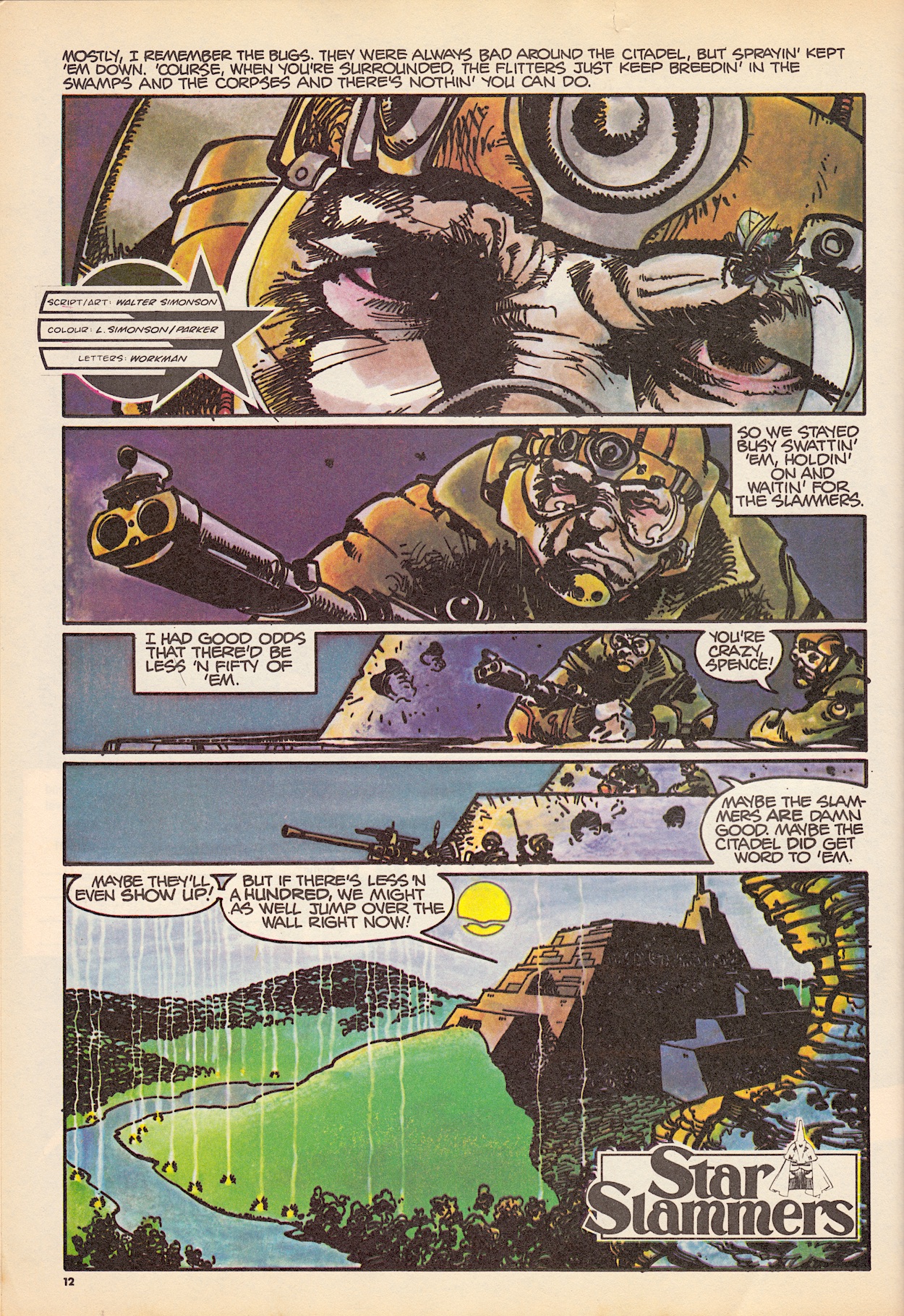
John Workman is the letterer here and among his many credits (for example Michael Moorcock’s Multiverse, Orion, Spider-Girl) he worked alongside Walter on the movie adaptation of Jurassic Park, which was published in the UK by Dark Horse International, split over the first five issues. His trademark style of breaking the panel lines which I enjoyed so much in those early Jurassic comics adds a bold, in-your-face style of lettering to Star Slammers, perfectly suiting the narrative.

Spence and Slinger are two tired soldiers looking out from the citadel they’re protecting, surrounded on all sides by campfires belonging to their enemy, the Skriks. They’ve called for help from the Star Slammers and hope more than a hundred turn up at least, although Spence thinks it’ll be less than fifty and that he and his comrades are doomed. Suddenly all hell breaks loose, there are explosions and gunfire everywhere and within minutes the enemy has been wiped out as far as the eye can see. Spence’s monologue returns just to confirm he was right, there were definitely less than fifty of them.
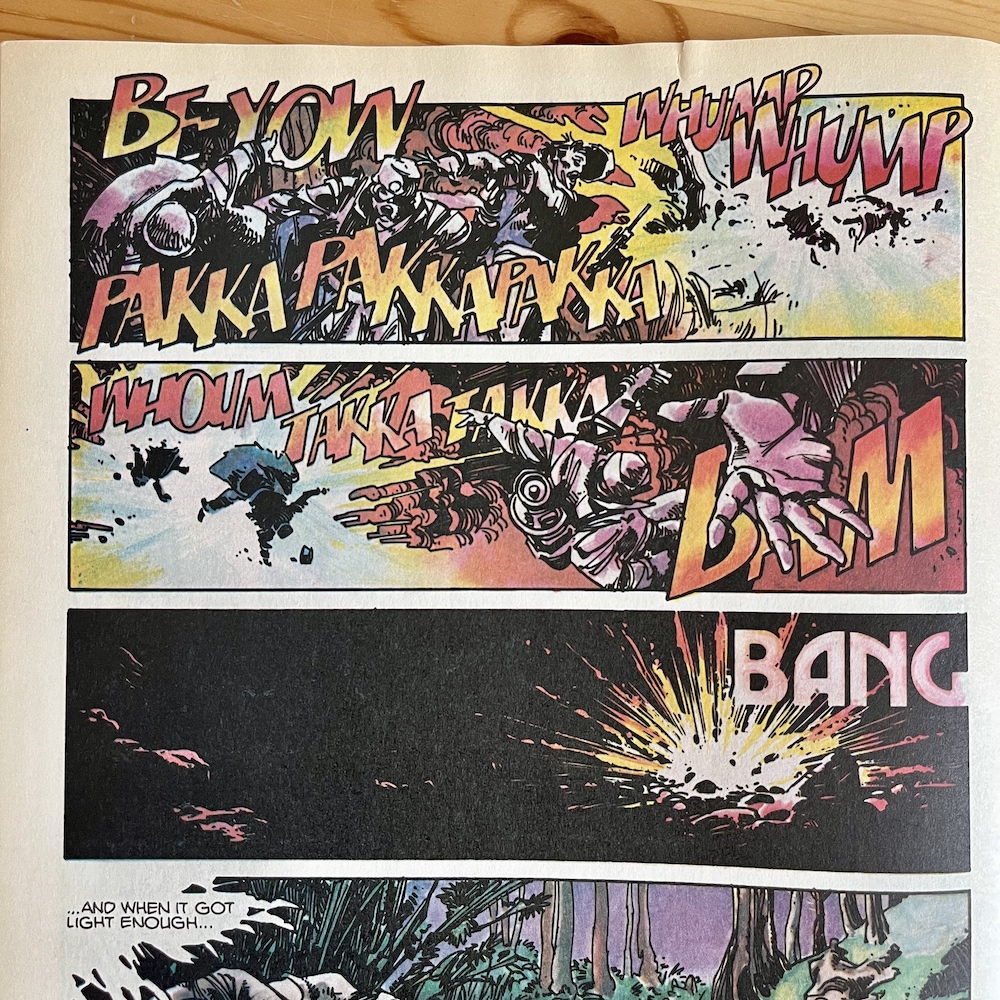
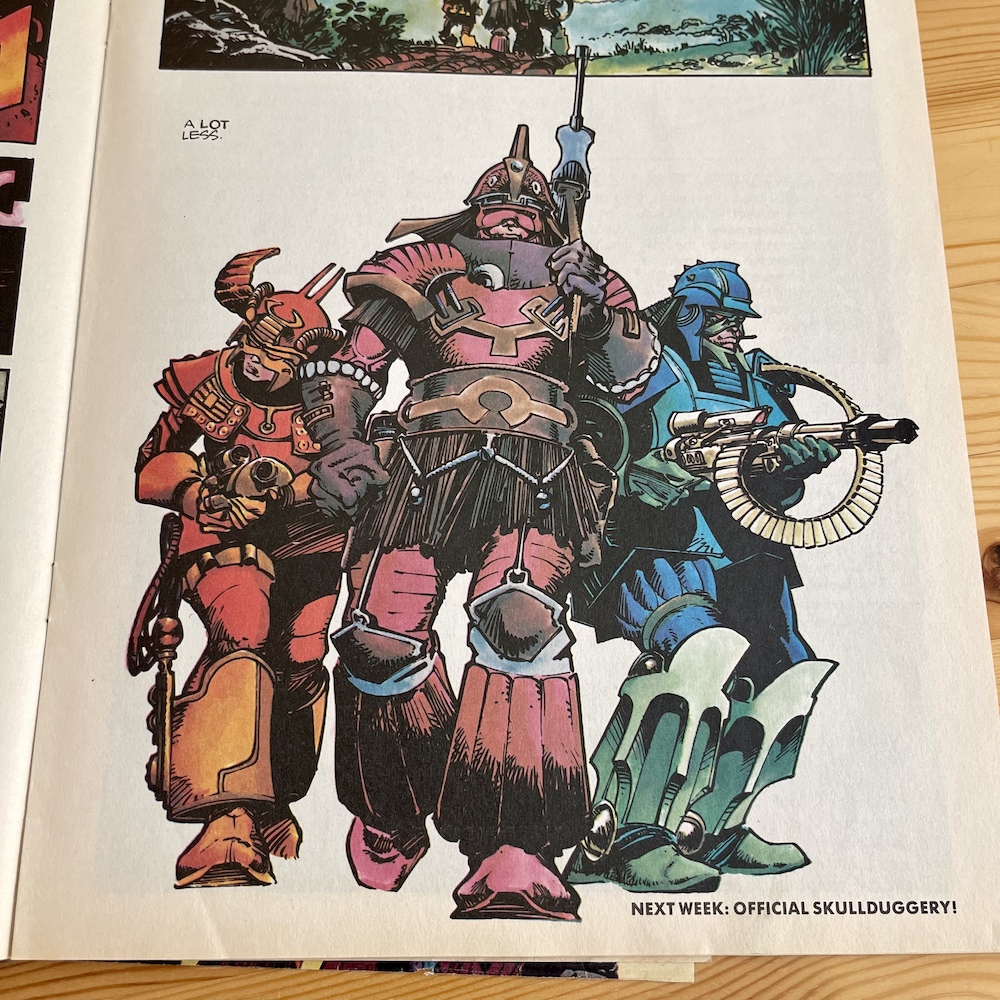
That’s it for part one. In the booklet their introduction is written as a warning from “the glorious planet Orion” but as yet there are no more details about characters or overall plot. As a kid I remember being underwhelmed but my attitude changed as the story continued and now as an adult I’m intrigued. On the next page comes something my adult self has been really looking forward to. I’m including it just for some fun and context about when the comic was released. It’s the first Eye Level.

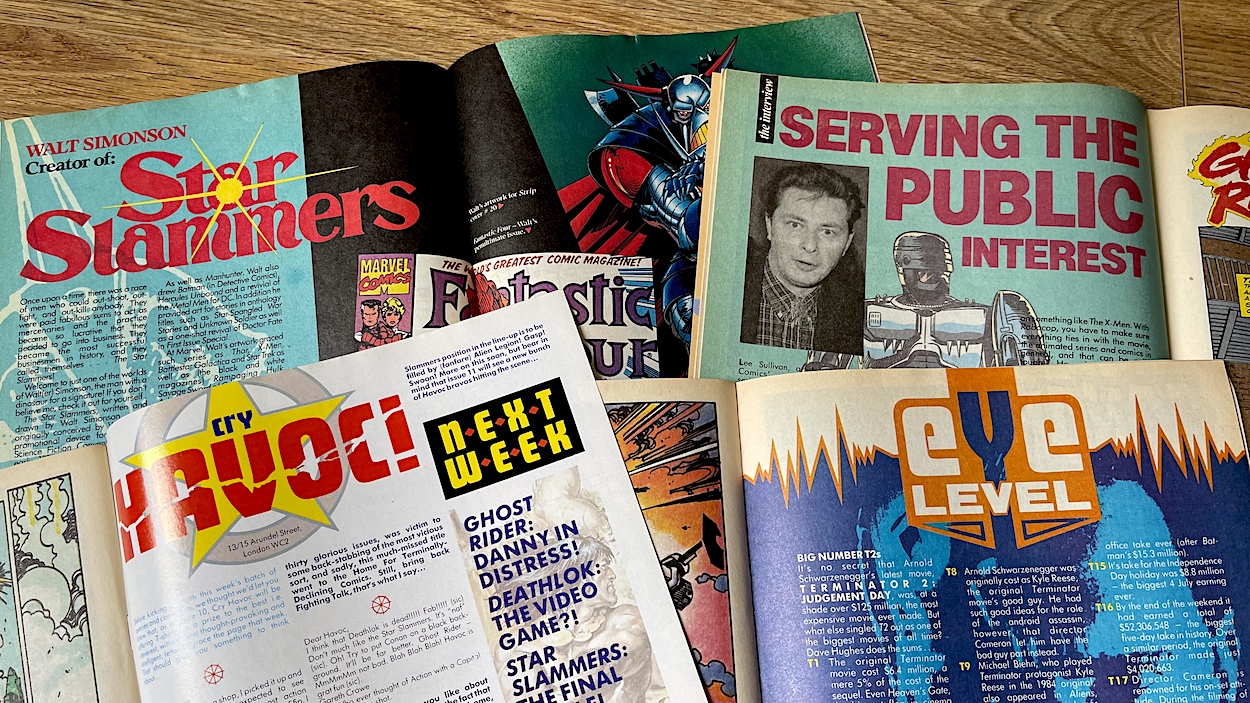
This was the weekly news column with all the latest information from the world of television, movies, comics and videogames. This was around the time we had that TV show Movies, Games + Videos so this has taken me right back. Most notable for me here is the hype machine for Robin Hood: Prince of Thieves because I enjoyed it at the time but the years have not been kind to the ridiculous movie. I remember all the buzz about how expensive Terminator 2: Judgement Day was for the time and it’s nice to see a film I’ve just recently rediscovered getting a quick mention, namely the excellent Rocketeer.
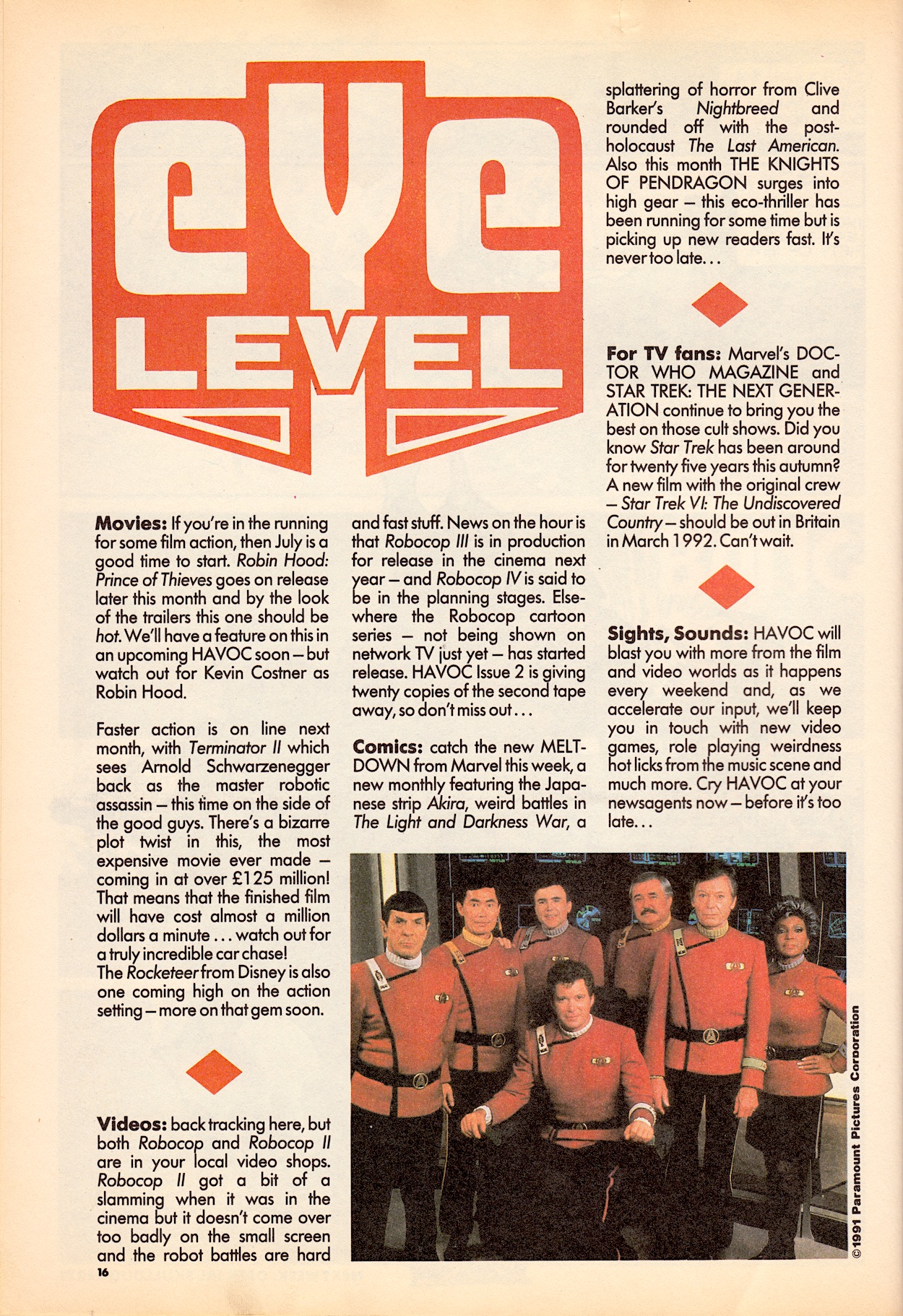
As well as the news above, the booklet had extra pages for RoboCop, so sure was everyone that this was a franchise to run and run. The second and third movies put an end to that. Personally, I much preferred the TV series. The original writers were creative consultants and it was more in line with what they’d written for the film (which ended up being known more for its over-the-top violence). Yes, TV series in the 90s couldn’t have the violence of today’s shows so Murphy captured criminals instead of killing them, but all the social commentary, politicking and character development was there and I loved it. It was big budget and a great character piece at its heart. (And that episode with his dad! Oh my, I’m welling up just thinking about that scene… anyway… ahem…)

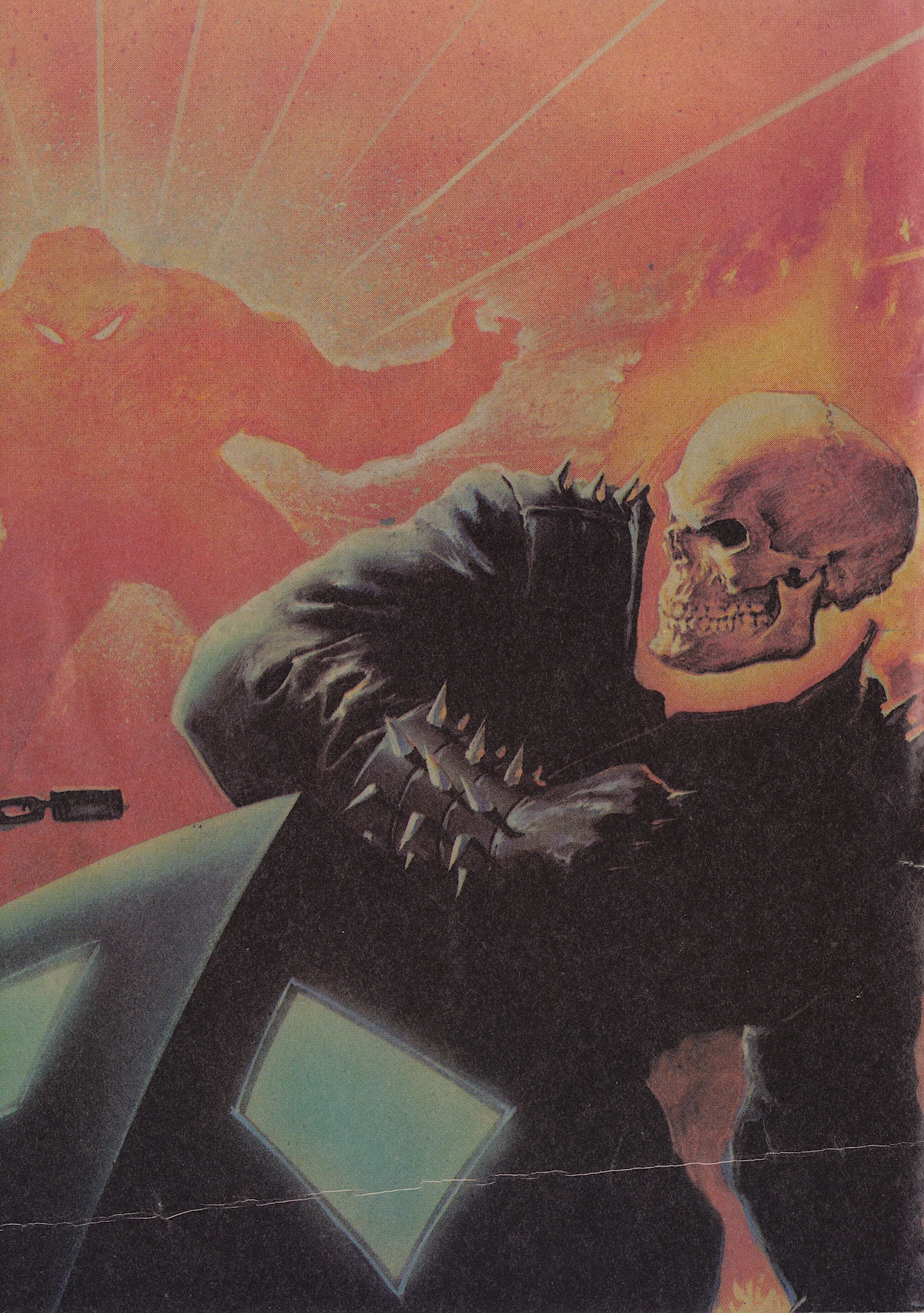
The booklet is set up like a series of Wanted posters (except for RoboCop obviously) and our next antihero is described as “a so-called do-gooder” who they suspect is really just “a deep rooted psycho”. Originally created as a Western character before being renamed Phantom Rider, the first supernatural Ghost Rider was Johnny Blaze who you’ll know from the movies if not the comics. Havoc’s strip is the sequel to that run and stars new character Danny Ketch. It was written by Howard Mackie (Moon Knight, Mutant X, X-Factor), pencilled by Javier Saltares (X, Wolverine, The Prowler), inked by Mark Texeira (Hercules, Psi-Force, Megalith) and coloured by Deathlok’s Gregory Wright, although they’re all just listed next to “art”, such is the limited space in the credits. Completing the team is Michael Heisler (Arkham Asylum, writer on DV8, Union) on lettering.
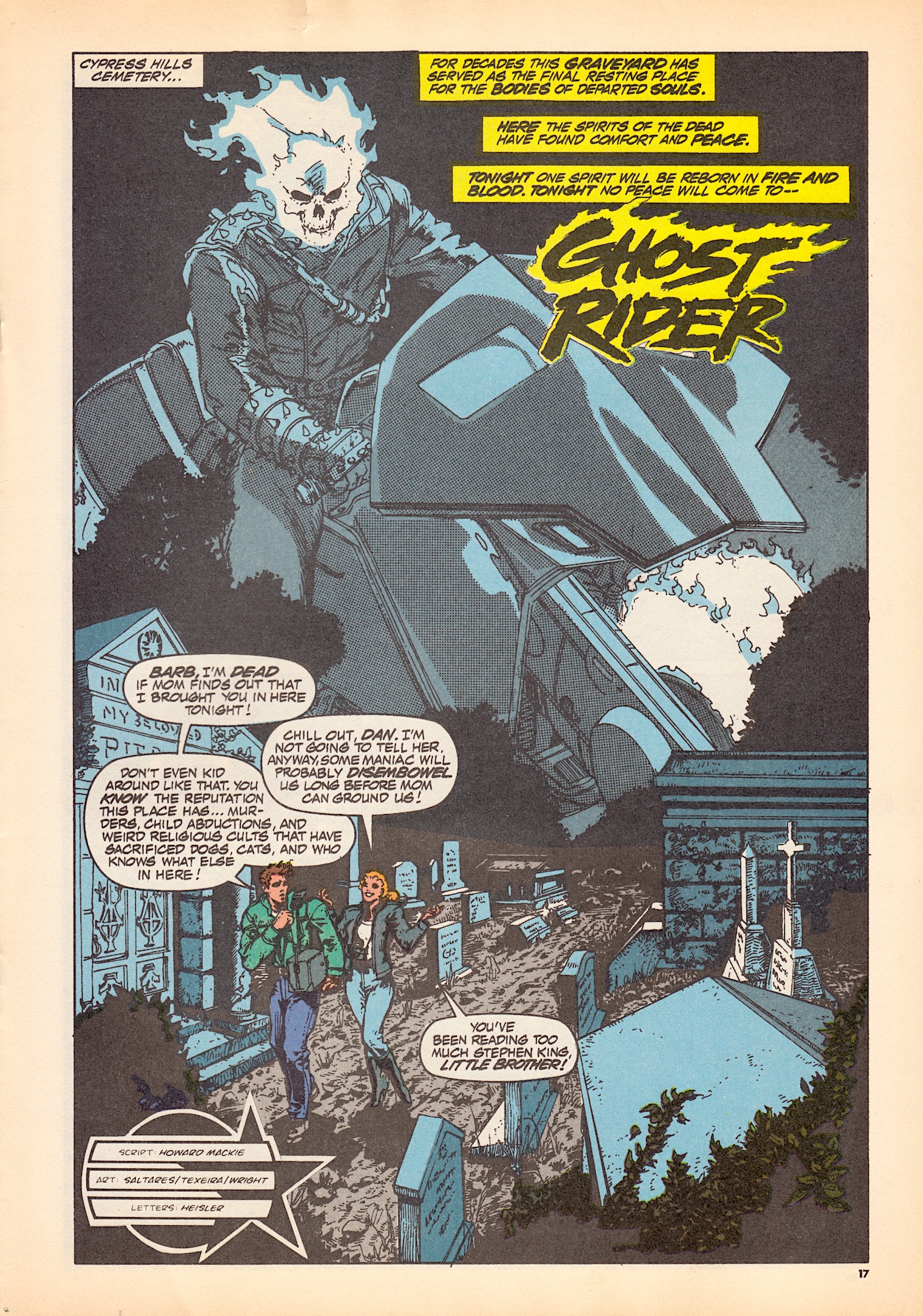
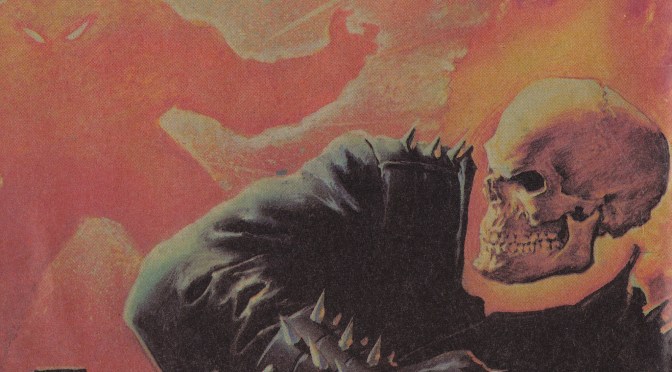
Apart from this ghostly illustration as part of the title there’s no inkling about what’s going to happen or how Danny becomes who he is destined to become, but I didn’t mind that at all. In fact, back in 1991, knowing I’d only have to wait seven days for the next part I liked the slow development and the suspense it brought. Of course, the original story wasn’t written in this way, it’s only because it’s being chopped up but we’re still getting a full story every month, just a little bit at a time, Transformers-style.

So Dan and his sister Barb are in the middle of a cemetery at Hallowe’en, visiting Houdini’s grave because Barb wants to take pictures of the rituals that take place there every year. They’re spooked by a group of prankster kids who are soon chased off by Barb, while Dan cowers from the initial fright. I like this, setting up the character who will become this flaming skull as a rather timid individual.
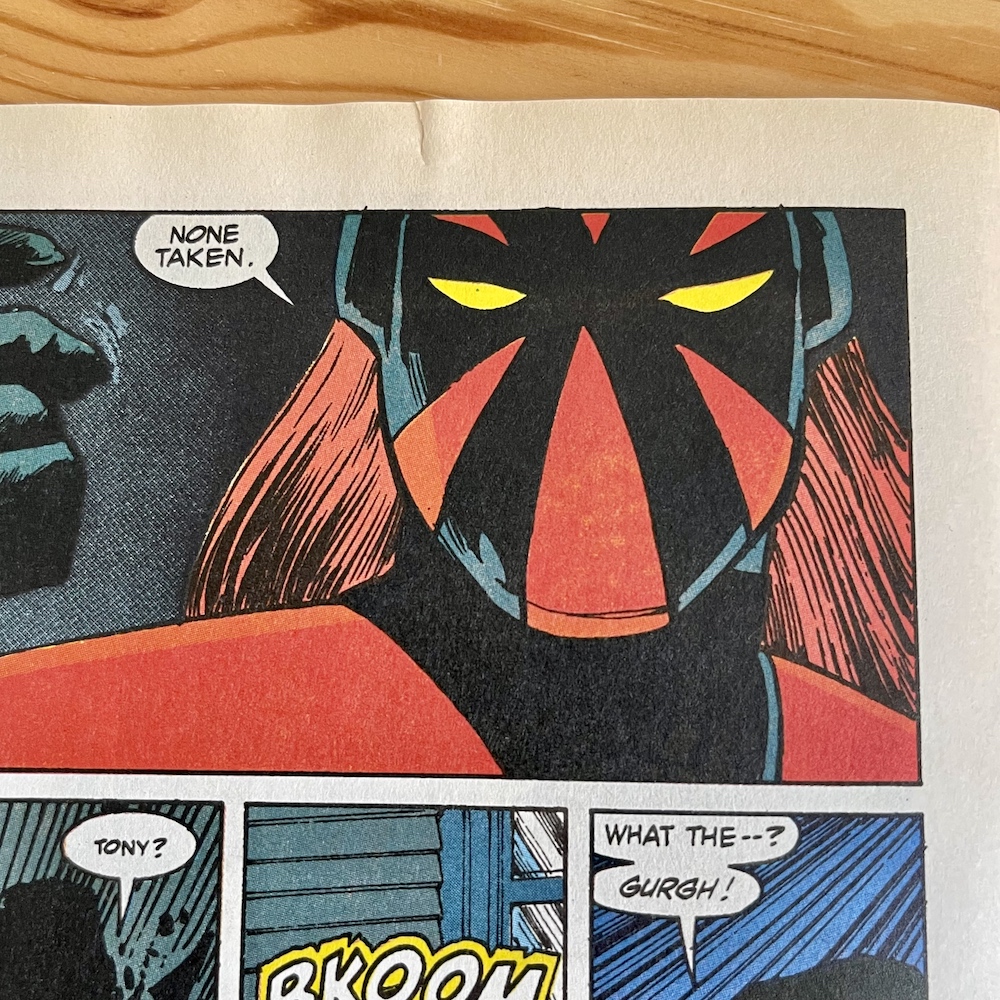
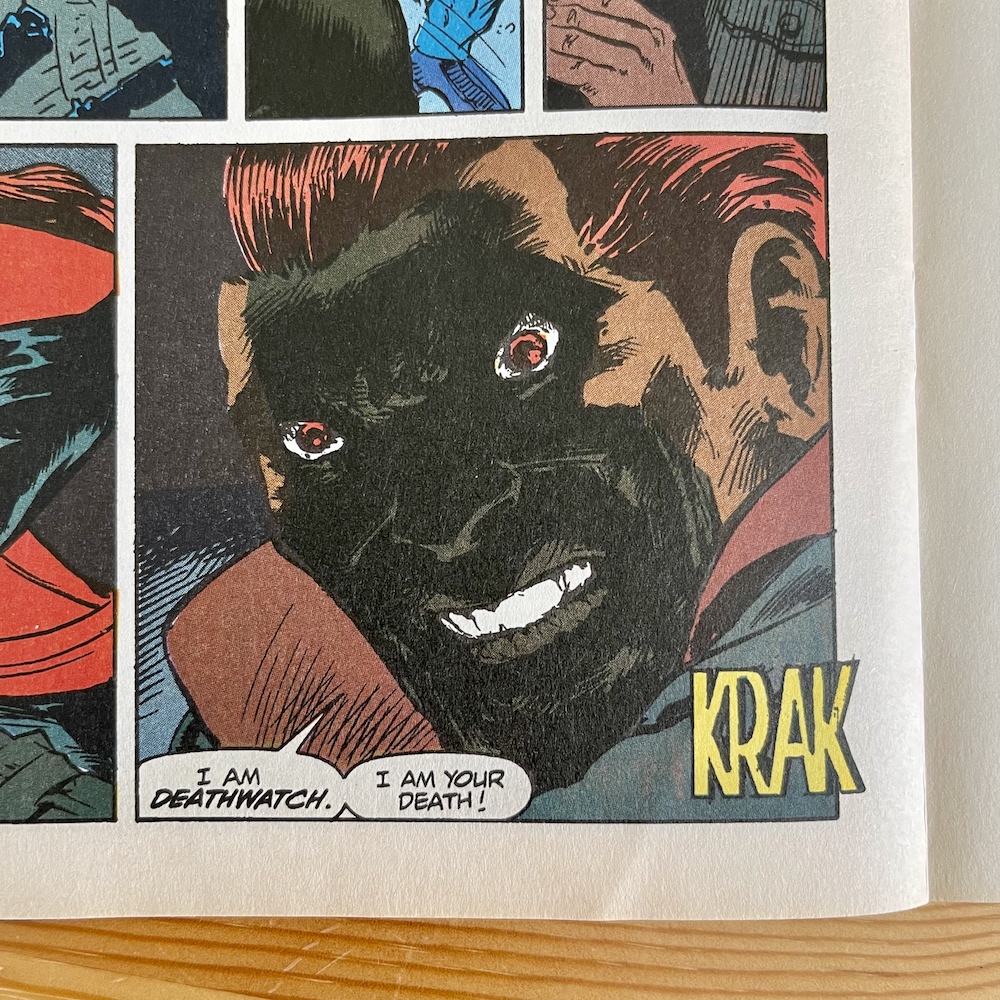
Hearing a gunshot Barb wants to investigate and they find new character Deathwatch facing off against some goons sent by classic Marvel character Kingpin. Deathwatch has shot one of their couriers and appears to be outnumbered when some shadowy figures shoot Kingpin’s men in the back with crossbows. Removing his mask, our new villain strangles the remaining gangster but the loud crack of his neck breaking is too much for Barb and she involuntarily lets out a scream, alerting the men to their location.
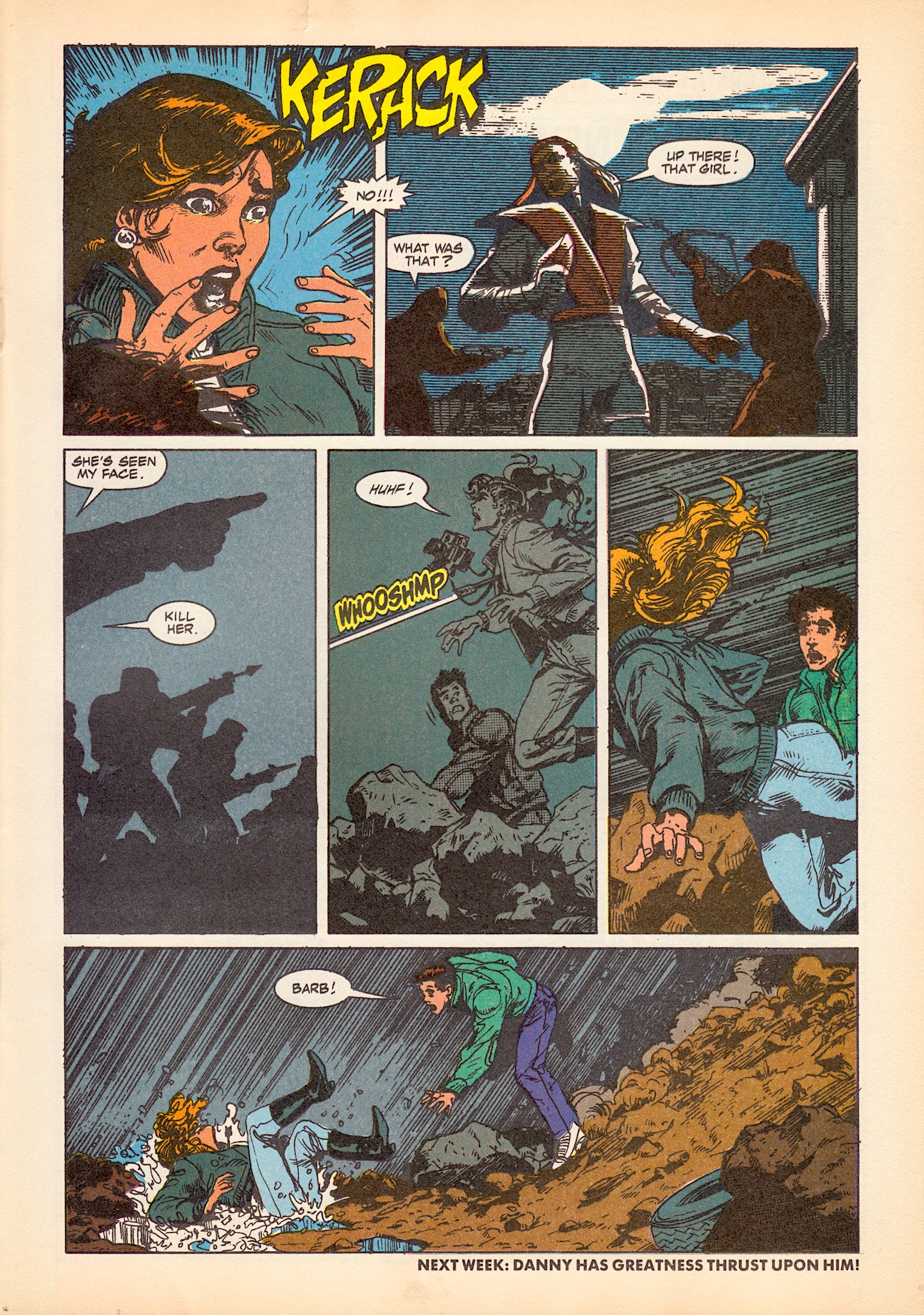
It was all very serious and violent for teenage me. It was like catnip! The tone was perfect, I already liked and cared for Dan and the ending was a shock. The Next Week caption at the bottom had me hyped and the strip was instantly a favourite. One piece of the puzzle at a time was being put into place and I couldn’t wait for more. I find that feeling returning now. After Havoc’s cancellation we just couldn’t get hold of the US comics at the time where I lived, and now 31 years later this is already making we want to check out the modern Ghost Rider comics. Havoc has got into my mind again.


“They stand face to face. Both are tall men — and built like tigers. But one of them is — Conan the Barbarian”

The Frost Giant’s Daughter, Robert E. Howard/Roy Thomas

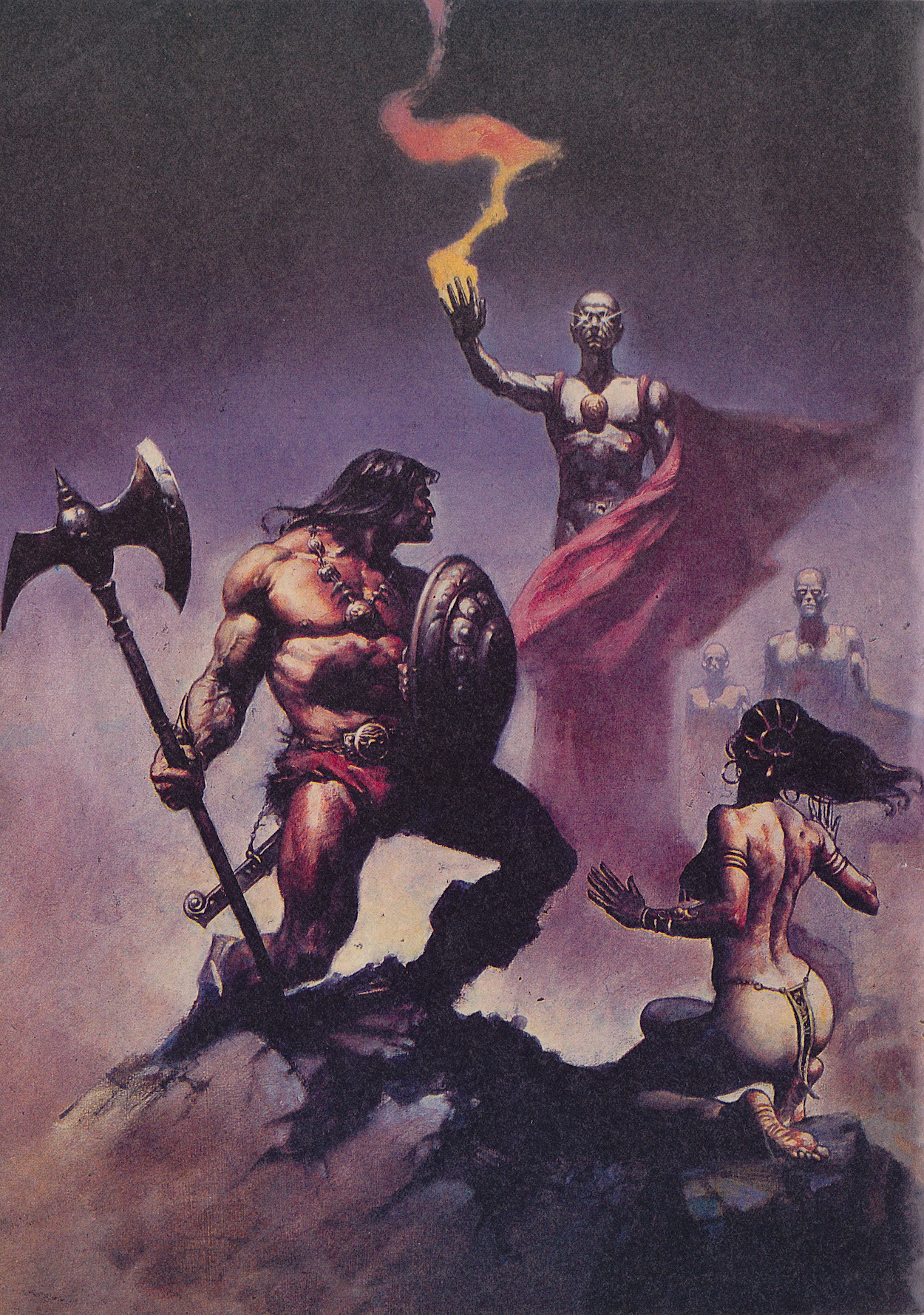
Next up is Conan the Barbarian, only known to me at the time from the Arnold Schwarzenegger movies of the 80s which never really appealed to me. This turned out to be the most surprising strip in Havoc because I wasn’t expected much at all but really enjoyed it, so now it’s time to find out if I still do three decades later. The story is interesting but the real world background of it is fascinating. The original Frost Giant’s Daughter was written by Conan’s creator Robert E Howard in 1934 but was originally rejected by the magazine he submitted it to and so the character and settings were changed. It only eventually saw print as a Conan tale long after Howard’s death.
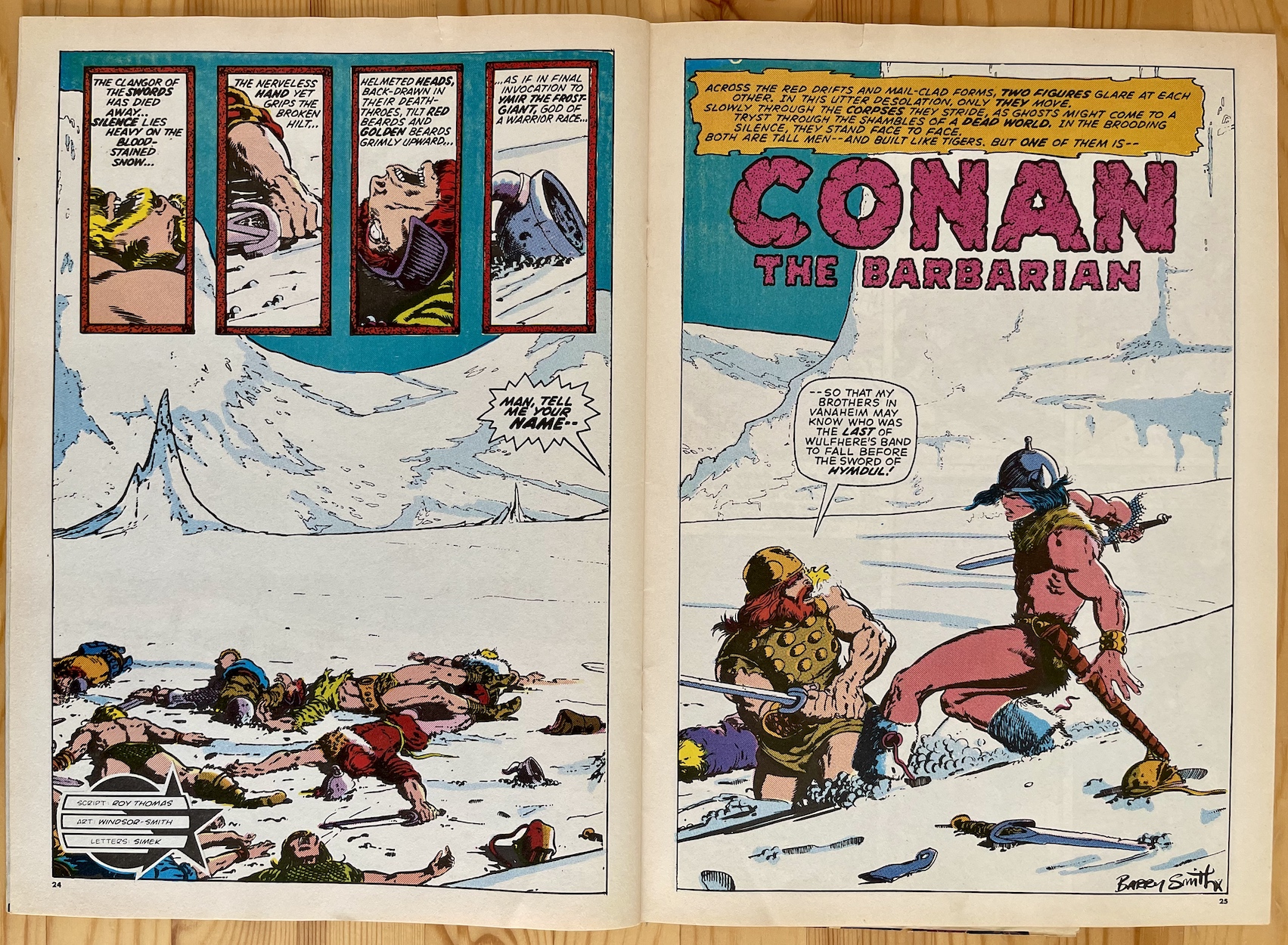
In comics, this adaptation is by far the oldest strip among those in Havoc. Published in Savage Tales in 1971, a censored version (mainly for nudity) was printed in Conan’s own comic the following year with a new opening. It’s that version we got in Havoc. Adapted by Roy Thomas (Arak Son of Thunder, Shazam!, The Dragonlance Saga) with art by Barry Windsor-Smith (Machine Man, Iron Man, Avengers) and lettered by Artie Simek (Fantastic Four, Showcase, Kid Colt), this gripped me instantly as a teenager with its action, setting, the blood and guts and the sexual undertones. It was like nothing I’d read before. I was captivated.

I had no idea this strip was older than the others and it doesn’t read as such either, the writing capturing the timeless rhythms of Howard’s originals. After a huge and bloody battle a young Conan collapses in the snow but as death creeps in he sees a beautiful woman, becoming instantly enamoured with her. Confused as to how she could be so scantily dressed out in the cold he assumes she must come from a village he didn’t know about, somewhere he could rest before his next battle. But there’s nowhere nearby, her identity is a mystery and her see-through clothing (censored here) entices Conan into the chase.
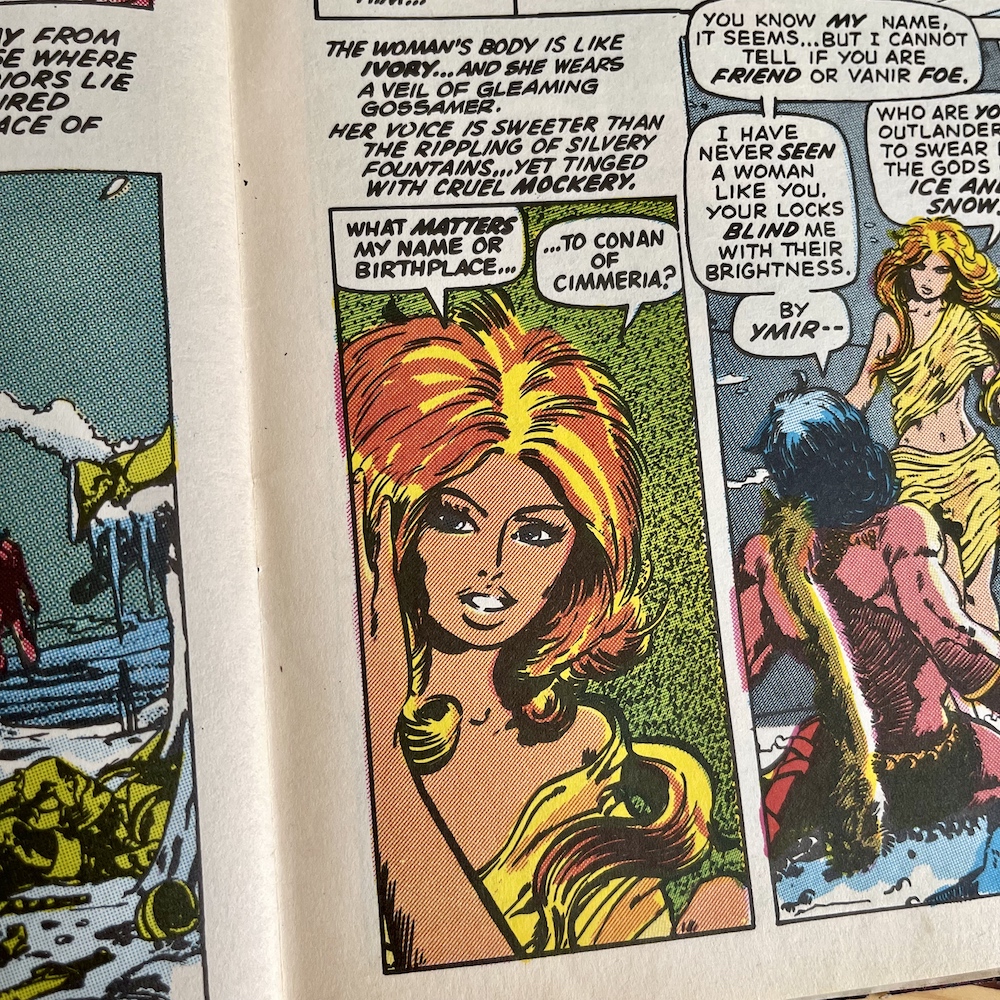
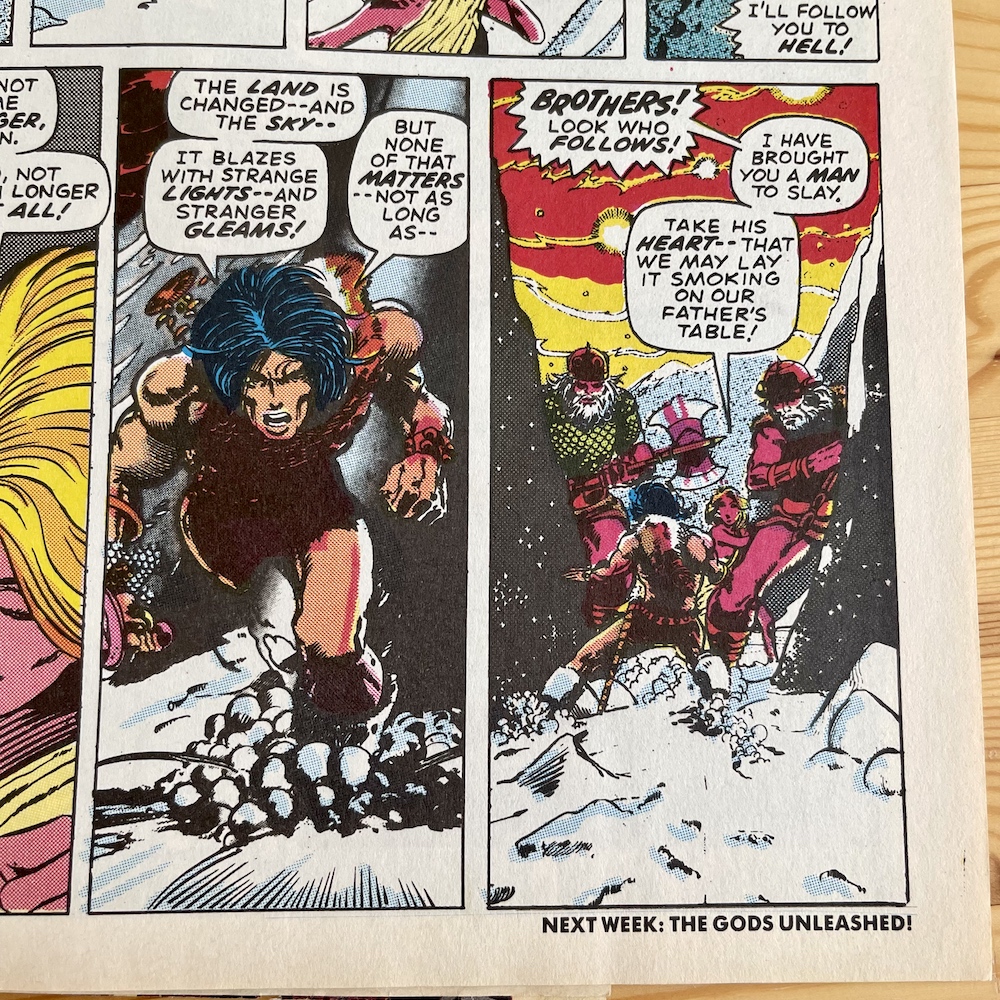
Her existence doesn’t make sense here in the snow covered mountains, so Conan’s pursuit changes from one of lust to a search for answers, fearing it’s some sort of vision or trick. I can’t remember the exact reason and I don’t want anyone to tell me if you know, I’ll find out in real time as always. At the end the fact it’s a trap is made very clear, but no other answers are forthcoming yet. I find myself remembering the sense of childhood wonder I had in reading this and I’m intrigued now to find out more about Conan himself, as well as the mystery at hand. A strong start.

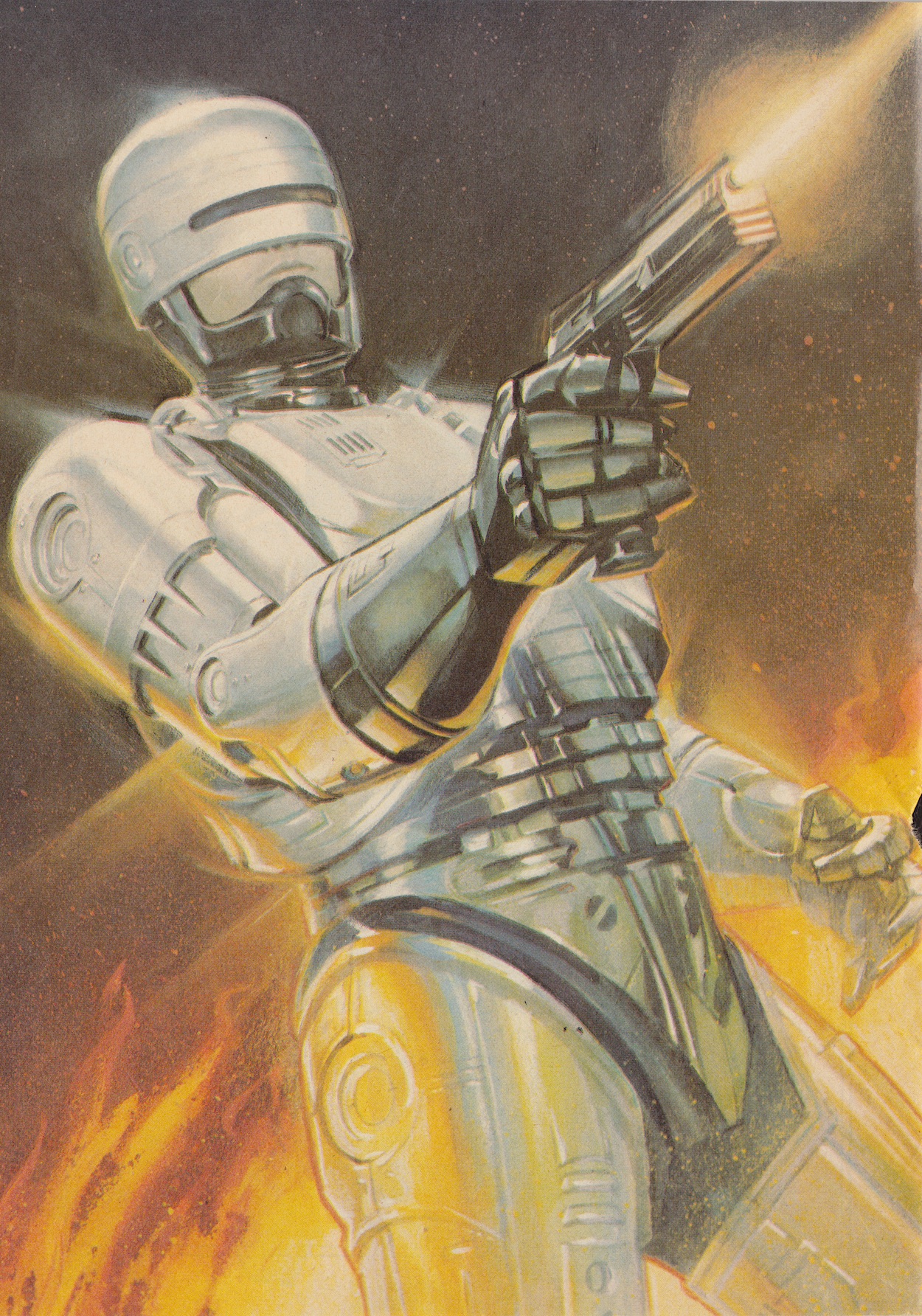
The final strip was the one I was most looking forward to when I initially saw the lineup as a teen. Deathlok looked awesome but I already knew Alex Murphy aka RoboCop and it felt exciting to see him in comic form. What a shame then that this first chunk of Kombat Zone is probably the weakest of this first issue. I put this down to the fact I’ve seen so much more of RoboCop since then and in particular the characterisation in the TV series. Here he comes across as rather two-dimensional and his speech patterns read very strangely, rather clichéd compared to the first film or the show.
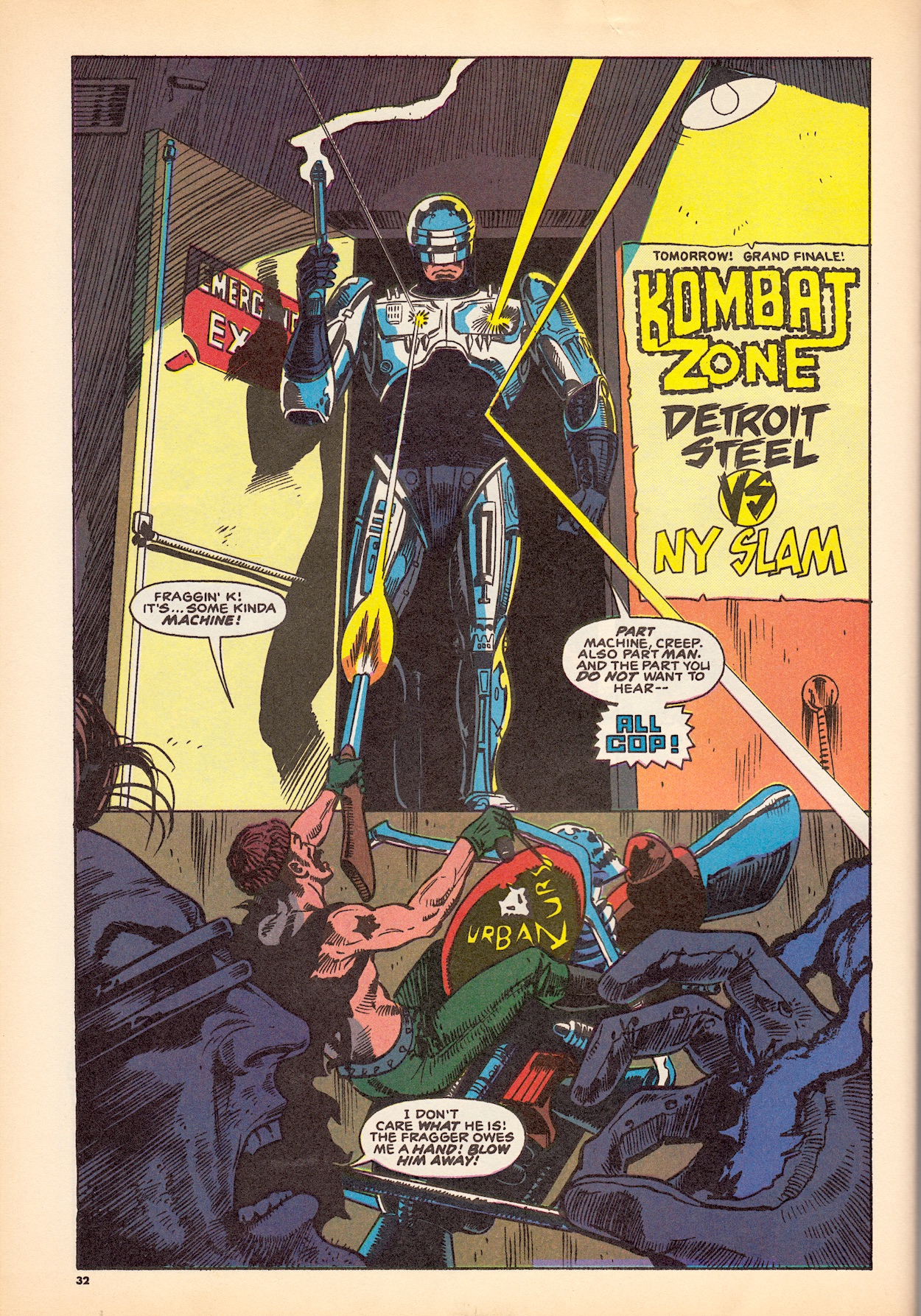
But hey, it’s only the first five pages! I’m not going to get ahead of myself. I’ll see how it develops. Robo intercepts a hover-bike gang as they seemingly take down an innocent stroller in Old Detroit. But in the background someone is filming the confrontation with RoboCop and when the victim makes a plea to pay off his assailants one of the bikers makes a passing comment about already being paid. There’s more to this random attack than meets the eye.

Murphy may not have heard this or seen the man with the camcorder but the way the bikers attacked is enough for the detective to have his doubts. But our mysterious stranger throws in a “smart-gun” (which was rather forward thinking for an early 90s comic) which kills the ‘victim’ Alex had saved and the last of the bikers before he can give anything away. It’s all over very quickly and after some of the more substantial reads it’s a bit of a disappointment when this is the big licenced strip.
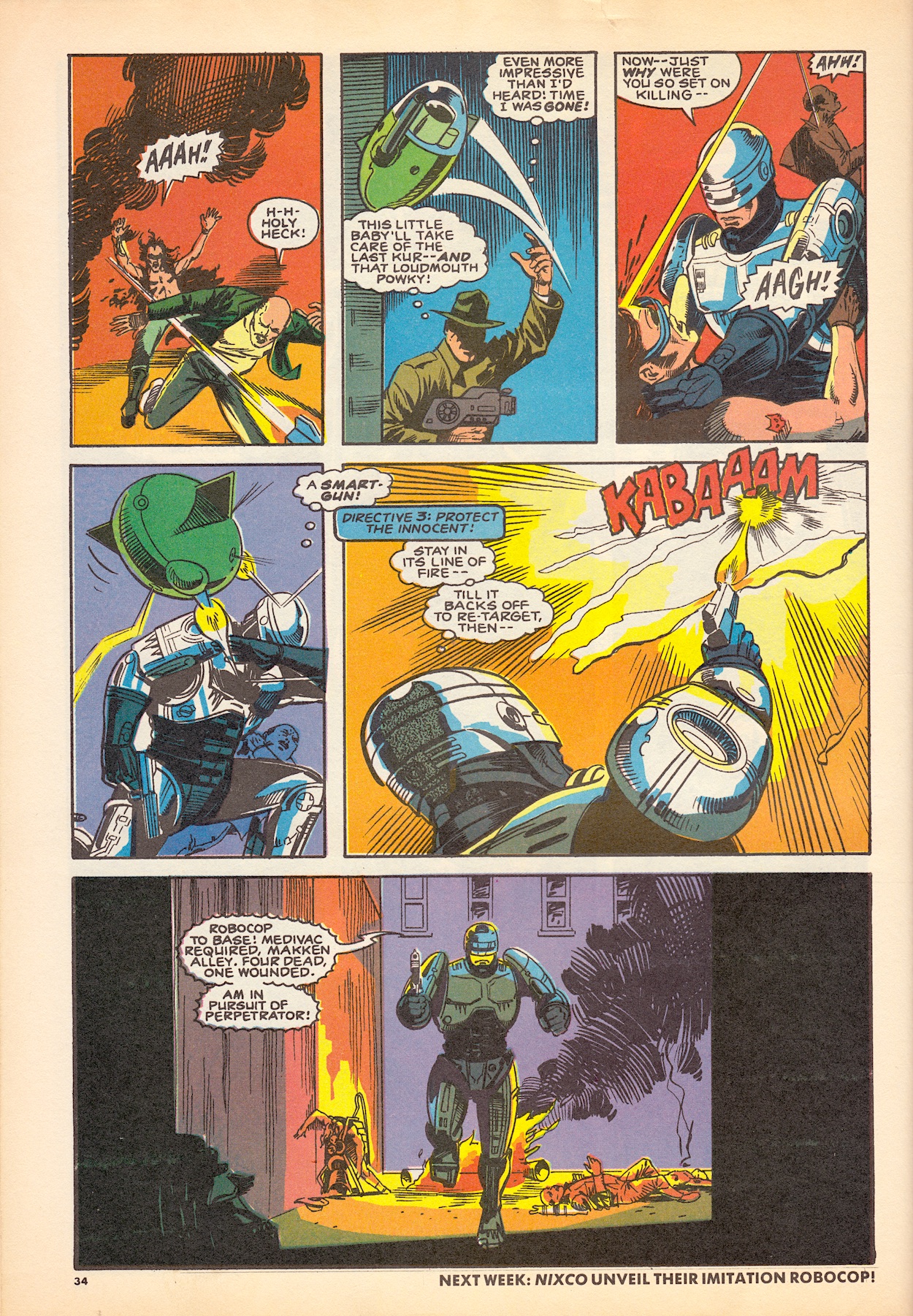
Of course, none of the ongoing stories in this issue were ever designed to be broken down like this, so overall the comic has done a wonderful job of selecting the right characters, stories and ending points to give us a flavour of Havoc’s future. So I can forgive the feeling of two of the strips being all too brief this time out, we’ve been spoiled by the package as a whole.

What a shame the great team assembled for RoboCop aren’t given any credit because the Deathlok ones are mistakenly reprinted instead. RoboCop: Kombat Zone reads like a who’s who of comic legends in my eyes. It’s written by none other than Alan Grant (Judge Dredd and Batman, including the Judgement on Gotham crossover, Toxic!), pencilled by Lee Sullivan (Transformers, Doctor Who, Tekworld), inked by Kim DeMulder (Batman, Transformers, G.I.Joe), coloured by Steve White (Dragon’s Claws, Xenozoic Tales for Jurassic Park, Transformers)and lettered by Richard Starkings. What talent! After finding this out I’m all the more excited now for the rest of the story.
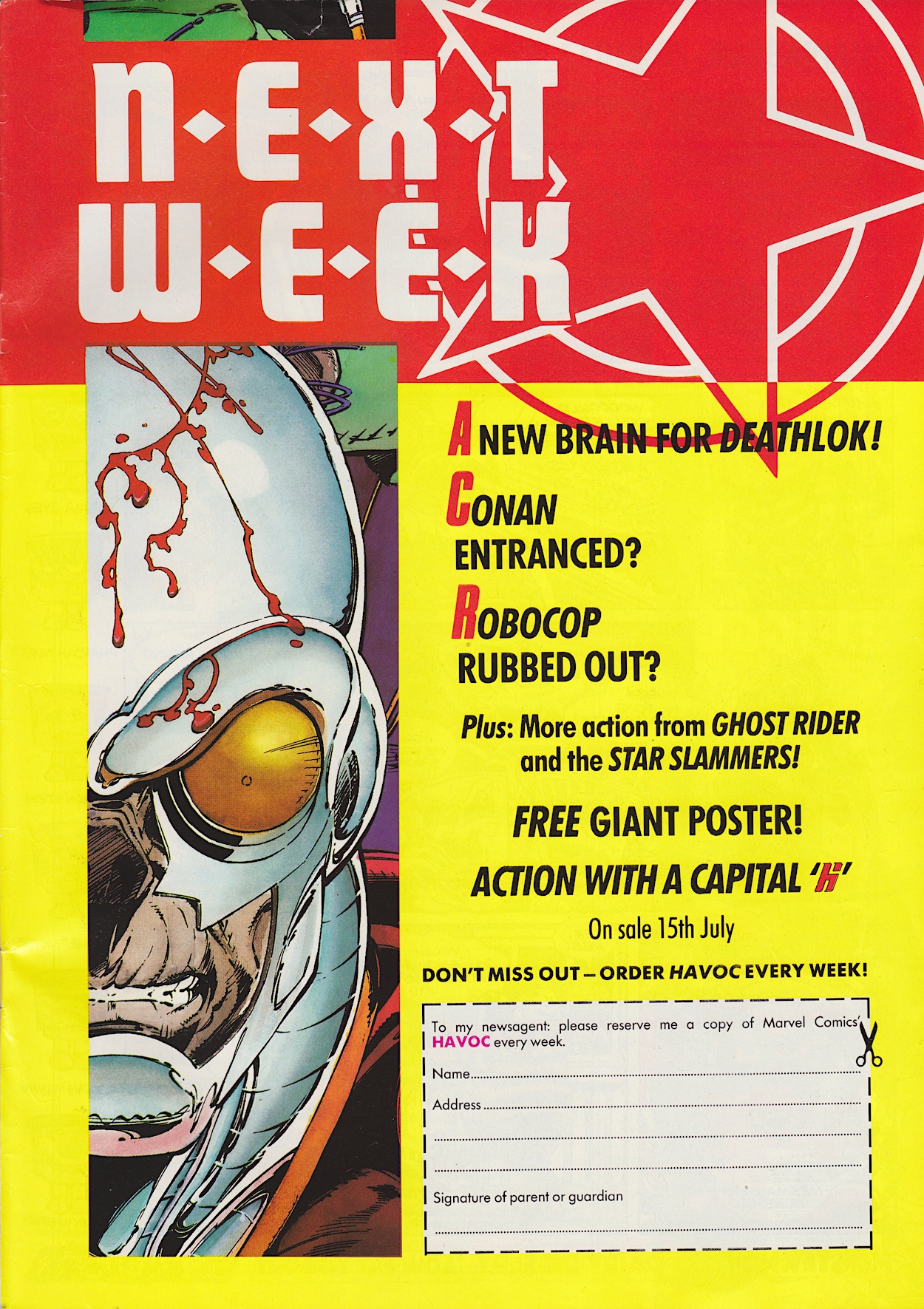
I’m just going to finish off now with a quick look at the other non-strip pages in this premiere issue, notably the Next Issue page and the retro adverts. You may notice the date for #2 is given as Monday 15th July 1991. Havoc was advertised as being on sale every Monday and a lot of other comics said so too but were released on the Saturday beforehand. The date on the cover of weekly/fortnightly Marvel UK comics was always the date the next issue would go on sale, kind of like an expiry date for each issue, the date the newsagent would remove it from the shelves.

Havoc has the date of the following Saturday on its cover but on the Next Issue page it’s two days later, the following Monday. I have very clear memories of picking this up every Saturday morning throughout the summer of 1991 and in later years when I worked in various newsagents in my teens and early 20s comics were never released on a Monday. (The only publications beyond newspapers that would ever arrive on a Monday were women’s weeklies.) So I’m not sure why the wrong date is given here, but it gets even more out of sync later in the run as you’ll see.
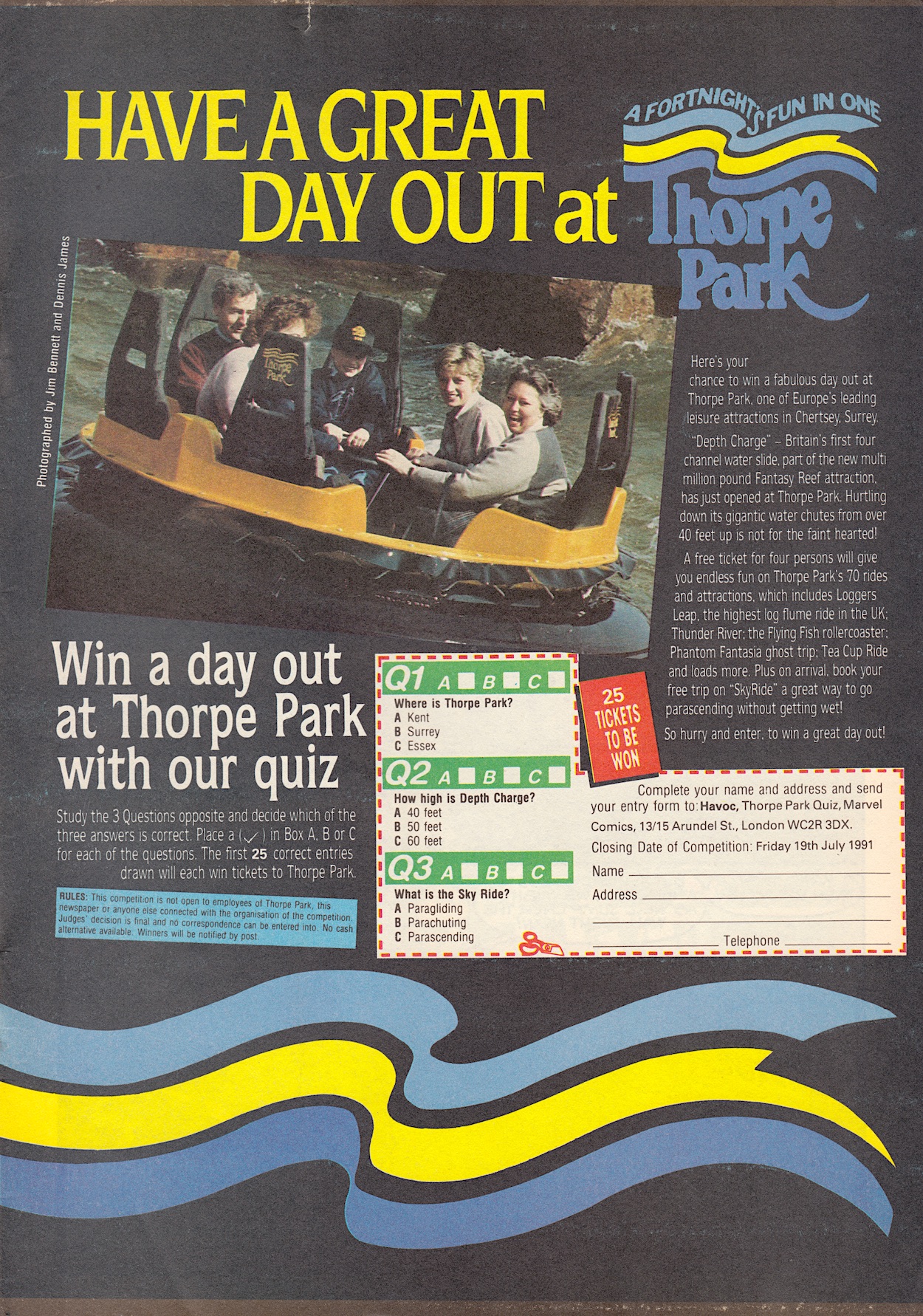
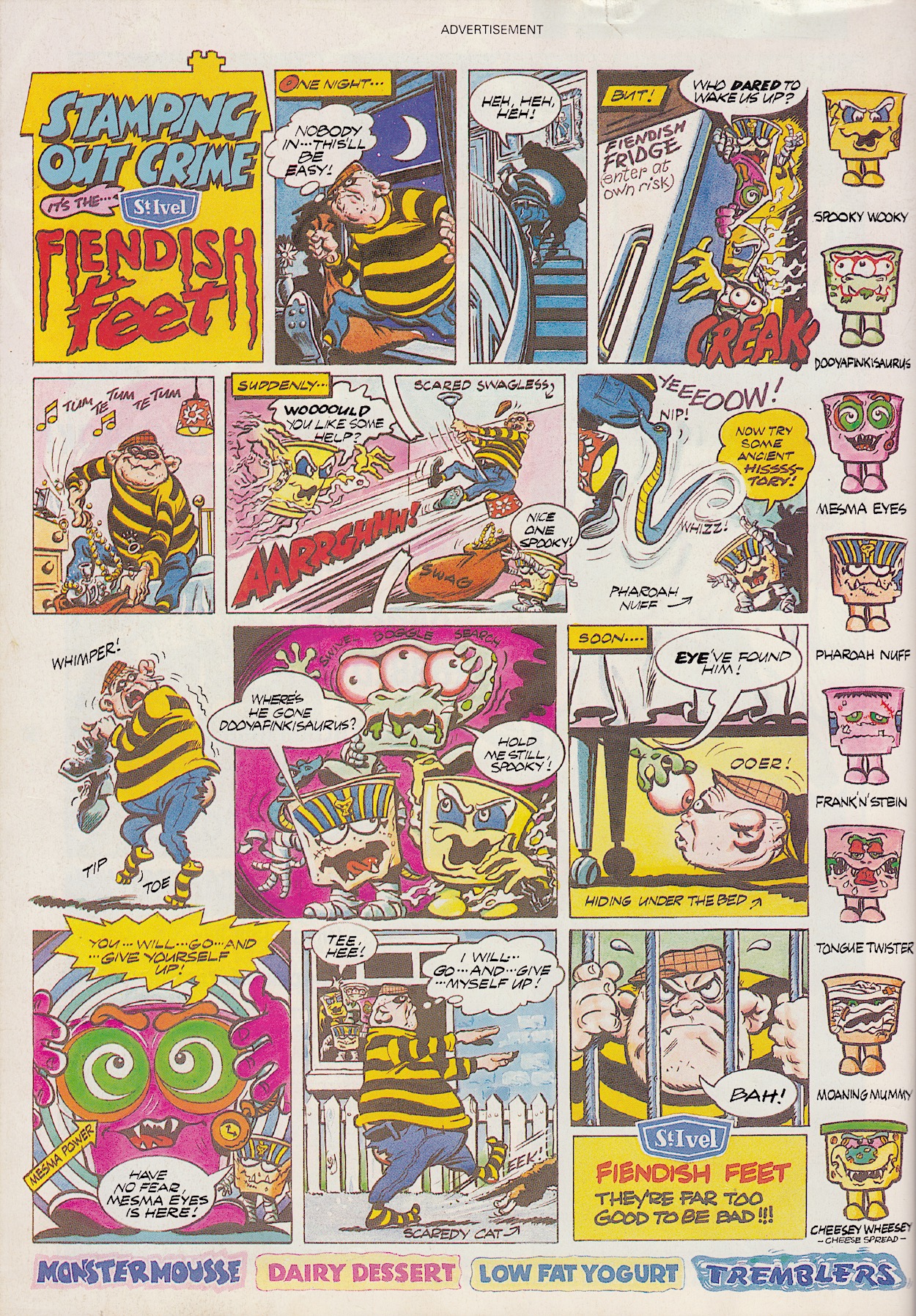
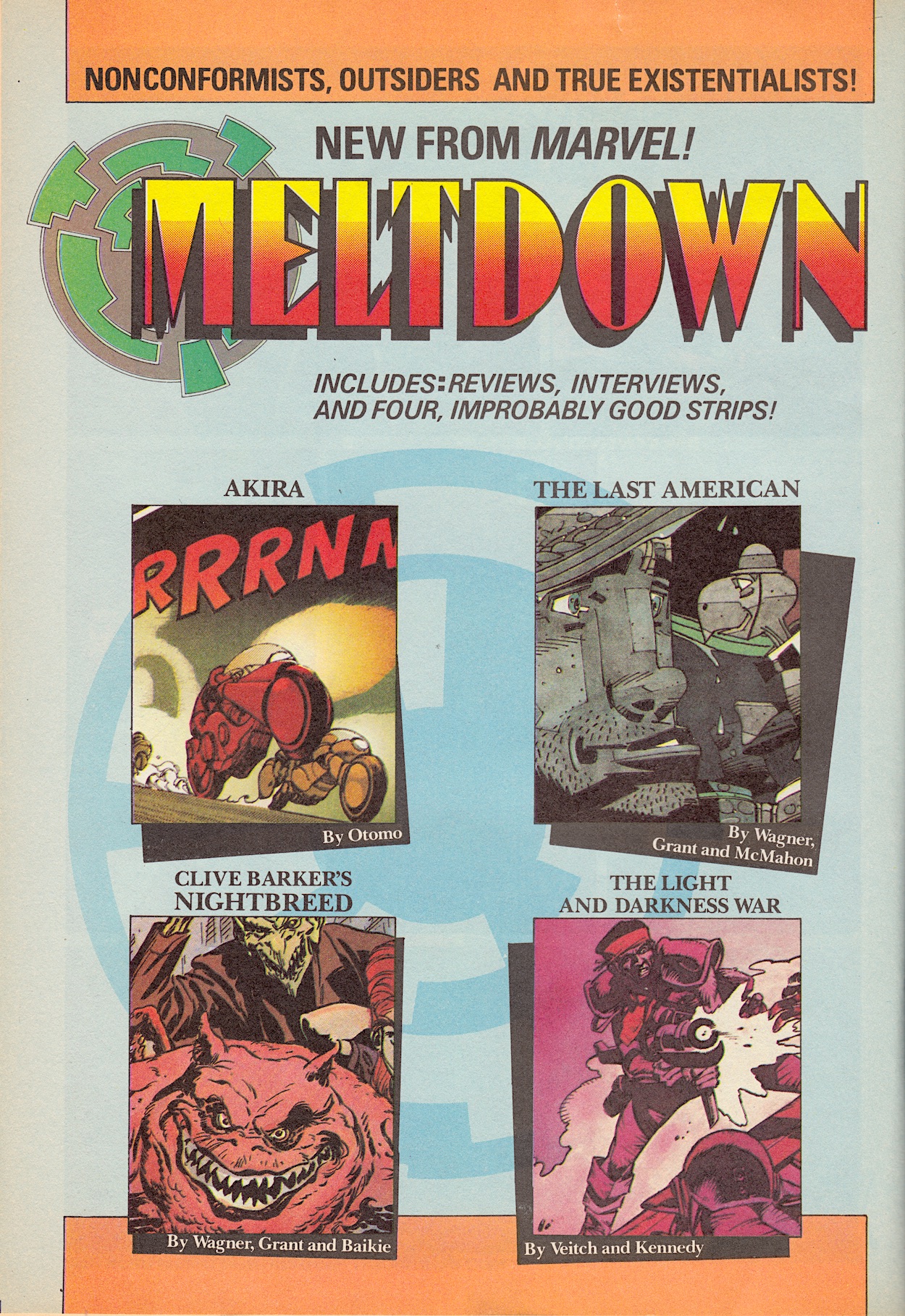
Elsewhere there’s an advertisement for Havoc’s sister title Meltdown both in the comic itself and on the back of the free booklet, there’s one for Thorpe Park dressed up as a competition and on the back cover of this mean, action-packed, mature read are the Fiendish Feet! Oh I loved those yoghurts as a kid.

This has been a rather long post, I know. But it was necessary to introduce Havoc, its strips, their main characters and all of their creative teams. It’s been a blast revisiting this issue and I’m so glad I haven’t got long to wait until I do it again for #2, albeit maybe with a slightly shorter blog post. The next issue of what should’ve been a very long-running comic will be here on the OiNK Blog from Wednesday 13th July 2022.
GO TO iSSUE TWO

HAVOC MENU

OiNK! FREE CRASH EDiTiON

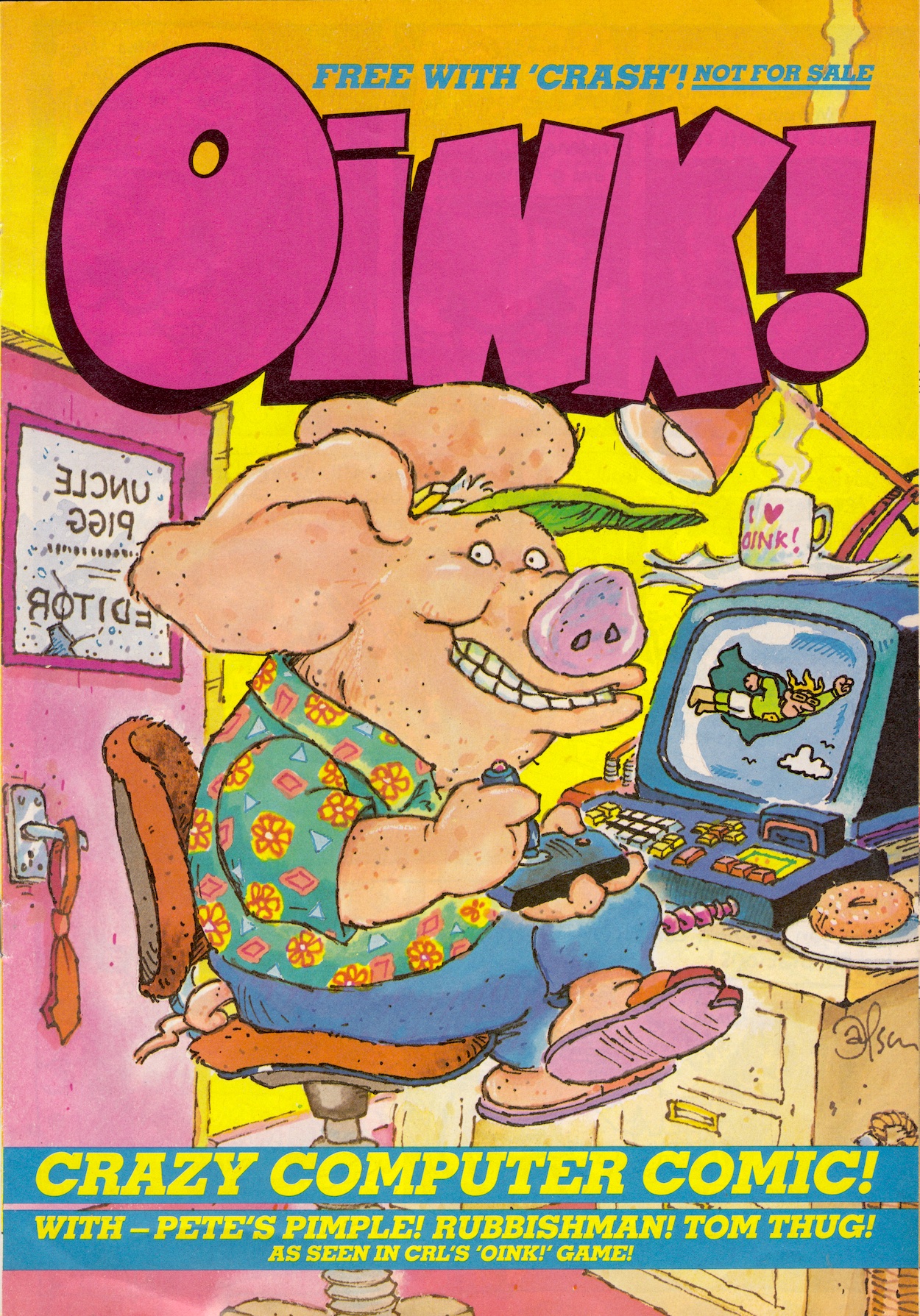
This is a somewhat unique addition to OiNK’s run and one I missed out on at the time, despite it being briefly advertised in #32. I can only blame my young self’s lack of attention span for that one. Given away free with #48 of ZX Spectrum computing magazine Crash, this 16-page freebie (the pages are smaller than usual, made to slide inside the A4 Crash) contained all new material from a variety of OiNK contributors. As a tie-in with the new computer game it was an original idea and a smart move, potentially a great way of bringing new readers over to the comic.

I’ve already covered the magazine’s OiNK article which contained an interview with co-editor Tony Husband and a special Frank Sidebottom page, so let’s take a look inside the comic that came with it. We’ve a superb Ian Jackson cover to begin, with Uncle Pigg playing the game on a Spectrum computer which leads to a strip inside featuring him and Mary Lighthouse (critic) in a take on Max Headroom. But it’s across the page from this that things take a turn for the weird.

Lew and Mark decided the strips would work best if they reflected the gameplay

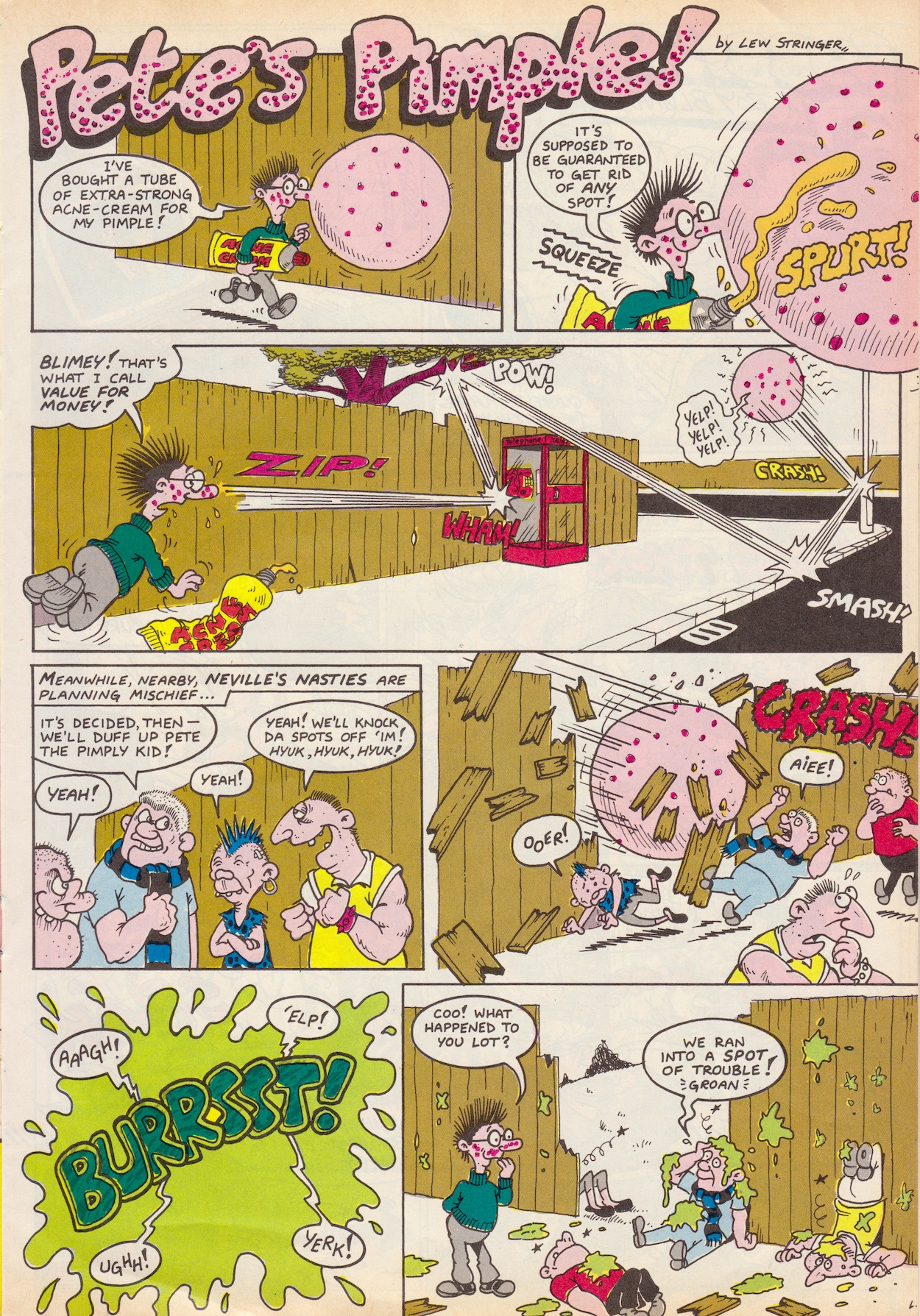
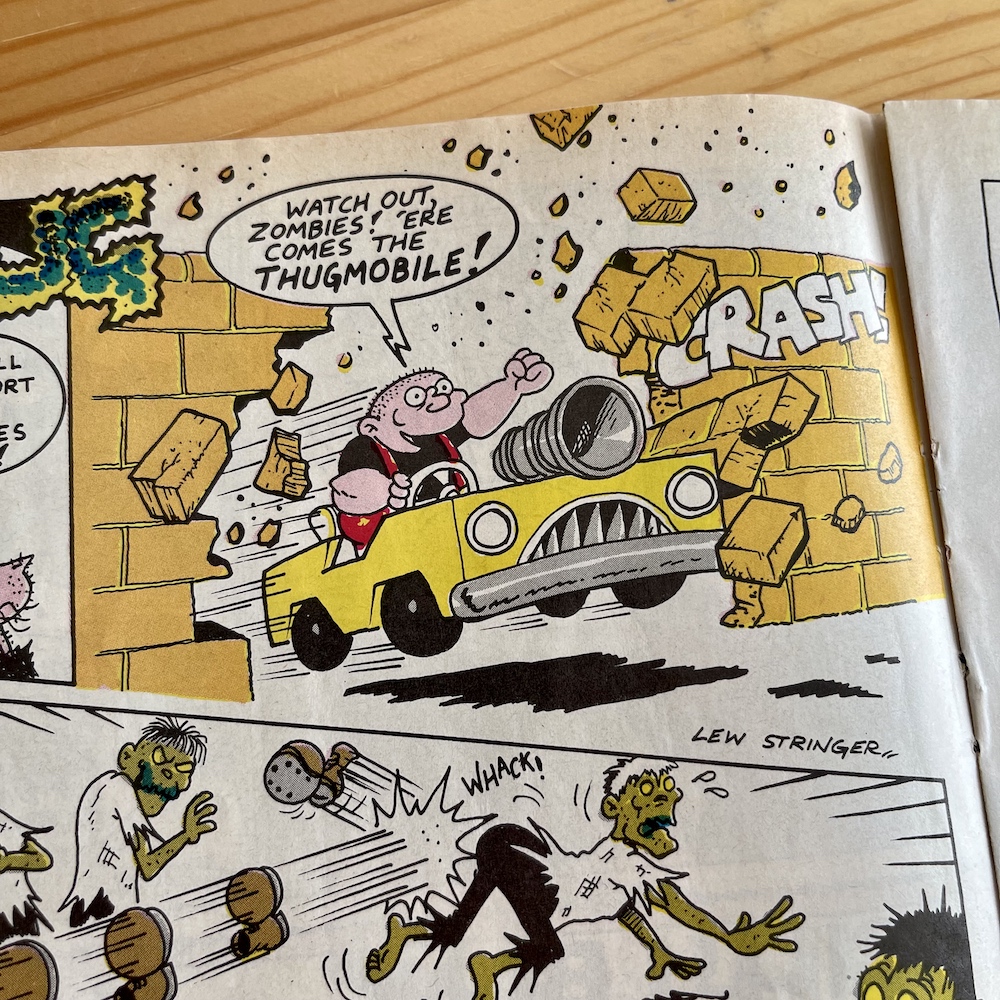
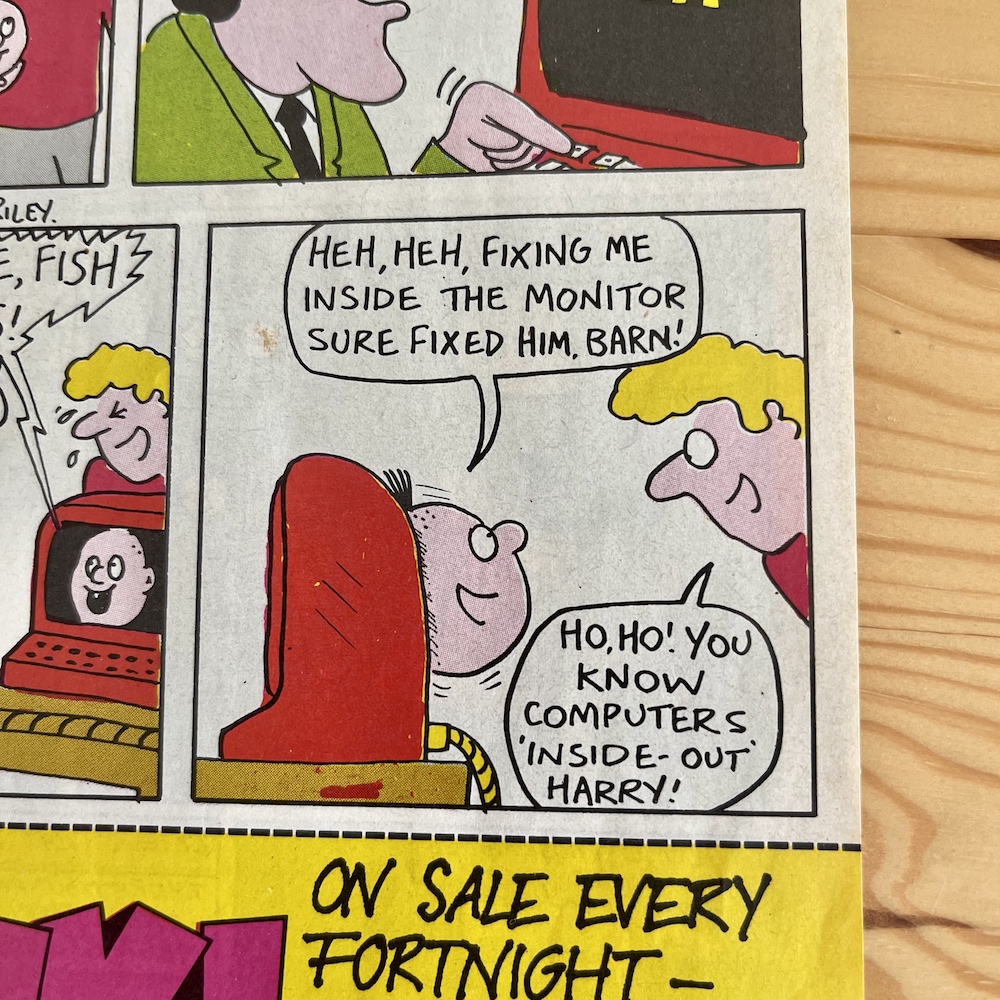
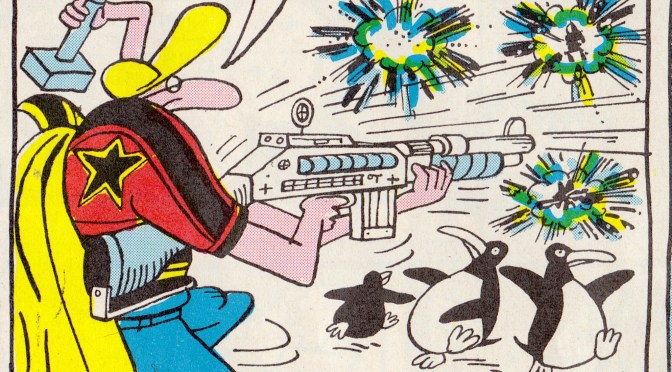
Lew Stringer’s Pete and his Pimple and Tom Thug strips feel a little off and originally I couldn’t quite put my finger on why. Pete’s strip has a different name and basically his pimple goes on a bouncing spree (complete with dog-like yelping noises), flattening some bullies in the process. It’s a bit tame compared to normal, and in Tom’s strip he’s driving about in a ‘Thugmobile’ shooting bovver boots out of a cannon at invading zombies! It’s a dream of course. He awakes to say he’s doesn’t know why he’d dream that but his bedroom is full of zombie posters and toys, something never mentioned before in OiNK. How bizarre.

Don’t get me wrong, both are enjoyable strips, however there’s a reason they feel very different than normal. Lew and co-editor Mark Rodgers decided they’d work best if they reflected the gameplay in the OiNK game. But since that didn’t really reflect the comic (and instead was made up of mini-games with the characters shoehorned in) their strips in turn don’t really reflect their usual hilarious outings. Pete’s game was a Breakout clone, bouncing a ball (his pimple) to break bricks, for example. I’m also not quite sure why Pete’s pus is suddenly green, although Patrick Gallagher did confirm they did the colour separations and not Crash.

There are some funny moments here, like the sound effects used in Pete’s strip being classic comic titles such as ‘Pow!’ and ‘Wham!’ and of course the word ‘Crash’ is used as much as possible! David Haldane’s Rubbish Man is the third and final strip of a character featured in the game and unfortunately it’s pretty poor, with Boy Blunder playing the game while our hero dispatches some random vegetable villains in the background. None of his smelly powers (or even his smell) feature at all, so as a pig pal it just feels rather bland.


“He defeated the dreaded Three-headed Politician of Gassbagg!!”

Mutant Space Barbarian Magic Warriors of Doom

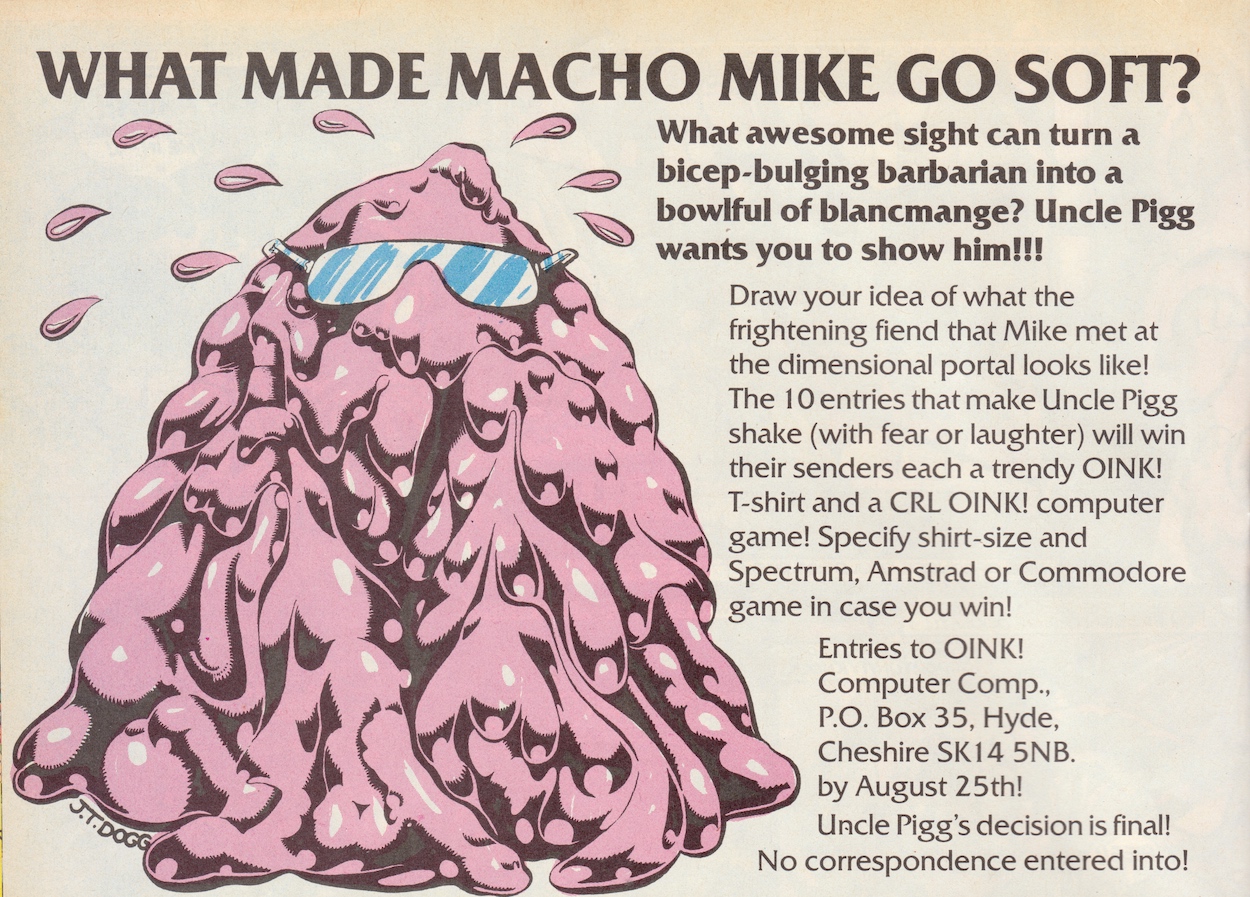
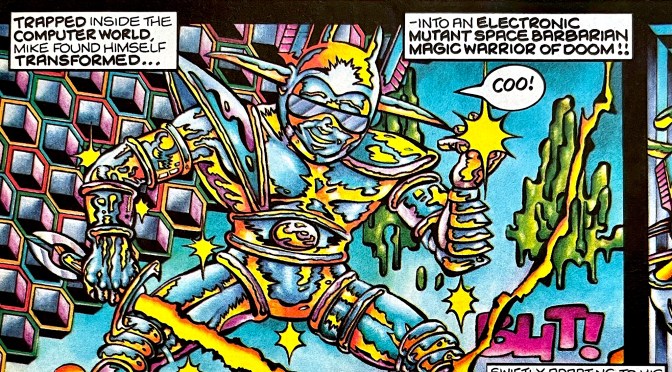
Much better is the double-page spread in the middle of the comic drawn by J.T. Dogg. Written by Mark Rodgers the title Mutant Space Barbarian Magic Warriors of Doom sums up some of the ludicrous names we were subjected to for some of the less-than-great gaming titles back in the 80s. It centres on an arcade machine with somewhat magical powers. Perhaps inspired by Tron, it’s a much more colourful affair with Dogg’s excellent artwork.

With its fast-paced humour, daft ending and some 80s satire it’s the best introduction to OiNK possible for Crash readers. That ending in particular had me laughing. With all of that build up, the heroic deeds and all of Mike’s victories, for it all to be torn down in a couple of sentences and the whole world to fall into despair as a punchline is great stuff. Classic Mark, really. Billed as “An Interactive Comic Strip” for the computer mag, in reality it boils down to a competition for the readers to send in suggestions of what poor Mike saw that turned him into a pile of Angel Delight.

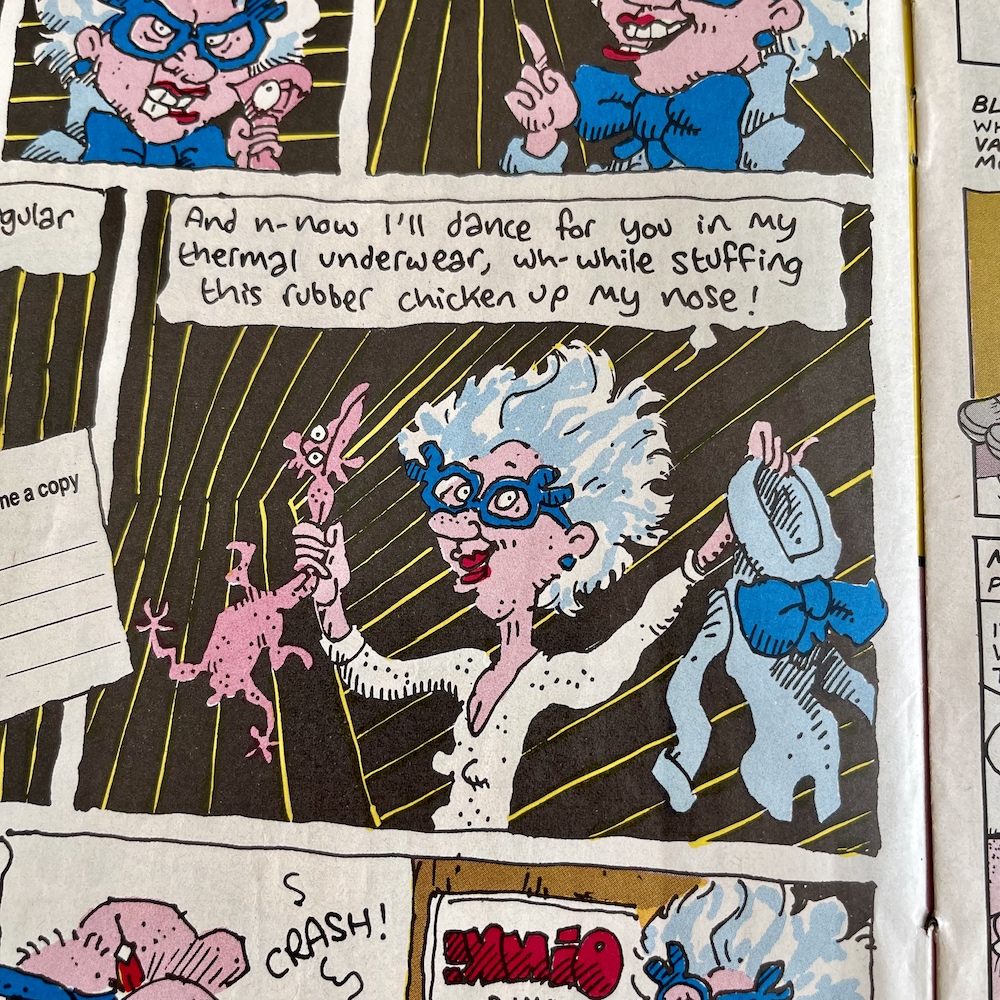
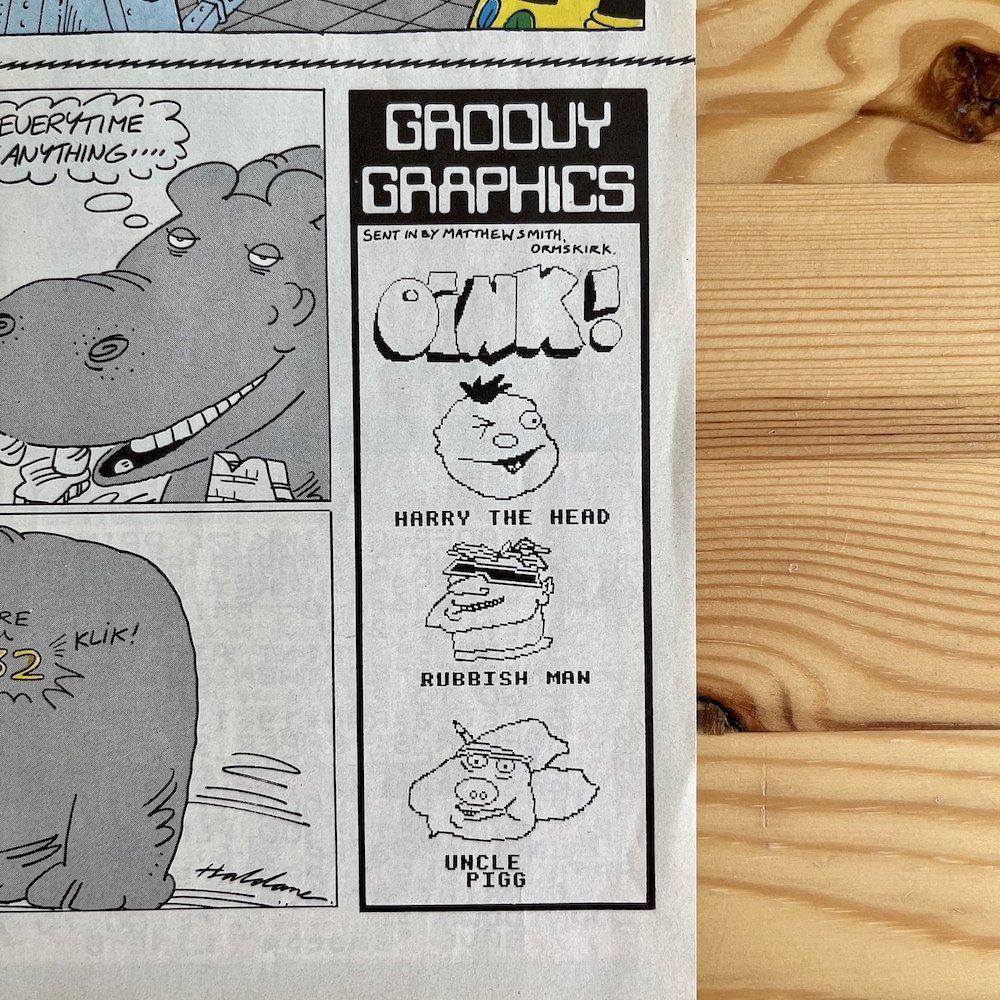
The address for this competition is OiNK’s, meaning the winning entrants would be published in the comic instead of the magazine. We’re almost at a simply superb contribution from Frank, but first here’s a quick look at some of the other highlights. Mary Lighthouse (critic) isn’t too happy with Uncle Pigg’s simulation of her in that Max Headroom-inspired strip, you can see part of Tom Thug’s strange dream based on the game, Harry the Head scares a show off on the school computers and this issue was the perfect place for a reader’s Groovy Graphics.

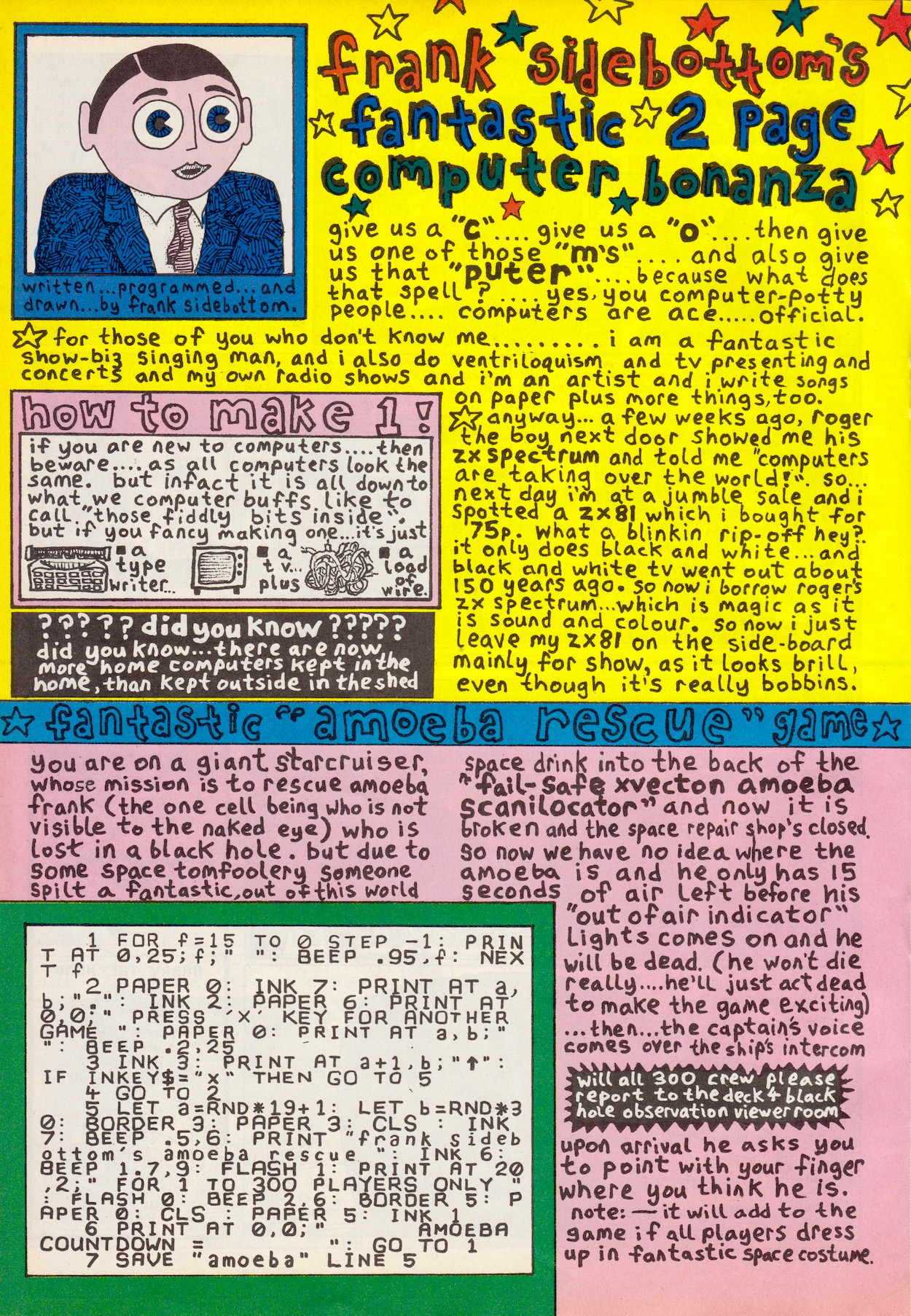
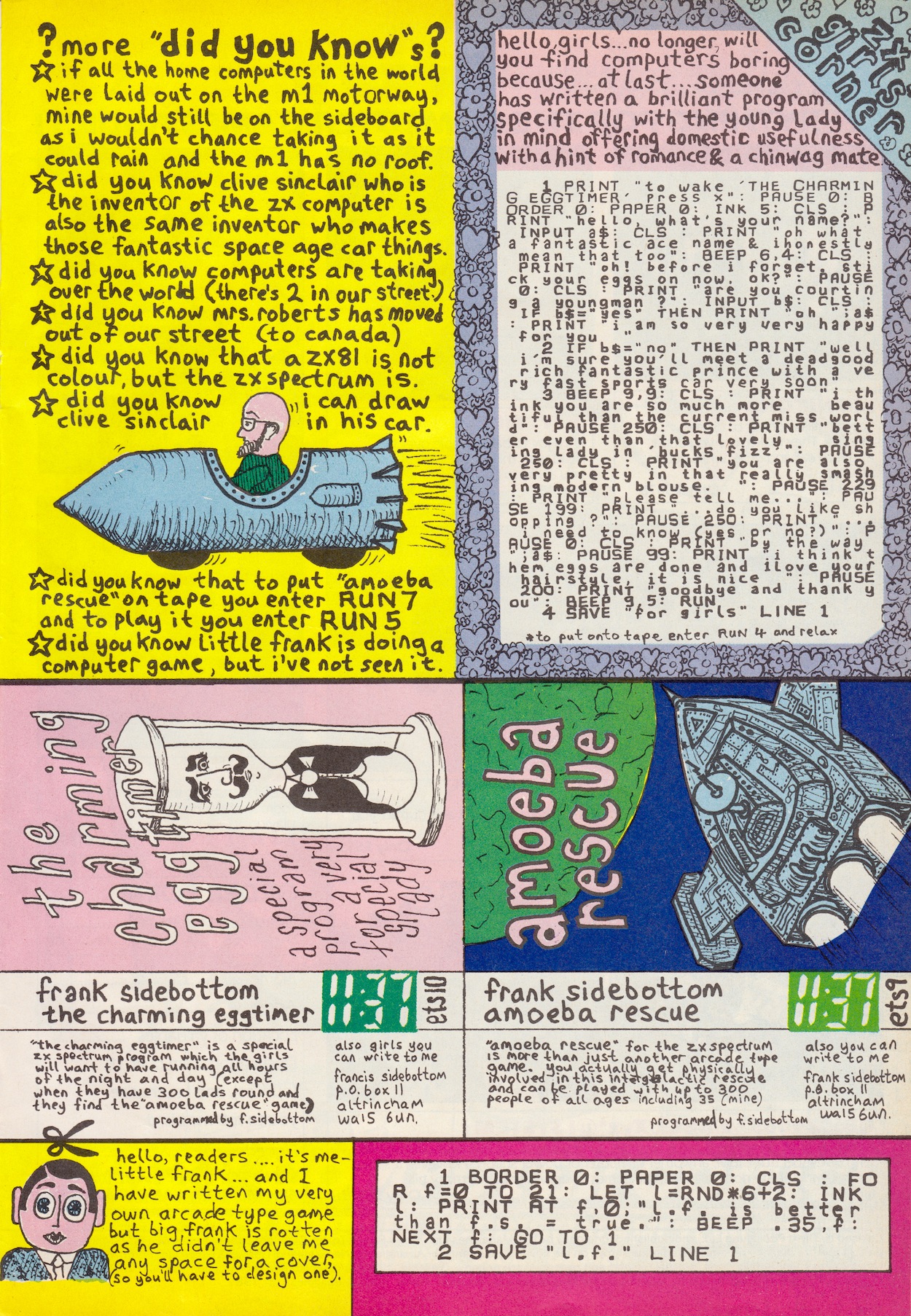
Up next Frank Sidebottom has a text-heavy (which suits the magazine) double-page spread and it contains an extraordinary amount of work on the part of his alter ego, Chris Sievey. From the introduction that pokes some fun at the Sinclair ZX81 (accurate though, so he’s done his research) to his piece about the “fiddly bits inside computers” and his funny facts about the machines (and neighbours) that includes praise for Clive Sinclair’s infamous C5 personal cycle, it’s a delight to read.

It also contains some actual working type-in programs for ZX Spectrum users. These little gems are not only working programs, they’re funny in their own right. Complete with cut-out cassette covers which hilariously had nothing to do with what was on the screen (but none for Little Frank‘s game, naturally), one ‘game’ would basically select a random point on the screen and you had to use your cursor to find it in a trial-and-error fashion. The other was a linear romantic story where all you’d do is hit a key to read the next line and it’d give you a couple of choices to get slightly different compliments about what a nice young woman you are.

Oh and Little Frank’s program prints “l.f. is better than f.s.” at random points on the screen. Silly and pointless, but that in itself was the whole point.

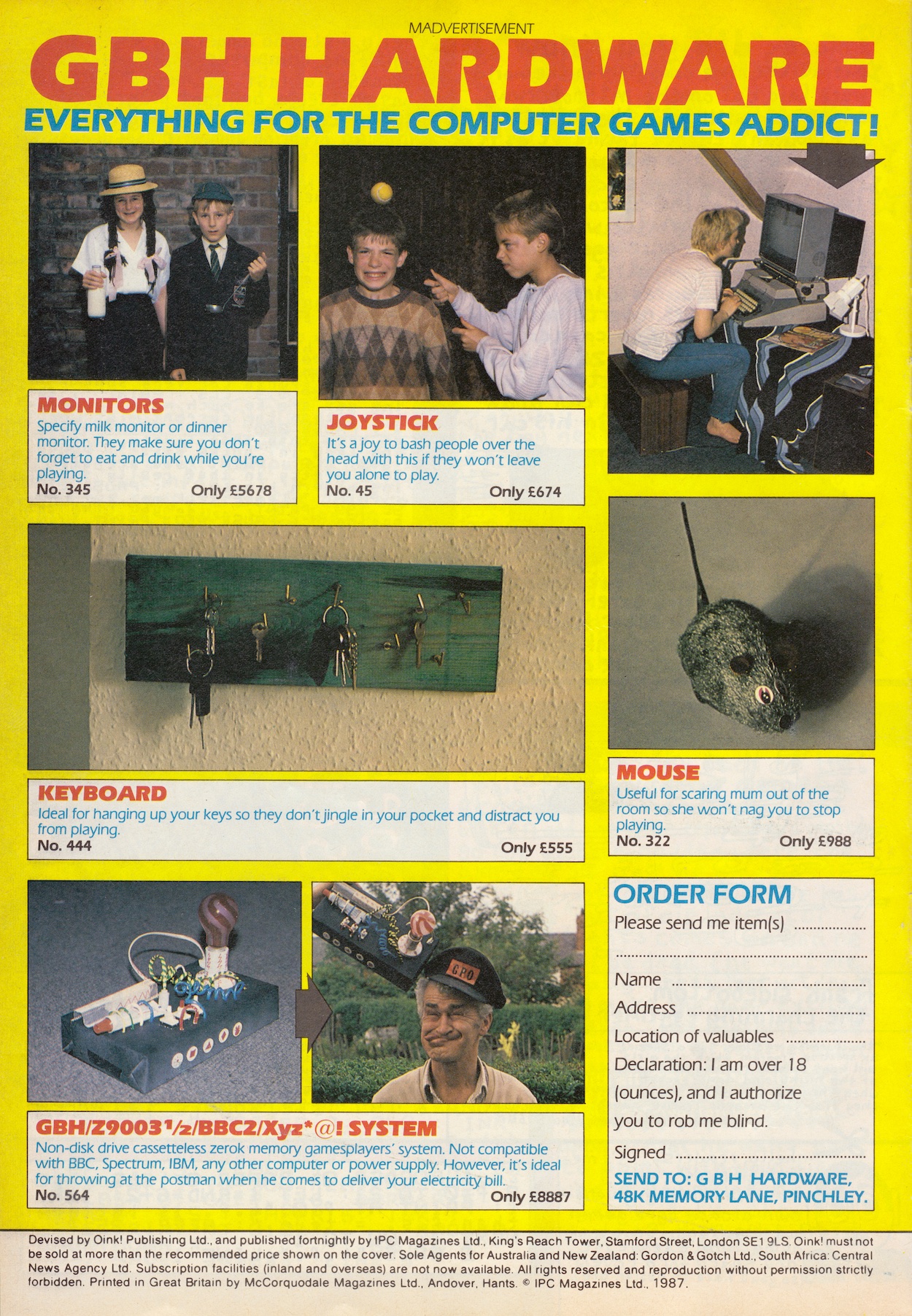
To round things off for potential new OiNK readers what else could be on the back page but a GBH madvertisement? The 80s was a very exciting time for what would become a multi-billion pound industry worth more than the movie and television markets! Everything was brand new and younger people in particular jumped at the chance to become part of it, creating their own games from home, just like a lot of the mainstream games were back then. GBH clearly saw an opening in the market for ripping people off.

The pictures for this were taken by OiNK’s resident photographer John Barry and that lady at the computer (that contraption is so funny in itself!) is John’s wife at the time, Ike Walton. Thanks to co-editor Patrick Gallagher for the info. Unfortunately the names of the children and that wonderful old man have been lost to the mists of time.

If you’re interested in tracking down this unique little issue of OiNK it also includes Billy Bang, Horace (Ugly Face) Watkins, Mr Big Nose, Burp and Hugo the Hungry Hippo. While I do believe some strips would’ve been a much better introduction for their characters and the comic if they hadn’t tried to tie themselves into the game, I completely understand why they chose to do so. It’s still a funny wee comic and a unique edition that no OiNK collection is complete without.

Quite a few posts make up the blog’s coverage of the OiNK game, beginning with the preview in Zzap!64, an in-depth look at the Crash magazine this comic was bundled with and a Retro Gamer article from 2021 containing an interview with the game’s creator. Still to come on is the Zzap!64 review of the game itself and later in the year a couple of issues of Commodore Format in which they gave the game away free but under a different name, then detailed how to beat it.

But probably most excitedly for established pig pals who picked this issue up were the first images of two things coming later in 1987, in a promo by Patrick. Stick with the blog, folks.

iSSUE 30 < > iSSUE 31

OiNK READ THROUGH MENU

OiNK SPECiALS & BOOKS MENU

THE OiNK COMPUTER GAME MENU

OiNK MERCHANDiSE MENU

MAiN OiNK MENU

COMiNG UP: FREE CRASH EDiTiON

Coming up in a couple of days is a very unique little edition of our favourite comic, the free OiNK Crazy Computer Comic! Only available free in an issue of ZX Spectrum computing magazine Crash, it was a 16-page sampler with all brand new strips and features, released to tie in with the new computer game (which was a tie-in with the comic). I’ve already covered the excellent OiNK feature inside the magazine so up next is the main event. Below is a scan of the only time it was promoted in OiNK.

As a kid this passed me by so it’s a shame it wasn’t given a proper advert at the time, more of us may have picked it up. But I’ve now corrected this oversight and some highlights I’ll be showing are a rather different Pete and his Pimple, another gorgeous J.T. Dogg strip, a GBH Hardware catalogue and a simply jam-packed spread by Frank Sidebottom! You can see these and more in the full review.

GO TO FREE CRASH EDiTiON

OiNK iSSUE PROMOS MENU

MAiN OiNK MENU

HAVOC: iN REAL TiME

It’s time to add another comic to the blog, to relive another cherished childhood title in real time and it’s from Marvel UK. Previously from the same publisher the blog has covered the short-lived Visionaries, over on OiNK Blog’s Instagram I’m still reading Transformers and approaching the sixth anniversary of that particular read through at the time of writing this, and there’s a one-off post celebrating #1 of The Real Ghostbusters. Back in July 1991 the latter two were the only comics I had a regular order for when a new weekly called Havoc caught my eye.

The first issue of a brand new comic was always an exciting prospect and this front cover was enough for me to know I just had to try it out. The free booklet which introduced us to all five strips inside blended into the cover image of Deathlok and when I pulled it back to see what was underneath I had a hunch straight way this would be a regular purchase. (You’ll see the image contrast in the first review.) Recognising Robocop and Conan and seeing a fiery skeleton riding a motorcycle convinced me this was going to be new, exciting and unlike anything I’d read before. I wasn’t wrong.

Launched and initially co-edited by John Freeman (he of Down the Tubes) and Harry Papadopoulos, the writing of both I’d previously enjoyed in The Real Ghostbusters, although I didn’t realise that at the time. Most likely forgotten by many because it only lasted a couple of months, Havoc was a weekly 36-page anthology comic featuring five action-packed strips from the US which hadn’t seen print over here. To me, it felt like a really meaty read, a meaner, grittier, more mature version of my school friends’ 2000AD (I’d only read a handful of Tharg’s organs). Indeed, some of those zarjaz friends loved Havoc just as much as I did.

I decided to be nice to my parents and cancelled The Real Ghostbusters after 150 issues so I could order Havoc

I was only 13 when I read Havoc, lured in by that cover and the promise of RoboCop comic strips. It was heavy on character as well as action, the choice of strips was original and it worked. It was the perfect package. After reading only the first issue a reservation at the newsagent was in order so, even though I’d been allowed up to four regular comics previously and was currently only getting two, I still decided to be nice to my parents and cancelled Ghostbusters after more than 150 issues so that I could order something brand new.

At Marvel UK new Editorial Director Paul Neary had a remit to expand the company’s originated content, especially in exporting it Stateside. The ‘Marvel Genesis’ project would kick off with Death’s Head II and Overkill the following year, the idea being to have a range of US-format comics alongside the latter’s UK-size anthology featuring all new, original material. However, this new project was going to take a while to get off the ground.

The company still had a large range of titles at the time, from nursery to teen, but lost a bunch when former Managing Director Robert Sutherland was able to take some of the licences with him to Regan Publishing. Paul had to be seen to be creating new titles, they couldn’t just wait a year or more for the new comics and so Havoc and its sister title Meltdown (basically a larger monthly along the same lines) appeared. They were essentially stop gaps while everything else was slotted into place, but also designed to compliment the new Genesis titles when they rolled in. Unfortunately neither comic’s sales were good enough to last that long.

Meltdown lasted six issues, Havoc for nine. The first issue coincided with the beginning of my school summer holidays, the final one released the Saturday before we started again for the next term, so it was the perfect summer comic for me that year. I loved every single strip, surprisingly enjoying the characters I’d never heard of more than the ones that had grabbed my attention in the first place. As I said, it was a more mature read and so at that age I felt it really spoke to me, like the editors knew exactly what I wanted to read next, even before I did.

It also contained a weekly news column and I’m really looking forward to reading those for its contemporary look at the entertainment of the day. Later issues would include a letters page full of very keen readers. It really felt like it was here to stay. Then, after #9 left us with another weekly dose of cliffhangers the next issue… just didn’t appear. I remember thinking it must be late, so I was popping into the shop every day over the next week asking for it. When it and the following week’s issue didn’t arrive I got the hint and I was crushed. Again! Too many of the comics I’d started collecting from #1 had been cancelled.

While the sales just weren’t there it apparently proved the concept enough for Marvel UK to move ahead with their project. But as regular blog readers will know, just because a comic wasn’t popular enough at the time doesn’t necessarily mean it wasn’t great for those that did read it. I’ve only recently been able to complete my collection so I’m now ready to read them for the first time in 31 years. Even though I know the stories will just suddenly end, I can’t wait to relive the excitement these characters brought to me every Saturday morning (albeit on Wednesdays in 2022).

Deathlok, RoboCop, Conan, Ghost Rider and the Star Slammers, it’s going to be fun getting reacquainted with you all. The first review (which I’m really looking forward to) will be here from Wednesday 6th July 2022.
GO TO iSSUE ONE

HAVOC MENU

OiNK! #31: BiG! BOLD! BRASH! AMERiCA!

This issue of OiNK sits on my shelves as a loose collection of pages, although you wouldn’t know it until you picked it up. But if I’m not careful all its pages will fall out and become strewn all over the floor. Why have I taken one of my precious comics apart like this? There’s a very good reason and we’ll get to that later in the review, but for now you’ll just have to trust me when I say I had no choice. Hopefully that’s got you suitably intrigued to stick around for the remainder of this post about the Star-Spangled USA Issue, as if you couldn’t tell from that logo.

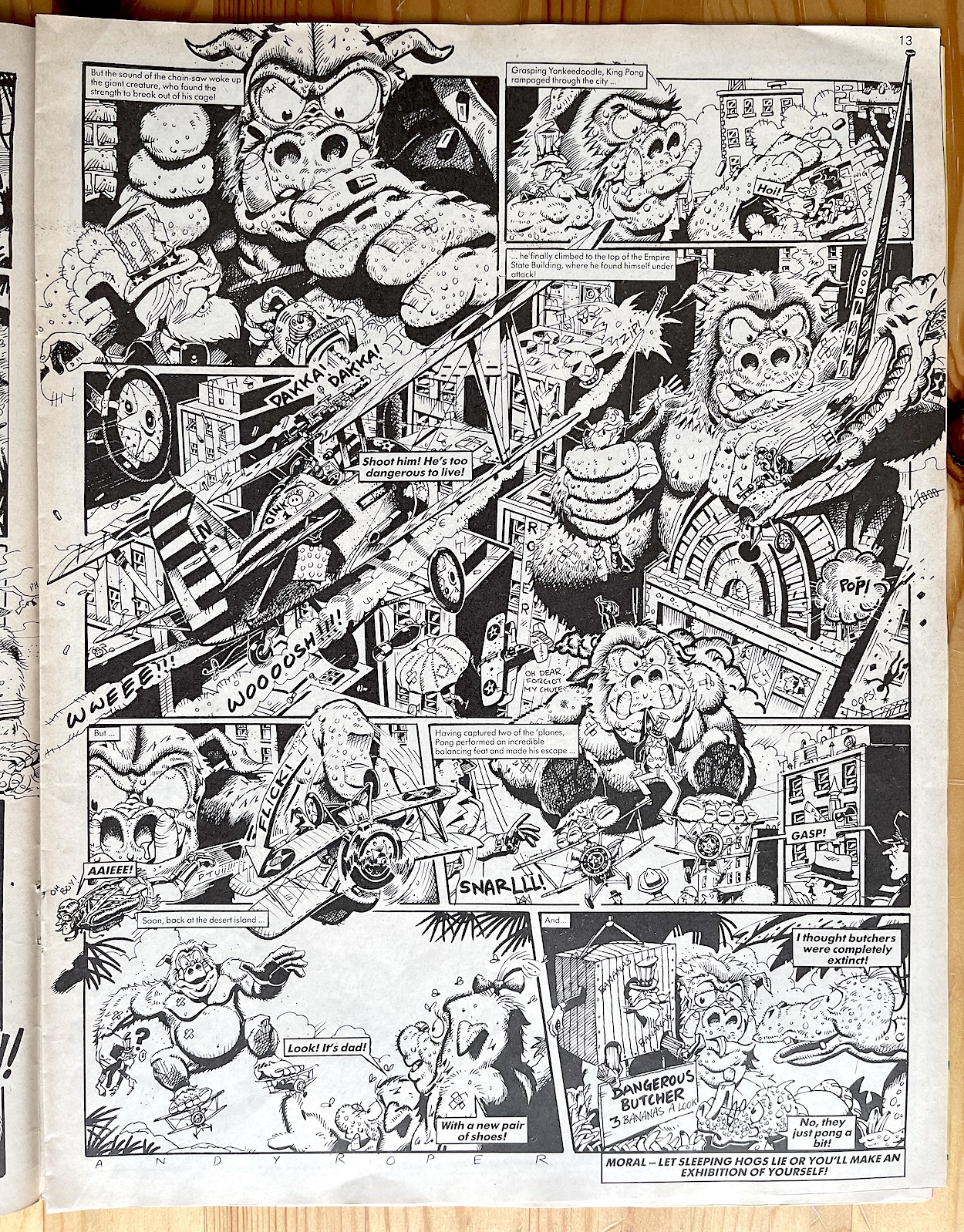
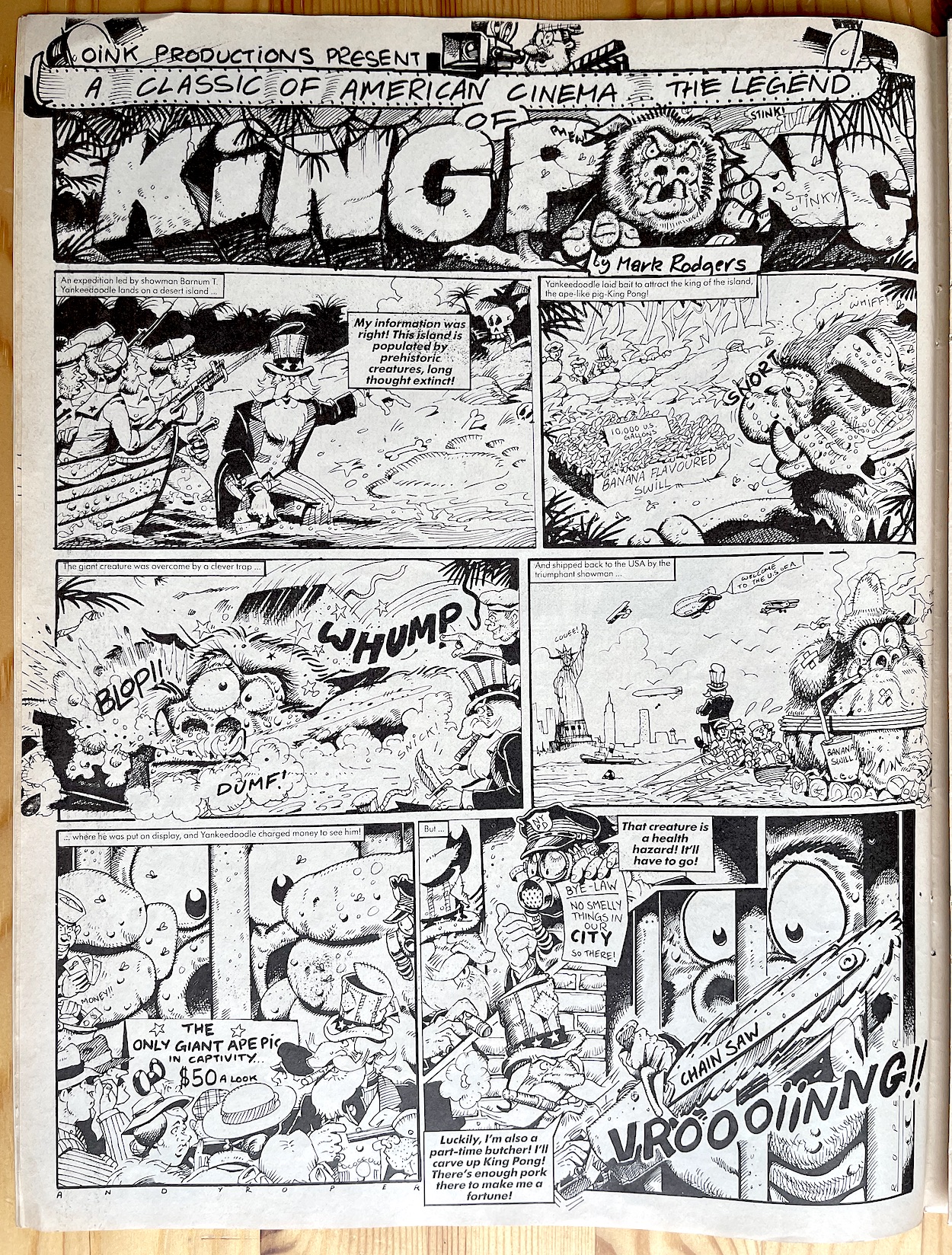
Andy Roper’s cover art makes just as big an impression, his King Pong strip the star of the inner pages. The recreation of the famous New York finale makes the perfect cover and the strip itself is written by Mark Rodgers. Rather than ape (sorry) a human character by putting a pig snout on them, Mark has taken another animal and pig-ified them, creating the “giant ape-like pig”, which is a bit of a stretch. But ridiculous scenarios are par for the course with OiNK and the more ludicrous the better, so we’re off to a swinging (sorry again) start.

Cutting the plot of the epic film down to a couple of pages we do without the love story, instead when King Pong’s smell gets too much for the city his captor turns into that favourite villain of OiNK’s, a butcher. Taking him captive in return it’s up the Empire State Building we go and just when you think it can’t get any more silly the sad ending is swapped out for a really, really stupid heroic getaway. Wrap it all up in one of the comic’s trademark pun-riddled morals and it’s another classic.

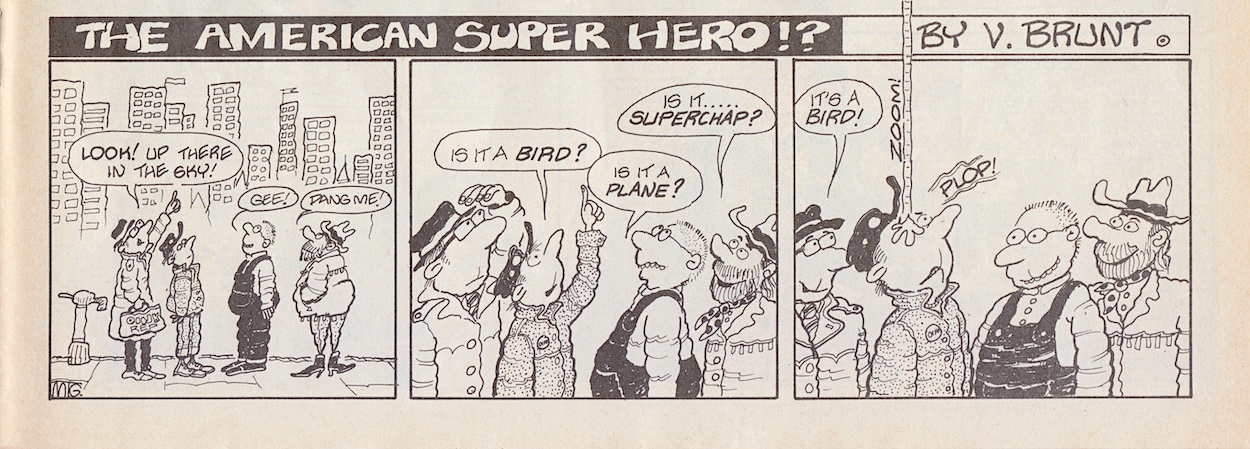
The amount of tiny details Andy squeezes in over the two pages is remarkable, with plenty to keep the eyes occupied and the reader chortling along. From one iconic American character to another, new OiNK writer Vaughan Brunt makes his debut with The American Super-Hero, drawn by Mike Green. I remember telling my friends in school about this one. I took every chance I could to highlight OiNK’s jokes, especially when it was parodying something they enjoyed. I was always trying to make pig pals out of them.

Vaughan would contribute to 17 issues of OiNK altogether before moving on. While he was solely a writer (a very funny writer) on the comic, away from the sty he’s an accomplished artist. While he doesn’t have his own online presence, a fan site for classic television series The Prisoner includes an art gallery of his paintings of Portmeirion, Wales where the show was set. You can check out his work here. Remembering those OiNK spoofs (such as Ann Martin‘s Watery Down and Simon Thorp’s movie posters) it’s such a shame Vaughan didn’t draw for the comic in his gorgeous painted style too.

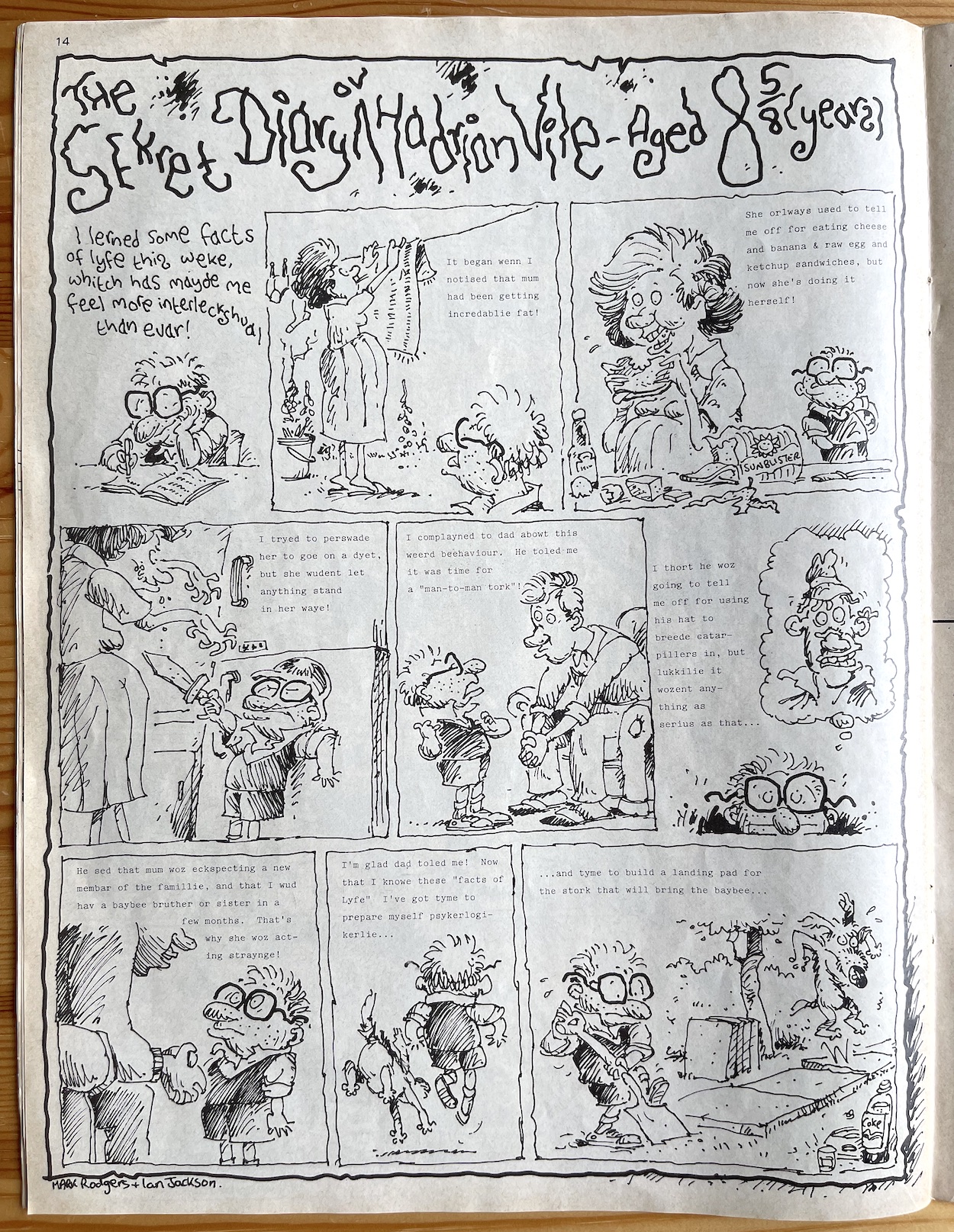
Hadrian Vile’s strip returns to its diary format with some big news for him and his family. Writer Mark Rodgers and artist Ian Jackson’s creation is about to have a baby sibling. As I’ve pointed out before Hadrian’s age increased in OiNK’s birthday issue and now we’d see his mum’s pregnancy for a number of months almost in real time, from the moment Hadrian notices her belly and her rather strange appetite (to say the least). What we have here is a typically funny Hadrian strip with a surprisingly sweet ending.

Hadrian would continue to make his mark on his mum’s pregnancy and in the end we’d see the big day arrive in a family-orientated issue with a special three-page strip. That’ll be in the latter part of this year. I do remember the strip didn’t go down the well-trodden route of the rebellious boy not having any interest with a cutesy baby in his life or disliking his younger sibling. Instead, Hadrian was instantly besotted and took her under his wing as his potential protégé! The regular strip was already a favourite, but with things like this it became an even more unique and original OiNK highlight.

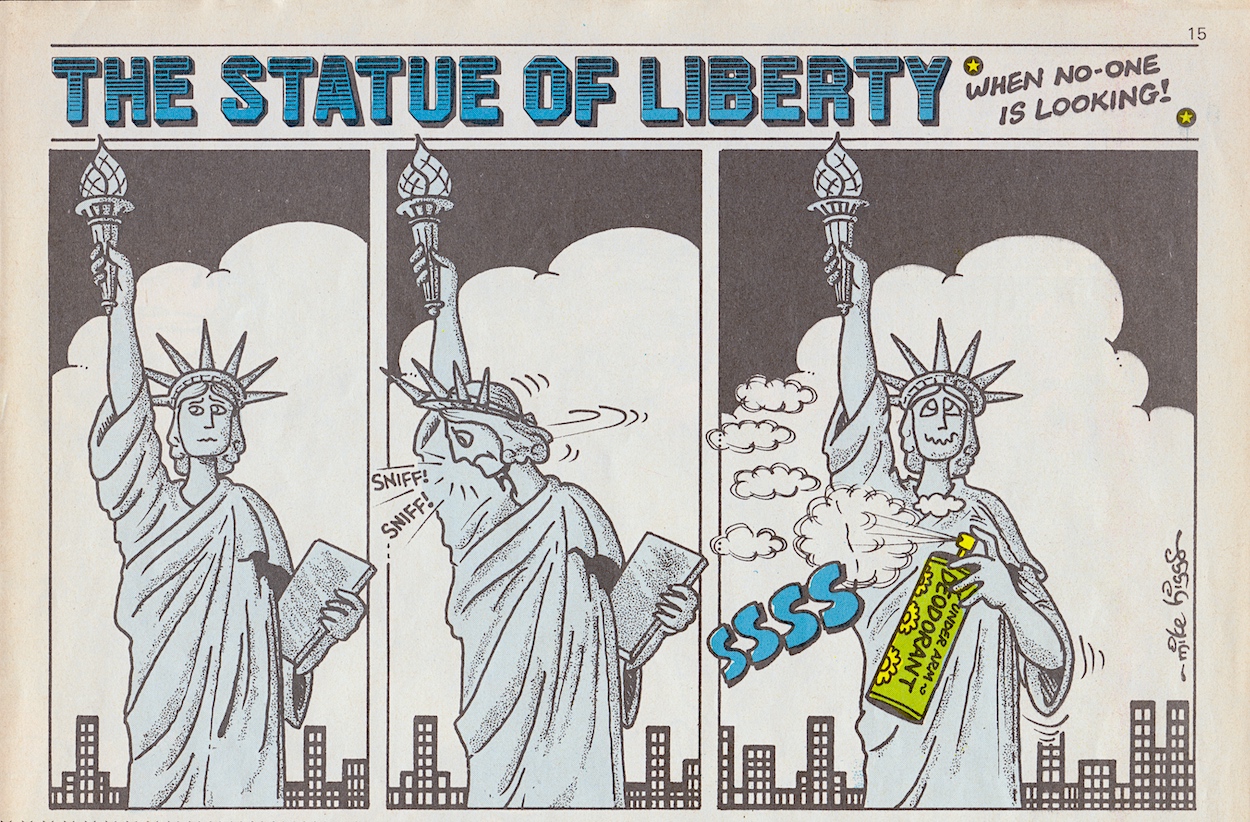
OiNK had an eclectic style, drawing in established artists from the world of children’s comics, adult newspapers and magazines, as well as a range of younger contributors whose careers were only beginning. While other comics may have given the established cartoonists the larger pieces of work and the newcomers the smaller strips, in OiNK they were all treated as equals. For example, alongside those new to the world of kids’ comics were the likes of Mike Higgs, this issue contributing a simple half-page strip about the Statue of Liberty taking a hygiene break.

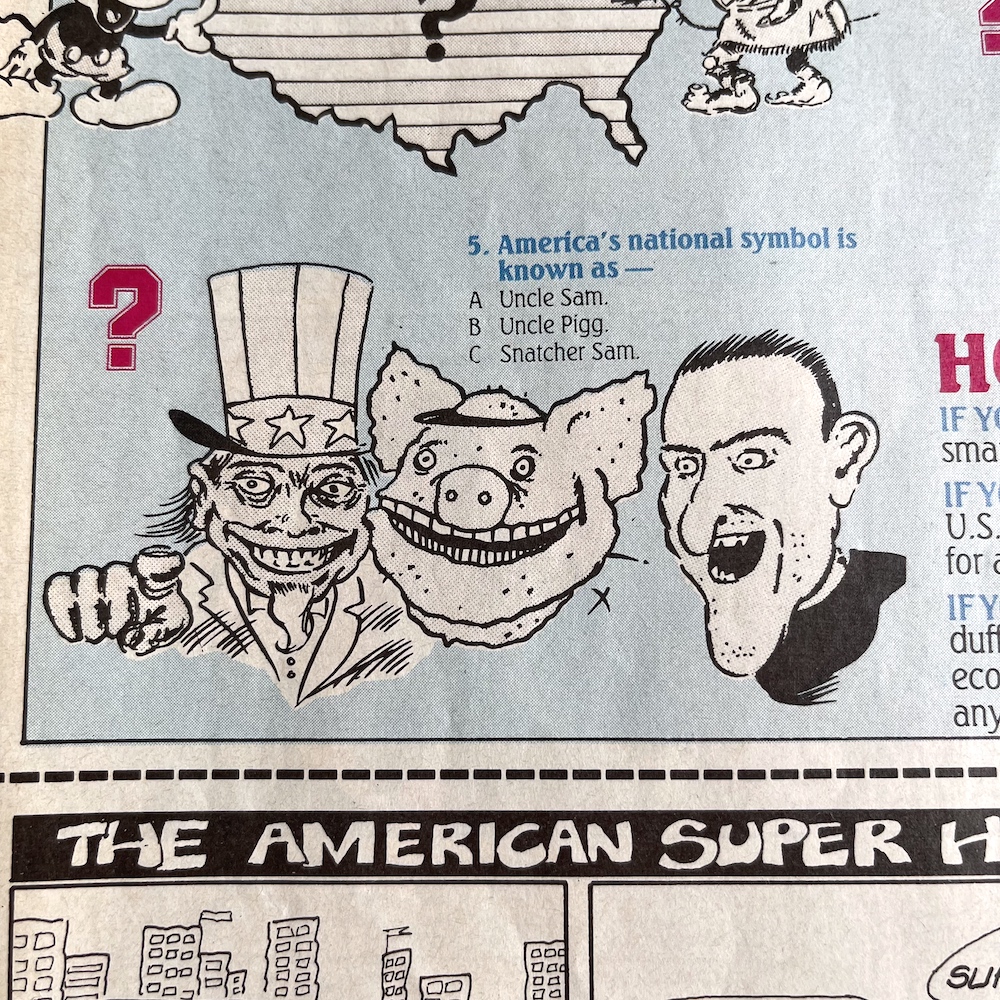
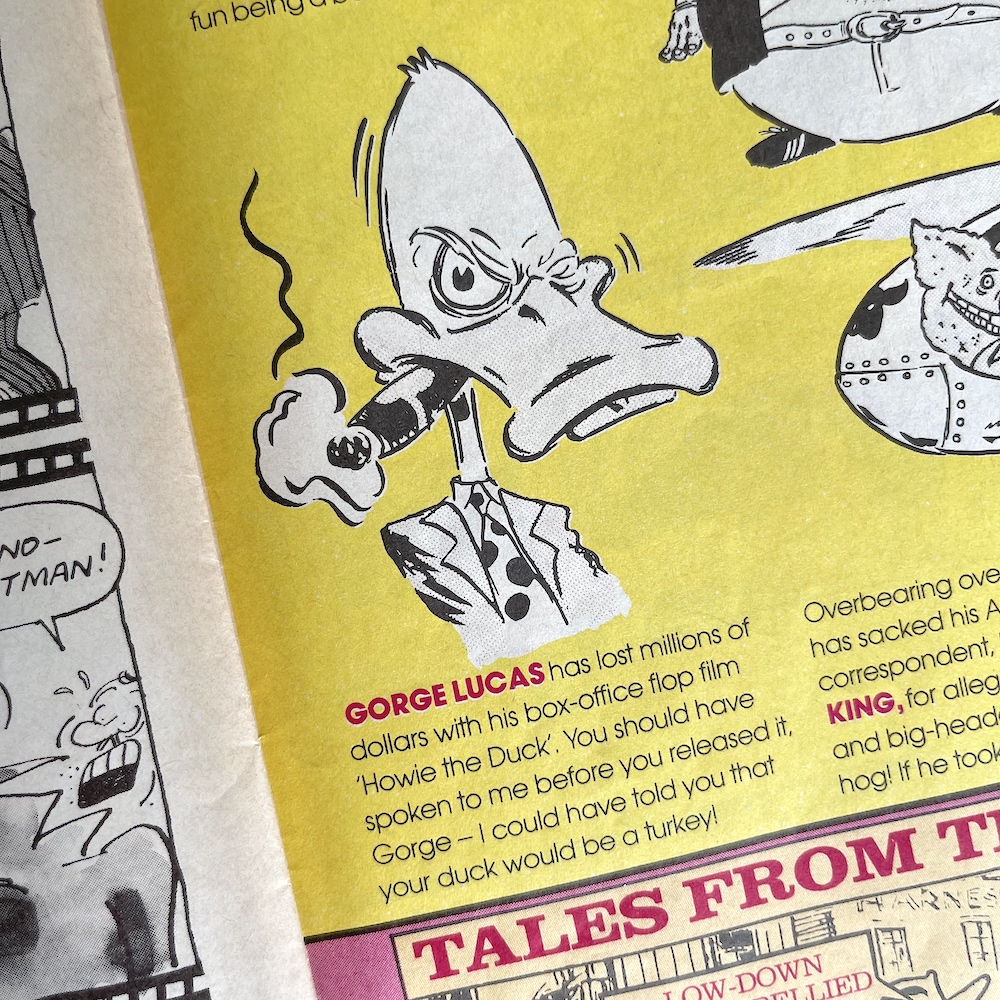
A couple of highlights from Steve Gibson’s contributions are next. At this point in the run Steve’s style was being used mainly to illustrate quizzes and fact sheet pages, such as the Coast-to-Coast Quiz where we see his version of Snatcher Sam aka Marc Riley, and then Hogathan King brings us Entertainments USA and a recently released cinema flop was squarely in Steve’s sights.

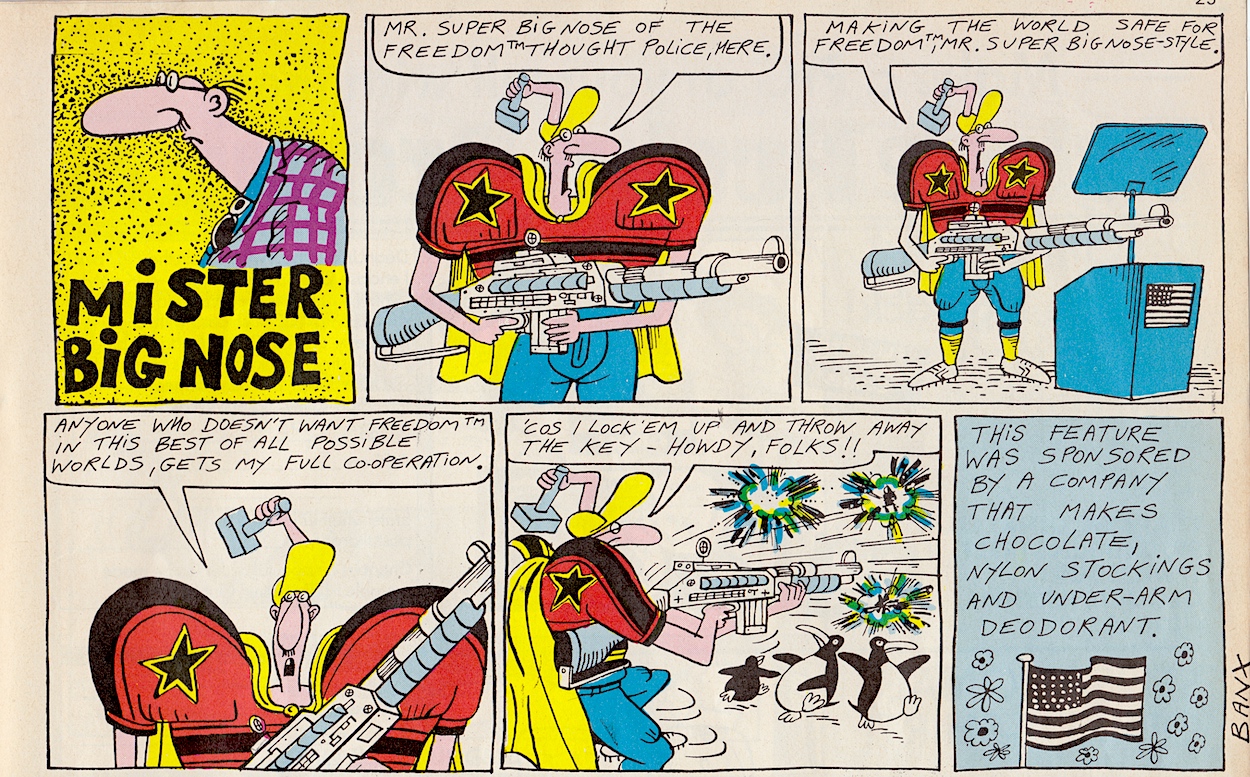
The next highlight was an easy choice to include. Jeremy Banx’s Mr Big Nose has done many things, such as playing Rambo in Little Bo Beep, having Christmas dinner with a turkey and hoovering with a dolphin (named Keith), but here in just half a page he succinctly sums up the US of A like no one else could. A publication like Private Eye could run this strip today and it’d be met with just as many laughs.

If any part of this issue could summarise the attitude OiNK had towards America it was that.

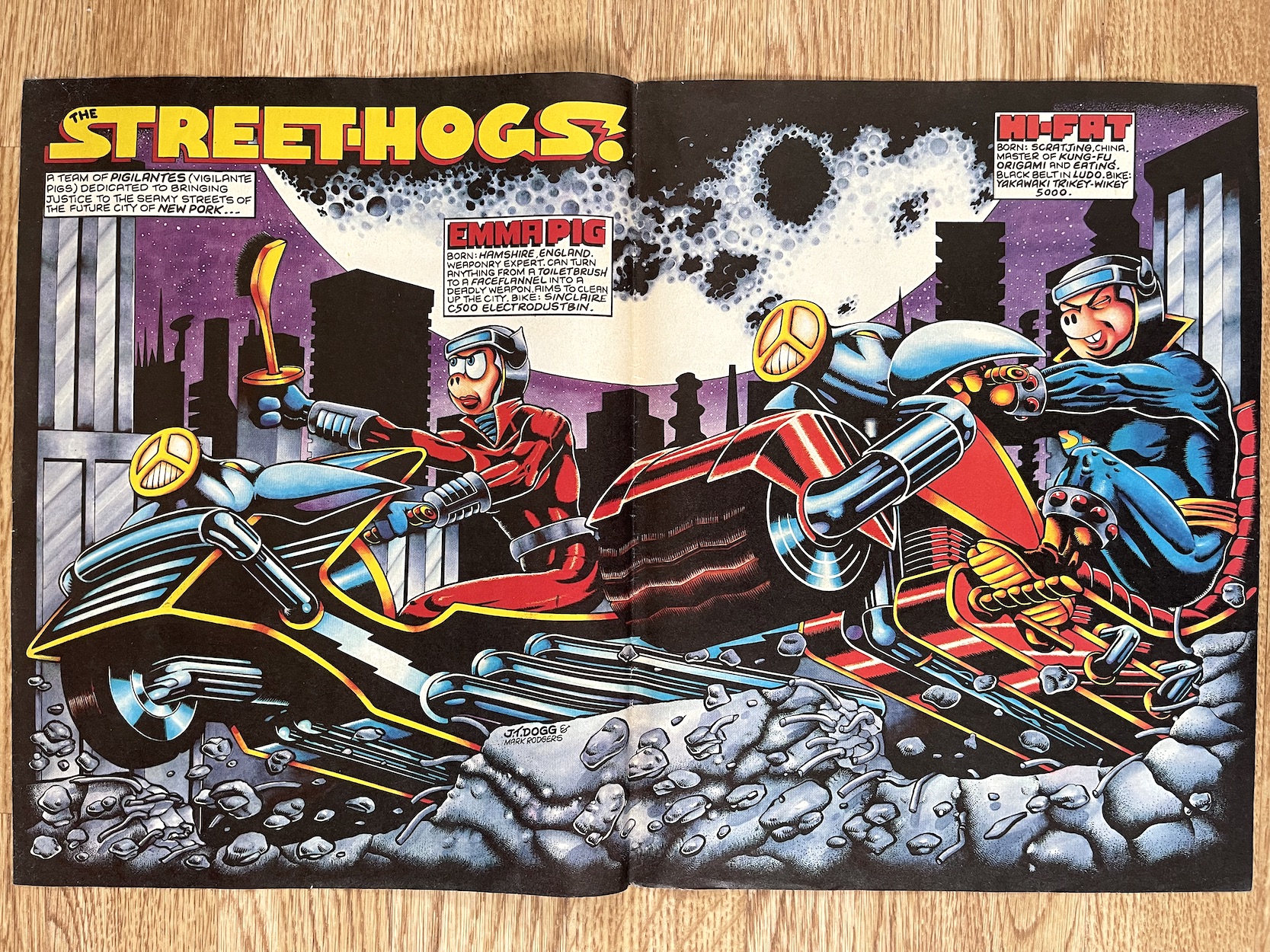
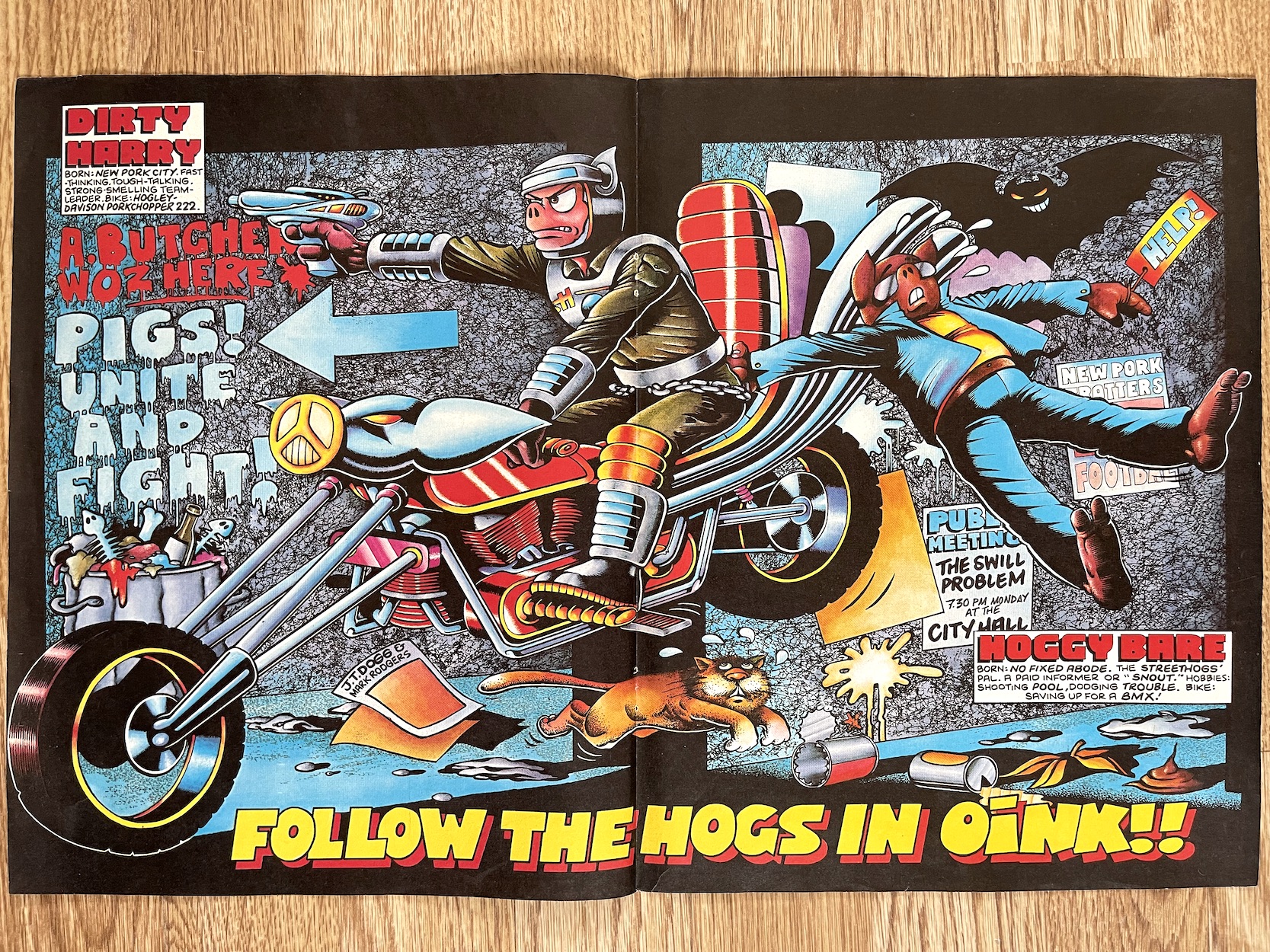
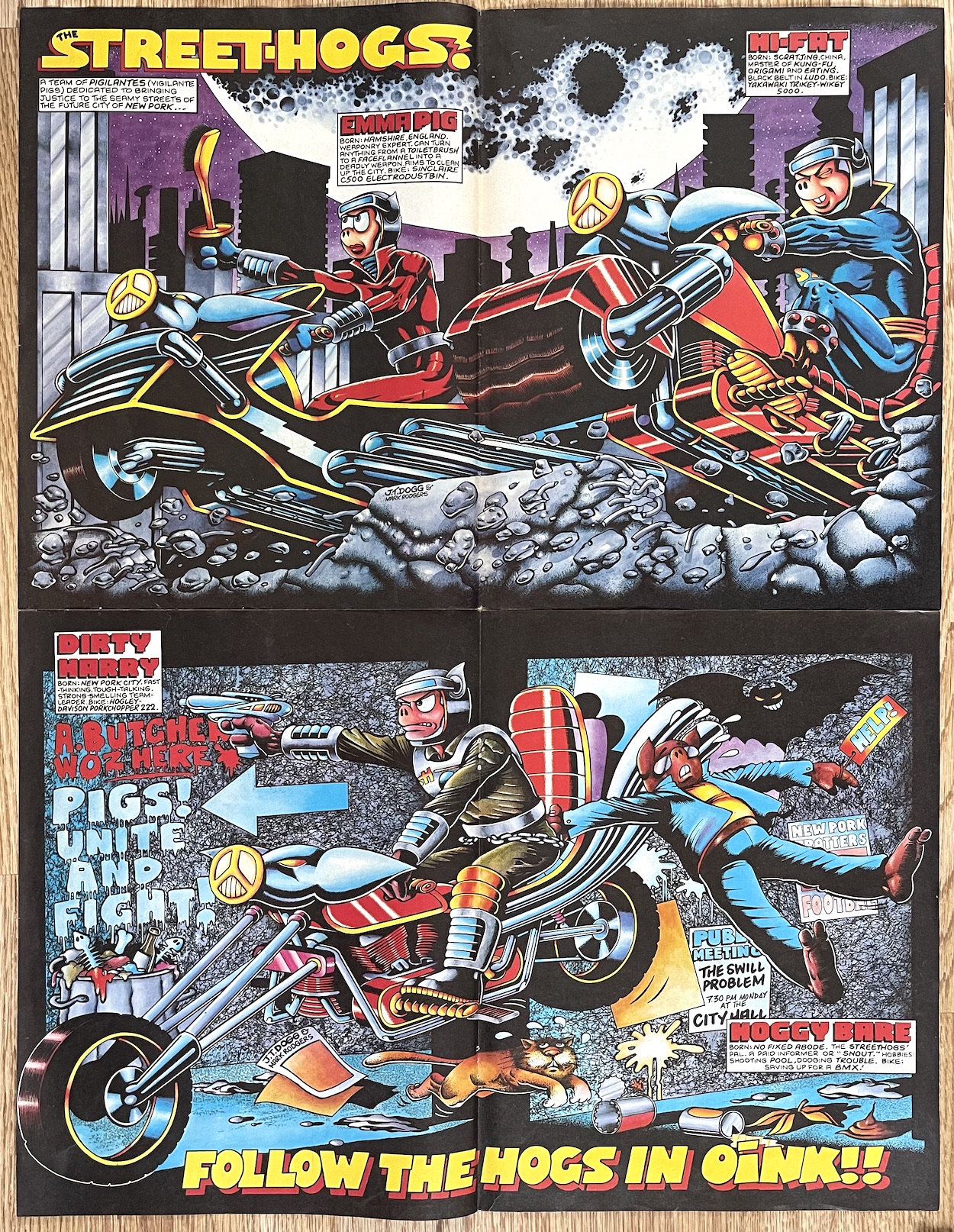
So why is my copy of #31 of my favourite comic of all time falling apart at the seams? Because it doesn’t have its staples anymore. But it’s not my fault they had to be removed. In the centre of this issue is a superb J.T. Dogg Street-Hogs poster showing Dirty Harry trailing a reluctant Hoggy Bare into action. But this is only one half of a double-sized gift from our ever-so-generous Uncle Pigg.

My personal favourite is the Sinclaire C500 Electrodustbin

The top half featuring Emma Pig and Hi-Fat can be found on the inside front and back covers, so to put the whole thing together kids were instructed to carefully undo the staples (don’t just pull!) and remove the middle poster, then pull the staples out from the rest of the comic, put the cover pages to the side and then somehow push the staples back in through the remaining 24 pages. Unless you have one of those really long office staplers that is impossible, it certainly was for me at this ripe old age never mind back then (I never pulled it apart as a child).

But in order to show you this as intended I couldn’t just pick up the middle of the comic and try to get a photo of the inside covers, so just for you lot my copy shall forever fall apart. See what I do for this site? Anyway, it really is a thing of beauty, just like all J.T. Dogg art. I also love the names of the bikes which I don’t think have been mentioned before; the Hogley-Davison Porkchopper 222, the Yakawaki Trikey-Wikey 5000 and my personal favourite the Sinclaire C500 Electrodustbin, a little dig at the Sinclair C5 personal electric cycle from the 80s.

The ‘Hogs will be back in the next issue with the start of their brand new adventure The Day of the Triffics, which was first name checked way back in #11. This, along with the back page of #27 acted as a way of hyping up the readership for their long-awaited return, although it was kind of lost on me because I hadn’t read their earlier strip, what with my first issue being #14. The artwork looked wonderful though and very funny, but nothing could prepare me for how much I’d fall in love with the characters just two weeks after these posters.

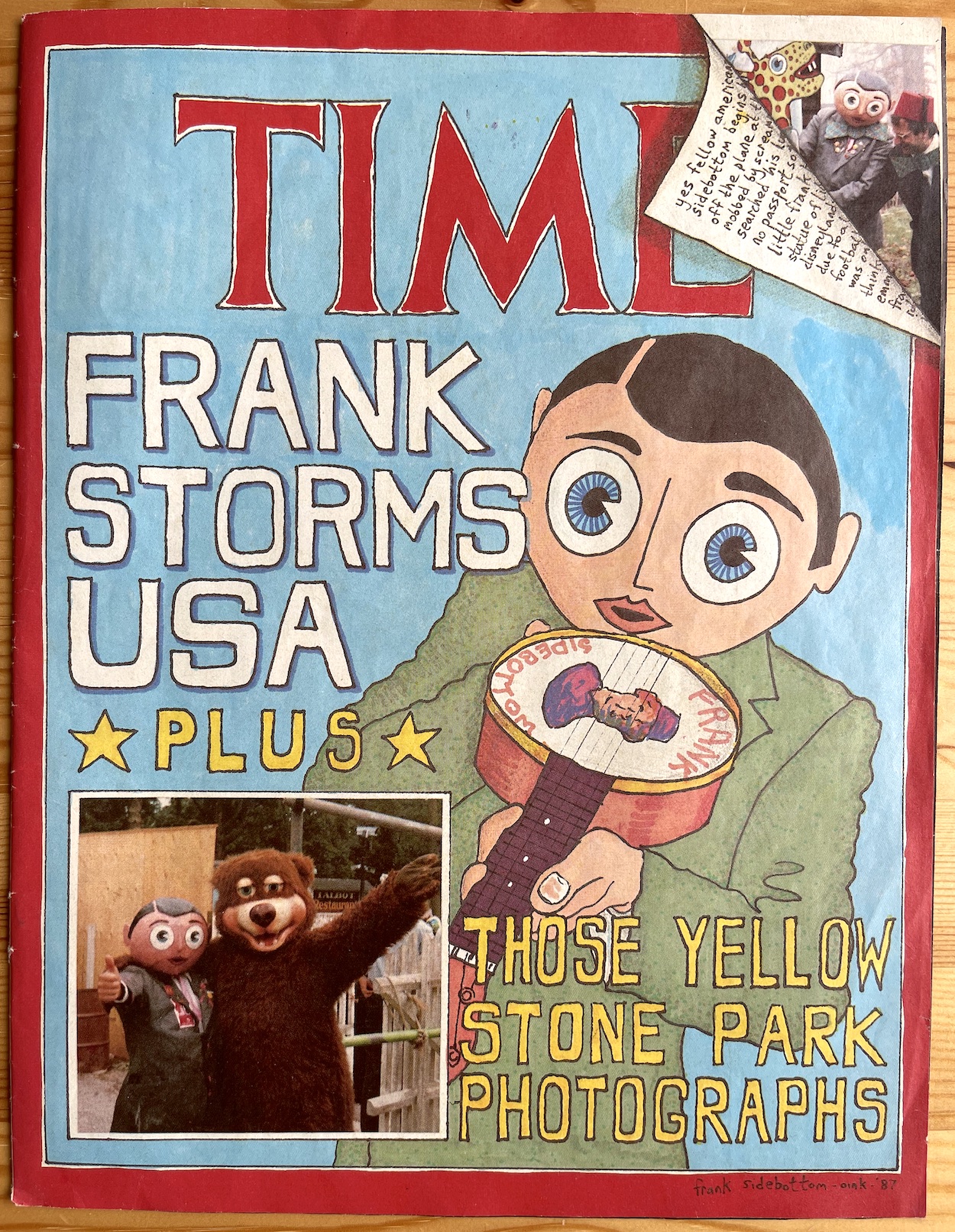
This issue has a “fantastic” back page too. When you flip the comic over you might think there’s been a printing error because it’s upside down but in reality it’s just another clever gag on the part of Chris Sievey aka Frank Sidebottom. Frank’s showbiz career and (probably more importantly) lifestyle was his main running gag, with strips featuring him mingling with celebrities who in reality were cut-out photos glued to the page. With this issue of OiNK and you’ll see he’s taken it to the next level as a cover star of Time magazine.

Having this printed upside down means the comic opens on the correct side of this faux cover, which in itself is a little bit of genius. As ever, his attempts to convince us of his worldwide fame are hilariously portrayed. For example, one very quick glance at the background of the supposed Yellowstone National Park photograph will give the game away. Chris’ creations, showing his character’s poor attempts at creating a fictional reality around Frank’s ego were always a highlight and actually, as fun as the strips were, I think I preferred it when he did stuff like this.

I’ve (carefully) placed the comic back on to the shelf now as we’ve come to the end of yet another review. The next issue of OiNK is themed around sport which is not my favourite topic (Olympics aside) so it’ll be interesting to see how it tickles my funny bone. Remember, just the day before this review was published there was an in-depth look at Crash magazine #42 which featured an interview with OiNK’s three human editors and a lot more besides. The special free issue of OiNK given away with that magazine also has its own review. If you need to, catch up on those and then #32 of the regular comic will be here from Monday 11th July. Phew! See you soon I hope.

CRASH EDiTiON < > iSSUE 32

OiNK READ THROUGH MENU

MAiN OiNK MENU

Classic Comics in Real Time