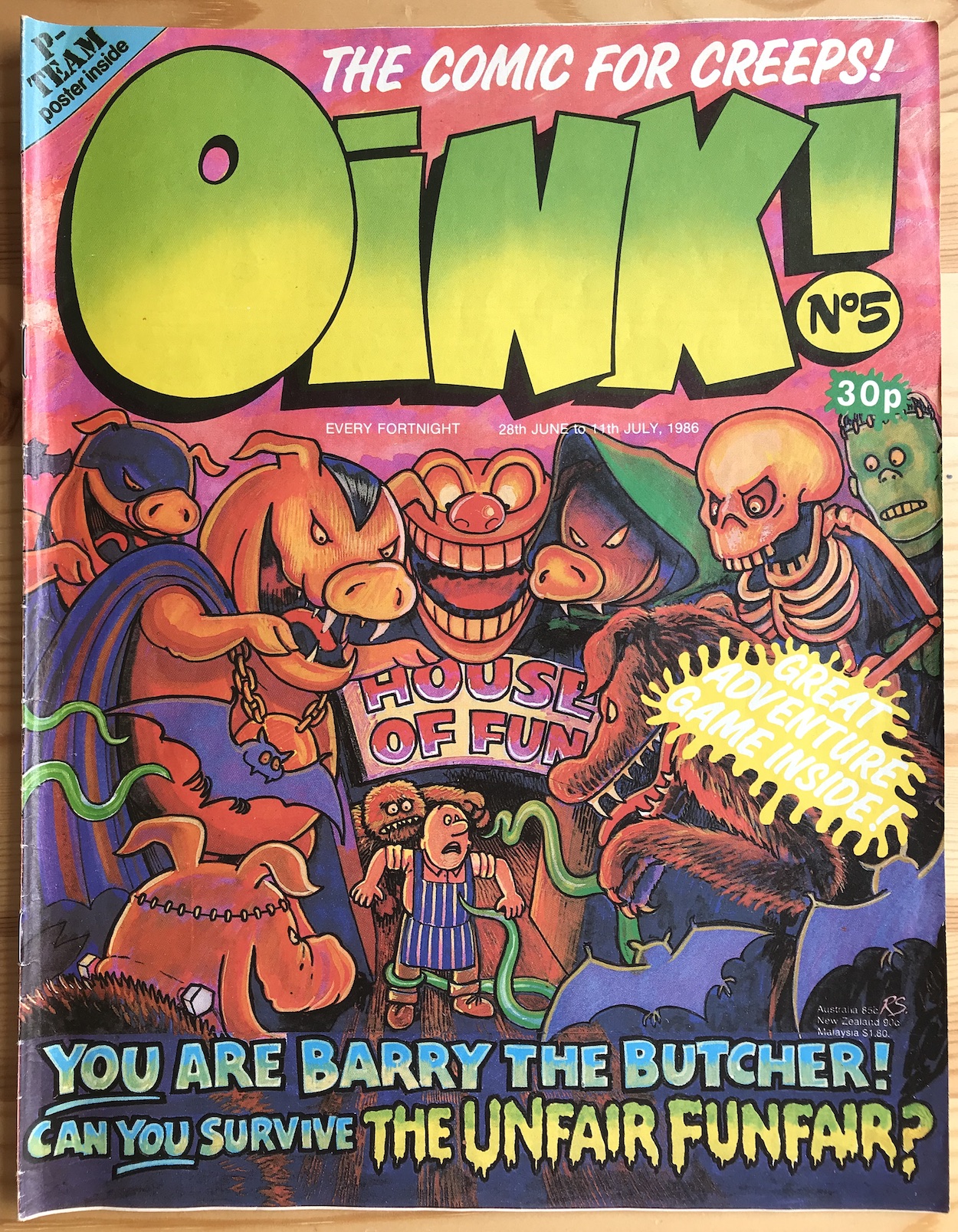
OiNK! #5: PERFECT PiG PALS

While the main event of this fifth issue of OiNK is the Unfair Funfair adventure game and there’s no theme as such, there’s an overall feeling of celebration inside, a celebration that the comic was proving to be a hit among its target audience. It contains the first contributions from readers, with a few small jokes and drawings scattered throughout, there’s a photo story showing us the kind of kids who were reading OiNK and reference is made to their letters in some of the strips.

Things begin with Mary Lighthouse (critic) on page two as per usual and something stood out in its last panel. The image of Mary and the words Uncle Pigg is shouting were definitely not by strip artist Ian Jackson, so I asked Patrick Gallagher about it. In Mark Rodgers‘ original script the mass of letters was meant to be hate mail for Mary but IPC Magazines didn’t like this reference and asked for it to be toned down. It was changed to reference fan mail for the comic which I think is actually funnier. You can compare the two ideas below. On the left is how the strip appears in the comic, on the right is a mock up created by Patrick to show how the original idea looked.
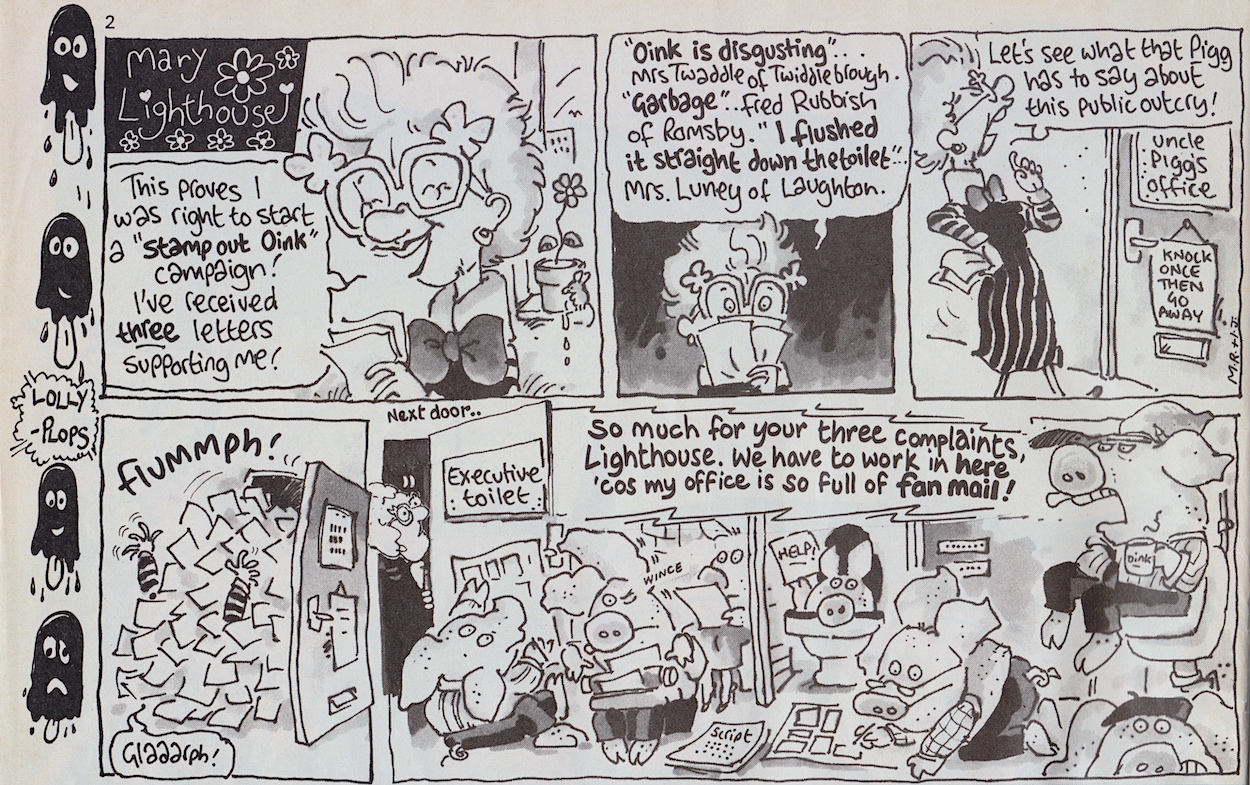
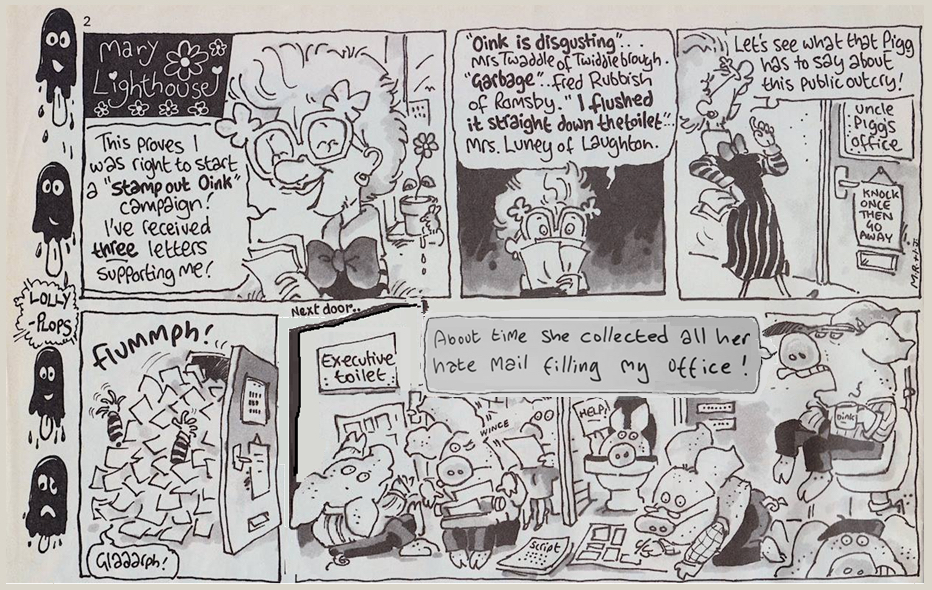
I love the set up with Mary receiving three complaints and calling it an outcry. It all feels very contemporary. After all, that’s how The Daily Mail still operates today, isn’t it? This strip would coincidentally end up quite prophetic. While it’s obviously a joke, it’s strikingly similar to something the comic’s editors would face after a certain story is published in #7, but we’ll get to that later.

Directly below this on the same page is a character whose name is somewhat direct. In fact you could say it’s a bit on the nose. Mr. Big Nose would introduce surreal humour to the young audience in a way that really shouldn’t work in a children’s comic, but it did. One issue he could be showing us gravity is actually invisible creatures holding everything down, or he’d be ignoring an alien assassin by reading the newspaper, or playing Rambo in a school play of Little Bo-Peep, or having his vacuum cleaner turned into a dolphin.
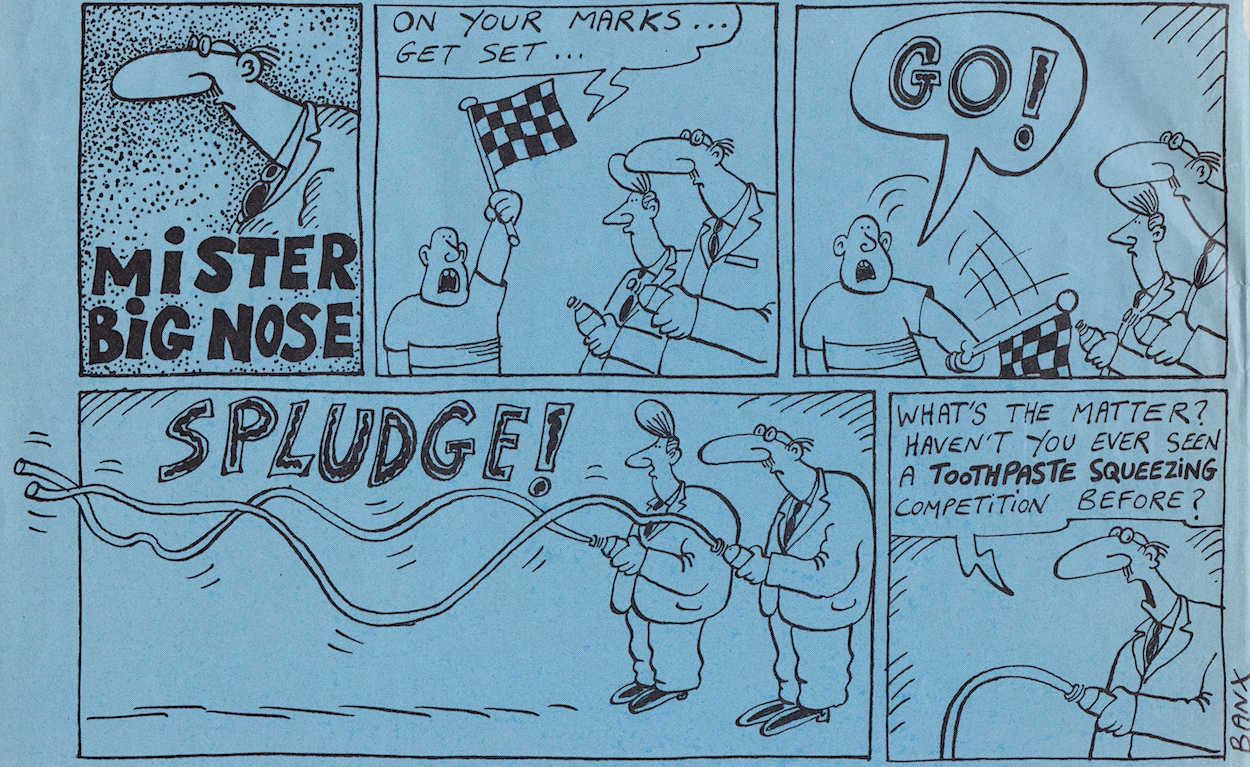
Mr Big Nose’s strips followed no rules and the more absurd the situation, the more bizarre the juxtapositions, the more they didn’t make sense, the funnier they were. With no barriers in his way, Jeremy Banx‘s imagination was on full display and this kind of humour would also start to spill over into his Burp the Smelly Alien strip in later issues too.

Appearing in almost every one of the fortnightly issues of OiNK Mr Big Nose would sadly disappear with #45, the first weekly edition. However, including specials Jeremy would end up crafting 42 completely different tales for us to enjoy, and enjoy them we did. That dolphin’s name often gets quoted by pig pals online to this day!

Rather than simply printing the written letters sent in OiNK would illustrate them

So as I said at the top of the review this issue brought with it the first contributions by OiNK’s readers. The regular space for these was the Grunts page but it only contains one drawing this time and some made up letters to Uncle Pigg from imaginary readers for a laugh. Soon enough it would be full to bursting with readers’ celebrity spoofs, photos, newspaper clippings of pigs in the news, poems and of course jokes for Nasty Laffs and Specs.
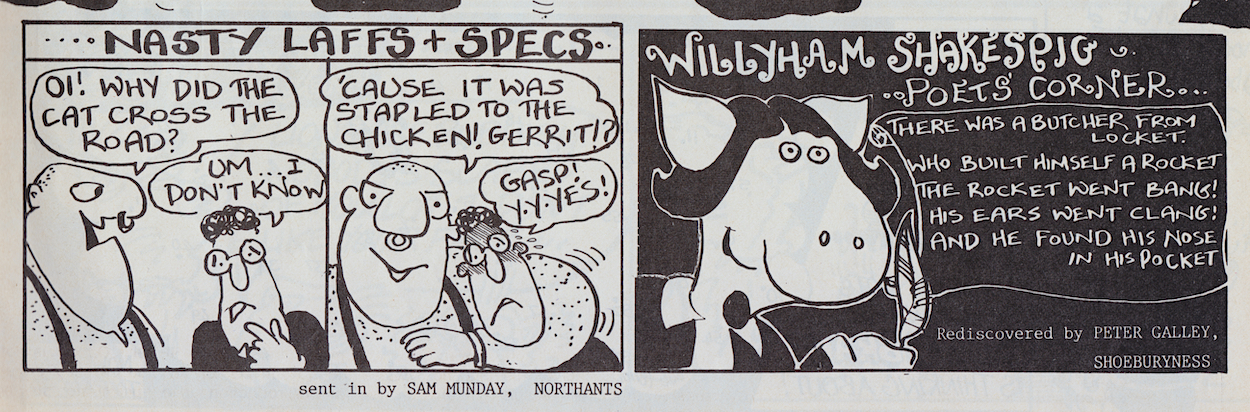
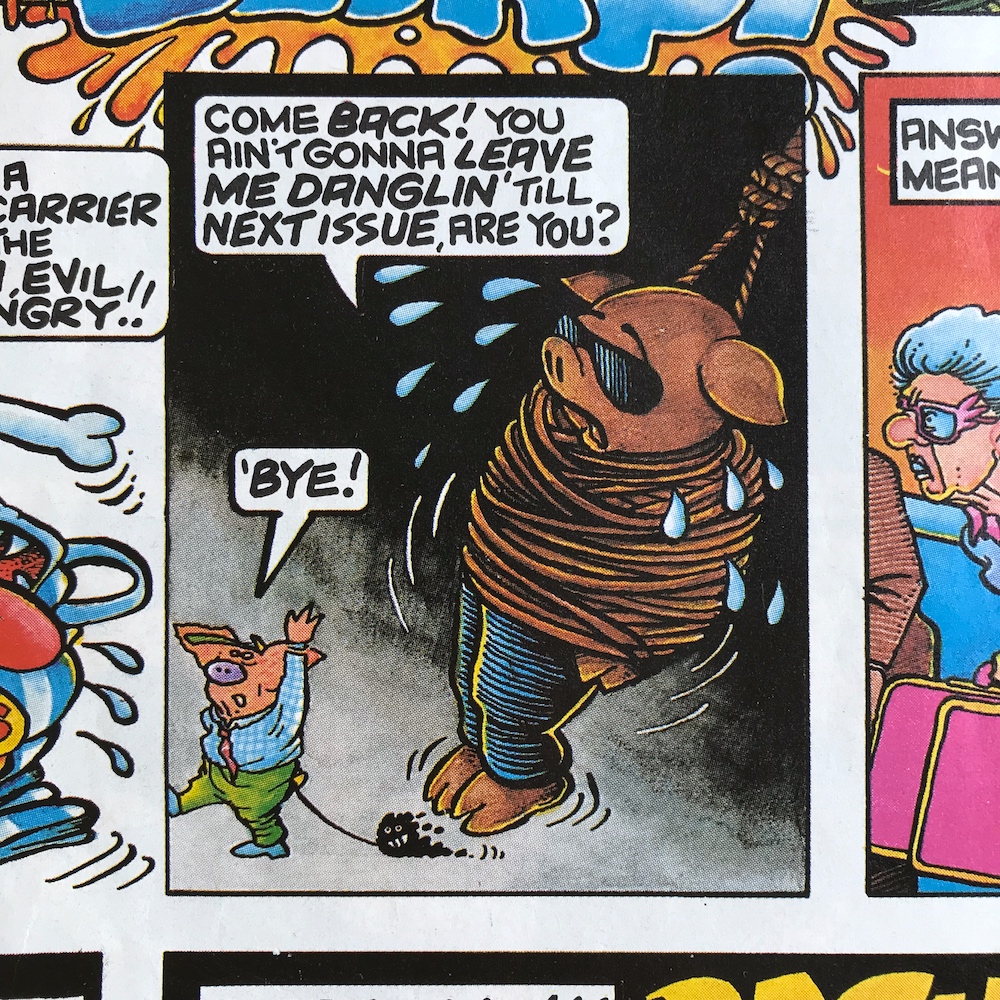
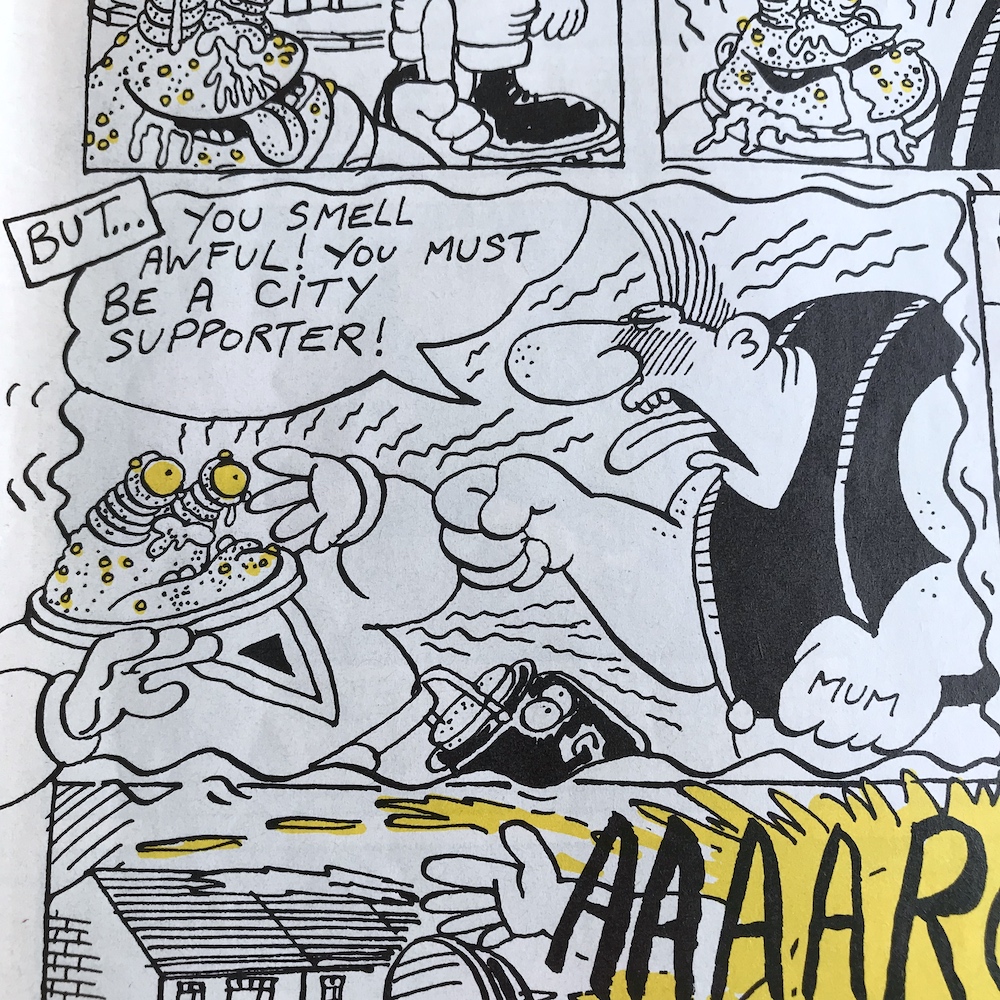
These two little panels aren’t on the letters page, instead popping up right at the beginning of the issue on page three. Rather than simply printing the written letters sent in OiNK would illustrate them, which would just spur on the young readership more. Who wouldn’t have wanted to see their joke turned into a cartoon strip?


“You smell awful! You must be a City supporter!”

Random human to Burp the Smelly Menace from Outer Space

Interestingly, OiNK also printed input from readers in their holiday specials and annuals, something no other annual I collected as a kid ever did. While my Marvel UK comics had standard letters pages answered in very entertaining ways, IPC (and later Fleetway) would often encourage their readers to send something different. Barrie Tomlinson, editor of many action adventure comics was always asking readers to contribute to a wonderful variety of features on his letters pages. But OiNK went even further and just let them send in whatever they wanted!

So who were these young readers, these so-called “pig pals”? Time for Terry Wogham to investigate.

Terry Wogham was a series of photo stories in the earliest issues where a real pig interviewed a series of top celebrities. Of course, we’d often only see these special guests from his eye level, so the comic could get away with showing only legs and torsos. For this issue though, we got to see the faces of those interviewees, a selection of Typical OiNK Readers.
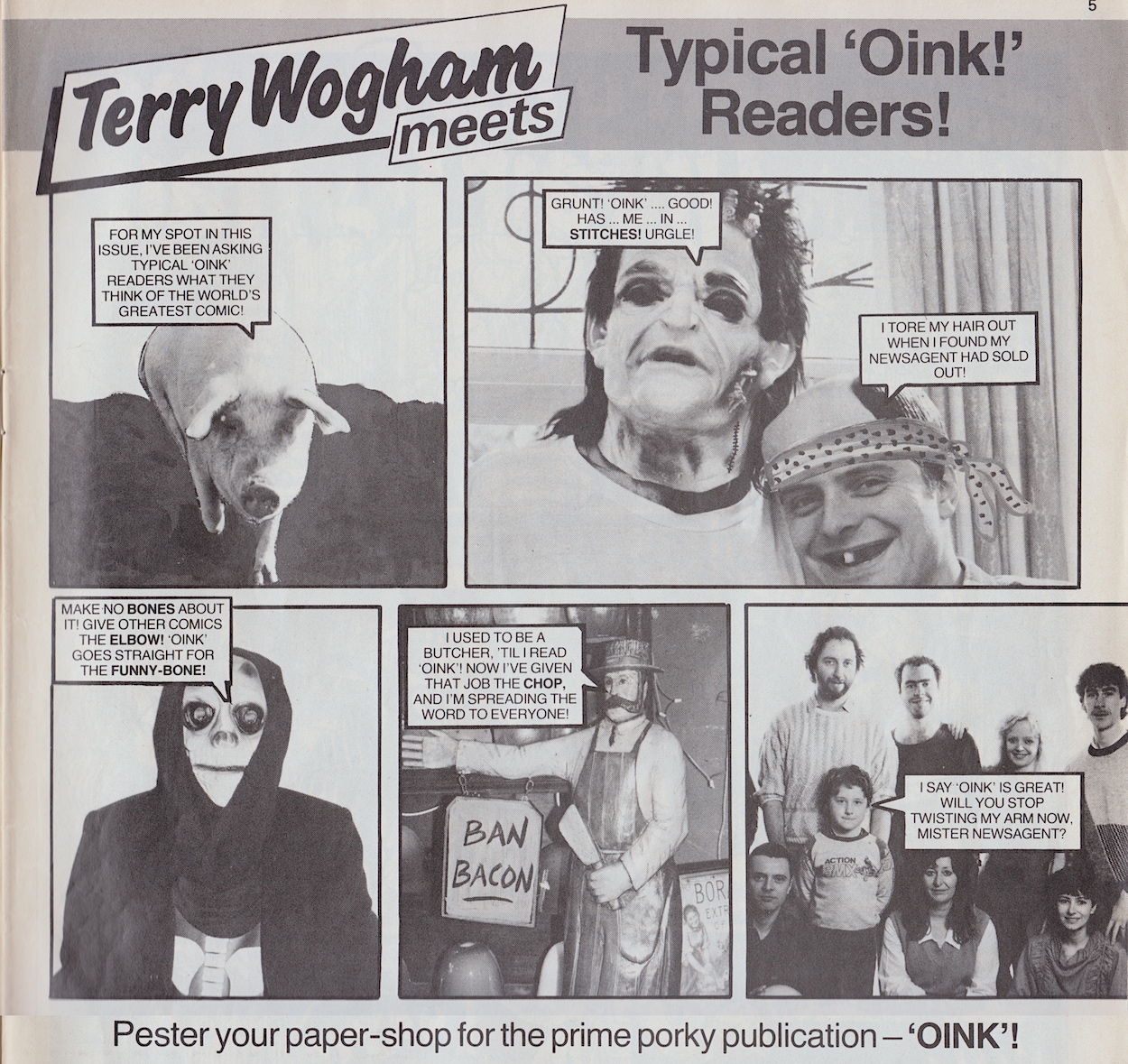
Like looking in a mirror. The strip contains all three of OiNK’s creators. Mark Rodgers can be seen wearing the bald cap and bandana with a toothless mouth drawn over him, then that’s him at the bottom left of the final panel, with Tony Husband and his son Paul behind him. Patrick Gallagher is in the middle of the back row, with his former wife Ann to the right (his left), then Ann’s brother James who was also an OiNK photographer. In front of James is his wife Alanna and in the middle of the front row is Tony’s wife, Carole.

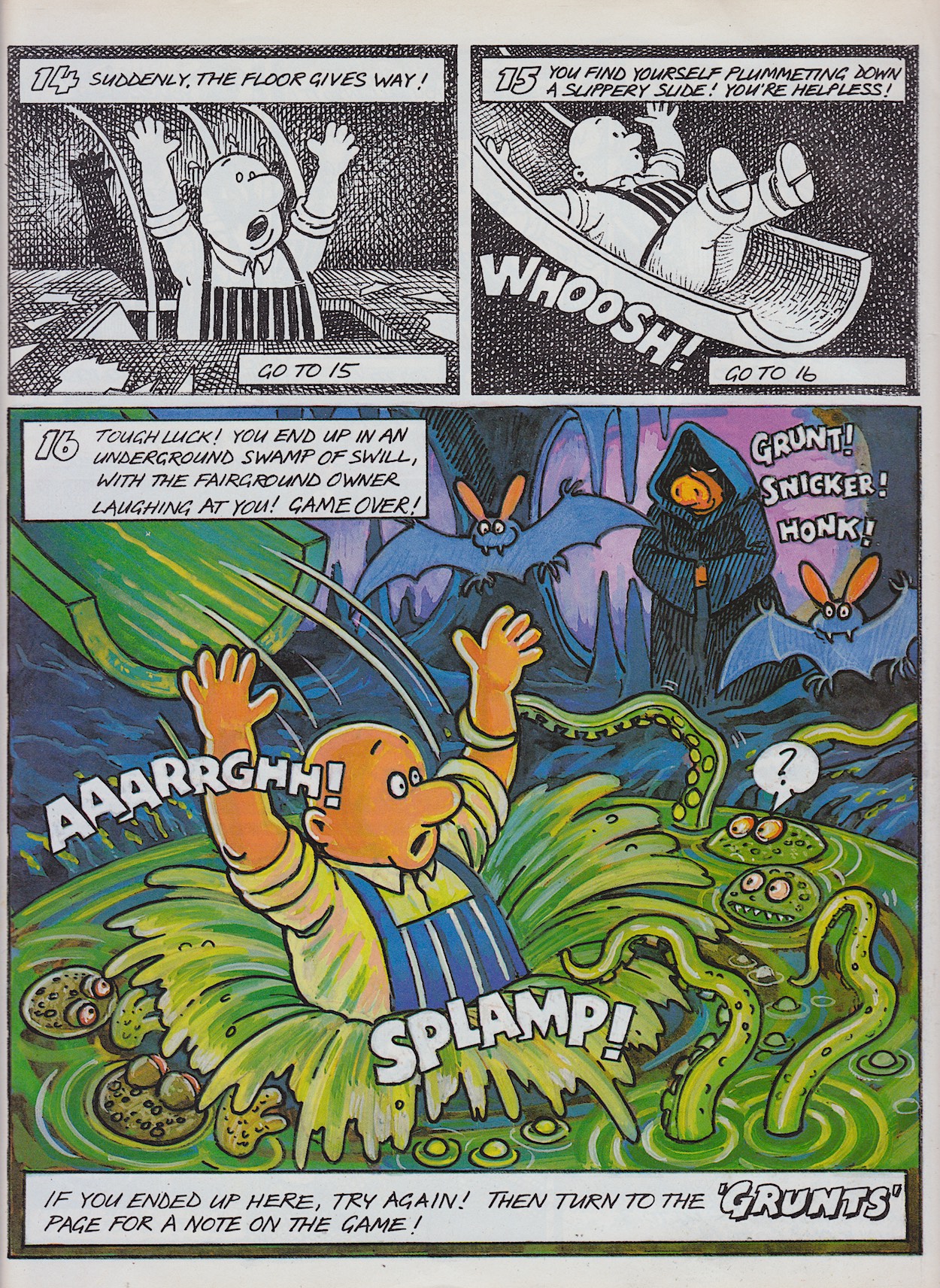
So who remembers those Make-Your-Own Adventure books? For the uninitiated I’m referring to children’s novels designed to be read in a non-linear fashion, very much like the text adventure games on home computers at the time. At the end of each page you’d be given a choice of where to take the story next and the corresponding page numbers for each choice, the idea being to make it to the end of the adventure alive. For example the character could be faced with a spooky house or a haunted forest and they could decide to turn to page ‘x’ to enter the house, or page ‘y’ to walk towards the forest. 

Whether it was intended or not, I remember Horace teaching me not to judge anyone by how they look

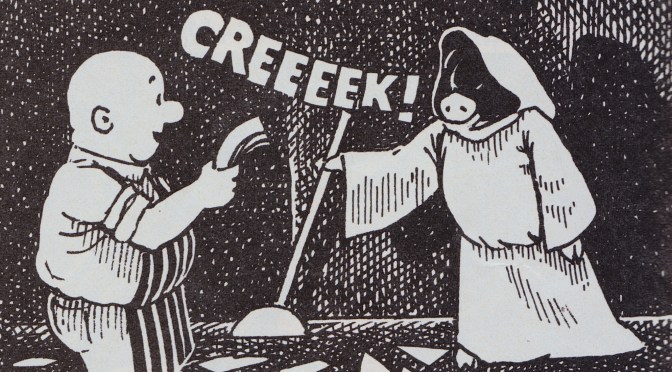
The format was ripe for an OiNK parody. Bringing the idea of The Unfair Funfair to life was artist Ralph Shephard, fresh off his excellent riff on The Transformers in #3. He would also go on to draw one of my all-time favourite spoofs from the comic, but that’s a tale for another review. His previous colourful style is replaced with black and white for the most part which suits the setting perfectly with its lovely feeling of spooky mischievousness.

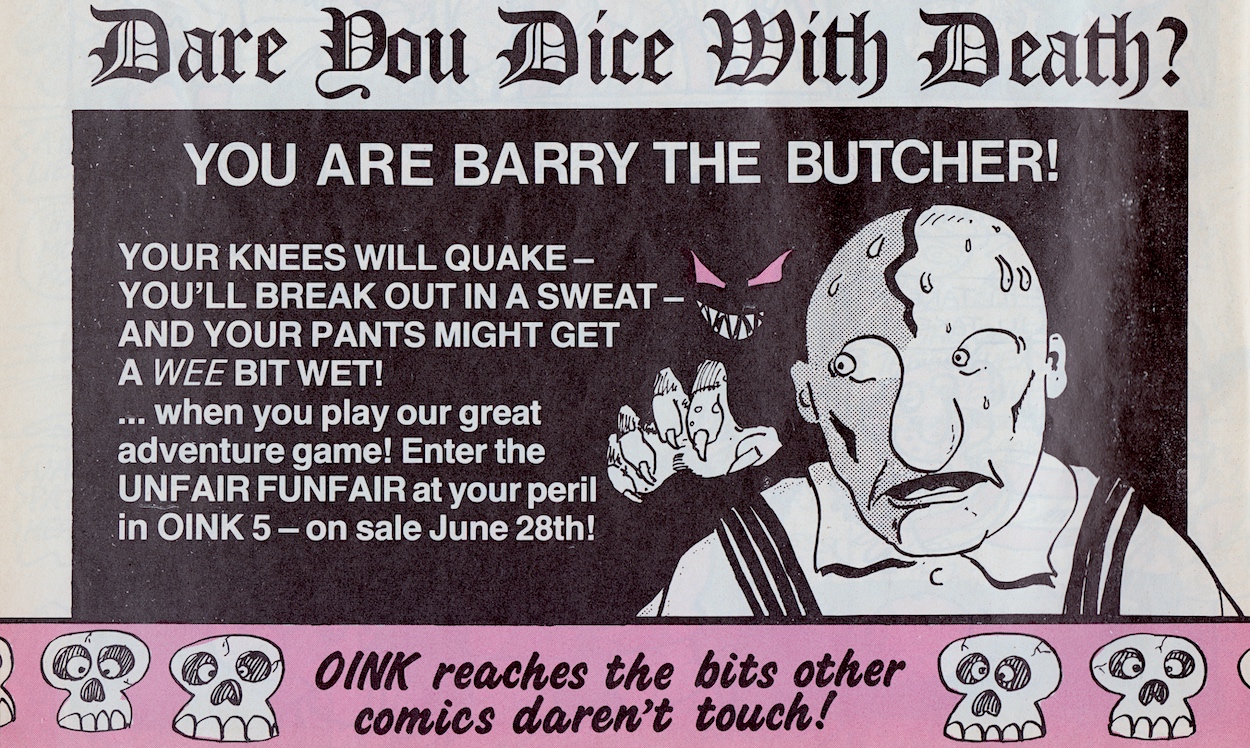
Just like the books this was based on, the cover proclaims “You are Barry the butcher”, but surely that’s the last thing an OiNK reader would want? How can a butcher be the hero of the adventure? Read on, try the game and find out for yourself.
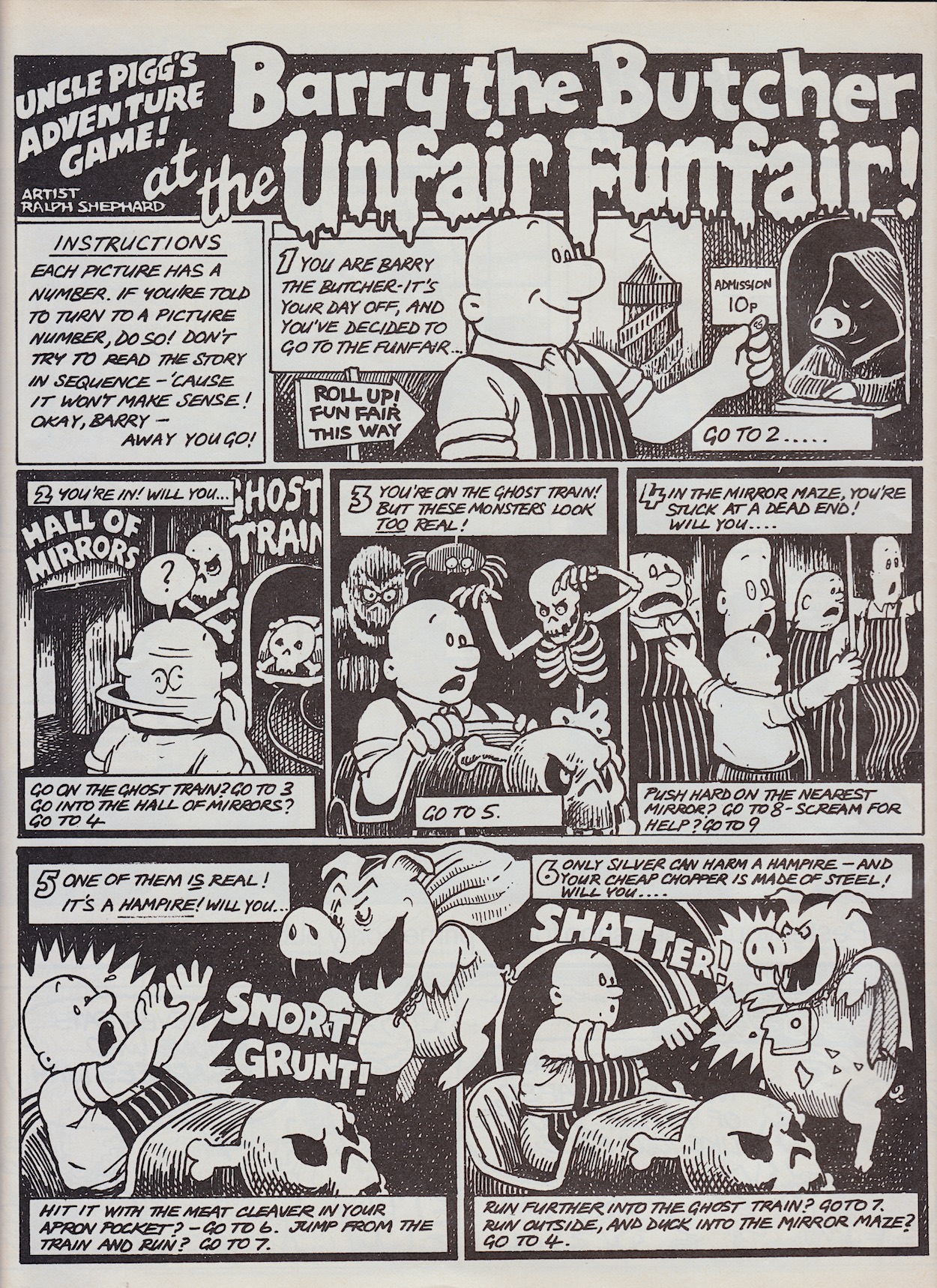
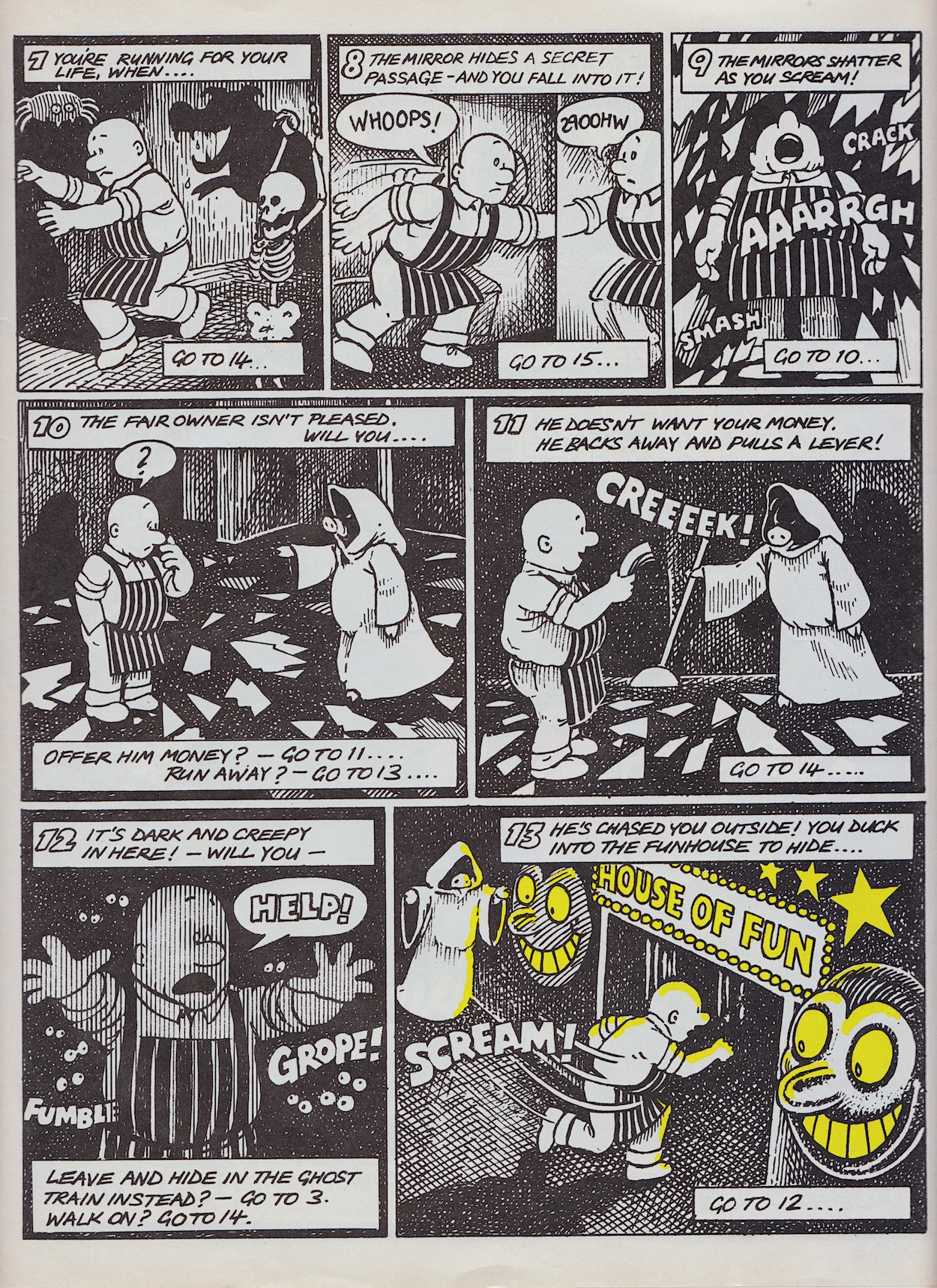
After you’ve tried a few of the options I’m sure you can probably guess what the note on the Grunts page said. To quote Uncle Pigg, “You are Barry the butcher … and I am the fairground owner! Whatever choices you make, you’ll still end up in the swill!!! Told you it was an Unfair Funfair! Hurr hurr hurr!!” Well, the clue was in the name after all, but it’s still fun to try out all the options. Even though you know what’s going to happen next, making those different choices just to end up reading the same panel again and again is the whole point and what makes it so funny.

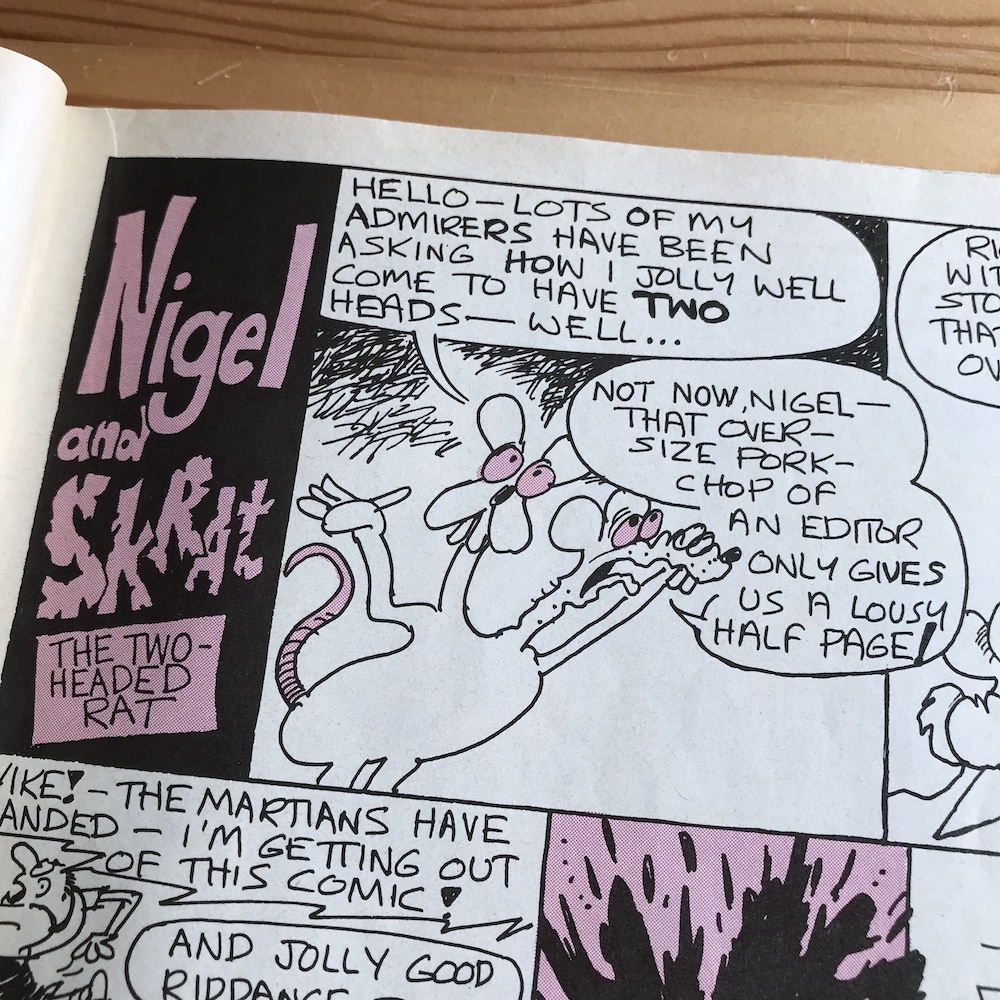
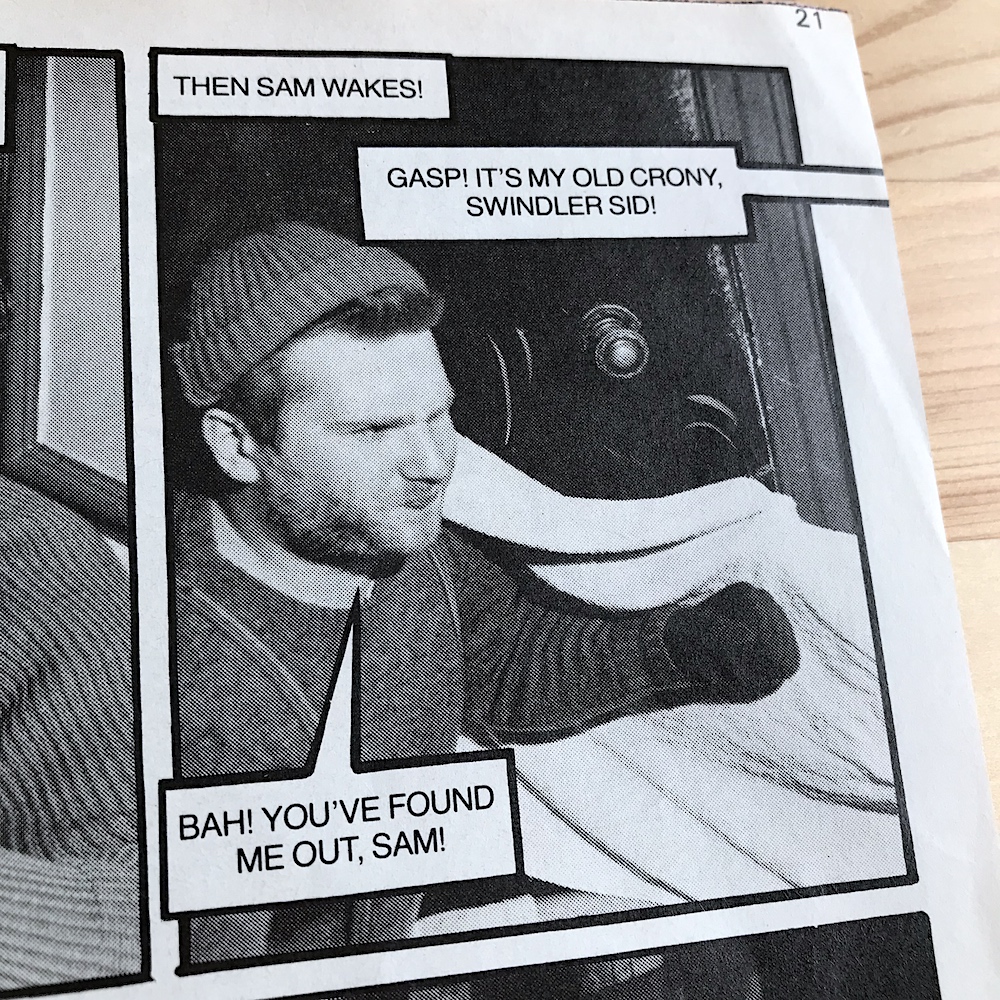
Besides the blockbuster main event, other highlights include Nigel and Skrat the Two-Headed Rat, Noel Ford‘s weird creations who only appeared in half a dozen issues believe it or not. I say that because I’ve very vivid memories of them! New thief on the block Swindler Sid pops up in Snatcher Sam, Uncle Pigg brings readers up to date on Hoggy Bear‘s predicament in The Street-Hogs before heading home, and while trying to make new human friends Burp‘s breath gets him into hot water.
The final highlight I’m pulling out of this issue’s hat is Tony Husband‘s lovable character, Horace (Ugly Face) Watkins. To anyone new to OiNK the title of this strip might give them the impression of a clichéd comics character with one certain feature or ability that would be played for easy laughs. But as always with OiNK, created as a reaction to such tired comics ideas, there’s a lot more to it than that.

Horace’s strip would alternate between funny, contained stories and ongoing serials showing his struggles at simply trying to live his life. The early stories featured funny scenarios centred around his appearance, but never in a cruel way. He could scare off a monster by complete accident and end up the hero for example and he never seemed to lose his upbeat outlook at life. This issue’s strip sees his parents try to hide his looks from his visiting wealthy uncle, only for it backfire on them and their assumptions.
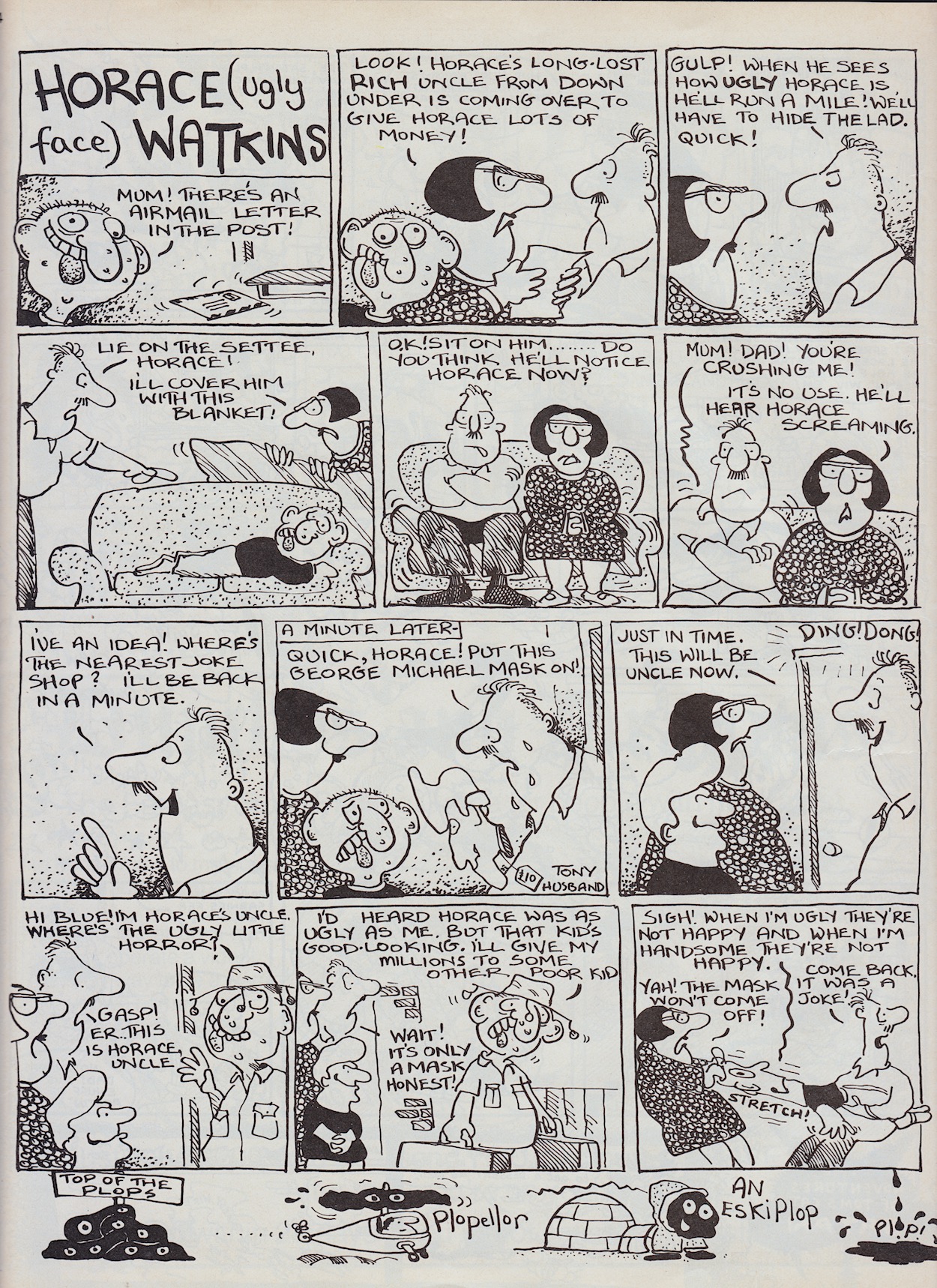
As OiNK continued the strip matured into an ongoing serial involving Horace’s football career. At times he’d get down about his looks, his treatment by others and how cruel the world could be, but he was a strong individual and we’d cheer him on every fortnight. His story even had a proper ending when the comic finished and a very happy one at that.

Whether it was intended or not, I remember Horace teaching me not to judge anyone by how they look, a strong message for anyone but in particular for a child reading it and getting swept up in the laughs and the adventure. I never felt lectured, never thought Tony was even trying to do any of this, but it’s what I took away from it and as such I believe he was an important part of my development as a child.

On that note it’s time to place this fifth issue of OiNK back on to the bookshelves and look forward to the next edition in a fortnight’s time. Issue six is the Animal Crackers issue and it certainly is a cracker! There comes a time in any comic’s early life when it all just seems to click, to gel together and prove its potential and I’ll tell you all about that moment in OiNK’s run on Friday 12th July.

iSSUE FOUR < > iSSUE SiX

OiNK READ THROUGH MENU

MAiN OiNK MENU

COMiNG UP: OiNK! #5

This Monday 28th June brings with it OiNK‘s take on the Make-Your-Own-Adventure books we used to enjoy so much as kids. Will you be able to escape the terrifying traps? Well, given the fact your character is a butcher in something called The Unfair Funfair, I wouldn’t count on it!

The issue celebrates the publication of the first material sent in by pig pals and the fact it seemed to be quite the hit with the youngsters of the day. Also look out for the first strips from Mr Big Nose and Horace (Ugly Face) Watkins to appear on the blog. Don’t miss out, be here on Monday!

GO TO iSSUE FiVE

OiNK iSSUE PROMOS MENU

‘MORE OiNK’ MENU

MAiN OiNK MENU

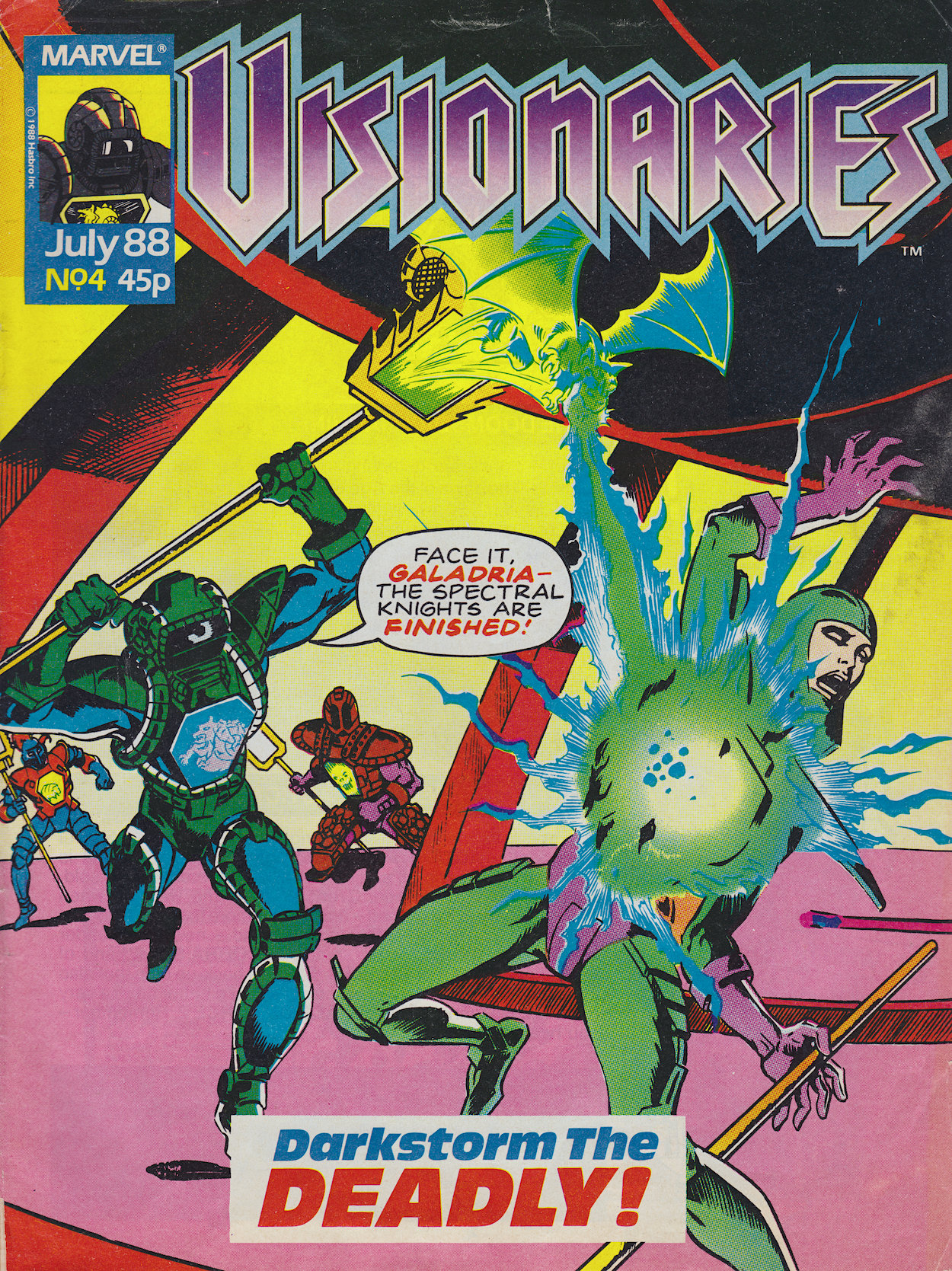
ViSiONARiES #4: KiCKiNG OFF TOO LATE

With hindsight I know the next issue of Marvel UK‘s Visionaries will regrettably be the last, but for readers at the time there would’ve been a real feeling of the comic taking off this month, ironically enough. With the introductions now out of the way this feels like the first proper story about these characters and their new abilities upon the ravaged planet Prysmos. Unfortunately, the writing may have already been on the wall at Marvel UK, evidenced by a downgrade in the physical comic.

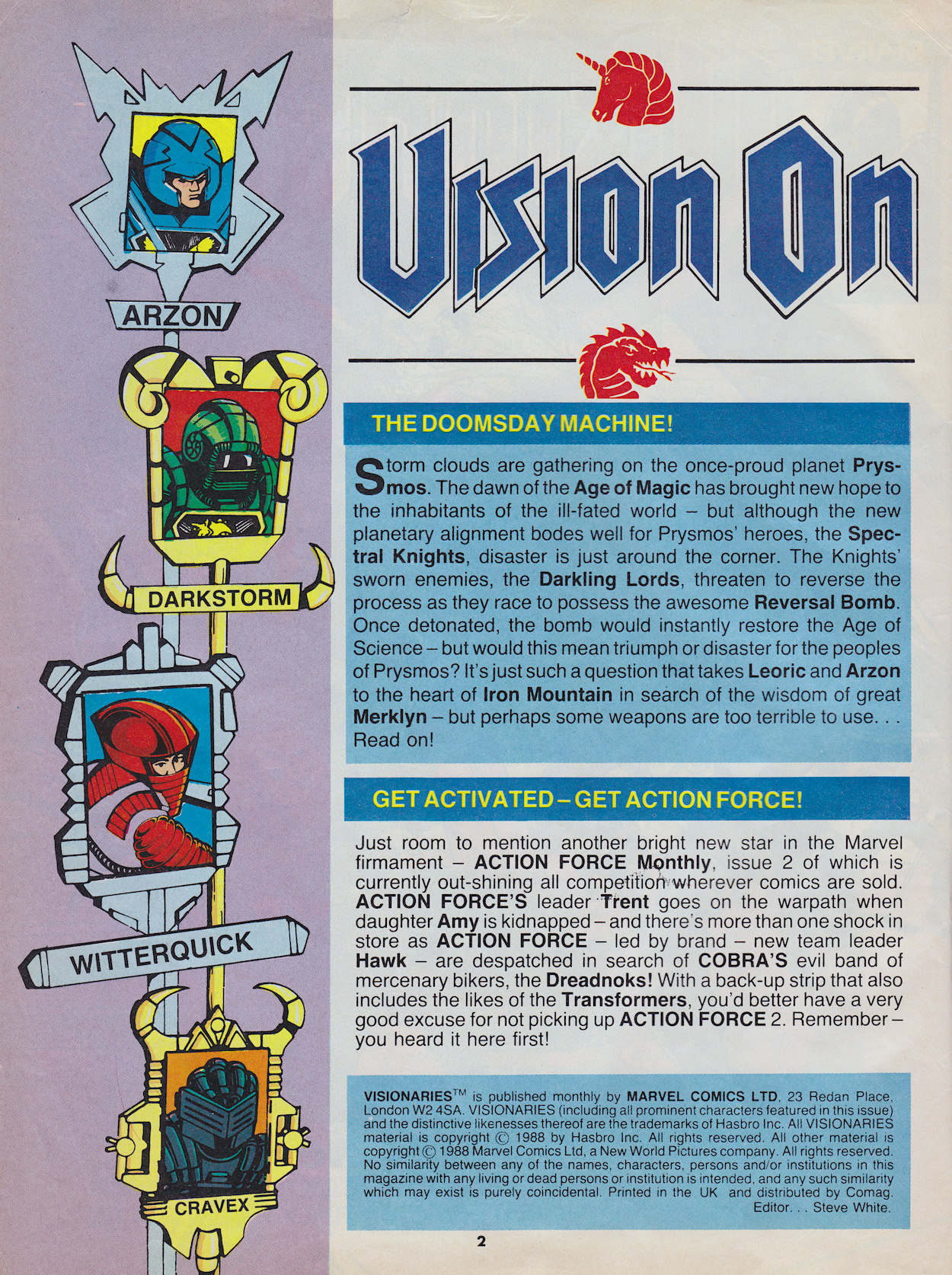
The outer eight pages are no longer of a thicker, glossier stock and instead the whole issue is made up of the same paper as the weekly Transformers. At least editor Steve White is introducing the story in the editorial rather than solely plugging other titles. Action Force Monthly still gets a mention though, they must really have wanted to push it, but the main thing is we finally get a proper editorial for the Visionaries.

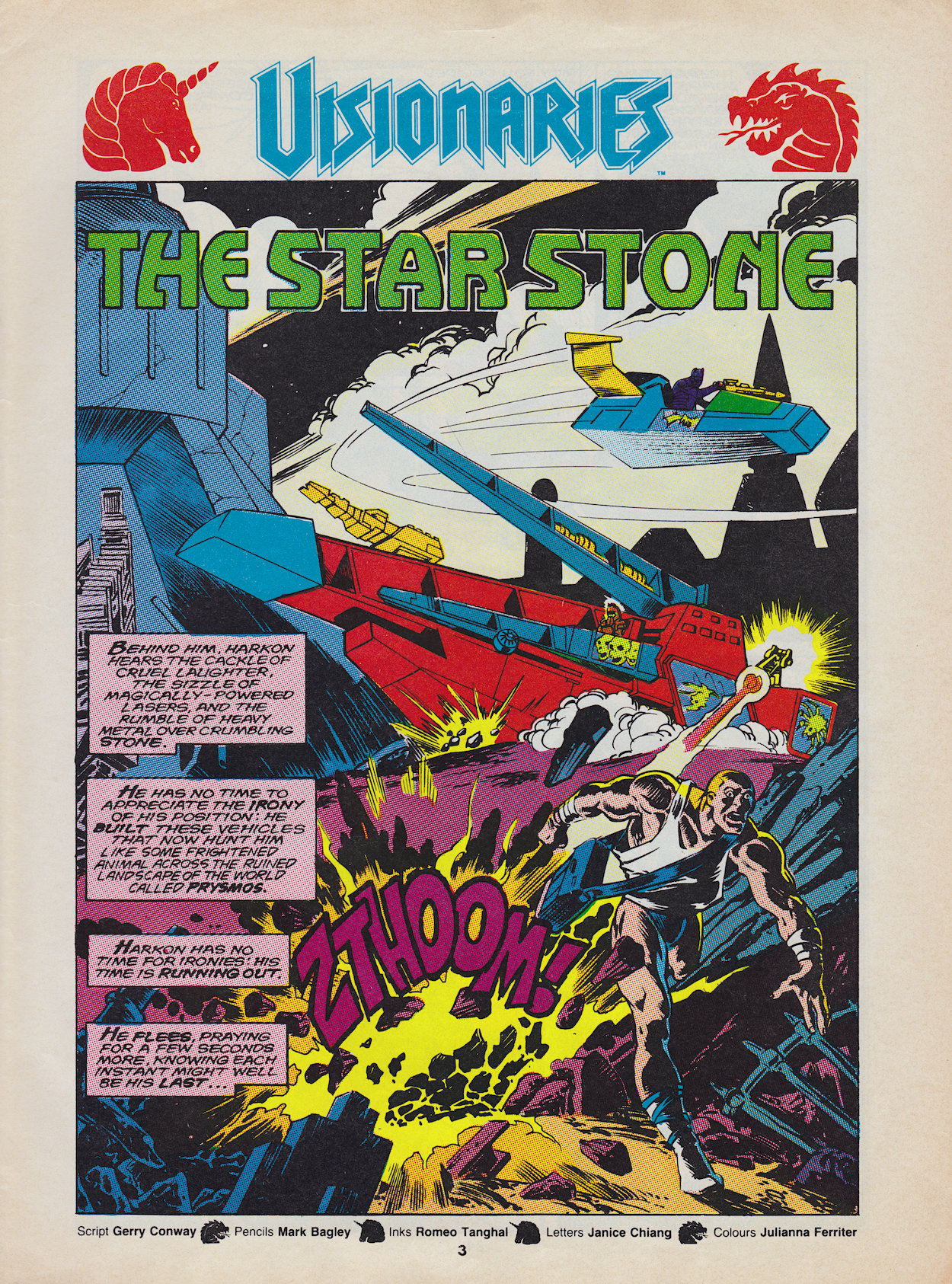
With characters beginning to develop beyond the information on the back of the toy packaging and some larger scale world building taking place, The Star Stone is a brilliant story which asks big questions about the choices we make and why, as well as clearly setting things up for as-yet-unknown events further down the line. Gerry Conway was now in charge of developing the storyline and it’s clear he understood the subject matter and its potential.

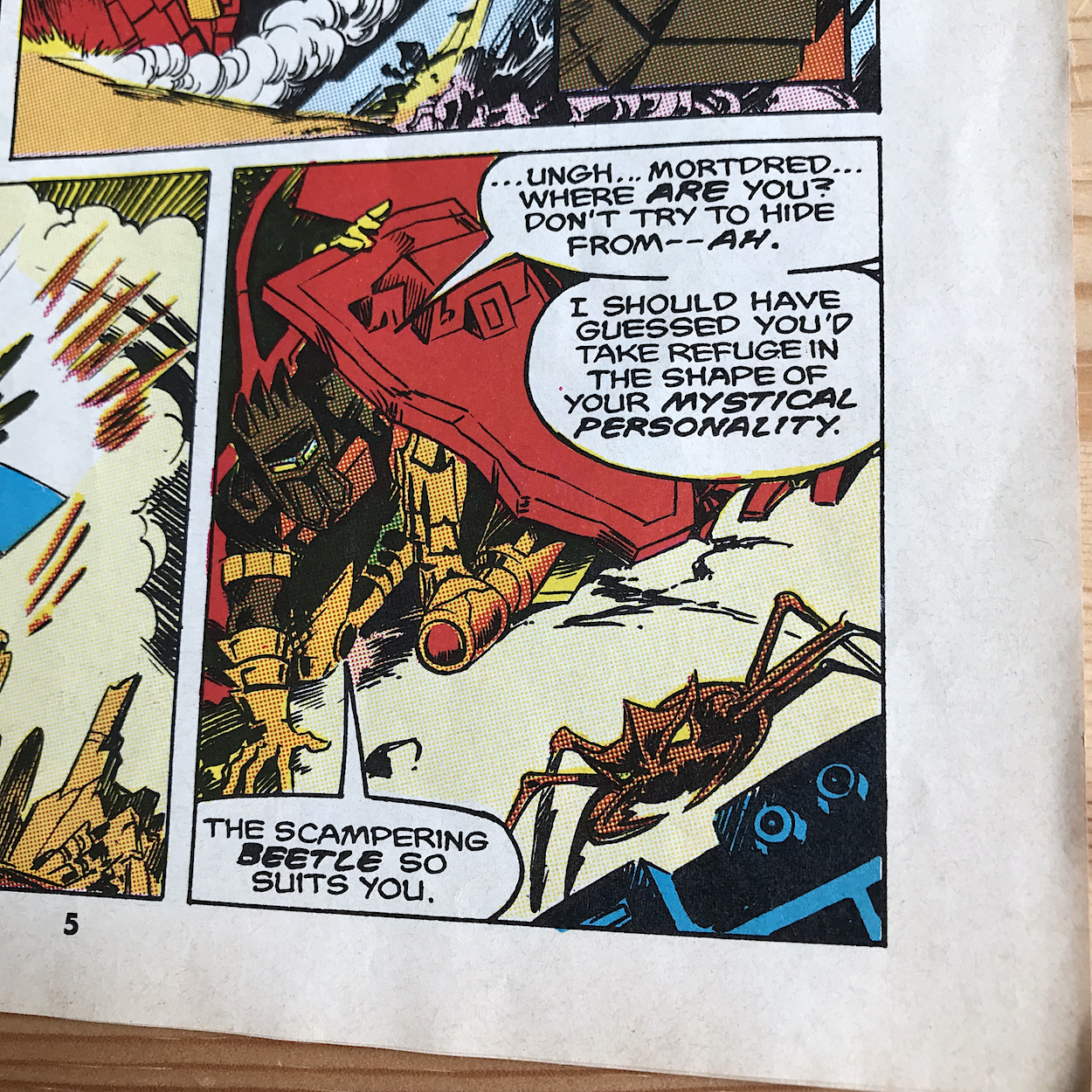
It kicks off with plenty of action as Reekon‘s new Dagger Assault, the biggest and best of all the toys in the range, tries to eliminate the Darkling Lords‘ contractor Harkon to stop him supplying any magical vehicles to the Spectral Knights. Reekon also goes up against the Sky Claw which is still in the hands of their enemy, but its owner Mortdredd recaptures it this issue, sneaking into Leoric’s castle in beetle form to steal it back. This act also introduces one of the changes from the cartoon that I actually prefer.

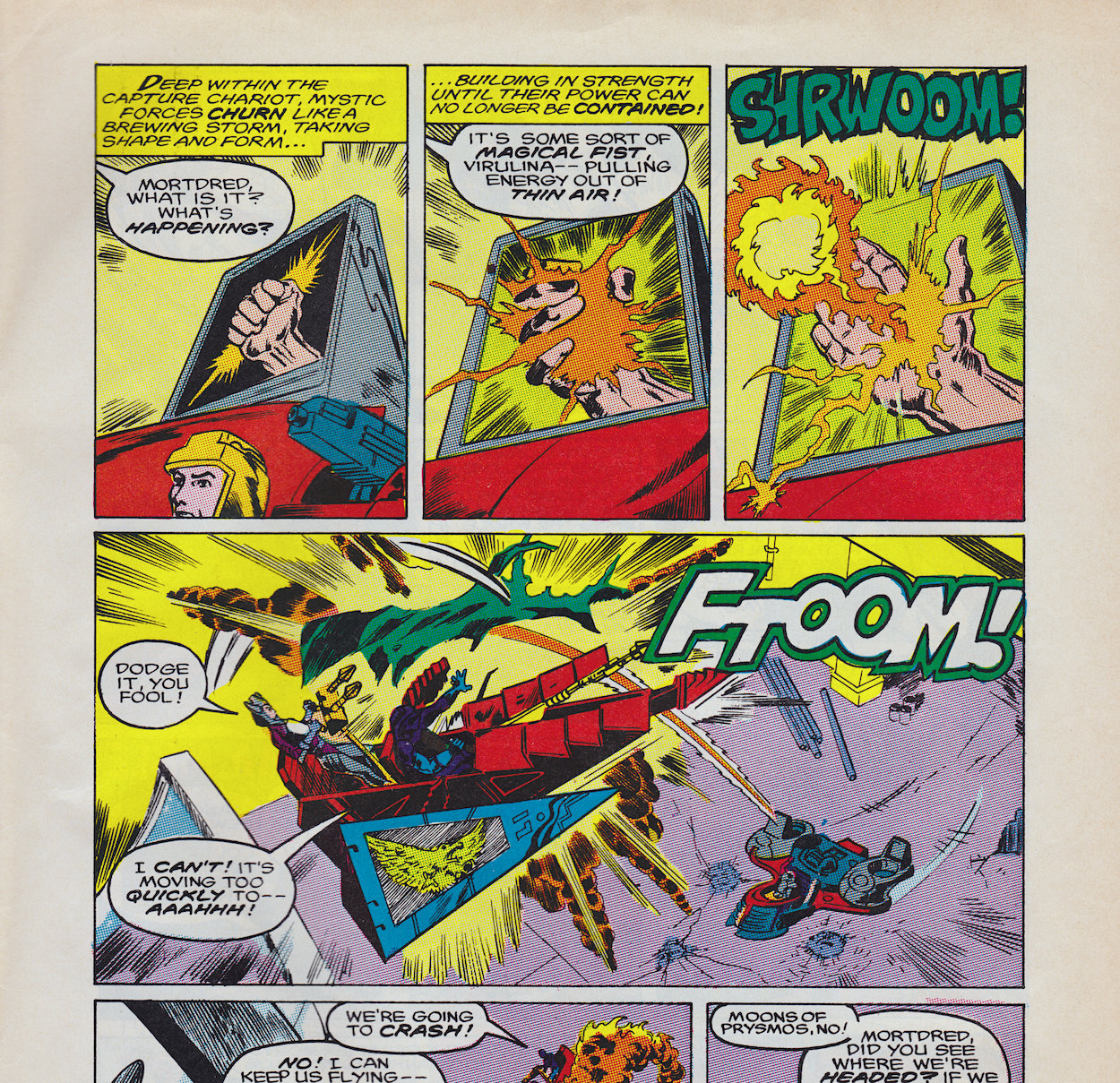
The characters’ magical totems would emerge from their chest plates and become fully formed as the human behind them faded away. The totems in the cartoon looked like glowing holograms to match the toys and in the context of a cartoon it did look brilliant. But comics are a different medium and in this more serious take on the story their animal selves maintain the colour of their real world counterparts, meaning they are a proper disguise. This is used to great affect several times this issue.

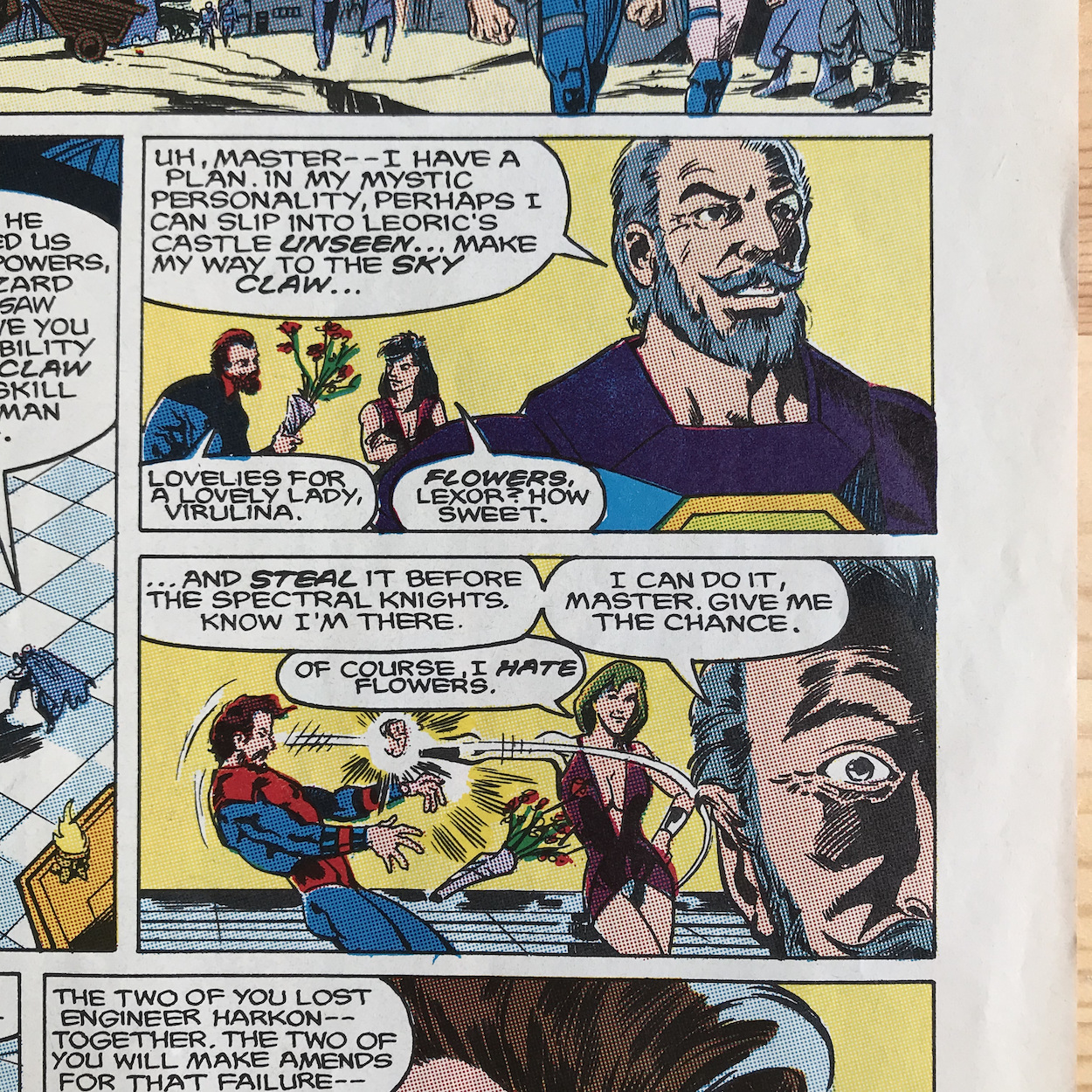
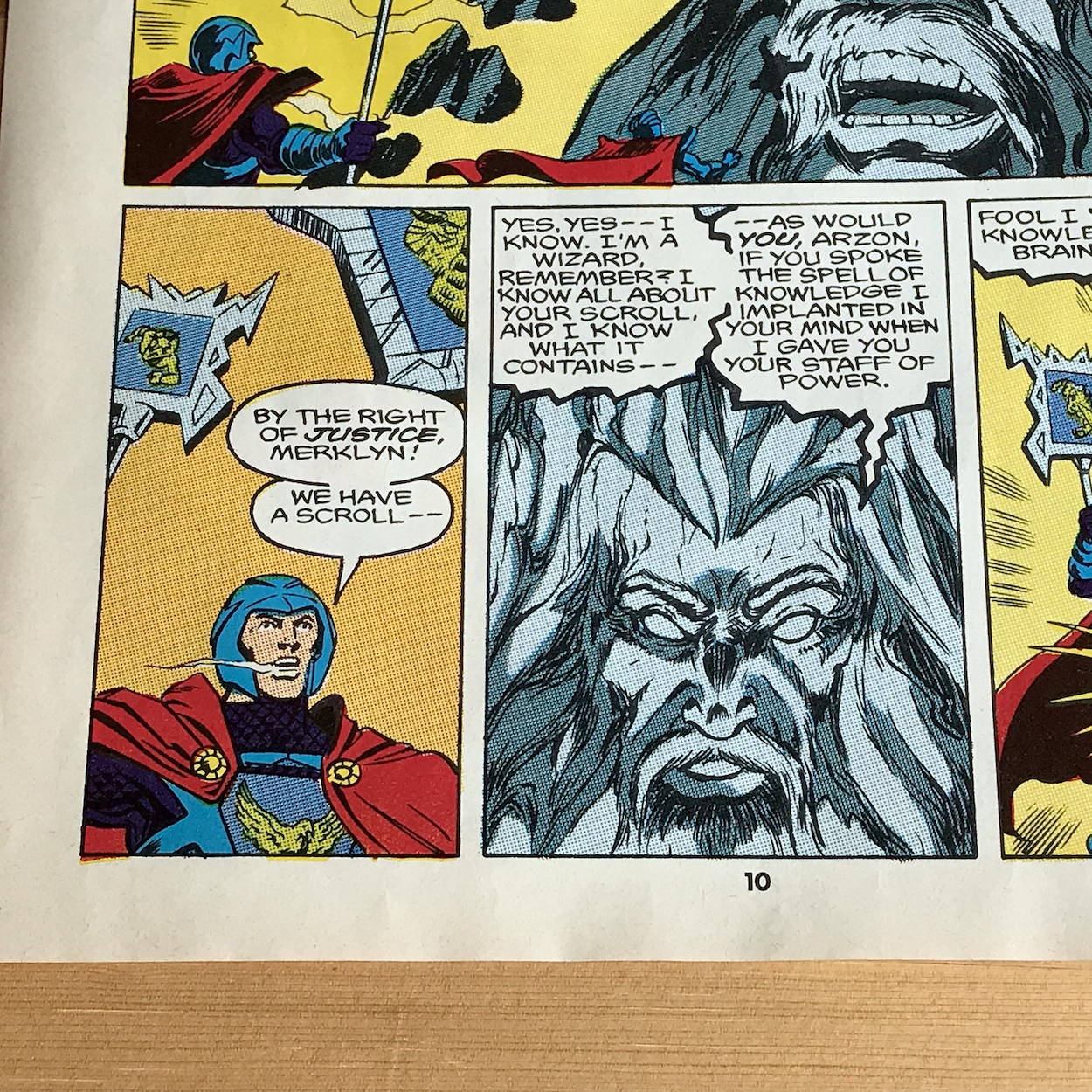
More humour slips in too, for example that background exchange between Lexor and Virulina happening behind a major plot point. The main story itself, once the characters are all in place, sees the discovery of an ancient scroll which tells of a hidden device, forgotten about for millennia that could end the Age of Magic and return the world to the Age of Science. This is revealed after a startling discovery by Arzon.

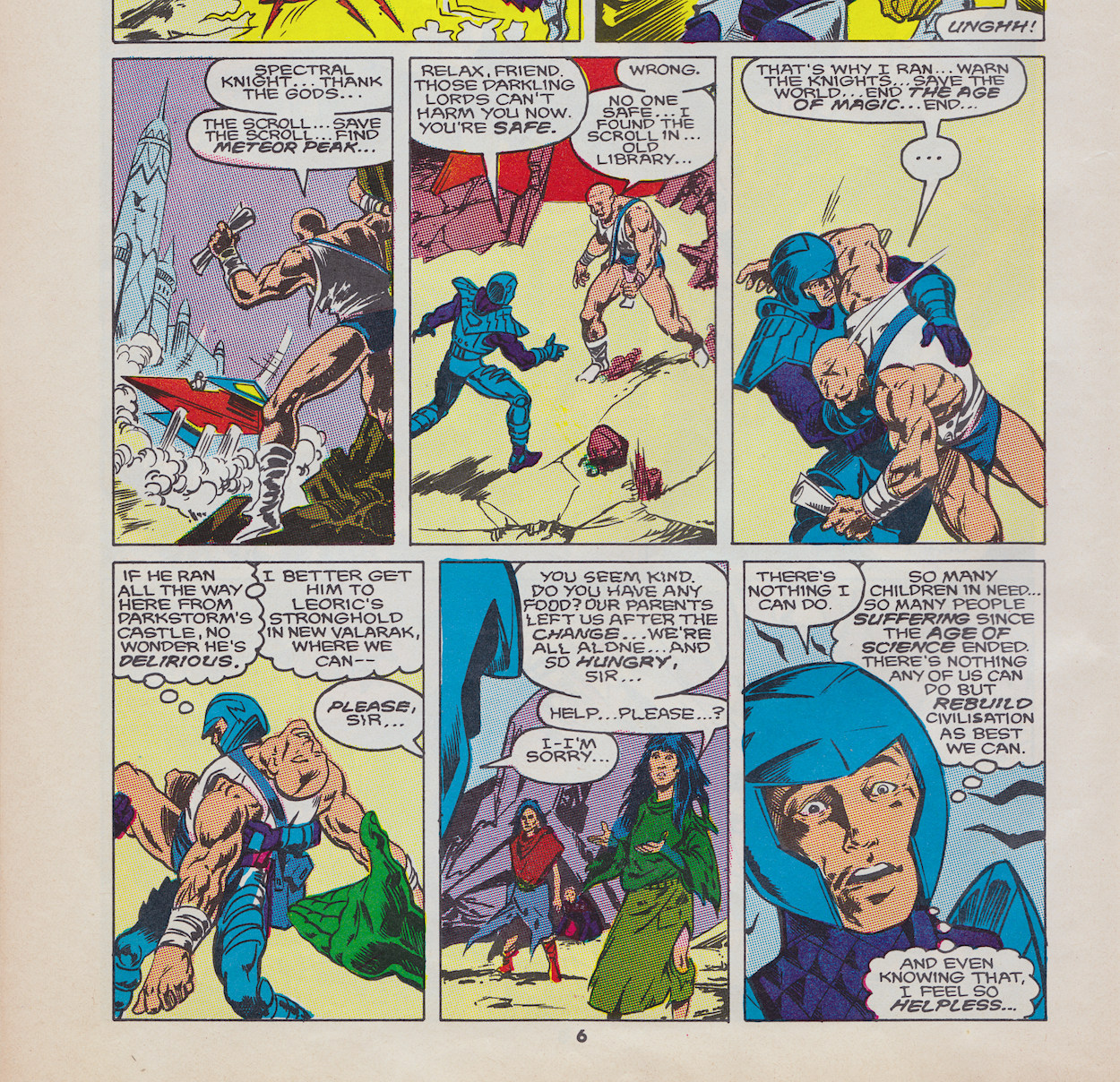
After the initial battle Arzon finds himself approached by child beggars, homeless and desperate for food after being abandoned by their parents following “the change”, which is how the cataclysmic events of the origin story are referred to. This is where Gerry’s world building comes in. The toys and the cartoon hype this fancy new age, the wonderful powers that came with it and all the action and adventure kids could hope for. But Gerry’s Prysmos is a grittier, medieval place where Arson finds himself suddenly faced with the harsh truth.

The origin story placed a lot of emphasis on how reliant humans were on their technology. At the end only a few Knights were deemed worthy of Merklynn’s magic, the future of their world placed on their shoulders. You could view it as an allegory of the dangers of relying too much on technology (technological advancements were happening at a breakneck pace in the 80s), or a reference to the class system and how those in a position of power, whether earned or not, have a responsibility to those less fortunate. The Spectral Knights and the Darkling Lords just have differing views on what their responsibility is.

While all the magical action is there, seeing them have philosophical debates, questioning their powers and being properly affected by the world around them has been a very pleasant surprise

The coming of the Age of Magic has left many suffering and having these starving children approach Arzon, who is unable to help, is a particularly dark moment for a toy licence. It makes for a surprisingly mature thread throughout, one of many planted by the comic’s new writer.

Arzon thinks returning to the previous age is a way to end this suffering. His leader Leoric isn’t so sure. Suffering still occurred before and humans had lost their way, lost their compassion and their true worth. The Age of Magic is a chance to rebuild together, to fix all that was wrong before. But at what cost in the short term? The scene in which this is discussed is a lovely, quieter moment between them and shows how they’re now being treated as three-dimensional characters who just happen to have magical powers.

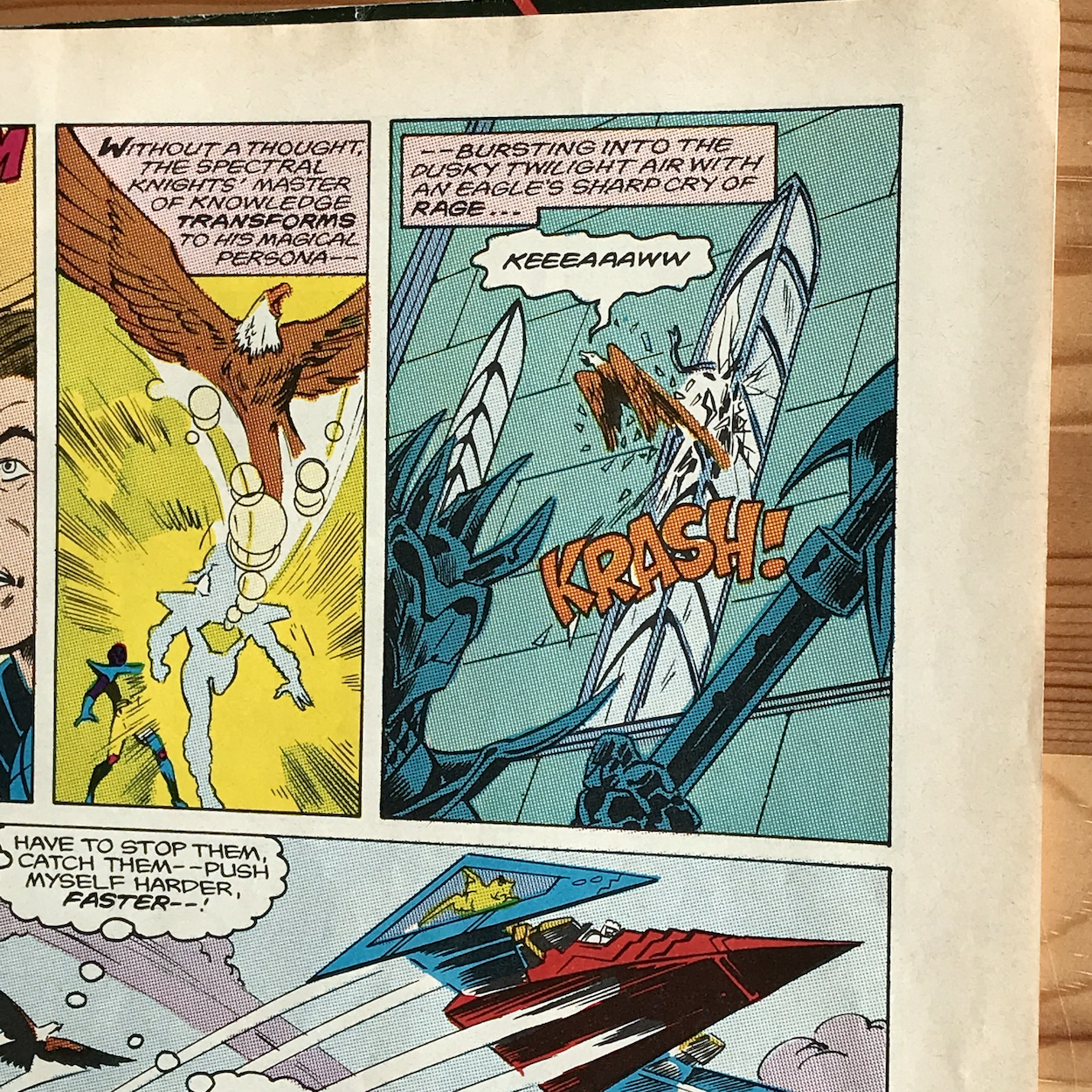
But when Mortredd steals the Sky Claw it’s clear he could be taking the information from the scroll back to Darkstorm, so Leoric has no choice but to track down the device. We see Arzon in his eagle form, a true animal and not a holographic projection, alongside more lovely atmospheric captions. He’s unable to catch the Sky Claw, so he and Leoric leave to seek knowledge from Merklynn about the scroll, which results in a rather funny exchange from the usually serious wizard.

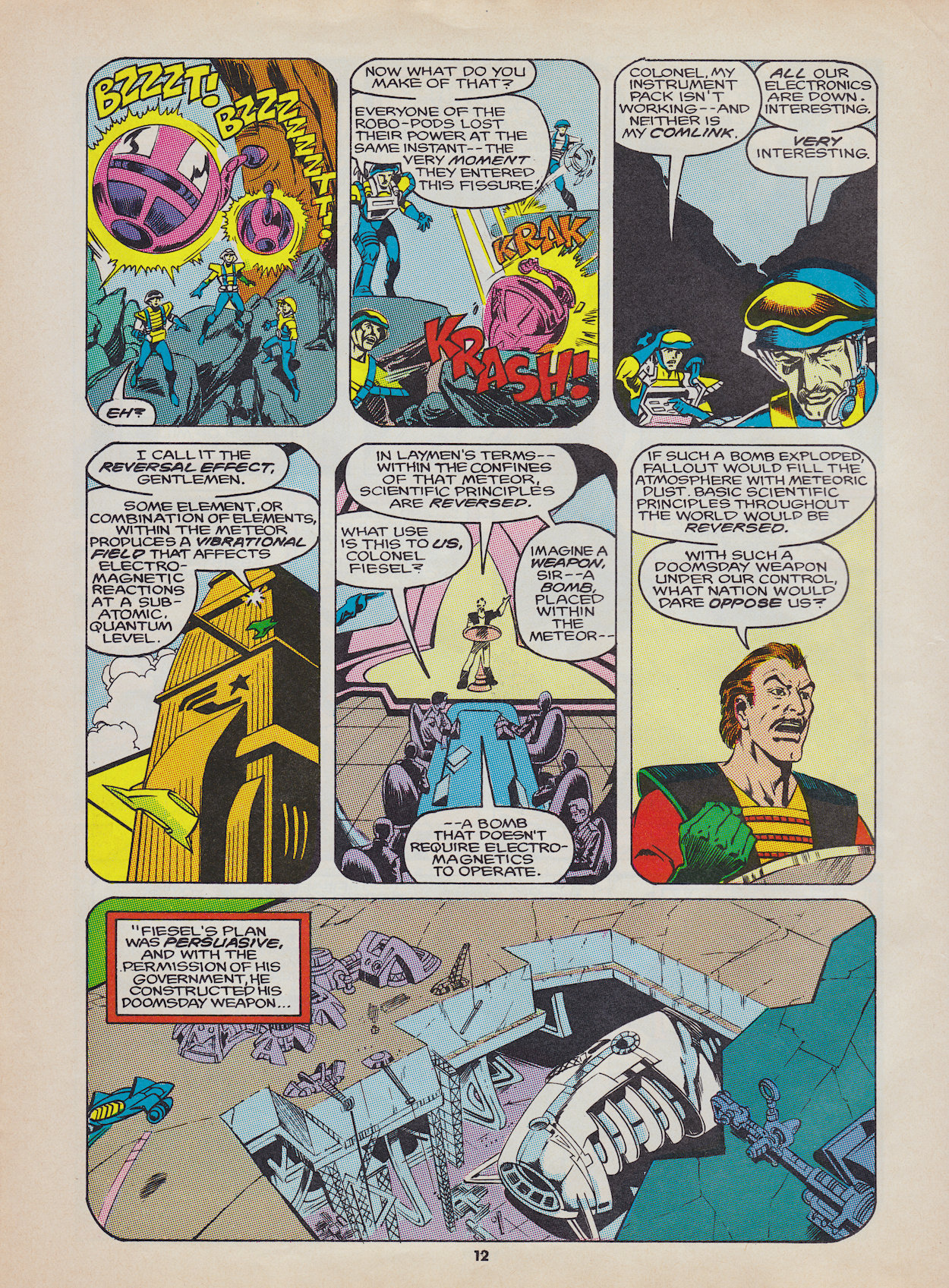
We now get a few pages told through Arzon after he casts his Power of Knowledge poem, telling us of a time ten thousand years ago during the earliest days of the Age of Science when a meteor fell to the ground. Upon its discovery the military’s head scientist, Tech-Colonel Ragni Fiesel found none of his equipment worked within its vicinity.

Identified as a ‘Reversal Field’, Fiesel ordered the building of a bomb containing the meteor as a way of deterring any other region from invading. It was promoted by the government as a way of keeping the peace. But Prysmos had been at peace for millennia, there was no need for such a threat against other nations. Some things never change and it would appear the mythical world of Prysmos was in reality no better than our own.

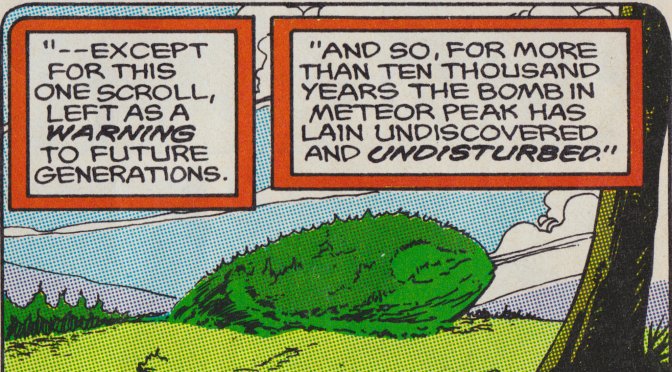
It was clearly a ploy by a corrupt government, one which was soon overthrown in a coup. But not before the bomb had been built and secreted in a mound of earth, over time becoming overgrown and part of the landscape, indistinguishable from its surroundings. All records of the bomb vanished, apart from the one scroll discovered by Harkon, who as an engineer longed for the return of that age.


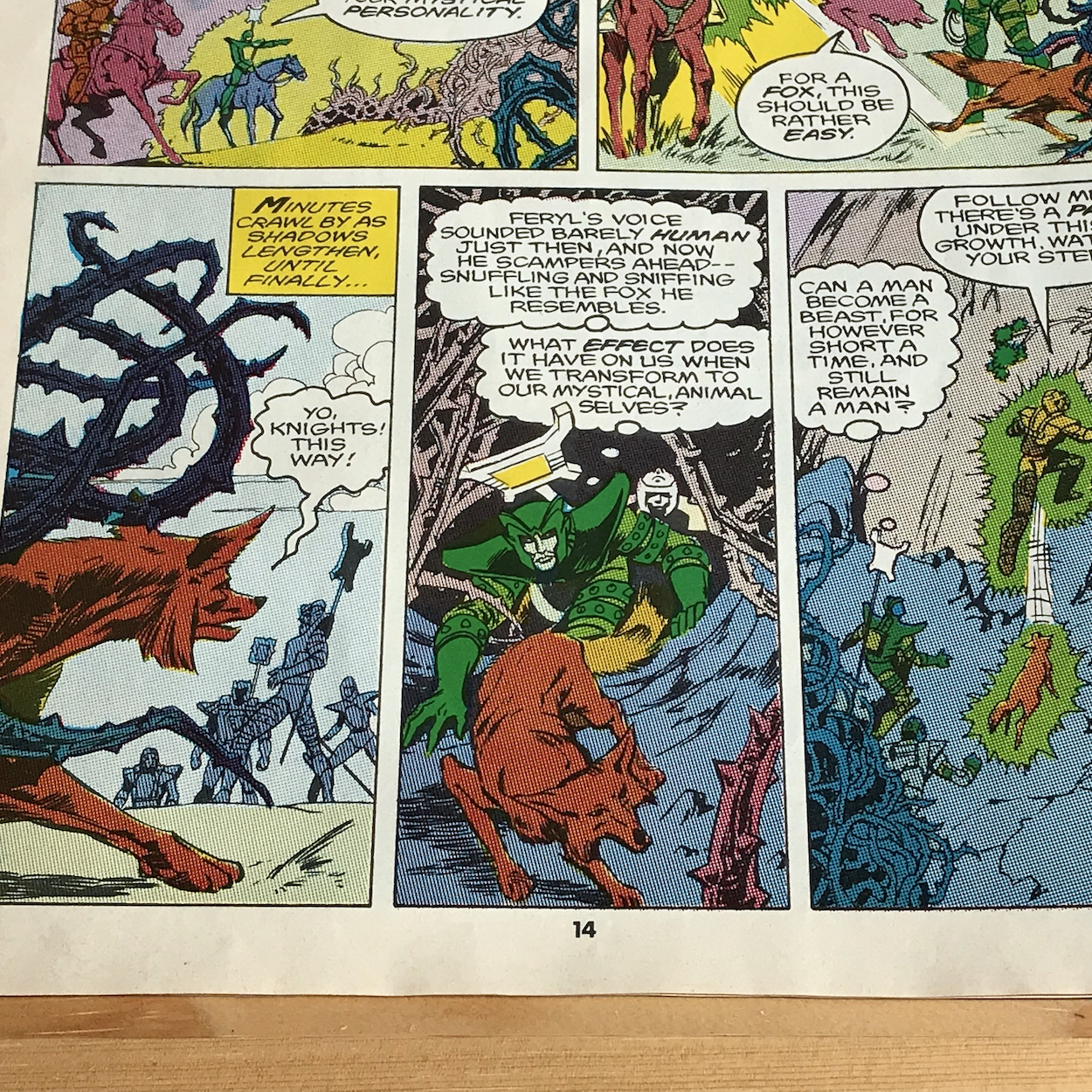
“Can a man become a beast, for however short a time, and still remain a man?

Leoric

During their quest to find the bomb Leroic gets to muse to himself about the magical totems they now possess. After witnessing Feryl find a path through twisting thorns as a fox (this is an error, Ectar is the fox and Feryl is a wolf), Leoric notices his friend’s voice sounds less human every time he transforms. It surprised me they can speak in their animal forms at all! But that’s not the point I want to make. Leoric’s foreboding thoughts set up possible future storylines about just how much these powers change those who use them.

I’m loving all of this extra depth because I just didn’t expect it. While all the magical action is there, seeing them have philosophical debates, questioning their powers and being properly affected by the world around them has been a very pleasant surprise. It’s bittersweet of course and I can’t help thinking how this could’ve developed if it hadn’t been cancelled so early.

Gerry clearly had plans for the future and he was carefully planting seeds here. But the main thread this issue concerns how little they know about their planet’s current situation, enough to throw doubts on whether they should attempt to change their future yet again. With all these unknown factors they could make things even worse.

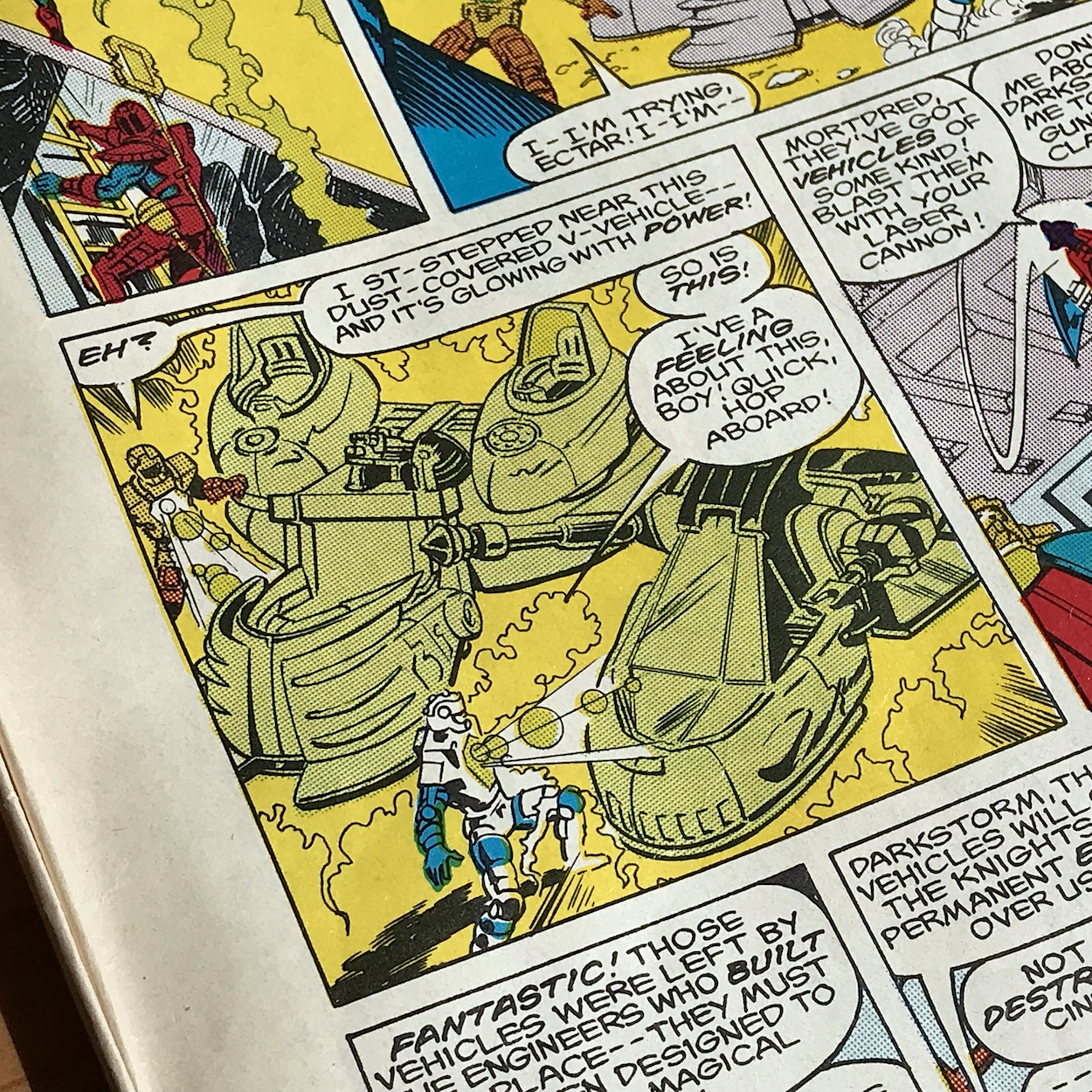
Fortunately for the Spectral Knights, and for Hasbro, inside the meteor’s casing their ancestors saw fit to place vehicles which could work near the Reversal Field by drawing energy from a magical source instead of a scientific one. Fiesel knew that if his government really did have to throw the switch, they’d need some kind of advantage.

Say hello to the Capture Chariot (the one vehicle I didn’t possess) and the Lancer Cycle, completing the comic’s take on the toy line.

The large scale battle at the end of this issue is brilliantly brought to life (with no more mistakes I should add) by penciller Mark Bagley, inker Romeo Tanghai, colourist Julianna Ferriter and letterer Janice Chiang. We even get to see the Capture Chariot‘s power and I was thrilled to see it resemble that of the cartoon’s. There really was no other way to show it and, even if it’s not in the ghostly green colour I was used to as a kid, it’s still pretty neat to this old fan.

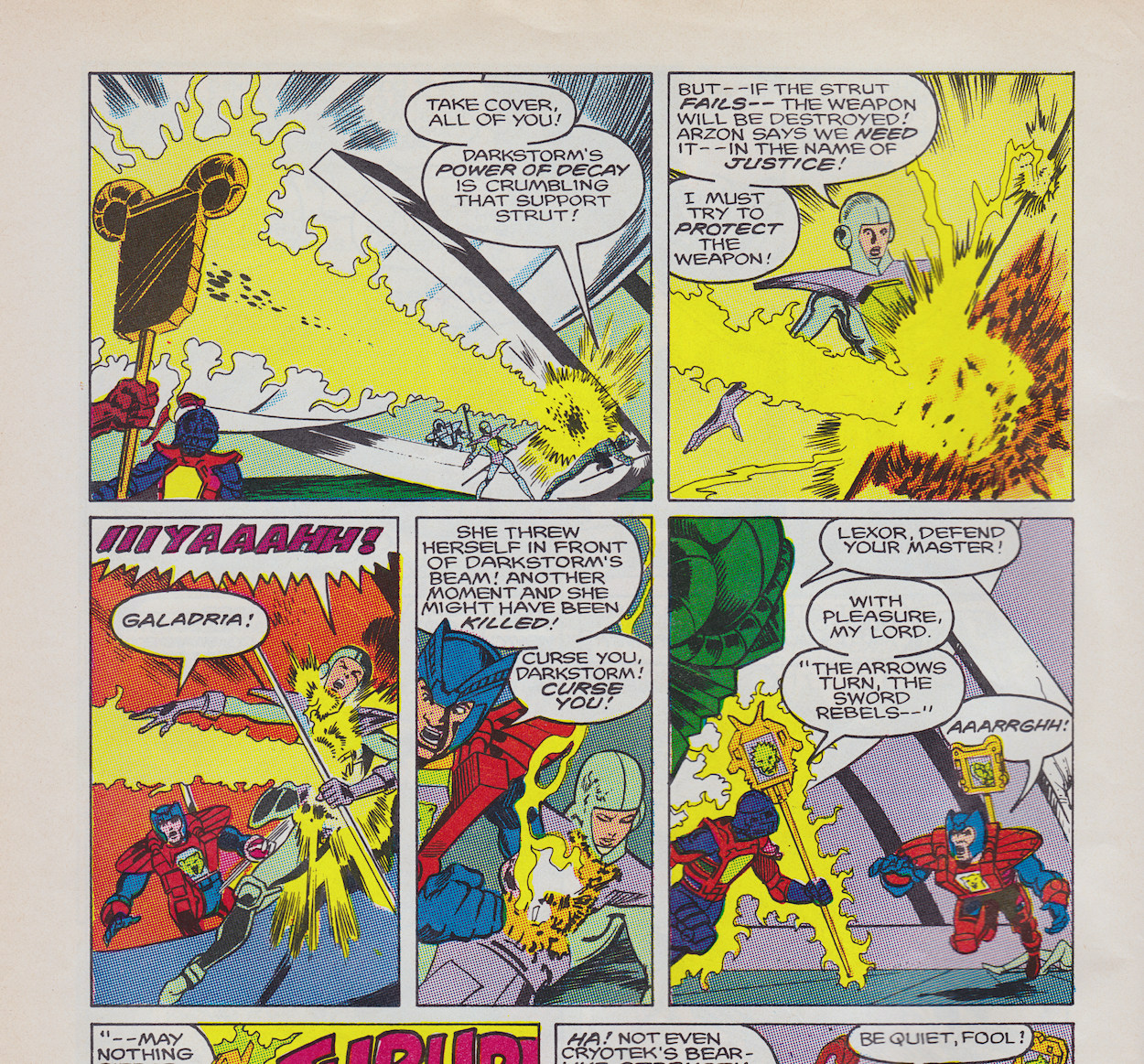
In a moment of desperation against ever decreasing odds Darkstorm uses his staff’s Power of Decay to try to destroy all of the Spectral Knights in one swift move and it’s Galadria who saves the day, throwing herself into its path. She may not have her own powers yet, but here she shows her willingness to sacrifice herself to save others. This sets her up to receive her Power of Healing from Merklynn. See also how cowardly Lexor now throws himself into battle, but only because his Spell of Invulnerability can stop anything in its tracks.

In a clever moment Leoric’s Power of Wisdom and Arzon’s Power of Knowledge are shown to be two very different things indeed. The Spectral Knight leader isn’t sure the reversal bomb should be set off and Arzon questions this, “Think of all the pain we’ll save the world!” Leoric’s response isn’t the kind of thing you’d expect from a toy licence comic.

“But pain is a part of life, Arzon. When a mother gives birth, she knows pain. Would we deny the newborn child to save the mother pain?”

As Arzon then notes, knowledge and wisdom must be used together.

In the end Darkstorm accuses Leoric of being weak and reference is made to their opposing plans to rebuild their world. Leoric sees a better world, Darkstorm a stronger one. Most of the time the villains in our cartoons and comics in the 80s were evil simply because they were. Darkstorm genuinely believes only by ruling with an iron fist can his beloved Prysmos regain its strength and position in the heavens. Leoric believes in compassion and fairness instead, even if rebuilding takes longer to achieve. It’s an interesting dynamic.

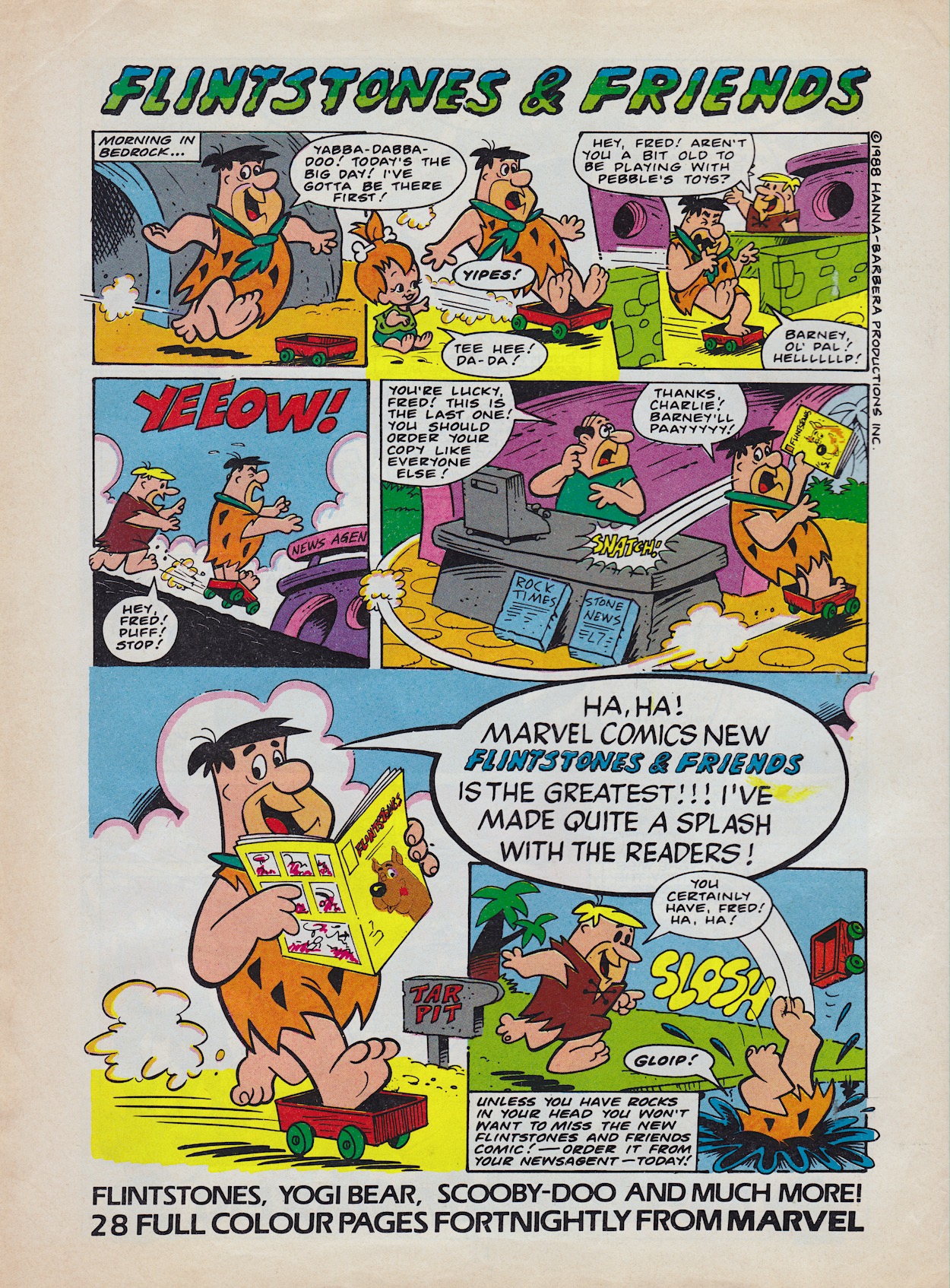
As discussed before Visionaries has no extra features, in fact this issue even has only one advertisement and it’s a bit of an abrupt change of pace! It isn’t even for the toys the comic is based on which seems a strange choice. Instead it’s a promotion for the new Flintstones & Friends title. It feels rather out of place here; surely it had a different target audience? The fact it’s out twice as often as Visionaries yet has more pages is a bit of a blow for fans too. The Flintstones comic would last for just under a year, managing 24 issues before being cancelled and rebranded as Cartoon Time.

It’s sad to think of this as the penultimate issue of Visionaries already when it seems to have so much promise. However, there is at least some more to come even after the final issue next month. I’ll let you in on what that is in the next fateful review, it’ll be here on Wednesday 21st July 2021.

iSSUE THREE < > iSSUE FiVE

ViSiONARiES MENU

RETRO GAMER: OLD PiG, NEW TRiCKS

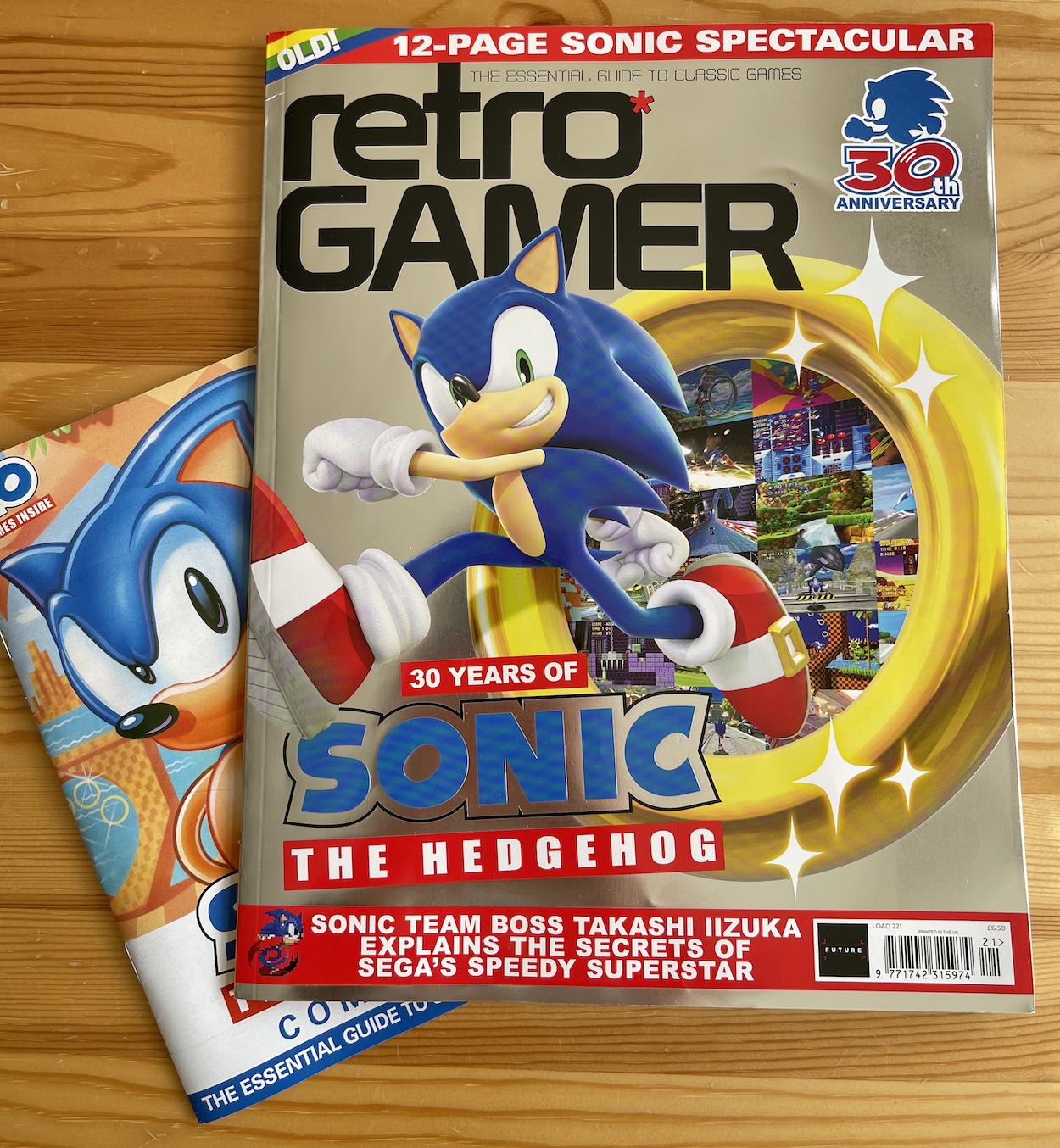
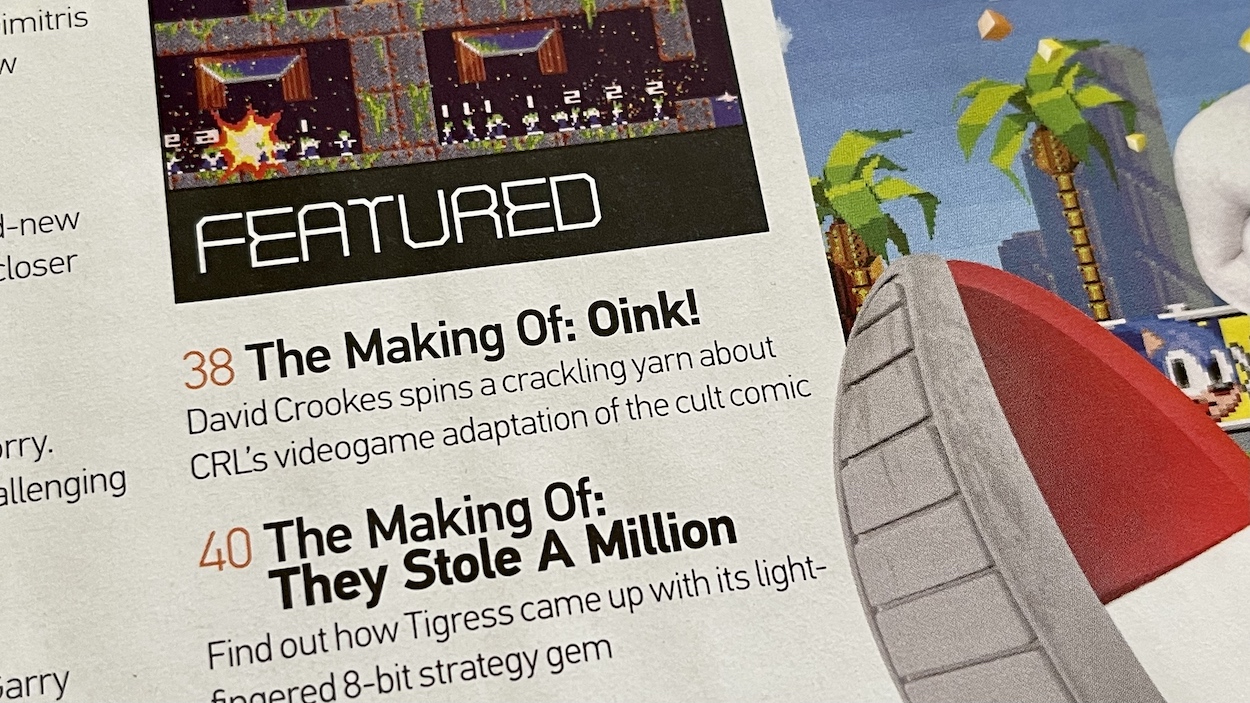
On the surface this magazine might seem a strange addition to the blog but there is method to my madness. A pig pal by the name of David Crookes has been able to score a chat with Jon Williams, the coder of the OiNK computer game released back in 1987. This was set to appear in #221 of Retro Gamer and I’ve now got my trotters on it. UPDATE: Over a year later, and with the magazine no longer available, this post has been updated with the complete OiNK article and a full break down of the mag’s contents.

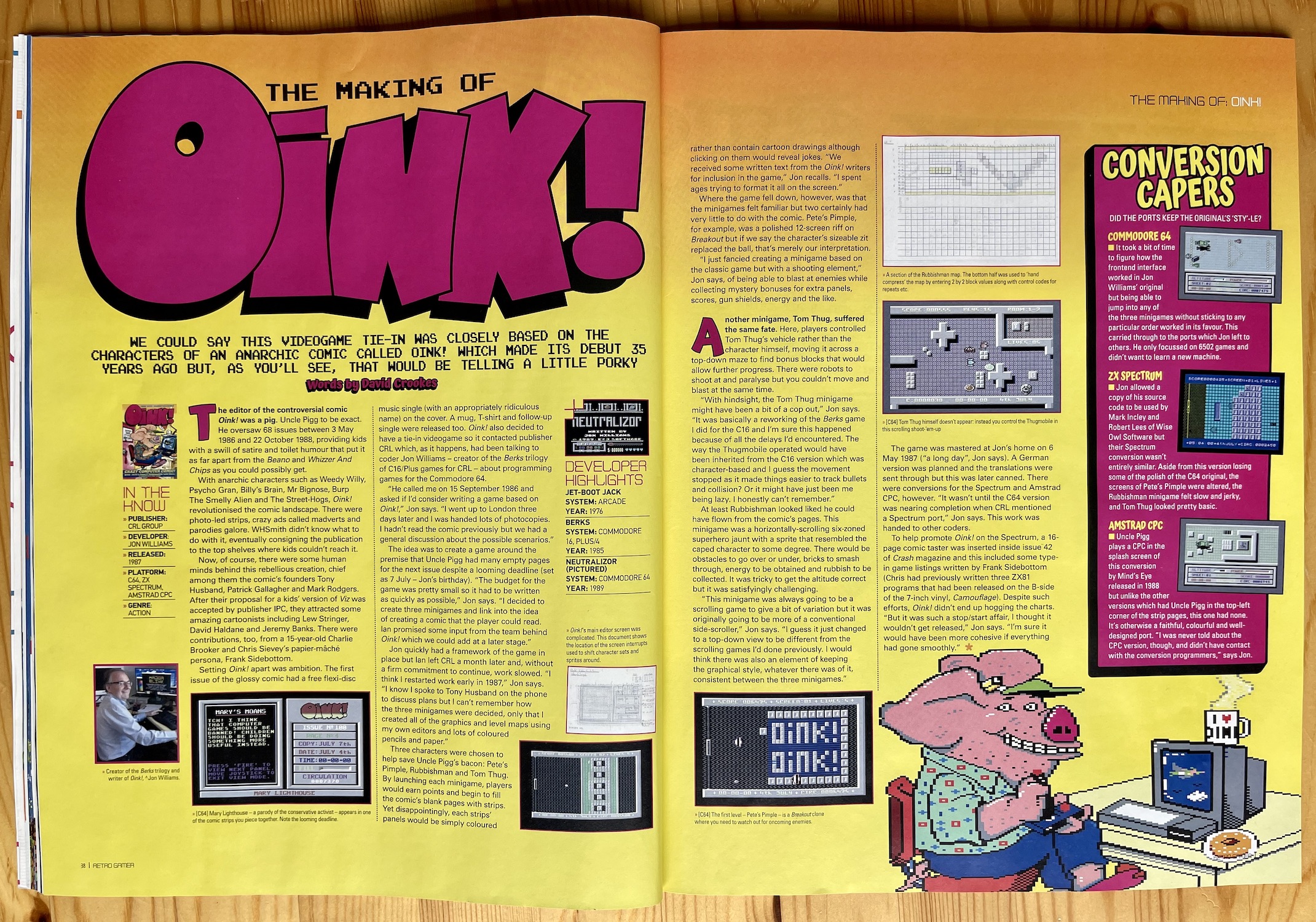
The article itself is only two pages but does include some insider knowledge and screenshots for anyone not familiar with this particular piece of OiNK merchandise. Sadly, it begins with that well-trodden myth that OiNK was created as a children’s version of Viz, which is simply not true. OiNK was created in response to the tired humour of other comics, to create something for the kids of the 80s, with Mad Magazine influencing some of the potential ideas. That particular publication will pop back up again further down this post.

The piece also says that our three editors, Patrick Gallagher, Tony Husband and Mark Rodgers approached CRL to make a game for them but as we’ve learned in previews in contemporary magazines (Crash and Zzap!64) it was the other way around. I could be nitpicking here of course (also, the contributors were brought on to OiNK before it was given the go ahead so they could make a dummy issue) and the bulk of this article is actually quite interesting, focusing on a chat with the game’s creator, Jon Williams.

What’s clear from reading this is how Jon was completely unfamiliar with the comic, which is fair enough, those working on licenced games didn’t necessarily have to know the property. However, CRL providing a few photocopies isn’t a great amount of research and the ideas sound more like those for a generic game about comics rather than anything pertaining to a specific licence. It’s interesting to read how it all came to be but it does seem to back up the notion from pig pals that it was an OiNK game in name only.

It seems the game came first and the licence was an afterthought

A small budget was given to its creation so, music aside, it was fully coded by Jon which was not a rare occurrence for the time. (The ‘Ian’ mentioned is Ian Ellery of CRL, although his surname and position aren’t printed here.) When it came to designing the game it wasn’t a matter of researching OiNK’s characters and trying to create something original around them. Instead, rather disappointingly Jon wanted to make a Breakout clone and a copy of an earlier game of his and saw this as his opportunity, shoe-horning OiNK into them instead. Only the Rubbish Man mini-game in any way resembles the character, but all of the humour, stinky super powers and random villains are nowhere to be seen.

This feels like a wasted opportunity. OiNK had such an anarchic sense of humour, ripe for a crazy, original game like the Monty Python one released on the Commodore 64 just a few years later which took the best elements of that show and created something unique around them. But instead it seems the game came first and the licence was an afterthought. Again, this feeling when playing a licenced game wasn’t uncommon in the 80s and 90s.

However, Jon should be commended for creating a game (actually, three games in one) in such a short period of time and the interview really is rather interesting with details about the start-stop nature of its development, the rush to get it completed with that tiny budget and the shortcuts he had to take which inevitably had a impact on the finished product. I was surprised to read much more input from the comic’s team had apparently been promised at the outset, although this was unfortunately pared back when things fell behind schedule.

Some of the revelations here make me want to tear my hair out

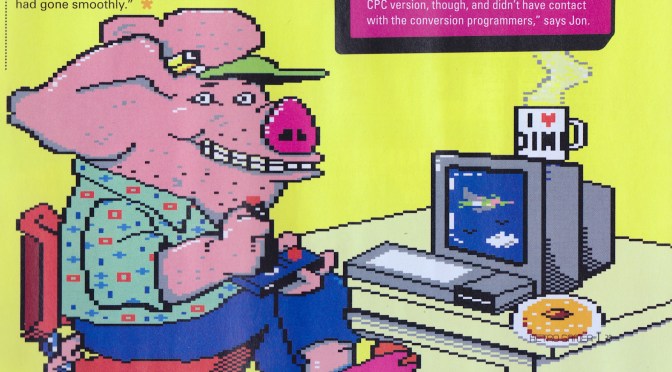
As a former obsessive with the Commodore 64 I found the technical aspects mentioned alongside some of the design documents fascinating. The game was originally created for my old home computer with the conversions for the ZX Spectrum and Amstrad CPC computers handled by other people based on Jon’s code. This does beg the question why a Spectrum magazine was the one to give away a free OiNK comic (Crash) and not a C64 publication (like Zzap!64).

While some of the revelations here make me want to tear my hair out (we could’ve had a game more closely associated with the comic, there was little real research done, the programmer just wanted to create a specific game and used our licence to do so) it’s always interesting as an OiNK fan to find out more behind-the-scenes information about my favourite comic and any related merchandise.

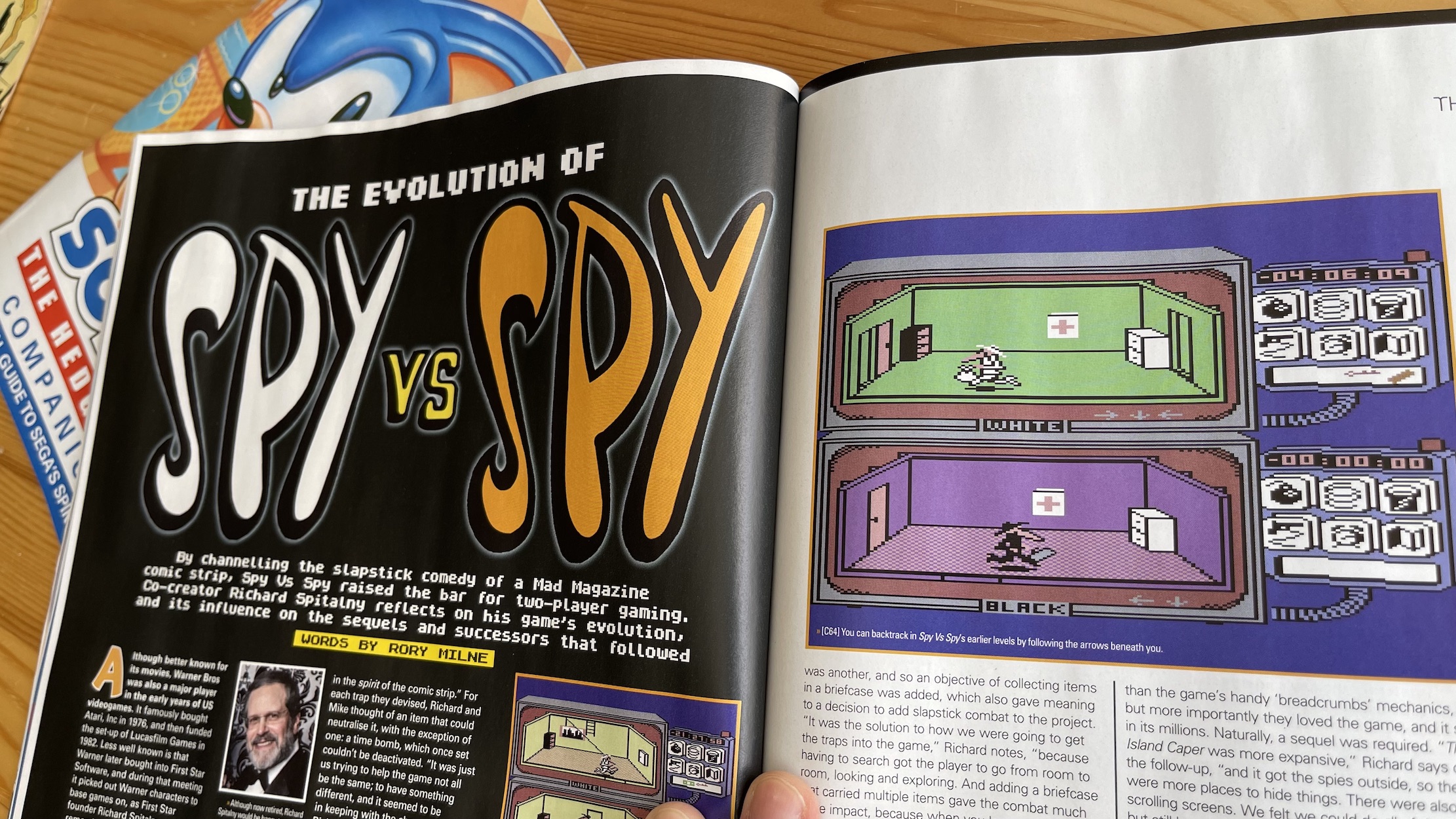
By sheer coincidence the feature right before the OiNK article might also be of interest to readers of our piggy publication. It’s an in-depth look at the creation of the Spy Vs Spy games based on a hit comic strip from Mad Magazine, which as I said earlier was one of the influences cited by the creators of OiNK. I have very fond memories of playing all three of these games in the early 90s with my friend and only many years later finding out it was based on a comic.

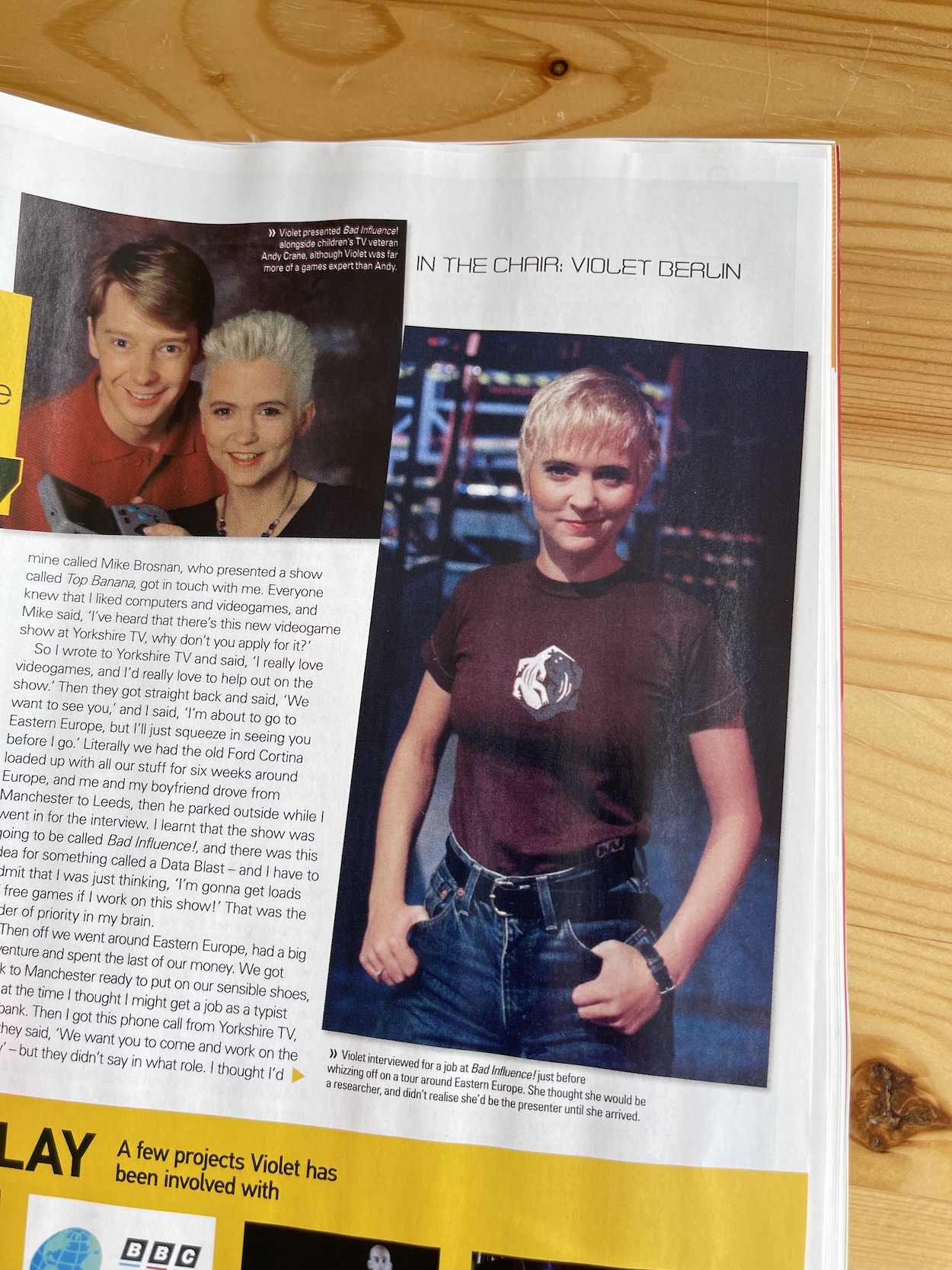
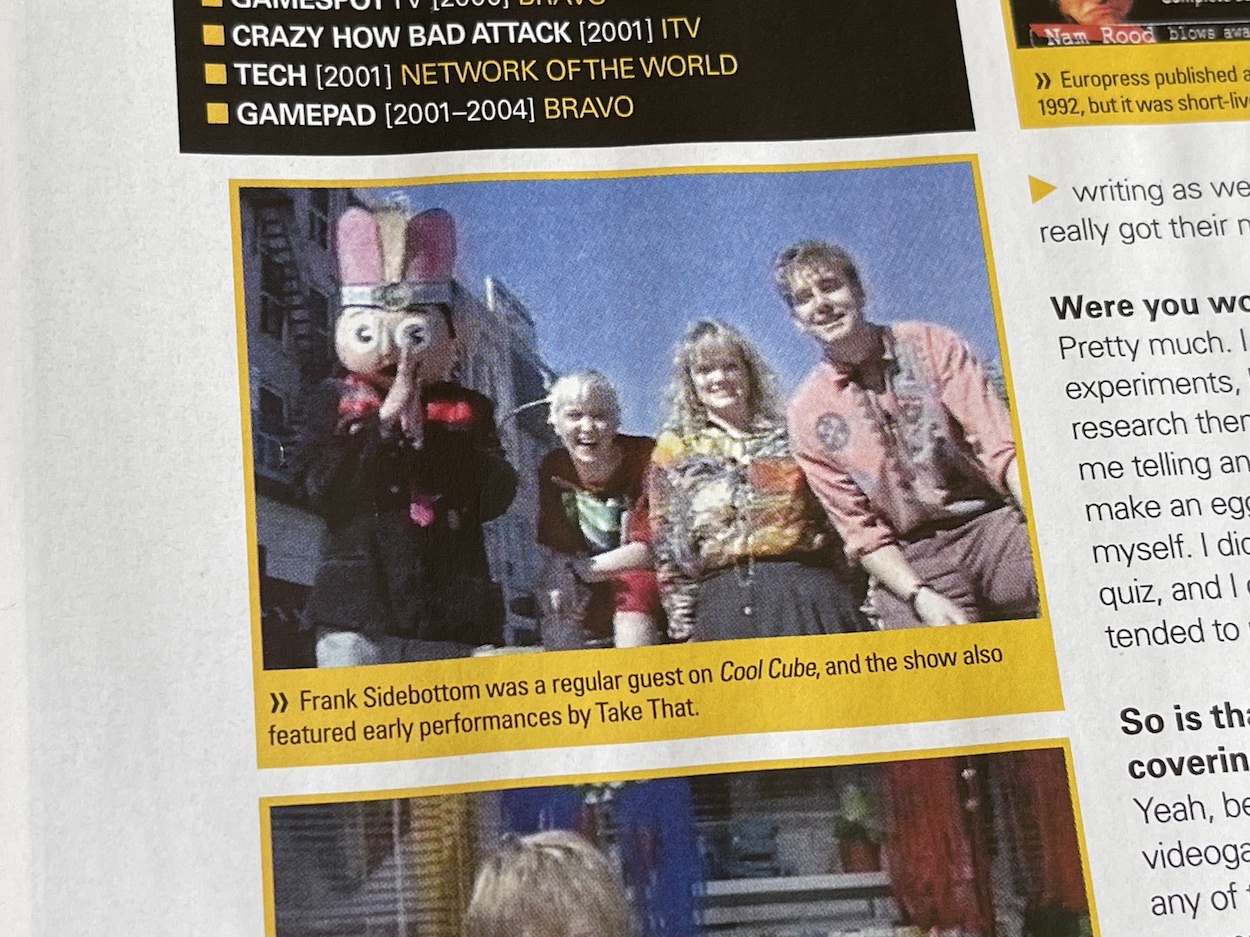
Elsewhere there’s one more little link to OiNK hidden away in a great interview with Violet Berlin, who I used to watch on Bad Influence on UTV and Gamepad on Bravo. Yes, that’s our very own Frank Sidebottom aka Chris Sievey popping up on one of Violet’s earliest shows! If you’d like to read any of these extra features, or maybe you’re just an OiNK completist like me, you can contact Future Publishing for Retro Gamer #221 via the Future shop, although you’re more likely to find it on eBay.

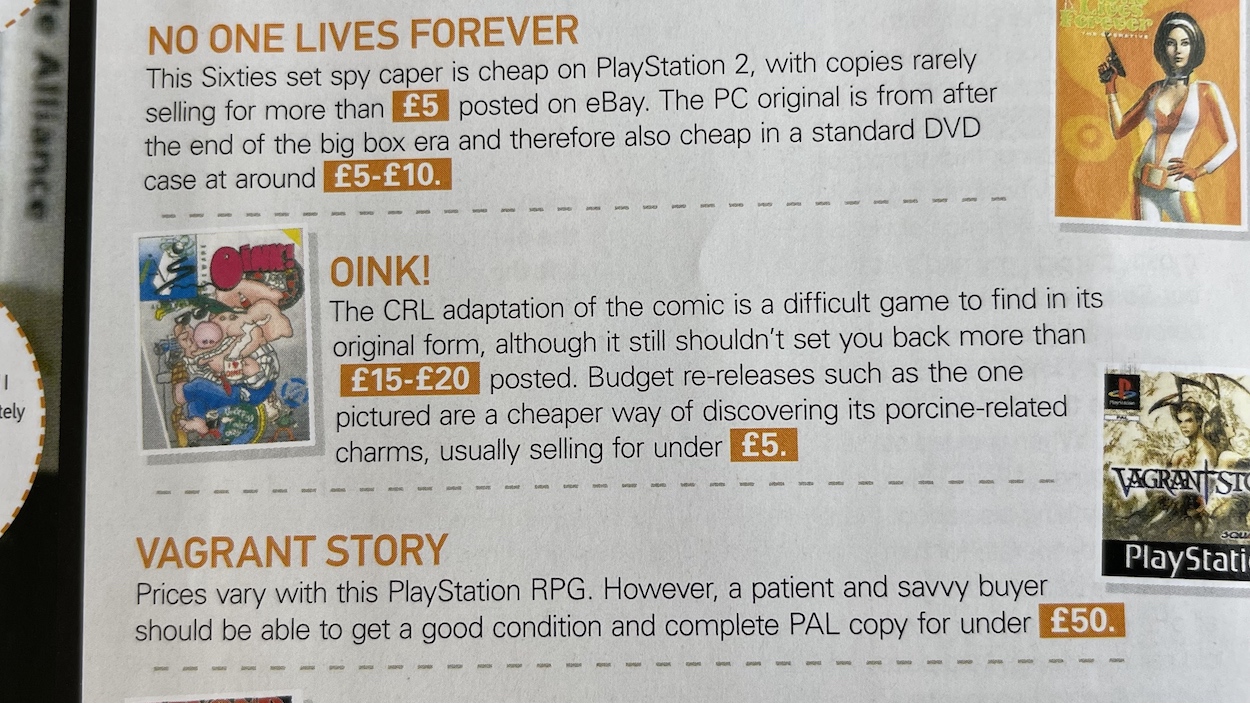
Towards the back of the issue is a list of all the main games covered and the average prices they can go for if you’re interested in picking up the OiNK game on the C64, the ZX Spectrum or Amstrad CPC machines, if you happen to own one. There’s more on the OiNK computer game elsewhere on the blog, including the previews from Crash and Zzap!64, that special edition of OiNK, Zzap!’s review of the game, Your Sinclair’s review as well, a look at when its name was later changed and even some tips for completing it!

THE OiNK! COMPUTER GAME MENU

OiNK MERCHANDiSE MENU

MAiN OiNK MENU

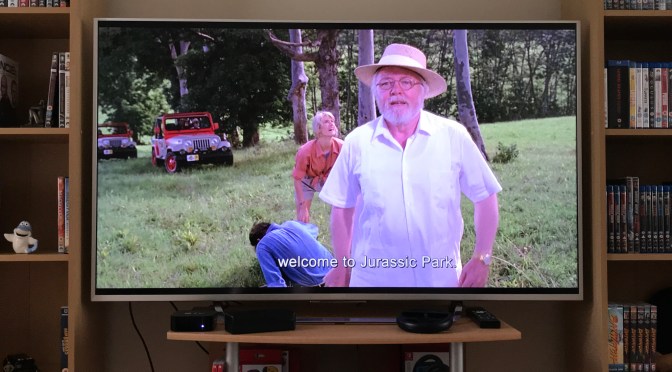
JURASSiC PARK: iN REAL TiME

Back in 1993 something arrived that would forever change cinema. It led the way in its use of CGI and sound production and I’ve memories of being in awe at seeing it on the big screen. I was already a fan of Steven Spielberg thanks to Jaws, Indiana Jones, E.T. The Extra-Terrestrial and many more, but Jurassic Park was unlike anything even that master of the silver screen had created before.

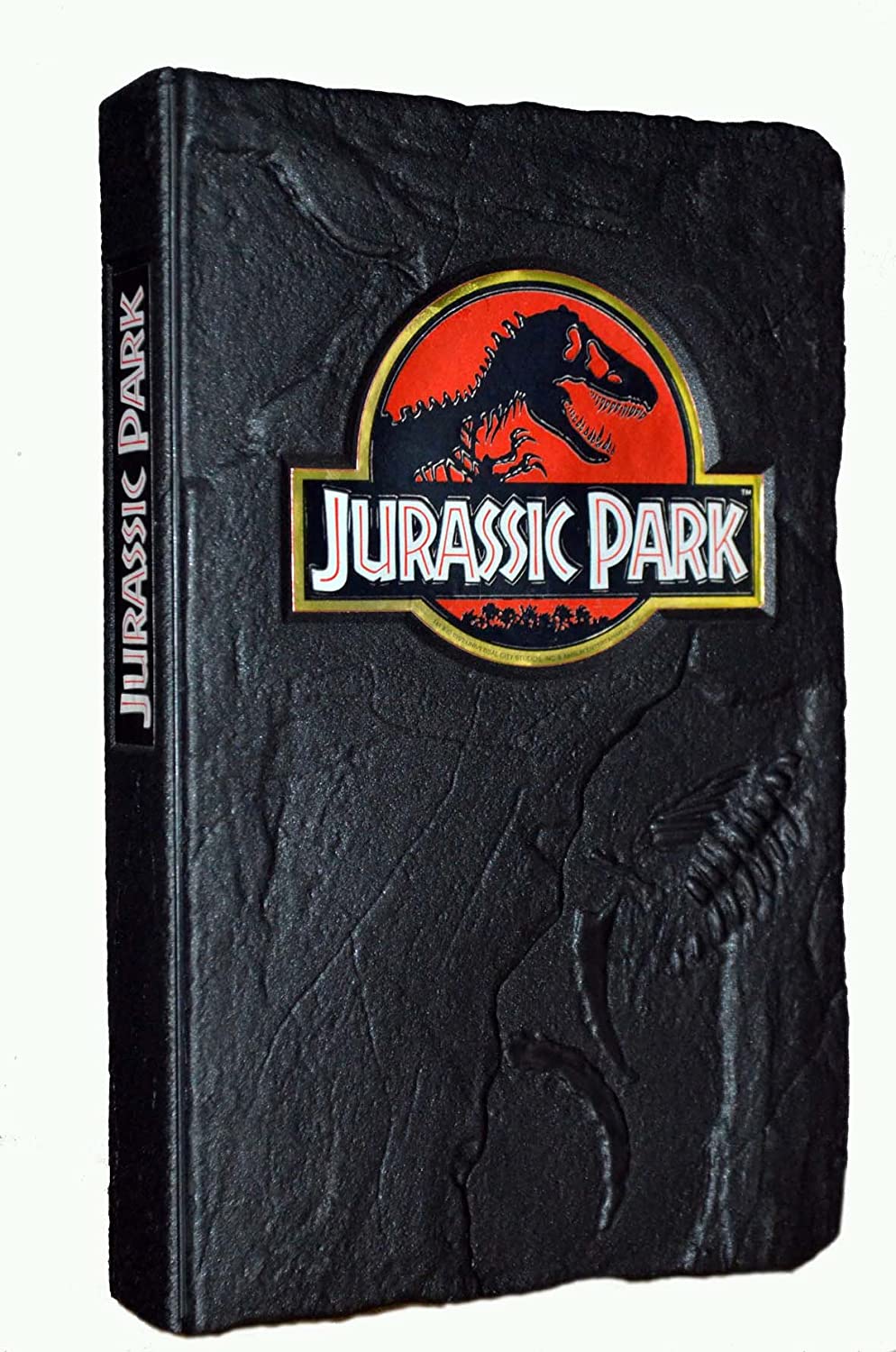
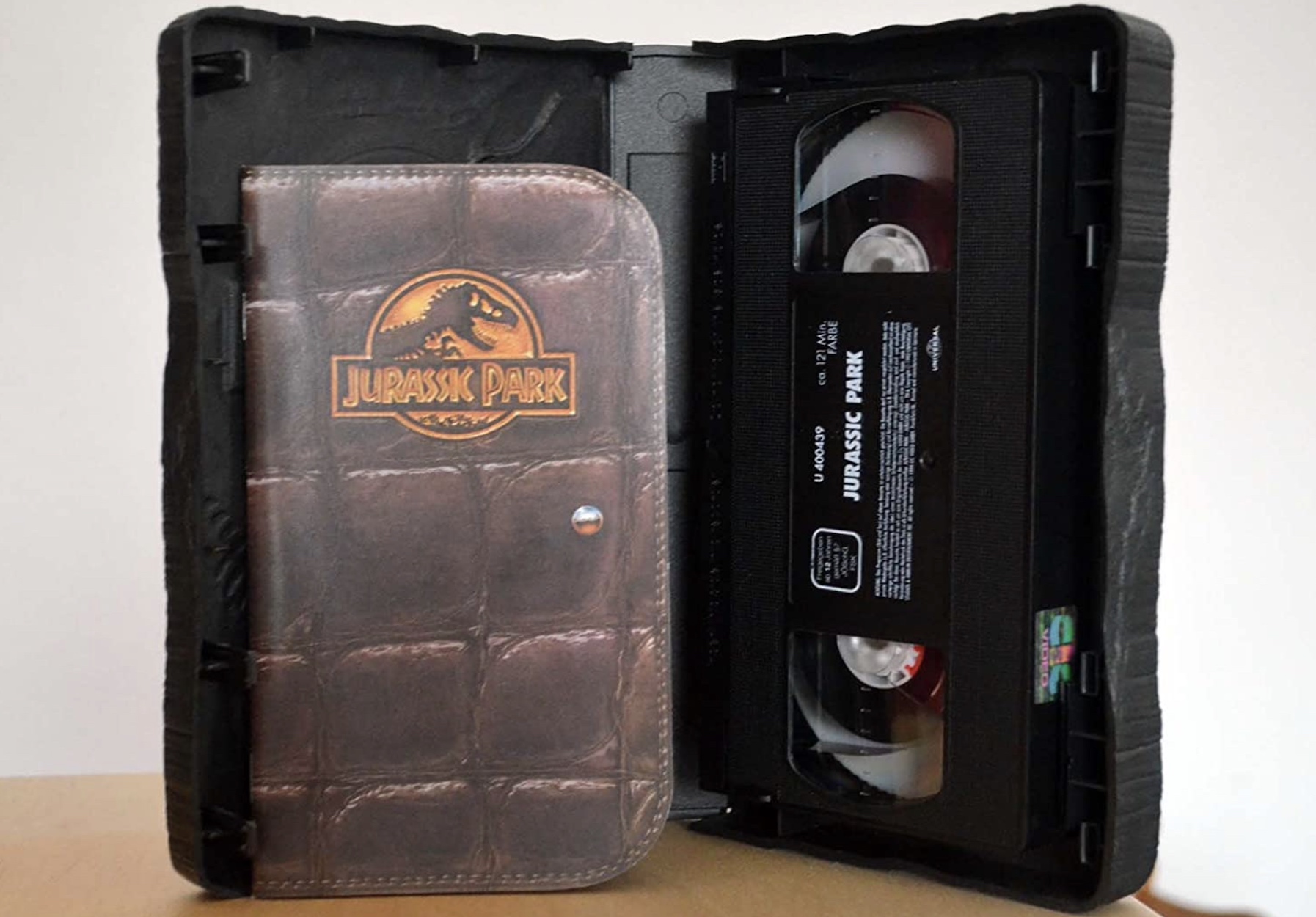
When my dad and I left the cinema I dragged him to a newsagent and bought Michael Crichton‘s novel, devouring it that summer as I awaited the VHS release of the film. I’d never really been interested in dinosaurs but this story’s premise and these characters had entranced me. I’ve particularly fond memories of receiving the video for Christmas in its rather fantastic special edition fossil box too.

Jurassic Park also did something I’d thought impossible. It brought me back to comics. After starting my comics reading with OiNK #14 in 1986 I’d had several years of fun with the medium before I made my way to the world of magazines, specifically Commodore Format for my new obsession, my Commodore 64 home computer.  The last of my comics was Marvel UK‘s Transformers, which had been cancelled in January 1992 and after that I’d felt I’d outgrown comics in general. But 20 months later, during the buildup to Christmas 1993 I would see the errors of my ways.

It reminded me of Transformers, a comic I’d adored for years. It was too good to pass up!

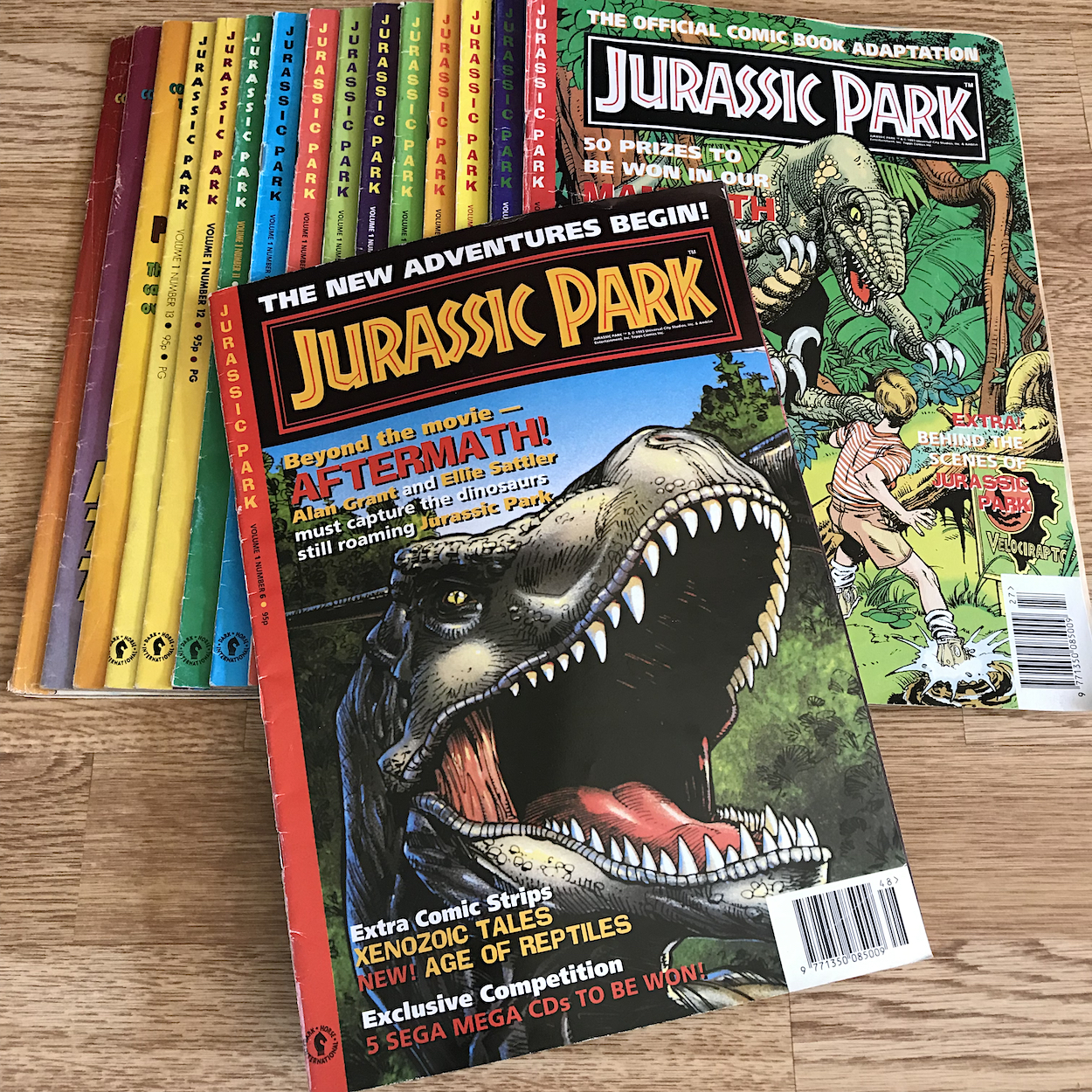
A few months previous to this I’d seen an issue of a Jurassic Park comic in a newsagents somewhere and noticed it was an adaptation of the film. I’d been disappointed with previous comics adaptations of movies (The Transformers: The Movie, Teenage Mutant Ninja Turtles) so I decided not to buy it and that was that. However, when visiting my local shop to pick up my latest Commodore Format before Christmas that year this bold logo really stood out and I spotted the banner along the top! “New Adventures”? I picked it up from behind the other titles on the shelf and was greeted with a fantastic cover.

One look inside only excited me further. Not only did it contain the official (at the time) continuation of the movie’s story, it also contained other non-Jurassic Park back up strips, tied in to the overall dinosaurs subject. It reminded me of Transformers, a comic I’d adored for years. To have the same formula applied to a new title based on my new favourite thing was just too good to pass up!

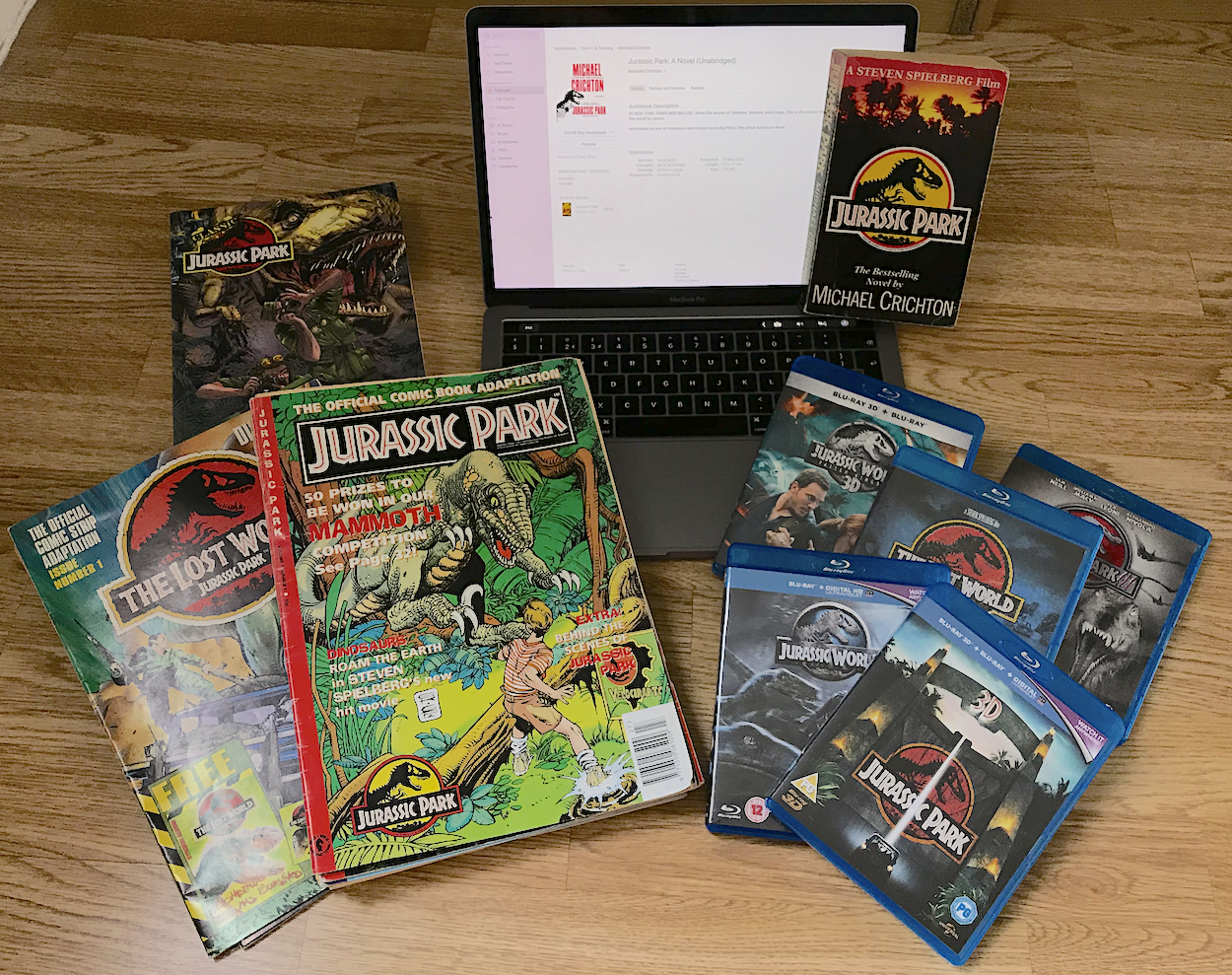
Twenty-eight years later it’s the next comic to get the OiNK Blog treatment. This means I’ll be covering every issue of the UK version of Jurassic Park on their original release dates. Each detailed review will include story details, personal insights and memories from the time, alongside highlights from this seemingly forgotten comic.

While the original Topps Comics strips were reprinted by IDW roughly ten years ago (and sell for ludicrous prices online today) the fact there was a UK version of the comic seems all but forgotten here and completely unknown by fans elsewhere. I was only able to find a couple of blog posts and one YouTube video about these, none of which go into any detail, instead simply proclaiming they’d found a Jurassic Park publication they’d never known existed.

I’m hugely excited to get stuck into this classic series from Dark Horse International again. So join me as we re-enter the park and follow a top comic that proved to be an excellent continuation of a great story, only for it to be cut short when the company behind it just vanished.

Jurassic Park UK #1 comes to the blog on Thursday 8th July 2021.

GO TO iSSUE ONE

JURASSiC PARK MENU