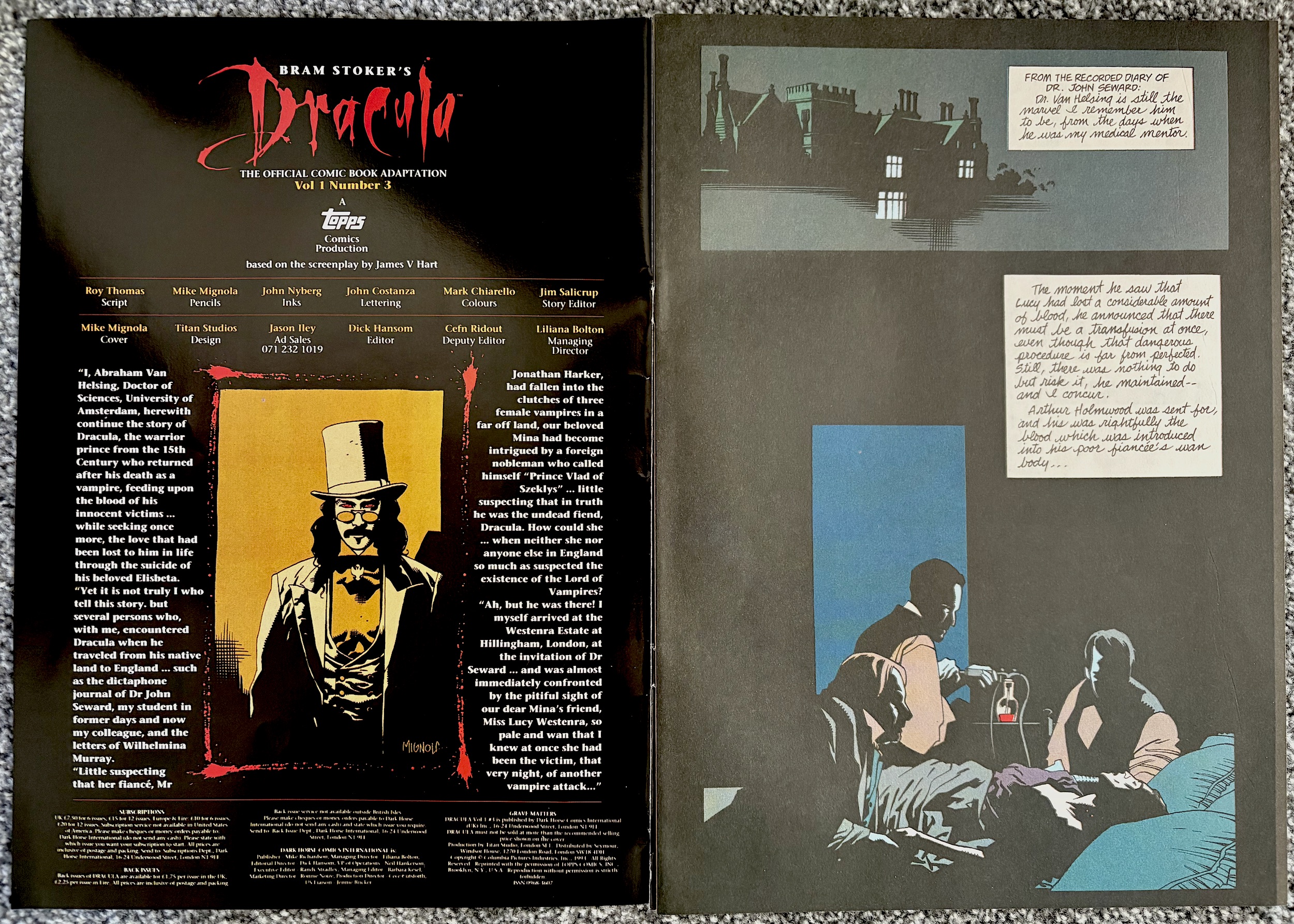
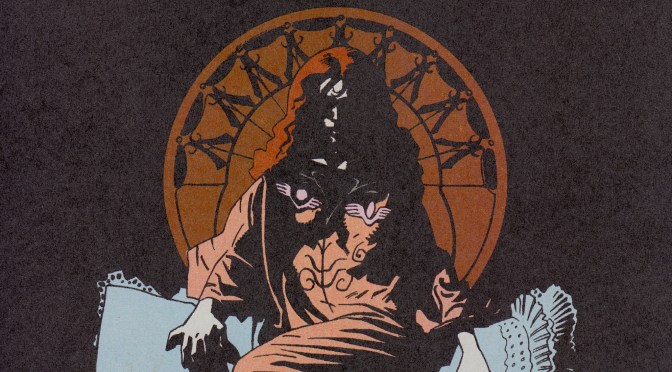
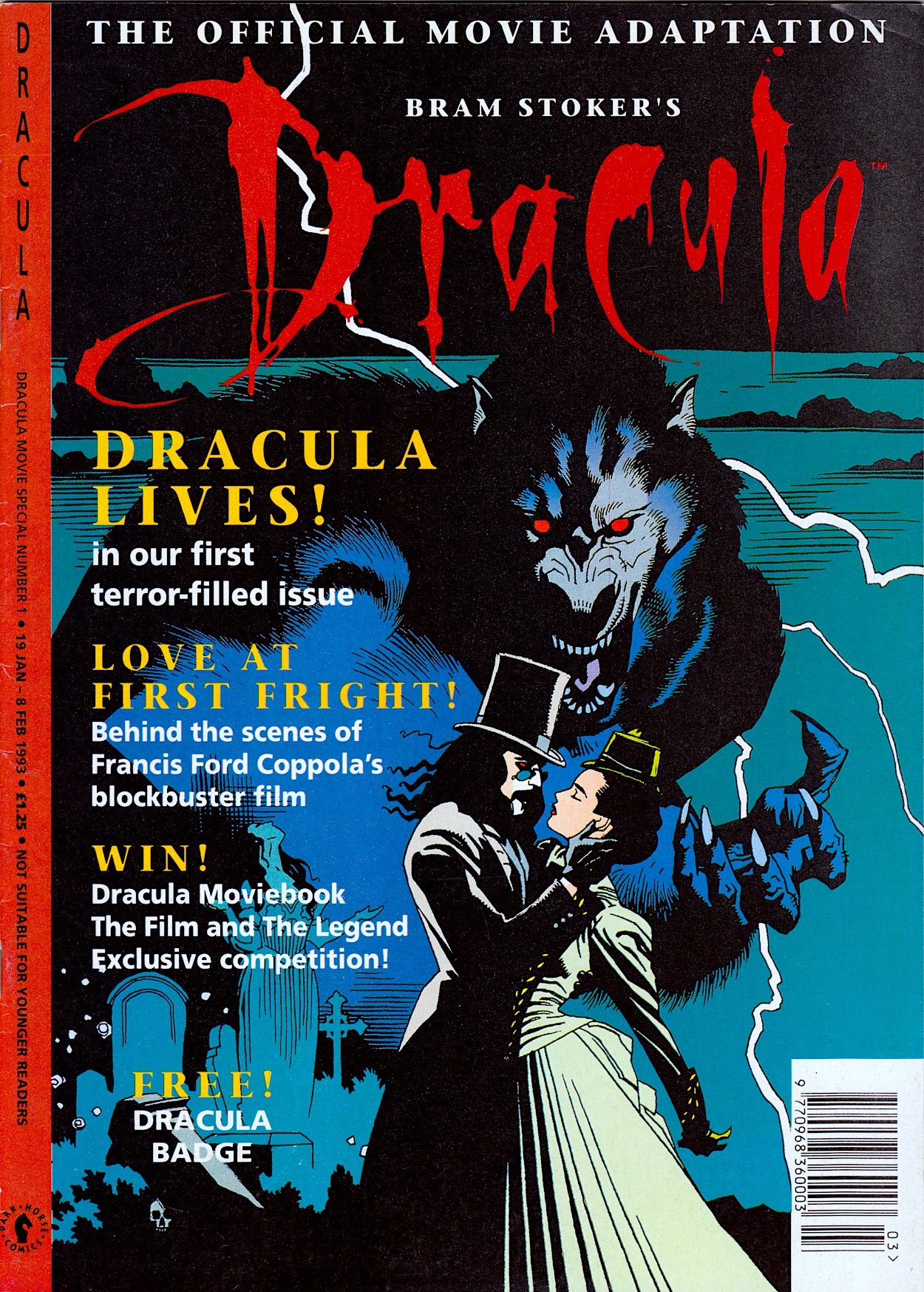
Mike Mignola’s cover may not be as intricately painted as last month’s but through clever used of colour, and the changing of the logo to suit, we’ve another atmospheric introduction to the latest issue of Dark Horse International’s Bram Stoker’s Dracula. This third edition went on sale this day 32 years ago and continues with its regular format for now, with a 28-page chapter of the movie adaptation and four pages of extras bringing up the rear.
I have to say I still love the comic’s editorial page every issue. Written in the style of the Van Helsing character from the film it’s an inventive and fun way to kickstart things every three weeks. It certainly makes the plain contents pages of DHI’s Jurassic Park comic feel like a wasted opportunity. Here, Anthony Hopkins’ voice reminds us who some of the other characters are who’ll be featuring heavily in this issue, an issue with a surprising amount of iconic imagery, which I’ll get to later.
After such a great start in the first two editions, as we get into the meat of the second half of the film it feels like the strip is having to play catch up. It’s racing along, jumping back and forth between scenes after only paying lip service to them. Even as a fan of the film who watches it every Hallowe’en it felt confusing, like it’s been hastily chopped up and squeezed in rather than being properly adapted to another medium.
Don’t get me wrong, thanks to an interview with the writer of The Lost World: Jurassic Park’s adaptation we know how difficult it can be to adapt a movie to comic form and this film in particular couldn’t have been easy! I get that. So please do not see any critiques as being critical of writer Roy Thomas, this must have been a next-to-impossible task, it’s an incredibly visual film and delivers a lot of its thrills through original direction.
There are moments where I’d defy anyone who hasn’t seen the film in a long time to instantly recognise what’s happening. I last saw it only a few of months ago and I still had to reread some pages and look longer at some panels to remember what was meant to be going on. The problem is it’s suddenly trying too hard to follow the film moment-for-moment, instead of adapting it like we know the team is more than capable of from the previous issues .
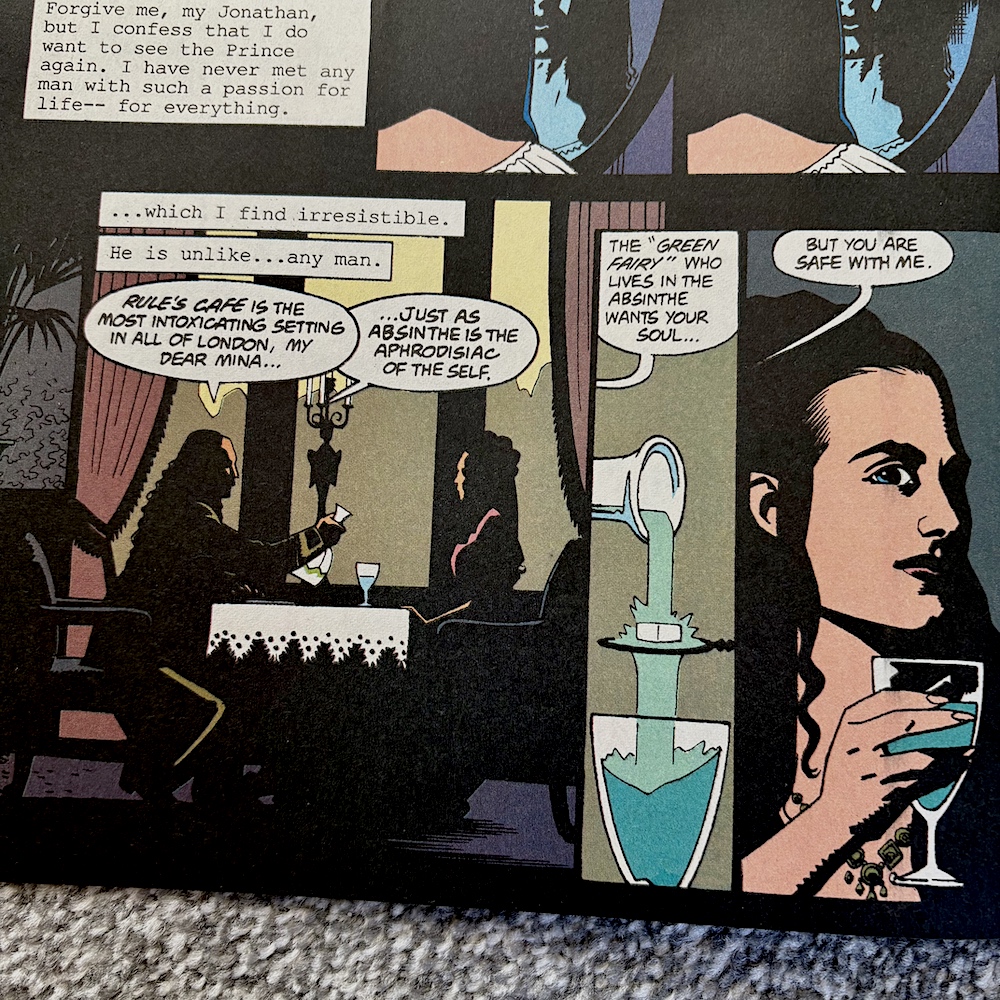
As the film used its quick cuts, speeded up moments and dramatic music we easily followed what was going on while at the same time feeling bombarded and breathless, as intended by Coppola. But trying to do that with still images just isn’t going to work. However, the quieter moments between Dracula and Mina are again the highlight of the issue and highly enjoyable.
Special mention again to letterer John Costanza for the various forms of diary entries. A pattern emerges as I continue to read. The human moments are handled particularly well but the horror elements fall flat and end up confusing. Thankfully, there are some dramatic moments that come from the more chatty human scenes instead of the visual flair of Coppola, and in these instances the comic’s potential shines.
I mentioned iconic imagery, but what do I mean by that? Simply that there were certain images in the film that perfectly captured its intent as a whole. There are also fan favourite moments, as well as scenes which perfectly summed up Francis Ford Coppola’s vision with just a quick snippet.
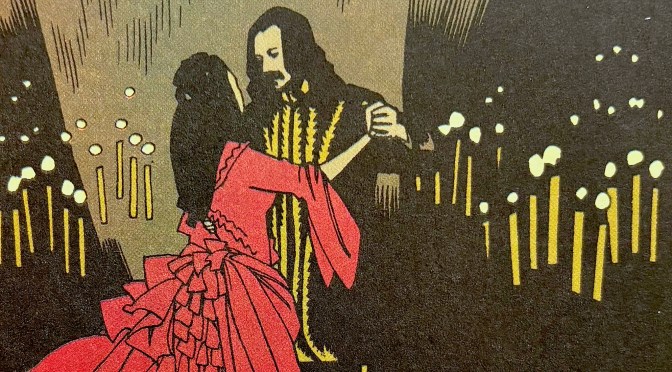
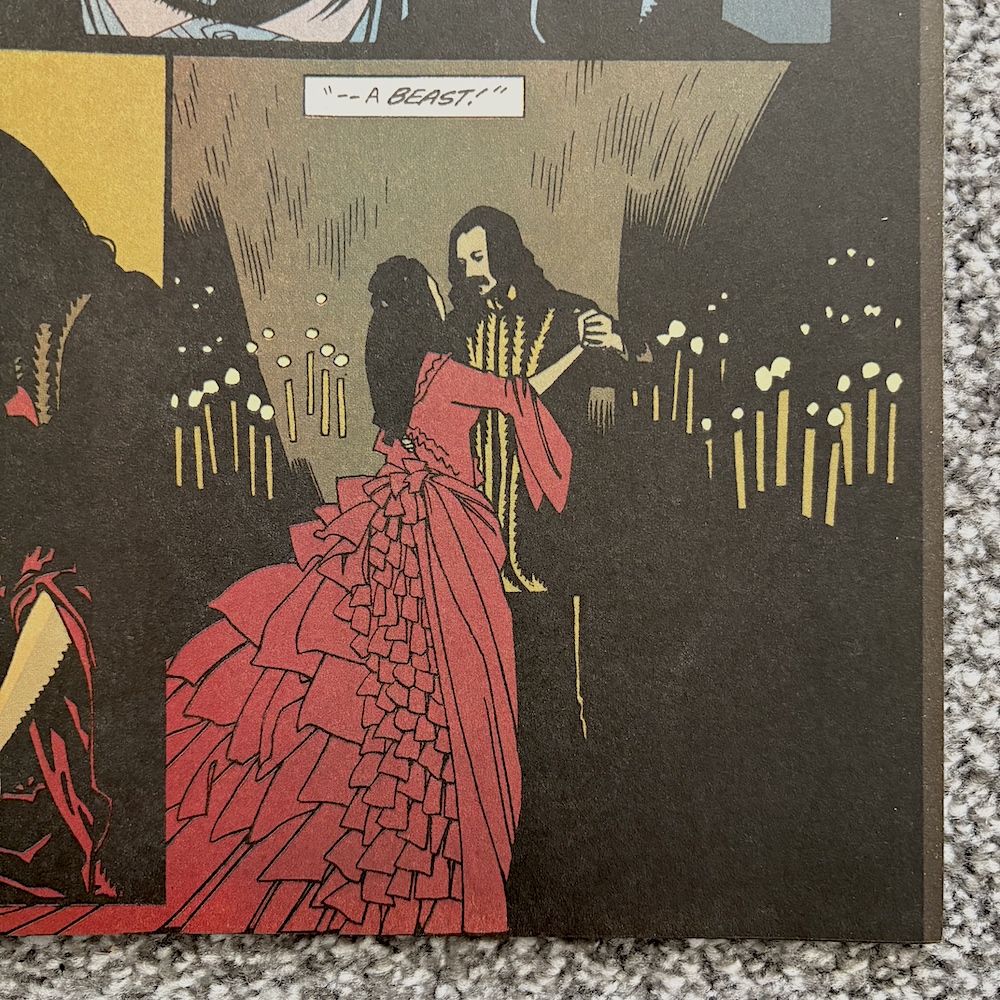
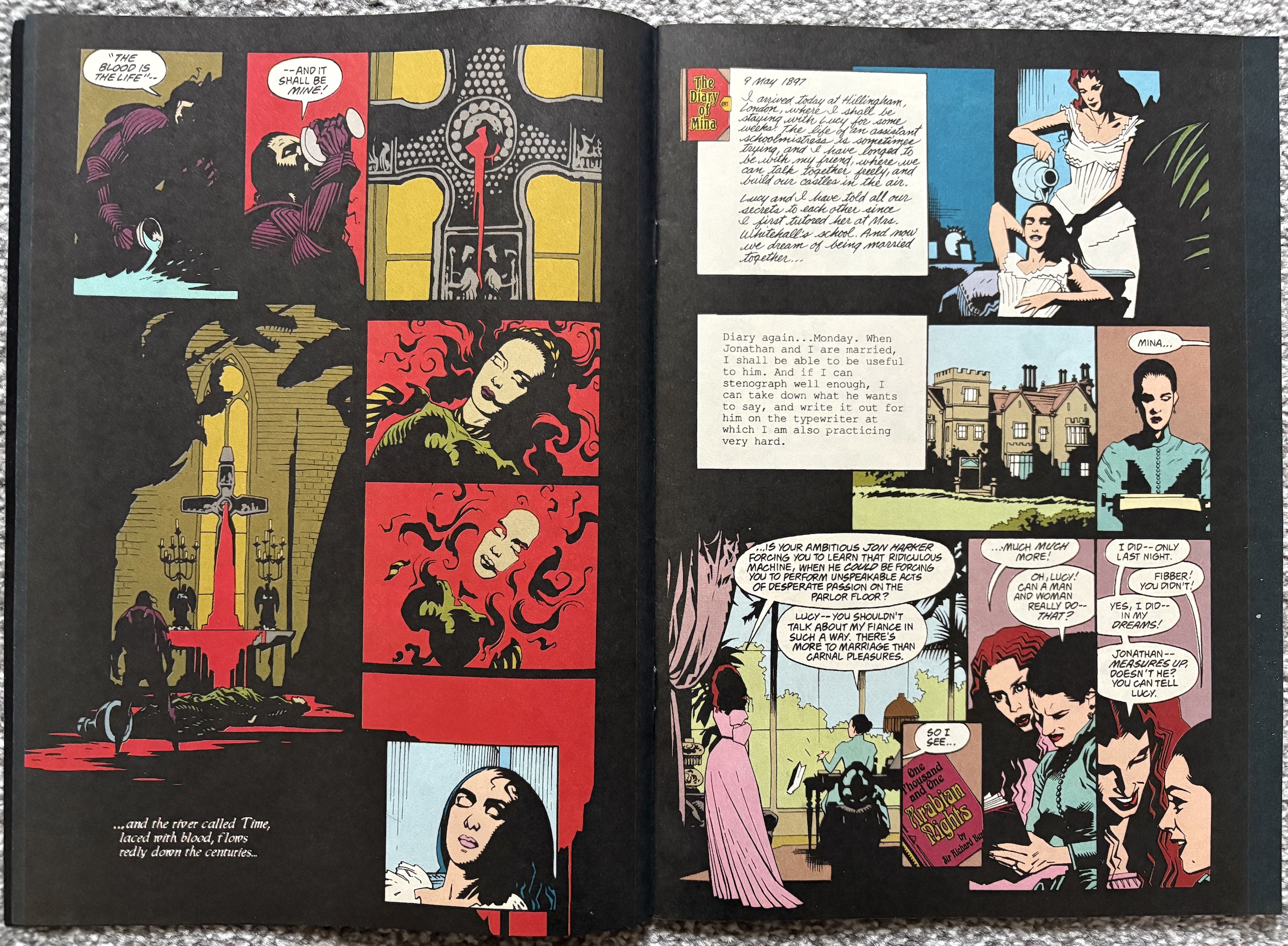
These are largely intact here and the first is that iconic moment when the Prince and Mina dance by candlelight, Winona’s character in that elegant and memorable red dress set against the darkness, perfectly capturing the colour palette of the film and thus encapsulating more than the moment itself. These were moments also used in the marketing at the time and ever since for good reason.
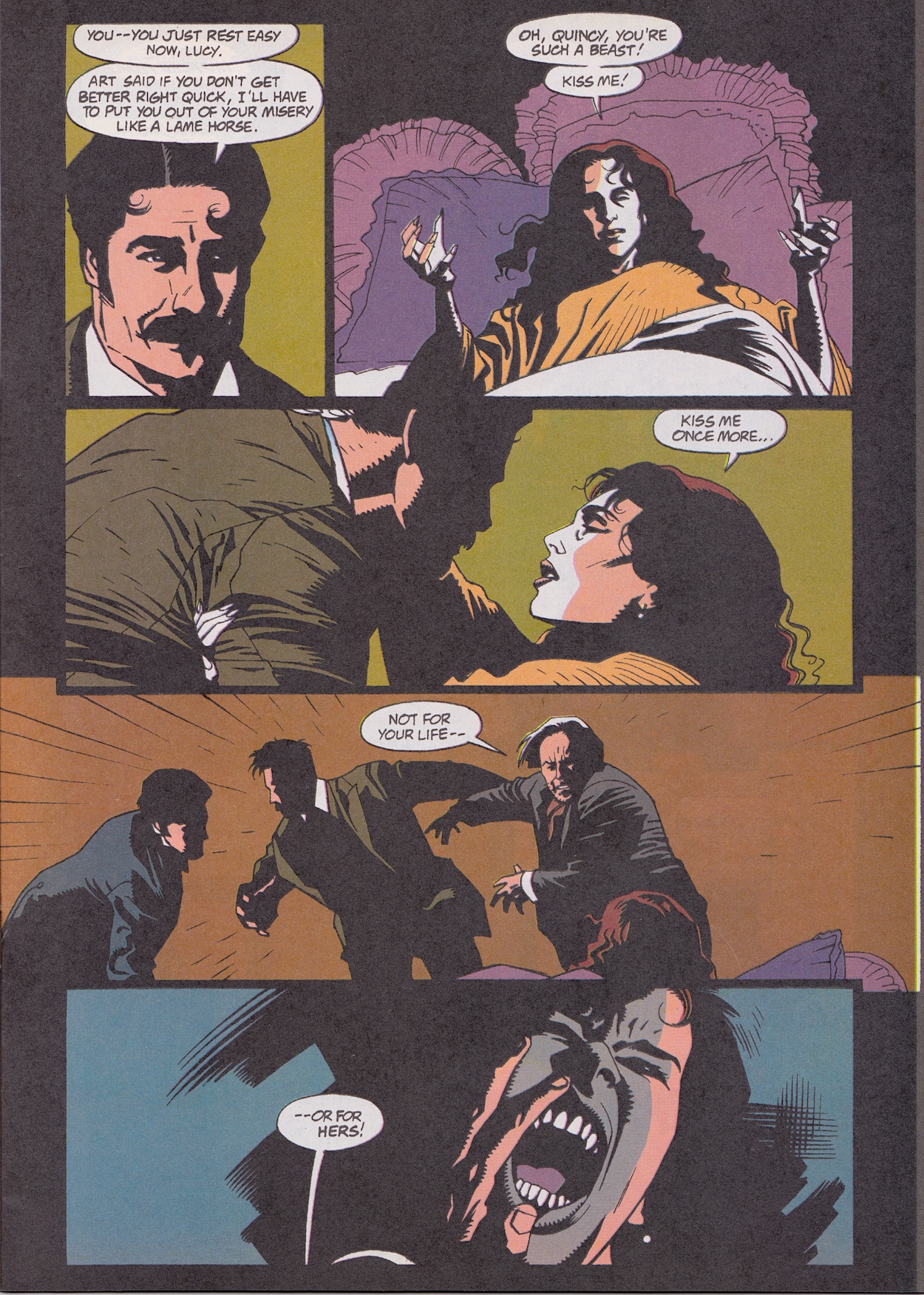
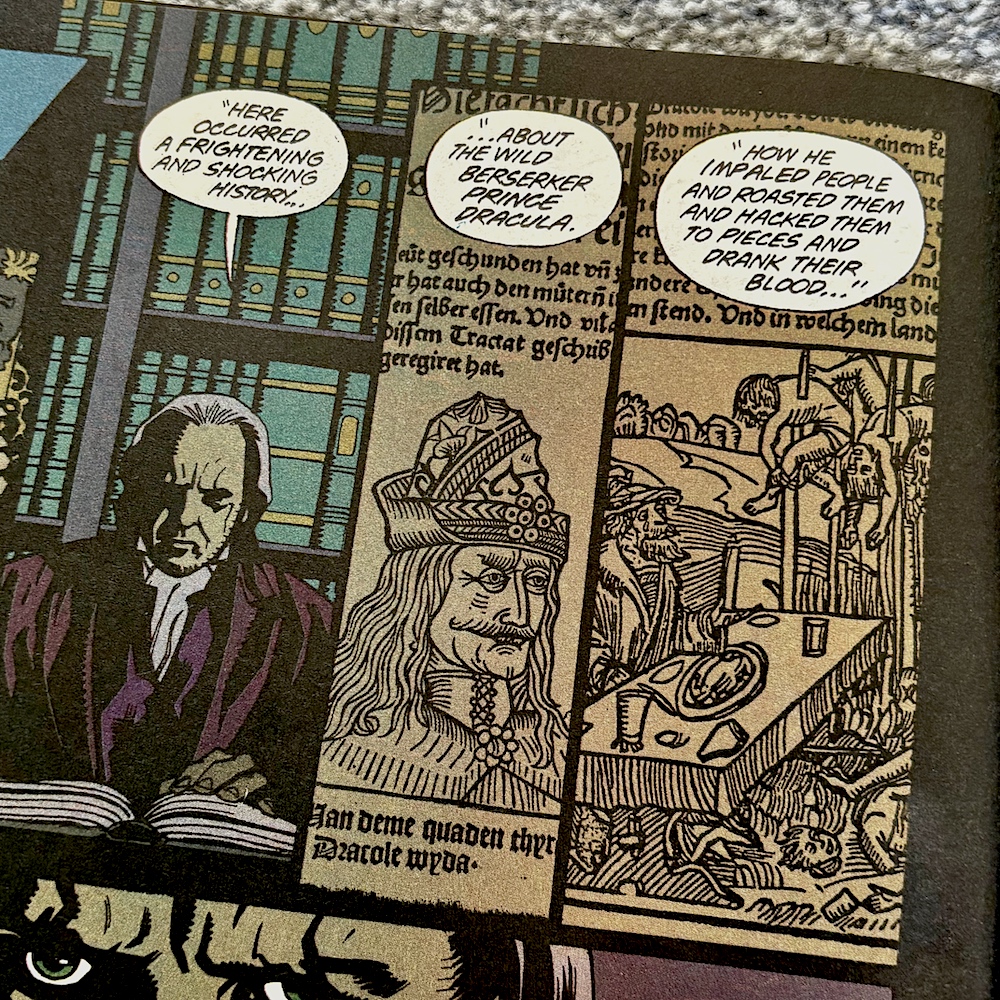
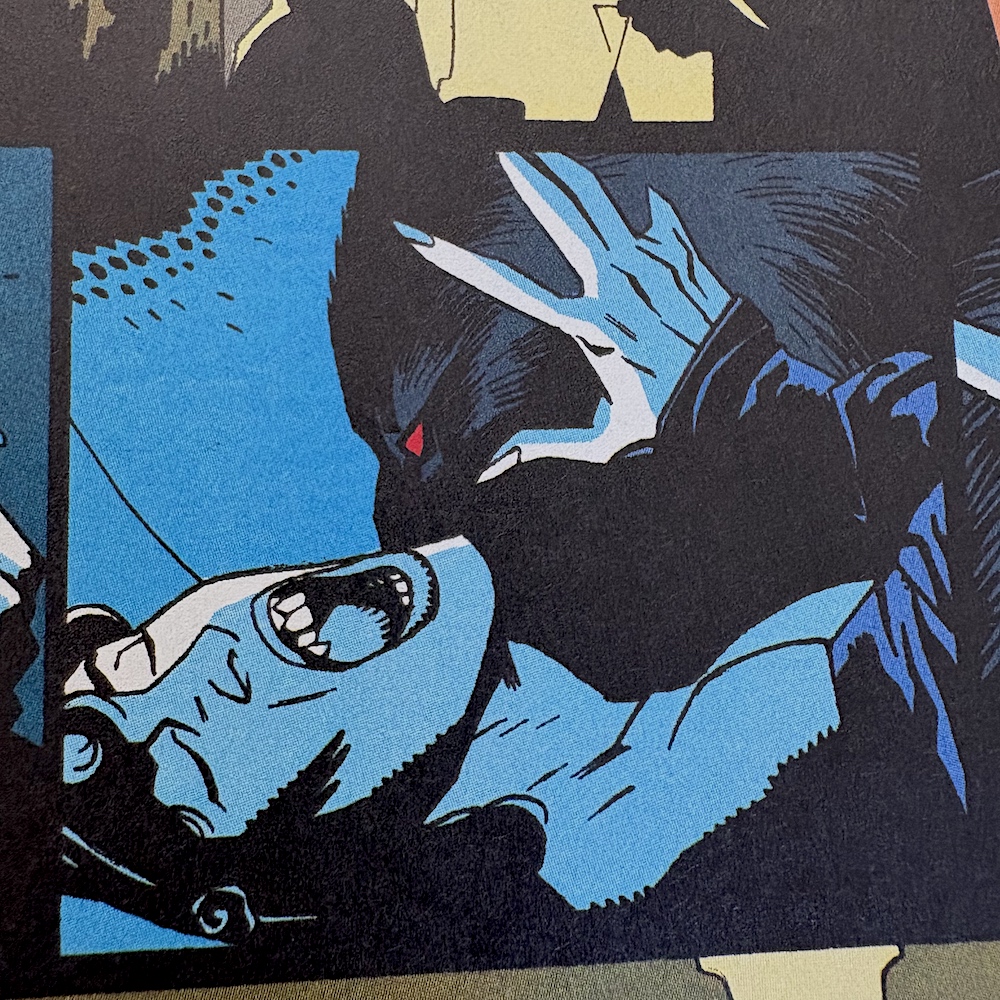
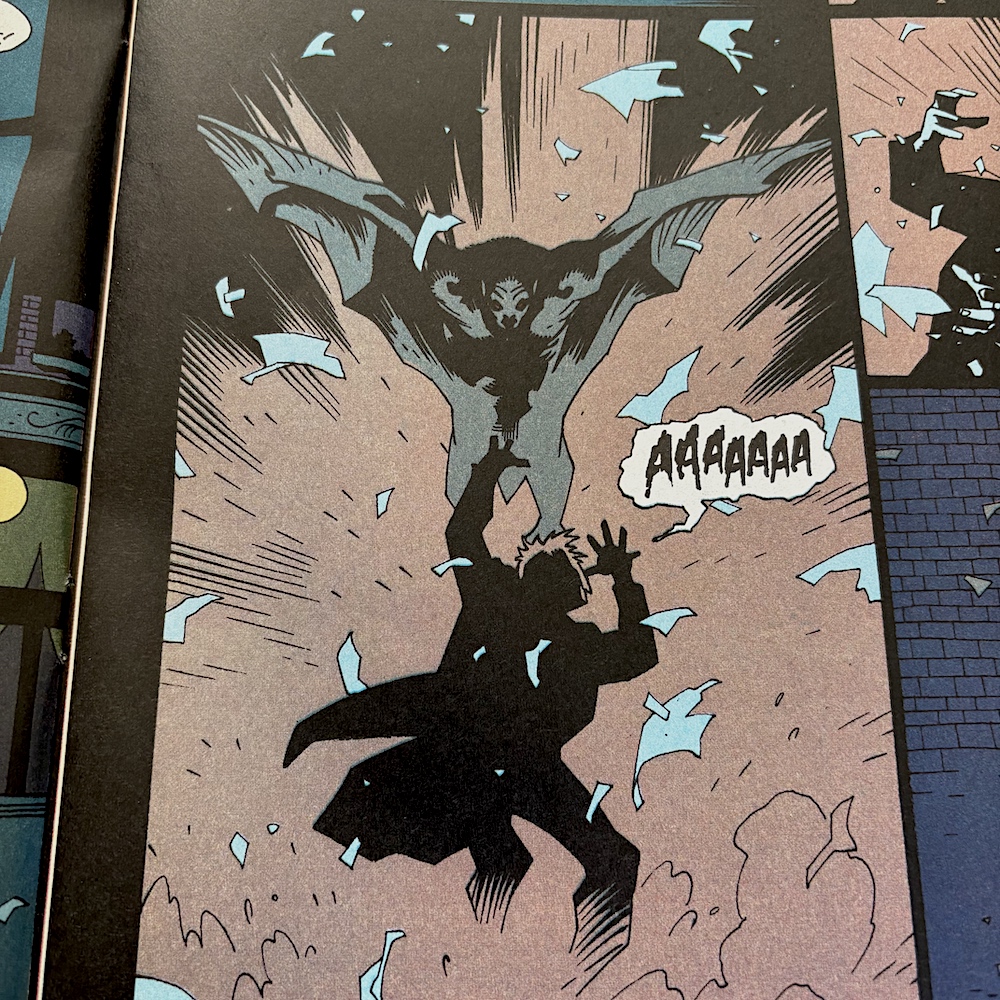
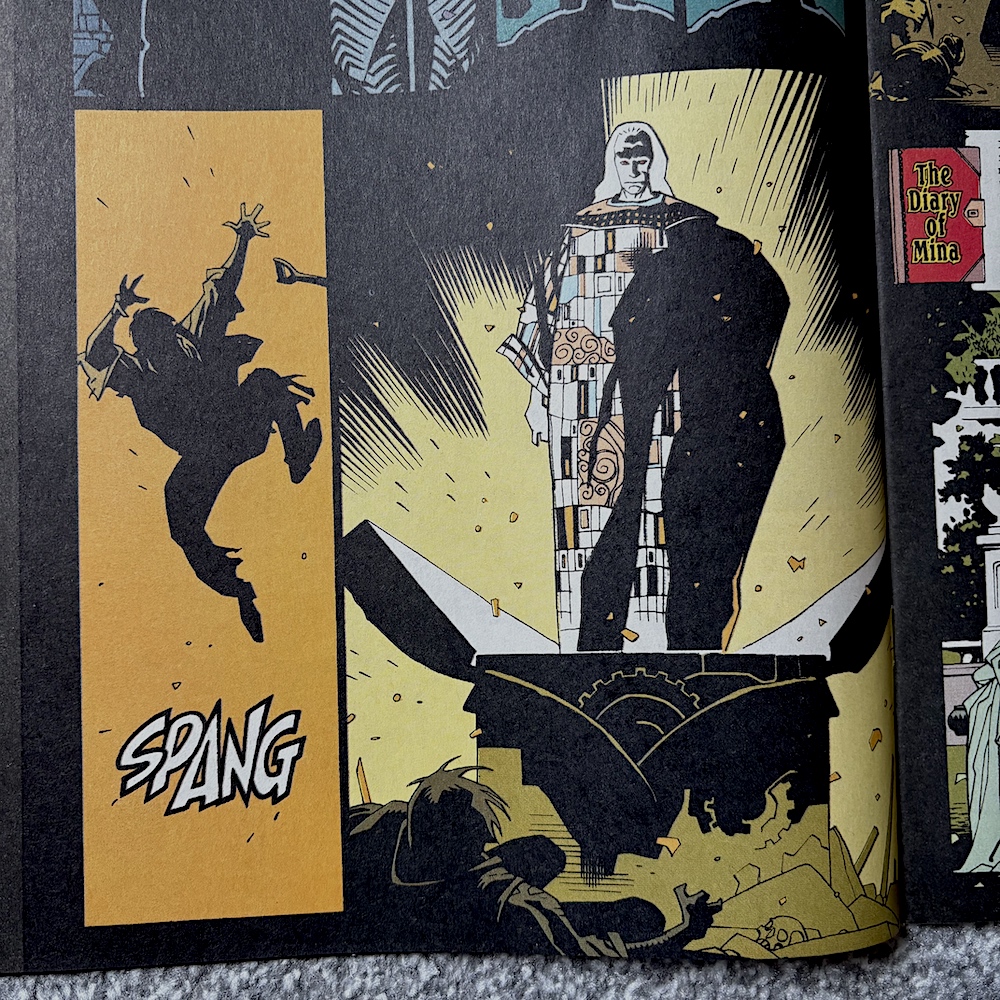
The ancient texts telling the story of Vlad, Sadie Frost’s Lucy character receiving her final bite to transform her and the giant man bat moment that the behind-the-scenes feature below actually talks about. All of these and more are present and correct, and all are brought to the page superbly by penciller Mike, inker John Nyberg and colourist Mark Chiarello.
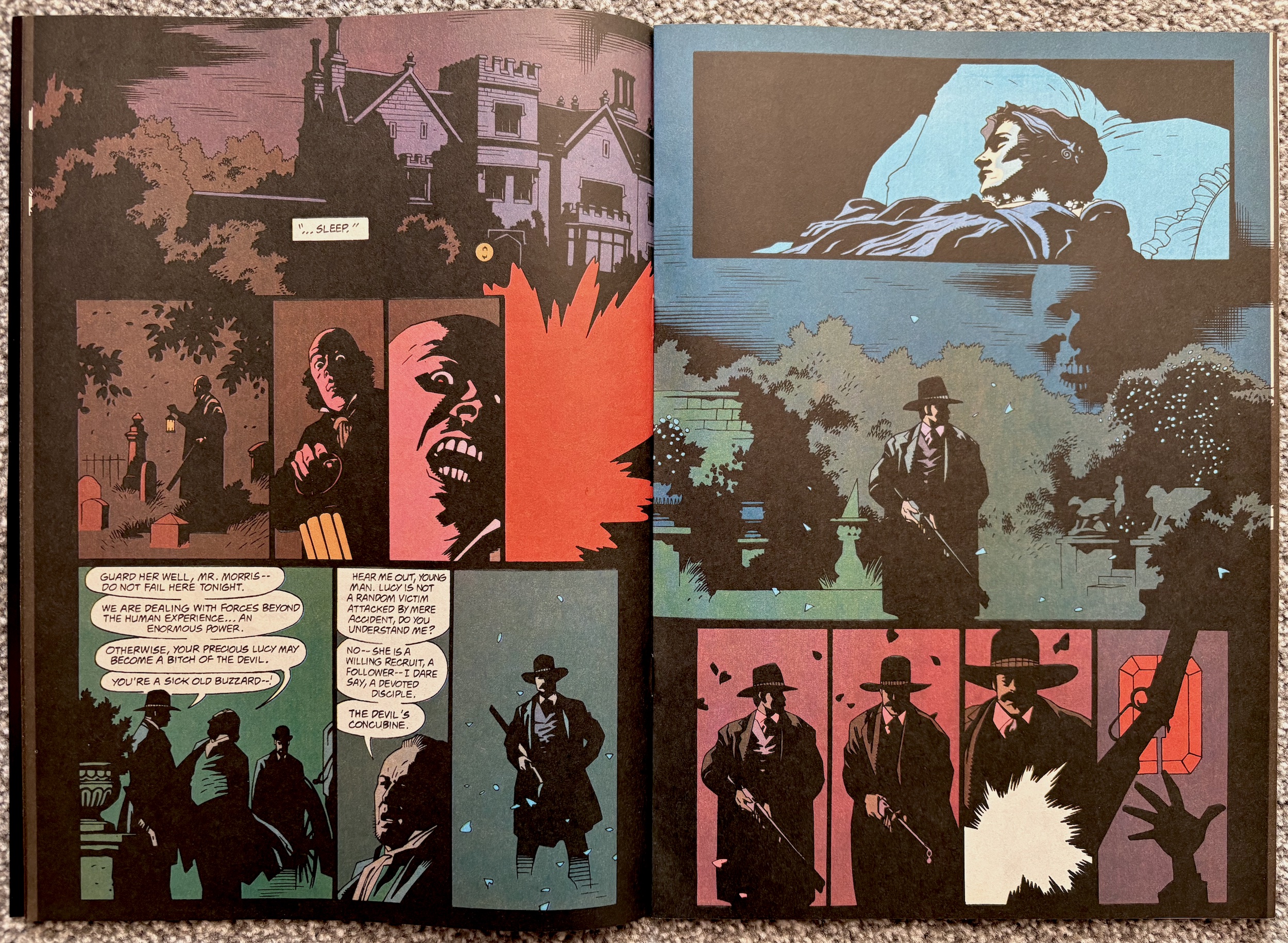
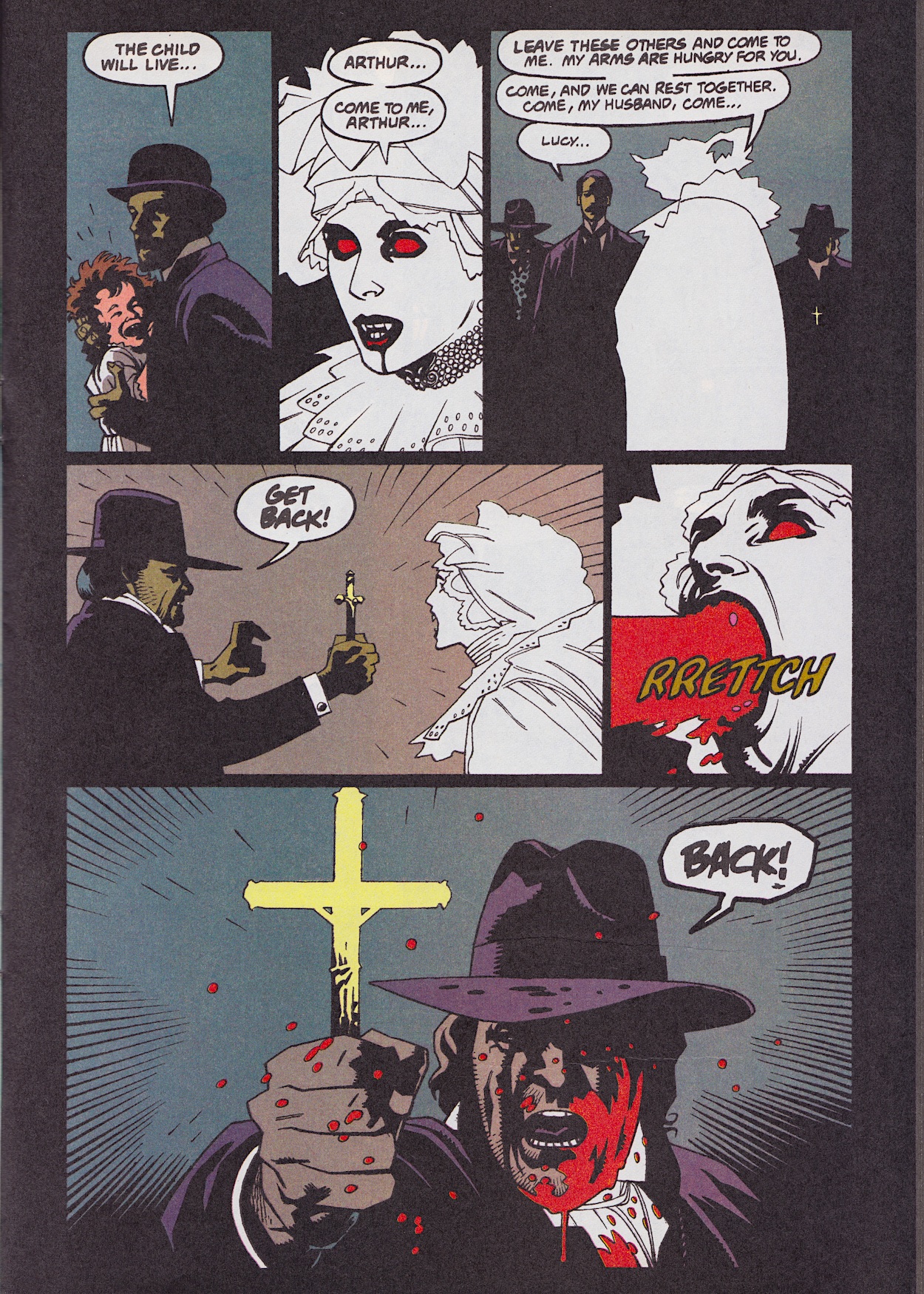
The creepy, terrifying crypt scene involving the now undead Lucy takes up a good chunk of the end of this issue’s chapter and I love Mark’s decision to not use any shading whatsoever when drawing her. As a result she stands out from the page as an ethereal entity, the contrast of the blood feeling all the more gruesome.
Don’t get me wrong, I’m still enjoying this but in a different way than it was intended. Instead of reading it like a normal comic and being drawn into its story it’s like a love letter from the artists to the film. I’ve spoken at length in the previous reviews about how the artists have been able to craft the same atmosphere through a brave, original stylistic choice and it continues here. But you might struggle if you’re hoping the comic can tell the story on its own.
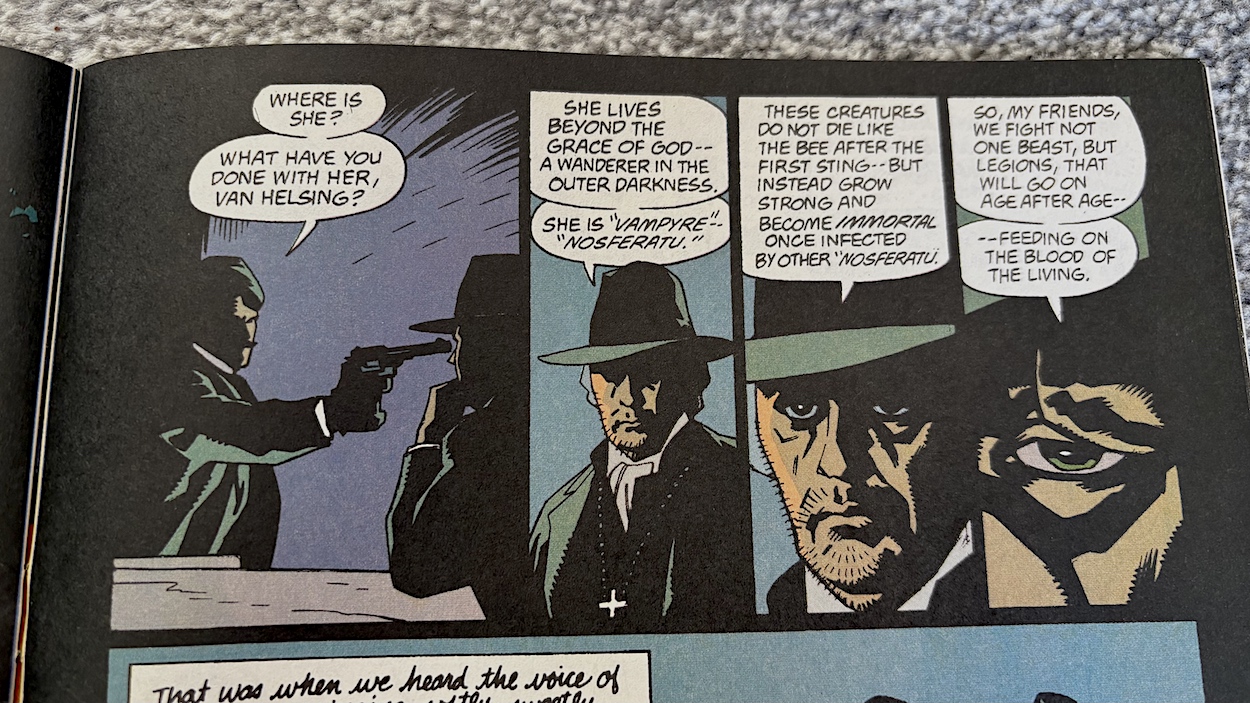
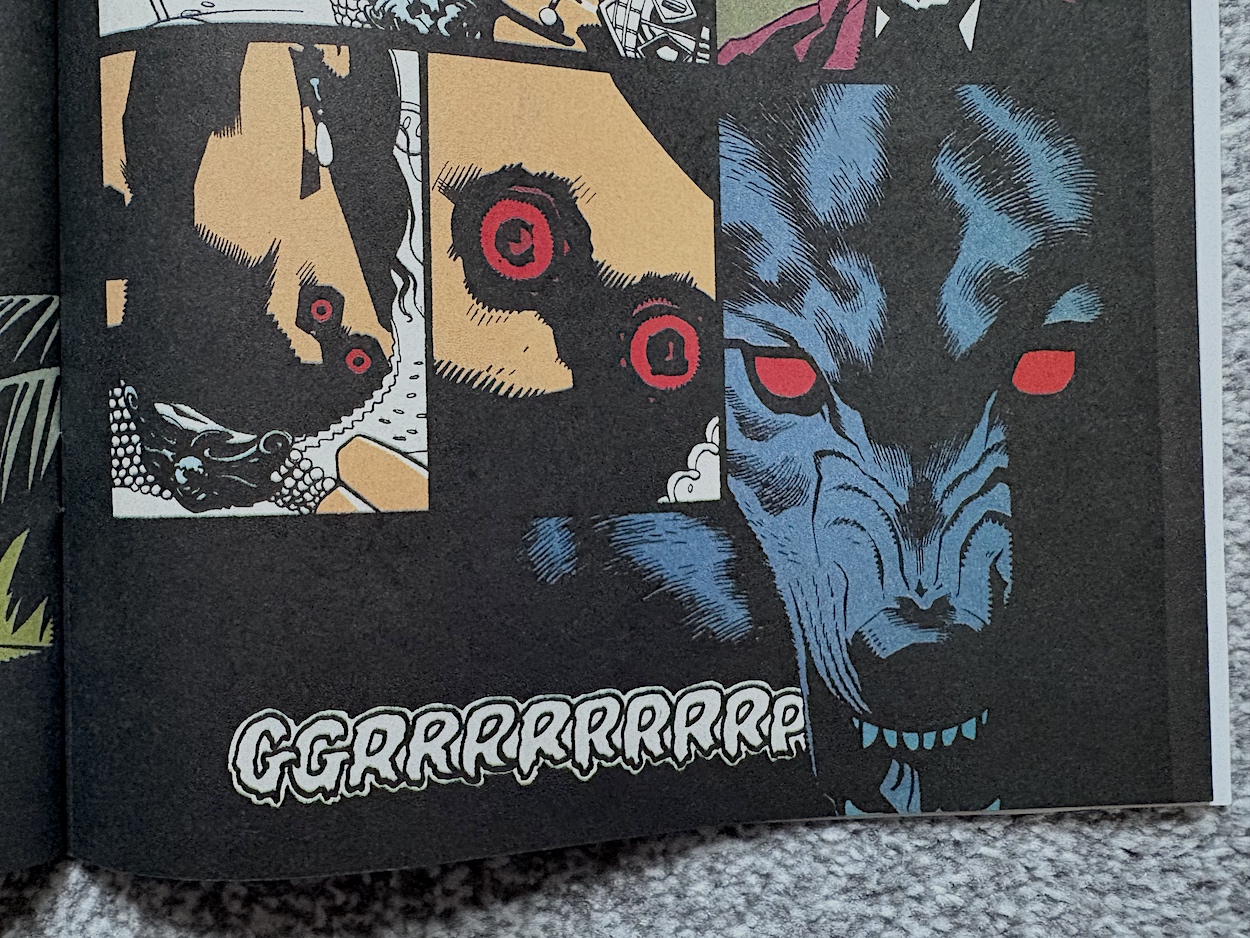
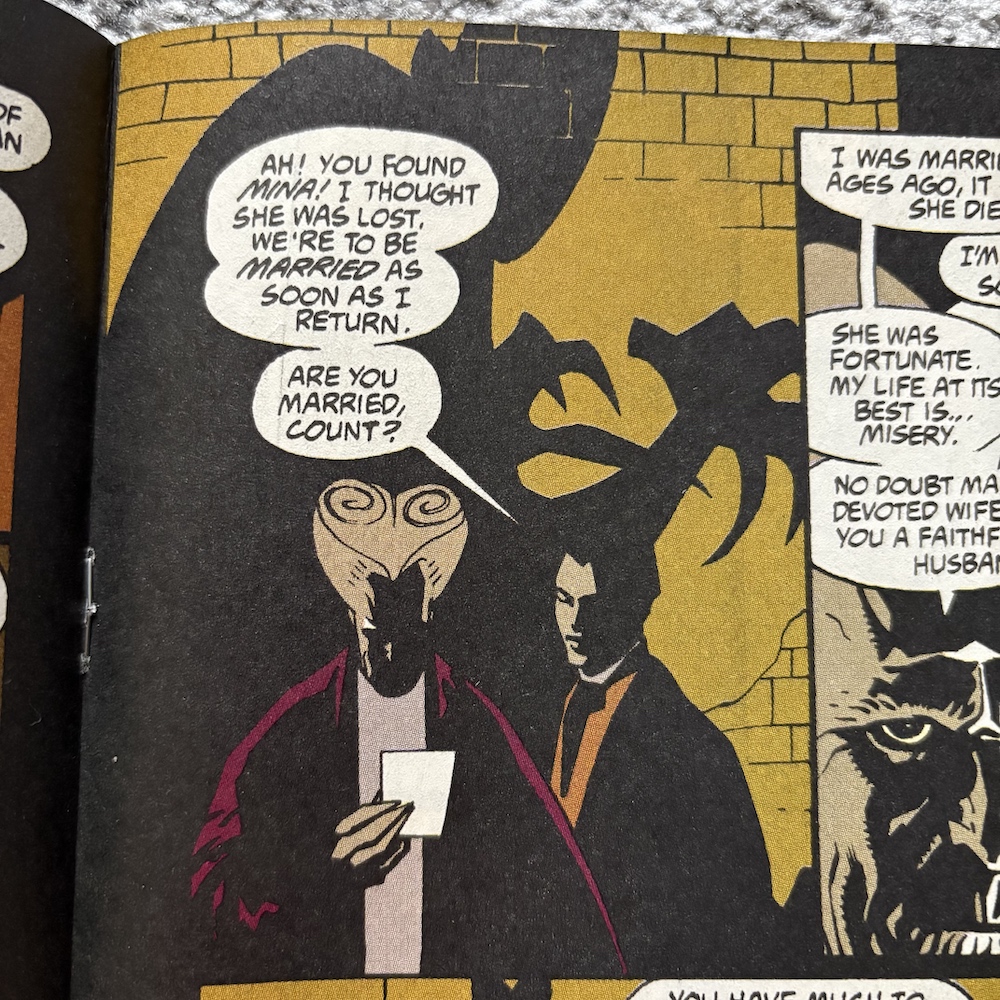
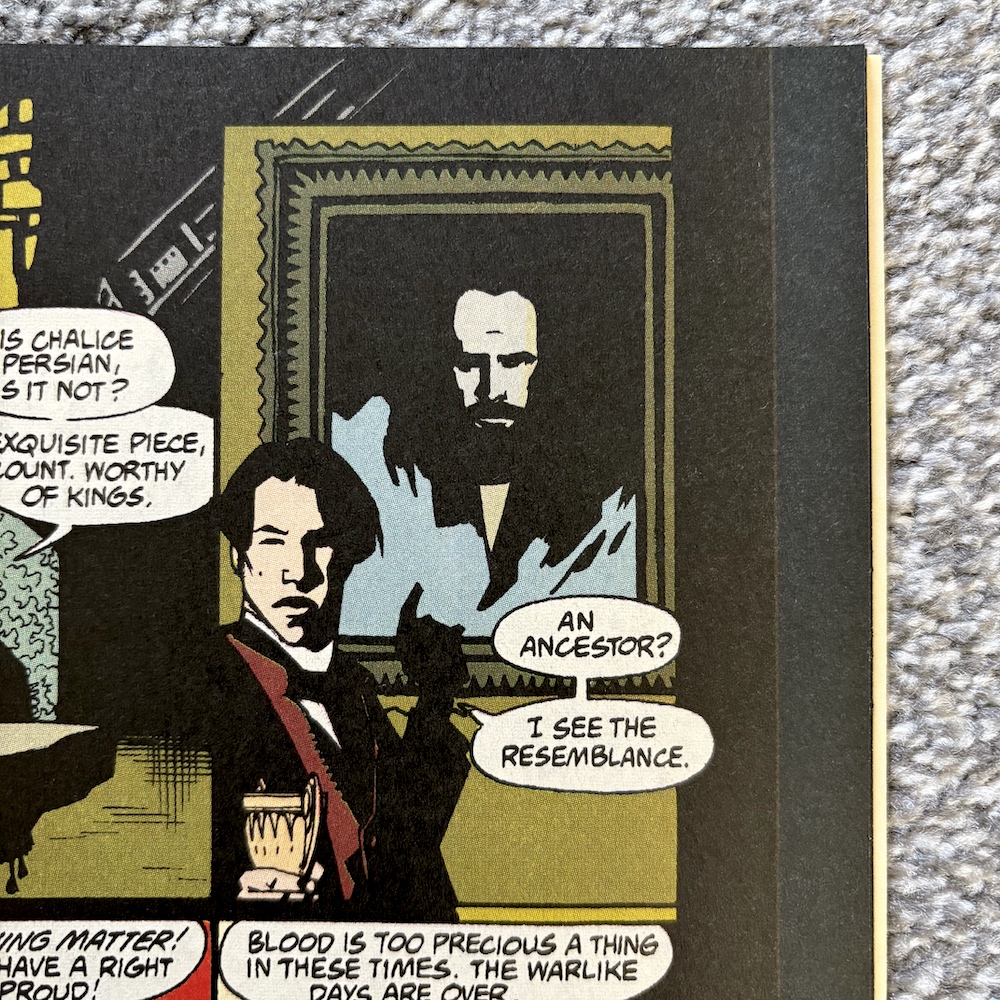
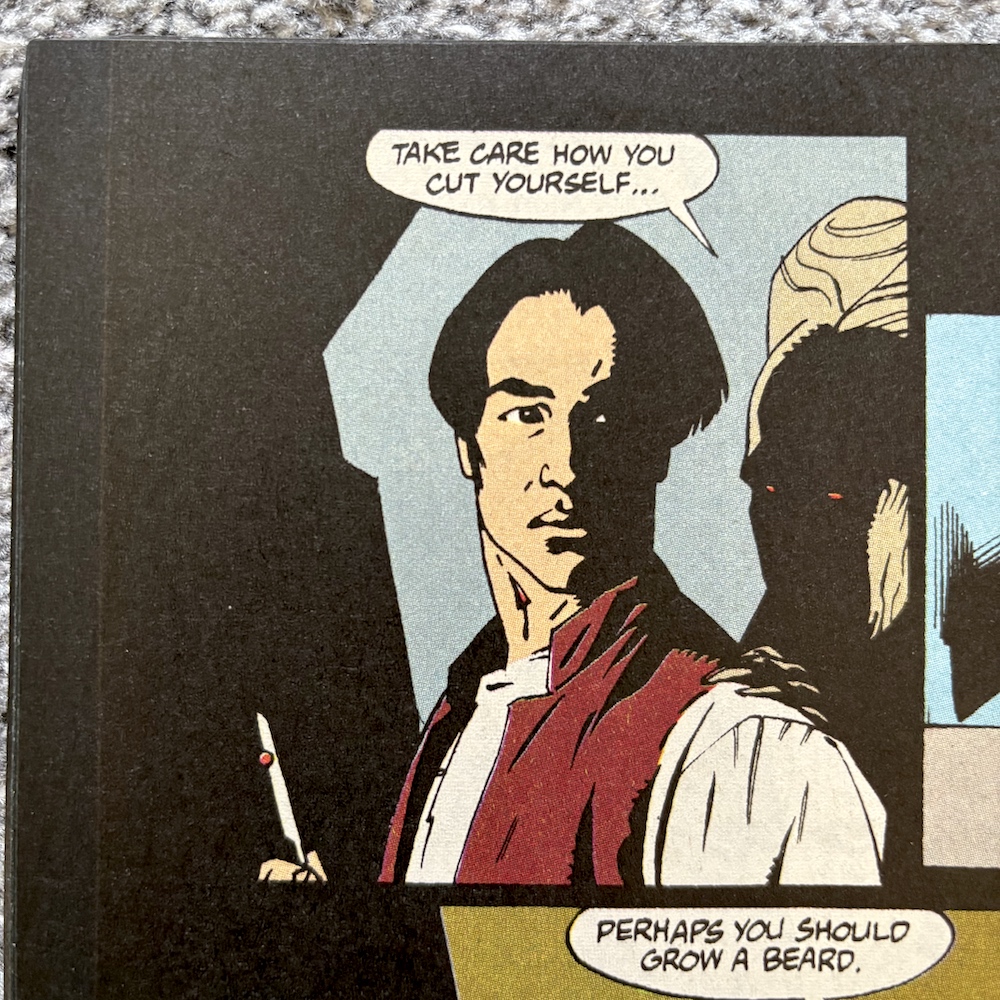
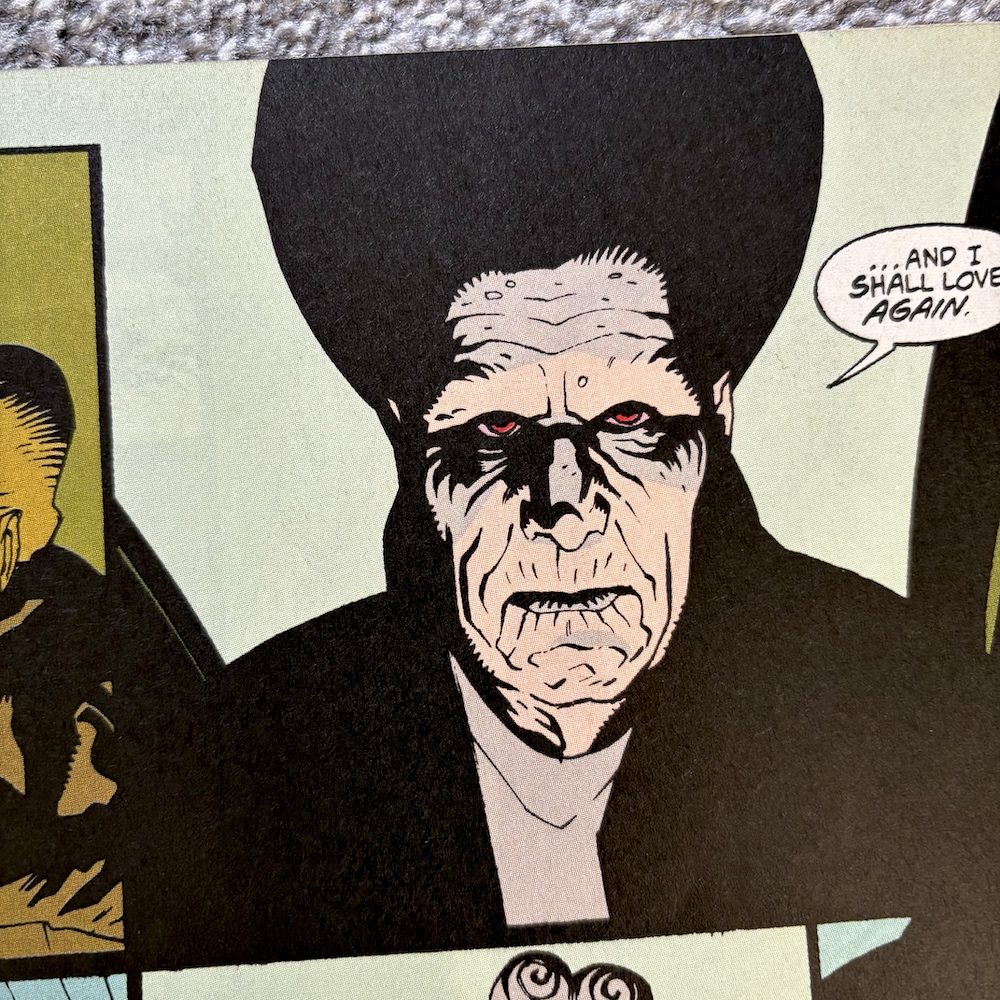
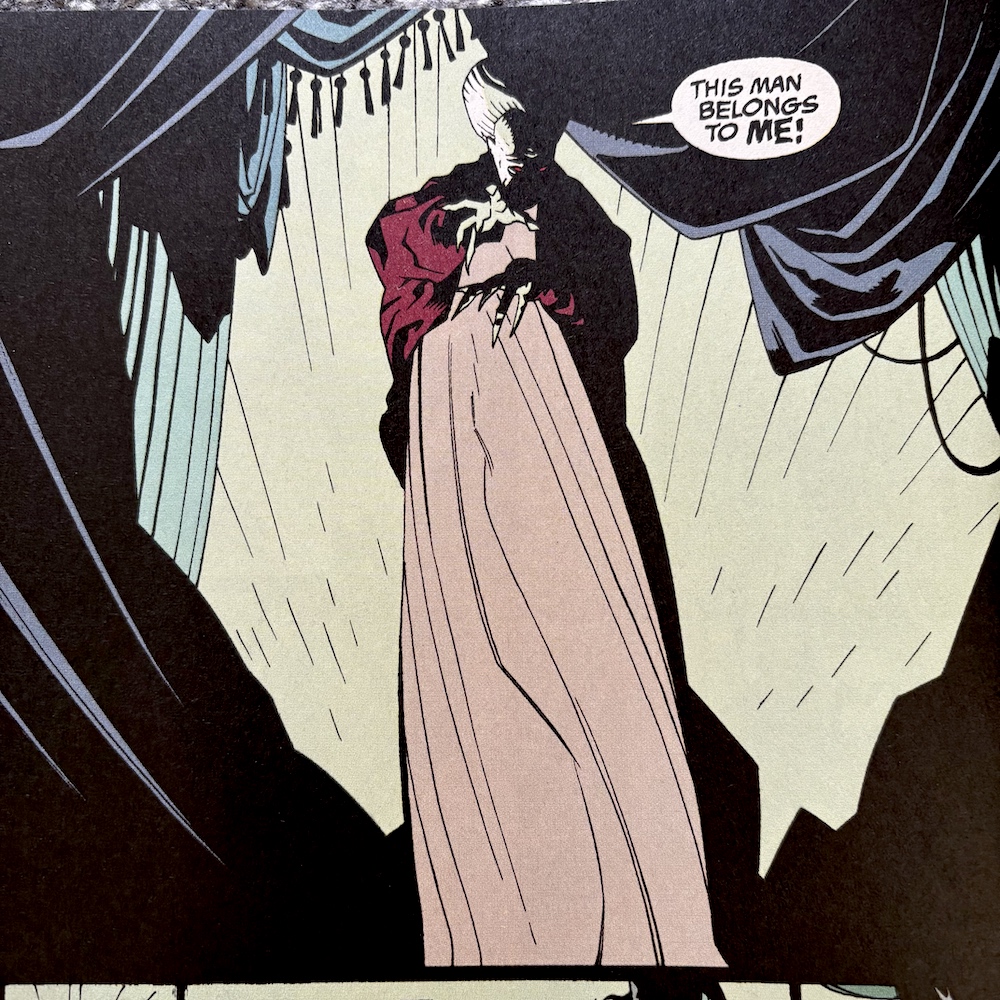
Dracula was released in the UK right at the beginning of 1993 and 32 years later as I began this real time read through a certain other movie was released, coincidentally enough. This timing passed me by until I read these panels below, which are our final highlight of the issue’s strip.
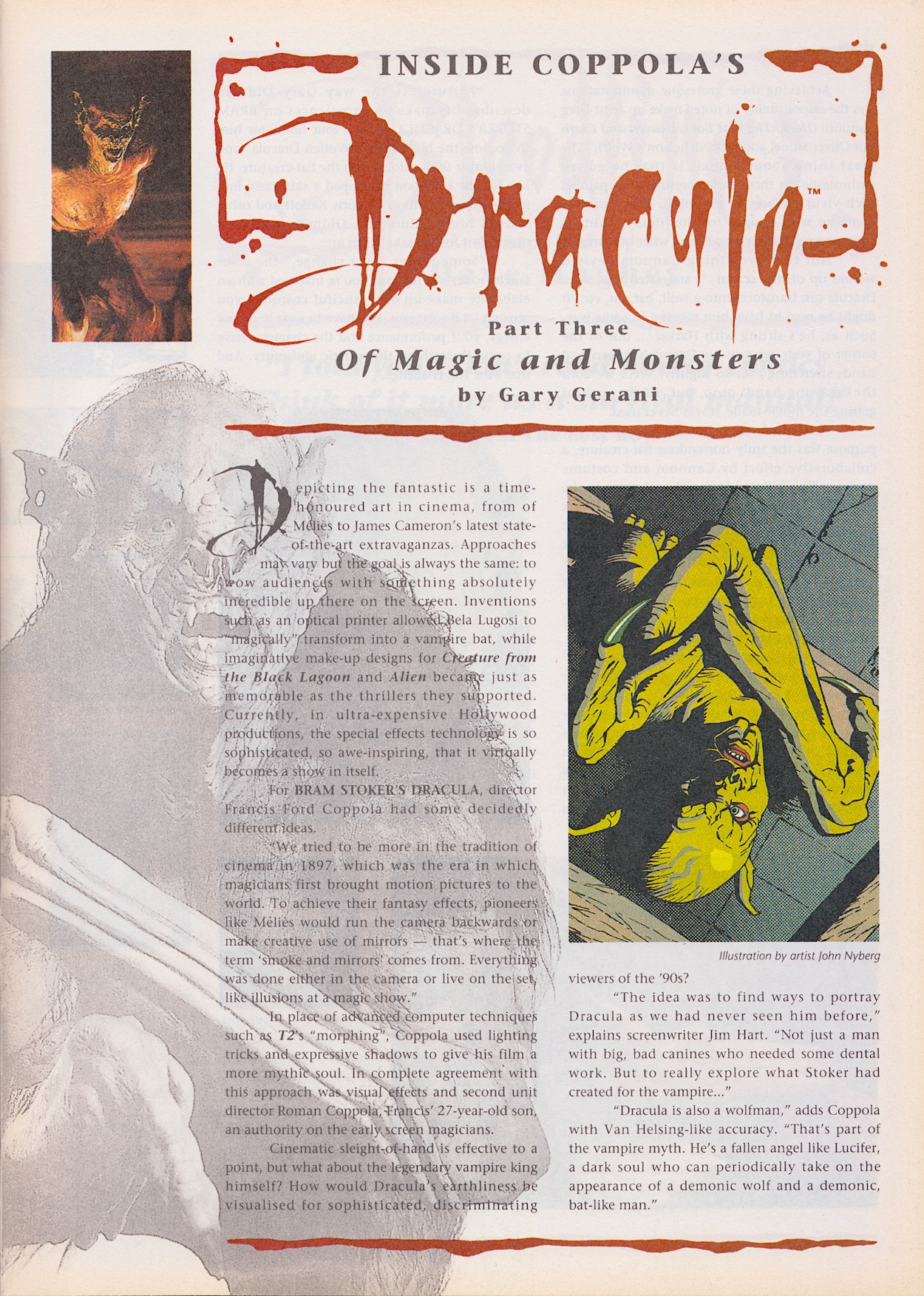
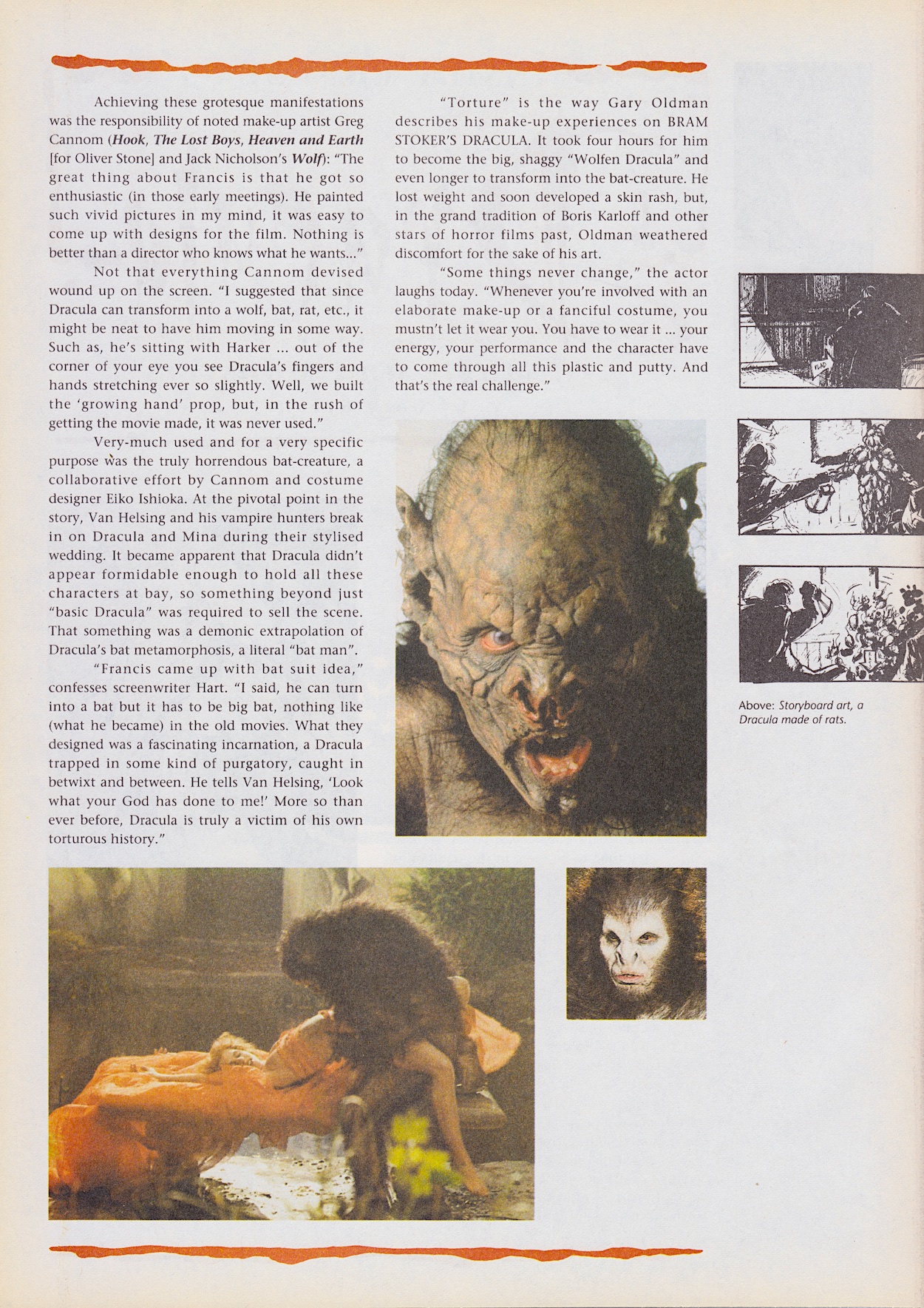
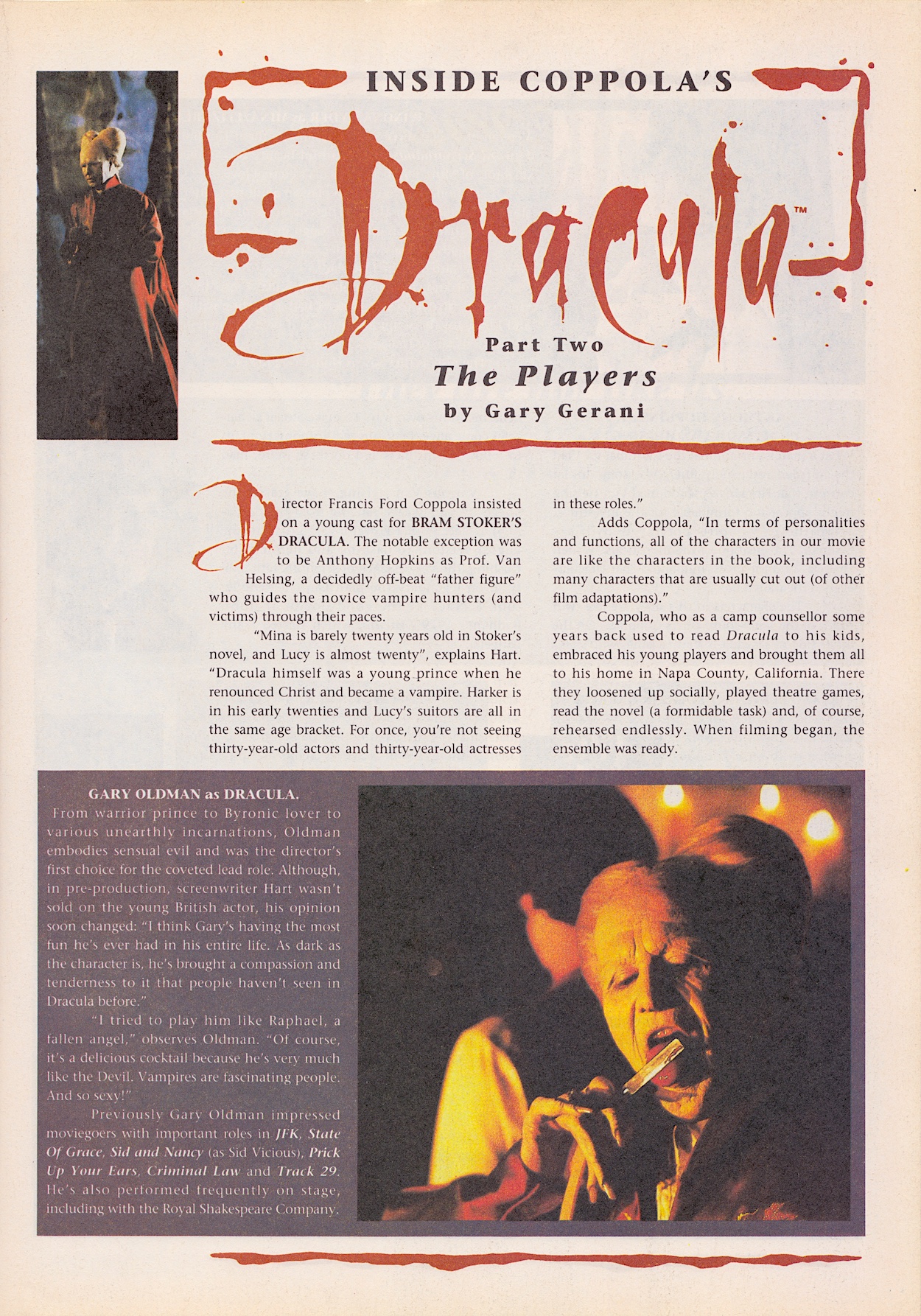
To the extras now and as usual things kick off with Inside Coppola’s Dracula and this time Gary Gerani is focussing on the special effects of the film. Famously, director Francis eschewed the new CGI trend and very deliberately used old fashioned movie-making techniques to give it the feeling of something made around the time in which it was set. Imaginative and genius use of classic “smoke and mirrors” techniques were used and interestingly we get the origin of that phrase here too.
The comparisons to Lucifer are interesting in explaining the use of a literal bat man rather than the usual, clichéd tiny bat in basically all other vampire films up to that point. The explanation here makes so much more sense. The transformation into a wolf was new to me when I first saw it as a teenager, werewolves were a completely separate entity from Dracula as far as I was concerned, so it was a surprise to be proven wrong.
“Two newish magazines with more than a passing interest in the orthodontic removal of corpuscles via the jugular vein.”
Dave Hughes
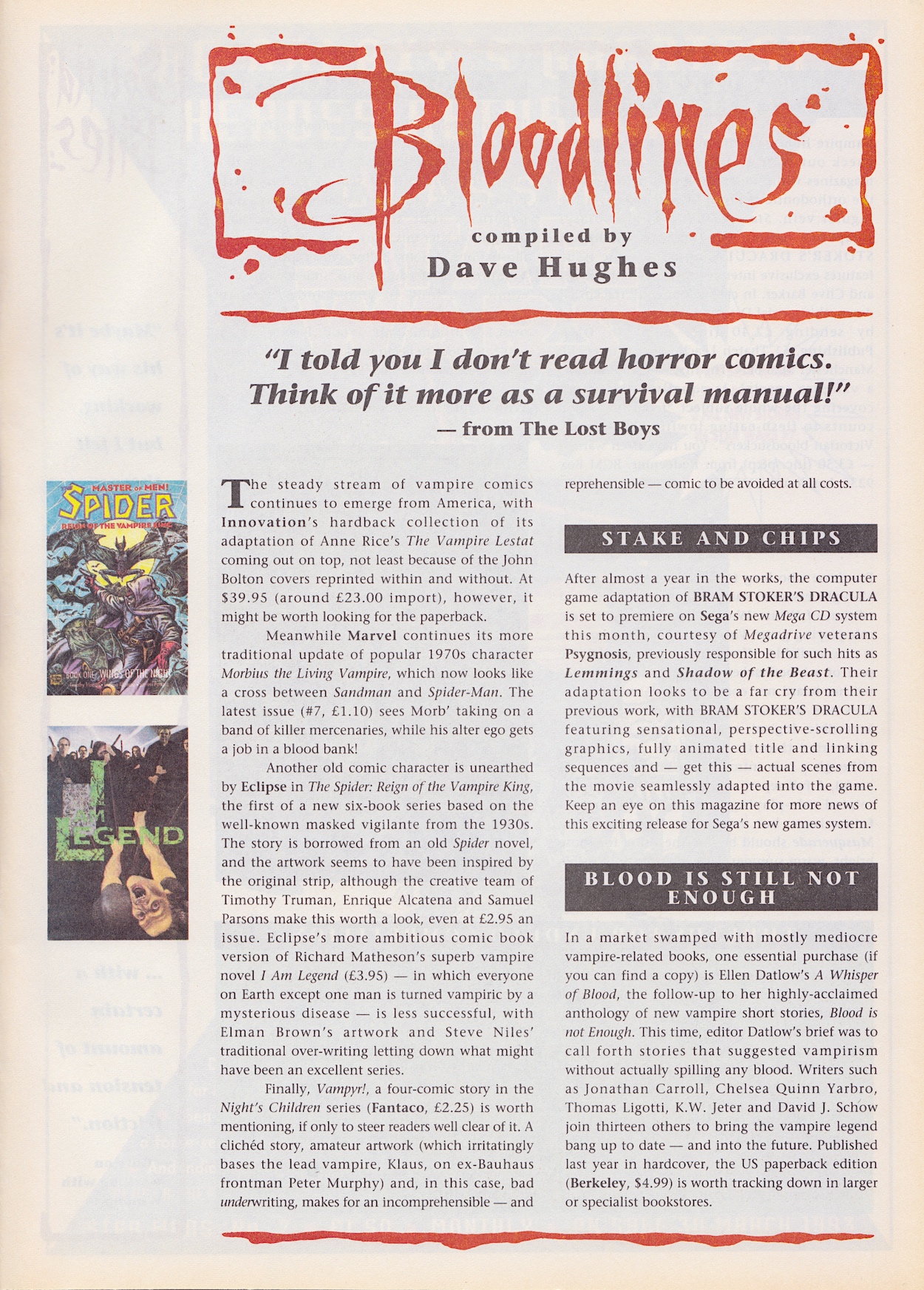
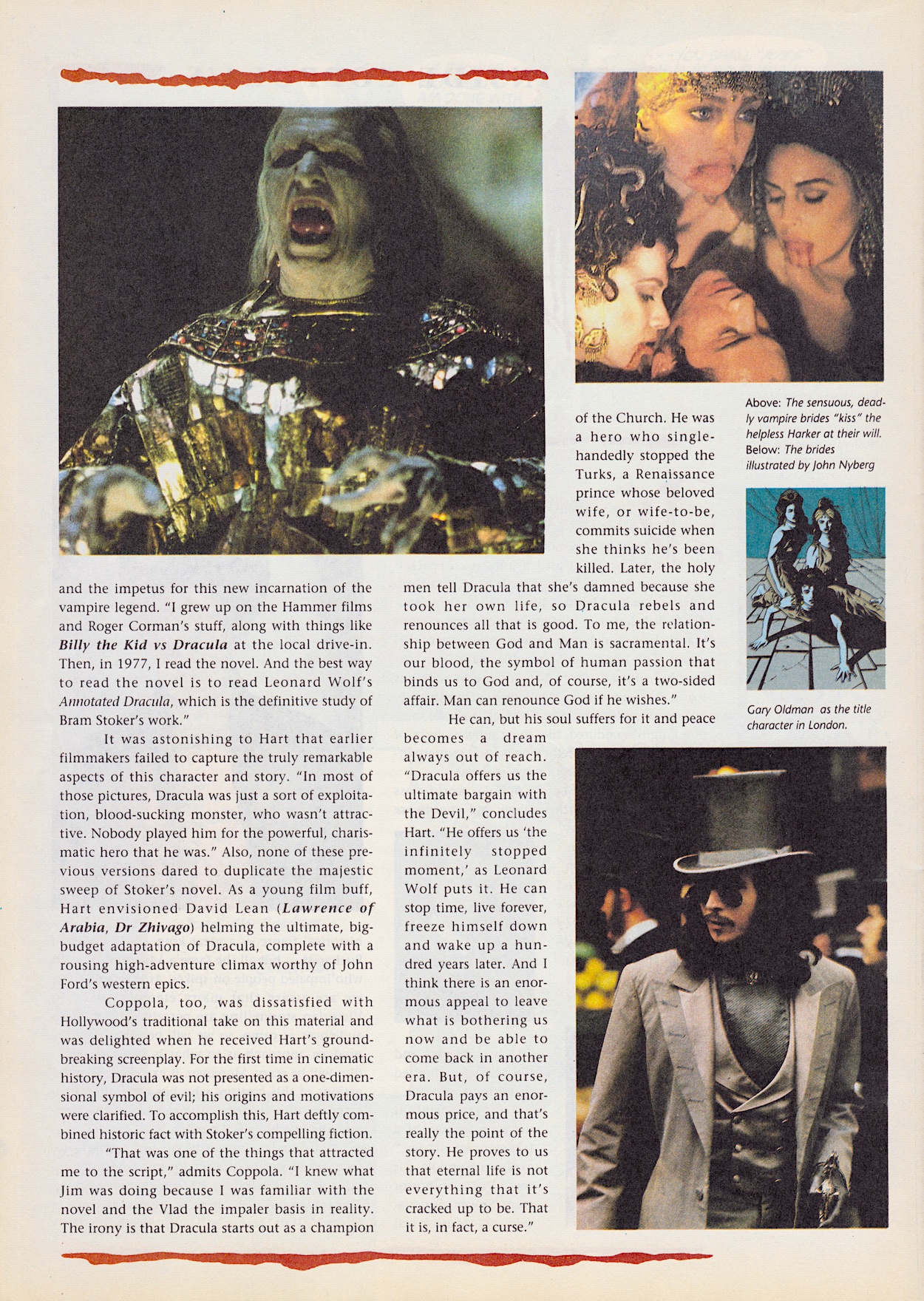
But what about that hand prop? I’ve never seen any photo or video of it but I can’t help but think of the hand effects from the short-lived 80s TV series Manimal. There’s a blast from the past! I think the prop for this film would’ve looked quite a bit better though, to say the least. Moving on to the Bloodlines news pages and Dave Hughes certainly doesn’t hold back with some of his reviews this time around.
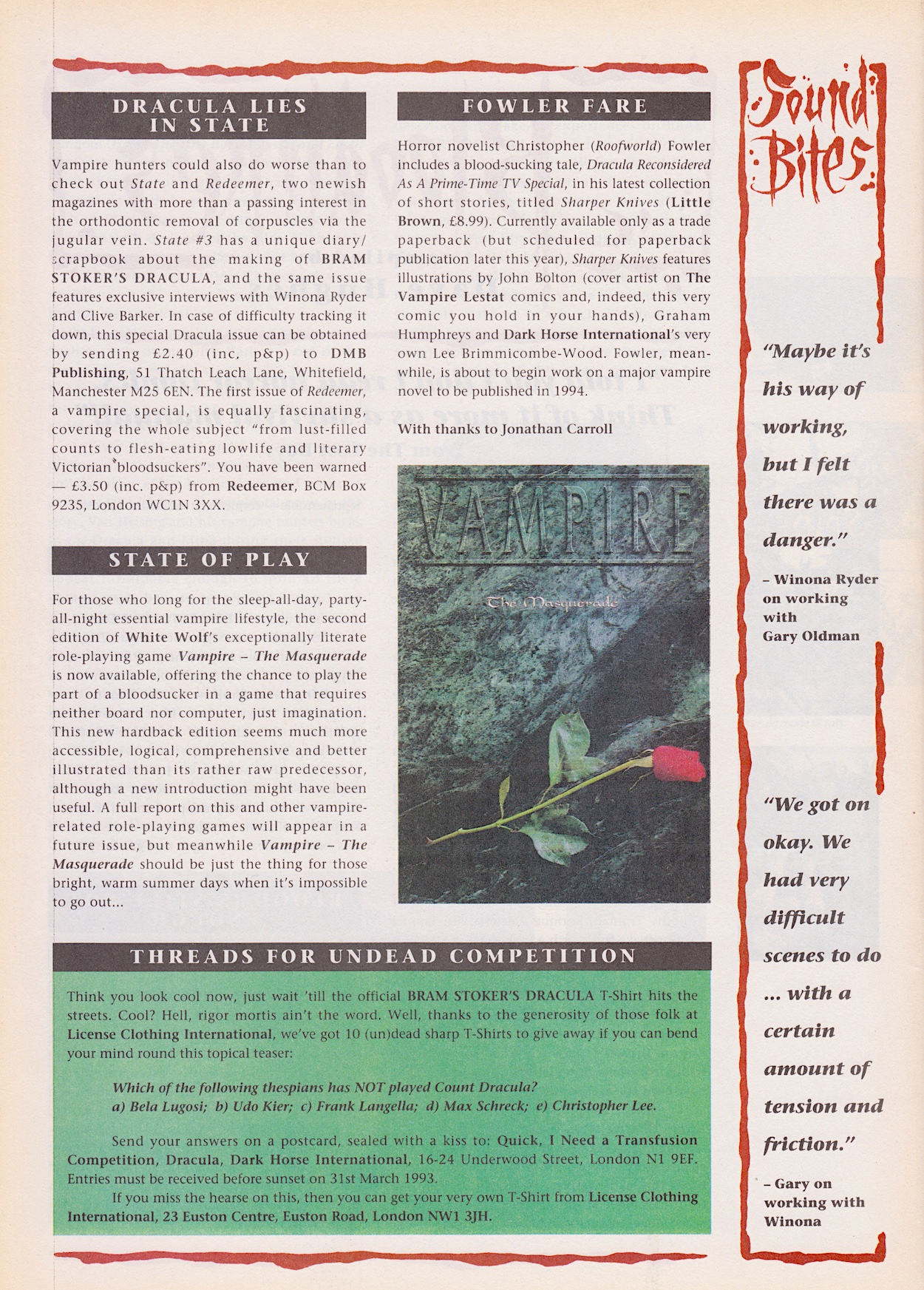
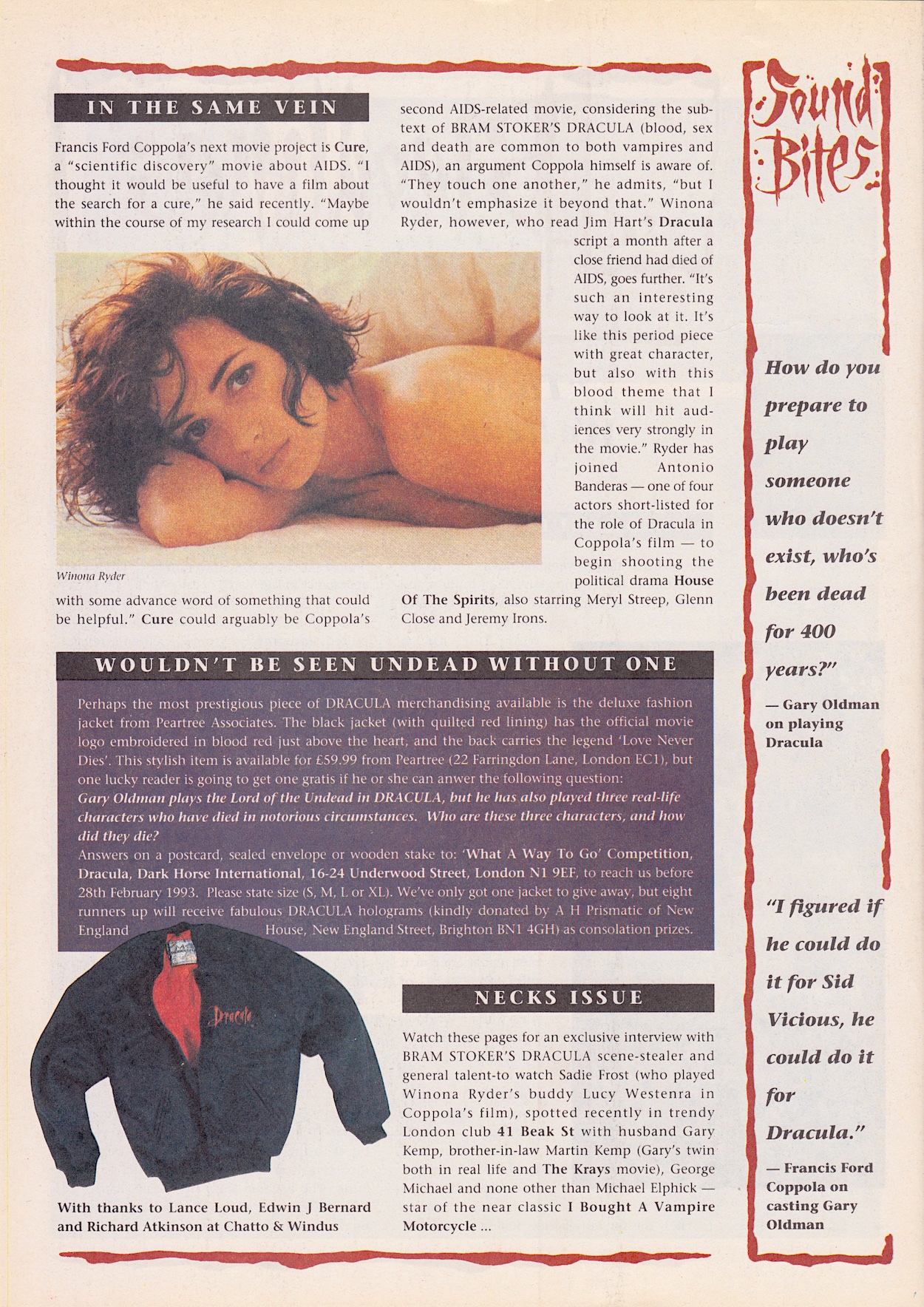
Interesting to read that some comics prices really weren’t that much different to today (despite complaints about today’s prices), Ellen Datlow’s anthology books certainly sound interesting and on the second page some quotes from Winona Ryder and Gary Oldman are missing the context given to them last issue and so unfortuanately come across as tabloid-like here. That’s a shame because otherwise this is the most enjoyable Bloodlines yet. Written in a more relaxed and chatty style it’s really rather fun, even if it is missing the promised interview with Sadie Frost that I was particularly looking forward to.
We’re obviously approaching the end of the movie’s storyline and after such a promising and atmospheric start I find myself more excited about what’s to come after the main strip ends rather than it’s climax. The comic still offers up that art though and the extras are fun, then there’s that mysterious future for the remainder of the issues to find out about. That’s enough for me to eagerly anticipate #4 on Sunday 23rd March 2025.
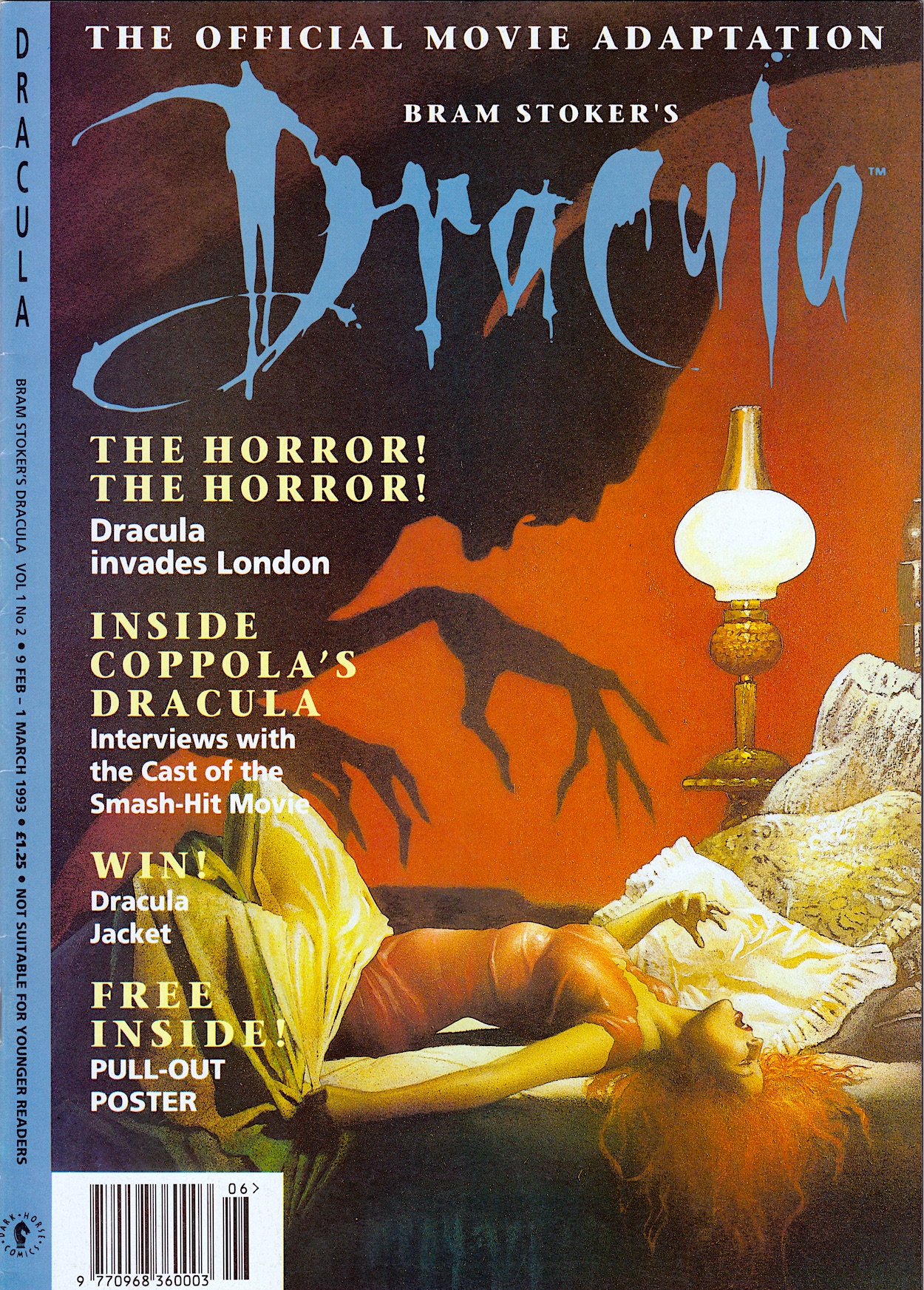
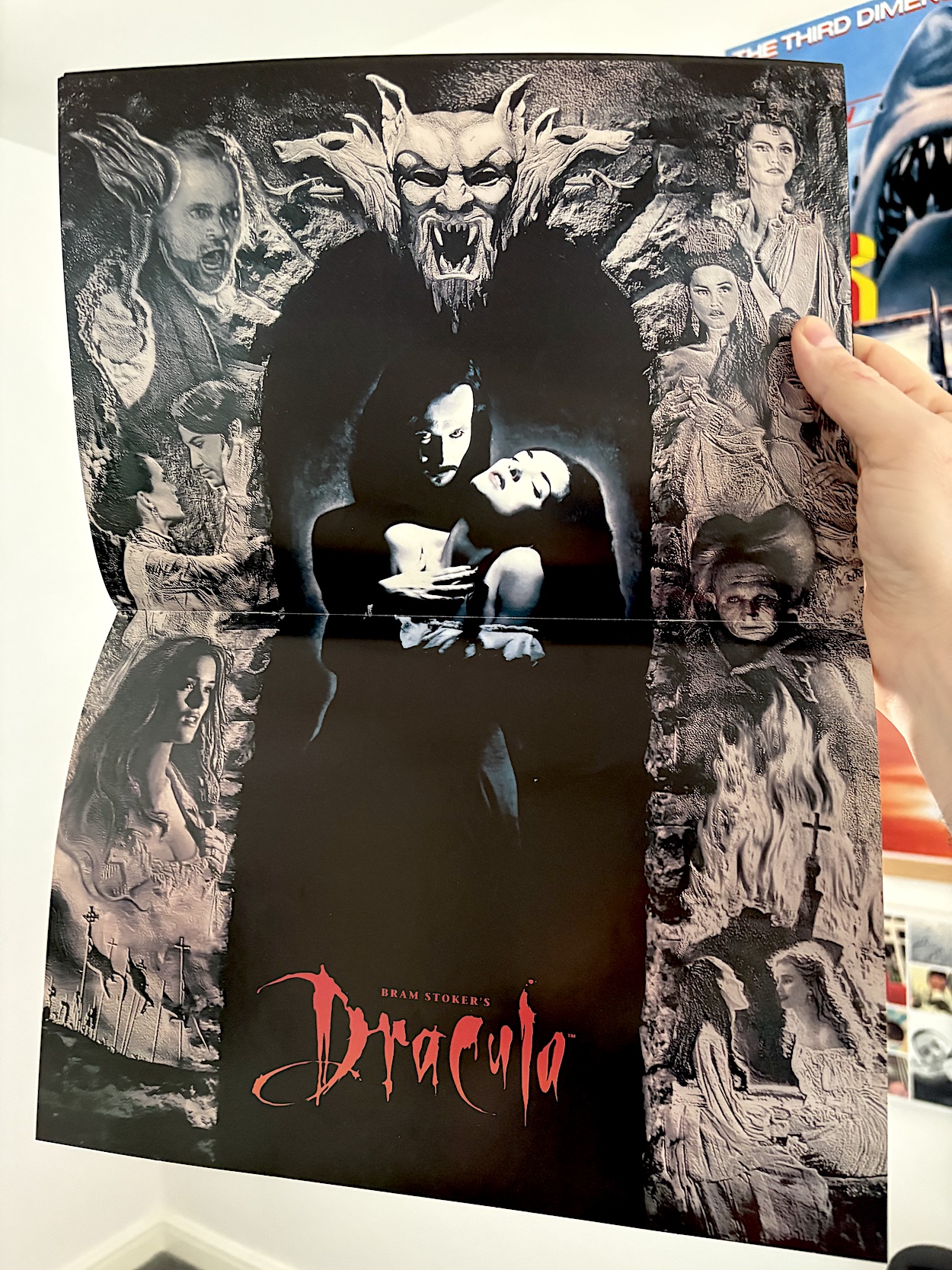
This evocative cover by John Bolton (Jurassic Park, Aliens, Black Dragon) shows us Count Dracula descending on poor Lucy Westerna (played by Sadie Frost in her first film role) and it has me wondering exactly what the comic will show from certain scenes in the film. We’ll find out as we creak open the coffin lid and gaze upon #2 of Dark Horse International’s Bram Stoker’s Dracula. But first, I assumed my copy would be missing its free gift and was very happy to be proven wrong with this glossy movie poster still attached to the staples!
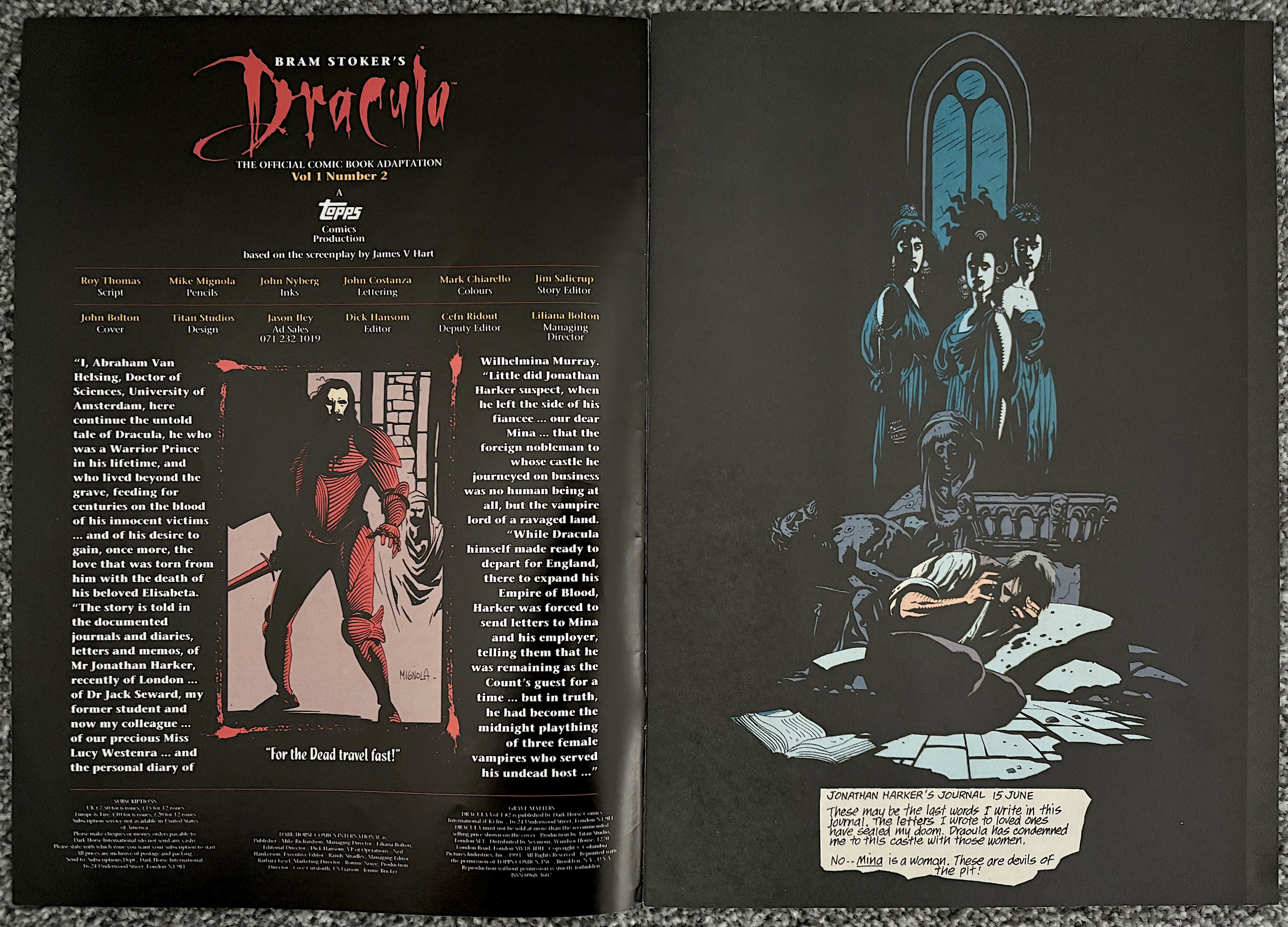
Returning to the opening pages and again Anthony Hopkins’ voice welcomes readers to the second chapter of the movie adaptation, which three weeks ago I praised for its art direction, style and atmosphere. Although, at times it could be confusing to anyone who hadn’t seen the film in a while. This was because some scenes didn’t translate that well to the page. Fortunately, this time around there’s less of this criticism to be found.
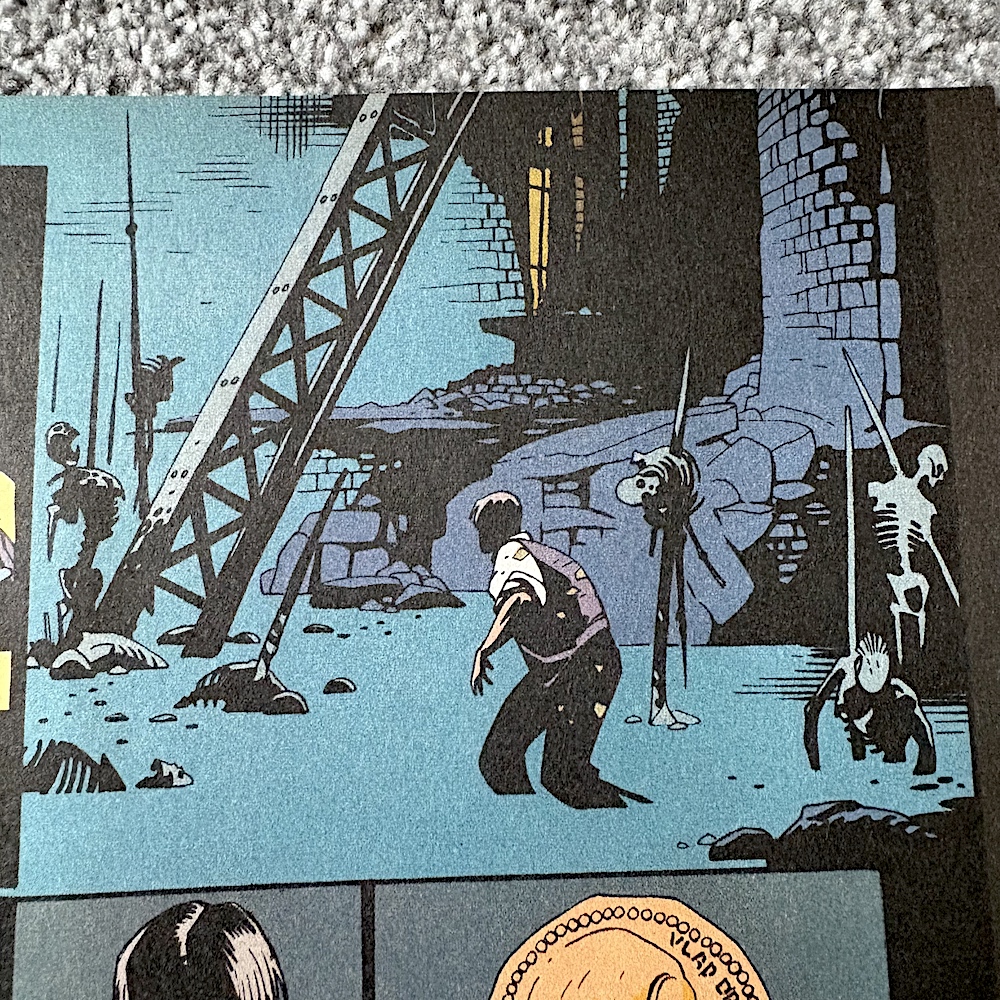
We kick things off with Jonathan Harker (Keanu Reeves) trying to find his way out of the castle and instead traipsing through a living nightmare, before trying and spectacularly failing to kill the Count while he sleeps. (This moment in the film belongs to Gary Oldman!) Over in England a vast storm unlike anything ever recorded has hit the country and we may be missing the powerful music from this moment but it plays in my head as I read the following few pages.
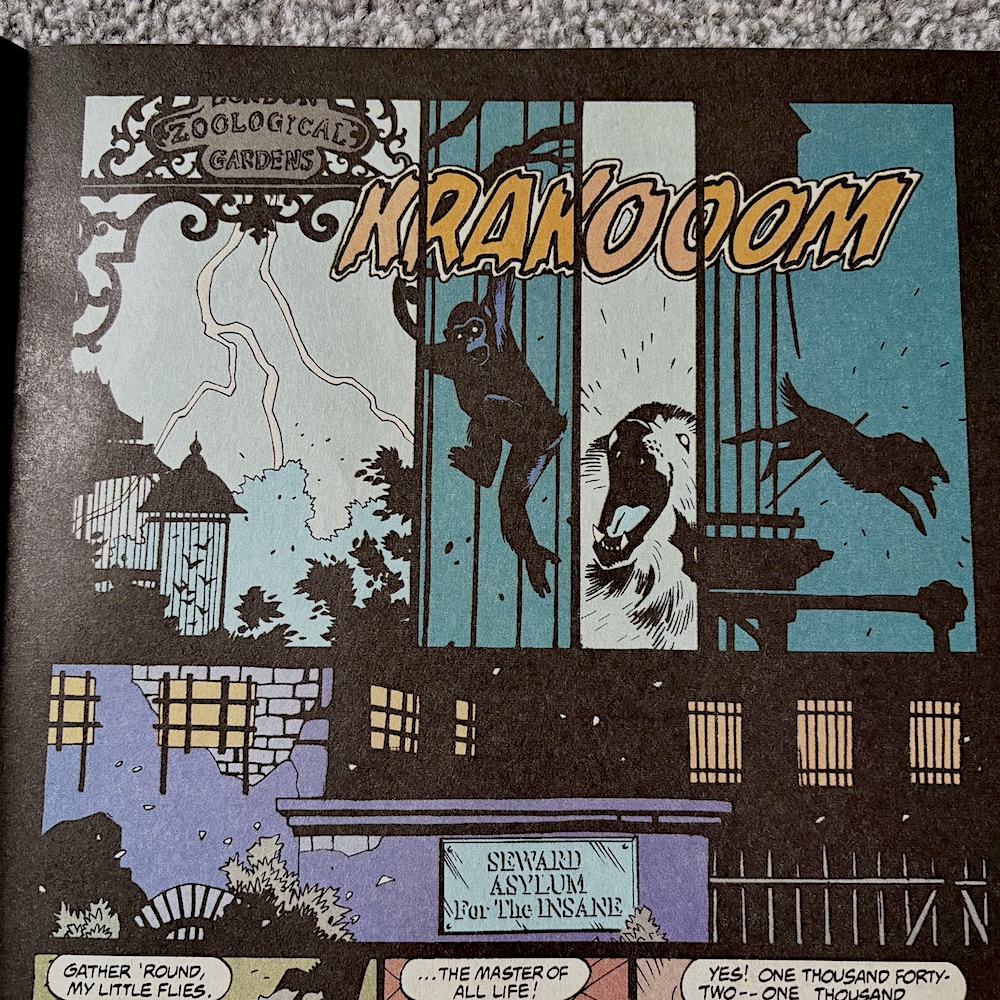
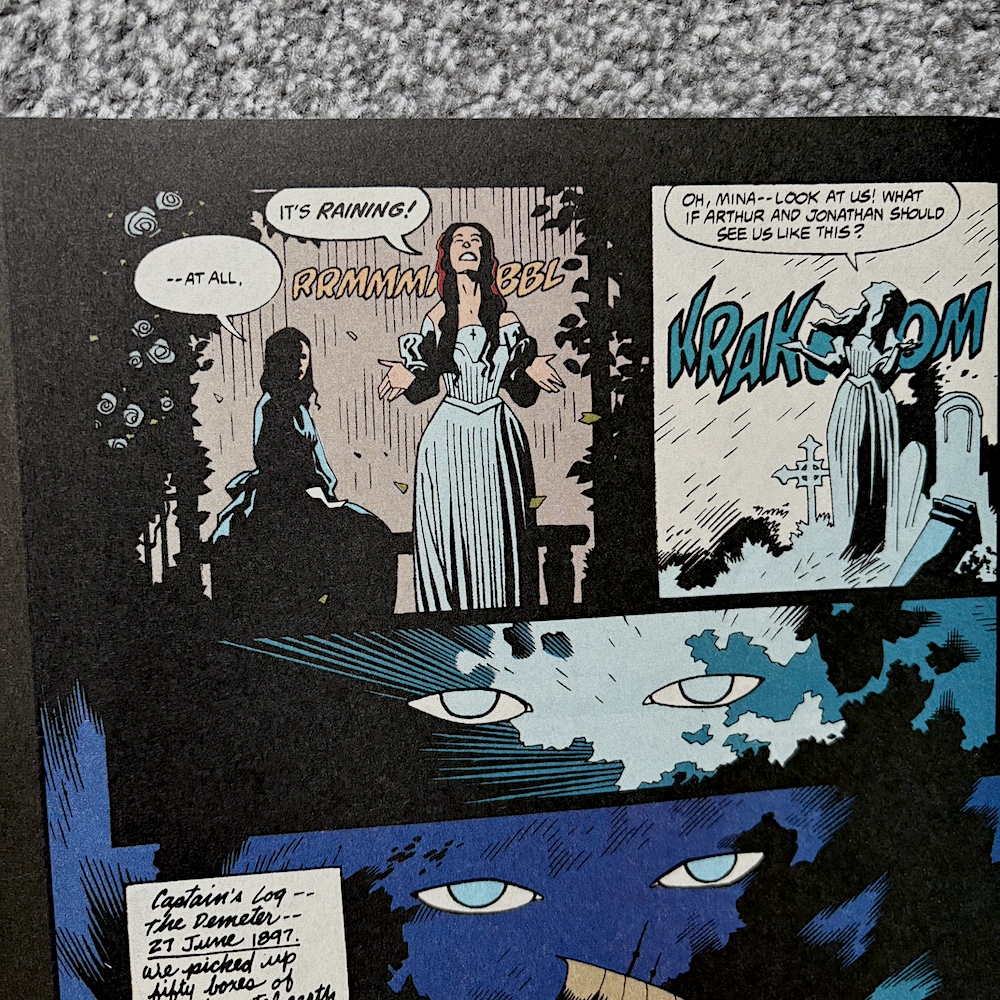
As we see the animals going wild and a wolf escaping the zoo, the rain soaking Lucy and the storm getting worse, we know it’s all because the ship with Dracula on board is getting ever closer, hence his eyes in the sky watching over everything. While the film offered no narration for this moment it was clear what was happening. It’s a very stylised moment, very Coppola, and can’t have been easy to bring to the page.
Any fan of the film will know what’s coming next
It works better than last issue, but of course I’ve seen the film recently so I don’t know how easily it could be followed without narrative captions for new readers or lapsed viewers. I personally like the fact there aren’t captions, just the diary entries now and again. It matches the film in this regard, but in a different medium should it have contained more text? The jury is out, but if you know the film (or even the original story) you’ll enjoy this sequence and the lovely, shadowy art once more by penciller Mike Mignola, inker John Nyberg and colourist Mark Chiarello.
Any fan of the film will know what’s coming next and it relates to what I said about the cover. While there’s no obvious nudity it’s still surprising to see the scene play out in a comic if I’m honest. Although, without all of the dramatic build up and the actual horror and suspense leading up to this moment it feels a bit random and gratuitous.
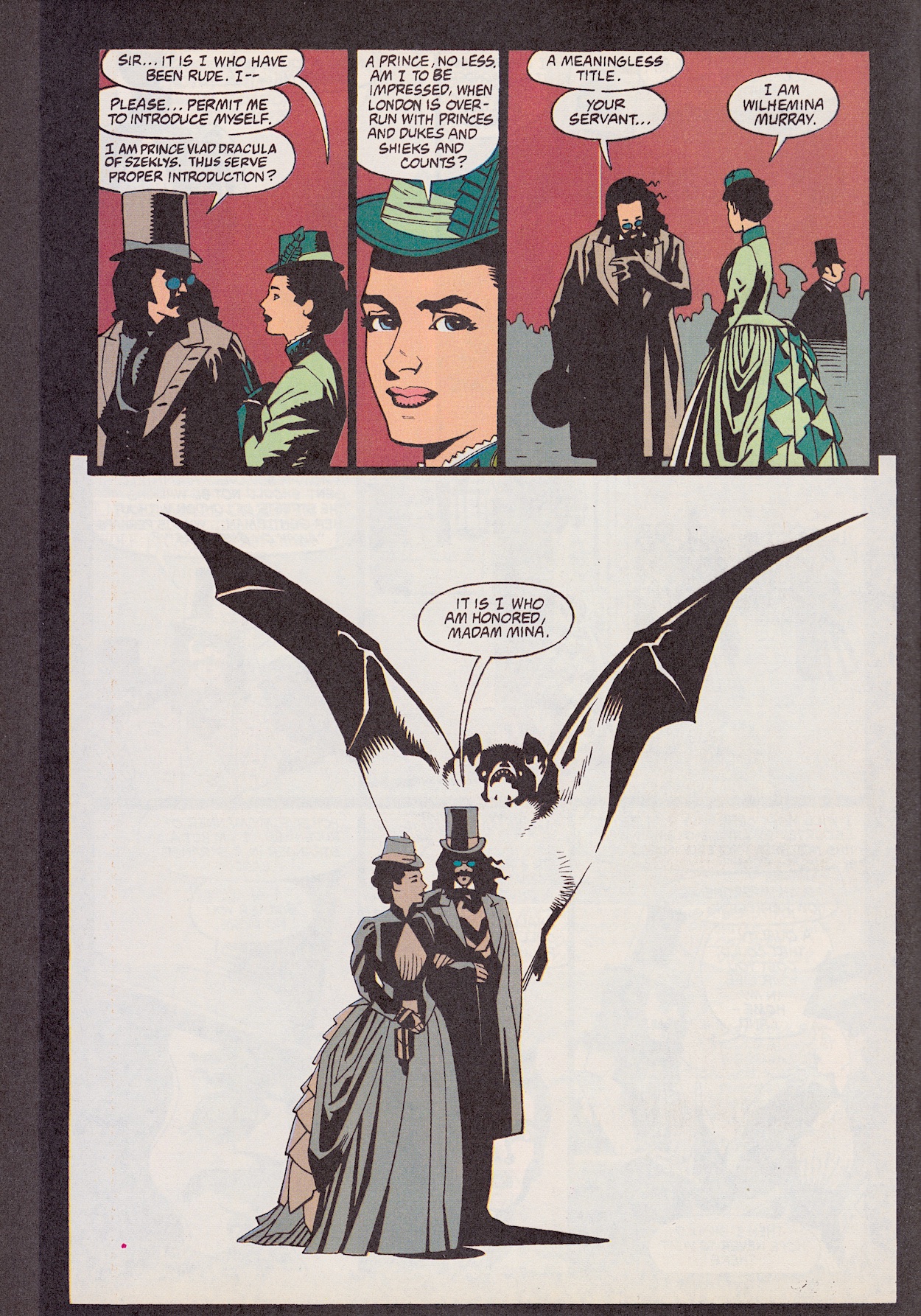
After this terrifying sexual encounter comes one of my very favourite scenes in the whole film, when Dracula and Mina meet properly for the first time on the streets of London and simply chat. Gary and Winona Ryder were perfect in this scene and it pretty much all plays out in the comic, taking up eight pages in total of Roy Thomas’ adaptation (his script lettered by John Costanza). Of course the medium doesn’t lend itself to translating the slow, deliberate acting in what is a touching, yet mysterious scene (unless you read it that way of course), but the art remains fascinating.
Their initial introduction ends on this image of a bat rising out of the scene against a pure white background. This is an example of the comic taking inspiration from the visuals of the film and producing its own to get across narrative elements of the story it may have otherwise struggled with. Opposite from this is the rear of the poster so coincidentally this feels like a natural chapter end in itself.
The comic has also improved its translation of such moments to the page. Take when Arthur Holmwood (Carey Elwes) comes to check on his fiancée Lucy, who has been in the care of Dr. Jack Seward (Richard E. Grant). The visual moment in question is actually a scene transition after Arthur agrees to bring in Van Helsing, finally admitting to himself there’s something ‘else’ wrong with his love.
Lucy is holding onto her dress collar and we zoom in past it to see the two red holes in her neck where she was bitten by Dracula in his monstrous wolf man form. Just like in the film, as we get closer to the bite marks they turn into his eyes and then into the eyes of the wolf that had escaped from the zoo. This transition takes us back to the London scene, ending with ol’ Drac easily taming the wolf, and the wolf then letting Mina pet it; a key moment in the development of our lead characters’ relationship.
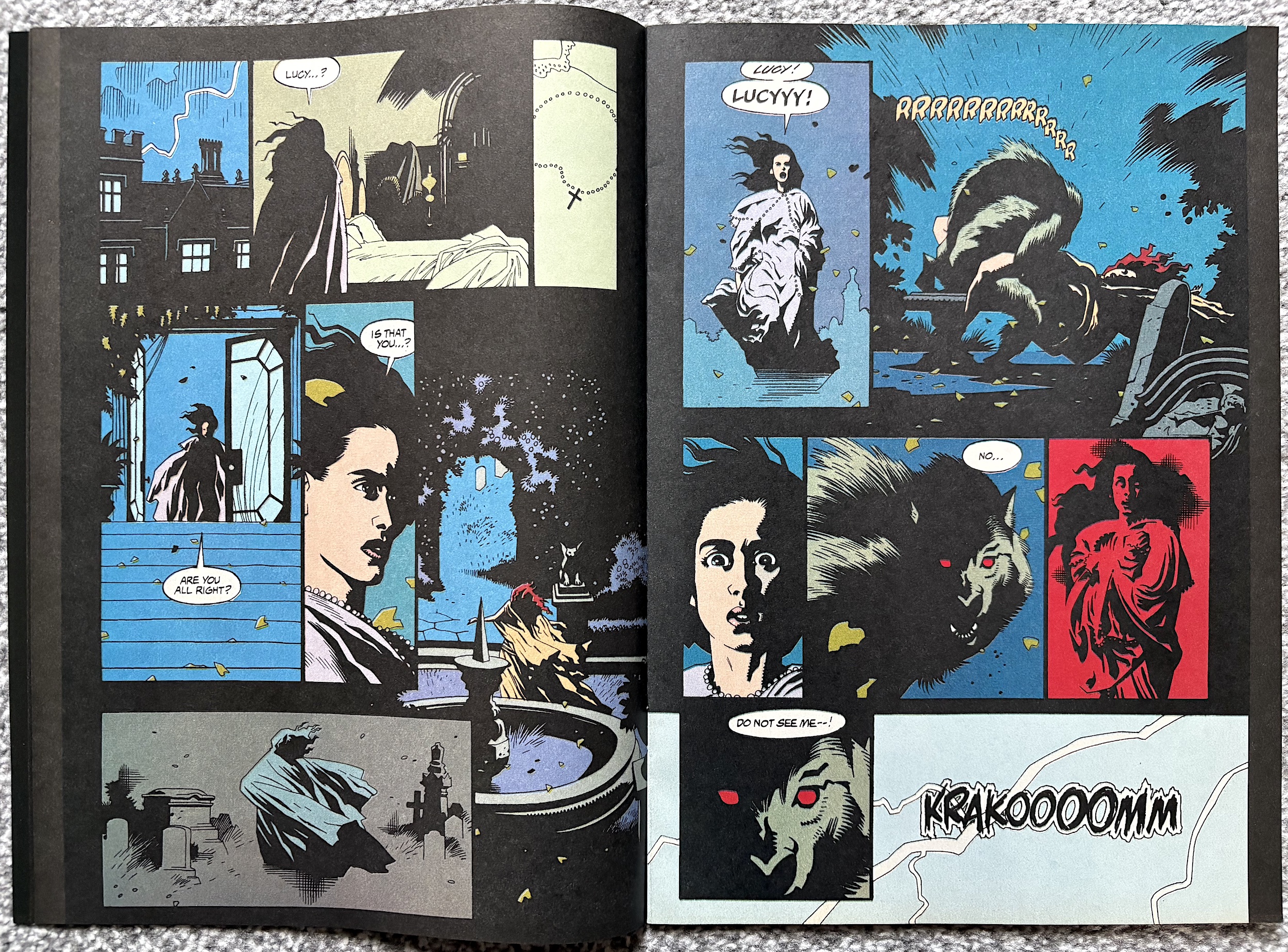
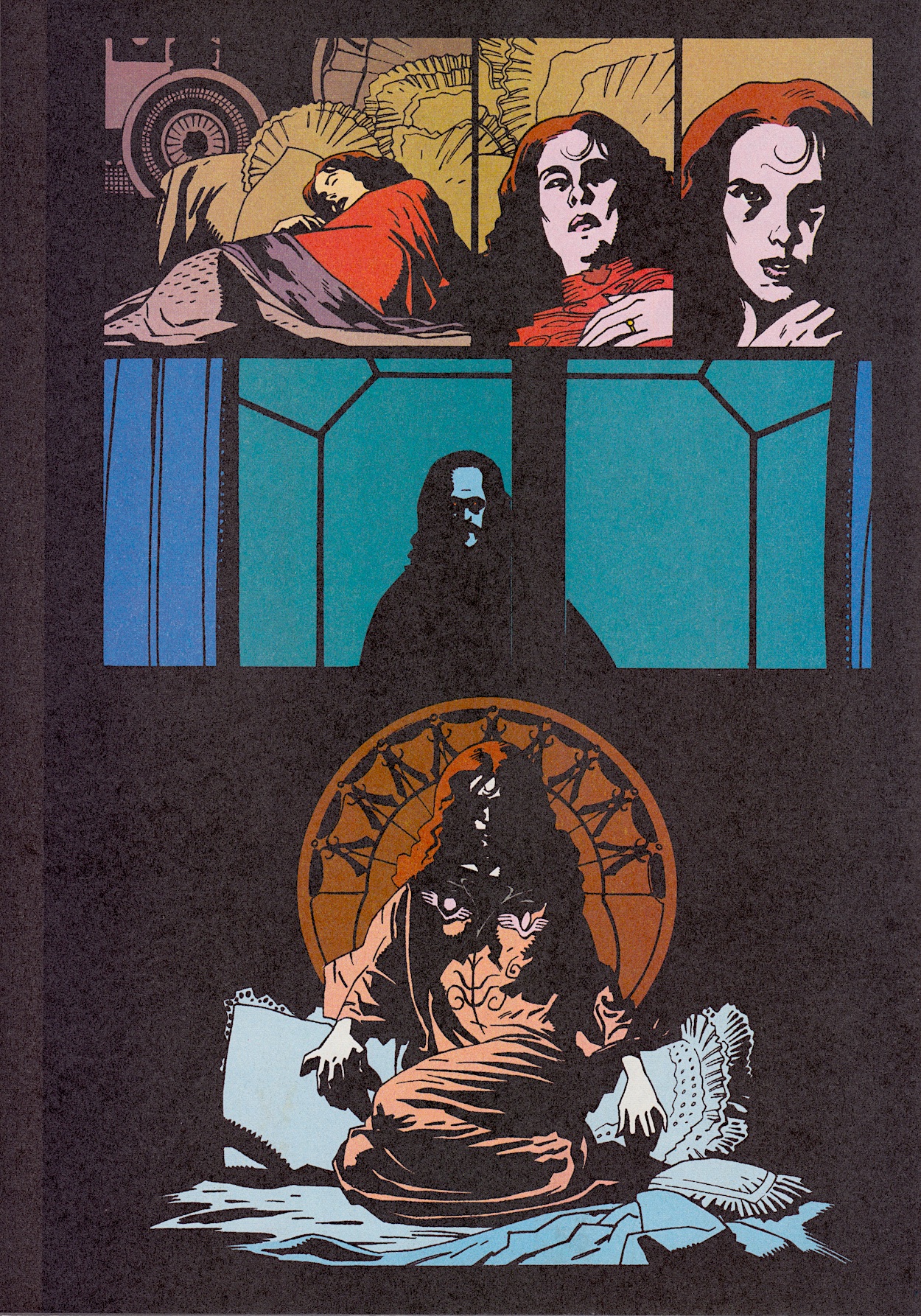
While earlier in this review I did lament how some scenes could’ve done with more explanation and room inside the comic, I’m glad to say the London scene isn’t the only one that gets space to breathe. Some of the smaller moments are actually given prominence, such as when Dracula arrives at the window of Lucy’s bedroom.
This could’ve been summed up in a couple of panels but instead it’s presented in a way that adds such atmosphere to the comic. In that regard I think it’s the best example to sum up the title as a whole and a page that could be framed for the wall by anyone who’s a fan of the film. Perhaps alongside that poster.
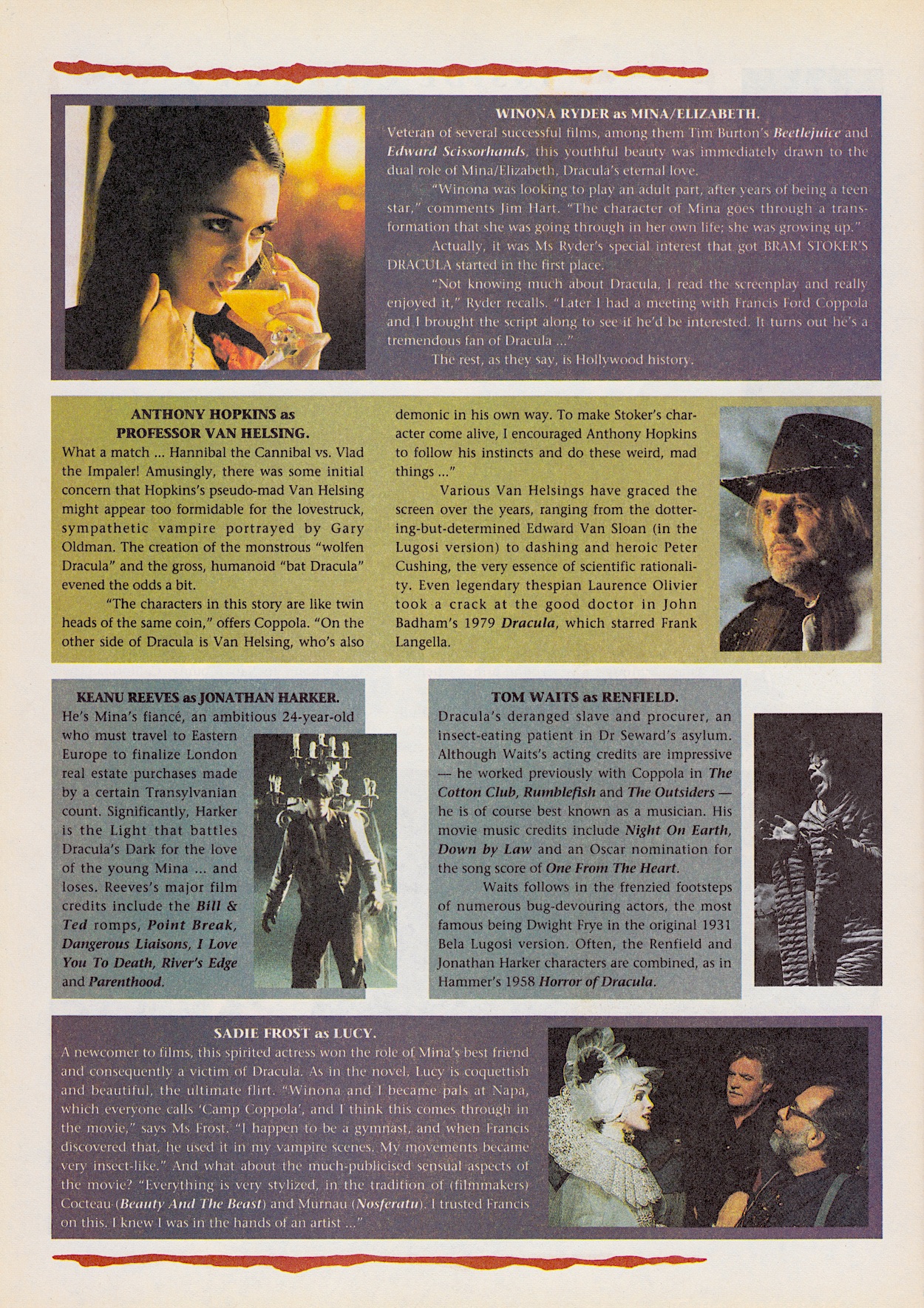
Moving on to the extra features and again it’s made up of Inside Dracula and Bloodlines, the making-of and news pages respectively. It’s here I take issue with one of the headlines on the cover. “Interviews (plural) with the cast of the smash-hit movie”, editor Dick Hansom boasted. What we actually get are two pages with small profiles of six of the cast members. For three of them we get some quotes taken from actual interviews elsewhere and a fourth where the quote is from Francis Ford Coppola instead.
There are some interesting nuggets here, such as Francis’ insistence on a young cast in keeping with the novel (which went against the grain of previous adaptations) and Winona’s role in getting the whole thing started in the first place, which was touched upon last issue. I can sympathise with how reading the novel is described as a “formidable task” and in Sadie’s profile the comic mentions “the much-publicised sensual aspects”, which you just know referred to what British tabloid rags thought were the most important scenes in the film.
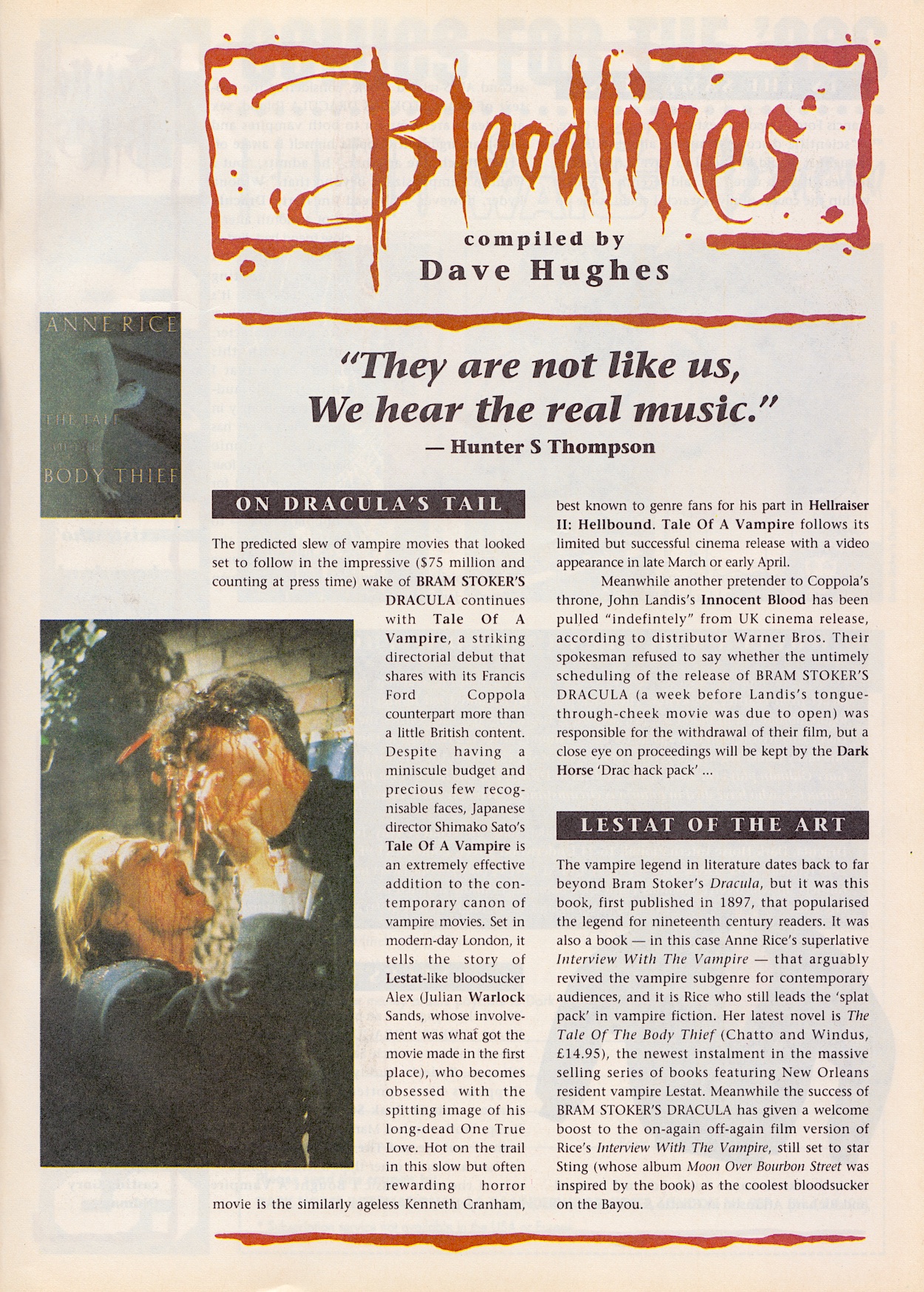
Bloodlines rounds up the movie’s takings so far and the glut of vampire flicks which went into production off the back of the news Francis Ford Coppola was making Dracula. News of Tale of a Vampire has a different feel to it now, after we tragically lost the great Julians Sands in 2023. I’d never heard of this film but the role seems just perfect for him so I’ll probably track it down on a streaming service and check it out.
The mystery behind Innocent Blood’s release was probably more to do with its complete flop in the States than with our movie. Described on Wikipedia as a “mixture of the vampire, gangster and buddy cop genres” but with a ton of nudity and gore, it doesn’t scream ‘John Landis’ to me. As for Interview With the Vampire, I can’t find proof of Sting being approached but coincidentally Julian Sands was considered!
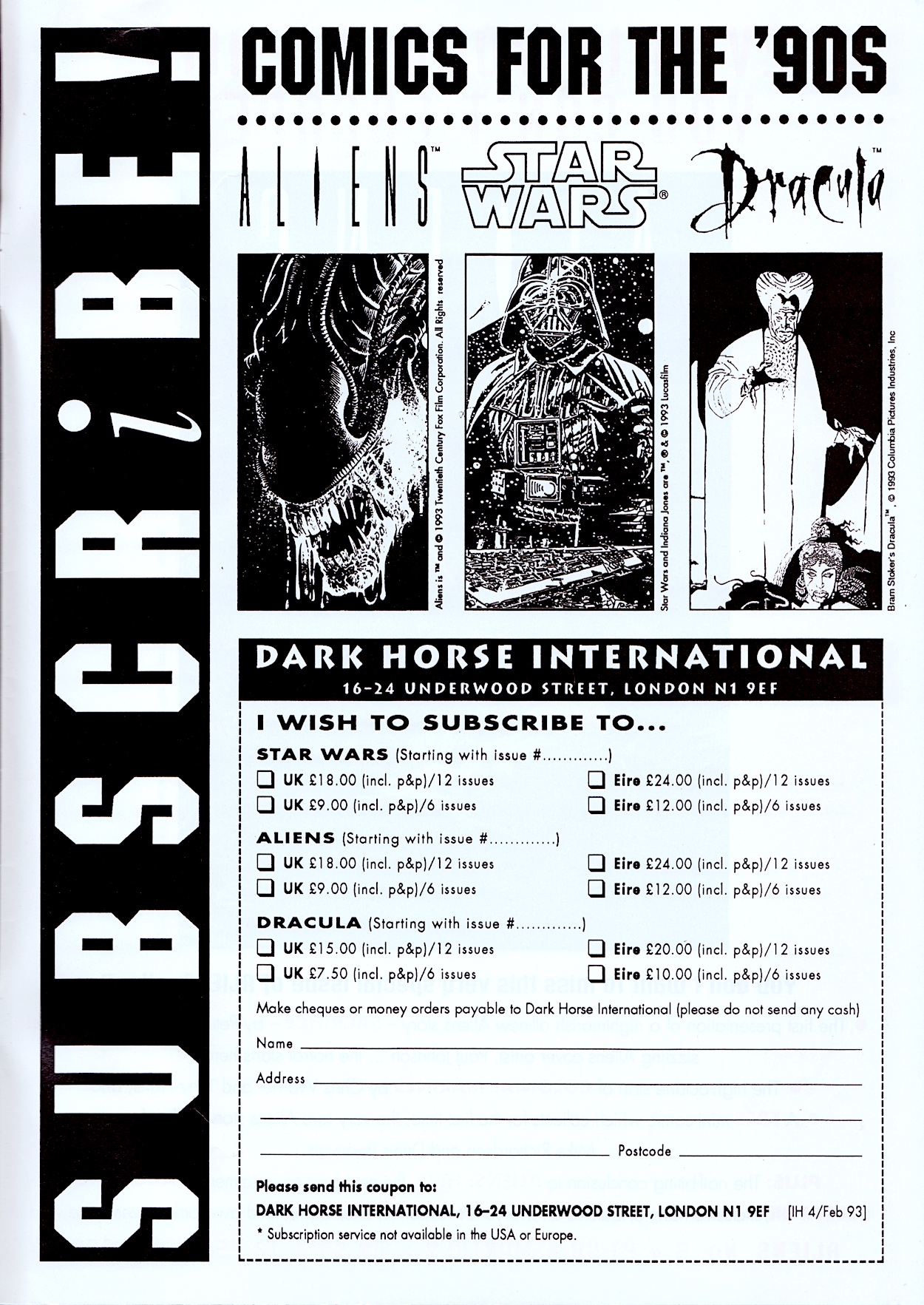
Then, on the glossy inside back cover is the first of Dark Horse International’s subscriptions pages for their range, something I would become very familiar with towards the end of the same year when I discovered their Jurassic Park. I started reading that comic from #6 and by then two of the three titles below had already been cancelled and replaced by others, which probably shocked the publisher as much as the readers, given what they were based on.
On the back page is the same Aliens advert from last time promoting #9 of that comic and its brand new UK strip, the review of which will be up on 18th February 2025. For now Dracula slinks back into his coffin to await the next review of his own comic. This is the most promising movie adaptation yet on the blog, so let’s hope #3 continues the trend on Sunday 2nd March 2025.
The first new real time read through for 2025 adds a third title to the Dark Horse International menu on the blog with Bram Stoker’s Dracula from 1993. This was released in the same year as their Jurassic Park comic and follows a similar formula, the movie adaptation taking up all of the comic strip space inside and followed by some extra features. This is similar to the Alien³ Movie Special mini-series from the previous year and has the same description down the left-hand border.
However, much like Jurassic Park, this comic would continue beyond the end of the movie and become an ongoing monthly, albeit with a rather big caveat (which we’ll get to when the time comes). The atmospheric cover by Mike Mignola (Hellboy, Rocket Raccoon, Baltimore) cements the dark, gothic feel of the strip and upon opening we’re met with a suitably black interior design.
I defy anyone who has seen the film not to read the introduction in Anthony Hopkins’ voice. I note that subscriptions are offered so clearly DHI were hoping the adaptation issues would be enough of a success for them to carry on. However, while it was advertised as a fortnightly in other comics it’s actually triweekly like the aforementioned adaptations.
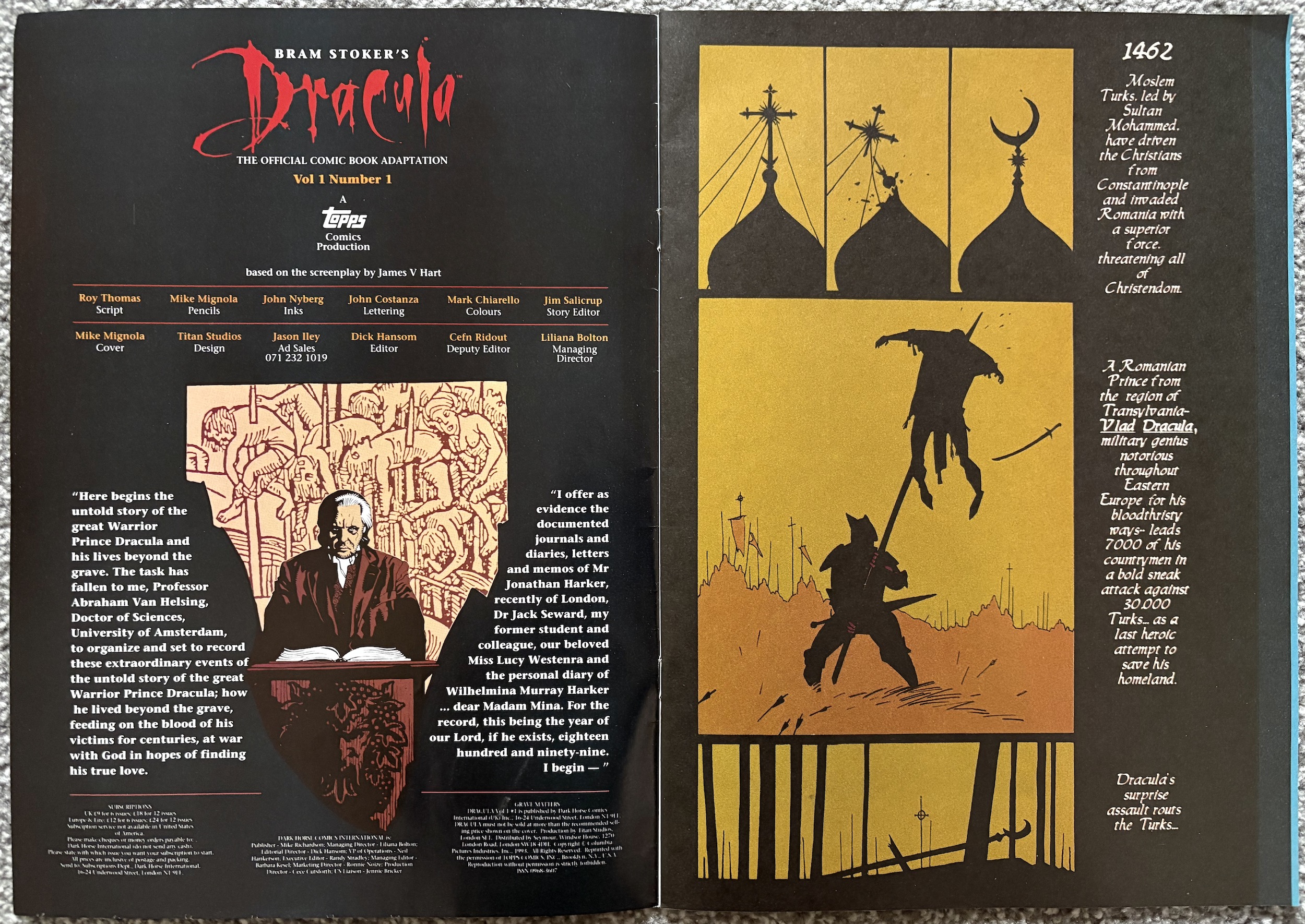
Edited by Dick Hansom (Jurassic Park, Aliens, Speakeasy), the 36-page comic has a lovely glossy cover with matte interior pages, a 28-page first chapter and two two-page features at the rear. So far, so DHI. The real stand out here is the strip’s art. Regular readers will know how I feel about movie adaptations but to see an original art style filled me with confidence for this one.
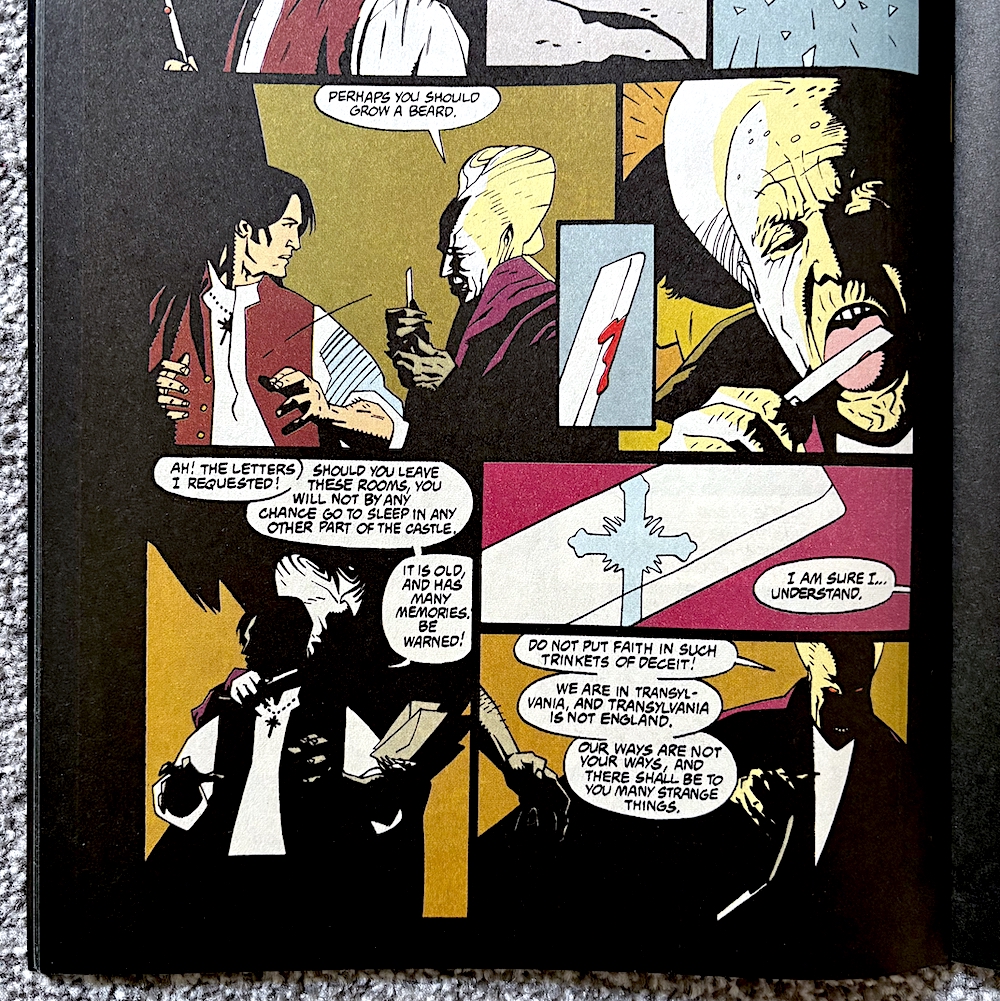
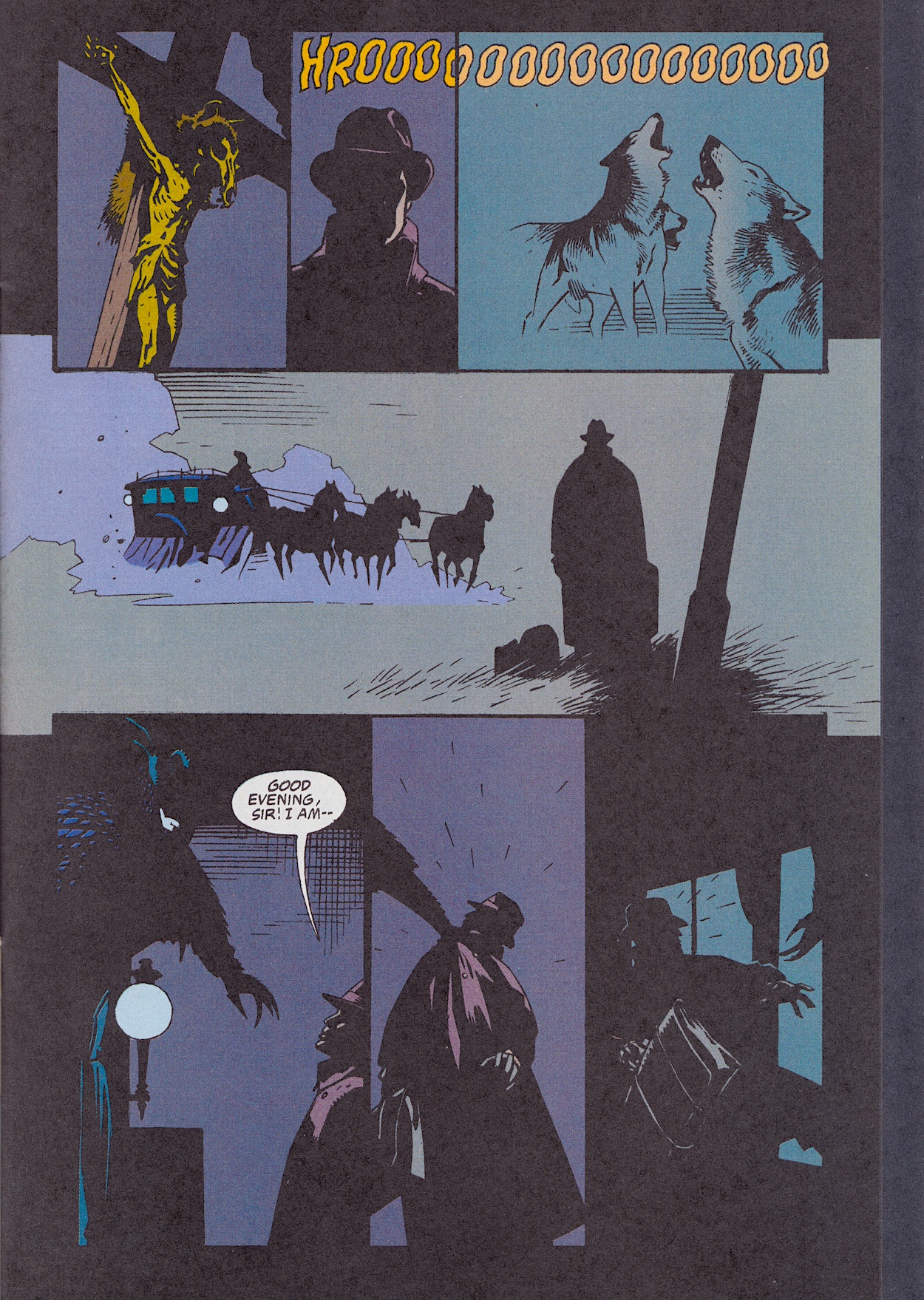
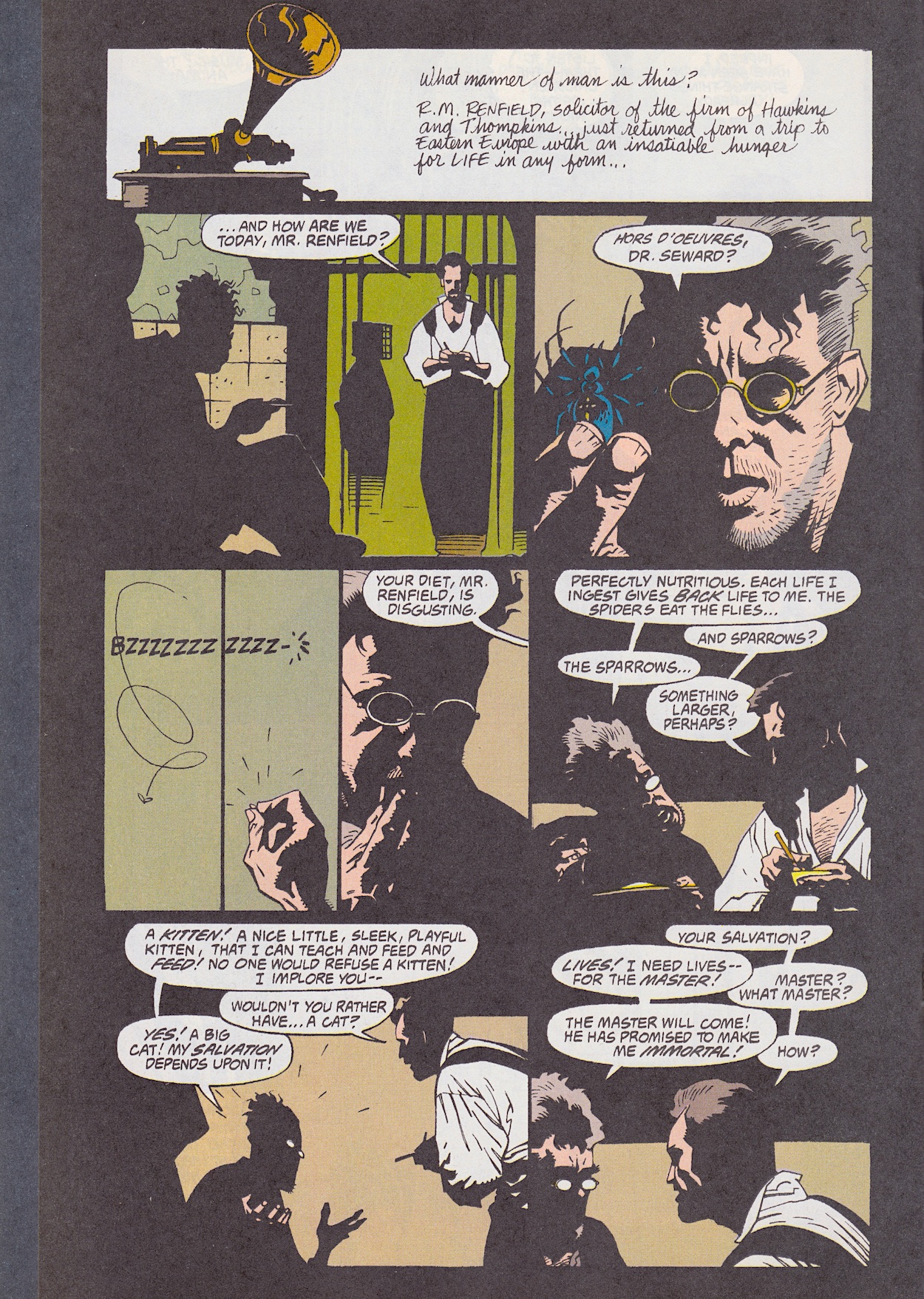
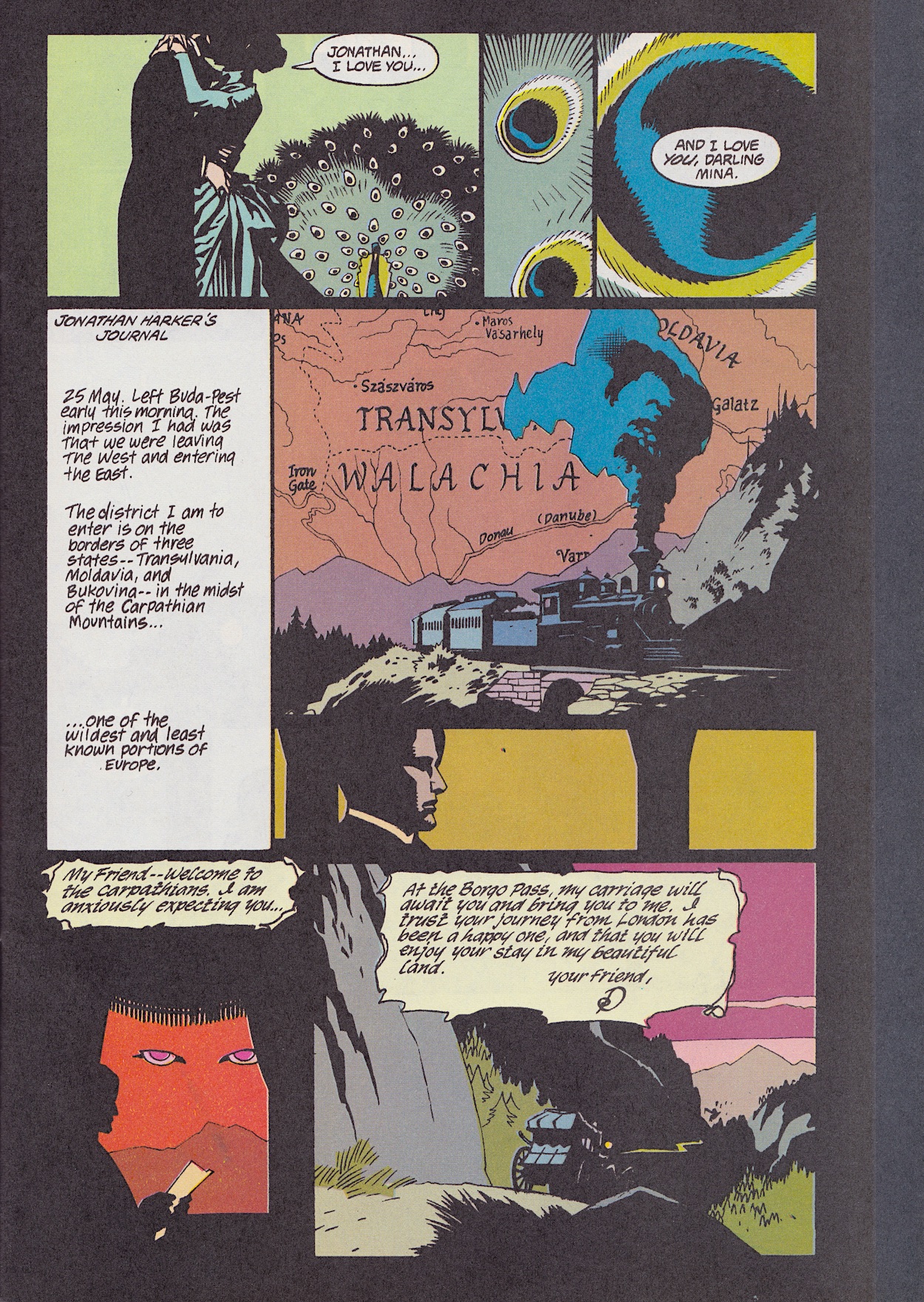
The art goes the opposite way of the elaborate, ornate movie. It may have quite simply drawn scenes and characters, but it’s the use of shadow that ties it in so neatly to the film. There’s simply no way of capturing the intricacy of the design and the style of Francis Ford Coppola’s direction so instead it feels like penciller Mike, inker John Nyberg (Action Comics, Doom Patrol, Nexus) and colourist Mark Chiarello (Batman/Houdini, Hellboy, Hush) have gone for atmosphere over detail.
It works. It looks old-fashioned but I don’t mean in an ‘out-of-date comic’ kind of way. I mean the individual panels feel like they could’ve been drawn around the time the story is set and cleaned up for the 90s. Simple, sometimes scratchy line work with a mixture of bold colours for the more horrific scenes and subdued, almost washed out colours for the spookier moments, with the swathes of black in all the panels capturing that claustrophobic, haunted feel of the film, it’s just perfect.
John Costanza (Jurassic Park, The Tomb of Dracula, Red) does an incredible job on lettering Roy Thomas‘ (Conan, Secret Origins, Stoker’s Dracula) script too. Whether it’s historical prose, different handwriting (or typed text) for each character’s diary or his regular style, it’s all very clever and captures the narrative aspects of the film, as you can see above. The original US comic edited by story by Jim Salicrup (writer on Transformers, Sledge Hammer and The A-Team), credited here as story editor.
Sometimes, however, the use of shadow can make it difficult to work out sequences of events and once or twice I found myself perusing panels a few times to work out what was happening, and that’s with me having seen the film recently. Like most comics adaptations the main audience would’ve been those who’d seen the movie already rather than new readers. Even more so with this one, I feel.
I’ve criticised previous movie adaptations for rushing through their screenplays or for being poor copies of their big screen originals, but I’ve also praised those that took the time to properly adapt the story to a different medium. Bram Stoker’s Dracula falls into the latter category. While what’s written on the page is basically verbatim from the script, the art does a perfect job of taking the movie fan back into that world to enjoy it in a different way.
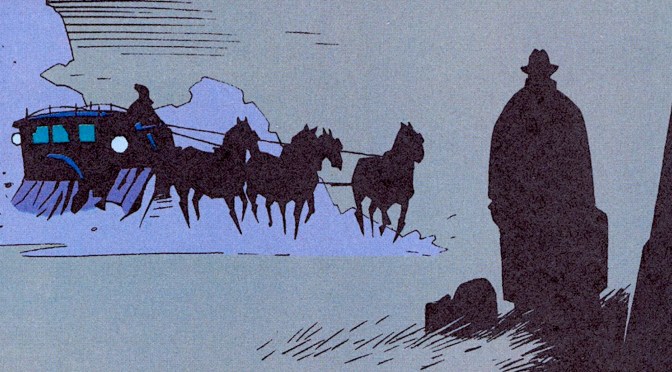
A perfect example of this is the moment when the carriage comes to pick up Jonathan Harker. In the film a massive set was built for this scene and it was full of highly detailed, creepy imagery. Here, all of that is stripped back. Instead, the sparse nature of the art and the use of shadow captures how that moment felt for the viewer. This brings the chill of the scene to the reader much better than any attempt to just copy it ever could have.
The shadow work brings another benefit too. Previous attempts at adapting a movie have had mixed results in portraying the actors. Most times there’s no attempt at all (and that may have been due to rights), other times they’ve tried so hard to capture their likeness they become stilted and expressionless. This team does something different. Through clever use of dark shadows the characters look enough like the actors without having too much detail, meaning they retain their expressiveness and, most importantly (and something Alien³ failed to do) their faces remain distinct from each other’s.
Not all of the film’s iconic visuals translate well to the page though, the best/worst example being Jonathan’s train journey. While that marvellous model shot couldn’t hope to be replicated on the page, the zooming in on the peacock’s feathers makes no sense here and Dracula’s eyes in the sky just look weird. These moments were great examples of the film’s iconic style but I can’t help thinking they’d have been best left out here, or at least have the Count’s eyes elaborated on to make more sense in this medium than the seemingly random panel below.
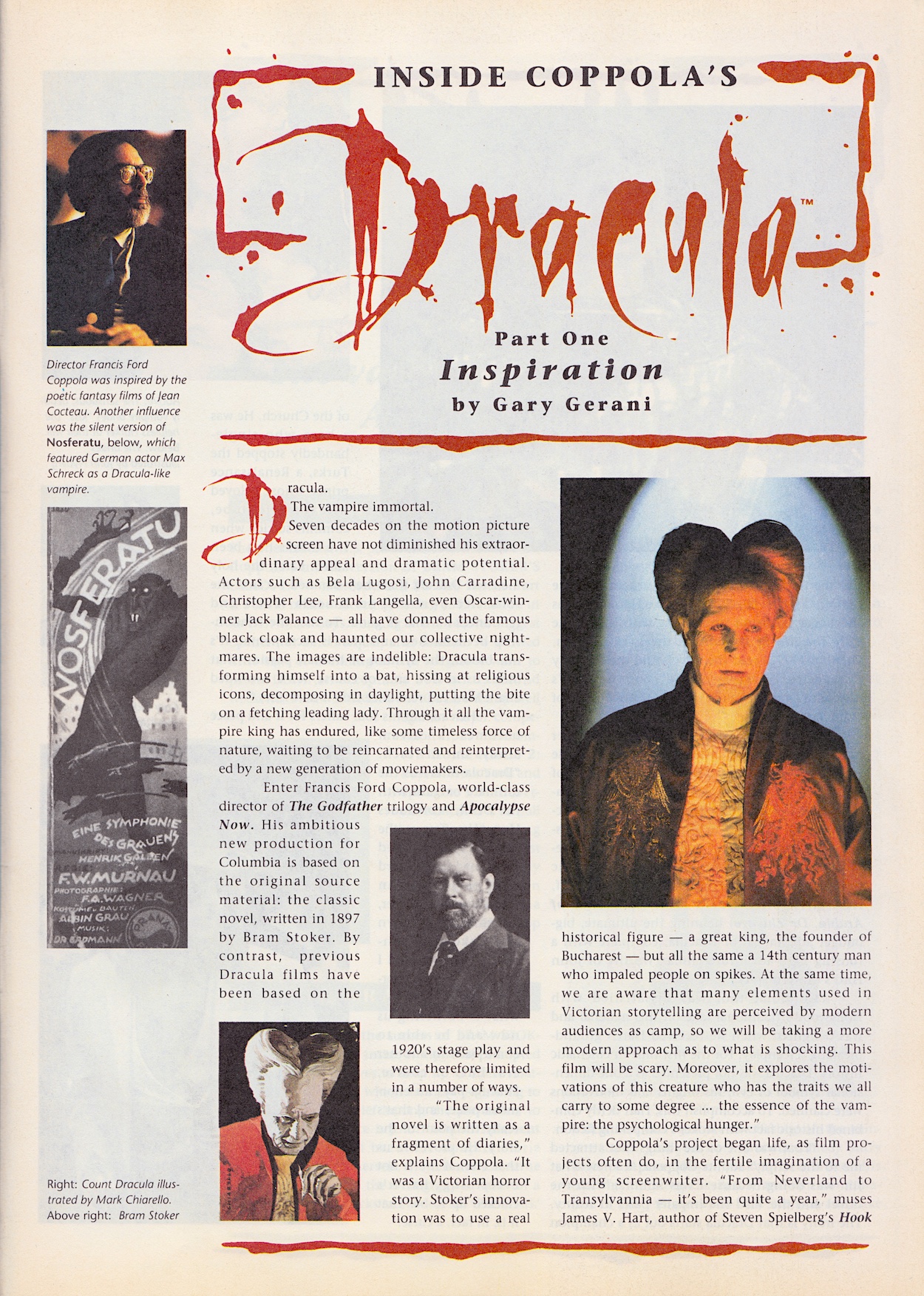
The first chapter of the story ends on that horrible/terrifying scene with the baby. Anyone who has seen the film will know exactly which moment I’m talking about! Then it’s quite jarring to come to white pages. I kind of wish they’d kept them black, but that may have made them hard on the eyes. As with the first five issues of Jurassic Park, Gary Gerani’s behind-the-scenes feature is in parts and begins with the original source material. I remember at the time some people complaining about what they thought were “changes” to the character (e.g. Dracula walking about outside), so thankfully that’s all put to rest here, confirming this film is the one that follows the book and portrays the character most accurately.
I’m usually one who likes to read opening credits and link the names listed to other films I’ve watched, but I was surprised to find out which family-friendly Steven Spielberg movie James V. Hart had written! Although, I do disagree with him on the best way to read Bram Stoker’s novel. If it’s your first time reading any novel it shouldn’t be the annotated version, or at the very least ignore the annotations until your second reading. They can be fascinating on second reads, but they interrupt the flow of the work and can also contain spoilers for later in the book.
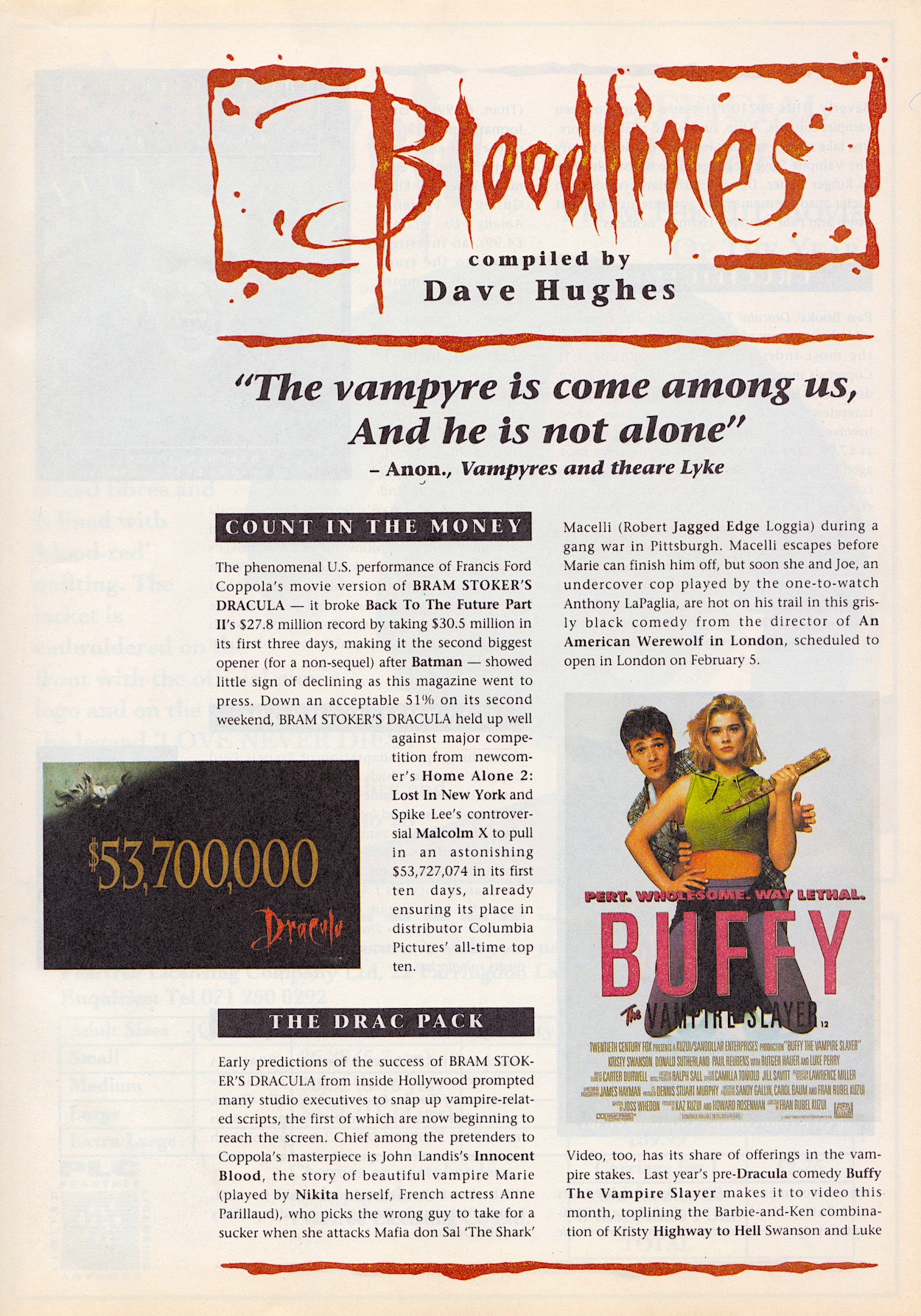
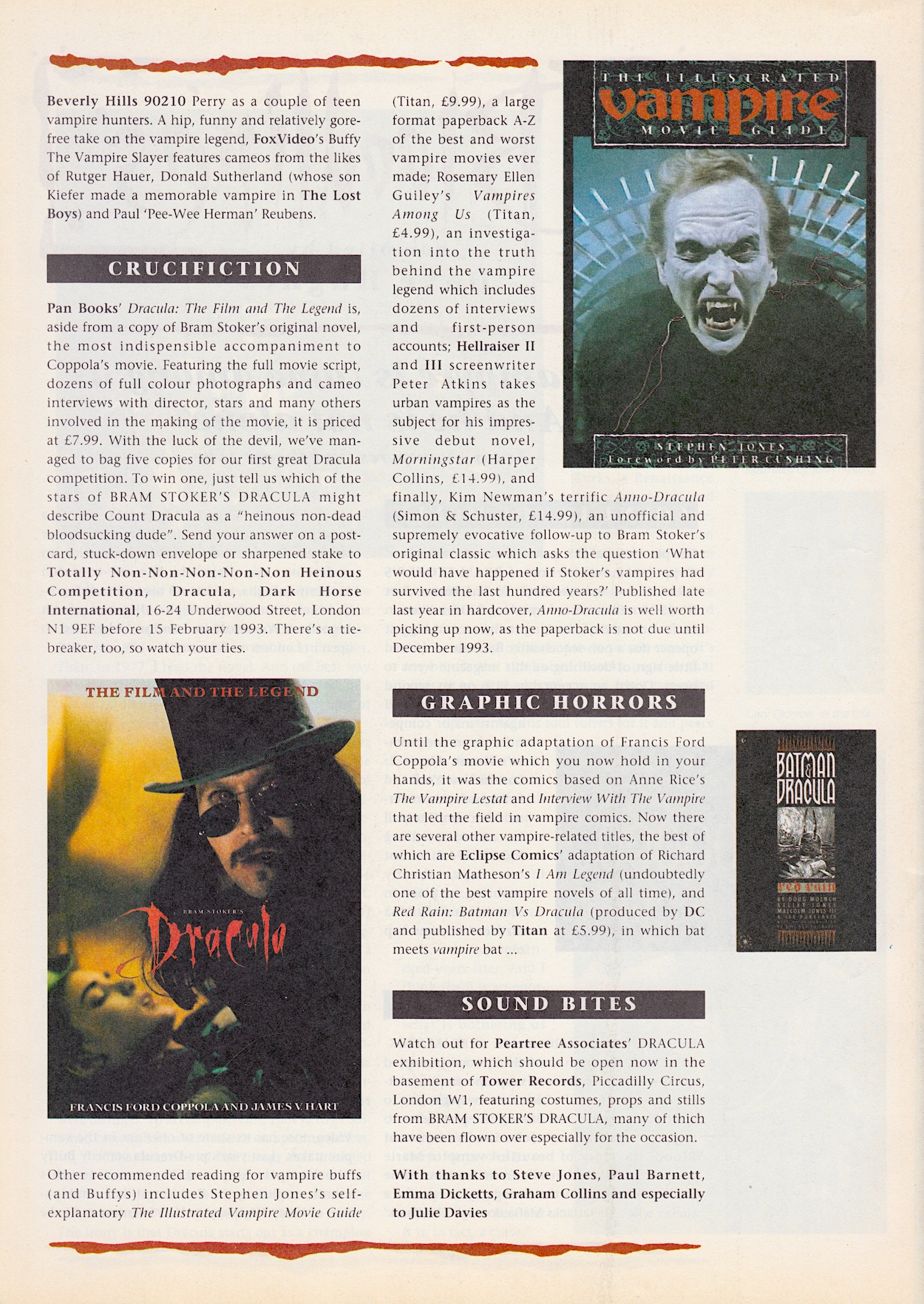
Dave Hughes’ Bloodlines is the news feature of the comic, similar to his Motion Tracker pages in Aliens. With Bram Stoker’s Dracula still in the cinemas at the time of publication the comic was keeping us up to date with its takings so far. It would go on to rake in over four times that amount. Also truly placing the comic in the past is the description of Anthony LaPaglia (Without a Trace) as a new actor on the scene! But it’s surely another film release that will catch blog readers’ attentions.
Who knew that silly film would go on to be reincarnated as a hit TV show? A show I really enjoyed until (coincidentally) Dracula turned up. Treating him like an easily-slayed villain-of-the-week was annoying and I remember that season becoming too sombre and lacked the humour of previous years, so I stopped watching. But anyway, it’s another example of placing this comic in our own timelines.
The news pages also mention Malcolm X, another film of the same era that I must revisit sometime, and Anno Dracula, an alternate history novel by Kim Newman which sounds fascinating, although I admit even all these years later I’ve never heard of it. Upon doing a bit of research I found out that in Anno Dracula, the Count’s first wife is called ‘Elisabeta’, a name taken from this film. Also above, you’ll see the usual fun competition and address our comics and magazines like to do at the time.
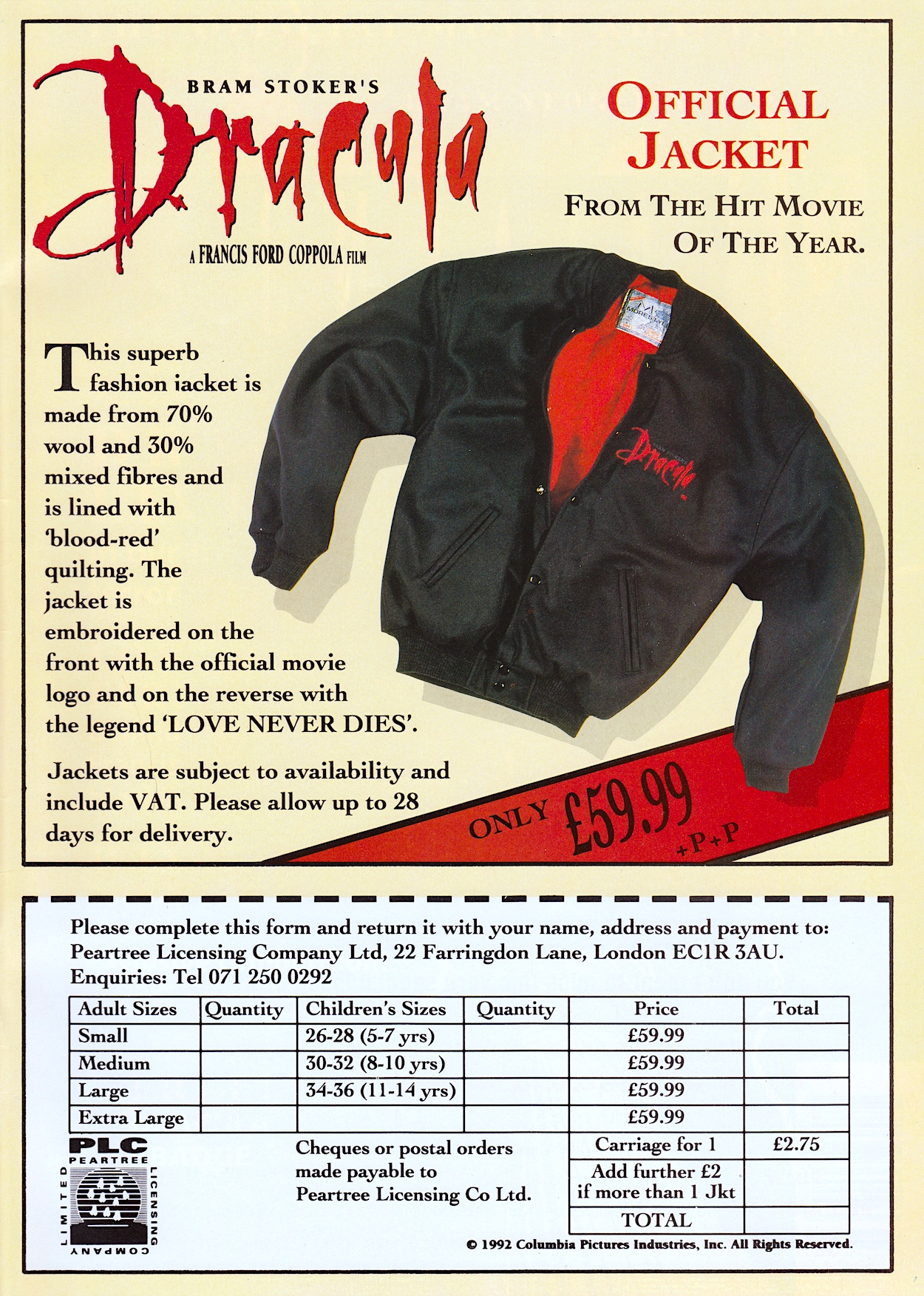
Rounding off the issue on the inside back cover is this advert for a very 90s jacket tie-in The Master from Doctor Who would’ve liked, and on the back page is an advert for #9 of Aliens. Even though #8 was still to be released two days later, the next one had some exciting new additions and this was also used as a Next Issue page in the Aliens comic itself.
It’s never going to tell the story as well as the film for newbies but this comic was clearly aimed at those who had just enjoyed Bram Stoker’s Dracula at the cinema. In that regard this is the best movie adaptation I’ve come across so far on the blog. That art, that brave decision to create its own unusual style that somehow feels just right, is wonderful. There’ll hopefully be for wonderfulness in just three weeks with #2 on Sunday 9th February 2025.
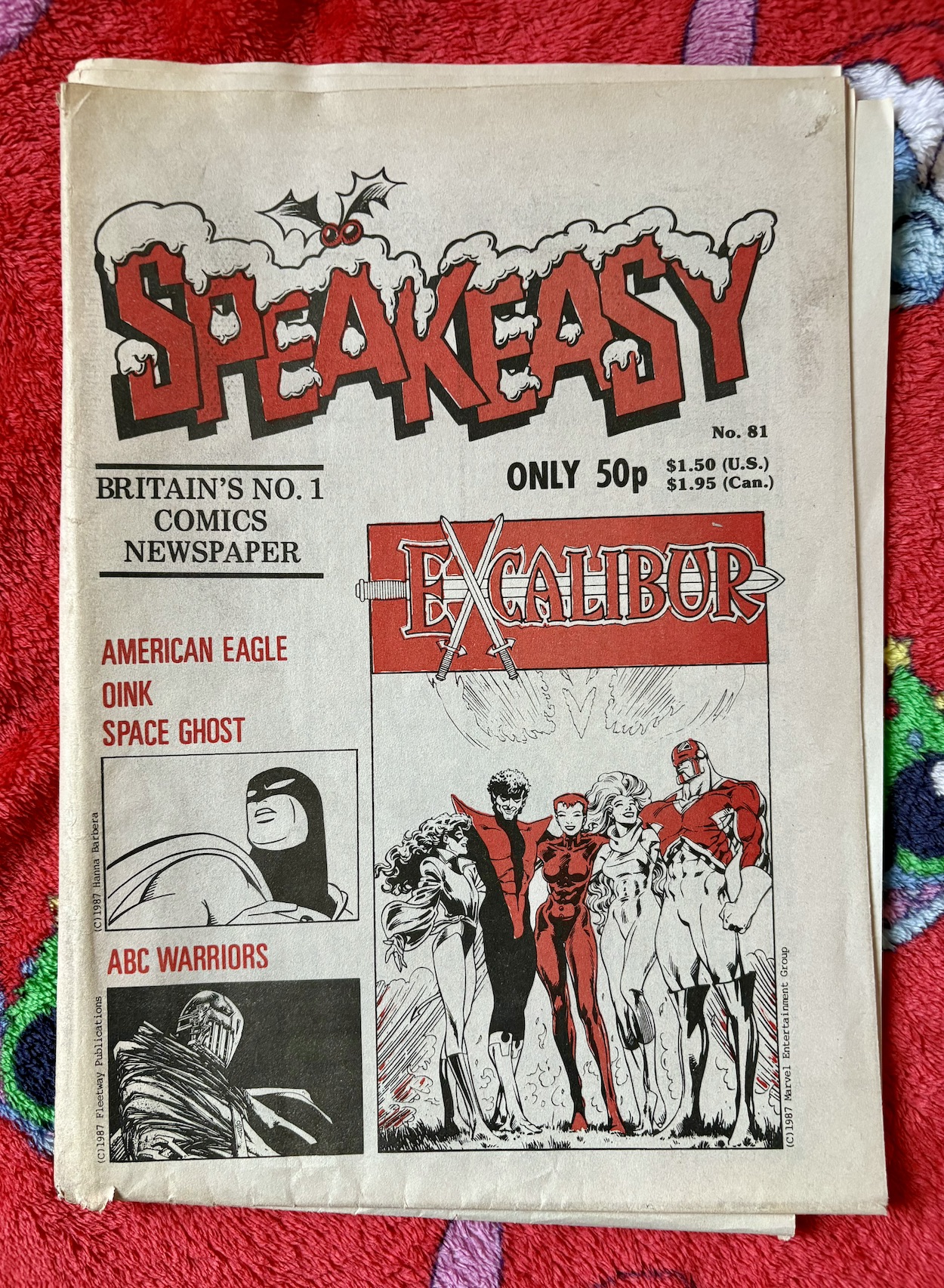
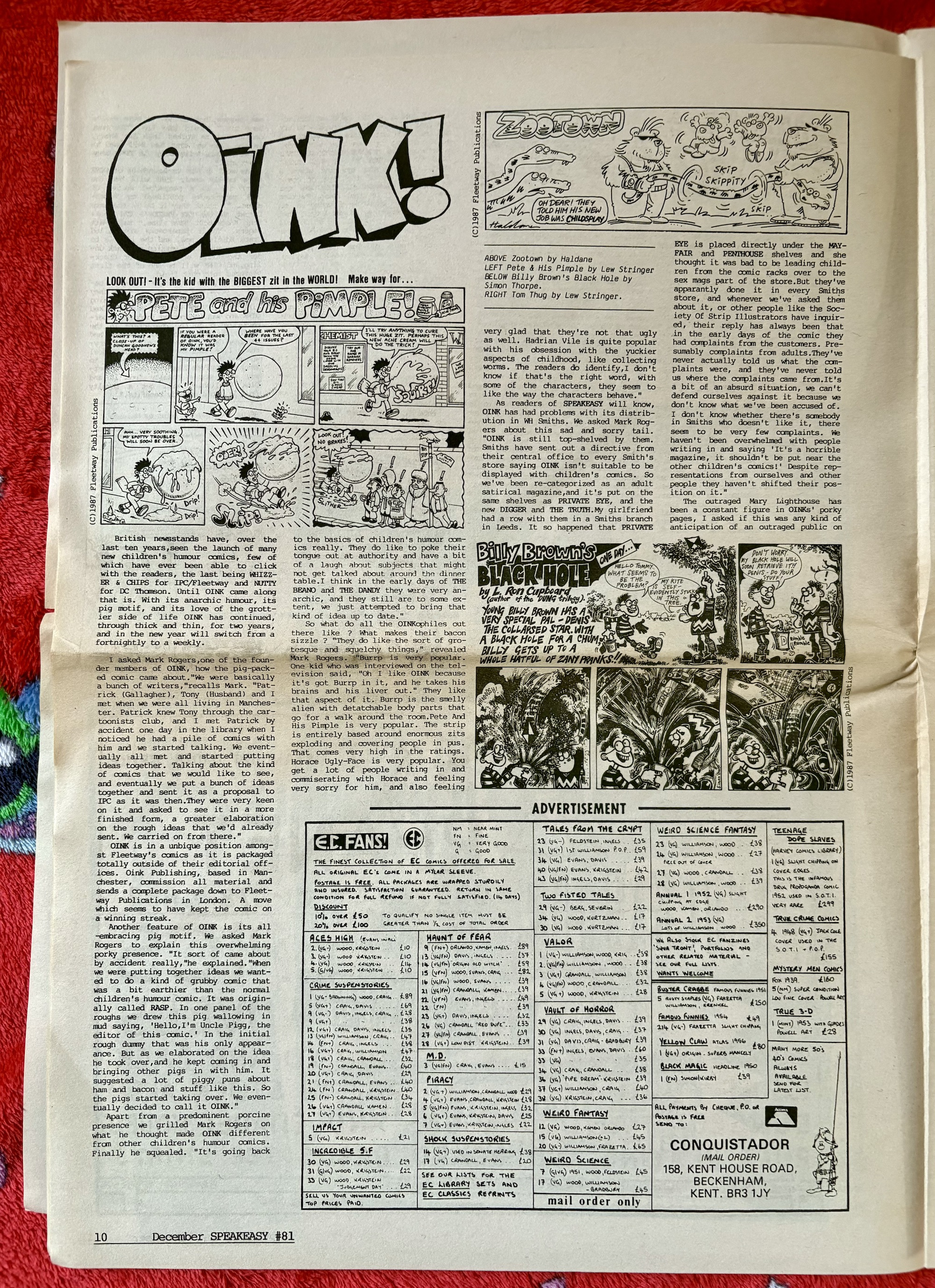
Just five short months after the previous issue of Speakeasy that featured on the blog came their Christmas issue, complete with snow and holly on the title (as it should be) and our piggy publication got a headline mention too. That’s because inside there was a massive double-page spread all about our favourite comic.
OiNK featured in the earlier issue in a much smaller way. Here, an unknown writer (no credit is given so it could be anyone out of Cefn Ridout, Dick Hansom, Bambos Georgiou and Nigel Curson) chats to OiNK co-creator/co-editor Mark Rodgers and the big news was that OiNK was finally going weekly with #45!
I remember the first time this was announced in the comic and I was absolutely thrilled. The loss of some key characters to a semi-regular basis and a reduction in pages was a bit of a shock though. If I’d been reading Speakeasy I’d have had a heads up and Mark’s explanation about some characters being on a regular rotation makes perfect sense. If only the comic itself had told us this at the time, maybe more readers would’ve stayed around.
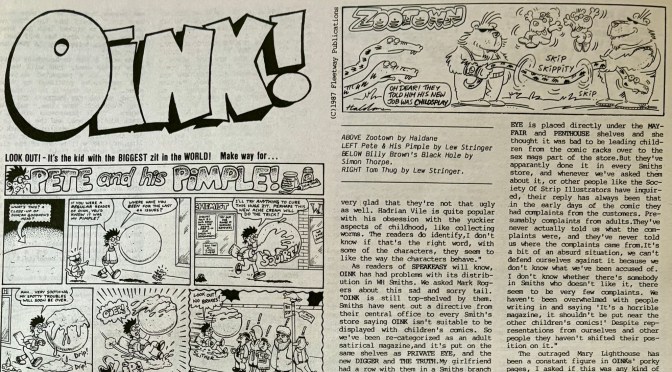
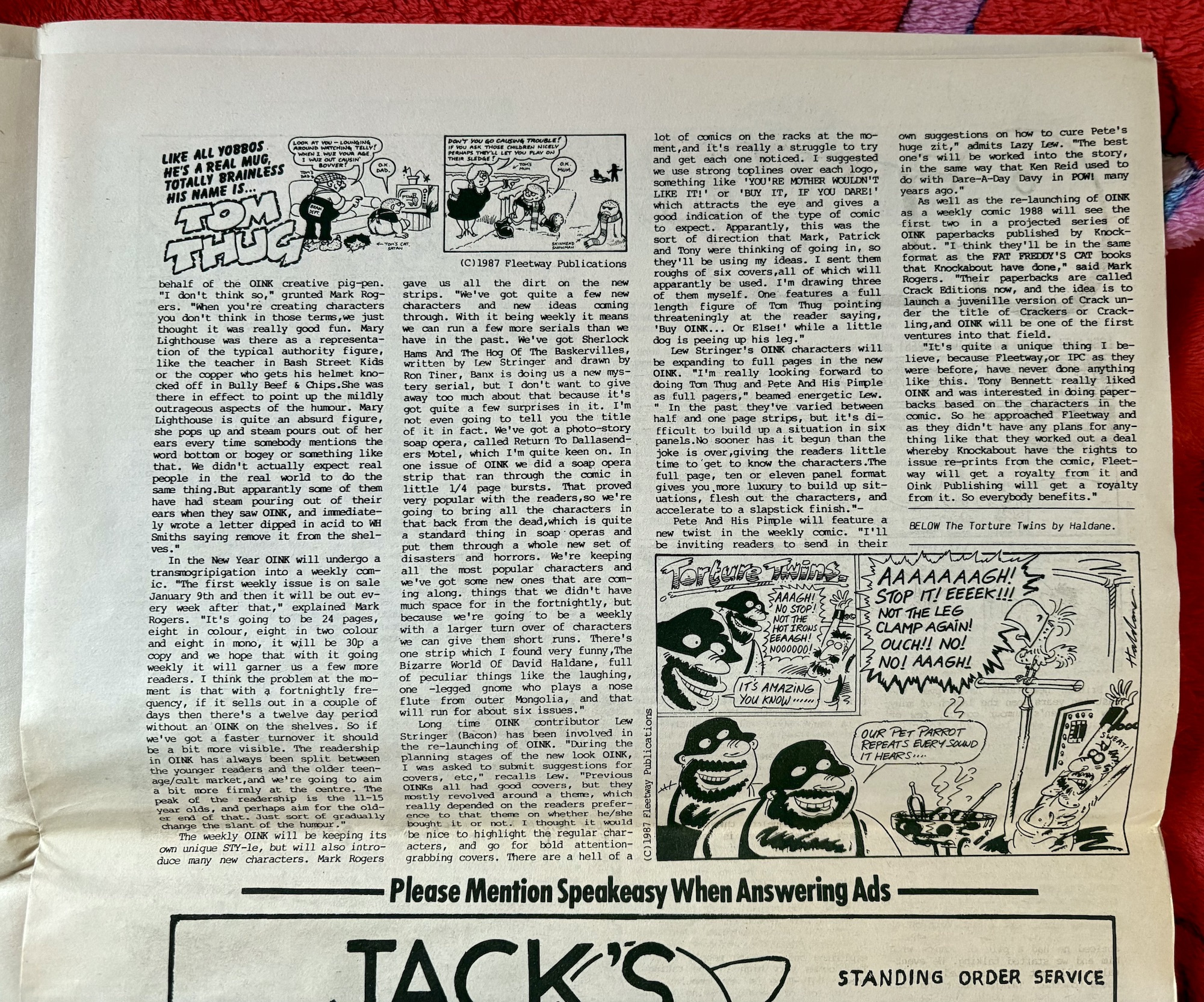
There are a handful of previews for the new weekly strips here, showcasing Lew Stringer’s main characters who would now always have full pages to themselves. David Haldane’s are shown in their entirety and Billy Brown’s Black Hole was a one-off but even on such a smaller scale Simon Thorp’s detailed artwork still looks the part. Two-thirds of it are shown here even though we wouldn’t see it in OiNK until #68, the final issue!
“The pigs started taking over. We eventually decided to call it OiNK.”
Mark Rodgers
The piece begins with the well-known tale of how OiNK’s three creators (Mark, Tony Husband and Patrick Gallagher) met and, once we get to the point in the story where OiNK received its name, the writer takes every opportunity to insert a surprisingly well-crafted pig pun. The article focusses on OiNK’s independence and what set it apart from its contemporaries. Most interestingly, Mark likens OiNK to its stablemates when they were younger comics, when they pushed the envelope with their own rebellious senses of humour.
But by the 80s what was once rebellious had become stagnant. OiNK was their attempt at rekindling that same feeling for the modern audience. I’ve no doubt those that complained about OiNK failed to see the similarity to the comics from their own youth. Other interesting tidbits here include Mark admitting the humour was going to be gently changed to appeal to the middle-ground of their readers’ ages, Burp is misspelled throughout for some reason, and the DallasEnders photo strip mentioned wouldn’t actually see the light of day until #63, the first monthly.
“It’s going back to the basics of children’s humour comics really.”
Mark Rodgers
Lew Stringer also pops up towards the end when he’s asked about his involvement with the weekly relaunch. To help with the quicker turnover of issues Lew was asked to design half a dozen of the covers, three of which he would draw himself and the rest would be handed over to others. Lew discusses the idea behind them and it’s interesting that he came up with a theme for them in response to the fact the issues themselves would no longer be themed. Clever.
There’s one point here that’s particularly relevant. Mark talks about some of the more popular characters and how readers could identify with them. They were highly exaggerated versions of us and our likes, dislikes and behaviours of course, but it meant we could laugh at ourselves alongside the celebrity spoofs and random characters inside the comic. In a world where certain corners of the internet bemoan comics (and other mediums) wanting to create identifiable characters for modern audiences, it’s clear they don’t know their own comics history. It’s always been a thing, whether in superhero comics or silly ones about pigs and plops.
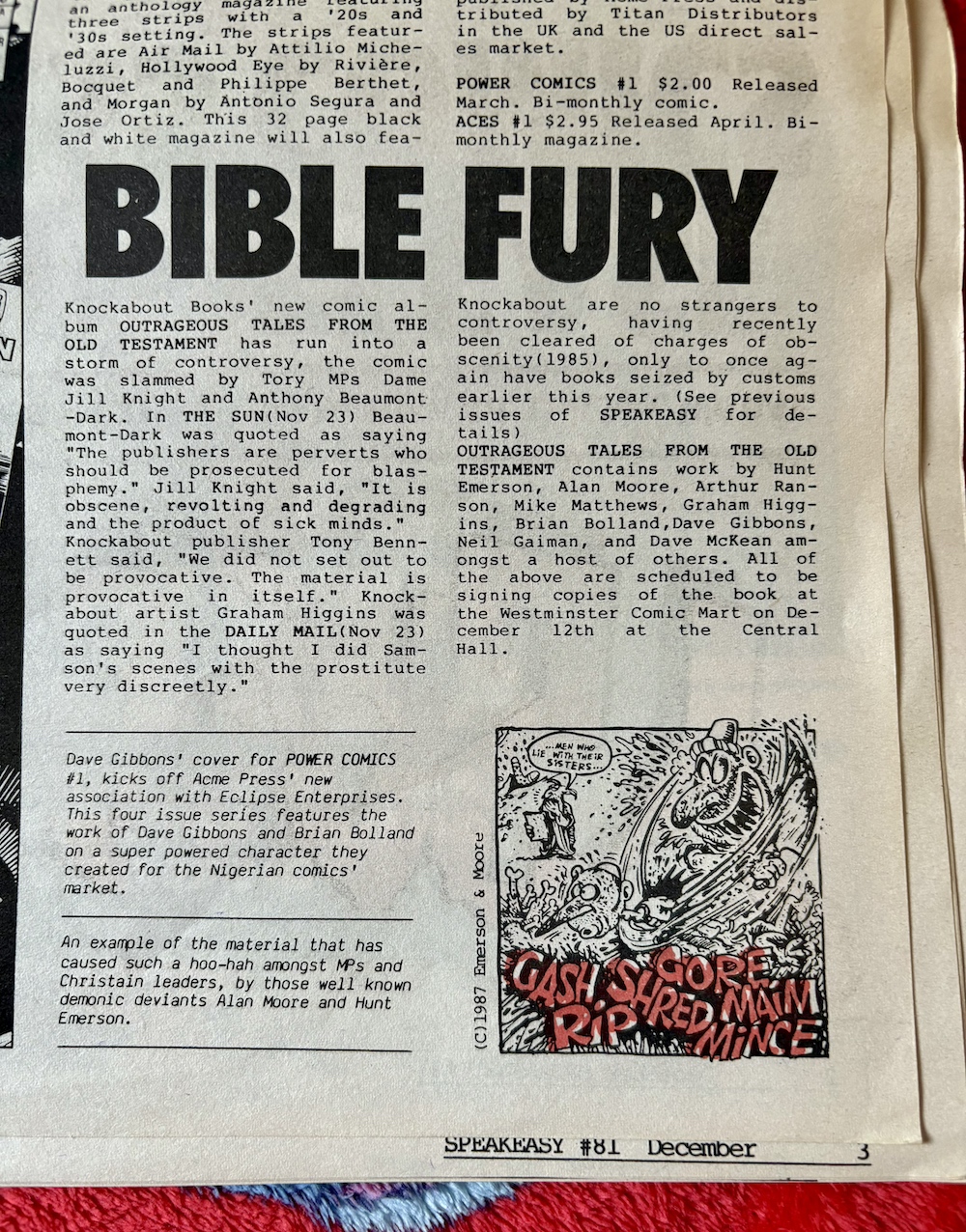
It’s time for a quick look at some other little bits that caught my eye as I read this edition of Speakeasy. Some things never change, as some got into a tizzy over new Bible-based comics. They were reported on as “obscene” and “degrading”, created by “perverts who should be prosecuted”. Reported as such in a tabloid that had topless women every day and another that constantly runs bikini photographs of celebrities the second they are of legal age.
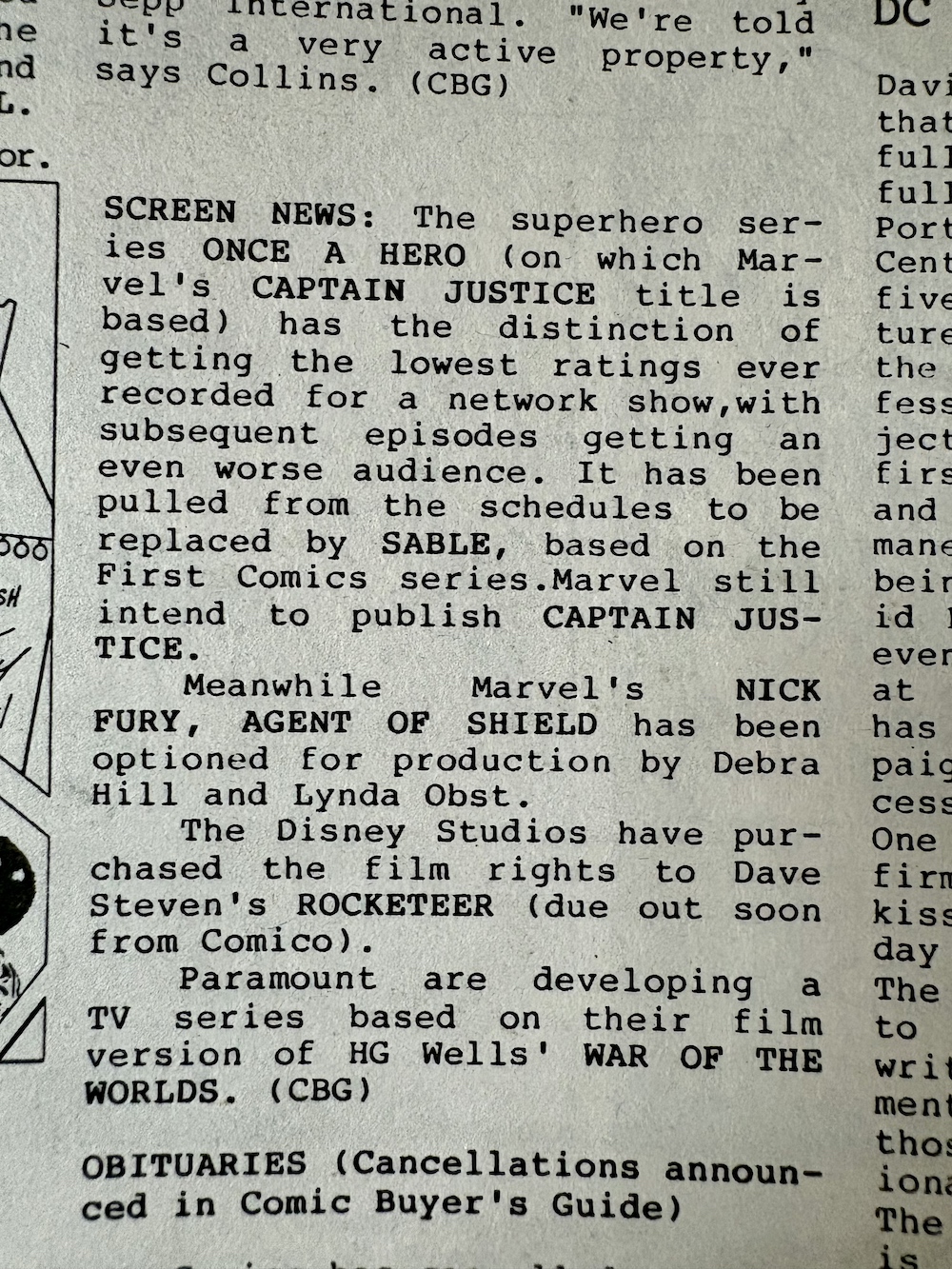
A paragraph about the atrocious ratings of a Marvel TV series ends with the first news of one of my favourite shows of all time, the 80’s War of the Worlds. Well, the first season was ace and ahead of its time, a superb sequel to the 1953 movie and which had a clear multi-year arc long before Babylon 5. But then the studio began interfering. When they didn’t get their way they fired show runner Greg Strangis, relaunching it with a completely different season two which was lame, contradicted everything that had come before and killed off any non-white characters (but I’m sure that was just a coincidence, right?). Am I still bitter all these years later? You betcha.
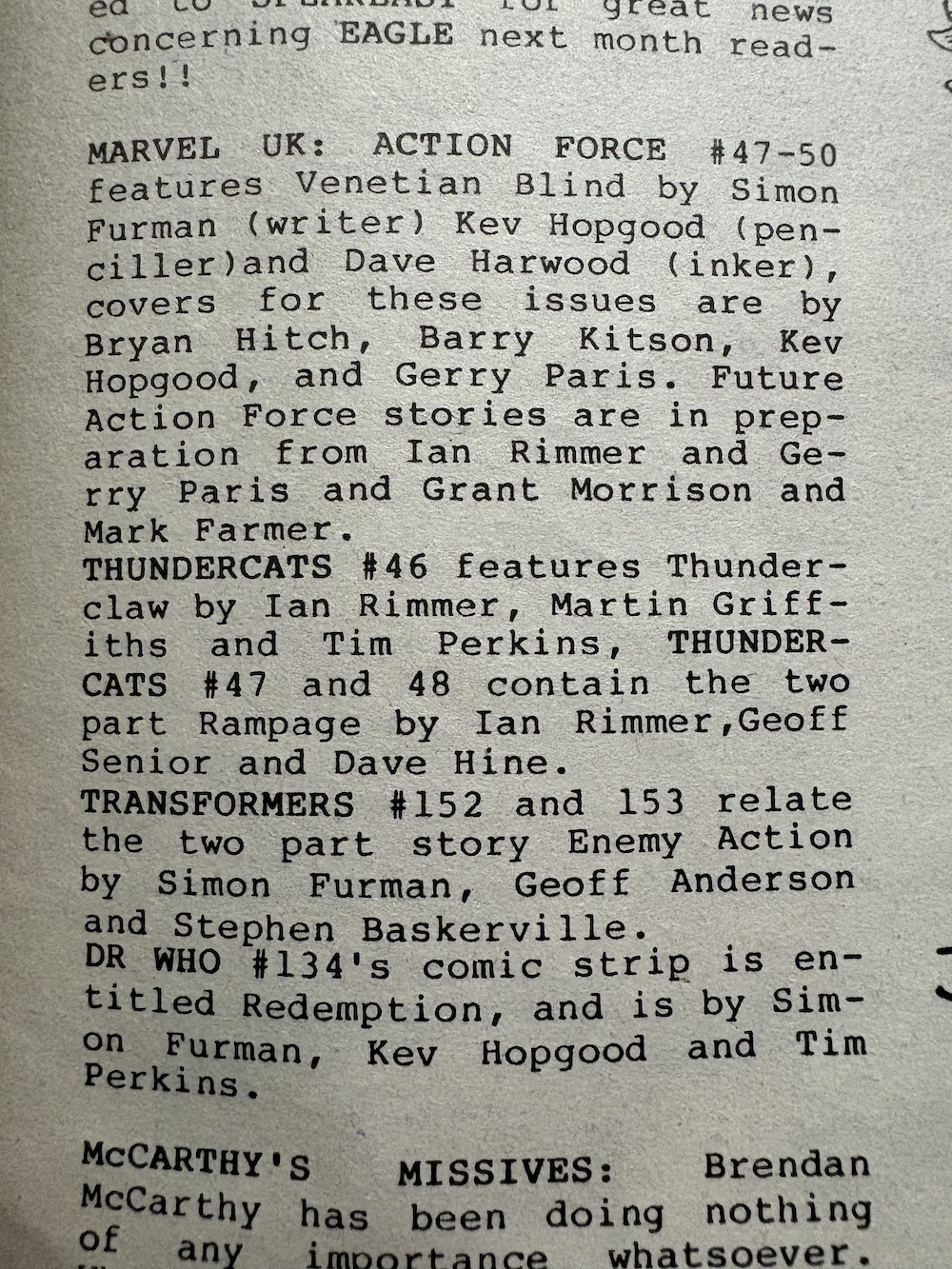
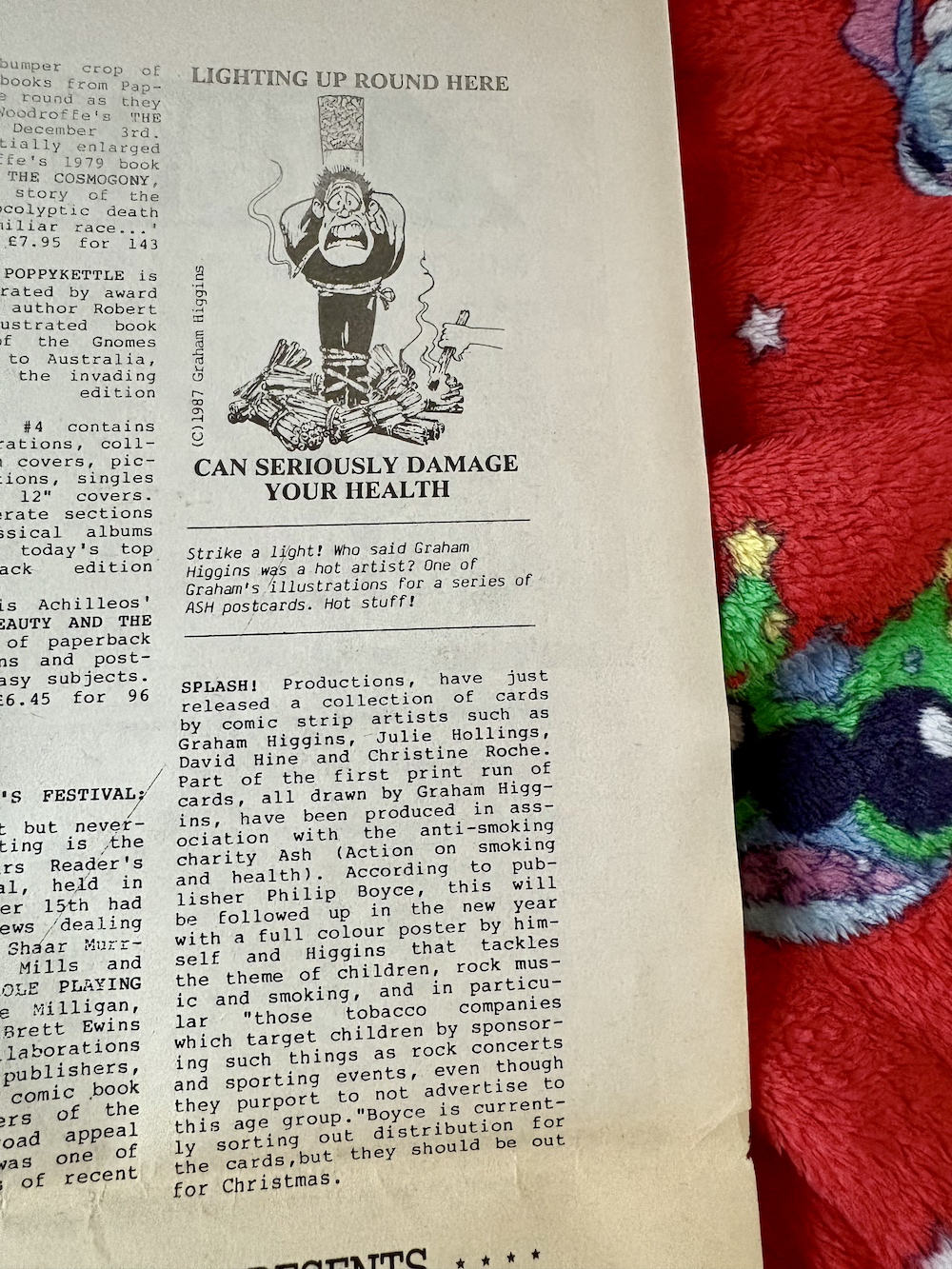
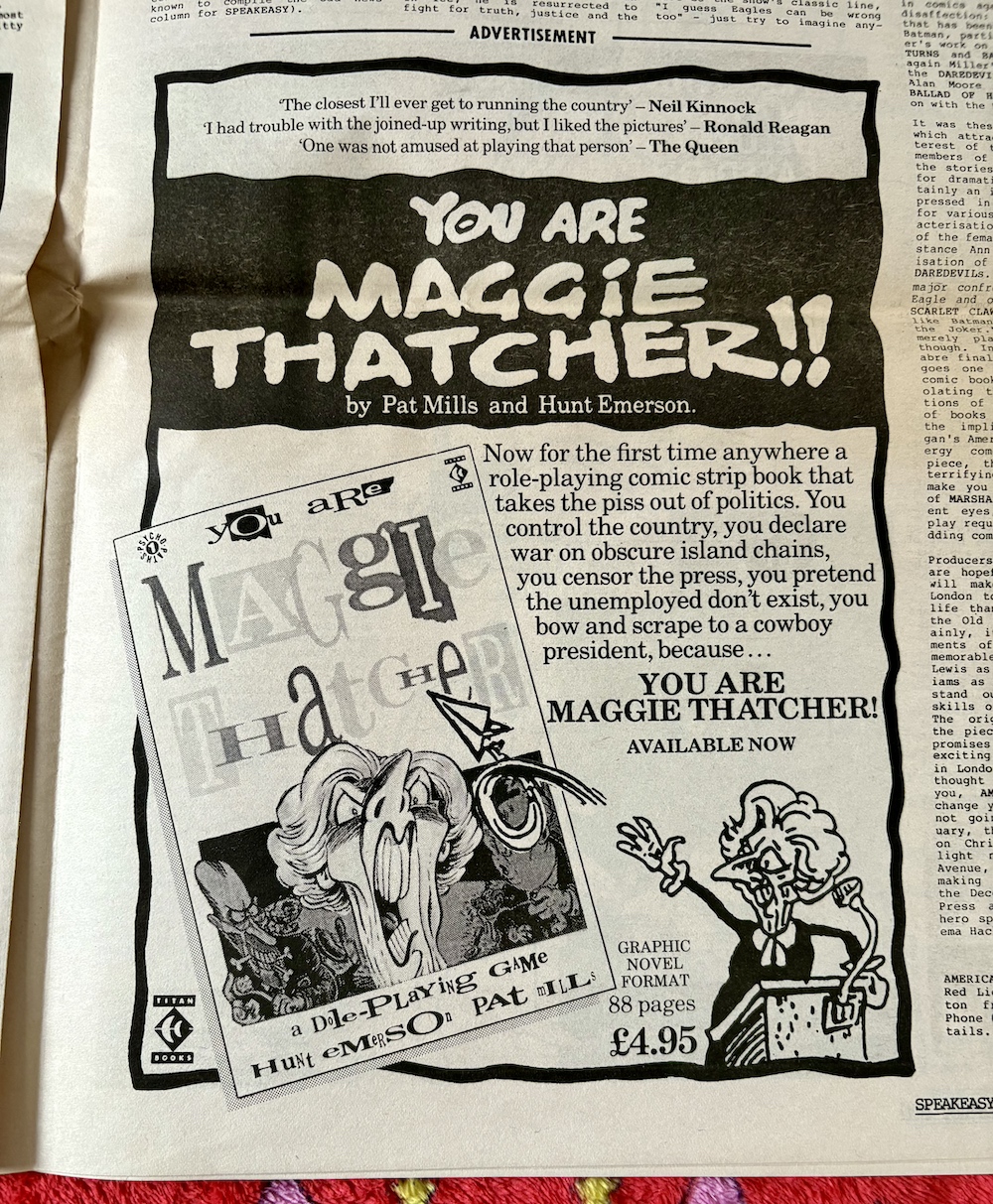
Marvel UK’s licenced comics get an update (the update for Fleetway would have you believe they only published 2000AD), however there’s no word on those Action Force issues being the last. Then there’s a rather familiar name associated with an anti-smoking campaign and I for one would be happy to be incorrectly identified as that person. Finally, Pat Mills and Hunt Emerson brought us a role-playing game book that just might have a point behind it. It’s subtle.
That brings us to the end of another look at Speakeasy, a time capsule for the comics scene of the 80s. I know it was publisher Fleetway’s idea to turn OiNK into a weekly but Mark seems genuinely enthusiastic for its potential. It’s always enjoyable to read about his love of the comic, it’s so infectious. Christmas 1987 was such an exciting time for pig pals, with the very best issues of OiNK the team produced, the first OiNK Book and news of the weeklies to come.
Very happy memories indeed and you can relive them (or discover them for the first time) in the OiNK Real-Time Read Through. Enjoy!
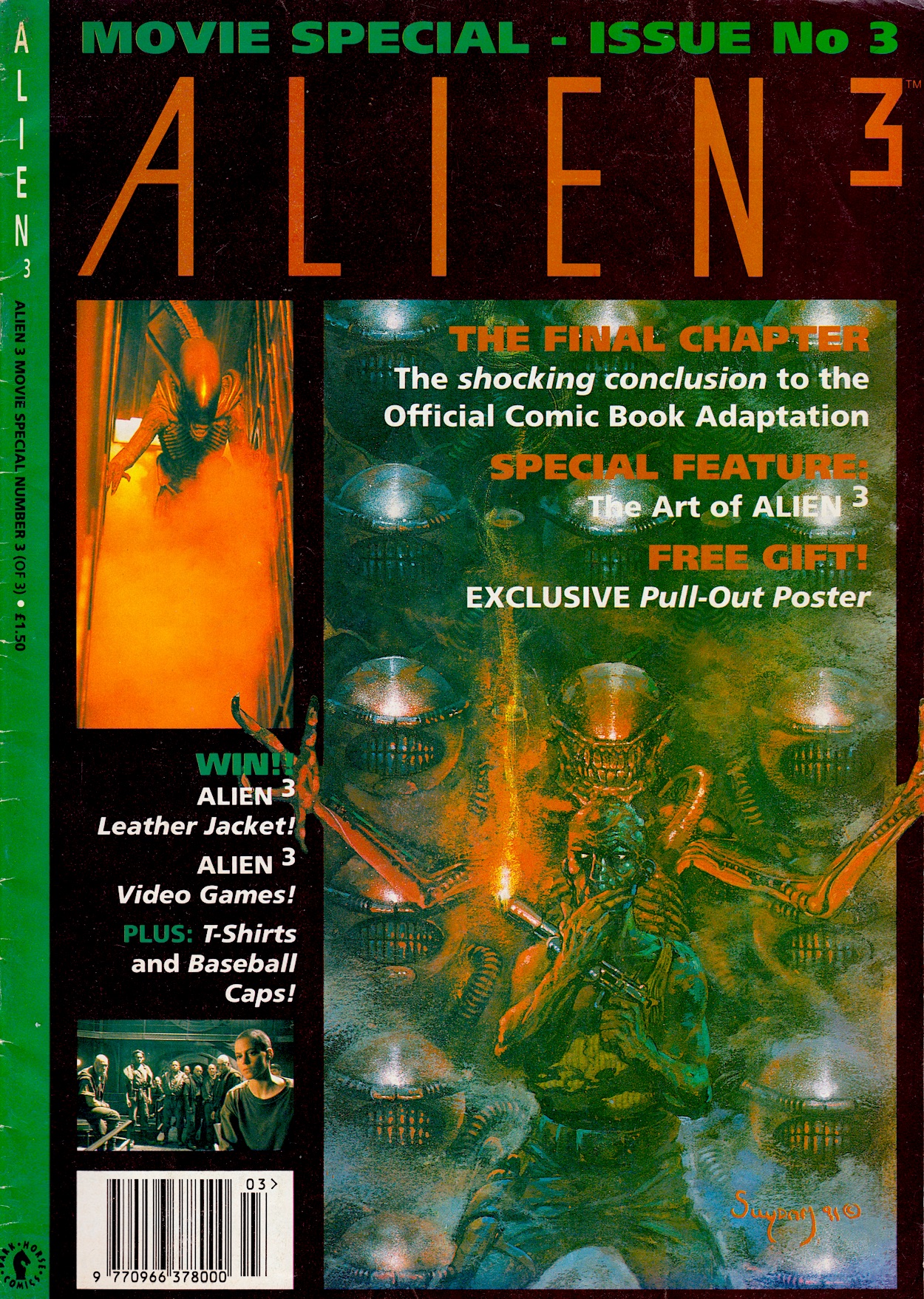
On this day back in 1992 Art Suydam‘s cover welcomed us to the final issue of Dark Horse International’s special Alien³ Movie Special mini-series. It’s another 48-pager but unfortunately there are a lot less of the fantastic features that made the first two editions so enjoyable. This is because the movie adaptation comic strip is a bumper final chapter, taking up 33 pages. Even with such an increase in page count it still rushes through and isn’t any better than previous instalments.
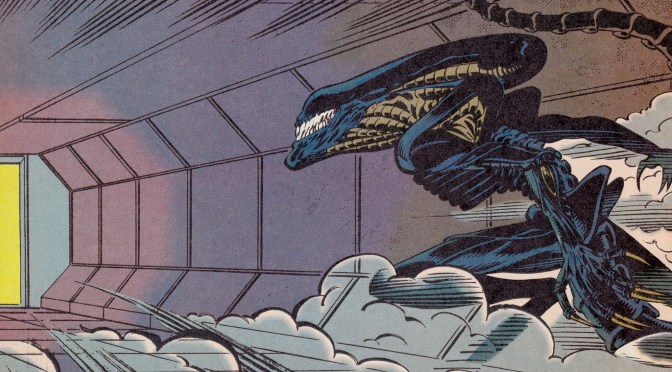
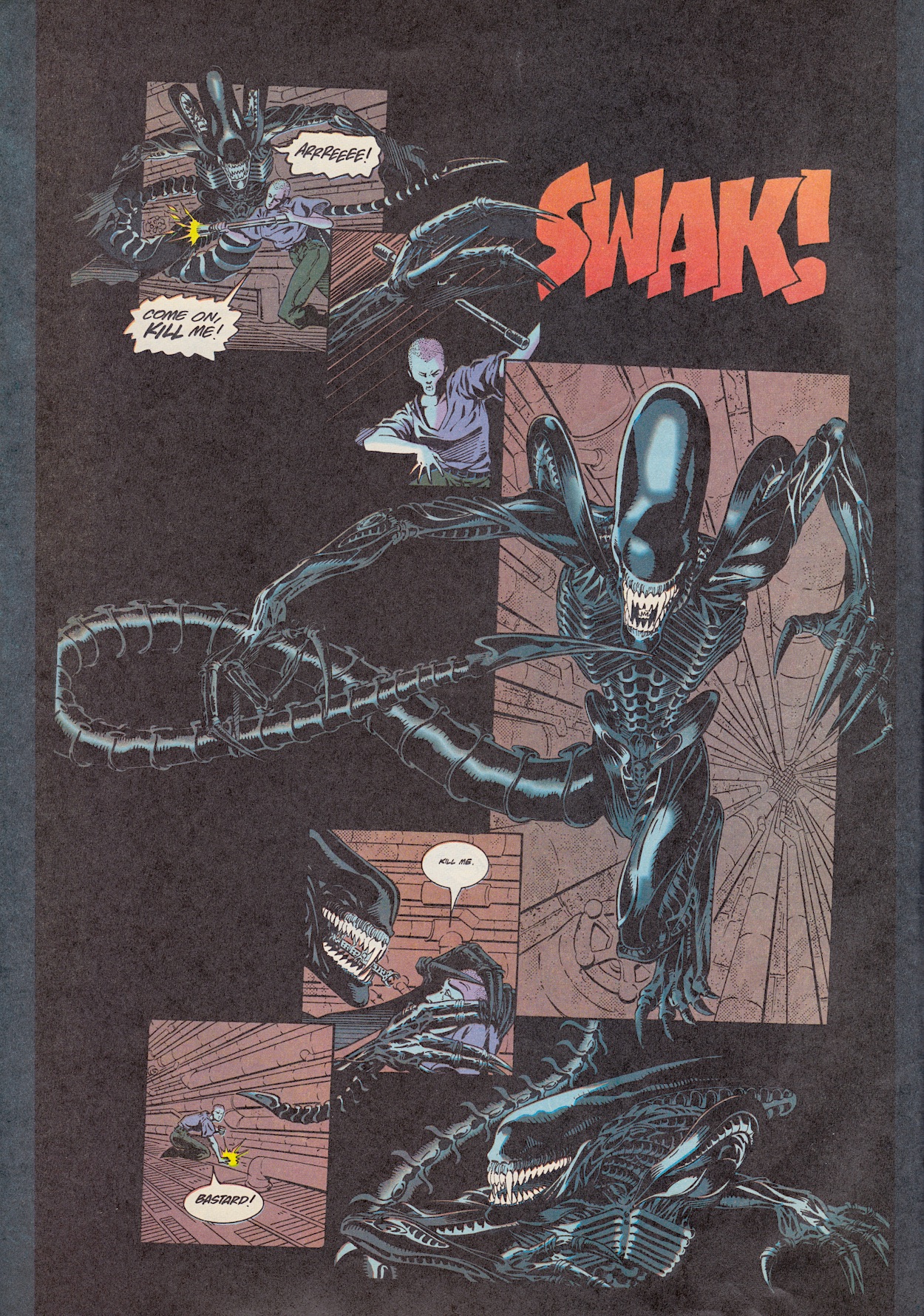
Steve Grant’s script (lettered by Clem Robins) continues to be a word-for-word reprint of the movie script, the only time it deviates is when it cuts down key dialogue, even giving some to different characters which makes what happens on the page even more confusing than it already was. I won’t go over all of the reasons why I’m not a fan of this strip again, I’m sure I bored you enough with that last time, but what I do love are penciller Christopher Taylor’s, inker Rick Magyar’s and colourist Matt Webb’s take on the alien itself.
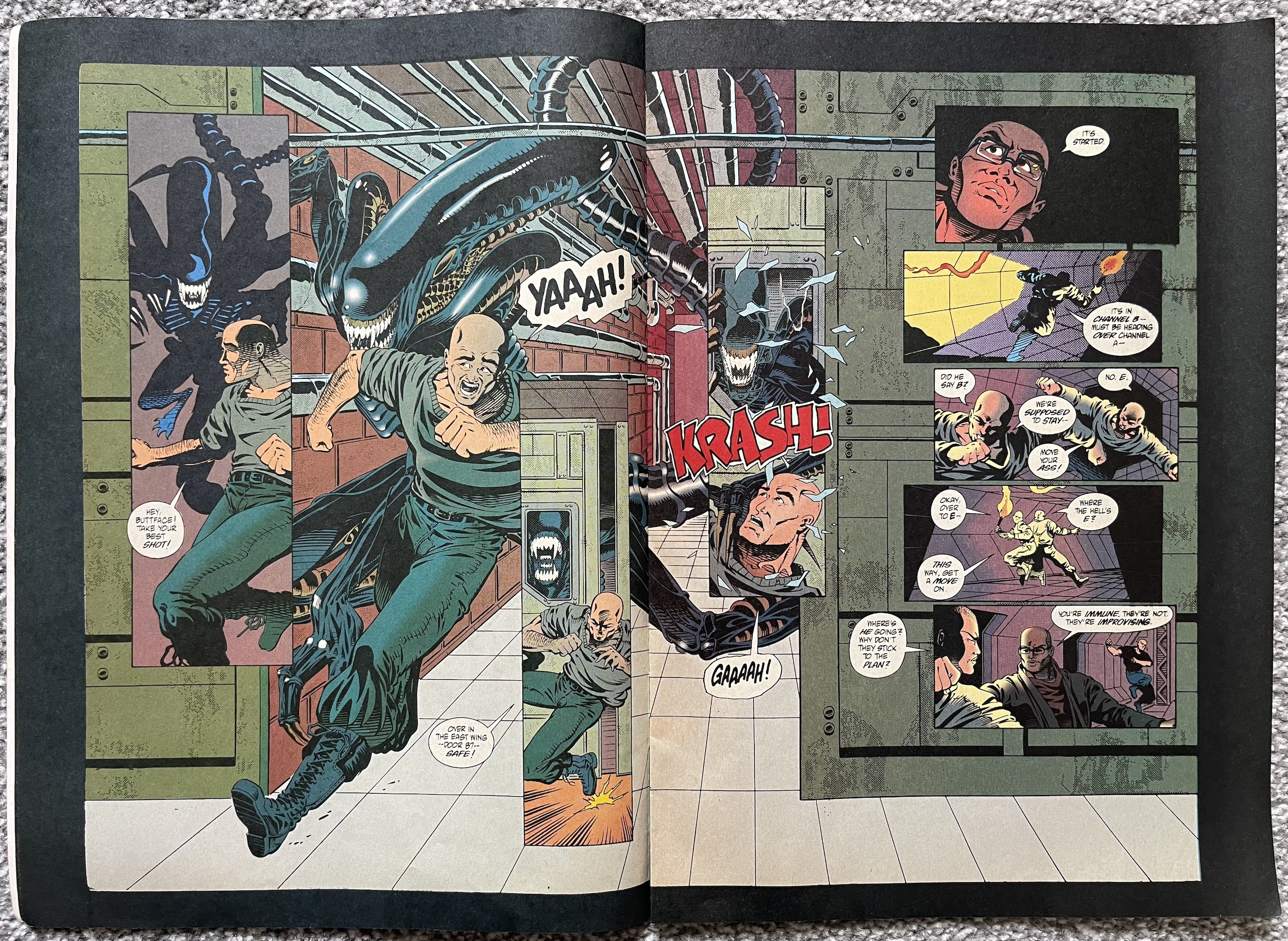
This scene above is part of the moment when Ellen Ripley makes her way into the metaphorical basement of the complex (for some reason referred to here as the “attic” instead) to confront the alien and try to get it to kill her. The xenomorph in this movie was somewhat different to what we’d seen previously as we learned that they change depending on what organism they gestate inside, and I think the art team do a great job of bringing that difference to life on the page.
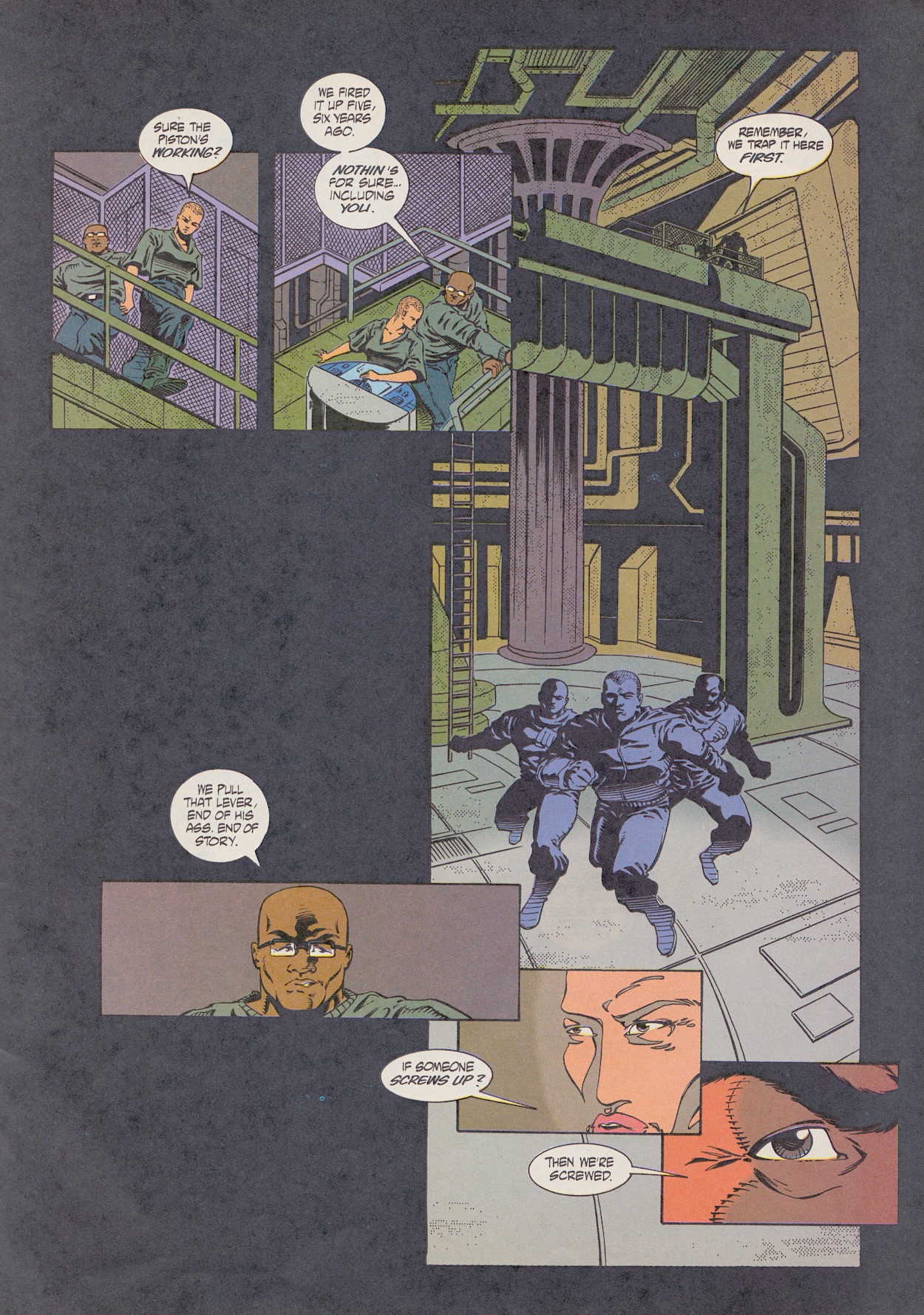
At some points the xenomorph even seems to be taking some delightful glee in the amount of killing it’s doing. That same amount of delight does not extend to the reader or the human characters, who once again are impossible to differentiate between. Even the settings are confusing, such as this depiction of the lead works below. In my head it doesn’t make sense when thinking about the architecture of the film or what it’ll be used for.
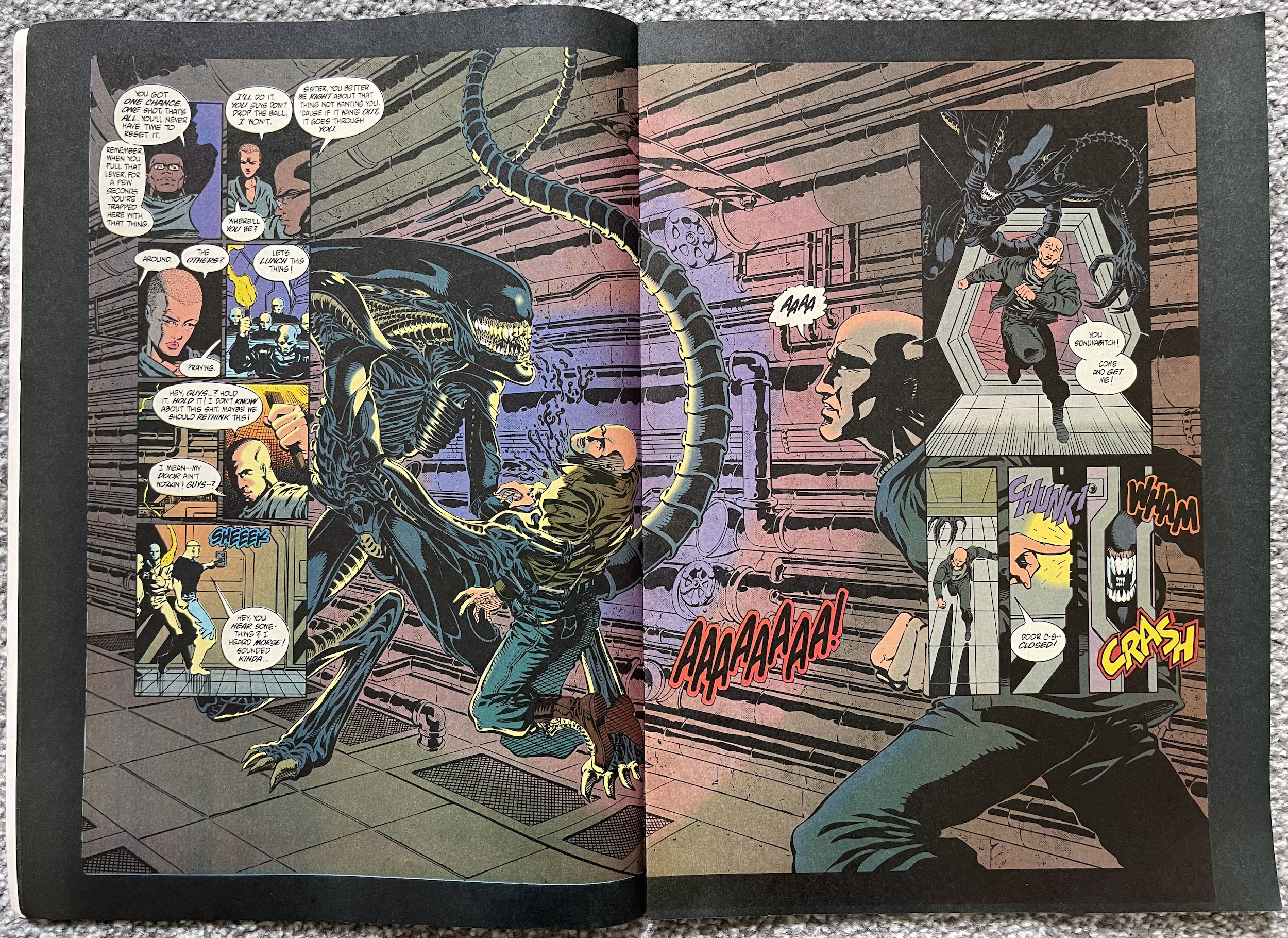
The most thrilling part of the film was always the chase sequence, when the inmates would act as bait to lure the alien down certain corridors before closing off doors, forcing it towards the lead works where they planned to trap it. The use of the alien’s point of view as it sprinted along floors, walls and ceilings at equal speed was incredible to watch the first time and it’s not something that could easily be adapted to a comic strip.
However, while this is one of my favourite sequences from the movie I’d have preferred it if the comic had just taken the essence of the chase and built something new, rewriting the script to tell this important part of the story in a way that made sense on the page. Unfortunately, what we end up with is a load of identical people running around in blind panic.
It’s not even explained well by Dillon and Ripley and in the end what everyone is doing makes no sense at all and it’s pure luck the alien ends up where it should. It’s really, really confusing. I can’t tell what’s going on and that’s coming from someone who has seen the film countless times over the years. In the end we all know how it ends, although there’s another change. Sticking with the theatrical version of seeing the alien Queen bursting from Ripley’s chest as she falls towards the molten lead, there’s an additional neck break thrown in too as Ellen somehow still has the ability to twist the creature and kill it, even though both are about to die anyway.
The art team’s depiction of the alien shows that Christopher, Rick and Matt deserved to have a chance to draw a regular Aliens strip together
I’ve covered a few comics adaptations on the blog by now and only the original Jurassic Park one showed a good deal of promise, but even it dropped the ball with its rushed final chapter. Now, having read the adaptations for it, its sequel and Transformers: The Movie (and remembering others from childhood), this one is sadly the worst yet and has done nothing to win me over to the genre. Comics can be adapted to celluloid but going in the other direction just doesn’t work.
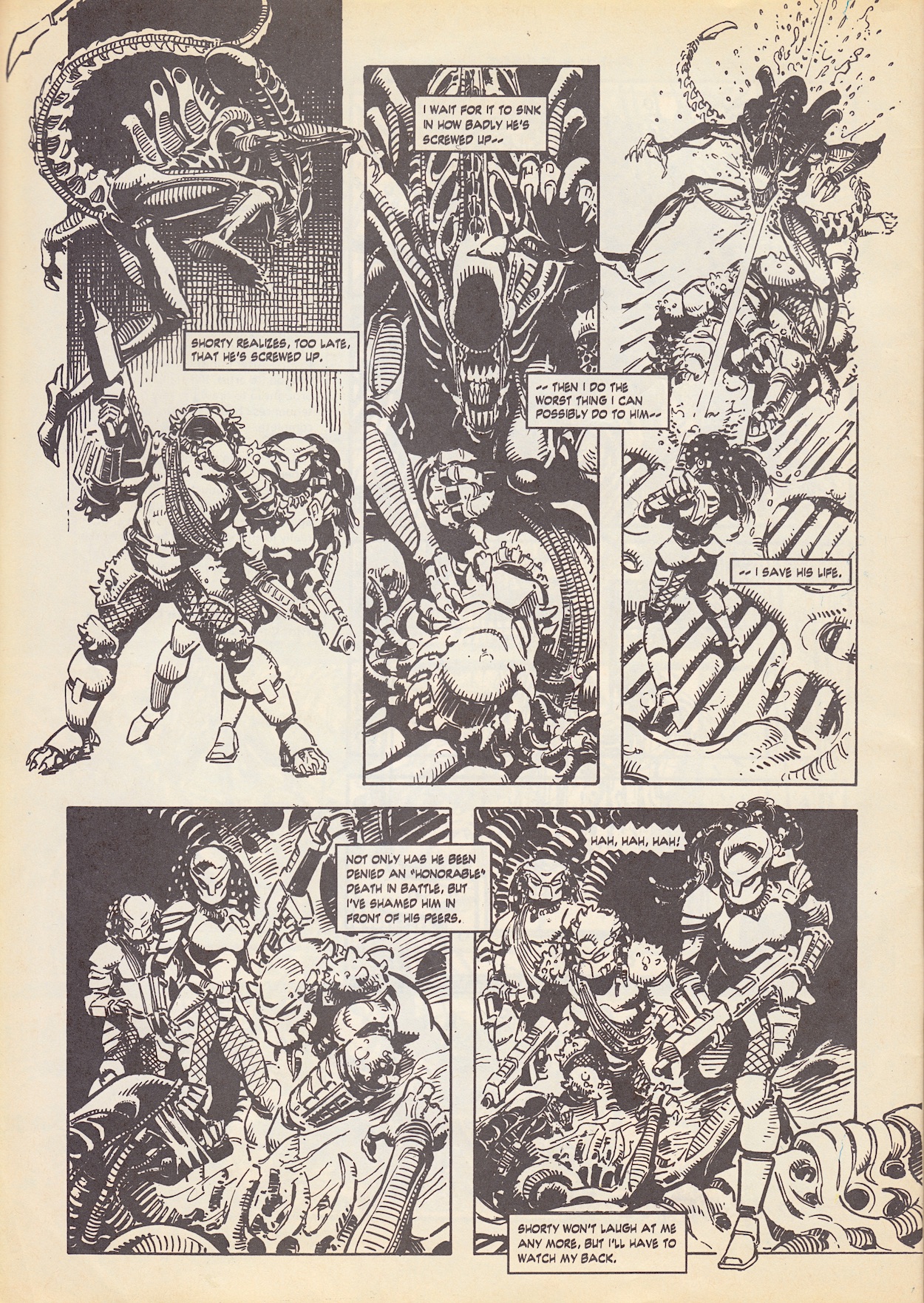
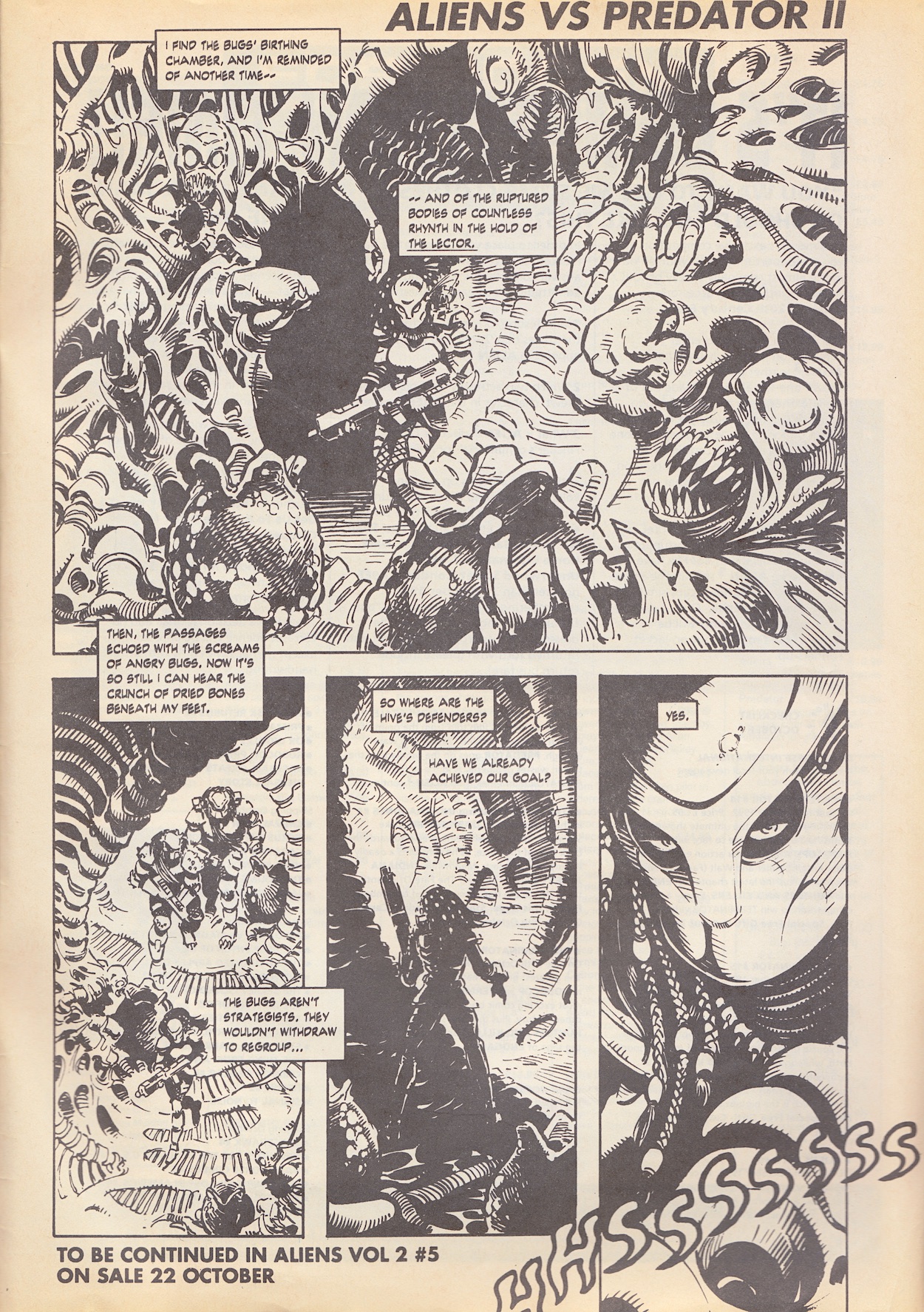
This hasn’t been without its good moments though and the art team’s depiction of the alien shows that Christopher, Rick and Matt deserved to have a chance to draw a regular Aliens strip together. I can only imagine how enjoyable the Aliens Vs Predator II mini-strip could’ve been in their hands. As it stands, it remains a curiosity, written by Randy Stradley with art by Chris Warner.
What’s more curious is how they’ve messed up the order of the chapters, which I noticed upon seeing the ‘To Be Continued’ caption. I wondered if it was skipping Aliens #4, which hadn’t been released yet. I went back and checked Alien³ #2 and it’s caption said the next chapter was to be in Aliens #4, and in it (which I quickly checked) it was to continue back into this issue. So it seems editor Dick Hansom forgot Alien³ was being released every three weeks instead of monthly (or perhaps it was originally intended to be monthly) so this chapter and the one to come next week in Aliens #4 are in the wrong order.
I was wondering why all-of-a-sudden we’ve got named Predators. I thought perhaps they’d been named in the previous story (since this is a sequel) but it might just be because we’ve skipped forward a chapter. I’ll find out next week. In the meantime, it seems it’s shameful to be saved by another Predator in battle and the story is from the perspective of a female Predator. Can you imagine the backlash from horrible, sad little corners of the internet if this was released today?
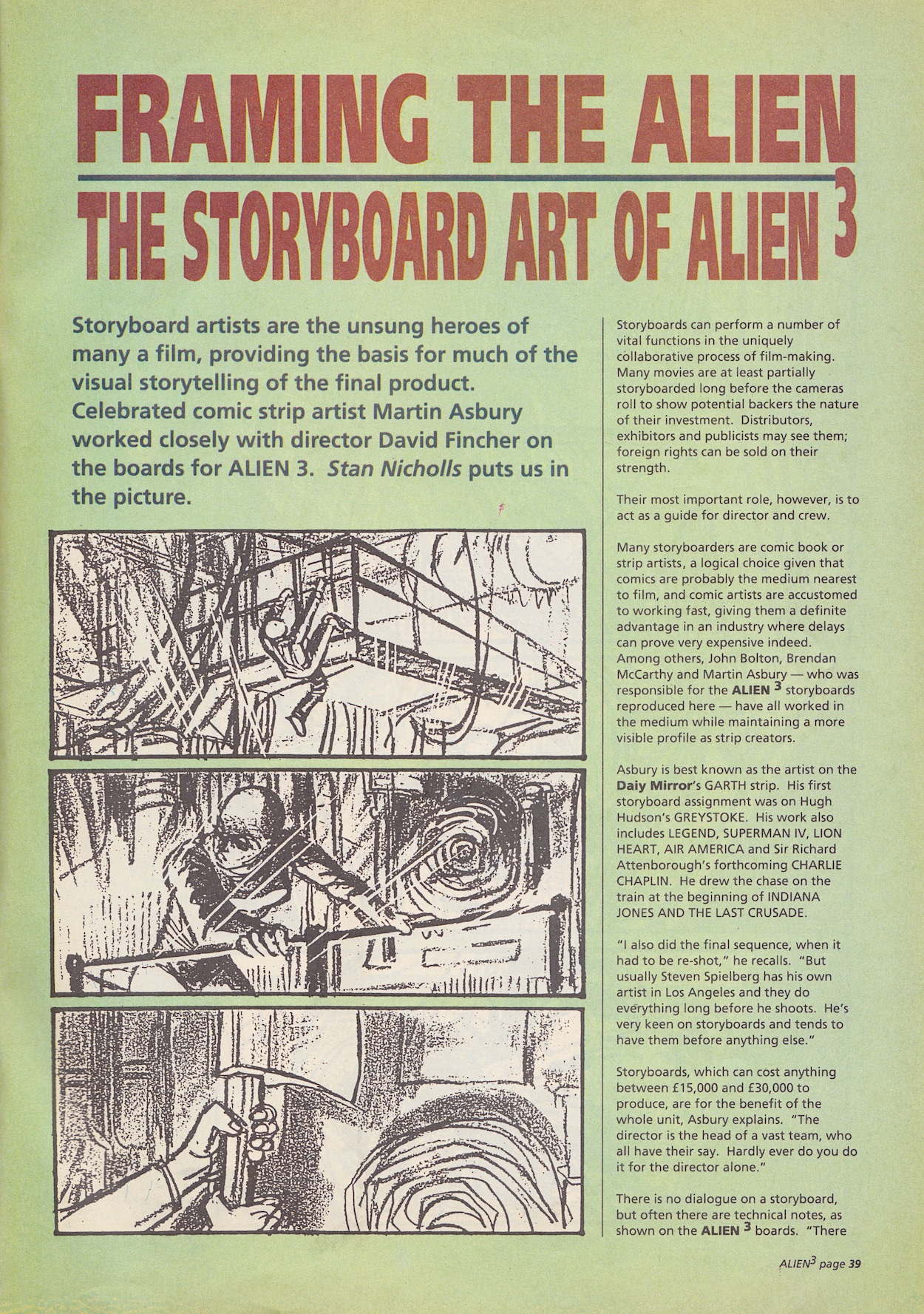
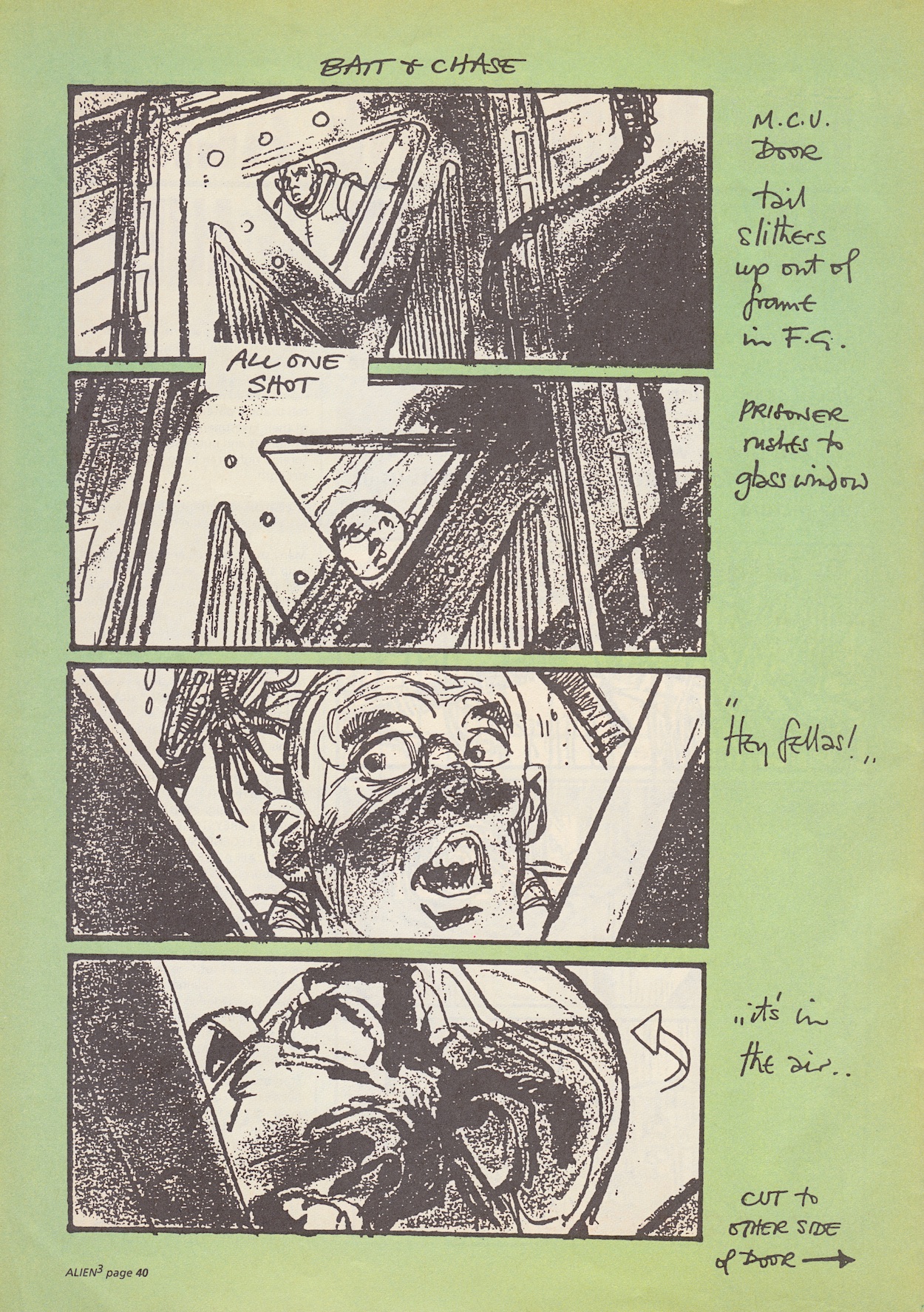
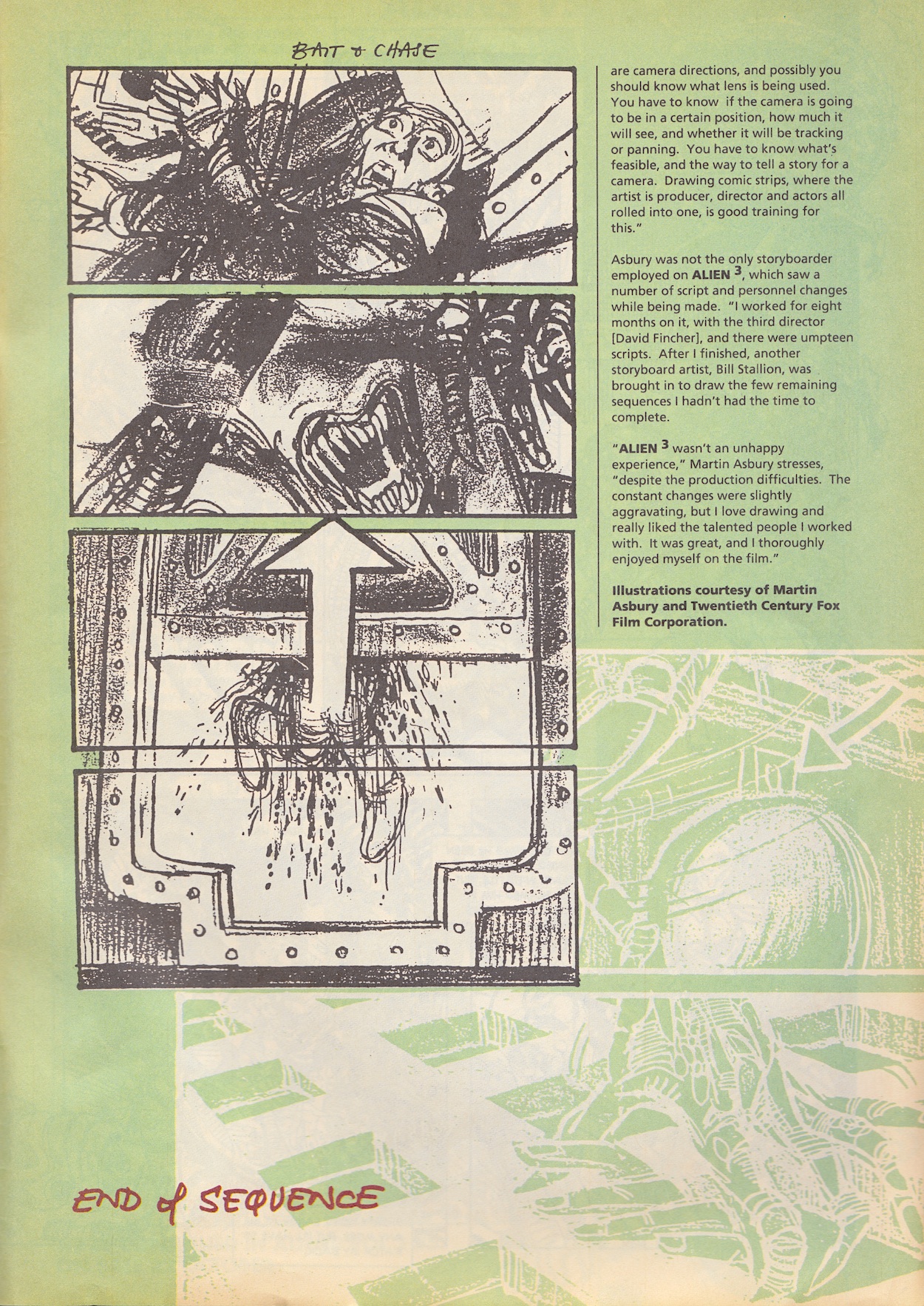
Thanks to the extended main strip the only behind-the-scenes access we get in this final issue is a three-page feature showing off some of the storyboards used in the pre-production stage of Alien³. Comics artist Martin Asbury worked alongside David Fincher on creating these, which would be shared with all of the creative departments. Martin’s comics work has included Captain Scarlett (Countdown), The Six Million Dollar Man (Look-In) and the tabloid strip, Garth. In films he’s worked on several Bond films since GoldenEye, as well as the likes of Batman Begins and Children of Men. Quite the resumé.
Stan Nicholls‘ feature is more of a general introduction to the art of storyboards and their use in moviemaking, rather than going into any depth on Alien³’s particular sketches. You can see some examples though, of the climax and that aforementioned chase sequence, showing a much better depiction of the scenes in question than the finished comic strip.
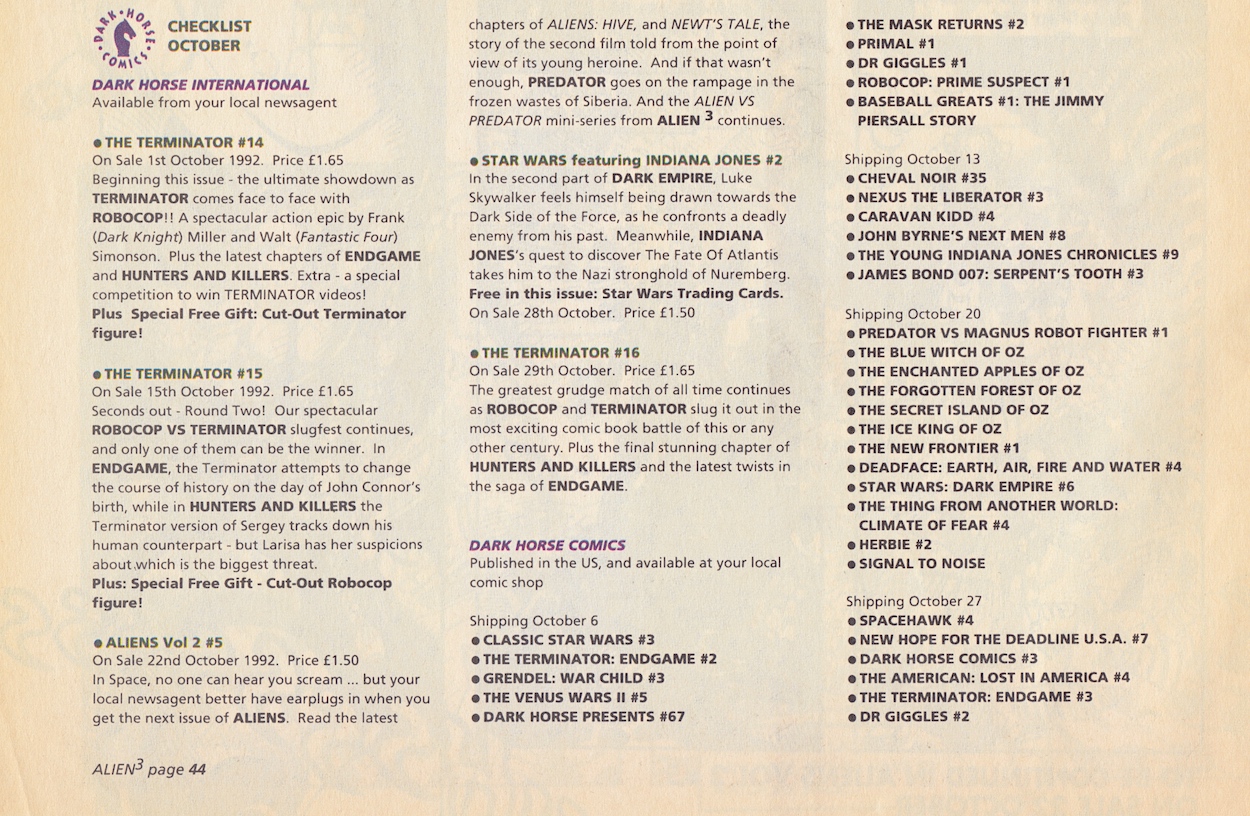
To finish off with there was also a competition to win some Alien³ merch and this October comics checklist for Dark Horse International.
The Terminator was quite expensive for a fortnightly comic in 1992, however it seems to be as chock-full of strips and features (and a free cardboard cutout figure, no less) as Aliens. Not sure why it’s fortnightly, but seeing as how this is the first time it’s appeared in these checklists and is already at #14 I’m guessing it’s another comic Dark Horse took over publication of (since the American strips were theirs in the first place). A quick internet search and it turns out it was originally published by Trident too, although The Terminator wasn’t given a fresh new volume to enjoy like Aliens was, for some reason.
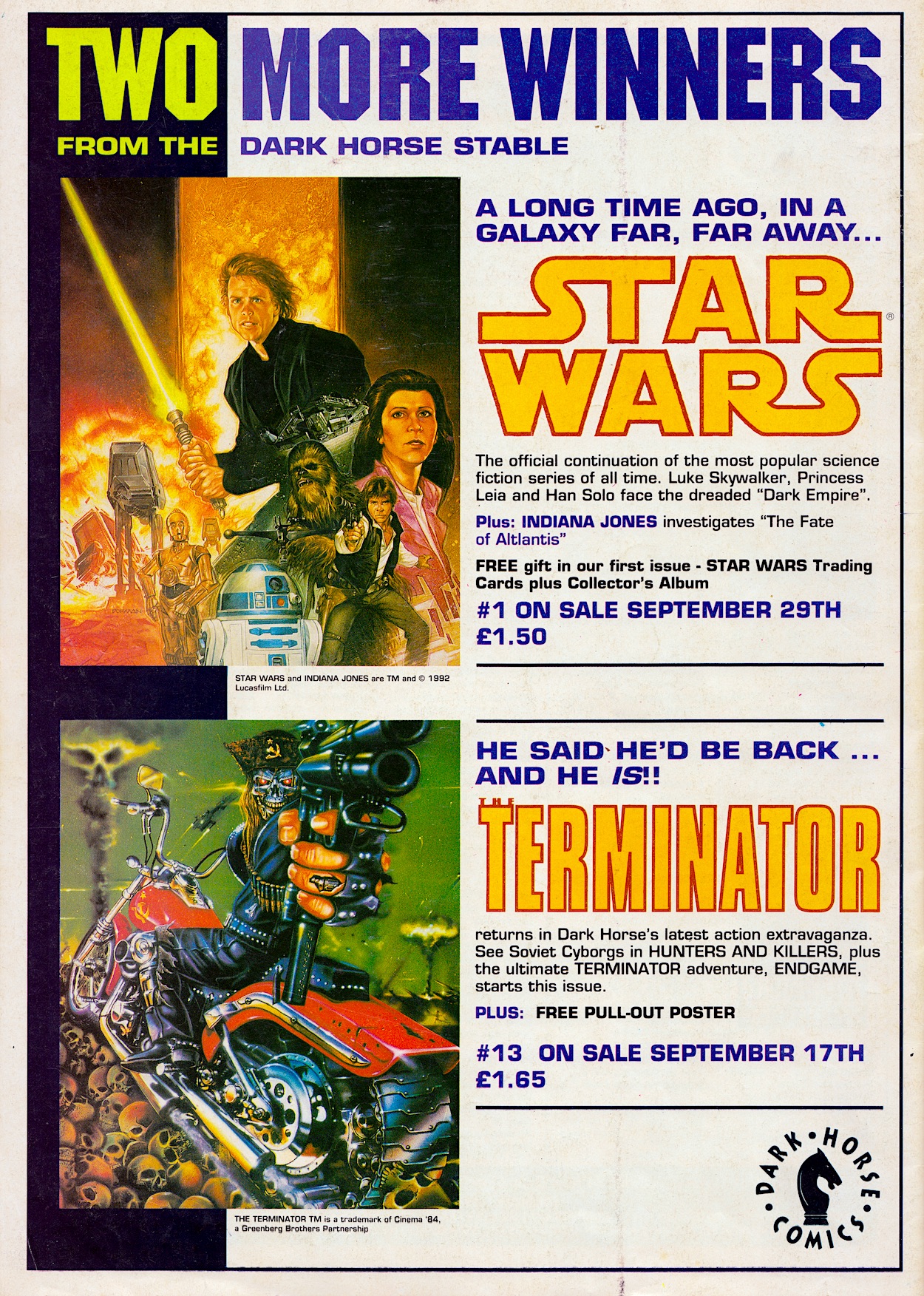
It could possibly be another one for the blog at some point in the future, who knows. But for now this issue ends with a double advert on the back page for the brand new Star Wars (which I spoke about in the review for Aliens #3) and #13 of The Terminator. The caption makes the latter sound like a brand new comic despite the issue number.
With that we come to the very end of this three issue run of the Alien³ Movie Special. I was able to pick them all up on eBay for a few quid in total and for that money I’d recommend them for fans of the movie. Not for the adaptation necessarily, rather for the contemporary features and incredible access the comic had to information on the making of the film. For those pages it’s worth the price of admission.
From now on though it’s pure Aliens action every month with the ongoing regular comic, the next issue of which (#4) will be reviewed right here on the OiNK Blog on Tuesday 24th September 2024. I’m sure future issues of it will continue to cover Alien³ in its features now and again so watch out for them as we go along. This is Philip Boyce, writer of the OiNK Blog, signing off.


 OiNK Blog