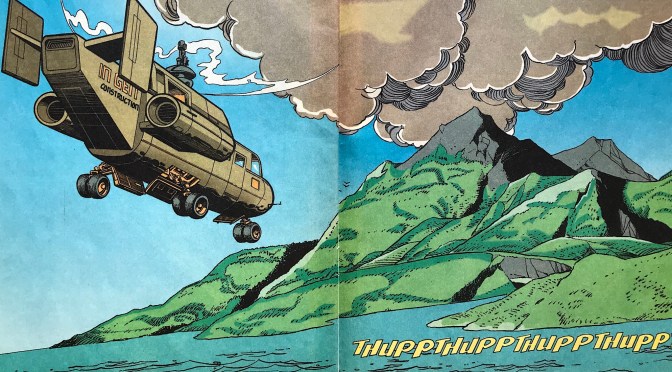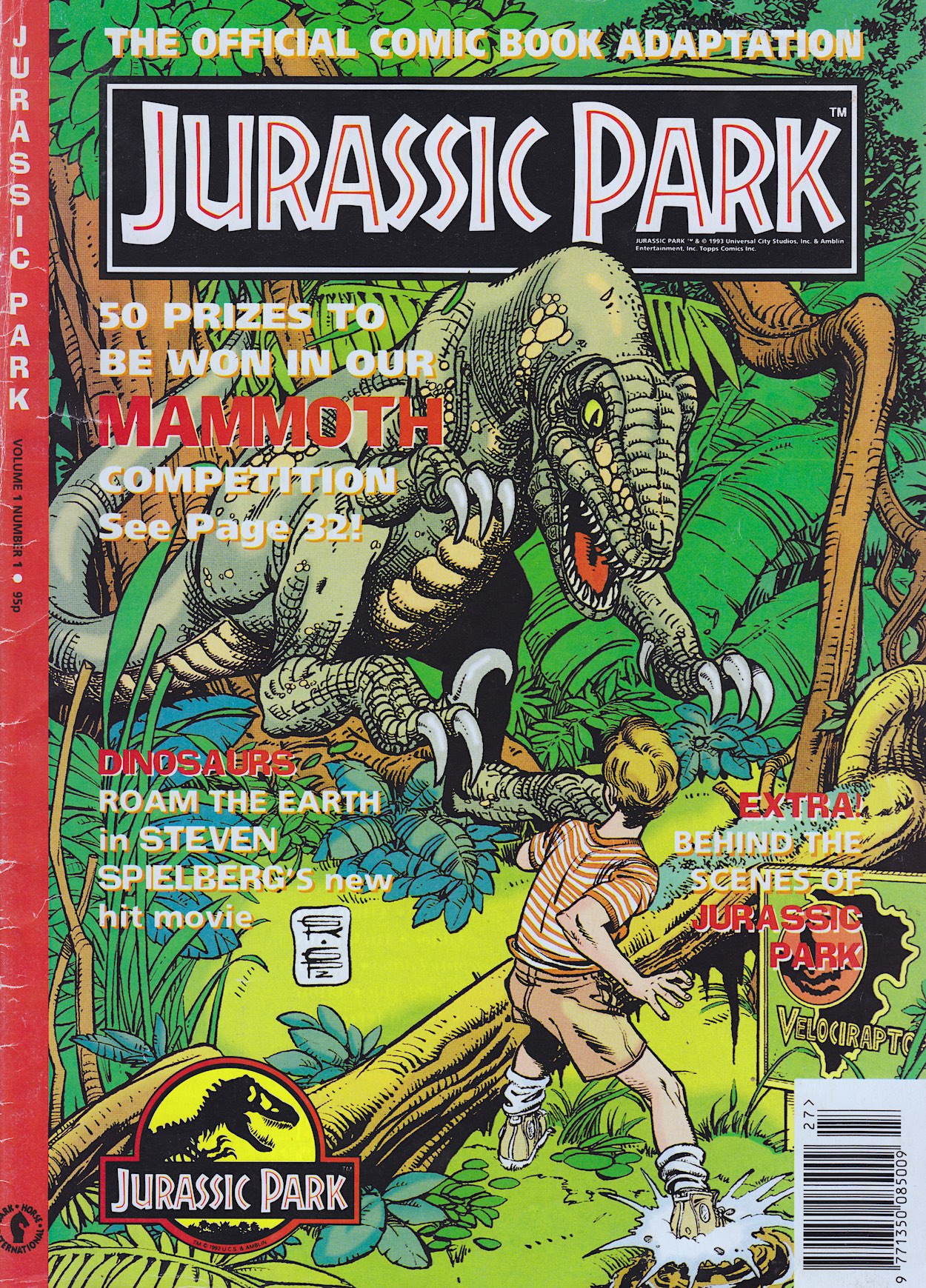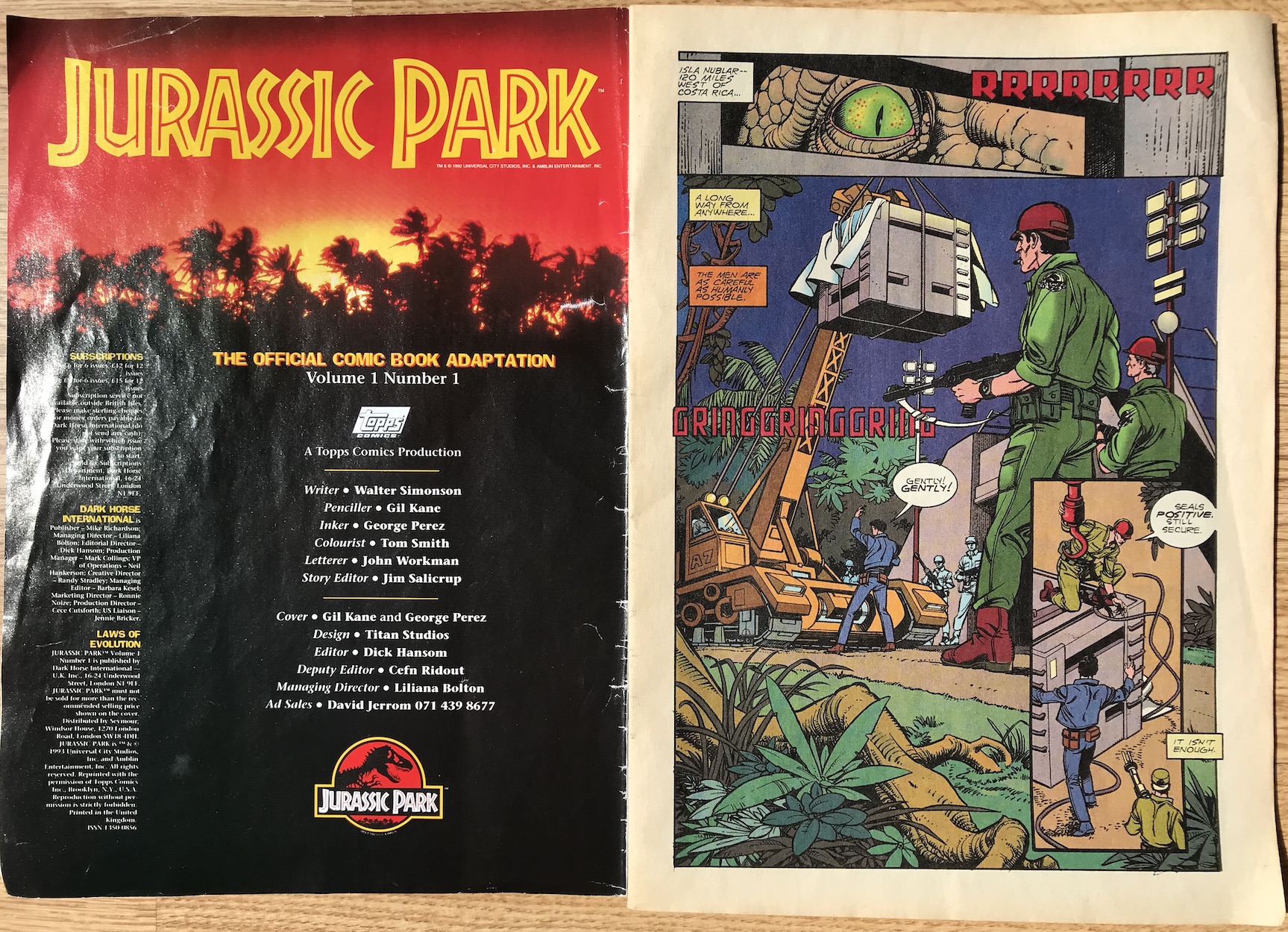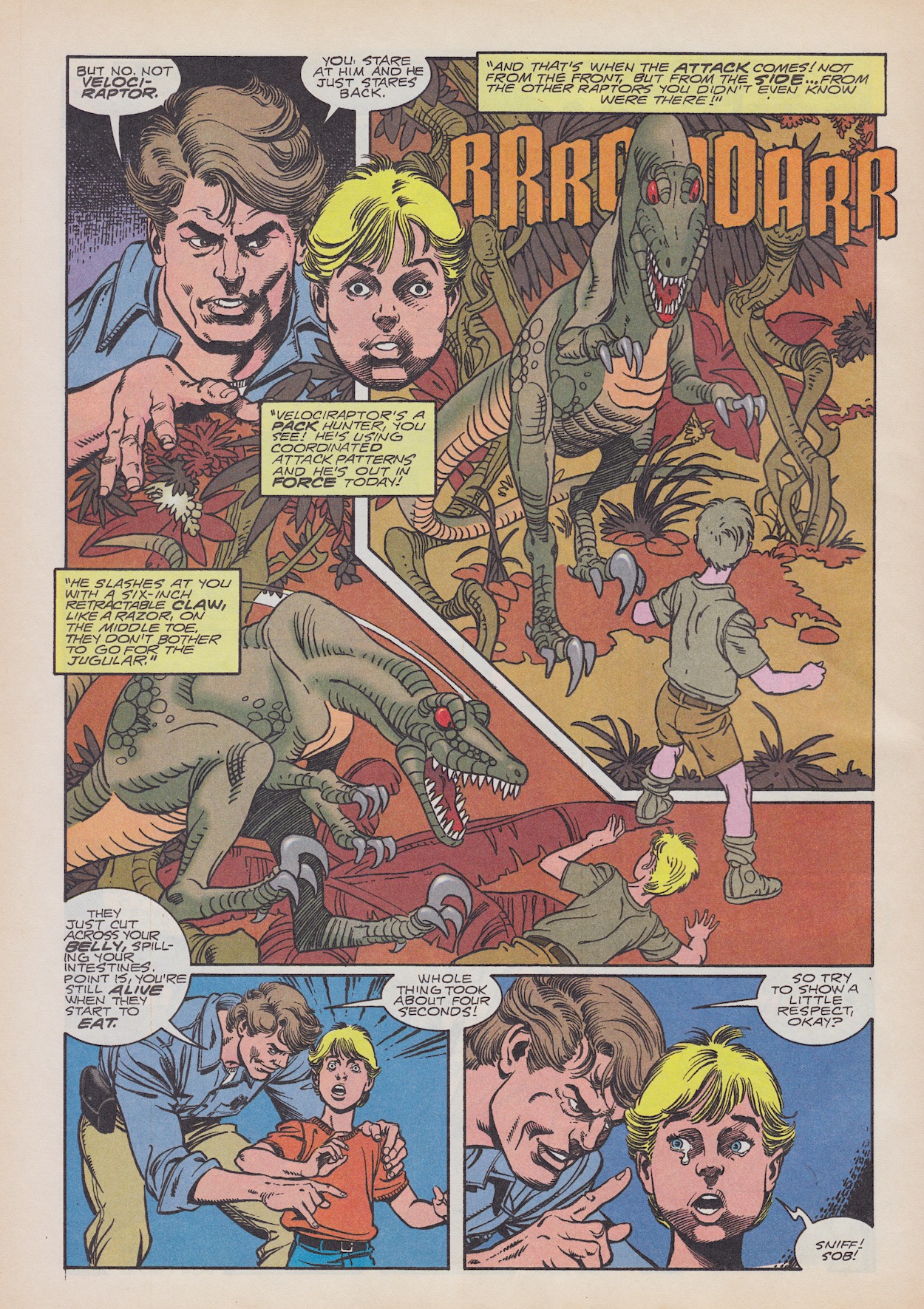
Tag Archives: Dick Hansom

JURASSiC PARK #8: PURE ESCAPiSM

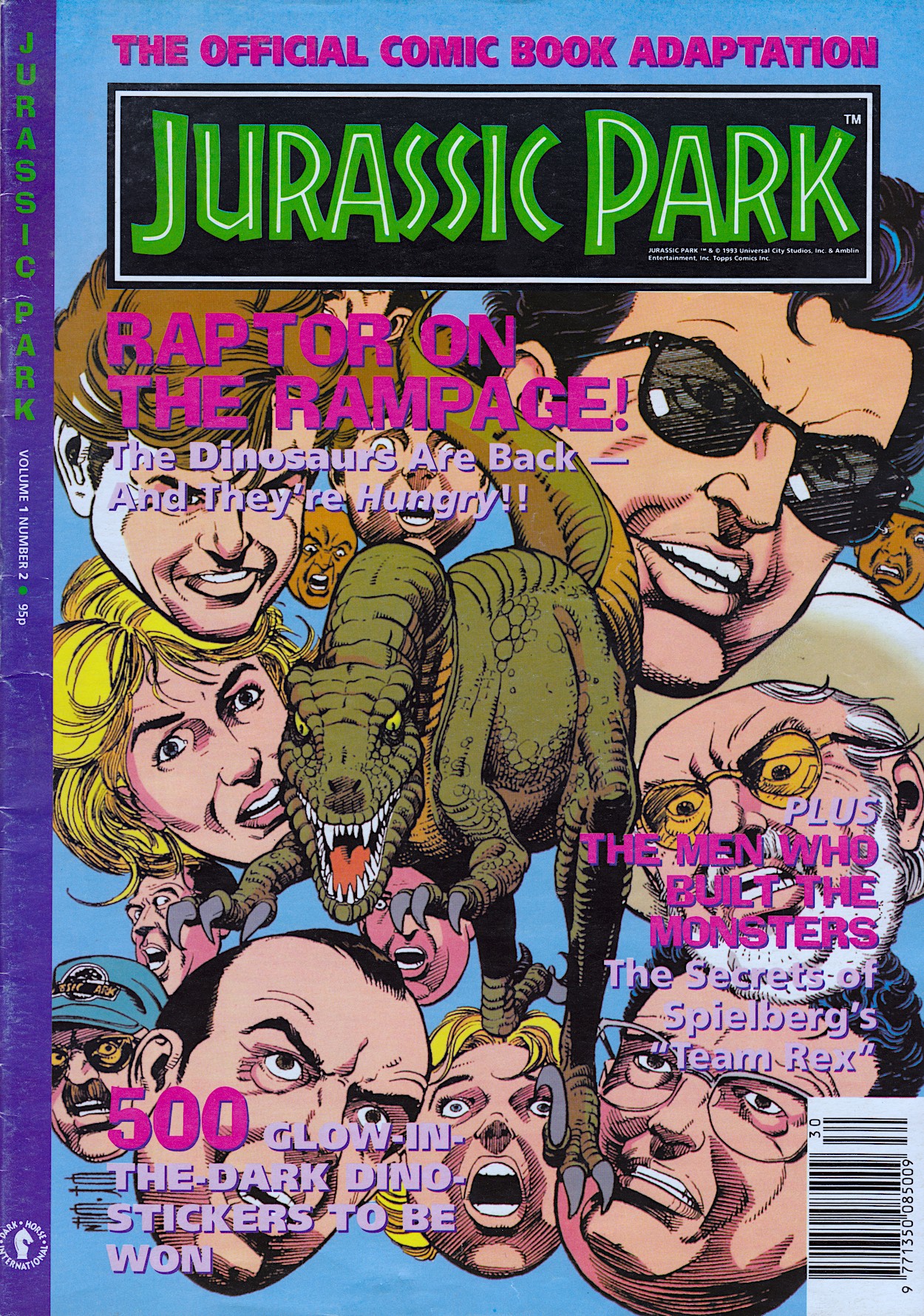
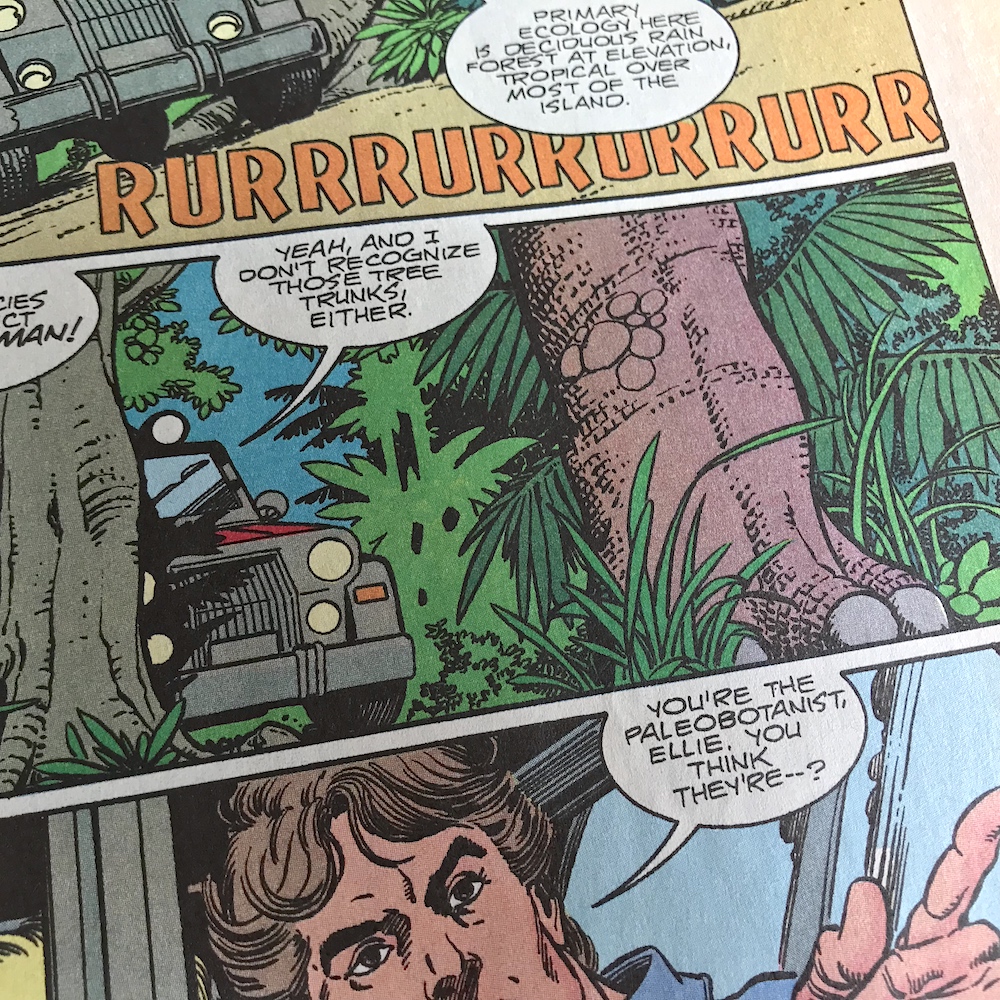
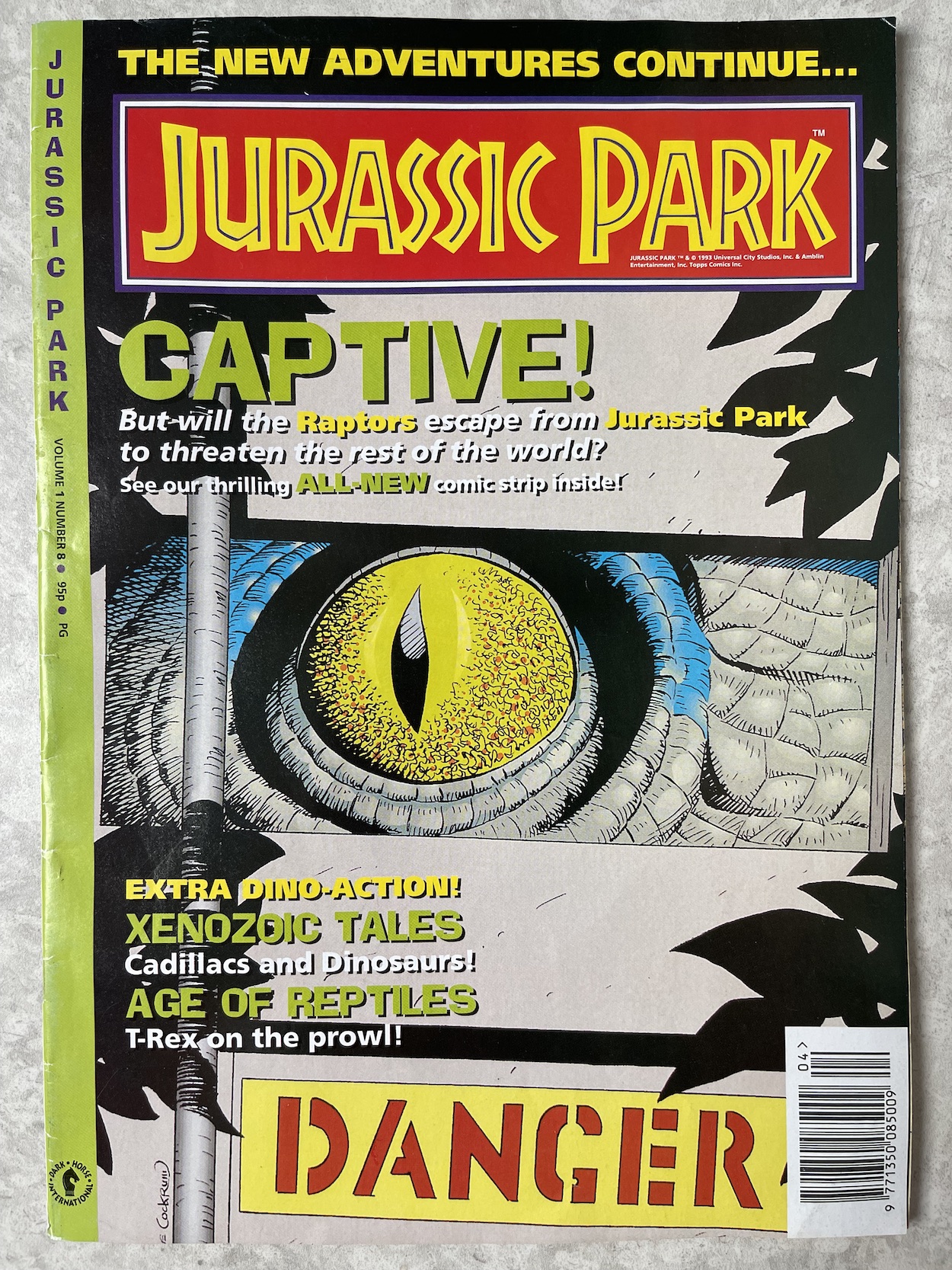
A simple cover of an iconic movie scene by Dave Cockrum welcomes us to #8 of Dark Horse International‘s Jurassic Park. The cover is from the first issue of the American movie adaptation so really shouldn’t make sense here, after all the Velociraptors are no longer caged up, but it reminded us of the danger from the film that was now running loose. Inside we’ve less adverts and more comics, making for a very satisfying read this month and the title strip no longer has the least amount of pages.

The well chosen cliffhanger last month saw the original US strip cut out at the point Dr Alan Grant and Dr Ellie Satler‘s theories were proven terrifyingly correct. Now they and new character, big game hunter George Lawala are faced with a fully grown mother raptor and her juvenile offspring and she isn’t happy. Grant pushes some boulders, causing a chain reaction, giving them just enough time to make their escape, but it isn’t long until she’s out and chasing Lawala.
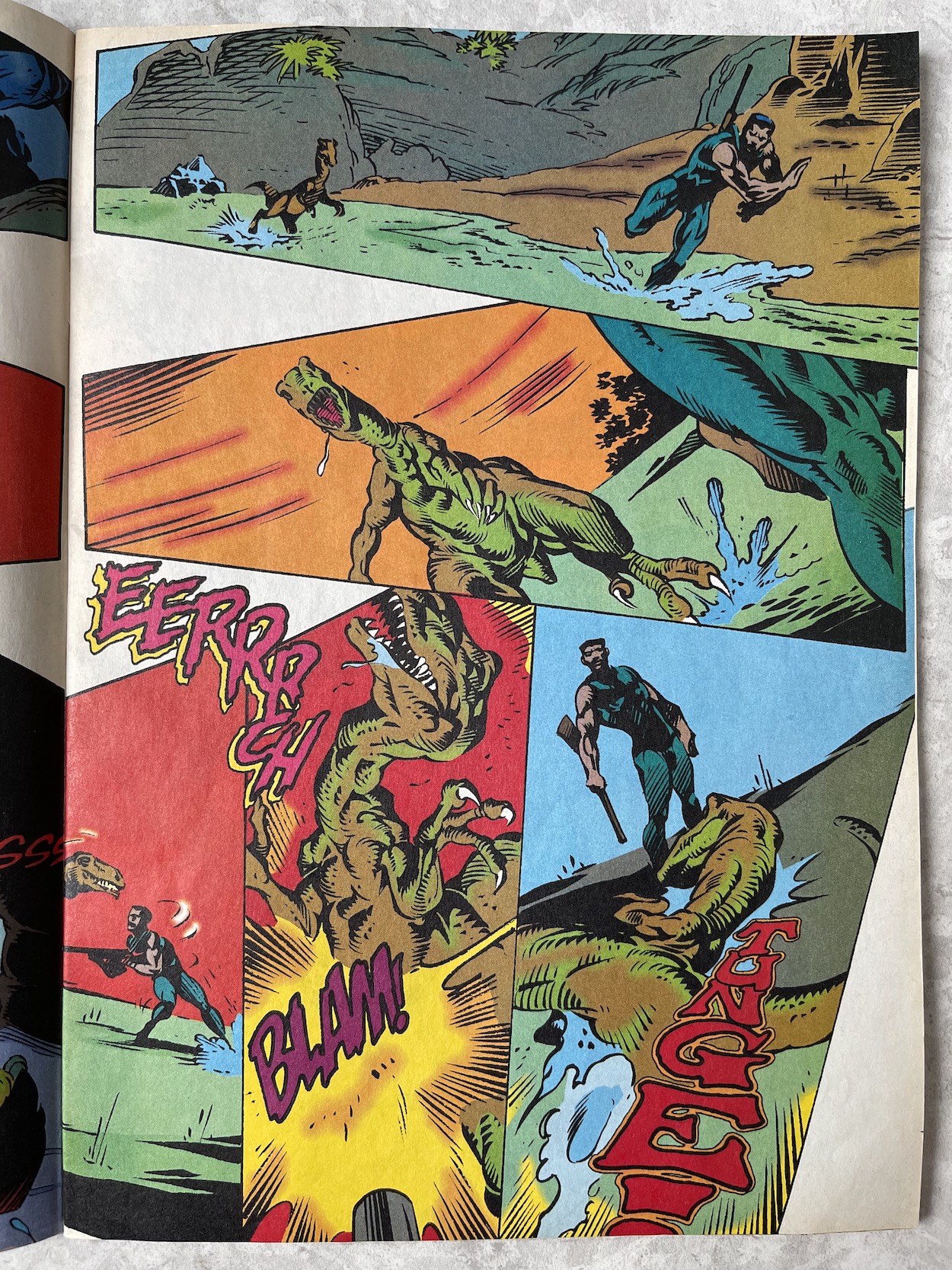
Here we get a few action pages of a chase on the beach, ending with the raptor being shot. Lawala muses over the fact the injured animal isn’t what his employer wanted so he shoots it again to kill it. Surprised there are actual dinosaurs here, that it wasn’t some case of mistaken identity he lets his concentration slip, not realising she isn’t quite dead yet and with her dying breath she snaps her jaws around his ankles. He’s able to squeeze himself free and limps off in search of the others.

It’s hard to believe this is the same artistic team (penciller Armando Gil, inker Dell Barras and colourist Renée Witterstaetter) as those thrilling first few pages back in #6. This feels rushed by comparison and overly simplistic. To be fair this is only a problem for a few pages, but they’re the ones involving what should be the highlight of any chapter in a Jurassic Park comic strip, a dinosaur attack! It all feels rather muted as a result.


“He’s got us and the raptors! He’s won!”

Dr. Ellie Satler

Things pick back up again as we rush towards the end of the first chapter to our sequel story. Our heroes are captured by Lawala who had waited near the cave, knowing they’d return to make sure the dinosaurs were okay. Just as with the movies, while the Velociraptors are dangerous, it’s also important to protect them from the dangers of humans. A fight ensues and of course Alan and Ellie are outmatched, although they do give a valiant effort. Alan tries in vain to convince Lawala he must realise the animals can’t be taken off the island, that what happened to the park could happen to the world. But Lawala readily admits he’s too greedy to care.
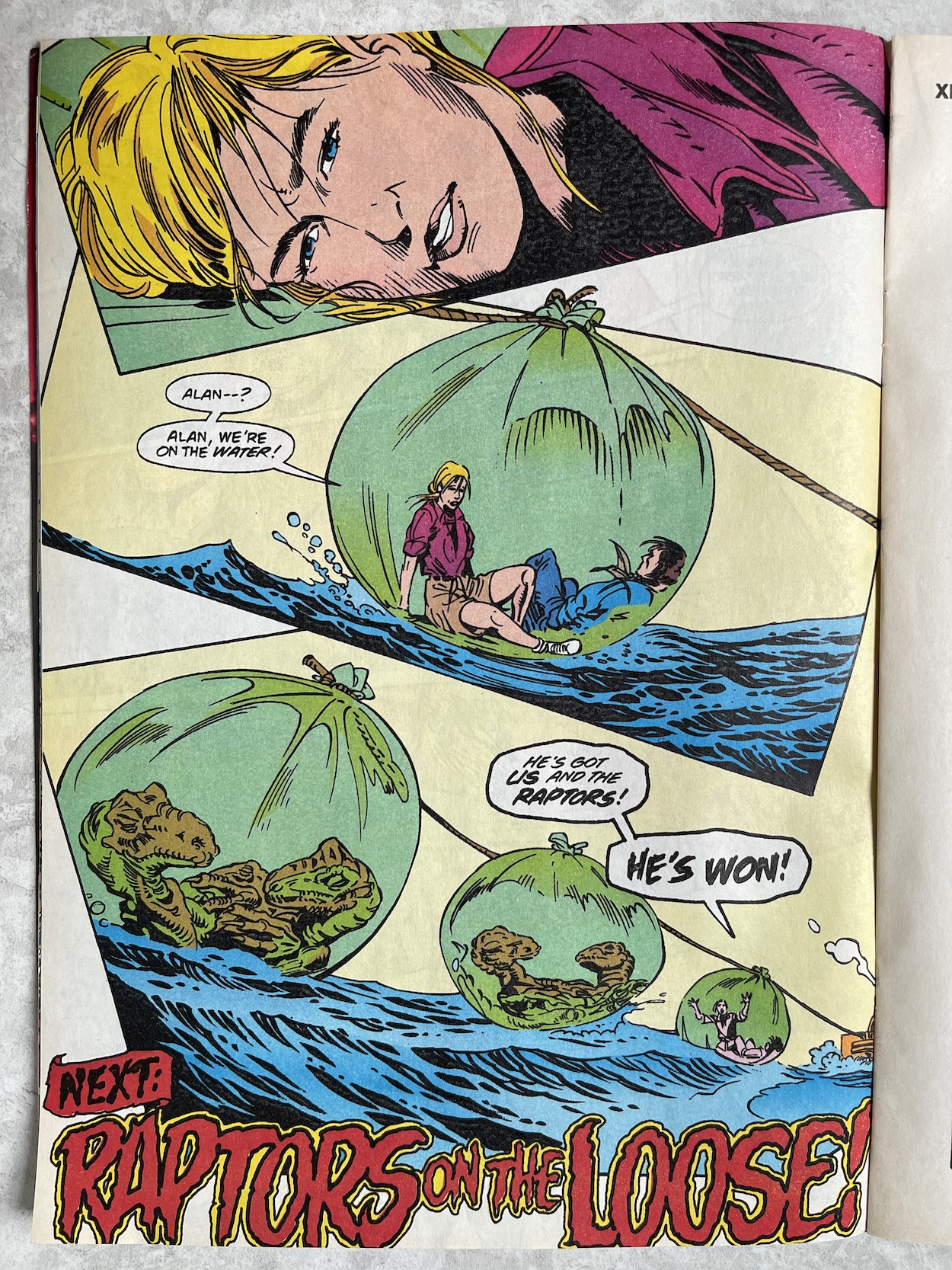
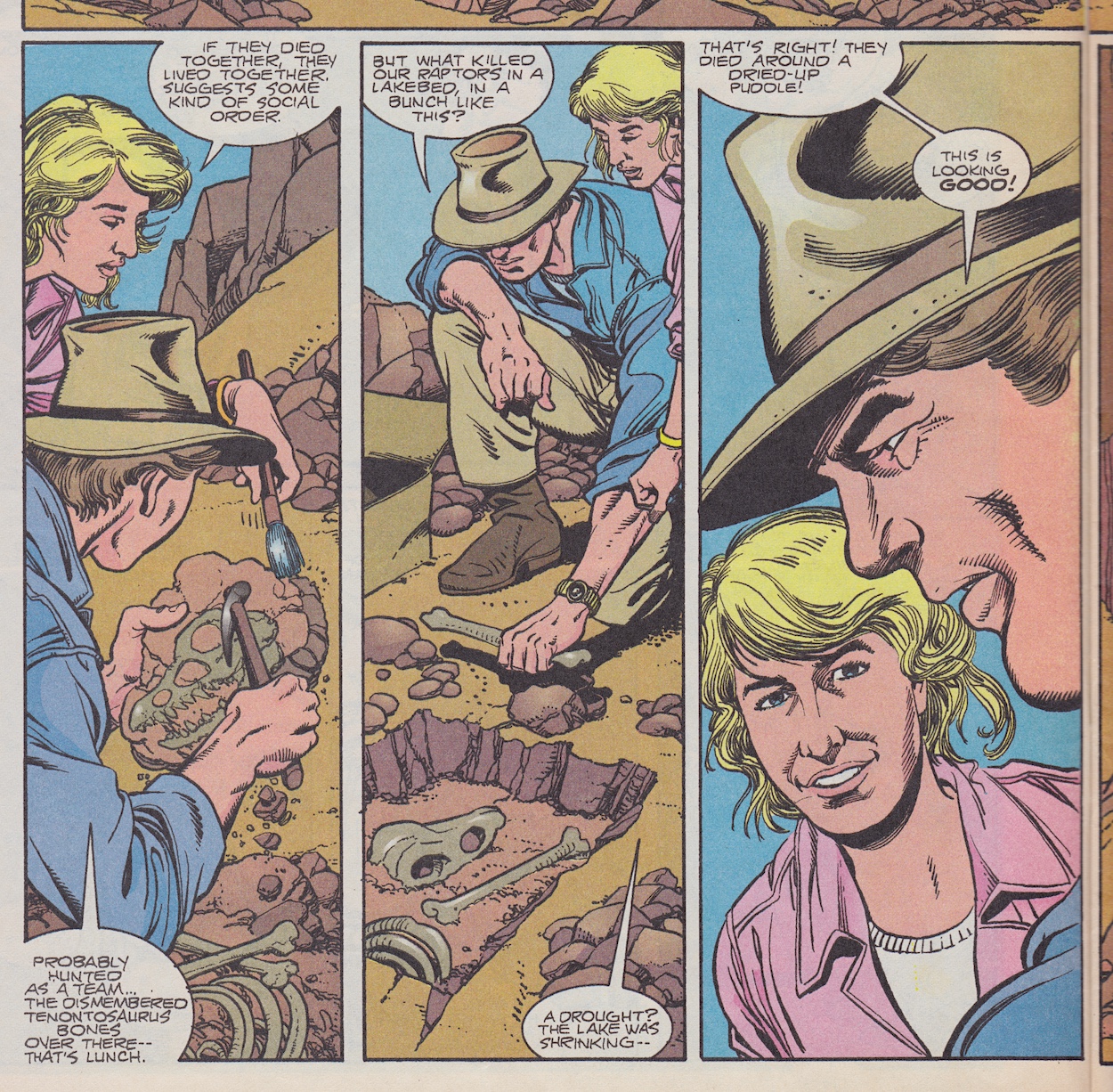
Beaten unconscious, Ellie and Alan eventually wake to find themselves in a somewhat impossible position, just right for an almighty cliffhanger with suitably dramatic lettering by John Costanza. Although, it does unintentionally raise a few chuckles because it reminds me of the ending to Finding Nemo, which of course came much later. This story by Steve Englehart reminds me very much of where the Jurassic World trilogy has been heading. I’m writing this before the third movie (sixth in the overall series) is released, the previous movie having ended with dinosaurs out in the world among us. I’m really excited for that film and I think that’s the same excitement I had when I first read this back in 1994.

“The world swarms with the living evidence of a billion years of evolution!” Thus begins the next chapter in the ongoing Xenozoic Tales saga, the first of our two dino-themed backup strips. The story here (as ever written and drawn by Mark Schultz) is the classic sci-fi scenario of losing contact with a research outpost and going in to find out what’s wrong. We know it’s clearly going to be bad news but that’s not the point of the story, it’s all about what has gone wrong and exploring a little more of this strange new world, its dangers and having some action and excitement along the way.
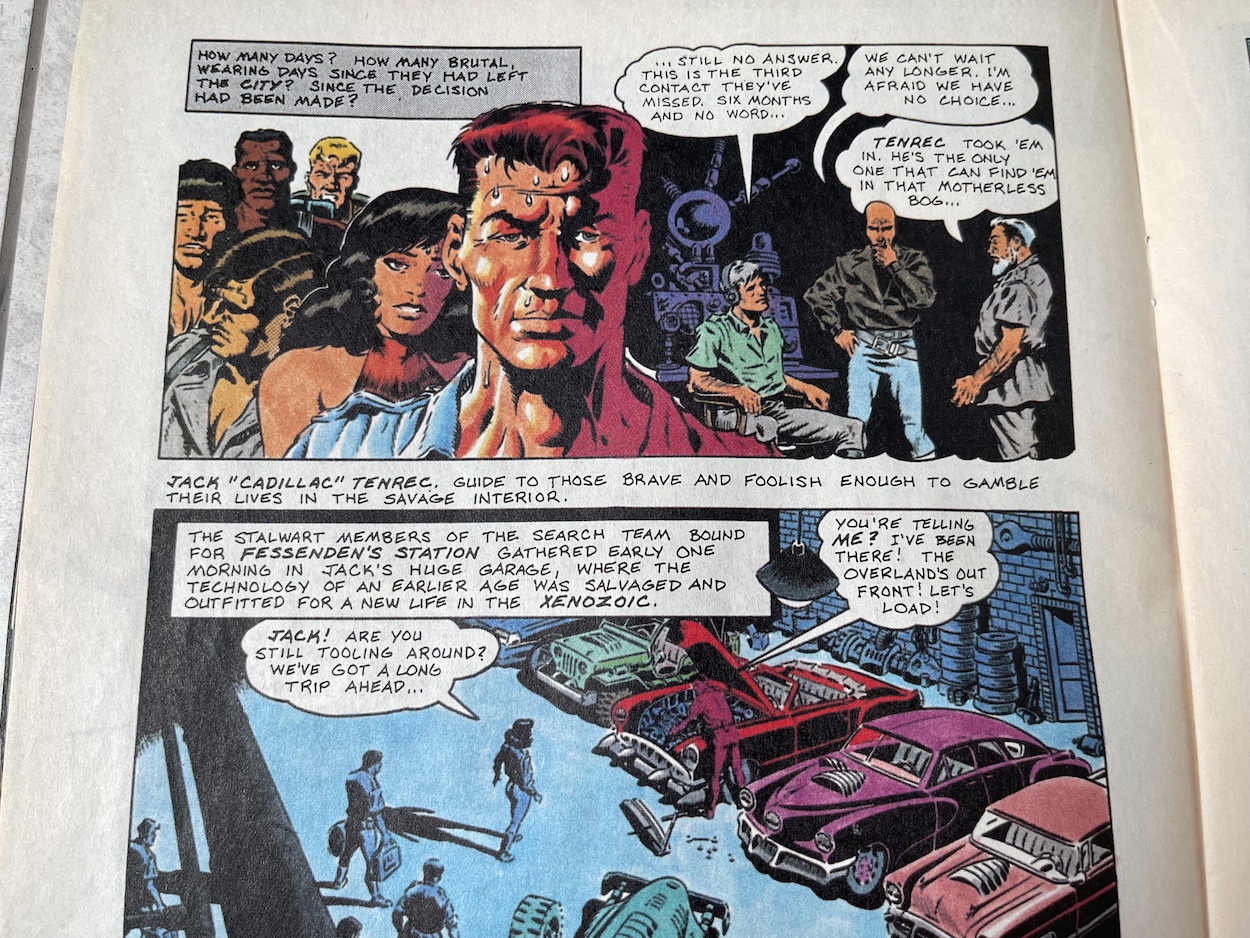
The first thing I noticed was the bold colouring, which is a lot more colourful than in previous issues. This is because we have a new contributor and it’s none other than Transformers colourist and Visionaries editor Steve White. In the earlier years of Transformers the colours were all beautifully hand-painted, before a new system was introduced that produced much flatter results initially. But in the right hands it could be stunning. Steve’s were one such pair of hands. His colours really pop, bringing depth and excitement to a story that’s already fun to read.

I asked Steve about his time working on Jurassic Park and he told me that while it was a work-for-hire gig he was a big fan of Mark’s and of Xenozoic Tales. He produced these beautiful results with markers on photocopies of the art, and he’d travel to North London to Dark Horse International’s little (according to Steve) office to pick up and return the pages.
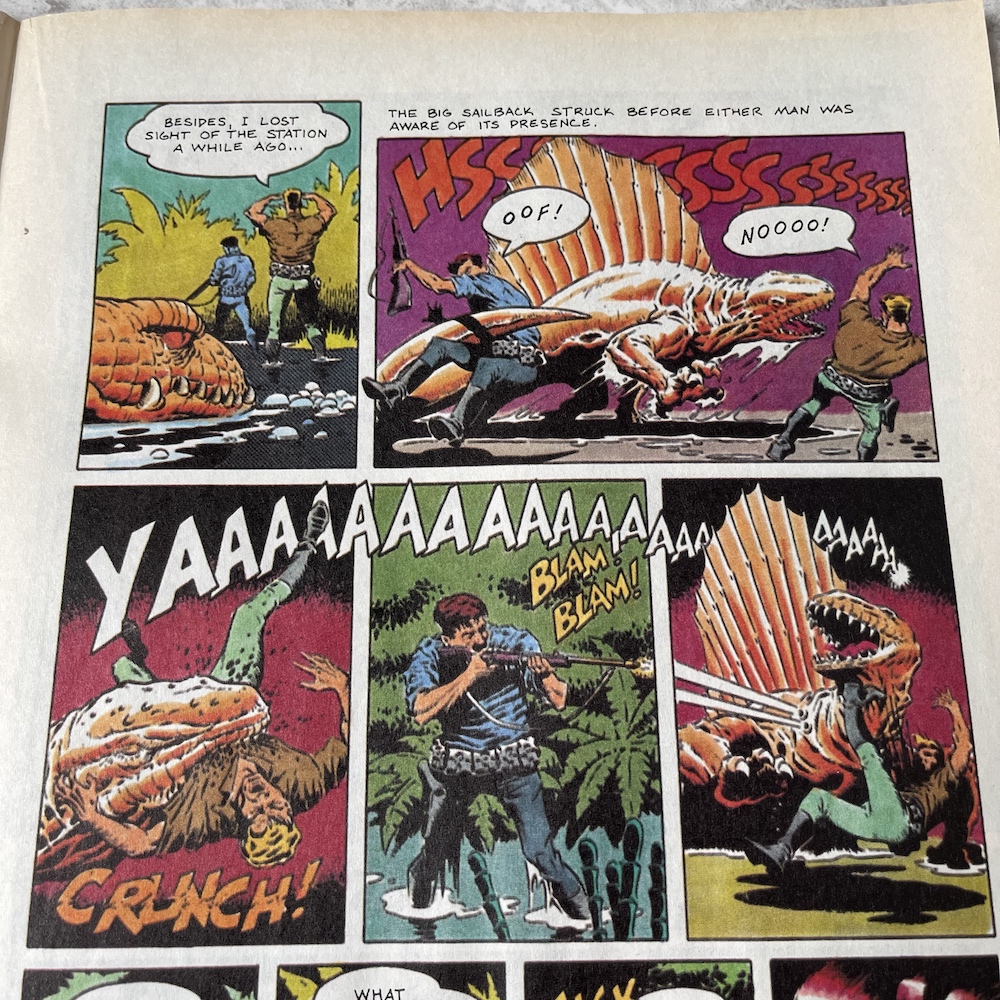
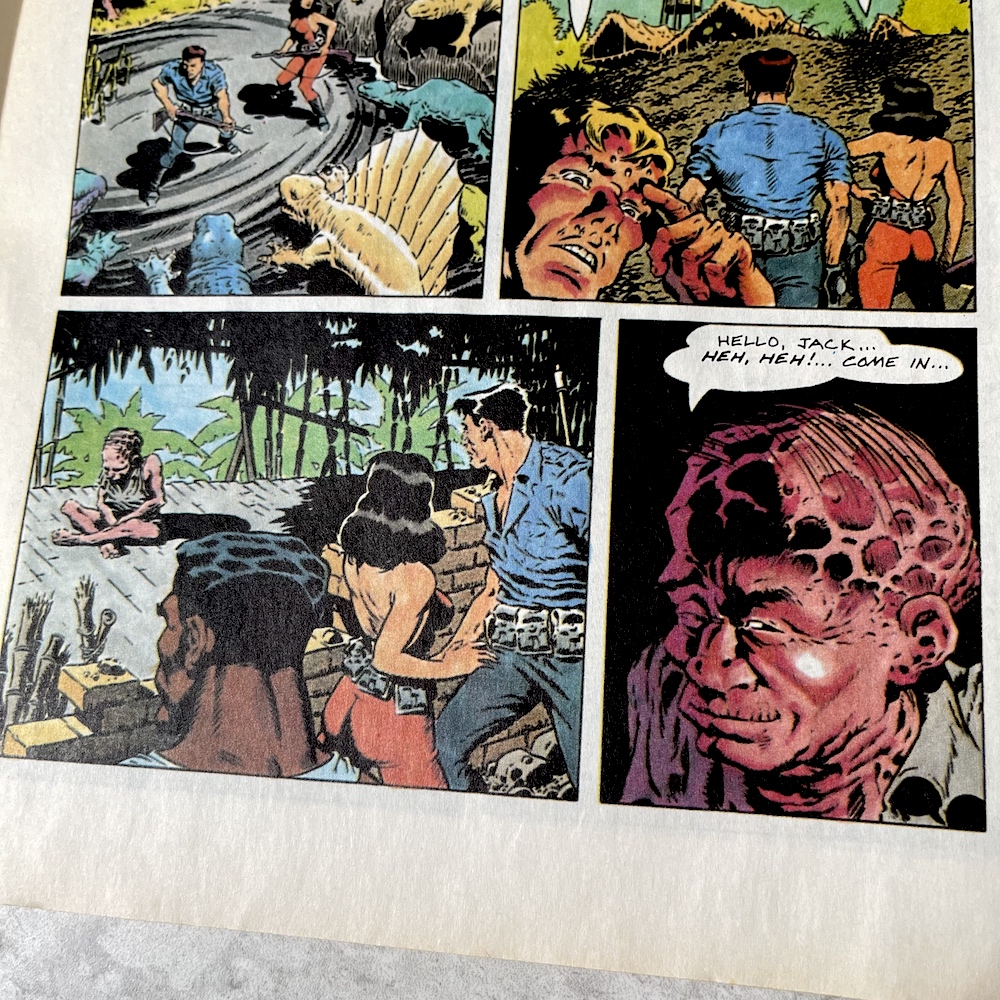
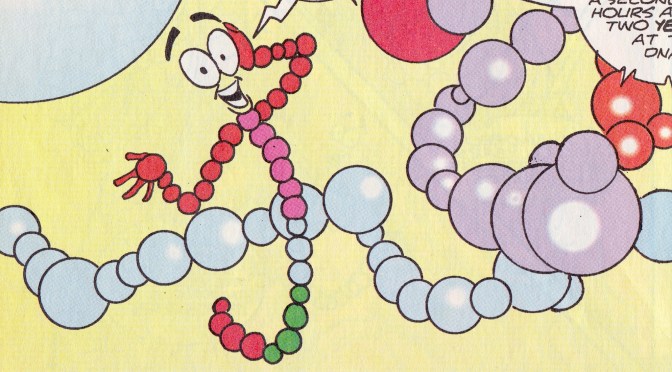
Months previous, a great scientist by the name of Fessenden had asked Jack Tenrec to take him and his team out to a swamp for their research, explaining he’d discovered a secret to saving their crops. Now returning with a rescue team, Jack faces off against vicious, overgrown versions of dinosaurs that are usually tiny and docile. They start to show hunting skills they’re simply not meant to have, circling the team and attacking systematically. Eventually they make it to the station which is now a crumbling wreck and discover the shocking transformation of Fessenden.

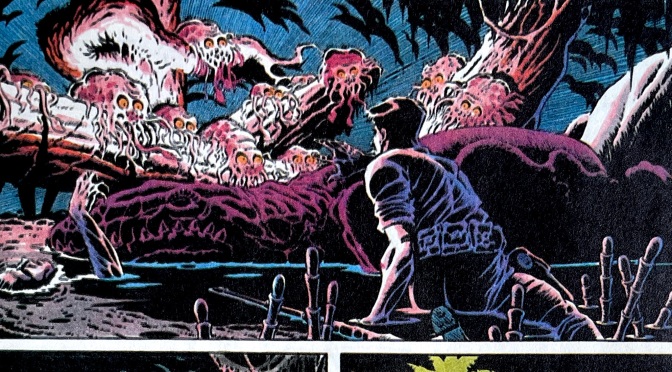
His team are nowhere to be found, he isn’t doing any of the work he was there to accomplish and his head has become a strange elongated shape, covered in what looks like pulsating veins, like his brain is trying to push itself out through his skull. Jack sets out to find the missing researchers, only to literally stumble upon creepy blob-like creatures not dissimilar to his old friend’s head, then a mass grave in the final panel.
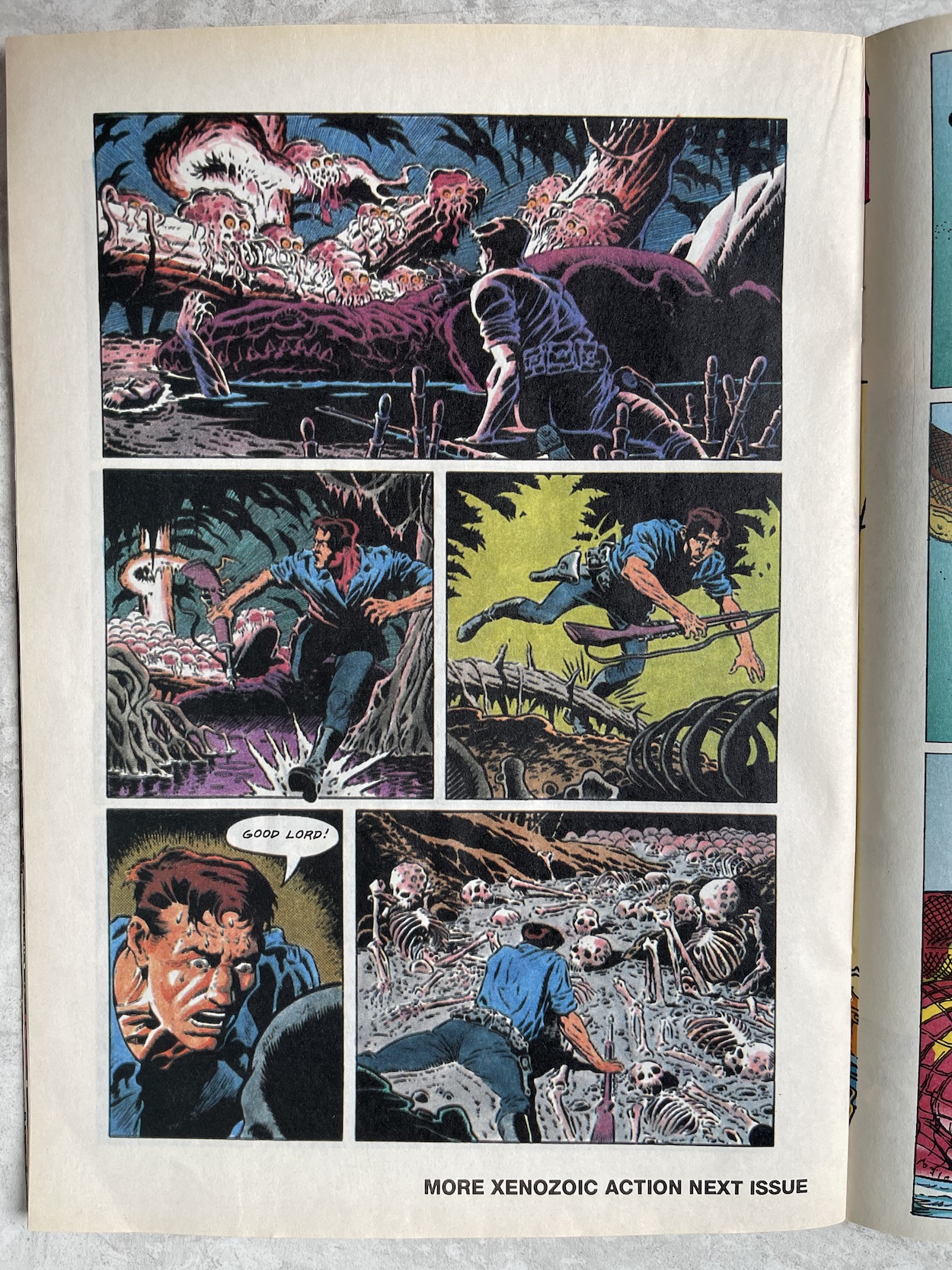
While so far there’s nothing particularly original here, these little blobs are intriguing and having read Mark’s other tales printed in this comic so far I know the payoff will be excellent. Its pacing is perfect and I can’t overemphasise how much Steve’s colouring adds to the rich atmosphere.

While this is listed as ‘Chapter Five’ on the contents page it’s actually the first strip in the series, originally published in Death Rattle magazine in the States in 1986. It acted as a kind of pilot, a testbed for a possible series. This explains why this particular chapter is simply called Xenozoic. It was clearly well received because Mark would go on to sporadically release more stories in his own comic. Jurassic Park editor Dick Hansom decided to print the few strips already coloured in a Marvel US reprinting first so we’re getting the story out of order. But it did mean we could enjoy this one coloured by Steve so I’m happy he waited.
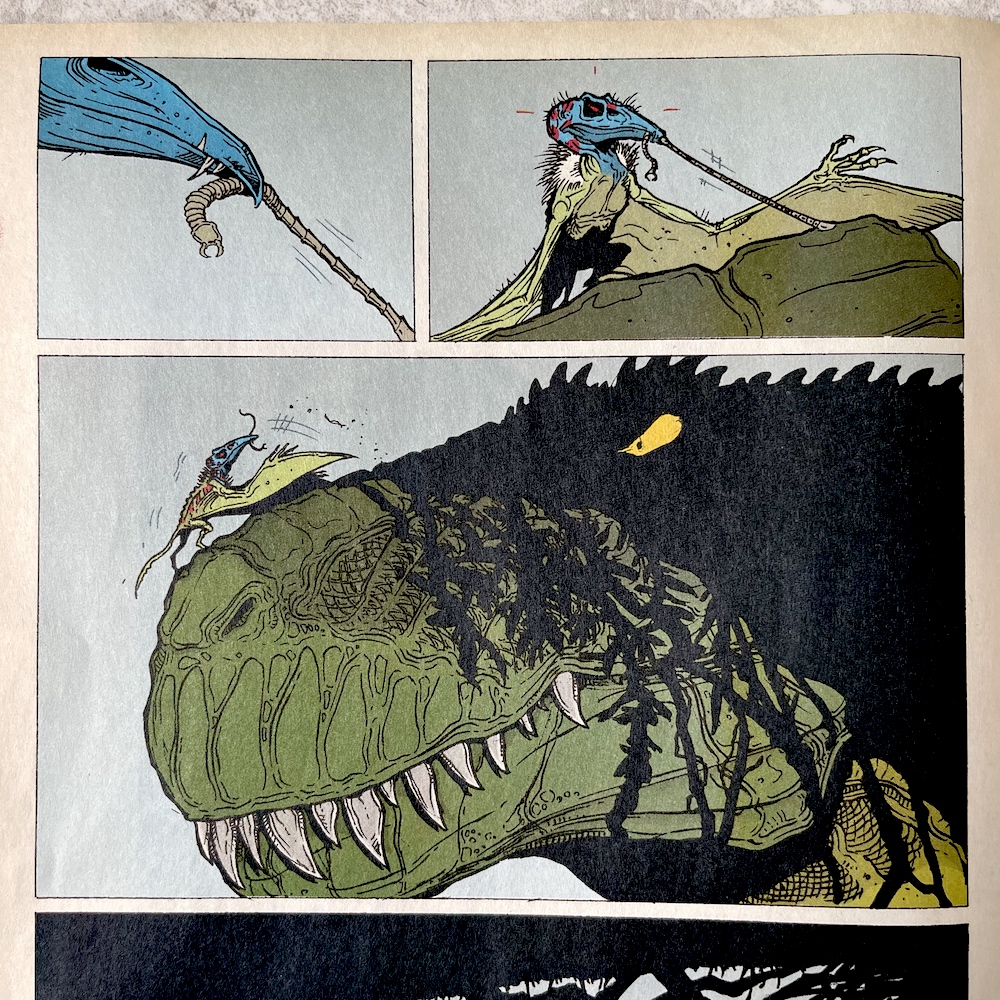
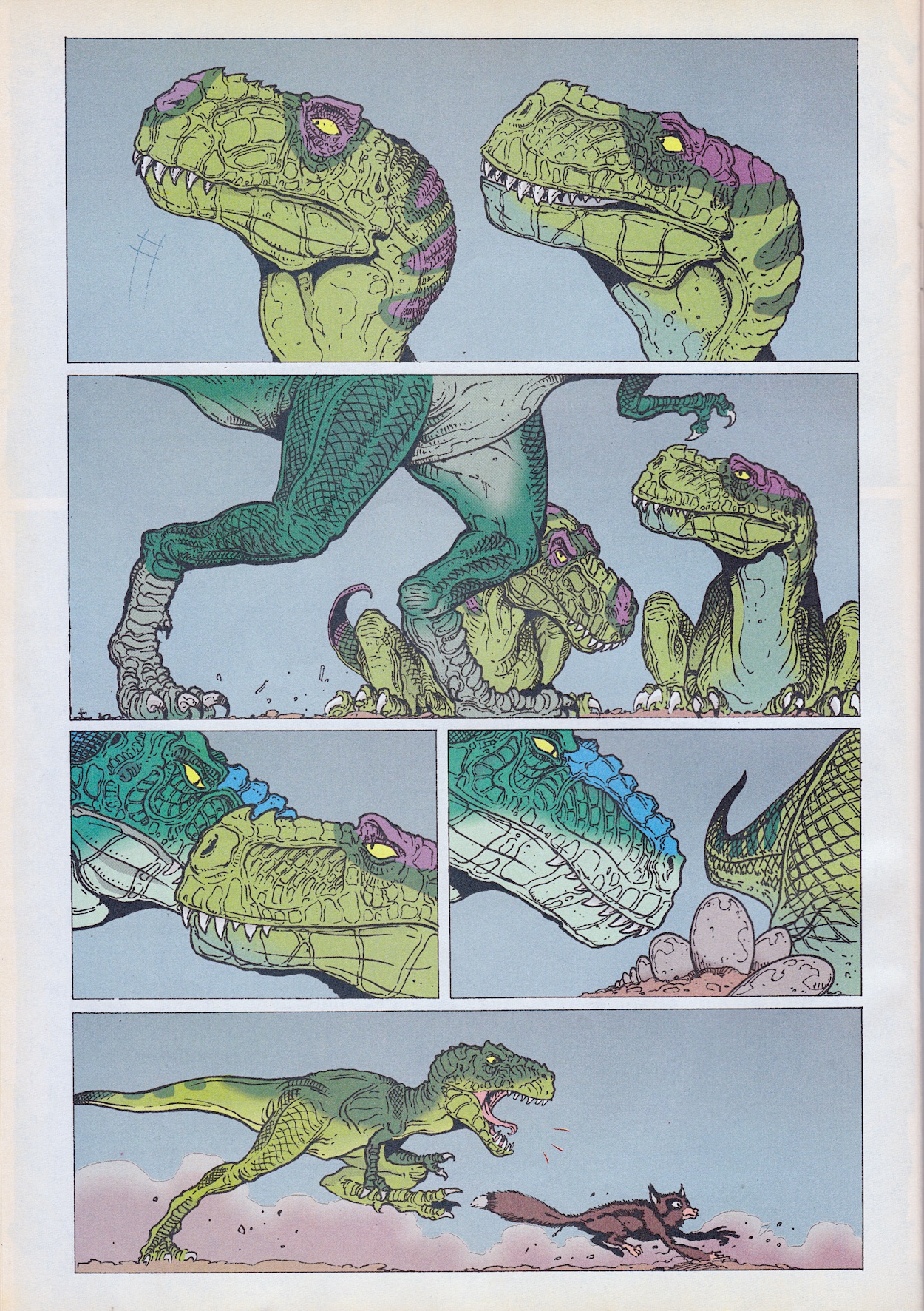
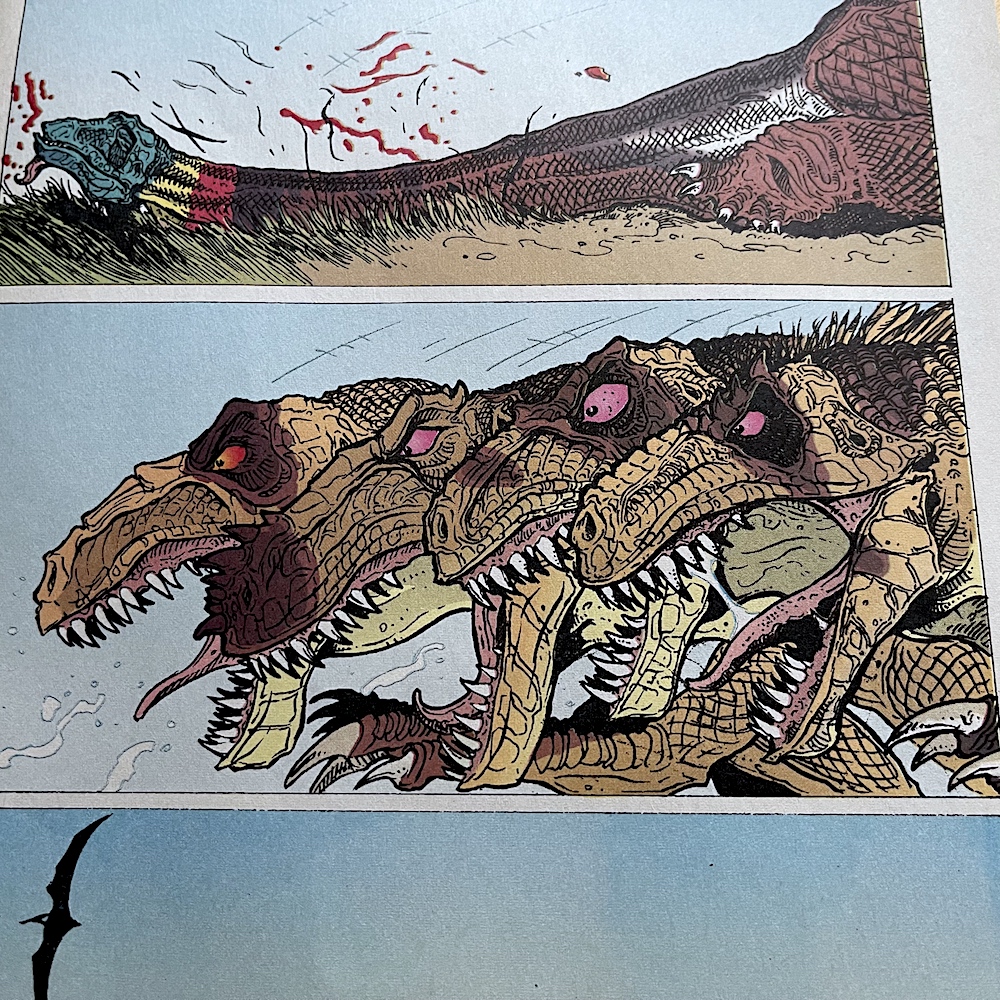
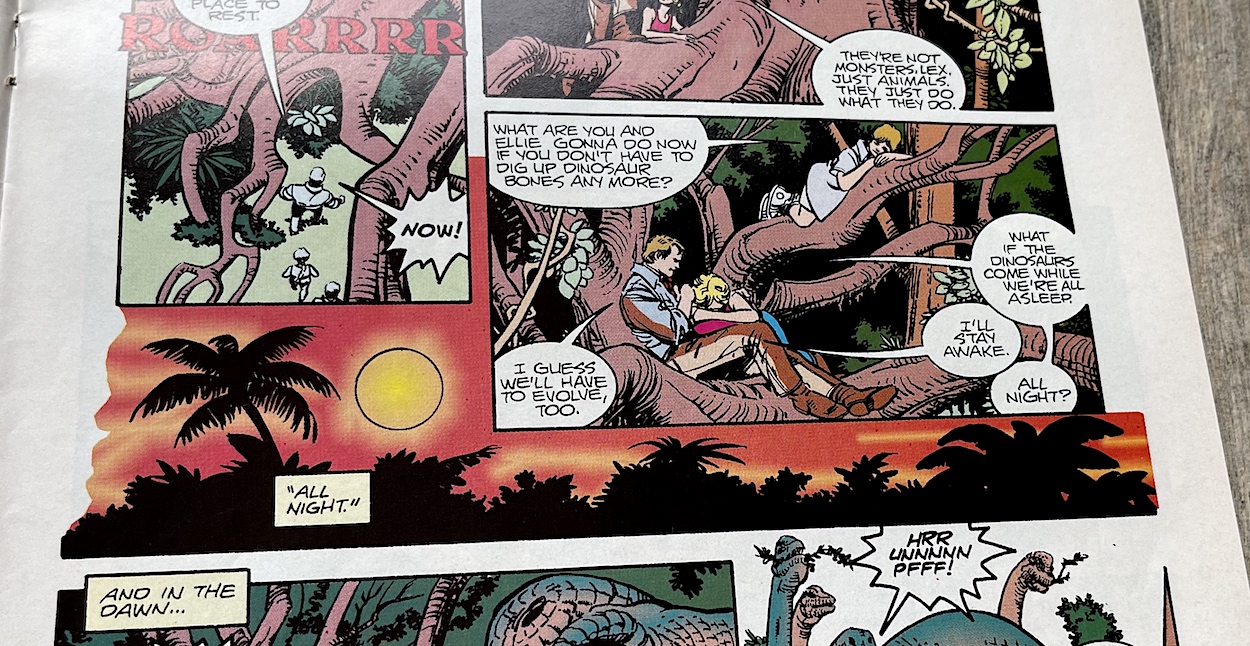
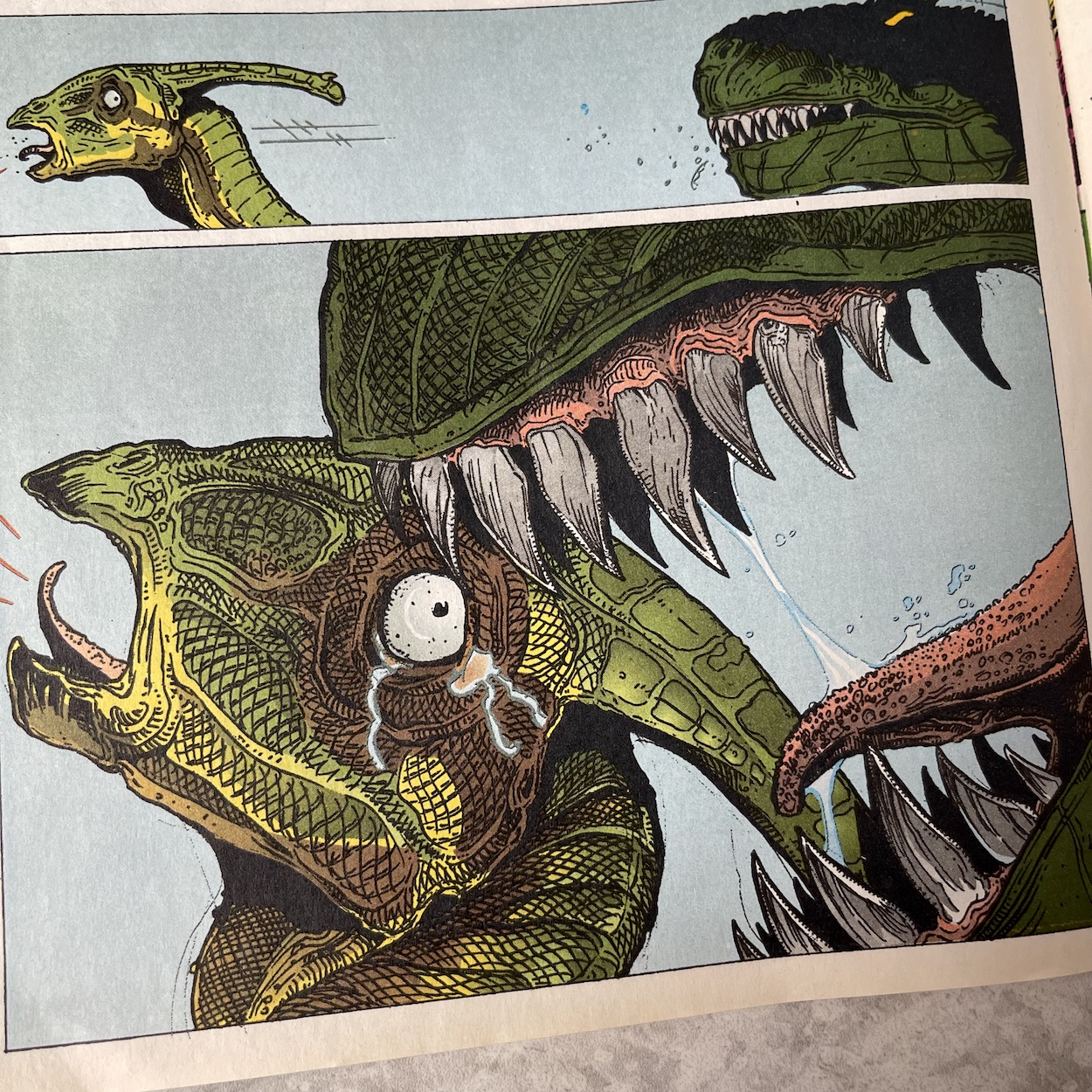
Moving on to Ricardo Delgado‘s Age of Reptiles (coloured by James Sinclair) and it takes up less space this issue to make way for much more of the title strip, but it’s no less enthralling. We were left wondering what was going to happen next after the Deinonychuses stole the unhatched eggs from the Tyrannosaurus rex nest, but this issue the battle of the species takes a back seat, the pace slowing down and showing the dinosaurs going about their lives as dawn breaks. It begins with a pack of Parasaurolophuses lazily drinking by a waterfall, unaware they’re being watched.

I don’t think I picked up on this until a later issue when I was a teenager, but this is clearly a different T-rex than the one we’ve seen in previous issues. Only when both appeared together in a later chapter did I notice the completely different sets of markings, probably because I didn’t go back and read previous issues of comics before reading new issues back then, so when I saw this T.rex I incorrectly assumed I knew who it was. I love the little bird picking out a borrowing critter from its head and the dark shadows obscuring the hunter as he stalks his prey. The Parasaurolophuses are so delightfully drawn I can’t help but feel sorry for this one.
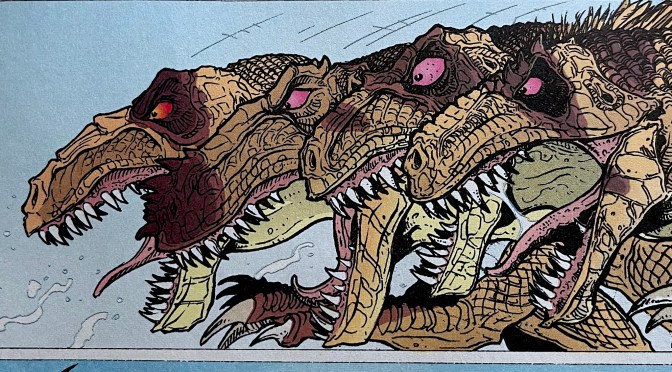
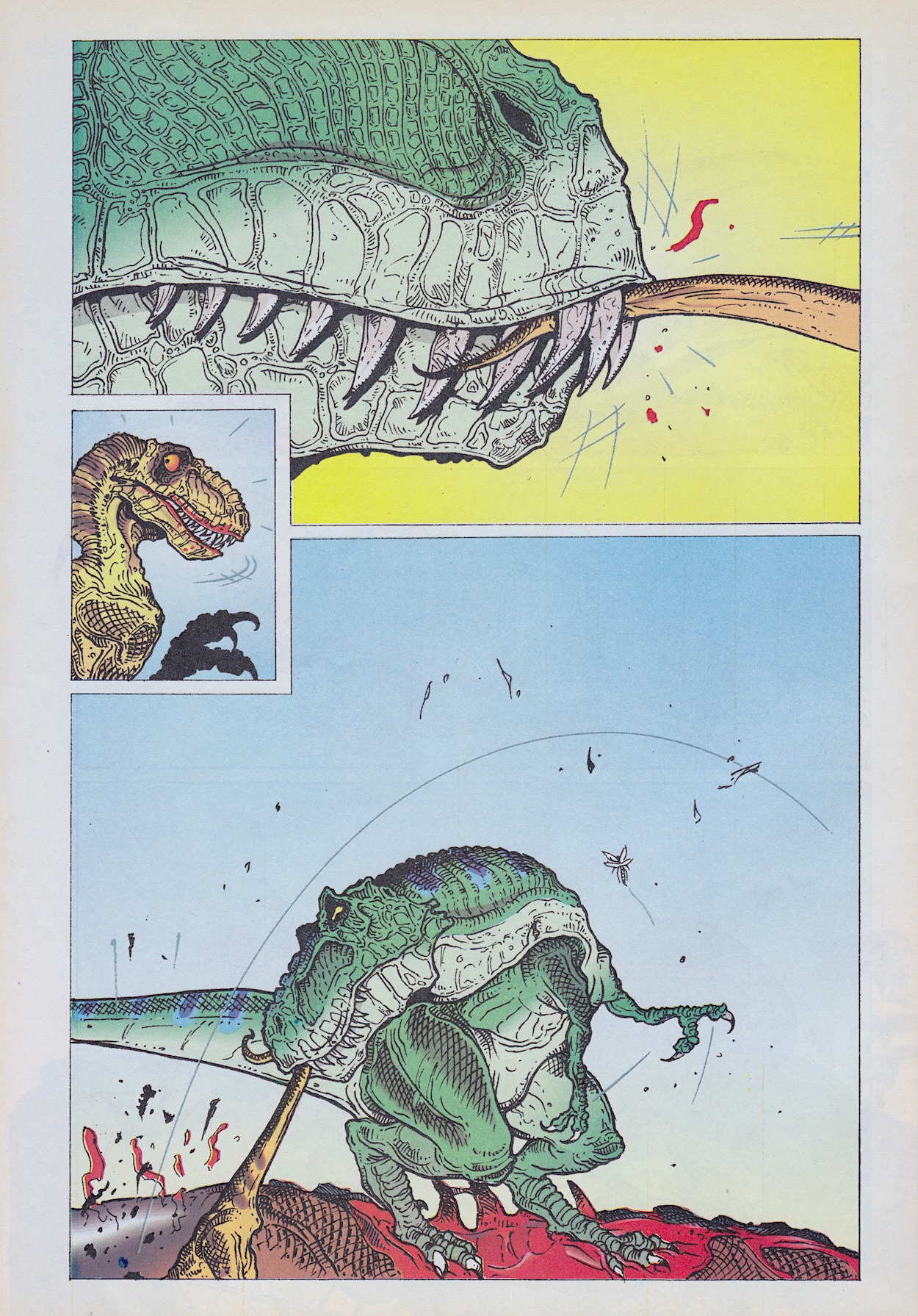
We see the predator begin to feast before cutting away to the silhouettes of the Deinonychuses making their way through the thick jungle. We’re not sure where they’re going yet and we don’t find out this issue, but what does happen here is highly entertaining and builds to a surprise cliffhanger. One of them gets distracted by a fish flopping about on the ground near a body of water and wants to stop to feed. You can see the distinct head markings of each character here, their leader not impressed with being slowed down and this little silent exchange did make me laugh.
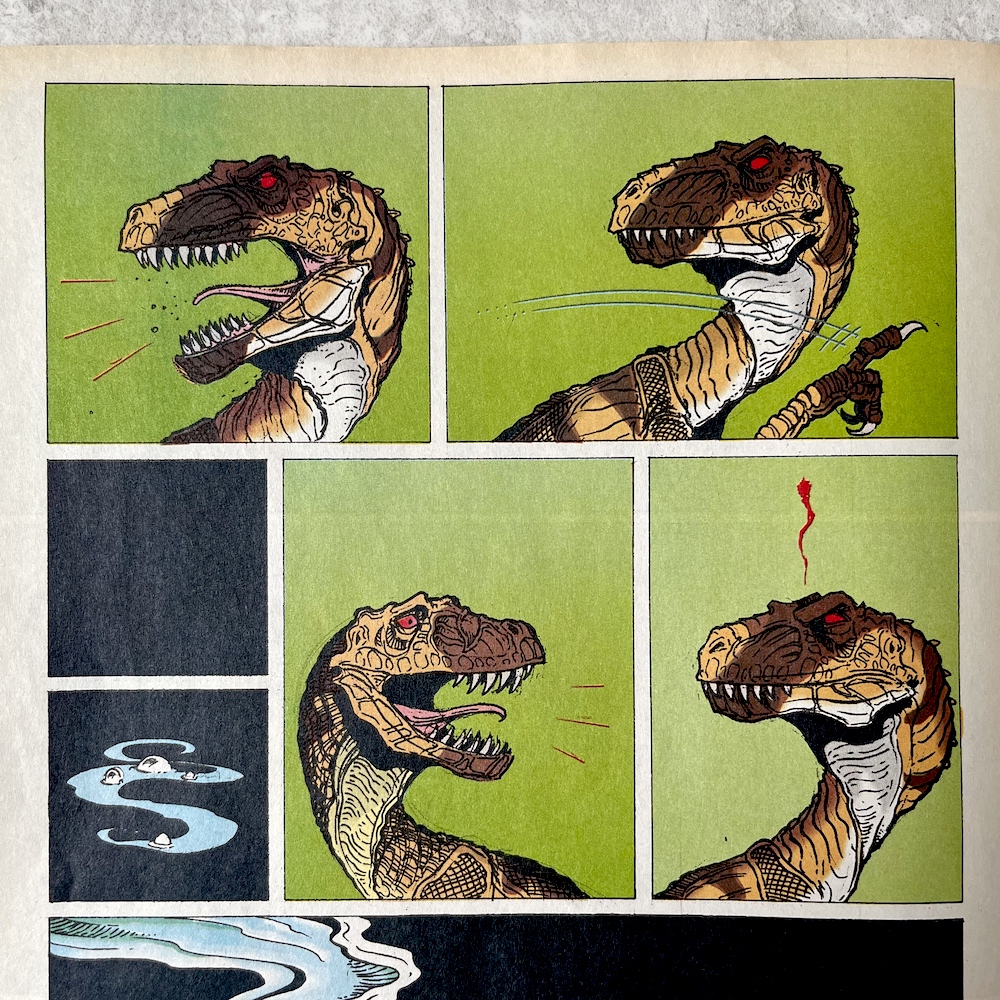
That little red wiggle and that glare are comedy gold.

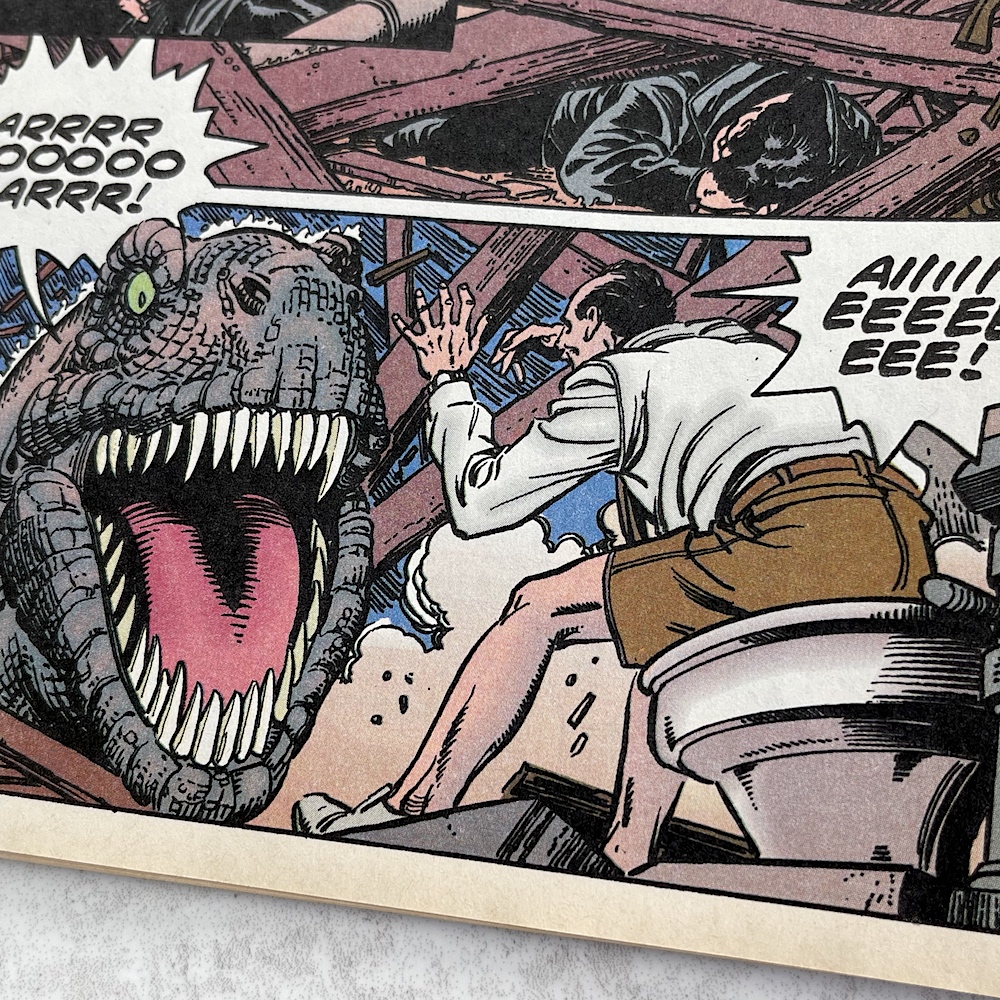
In the panel before it you’ll see some little bubbles appearing in the water beside them. Ignoring their leader (and not noticing there’s something in the water), the hungry dino picks up the fish and opens wide, presenting us with a full page of this action, panel-by-panel, the shadow of the mouth engulfing the fish, saliva dripping from its mouth, only for us to turn the page over and be confronted with this image below.
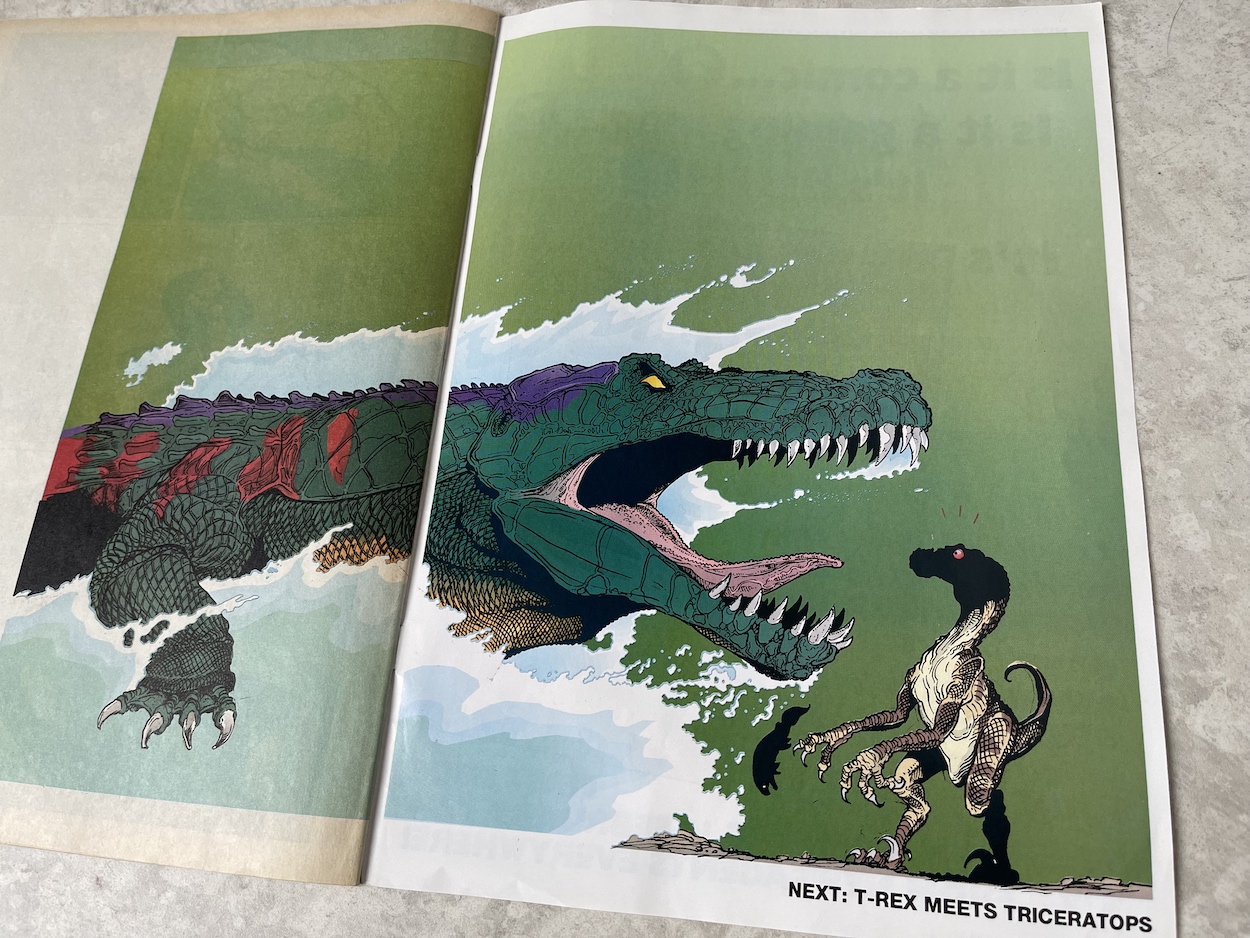
This was such a surprise ending. I’d forgotten all about it in the intervening years but seeing it now brings back the memory of having a feeling of real impatience and frustration at having to wait a month to see the next part. I think you’ll agree that’s understandable.

So this is where my monthly dive into this brilliant comic comes to an end once more. Three superb cliffhangers (even though only one was originally intended as such), interesting stories, plenty of action, loveable characters and the surprise addition of a favourite Marvel UK colourist. It’s been an absolute joy yet again. It will continue in this format for a little while yet, so there’s much to look forward to over the coming months and the next bit will be here on Tuesday 22nd February 2022.
iSSUE SEVEN < > iSSUE NiNE

JURASSiC PARK MENU

JURASSiC PARK #7: ON THE HUNT

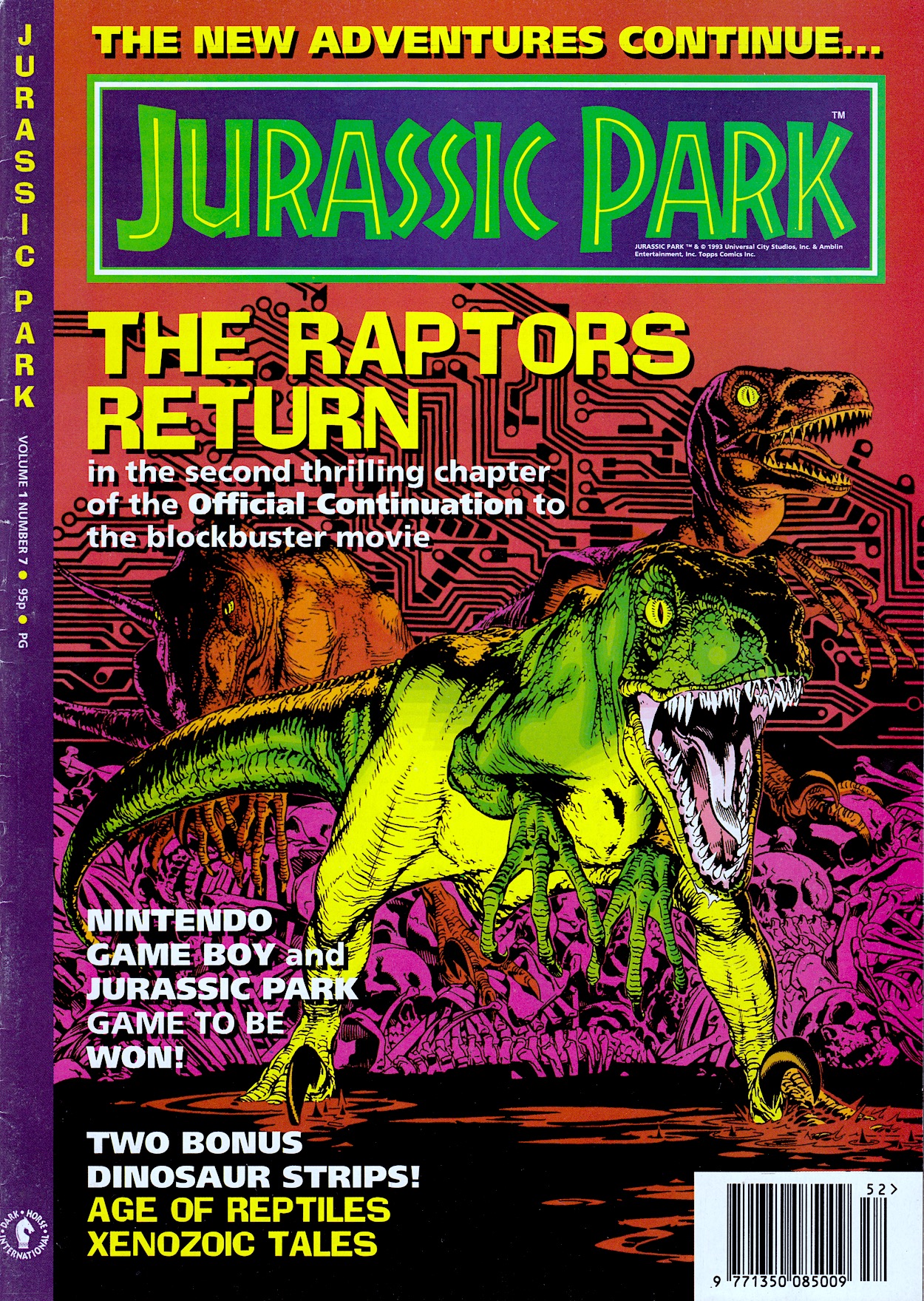
The Christmas festivities may still be upon us but you wouldn’t know it from the latest edition of Dark Horse International‘s Jurassic Park from 1993. Released just three days after Christmas Day itself there’s not a hint of snow or any festive wishes for its readers. The cover is really special though and the first by Michael Golden to feature on the UK title. I love its mix of the natural and technological (the computer circuits in the background), perfectly summing up the world of Jurassic Park in one gorgeous and eye-catching piece of art.

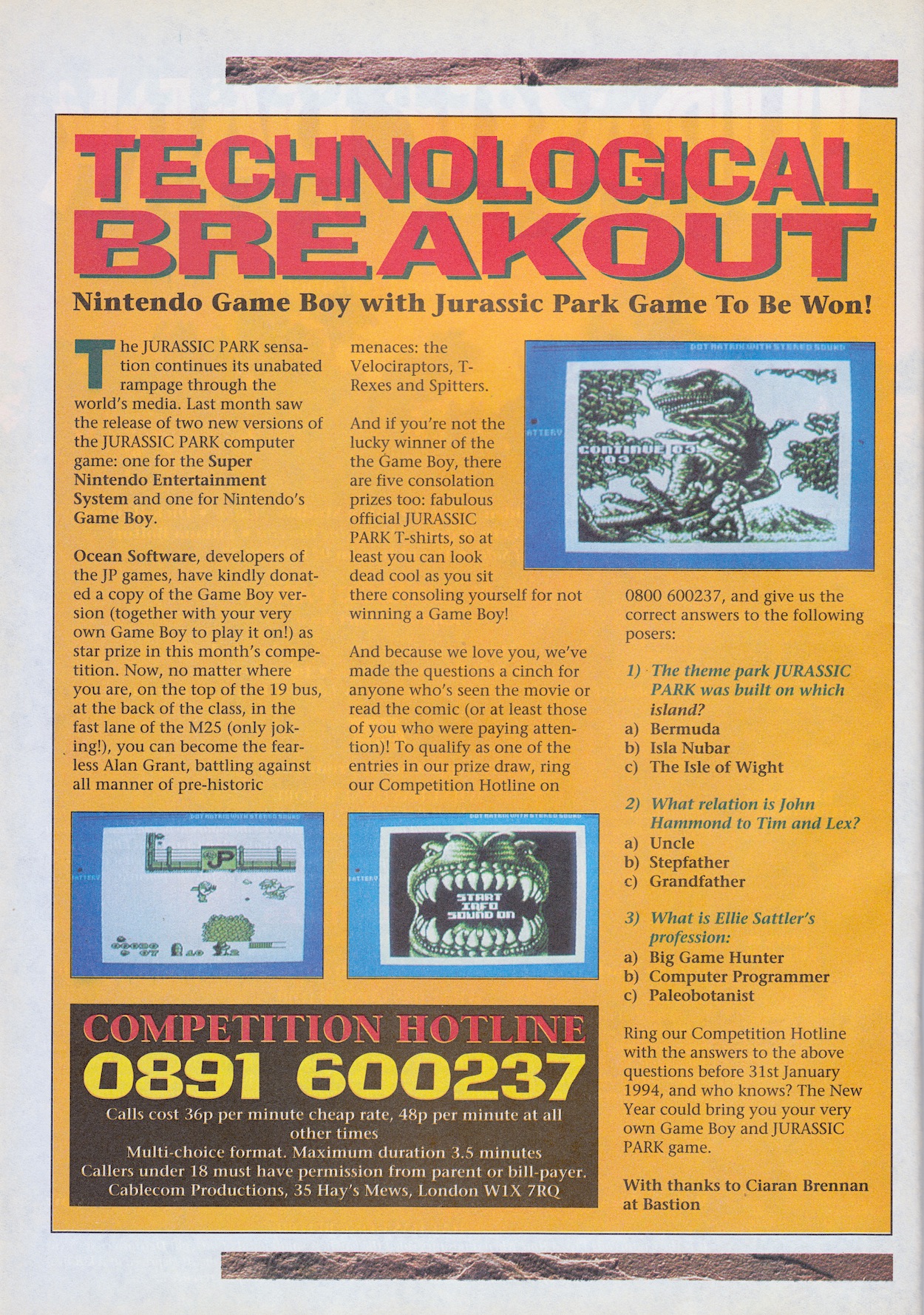
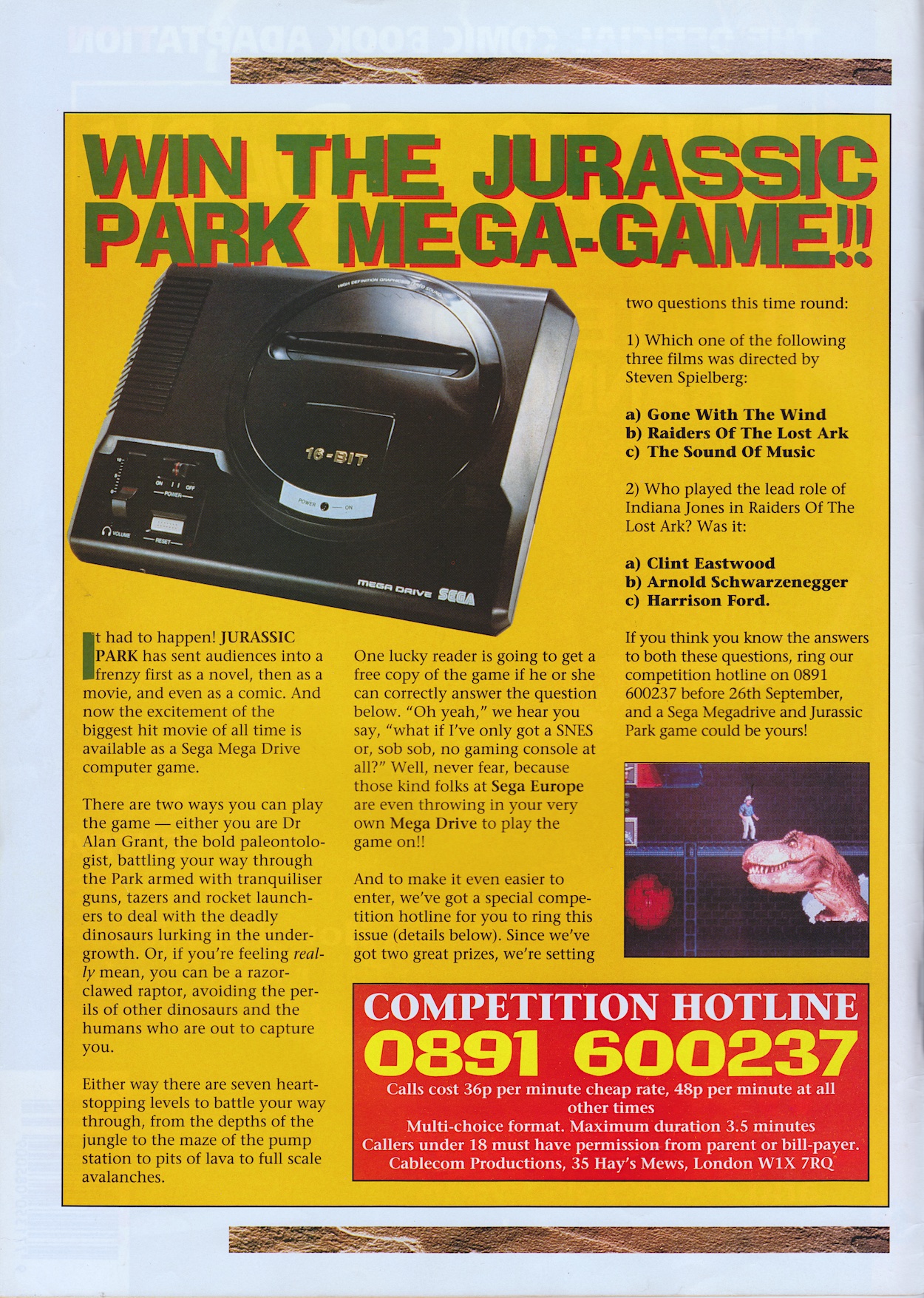
What it does have are the next chapters in its three fantastic strips and a competition that takes me right back to late nights in bed exploring Isla Nublar on a tiny little electronic screen. It’s another phone-in and states it’s been made particularly easy for all to enter, then goes and continues its tradition of misspelling the island name! But let’s not fuss, the screenshots here may not look like much compared to today’s games but this was such fun to play and kept me awake far past lights out on many a school night.

In the second part of the first official follow-up to the film, as InGen attempt to recapture all the dinosaurs they ignore Dr Alan Grant‘s warnings that there are more Velociraptors out in the wild, so Alan and Dr Ellie Satler decide to take things into their own hands. They head for the other side of the island, scientific reasoning given for every step they take in tracking the animals. They end up on a beach searching caves and in the background a little boat putt-putts along the coast in some scenic panels by penciller Armando Gill and inker Dell Barras (Samsona, Conan the Barbarian, Batman) who criminally wasn’t mentioned in the previous issue’s credits. This is a shame because his deep blacks and line work bring a real sense of action amid a gritty, realistic atmosphere.

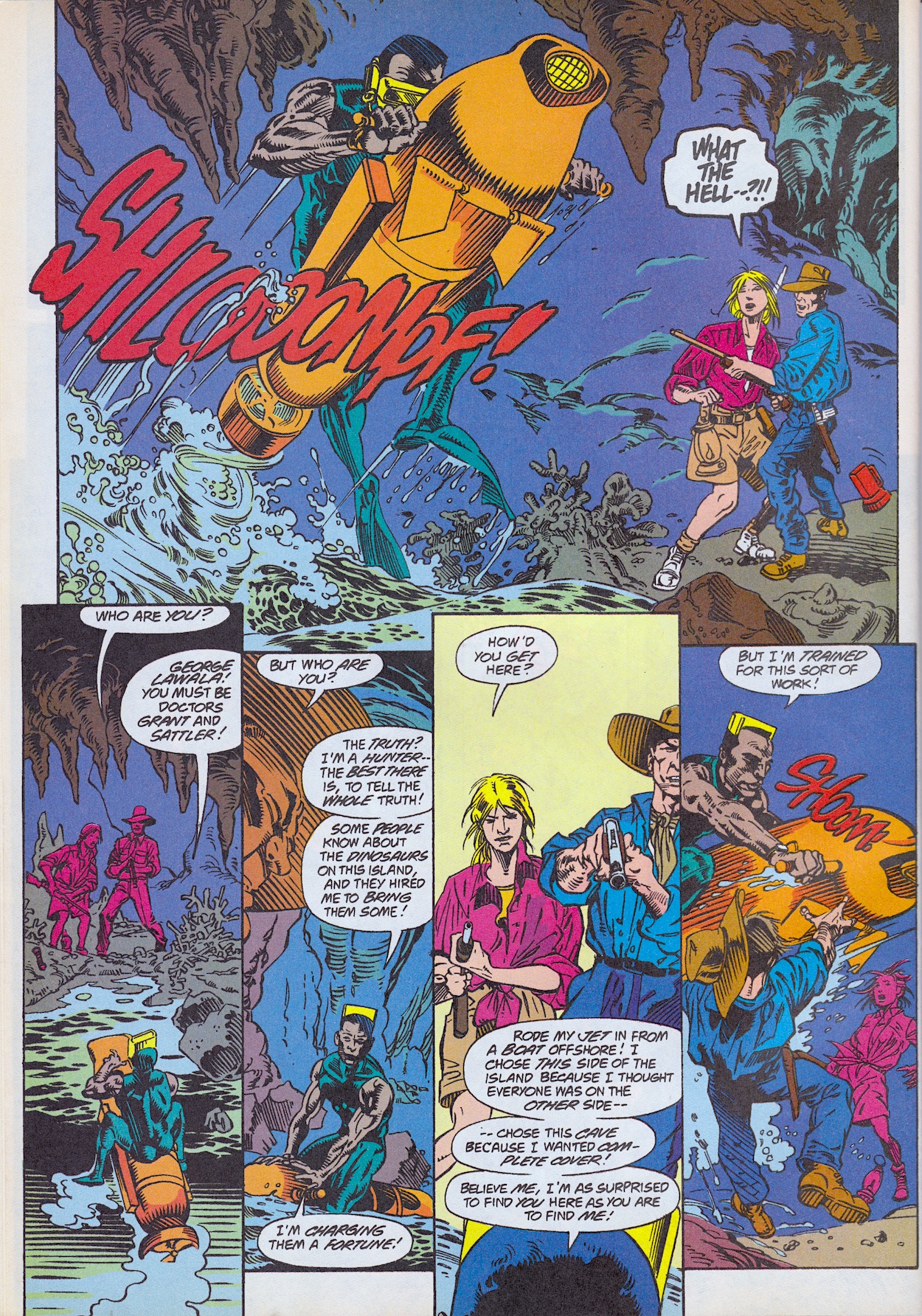
There are some nice references to the other surviving characters from the film and where they are now, all of which track with the as yet unwritten sequels, before a new character literally pops up, having come from that small boat I mentioned. After The Lost World this new addition of big game hunter George Lawala may not seem that original, but remember this was published just a few months after the first film. Amongst the dark caves colourist (and story editor) Renée Witterstaetter gives his entrance a burst of surprising colour, matching the sudden change of pace.

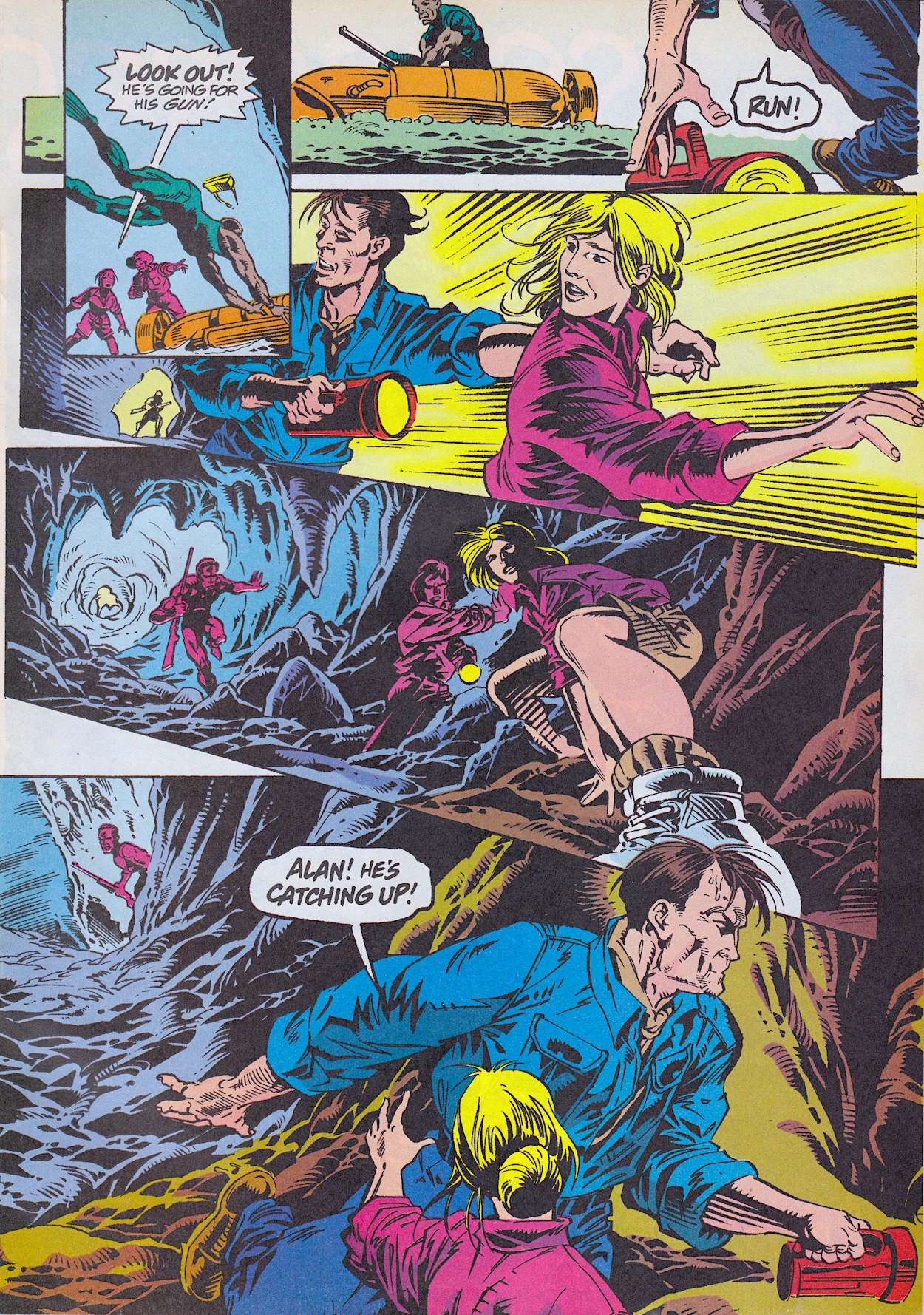
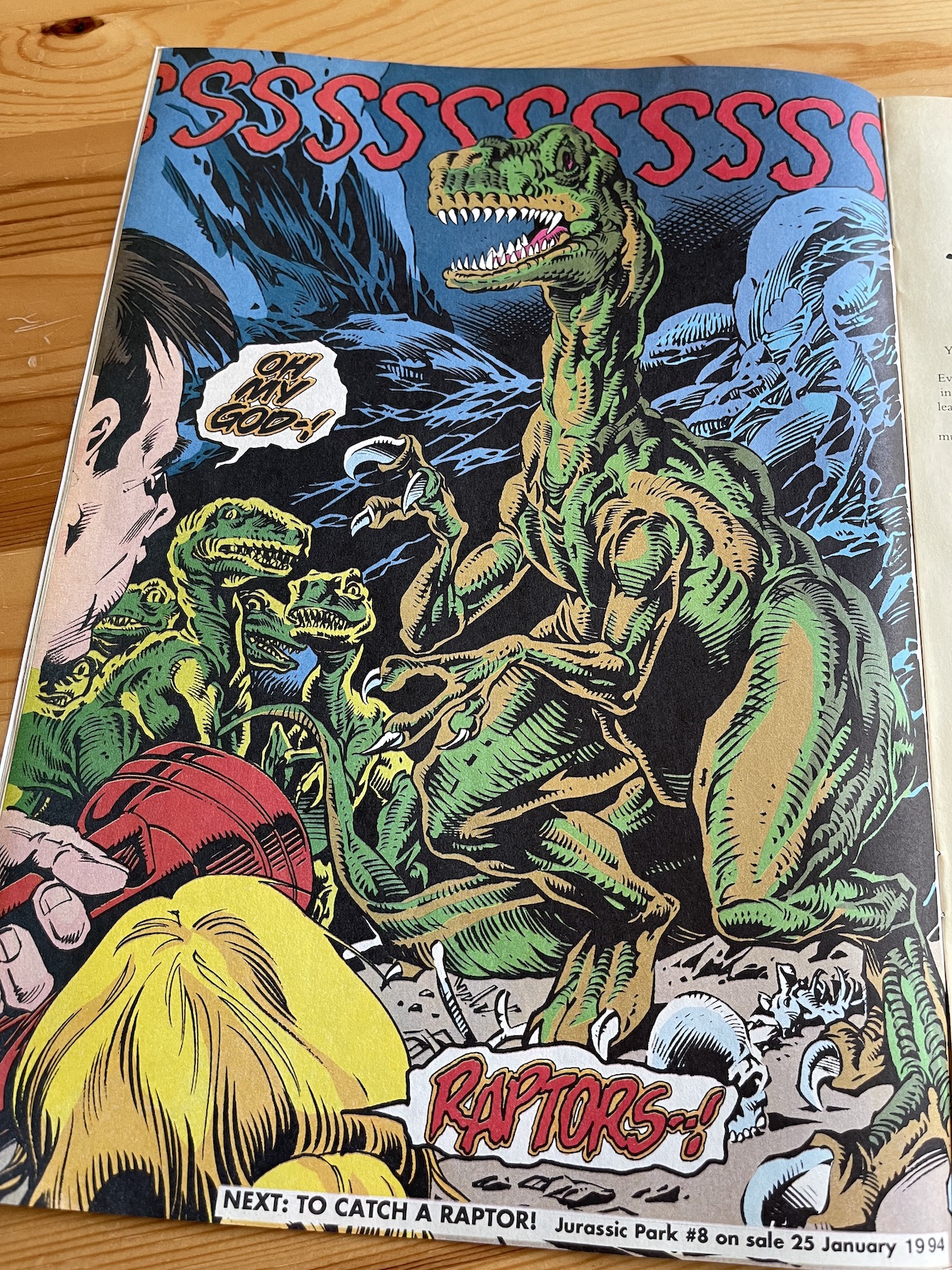
He instantly recognises the duo as a threat to his income, resulting in a chase deeper into the cave. He picked this particular cave to land because of its cover, easy access and the fact it’s far from the humans on the island, unaware of what could be living within. Alan and Ellie are fully aware (in fact they’d already deduced this was the perfect spot) but have no choice but to run further inside. The chase is rather exciting, the deep colours and camera angels drawing us in until we turn the page and both us and the characters are confronted with the ‘raptors.

George will be key in developing the story further and, eventually, in getting us off the island for the first time in the franchise. For now though this is our cliffhanger for another month after a dramatic, beautifully drawn eight-page adventure. Again, the Jurassic Park strip has the least pages of the three stories but it doesn’t feel like that while reading, and where it’s been cut into parts by editor Dick Hansom we’ve ended up with two opening chapters that feel very different from each other (even though they were part of the same issue in the States), as if it was written for this format.

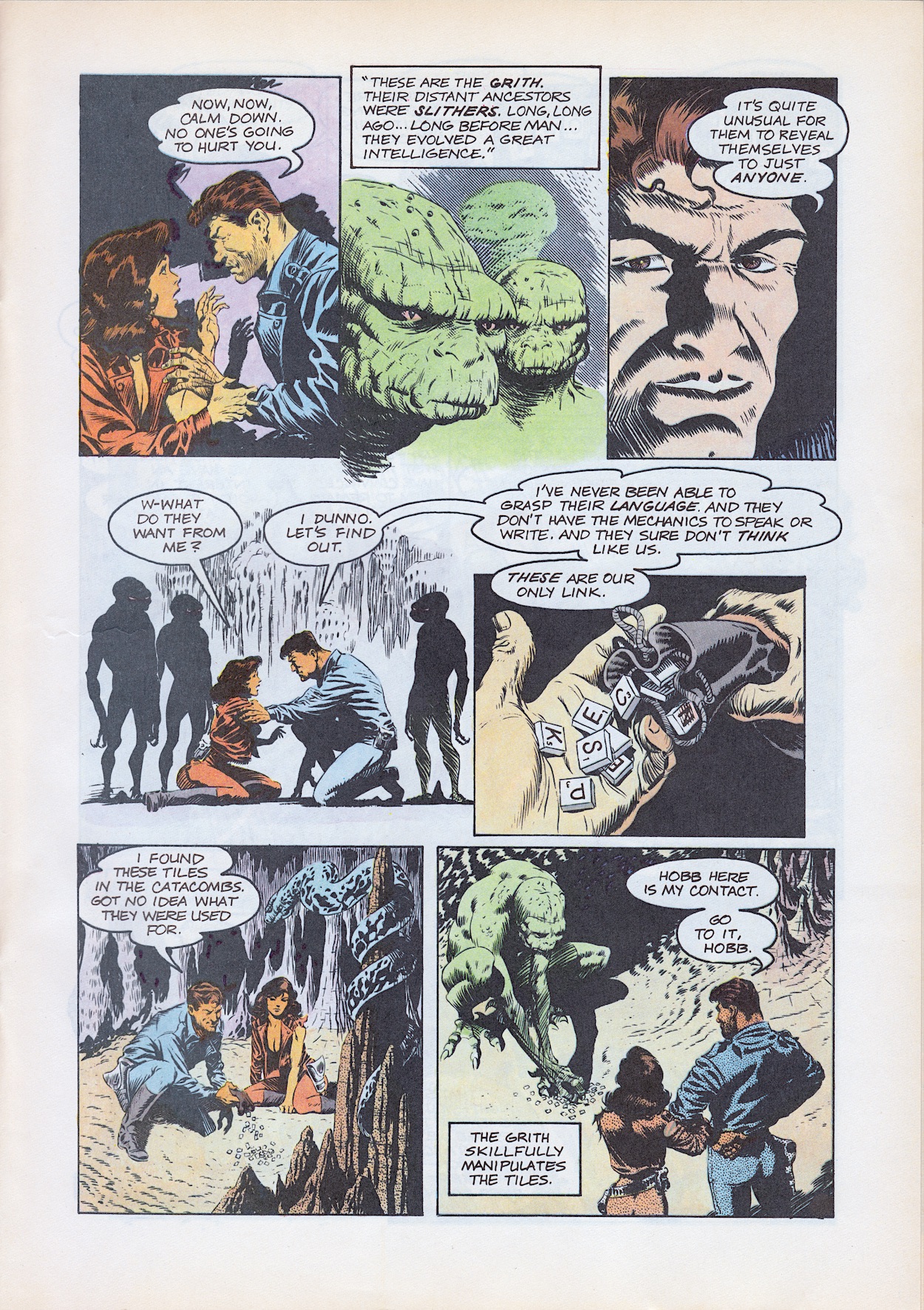
Mark Schultz‘s Xenozoic Tales is next up and it’s the second half of the story from last time. The mysterious lizard people that appeared to be kidnapping Hannah Dundee are revealed to be The Grith, a race of people who work with the Earth to grow both their own health and that of the planet. Despite correctly identifying humans as fighting against the Earth, Jack Tenrec was able to befriend them, communicating through a system of ancient tiles, the meaning of which have been lost to time. They might seem familiar to the reader though.

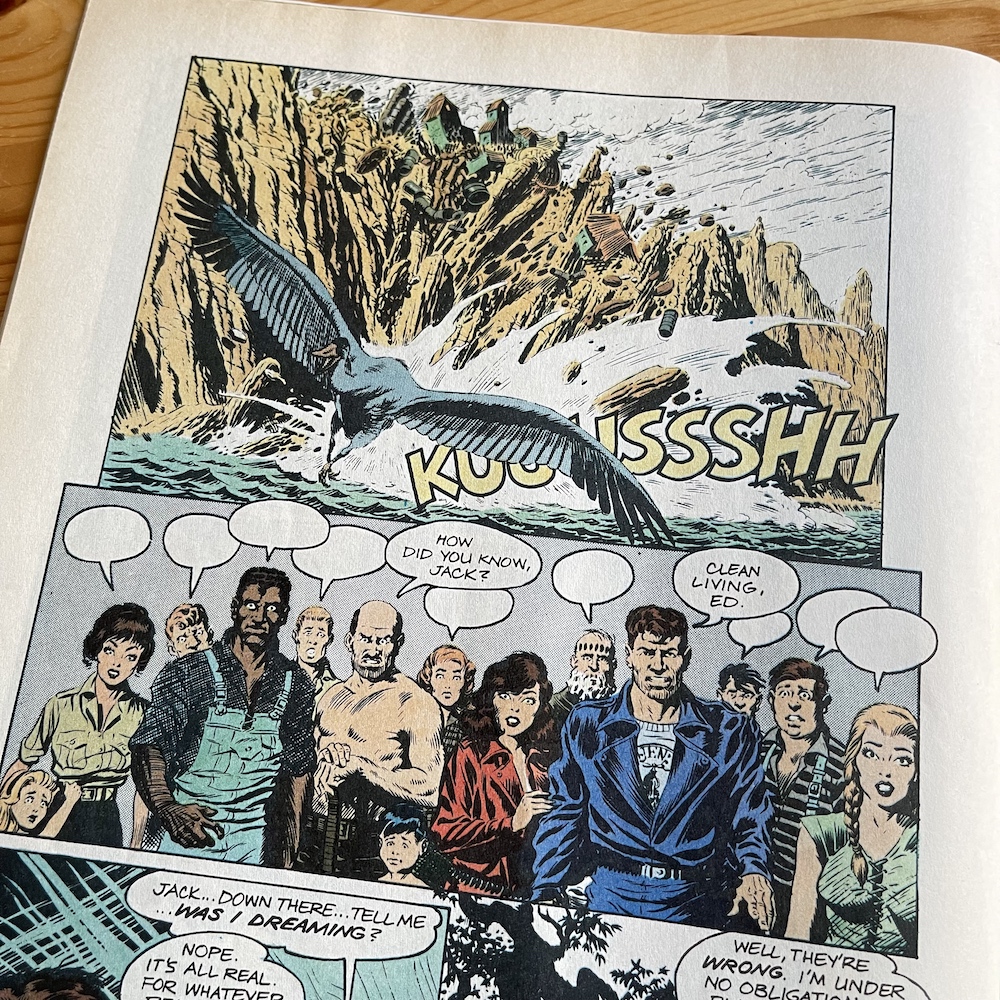
They appear to be a peaceful race but as you’ll see from the end of this chapter they’re quite capable of defending themselves, their friends and the Earth from any danger. The fact they can use the Scrabble tiles (a funny touch to the story) might be because they’re descended from ancient humans, or from other creatures that were around at that time, or maybe there’s some other, simpler reason behind how they can communicate this way. They’re also so in tune with the planet they’re able to predict an earthquake about to hit a cliffside farming community, so Jack and Hannah set off to save them.

Their journey takes them through deep caverns and past a huge, sleeping lizard monster. They must sneak past or be devoured! But the beast wakes up, sees our heroes and simply goes back to sleep, completely disinterested. I love these little moments in Xenozoic Tales that run contrary to our expectations. The stories are full of them. Funny moments also include The Grith making gestures with their bodies and Jack explaining how difficult it has been to communicate with them, priding himself on the use of the tiles. But of course, Hannah is able to decipher their body language easily, completely stealing Jack’s thunder.

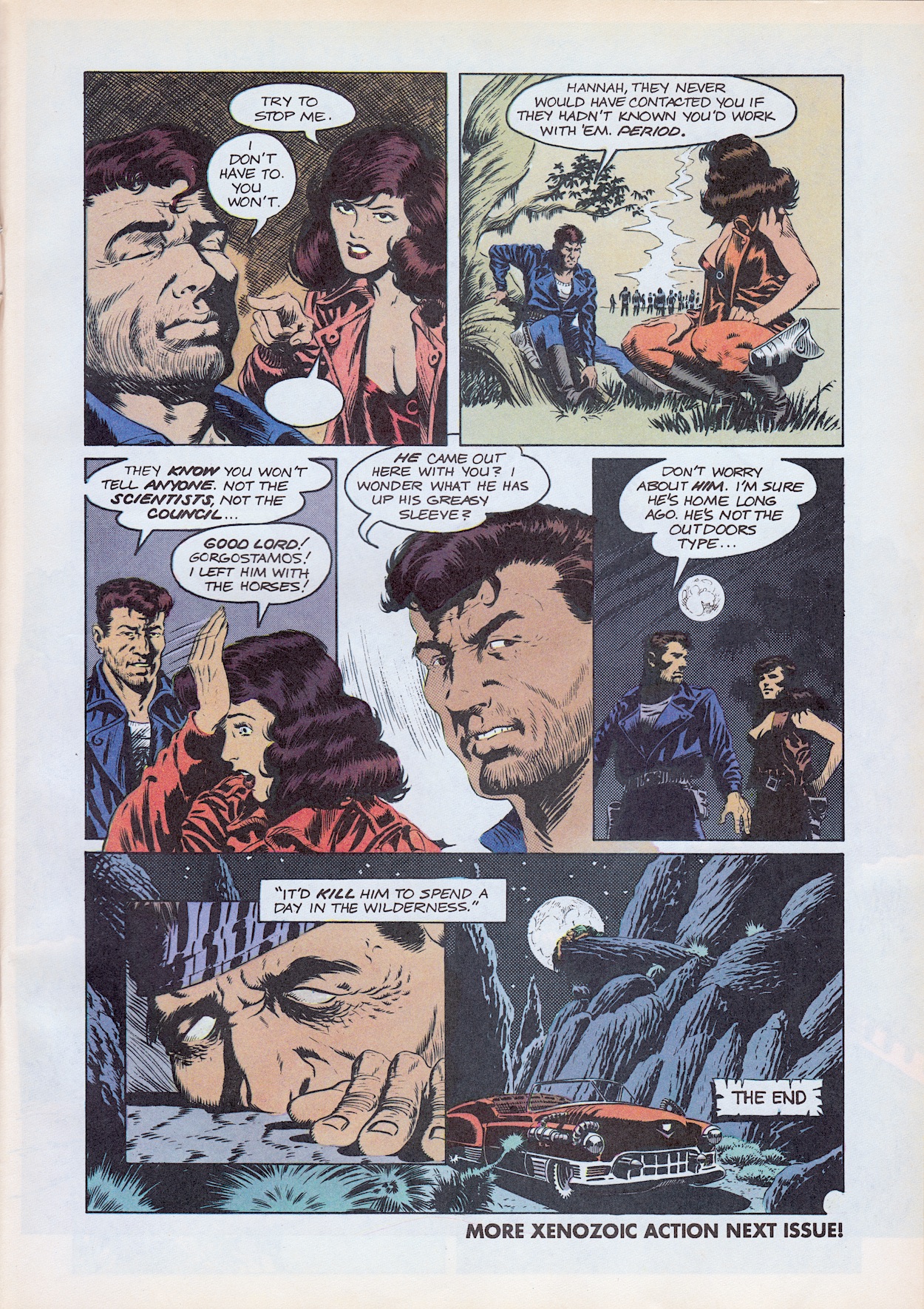
For some reason The Grith trust Hannah. They can foretell she’ll help them, so her protestations and claims she’ll report all of this to the council back in the city fall on Jack’s deaf ears; he knows once The Grith have decided to trust her, that’s it. It makes for more crackling dialogue between the pair. But just before things can be wrapped up with a neat bow and a happy ending, we get a glimpse into the darker side of these new additions to the story.

This feels like it’s building on the way the Velociraptors communicated in Jurassic Park

Gorgostamos, a man who had pretended to help Hannah find Jack last issue (as a trap to kill both her and Tenrec) comes face to face with at least one of them, and when we return to him all we see are these rather grisly final panels below. Was this to defend our heroes? Was there no other way? Or are The Grith more capable of violence than Jack thinks?

Jurassic Park would only print a selection of Mark’s strips because most were in black and white and this was a full-colour publication. (This story was reprinted by Marvel US in a colour edition around this time, coloured by Christine Couturier). Thankfully Dick brings in some local artists to colour some as the series continues. I do hope we don’t miss out on any of the answers this intriguing strip continues to raise every month.

Finally it’s time to return to the Cretaceous era and Ricardo Delgado‘s sublime Age of Reptiles. Last time a huge Tyrannosaurus rex stole the newly killed dinner of a pack of Deinonycuses, killing one of them in the process in what was actually a very funny moment. This issue kicks off with them returning to their nest and communicating via sound and body movements what had just happened. Even though it was created before the movie was released, this feels like it’s building on the way the Velociraptors communicated in Jurassic Park. It’s clear they’re now out for revenge.

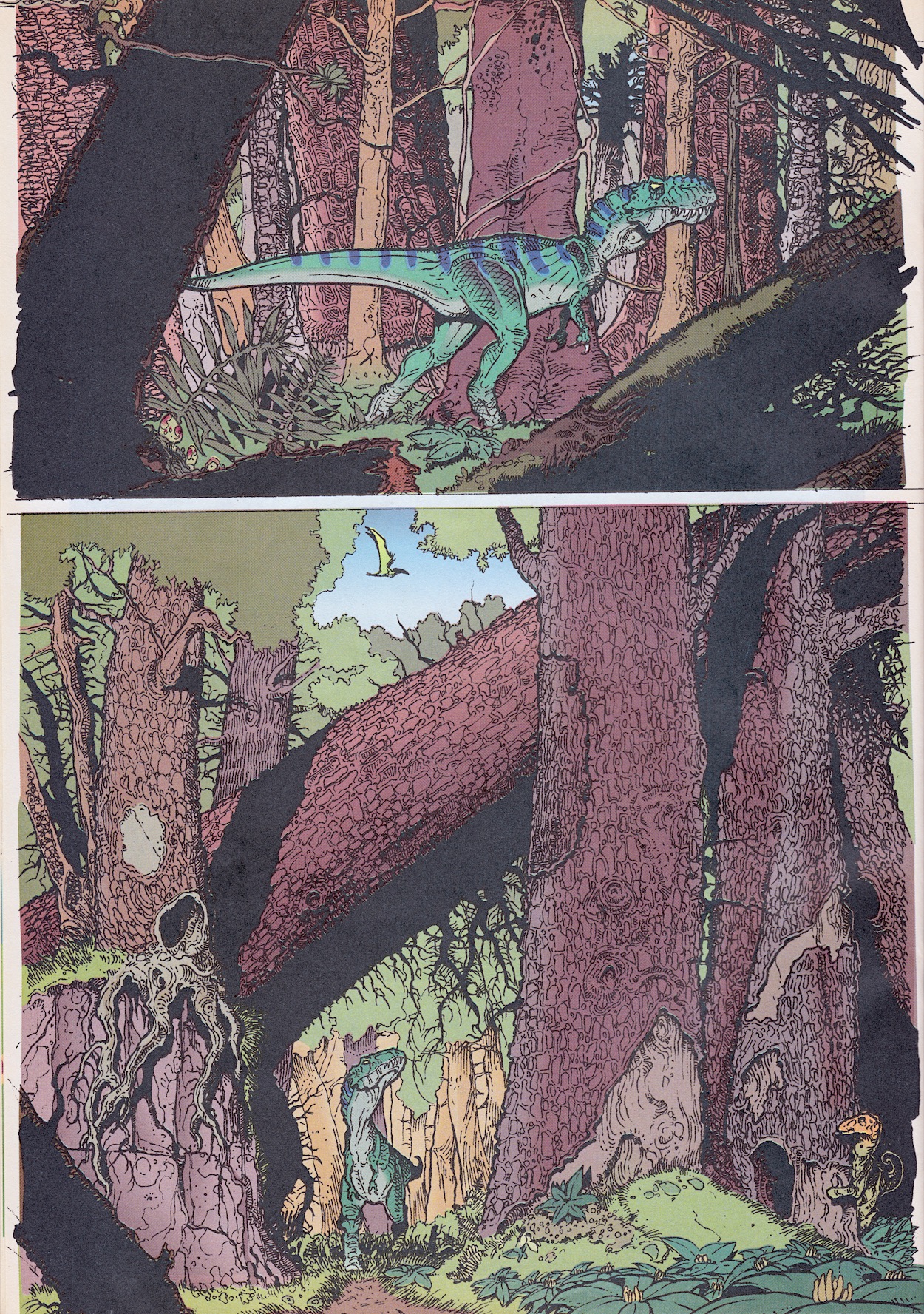
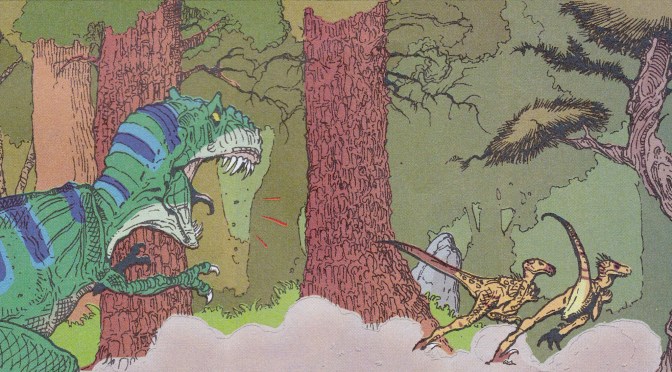
But first we get a few pages of the T-rex simply making his way back home, through forests and across large expanses of water. The art here is gorgeous and I find myself taking more time to ‘read’ this strip than either of the others. I just want to take in all the details, not only in the characterisations on the faces and bodies of the animals (which really do tell the story) but in the backgrounds too. Just look at this page below and you’ll see what I mean. Taking up a full page with these two panels of him simply walking home could be seen as dragging out the scene if it weren’t for Ricardo’s art, which demands this kind of space.

As you drink in these pages it also deliberately slows down the story. Ricardo is a master of pacing. You simply can’t rush through this, and if you did you’d be losing out. Just because there’s not one single written word, no captions, no sound effects screaming off the page, doesn’t mean there isn’t a lot to this in terms of characterisation, drama and scene building, and it only gets more intense as the months go on.

It’s so unfortunate the comic wouldn’t keep to this format for very long but we’ll get to that next year

When he returns to his nest we see his family waiting. He lovingly rubs heads with the female looking after their eggs, while the other looks on a bit jealously, although we do find out she is the mother of the adolescent T.rex, who is currently learning to hunt by chasing a small creature about the rocks and trees. I felt transported back to this time and involved in the natural lives of dinosaurs like no prose story or documentary before it.

Subsequent Jurassic Park/World movies have built upon the original’s emphasis on dinosaurs just being animals, not the monsters of older films and books. Age of Reptiles does a great job of this too, and moments like the one below remind me of the Tyrannosaur family from The Lost World: Jurassic Park.

This instalment ends with the Deinonychuses sneaking into the nest at night and stealing all of those eggs, but the adolescent awakes and raises the alarm. Giving chase, our male closes in on them as they dart through the forest, but eventually the smaller, more agile dinos leap across a chasm and escape, the T.rex left roaring into the night. I remember roughly how this develops and it’s well worth sticking around for. Brilliant, beautiful stuff.

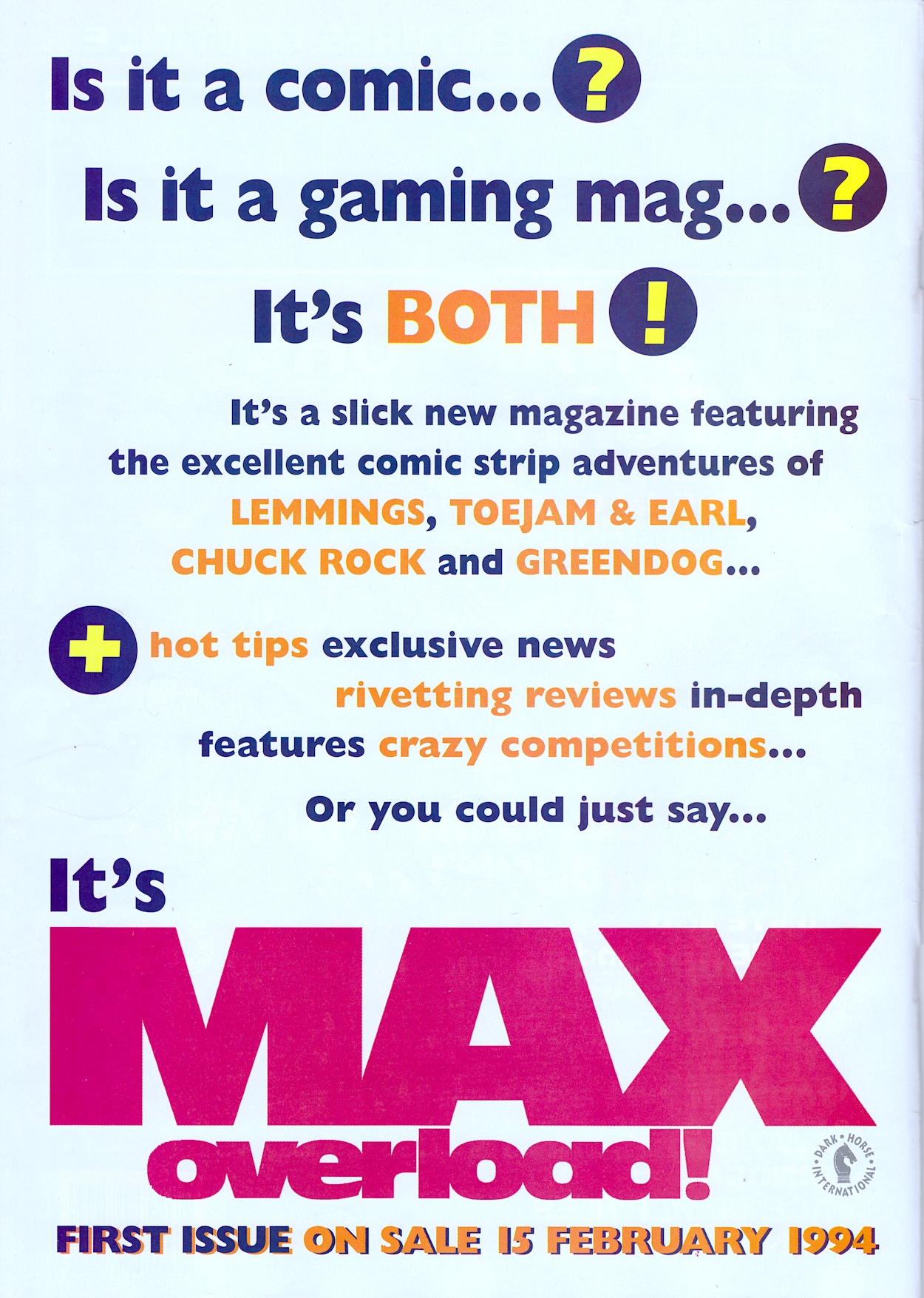
What a superb issue! The three strips come together to create a whole that’s hugely entertaining yet again. Yes, they may be cut down every month and as previously explained this wasn’t technically necessary, but with the three of them side-by-side like this they never felt like anything but three complete strips every issue. It’s so unfortunate that it wouldn’t keep to this format for very long but we’ll get to that next year. Before we go though, a quick look at the adverts within its pages, including news of a new magazine from Dark Horse which sounded awful to me as a kid.

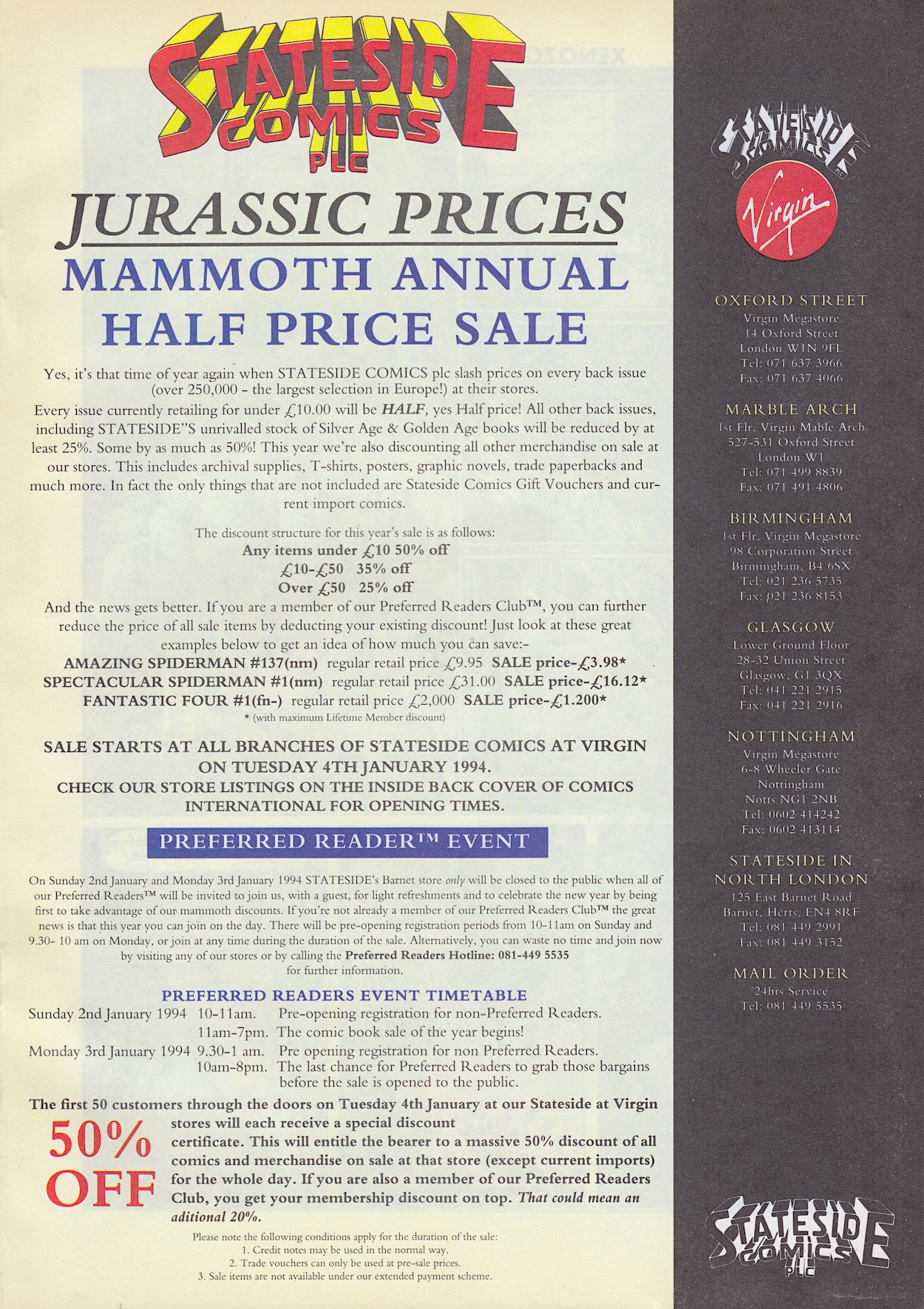
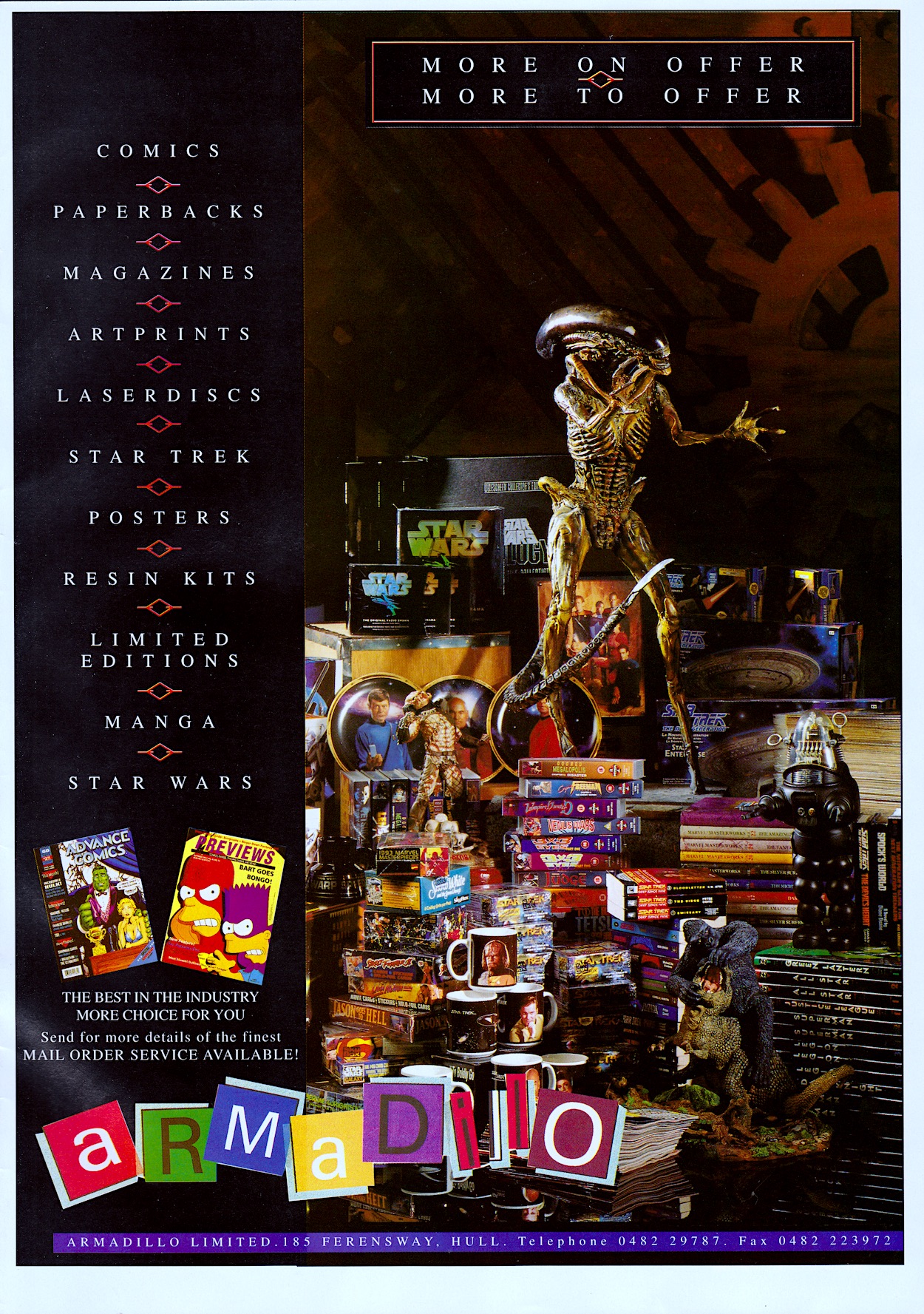
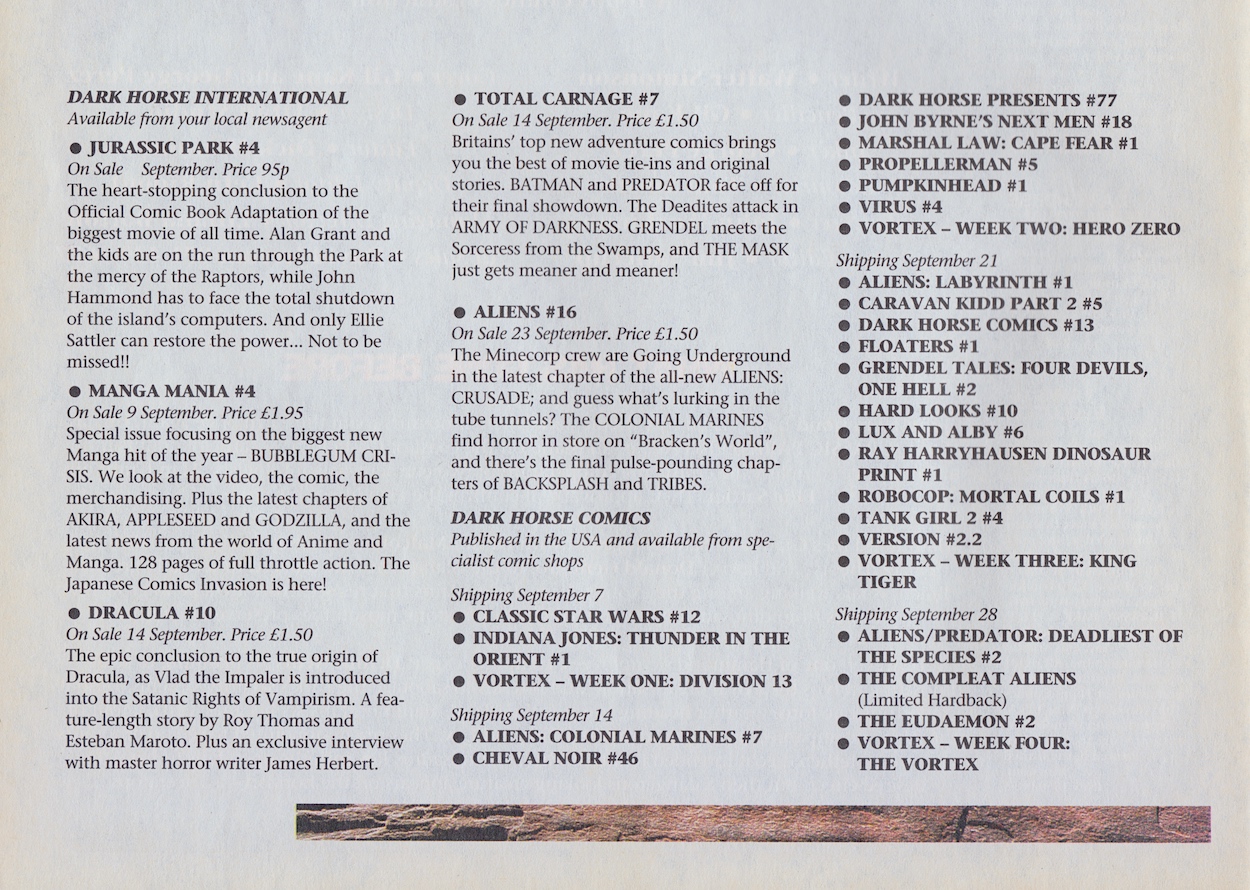
I loved my computer games magazines (in particular Commodore Format and GamesMaster) but the idea of something like that with lots of comic strips in it felt like a gimmick. Although I wasn’t sure if the gimmick was comic strips in a gaming magazine, or gaming features in a comic; it sounded confused. Elsewhere, a chain of comic shops uses a painfully strenuous link to the comic to justify its advert, and a comics and sci-fi merchandise shop I’ve never heard of takes the inside back cover. It’s rather quaint seeing these now, what with comic shops being so much more prevalent today, but back then mail order was much more necessary.

So as far as Jurassic Park‘s stories go and where they’ve left us this month, it appears there’s a lot to look forward to in 2022. Or should I say 1994. The new year of dinosaur action kicks off on Tuesday 25th January.
iSSUE SiX < > iSSUE EiGHT

JURASSiC PARK MENU

CHRiSTMAS 2021

JURASSiC PARK #6: THE LOST WORLDS

By 1993 I’d moved on from comics into the world of computer games magazines, but when I saw that ‘Jurassic Park‘ title with that tagline peering over the other comics on the shelves I was quick to grab it! Previously put off by the movie adaptation, here was the first official continuation of the movie’s storyline. But there was more, beginning with that brill Walter Simonson cover! As I flicked through to get an idea of what it was about I noticed back up strips too. On first sight it felt like the Transformers comic I’d loved so much. I was sold and bought my first comic in over a year.

Of course this wasn’t to remain the official sequel for long. Just a few years later Michael Crichton would release his novel The Lost World and the subsequent film was based upon that. But the American Topps Comics was the first to do so and Dark Horse International published it here in a typical UK comic format, meaning they were chopped up into smaller parts and backed up with other strips following the central theme. To the uninitiated it might sound like this would drag a story out unnecessarily but that couldn’t be farther from the truth.

UK readers were used to monthly stories from across the pond being split up in weekly or fortnightly comics out of necessity. This may have been a monthly but it still felt completely normal, it was just how things worked over here. Also, the Topps stories were split into mini-series with an unspecified gap between each so editor Dick Hansom‘s decision also made sense. If the comic had kept to this format a four-issue mini-series in the States could’ve lasted a full year over here. If the publishers themselves hadn’t gone bankrupt we could’ve had multiple years of Jurassic Park here.

The first thing this issue hits us with isn’t a comic strip but it still takes me right back. I may not have had a Sega Mega-CD (or any wish to own one) but I do remember the onslaught of new gaming consoles at the time, investing in the 3DO myself which I adored. My computer was the Commodore 64 but I loved reading up on the latest tech and the Jurassic Park game for the Mega-CD was completely different than all the others and looked like a proper adventure on the island. The constant hype for all these new machines was so exciting for me back then, like the future was arriving!


“That T-rex saved us from the ‘raptors! By the time we left Jurassic Park, I was almost — hell, I WAS in love with her!”

Dr. Alan Grant

So let’s get started with our three strips. While Dark Horse’s Aliens had various stories within that universe to pull from, joining the eight pages of Aftershocks (our main strip) here is the return of Xenozoic Tales (at ten pages) and new back up Age of Reptiles (at 12 pages). Yes, our main strip is shorter than the others but cliffhangers in all three had to be carefully chosen. With a unique dinosaur theme throughout – movie sequel set in the present, sci-fi action set in the far future and historical adventure set in the actual time of the dinosaurs – I never felt short changed and it never felt like anything other than a proper Jurassic Park title.

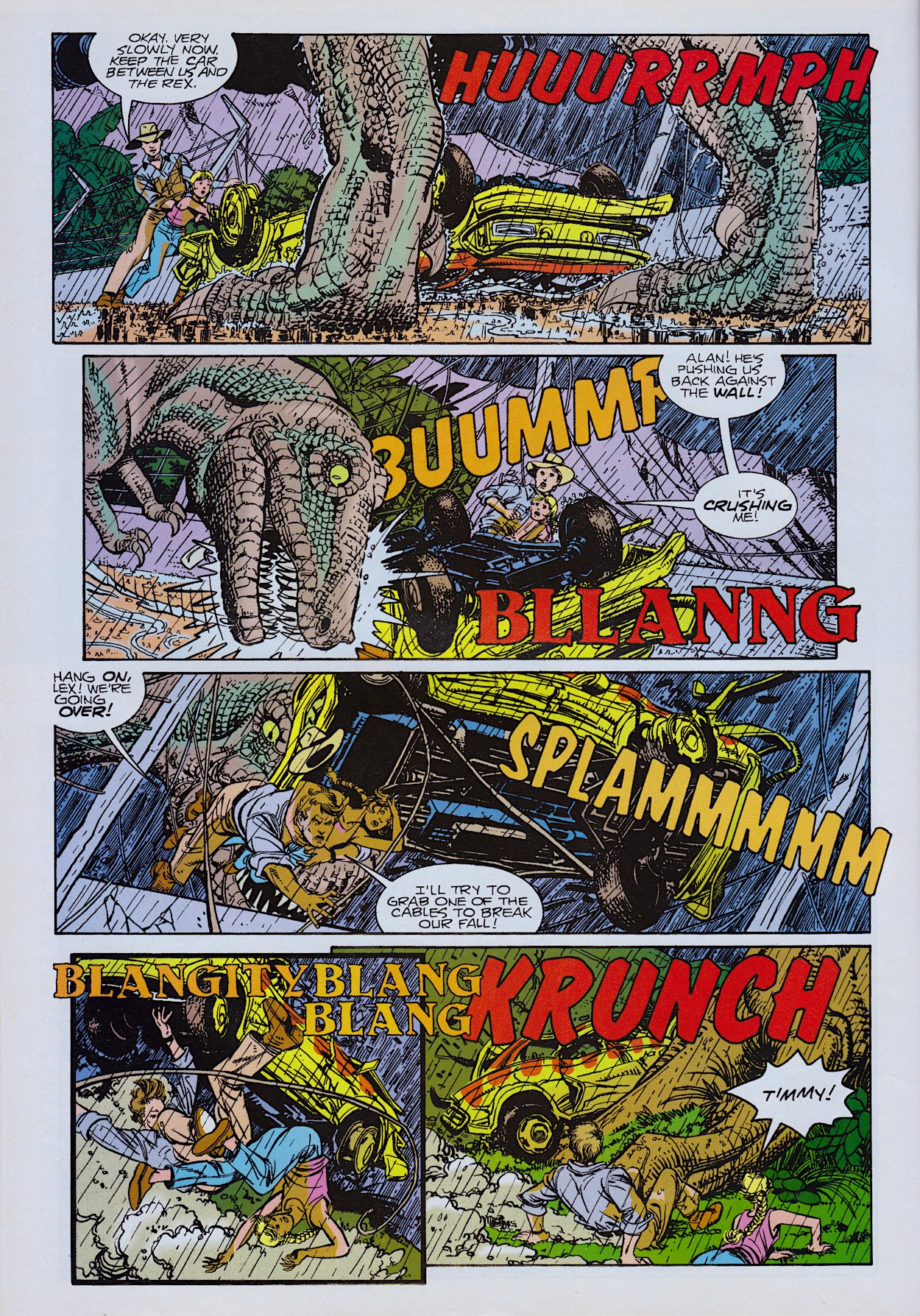
The first story begins with a narrative caption simply stating, “Three days later” above the body of a furious Tyrannosaurs rex. Writer Steve Englehart (The Avengers, Doctor Strange and creator of Star-Lord) was given free rein to develop the movie story as he saw fit, picking up the story with Dr Alan Grant and Dr Ellie Satler returning to Isla Nublar to supervise InGen‘s military-style cleanup operation. This already contradicts what came later (Hammond told us in The Lost World they’d been left alone) but let’s go with it as an alternative storyline.

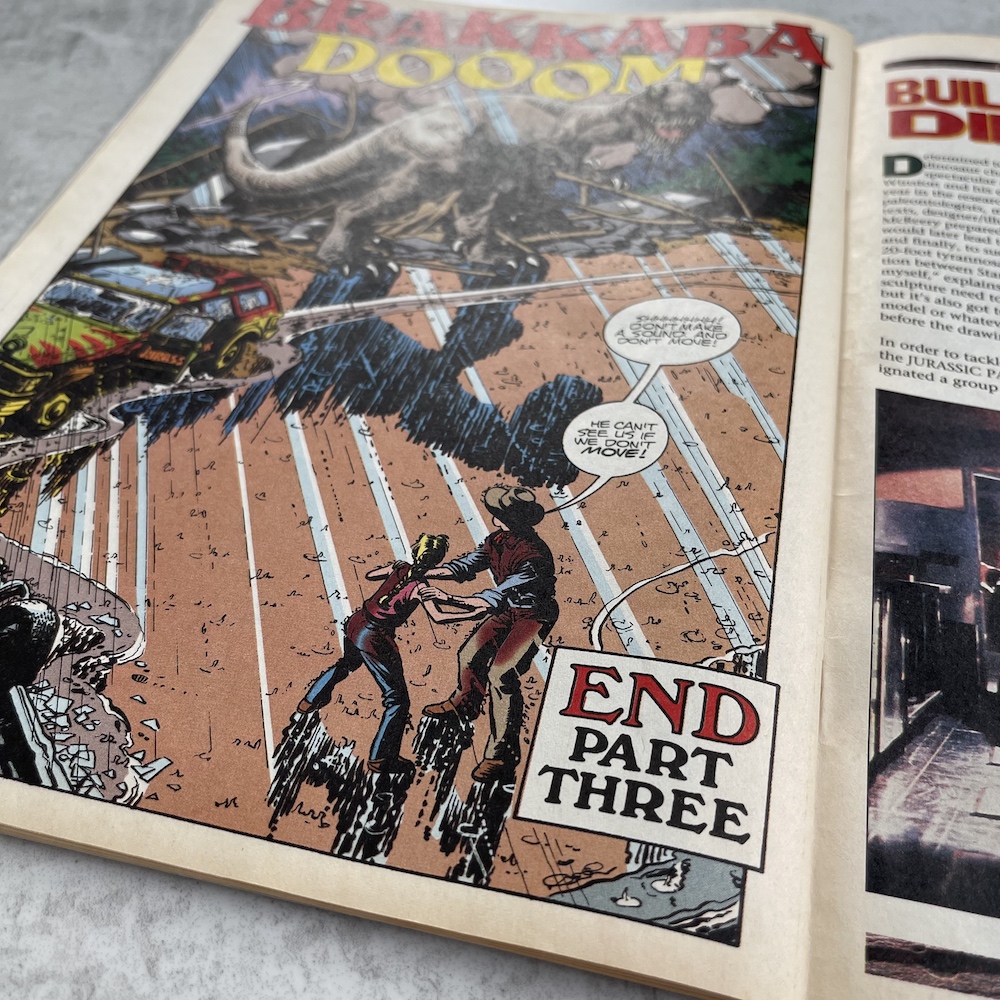
We turn over to this great double-page spread above, narrated by Alan as he watches the ‘rex destroy jeeps, tanks and anything else thrown at her. She’s furious with her prey but Alan’s inner thoughts are ones of love, of being grateful that she saved all their lives. Her very existence in the modern world is a miracle and , just like in the novel and the film, even though he and Ellie are frightened they’re equally in awe of her.

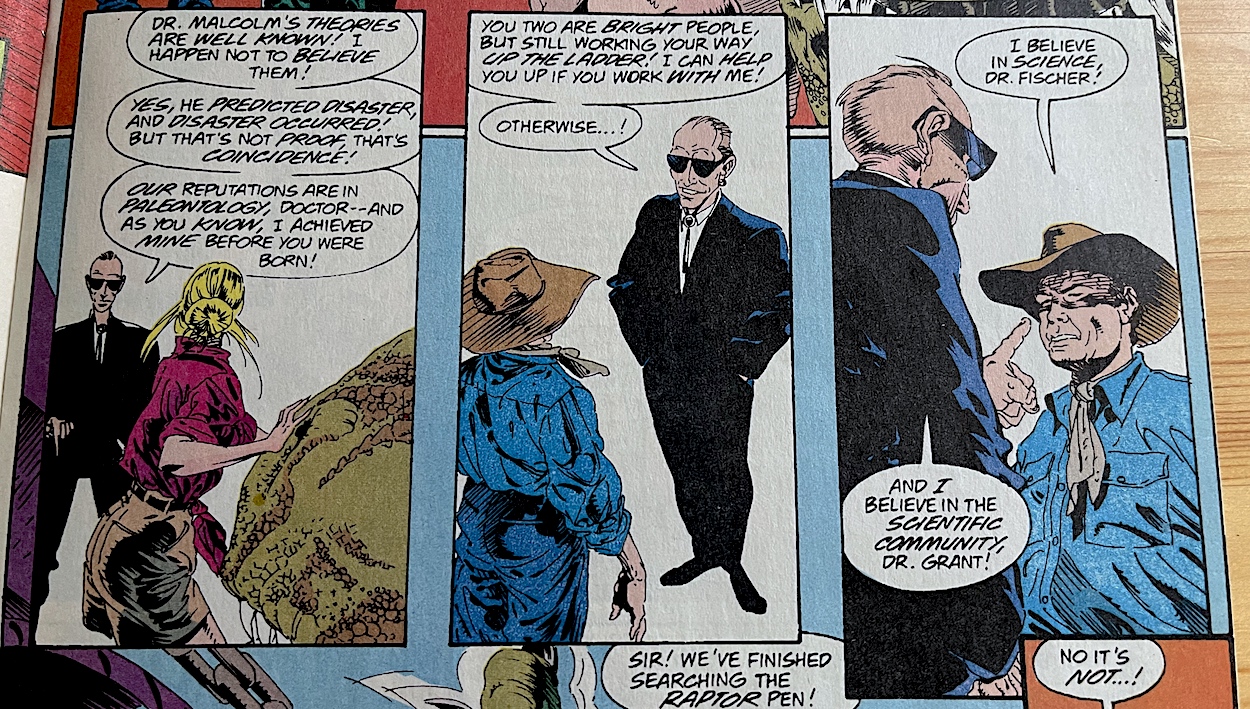
InGen want to regain control, contain the animals and begin scientific experiments on them in an attempt to make back some of the money they’ve lost. They don’t want to reopen the park. A new character called Dr. Fischer is the face of the corporation. He believes Ian Malcolm‘s predictions were coincidence rather than proof of Chaos Theory and he makes it clear he stands for advancing the scientific community, rather than science itself, putting him at odds with Alan.

It’s a small slice of action but it’s a great start and thought provoking at the same time

There’s a hint in here too that the Velociraptors had managed to escape their enclosure earlier than we’d thought, because no eggs were found in there and we knew they were able to breed. This ties in with the book but not the film. In Michael Crichton‘s original story the ‘raptors were able to get in and out of their enclosure at will without the humans noticing. In fact, some had made it on to one of the boats for the mainland, which added more tension to Alan and the kids’ return to the Visitor Centre because they had to warn the boat before it docked. But in the film they clearly didn’t get out.

The art style is a world apart from what we had in the adaptation. Armando Gil (The ‘Nam, Savage Sword of Conan, The Punisher) brings a gritty, mature style to the art. His T-rex certainly looks the part, closely resembling the actual dinosaur and he really captures her size and power. (Also, an uncredited Dell Barras, see next issue’s review.) Alongside Armando comes letterer John Costanza (Green Lantern, Batman, Ronin) and colourist and story editor Renée Witterstaetter (Silver Surfer, The Sensational She-Hulk, Jason Vs. Leatherface) whose subdued colours suit the wonderfully scratchy artwork perfectly. It’s a small slice of action but it’s a great start and thought provoking at the same time. I like InGen’s desperation and the fact Dr. Fischer believes he’s right, that what he’s doing is for the greater good. I hope it develops these threads.

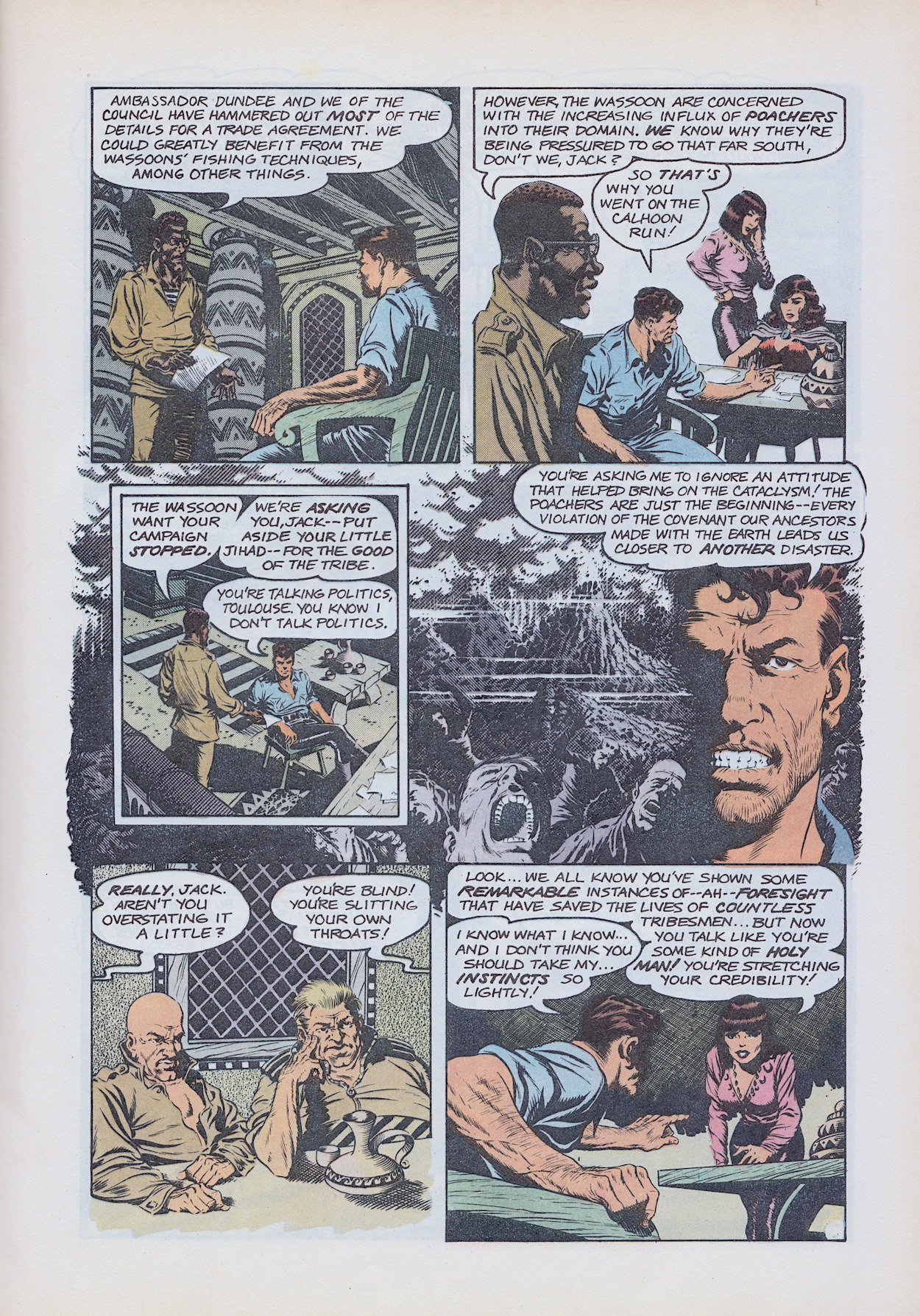
Carrying on the theme of not learning from past mistakes comes the first backup strip, Xenozoic Tales in which our hero Jack Tenrec finds himself at odds with the council and his new friend Hannah Dundee. Both his and Hannah’s tribes want to stop his campaigns against their poaching. But Jack is standing firm, knowing he’s baring witness to humans going back down the very same path that led to the cataclysm in the first place. Creator, writer and artist Mark Schultz has been very clear from the first chapter this is a story about the dangers humans pose to our world.

Benefactor is the seventh story in the series but only our third, something I went into more detail on last time. This could be because only some of the tales had been published in colour by this time, done so here by Christine Courtier. It ends with a cliffhanger for the first time and I remember these strange creatures from later in the run. Hannah has been sent to look for Jack after he’s stormed off. Using her tracking skills, unaware the council man who accompanies her is intending to kill Jack, she catches a glimpse of his Cadillac shining in the hot afternoon sun but gets more than she bargained for as she approaches it. The back-stabbing and the politics, wrapped up in an adventure in a land populated by dinosaurs is unique and really fun to read.

When I scanned over this issue in the newsagent’s my eyes lit up when I saw the final strip. I know it’s a cliché and an exaggeration to say “it took my breath away” but you’ll get my point. Set in the Mesozoic period it follows a pack of Deinonycuses and a T-rex family as they do battle after one steals the meal of the other. Created and intricately drawn by Ricardo Delgado and beautifully coloured by James Sinclair it contains no narrative captions at all. Everything is told solidly in pictures only, without even any lettered sound effects.

Ricardo is an artist working in the movie and television industries, whose credits include everything from The Real Ghostbusters and WALL-E to Jurassic Park III, suitably enough. James’ credits have also included Legends of The Dark Knight, Hellblazer and The Mask comics. Age of Reptiles was Ricardo’s first book in a series and hadn’t been released here yet when it became serialised in the pages of Jurassic Park, where it’s an even better fit than Xenozoic Tales for obvious reasons.

It tells an absorbing story through great art and wonderfully designed characters. The Deinonycuses kick things off by taking down their dinner, a giant Brontosaurus. Originally I thought these were Velociraptors until I read the catch up on the contents page of the next issue, although to be fair they are a very closely related species. I love how each one has particular markings and by paying attention to such things we get to know each one over the next few months. How Ricardo imbued each one with individual personalities through facial expressions and movements is simply genius.

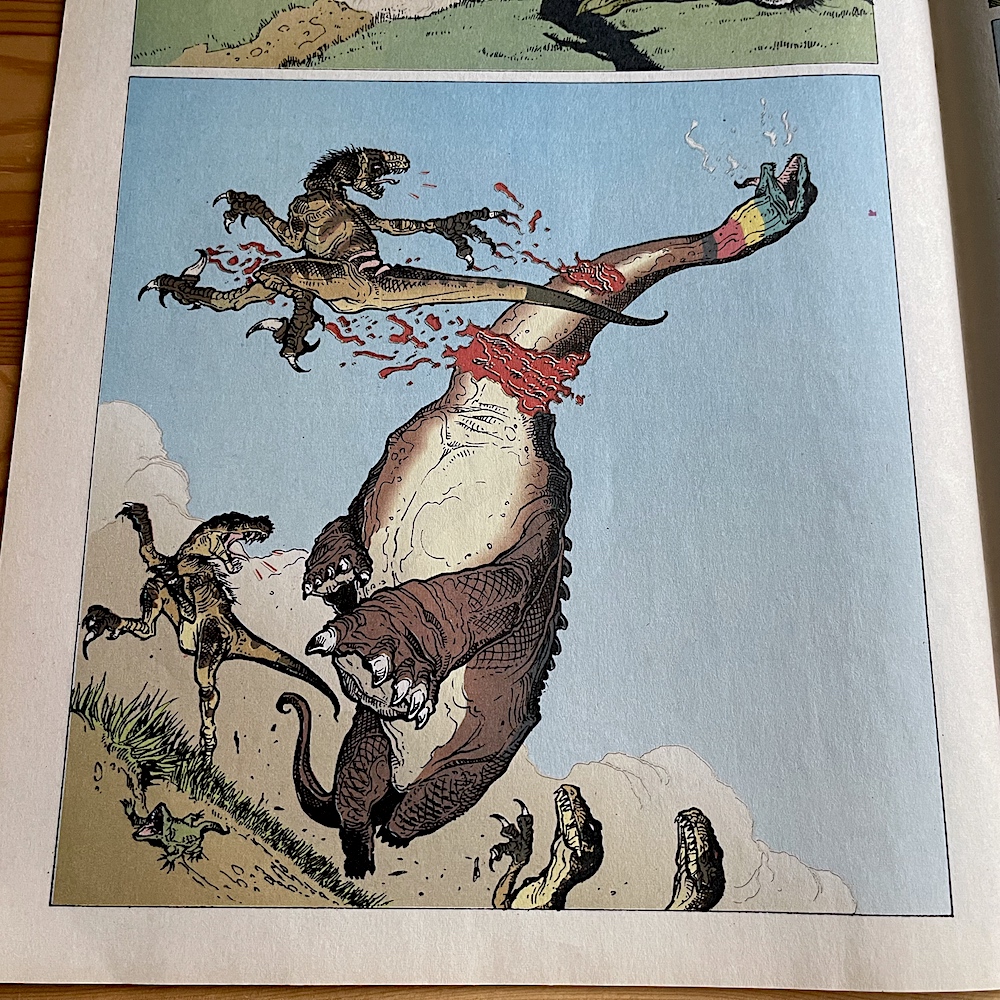
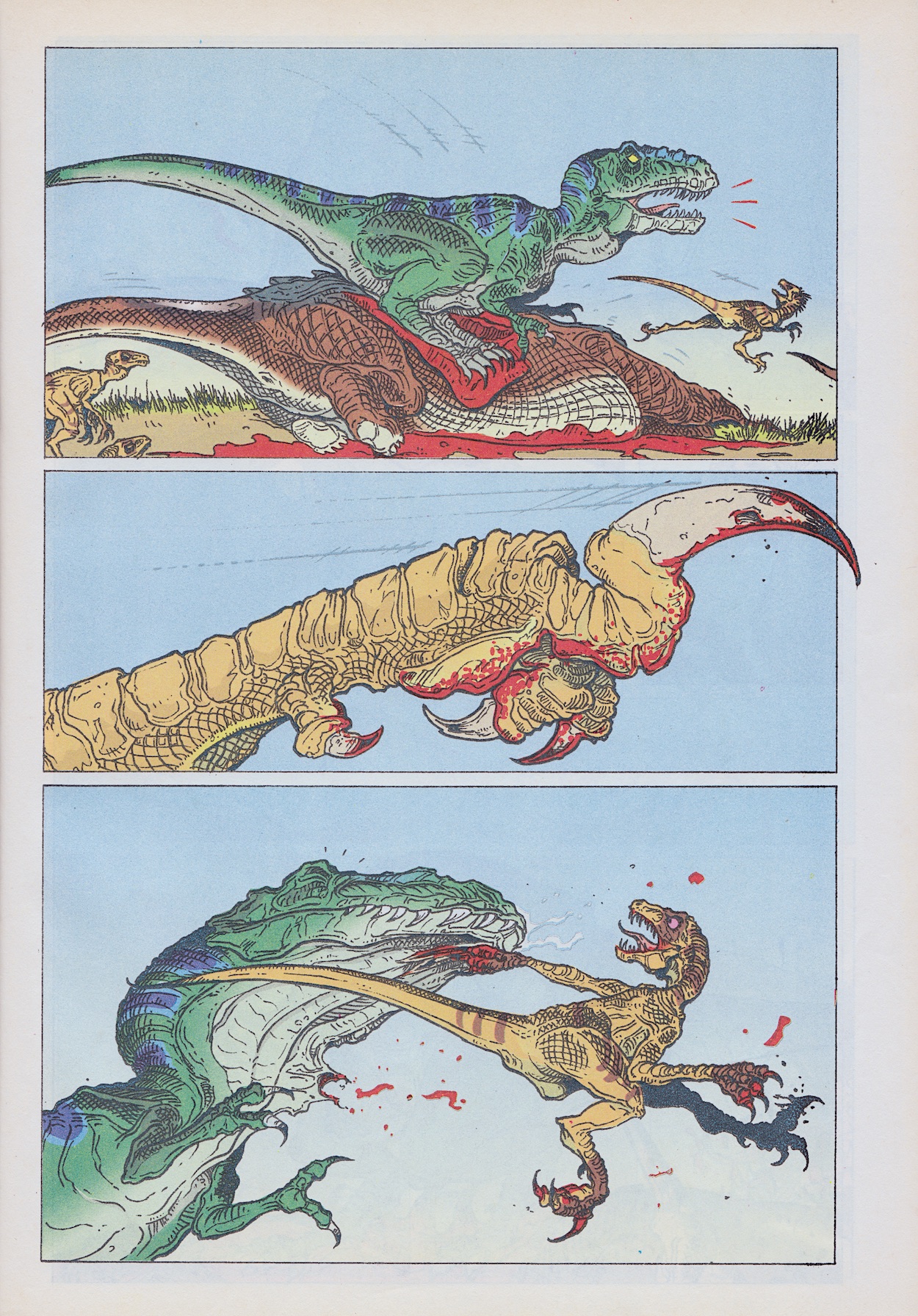
They begin to feast but are rudely interrupted when a giant T-rex jumps on top of their prize and roars at them to back off. But they aren’t giving up so easily and one leaps in to slice at the bigger beast. The strip was quite gruesome and violent for the time and, while there’s nothing to put off younger readers yet, it will build upon this as the story develops. But it also had its lighter comedic moments, one of my favourites coming up right now. After the smaller dinosaur leaps and slices we turn over to be met with the page on the right below.

This still makes me laugh to this day. As the story develops we’d see an ever-increasing battle of revenge between these characters which would include ferocious fights, some tender moments and one surprisingly heartbreaking scene. Don’t believe me? You’ll just have to wait and see. It’s not an exaggeration to say it’s a thrill to be reading Age of Reptiles again after so long. The collected books go for silly prices online these days so I’m happy to wait and play the slow game with this serialisation. It’s worth the price of admission alone.

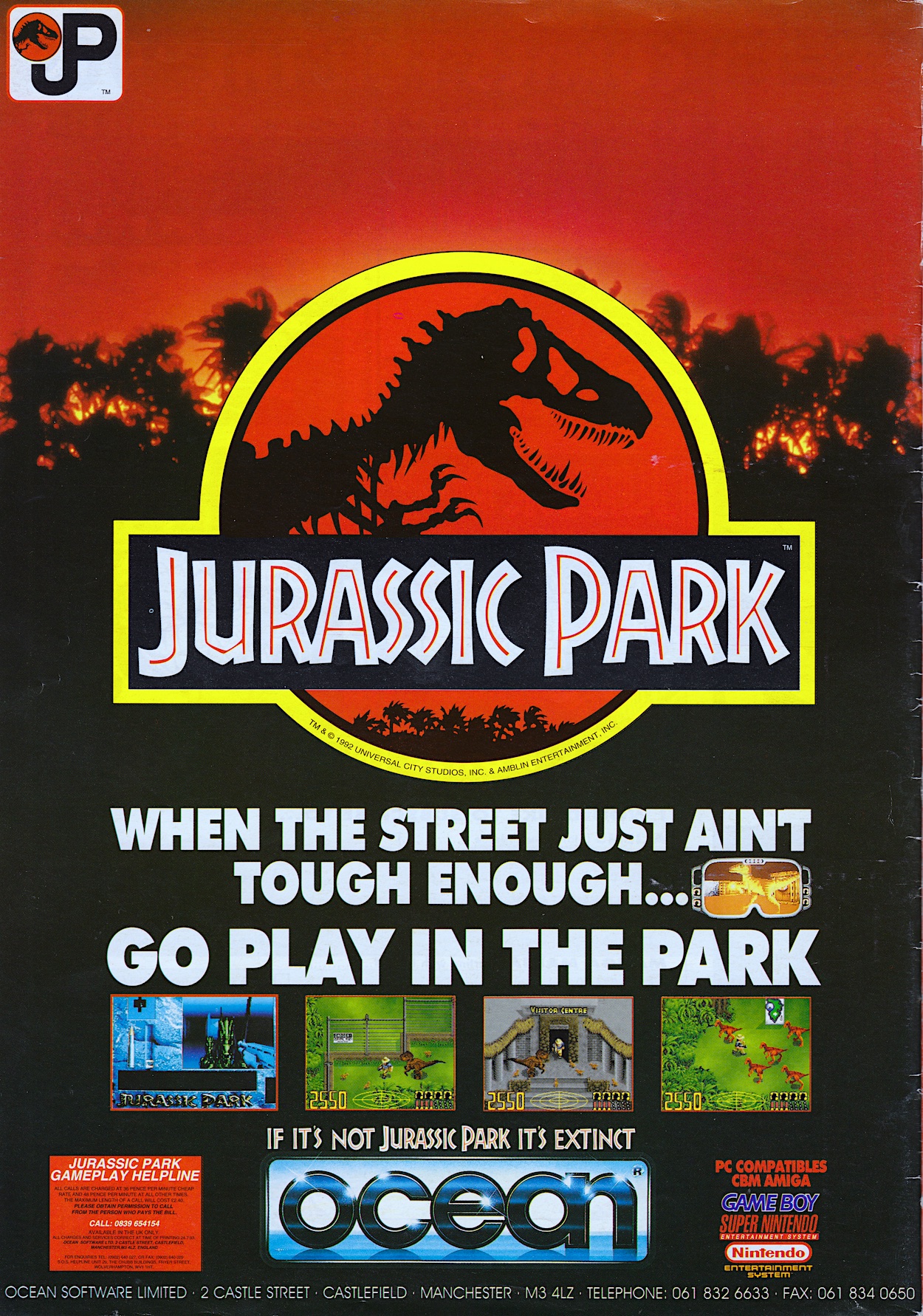
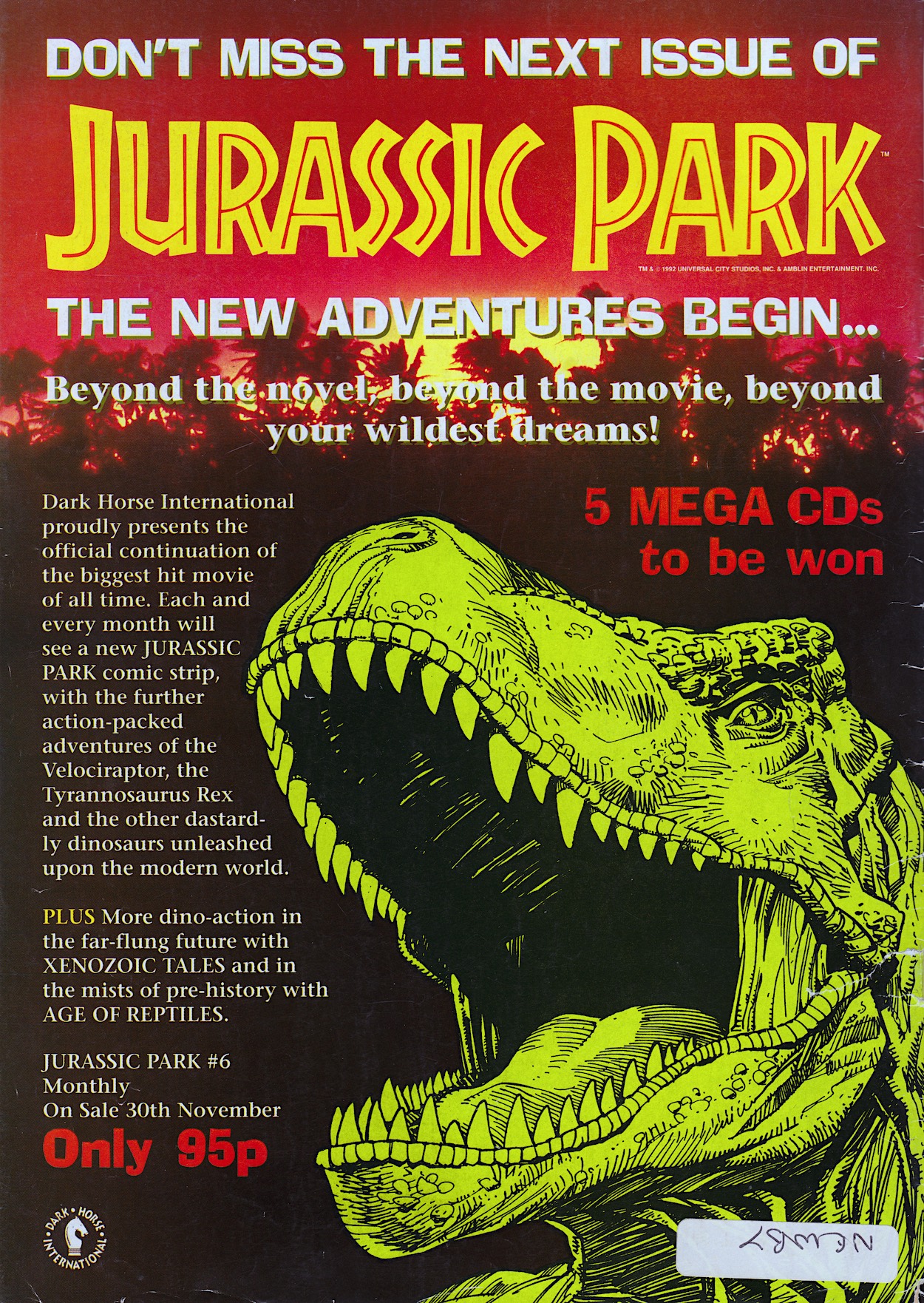
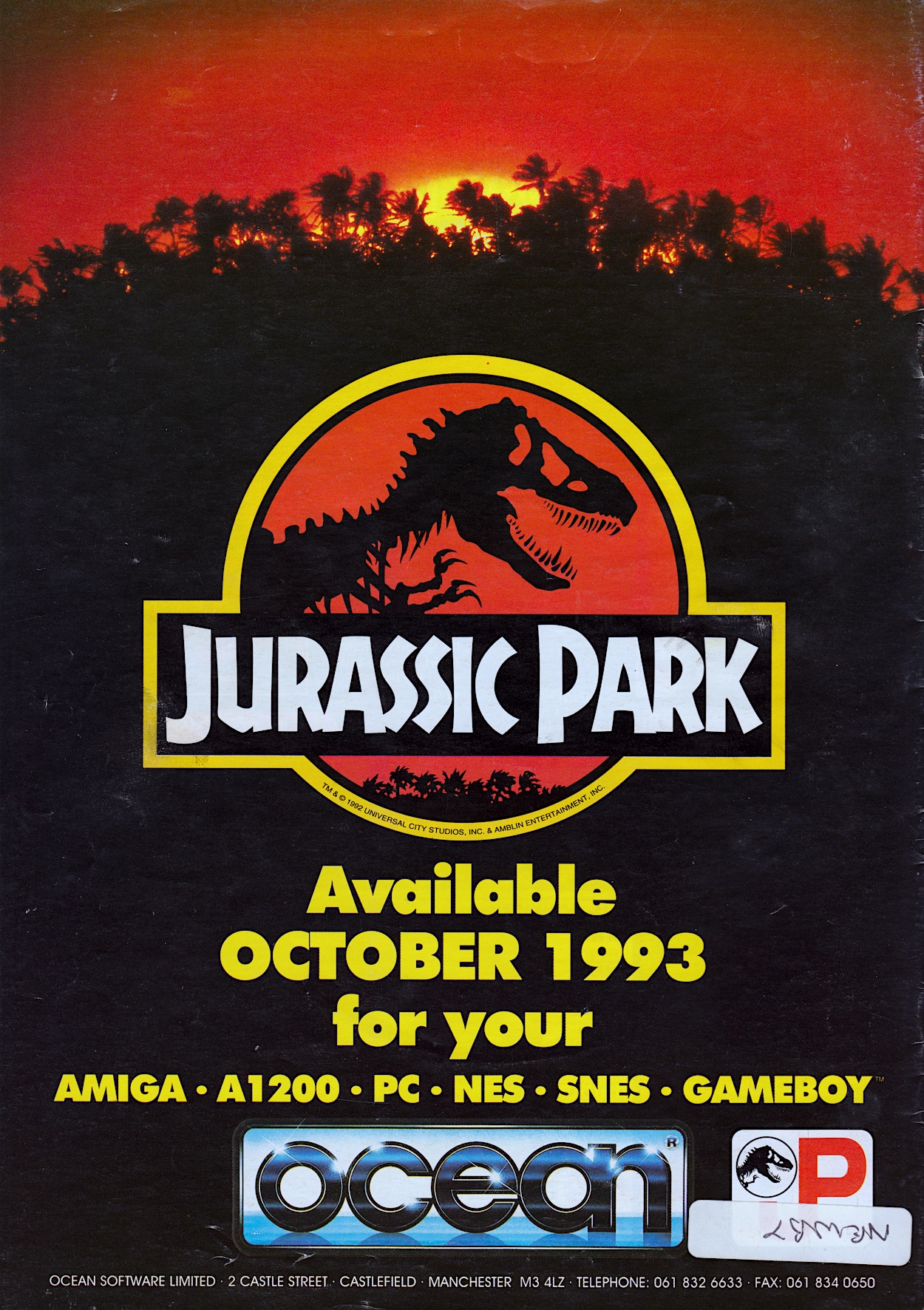
To finish off here’s a look at the advertisement on the back cover for the Jurassic Park videogame which was being released on a variety of platforms. It’s the tagline I love the most here. This was around the time Street Fighter II was everywhere (it would even be a comic advertised in these pages soon enough!), making this a brilliant piece of competitive marketing for the time!

I remember playing the Nintendo Game Boy version. Even though it didn’t follow the plot of the film at all and had Alan Grant out in the park collecting all the eggs with a gun, firing tranquillisers at all the dinosaurs as if they were all out to eat him, it was still a really fun game to play. Especially at night when I was meant to be asleep for school the next day, having to play it using that heavy, cumbersome light attachment on the supposedly handheld console.

This was a brilliant start to my Jurassic Park comics journey. Surely here was a title that I could collect without fear of it being prematurely cancelled? How could a comic based on the hottest thing on the planet be anything other than a runaway success for years and years? Well, if the comic had kept to this format and continued until the end of the US strips, those 19 American issues would’ve spanned a whopping 57 British editions over nearly five years! The next one is #7 and its review will be up on the blog on Tuesday 28th December 2021.

iSSUE FiVE < > iSSUE SEVEN

JURASSiC PARK MENU

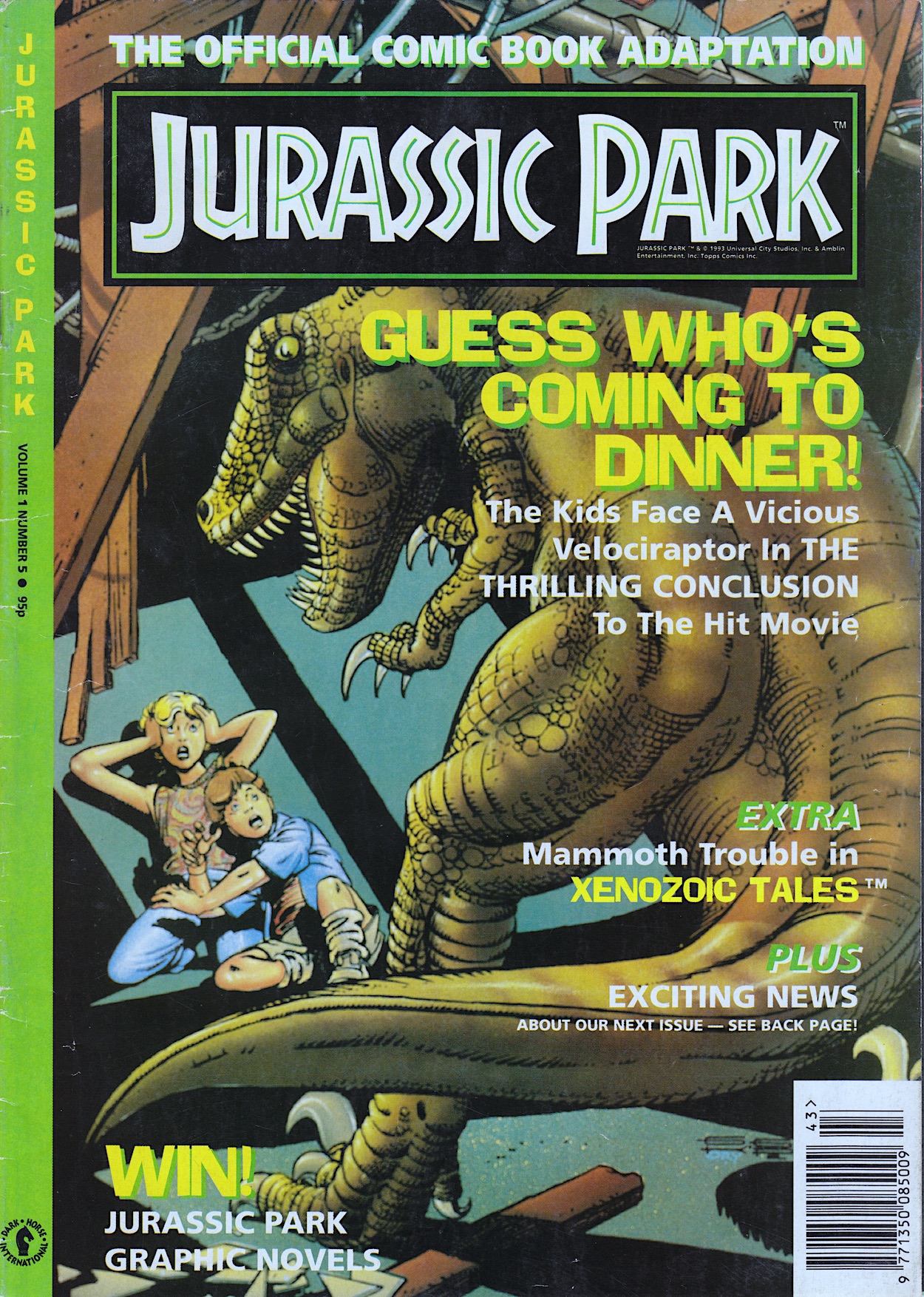
JURASSiC PARK #5: RUSHED ‘RAPTORS

It’s time to bring the movie adaptation of Jurassic Park to a close with the last 12 pages of the final chapter, originally part of issue four of Topps Comics‘ mini-series in the States. For UK readers it was split in two, with new backup strip Xenozoic Tales bringing up the rear. However, due to the decision to keep the comic going the back up gets more pages this time around and there’s a simple explanation.

I’m going to assume last month’s issue was originally going to follow the same formula as the ones that came before, with a full chapter of Jurassic Park and a behind-the-scenes feature. In the US it had been decided new adventures would make up another mini-series, but there was going to be a small gap before it went on sale. To plug this in the UK this last chapter was split over two issues and the back up added to fill out the pages. This explains why there were only four parts to the behind-the-scenes series, with none this month (or ever again actually).

The opening chapter of Xenozoic Tales was quite short in length, so more of the Jurassic Park strip was included last time, but Mark Shultz‘s stories were of varying sizes, so working all of this out to spread over the two issues has resulted in 14 pages of the movie adaptation climax and 18 for Jack Tenrec and Hannah Dundee. It makes for a strange balance but that would all be corrected next month. More on this below.

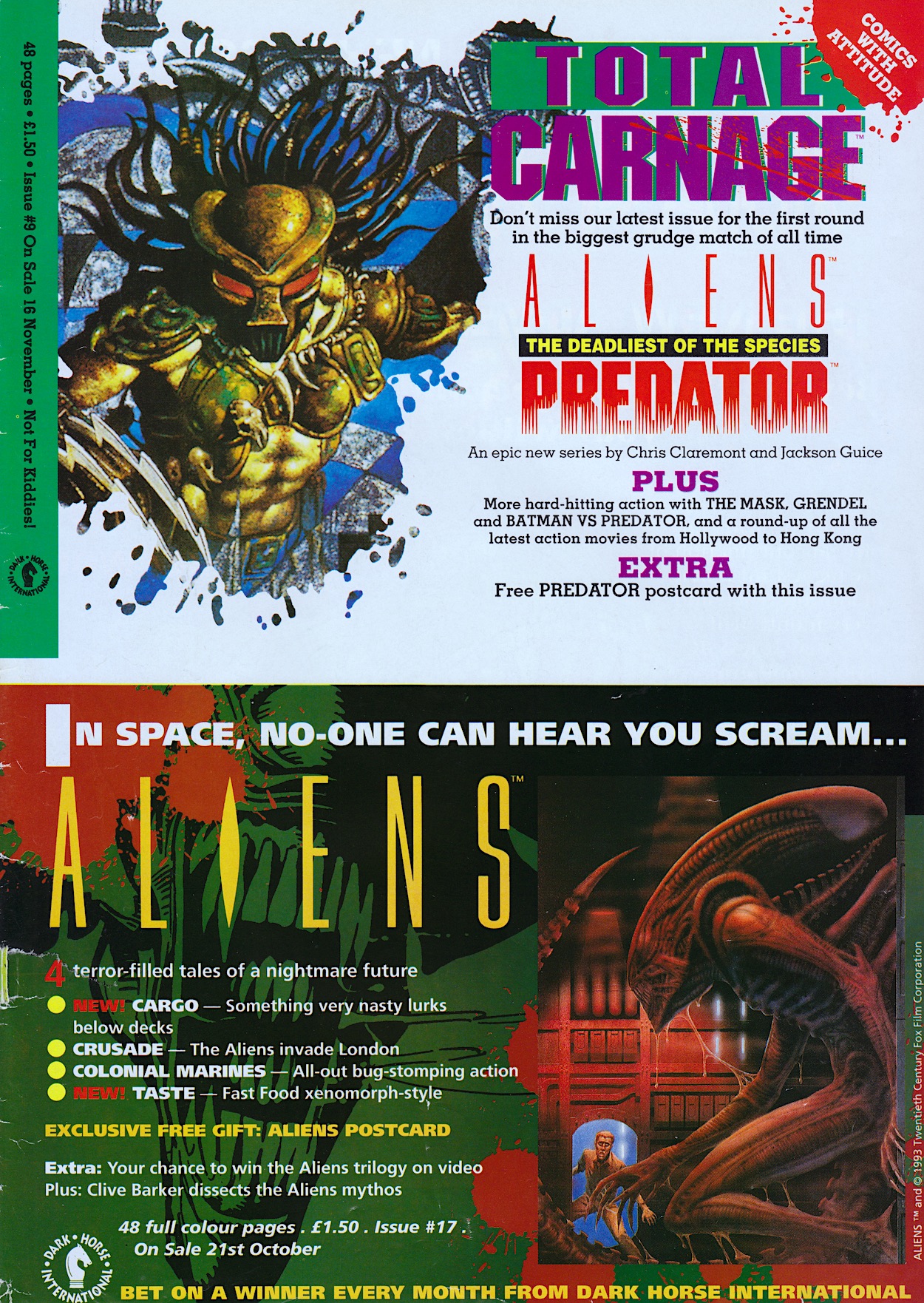
The monthly competition page acts as a kind of editorial this month, hyping the conclusion and the new strips to come. A strange choice of prize though, a graphic novel collection of the strip readers have read in the comic. Elsewhere, the lovely gloss paper of the covers makes these adverts for Dark Horse International‘s other mature titles really pop, especially that Aliens one. The more I see these adverts the more I want to add them to my collection at some point, even though I know they too were cut short.

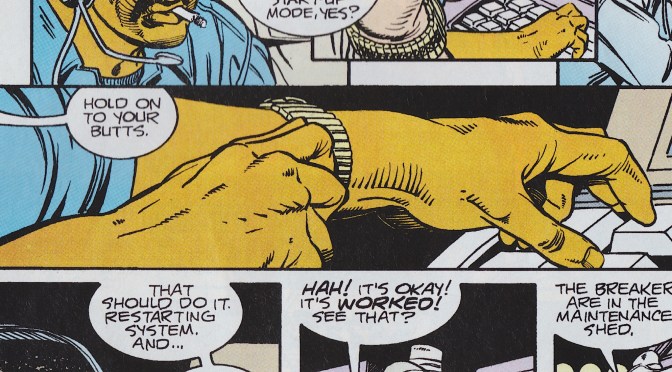
So on to the end of the comic book adaptation of one of the biggest movies ever made. This month it crams in Dr. Ellie Satler‘s escape from the maintenance shed, the survivors reuniting, the Velociraptors infiltrating the visitor centre, the kitchen scene with the kids, the control room scenes, their escape and the final shock ending.  That’s a lot for writer Walter Simonson and story editor Jim Salicrup to squeeze in and unfortunately just like last month it suffers as a result.

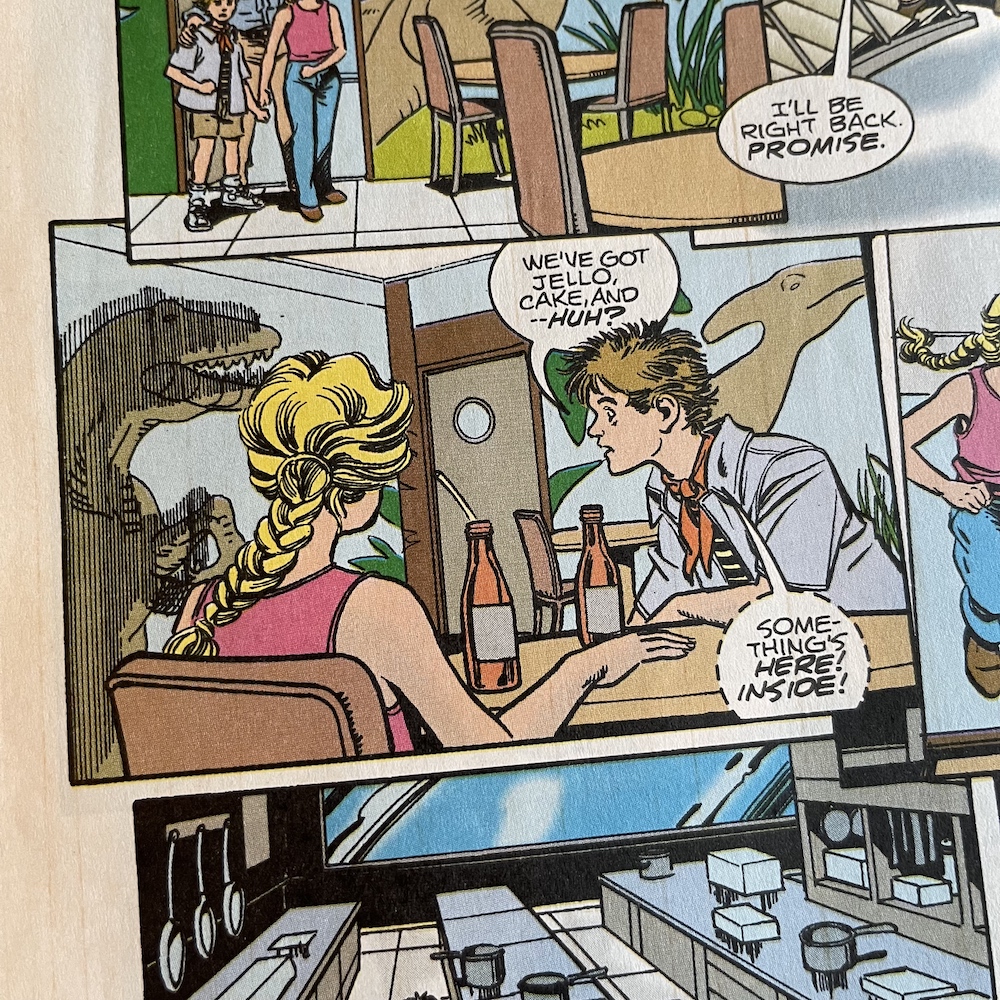
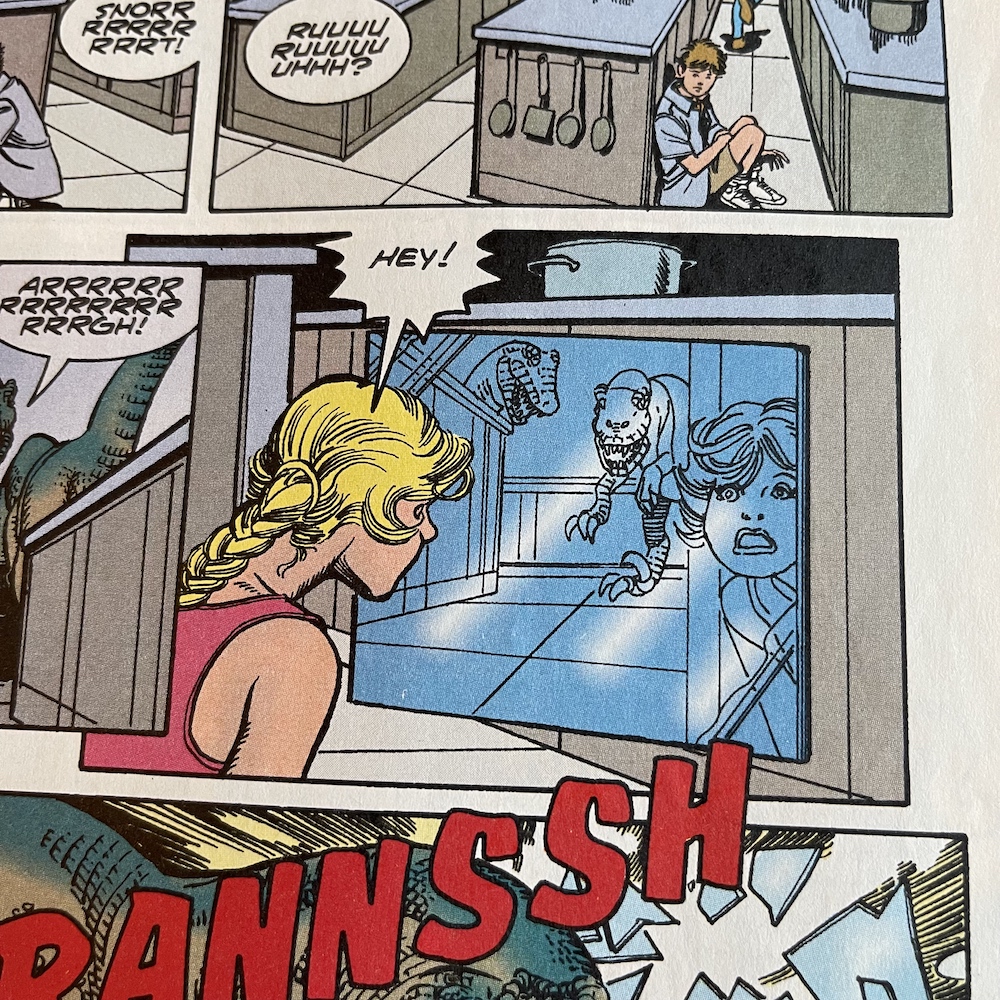
Case in point is the famous kitchen scene with Tim and Lex sneaking about and eventually getting one over on the ‘raptors. Tense in the movie, here it doesn’t make an awful lot of sense. For a start the shadow signalling danger is barely noticeable and the reflective surface of the kitchen appliances Lex used in her terrifying encounter in the movie seems to be floating in mid-air!

At least the kids get a few pages for their scene, the rest really are cut down to their bare bones. The idea behind each one is there and is solid, the main imagery is perfectly captured and the big scare moments are all present and correct. But with all the trims it rushes from one of these moments to the next every few panels, meaning their impact is diminished.

So ends the movie adaptation. But hang on, where’s Ray?

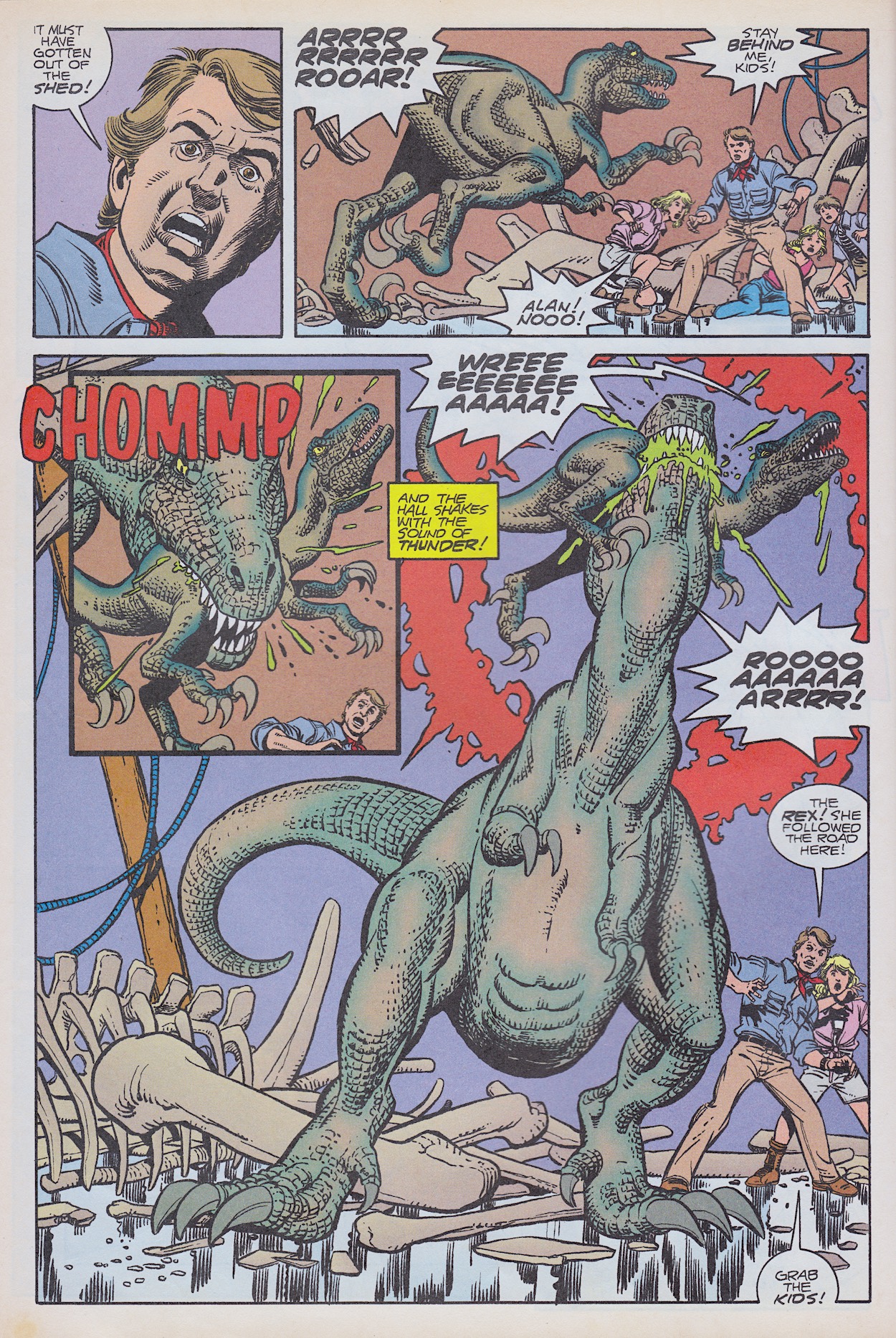
At least the dinosaurs themselves look good as you’ll see below, with penciller Gil Kane‘s and inker George Perez‘s Tyrannosaurus Rex and those ‘raptors looking suitably powerful in their final confrontation, which thankfully is given a bit more room to breathe. Not too sure about the green blood though. You’d have to ask colourist Tom Smith about that one. The random letter jumbles making up the noises of these animals are just plain bizarre, but at least John Workman‘s unique style of breaking the panels still looks the part.

This dramatic angle of the Tyrannosaurus rex is so good it’s used twice over the double-page spread, but they both look so good we’ll forgive the repeating. There’s a lot of powerful red, at least giving the impression of a gory fight to the death despite that sanitised blood colour. But still, somehow it works and it’s the powerful, dramatic scene that’s been missing from so much of these two issues. I particularly like the fact the iconic ‘When Dinosaurs Ruled the Earth’ banner from the film is worked in as a caption.

“And behind them, receding into the distance Jurassic Park and the past are swallowed up in the gathering dark. The End.” 

So ends the movie adaptation. But hang on, look at that final panel above. Where’s Ray? Yes, in the film he was killed in the maintenance shed off camera and Ellie discovered his severed arm when she went to reinstate the power grid. But last month Ellie volunteered first in a major change from the film. This meant Ray was still alive in the control room and yet here he’s nowhere to be seen. It seems the one black character has been completely forgotten about. It’s clear this final chapter was rushed with it’s art not being as detailed or polished and with huge chunks missing to get to the finish line in the page count, but still, just forgetting about a character is a massive oversight!

It’s such a shame it had to end this way because the first three chapters were so good that’s it’s more disappointment than anything else I’m feeling right now.

With no written feature to break up the strips this time we head straight from a natural island off the coast of Costa Rica to a manmade island group off the coast of North America for this month’s Xenozoic Tales: Mammoth Pitfall, written and drawn by Mark Schultz, coloured for a Marvel US reprint by Denise Prowell.

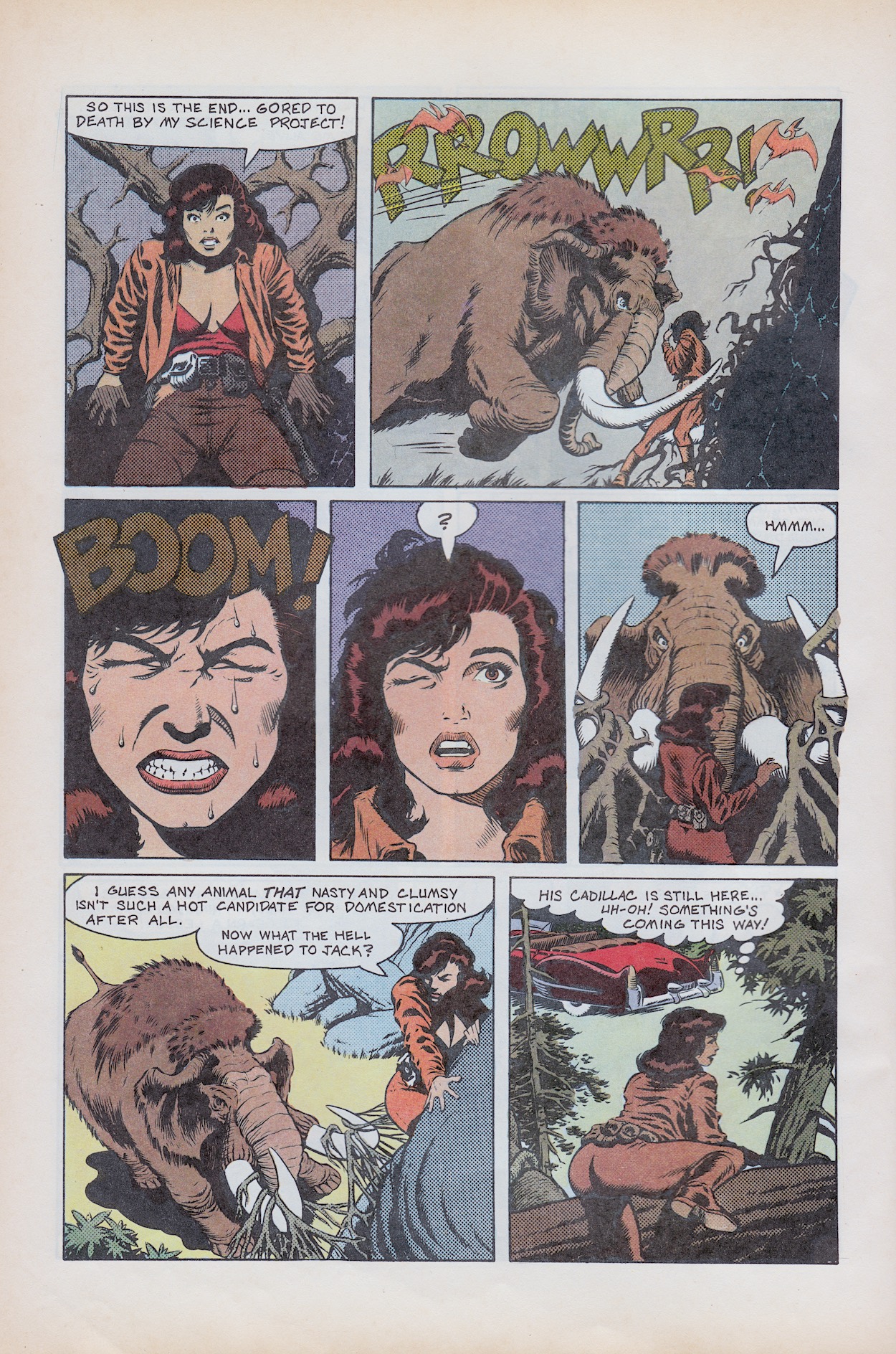
The story comes from the second issue of creator Mark Shultz‘s original series, but three stories which took place between last month’s introduction and this one have been skipped. That unfortunately means character development is going to be pretty spotty. For example, last month Jack and Hannah had just met, but here he’s trusting her in her attempts to capture a mammoth for domestication and she knows enough about him to know when he’s in trouble. It’s a shame we can’t appreciate their developing friendship properly but then again it’s only thanks to Jurassic Park we got to read them at all.

Jack knows nature has certain rules and understands a mammoth will always be a dangerous animal to humans. It should be respected and left alone. However, the reason the attempt fails is because of interference from another human who sabotages their attempt and sets Hannah up for a nasty death squish. After a very lucky escape she hides in the boot of Jack’s prized Cadillac. She later pops out and saves him from the man threatening to kill him if he doesn’t teach him the most prized skill of the time: how to drive!


Sometimes it seems nature bends the rules.

Mark Shultz, Xenozoic Tales

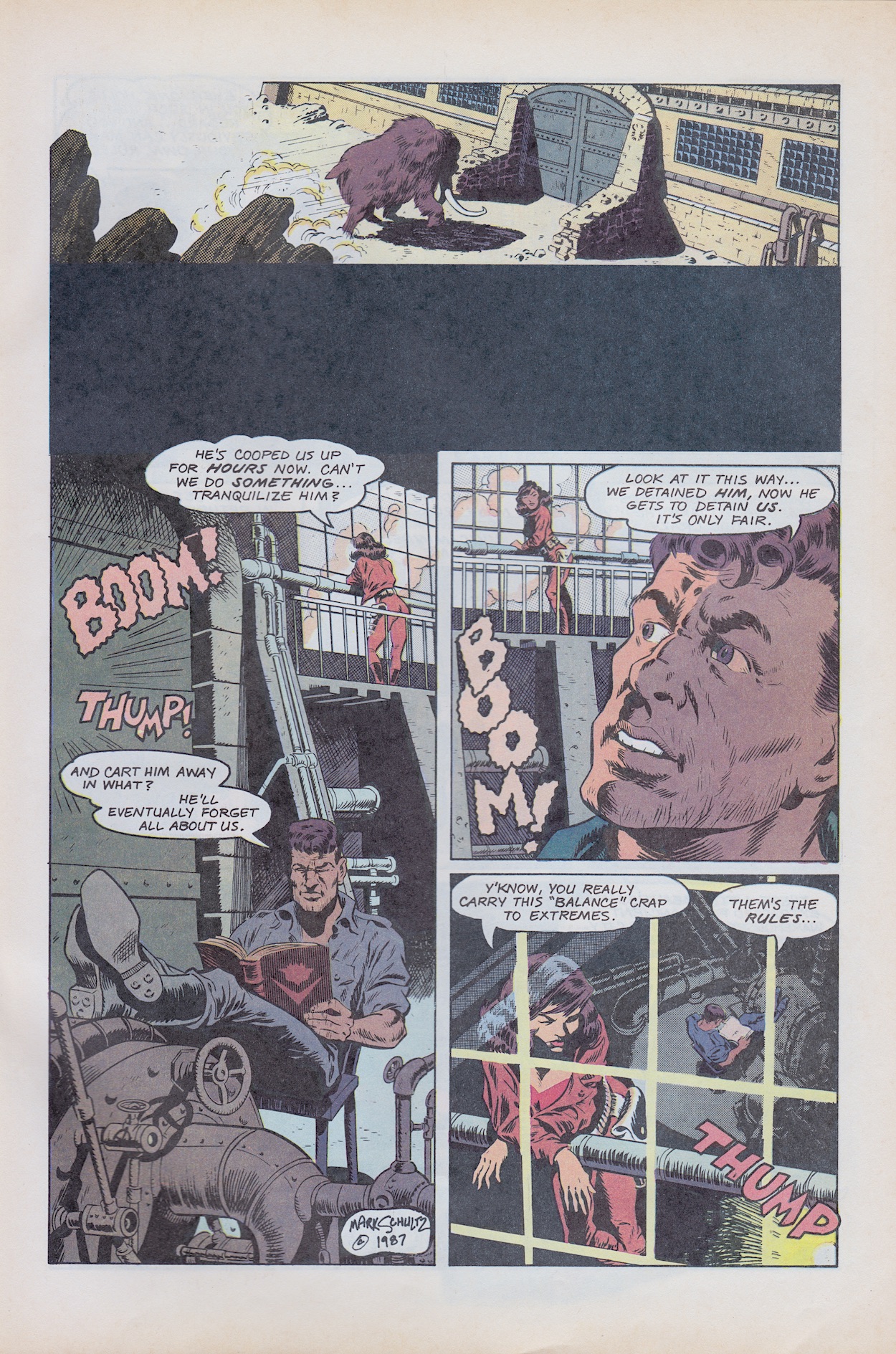
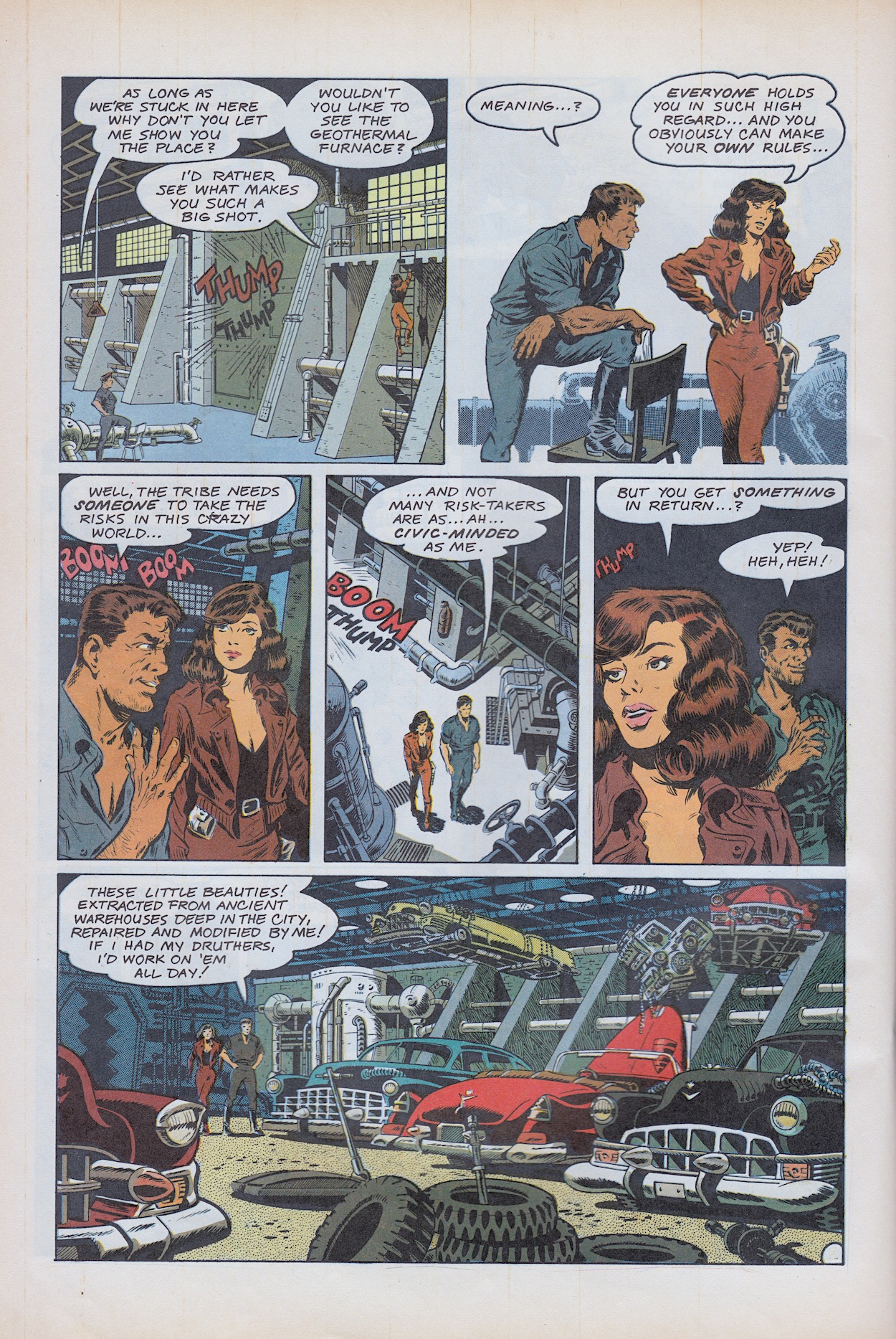
It’s all great fun and the wordplay between Jack and Hannah is natural and funny. Trapped inside his garage by the angry beast the action is put on hold and it’s testament to Mark’s writing how equally compelling these simple character scenes can be. The script is full of interesting contradictions too. The juxtaposition between the dinosaurs and the cars is effortlessly presented, Hannah seeks action while Jack wants the easy life, and Jack the environmentalist and animal lover has dedicated his life to restoring the very machines responsible for the great cataclysm. (Although he has converted them to run on dino guano.)

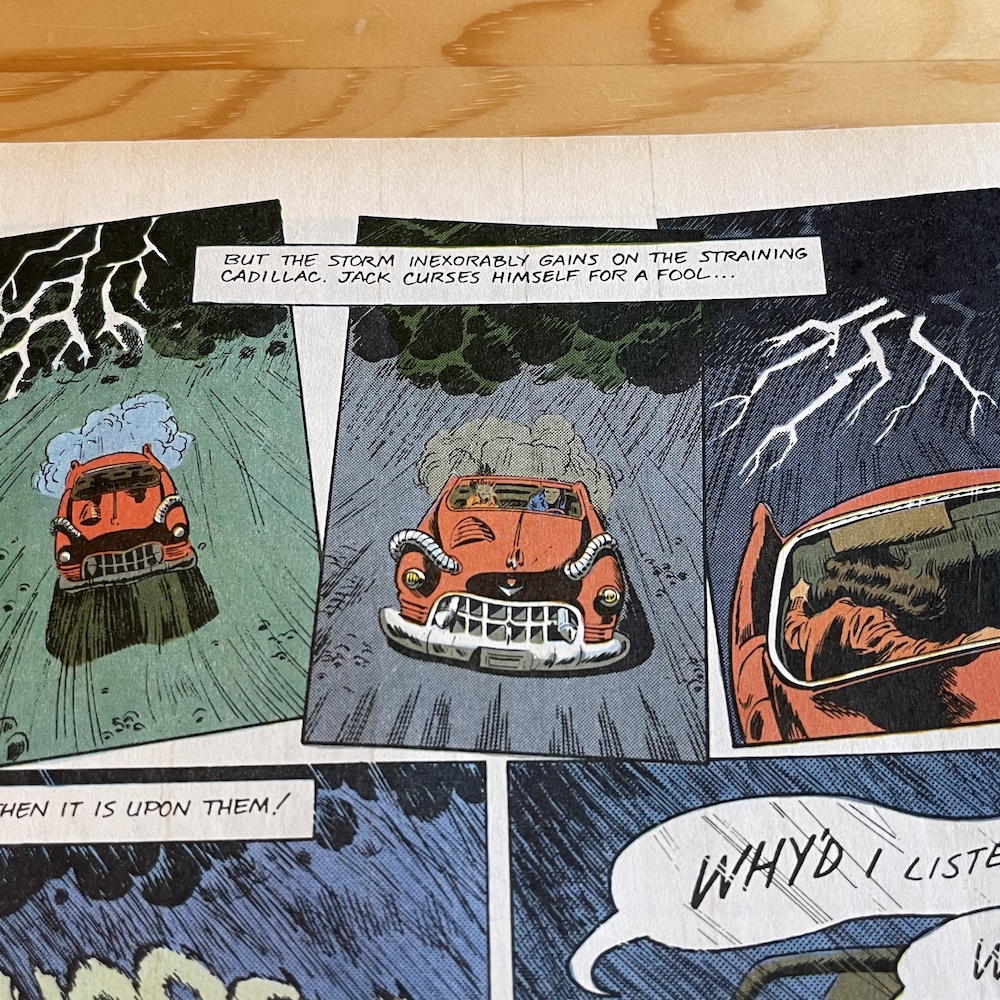
Curious to see what all the fuss is about with these ancient contraptions Hannah convinces Jack to take her for a ride, then to chase a storm back to the city. They discover the dead body of the mammoth she tried to capture, clearly the victim of a predator outside the garage. Jack is furious. “He should never have died here.” It’s great to see these characters learning about each other. Again, it pains me we’re not seeing it all.

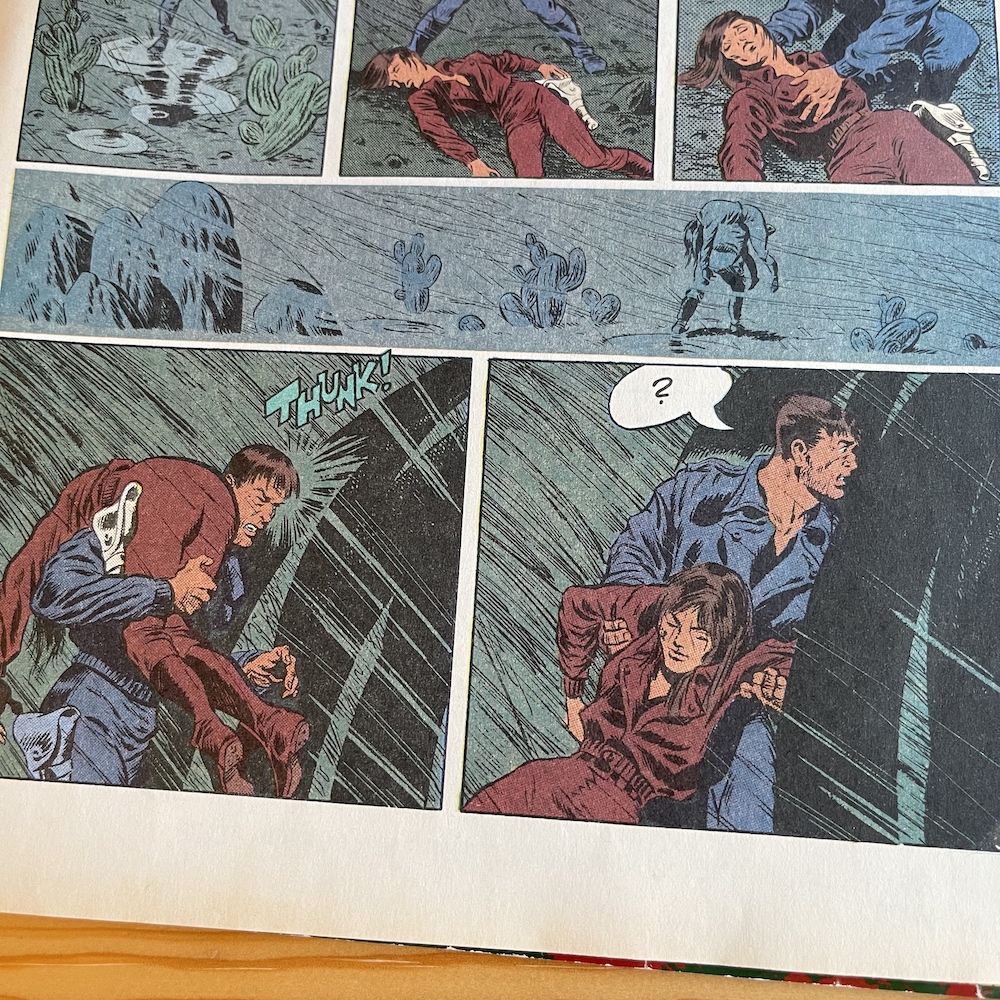
The storm chase naturally ends in disaster. They crash, the Cadillac becoming a write-off in a sodden ditch. Tenrec carries an unconscious Hannah through the driving wind and rain until he bumps into a sheltered building of some sort that he wasn’t previously aware of. With no time to question its sudden existence he places Hannah inside and tries to wait out the storm. Flood waters rush them and by morning the storm has revealed the shelter that saved their lives.

With this the story comes full circle. The mammoth that Hannah was so certain could help them rebuild their world has in the end saved their lives, by losing its own, because of her. It’s thought provoking and rather sad and I felt genuinely sorry for the mammoth in the end, and thought less of us as a species. Which I think was the whole point. It’s a very different strip, but it works perfectly as a back up in this comic. After all, both strips are about the interaction between dinosaurs and humans and what happens when we try to force our dominance on animals we were never meant to meet.

With this we reach the end of another issue and the back page has me very excited. Using a one-colour version of the cover to my very first issue, the announcement I’ve been waiting all these months for is finally here.

If I’d been collecting these issues in 1993 then I’m sure I’d have been hugely excited by this! Who wouldn’t have been? Even now I’m hyped. Discovering #6 on the shelves with the promise of new adventures inside was thrilling and this promo is bringing back all of those feelings again. The mention of the third strip and even the competition headline are bringing a big goofy smile to my face because I remember both so distinctly. It’s quite extraordinary.

As is normally the case with all of these real time read throughs I will have to practice will power, but this is going to be harder than most. I’ll do it though, I’ll wait for the correct date, no matter how impatiently. That date will be Tuesday 30th November 2021, so join me then as we embark once more to Isla Nublar for the original, forgotten sequel to Jurassic Park.

iSSUE FOUR < > iSSUE SiX

JURASSiC PARK MENU

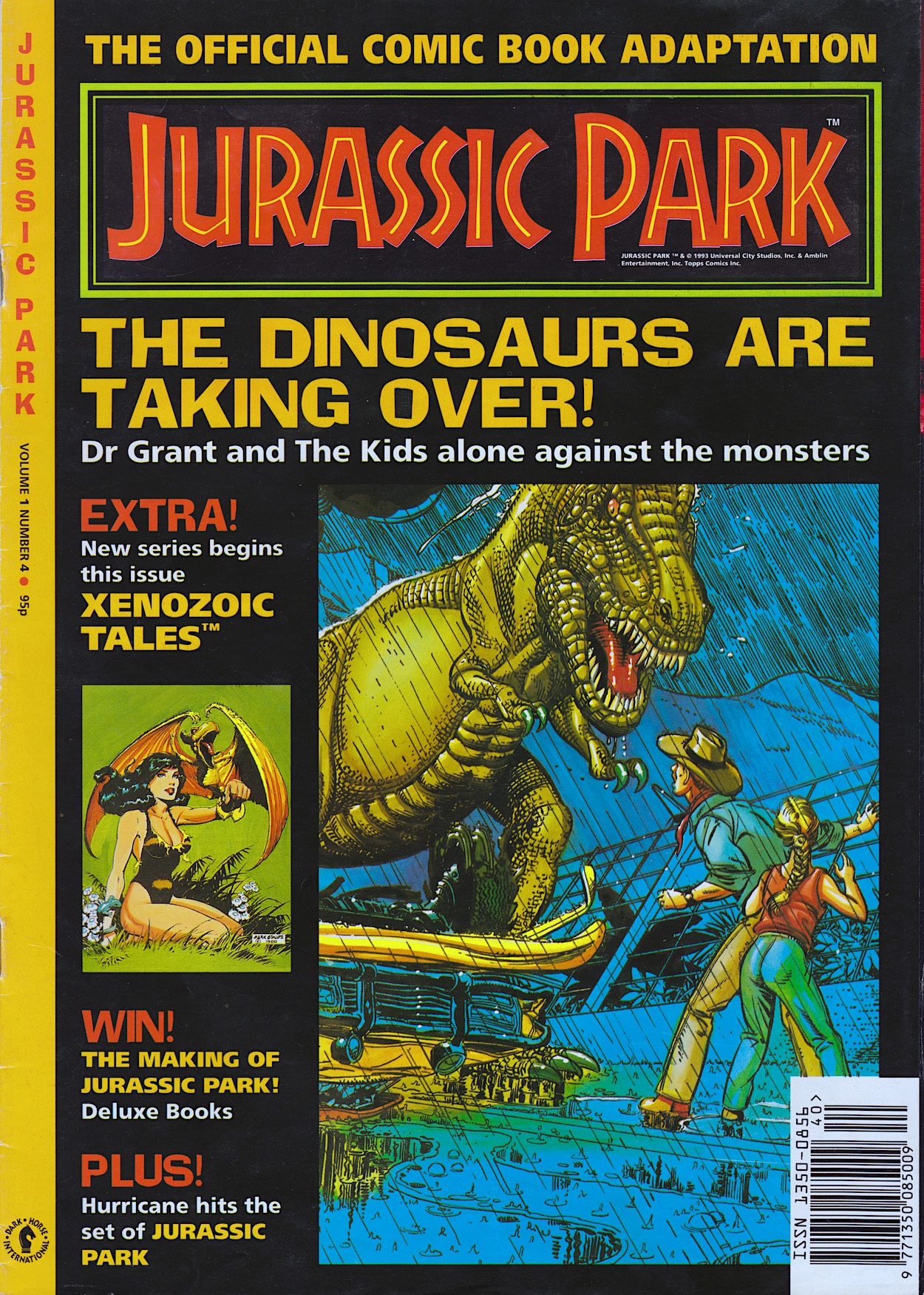
JURASSiC PARK #4: BACK UP SYSTEMS

With issue four the UK version of Jurassic Park was evolving. As mentioned last time the US comic was no longer going to finish after the adaptation, with further mini-series now being produced. In the UK, Dark Horse International decided to turn their four-issue, three-weekly mini-series into an ongoing monthly, not that any fanfare is made of this because the reader wouldn’t have been any the wiser it had originally been due to end this issue (and a few weeks ago). Indeed, the comics checklist last issue erroneously said #4 was the end.

This change produced the delay in the release of this issue as plans were made for the new format of the comic and acquiring more content for each issue. This begins with the first back up strip here, bringing Jurassic Park more in line with the company’s other comics such as Aliens. The front page recolours a panel from the strip inside (and I love the font they’ve used) instead of having a proper cover image. This final chapter of the adaptation is being split in two, so the original cover was being kept in reserve for the following month.

The sequence in the tree with Tim trapped in the Explorer has been completely excised!

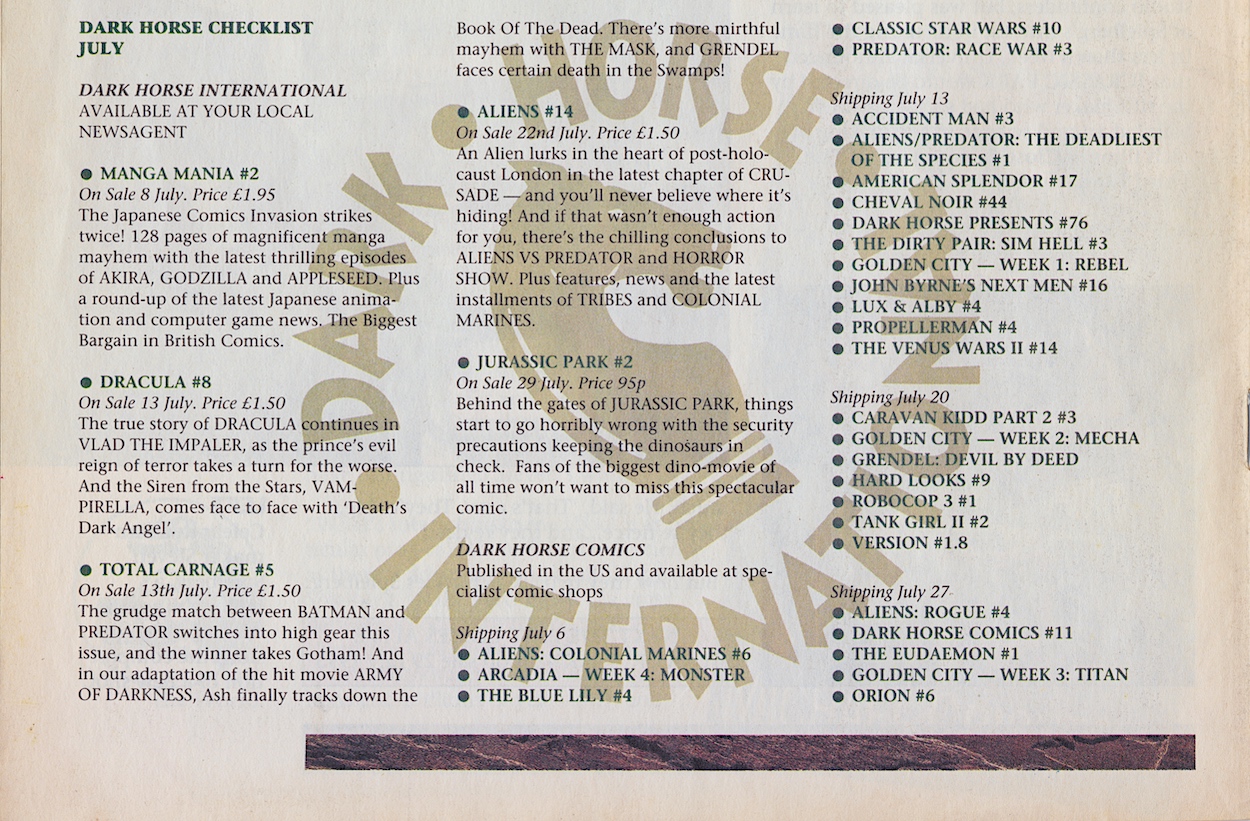
Check out this month’s comics checklist and you might get an idea of the make up of the company’s titles. The issue at hand begins with a competition for the excellent The Making of Jurassic Park. I actually bought this book at the time and it was a heavy tome, full of details on the making of the film and stands up today as one of the very best of its kind for any movie. You’ll also see an advert for Manga Mania, which fed off the new craze to hit these shores. Ultimately it’d also be a very important title for Jurassic Park fans. But that’s a story for another time.

Our freshly chopped final chapter is still a lengthy 16 pages so regular readers wouldn’t have felt short changed, at least with the page count. Unfortunately, the actual strip itself is another thing. Yes, this is the first time in the comic’s young life when I’ve been left disappointed.

Last month the Tyrannosaurus rex attack was brilliantly handled with plenty of building tension and atmosphere so I was looking forward to seeing how the final act would begin. The opening is great, with Mrs Rex towering above Dr. Alan Grant and Lex, both trying to keep completely still.

It’s all going so well until those final couple of panels. The sequence in the tree with Tim trapped in the Explorer has been completely excised! So it plummets to the ground instead and then he’s just unbelievably pulled out and off they go. Alan even has a map at hand to make their trip back to the Visitor’s Centre quicker, which is a rather cheeky shortcut. In previous issues scenes had been moved about, moments edited, others added to, all in order to properly adapt the film to the comic page and I’ve been really positive about it. But all throughout this issue huge swathes of story are just missing or reduced to a shadow of their former selves.

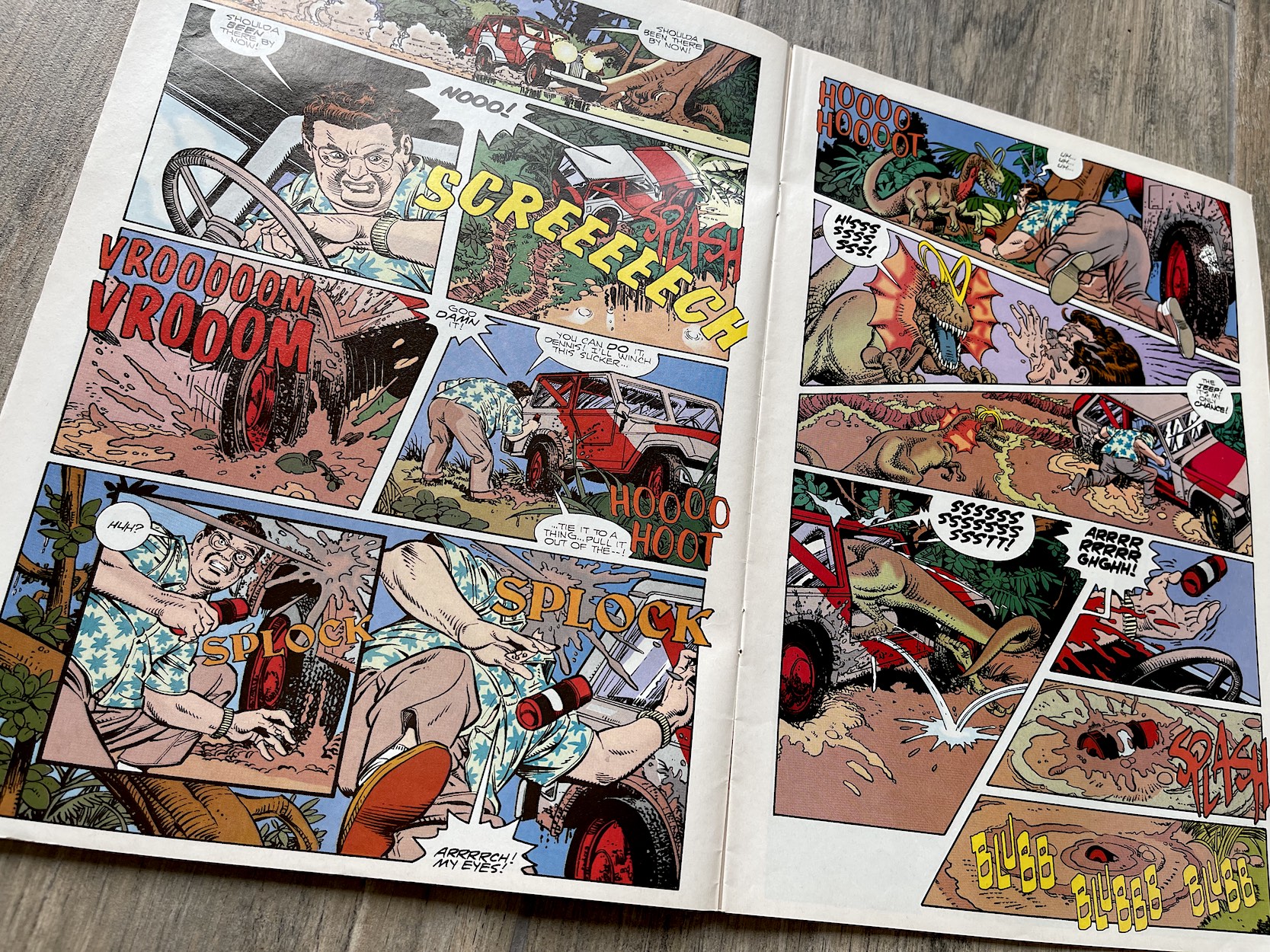
Case in point is the fatal encounter between Denis Nedry and the Dilophosaurus. The movie scene included plenty of misdirection and humour, putting the audience at ease before the shock, and that wouldn’t have been easy to translate here but they could have tried. Instead this very famous scene only gets two pages. It’s a very basic sequence now; the dinosaur may as well be a lion. Denis gets attacked as soon as he steps out of the vehicle, he jumps back in and we actually see the Dilophosaurus jump in after him (ruining the final moments of the original) and… well, that’s it.

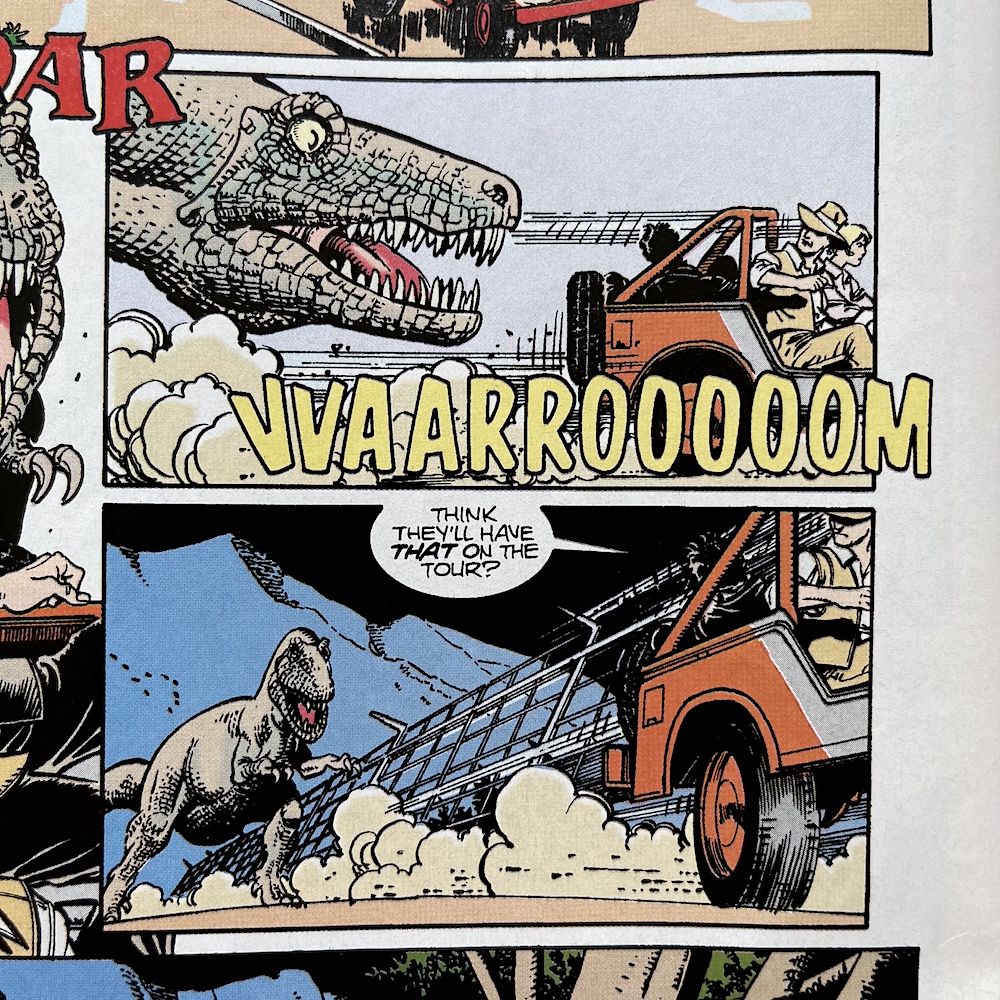
This truncating happens to basically every major moment, whether it’s the nighttime meeting with the Brachiosaurs, rescuing Dr. Ian Malcolm after the T-rex attack, even the electric fence scene (as you’ll see below) and Robert Muldoon‘s stalking of a Velociraptor. Each are reduced to fit on a page or two and basically follow a set pattern of only showing the first and last moments of the scene and erasing everything else, including almost all the humour.


“Think they’ll have that on the tour?”

Dr. Ian Malcolm

Right back at the beginning of this adaptation I stated how I didn’t usually like comic versions of films and this was the reason why. But up to this point Jurassic Park had been the exception to the rule, with a proper restructuring of the film to suit the format and it was working a treat as a comic in its own right. Maybe if they’d had five chapters instead of four (in the original US comic) it would’ve worked out differently, but then again maybe the pacing could’ve been plotted out better by writer Walter Simonson and story editor Jim Salicrup. Yes, having all the dino action in the final chapter would, in theory, make for a big climax but there’s just too much of it to fit in.

The result is a clichéd comics adaptation where it feels more like a way for people to reminisce about the movie they saw in the cinema months previous, rather than working as a good comic book. If I sound overly critical it’s only because the team had been doing such an amazing job so far, even adding in extra dialogue from either the original novel or earlier drafts of the script. So it’s more disappointment than simple negativity.

Don’t get me wrong, there are still things to enjoy here. It’s all on a lovely high quality gloss paper stock this month, some of the best lines from the film are still intact and the art in the first eight or so pages is top notch. However, in the second half even legendary artists Gil Kane‘s pencils and George Perez‘s inks start to feel a little rushed and Tom Smith‘s colours feel unfinished and flat, leading me to believe they were working very close to the deadline of getting the original US series out in time for the movie.

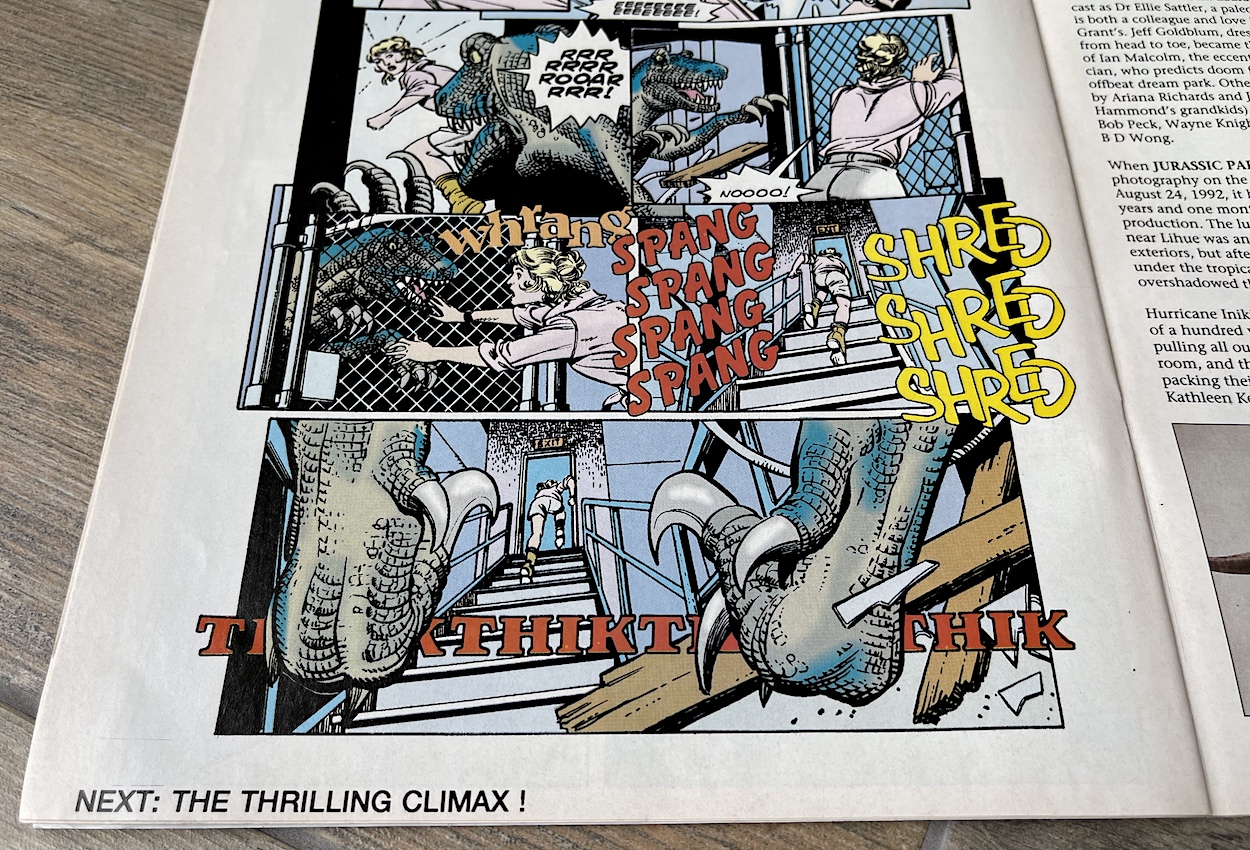
The chapter is cut off with a superb cliffhanger though. The view of a Velociraptor‘s feet as it chases Dr. Ellie Sattler is just as unnerving as it was in the film. It’s a shame then the terrifying Velociraptors, when viewed in full, are reduced to looking like miniature T-rexes. Below is this final scene with its positives and negatives, alongside that fence scene with the dramatic resuscitation of Tim also taken out.

I also noticed Ray didn’t volunteer to go to the maintenance shed as he did in the original story, where he met his grisly end. Instead Muldoon and Ellie head off while Ray looks on silently. This means he’s still alive, a big departure from the film. It’ll be interesting to see how that effects the rest of the story next month.

For now, the sun sets on the adaptation as we move on to something else entirely

With 16 pages to the main strip I assume there’ll be roughly 12 or 13 next month unless the final chapter was given a few more pages in the original American Topps Comics publication. Either way there’s a lot of the film left to cover in half a chapter. The kids and Alan are still out in the park which means their return, the kitchen scenes, the chaos of the Velociraptors in the Visitor’s Centre and the climax are all to come.

I’ll still hold out hope things can be turned around because so far it feels like spending 90 minutes being completely engrossed in a film only for its ending to let you down. Which of course is not what happened with Jurassic Park! For now, the sun sets on the adaptation as we move on to something else entirely.

In the early days of Marvel UK‘s Transformers its back up strips were in some way related to the robotic theme, such as Machine Man or Iron Man. It wasn’t long before it instead became a way of bringing some of Marvel’s other US characters to these shores for the first time, but Jurassic Park kept its strips dinosaur-themed, much to the delight of teenage me. The second back up would appear in my first issue (#6) but here readers were introduced to Mark Shultz‘s Xenozoic Tales.

Later adapted into a cartoon TV series called ‘Cadillacs & Dinosaurs‘ it was an independent, alternative title Mark wrote and drew himself, running for 14 issues irregularly released between 1987 and 1996. Most of the strips were printed in black and white but Jurassic Park brought in artists to colour them exclusively for UK readers, this first one coloured by Ray Fehrenbach. This complete story was the first one written by Mark and what an introduction to something brand new this first page was.

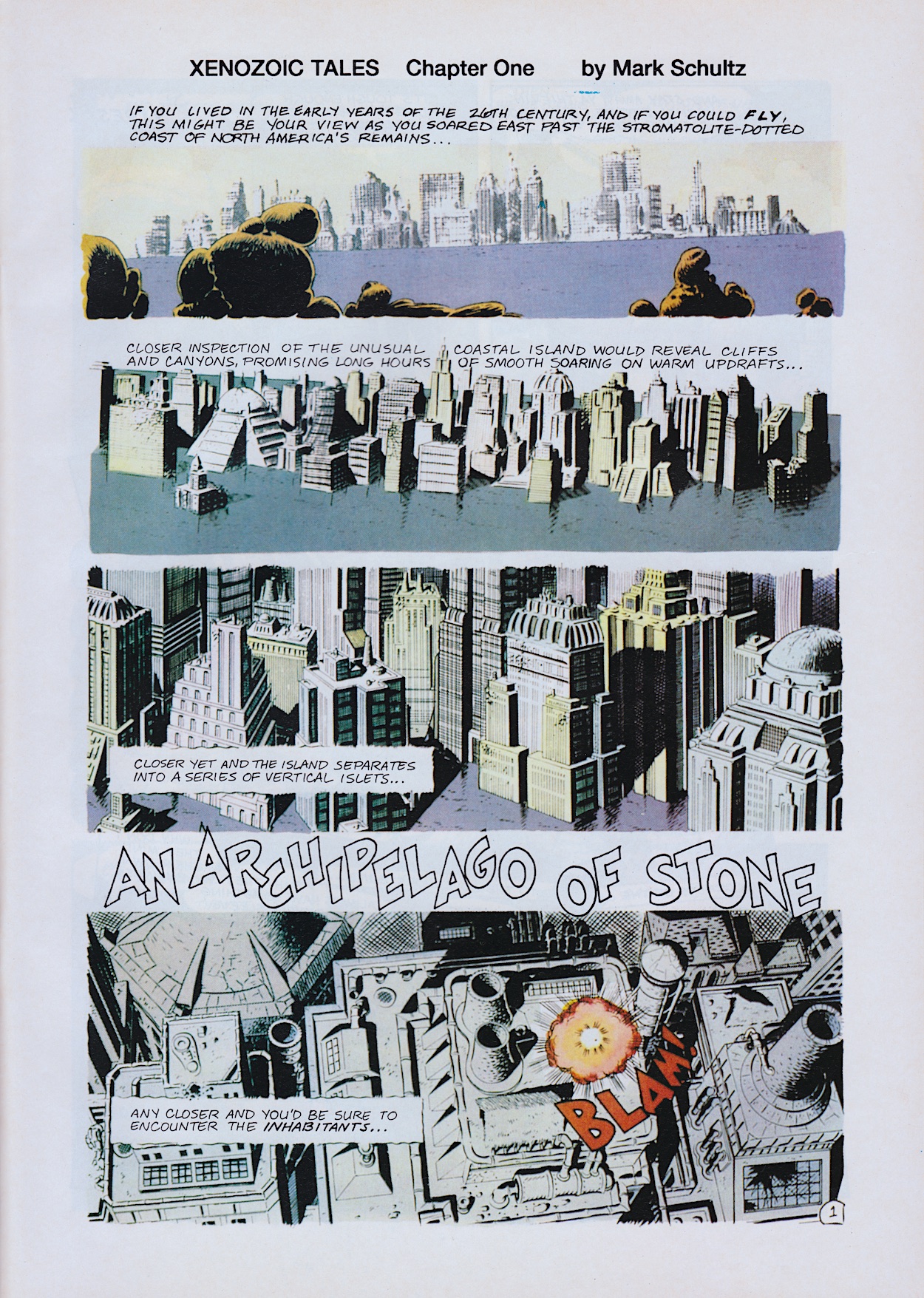
Set in the 26th century, global warming has resulted in sea levels across the globe forcing humans to initially build underground. After 600 years they’ve reemerged to find their cities flooded, technology virtually non-existent and strangest of all the world is populated by dinosaurs once more. Anyone capable of mechanical work is seen as invaluable and this is where Jack Tenrec comes in, a car mechanic with a penchant for Cadillacs. Thanks to these skills he acts as an unofficial head of security and advisor to his tribe’s leaders and lives on an outcrop (formerly high hills) not far across the water from An Archipelago of Stone, the home of the tribe and in reality the remains of New York City.

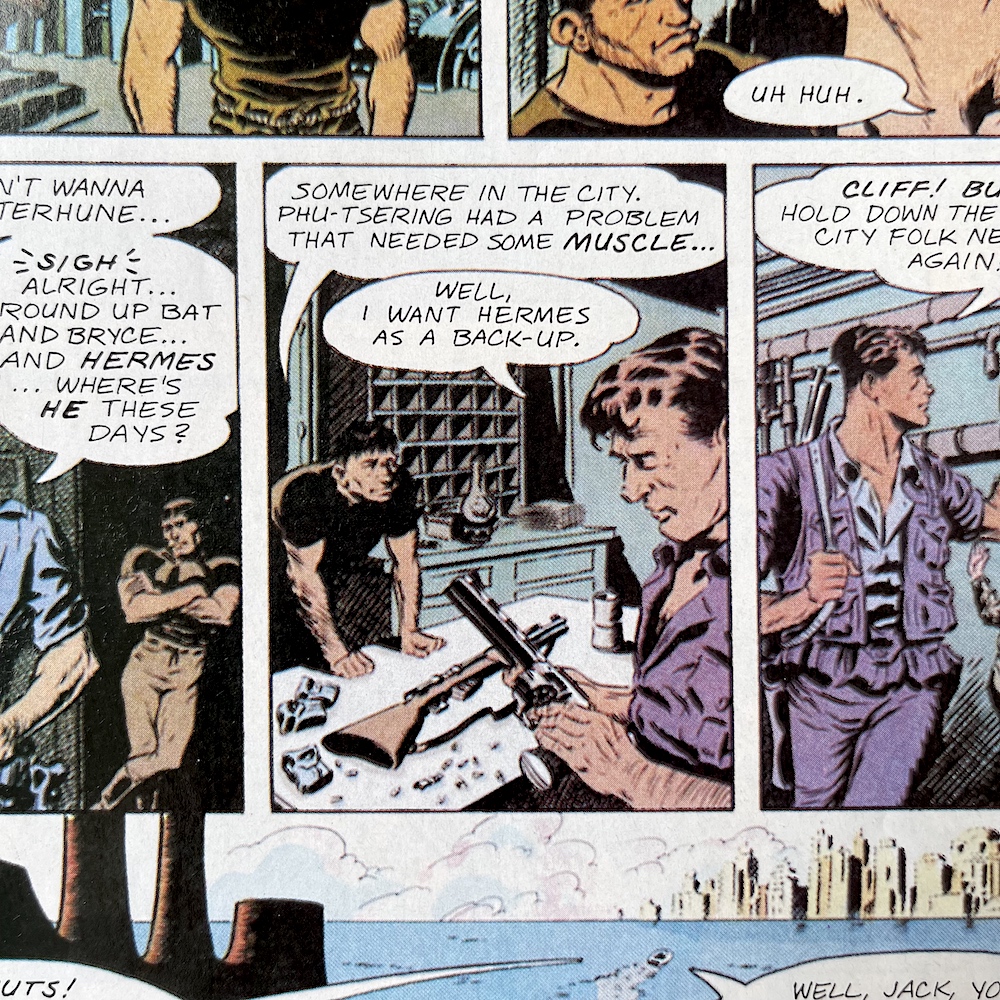
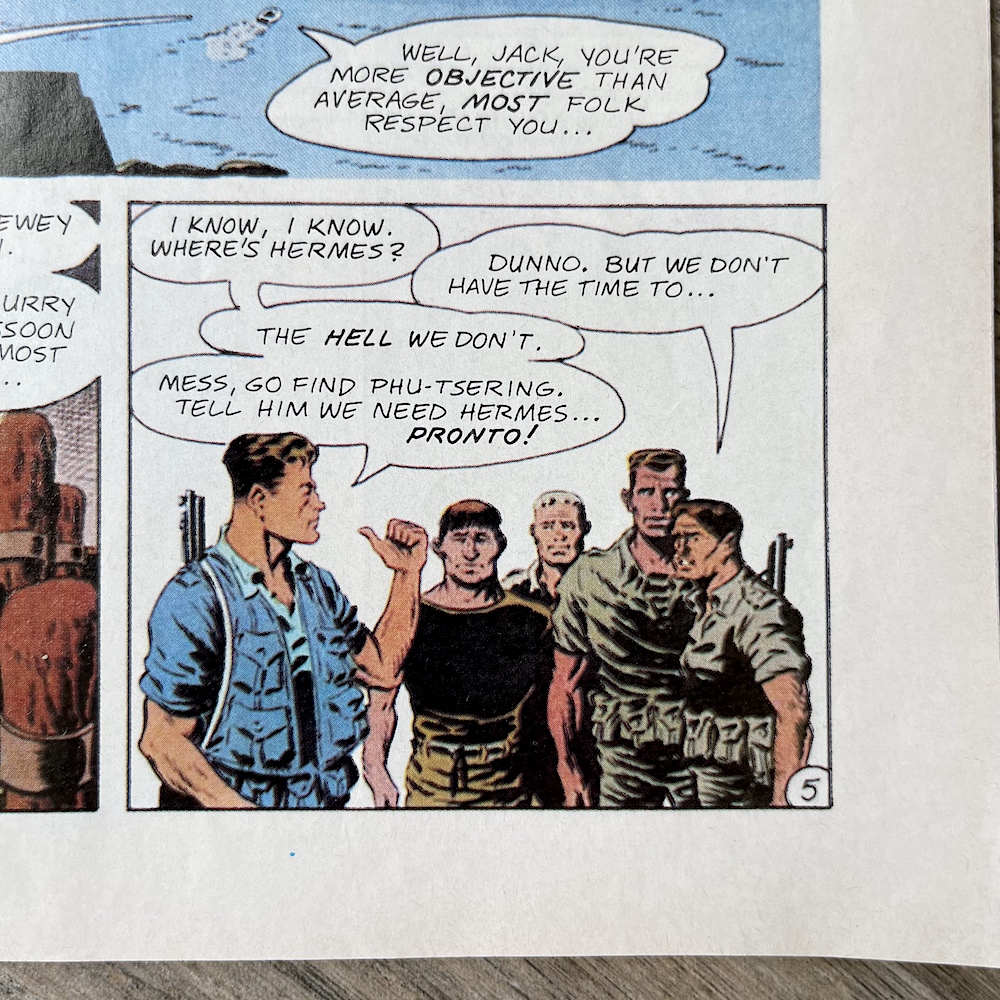
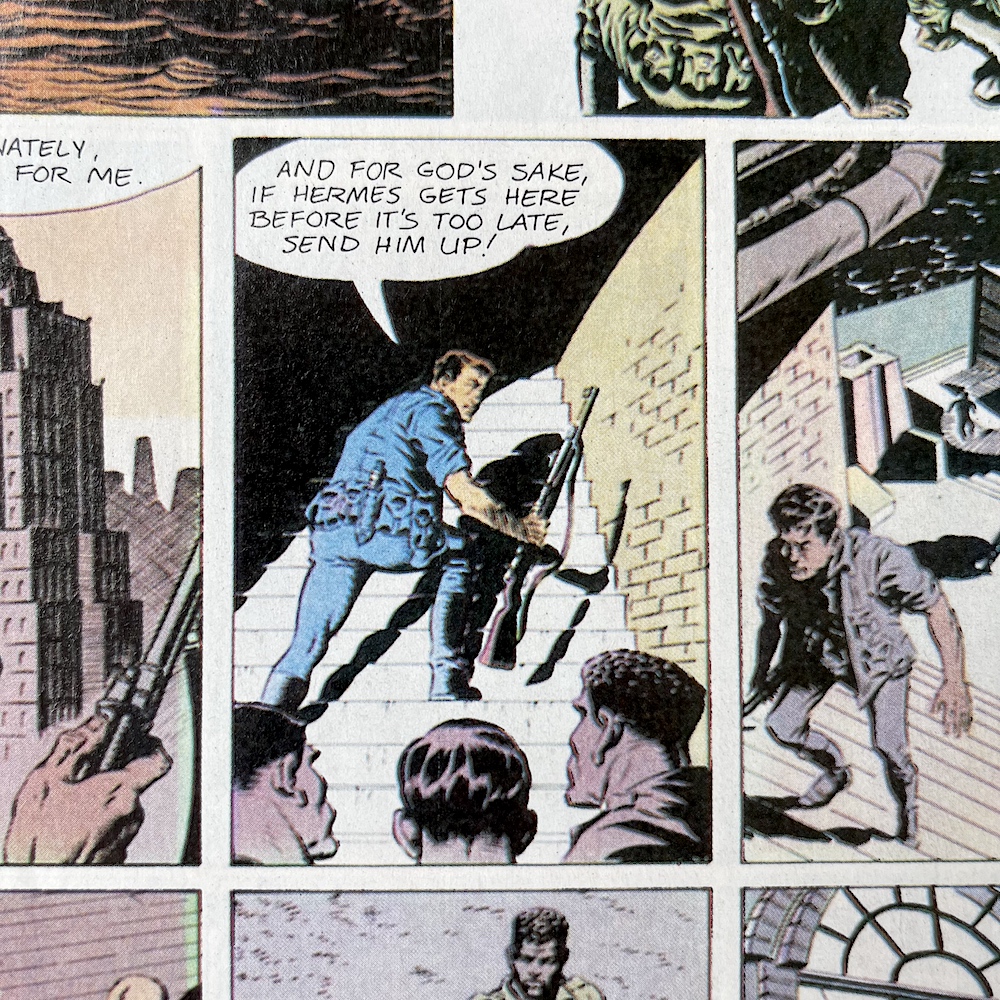
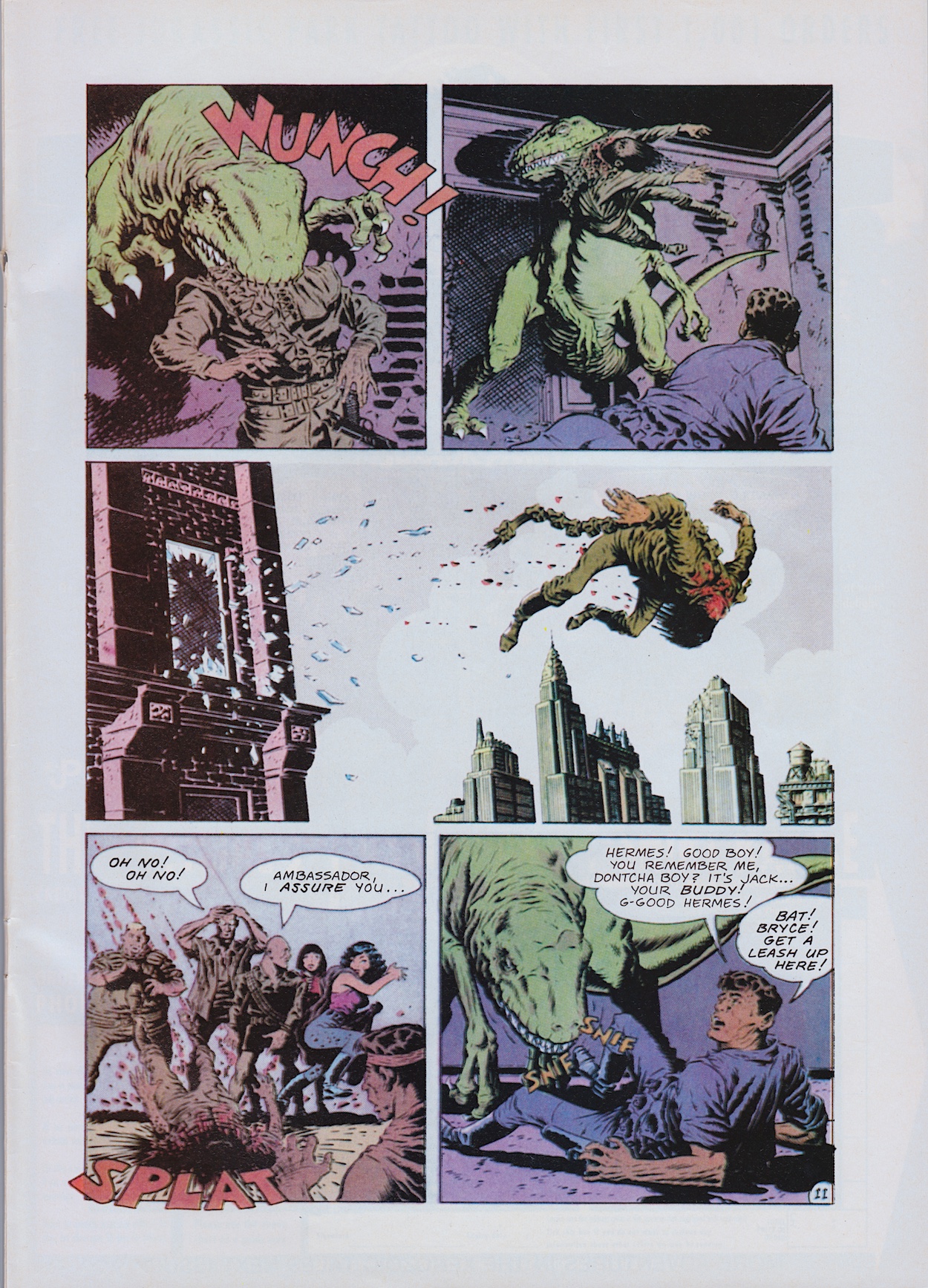
I love that first page, cleverly written from the point of view of a Pterodactyl. In the story a neighbouring tribe’s ambassador, Hannah Dundee arrives at the City in the Sea and a team of poachers who had previously stolen from her Wassoon Tribe want her dead before they’re found out. It’s up to Jack and his men to stop them. All the way through this strip, knowing he’s about to get in way over his head, Tenrec keeps telling his men to send someone called Hermes to help. Then, just as it seems he’s doomed a surprise arrival bursts in. That’s Hermes!

Well I certainly didn’t expect that. Hermes the Allosaurus disposes of the villain, munching on his head and throwing him out the window, before Tenrec thanks him, revealing who this is. That doesn’t mean he’s a pet of course and the usually cool and collected Jack knows it.

It’s brilliant stuff. Original, fun and surprising, introducing the main protagonists, the unique setting and the cast of regular and semi-regular guest characters, all in 12 pages while maintaining an interesting story and racking up tension is rather a phenomenal feat. No wonder Xenozoic Tales is so highly regarded even to this day. It may at first seem like a strange choice for Jurassic Park’s back up but it works perfectly and as a teen I remember being engrossed with the slowly developing back story that would become more apparent in later issues. (Sadly, Hermes never reappeared.)

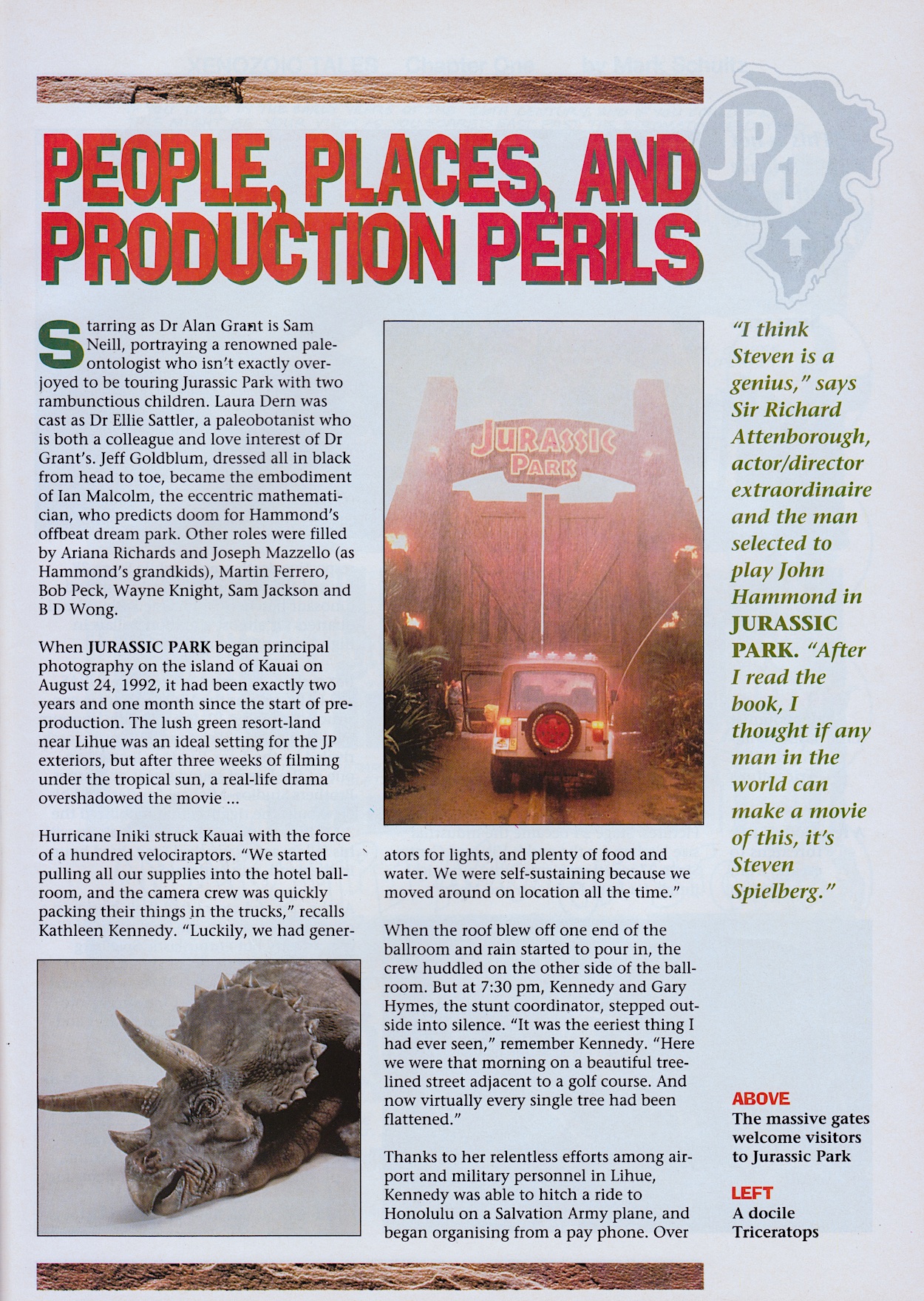
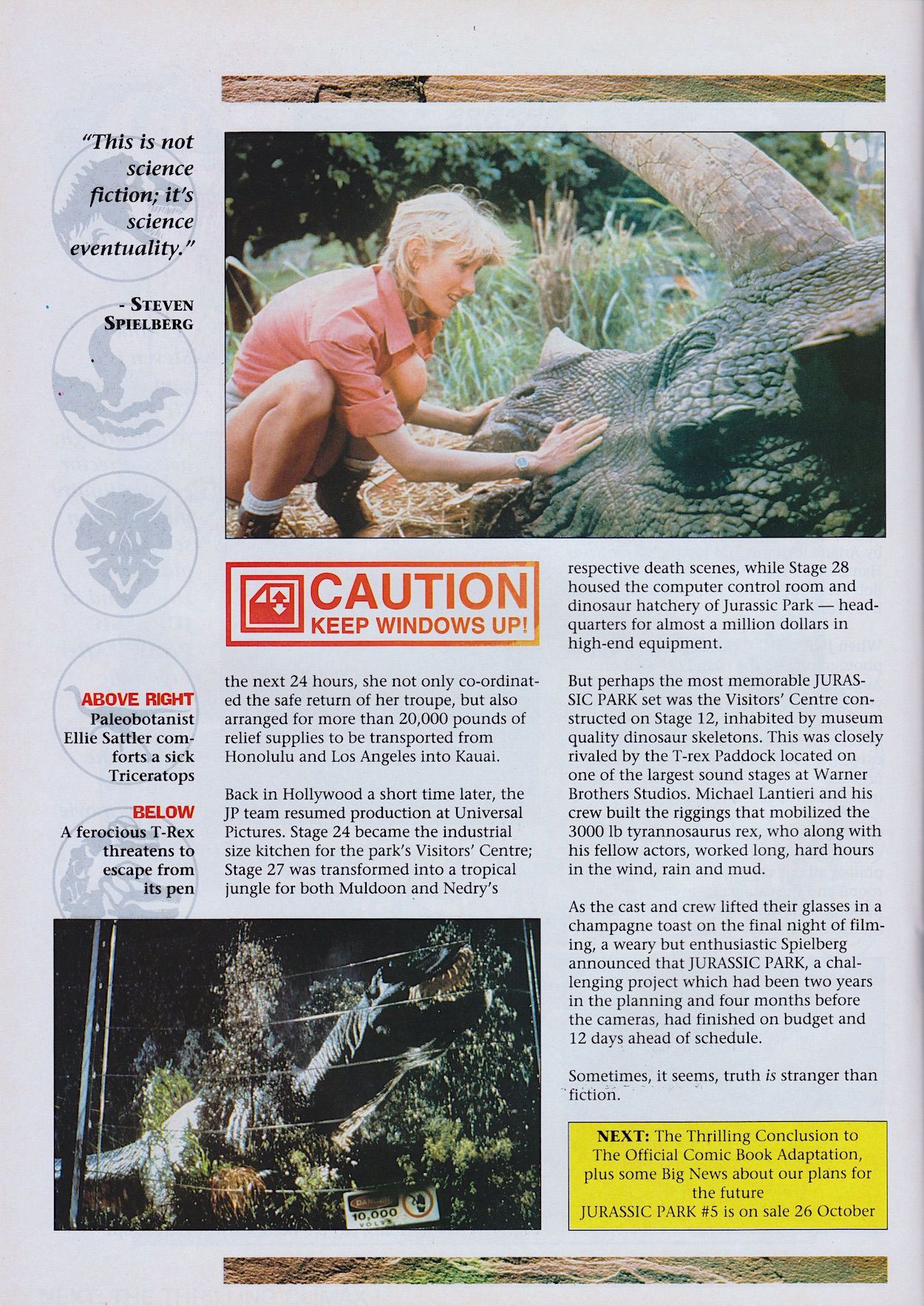
In between the two strips is this month’s look into the making of the movie, covering the famous disaster that hit Hawaii and the relief efforts the producers helped coordinate, plus the building of sets and the end of principal photography. At the very end of the feature is the teeny tiny box with the date of the next issue including a little tease that things were afoot for the future of the comic.

Thankfully they didn’t say “great news for all readers” or we’d have got the wrong idea. With these couple of pages, a long main strip and a back up it really does feel more like the kinds of UK comics we were accustomed to at the time. I may have enjoyed the extras more than the adaptation this month but I know from memory that what’s to come from Jurassic Park made this one of my very favourite comics growing up. So stay tuned for some terrific stuff from Isla Nublar, as well as from the far future and soon the distant past too!

The fifth issue and the conclusion of the movie storyline will be stomping its way on to the blog in one month on Tuesday 26th October 2021.

iSSUE THREE < > iSSUE FiVE

JURASSiC PARK MENU

JURASSiC PARK #3: CUDDLY CARNiVORE

Don’t let the rather playful, pet-like Tyrannosaurus rex on the cover put you off, this is not a sanitised version of Spielberg’s monster movie. Things really do kick off for Dark Horse International‘s UK version of Jurassic Park comic this issue, as Dennis Nedry puts his plan into action just as the unfortunate coincidence of a tropical storm hits the remote island of Isla Nublar.

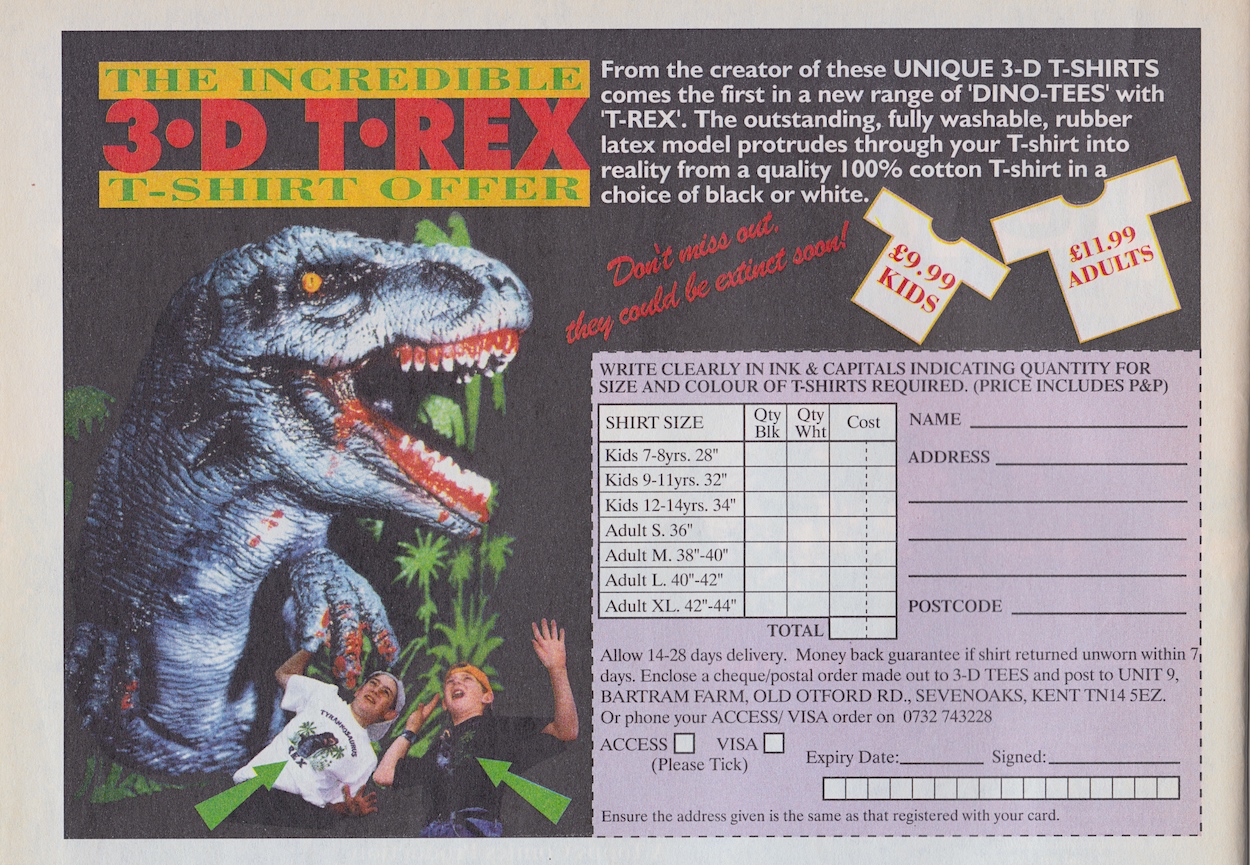
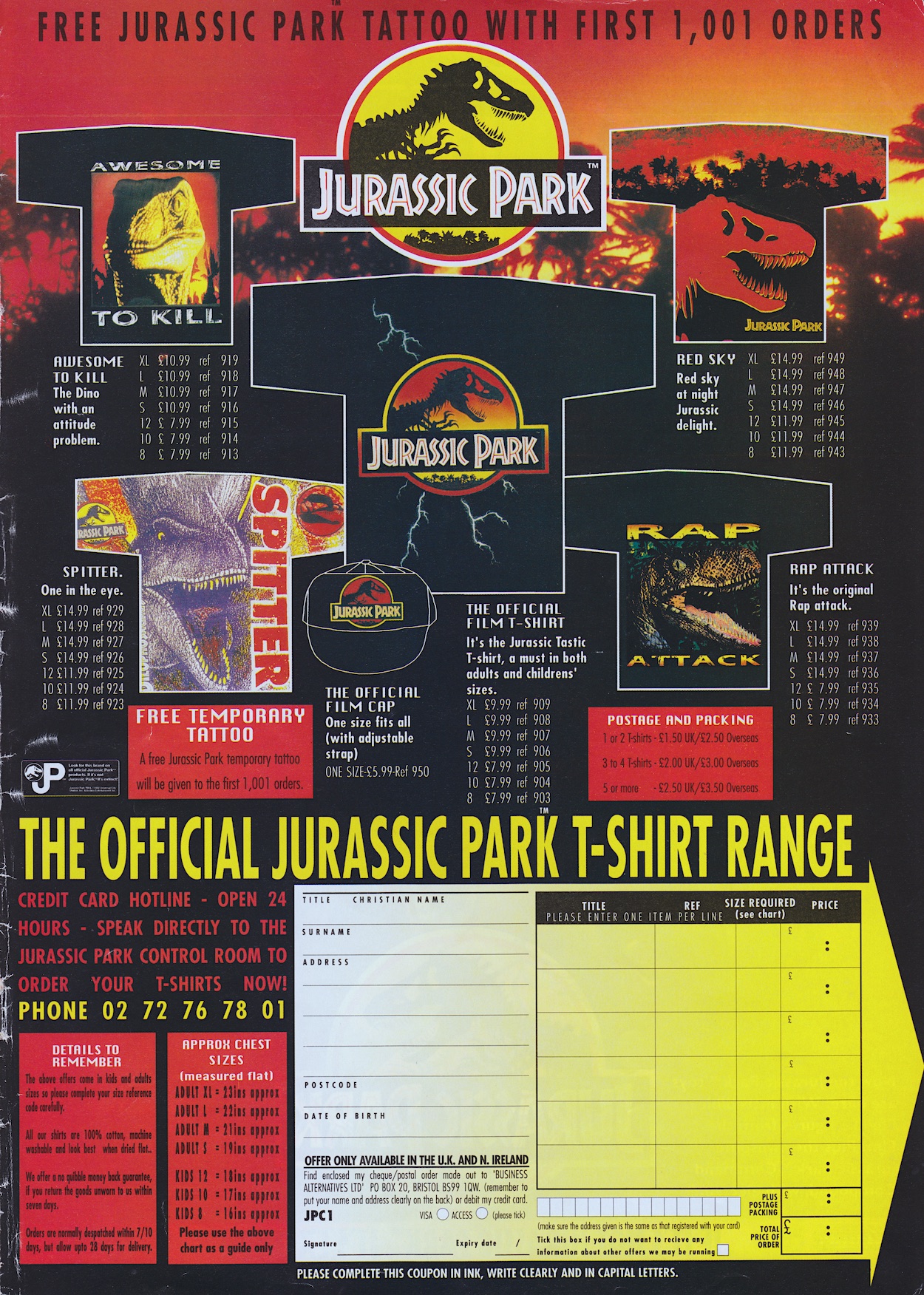
But before we get to that let’s take a look at some of the other bits and bobs included. The full comics checklist returns, featuring all five of the publisher’s UK titles and an extensive list of imports. You’ll notice the next issue of Jurassic Park has no specific date and I’ll get to that at the end of the review. There’s also an advertisement for possibly the worst idea in clothing ever to grace anybody’s chest. It’s difficult to make out but those of us who are old enough will remember these ridiculous t-shirts with a horrible rubber dinosaur sticking out, Alien-style. I remember there being Yoda ones in the shops too and they were just as garish.

The issue opens up with the biggest competition yet on page two and oh, how this takes me back. My friend had a Sega Mega Drive back then and, while we never played this game, I’m reminded of the weekly trips to the local video store to rent the latest games. The writer certainly seems just as enthused. (It’s definitely a step up from glow-in-the-dark stickers.) If only this kind of hype were evident on the editorial page every issue instead of the straight contents list we got instead. It’s not like there wasn’t a lot of Jurassic Park news to get hyped about after all.

The constant presence of rain in the background and the subdued colours envelop the reader in the cold, wet nighttime scene.

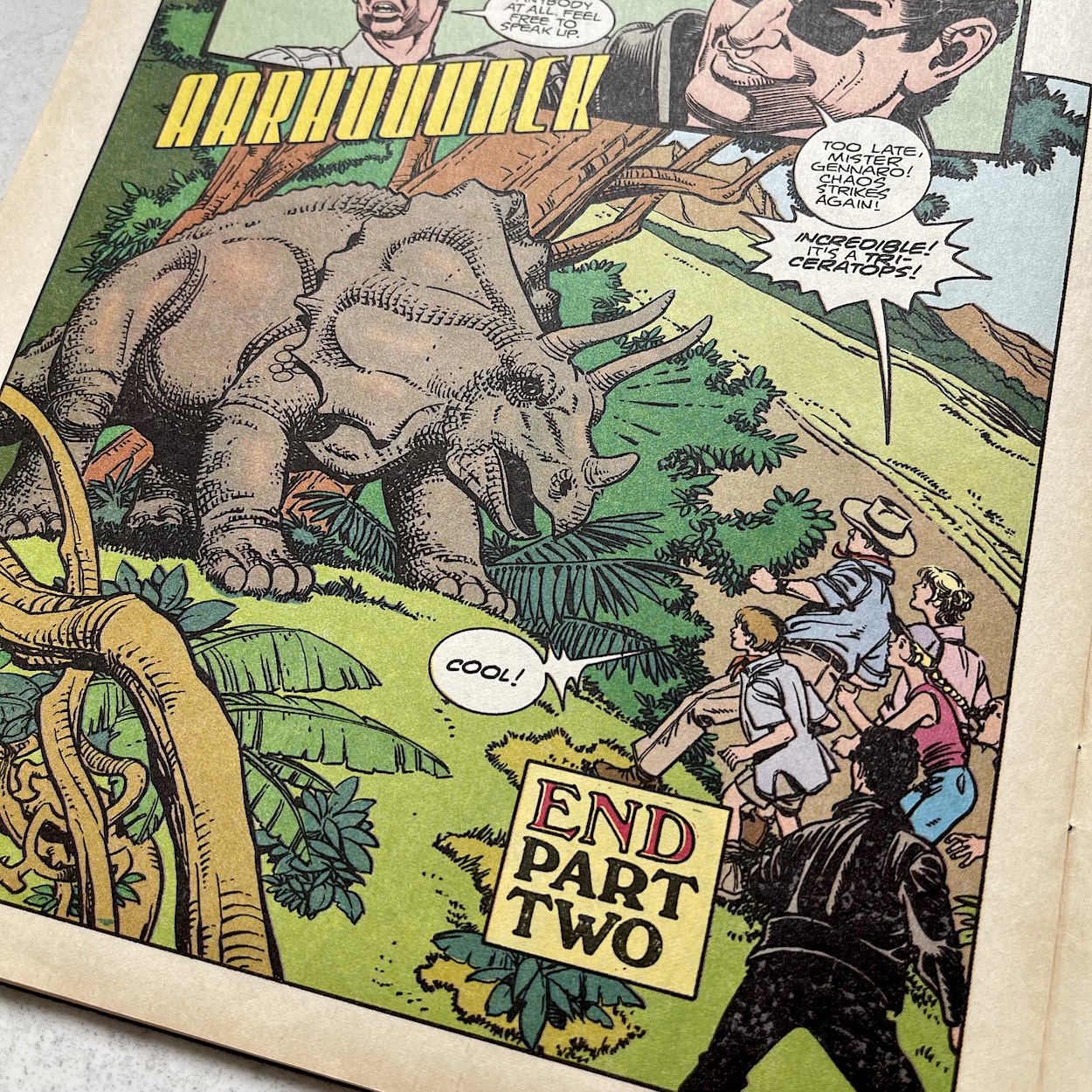
Clearly there was an excited human team behind the comic. Readers who had seen the movie in cinemas would definitely have been looking forward to this issue too. Things kick off with the sick Triceratops scene now playing out like the movie after last issue’s cliffhanger. As it turns out, the supposedly terrifying creature (which wouldn’t have harmed them anyway) just collapses when the story begins, which makes that cliffhanger a bit of a cheat.

The scene uses more dialogue from the book that didn’t make it into the final cut of the movie, specifically the resolution of what made her sick in the first place which really showcased Dr. Ellie Satler, so it’s nice to have these details back in the comic.

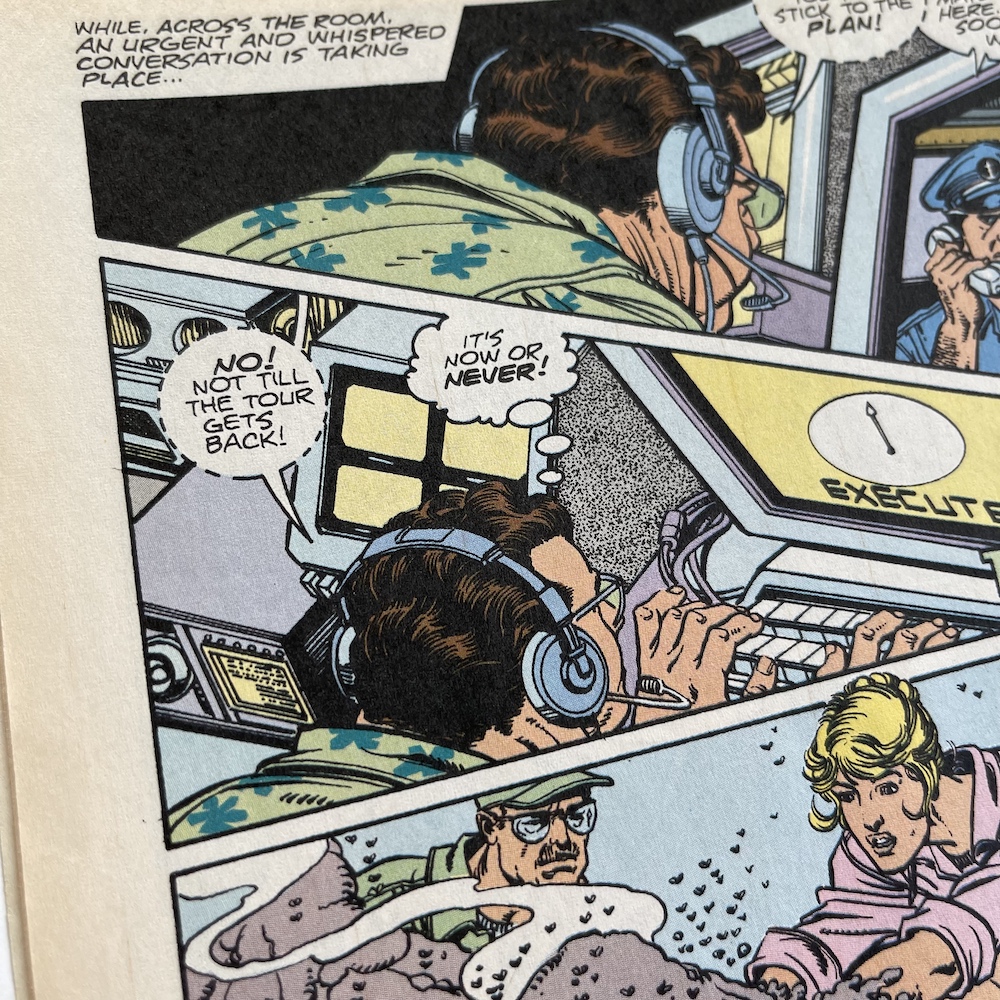
While Nedry’s ultimate fate isn’t played out yet we do at least get some extra characterisation for the man whose greed would ultimately lead to the park’s destruction. He’s actually worried about turning off the park’s security before the tour gets back. He doesn’t want to hurt anyone, he actually cares and his intention is to sneak off to the boat, hand over the embryos and get back before anything bad transpires from the temporary deactivation of the electronic gates.


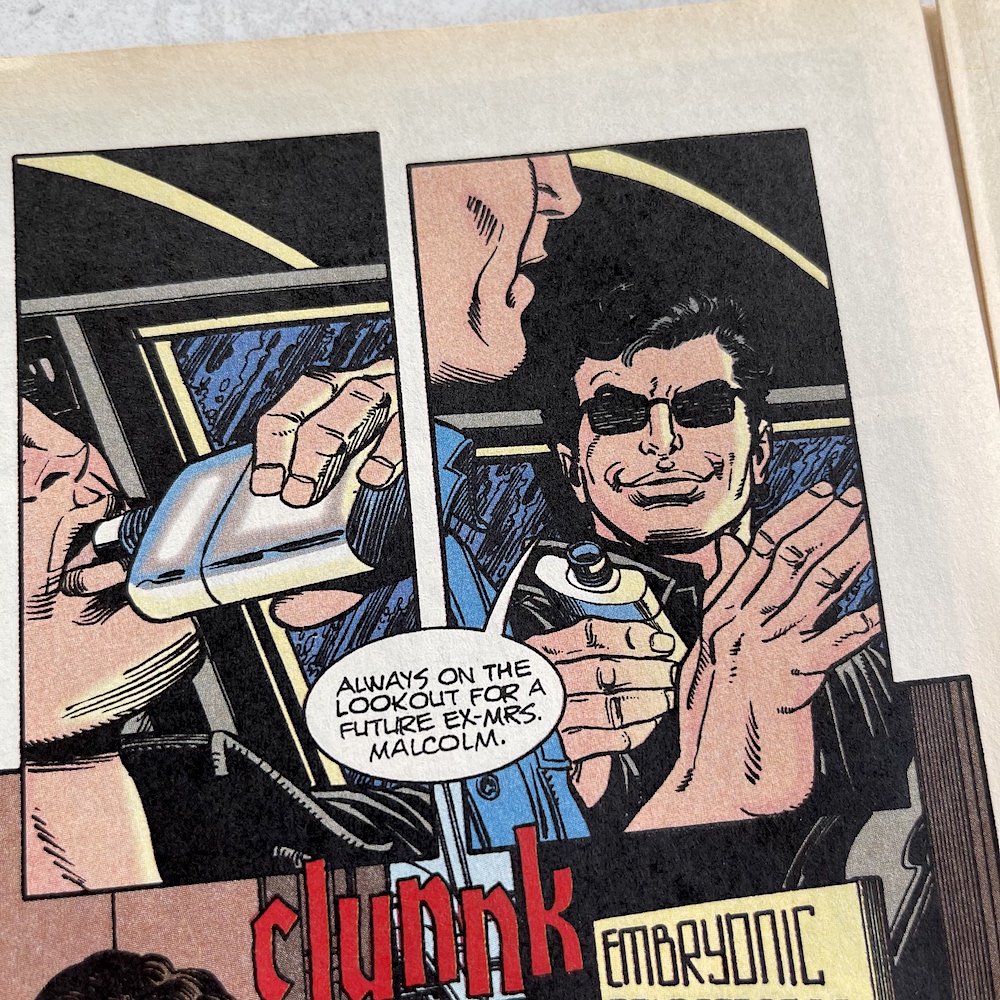
“Always on the lookout for a future ex-Mrs. Malcolm.”

Dr. Ian Malcolm

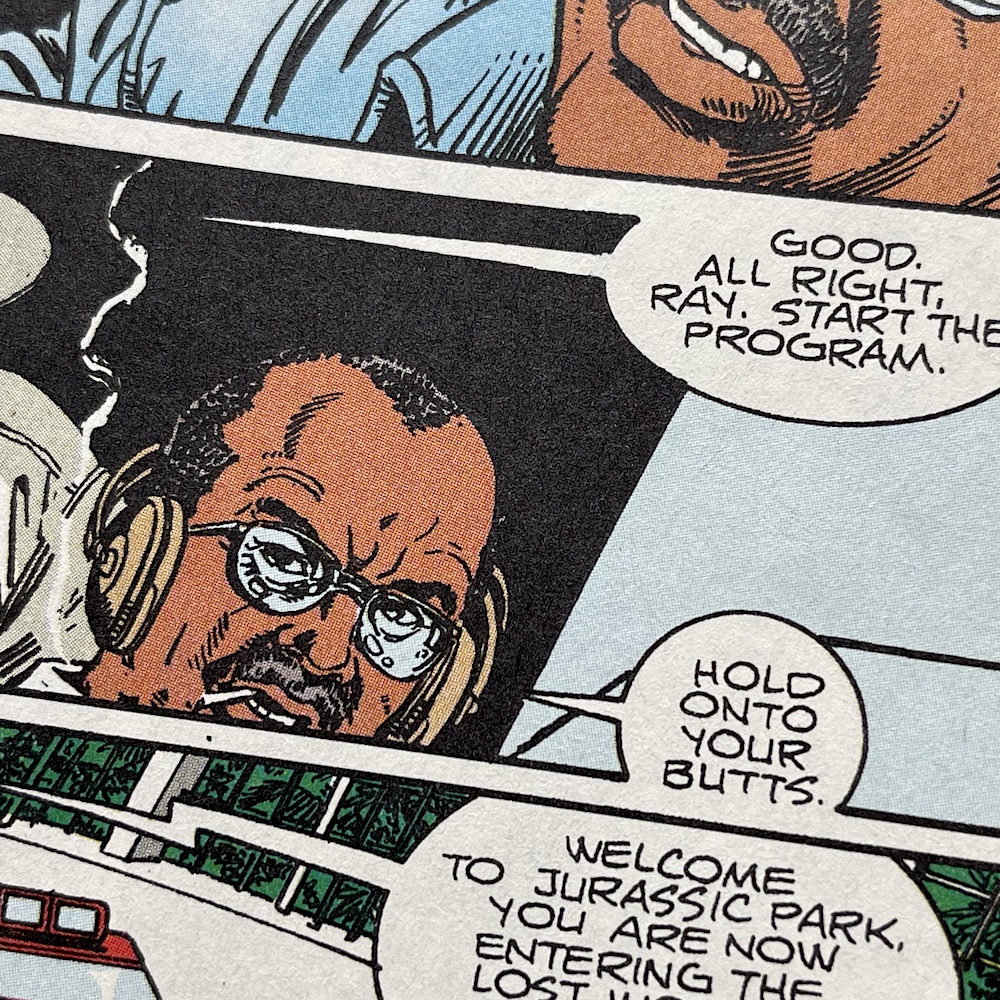
Of course, the storm would put a rush on things and we all know the outcome for everyone involved. Despite his worry he’s still an annoying hacker at heart and his “hacker crap” still keeps Ray out of the system long enough for his plan to be put into action.

The build up to the main event is superbly handled. The constant presence of rain in the background and Tom Smith‘s subdued colours envelop the reader in the cold, wet nighttime scene. Iconic moments such as Dr. Alan Grant and Dr. Ian Malcolm‘s chat and that famous moment the giant T-rex stares in at them, looking for a moving meal, are brilliantly captured.

Gil Kane‘s and George Perez‘s (our cover penciller/inker respectively) version of Ian continues to exude a darker presence, his humorous lines reading a little more cutting than Jeff Goldblum‘s perfect delivery. It’s such a shame then, how Walt decides to change a key moment in a way which has a detrimental effect on the character, which we’ll get to that in a minute. For now, let’s back up a little to the first appearance of the issue’s big selling point.

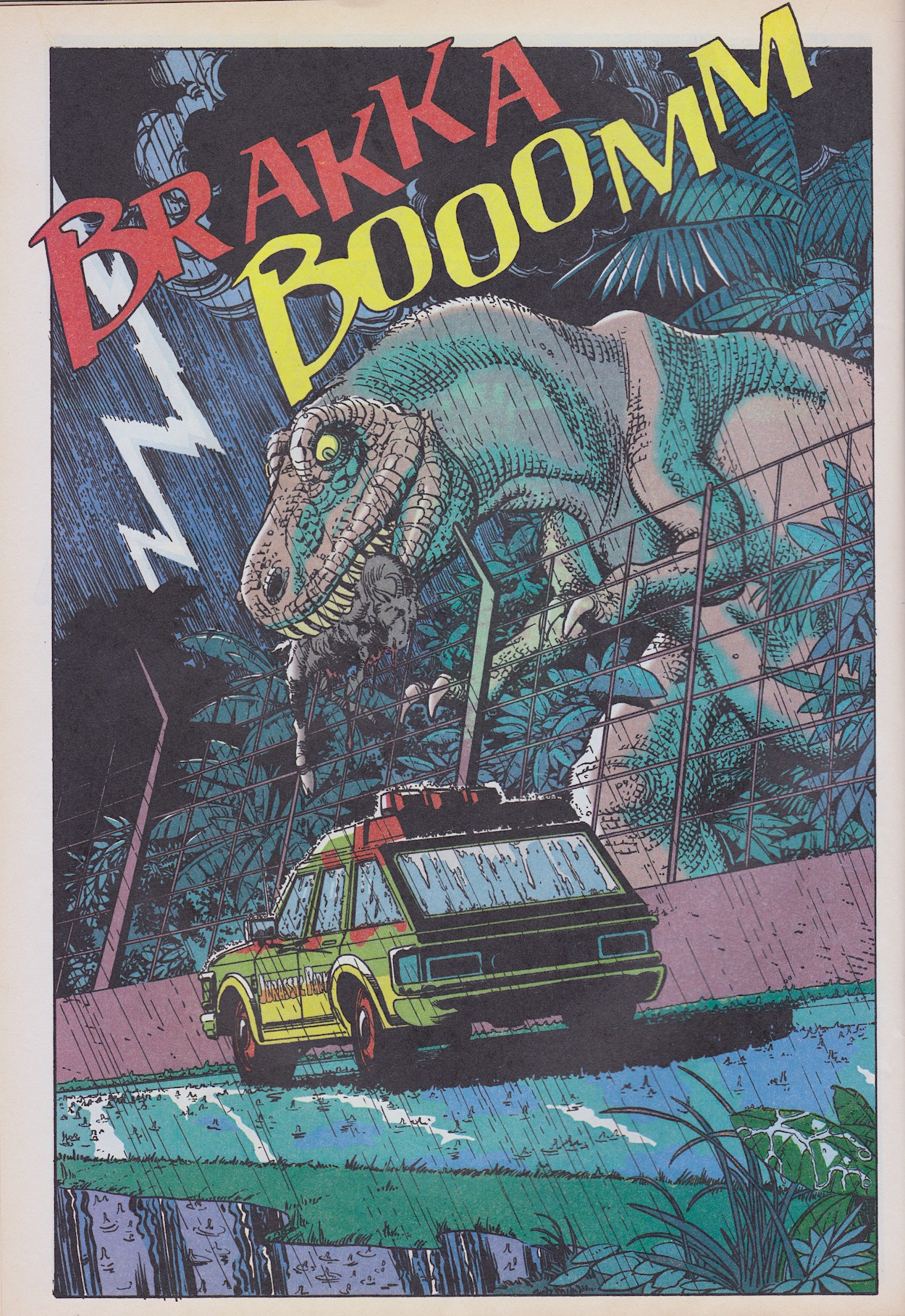
Three issues in the comic team finally get to have the big reveal and their first bit of proper dinosaur action, something they’ve only been able to hint at thus far. This was a key scene to get right and just as the tension rose to its crescendo in the movie, here we’ve got pages of rain, booming sound effects and progressively more frightened characters until we turn a page and are confronted with this next image.

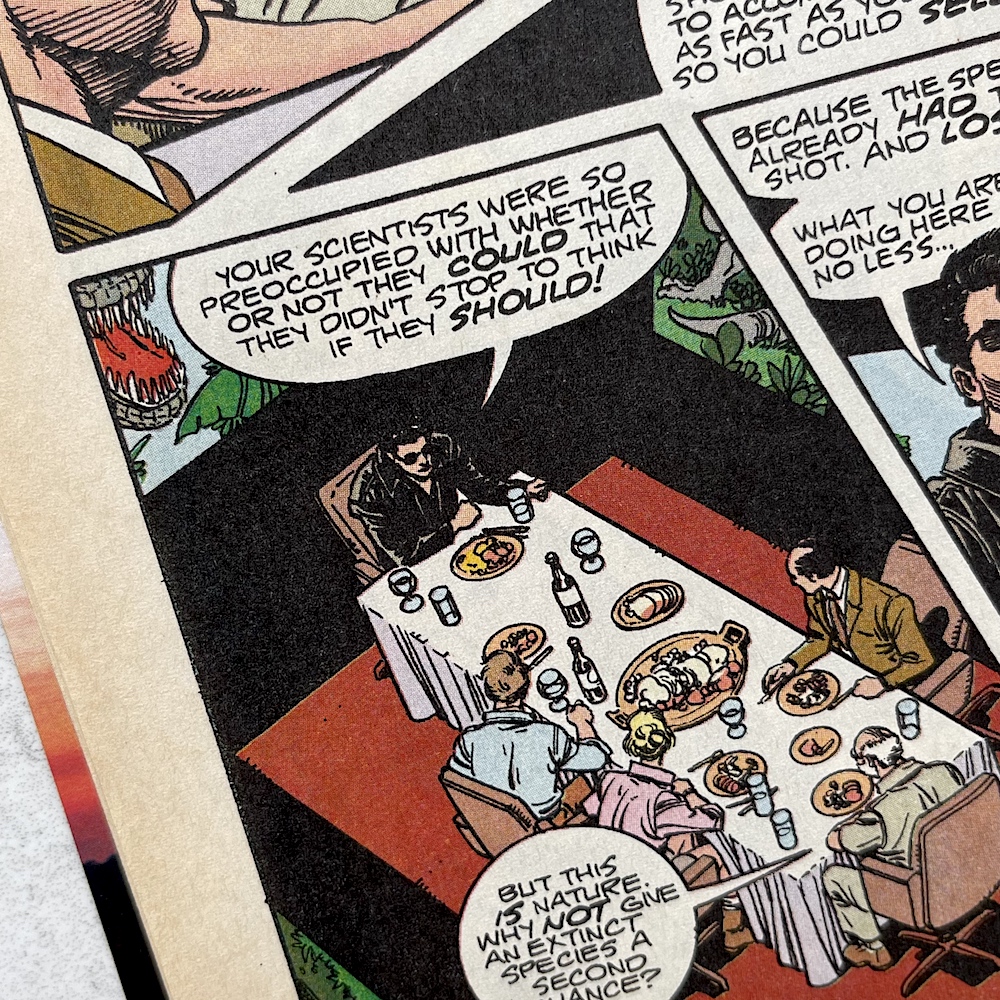
Timing is everything and editor Dick Hansom made sure to add an additional advertisement page after the editorial so that later in the comic this would work as intended. Of course, on closer inspection you could critique this image and say the size of the T-rex means she could easily chomp down on cars even with the fence electrified (and also, that’s one huge goat), but then we’d be missing the whole point of this glorious splash page.

Sure there’s some artistic licence at play here but you can’t deny its impact. Those proportions are corrected for the rest of the attack scene and to be honest it was only upon the second reading that this reader picked up on it, such was the impact of this atmospheric rendering.


“It is a beautifully-designed killing machine!”

Panel caption (Walter Simonson)

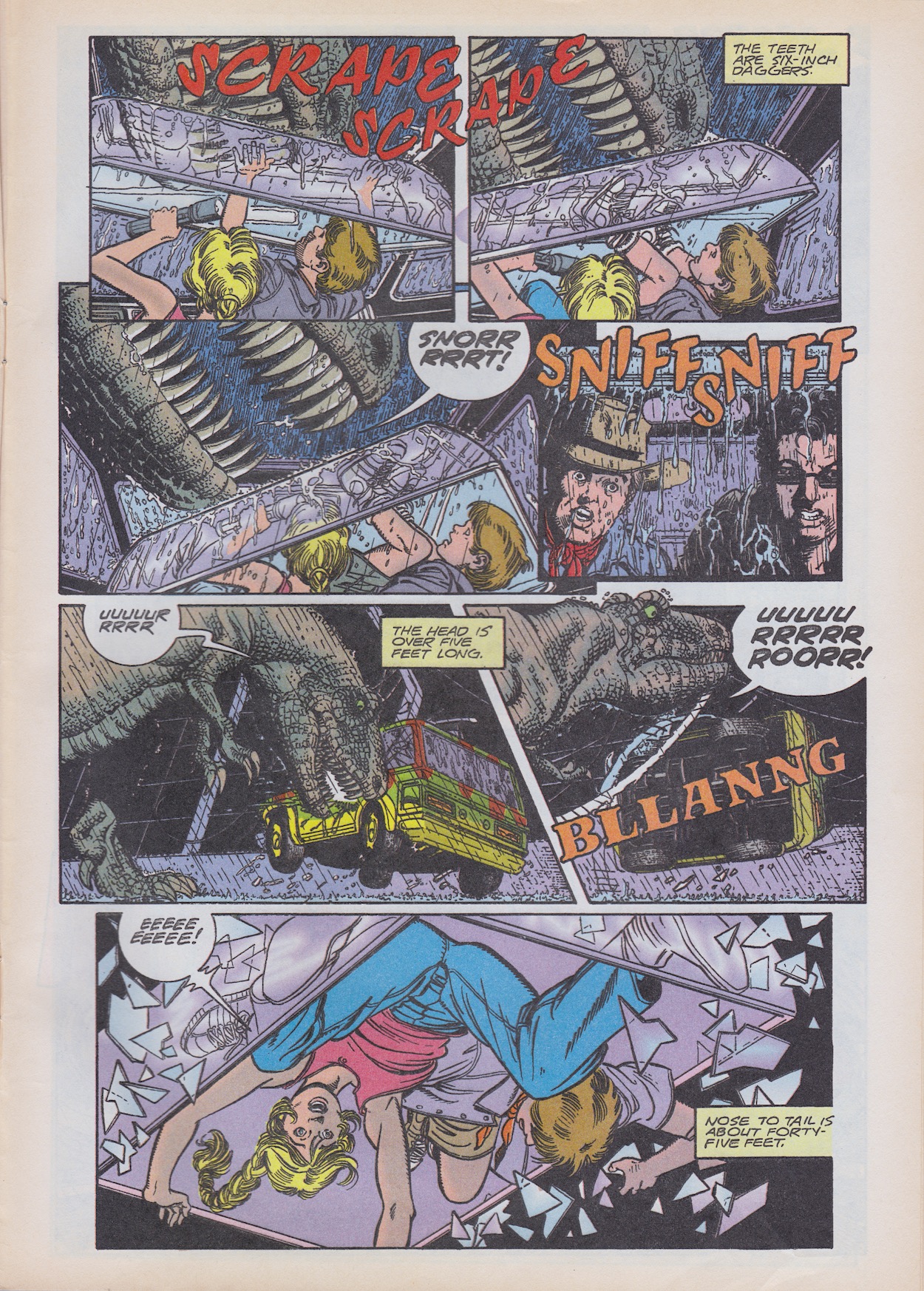
What follows are an intense few pages which I believe would work just as well on their own merit even without the memory of the movie. In the film the juxtaposition of the giant predator and the kids Lex and Tim made for a genuinely terrifying moment in cinema history. Conveying that to comics panels was never going to be easy but the simple addition of descriptive captions ends up being the perfect solution.

With the attack in full swing, every few panels we get a direct, to-the-point fact about the T-rex‘s size and strength. The attack spans four pages and each of these little captions brings another level of tension until they culminate in “It is a beautifully-designed killing machine” as it stands on the upturned car, its weight squashing the metal down into the mud, Tim still trapped inside. It’s a genius move.

What comes immediately after these superb pages is the first big disappointment in this adaptation.

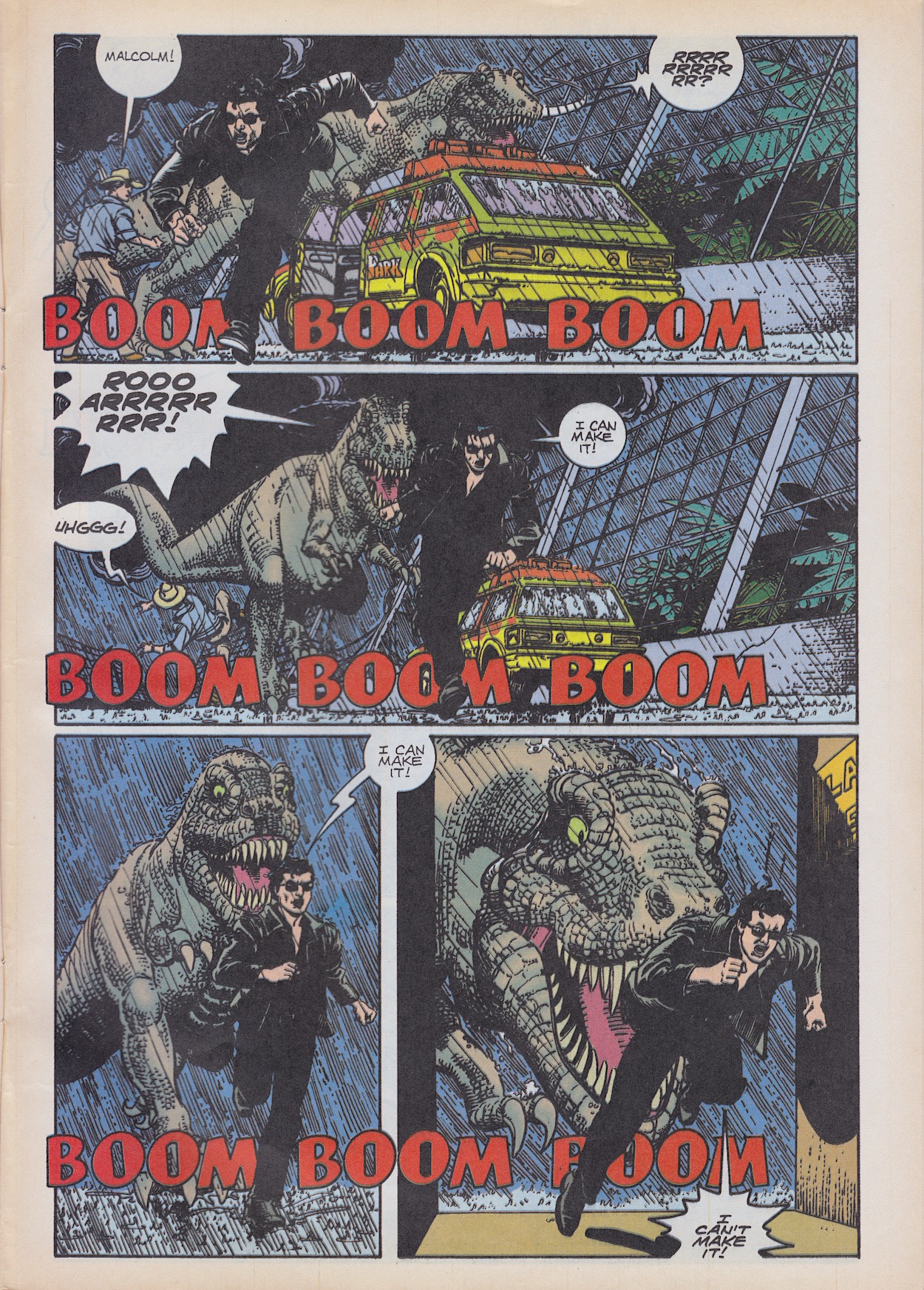
As you’ll remember, in the film Ian lights a flare to get the T-rex‘s attention away from the kids and only starts running once he knows he’s being chased. This gives Alan the chance to rescue the children. But here he just runs away, leaving everyone else to their fate. There’s no indication he’s doing it as the foolhardy yet heroic gesture of the movie. It’s completely out of character and if this had happened in the movie it probably would’ve turned the audience against him for the rest of the story.

A very odd choice and one I definitely do not like.

The end result is the same however, with Malcolm being tossed through the walls of the public toilet where lawyer Donald Genaro ran earlier to hide when he abandoned Lex and Tim. The ending to his particular story happens out of frame with only a scream in a speech balloon pointing off the page (in letterer John Workman‘s unique style). This seems like another rather odd choice seeing as how the vast majority of readers will have witnessed the scene play out in the film. Why censor it?

A couple of dubious choices by Walt and story editor Jim Salicrup aside the story rockets towards its cliffhanger. In America this would’ve been the penultimate chapter in a four-issue mini-series but here in the UK we actually still had two parts to come. How so? You’ll find out next month. (I have to try to get you back here somehow!) In the meantime this final page brings things to an end but the issue has more to give before we place it back on the shelf.

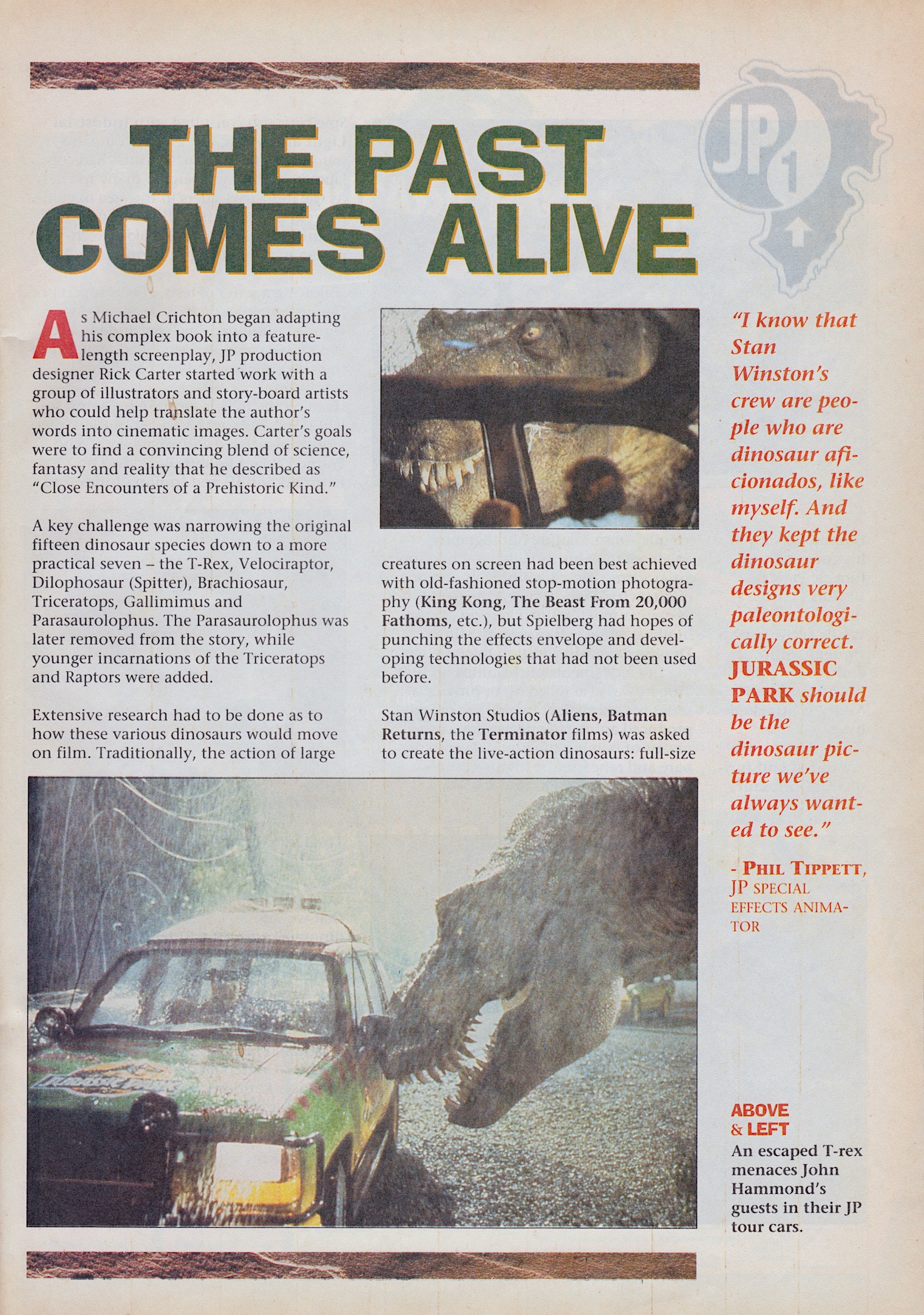
Last issue the behind-the-scenes feature introduced us to the various special effects departments and their roles in bringing Michael Crichton’s creation to the screen. This time the focus is fully on the mechanical dinosaurs themselves, created by Stan Winston and his team, in Building a Better Dinosaur.

We all know how the film led the way in its use of computer graphics, but what can’t be forgotten are the wonderfully lifelike creations that the cast actually got to interact with. As a huge fan of Jaws (which gets a humorous mention here), Jurassic Park always felt like a descendant of that original mechanical predator movie and this brief write-up is an interesting look at how they were created and operated. It’s just a shame it doesn’t contain any accompanying design or set photos of the details covered in the text.

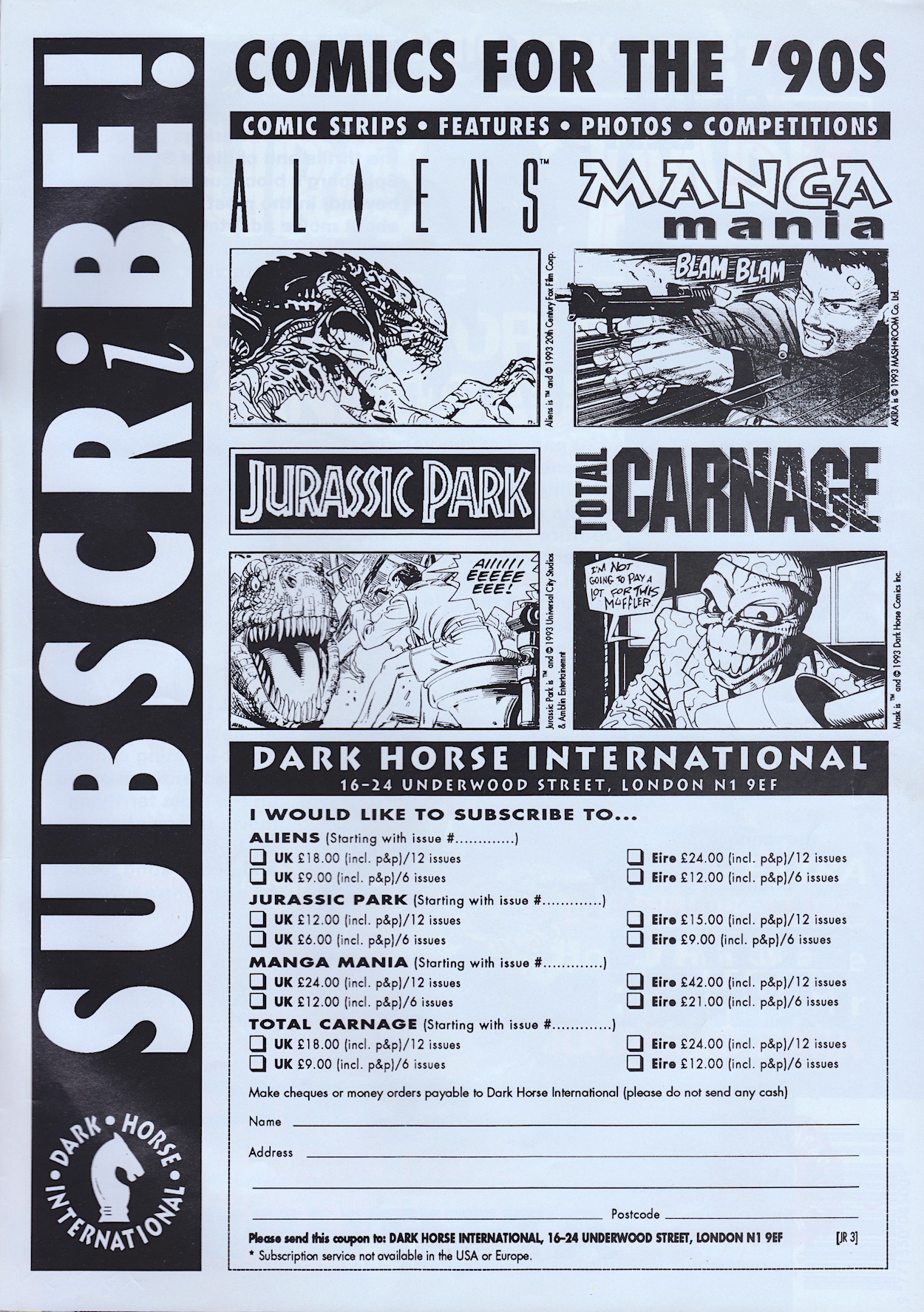
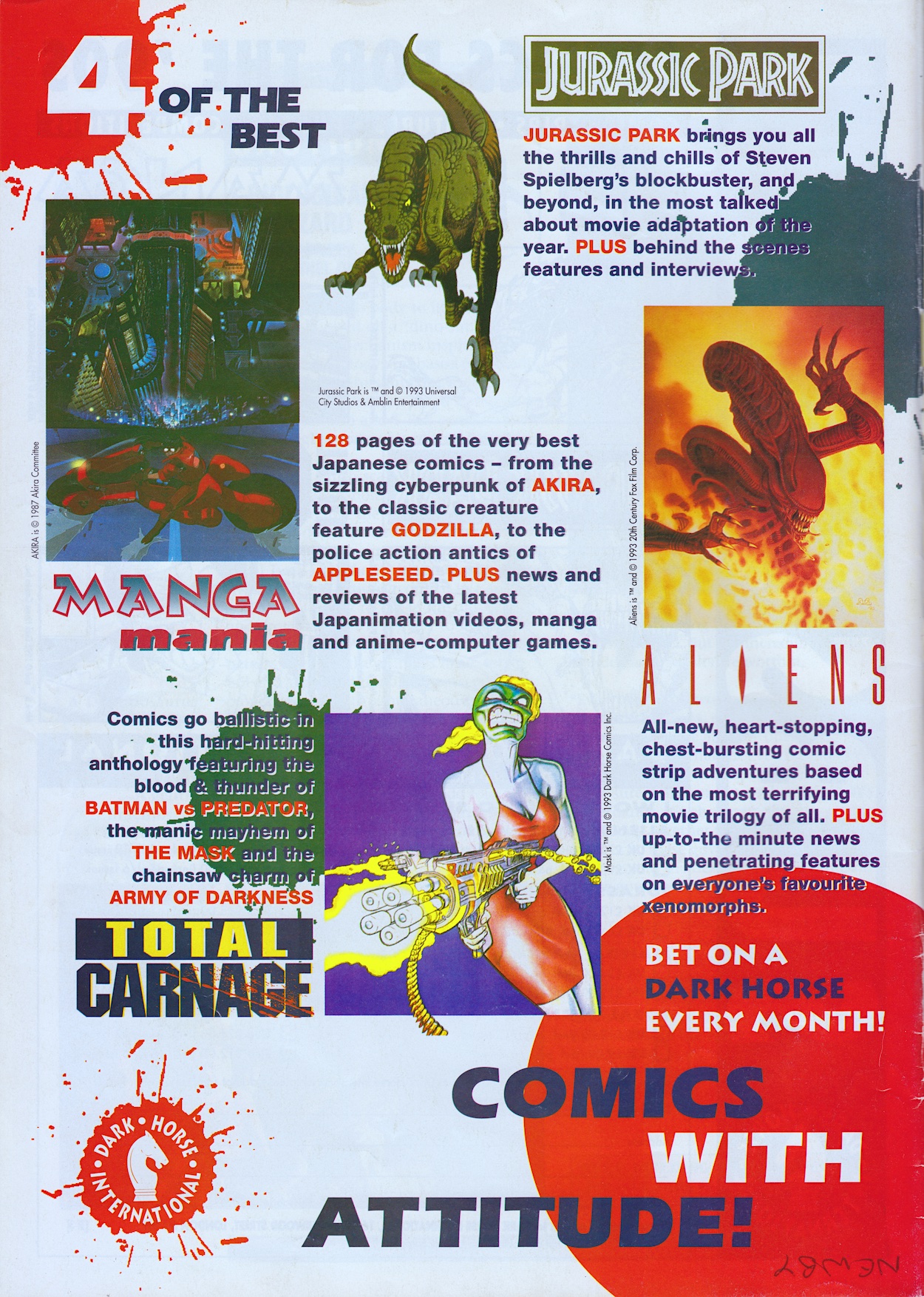
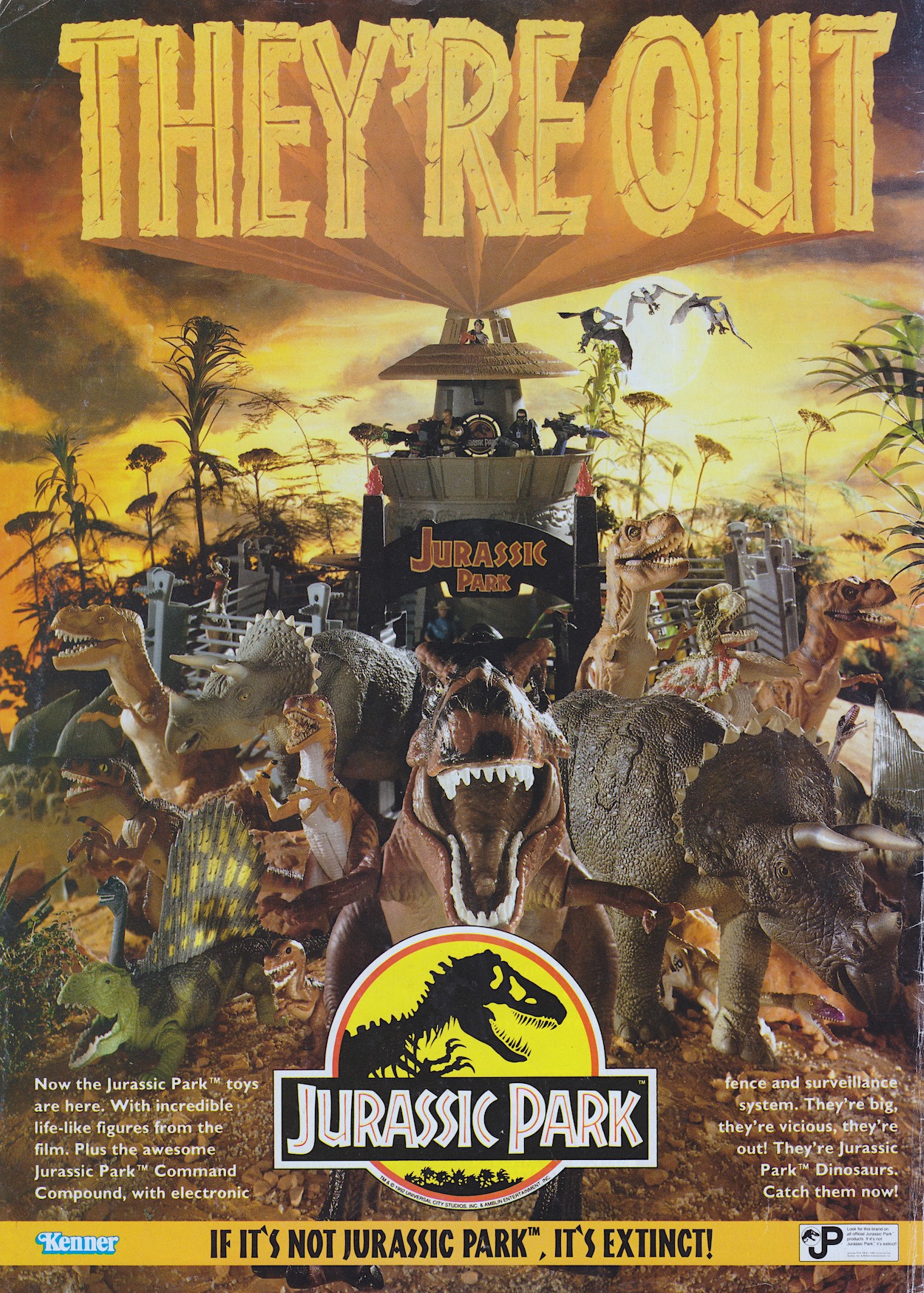
The back cover is a double whammy of information on Dark Horse’s range, beginning with a subscriptions page and then a colour advertisement on the back. The company was making real inroads into the UK comics market, bringing international comics to our shores on bigger, better quality paper, chock full of strips and features. It’s unfortunate that the whole market was shrinking rapidly and ultimately there wasn’t much time left for the imprint and its titles. But we’ve got plenty of issues of this comic to go so we’ll not get bogged down with endings just yet.

For now, we’ve got a bit of a wait until the next issue because the comic’s schedule was changing. With Topps Comics in the US now committed to further mini-series and the UK comic selling well enough it was decided it would continue past what was originally going to be a four-issue adaptation. Jurassic Park was now going to be a monthly ongoing comic, the date of the next issue unknown at the time of going to press. (Something similar happened with Bram Stoker’s Dracula.) The strip in the next issue was split in two so as to give the American comic enough time to get ahead before the new, original strips could be printed here.

Rejigging it into an ongoing comic would take a little planning and working out what to fill the pages with. So in the end Alan and Lex would have to stay completely still all the way until 28th September 2021 for Jurassic Park #4! So will you. Will it be worth the wait?

iSSUE TWO < > iSSUE FOUR

JURASSiC PARK MENU

JURASSiC PARK #2: BUiLDiNG THE PARK

Welcome back to “Isla Nubar” (misspelled like this on the contents page) and Dark Horse International‘s UK version of Jurassic Park from 1993, edited by Dick Hansom. A rather strange cover by Gil Kane and George Perez, given how no dinosaurs have escaped yet. It’s a mishmash of named characters and extras, including a rather red-faced man in the middle. Maybe the raptor is holding his nose.

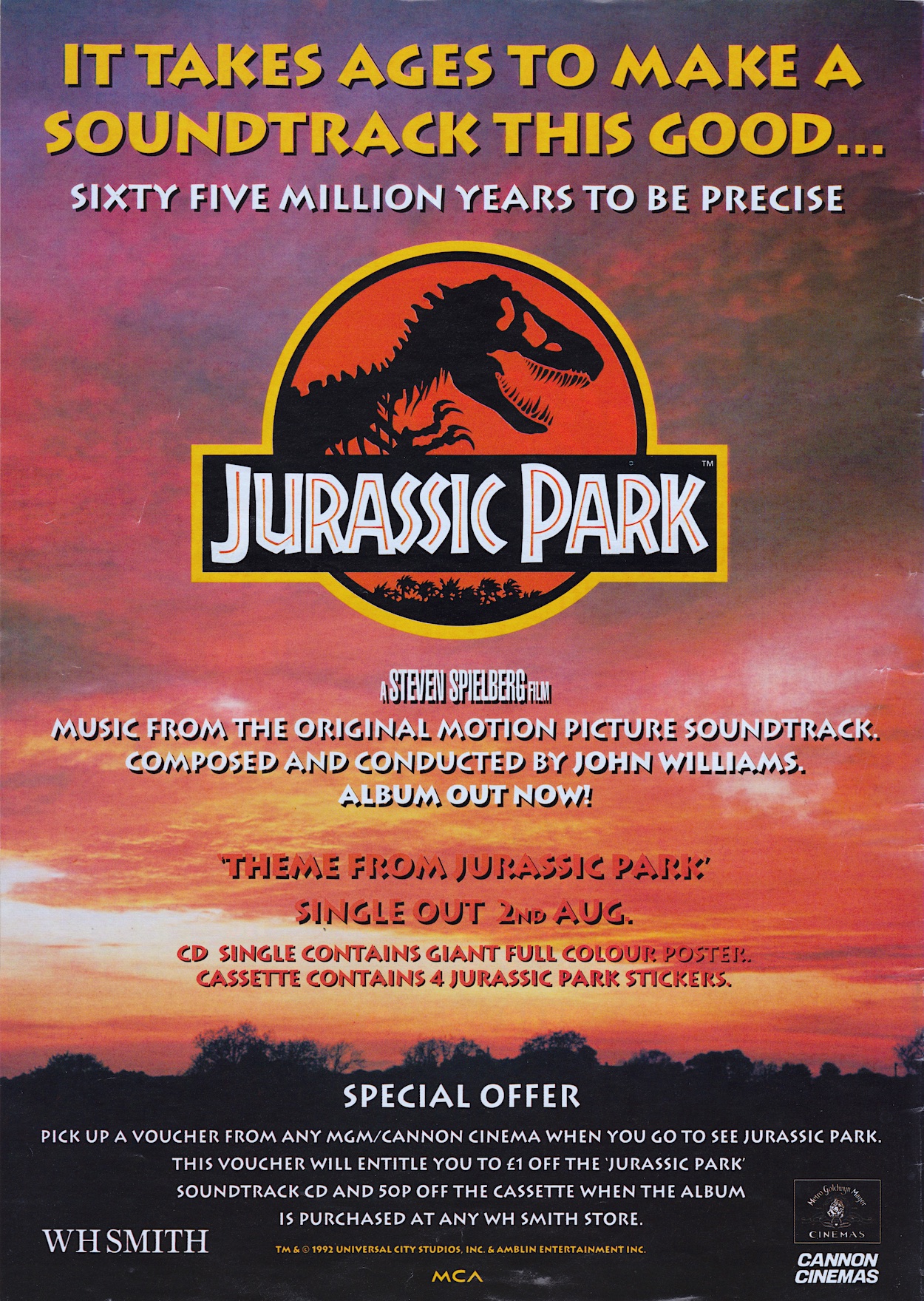
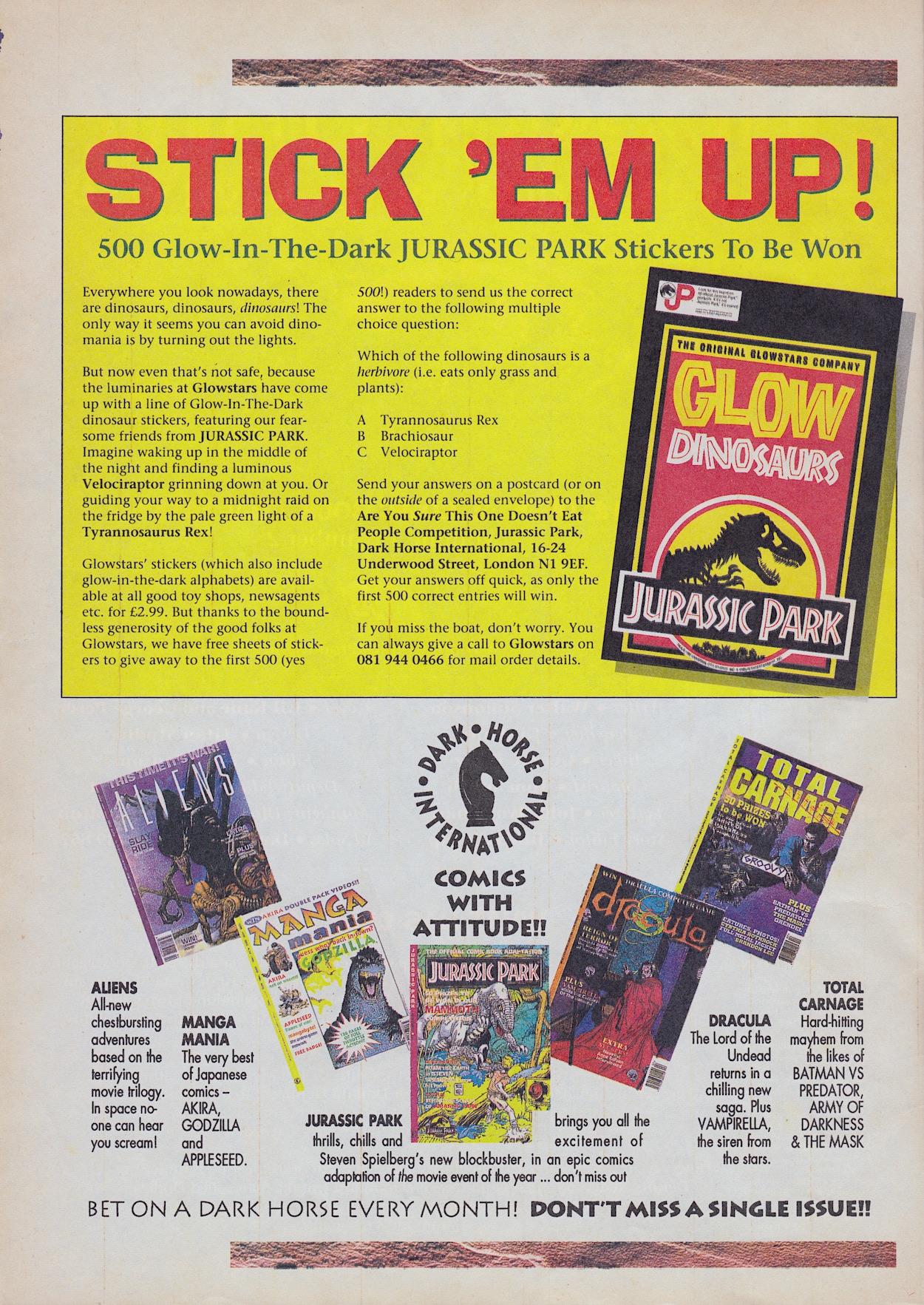
Inside is the second 28-page chapter of Topps Comics‘ adaptation and a few extras, something we were accustomed to this side of the pond. First up is an advertisement for John Williams‘ soundtrack album. I owned the CD at the time and have been listening to it on Apple Music while reading these. There’s a competition for glow-in-the-dark stickers, a somewhat unimpressive prize compared to later ones I remember. No comics checklist this issue, instead a glance at the other titles currently in publication.

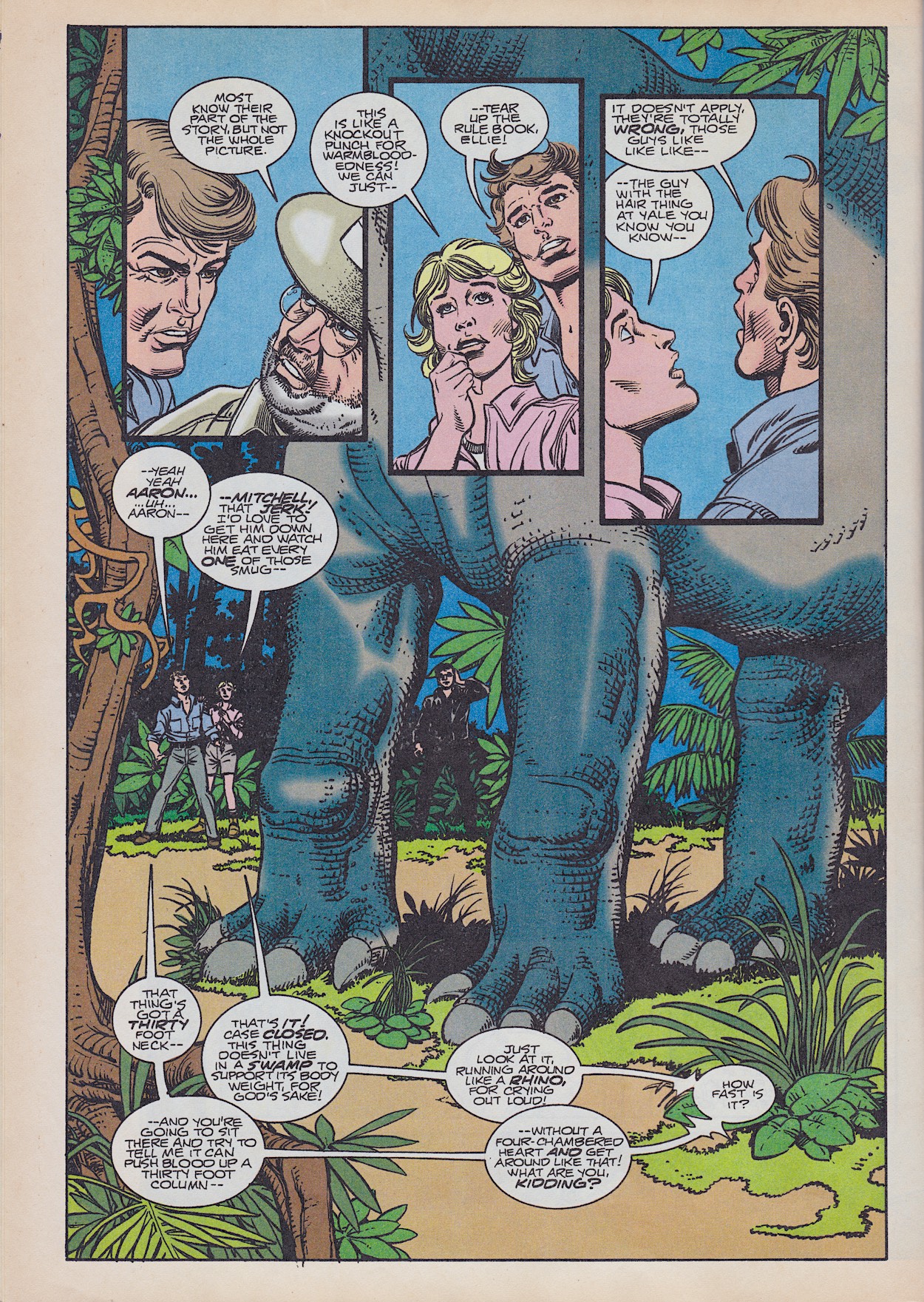
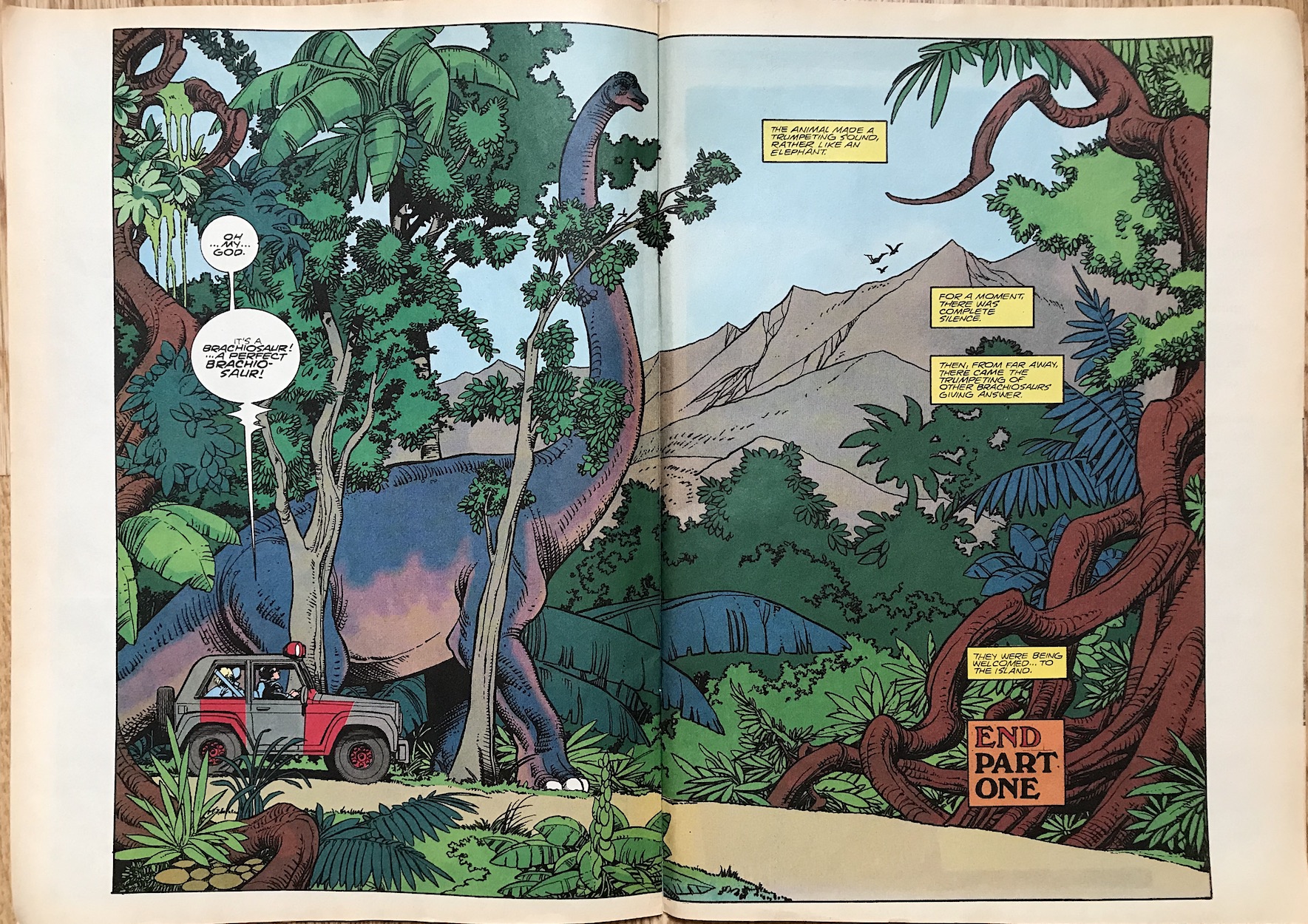
The strip continues adding to existing scenes while moving others about in order to adapt the film to the medium, something I discussed in more depth last time. This chapter begins where we left off in the midst of that iconic brachiosaur scene and there’s quite a lot of additional dialogue from Michael Crichton’s novel, such as Dr Alan Grant‘s and Dr Ellie Satler‘s further observations.

One part lifted directly from the book involves a little bit of background on the park itself. To achieve something of this magnitude would require more people than just those on the island, so John Hammond explains others were involved across the globe, knowing only their specific part of the puzzle. To maintain secrecy they were never let in on the bigger picture. The novel goes into things like this in a lot more detail to ground the fantastical story in the real world and if you haven’t already you really should read it yourself (or get the audiobook which is expertly brought to life by Scott Brick).

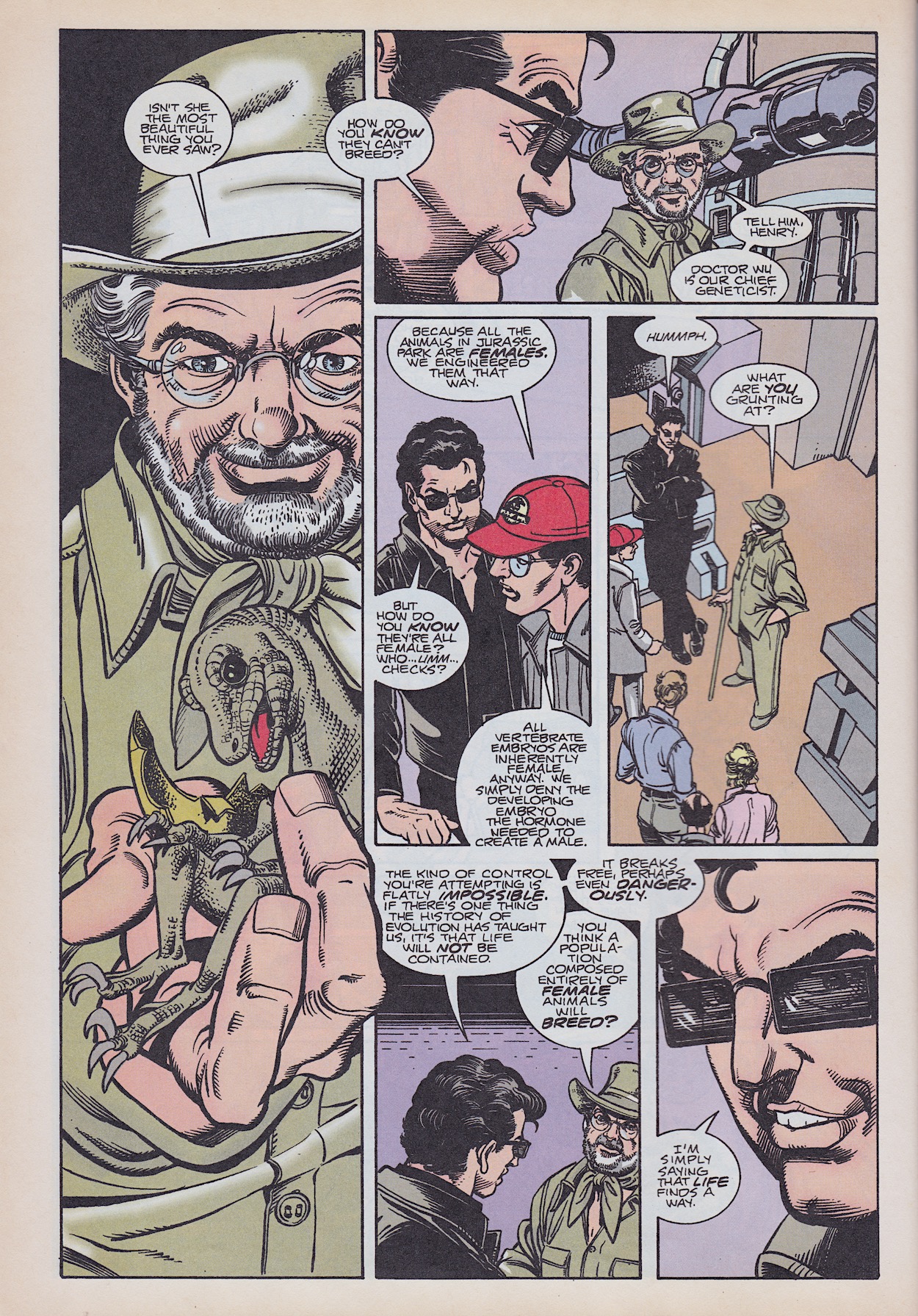
From here we make our way to the Visitor’s Centre, our characters excitedly discussing what they’ve seen, trying to take it all in. After the Mr. DNA sequence we find ourselves in the lab where we meet Dr. Henry Wu, who was played by BD Wong. In the novel Wu was a central character and certainly not the affable person we saw in the movie.

Crichton’s Wu was ruthlessly ambitious, believed the success of Jurassic Park was solely down to him and never saw the dinosaurs as real; they were engineered adaptations of the originals. He argued with Hammond about the ability to create any dinosaur they wanted, even new breeds, tailoring them to exact requirements to bring in the most money from paying tourists. All of this would of course form the main plot of the fourth movie, Jurassic World. However, in the comic his role is reduced even further than in the first film, appearing in only three panels with most of his dialogue given to Hammond.


“I’m simply saying that life finds a way.”

Dr. Ian Malcolm

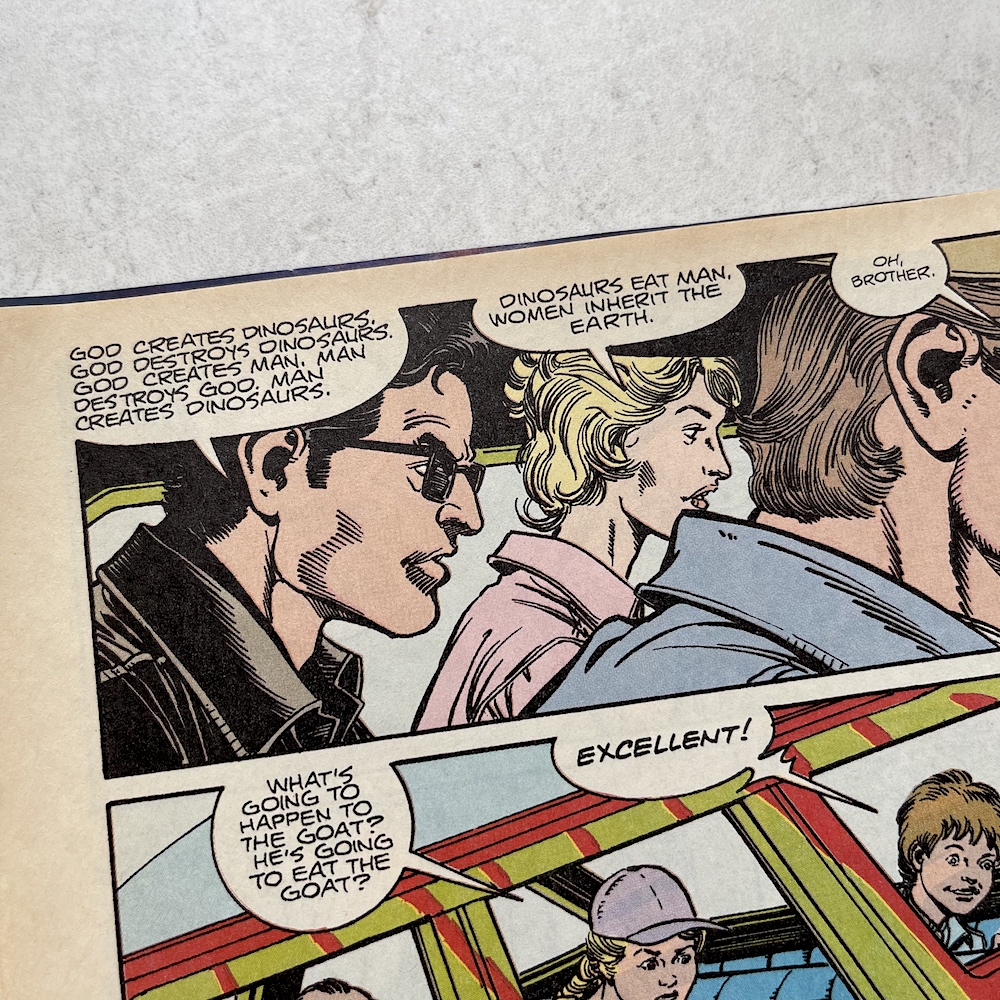
One character who definitely doesn’t suffer this indignity is Dr. Ian Malcolm, so memorably encapsulated by Jeff Goldblum that you can’t help but hear his voice when reading one of his many quotable lines. In the novel Malcom’s fascinating monologues ran to several pages and for the film their essence was broken down and brought to life by Goldblum’s very natural delivery, becoming the backbone of the story.

This continues in the comic although his characterisation is a little different thanks to Gil and George. Overall he’s still the cool mathematician but his facial expressions make the character a little darker in tone, lending his predictions a more sinister feel. This actually suits the comic. Scenes here don’t have the luxury of playing out over several pages to build tension, so this little tweak in tone works a treat instead. Below is one example as he delivers his most famous line, used as marketing for later movies in the series.

While the Tyrannosaurus rex was the biggest dinosaur and the most publicised, the stars were the Velociraptors. Apart from a baby their existence is merely hinted at and talked about for much of the film in an expertly crafted script that built tension for their final reveal and dominance in the latter acts. But young comic readers wouldn’t want to wait three issues to see them on the page.

Jurassic Park is a very quotable movie, with a surprising amount of dialogue taken directly from the novel

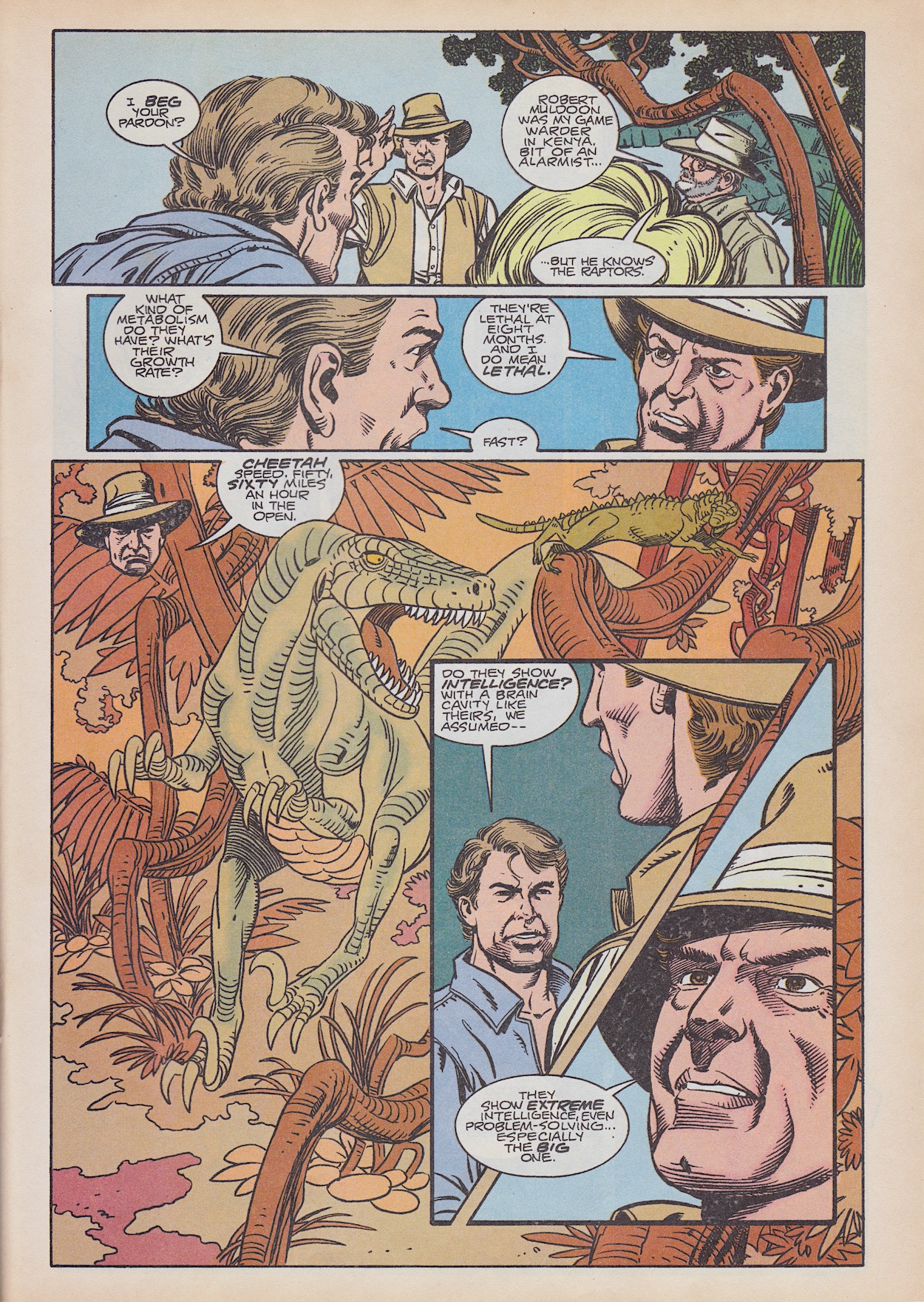
So, once again we’re treated to prehistoric flashbacks of these great hunters in their natural environment (highlighted by Tom Smith‘s change in colours) when game warden Robert Muldoon (Bob Peck) introduces them during that memorable dinnertime cow scene. With a graphic novel it’d be easier to follow the movie more closely, but writer Walter Simonson and story editor Jim Salicrup had to give readers a monthly dose (monthly in the States) of the ‘raptors and I think these scenes are a great solution and a natural fit.

Ian Malcolm‘s quotes aren’t the only ones to survive the transition to comic form. Jurassic Park is a very quotable movie, with a surprising amount of dialogue taken directly from the novel. Some would have to be excised for this shorter form of storytelling but here are a small selection of those to be found in this second issue.

For some reason the comic changes the recorded in-car voice to James Earl-Jones from the film’s Richard Kiley. Maybe Earl-Jones was better known to the comic audience? On a side note, Crichton chose Kiley’s voice in the book so I thought it was brilliant how Spielberg actually got Kiley to play the part!

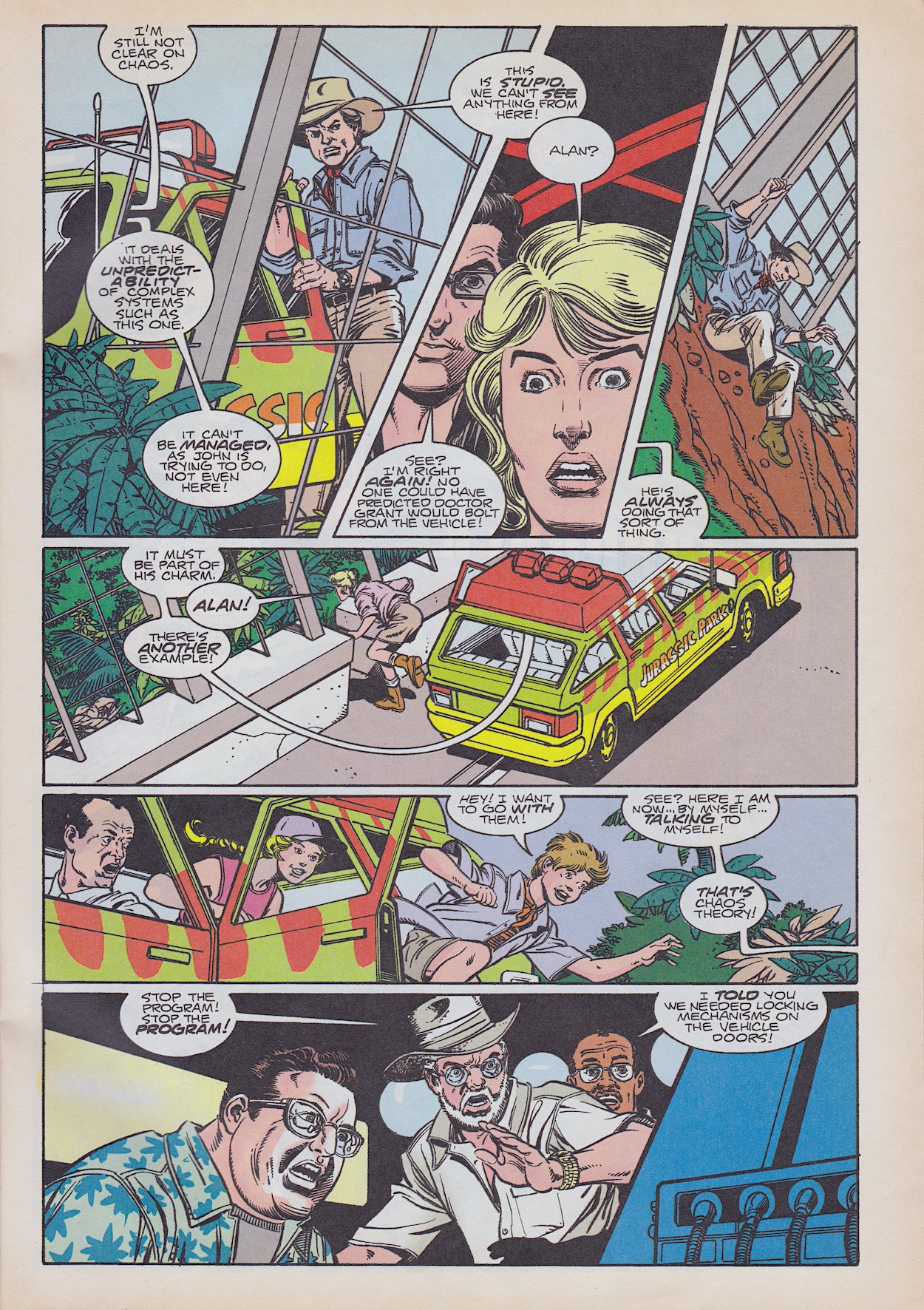
The story rolls along until we find ourselves at the T. rex paddock complete with a very worried goat and an almost gloating Malcolm. He knows the park can’t work, knows the natural systems in play are too complex to control and as far as he’s concerned chaos theory proves it. Unfortunately we lose the lovely butterfly effect scene between him and Ellie, but then again without Jeff’s delivery it would probably fall flat.

Maybe this is just a way of speeding the story along, because we’d never have bought Alan [Grant] doing this in the movie

However, after the others jump out of the vehicle we still get to laugh at him talking to himself about talking to himself, John Workman‘s speech bubbles pointing away from the action, highlighting the fact he’s chittering away on his own. It’s a very funny way to present this moment, I actually laughed when I read it despite seeing the film countless times already.

At this point we see more evidence of changes to the comic’s pacing in order to fit it all in. In the film Alan jumps out of the moving car when he sees and hears something in a field beside them. Here, he’s out of the car before it’s even started moving away from the T. rex paddock, climbing through a gap in the fence simply because he’s fed up of not seeing any dinosaurs.

It’s not exactly the safest of places to go for a dander! So maybe this is just a way of speeding the story along because we’d never have bought Alan doing this in the movie. It’s the first time I’ve questioned a change made by the comic’s team. Yes, the very next page is the last but come on, they could’ve simply added a caption to indicate they’d moved away from the T. rex first!

This isn’t a case of going back to the book either because in that they see a vet with a sick Stegosaurus and walk over in a safe environment, whereas here you can see they get surprised by an apparently healthy Triceratops. Same species as the film but this isn’t how the encounter played out. Could there be a major change of plot here? Or just a quick cheat for a cliffhanger? We’ll find out next time.

If chapter one was the introduction to the story, the setting and the characters, this issue’s chapter has been the build up. We all know the next instalment will include the elements all coming together to create the disaster that befalls the park so I’m interested to see how that will be adapted for the comic and how successful it will be.

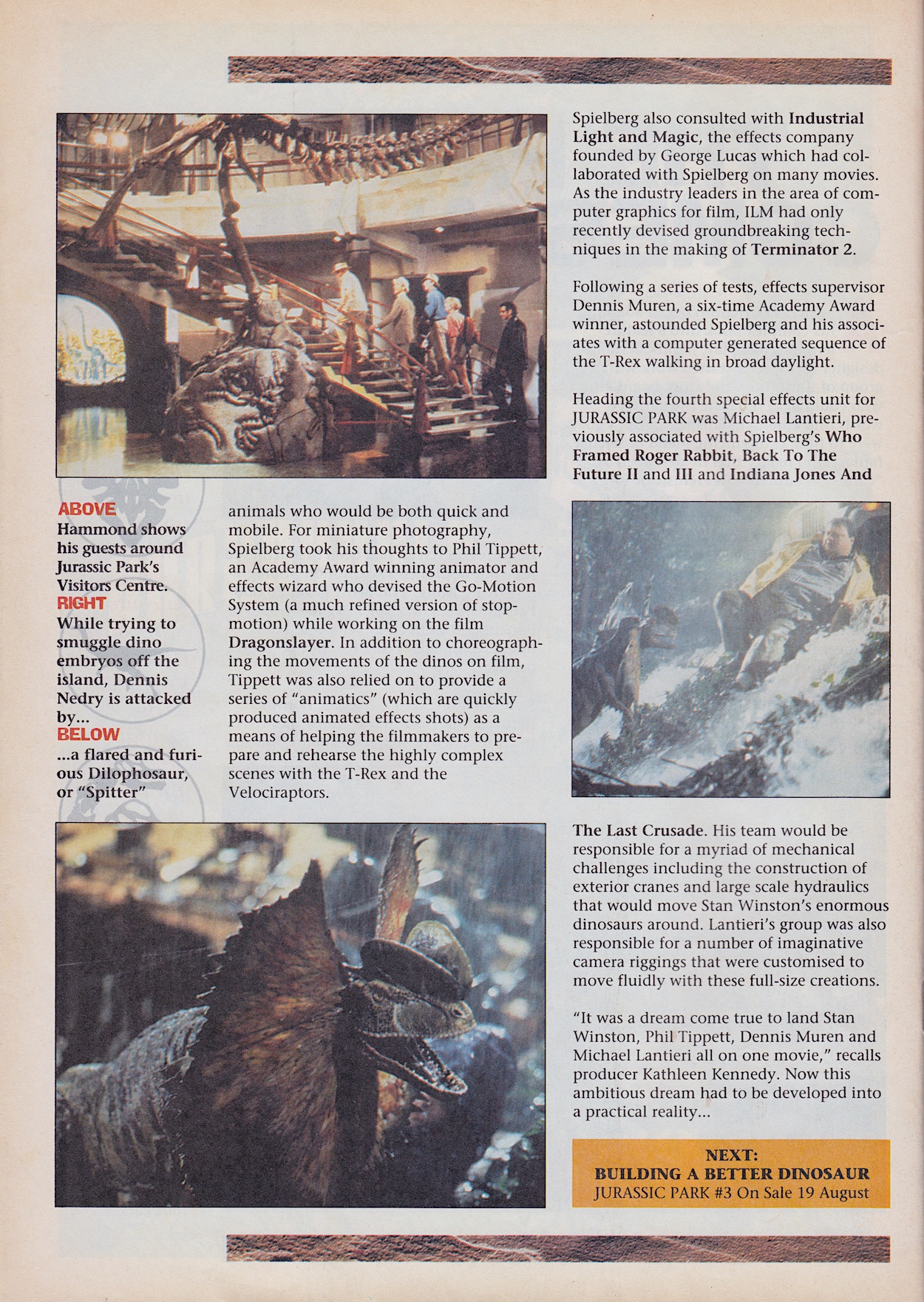
Straight after the strip is the second of the behind-the-scenes features, explaining the differences between the four special effects teams and what each of their roles were. Miniature photography for animatics and choreography, the full-motion live-action creations, the mechanics for those beasts and of course the CGI. It’s easy to forget these days just how far ahead of anything else Jurassic Park was in 1993. The fact it looks just as spectacular 28 years later is testament to the hugely talented individuals who worked so hard to create Spielberg’s vision.

I saw the film in a Glasgow cinema with my dad and then devoured the novel that summer, after which I bought a fantastic book called The Making of Jurassic Park by Don Shay and Jody Duncan. There had been such books for movies before but the level of detail in this one was second-to-none. Fascinating stuff but lost when I moved out of home years later. These features have me eager to read it again.

On the back cover was another advert with that timeless logo and the island sunset. More a tease, it announced the inevitable videogame coming to multiple formats in three months’ time. More memories are flooding back because I owned the Nintendo Game Boy game and spent many a late night in bed before school playing it under the covers with that massive, heavy light attachment on top of the little monochrome screen. Happy memories indeed.

These first few issues of Jurassic Park were released every three weeks, a schedule I never saw in any of my comics as a kid. Many years later I do remember taking out a gift subscription to Titan Magazine‘s Spongebob Squarepants comic for a girlfriend who loved everything to do with Bikini Bottom, and that felt strange coming as it did every three weeks too, so used was I to weekly, fortnightly and monthly comics.

But the main thing is that #3 is here in another 21 days’ time on Thursday 19th August 2021. Until then, don’t move. It can’t see you if you don’t move.

iSSUE ONE < > iSSUE THREE

JURASSiC PARK MENU

JURASSiC PARK #1: ADAPTiNG THE ADAPTATiON

We’re jumping back 28 years now to the first issue of Dark Horse International‘s UK version of the Jurassic Park comic. How can that film be 28 years old? Anyway, published by Topps Comics in the States, over here it was repackaged on larger A4 paper of a higher quality, with that distinct Dark Horse banner and over the course of its run included extra features, competitions and back up strips like most UK comics.

By a happy coincidence 8th July was a Thursday in 1993 so it looks like each issue will be up on the blog on the same day of the week as the original run. Surprisingly this first issue went on sale before the movie was released over here, which didn’t stomp its way into cinemas until 16th July.

As I noted in the introductory post I’d originally spotted an issue of the adaptation in a shop but never bothered to buy it. I hadn’t enjoyed comics adaptations of movies previously and also felt I’d moved on from the medium. (We all make mistakes.) My first issue ended up being #6 and by then it contained three strips per issue, but it hadn’t started out that way. This first issue is cover-to-cover Isla Nublar, containing the first full chapter of the adaptation, a whopping 29 pages in length with the rest of the 36-page comic containing features that I’ll get to below.

Edited by Dick Hansom (Aliens, Total Carnage, Speakeasy) there was never an editorial and instead a simple credits page for the strips, but the background of the island sets the scene. Let’s talk about that team Topps Comics assembled to adapt the film to comic form! As a fan of the franchise I’m pleasantly surprised by the names here. I may not have been aware of who all but one were at the time but I certainly am now.

The one name I did recognise originally was Jim Salicrup thanks to Transformers and whose adaptation of the Visionaries origin story has also been reviewed here on the blog. He also edited multiple superhero comics for the company before moving to Topps and eventually to Papercutz where he now resides as Editor-in-Chief, alongside being a trustee of the Museum of Comic and Cartoon Art. Writer Walter Simonson was tasked with adapting the screenplay and is probably best known for creating Star Slammers (featured in Havoc comic here in the UK), writing/drawing Thor for nearly five years in the 80s, drawing Robocop vs Terminator and writing Iron Man 2020 who popped up in the UK version of Transformers.


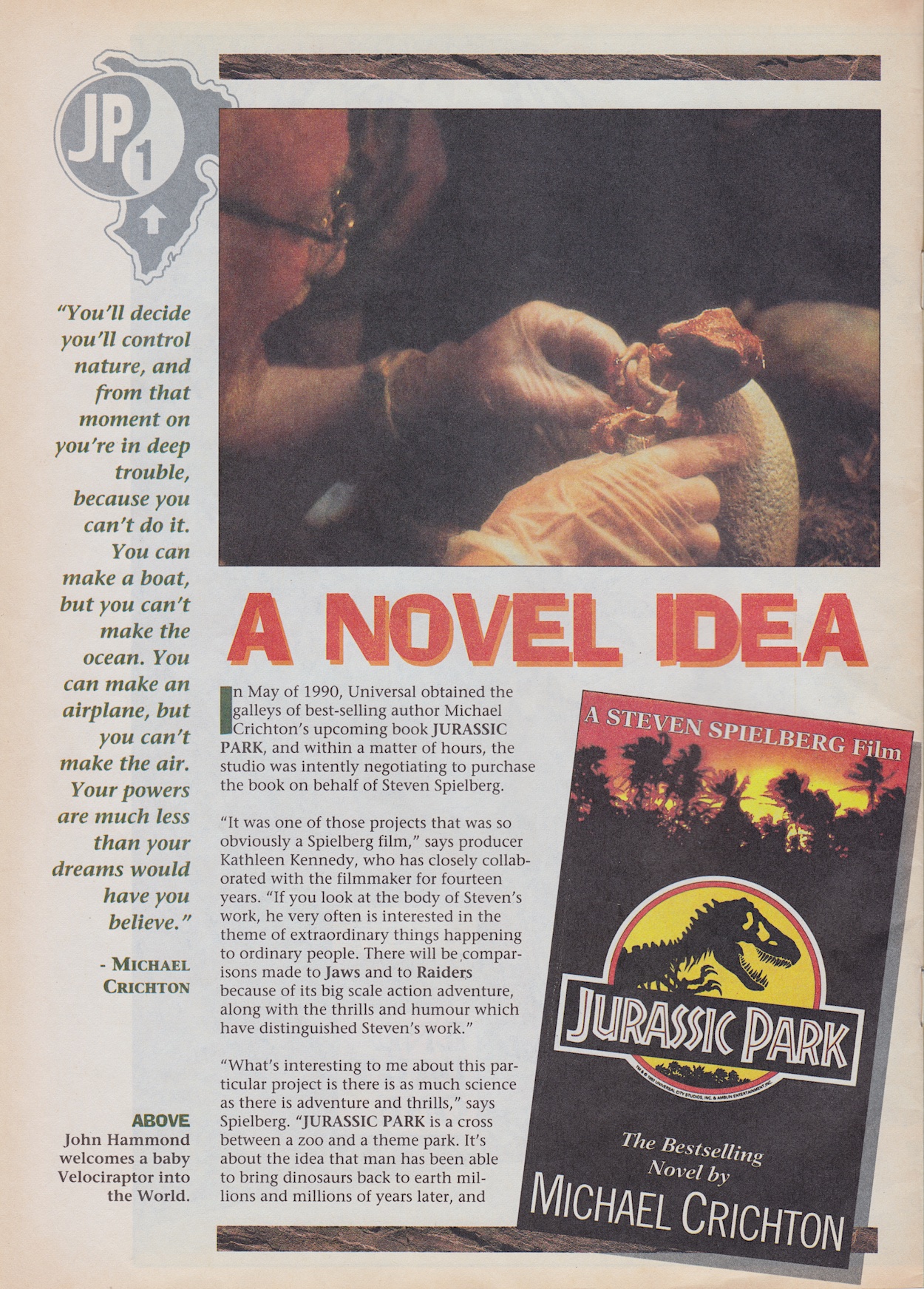
“You’ll decide you’ll control nature, and from that moment on you’re in deep trouble, because you can’t do it.”

Michael Crichton

Penciller Gil Kane sadly passed in 2000 but leaves behind a wealth of comics work on everything from Action Comics to Teen Titans and co-creating Iron Fist for Marvel. He was the artist on landmark stories in The Amazing Spider-Man, tales which led the Comics Code Authority to rewrite their rules about the depiction of drug abuse. Inker George Perez has won several awards for his comics artwork throughout his career, co-creating the characters White Tiger and Taskmaster for Marvel and he was artist on Crisis of Infinite Earths, The Avengers and Teen Titans amongst many others. George also wrote and drew on the highly regarded Wonder Woman of the late 80s and early 90s.

Colourist Tom Smith has worked for so many comics companies it’d be impossible to fit them all in here. Marvel, DC, IDW, Topps, Top Cow, Malibu and more. The Avengers, Hulk, X-Men and Justice League are just some examples of his artwork and he’s coloured for such legendary artists as Jack Kirby and Steve Ditko. Finally, John Workman lettered the complete run of Doom Patrol and has been a frequent partner of Walter’s. His style stands out, opening up the panel frames when his speech balloons or captions touch them, as evidenced throughout these early issues of Jurassic Park. John has also created strips for Star*Reach and lettered critically acclaimed titles such as Thor and Michael Moorcock’s Multiverse. What a team!

It’s important to put this story in the context of its time. Nowadays, mainly thanks to the film series we know details about dinosaurs and their social orders, hunting habits and intelligence. They’re no longer the lumbering, stupid lizards of stop-motion special effects. This all changed with the first Jurassic Park and reading this exchange between Dr. Ellie Satler (portrayed in the movie by Laura Dern) and Dr. Alan Grant, taken from the novel rather than the film, takes me right back to that time when this was all new information.

But taking me back also worries me. You see, as a kid I found comics adaptations of movies always seemed to have issues, such as excising whole scenes, leaving huge plot holes behind, or they’d copy some moments word-for-word but with artwork that failed to convey any of the drama, making exciting scenes rather dull. They felt very rushed with little thought given to what would work.

It’s brave to take up four pages with the opening of a gate!

Instead of falling into the traps above for a quick cash in, Walter seems to be properly adapting the story for the comics medium. Take the scene above for example. In the movie Alan (Sam Neill) simply described the hunting techniques of a velociraptor to the child. With his raptor claw fossil in hand and using it with slow, deliberate movements, Neill’s tone and delivery made this scene foreboding and funny in equal measure. This wouldn’t work in a comic, so instead we’re shown what the kid could’ve been imagining at this moment. It’s from this we get our cover image too.

Some scenes remain unchanged, at least in their dialogue if not their setting. The classic Dodgson scene with Dennis Nedry (Wayne Knight) is played out pretty much as it is in the film, but then again what’s in the film is almost verbatim what Crichton originally wrote in his book. So when it’s already worked in written form it doesn’t require changing. Speaking of the book, on more than one occasion some of its original ideas and dialogue, changed for the film, can be found here.

The following page is a good example, showing our main characters arriving on a helicopter at Isla Nublar, an island which covered in a thick fog in the original novel but not the film. There are also more details from Dr. Ian Malcolm (Jeff Goldblum) on how Chaos Theory predicts the experiment will fail. Crichton’s novel can often give several pages at once to Ian to describe his theories so obviously the movie had to simplify things, but they were utterly fascinating to read and in the comic just a little bit more of that original text is slipped in.

With an adaptation like this the aim is to have it on the shelves when the movie hits cinemas. This means work would commence with an earlier draft of the screenplay. As the screenplay changes from one draft to another some of those alterations come too late, meaning the comic could contain parts of the previous versions. In the case of Jurassic Park it makes for fascinating reading at times for a fan like me who knows the film so well.

However, the biggest change in this first chapter definitely comes as a result of the medium and the requirement to split the film’s story into four chunks. If I were to tell you that the cliffhanger at the end of chapter one is the first encounter with the brachiosaur, where John Hammond (Richard Attenborough) had his “Welcome to Jurassic Park” moment in the film, fans should instantly be querying why these next four pages are in this issue. (Actually, Hammond had his moment in the comic when they landed in the helicopter.)

These pages do look wonderfully dramatic, though. It’s brave to take up four pages with the opening of a gate! In the film this didn’t happen until after we’d been fed all the science behind the park and the characters were heading out on the inaugural tour.  But this isn’t the comic team taking liberties with the story. The first chapter is very much about making the introductions and with a distinct lack of dinosaurs some changes had to be made to grip readers to the overall story. If that means some iconic scenes have to be moved or elaborated on visually (like with the child’s imagination earlier), then so be it.

I think it was a smart move to rearrange the placement of this scene, but some people will always complain about such changes, like how movies have to change certain aspects of a book.  Well of course they do, it’s a completely different medium. Books based on films also add and rearrange elements of the story or characters to suit the reading experience, but they’re still the same story, just adapted to suit. Having read the novel, I’ve always felt Spielberg did a perfect job of translating Michael Crichton’s novel to the screen and now the comic was adapting Spielberg’s adaptation!

I do believe Hammond’s famous line would’ve worked better as part of this cliffhanger, but that’s just personal preference. There is one difference from the film I’m not keen on. In Crichton’s original story, while Grant overlooks the landscape he mistakes a brachiosaur’s neck in the distance for the trunk of a tall tree, until the dinosaur moves. Here, he’s meant to mistake a leg for a tree instead as they drive within a few metres of it. They didn’t see the giant tail or the belly over their heads?  If this was the original idea for the film I’m glad they changed it.

The final double-page is a beautiful image of their first encounter, with the remainder of this classic scene hopefully playing out next time. The captions make reference to the creatures welcoming them to the island and is also lifted straight from the book. In the novel the brachiosaurs come to this area whenever the helicopter approaches the island, eager to see the humans who they associate with looking after them. It’s a lovely, tender moment in the book designed to give a false sense of tranquility to the island.

When I collected Jurassic Park back at the time it was cover-to-cover strips, with the occasional competition and comics adverts thrown in for good measure. It was a pleasant surprise to see a series of additional features about the making of the movie in these early issues.

They begin right back at the beginning, long before any filming had taken place, informing the reader about Amblin and Spielberg buying the rights, their first impressions and what they felt were the scientific and moral highlights. These were the important things they’d want to concentrate on when developing their own vision.  It makes for a good if somewhat brief read and there’s more to come over the next few issues.

There’s also a checklist of Dark Horse’s local and import comics to be released over the next month. I can remember picking up an issue of their Aliens comic at some stage on a family holiday. Either it must’ve been before Jurassic Park or I was familiar with my friends’ copies because the trademark banner on the cover of this comic was already familiar at the time. I didn’t know there was a Dracula title and, while Jurassic Park has started out with just one strip every issue, it’s clear its stablemates were similar to other UK comic publishers’ titles, especially the aforementioned Aliens.

So there you go, our first look at Jurassic Park UK, a comic which has been sadly largely forgotten in the intervening years. I adored it and I can’t wait to share those later issues with you but so far I’m actually enjoying a comic movie adaptation, which is noteworthy in and of itself.

To finish here are your obligatory retro advertisements. I’m not too sure about some of those t-shirt designs but given half the chance as a 15-year-old I’d have jumped at the chance. On the back page is Kenner‘s toy range. I wasn’t even aware there was one. Obviously for a younger audience than I was but I’m still surprised I never spotted them in the shops.

There are some brilliant Jurassic merchandise adverts in this series and I’ll definitely be including them as we go, alongside those for some very-90s comics. I hope you’ll come along for the ride because it’s going to be great. After all, it has been 65 million years in the making.

Issue two of Jurassic Park will be roaring its way on to the blog in just three weeks (a unique release schedule for me) on Thursday 29th July.

GO TO iSSUE TWO

JURASSiC PARK MENU