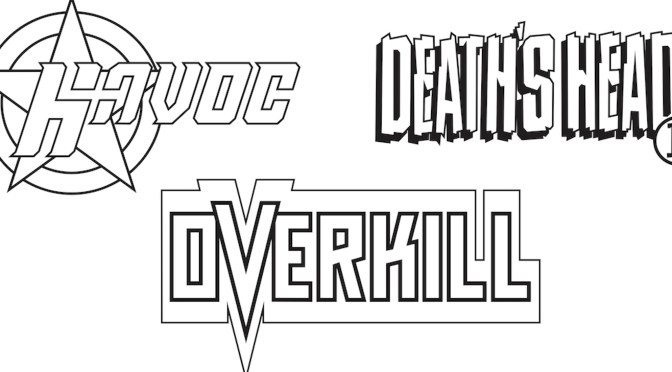
Havoc may not have lasted very long but it left a lasting impression, introducing me to characters I’d never previously heard of as well as giving me the chance to see the comic strip adventures of a favourite TV star. At the time of writing I’ve just finished a real time read through of the comic’s nine issues, during which I was able to have a chat with the person responsible for that terrific logo, Paul Chamberlain.
Paul is currently Creative Director at Pre-Flight Visual Communication Ltd, a company that seems to have designed pretty much every logo and front cover of every magazine I’ve purchased over the last decade! While chatting to Paul I discovered his inspiration behind Havoc’s logo, the other duties he took on and the string of MarvelUK and Fleetway Publications titles he contributed to.
OiNK Blog: So Paul, you created the logo for Havoc. Is there anything about the process you could share with OiNK Blog readers? For example, how did you get the gig?
Paul: It was spring 1991 and I had just returned from backpacking in India and Thailand. Before I went on my trip I had been working with Bernie Jay, the then partner of Paul Neary, at Headway Home & Law developing an idea for a monthly consciousness raising magazine. Headway Home & Law at the time was also the home of Fleetway who were publishing 2000AD and Bernie managed to secure me a couple of freelance jobs with them.
Upon returning from my travels, Bernie got in touch to ask if I would be interested in a bit of freelance work with Paul for Marvel UK. The first of these jobs was to design a logo for Havoc. I was working from home at the time and this was before the days of DTP (computerised Desktop Publishing – Phil) in comics so everything was produced by hand on a table in the corner of my bedroom.
OB: The Havoc logo is made up of a five-pointed star and there are five strips in the comic. Was this part of the design process or just a happy coincidence?
PC: Sorry to say it wasn’t quite as deep as that and just a happy coincidence. It’s difficult to remember my thought process at the time but I do remember having a thing for circles and stars. When I submitted the design to Paul Neary I do remember him saying that he liked it because it reminded him of a gun. I have to say that had not occurred to me during the design process.
I wanted the logo to have a slightly dynamic feel, hence the slightly italicised type. The original type design was very squared-off and blocky which didn’t sit very well with me so I decided to round off the corners slightly and add subtle serifs. A lot about the design was lead by the resources available to me at the time – Rotring pens, a ruler, set of compasses and a drawing board. As we used to do all our colour separations by hand everything had to have a strong black keyline so that this process would work properly.
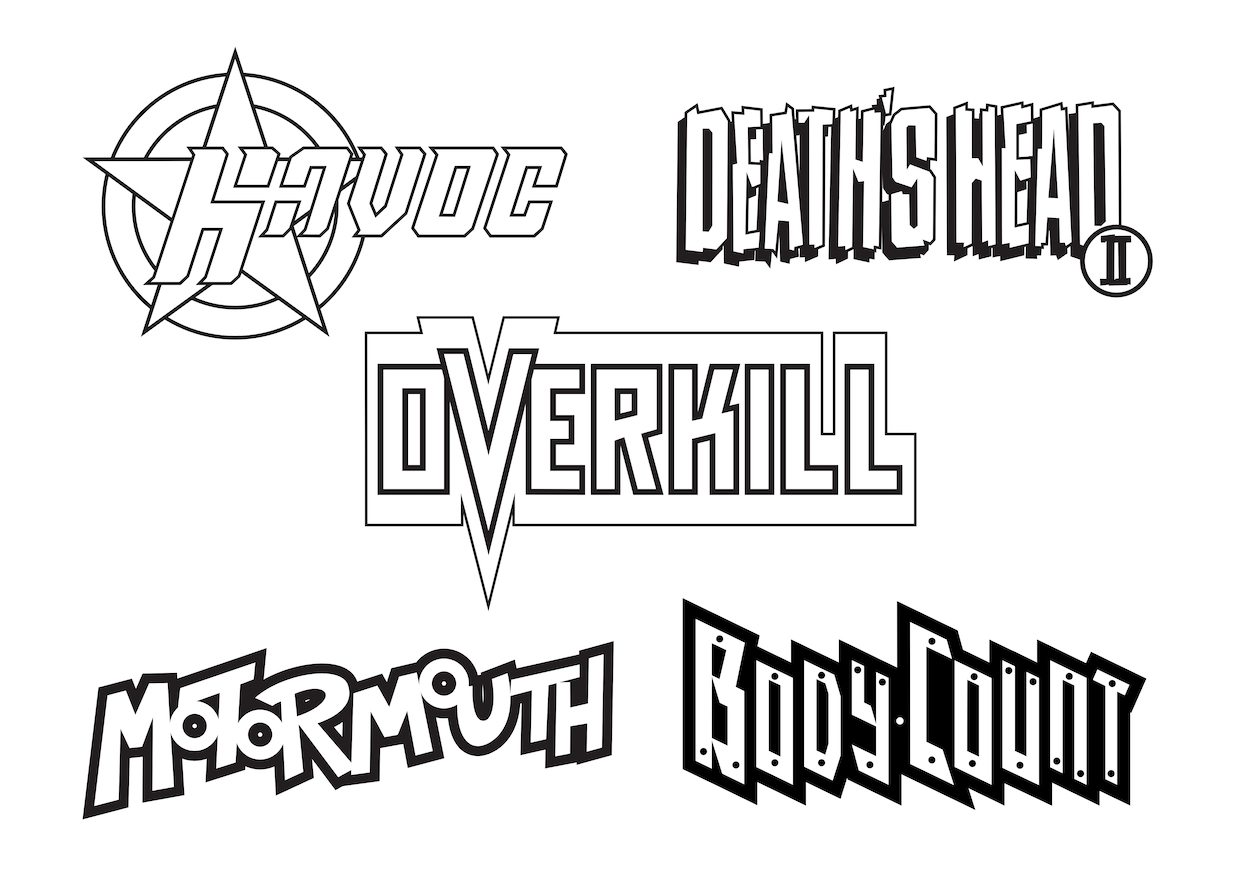
The next job I did for him was to design the logo for Death’s Head II which was created in-house and I had the pleasure of sharing a studio with Liam Sharp as he developed the character visuals.
After that I was offered a full time designer post at Marvel UK where I stayed for an amazing three years before heading off back to India for more travels.
OB: After Death’s Head II what other titles did you work on for Marvel UK and what work besides logos did you do for them? Were there any Fleetway comics you worked on too? I was a big fan of both publishers at the time.
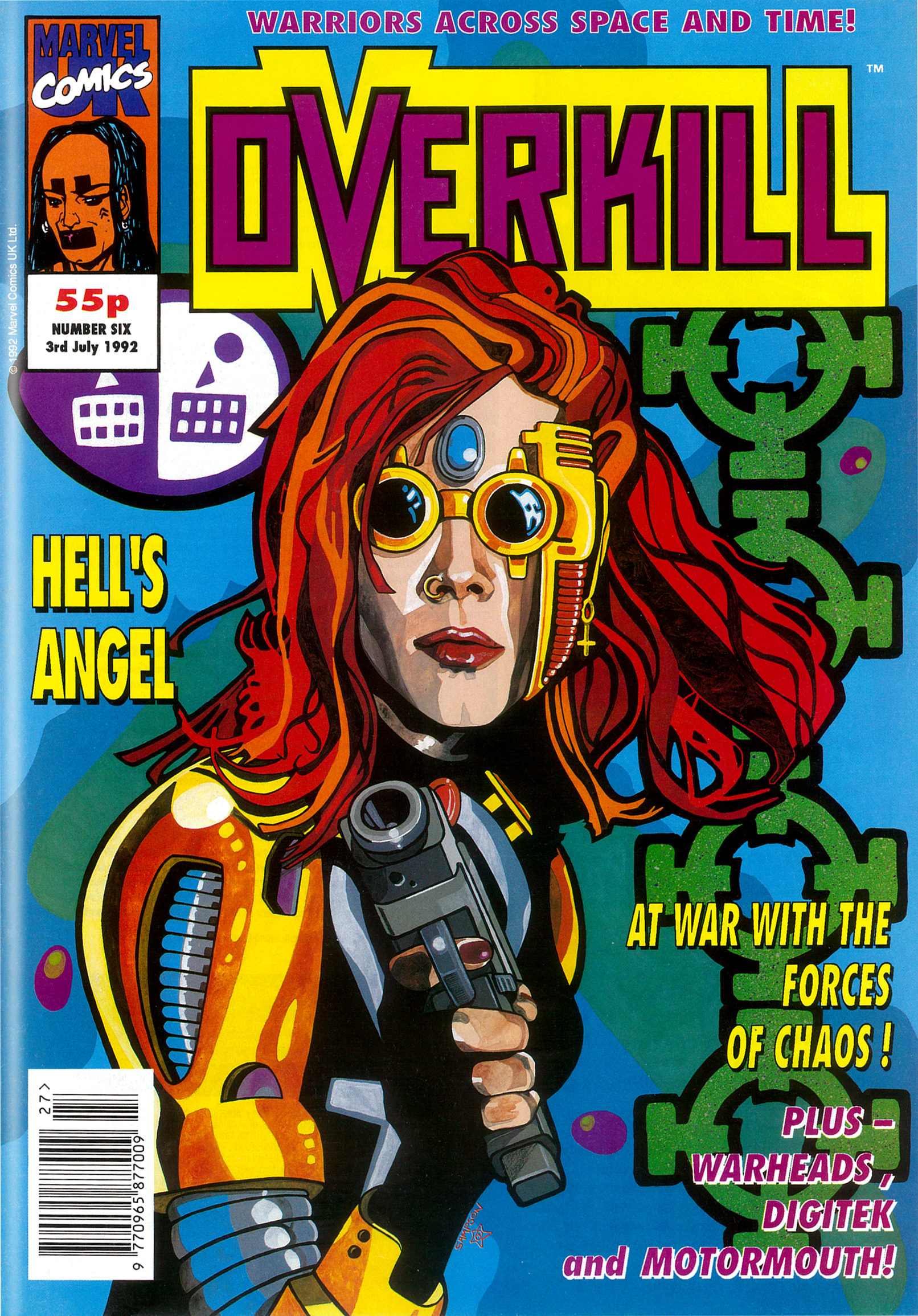
PC: So after Death’s Head I developed the first logo for Overkill and was Art Editor on that for some time. Along with another designer, Ed Lawrence, we became the design team for all the new superhero titles that came out of Marvel UK between 1991 and 1994 – Motormouth, Warheads, Hells Angel (which became Dark Angel), Super Soldiers etc. For Fleetway I produced the designs for The Judge Dredd Mega Collection with another designer, Colin Fox. Upon returning from my second stint in India I secured the post of Deputy Art Director at Titan Books where, amongst other responsibilities, I was the Art Editor for the official Lucasfilm Star Wars Magazine.
(Below, Paul’s favourite Overkill cover with art by Steve Sampson.)
OB: Wow, tthat’s a wonderful selection of titles, it must’ve been such an amazing time! I’ve always been curious, for an ongoing reprint comic what does the role of an Art Editor entail, after all the initial titles and pages have been designed?
PC: You are right. It was odd coming from a consumer magazine background. It was mainly covers and house ads. With the reprint stuff there was some resizing of artwork and new title pages if it was a longer story being broken down. For the graphic novels and collections there were also end pages, chapter dividers and the likes.
OB: Ah right, of course, all those American strips being chopped up into parts in the UK comics. I also noticed new opening panels for some of the Havoc strips so would those have been you, creating them and resizing the original art around them, yes?
PC: As designers we wouldn’t be creating new art but definitely resizing and re-laying out. That would be the kind of thing, but I think Gary Gilbert was responsible for the ongoing design duties for Havoc (like the contents, letters and Eye Level news pages).
OB: Thanks so much for the chat Paul and the insight into one of my most fondly remembered comics.
PC: No problem Philip, anytime.
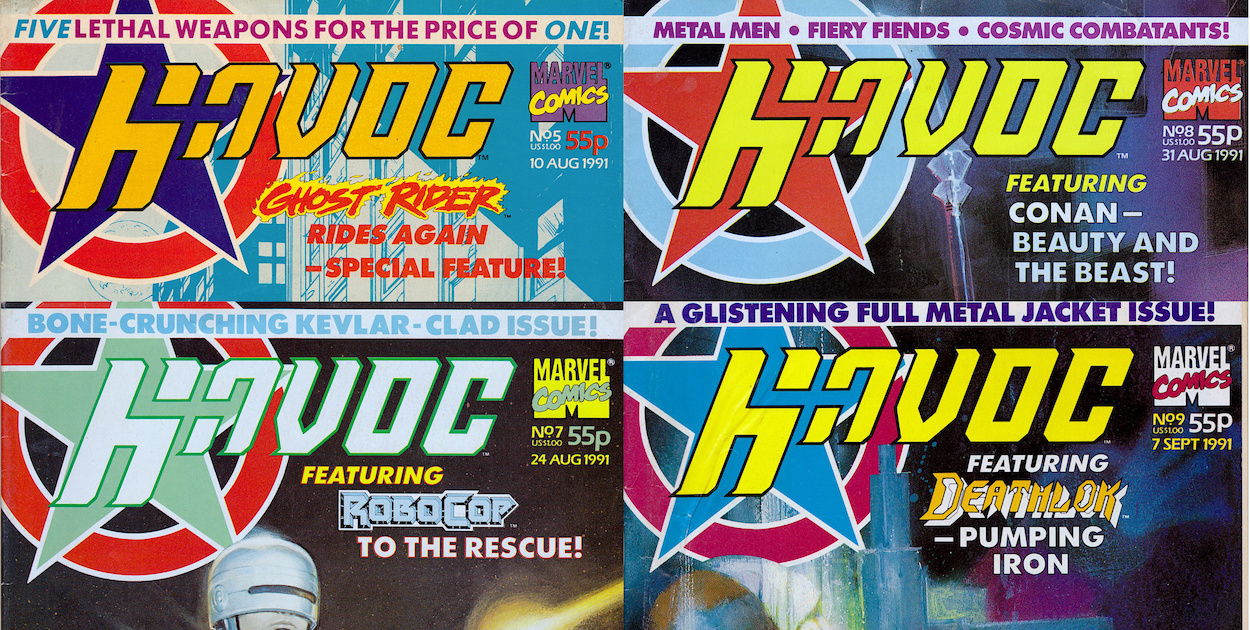
Above is the complete Havoc collection with its many variously coloured logos. To read all about this wonderful comic and begin the real time read through just click here.
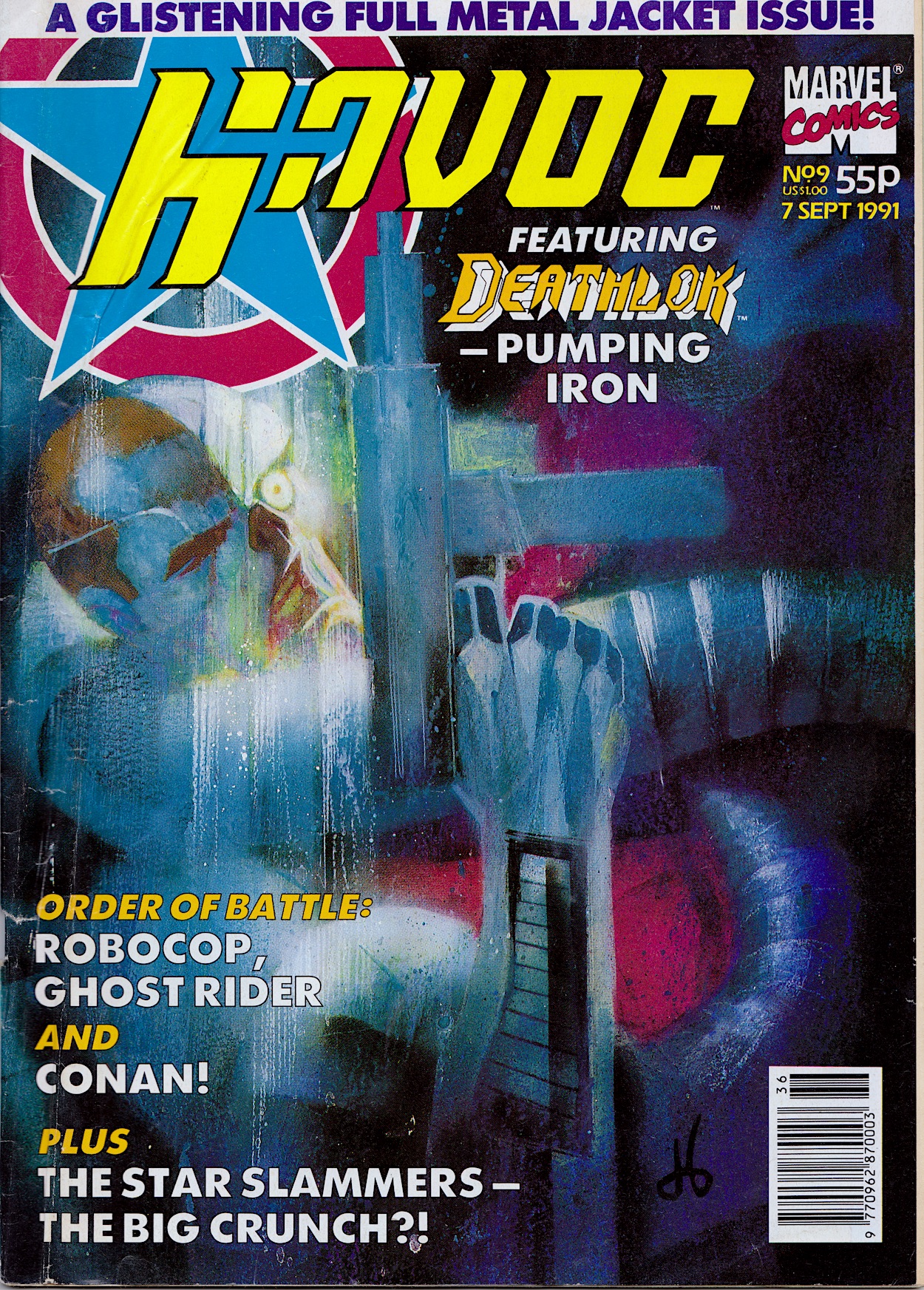
This just isn’t fair. That’s how I felt during September 1991 when #10 of Havoc failed to appear, the comic unceremoniously cancelled without so much as a note to the readers. This issue continues on as normal with cliffhangers and ‘Next Issue’ promos as well as hints of what was yet to come. Clearly pulled after it went to print, Havoc was the latest in what felt like a long line of comics I’d committed to which ended up the same way. Now having enjoyed the series 31 years later in real time I’m left with that same feeling of unfairness as I finish off #9.
If you look at the cover date you’ll see the next issue was due 7th September 1991. With #1 arriving as soon as the school summer holidays had begun, #10 would’ve been the first after the next school year began, Havoc’s brief run perfectly wrapped up in the holidays. When I returned to school I found out several of my friends had also been excitedly collecting it and we ended up sharing our disappointment in its disappearance.
Goodbye Havoc, it’s been a blast and you deserved better
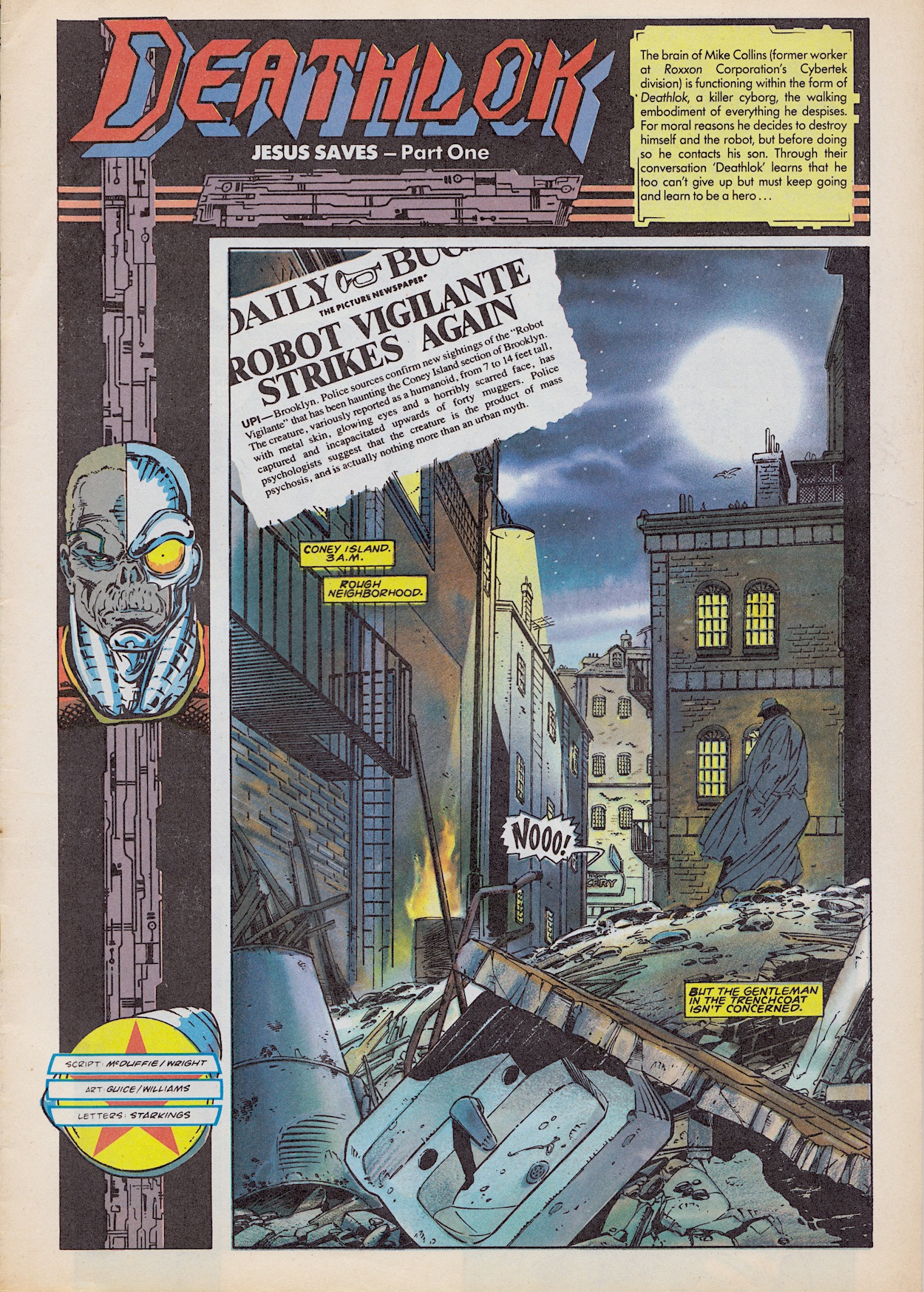
None of the included strips saw a conclusion and two new stories actually begin here, such as the first for Deathlok after Michael Collins’ origin story. Even though it’s the beginning of a new tale we still got a catch up banner to bring new readers up to speed, something no other ‘Part One’ received. Jesus Saves adds new talent with Scott Williams (New Mutants, Superman Unchained, Batman: Hush) joining as inker with Gregory Wright now only writing, and Paul Mounts (Fantastic Four, Friendly Neighborhood Spider-Man, Ultimates) as colourist, although he goes uncredited here. Joining Gregory on writing duties is co-creatorDwayne McDuffie, pencils are by Jackson Guise and lettering by Richard Starkings.
Nice use of the Daily Bugle there, as ever doing what any tabloid does and using exaggerations and shock journalism to strike fears into its readers, with the almost mythical rumours of Deathlok reported as fact on the front page, something Spider-Man fans will be all too familiar with. I’d never read a Spider-Man comic at this point in my life so was completely unaware of the Bugle being a part of the Marvel universe. Through this the strip also establishes our setting as Coney Island.
The Jesus the title refers to is Jesus Badalmente, a homeless man who would end up becoming a roommate and companion to Michael as he battled against Cybertek and tried to find a way back to his body, which he would find out was being kept alive. These are points I only found out in researching who this person was because the way he’s presented here I had a hunch he was being introduced as a regular. Jesus makes robots and is a bit of a cybernetics whiz, which I’m sure will come in handy at some point.
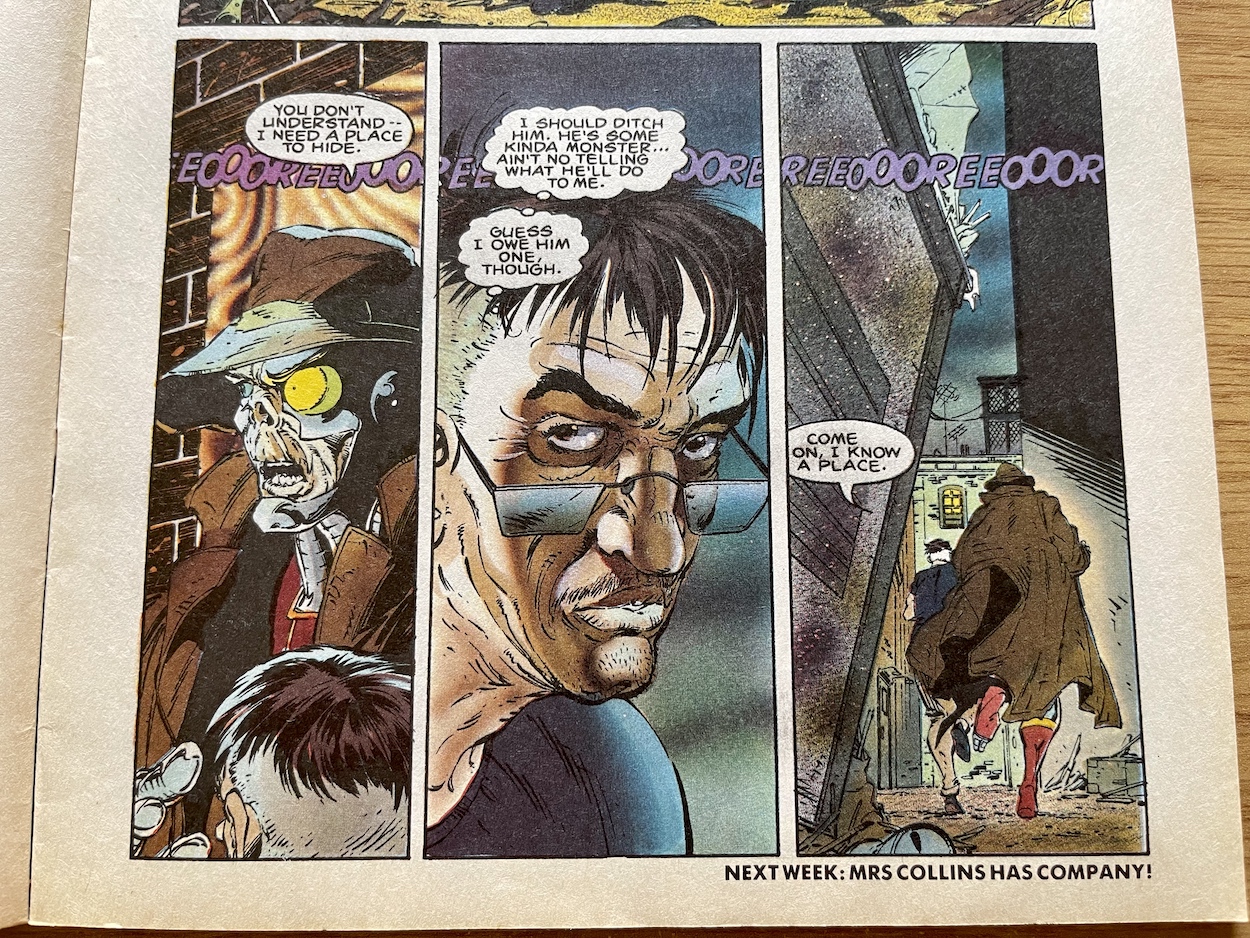
These first five pages of the story basically see Deathlok rescue Jesus from a mugging and in return he’s taken somewhere safe as the police arrive. Jesus’ first reaction is one of fear and revulsion, as will probably become the default as Michael encounters people. But just as he thinks Deathlok has only seen off the muggers so he can kill him, he is then saved by the cyborg from one of the muggers trying to run them down in a car. That’s enough for him to take a chance on this strange individual.
I’ve really enjoyed Deathlok. He was my favourite as a teen and it’s been brilliant to catch up with him again. The origin story was full of character and Dwayne McDuffie and Gregory Wright strike me as writers who’d make sure character development was key to the strip’s success. The action has been great, the interactions between Michael and the computer genuinely funny and I find myself really caring about what happens to them. One to track down for sure.
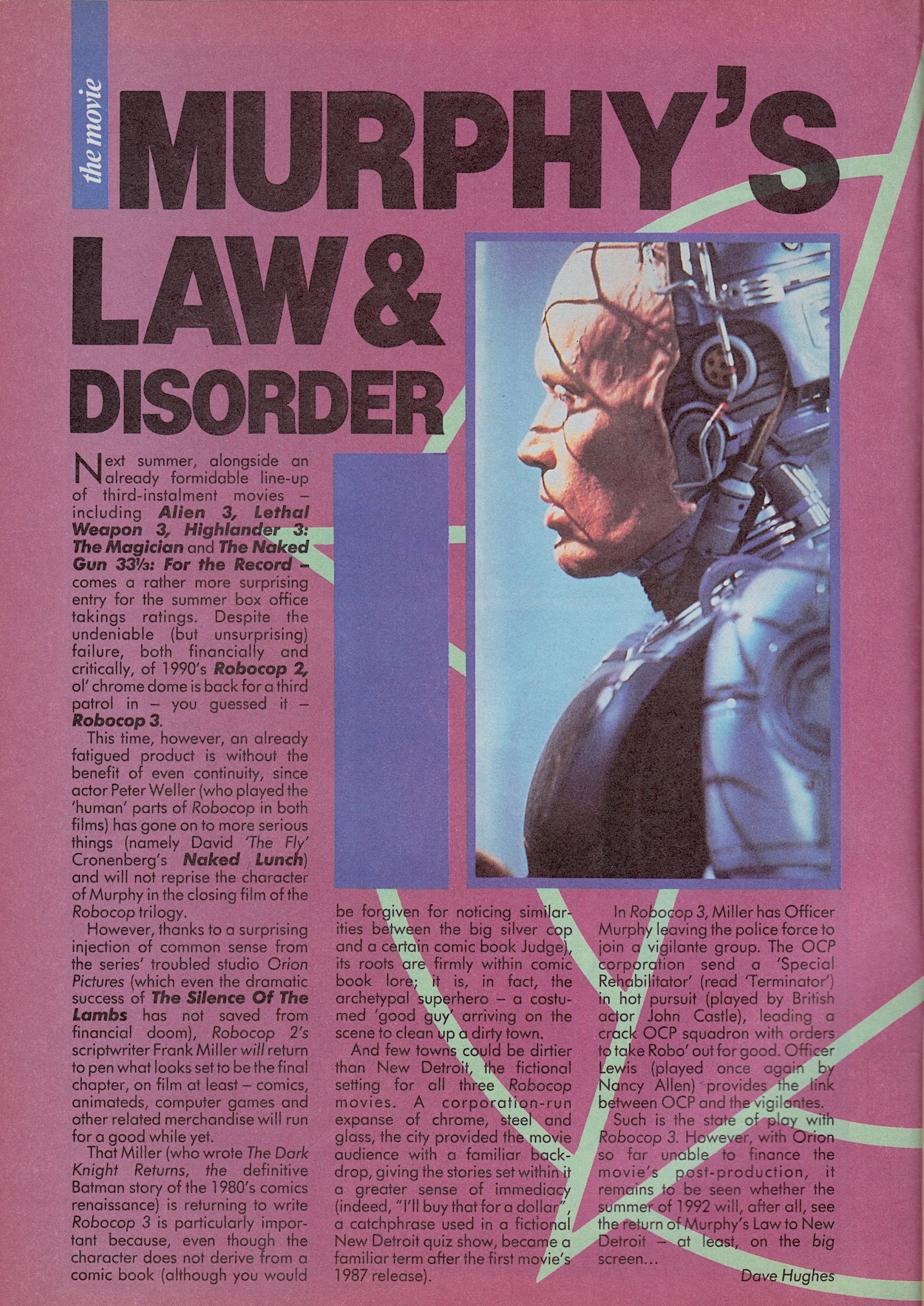
Before Murphy’s strip are two RoboCop features, with a third later in the comic. The first one concentrates on the franchise itself, in particular the in-progress RoboCop 3. The second movie had been released the year before and while it had proved to be a moderate financial success it was generally panned for not living up to the original. I remember being disappointed by it because Robo himself felt flat and boring.
What’s strange here is that Dave Hughes‘s feature describes the franchise as a “fatigued product” in a comic printing strips based on that product! How did that make it past the editor? He also criticises Robocop 2 but praises the fact that its head writer Frank Miller would be returning for the third film. Yes, I’m aware Miller’s screenplay went through various rewrites by other writers but it’s still a strange thing to be thankful for after not enjoying his first RoboCop sequel.
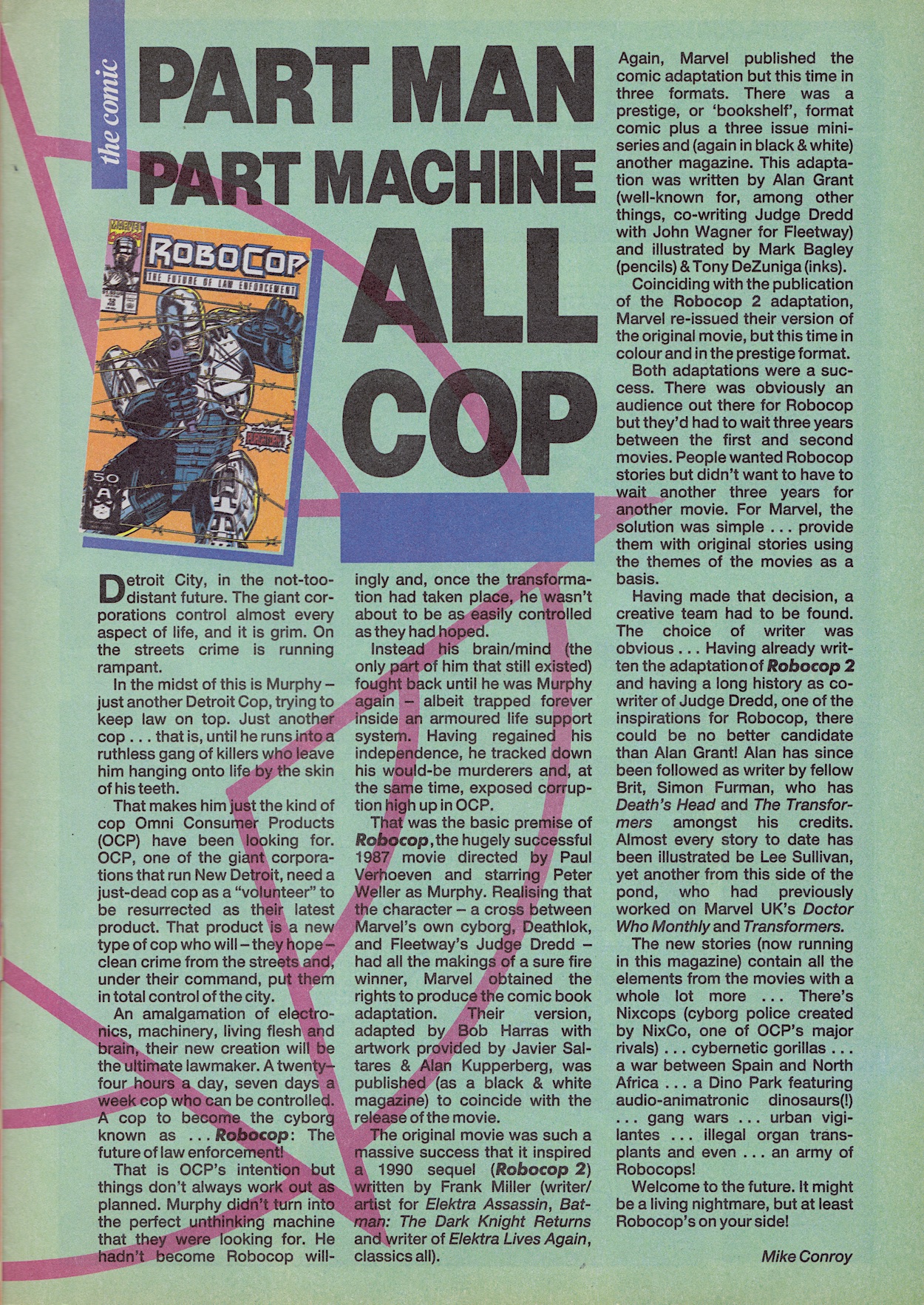
This second feature is meant to be all about the comic strip, a major selling point of Havoc’s anthology. Unfortunately, Mike Conroy really does take his sweet time getting to the stage of discussing them. It’s not really until the third column that he gets into the meat of it all and then it’s over. There really wasn’t a need to reiterate so much of the lore and background to RoboCop for people who would already have been up to speed on all of that.
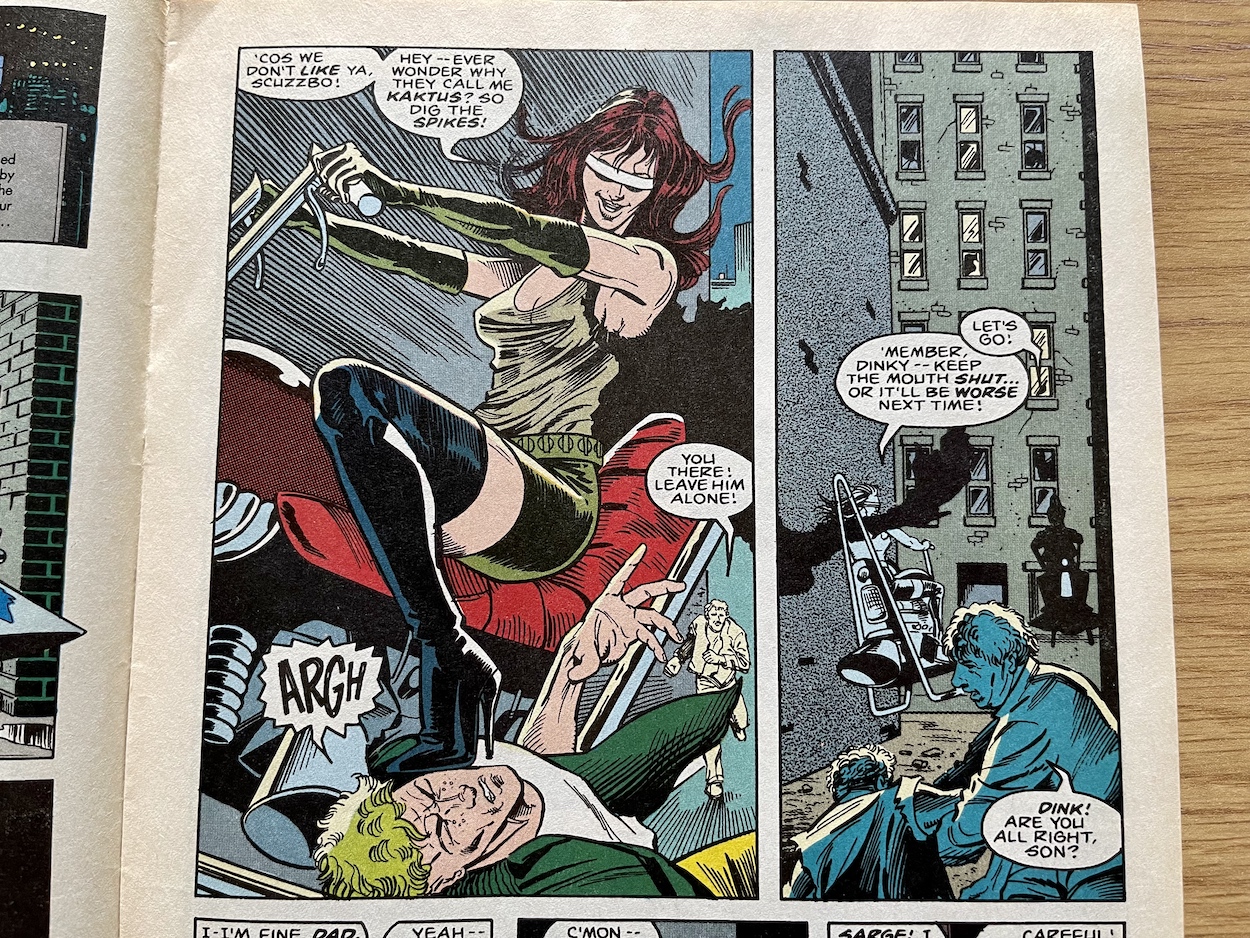
Let’s move on to the strip itself, part two of Vigilante by Alan Grant (with pencils by Lee Sullivan, inks by Kim DeMulder, colours by Steve White, letters by Richard Starkings) and it kicks off with muggers on hover bikes, showing how the comic would go all-in on the future setting, taking the strip more into the sci-fi fantastical than the original movie, which was more grounded. But this is a different medium and it works well to get across the setting and how dangerous Old Detroit really is. After this, the father of the victim complains about how the police are locking up people like General Power from last issue when the city needs them more than ever.
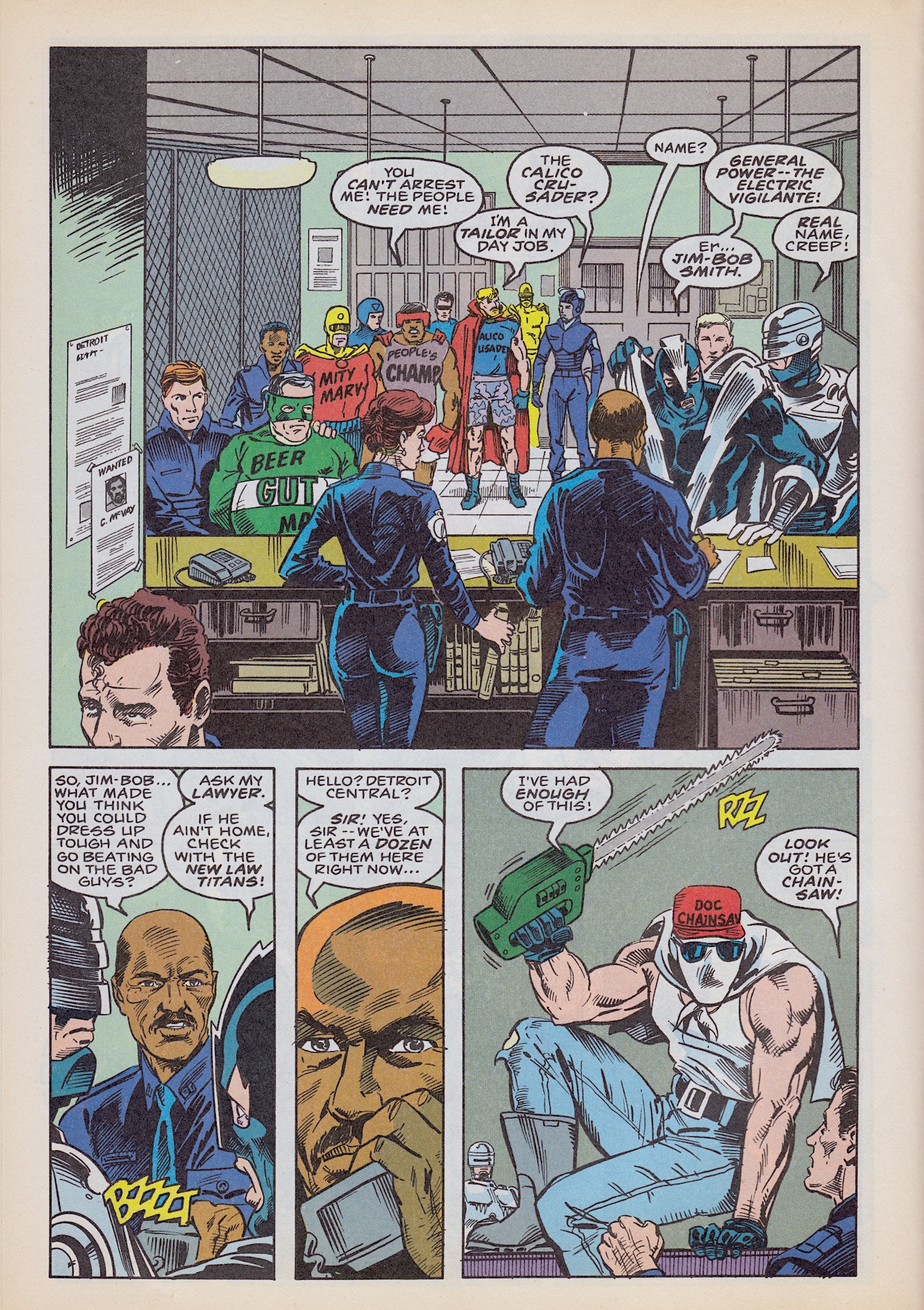
These masked vigilantes’ reputation is a lot better than the reality of the people behind the costumes. Take General Power for example. After frazzling the man he was trying to save last issue he’s brought to the desk of Metro West by Murphy and told to give his name. After declaring himself as ‘General Power’ he’s ordered to give his real name which he hilariously admits is Jim-Bob Smith.
With a precinct full of wannabe superheroes, one of them has had enough and what comes next is a bit of a shock when read today.
RoboCop was set in the not-too-distant future and the first movie and the TV show were, in hindsight, really rather prescient. So much so its surprising at times watching the series to see how well they predicted our world thirty years in the then-future, providing a scary insight into where we could be going. Bear this in mind when you see this next panel of that wannabe you saw in the final panel above, going by the name ‘Doc Chainsaw’.
He says it’s not against the law to “put on a suit an’ prowl the night” (which itself sounds more creepy than I think he intended) right in front of RoboCop. As if his red hat wasn’t enough, his general attire and his choice of words when confronted by Alex would be a bit on the nose if written today!
I don’t think I need to make any more comment on that one. Soon the sarge barks an order; all the vigilantes are to be charged with misdemeanours and set free. This happens much to the chagrin of the officers but has come down from the “very top” and thus the main mystery of the new story begins. Robo leaves to see if there’s something he can do (but we’re not given any more hints as to what this could be) and then we see former mugging victim Dink and his dad settling down to watch the city’s latest reality show, ‘The Detroit Vigilante‘ and that’s where it ends.
Deathlok and RoboCop have similar set ups but they’re handled in such unique ways you wouldn’t think they were unless you stopped to break down what’s at the core of their main protagonists. I was never a fan of the movie sequels to RoboCop so initially had some trepidation about these strips since they were also direct sequels, released before the TV show. But I’ve been pleasantly surprised to find a nice halfway point between the original film and the show, with Alan Grant grasping the character much better than the movie studio did around the same time.
“Pain is inflicted quickly and harshly upon those who would harm innocent children.”
Ghost Rider
It’s hard to judge a comic strip series based on only the first couple of stories but I’ve been impressed with this version of Murphy so far. The first story brought the action, the second concentrated more on the characters and this one feels like it’s settled in more to the episodic nature of the storytelling, this first part setting things up nicely. Normally I’d be eager to see the next chunk but it’s just not forthcoming right now. Sadly, it’s goodbye to another favourite for the time being.
To soften the blow (although this wasn’t the original intention) we get a third feature for our part man, part machine, all cop hero, billed on the contents page as an interview with Marvel UK artist Lee Sullivan who did superb work on RoboCop for the American arm of the publisher. Calling it this is a bit of a stretch though. It reads as if two quotes by Lee were pulled from a general career interview, with one answer about RoboCop and the other about Doctor Who, filled out with information about the artist.
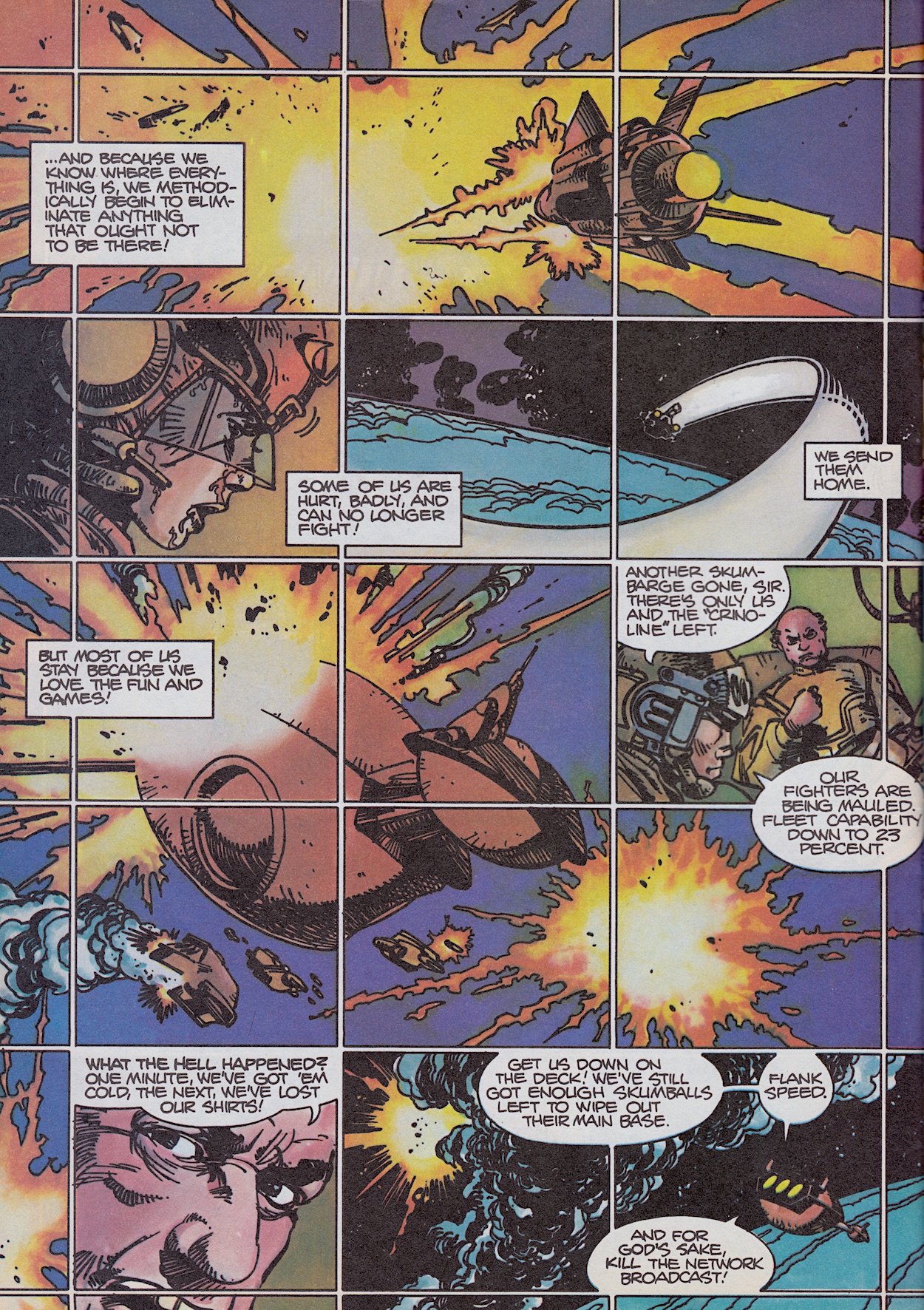
“…and because we know where everything is, we methodically begin to eliminate anything that ought not to be there!”
Star Slammers
Don’t get me wrong, it’s interesting information and a good article but I was looking forward to an actual interview about Lee’s work on this particular strip. That’s two of the three features about this character that feel like they included an awful lot of padding to make up the page count. Such a shame because I do enjoy Havoc’s extras but I’d have preferred those two to have been combined into one and another Eye Level included instead.
There’s mention here of Marvel no longer having the RoboCop licence which again is a strange thing to include when you’re trying to entice readers back for more. About a year before this, Marvel UK’s Transformers announced the forthcoming release of a new RoboCop fortnightly comic. It was never released, with Robo appearing the next summer in Havoc instead.
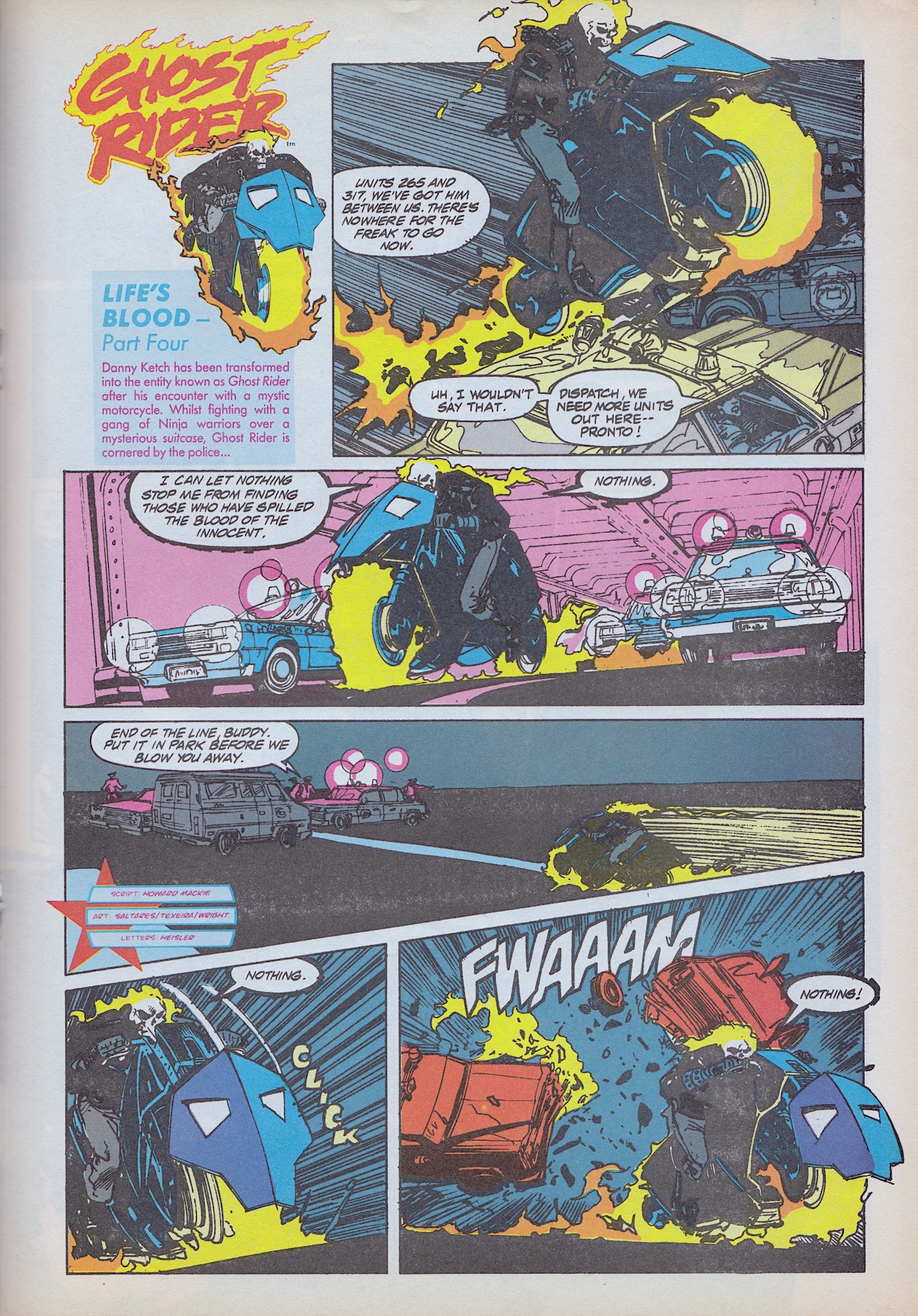
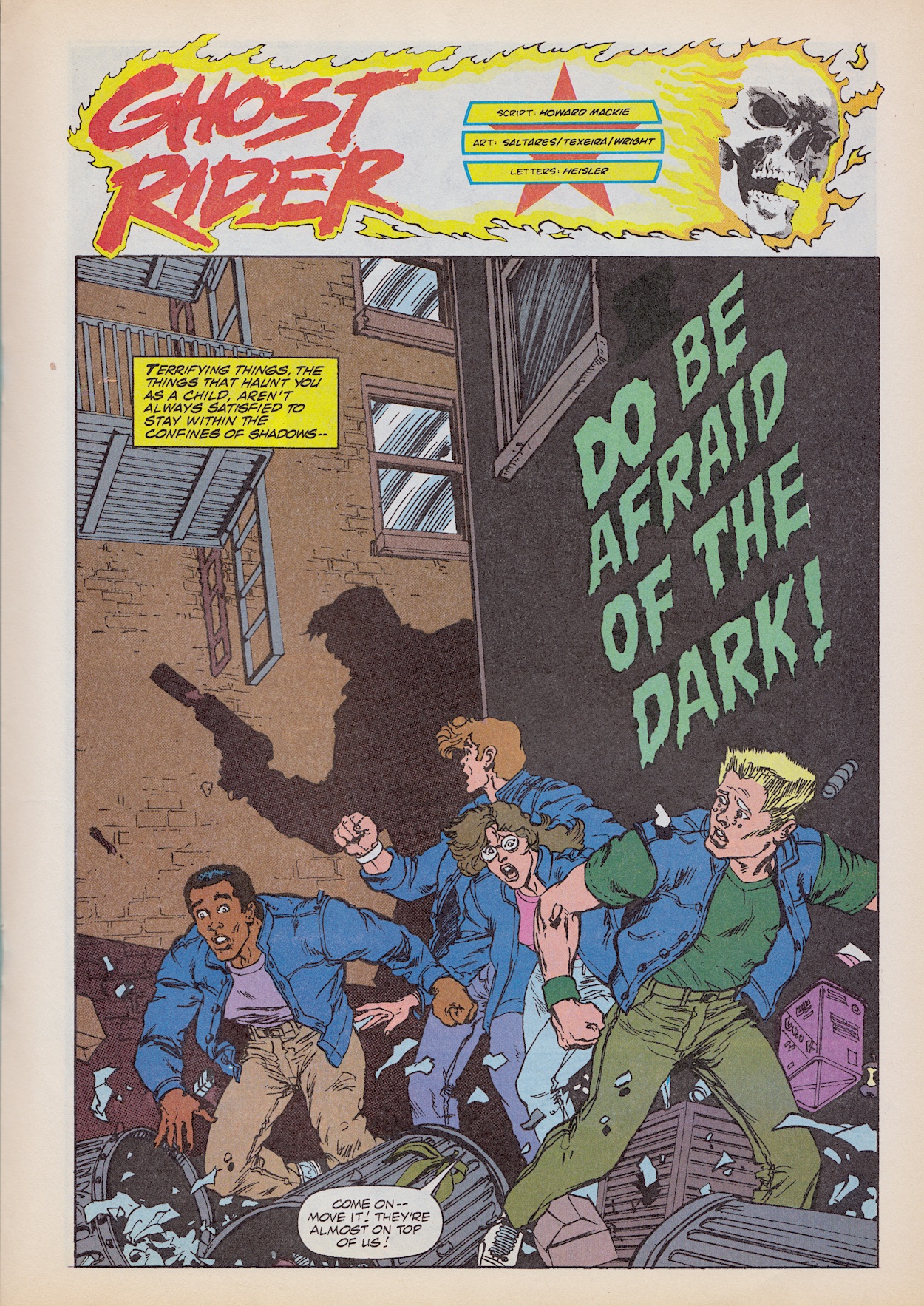
Danny Ketch and his Spirit of Vengeance get the bulk of pages this issue with part one of Do Be Afraid of the Dark (written by Howard Mackie, pencils by Javier Saltares, inks by Mark Taxeira, colours by Gregory Wright, letters by Michael Heisler) which begins with the gang of kids from previous issues, now referred to as the Cypress Pool Jokers, hunted down by who we assume are Deathwatch’s minions. Demanding to know where the canisters are, they’re threatening the lives of the kids at gunpoint when a bright light and roar of a motorbike from a nearby hedge halt proceedings.
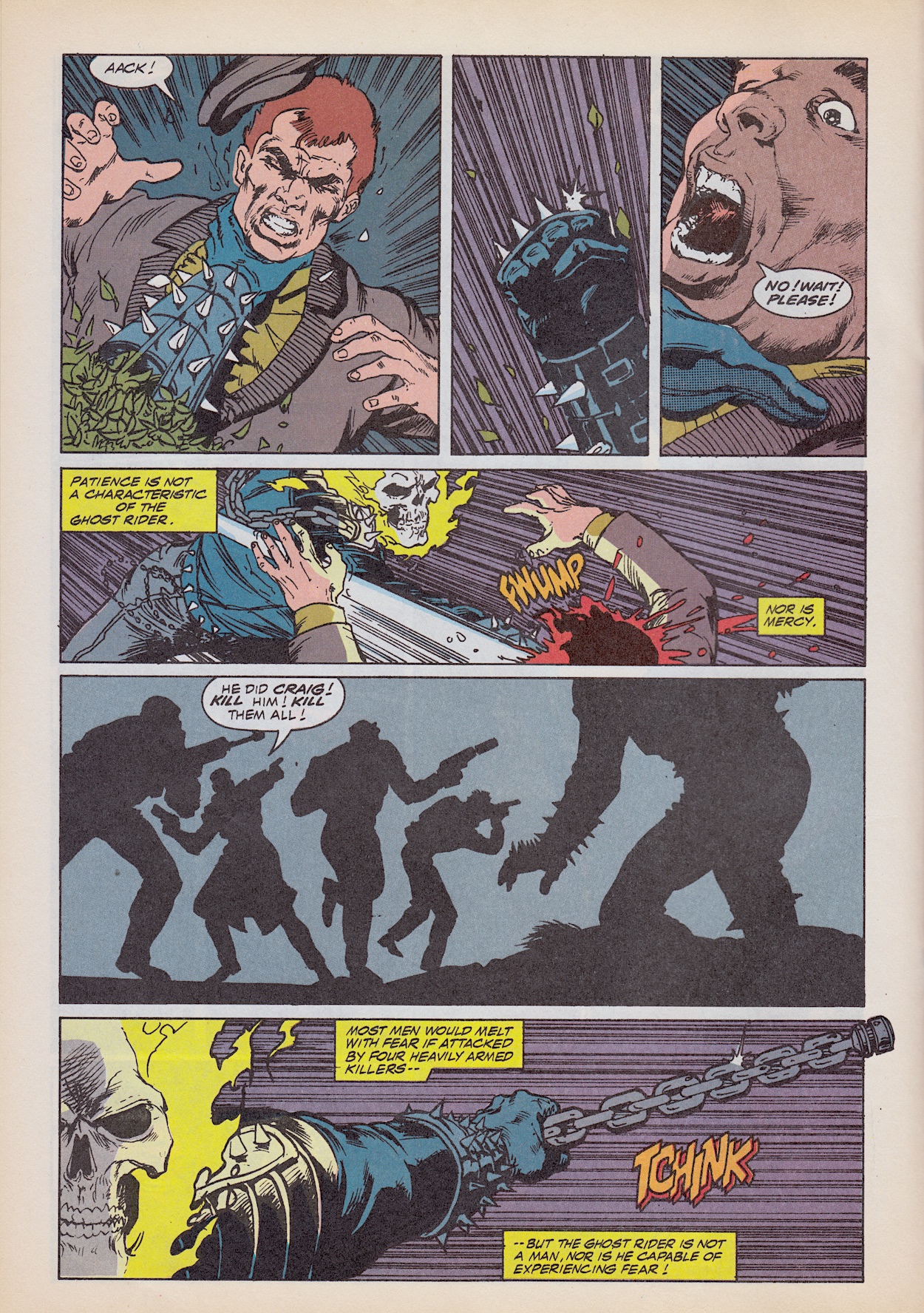
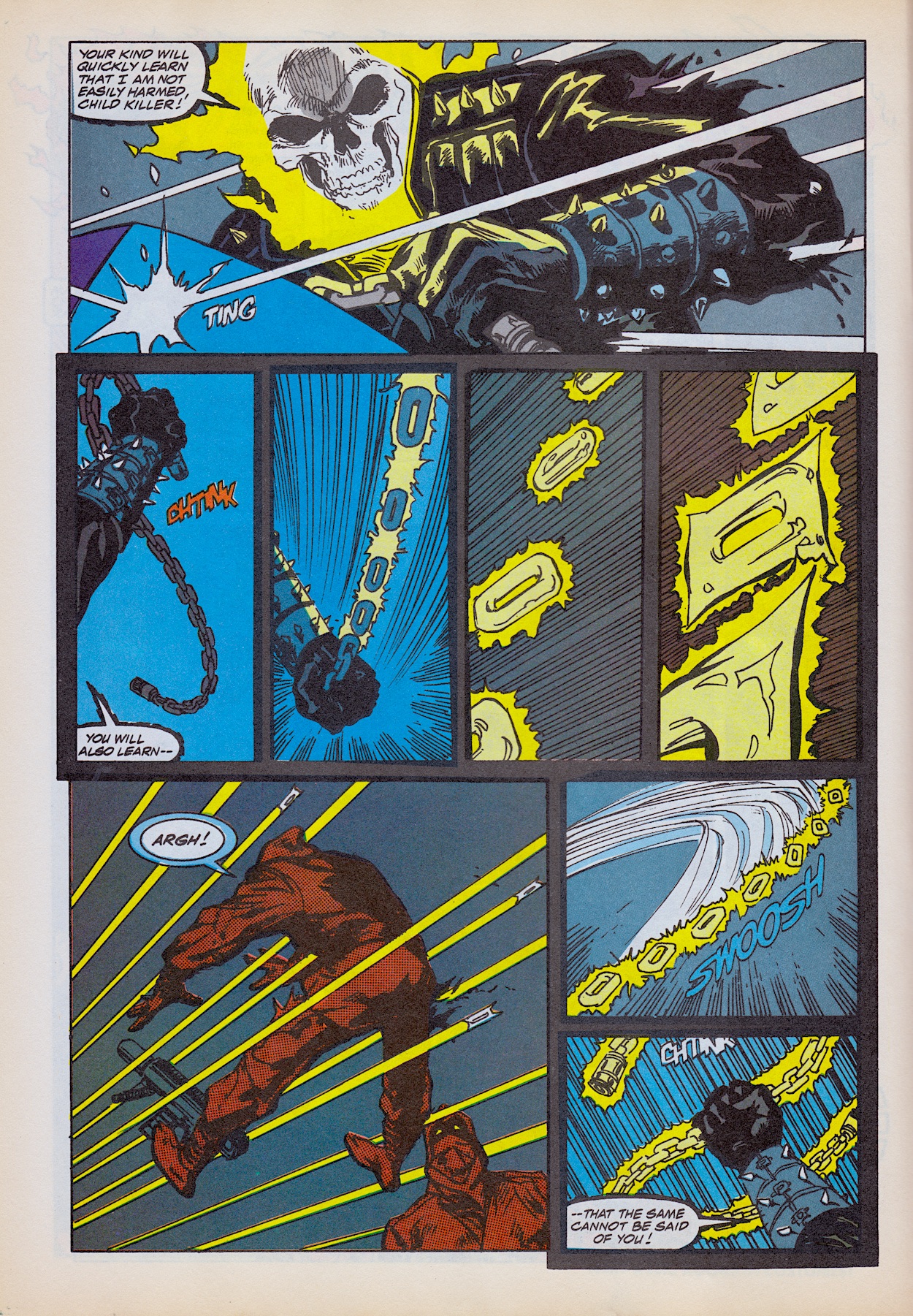
Out zooms the Ghost Rider, glowing against the night sky, only to be met by a hail of bullets. What’s interesting is that everyone knows his name already, his presence in the city plastered all over the newspapers and of course the criminal underworld would be all too aware of him after he took some of them out. Falling off the bike and back into the hedge, the night goes dark again, the Ghost Rider’s flame apparently extinguished. Until the next page that is.
Scenes involving the Ghost Rider when apparently surrounded and outnumbered are always great fun but I can only imagine how awesome these would’ve seemed to a teenage me. (I’m sure they were but my memory has let me down.) I can confidentially say this was unlike anything I’d ever seen before. Brutal but thrilling in equal measure, this first part of the new story really hits the ground running. Essentially a direct follow up to the origin story, it’s unfortunately not clear in these first seven pages whether any other main plot would be introduced.
On the next page it’s stated how Ghost Rider would normally take his time, ensuring to inflict the most pain possible on these men, equal to the pain of each individual’s past offences. But this night he needs answers and so he lashes his magical chain around one of them and drags them away off the back of his bike, the criminal’s body bouncing up and down on the road over the ghostly flames.
Hung over the side of a very tall building Eldon finally admits he’s not part of either criminal enterprise. Instead, he’d heard about Kingpin looking for the mysterious canisters and so he thought he’d take his gang out to find them, present them to the criminal mastermind and get in his good books. Ghost Rider gets no answers but that image of him, followed by the fate of Eldon have me gagging for more.
The kids see him drive off, recognising him now as one of the good guys. “Man, he’s hot!”, exclaims one as he disappears from their sight, and from mine. This appears to be the most serialised of Havoc’s strips rather than individual stories, at least for the time being and I’m gutted this is my cut off point again. As my introduction to Ghost Rider he’s been a brilliant character in a very well written strip illustrated in a scratchy, mature fashion that perfectly suits him. Defintley my favourite part of Havoc and the one I’ll miss the most.
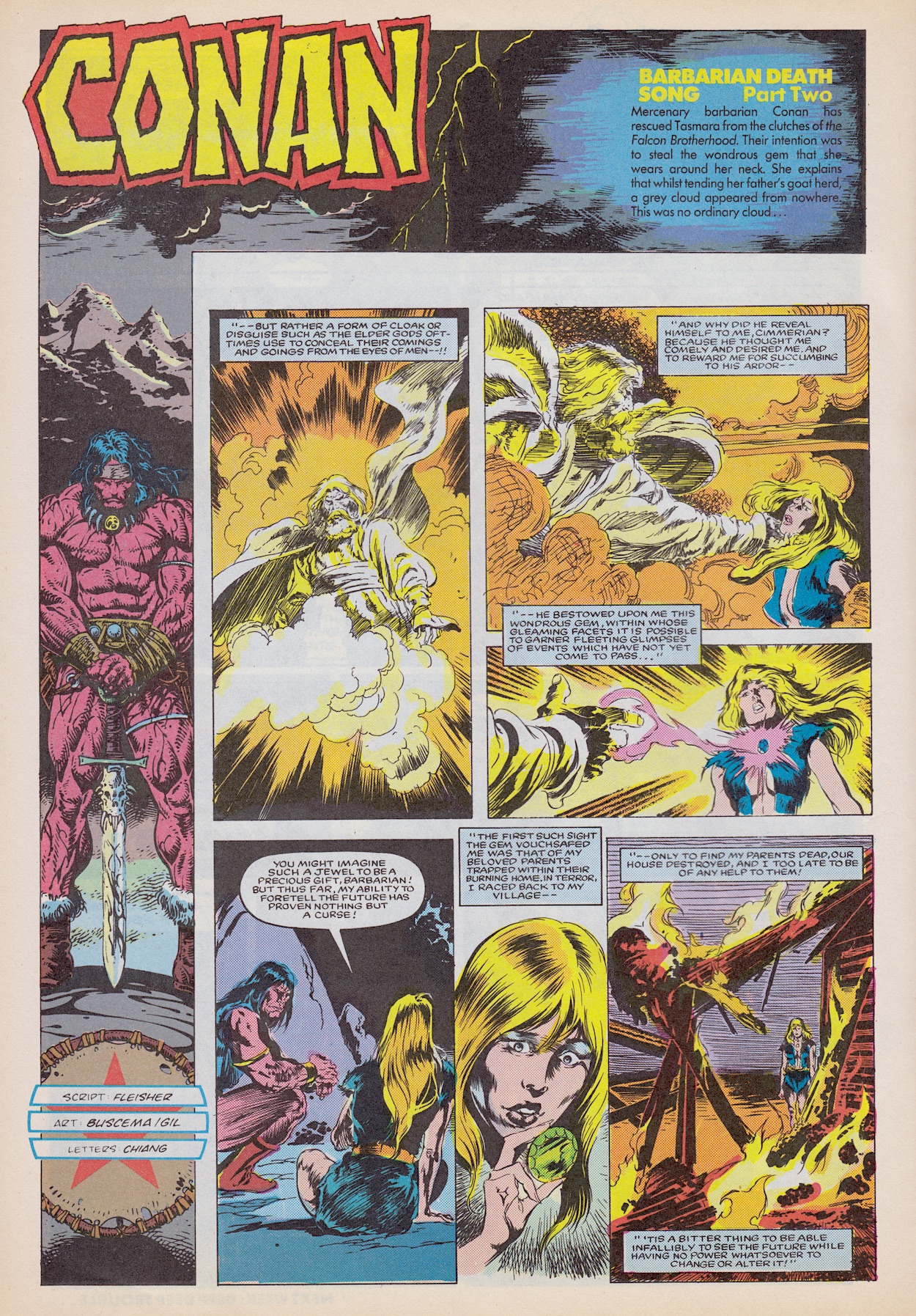
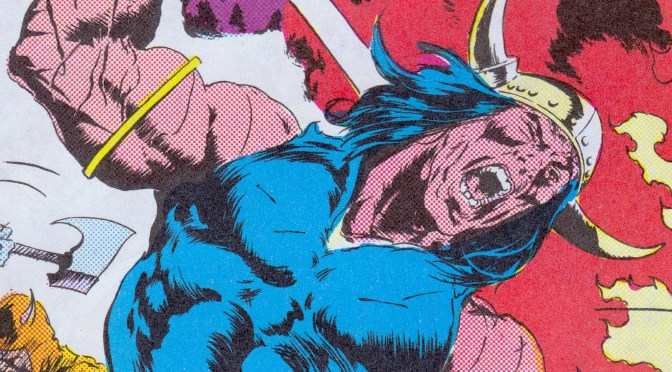
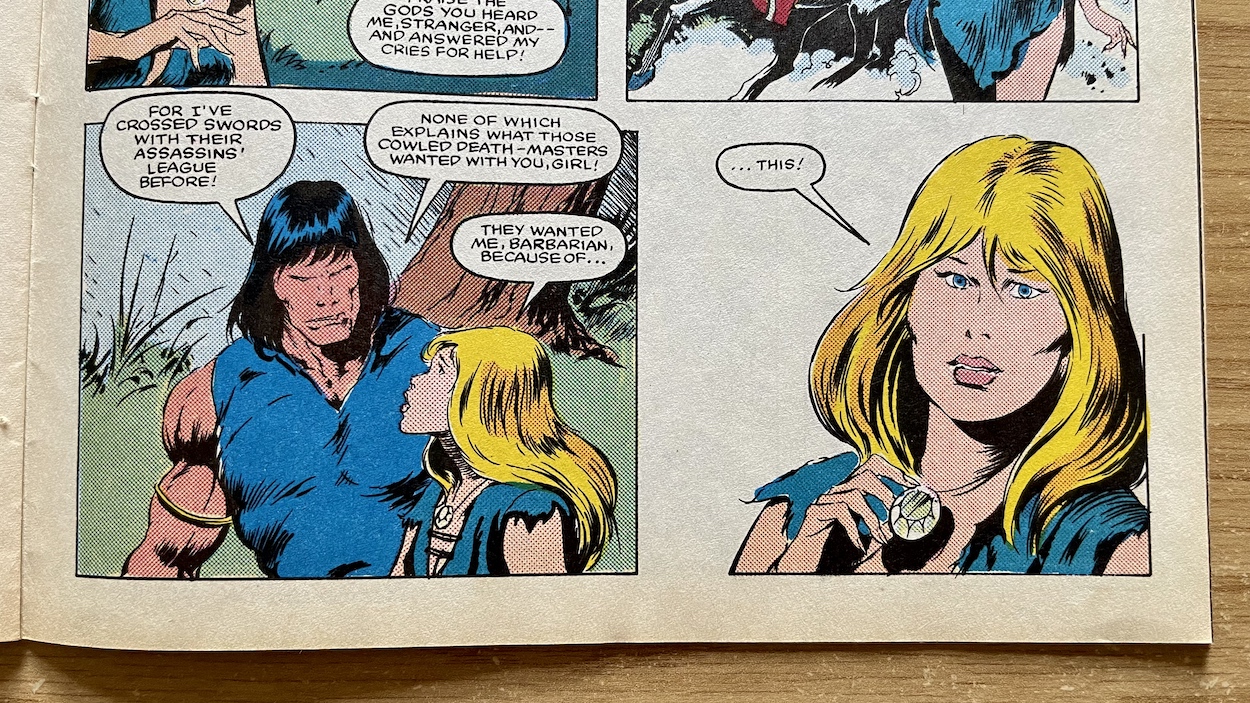
Part two of Conan’s Barbarian Death Song (written by Michael Fleischer, pencils by John Buscema, inks by Armando Gil, letters by Janice Chiang) sees our female guest character finally named (Tasmara) and she explains the cloud from last time was actually some random god who bestowed the jewel upon her neck because he was so enraptured by her beauty. She’s now being chased down by Baron Gerdeg and his Falcon Brotherhood because it gives her the ability to see the future, something she realised through tragedy as you can see above.
This gives this fantastical element a sense of foreboding right from the start; it’s a curse rather than the gift it was intended as. As they chat she sees something else shocking, Conan’s death! Her vision includes his funeral procession, accompanied on either side of his coffin by both allies and foes he’s previously fought alongside and against, taken directly from the poem this story uses as inspiration. For more on that check out last week’s review which explains Conan’s last ever story.
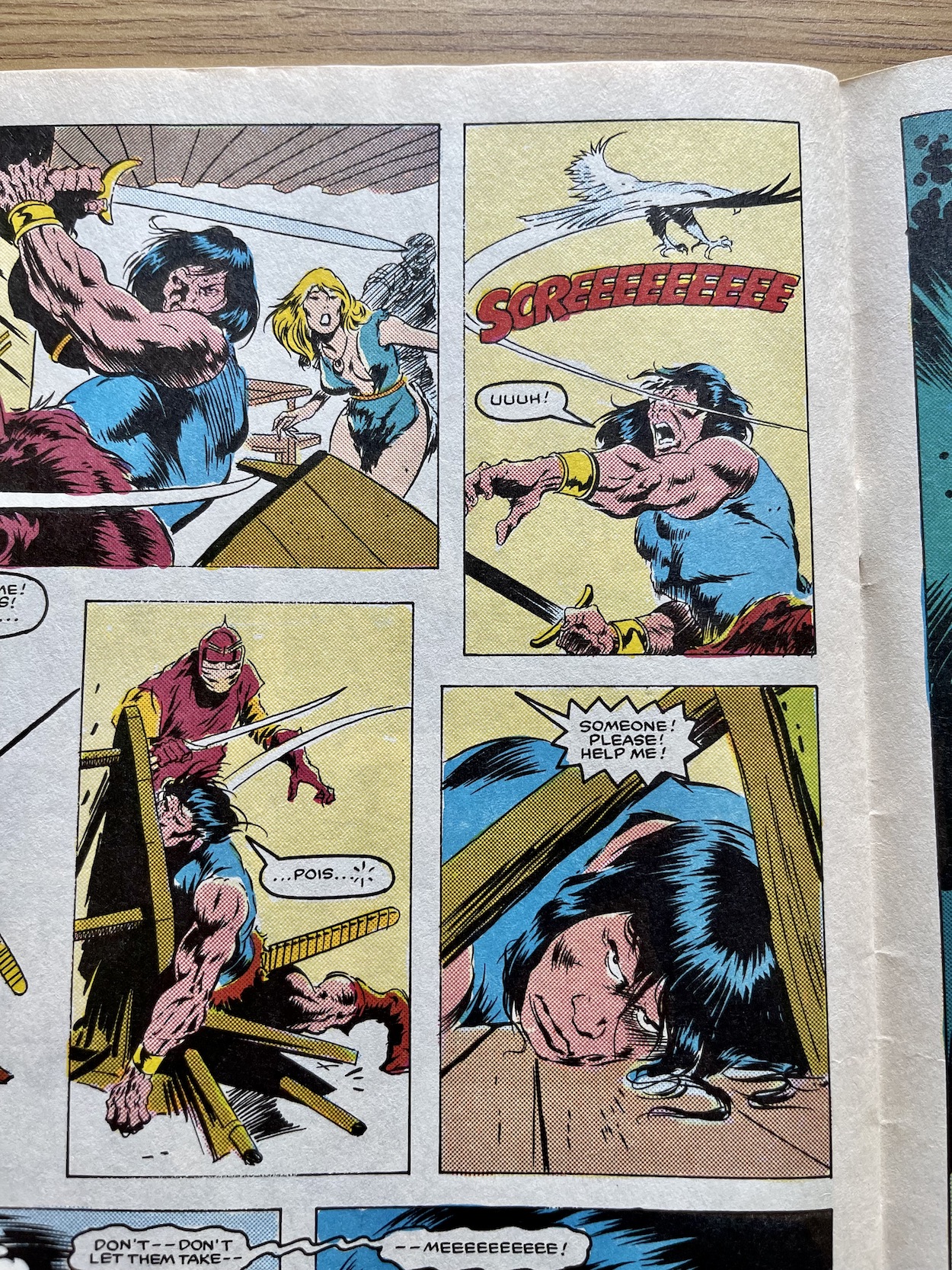
Conan and Tasmara head into the local town to eat and drink before making their way elsewhere, hoping to beat death by getting far away from danger. But the Brotherhood, who also have history of being defeated by Conan, have bribed a dancer in the tavern to dance for Conan using birds they supply her with, their talons tipped with a deadly poison.
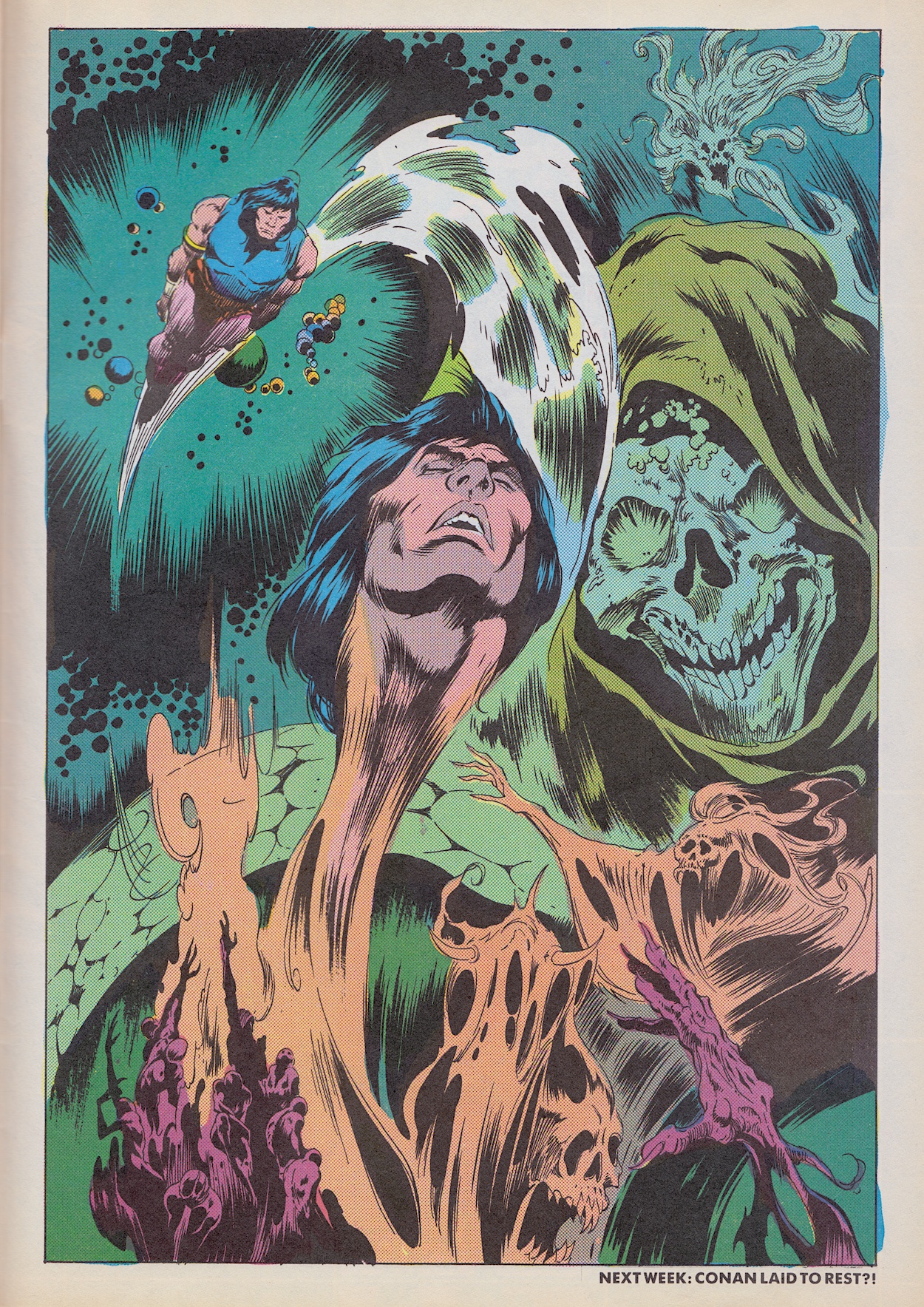
Conan collapses and his last view before he blacks out is of Tasmara being taken. We then see his consciousness slip into another realm, a realm of death and decay by the looks of it. You can see the Next Issue caption at the bottom of this next page. Yes, this is how Conan ends!
It would have been a great cliffhanger normally, but this was where we were left hanging as we desperately waited for #10 to appear. Now knowing it never would makes this all the more frustrating of course. Conan’s first story may have been somewhat outdated and out of place in Havoc, but the second story made up for that somewhat with its humour despite its underwhelming ending. This story seemed to have more going for it and, knowing the poem it was based on, I was eager to see how it turned out. Alas, for now I can’t.
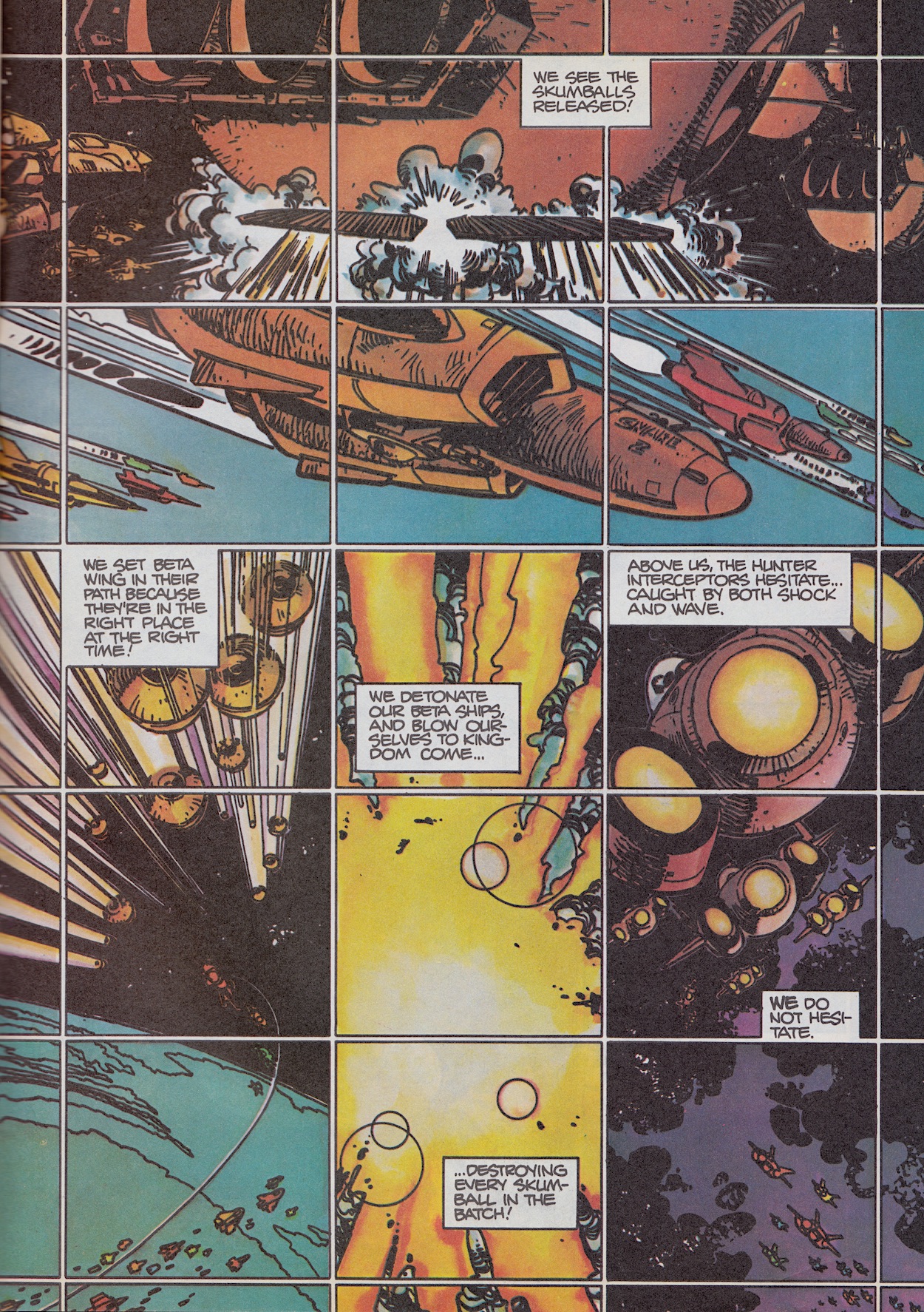
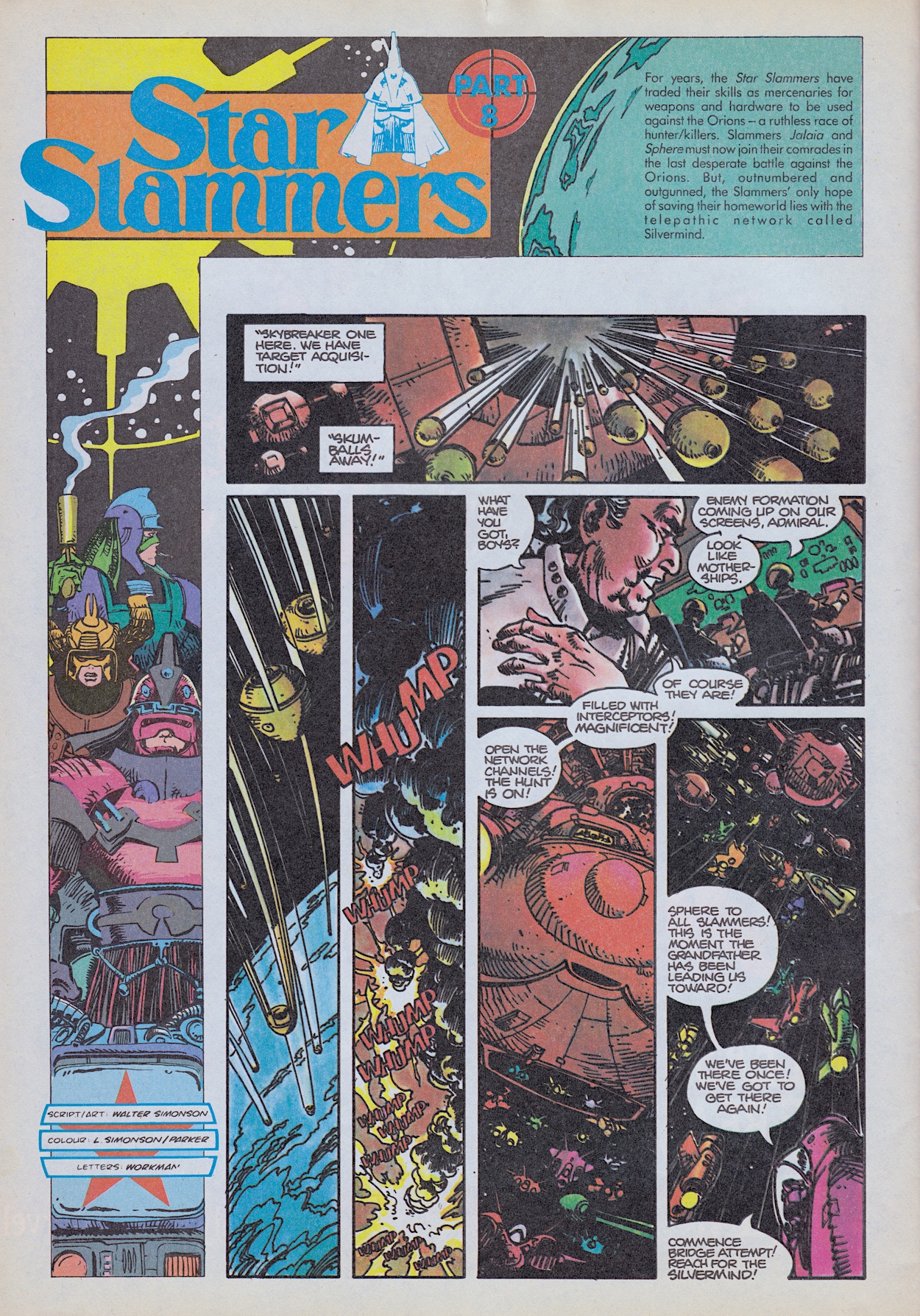
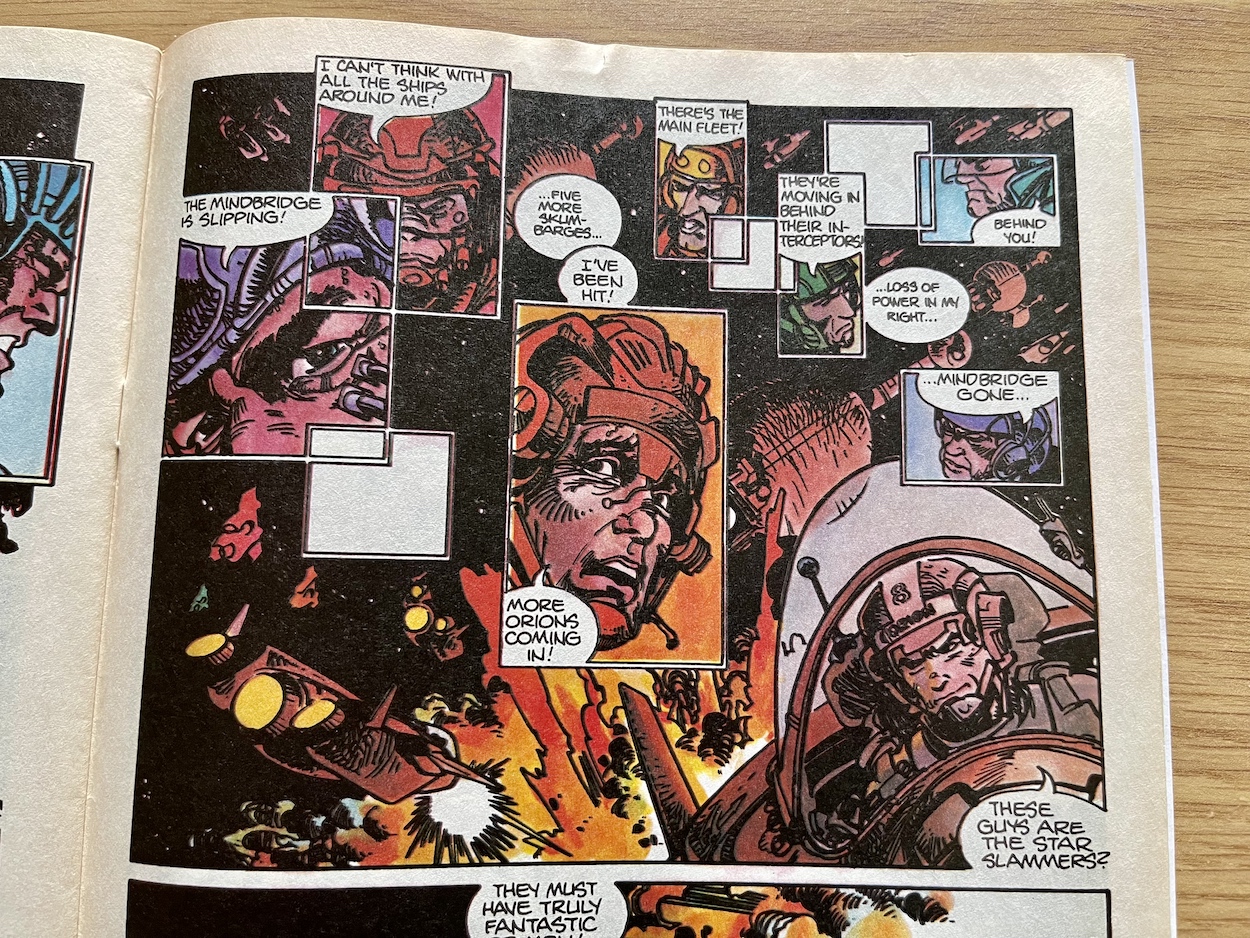
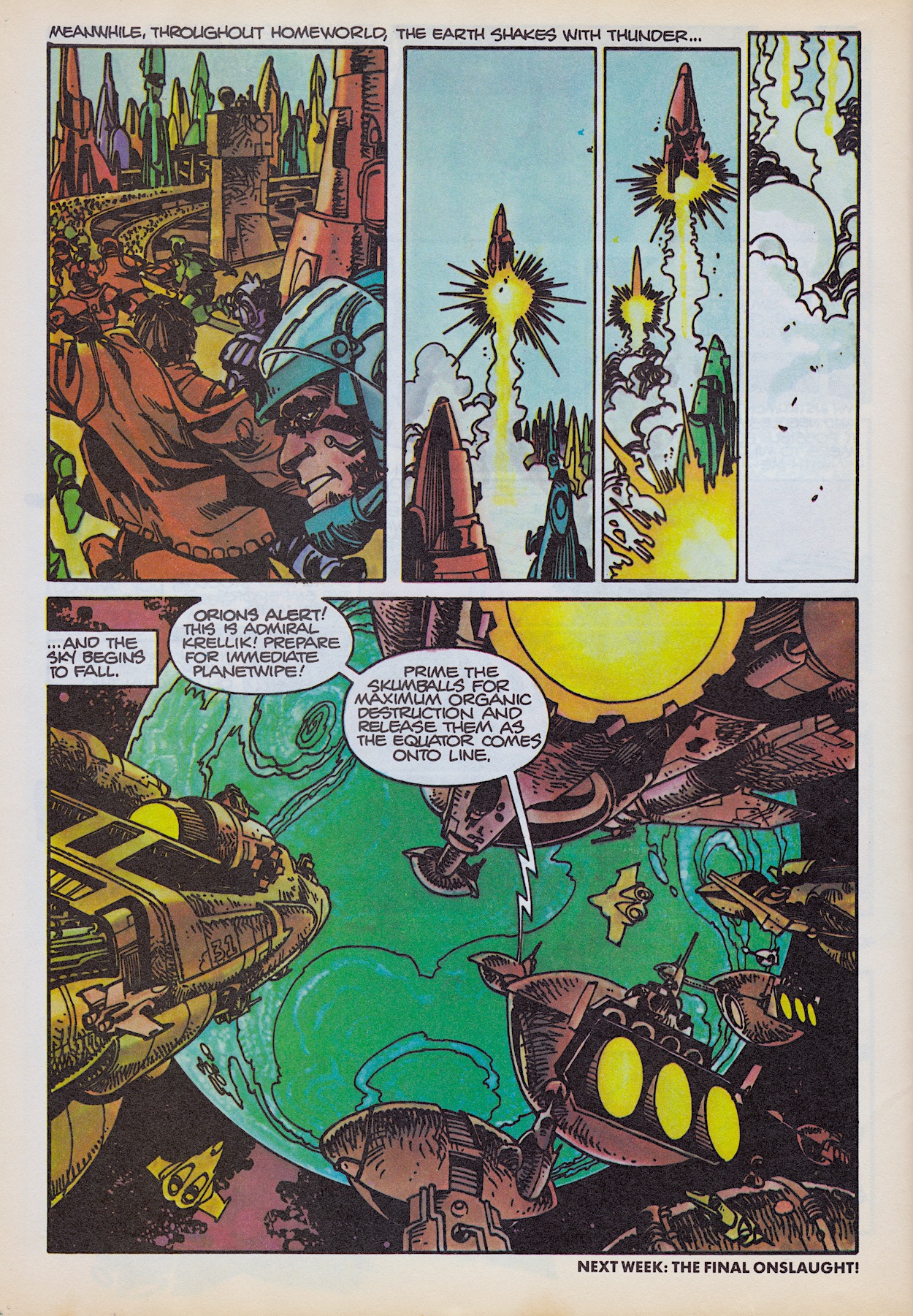
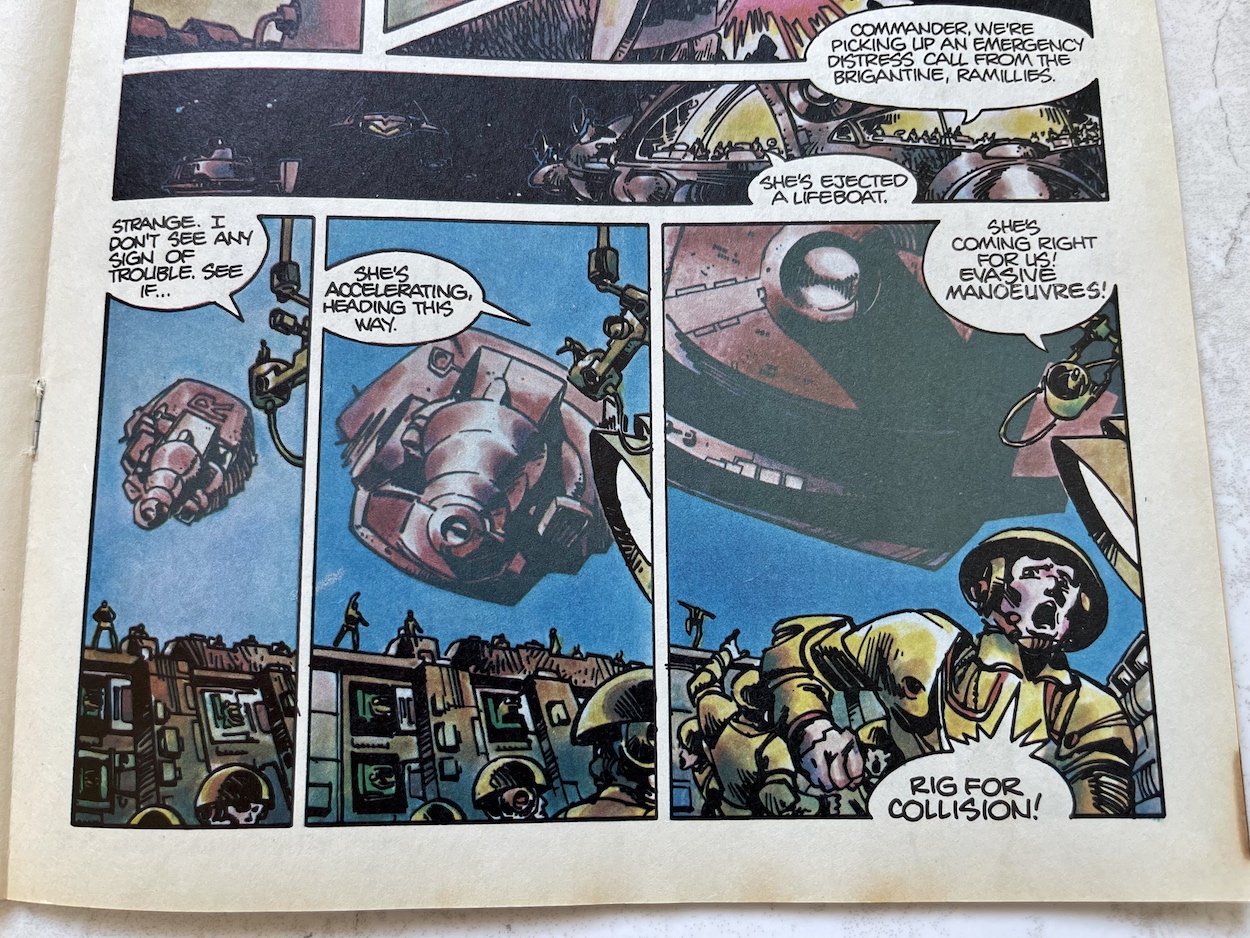
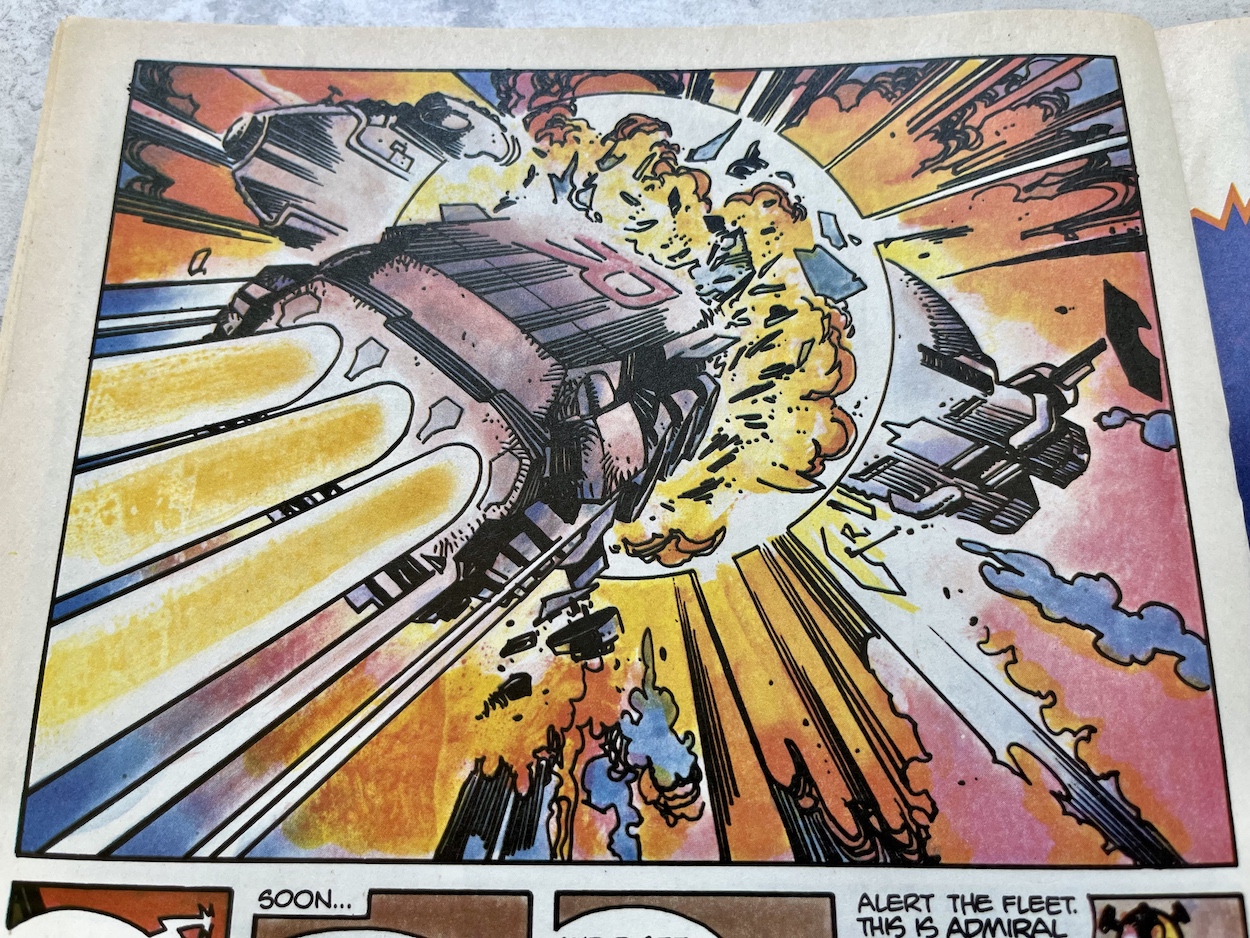
I’ll admit this issue’s Star Slammers (written and drawn by Walt Simonson, colours by Louise Simonson and Deborah Pedler, letters by John Workman) is eye catching, I’ll give it that. Each of its five pages are split up into these smaller panels, carrying on the theme of the Silvermind from last time. In fact, this penultimate part of the story kicks off with Jalaia finally reaching that near death point and activating the hive mind of the Slammers. Suddenly every single one of them can see, sense and hear everyone else, turning the tide of the battle against the Orions. So naturally Admiral Krellik cuts the televised feed to his home world in an attempt to control the narrative.
The way this is depicted, how they’re able to instantly react to the enemy from anywhere in the battle, how it turns on a dime from a slaughter to potential victory much to the shock of the enemy, is really very good. Alien Legion was due to replace Star Slammers in #11, so one week before its conclusion this strip finally became something of interest. It’s a cool few pages but with the lack of characterisation or storytelling in many previous parts it’s just too late to save it.
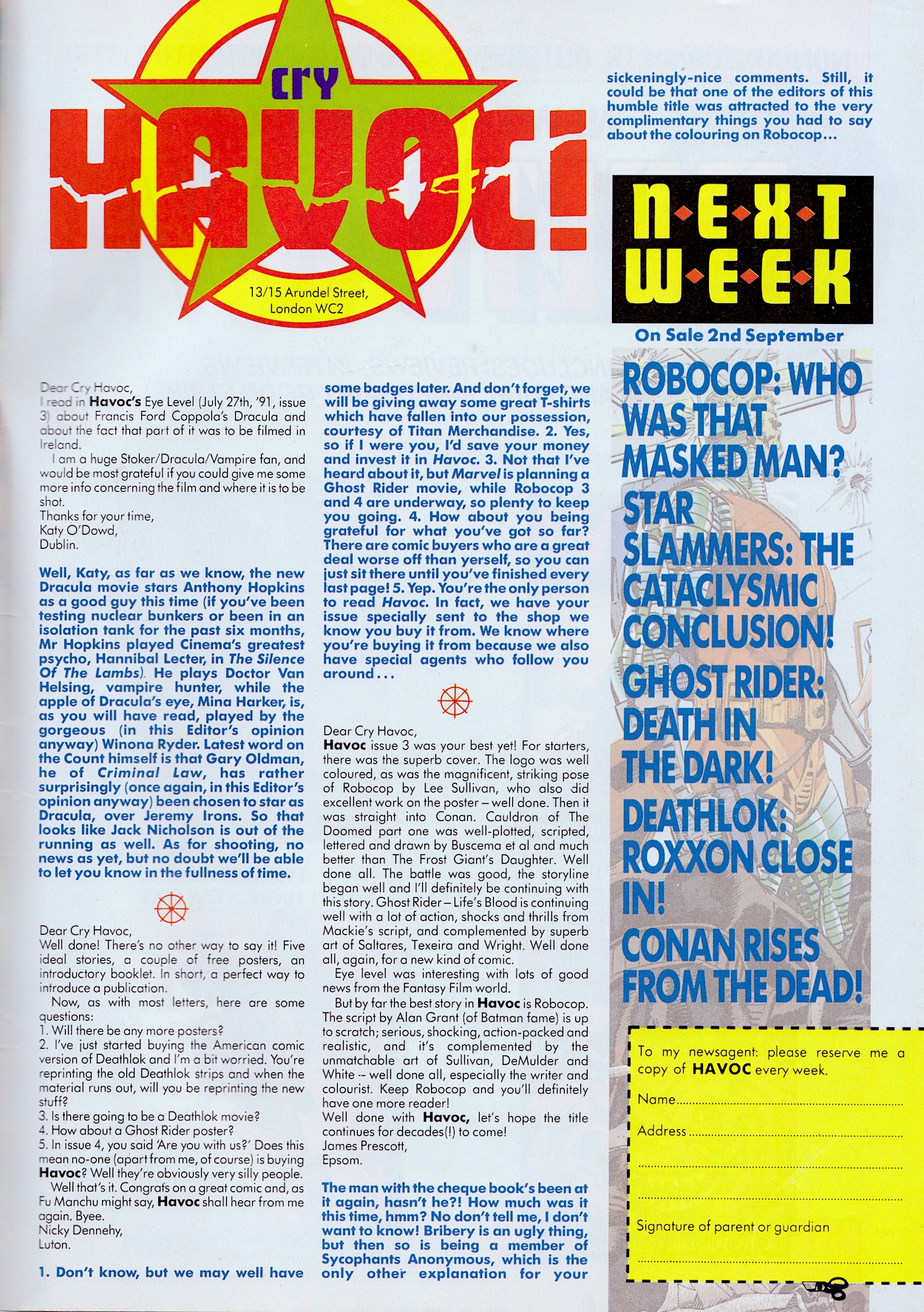
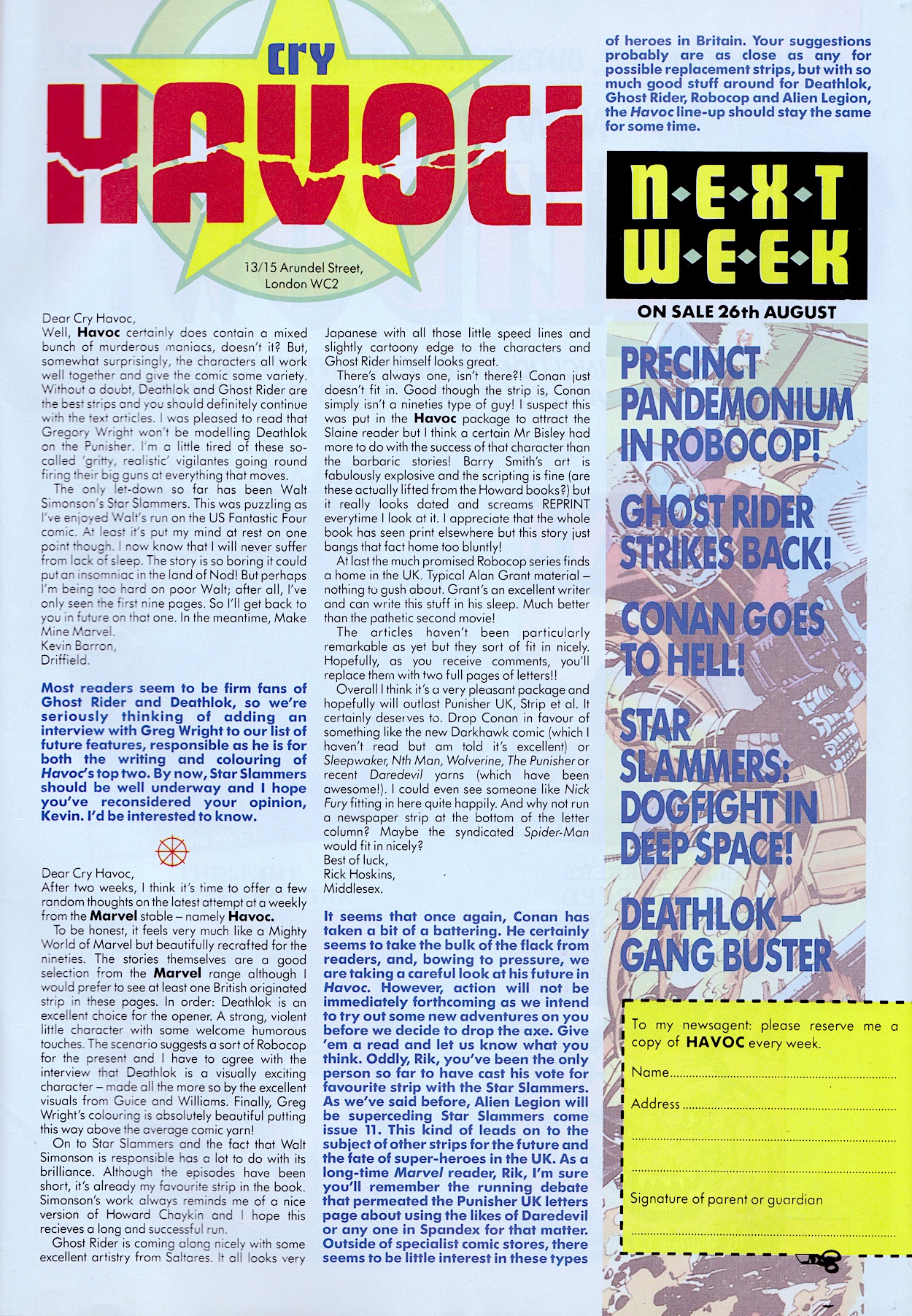
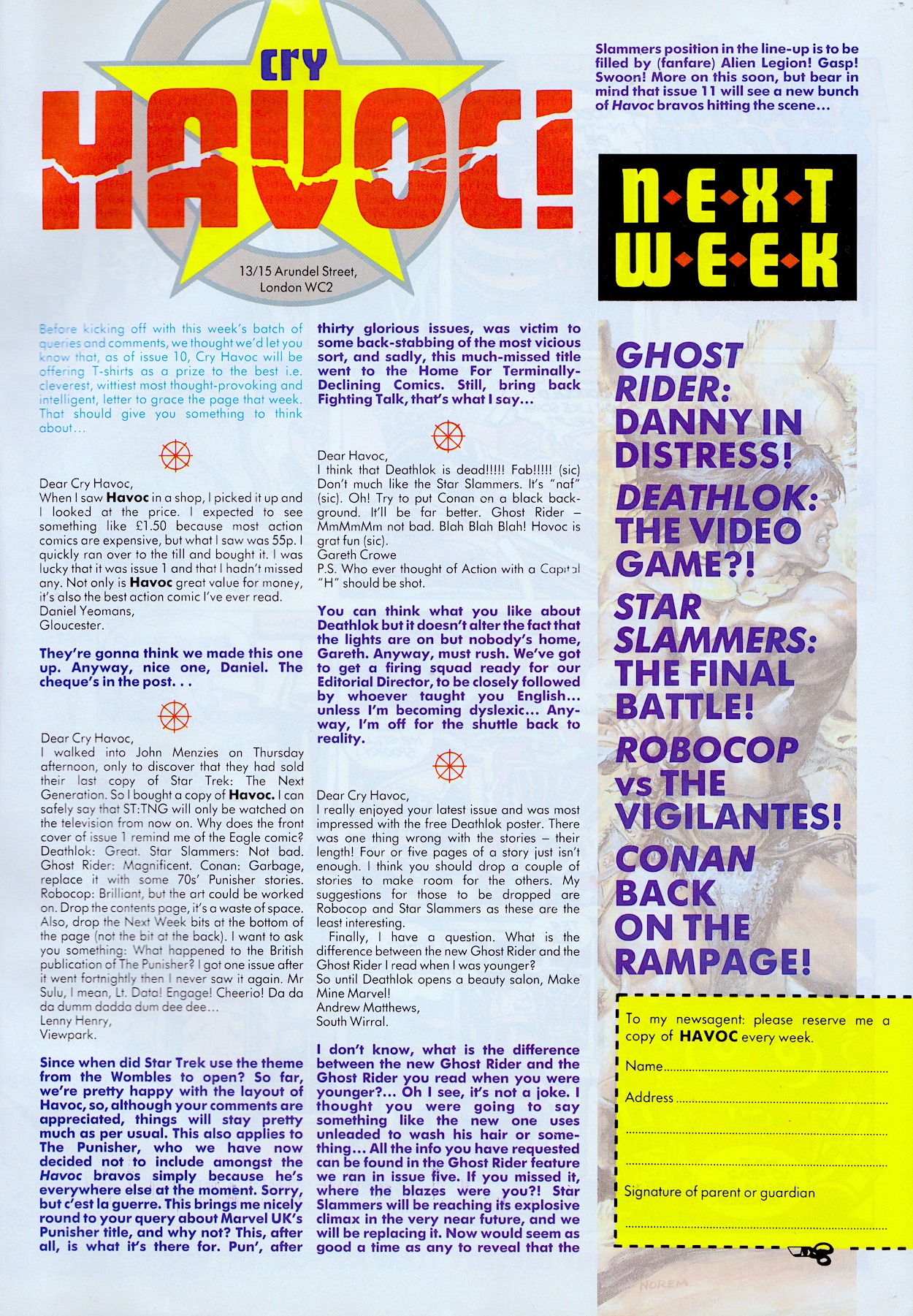
Our last Cry Havoc finishes things off and once more it’s got that exciting fan club feel to it which just makes it all the more heart wrenching that this is the end. But before we go there’s just time for a few more letters and typical Marvel UK-style replies which I loved so much as a kid. Highlights include some dismay at Gary Oldman’s casting in Dracula (oh, how he’d prove the naysayers wrong) and word of an upcoming Ghost Rider movie which wouldn’t actually become a reality for another 16 years.
There are some cheeky answers here too (“How about you being grateful for what you’ve got so far?”) which is very Marvel UK indeed, instructions to invest in the future of Havoc for new Deathlok (oh deary me, you’ll start me off again) and a funny final answer which refers to the fact RoboCop was coincidentally coloured by Havoc’s editor. Then just to rub salt in the wound is the Next Issue box and a reservation coupon. This is not the end this comic deserved.
It took a couple of weeks to realise Havoc wasn’t just running late. With this I became so fed up of fantastic comics with a potentially very bright future being cancelled early that I swore off trying new ones after Havoc, solely collecting Transformers which I’d begun buying years before. I’ll admit this changed when Thunderbirds The Comic appeared in October 1991 but I stuck with it for only about a year before Commodore Format enticed me to the way of magazines. Even Transformers was cancelled just five months after Havoc!
It feels like no time since I took this photo for Havoc’s introductory post and given the potential here it really was no time at all. Havoc deserved to run and run. My school friends who had collected 2000AD for a few years already loved it even more than Tharg’s mighty organ. From the first issue I loved three of the strips and over the course of these nine short weeks I’ve come to enjoy a fourth. The final one was to be replaced soon so I could have been a fan of everything in the end.
As it stands it’s still a remarkable little collection of top quality characters. I think that sums it up best for me. It’s not just a random selection of strips, the stories I’ve enjoyed have all been about remarkable characters. Characters I want to read more of. Look out for a special blog post soon when I chat with freelance designer Paul Chamberlainwho worked on several Marvel UK comics and created Havoc’s logo. Until then, it’s goodbye Havoc, it’s been a blast and you deserved better.
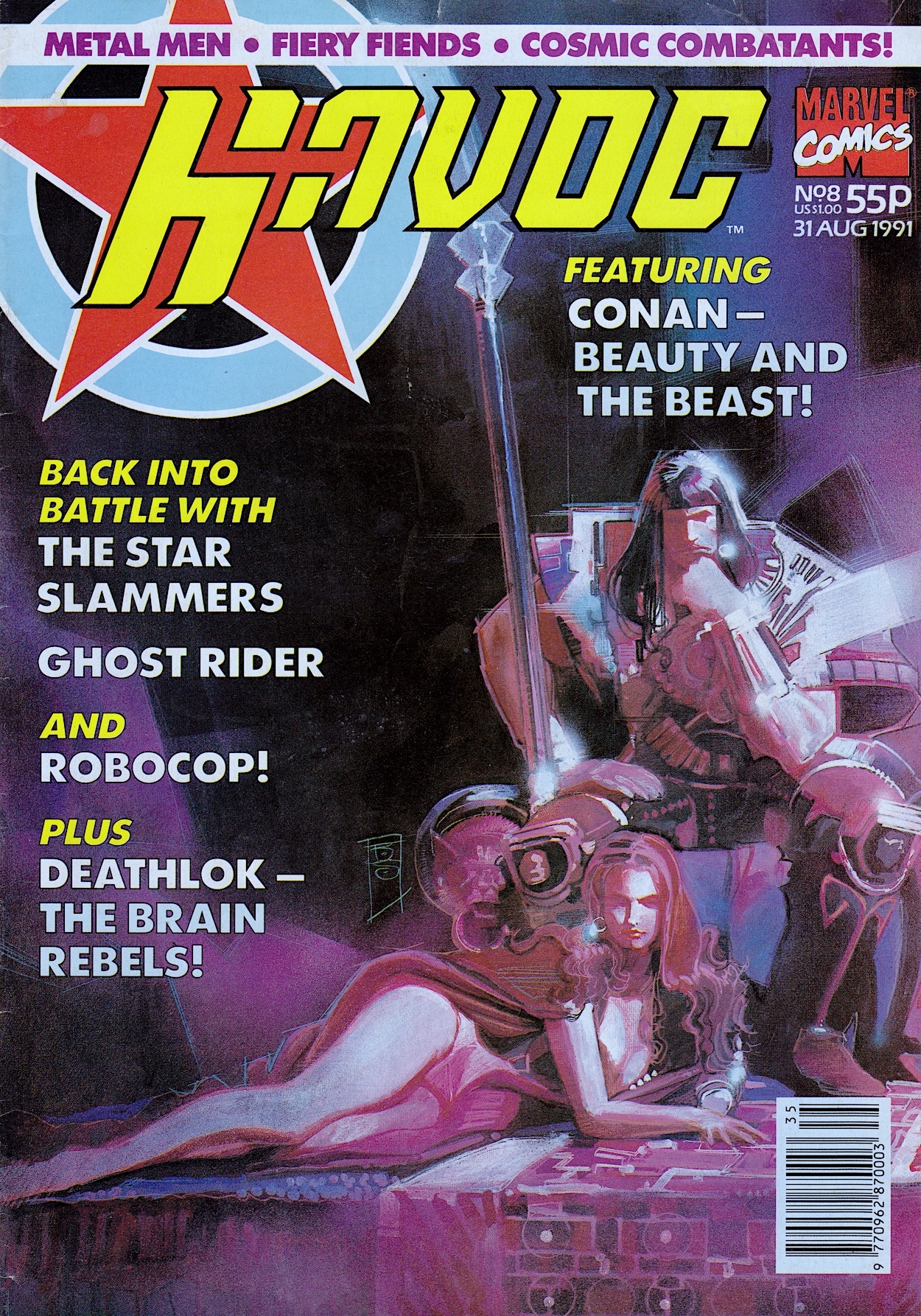
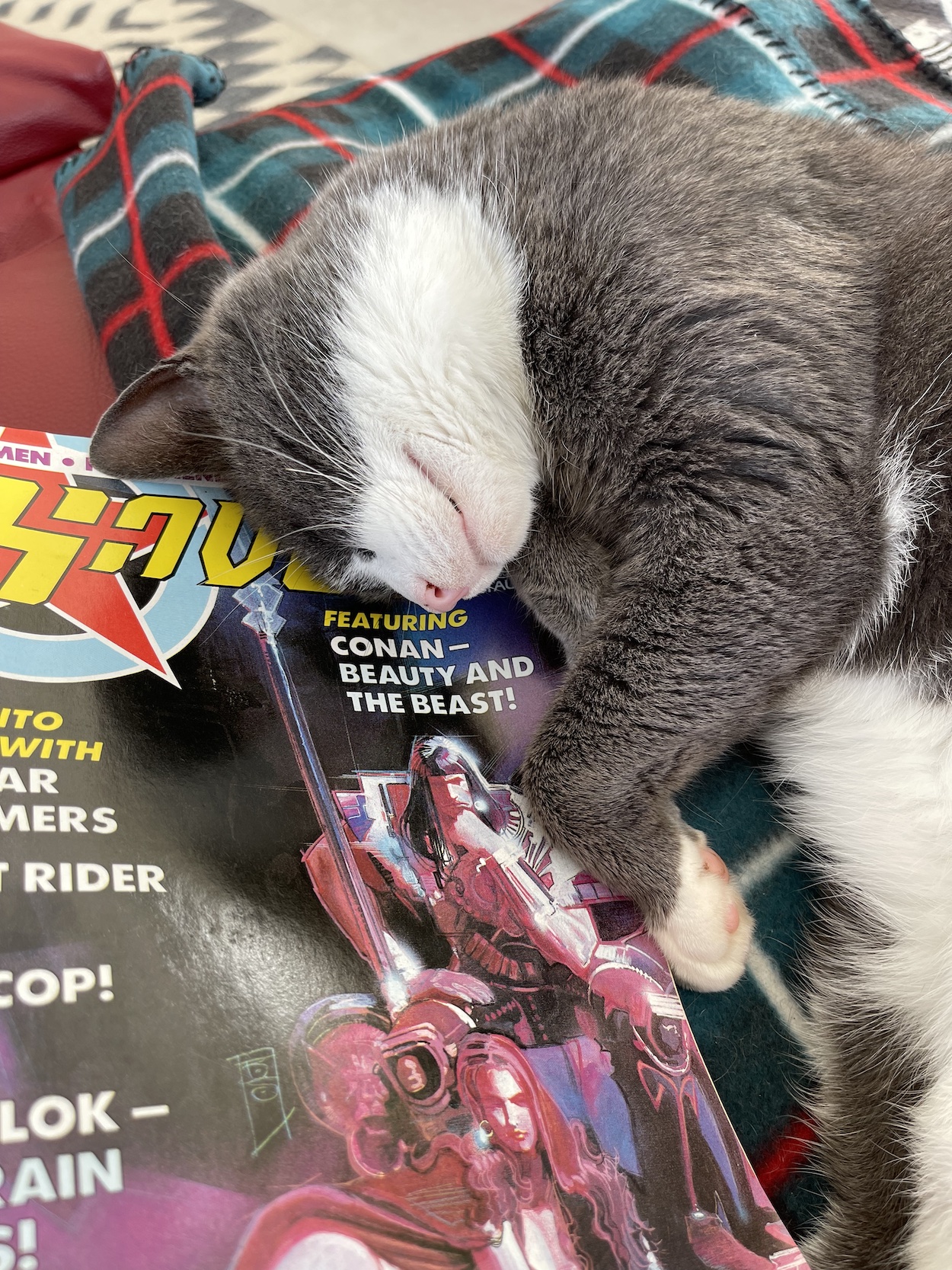
Conan the Barbarian was back in style. After taking a one issue break not only did a new story begin for the Cimmerian inside Havoc #8, he also got this glorious piece of cover art to announce his return. Although, ‘Beauty and the Beast’ could be the tagline for any of the Conan stories featured so far to be honest. It’s a nice cover nonetheless and it may only have been a week but I’ve missed having all five strips included.
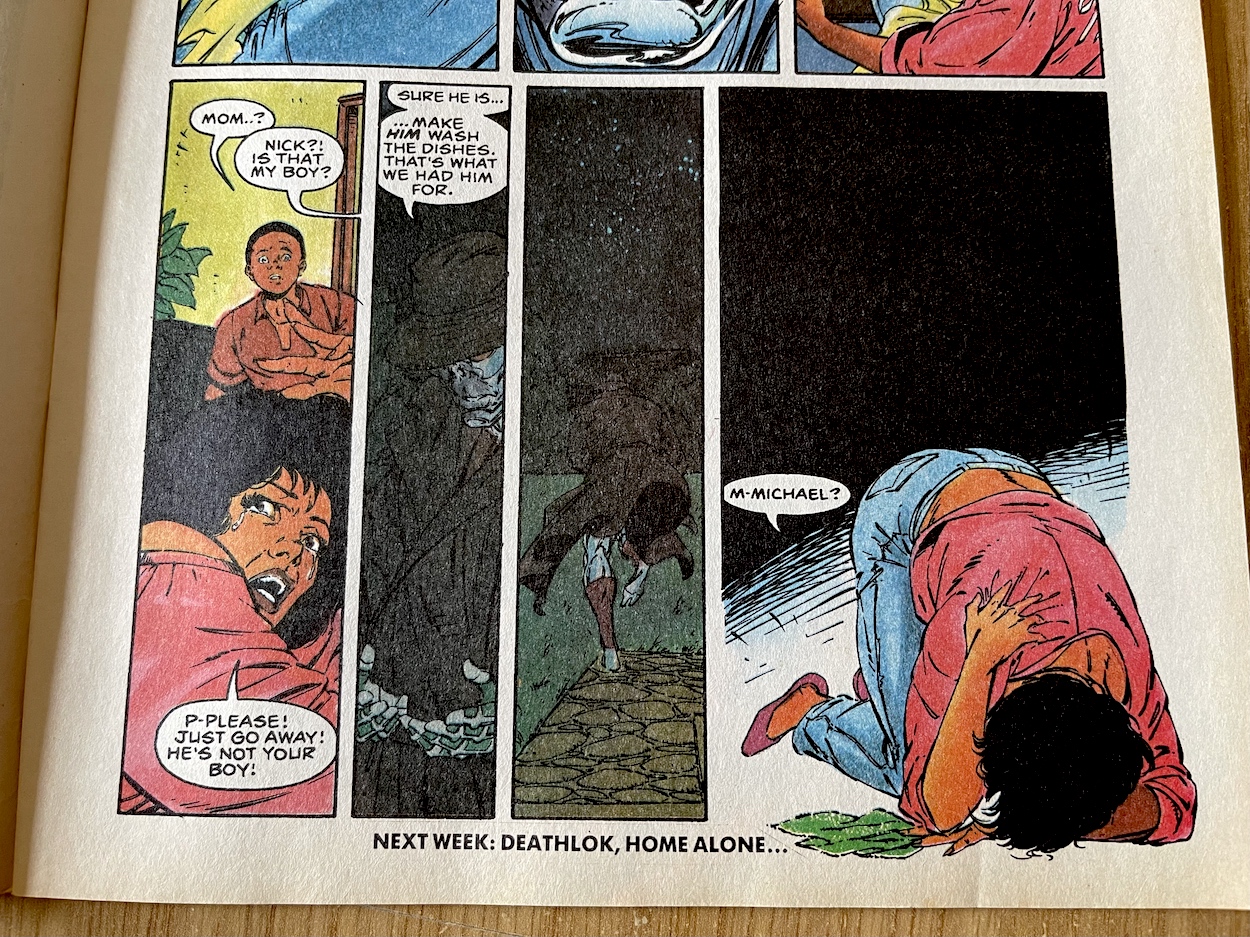
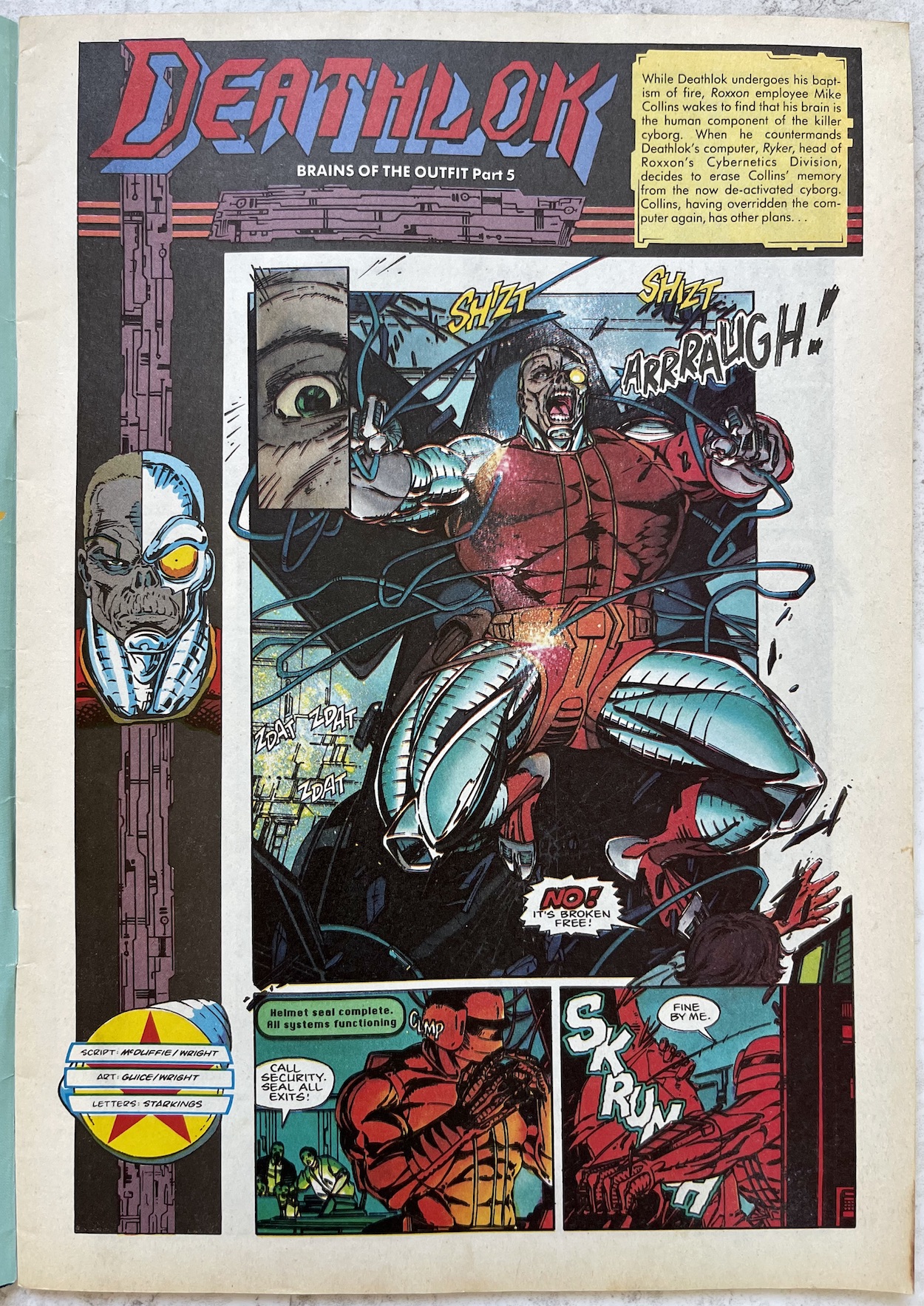
Beginning again with Deathlok (written by Dwayne McDuffie and Gregory Wright, art by Gregory and Jackson Guise, letters by Richard Starkings) we finally get to the end of his origin story after seven hugely entertaining weeks, with the finale to Brains of the Outfit. It’s all wrapped up brilliantly well. After last issue I wouldn’t have been able to guess how they’d conclude Michael Collins’ first outing after that action packed strip. Now that I’ve read these final seven pages there was simply no other way they could’ve done it. It’s great.
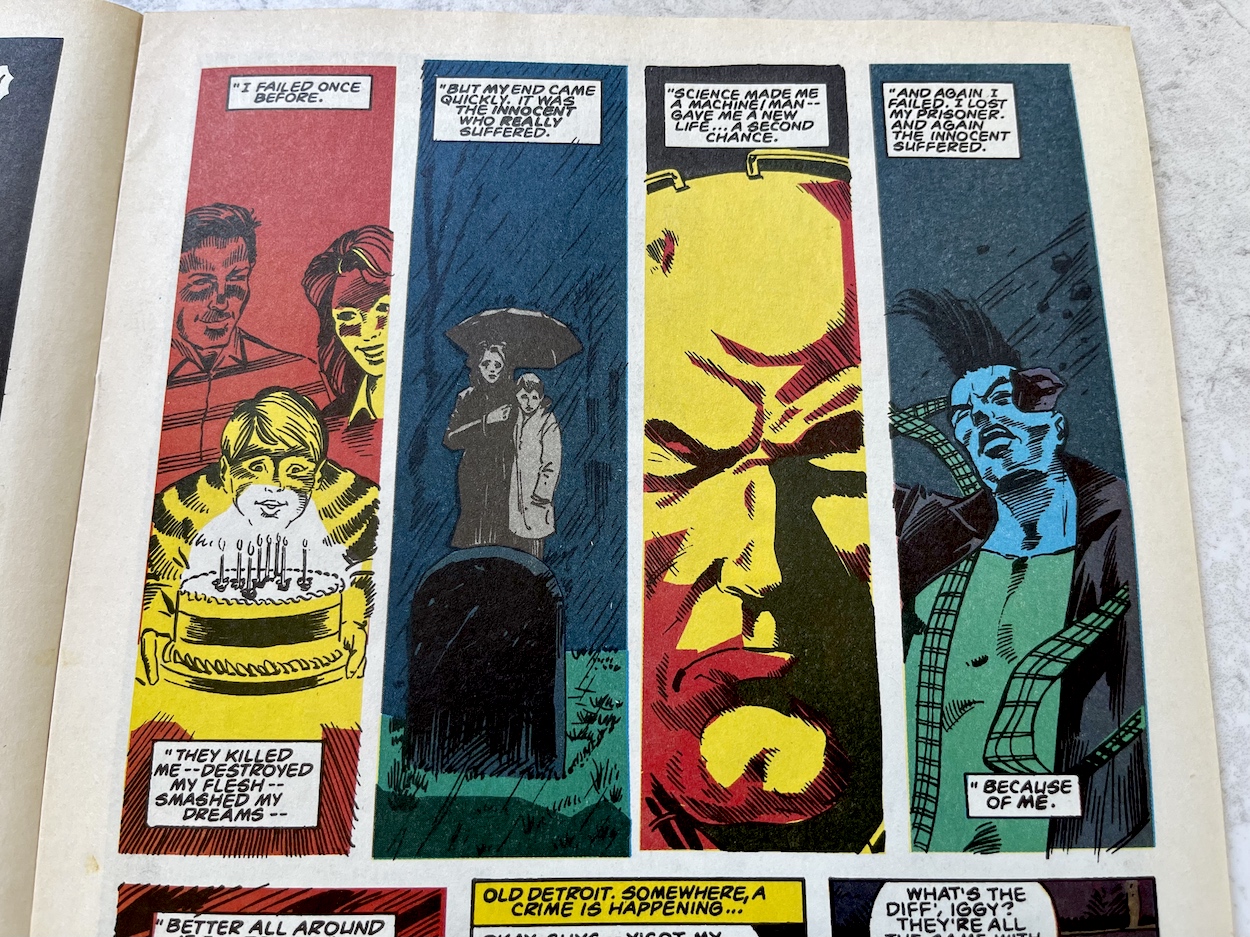
That panel above is the beginning of an incredibly dark moment as Michael/Deathlok takes to a roof above the city and contemplates ending it, even placing his high powered gun into his mouth. But he knows the Deathlok machine would just be found, he’d be stripped out and some other poor soul would be forced inside instead. Nothing would be stopped, nothing solved. He hooks himself up to electrical wires on the building to overload and explode instead, but decides he needs to call his son first to say goodbye and uses the phone lines instead.
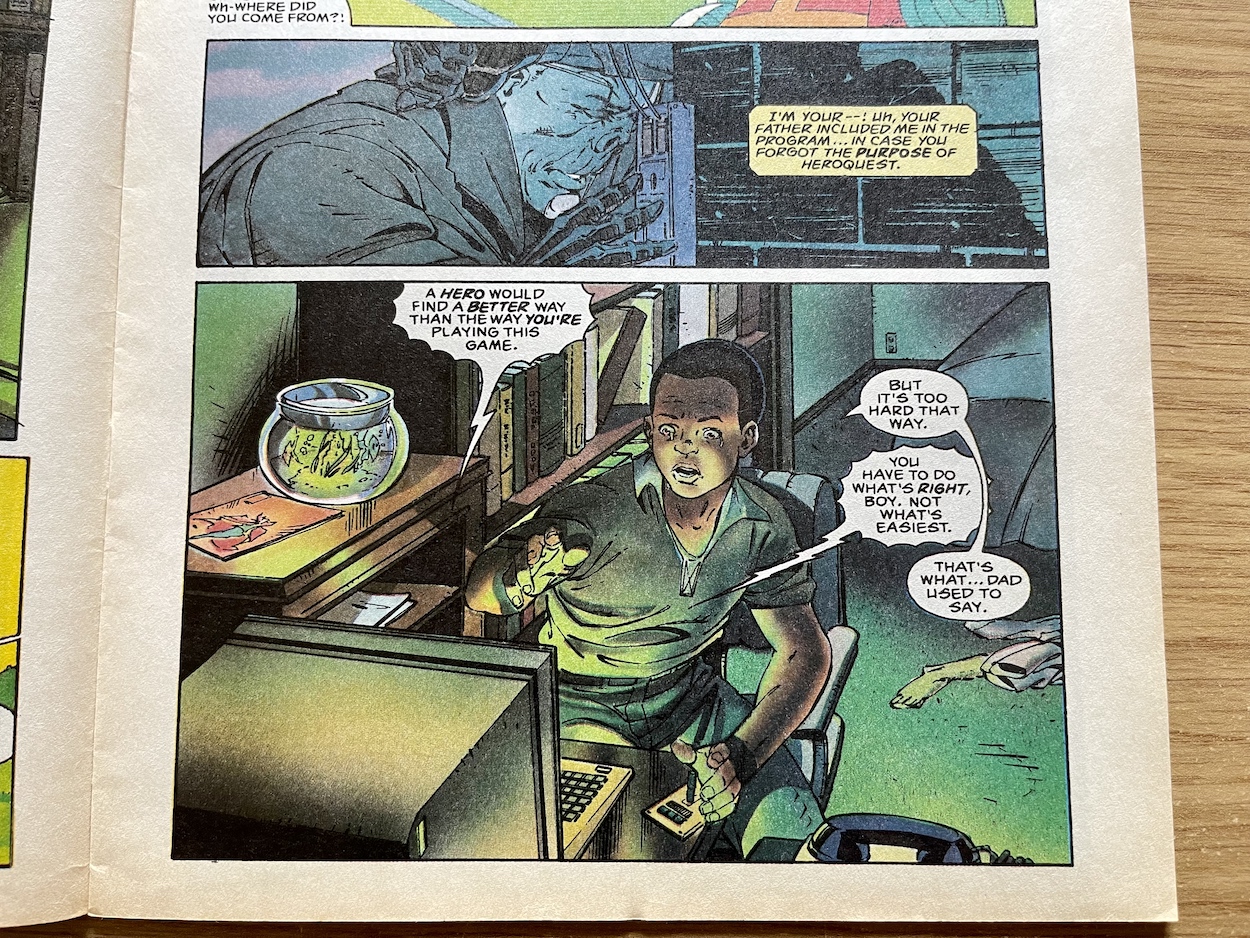
The Deathlok computer detects a ‘HeroQuest’ program running at the number given to it (how topical for 1991) and it creates an avatar for itself to interact with the player, young Nick, who knows his dad has died. This is the game we saw him play previously, when Michael tried to explain to him how bigger and better weapons don’t make the hero, it’s about being brave against the odds and, telling him that he’s a friend of his dad’s he reminds him of this in a touching scene.
In fact this scene takes up the main bulk of this final part and I think it’s just perfect. Nick tells the character on the screen that his dad isn’t there anymore and in response he’s told this doesn’t matter, it doesn’t make it any less true: “You want to win at this game, you’ve gotta learn how to be a hero.” With a few tears running down his face, Nick promises he will and turns the computer off, unaware of who he made that promise to.
Disconnected from the call, the Deathlok computer asks if it should continue with the self-destruct and as you’ll see below Michael looks to the sky as a new day dawns and thinks about the advice he’s just given his son. This feels like the perfect ending to such a character driven story, one that I’ve been really invested in for the whole summer. I love this final page, especially that last panel with the hint of a smile on our true hero’s face.
What a brilliant origin and I’m already a fan of the character. I could see his family being involved in future stories very much in the same way Alex Murphy’s were in some episodes of the RoboCop TV series, although the difference here is that Michael has already tried to tell his wife who Deathlok really is. That could lead to some great moments. To say I’m eager to read more is an understatement so, although the next issue is the last I’ll look forward to its small chunk of storyline to get an idea of what the future could’ve held.
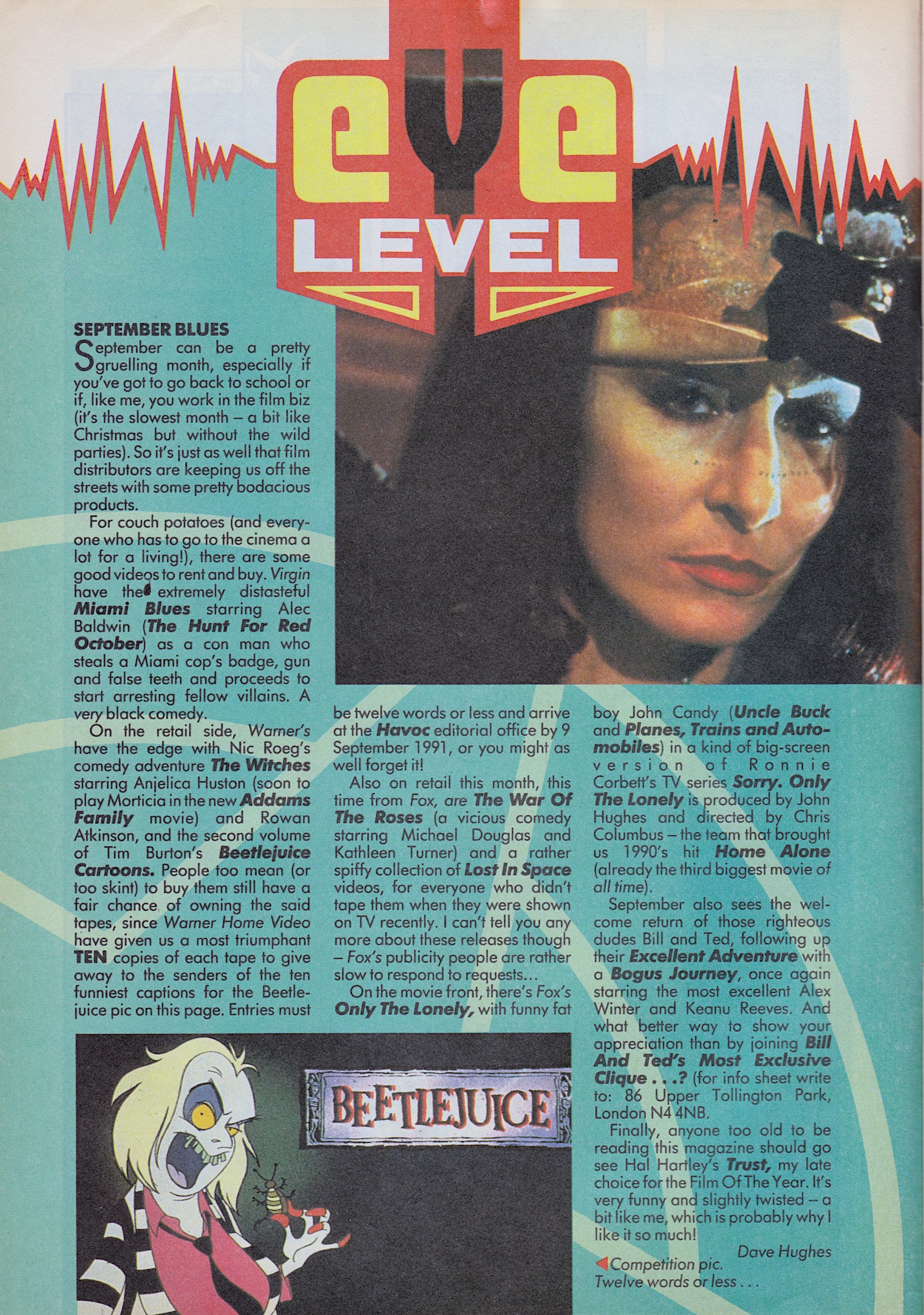
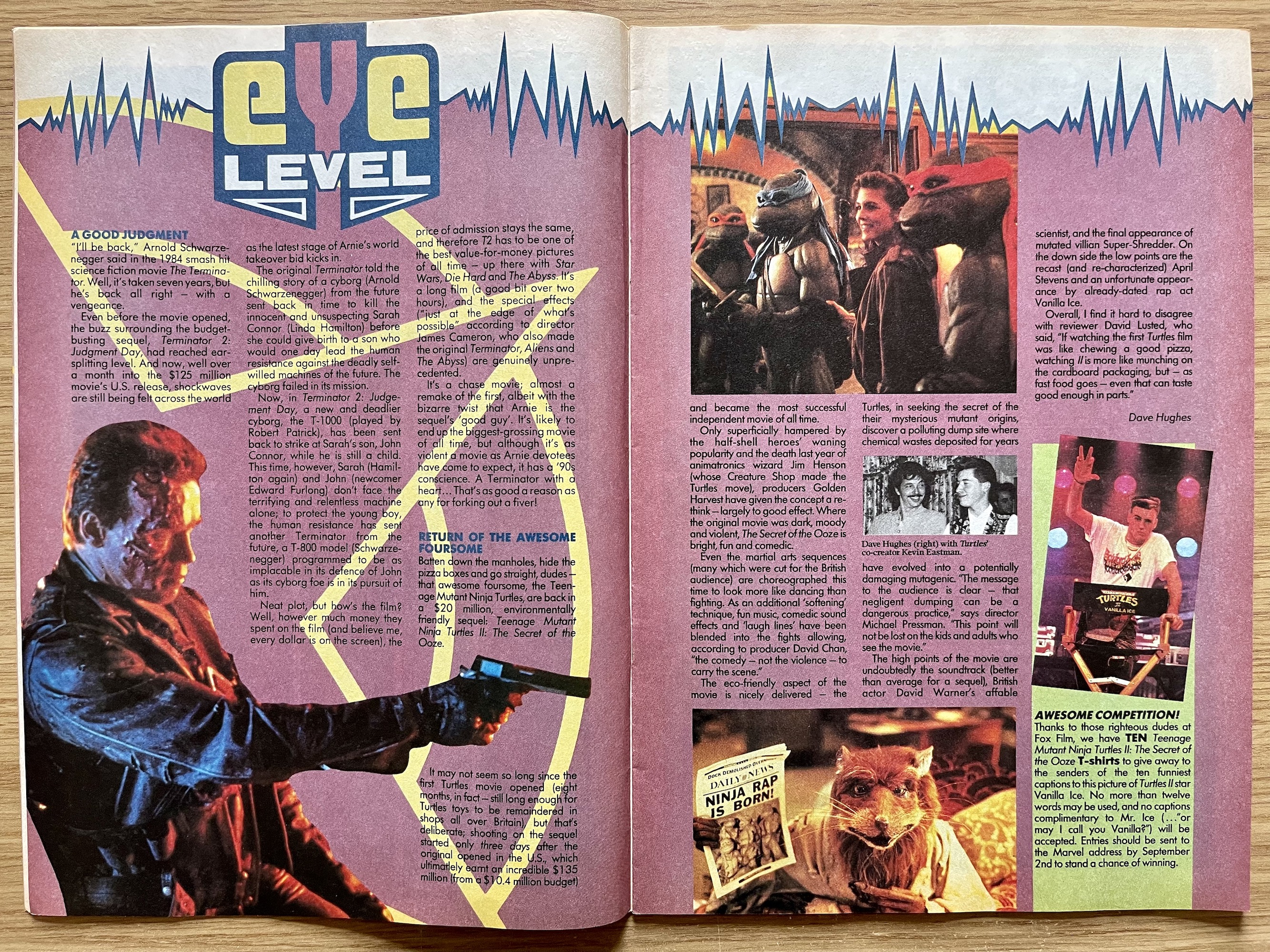
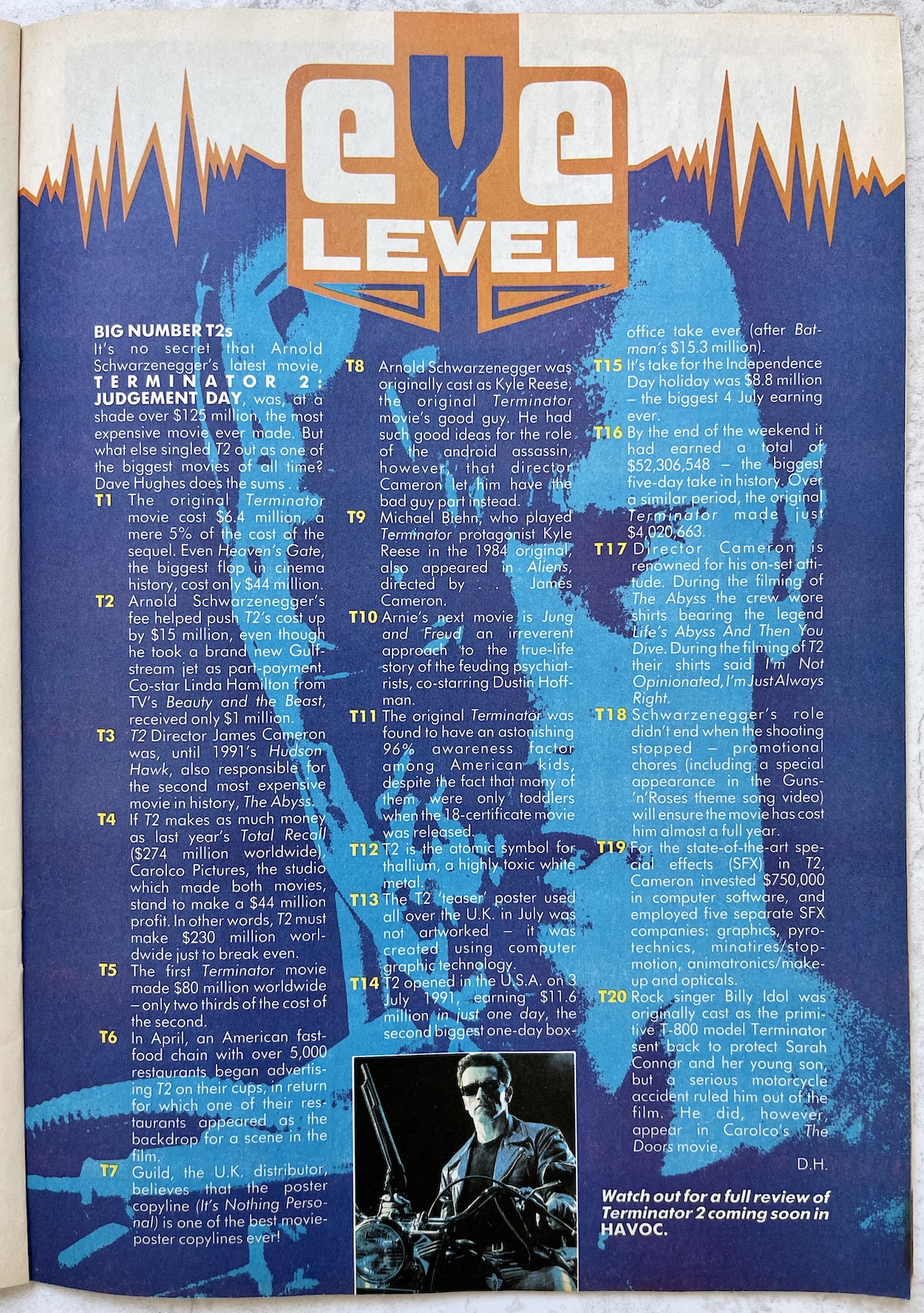
Next up we take a break from the strips for Eye Level, the news page compiled by Dave Hughes this issue. It may be back to one page after the larger spread it had a week ago for the cinema releases of Terminator 2: Judgement Day and Teenage Mutant Ninja Turtles II: The Secret of the Ooze, but a quick glance down the article at all those movies and TV shows in bold and it was quite the busy release schedule wasn’t it?
There are a few I’d never heard of (Miami Blues, Only the Lonely and Trust), a couple of childhood favourites (Bill and Ted’s Bogus Journey and The Witches) and a cartoon series that completely passed me by because I never saw the film it was based on until much later in life. Even the references to the films recently released remind me of why I loved the 80s so much! Speaking of 80s movies, the official RoboCop continuation is up next and venturing into the world of superheroes.
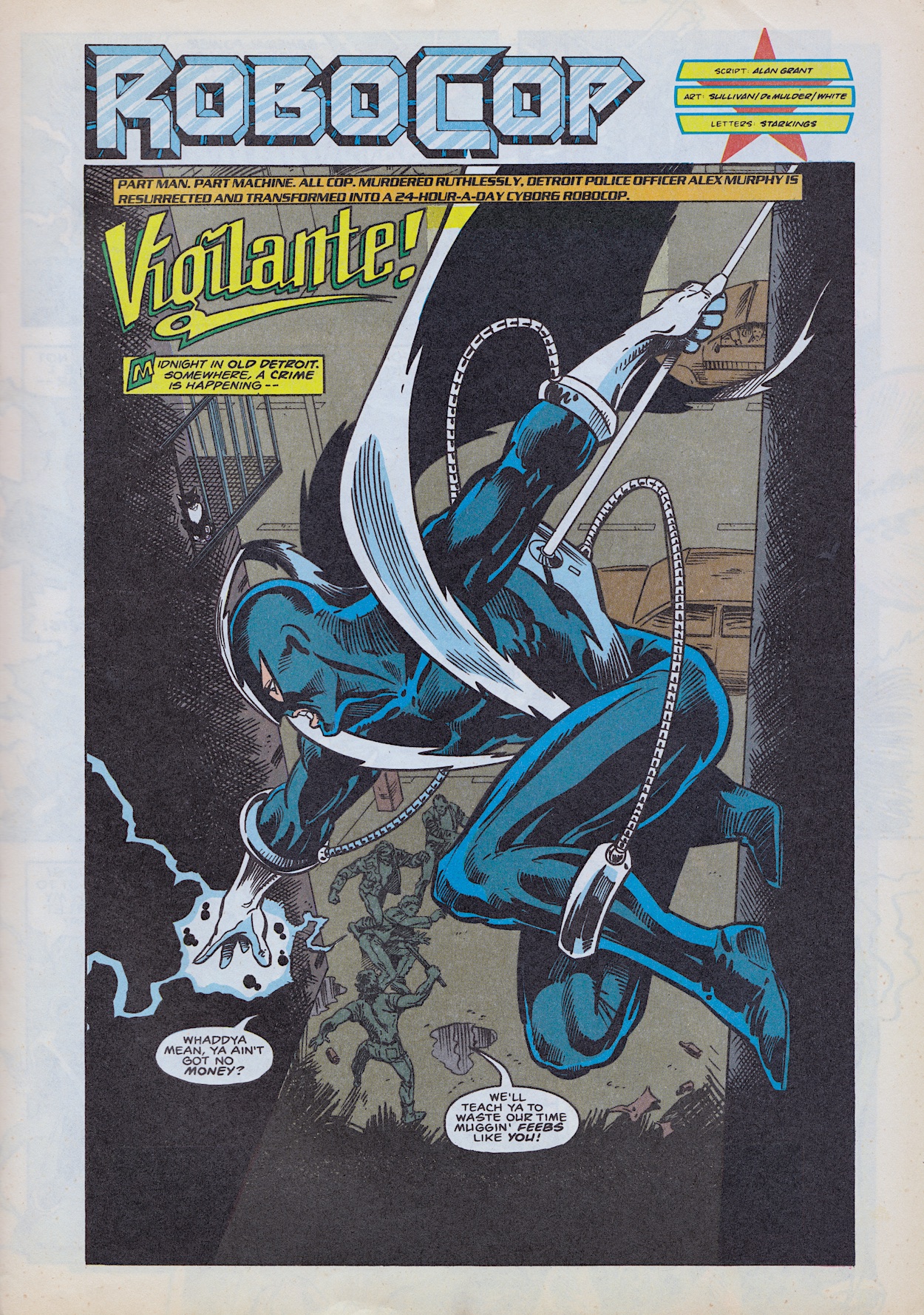
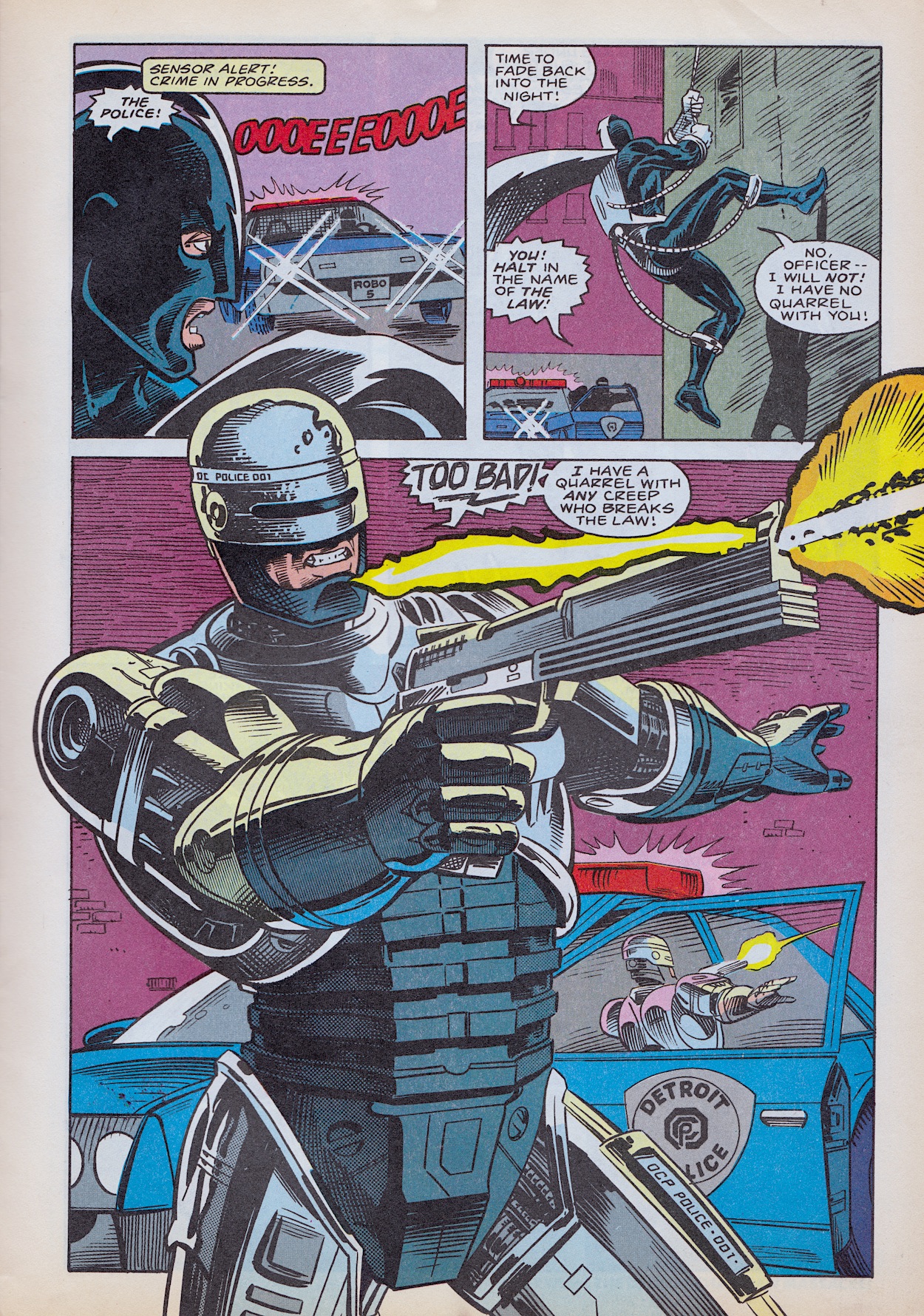
Well, wannabe superheroes anyway. As you can see from this opening splash page it certainly looks like Old Detroit has a new warrior in the fight against a seemingly insurmountable level of crime and violence in the forgotten city. I like how the story starts off with that famous RoboCop quote about a crime happening somewhere and how we’re led to believe it’s in reference to the mugging happening on the ground. A clever piece of misdirection by writer Alan Grant.
The next page plays out like an old-fashioned, clichéd superhero comic with ‘General Power’ using his ‘Electro Gauntlets’ to incapacitate the muggers, complete with corny one-liners such as, “General Power: The shock that crime needs!” It’s an exaggerated, almost spoof-like homage and it’s all going swimmingly for the masked crime fighter until he tries to help the victim to his feet but forgets to turn off his gauntlets, frying the person he was trying to save!
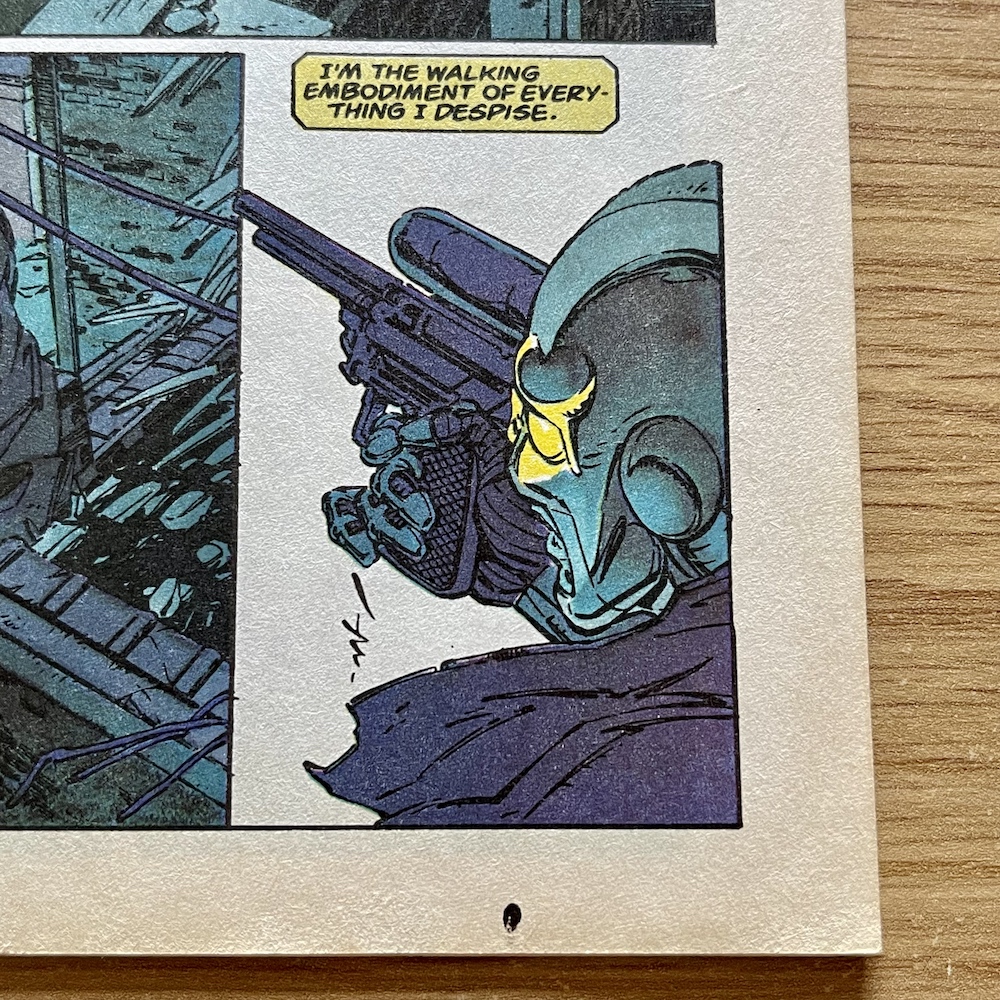
Cue sirens and a police car pulls up. Our panicked wannabe begins to scale the wall in a bid to fade back into the night like any good vigilante but he hadn’t bet on two things, his own incompetence and the officer being Alex Murphy aka RoboCop, who makes his entrance into the story in this glorious drawing by penciller Lee Sullivan and inker Kim DeMulder (colours by Steve White, letters by Richard Starkings). A great page, this.
A quick shot through the wire General Power was using sees him fall to the ground but the victim, all charred from the accidental electrocution, pleads with Alex to let the man go. They try to convince him that he’s on the same side as the police but Robo stands firm, no one can take the law into their own hands and when Power tries to use his gauntlets on the metal cop it backfires big time. The story ends with Murphy radioing into HQ that he’s picked up “another vigilante”.
This third RoboCop story shows the creative team have well and truly settled into the character
“Another”? Intriguing. Has there been a rash of such people trying to fight crime recently? I’m going to guess it can’t be a coincidence, that there must be some nefarious reason behind it all, so I’m interested to see how much of the mystery is revealed in our final issue next week. There’s definitely a confidence in this third RoboCop story that shows the creative team have well and truly settled into the character, especially in the art. Lots of potential here for future stories. I’m going to miss them.
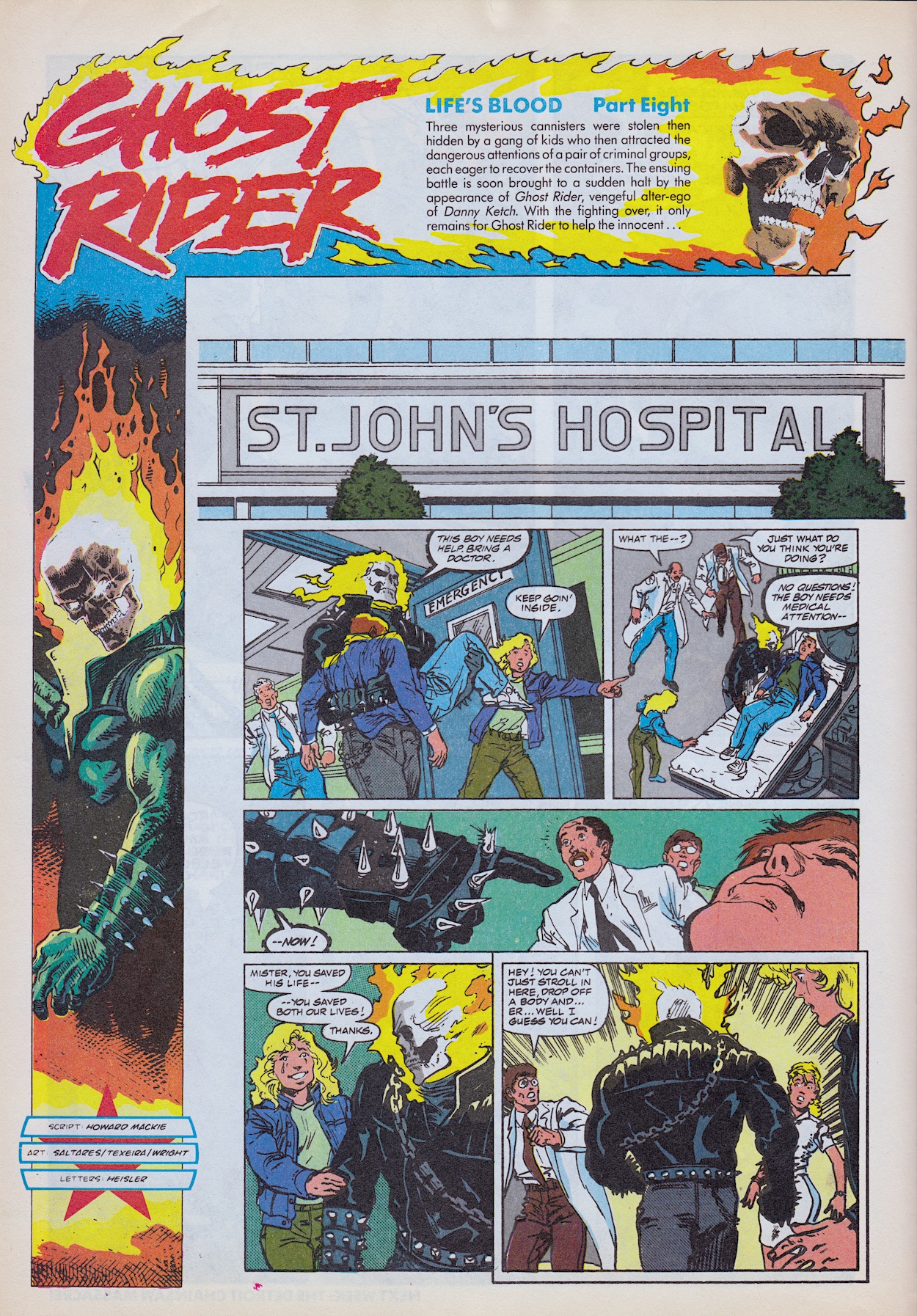
Alongside Deathlok, Ghost Rider’s origin story also ends this issue, with part eight of Life’s Blood ((written by Howard Mackie, pencilled by Javier Saltares, inked by Mark Texeira, coloured by Gregory Wright, lettered by Michael Heisler)) which acts as a kind of epilogue. In his demonic form Danny Ketch bursts into the local hospital to deliver the young gang member who initially scared him back in #1, injured in the battle between Kingpin’s and Deathwatch’s cronies over the mysterious suitcase and its canisters. After this first page he reverts back to human form for the rest of the story.
But as I’ve said before the strip has always been about more than just the Ghost Rider himself, I’ve enjoyed the character of Danny and the building blocks being put in place for future stories. For example, we get the obligatory conflict character, someone in Danny’s life who thinks his alter ego is a menace to society and this comes in the shape of Captain Dolan, the father of a friend of his and his sister Barb. The Ghost Rider is all over the press and Dolan has made his mind up.
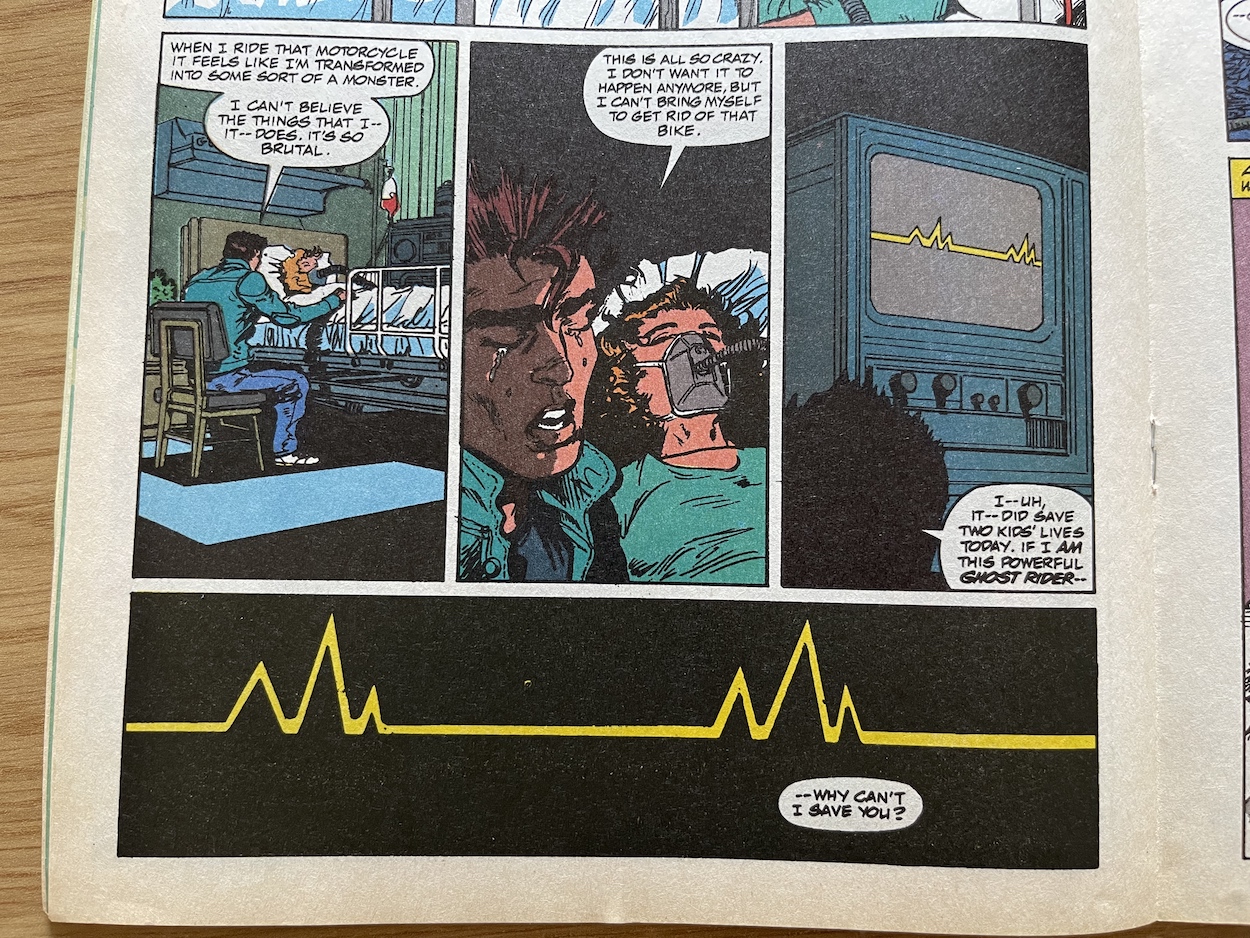
Danny tries to reason with him but we know already this won’t help, this is a character who’ll go up against the Spirit of Vengeance in future issues without knowing who it really is. It’s a bit of a cliché but Danny is such a sympathetic character and the Ghost Rider such a fascinating idea that I’d love to see where this relationship goes. For now though, Danny concentrates on his sister who remains in her comatose state as the story ends.
After this scene we get two large panels showing Kingpin shouting at his men that his entire operation is in jeopardy if those canisters aren’t found, and one in which new villain Deathwatch has killed one of his men for losing the suitcase and declares all witnesses are to be eliminated. But this scene in the hospital is the more dramatic ending for me, with Danny struggling to understand what’s happened to him, scared for his sister’s life.
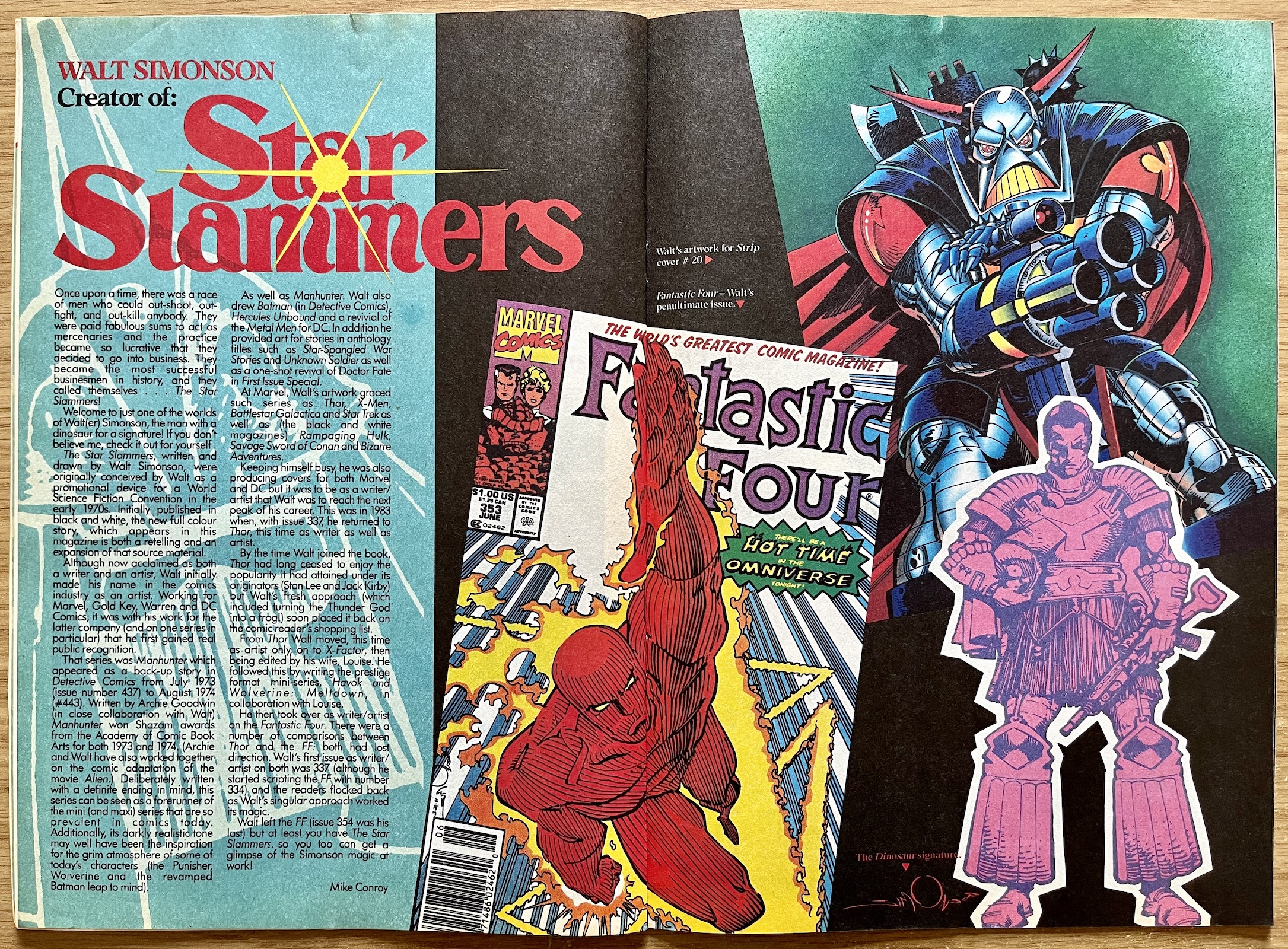
It leaves me thinking is there something his Ghost Rider form can do for Barb? Having this scary, demonic, vengeance-fuelled being caring for his host’s sister could make for interesting storylines in the future. This may be the first series I want to try to collect in graphic novel form after Havoc finishes in just seven days. Watch this space. On the next page we’ve got a special feature about the Star Slammers, or at least that’s how it was described on the contents page.
It’s actually an article about the creator of the Star Slammers, Walter Simonson and his illustrious career. I’ll admit as I read it I was a bit miffed it didn’t mention Walt’s adaptation of Jurassic Park, which featured in the first five issues of the UK’s comic based on that original movie and covered on the blog. Then I had a bit of a moment when I realised Havoc was published two years before the movie was even released. Whoops.
I certainly didn’t think I’d see Death’s Head in Havoc though, there’s always that.
Before we move on to Walt’s strip we have the return of Conan the Barbarian after his one-week hiatus and his next story is entitled Barbarian Death Song. The credits box has been accidentally left blank. Michael Fleisher, who provided the dialogue to the previous story has written this one, with pencils by John Buscema, inks by Armando Gil (Jurassic Park, What If…?, Ka-Zar the Savage), colours by George Roussos (G.I. Joe, Fantastic Four, The Avengers) and letters by Janice Chiang.
In 1972 writer Lin Carter wrote a poem called Death-Song of Conan the Barbarian which is the last story for the character, chronologically speaking. Written for a Robert E. Howard (Conan’s original creator) fanzine and later reprinted in Marvel’s Savage Sword of Conan, in it Conan reflects on his life, those he’s met, those he’s fought and the people he’s killed. Themes include the inevitability of death and living a fulfilling life and crossing over to the other side, which he does travelling alongside those he knew in life.
Is this going to be reflected in this comic strip with a similar name? So far the answer is no but remember this would’ve been cut into at least four smaller parts for Havoc. Originally published by Marvel US in 1985 the story begins with Conan turning down the offer of the Nemedian King to take up a ranking position in his army. He then stumbles upon an assassins league called The Falcon Brotherhood (who he has dealt with before) and rescues a damsel in distress who I initially thought was Nateesa from the previous story.
Nope, this is meant to be a completely different character even though she is identical to the damsel from last time, giving me the impression female characters are somewhat interchangeable in these stories (which isn’t a good impression to have). Her name isn’t given yet and she has just about enough time to start telling us her story before she’s unceremoniously cut off for seven days. The jewel around her neck is what the Brotherhood sought and she tells Conan that while tending to her father’s goats a few days previous a cloud “which was not a cloud” appeared before her.
The best bit is the opening page with its fierce battle but it’s immediately forgotten
That’s it, we’ll have to wait until next week to see what that’s all about. A strange place to stop the tale but sometimes it’s inevitable that sometimes the forced cliffhangers won’t quite hit. However, as a result there’s not much to say about these first five pages. The best bit is the opening page with its fierce battle but even it is immediately forgotten as the story jumps forward to a few days later. Hopefully the story begun here will be elaborated upon lots more next week.
Between Conan and the final strip is an advert for a Marvel UK comic I never bought as a kid. This is actually the first time I’ve even seen a colour advertisement for it as it always appeared in black and white in Transformers. I’ve heard nothing but good things about The Knights of Pendragon so it could be something for me to look into at a later date when I’ve covered all the comics I did buy back then.
So, we finish our penultimate issue with the Star Slammers (written and drawn by Walt Simonson, colours by Louise Simonson and Deborah Pedler, letters by John Workman) and if I thought Conan’s strip didn’t have much going on then this one has absolutely nothing. At first glance it all looks very exciting, with a unique layout to the battle scenes and it entices the reader in, only to find not much there upon closer inspection.
We begin seeing their home world which the Orions use as their hunting grounds being devastated from above, the cowardly hunters staying out of harm’s way for now. The pages have that aforementioned uniqueness about them. They’re made up of lots of small squares in apparently random fashion, meant to represent the Silvermind, the ability of their race to share all their thoughts as one. Knowing everything that everyone else is doing all at once could turn the tide of the battle.
But Jalaia realises Ethon was only able to heighten his own telepathic powers to the Silvermind when he knew he was about to die.
In that moment Ethon let all his defences down, even the ones he didn’t know his mind had put up. Jalaia decides to put herself in harm’s way so she can be the trigger. I do like how over a few pages the many squares holding faces of Slammers start to go blank one by one, as more lose their psychic connection with their comrades. But it’s not enough. Even with Jalaia making what could be the ultimate sacrifice, I still found myself struggling to care for any of the characters.
There really hasn’t been the character development necessary for something trying to be so epic. I should be on the edge of my seat with this story but I just haven’t been able to connect with anyone involved, despite the earlier issues having some interesting world building. That’s it in a nutshell really; the story has concerned itself with the big scale events at the expense of the small scale moments and characters. As it stands, I find myself rushing though it to get to the letters page!
I always liked how Marvel’s comics wouldn’t hold back on printing criticism received, with the first letter really not holding back on their opinion of my least favourite strip. That being said, these letters were sent in by readers after #2, so opinions expressed are still limited to those first two issues. I laughed when Deathlok was described as “a RoboCop for the present”. Robo was only released upon the public in 1987! The same letter even praises the Slammers. There’s just no accounting for taste I suppose.
Interestingly the reply states Conan is the strip receiving the most negative feedback. Given how these letters were written after only his first adventure I can understand that though. It also appears that back in 1991 the UK didn’t have the same appetite for spandex as it does now. How times have changed. The next time we read Cry Havoc will be the last so none of the proposed changes would get the chance to take effect. But I’m still looking forward to it. Each issue was growing in confidence and with the origin stories out of the way the future looked brighter than ever.
The suddenly cancelled Havoc’s swansong review will be right here from Wednesday 31st August 2022.
Alex Murphy returns to the cover once more as Havoc #7 hit newsagent shelves back in 1991. There’s something missing from this wonderful looking cover though and that’s any mention of Conan the Barbarian. As stated in the previous issue the Cimmerian would be taking a break for one week and on the contents page under his banner are simply the words “Back next week”. So why has he been forced out of the issue?
Two of the strips here, namely our title star RoboCop and Star Slammers get more pages apiece, particularly Robo who ends up with more than any strip has been given in any issue so far and this brings his current story to an end after three issues instead of the usual four. Each character would get a different number of pages every issue depending on what was happening in their individual stories, while also taking into account the following chapters, cliffhangers, endings etc.
For example, on the letters page this week the replacement for Star Slammers in #11 is mentioned. Swapping out finished strips, working out suitable lengths for each chunk of story and planning for each issue to have as much content as possible would require some flexibility, especially as they were dealing with strips not written for this anthology format. To get the best out of each strip, including Conan, they may have to drop one for an issue to ensure things run smoothly in the long run.
Speaking of the editorial team, there’s been a bit of a shake up. Launch editors John Freeman and Harry Papadopooulos have jumped ship already, leaving the tiller in the capable hands of Jacqui Papp (editor for titles such as Motormouth, Die Cut and Battle Tide, all comics from the Marvel UK Genesis Project) and Steve White (colourist for Transformers, Jurassic Park’sXenzoic Tales and editor on Visionaries). Their first issue is a doozy, so let’s get started with Deathlok: Brains of the Outfit written by Dwayne McDuffie and Gregory Wright, drawn by Gregory and Jackson Guise and lettered by Richard Starkings.
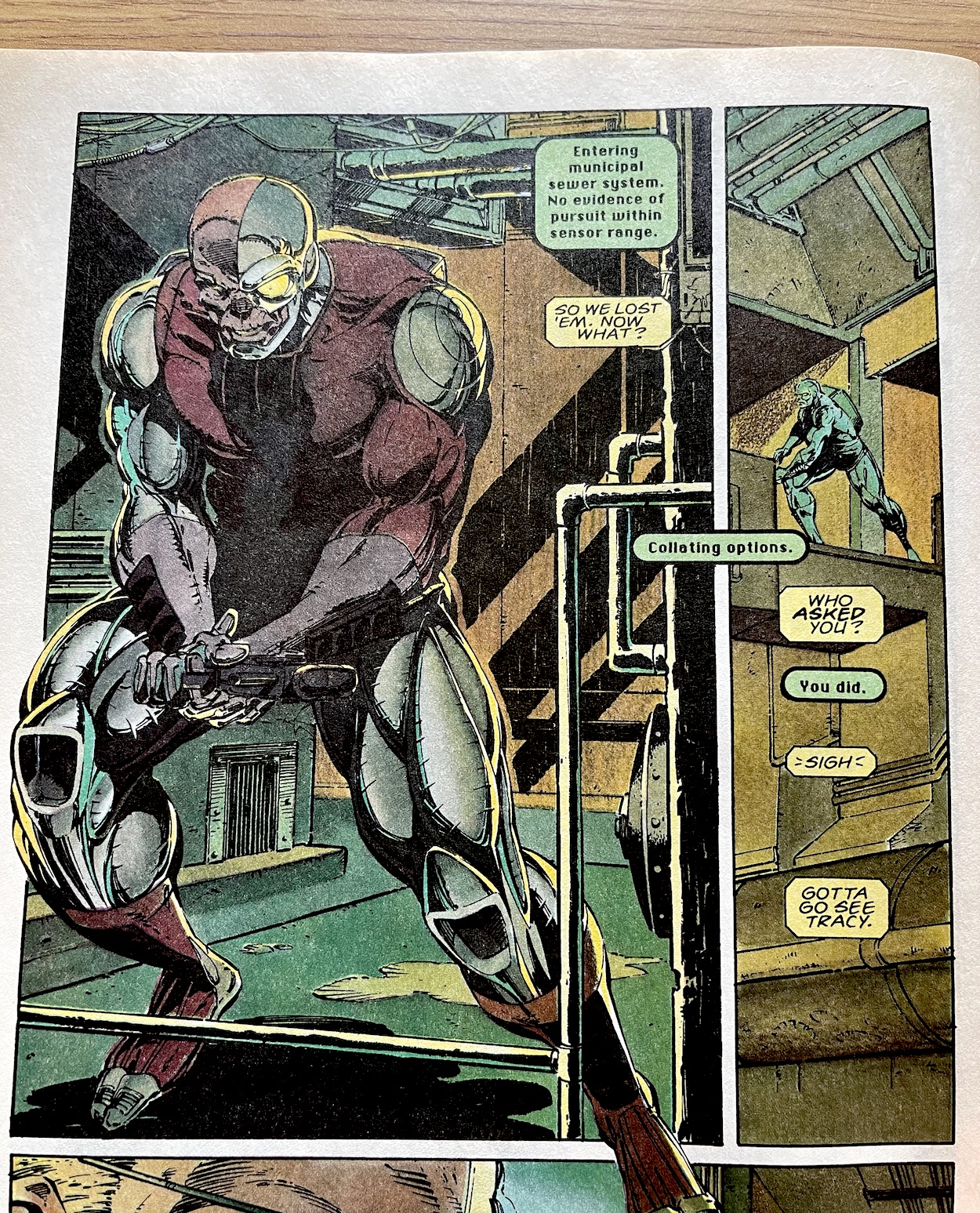
Up to this point Deathlok has been full of action, strong character development and some rather terrifying moments when Michael Collins awoke. I’ve previously mentioned how I remembered there being a lot of humour too, particularly between Michael and the monotone computer operating the Deathlok cyborg. We get to see quite a bit of this in part six of Brains of the Outfit, such as the computer’s recalculating moment and when they finally destroy the massive tank and it looks like the killer cyborg is about to see off its driver Ben, a former colleague of Michael’s, only for his head to be squished inside Deathlok’s helmet instead.
“Who asked you?” “You did.” *sigh*
Exchange between Michael Collins and the Deathlok computer
It shows how Michael has successfully reprogrammed the machine and the humiliation of Ryker is probably all the worse for the head of Cybertek; not only is he spectacularly defeated, but his cyborg war machine has avoided murdering someone again and it’s had a laugh at his expense in the process. Brilliant stuff! In the sewers we get more of this sort of thing as Michael forgets his thoughts are now part of the machine.
However, as you can see the strip can flip in an instant, from genuinely funny moments to those of heartache. Michael arrives home and obviously Tracy isn’t going to believe him when he tries to tell her who he is. Already devastated by the news of his death, this is almost too much to bare. That final moment when he repeats his funny comment about their son from #3 before running off is a much more perfect cliffhanger than any action scene could be. For all its bravado, Dwayne and Gregory’s story has a human heart running through it that’s just as compelling.
For only being seven pages, this really had it all. What a superb story and he’s definitely a Marvel character that deserves much more exposure today. It’s a crying shame he hasn’t had his own movie or TV show by now. Speaking of movies, Eye Level doubles in size this issue thanks to two of the most hotly anticipated movie sequels of the 90s. One would go down as an absolute classic, the other not so much.
On first reading I don’t think the writer was too enamoured with Terminator 2: Judgement Day, although they were right in that the film did end up as one of the most successful of all time. Personally I loved it and remember watching it on VHS in school on the last day of term after it came out in the home market. Not the best way to watch it first time around but it still made an impact and I enjoy it to this day. All of the things about Teenage Mutant Ninja Turtles II: The Secret of the Ooze meant to improve upon the original are the reasons why my friends and I never liked it, so these were massive misjudgements on the part of the director and studio.
That competition at the end though: “No captions complimentary to Mr. Ice will be accepted.” How very Havoc.
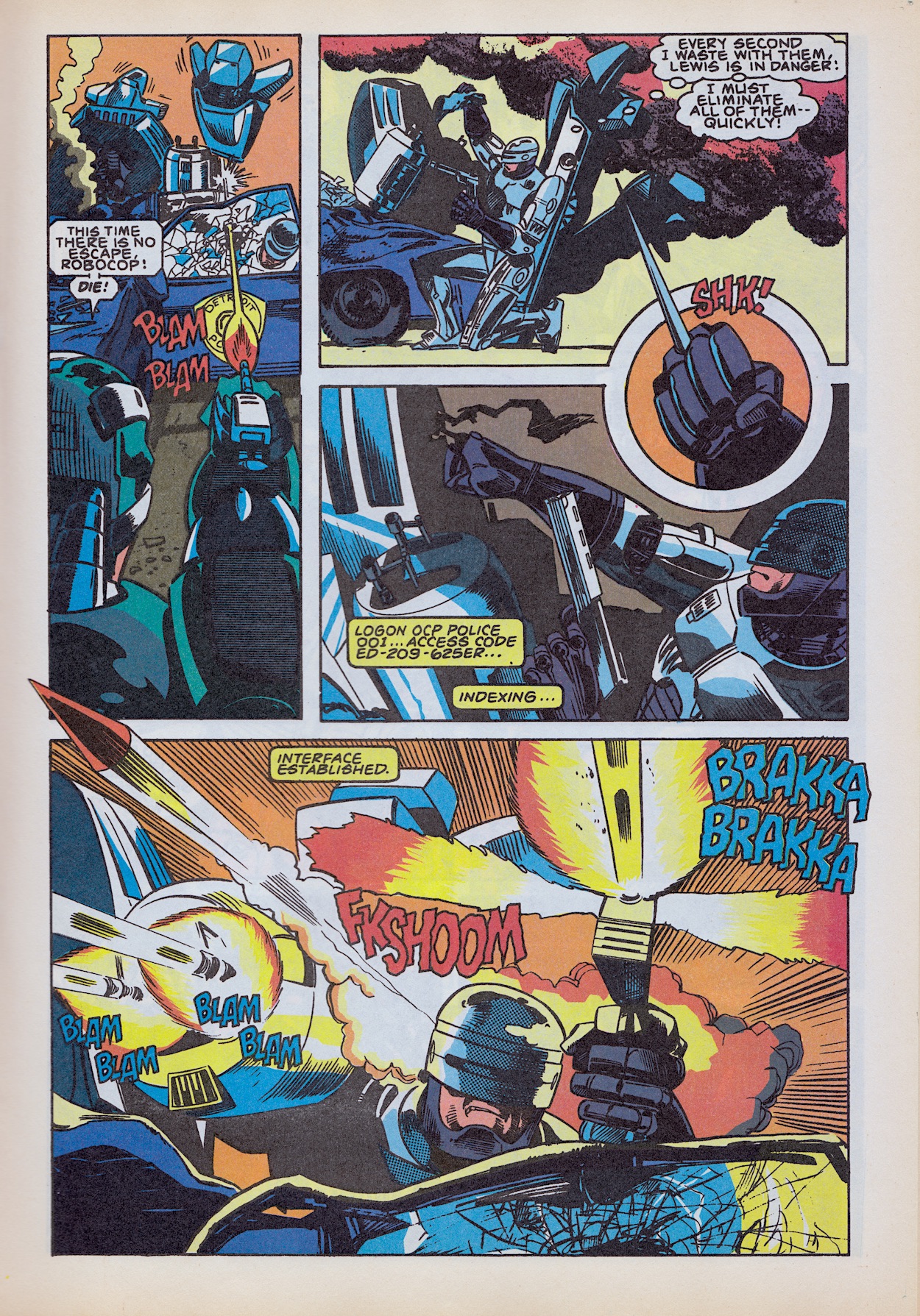
RoboCop uses his hand spike to take control of the ED-209’s weaponry
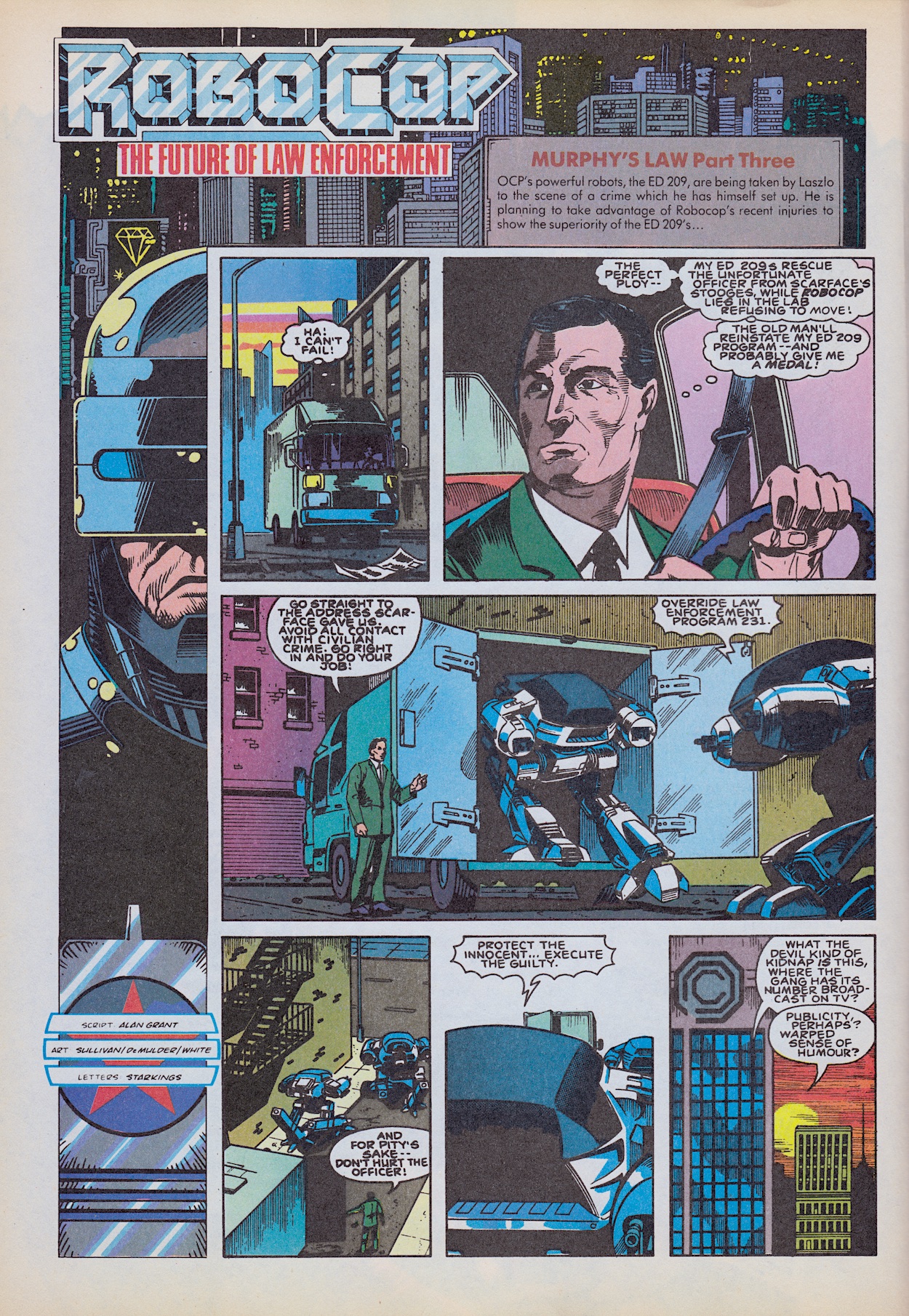
RoboCop: Murphy’s Law Part Three (written by Alan Grant, pencilled by Lee Sullivan, inked by Kim DeMulder, coloured by Steve White, lettered by Richard) takes up the centre of the comic with a large nine page chapter this issue, ending the story earlier than expected. OCP’s Laszlo has ordered his criminal contacts to kidnap a police officer so that his reprogrammed ED-209s can rescue them and prove their superiority over RoboCop while Murphy’s brain (distraught from losing a civilian) has shut his systems down. But Nixco have also sent their new Nixcops to do the same. RoboCop awakens when he learns that his partner Lewis is the officer in question, snapping him back to life. It’s all set for an explosive climax.
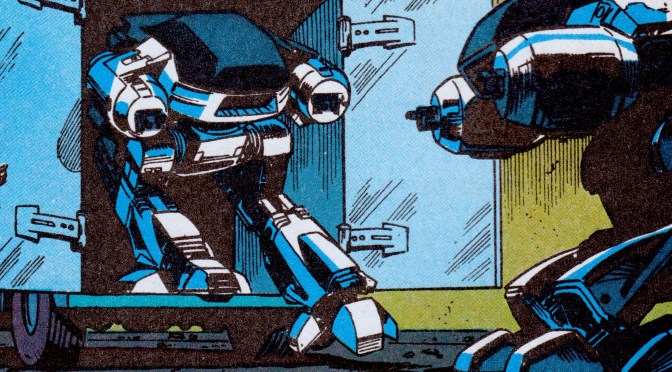
But first, either the ED-209s have shrunk since the movie or that’s one hell of a big van. I’m nitpicking, so I’ll just ignore this and get on with the main bulk of the story. The two sets of rogue robots start to take each other out, both believing they have the proper authority to rescue Lewis and that the other is breaking the law. An ED-209 even attempts to kill Alex because it deduces he’s trying to stop it rescuing her.
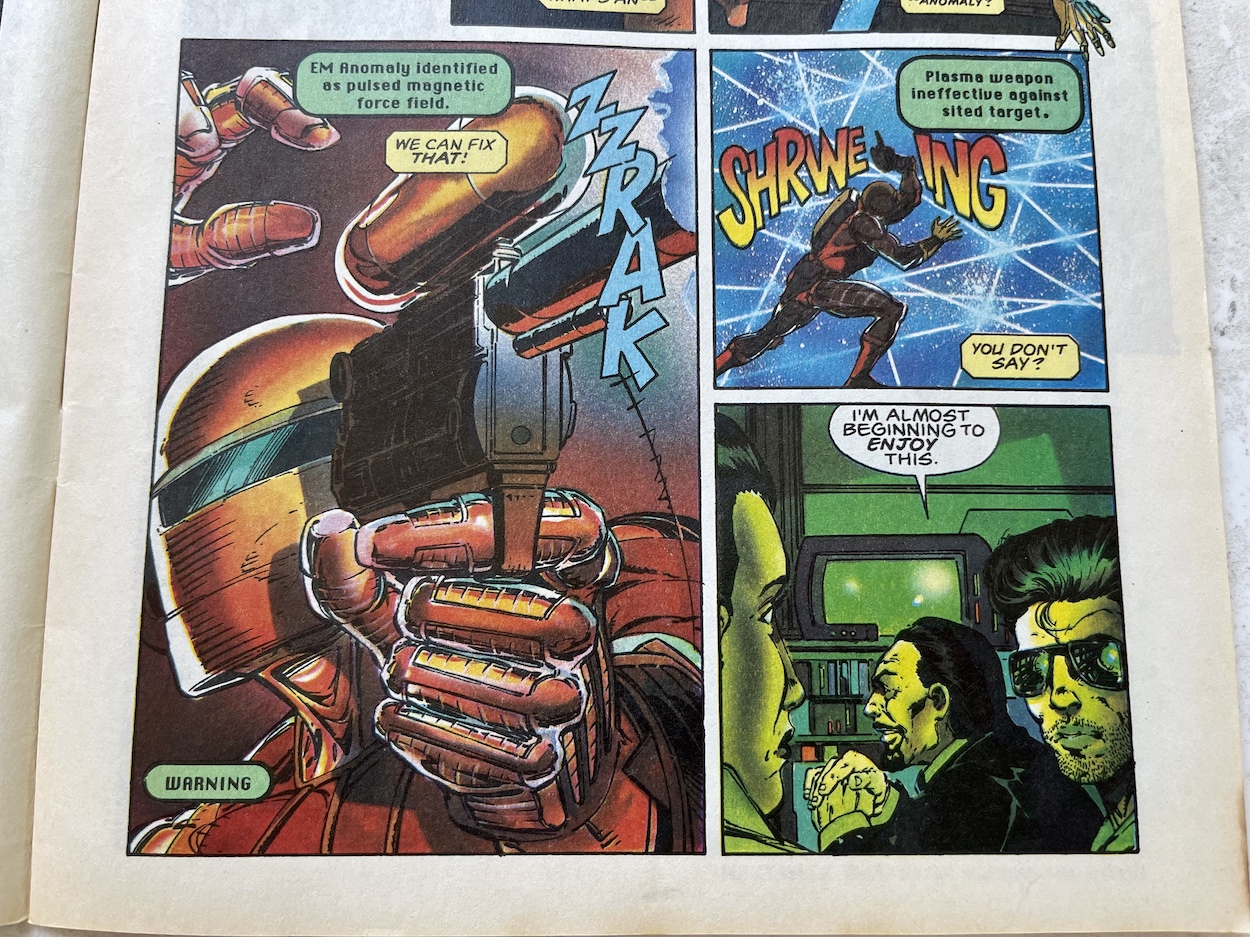
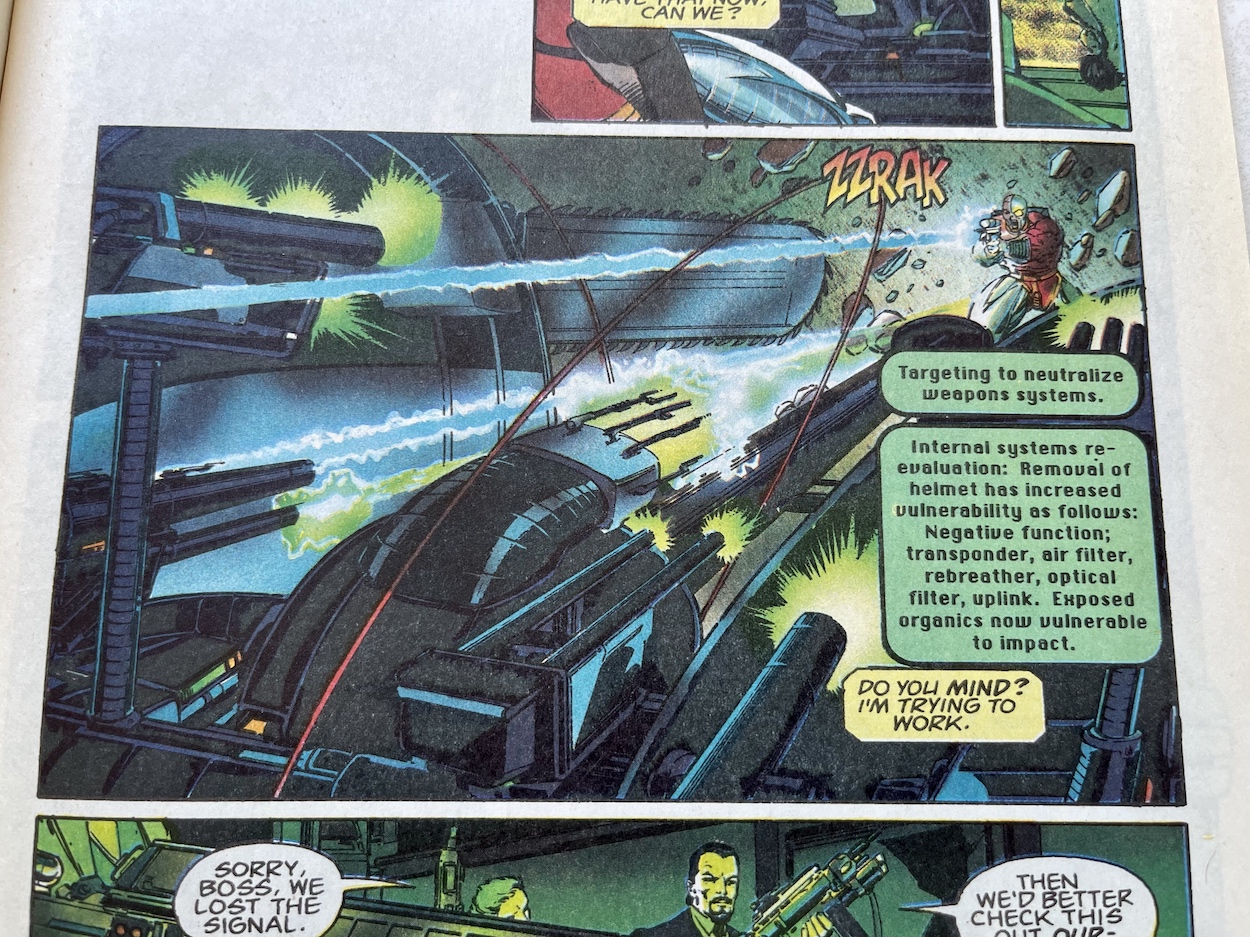
Pinned down on all sides, his car trashed and time running out for Lewis, Robo’s solution is one that I wish we could’ve seen in a movie or the show. Using his spike (a way of interfacing with other computer system ports) he accesses the ED-209 that tried to shoot him and takes command of its weaponry, eliminating all of the Nixcops in a few seconds flat.
Lewis may be tied at the wrists but she isn’t a damsel in distress. The commotion outside distracts her kidnappers enough for them to be lined up at the first storey window, so she rushes them and pushes two of them out to their death. But the final one slaps her to the ground and takes aim at her head just as Alex enters the building downstairs. Knowing he won’t reach her in time he scans up through the ceiling and I just wanted to let you see how another of his well known abilities is represented in comic form, thanks to (new editor) Steve’s colour work in particular.
You can see what’s going to happen here and after the kidnapper crashes through the floor, landing at his feet, RoboCop appears to be back to normal again. It’s been a more action-packed story than that from the first four issues, but taken together they work really well to bring us both sides of the character: the logical and the human. You’d think having both this and Deathlok together in one comic would feel repetitive but they work really well together as two completely different takes on the same basic idea. I’m looking forward to seeing what’s next for Murphy.
Part seven of Ghost Rider: Life’s Blood (written by Howard Mackie, pencilled by Javier Saltares, inked by Mark Texeira, coloured by Gregory Wright, lettered by Michael Heisler) is up next as the lengthy origin story continues and it feels like it’s wrapping up the action quotient of the tale here, so I can only guess that perhaps next week’s part will feel like an epilogue and deal with the aftermath for the characters involved. If I’m right I’m all for that, the variety in these little weekly chunks heightening the tight scripting by Howard Mackie.
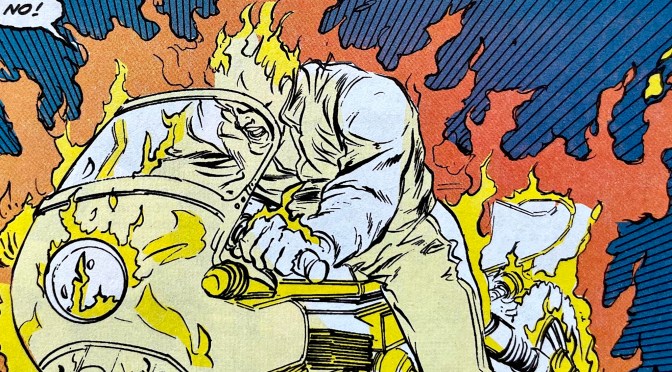
The gangs fighting over the suitcase are destroying whole city blocks in their war for the canisters, with the kids who stole it in the first place caught in the middle. No longer the cocky street gang of earlier issues, now they’re cowering for their lives after seeing one of their own killed. But one roar of a motorbike engine later and things take a decidedly different turn. Danny Ketch has transformed again into the Spirit of Vengeance and I love this particular page above, introducing another skill of the flamed rider’s.
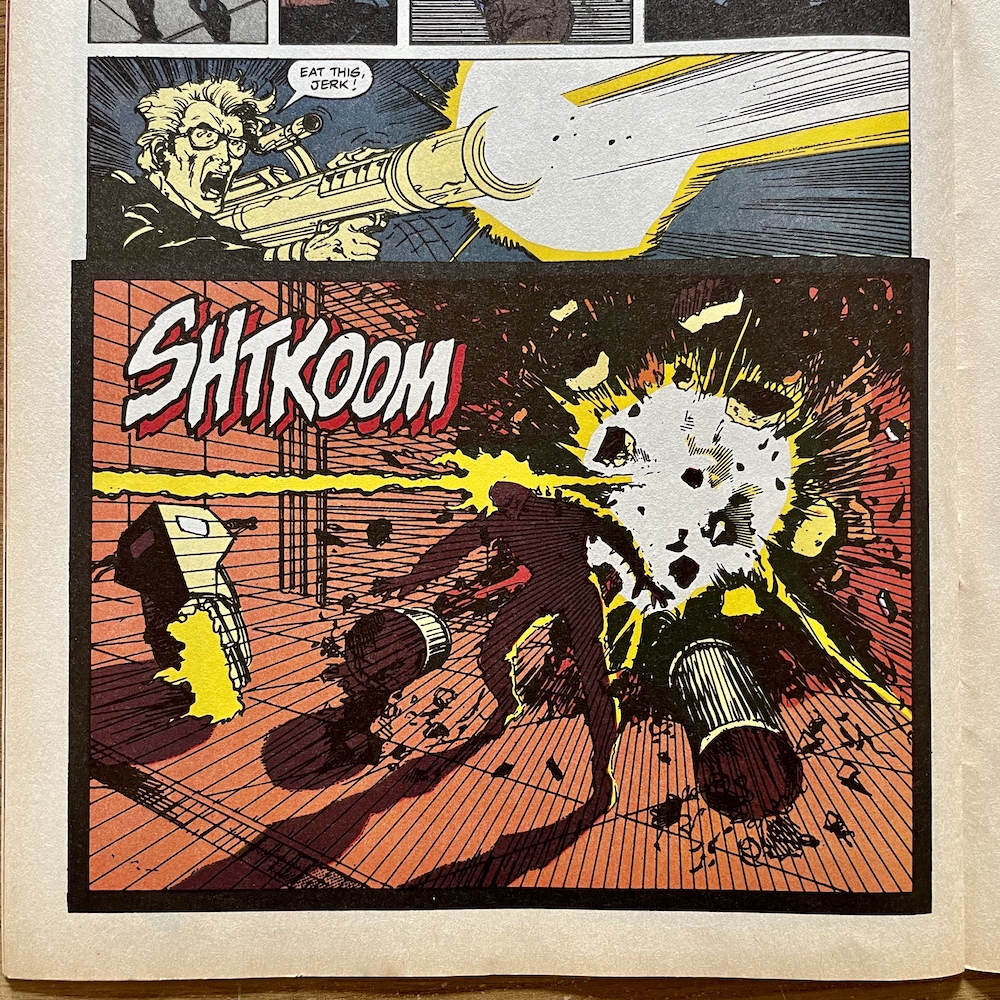
This is just the kind of thing teenage me would’ve lapped up. Oh, who am I kidding? I’m lapping it up right now at the ripe old age of 44. Ghost Rider approaches the kids, the same gang that terrified Danny in the first issue and reaches out his hand, telling them he means them no harm. I was surprised at this because I just didn’t expect it from the character and it’s a nice touch. However, he’s soon involved in the fight again and one of Kingpin’s men has had enough, pulling out what looks like a rocket launcher from the boot of his car!
With the demon rider (the gangs may have named him this but they still believe he’s just a person wearing a flaming helmet) the gangs are down to their last two survivors. Joining together to force a confession out of the girl who took the suitcase, while ready to double-cross each other at the same, the tension builds until a sudden chain flick from behind knocks them both out and in their place stands that flaming skull, with his hand outstretched once again to help her to her feet.
Again, this proves what I said earlier about the cliffhangers Havoc’s editors would choose, not always relying on the shocking action scenes. For example, it would’ve been easy to end Ghost Rider with the rocket scene above but instead we get a further couple of pages and this ending of the terrifying demon reaching out his hand to help the innocent. It’s just as much of a surprise as the explosion and it works so much better in my opinion as a moment to end on. I want to see more of this character, much more.
If you’re only coming to these reviews now let me explain that this was my introduction to the character back in the early 90s and in the intervening years I haven’t read any Ghost Rider comics or even seen the movies. This is pretty much introducing me to him all over again, so it’s basically all new. As with some of the other Havoc stars there’s a lot more beneath the surface to discover and I for one find him a fascinating creation so far. I’m eager to learn more, so little moments like this are huge to me.
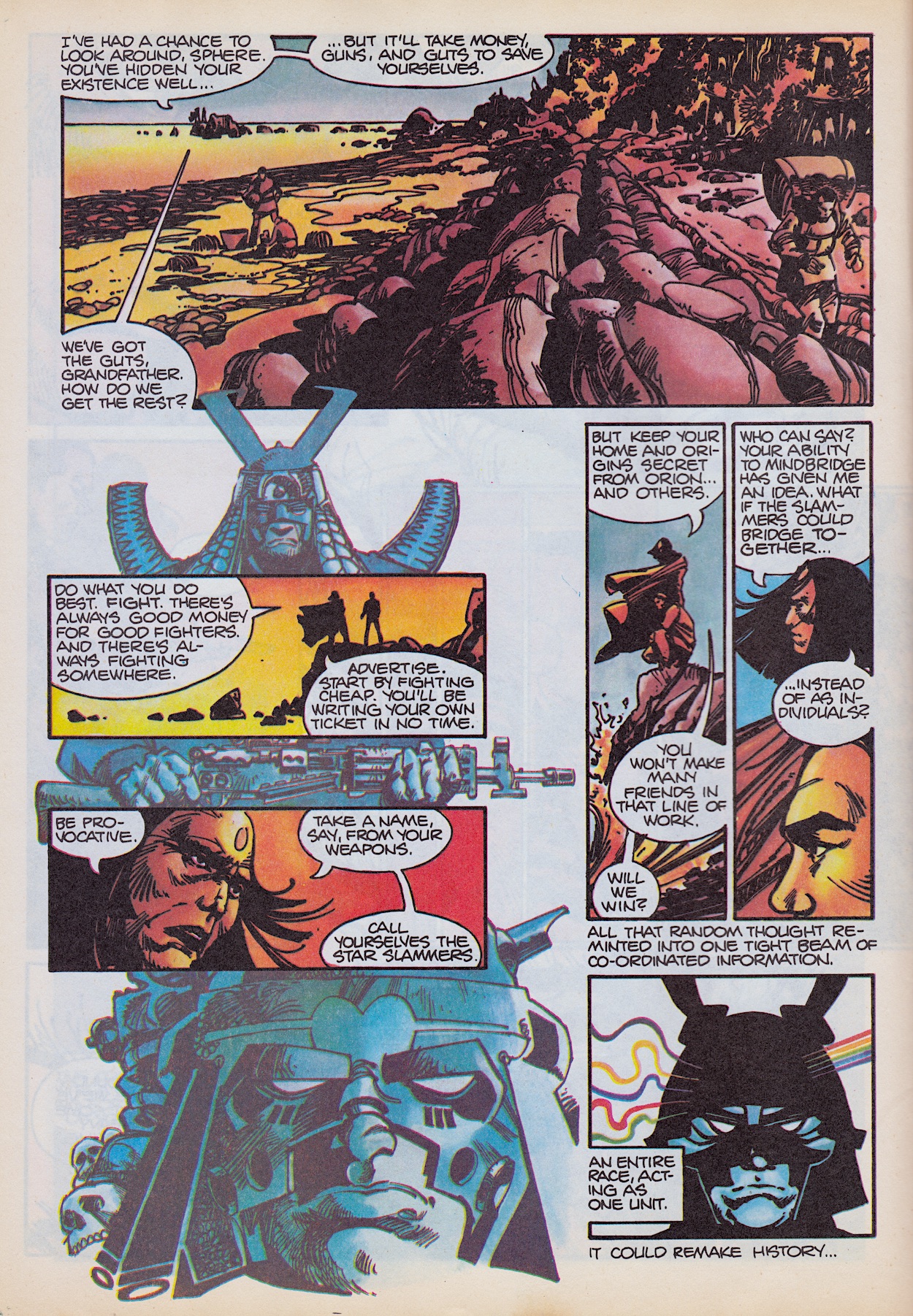
Less fascinating are the Star Slammers (written and drawn by Walt Simonson, coloured by Louise Simonson and Deborah Pedler, lettered by John Workman). Also getting a good portion of the comic we see how Grandfather and Sphere first met, the former as a senator bringing a warning of a future planet wipeout, the other the leader of the people on the planet used for sport. As the Slammers prepare for the war at last they reminisce about that first meeting, how the elder had to prove himself and how he engineered the Mindbridge.
Able to communicate psychically already, his equipment and injections were to lead them to a point when they could all communicate as one, the whole race combined as one unstoppable force. Only then could they face their hunters, the Orions. The name ‘Star Slammers’ is taken from one of their weapons and name they use as they fight for others to make money and collect the weapons and ships they need. There’s also a hint about the exiled humans being closer to their ancestors than the ones consumed by hatred (the ones who hunt them for sport because they’re different).
It’s here the main problem with pacing rears its ugly head. At some points in previous issues nothing much has happened at all, in others we’ve been treated to some nice action or background details. But more often than not it’s felt a bit muddled, as if it was just buying time until the next issue. As we all know by now, Star Slammers wasn’t written as a monthly comic, instead it was a complete story in #6 of Marvel Graphic Novel. I’ve said previously how it maybe wouldn’t have these problems if read in one go as originally intended. I’m not so sure anymore.
Even here, with the flashback to those early meetings it just reads like forced exposition, a far cry from similar scenes in #4 when we got the background to the animosity between Grandfather and Kryllik. Now it seems any interesting story sections are being rushed through, like space is running out and writer Walt Simonson has to suddenly squeeze everything in. This is the same feeling I got when reading the final chapter of the Jurassic Park movie adaptation, also written by Walt.
What could’ve been a fascinating origin story isn’t helped with pretty bad dialogue either, combining to give an impression of everything being forced just to get the story to the actual battle it’s been predicting since the beginning. Could Simonson’s galaxy-spanning tale full of relevant social commentary simply have been too ambitious for the page count in Marvel Graphic Novel? Perhaps. But at least we get an inkling some excitement could finally be on the cards next issue.
With the war about to begin we close off all of our strips for this week with Cry Havoc and the second instalment of readers’ letters. Kicking things off with the promise of t-shirt prizes for star letters, ironically the start issue given for this would actually be the first to never appear. Then it seems the issue after that was to be the first with a new strip since #1. Intriguing little hints about a future that was not to be.
That’s us at the end of another issue and, despite it being one character short and extra pages given to my least favourite strip, it was another goodie. I look forward to a full deck of anti-heroes next week though. Speaking of which, that’ll be the penultimate one already! Where has this summer gone? Join me again soon. Havoc #8’s review will be here from Wednesday 24th August 2022.
This is a wonderful original Marvel UK cover by Liam Sharp (a first for the title) showing Deathlok breaking free just as he finally does inside, with Michael Collins’ mind now fully aware and communicating with the military computer inside the cyborg. It really kicks off this issue. That headline about the Star Slammers is obviously meant to shock, but given my love-hate relationship with that particular story and its characters I’m really not feeling bothered either way. But that doesn’t detract from how excited I am to read another issue of Havoc!
I can’t believe I’m already at the sixth issue and I really, honestly do look forward to this day every week, but of course the more we fly through this on a weekly basis the closer we get to its premature end. Still, it’s clear from this issue the intention was originally to have this as a long running title, what with the inclusion of the first letters page and some of the answers given. We’ll get to that in due course. First up is the cover star and as you can see the strip now has a traditional Marvel UK border to the first page to bring us up to date. In fact, every strip has one now and I’ll show you each one.
You’ll see on these first pages that every one has the credits star inside something unique to that strip. For example, you’ll see it inside Robocop’s gun barrel, a monitor on the Star Slammers’ ship or an animal skin drum for Conan. Dwayne McDuffie and Gregory Wright’s (re)creation of Deathlok really does show off this time what the whole remit is about with an all-action entry in his origin story, with art by Gregory and Jackson Guise and letters by Richard Starkings.
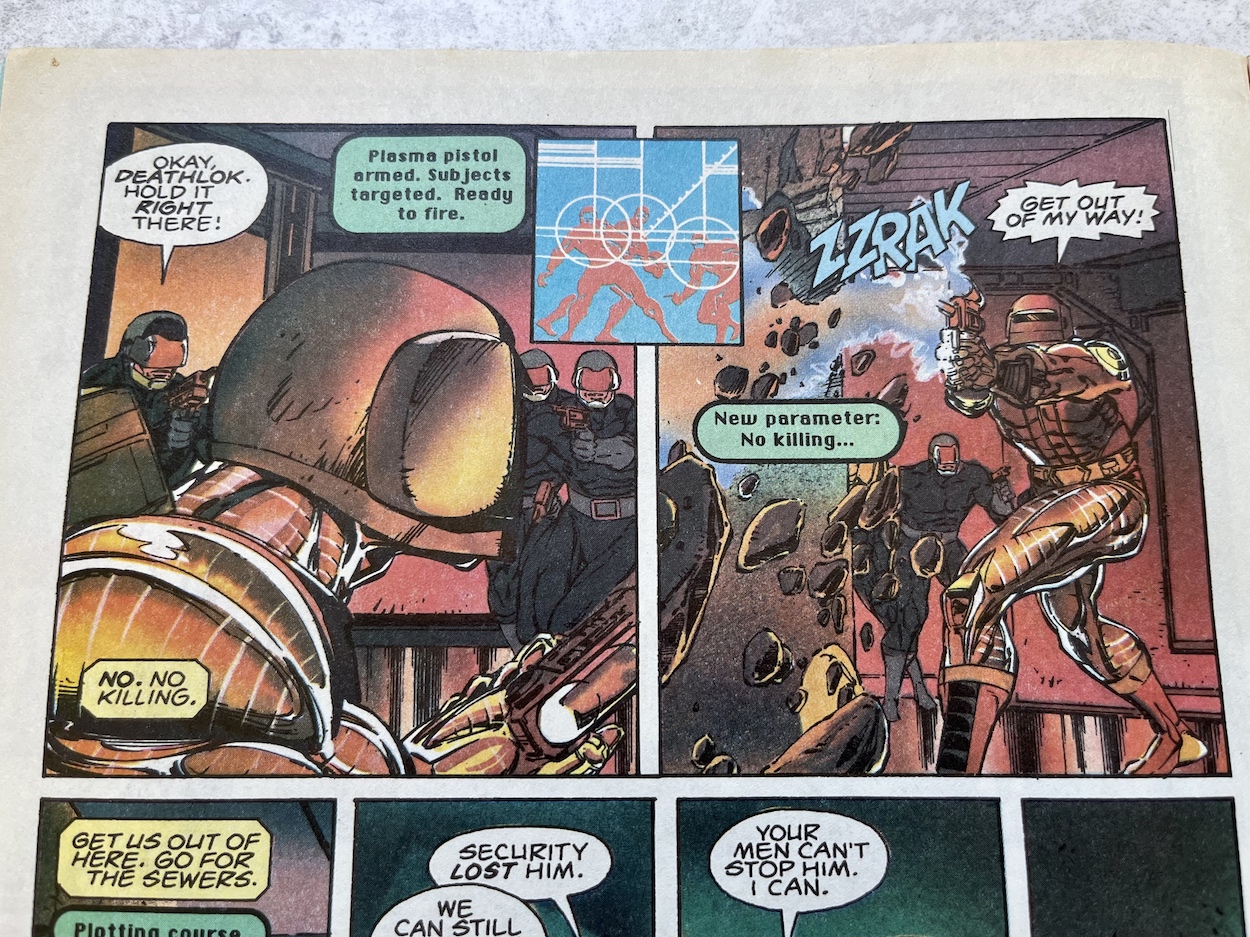
This issue’s chunk of story really highlights how Collins and the computer will interact and work together. Now recognised as its new programmer, he’s able to give the cyborg new instructions on the fly. The first thing is to tell it that killing enemies is off the table. After trying and failing to stop it previously in the jungle (apart from just about stopping it from killing a small child), now recognised as the authorised input a simple command changes all of that. The computer must now be smarter and work around this new parameter, which it does with aplomb as the story continues.
Ryker watches on and tries to stop them with every security measure possible and the straight-laced, logical computer and the flying-by-the-seat-of-his-pants Michael make a great team. Even though the computer is just a machine, it almost comes across as banter between the two thanks to Michael’s very human reactions to its very logical statements, and vice versa. Ryker is having way too much fun though in trying to kill his former friend and colleague!
Remember that huge tank thing a few of issues ago? I knew it wasn’t for nothing and as Deathlok crashes through another wall to get around the force shield they come across the tank and suddenly it whirrs into life. They scan it and find another former workmate at the wheel. Questioning how he could possibly have gotten there so quickly when no one would’ve known which route they were taking, the computer informs Michael of the trackers in the helmet. There’s only one option, to remove it and take on the tank with Deathlok vulnerable for the first time.
This is the penultimate panel of the strip and is a great summary of the action we’ve been treated to in these wonderful five pages. This is just our main character trying to escape the compound of Cybertek, never mind the adventures that could come next. This lone cyborg going up against impossible odds, the computer’s monotone (in my head anyway) voice and Collins’ interactions could make for great fun. What’s interesting is how Collins isn’t in control of the cyborg’s body. Instead, it’s moving autonomously with instruction fromMichael. An interesting dynamic I’m looking forward to the writers exploring more of.
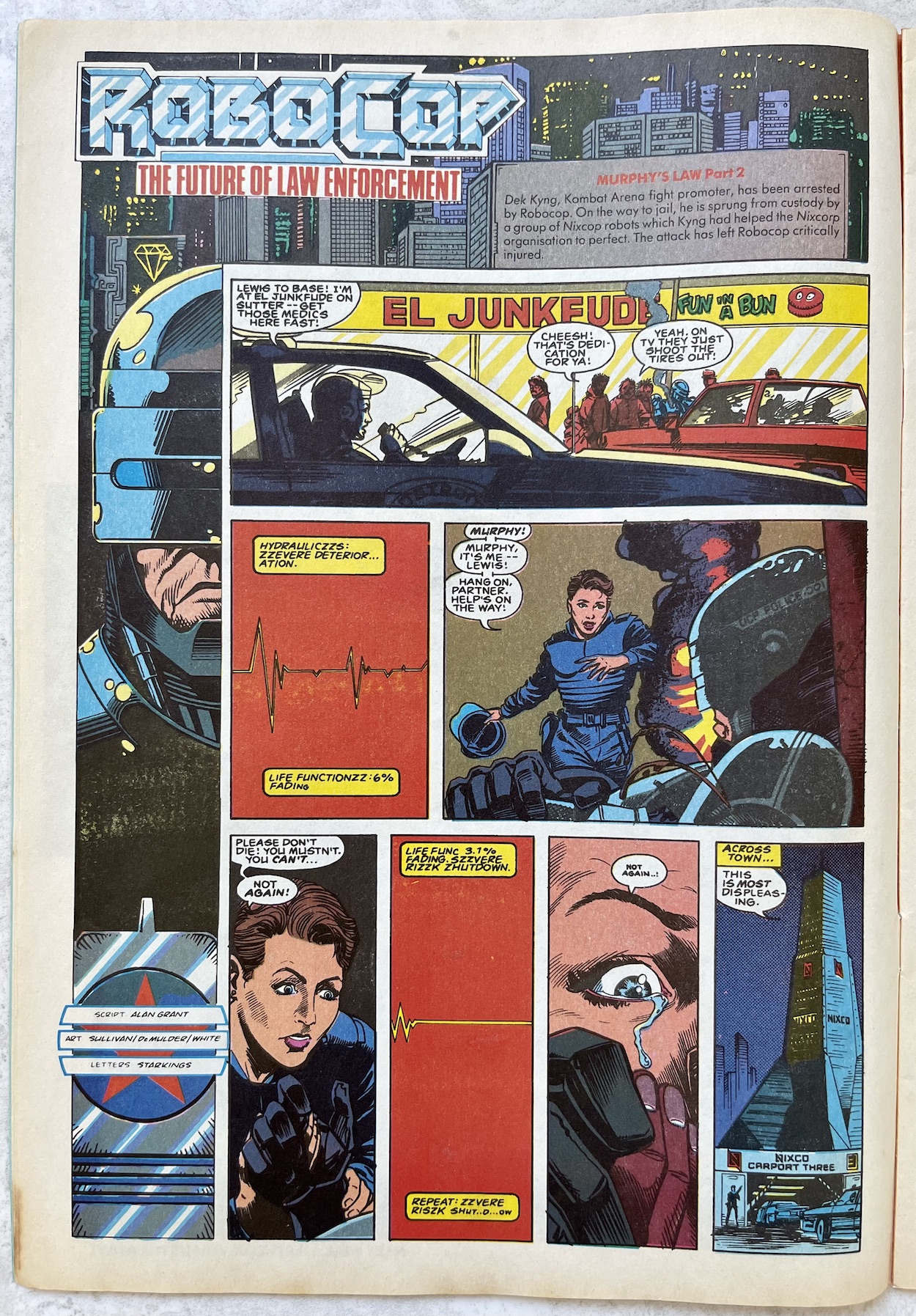
Our second strip this time is part two of RoboCop’s Murphy’s Law, written by Alan Grant with pencils by Lee Sullivan, inks by Kim DeMulder, colours by Steve White and letters by Richard. At the end of last week’s episode, in the midst of his own mental breakdown, RoboCop let go of the hovering garbage droid to land on top of a car being stolen by a gang of thieves. Causing the car to crash with Murphy between it and a lamppost, it’s almost too much for his systems which were already under stress from the Nixcops attack and then watching a member of the public die because he couldn’t protect them, breaking one of his Prime Directives.
At Nixco, Dek Kyng is now in their hands so they immediately set to work making sure he won’t be causing any more problems, setting an automated surgical system on him to hack into his brain and turning him into another one of their robots. Meanwhile, Alex lays dormant on a table in his police district. A tough job lies ahead for the engineers but they see this as an opportunity to install some amendments and they’re given the go ahead to proceed, much to the chagrin of a new character called Laszlo.
Laszlo’s plan involves having a police officer kidnapped who the ED-209s will rescue
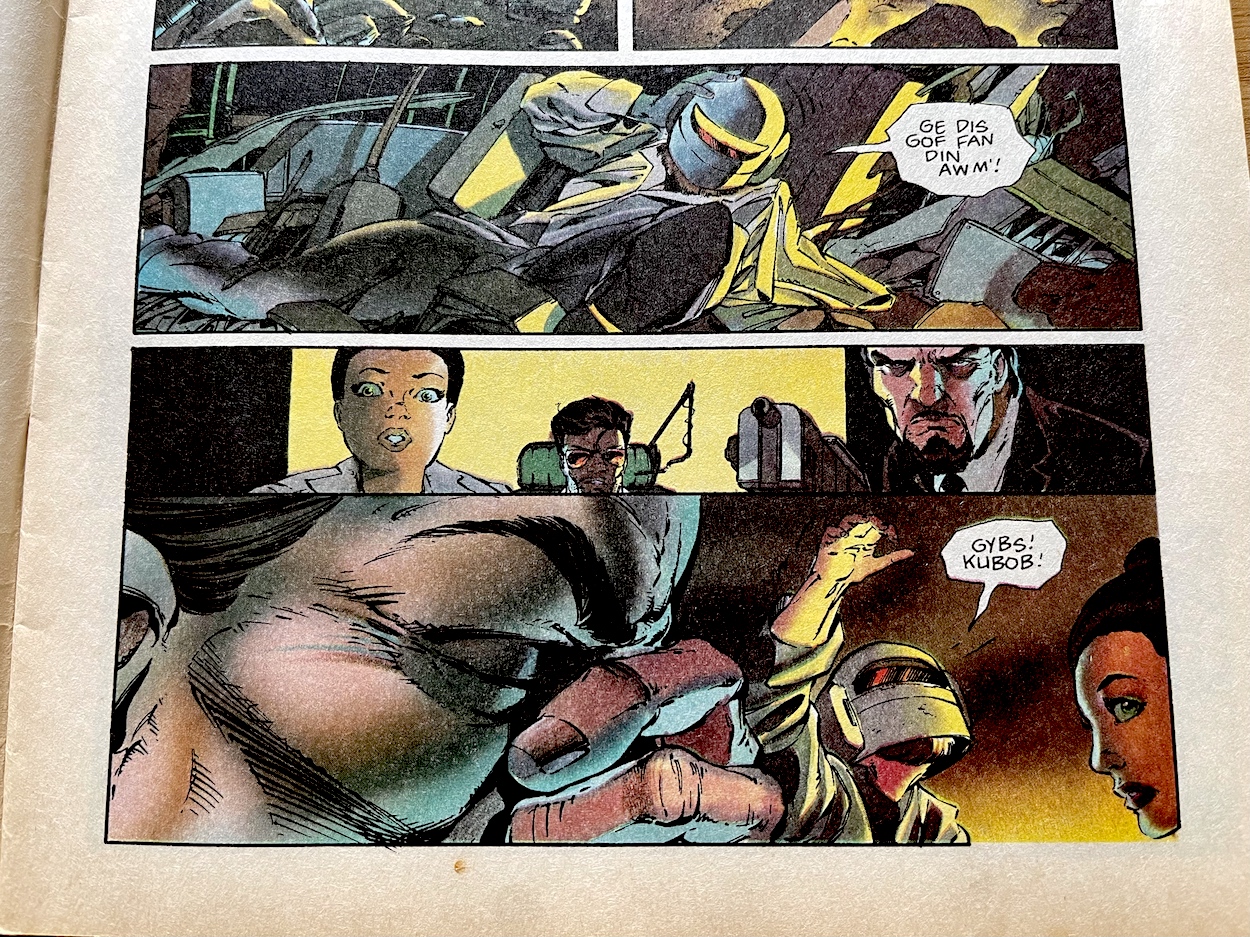
You see, Laszlo was in charge of the ED-209 programme which RoboCop fans will know looked cool but were pretty awful at law enforcement. Believing the problems to have been fixed (yet the EDs are still the big, lumbering robots of the movie) Laszlo sets about making sure OCP have no choice but to terminate RoboCop and choose his path instead. His plan involves contacting a street gang and arranging to have a police officer kidnapped, who the ED-209s will rescue.
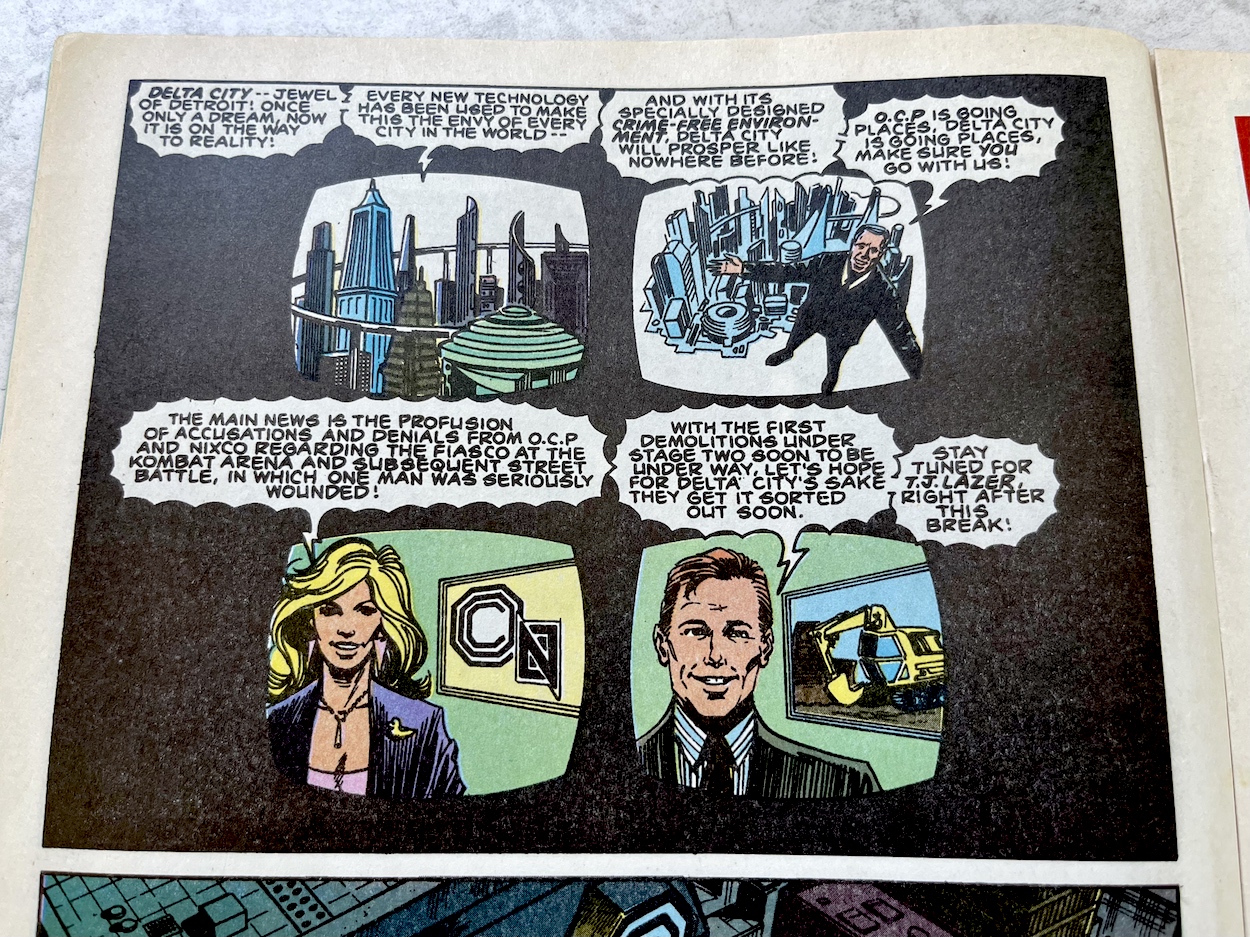
First up though it’s time for a commercial and some news updates from Media Break. I loved these in the first film and in particular in every episode of the TV series. I’d completely forgotten Delta City didn’t actually exist yet in the movie, I’m so used to seeing it complete (or at least in a more advanced state) in the series complete with its self-aware central intelligence, that reading this feels like a prequel to the RoboCop I grew up with.
Eventually his engineers realise it’s the human part of RoboCop that’s not operating correctly (for want of a better phrase) but they can only speculate on what’s going on inside his mind. They put out a call for his partner Lewis to return to HQ and help, and in the meantime we get one of those trademark RoboCop memory scenes. While all of this is going on the various strands of the story come together before we leave things for another week.
Lewis is currently in the middle of an arrest which in reality is a set up by Scarface’s men, the gang Laszlo contacted to kidnap a random officer. When news of her disappearance reaches Media Break the bosses at Nixco see an opportunity to send in their own Nixcops to rescue her and prove their cyborgs are the future of law enforcement. What a mess this could be! Great stuff. Writer Alan Grant feels much more comfortable with this second story and is really getting stuck into the lore and the action, one never at the expense of the other. Perfect.
Next up is Star Slammers, created, written and drawn by Walt Simonson, with colours by his wife Louise Simonson and Deborah Pedler, with John Workman‘s trademark lettering. So, with Ethon being tortured in last week’s strip it’s no surprise to find out he’s the one who bites the dust. There’s a quick bit of mourning from Jailaia and Sphere before they decide to use the body of their fallen comrade to help them escape. Wow, that’s pretty cold. They don their gear and before boarding their own ship moored outside they tie Ethon into the pilot’s chair of the prison ship and set the controls.
I have to say this next part is really rather good. The main ship of the fleet is watching on and receives a distress call from the prison ship after someone on board discovers what’s happened. The huge vessel getting silently and ominously closer and closer is a truly terrifying sight for those watching and I think Walt has done a superb job with this particular sequence, which culminates on the next page.
Of course the escape is immediately covered up (as an unwarranted attack) by Krellik, who is no longer a senator but an all-powerful Admiral. Declaring the hunt on and how much the television networks will love it, he alerts the entire fleet to set out after the escaped Slammers. It feels like we’re finally getting somewhere, so adding this to the fascinating (and very relevant today) background politics from #4 we could be in for a treat in coming issues.
One film that stood out above all others in the summer of 1991 was Terminator 2: Judgement Day
I’m still not sure if it’s really working being split up into chunks though. Maybe the coming issues will prove me wrong, but at the moment it may have worked better in its original form. Two out of the these first six chapters held real promise, so if the remaining parts of the story build on those and we get a nice mix of story and action in the limited space afforded here, it may prove to have been worth the wait to get to this point.
This issue’s Eye Level is a particularly interesting one. During the summer of 1991 cinema goers were treated to a vast array of blockbusters with everything from City Slickers and The Naked Gun 2 1/2: The Smell of Fear, to The Rocketeer and Robin Hood: Prince of Thieves. But one film that stood out above all others was Terminator 2: Judgement Day and it’s the impending release of this movie that takes up the whole page, with 20 facts about the film and its star.
While I can’t find any evidence that the so-called ‘Jung and Freud’ film was ever made, there are other tidbits here which I never knew about, such as the fact Arnold Schwarzenegger was originally intended to be Kyle Reese in the first film, and before Robert Patrick was cast as the new T-1000Billy Idol was hired for the role. I’m a fan of the series (the first four films anyway) so it’s interesting to see the contemporary coverage the best one received at the time, and it’s a clear indication this was a Marvel UK comic aimed at the older teen audience.
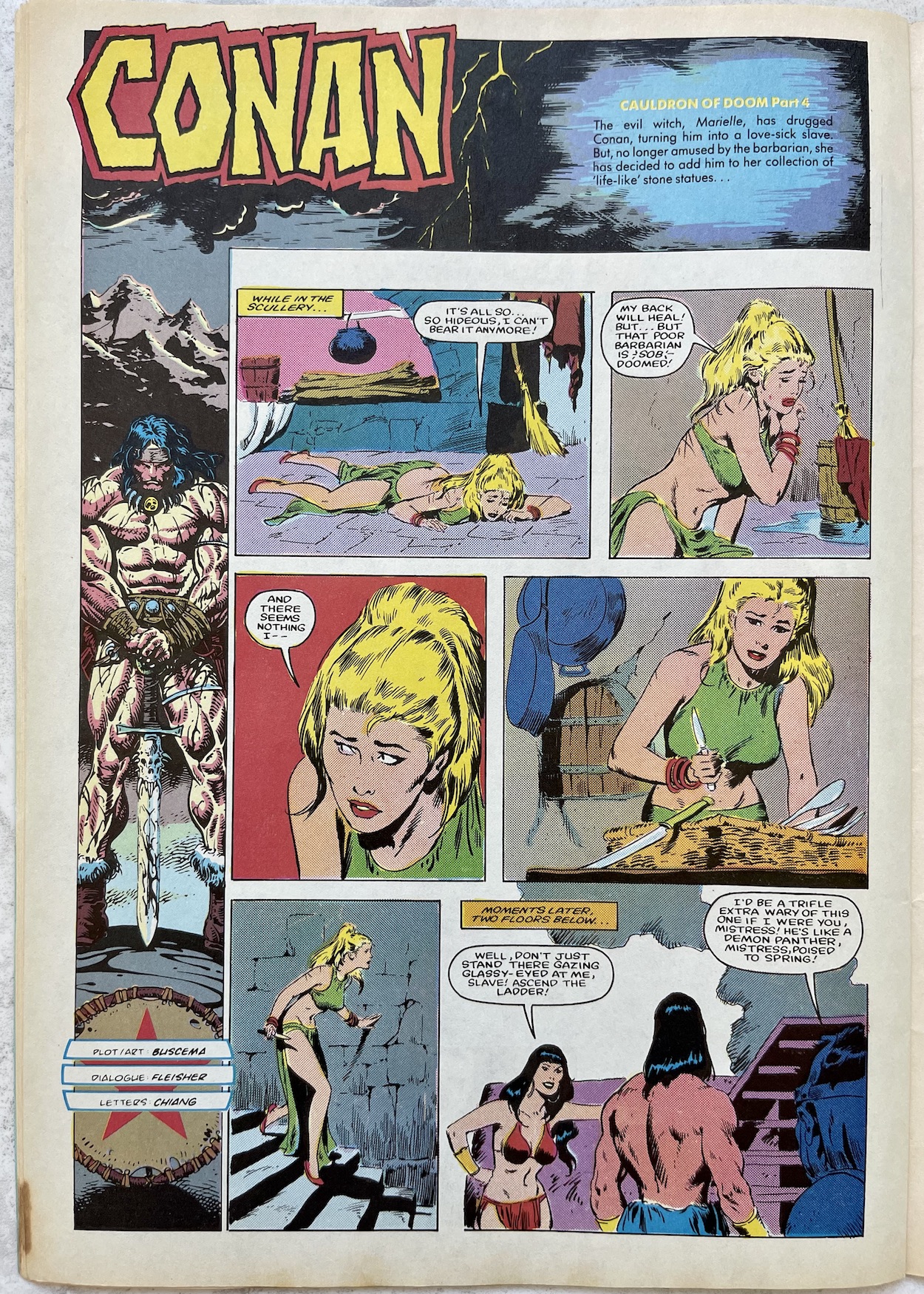
Conan the Barbarian’s Cauldron of Doom (plot and art by John Buscema, dialogue by Michael Fleischer, letters by Janice Chiang) comes to its conclusion this issue and as feared it basically boils down to Conan coming out of his hypnotised state and punching a few people. How this happens is rather good though, with slave girl Nateesa coming to his rescue. Terrified of her mistress Marielle, Nateesa can’t get close to Conan so she resorts to desperate measures and throws a stolen knife at him. She’s a very good shot from so far away!
Once returned to his senses Conan easily disposes of the two men guarding the cauldron filled with whatever liquid would’ve killed him and seized his body into a solid statue for Marielle’s collection. (The opening dialogue box refers to her as a witch for the first time.) As for the villainess herself, she chases after Nateesa who punches her out cold and… that’s it. It’s all neatly tied up in a big bow as Conan and Nateesa ride off into the sunset together. After the intriguing build up, the interesting Marielle in the first chapters and the very funny moments in previous weeks, it’s such a shame it has such a clichéd ending.
Robert E. Howard died only four years after creating Conan so he never got to see his meteoric rise
At the end a caption states Conan won’t return until #8. No idea why he won’t be in #7 yet. Is one of the other strips due to get extra room for some reason? Are special features planned? Who knows, we’ll find out in seven days.
As if to soften the blow of the longer than normal wait for the next Conan story we get a two-page feature about the history of the character written by comics historian Mike Conroy. Coming from a position of knowing nothing about Conan this was all brand new information to me. Most surprising was how young Robert E. Howard was when he died, and only four years after creating the character so he never got to see his meteoric rise. That’s such a shame.
Other surprises for me are that the original Red Sonja was much different than the one in the movies, that she wasn’t part of Conan’s stories and the Conan movie was written by Roy Thomas (who adapted Havoc’s first story from Howard’s books) and Gerry Conway who blog readers may remember was the head writer on Marvel’s fantastic Visionaries comic. The feature does raise a couple of questions though, namely if the US comic was still in print why was Havoc using such early stories rather than the latest ones, which surely would’ve been a better fit? Also, what on Earth is Captain Carrot and his Amazing Zoo?!
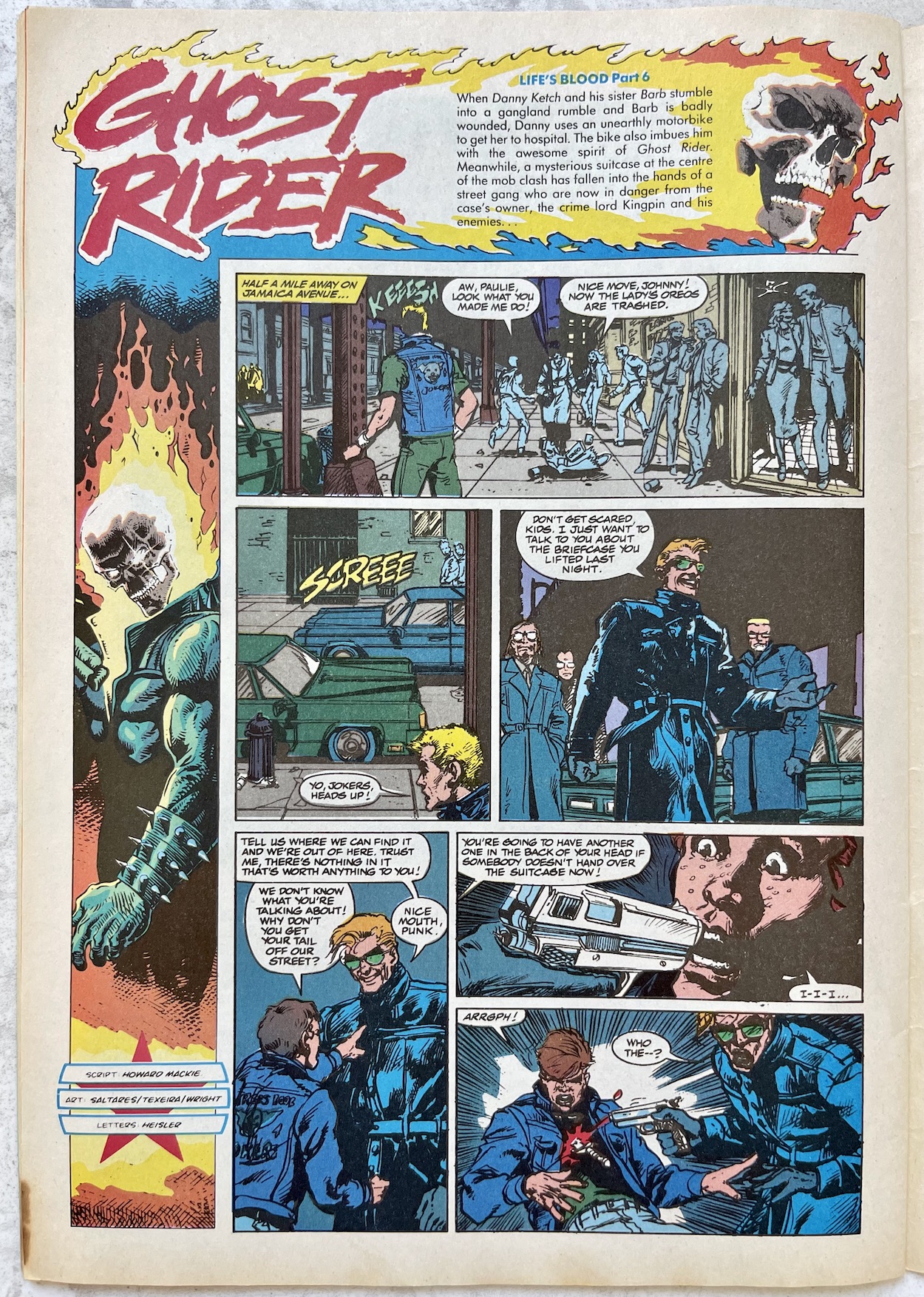
The final strip this week is Ghost Rider (written by Howard Mackie, pencilled by Javier Saltares, inked by Mark Taxeira, coloured by Gregory Wright, lettered by Michael Heisler) and it’s all about that mysterious suitcase and the young gang of kids who stole it. Kingpin’s men have tracked them down and sent in that well worn stereotype, the bad guy who is so overly polite you just know he means the exact opposite of what’s coming out of his mouth. We must remember these stories are nearly 30 years old. His hints soon turn to actual threats until one of the kids is stabbed by a flying knife.
New Marvel bad guy Deathwatch has sent his ninja-like minions for the same purpose, to retrieve the briefcase that kicked all of this off in #1 and all hell breaks out in the streets of the city. It’s clear this version of Ghost Rider is going to make for a very violent strip, much like the rest of Havoc really, and despite the central character being of supernatural origin it all comes across gritty and serious. I like this juxtaposition.
Our reluctant hero Danny Ketch is driving about on his apparently completely normal motorbike and beginning to wonder if he imagined the whole thing from the night before. He’s trying to determine whether he wants to coax out whatever it was he turned into, thinking it might have some knowledge to help his hospitalised sister Barb. However he’s terrified of doing so, but once he hears the gunfire and commotion the petrol cap on the bike starts to glow. He doesn’t want to touch it, but feels compelled to. He instantly regrets it.
I love this transformation scene, Danny’s skin engulfed in fumes and then lit up, you can feel the heat radiating off the page in that close up of his face, followed by the exciting panel of him and the bike becoming one. Depending on how each individual story in Havoc is chopped up into various lengths, each issue we could get a lot of plot or a more character-focussed bit of the tale, and sometimes we get a quick shot of excitement which keeps us hanging on for more the following week.
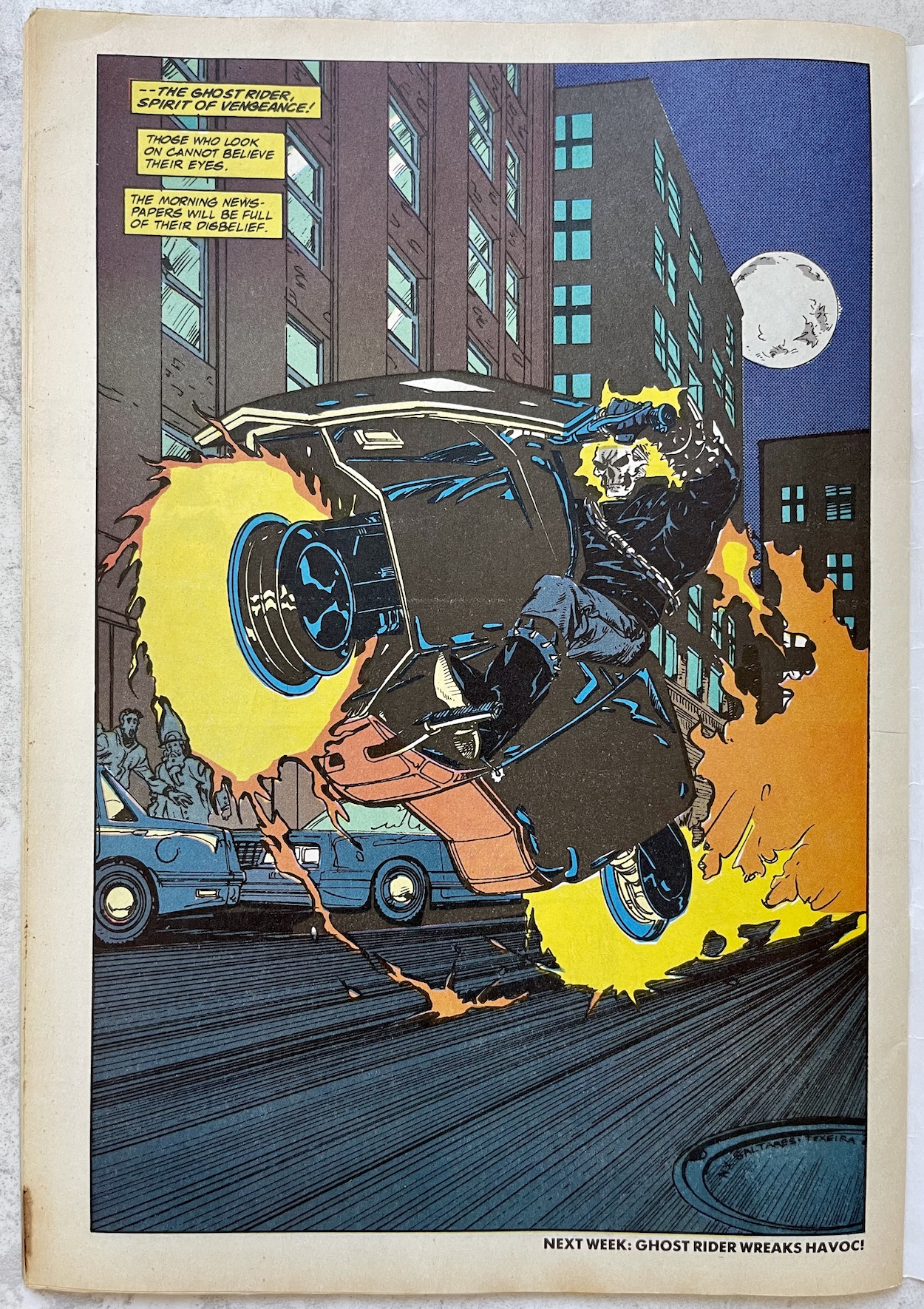
This week’s Ghost Rider definitely falls into the latter category and I’m not complaining one bit, especially when the next page ends this week’s strip with this image.
The gang war over the briefcase has escalated to murderous levels, endangering innocent lives and the Spirit of Vengeance is having none of it. There’s a lot of mystery still around the main flaming character and Danny is only slowly beginning to realise this could be his life now. It’s building momentum, it’s pace is quickening but it’s also taking time to establish its characters. As a result this feels like the most bedded in strip in Havoc. Plus, that’s just a really cool image to end the issue on.
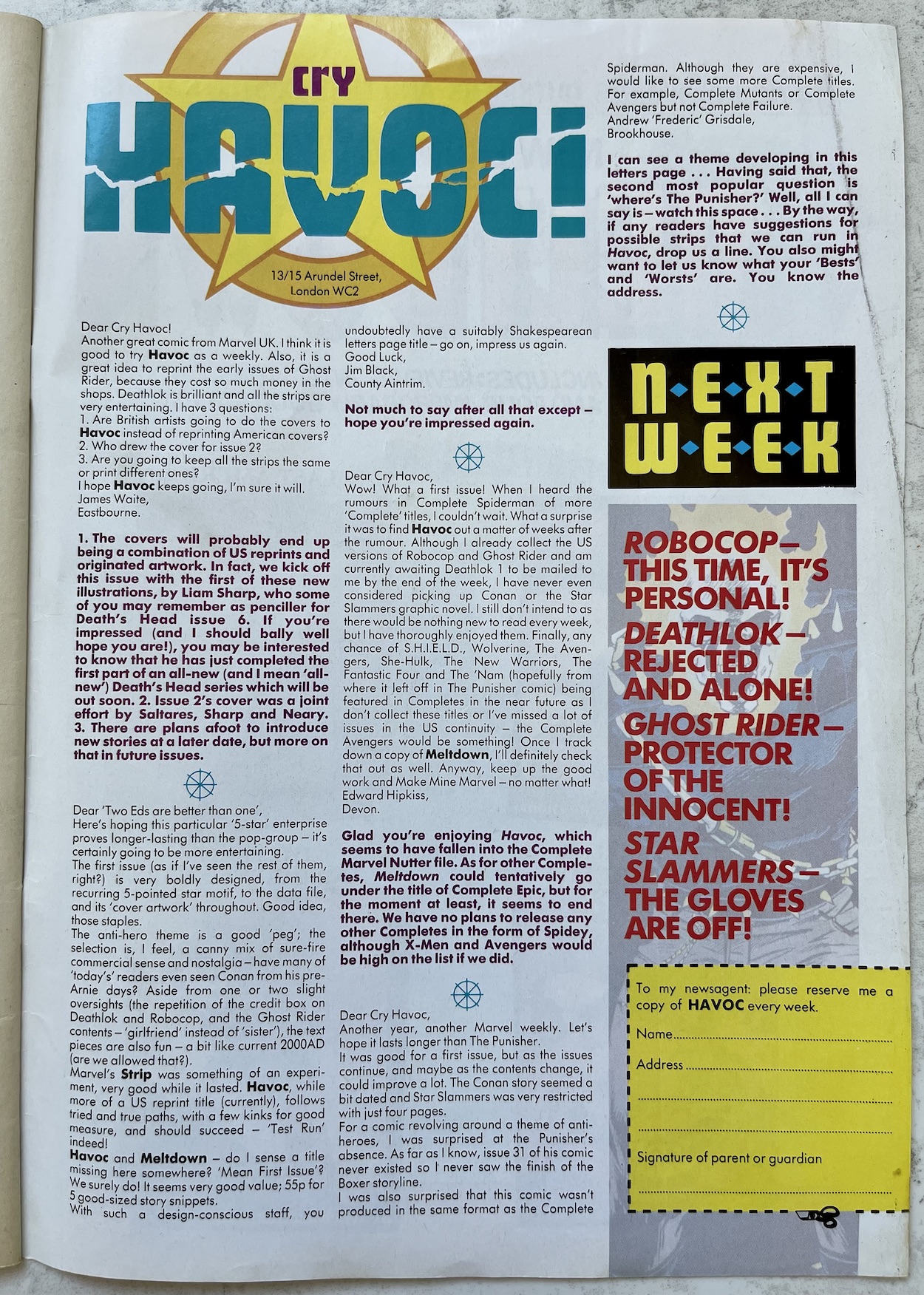
We come to the end of another brilliant edition but instead of the usual full-page Next Issue promo we’ve got our first letters page in the shape of Cry Havoc. At last! I’d forgotten all about the fact we even had one. I don’t recall ever writing in, but given the short life of the comic I probably never got around to it. The letters here are all very positive and that’s the feeling I come away with; if this was the summer of ’91 I’d be thinking this appears to be a very successful new comic, such is the reception on display here.
There are definitely a couple of recurring themes on this page, for example a few mentions of The Punisher (and more received according to an answer) and his cancelled comic, which leads on to the other theme of hoping Havoc isn’t another short-lived Marvel weekly. Sadly at the time it did seem like every decent new comic didn’t last long. Unbeknownst to us Havoc was to be yet another casualty. But I’m enjoying it while it’s here.
One final note, Jim Black’s letter mentions the five-pointed star motif and I asked Paul Chamberlain (who designed it) if this was related to the fact there were five strips. It was actually just a happy coincidence. Watch out for a chat with Paul here on the blog soon! There are more Havoc comics to review first though, so join me again in one week. The review of #7 will be here on the OiNK Blog from Wednesday 17th August 2022.



















 OiNK Blog