On 21st June 2010 the sad news broke of the passing of musician, comedian, artist and comic cartoonist Chris Sievey, better known to the wider world as the papier-mâché headed Frank Sidebottom. Upon reading the news I hunted out my few remaining issues of OiNK to read his contributions. I enjoyed them so much I began collecting all the other issues of the comic, and the rest is history. All thanks to Chris. All thanks to Frank.
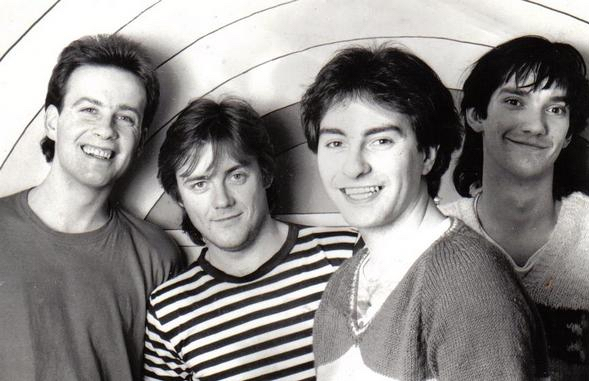
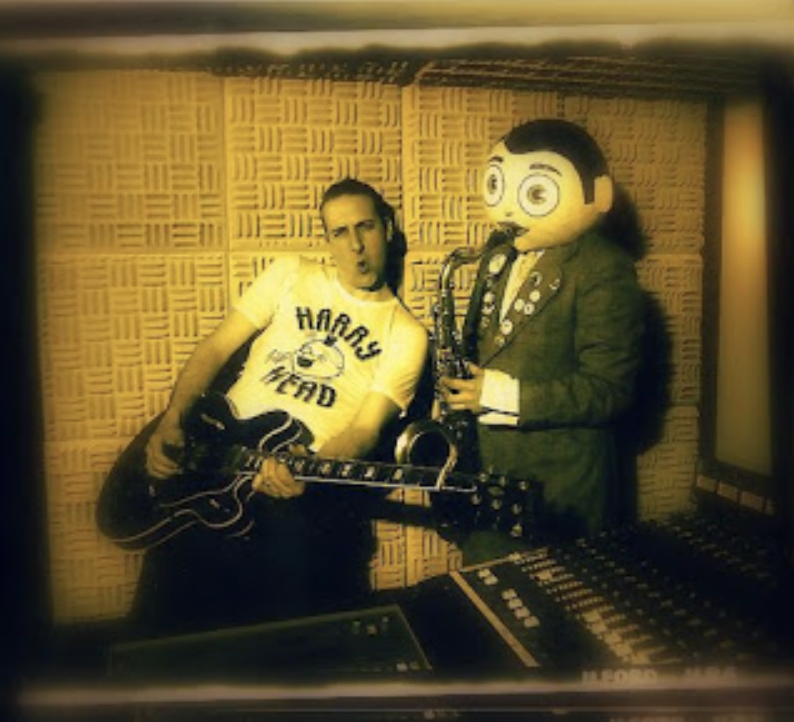
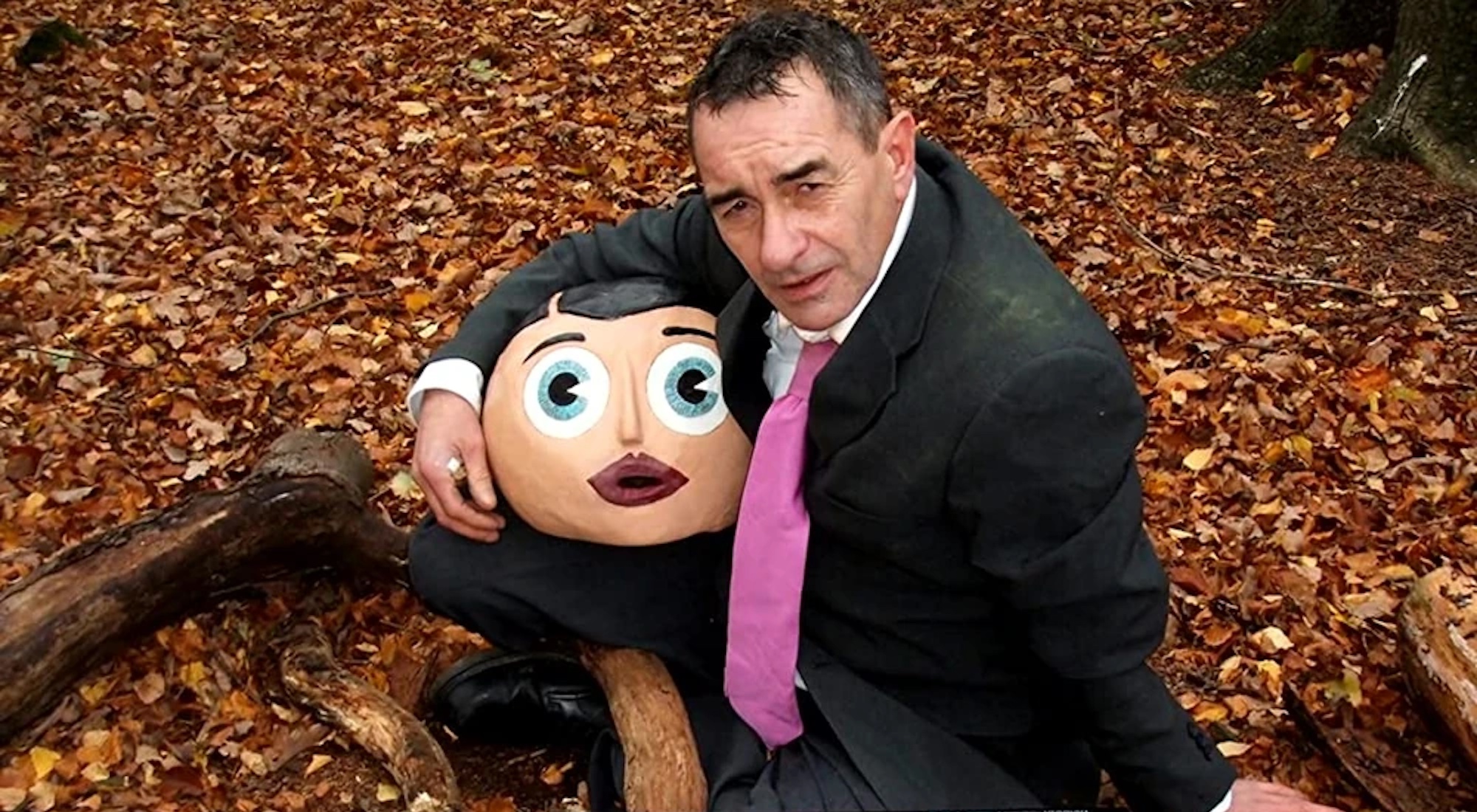
Chris was born on 25th August 1955 and over the course of the 70s and 80s was the frontman of his band The Freshies (he’s second from the right above). However, during the 80s he developed the character of Frank, an aspiring pop star with his famous nasally voice who portrayed himself as living the celebrity lifestyle when in reality he was living at home with his mum in Timperley. A regular star of kid’s TV in the 80s, I was very aware of him when he popped up in my third issue of OiNK, #16.
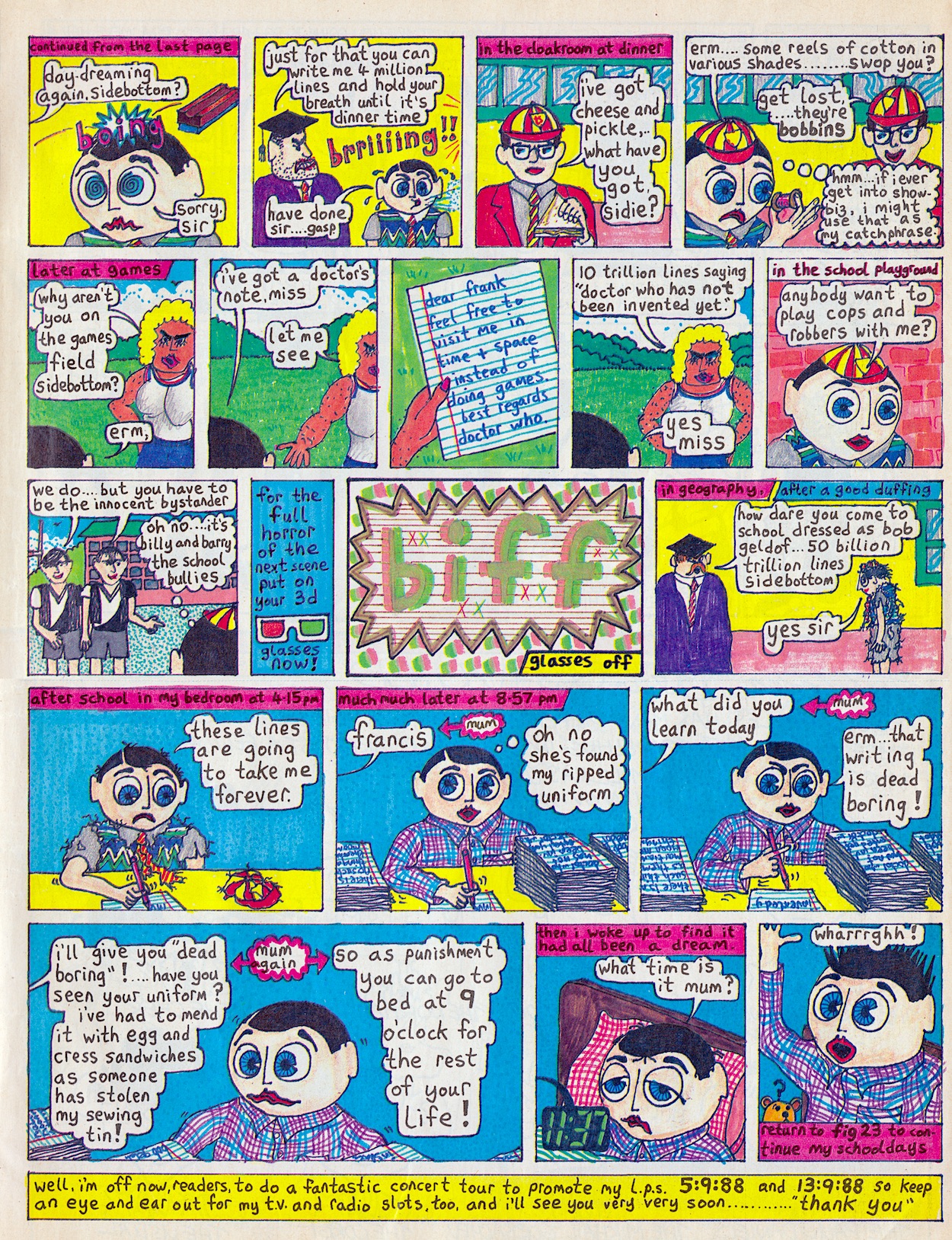
“Chris was laborious with his artwork,” OiNK co-editor Patrick Gallagher told the Dazed website. “He could have made it easy for himself by colouring in flat colours, but instead he used this stipple effect done with a felt tip pen. He would take three hours to paint a page which would usually take 15 minutes, but he liked detail and he would always go the extra mile.” That extra mile was always appreciated by this pig pal.
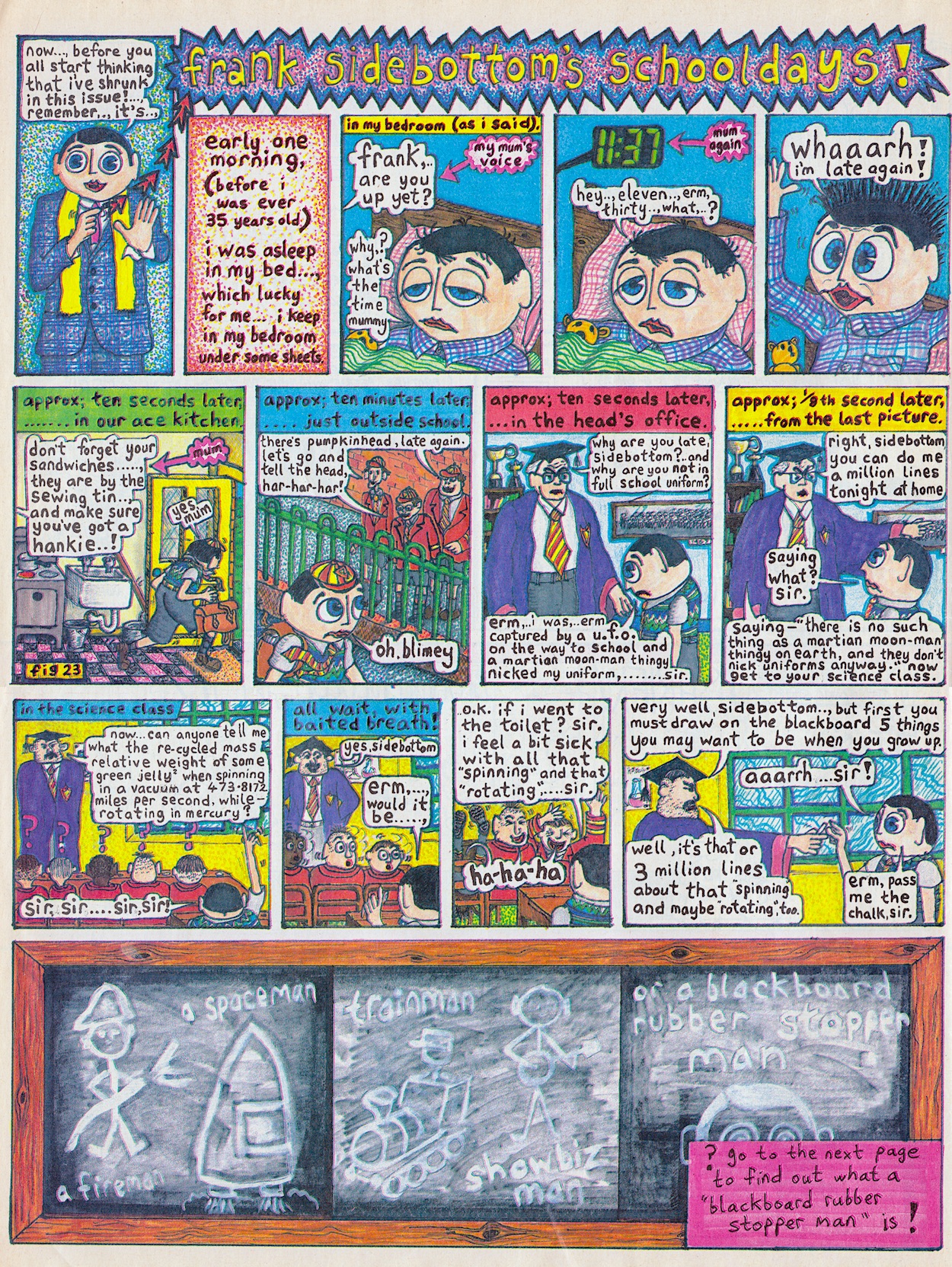
“Having Chris on board was great because it meant that as well as his unique artwork, we also had a real life character [Frank] to front the comic. We had someone out there publicising OiNK who was gaining more recognition,” says Patrick. Indeed, at the time it felt like readers were part of a secret club that those who only saw him on TV weren’t aware of. A secret club that gave us insights into his home life, celebrity friends and musical career. Even his school days.
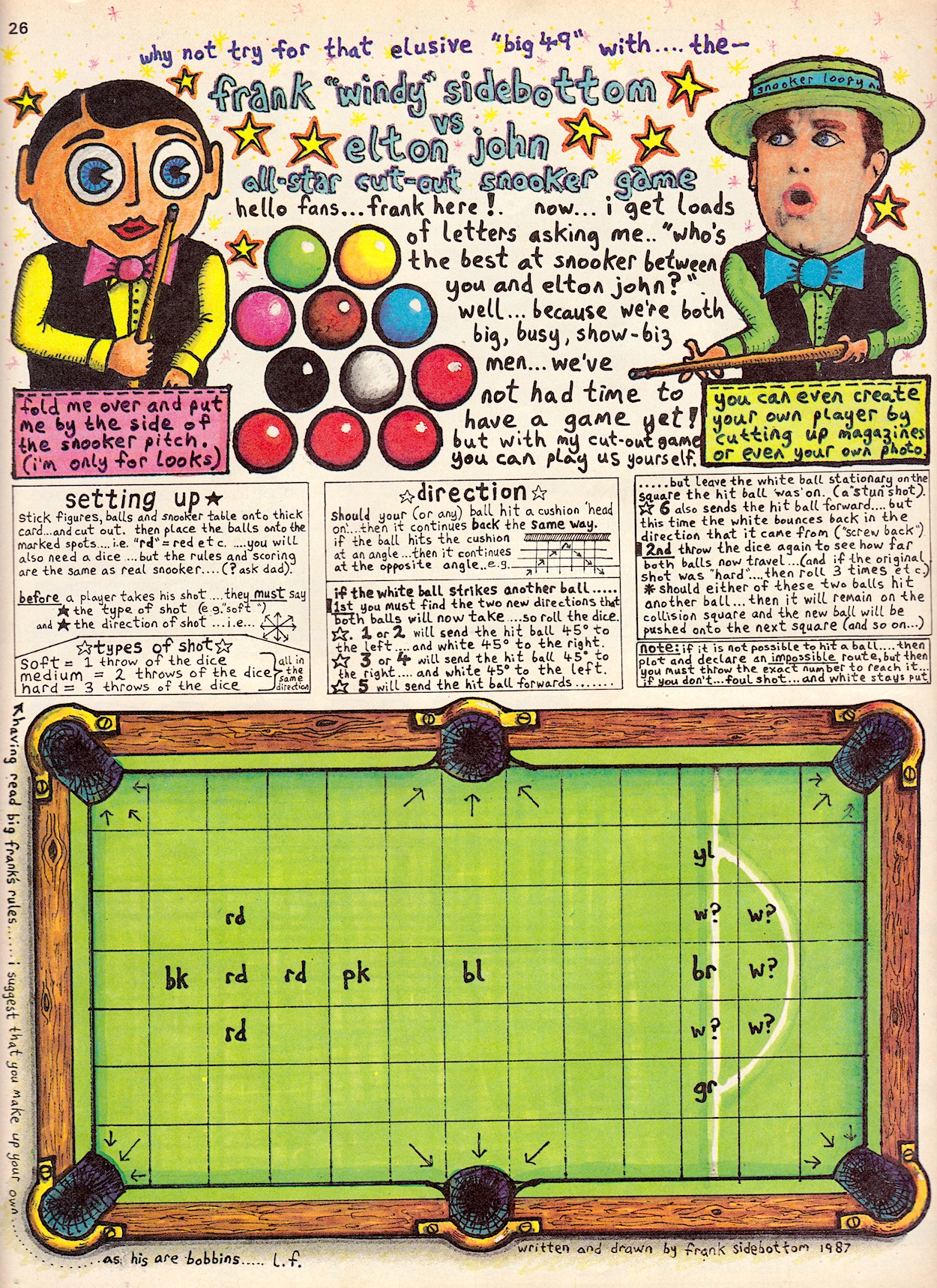
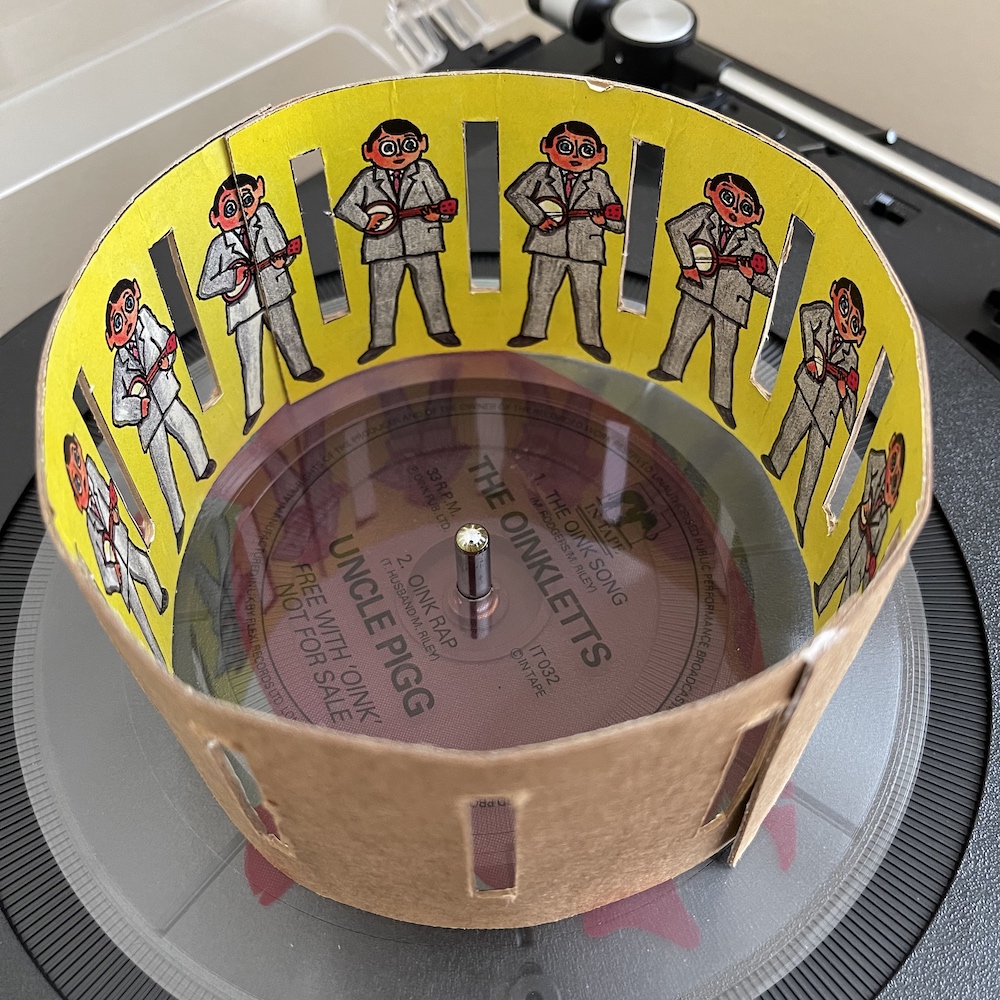
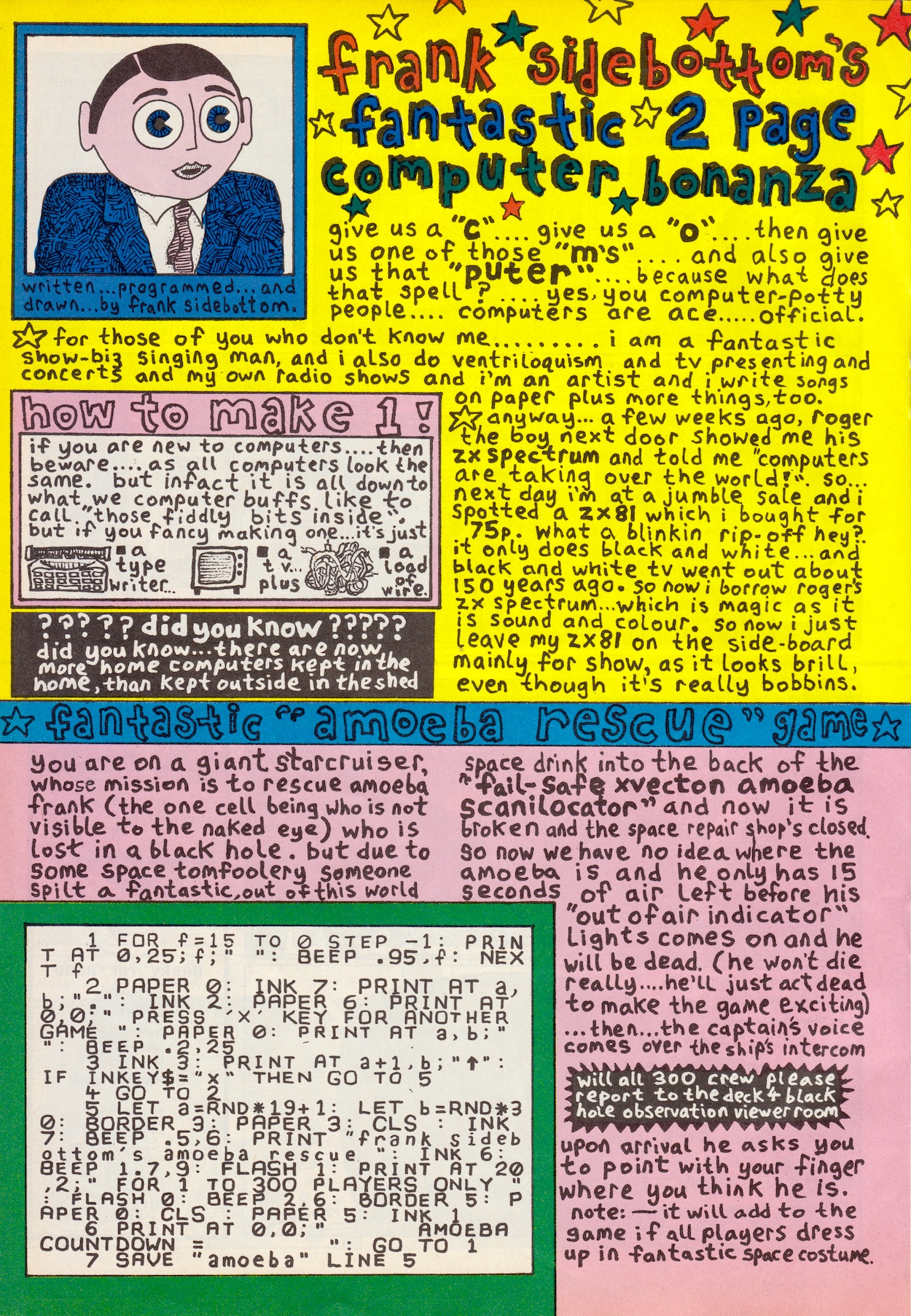
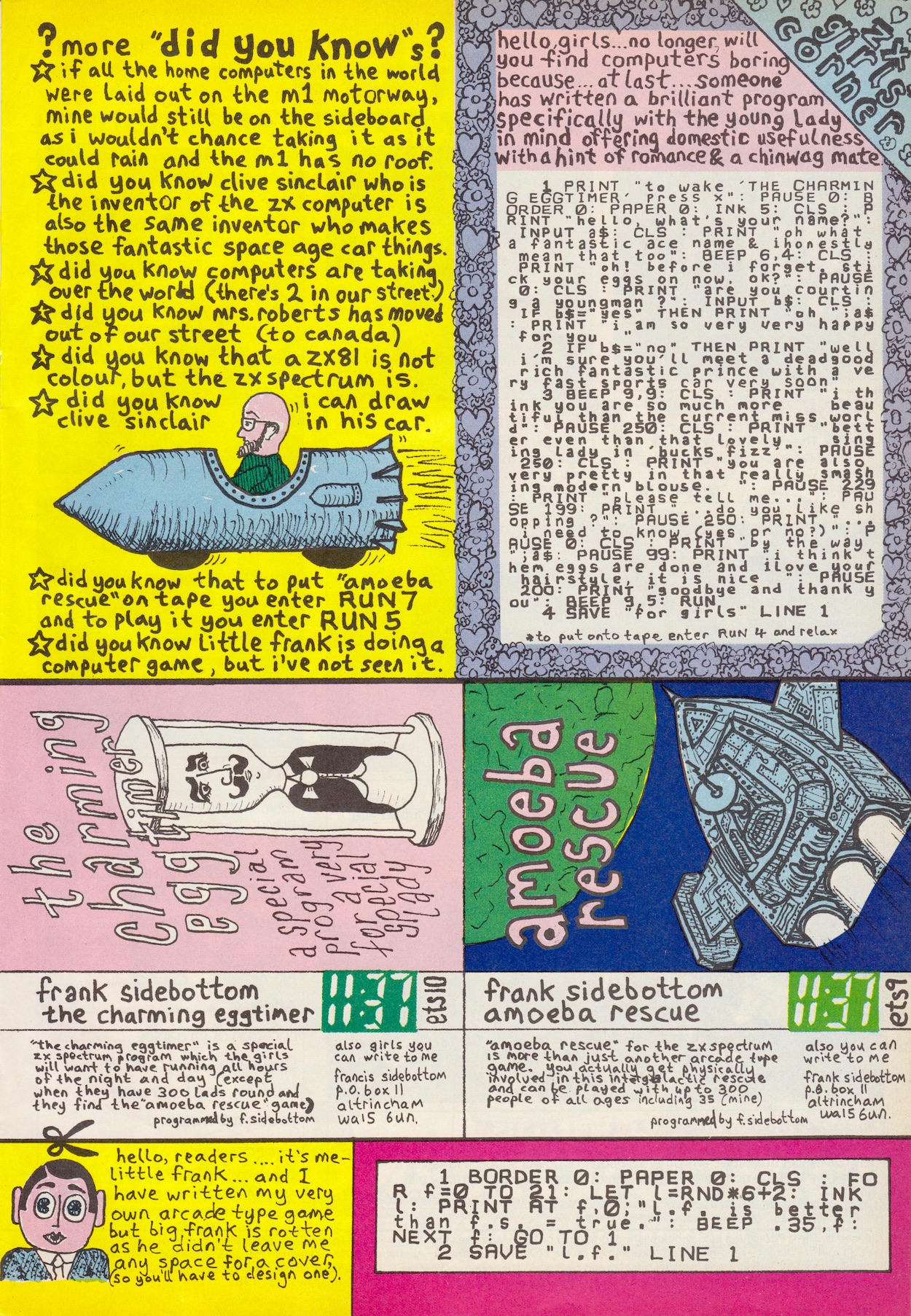
His contributions to OiNK would vary wildly and included comic strips, celebrity gossip columns, hand-written computer programs, elaborate D.I.Y. board games and even a cut-out zoetrope. With the huge variety of pages he could create, and all so intricately put together, it was clear he put in a lot of time and effort for us young readers and that he enjoyed working on OiNK.
Frank’s stand-up comedy was family friendly, even if it was very random and ‘out there’, and he’d go on to be a semi-regular on Saturday morning TV shows No.73, Motormouth and What’s Up Doc?, as well as creating his own Frank Sidebottom’s Fantastic Shed Show. After retiring the character of Frank, Chris would continue producing work for children on shows such as Bob the Builder and Pingu.
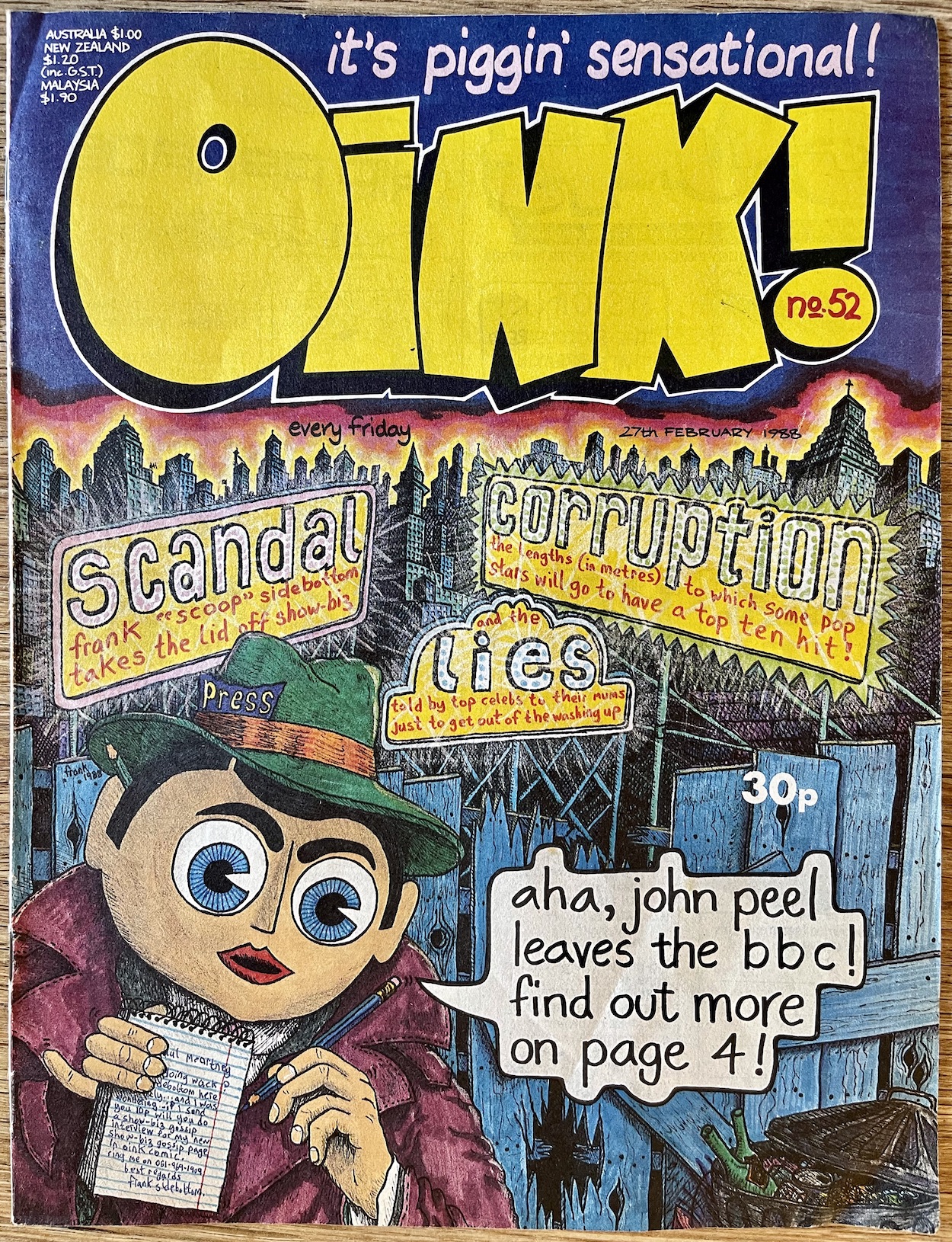
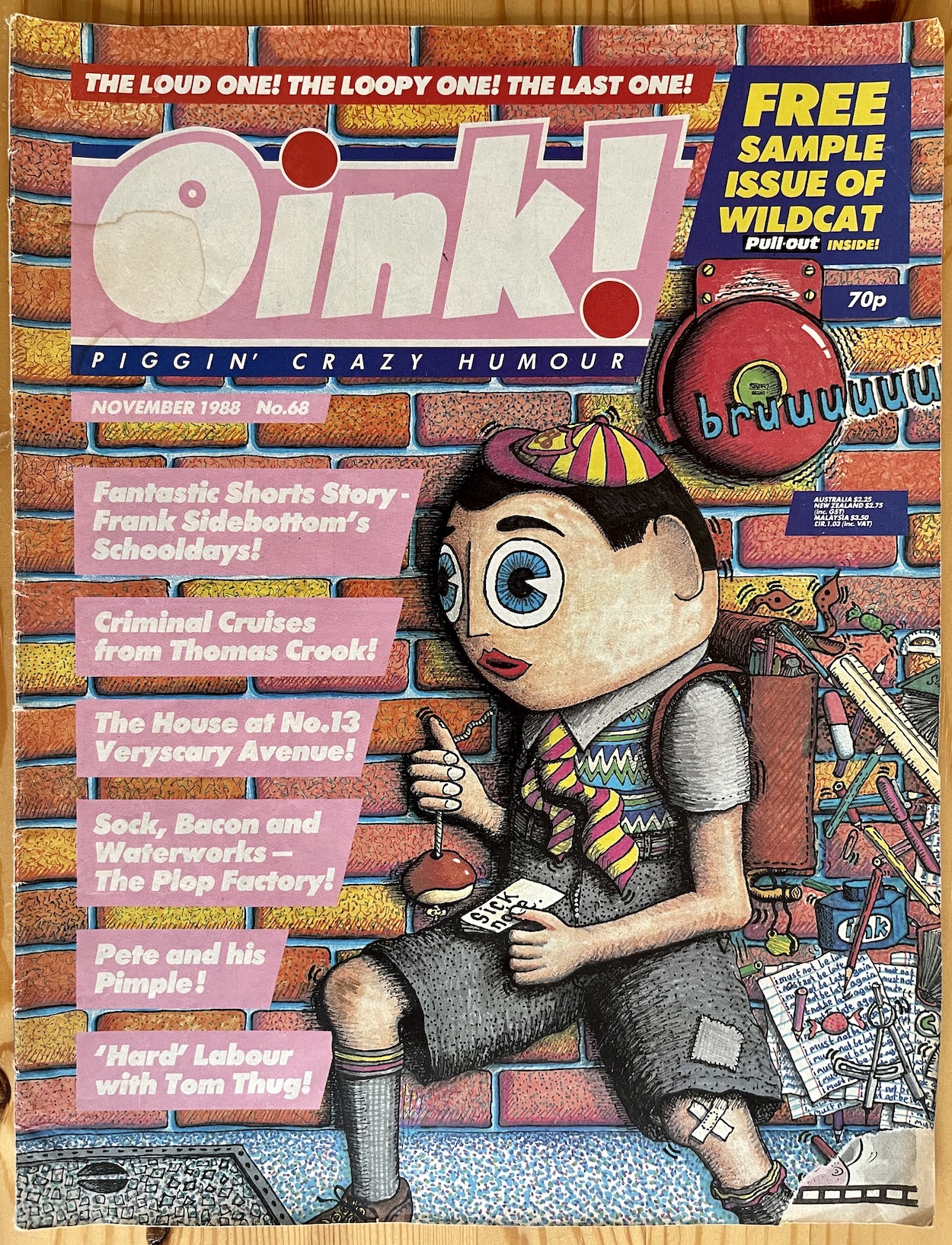
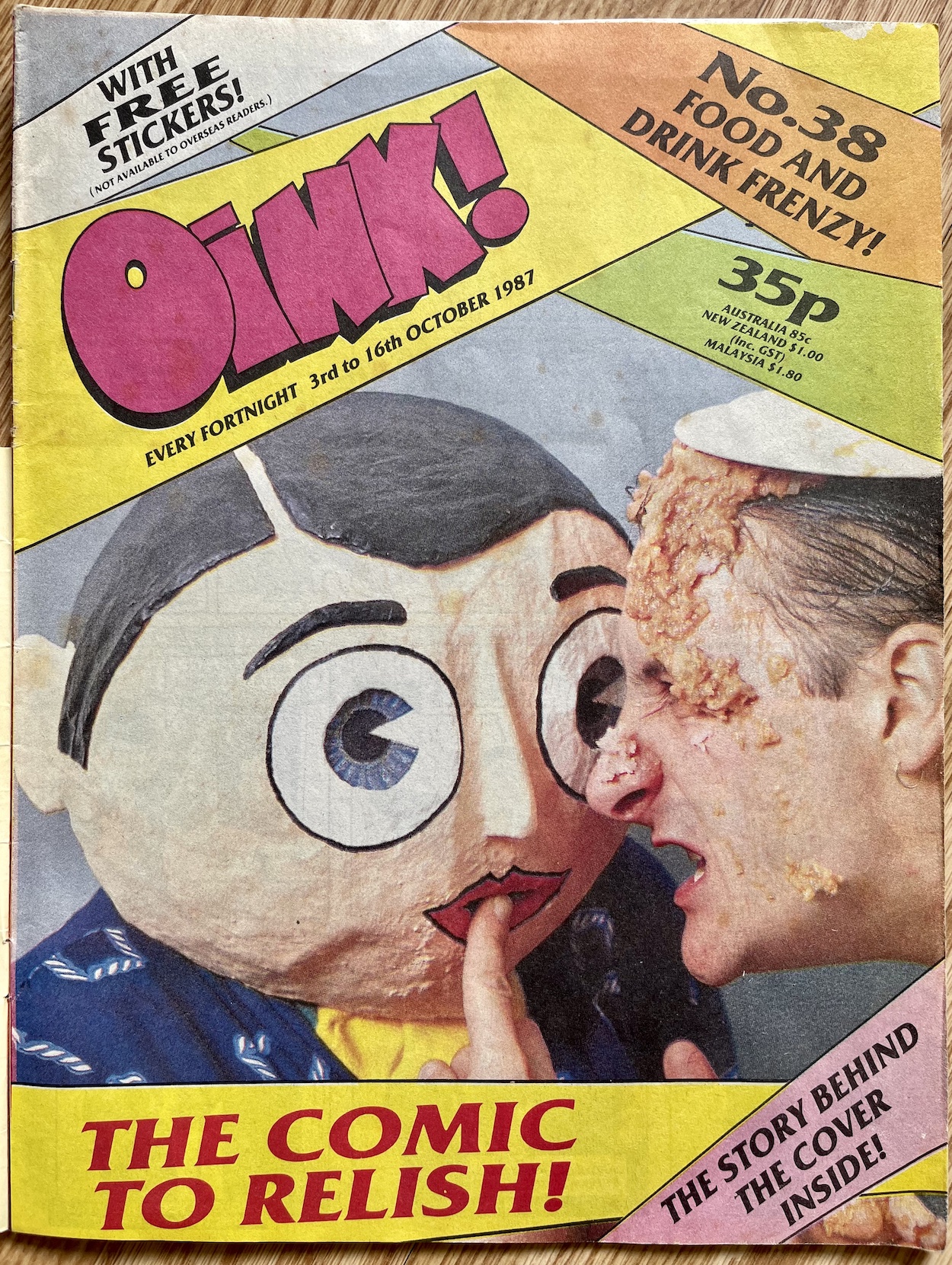
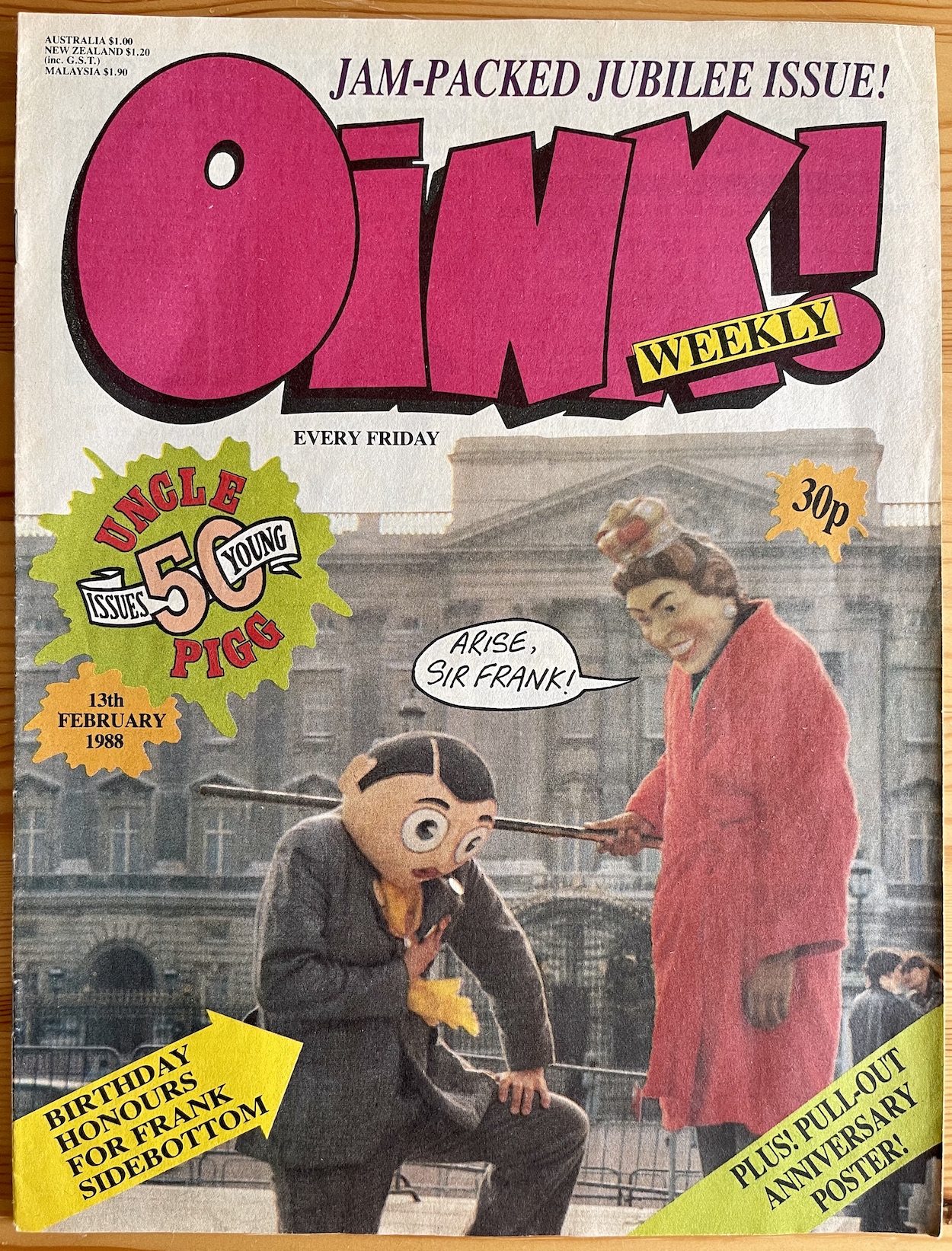
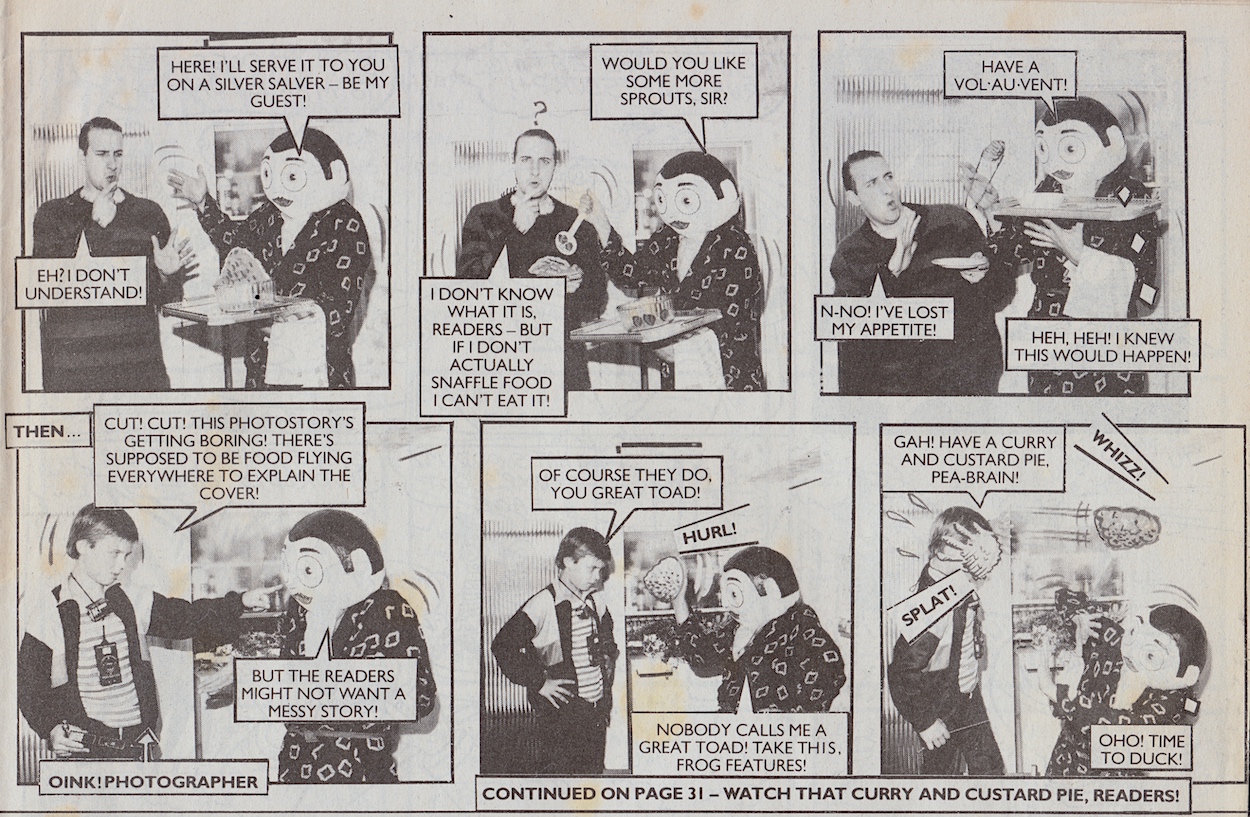
He was good friends with Patrick and they even moved in together when their marriages broke up. Fellow OiNK cartoonist and musician, Marc Riley would often work closely with Chris on OiNK, producing many photo stories starring Frank and Snatcher Sam together, as well as recording the OiNK 45 record. He also starred on four OiNK covers. Two were drawn by Chris and Frank popped up in photo form on the other two occasions, once with Mark and another with Her Majesty. Sort of.
“We needed a shot for our honours and awards issue, so we thought Frank being knighted outside Buckingham Palace would be perfect for this,” continues Patrick. “I had this Queen mask with me and I’m looking for someone to put it on so Frank could get down on his knee for the photo. Only one kid would do it so we had him with the Queen’s face on and Frank being knighted. He [Chris] paid twenty quid for it but obviously it was worth nothing. Frank got ripped off. Sometimes adventures with Chris became nightmares.”
The cover with Marc led to a strip inside too, which perfectly showcases their humour when they got together.
Patrick would also play bass in Frank’s Oh Blimey Big Band (far right in the photo below) alongside Jon Robson on keyboards who would go on to write the Frank movie starring Michael Fassbender inside the head, playing a new character based on our Frank. According to accounts Chris was very pleased with the script. Then in 2019 the Kickstarter-funded Being Frank documentary film covered Frank’s entire life and also included Patrick talking about Chris’s OiNK work.
Chris sadly died of cancer in 2010 at the age of 54. When it was revealed he died with very little money to his name fans gathered together to raise funds to give him a proper funeral, raising over £6,500 in a few hours and a total of over £21,500 in the end. In his home town of Timperley a Frank statue was also erected in his honour and he’s still there, standing with his thumb up in the middle of the high street.
As a kid, Chris’ work on OiNK as Frank Sidebottom was a highlight of the entire run for me. There was just nothing like those pages in any other comic. There’s still no one else like him in the world of entertainment.
Off we go with the latest real time read through and this one is rather different than anything that’s been covered on the blog so far, being the first aimed at a mature audience. After licensing their Aliens comics to Trident in the UK, Dark Horse US decided to set up shop in London and print their strips in their own titles. Thus Dark Horse International was created. This was their first, and flagship, title.
I’ve already covered one of their comics. Jurassic Park not only adapted the movie into comic form it also contained the first ever official sequel to the film and book. Similarly, Dark Horse US’ Aliens continued the story of James Cameron’s amazing hit movie and lasted for decades, only coming to an end in recent years when Marvel rebooted it now that Disney owns both the comic publisher and 20th Century, the company behind the films.
As much as I do love the new Marvel series (it really is superb) I’ve been really excited to sink my teeth (just the one set) into these original stories. As explained in the introductory post I’m concentrating on the comics after Dark Horse International took over with Volume Two. At least for now. This is because these were the comics my friends collected at the time and the one I owned was part of this series too. So let’s get down to reliving it.
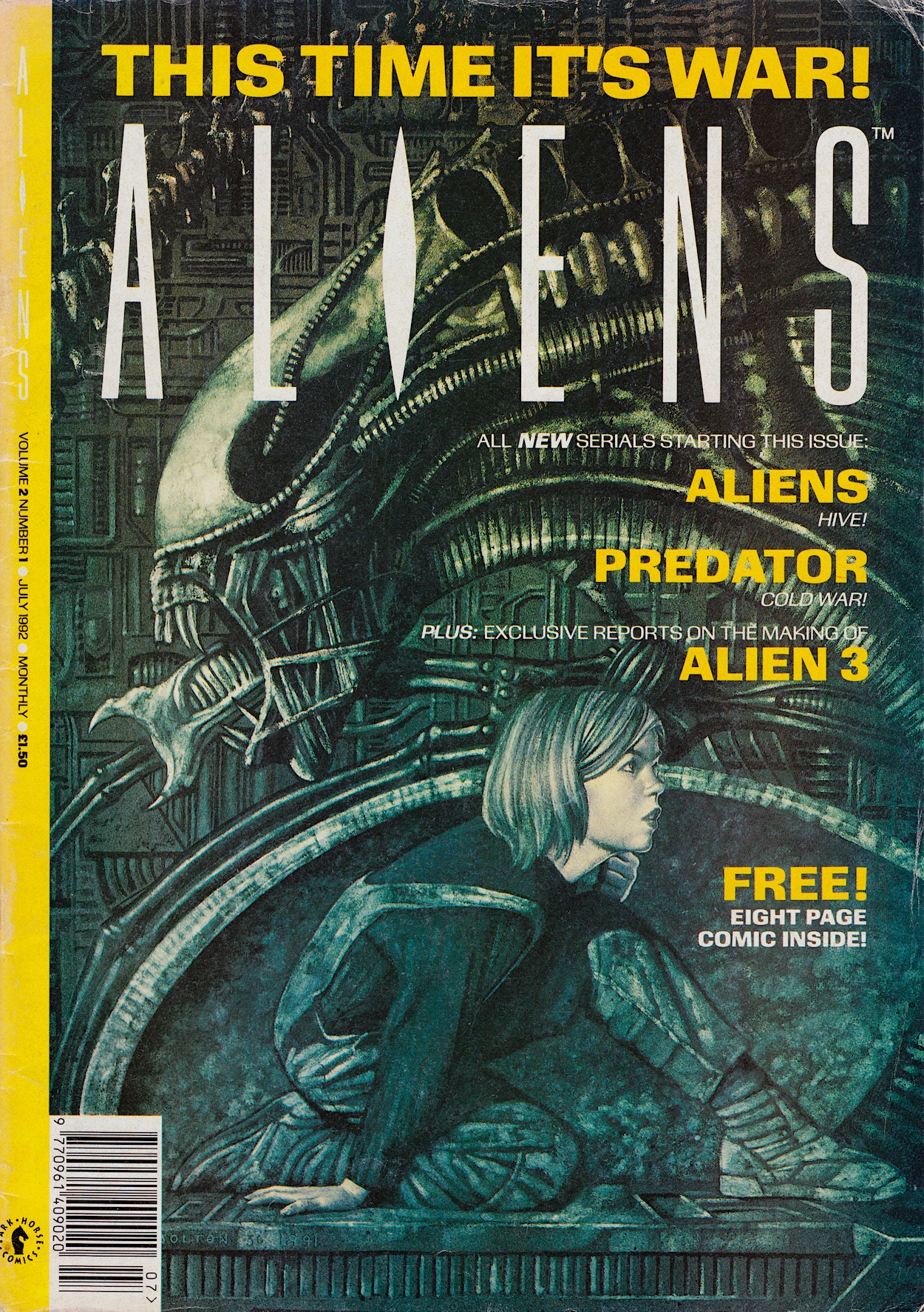
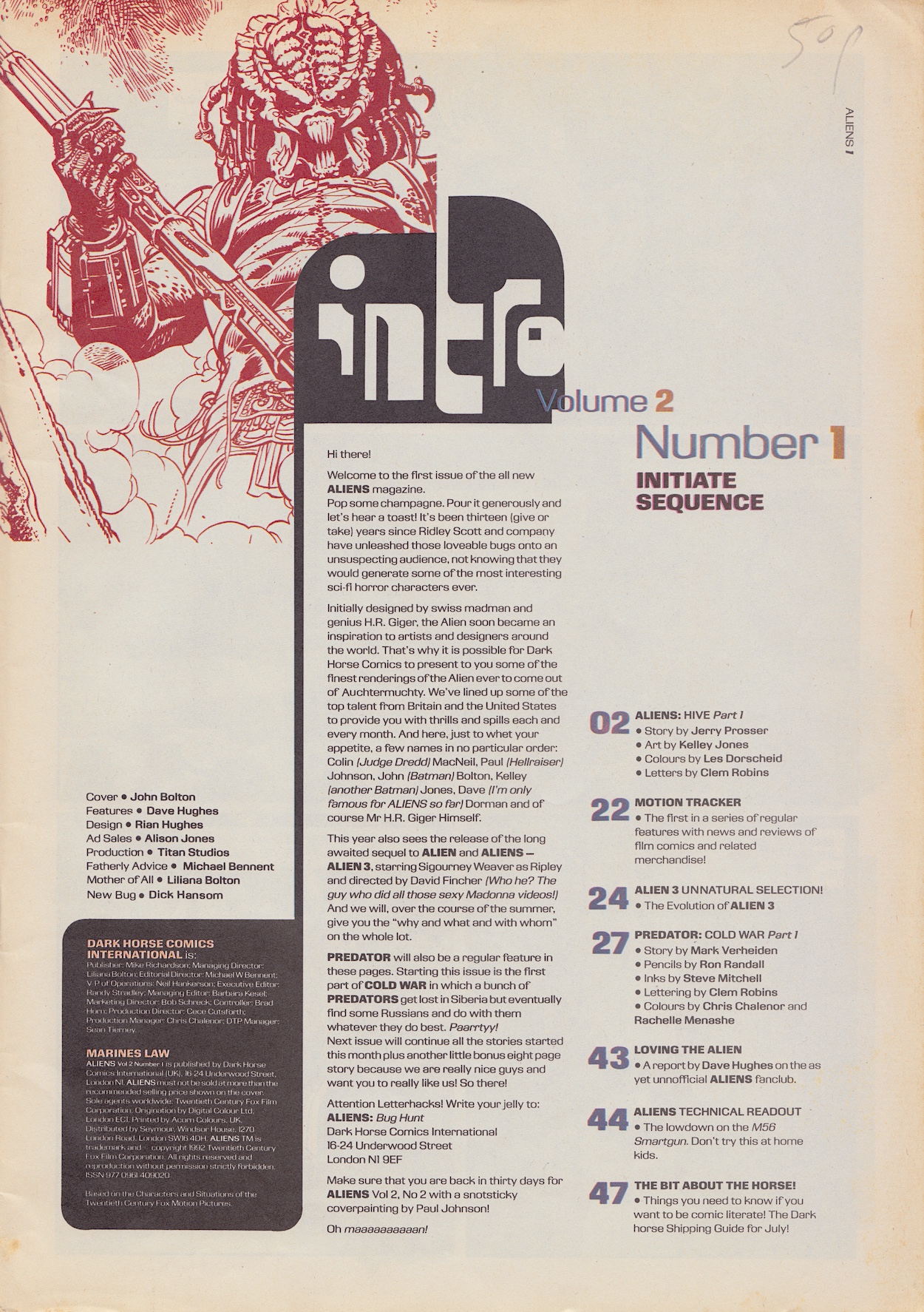
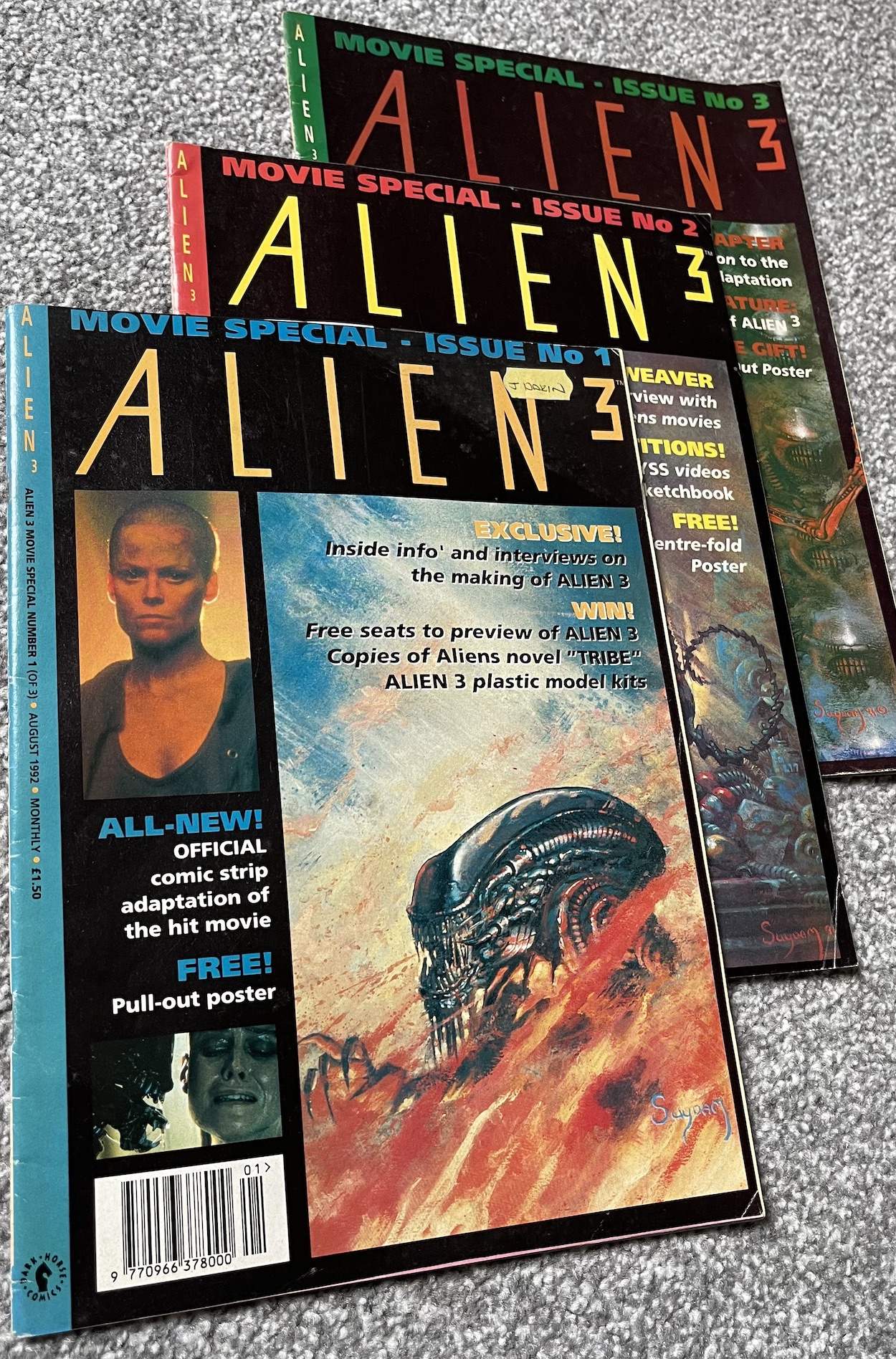
After John Bolton’s (Hellraiser, Man-Bat, The Evil Dead, and one of the first British artists to work on American comics) incredible, exclusive new front cover the editorial welcomes us to Dark Horse’s vision of what an Aliens comic should be, with Jurassic Park editor Dick Hansom given the title of ‘New Bug’. To place the comic in its time you can see Alien³’s release was imminent and in fact Dark Horse would publish a three-weekly, three-part (bit of a theme there) special series to commemorate. More on that movie as we go along.
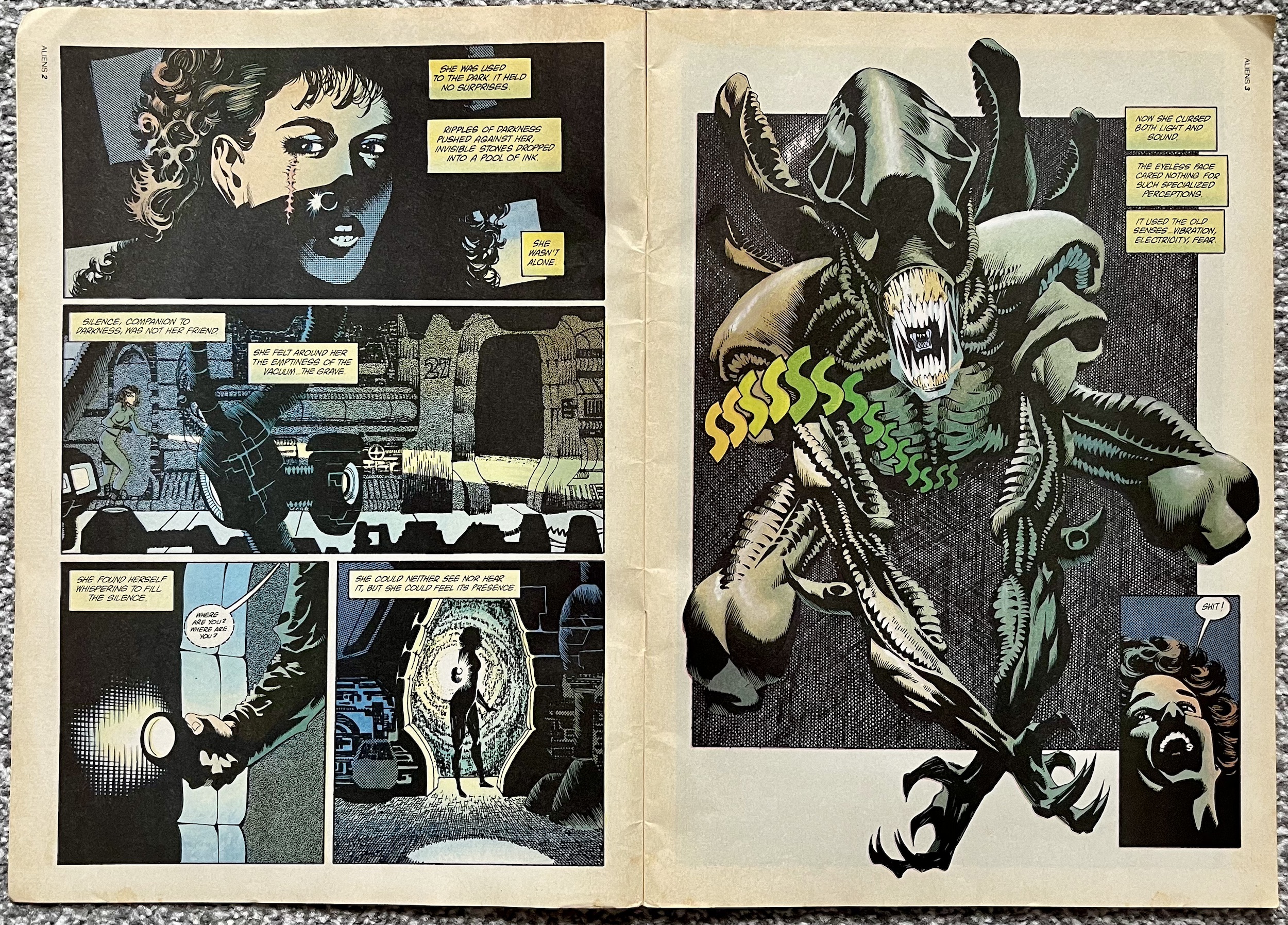
So the first strip in the read through is Hive, part one of which takes up 20 pages. Altogether there are 52 pages with a good quality gloss cover and a matt stock inside, all in colour apart from the occasional advert. There’s also a 16-page Predator back up and a good selection of features, the overall format making it a very UK comic indeed. Let’s get started with Hive first of all. In the States each story was released as a mini-series whereas here they’d be printed in an ongoing comic, much like Jurassic Park. It opens with this scene-setting spread below.
This is the perfect opening for the first issue, feeling very much like the movie, complete with the heroine having a somewhat Sigourney Weaver-esque look. The Alien is brilliantly realised by Kelley Jones (The Sandman, Batman: Endgame, Micronauts), with Les Dorscheid’s (Dungeons & Dragons, Deadman, Nazz) muted colours adding to the atmosphere and Clem Robins‘(Amazing Spider-Man, Ghost Rider, Guardians of the Galaxy) letters. Of course in the film the Aliens are black, but conveying that in comic form can be difficult. Les’ use of colours here is inspired, fooling us into accepting this creature as black even though it has to be coloured differently for its details to stand out on the page.
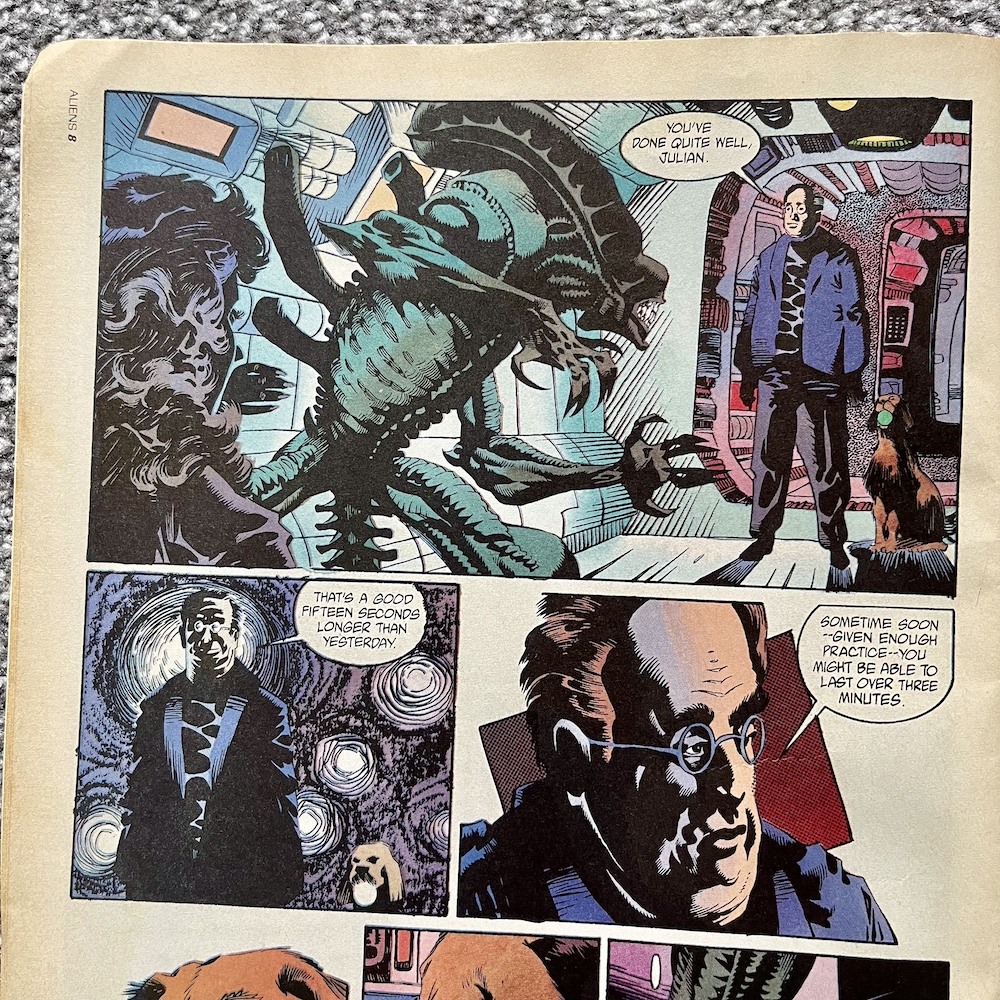
Jerry Prosser’s (The Crow, Predator, editor on Sin City: A Dame to Kill For) story begins with Julian Lish trying to escape from an Alien in a scene that could’ve been lifted straight from the movie with its tight, dark corridors, motion tracking sensors and in the end the alien’s second jaw sliding out for the kill. That is, until an “Override Code” is announced over a loudspeaker and it just… stops.
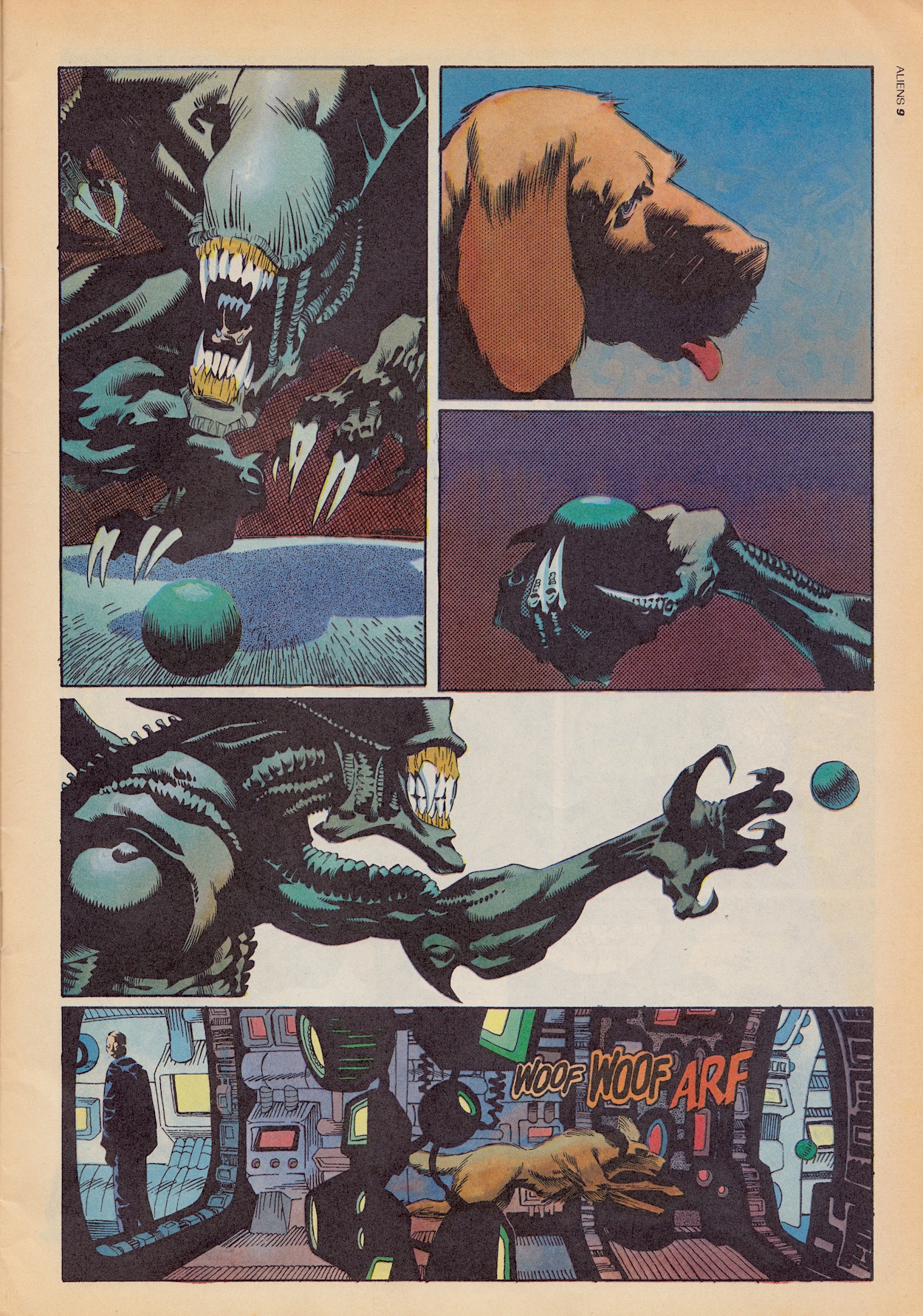
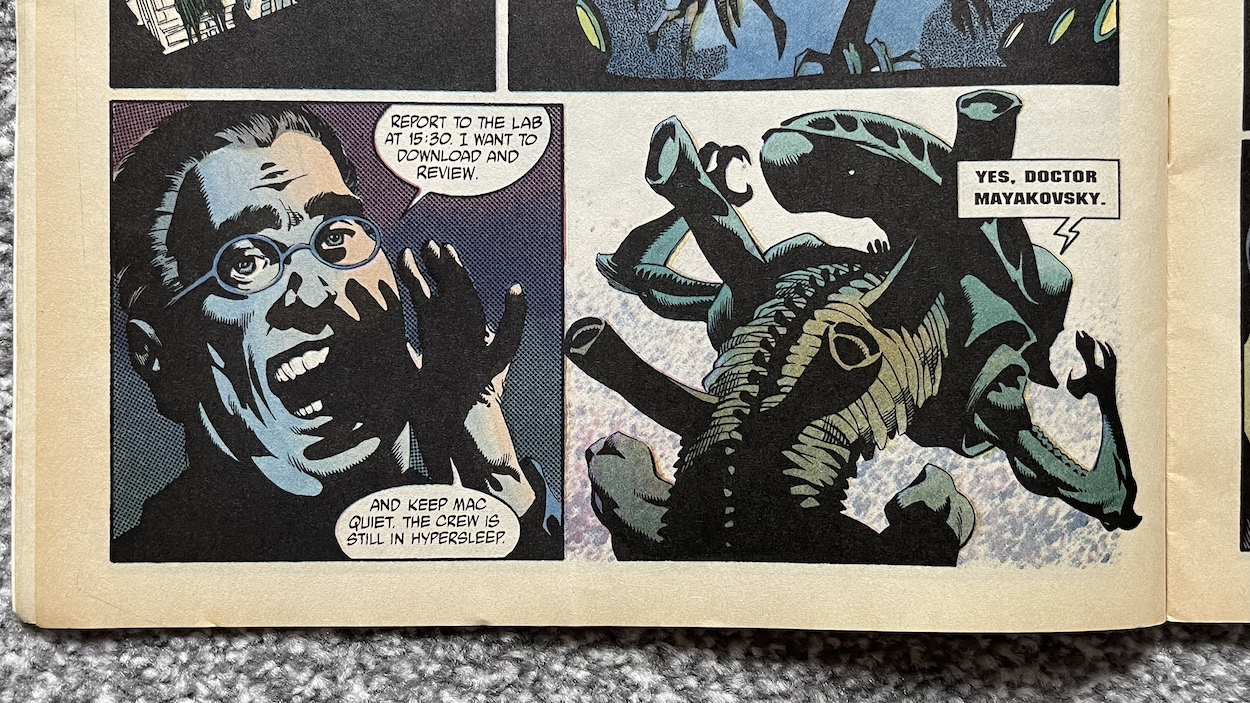
This is Dr. Stan Mayakovsky and any initial confusion you might feel from this turn of events was echoed by me. That’s the whole point. He enters with his dog in tow who seems completely nonplussed with the H.R. Giger creation standing over them. What happens next continued the confusion as the dog drops their ball from their slobbery mouth and it rolls underneath the alien’s legs.
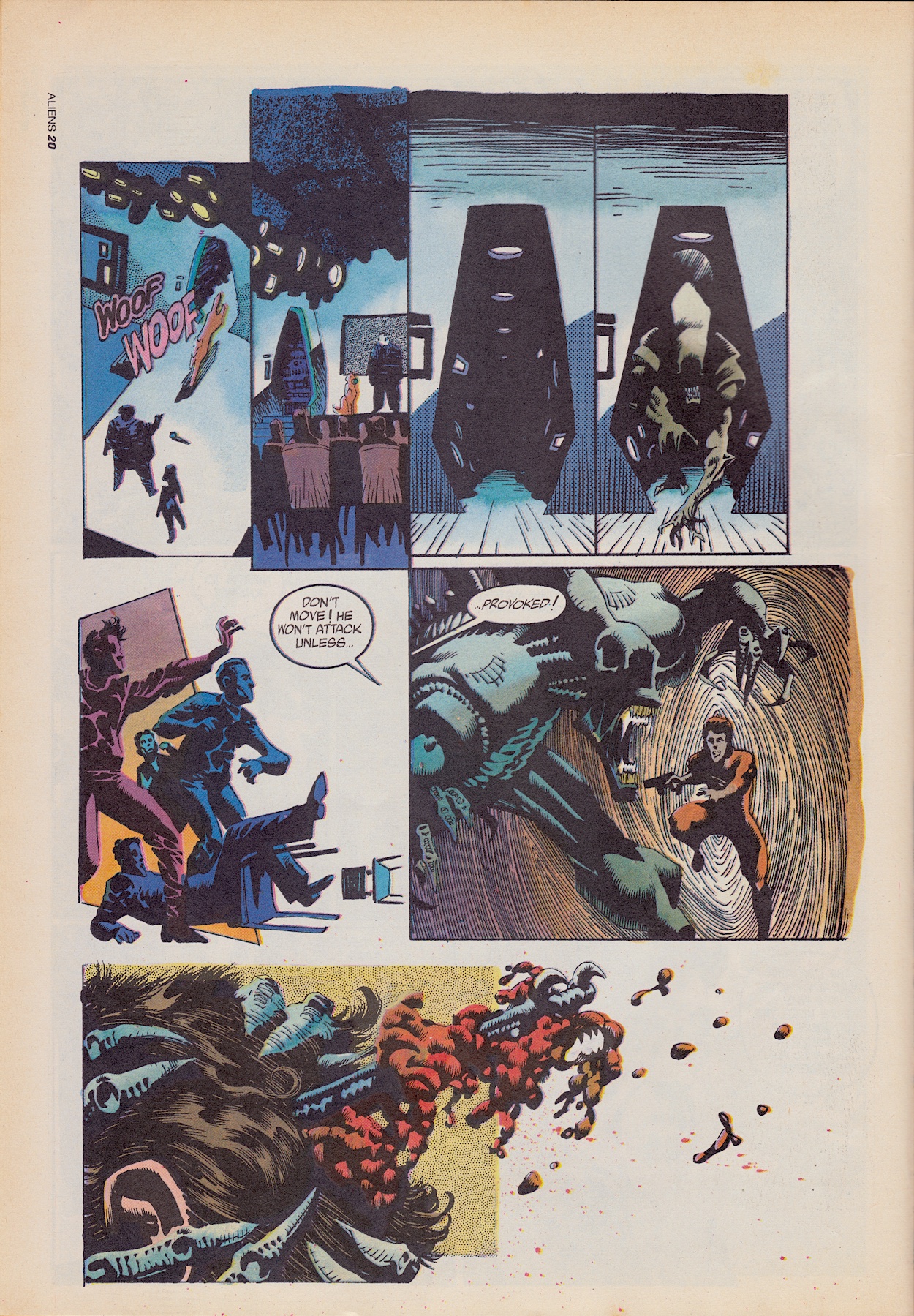
Didn’t expect that, did you? What with this bit of alien playfulness and our two human characters just standing next to it, even after it looked like Julian was about to be its victim, something is obviously amiss. (It hadn’t been released yet, but the dog in the original cut of Alien³ certainly didn’t get this treatment!) On the next page the alien sizes up to the professor, baring its teeth and hissing, my mind instantly remembering the accompanying scary sound from the films. Then it takes off down the corridor and… well…
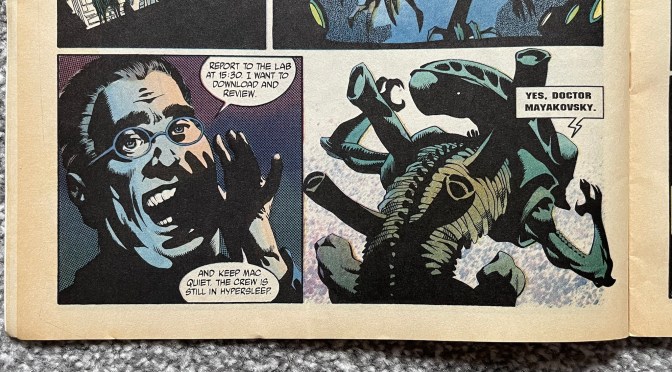
I admit I laughed at this! And laughter is not something I thought this comic would produce a lot of. Yes, the film had its moments but those definitely didn’t come from the alien side of things. It does explain things though with its clearly robotic speech bubble. As ridiculous as it sounds to have a robotic alien in the story we must remember this is set in a future where completely convincing human androids also exist, so why not?
We get an insight into his addiction to a particular drug, a raw form of the slime produced by the aliens
The question is, why exactly has this thing been created? Not only that, but it’s being trained to hunt humans, or at the very least act convincingly like a killer. Called XL1, an out-of-breath Julian tells Stan it keeps getting better, that she’s struggling to stay ahead of it anymore, which pleases Stan immensely. However, Julian wonders what 10,000 of them would be like! It’s a terrifying thought and we know that the plans of greedy humans always lead to disaster in the film series. So what’s the reasoning?
It’s not clear yet if the professor works for the Weyland-YutaniCorporation from the films but we do get an insight into his addiction to a particular drug, a raw form of the slime (or “jelly” as it’s called here) produced by the aliens. It relieves his cancer symptoms and puts him into a sort of trance state where time slows down, his world goes blue and he revisits his memories of how he got to this point. It’s essentially a bit of exposition for the readers.
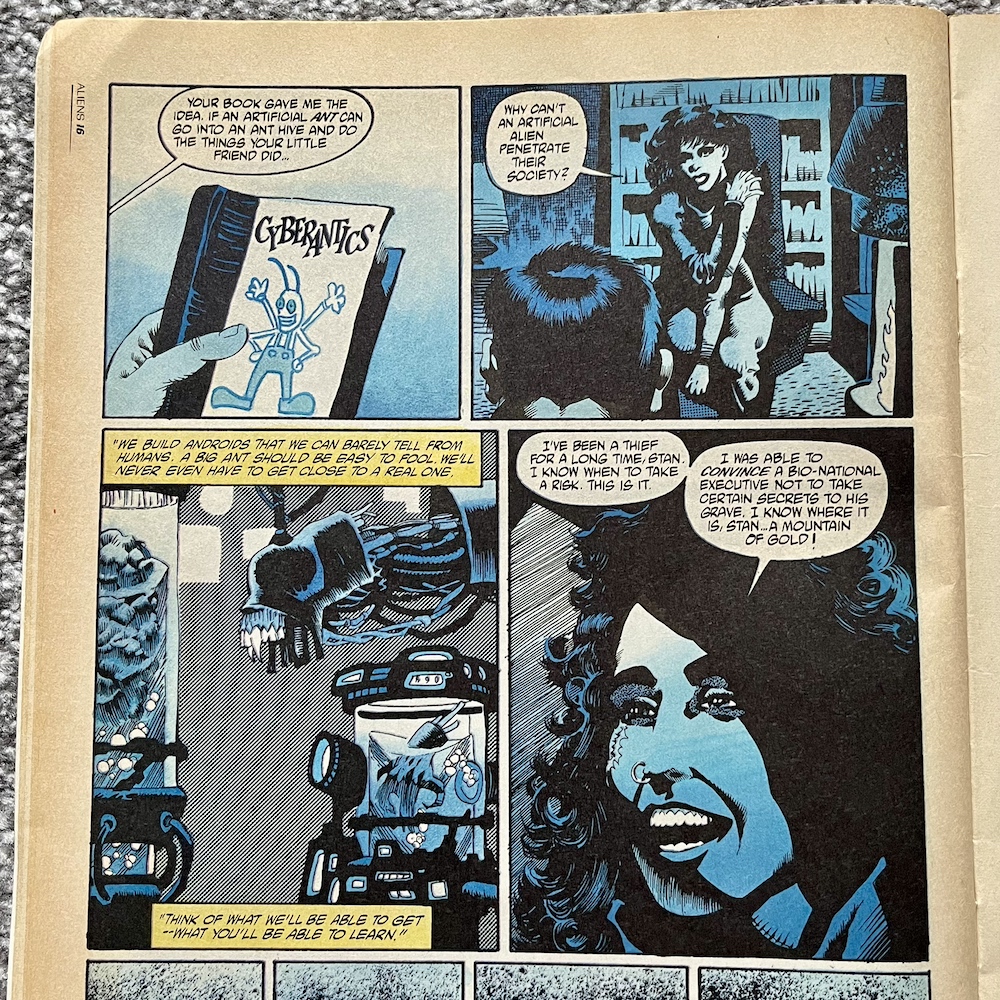
Having to buy the substance from drug dealers, he eventually met Julian and devised a plan to build an alien android to infiltrate a hive (that explains the reference to thousand of aliens and the title) and bring back the jelly. Stan is in it for himself, Julian appears to be in it for the money, and their mutual desire for the same outcome results in a passionate, mutually selfish love affair. Using the example of ants above and the aforementioned ability to make convincing androids, it’s an interesting set up for the first story in the comic series. There’s also a funny moment when Julian even suggests naming their alien ‘Norbert’!
In their ship The Dolomite they take a crew to a far-flung planet called A6 454 upon which humans have never set foot, and Stan and Julian stand up in front of their crew and ask for volunteers before showing them what they’re there for. As a bit of foreshadowing, revealing their android goes horribly wrong. Not that either seems to care.
I remember seeing scenes like this when I flicked through my friend’s Aliens comics as a teenager and being amazed it could show such images. I’d never seen anything like this in comics before. Anyway, Stan finally uses his override command to stop his android from continuing its killing spree and the final image of the strip has it holding another man’s head and looking directly at Stan. Whether this is where the original first part ended in the US comic or this is where the UK’s comic has cut it off is difficult to say, although the sudden end makes it feel more like the latter.
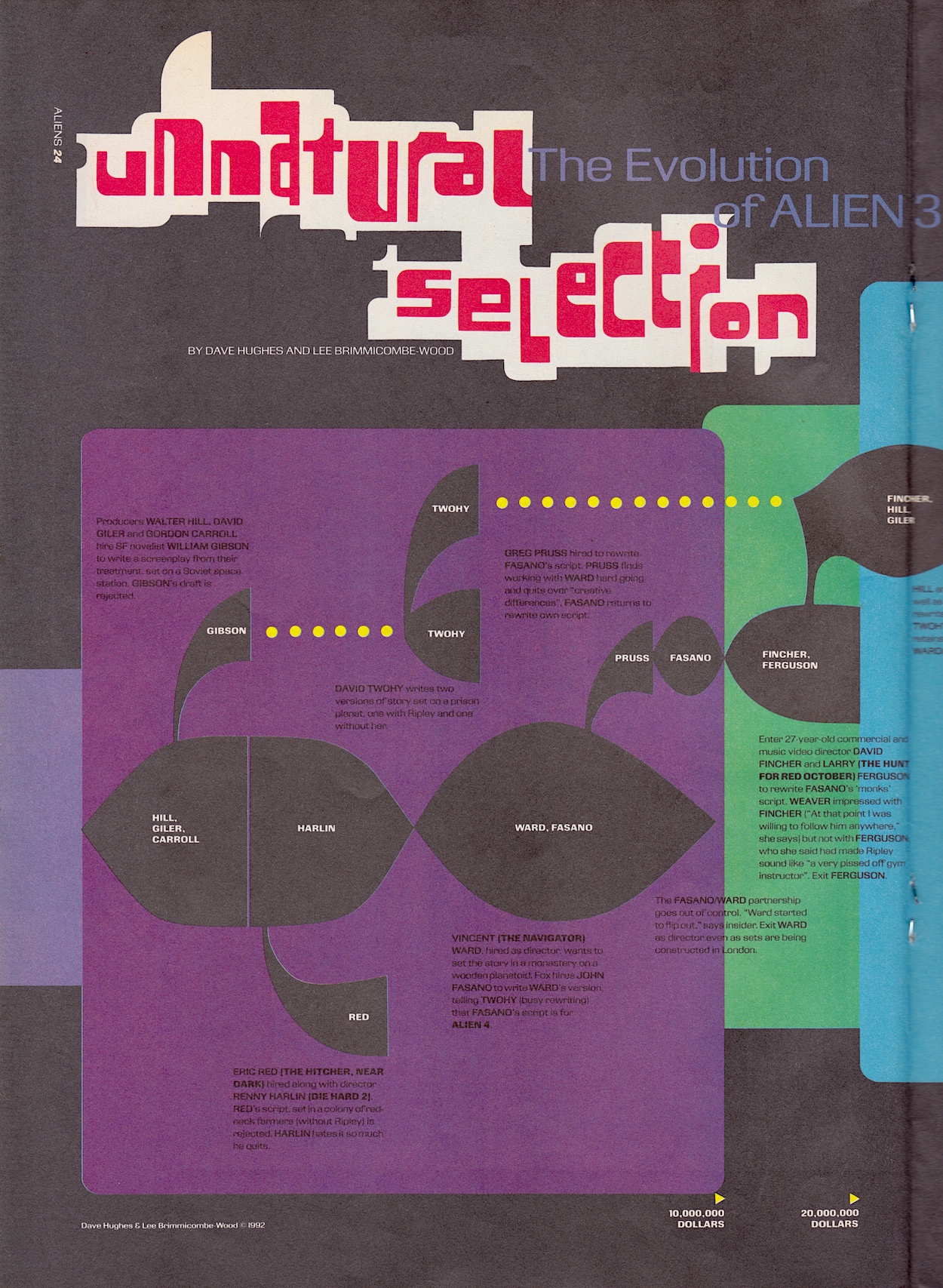
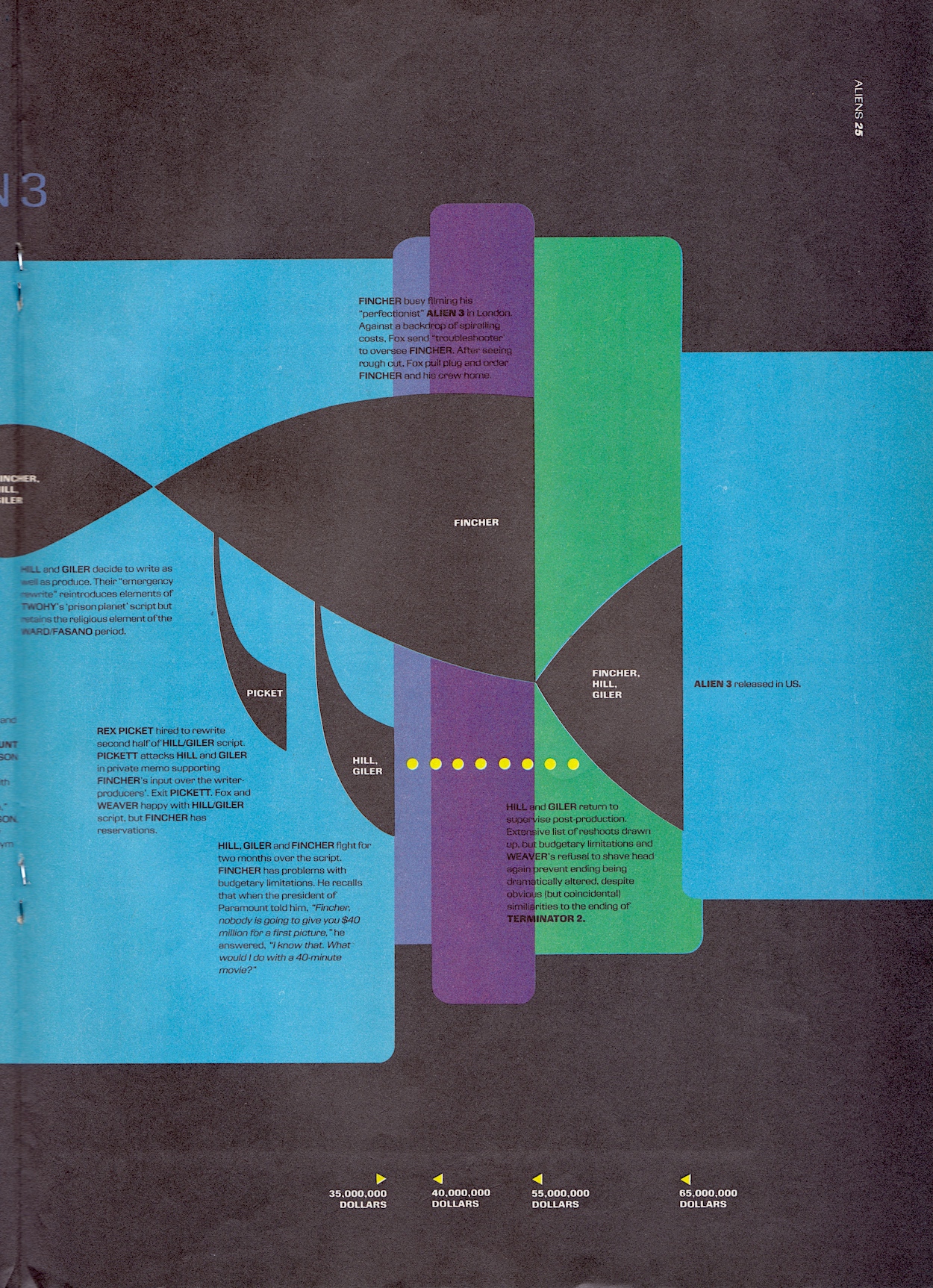
The first part of Hive is intriguing, full of atmosphere, has plenty of horrific moments and really sucked me into its world. It’s a fantastic start to the comic and this already has the potential to be an excellent read through. As a teen it was no wonder I loved the one issue I picked up if this is anything to go by. It would’ve shocked and scared me, and I would’ve been loving every page of it. Before moving on to the back up strip there’s a bit of news in The Motion Tracker segment and a middle-page spread about the making of Alien³.
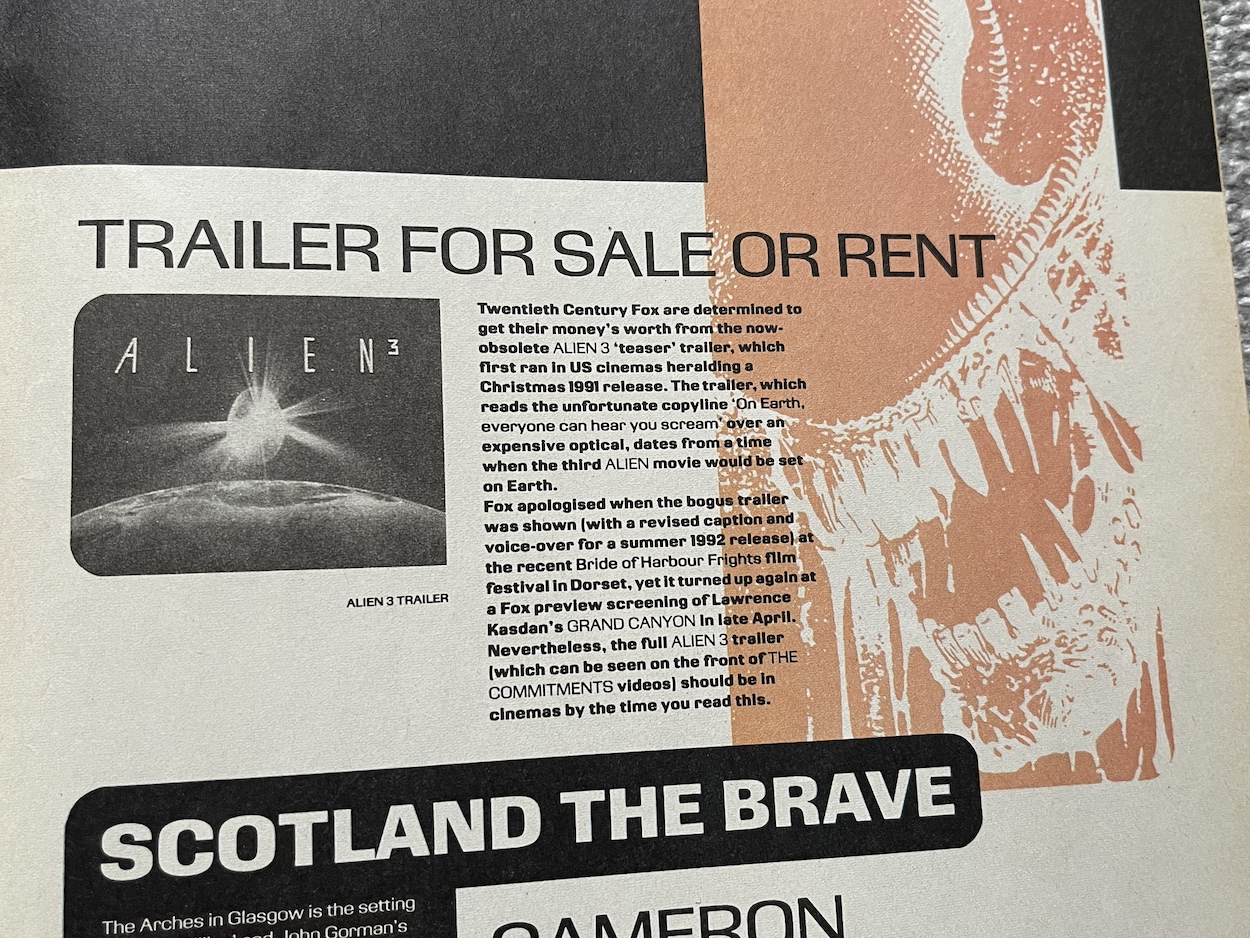
I wonder if anyone actually went and rented The Commitments back then just to get a glimpse of the film? It’s interesting that there was a different direction for the film originally planned, so much so that a teaser was made. The Unnatural Selection spread isn’t the easiest to read but it does explain a lot of the infamous difficulties in making Alien³. I’m particularly interested in the various writers and script drafts and the evolution (hence the subtitle) of the story over the years before filming began. If this is an indication of the extras the comic will contain I can’t wait for future issues.
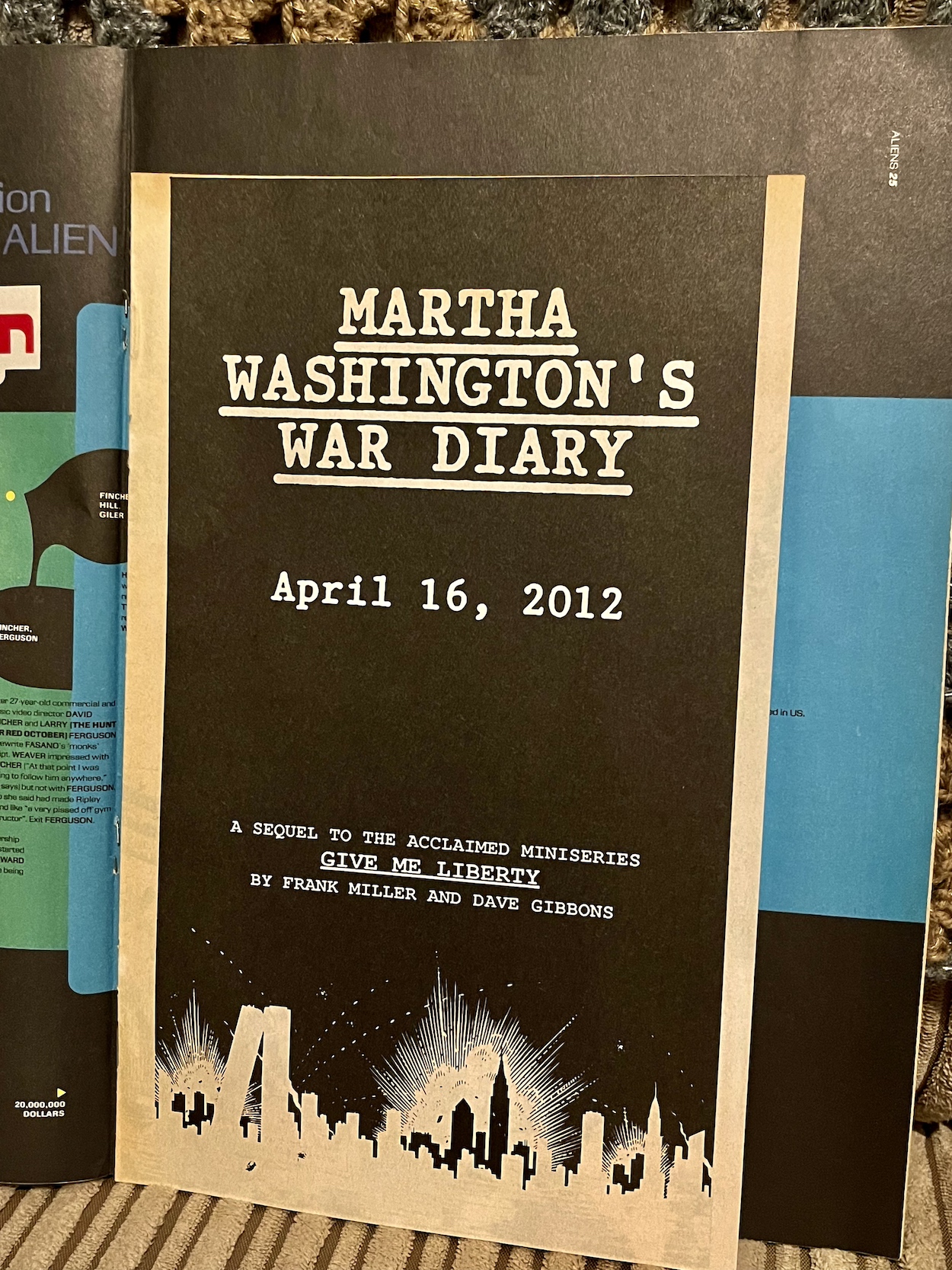
In case you’re wondering, the “Free Comic” on the cover is a sequel to Frank Miller and Dave Gibbons’ Give Me Liberty (which I’d never heard of until now despite it being a best seller) and nothing to do with the Aliens franchise. While the Predator movies would eventually cross over into the Aliens universe, at the time they had nothing to do with the franchise either. However, in comics they were always closely related and thus a perfect choice of back up strip.
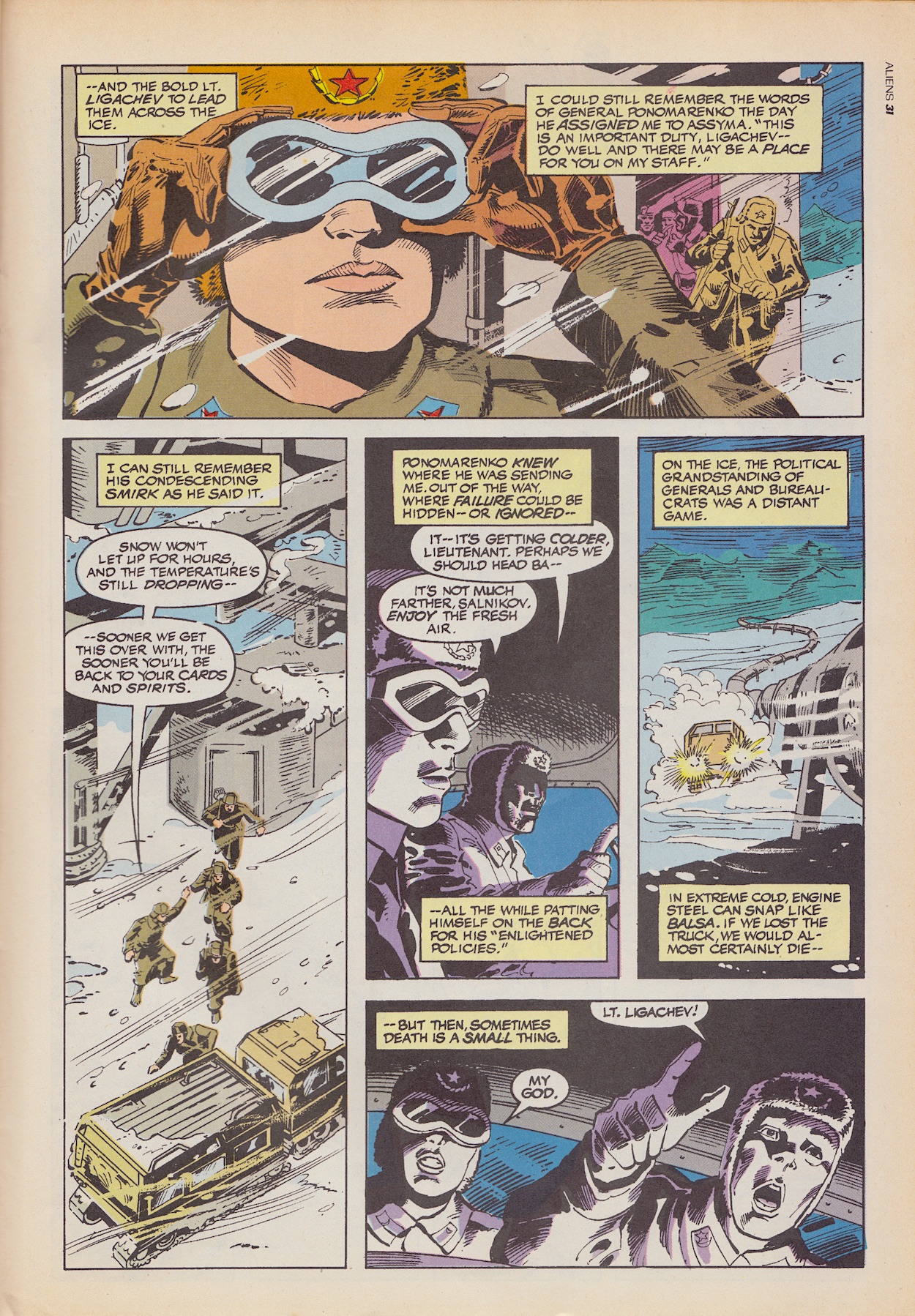
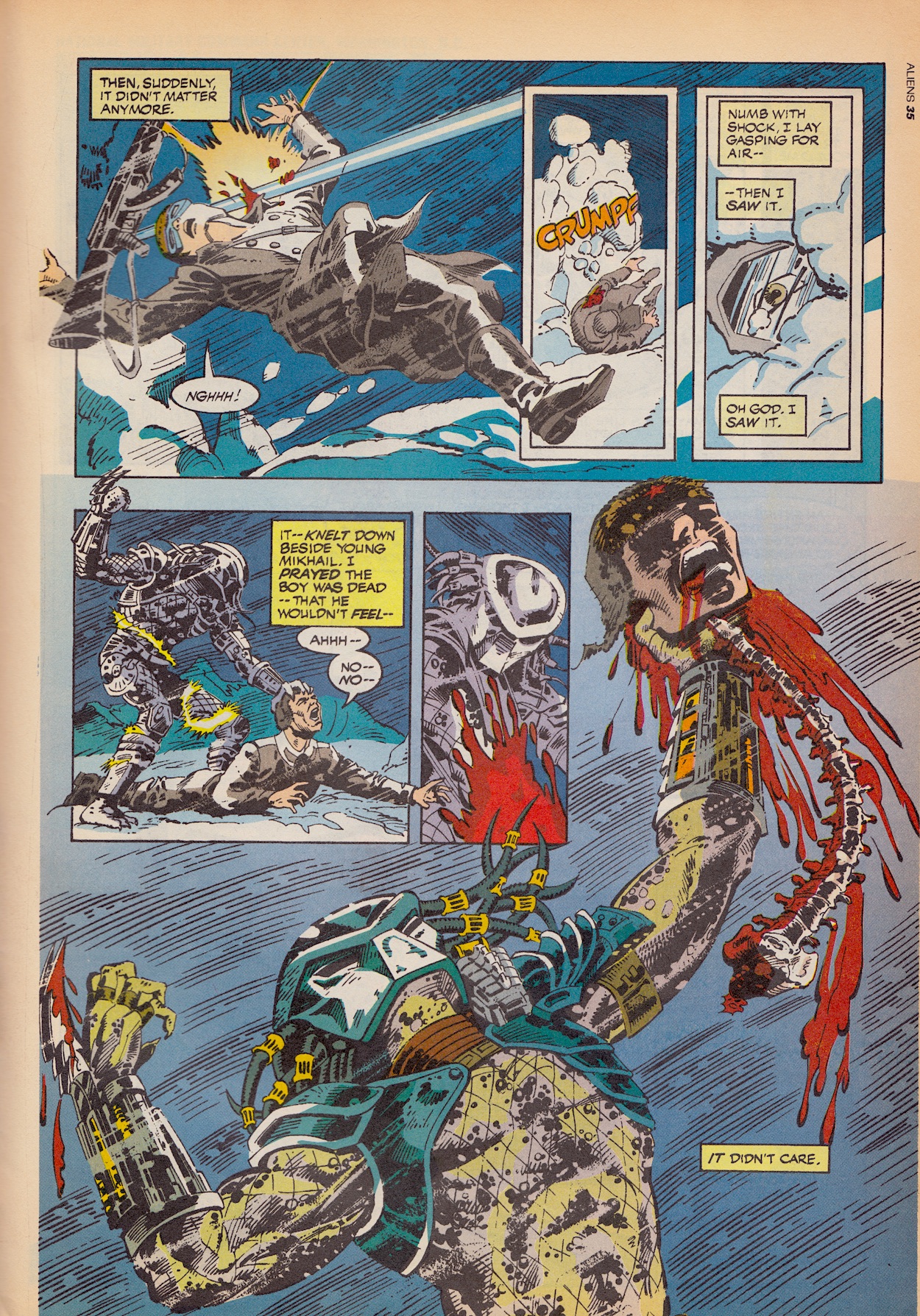
Predator: Cold War is written by Mark Verheiden (Phantom, co-executive producer on Battlestar Galactica and Falling Skies), with pencils by Ron Randall (The Dreaming, Action Comics, Supergirl), inks by Steve Mitchell (Aquaman, Batman, G.I. Joe), colours by Chris Chalenor (Barb Wire, The Mask, Hieroglyph) and Rachelle Menashe (The Terminator, Icon, Virus), and letters are by Clem Robins again. Lieutenant Ligachev has been promoted by a General of her army just so he could send her to take charge of an oil field pumping station in the middle of the Siberian nowhere. When their equipment discovers large seismic activity accompanied by high levels of radiation they go to investigate, discovering the decapitated body of a local deer herder, strung up on a pole as if he’s on display, like an animal at the end of a successful hunt.
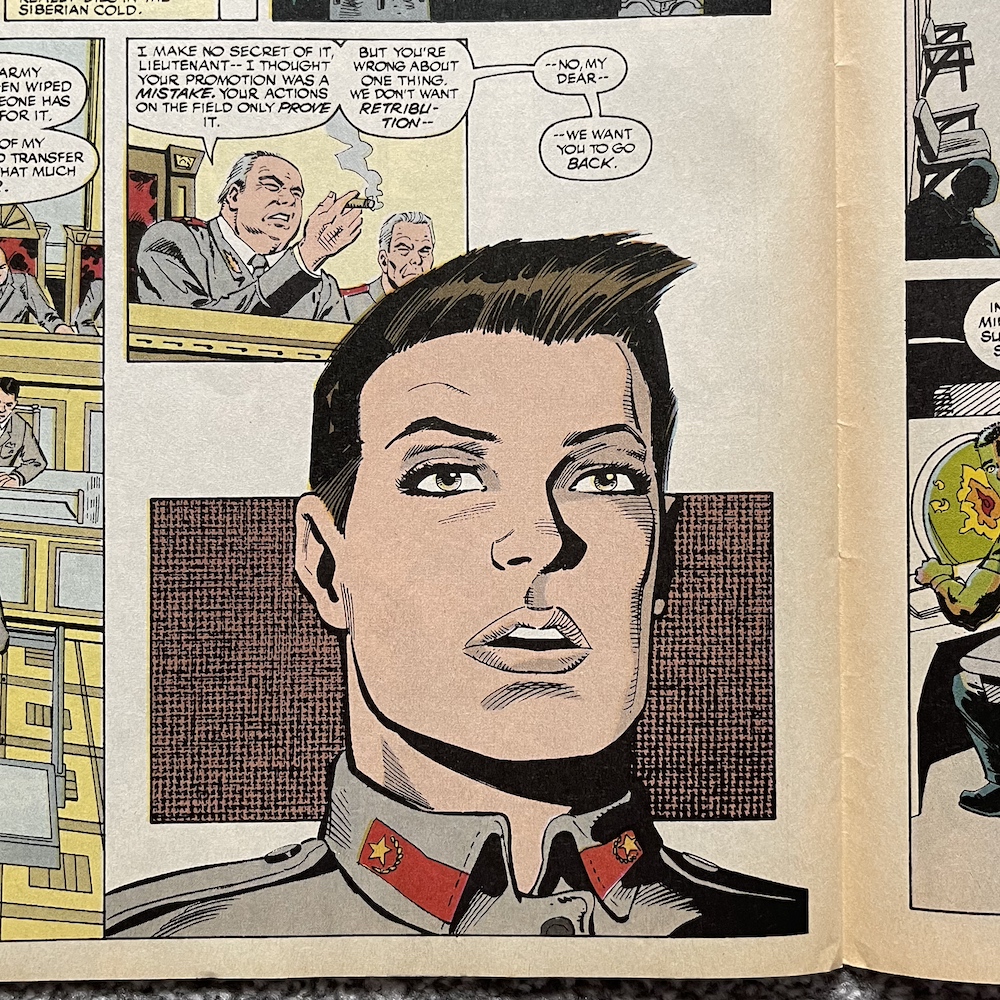
Soon they’re under attack by a Predator and, upon being hit and half buried in the snow, Ligachev can only watch as her young team are cut down one-by-one by this strange creature. Setting the beginning of the story in desolate ice fields adds a level of desperation to her plight but we soon find out she’s recounting it to a military tribunal who wants to send her back!
If this is anything like Aliens then she’s probably being sent back out to face certain death in order for the government (rather than a private company) to get access to powerful weapons. As someone who has only ever seen the second movie a long, long time ago this plays out like a typical 80s monster movie, which is no bad thing of course. More interesting is how the rest of this 16-page chunk of the story tries hard to tie it in closer to the film series.
The American military have picked up on the weapons fire and automatically assumed the Soviets were test-firing nuclear weapons, so they reach out to General Philips. He was played by R.G. Armstrong in the first film although here he’s described as having something to do with the “business in New York last summer” and I’m not sure what that’s in reference to. After all, the first film was set in Central America and the second in Los Angeles.
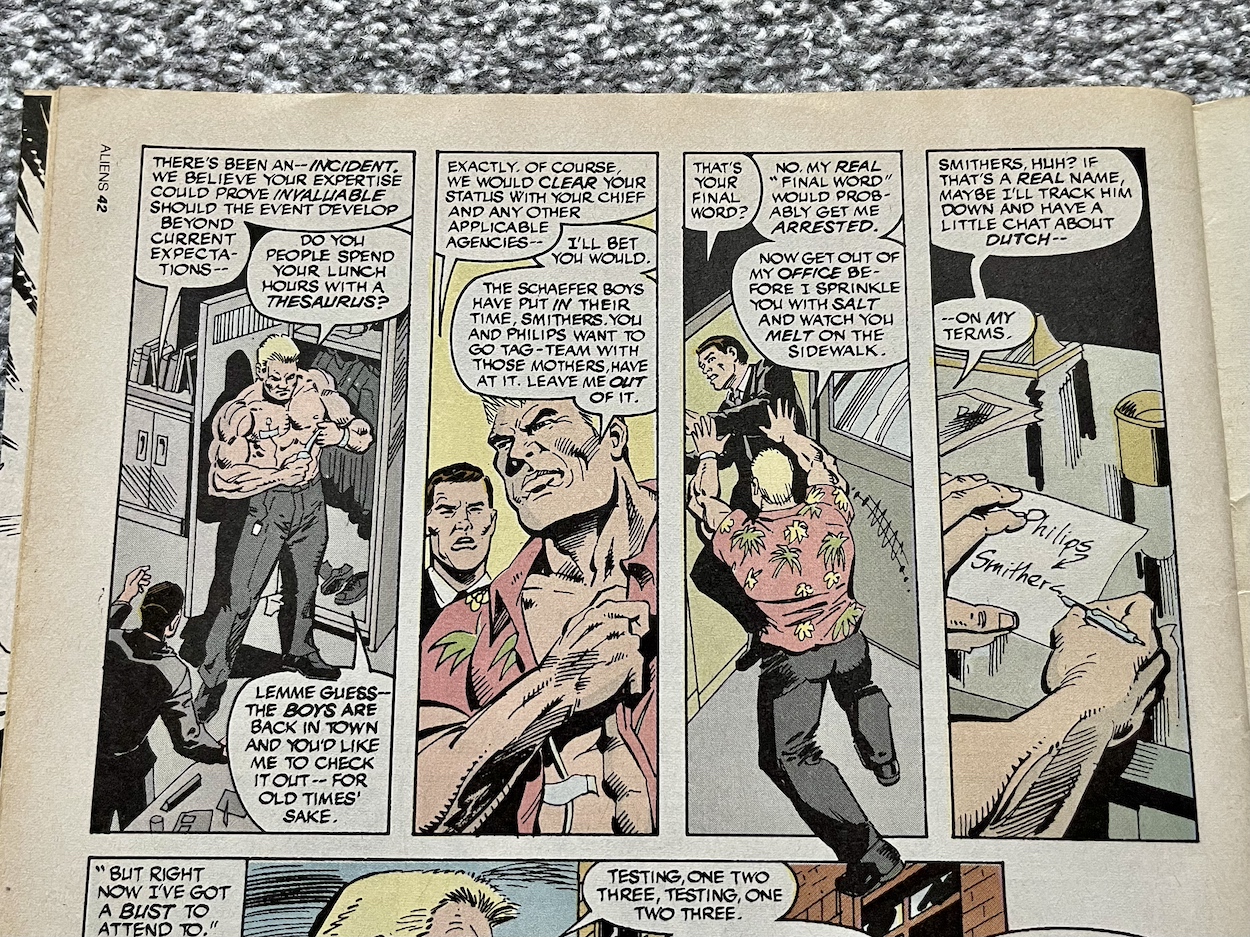
A second character, a New York sheriff, is seen having flashbacks to being attacked by a Predator (while at the dentist no less, so double the horror!) so maybe it’s in reference to an earlier Predator comic, perhaps one printed in Trident’s first volume. Meanwhile, the general goes to meet a Detective Schaefer who turns out to be the brother of Arnold Schwarzenegger’s character Dutch, still M.I.A. from the first film. As you can see he’s drawn as another version of Arnie and basically feels like a way of getting the big name star into the strip without actually doing so.
So far, as someone who knows next to nothing about Predator the opening scenes were exciting but the introduction of Schaefer feels a bit like the Jurassic Park comic’s own desperate attempt to get another character from the film into its sequel strip, when it reintroduced Robert Muldoon who had clearly been killed by the Velociraptors in the movie. I’ll not dwell. Going into the Predator strips essentially blind means I can just enjoy them for what they are.
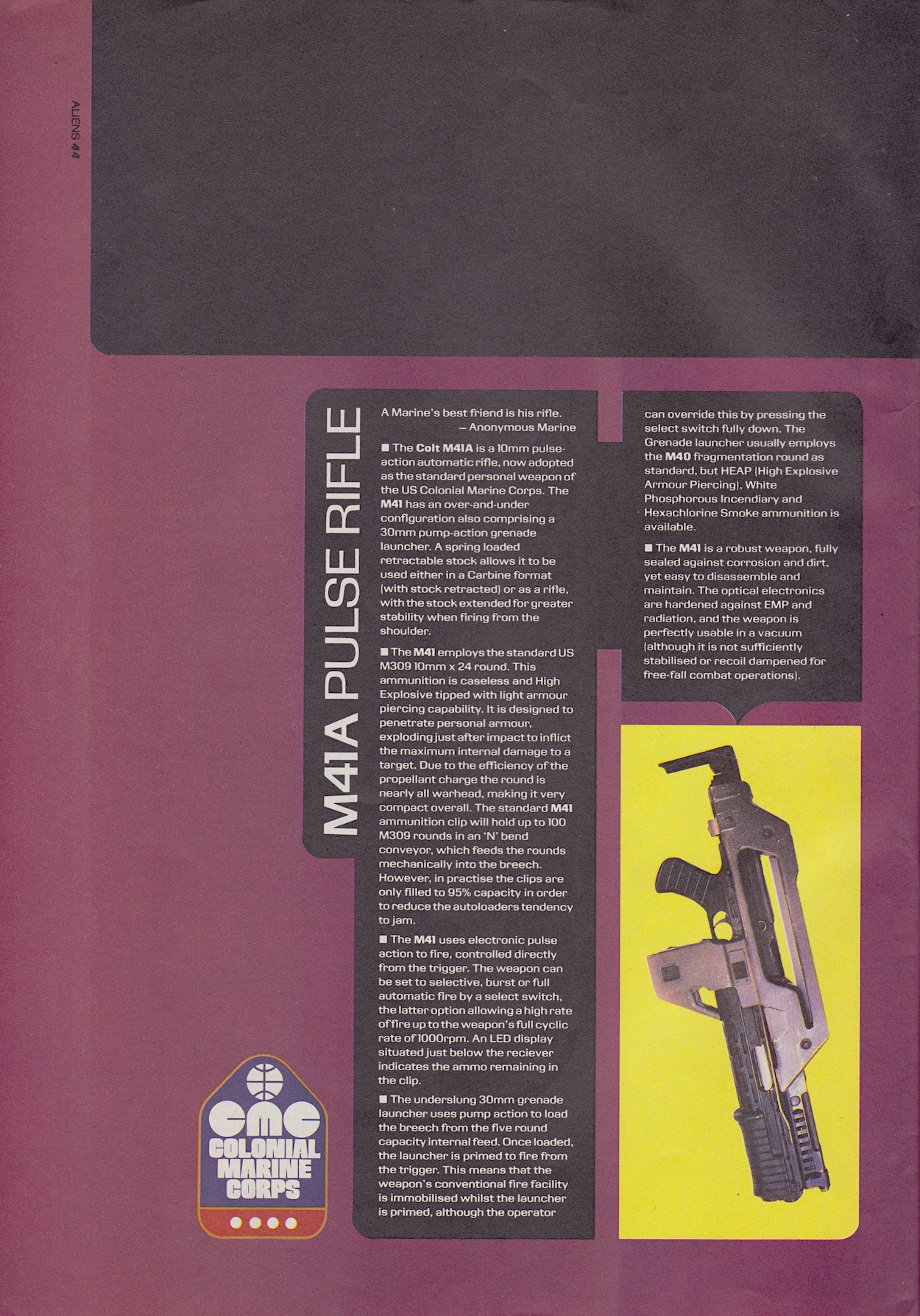
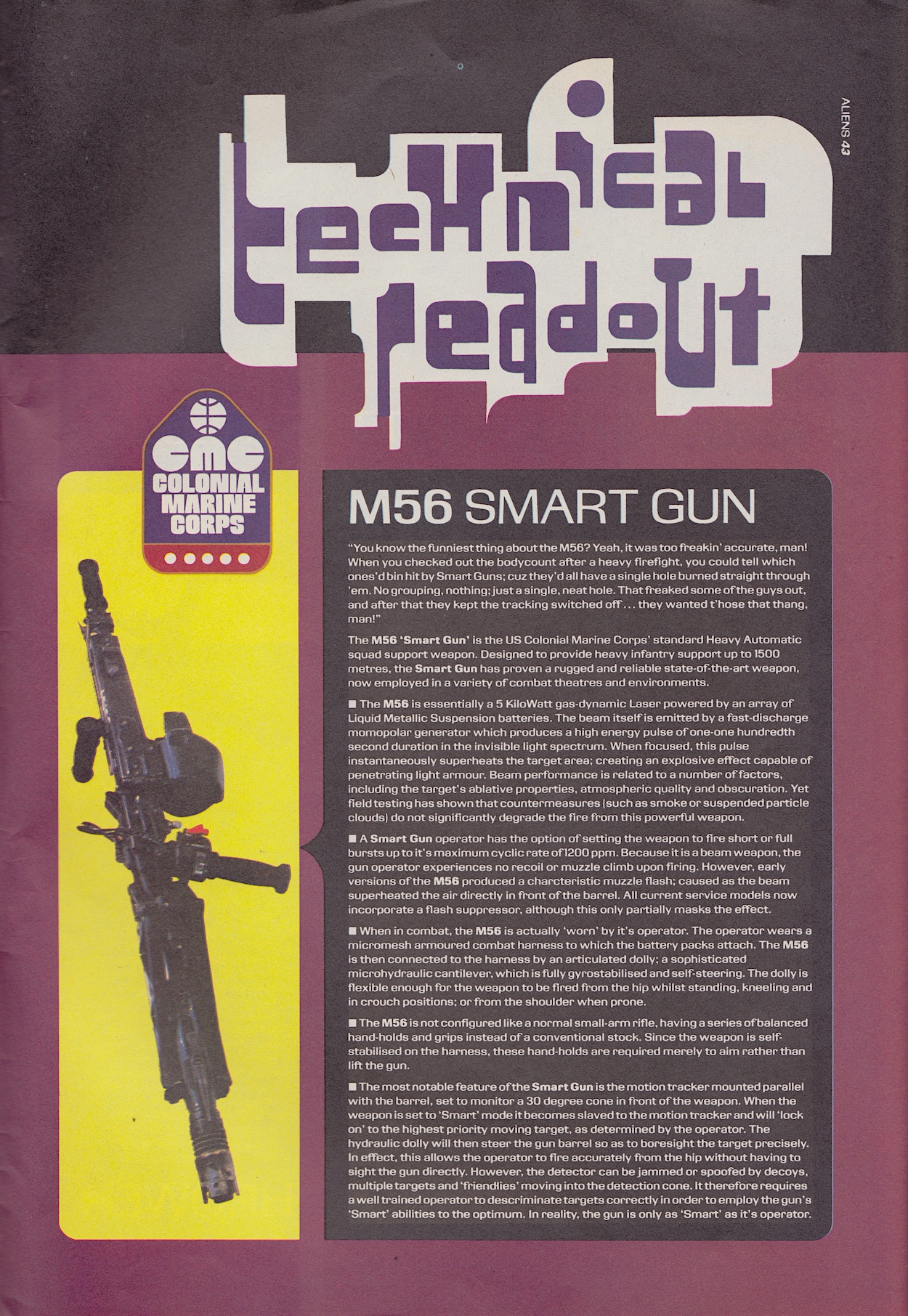
Towards the rear of the comic are three pages detailing some of the weaponry used by the Colonial Marines in the Aliens movie. For fictional weapons the Technical Readout really does go into a lot of detail. If this is the beginning of the comic adding some background depth to not only itself but also the universe of the films then it’s another great start. These pages bring back exciting memories of their onscreen use, especially the M56 Smart Gun as used by Jenette Goldstein’s Vasquez character, decades before “smart” devices became the things to own.
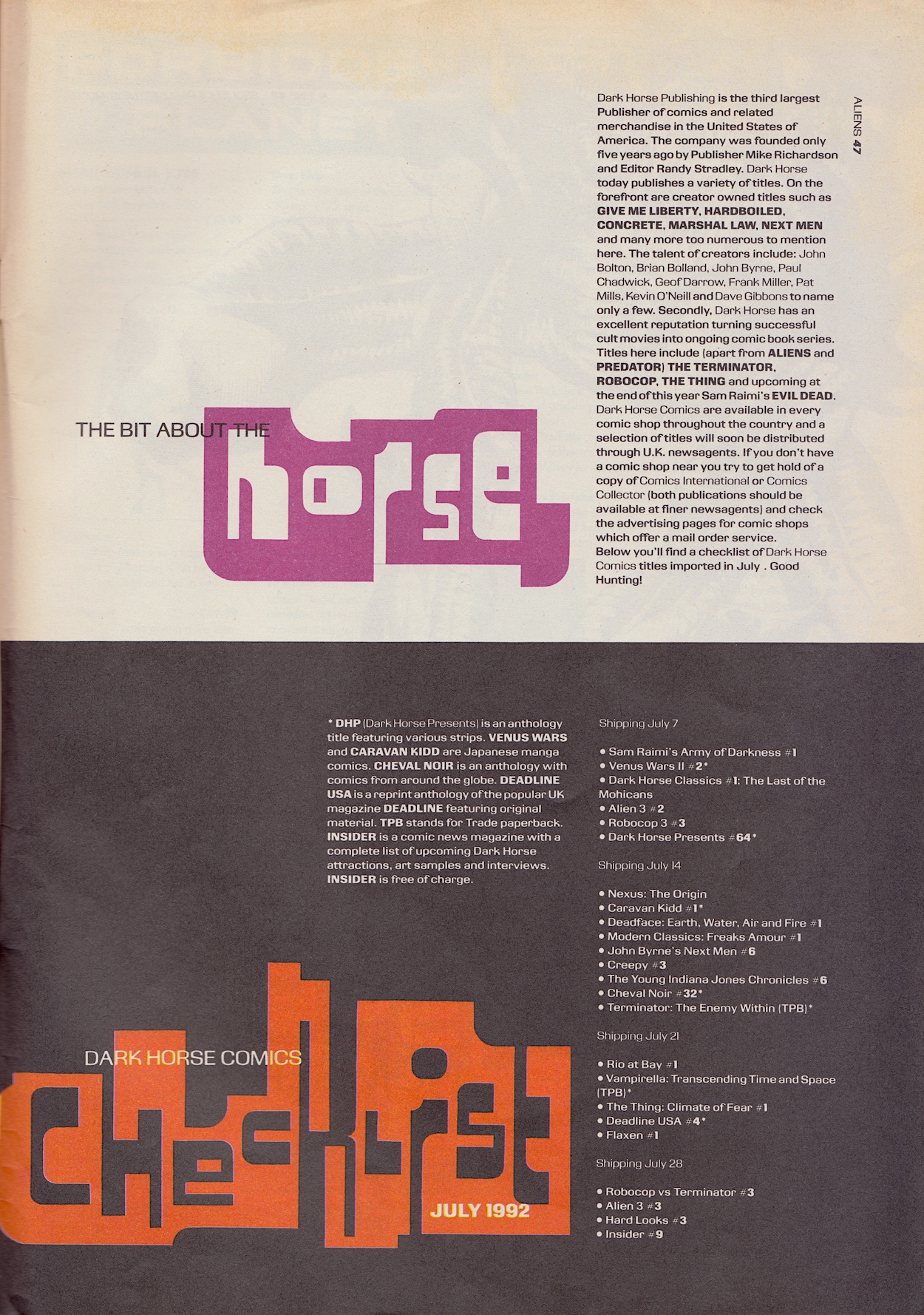
Finally, just as in Jurassic Park (and many Marvel UK comics) we get a comics checklist, although at this stage Aliens was Dark Horse International’s only UK title so it focusses solely on the imported comics available in specialist comics shops. These weren’t as easily found at the time (Northern Ireland only had two such shops back then) so for most of us these were beyond our reach. It’ll be interesting to see this develop as the company settled (at least temporarily) into this part of the world.
With that we come to the end of the first issue and it’s off to a cracking start. The Aliens strip itself is fantastic and it hasn’t really got going yet, but the set up has plenty of potential for things to go horribly wrong for the cocky humans. Predator is also enjoyable and might be more so once I actually watch the films (which I now want to do, so that’s another good point) and the extras are interesting. Lots of potential here. This is a lengthy read through that’ll take us all the way to March 2026, so settle in and come back on Tuesday 23rd July 2024 for the next instalment.
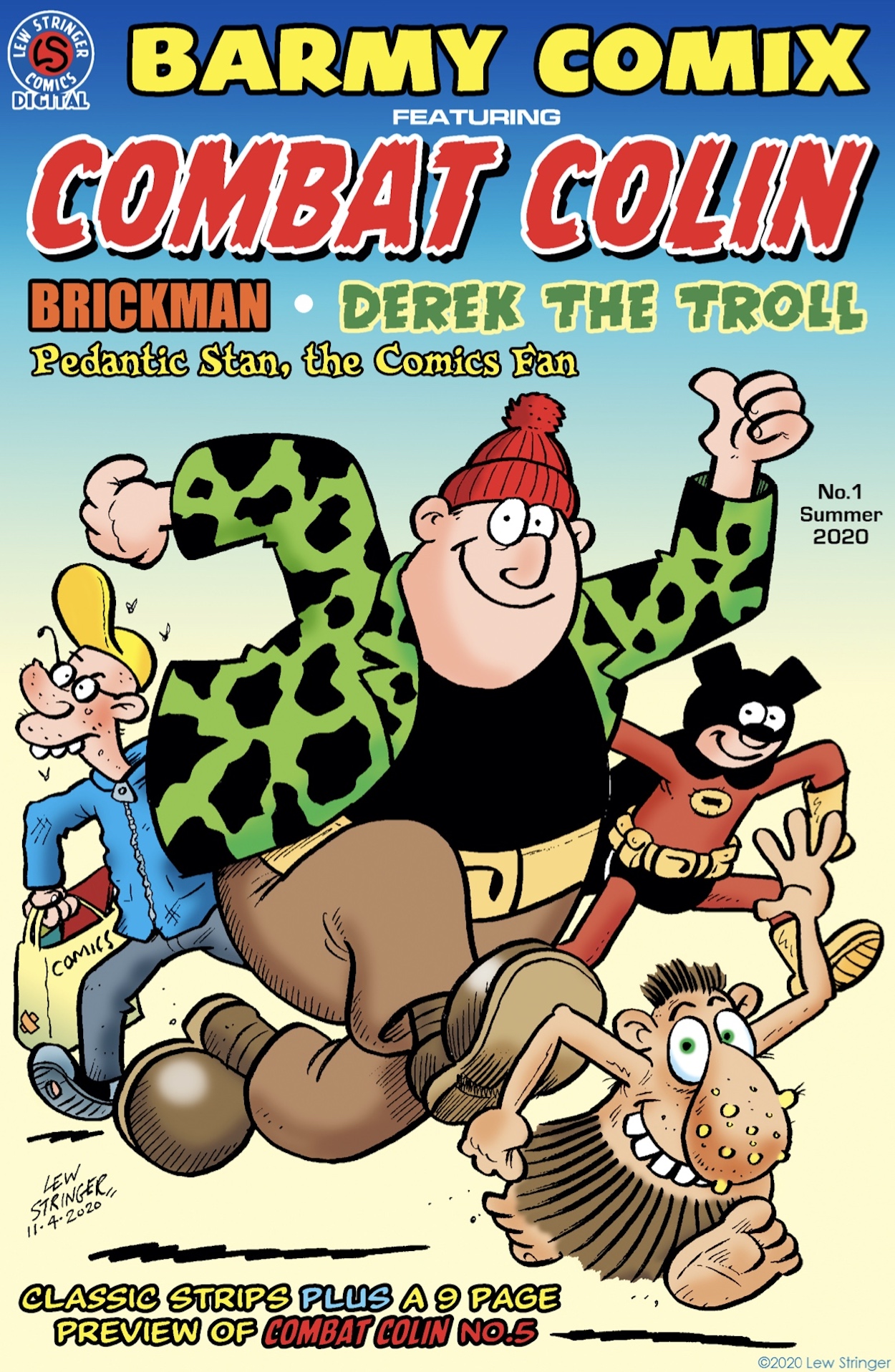
Created by master of mirth Lew Stringer, Barmy Comix was released for free online in 2020 in response to a delay in the publication of his next Combat Colin comic due to Covid. Bringing some much needed cheer to a locked down world when access to new comics was impossible, it has 32 pages (or screens) of strips taken from various publications in the Lewniverse, including a nine-page preview of the next issue of Combat Colin.
That’s not all from the moronic militia man though. There’s a classic from the Transformers days, when Lew’s strips were at their height later in the run with Day of the Gunge, a strip I fondly remember reading first time around when I was a much smaller human. There’s also a full-colour adventure with Colin and Semi-Automatic Steve I hadn’t read before from the pages of Aces Weekly. This on its own is worth the price of entry. Not that there is any price, but you get my drift.
Loose Brayne, aka Brickman is in here too. It’s quite possibly the barmiest strip of the whole comic and that’s certainly saying something. The Brickman Meets The Mad Cobbler is classic Lew turned up to ten. I love the character of Albert and on the next page we see that it’s actually the big fancy house, Brayne Manor, that sits in a cave while Brickman’s supposedly secret lair is above ground for all to see.
This should give you some idea of the chaos to expect if you’ve never read a Brickman strip before. Set in “Pre-Holocaust Thatcherite Britain” it’s an ingenious mix of slapstick, social commentary and daft gags. It’s probably my favourite out of the whole issue. Saying that, there’s also a second story of his, Brickman and Trowel Meet Professor Deranged! Nothing subtle about the villain names in this comic.
Derek the Troll’s strip takes the form of one of those Make-Your-Own-Adventure books we had as kids (OiNK had its own version back in #5). Derek was originally created for role-playing magazine Warlock and that’s where this strip comes from. Lew has also released a comic reprinting all of Derek’s misadventures which I’ve already reviewed on the blog and (spoiler) enjoyed immensely.
Derek the Troll’s ‘orrible Troll-Playing Game is almost impossible to win, throwing a spanner in the works every time you think you’ve made the right decision, its curveballs and surprises keeping you laughing all the way to the end. There are also two full-colour strips of Derek’s from the short-lived digital comic Goof and he’s the star of one of the mini-posters scattered throughout Barmy Comix, ready to be printed out and Blu-Tac’ed to your wall if you’re feeling particularly nostalgic.
One creation of Lew’s I’d never heard of before reading this comic during the pandemic was Pedantic Stan the Comics Fan. Co-created with former Marvel UK editor and the utter gentleman behind comics news site Down the TubesJohn Freeman, he was created for comic newspaper Speakeasy in the 1990s (an earlier edition of which has already appeared on the blog). Lew has also released the complete collection of Stan’s strips in a small, landscape format comic which was a hoot to read. It’s been a while since I’ve read it so it was fun to see his Full-Page Christmas Special again.
Also in here is a touching strip from the Undefeated Spirit of Hope book released in 2011 in the wake of the natural disasters in New Zealand and Japan of that year, finishing off the comic on the back page. Altogether this has reminded me of The Marvel Bumper Comic, which introduced me to comics and characters I hadn’t previously read among a mix of hugely enjoyable, hand-picked reprints of some of my favourites.
Barmy Comix was (and still is) free although Lew does ask fans if they could donate a small sum of £2.00 towards the creation of future comics in his range. This was particularly relevant during the pandemic but it’s such a small ask in return for the many laughs we get from each and every one of his publications. To download it just click on the link below to Lew’s own blog and please do remember to donate.
On my 15th birthday (21st December 1992) my mum and I sat down to watch the evening movie on UTV. I knew of the Alien films (there were only two at the time) but knew nothing about them, however Sigourney Weaver from Ghostbusters was in it so I was sold. It was on for an hour before breaking for 30 minutes to make way for the Ten O’Clock News, the cut off point being perfectly timed as they drove inside Hadley’s Hope.
It had built up for an hour and we were primed when the film returned to the air for what felt like an hour-long climax. I’d never seen anything like it and even my mum loved it, going along for the ride with Ripley, Newt and the rest. In school I raved about it and discovered some of my friends were huge fans, who then arranged a night for us to watch the Special Edition together with all of its cut scenes restored. Over the years I’d go on to watch the original and the sequels, but this one always remained my favourite and one of my favourite films of all time. (Ever since I’ve always checked the TV listings for a good movie on my birthday night. Nothing’s ever come close.)
I knew there was a UK comic at the time thanks to one of those friends. I flicked through some of their issues (which did look amazing) and saw adverts in my Jurassic Park comic but I never collected it myself, only buying one issue for a long train ride on a holiday in 1994. I remember being engrossed by it but then never seeing it anywhere after that. At that age my attention span soon drifted and that one issue was the only one I ever read. Until now.
While reading Jurassic Park for the blog I couldn’t help but notice the promotions for Dark Horse International’s Aliens and it got me thinking about covering it. However, upon researching to see how much there was to collect I noticed Dark Horse only produced volume two, the first was published by Trident who I’d never heard of before. I picked up an issue of Trident’s but it was a very different beast and not what I remembered at all.
I may eventually go back and collect those issues but for now I’m concentrating solely on Dark Horse’s volume, which began in the summer of 1992. There are more issues than volume one, on the surface it seems to be a lot more professionally put together and it contains features beyond the comic strips. But most of all it includes the issue I bought as a teen and so it’s this version I want to relive and rediscover as an adult. That’s the whole point of the blog after all.
Apart from flicking through each issue just to check page numbers and ensure everything is there (I haven’t read anything) I did notice the cover art is simply wonderful on each and every one of them. I mean properly stunning. If this is an indicator of what I can expect from this comic then I can’t wait to get stuck in. Speaking of the covers, I had a vague recollection of the one I’d bought many years ago, and when I was eventually able to collect them all I instantly recognised it. As it turns out it had been the last issue before Dark Horse International went out of business. No wonder I never saw any more on the shelves.
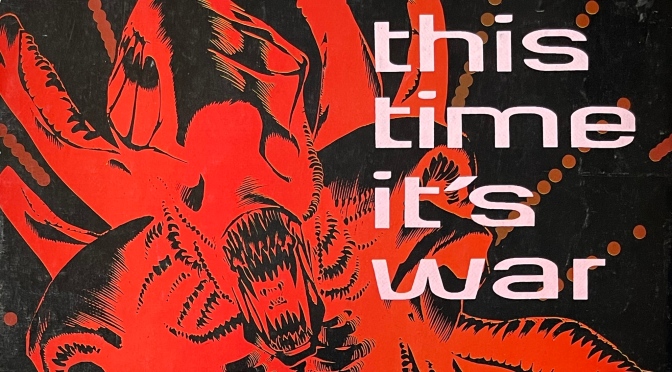
Firstly though, Dark Horse produced one final issue to volume one, which included a specially commissioned cover from sculptor Chris Halls, who had worked on the then-yet-to-be-released Alien³, and inside are a selection of short stories to round everything off for a new start the following month. I haven’t included it in this read through so it’ll be a fun way of ending volume one if I get around to it. It explained to readers what was happening with the change of publisher and included an atmospheric back page with the new tagline for Volume Two: “This Time It’s War!”
As for what you’ll see in this real time read through, there are 22 monthly issues plus a special three-part Alien³ series, published every three weeks. These will make for a meaty read through of 25 issues for you and I both to enjoy. Some of them have their free gifts intact and there are even two Christmas issues! Well, there are two Christmas covers anyway, I doubt there are festive tales inside but I’m still thrilled with the fact an Aliens comic marks the festive season at all. (If you’re new to the blog, I’m a bit of a Christmas nut.)
What else do I know before I go in blind to this series? Well, the accompanying mini-series is a bit of a giveaway but there’ll be plenty of coverage of the third film as I see it mentioned on a lot of the covers. It wasn’t brilliantly received at the time by fans but I always enjoyed it. However, in recent years a Special Edition has been released and it’s a completely different film. It’s superb! In fact, this version is very much the one that should’ve been released at the time but for studio interference. I’d place it right up next to Aliens, that’s how good I think it is nowadays. So it’ll be interesting to see how the comic and its readers (there’s a letters page) spoke of it at the time, unaware of all of this.
The Predator seems to feature quite heavily too. The two franchises hadn’t met at this stage but they were always destined to and the editorial in Volume 1 #17 hyped up the return of the alien hunters in issues to come. I’ve only ever seen the second movie in that particular franchise so I wonder if the comic strips will make me want to go back and get caught up with those too.
I’m always excited to get stuck into a new real time read through and I feel extra excited this time. That one issue decades ago left such an impression on me, and it’s just so different to anything else covered thus far. I’m also collecting the new Marvel Aliens comics and they’re fantastic so that’s adding to my hype. Jurassic Park finally has some company in the Dark Horse International menu too.
The first issue of Aliens will face hug the blog on Tuesday 18th June 2024.
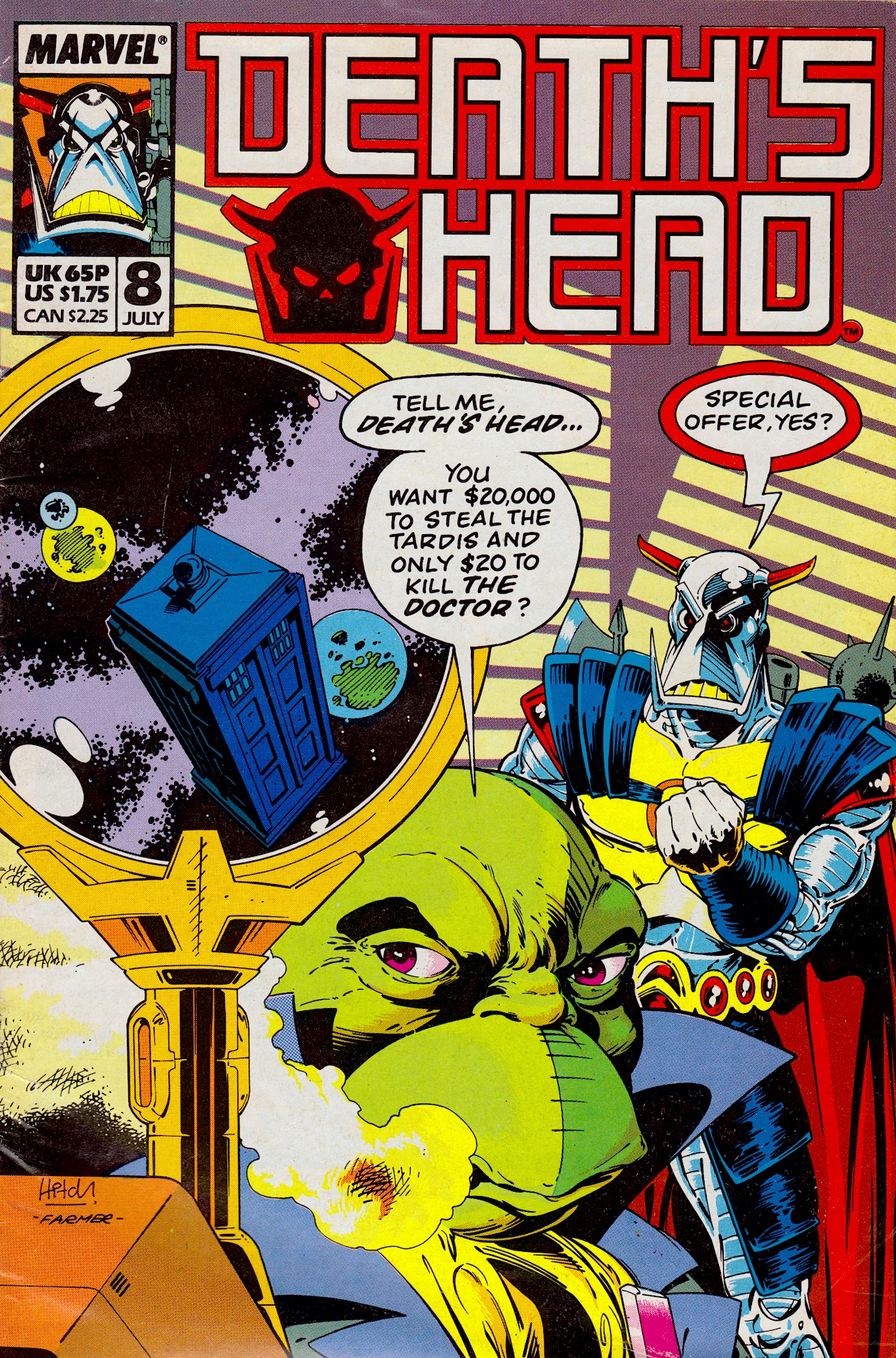
As I collected Death’s Head’s comic for the blog I couldn’t help but notice the covers for the final three issues all prominently displayed characters from other publications. Crossovers were usually an event and used sparingly in my comics as a kid so my initial reaction to seeing these was that they were really, really trying to get a bigger audience for the comic, which made me think sales weren’t great. A bit of a leap perhaps, but three crossovers in a row?
This issue we see the Seventh Doctor (as played by Sylvester McCoy on TV) guest star after our Freelance Peace-Keeping Agent first appeared in Doctor Who Magazine and ended up reduced to human size by the time-traveling alien. It’s clear from the cover and the editorial inside that the opportunity for revenge has presented itself and Death’s Head intends to follow it through. But first, a surprise in the credits!
Unlike all previous issues, which were written by the character’s co-creator Simon Furman, this chapter is written by Steve Parkhouse (Nick Fury Agent of S.H.I.E.L.D., The Bojeffries Saga, Doctor Who – unsurprisingly) who also inks Art Wetherell’s (Transformers, The Incredible Hulk Presents, Sheena Queen of the Jungle) pencils. Annie Halfacree letters and Louise Cassell colours a strip that feels very different than usual. Plus, Steve White (editor of Visionaries, colourist on Jurassic Park) takes over as editor after Richard Starkings had resigned.
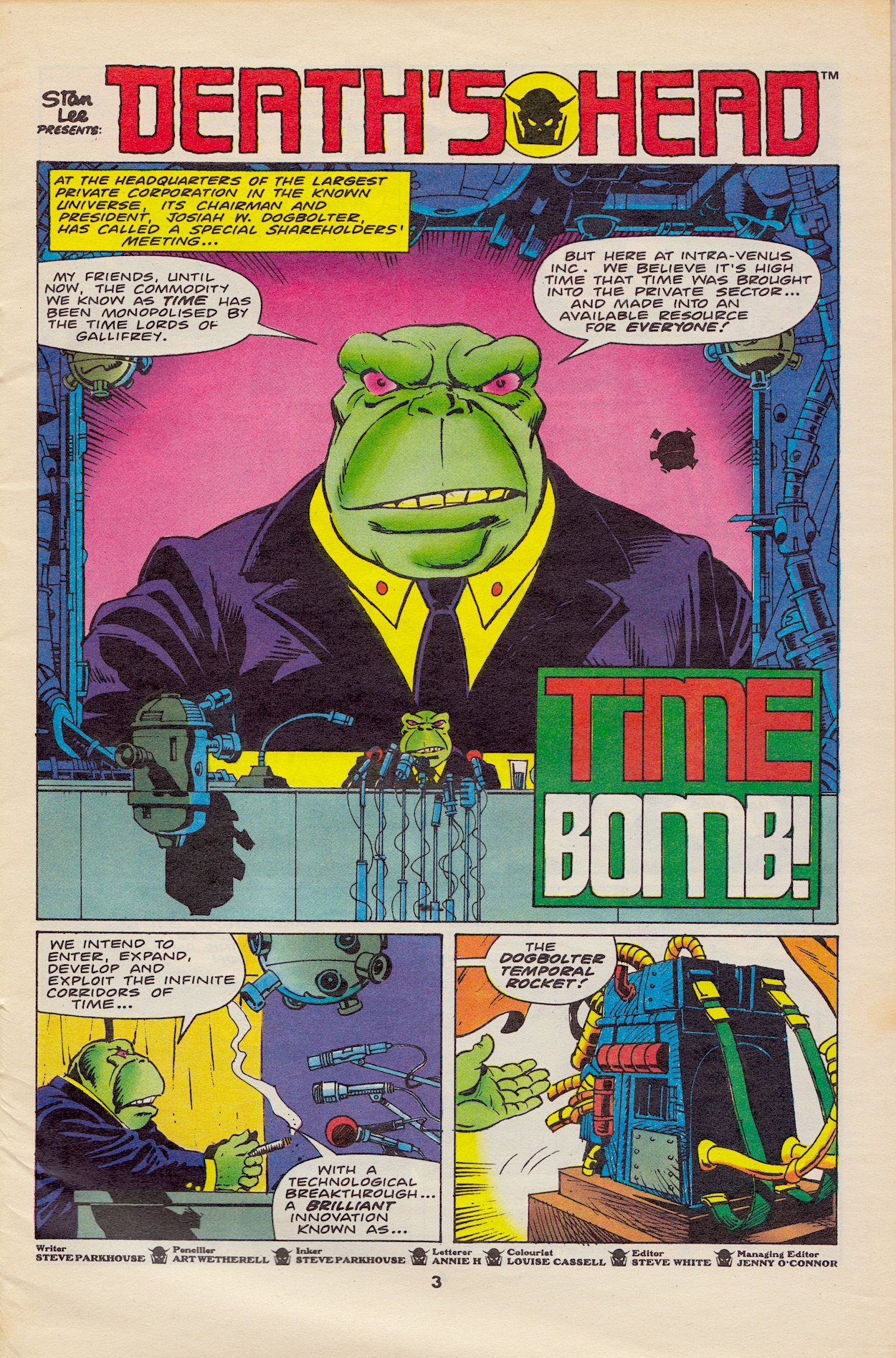
The plot involves Josiah W. Dogbolter, a character of Steve Parkhouse’s and Steve Dillon‘s from DWM in the Fifth Doctor days, whose company wants to make money out of time travel by privatising it. How could time travel be privatised? In the 80s we thought the same thing about water and the railways. This is clearly taking a dig at Margaret Thatcher’s government of the time, something Simon’s Dragon’s Claws was very good at. It’s nice to see this kind of satire make its way into the more comedy-focussed title.
Dogbolter finishes his speech to his shareholders and the press with the phrase, “Time IS money!!” and I have to hand it to him for that one. It doesn’t take a genius to work out that the businessman has had previous run-ins with The Doctor and that’s why he’s wanting to control the very essence of time travel. The first panel above sums up the entirety of the plot for this issue, found on the second page.
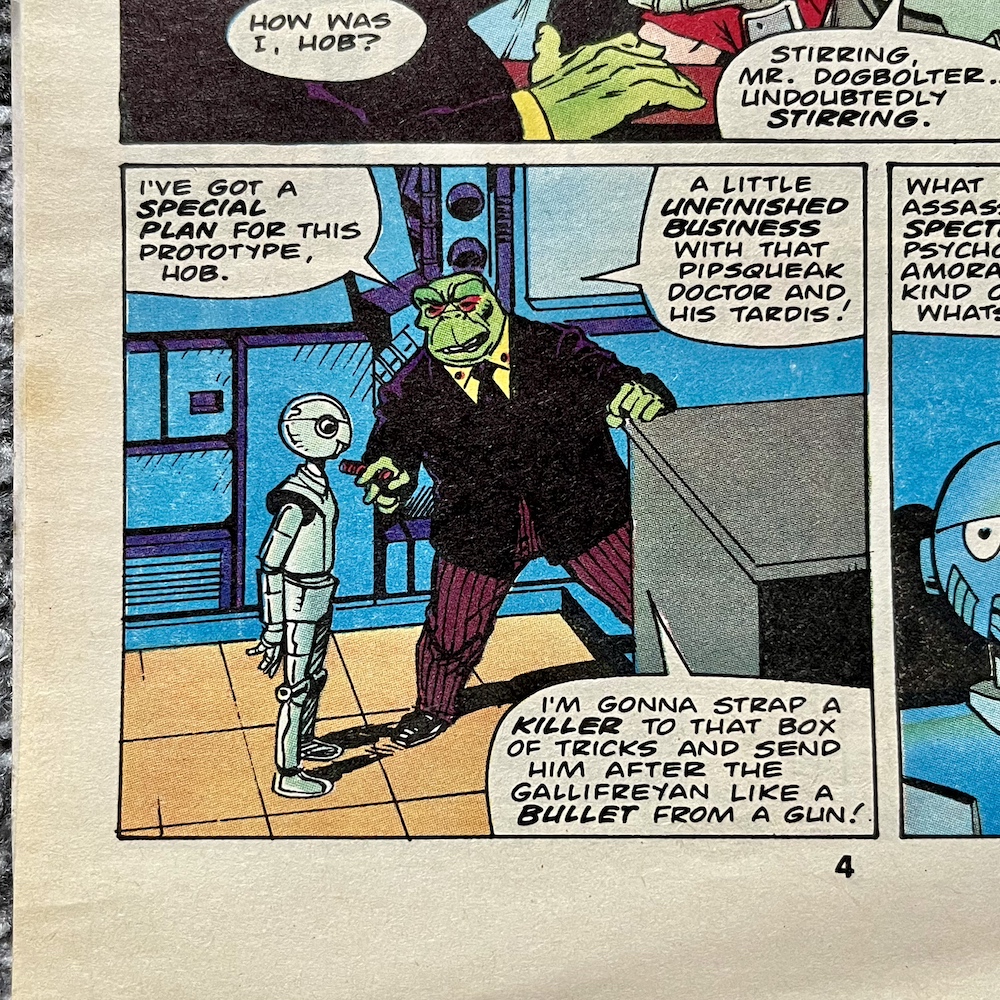
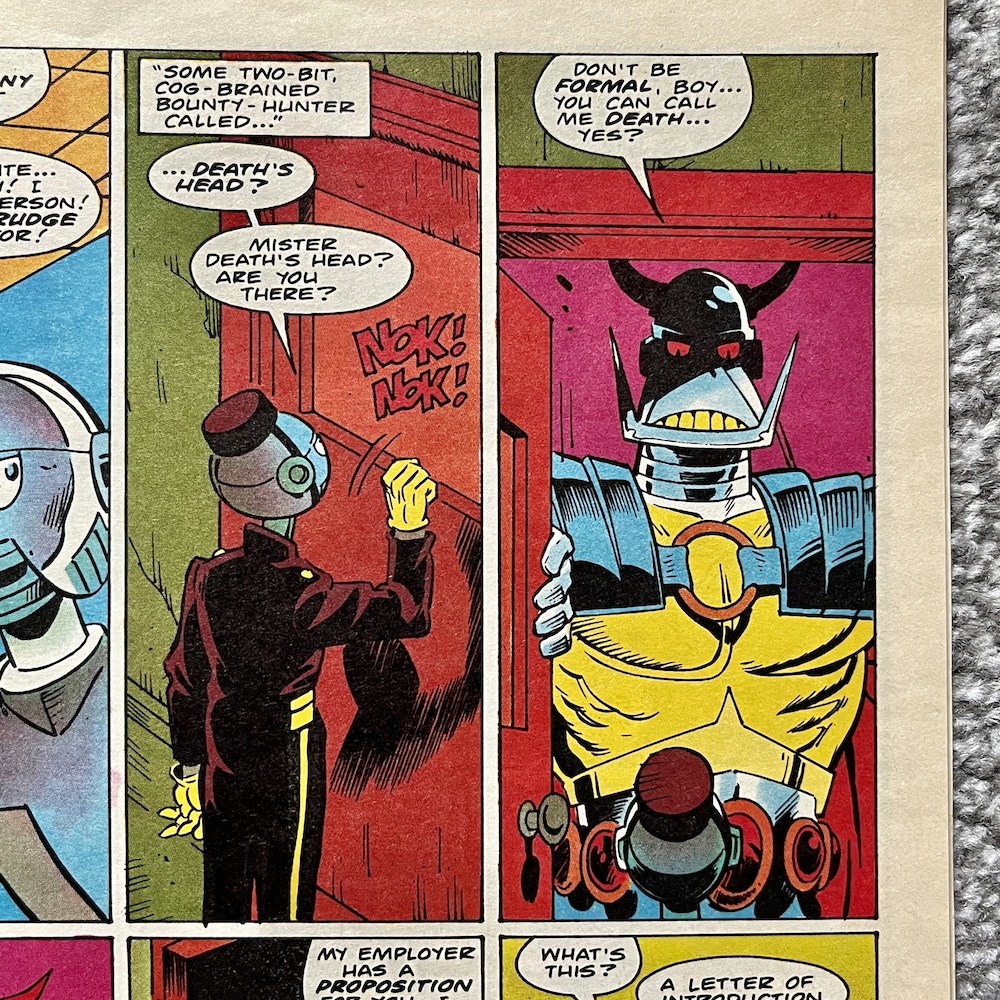
This comic could never be accused of having intricate plot lines, usually they’re just a means to an end. But when those ends are so full of character, action and laughs, when they’re so enjoyable, they do the job. This issue is no exception. Hob is Dogbolter’s robotic assistant and is sent out (in delivery boy uniform no less) to hire Death’s Head for an assassination attempt on The Doctor. Needless to say, he accepts the job.
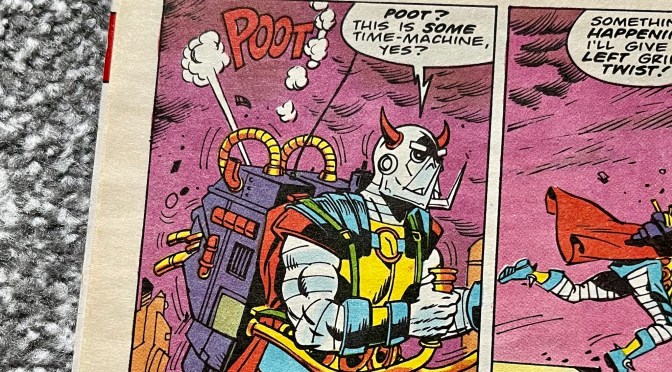
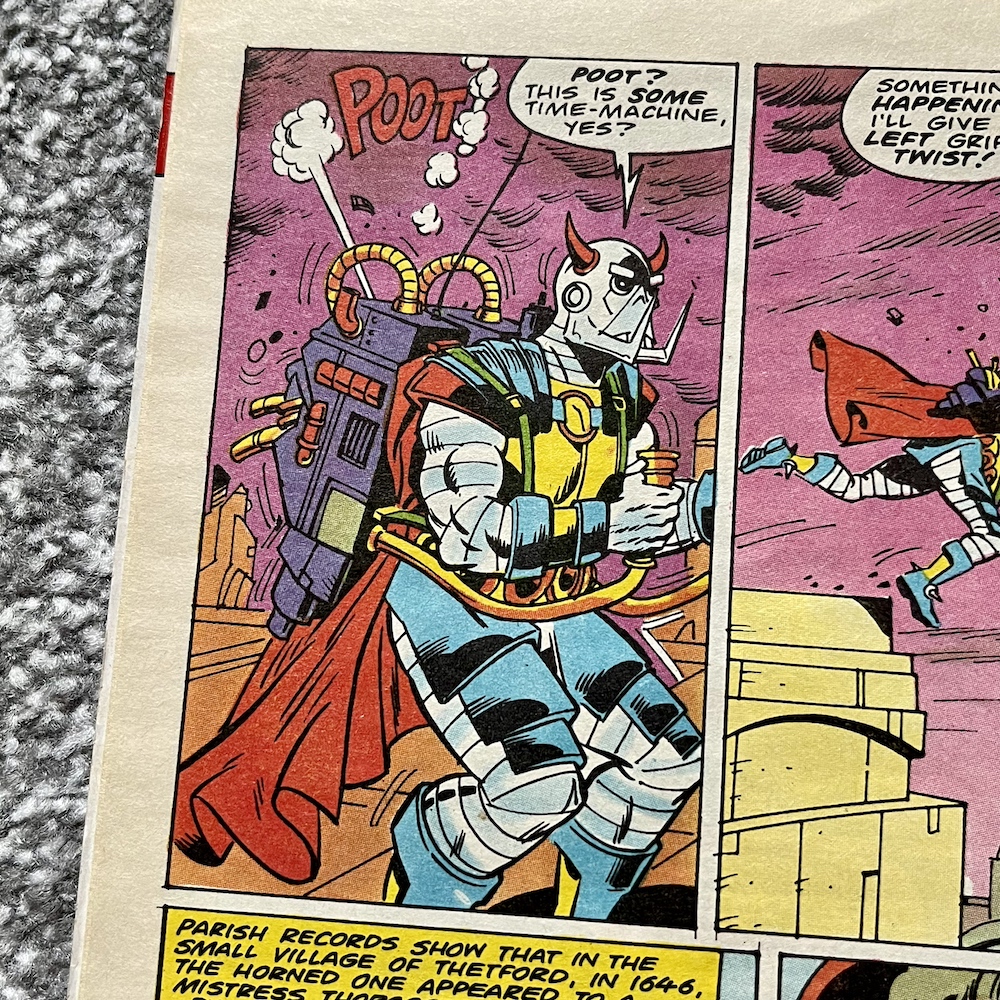
“Poot? This is some Time Machine, yes?”
Death’s Head
What he doesn’t know is that Dogbolter was looking for “a skilled assassin who’s not only spectacularly stupid, but psychotically aggressive, amoral, and lacking any kind of imagination whatsoever” and Hob’s conclusion was to approach our lead character. It becomes apparent later in the strip why his boss was looking for someone with these particular traits. But first, on a dark and stormy post-apocalyptic night in a future Los Angeles, the powerful time travelling device gets strapped to Death’s Head and he dramatically sets off. Well, sort of.
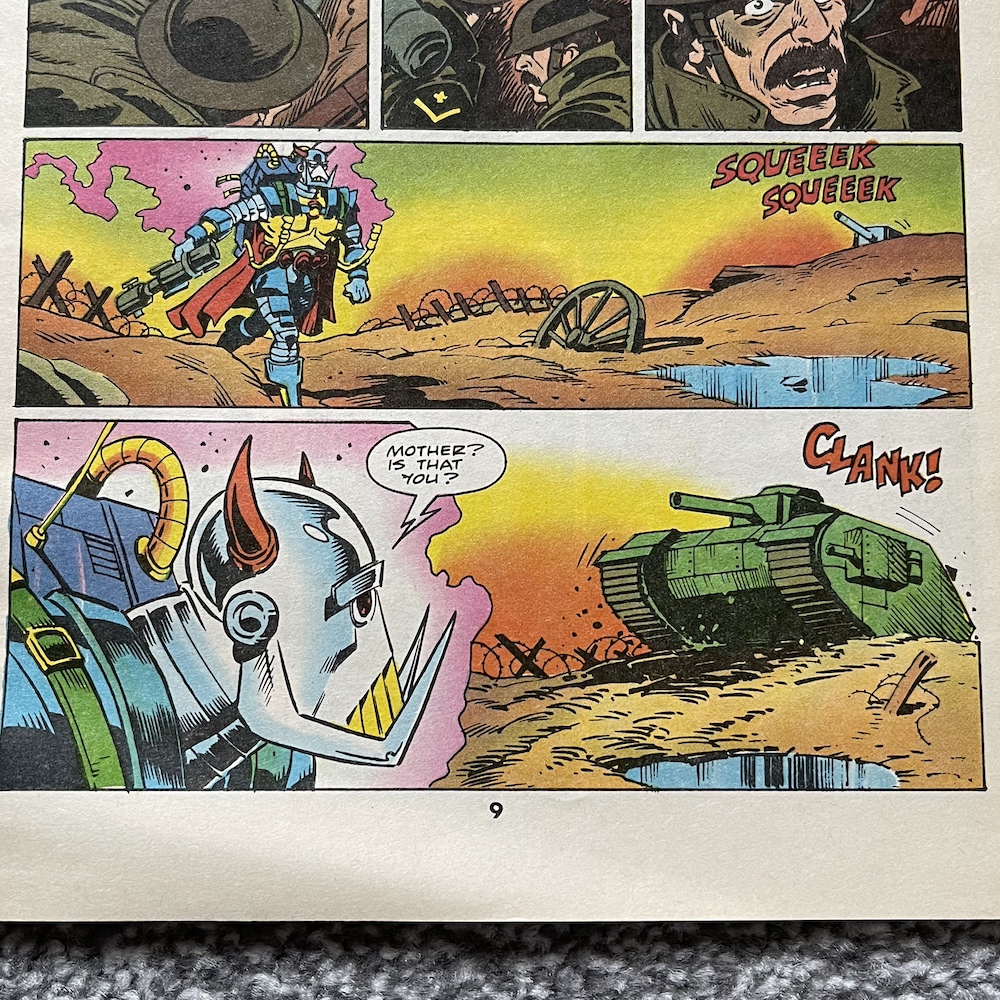
It’s not exactly the TARDIS. A fun segment takes Death’s Head through various points in time before he’s able to find The Doctor. First of all he lands in an English parish in 1646. Leaving just moments later it was enough for the poor woman whose garden he appeared in to be sentenced to death for summoning a demon. Two huge shoed footprints are uncovered by archaeologists digging for Triassic period fossils and then he appears in front of a German tank during World War II!
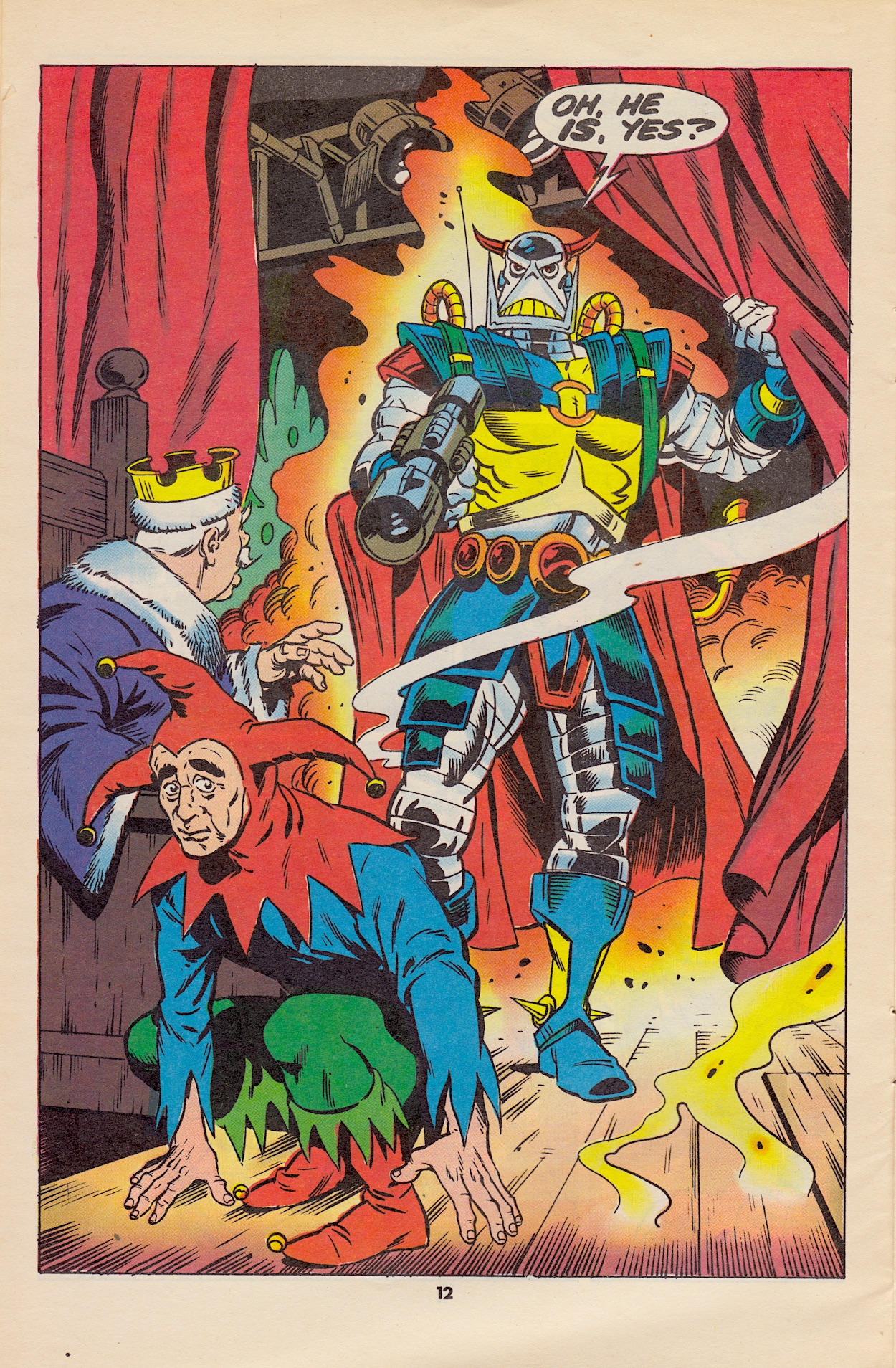
Lots of laughs later we see The Doctor is also attempting to make an audience smile as he plays a court jester in a panto taking place in front of tourists on an English seaside pier. I have no idea why this is, perhaps it ties into a story in Doctor Who Magazine at the time. A loud noise from behind him sends the audience into the usual pantomime chant of “He’s behind you”, to which The Doctor naturally replies, “Oh not he isn’t”, leading to this next page.
That’s an entrance. Using some panto clichés, namely pulling a lever to open a trap door under Death’s Head and then escaping as one half of a pantomime horse (no, really), The Doctor makes his way back to the TARDIS and scarpers to another time and place. This really is all rather ridiculous, even for the far-fetched nature of this comic but then again we have to remember this was published during 80s Doctor Who.
I have a real fondness for Sylvester’s Doctor. He was my first but I didn’t start watching until the beginning of his second season (with the phenomenal Remembrance of the Daleks) when he became a darker and more mysterious character, often instigating the plot rather than reacting to an injustice. But when this comic was written only his first season had been broadcast in which he was much more of a clown, fumbling his way through time while playing the spoons!
This explains a lot about his actions in Time Bomb, and especially the ludicrous escape he’s just made.
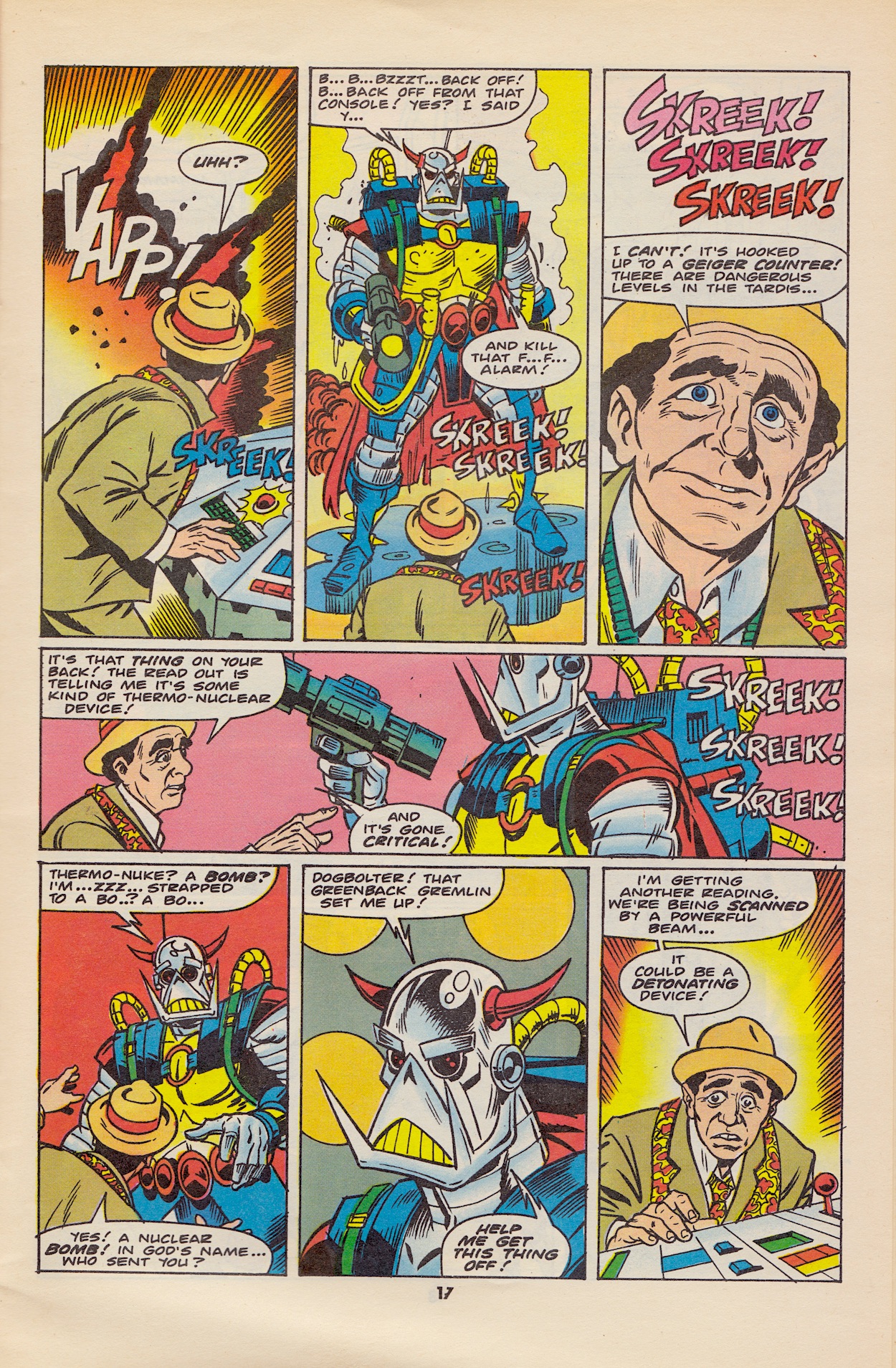
So he may not feel like my Doctor but it’s still an entertaining strip. Death’s Head is able to somehow materialise inside the TARDIS (this is never explained) direct from the sea he’d plunged into under the pier. An alarm sounds and soon he finds out he’s been double-crossed. Dogbolter not only ensured The Doctor would be killed but that there wouldn’t be any witnesses to tie things back to him.
Over the next couple of pages we see Death’s Head and The Doctor work together as much as they ever will, not exactly with each other but they have a mutual wish to survive and that’s enough for now. They lock on to the source of the signal and materialise on top of Intra-Venus Inc.’s (brilliant name) roof, much to Dogbolter’s chagrin. As he heads to the sub-basement shelter, inside the TARDIS Death’s Head tries to convince The Doctor to blast the straps of the machine off his back.
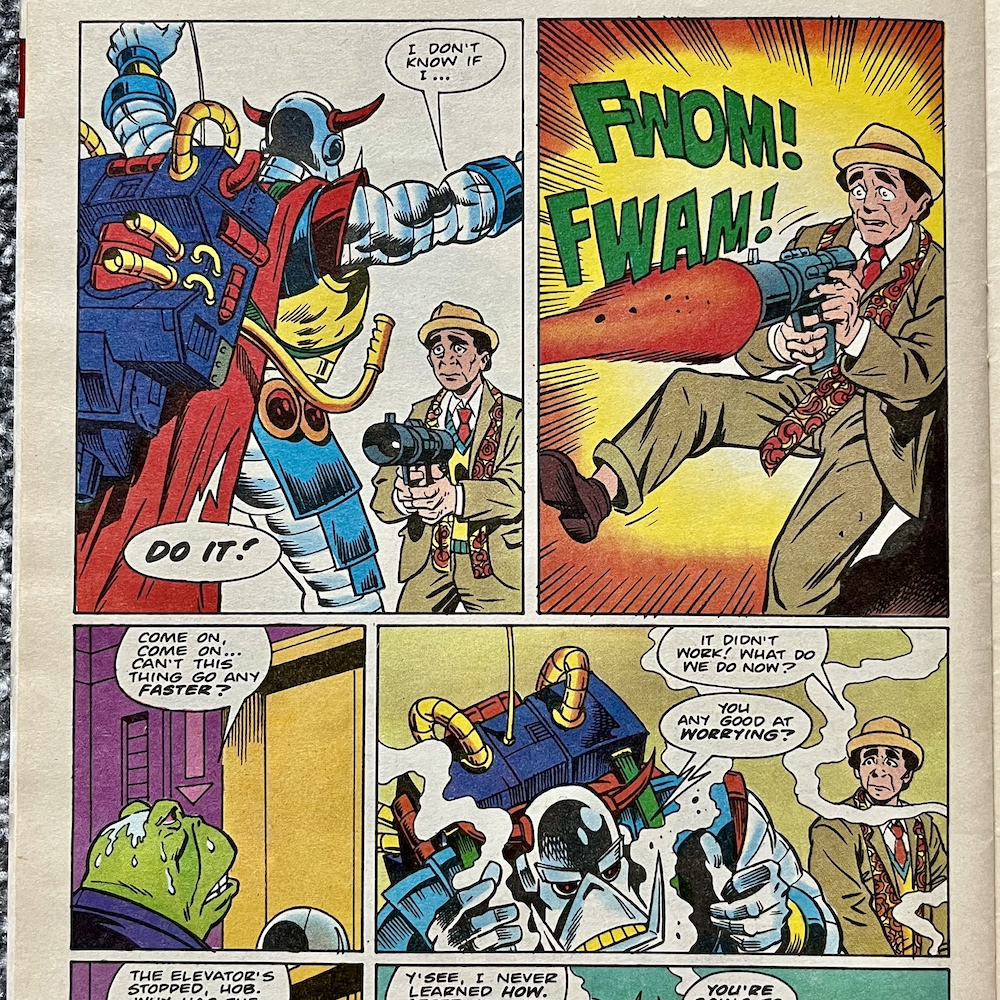
The patter between these two is very good. Death’s Head explains he never learned how to worry but that The Doctor is about to be blown up and end up in hell, so he tells him he’d better get to work. Using something called a Piklok (a new invention, but why not the Sonic Screwdriver?) he manages to unstrap the time machine while elsewhere Dogbolter has lost his ID card and can’t get off the elevator in time to escape before this next page.
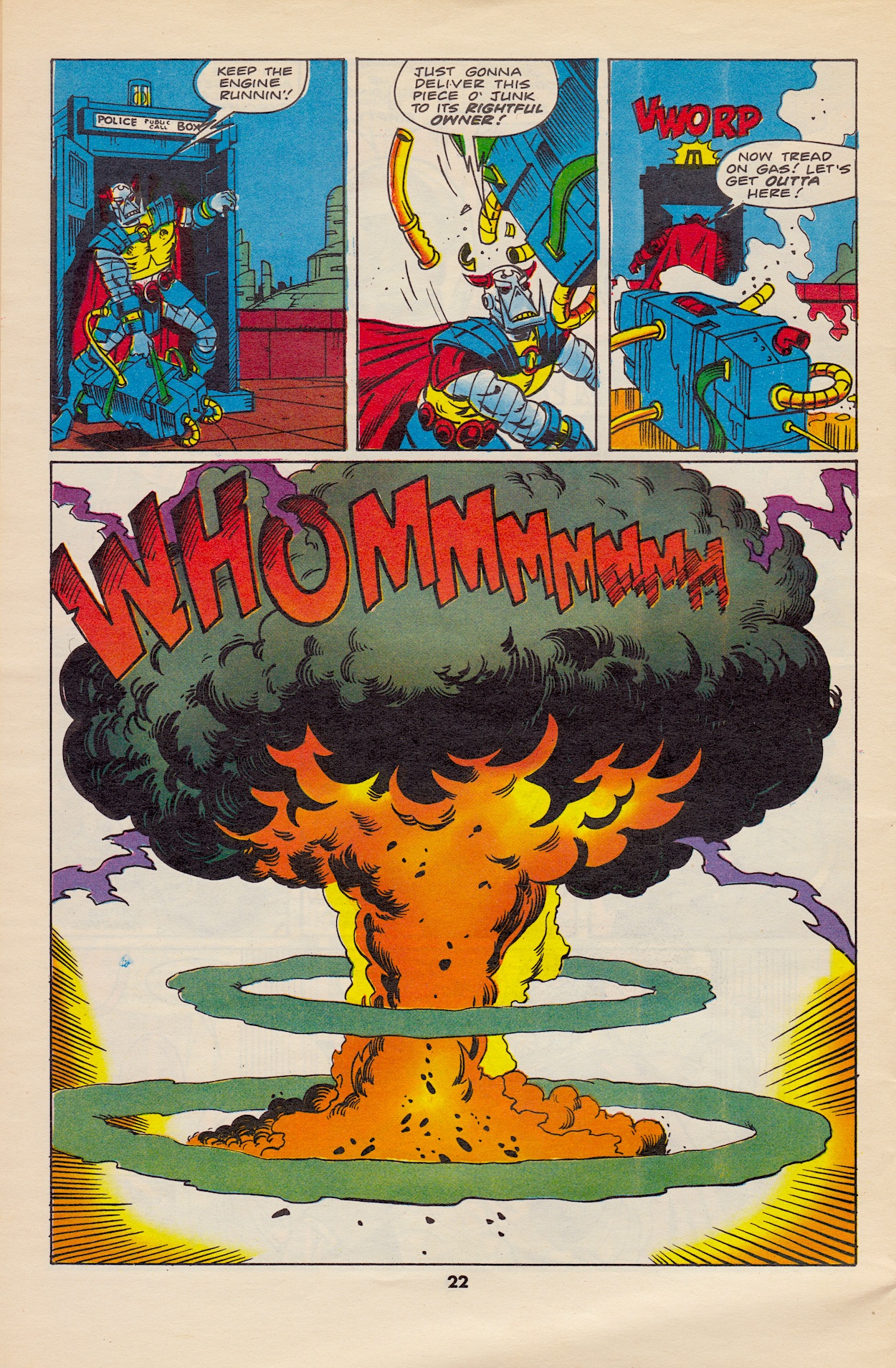
I have an issue with this. A big one. It’s been established the time machine is nuclear-powered, so why did The Doctor not dispose of it in deep, dark space? Why bring it back to Earth? The size of the explosion is meant to indicate the end of Dogbolter and his company, but that would also include everyone else in that building and at the very least the surrounding buildings too! The Doctor would never put innocent human lives at risk, never mind actually blowing them to bits!
Back in Doctor Who Magazine #135 he also put Earth at risk by dropping Death’s Head off here, even though he acknowledged how dangerous that would be for his favourite planet. It’s not like the Seventh Doctor had it in for us humans, he held the same morals as all the rest, including the modern day incarnations (if you’re unfamiliar with the classic series). It’s a huge sticking point for me and kind of ruins the end of a fun story.
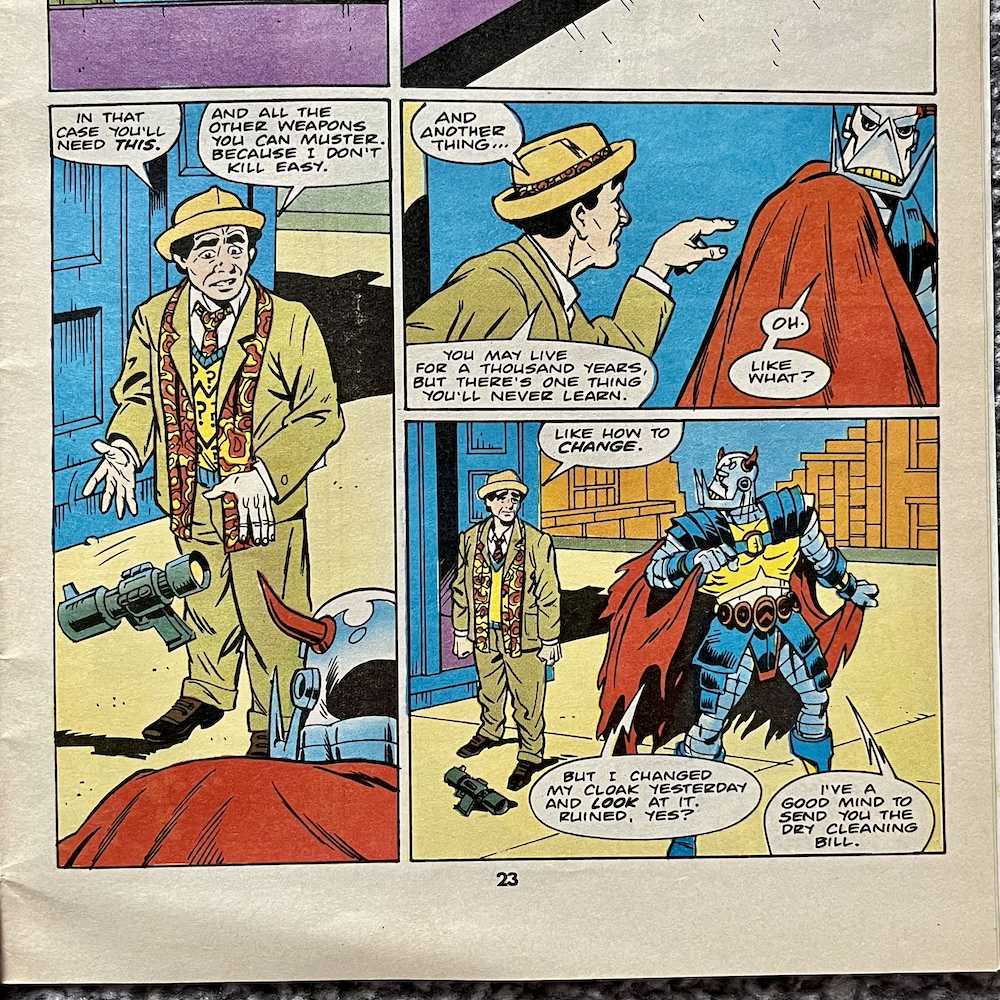
With this in mind it’s quite galling of The Doctor to then try to lecture our mechanoid anti-hero on his behaviour. Death’s Head’s response is funny though, I’ll give the strip that. The Doctor tells him that humans can evolve and change their evil ways, which Death’s Head simply describes as falling apart. After all, he’s programmed, and metal; if he changes from that then he’s literally falling apart. It’s black and white to him.
“A thousand years from now I’ll be rich… but you’ll be dead.”
Death’s Head
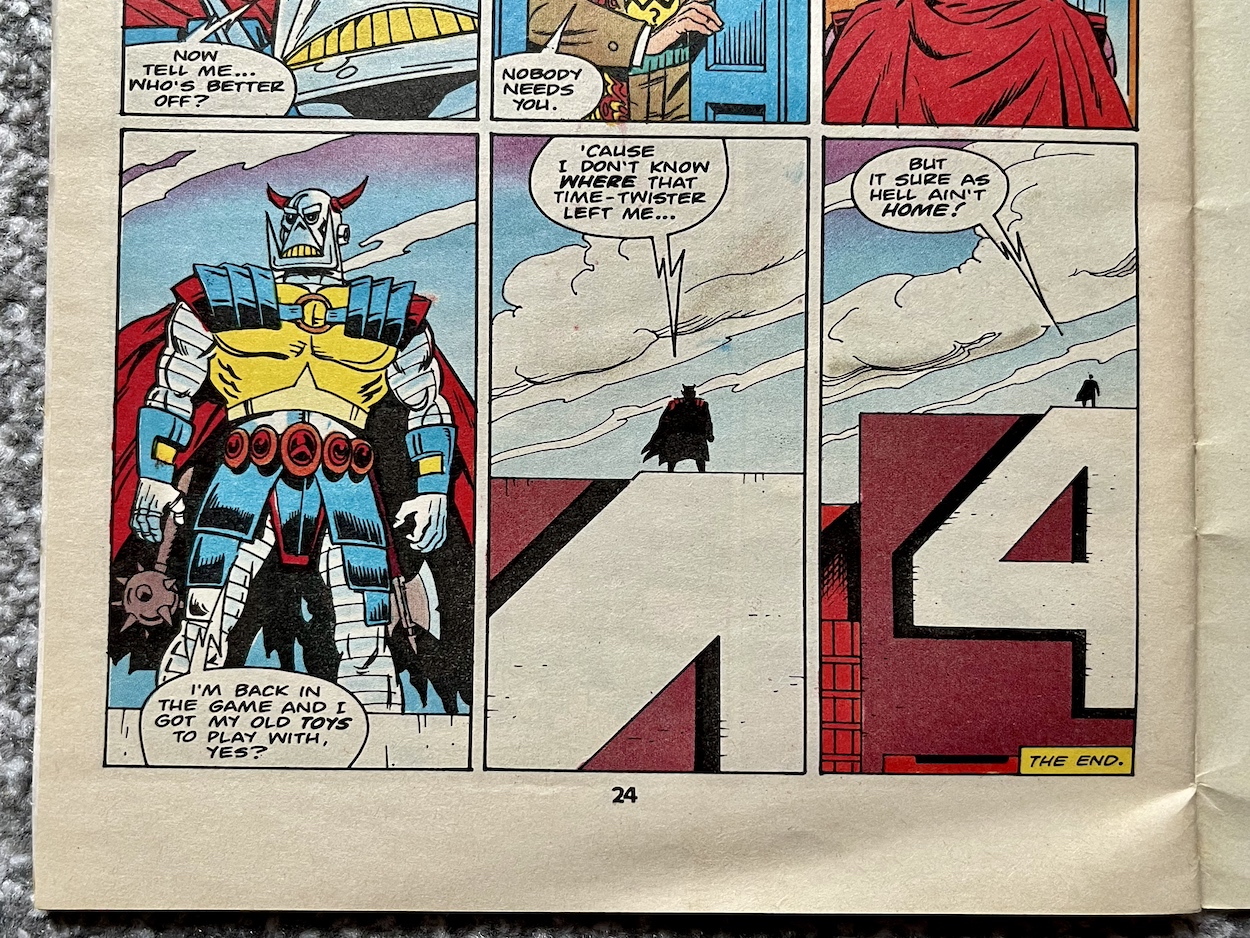
As The Doctor leaves he tells Death’s Head that he’s doomed, that in a thousand years people will be different be he’ll still be the same. “A thousand years from now I’ll be rich… but you’ll be dead”, he retorts. There’s no use in trying to push it, so as the TARDIS doors close he’s told he’s just a machine, a tool, one that nobody truly needs. Death’s Head muses that The Doctor is probably right, but then realises he doesn’t care; he’s home and ready to earn money again.
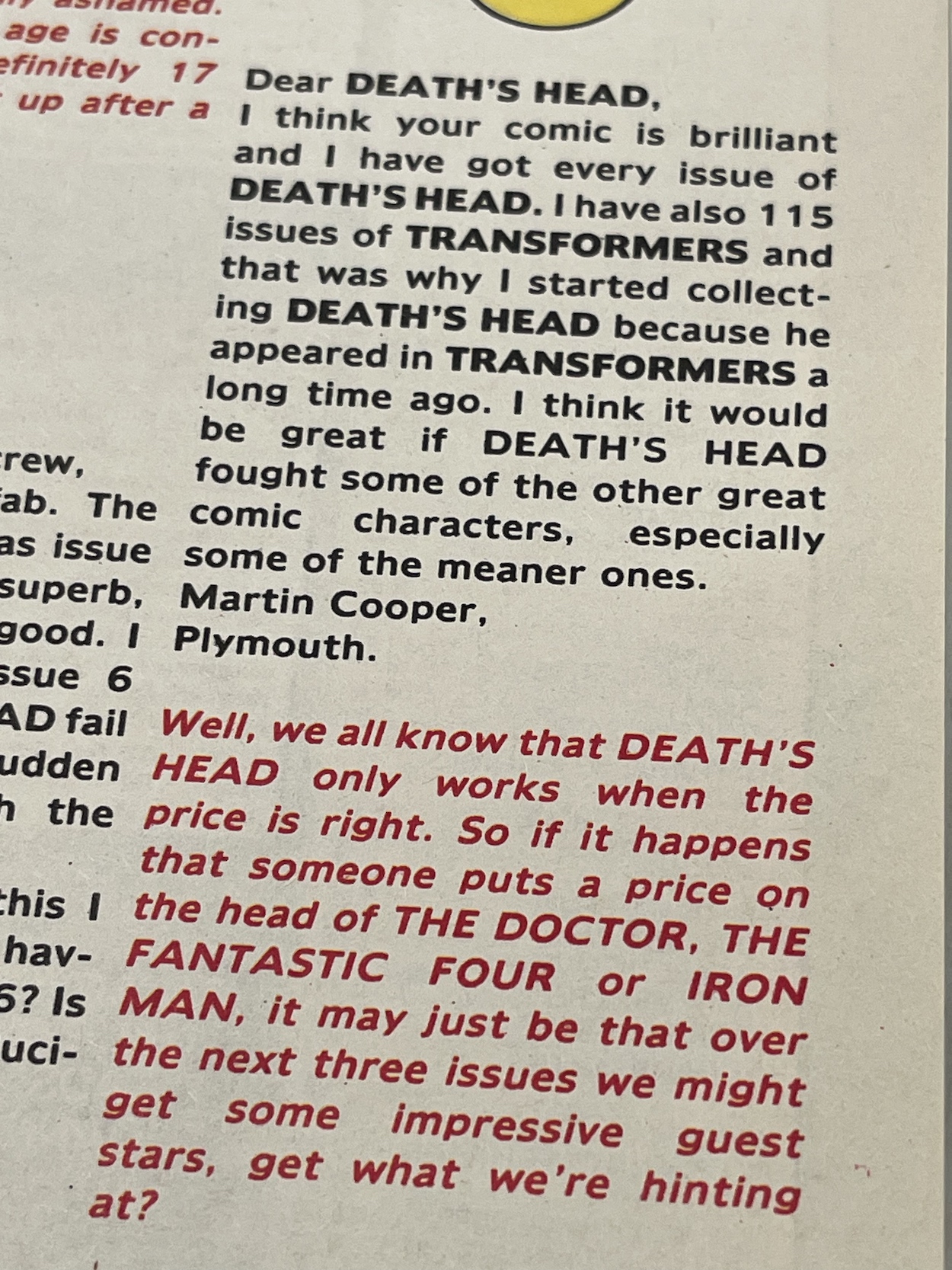
The final few panels pull back to reveal a not-so-subtle hint of who will be guest starring in #9. Anyone unsure (as I would’ve been at the time if I’d been reading this as a kid, I wasn’t a superhero comic reader), the answer to the final letter on the Head To Head page gives the game away not only for the next issue but the final one beyond that.
Then again, what’s the point in crossovers if you can’t market the hell out of them in advance to try to increase sales, yes?
I really enjoyed this story but that explosive ending bugs me. I don’t mean to dwell but as a fan of Doctor Who it’s just so out of character, so out of sync with what the series stands for, that I can’t let it go. I know nothing about The Fantastic Four so if they suffer the same fate I’ll be none the wiser. We’ll see how Death’s Head fares with four super-powered humans in #9, so watch out for the review on Monday 1st July 2024.












 OiNK Blog