WiLDCAT #3: MiND GAMES

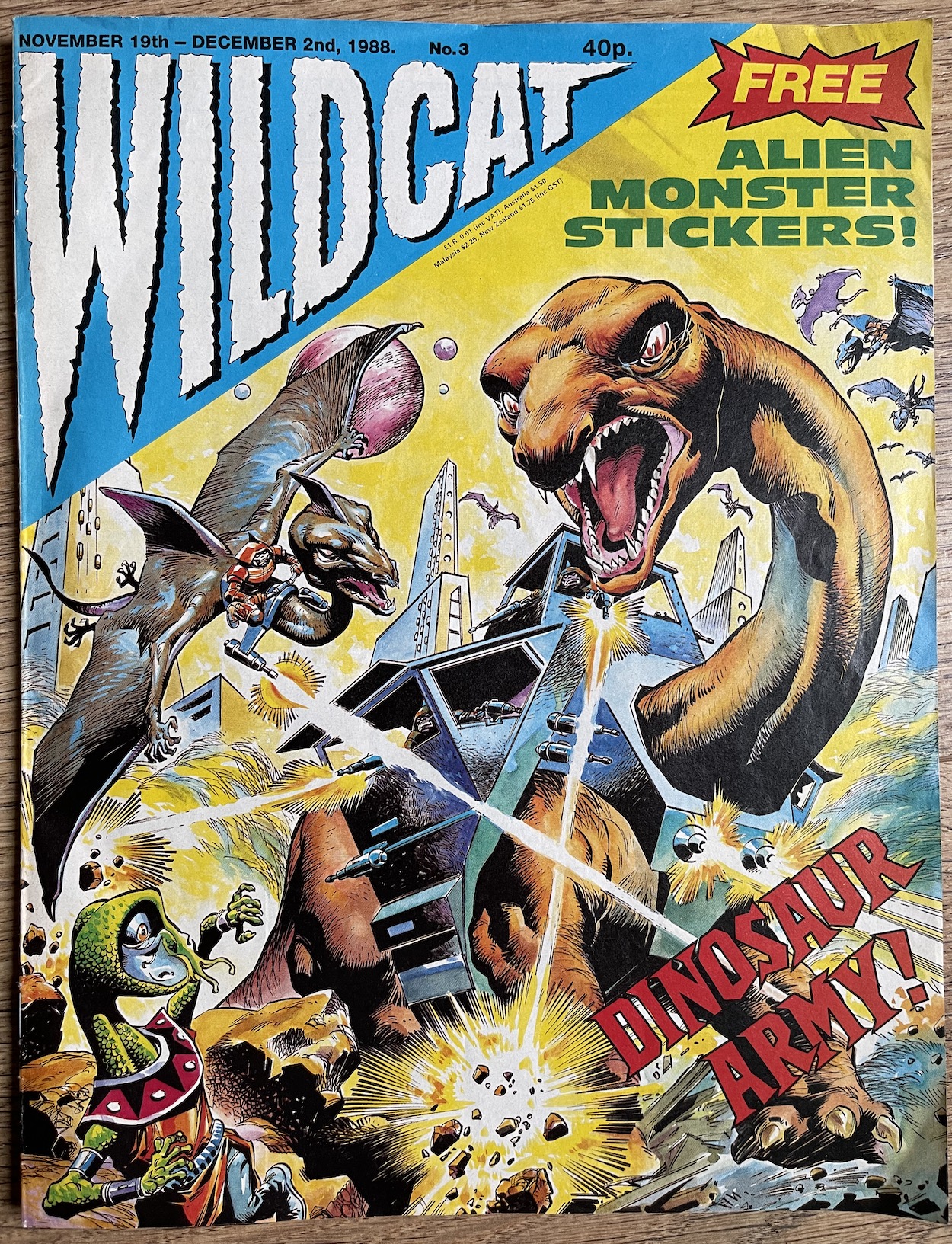
Who else remembers the short-lived toy line and cartoon Dino-Riders? You may think it wasn’t a coincidence that they launched the same year as Wildcat, but since they never came to the UK until the following year I’m going to go with coincidence. The cover certainly ticked all the boxes for me at that age and inside the action picked up a gear in many of the strips, the death toll continued to climb and there’s some art in here so good it’s stayed in the recesses of my memory all these decades since.

No recap page this time, instead we’re straight into the Turbo Jones strip, drawn by cover artist Vanyo. The Brain rather callously believes his people, the Burroids, are all cowards as he fills in Turbo on their situation. I’d say they’re more peace lovers than cowards. There’s a big disconnect between them and their leader, never mind the fact their leader is a giant brain! Why is that? Is there more to this relationship? I seem to recall there’s more to their enemy the Arglons too, that nothing is as simple as good versus evil here. In fact, I think that goes for all the serials in Wildcat.
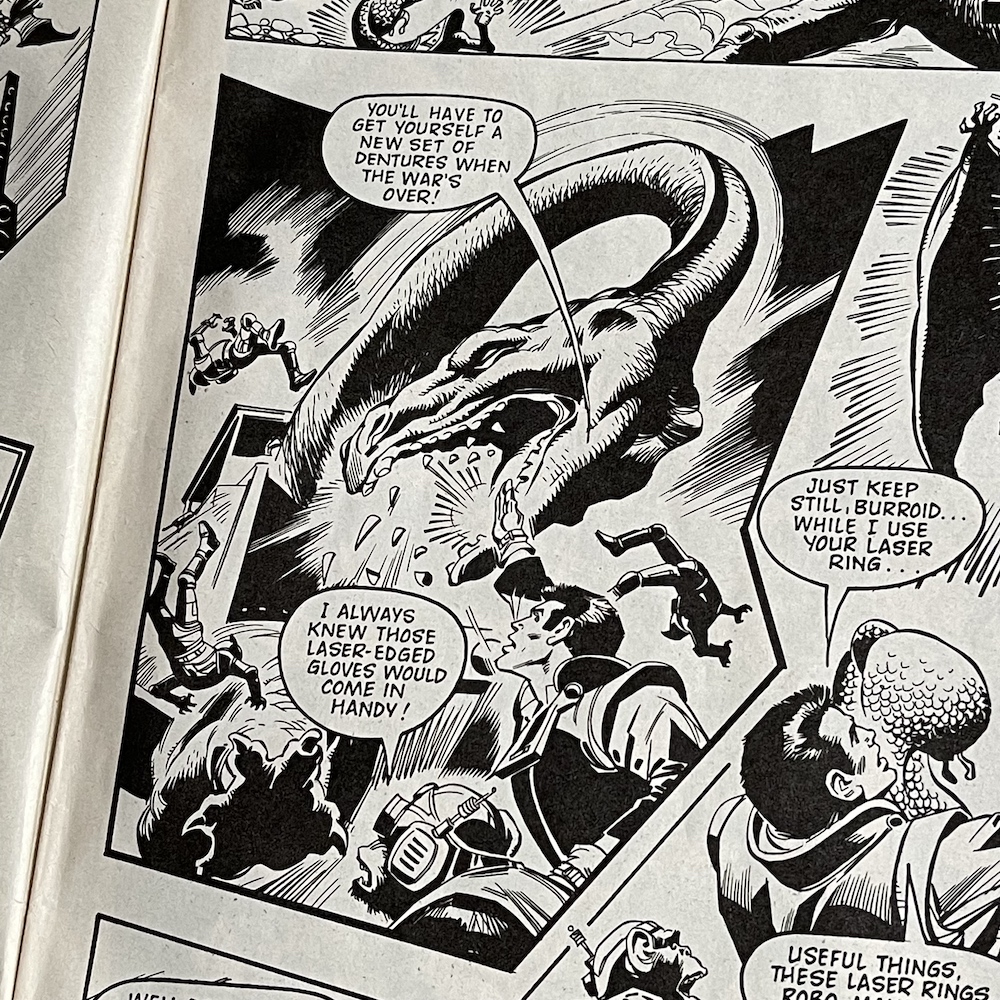
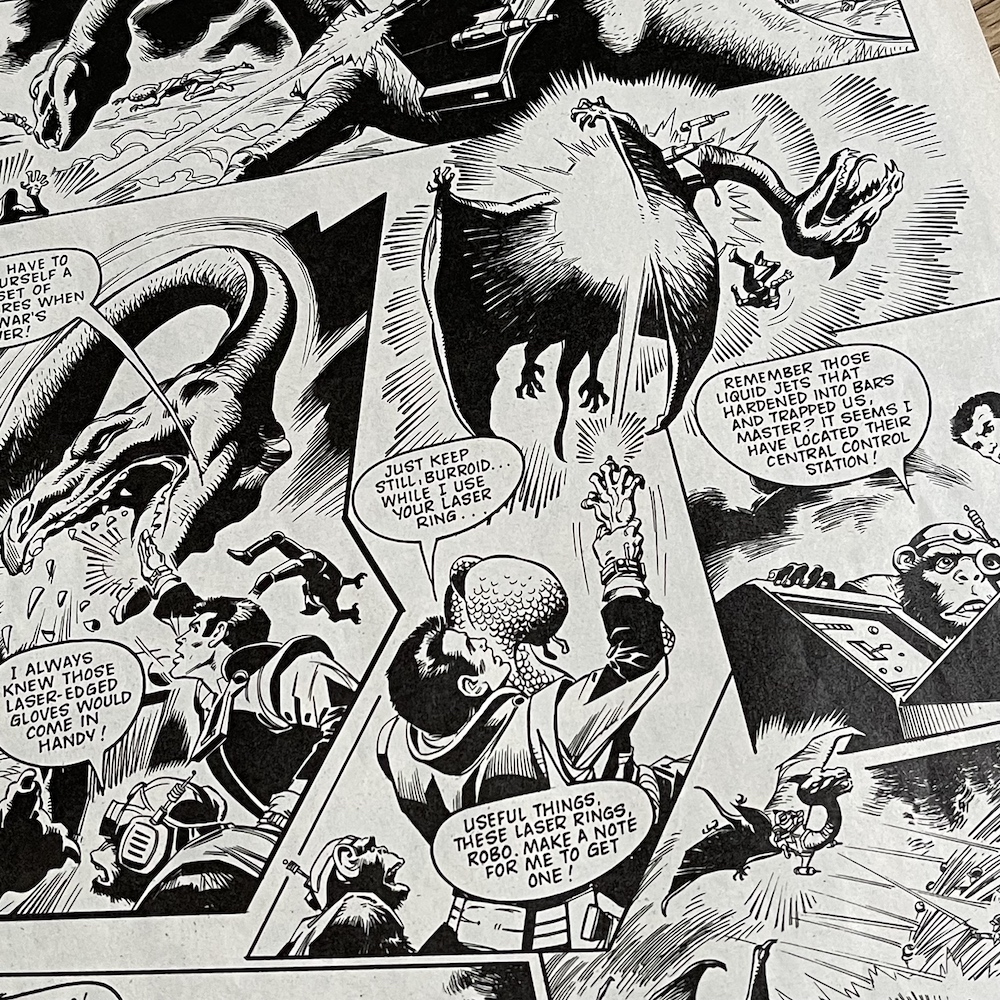
Turbo really becomes the action hero he’s promised to be since the preview issue, with everything from laser-edged gloves to laser binoculars at his disposal. His companion Robo is also quite the strategist when it counts and not the coward he makes himself out to be. He improvises and uses the alien tech that initially imprisoned them against his attackers. They make quite the team and their camaraderie and trust in each other is very naturally written, surprisingly. I’m glad to see their bickering in previous issues is just part of their relationship, a part of their banter.

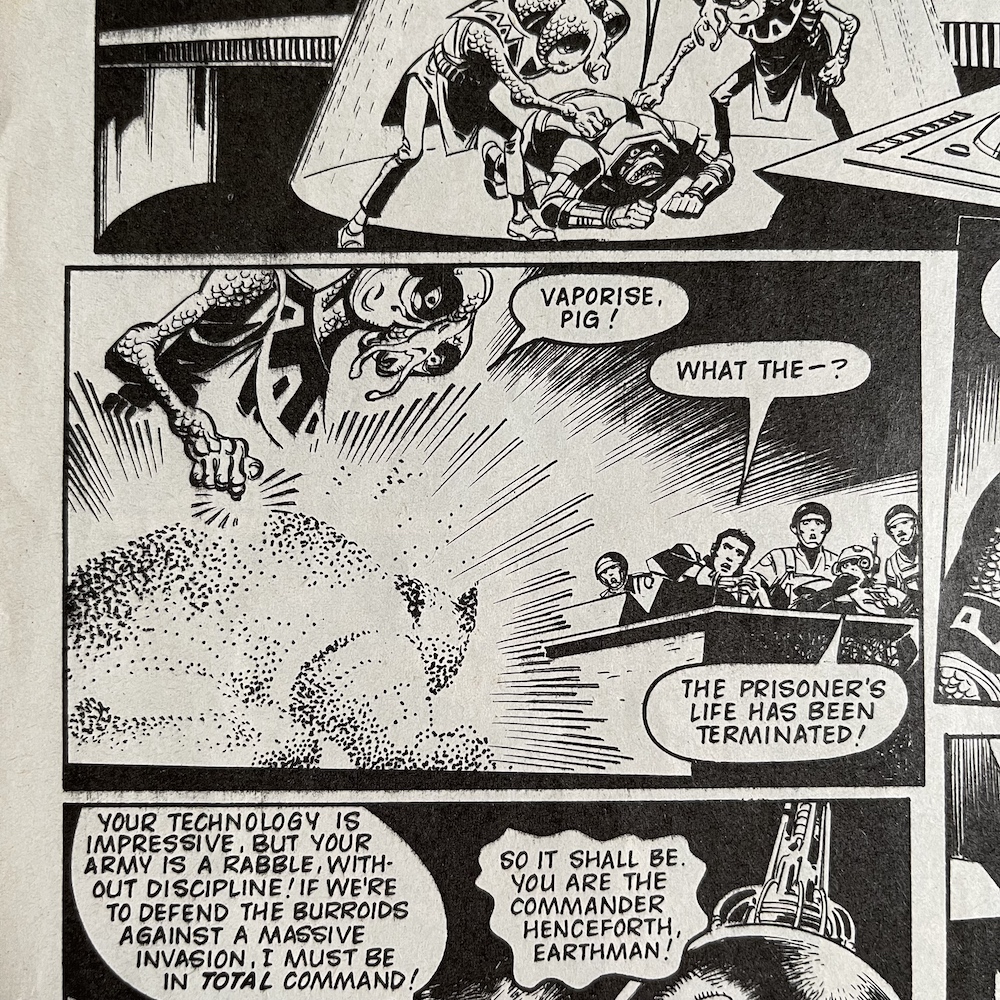
One of the Arglons is captured, but when he doesn’t give up any information during questioning a Burroid casually vaporises him, explaining it’s just what happens to enemies. Wait, aren’t they inherently peace loving? Is this The Brian’s influence? Either way, Turbo instantly has him arrested and begins to take command of their armies as requested by the mysterious leader. Choosing two seconds-in-command they set out to tame local dinosaurs to match those of their enemy.
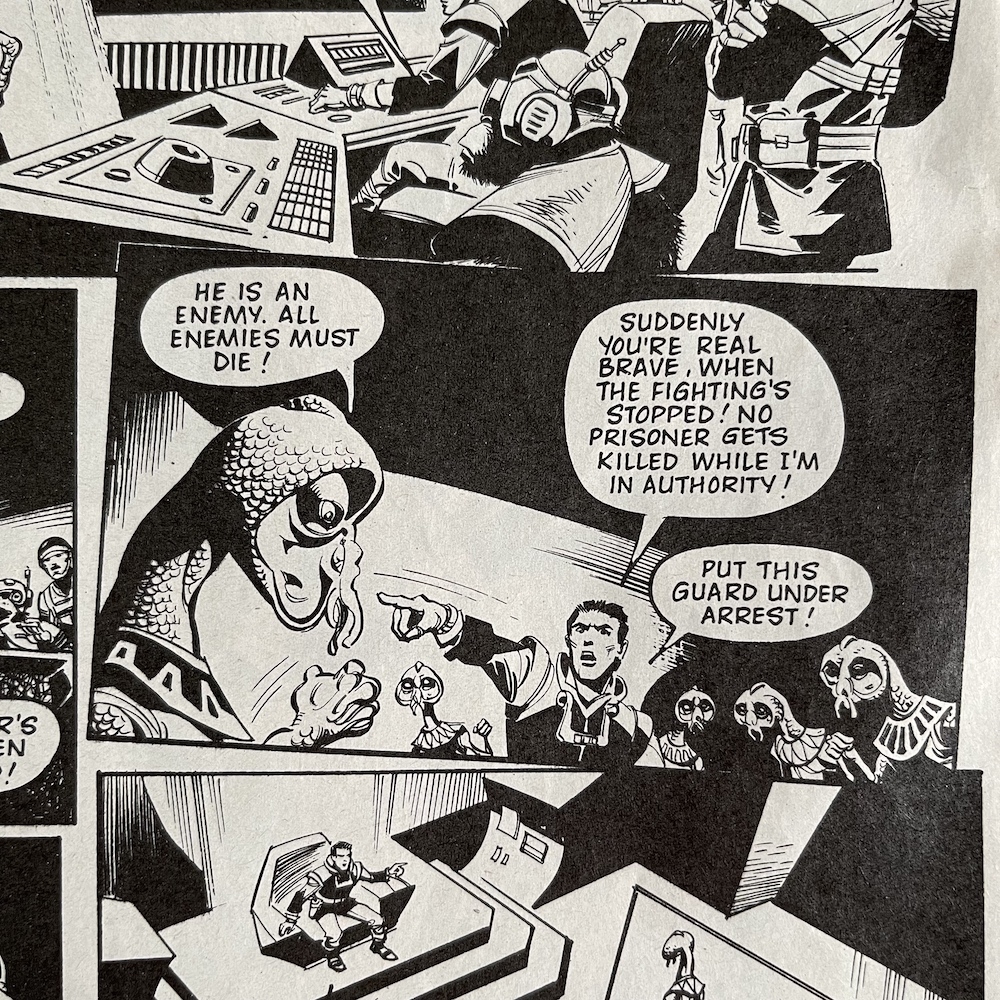
I do like the way the character is developing beyond the single-minded Dredd-type he was to begin with, and this is only the third issue. The story is genuinely interesting, it feels like there’s a lot more than meets the eye with everything in this strip and that I shouldn’t assume anything about anyone. Brilliant stuff. When I think back to Wildcat I remembered the other strips more, so I’m pleasantly surprised at how great Turbo’s has been this issue.

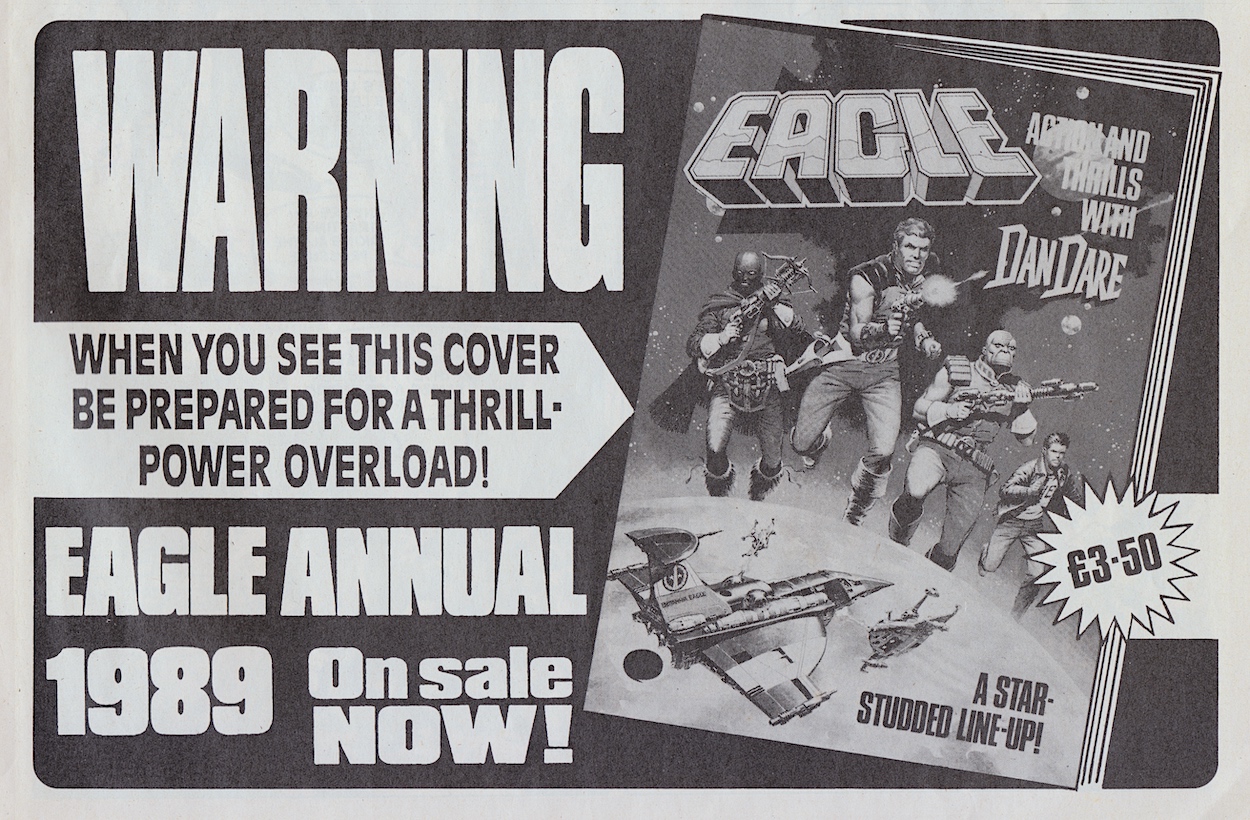
A quick commercial break before we move on and I wonder what 2000AD editor Tharg the Mighty would make of the tagline used by one of Wildcat creator/editor Barrie Tomlinson‘s other comics in the advert for its annual? Given how they were both published by Fleetway I’m guessing Tharg didn’t say very much.
Our only colour strip, Joe Alien now finds himself in the very capable hands of a new artist, namely Ron Smith who drew the pin up in the previous issue. Taking over from Massimo Belardinelli is no small feat and Ron’s style is completely different. At first I approached this with trepidation. I had loved Massimo’s work in the first two issues, particularly his furry man-eating plants. But I needn’t have had any concern.

Ron brings a fresh new style to David Robinson‘s scripts, reminding me very much of early Geoff Senior from Marvel UK‘s Transformers. The clean, sharp visuals are a perfect match for this most alien of alien characters and the nightmarish jungle he and his team are trapped in. In fact I’d even go so far as to say the plants look even more menacing and the action more dramatic. This isn’t to take away from Massimo’s work of course, but after reading this chapter I think Ron is an even more suitable artist for this story.
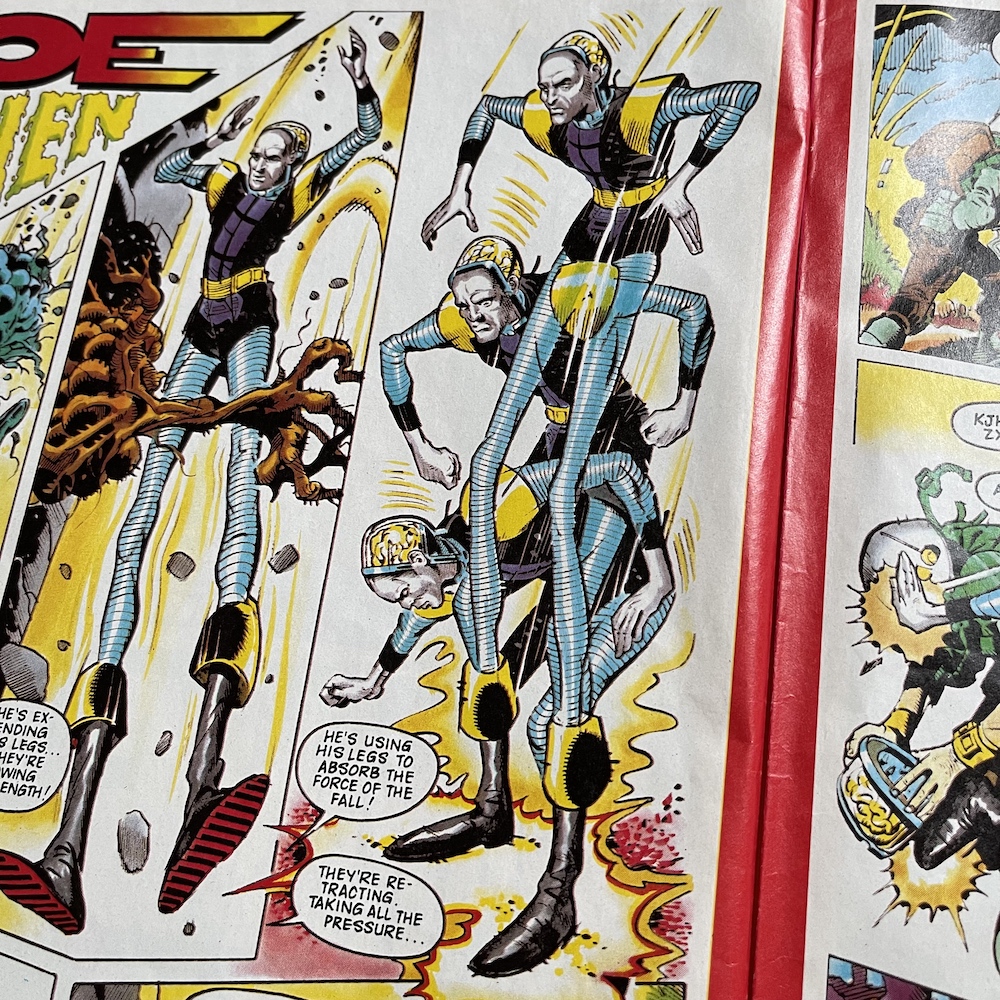
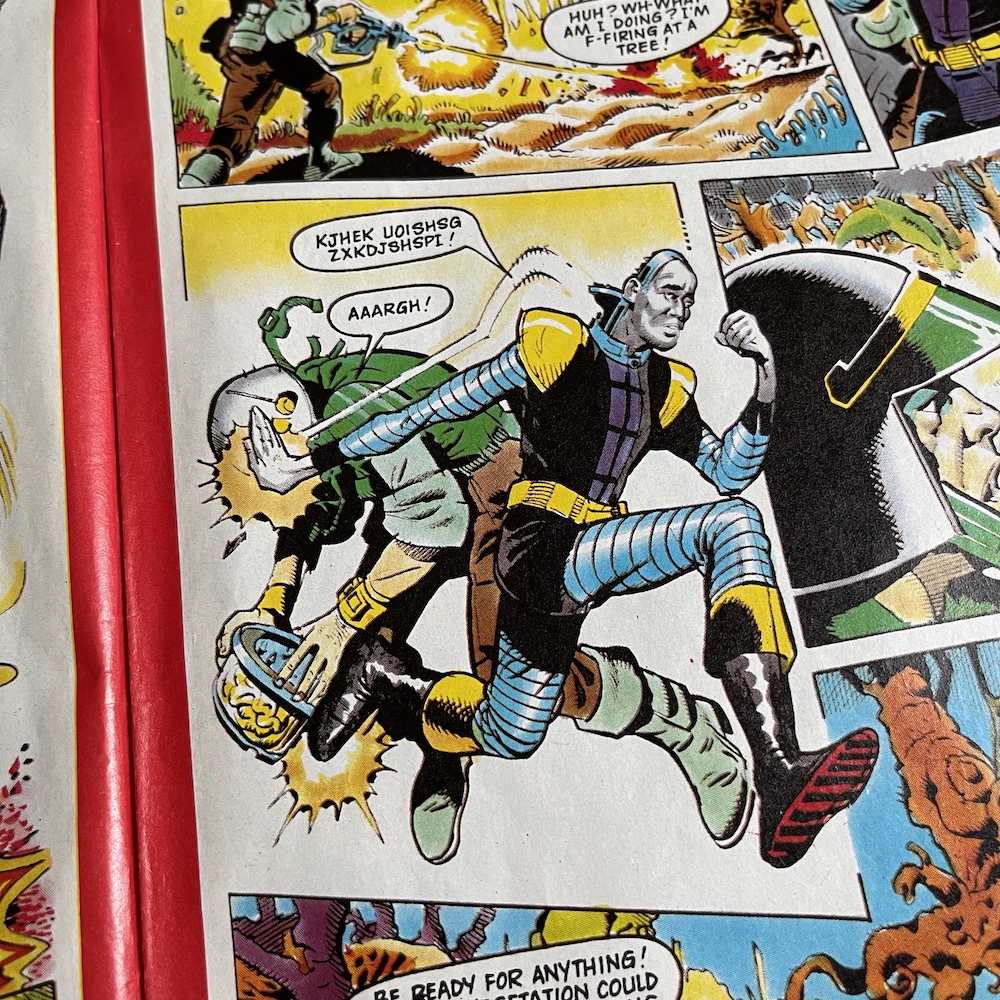
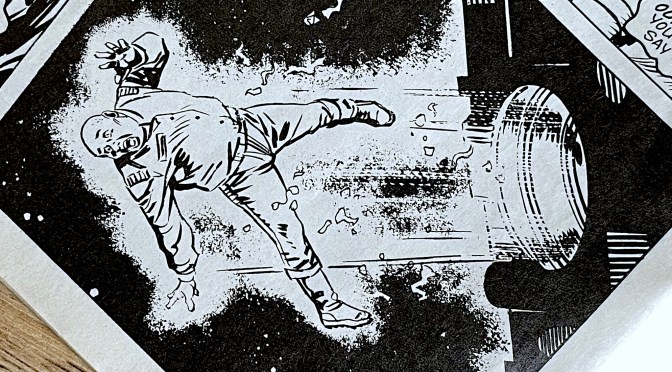
The resolution to last issue’s literal cliffhanger sees Joe using his telescopic legs to cushion his fall, the plant which caused it falling down on top of him, knocking him to the ground where the impact on his head causes his external brain pack to disconnect. As explained in the first issue this turns him into a gibbering loony, to put it politely. His race were so obsessed with obtaining more knowledge they had to manufacture artificial brains for themselves, regardless of the risks. I love both these panels above, the exciting landing and the funny craziness.

Joe disappears into the jungle and his team are left to fend for themselves while trying to track him down. As well as having a new artist the writing seems to make a bit of a shift here too. No longer are his men simply unnamed team members used as fodder for the alien plant life. Here, some are finally given names and they’re written as individual characters, complimented by more distinctive looks. Instead of lining up to die they actually rescue each other and function and coordinate as a proper military team.
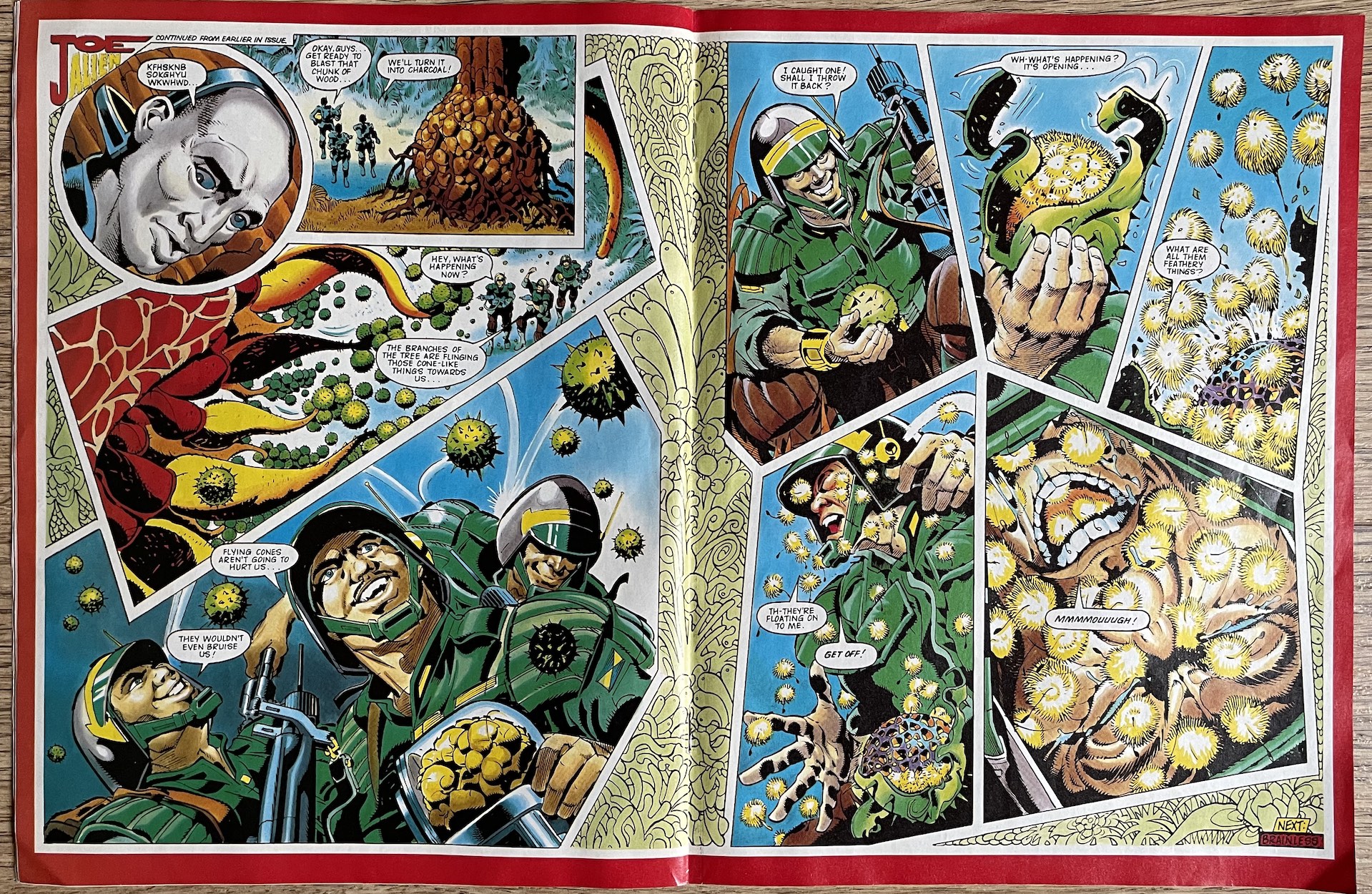
The chapter ends with Joe captured by a gigantic tree and his men come under attack by what they initially think are harmless little spiky orbs. But these soon open up to reveal little pollen balls which float on the air and begin attaching themselves to the men. Ron’s art is superb here. We can sense the tiny little barbs piercing the skin of these men and the sense of pain is palpable. The Joe Alien strip has certainly stepped up a gear.

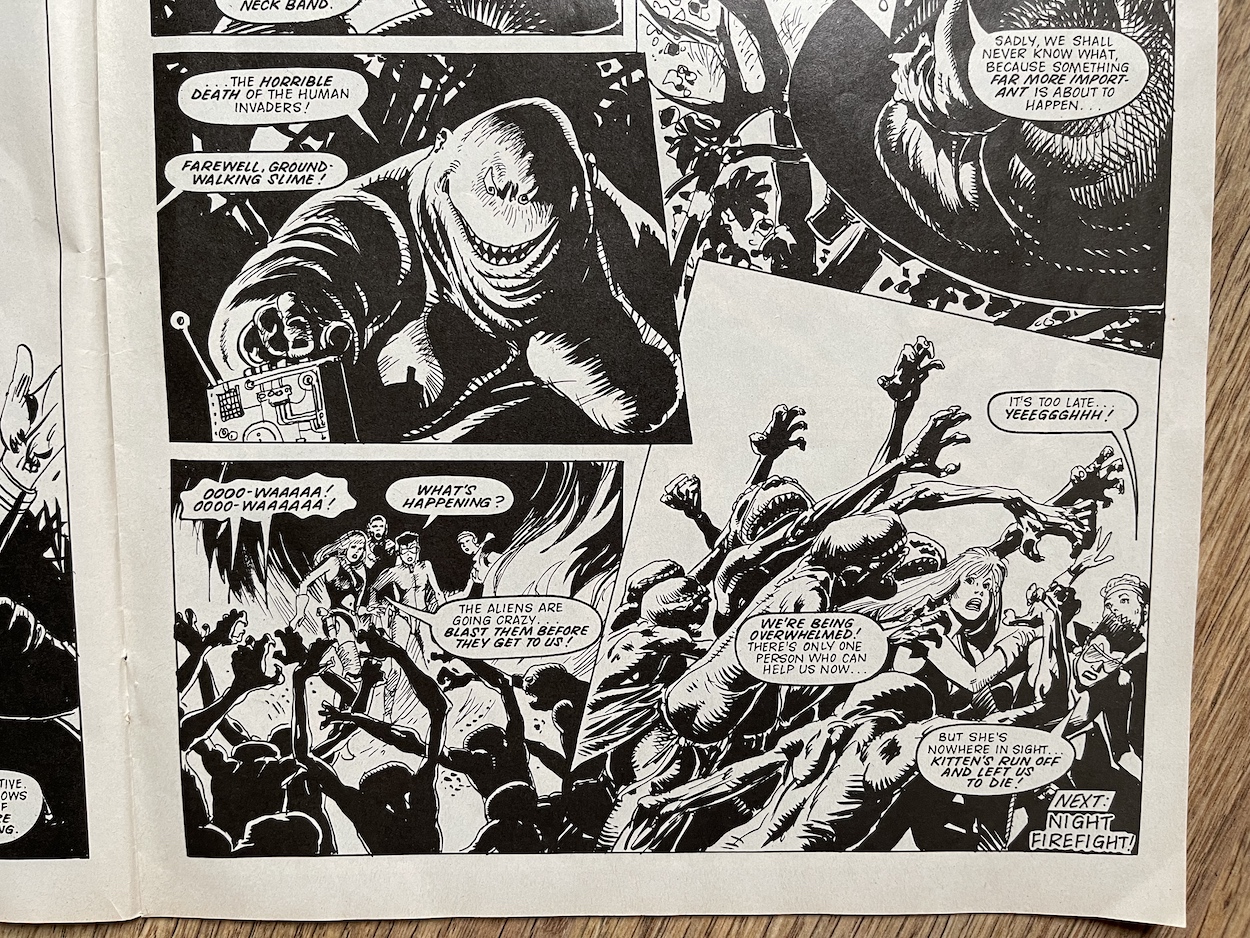
Moving on to James Tomlinson‘s Kitten Magee and after she uses laser bracelets (our future selves really love their weaponised jewellery) to escape from death by boulder and defeating the tribe’s leader, she is welcomed with open arms by the rest. Having proven herself, she and her team take to eating and celebrating with the locals while the two fat men on their hovering platforms look on. But what they view as a “scientific experiment” between Kitten and her pet robot Crud is much more foreboding.
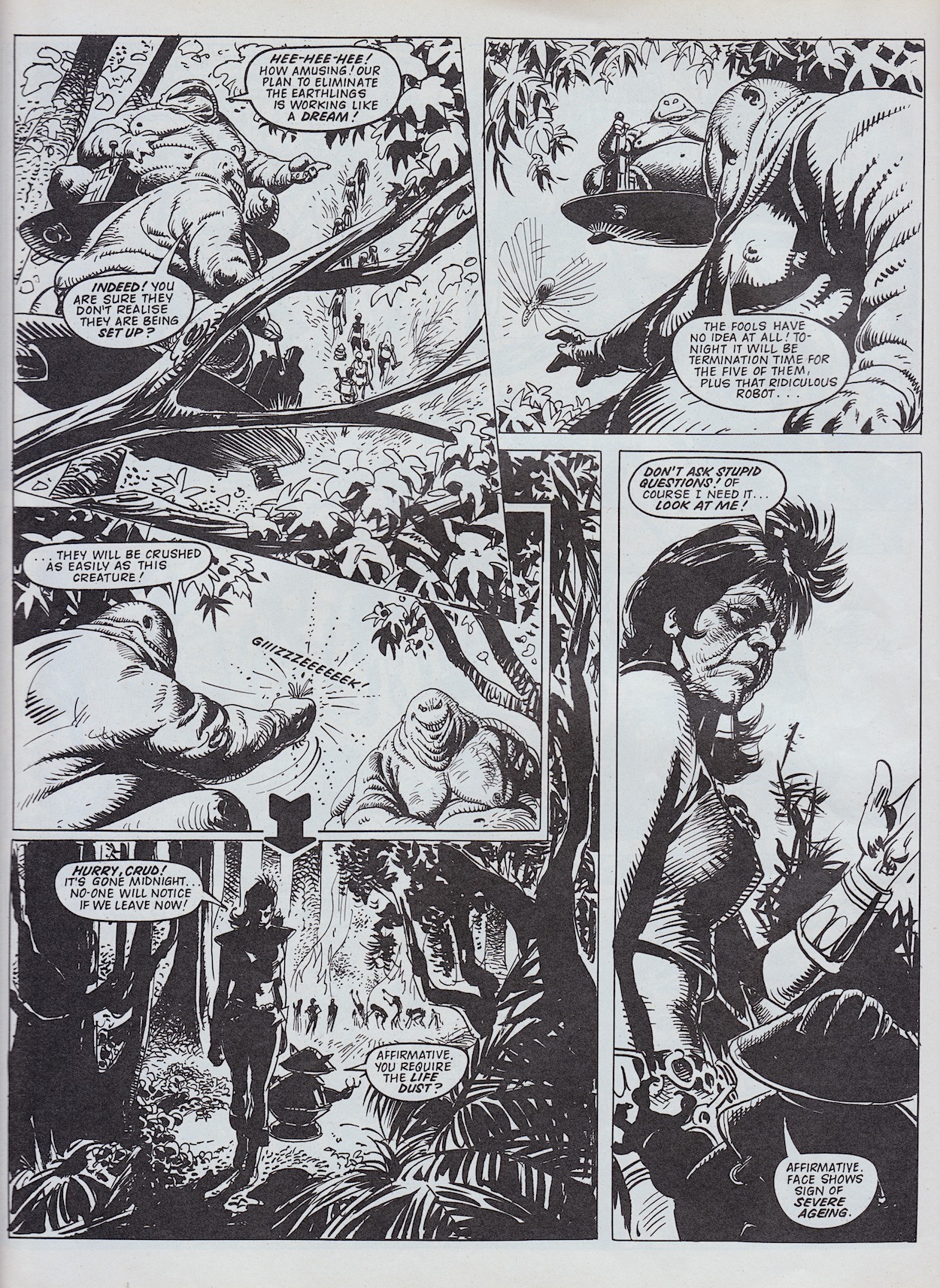
Kitten’s life dust was first mentioned right back in the preview issue, but this is the first we’ve seen the harrowing effects it’s meant to prevent. I was quite surprised at just how old she looks here (even Crud describes it as “severe ageing”) and artist José Ortiz brings a lovely atmosphere to this nighttime scene in the middle of the jungle. While she’s sneaked away to get her drug, the fat men flick a switch on some kind of mind control device and the tribe begins to attack the rest of her team. Overwhelmed, and with Kitten nowhere near, it doesn’t look well as the chapter ends.

But for me the plot point I’m most eagerly wanting to see picked up next time is the whole life dust situation. While the questions of what happens if Kitten doesn’t take it regularly is answered here, I find myself asking even more. Does this mean Kitten is actually a lot older than she appears? Or is it the result of an illness, or a previous encounter with an enemy? Does the dust only keep her looking younger or does it work on her physiology? What long-term effects does it have on her, and what effects has it already had? Colour me highly intrigued.
The letters pages have town names for the first time, so it looks like Barrie has started to receive contributions from readers. As with all of his titles it’s not a simple case of letters, instead there are drawings, ideas, jokes, questions and designs. One such design is for a digging machine to take the exploration teams from one area to another on the planet while avoiding the dangers on the surface. What I love about this is the honesty in the review of what the young reader has sent in. Marked down for originality and weapons, but with good scores for design and suitability, I like the way Barrie (I would assume) explains clarification is needed on oxygen supply.
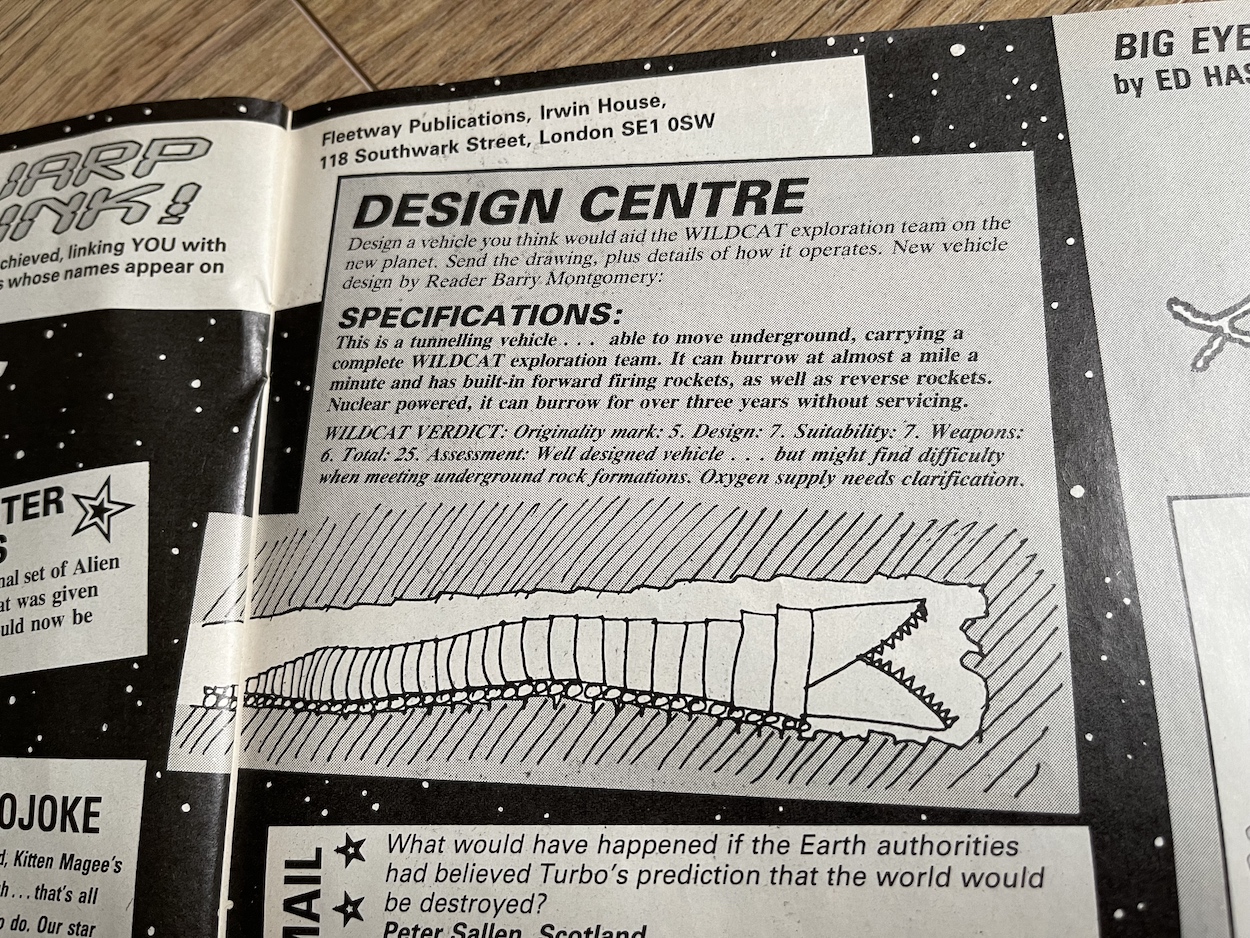
It shows how his comics never talked down to their audiences. We never felt patronised by the answers, never treated as little kids. The same could be said of comics such as Transformers and The Real Ghostbusters which would often give sarcastic replies to honest queries. It wasn’t just a simple wish to see our letters or drawings in print, we wanted to see what our comics would say to us. In this case, maybe if Wildcat had lasted a long time we’d have seen more complex designs being sent in as the kids read the feedback from previous issues.

Next up is Barrie Tomlinson‘s Loner and given how good the previous three strips have been this issue I was really looking forward to seeing how he would step things up this issue. A quick look at the artwork below will answer that! Our former mercenary meets the lizard who has been tracking his every thought and first of all I was surprised he’s only about twice the size of a human, but this is simply because of that incredible final page artist David Pugh treated us to last time. Things begin here with Loner seeing him for the first time and we get this dramatic reveal through his eyes.
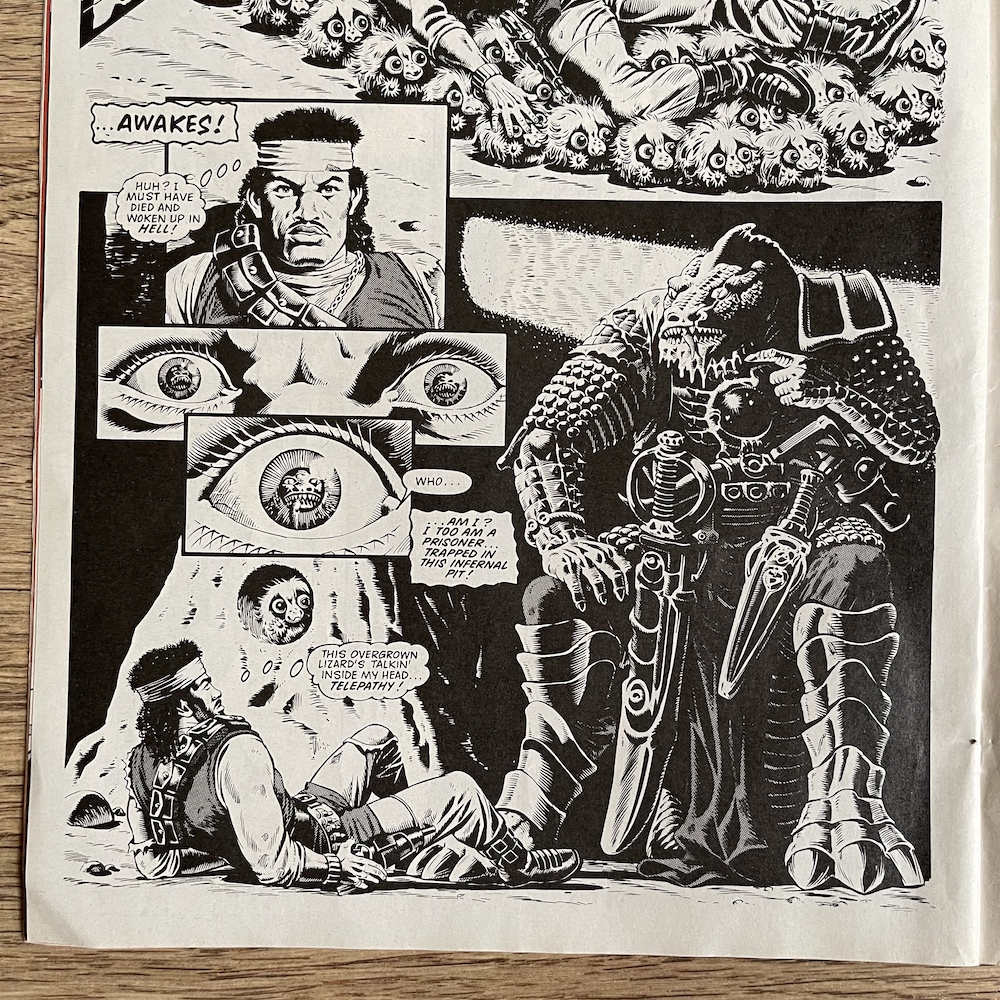
Take a closer look at that first photo and you’ll see the beast isn’t sitting on a chair but on his tail. A nice touch. He doesn’t get named yet but we do find out about his race the Bellari and their history of travelling from world to world to control the minds of whole species. Just for the craic they’d turn populations of whole planets into slaves until they got bored and moved on, leaving behind a galaxy of worlds having to rebuild from the destruction wrought by their entertainment.

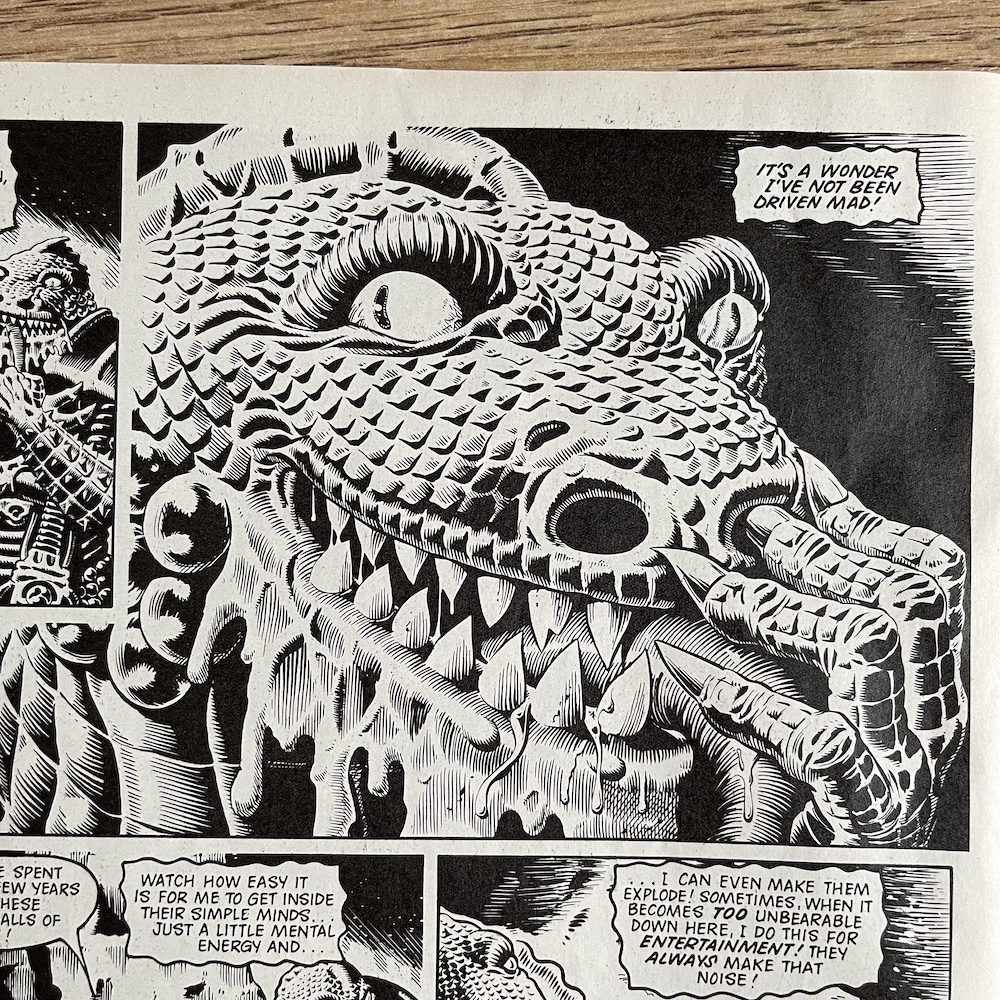
But this particular Bellari crash landed on the same planet the Wildcat found, falling through into the same underground labyrinth as Loner. With no way out he took control of the furballs, a task he found far too easy and which kept him entertained for about five minutes. I laughed at the panel above on the right, where he wonders at the miracle of him not going insane, with his wide eyes, drooling and his finger stuck up his nose. David is an incredible artist and this is a rare moment of humour in the Loner strip. The main highlight however, is another full page image which deserves to be studied.
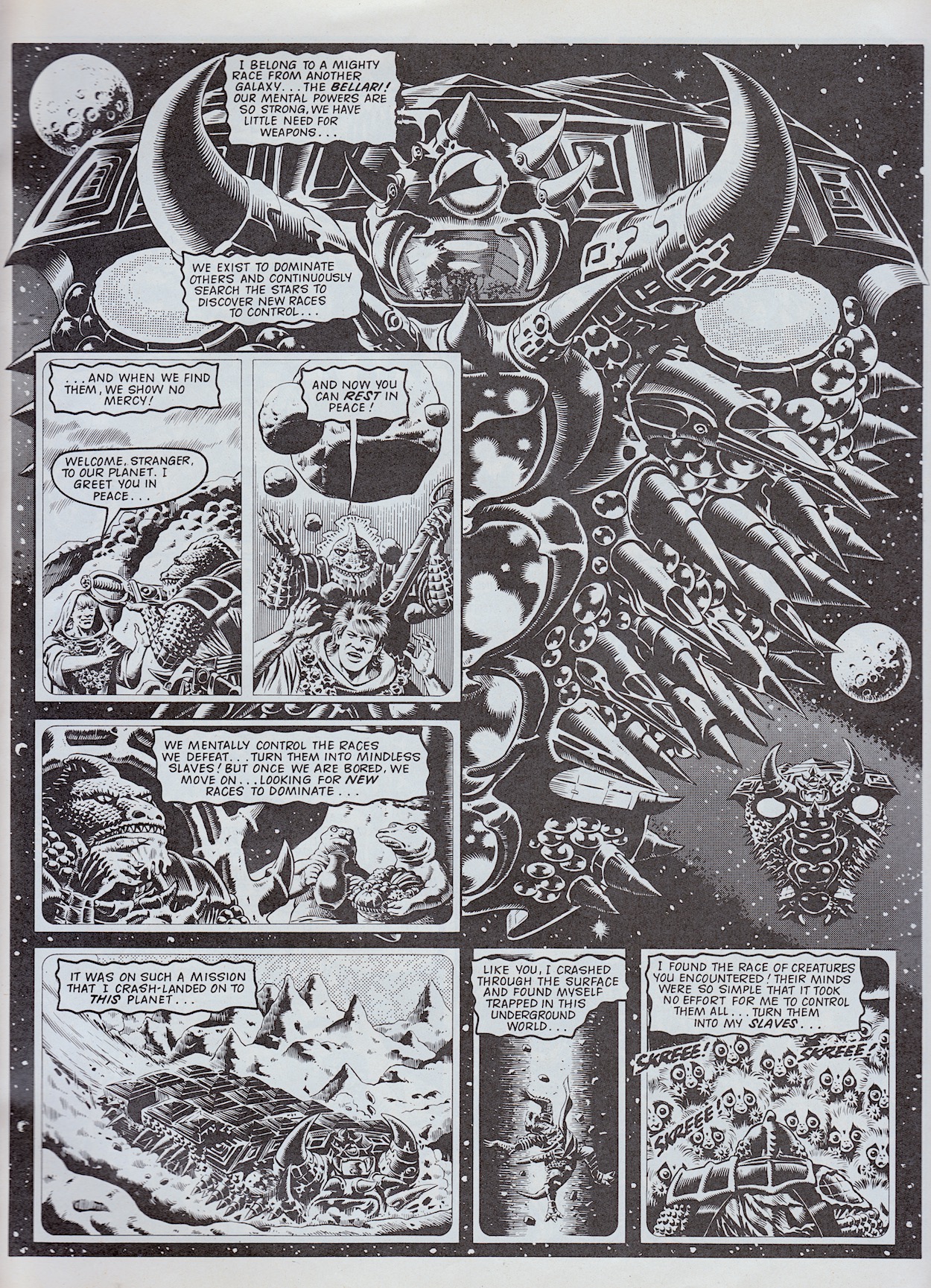
Studied it was, both back in 1988 and today. Just look at that design. I was in awe of David’s work. At this point my comics reading had included the many styles within the pages of OiNK, the simplistic but sweet drawings in Thomas the Tank Engine and Friends and the fun, quirky art in The Real Ghostbusters. I’d never seen anything like this before.

All the serials have really upped their game this issue and it’s hard for me to pick a favourite anymore

The beast wants Loner to hunt down a ravenous snake-type monster that he can’t control because its brain is too simplistic. It functions on instinct and hunger alone, so it’s a big threat to this lizard. Loner knows he has no choice and agrees but makes the mistake of thinking otherwise. Since the Bellari is reading his mind he knows Loner plans to trick him and suddenly our hero finds himself in another place and time, three of his enemies firing upon him as the episode ends.

It’s clearly a trick of the mind but still, I remember that snake but can’t remember anything else about this story, and the developments this issue have been genuinely interesting. But then again, even if the story was plodding along David’s art would still have propelled it to another level. While Loner was always my favourite as a kid, the three other serials have really upped their game this issue and it would be hard for me to pick a favourite anymore.
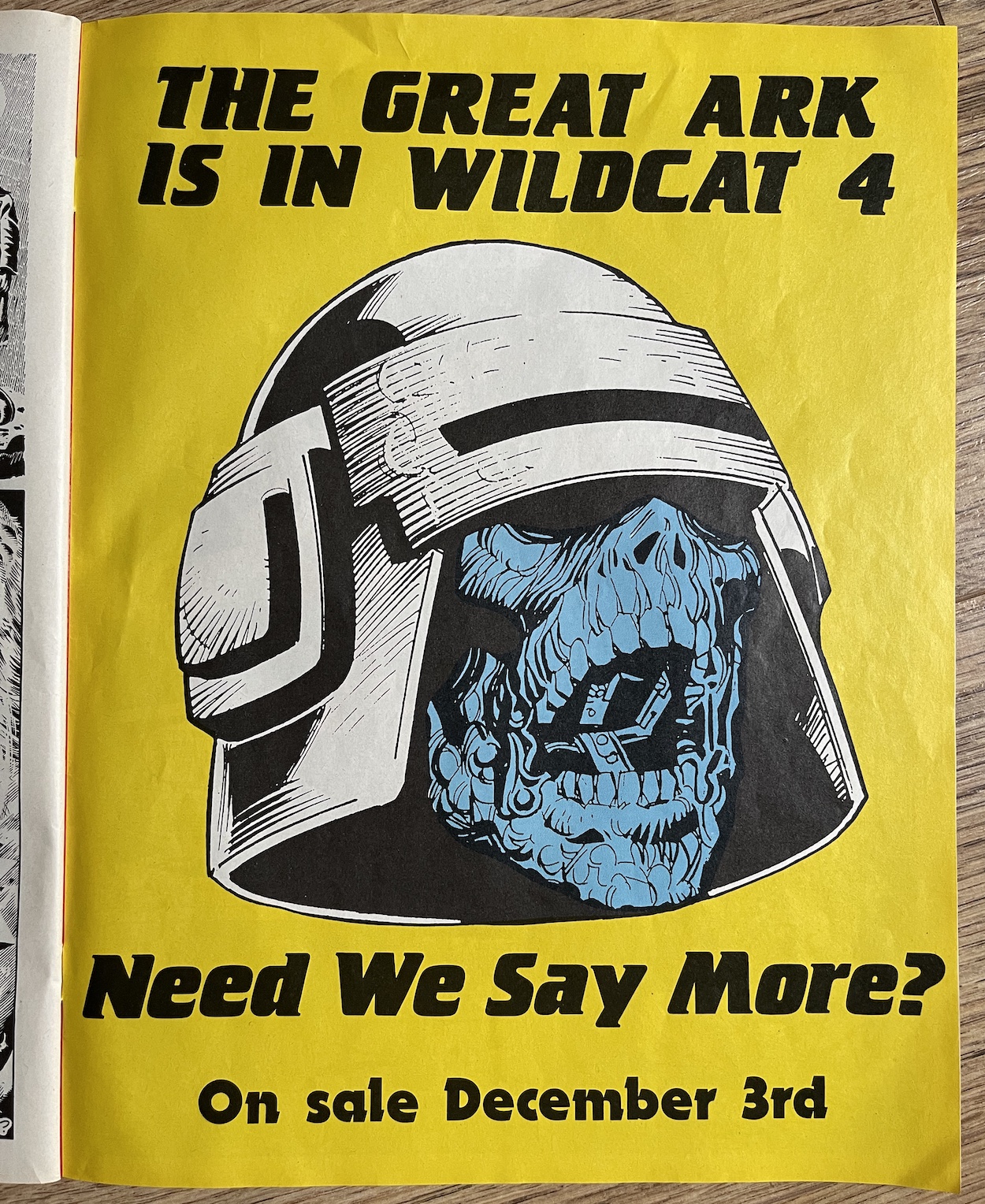
After the wonderful art of Loner’s strip is a rather basic Next Issue promo page. Last issue there was a lot more information in half the space. While I’m sure the Great Ark in the Turbo Jones strip will be of great importance, with so much going on in all of the strips this feels too simplistic, almost like it was a last minute addition. It’s a bit of a wasted opportunity to really hype the next issue of what was still a new comic trying to build its regular readership. So yes, you should’ve said more, a lot more.


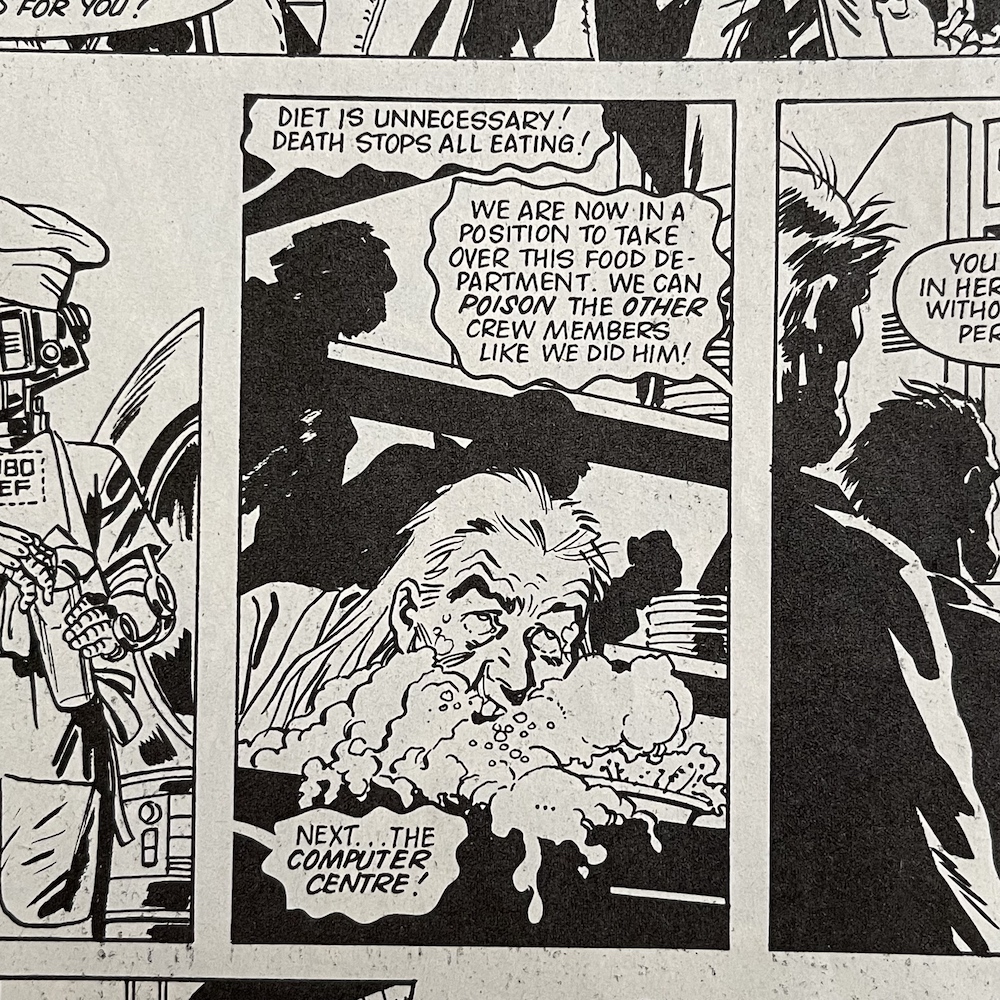
“Diet is unnecessary! Death stops all eating!

The Invaders

Our final strip is the next Wildcat Complete and it’s called The Invaders. It’s a particularly bleak one this time. An asteroid is making its way around the planet and the Wildcat is directly in its path. Strangely, instead of simply manoeuvring out of its way (we saw its pilots in control in #1) a team are sent to plant explosives on its surface, a whole decade before that became the plot of what seemed like an endless supply of disaster movies.

No reason is given as to why this was the solution, why the Wildcat couldn’t be moved, which is strange. Anyway, a group of scientists go with them to collect samples and upon their return some of the rocks appear to possess members of the team.
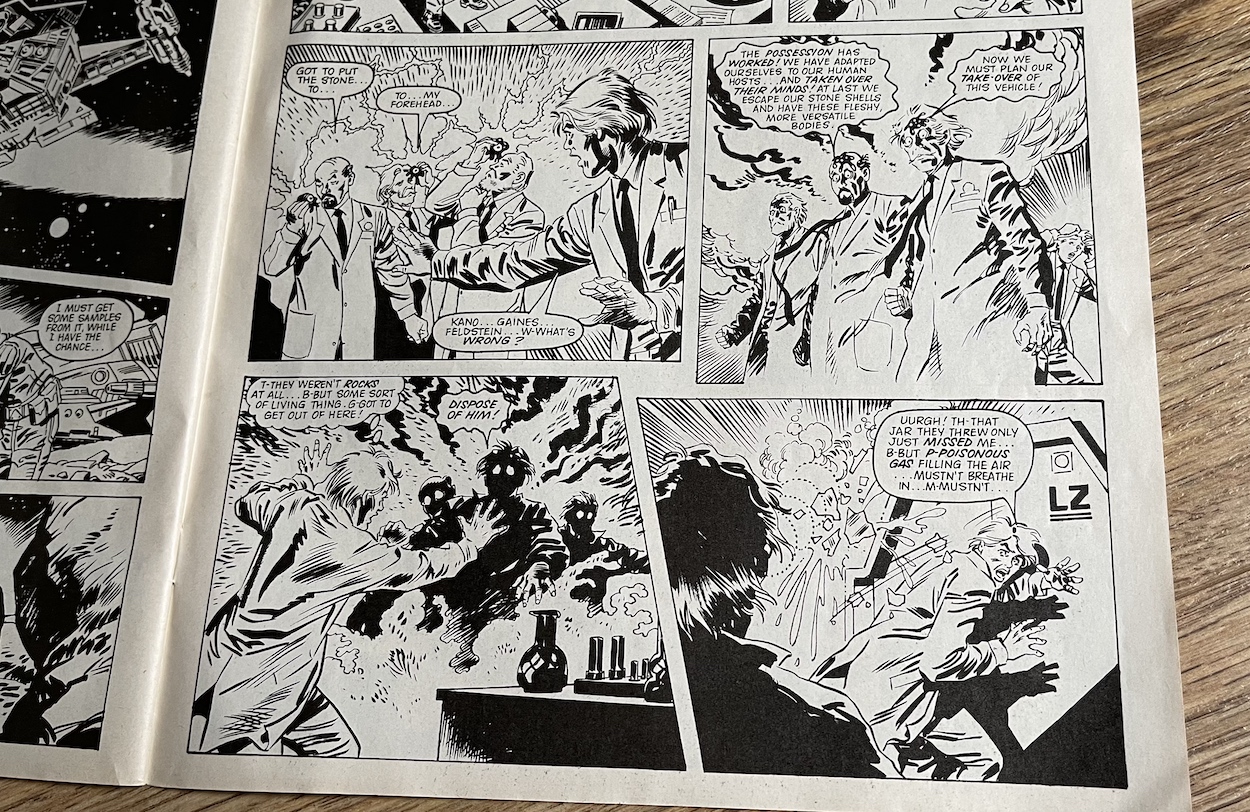
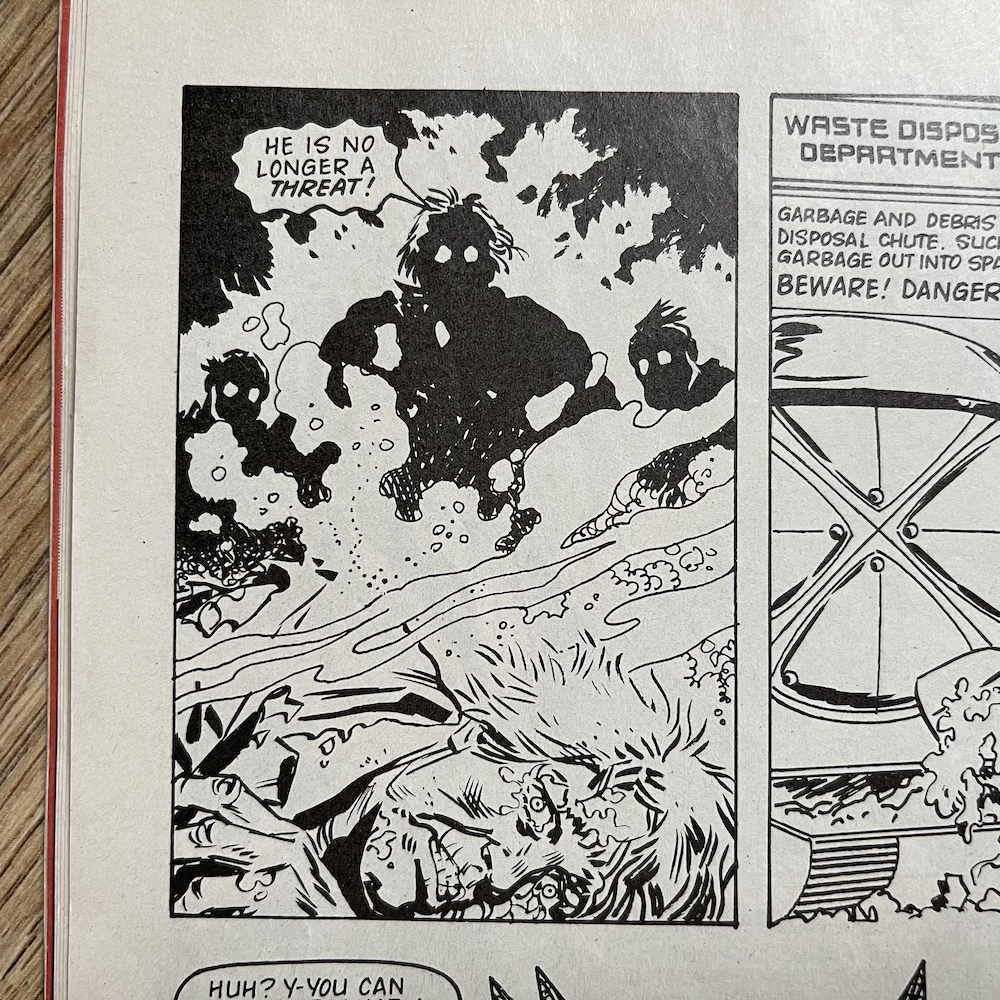
At the end of the story we find out this used to be a prison asteroid, with murderous alien beings trapped inside rocks on its surface. Now freed and with a powerful spaceship at their disposal they set about making plans to take control, casually killing off all who get in their way. Not that any of the people they kill are a threat. They even see off a garbage disposal man by unceremoniously dumping him out of the airlock. This does prompt a bit of morbid humour when someone on board sees it out of the corner of their eye, thinks the exploding body is a star and makes a wish!

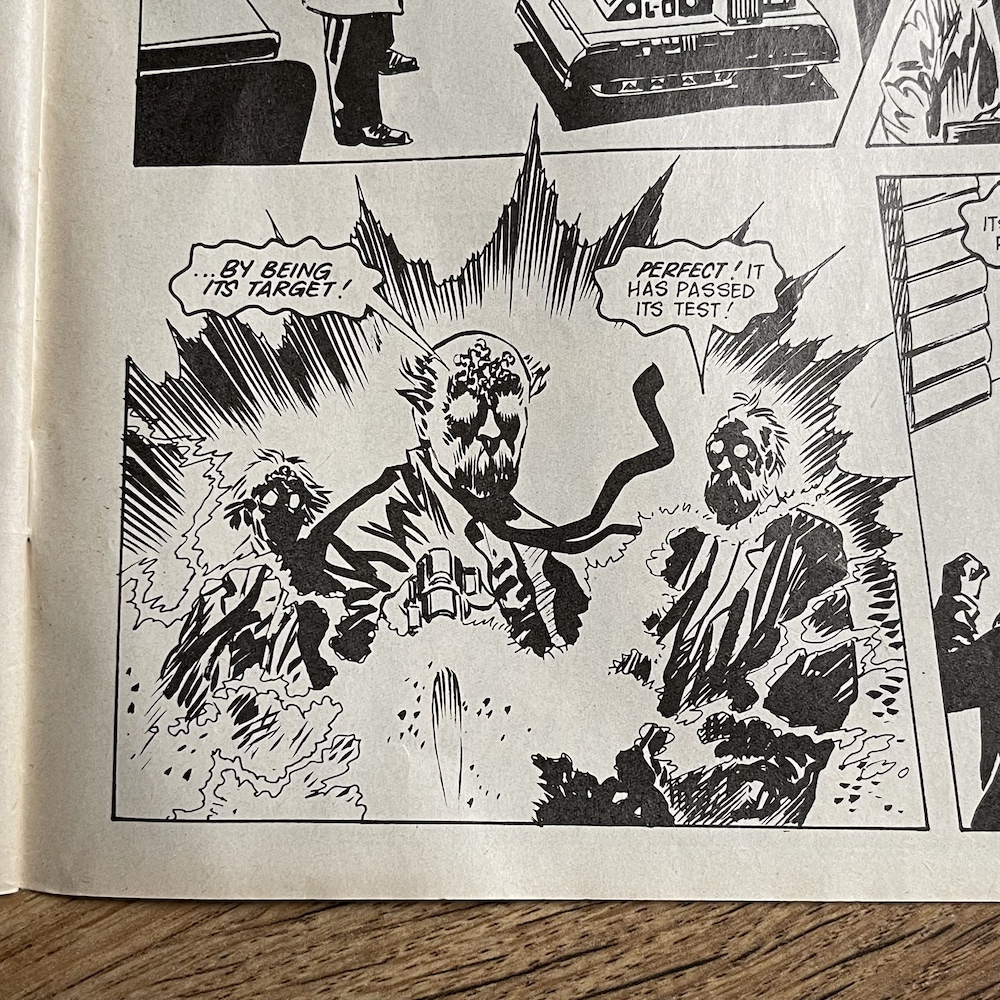
The garbage disposal would be used to get rid of the bodies they’d accumulate, they kill a weapon designer to steal his prototypes, a chef by testing a mass poison out on him first and one of the other scientists who knows the truth behind the murders. All of this takes our death toll up to 11 in only three issues. I wonder what number we’ll get to by the time these stories are over?
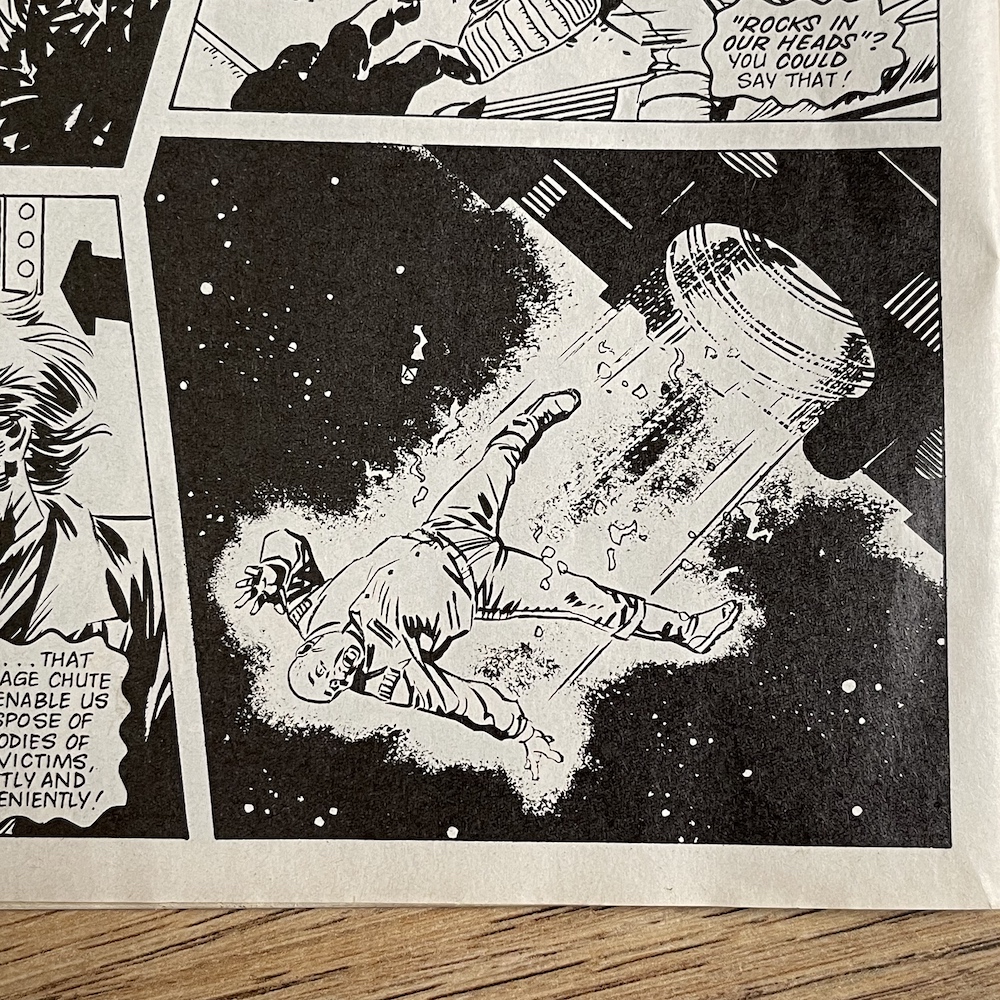
Their mission is to ultimately make their way to the ship’s bridge and use it to get back home and take revenge on their planet. The Wildcat’s crew end up using robots to stun the human bodies instead of simply killing them, fully aware the possessed scientists are innocent in all of this. I liked this solution. It shows the comic won’t be taking the easy way out in its stories, even when it’s a one-off and needs to wrap everything up in only six pages.

Dark humour and plenty of shocking deaths are expertly combined into the script here. It reminds me a little of The Doll from Super Naturals, which is another of Barrie’s comics. The artist who brought all of this glorious death and destruction to our young eyes was Joan Boix (The Phantom, Warrior, Eagle), a name I’ll admit I wasn’t aware of until reading this and seeing his signature, something which was a very rare thing in action comics of the time. With this level of quality I’m glad he did.
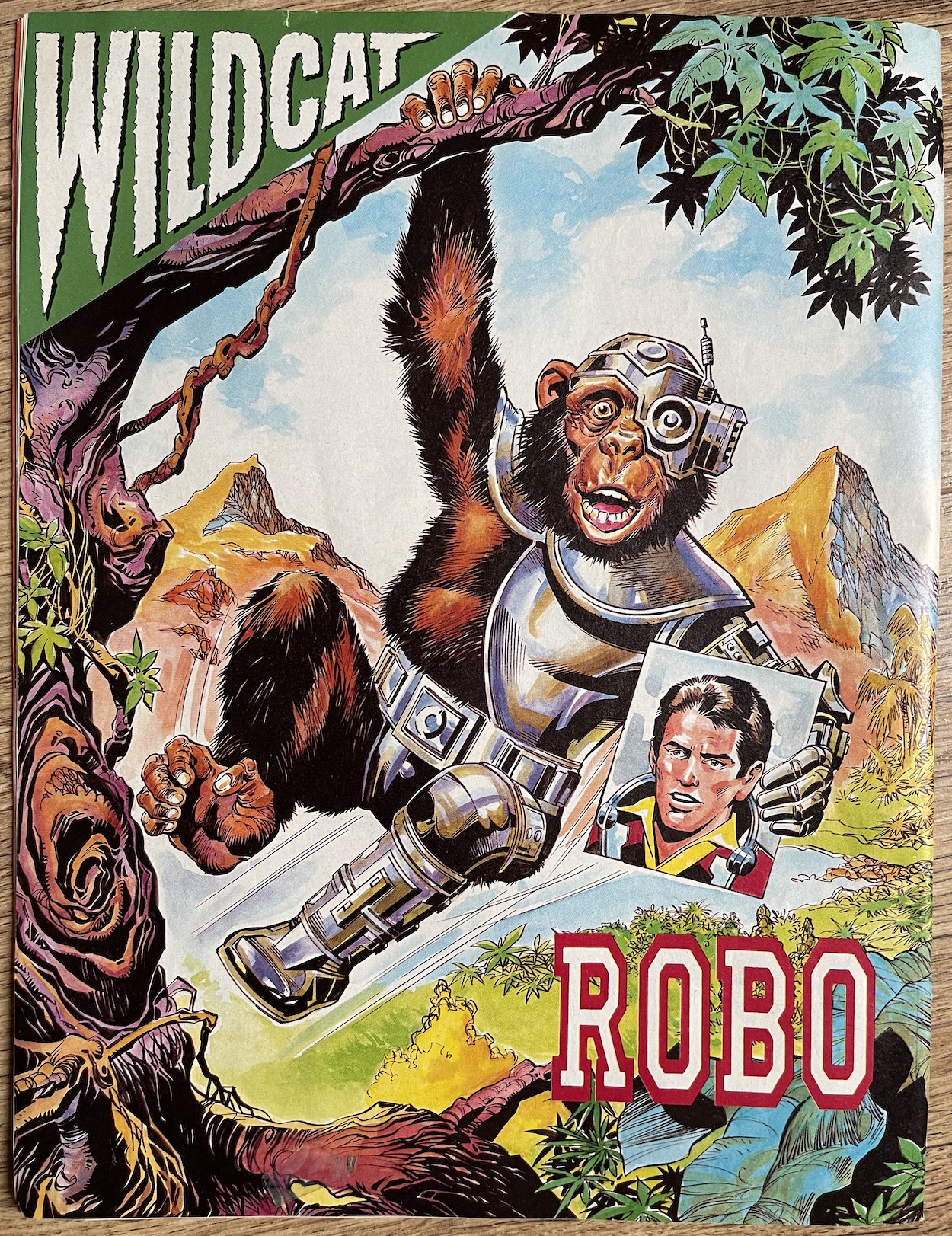
The back page pin up rounds things off with some light relief as Robo takes centre stage. So another issue and another hugely enjoyable read. I don’t want to come across as fawning in these reviews, but there’s no other way to write these; this really is a wonderful, quality comic in every way. All of the stories are really opening up, our characters (both main and secondary) are developing nicely and if I didn’t know how long the comic would last I’d say things feel set for a long run.

Issue four will be here in just two weeks on Friday 3rd December 2021 and it really can’t come soon enough (and not just because that means my tree will be up).

iSSUE TWO < > iSSUE FOUR
WiLDCAT MENU

OiNK! #15: NEW PiGLETS

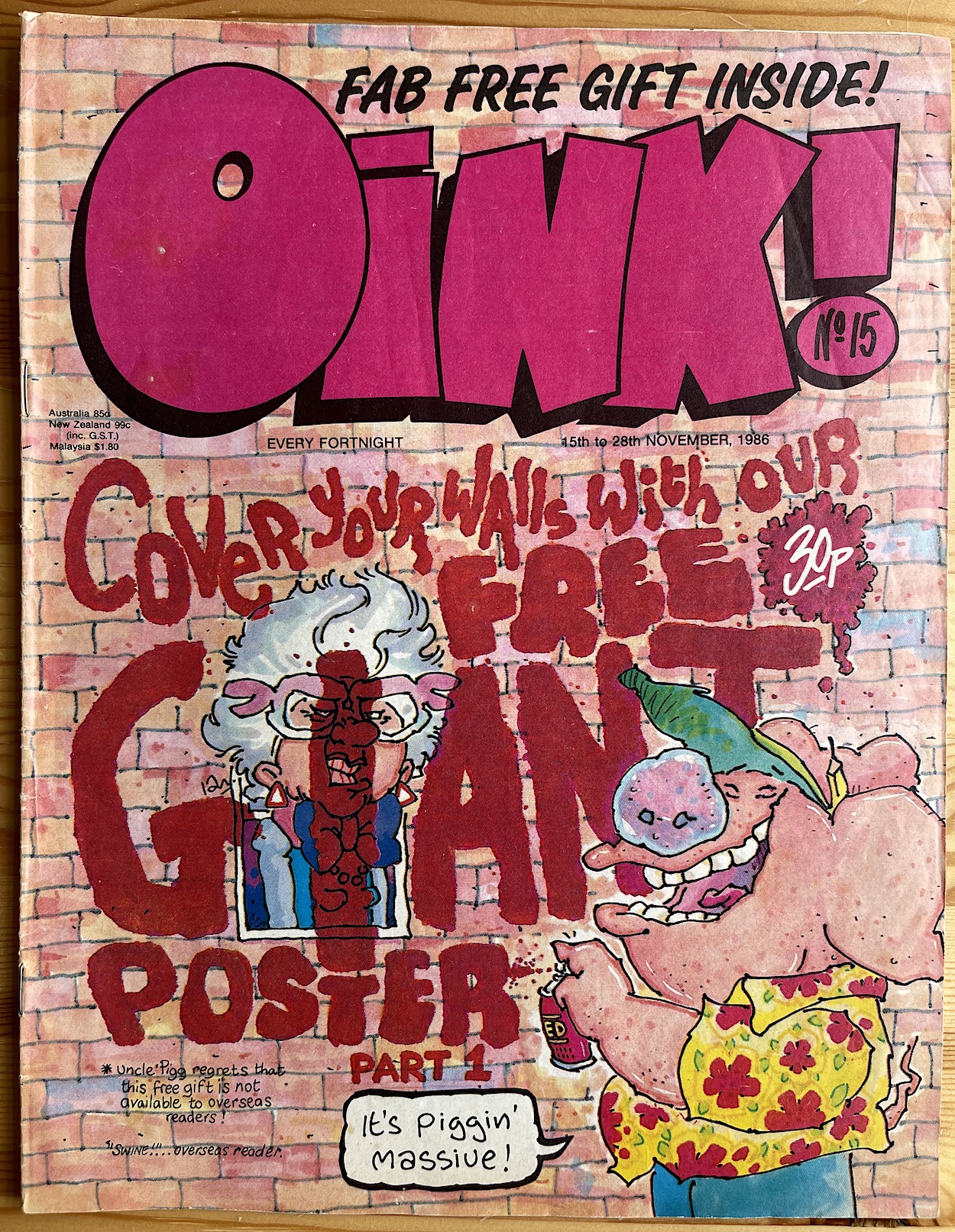
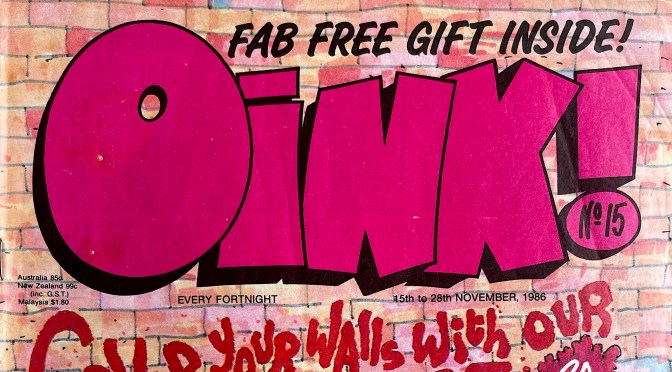
It appears I jumped on to the OiNK train at the right moment back in 1986. Last time I shared the memories of my first issue and just one week later came a kind of soft relaunch as the theme. OiNK had established itself, publishers IPC Magazines were happy, the readers were happy and it was proving to be a success, so the team decided to celebrate by bringing in a whole bunch of brand new characters.

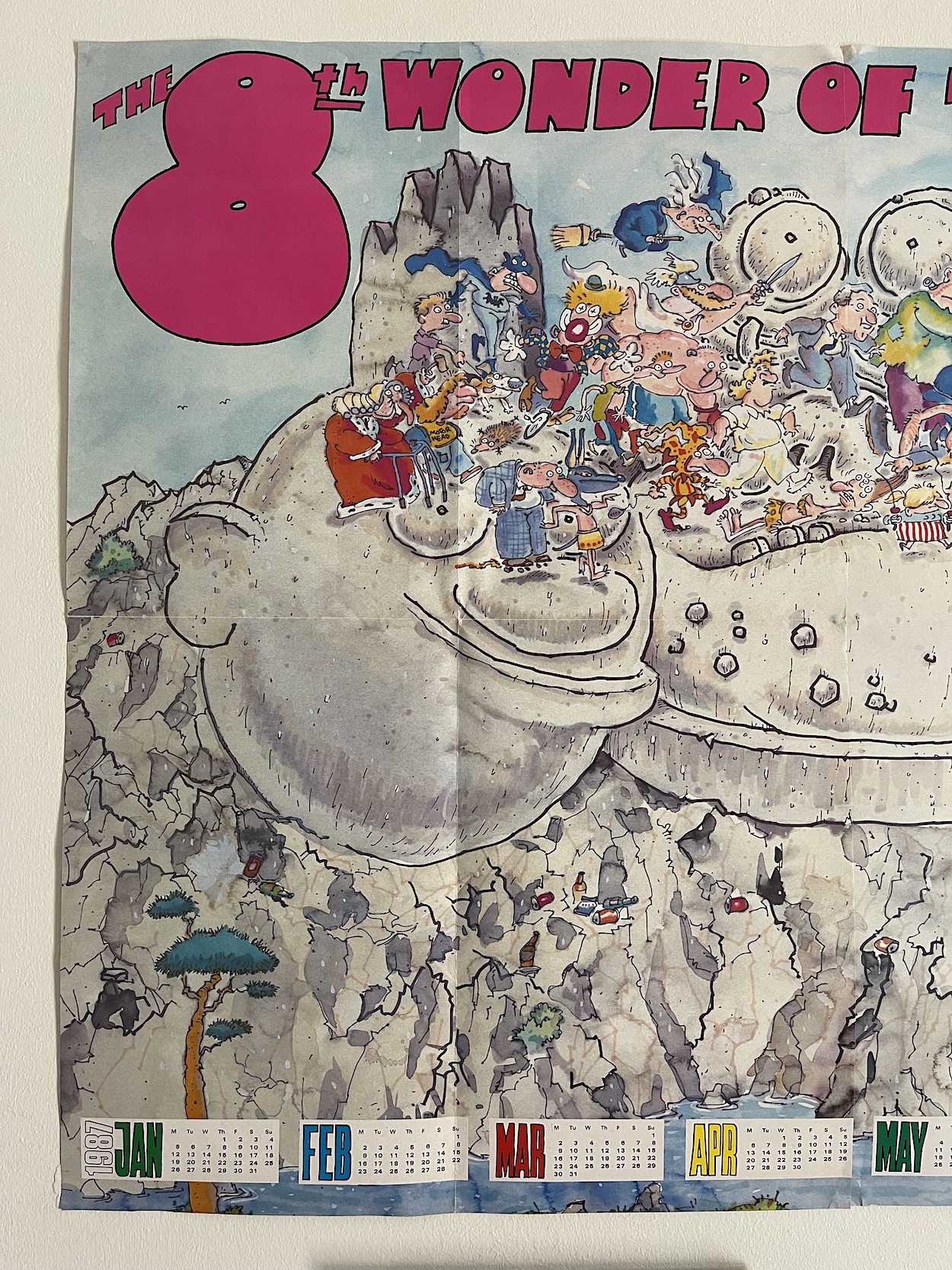
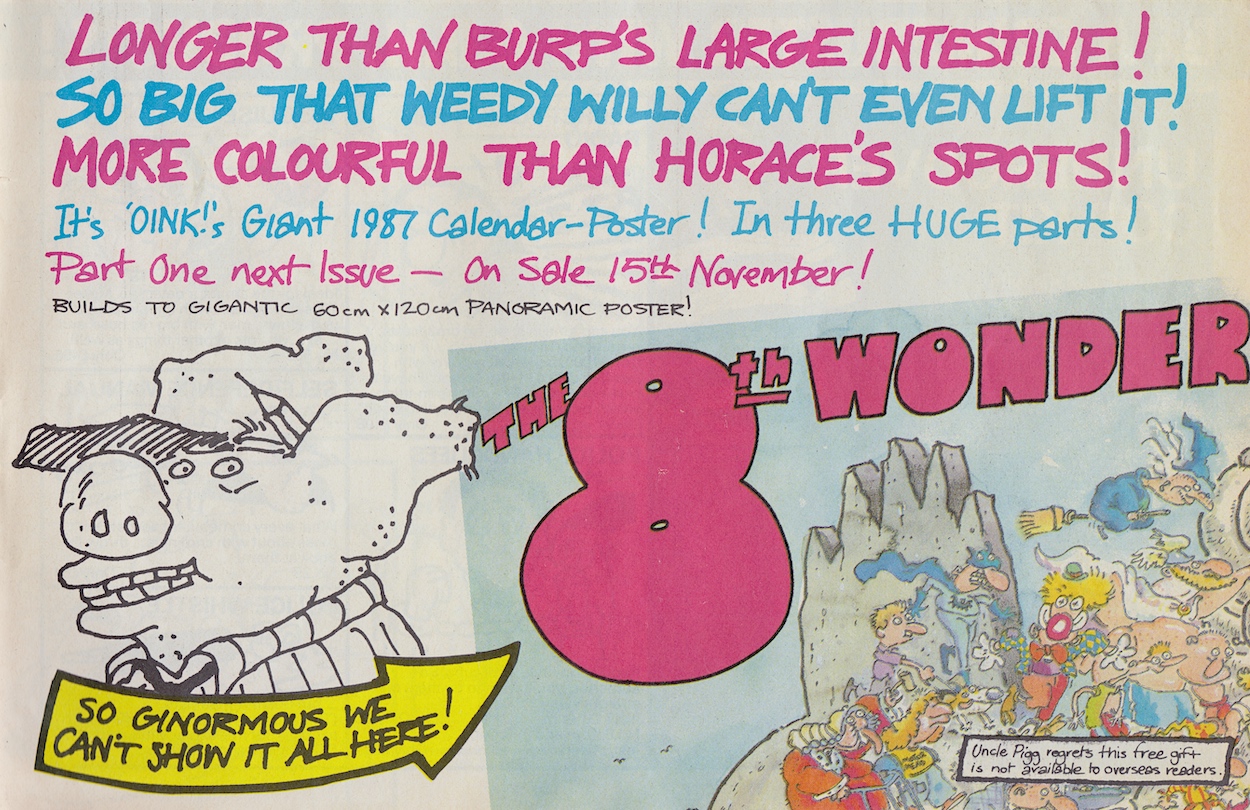
Let’s not forget the fantastic free gift, the first of three Ian Jackson posters which combined into one giant calendar for 1987 featuring The 8th Wonder of the World: Mount Rushboar. I can remember pouring over all the little details in the swarm of people running across Harry the Head and Burp the Smelly Alien carved into the rock face and even the little bits of rubbish left behind on this apparently reverential site. How typical of us humans and a funny swipe at British tourists in particular.

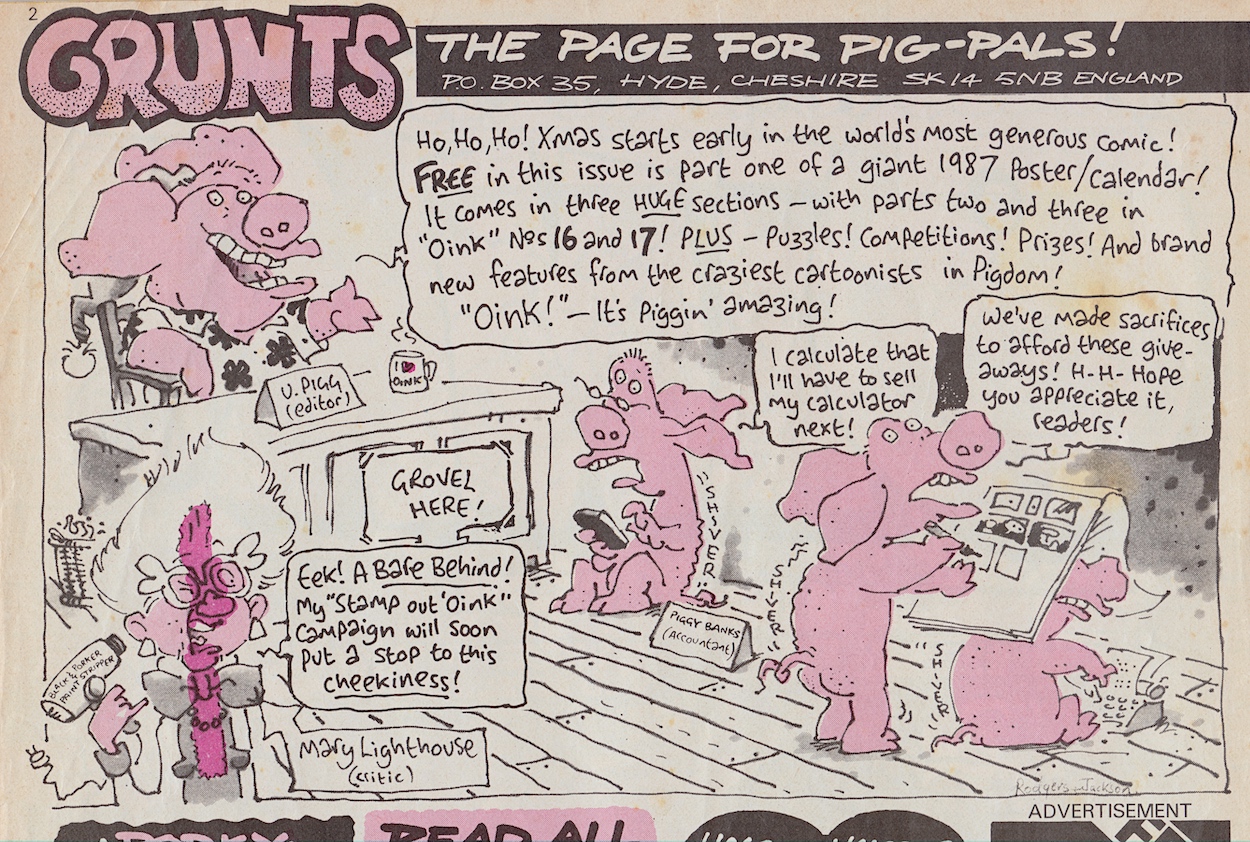
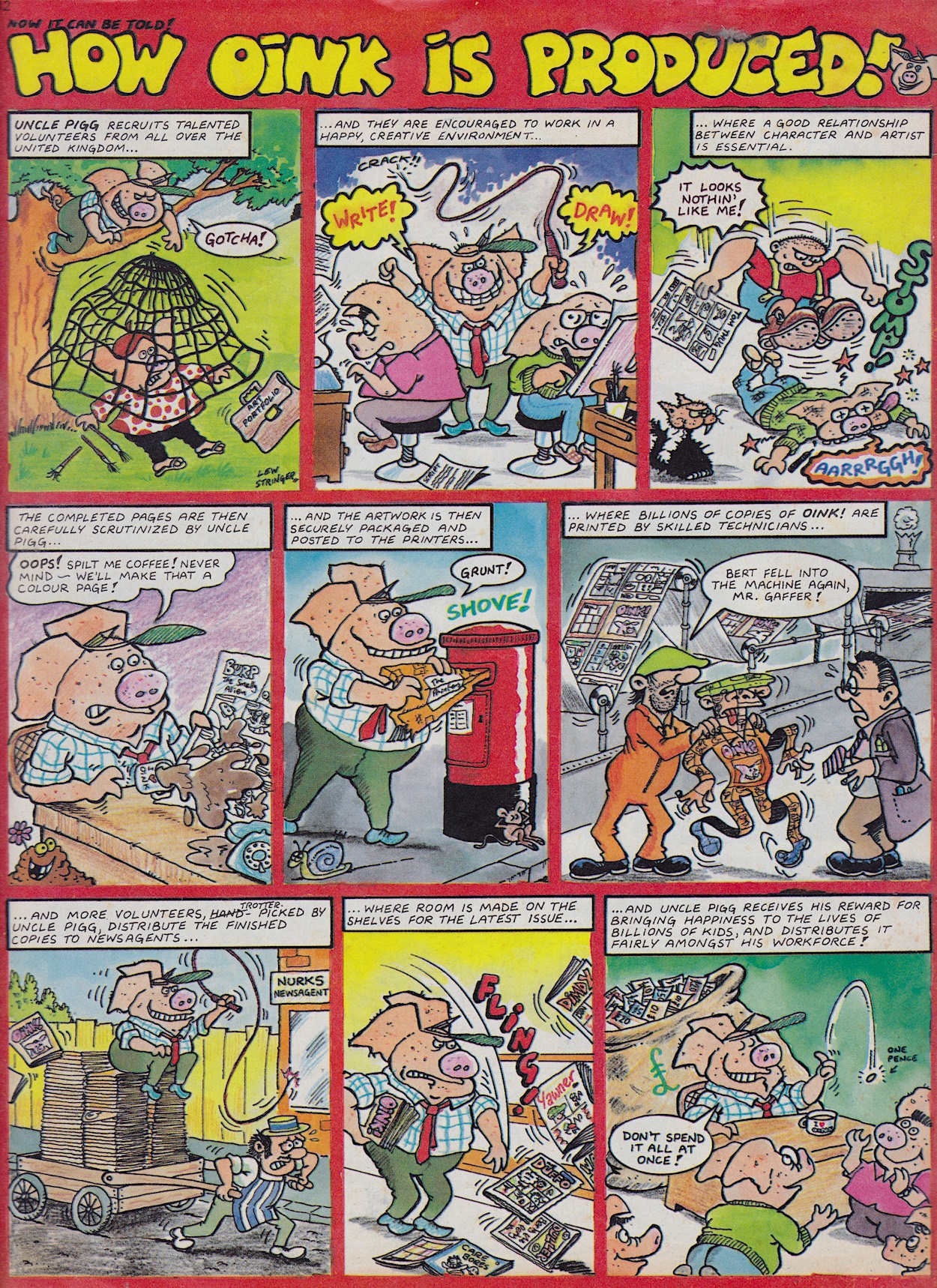
On page two we find out how this glossy comic could afford such extravagances, with staff reduced to working naked, cartoonists and accountants alike shivering in the cold as Uncle Pigg looks on, wearing his Hawaiian shirt to boot. Christmas was coming early for him with all the money OiNK was raking in, and it was coming early for us too because the calendar poster freebies would continue up to the first festive issue.

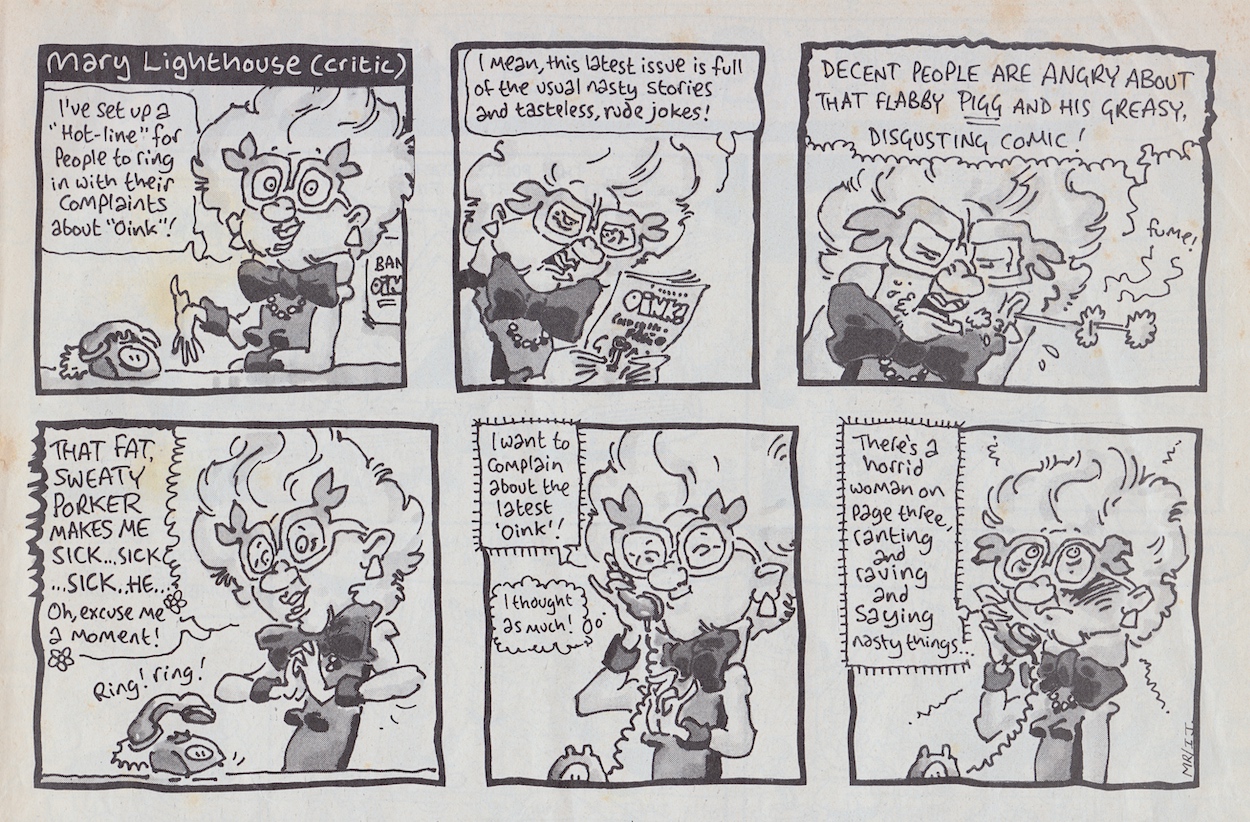
Mary Lighthouse (critic) is back with her strip on page three. Normally this would be a way of introducing the subject matter of the issue but here it’s quite clear it has a bigger job to do. It’s introducing new readers to the character and the overall irreverence of the comic. Thanks to writer Mark Rodgers and artist Ian Jackson it’s genuinely funny while also reinforcing the way the comic is reintroducing itself now that its readership is growing.

Coming on board just before this issue is probably the reason why I always assumed certain characters were in OiNK right from the beginning, when in reality this was their first appearance. Two such examples are Davy FrancisGreedy Gorb (He’d Eat Anything) and Jeremy Banx‘s wonderfully surreal and often very rude Hector Vector and his Talking T-shirt. The latter actually gets a proper origin story when a magical genie appears from Keith Disease‘s (I never remembered him having an actual name!) packet of crisps, but Keith is rude to him because his snack is gone. Poor Hector happens to be passing and Keith is forever confined to be a “tasteless print” on his t-shirt.

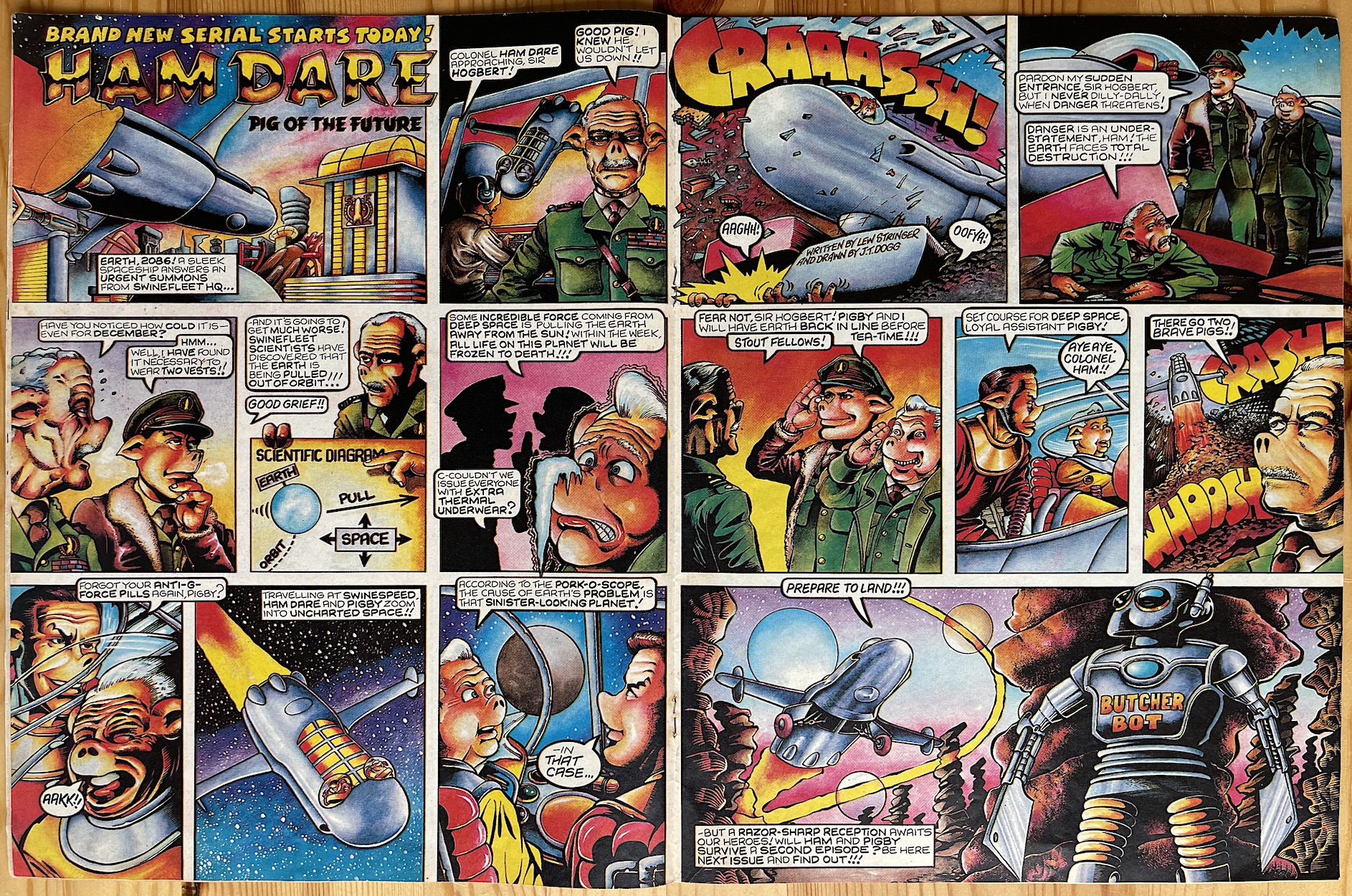
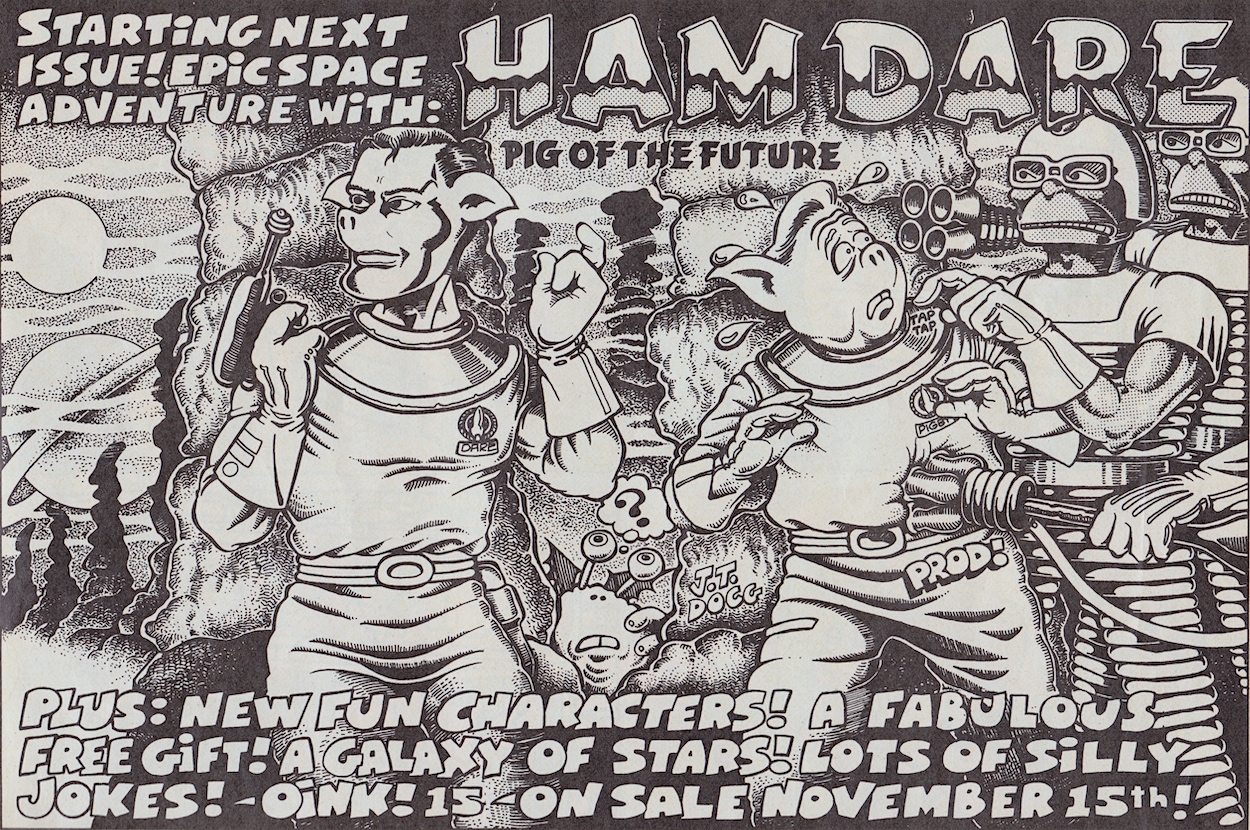
I remember his strip being one of my favourites so expect to see them at some point. The only reason I’m not including them here is because there’s just too much I could include that I had to leave some real classics out. But I was always going to show you the beginning of OiNK’s second spoof adventure story. Hot on the tails of The Street-Hogs comes Ham Dare: Pig of the Future, also stunningly illustrated by J.T. Dogg and this time the multi-part serial is written by Lew Stringer. IPC’s very own Eagle and 2000AD hero Dan Dare was the subject of OiNK’s style of parody, complete with sidekick Pigby and arch nemesis The Weakun‘!

This was my first exposure to J.T.’s artwork and it looked like nothing I’d ever seen before. Possibly because of this, as much as I love The Street-Hogs now, Ham Dare remains my favourite of all the OiNK serials. Lew’s script is fast-paced and packed full of gags, both for fans of the original space adventurer or those like me who weren’t that familiar. I especially love how Sir Hogbert has to show our heroes such a basic drawing to describe Earth being pulled out of orbit. Ham Dare may not be the sharpest pork scratching in the packet but he looked dashing as the hero and that’s what was important to him (and we loved him for it).

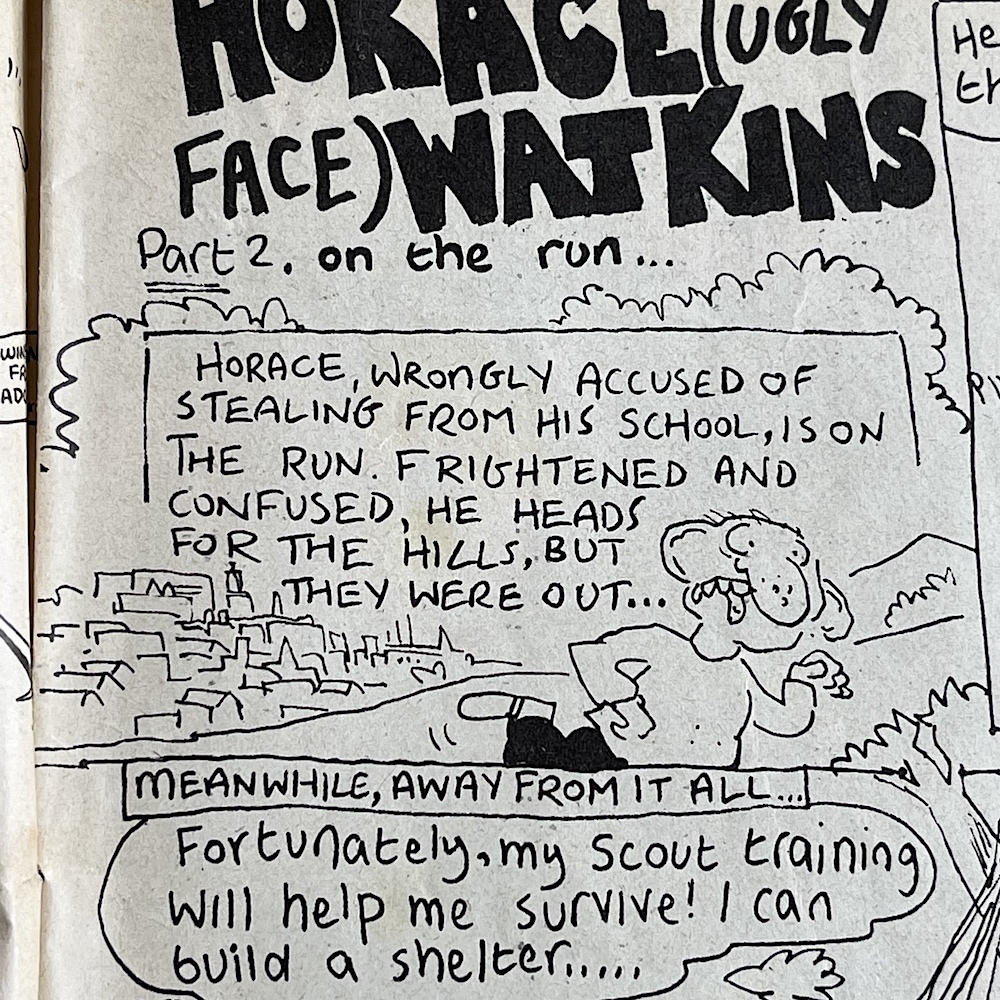
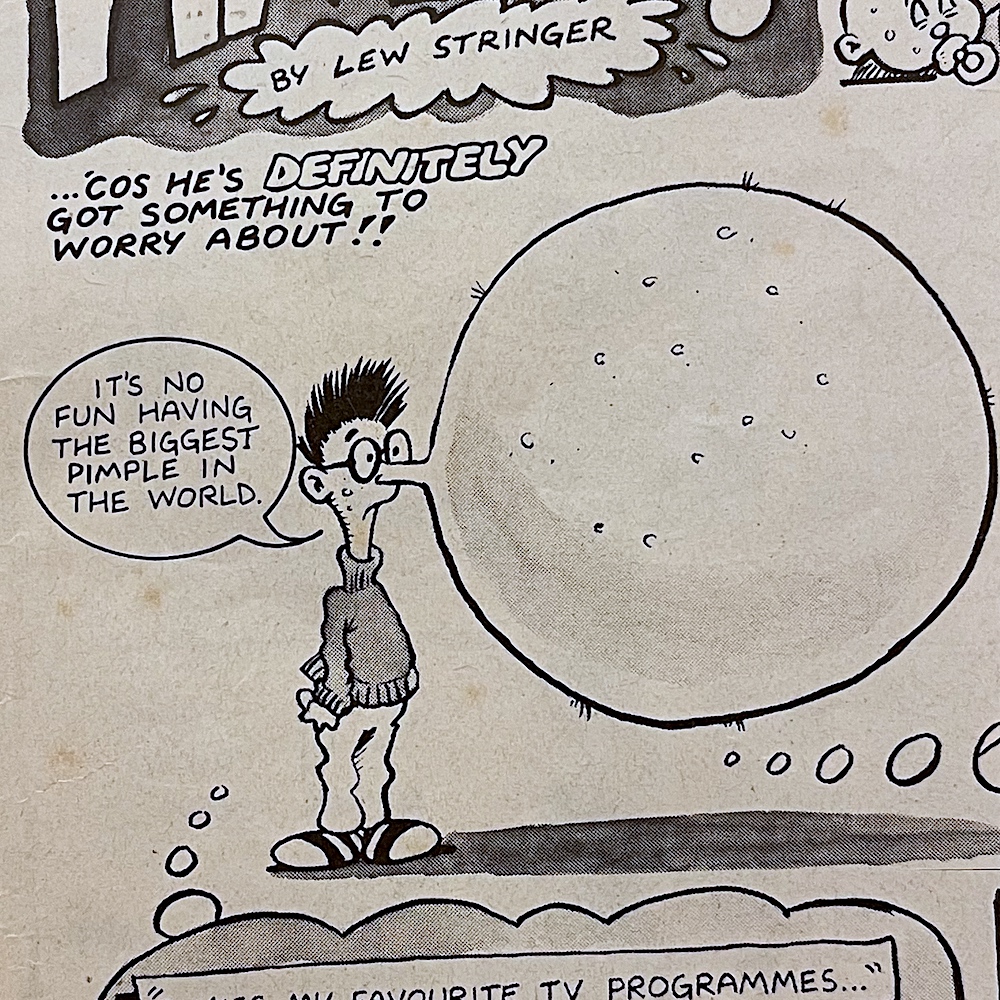
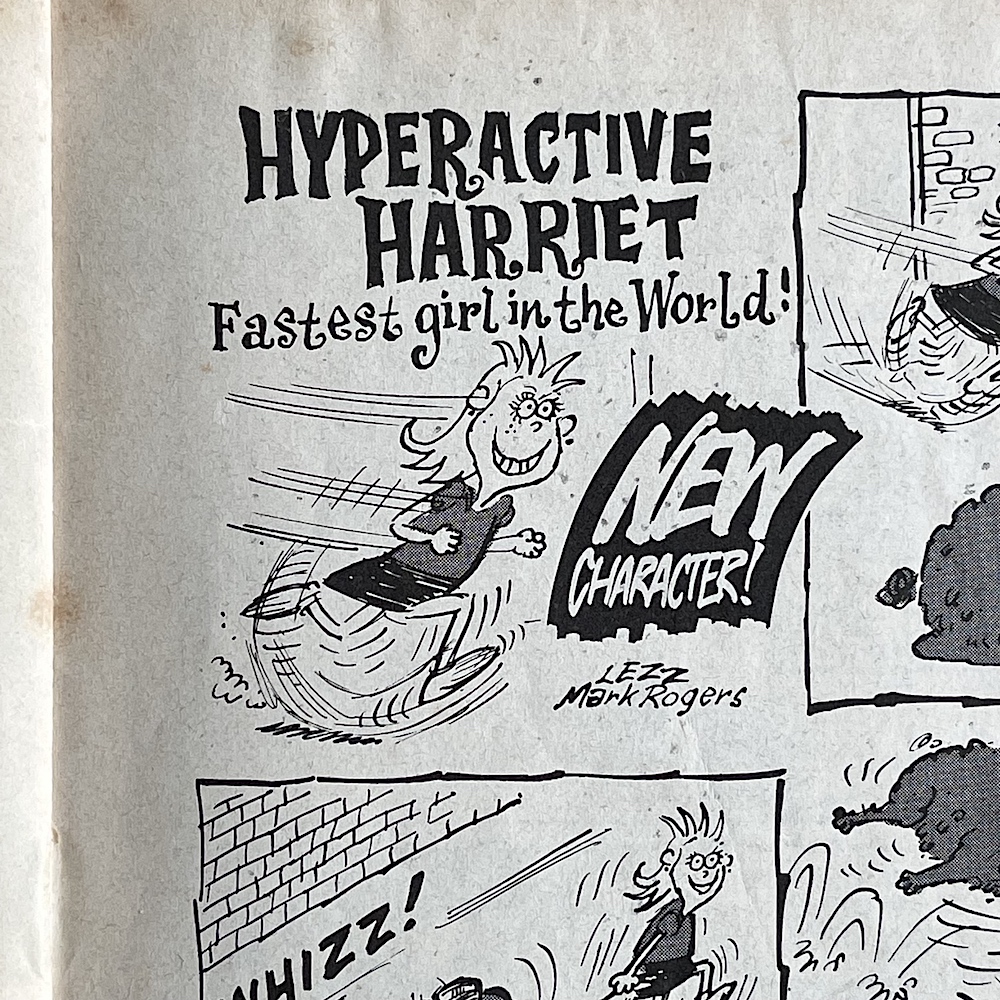
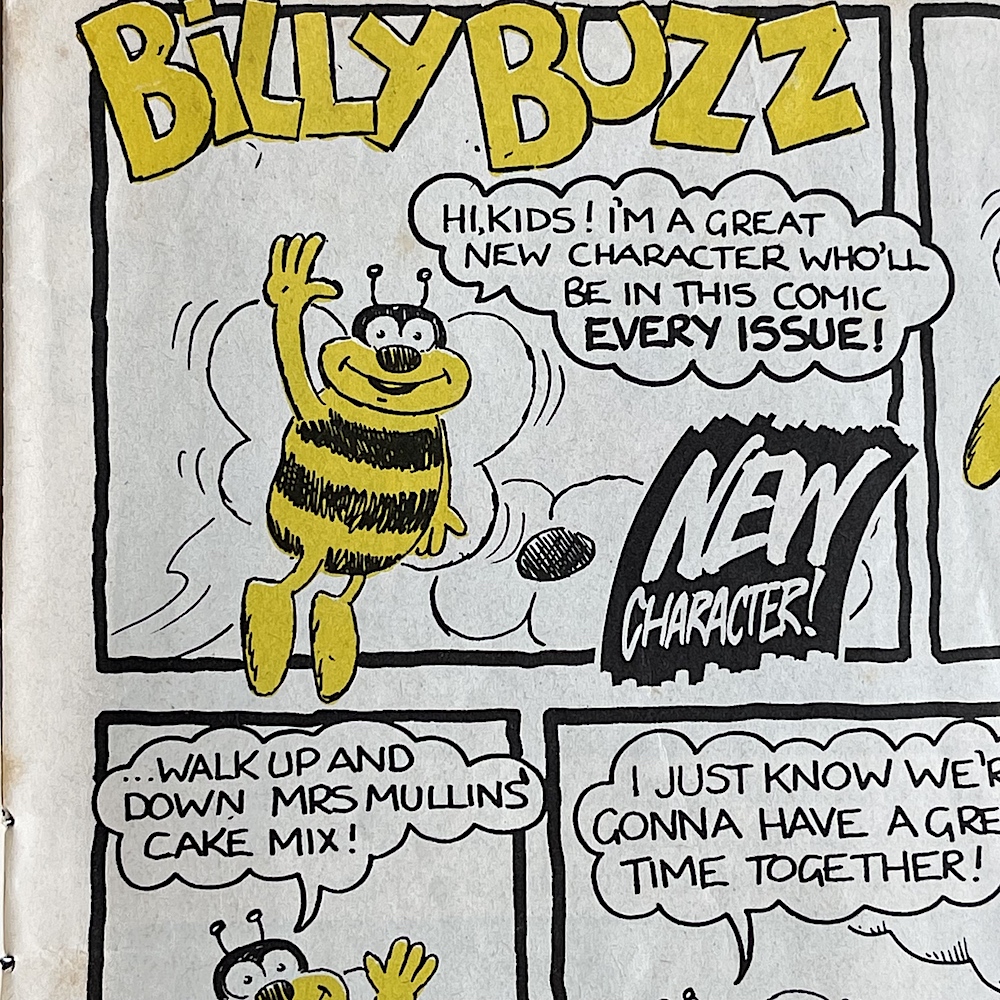
Elsewhere this issue Horace (Ugly Face) Watkins‘ own serial continues and a lot of the humour comes from the narrative by Tony Husband. Fan favourite Pete and his Pimple makes his debut after being the footer gag to a Tom Thug strip in #6. Hyperactive Harriet is the fastest girl in the world and a not-so-subtle take on The Beano‘s Billy Whizz. Then Billy Buzz gets the same ‘New Character’ treatment as the rest, but his saccharine personality annoys Uncle Pigg so much he swats him by the end of the strip and that’s the last we’d ever see of him!

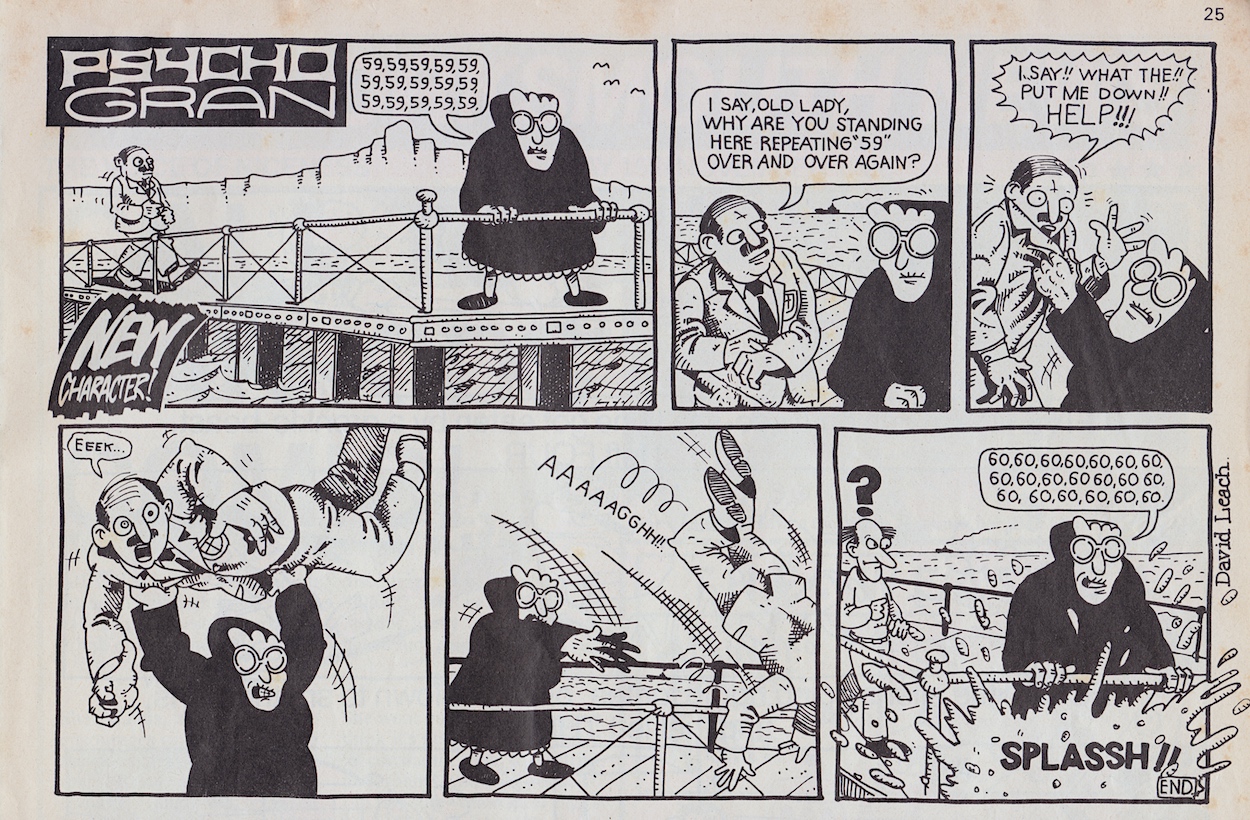
Billy might not have made the grade but the next new addition certainly did. She quickly became a childhood favourite, so much so that I was certain she appeared in almost every issue I had as a kid. But surprisingly Psycho Gran was only in 20 editions of OiNK altogether including specials and annuals. Despite this, she became a true OiNK legend.

Created by David Leach (Brain Damage, Toxic Crusaders, Spongebob Squarepants) she was originally submitted as a one-off strip, so when OiNK’s editors introduced her as a new regular character in this issue it was a bit of a surprise for David. This explains why she doesn’t reappear until #21 because he hadn’t made any more! David tells me the guys would send him a list of upcoming issue subjects and he’d submit Psycho Gran strips for whichever ones he had an idea for. He never had a Psycho strip turned down and as a fan I can see why.

This one might look familiar to anyone who has purchased the new comic series from David in recent years because he reproduced this as a full colour strip for the cover of the first issue. In fact, between contributions to Aces Weekly and Psycho’s own comics, David has now produced more work for the little old dear in the years since OiNK than during her time in her debut comic.

There are certain Psycho Gran strips, as well as individual jokes and images that stayed with me long after childhood was a distant memory. Whether she’s randomly throwing people into the ocean, making military preparations to pick her pension up at the Post Office or adorning a Wild West Wanted poster, she could terrify many in her little world but she was adored by pig pals.


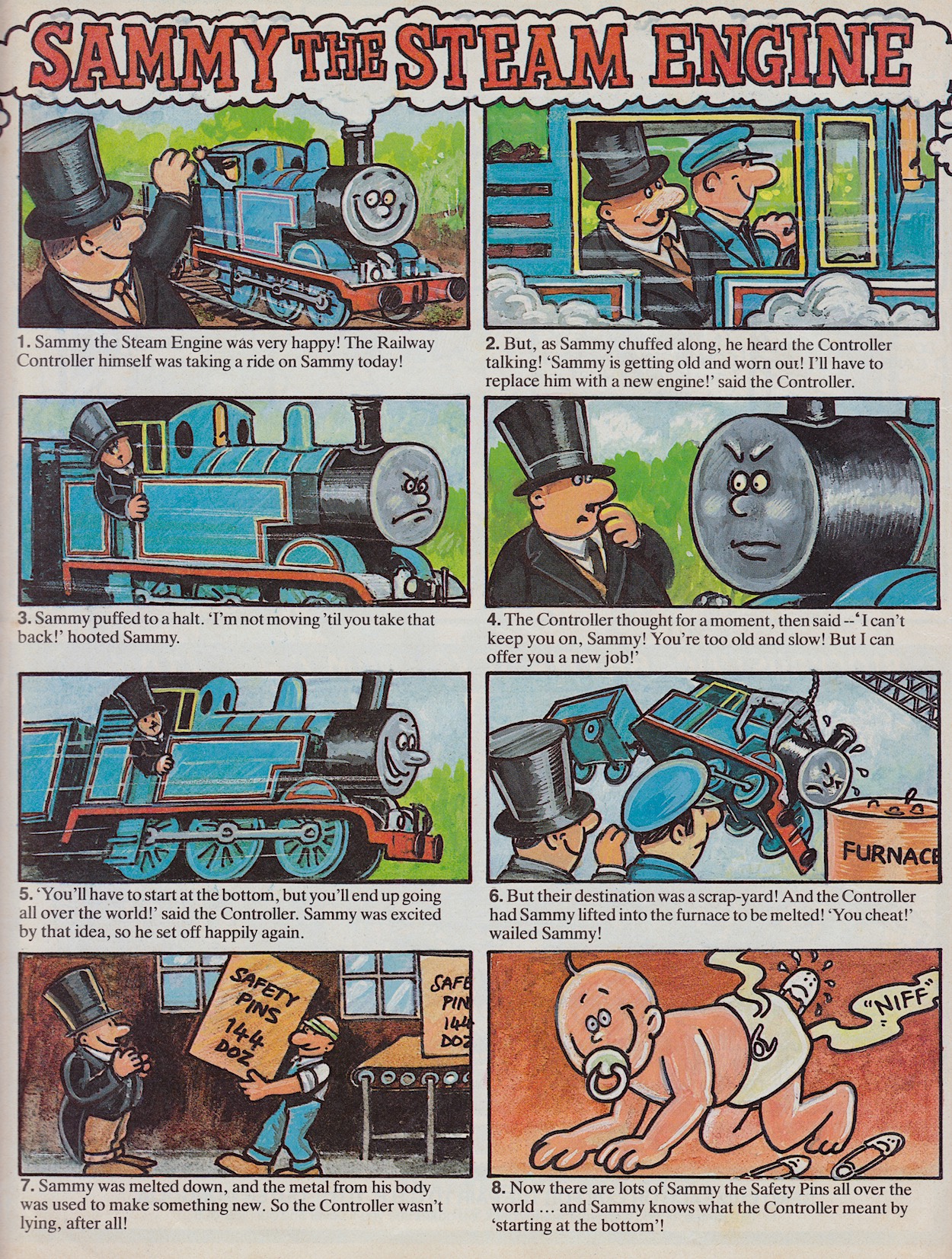
“‘Sammy is getting old and worn out! I’ll have to replace him with a new engine,’ said the Controller.”

Sammy the Steam Engine

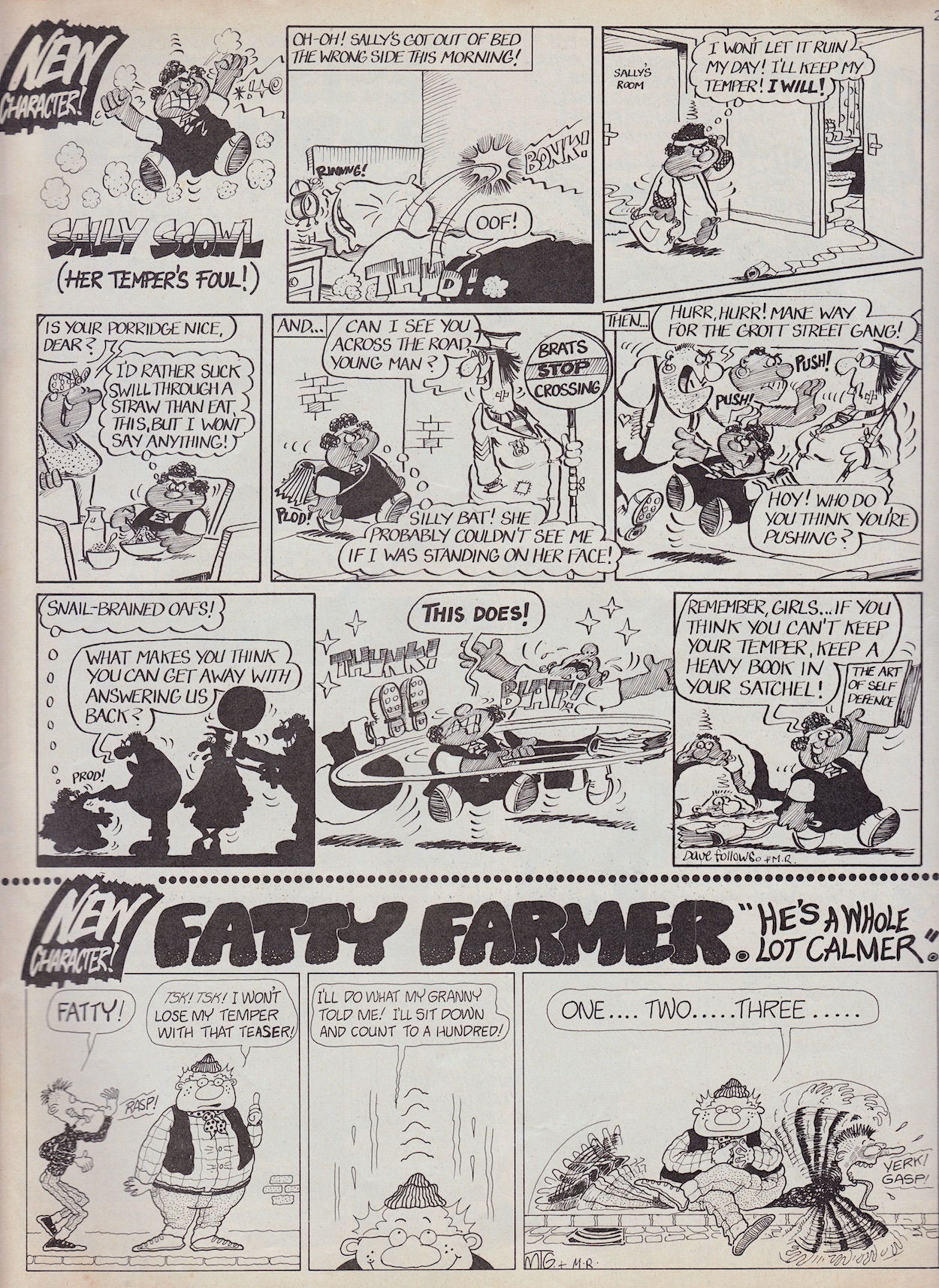
Two new characters are up on the next page together, namely Sally Scowl (Her Temper’s Foul!) and Fatty Farmer (He’s A Whole Lot Calmer). Their titles may have rhymed like so many traditional humour strips of the time but that’s where the similarities end. Both were written by Mark Rodgers (of course) and drawn by Dave Follows and Weedy Willy‘s Mike Green respectively.

Both are enjoyable, even if we do already have a bad tempered youth in the shape of Billy Bang. But unlike Billy, Sally’s temper builds until she uses it to her advantage at just the right moment. She’s a lovable character and after that hilarious first panel I can’t blame her for being in a bad mood all day! She was also that rare occurrence indeed, a black character in one of our childhood comics. So why does Sally disappear after #16, totalling only two appearances? So much for a new regular character! What a shame and a waste of a great idea.

The message was clear, don’t let the bullies get to you

Fatty Farmer was a larger than life country man who’d often come up against bullies and small-minded individuals making fun of his weight. However, he’d remain chilled out and deal with them calmly, often proudly using the very thing they were laughing at to get his own back or to ignore them. The message was clear, don’t let the bullies get to you. He’d go on to be a bit more successful than Sally with 11 strips in total, appearing in every issue for the first few months and then on and off during the rest of the fortnightlies.

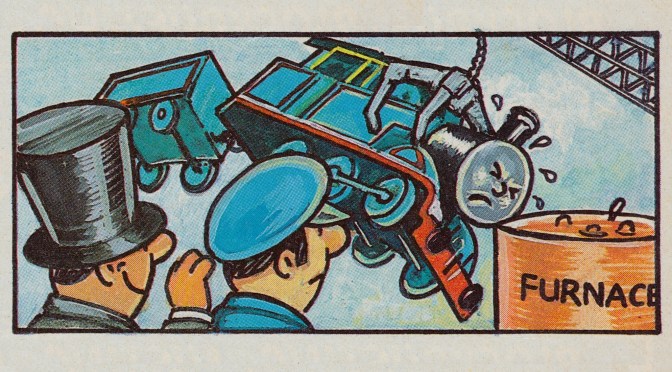
Back in #3 artist Ralph Shepherd drew OiNK’s brilliant take on The Transformers. As I said at the time, the comic would often take the hand out of the things we readers loved and for me there was nothing I loved more than the subject of this next strip. It was so funny to see this as a kid. This was really the first many fans of the show would’ve seen a spoof of it (and it was even several months before the official comic finally launched). Over the course of the two weeks I had to wait for my next OiNK I reread this several times, laughing and loving the fact OiNK had its own version of Thomas the Tank Engine & Friends.

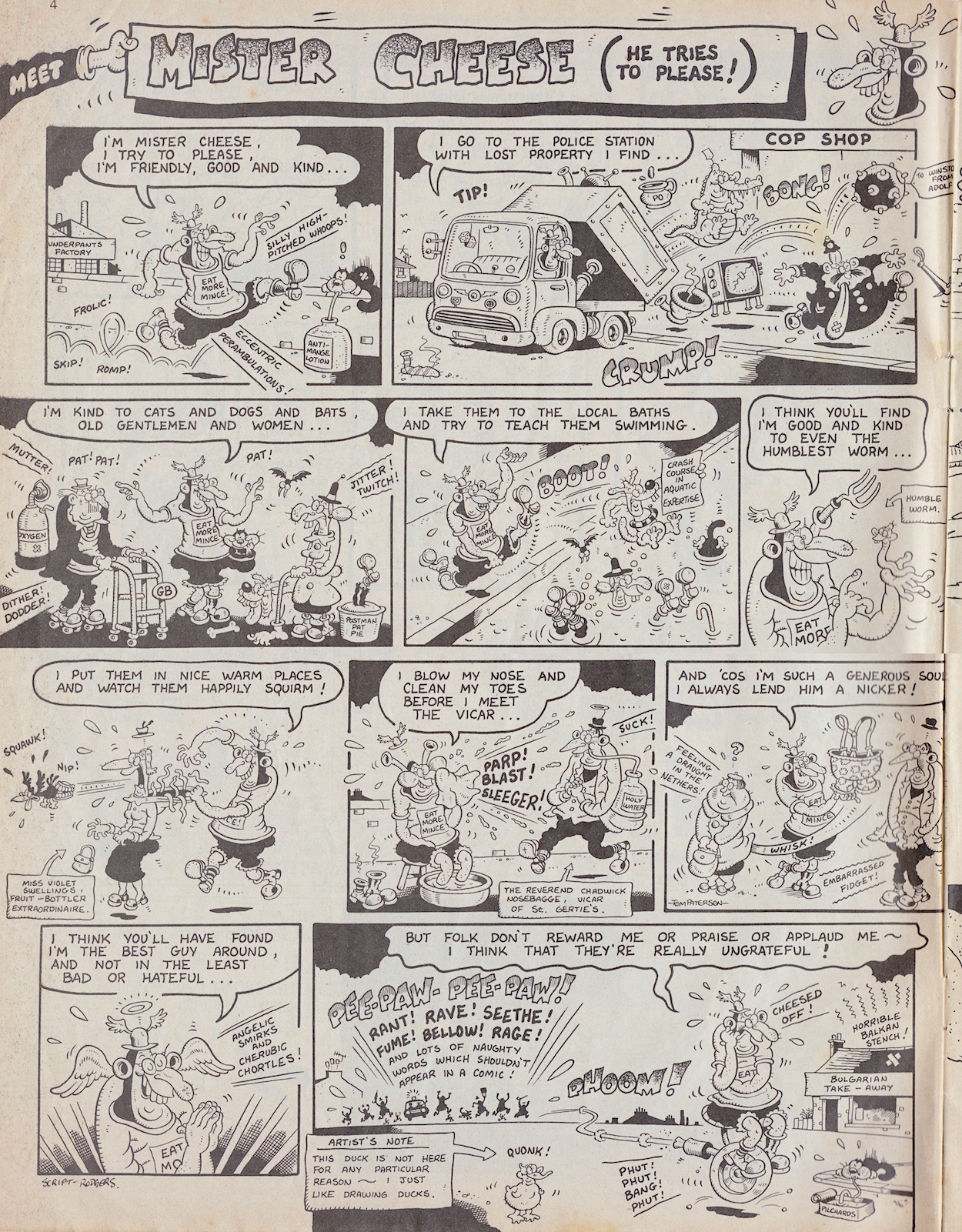
Looking at this issue as a whole I can see I was clearly spoiled as a kid with this as only the second comic I ever bought. Whether I realised that at the time is another matter. I got to experience the gorgeous work of J.T. Dogg for the first time, got to meet lots of new characters including many who would become lifelong favourites, the subject of my top book series and TV show was given that unique OiNK makeover and then on top of all that was one of only five Tom Paterson OiNK strips, Mister Cheese! It even came complete with his trademark smelly sock and funny descriptions of other characters that have no bearing on the story whatsoever.

What a lovely surprise it was to come across this page when reading the issue for this review. Written by Mark Rodgers it’s already a funny script, but when it’s in the hands of Tom you just know there are going to be many more laughs added before he’s done with it. This would unfortunately be Tom’s final full page story for OiNK. After this his work would only pop up once more in a tiny quarter-page strip in The OiNK Book 1988, which I won’t be reviewing for another 13 months! Just as well this is so jam-packed with Tom’s trademark sight gags to keep us going. Tom was just too busy to be a regular contributor and that’s such a shame because I believe he and OiNK were the perfect fit, perhaps more so than any other comic he contributed to.

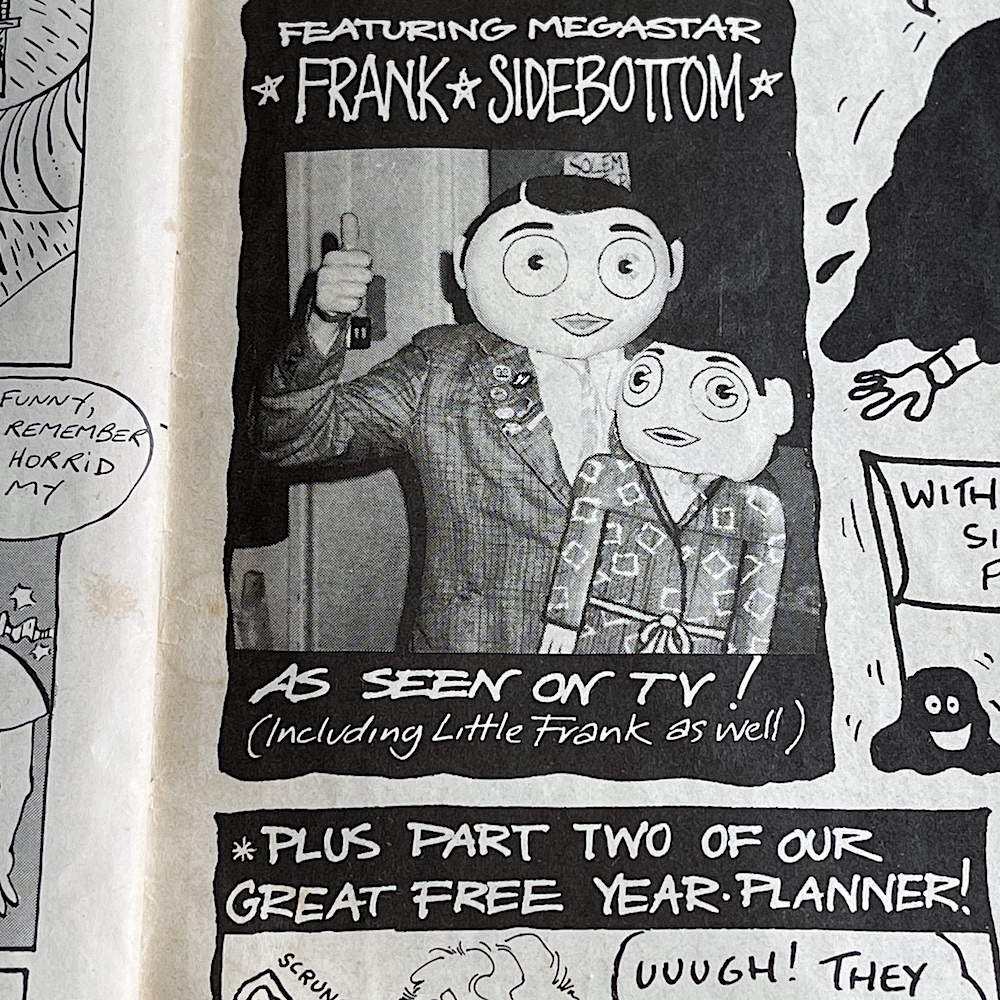
Before we wrap up with the back page, here’s a little bit of news about the next issue. While this edition may have introduced a wealth of new characters, #16 brings with it a true superstar, a megastar, a “fantastic” new addition to OiNK who I remember waking up to every Saturday morning on No.73. His creator sadly died back in 2010 and it was the news of his passing that brought me back into the sty after decades away. Next issue sees the start of his contributions which really have to be seen to be believed.

I’m definitely looking forward to the next issue. For now, I’m going to finish off with this full colour back cover from Lew Stringer. We got a glimpse on the Grunts page (at the top of this review) of what it was like to work in the OiNK offices. Uncle Pigg may have had all the right words to say to the readers but the reality behind them was somewhat different. Here’s Lew’s inside scoop on the real behind-the-scenes of creating the funniest comic ever produced!

According to Lew, the writer and artist in panel two getting whipped by Uncle Pigg are based on Mark Rodgers and Lew himself!

For a much younger me these two issues were a strong start. How could it possibly get any better? Be here on Monday 29th November 2021 to find out.

iSSUE 14 < > iSSUE 16

OiNK READ THROUGH MENU

OiNK FREE GiFTS MENU

MAiN OiNK MENU

SUPER NATURALS #2: NO GARBAGE

I’ve really been looking forward to this after enjoying the premiere issue so much. A licenced comic which came across as a spiritual successor to Scream!, Super Naturals had a great start but can that momentum be maintained, even built upon? We kick off with another Sandy James cover which is as colourful as that memorable logo and I initially thought it contained a glaring mistake, but it was I who made the error.

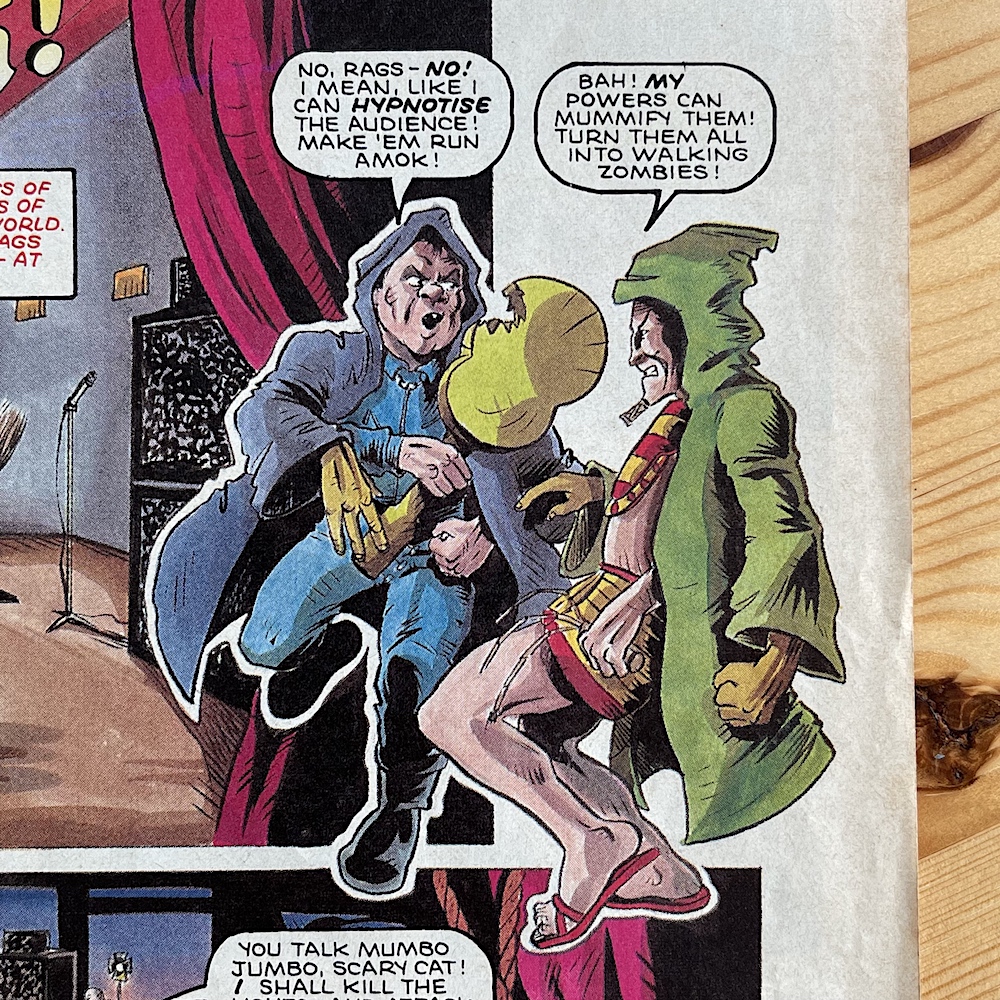
The evil Ghostlings are the star of this front page and in the background we can see their human forms as they lift the cover and reveal the horrors they transform into. Except for Scary Cat, whose hissing cat and witch forms seem to be the wrong way around. But inside, during one of the stories she calls her cat persona her “true form”. While it’s not elaborated on, could it be she was a stray cat who wondered into the Tomb of Doom? It’s an interesting idea. She was the only toy I owned at the time but I can’t remember what it said about her background on the packaging.

The issue opens straight into the second part of The Legend of the Super Naturals and unfortunately it appears John Gillatt has already moved on. Perhaps as a high profile artist he was brought in for the first chapter to either draw readers in or to define the tone and style. Something similar would happen two years later in editor Barrie Tomlinson‘s Wildcat, when Ian Kennedy drew the preview issue and the first chapter to the Turbo Jones strip but then handed it over to Vanyo from #2 onwards. In the case of Super Naturals they’re now in the capable hands of Dave D’Antiquis (2000AD, Eagle and co-creator of Brigand Doom).

There’s no rush to get everyone properly introduced, so it doesn’t feel forced and I like this approach

While John brought a horror comic feel to the origin story, especially in his depiction of Skull and his cronies, Dave’s is more of a traditional adventure strip. The story is action-packed but I do miss the more horrific interpretations of the characters. The story basically continues the fight from last time, playing out over four of the five pages and it’s highly entertaining, right down to their medieval-style speech patterns. These may feel forced to some but they make perfect sense when you take their origin story into account.

Fighting it out amongst modern 80s technology, Skull and Lionheart are impressed with the vehicles and the story ends with them entering separate junk businesses to build their chariots. More on these later. The Legend of the Super Naturals would run for the length of the comic and perhaps the original idea was for it be an ongoing tale of the first months after the characters first entered our world; a way to introduce new toys and features into the stories. We’ll unfortunately never know. I like how it’s taking its time in setting up the world within which our comic will tell its tales. There’s no rush to get everyone properly introduced, to get every single toy front and centre, so it doesn’t feel forced and I like this approach so far.

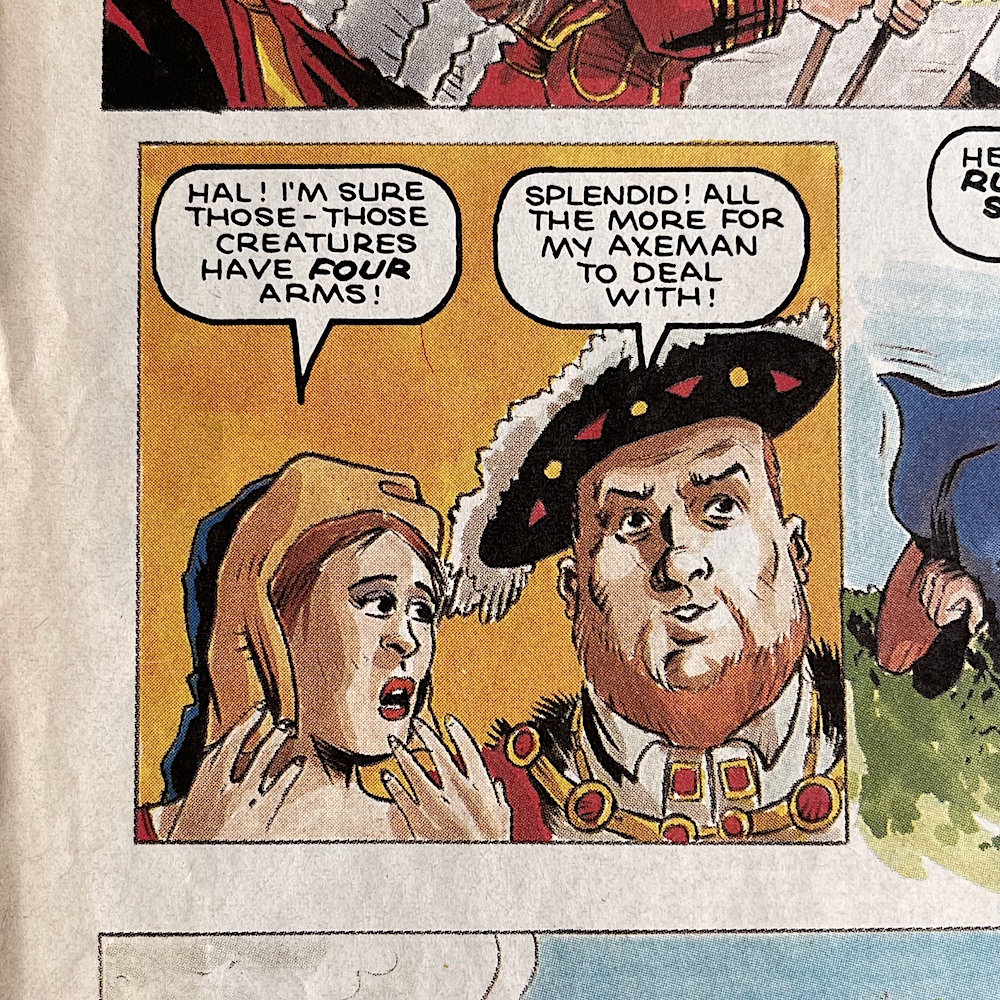
While the first issue was very much a children’s horror comic with the more light-hearted Ghostlings strip in the middle, this time we’ve started with more of an adventure feel before the comedy, so with only its second issue the comic feels very different. In the Anthony Williams strip the evil Ghostlings bicker and fight about the best way to cause mayhem at a punk rock concert while Spooks, See-Thru, Hooter and Mr. Lucky take centre stage in a completely different era. Accidentally travelling through a different Ghostworld exit they came out in the time of Henry VIII.  Right in front of him as a matter of fact.

There are plenty of jokes and sight gags, as well as funny banter between the characters. It really does give the impression they’ve known each other for a very long time before we the readers came along. What was interesting is how it’s forbidden for the good Ghostlings to frighten a human, so when they find themselves trapped Mr Lucky turns into his giant bunny form and burrows their way out of trouble instead of simply scaring the people away. Enjoyable silliness but now it’s finally time to get back to some frights.

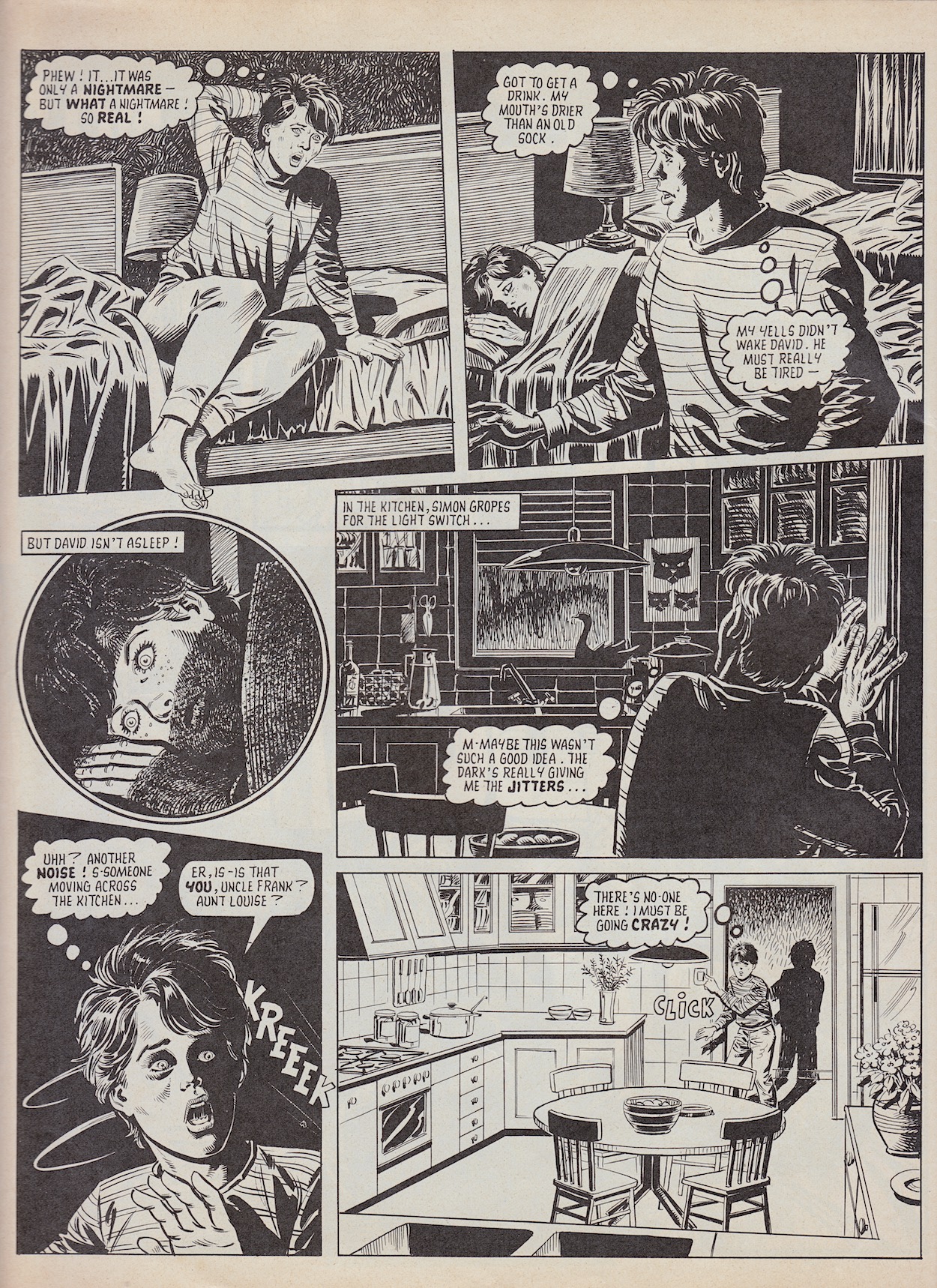
It’s time to return to the foster home where brothers Simon and David Wickham are spending their first night. With his little brother sound asleep, Simon worries about earlier events and the anger he saw in David’s face over a toy. He begins to hear creaking and shuffling noises and The Doll leaps at him in the dark! But he jolts upright and realises it was just a dream. Or at least he thinks it was, it was so real. Thirsty, he heads downstairs, unaware his brother isn’t asleep at all. The panel showing this is really rather creepy. Oh I love this strip!

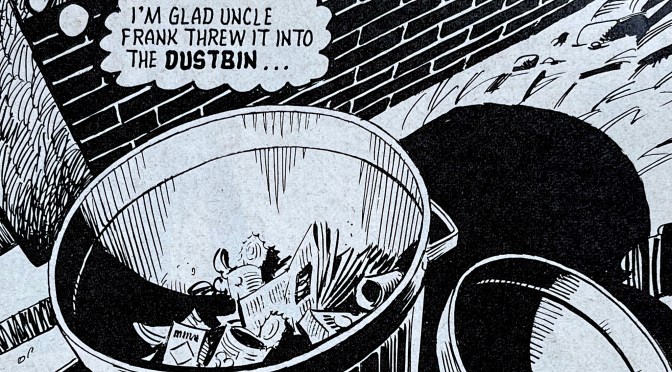
It’s such a shame we don’t yet know who wrote it, because whoever’s script this is works incredibly well with artist Francesc Masi to create a truly unnerving atmosphere for the young readers. We knew the doll was alive, knew it was probably in the house but we didn’t know if Simon really saw it and we certainly didn’t know where or when it could pop up next. Looking out the window Simon sees the dustbin and breathes a sign of relief, unaware of what happened at the end of the last chapter, and as he enters the kitchen in the dark we young readers were checking every inch of the panels.

The caption here echoes that of the one when David opened his eyes. The two events are linked. Reading this now I can clearly remember this issue from 1987. Well, this strip anyway and the feeling of what I now know was suspense, but which at the time was a new experience for me.

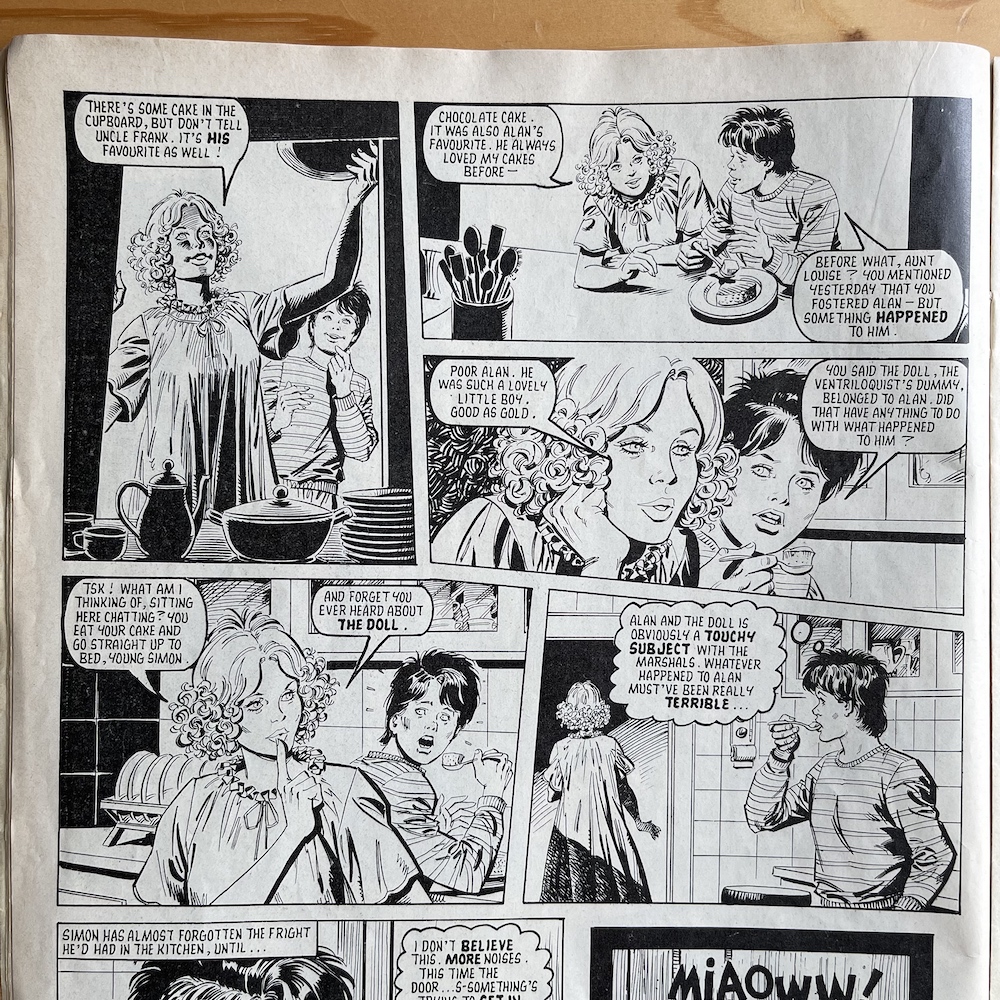
We get a little light relief when Aunt Louise comes downstairs thinking Simon was looking for a midnight snack. It’s a tender moment between the foster parent and the teenager on their first night living together, while it also teases us with hints about the past and their previous foster child Alan, who also had a fascination with the ventriloquist dummy. For a children’s comic it’s certainly doing its best to tell a story like a classic 80s horror movie.

After Louise leaves the cat startles Simon when she enters through the cat flap. She begins to hiss, apparently at him, before running back outside again. Cats normally like Simon and there’s nothing else there that could’ve scared her. Confused, he heads to bed, unaware of the shadowy presence watching his every move from the cupboard behind him, which the cat obviously sensed.


“But it isn’t in the dustbin!”

The Doll

We don’t actually see the doll until the final panel of the five pages, but we somehow feel it throughout. It’s still compelling 34 years later. Even though I wouldn’t buy the next issue as a kid (something else must’ve grabbed my fickle attention) I can remember reading this instalment in bed late at night with only my bedside lamp on and the feeling it produced. The pacing is perfect and it suits being read one chapter at a time much more than binge-reading it, which for me would ruin that pacing and suspense if rushed through. It was designed to be read this way after all.

What an experience it was and for the life of me I don’t understand why I didn’t have a regular order. I was only allowed a certain amount reserved at once but at this early stage of my comics reading I only had two orders (OiNK and Thomas the Tank Engine & Friends). Perhaps that’s all I was allowed at the time, later I could have up to four at once. Whatever the reason, I missed out on all but the final issue. Remembering how this creeped me out I regret not experiencing the rest of it as part of the target audience.

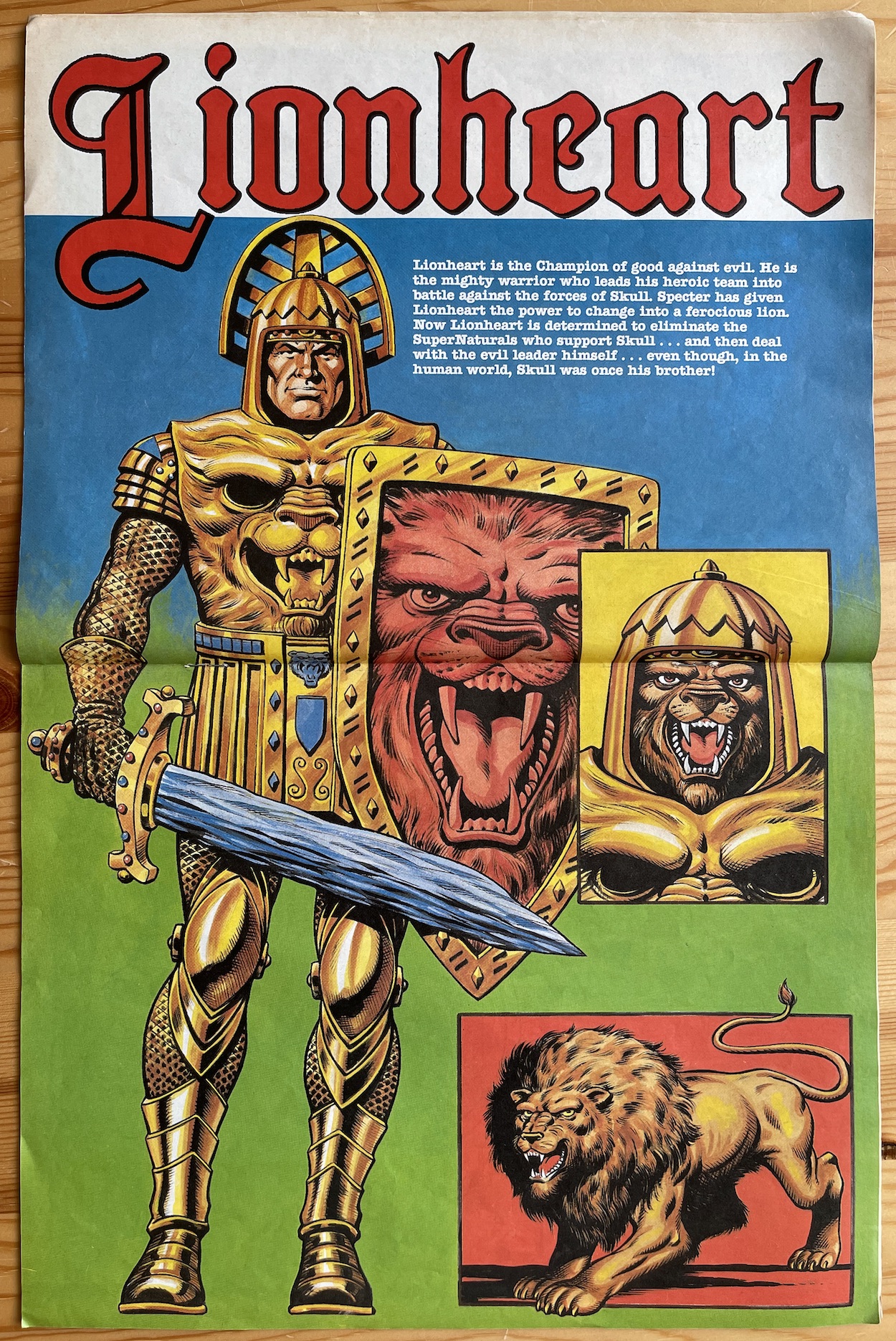
Sandy James brings heroic leader Lionheart to life for a centre page poster and it’s classic Sandy. I especially like how the faces of the lion on the shield, Super Natural and complete lion forms all have similar characteristics. They’re not just generic lion faces, you can tell they’re the same character.

Next up is another complete story in this issue’s Scary Cat Challenge. It’s still too early for any reader suggestions due to deadlines so another unknown writer takes the helm, as does an unknown artist. I’m making it my mission to find out more about the making of this comic but information (even from those that worked on it) is hard to come by. It really does seem to be a forgotten comic in every way, which is heartbreaking. But for now these two creators, whoever they may have been, bring us Spider.

It’s a rather basic tale of an unlikeable guy bullying his younger step-brother and then getting his comeuppance. Darren Benson sees young Clive as unmanly by his own so-called standards because he doesn’t like sport, relaxes in hot baths and helps people. From the very start we know Darren is the bad guy here. He buys a toy spider to scare Clive while a spate of deadly spider attacks are reported on the news. We know where this is headed.

The final two pages are above and I will admit the furry arachnid in the final frames is superbly drawn, highly realistic and for anyone with a fear of spiders I’m sure it would’ve made their skin crawl. It’s just a shame it’s all rather predictable and seems to end just as it gets interesting. It’s a six-page story and really could’ve used those pages better. It could’ve got to this stage quicker, using the remaining space to really terrify Darren and maybe have his step-brother save him or, to really scare the young readers, maybe he wouldn’t have. When you see what happens to some of the kids in later stories you’ll understand how this wouldn’t have been too much for this comic!

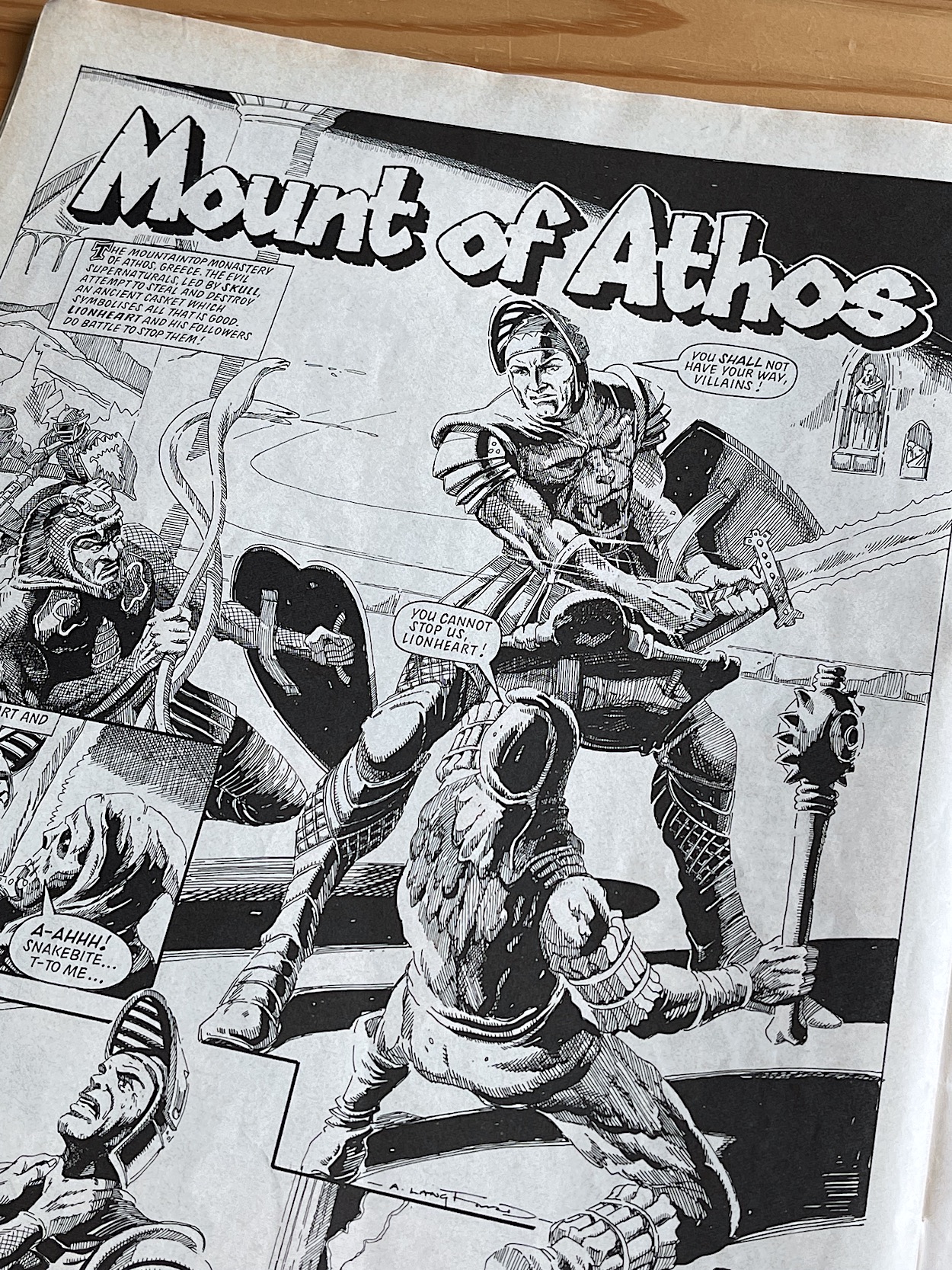
Mount of Athos is once again our final strip and I’m so glad Alan Langford hasn’t been replaced by another artist. He brings a truly epic scope to this Super Naturals tale. They feel bigger than life, which suits them perfectly of course since they’re not alive and even the toys were huge compared to their contemporaries. In Alan’s hand their other forms can be horrific (see Snakebite in #1 for the perfect example) and their battles Earth-shaking. The opening page looks superb but then you turn it over and this image of Skull just grabs you! I mean come on, look at him!

Skeletor never looked that good. A truly terrifying leader and a world away from the depiction in the first strip this issue. I particularly like Alan’s choice of not giving Skull eyeballs, deviating from the toy and the original comic designs by Sandy James. While the version of him in The Legend of the Super Naturals is a crazed skeleton bent on conquering via endless battling, in Mount of Athos he’s a calculating, cunning foe and has a genuinely frightening presence.

This takes place in an unspecified time after the origin story so perhaps this is the character he was to evolve into, but I think it’s more likely the unknown writer and Alan simply decided on a more serious villain for their story. It certainly raises the stakes. This is also when Scary Cat reveals the hissing cat is her true form as I mentioned earlier. The evil Ghostlings finally show their fangs too, proving they’re more than comic relief and both Eagle Eye and Skull get to show off their supernatural powers. Athos and The Doll are worth the price of admission on their own. Both are compelling reads.

Time to wrap things up for now.

On page 31 there’s a quick preview of the next issue which focuses on those so-called chariots the two sides are determined to build in their respective junk yards. The Ghost Finder and the Bat-Bopper were the two big Tonka Trucks available that Christmas and readers had already been able to check out photographs of them in the preview issue. They looked great so I’m looking forward to their inclusion in the action story next time.

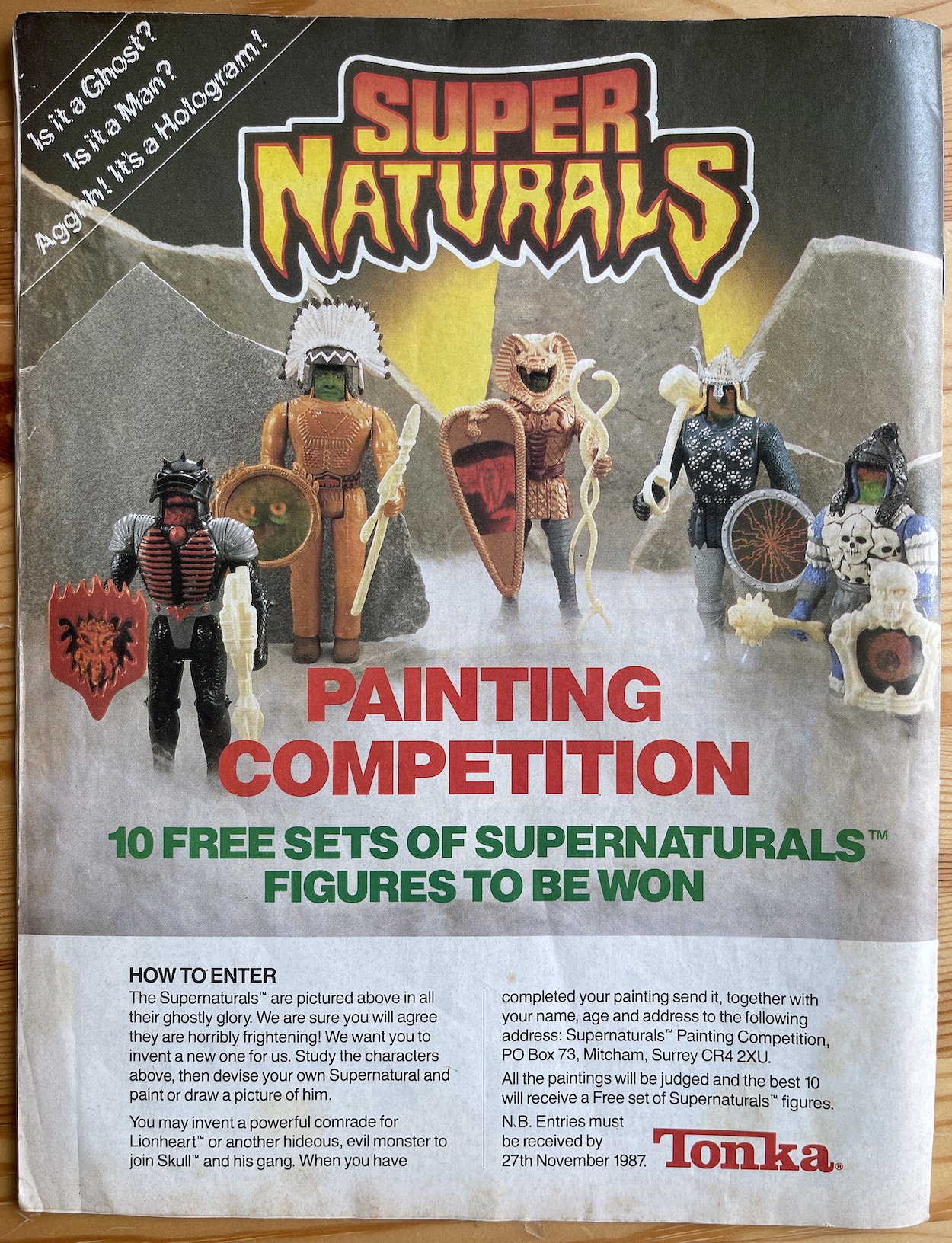
Below that you’ll see the instructions for the free Lionheart mask and I can remember they actually came with little elastic bands for our ears. Funny the things classic comics dig up from our ageing memories, isn’t it? On the back page is the third Tonka competition and it’s a chance for readers to design their own Super Naturals. I’m a bit disappointed Tonka assume they’ll all be male though, but unfortunately this was par for the course back then. (What about Scary Cat?)

Just to finish, when I mentioned “the price of admission” it got me thinking about that price of 40p. It’s easy to dismiss it now, but in 1987 that placed it a little above most similar comics. Marvel‘s Transformers was 30p at the same time, albeit it on smaller paper, with 24 pages instead of 32 and less original material was needed. OiNK itself was a good bit more expensive than Fleetway‘s (publisher of Super Naturals) other humour comics due to its glossy paper and being an independently created comic yet it was 35p. Even MASK, also a licenced comic by the same publisher was 35p in November 1987. Could the price have put some parents off buying it? At the end of the day the toys weren’t a success anyway so it probably wouldn’t have mattered.

Nothing will put me off returning in two week’s time for #3 so join me back here on Sunday 28th November 2021 for more chills, thrills, action and laughs from the comic that had all of that.

iSSUE ONE < > iSSUE THREE

SUPER NATURALS MENU

COMiNG UP: OiNK! #15

When I bought my first ever comic (or rather, my parents bought it for me) it was OiNK #14. I was instantly hooked. I still am 35 years later. As enthralled as I was with the 32 pages of hilarity, I was even more excited for what was to come. The idea of returning to these funny characters (who were like nothing I’d ever experienced before) every fortnight was incredibly exciting and Uncle Pigg made sure those excitement levels would remain sky high until the next issue with not one, but two Next Issue promos.

The first was for the free gift to end all free gifts as far as I was concerned. It wasn’t a small double-page poster, it wasn’t a badge and it wasn’t a Highland Toffee Bar. It was a giant, three-part calendar poster drawn by Ian Jackson himself. The first part on its own promised to be huge. What on Earth was the finished article going to look like on my wall?! Well, in the present day it hangs on my home office wall and even as a fully grown (physically at least) adult it’s still giant!

But that wasn’t all. I’d missed out on The Street-Hogs and J.T. Dogg‘s incredible artwork in the early issues, so I wasn’t prepared for Ham Dare: Pig of the Future. I was aware of Dan Dare and the Eagle comic, probably from my brother or my friends, so I knew what this was parodying but I’d no idea just how much fun it was going to be. This preview of the art, the promise of new characters and that free gift had me convinced and my first ever regular comic order was placed with my newsagent alongside it.

Come back on Monday 15th November 2015 to check out the full review.

GO TO iSSUE 15

OiNK iSSUUE PROMOS MENU

‘MORE OiNK’ MENU

MAiN OiNK MENU

RiNG RAiDERS #5: ELECTRiFYiNG STAKES

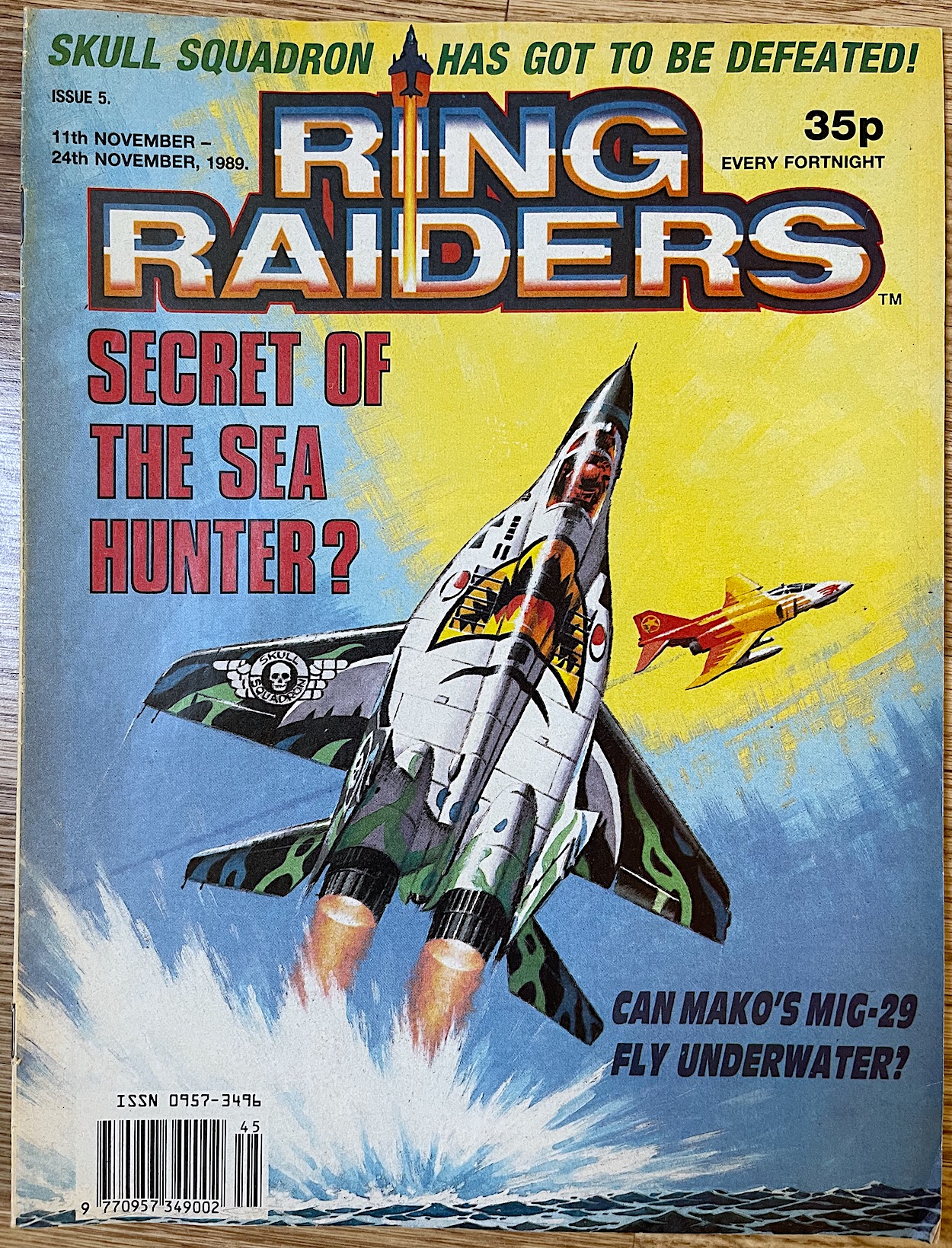
Being the only issue I somehow lost between childhood and bloghood this cost me a pretty penny a few years back but it was worth it to have the complete collection again. The superb Ian Kennedy cover featuring my favourite Skull Squadron aircraft, Skull Leader Mako‘s Mig-29 ‘Sea Hunter’ certainly softened the blow to the bank balance. Regular readers may wonder why the question on the cover is being posed when we’ve already seen the answer in #2, but that was a secret for the readers. As far as the Ring Raiders were concerned it was still unconfirmed and made Mako one to fear.

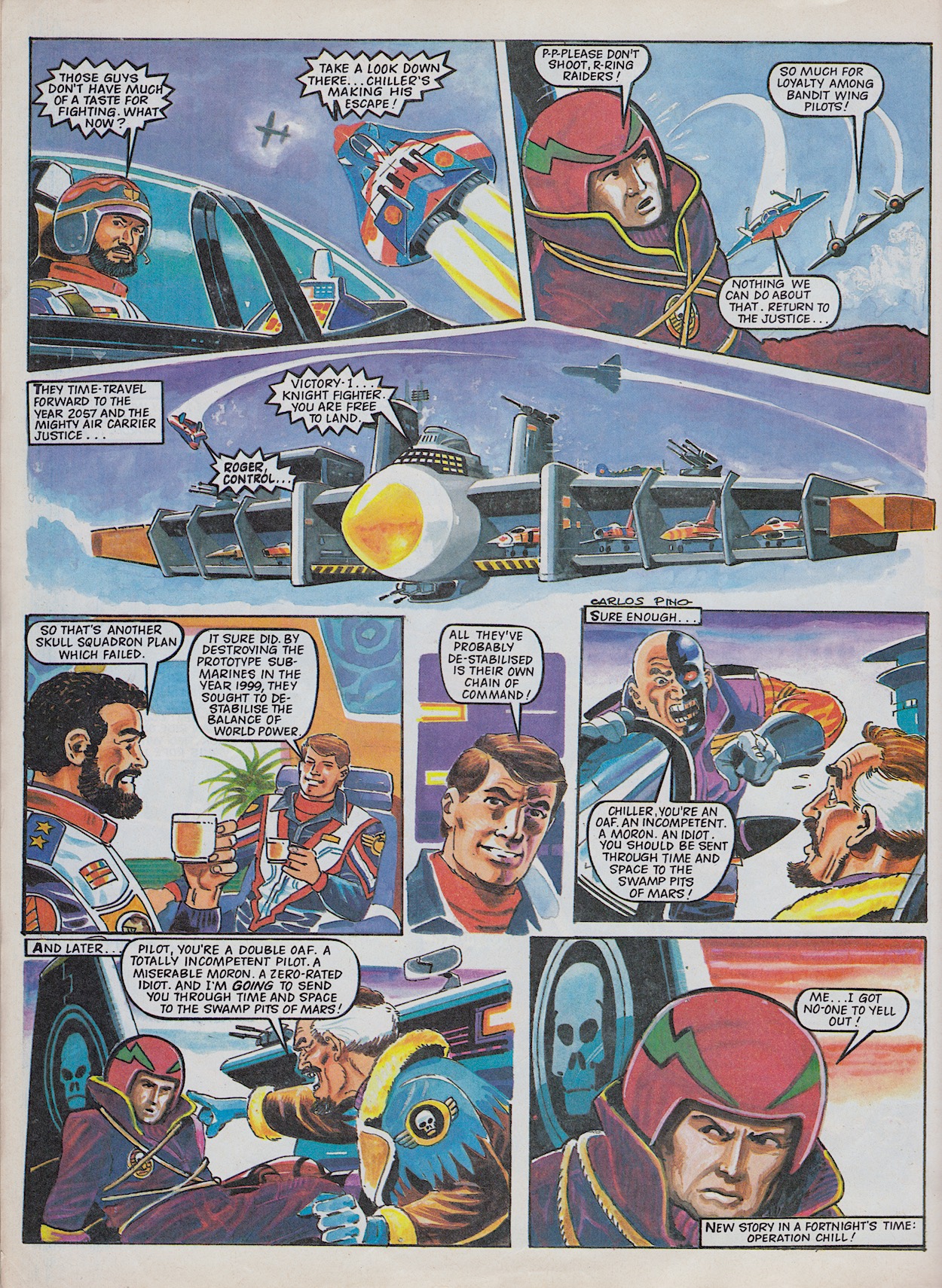
I love the details in the cockpit (something the toys simply couldn’t include due to their size) and the size and power Ian brings to his renderings of these planes. I also love that crosshatch effect for the sky which adds the illusion of texture to the glossy cover. Inside, editor Barrie Tomlinson‘s Battle Zone ’99 comes to its conclusion after beginning back in #2. A more lighthearted affair than the other strips, it’s acted as a great way to introduce the relationship between the calculating Skull Leader Chiller and his own leader Skull Commander Scorch, which comes to a funny conclusion on the final page.

Carlos Pino‘s work has been colourful and fun throughout, perfectly suiting the fast action script and bringing the comedic moments in the air to life. But in this final part there’s something of an anomaly. Chiller’s wingman just doesn’t look right, does he? It’s a mystery, the answers lost in the mysts of time that were the late 80s, but it looks like he’s been altered after the fact. Perhaps the wrong character was drawn originally?

As for the story, which started off with the death of so many sailors on board a submarine, it ends more like an episode of the cartoon series. Chiller’s wingman lands to rescue him but his plane is a single seater so instead of joining the fight on the ground he’s unceremoniously strapped to the prop plane’s tail while Chiller commandeers it. It may have been light on plot but as an action-packed way to kick off every issue it’s been a short, to-the-point bit of fun. With the comic introduced, Barrie and Carlos will team up again next issue for its replacement in a serial which features more plot and the return of Chiller as the lead villain.

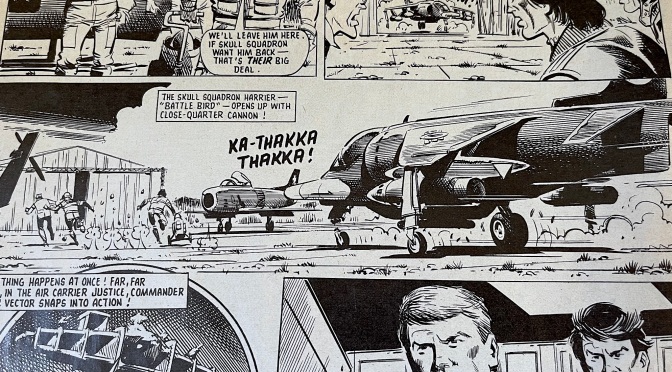
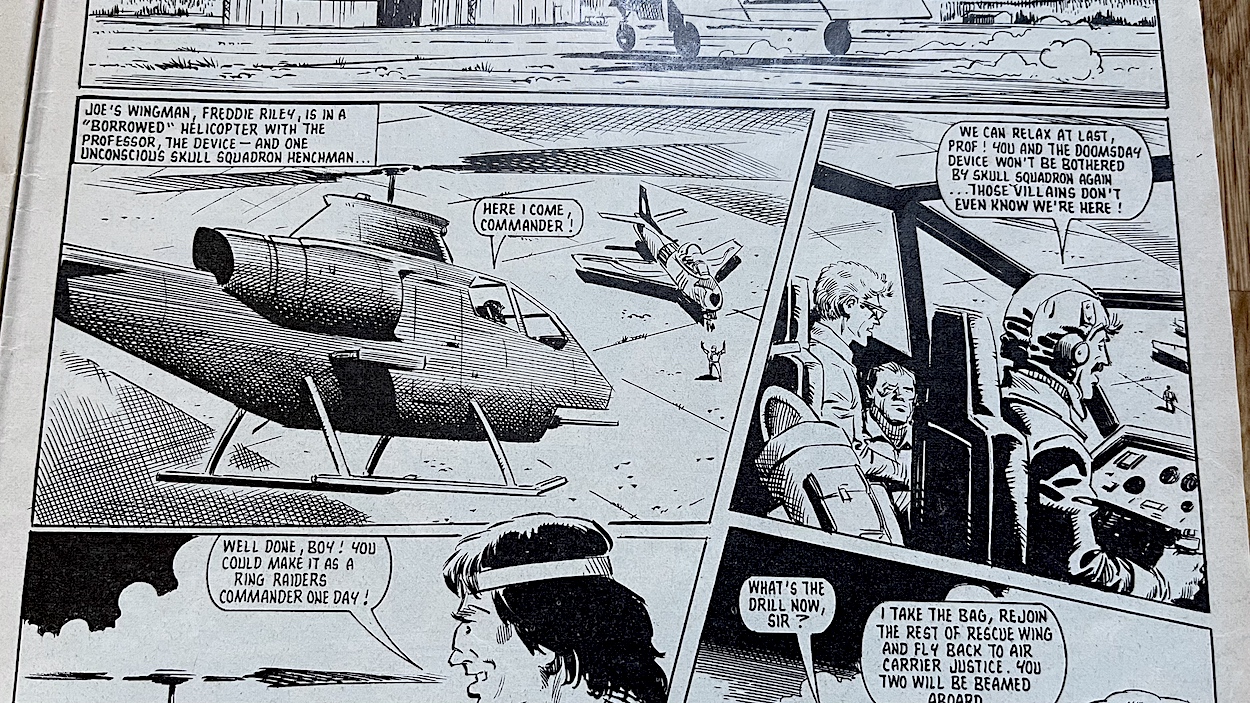
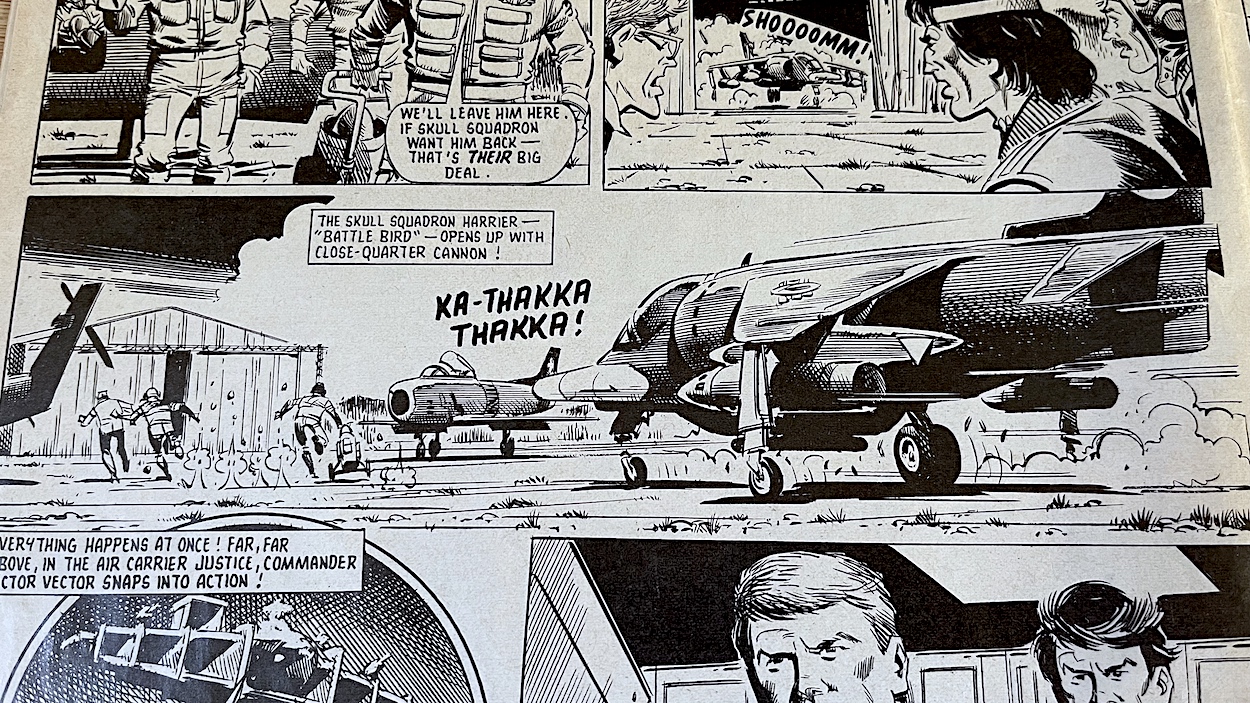
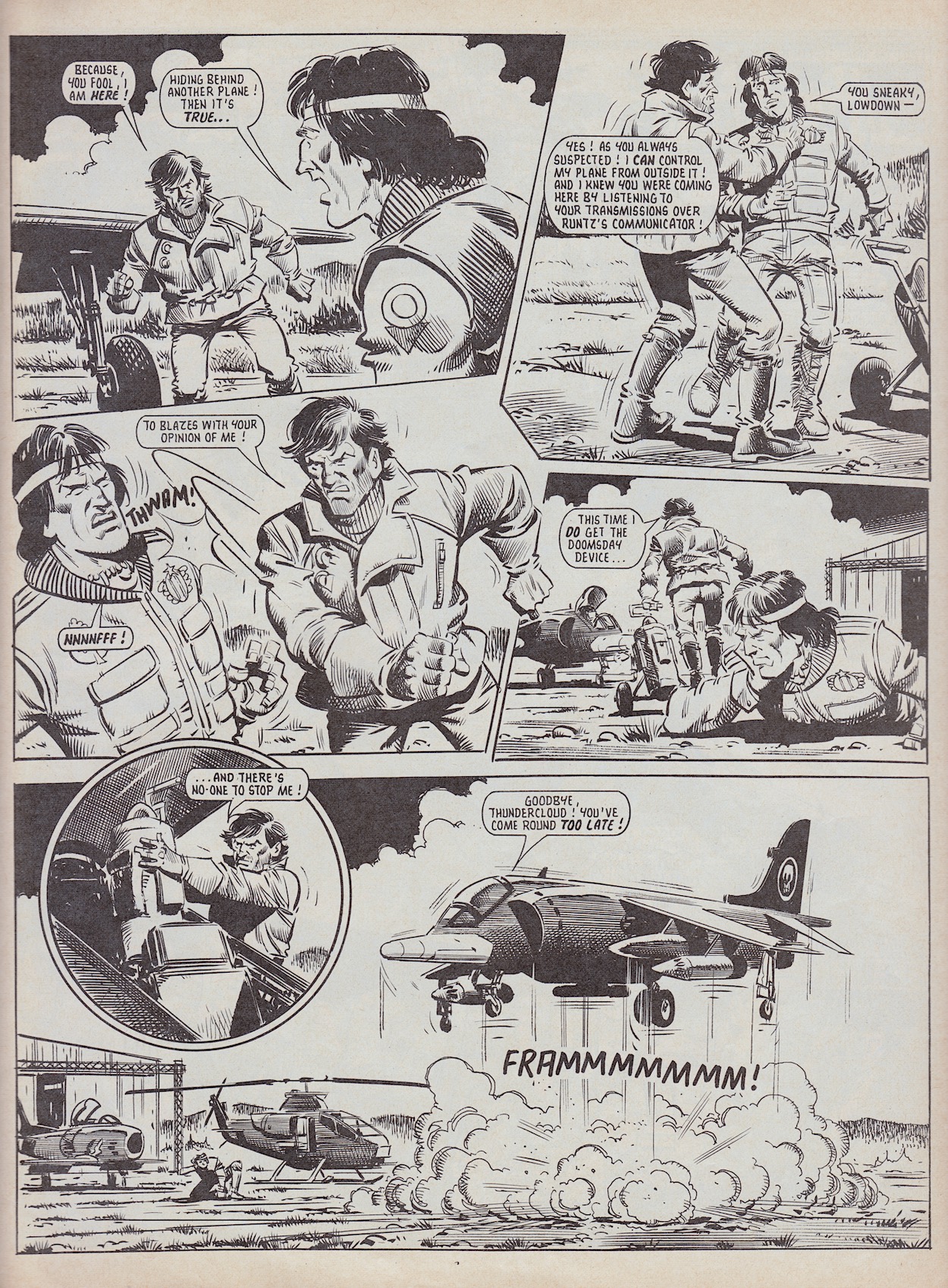
In the continuing Trackdown written by Angus Allan and illustrated by John Cooper it looks like Freddie Riley and the professor’s adventure is coming to an end as they approach Wing Commander Joe Thundercloud on a supposedly deserted airstrip, unaware Blackjack and his Harrier ‘Battle Bird’ lie in wait. The panels showing the Ranger helicopter and then Riley’s point of view feel like the camera (for want of a better word) has zoomed inside in one fluid movement. Just me? Well, that’s how it felt to me. John Cooper was certainly cinematic in his storytelling.

In this episode the story transitions back to the characters from the toy line as Riley and the professor are beamed aboard the Air Carrier Justice where they watch the unfolding drama alongside Ring Commander Vector. As much as I enjoyed the comic’s original creations Riley and Runtz I never felt disappointed with the way the story changed its focus here. It was just the natural way for it to go when Riley’s situation was resolved. It’s a fast-paced story but it’s full of character and each issue brings another layer to the plot. It feels masterfully planned out, so kudos to Angus for doing such an amazing job with his first story for a brand new franchise.

As a kid I loved the scenes on the ground just as much as the air combat that was at the heart of it all. While they could be shot down, which we’ve seen plenty of in fact, there’s a feeling of invulnerability in the air and a vulnerability when they’re on their feet. Here it adds suspense as Joe lies unconscious, helpless as Blackjack does his cool vertical takeoff with the doomsday device, after confirming the ambush worked perfectly because he can radio-control his bird. A nice little piece of information from the toys there.

(I have to admit I’ve always found the way Harrier jets take off and land just amazing to watch too.)

Skull Leader Hubbub is a Vietnam vet. Having fought for America he’s been left damaged by the ravages of war

In pursuit, Joe can’t shoot down or even cripple the Battle Bird, not with the Doomsday Device on board. Unable to stop it being taken back to Scorch the strip ends with a feeling of complete helplessness. I can’t remember what happens next, so just as I had to originally I’ll be waiting two weeks to find out. One thing to note here, there are a couple of references to Thundercloud’s heritage which read rather differently today and which I’m ashamed to say I glossed over at the time. But given how they’re used by the Skull pilots it adds to their viciousness in the panels in which they’re used.

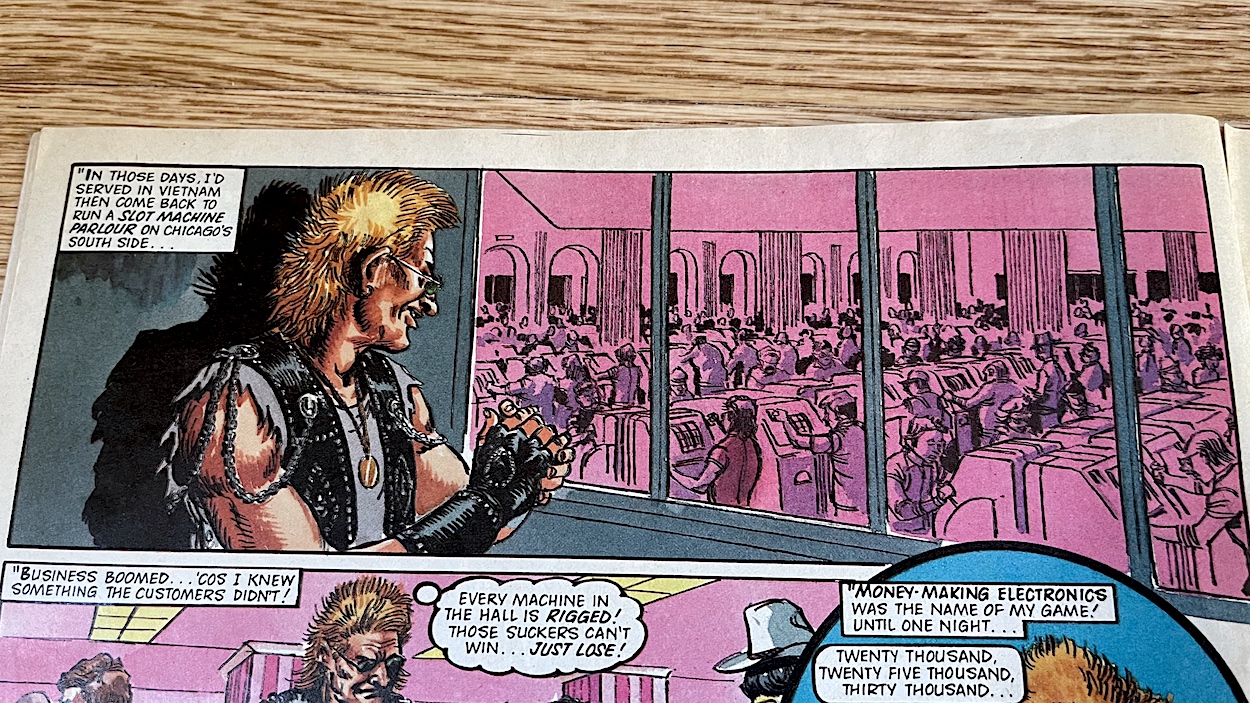
Scott Goodall‘s complete tale this issue focusses on the Skull star of the Bomber Blues serial, Hubbub the Skull Leader of Rebel Wing. We’ve seen him use his electronic weaponry in that story and here we learn of where his fascination with electricity’s power began. It all kicks off with this glorious splash page by Geoff Campion showing the kind of air battles only this comic could be capable of. The lightning, Vector’s stealth fighter powering into the scene, even another Harrier doing a daring manoeuvre with those vertical jets, it’s all there in one panel. Exciting stuff!

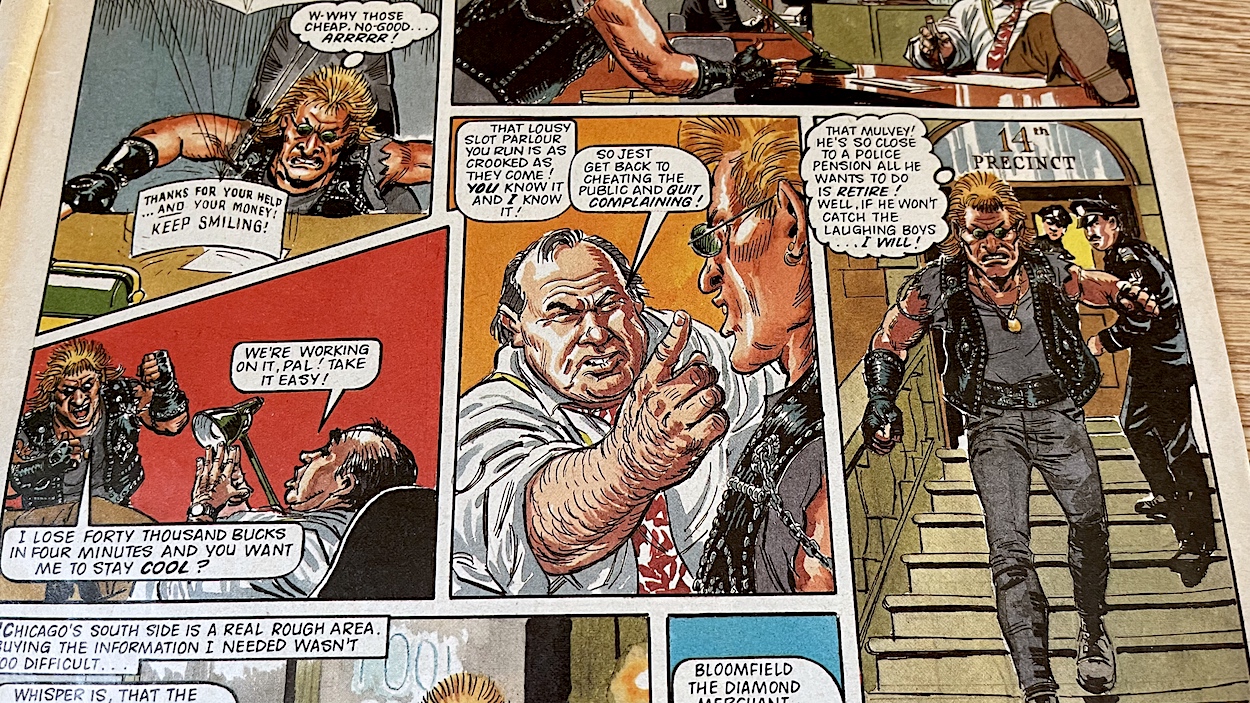
Originally the owner of a rigged slot machine parlour, Hubbub thought he was a tough guy, emperor of his own little domain. He’s also a Vietnam vet. Having fought for America he’s been left damaged by the ravages of war. This theme of the Skull Squadron was pointed out in an earlier issue. We were used to our heroes in everything from The A-Team and Knight Rider to Airwolf and Magnum P.I. being veterans of that war and we learned how it affected them. To see it played out in my toy licence comic was great, especially how it told of the horrors faced during that war turned the vets into the bad guys instead.

With all of these little details building up issue-by-issue, character-by-character, it’s all the more heartbreaking to know they didn’t get to flourish in a long-running comic where these aspects of their personalities could have been revisited in future serials. However, it wouldn’t be the last time the ghosts of Vietnam would be felt in Ring Raiders, although you’ll have to wait for the Ring Raiders Special in the early months of next year for that particular story.

Surprisingly, when he’s robbed at gunpoint in his office we see how much of a coward Hubbub actually was in the days before Skull Squadron, cowering while the thieves use harmless pop guns to escape. The police don’t care either because they know he’s a crook himself (and actually in the end this cop is the ringleader of the thieves). Through contacts in Chicago’s rough South Side he’s able to stake out the next target and hide on the roof of their van while they make their escape.

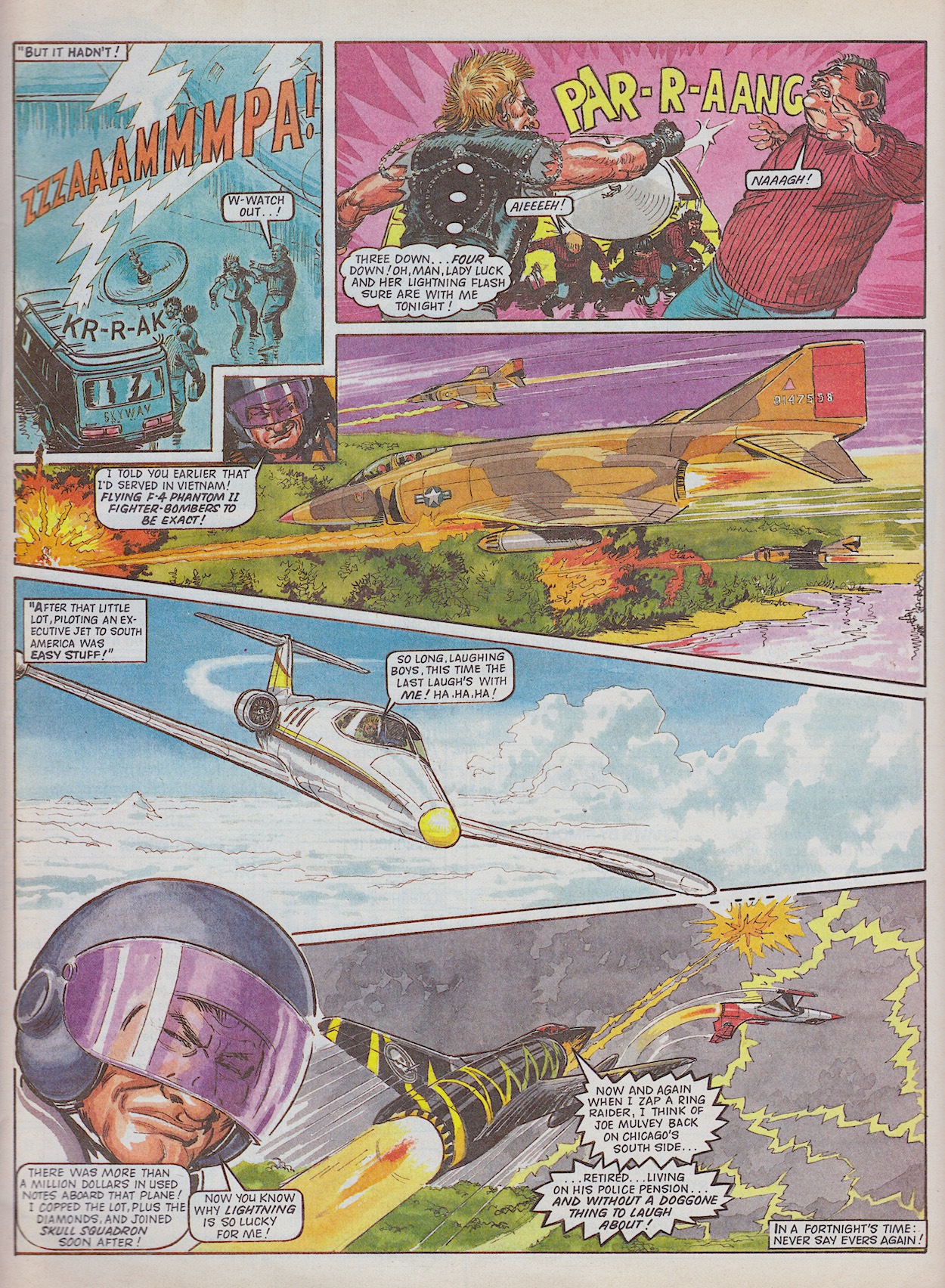
Falling off when the driver loses control on the wet runway of the airport from which they’re going to flee the country with their last score, Hubbub finds himself at their mercy, outnumbered and this time their guns are very real. It’s at this point his life is miraculously saved and thus begins the creation of the character we’d grow to love to hate; a sudden bolt of lightning strikes the metallic dish on top of the van the thieves had put there (to make it look like a repairman’s vehicle). The bolt blinds them long enough for Hubbub to make his move. We then finishes things off with a little more of his history and a gorgeous final few panels as he rounds off his tale.

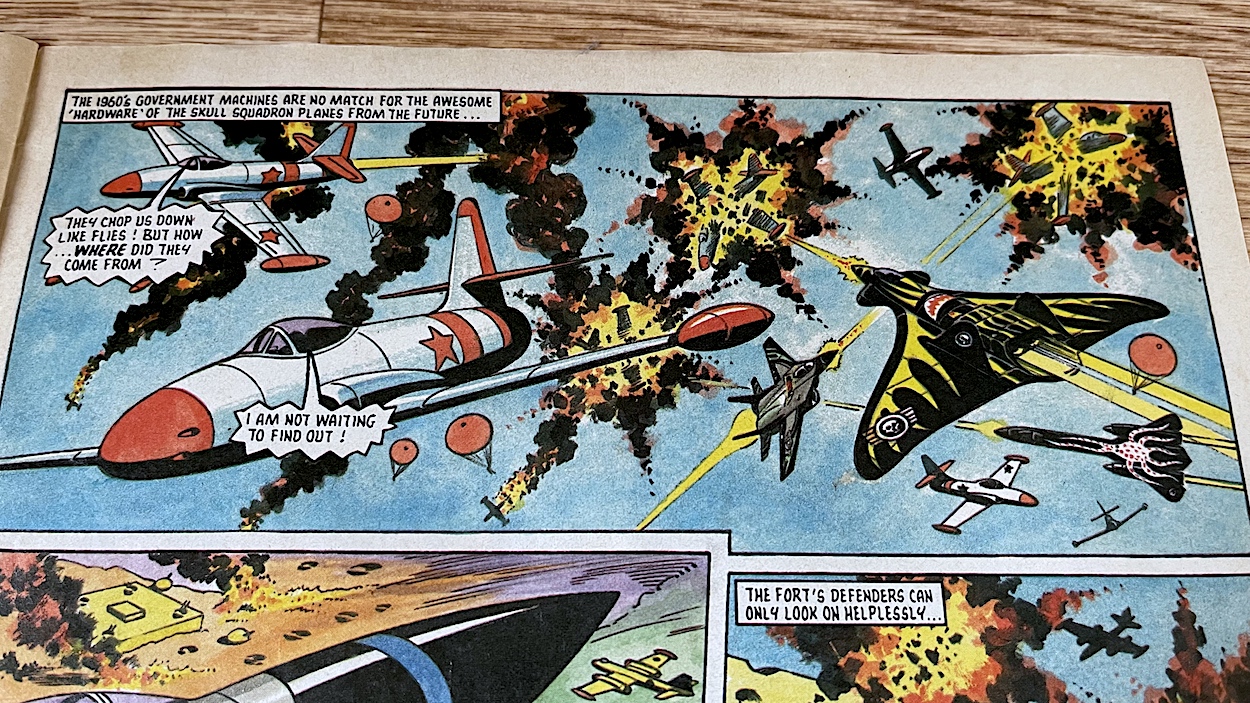
After Ring Raiders was cancelled the new year brought a new partwork to my newsagents called simply Airplane and I collected the first handful of issues. My interest was in no small part thanks to how the comic would treat these fantastical airplanes in as real a way as possible, always referencing them by their proper code numbers and names, and then there were historical scenes like these and other real world conflicts. A new series of pin-ups next issue heightened my enthusiasm too. I’ll talk more about that next time, but for now just look at those final few panels, making the transition from Vietnam to the world of the Skull Squadron via the different aircraft Hubbub used. Beautiful imagery to end an engaging and fun little story with surprising depth.

After the letters page the Next Issue promo feels retro even for this 1989 comic. Featuring a biplane, a big banner to the left and a headline along the wings of the plane, it reminds me of what Barrie might have used to promote an issue of Battle for example and I love it! If the Ring Raiders toys had been more successful I honestly believe this comic could easily have been seen as a modern, high-tech version of those classic war comics. It certainly had the writing and artistic talent for it.

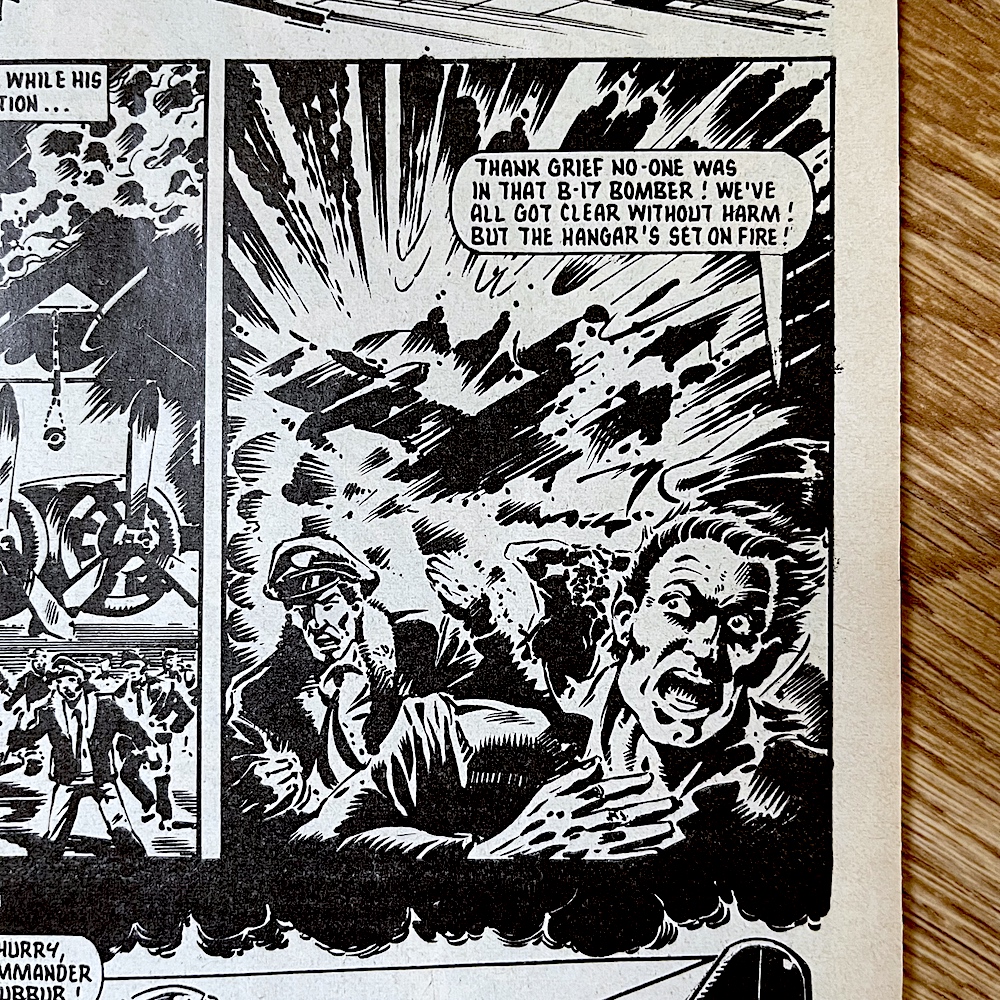
Moving on and another story comes to a rather sudden end in part five of James Tomlinson‘s Bomber Blues, drawn by Don Wazejewski. It also includes what I originally thought were contradicting actions from Raider ‘Cub’ Jones. He begins by blasting a crashing Skull plane out of existence to save Hubbub who had ejected from his own aircraft last time and was standing in the crash zone. I like this; the Raiders have a code and will always aim to capture rather than kill.

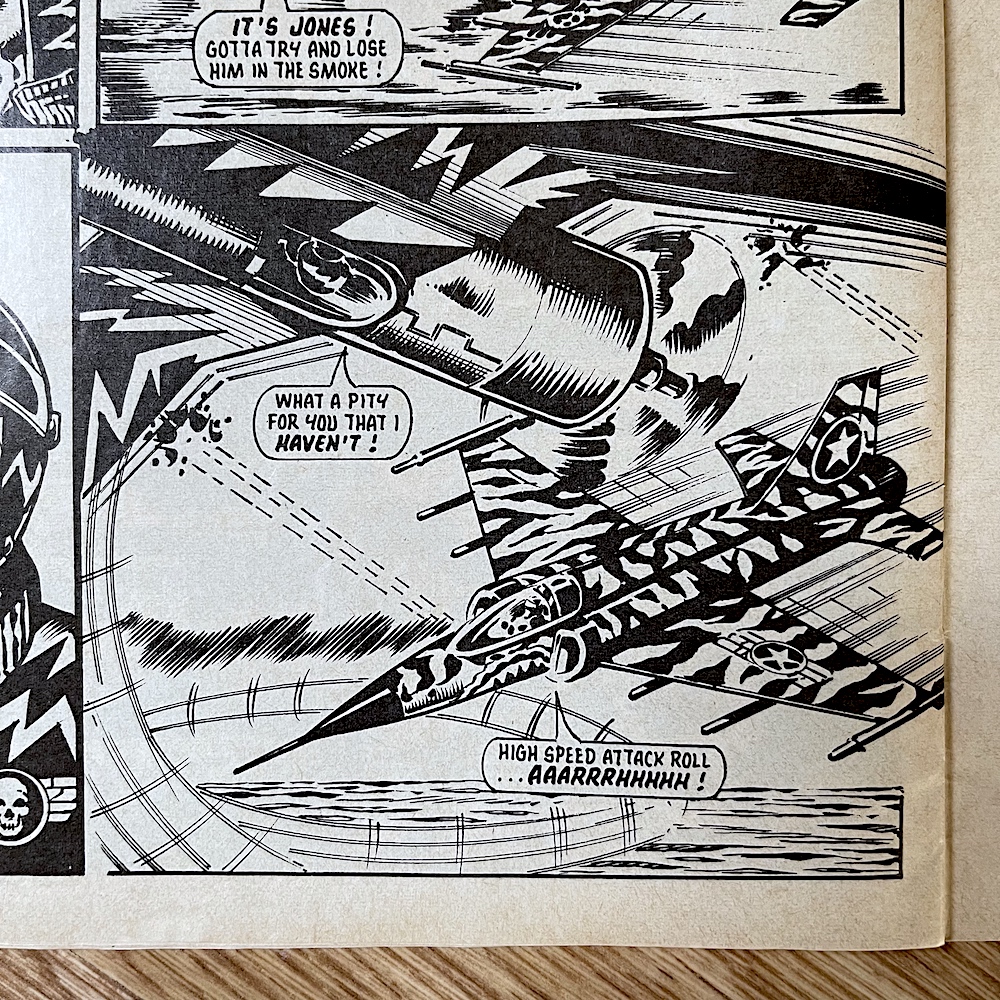
But then on the very next page he inadvertently places innocent lives in danger. One of Hubbub’s wingmen sees an opening but isn’t prepared for Cub dropping his flaps and undercarriage to drastically reduce his speed, letting the Skull pilot fly past before returning fire. It’s a neat move and the pilot ejects to safety but the plane crashes right into the airfield below, the very one Cub had been trying to protect this entire time.

The World War II pilots run for their lives and barely escape. I remember thinking this went against that code I mentioned, so why did he shoot the plane down there? The key moment here is the Skull pilot’s final radio communication. “Double engine flameout! All power lost… entering terminal dive!” In other words, he’s known he was going down and at the last moment forced the nose down early, aiming the flaming plane towards the hanger.

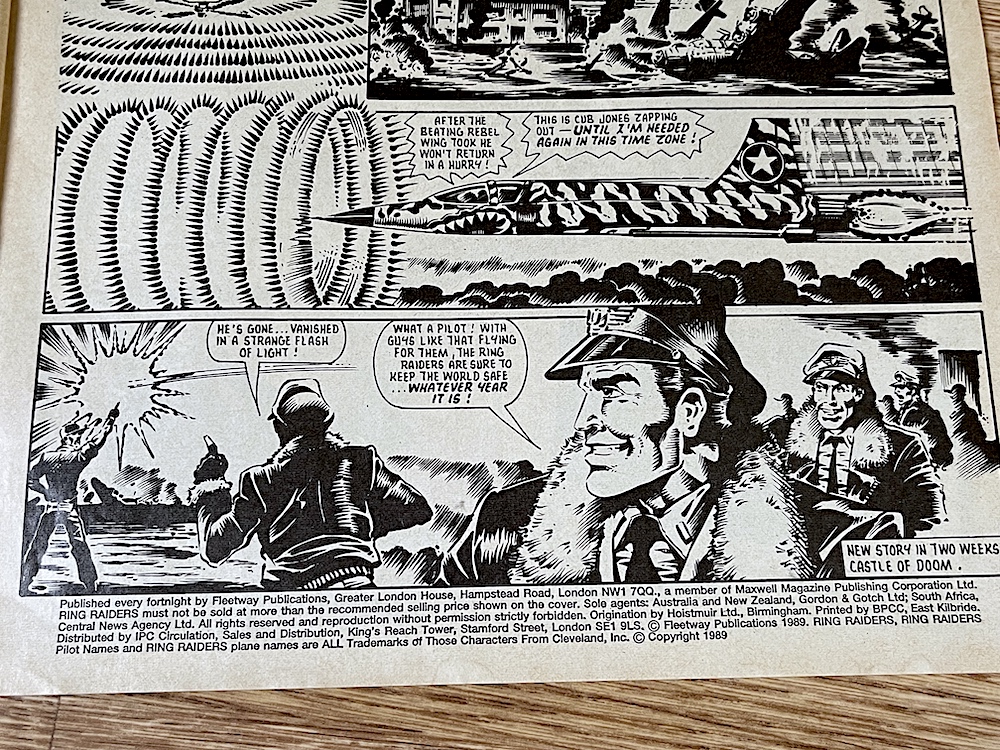
It’s certainly a dramatic twist, which makes the sudden ending all the more strange. Another wingman lands to pick up Hubbub who takes a leaf out of Chiller’s book from earlier in the issue and forces the pilot out, taking the airplane up alone to face off against Cub for the final fight (leaving the pilot in the middle of World War II I’d assume). There are some great acrobatics as his slow prop plane tries to angle itself into the path of the jet but ultimately he flies out of the time zone in retreat. We’re now down to the final few panels and Cub opens up a time jump too and simply signs off!

He disappears, leaving the wreck of the airfield behind him, telling the men he’s befriended that he’ll see them again when needed. He could at least have helped with the clean up. To be honest, Bomber Blues has been a blast from the start and Cub’s affinity for the people battling in the time zone he was originally plucked from was something I would’ve liked to see return in a later issue.

I do think this final chapter could’ve been split over two issues though, so that it could’ve included at least a page of some kind of epilogue. As it stands, it’s still a great action-packed story notable for taking place almost exclusively in the air, the ending is just a bit rushed.

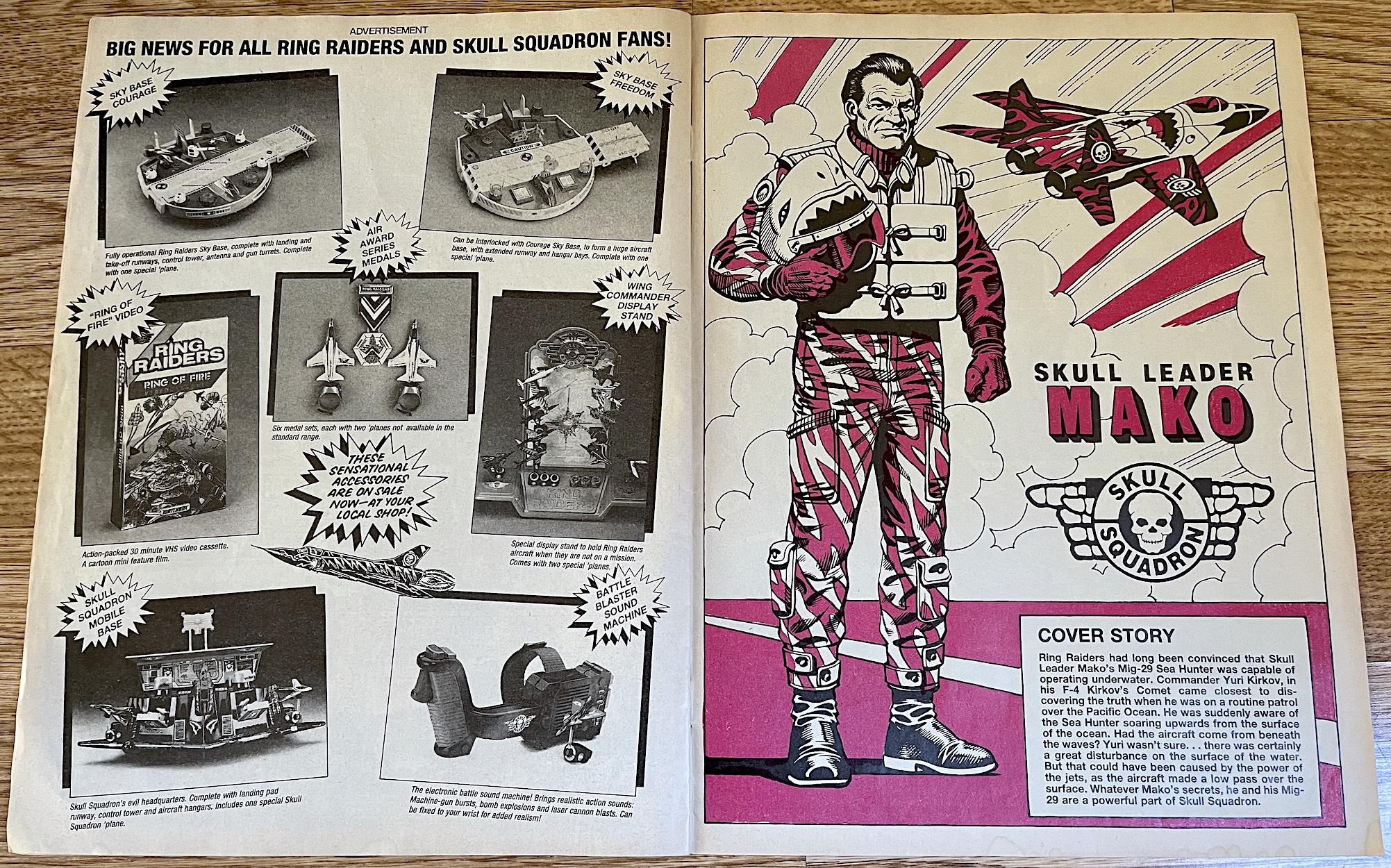
This issue’s advert hasn’t got much in the way of original art this time that’s for sure, just a tiny F-9 ‘Sky Tiger’ taken from Bomber Blues. But what it does contain is a lot of memories. Looking back at this I’m thinking, “Oh I had that, and that, and that!” In fact, I had everything shown here! Well, except my Battle Blaster was a Ring Raiders model and not the Skull Squadron one.

I can remember opening the giant boxes for those three bases on Christmas Day, although unlike the photos here (or indeed the images on the box) my Sky Base Freedom was just the Sky Base Courage mould painted another colour with different guns. (I see in this photo some of its accessories are missing too.) Those are some very happy memories, only marred slightly with the knowledge the comic had already finished.


“Mako got Baker in that last scrap over the fort, Commander! Didn’t see him bail out!”

Tremlet, Freedom Wing

While Mako and Yuri Kirkov both made the cover it wasn’t in relation to their strip. Perhaps that’s a sign they were arch enemies, destined to face off time and again. For now, Tom Tully‘s Freedom Flight continues with part six and the fort is on its last legs with Mako leading the rebel planes in a spectacular assault as presented here by Sandy James. Mako and his men easily take out the government planes, leaving the ground forces at the mercy of the rebels.

Kirkov’s plane is nearly repaired, catastrophic damage from Mako’s previous attack being averted thanks to his use of the ring last time, and he’s frustrated as he helplessly watches the battle unfold. Interestingly, he uses his ring to power the monitors and surveillance cameras of the fort which had lost all electricity. Getting impatient he finds out that repairs have stopped because of a very simple reason: it’s 1966.

His incredible F-4 ‘Comet’ is from another time and the ground crew have never seen anything quite like it. They’ve been able to slap together repairs on the physical damage but when looking at the hydraulics they come across computer circuits and controls like something that might as well be from a sci-fi movie for them. I liked this small bit of technical information and it brings up a conundrum with the whole time travel thing. Little scenes like this show the writers are thinking the time travel aspect through properly. Yes, it’s all fun and far-fetched nonsense, but ground that nonsense with some moments like this and you can inject real jeopardy into the fantastical set up.

Kirkov takes a gamble, assuming that after the physical repairs all that’s needed is a little bit of power, something that normally would be out of the question but which the ring may be able to provide (as established with the fort’s equipment). There’s a rather corny caption to go with it, but apart from that it’s another enjoyable episode. It’s the only story so far to use the ring for its main purpose and we saw how it could have a detrimental effect on the pilot last issue. I’ll assume here it’s more like jumpstarting a car.

By this stage all of the members of Freedom Wing have been named and we find out Baker has been shot down, with no sign of a ‘chute. We’re left to presume one of the Ring Raiders has been successfully killed by Mako as they fly to a three-on-three battle next issue. High stakes indeed. In fact, Freedom Flight and Trackdown both have the highest stakes for our characters and a real feeling of peril, and it’s because of this that they’re my favourites. So far anyway.

From memory the next issue is the best of the run but of course it would also contain the very worst news imaginable. You can see how it manages to both thrill and sadden when the review lands on the blog on Thursday 25th November 2021.

iSSUE FOUR < > iSSUE SiX
RiNG RAiDERS MENU