RiNG RAiDERS #2: iN THE BATTLE ZONE

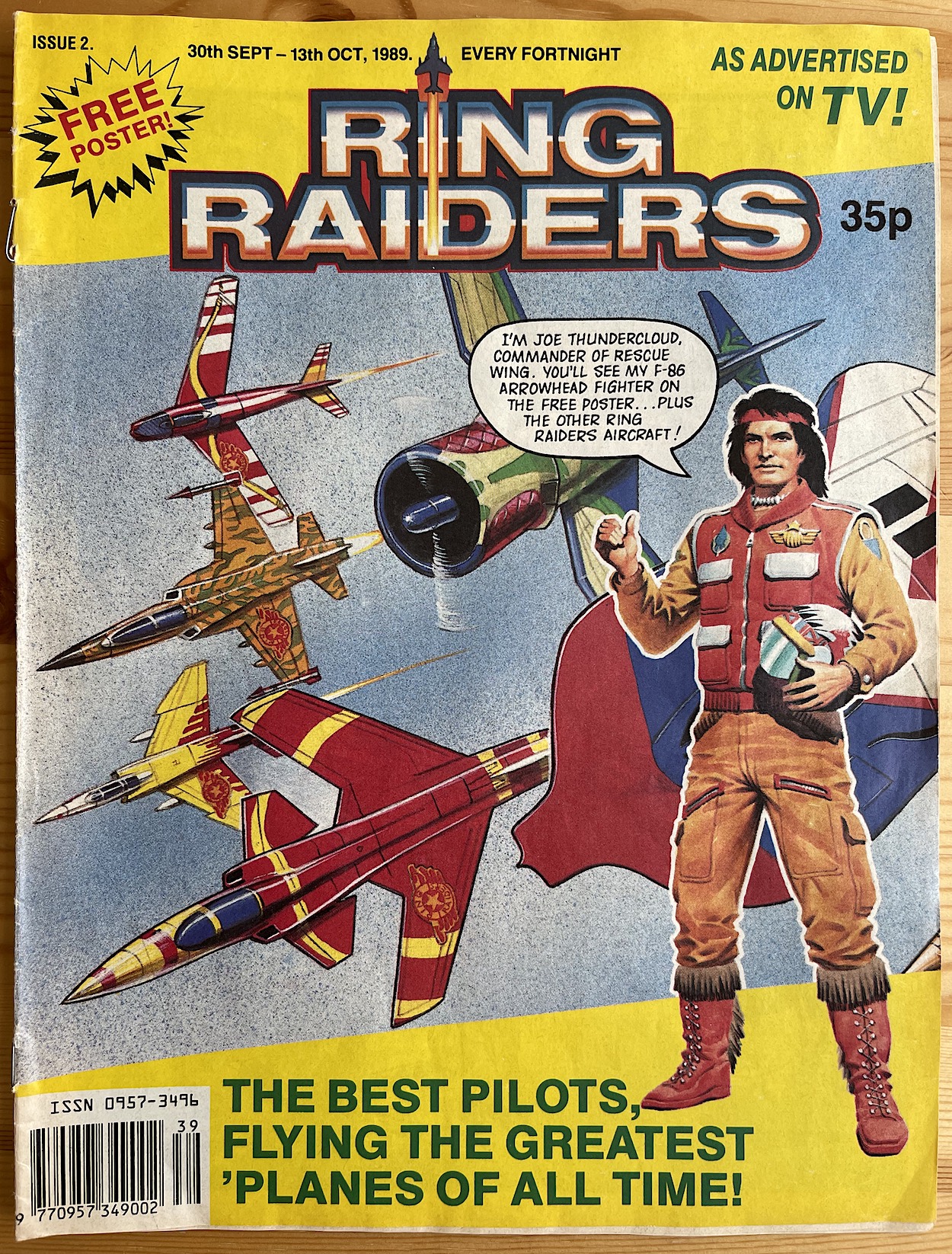
I’ve a distinct memory of reading this issue of Ring Raiders on the school bus and hearing one of the older kids behind us proudly proclaiming, “I’m Joe Thundercloud!” at the top of his voice. Ian Kennedy contributes that sole figure with the free poster taking centre stage. (You’ll see #3’s poster next time.) They were proper gift posters, separate from the comic and I had mine up instantly. My collection of planes was growing, I knew certain large boxes in my parents’ bedroom were bases for Christmas and this was my first reserved issue of the comic. These things had me hooked.

Inside, things kick off with a new multipart tale written by editor Barrie Tomlinson and drawn by Carlos Pino, Battle Zone ’99. The Skull Squadron pilot causing havoc here is Skull Commander Chiller and with this story he immediately became my favourite baddie. I’m sure I wasn’t alone. What kid wouldn’t love a jet with a sci-fi freeze ray? Chiller would love experimenting with various killing methods involving cold and ice and it would appear he fired up the imagination for the writers too, as he would star in more stories than anyone else.
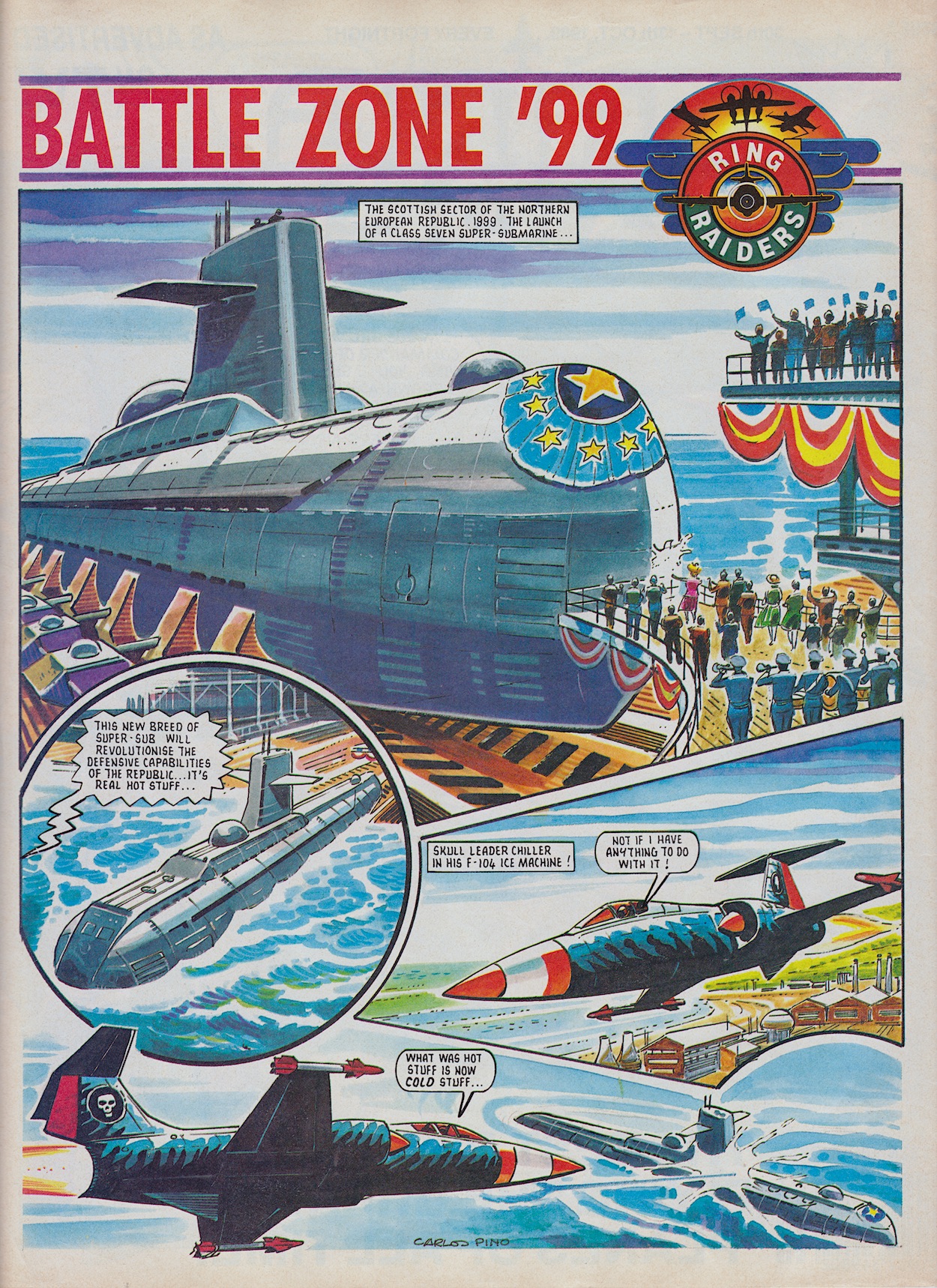
Launching an attack on a futuristic gravity-powered submarine by freezing it, making it brittle, then destroying it with a well-placed missile, he kills the entire crew. This toy comic wasn’t afraid to show its baddies actually being bad and killing innocents to meet their foul goals. In the year 2057 aboard the Air Carrier Justice the Ring Raiders get a warning that a moment in history is being changed by the Skulls and they set off to rescue the second submarine.

There was going to be a Northern European Republic and Scotland was very much a part of it. It feels somewhat prescient

Interestingly, it appears they can’t just set their time travelling planes to appear at any moment they want for fear of altering history further. Instead, once the alert is received via their rings that particular moment in time continues to play out as our heroes scramble. Fans of Doctor Who will know all about how she can’t simply rewind moments in time once they’re in motion and it’s interesting to see this was also part of the rules here.

In this version of our world there was going to be a Northern European Republic and Scotland was very much a part of it in 1999. The Victor Vector strip later in this issue is set just one year prior and there’s an appearance by the British RAF. So I can only assume Scotland had become independent and joined the European Republic, with England (at least) outside of this union. It feels somewhat prescient, doesn’t it?


“Some people believe that Sea Hunter is capable of operating underwater… and I’m one of them!”

Ring Commander Victor Vector

Moving on to the second strip and it’s the ace Trackdown written by Angus Allan and drawn by John Cooper. Professor Deke Martin‘s Doomsday Device is thankfully mobile and the unnamed toy pilot Freddie Riley is taking it and the professor deep into the woods to buy time while his wing, led by Thundercloud, tries to dispatch Havoc Wing. By the end of the story two planes have been destroyed and another original comic character is out to track down the device. It was always a thrill when the comic created these characters for our other toys.
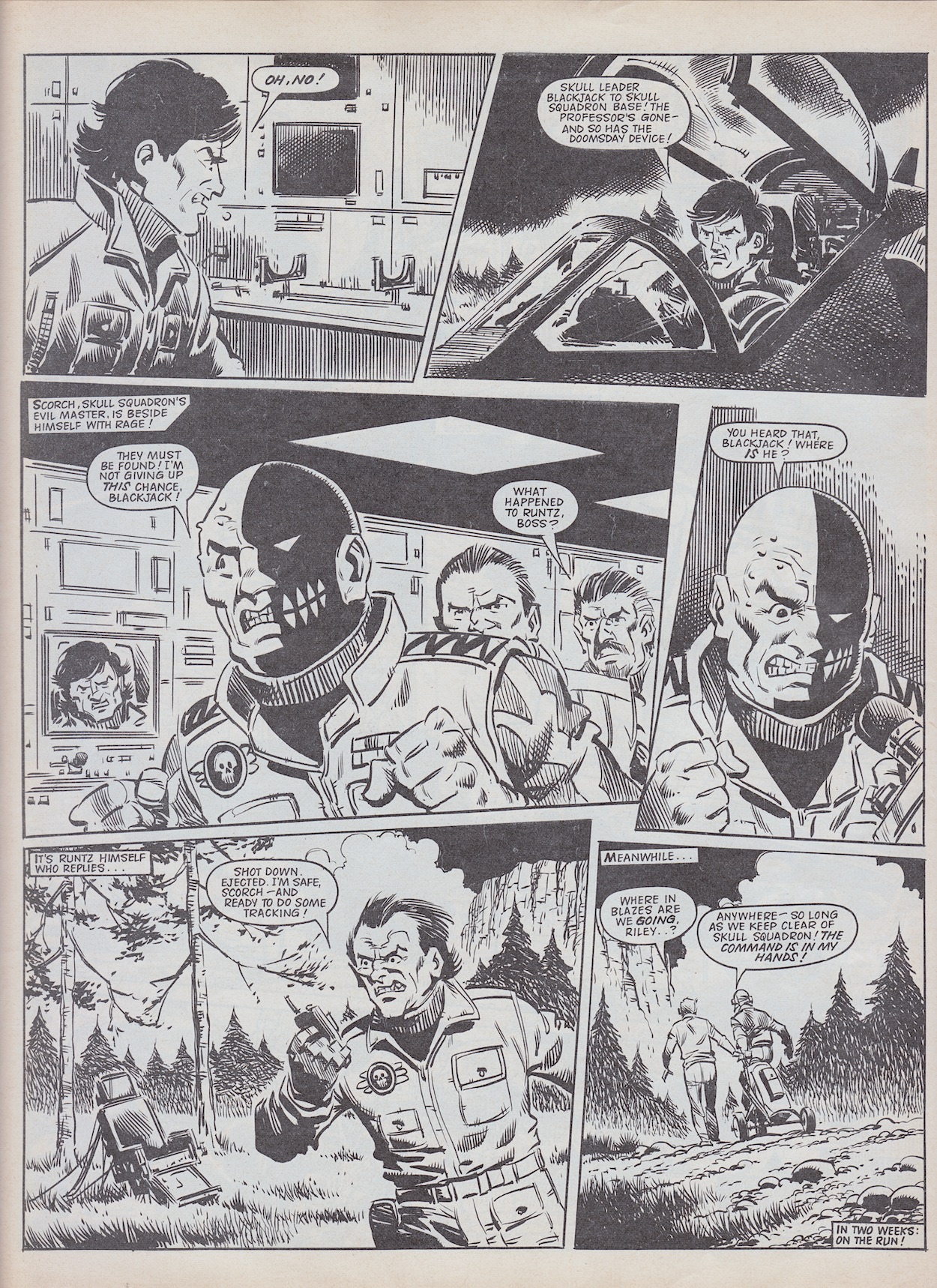
What stands out the most is the amount of ground action that occurs and the level of characterisation being slipped in, in just four pages. The military characters interact realistically, grounding the fantastical set up and giving the aerial action a real feeling of danger. Especially when we’ve seen so many shot down already. We also see Wing Commander Thundercloud break off and order his men to return to base and all we’re told is that his instincts have come into play. So for now his apparent abandonment of Freddie is a mystery. Colour me intrigued by this layered storytelling.

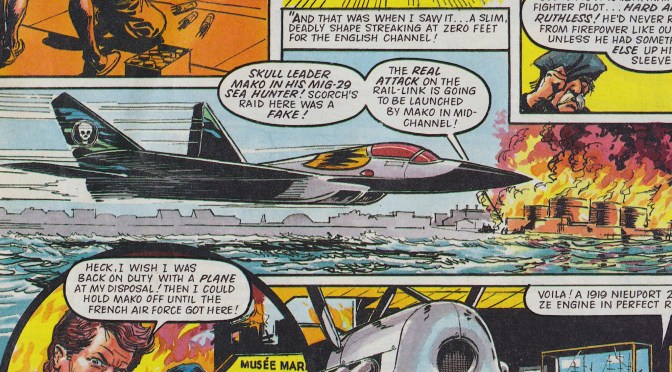
Back then, leader characters in our toy ranges and cartoons were somewhat clichéd, a caricature of what either side stood for. Compare the 80s cartoon Optimus Prime to the nuanced, troubled version from the movies and you’ll see the difference. Ring Raiders is off to a good start in this regard. Moving in to this issue’s complete story which focusses on a moment from Ring Commander Victor Vector‘s past, showcasing his strategising and leadership qualities in a unique way. He’s on holiday from the British Royal Air Force (in the comic he’s British it would seem) before his Raiders days, and Skull Squadron attack the French side of the recently completed Channel Tunnel in the year 1998.
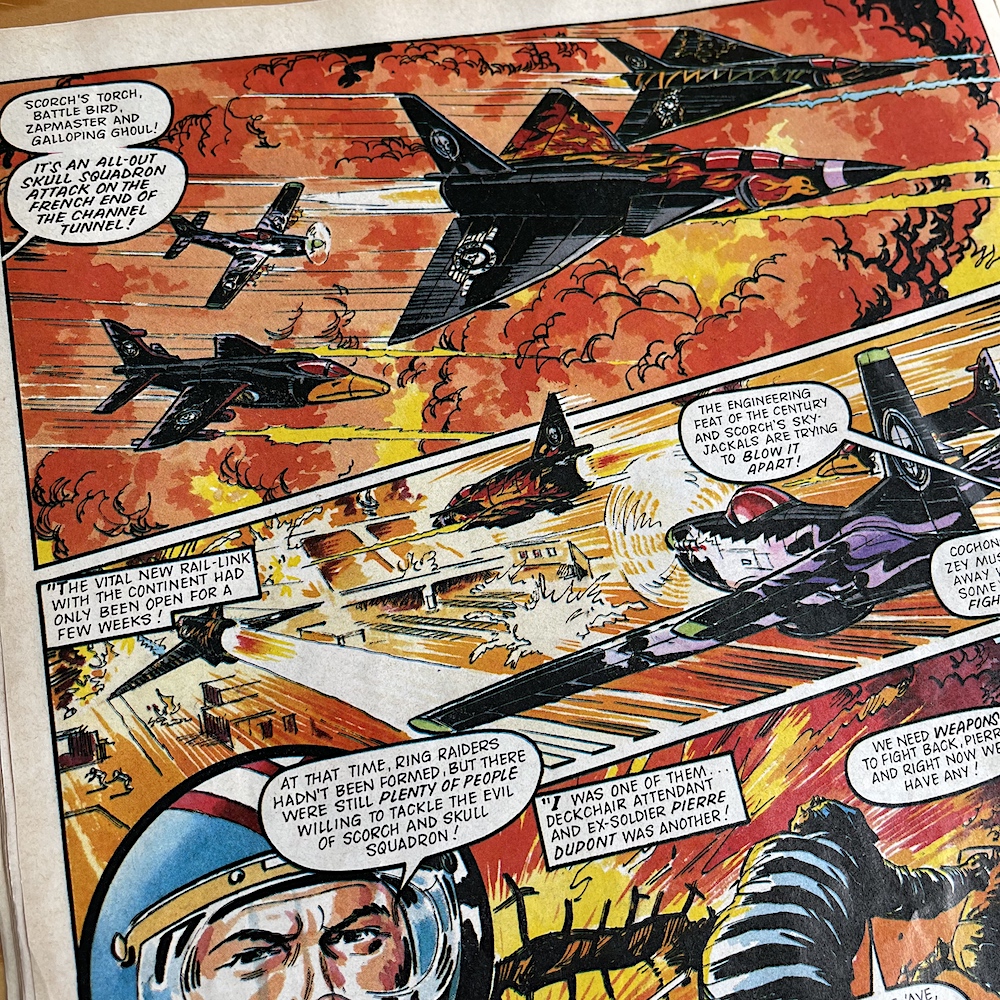
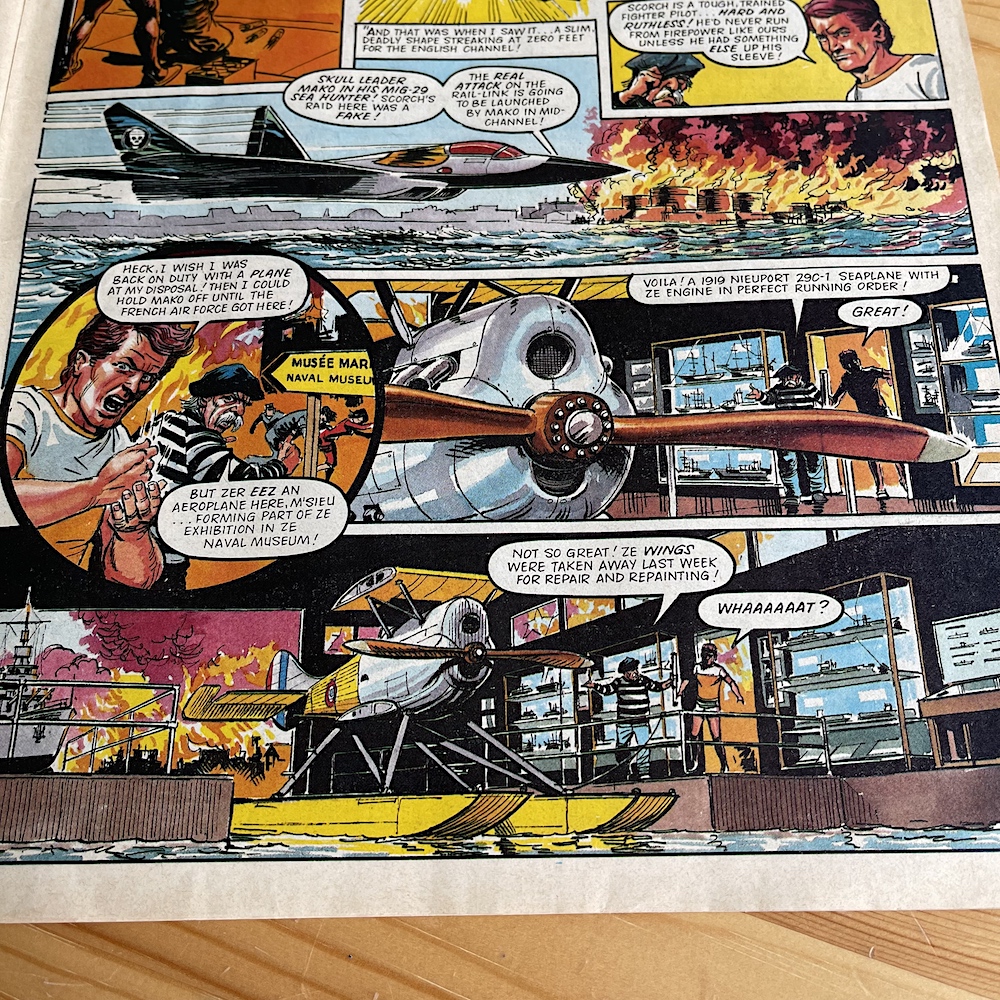
In the real world the tunnel was completed in 1994 so it wasn’t a bad prediction and I remember the regular British tabloid attacks on its construction being headline news around the time of this comic. With no plane at hand Vector befriends a local deckchair salesman who leads him to one. Sort of. I laughed at this I’ll admit.. The comic isn’t short of well written humour.

This is great fun and involves Mako‘s Mig-29 ‘Flying Shark’ which (as I touched upon previously) was one of my top toys in the range because of its shark motif and the apparent ‘rumour’ it could be flown underwater. As you can see here it’s no rumour as he begins to drill down to flood the tunnel. Vector also believes it’s true after apparently shooting Mako down with a handheld rocket launcher, however it’s a fact the readers would be in on but the Raiders could never verify.
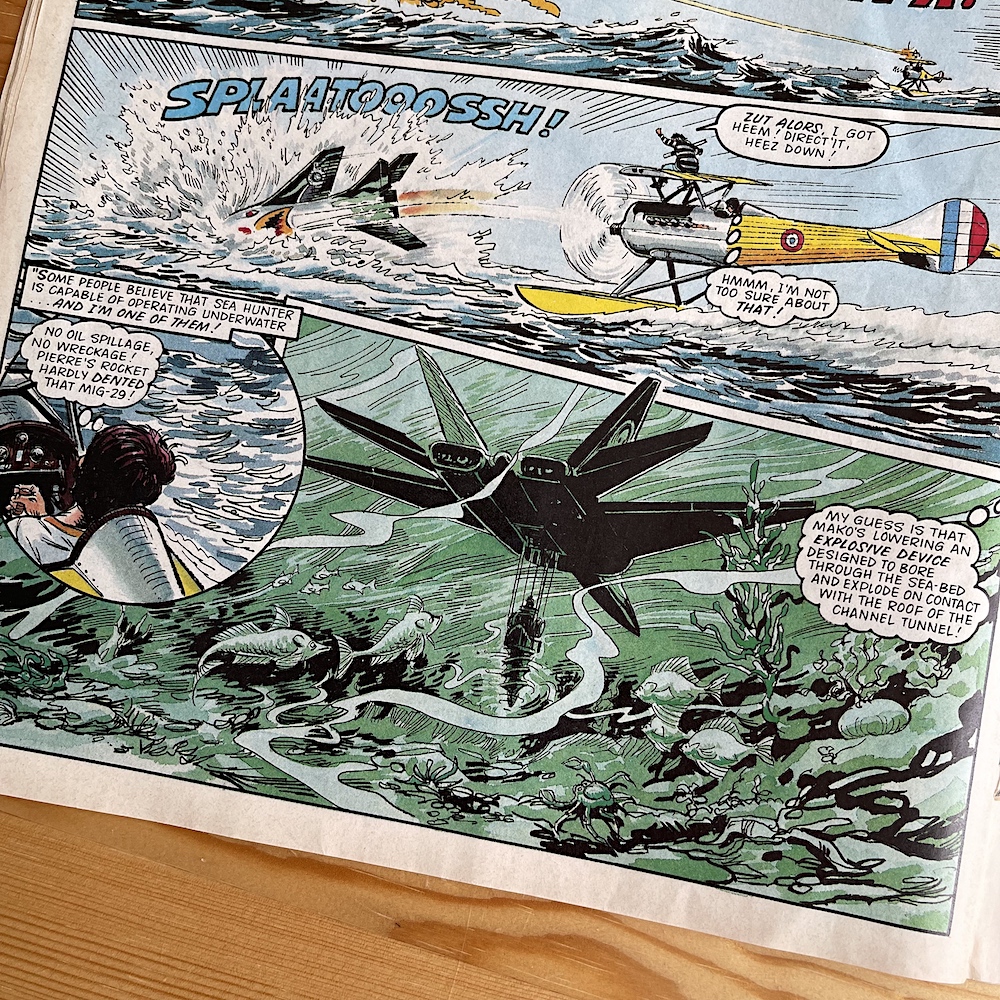
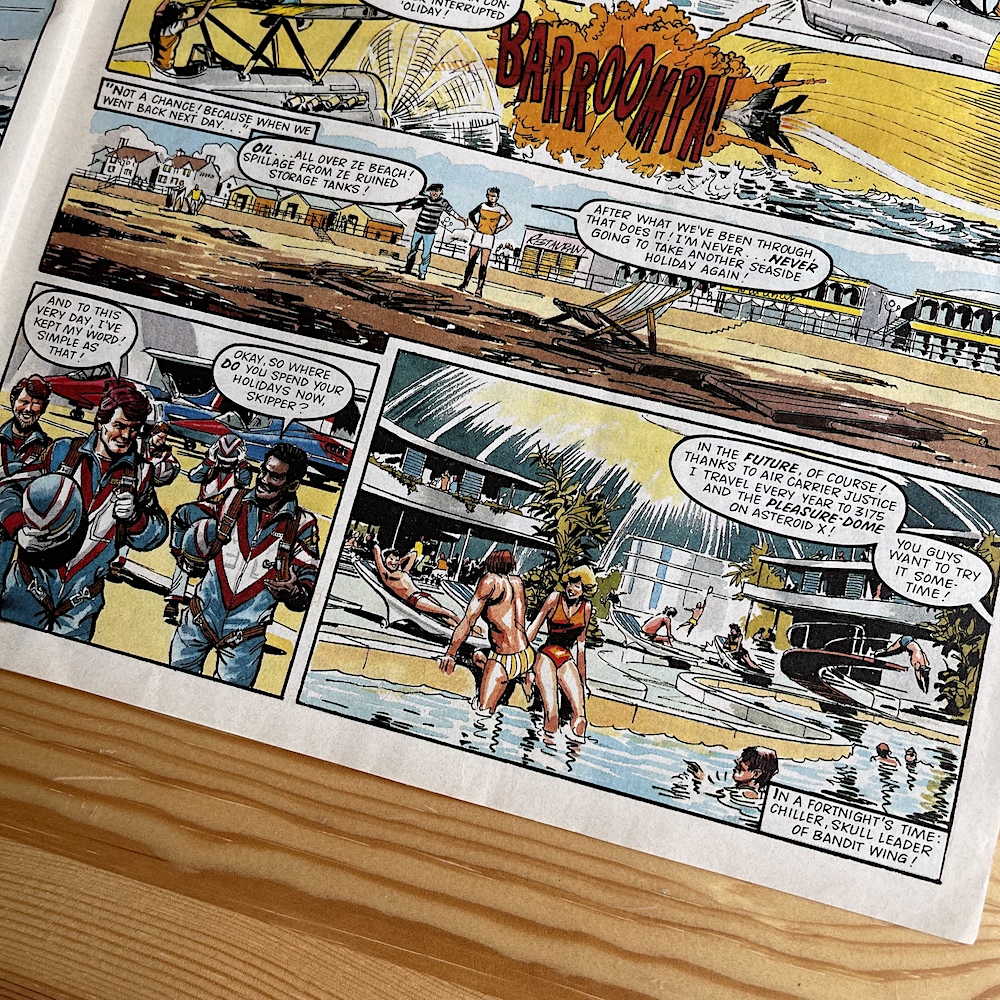
It’s written by Scott Goodall and expertly drawn by John Gillatt. It has a Flight of the Pheonix feel to it, with added sci-fi elements thrown in, that ghostly underwater sequence, great action, a topical subject for the time and a little bit of comic relief. I also love the ending when we find out the entire flying aircraft carrier makes a trip far into the future just to drop Vector off for his hols! It’s a shame we don’t get the chance for more development for him (or indeed, more development for everyone) due to the short lifespan of the comic and the ensemble nature of the cast, but I have enjoyed this softening of his character.

Obviously there’s still no content for the letters page because of deadlines in getting this issue to print, so instead stars of two of the issue’s strips introduce one page apiece. They outline the history of both sides of the conflict and request input from readers in all its various forms, for editor Barrie and editorial assistant Terry Magee to sort through.
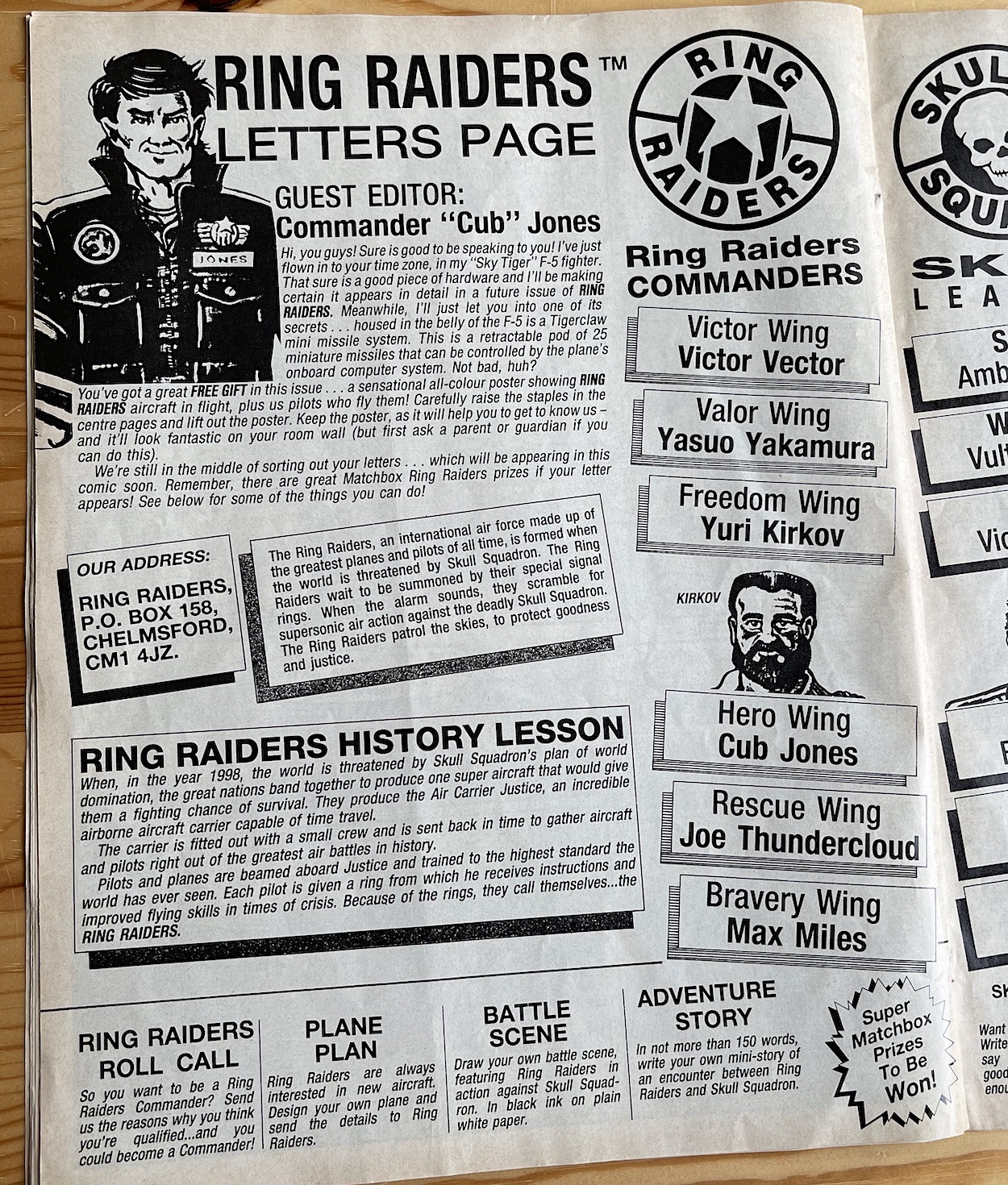
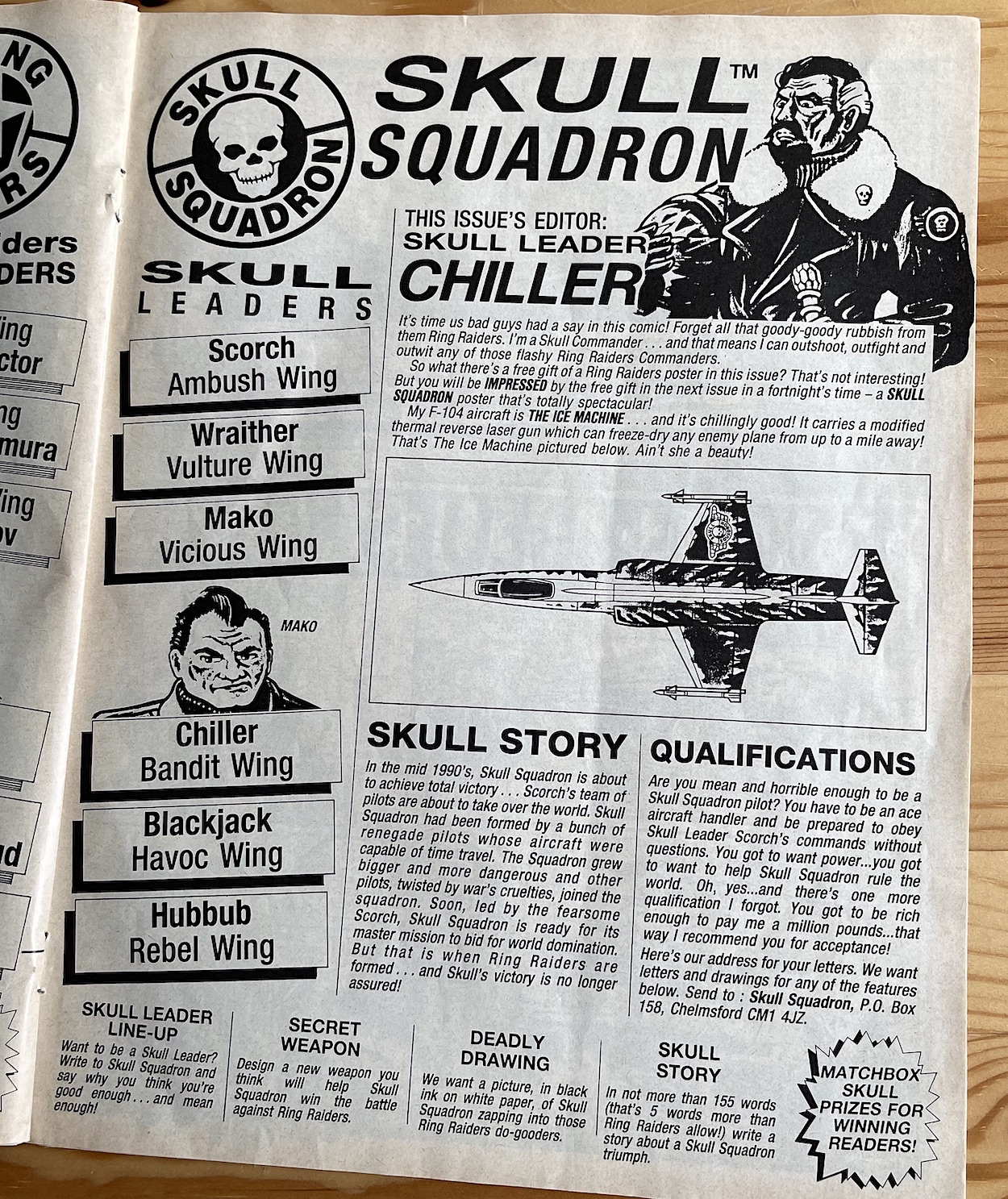
It appears the Ring Raiders were plucked right out of raging battles (which fits in perfectly with ‘Cub’ Jones’ affection for the bomber crews in the next story) and there’s a little hint for readers of some of the additional abilities of their rings, something toy collectors were already aware of but it’s nice to see a certain one mentioned given how this issue ends. The little throwaway line of how Skull Squadron recruits had been “twisted by war’s cruelties” hints at possible future character plots too.

Cub is back in the war he was plucked from in Bomber Blues which makes a surprise return as an ongoing story after last issue’s apparent one-off. Following what was now clearly a prelude, Skull Leader Hubbub‘s Rebel Wing return to take their revenge on the crew who rescued Hero Wing, unaware they were grounded after their fantastical tales to their superiors. Nor is he aware they’re also in possession of a signal ring to summon Cub and his team.
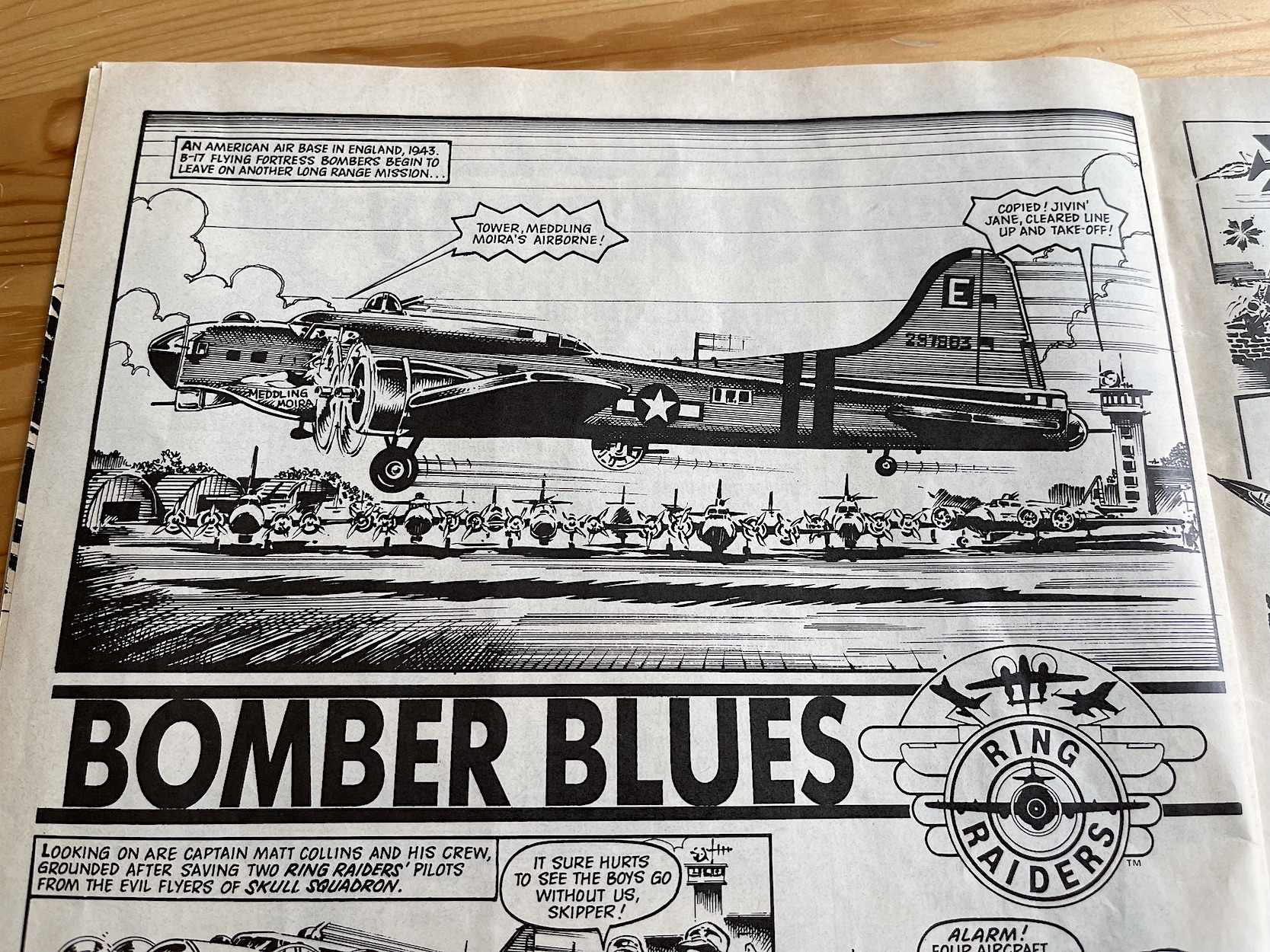
I’m so happy to see this story continue. The premise is just too good to leave at one issue. Writer James Tomlinson‘s fondness for the subject matter and Don Wazejewski‘s art style are just perfect and there’s a true vintage war comic vibe going on here, even with the mixture of aircraft and electronic weaponry.

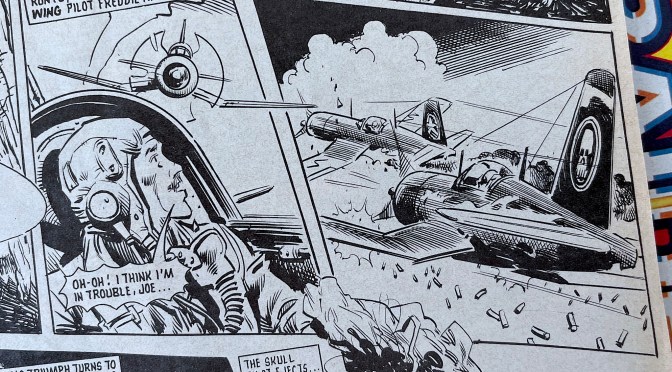
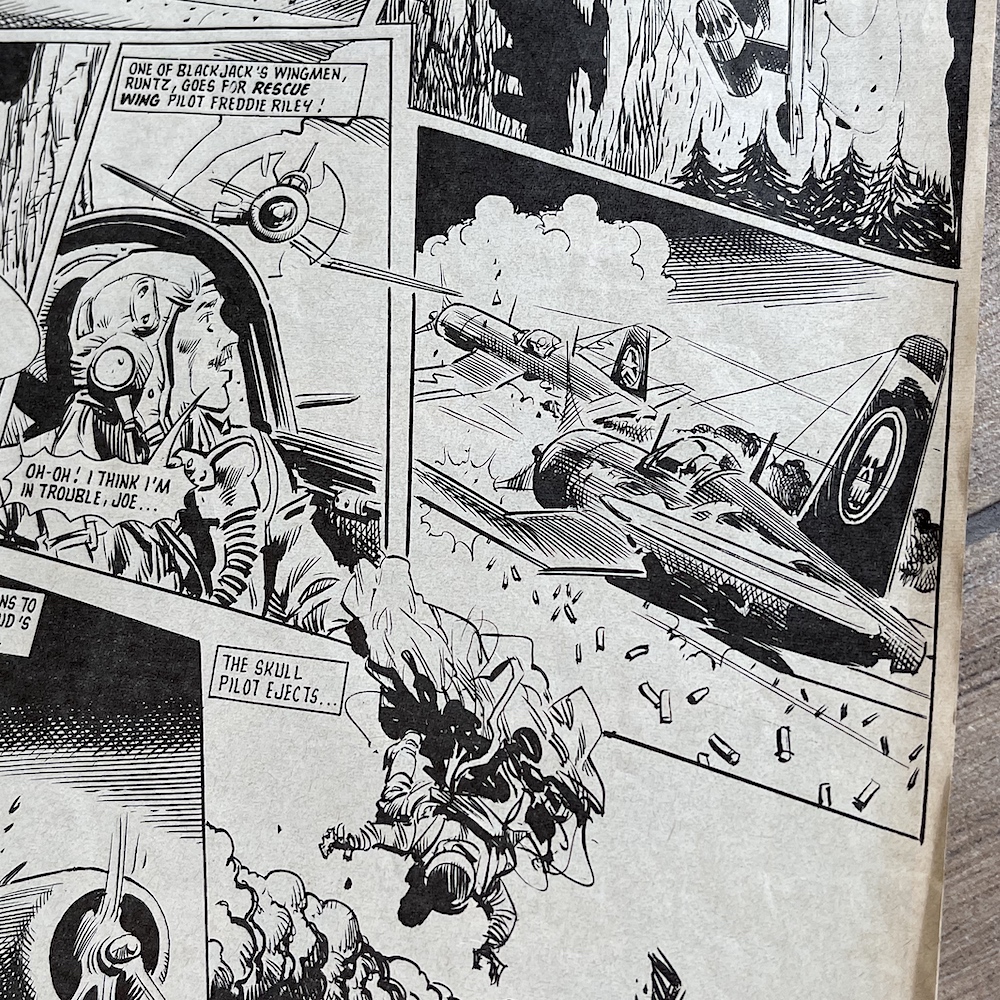
In the toy packs there could be a mix of prop planes and jets and I often thought how on earth did they fly in formation together? Well they don’t, instead each is used for a particular purpose. For example the prop craft often being brought in for low-flying raids on slow moving targets or navigating close to difficult terrain. This is what happens when someone who knows their stuff writes for kids. I mean, just look at this glorious action panel!
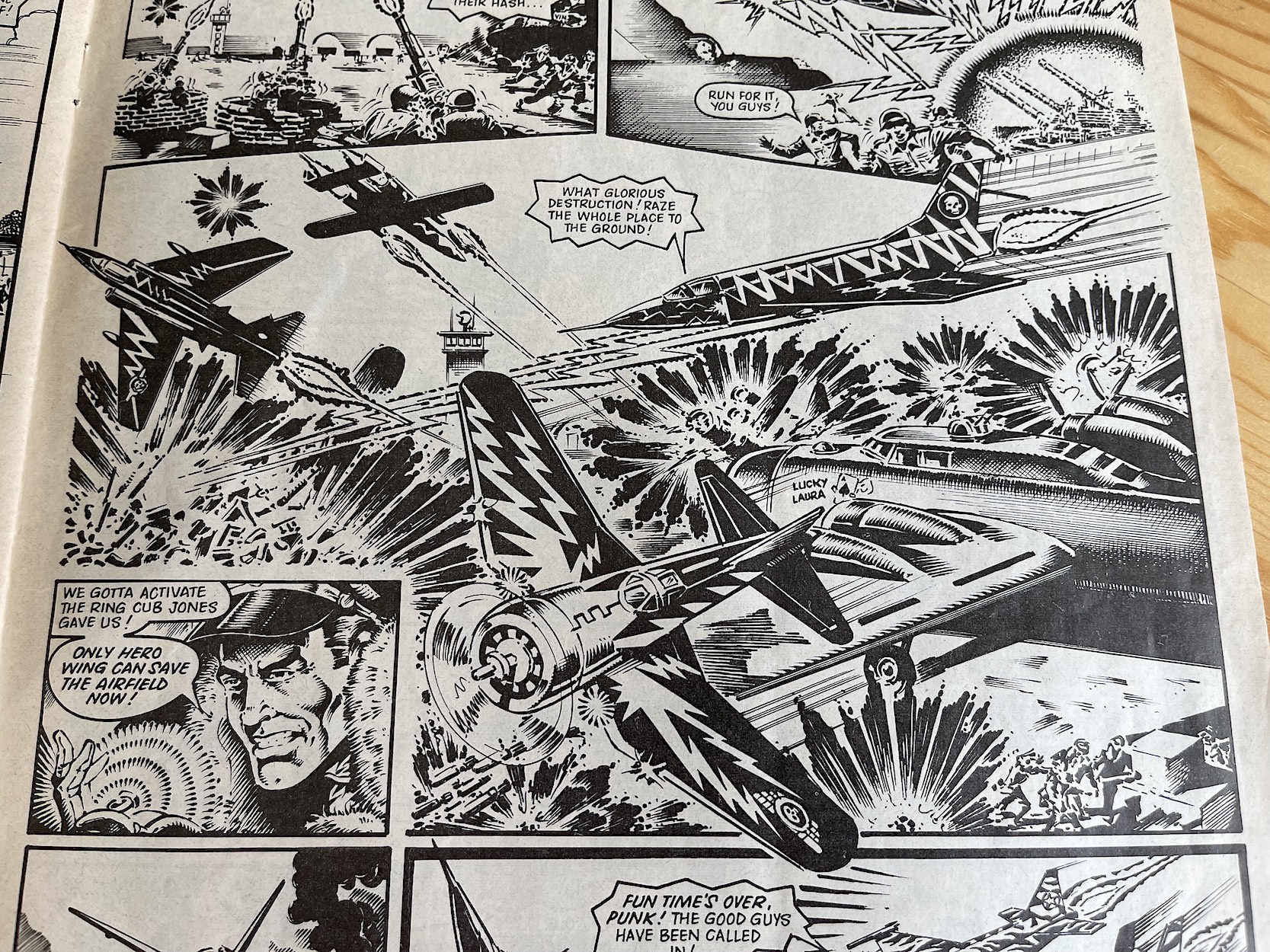
The comic certainly wasn’t shy in destroying the planes we were playing with either. Throughout this issue about half a dozen altogether are outright destroyed, giving an air of jeopardy to the stories. Instead of vast battles where no one actually gets shot down or injured as we’d see in our cartoons, here anything seemed to go.

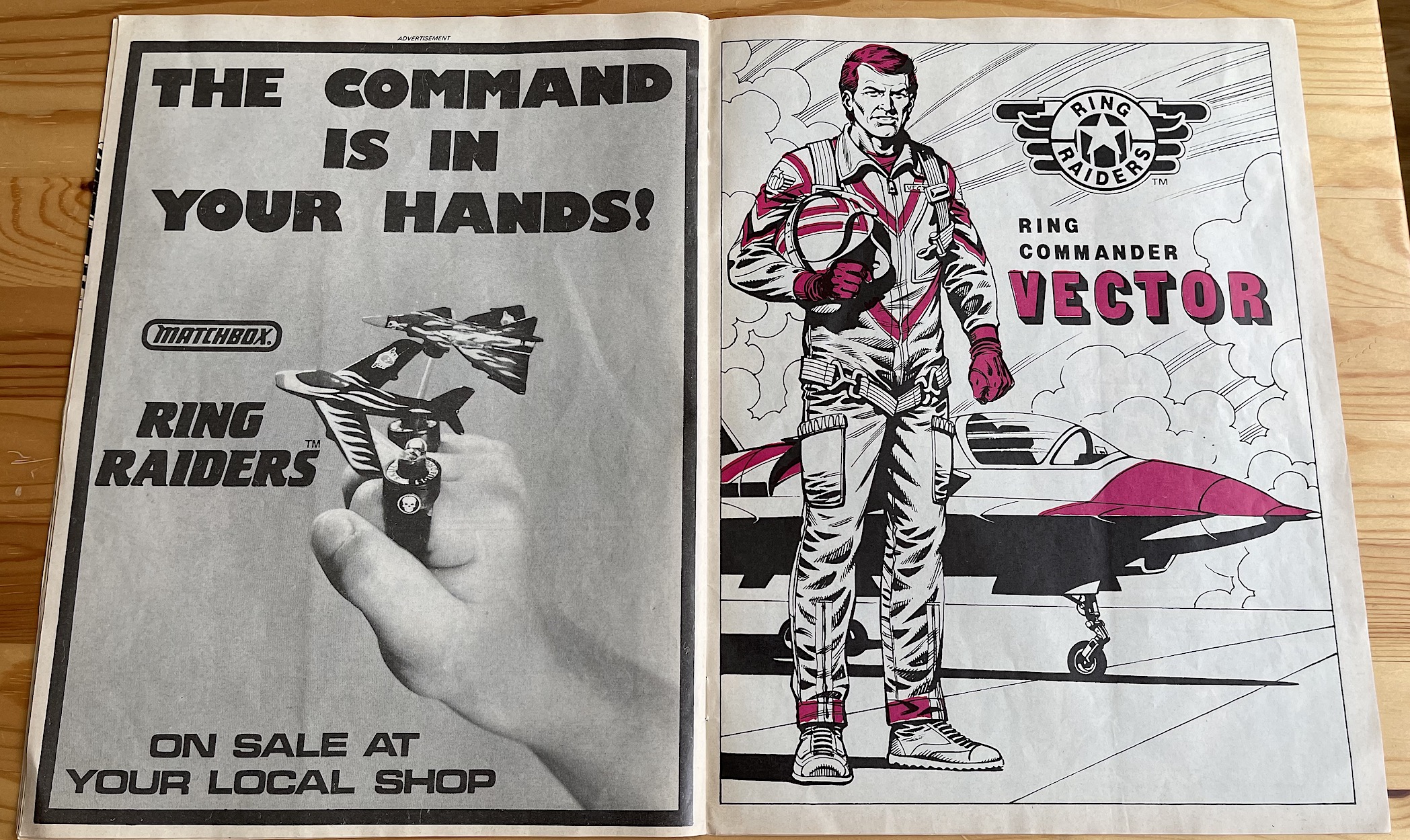
Before the final strip we’ve an advert for the toys and a pin-up of Vector. The advert is very basic and appears to have been put together by the comic itself rather than Matchbox, but they’d get more creative in future issues, even incorporating new artwork by Sandy James. Speaking of Sandy that’s his work on the pin-up before the full-colour second chapter of his story, Freedom Fight.
As part two commences the fort’s soldiers are frozen in fear at the futuristic aircraft and the rebels, though just as confused, see their chance and charge the fort. What’s compelling here is finding out another rule to the overall story, and that’s how the Ring Raiders must never fire upon or harm anyone caught up in Skull Squadron’s plots, even if those people are firing upon them.

This leaves Commander Kirkov in a predicament. How can he push back the rebels without opening fire on them? He can’t take sides, he’s just trying to preserve history as it was originally written. Writer Tom Tully uses the unique features of the plane mentioned on the toy packet to great affect here and has Kirkov blast the ground with his laser cannon, setting it on fire and stopping the advance. It reminds me of some classic set pieces from Airwolf, which is perfectly fine by me. Sandy’s bold colouring is spot on here.
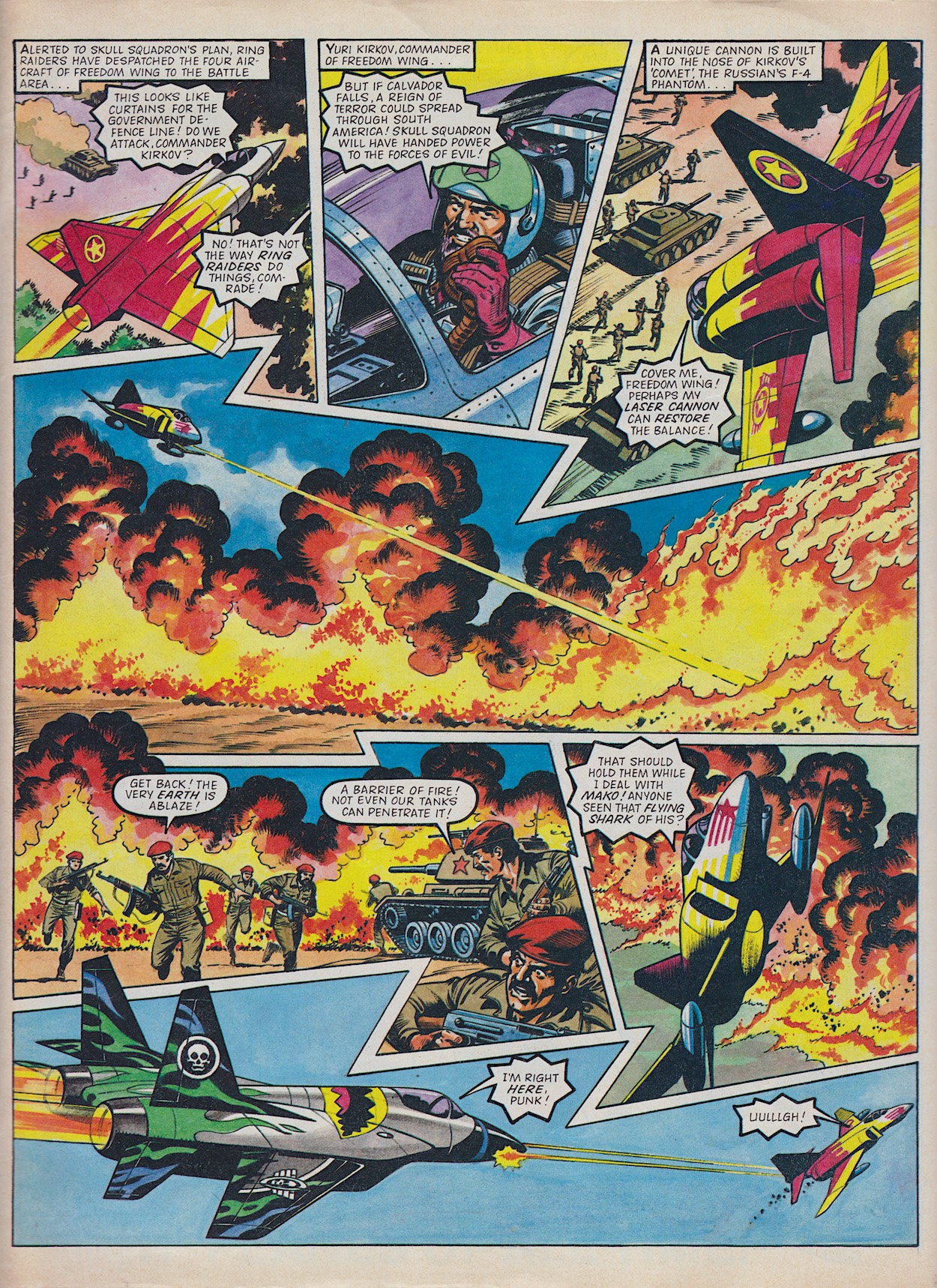
Once again the comic ends on a riveting few pages, finishing with Kirkov’s ‘Comet’ F-4 Phantom on fire and plummeting towards the very fort he’s trying to save. The final caption simply reads, ‘In A Fortnight’s Time: Flying on ring-power!’ Look back at that letters page preview and you should know why I was so excited to get my hands on the next issue back in October 1989. In fact, I can’t wait for it now!

I think I can say with confidence Ring Raiders had a very firm foundation to its universe, characters and stories even at this very early stage. Building on the basics from the premiere issue, Barrie and his team were wasting no time in exploring different characters, scenarios and the various kinds of aerial action they could depict. It honestly feels like its writers and artists were having a whale of a time with the subject matter. I know I am.

Don’t be late for #3’s departure, right here on the OiNK Blog on Thursday 14th October 2021.

iSSUE ONE < > iSSUE THREE
RiNG RAiDERS MENU

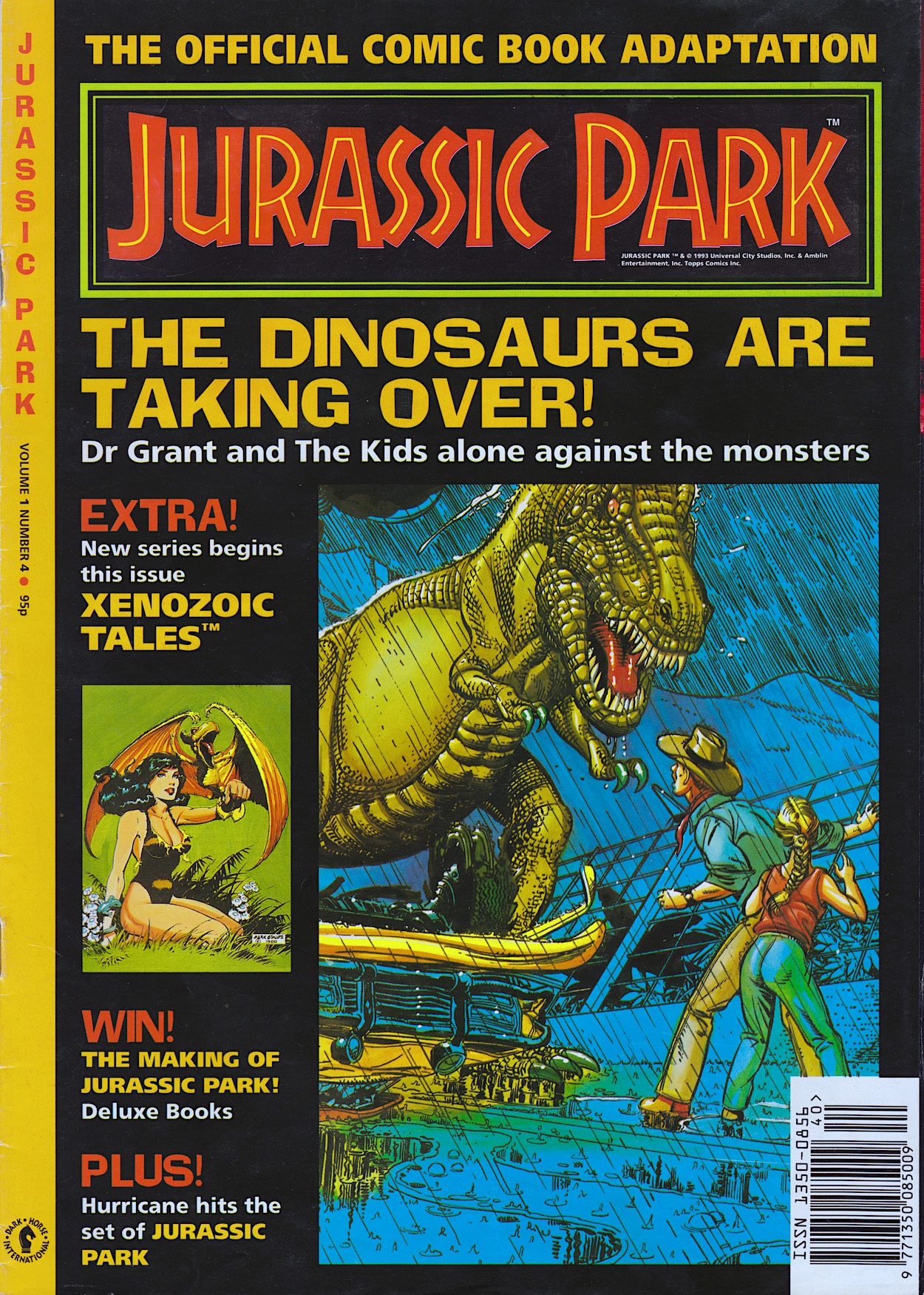
JURASSiC PARK #4: BACK UP SYSTEMS

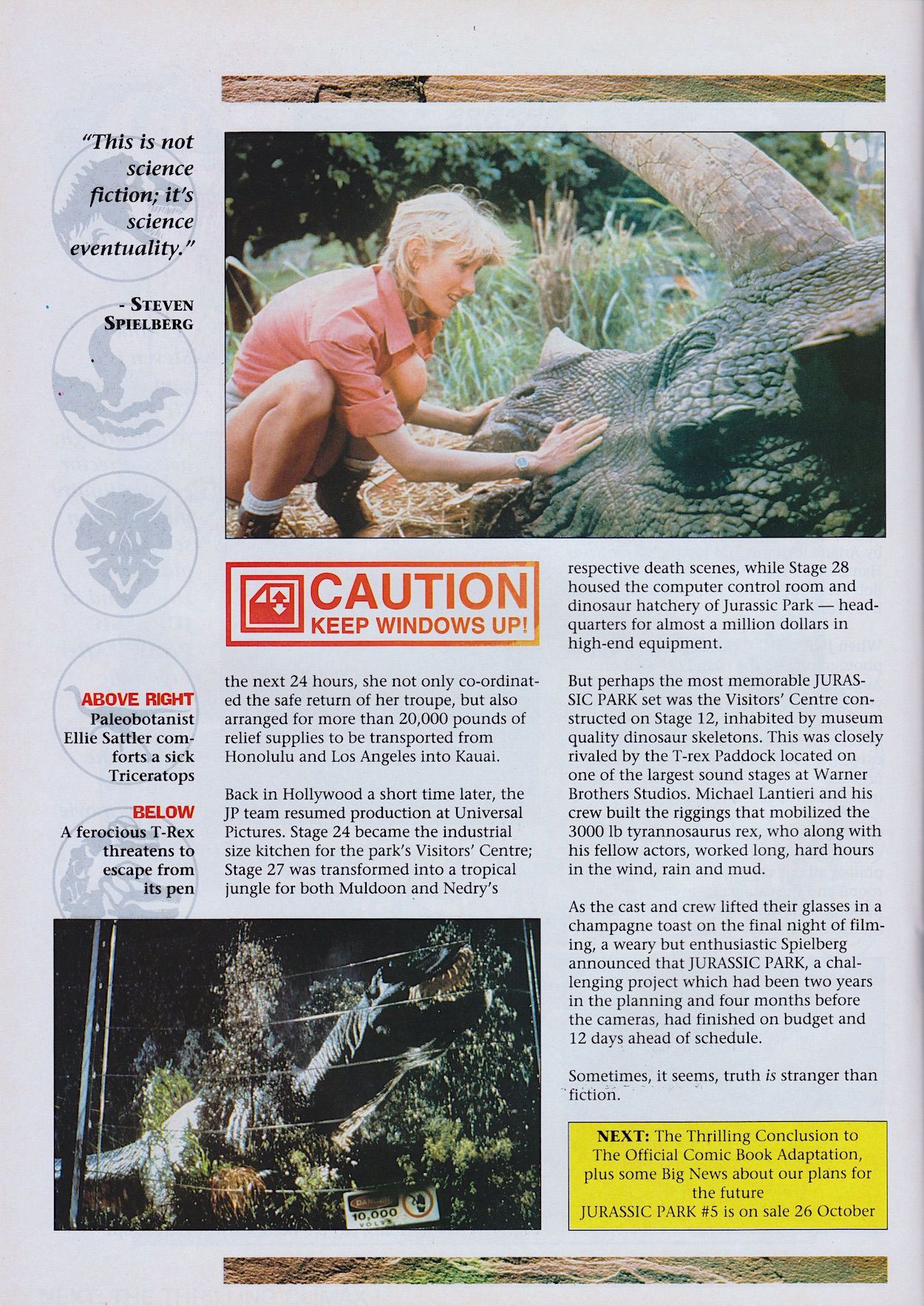
With issue four the UK version of Jurassic Park was evolving. As mentioned last time the US comic was no longer going to finish after the adaptation, with further mini-series now being produced. In the UK, Dark Horse International decided to turn their four-issue, three-weekly mini-series into an ongoing monthly, not that any fanfare is made of this because the reader wouldn’t have been any the wiser it had originally been due to end this issue (and a few weeks ago). Indeed, the comics checklist last issue erroneously said #4 was the end.

This change produced the delay in the release of this issue as plans were made for the new format of the comic and acquiring more content for each issue. This begins with the first back up strip here, bringing Jurassic Park more in line with the company’s other comics such as Aliens. The front page recolours a panel from the strip inside (and I love the font they’ve used) instead of having a proper cover image. This final chapter of the adaptation is being split in two, so the original cover was being kept in reserve for the following month.

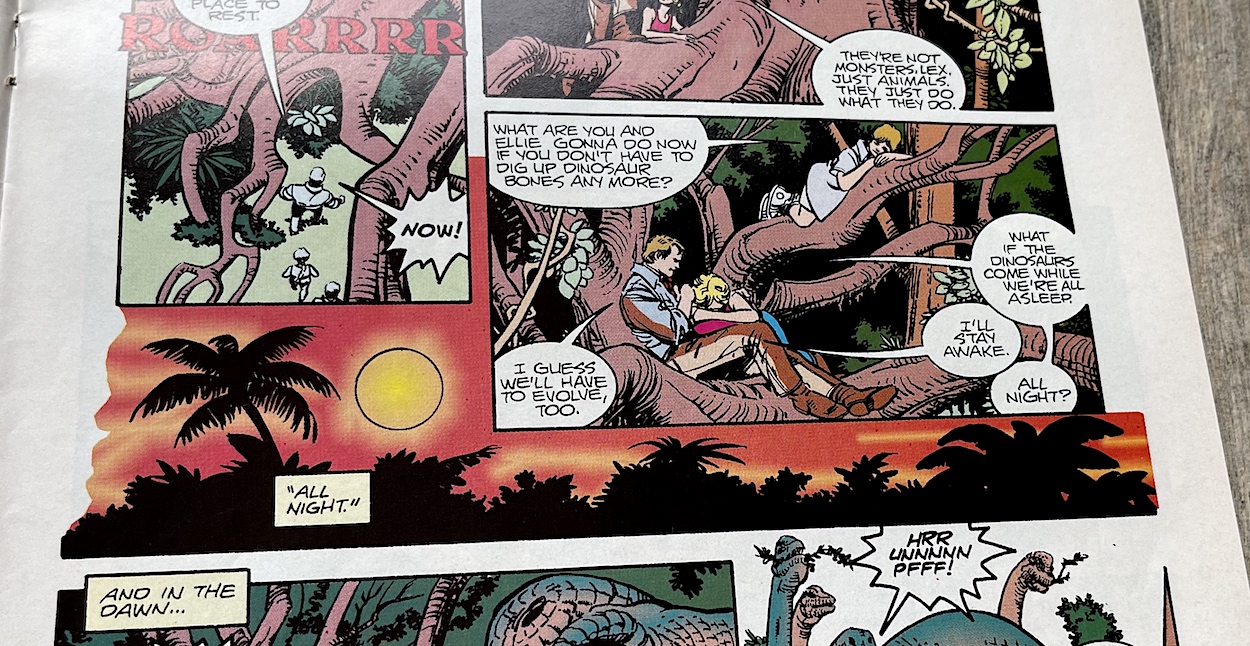
The sequence in the tree with Tim trapped in the Explorer has been completely excised!

Check out this month’s comics checklist and you might get an idea of the make up of the company’s titles. The issue at hand begins with a competition for the excellent The Making of Jurassic Park. I actually bought this book at the time and it was a heavy tome, full of details on the making of the film and stands up today as one of the very best of its kind for any movie. You’ll also see an advert for Manga Mania, which fed off the new craze to hit these shores. Ultimately it’d also be a very important title for Jurassic Park fans. But that’s a story for another time.

Our freshly chopped final chapter is still a lengthy 16 pages so regular readers wouldn’t have felt short changed, at least with the page count. Unfortunately, the actual strip itself is another thing. Yes, this is the first time in the comic’s young life when I’ve been left disappointed.

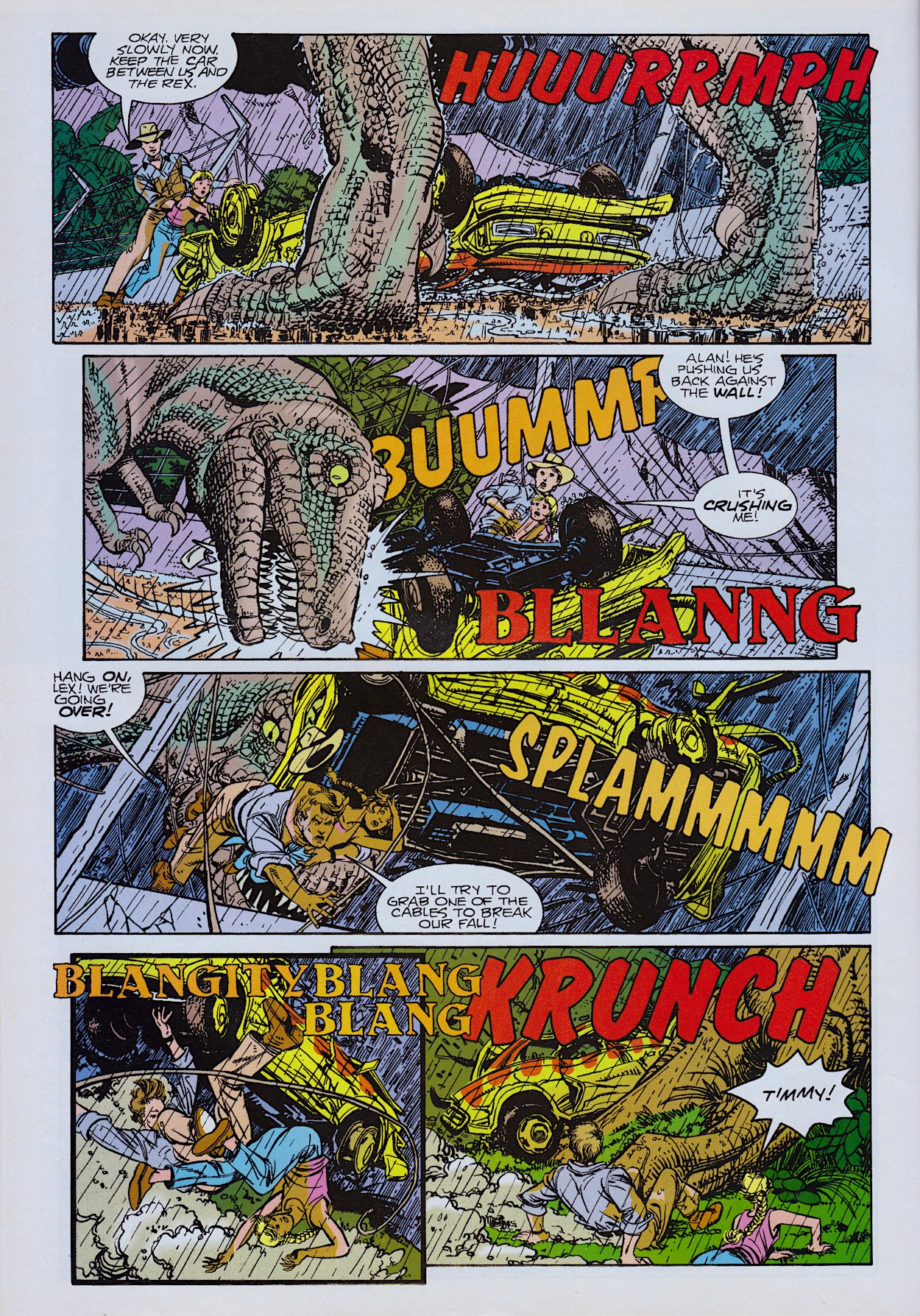
Last month the Tyrannosaurus rex attack was brilliantly handled with plenty of building tension and atmosphere so I was looking forward to seeing how the final act would begin. The opening is great, with Mrs Rex towering above Dr. Alan Grant and Lex, both trying to keep completely still.

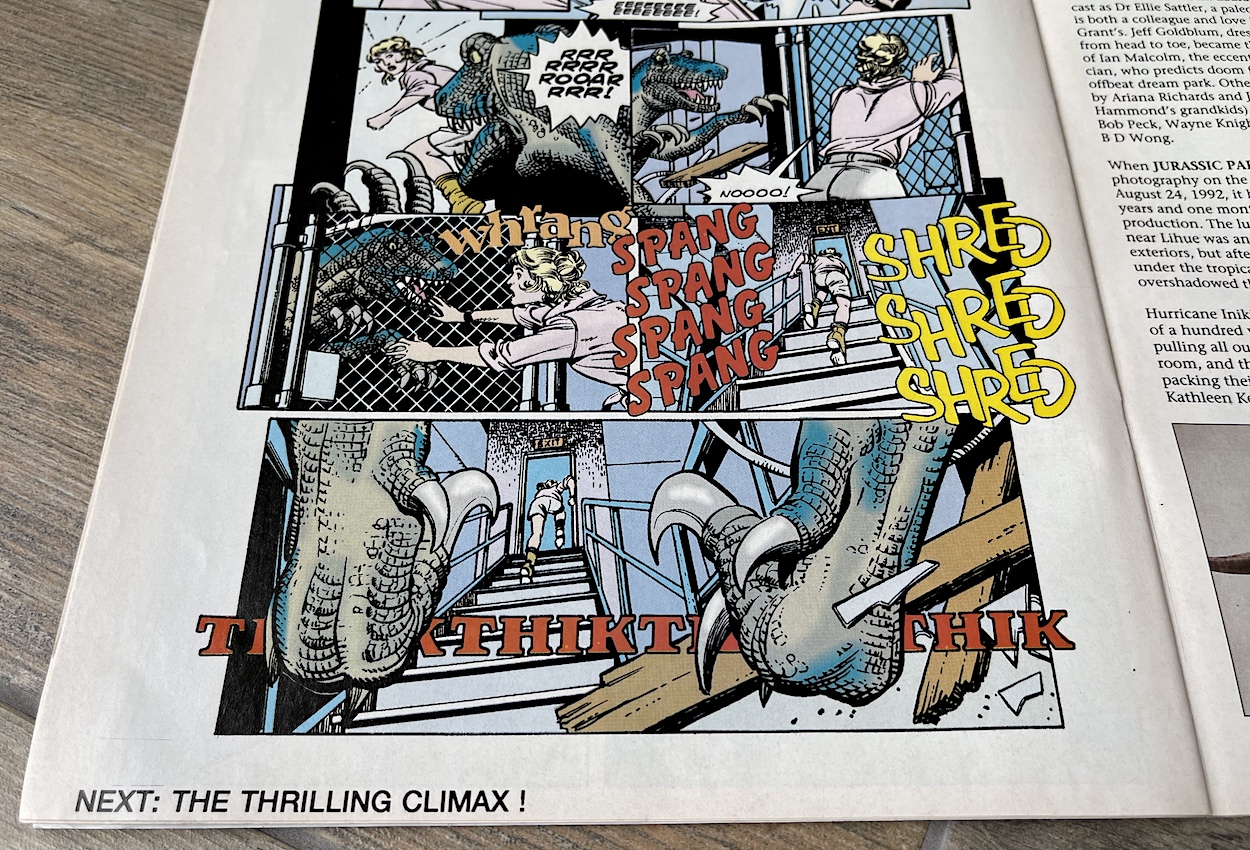
It’s all going so well until those final couple of panels. The sequence in the tree with Tim trapped in the Explorer has been completely excised! So it plummets to the ground instead and then he’s just unbelievably pulled out and off they go. Alan even has a map at hand to make their trip back to the Visitor’s Centre quicker, which is a rather cheeky shortcut. In previous issues scenes had been moved about, moments edited, others added to, all in order to properly adapt the film to the comic page and I’ve been really positive about it. But all throughout this issue huge swathes of story are just missing or reduced to a shadow of their former selves.

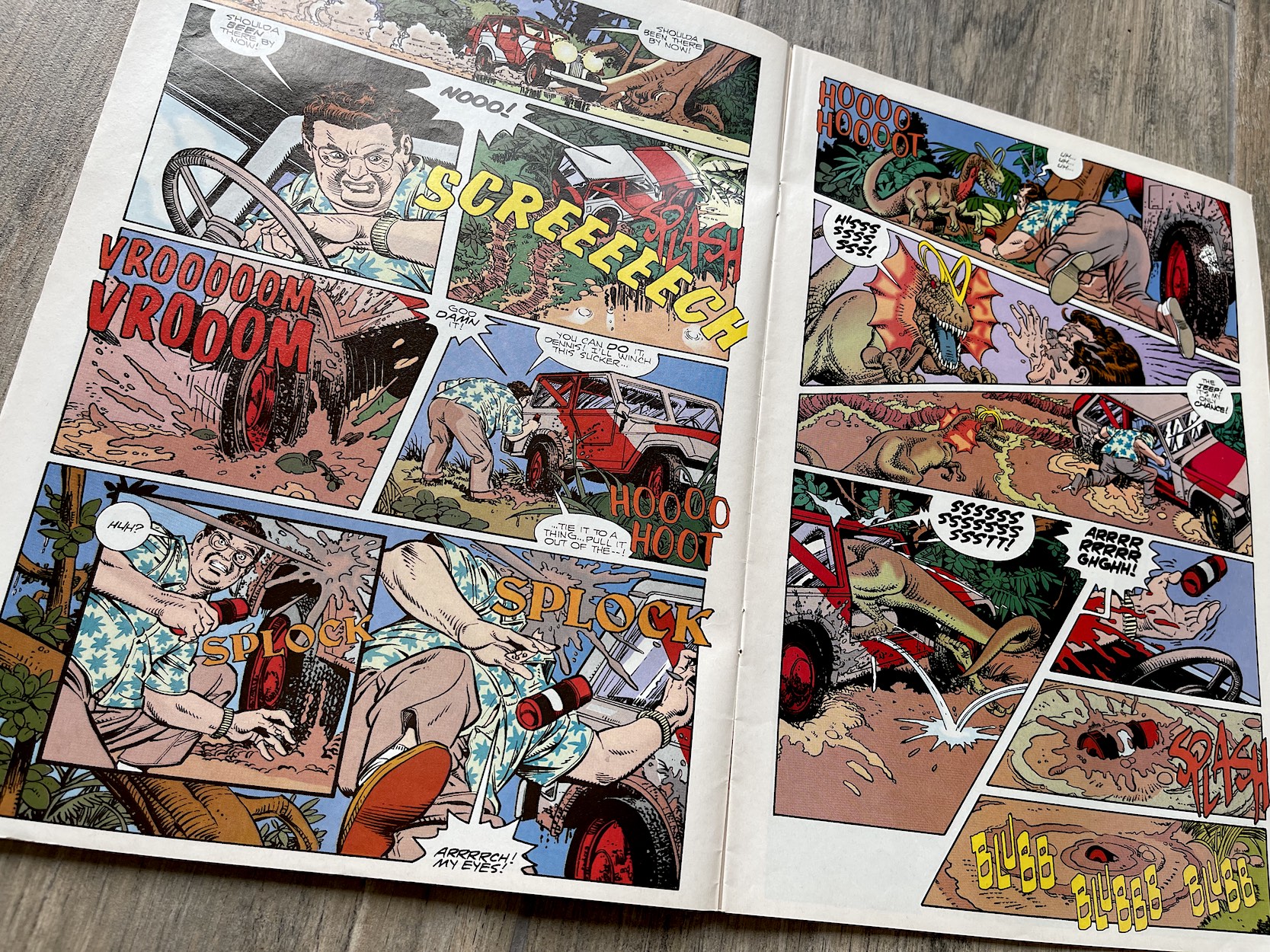
Case in point is the fatal encounter between Denis Nedry and the Dilophosaurus. The movie scene included plenty of misdirection and humour, putting the audience at ease before the shock, and that wouldn’t have been easy to translate here but they could have tried. Instead this very famous scene only gets two pages. It’s a very basic sequence now; the dinosaur may as well be a lion. Denis gets attacked as soon as he steps out of the vehicle, he jumps back in and we actually see the Dilophosaurus jump in after him (ruining the final moments of the original) and… well, that’s it.

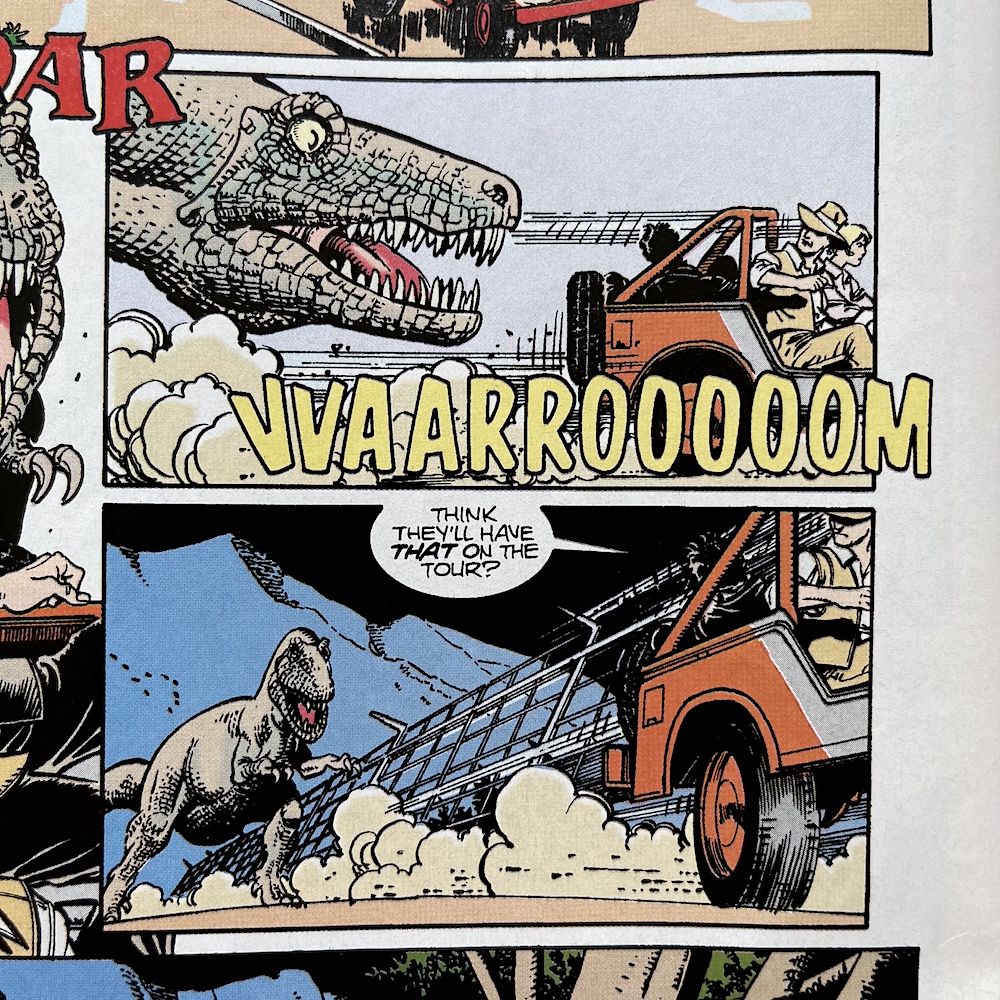
This truncating happens to basically every major moment, whether it’s the nighttime meeting with the Brachiosaurs, rescuing Dr. Ian Malcolm after the T-rex attack, even the electric fence scene (as you’ll see below) and Robert Muldoon‘s stalking of a Velociraptor. Each are reduced to fit on a page or two and basically follow a set pattern of only showing the first and last moments of the scene and erasing everything else, including almost all the humour.


“Think they’ll have that on the tour?”

Dr. Ian Malcolm

Right back at the beginning of this adaptation I stated how I didn’t usually like comic versions of films and this was the reason why. But up to this point Jurassic Park had been the exception to the rule, with a proper restructuring of the film to suit the format and it was working a treat as a comic in its own right. Maybe if they’d had five chapters instead of four (in the original US comic) it would’ve worked out differently, but then again maybe the pacing could’ve been plotted out better by writer Walter Simonson and story editor Jim Salicrup. Yes, having all the dino action in the final chapter would, in theory, make for a big climax but there’s just too much of it to fit in.

The result is a clichéd comics adaptation where it feels more like a way for people to reminisce about the movie they saw in the cinema months previous, rather than working as a good comic book. If I sound overly critical it’s only because the team had been doing such an amazing job so far, even adding in extra dialogue from either the original novel or earlier drafts of the script. So it’s more disappointment than simple negativity.

Don’t get me wrong, there are still things to enjoy here. It’s all on a lovely high quality gloss paper stock this month, some of the best lines from the film are still intact and the art in the first eight or so pages is top notch. However, in the second half even legendary artists Gil Kane‘s pencils and George Perez‘s inks start to feel a little rushed and Tom Smith‘s colours feel unfinished and flat, leading me to believe they were working very close to the deadline of getting the original US series out in time for the movie.

The chapter is cut off with a superb cliffhanger though. The view of a Velociraptor‘s feet as it chases Dr. Ellie Sattler is just as unnerving as it was in the film. It’s a shame then the terrifying Velociraptors, when viewed in full, are reduced to looking like miniature T-rexes. Below is this final scene with its positives and negatives, alongside that fence scene with the dramatic resuscitation of Tim also taken out.

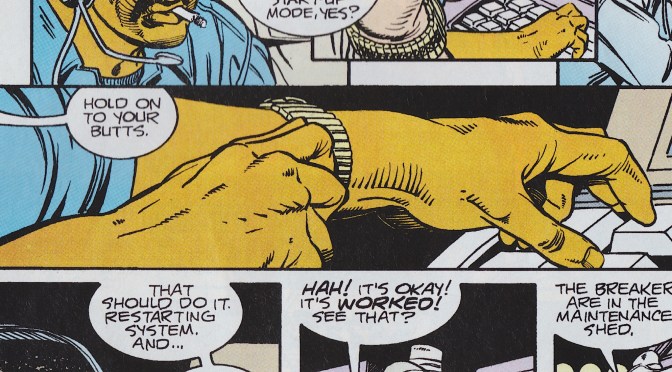
I also noticed Ray didn’t volunteer to go to the maintenance shed as he did in the original story, where he met his grisly end. Instead Muldoon and Ellie head off while Ray looks on silently. This means he’s still alive, a big departure from the film. It’ll be interesting to see how that effects the rest of the story next month.

For now, the sun sets on the adaptation as we move on to something else entirely

With 16 pages to the main strip I assume there’ll be roughly 12 or 13 next month unless the final chapter was given a few more pages in the original American Topps Comics publication. Either way there’s a lot of the film left to cover in half a chapter. The kids and Alan are still out in the park which means their return, the kitchen scenes, the chaos of the Velociraptors in the Visitor’s Centre and the climax are all to come.

I’ll still hold out hope things can be turned around because so far it feels like spending 90 minutes being completely engrossed in a film only for its ending to let you down. Which of course is not what happened with Jurassic Park! For now, the sun sets on the adaptation as we move on to something else entirely.

In the early days of Marvel UK‘s Transformers its back up strips were in some way related to the robotic theme, such as Machine Man or Iron Man. It wasn’t long before it instead became a way of bringing some of Marvel’s other US characters to these shores for the first time, but Jurassic Park kept its strips dinosaur-themed, much to the delight of teenage me. The second back up would appear in my first issue (#6) but here readers were introduced to Mark Shultz‘s Xenozoic Tales.

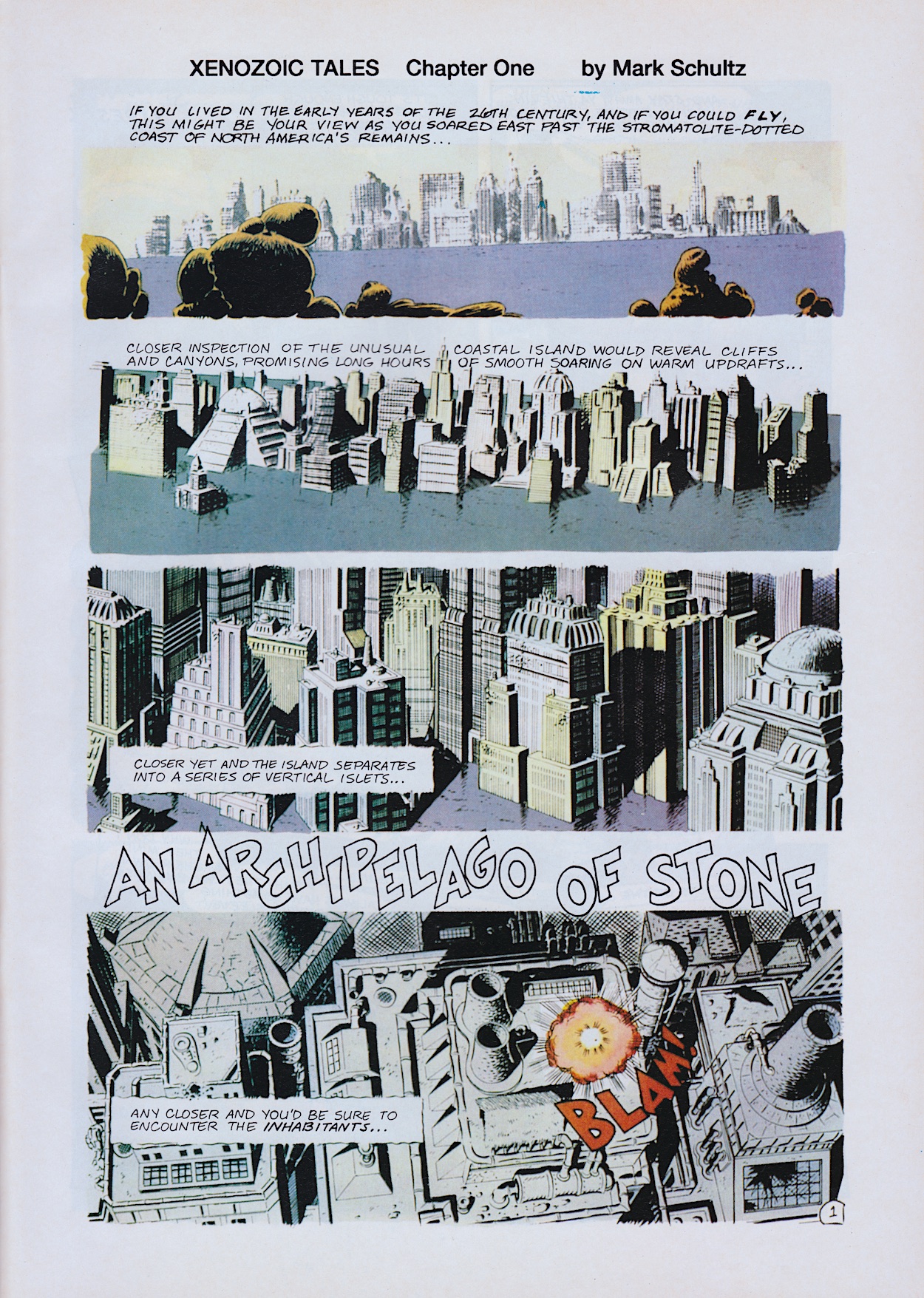
Later adapted into a cartoon TV series called ‘Cadillacs & Dinosaurs‘ it was an independent, alternative title Mark wrote and drew himself, running for 14 issues irregularly released between 1987 and 1996. Most of the strips were printed in black and white but Jurassic Park brought in artists to colour them exclusively for UK readers, this first one coloured by Ray Fehrenbach. This complete story was the first one written by Mark and what an introduction to something brand new this first page was.

Set in the 26th century, global warming has resulted in sea levels across the globe forcing humans to initially build underground. After 600 years they’ve reemerged to find their cities flooded, technology virtually non-existent and strangest of all the world is populated by dinosaurs once more. Anyone capable of mechanical work is seen as invaluable and this is where Jack Tenrec comes in, a car mechanic with a penchant for Cadillacs. Thanks to these skills he acts as an unofficial head of security and advisor to his tribe’s leaders and lives on an outcrop (formerly high hills) not far across the water from An Archipelago of Stone, the home of the tribe and in reality the remains of New York City.

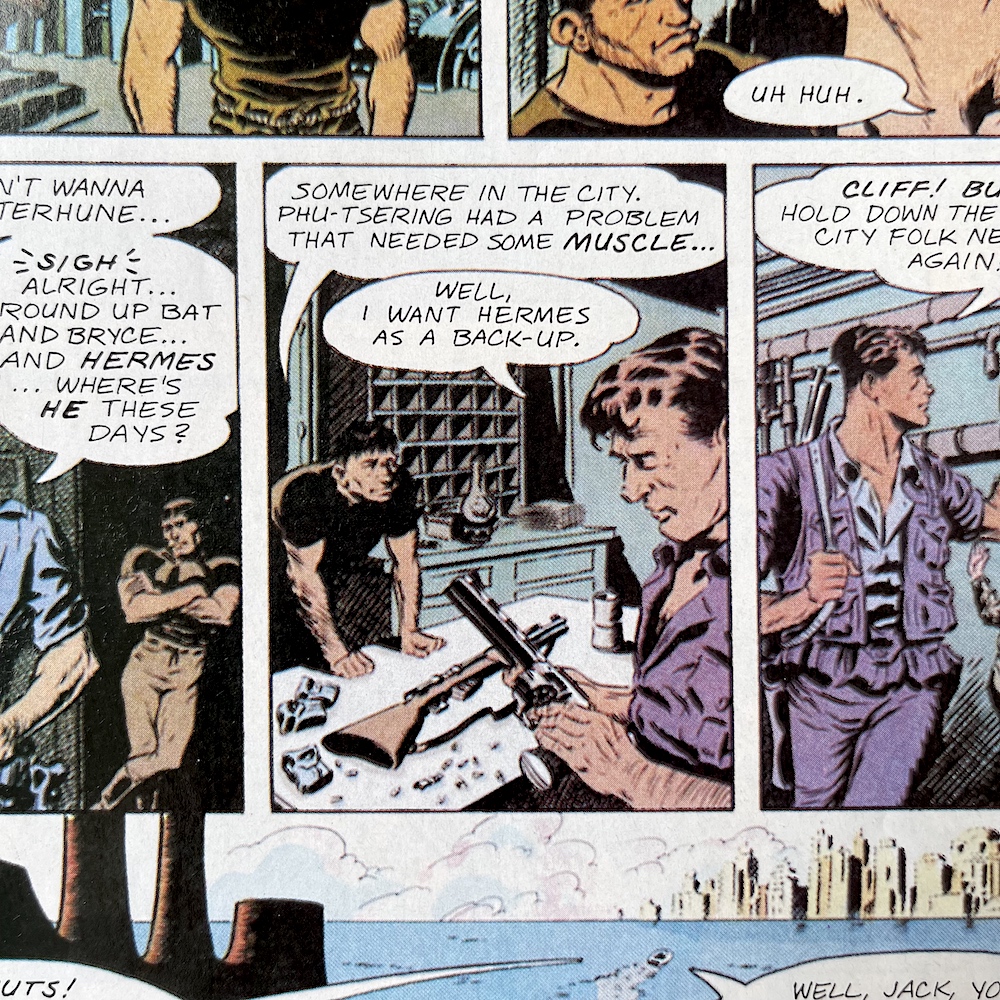
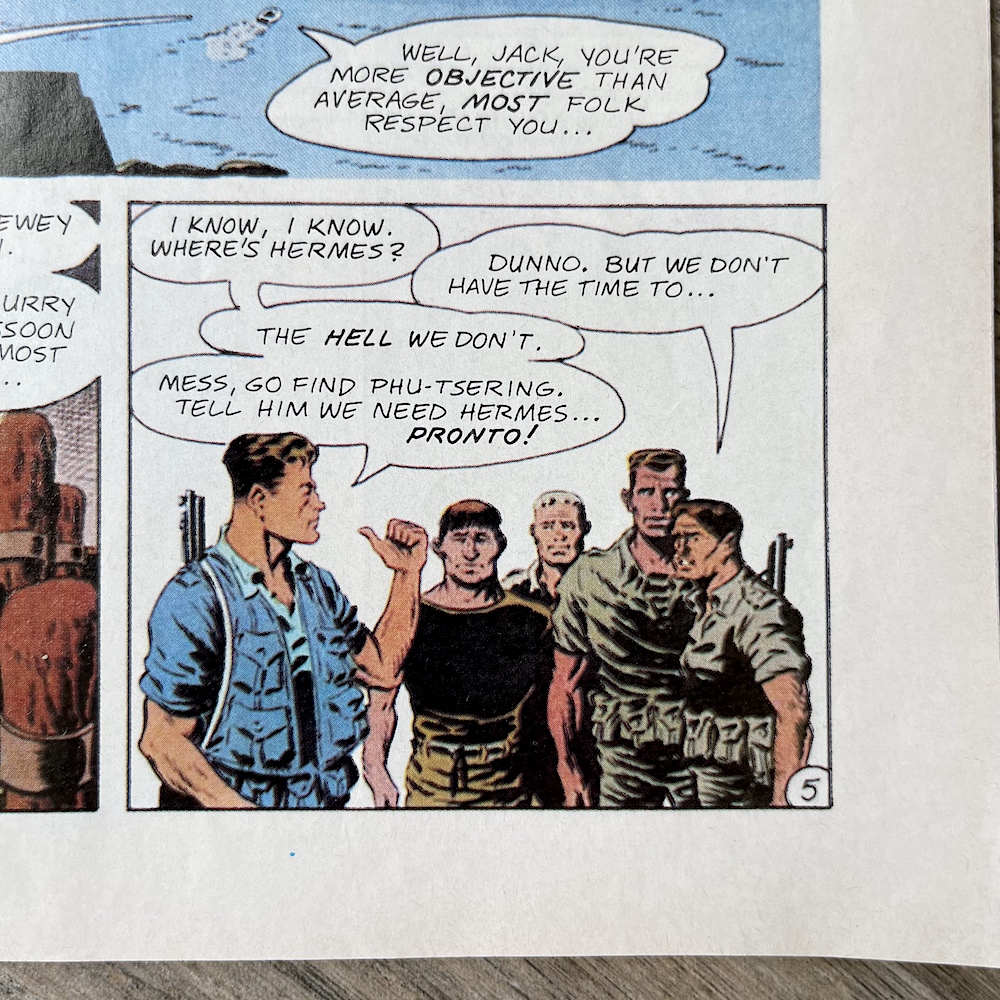
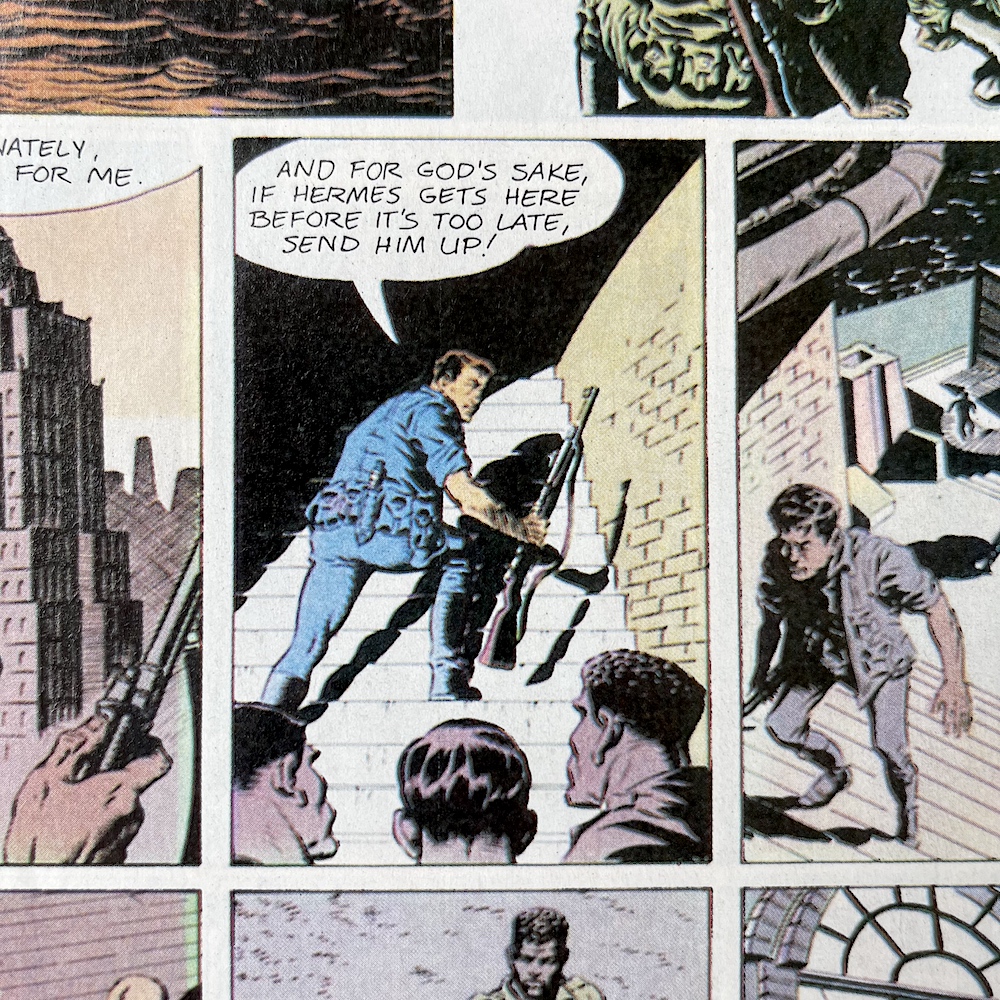
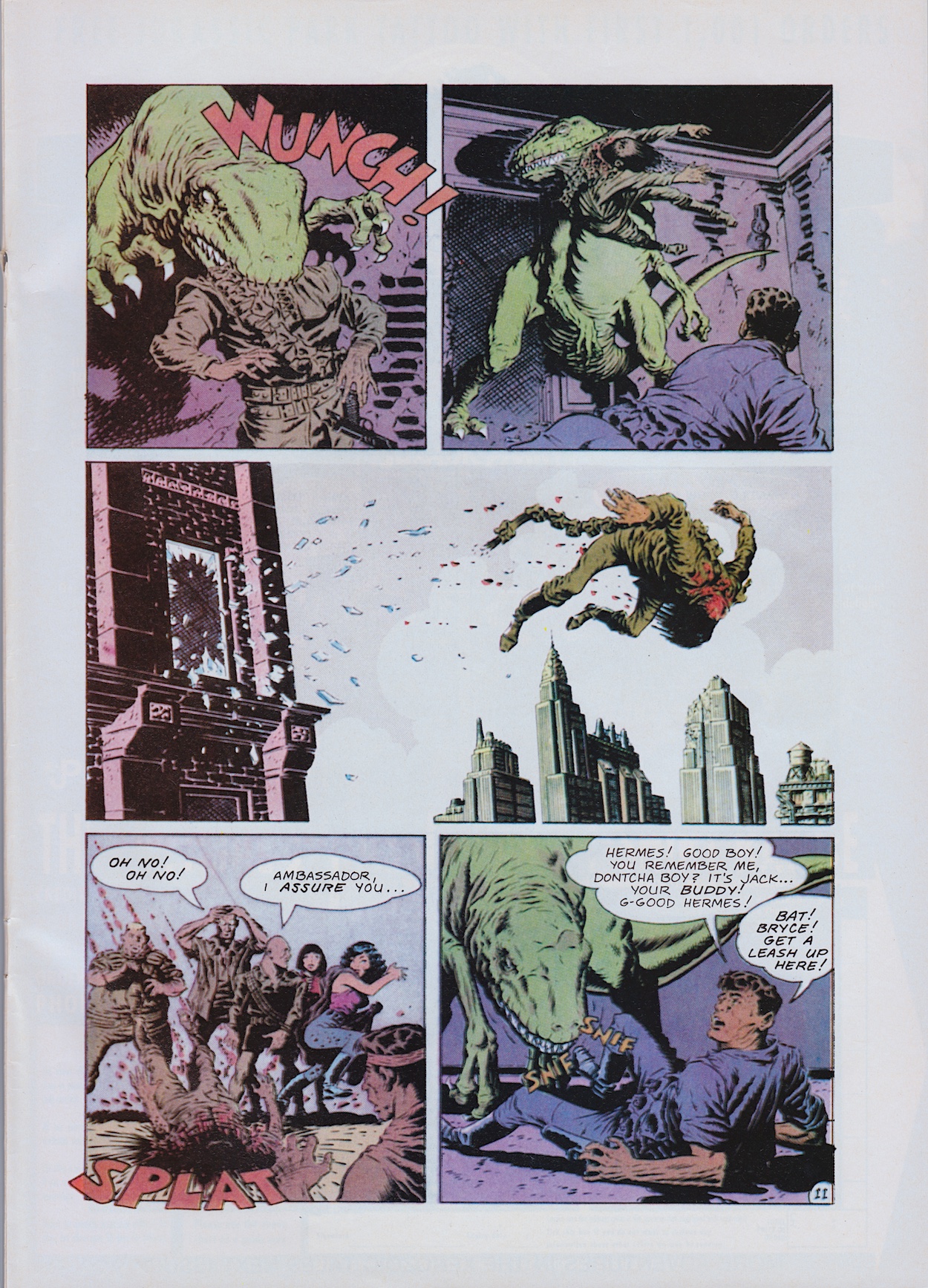
I love that first page, cleverly written from the point of view of a Pterodactyl. In the story a neighbouring tribe’s ambassador, Hannah Dundee arrives at the City in the Sea and a team of poachers who had previously stolen from her Wassoon Tribe want her dead before they’re found out. It’s up to Jack and his men to stop them. All the way through this strip, knowing he’s about to get in way over his head, Tenrec keeps telling his men to send someone called Hermes to help. Then, just as it seems he’s doomed a surprise arrival bursts in. That’s Hermes!

Well I certainly didn’t expect that. Hermes the Allosaurus disposes of the villain, munching on his head and throwing him out the window, before Tenrec thanks him, revealing who this is. That doesn’t mean he’s a pet of course and the usually cool and collected Jack knows it.

It’s brilliant stuff. Original, fun and surprising, introducing the main protagonists, the unique setting and the cast of regular and semi-regular guest characters, all in 12 pages while maintaining an interesting story and racking up tension is rather a phenomenal feat. No wonder Xenozoic Tales is so highly regarded even to this day. It may at first seem like a strange choice for Jurassic Park’s back up but it works perfectly and as a teen I remember being engrossed with the slowly developing back story that would become more apparent in later issues. (Sadly, Hermes never reappeared.)

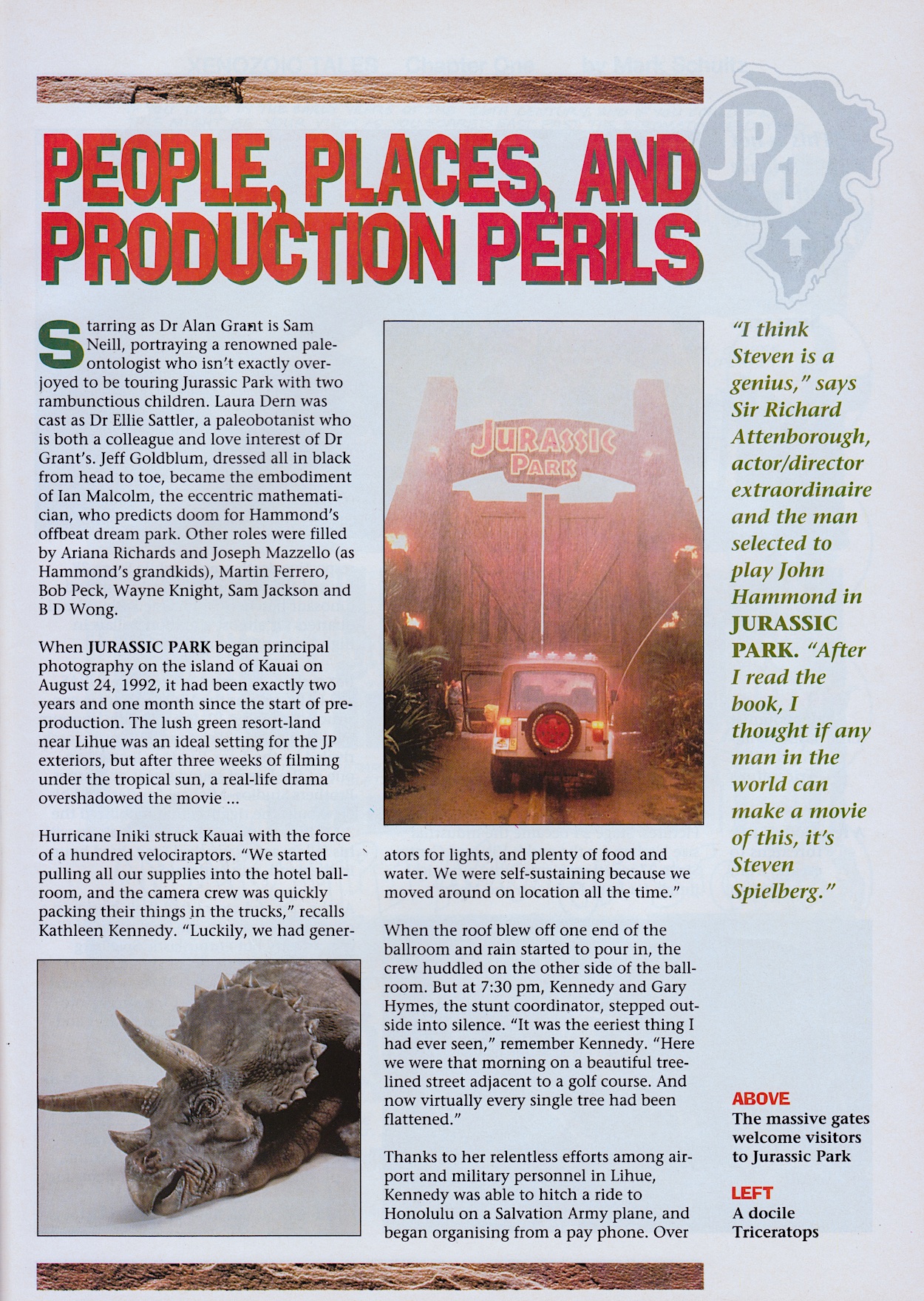
In between the two strips is this month’s look into the making of the movie, covering the famous disaster that hit Hawaii and the relief efforts the producers helped coordinate, plus the building of sets and the end of principal photography. At the very end of the feature is the teeny tiny box with the date of the next issue including a little tease that things were afoot for the future of the comic.

Thankfully they didn’t say “great news for all readers” or we’d have got the wrong idea. With these couple of pages, a long main strip and a back up it really does feel more like the kinds of UK comics we were accustomed to at the time. I may have enjoyed the extras more than the adaptation this month but I know from memory that what’s to come from Jurassic Park made this one of my very favourite comics growing up. So stay tuned for some terrific stuff from Isla Nublar, as well as from the far future and soon the distant past too!

The fifth issue and the conclusion of the movie storyline will be stomping its way on to the blog in one month on Tuesday 26th October 2021.

iSSUE THREE < > iSSUE FiVE
JURASSiC PARK MENU

OiNK! #11: ON YER BiKE!

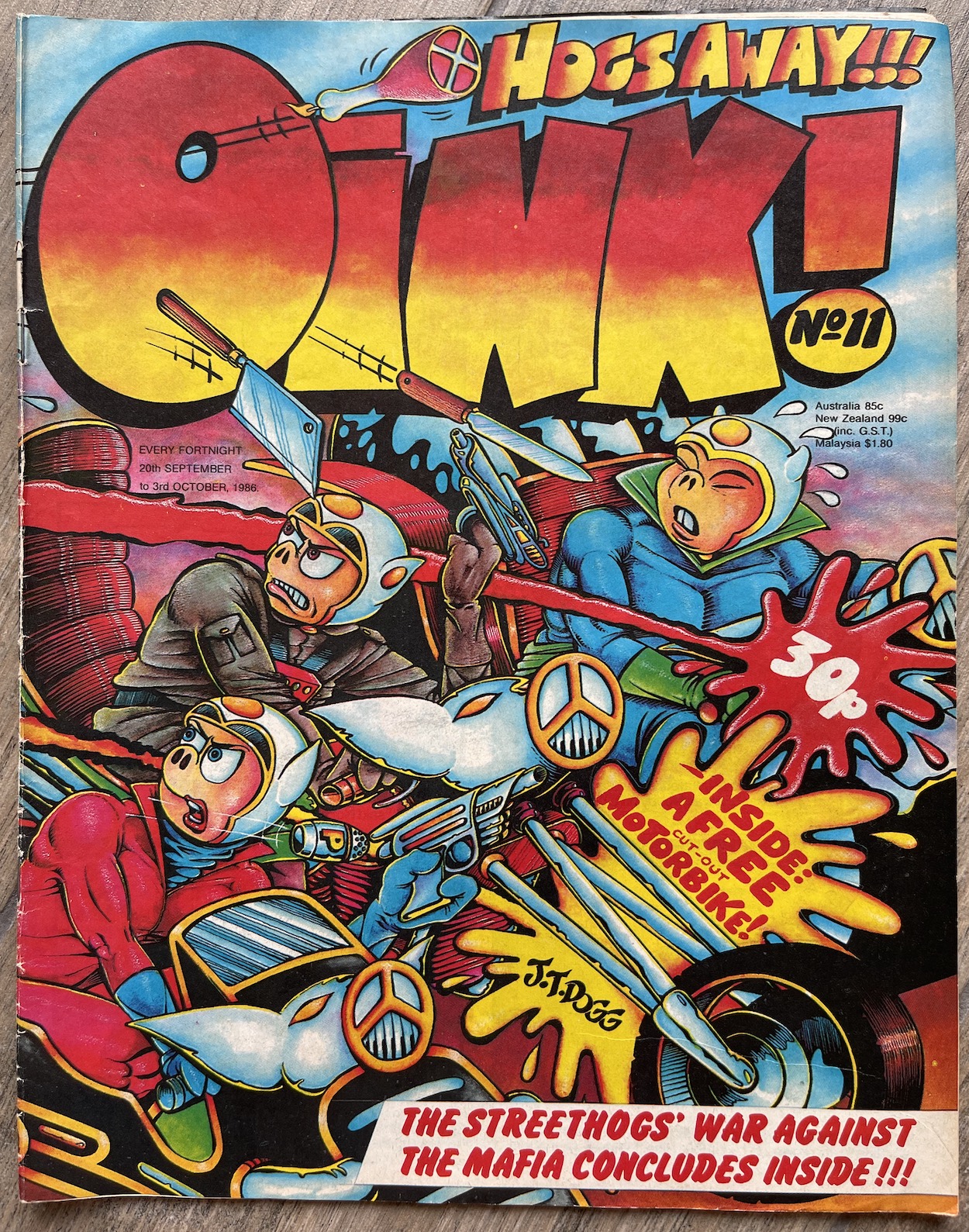
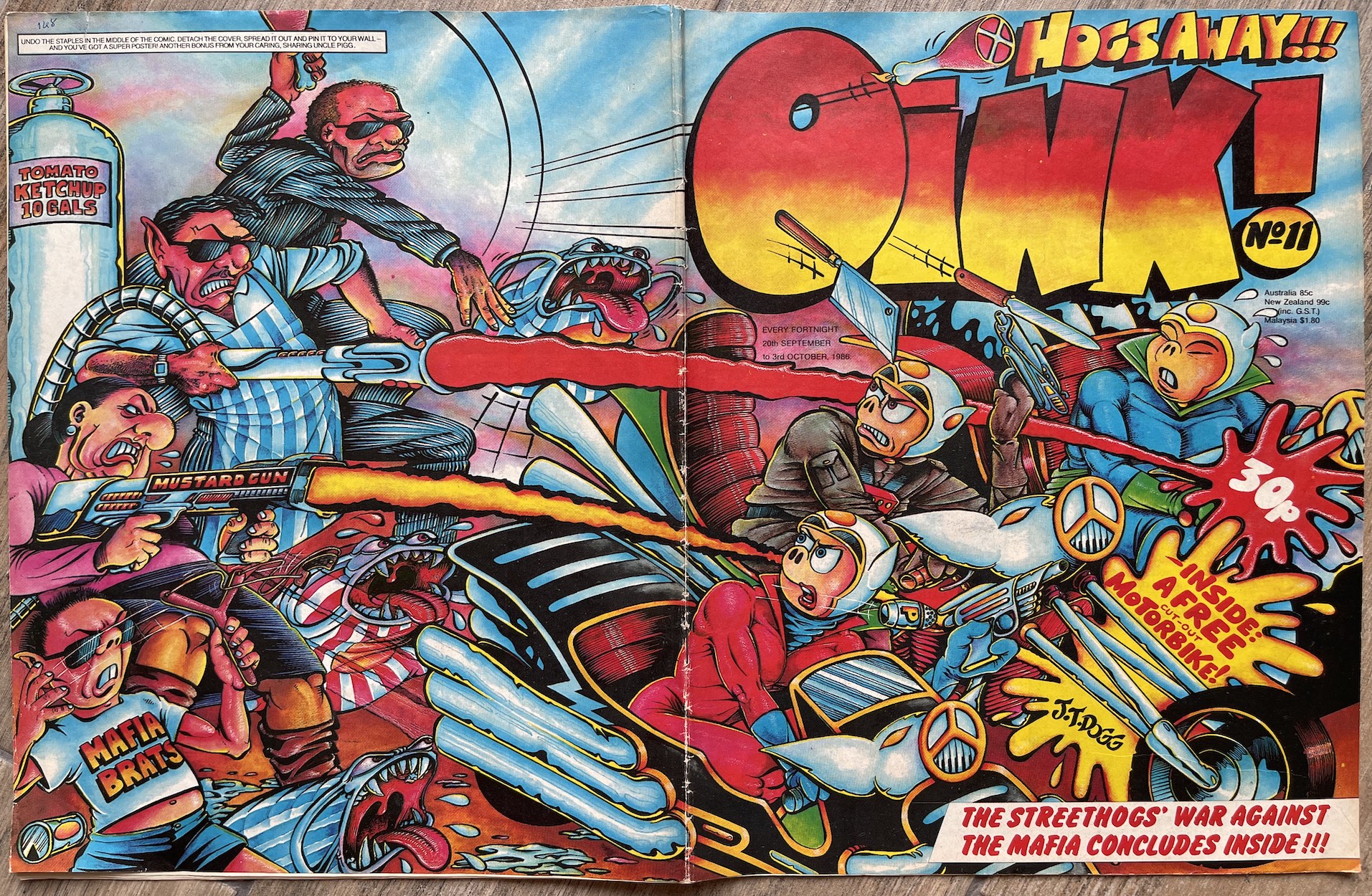
This issue of OiNK contains the conclusion to the first Street-Hogs story, the spoof adventure strip which began right back in #1 (with a prelude in the preview issue) and they’ve taken over. Not only is their strip three pages long inside but we also get this gorgeous wraparound cover poster by their incredible illustrator, J.T. Dogg and the general theme of the issue is biking. There’s even a free motorbike model. Sort of.

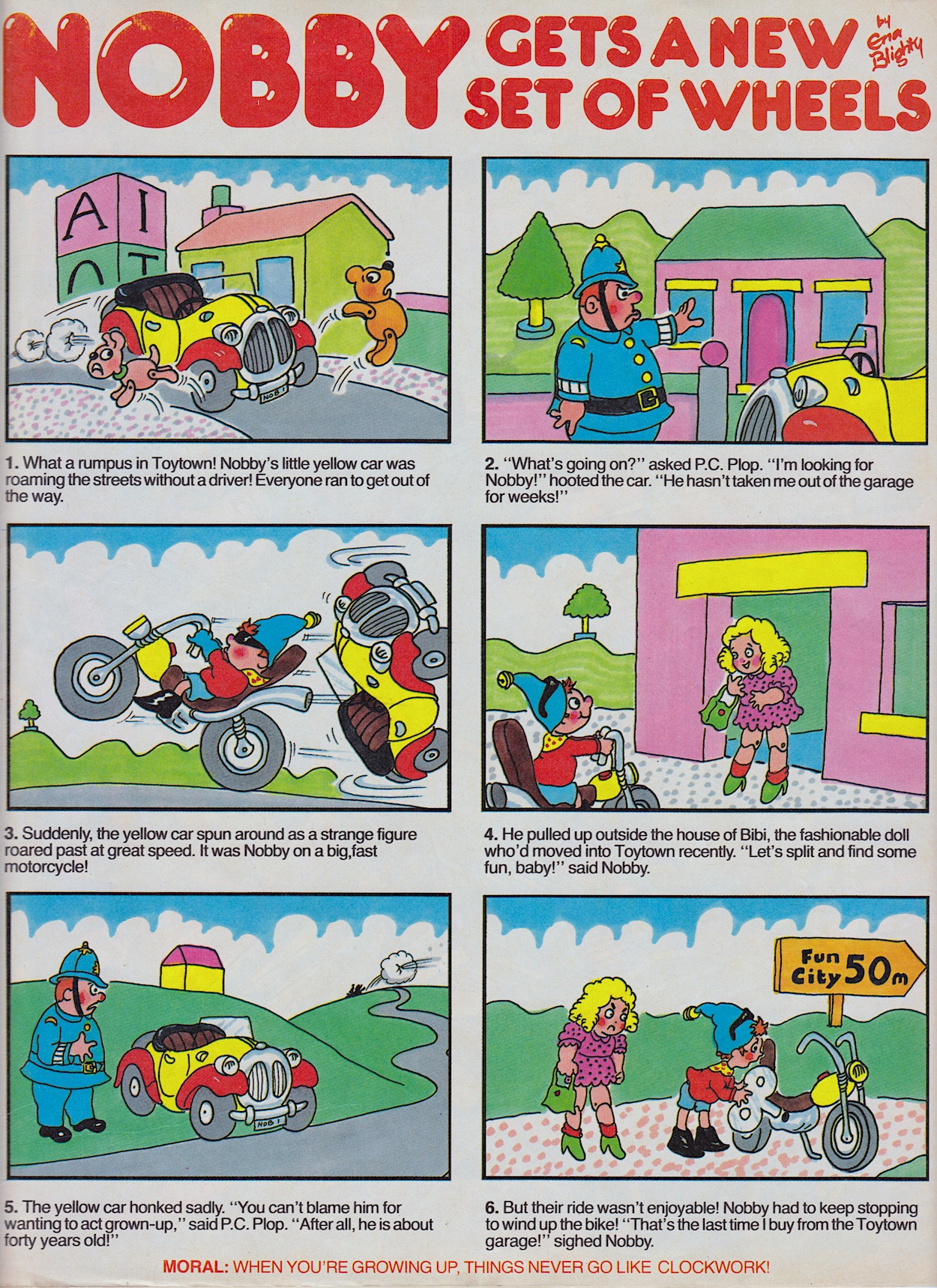
Things kick off brilliantly with a parody of a very famous children’s character in Nobby Gets a New Set of Wheels, credited to Ena Blighty, a riff on Enid Blyton who would continue to pop up in comedy takes of other books. Written and drawn by co-editor Patrick Gallagher it looks like a traditional children’s picture-panel comic story and his art style suits it perfectly. The real Noddy may be pushing on a bit now but I doubt he’s grown up quite like this version.

Motorbikes are all over the first few pages. Uncle Pigg runs over Mary Lighthouse who was out in the middle of the street with placards campaigning for road safetly, after which our esteemed editor reminds the viewers to never “stand in the middle of the road waving your arms about!”.  Zootown, the Golden Trough Awards, even the Plops and a new superhero Hedgehog Boy (his first and last appearance because hedgehogs, roads and motorbikes do not mix) all hit the mark with both the theme and the funny bone.

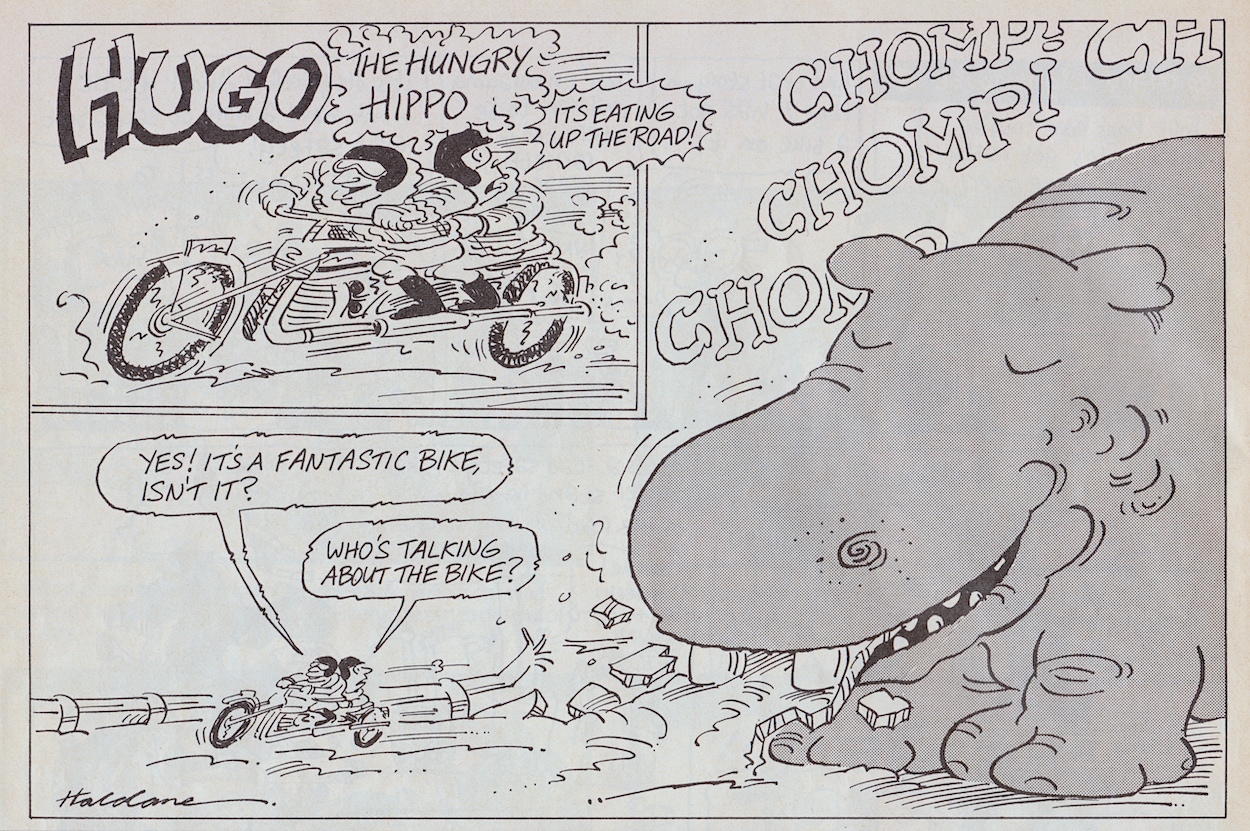
One of the regulars getting in on the action is someone I haven’t introduced yet. Created by David Haldane he was a big hit with readers. In fact he was a big hit with everything, from skyscrapers to airships to whole armies. Basically, take the concept of Godzilla but change him into a friendly but ginormous hippopotamus and you have Hugo the Hungry Hippo.

No relation to the creatures in Milton Bradley/Hasbro’s tabletop game, Hugo was a pacifist and would only accidentally terrorise humans along the way. While the strip was basically the same set up every issue he was a fan favourite, going on to appear in 33 editions of OiNK altogether. It’s funny how our memories work sometimes, isn’t it? I was sure I remembered reading Hugo right to the end of the run but he actually disappeared not long into the comic’s second year, only reappearing randomly a few more times after that.

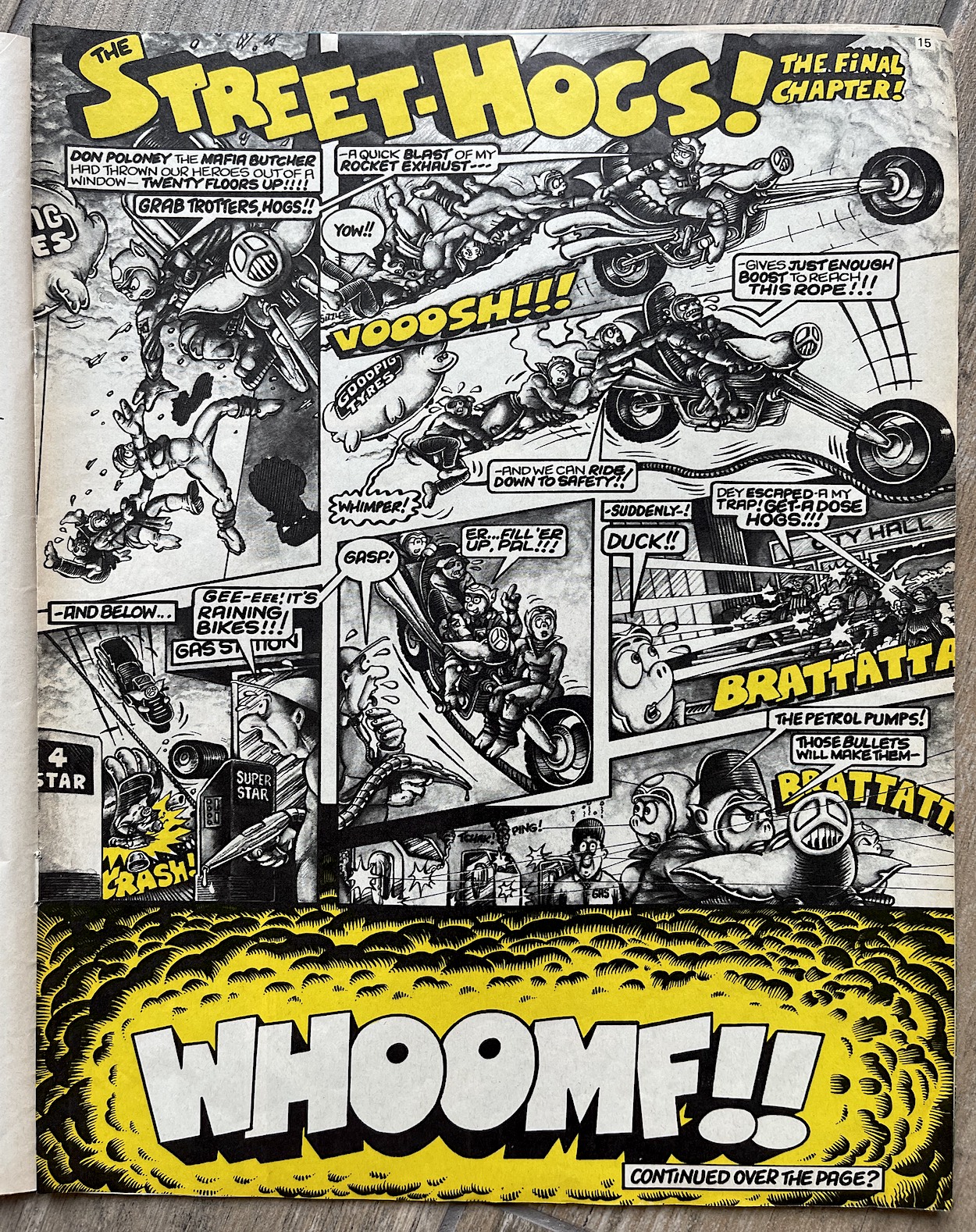
The main event is up next, the three-page finale to The Street-Hogs which takes over the middle of the comic. It might be initially disappointing to see this two-colour page below. It is beautifully grey-scaled though, something OiNK could do on its glossy paper that other IPC comics couldn’t on their newsprint. But anyway, this is only page one and the others are presented in their the usual full-colour gorgeousness and bring the tale to a suitably crazy end.

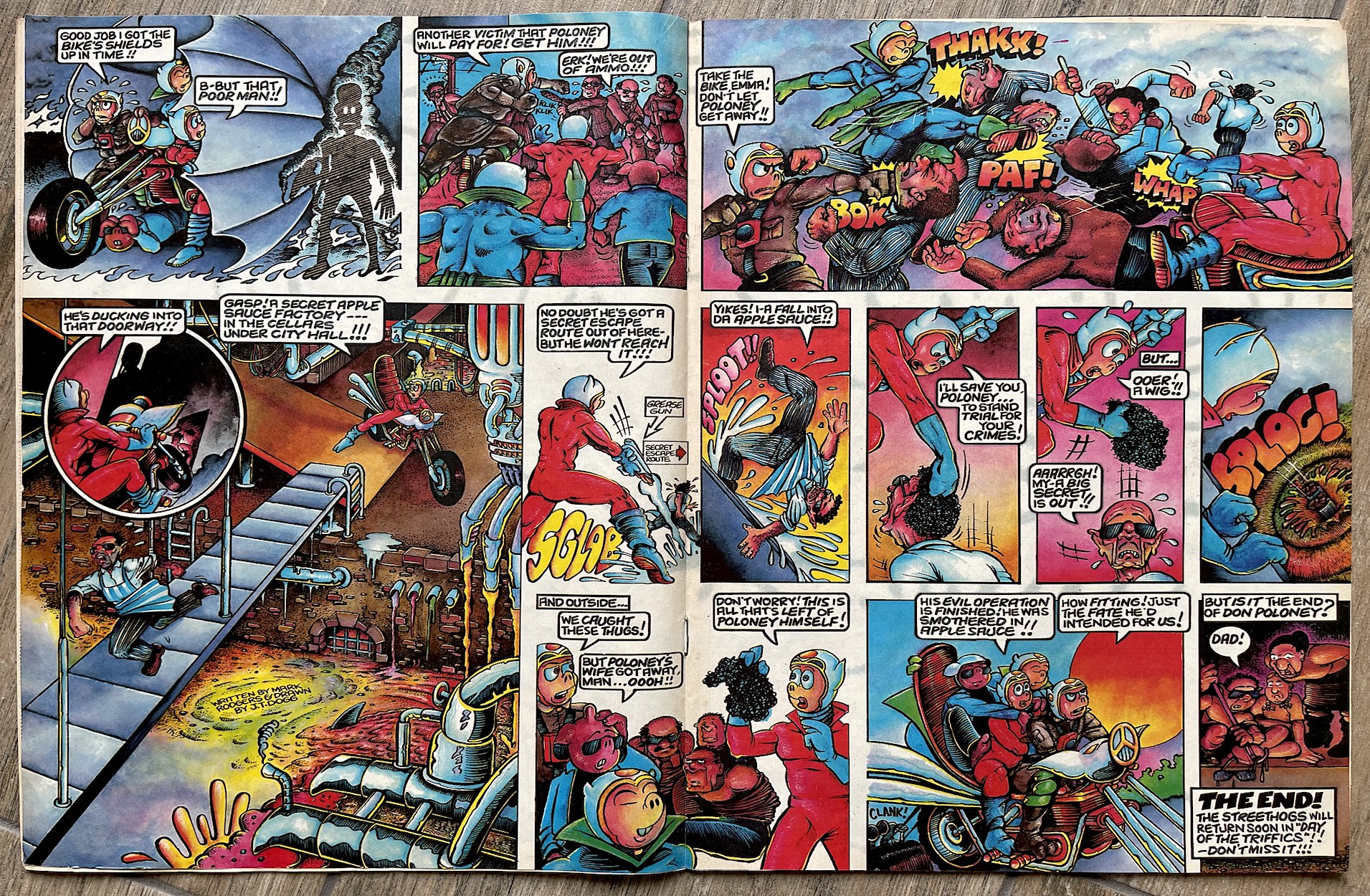
This episode really does pack it all in. There’s even a cliffhanger for turning over the page. Between the over-the-top sound effects right out of the silly 60s Batman, to the clichéd evil lair being an underground apple sauce factory, to the final battle coming down to a faulty wig. There’s a piece of comedic genius in every panel thanks to the incredible writing talents of Mark Rodgers and the way J.T. Dogg brings it all to the page.

That next adventure alluded to in the final panel, Day of the Triffics isn’t coming as soon as readers may have hoped, we won’t see it until around this time next year. It’ll be worth the wait though and in the meantime from #15 there’ll be a brand new adventure from another much-loved porky personality, Ham Dare: Pig of the Future for all those Dogg fans!


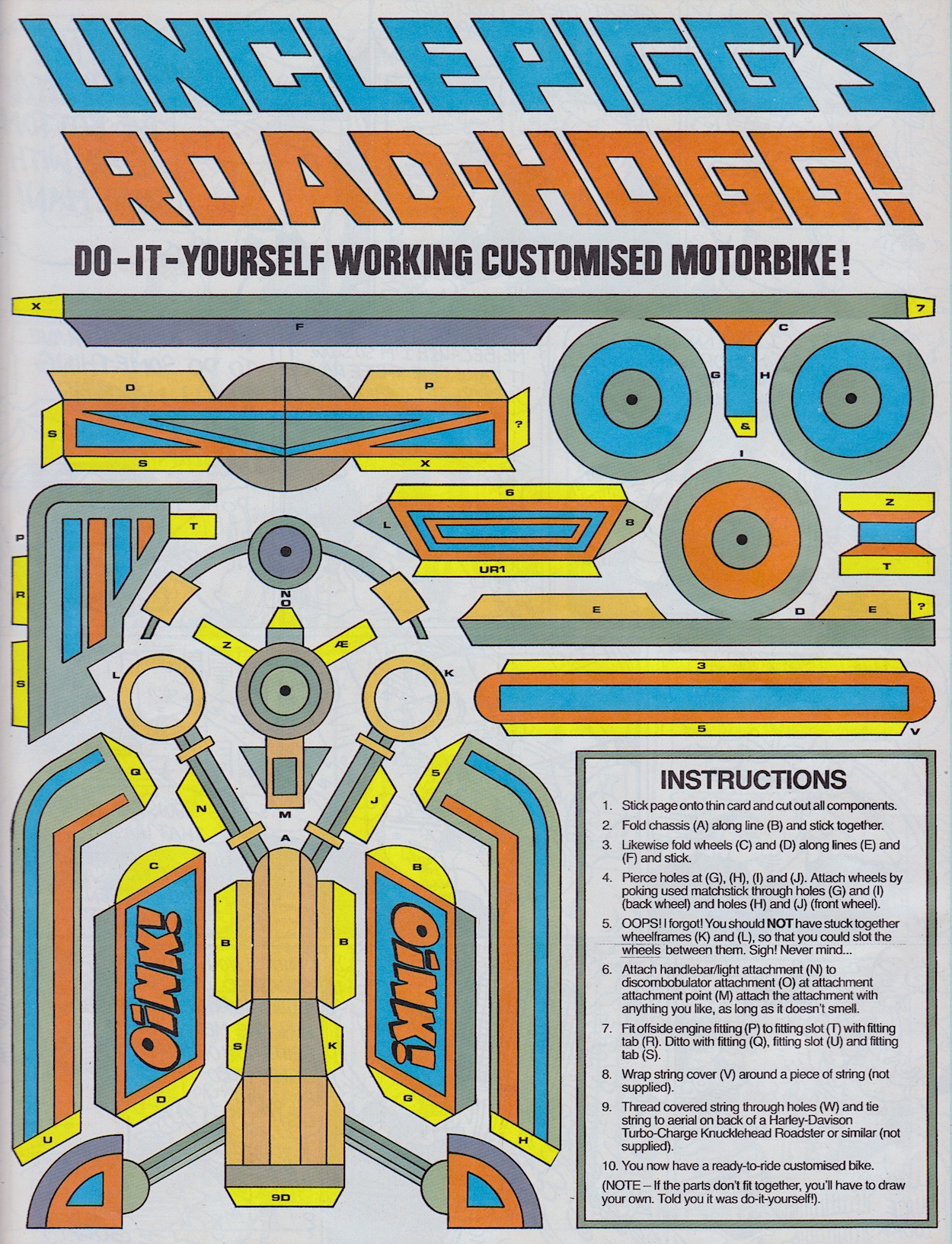
Attach handlebar/light attachment (N) to discombobulator attachment (O) at attachment attachment point (M) attach the attachment with anything you like, as long as it doesn’t smell.

Uncle Pigg’s Road-Hogg instructions

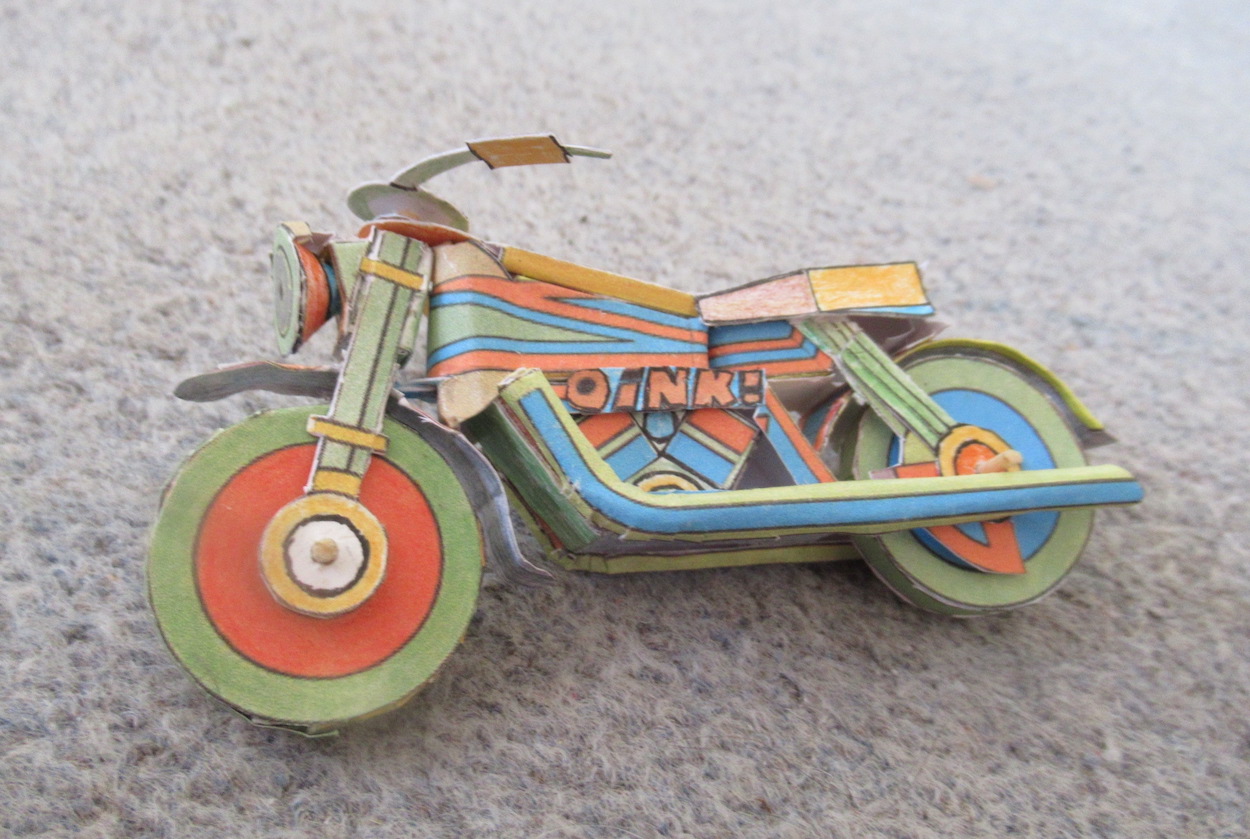
From Dogg’s Hogs to the Road-Hogg, it can’t have escaped fans’ attentions that two of the superb bikes with all of their exaggerated abilities were destroyed in the strip above. Unceremoniously dragged off at the end, later in the issue came the chance for readers to build one of their own. Advertised on the cover as “a free cut-out motorbike”, in typical OiNK fashion even this had a punchline as you’ll see if you take a look at the page below. All you need to do is follow the instructions.

The person responsible for this fiendish extra was Daz, aka Dave Skillin who had already contributed some great spoof children’s stories in these early issues, such as The Wonderful Adventure of Billy Batt and his Magic Hat which I featured in #1‘s review. Brilliantly, just last year a pig pal (probably in the grip of lockdown craziness) decided to try and actually build it! Here’s what Sue M. Hall said about attempting this seemingly impossible task:

“I have spent recent weeks making the cardboard cut out motorbike, ‘Uncle Pigg’s Road Hogg’. Like Mount Everest, because it’s there. However, it was drawn with parts that did not actually fit together. You had to use your imagination, and make additional parts. I challenged myself to use as many of the parts in the drawing as I could. I also added a V- twin engine where the panels labelled Oink! were. I had to shrink the Oink lettering so as not to obscure the engine, or the pattern on the fuel tank.”

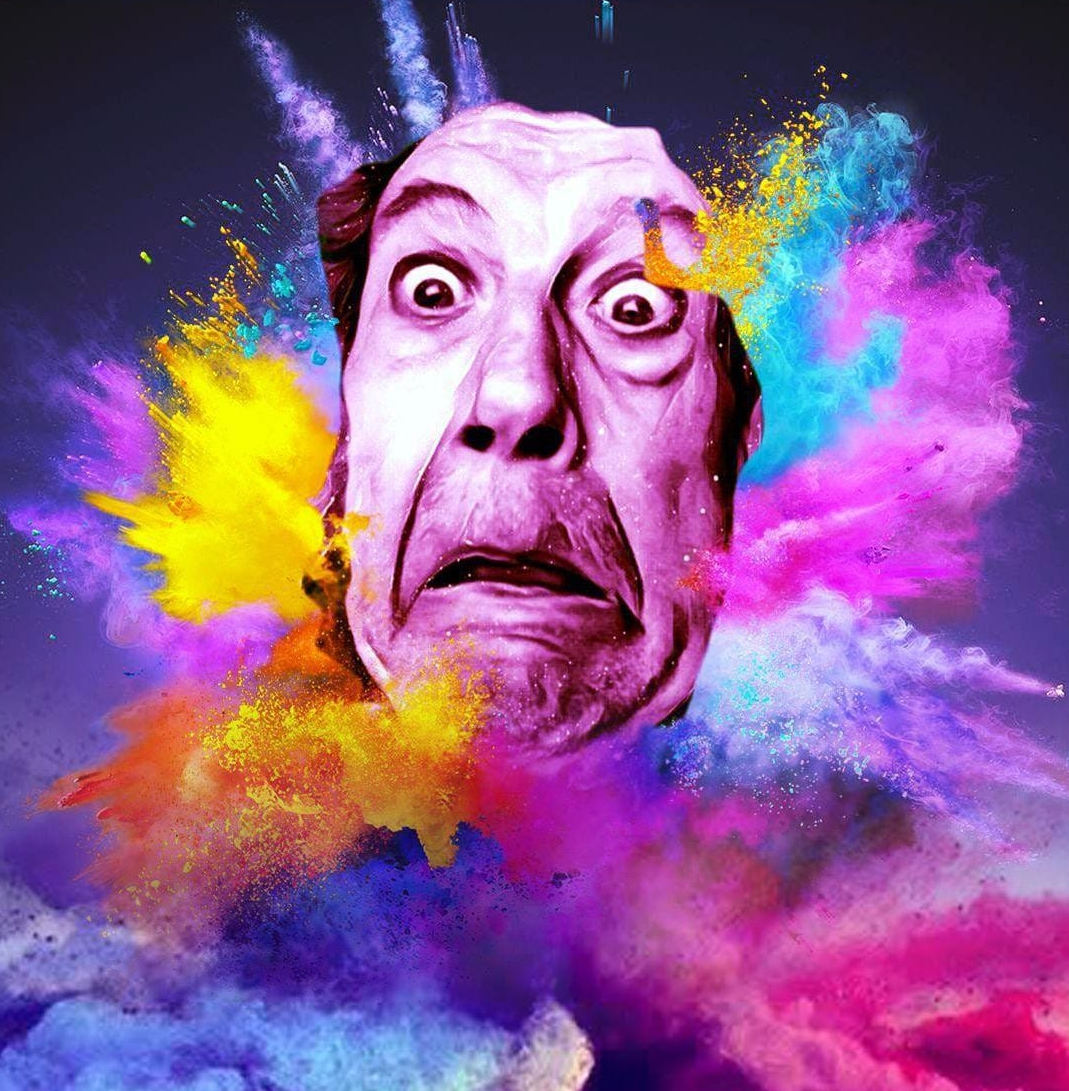
Sue shared this on the Oink! Comic Facebook group and has kindly given me permission to show it to you all here. I think you’ll agree this is a fantastic piece of model building, especially given the fact it was never actually meant to be built! As for Daz himself, here is a recent self-portrait he created of himself, supplied by Patrick.

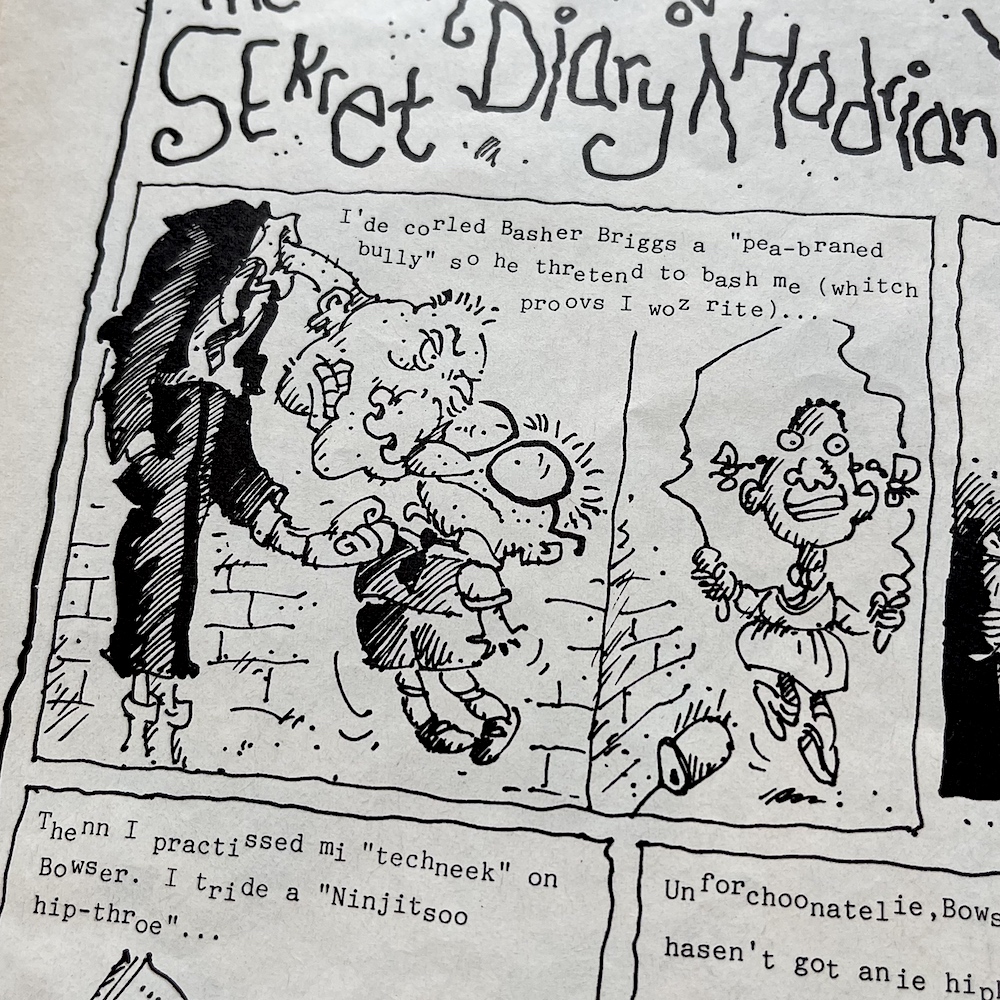
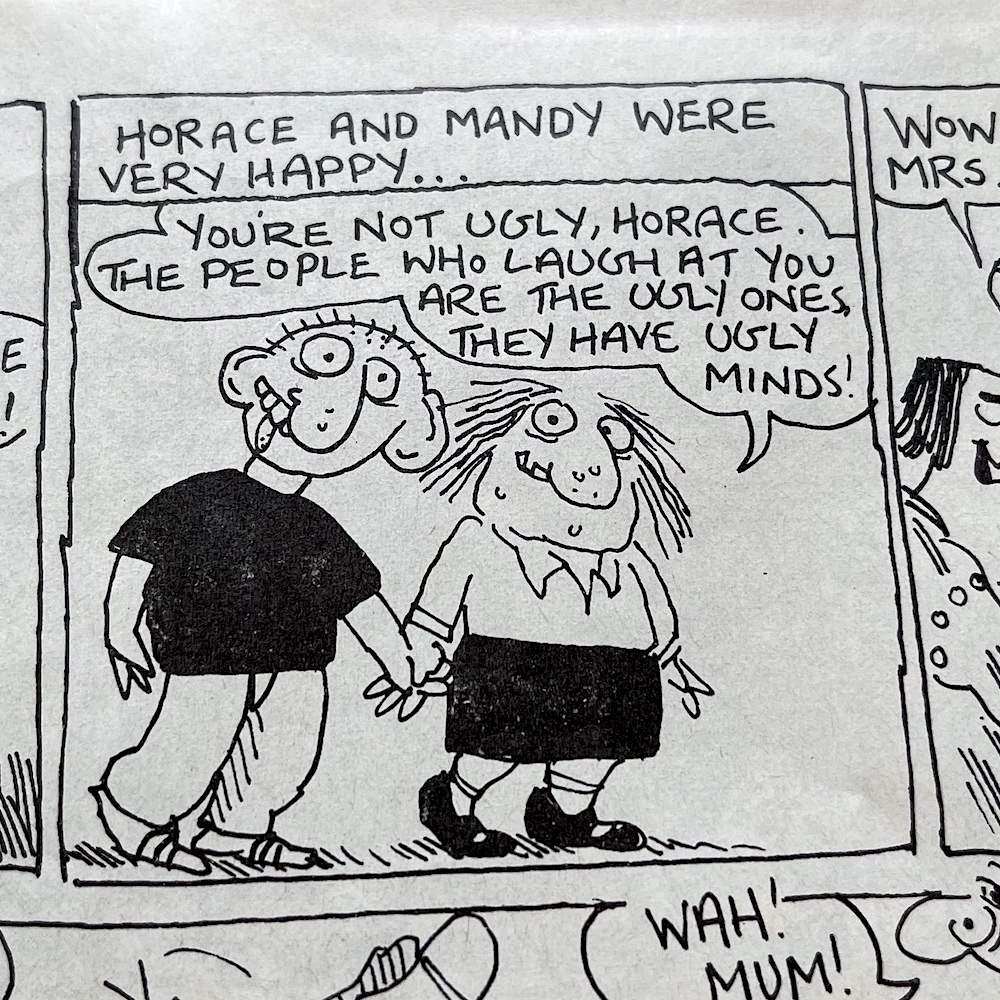
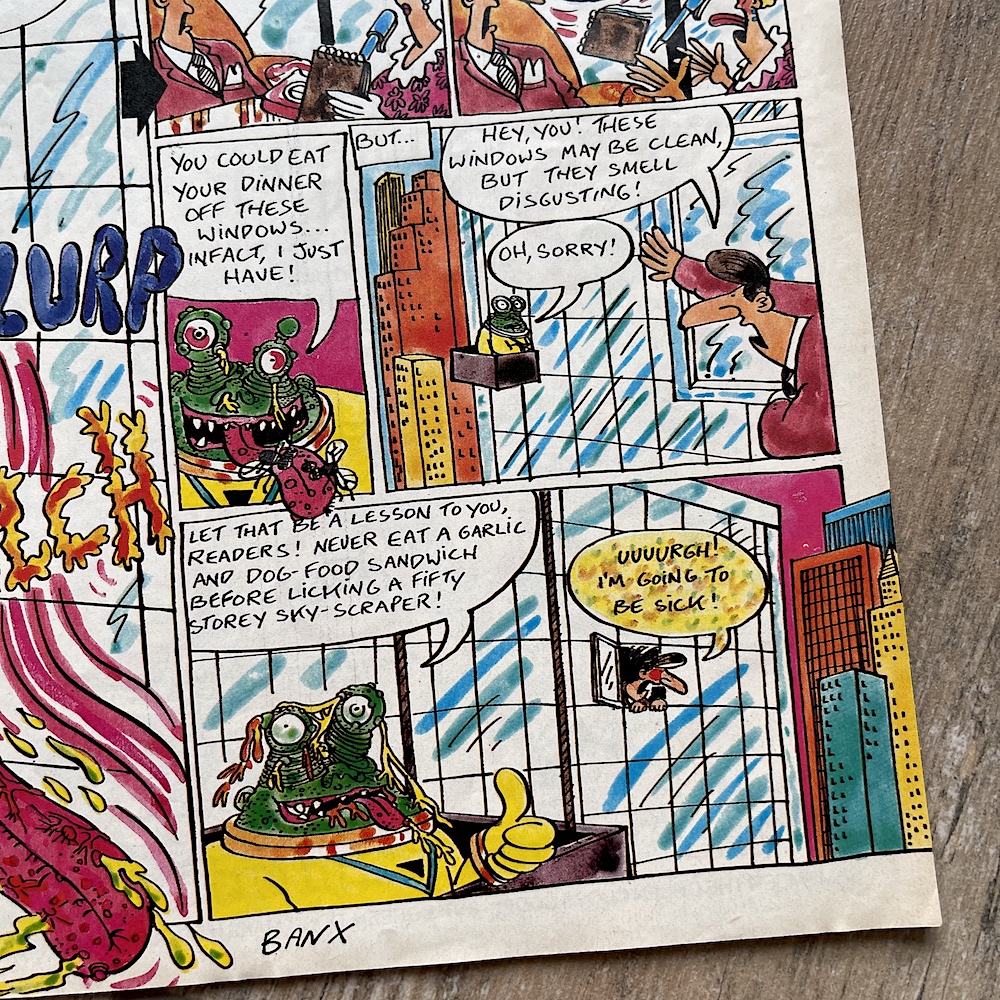
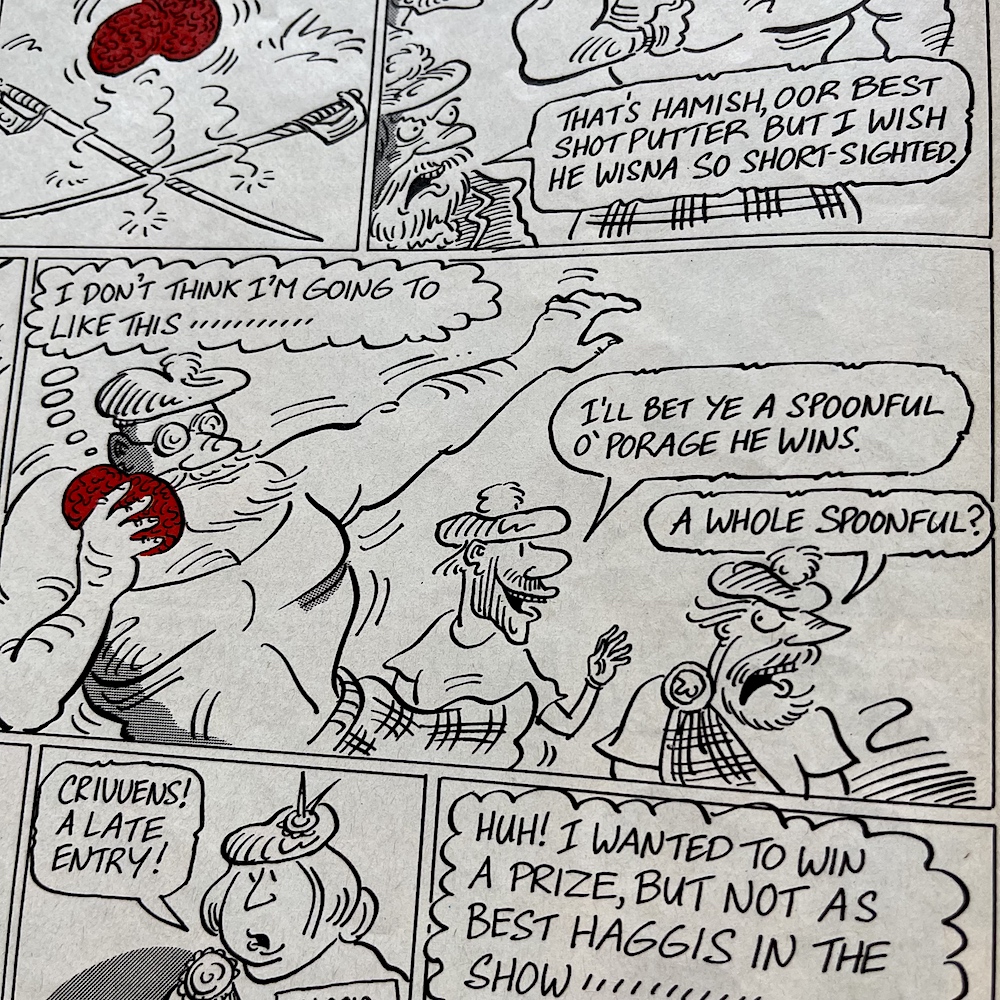
Also in this issue you’ll find Scruff of the Track which was drawn by the late and very, very great Andy Roper. You can check it out in all its glory on the obituary post for Andy posted earlier this year. Both The Sekret Diary ov Hadrian Vile and Horace (Ugly Face) Watkins have strong anti-bullying messages delivered with plenty of laughs, Burp’s attempts to befriend us humans once again go awry after his window cleaning (via his gigantic tongue) doesn’t account for one small detail, then Billy’s Brain partakes in the Highland Games and some gentle mocking.

None of these four highlights may involve the subject but it was never a hard and fast rule, more of a suggestion. I’m sure behind the scenes there would’ve been back and forth between the editors and the contributors to make sure enough of the contents matched the overall theme, although this could vary from issue-to-issue so we never knew what to expect.

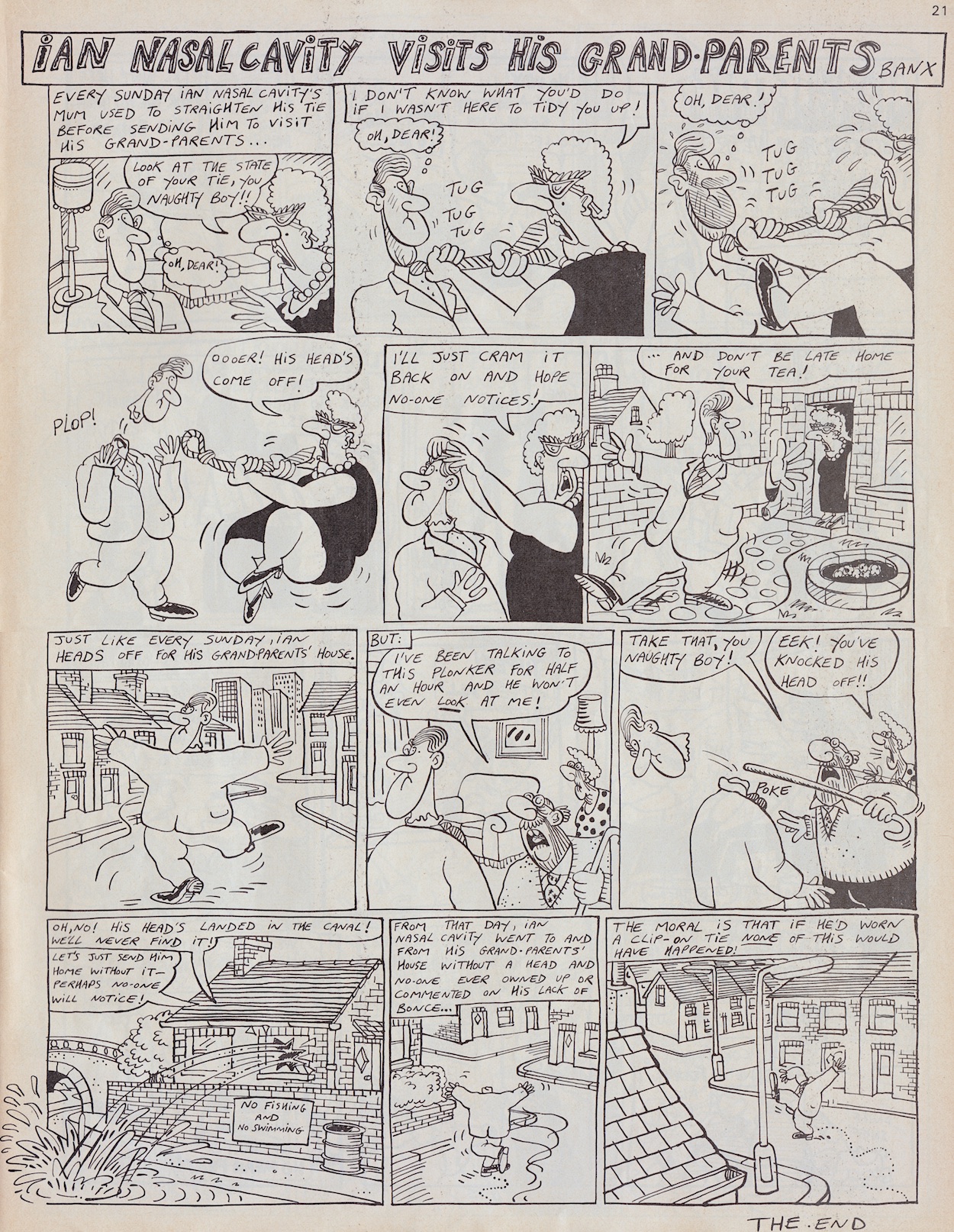
Two weeks ago we were treated to not only one of the best Mr. Big Nose instalments from Jeremy Banx, but also Mrs Warsaw-Pact who was sick and tired of her son making a fuss when it was time for school, so she had him put down and stuffed. Really. Well, I’m very happy to say another unique one-off can be found here, this time called Ian Nasalcavity (where does he get these names?) Visits his Grandparents. The title alone leads us to believe we’re in for another surreal treat and I was certainly not to be disappointed.

From stuffing a child so he’d behave in school to decapitating someone by tying their tie and leaving his body to wander aimlessly in the streets, I think it’s safe to say none of our other humour comics were producing anything remotely similar to these. What I love the most is his family’s complete lack of worry at what they’ve done; they just either stick his head back on or push him out the door, shirking all responsibility, forever leaving poor Ian to live his life without a head rather than own up.

The Hallowe’en issue of OiNK (which will be reviewed in four weeks from the time of writing) will contain more of these Banx gems so watch our for them. While I can only show a few selected highlights I think it’s a safe bet at least one of them will be included.

I often wondered what on Earth passersby would’ve thought if they saw the OiNK guys out taking photos

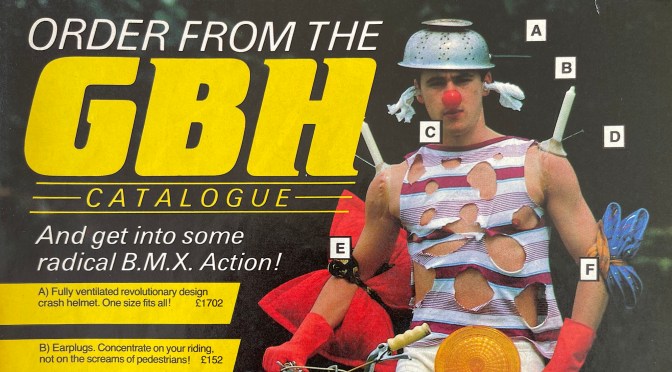
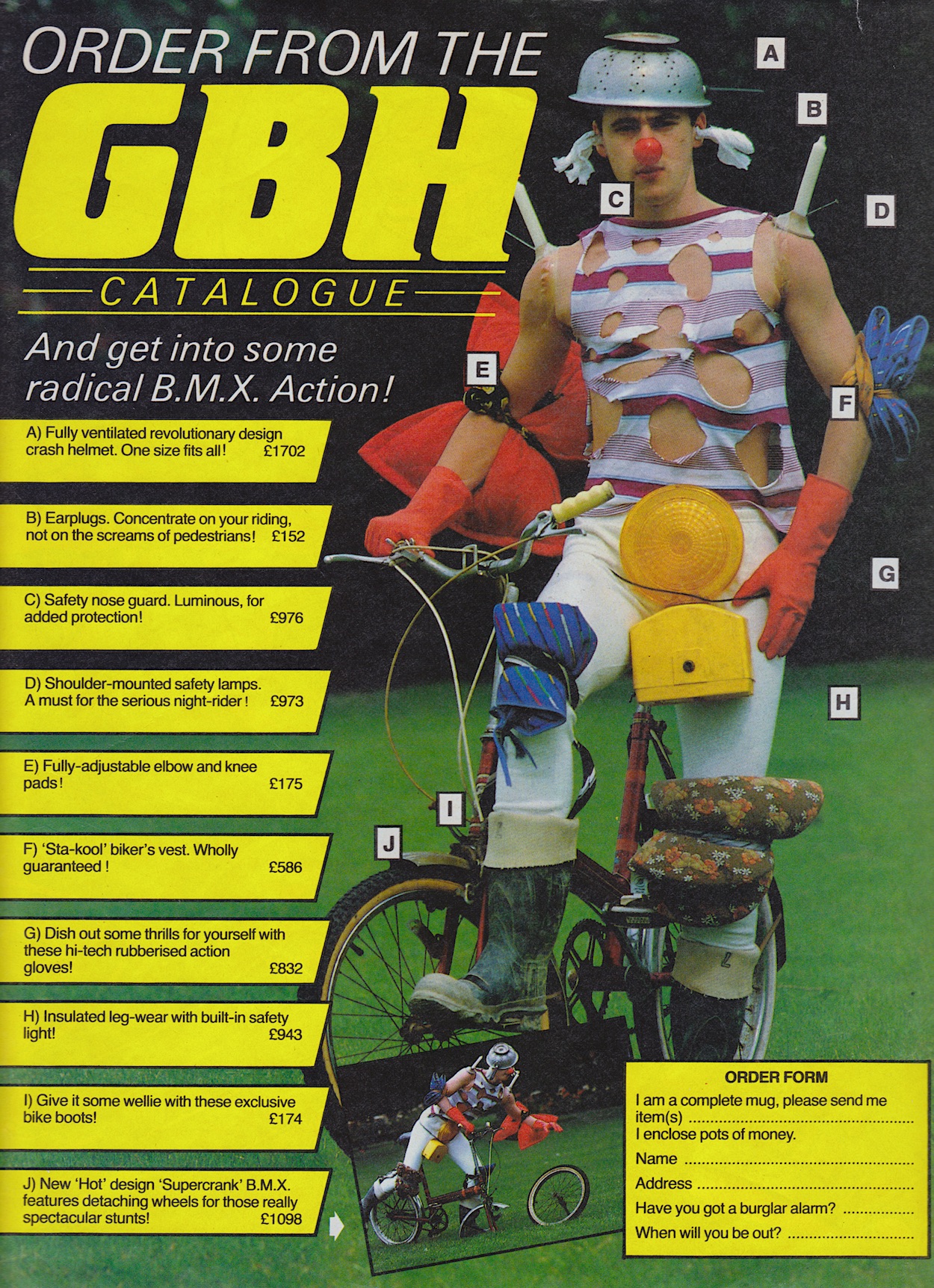
We’ve made our way to the end of another issue and on page 31 is the first full-page GBH Catalogue to feature in the comic. The dodgy mail order company had a hand in every pie and future issues would see them promote everything from book clubs to holidays. All of these contained products which were atrociously poor quality and sold for vastly over inflated prices. This BMX catalogue is certainly no exception.

I often wondered what on earth passersby would’ve thought if they saw the OiNK guys out taking the pictures for their photo stories, but what about this one? The poor fella on the bike is Patrick’s younger brother, Mike Gallagher. Patrick kindly sent me another photo of Mike to try to make up for the one above. He said it was of him at home, but actually Mike is on stage in a production of The Playboy of the Western World at The Wilmslow Green Room in Cheshire. I wonder if the GBH Catalogue is on his resume?

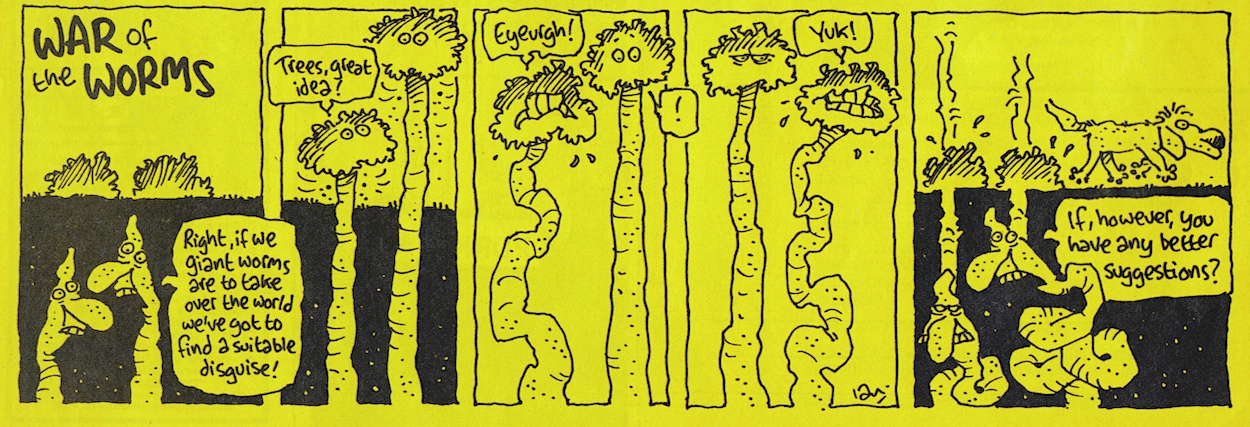
So that’s us, another issue of OiNK comes to a close and gets placed back onto the shelf. The next issue is the Movies Special and you’ll find the review right here on the OiNK Blog on Monday 4th October 2021. But to finish off here’s one final little strip from this issue with a name that’s a play on words on my favourite novel of all time and some of my own very favourite movies and television shows. Until next time, enjoy Ian Jackson‘s War of the Worms.

iSSUE TEN < > iSSUE TWELVE

OiNK READ THROUGH MENU

MAiN OiNK MENU

COMiNG UP: OiNK! #11

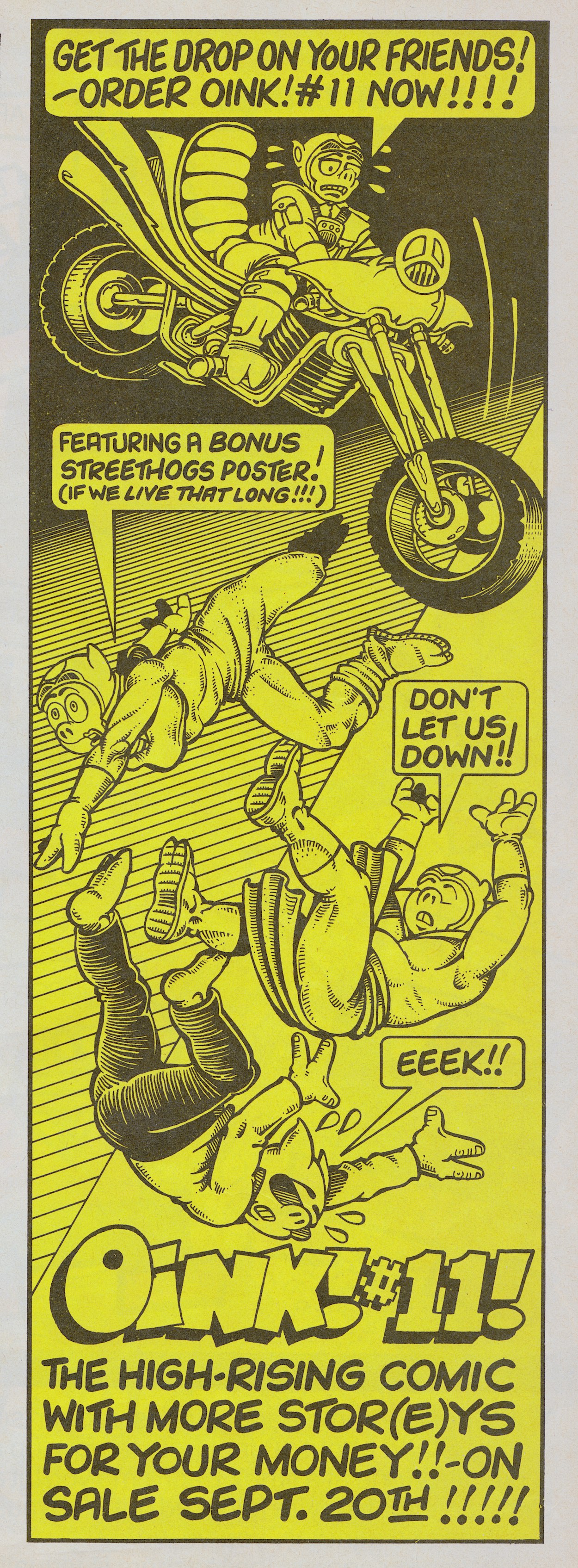
After twelve episodes (including the preview issue) the first epic tale for The Street-Hogs was coming to an end but they were going out with a bang(ers and mash)! Not only would their strip be extra long, they’d be on a special wraparound cover poster and the issue itself would have the theme of motorbikes, biking and general road rambunctiousness. To mark the occasion #10 had this large Next Issue advert.

As far as we kids were concerned only the most special of comics issues had wraparound cover posters (ask any Transformers fan) so make sure you’re here on Monday 20th September 2021 for the next issue in our continuing real time read through of the world’s greatest, and funniest, comic!

Before then, if you’ve missed the Street-Hogs episode featured already on the blog, you can click here to go and have a chuckle.

GO TO iSSUE 11

OiNK iSSUE PROMOS MENU

‘MORE OiNK’ MENU

MAiN OiNK MENU

RiNG RAiDERS #1: TiME FOR TAKE OFF!

When I launched the blog I was nervous about doing my favourite comic (OiNK) justice. The same applies to this one. Ring Raiders remains my other very favourite comic from childhood, fondly remembered and frequently reread. Some might look at it and only see a short-lived comic based on a short-lived toy line and dismiss it, but over the next few months I hope to show you it deserves to be remembered.

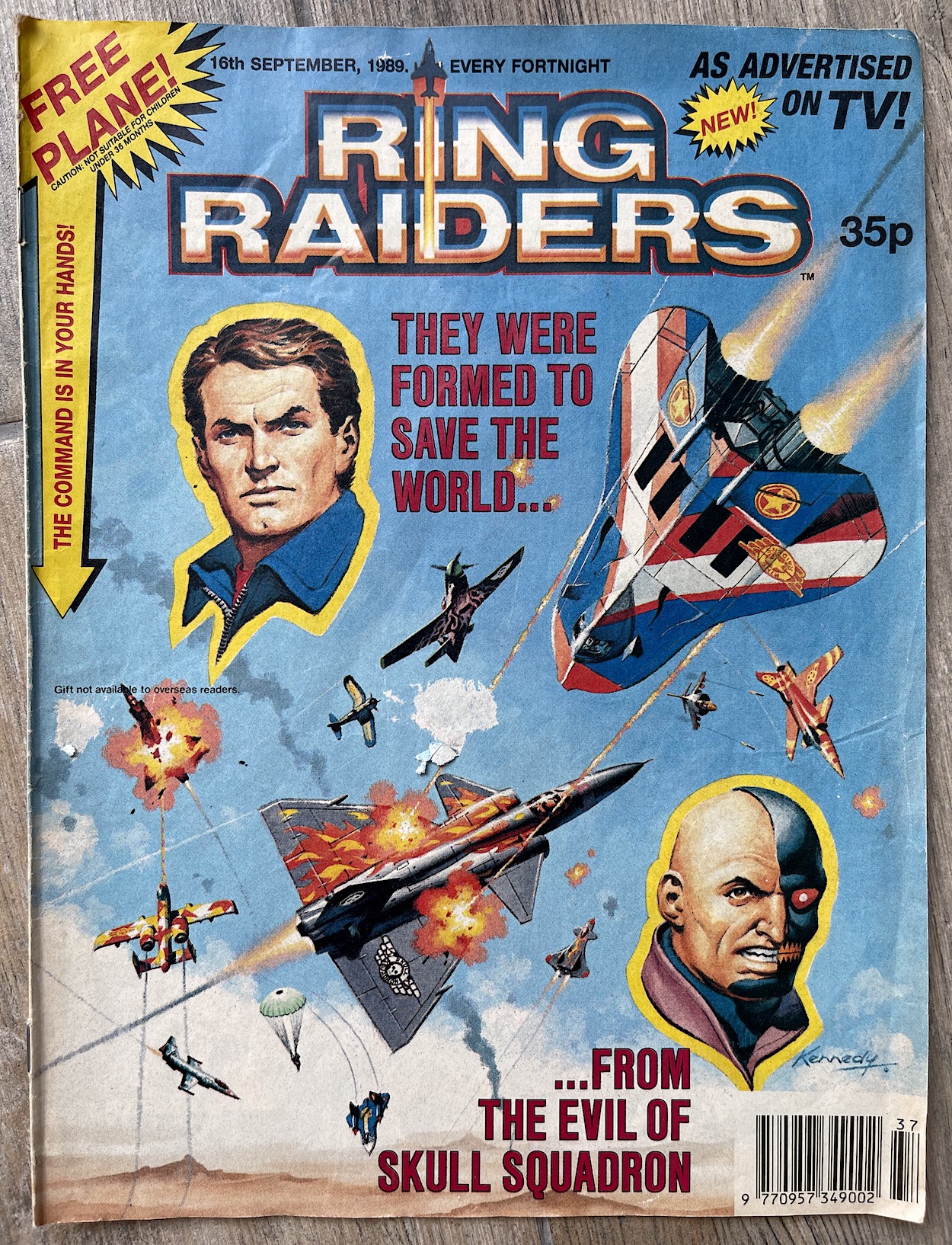
It began for me with this gorgeous cover by Ian Kennedy (Dan Dare, Eagle, Commando). I have very clear memories of discovering it in the newsagents, in awe of how my toy planes had been depicted. I went into this in more detail in the introductory post to this series, where you can also see which plane I got free (it’s the orange one that takes a starring role in the TV advert). I can remember spending a while sitting on the shop floor with all the issues in front of me, deciding which one I’d buy based on the planes. Happy memories.

At 24 pages it was a little thinner than other Fleetway comics but it was all gloss instead of the usual matt paper and contained a lot more colour. I remember the pages felt huge in my hands too. Each issue contained five strips; two colour three-page serials, two black and white four-page serials and a complete five-page colour strip in the middle, then a letters page, pin-ups and adverts for the toys and Next Issue promo. It felt jam-packed. So let’s take a look at each of the stories in turn.

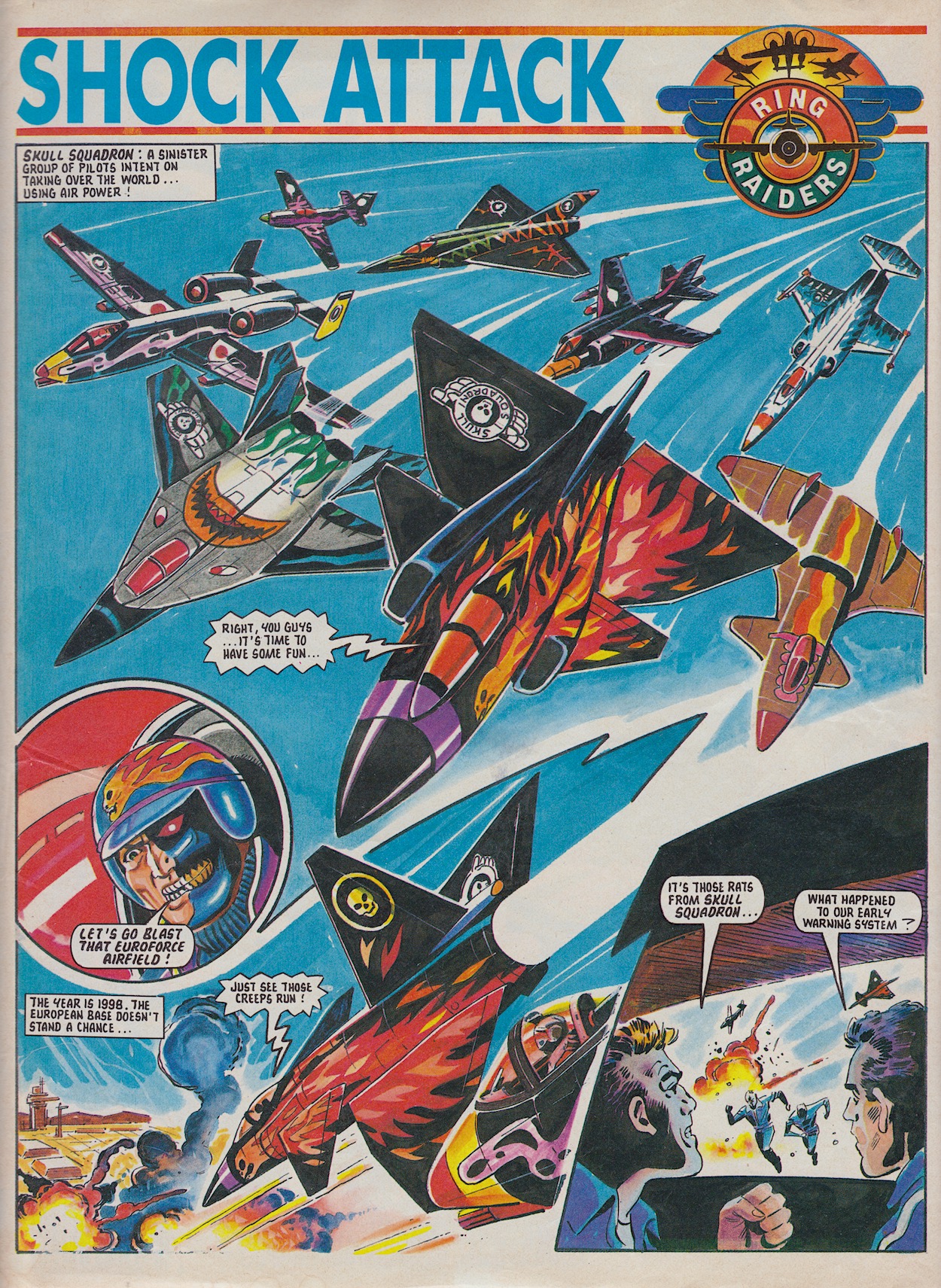
Shock Attack is a quick one-off introduction to the comic written by editor Barrie Tomlinson and drawn by Carlos Pino (Johnny Red, War Picture Library, TV Century 21) and that first panel in the first story of the first issue is really rather good. The story is a quick fix of action which followed on from the preview comic and had the Wing Commanders battling each other again rather than with their designated teams.

Set in the then future of 1998 the Skull Squadron leaders are attacking a Euroforce base but the Ring Raiders swoop in to save the day and the Skulls retreat through time to the age of the dinosaurs. Followed by the Raiders and terrified of having to bail out in this time zone after two of them are hit, they flee.

If the comic had continued this could’ve set up a brilliant way of killing off (kind of) older characters while also keeping things open for a possible return. As you’ll see over these real time reviews plenty of characterisation is given to these pilots away from their planes, so having one trying to fend for themselves out of their time could’ve made for an interesting story on its own later on.

It’s truly epic in scale. I distinctly remember its scope really exciting us

Throughout all this, back in ’98 TV camera crews fill in their viewers (and the readers) on a brief history of the opposing sides. Skull Squadron were formed in the mid 90s and see themselves as a potential new world power, which they try to achieve by manipulating history to their advantage. The governments of the world formed the Ring Raiders and, upon learning of the enemy’s ability to time travel built the Air Carrier Justice, a massive flying base which also traveled in time and recruited the very best pilots from the past, present and future.

This was the main selling point of Ring Raiders, the whole point of this set up and it’s truly epic in scale. It was a nice story idea for the toys and acted as a way to inspire collection of every type of plane. For a comic, I distinctly remember its scope really exciting us.

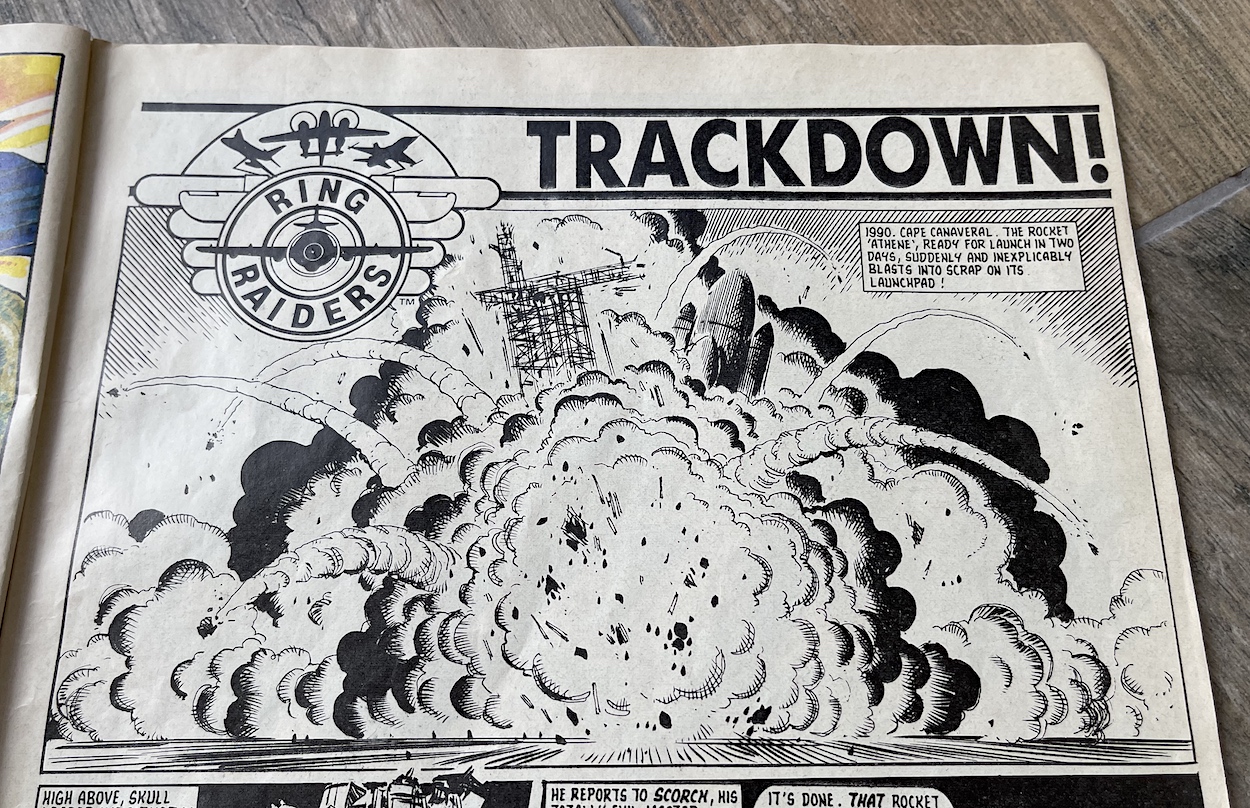
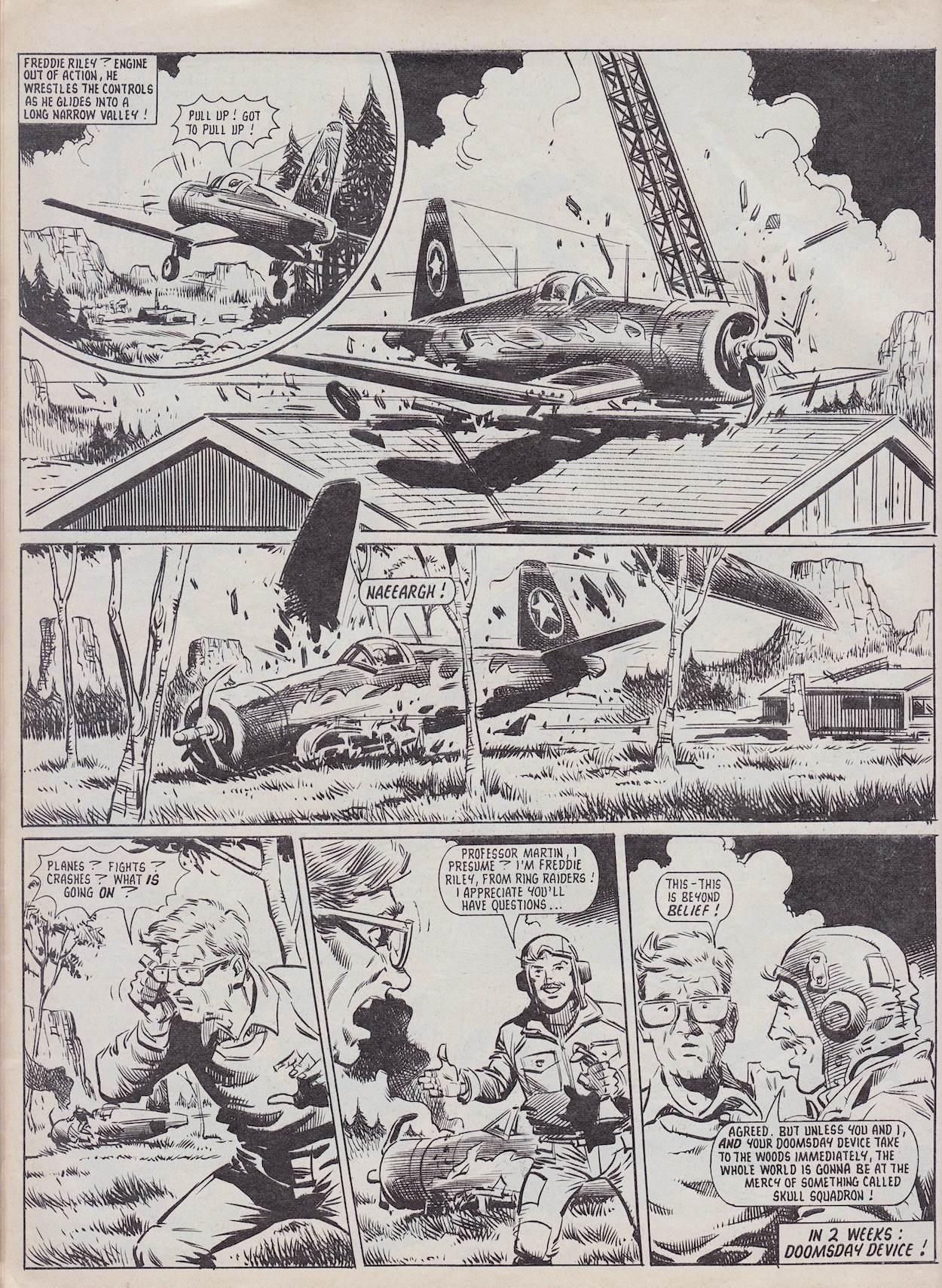
The second strip is the first serial and would be the longest in the whole series at eleven episodes and 44 pages in length. Professor Martin has accidentally created a chain reaction capsule, a Doomsday Device which is being launched into the safety of space when Skull Squadron blow up Cape Canaveral in 1990. With the device now grounded permanently at the prof’s cabin Blackjack‘s Havoc Wing is dispatch to steal it. Aboard the Justice, Ring Commander Victor Vector (that’s him on the cover with Skull Leader Scorch) sends Joe Thundercloud‘s Rescue Wing in pursuit.

Apart from the tiny little fold out comics that came with the toys, up to this point all we really saw of the pilots behind the planes was the one pose each Wing’s leader had on their packaging. When I read part one of Trackdown for the first time it was such a thrill to see these guys come to life. More than that though, the comic starts to create its own characters for the unnamed pilots who flew the other three planes in each four-plane toy pack.

In fact by the time this chapter ends the main characters are both original comic creations by the name of Freddy Riley of the Raiders and Runtz, one of Blackjack’s wingmen. I certainly didn’t expect one of the hero planes to be shot down in the first issue. It’s a spectacular crash and a really exciting opening chapter for the comic as a whole.

Trackdown is written by Angus Allan (TV-21, Look-In) and brought to life by John Cooper (Battle, Scream, Judge Dredd). As a child it felt like the battle and the crash of Riley’s plane had real world weight to them. This was in stark contrast to the cartoon. I’m reminded of how the G.I. Joe comics of the 80s would feature bullets and characters would often end up injured or worse, but in the cartoon every gun (no matter which model) fired lasers and no one was ever hit. The Ring Raiders cartoon was the same, so to see the toys being treated more seriously here made me an instant fan of this over the animated series.

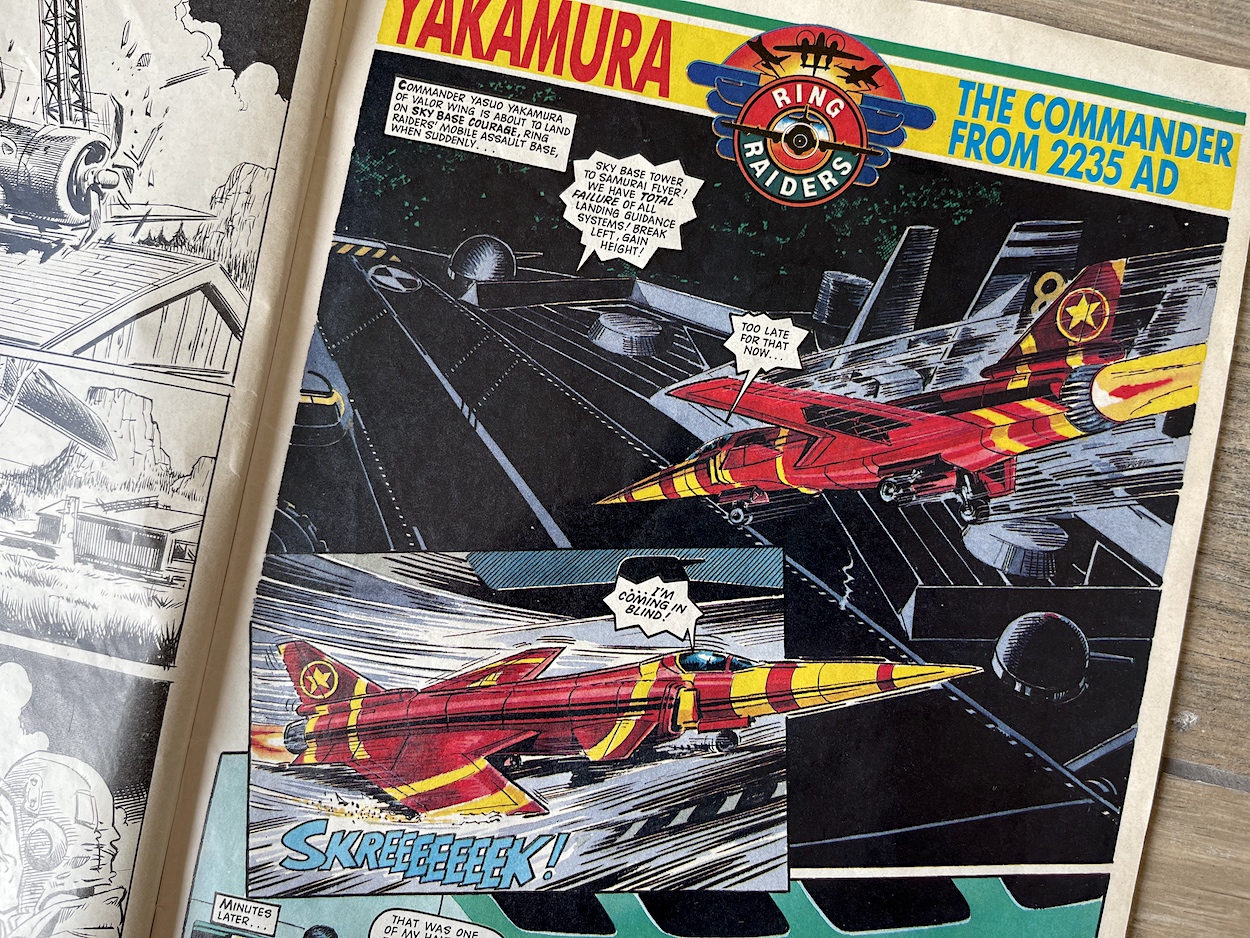
Across the page from that cliffhanger is the first of the complete tales and when seen side-by-side the good guys seem to be having an off day, this story beginning with another rough landing. Yasuo Yakamura was the first character to get a background story and I couldn’t have been happier because, as I’ve detailed previously, his X-29 came in the Starter Pack that began my collection and would remain my favourite, his Wing also being the first that I bought.

I was surprised the leaders weren’t the first to get this treatment but perhaps Yakamura was a fan favourite, or perhaps the fact his past would actually be set in our future, allowing them to have a full blown sci-fi strip for the premiere issue helped with their decision (complete with lovely retro 80s futurism). Over the course of the comic’s life these complete tales would switch from sci-fi to war drama to horror and everything in between.

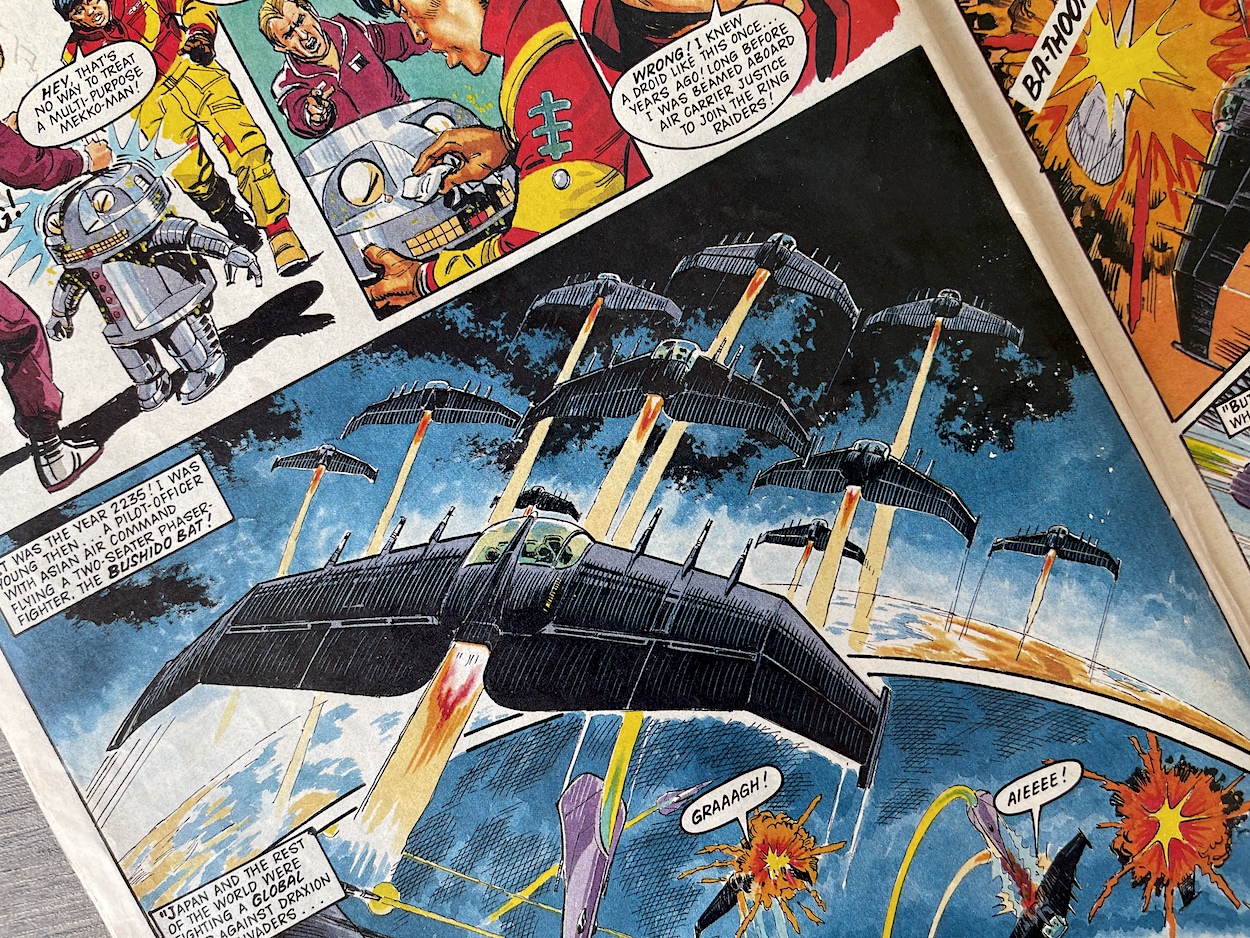
Yasuo was known for embracing computers, his aircraft kitted out with the latest tech only he could control. Written by Scott Goodall (The Phantom, Commando, Scream) and drawn by John Gillatt (Tiger, Eagle, Wildcat) the story focusses on why he defended the robotic landing system even though it nearly cost him his life. Initially distrustful of automated technology, during a war with an alien race called the Draxion in their Bushido Bats he was forced to take a small robotic co-pilot after losing his partner.

Yasuo seeks revenge but the robot chastises him for putting that above the mission and Yasuo loses his temper, resulting in loss of concentration and they’re shot down. Left for dead by his human comrades he watches as the robot builds him a glider, only to stay behind and fend off the enemy alone, inevitably being blown apart. The story touches on how this set Yakamura on a path to studying robotics and computers and how he became the logical and cool headed pilot Vector would eventually recruit and bring back to our present day.

The serials would develop the characters further over time but these complete stories were the perfect way to delve into a particular aspect of their personality, helping to build layers across the various stories and issues.

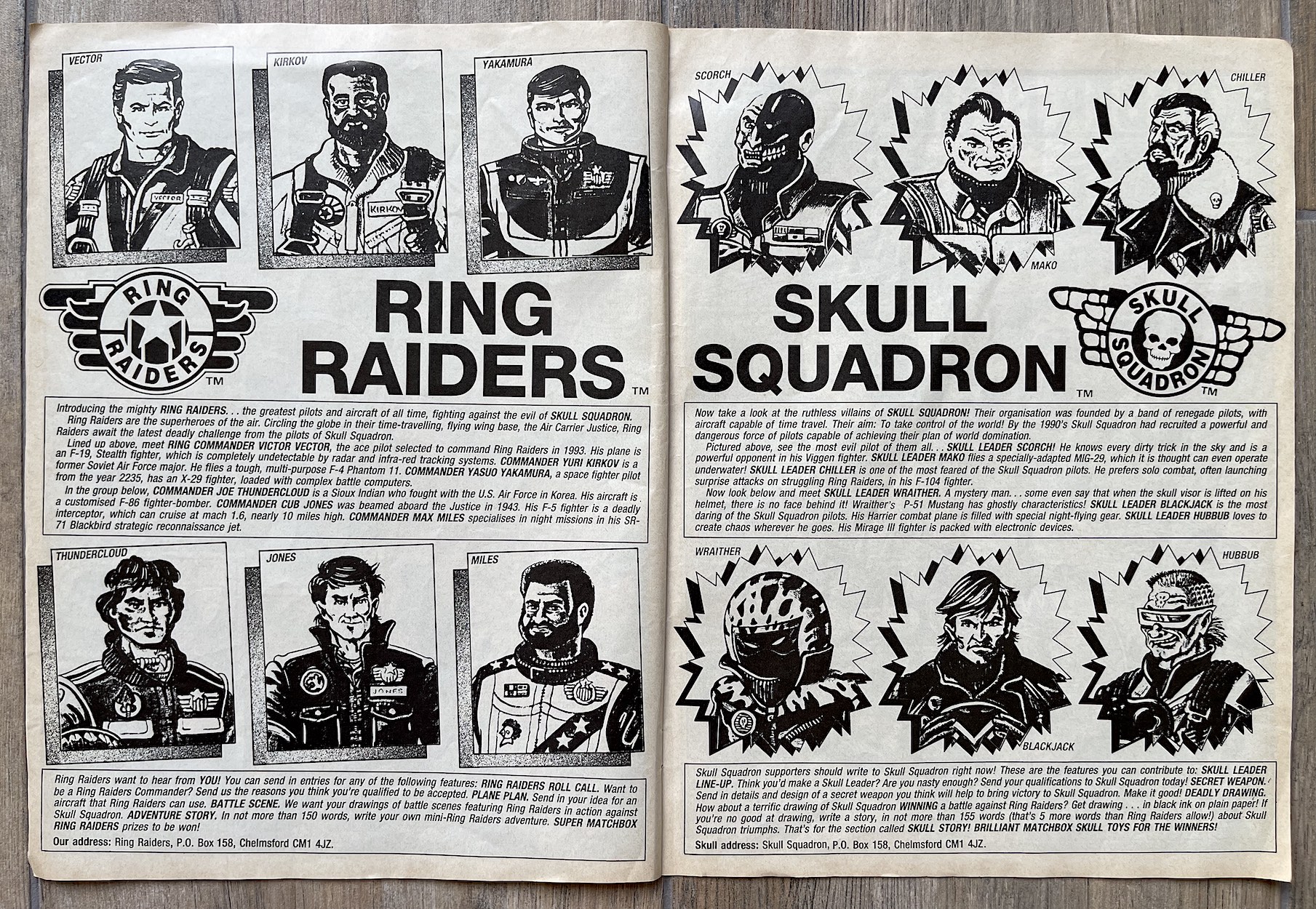
No comic of the 80s would’ve been complete without a letters page answered by a fictional character who could be as cheeky or irreverent to the readers as they dared. Barrie’s titles never disappointed. In his book Comic Book Hero he explains how he loved creating various ways for readers to interact with his comics. For this comic he chose to have a different character in charge every issue, switching between the Raiders and the Skulls every fortnight. Instead of letters, issue one had this introductory spread with images taken from the toy packaging.

Barrie was editing freelance from home under the name Creative Editorial Services and had brought in Terry Magee (Commando, Battle, Cor!!) to assist with editorials. Together they thought up some ingenious ways for readers to have their say. There were chances to apply to be a member of either side, or to design a new plane for the good guys or a super weapon for the bad, or they could draw a battle scene with their choice of victor or even write a short story. A very short story. There was a 150 word limit, or 155 words for the Skull Squadron who boasted, “That’s five more words than Ring Raiders allow!”

After a two-colour pin-up and the obligatory Next Issue/newsagent coupon page (boasting of the free posters to come in #2 and #3) we move on to the next two stories.

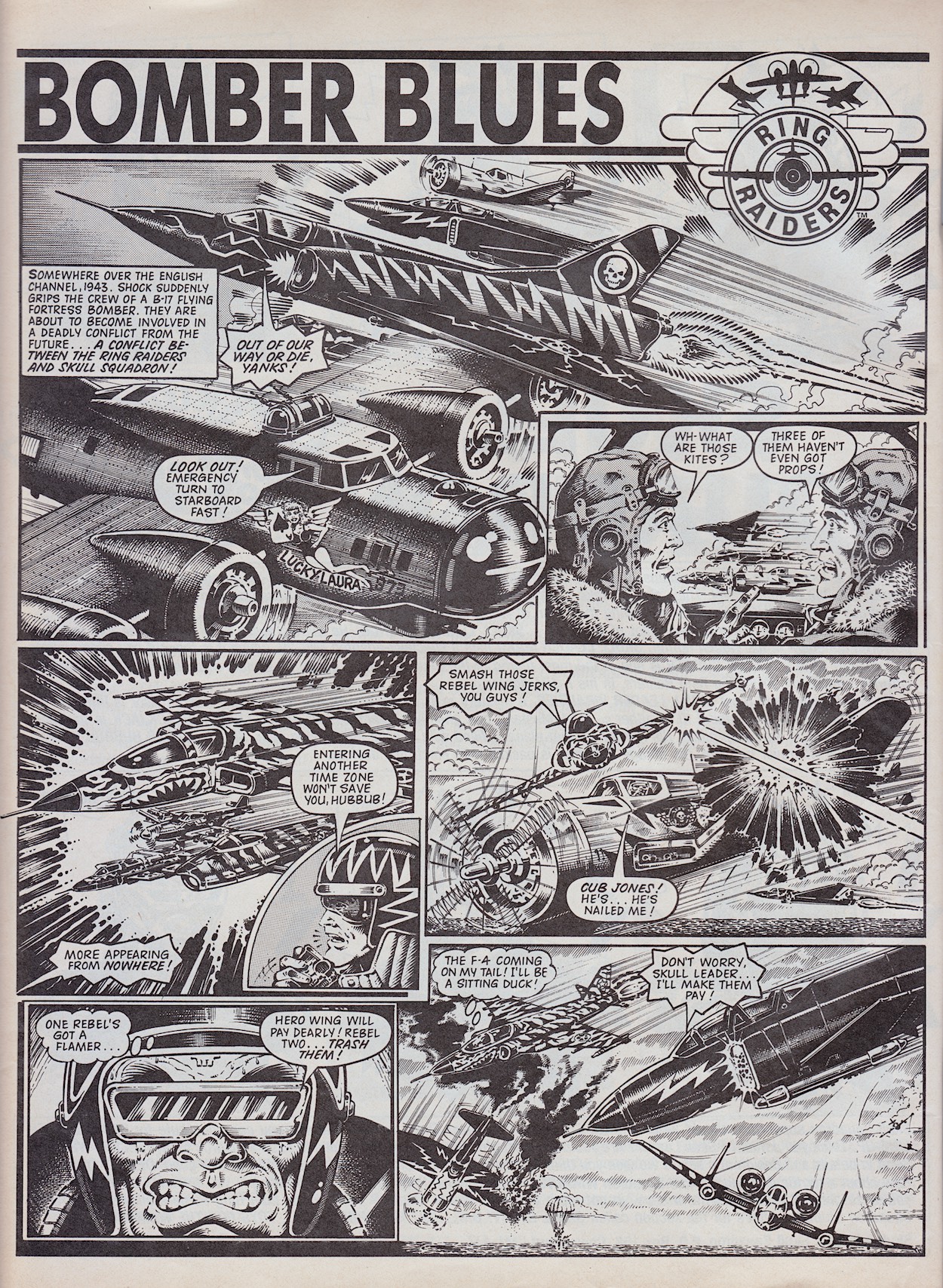
Barrie’s son James Tomlinson (Eagle, Super Naturals, Scream) went by the name ‘James Nicholas’ at the time and is an aviation enthusiast to this day. This is clear in the strip he wrote, Bomber Blues. We’re not sure what began the fight between Wing Commander Cub Jones and Skull Leader Hubbub but it doesn’t matter. Appearing in the skies above the English Channel during World War II, this was just about as perfect an introduction to the whole concept as you could wish for.

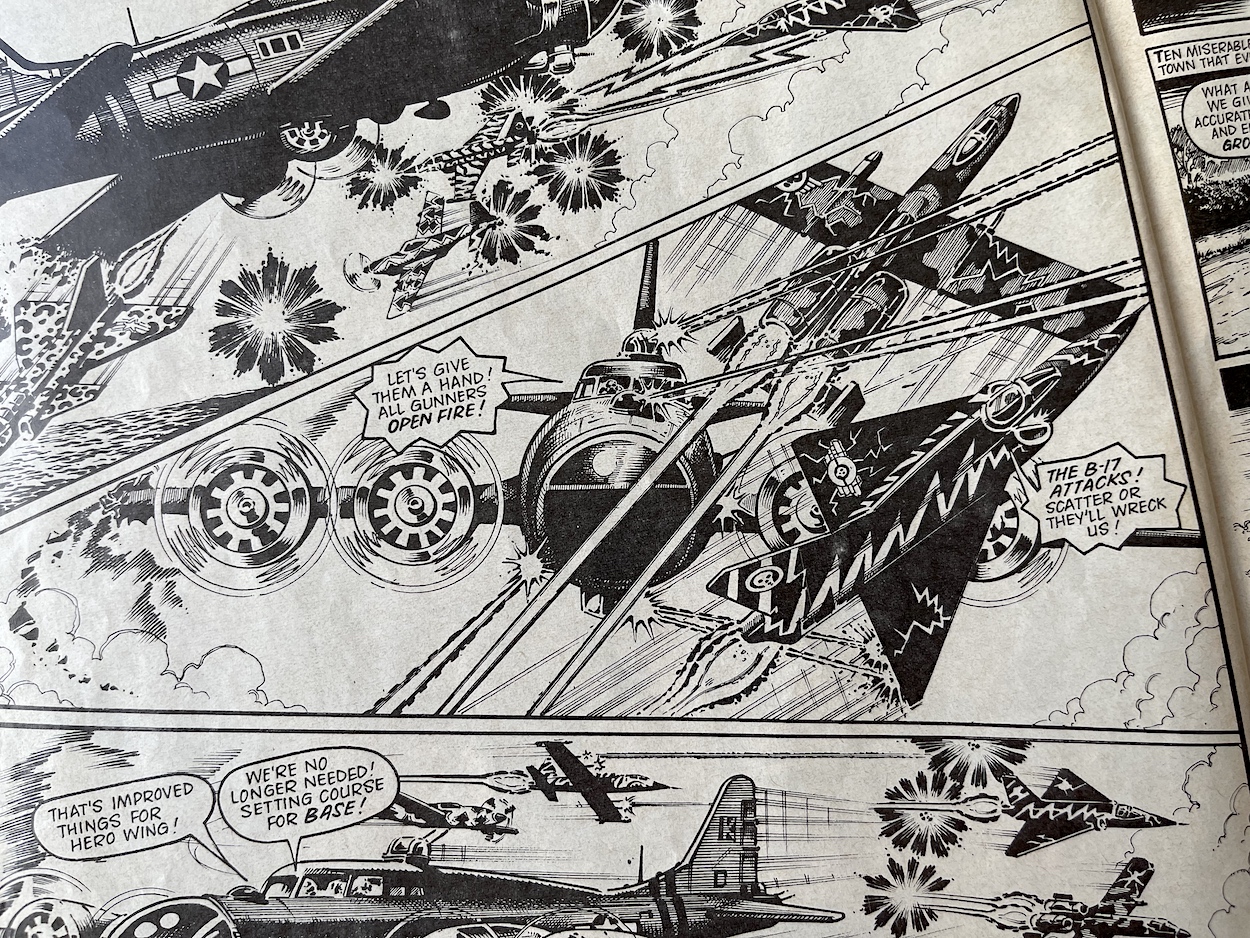
In contrast to the other strips this one takes place entirely in the air and sees a B-17 Flying Fortress Bomber become accidentally caught up in the battle between the futuristic craft. Really, what is there not to love about this? We even see one of the Rebel Wing pilots parachute out, becoming lost in the past just as I theorised above. The action is intense and culminates in one of Cub’s wingmen colliding with the bomber. Damaged but now with a clear sense of sides, the bomber crew come to the rescue of the Ring Raiders. All of this great, original action is brought to detailed life by Don Wazejewski (Battle, Mask). Beautiful stuff.

Fans of the toys who had purchased Cub Jones’ Hero Wing or anyone who had closely read the introductory spread above will have worked out this was set in the same year that Cub was originally beamed aboard the Justice. There’s no direct reference made to this in the story but it’s no coincidence and Cub’s affection for the bomber crew is made abundantly clear in the final panels when he gives them a ring through which they can summon him.

The only slight disappointment is the way the leaders call their wingmen by their identification numbers instead of actual names, which feels a little off after Trackdown went to the trouble of creating new characters. But it’s only a minor quibble.


“Let’s give them a hand! All gunners open fire!”

World War II F-17 Bomber crew rescuing the Ring Raiders

Apart from characters holding their ringed hand aloft as they head to battle this is the first time we see a ring properly mentioned. One of the many uses they had was as a communicator that could cross the globe and periods of time. When the comic was released I knew from the toys some of the other things the rings could do in the story but I like the fact the comic introduces these slowly one at a time. The same goes with the various characters and Wings.

As a result, nothing feels forced, nothing feels like it’s exposition and in that regard the series has a surprisingly mature way of layering in all the information needed to introduce this new world. As you’ll see across these six issues (which would’ve all been regarded as early issues if it had lasted, so kudos to Barrie and his team for hitting the ground running) the layers are added upon slowly, each new issue bringing new character, story and background developments. It’s a far cry from something like the early issues of Transformers five years prior which bombarded readers with everything they needed to know all at once, which felt very forced.

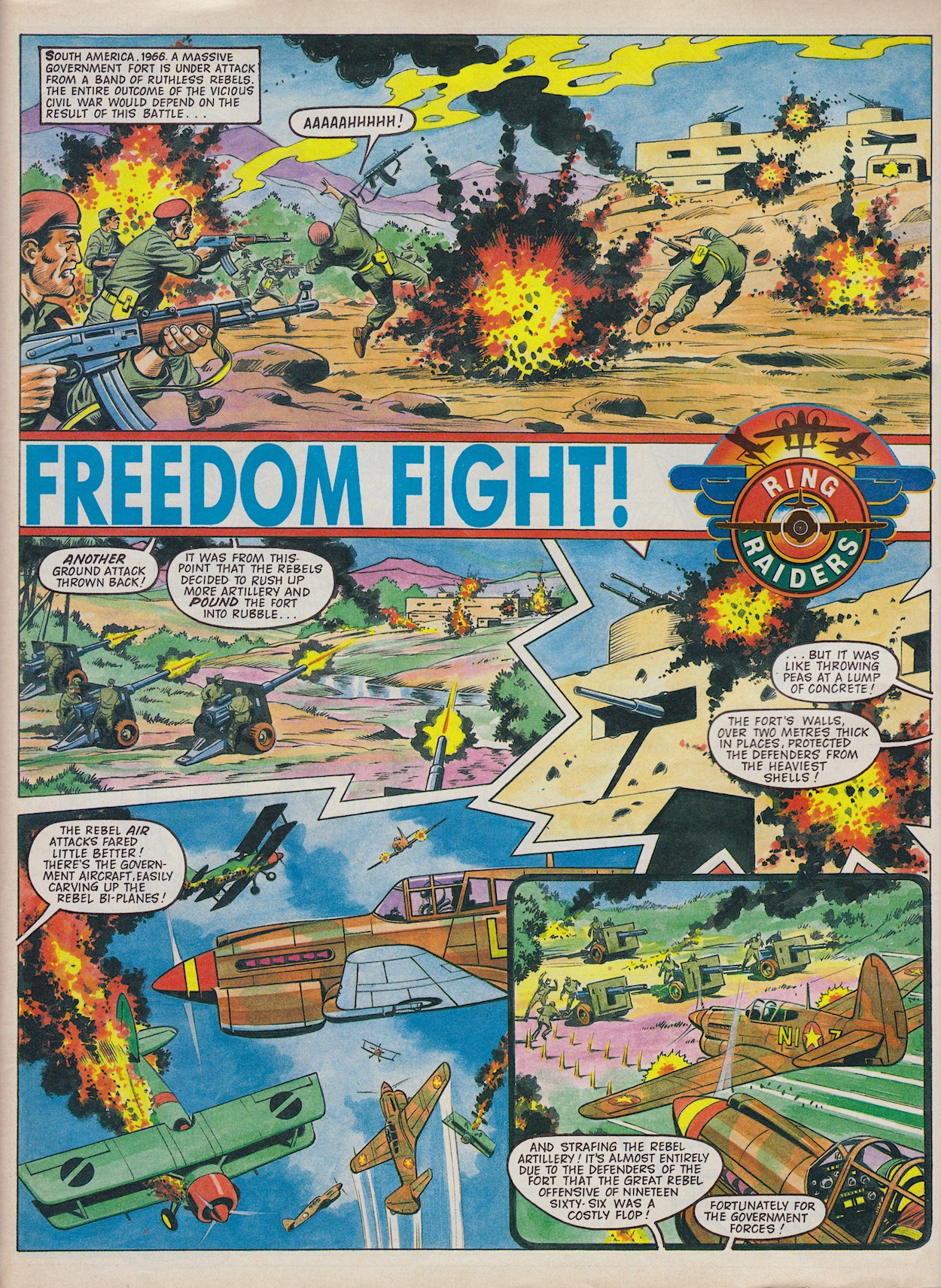
The final story is Freedom Flight, written by another long-time collaborator of Barrie’s, Tom Tully (Johnny Red, Bad Company, Dan Dare). Sandy James‘ art style will also be familiar to anyone raised on IPC or Fleetway licenced comics such as Teenage Mutant Hero Turtles Adventures or Mask. His colouring in particular is just magnificently bold.

The intervention of Skull Squadron is starting to change history, potentially destabilising the future of the country

Here the main characters are Commander Yuri Kirkov and his Freedom Wing, who go up against Skull Leader Mako‘s Vicious Wing. The former was an instant favourite among fans given how the final years of the Cold War were still playing out and Kirkov was a Soviet Air Force major who had defected to America before Vietnam. Mako’s MIG-29 was a personal favourite toy with its shark motif and the fact the info on his toy packet stated there were “rumours” it could operate underwater.

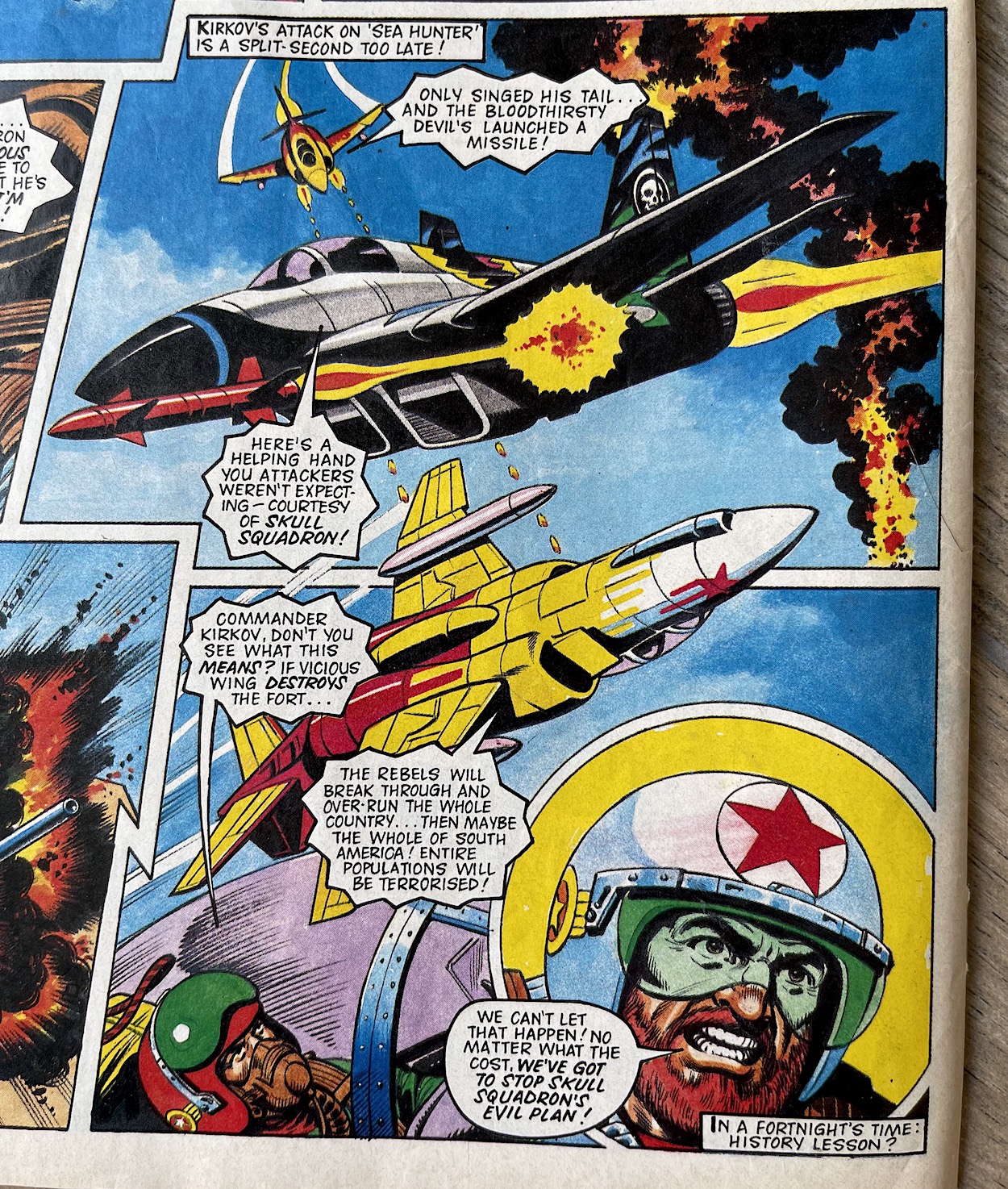
History books tell of a South American government fort which easily defeated ruthless rebels in 1966, however the intervention of Skull Squadron is starting to change history, potentially destabilising the future of the country. Kirkov discovers the tide of battle is about to change forever when Mako’s missile hits the fort. The situation is dire. While it’s only three pages a lot happens, with these gloriously dynamic final panels providing not only a superb cliffhanger but the perfect end to the entire issue.

These panels take up about a third of the back cover and it’s a gorgeous display to end the issue on. The action, the distant fire, the detailed face of Kirkov compared to the basic toy design, as well as the interesting plane angles all beg for more.

Barrie explains in his book how he found the fortnightly schedule of Wildcat interesting and wanted longer stories in its 32 pages to hold readers’ attentions for the two weeks, compared to the three-page tales of Eagle. As a result each of its stories were five or six pages in length. Ring Raiders was also fortnightly but had 24 pages to fit in just as many stories. But there was so much packed into each one that we never felt short-changed by any of them.

I was also collecting the weekly Transformers which contained three stories of roughly five pages each. Ring Raiders felt like a much meatier read and after this first issue I was an instant fan. I had already known I would be though and the regular order had been placed when I purchased the issue. I hope you’ll join me on a regular basis too and return on Thursday 30th September for #2 of a bloody brilliant comic.

MiNi-COMiC < > iSSUE TWO

RiNG RAiDERS MENU