Tag Archives: Barrie Tomlinson

SUPER NATURALS ADVENTURE BOOK: ALL iN THE NAME

Originally due on the blog at the beginning of February, like the Ring Raiders Special this had been loaned to a friend who I don’t get to see too often and I’ve just gotten it back. So here we are, rounding off the Super Naturals read through at last. The Adventure Book went on sale alongside #8 (the penultimate issue) and while it was a strange time of year for a special, it was probably originally aimed at all those potential new festive toy owners.

While reference is made to the comic it’s usually in a past tense, looking back at previous issues and stories. There’s no mention of it being on sale or placing an order in newsagents, even the page of readers’ drawings doesn’t include the address to send more in. Sadly, while the original idea may have been to lure new readers in it appears the writing was already on the wall by the time this went to the printers. But let’s concentrate on the fact we have an extra edition to enjoy.

It certainly feels special as soon as you pick it up. It’s a chunky 68-page book with high quality internal pages and a very glossy card cover with new, gorgeous painted Ian Kennedy art. Excuse the marks on mine, tracking this down was difficult (I didn’t know it existed until a few years ago) and I even had to hang it outside to get rid of the wet grass smell it had for whatever reason. It must’ve been stored in a garden shed by the eBay seller. It’s all good now though so I can read it without gagging.

There’s nothing from The Doll unfortunately but there is one particularly superb feature

That’s a very full contents list but when you go through the actual book it’s not as packed as it initially seems. There’s only one original Super Naturals strip with the main characters, although there are two new Ghostlings tales and a text story. There’s a lot of reprint though, like the preview issue’s cover, strip and free card, the masks given away previously (printed as basic images now, not masks), a Scream strip and some of the toy photographs are reused too.

There are some new photos though, as well as a disappointing quiz which amounts to nothing more than drawings of the characters and asking readers to identify them, some new illustrations from readers as mentioned and one particularly superb feature which I’ll get to in a bit. No, there’s nothing from The Doll unfortunately, the terrifying dummy being contained within the fortnightly only, but let’s take a look at the new stories beginning with Destruction Run.
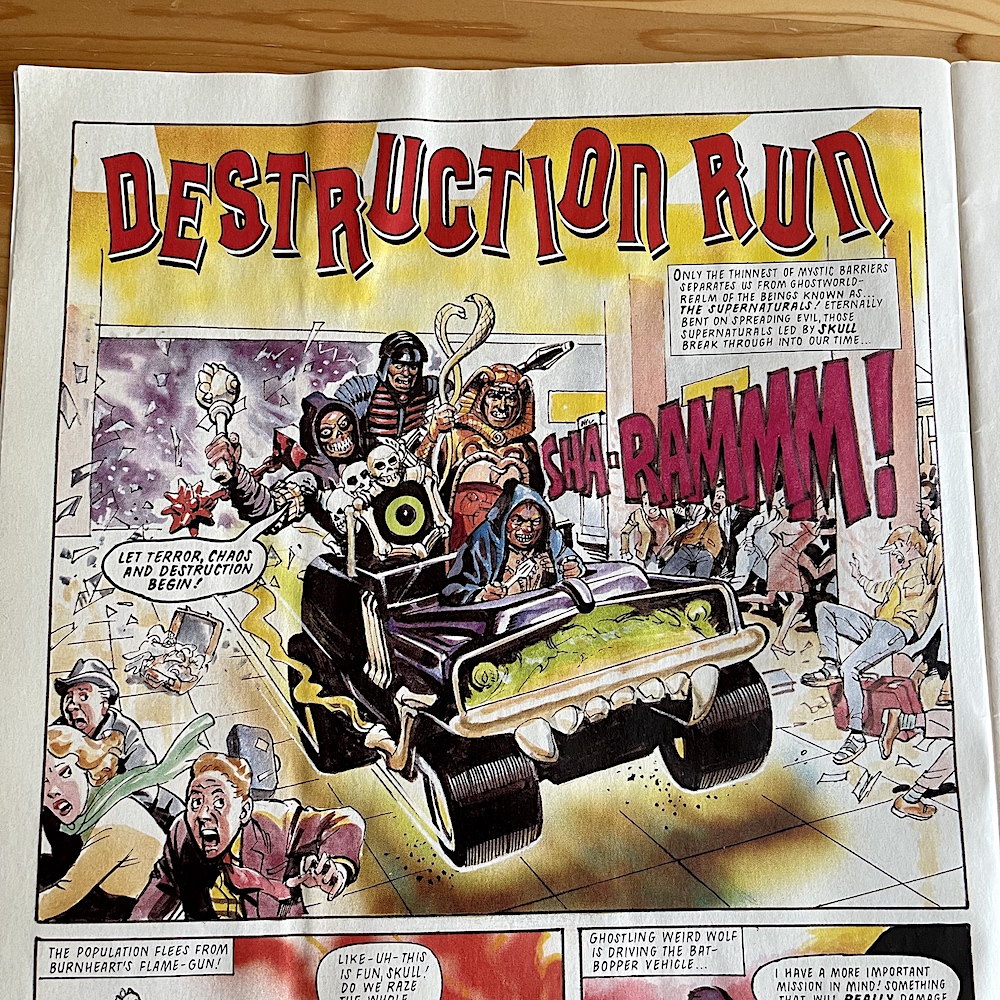
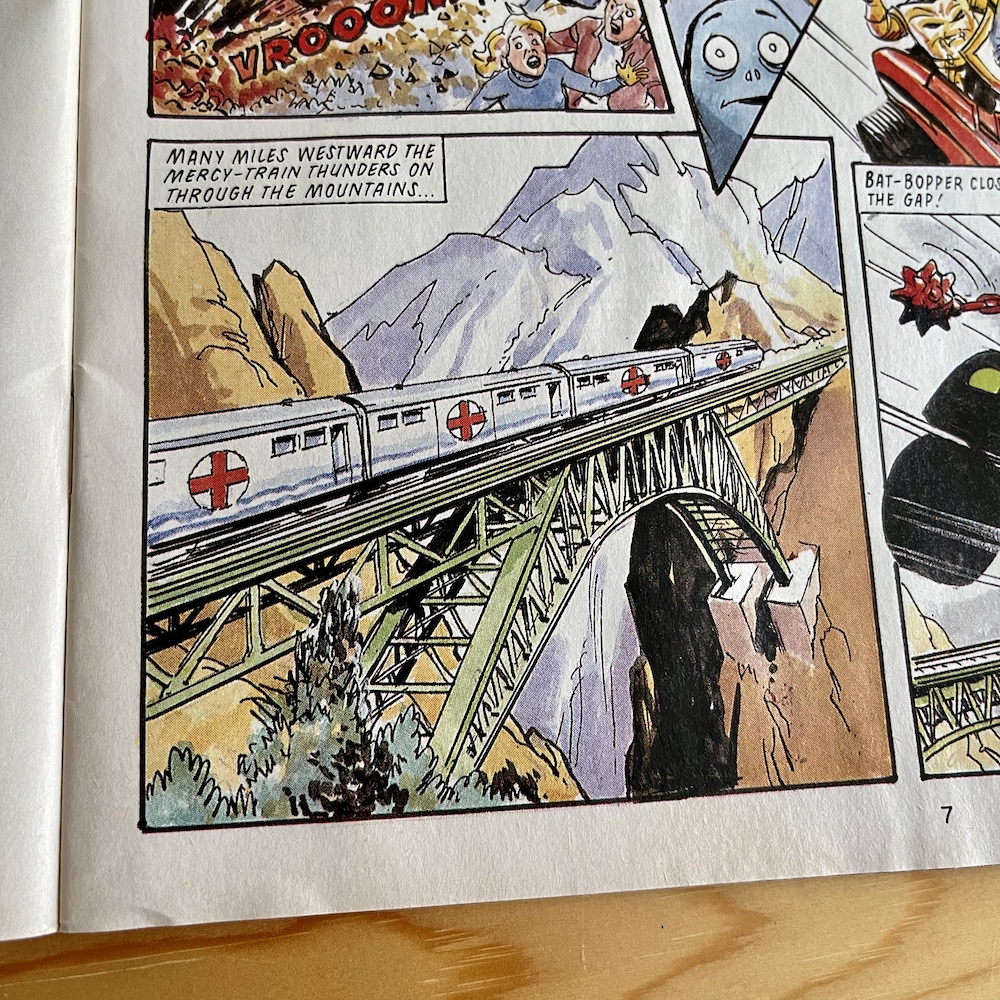
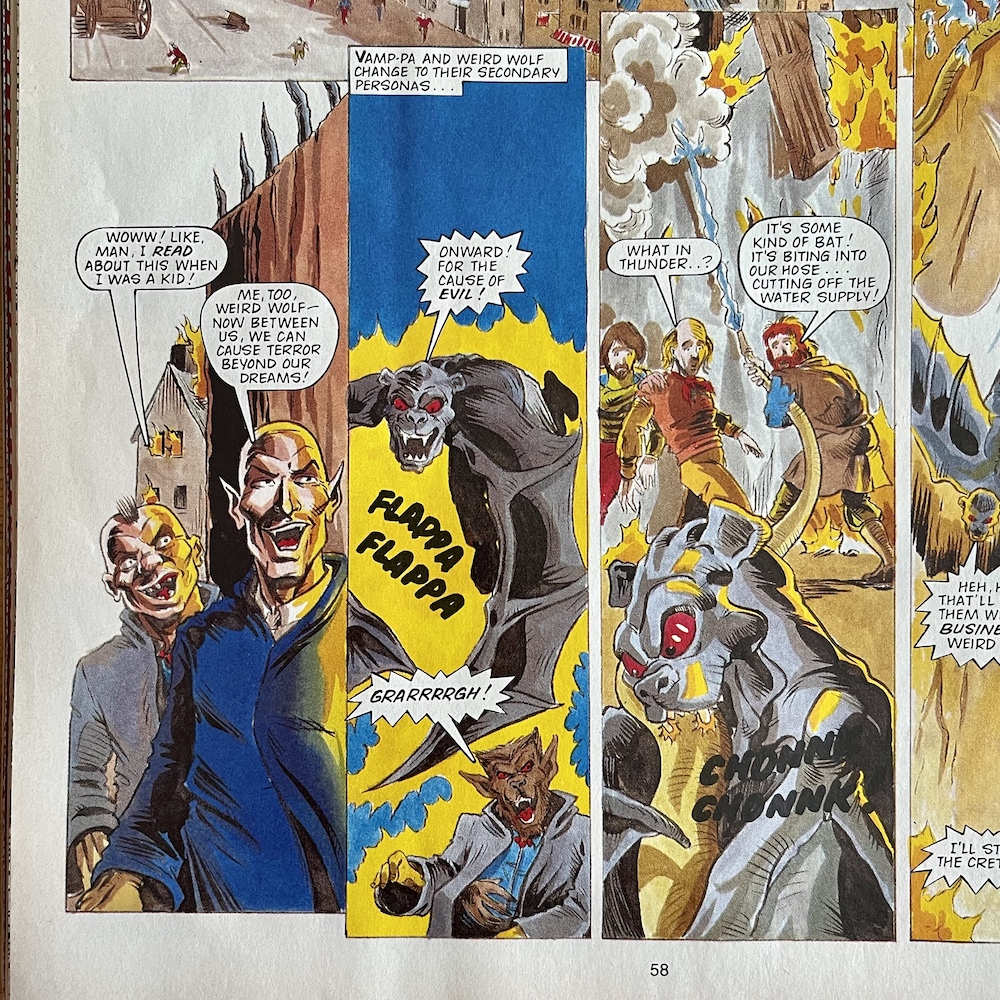
Skull, Burnheart, Snakebite and Weird Wolf break through into our world in the middle of a shopping mall. An earthquake has struck the west coast of America and an aid train is speeding its way there filled with vital medicines and personnel. The comic established the characters never knew where they’d end up but this contradicts that; Skull has a pre-formed plan to destroy the track ahead of the train with the Bat Bopper, causing a devastating crash to kill everyone on board and stop the supplies reaching those in need, leading to more deaths.

The artwork is more simplistic than we were used to in the fortnightly, in fact Geoff Campion (Lion, Valiant, Battle Picture Weekly) definitely doesn’t bring the level of detail fans of his would be used to. I loved his work in Ring Raiders but here it feels rushed. I do like his background colouring when our characters are in Ghostworld though. His version is a psychedelic nether region that would’ve been impossible in the comic’s black and white strips.

The story is a basic one, which is understandable as it’s really for new readers and doesn’t have the luxury of being multipart, with only a limited amount of pages to get a satisfying conclusion. The evil doers destroy the bridge as the train rumbles across it then somehow Eagle Eye’s ‘Powers of Truth’ create lightning bolts, his electrical charges holding the collapsing iron girders together just long enough. It makes no sense and contradicts Eagle Eye’s powers from the fortnightly so not a great start.

After several pages of toy photographs lifted directly from the comic and the aforementioned reprint of the preview issue (which ended on a cliffhanger, surely frustrating for new readers) we come to the first thing in this special edition that truly excited me as a fan. It’s a look at artist Sandy James’ original concept drawings which he created when the comic was being developed.
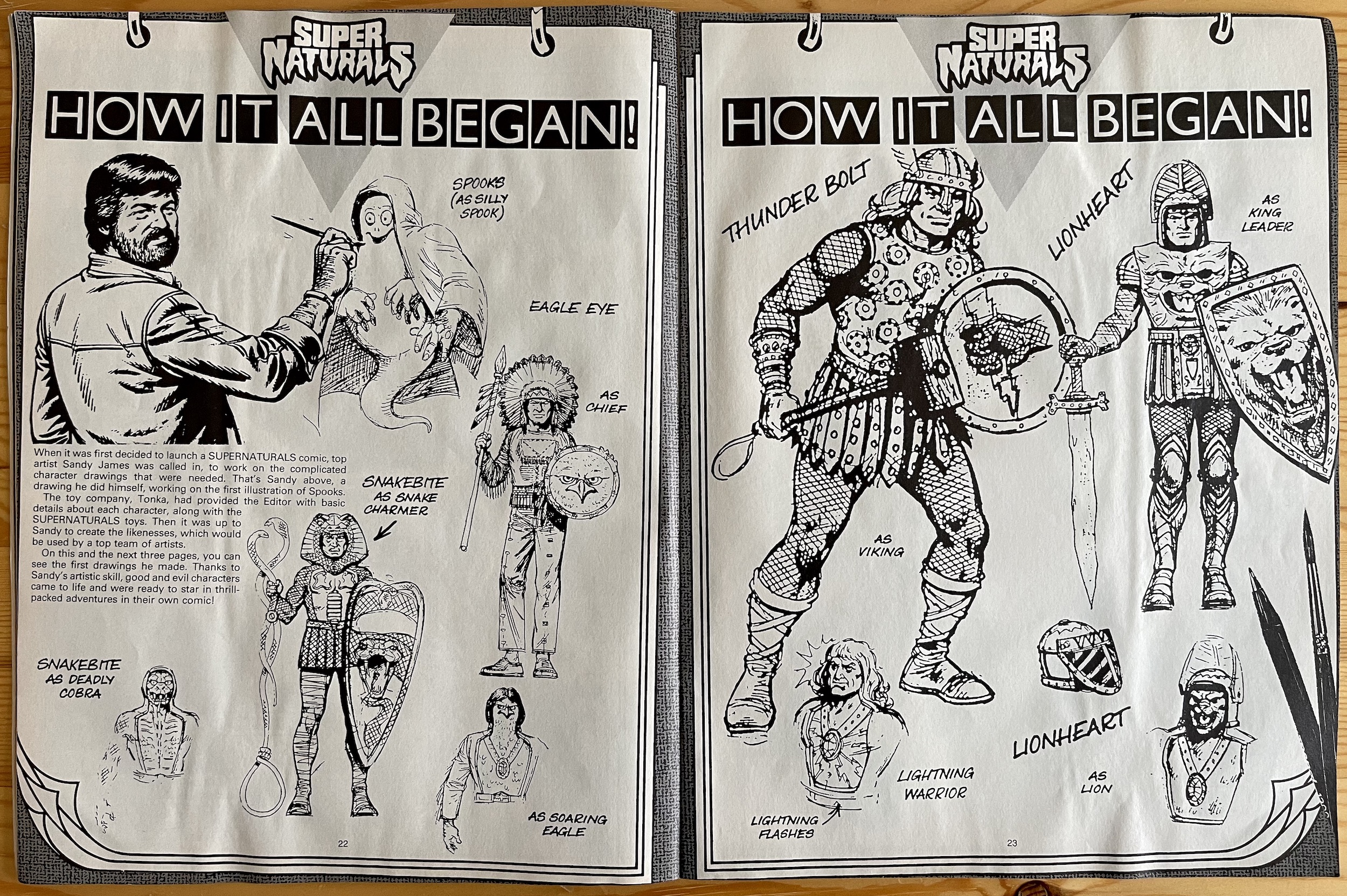
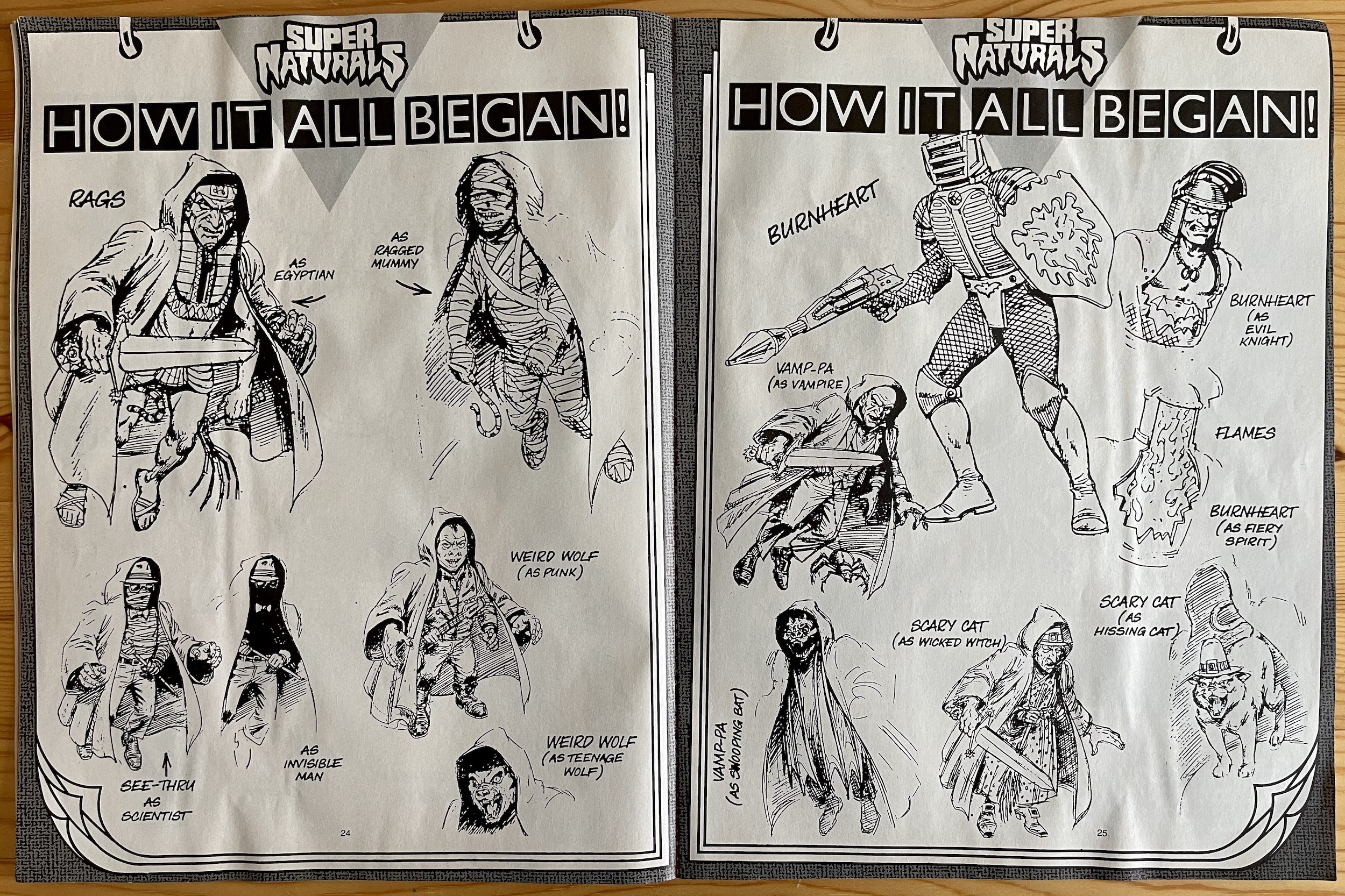
A brief introduction explains to the readers how Tonka would’ve supplied basic details about the characters and it was up to Sandy to take the toys and turn them into proper comics characters that other artists could work with. While Sandy never illustrated any of the strips in the comic he did produce some of the fun covers and his artwork made up the preview’s character introduction card, reprinted here.

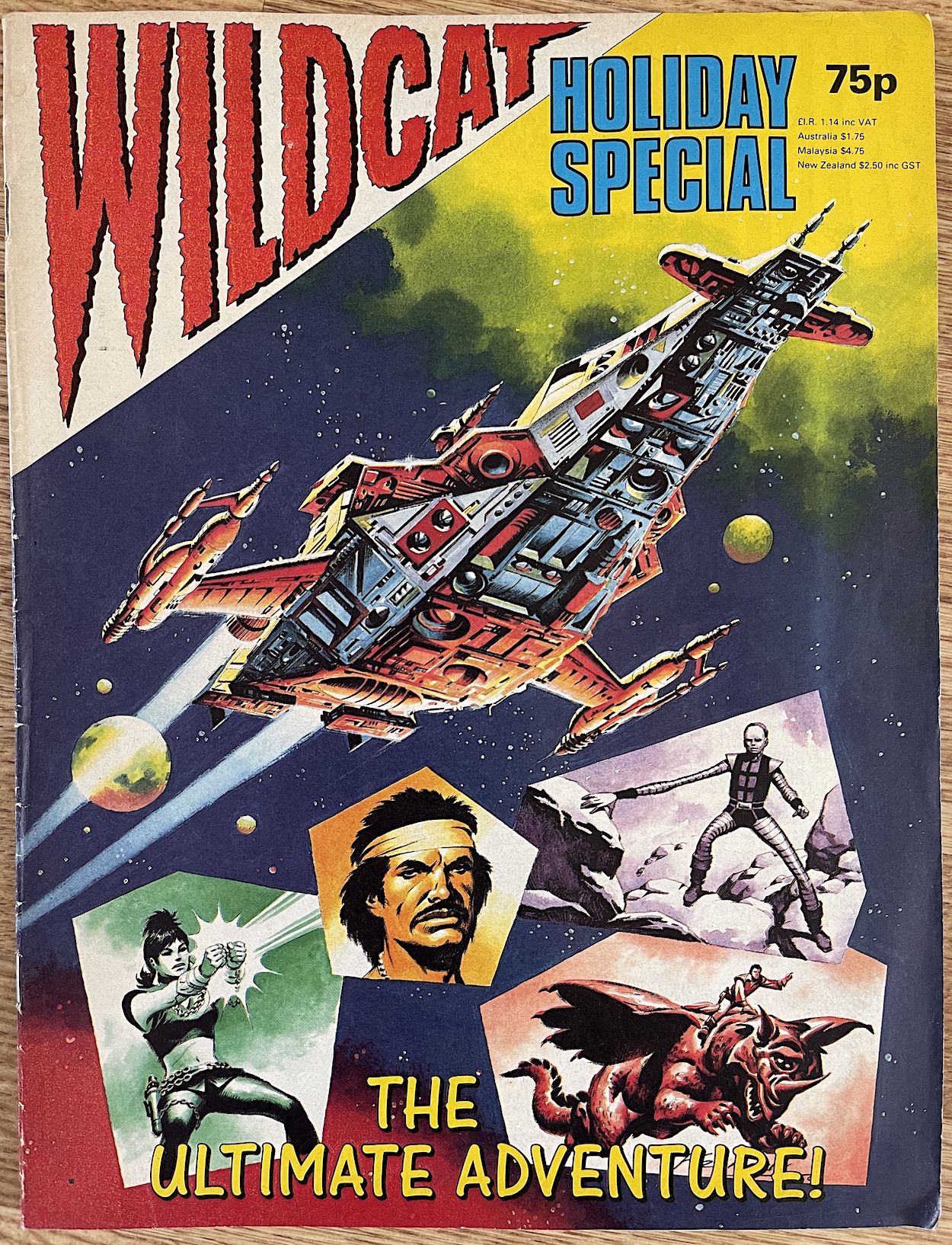
Sandy’s ability to bring those plastic action figures (whose faces were only ever shown in holographic form) to life on the page is pretty incredible. Editor Barrie Tomlinson’s Wildcat comic would do something similar in its Holiday Special, although there artist Ian Kennedy was creating all original characters, not working from tiny toys. I loved Sandy’s bold, colourful work in Ring Raiders where he also brought toys to life in incredible fashion. It’s such a shame he never got to draw a strip for the Super Naturals.
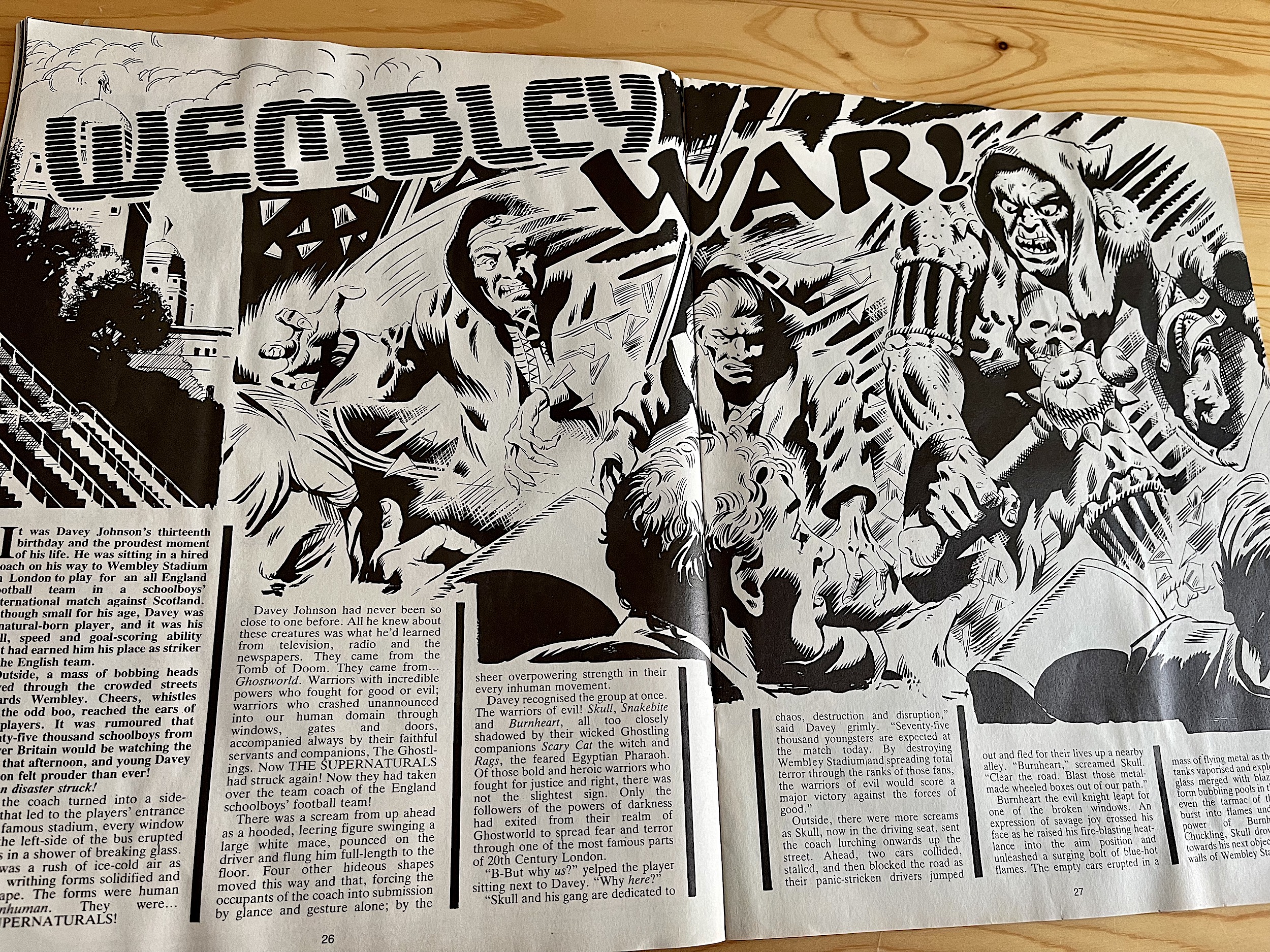
Given his fascination with football and the fact he also edited Roy of the Rovers, Tiger, Hot-Shot etc, it’s pretty clear our text story set inside Wembley Stadium was written by editor Barrie Tomlinson. Teenager Davey Johnson and his school team are on their way to a match when the windows of their bus suddenly cave in! This is a particular aspect of Super Naturals I liked, the fact any piece of glass could end up suddenly becoming a gateway from Ghostworld with terrifying skeletal monsters, witches and snakes piling out.

The story conjures up a pretty terrifying image of the windows of a school bus caving in around a load of children, then trapping them inside amongst the shards of glass with the evil Super Naturals. Skull’s plan this time is to destroy the stadium while it’s filled with 75,000 spectators, killing as many as possible and spreading fear through those that survive. What stands out in the story is how we humans know of the existence of the Super Naturals, even who’s who!
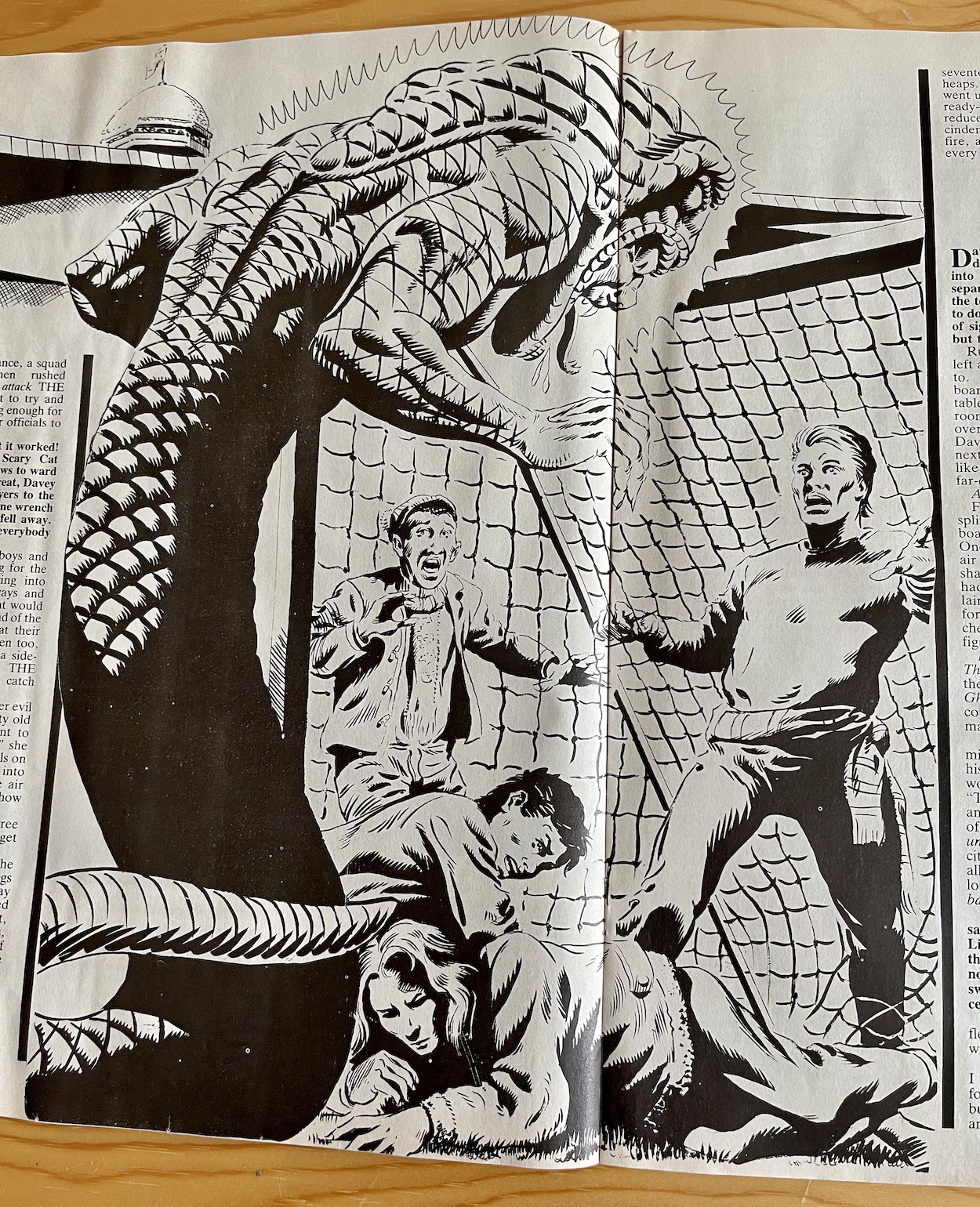
While it was only a matter of time until this happened it does seem very quick. The fortnightly was still building their mythology and they were scarier when humans didn’t know what they were. It also contradicts the strips in this very book where police opened fire on the good guys because they didn’t know there were two sides. But that’s just me quibbling. The story is well written and reminds me of the ‘Story So Far’ tales at the beginning of some Transformers Annuals which placed a young person into the fantastical world of the characters, painting a picture from the viewpoint of the readers themselves.

Particularly good here are the moments when Barrie takes his time to describe the abilities of the Super Naturals as they attack. Here’s a good example, as evil Ghostling Rags is hit by lightning from Viking Thunder Bolt‘s hammer: “Changing from Egyptian Pharaoh to wrapped Mummy, Rags gave a scream of pain and lurched forward, his dirty bandages flicking this way and that, every length of cloth eager to bind, hold and smother.” Wembley War is the best Super Naturals story here.

There are two Ghostlings stories included, the light-hearted strips in the regular comic that would cut through the children’s horror. It’s nice to see Mr Lucky and See-Thru get starring roles for the first time. Mr Lucky is pitted against Scary Cat, fulfilling the prophecies of a madman who thinks aliens are due to land on Earth, before it becomes a chase across the city, turning each other into ever more ludicrous creatures or objects via their magical spells. Drawn by Keith Page (M.A.S.K., Commando, Thunderbirds The Comic) it’s actually quite funny.

The other strip is drawn by regular Ghostlings artist Anthony Williams and sees the good and evil servants of the Super Naturals arrive during the Great Fire of London. The evil Ghostlings wish to use it to their advantage and it’s up to Spooks and See-Thru to head them off, all the while being careful not to help the humans too much or else they could affect history. Samuel Pepys even pops ups. It’s fun and interesting in equal measure and as the last strip with the licenced characters it rounds things off nicely.


He hides the body in the box alongside the puppets and simply goes to bed


The regular comic’s anthology series The Scary Cat Challenge, in which readers’ ideas were turned into full comic strips didn’t exactly hold back on the horror. For a kid’s comic it wasn’t afraid to kill off characters in some rather shocking ways, children included, for example in #6 which had the best entry of the series. Unfortunately we don’t get a reader idea here, instead it’s a Scream reprint from #7 of that legendary but equally short-lived comic of Barrie’s.
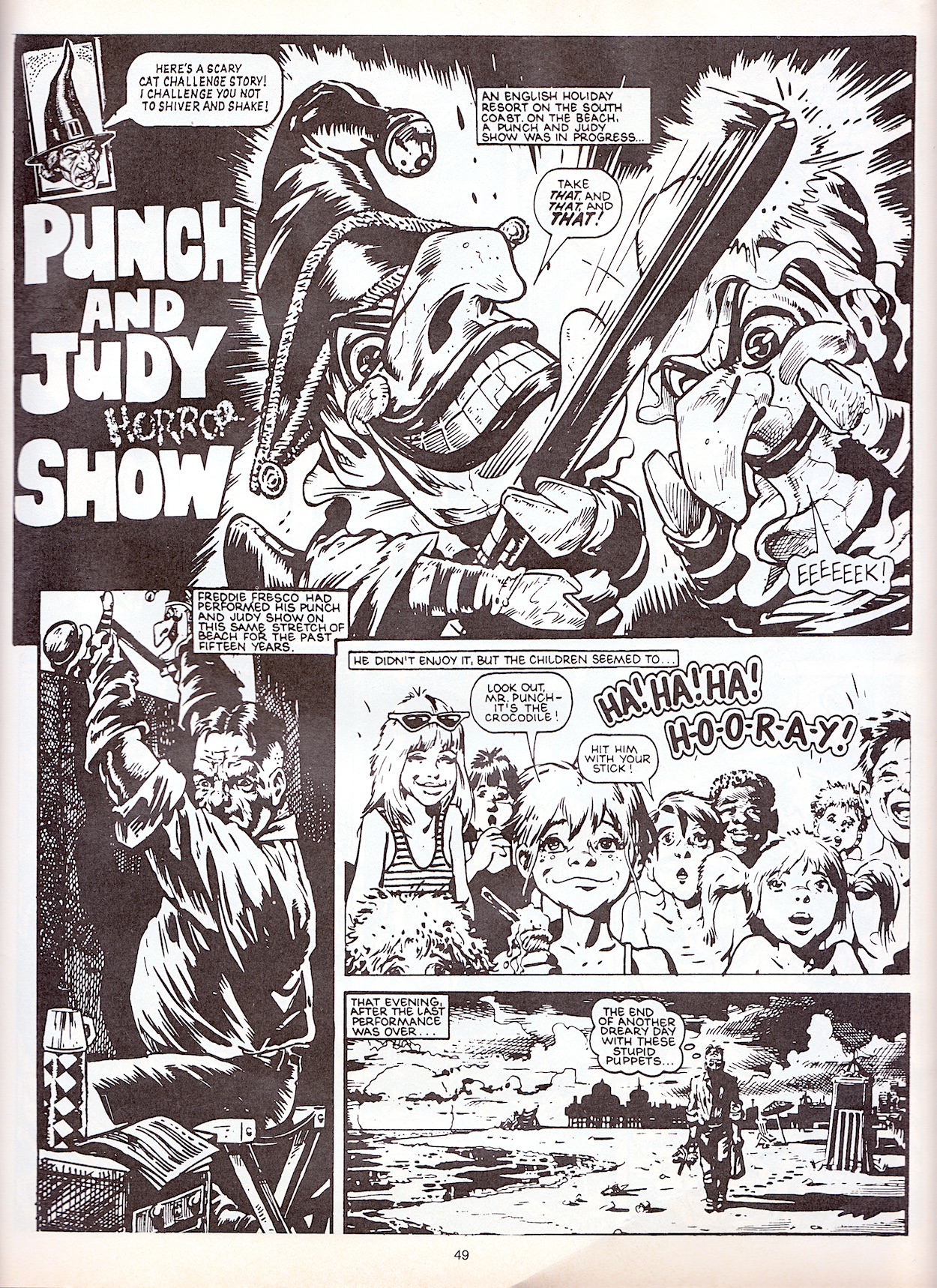
Freddie Fresco hates his job as a Punch and Judy performer, often cursing the puppets, kicking them into their box at the end of each day. But one night his manager tells him the show is over, the crowds have dwindled and he’ll no longer pay Freddie to perform. Already on edge with frustration and anger at his everyday existence this news pushes Freddie over the edge and he wallops Sam with a plank of wood, meaning to wound and scare him into changing his mind. Instead, he kills him.
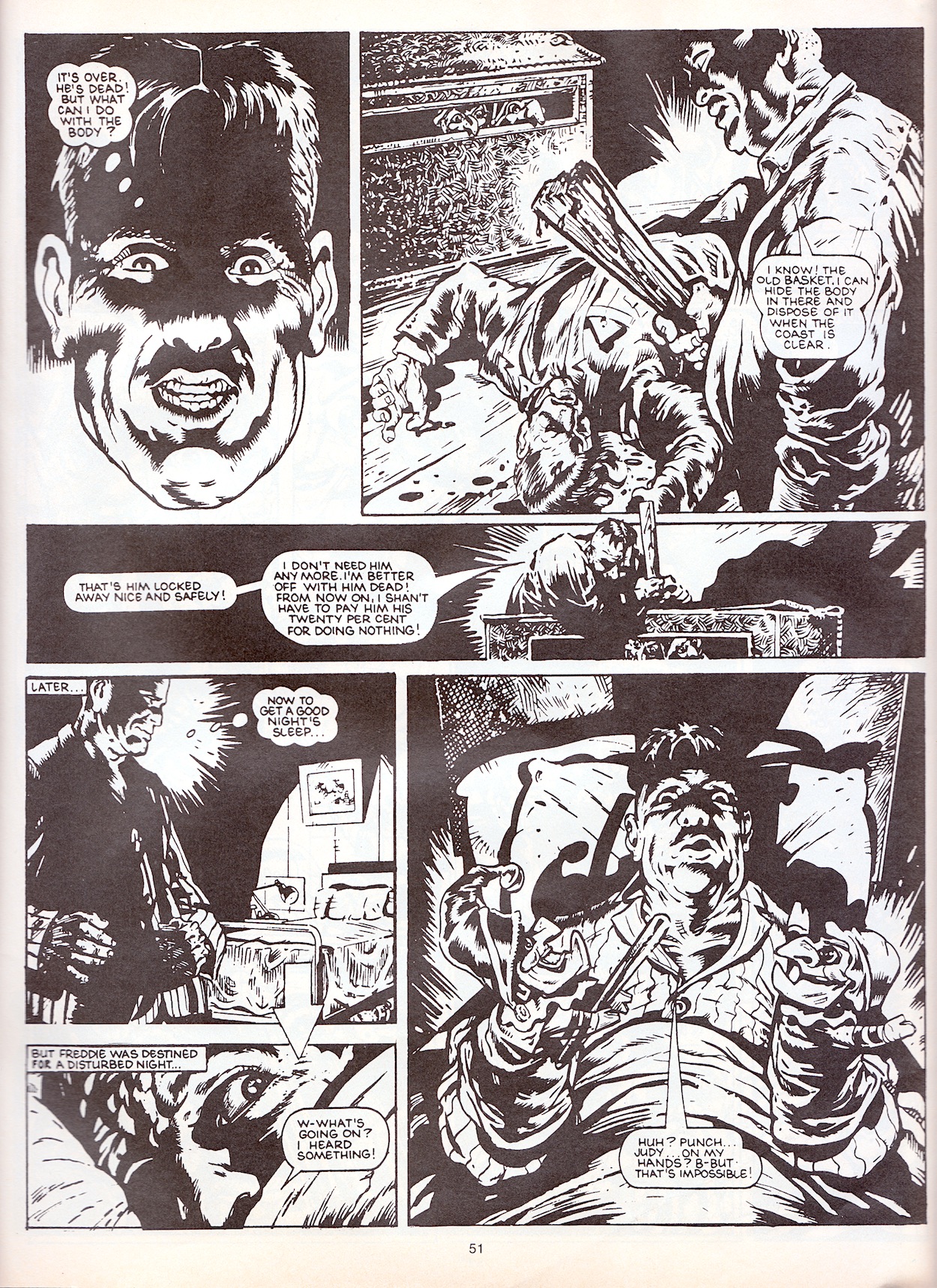
He hides the body in the box alongside the puppets and simply goes to bed. He’s taken care of his problem and will dispose of the body the next day. It’s not like he has anybody in his life that could question it. But in the middle of the night he suddenly awakes to find his puppets have attached themselves to his hands and they threaten him, telling him they’ll turn him in for murder unless he takes them back to the booth on the beach so they can continue entertaining the children.

He tries to remove them but they beat him again and again with the hard wooden clubs he used on them for so long. Eventually he gives in and on the final page we see how the show goes on, day after day, week after week. At the end of the season Freddie doesn’t pack up and leave and when the council arrive to forcibly remove his sideshow they make a startling discovery.

The story is a great fit for the book, what with it being based around small toys. It’s written by James Tomlinson (credited as James Nicholas), Barrie’s son whose work I enjoyed so much in Ring Raiders the year after Super Naturals. The artist was Brendan McCarthy whose comics work includes 2000AD, DC’s Solo and Crisis. But it’s Brendan’s TV and film work which really astounds, as he went on to work as a designer on ReBoot and the original Teenage Mutant Ninja Turtles live-action movie (both childhood faves) and was co-writer on Mad Max: Fury Road.

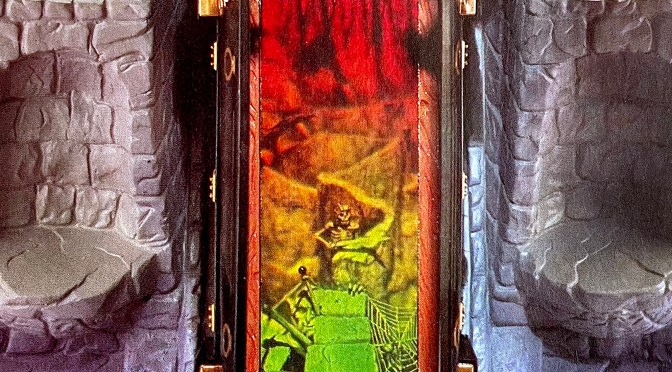
To finish off I’d just like to show you a couple of the toy pages which I think show the quality of the range. One hologram I’ve wanted to see since I started this read through is the inside of the Tomb of Doom but unfortunately every photo so far has had its doors closed. In the first part of The Legend of the Super Naturals back in the preview issue (and reprinted here) we saw a spooky staircase leading into Ghostworld drawn in the strip. It was all very atmospheric but what did the toy it was based on look like?
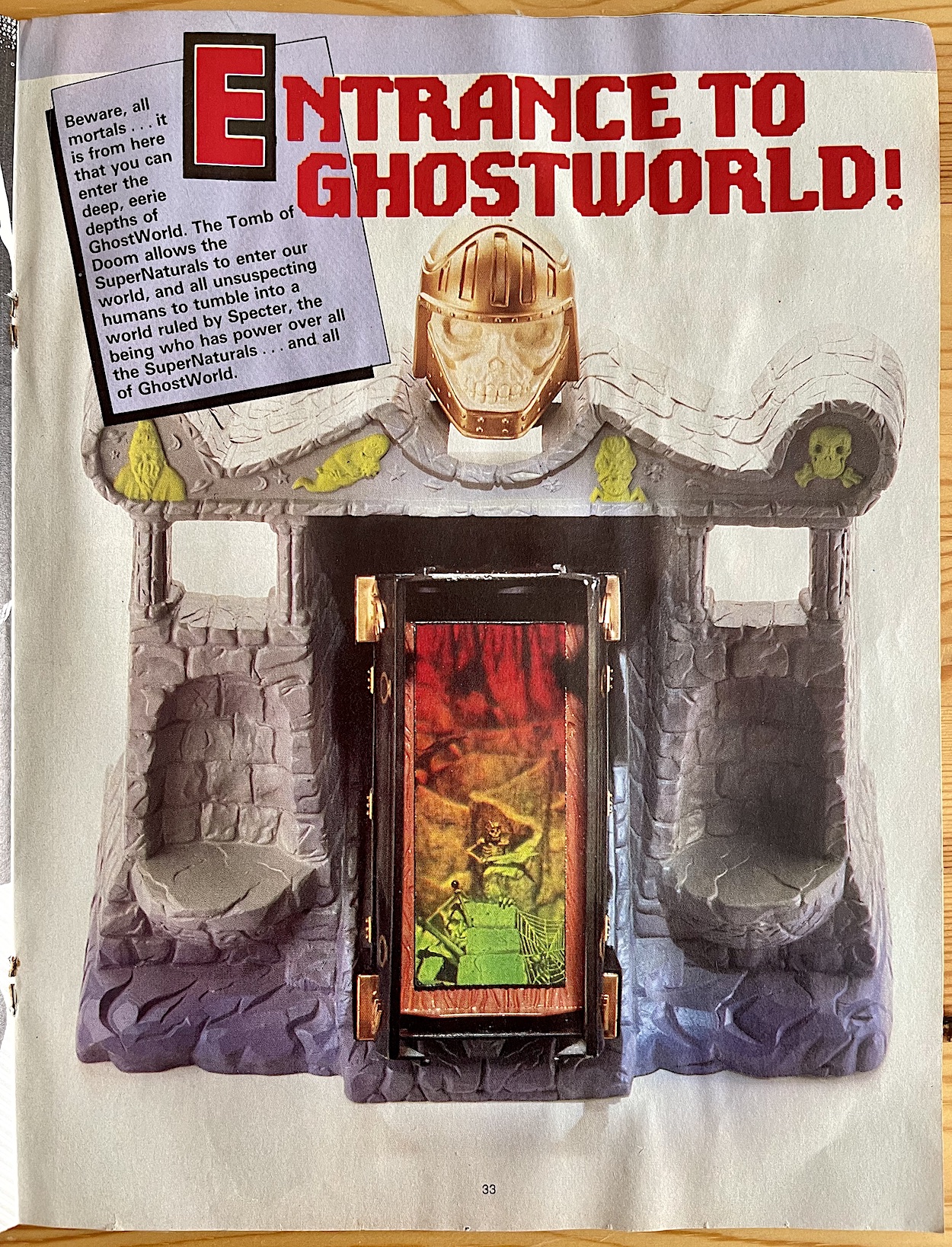
While photographs will never convey the full 3D nature of holograms it’s clear from this just how intricate the original models used to create them must’ve been. I’d love to see photos of the creation process. The holograms in each character model were just as good and the second spread above shows the tomb alongside more from the series. It’s just a shame the Bat Bopper is missing its superb vampiric hologram sticker on its front for some reason.

The Punch and Judy Horror Show ended up being a real highlight here, which when you consider it was made for another comic doesn’t seem to bode well for the review, but I think overall the Adventure Book would’ve done a good job introducing new toy owners to the Super Naturals comic. But then again, if the toys and thus the comic had been a success this would’ve been all new content. It doesn’t feel like the surprising children’s horror comic we’ve come to know on the blog, but then again the clue is in the name ‘Adventure Book’ I guess. It’s still an interesting addition to the series even if it doesn’t live up to what came before.
iSSUE EiGHT < > iSSUE NiNE

SUPER NATURALS MENU

RiNG RAiDERS SPECiAL: SPECiAL iNDEED!

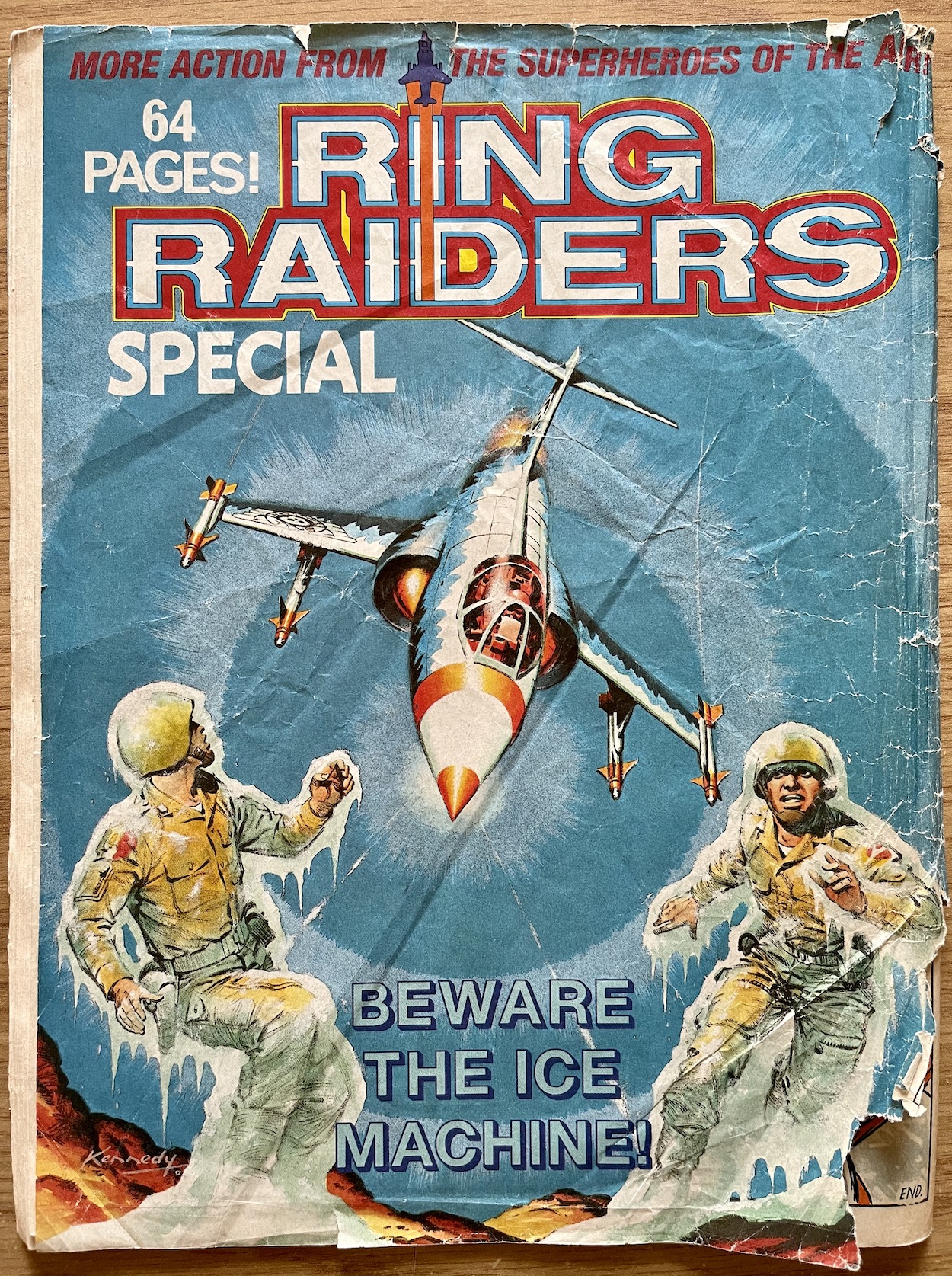
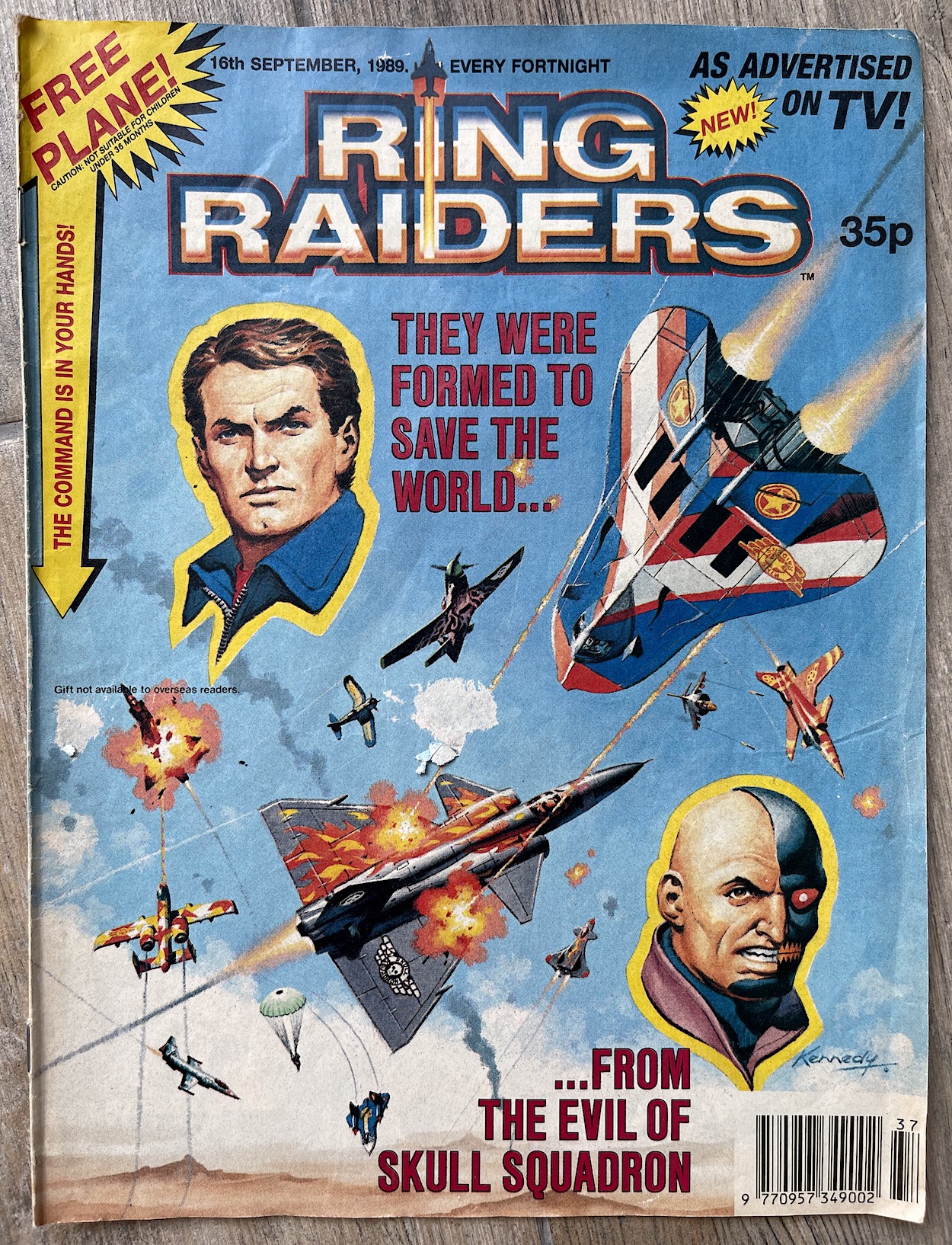
When editor Barrie Tomlinson gave us the bad news that #6 of Fleetway‘s Ring Raiders was to be the last, he told us they hoped to produce a special the following year to finish off all the stories frustratingly left on cliffhangers. Given how comic specials usually appeared in April or May, and the fact I didn’t know if it’d even be published, you can imagine my surprise when my parents came back from the shops with this some time in February of 1990. With its gorgeous Ian Kennedy cover and a hefty weight to it, I immediately ran to my room where all my planes and bases could be found.

Also in my room were my comics and after giving the special a quick flick through and seeing glimpses of exciting aerial action I decided to spend the whole day with these characters and read through all of the previous issues, every single story (including the ones that had already finished) before settling down for this mammoth 64-page feast of an issue. The regular comic was 24 pages so this felt like a real treat! Especially when we got not one, but two covers from Ian.

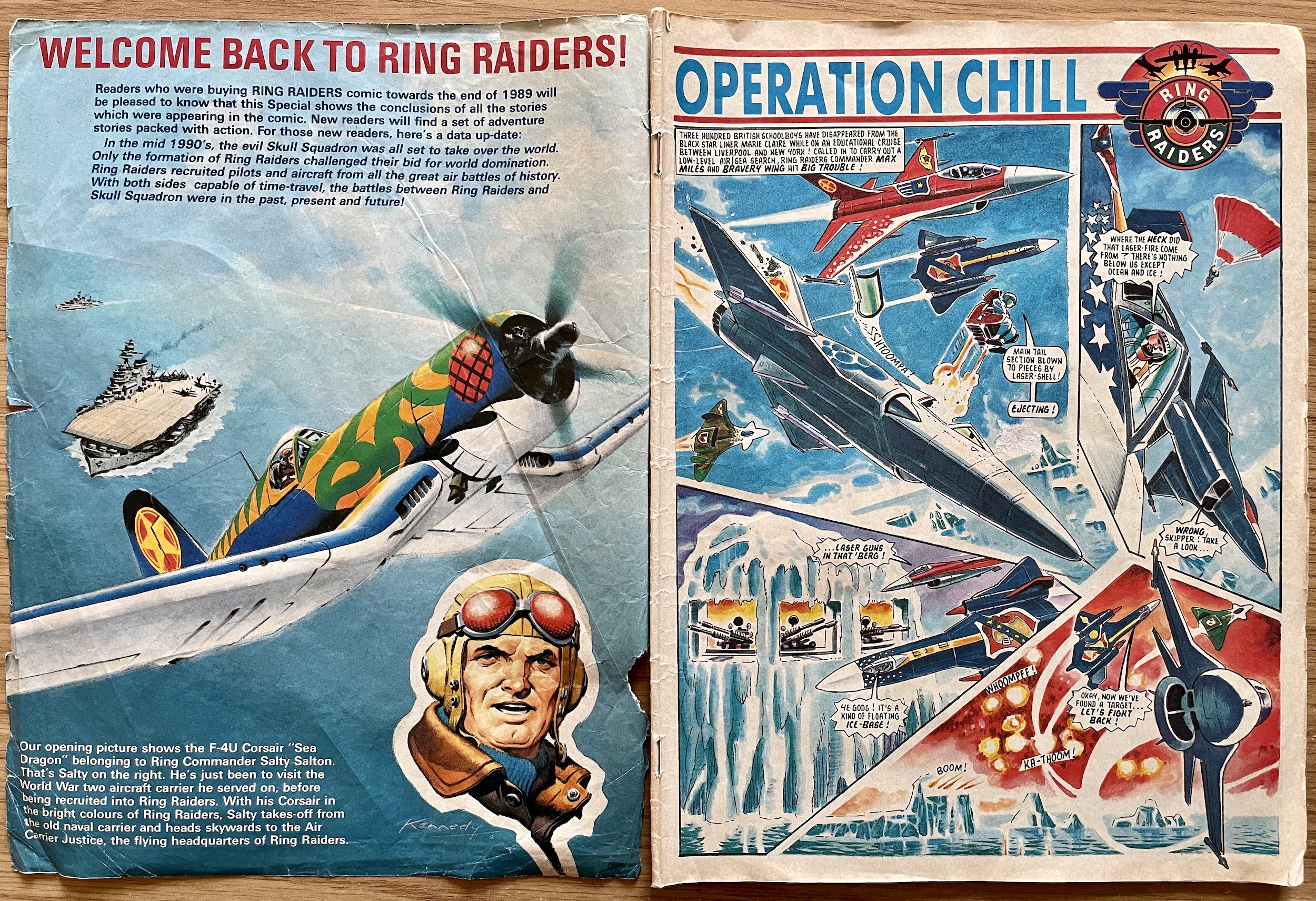
Was #7 meant to be the start of the comic recolouring the logo each issue? Or was it just for this special? Who knows? But clearly Ian had finished the next two covers and I think this inner page (likely #8’s cover) is just beautiful, evocative of the Commando covers he was so well known for but with a modern (for the time) splash of colour on the Corsair. Wonderful. You’ll have to excuse the state of the pages though. This is my original comic and it was read so many times back then, devoured over and over. The creases and tears tell a story though, of a much loved comic I couldn’t get enough of as a kid.

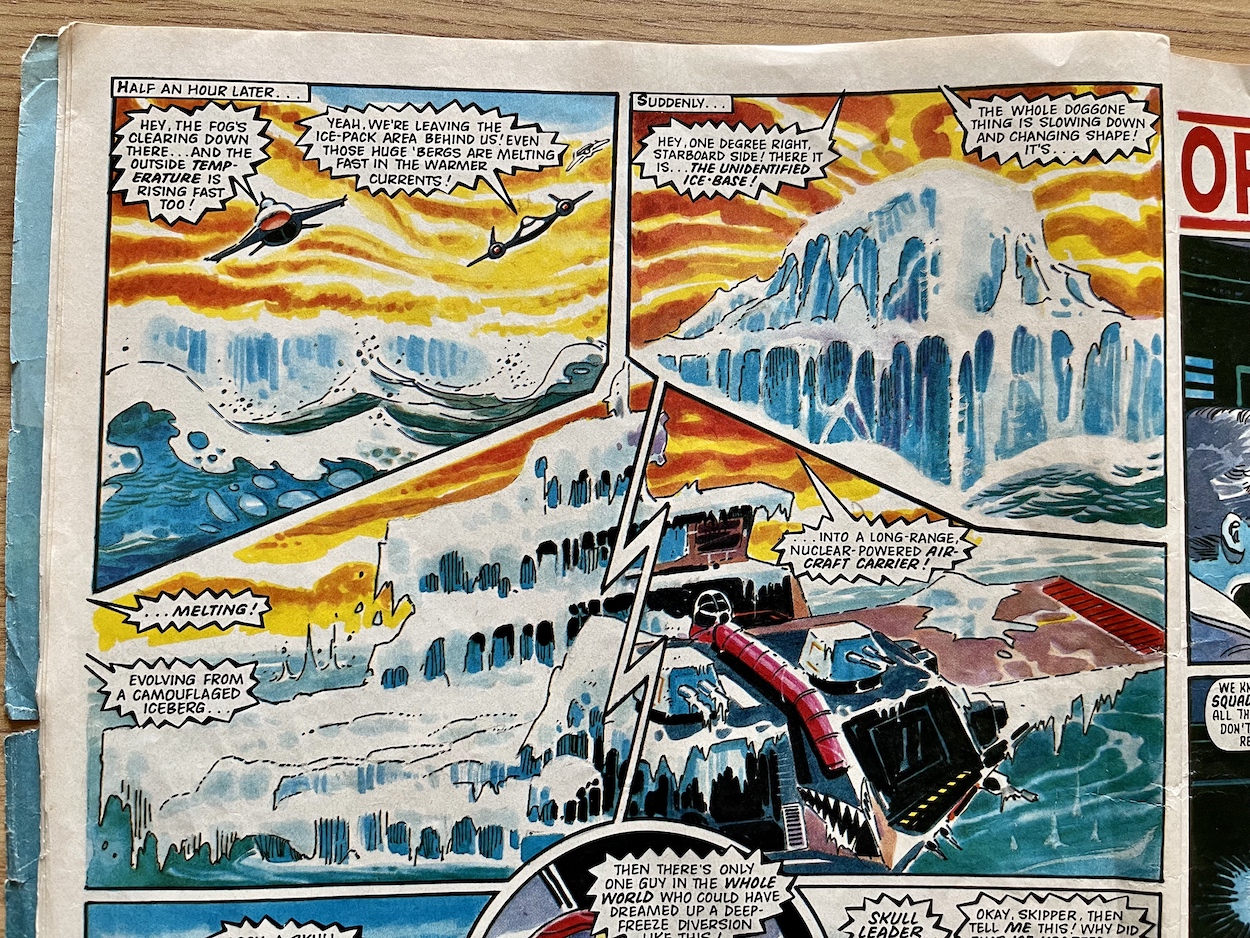
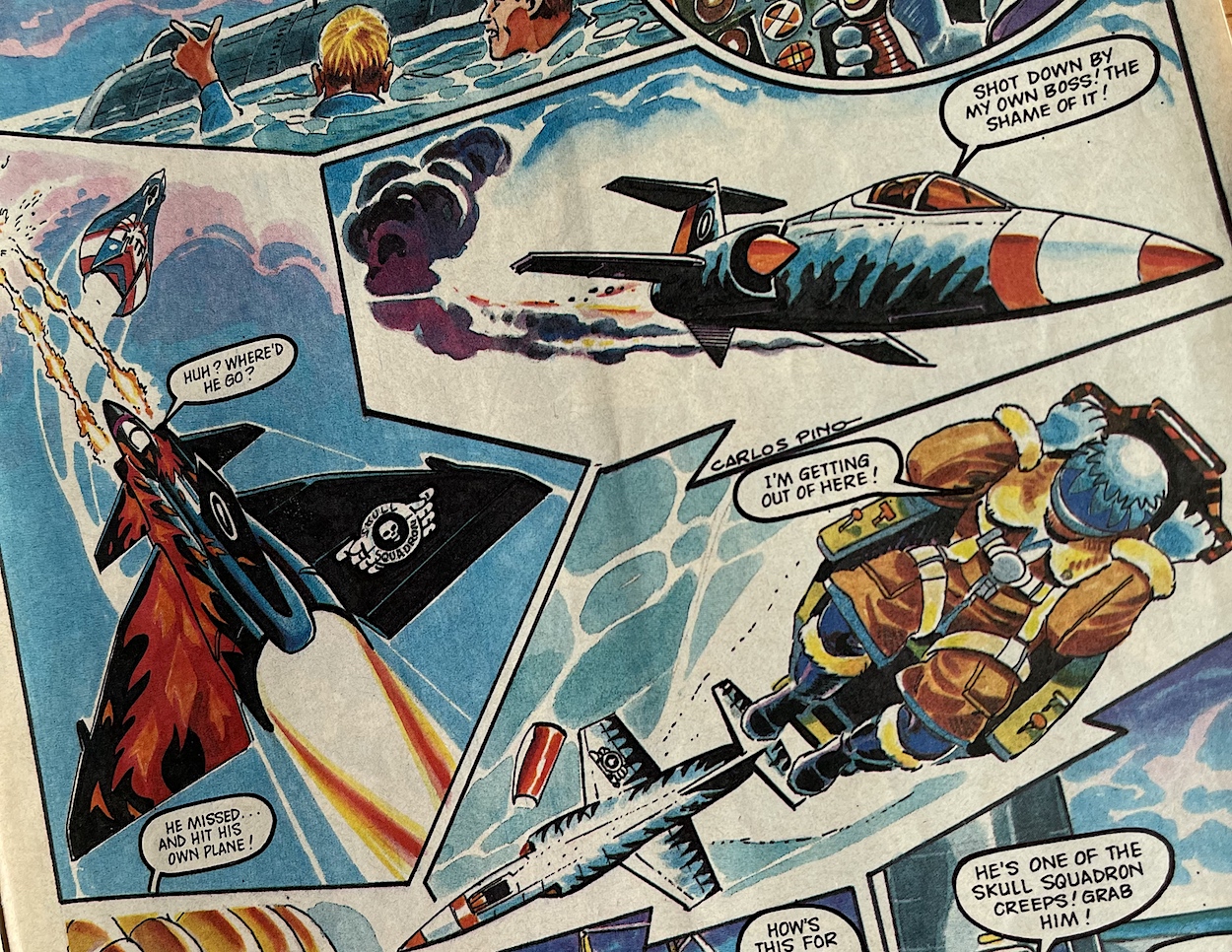
I really enjoyed reading through the fortnightly and was meant to cover this several months ago but had forgotten I’d let a friend borrow it (and the Super Naturals Adventure Book) and she’s not someone I see too often. But here we are at last. I’ve been looking forward to this. As you can see we kick things off with Operation Chill as colourfully brought to life by Carlos Pino, which only began in the final issue. When a cruise ship carrying a talented bunch of school kids crashed at its destination port with no one on board Wing Commander Max Miles and his Freedom Wing were dispatched to track them down.

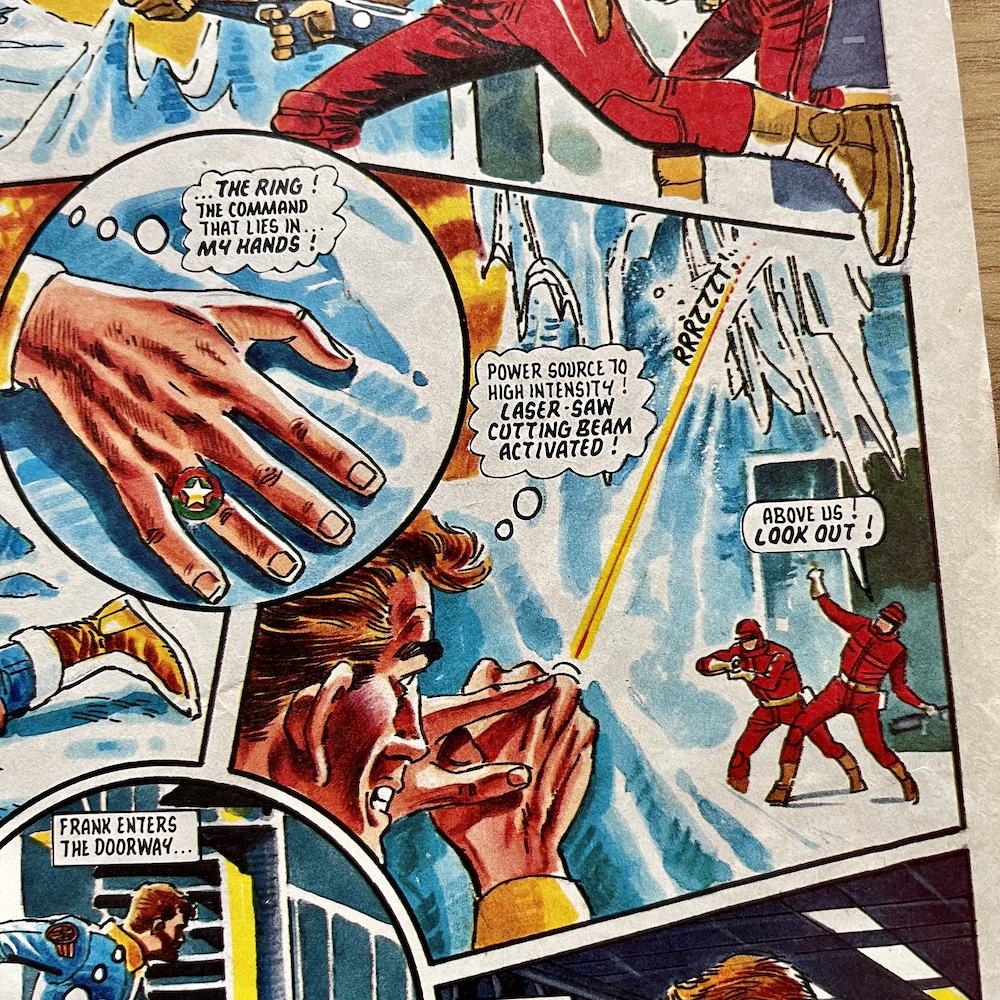
His wing ended up over chilly Arctic waters and fired upon from an unknown source, with only giant icebergs beneath them. On the first page of this issue’s strip you can see gun ports in one of them and it’s on this that our ejected pilot Frank Turner finds himself. Another character named by the comic, Frank is soon set upon by Skull Squadron goons but he’s not as unarmed as it would seem, using another of the miniature gadgets the comic invented for the rings.

The iceberg was also on the move! At this point as a kid I had an idea of what was really underneath the ice and the next part of the story confirmed my suspicions. This particular segment would’ve been in #8 with a release date of 23rd December, the Christmas issue. If all had gone according to plan eager kids awaiting Santa would’ve read this just a few days in advance, and no toy in the series was more sought after than the Skull Action Assault Base!

While readers had seen the base in the Trackdown strip we have to remember these are time travel stories and so, much like with Doctor Who for example, timelines can be presented out of order. Even though this takes place a few years after Trackdown in order of actual date, for the time travelling characters it occurred before it. This is when the Ring Raiders themselves first encountered Skull Squadron‘s new mobile HQ. Over time it would’ve been fun to piece together these events into a timeline.

The villain is of course Chiller, the most used in the comic and simply the most sinister, not to mention the most fun for the reader. The plan is to re-educate the kids as mind slaves but, even after Chiller takes to the skies with his new ice weapon and takes out two of the Raider planes, Commander Miles doesn’t give in, making the most audacious of moves by landing on the base. Staying inside the cockpit and using the plane’s weaponry to disable the base he soon overpowers the enemy and commandeers it.

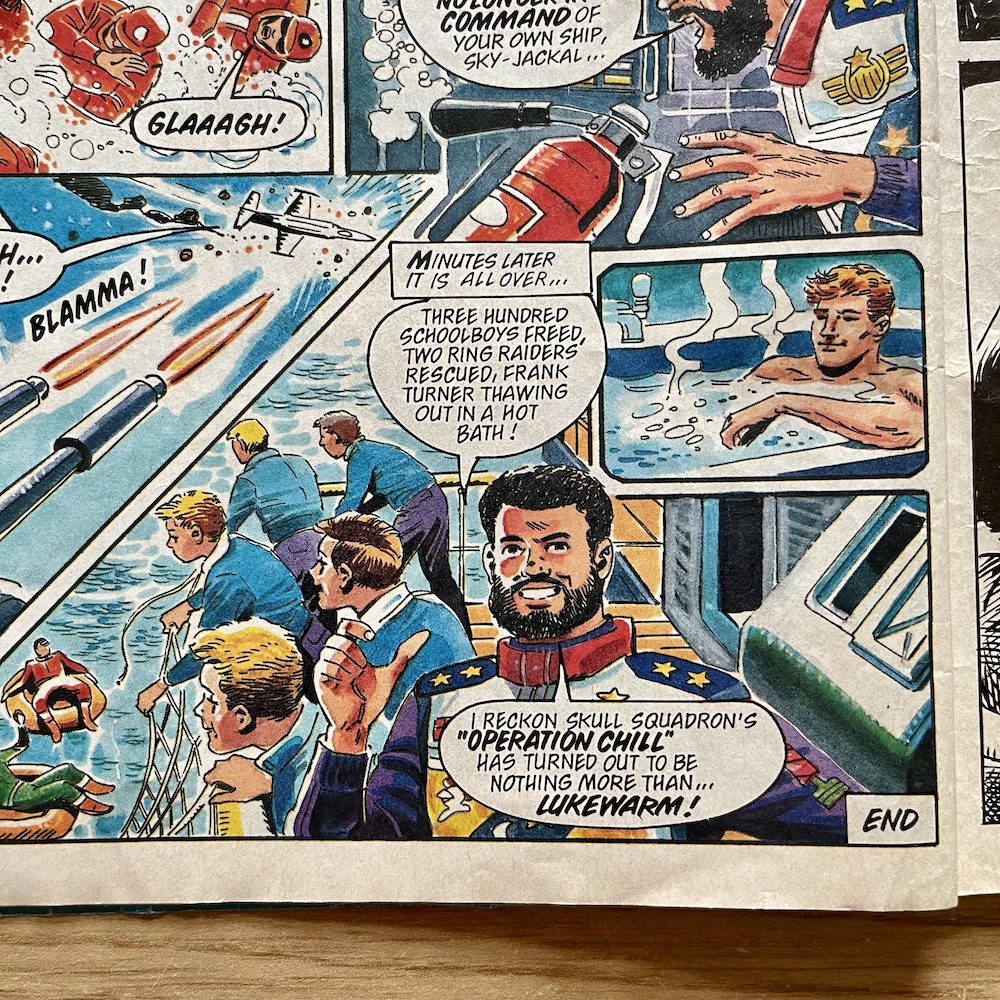
This final panel has Miles posing as he does on the toy packaging. Hmm, he’s called Max Miles and his plane is the Knight Fighter… and in Knight Rider we had Devon Miles… oh I’m just overthinking that, right? Anyway, with the funny image of Frank using the Skull base’s facilities Barrie’s story comes to an end with four parts here, making five altogether so originally it was due to conclude in #10. Who knows if the next story would’ve seen Skull Squadron coming for their base, but it would’ve made for an excellent battle if they had.

This would’ve sealed the deal for Ring Raiders as one of the very best action adventure comics in the UK

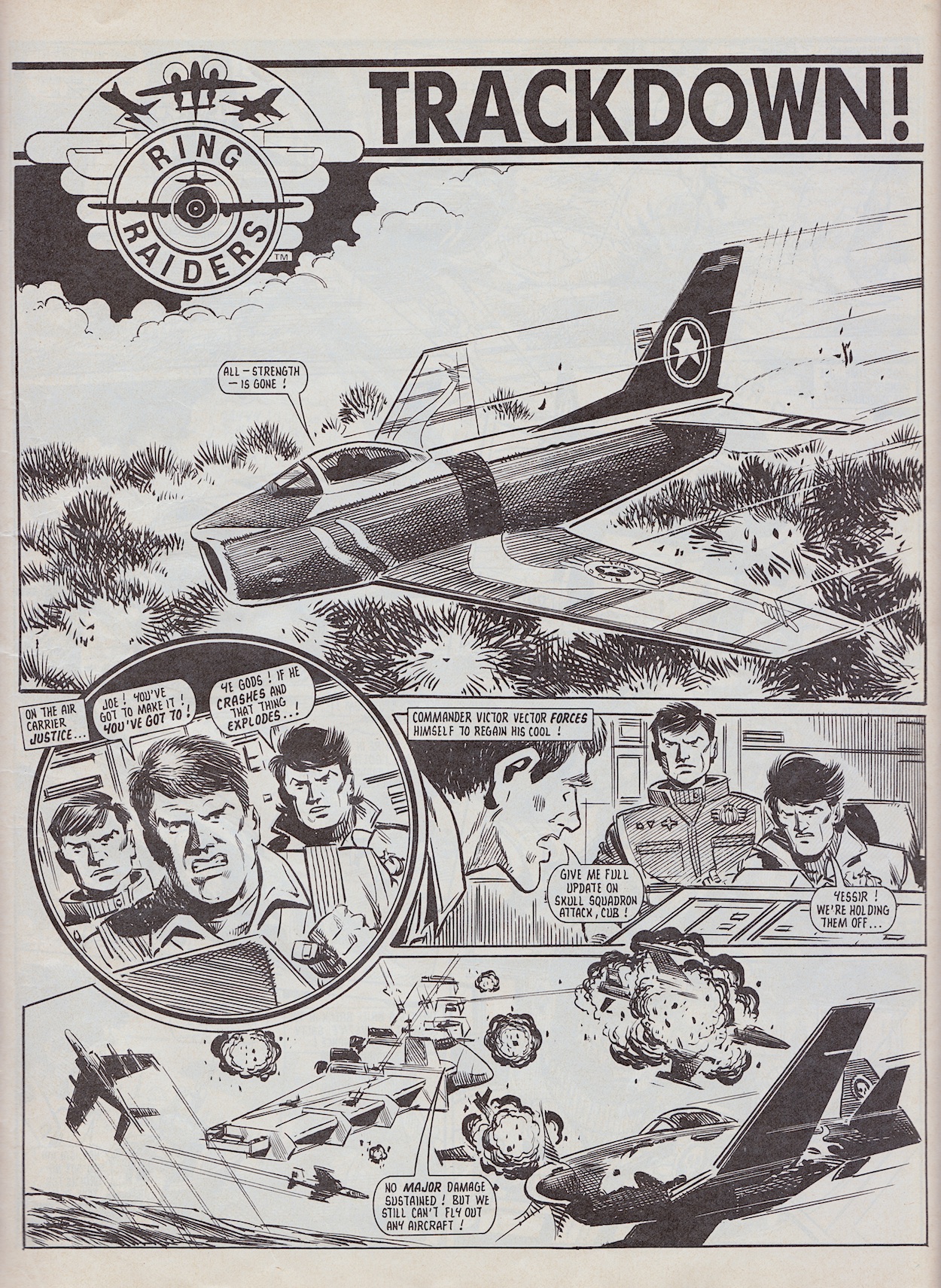
On to what was the main strip in the comic for me, the epic Trackdown written by Angus Allan and drawn by famous British artist John Cooper. It always felt epic in its scope, story, use of character and pace, and as it turned out it truly was as epic. With five four-page episodes in the special, altogether it was 11 parts and 48 pages in length. Beginning in #1 on 16th September 1989 it wouldn’t have come to its explosive finale until #11 on 3rd February 1990. Getting the final 20 pages here feels like a bit of a cheat, but these are the best pages in this special, and indeed the series.

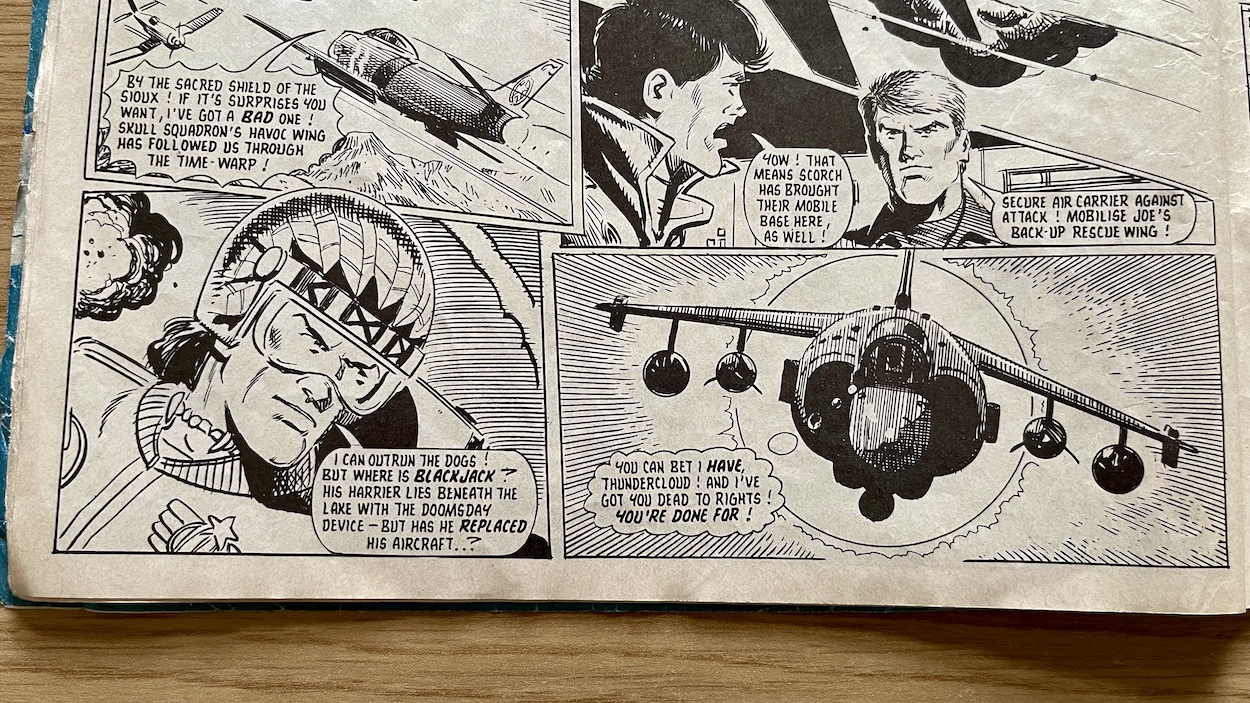
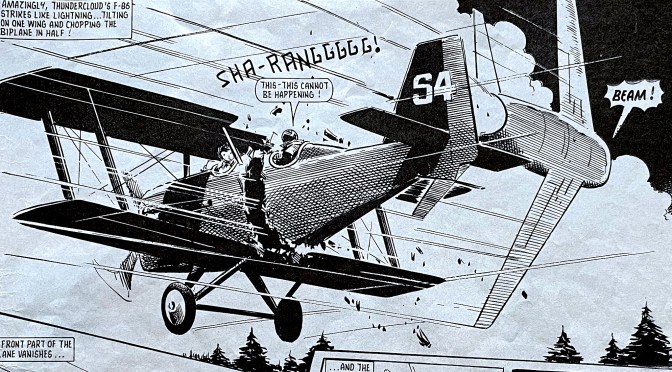
In fact, the very first part here (which we’d have enjoyed in #7) would’ve sealed the deal for Ring Raiders as one of the very best action adventure comics in the UK. The Doomsday Device is on its way back to Skull Squadron in Blackjack’s auto-piloted Harrier while he’s taken a young boy hostage in a biplane, threatening to throw him out. Wing Commander Joe Thundercloud of Rescue Wing can only chase one, but which one? Much to Blackjack’s surprise he takes off after the Harrier, or so it seems.

This sequence is thrilling today, so imagine reading this at 12-years-of-age surrounded by all the toy planes, including the one featured here! Scorch orders Blackjack to toss the boy out of the plane to his death, but Blackjack hesitates, just long enough for Joe to swing his plane round and come at the biplane at a 90 degree angle and slice it in half, giving the Air Carrier Justice the order with split second timing to beam up based on his location. The boy (and half the plane) materialise on the Ring Raiders’ flying base while the rest plummets to the ground.

Where could this story go from here? Clearly anything is possible and next Angus has the Wing Commander catch up with the Harrier. With Blackjack out of the picture, Joe disables its engines and then picks it up with his own F-16, using the power of the ring to convert his own body’s energy into extra power to try to get the pilotless plane to the Justice.

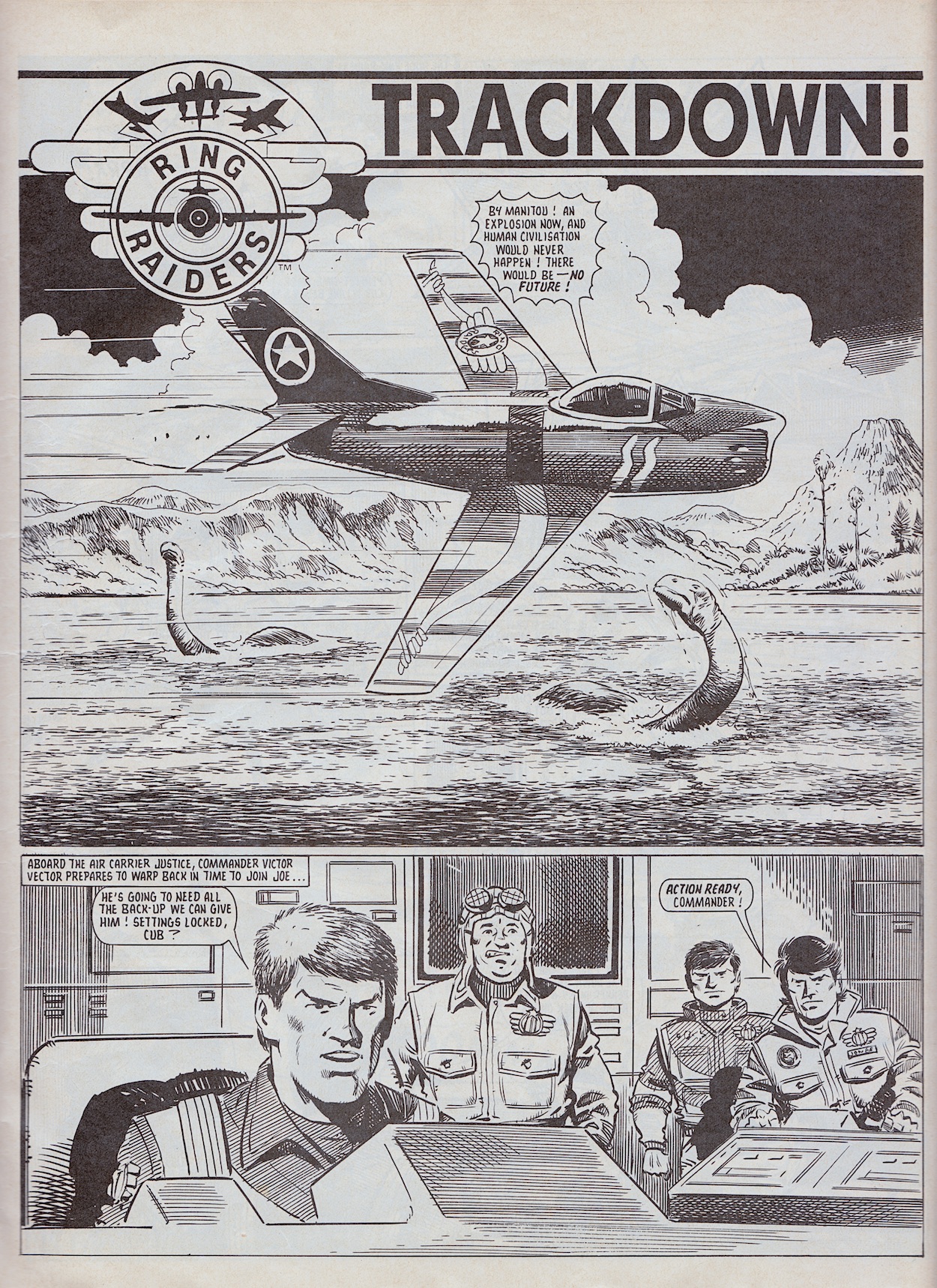
But as a caption reminds us, “Use of the rings means terrible physical exhaustion” and, tapped into his mind as well as his body, Joe’s wish to protect those he holds dear and the panic over the screaming engines accidentally sees him activate the time jump engines with his thoughts, ending up back in prehistoric times, now flying above dinosaurs! As you can see the Harrier is no longer balanced atop his plane. The strain was too much for his body to bare and he lost control, the Harrier tumbling into the lake below.

How amazing was this scenario for young comics fans? Ring Raiders deserved a much larger audience than it got in the end because this was top comic action with or without the licence. But as a fan of the toys this was the most amazing thing I’d ever read in my young life as far as I was concerned. (We love hyperbole as kids.) It was a story I’d replay with my Matchbox planes over and over. I think I even created a tiny biplane out of Lego so it could be cut in half, that’s how much I loved this.

Contacting the Justice over millions of years via more use of the ring (and nearly passing out as a result) the rest of the force arrives, giving Joe time to get his energy back and load up the F-16 with Super Sidewinder missiles which he uses to destroy the side of the lake (it overlooks a cliff), draining its water and exposing the Harrier with the Doomsday Device in its cockpit. But the sky suddenly fills with more explosions. Blackjack in his replacement aircraft and his Havoc Wing were tracking his original plane all along.

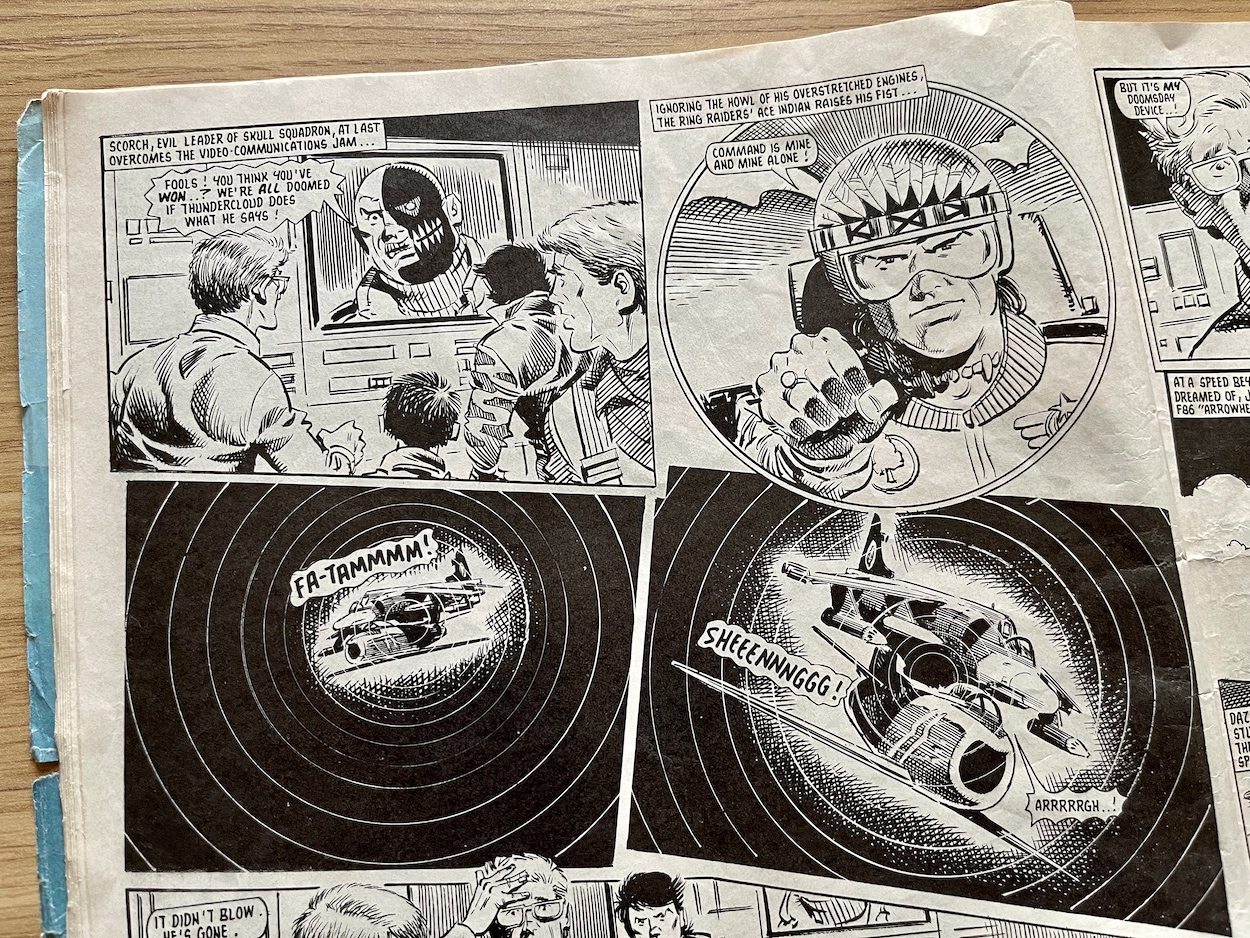
It may be black and white but that last panel of part nine (third episode here) exudes atmosphere. The sun feels hot, the Harrier ominously coming out of silhouette as Joe looks desperately for his arch enemy. My memory had this as a cliffhanger in the fortnightly, such was the impact it had on me but nope, it’s right here with the next part on the very next page. Simply gorgeous imagery by John Cooper there.

Using the ring has consequences and must be used sparingly, unlike in the cartoon version

The characters having replacement back up planes may initially seem to ruin the drama and tension somewhat but it’s not uncommon. Later in Castle of Doom Yasuo needs his reserve machine in a hurry but the landing crew try to dissuade him as you’ll see. Clearly each character has their main craft and a reserve, which makes sense militarily and they’re never presented as a cheap way of continuing the action. It adds another layer of authenticity to something so fantastical.

The story comes to its conclusion as Blackjack steals the device back while Skull Squadron keep anyone from launching from the Justice with an all-out assault. But, with the device dangling from a claw under Blackjack’s cockpit Joe blasts it, opens his own cockpit and uses the power of his ring like a form of tractor beam to pull it aboard. Thing is, the ring was never meant to be used that way and with too much toll on his body already he loses control. Scenes like this establish that the ring isn’t a get-out-of-jail-free-card, it has consequences and must be used sparingly, unlike in the cartoon version.

The story constantly flips back and forth between which side is winning, every time success is within grasp of someone it flips again. It makes for genuinely tense, exciting reading, even as an adult. It’s also nice to see other characters milling about in the background or helping out here and there, giving more of an ensemble feeling to the cast than normal. Joe just about touches down without crashing and taking the future of the planet with him. Then our inside cover star Salty Salton launches against orders, his slow but manoeuvrable F-4U Corsair making it to the ground just in time to punch a hole in Blackjack’s cockpit, making him scarper.

Salty uses the ring to reenergise Joe’s and in turn Joe himself, the story wrapping up with doomsday averted and the device launched into deep space. What a ride. Ever since those early episodes with Rescue Wing’s Freddie Riley and the professor it’s been non-stop, the tension always building, with high-flying, high-octane stuff fans of the toys longed to see with one-on-one dogfights, crash landings, huge battles and at the centre of it all two characters driving the story forward. The story was never forgotten for a single page, never sacrificed to show off the action. These final Touchdown chapters were a worthy climax to the comic as a whole, even though that was never the intention.

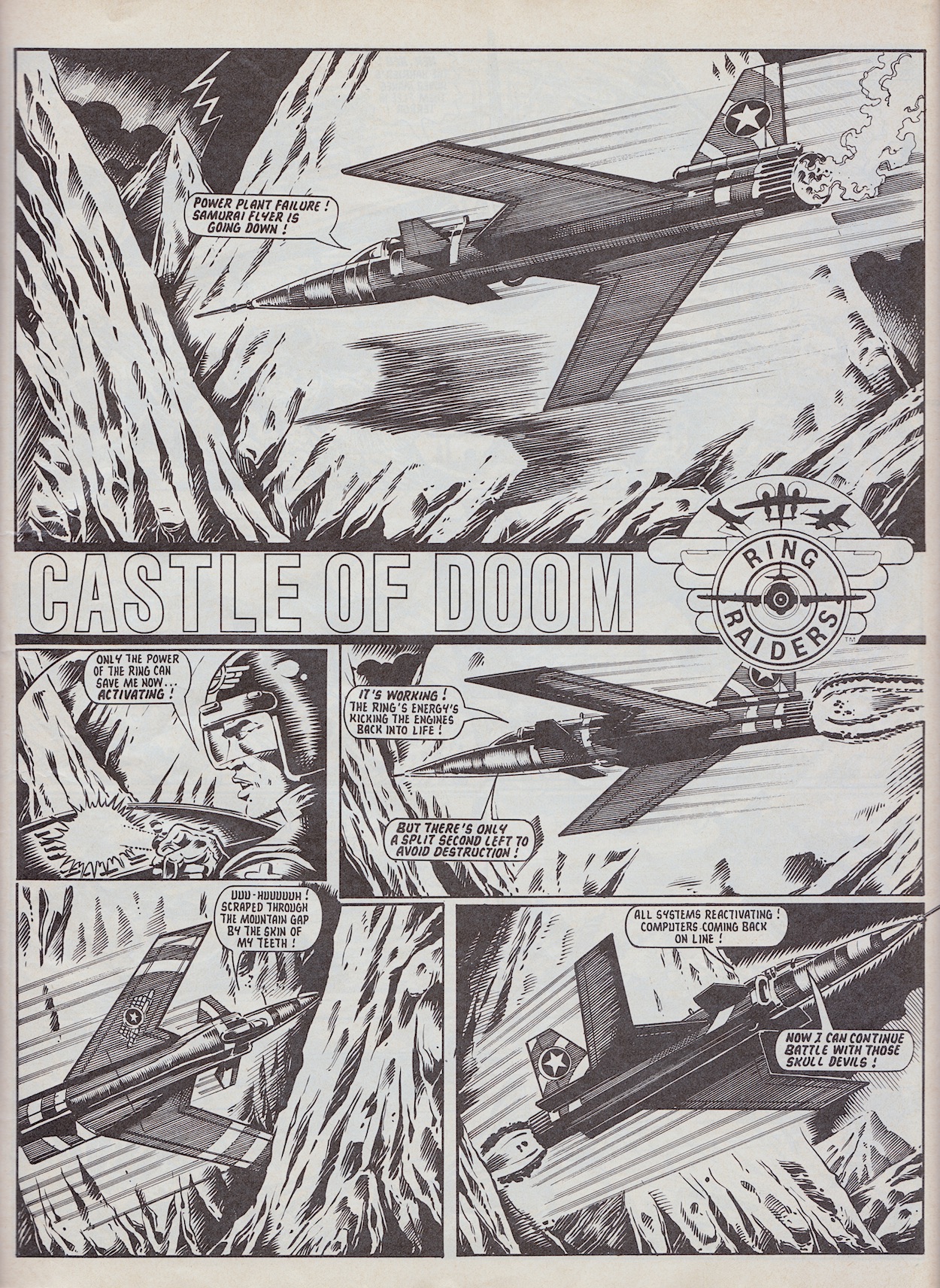
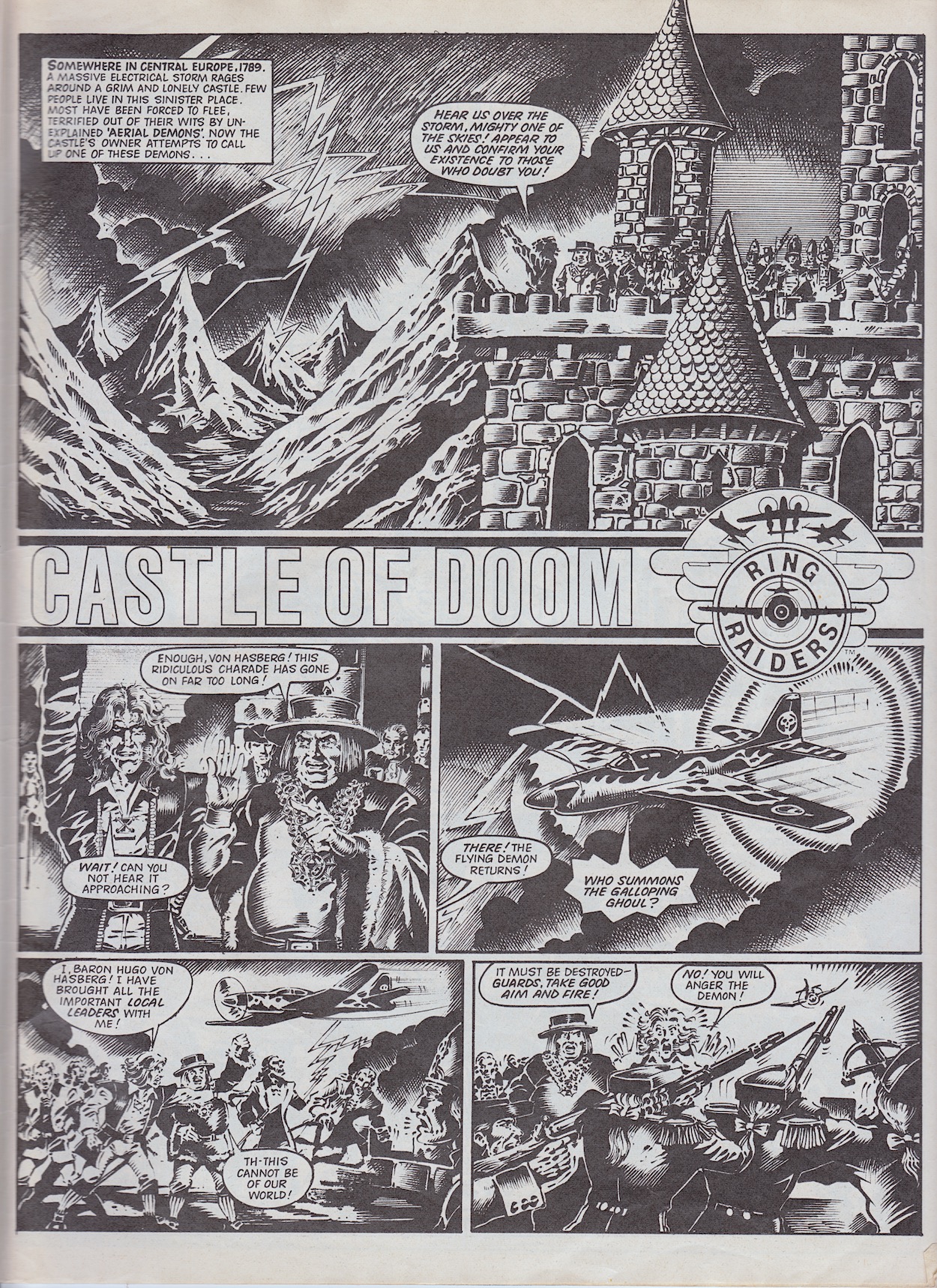
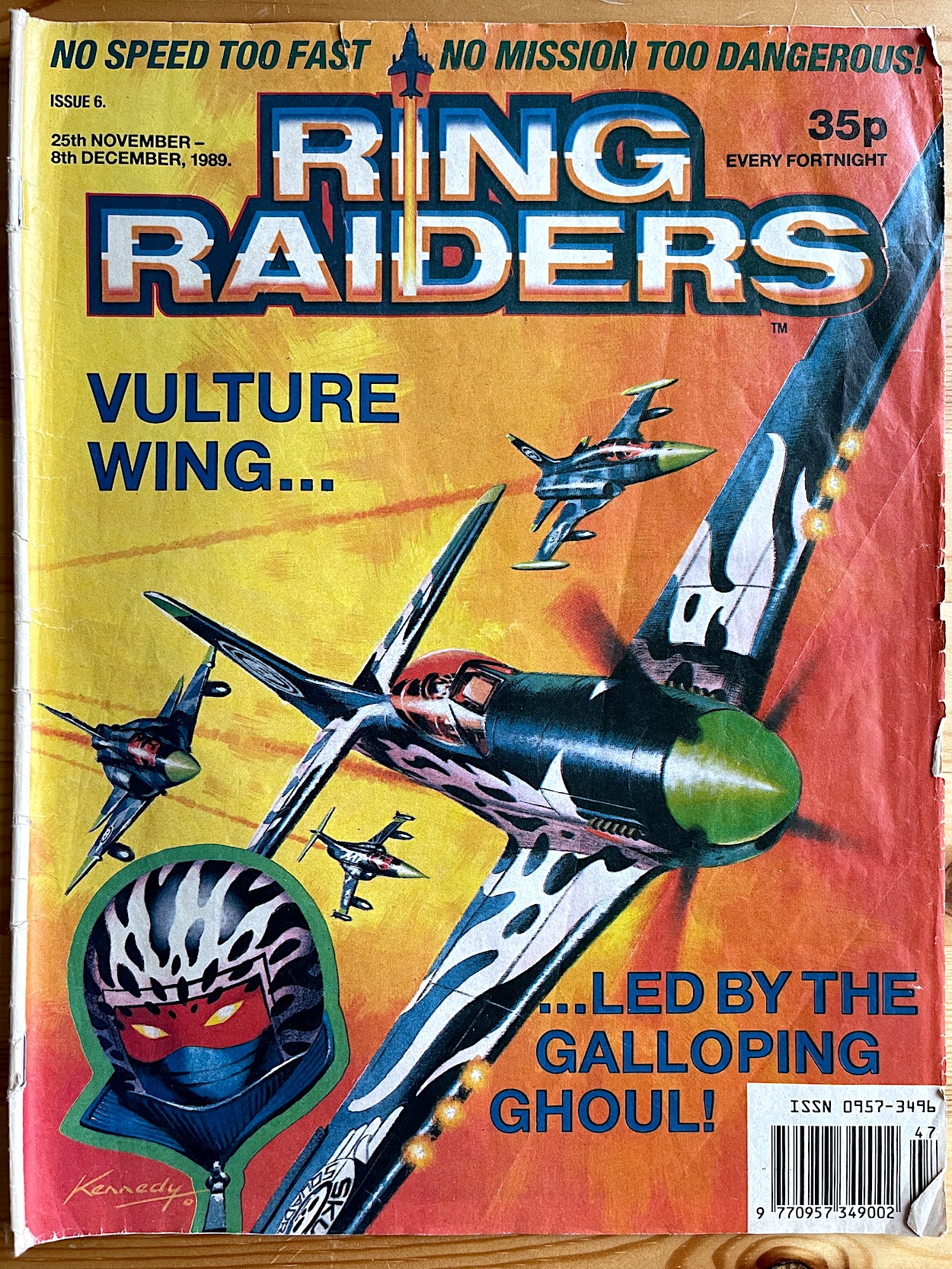
Castle of Doom began in #6 and was instantly a favourite because it starred my two favourite characters, Wing Commander Yasuo Yakamura and Skull Leader Wraither, their planes being the first I ever purchased, so naturally I had a soft spot for them. Following on from the cliffhanger last time, how does a jet pilot rescue a man hanging by a branch on a cliff face? With this rather ingenious Rescue Pod above, that’s how. I love that.

This story has six parts here which would’ve taken it up to #11 with seven parts in total, so as you can see there was no standard length to a Ring Raiders story. This would’ve made for a wonderfully unpredictable reading experience if the comic had continued. Castle of Doom’s plot was all about using time travel to the past in order to affect future events, something which had always intrigued writer James Tomlinson (who went by James Nicholas at the time), and it’s clear he had great fun crafting this tale as it jumps about time zones within the isolated castle setting, layering the plot slowly over the first few episodes.

Basically, in 1989 (two hundred years hence) this castle would be seen as the ideal secure location for various governments of the world to gather and discuss the  growing threat of Skull Squadron, a meeting which would be key to the formation of the Ring Raiders. So Wraither and Vulture Wing have ventured back centuries to hypnotise (using a nose mounted ray of some sort) the family living there, planting a seed that wouldn’t be activated until hundreds of years later in the minds of their descendants.

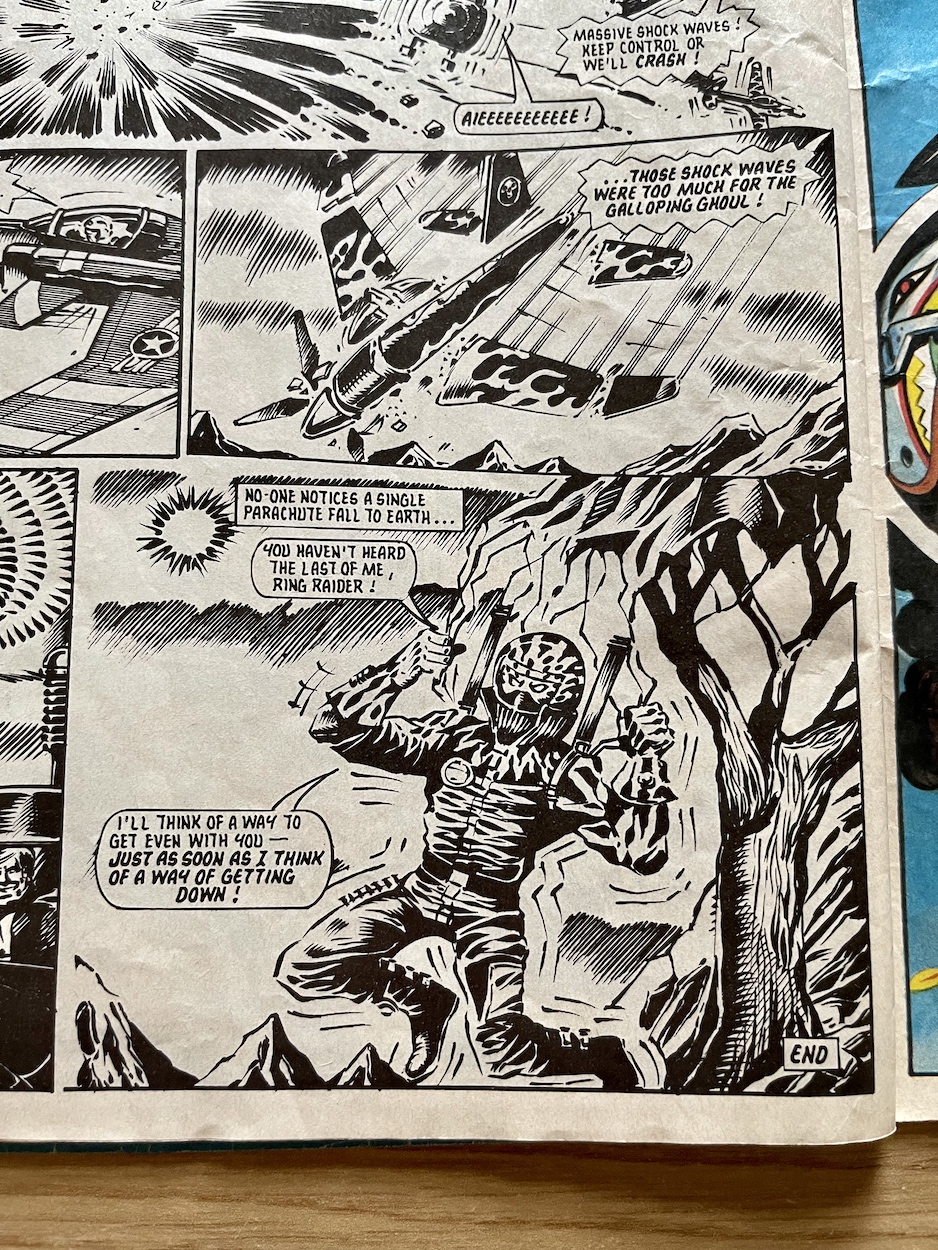
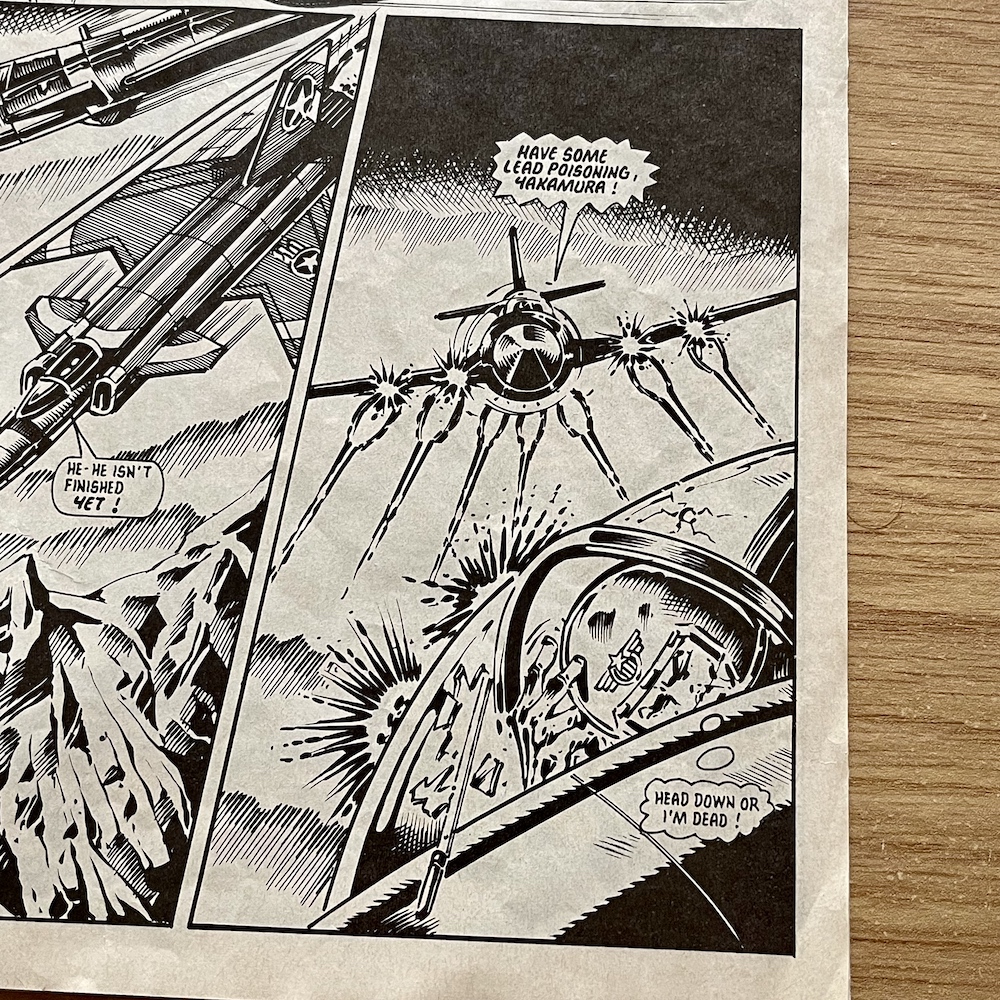
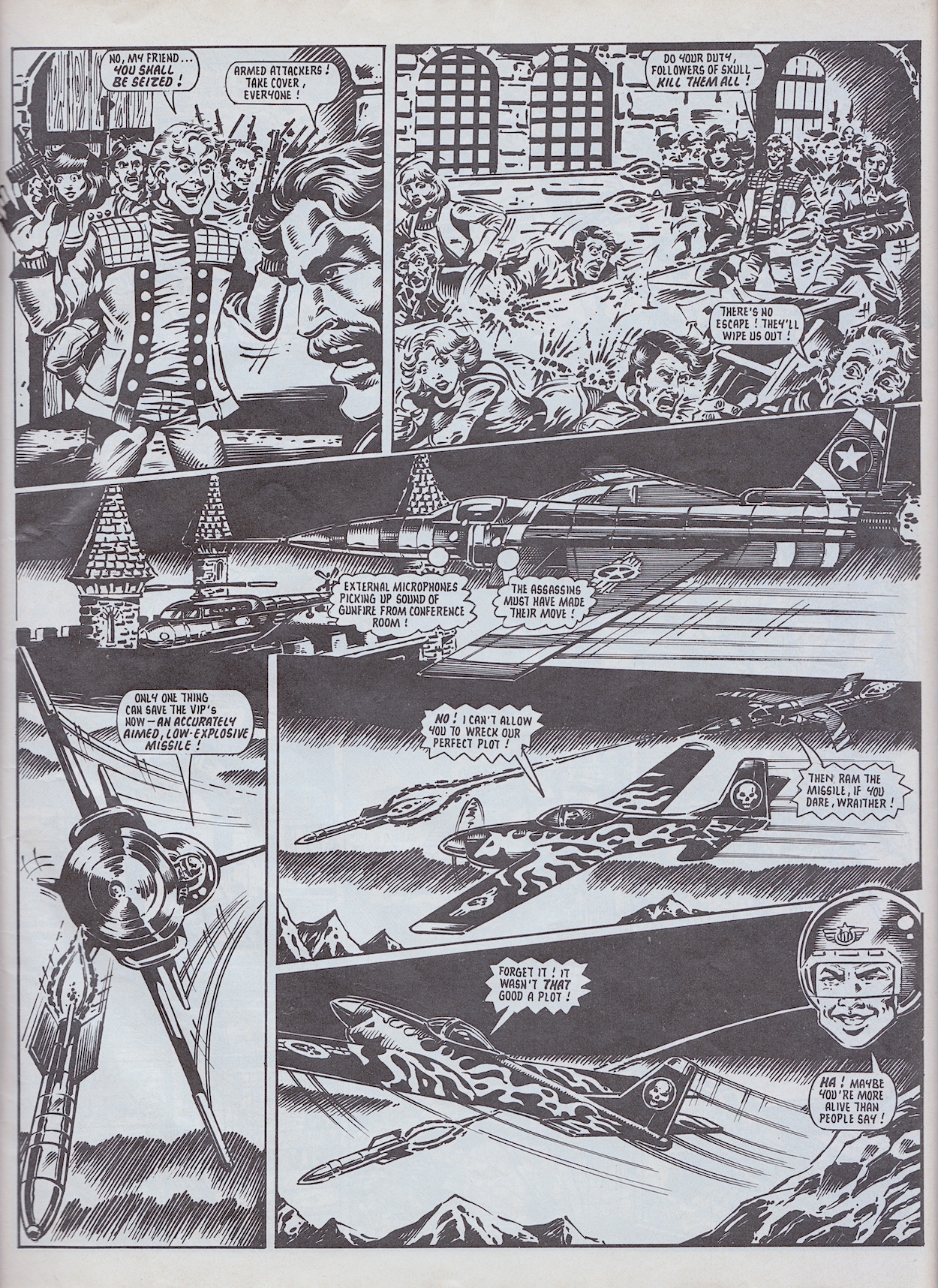
This manifests itself as a mass shooting in 1989, the owners of the castle suddenly falling into a trance and opening fire with automatic assault weapons on all of the representatives present! Yakamura wins the day by using a low-yield missile to knock out a wall of the castle and take out half of the assassins, but the head of the family escapes and throws a grenade into an ammunition store. In the end the survivors evacuate just in time. The rest of the assassins are captured (I’d assume to come round later and be exonerated) and Wraither’s P-51 Mustang Galloping Ghoul is shot out of the sky, the mysterious pilot left abandoned in that time zone until Skull Squadron come to rescue him.

That’s it pretty much summed up but there are two main reasons I love this strip so much: the fact it’s full of great action between my two favourite pilots and planes and how it was delving into some of the backstory, taking tentative steps at setting up some mythology. It reads as an important early chapter in what I’d hoped would be a long-running comic. Wraither and Yakamura were likely chosen because they formed a special two-plane Matchbox Starter Pack (my Starter Pack in fact) and because of this it seemed they were destined to duke it out forever.

To the uninitiated it might seem daft to have two such vastly different planes engage in battle but it’s actually believable. Yasuo’s jet has speed on his side but is unable to make the kinds of quick manoeuvres over short distances Wraither can, and the latter’s ability to fly so close to the ground and mountains and use cloud cover to disappear and reappear at will evens the odds somewhat. In fact, the Grumman X-29 is almost trashed at one stage and Yasuo has to time jump back to the Justice for his reserve machine.

Untested and with unfinished computer systems which were such an integral part of his plane (Yasuo usually relied heavily upon the computer), it made for a tense showdown with Yasuo outnumbered four-to-one against Vulture Wing, the castle under attack by assassins, his inability to land to help and the castle poised to explode, wiping out the Ring Raiders before they’re even formed. The last three chapters were clearly not finished by the time the comic was cancelled as they are combined into one, 12-page finale.

Artist Don Wazejewski again brought James’ script to life and there are some lovely atmospheric visuals here (my favourite being the panel of Yasuo “almost hearing” Wraither’s laughter) and aerial battles that feel genuinely fast and exciting. I also like his chunky depictions of humans, especially on board the gigantic, high-tech Air Carrier Justice; there’s a certain Thunderbirds-esque feel to these particular scenes. Over 24 pages it’s a real thrill ride and it’s such a shame this would be the last meaty read of the special and the last time I’d see these characters.

It hasn’t lost any of its ability to excite for this 44-year-old. But then again, all those happy childhood memories of favourite characters and those little toy planes all bubble to the surface when I read any issue of this comic.

In such a serious storyline, with the tension ratcheting up page after page, there’s a genuine laugh-out-loud moment during the fast-paced climax as Yasuo delivers his missile. The story had made a lot out of the supposed mystery of who, or even what, was behind the mask of Wraither and his sinister character is perfectly portrayed, making this moment towards the end of the story even funnier for the fan in me.

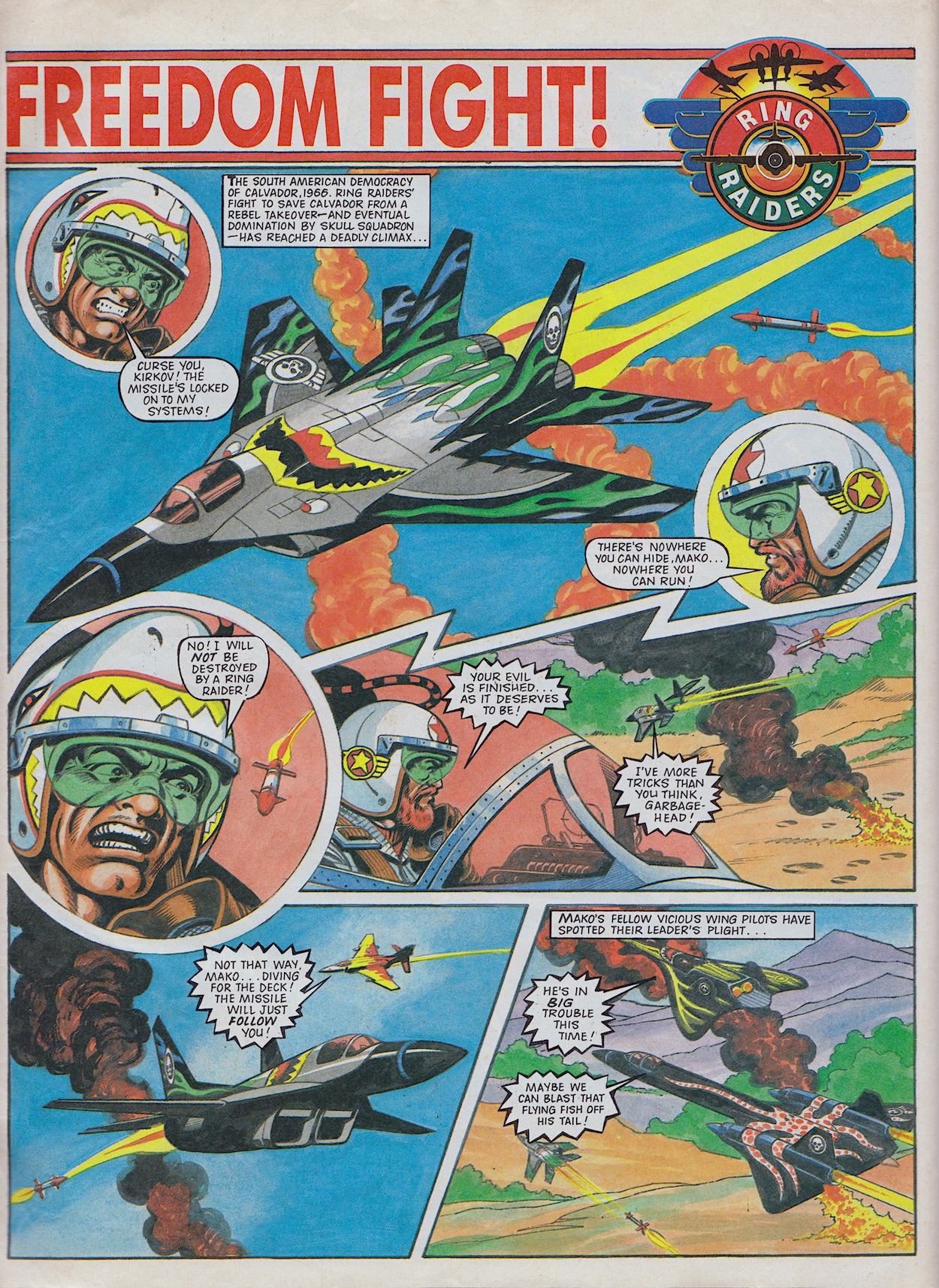
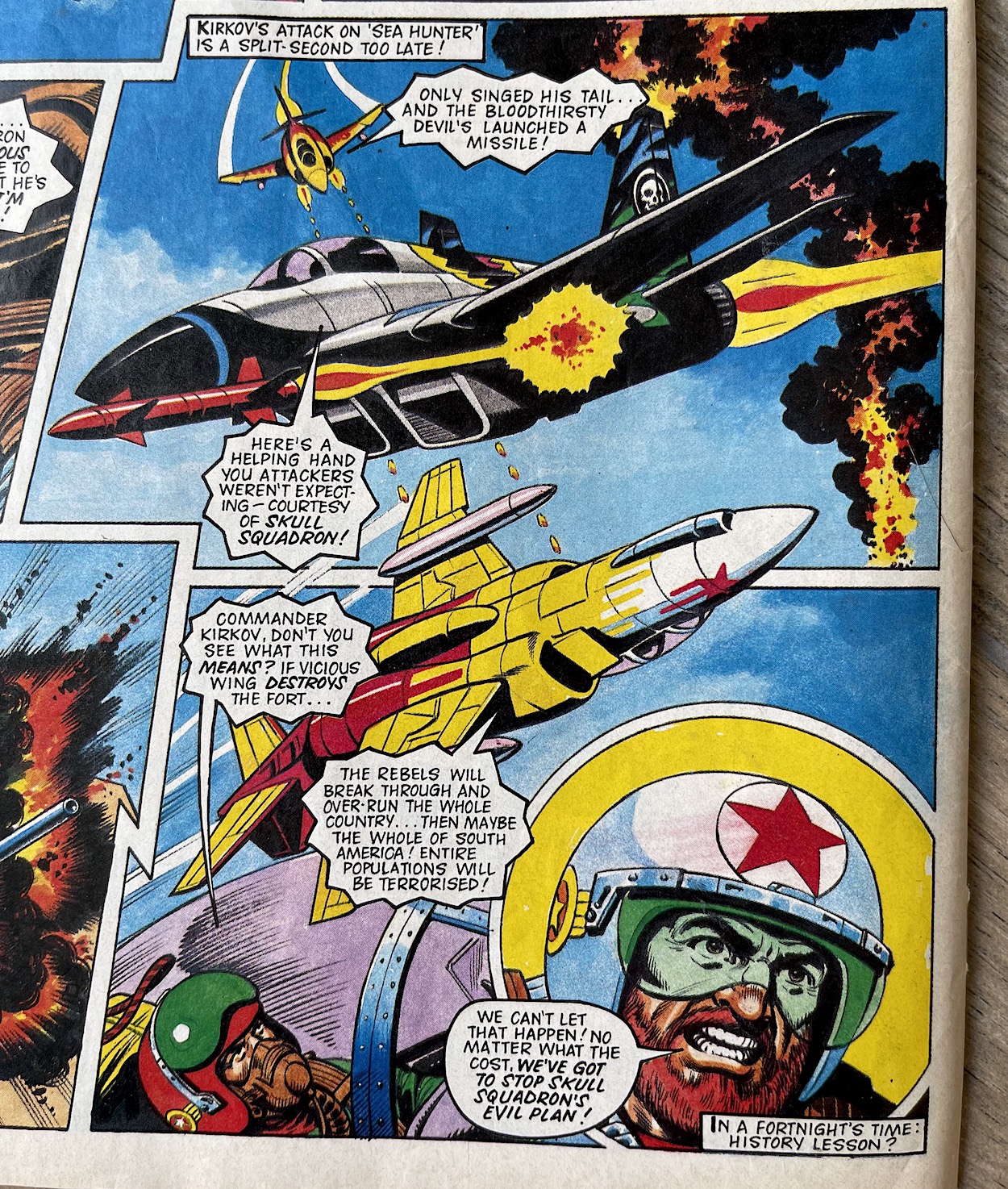
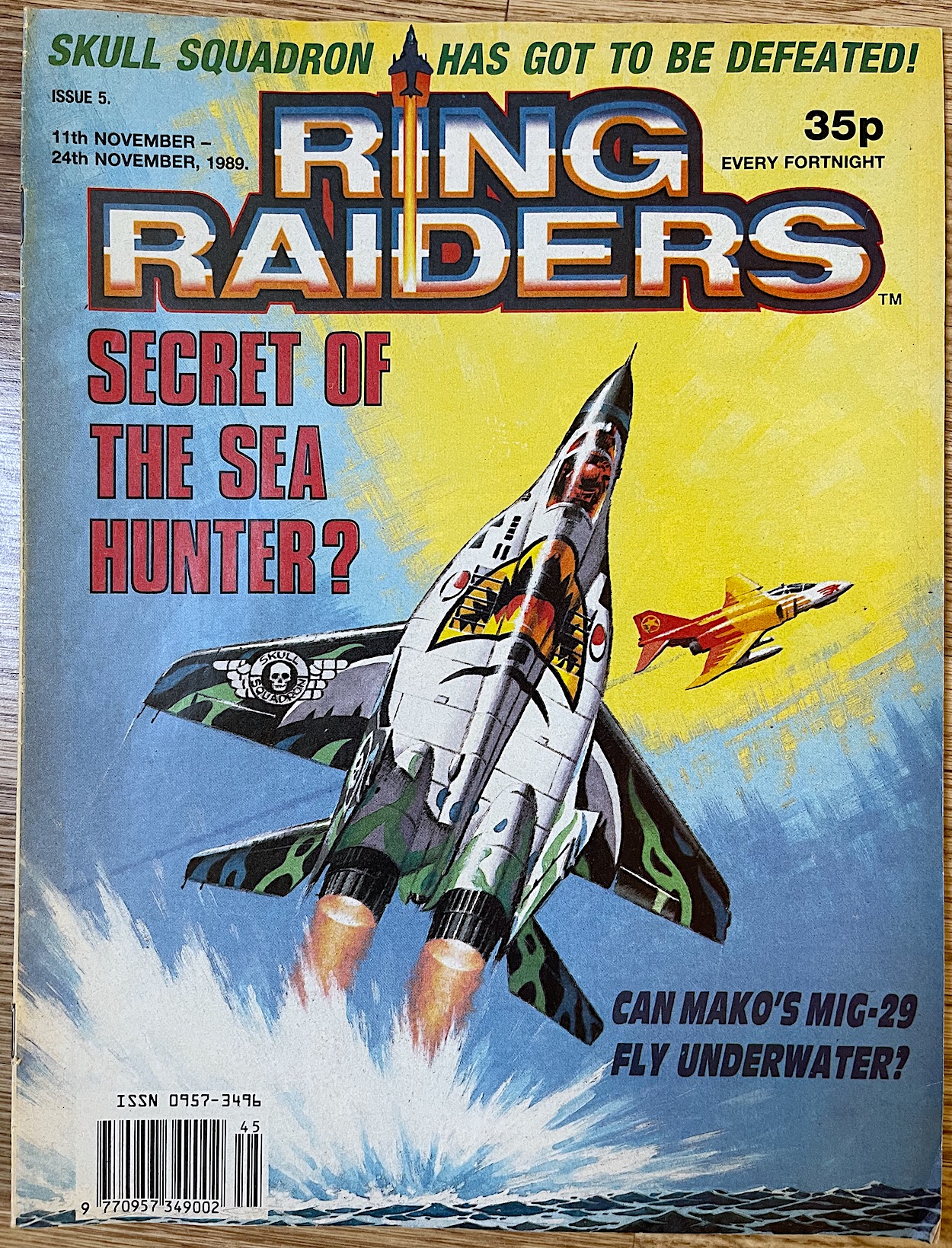
After that momentous blockbuster we’ve only got two individual chapters to go. Next up is the seventh and final part of Freedom Flight. Tom Tully’s story involved Skull Squadron using a band of rebels for their own ends, assisting them in their attempts to overthrow a democratically elected government in South America. The story ended on a cliffhanger in #6 which had Skull Leader Mako’s ‘Sea Hunter’ MiG-29 about to be blown out of the sky by Raider Yuri Kirkov’s missile, fired from his ‘Comet’ F-4 Phantom.

As the young readers could be fans of either side of the never-ending war we would sometimes see the cliffhangers sway towards Skull Squadron, although this was used sparingly in the issues published. Still, it made for a refreshing change. Speaking of which, after 40 pages of beautiful black and white art, turning the page to see Sandy James’ full colour pages is a shock to the system.In the best possible way of course.

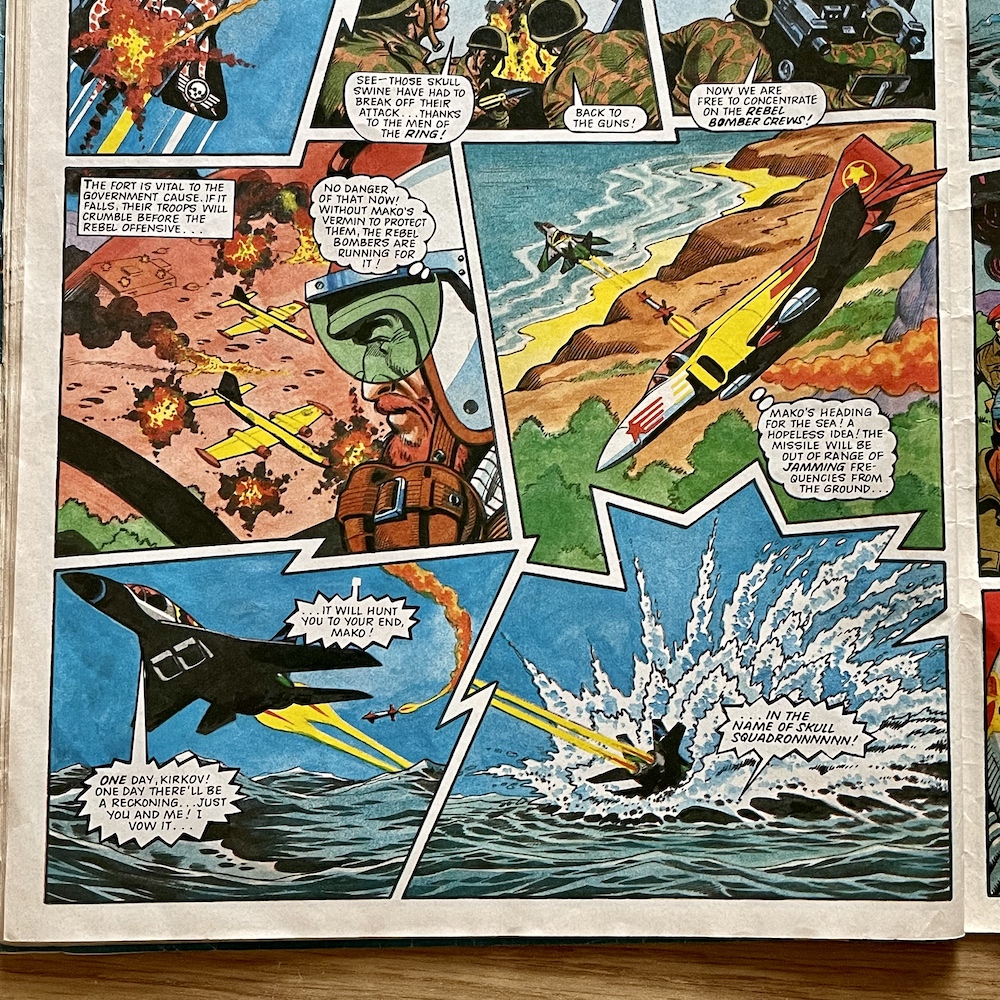
This being just the one chapter it’s basically the end of the battle that was raging months ago in the comic, so alongside the juicier stories in the special it unfortunately feels rather slight. However, in actual fact, if read with the previous half dozen instalments it’s the perfect, exciting ending with Kirkov finally fighting his way to victory after the hardships of other issues. His missile closes in on Mako and he even sees off the wingmen who attempt to come to the rescue.

Usually this would mean the end of the plane and most certainly the character, what with him not bailing out before impact, but as we readers know and as Kirkov suspects, Mako’s craft can operate underwater so the Ring Raiders must content themselves with the fact he’s escaped. Without the futuristic back up the rebels are soon defeated and our heroes travel back to the Justice to await their next mission, their work in the air complete.

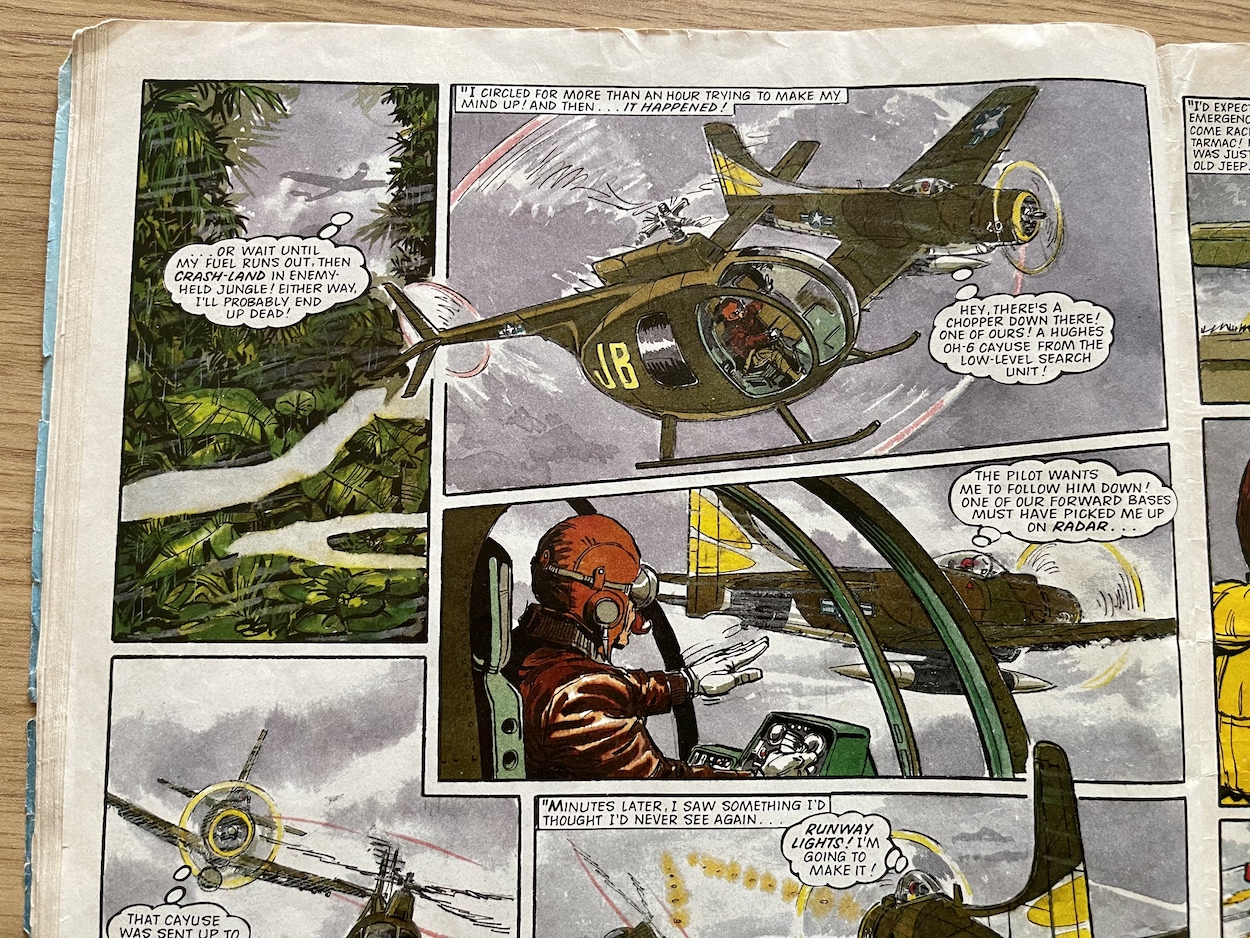
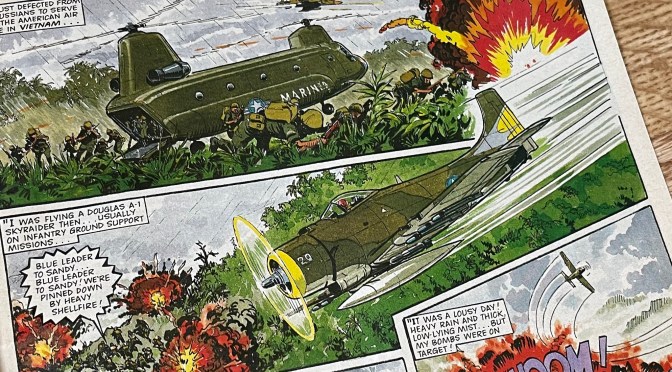
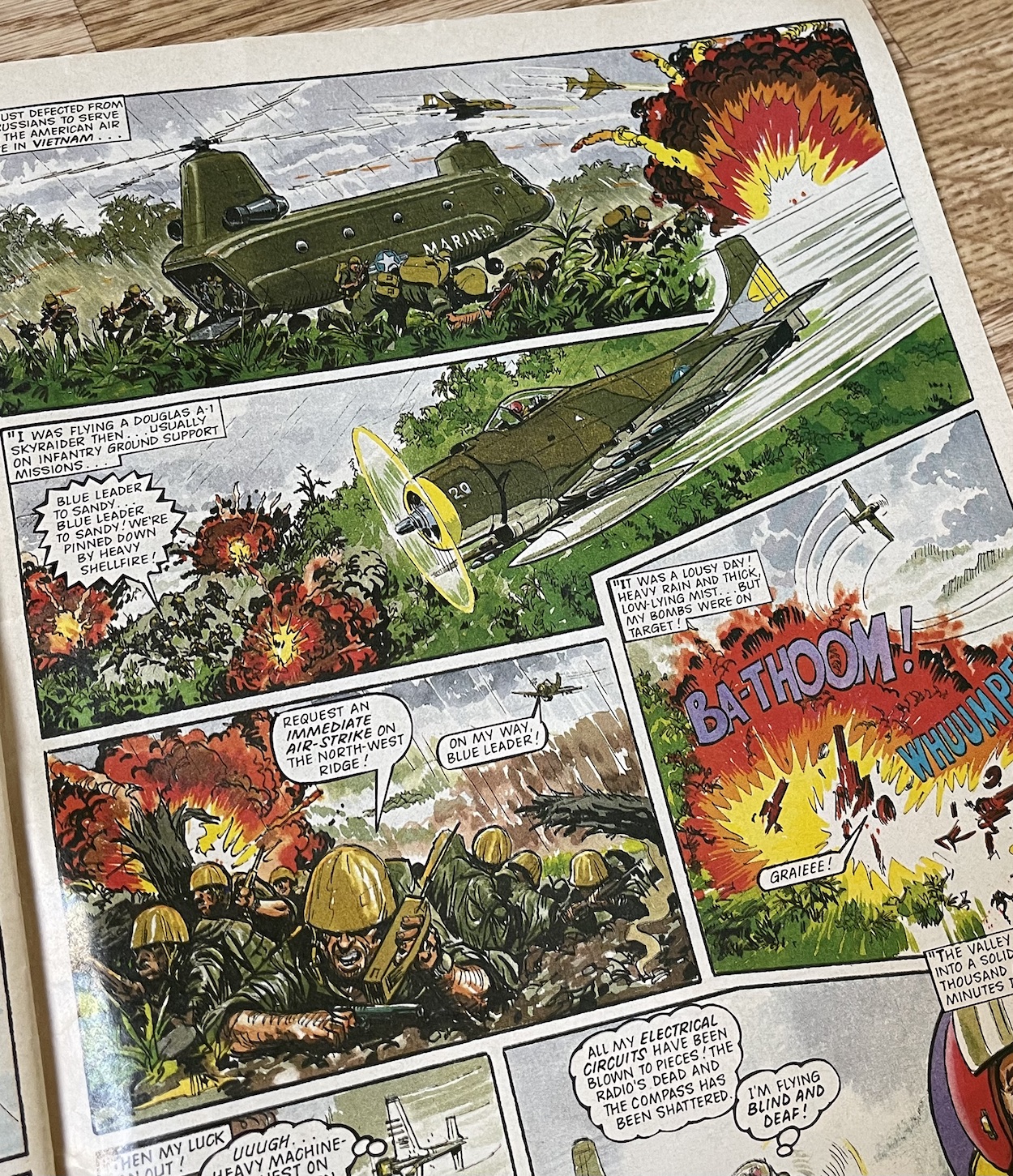
Just one page later Kirkov returns in the one-off character story we would’ve read in #7 and it’s quite possibly the best one of the series, or at the very least right up there with Chiller’s in #3. As usual it kicks off with an air battle against the Skulls. Wraither again actually. As he expertly uses clouds to vanish into thin air during battle, Kirkov is reminded of the mist covered skies of Vietnam through which he flew in his Douglas A-1 Skyraider after defecting from Russia to fight for the United States.

Those of us who grew up in the 1980s will remember most of our heroes in primetime television had fought in the war, each one suffering some degree of personal trauma (Thomas Magnum, Magnum PI), physical damage (Michael Knight, Knight Rider) or psychological issues (Stringfellow Hawke, Airwolf). So as a young teenager this lent a credibility to Ring Raiders, seeing a character caught up in a real world war, one that we were all too aware of at the time and of the devastation it caused.

I think it could’ve reached beyond those obsessed with the toys if given the chance

The story was a real treat and as the last strip the comic would ever publish it made an impact; its gritty, rain-and-mist-shrouded panels evoking the same atmosphere we were used to in flashbacks in those aforementioned television shows (and later in the 90s when Bravo showed Tour of Duty which I became completely hooked by). Reading it now, Scott Goodall’s well-paced script and John Gillat’s superb artwork take me right back to those times. In fact, it feels all the more mature reading it now through adult eyes when compared to the other strips in this issue.

The story is a bit well worn by now, with a mysterious character helping our hero in their desperate time of need, only for us to find out that person had actually died and it must have been an illusion of some sort (although implied to have been their spirit continuing to help people as they had done in life). It’s the fact this story is in Ring Raiders and is illustrated in the way that it is that makes it so very special.

The perfect way to wrap up Ring Raiders, not just this special but the comic as a whole. Not only is it a superb strip, it shows the real potential this comic had in the range of its storytelling and how I think it could’ve reached beyond those obsessed with the toys if given the chance. It’s heartbreaking to finish the final story but I think it just proves the point I’ve been making since the beginning. Rounding off the issue is the second Photo File by James, this time one of his favourites and cover star the F-104 Starfighter,.

Well, that’s it.

James and Barrie were able to tell me the names of some further adventures that we never got to see. Hill Kill was written by Scott Goodall so possibly another character piece, Viking Job was by Tom Tully and Sandy James (their follow up to Freedom Flight and most likely set in the distant past), Surprise Attack, Skull Surprise was by Barrie Tomlinson himself so most likely was to be drawn by Carlos Pino and there was an unnamed Christmas story by James Tomlinson and Don Wazejewski, plus another story by the same team called Blow Bubbles, whatever that was about. A Christmas issue of this comic would’ve been nothing short of awesome for me! Oh well.

Proof that licenced toy comics could be taken seriously and produce excellent results

Ring Raiders could effortlessly flip between the futuristic and the historical, the fantastical and the realistic, keeping its feet grounded with believable, likeable characters, exciting action, superb art and interesting stories. If it had continued goodness knows how much better it would’ve got as it developed. It’s anthology style worked a treat and for those few short months I didn’t just run, I sprinted to the newsagents every other week to get my next fix.

OiNK aside, the fact this comic remains my number one from childhood with only seven issues to show for itself should tell you something.

Ring Raiders was a superb comic and is well worth picking up, although be aware issues can go for a pretty penny on eBay and you’ll be very lucky indeed to find this special. (There were also two annuals but they were by Grandreams, had nothing to do with the comic and are really poor, with no strips, just bad text stories and basic art.) Ring Raiders was proof that licenced toy comics could be taken seriously and produce excellent results. Kudos to Barrie and the whole team, thank you for a superb comic and for some really enjoyable memories.

BACK TO iSSUE SiX

RiNG RAiDERS MENU

EDiTiNG RiNG RAiDERS: BARRiE TOMLiNSON iNTERViEW

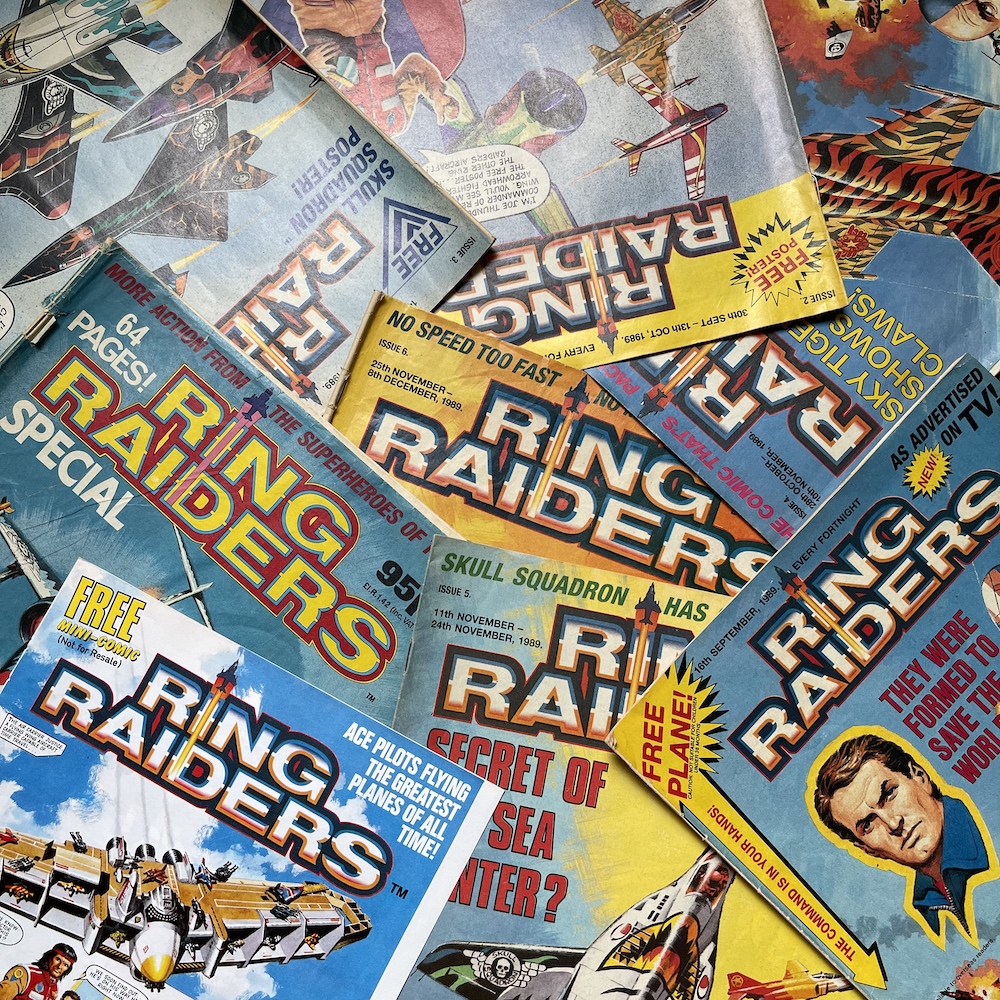
My very favourite non-OiNK comic from my youth may have only lasted six fantastic issues and one brilliant special in 1989/90, but that didn’t stop me from being hyped to read Ring Raiders again as an adult for the blog. They may have been based on obscure toys that weren’t the success they were expected to be, but the comics hold up incredibly well today, full of character, fun stories and high octane action.

In the then-near-future of the late 90s Skull Squadron were a terrorist organisation on the brink of world domination. Capable of time travel and made up of the most sinister of pilots plucked out of various eras they planned to use this ability to destabilise the world order, with them in control. In response, the governments of the world formed the Ring Raiders, an elite airforce formed in a similar way, each equipped with a special communication and energy ring.

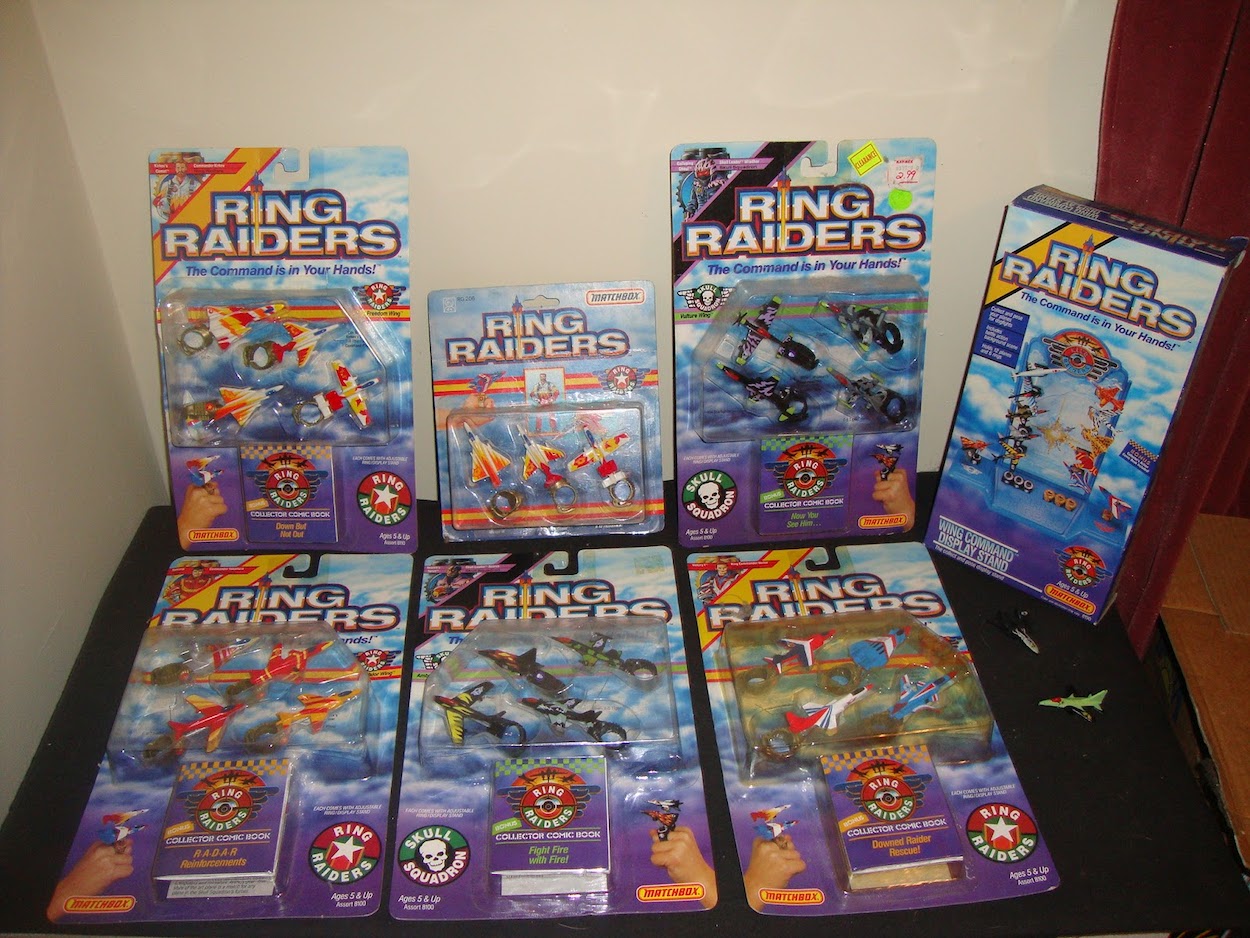
The gotta-collect-’em-all toys came with small comic books featuring basic dogfights, but it was no small feat to transform those little plastic Matchbox planes into compelling strips with fully formed characters. While the toys may seem to limit what a comic could do, the opposite was true of that background storyline which was almost endless in scope. Fleetway Publications were going to need a top editor to craft their new fortnightly comic, so they naturally turned to Barrie Tomlinson (Eagle, Tiger, Wildcat).

Barrie formed a team of the very best in British talent; Ian Kennedy, Carlos Pino, Angus Allan, John Cooper, Scott Goodall, John Gillatt, James Nicholas (Tomlinson), Don Wazejewski, Tom Tully, Sandy James and Geoff Campion. I must’ve read each issue dozens of times and was gutted when it (and the toys) ended so prematurely.

The Ring Raiders comic genuinely surprised me with just how brilliantly it read for the blog reviews. It was exciting and had masses of potential to explore an epic storyline. Within its short lifespan it covered World War II, Vietnam, the threat of nuclear annihilation, futuristic sci-fi battles, murderous back stories, civil wars and even an homage to a certain 80s 3D movie I’m a big fan of. I loved the range and I think as an adult I appreciated the character development at the centre of such fanciful tales even more.

I was so excited when Barrie agreed to answer some questions for me and I came away from our chat delighted at how proud he was of this licenced comic fave.

OiNK Blog: Hi Barrie, can you remember what made Fleetway choose the Ring Raiders licence? Looking back they were just tiny Matchbox planes with only minimal character drawings on the packaging.

Barrie Tomlinson: Fleetway Publications was a massive organisation. The first I would hear of a new licence would be from the Editorial Director. It would have been negotiated by a non-editorial department and presented to us. I just had to grab all the info I could find about the storyline and characters and make myself an instant expert on the subject.

OB: There’s a similarity between Ring Raiders and Wildcat. Both have an anthology feel while wrapped up in an overall theme. Was this a conscious decision or was it just befitting the licence?

BT: It wasn’t a conscious decision. I would have just wanted to use the characters I had been presented with and turn the comic into something which was liked by British readers.

OB: Were you personally responsible for selecting the writers responsible for fleshing out these characters?

BT: Yes, I would have been responsible for selecting the writers. It’s really unfortunate that the detail books for Ring Raiders were not kept. They would provide a wealth of information. My son James, who wrote under the name ‘James Nicholas‘ was one of the writers. He was a natural, as he is an aviation fanatic! I’ll have to guess at the others. Probably Tom Tully was one. I can’t remember writing any of those scripts myself… but I probably did! (He did indeed as we later found out during the read through, as well as the names of the others – Phil)

OB: There were some mature themes in there, such as Vietnam. This strip in particular wouldn’t have looked out of place in a classic IPC war comic. The setup allowed stories set in the past, present or future, time travelling, fantasy of historic tales. It sounds like a writer’s dream title! Did you feel you had that freedom in a licenced comic?

BT: Everything we did had to be approved by agents of the copyright holder. Each script and piece of artwork had to be submitted and approved so we always had to stick closely to the original material we had been sent.

OB: There’s a feeling of a larger scale story developing in the background too. Was anything worked out in advance or were you winging it (pun not intended) and seeing how they developed over time? Can you remember any plans you had if the comic had continued?

BT: There were not any massive plans. It was always a rush producing titles like this as everything had to be approved. Once we had taken on board all the story/character details it was just a question of talking to writers, recruiting artists and getting on with it. I was pleased with the high quality artwork we achieved on this title, using artists who were greatly experienced in working for my department.

OB: A cartoon series was also in development which was very different to the comic in basically every way, going down a more sci-fi route with clichéd characters. I preferred the flawed characters in your comic by far.

BT: We didn’t have any contact with the cartoon series. We could develop the characters to a certain extent but everything would have to be approved.

(Below, Castle of Doom was written by Barrie’s son James and featured plenty of time travel and the beginnings of a larger overall story arc.)

OB: Speaking of those approvals, were there any requested changes or outright rejections? There was very little established in the toy line so for me the comic was really creating these characters.

BT: Occasionally, they would ask for alterations. Nothing too much. Some of the other toy comics were much more hands-on. I had to train people doing the approving that it was a comic. At first, they were looking at each individual frame as if it was a one-off poster. Eventually they got to realise these were small frames and the slick comic artwork was very different to that used in a giant poster or on a toy product. As I recall, we didn’t have that problem with Ring Raiders.

OB: It seemed at one stage almost every comic I began collecting got cancelled very quickly. Having read back over some of those titles it certainly wasn’t because of a lack of quality! Why do you think so many excellent comics were cancelled so early in the late 80s and 90s?

BT: I think it was just that the comic era was coming to an end. Television and computers were taking up children’s time. Once upon a time, the delivery of the weekly comic was a big event in a child’s life. It was delivered with the morning paper. Dad read it as well. Then children became more sophisticated and they wanted something more than a comic. They were growing up faster.

OB: Finally, the late Ian Kennedy always said his favourite subject to draw was airplanes, especially fighter planes. Ring Raiders seemed like a perfect fit for him. Was he contracted to work on covers for Fleetway or was he selected by you personally? Can you remember any comments from him on his time working on Ring Raiders?

BT: Yes, I would have selected Ian to work on the title, he wasn’t contracted for covers. I think I remember him being disappointed when Ring Raiders came to an early conclusion.

I was delighted that Ian worked on Ring Raiders and other titles in my group. His recent passing was a sad occasion for the world of comics. Greatly missed but his art will live on!

OB: Thanks so much for your time and insight Barrie, it’s been a pleasure to read this comic again, thank you for producing such a quality read for fans at that age.

BT: It’s great to know that the title is so well remembered. It’s a great tribute to the writers, artists and editorial staff who worked on Ring Raiders. It may not have lasted long but I think it looked good as a comic in its own right.

If you’d like to find out more about Ring Raiders and read the real time reviews just click here.

At the time of writing the final edition, the whopping 64-page special will be reviewed later this month and next week watch out for a wonderful, lengthy interview with Barrie’s son and Ring Raiders writer, James Tomlinson (or James Nicholas as he was known at the time).

RiNG RAiDERS MENU

WiLDCAT HOLiDAY SPECiAL: ANOTHER BiTE

It hasn’t really been that long since the final issue of Wildcat, two months in fact, but it’s great to hold another edition in my hands, especially one I’ve never actually read before. I wasn’t aware of it as a child because I hadn’t followed the characters into Eagle when the comics merged. There’s a rather lengthier wait after this but I’ll get to that at the end of the review. So what we have here is the standard Fleetway Holiday Special format of 48 large, glossy pages full of strips, a prose story and extra features thrown in for good measure.
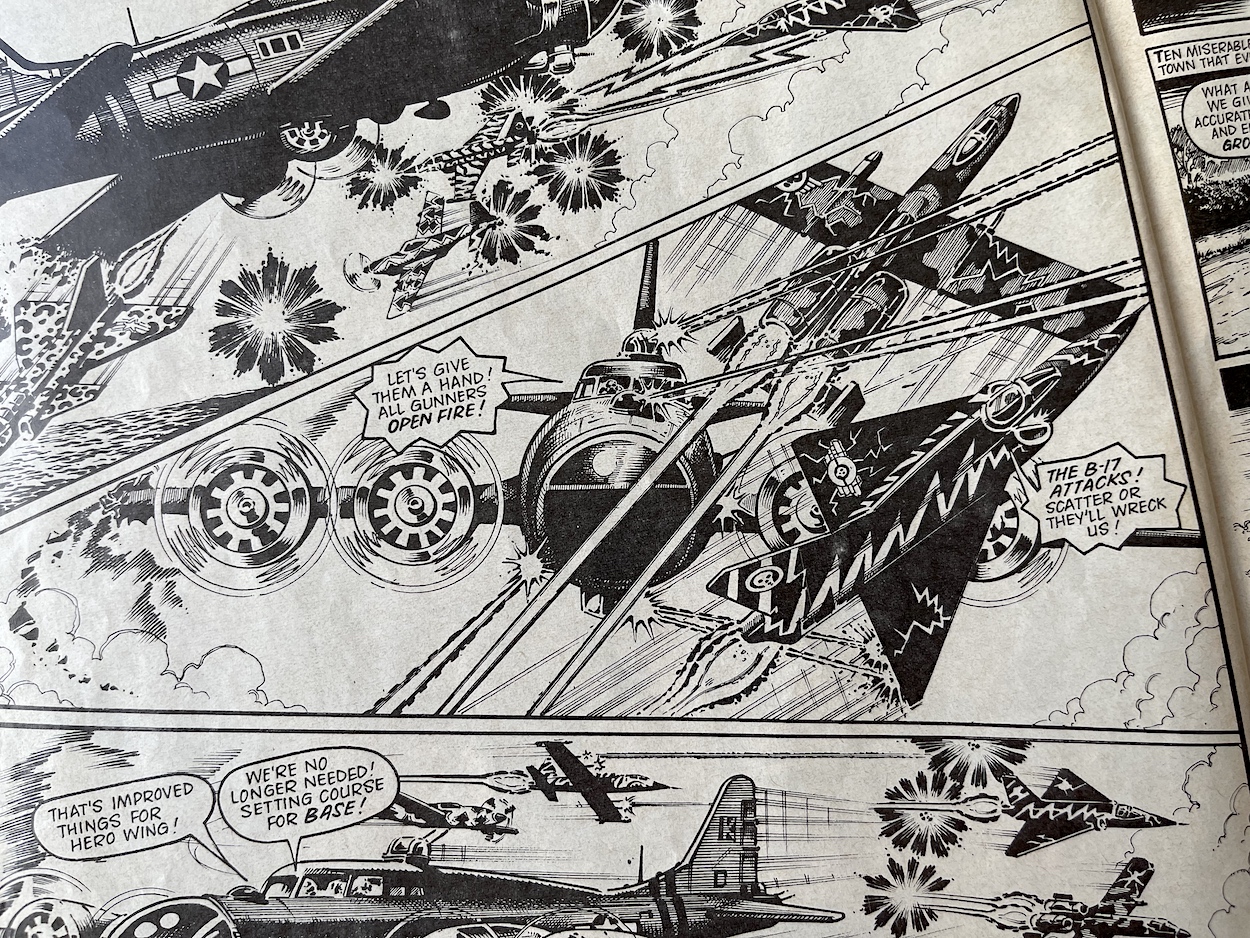
After a contents page and a recap of the set up from the preview issue Turbo Jones reclaims his position as the lead strip (now drawn by Keith Page) and like all of the stories here it’s a standalone tale and not linked to the ongoing serials that all ended with cliffhangers in the last issue. Of course, by now those stories could have concluded or moved on to goodness knows what in the pages of Eagle. (That’s something I’ll look into in future posts.) Some of these read a little strangely because of this.

For example, as far as I was concerned Turbo was still languishing on his quest through the Valley of Death, but here we’ve skipped forward to the next chapter in his adventure on the new planet. We find him and his robotic friend Robo accidentally stumbling across two aliens out for blood (or whatever runs through their veins. If they have veins). This isn’t a quick summing up of things either, in the end they realise the two creatures have no interest in our heroes, they have literally stumbled upon this fight. But of course if they don’t defend themselves they’ll go the same way as the loser.

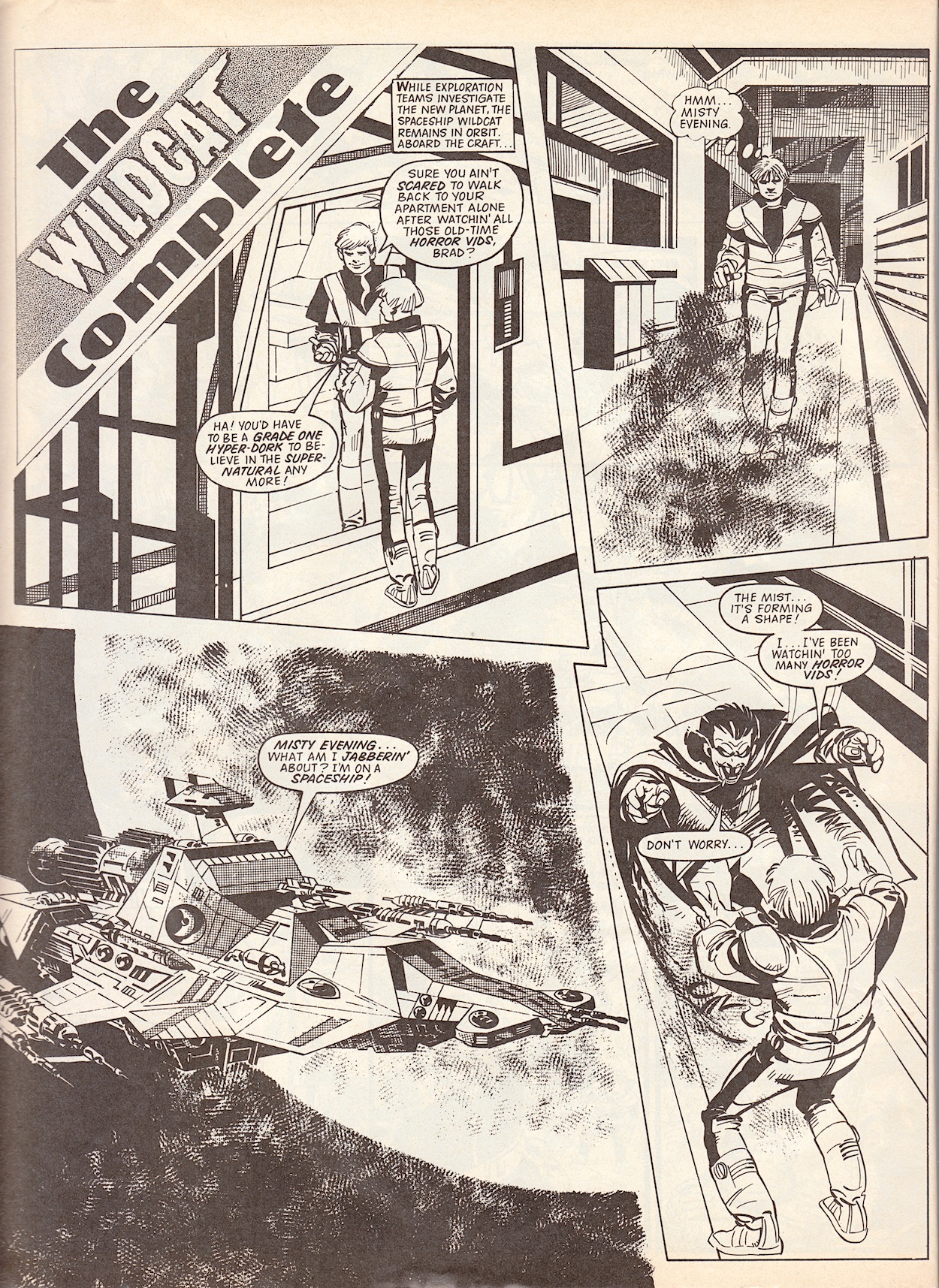
Turbo is knocked unconscious by a falling branch and Robo saves the day by knocking coconut-like fruits off the trees onto the heads of the aliens. No, really. It ends with Turbo disbelieving this tale of heroism and Robo talking directly to the reader, asking them to write in and tell Turbo what happened. It’s a fun diversion of an opener but feels very slight in comparison to the fortnightly. However, I do love that alien design. Moving on now to something somewhat darker stalking the corridors of the Wildcat itself in The Wildcat Complete, brought to life by Jesús Redondo.

That’s right, we have an actual vampire onboard. There’s also plenty of well-judged humour here too so it’s unfortunate we don’t know who wrote the script. Here on the first page the casual thoughts of our victim raise a laugh as he catches himself on about the “misty evening” before meeting his end, and later on as another victim is running late in getting home he thinks to himself how he’ll “get it in the neck” from his wife! These are the only people we see die (taking the Wildcat Death Toll up to 40) but mention is made of them being only the latest in a series of disappearances, so our toll is actually unknown.

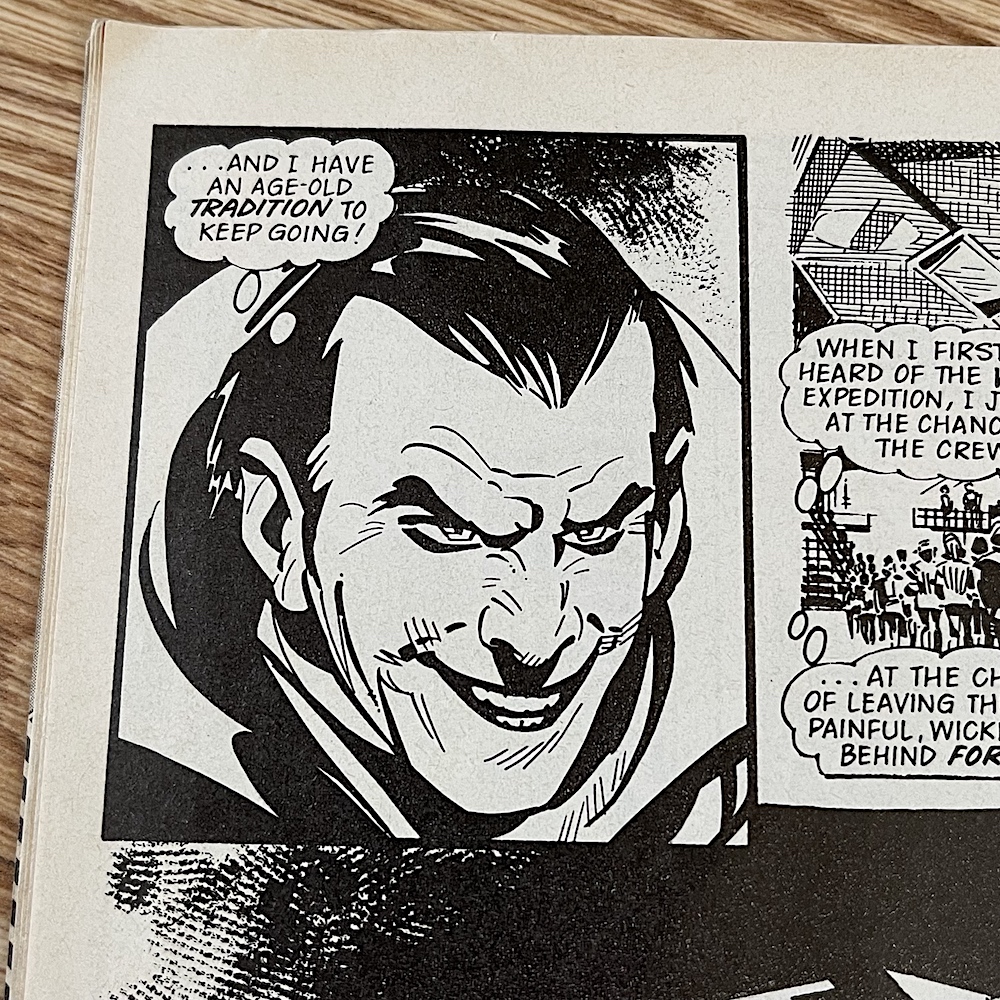
During the day our vampire goes by the name Dr. Joseph Lugosi, obviously a play on the name of renowned actor Bela Legosi who is probably best remembered for playing the title character in the 1931 film Dracula. It’s not just his name the story pays homage to either, just take a look at the doctor in this close-up frame.

There’s a rather dark moment where we see him dispose of a body by taking it to the food recycling plant, which is basically a bunch of retro-futuristic robots munching down on anything thrown into their pit. We get a little internal monologue of how Lugosi applied to be on Wildcat because there’d be no sunlight in space to stop him feeding, and we see him queued up to get on board, everyone else in casual gear, him in his dark cloak, standing out a mile. Given his appearance and dress sense, when he thinks his plan is foolproof and no one would ever suspect him it seems ridiculous, but it’s actually all explained in the end.

When an attack is disturbed mid-feast he has to leave the body behind and as Wildcat Commander Griffin reviews the tapes he sees Lugosi disappear into thin air. He ends up tricking Lugosi into believing he’s replacing an ill doctor on an expedition to one of the planet’s moons, but before anyone else boards the shuttle craft it’s launched out of the Wildcat on autopilot. The last page of the strip is below and very neatly wraps up the story.

I really like how Griffin had to research what a vampire is (so far into the future are we, their legends appear to have been lost) and that he simply reacts logically to the problem. There’s no disbelief, just a problem to solve and the history tapes give him the answer. While I can only show you a little bit here he’s a cool-as-a-cucumber character and one I wish we’d gotten to know properly in the comic. Check out that final caption too, vampires are now extinct! Another great anthology story, one that’s made me realise just how much I’m missing them every two weeks.

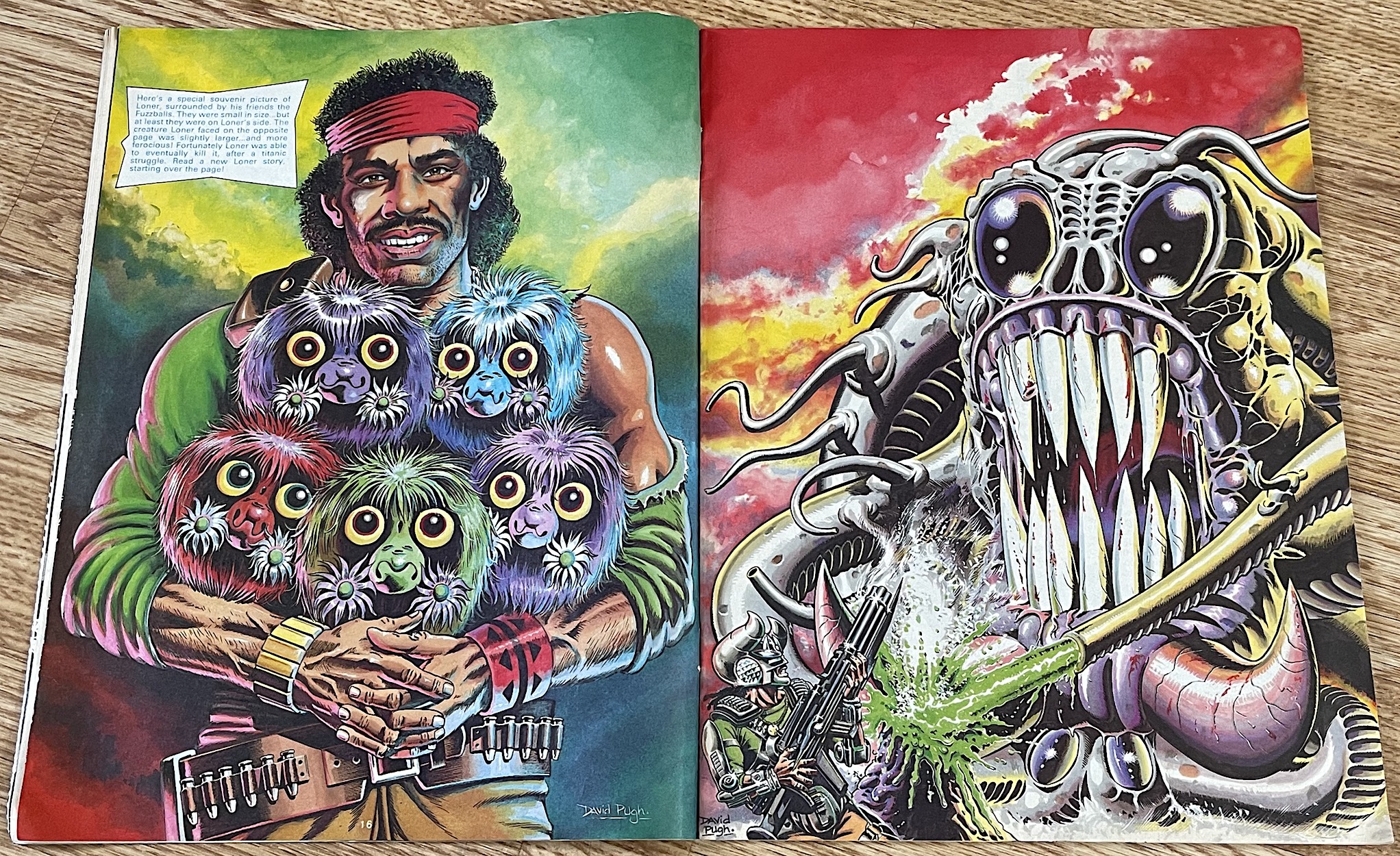
Loner gets a good bit of space in the special but unfortunately there’s not a comic strip in sight. There’s a two-page spread of pictures taken from the early issues and his initial scraps with, and ultimately friendship with, The Fuzzballs. There are also two pin ups, both drawn by David Pugh. One is brand new and the other is a reprint of the cover to #7 which was so good it deserved another outing as a mini-poster without the title and issue details. To this day it’s probably my favourite piece of art from Wildcat. In fact it’s one of my favourite pieces of comic art ever.

On top of all this we get a Loner story written by editor Barrie Tomlinson, however it’s told in prose with images of David’s taken from the regular comic. At five pages and full of text it’s a meatier read than I expected and actually a whole lot better than the strip we’d been reading for the last handful of issues. Falling into a chasm he’s apparently rescued by an alien slug creature who carries him to a large cave full of slugs where he also sees another, two-headed alien. They have to fight to the death for the entertainment of the slugs! (Are they an unfriendly relation of the Dargonlites from the Joe Alien story?)

It’s a struggle. The two-headed creature is relentless but soon Loner is able to escape by causing chaos in the audience (he throws one of the slugs into the crowd as a distraction). Back outside the alien is on Loner’s tail and in what looks like the end of the fight Loner’s gun Babe ends up pressed against the creature’s throat. But Loner backs off, trying to communicate he doesn’t want to kill him, he has no beef with him.


Both heads broke into hideous grins, then it turned and walked away.

Loner prose story

Communicating is difficult however and relies on body language more than anything, which is interesting. However, I’m disappointed he no longer has the headband from previous stories. It’s only given a passing explanation that he’d returned to Wildcat and had it removed before coming back down. This completely contradicts the story where he received it! Such a shame, but perhaps a necessary evil because the images they had to use didn’t include it, rather than it being a story choice.

Anyway, the two-headed creature continues to follow Loner at a distance. When our mercenary gets back to his shuttle it appears to attack, throwing Loner to the side and leaping into the craft. Are they going to steal it? Nope, there was a deadly snake-like predator inside. The alien had saved Loner’s life. But before Loner can try to communicate a thank you, he’s attacked by the alien again! He wins the battle by unhappily having to end its life, or be killed himself.

In the end, the creature had been a warrior and it was always going to be a fight to the death, but Loner had saved him from the underground slug beings and he’d had to repay that debt first. This would’ve made for a great multipart strip in the regular comic, it’s full of character and paints a wonderful, exciting picture. Such a shame it’s only illustrated by images from unrelated stories.

There’s one more special to come and I’m very excited by it

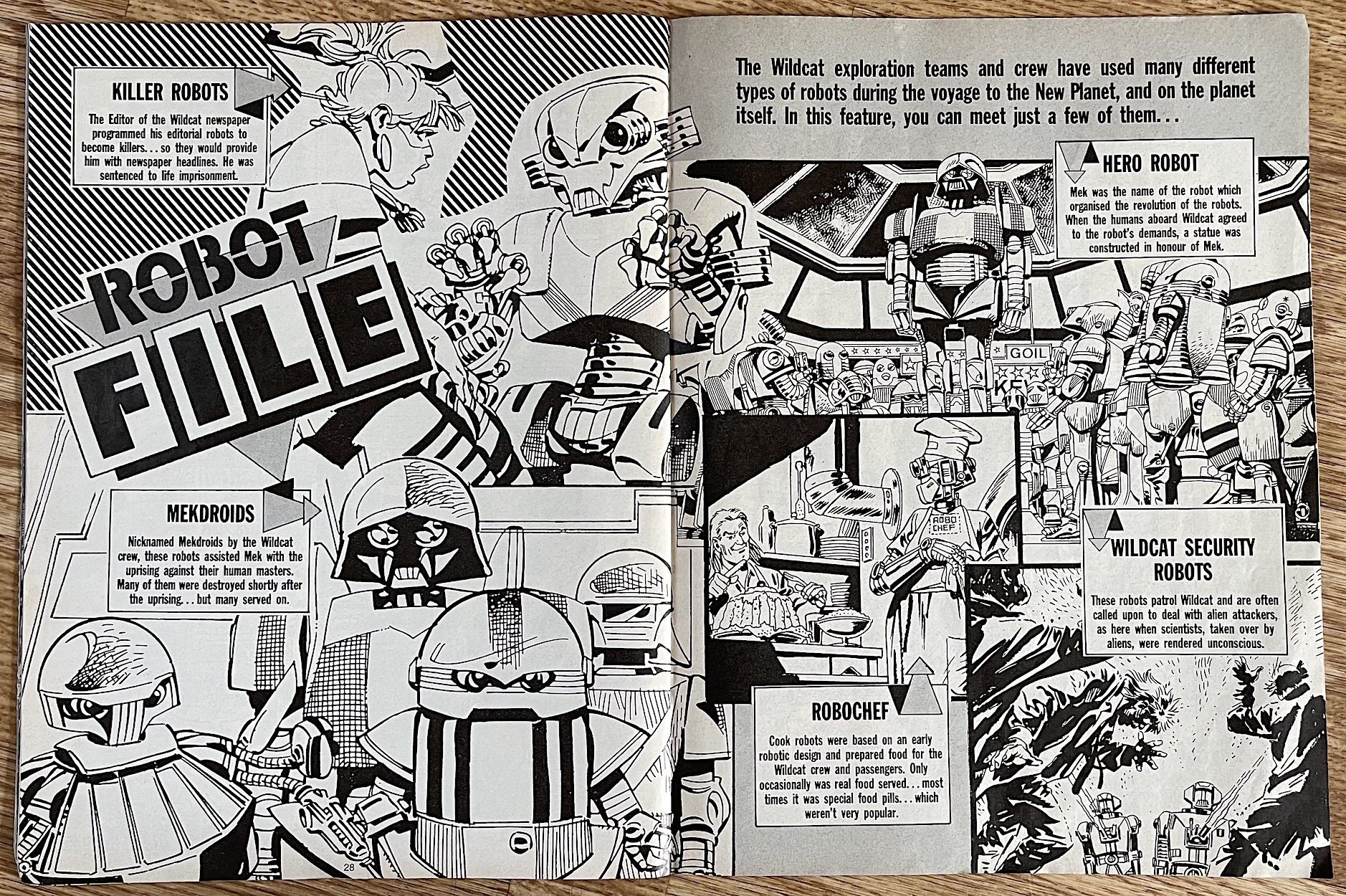
Alongside the double-page spread of Loner’s furry friends there’s a four-page feature about some of the robots that reside aboard the Wildcat and which have featured in previous stories, most notably the Wildcat Complete series. Features like these act as a nice way for new readers to catch up and get an idea of what Wildcat is all about, but unlike some of the Super Naturals Holiday Special features which felt like filler, these are nicely put together and are still enjoyable for regulars.

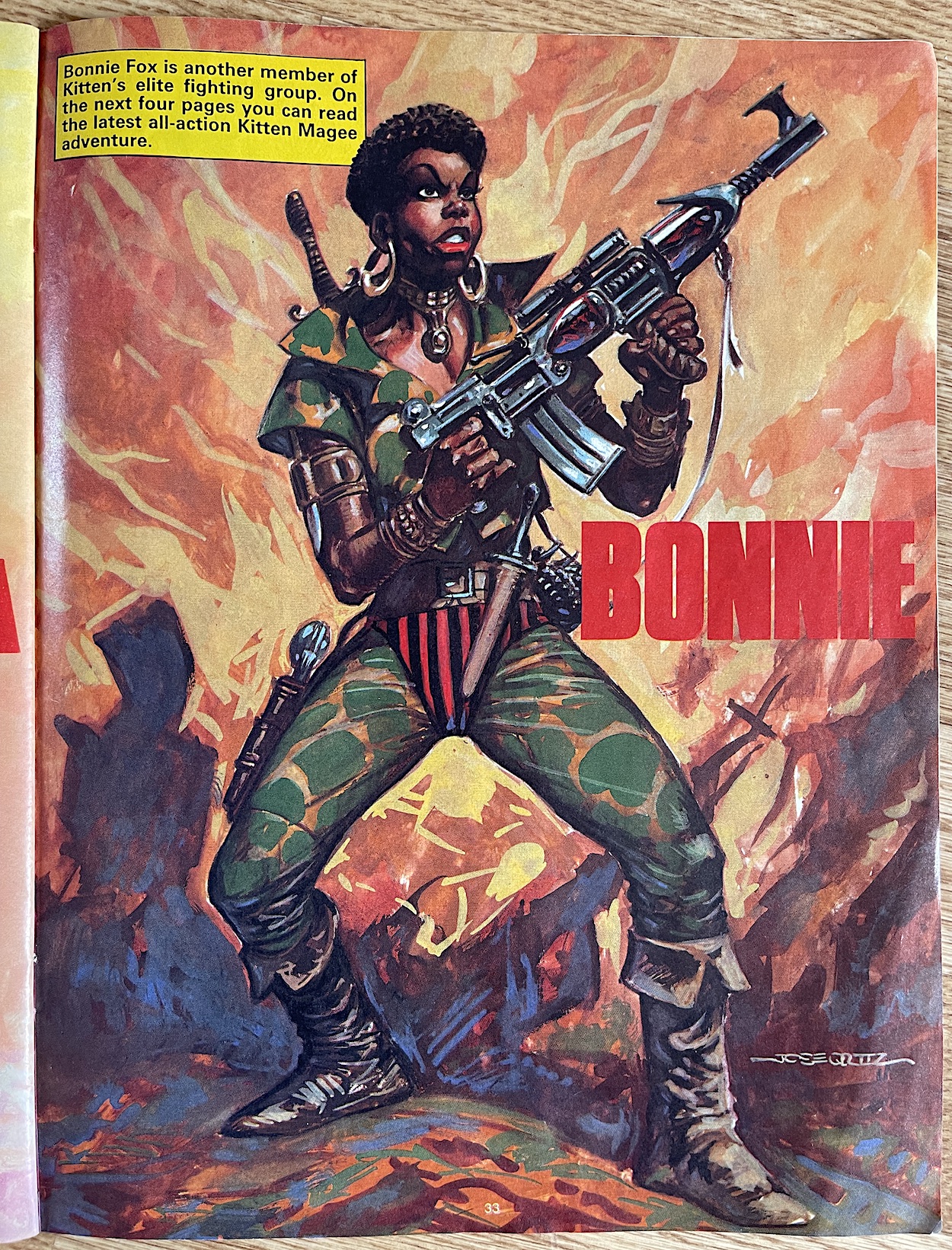
Alongside more reprinted pin ups there’s another new one which hadn’t made its way into the fortnightly and it’s of one of my favourite characters from the Kitten Magee story, Bonnie. As regular readers of the comic (or even these reviews) will attest, Kitten’s team were just starting to get fleshed out some more, even going on their own adventure without their leader in the final issue. I look forward to reading the ongoing tales in Eagle and Wildcat at a later date, mainly for them.

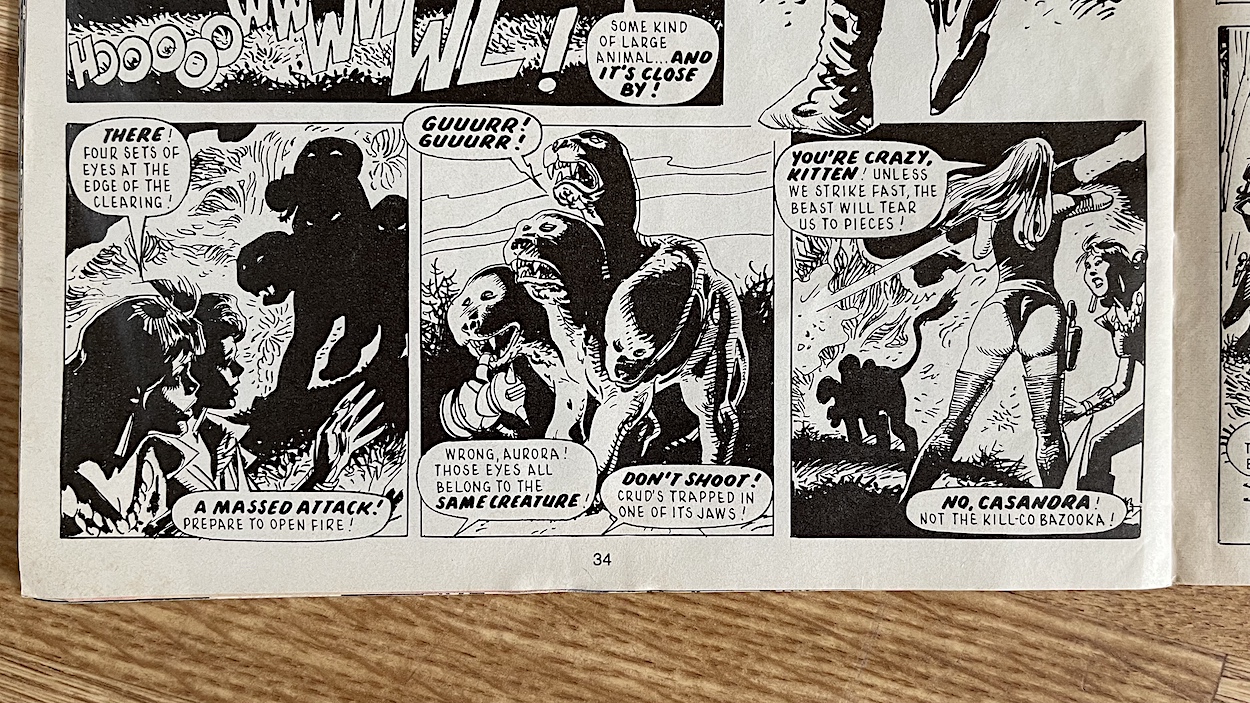
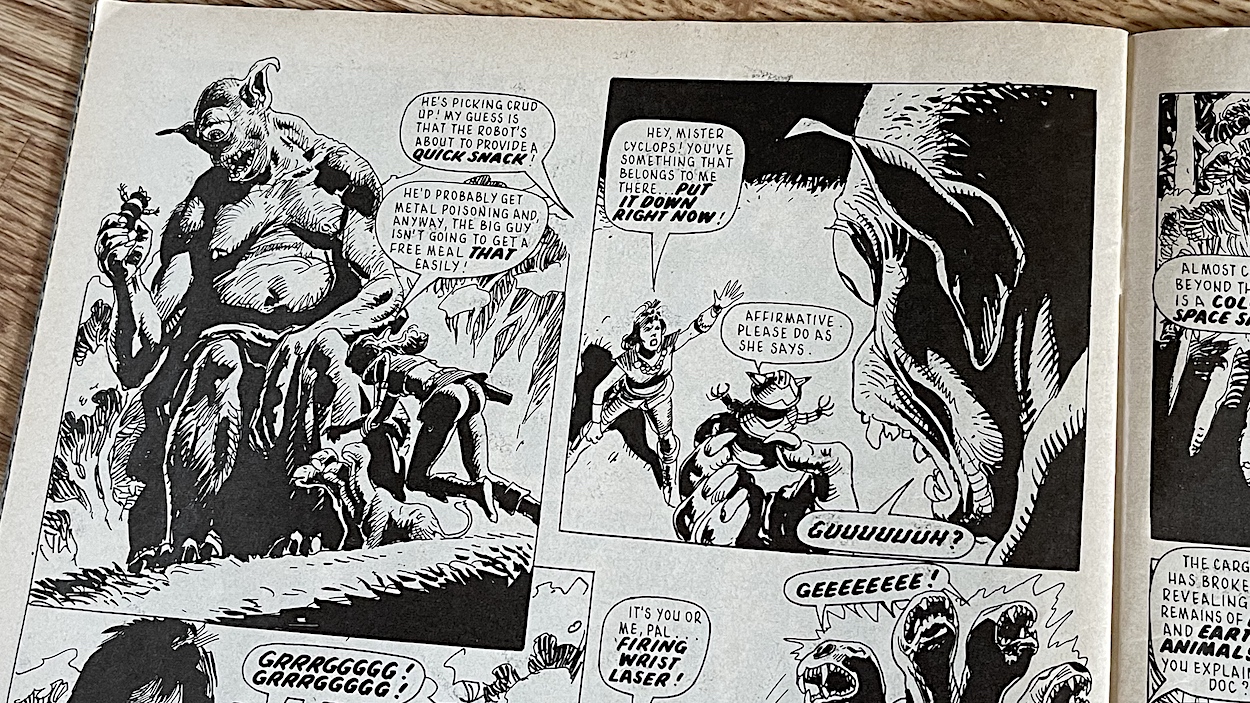
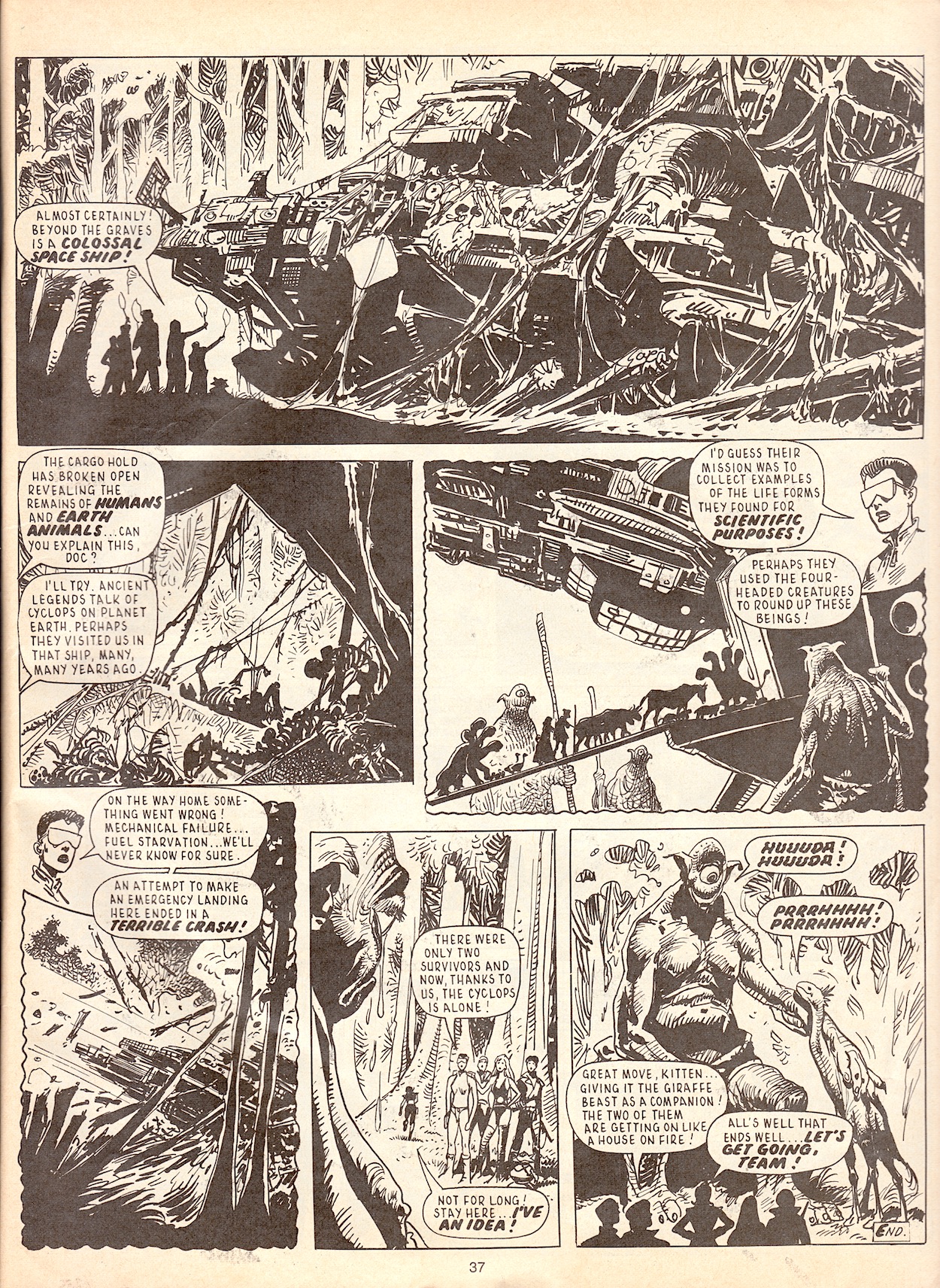
Their story is up next in fact, as always (and just like the pin ups) drawn by José Ortiz and written by James Tomlinson. Stalked by a three-headed giant cat-like predator it ends up capturing Kitten’s robotic pet, Crud. Tracking the beast down they find a ginormous cyclops, but as they try to save Crud the cat-like creature attacks and is shot and killed. The previously monstrous cyclops bursts into tears and the team realise they’ve made a horrible mistake, they’ve killed the giant’s pet. Not only that, but upon discovering a giant spacecraft overgrown with weeds they piece together a fascinating backstory.

It’s important for me to note here that at the beginning of the strip the team had captured a docile kind-of-giraffe animal for study by Doc. You’ll see below how that comes back right at the end. This story contains hints at the world building Wildcat could have achieved if it had carried on for years to come. We had some in the twelve regular issues but of course everything was still in its early stages of development. We can only imagine the epic, overarching stories editor Barrie Tomlinson and his team could’ve concocted over time.

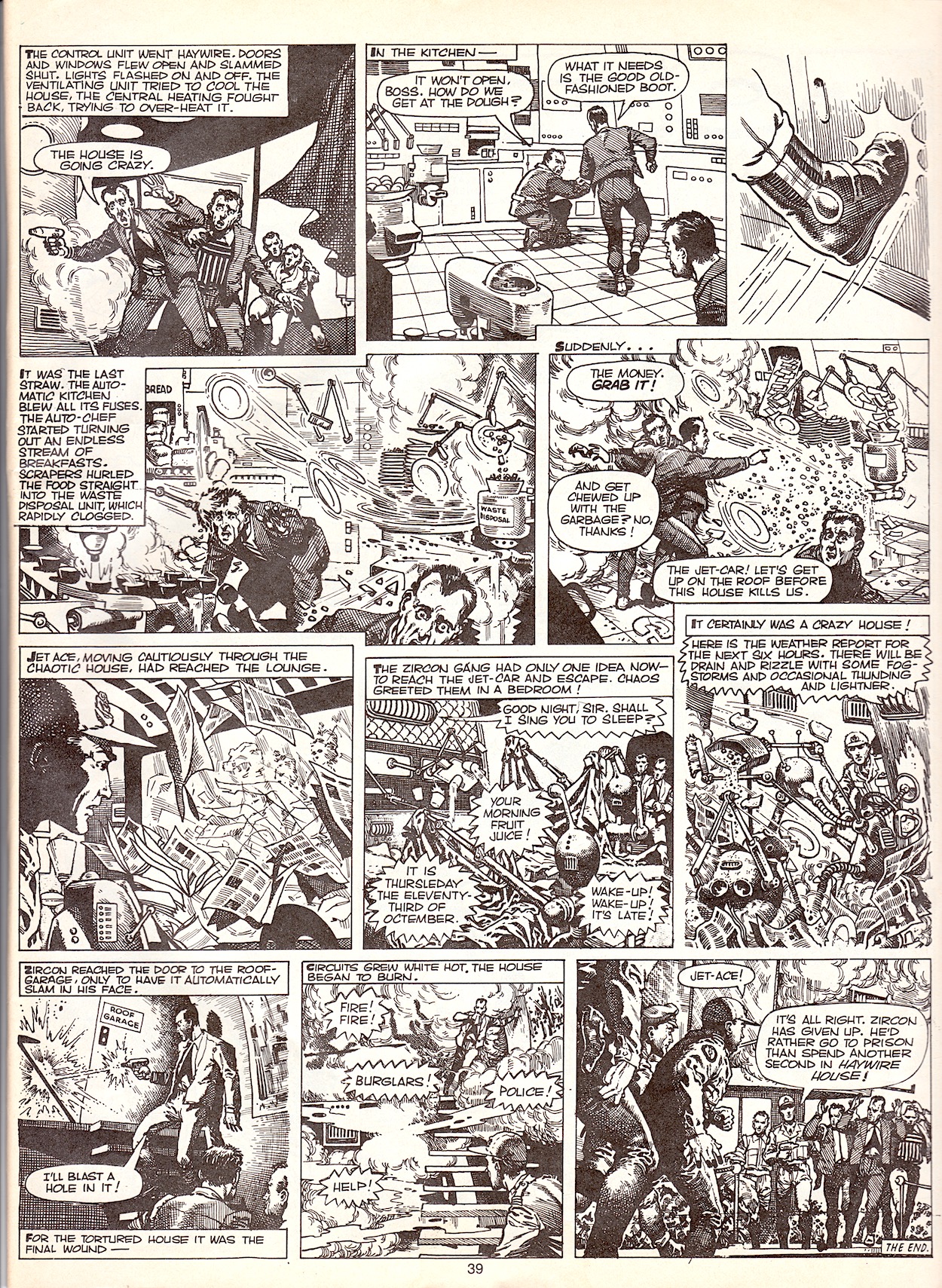
Four pages within this special are made up of a Tiger comic reprint called Jet-Ace Logan, a pilot who works for the futuristic interplanetary C.I.D. approximately 100 years in the future. Two stories are included here, two pages apiece and the one I wanted to show is called Haywire House. A modern home exhibition is about to be robbed and Logan stops the burglars in their tracks in a suitably ingenious way. I particularly like the art by Brian Lewis (Eagle, TV Action, Countdown), with so much of it crammed on to the page and jam-packed with details, all without losing any of its clarity.

In his book Comic Book Hero, Barrie explains how he was the editor of Tiger from 1969, after these strips appeared originally. He turned the comic into one with exclusively sports-related strips but he always had a fondness for Logan. Back to the special and perhaps the couple of reprinted pin ups and the Logan pages were marked for something else but after the cancellation of the comic plans changed. A very real possibility.

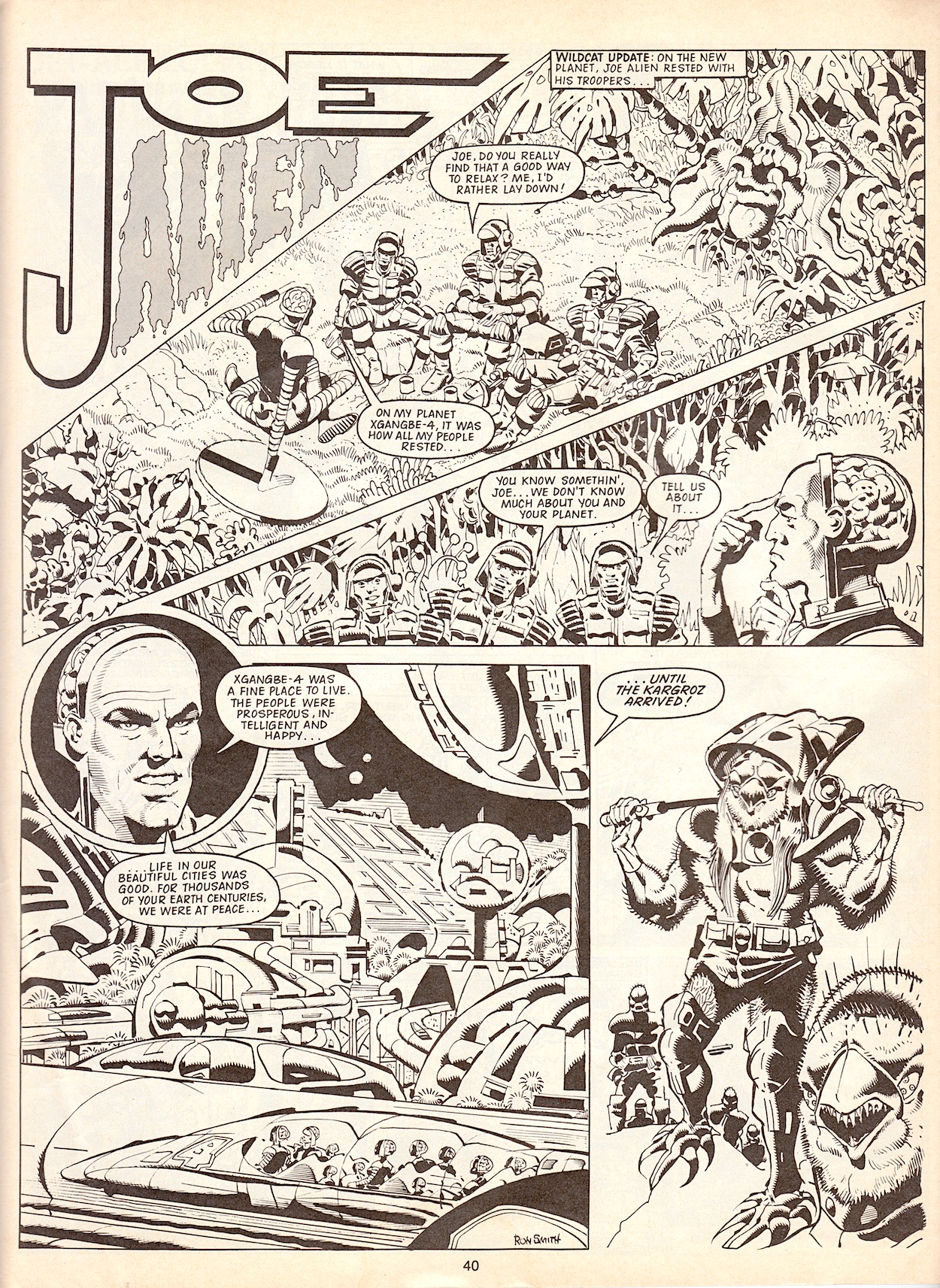
Before a very special ending to the issue there’s one more strip to read. Wildcat fans will know that must mean it’s time for David Robinson‘s Joe Alien, although not in his usual full-colour format which is a shame (in fact apart from the pin ups and a readers’ drawing spread the whole issue is black and white) but Ron Smith’s artwork still shines. The strip itself finally gives us some background information on the interesting character and how he ended up as the last of his race. In fact, for fans of his this was a hugely important strip!

Tracking a massive meteoroid heading towards their planet, his people soon discovered it was being pushed from the other side by a fleet of Kargroz ships. Joe’s race had long before abandoned space travel, keeping only one small shuttle and so he was sent up to negotiate, but the Kargroz kill for fun and for honour and couldn’t be bargained with. Almost blasting Joe out of existence they hurled the meteoroid into his planet, destroying it and all who lived there.

Fuelled by revenge Joe hijacked one of the enemy ships and crashed it into the side of one of the others, all of which were in a straight line formation, side-by-side with each other. Where Joe had crashed, his ship now faced down the long line of enemy ships. Firing one huge laser blast it tore through them all, killing everyone and leaving him the only survivor of the battle and of his race. This next page of Ron’s reminded me he drew for Marvel UK‘s Transformers. It has that feel about it. Looking into that however, I was surprised to see he only ever drew one strip (#82)! Such was the impact he must’ve made on me I thought he’d been a semi-regular artist on it.

Joe’s men console him and try to tell him they agree with his seeking revenge, but the strip ends with our hero rejecting this. “Revenge? How can any revenge balance the millions who were killed? I am only pleased that my external brain pack allows me to switch off such memories… forever!” That is about as heartbreaking an ending as you can get as he switches off all memories of his loved ones.

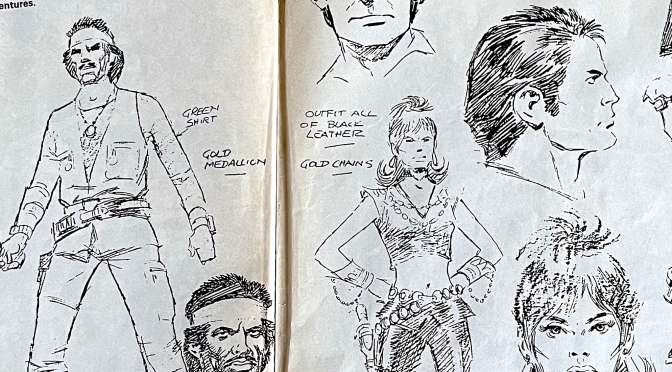
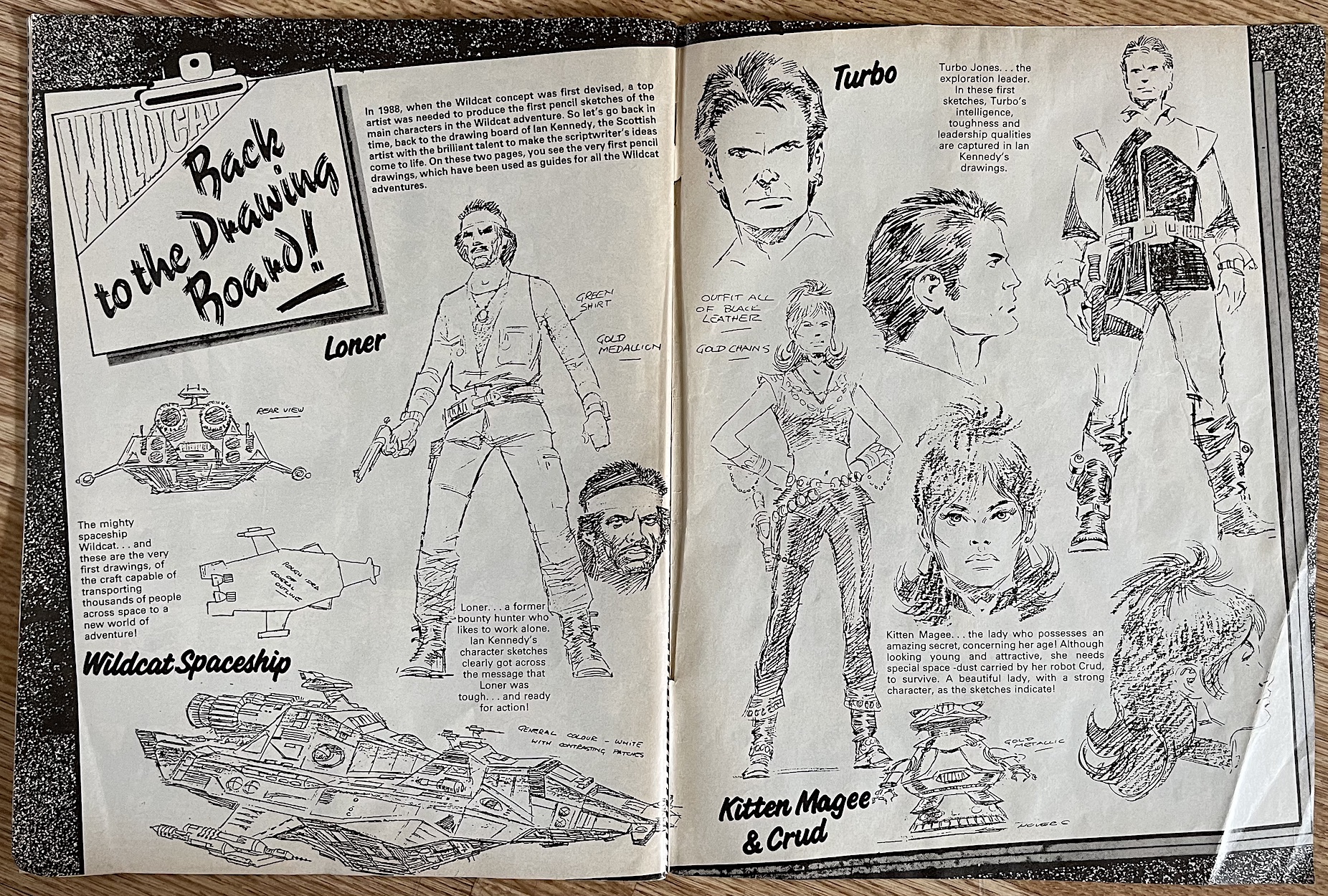
One final feature rounds off this edition and it’s a special Back to the Drawing Board spread of Ian Kennedy’s original design sketches for the Wildcat itself and some of its characters. At the time of writing this Ian has only recently passed, so seeing these drawings and his superb cover (which is on the back as well) is tinged with sadness. I’ve always loved his Wildcat design and his originality, not only with its shape but also its bright colours. I think we can all agree he also did a superb job of realising Barrie’s desire for a truly diverse cast of exciting heroes, which was rare.

Thus ends our look at the Wildcat Holiday Special from 1989. As I’ve said before I do own the graphic novel collections for two of the characters so I’ll be covering them at a future date, and I’m going to be tracking down the others through the individual issues of Eagle and Wildcat. But in the meantime we haven’t quite finished with Wildcat in its own form just yet.

There’s one more special to come and I’m very excited by it. Once again it’s an issue I’ve never read before. It’s even bigger than the Holiday Special and comes with a simply gorgeous high gloss, high quality cover. The Wildcat Winter Special was released several months later so look out for its review on Thursday 17th November 2022. Now that’s going to take some will power on my behalf, it’s sitting on that shelf right over there looking at me! I’m sure it’ll be worth the wait though.
iSSUE 12 < > WiNTER SPECiAL

WiLDCAT MENU

SUPER NATURALS HOLiDAY SPECiAL: HiSTORiC HORROR

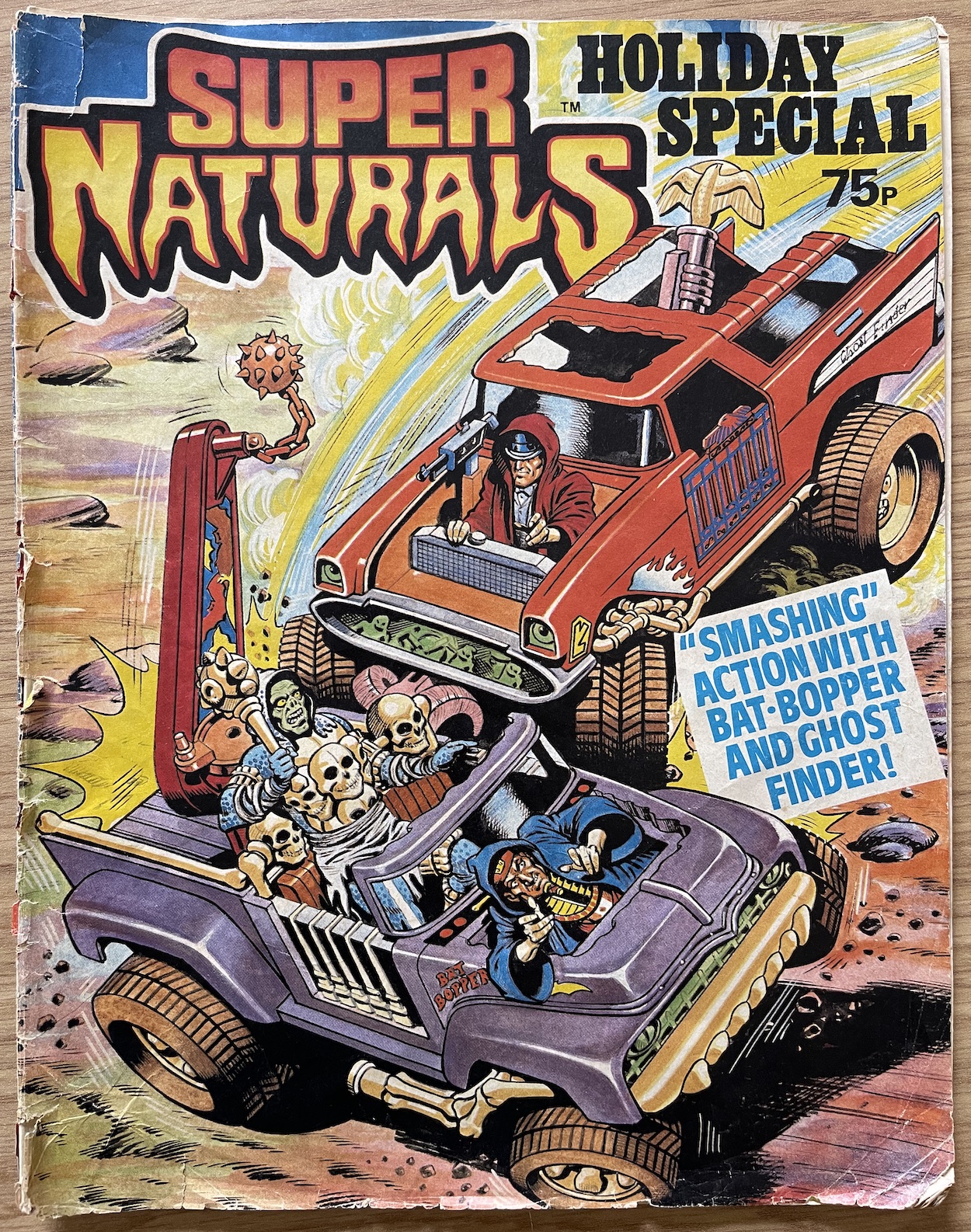
Welcome back to Ghostworld for the very last time. Just a month after the final issue comes Fleetway‘s Super Naturals Holiday Special for 1988, as ever edited by Barrie Tomlinson. Kicking off with a Sandy James cover which would’ve been fun for any kids who received the oversized Tonka trucks for Christmas, here we have 48 glossy pages which, much like the Adventure Book, focus more on the action aspects of the comic rather than the horror.
There are two exceptions (including a reprint from Scream!) which check the horror box for the young readers, but other than that it’s all licenced strips and extras. That means there’s no ventriloquist’s Doll or readers’ suggestions for Scary Cat, both of which were highlights of the regular comic so that’s a shame, especially knowing this would be the last publication in the series. But let’s not get too down, the idea of a Holiday Special was to have lots of fun one-off stories to read while off school. Let’s see how the Super Naturals fare with theirs, shall we?

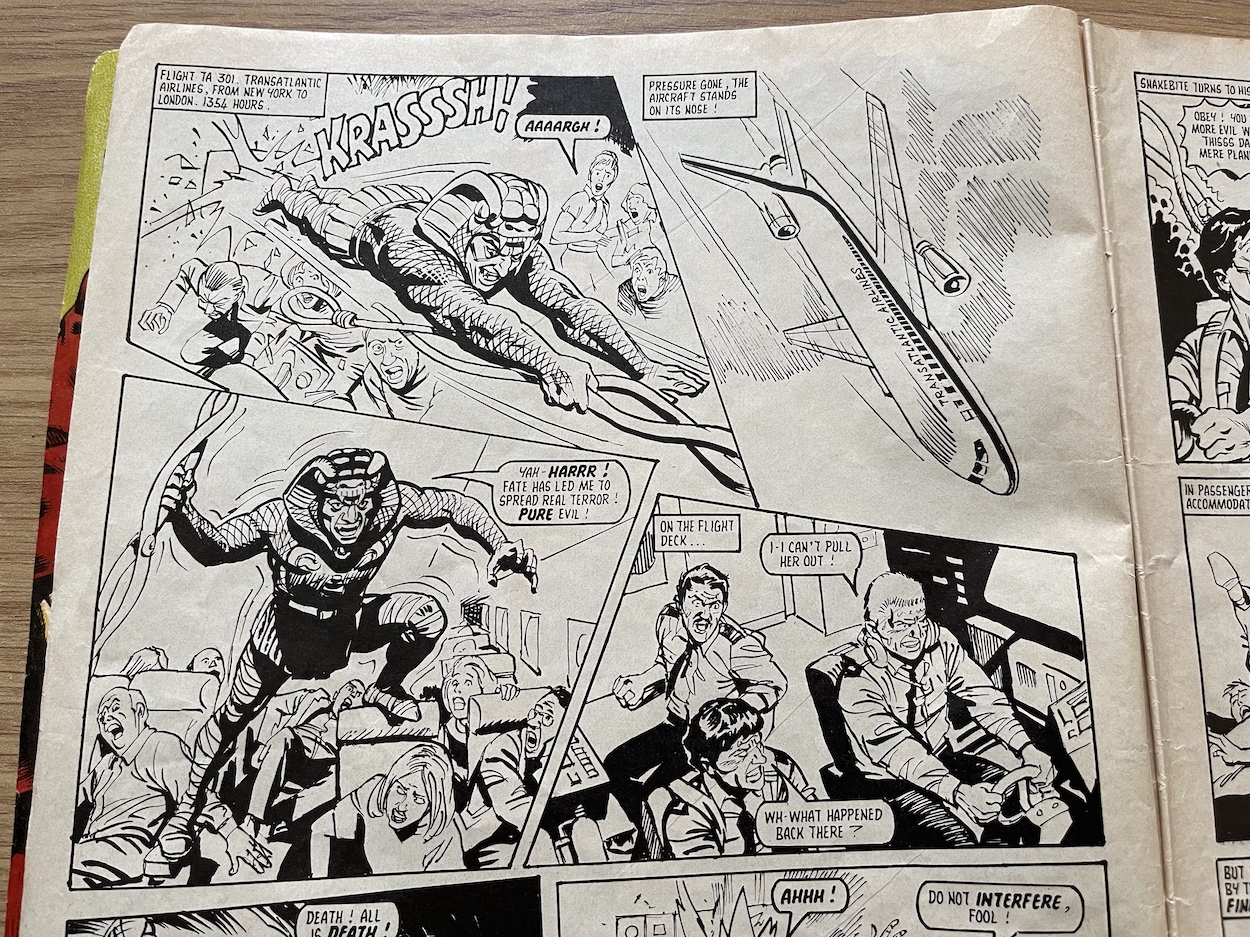
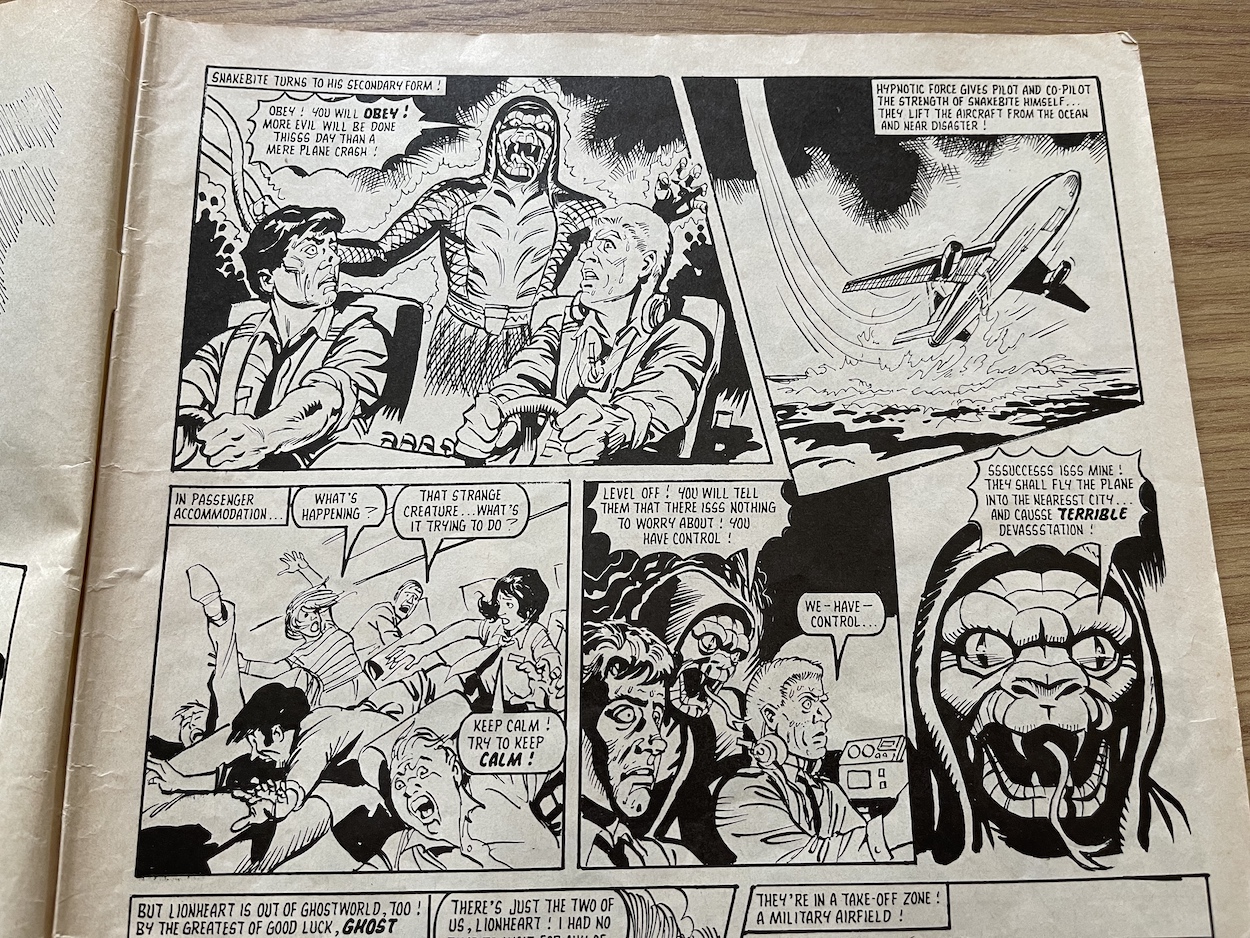
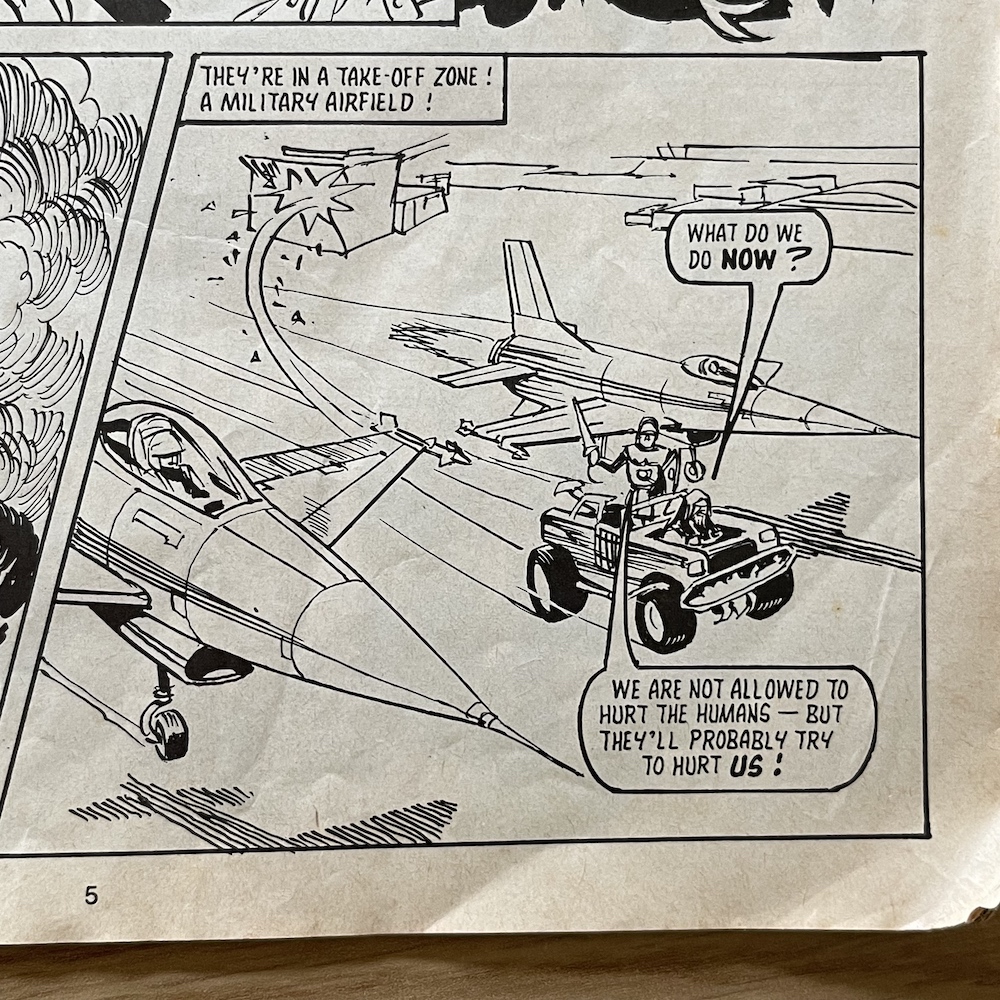
It starts high in the air in SkyJack! The evil Super Naturals flub an attempt to transport themselves into our world, with only Snake Bite able to make it and imaginatively the strip has him crashing through a tiny airplane window, terrifying all the passengers on a transatlantic flight to America. Hypnotising the pilots, he shares his strength with them to save the crashing plane, but only because he wants to use it to dive into Washington which would cause much more destruction in our world.

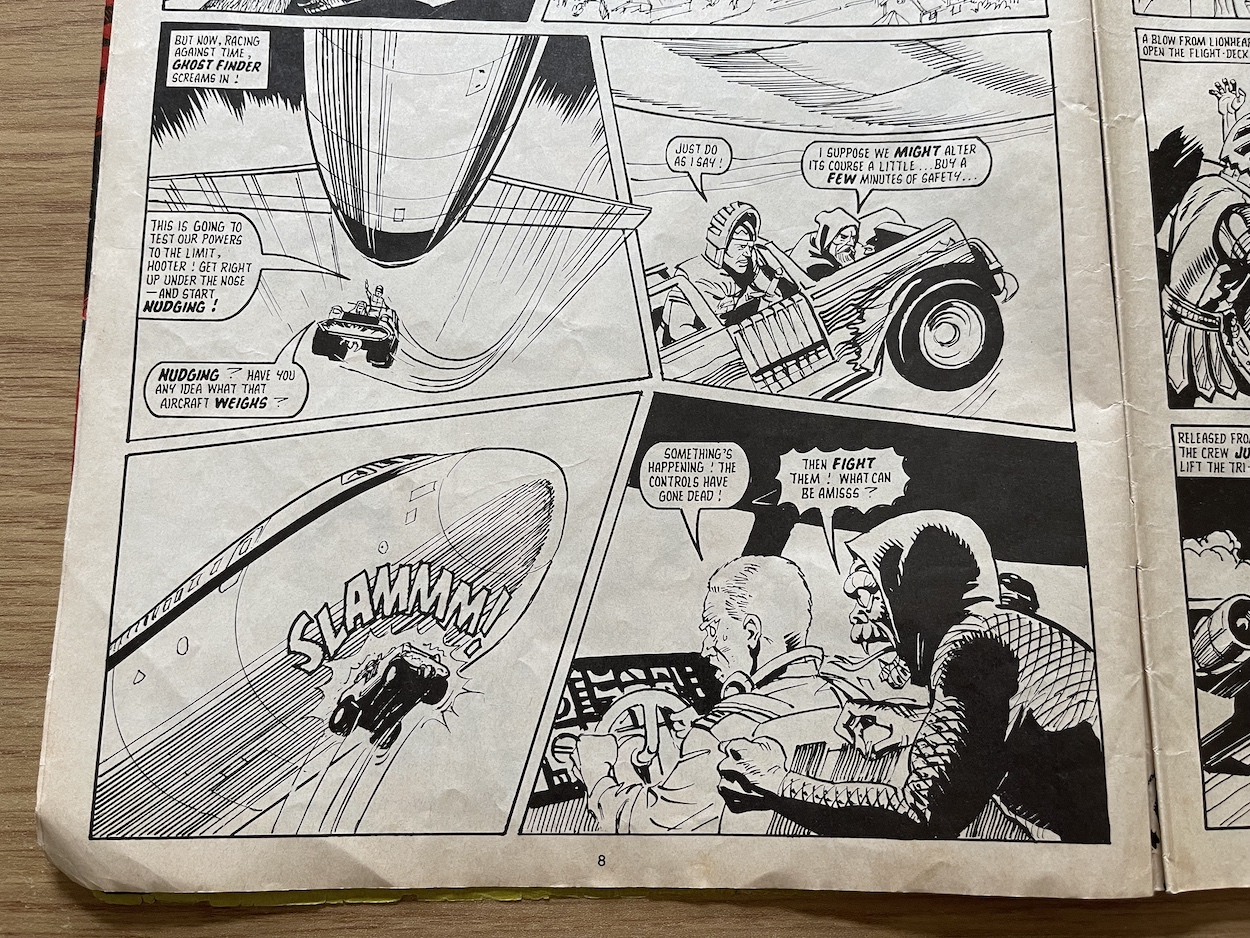
Snake Bite was always the most interesting of the evil characters and the set up for this story is great. We even have Hooter and Lionheart using the Ghost Finder to nudge the plane up just enough so that it’s trajectory is right for the pilots to take over before Lionheart slashes a hole in the fuselage and throws Snake Bite out, who loses his telepathic control as a result. I like how it’s not an easy, miraculous rescue plan, as Hooter bluntly states. It’s just a shame the artwork doesn’t match the exciting potential of the script.

It’s even more of a shock when you find you who the artist is. It’s Geoff Campion‘s work (Eagle, Lion, Valiant) whose work I’d loved in Ring Raiders, another of Barrie’s titles. However, here things feel somewhat rushed, even unfinished in places, such as when the Ghost Finder crew make their entrance the buildings in the background look like rough layouts. As the story goes on more details are lost and backgrounds become even more sparse, almost like it was hastily finished for a deadline. It’s not the usual exemplary work we’ve come to expect from Geoff and I’m intrigued as to why, but unfortunately that’s a question lost to the mists of time. It’s still a fun story to open with, a really enjoyable complete tale perfect for a Holiday Special.

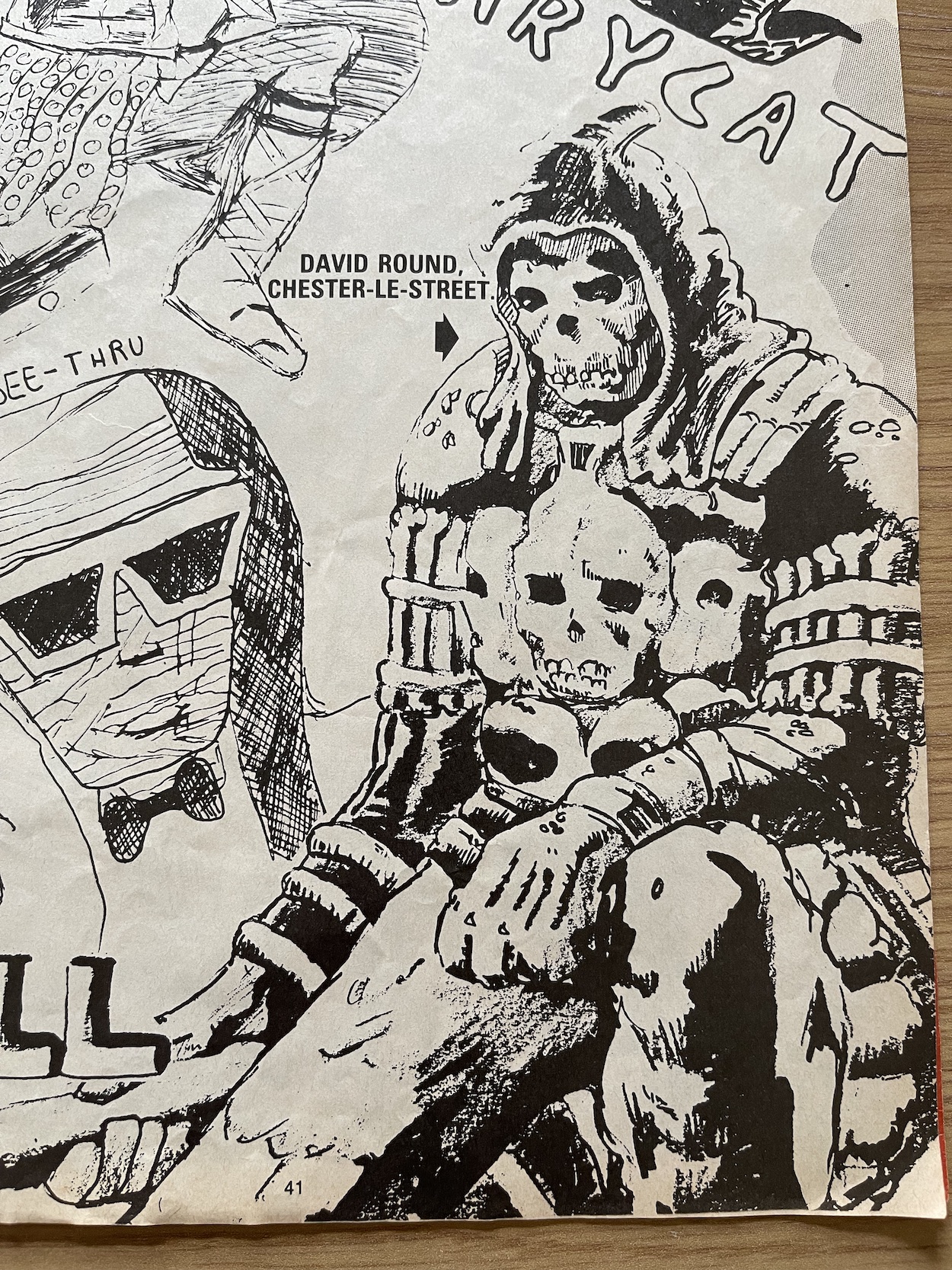
To make a special even more so, there are always a few extras. We have new pin ups of the toys, some of the marvellous posters from the fortnightly have been shrunk down to A4 size, a one-page Ghostling Tale features a thief making his getaway only to board the Titanic and there’s a pretty poor quiz. Much like the one in the Adventure Book it’s just a series of strip panels and the questions are all a variation of “Who is in this picture?”. We do get some lovely reader art in Ghostworld Gallery including a superb rendering of Skull by David Round who was clearly a fan of Alan Langford‘s depiction of the character.

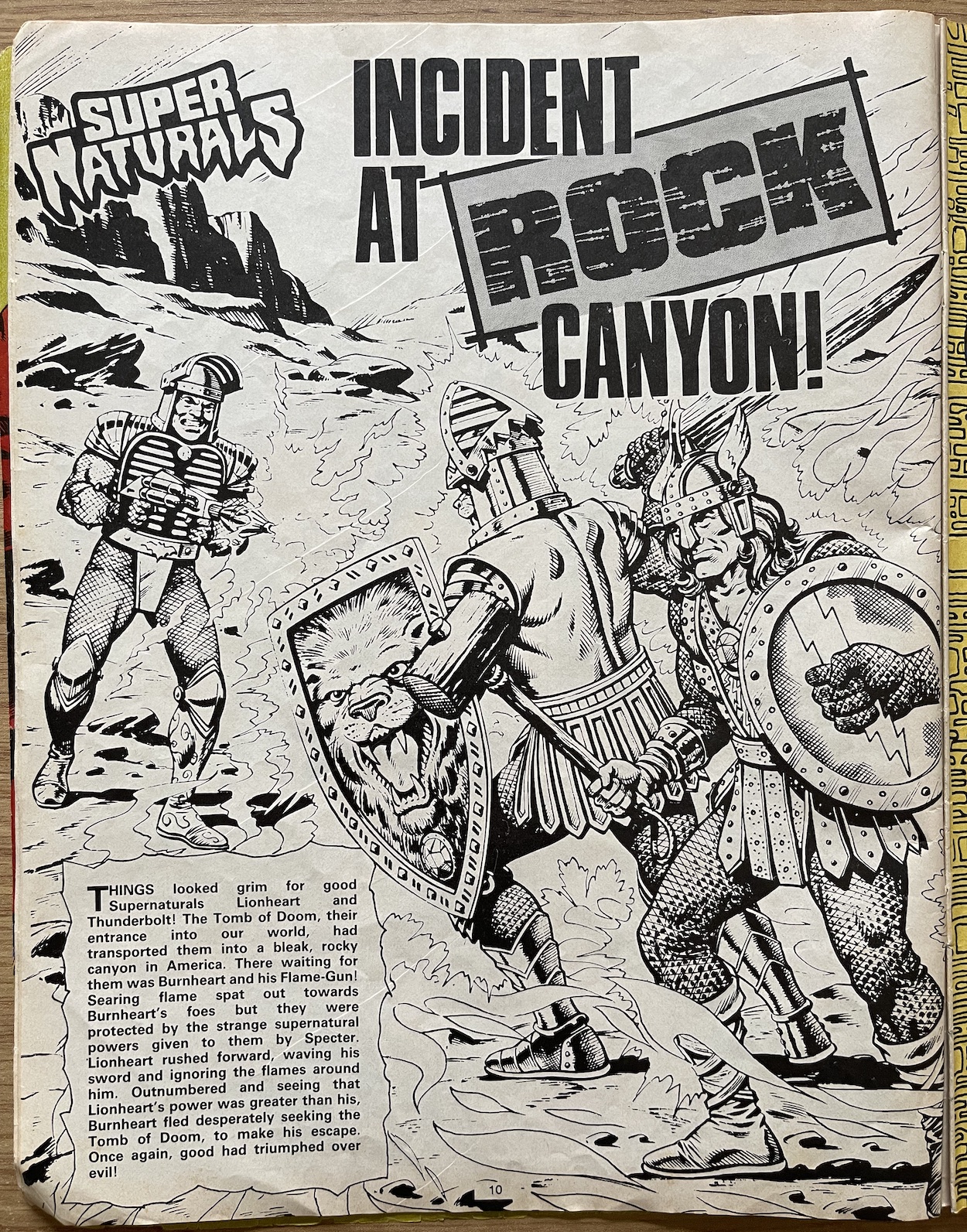
There’s also a page called Incident at Rock Canyon which looks suspiciously like an unused cover. Drawn by Sandy James it clearly hadn’t reached the colouring stage when the comic was cancelled. To accompany it is a short story by way of explanation, reminding me of the inner front page to the Ring Raiders Special printed after that favourite comic of mine also abruptly ceased. It’s a nice addition and it’s always interesting to see work that was still in progress for future issues.

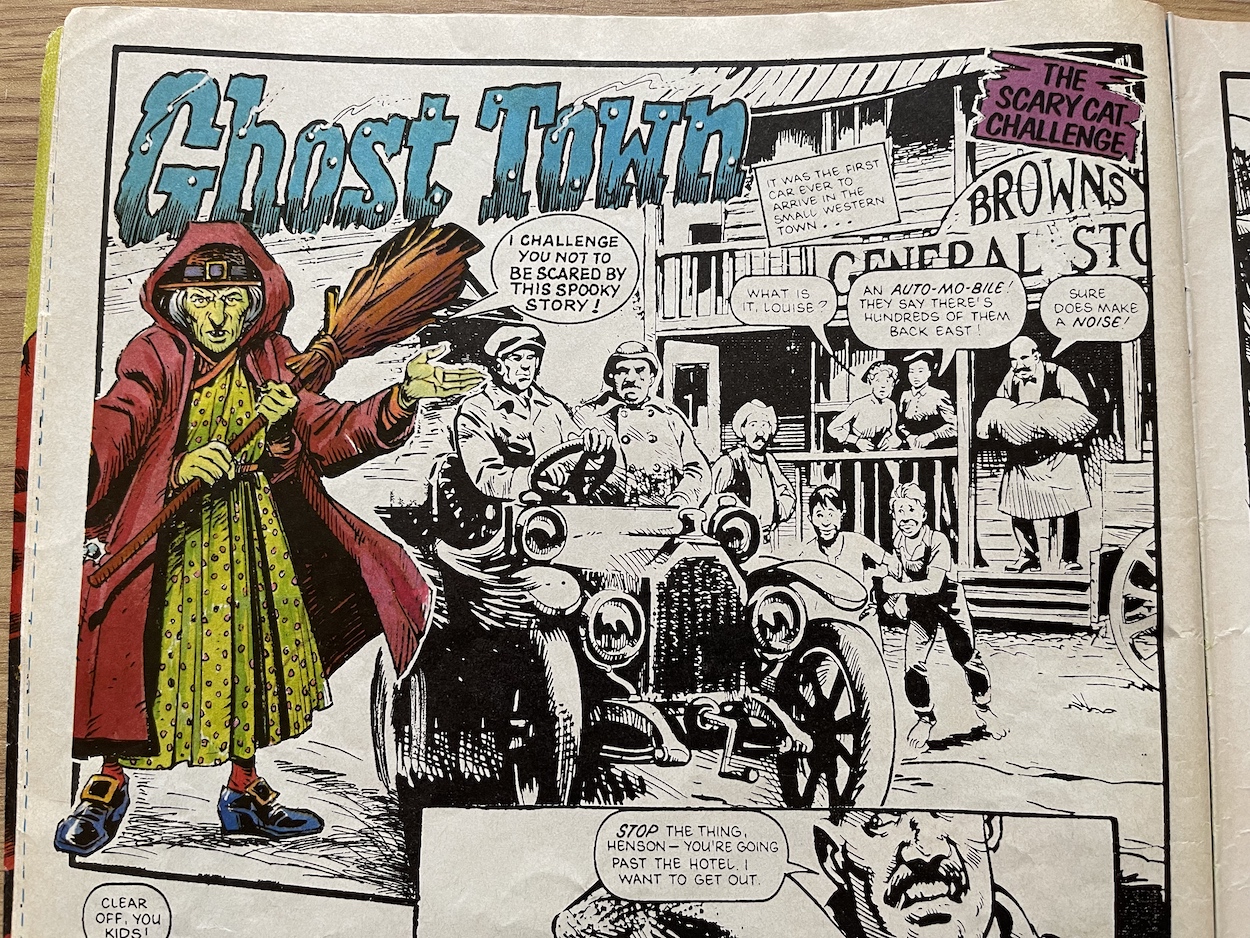
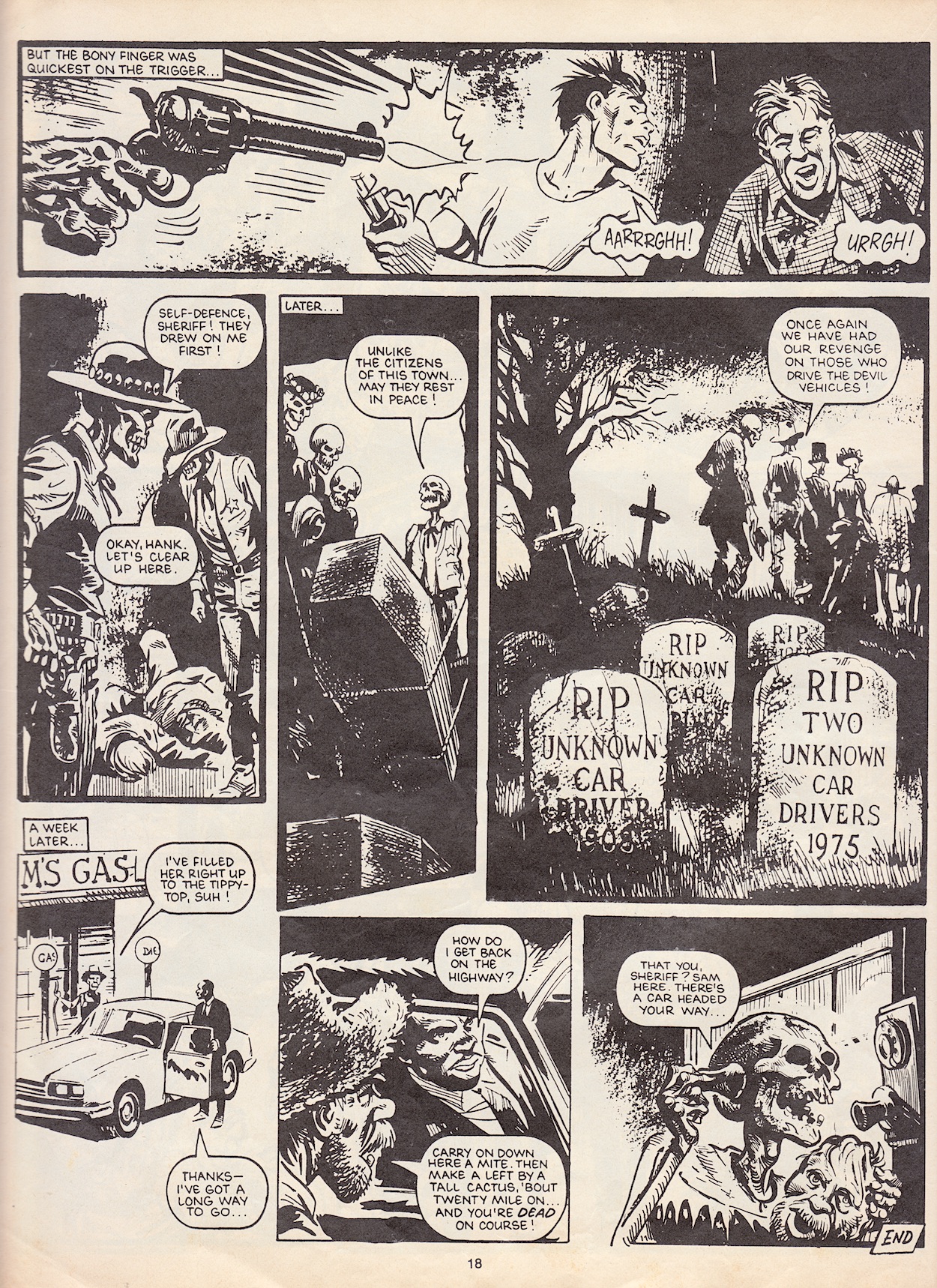
Next up is a Scary Cat Challenge story. This isn’t based on a reader’s idea like some of the very best in the regular series, instead it’s a reprint from Scream! #9. Part of the Library of Death series in the comic, Ghost Town was written by Fred Baker (Roy of the Rovers, Lion, New Eagle) and illustrated by Mike Dorey (Action, Warlord, 2000AD). An old Western town in America witnesses the arrival of its first automobile, which promptly has a brake failure and ploughs straight into a dynamite storage (of course it does), blowing it and the whole town up in a huge chain reaction of explosions. That’s just the beginning.

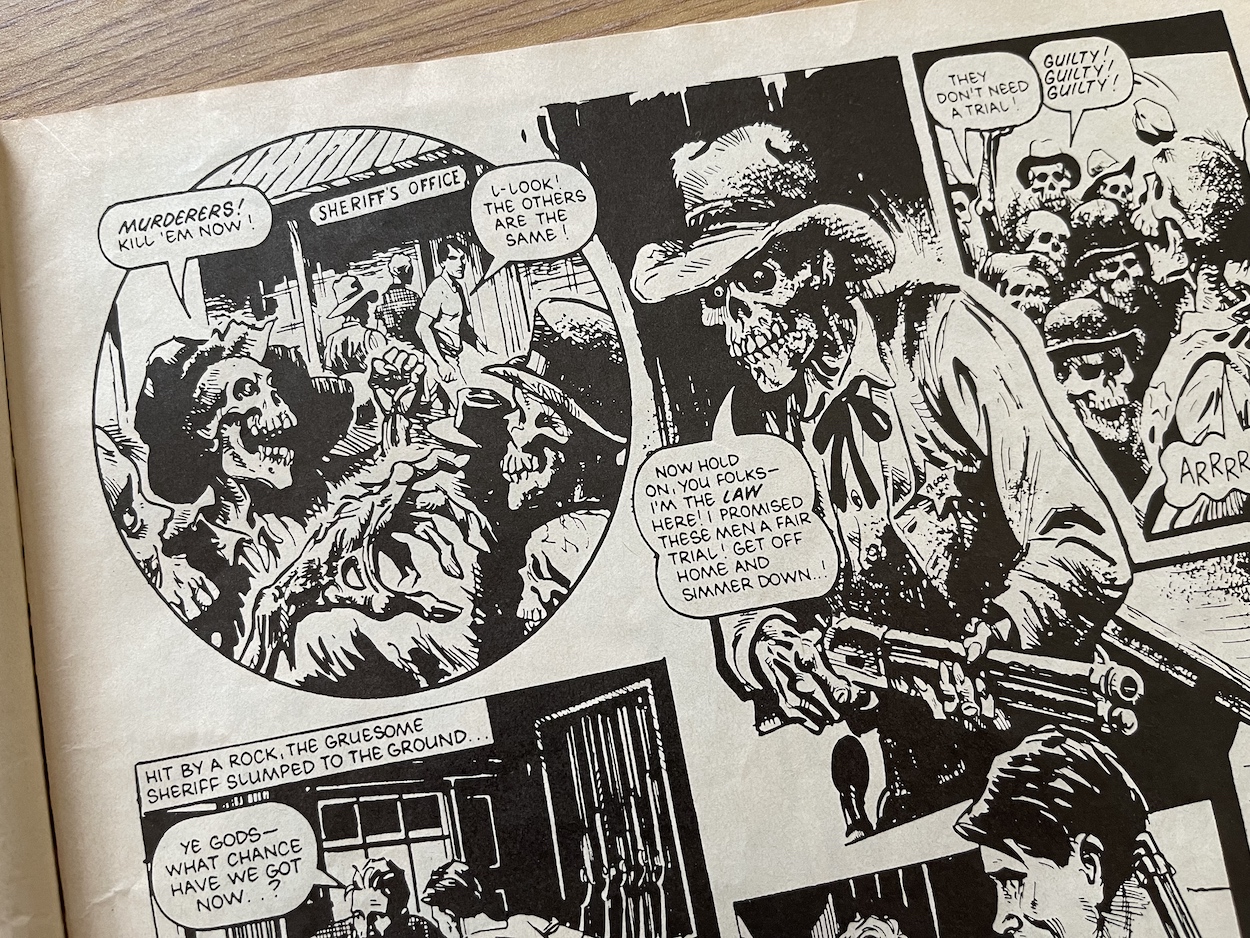
In the then-present day of the 80s two young lads pull up to a gas station in the desert and ask for directions, but there’s more to the little old man who helps them than they realise. They soon find themselves in an old fashioned town instead of back on the highway and are greeted by the sheriff. The only problem is he’s a waking, talking skeleton! Telling the boys they’re going to stand in a fair trial for murder, soon a whole town full of dead bodies with other ideas are chasing them down.

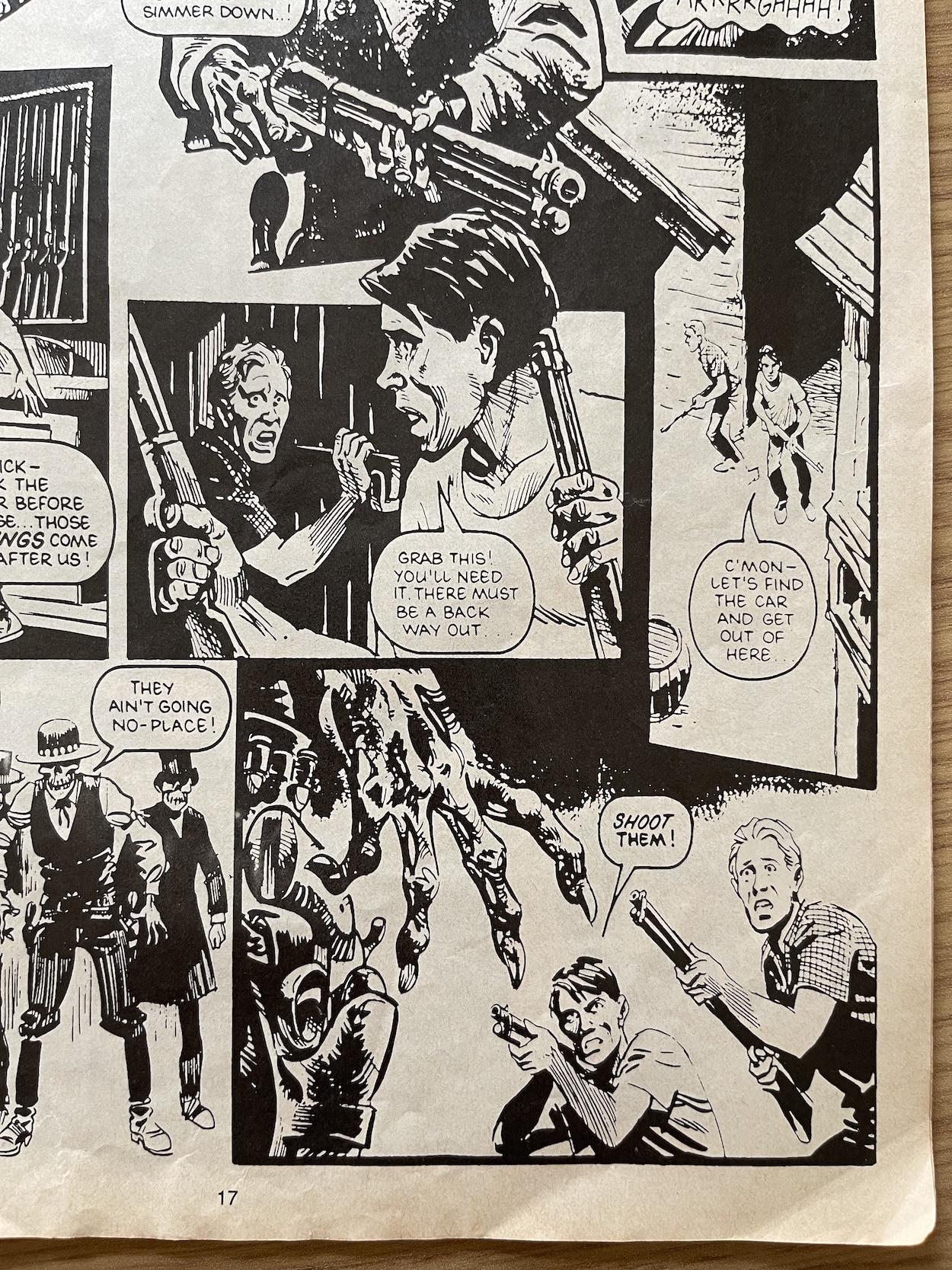
Cornered in the sheriff’s office with his guns, the young men have no choice but to try to shoot their way out and get back to their car, but they’re no match for one of the local gunslingers. Seeing the two innocent lads gunned down was quite the shock when I turned the page! I know it was created for a different comic but to see it in the pages of Super Naturals it makes quite the impact. I never owned this edition as a kid but if I had (and not knowing this was a reprint) I know I would’ve loved this story because of this horrific final page.

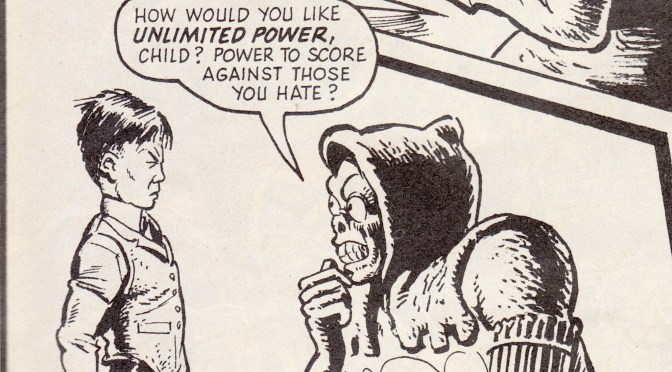
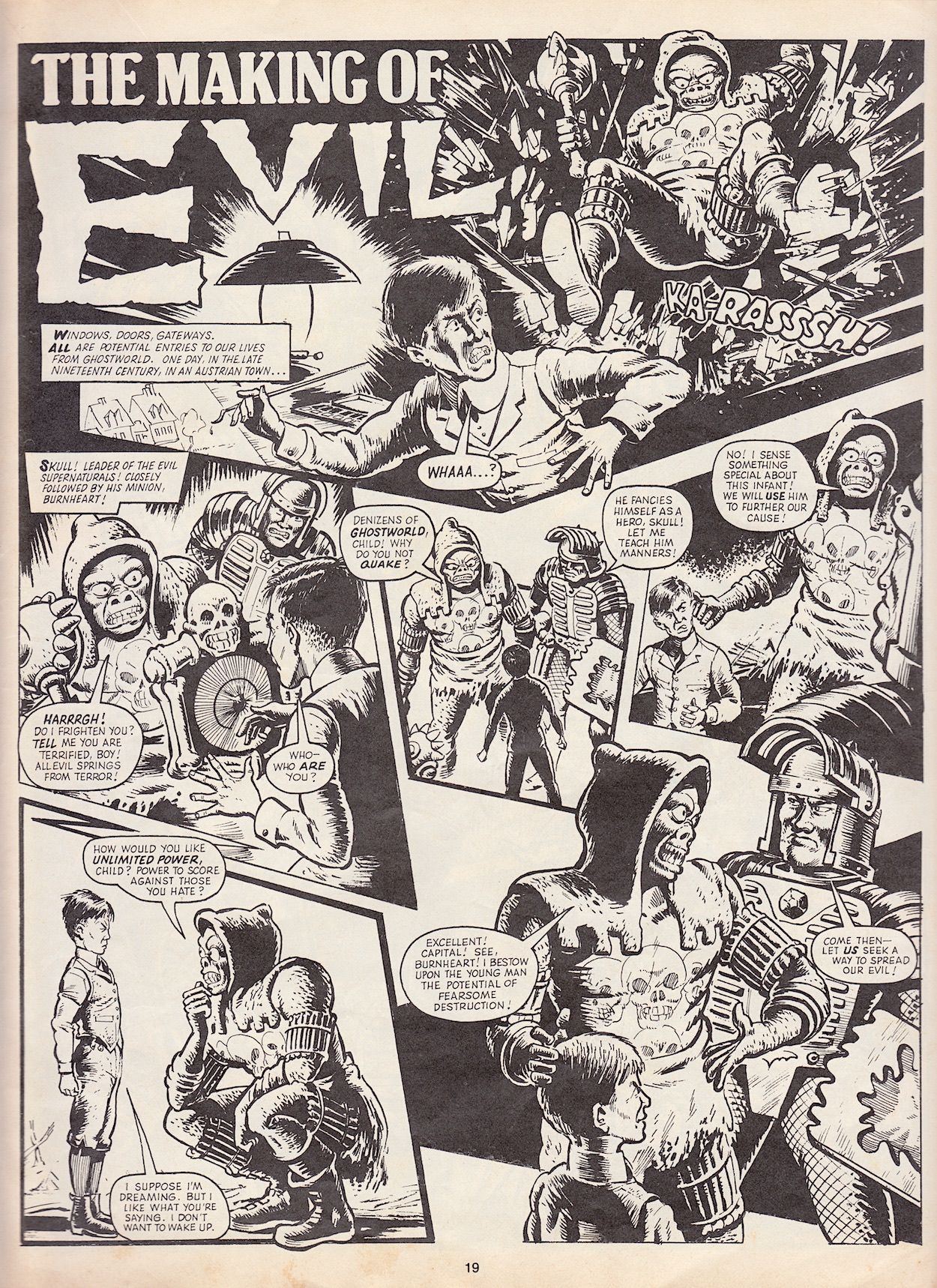
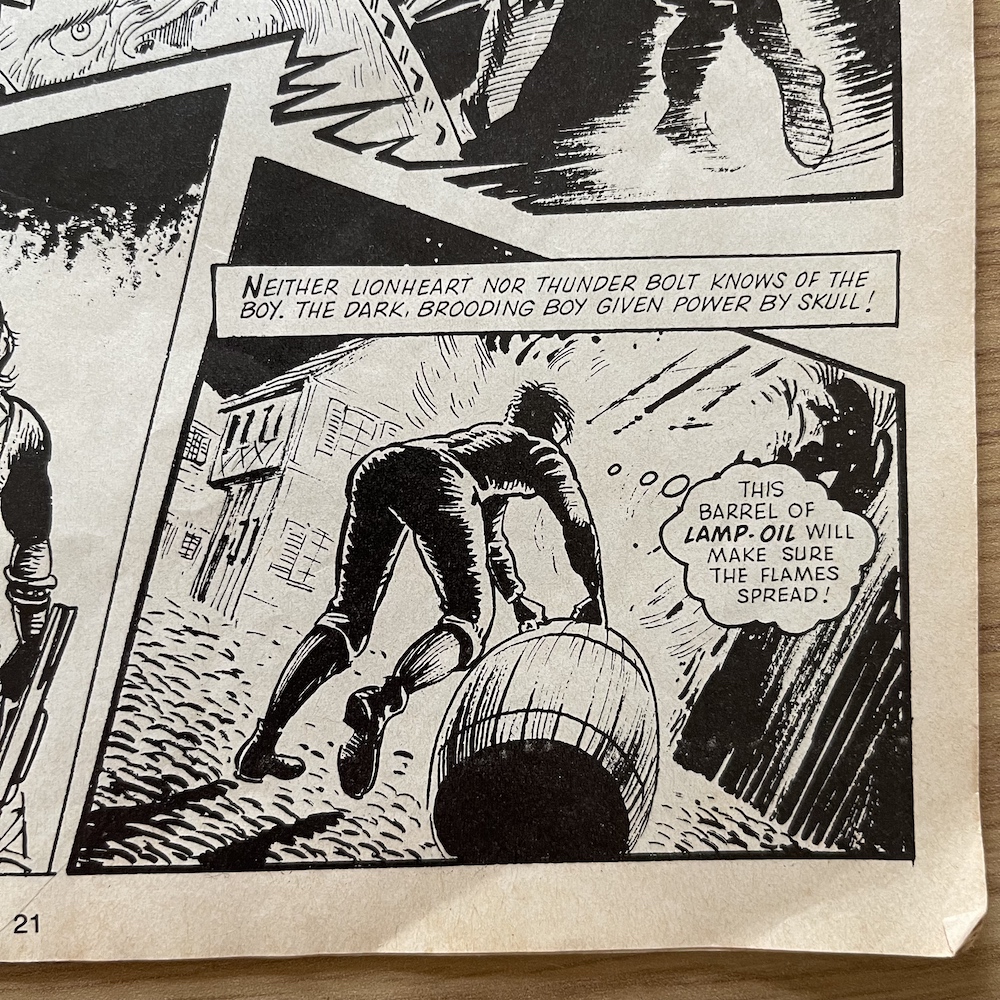
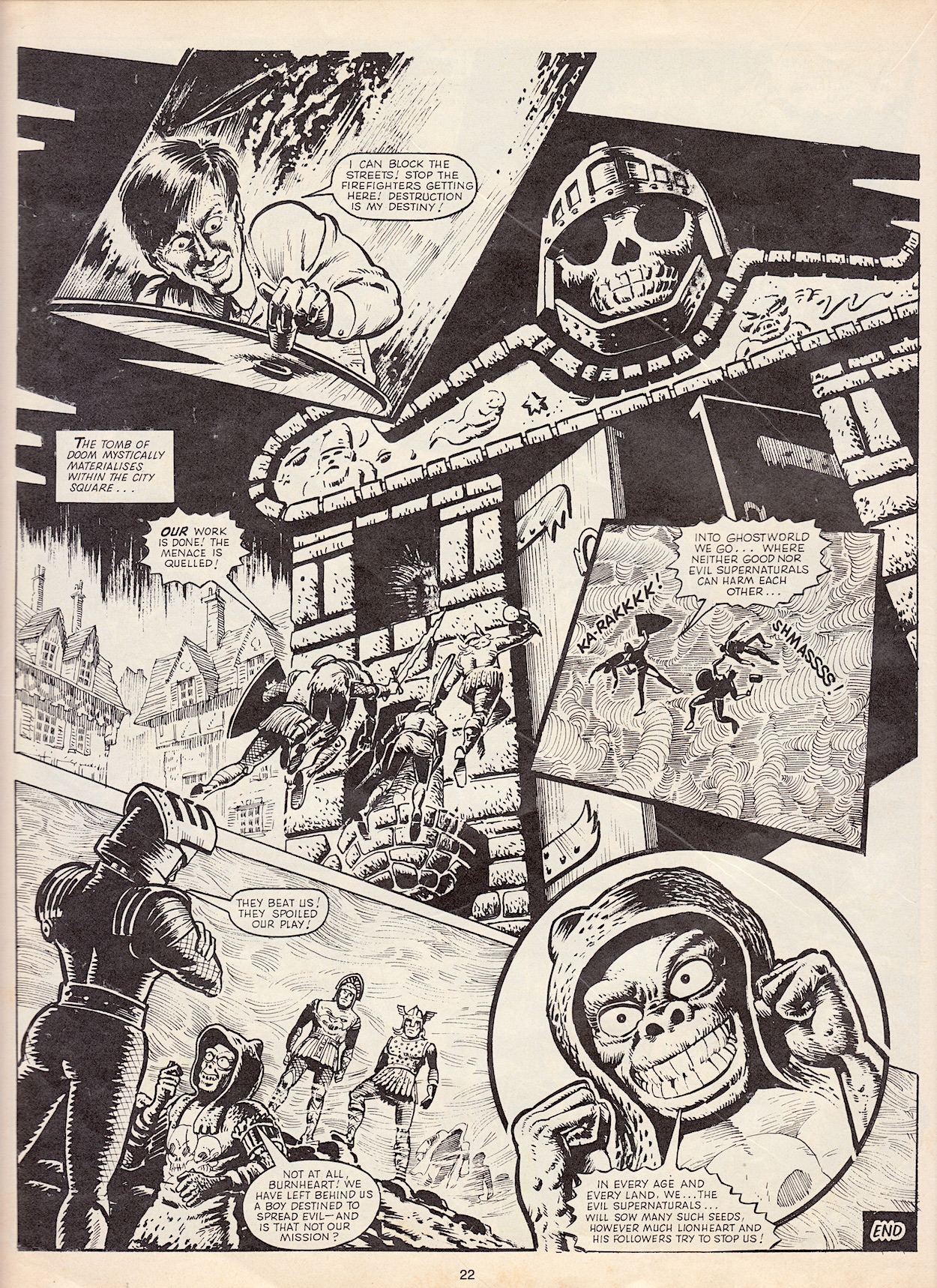
The next strip is the definite highlight of the whole comic, even though it only comes in at four pages. I believe the artist for The Making of Evil could be Keith Page although this is unconfirmed. The middle couple of pages are your typical tale of Skull and Burnheart causing terror and destruction as they set fire to a small Austrian town at the end of the nineteenth century. They’re defeated by Lionheart and Thunderbolt but our main focus is the young boy the evil Super Naturals crash in on at the beginning of the their story.

The strip doesn’t explicitly tell us his name but instead treats the young readers with the intelligence to either know straight away who this is, or to piece it together by the end. I was still in primary school when this was released so I wouldn’t have been taught anything about World War II at this point, but some slightly older readers may have, and even if they hadn’t a rereading in a year or two would’ve brought a fresh, terrifying perspective.

The boy’s reaction to Skull inspires the evil leader to bestow upon him unlimited power to score against those he hates, but even Skull can only hope the boy will spread some form of fear; he has no idea of what he’s actually created. For now we see the boy carry on with their work, helping spread the fire and blocking the streets from help. In the final issue’s review I said how it would’ve been great to see the Super Naturals interact with more myths from our past like they did with the Lady of the Lake, but to see a real-world evil inspired by Skull is something I didn’t expect! It’s a brave move by the comic and an inspired story that once again shows the potential of the franchise.

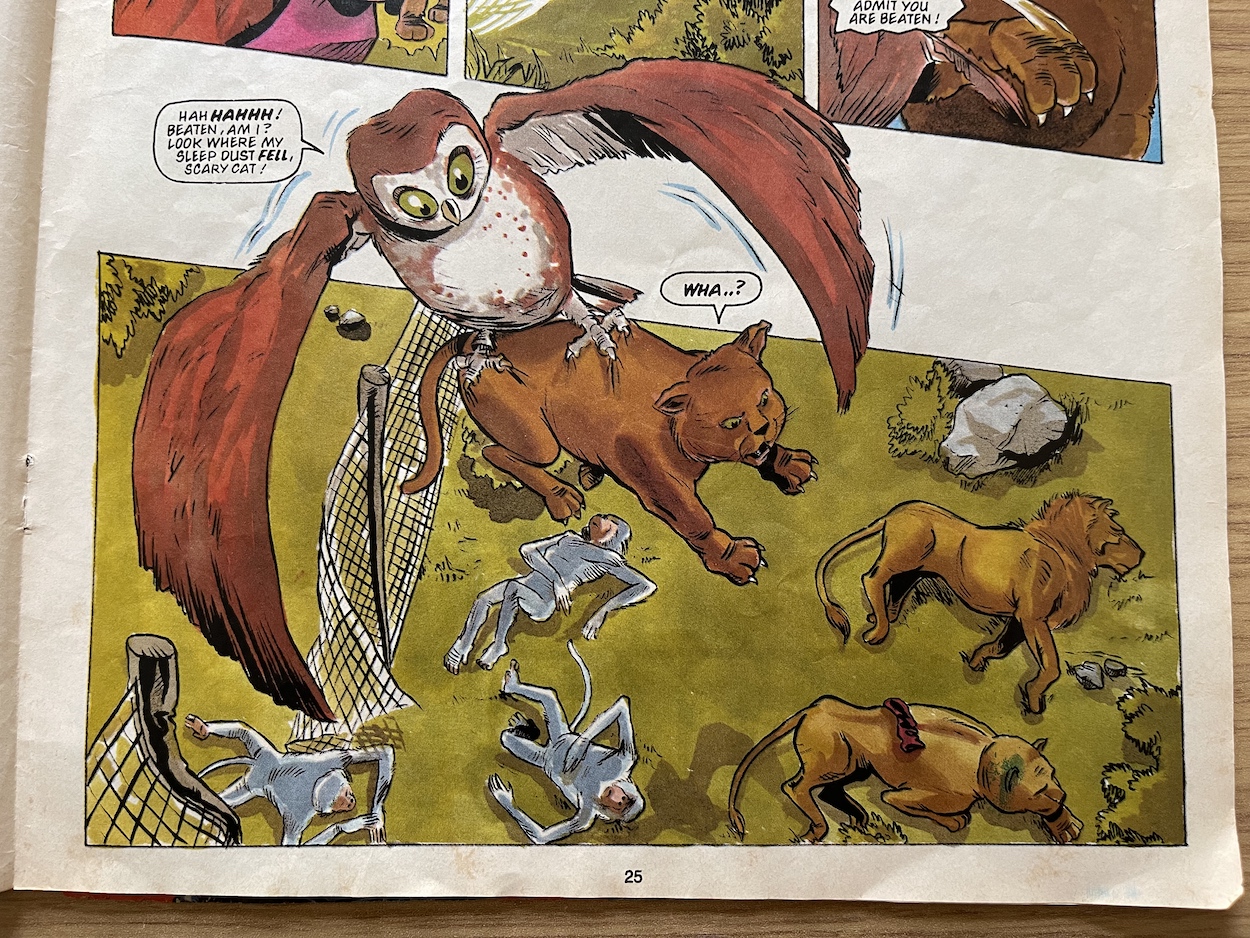
I also adore that awesome Tomb of Doom looming over the characters as they disappear back into Ghostworld, and I wish it had been depicted as such throughout the whole series. Then, after that somewhat creepy tale comes a bit of comic relief in the shape of Ghostlings, this time focussing on Hooter and Scary Cat and as ever it’s drawn by Anthony Williams. The slight plot sees the witch trying to wreck a bit of havoc by having lions escape a zoo close to a town.

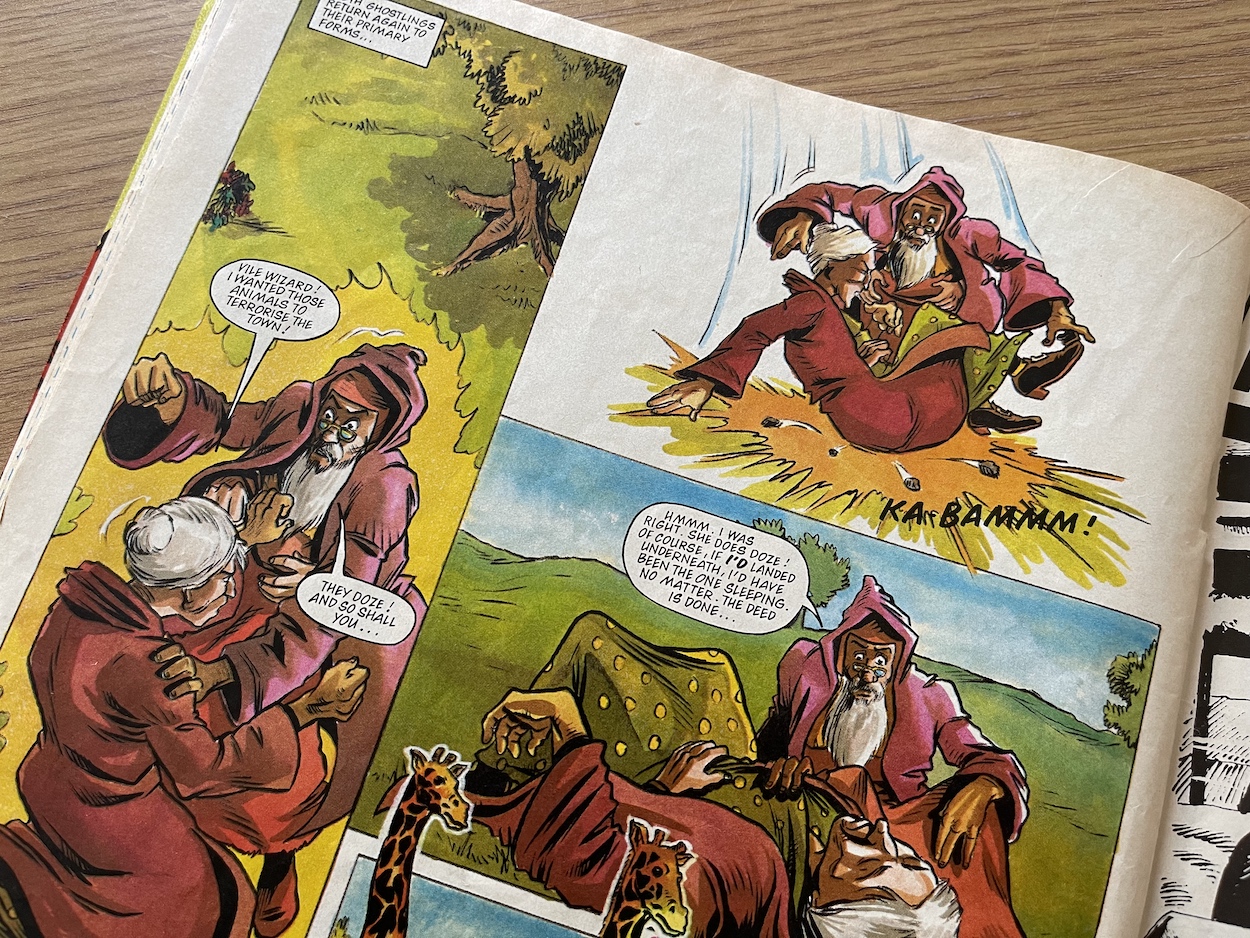
Hooter tries to stop her by using his magical sleeping potion but he’s quite a clumsy wizard is our Hooter and he drops it in a mid-air kerfuffle between the pair. But luck is on his side and instead of Scary Cat being put to sleep the animals end up having a doze instead. However, when Scary Cat transforms back to her witch form the hard landing sees her join them in the land of nod. Our hero is then easily able to carry her back to the Tomb. Silly stuff, but then again the best Ghostlings strips always were, that was the whole point of them.

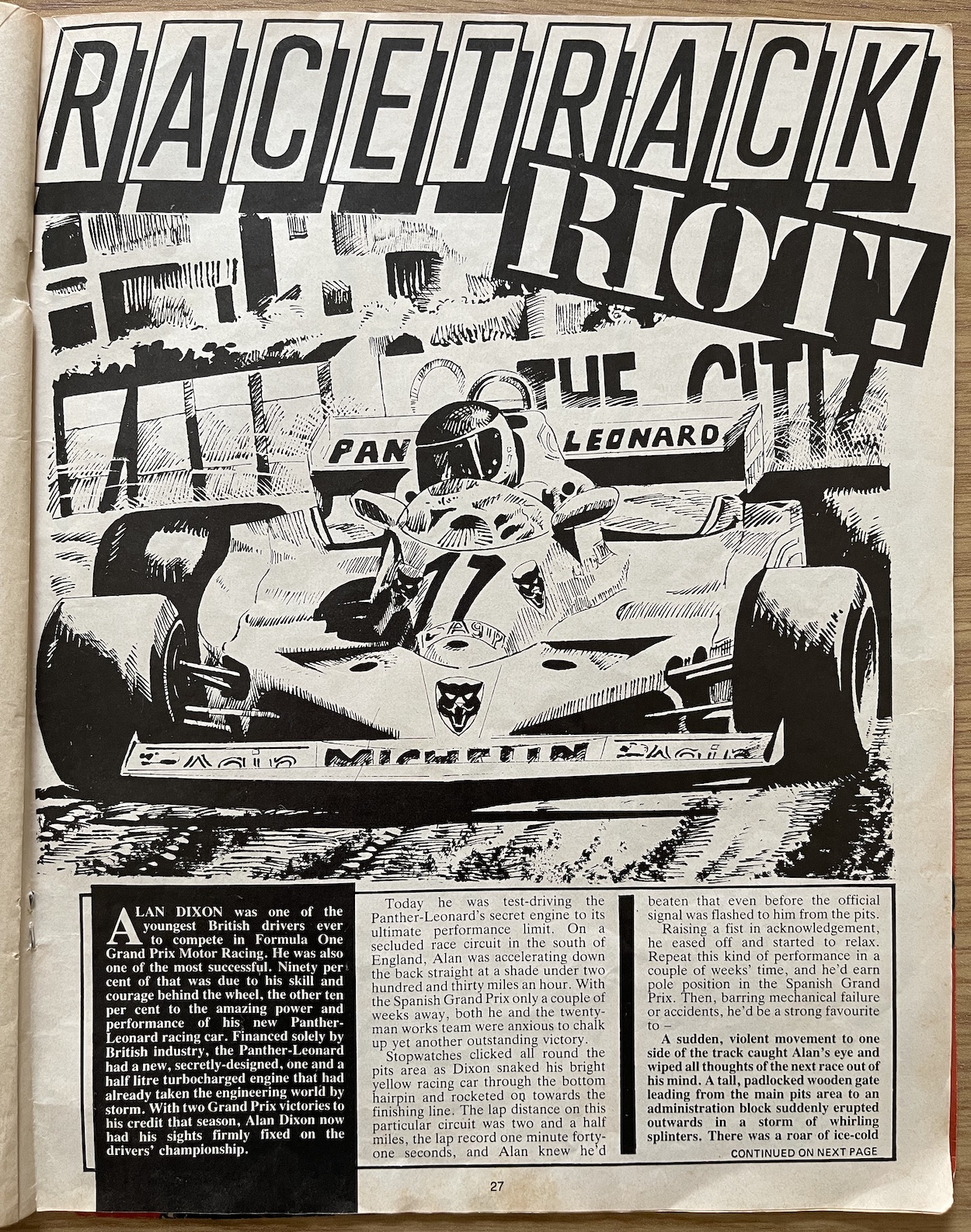
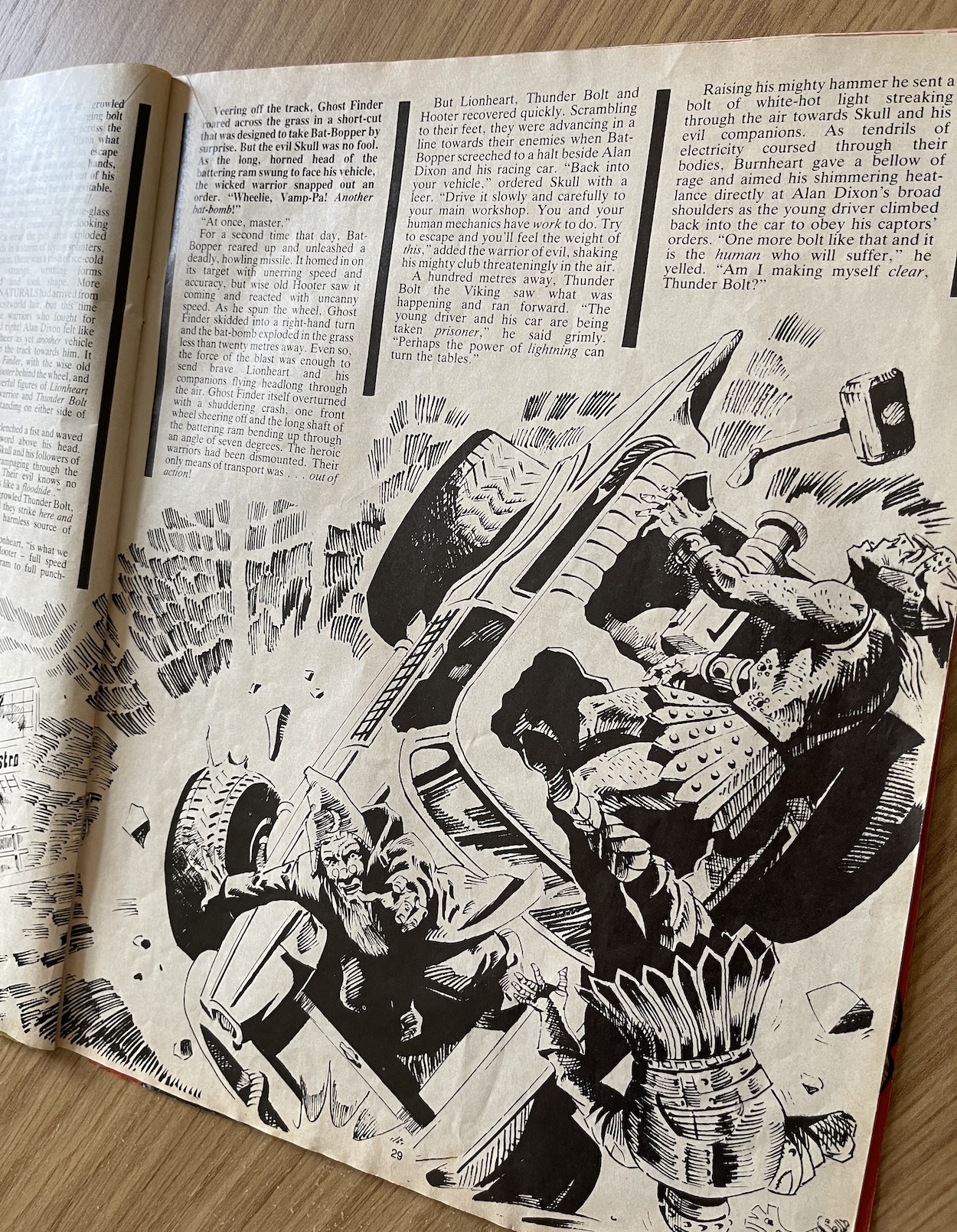
Racetrack Riot is the special’s prose story and follows F1 driver Alan Dixon as he test drives a new super powered engine, which of course Skull wants for his Bat Bopper truck. Alan and his team are kidnapped and forced to remove the engine from their car. Outside Lionheart, Thunderbolt and Hooter (who is making up for being underused in the regular comic by the looks of it) are watching closely. It’s our clumsy wizard who comes up with the plan and after transforming into his owl form he swoops in from the skylight on which they’re perched and seemingly attacks the F1 team.

There’s method in his madness of course. It looks like a regular owl, possibly nesting somewhere nearby, has flown in. So the evil characters simply ignore him while at the same time in this form he doesn’t inadvertently scare the humans into freezing in fright for once. Instead, they dive into the maintenance pit under the car for cover. This allows the main Super Naturals to launch an attack and duke it out without fear of harming anyone. It’s inconsequential stuff but entertainingly written by Barrie Tomlinson. Unfortunately though, we’re not sure who the artist was.

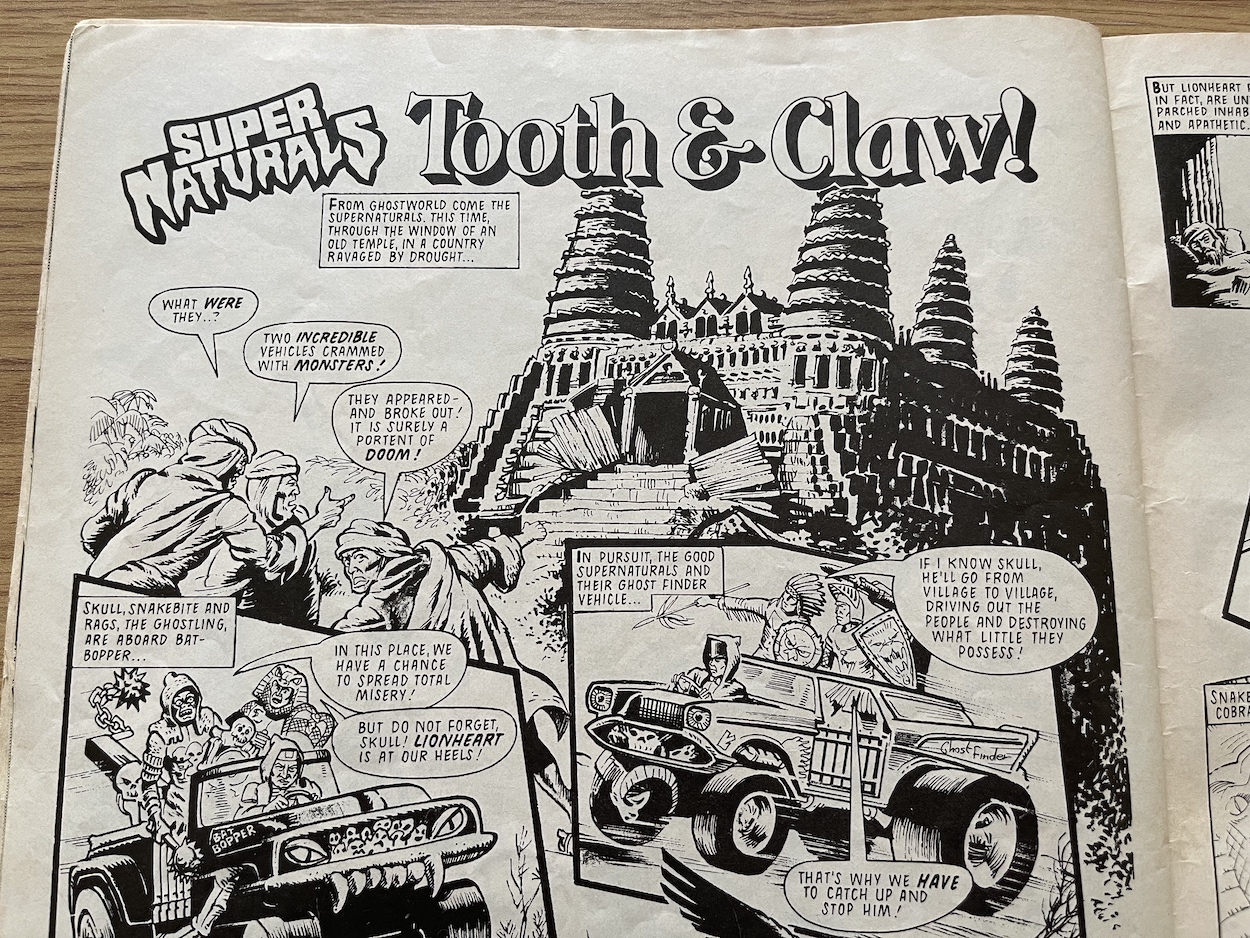
The final story in the comic and for any of these characters is Tooth and Claw and I believe it could also be drawn by Keith Page. I’ve checked with some sources and parts of this (in particular the Super Naturals themselves) seem to be in his style but the jury is out for how the wild animals are drawn. So it could be Keith. Anyway, the story is set in an unnamed country suffering from a drought, its inhabitants hungry and the animals dying. Through a sacred temple emerge Skull, Snakebite and the underused Rags (as someone interested in Ancient Egypt I wish they’d used him more, he’s a Pharaoh who can turn into a cursed mummy) in the Bat Bopper and Lionheart, Eagle Eye and Mr. Lucky in the Ghost Finder.

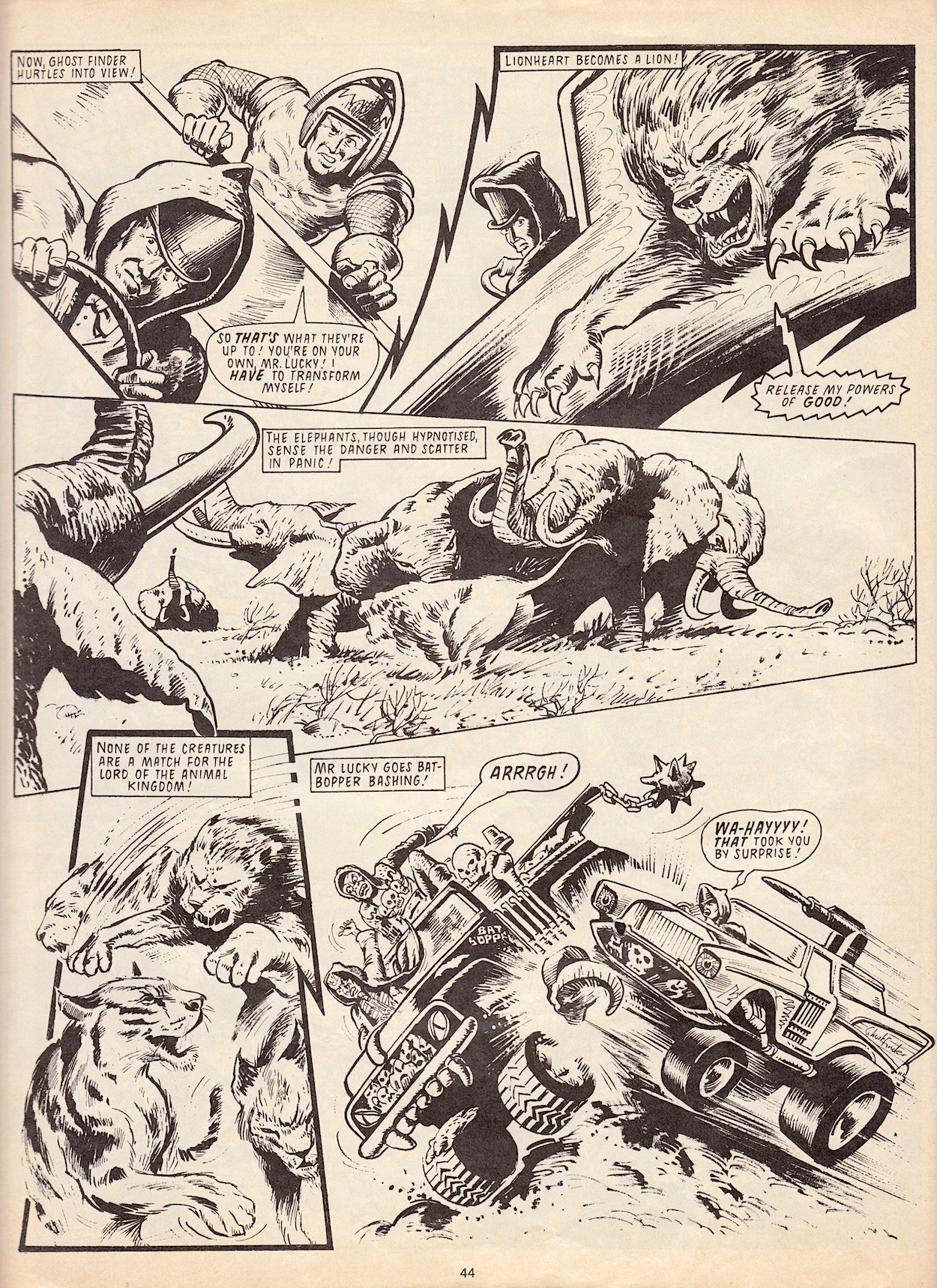
As they give chase the good guys are surprised to see the villages have been left untouched by their evil counterparts, until they come face to face with a wild stampede. Hypnotised by Snake Eyes, the animals have either been forced into a frenzy to chase down and eat the human flesh of the nearby villagers, or into a mad rage to stomp all over their homes and kill them underfoot in the case of the elephants. But the plan hasn’t reckoned on one simple thing, namely Lionheart’s third and final form.

It’s surprising to think the character hasn’t been placed into this kind of environment before now. It’s the kind of story which could’ve been developed into a serial to delve deeper into his mind, especially if he befriended other lions. After all, he was given this lion form by Specter for a reason, could he have found a kindred spirit in them? But then again, the comic was still in its infancy when it was cancelled, so who knows what could’ve happened. I have to say though, it’s fun to see him take to this form with relish, acting like an actual wild lion and fighting off the hypnotised, innocent animals (without killing them). Only a few characters got the chance for any kind of development by the end and unfortunately Lionheart wasn’t one of them. This is like a teaser for what could’ve been.

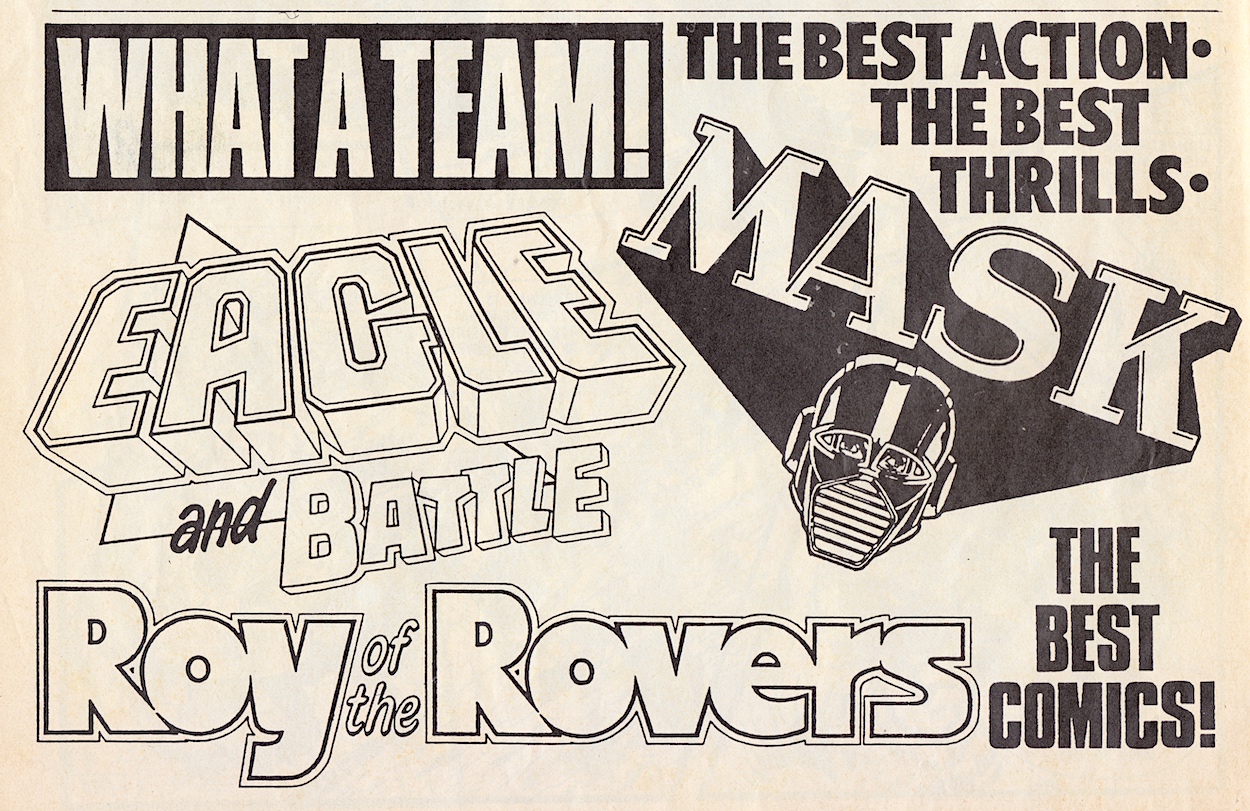
Before we sign off from the last ever edition of this comic there’s just time for a quick plug for some of Fleetway‘s range which may have appealed to the target audience. Battle had merged with the new Eagle after a phenomenal run, Roy of the Rovers was still going strong and another of their licenced comics, Mask had proved a lot more popular, lasting 80 issues and it was certainly a hit with some of my friends. These could be described as the Barrie Tomlinson range, as he edited all of these.

A reprint of a Skull poster with the top and bottom chopped off to fit the inside back cover, followed by the title logo on the rear round things off and that’s it. In an edition which contained a lot more fun and action-orientated strips, the horror stories of the Scream reprint and the Hitler tale really stand out. So does the action-packed Lionheart ending, if only to show what could’ve been as a great example of the licence.

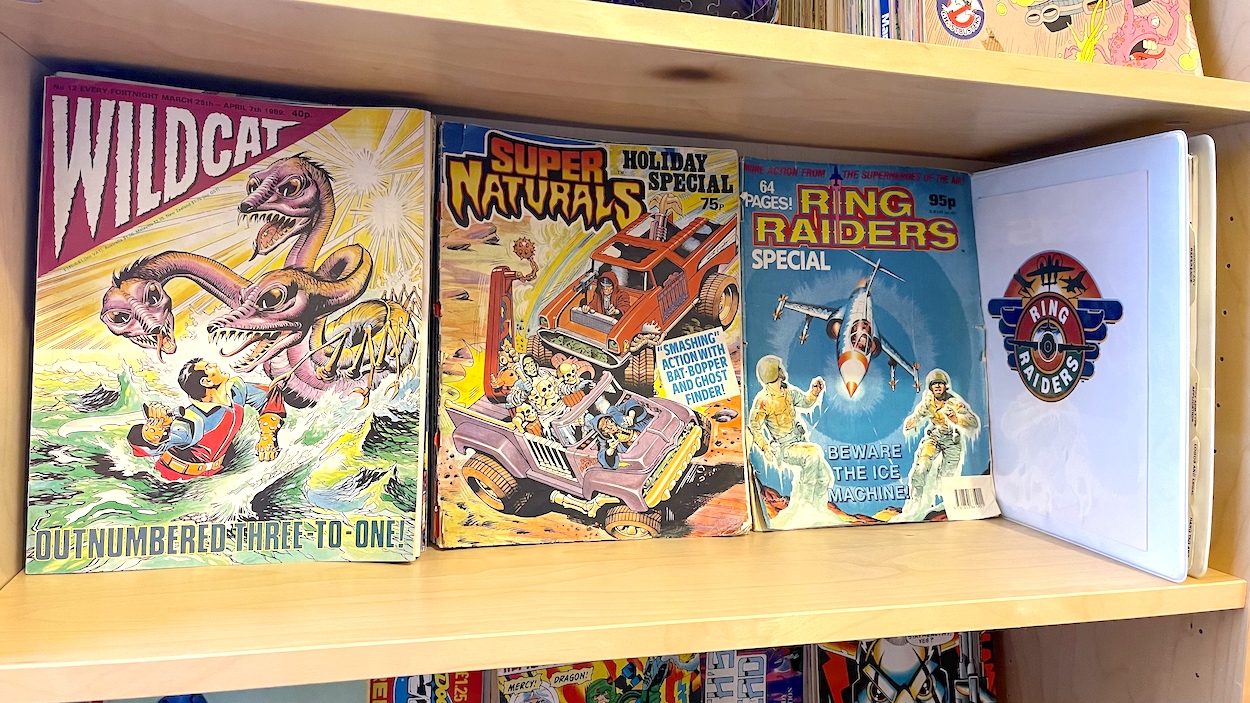
Never again would the young readers see these fun characters and the horror strips that came along with them for the ride. While there seems to be very little to tell from the creative team because memories seem vague when it comes to Super Naturals, keep an eye on the blog for some possible extra content in the future nonetheless. It’s sad to see the comic end and it’ll remain a treasured part of my collection, taking pride of place on the Barrie Tomlinson Trilogy Shelf. I hope I’ve been able to do my bit in keeping the memory of this classic alive.

BACK TO iSSUE 9

SUPER NATURALS MENU