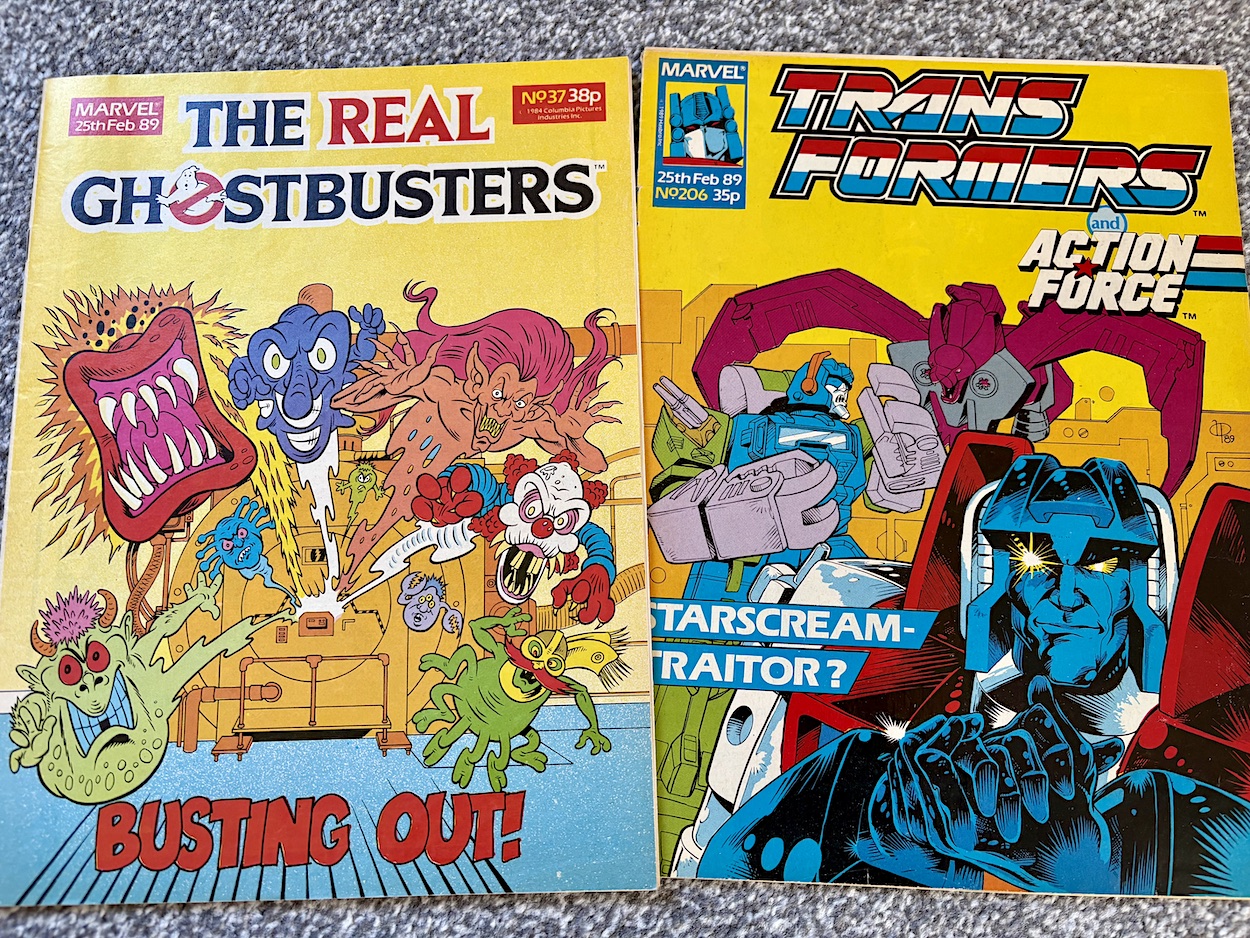
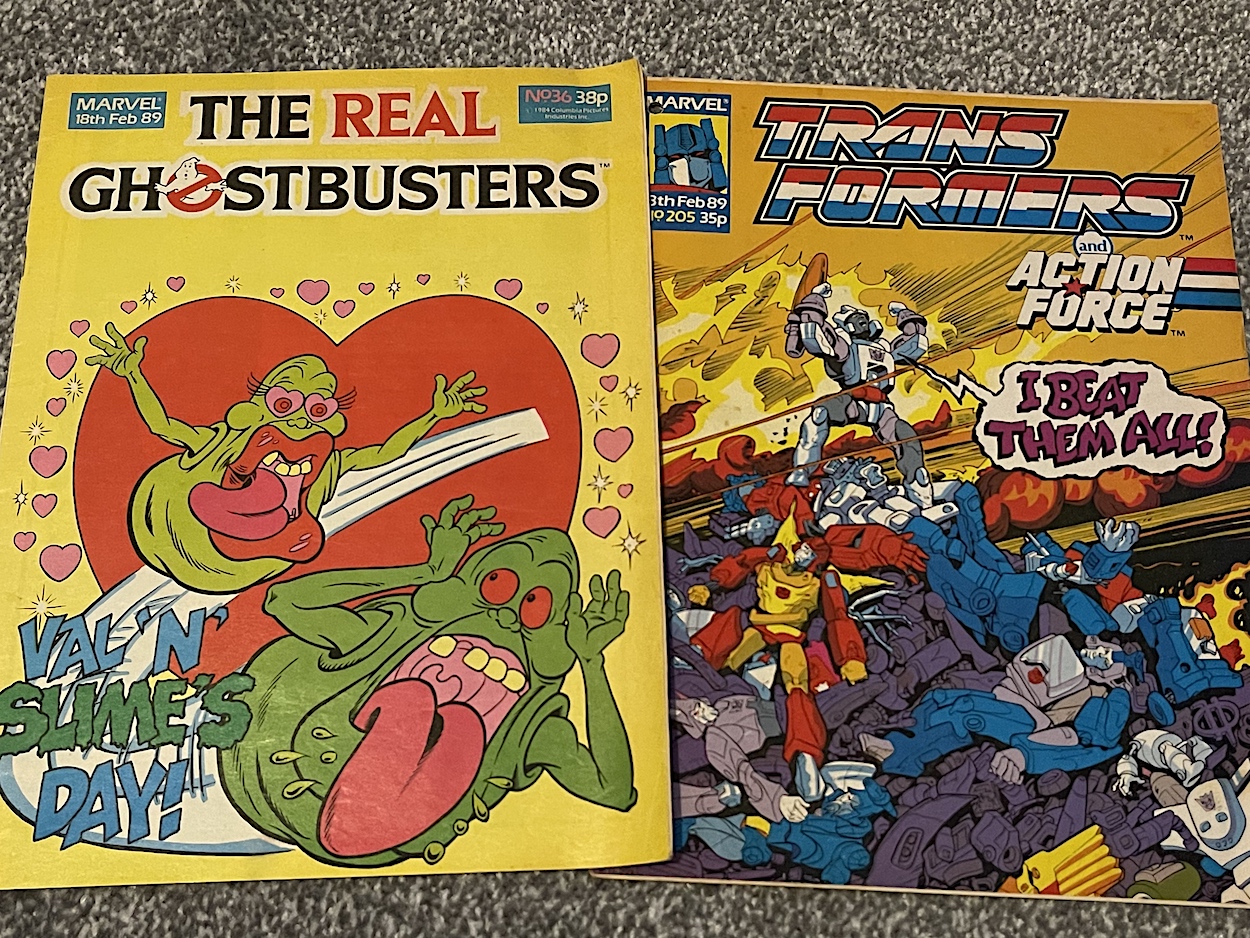
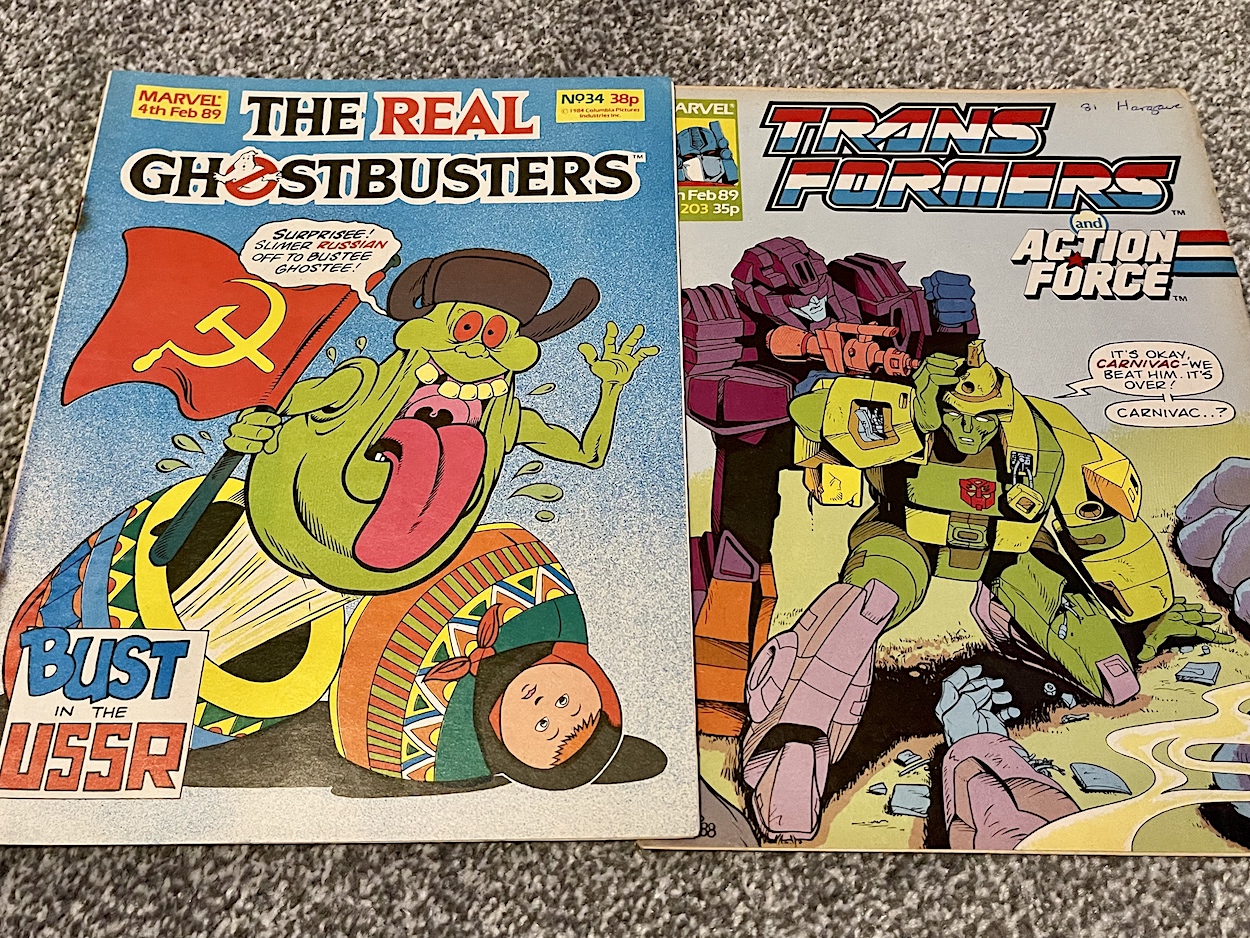
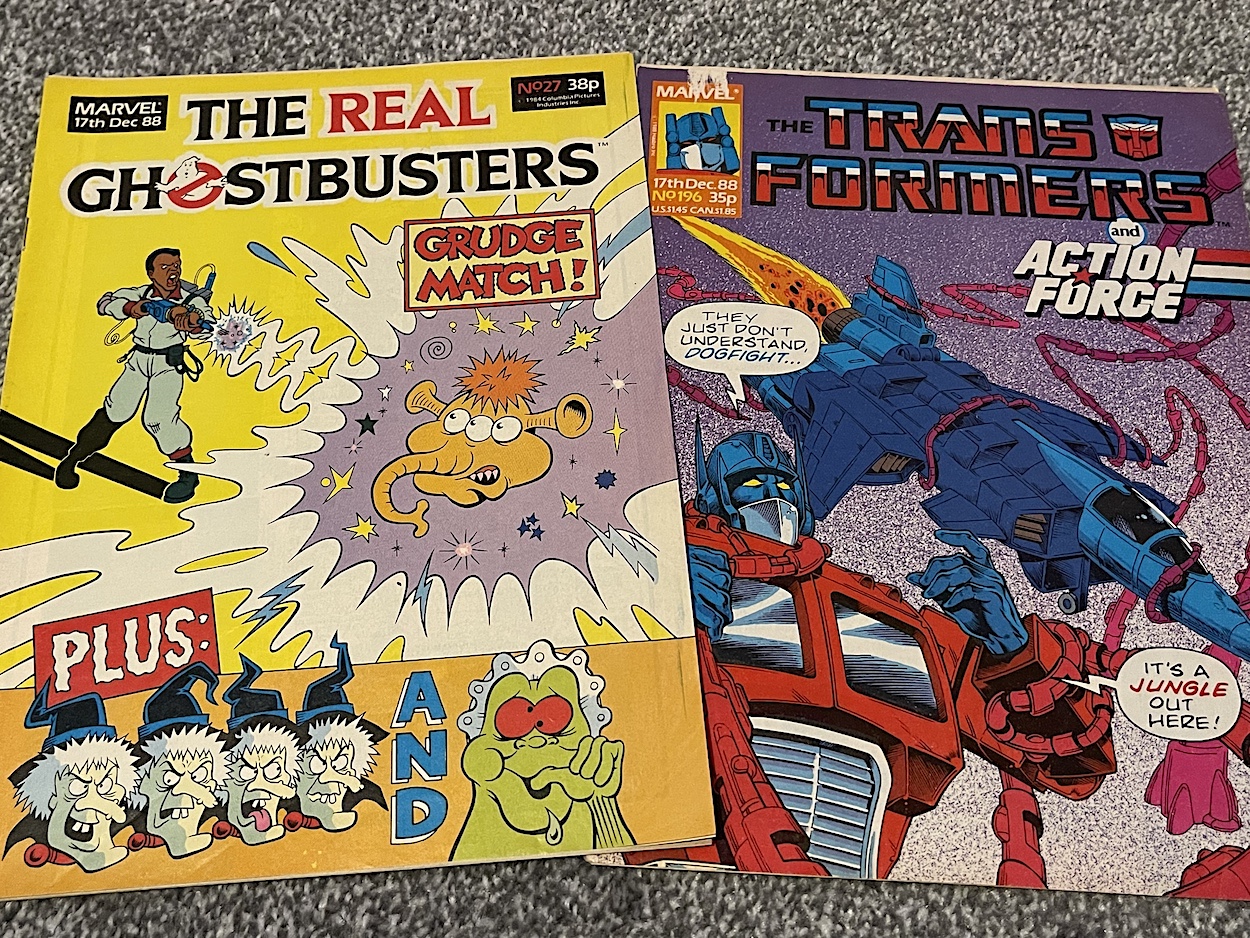
The cover of this week’s The Real Ghostbusters drawn by Brian Williamson and Bambos Georgiou instantly takes me back and across the way Andy WIldman’s cover to Transformers and Action Force signals a return to American writer Bob Budiansky’s swansong epic. What a week this was!
That fiery ghost that’s all mouth, teeth and flame was one of the best creations the comic ever produced and I mustn’t have been alone in thinking it because it’d return a few times, on this occasion alongside other fan faves when the containment unit was breached. In another story a giant ghost cat was more cuddly than scary, and in the end we find out it was actually a good ghost and the team sided with it as it protected stray cats out on the streets of New York from cruel humans. Aww.
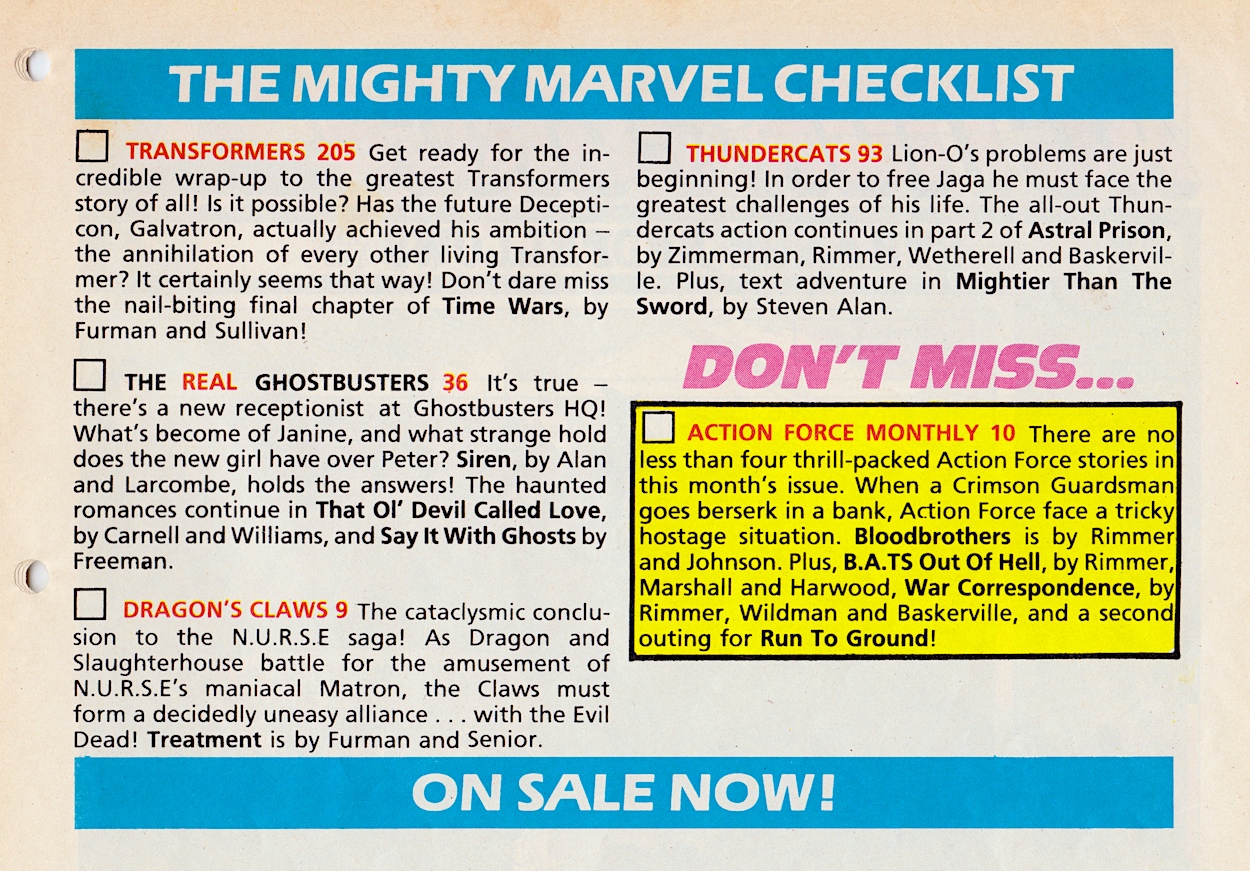
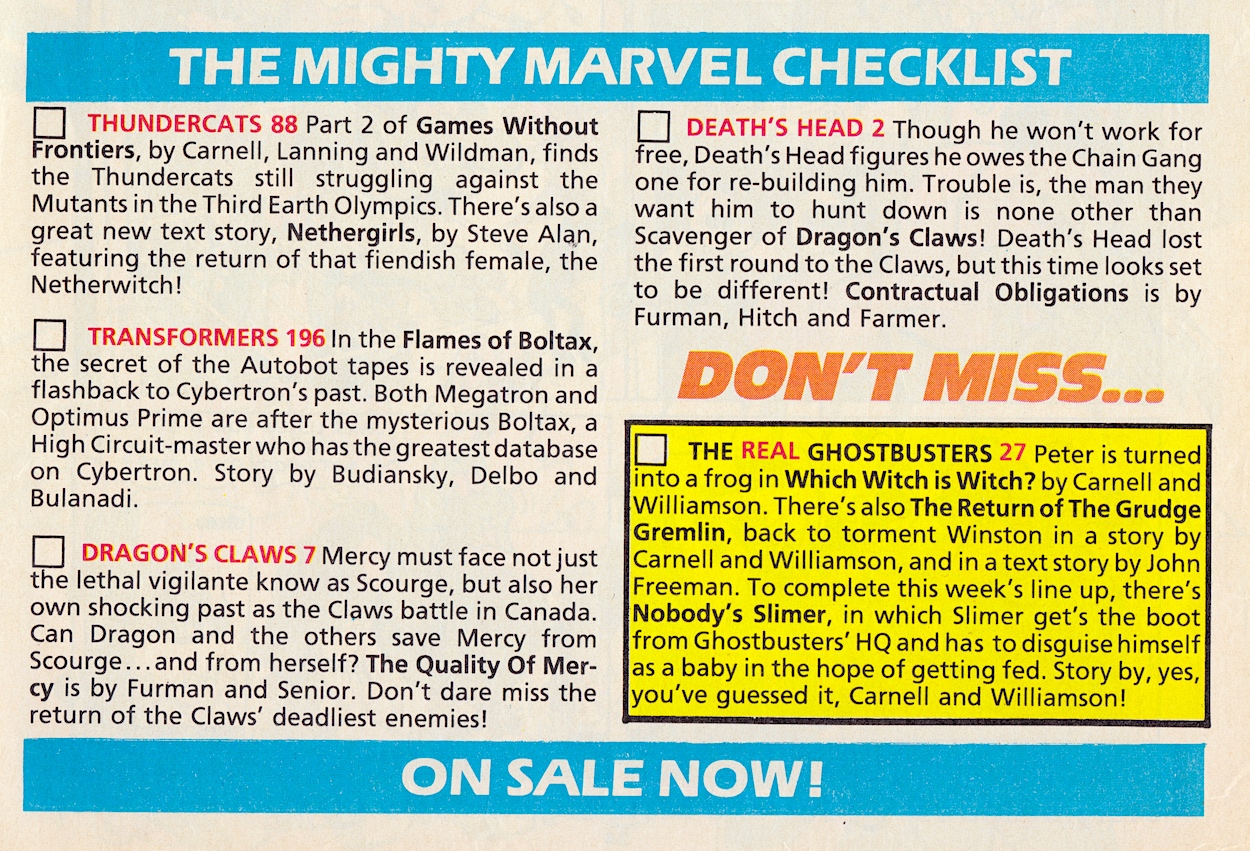
After the epic Time Wars we were back to the second half of the even-more-epic Underbase Saga. I loved this probably even more than Time Wars because Starscream was at the centre of everything; his massive ego getting hold of unlimited power was hugely entertaining and the resulting casualty list was even more shocking than the UK story. Dreadwind also gives one of his best answers on the letters page, check it out at the link below. Both of these comics deserved the ‘Don’t Miss…’ slot on the checklist as far as I’m concerned. What a shame there wasn’t one then, despite being on the Ghostbusters’ contents page.
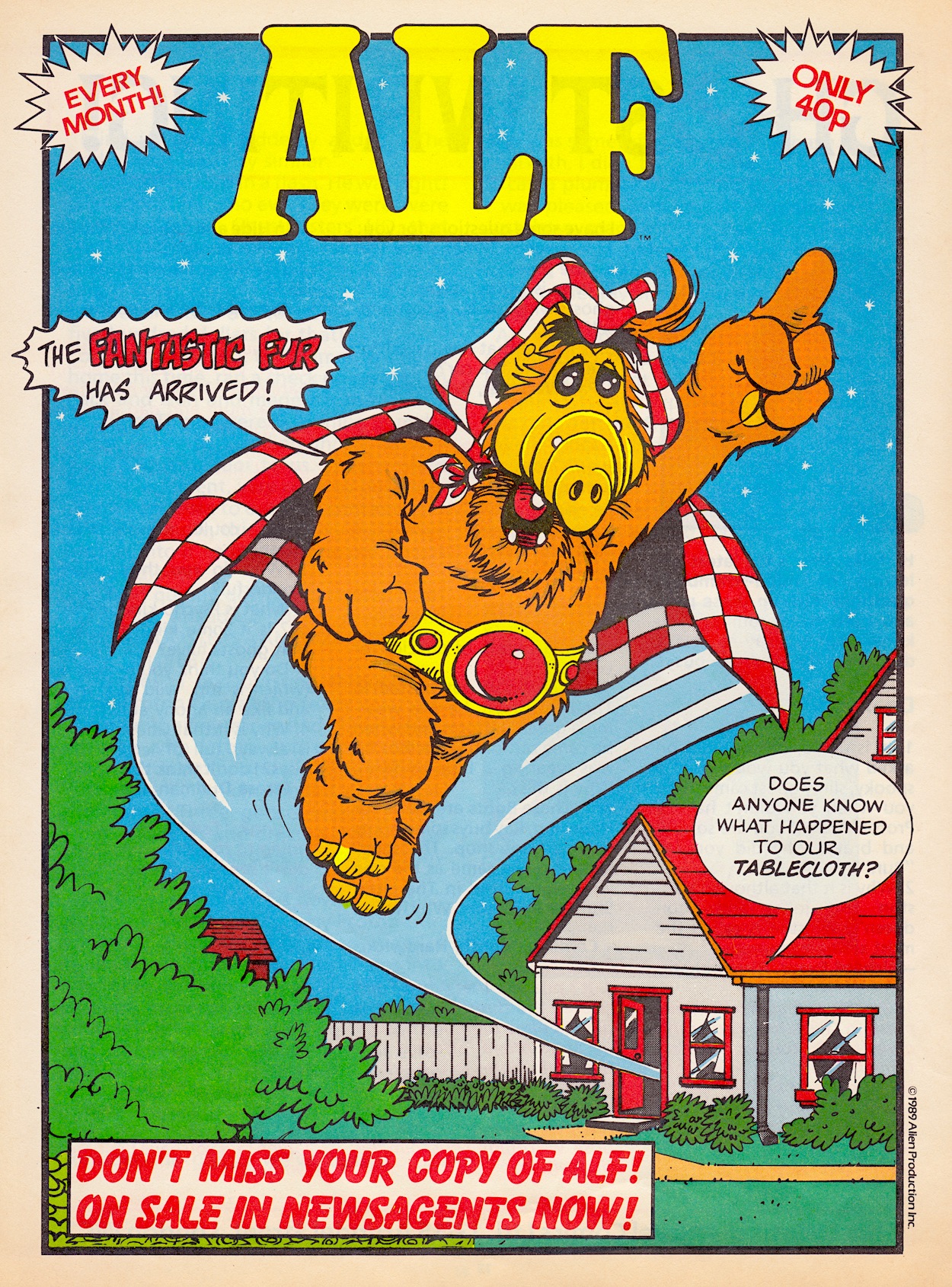
Which 80s TV fans recognised the quote I used last time when referencing this week’s advert? I remember watching Alf’s first season (before it shifted to satellite TV and out of reach for many of us back then) and not really understanding what all the fuss was about. Then again, even at a very young age I had an aversion to obvious laugh tracks on sitcoms instead of live audiences. Due to how Alf was filmed they just couldn’t have a studio audience, but the laugh track suffered as they all do with guffaws and roars of excitement from the American ‘audience’ for every little thing that happened, whether it was funny or not.
I sound like an old man! But that was also how I felt when I was only 11. Only later in life have I remembered Alf apparently ate cats too, though obviously not on screen. That’s not going to endear him to me now, that’s for sure. Anyway, no advert next week but the checklist will be back with a comic we haven’t heard from in a long time. A Bumper post coming up in just seven days.
A silly cover for Valentine’s Day by Brian Williamson and Bambos Georgiou, and a brutal death-laden cover to mark the end of the latest epic by Andrew Wildman, who is credited as “Andy” here. During my real time read through Andrew told me he’d no idea why they did that as he’s never gone by that name. Anyway, that aside Marvel UK had all bases covered.
Despite Slimer making the cover, The Real Ghostbusters focuses instead on Egon and Janine for the lovey-dovey season, although Egon’s idea of celebrations may have suited the other comic above, what with his Spengler’s Spirit Guide focusing on those who have died for love. It’s all tongue-in-cheek of course, and the previously advertised Betty Boop Valentine Card Comic is released for £1.15 according to the editorial. I wonder how many of those they sold?
In Transformers and Action Force the epic to end all epics… um, ends. It does so in fine form with some truly shocking moments drawn by Lee Sullivan. Probably most memorable of all is Galvatron being literally pulled apart, from his outer metal all the way through to his inner electronics by an angry and vengeful universe. What an experience this was as a kid, especially as I’d only begun reading the comic a few months beforehand! Surely this is the big title of the week?
Nope, that honour goes to the new issue of Action Force Monthly, even though it could’ve been given the top spot anytime over the next few weeks (which we’ve seen before for the monthlies) whereas this truly incredible Transformers is here for one week only. Two keys details in Action Force for me are the boast of four stories (so they must be rather short) and the use of the phrase “another outing” (oh dear, a reprint).
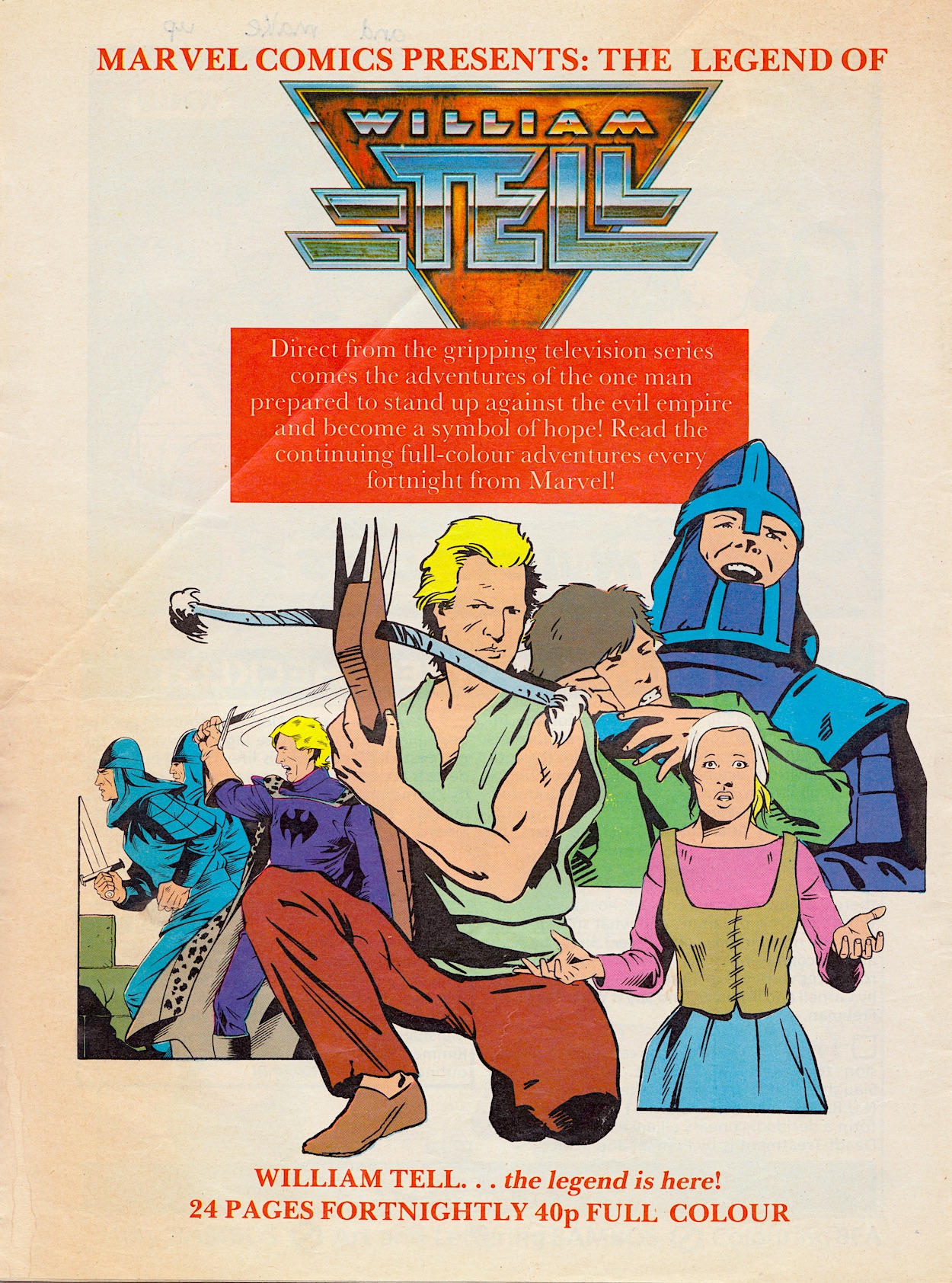
Thundercats is also a new entry for the fortnightly comic and it sounds more like the earlier editions once more. A fully British line up too. We’ve got a new comic advert this week as well for another brand new fortnightly. At least in theory. In reality it never appeared and that was only one half of the confusion that occurred when I saw this promo way back in 1989.
A brand new TV series and a brand new comic to accompany it? And of a story I enjoyed as a child too? I was in. I asked my newsagents every week if they knew when it’d be out and I trawled the listings in the family TV Times over and over, week after week, convinced it had to be somewhere in there. Neither appeared. It’s only decades later for blog research that I found out what had happened.
ITV decided to hold the series back for the summer, so with no accompanying telly show we weren’t going to rush out and buy a new comic of it, were we? All of the material created would end up in a graphic novel collection, The Marvel Bumper Comic and a Holiday Special, then the annual would appear later in the year. In the end it was the right call because ITV pulled it from their schedules pretty quickly after they started showing it. It was a big enough hit in the States to get three seasons though and it’s available on DVD under its original name, Crossbow if you fancy it.
That’s us for another week. Next time there’ll be an advert I’m sure will get some of you reminiscing, “no problem”.
We couldn’t really have two more different covers this week, could we? While Andrew Wildman’sTransformers and Action Force #203 cover represents a rather bleak moment in the Time Wars saga, Brian Williamson and Bambos Georgiou’s cover for The Real Ghostbusters #34 is, well, rather more light-hearted.
That cover relates to a very funny prose story inside, in which a job in Russia proves more difficult than the team thought when every time they bust the ghost it splits in two and another, smaller one pops out. Linking in with this, Spengler’s Spirit Guide becomes Popov’s Spirit Guide for one week only. Across the way and 20 years into the future Marvel UK had some explaining to do for its young readers.
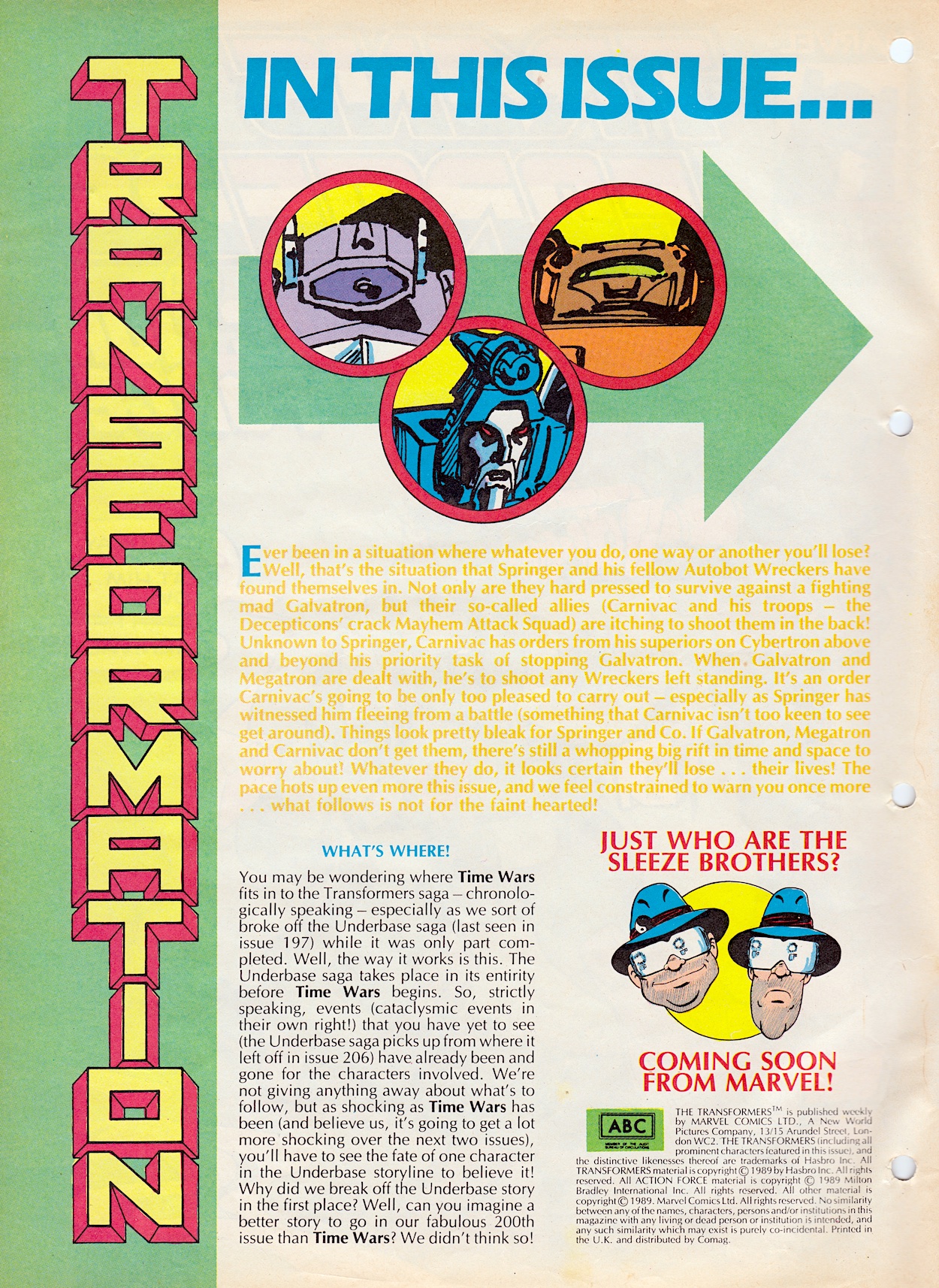
The comic had to explain how they broke off from the American epic Underbase Saga (which also killed off a lot of characters) because they wanted their own strip to run through the 200th issue celebrations. Thing is, all of Time Wars takes place after that story, which would only finish after Time Wars. A suitably confusing bit of wibbly-wobbly, timey-wimpy given the tale currently being told.
There’s a particularly funny answer to a query on Dreadwind’s letters page too. A reader asks when Secret Wars III will come out and suggests getting the Thundercats and Ghostbusters involved in the story. Dreadwind explains that after mentioning this in the office he had to talk Ian Rimmer, Simon Furman and Richard Starkings down from the window ledge!
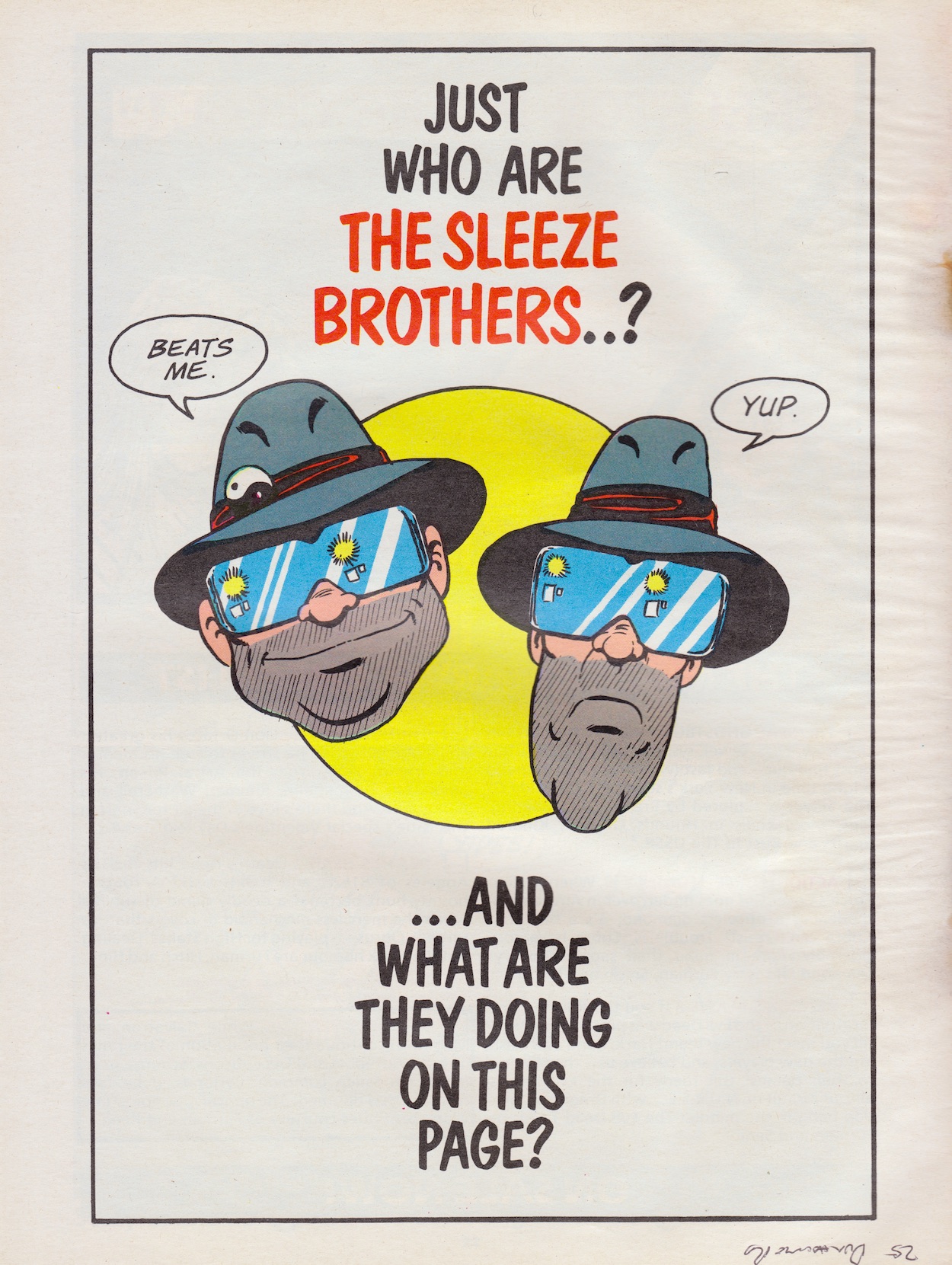
As you can see, three of the six comics on this week’s checklist have featured before and the only new one besides the two in my collection is Thundercats which contained… a Valentine’s Day story? Okay then. Advert-wise, a teaser for a new Marvel UK monthly took up a full page in The Real Ghostbusters this week, and although there wasn’t enough room in Transformers the two brothers Sleeze still managed to squeeze themselves in.
The first issue of The Sleeze Brothers wouldn’t appear until the fourth week of June and would only run for six issues, meaning the adverts hyping it up ran for almost as long as the comic itself. I remember seeing this ad for so long in the pages of my comics that I began to lose all interest in ever wanting to find out who they were. That was, until the first issue actually appeared and I just had to buy it to find out what all the fuss was about.
I’d only buy that first edition as a kid but many years later I rectified that mistake for the blog and read the whole series in real time back in 2024. At the time of writing there’s a special edition of the comic coming to the OiNK Blog later this year too, an issue that’s been sitting on my shelves for a few years now without being opened. So I’ll be seeing this trailer advert all the way until then for a bit of poetic symmetry.
Bambos Georgiou brought us his first full cover for this week’s The Real Ghostbusters. He’d taken over from Lew Stringer on the Blimey! It’s Slimer strip but I’d forgotten all about his other contributions to the comic. Across the way Art Wetherell and Stephen Baskerville brought us the latest Transformers and Action Force cover with the trademark Marvel UK stippled background they used so much across their range at the time.
Inside, Bambos’ humour strip had grown to a full page as the green glob’s popularity continued to soar. Through this comic, Marvel Bumper Comic, It’s Wicked and his own monthly he soon became something of a mascot for the publisher, despite not being their property. This is one of those unique issues when the strips and prose story form part of a larger tale. Despite the somewhat simplistic cover, it’s also one of the better issues from the early days of the run.
There’s more travelling back to an adventure from a millennia ago to add previously unknown backstory to Optimus Prime and Megatron in their main strip this week, and ol’ Megs finally gets his own A-Z page to mark the occasion. Elsewhere, a Transformers torch is advertised. It doesn’t actually transform, unless you count it alternating between being lit up and not being lit up as a transformation! What else was on the menu this week?
Apart from what we’ve already covered above and in last week’s checklist the only other entry is the latest issue of the now-fortnightly Thundercats. The previously epic-sounding storylines we’d read about in the checklists seem to have been permanently replaced by ones with somewhat lesser stakes for the characters.
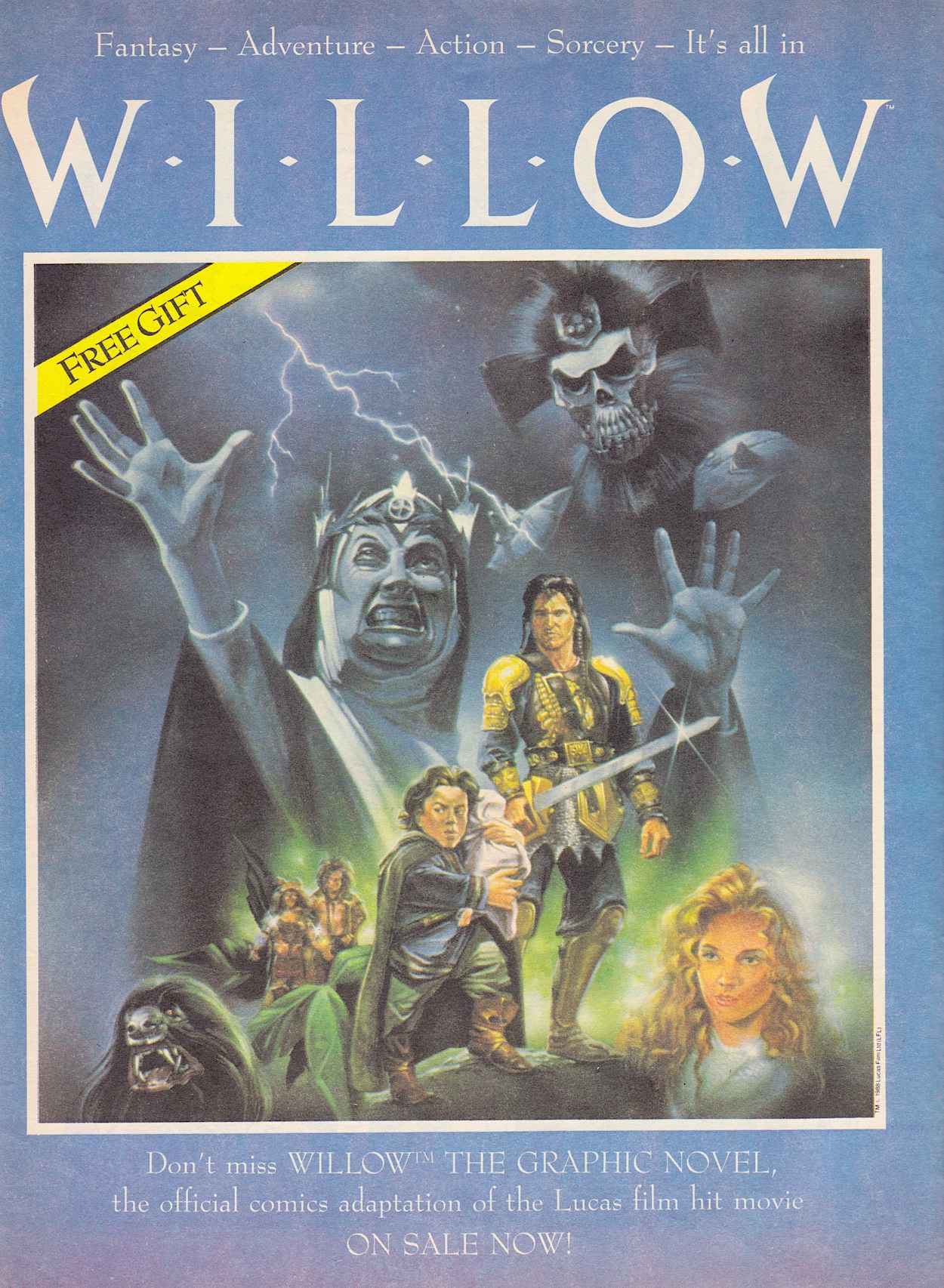
Last week the Marvel Bumper Comic advert hinted at content relating to two recent cinema releases, namely Who Framed Roger Rabbit? and Willow. Fans of the latter had more to celebrate this week with the news of a full comics adaptation of the new movie starring Val Kilmer, Joanne Whalley, Warwick Davis and the brilliant Jean Marsh.
Believe it or not I’ve never seen the film! It’s one of those childhood fantasy movies I always felt I’d missed out on and in recent years I’ve been correcting that (I saw Labyrinth fully for the first time just two years ago) and having seen enough clips of Willow when I was a child, and with such a stellar cast, it’s about time I added it to my Christmastime movie marathons. No, it’s not a festive film but it’s the perfect time of year for such childhood movies, isn’t it?
There’s no checklist next week but don’t fret, it’ll be back just in time for us to reminisce about those special Christmas issues we always looked forward to so much. But first, next week there’ll be another fun one-page strip advert, this time for one of the main comics from this checklist series and it’s a good one. So be here for that in seven days. That’s just enough time for you to get through your third packet of mince pies.
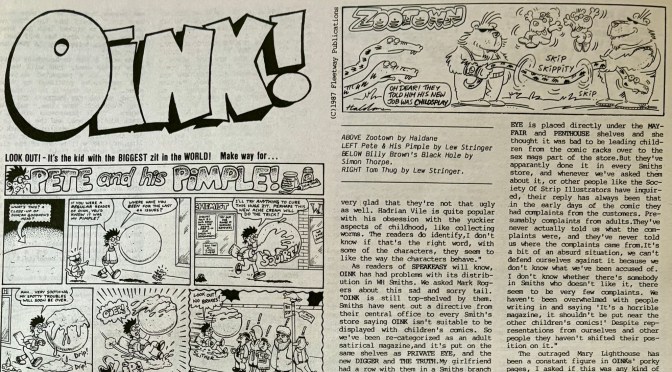
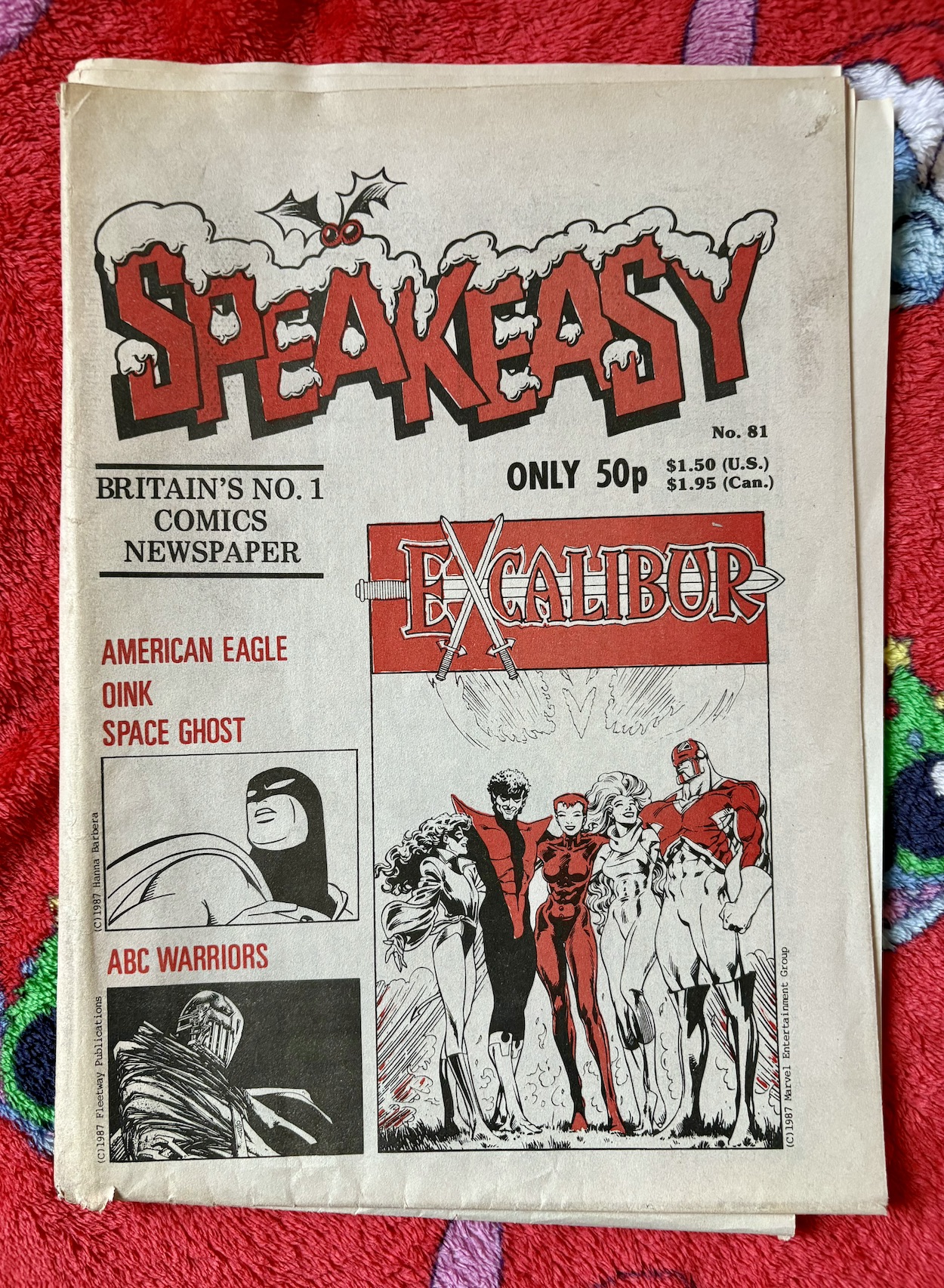
Just five short months after the previous issue of Speakeasy that featured on the blog came their Christmas issue, complete with snow and holly on the title (as it should be) and our piggy publication got a headline mention too. That’s because inside there was a massive double-page spread all about our favourite comic.
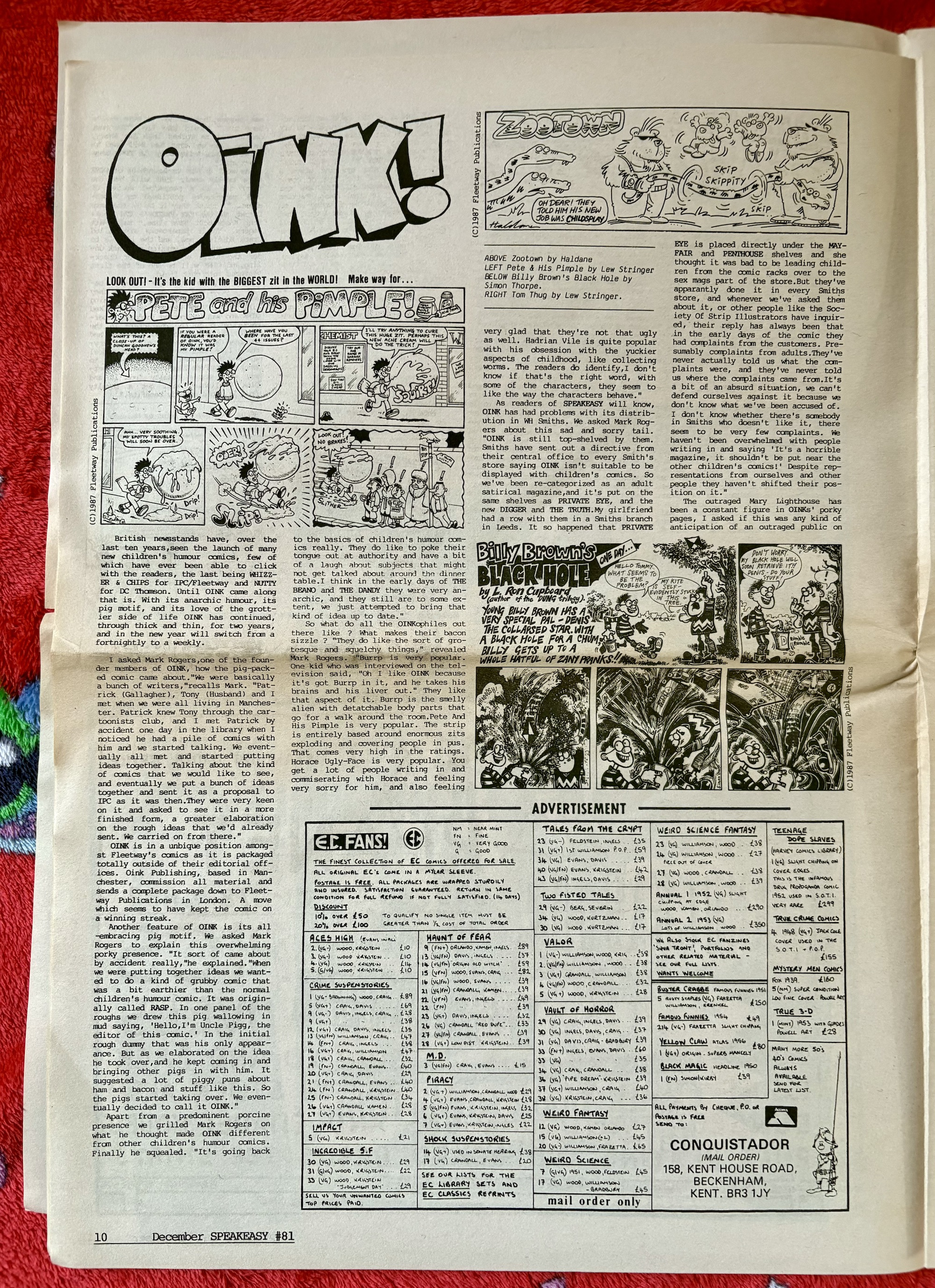
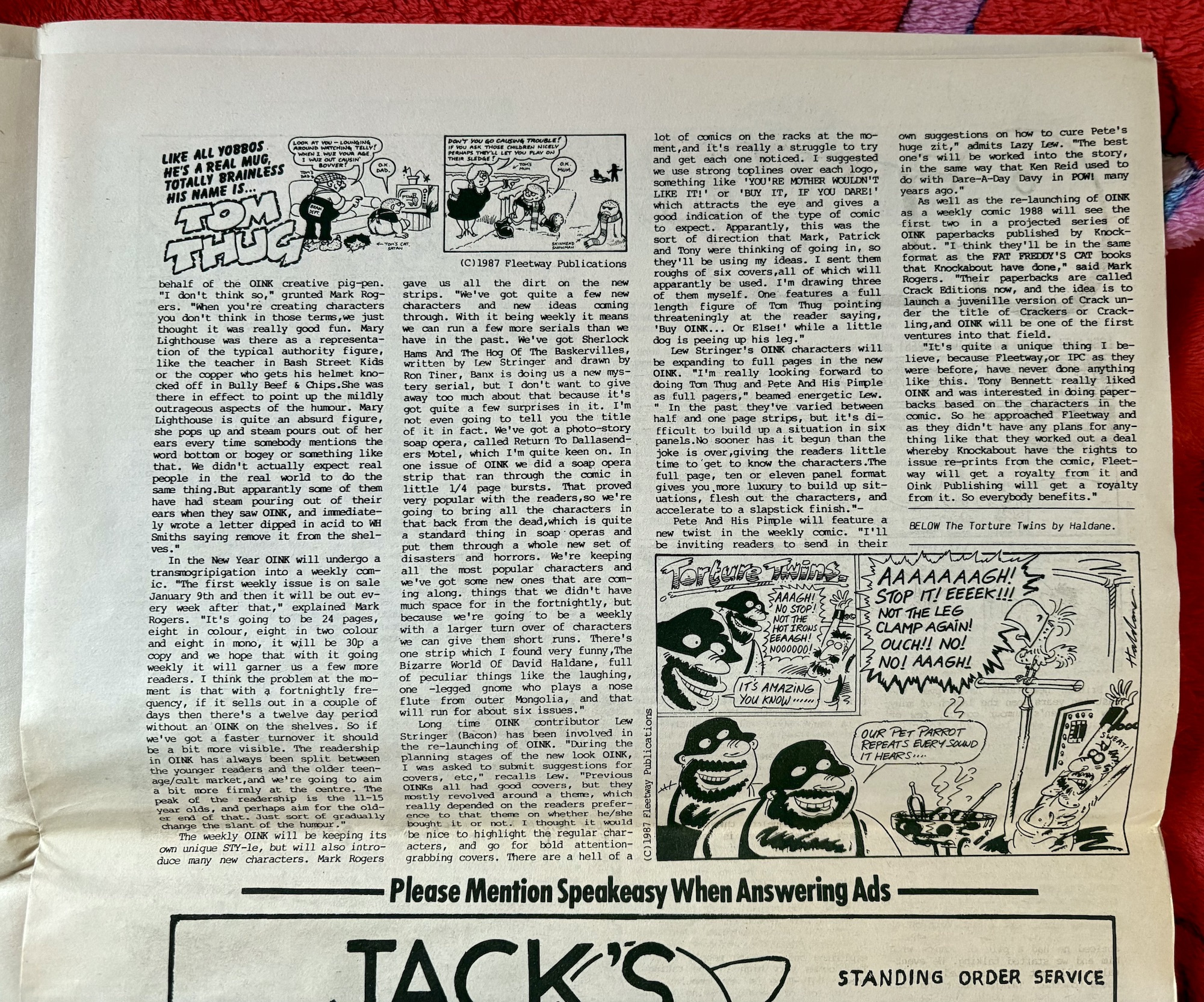
OiNK featured in the earlier issue in a much smaller way. Here, an unknown writer (no credit is given so it could be anyone out of Cefn Ridout, Dick Hansom, Bambos Georgiou and Nigel Curson) chats to OiNK co-creator/co-editor Mark Rodgers and the big news was that OiNK was finally going weekly with #45!
I remember the first time this was announced in the comic and I was absolutely thrilled. The loss of some key characters to a semi-regular basis and a reduction in pages was a bit of a shock though. If I’d been reading Speakeasy I’d have had a heads up and Mark’s explanation about some characters being on a regular rotation makes perfect sense. If only the comic itself had told us this at the time, maybe more readers would’ve stayed around.
There are a handful of previews for the new weekly strips here, showcasing Lew Stringer’s main characters who would now always have full pages to themselves. David Haldane’s are shown in their entirety and Billy Brown’s Black Hole was a one-off but even on such a smaller scale Simon Thorp’s detailed artwork still looks the part. Two-thirds of it are shown here even though we wouldn’t see it in OiNK until #68, the final issue!
“The pigs started taking over. We eventually decided to call it OiNK.”
Mark Rodgers
The piece begins with the well-known tale of how OiNK’s three creators (Mark, Tony Husband and Patrick Gallagher) met and, once we get to the point in the story where OiNK received its name, the writer takes every opportunity to insert a surprisingly well-crafted pig pun. The article focusses on OiNK’s independence and what set it apart from its contemporaries. Most interestingly, Mark likens OiNK to its stablemates when they were younger comics, when they pushed the envelope with their own rebellious senses of humour.
But by the 80s what was once rebellious had become stagnant. OiNK was their attempt at rekindling that same feeling for the modern audience. I’ve no doubt those that complained about OiNK failed to see the similarity to the comics from their own youth. Other interesting tidbits here include Mark admitting the humour was going to be gently changed to appeal to the middle-ground of their readers’ ages, Burp is misspelled throughout for some reason, and the DallasEnders photo strip mentioned wouldn’t actually see the light of day until #63, the first monthly.
“It’s going back to the basics of children’s humour comics really.”
Mark Rodgers
Lew Stringer also pops up towards the end when he’s asked about his involvement with the weekly relaunch. To help with the quicker turnover of issues Lew was asked to design half a dozen of the covers, three of which he would draw himself and the rest would be handed over to others. Lew discusses the idea behind them and it’s interesting that he came up with a theme for them in response to the fact the issues themselves would no longer be themed. Clever.
There’s one point here that’s particularly relevant. Mark talks about some of the more popular characters and how readers could identify with them. They were highly exaggerated versions of us and our likes, dislikes and behaviours of course, but it meant we could laugh at ourselves alongside the celebrity spoofs and random characters inside the comic. In a world where certain corners of the internet bemoan comics (and other mediums) wanting to create identifiable characters for modern audiences, it’s clear they don’t know their own comics history. It’s always been a thing, whether in superhero comics or silly ones about pigs and plops.
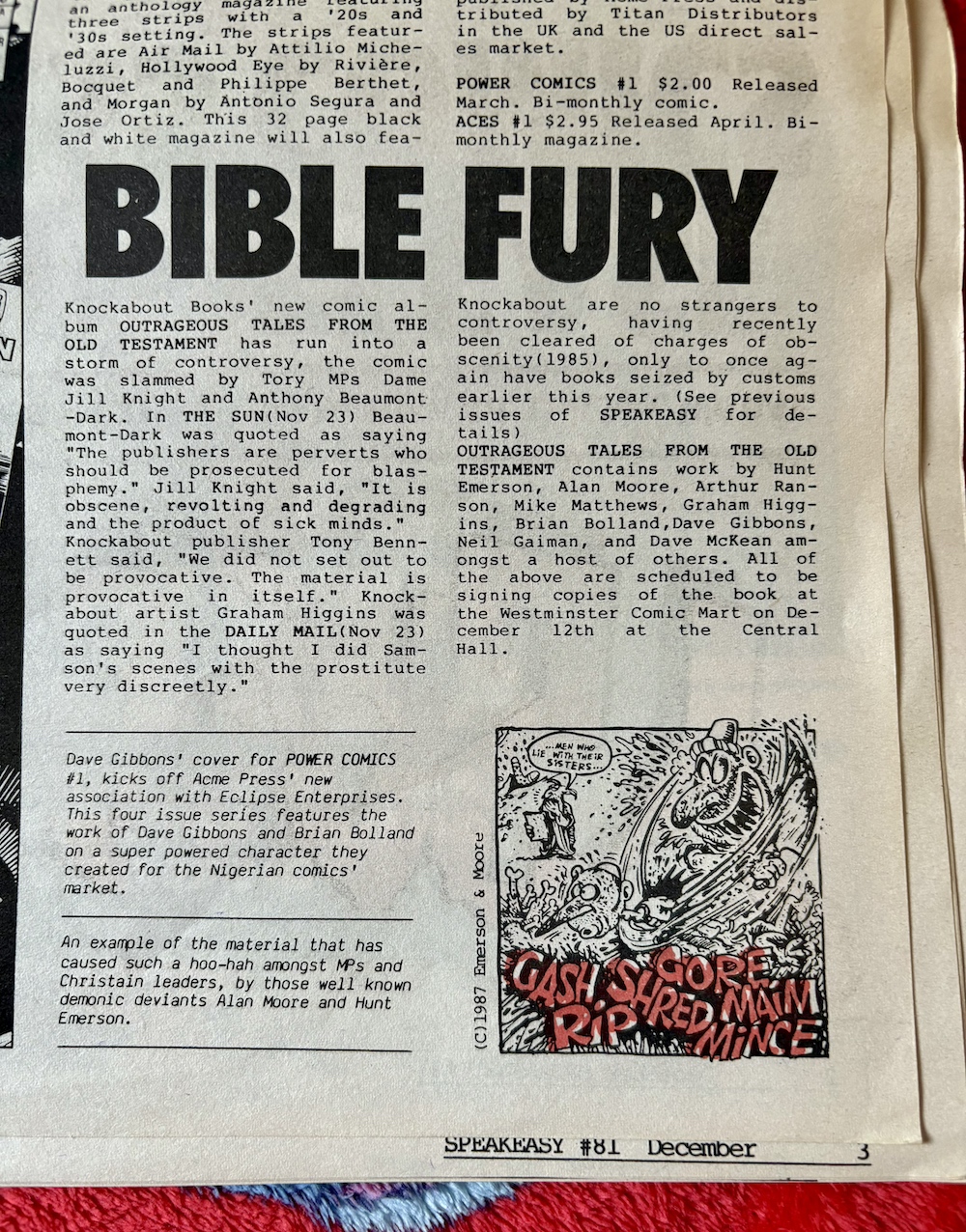
It’s time for a quick look at some other little bits that caught my eye as I read this edition of Speakeasy. Some things never change, as some got into a tizzy over new Bible-based comics. They were reported on as “obscene” and “degrading”, created by “perverts who should be prosecuted”. Reported as such in a tabloid that had topless women every day and another that constantly runs bikini photographs of celebrities the second they are of legal age.
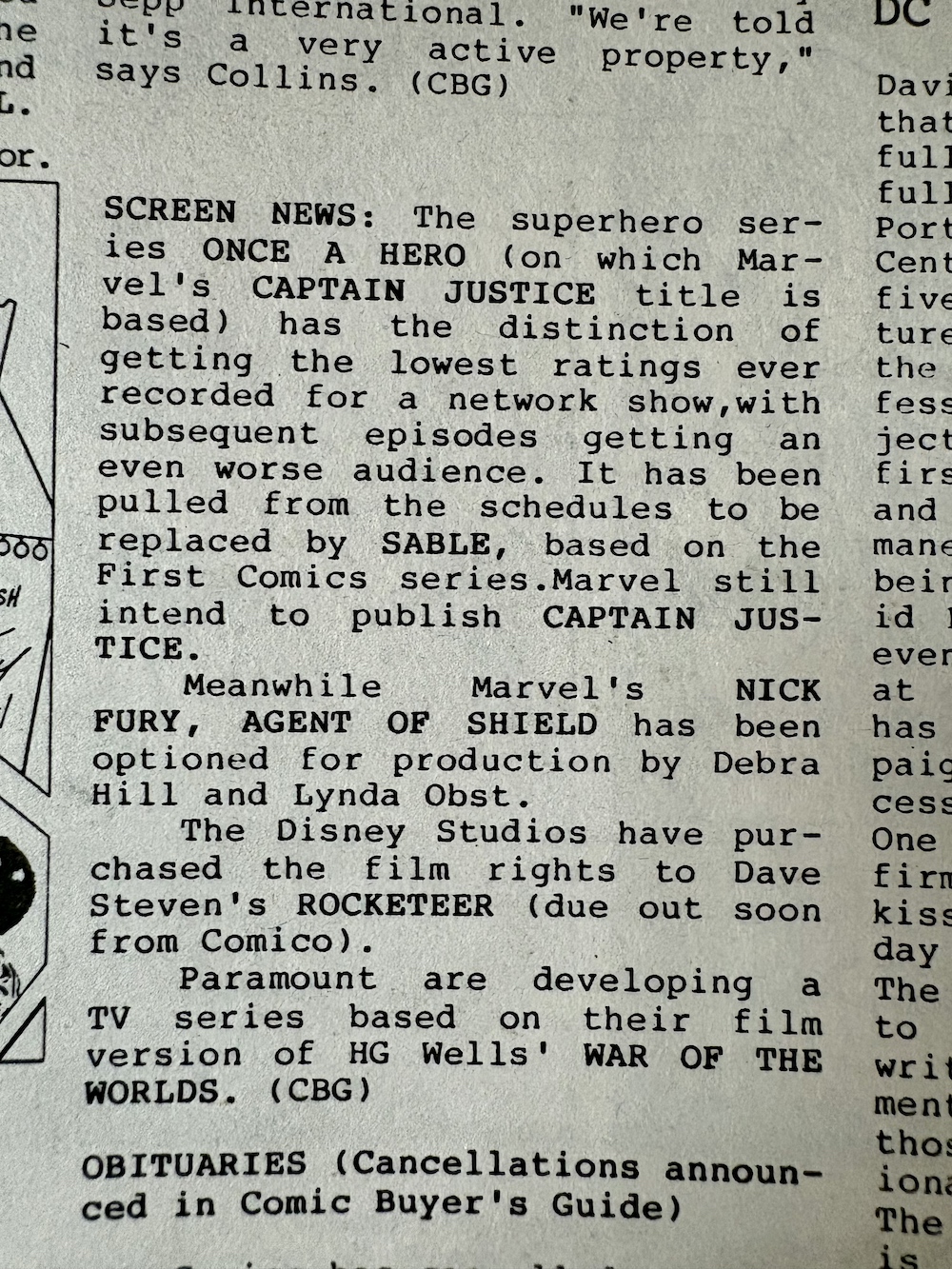
A paragraph about the atrocious ratings of a Marvel TV series ends with the first news of one of my favourite shows of all time, the 80’s War of the Worlds. Well, the first season was ace and ahead of its time, a superb sequel to the 1953 movie and which had a clear multi-year arc long before Babylon 5. But then the studio began interfering. When they didn’t get their way they fired show runner Greg Strangis, relaunching it with a completely different season two which was lame, contradicted everything that had come before and killed off any non-white characters (but I’m sure that was just a coincidence, right?). Am I still bitter all these years later? You betcha.
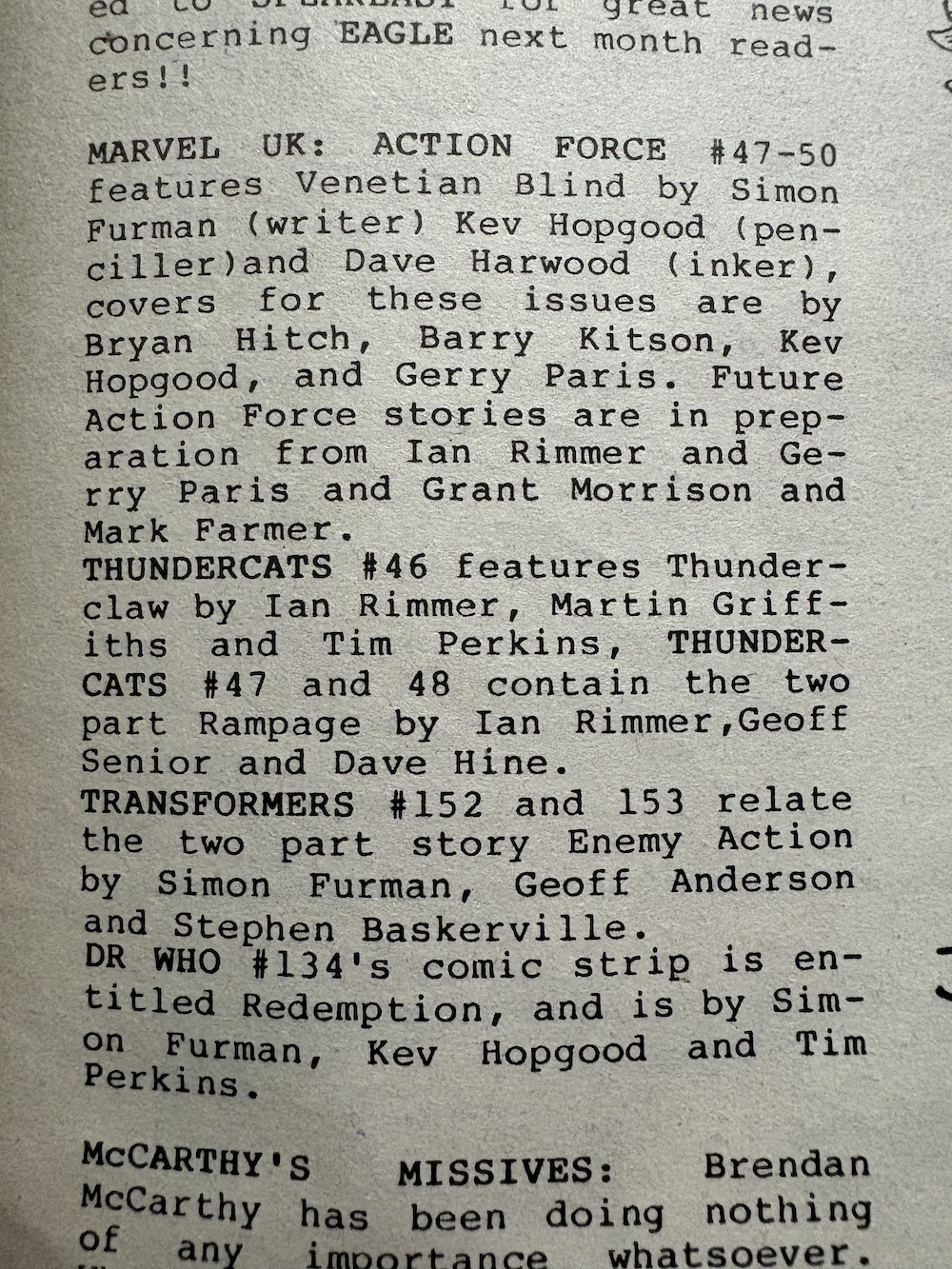
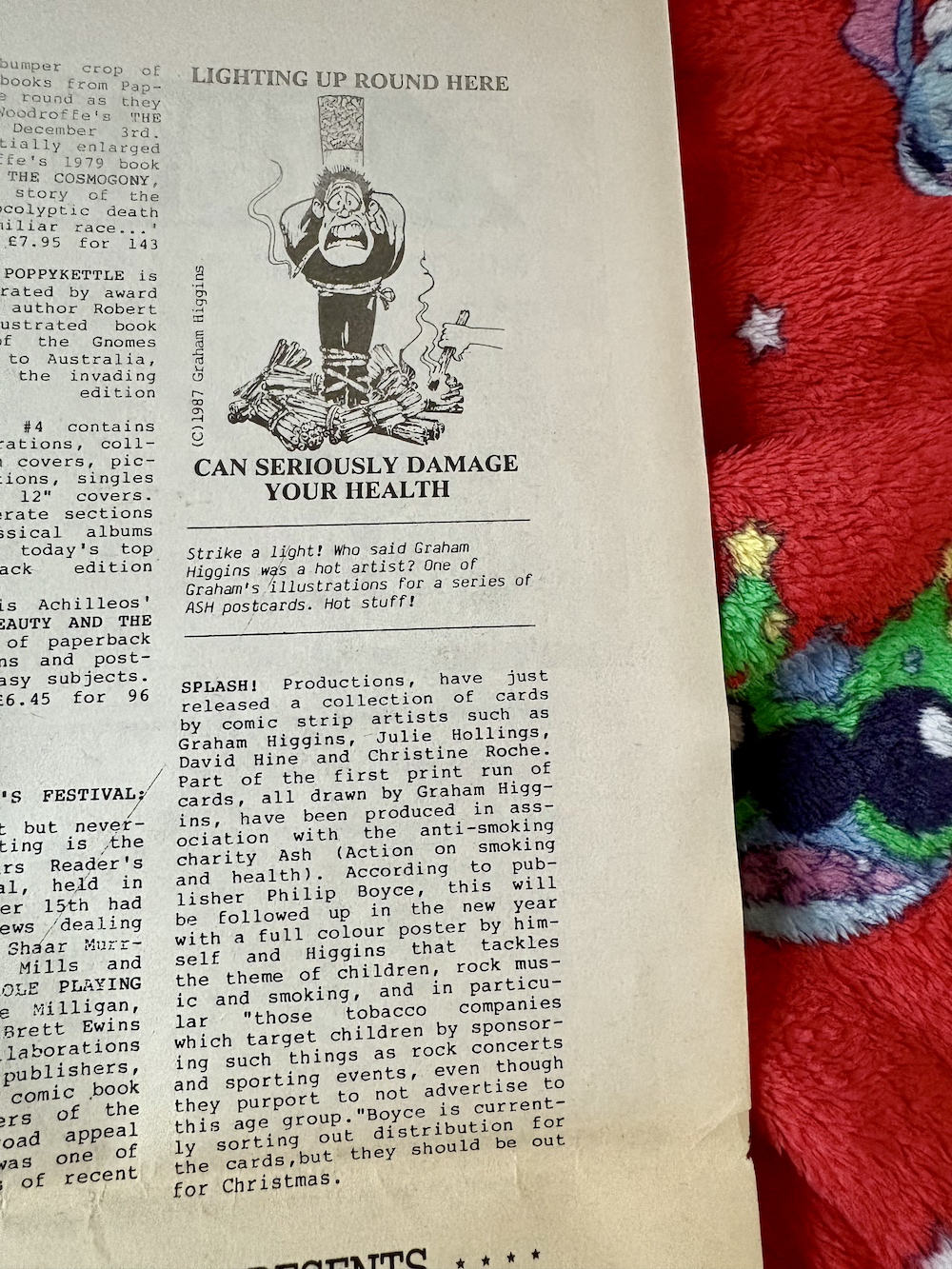
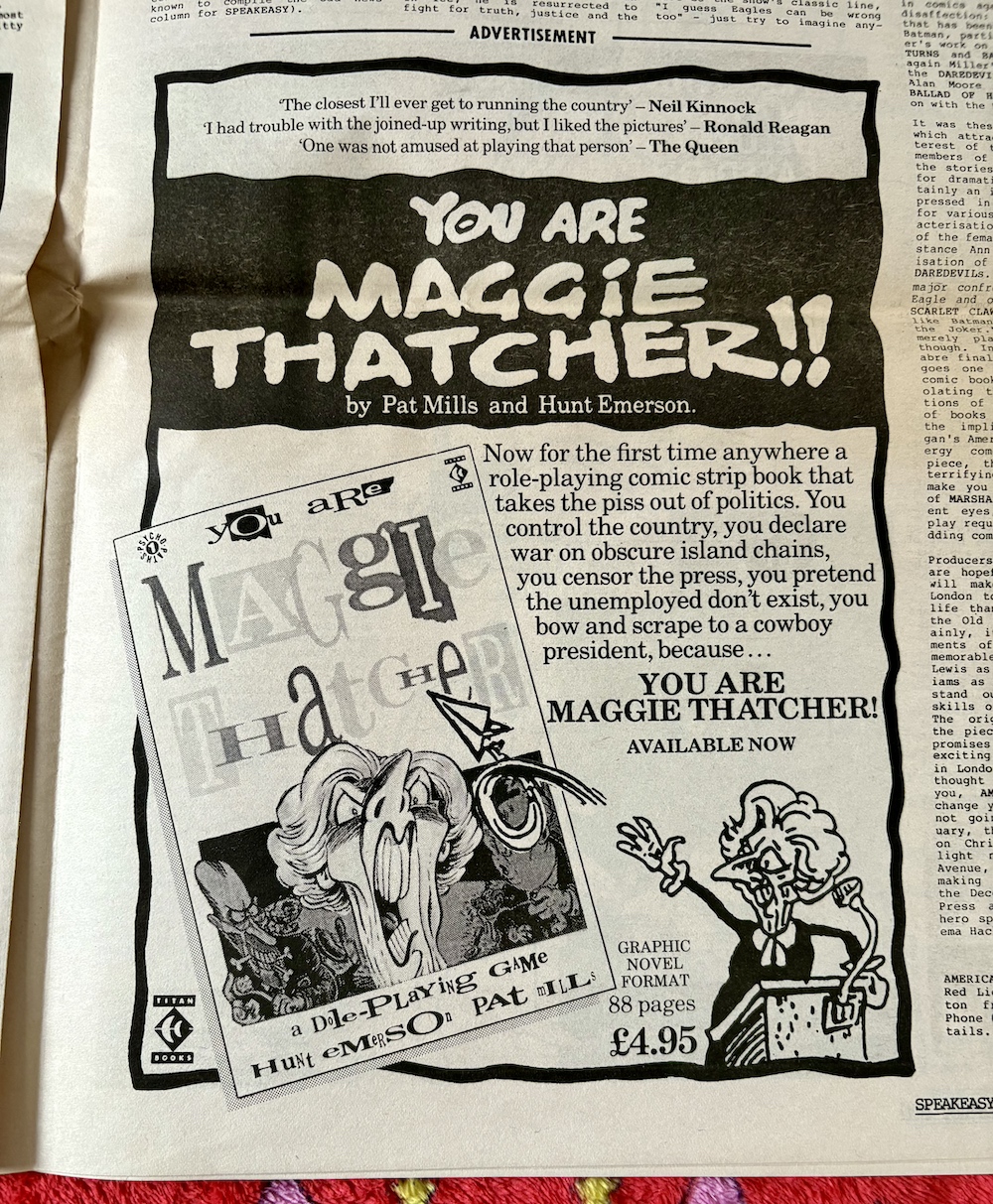
Marvel UK’s licenced comics get an update (the update for Fleetway would have you believe they only published 2000AD), however there’s no word on those Action Force issues being the last. Then there’s a rather familiar name associated with an anti-smoking campaign and I for one would be happy to be incorrectly identified as that person. Finally, Pat Mills and Hunt Emerson brought us a role-playing game book that just might have a point behind it. It’s subtle.
That brings us to the end of another look at Speakeasy, a time capsule for the comics scene of the 80s. I know it was publisher Fleetway’s idea to turn OiNK into a weekly but Mark seems genuinely enthusiastic for its potential. It’s always enjoyable to read about his love of the comic, it’s so infectious. Christmas 1987 was such an exciting time for pig pals, with the very best issues of OiNK the team produced, the first OiNK Book and news of the weeklies to come.
Very happy memories indeed and you can relive them (or discover them for the first time) in the OiNK Real-Time Read Through. Enjoy!


 OiNK Blog