Tag Archives: Andy Lanning

THE SLEEZE BROTHERS: iN REAL TiME

This advertisement seemed to take up permanent residence in many of the comics I collected at the time. Even though the first issue of The Sleeze Brothers wasn’t released until June 1989 this teaser saw print from the end of 1988 onwards, and since it appeared in weekly comics (for me in the pages of Transformers and The Real Ghostbusters) we saw it a lot!

With no information to go on apart from a ‘Blues Brothers’ feeling to it I remember eventually thinking, “Alright, enough! Just tell us what this is all about!”. However, it worked. At the end of June the aforementioned comics ran their regular Mighty Marvel Checklist and finally there it was, the big promotion in the range for that week was for the first issue of a comic I’d almost given up on ever appearing (like the William Tell fortnightly the year before).

As you can see it was always intended as a six-issue series, which the comic’s editor Richard Starkings confirmed when I spoke with him recently. What struck me the most as a kid were the two names mentioned in the credits, ‘Carnell’ and ‘Lanning’, namely writer John Carnell and artist Andy Lanning whose work I was loving on a regular basis in the Ghostbusters comic. I was sold and that week my pocket money went on the premiere issue.

I have a distinct memory of being in my Aunt May’s house (who I’ve mentioned before on the blog) and giggling away at the antics of El’ Ape and Deadbeat, the distinctly offbeat story, their awfulness at any form of actual detective work and the gorgeously drawn future world in which they lived. I’m really looking forward to rereading #1 for the first time since 1989. This cover is already bringing back some very happy memories.

At the time it confused me as to why it didn’t have the usual Marvel box in the top corner, but now I know better. Epic Comics was an imprint of Marvel, run by editor Archie Goodwin in the States before crossing over here. It began life as a creator-owned anthology comic called Epic Illustrated (a mini-series revival of which would star The Sleeze Brothers after their comic finished). Commissioned by Richard, The Sleeze Brothers were originally to be a Marvel series before Archie proposed keeping it creator-owned under Epic.

“The Sleeze Brothers was almost impossibly difficult to get approved,” Richard tells me. “All of those books (Dragon’s Claws and Death’s Head) were new territory for Marvel UK. I had launched The Real Ghostbusters very successfully and had earned a lot of trust with my bosses, Jenny O’Connor [Managing Editor] and Robert Sutherland [Managing Director], and all I wanted to do was original material, which was considered very expensive. Sleeze maybe sold 30-60,000 and considered a flop then. It would be a massive success today.”

As a child, The Sleeze Brothers was one of those comics I was destined to read only one issue of

A second comic strip advert (by John and Andy) was created closer to the release of the first issue. Below you can see it taken from the back cover of Death’s Head #5 from March 1989 (well before launch!), although I don’t remember seeing it in my own comics until I’d already got my hands on #1 for myself. These strip ads were a regular occurrence around this time, Richard learning from creating The Real Ghostbusters comic that they could tell a story in one page. We’ve already seen examples of these on the blog for Dragon’s Claws, Death’s Head, Transformers, Doctor Who Magazine and even Flintstones and Friends.

As a child, The Sleeze Brothers was one of those comics I was destined to read only one issue of. As I’ve mentioned before I was allowed a certain amount of comics on order at the newsagents at any one time, and my list was full. So the Brothers were purchased with pocket money and, like Death’s Head before them, I just never got around to buying any more, my money going on a huge variety of comics from week-to-week and I had a short attention span. Hey, I was young!


“Come on, it was a Blues Brothers rip-off!”

Richard Starkings, editor

El’ Ape and Deadbeat Sleeze are clearly modelled on Jake and Elwood from The Blues Brothers and just like the movie they have very distinct characteristics. El’ Ape is the short loudmouth, the forthright and in-charge brother of the investigative duo. He’s street smart, though somewhat lacking in any other form of smarts. The taller Deadbeat is the quieter brother who may not say an awful lot but who makes up for this with his ability to see things more logically.

Richard tells of a time when he wanted to reprint the series. “I wanted to recolour and reissue Sleeze through Image but then publisher Erik Larsen wasn’t interested. He thought it was a Blues Brothers rip-off. Which is was! Although Andy always protested that it was based on his cousins. Which it was! But come on, it was a Blues Brothers rip-off.”

The series ran for its originally proposed six monthly issues (although there was a larger gap between the fifth and sixth), one special and a back up strip in an issue of Richard’s Elephantmen. Thanks to our conversation I also found out there was a prologue. “We recoloured and re-lettered the prologue which was originally to run in Marvel Comics Presents as Death’s Head had previously,” says Richard. “But when Tom DeFalco [Marvel UK Editor-in-Chief] heard it had an Epic contract he nixed it, so I think it only ran in the trade.”

As you can see above I’ve now added said trade to my collection to round things off and we’re ready to go. As per usual I’m sticking with the format of this blog and reviewing each issue on the dates of their original releases. Online there doesn’t seem to be any consistency in those dates with most websites simply guessing from the months on the covers, but I’ve gone back to the source to find out for sure. I’ve flicked through all of the Transformers and The Real Ghostbusters comics from 1989 and checked all of the Mighty Marvel Checklists to ensure each issue is reviewed on the date lucky readers actually got their mitts on them.

But what about that Doctor Who Magazine popping its head above the collection there?

The only creator-owned characters to make the cover of Doctor Who Magazine according to Richard, The Sleeze Brothers made their debut in a strip called Follow That Tardis in #147, which you can see highlights of in the first Sleeze Brothers review on the OiNK Blog on Saturday 16th March 2024. I’ve had all the issues (apart from the trade) on my shelves for a few years now, since just before starting this blog in April 2021 in fact. It’s been a long, long wait but I never gave in to temptation.

So join me in eight days when the most insane Marvel UK series and the blog’s latest real time read through finally begins.
GO TO DOCTOR WHO MAGAZiNE 147

THE SLEEZE BROTHERS MENU

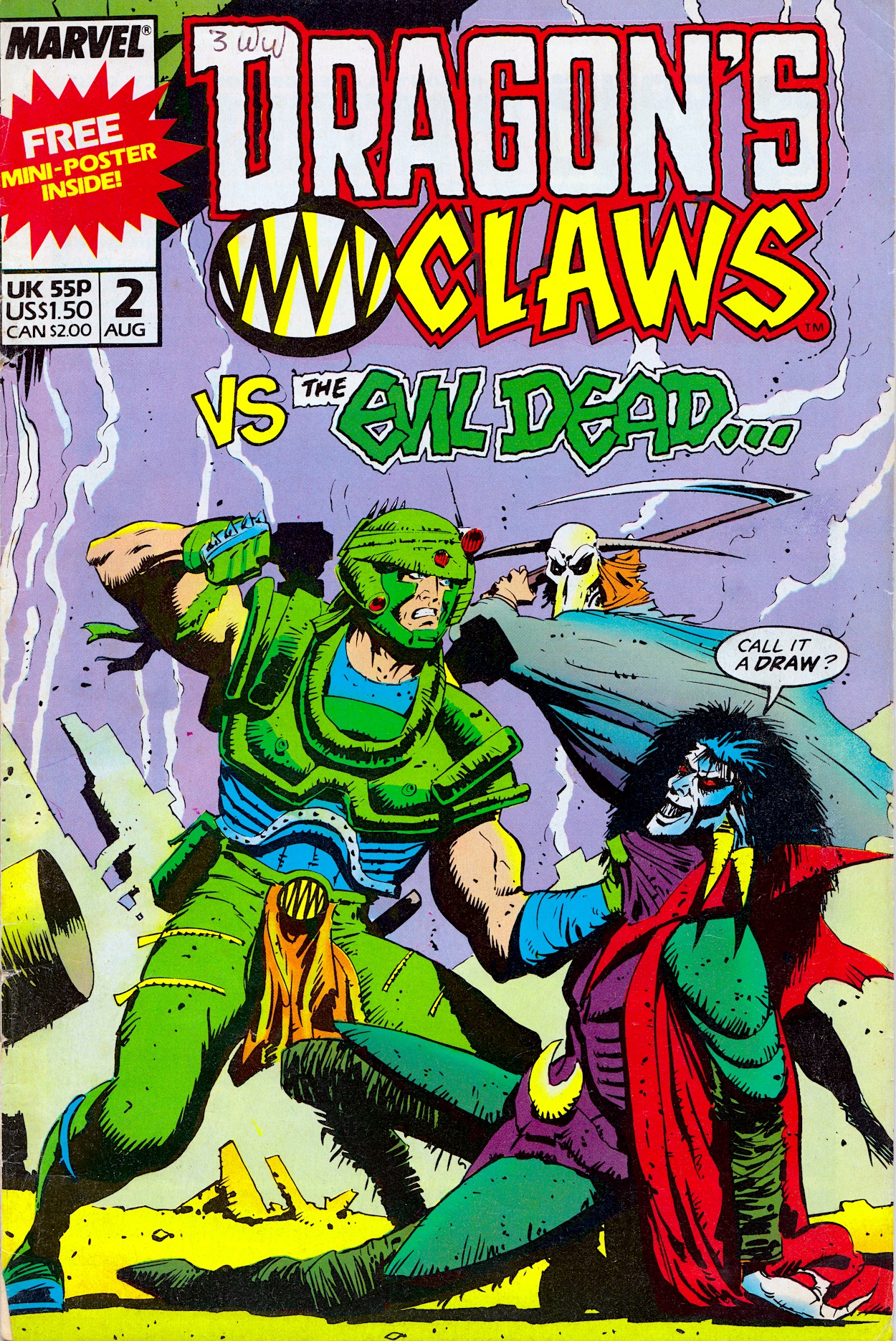
DRAGON’S CLAWS #2: COLOUR ME iMPRESSED

It’s been a long time coming but Dragon’s Claws’ sophomore issue is finally here. After spending the first couple of years on the blog covering fortnightly and weekly comics (the one exception being the short-lived Visionaries right at the beginning of the blog) it’s strange to find myself in a position where, at the time of writing this, both Dragon’s Claws and even the site’s namesake comic OiNK are monthly. I’ve gotten so used to what came before that the four-week wait between issues feels so long!

Could this have been an attributing factor to Marvel UK’s new range of US-sized comics not being the success they may have deserved to be? British comics were often more frequent, and if any did become monthly you always knew that meant they wouldn’t be lasting much longer. Things would change a lot in the 90s of course when most comics became monthly but sales figures also declined drastically across the board at that time. A month was a very long time to wait for us back then, especially when computer and videogames were now grabbing our attention.

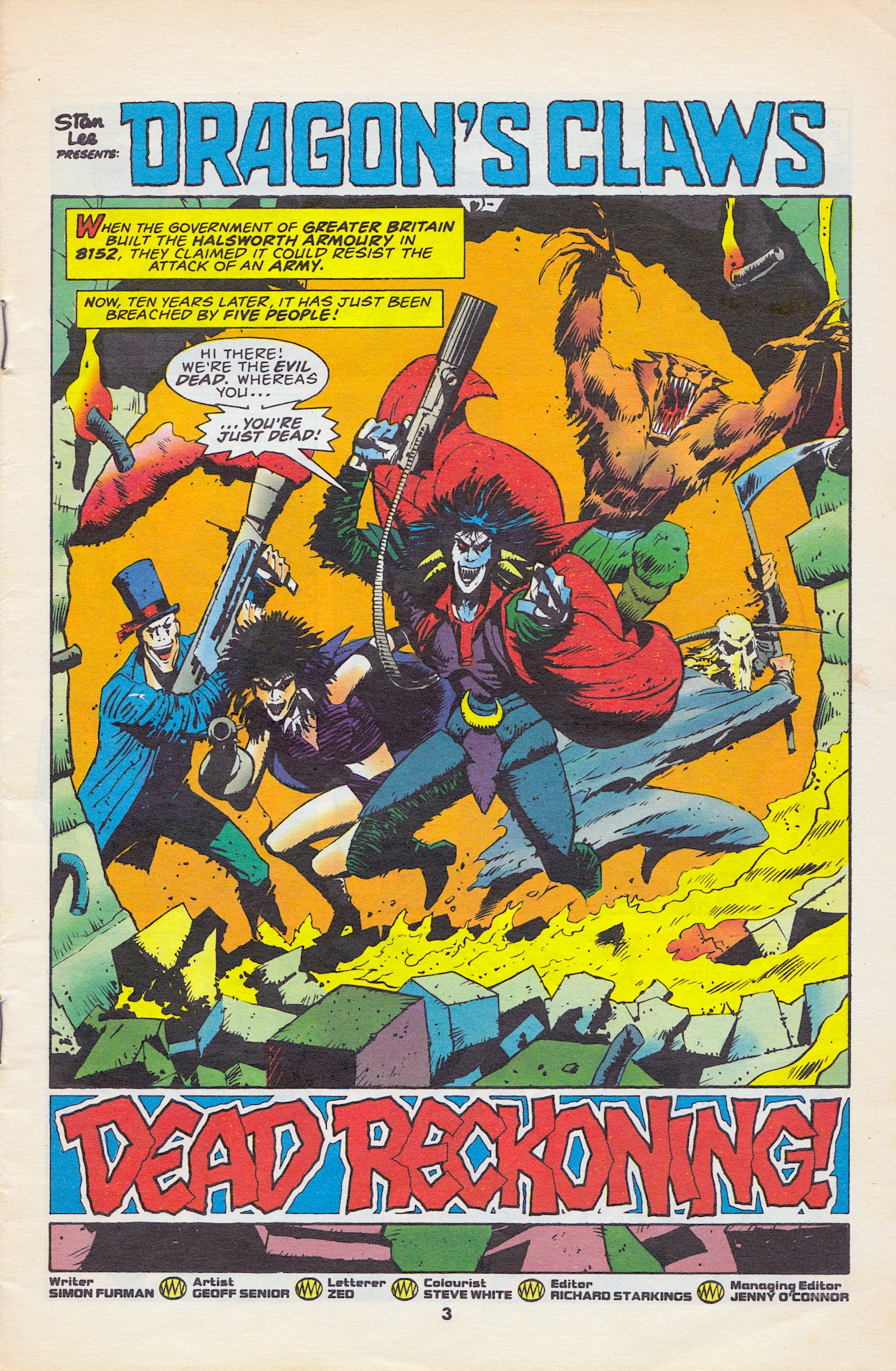
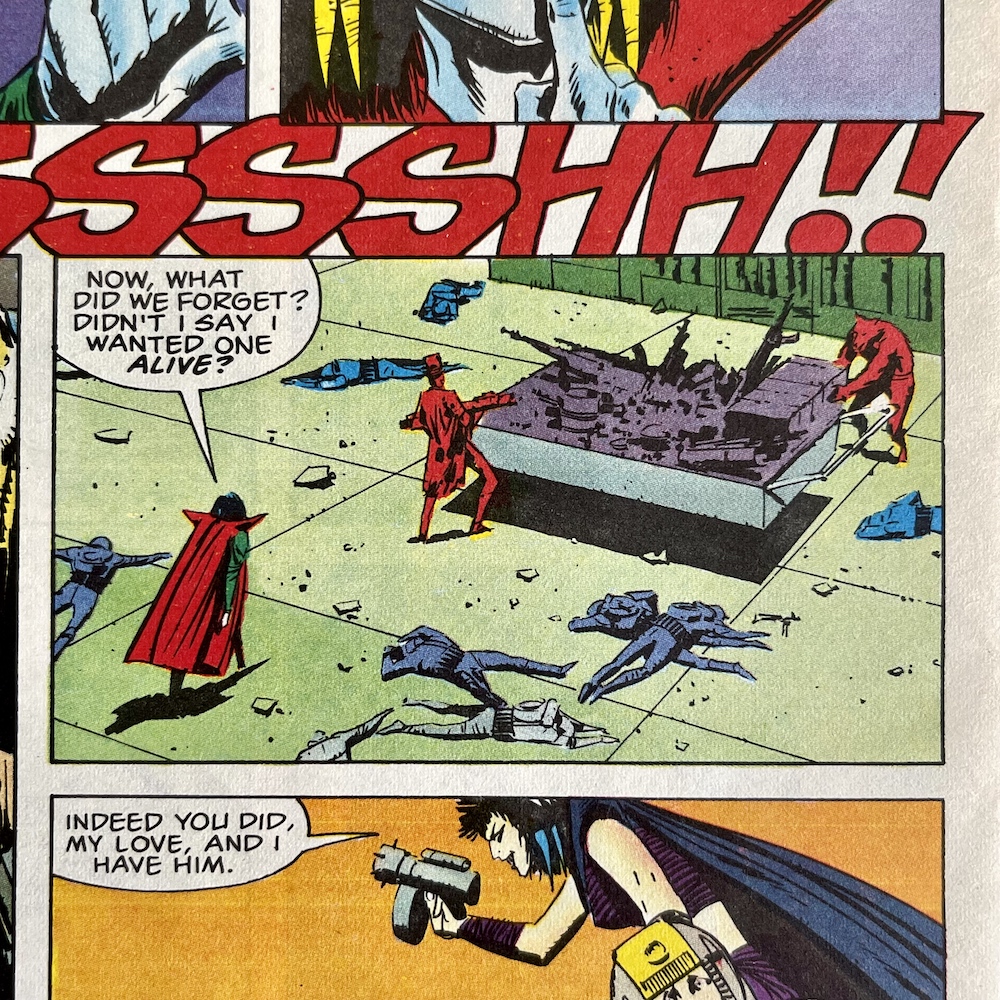
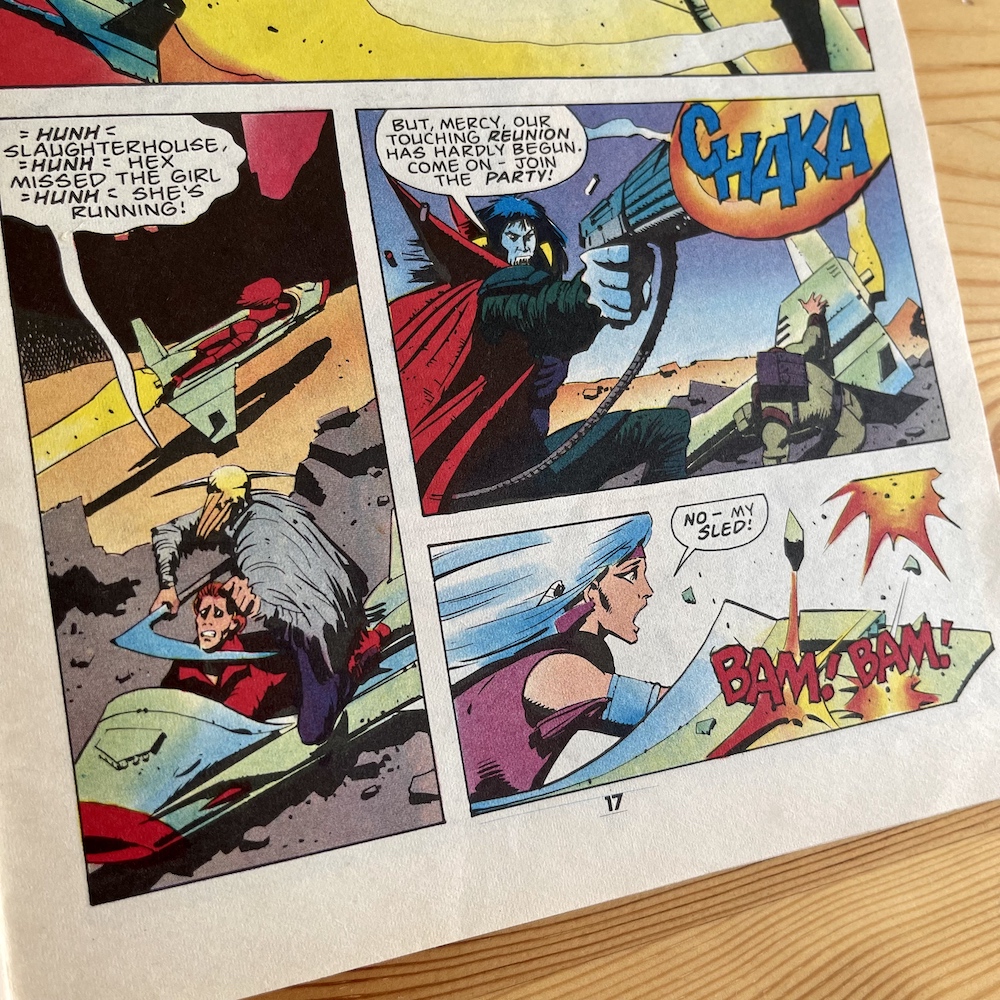
If last month’s debut felt like a typical yet very enjoyable 80s action flick, this feels like it could actually be the second half of that movie. The threat of The Evil Dead teased in the premiere issue’s opening pages comes full force this time around. The opening pages once again see that Game team take on a trained group of fighters, this time at a weapon’s depository that was apparently built to withstand an entire army. Over the course of these first seven pages they decimate the defence and make off with the weapons.

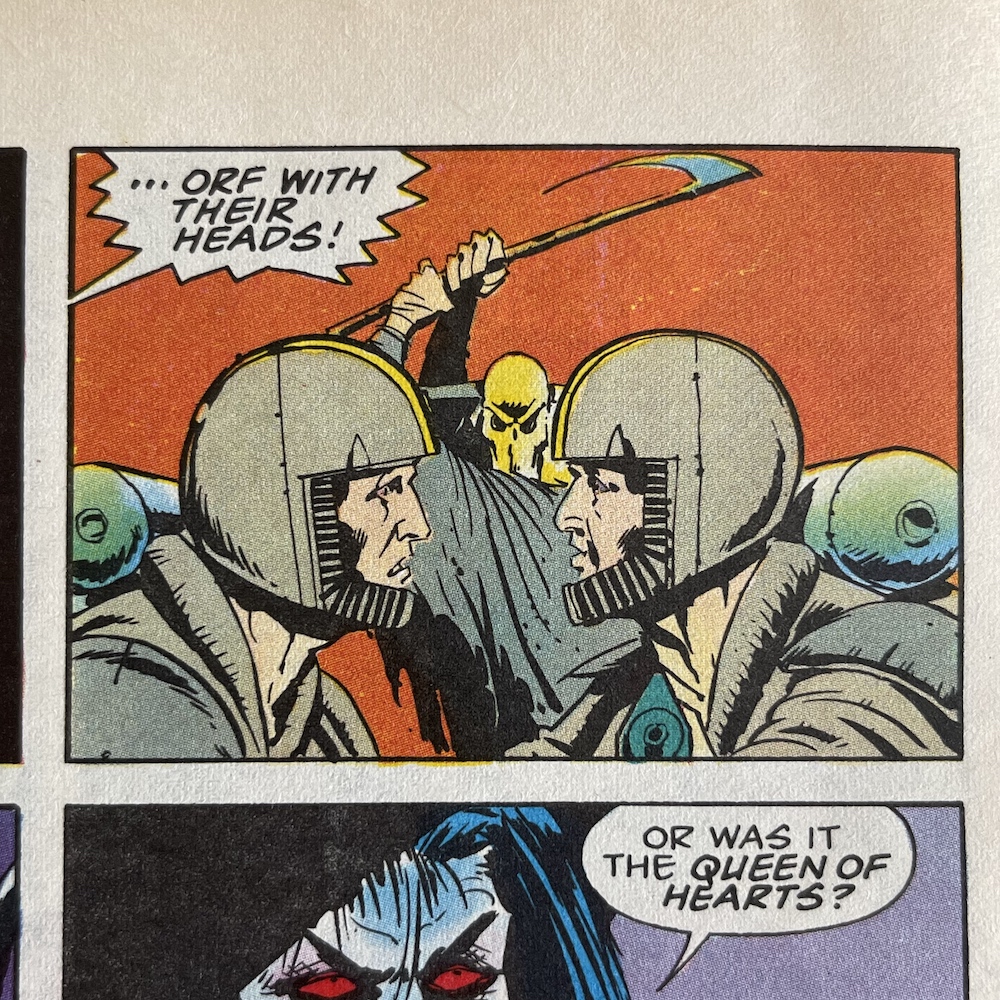
What I particularly like here is just how very ‘English’ The Evil Dead are, especially their leader Slaughterhouse. Shouting “Orf with their heads” before two soldiers get brutally decapitated, tutting when others put up a fight, using drawn out proper grammar and such words as “splendid” while all around is death and destruction. Believe it or not, there’s even a funny moment used to lighten the dark opening when they win their battle and dead bodies are strewn everywhere.

There’s something of note right off the bat with this issue’s story. The government is referred to as that of ‘Greater Britain’. Now for any readers of an international flavour who may not be aware, ‘Great Britain’ as we know it today is made up of England, Scotland and Wales. I live in Northern Ireland and that’s part of ‘The United Kingdom (UK) of Great Britain and Northern Ireland’. Northern Ireland is separate from ‘Great Britain’, a mistake many make. The fact the Dragon’s Claws comic refers to the government of Britain rather than the UK makes me think we’ve scarpered and rejoined Ireland away from the dystopia of the land within which The Game is set. Thank goodness! But anyway, I digress.

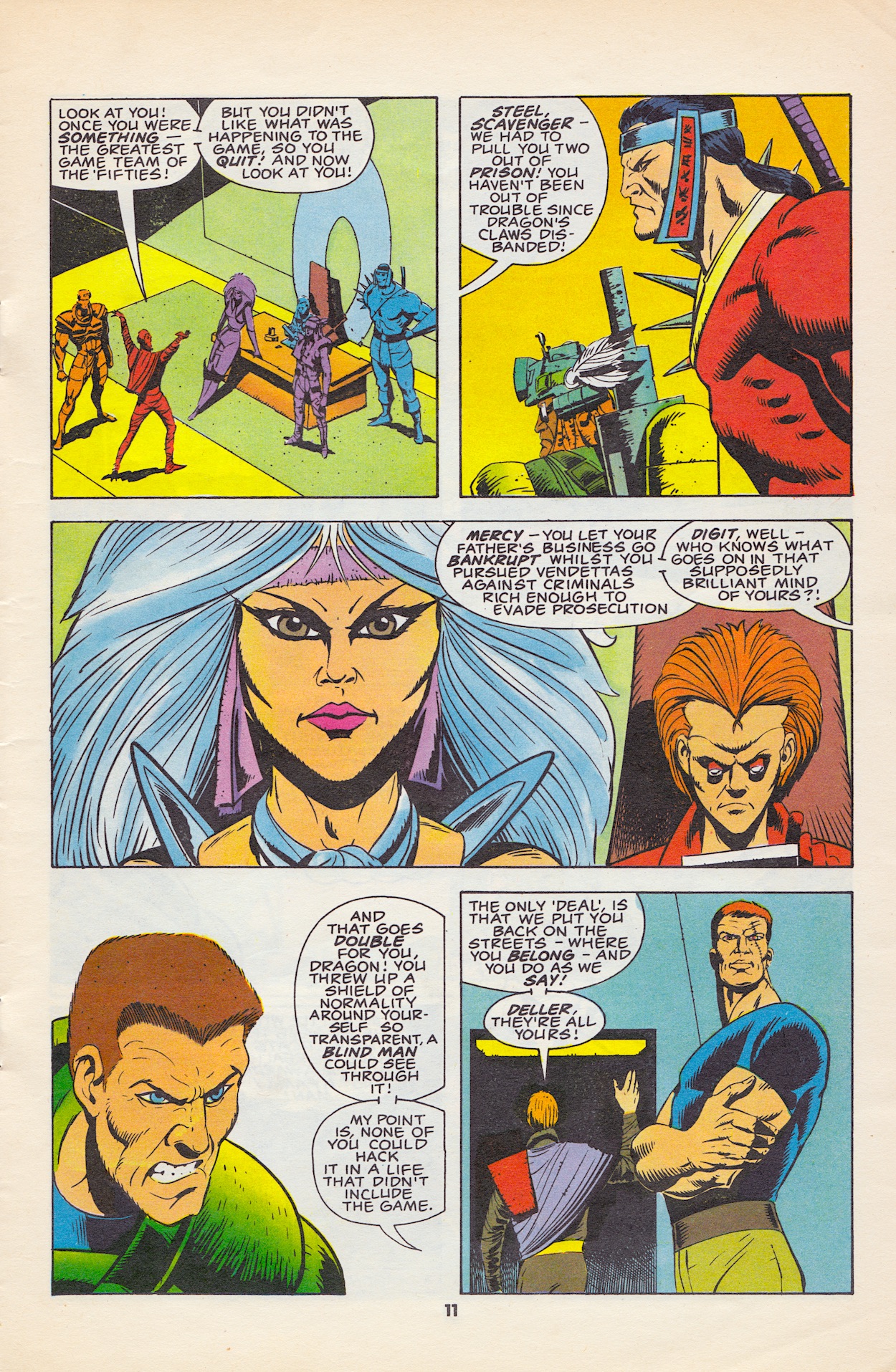
The one surviving soldier is taken to N.U.R.S.E. where Dragon, his team and the already irritating Deller (he’s meant to be irritating) are assigned their first mission by Stenson to kill The Evil Dead, as if they were nothing more than an irritant rather than murderers. The order is given in such a blasé way it’s clear N.U.R.S.E. care not for those they’ve hired. They give the orders and the foot soldiers must obey. This results in Dragon losing his temper because as far as his was concerned his team were independents, going out into Britain to clear up the mess of the government’s Game on their own. But Stenson has them over a barrel, he knows their lives felt meaningless without The Game and they back down.


“Mercy – you let your father’s business go bankrupt while you chased vendettas”

Stenson

We find out a little more about the various members of Dragon’s Claws here after last issue concentrated almost solely on Dragon. The most interesting one for me is Mercy, the sole woman of the team. Since they withdrew from The Game she’s used all the money from her father’s business to chase after those lawbreakers who had enough money to stop any potential repercussions from occurring. In the current climate we find ourselves in I do hope we find out more about her time doing that, it’s quite topical after all. (There’s also something very ‘Knight Rider‘ about that, a show where the hero chased after “criminals who operate above the law”.)

Dragon takes off and over the next couple of pages we see him back at his farm, now a desolate, abandoned wreck after the battle with the Wildcats last time. It’s these little quieter moments that have made these first two issues for me. It would’ve been very easy to have action from cover to cover but in such a fantastical set up these scenes ground our characters, the result being we believe in them, and care for them and the outcome of the story more. His family haven’t returned and then Scavenger turns up to warn him Deller has pulled rank and taken the team out in search of The Evil Dead.

Dragons Claws were opponents worthy of his skills, now he sees them as mere government lackeys

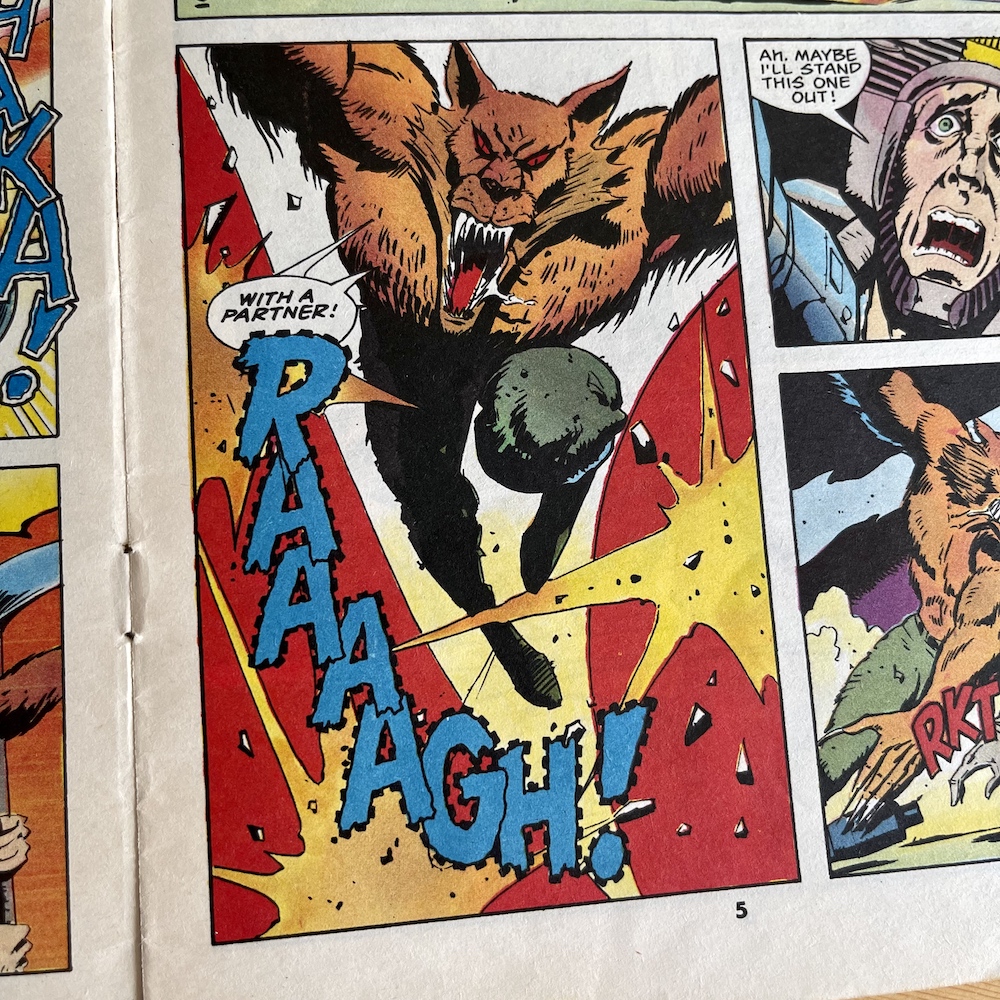
Deller is desperate to be the hero, the leader responsible for bringing them in or killing them, obsessed with personal glory. Of course, we can immediately see where this kind of character will end up leading the team, and that’s into immediate danger. The team’s protestations and attempts to quell his blood lust and self-importance fall on deaf ears. Seeing the lion-like Feral feasting on a dead body out in the open Deller immediately gives chase into an enclosed area, the Claws trying to stop him but it’s too late. Of course it’s a trap.

Another little moment here is the area this is taking place in is referred to as ‘The ‘Pool’. Clearly meaning Liverpool, it’s an area Steel stays away from because it’s known as The Evil Dead’s home, somewhere they know like the backs of their hands and would obviously have the advantage. One-by-one this advantage see the Claws fall. Captured, Slaughterhouse is more disappointed than angry. Dragons Claws were opponents worthy of his skills, now he sees them as mere government lackeys.

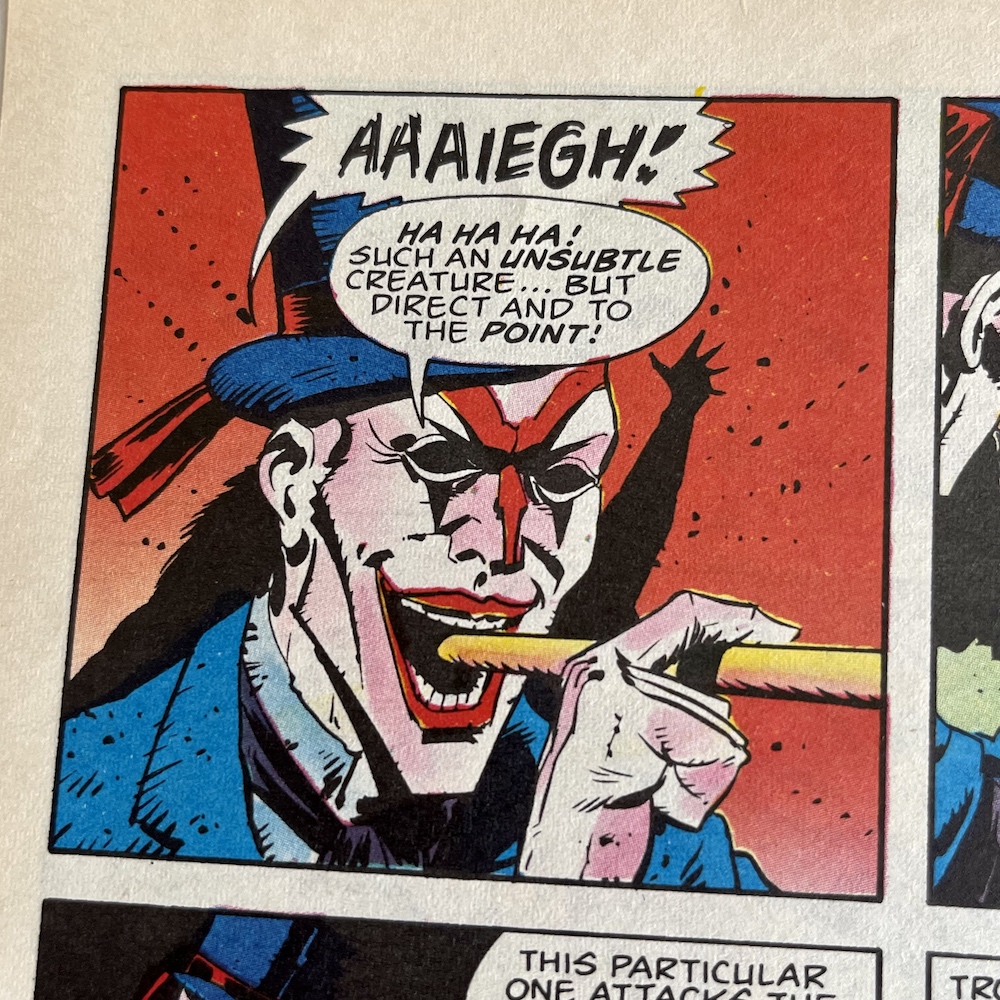
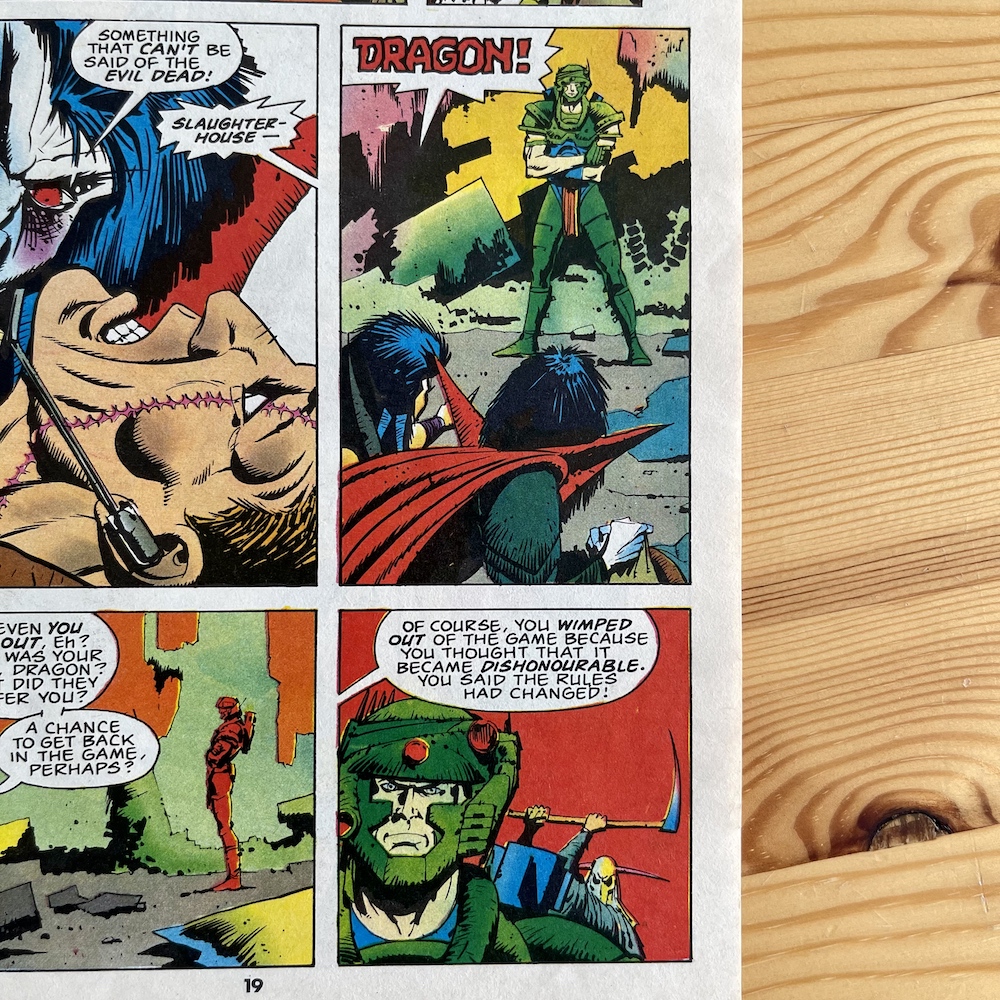
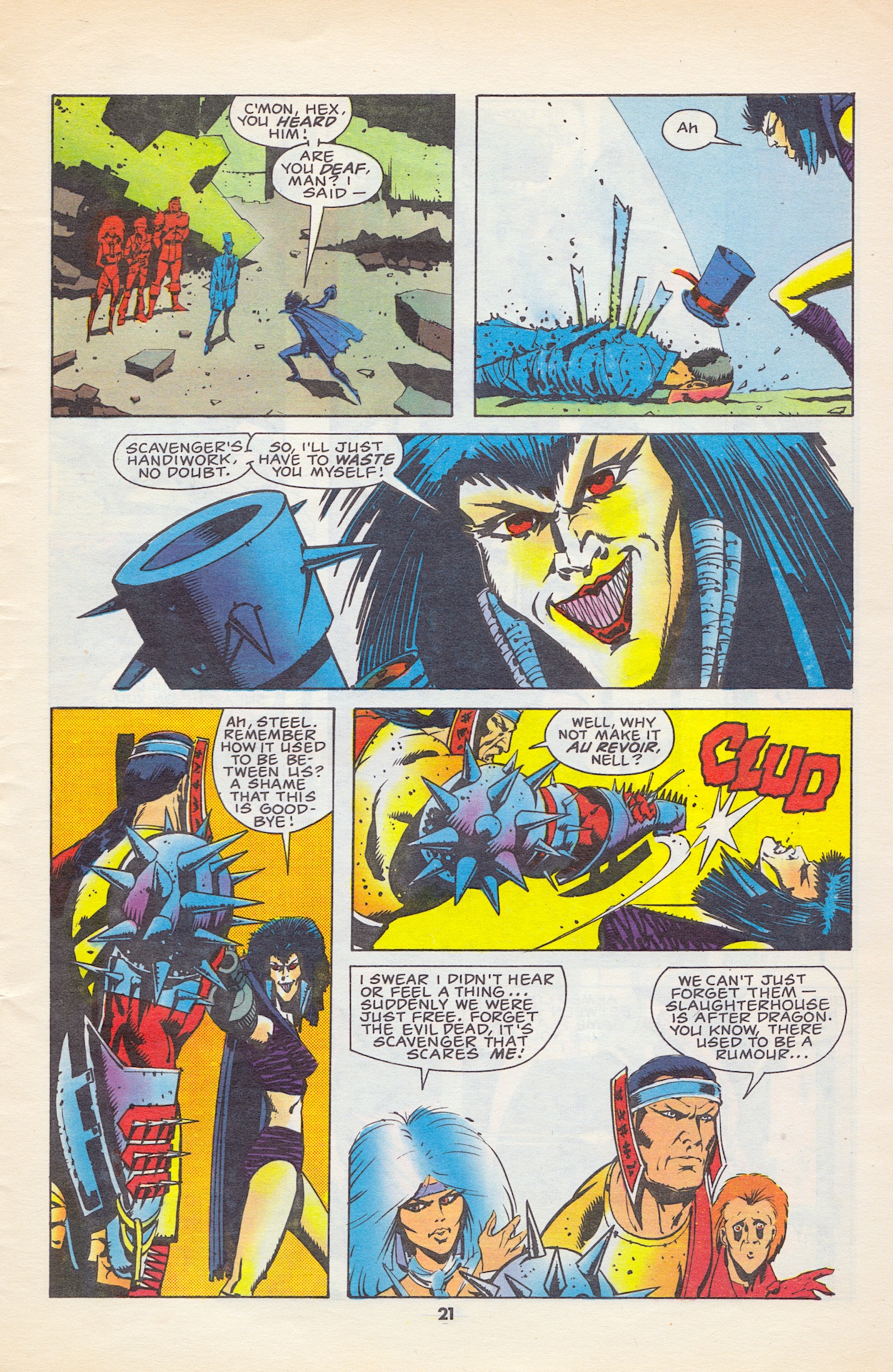
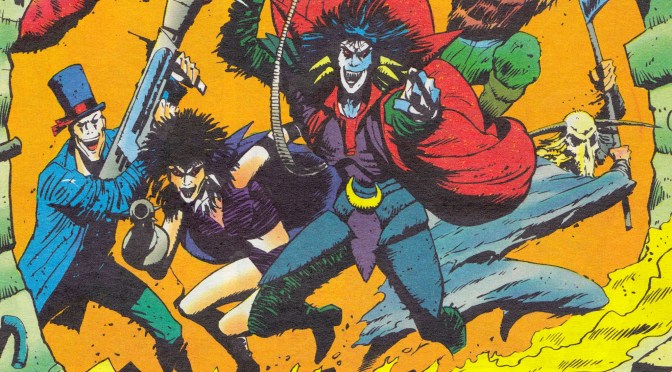
As you can see Dragon appears at the last moment, saving Deller’s life. He’s no stranger to having an advantage himself and as the Grim Reaper-esque Kronos sneaks up behind him Feral notices Dragon has no scent. He’s a hologram and there’s a pressure pad just behind it, which Kronos steps on, instantly exploding. The other members of The Evil Dead are Hex, a circus showman with poisonous darts and hypnotising eyes and Death Nell, Slaughterhouse’s other half who appears to have had some kind of romantic history with Steel!

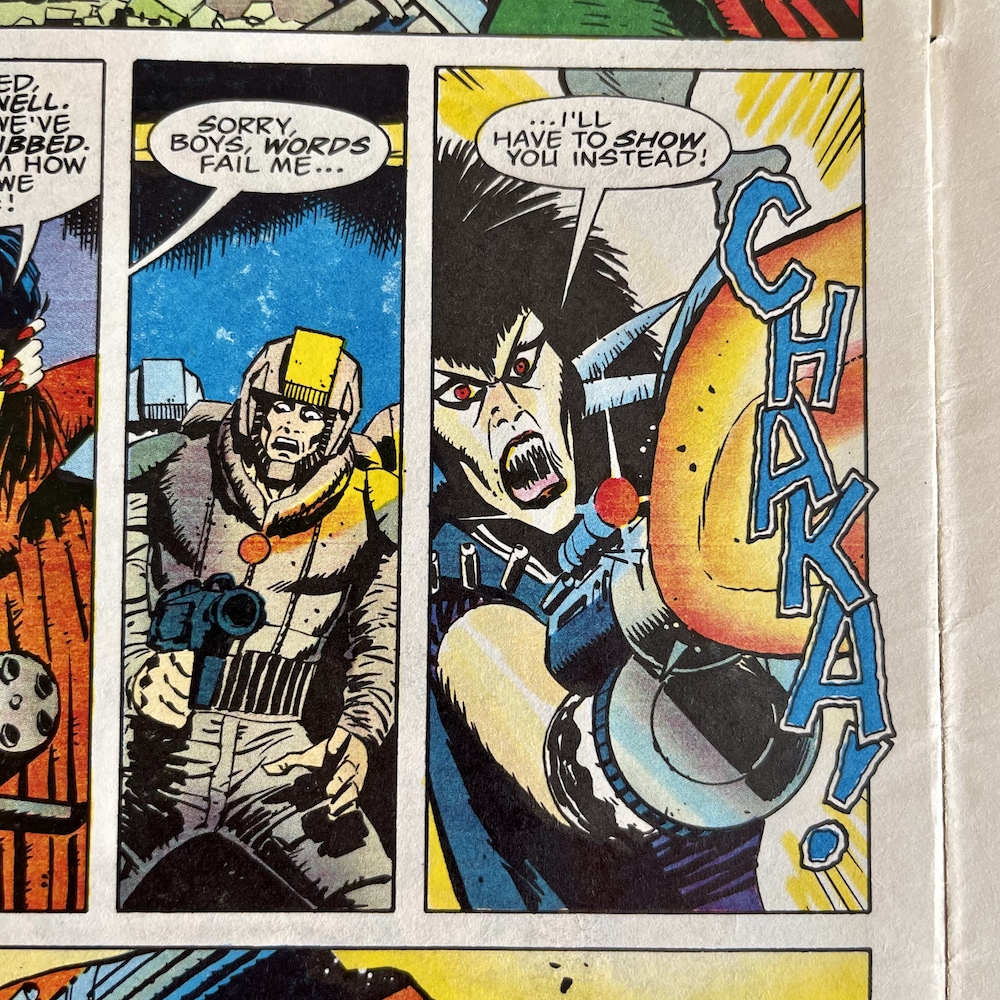
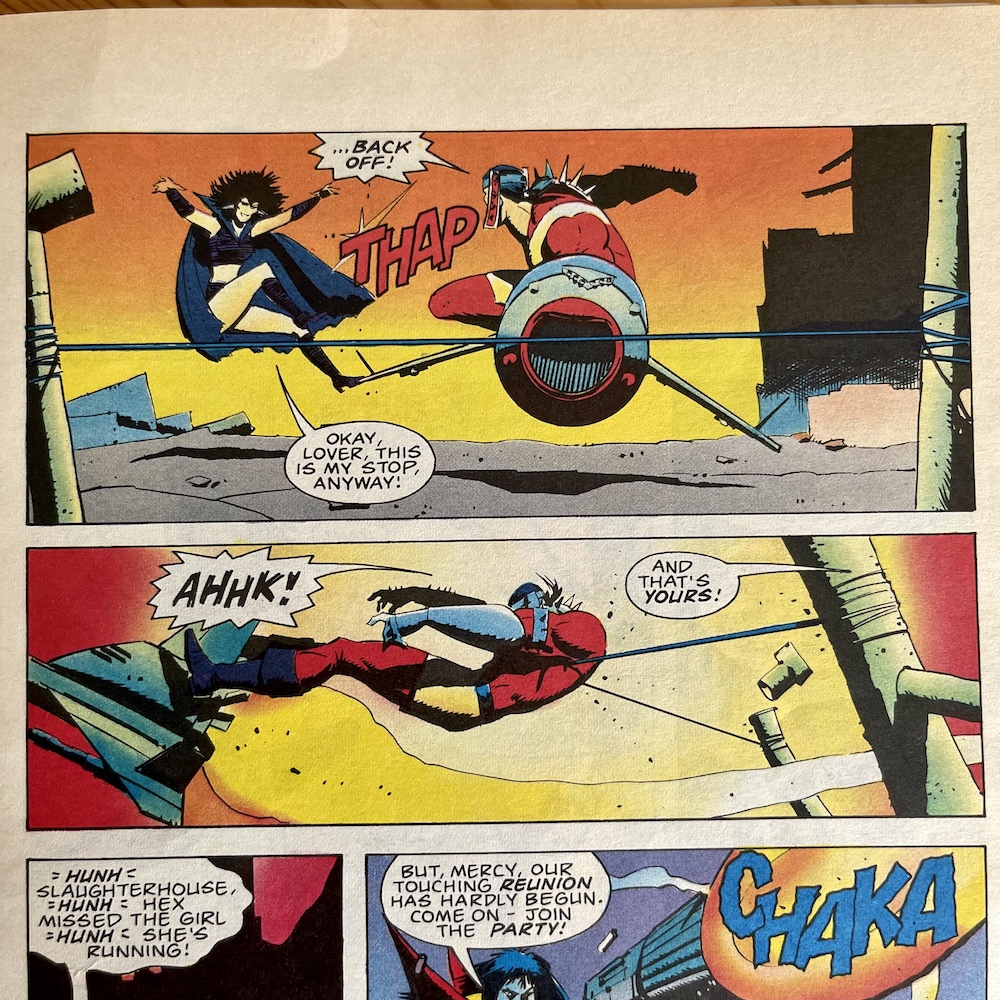
Anyway, the battle we’ve been building up to is rather short and sweet but no less entertaining and ultimately satisfying. On one page Slaughterhouse’s order to kill the Claws falls on deaf ears, or rather dead ears. Scavenger, a master of stealth if last issue’s cameo and the fact he was able to sneak up on Dragon on his farm are anything to go by, has quietly severed his team mates’ bindings (without even them knowing how), meaning Steel can surprise Nell in a moment that initially confused me. Initially, I questioned why he didn’t just hit her earlier? It hadn’t been clear from previous panels they’d had their hands tied behind their backs until Mercy’s explanation made me go back and check.

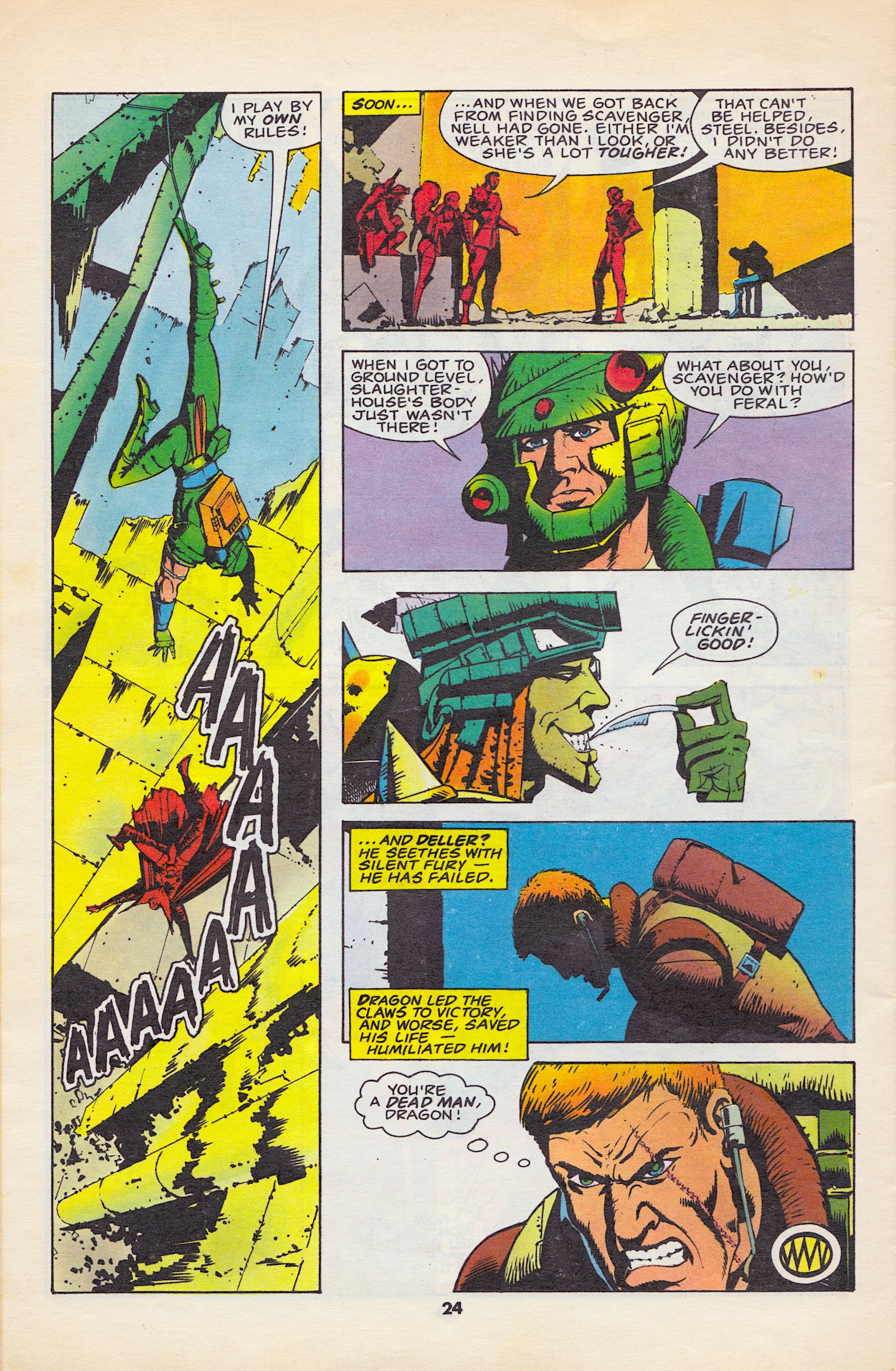
Dragon is sniping from scaffolding on top of a very tall building nearby and as Slaughterhouse lunges at him he’s apparently taken by surprise, getting scraped by huge nails and kicked in the head in the process. But like the hologram there’s a bit of clever misdirection here on Dragon’s part. Riling Slaughterhouse up until his anger takes over and he leaps through the air, Dragon doesn’t dodge out of the way or put up a fight, instead grabbing Slaughterhouse and letting his momentum push them both over the edge.

Special mention must be made of Steve White’s colouring. It’s glorious!

Then, as we turn to the final page we can see he’d actually tied his ankle to the building, stopping him as Slaughterhouse falls to his apparent doom.  Of course with a team made up of such characters as The Evil Dead, and with hints in the story that they may actually be dead already, there’s no sign of his body. As for Feral, it looks like Scavenger made a meal out of dealing with him! Their leader and his girlfriend may be the only ones to have survived now that Dragon’s Claws have been sanctioned to kill.

Written by Simon Furman and enthusiastically brought to the page by Geoff Senior, with editor Richard Starkings on lettering (under the pseudonym ‘Zed’), special mention must be made of Steve White‘s colouring. It’s glorious! His work on Transformers was always exemplary but this surpasses even that. His backgrounds are atmospheric, shading can be subtle in places like faces and in-your-face in others. It’s big, brash and bold in the very best possible way. (Check out his colour work for Xenozoic Tales in an issue of Jurassic Park too!) This is a collection of creative people that could give Dragon’s Claws a run for their money in the teamwork stakes.

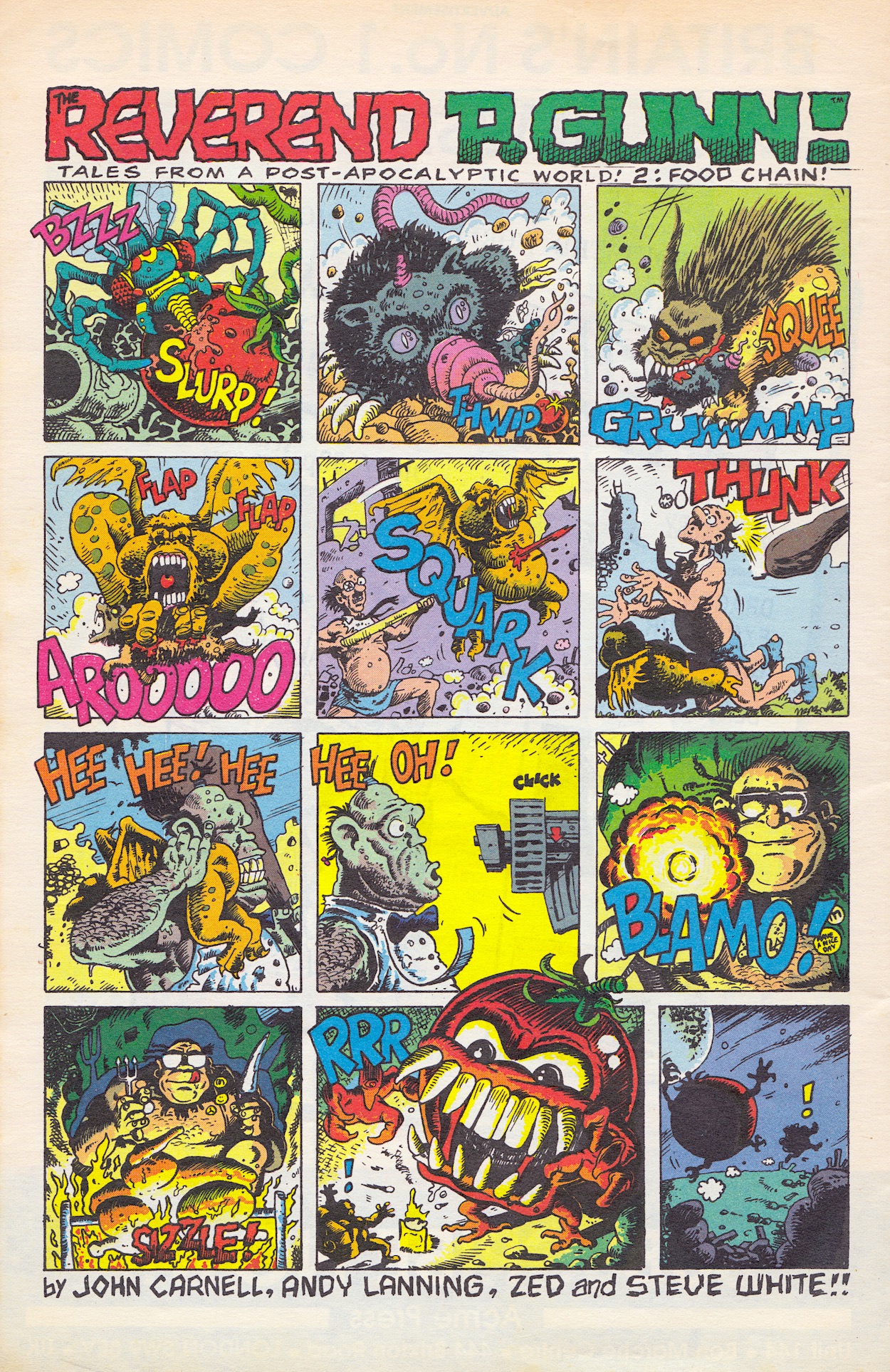
Strangely one of the Marvel UK adverts in this issue is for the comic the reader was actually holding. Weird. There’s also a humour strip, a constant in most of the publisher’s action titles. The Reverend P. Gunn’s debut last issue wasn’t great but this one is funny and the art is great fun. Along with Richard and Steve, writer John Carnell and artist Andy Lanning were well known to me at the time from The Real Ghostbusters and this is a perfect outlet for their bizarre sense of humour that I loved so much in the licenced comic. Would further strips have been funny or more like last month’s? Who knows? This was also Gunn’s final appearance!

So yes, Dragon’s Claws has produced another dynamite issue. It feels very much like the second part of last issue’s introduction and I am perfectly fine with that. I want to find out so much more about these characters already and I know there’s the real potential here for that to happen while not skimping on the action, thanks to Simon’s writing. If I’d known about the comic at the time these first two issues would’ve had me hooked and placing a regular order at my newsagent. Today I’m hooked and you can look forward to regular coverage, the next bit of which will be the review for #3 on Sunday 13th August 2023.

iSSUE ONE < > iSSUE THREE

DRAGON’S CLAWS MENU

THE REAL GHOSTBUSTERS: PREMiERE iSSUE ANNiVERSARY

I admit that back in 1988 when I finally got to open my copy of The Real Ghostbusters‘ premiere issue I was a little confused. I’d been looking forward to something more along the lines of Marvel UK‘s Transformers comic, with a lengthy multi-part story and certainly no text stories which I associated with comics aimed at much younger kids. However, any confusion, or indeed initial disappointment, evaporated as soon as I started to read.

By the end of its 24 pages I was hooked and didn’t regret placing the order with my newsagent before even reading it. In fact, I stayed with the comic for the majority of its run. Now, 33 years later I’ve just finished reading issue one for the first time in decades. So how does it hold up to reading today?

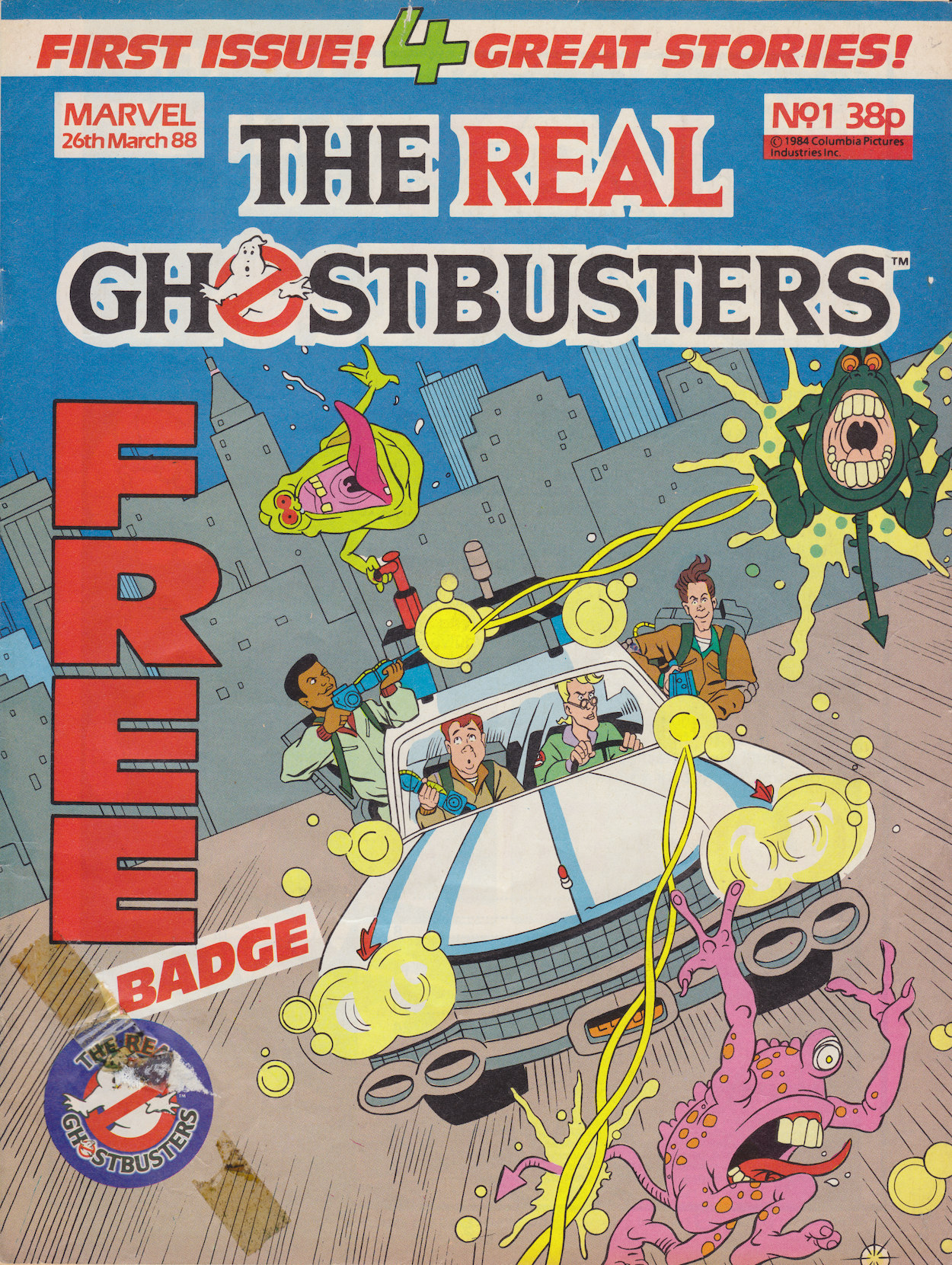
That front cover is nothing short of iconic, often copied by my young self back in the day on several school exercise books. Andy Lanning (The Sleeze Brothers, Superman, Majestic) and Dave Harwood‘s (Action Force, Swift Sure, Conqueror) introduction to this new title perfectly captures the light-hearted tone of the comic. Unlike the aforementioned Transformers I’d enjoyed reading at my friend’s house, The Real Ghostbusters would focus on smaller, complete tales aimed at getting a chuckle out of its readers. A unique approach, brave even, but they pulled it off and created a comic like no other.

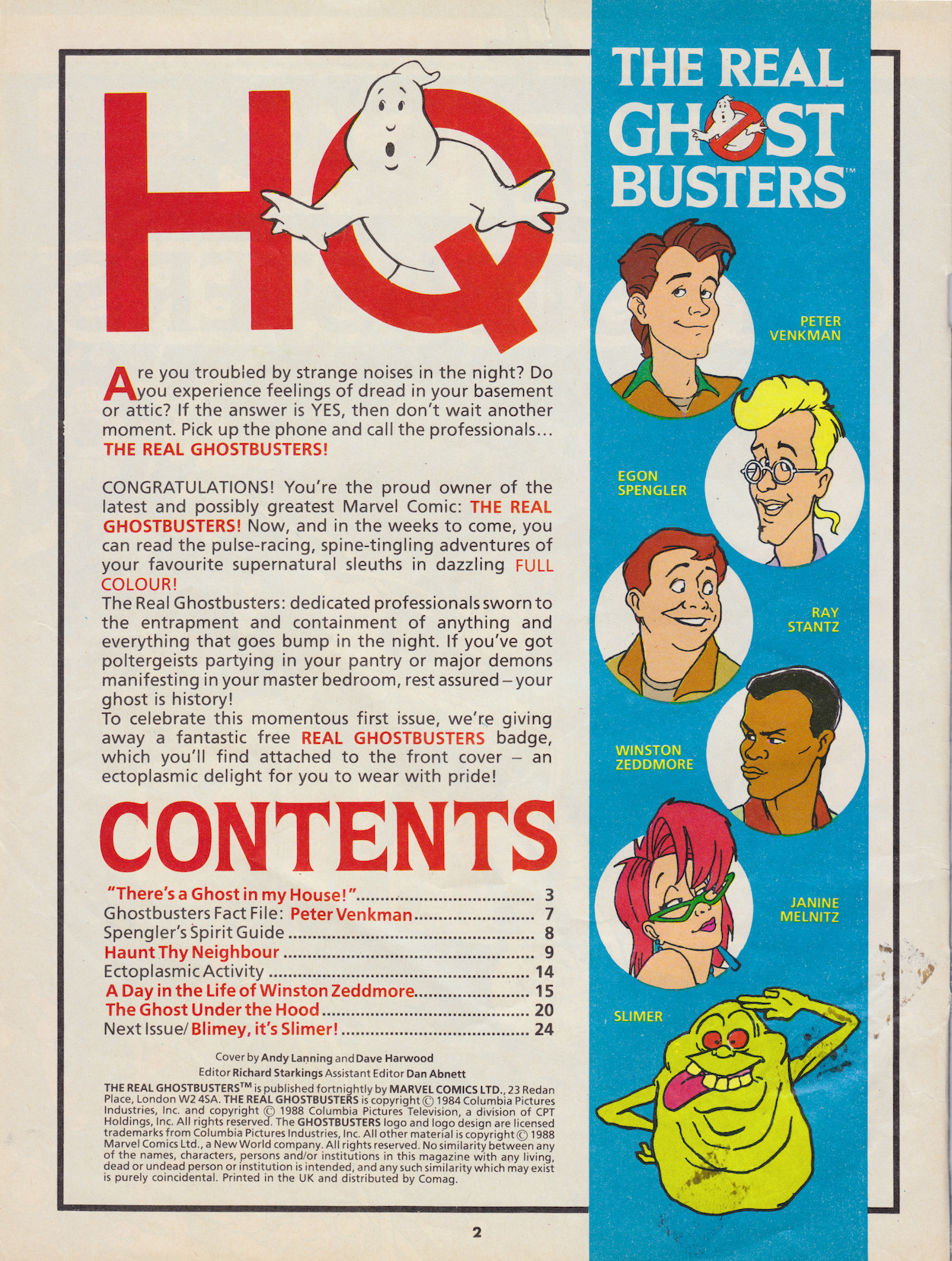
The first issue has no less than three strips and a text story, fact-file, activity page, ghost guide, request for readers’ letters and of course a Lew Stringer strip. (What Marvel comic was complete without Lew?) It’s all introduced on the HQ page which starts off the whole shebang by reciting the movie, setting the tone perfectly for this comedy comic (a term I’ll clarify later). The overall design wouldn’t change, there’d be no ‘new look’ every 50 or so issues, instead the cover and feature pages remained the same almost until the very end.

There’s certainly a confidence about it from the very start.

All of the strips here are written by John Freeman (of Down the Tubes). Editor of Doctor Who Magazine at the time, he was asked by the comic’s launch editor Richard Starkings to supply stories for the first issue. John told me this was literally his first regular writing gig, which is incredible since this was the launch of a brand new comic based on such a hot property. Needless to say, John knocks it out of the park.

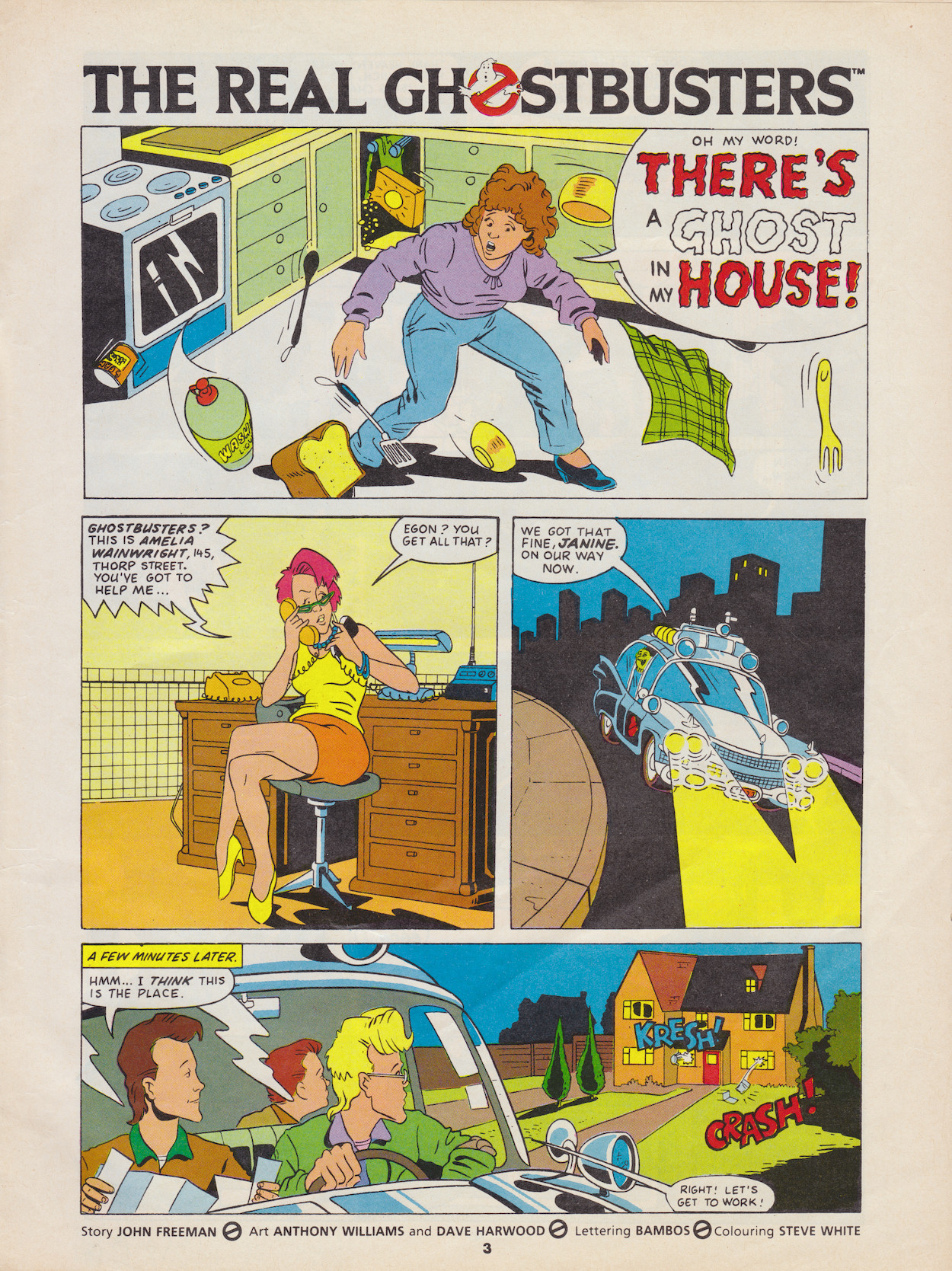
As with the other stories, “There’s a Ghost in my House!” takes place with the team already on the job and gives us an idea of the pacing we can expect, as well as acting as an introduction to the Ghostbusters’ equipment, interactions and most importantly their humour. That’s all it really needs to do, but there’s still a twist. The ghost itself is a buggane, a house ghost and harmless if treated right. The homeowner ends up feeling sorry for it and in the end keeps it as a pet!

Dave’s inking added ample shadow work to gloomy, haunted scenes in the annuals

The strip is drawn by Anthony Williams (Judge Dredd, Fate, Sinister Dexter) with Dave Harwood on inking, lettering by future Slimer! artist Bambos Georgiou (Knights of Pendragon, Spectacular Spider-Man, James Bond Jr.) and coloured by Steve White (Transformers, Xenozoic Tales in Jurassic Park, editor of Visionaries). One of the other stories, The Ghost Under the Hood is also drawn by Williams but with Dave Hine (Detective Comics, X-Men, Night of the Living Dead) inking and there’s quite the difference. For the previous blog site I’d read a couple of the annuals and Dave’s inking added ample shadow work to gloomy, haunted scenes and made for some atmospheric illustrations. Finally, this strip is coloured by Paul Jacques (Adventures of the Galaxy Rangers).

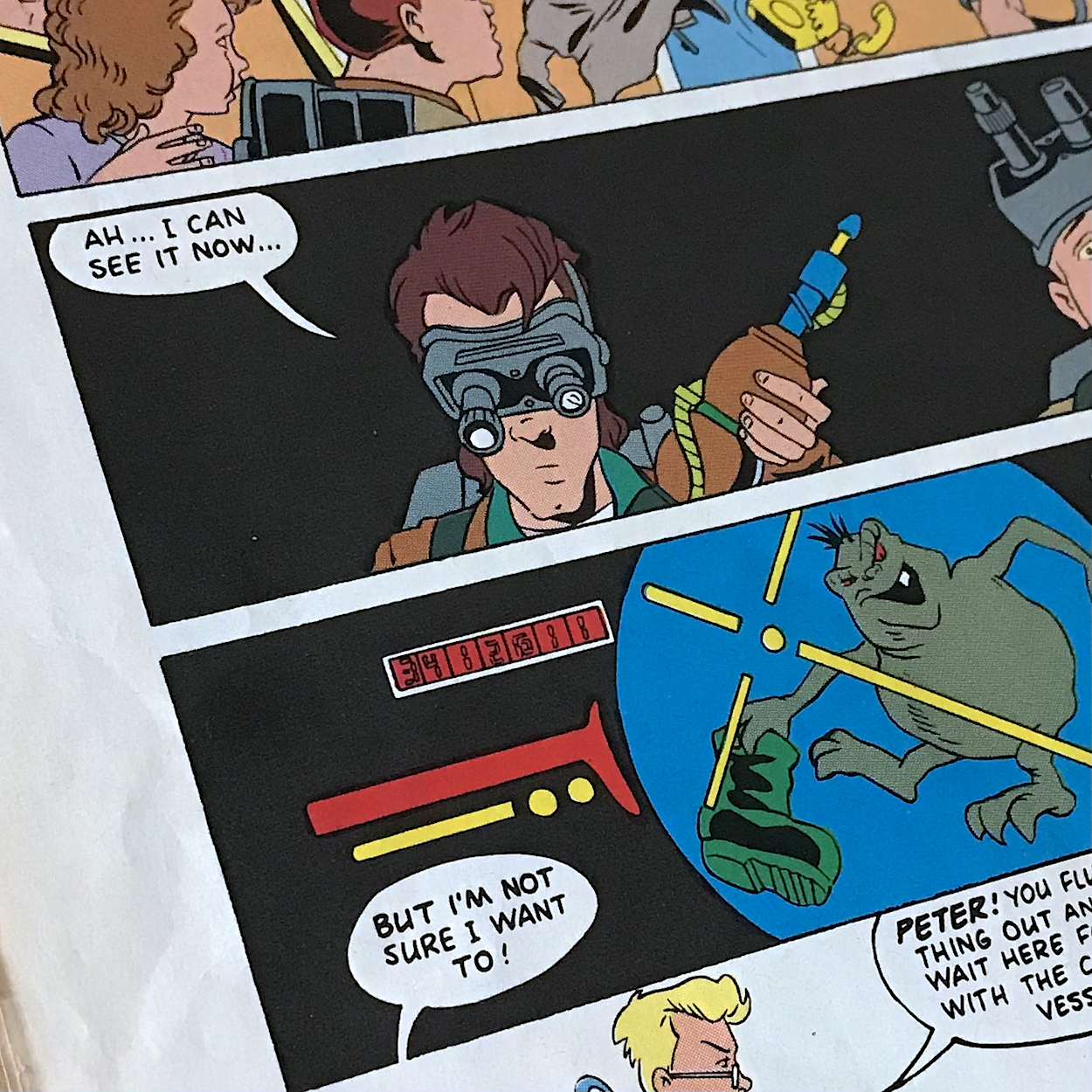
Again, it’s full of action and humour and plays out like one scene has been plucked from an episode of the cartoon. This was Richard’s intention, he wanted each story to take place right in the midst of the action whenever possible. Here, Ecto-1 is out of control, Egon unable to steer or brake. You can see from the page above the plan isn’t to Peter‘s liking and in the end the car suddenly stops, sending him flying. Now parked outside a Chinese takeaway, their perpetually hungry pet ghost Slimer appears from under the hood.

To establish a scene and scenario, pack in some action, wit, character and a funny conclusion in just three pages is quite the achievement. Indeed, by the time I finished reading the comic I was a little breathless (metaphorically speaking) with the fast-paced nature of the stories and gags.

The humour in their interactions was always well developed and genuinely very funny

The covers were mainly used to illustrate the text stories, doubling up as their title pages. So yes, basically we’d be getting two identical pages in our comic but we didn’t care, some of the front covers would have us frantically flicking straight to that story. This was especially true later in the run with some simply stunning artwork on the covers.

I’ll admit it took me a handful of issues before I read one of the prose stories as a kid because of a false perception they were aimed at younger children than me. But I remember discovering just how good they were and reading all the ones I’d glossed over one very enjoyable afternoon. From then on they often became the first thing I would read.

Space constraints might have been a factor here, but they would often focus on just a couple of members of the team per story. This would give each individual character time to shine, and in doing so the humour in their interactions was always well developed and genuinely very funny.

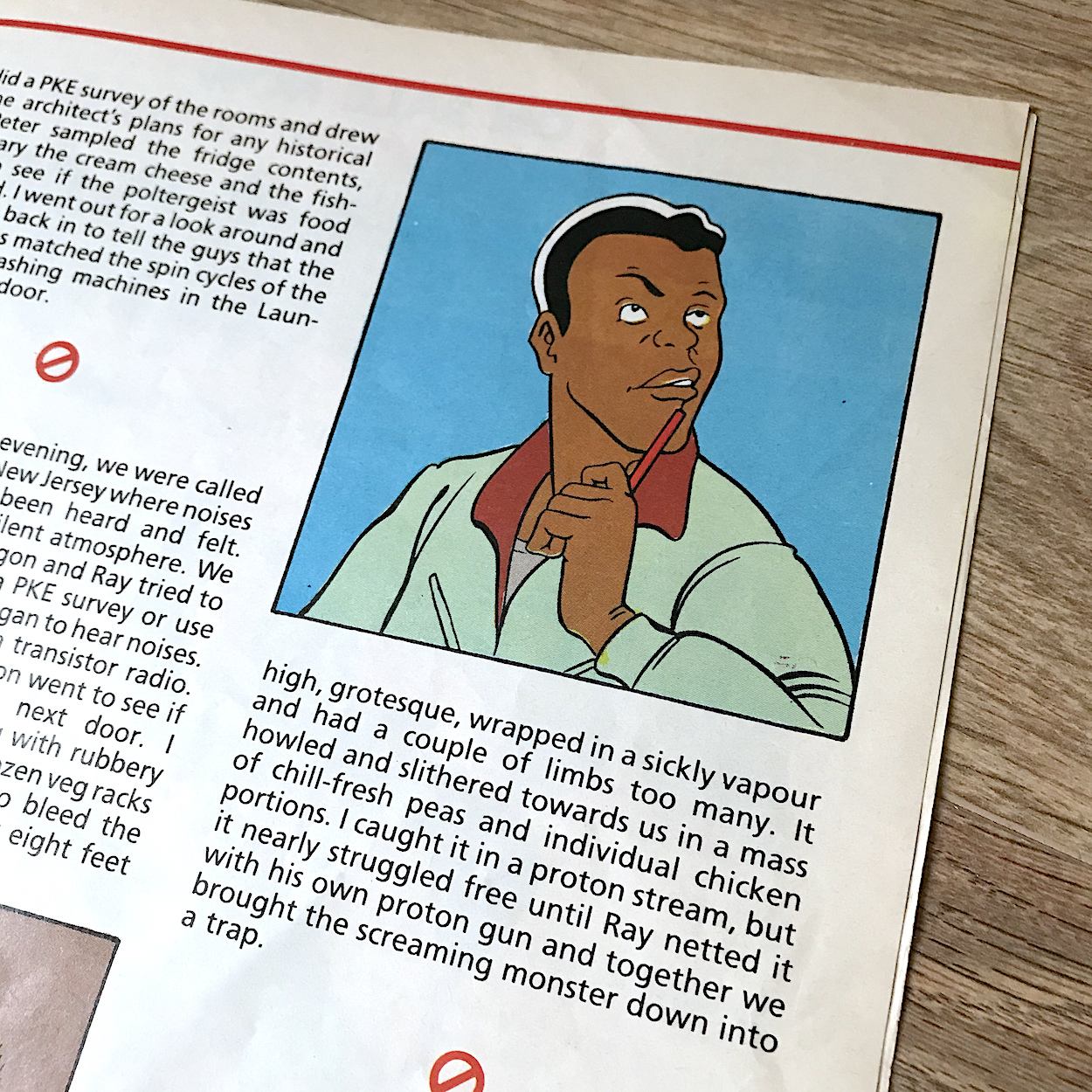
None were funnier than the Winston’s Diary series which ran in alternate issues, with Brian Williamson‘s (Doctor Who, Totally Primeval, Batman) panels repeated each time. In this issue, my favourite character takes us through a typical day in the life of the team. In this issue’s story, over the course of a few busts Winston’s cool head provides a hilarious contrast to the others. Here’s just one example, where a rock star is hearing strange noises in his apartment:


“The apartment was newly decorated and equipped. Egon took PKE readings in all the rooms. Ray spectra-scoped the walls and balcony. Peter explained that he must carefully examine the rock star’s expensive Hi-Fi and video in case the ghost was lurking there. We all heard weird noises, groans and whines. I bled the air bubbles from the newly-installed radiators and the noises stopped.”

Winston Zeddmore (Dan Abnett)

This repeats throughout the day, Egon and Ray going to ever more extreme methods of ghost hunting, Peter finding something to distract himself and Winston solving the problem with common sense. It’s deadpan humour at its best.

Another text feature would also be a highlight every issue.

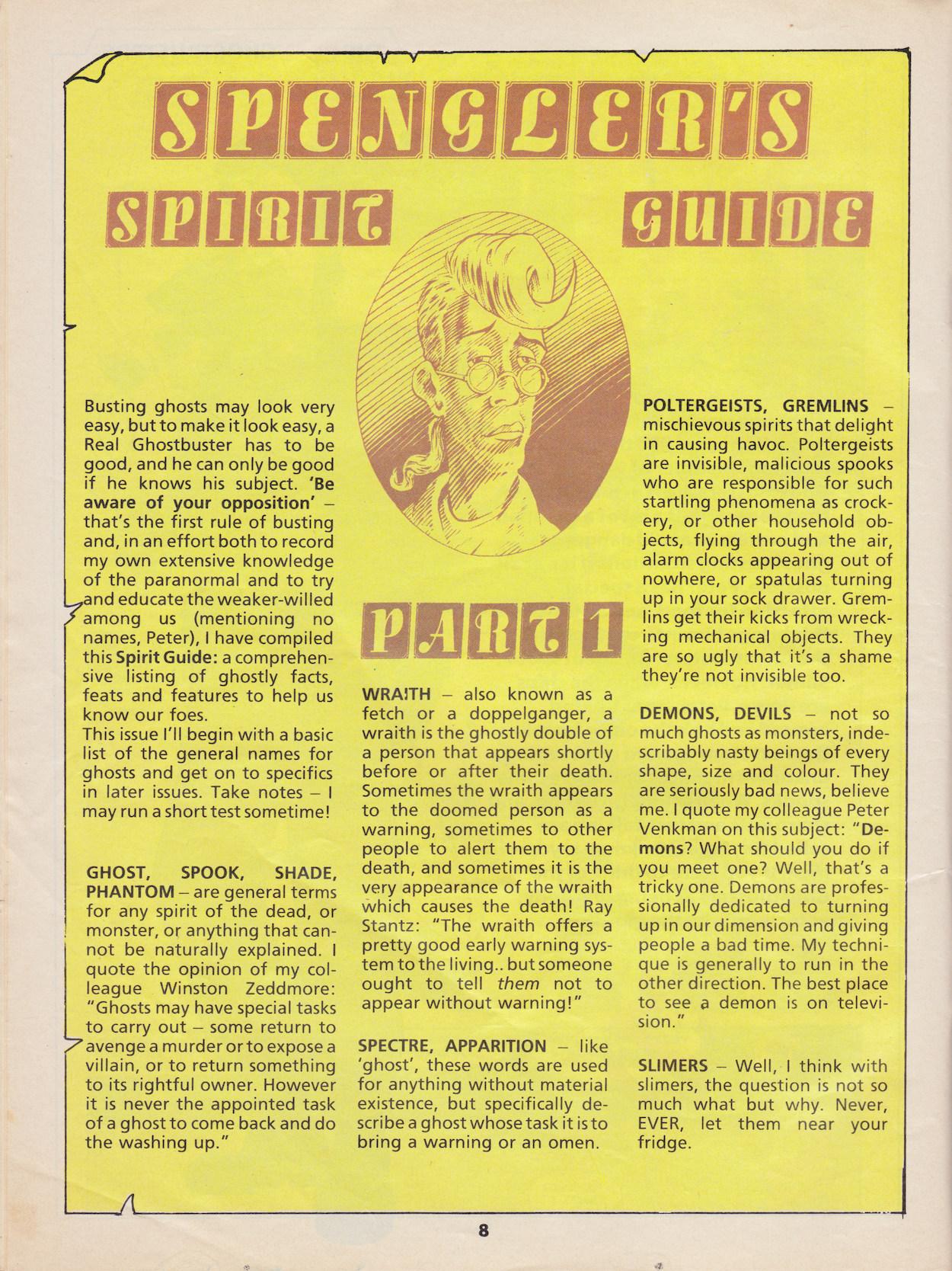
Spengler’s Spirit Guide appeared in every issue until just before the end. In the film and cartoon Egon would make reference to ‘Tobin’s Spirit Guide’ and this ongoing series was his own version of said tome. These were all written by Dan Abnett (Knights of Pendragon, Death’s Head II, Sinister Dexter), which is no small feat when you think about how the comic went weekly from issue 14 onwards and he created well over 150+ altogether! In an issue which featured The Four Horsemen of the Apocalypse the Guide detailed the other half dozen or so Horsemen that don’t get talked about. I can remember laughing hard at that one in particular.

I’ve found out recently that little illustration of Egon was drawn by none other than future Marvel US, DC Comics and 2000AD artist Cam Smith (Supergirl, The Incredible Hulk, Gen13). This means Cam’s work appeared in more issues than anyone else’s of course, technically speaking.

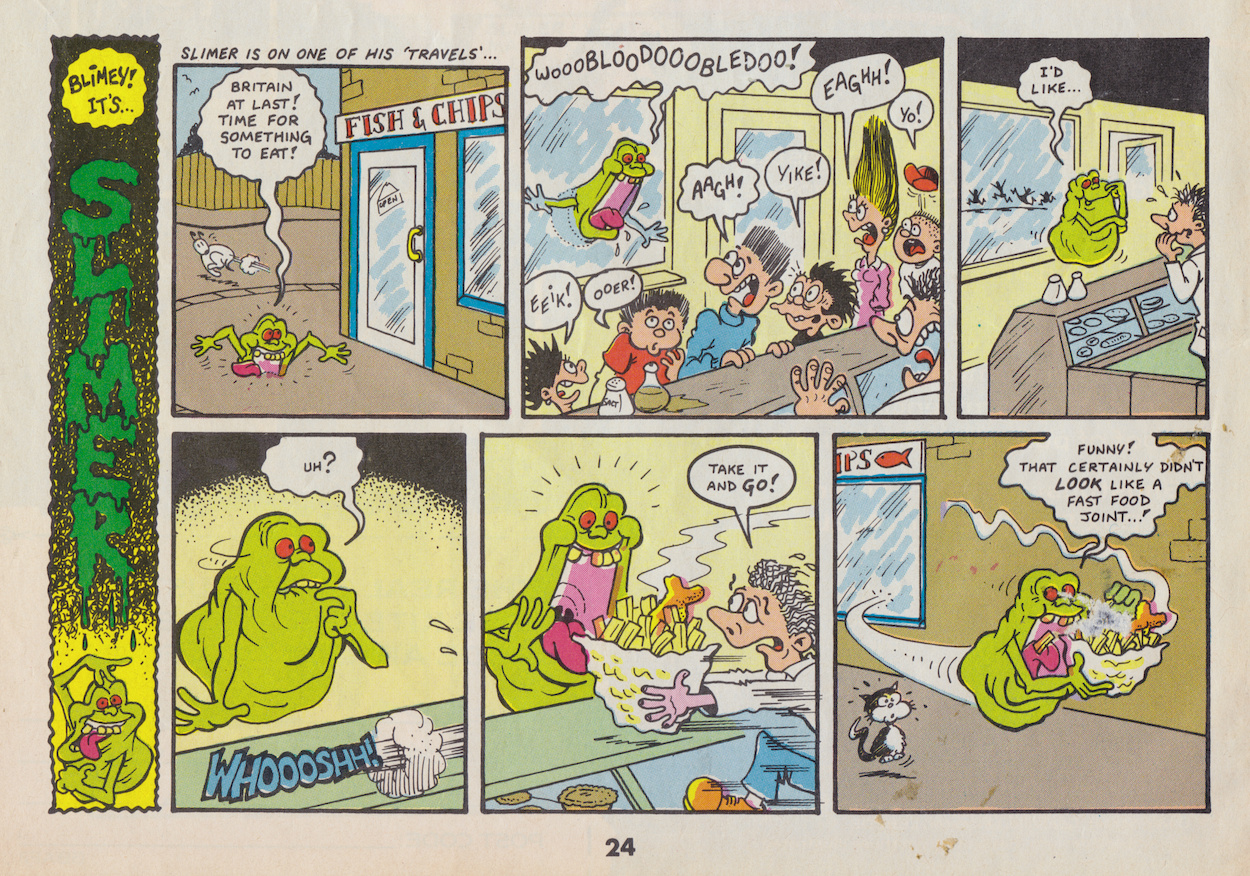
With Lew Stringer at the helm Slimer made his way to Britain for a slap up feed

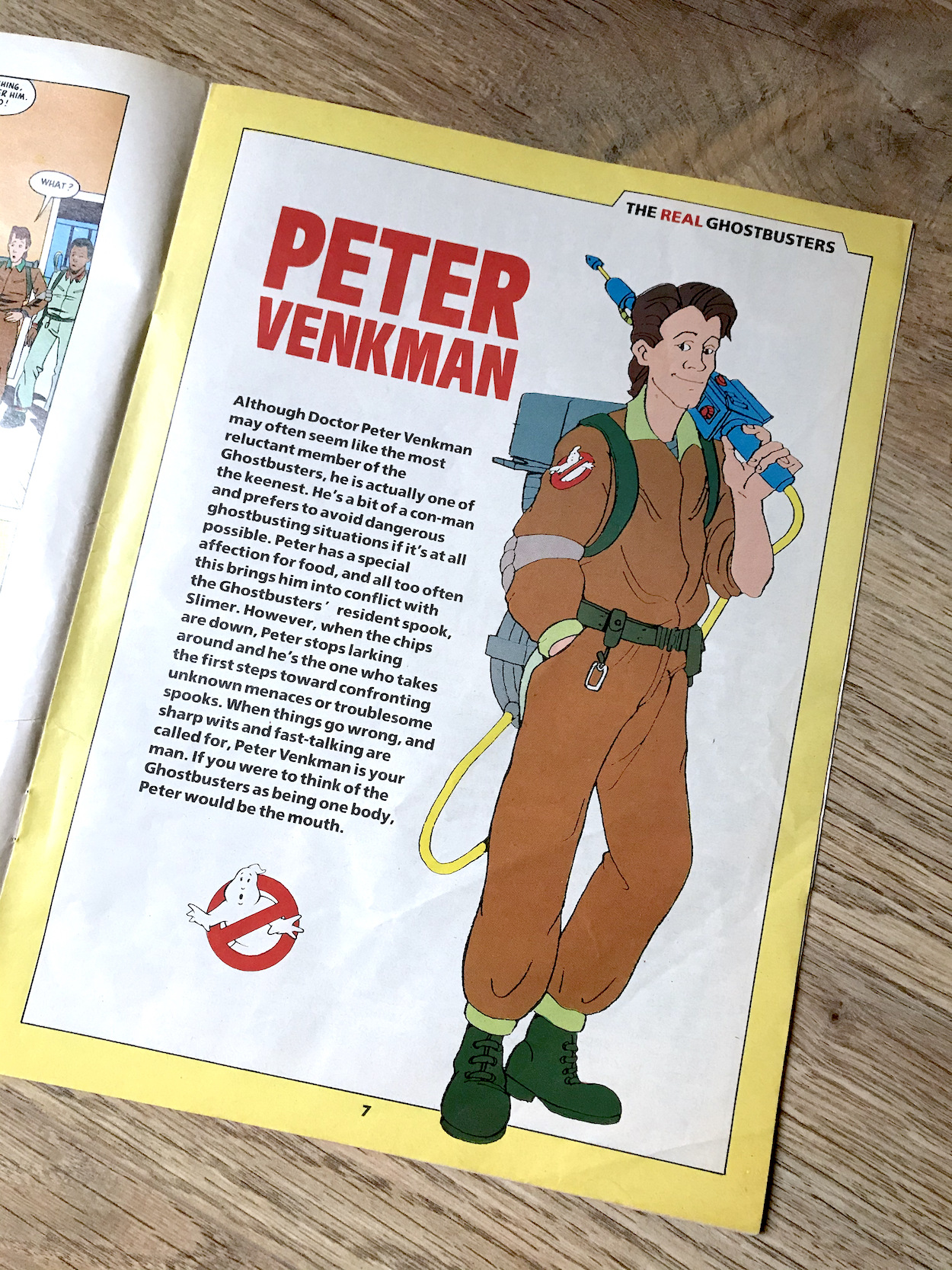
This issue also contains the first fact-file. As a child I drew a combined figure of the Ghostbusters based on that final sentence. From what I remember Egon was the brain, Winston the heart, Slimer the stomach (obviously) etc. It was a real Frankenstein’s monster which I decided not to send in to the letters page because, well, some things just aren’t meant to be seen.

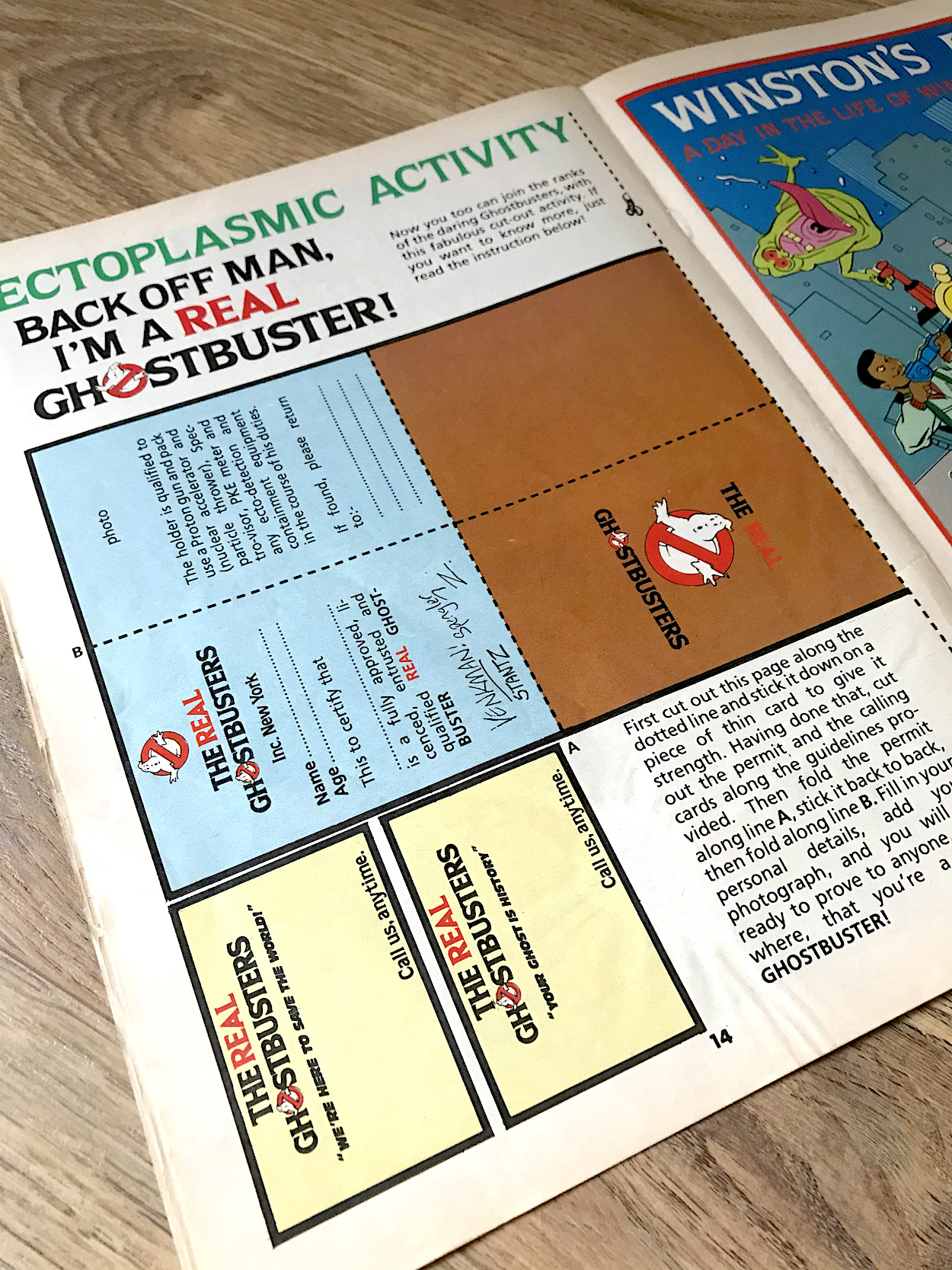
Once in a while the comic would include what it called Ectoplasmic Activity, such as this membership card and masks in a couple of future issues but it didn’t appear much, unlike Blimey! It’s Slimer. While it wouldn’t be too long until Bambos (letterer on our first strip) took over, at the beginning the little green blob was in the hands of OiNK‘s very own Lew Stringer. Of course, with Lew at the helm Slimer is going to make his way to Britain for a slap up feed.

Lew has written a blog post about his time on the comic, which you can read here.

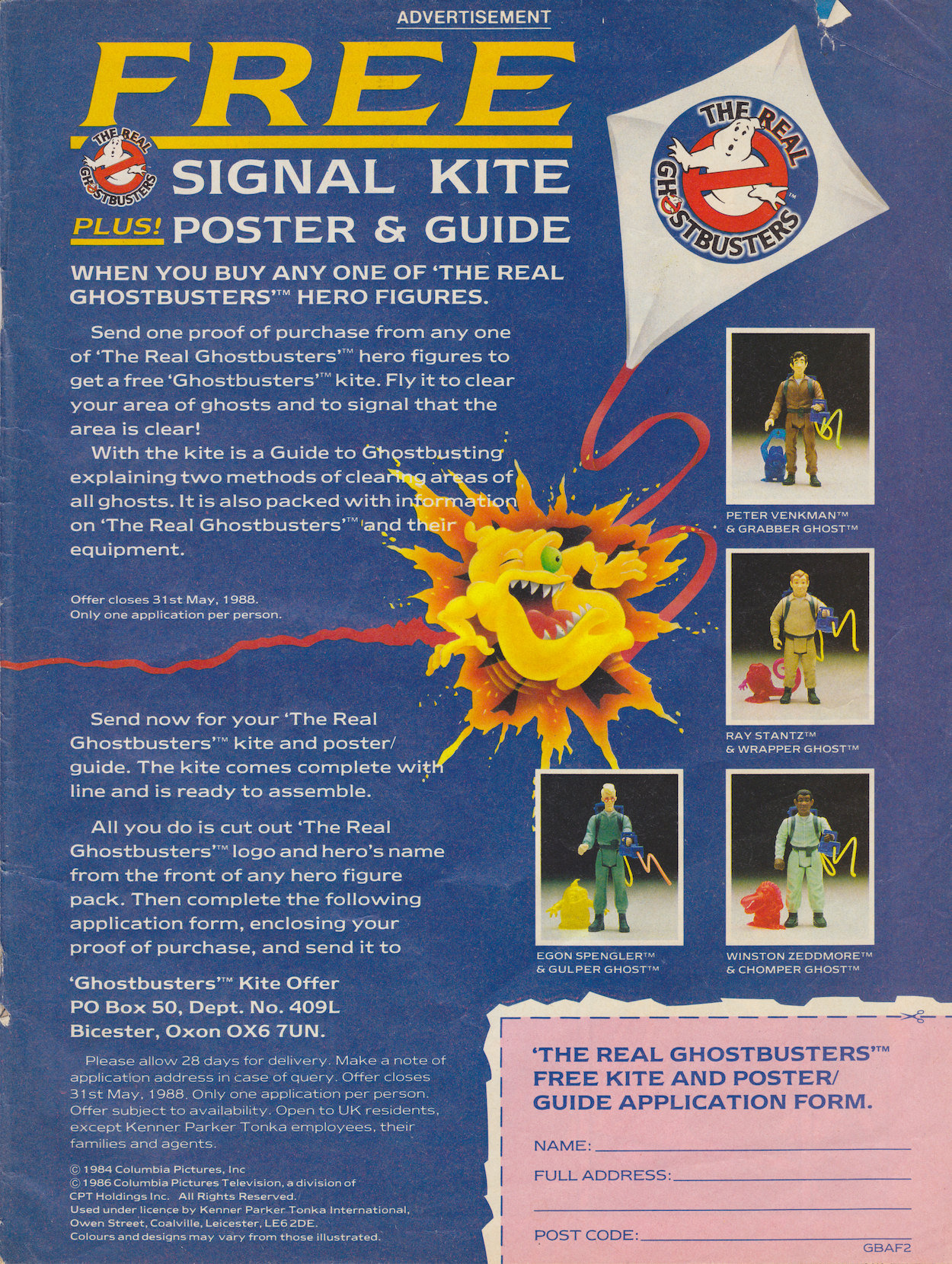
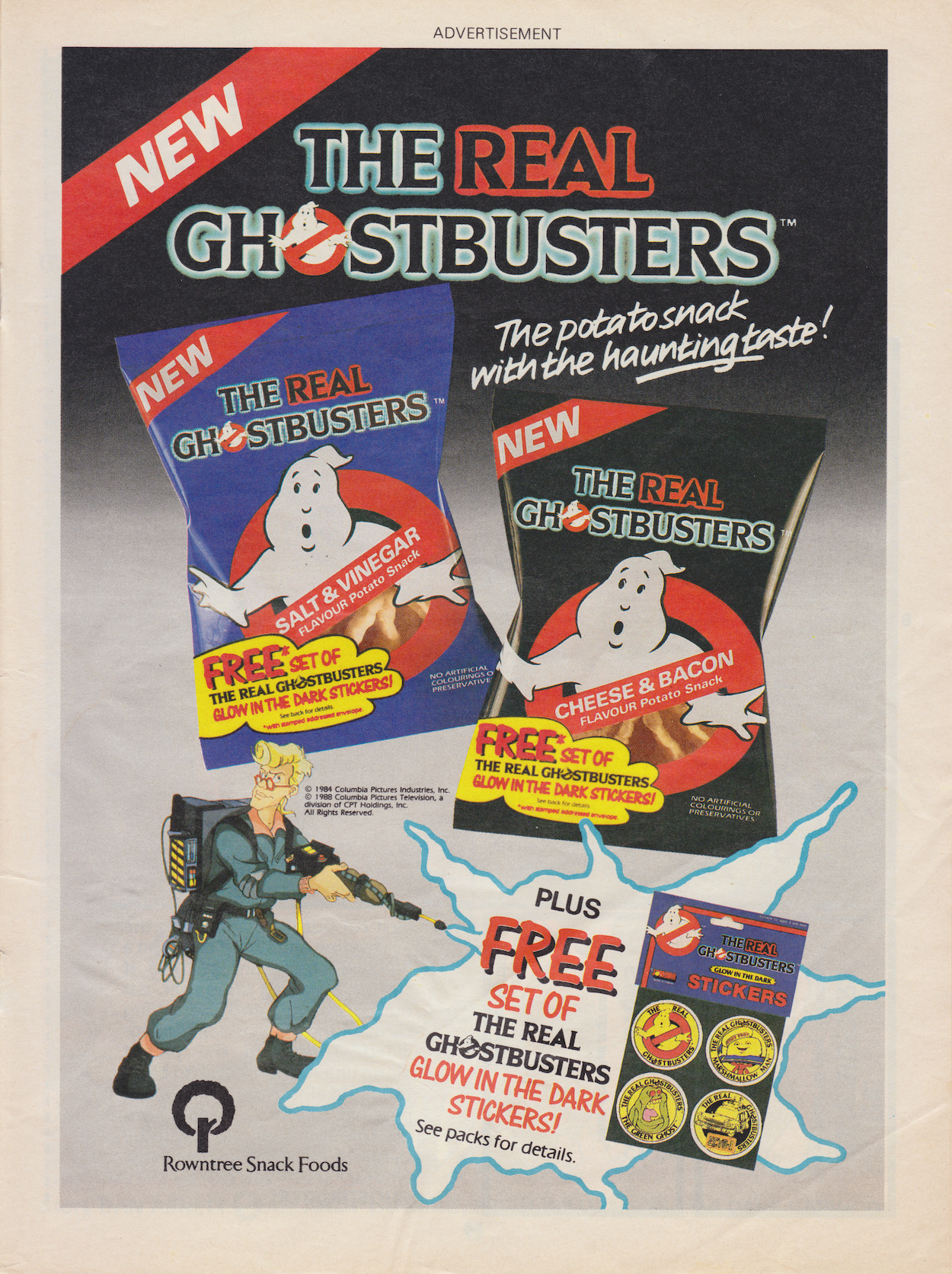
A look at a classic comic wouldn’t be complete without a look at the advertisements within, especially when they’re connected to the subject matter. I welcomed these action figures into my toy collection during Christmas 1988, along with Ecto-1, Slimer, the Stay Puft Marshmallow Man and a few other ghoulish monstrosities, and I recall I ate far too many packets of these crisps that summer too. They were surprisingly nice for a tie-in.

So how did this 33-year-old comic hold up for this 43-year-old? One word: brilliantly. I was surprised at how many times I chuckled while reading it, even though I’m not exactly the original target audience anymore.

I called it a “comedy comic” earlier, a term I’ve never used before. The definition of “funny comics” conjures up images of OiNK, Beano, Buster etc. But while this is indeed a comic which sets out to be as funny as it can be (something it succeeds at very well) it’s more the sitcom to OiNK’s sketch show. I also think calling it some combination action/adventure/funny comic would sell it short. The Real Ghostbusters was a unique comic and remains so to this day.

WHEN YOU GONNA CALL?

Just as it happened 33 years ago today I have an urge to collect this comic all over again. This issue has been immense fun and it just kept getting better and better. In fact, as brilliantly as it began my favourite time with the comic wouldn’t be until around issue 80 onwards.

It’s just such a fun comic there’s only one thing for it.

Now of course this will take a while, it was Marvel UK’s most popular comic at one stage and lasted a whopping 193 issues, alongside four annuals, specials, poster magazines and more, even a puzzle spin-off. It’s going to be quite the task so don’t expect any more real time reviews for quite some time. The daunting thought of covering a series of its size on a weekly basis has put me off in the past, but after reading this issue again perhaps I could use my own model of how I covered the publisher’s Transformers.

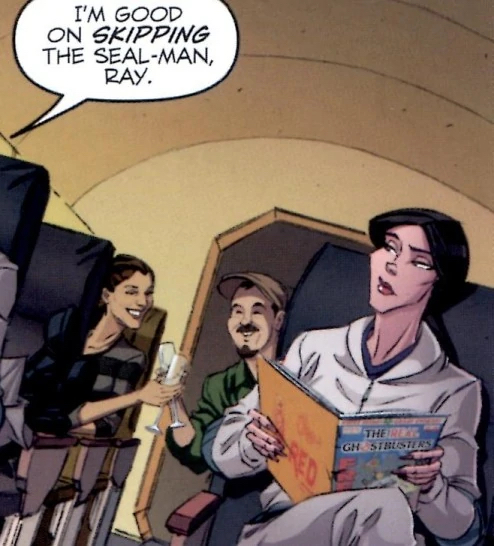
Finally, just look at this little Easter egg I found while doing some research, from the pages of IDW‘s Ghostbusters Crossing Over comic from 2006!

THE REAL GHOSTBUSTERS RETROSPECTiVE

THE REAL GHOSTBUSTERS ANNUAL 1

RETROSPECTiVES MENU