For me personally, 2023 has been a pretty good year, culminating in the best holiday season yet. So yep, after a couple of tough years things are definitely on the up and looking pretty for the one ahead. I know for some the 1st of January is “just another day” but to many it’s a symbolic moment of newness, a chance to look forward to a whole 12 months of possibilities. That’s certainly true for me this year, I have to say.
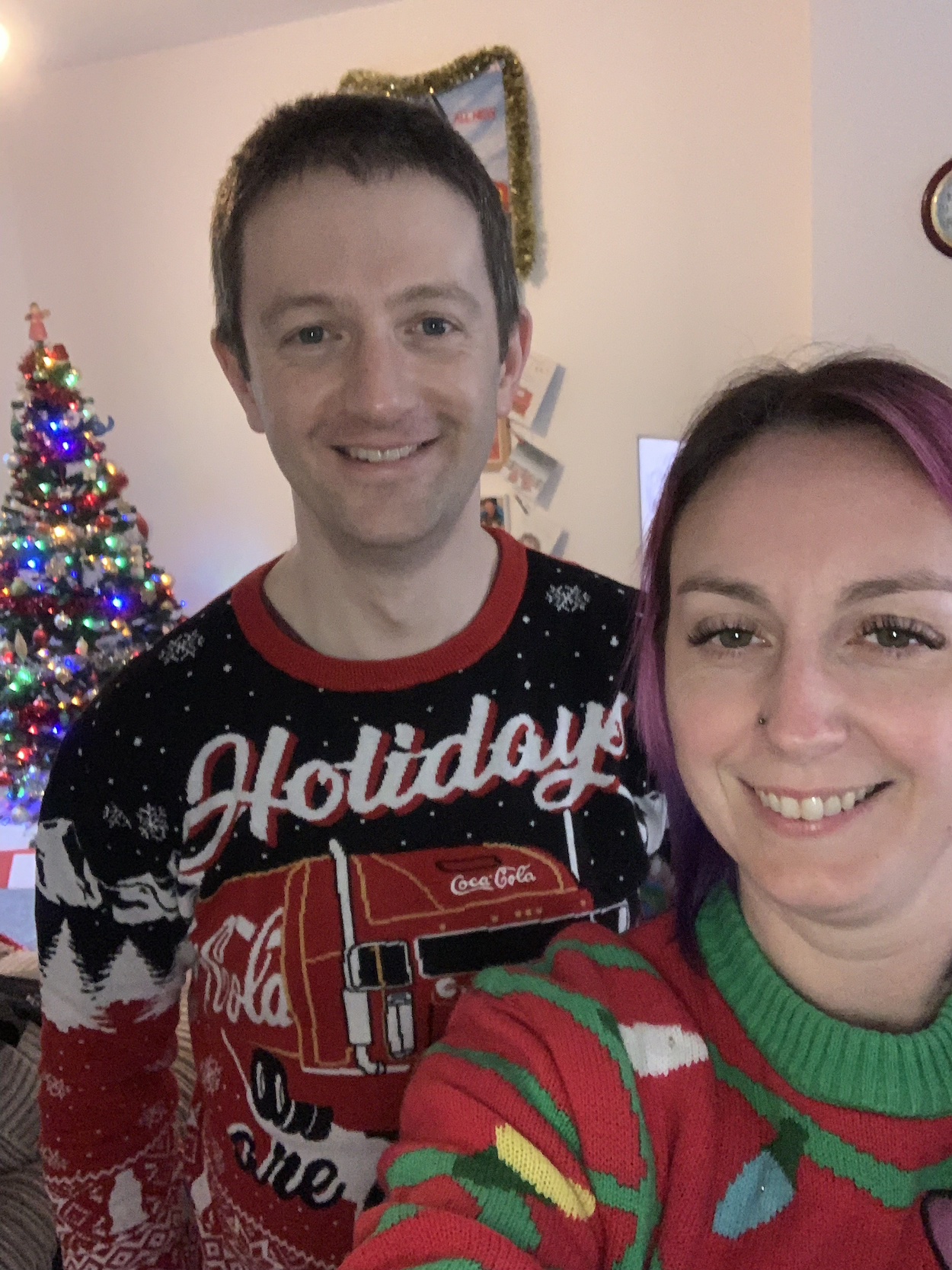
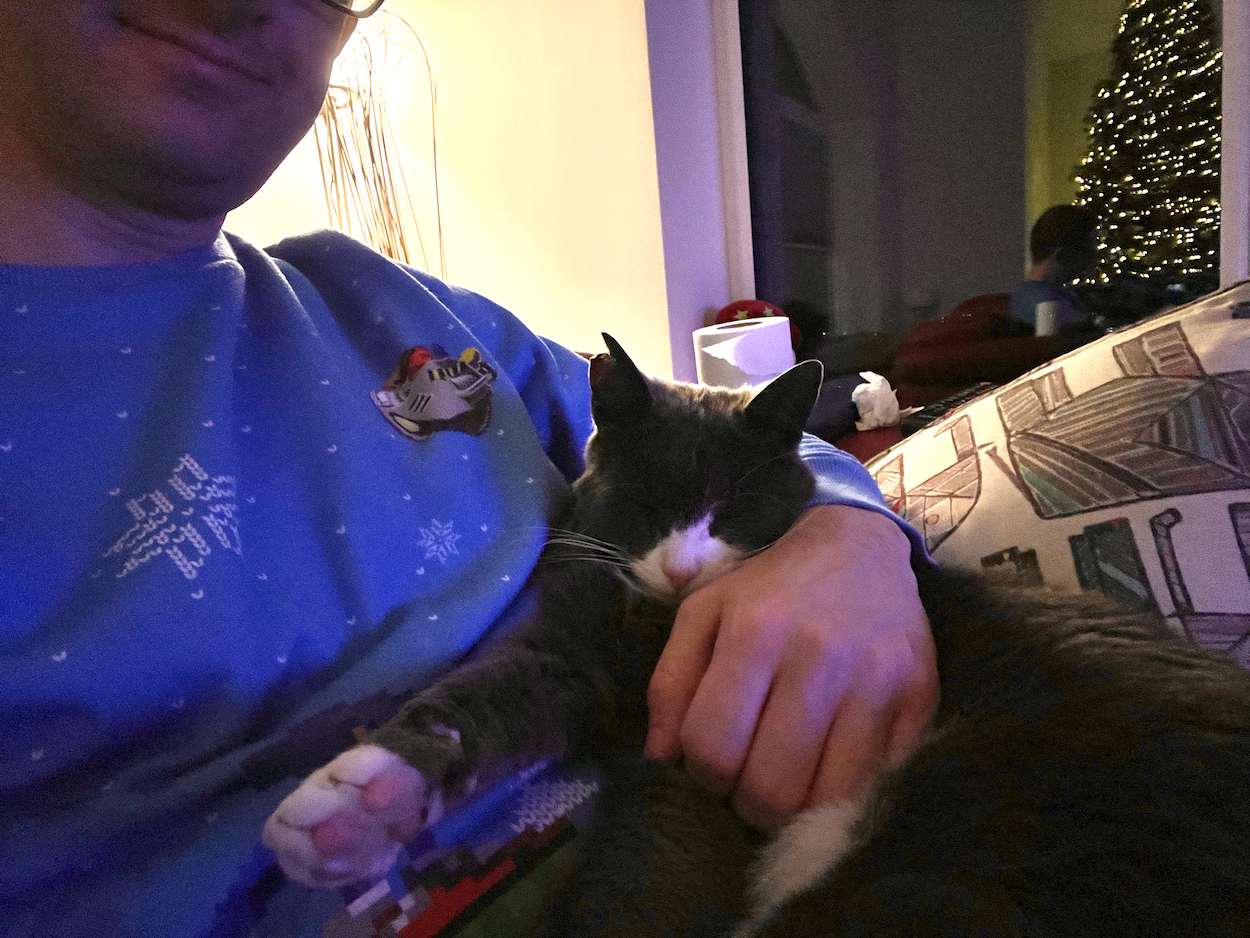
As you can see Christmas has been full of friends, fun, laughter, food, cherished traditions and a cat. A cat will always make everything even better. I’ve had a wonderful December, not just in real life away from this MacBook, but also while I’ve been in front of its screen writing the blog. The site has also beaten its previous record for visitors this year (again) and I couldn’t be more thankful to you all for your support and kind words throughout 2023.
There are big plans afoot for both the blog and myself in 2024. In fact, there’s so much happening on the OiNK Blog this coming year that I’ve had to plan pretty much all of it out, working out what’s going to be published when for the entire year. There’s just so much to come and I want to make sure I write it all! There’s also a pet project of mine I’ll announce later in the year when I’ve actual concrete work to show you, something that will spin off from the blog into the world of physical paper.
I’m really excited for the year ahead and I hope you all have aVery, Very Happy New Year and a fun 2024!
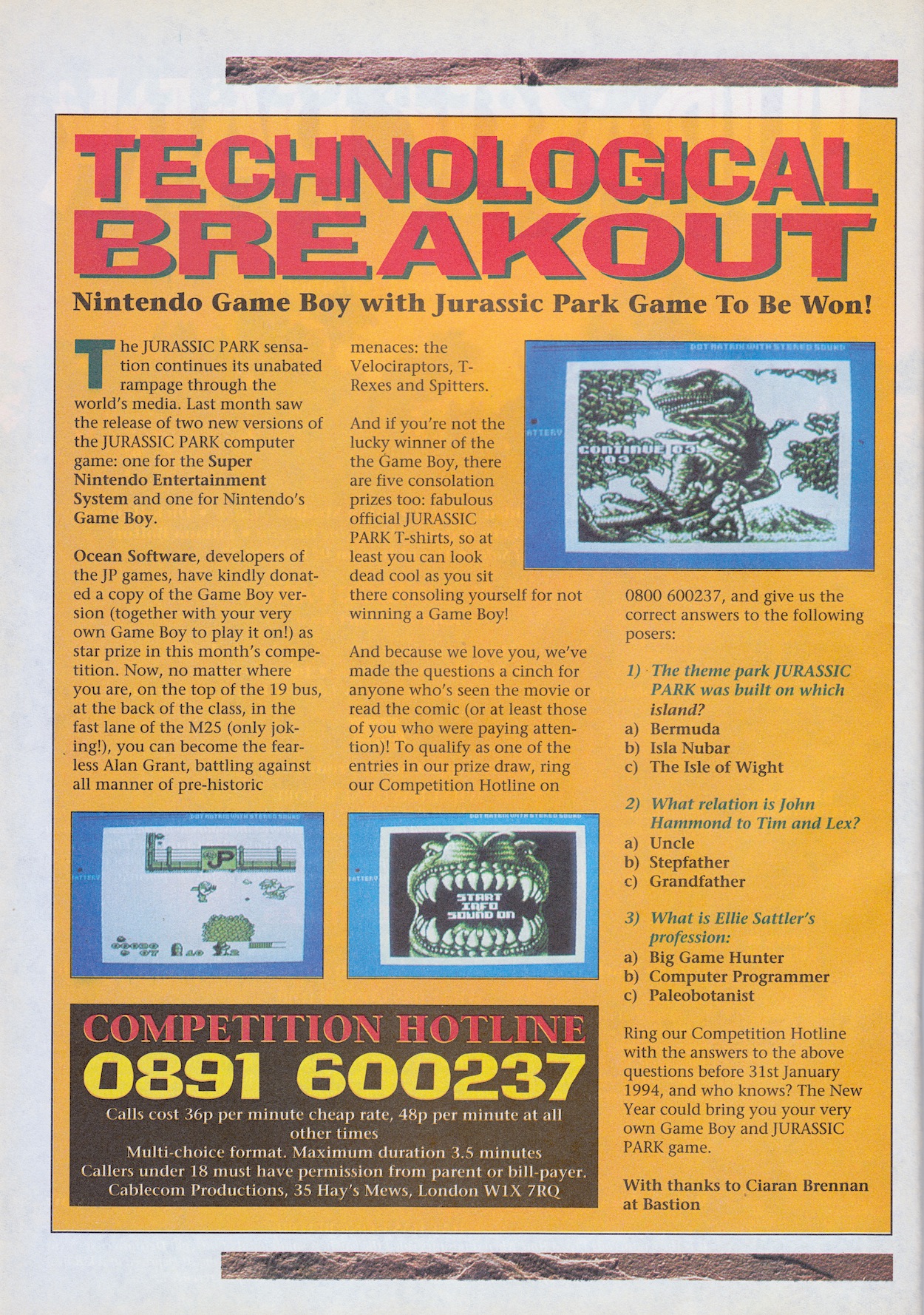
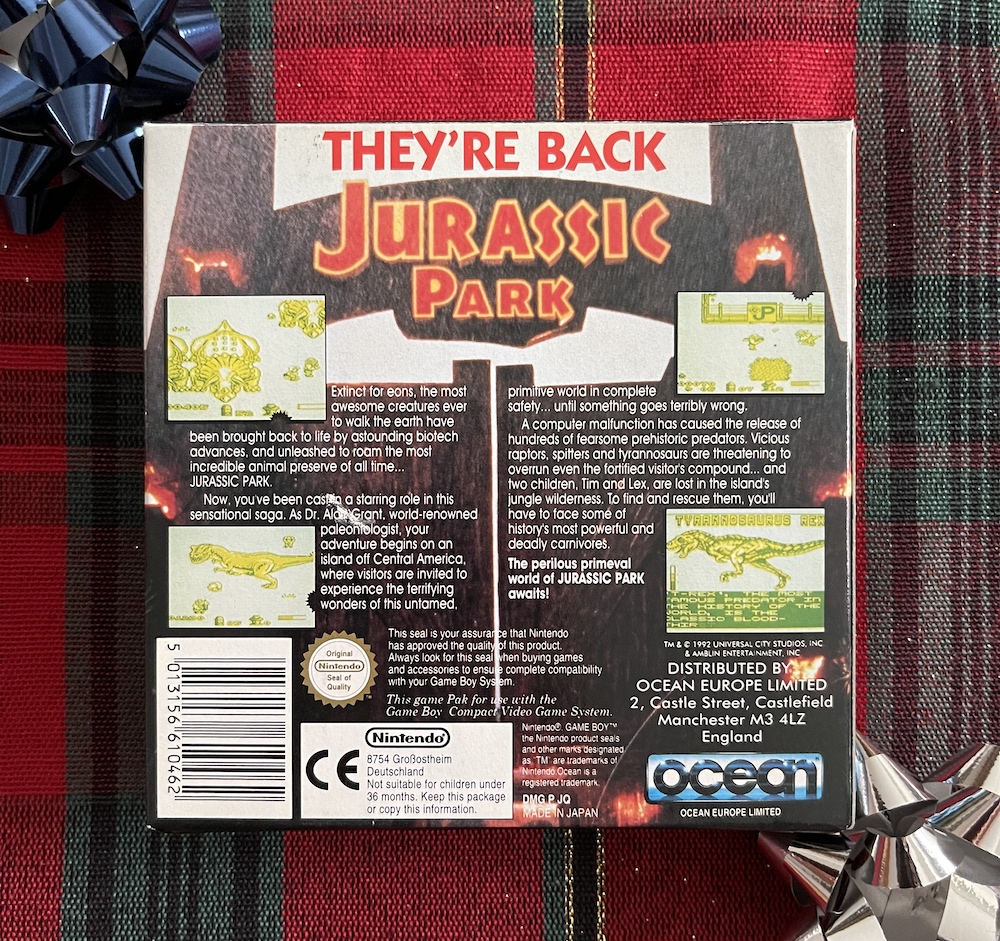
Upon first spotting this post you may be wondering why I’m talking about a videogame on a classic comics blog. Well, regular readers may remember back when I was reading Dark Horse International’s Jurassic Park comic that the advertisement for this game and the subsequent competition to win a copy of the Nintendo GameBoy version brought back many happy memories of playing it at the time. Those memories have now ended up costing me money.
Then, earlier this year I bought a bookazine about the history of Nintendo and the chapters covering this little joyful plastic box had me grinning from ear-to-ear so much that I invested in a refurbished GameBoy and a few games. I’m delighted to say those rose-tinted glasses weren’t playing tricks on me and I’ve been having a blast with it. When I eventually teared myself away from Tetris (easier said than done) I replaced its cartridge with Jurassic Park’s and travelled even further down memory lane.
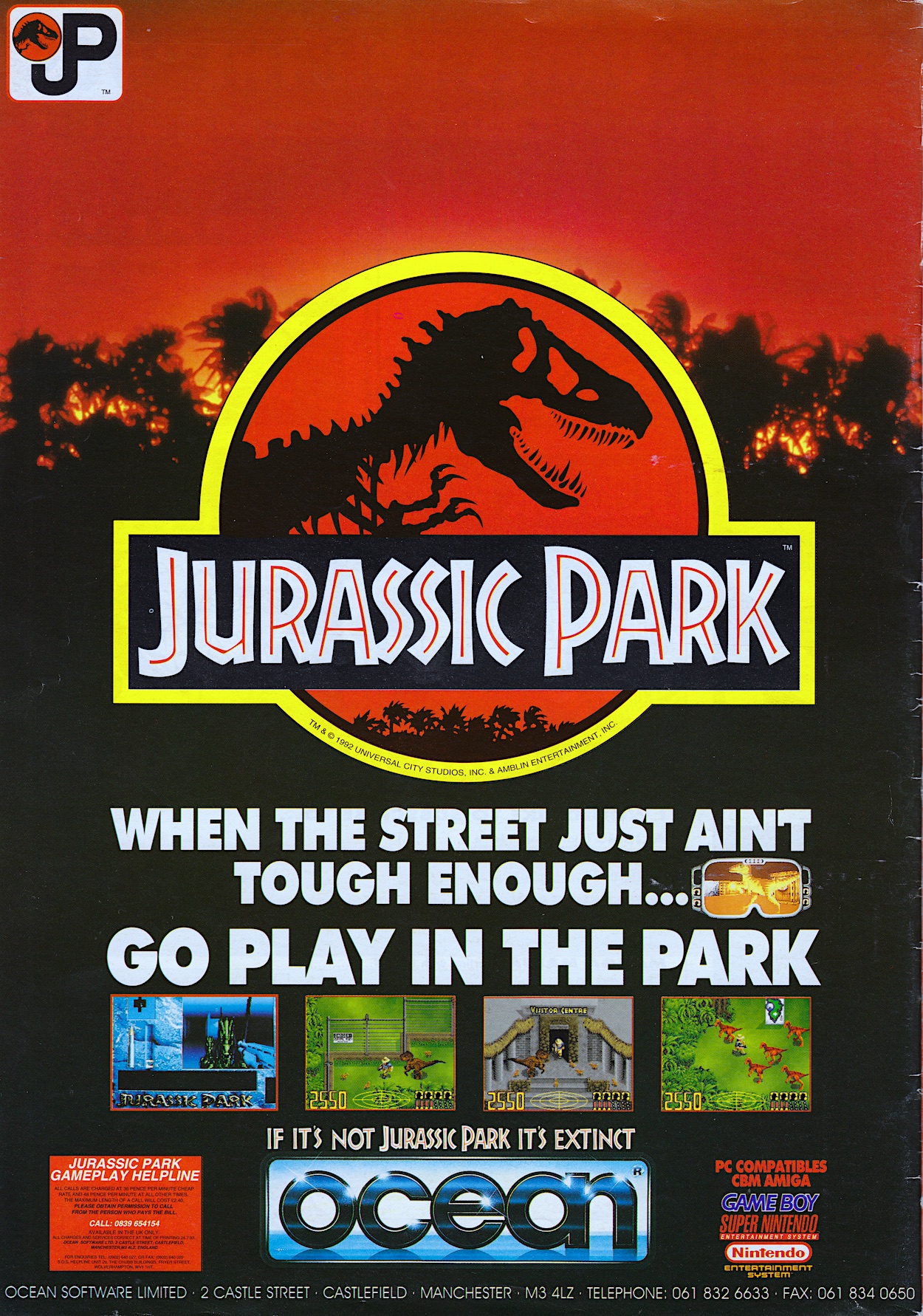
So, I’d decided to follow up on my wistful reminiscing about the game with actually getting my hands on it again all these years later. I thought you might like to take a closer look with me. Those adverts for the multi-format game were brilliant, playing off of the Street Fighter II craze at the time with a killer tagline. Despite no GameBoy screenshots (they’d always show the so-called ‘prettiest’ versions in the ads) I remember desperately wanting to get my hands on it for my handheld.
I think I got the game before the next issue, which actually contained images of the version I was playing as part of that month’s phone-in competition. I wouldn’t have been allowed to enter these anyway, they cost a fortune, so I was happy to have the game already. I remember it not having anything to do with the plot of the film, with Dr. Alan Grant instead walking about with a huge gun(!) but that never put me off because it was just so much fun.
I recall playing it late at night, long after I was meant to be asleep for school the next day, viewing it through one of those huge, cumbersome GameBoy magnifier accessories with a built-in light and having to take little breaks because it was so damn heavy! These restrictions obviously no longer apply and I’ve been playing this game (and others) quite a lot, getting plenty of jealous looks from people around my age on public transport, accompanied by looks of confusion from younger generations.
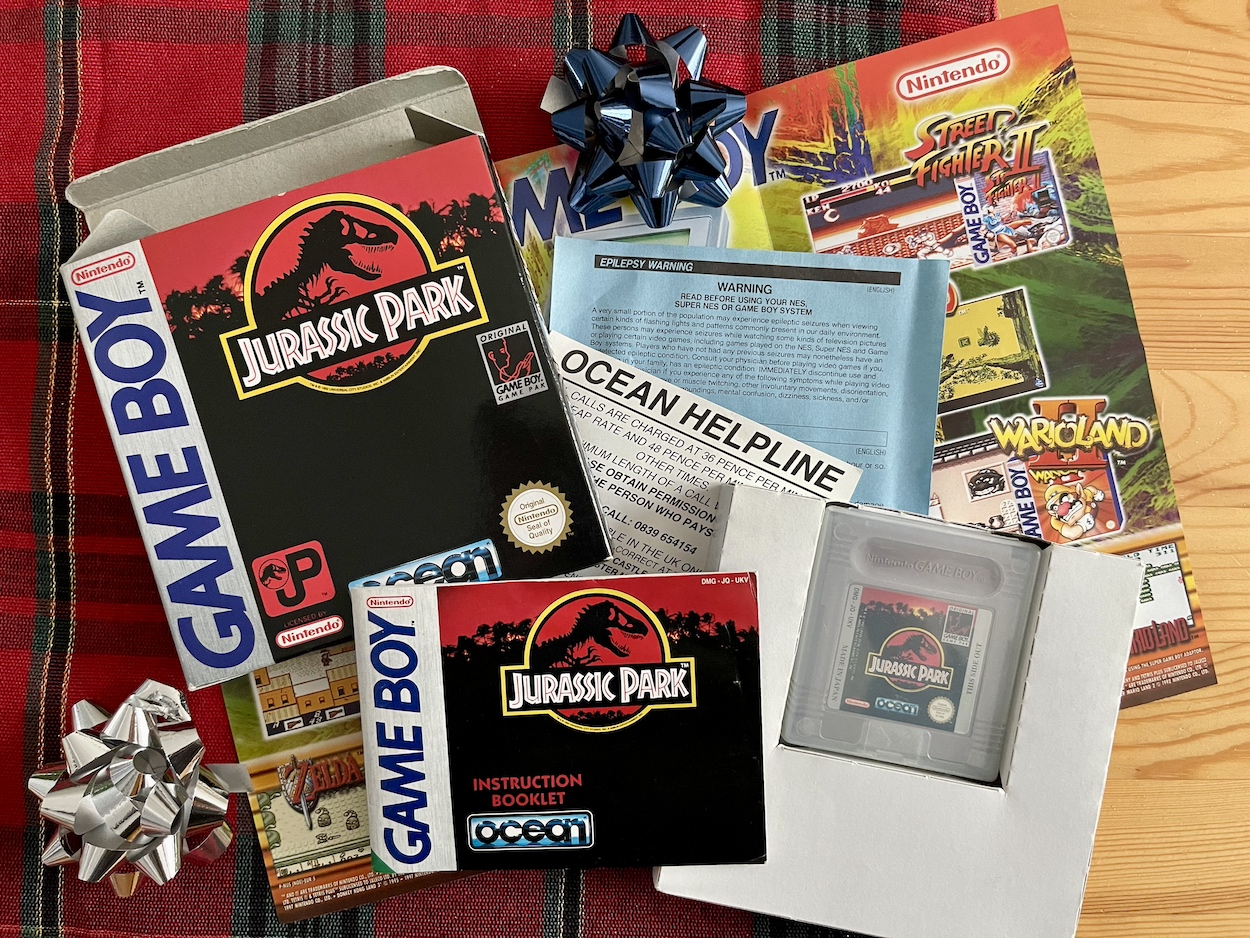
I decided to spend a little extra on the GameBoy and get a refurbished model and the same applies to the games, simply because I’d like to have them all in their original boxes and in great condition so my collection looks as good as possible on the shelf. The Jurassic Park game arrived in near mint condition and I couldn’t have been happier. It even included the manual and some advertising leaflets for other games. I’d forgotten all about these.
The manual also contains some basic details on the dinosaurs and from reading these it’s possible to glean how they could act in the game, although this hasn’t been particularly helpful with the T-rex. With my collection started I needed a way to figure out what other games (ones I didn’t own at the time) would be worth my money, especially if I was prepared to pay a little more for them. It’s not like I could easily shrug it off if a game was crap.
With writing a classic comics blog, one which has already included Commodore Format, it’s only natural I’d turn to some contemporary viewpoints. Instead of relying on people’s memories for recommendations or retro reviews which often unfavourably compare them to modern games, I wanted to read the opinions of those who were playing the GameBoy at the time, those who had been invested in it as a ‘modern’ gaming device.
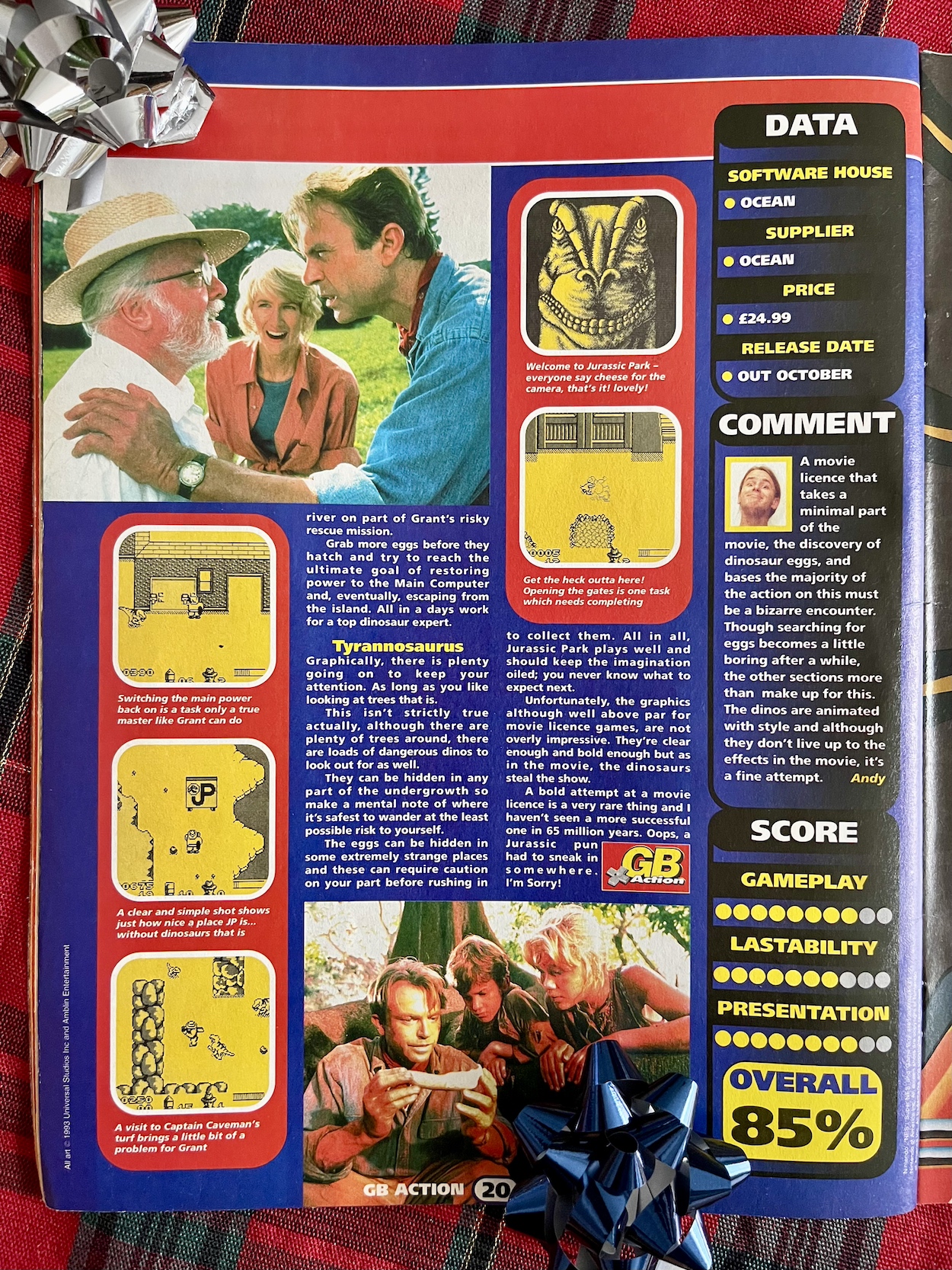
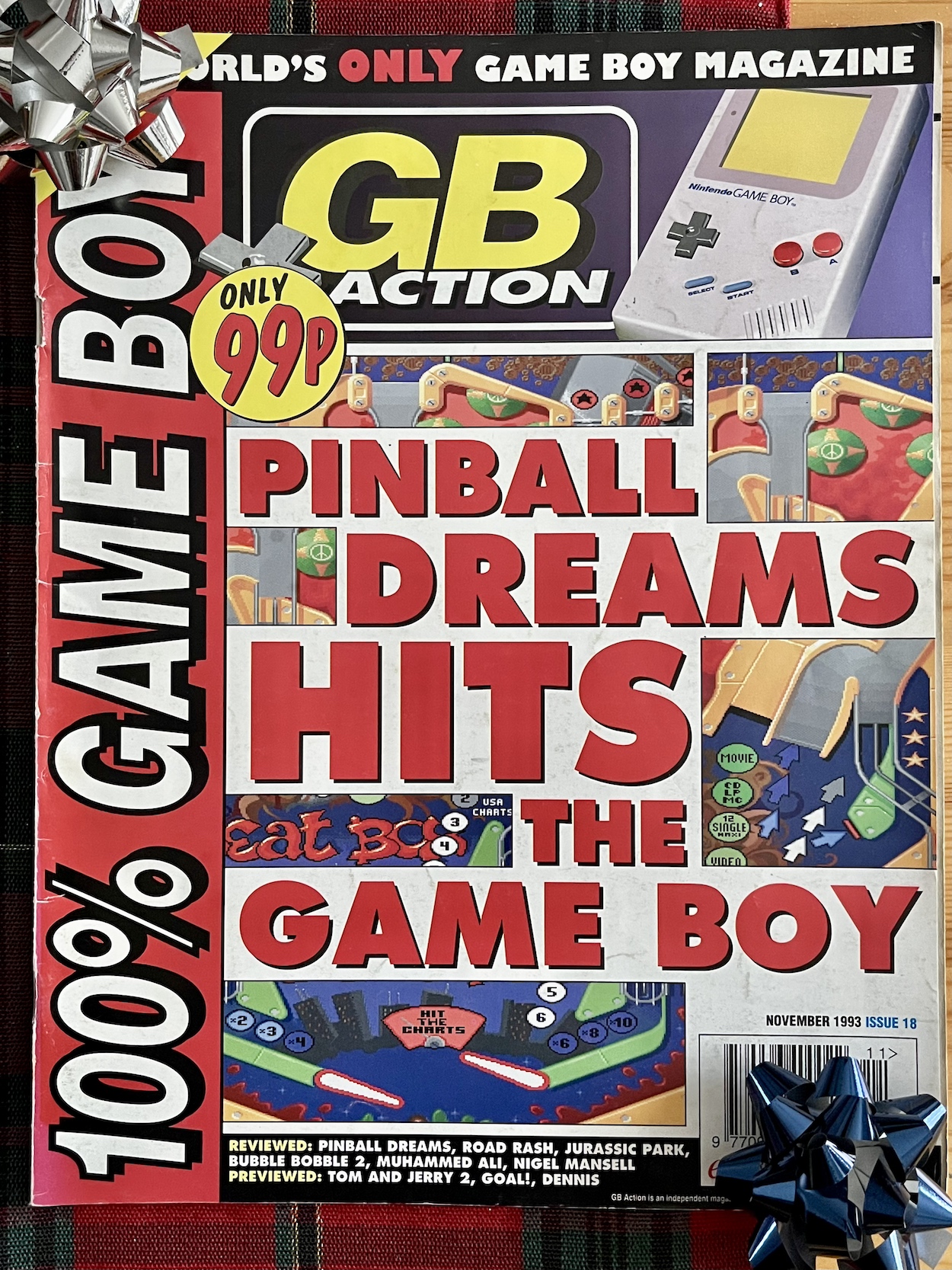
As it turns out options were limited. The only magazine I found on eBay dedicated solely to this machine was GB Action from Europress Interactive. This same company had published a truly awful Commodore 64 magazine in the early 90s called Commodore Power, but beggars can’t be choosers as the saying goes and so I’ve started buying issues which contain previews and reviews of games I’m interested in. As it turns out, it’s not a half bad way of doing my research.
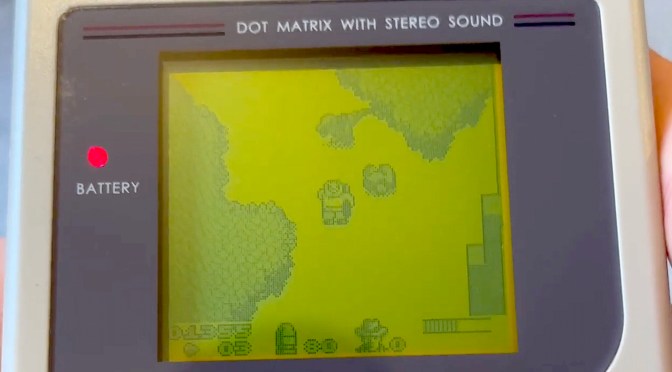
You can see the game in action in these three short videos
The reviews aren’t exactly in-depth and each 68-page magazine can be read in very little time but it does what I need it to do. I bought my first few games for my new GameBoy before buying any of these issues so their review of Jurassic Park ended up being a kind of test in a way. As it turns out their review pretty much sums up exactly how I feel about the game as I play it now, decades after its release.
Finally we get to the game itself and you can see it in action in these three short videos of the initial levels, after which I become completely and utterly stuck and I’m not going to show you that out of embarrassment.
The first thing that struck me is that John Williams’ music is nowhere to be heard throughout the game, despite this being a fully licenced title, but after a while I just started playing it with the soundtrack playing on my HomePod so it made little difference. The Velociraptors and Dilophosauruses keep the player on their toes and a keen memory is needed to remember the layouts of the security buildings in which pass keys are needed to unlock the main gate and escape into the rest of the park.
In most levels of the game there are dinosaur eggs lying about the place and these must all be either destroyed or collected. Of course, collecting them means more points and rewards but in the levels in which pass keys are needed they’re essential, the keys only made available to you after all the eggs have been taken care of. This means venturing into all the nooks and crannies of the maps, including the undergrowth where anything could leap out at you.
Playing that first level made me feel like a child again but I have no recollection at all of this Triceratops stampede which popped up next. I definitely got a lot further in the game as a teenager but my ageing memory initially thought the levels were all pretty similar. This stampede is really tough, mainly thanks to the fact you have to guide Tim to safety which isn’t easy when he constantly stays a few feet behind you, often putting herself in harms way when you try to turn left or right and he’s jumping out in front of a dinosaur just to remain at the right distance from you!
Reading OiNK led me to Jurassic Park, which in turn led me back to this game and now I’ve a new hobby
I’ll admit it took a few goes to get through this and of course because it’s a retro game there are only so many lives to play with until it’s game over and we have to start all over again from scratch. Thankfully there are a handful of continues on top of the lives handed out, which gave me 12 chances altogether before turning off the GameBoy and plugging Tetris or Super Mario Land back in.
Moving on and the sparks of memory surged a little as I remembered the next level in which Grant is on a rowing boat making his way to the next area of the park. Each press of the button pulls Grant’s arms in once and moves him a tiny bit up the screen in whatever direction you have his boat facing. This technique takes a long time to master. Timing is key. Being on the water it’s not easy to turn in a different direction, you have to wait until he’s stopped rowing, plus you can’t speed ahead because you don’t know what’s about to come down the screen. Also, if you stop Grant will start coasting back downwards again towards any danger you’ve already passed!
The game is definitely a challenge and I remember it being so back in 1993. I just had a lot more patience back then, even after playing it for ages and having to start over, which I did without a thought at that age. I don’t care that it’s not close to the premise of the film or its characters. Look at the system it’s on, it was never going to be too complex but it’s still Jurassic Park to me and a hugely enjoyable slice of it too.
Reading OiNK in real time led me to doing the same with Jurassic Park, which in turn led me back to this game and now I’ve a new hobby. Playing NintendoGameBoy games on an original machine is always going to be the best way to play these, and with Lemmings and Pinball Dreams gratefully received for Christmas it looks like I’m back in this world for a long time to come. So thanks Jurassic Park! Now, one more go to sneak past that Tyrannosaurus rex in level four. Young me would be so ashamed of me right now…
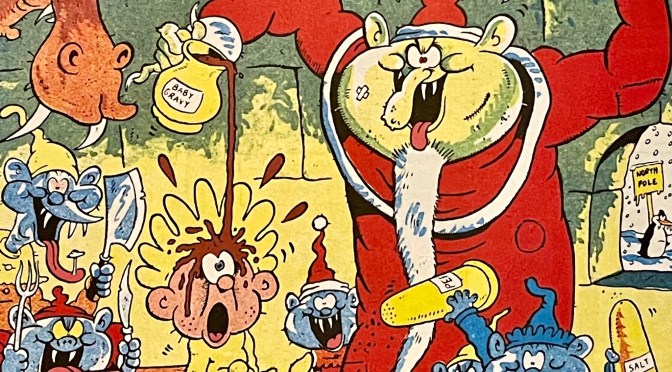
Released towards the end of the summer in 1988 and advertised in the final two issues of OiNK, after the comic’s cancellation it felt like a long time coming for The OiNK! Book 1989 to finally fall into my trotters on Christmas Day that year. As I mentioned in the preview post, with a reduction in pages from the previous annual and a thinner paper stock it really does feel a lot smaller this time around. But it’s still 68 pages (including cover) of prime pork. That’s got to be reason enough to celebrate, surely?
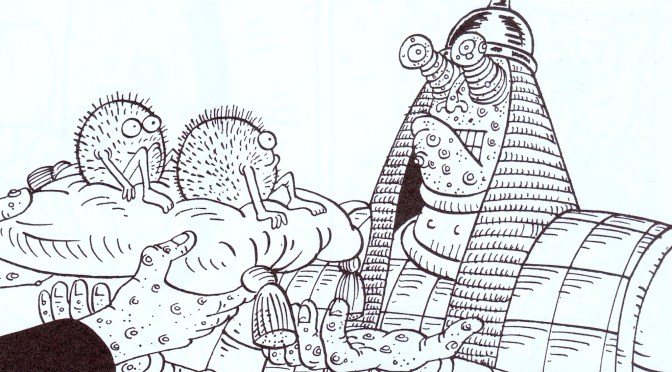
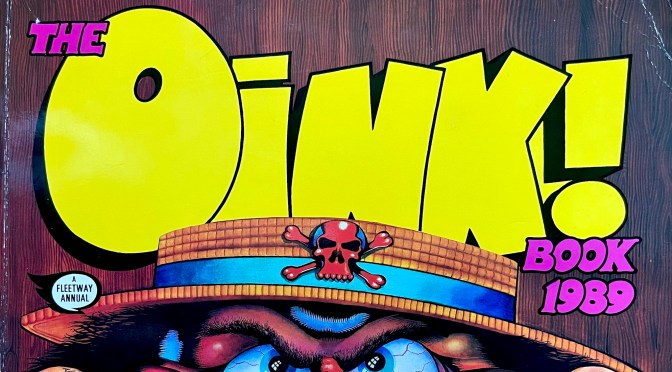
The cover by acclaimed OiNK illustrator J.T. Dogg (real name Malcolm Douglas) is equal parts gorgeous and gruesome, with some little icky details for kids to pour over. It’s bold and brash and certainly stood out amongst the other children’s annuals, just like OiNK always had. In fact, it stood out even more than it had in the adverts because they decided to swap the colours of the logo around, possibly because it would work better against that dark brown background. I think it works much better this way (and we still get the pink regardless).
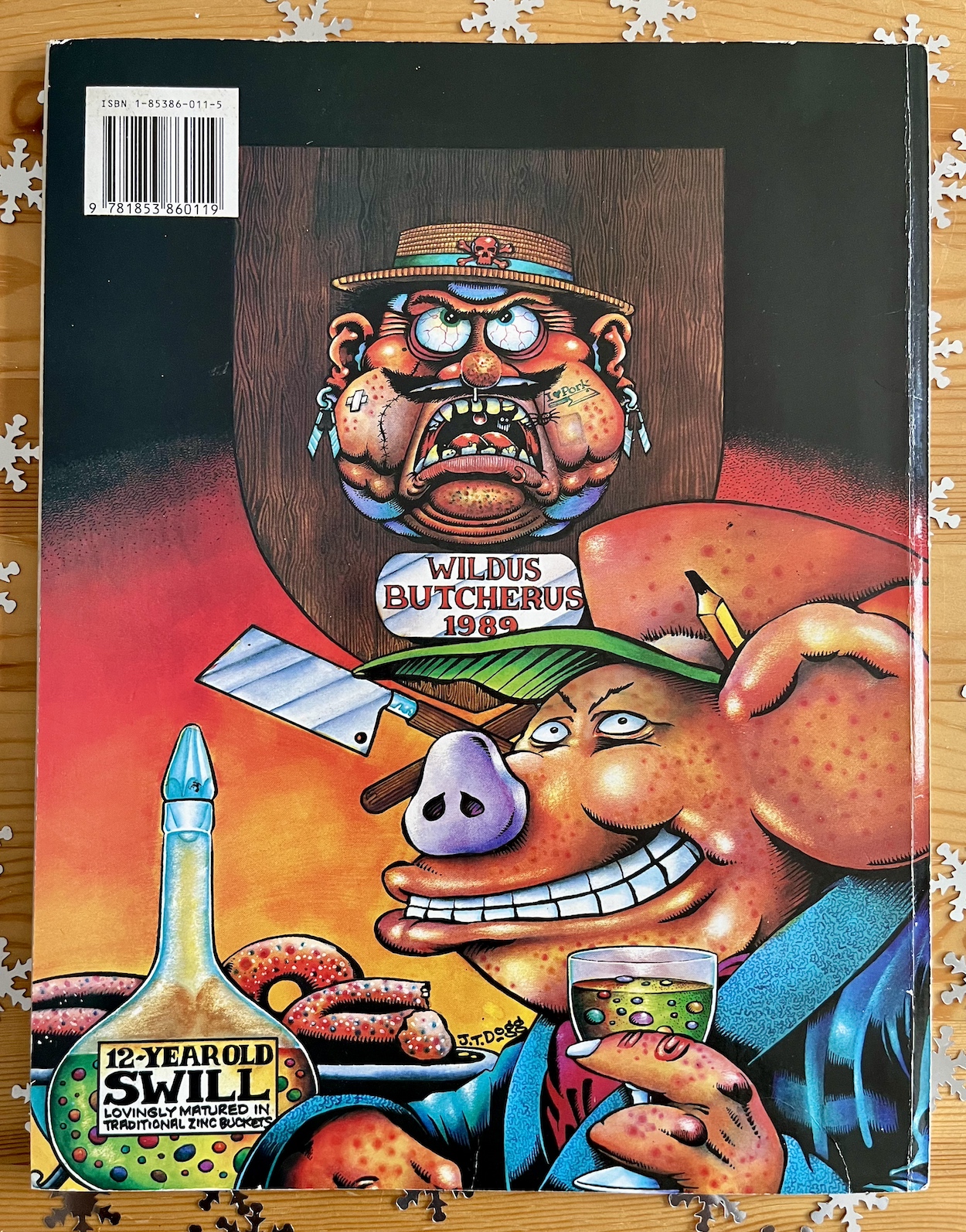
That background gives a hint as to what was on the back cover. I remember seeing it in the shop and half expecting it to be the rear of the butcher’s head, this cover clearly being a riff on the piggy face from The OiNK! Book 1988 and I laughed quite loud when I turned it over that first time. We’ll get to that at the end, we’ve the insides to cover first, beginning with the obligatory welcome page with something you’d only see in OiNK at the time: credits.
Genius scriptwriting from Lew after he was told by co-editor Mark Rodgers only the first two pages would be printed in colour
Uncle Pigg may be relying on more easily managed cards rather than an artist chiselling the names into stone like last year, but this bright and colourful welcome was just what the piggy ordered when I opened it on Christmas morning. Even today it feels like reuniting with old friends. Yes, the comic may have only ended two months ago but Ian Jackson’s contributions were becoming rarer so this is a wonderful return to form. It’s great to see certain names back too, especially Jeremy Banx who had left when the comic went monthly.
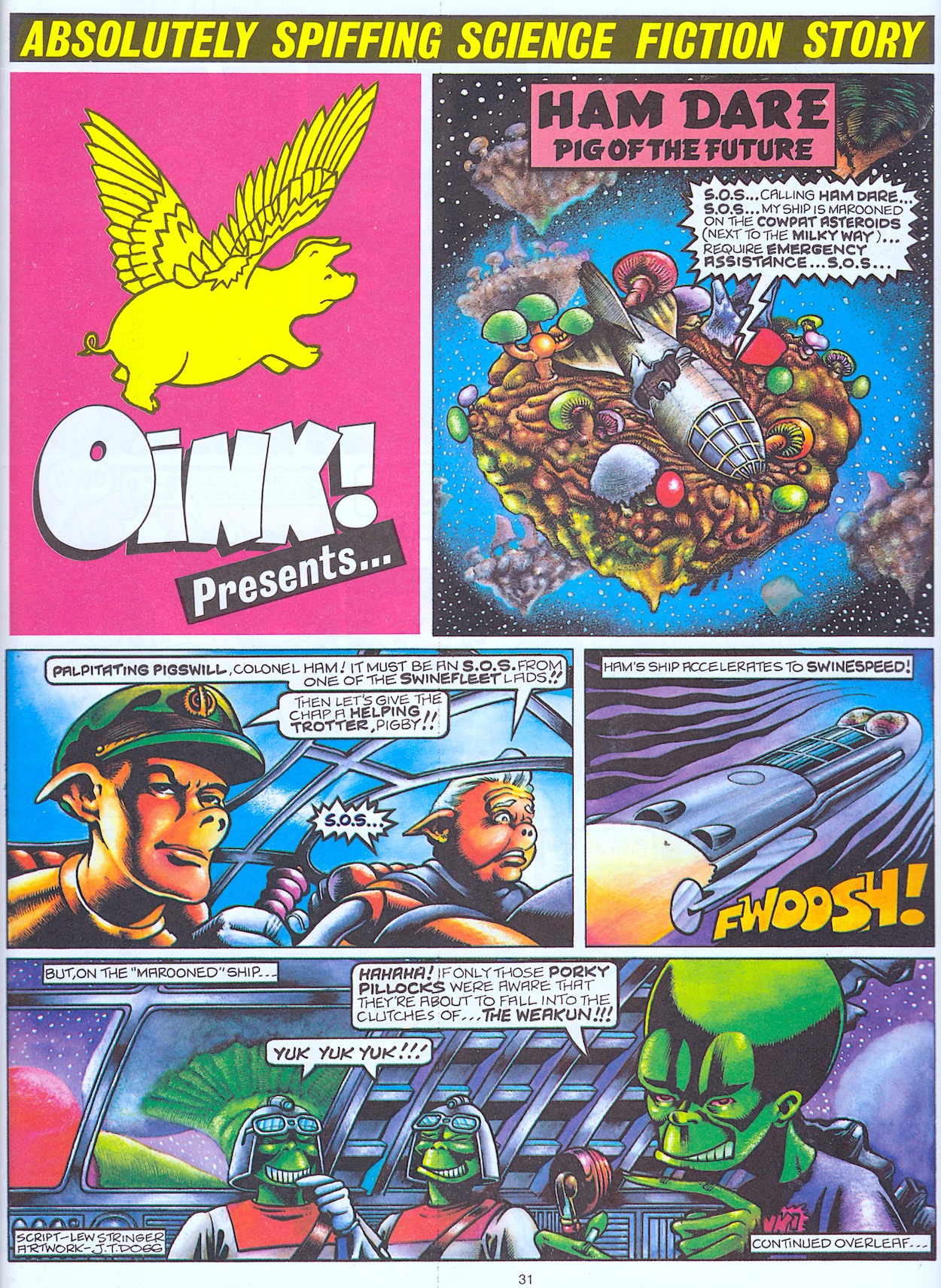
Halfway through reading the book it was clear to me what I was going to highlight first and it’s more gorgeousness from J.T. Dogg, this time written by Lew Stringer. That combination can only mean one thing, it’s Ham Dare: Pig of the Future. Last seen in The OiNK! Book 1988 I’d always remembered Ham and Pigby in serialised stories, yet only their first one was published that way. Here they get a three-page tale with a genius piece of scriptwriting from Lew after he was told by co-editor Mark Rodgers that only the first two would be printed in colour.
Normally a comic would just carry on regardless on to the black and white page but if something is “normally” done then we should really know by now that’s not what OiNK would do. Actually having it referred to is genuinely funny and Malcolm’s work is no less lovely. The third and fourth panels of that page in particular had me roaring, between the name of the weapon beam (and the reason for it) and the name of The Weakun’s henchman!
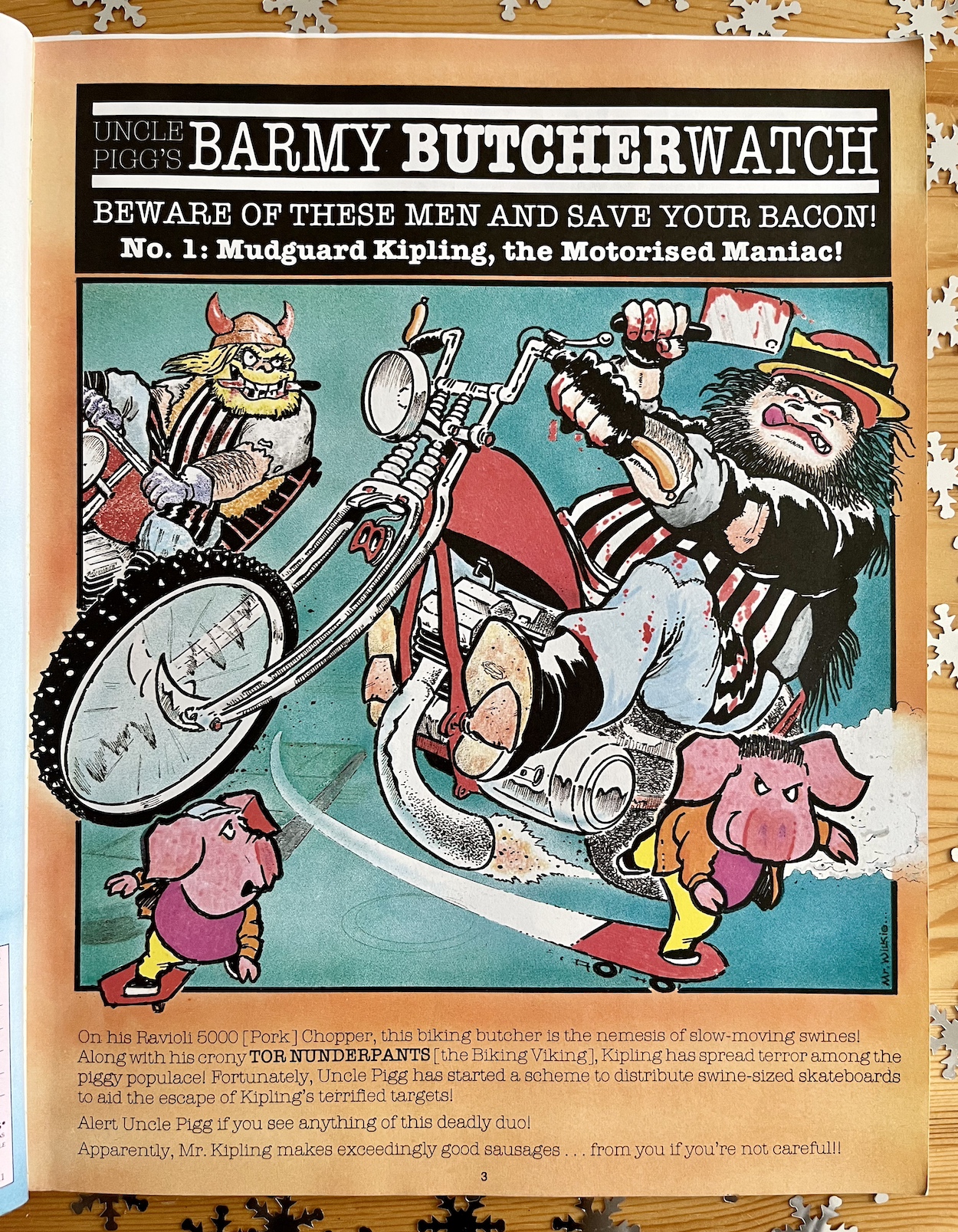
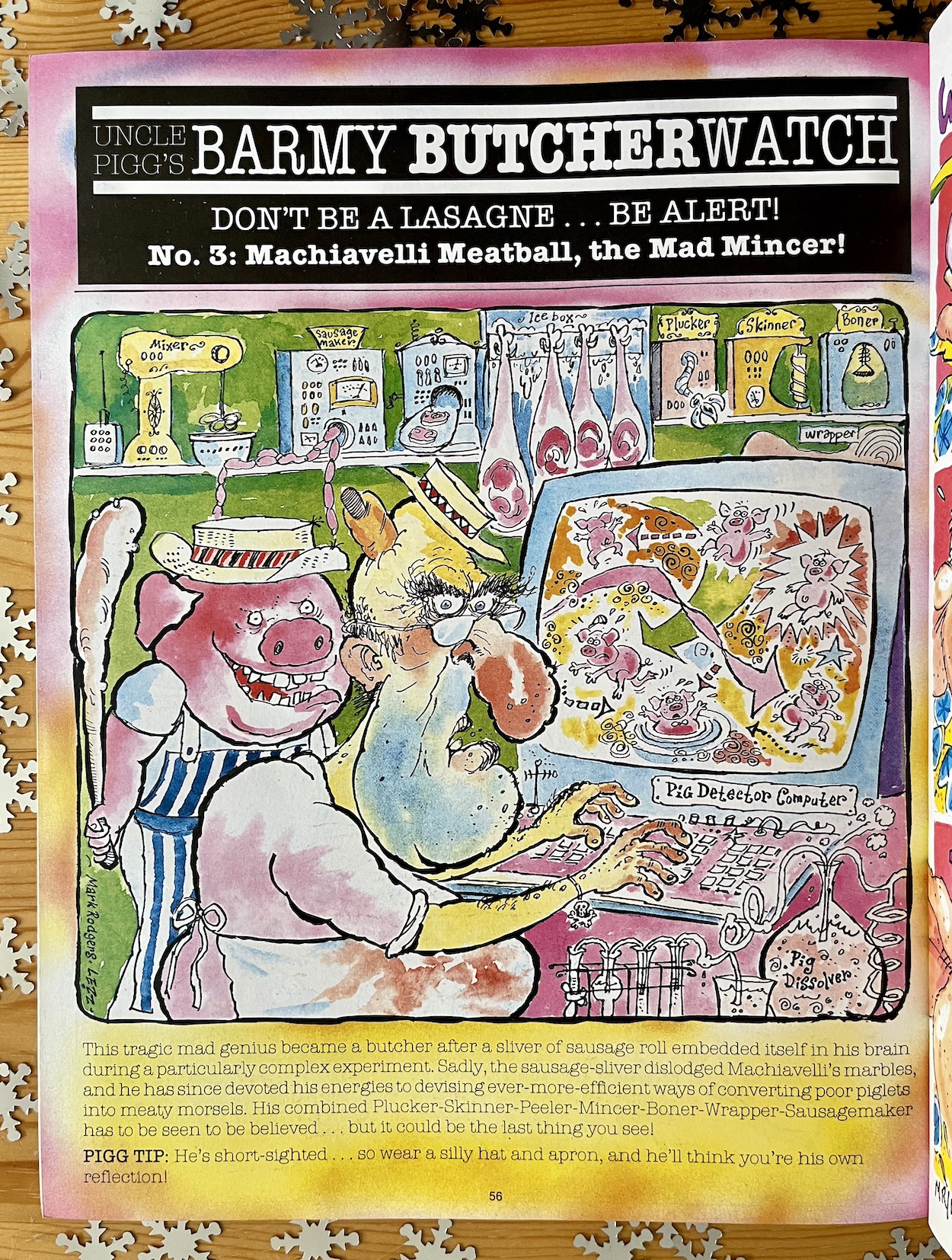
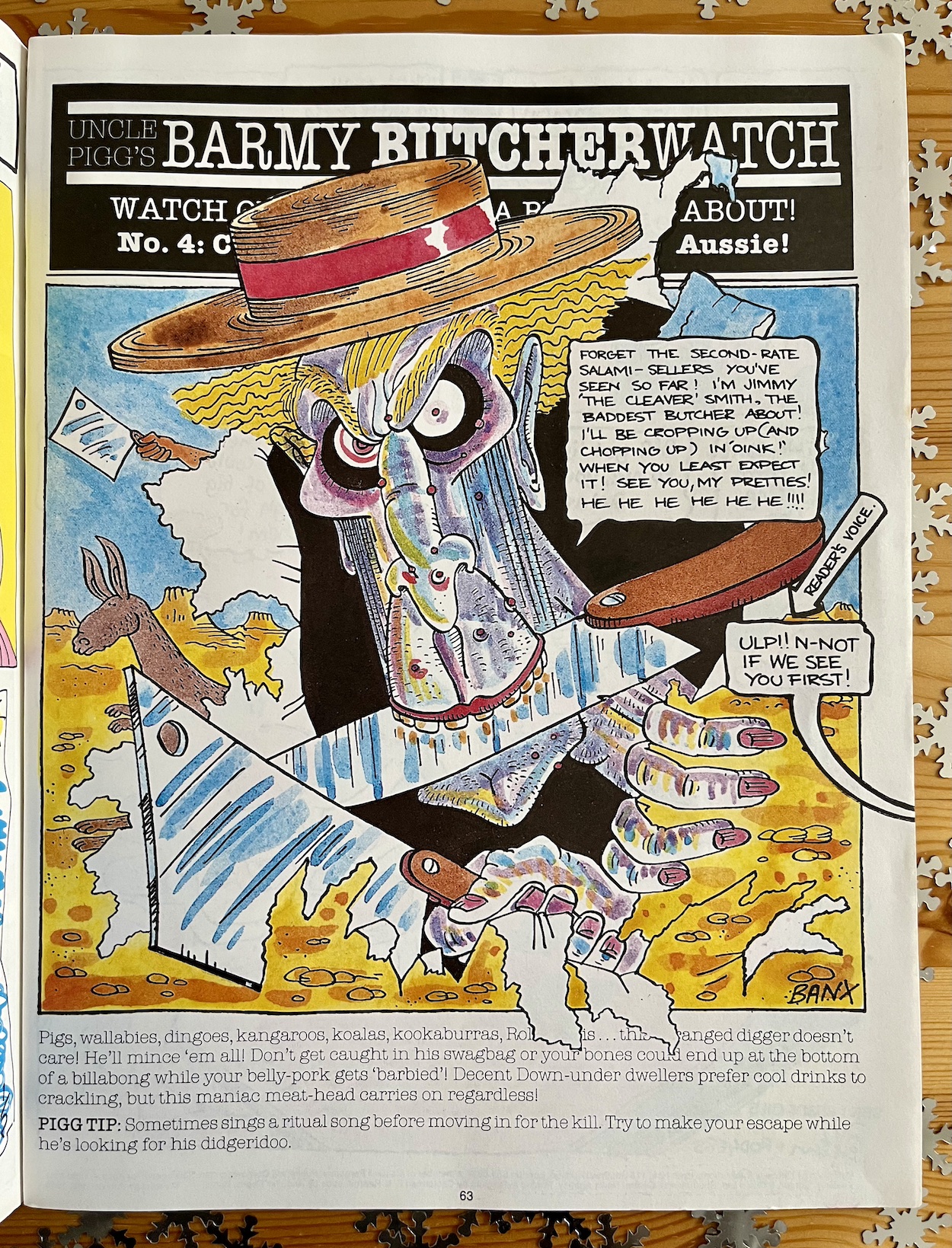
Ham Dare would return in the OiNK! Holiday Special 1989 the following year and make the cover for the only time, with a story originally written as his second serial and I for one can’t wait. There’s another serial of sorts in here, a set of four mini-posters based on Jeremy Banx’s original Butcherwatch idea, however this time each one is drawn by a different artist. Eric ‘Wilkie’ Wilkinson, Mike Higgs, Les ‘Lezz’ Barton and Banx himself. What a team! Of course, Jeremy has to have the last word, right at the very end of the book.
We just never knew when Jimmy ‘The Cleaver’ Smith would pop up, did we? While there are still three special editions of OiNK to come between now and April 2025 this book feels like an end to the regular comic. Yes, this was already in the shops and Santa already had it saved for me, but with Jimmy bursting through to threaten pig pals at the end it felt like the perfect way to wrap things up. It was like he was telling us he was always going to be about, even if the comic wasn’t.
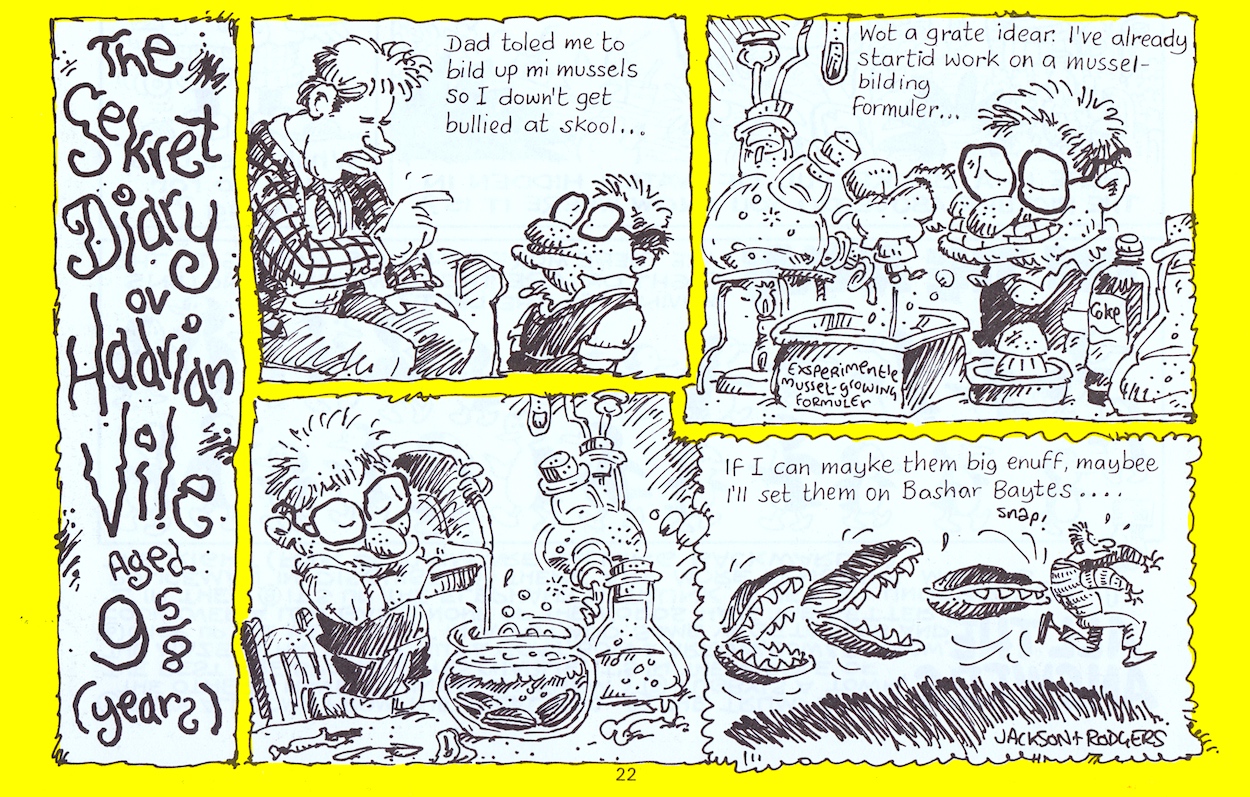
Obviously what he says about OiNK was no longer going to be the case, but that’s because this page was created a long time before the book was published, long before the comic even went monthly, back when Jeremy was still contributing. Someone else from back in those mists of time who makes a rather brief return here (courtesy of Ian Jackson again, written by Mark Rodgers) was Hadrian Vile and his diary. It may only be half a page, and the captions aren’t typed out, but boy was I happy to see him again no matter how briefly.
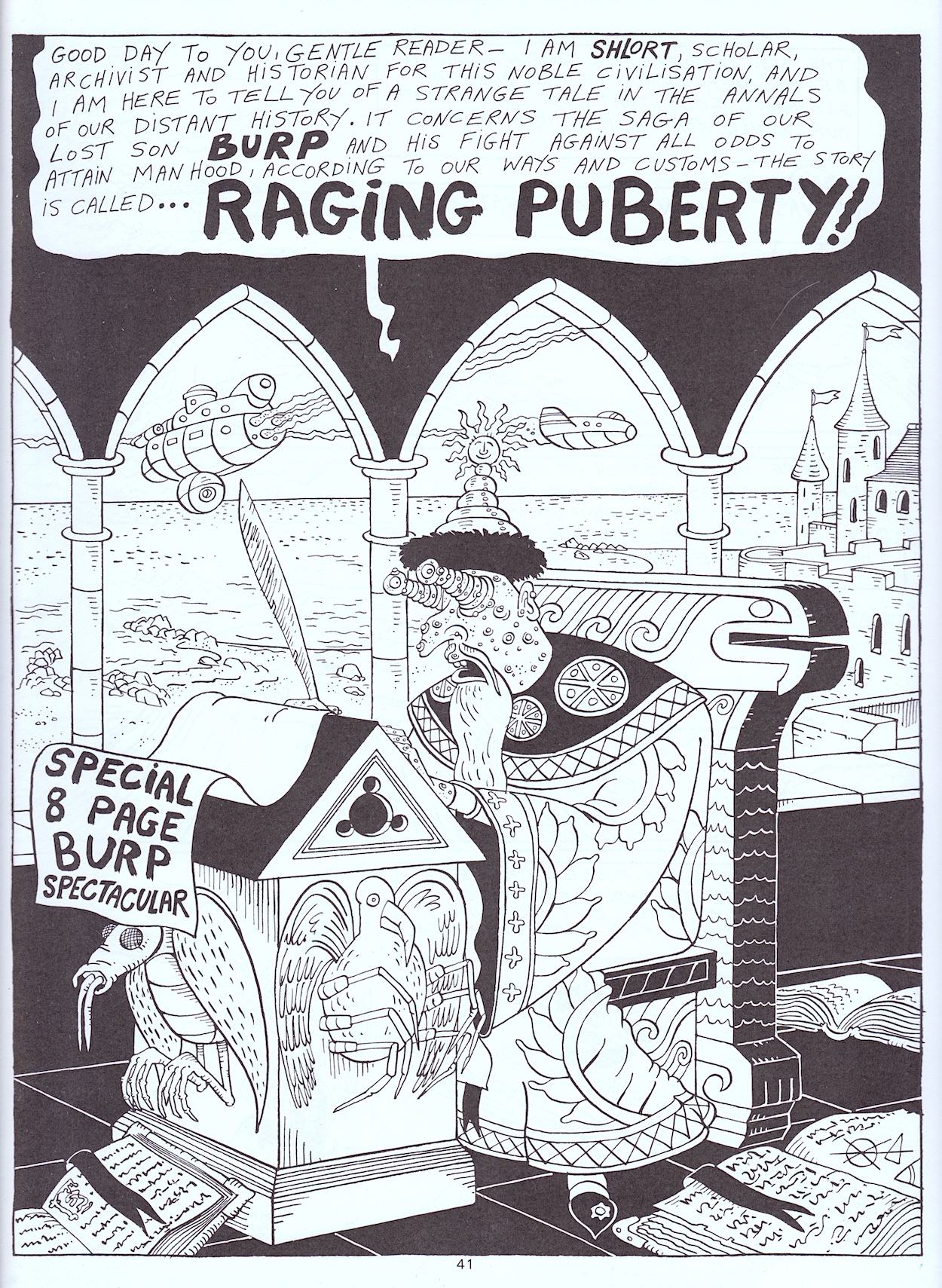
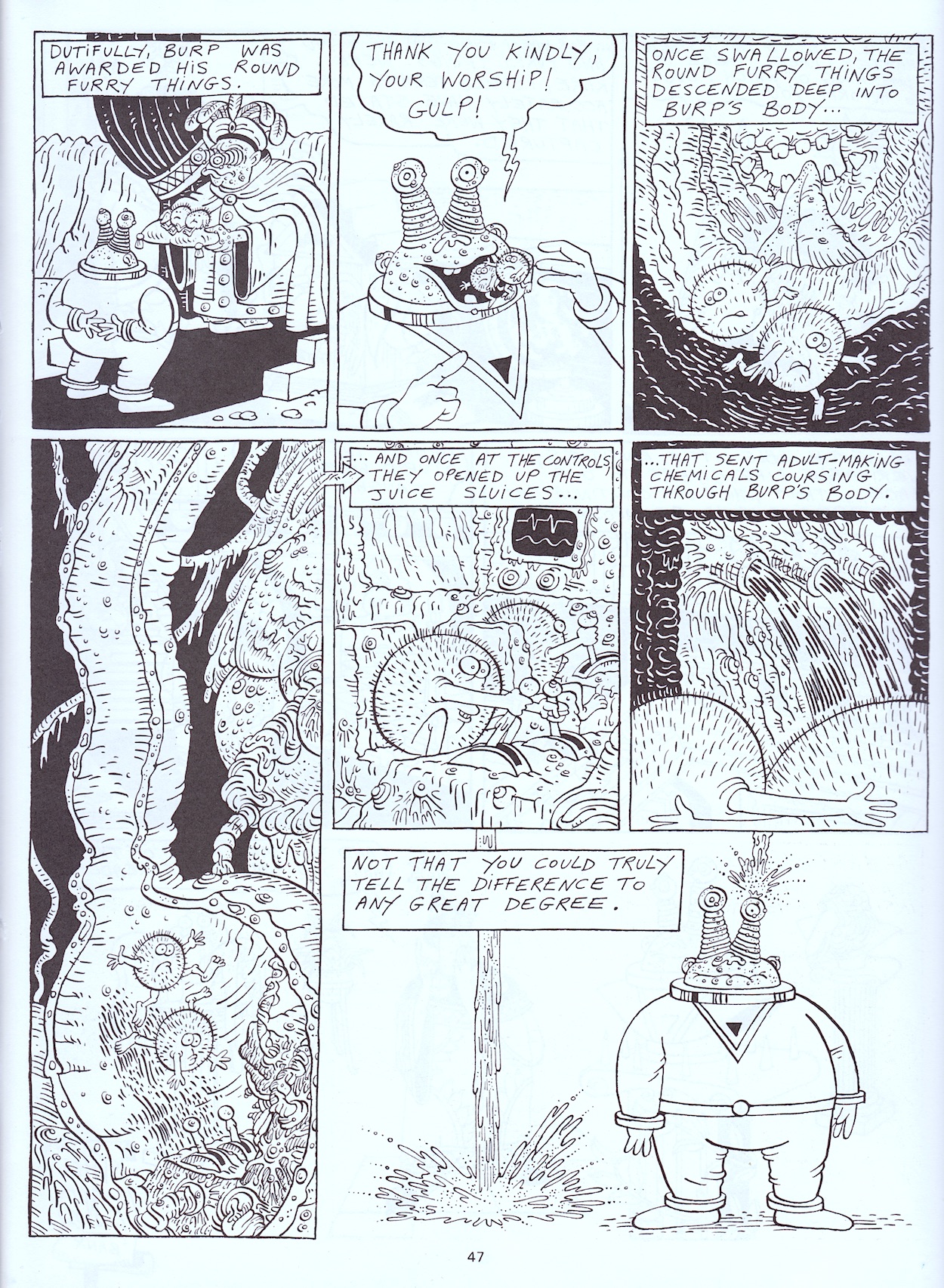
Way back in the preview issue’s review I mentioned how Burp’s story in OiNK would culminate in an epic tale that taught a very young me about puberty. You may have thought I was joking. Well, maybe it was a slight exaggeration. Raging Puberty is a huge eight-page Burp strip from Banx, set in the far future and recounting an ancient rite of passage amongst the alien species, using our pal (their “lost son”) as an example.
I read and enjoyed this strip during Christmas 1988, particularly the daft fight that takes place, the imaginative weaponry and the funny designs. However, skip forward a few years and a young teenage me decided to reread the book for the first time since. I saw this next strip in a completely different light. I thought, “How did they get away with this?” on more than one occasion while outrageously laughing (before taking it to school to show to all my friends, obviously).
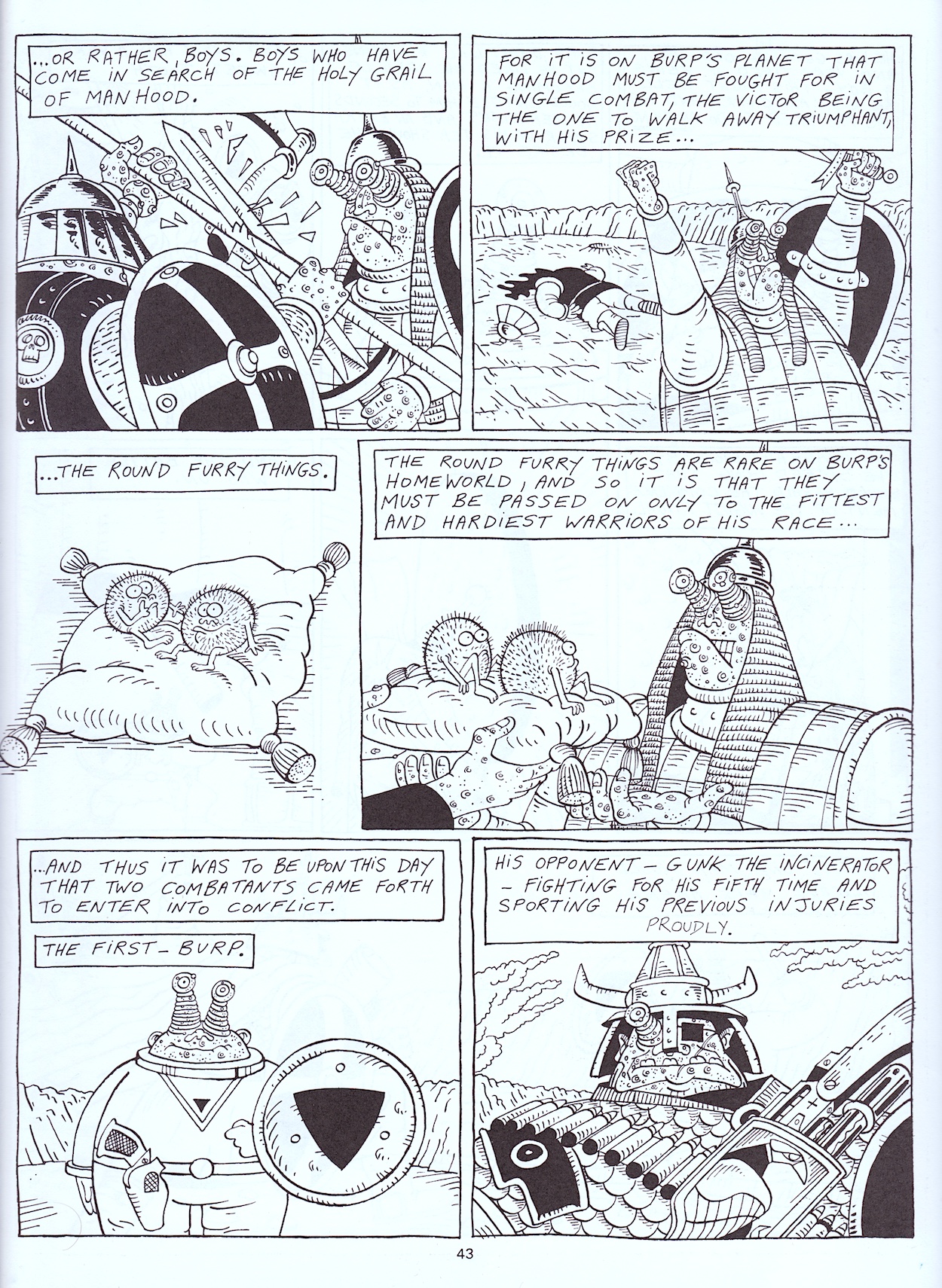
Straight away the descriptive captions are classic Banx, reminiscent of some absolutely brilliant Burp strips in the later fortnightlies when he was often given a double-page spread to fill with his unique style of storytelling. Even though this is a comic strip the words alone paint such a picture that the images are barely needed. But what on Earth (or elsewhere) has this got to do with the title and the reason I found it so funny a few years later? The answer is found on the next page.
Not exactly subtle and that’s why I couldn’t believe OiNK, a children’s comic, got away with this. But even beyond The Round Furry Things there’s so much to laugh along with here, such as the grizzled old warrior who was tired of being a boy and Burp’s innocence at what he thought being a grown up was all about. Then there’s the dramatic change in angle with the lone caption, “and Burp had a very sweet tooth.” It reminds me of that famous, “and the dolphin’s name was Keith” moment from Jeremy’s Mr Big Nose in #22.
I’ve really missed his work in the comic.
I’m not sure if it’s just a good gag or if Jeremy was making a bit of a point with the first panel on the fifth page, but I think it’s both funny and poignant that battle cries and fear sound exactly the same. Then the story takes a brief break to detail Gunk’s weapon of choice, the Mauser! Only Jeremy could come up with a gun that feeds electricity to a small rodent’s fear receptors to provoke it to do a literal death stare. The silencer is just the icing on the cake.
Arguably the next page is even funnier. The fight escalates, Burp using his unique bodily functions we’ve all come to know and love and be grossed out by, then as it’s all building to a climax the story casually breaks again to have a closer look at another animal-based weapon. Burp is usually a pacifist but it suits him, doesn’t it? We even get a bit of Marlon Brando from On the Waterfront, although that would definitely have gone over my head in 1988.
It all has to end in an even sillier manner and it does so with aplomb. As a fan it’s fun to see the insides of Burp’s body again and how the little fellas do all their hard work for nothing. On the final page is a message that as a kid I took to mean we should never want to grow up, that adults are just silly, so why would we want to be them? As an adult now and looking around at the world today, I think that message is pretty much on point.
Jeremy Banx was both shocked and dismayed, joking about how concerned he was for my wellbeing
So anyway, a few years later I hit that time when things start to change and life can feel very confusing. It wasn’t something we talked with our friends about, we didn’t realise what was going on after all, but then I happened to read this again. I’m not going to say things suddenly made sense! (Did you read it?!) But it was enough for me to realise I wasn’t alone and it could be something to look back on and have a giggle about, so it couldn’t be all that bad.
I once mentioned to Jeremy how a young and impressionable me viewed this strip in my early teenage years and he was both shock and dismayed, joking about how concerned he was for my wellbeing. Typical Jeremy response. So, having been mentioned in the very first OiNK review on the blog we’ve now finally covered it and finished our regular read through, coming full circle. I’ve loved seeing this again after all these years.
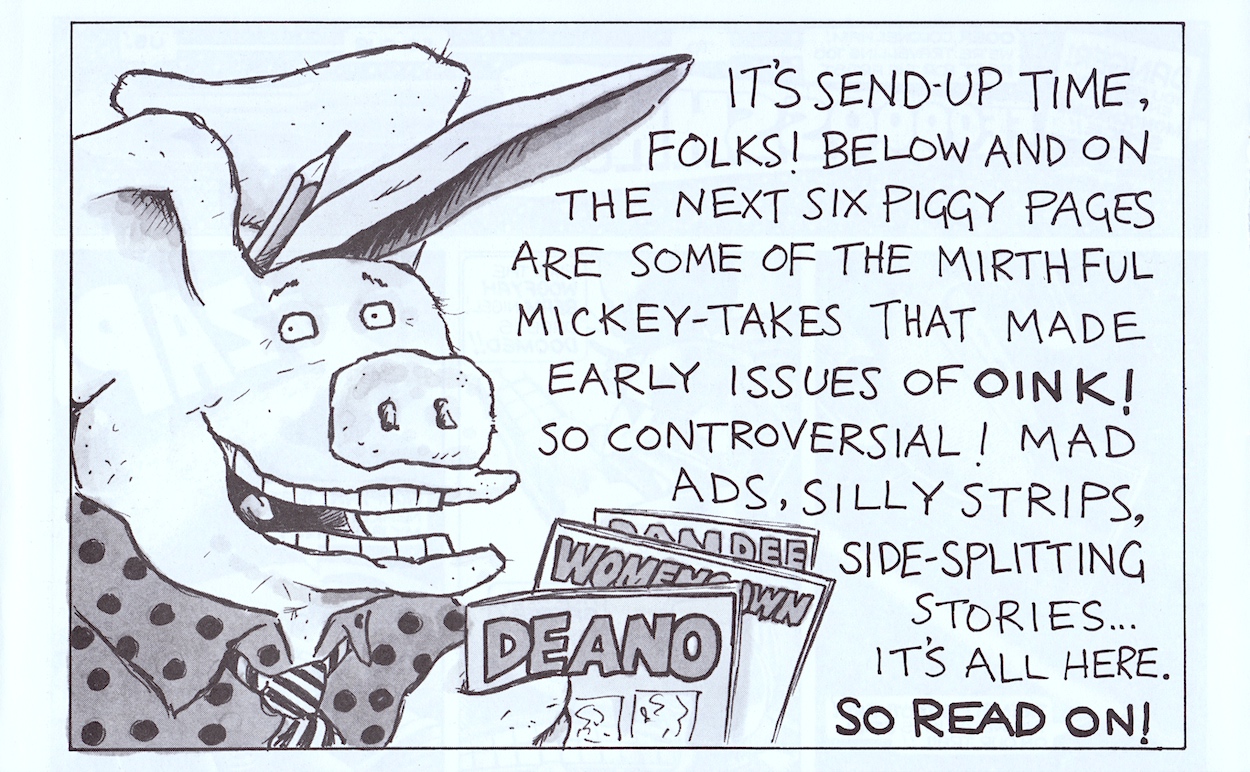
Moving on and yes, the dreaded reprints we saw a handful of in the monthlies have even made their way into the annual, introduced by Uncle Pigg, promoted as a way for readers to check out what they may have missed out on. Even though I’d only started reading OiNK at #14 as a child there were still a few strips here I’d read before. But, even though I hadn’t read the majority I still felt these dampened the book as a whole, especially considering there’d already been a page cut.
As it turns out there are ten pages of reprints, meaning there are actually only 54 interior pages of new content. That’s only six more than the recent monthly issues or a Holiday Special. Even as a child I was very aware of this. These reprint pages are really the only place you’ll find mini-strips too. The rest is made up of much larger fare. There’s even a three-page Psycho Gran and a five-page Spectacles of Doom (which you can see some of in artist Andy Roper’s obituary).
The new content here is superb, second-to-none and some of the very best OiNK ever produced
This means the book is a rather quick read, especially if you skip the reprints. According to co-editor Patrick Gallagher cost cutting is partly to blame after Fleetway Publications took over from IPC Magazines (who had published the first half of OiNK’s run including the first book) and OiNK had survived the first round of cancellations. There’s a chance all the larger material here was already complete when Fleetway started to see the comic’s fortunes in a more negative light during the latter weeklies/early monthlies, and maybe the plugged was simply pulled on the rest of the book.
When OiNK’s stablemate titles such as Buster and Whizzer and Chips had 112 pages in their annuals for the same price (albeit cut down from 128) you couldn’t help but feel short changed as a pig pal. The new content here is superb, second-to-none and some of the very best OiNK ever produced! But I can’t help but wonder how amazing this book could’ve been! It could even have topped the previous one. With silly pages like this next one, it’s easy to see how.
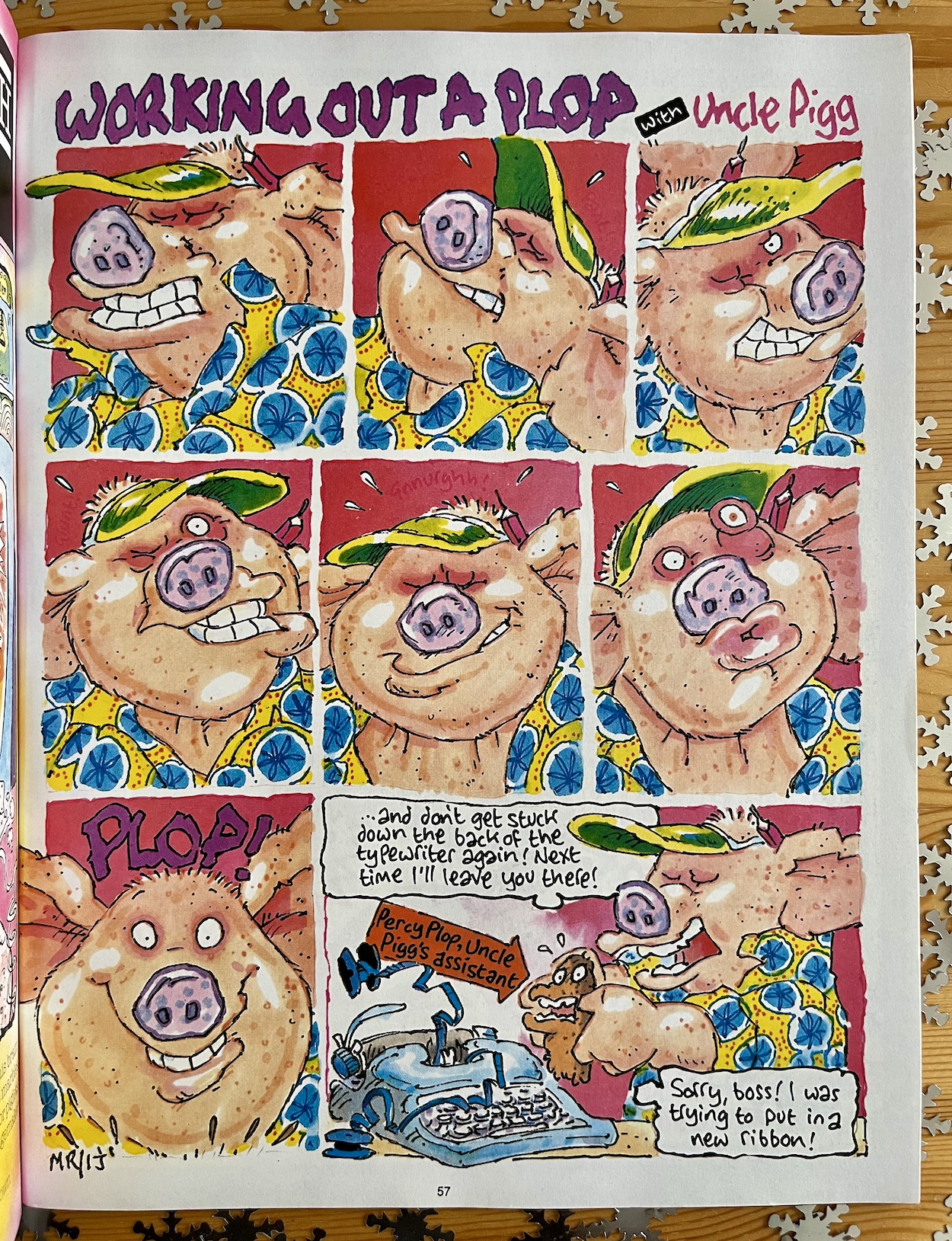
Only in an OiNK Book could such a simple, cheeky gag like this take up a full page and be illustrated and coloured so gorgeously. However, even with all of these brilliant highlights I think I may have saved the fan favourite for last, at least as far as my memories are concerned. That’s because in 1988 it was so exciting and so funny to see two of Lew Stringer’s creations in the same strip, especially when they’re Pete and his Pimple and…. Pigswilla!
Actually, we even get Tom Thug popping up too (alongside his own snowy, Christmassy strip elsewhere), so that’s two-thirds of the Buster mergers included and it’s nice to see Pete reading OiNK again instead of that other comic. Ignore the heartbreaking caption about OiNK still being a periodical and watch as Pete’s pimple becomes the latest giant monster that only an equally giant robotic pig can save the world from.
I just love that panel showing us the pimple “terrorising the cities”. It may only be a small cameo for Pigswilla’s final appearance but we did get a superb epic strip for him back in #66 so this is a nice little addendum to say goodbye. Not that it would’ve been written as one but it works nicely anyway. When reading children’s stories to my friends’ kids I think I’ll stick to the moon being made of cheese, though. (Also, did you ‘spot’ the slightly obscured dig at W.H. Smith?)
I hope you’ve enjoyed this look at just some of the highlights from The OiNK! Book 1989. In more recent years I’ve seen some pig pals online somewhat dismiss it as nothing more than an inferior version of the first one. I hope I’ve been able to enlighten you a little on why some of the changes may have occurred and, most of all, shown you that the content in it is top notch OiNK all the way. Yes, it’s a little frustrating because this could’ve been a classic OiNK Book through and through, but the team still produced some of their very best work for it. If you see it on eBay you should definitely splash out the few quid it’ll cost you for some of the best laughs you’ll ever get from a comic book.
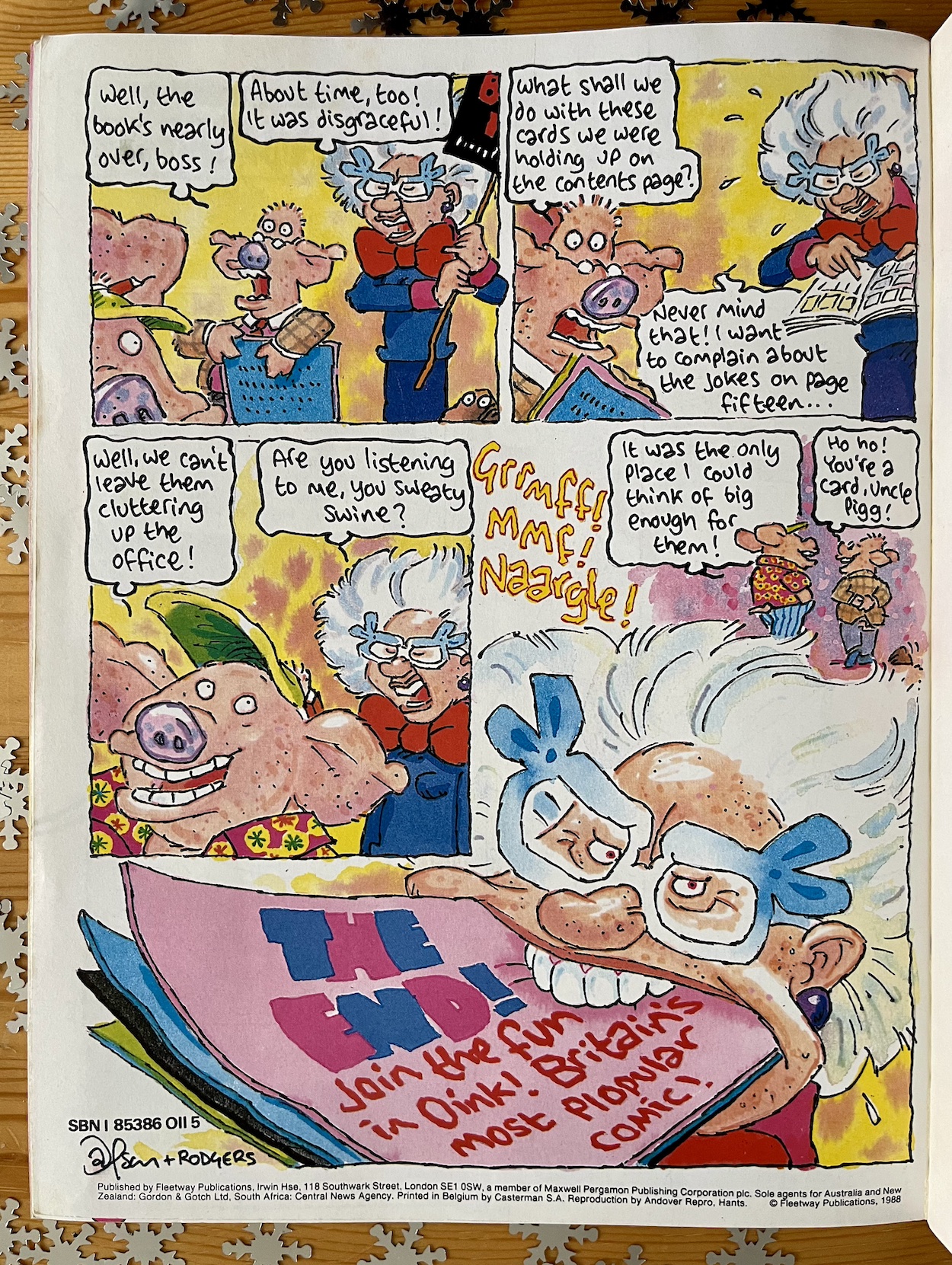
Just like last year the outro concludes what began earlier and, while it’s yet another example of the book publicising the ongoing comic after it was canned, it’s another great page by Ian Jackson. It’s always funny to see Mary Lighthouse get her comeuppance too, isn’t it? With superb script work throughout, plenty of laughs to be had, some stunning artwork and some gorgeous colours, The OiNK! Book 1989 may feel a little unfinished but as a way of ending the regular run of OiNK during the festive season it’s a pretty perfect piggy publication.
Just that back cover to go before I let you get back to that selection box you promised yourself you wouldn’t open again until Boxing Day. That hint on the front I alluded to earlier looked a bit like a wood effect finish behind the butcher’s head, don’t you agree? There’s a good reason for that.
So here it is, Merry Christmas and Happy Holidays to everyone out there.
I hope you’re all ready for a day of feasting, gifting, a little morning tipple (followed unironically by Schloer at dinner time) and maybe even a giggle along with The OiNK! Book 1989 here on the blog tomorrow, or the last Transformers Annual as we wrap up the epic seven-year real time read through over on the blog’s Instagram.
Whether it’s a big celebratory day or a quiet one in the comfort of your own home, may your day be merry and bright. May you enjoy your Christmas Day as much as Smudge seems to enjoy my Sonic the Hedgehog Christmas jumper whenever I go to visit him. Have a great one everyone and thank you so much for all of your support all year!
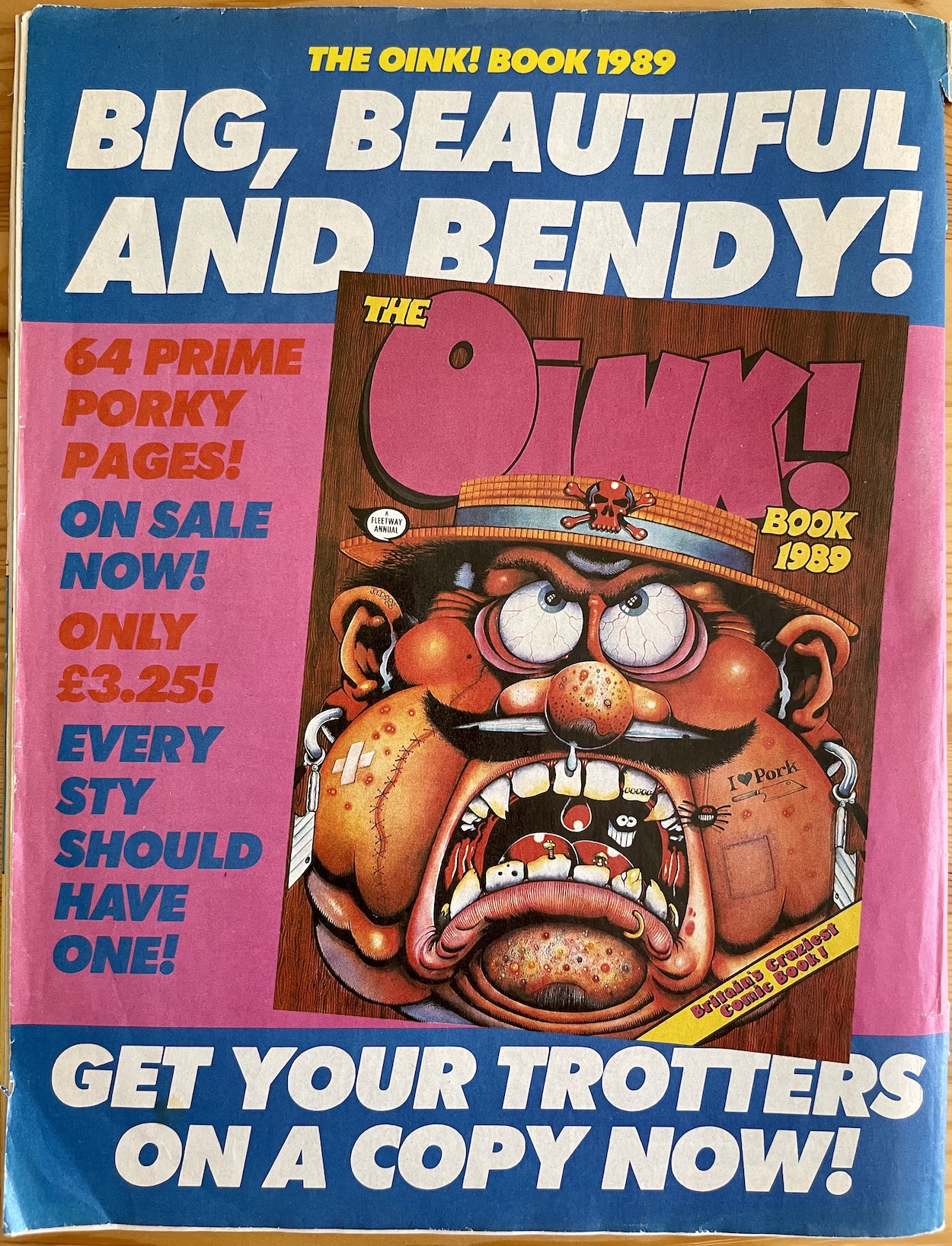
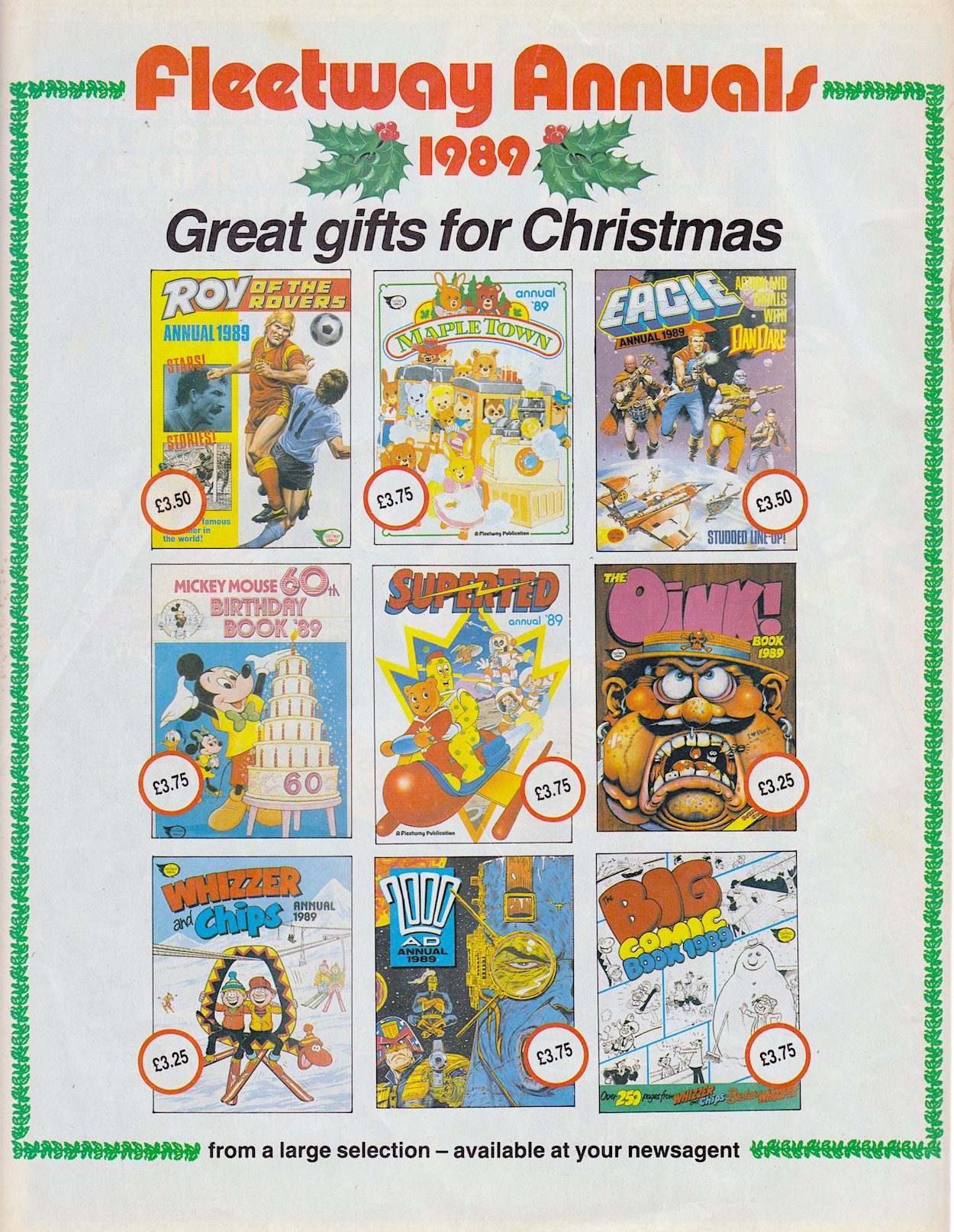
I can remember my disappointment the first time I saw this full-page advert for the second OiNK! Book. Why was it 16 pages less than the previous year’s? The wonderful J.T. Dogg cover softened the blow though. When I saw it in the shops as a kid it felt very light in my hands, the glossier yet thinner paper and the page count made it feel more like a Holiday Special than a sequel to the best edition of OiNK ever. However, come that Christmas season when I finally got to read it any reservations I had soon evaporated.
It certainly stands out on this back page advert from the final edition of the comic, doesn’t it? The finished book’s logo colours would be swapped around and it’d stand out even more, as you can see in the image at the very top of the post. It’s a very different book from last year and focusses on larger strips for some of our favourite characters. So, in the review this Christmas Day expect a crossover event between Pete Throb and Pigswilla, the return of Ham Dare and a simply enormous Burp strip as The Smelly Alien From Outer Space makes a long-awaited return (in a story that taught me something about growing up, believe it or not).
In three days, crack open that once-a-year-socially-acceptable-in-the-morning booze and have a chuckle along with highlights from “Britain’s Craziest Comic Book”, The OiNK! Book 1989.
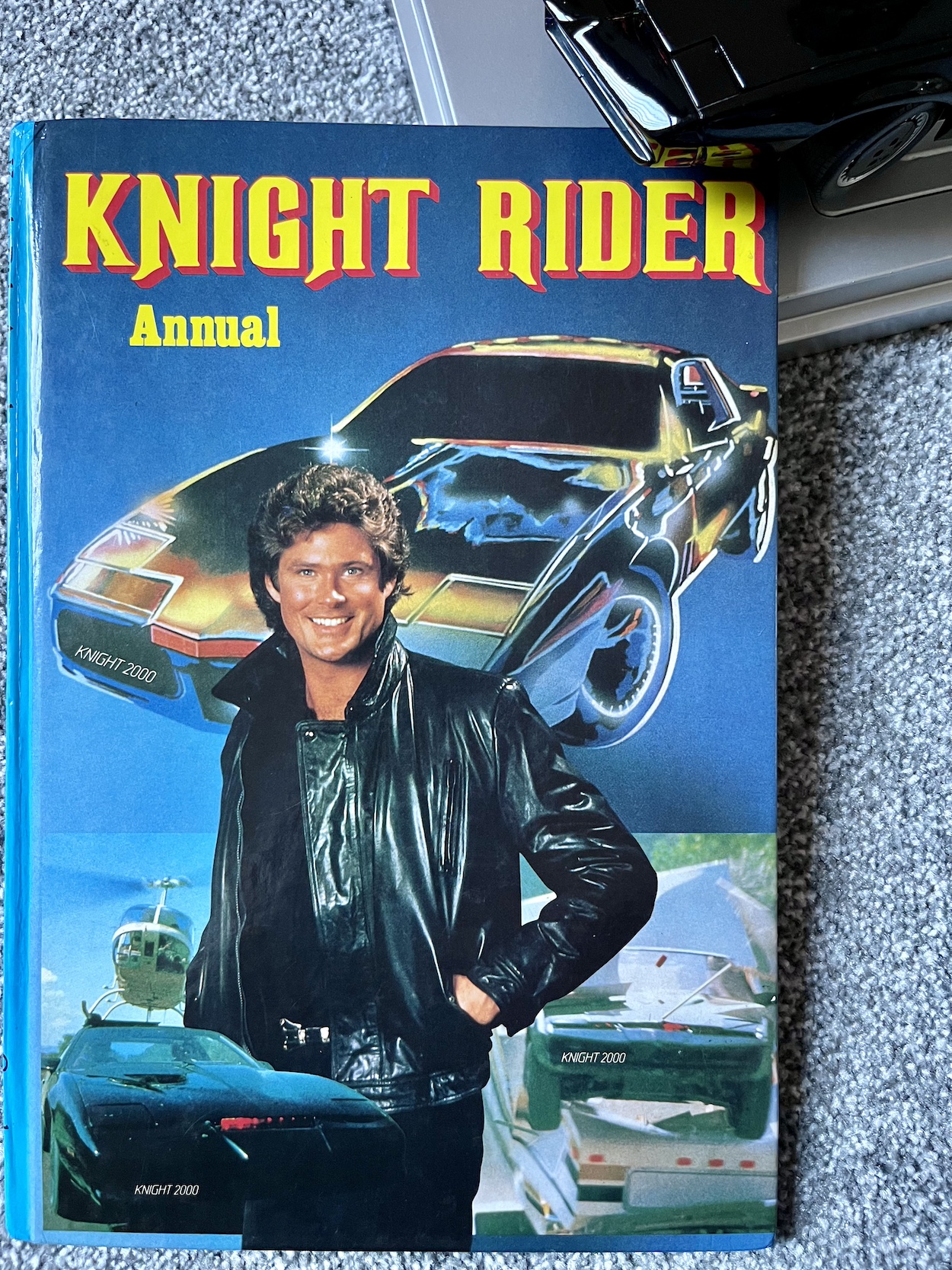
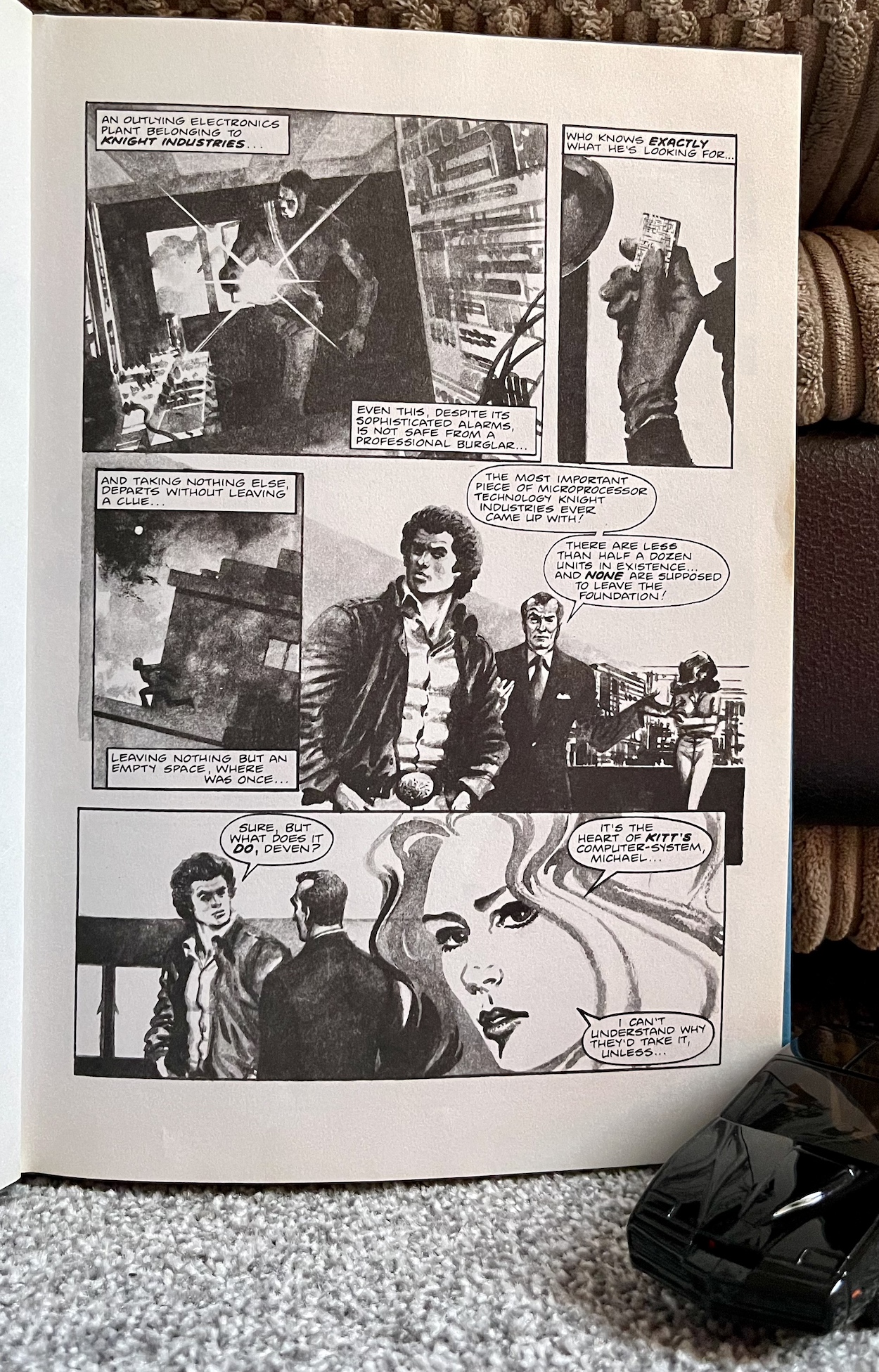
By the time this second Knight Rider Annual was being written the team had had more of a chance to become acquainted with the series and it shows. Don’t get me wrong, the previous book was a fun read with some simply beautiful David Lloyd artwork and writer Steve Moore had nailed the early characterisations of both Michael Knight and K.I.T.T. from the pilot movie. However, this year the stories definitely benefited from the broadcast of more episodes. K.I.T.T.’s capabilities have also been expanded andMichael feels more rounded.
Released in the summer of 1984 for that festive season, this annual is set during the second season of the show. In the UK, where programmes would normally begin airing about six months after the US back in the 80s, Knight Rider had proven to be such a phenomenal success for ITV that they broke with that tradition, moving straight on to season two the week after season one finished. So Steve and David had a wealth of episodes to work from and as a result there’s a different feel to this book. Let’s begin and I’ll show you what I mean.
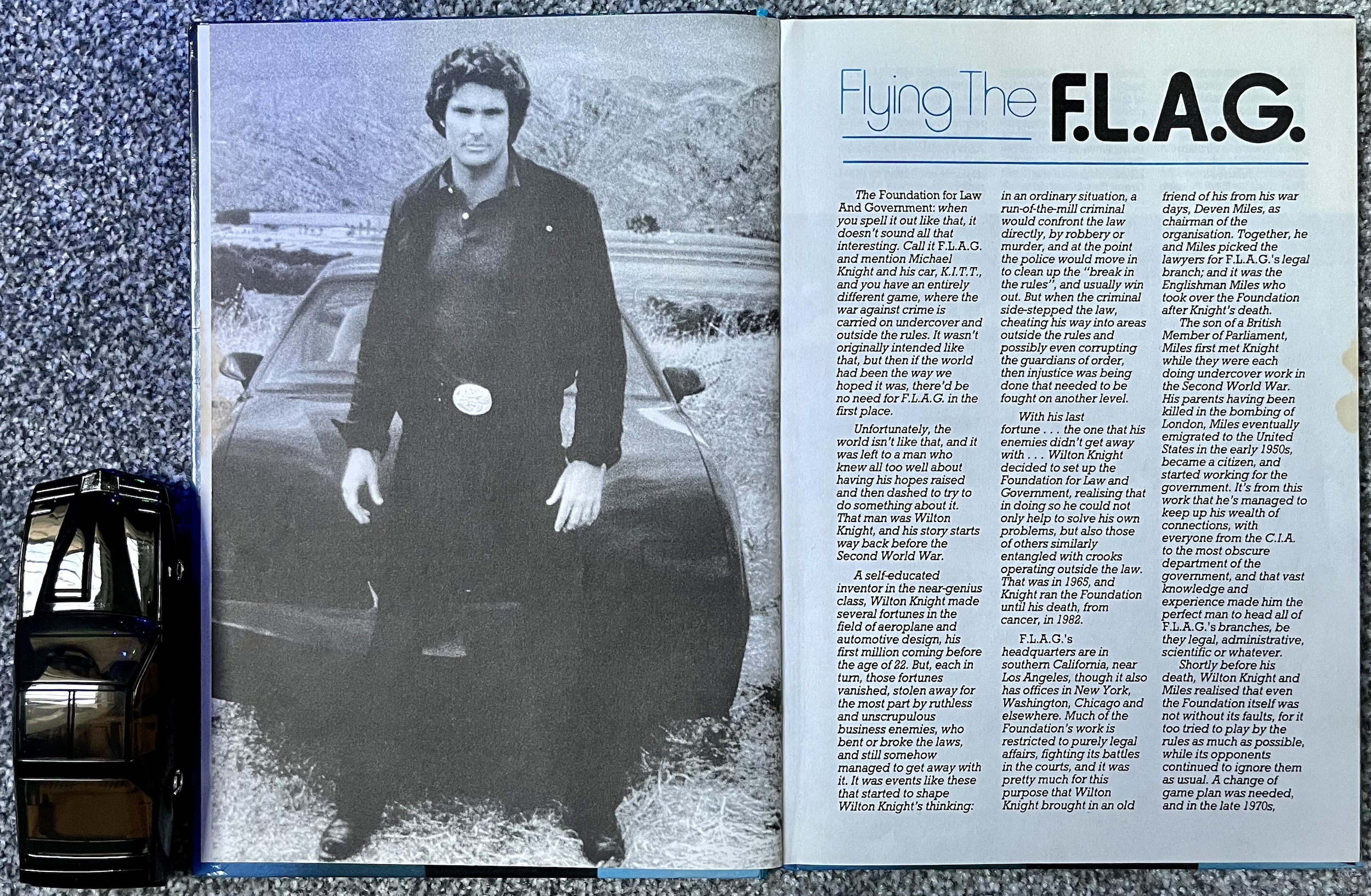
This year’s origins feature focuses on Wilton Knight, the millionaire philanthropist who created Knight Industries and its F.L.A.G. (Foundation for Law and Government) division, who saved Michael from certain death before passing away himself in the pilot movie. Wilton was played so memorably by Richard Basehart (Moby Dick, Voyage to the Bottom of the Sea, La Strada) his commanding vocals were heard every week in the opening credits. The feature tracks his history back to World War 2 and the origins of that famous “criminals who operate above the law” line.
It’s also the first time it’s confirmed that it was cancer that killed him, though it was implied in the pilot movie. Apart from continuing to misspell Devon Miles’ name as ‘Deven’ this is a flawless introduction to the show and with all of the extra information it’s something fans should hunt out the book for. After Devon’s immigration into the US we find out there were flaws with how F.L.A.G. operated at the beginning. Remaining inside the same rules the criminals flouted was leading nowhere, so from the late 1970s research into a new project began, which would eventually lead to K.I.T.T.
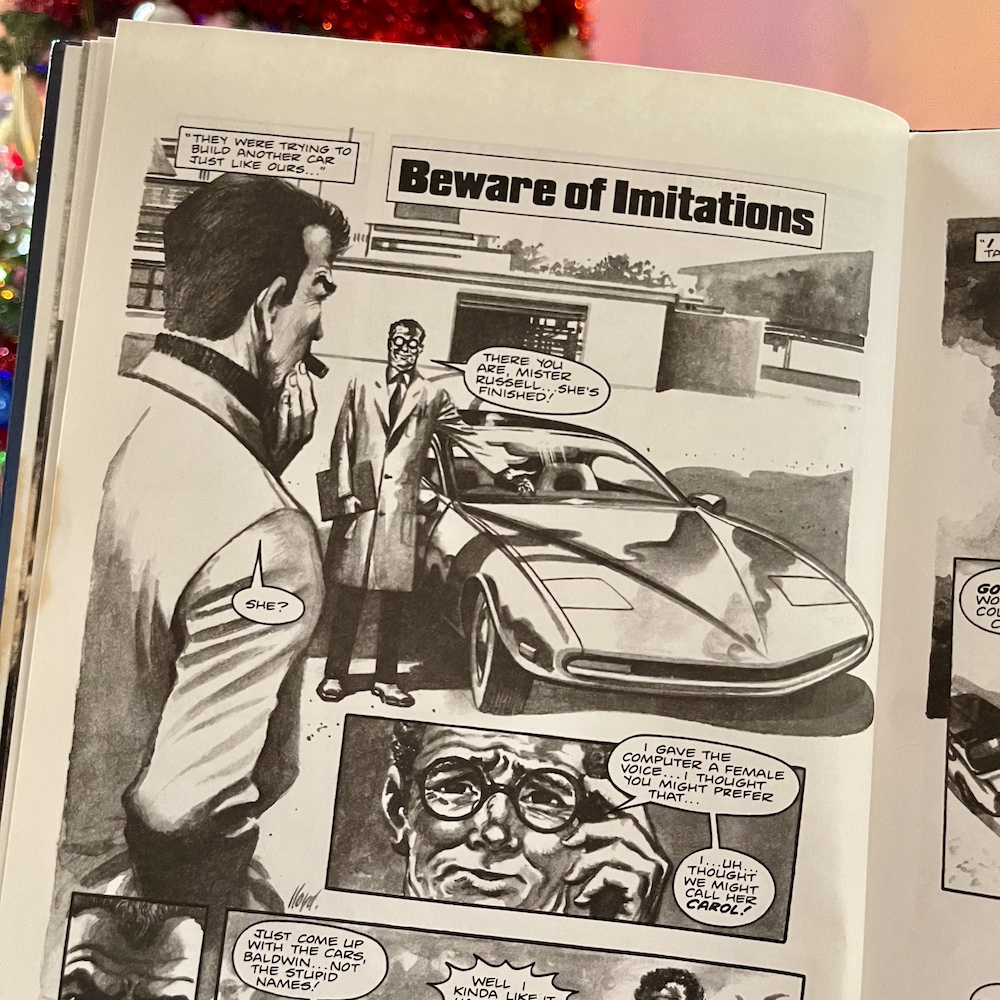
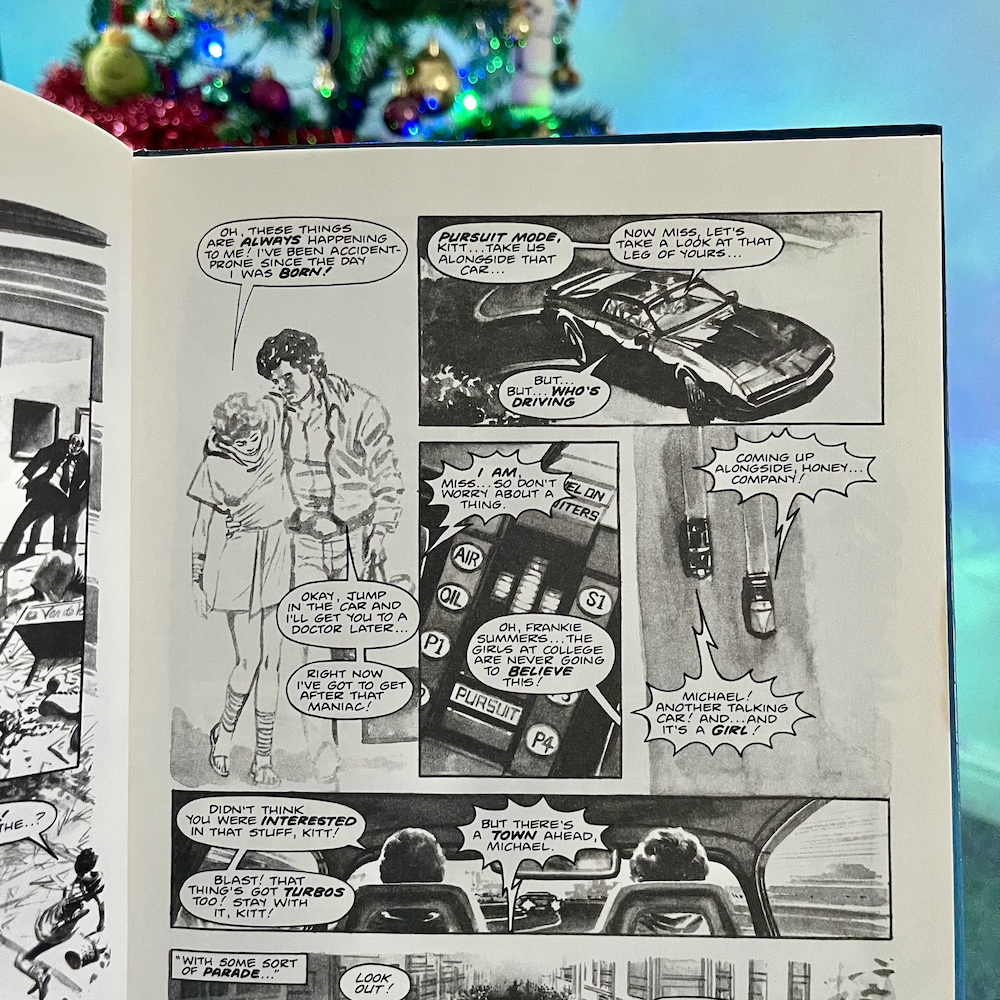
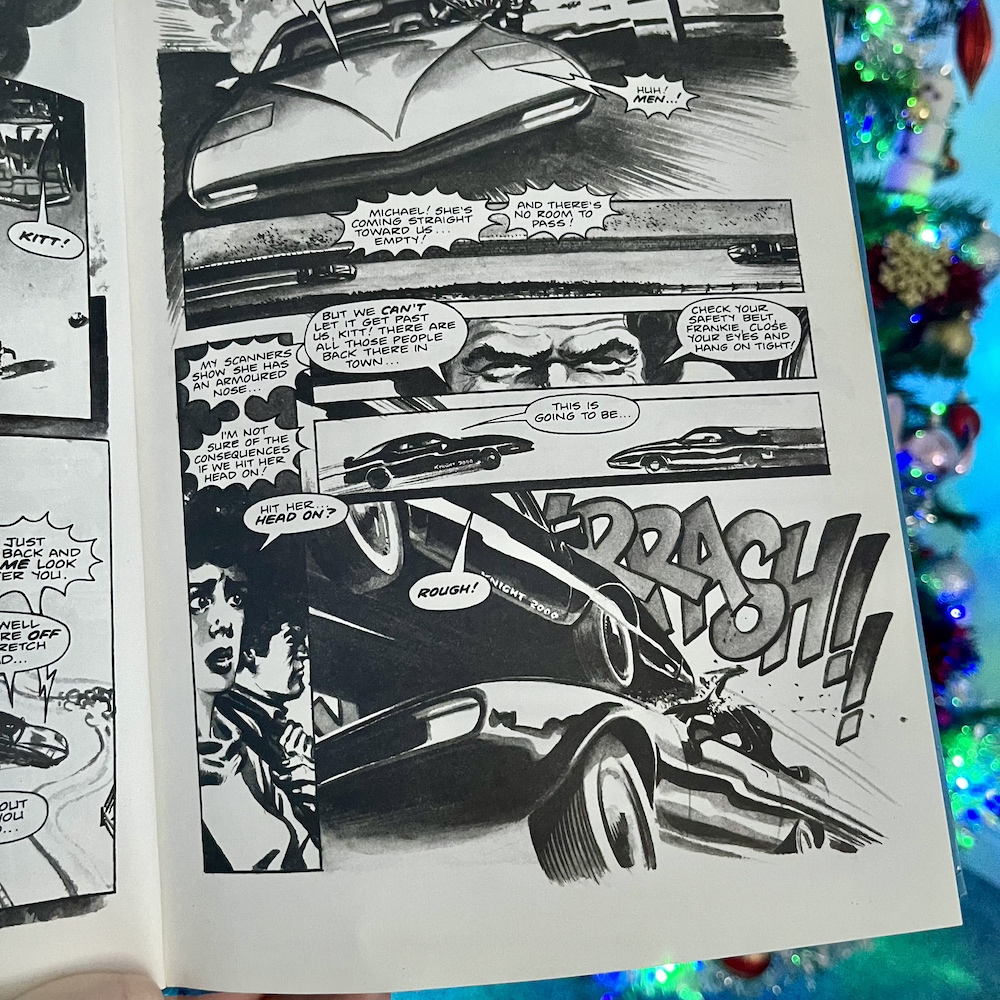
It’s a brilliant start and benefits from extra research into the background of the series’ story. So it’s weird that the first strip, Beware of Imitations, is a rip off of a very popular story from the TV show. In the programme, K.A.R.R. was the prototype for K.I.T.T. However, while K.I.T.T.’s primary directive was the preservation of human life, K.A.R.R.’s was self-preservation (originally thought to be the best way to protect the driver). Here, we’ve got another ‘twin’ for the supercar. There’s a wonderfully atmospheric first page but then it boils down to a new female version of K.I.T.T. being prepared in record time, completely contradicting the introductory feature on the previous pages.
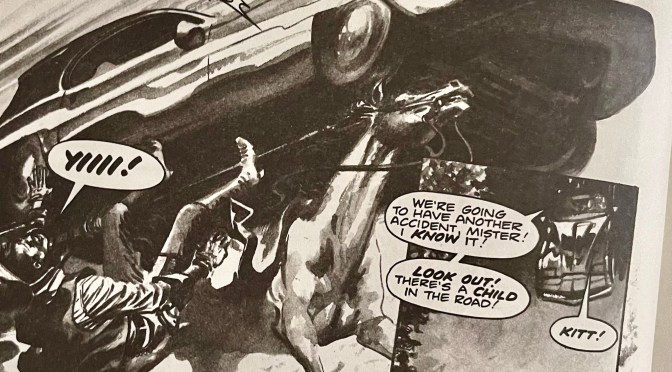
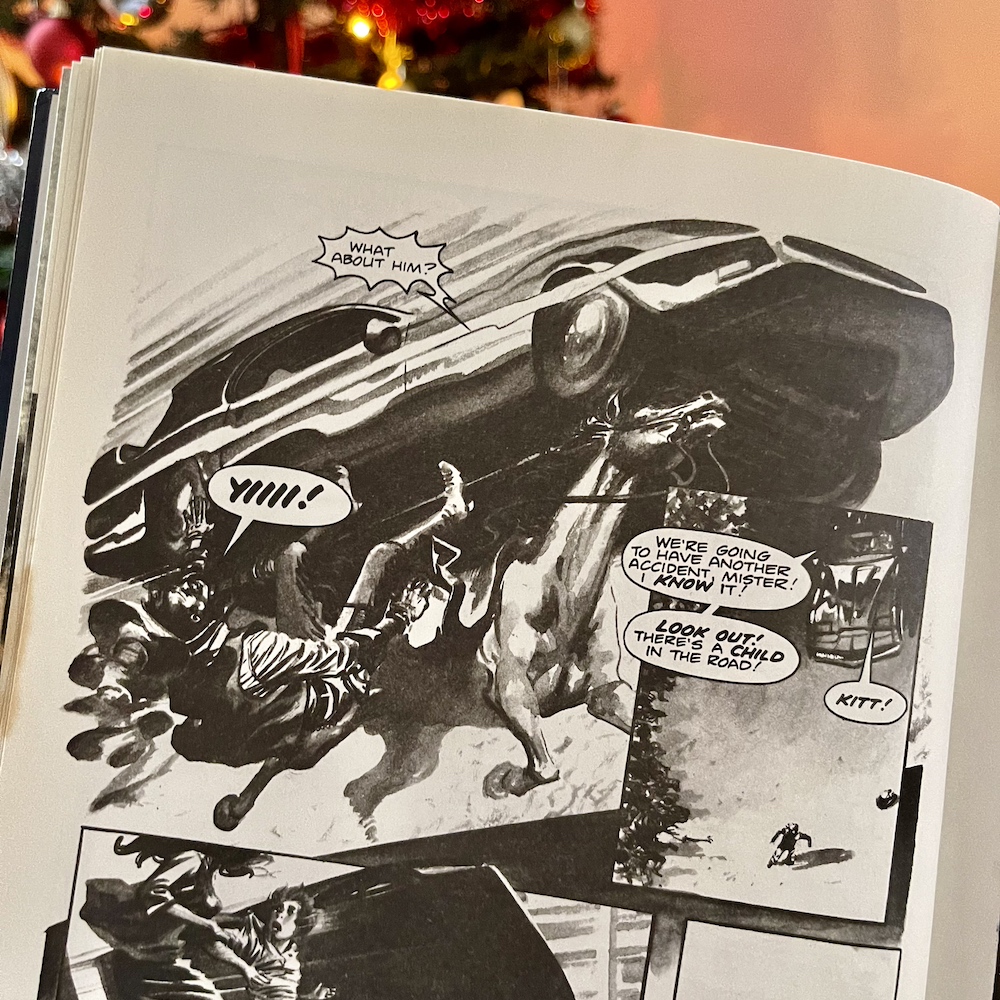
There are mentions made of the shortcuts taken and the fact only the nose of the car is armoured, but seeing it turbo boost etc. makes it seem like K.I.T.T. (and by extension K.A.R.R.) isn’t all that special after all. It’s not even all that fun, other than the solution to stopping the car is K.I.T.T. landing a turbo boost on top of it! Beautiful artwork from David Lloyd again though, with loads of fast action and big, impactful panels of destruction at the hands (tyres?) of the female car.
The first prose story is called Games People Play and involves industrial espionage in the video game industry, something else we’d have seen in the series by this point. However the episode in question, Nobody Does It Better, wouldn’t have aired when this was written so it’s more of a coincidence. Also, back in 1984 the video game explosion was in full force and it was a subject ripe for this hi-tech TV show.
The mission seems simple enough to begin with. Michael needs to protect Dr. Lesley Kelly, a gaming company’s lead engineer until she can complete the first build of their next hit title after some failed kidnap attempts. Michael is instantly attracted to Dr. Kelly but Lesley makes it crystal clear the feeling isn’t reciprocated, but she warms to K.I.T.T., speaking to him on a level footing and adding an enjoyable character dynamic between the three of them.
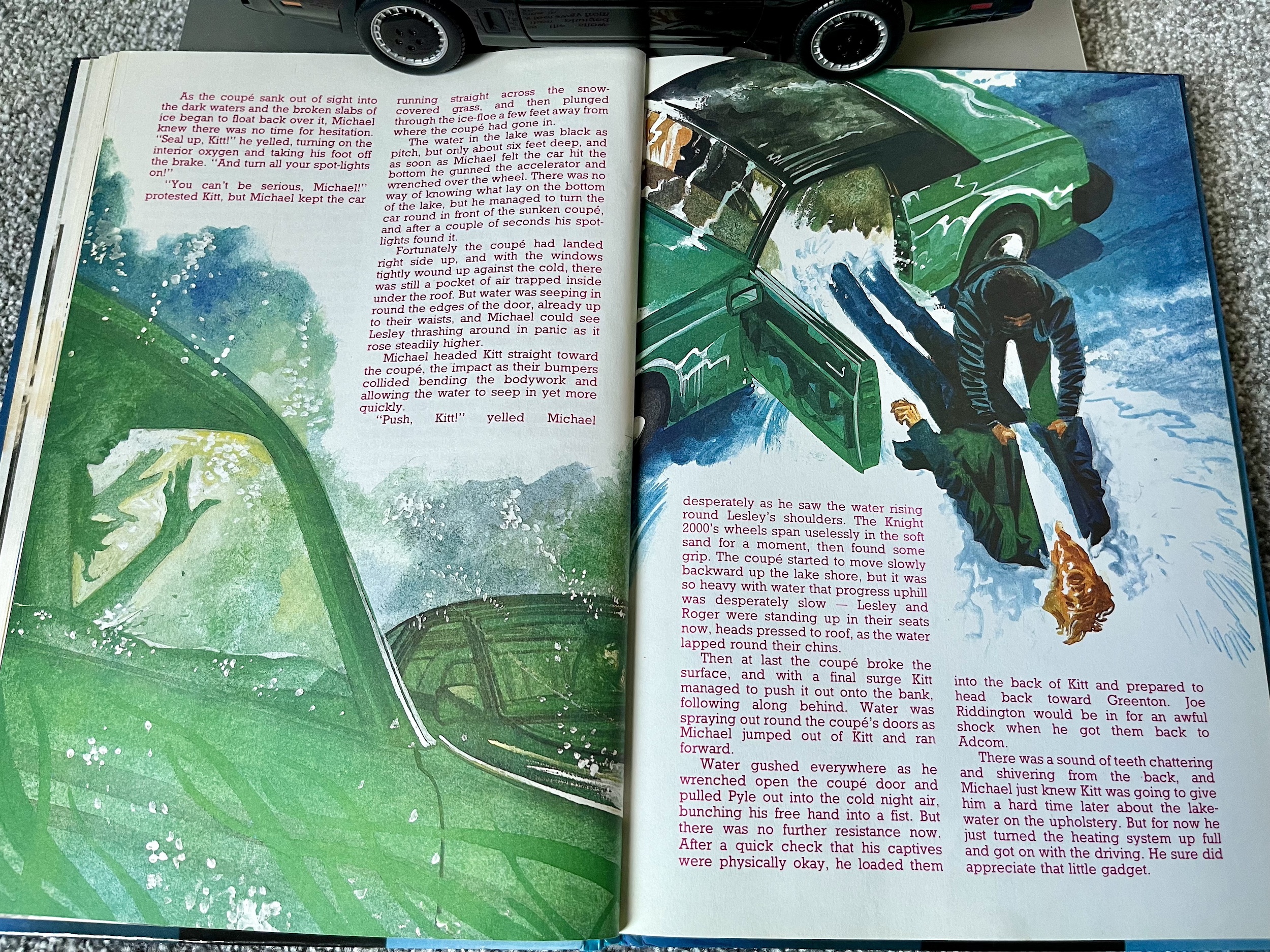
There are lots of little clues for the reader to pick up on before the big reveal of what’s really going on. It’s just a shame the person behind it all is revealed to be awfully similar to that of the aforementioned episode, an unfortunate coincidence in this case because viewers will see the shock ending coming a mile off. This doesn’t make it any less enjoyable though, with Michael resorting to stealthy tactics to protect someone who doesn’t want his protection, K.I.T.T. delivering some killer lines and it all comes to a climax below a frozen lake! It’s a scene the series simply wouldn’t have had the budget to handle properly and is exactly the kind of story these books are perfect for.
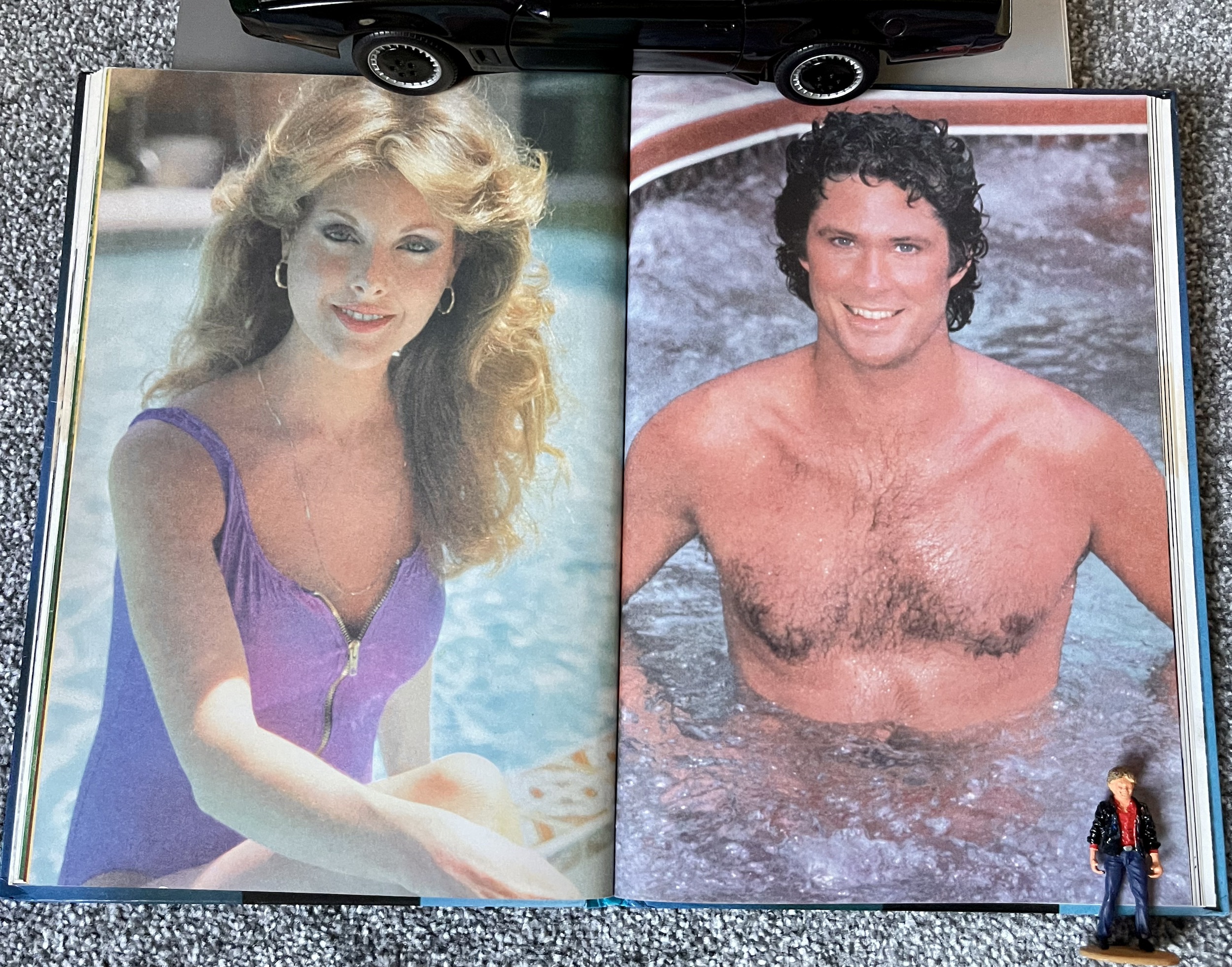
Back in the 1980s we had to rely on magazines to keep us abreast of the latest news about our TV shows or to find out more about our favourite celebrities. One such title was Look-In, the ‘Junior TV Times‘ mentioned in the previous Knight Rider Annual review. Alongside the weekly strip there’d be occasional interviews and features about the show, as well as full-page photographs of its stars, automotive and otherwise, which this second annual has in abundance. That’s right, cue some very 80s pin-ups.
Other such pages include photos of Rebecca Holden (who played K.I.T.T.’s Cyber Technician April Curtis in season two) on a cross trainer in her living room and Michael Knight himself David Hasselhoff in his running gear. Clearly the team behind the annual believed the teen audience wouldn’t appreciate some photos of the superb Edward Mulhare and leaving out K.I.T.T. seems criminal! It feels like the book is trying to appeal both to the readers keen for action stories as well as those who’d buy Look-In for the attractive celebrities inside.
While I wouldn’t have had any interest in cutting these out, this shift in focus from the first annual does bring something else Look-In was great at. In here are two brilliant interviews with none other than The Hoff and Rebecca themselves. Quite the scoop. In A Knight and His Damsel David talks about his relationship with fiancée Catherine Hickland who played Stephanie Mason, the fiancé to Michael Long before he died and was reborn with a new life and identity. She’d appear in a trilogy of episodes across the four seasons, including the episode that would act as the finale. As such it’s strange her guest role isn’t mentioned at all here.
But what is here is fascinating, telling the story of David’s rise to stardom, the tragic loss of his agent, how he and Catherine met and how she kept his feet firmly planted on the ground, especially when Knight Rider took off. There are even some funny anecdotes about Catherine’s reactions to the times David would do some of his own stunts, such as high speed driving or even hanging from a helicopter. Just as an aside, the couple married at the end of season two, their wedding day reproduced for that final episode in season four. They then divorced a few years later and in 1992 Catherine went on to marry an actor by the name of Michael E. Knight!
Anyway, back to the book.
“Cathy gets mad when [female fans] approach me in the street and I can’t blame her. These women tell me they think I’m gorgeous or something like that and invite me home… right in front of her. I tell them that Cathy is my fiancée but it doesn’t put them off.”
David Hasselhoff
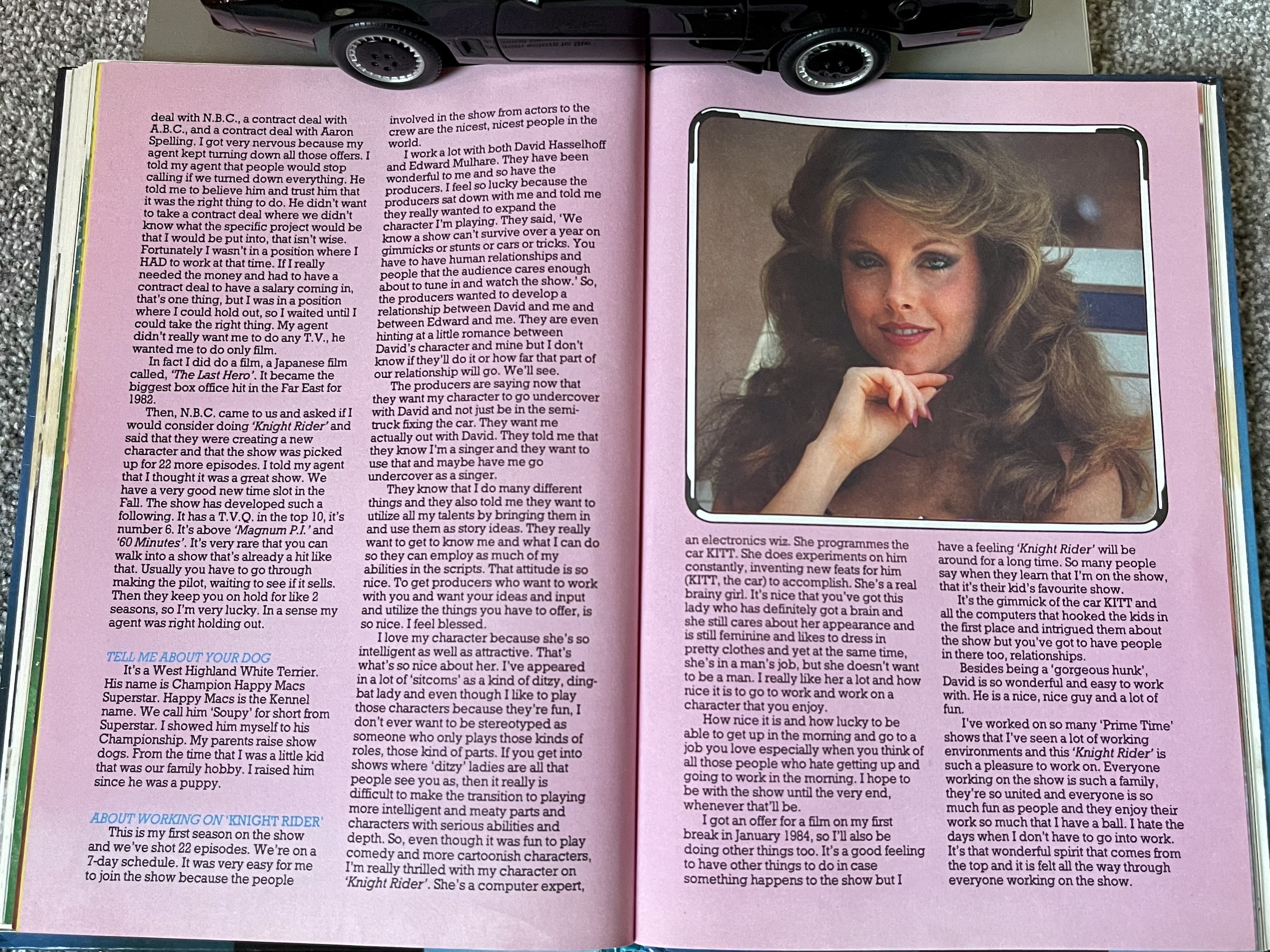
This next feature was a very pleasant surprise. I’ve bought quite a few Knight Rider books in my time, mostly fan-written and while some of them are great they’re usually quite light on depth, offering up nuggets of information episode-by-episode gleaned from obviously much longer interviews. I long for a book with plenty of in-depth discussions with the writers, cast and crew which doesn’t feel the need to break it down like that. So you can imagine my joy when I came across five garishly coloured pink pages and a proper, lengthy interview with Rebecca Holden.
Despite having the ever-so-80s and cringeworthy subtitle of ‘The Beauty With Brains’ it’s a great read covering Rebecca’s past, her family life and her career. She talks at length about what it was like to work on Knight Rider, especially coming on to an already established show and replacing a popular character. Most interestingly, or perhaps frustratingly for fans of April, we find out some plans the producers had for the character in later years, but of course this was her only season, with Bonnie returning in season three.
It’s clear Rebecca was incredibly proud of the character she portrayed and was looking forward to developing April more, emphasising how rare it was for a strong female character to feature as a regular in a series like this at the time. Certainly, the show explored April’s character more in one year than in all three seasons with Bonnie and while the latter will forever be a fan favourite, I’ve a soft spot for April. I think that has a lot to do with Rebecca herself and her ability to switch naturally between the technical, the dramatic and genuinely funny moments in an instant.
Talking about what the fans wanted, as I touched upon last year it’s hard to describe to those raised in a world of the internet just how exciting it was for us to see photos of K.I.T.T. It was a huge selling point for any magazines which featured him, such was the pull of the show and of this car. If you didn’t have a VCR you’d see the show once a week and that was it, so you relied on books and magazines to get your fix. I remember at some point during the four years Knight Rider was on we got our first VCR and a year or so later for Christmas Santa Claus brought me my very own 3-hour blank VHS cassette. I was so excited! It meant I could now record and rewatch Michael and K.I.T.T. over and over and over again.
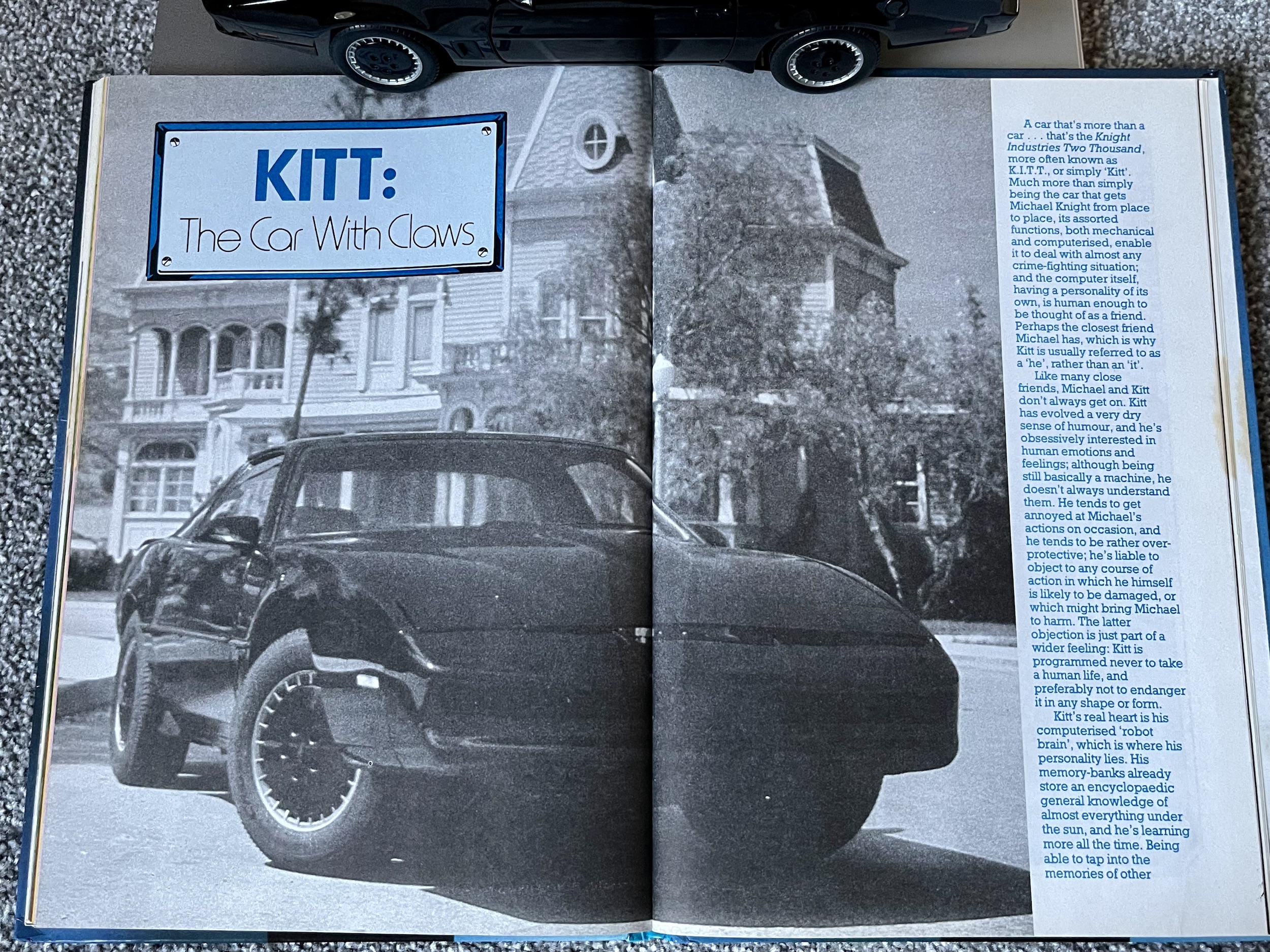
All this made features based around him even more exciting, even if he only got three pages to himself this year. What we do get is a fun little look into how his personality changed over the first and second seasons, a more accurate representation of his capabilities and limitations compared to the previous annual, as well as the physical gadgets of the car in which he resides (such as Turbo Boost etc). Although, it’s a bit of a stretch to say he “is also self-repairing, and rarely has to go into one of F.L.A.G.’s garages for servicing”. While this sounds more in line with the 2008 sequel series, it’s actually a reference to his ability to self-diagnose, a highly advanced feature of high-level computers at the time.
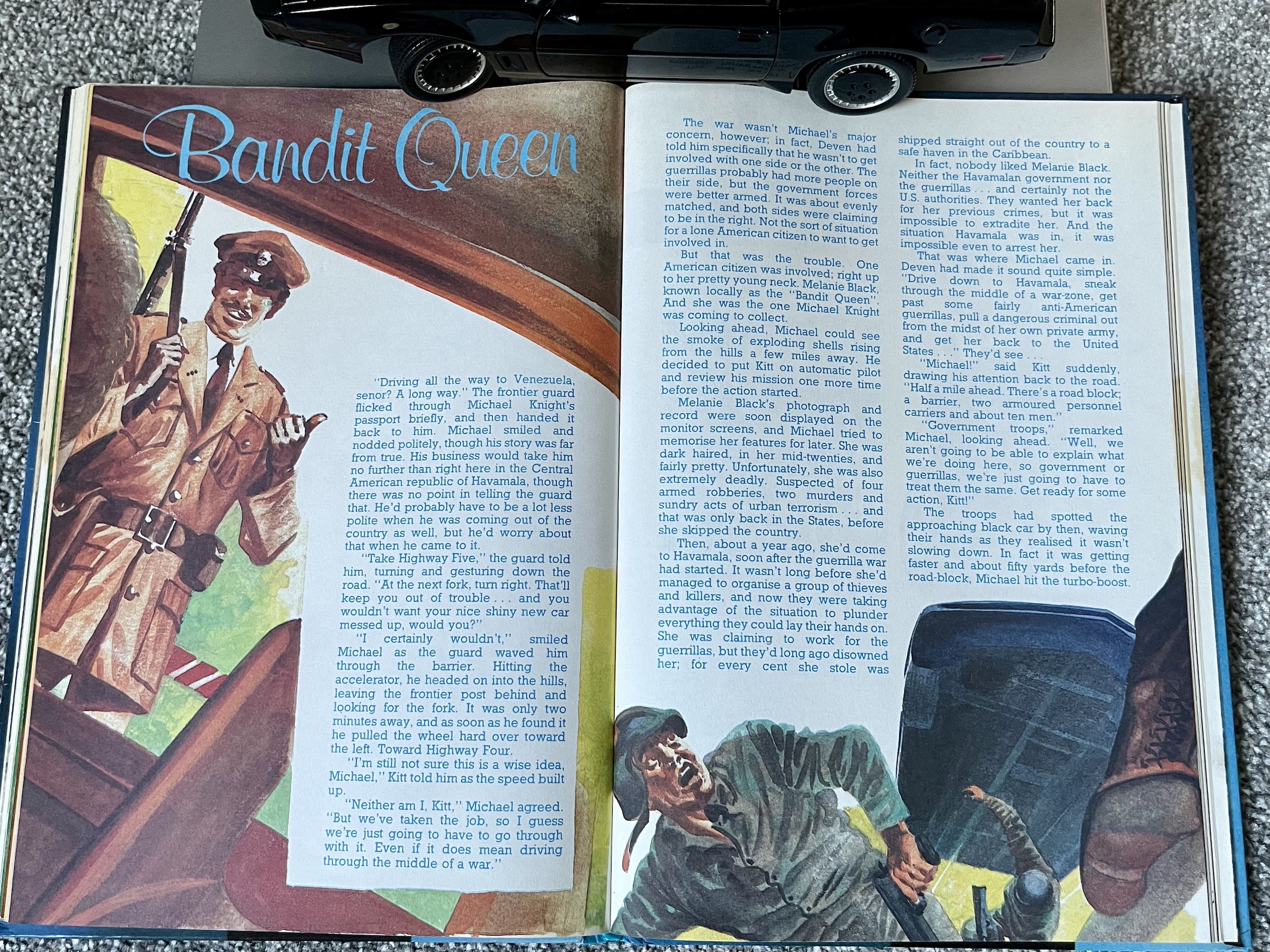
Back to the fiction and prose story Bandit Queen is another standout. The fictional Central American Republic of Havamala has been at war for a while now, the government and guerrillas pretty evenly matched and neither side making headway. The once beautiful country has been devastated by battles and Melanie Black, the ‘Bandit Queen’ has used this as the perfect cover. Originally pretending to be on the side of the guerrillas, they disowned her after discovering she’s wanted in the US for armed robbery, murder and terrorist offences. With no hope of official extraction in the middle of a war, Michael and K.I.T.T. find themselves crossing into this dangerous land to find Black and bring her back to America for trial.
Straight away the dialogue between our two heroes is perfect. The way they speak to each other matches the rhythms of the series in such a way I could hear David’s and William Daniels‘ voices as I read it. The journey to Black’s compound is equal parts action and lovely descriptive moments of the tragedy of war as Michael sees the potential in the country and its people destroyed by the fighting. It’s a surprisingly mature outlook on the consequences of war and completely fitting for the character of Michael. He’s a Vietnam vet and clearly recognises this scenario.
The second Knight Rider Annual is a perfect example of the genre and offers depth and interest beyond what you’d probably expect
So, under the cover of night, and with Black’s compound shrouded in darkness with no lights to give away its position to enemy aircraft, we’ve the perfect set up for this unique partnership to strut their stuff. Using K.I.T.T.’s sensors to sneak up on the gate, Michael disabling the guards while K.I.T.T. disables the electronic alarms, scanning for their target, deducing possible routes through the buildings, analysing their tactics together, it all feels just right. It’d make a hell of a great episode too, especially when, just like the best TV stories, it doesn’t go as expected.
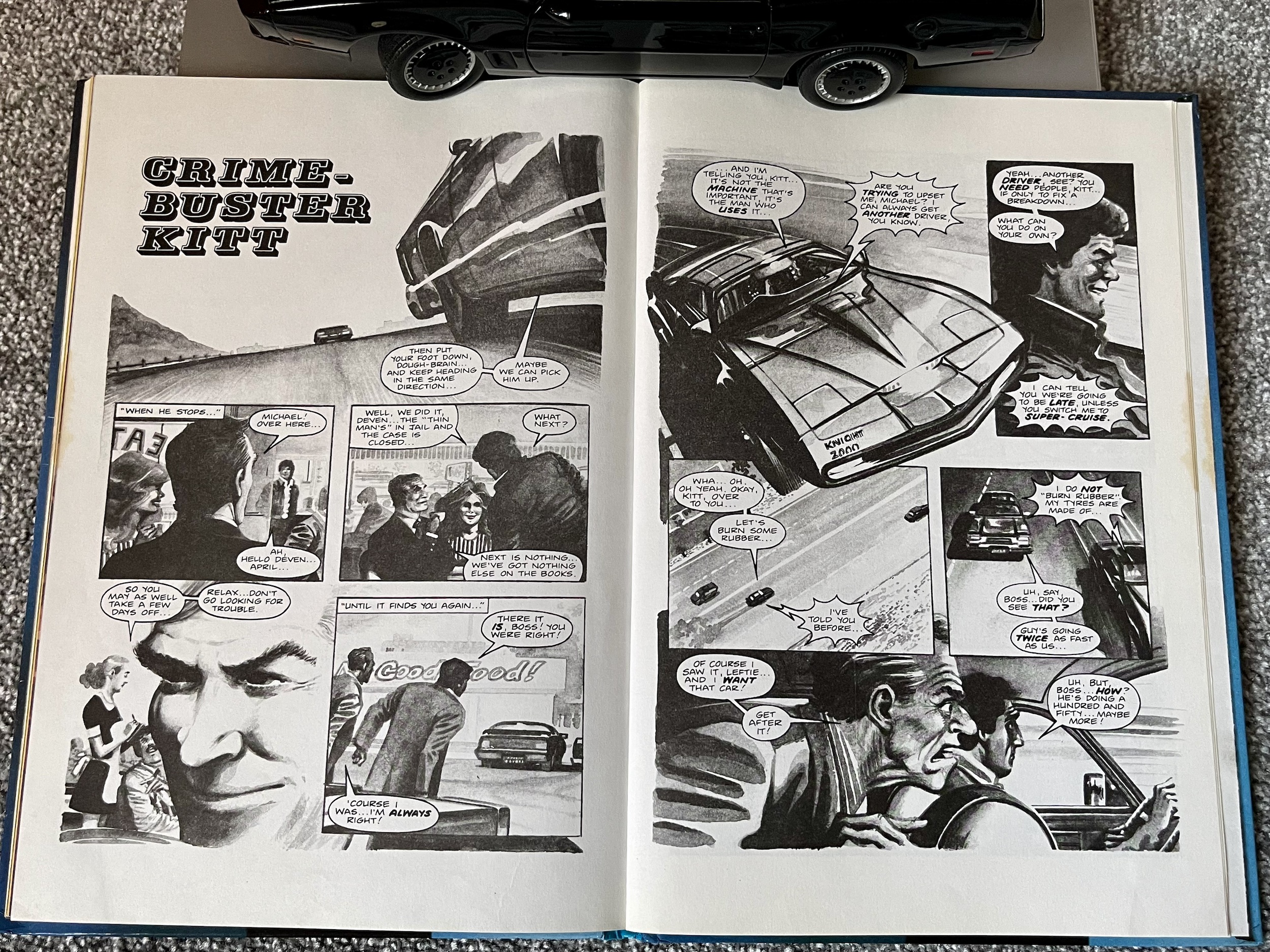
A last minute upset means the carefully worked out plan is thrown out and they have to act by the seat of their pants, or the treads of their tyres. It’s great fun and rockets towards the end without sacrificing any of the earlier depth or characterisation. By contrast the final strip, Crime-Buster K.I.T.T. is a fun little distraction, even if it is another idea taken direct from the television, as two criminals con their way past Michael to steal his car.
We can’t say this is a coincidence this time because right back in the pilot movie Jackson and Browne (hilariously played by Michael D. Roberts and Bert Rosario) tried a few times to steal the shiny new Pontiac Trans Am and eventually succeeded. What K.I.T.T. put them through, and how he got rid of them in the end by driving to a police station and literally ejecting them into the hands of the law, is exactly what happens here, albeit with different characters. This similarity makes the strip rather forgettable, it would’ve been better as a fun reenactment of a favourite scene for younger viewers. But hey, any excuse to get such lovely David Lloydartwork is fine by me.
The second Knight Rider Annual is a great book for fans and curiosity seekers of 80s retro goodies. This is a perfect example of the genre of 80s TV tie-ins and offers depth and interest beyond what you’d probably expect. It feels like a proper progression of what came before, despite the lack of K.I.T.T.-based features, but we did get plenty of them last year. What will the rest of the series contain? As Knight Rider is my favourite thing in the universe I can’t wait to find out, and you’ll find out right along with me during Christmas 2024.
Don’t forget there’s also a special interview with David Lloyd already up on the blog, in which he reminisces about working on these first two books and shared some of his original design sketches.
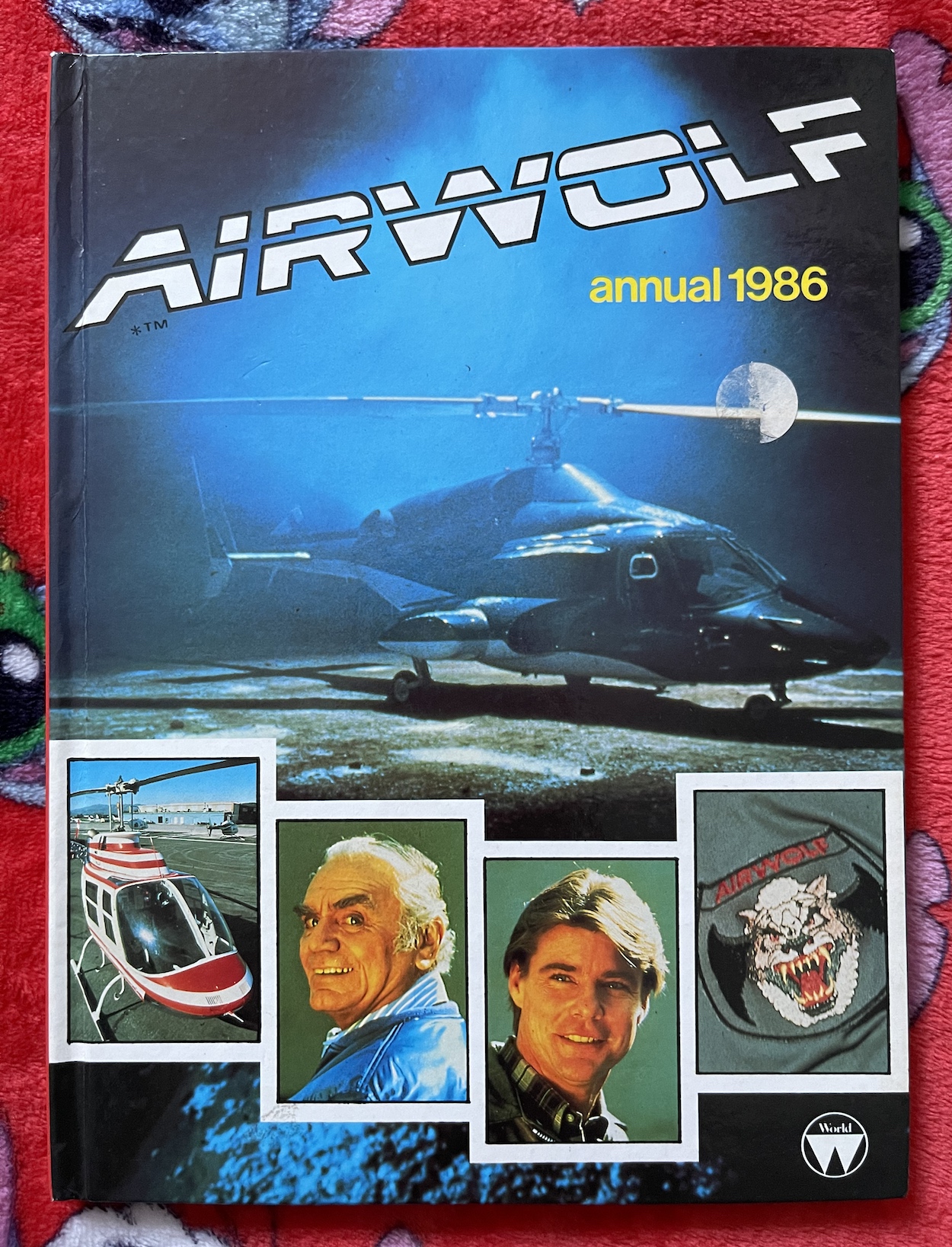
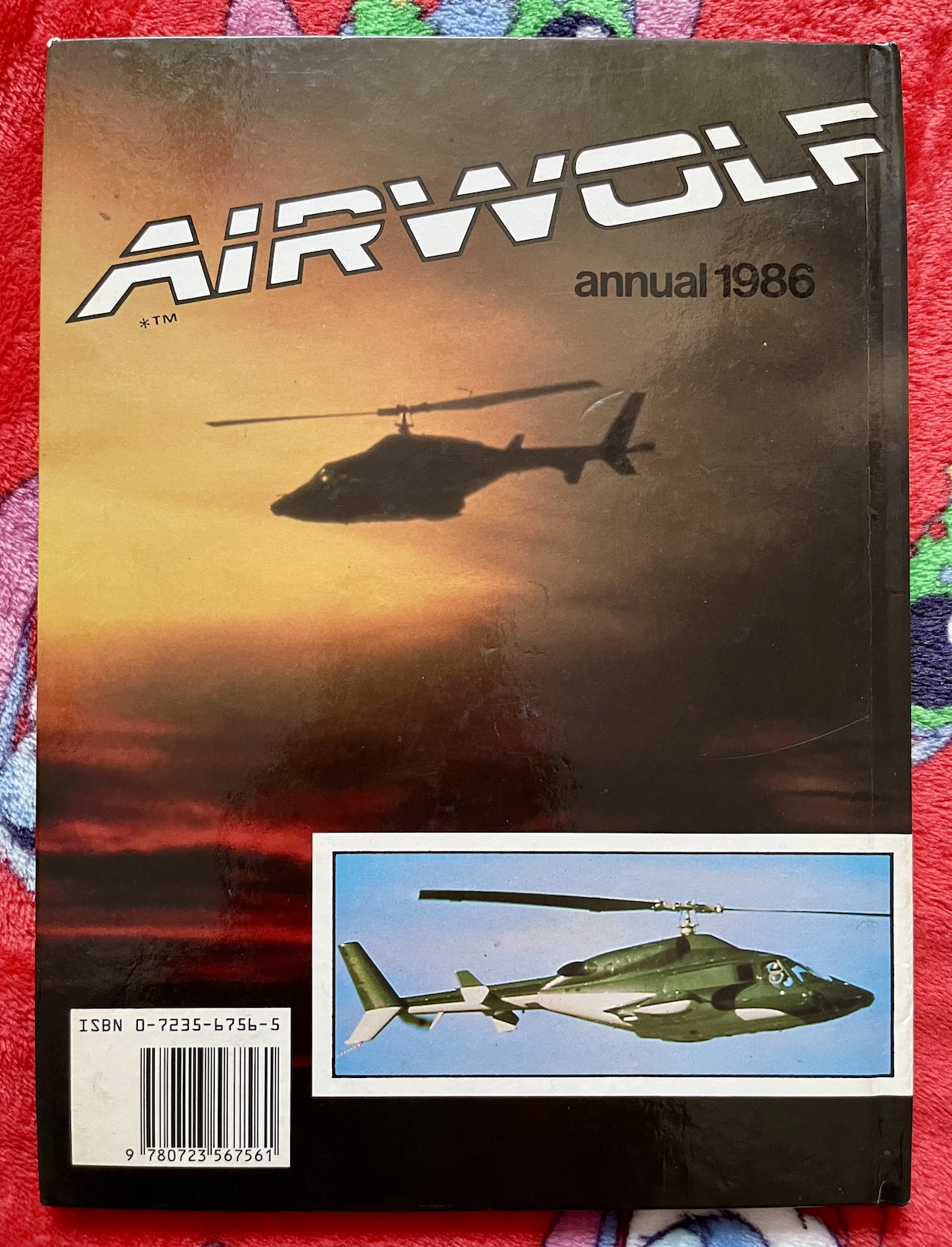
The almighty trinity of 80s TV shows for me were Knight Rider, Airwolf and The A-Team. A finer trilogy of series would be hard to find. With Michael and K.I.T.T. already enjoying their own yearly real time read through it’s time to move on to Stringfellow Hawke, Dominic Santini, Michael Coldsmith-Briggs III aka Archangel and their supersonic hi-tech helicopter, Airwolf. Unfortunately there was only ever one Airwolf Annual, released for Christmas 1985. Is it a goodie?
Unlike the majority of licenced annuals I read as a kid this one wasn’t produced by Grandreams or Marvel and instead was published by World International Publishing. I recognise the logo but am unaware if I ever owned any of their annuals to gleam what this might be like in comparison to Grandreams’ Knight Rider books for example, so the only way to find out is to nose dive right in.
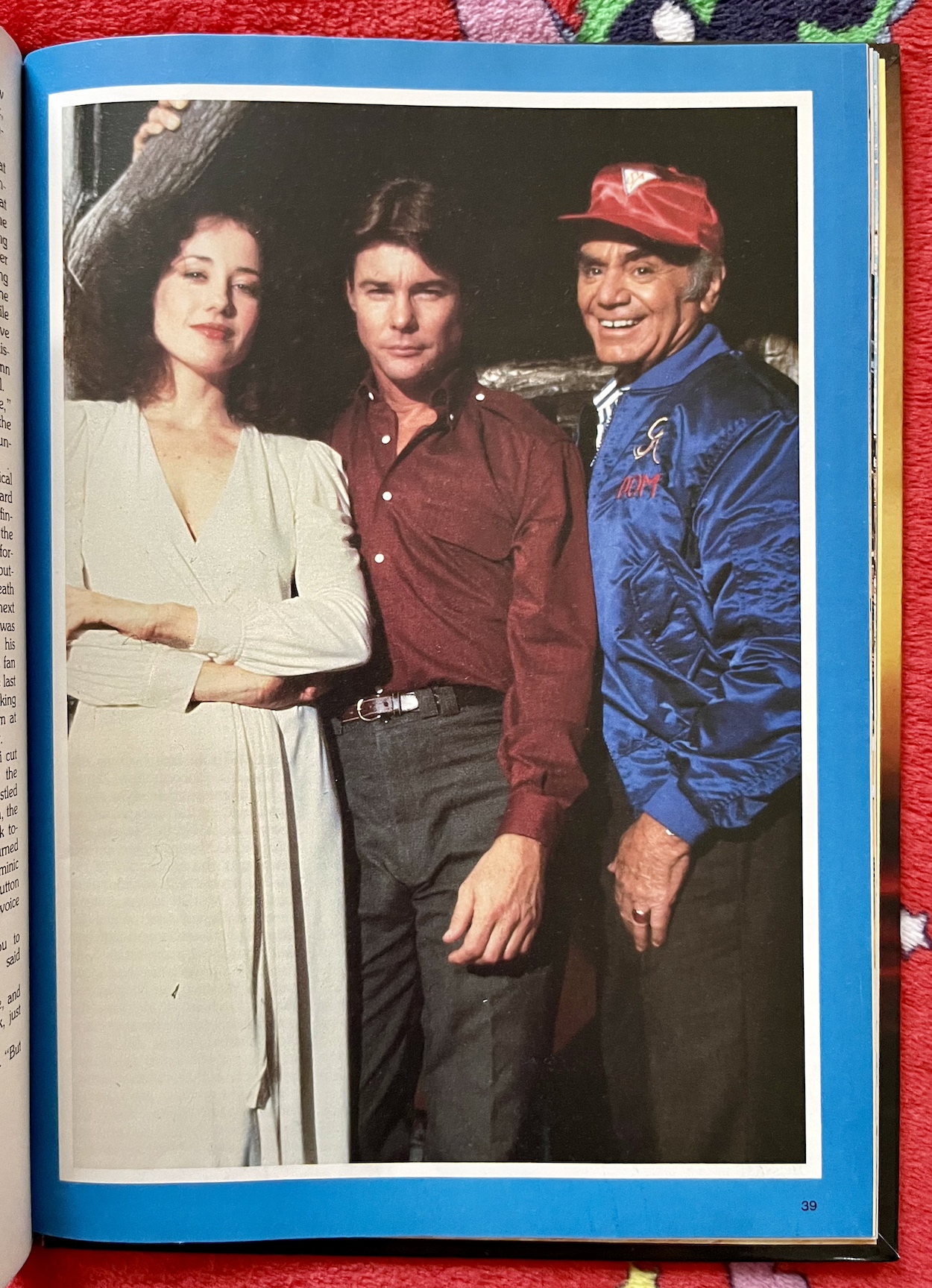
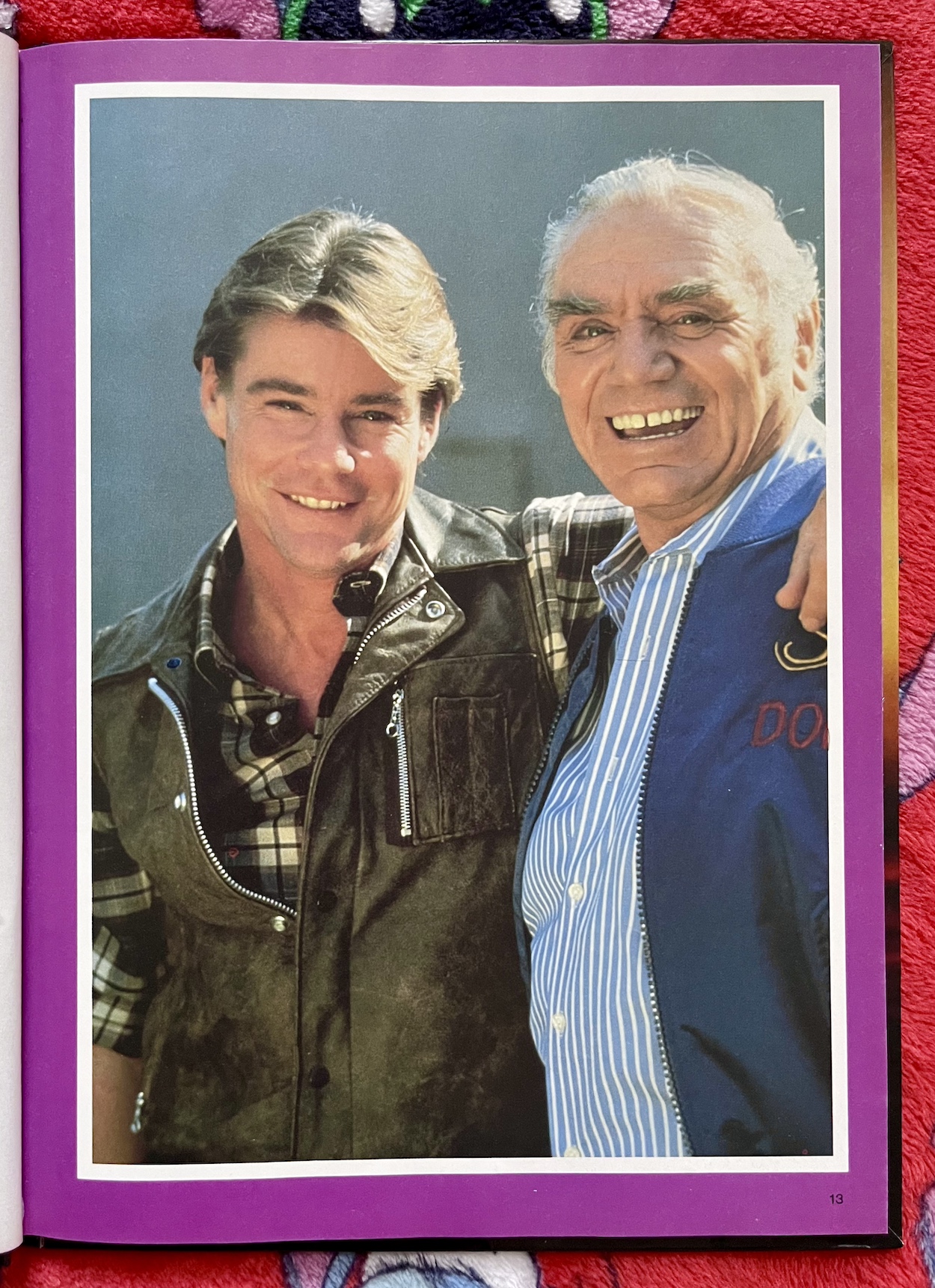
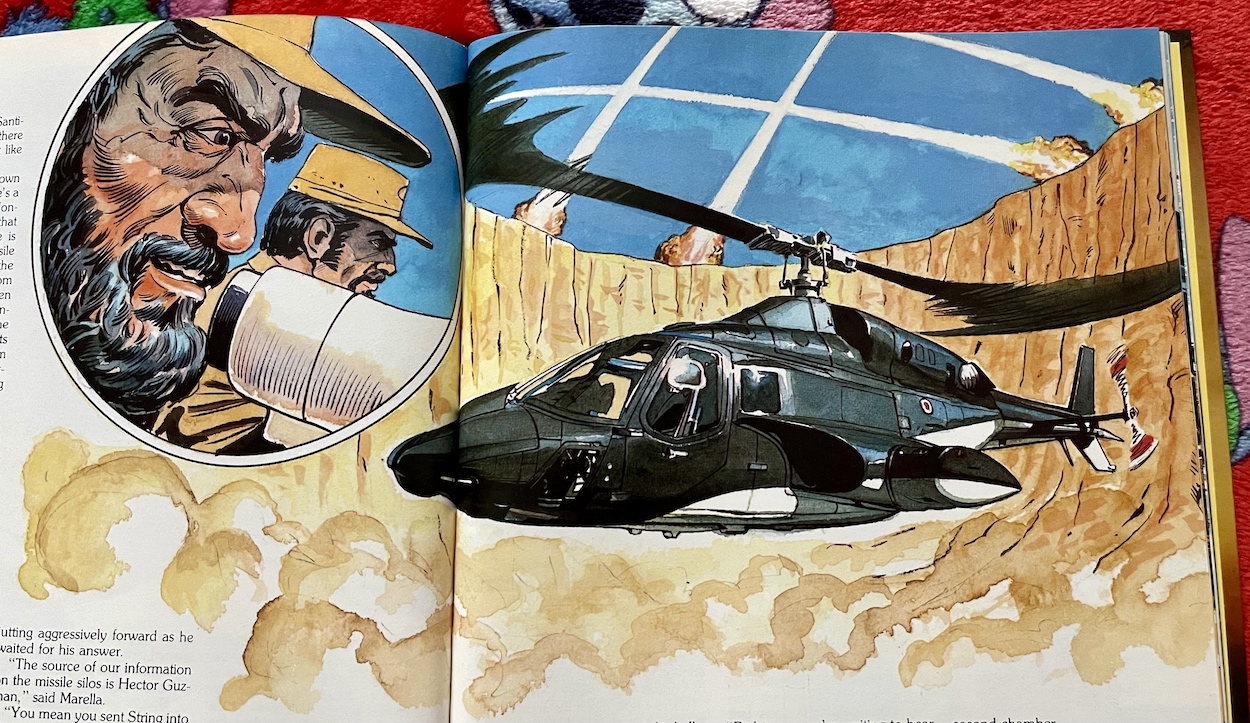
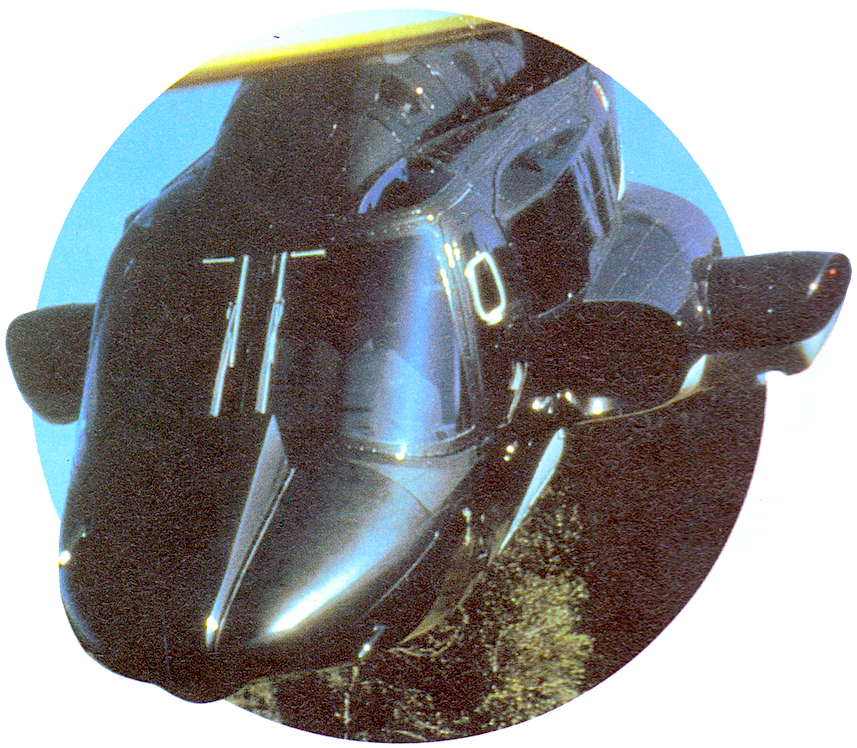
The opening spread is a good start, with a rare behind-the-scenes photograph from the series. Airwolf itself (or “herself” as the characters would have said) was a gorgeous piece of production design. Underneath it all is a standard Bell 222A chopper, not that you could tell! A few years before Airwolf the writer of the Blue Thunder movie, Dan O’Bannon, described that film’s helicopter as a “fast, black wasp” in his script, then described what appeared on the screen as a standard helicopter with a whole bunch of crap hanging off it.
Airwolf definitely fitted his original idea much better. The idea behind it was a wolf in sheep’s clothing (hence the uniform patch you can see on the cover). It was meant to look like an executive helicopter until battle commenced, when guns and missile launchers would slide out, and inside was a control centre full of technology for use on covert operations that made us 80s kids drool.
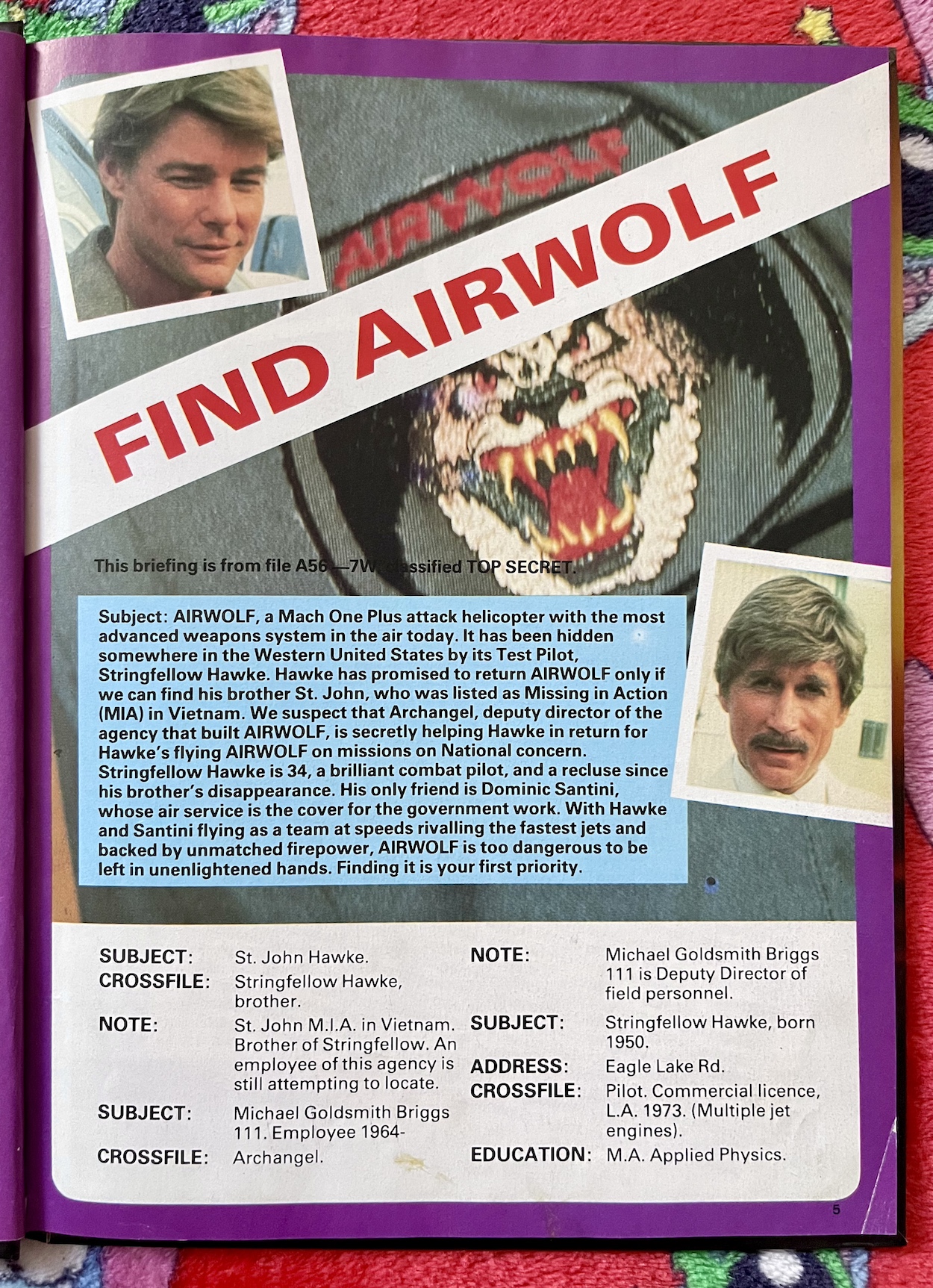
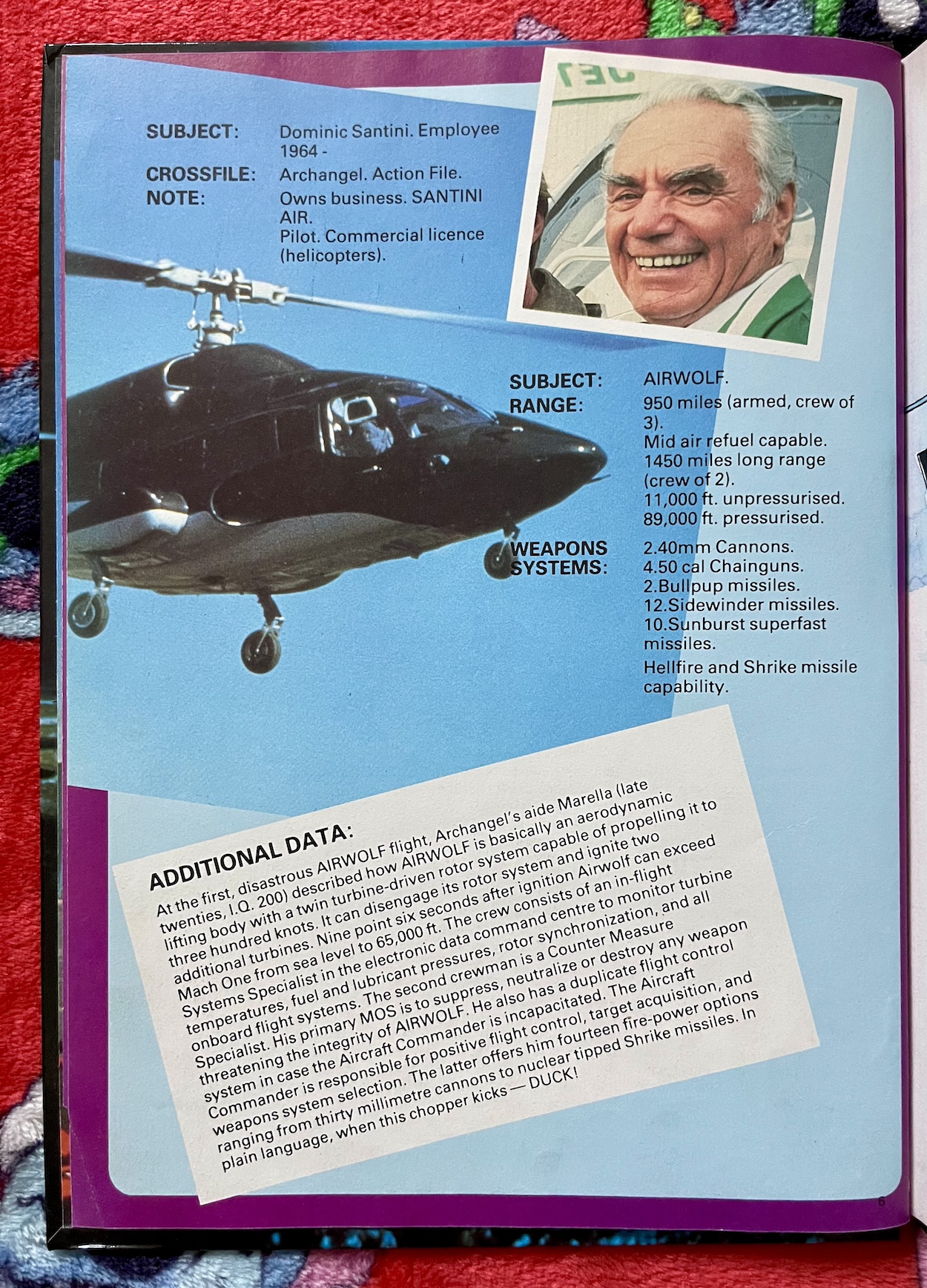
The book kicks off with a quick two-page fact-file feature. It’s not brilliantly designed but does include the introduction used as part of the opening credits in season one and a word-for-word recreation of Marella’s (Archangel’s top assistant from The Firm) description of Airwolf from the pilot movie. Well, it’s almost word-for-word. Apparently the original ending of “Airwolf is a Mach 1+ chopper that can kick butt” was too much for the annual. Really?
Unlike the Knight Rider annuals which had a pretty even mix of gorgeous comic strips and prose stories, pin-ups, interviews and behind-the-scenes features, Airwolf’s annual is more basic in its list of contents. One lone strip is accompanied by no less than seven text stories. There are a small handful of pin-ups, a basic board game, a helicopter name wordsearch and a two-page look at some other helicopters from the real world (not exactly ‘exclusive’ content).
So yes, the prose stories are the main (turbo) thrust of this book and in general they’re very good, each one reading like the final act of a really enjoyable episode. There is a big caveat with that though, which we’ll get to in a bit. Unfortunately there’s no indication inside the book of who wrote these. Whoever it was seems to have had a good handle on the show, at least the first season which was probably all that had been shown in the UK when this was written well in advance of its publication date.
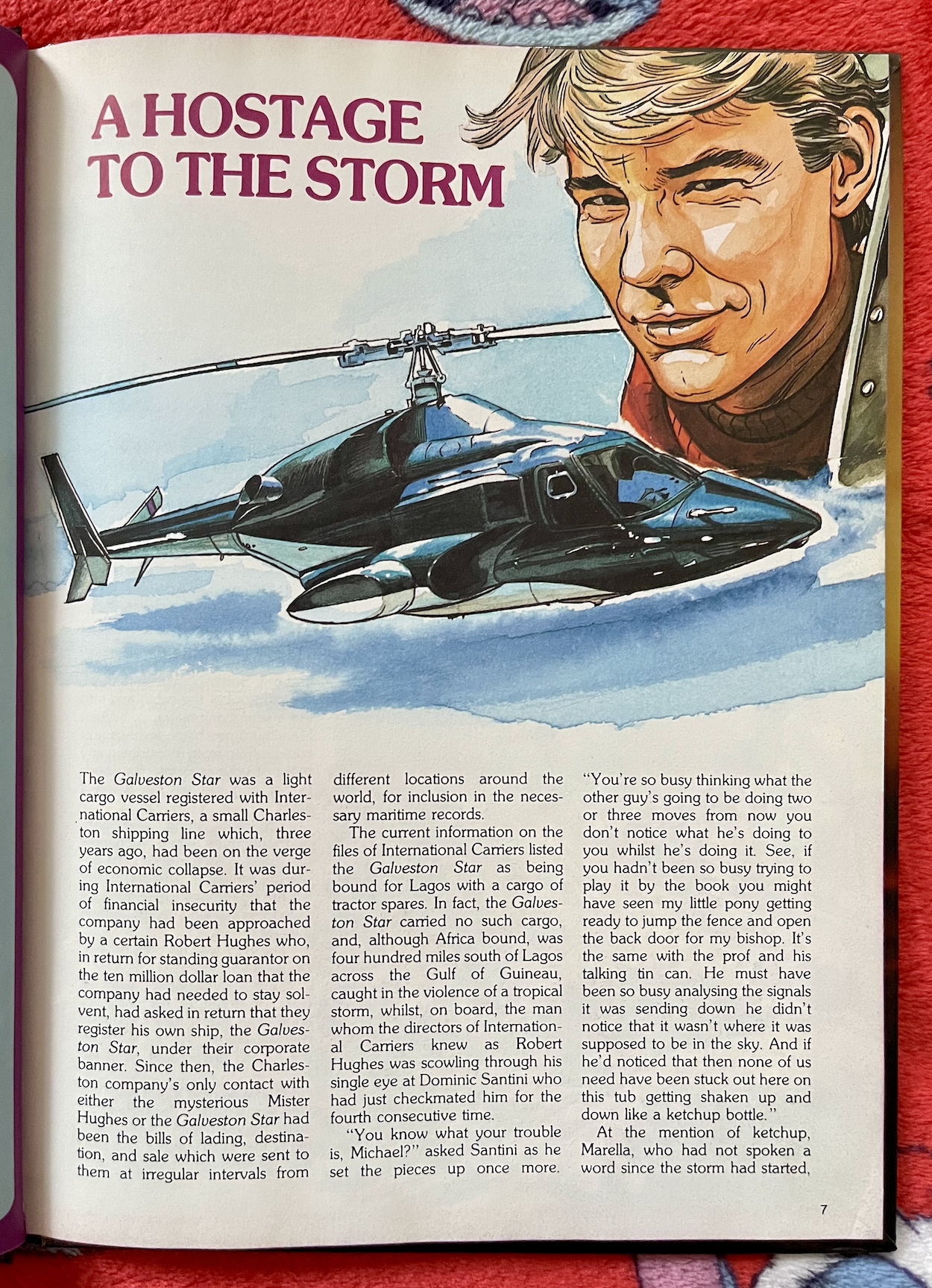
The best stories are A Hostage to the Storm and Border Incident. The former is the first in the book so we’re off to a great start. It has an interesting setup in which the cargo ship Galveston Star makes its way through a buffeting storm, described as a vessel procured by a mysterious man called Robert Hughes, who paid off the shipping company’s $10 million loan in return for registering his ship with them. Apparently used to shift tractor spares around the world no one has ever been able to confirm this.
In reality Robert Hughes is Archangel and the Galveston Star is used to ferry Airwolf to far off countries, kind of like how the semi-trailer truck transported K.I.T.T. in Knight Rider. I love this idea and wish the series itself had implemented it. The Firm has lost contact with a weapons satellite and are taking its creator, Professor Viljoen to Angola where he’ll go up in Airwolf to try to reestablish contact before it falls into enemy hands. Except, it’s all a ruse.
The Professor’s son has been missing since Vietnam and he’s exhausted all his options to find him. Even the government seems to have given up. He thought once The Firm was in Angola where he’d safely landed the satellite (after finding out his son had been taken there) and he told them his story, they’d have no choice but to help a desperate father. Of course Archangel fumes about the betrayal but String and Dom think they can help.
The scene is something the show just wouldn’t have been able to reproduce, so it’s exactly the kind of thing fans would love to read
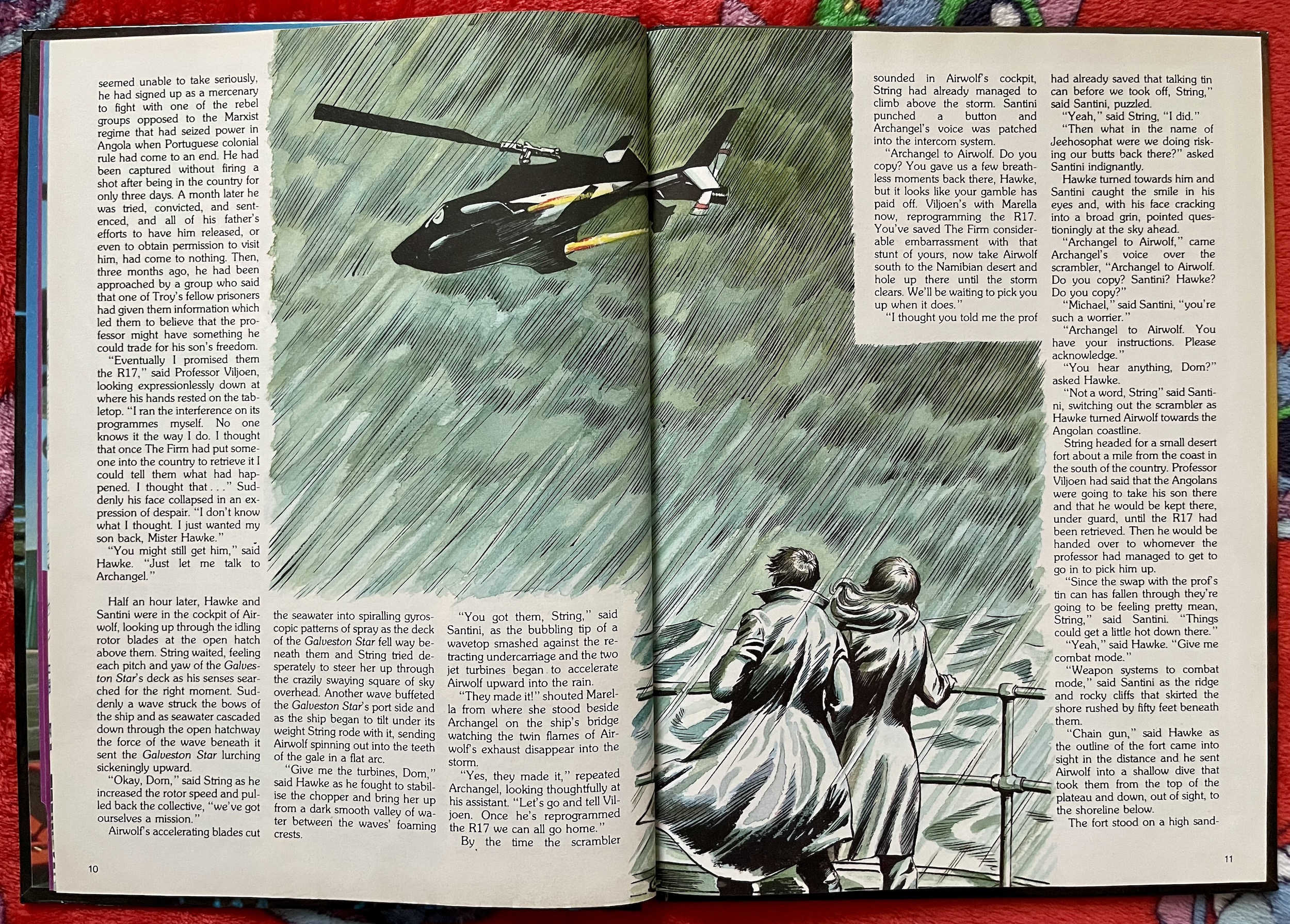
With Angola, Cuba and Russia all involved in the plot the writer is very familiar with the Cold War stories of the show’s first year. There are also plenty of great character interactions, everyone acting just as they would on TV, especially our Airwolf crew’s patter and the way they’re able to manipulate Archangel into doing the right thing. There’s also a thrilling take off from the cargo bay of the ship in the middle of the storm, the ship swaying wildly while Hawke expertly counters the movements as they hover inside the ship and finally take Airwolf out into the safety of the sky.
The only real problem here is the choice of images to illustrate the story. The scene I’ve just described in particular is something the show just wouldn’t have been able to reproduce, so it’s exactly the kind of thing fans would love to read. However, it’s illustrated with a rather bland image of Airwolf moving away from the ship with Archangel and Marella apparently watching. I say apparently, because we only see them from the back.
This leads me on to the main problem with the annual: the art illustrating the prose stories. Any images of the characters or of Airwolf itself are copied straight from stills of the show, as if they’ve been traced from a television screen. With every single image I could point you towards the episode and scene in question (I’m a huge fan if you hadn’t guessed) that has been passed off as original art. It’s like an 80s version of all that terrible A.I. art.
It means very few of the illustrations relate to the plots of the stories. Any that are original are pretty poor and have as little detail in them as possible, such as above with characters facing the other way. In another drawing in the book String, Archangel and Marella are recoiling from an explosion and they all just happen to have their hands covering their faces so the artist doesn’t have to draw them. Although, you can see enough of Marella to see she’s been portrayed as a white woman! This is just laziness (and offensive).
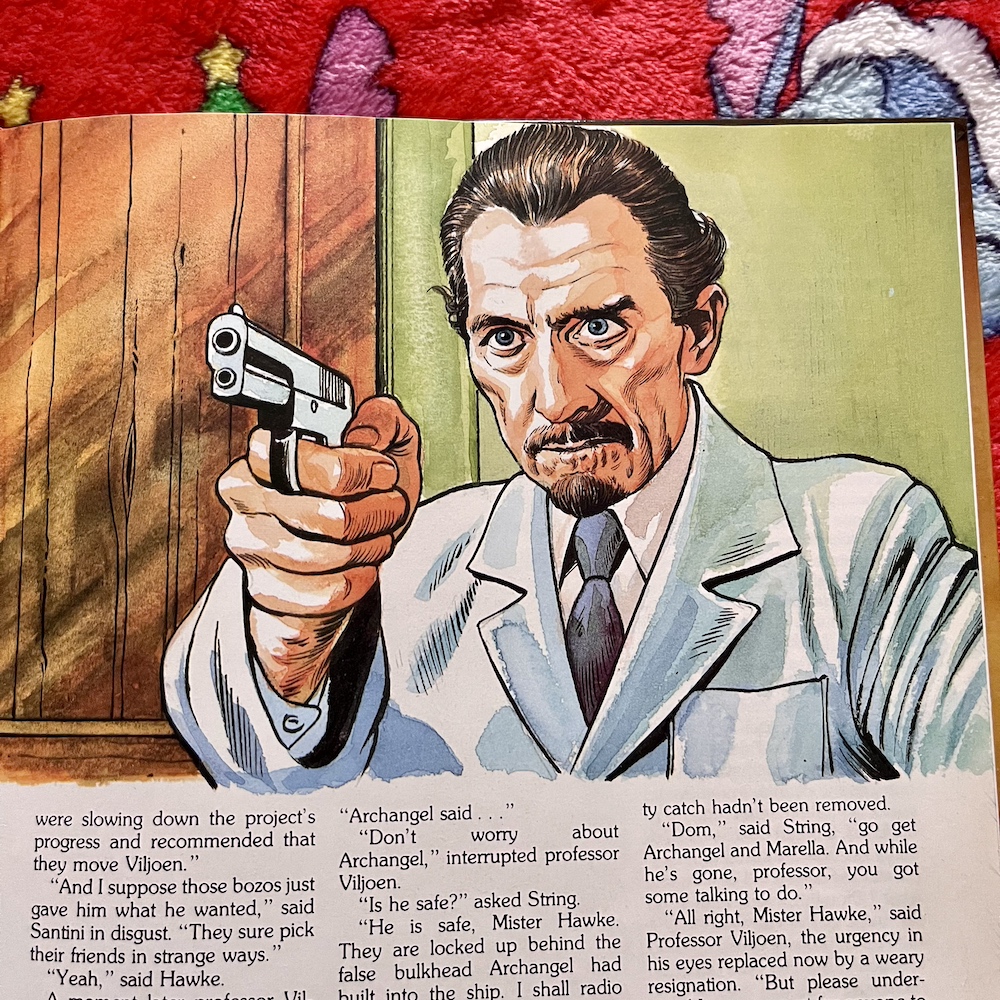
Then we get to the villains. Obviously these are original characters so surely they have to be drawn properly? Have a look at these three examples. No, I didn’t realise Donald Pleasance‘s Blofeld, Gert Frobe‘s Goldfinger or Peter Cushing were all Airwolf characters either. (Thanks to OiNK‘s David Leach for helping me name Peter here – he was on the tip of my tongue!)
For a show that was so visual, that had such incredible aerial photography, the annual falls drastically short in this regard. The artist chosen to illustrate the vast majority of a book based on such a TV show seems to be completely out of their depth. Thankfully renowned IPC/Fleetway artist Sandy James steps in for the six-page comic strip tucked away in the middle of the book, called Snow to Eskimos. However, it appears even one of my favourite Ring Raiders artists isn’t that familiar with the source material either.
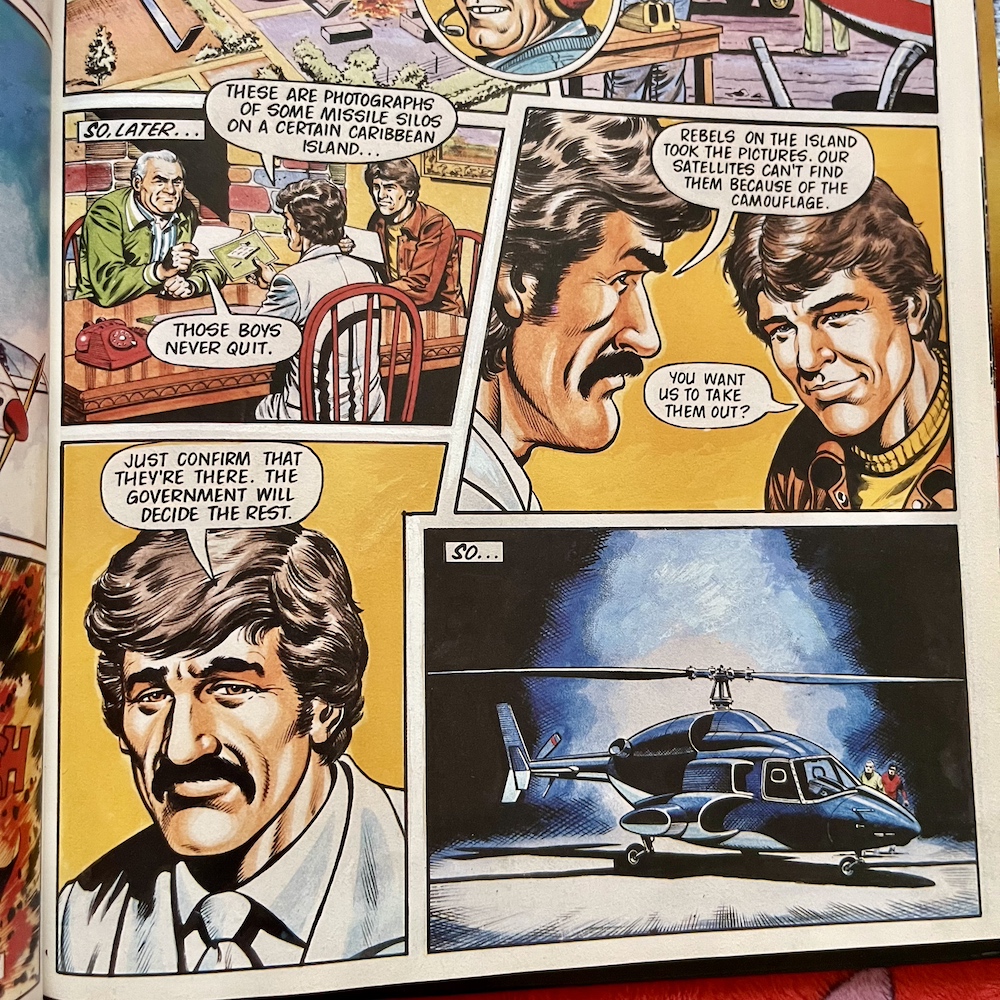
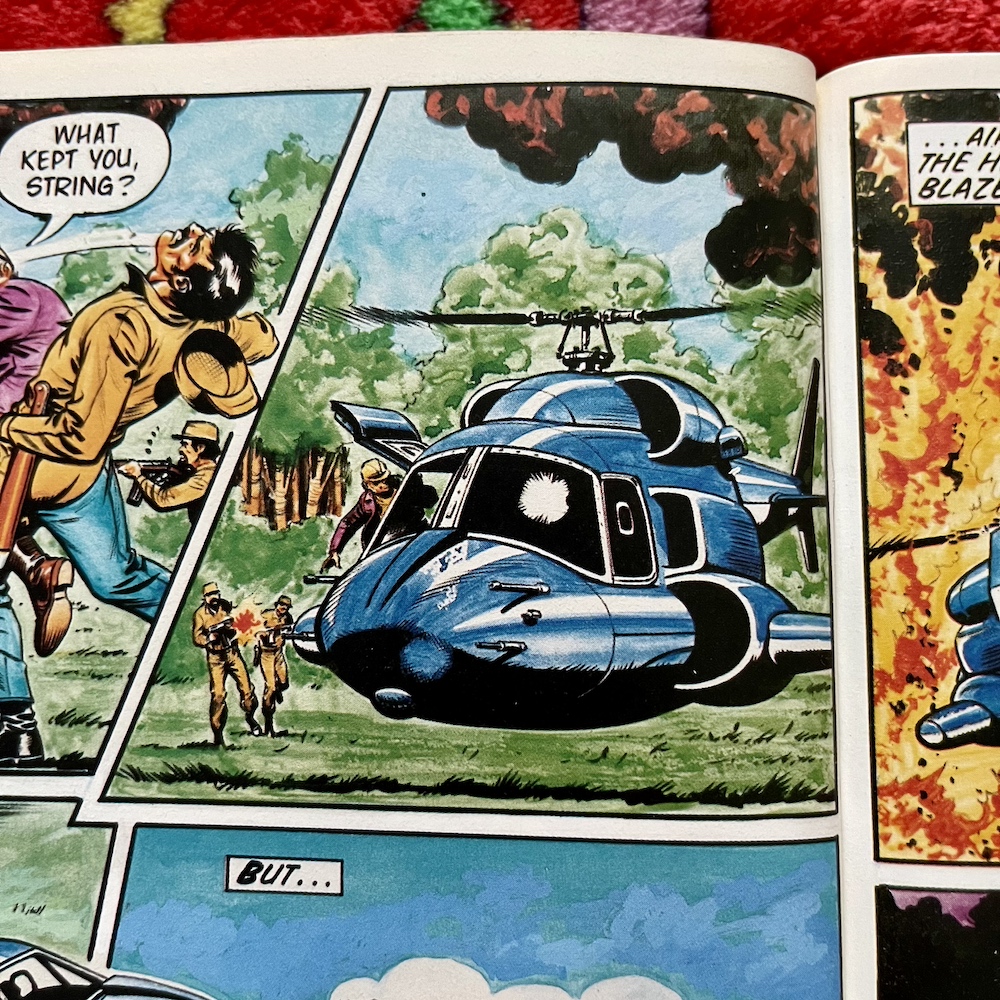
This first image brought me a lot of hope. Despite Airwolf being completely the wrong colour at least it looks like itself and Sandy hasn’t resorted to copying images from the show. However, as fans will see below, it all goes downhill from there. What is that interior all about when the missiles are actually launched from the flight stick? Since when did Airwolf have DeLorean doors? Where is Archangel’s eye patch?
That last panel in particular makes me think Sandy had never seen the show, which is fair enough, but after David Lloyd told me all about the research he did in order to draw the Knight Rider annuals it’s very disappointing. If Sandy was only working from a script then it was clearly written by someone unfamiliar with the show and not our prose stories author. It’s a truly terrible script, with dull, robotic dialogue and little of consequence happening.
However, the annual’s main writer definitely knew their stuff! Let’s have a quick run through of the other stories before I tell you more about my second favourite.
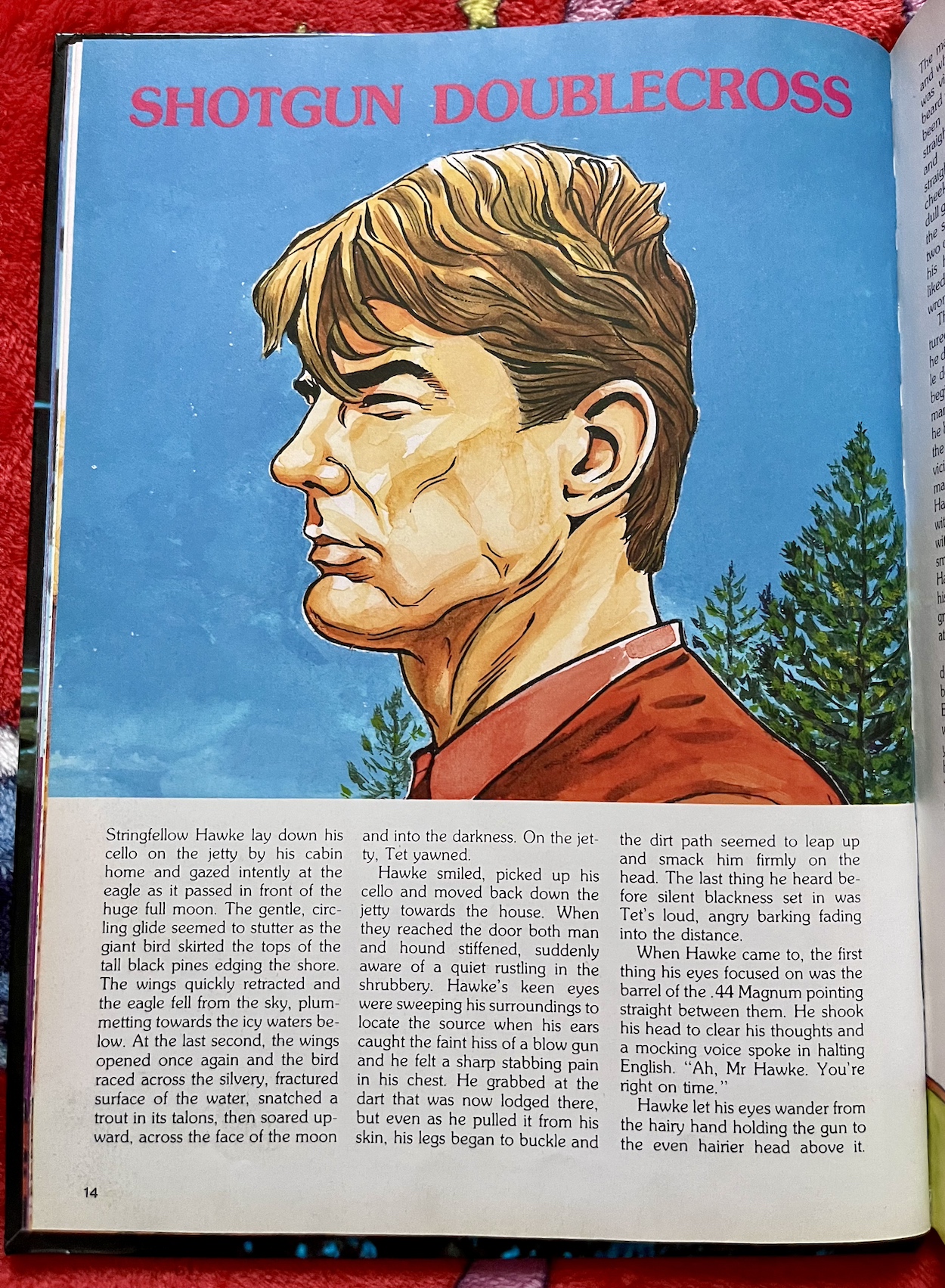
Shotgun Doublecross starts with all of the key Airwolf visuals. The cabin. The lake. The eagle. The cello. Tet the dog. Hawke’s insanely good hearing. He’s kidnapped from his home and told he must use Airwolf to help traffic some planes across Mexican airspace for a cartel because his long-lost brother Sinjin is also on board. He goes up against The Firm for this one and there’s some great dialogue between the key players. You can almost hear the actors saying their lines.
Desert Death Trap is a basic rescue mission story but is imaginatively portrayed, the action playing out just like one of the show’s thrilling dogfights, painting exciting pictures in the readers’ heads (to make up for the ones on the page). Flames Over the Water revisits the death of Hawke’s family on the lake, something only touched upon in the pilot movie. The opening page in particular is surprisingly beautifully written for an annual.
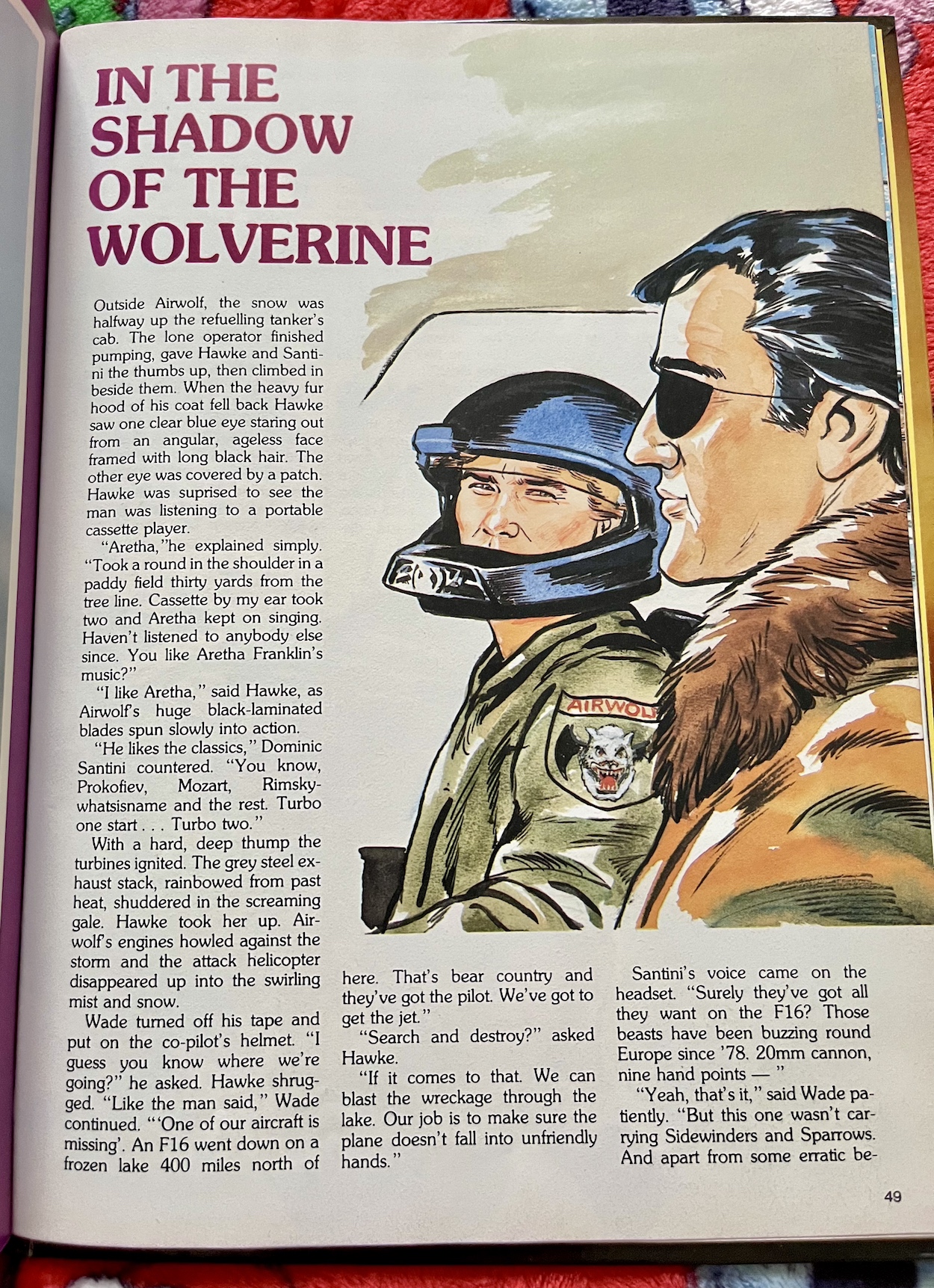
The so-called villain of the piece is seeking revenge on the US because of the death of his one true love by indiscriminate American bombing campaigns, placing the Airwolf crew in a more sympathetic position. Then In the Shadow of the Wolverine involves a covert op for The Firm gone wrong, a Cold War prisoner swap in a blizzard and a brilliantly written character whose allegiances kept me guessing to the very end.
It paints a wonderful picture of serenity when the cabin didn’t feel like an isolated place but was instead full of warmth and love
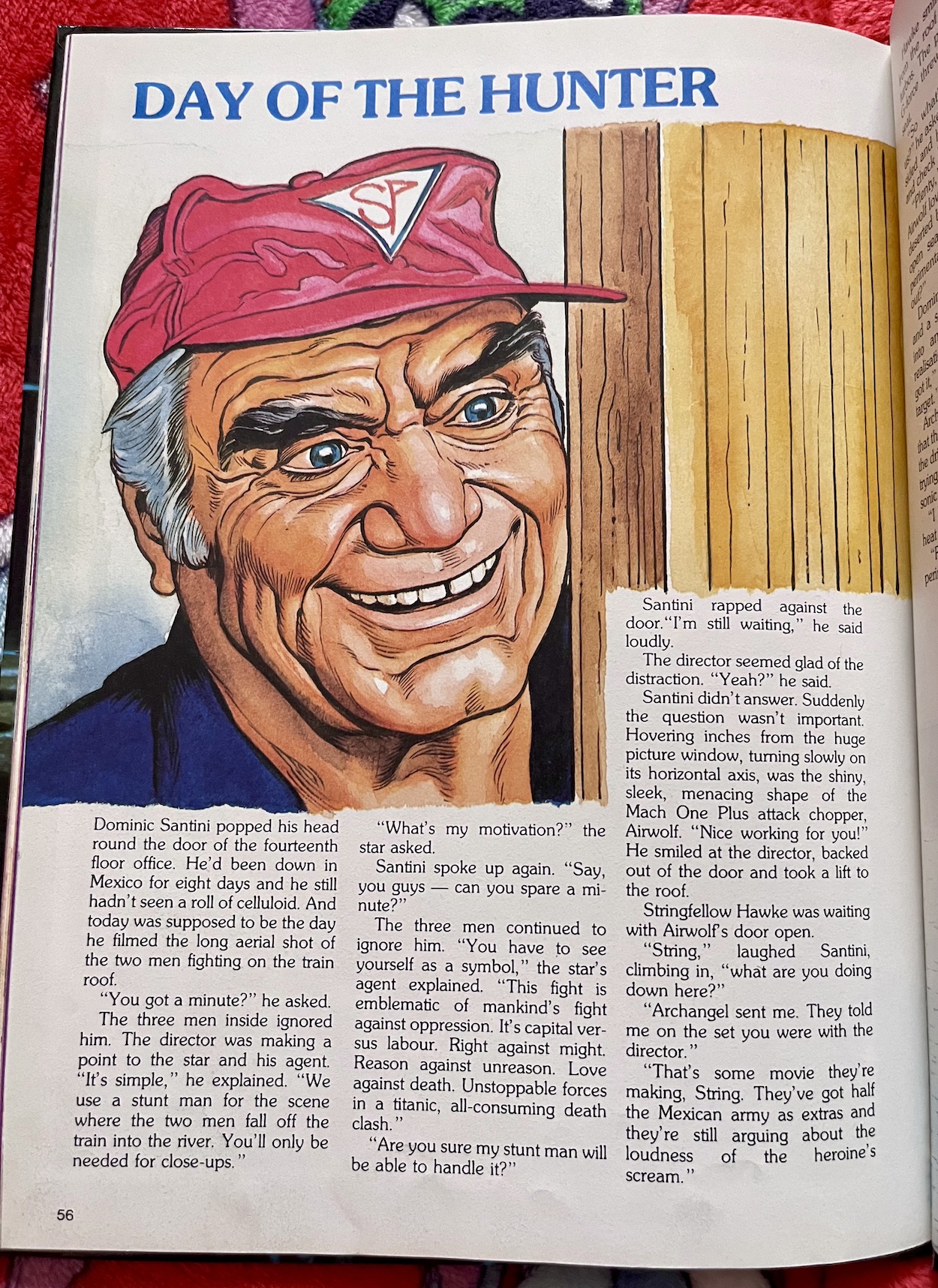
Then there’s Day of the Hunter which is a very silly story right at the back of the book, so unfortunately the whole thing ends on a low note. Believe it or not it involves Airwolf, a train and another helicopter all inside a railway tunnel. No, really! If the rest of the prose stories feel like grittier season one fare, this is straight out of the still enjoyable but much lighter third and fourth seasons.
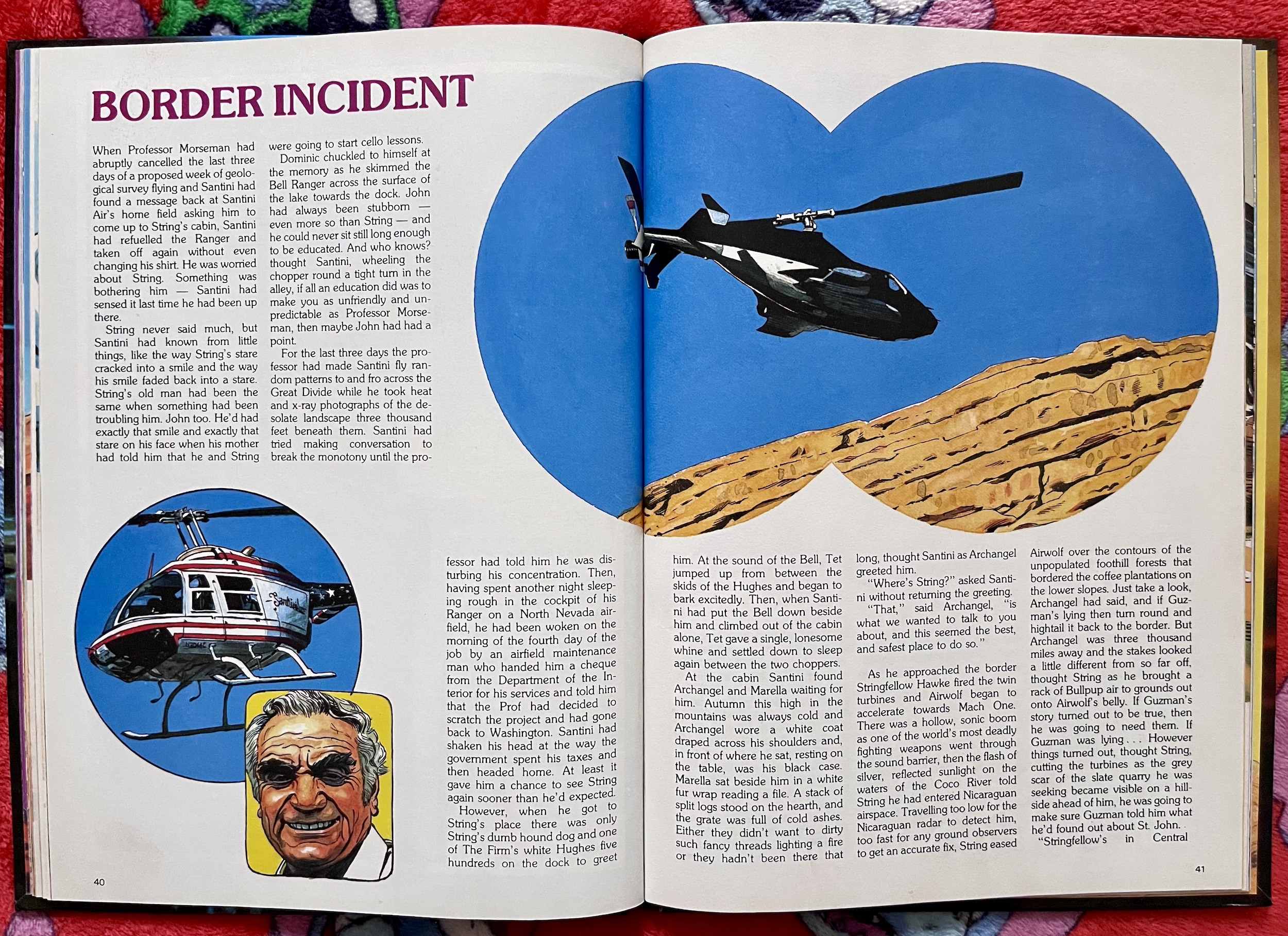
But back to that other story I’d listed as a favourite. Border Incident kicks off with Dom reminiscing about happier times, when all of the Hawke family were alive, happy and at home. It paints a wonderful picture of serenity when the cabin didn’t feel like an isolated place but was instead full of warmth and love, and the portrayals of String and Sinjin as children are both funny and feel completely accurate even though we never saw their younger selves on the show.
String has taken Airwolf on a mission alone. Now, fans will instantly think this isn’t possible because Airwolf needs at least a two-person crew. Unfortunately there’s no explanation of how that’s achievable, and some of the ‘copters abilities used here would be impossible without Dom being in the rear cabin. But we’ll forget about that and put it down to a simple misunderstanding on the part of the writer because the rest of the story is fantastic.
It’s an uncharacteristic but deliberate decision by String, setting the reader on edge right from the off. As it turns out this particular mission once again involves the possibility of Sinjin being found. But String was doubtful about the source of the information and wanted Dom to work the case from the outside, where the villain character wouldn’t be watching. Dom could go undercover and find out the truth, while being ready just in case they needed to fight their way back out.
Knowing Dom would never have allowed him to go alone he took Airwolf and then cheekily got Archangel and Marella to pick up Dom and tell him. There’s a very funny scene where Dom is ranting and raving to the two Firm operatives, not listening to a word of their explanation about the mission, until they tell him String knew he wouldn’t have allowed him to go alone. To which Dom suddenly calms down, basically says, “Yep, that’s right” and heads off on the mission!
There’s an exciting climax involving Airwolf down a booby-trapped mine shaft which again would never have been seen on TV, at least not without those very unconvincing models some of our action shows used back then. Again, there are no images to go with it, the closest being the one above which is basically the annual’s opening spread image of Airwolf with some poorly drawn cliff faces around it.
After all these years I never thought I’d get to discover any new Airwolf material
In conclusion, for fans this is really a book of two halves: the writing and the art. While it’s nice to see any artwork of Airwolf these days it’s instantly forgettable, however that shouldn’t put anyone off buying it. There are no introductions for those unfamiliar with the plot of the show but for those up to speed there are six great stories here (and the other two are easily forgotten). After all these years I never thought I’d get to discover any new Airwolf material so that in and of itself has been a joy.
For most fans season one is the best of Airwolf and the closest to creator Donald P. Bellisario’s vision (before the studio started interfering from season two onwards). The annual keeps to the Cold War theme of that season and the humour of the interactions between the main characters is present, cutting through the drama and intrigue perfectly. On the one hand it’s a shame there isn’t more variety to its contents, but now that I’ve finished it I wouldn’t want to sacrifice any of those six great stories to fit other things in.
The book is easily found on eBay for a few quid, so if you’re an Airwolf nut like me you really shouldn’t miss out on this. Reading it can be bittersweet at times when we remember we’ve lost all three of the main actors in recent years, but the memory of their characters lives on. For me that’s through the BluRay set on my shelf, now proudly accompanied by some superb writing in the Airwolf Annual 1986.
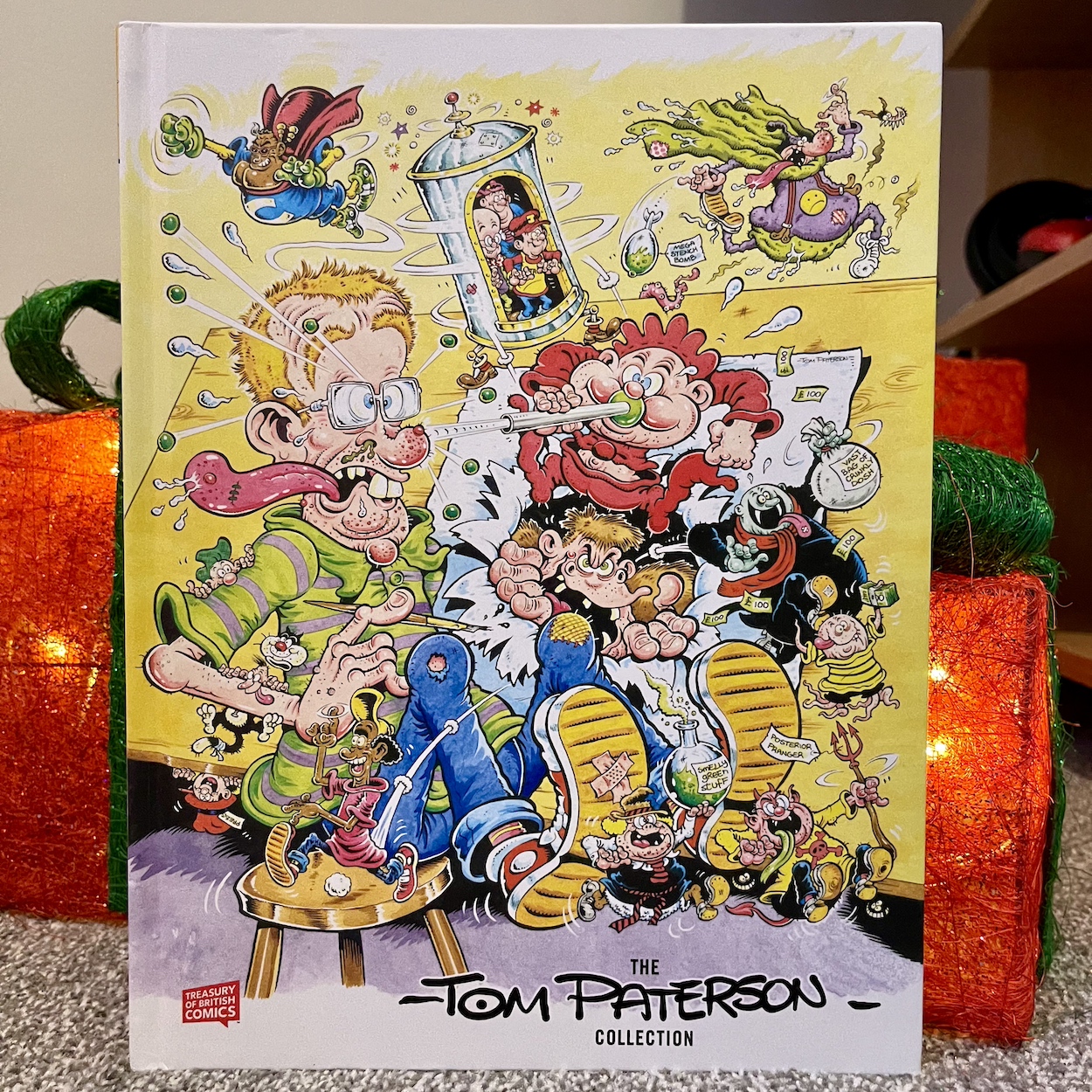
The name Tom Paterson is synonymous with British humour comics, his madcap style appearing in an eclectic array of titles such as Beano, Shiver and Shake, Buster and many more. The most famous characters he has drawn include the fondly remembered Sweeney Toddler, Calamity James, Bananaman and Buster himself. There’s one other that will most likely have been forgotten by many though, namely The Wet Blanket.
By the time I started collecting OiNK I’d missed this strip but I’d already been introduced to Tom’s work. While I’d found my brother’s Beano wasn’t really to my taste at the time (I was the perfect target audience for OiNK), there was one strip which most definitely was. I remember pouring over all of the funny background details in Calamity James, the incidental randomness in the visual gags often being funnier than the story itself. This was the genius of Tom’s style and now here’s The Tom Paterson Collection, a hardback collection full of his work available from Rebellion and their Treasury of British Comics range.
This is just one of several chapter title pages showing which comics the following strips were pulled from and as you can see our favourite comic is represented here too. In fact, upon its release this book was the first time OiNK reprints had been made available for purchase ever since its final special in 1990. Included here are two double-page spreads from early issues, Testing Time and The Wet Blanket himself, who even makes an appearance on that fantastic cover drawn by Tom.
A kind of super villain, Wet Blanket was a “miserable so-and-so” whose sole job was to ruin everyone else’s fun. He would’ve made for a brilliant regular character but alas that wasn’t to be and this was his sole appearance. This makes it all the more surprising that he’d appear on the front cover but I think he deserves a place there, the strip is that good! Clearly Tom still has a soft spot for him after all these years.
OiNK co-creator Patrick Gallagher told me they would’ve loved to have had Tom on board as a regular but his work load was just too large to accommodate them. With spreads such as Testing Time above, taken from #1 of OiNK it’s such a shame he couldn’t have let his imagination run wild on a regular basis for Uncle Pigg. So the question is, with only four pages from OiNK in here, will this 200-page book appeal to pig pals? The answer is a resounding yes!
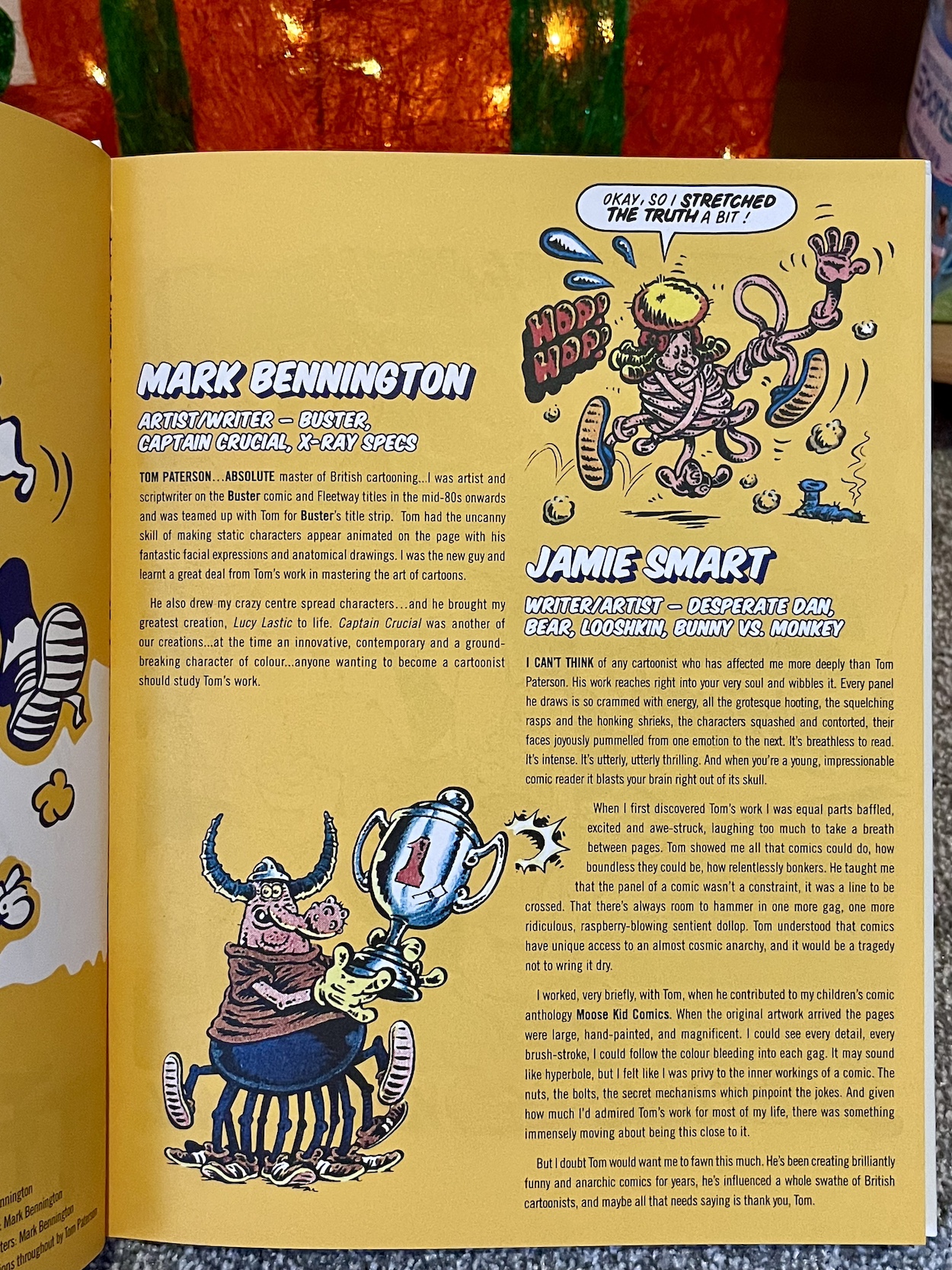
On one of the opening pages is the list of writers including Tom, Mark Bennington whose Buster strips I’ve covered before on the blog and most excitedly regular OiNK contributor Graham Exton and OiNK co-creator/co-editor Mark Rodgers. With these names you know you’re in for a treat. The comics featured alongside OiNK are Buster, School Fun, Nipper, Jackpot, Shiver & Shake, Whizzer and Chips, Whoopee, Wow! and Cor!, as well as some of Tom’s own personal strips and unpublished works.
Also included are little pieces by professional fans of Tom’s including Lew Stringer and Graham and friend of the blog Jamie Smart (Bunny Vs Monkey, Looshkin, Wubble) who has always said OiNK was a big inspiration to him, as was Tom.
Picking out highlights for this review was never going to be easy!
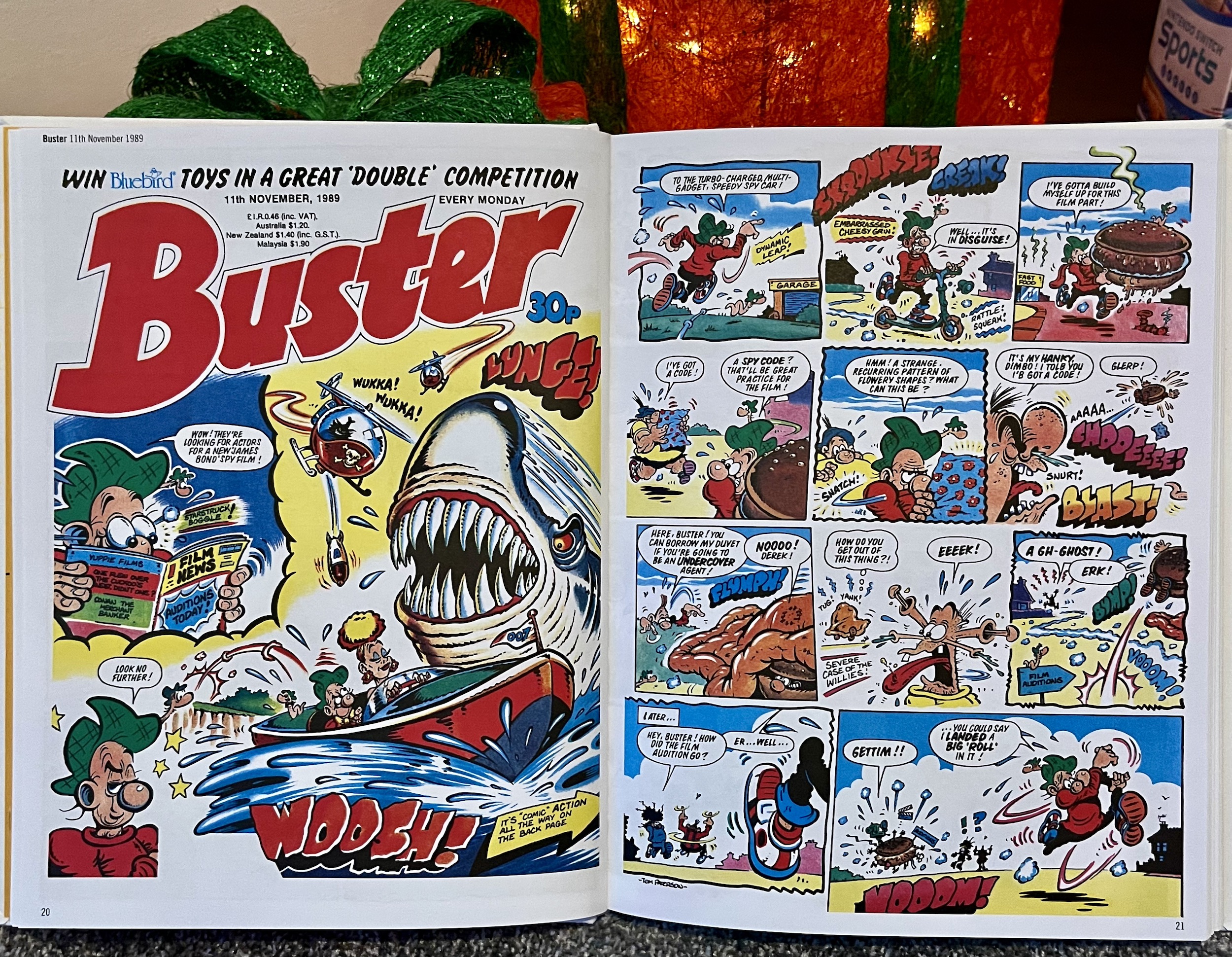
A strip riffing on James Bond and featuring a comical shark was always going to be put to the top of the list for me, as was this Captain Crucial strip, a character I’d never heard of before. That “The Craziest Characters Are Always in Buster Comic” banner along the top is proving true here and it’s used several times for different strips, namely Lucy Lastic, Sportsfright, Thingummy-blob, Coronation Stream, Monty’s Mutant Mutt, Teenage Mutant Turnips and more.
My favourite Buster strips in this book are dated around 1989 onwards and they’re enough to make me regret not placing a regular order when OiNK merged into the comic. If only I’d stuck with it after that first and only issue I bought back in 1988 I’d have been treated to a bloody funny comic if these strips by Tom are anything to go by. Oh well, that just makes this book all the better as I’m getting a snapshot of the very best from that comic in one volume.
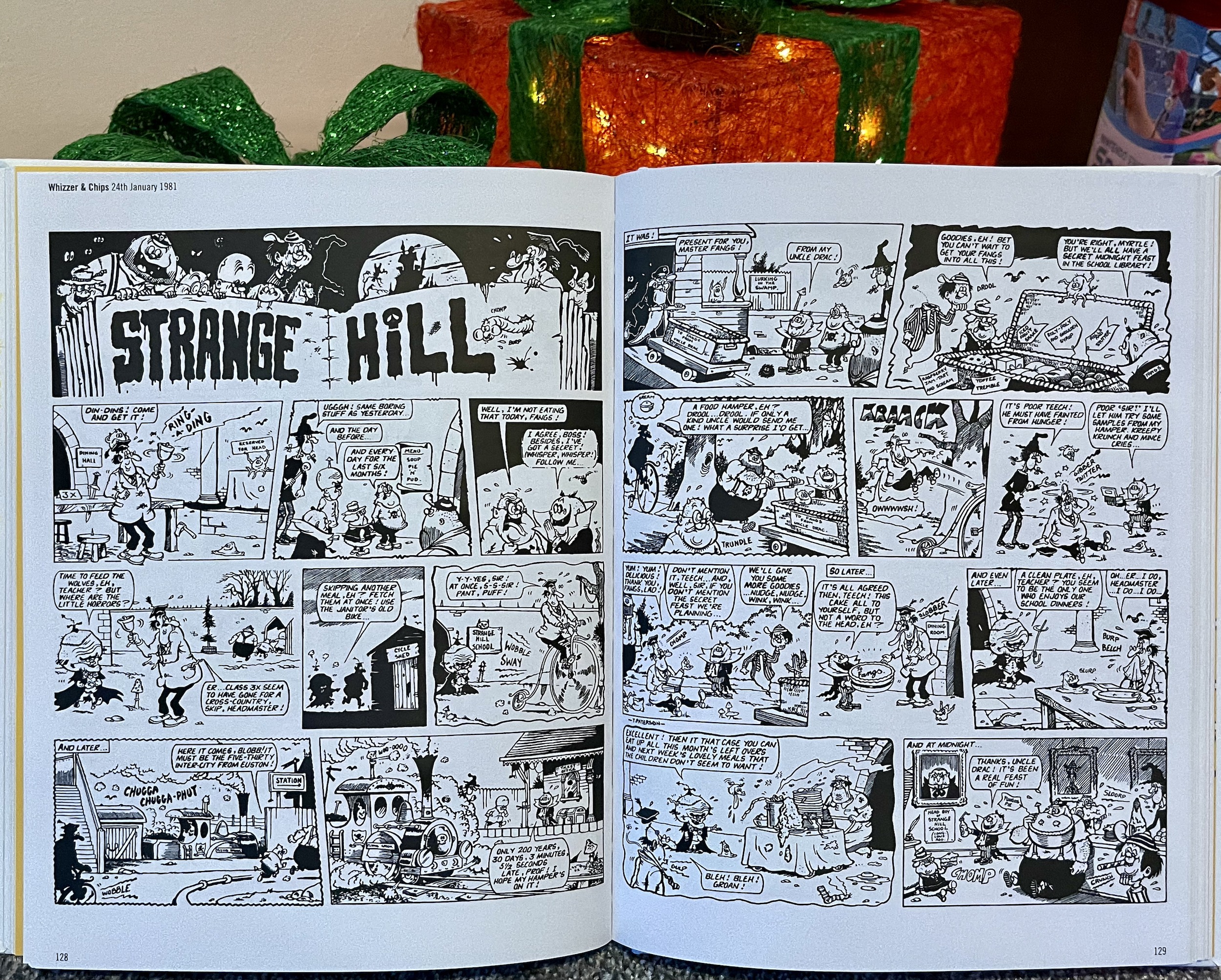
Just one look at the contents page will back that up. As well as those already mentioned there’s Crowjack, Felix the Pussycat, Grimly Fiendish, School Belle, Watford Gapp who is another new one to me as well as being a brilliantly funny rapping strip, and many more including a favourite of mine from the days of the Big Comic Books, Strange Hill. I found the Ghost Train here particularly funny and there’s that old staple which I think Tom and Lew drew better than anyone: the slap-up feed! Classic.
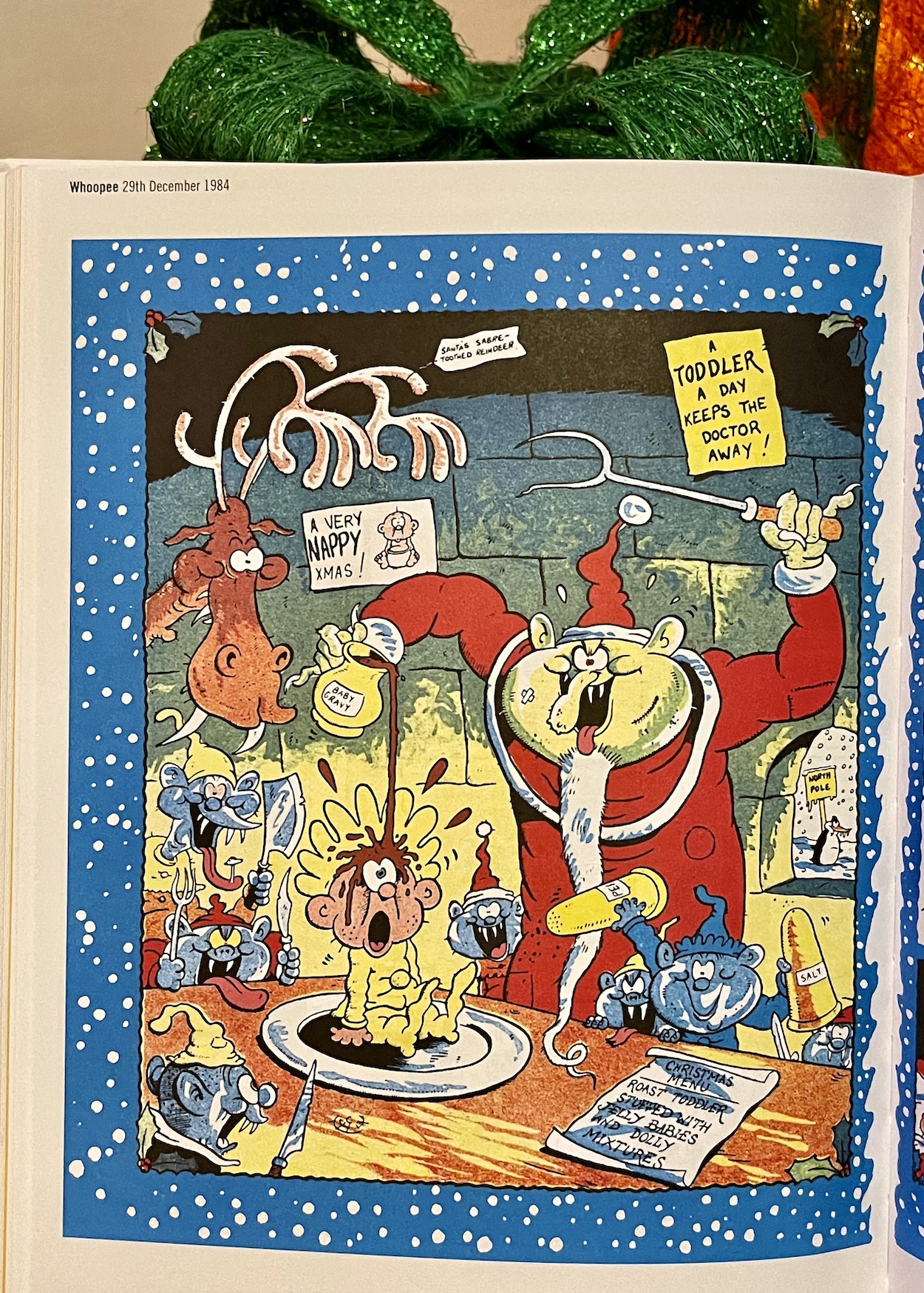
It wouldn’t be a Tom Paterson book without a certain little baby boy causing all manner of hell for his poor parents, so I’m very happy to say there’s a sizeable chunk of Sweeny Toddler here. Including content from both Whoopee and Whizzer & Chips, a total of 30 pages are given over to the miniature terror and every single one of them is a classic. Of course, if you know me you’ll know I’m a sucker for a Christmas comic so naturally I was overjoyed to see this full-page panel when I turned a page.
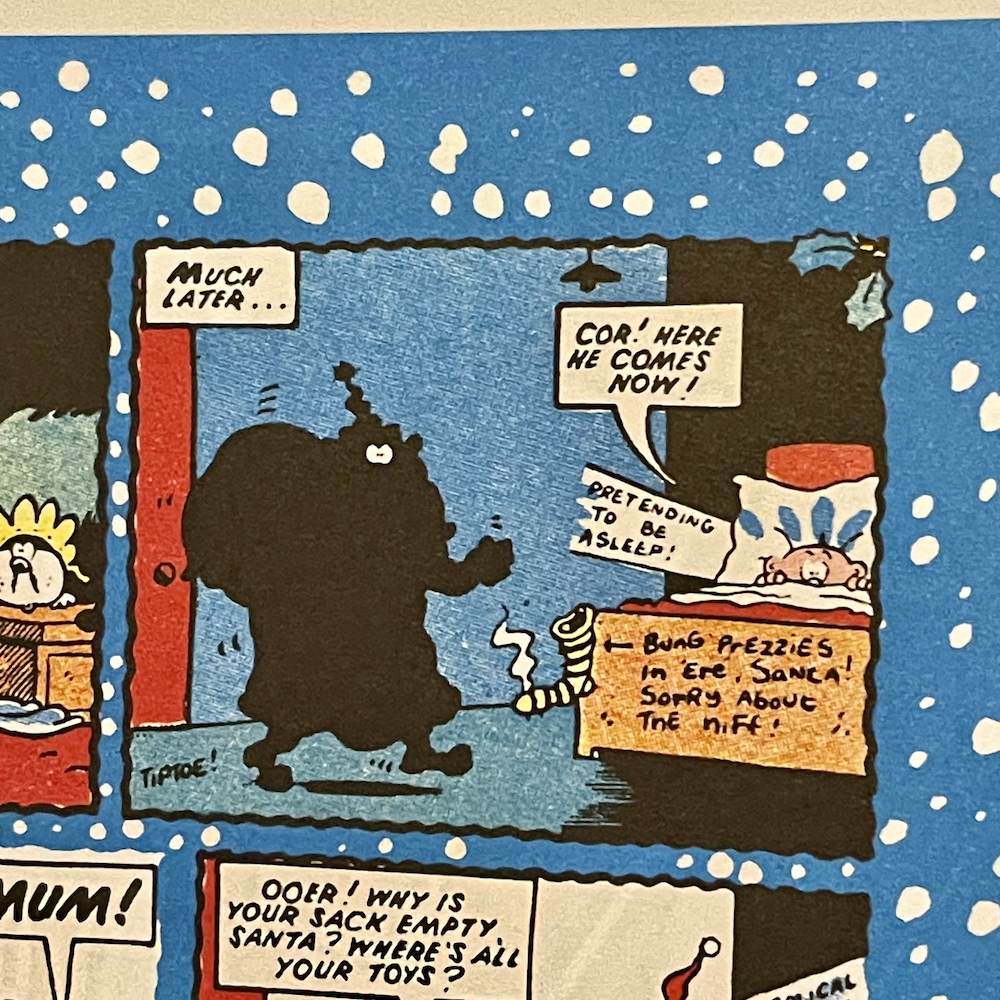
I also laughed out loud (genuinely) when I saw a certain trademark of Tom’s used as a substitute for a Christmas stocking. In fact, I wonder just how many smelly socks there are in this book? These 30 pages of Sweeny Toddler are worth the price of admission alone. Reading them now I’m beginning to think the same could’ve been said of those other 80s comics too. Even though OiNK was the only one that seemed to speak to my sense of humour, these strips by Tom were all hidden gems to me, and I’d happily have spent more of my pocket money on some of those comics at the time if I’d known just how good his contributions were.
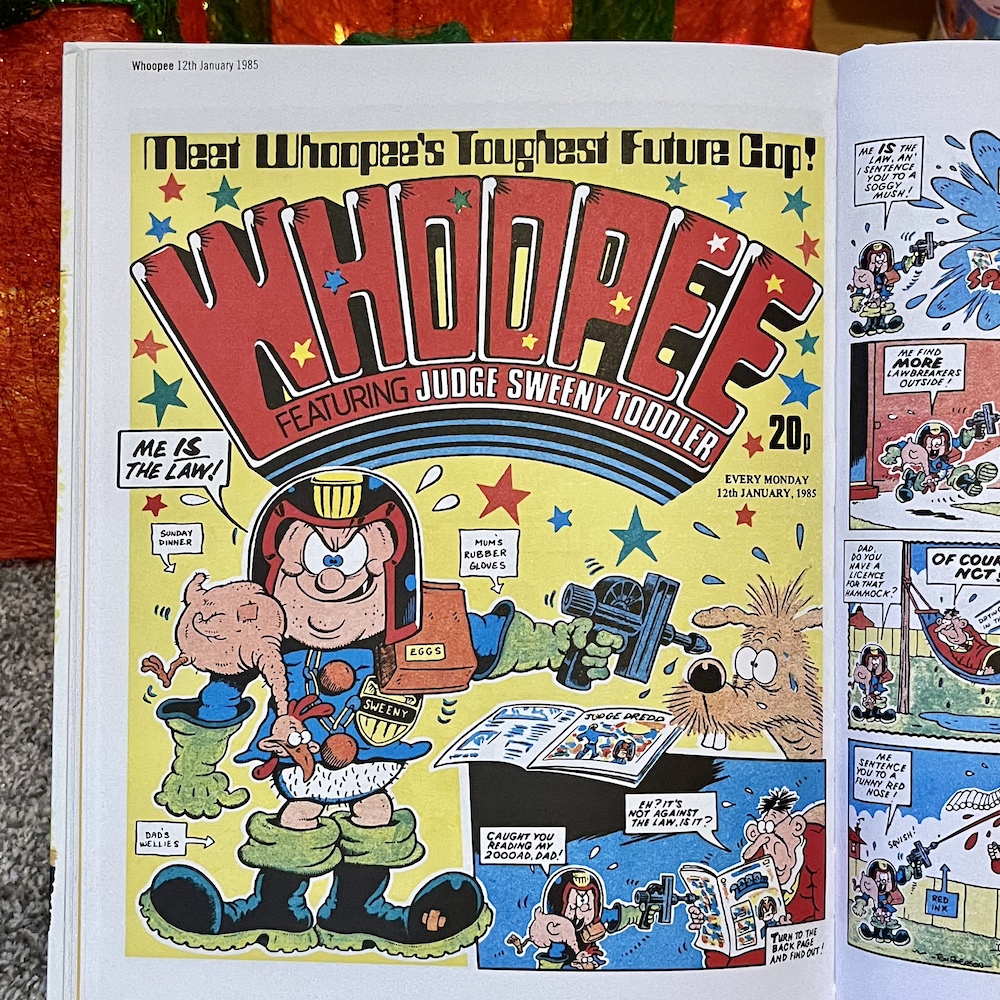
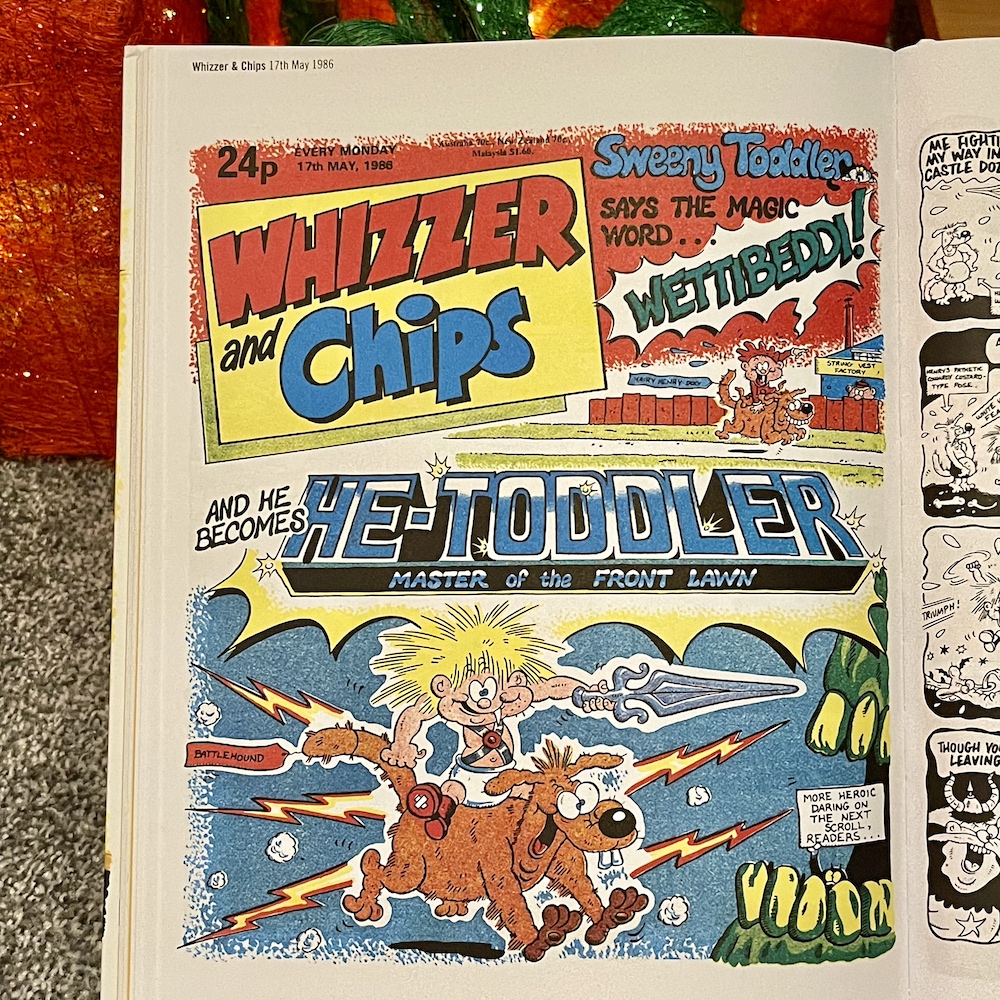
Of course Rebellion would include this classic spoof Judge Dredd cover and strip and that wasn’t the only time Sweeny took on a different persona for a good ol’ parody. However, changing the entire cover Whoopee logo included for that 2000AD riff was inspired! I said it was difficult to pick highlights but that’s definitely one of them and there are 200 pages of that sort of thing in total. UPDATE: Check out the comment OiNK writer Graham Exton left on this post for a little more info on this piece of comics history!
The book is £14.99 and worth every single penny. In fact, it feels like a bargain to me at that price. There’s also an exclusive cover based on that Whoppee one when purchased through the Treasury of British Comics online shop. Not since The OiNK! Book 1988 have I enjoyed, and laughed as hard with, a humour comics book this much and since that OiNK tome remains my very favourite to this day, I hope that shows how much high regard I have for The Tom Paterson Collection.
Available pretty much everywhere, this would make a fantastic Christmas present for any humour comics fan, pig pals included.
To see one more mini-strip by Tom from that aforementioned OiNK! Book 1988 you can check out its review.
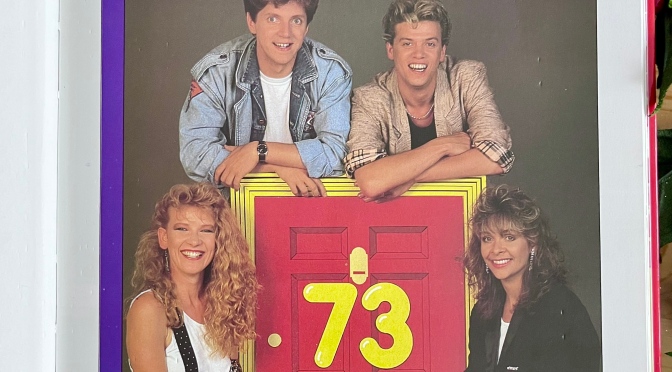
This hardback book cover brings back memories of many a childhood Saturday morning in front of the telly, hence why this post is being published on a Saturday morning. No.73 was a fictional house in an unknown street where Sandi Toksvig played the tenant Mrs Ethel, surrounded by a cast of young up-and-coming talent, including Neil Buchanan who would go on to present the insanely good Art Attack in later years. A certain papier-mâché-headed OiNK superstar also popped up now-and-again and thus you have the reason for this book’s inclusion, despite the fact it contains no comic strips.
Sadly the book also doesn’t contain any Sandi. I loved her on the show, although I always knew her by her real name (she was one of the main writers too) and I don’t remember the fact she played a character. Her ad-libbing (often as herself and not in character) and dead pan humour was brilliant and to this day I’ll pretty much watch anything with her in it (QI has never been better). Being a fan of Sandi’s all started with No.73, however this book was produced in 1987 and she had departed the series in 1986 after four years as the lead.
Now, those who have been paying attention will know this isn’t the first time No.73 has been mentioned on the blog.
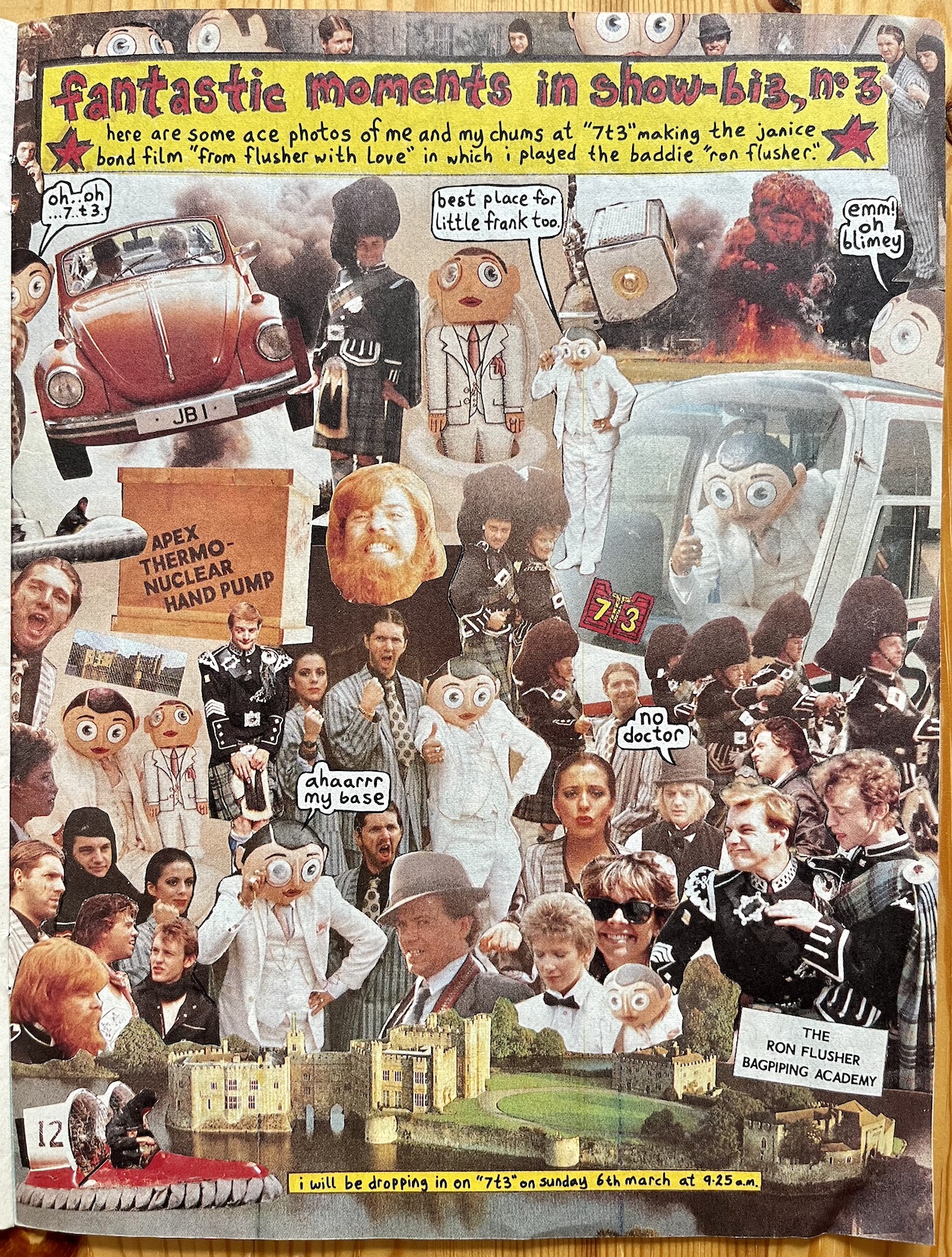
This montage was taken from Frank Sidebottom’s time filming during the show’s final year, when it was renamed ‘7T3’ and had an American Wild West theme (which I remember being terrible), although Frank is seen here taking part in a very British James Bond spoof. As I mentioned in #52’s review I loved seeing Frank pop up on No.73 and in my head he appeared at the breakfast table or in the shed many times. Imagine my surprise when I found out he only appeared in nine episodes!
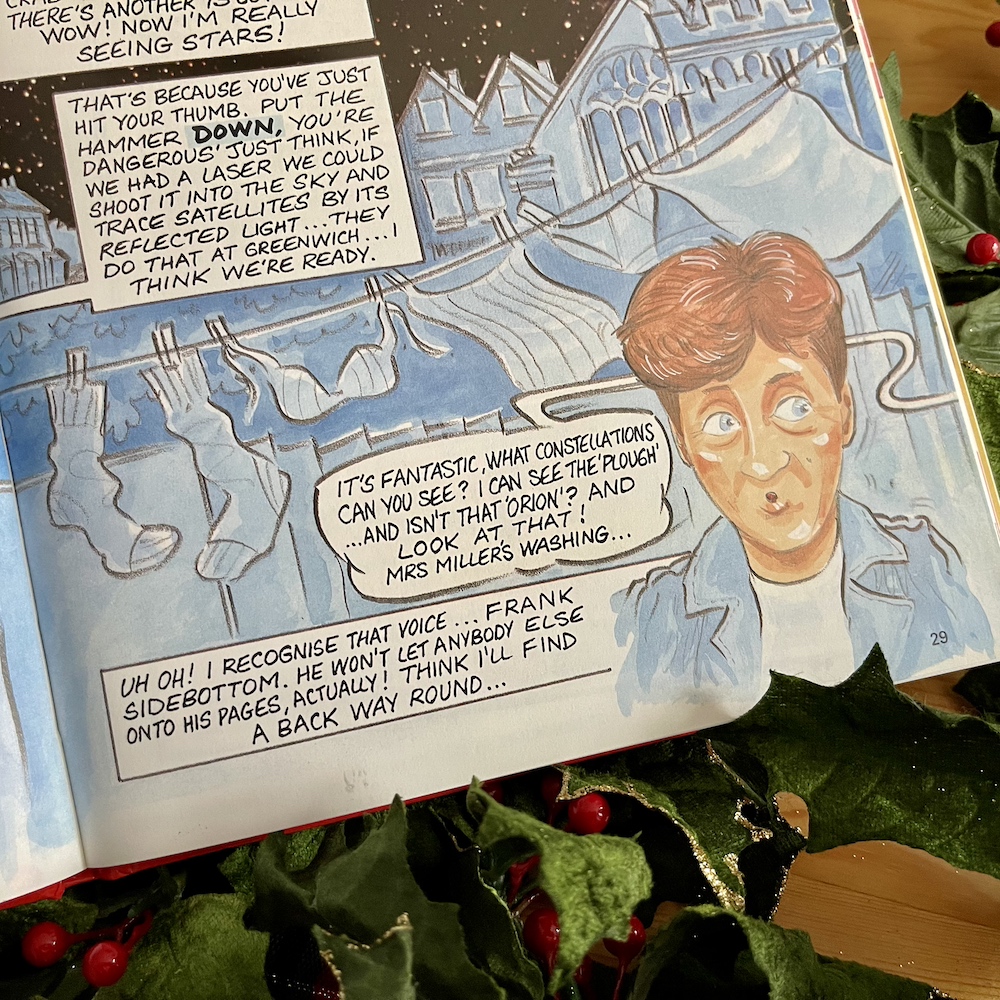
Anyway, I said there’d be a special post to come later in the year and here we are at last. Just before Frank’s double-page spread the book shows readers how to make their own space observatory but, like a lot of such things on the show, it was more of a spoof of what you’d see on traditional children’s shows. As such, take a saucepan, shove a football in it and sellotape a pair of binoculars on top and you’ve got a rotating observatory! Neil is star gazing in the garden of the house when he hears a certain nasally voice.
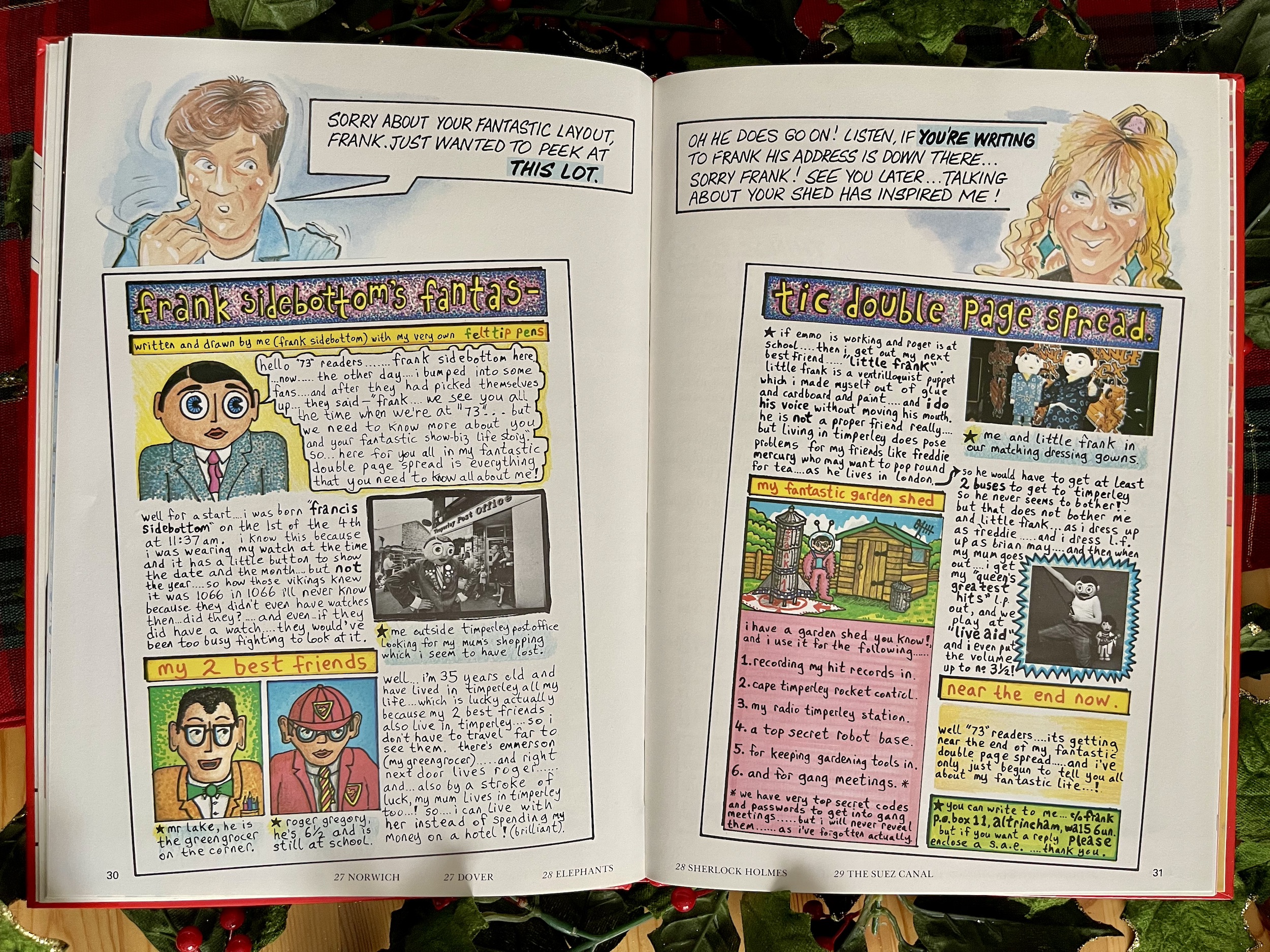
The book has 64-pages and every single one is illustrated by Don Seed, except for the next two that is. Unfortunately Frank’s pages, which are very similar to those he was producing for OiNK at the time, are reduced to fit in pictures of Neil (who played an exaggerated version of himself on the show) and Dawn Lodge as played by Andrea Arnold (now OBE).
“I was born ‘Francis Sidebottom’ on the 1st of the 4th at 11:37am. I know this because I was wearing my watch at the time and it has a little button to show the date and the month.”
Frank Sidebottom (Chris Sievey)
Andrea is now a filmmaker, has won an Academy Award, and more than one Jury Prize at Cannes as well. Amongst all of her other work she also directed all of the second season of Big Little Lies. As for Neil, alongside Art Attack I remember enjoying Finders Keepers and Motormouth as a kid, and his art was so good he even had to deny he was Banksy in 2020. Anyway, back to the star here.
This acts as an introduction to Frank for those who had seen him on the show and wanted to know more about him. It includes staples of his OiNK contributions such as Timperley (and its Post Office), Little Frank and his celebrity lifestyle. For the latter we get a superb reason why none of his celebrity friends ever seemed to visit him.
I love the volume he dares turn his music up to in his mum’s house when she’s not there and let’s not overlook that fantastic shed of his. This often featured in OiNK, he had his own TV show based around it and here we get a little list (he did like lists in OiNK) of the things he does in there. This leads on to the next spread in the book from Dawn, who has one or two ideas of her own.
Well, I say one or two…
I think this is a great follow up and it even mentions Little Frank in there too.
It was great to see two new Frank pages after getting to the end of OiNK’s regular run in October because, yes, I’m missing him already. The man behind the mask, Chris Sievey, gets a mention in the credits at the start of the book, although the four main cast members only get thanked so I’m assuming they didn’t write any of this themselves. Seeing as how they played fictional characters (or fictional versions of themselves) I guess there was no need to get them involved.
“You’re a mucky lot mankind, it’s time you grew up and started cleaning up after yourselves. Mother Nature’s got her work cut out coping with you as it is.”
There’s a large list of contributors with no indication of what each brought to the book, however it’s edited by Richard Morss who was a writer on the final two series (seven and eight) of No.73, the seventh being the one on TV when this book was released and the final to actually feature the house itself. The long list of contributors includes regular guests from the series such as animal experts and magicians etc. It was a varied show!
Unlike other Saturday morning programmes No.73 told ongoing storylines and character arcs over the course of each series which formed the backbone of everything else, even celebrity guest appearances were worked into these scripts rather than having straight interviews. There was even a fictional film company called Front Door Productions within the setting which was responsible for the sketches and video shoots spoofing whatever was popular at the time.
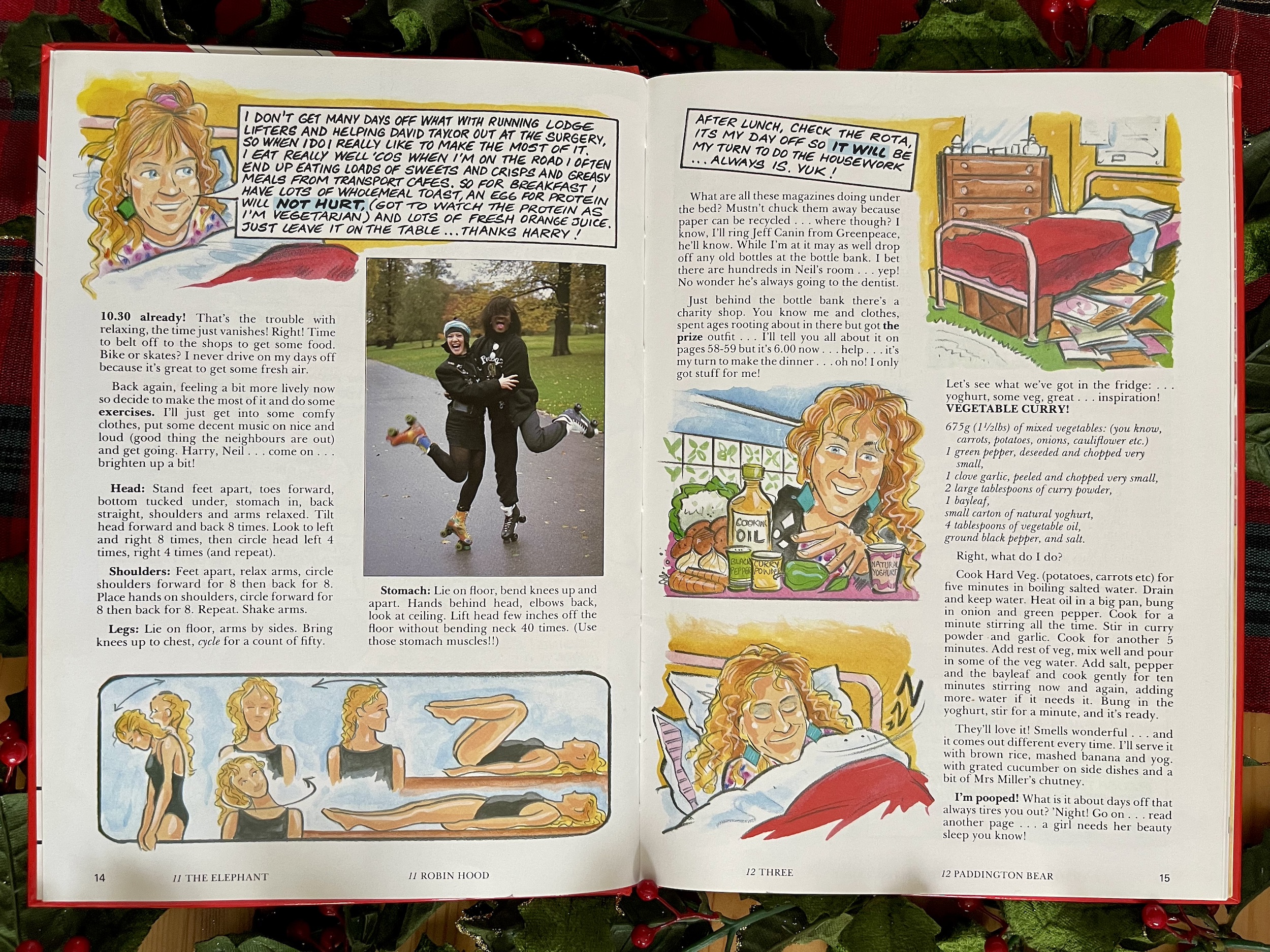
Long-time character Dawn helped out at the local vet’s and was a vegetarian, which was something not represented very well in the 80s, especially on children’s television. Her healthy lifestyle would be very on-trend today so you could say it was way ahead of its time. In fact, having someone follow an exercise routine and be a vegetarian was deemed so noteworthy we were treated to a day-in-the-life diary!
Kim Goody was, like Neil, playing an exaggerated version of herself on the show. Kim is a singer and songwriter, although the song she’d recorded at the time and talks about here (the show being a hopeful springboard to success) was a Tina Turner song and one I personally recognise as an Aswad and Ace of Base tune. It was not successful (as she candidly tells us here) despite her popularity with the viewers.
Nowadays, Kim has a composition and publishing company and owns Soho Square Studios, a post-production company. She’s married to former The Hollies band member Alan Coates and together they wrote the music for many BBC productions including those pounding BBC News scores. The final member of the team was Nick Staverson who played the character of Harry Stern, who I have absolutely no recollection of.
Harry appears the most throughout this book and seems to be a bit of a clichéd harmless idiot character. The actor portraying him doesn’t appear to have had as much success as the rest of the team, with his only real credits to date being No.73 itself, something called Fish Tank and a charity Telethon. He appears on this next spread with Neil and Dawn in one of the many pieces with an environmental or animal theme.
Alongside the spoofs of The A-Team and James Bond, the magicians, Frank Sidebottom, pop music, games and general chaos No.73 also drove home some important messages to its captive audience, messages which are sadly still needed just as much (if not more so) today. Watching No.73 was like watching several children’s shows at once and in particular during its Sandi years it was also incredibly funny and clever.
What’s here is an interesting snapshot of 80s children’s television in general
Obviously it’s been decades since I saw it; Saturday morning children’s magazine shows aren’t exactly repeat fodder. All I have to go on are my rose-tinted memories and this book. Judging by the book the variety had remained but the humour had changed after Sandi left. There’s none of the sarcasm and clever wit here that I remember, although when viewed as a variety programme what’s here is an interesting snapshot of 80s children’s television in general.
There could be moments when a book like this could feel very of its time, if you know what I mean. Thankfully, No.73 was created by a bunch of very nice people who seemed very progressive in how they lived their lives. So, the difference between Chinese astrology and that more often used in the UK being referred to as “theirs” and “ours” may make me cringe a little today but that’s literally the only time anything remotely like that happens in the whole book. It’s also a fun spread to read.
Anyone who knows me will know how much I love cats, so it’s a bit disappointing to find out that not only was I not born in a Year of the Cat, but that the animal would not suit me at all. I was pleased enough with being a snake… until I was called a skinflint! Oh, and if you’re wondering what all of the random words and phrases are along the bottom of every page, there’s a huge quiz at the back with so many answers they’re spread throughout the book, each one listed by their page rather than question number. It’s something a little different and that pretty much sums up No.73.
If you grew up with the programme I’d heartily recommend tracking down this book for a wonderful trip down memory lane. Its humour stands up well today, and while there are no comic strips I think a lot of it reads quite like OiNK, with its randomness, spoofs of more traditional children’s entertainment, digs at 80s culture and of course there’s a bit of Frank. This blog is all about reliving childhood favourites and this is as close as I can get with No.73. Reading this has been a blast.
Well this is a turn up for the books, isn’t it? Previously guest starring in Dragon’s Claws#5 and being reconstructed beneath The ‘Pool of Greater Britain in 8162, where he’d been exiled by The Doctor when he bumped into him in the corridors of time, after disappearing from The Planet of Junk in 2007 where he helped the Autobots defeat the Chaos Bringer godUnicron (do keep up), ol’ Death’s Head is now the one welcoming the special guest stars to his own comic
You see, he’s been rebuilt by a Game team looking for revenge on Scavenger of Dragon’s Claws and as always business comes first, so up he pops in as characteristic a manner as ever. First though, don’t forget to subscribe to 12 issues of the comic that would only last for ten. Obviously Marvel UK had much bigger plans for their smaller US-sized comics. A sad reminder of that to kick things off with.
Alongside writer Simon Furman, penciller Bryan Hitch, letterer Annie Halfacree, colourist Nick Abadzis and editor Richard Starkings comes inker Dave Hine (Spawn, The Joker’s Asylum, Will Eisner’s The Spirit), who brings a completely different feel to proceedings, especially to any human characters who seem to emote more and have a rougher, harder edge to them. I approve. I still much prefer the original design of Death’s Head from Transformers though.
So the Freelance Peace-Keeping Agent has been sent to round up Scavenger rather than kill him, and deliver him to the Game team. The first half-dozen pages consist of their back and forth battle involving anything that comes to hand for Scavenger, including Scratch the dog! As ever, Death’s Head keeps his cool and even has time for the occasional quip before he finally overcomes his target.
When the rest of the team show up Dragon spots an “old friend” and they recover Scratch who leads them out into the wastelands towards the Chaney Maximum Security Prison, where criminals the World Development Council wanted to forget were sent. So forgotten were they that when an earthquake destroyed the prison the authorities didn’t attempt any rescue and just assumed all of those within had perished. They were wrong.
At this point we get a little insight into the past of Dragon and Scavenger, specifically how they first met. This was exciting to begin with for me as Scavenger is a favourite character and one I’d like to know more about, but I didn’t think we’d get the chance given the comic’s short lifespan. In the end though it’s pretty inconsequential, Dragon having his life saved seven years previous at the last moment by a silent Game player who disappeared just as quickly afterwards, Dragon vowing inwardly he’d recruit the stranger to the Claws next time they met.
Still, it’s interesting to have a flashback for these characters in this comic instead of their own. Death’s Head finds himself conflicted at this point. The Chain Gang had become agoraphobic from living underground for so long and they’d used Scavenger, a relatively new prisoner at the time, as their gopher to go and fetch food and supplies, tying an explosive device to his leg so he’d have to return. Eventually earning their trust, as soon as they removed the device Scavenger had legged it, and now the team has reconstructed the galaxy’s greatest bounty hunter (their words!) to recapture he who had betrayed them.
Death’s Head knows he’d have done exactly the same thing in Scavenger’s case, but money is money and a contract is a contract. However, such distaste does he have for this situation he’s set a timer counting down to the very second said contract expires. It’s at this point, while he’s lamenting his situation, that he meets the technical whizz who recreated him from his scrap parts, and co-star of the strip advert for the comic, Spratt.
Of course we know from the marketing that Spratt will end up working with Death’s Head so it’s interesting to see how this relationship starts. Spratt is basically brushed aside, despite his obvious intelligence and technical abilities. The “eyes on the back of my head” line will come back to haunt our anti-hero before this issue is over, but at this point in the story there’s no indication of how they’ll end up together. I like the build up.
Scavenger’s teammates then turn up and basically all hell breaks loose. As you’d expect, really. But that doesn’t mean the humour has been forgotten about, not even for one page, as Steel finds out in a rather painful way. With the clock counting down on his wrist, Death’s Head even surprises himself with what he’s thinking while he fights.
He finds himself respecting Dragon, something that simply hasn’t happened with a human before. Not that he takes it easy on him of course. Nope, he’s still under contract for another nine seconds and will continue to fight just as hard until that time runs out. Meanwhile, the leader of The Chain Gang, Fox, chases Scavenger through the crumbling prison. However, his wish to kill clouds his judgement and he doesn’t realise that Scavenger isn’t really running away from him.
He’s being deliberately led somewhere but his prey is very convincingly playing the desperate victim, right up until he jumps on Fox, wrapping his whole body around his head and obscuring his vision. It’s all been a ruse and suddenly Fox finds himself in the most terrifying of places. It’s not the prison itself nor the earthquake damaged cells ready to collapse and kill everyone at any moment. No, now he finds himself outside.
Inside, our two title characters are still fighting and Dragon is taking quite a bit of punishment when, with his spiked metal ball raised to come down hard on Dragon’s head, Death’s Head checks his wrist and just stops. Walking away, he apologises for the fight lasting longer than it should’ve and blames his timer for running slow!
It really is the only way this fight could’ve ended; neither of these two could actually win anymore, they’re heroes of their own comics after all. In fact, as the authorities arrive to clean up and arrest The Chain Gang, Dragon looks up and sees Death’s Head looking down from a hill nearby… and waves. This sight of mutual respect has me wishing both these comics had lasted longer because I would’ve loved to have seen these two slowly become friends and even work together at some point.
As for the story itself, Scavenger insists Fox is treated with leniency as he was just looking out for the community he cared for but had just gone about it the wrong way. It all ends with Spratt being the first person to ever sneak up on Death’s Head, and probably the first to offer to be his partner. After all, the mechanoid is from a different time and doesn’t know this world, so Spratt offers to help him with that while handling the business side of things. He’s a free man now and knows a good thing when he sees it. Death’s Head refuses and walks off… then the chapter ends with Spratt following anyway and continuing to talk about his proposition. To which Death’s Head merely sighs. And the reader laughs.
A couple of Marvel UK adverts round off the issue. The first is for Dragon’s Claws and uses the excellent Dave Gibbons cover from the current issue, while the other advert is somewhat more cryptic. For a comic that wouldn’t even turn up until June of the following year, six months hence, Marvel UK were certainly playing the long game here.
I remember this particular promo appearing in The Real Ghostbusters and Transformers comics week after week, month after month. Even at that young age I began thinking, “Enough already, just tell us more!” The Sleeze Brothers, namely El Ape and Deadbeat would follow Death’s Head into the pages of Doctor Who Magazine first but that wouldn’t even be until March. I guess you’ll just have to wait until then to find out more… because yes, The Sleeze Brotherswill be joining the OiNK Blog in 2024.
For just the second time we come to the end of an issue of Death’s Head and I really like the fact all of the pieces have taken a couple of issues to put in place. Actually, I’m looking forward to seeing how Death’s Head’s and Spratt’s partnership works out, so I suppose everything isn’t quite set yet. While this and Dragon’s Claws are very natural sister publications, this one is definitely a lot funnier and lighter, despite its title character’s name and job! Great fun so far. The next review will be after the festive season (right after it in fact) so come back to kick off the New Year in style on Sunday 7th January 2024.