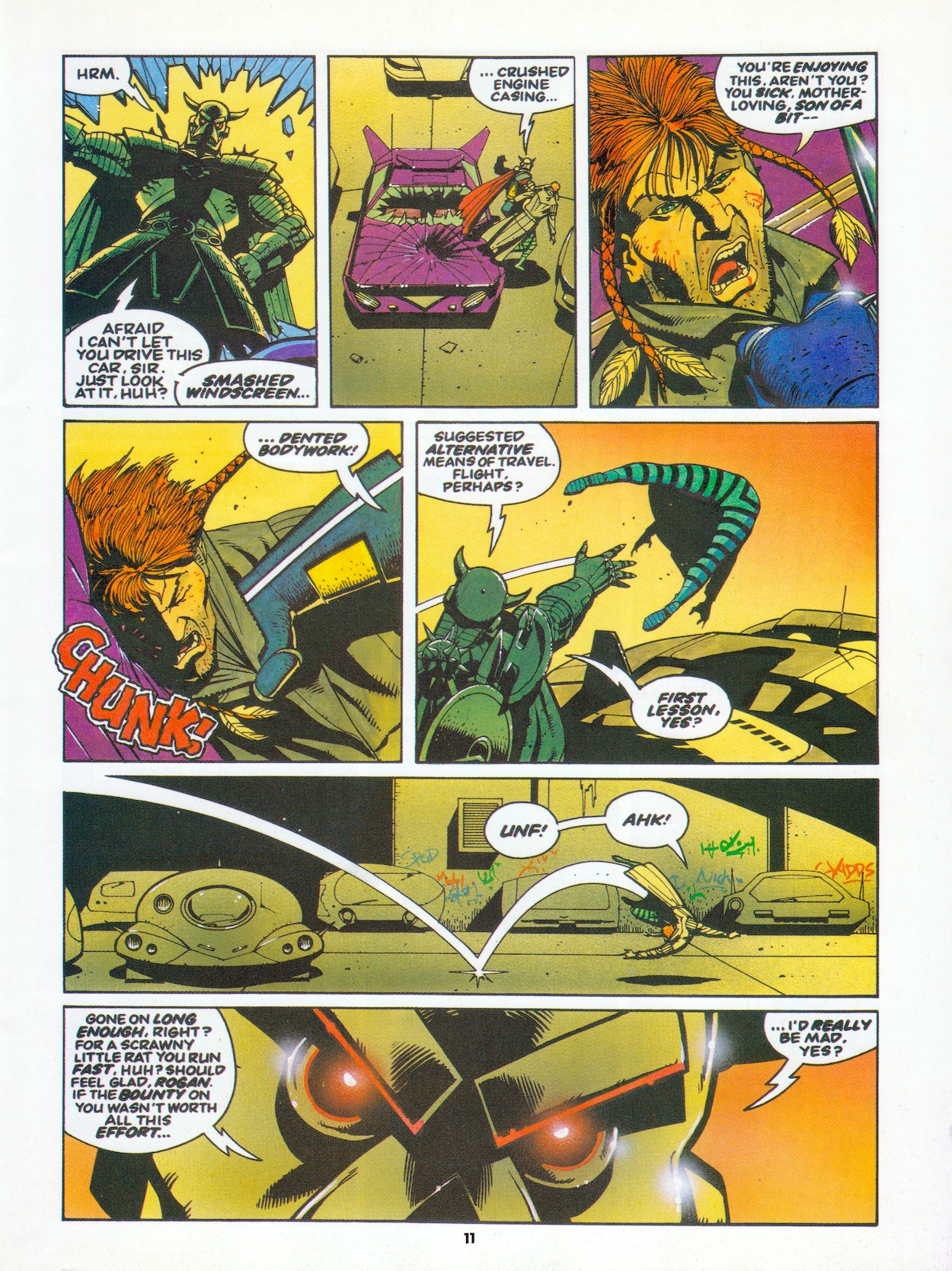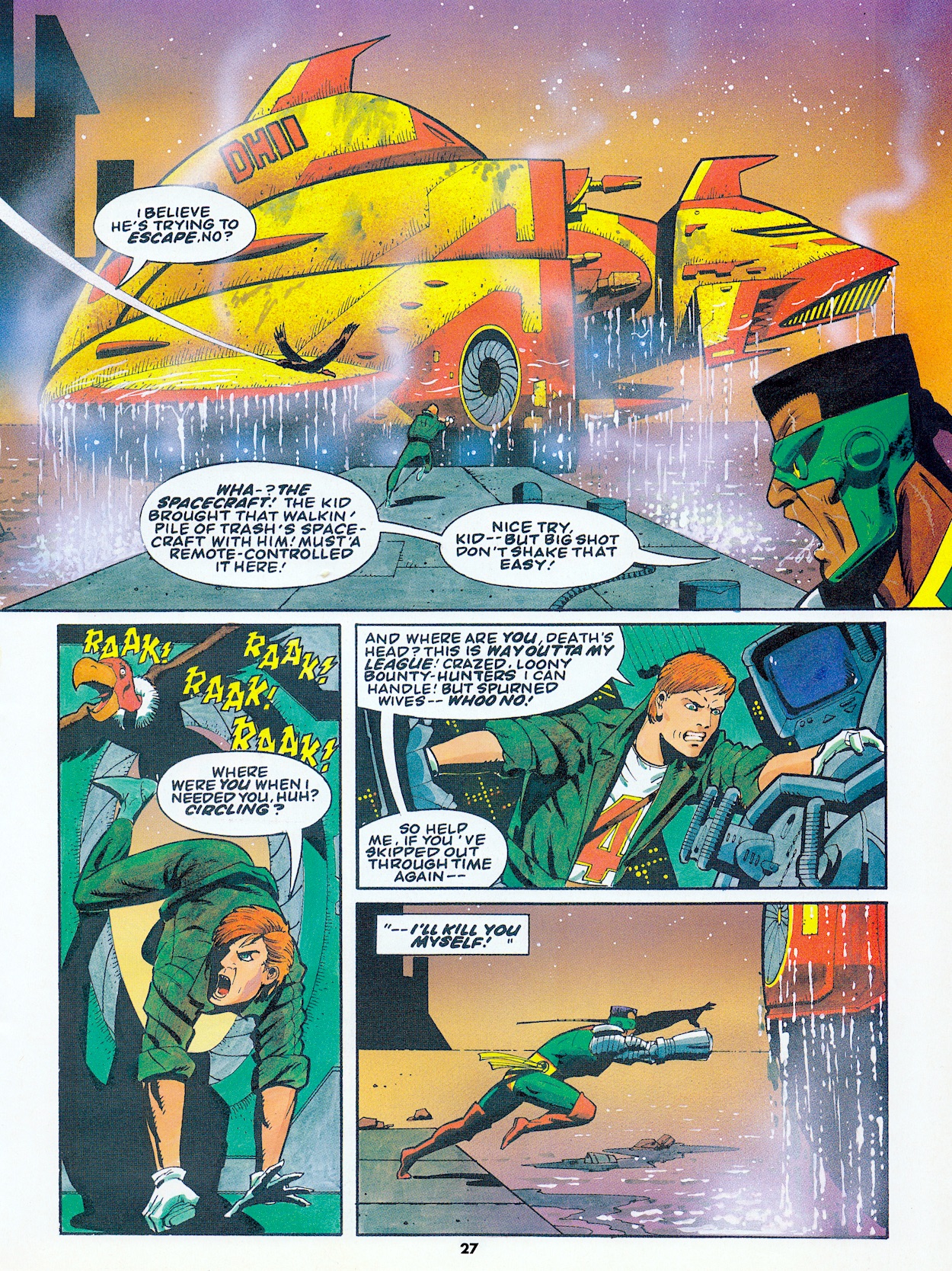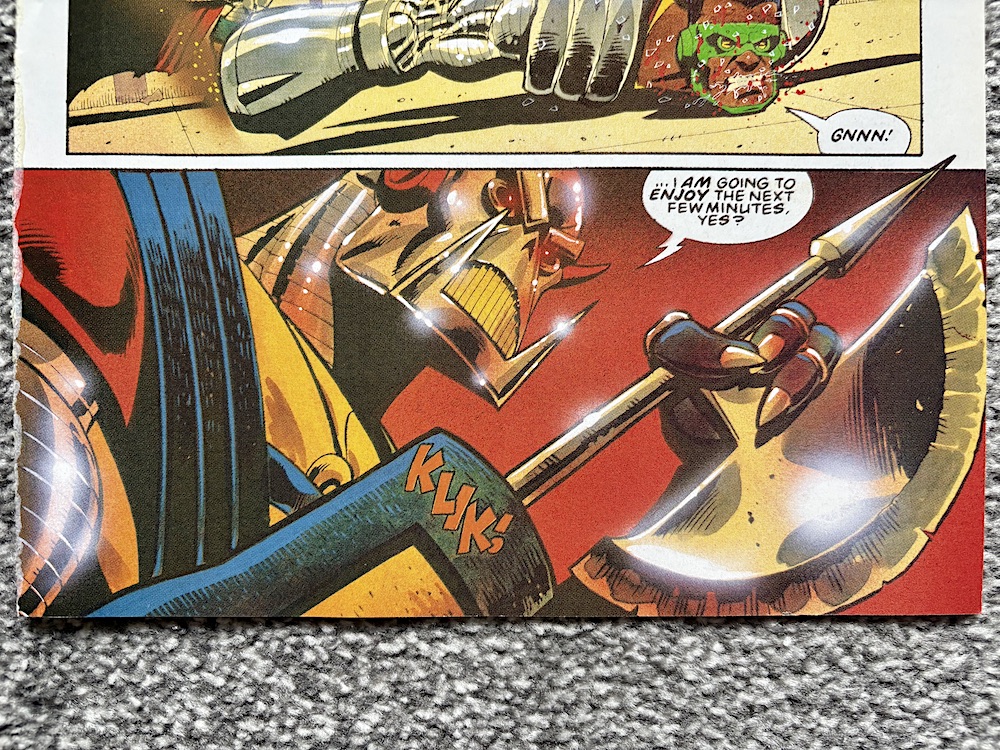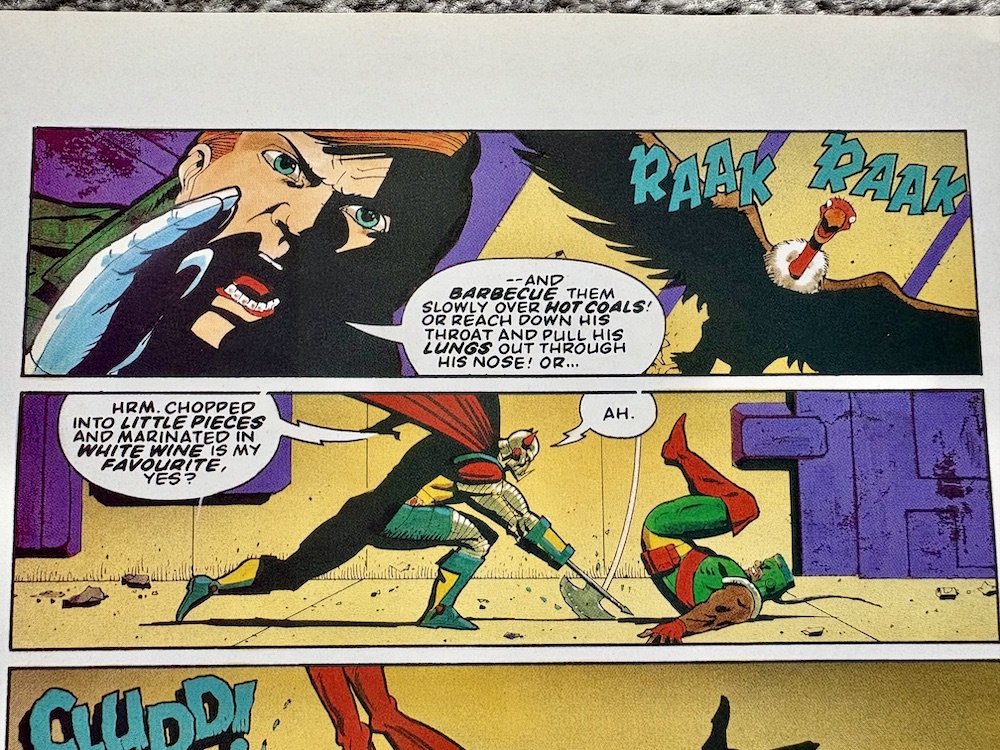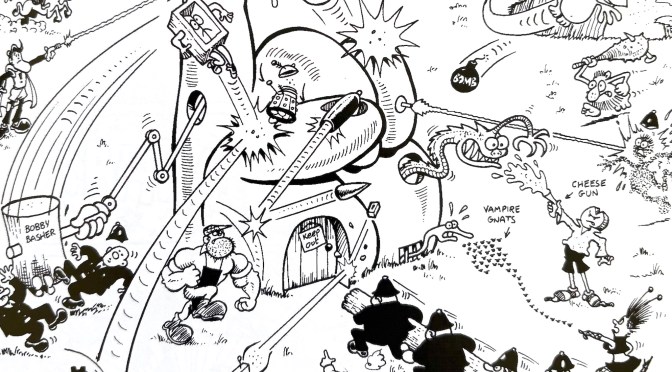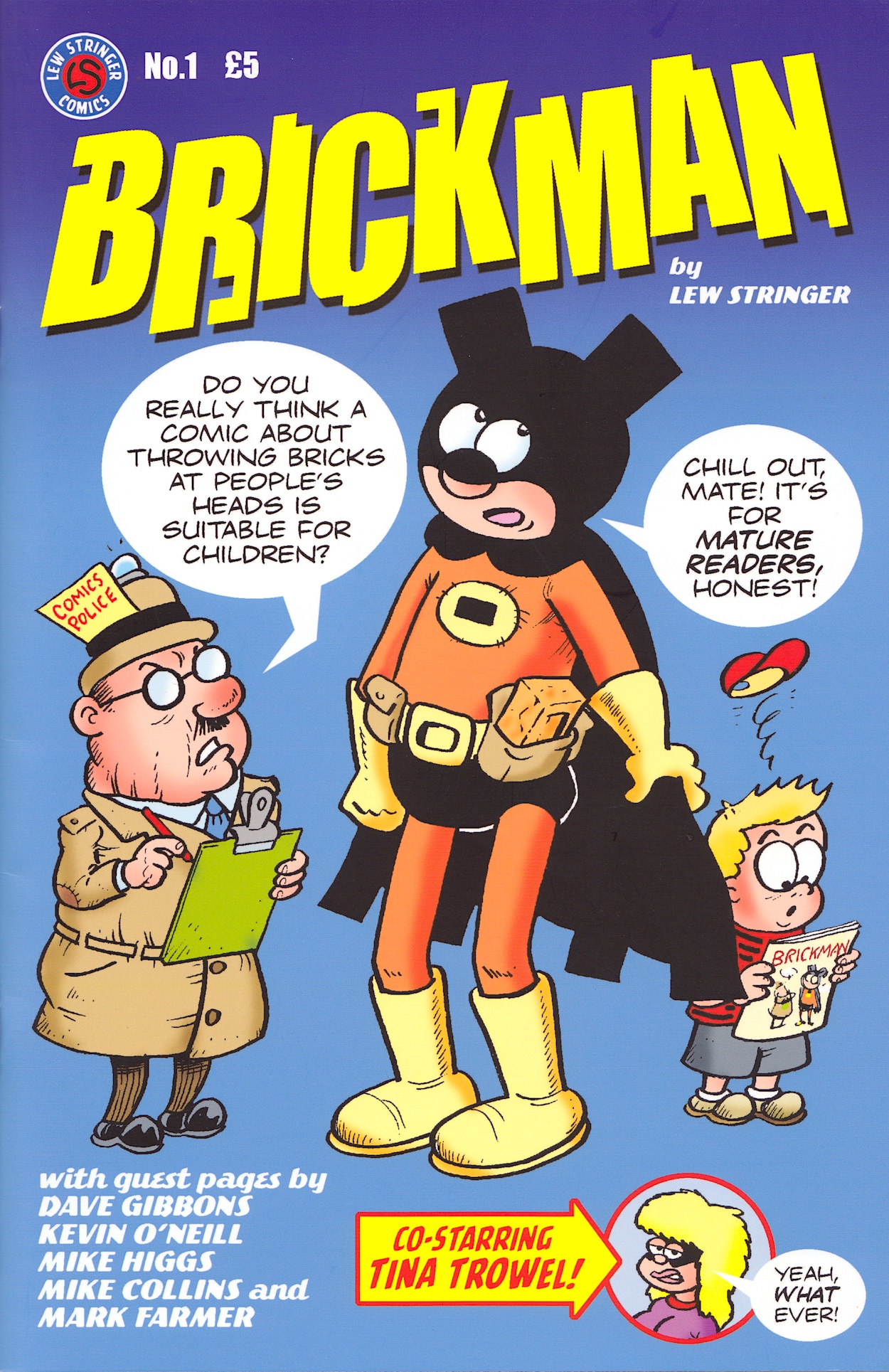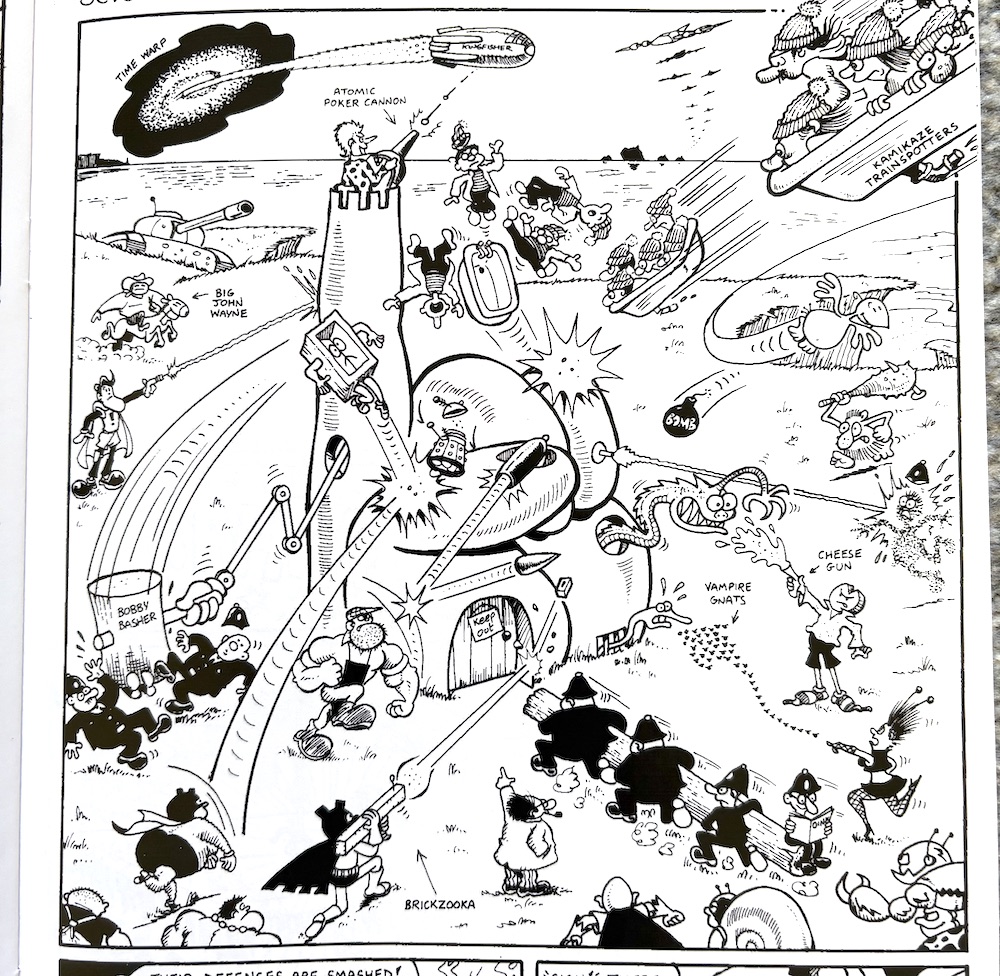
It’s always exciting news when Lew Stringer (Tom Thug, Pete and his Pimple, Combat Colin) announces another of his self-published comics. Regular readers of the OiNK Blog will recognise the star of his latest release from Lew’s Barmy Comix and Comic Sampler collections. Starring one of his earliest creations, Brickman #1 is the first of three ‘Best Of’ comics for the spoof superhero (“Britain’s Greatest Super-Pillock”) and his alter ego, Loose Brayne.
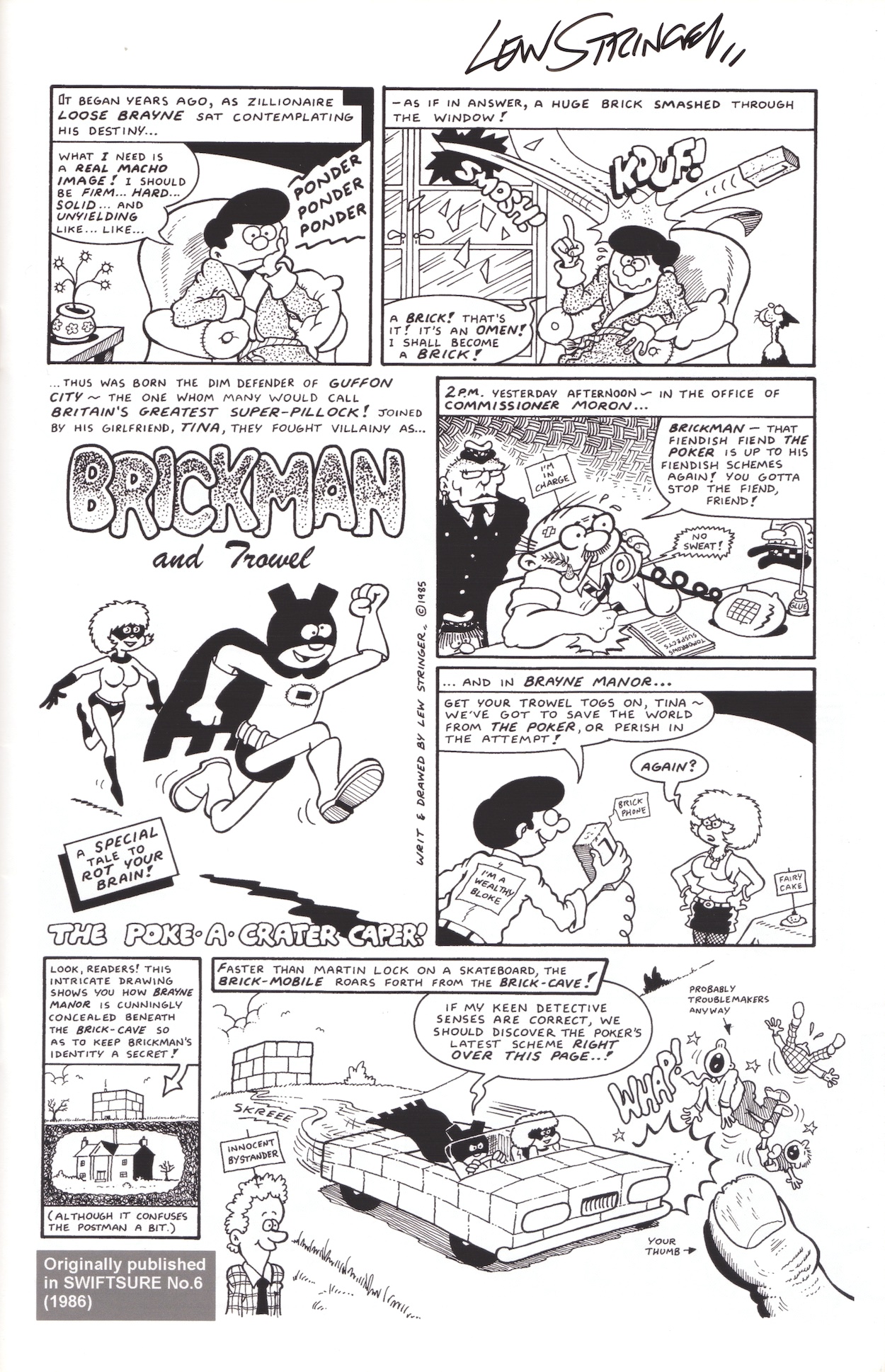
I’ll admit I own some of the previous Brickman releases but, while there’s no new material here, if you haven’t read any before this is unmissable. Actually, even if you do own the 2005 book Brickman Begins you should check this out as it’s in a much bigger and easier to read format, the strips really shining on the high quality paper. Included is the 1985 3-page introductory strip from Swiftsure and the 20(!)-page Brickmania Caper from a one-off comic for the character back in 1986.
This first page is the perfect example of what to expect, with loads of laughs not only from the main characters (his origin story) and plot (having his secret hideout above ground and his house buried is genius) but also from all of the little background details. Check out his underwhelming chest logo, the glue-drinking copper, the reader’s thumb and even Lew’s own credit. The comic is chock full of things like this.
If you’ve read Barmy Comix you’ll have already seen Brickman meets The Mad Cobbler. That was actually the first chapter in the huge second story here (renamed and presented in Barmy as a complete strip). Here though, it’s just one small part of a much larger whole, although the chapters do work to some degree on their own. Tied altogether like this it’s a relentlessly funny read.
There are a lot of gags at the expense of Thatcher’s 80s Britain and as someone who grew up in that time and remembers the likes of Spitting Image’s jokes about the politics of the day, high unemployment, privatisation etc. a lot of this takes me right back and I had a good chuckle at the expense of the time. Hey, we had to laugh back then!
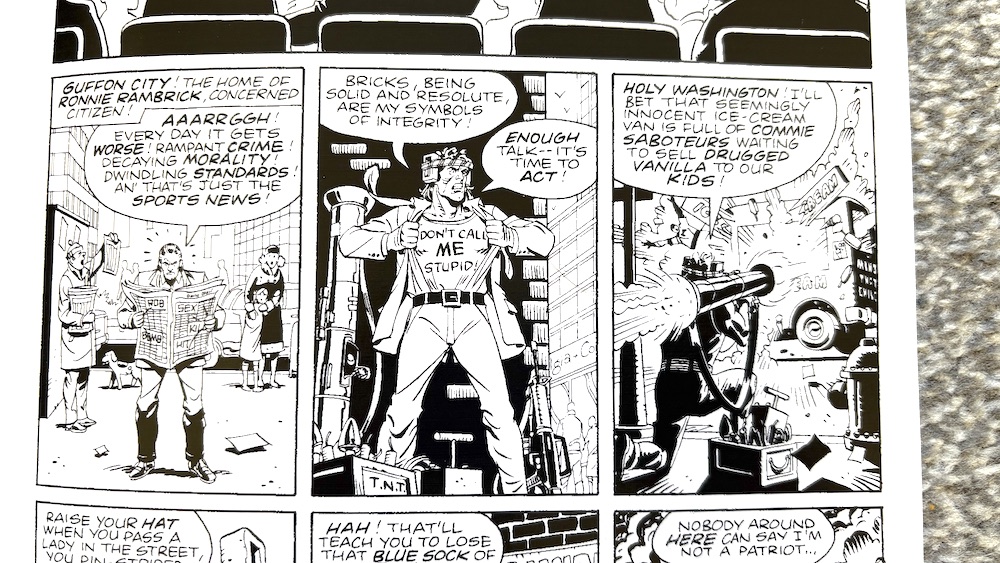
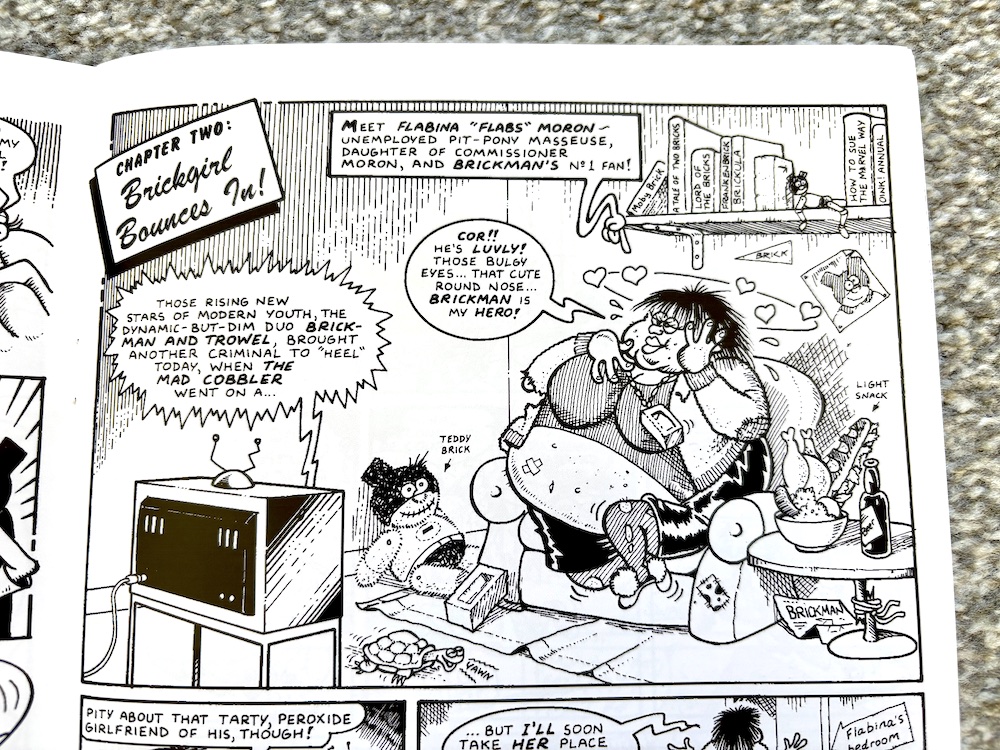
Those hidden background gems had me laughing the hardest at times, like the ‘How to Sue the Marvel Way’ book on the shelf in the above panel. Next to that you’ll also spot a mention of none other than OiNK. This strip was originally released during OiNK’s first year and Lew takes every opportunity to add in a little plug. There are quite a lot of little Easter eggs for OiNK fans actually, including a cameo or two. There are also pages drawn by some guest artists who’ll be very familiar to pig pals.
At least it wasn’t a Venezuelan boat! This is just one example of the comedy here that still feels very contemporary decades later. The page was drawn by Dave Gibbons (Ro-Busters, Rogue Trooper, Doctor Who) who drew Lew’s script for the brilliant Superhero’s Day Off in OiNK. Also contributing here are Mike Higgs, Mike Collins, Mark Farmer and the late Kevin O’Neill being very, very Kevin O’Neill! What a line up.
So what super powers does Brickman actually have? Well, chucking bricks basically. That, and just happening to have exactly the right gadget to hand, quite like how 60s Batman did, only here it’s exaggerated to even more ludicrous levels. But that brick throwing! It may be a silly comic but those brick impacts don’t half look painful! But the more painful they look the funnier they get. I’m not sure what that says about me.
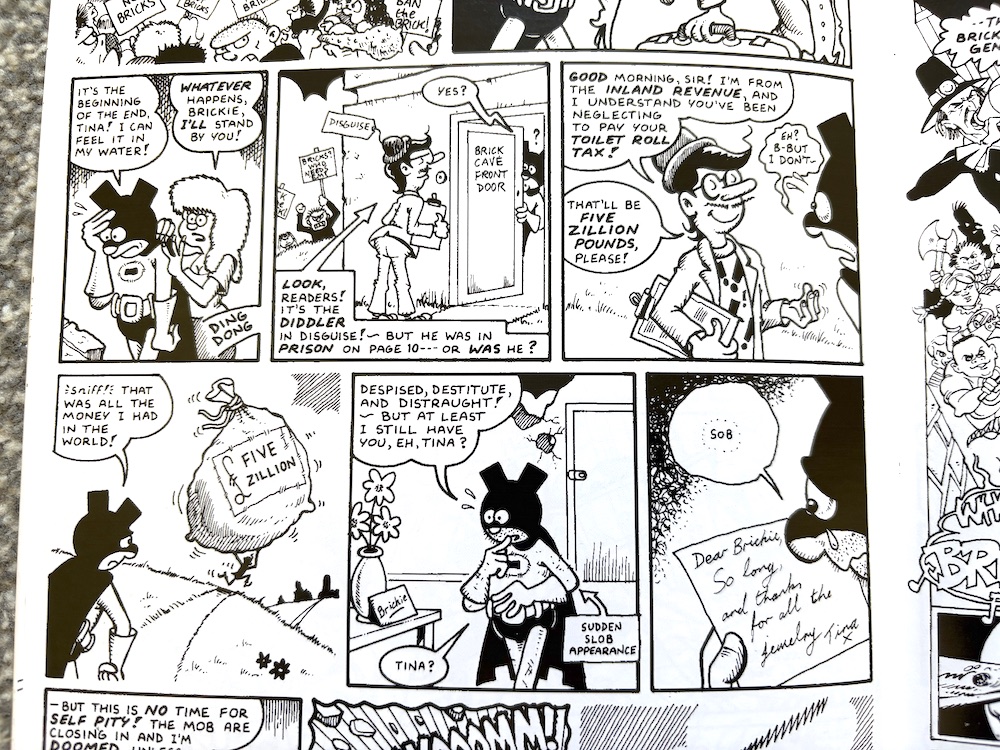
A couple of years ago in the actual Batman comic Bruce Wayne found himself without his mansion and his millions, diddled out of it by the Joker. Here, all it takes is a quick visit from someone claiming to be from the Inland Revenue and Loose gives away all of his money, instantly growing stubble to heighten the broke look. It’s a perfect example of the speed of storytelling in this comic.
My personal favourite baddies are The Poker (he loves to poke people) and Man-Brick, but it’s Lew’s pitch-perfect barbs at everyday life and the world we live in that really hit home for me. Superhero movies and fandom are targets you might expect, but the (many, many) other surprising topics in here can range from unfair representation of women in media to how the press manipulates the fickle nature of humans.
It’s testament to Lew’s skill as a comedy writer that these topics are handled in such a way that we laugh along while also acknowledging the points being made. There are many more examples I could give but that would ruin the experience for you, and discovering them all for yourself is something you simply must do. There’s a joke about a certain tropical fruit that resulted in me having to stop reading just to catch my breath!
What we have here are 28 pages packed with so many gags they could fill three issues, so it’s an absolute bargain at only £5 (plus postage). You can grab your copy direct from Lew by visiting his Ko-Fi shop. On his main Ko-Fi page you’ll also see regular blog updates and other comics of his for sale, so make sure you check that out while you’re there. This is only the first issue! I can’t wait to see where it goes from here.
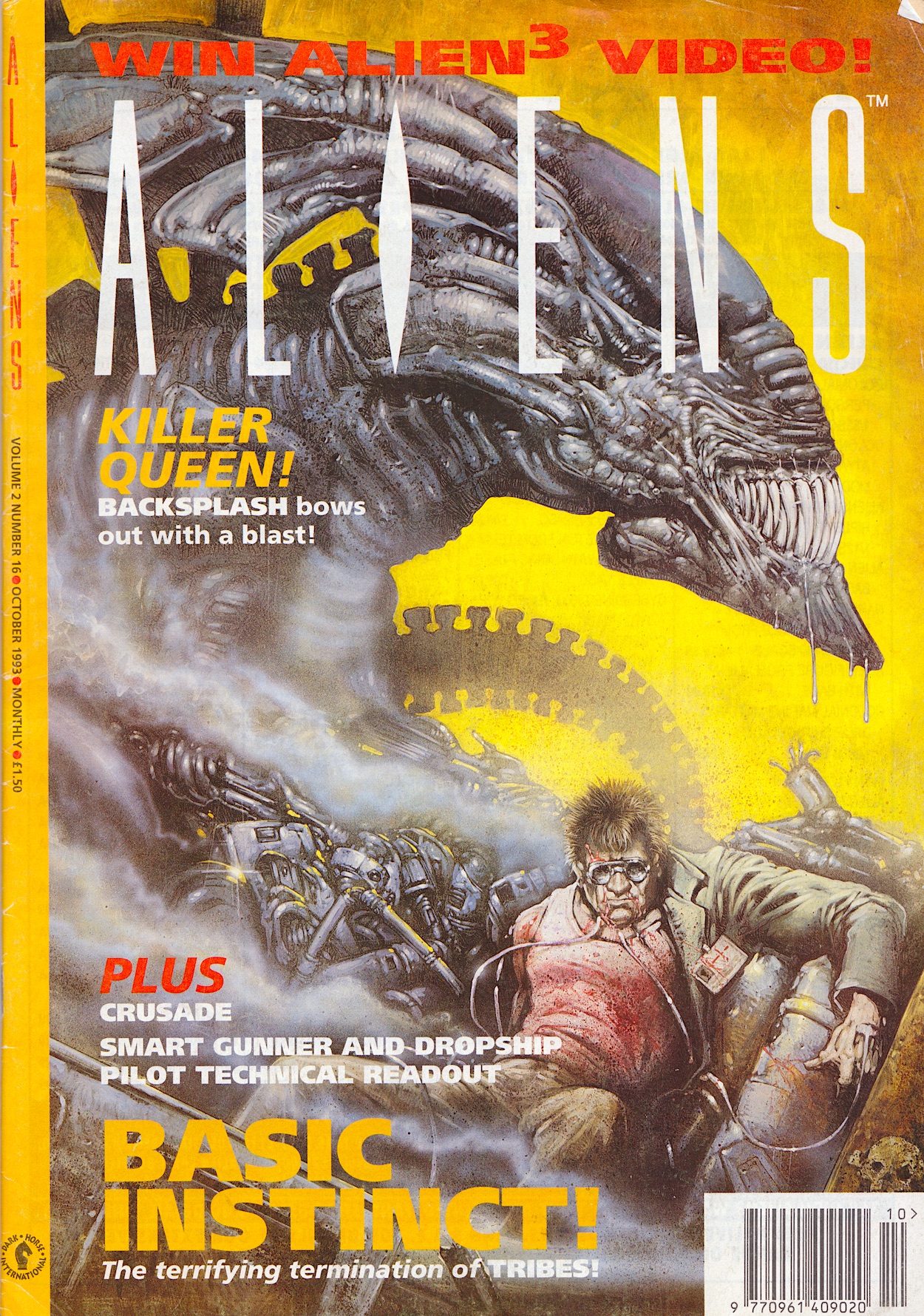
This cover by Carl Critchlow (Thrud the Barbarian, Flesh, Batman/Judge Dredd) has got to be one of the best covers so far, encapsulating a moment with the twisted Doctor Cutlow character in the final chapter of our prose story, Tribes. So, only six issues to come after this one, eh? Yes, but calm down, that’s still half a year and a lot of aliens!
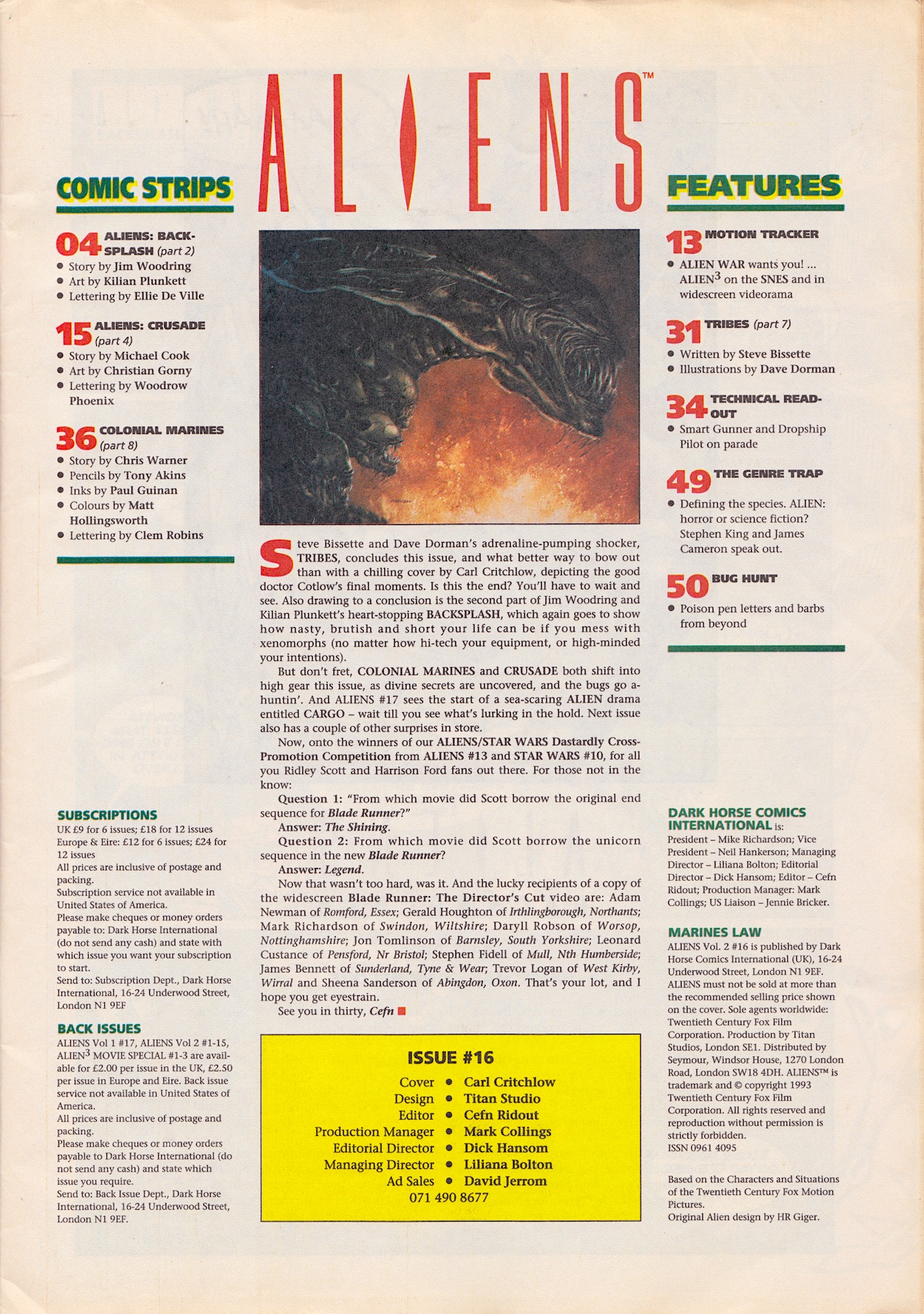
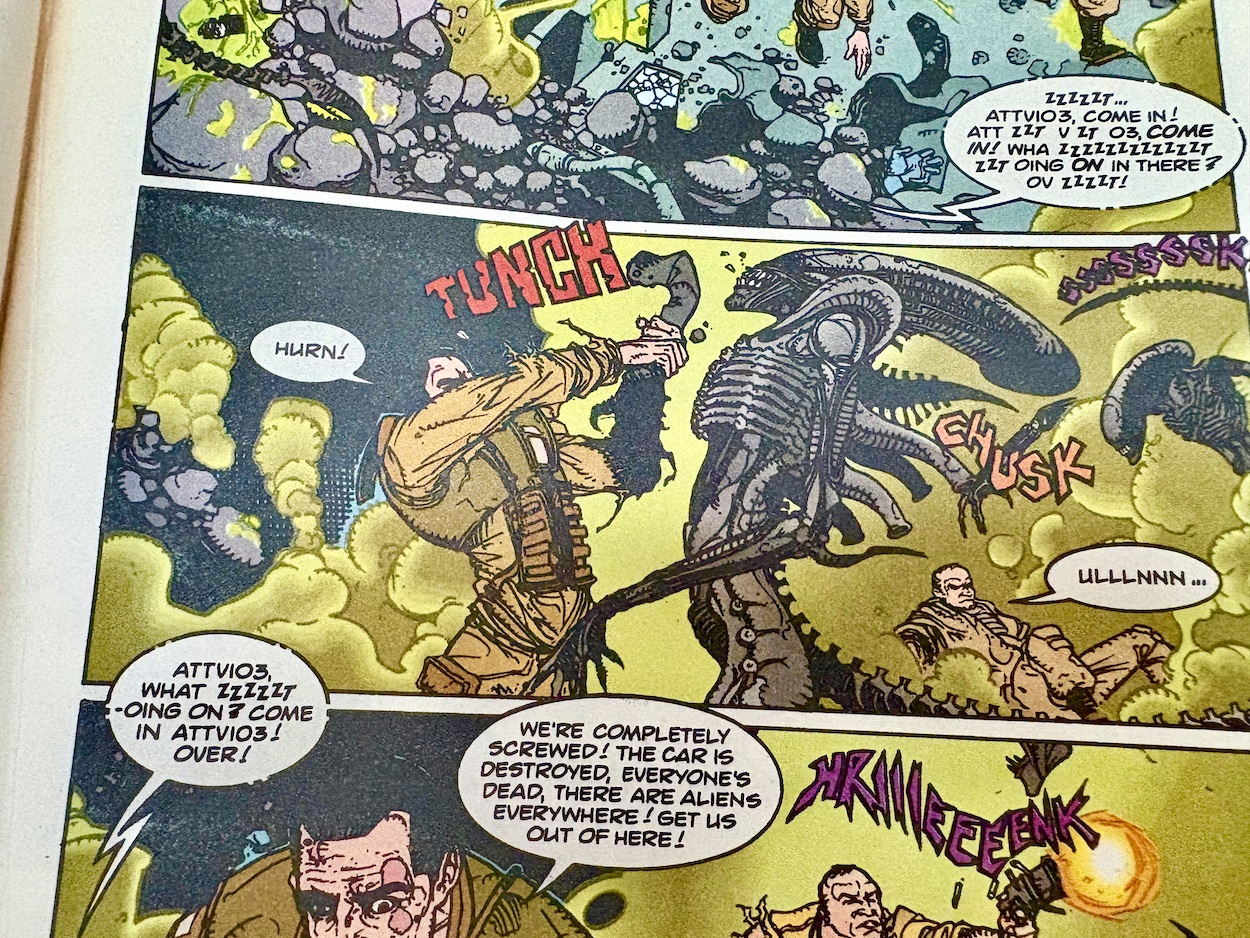
Editor Cefn Ridout mentions a sea-faring (“sea-scaring”) tale beginning next month and teases us about some other surprises to come. Colour me intrigued. After the editorial (included here so you have access to the full credits) we’re straight into the concluding half of Jim Woodring and Killian Plunkett’s superb Backsplash. After the cliff collapse there are only two Marines left, Gibbs and Crespi and these eight pages depict their desperate escape bid from the alien-infested cavern to their drop ship outside.
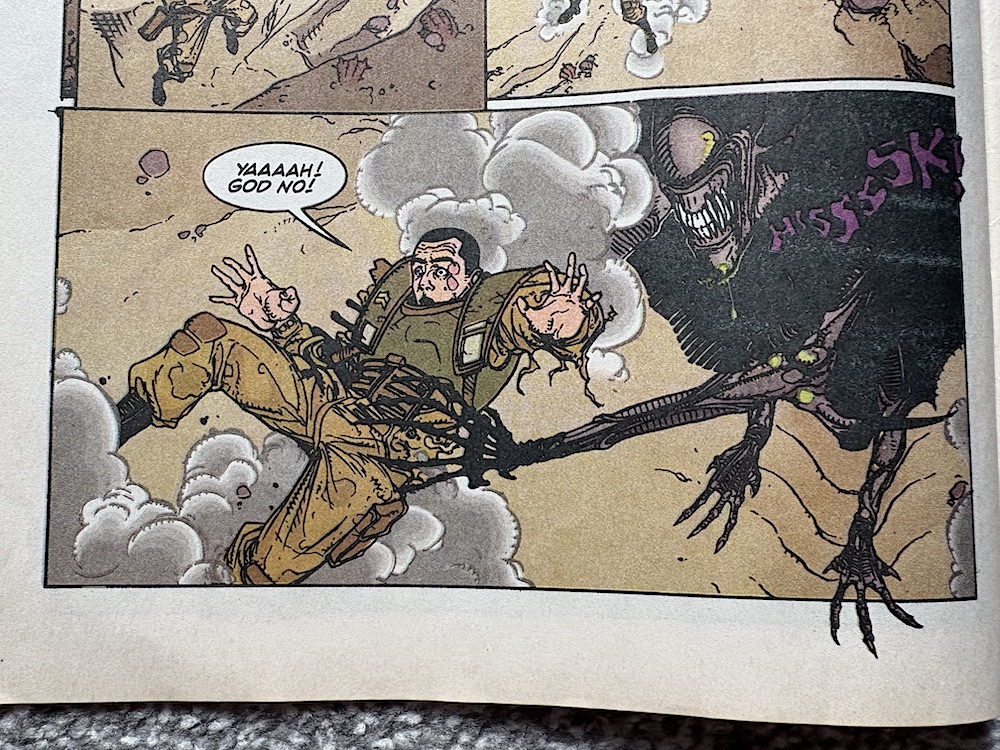
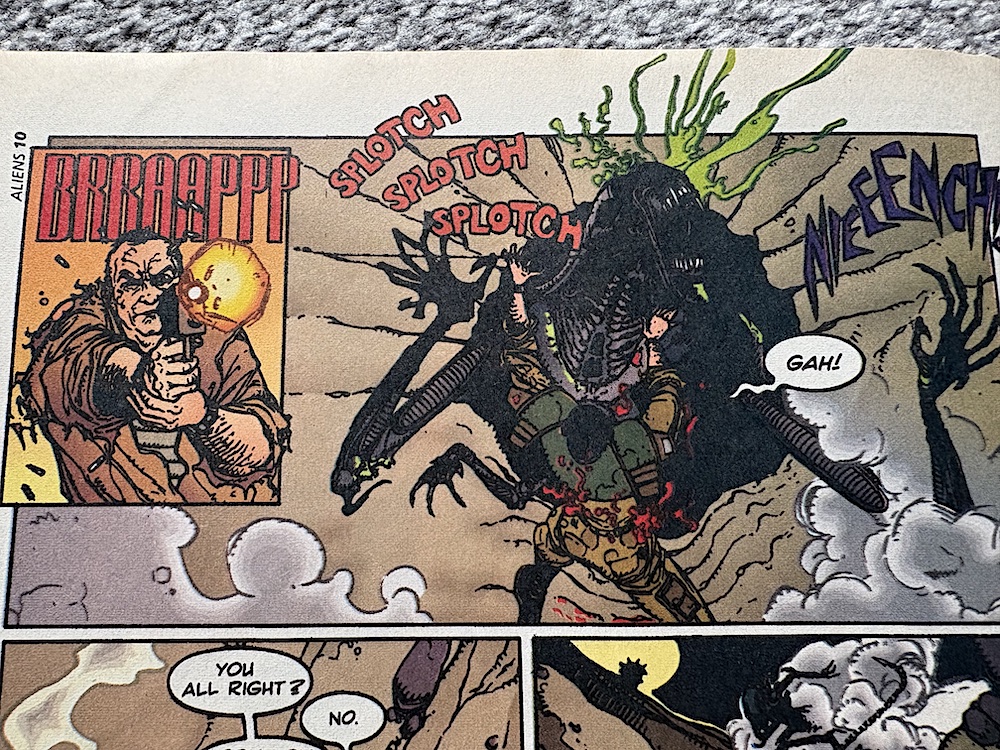
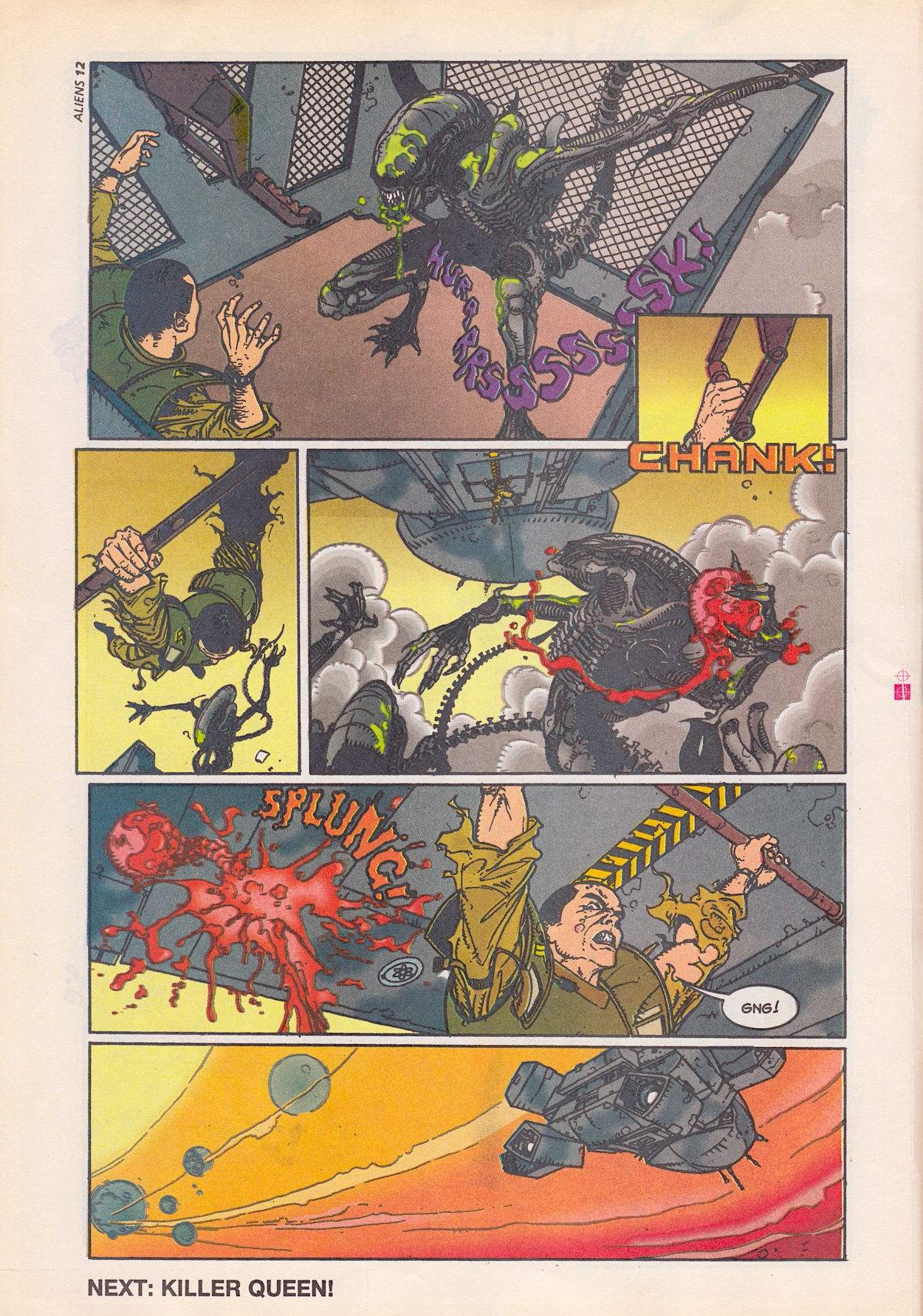
This is great fun! It’s also tense in all the right places which is quite the feat when we’ve gotten so used to seeing the aliens in comic form. Smacking an alien over the head with the limb of one of its fallen siblings, the pair make their way outside just before everything collapses around them. Not that this stops one of the aliens making a surprise reappearance to grab Crespi as they make a bolt for it.
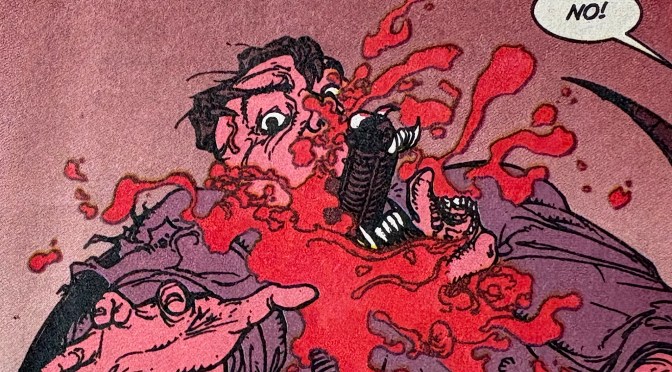
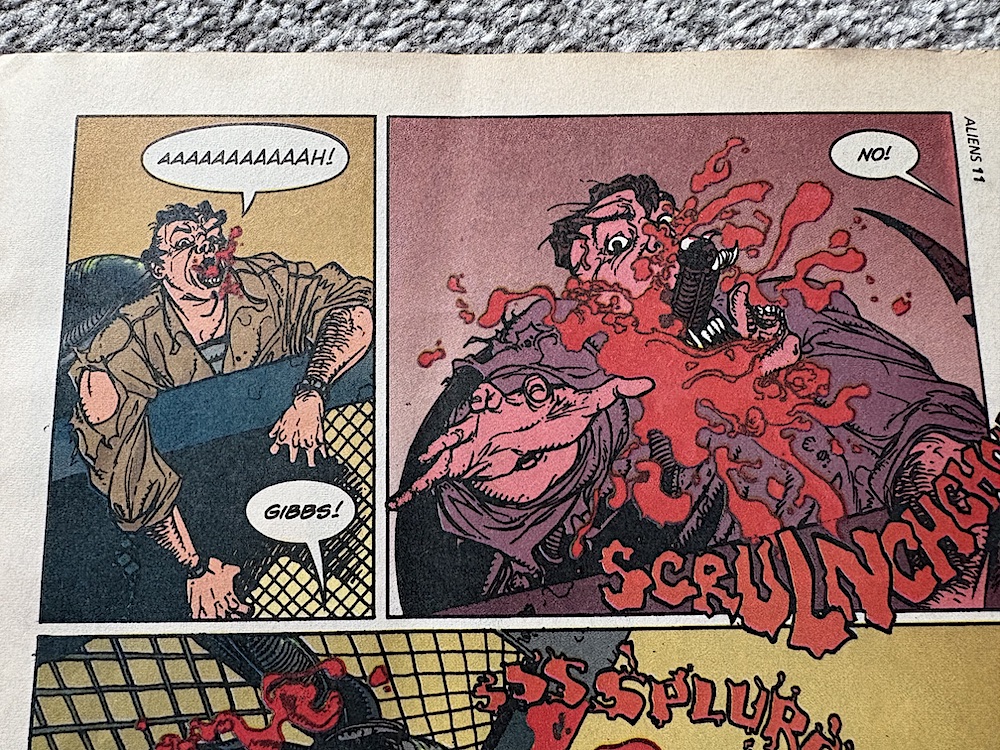
Gibbs saves him only for things to take a turn for him. Hanging on to the ship’s entrance ramp he’s suddenly choking and an inner alien mouth bursts out of his own in a scary moment of synchronicity. His decapitated body falls to the ground as the ship takes off and a quick lever pull by Crespi opens the floor beneath the beast and, mirroring that earlier arm smack, poor Gibbs’ head is used in a moment of alien frustration!
This has been a brilliant little tale. Okay, so it’s light on plot and the characters are interchangeable with pretty much any Colonial Marine from the comic or movie, but through its sheer relentlessness and imaginative situations it’s a standout. But Kilian’s art is the main reason for its success in my eyes. His aliens are superbly detailed, his humans full of character even if the script doesn’t really call for it, and he heightens the horrific moments perfectly.
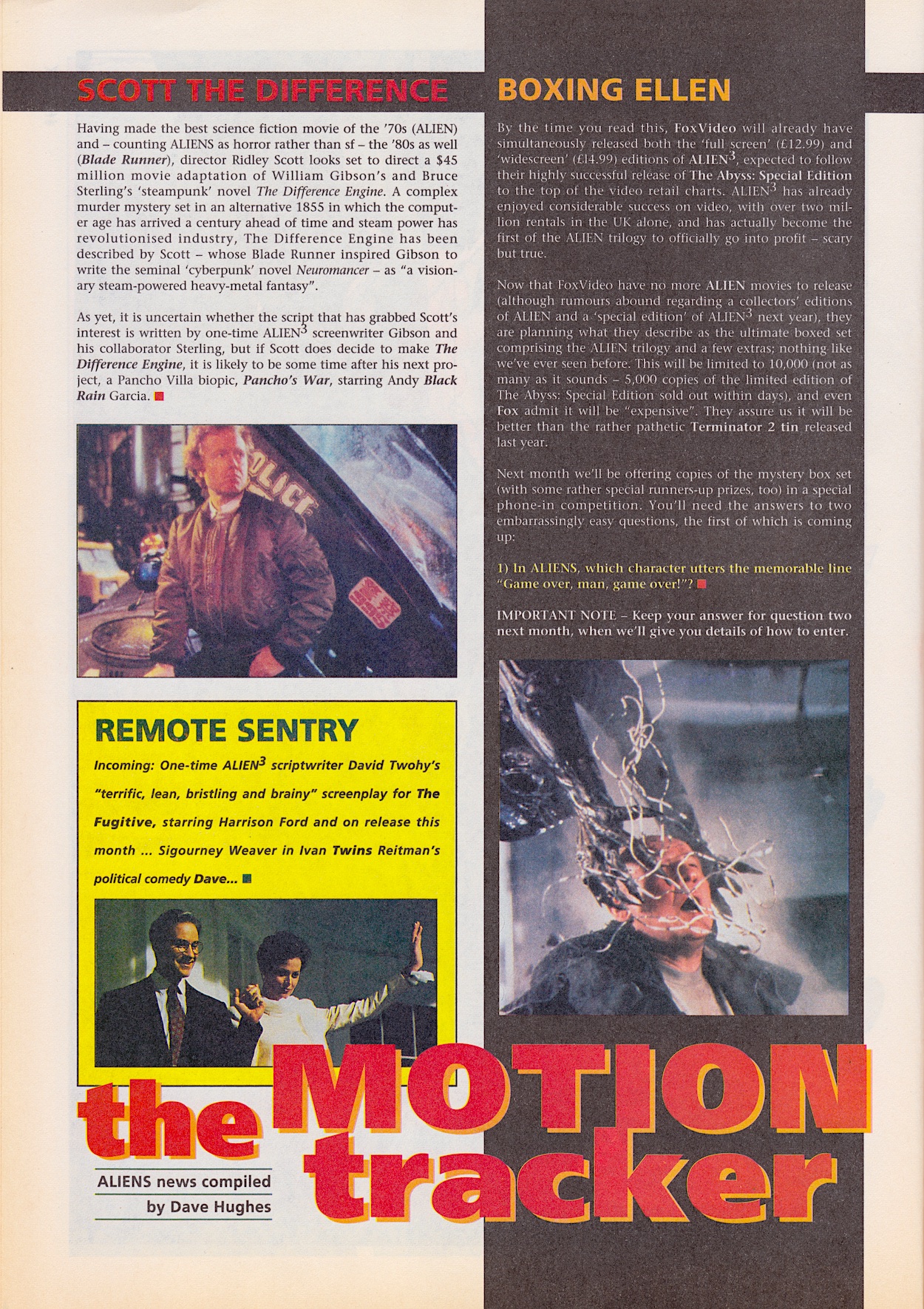
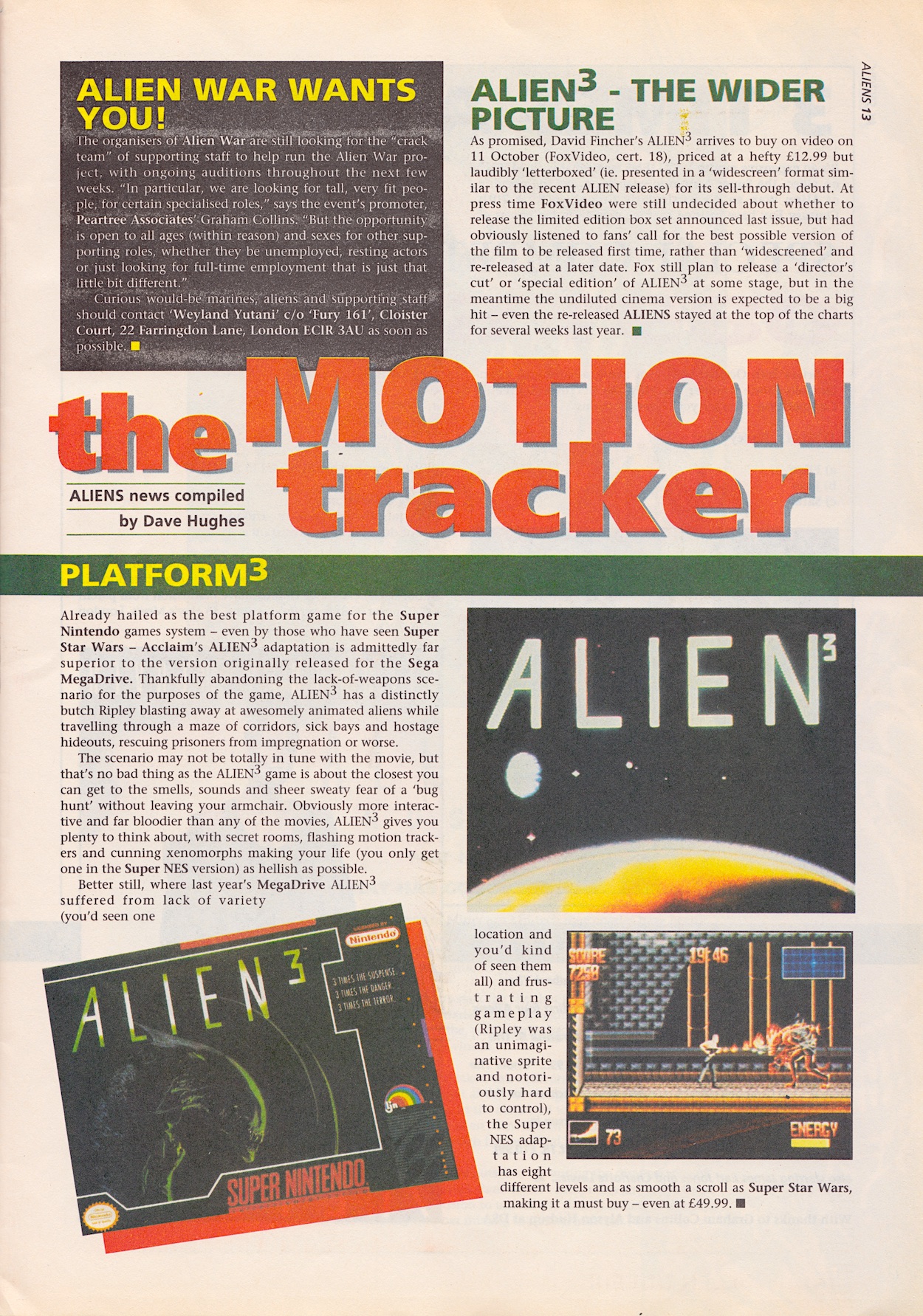
On to the news and I take issue with the Director’s Cut/Special Edition of a movie being referred to as “diluted”. Also, “already hailed as the best platform game for the Super Nintendo”? Really, Dave Hughes? Better than Mario? Better than Yoshi? The Alien³ game did very well across the board in all versions too, so I think maybe Dave owned a SNES. Ah, the days of unrivalled loyalty to a games platform. (For me it was still the C64 at this point.)
The game was notable for not following the plot of the film at all, with Ripley running around with a huge variety of weapons killing hoards of xenomorphs. Kind of defeats the purpose of having an Alien³ licence, no? At least she was bald! I still think a creepy platform game of stealth and a lack of weaponry with one alien roaming about would’ve been much better, like a 90s version of the more recent Alien: Isolation.
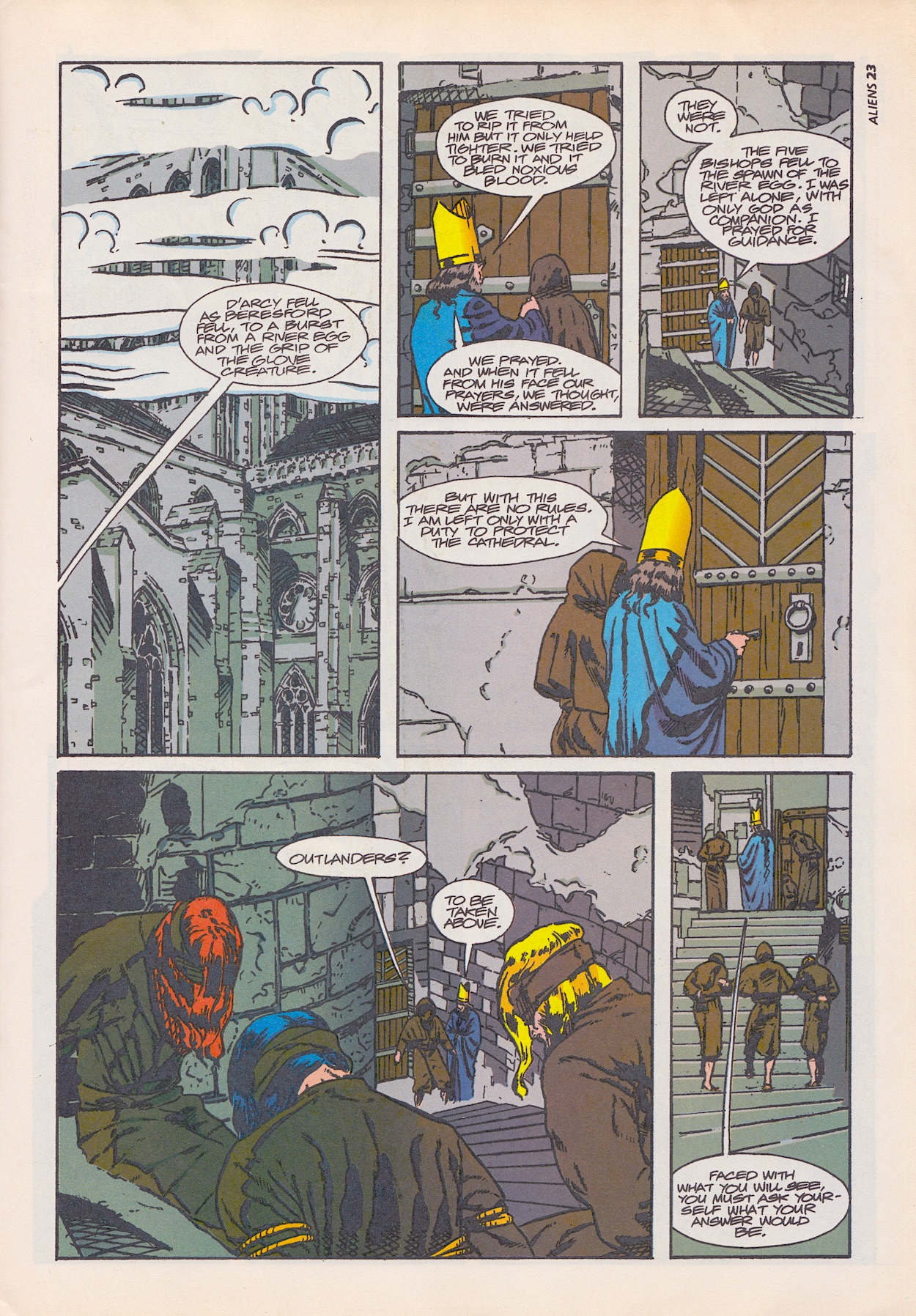
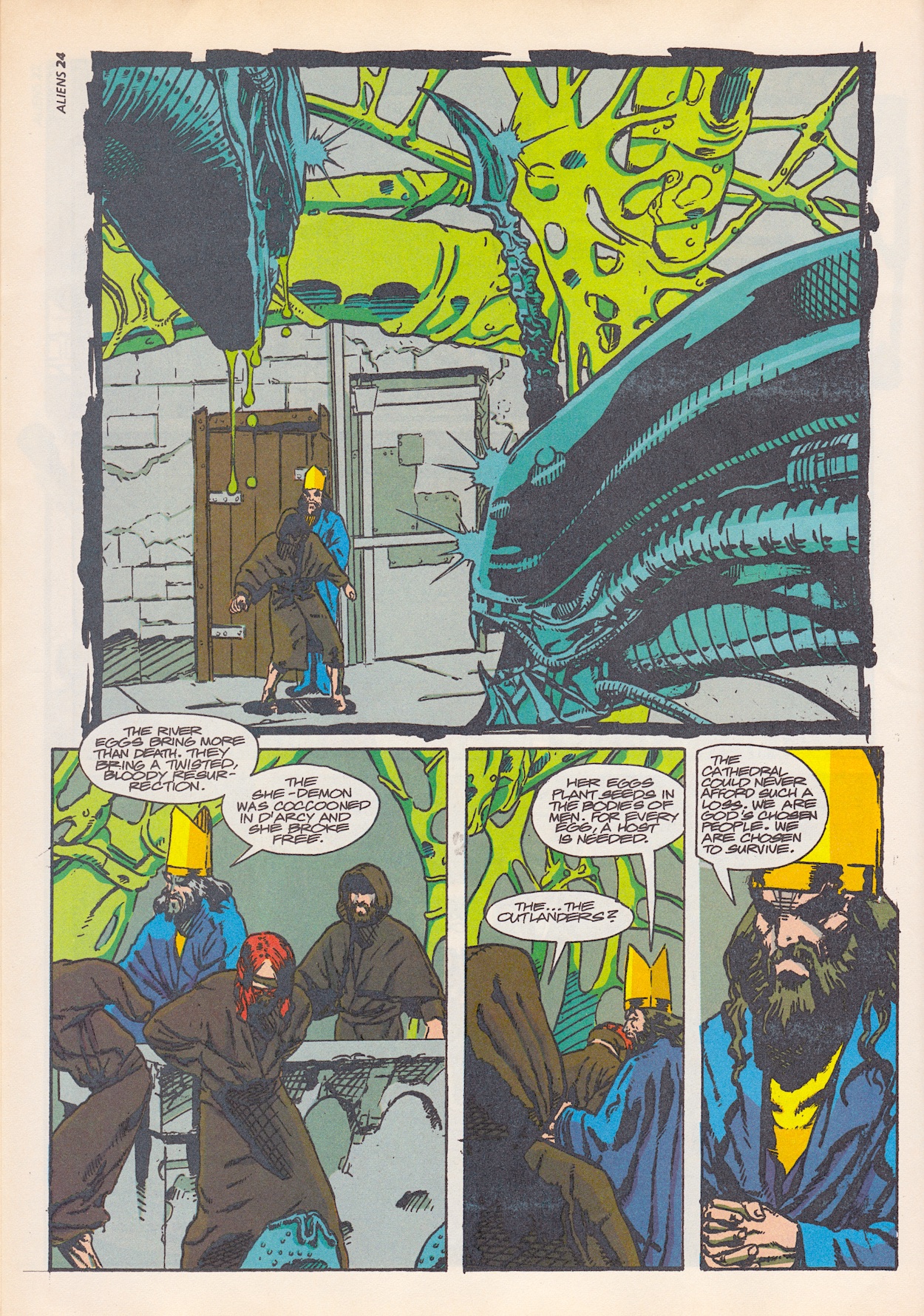
British strip Crusade begins with the Archbishop confronted by his suspicious followers, but he just keeps coming up with ludicrous excuses. “The wind whistling through broken stones” really placates people who’ve heard the alien Queen? Then our tribe and Minecorp marines are attacked by another tribe but the art is too messy to work out what’s going on. In the end the survivors continue on with their two horses into the sewers beneath London and now we can’t even see their hair colours in the dark, one of the few things we could use to tell characters apart. Suddenly their motion tracker starts to bleep and Rani’s spidey senses start to tingle. That can’t be good.
Back in the “big building for tiny minds” (as one of the Marines describes the church) it becomes clear that the Archbishop thinks he’s actually doing god’s work by keeping the alien threat contained within the tower via human sacrifices. But an attack and a hole in the wall recently saw some eggs roll down into the river, however he thinks if he keeps the aliens fed with outsiders they won’t leave their tower. In reality of course he’s just adding to their army.
The world building is potentially great but it’s that lack of visual clarity that’s just so frustrating. This issue’s chapter ends with one of the horses suddenly writhing in pain and an alien bursting from its chest, so the thrills and danger should be tangible but it just requires a bit too much effort for you to feel it.
One moment almost ruins the whole months-long story for me
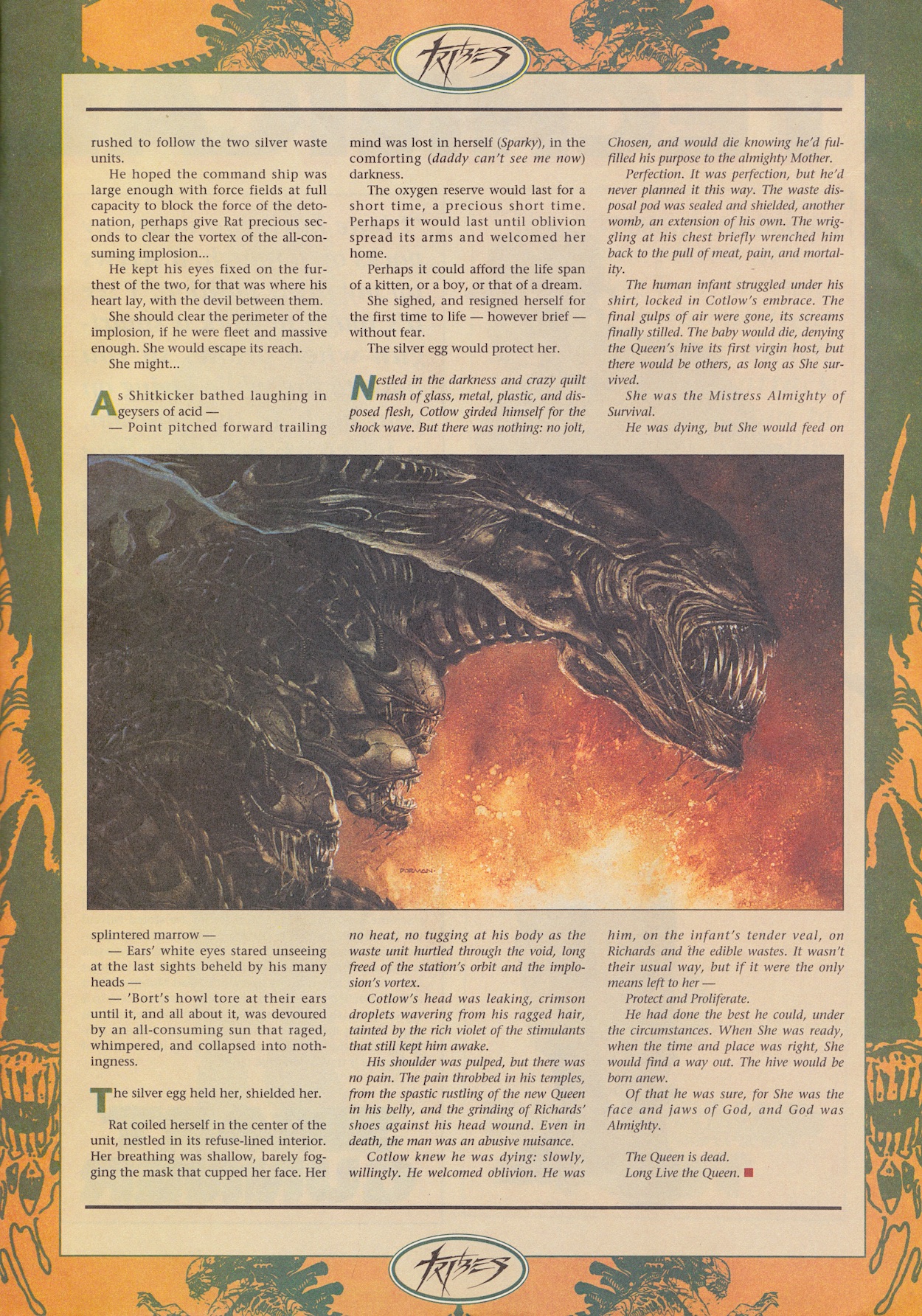
Much better, as per usual, is prose story Tribes. This concluding chapter is, to use a clichéd phrase, a thrill ride. The whole place is rigged to explode any minute and Rat is stuck in a refuge unit with an alien climbing down through the rubbish. Bort realises he’s always loved her and risks his life to release the unit into deep space so she’ll finally be at peace, dead from the vacuum instead of being an alien incubator and reliving those nightmares of her childhood with her father.
In a tense moment she’s finally able to activate her oxygen supply and the story is left with her floating (alone, sans alien) in space. But one moment almost ruins the whole months-long story, for me anyway. The doctor of the religious extremists trying to help the aliens finds himself in an escape pod with a newborn Queen and a human baby. He was going to use this baby to feed the Queen but the baby dies in his arms slowly from a lack of oxygen.
Look, I know Alien is a horror franchise but I just felt this was an unnecessary use of a mental image of a dying baby to try to elicit an emotional response from the reader. It wasn’t needed and it cheapened all of the excellent work up to this point by writer Steve Bissette. Colton is also dying but knows the Queen will feed on him, providing her with sustenance until the pod lands and she can free herself. Tribes has been a real highlight and if it hadn’t been for that one moment I’d have been singing its praises for months to come.
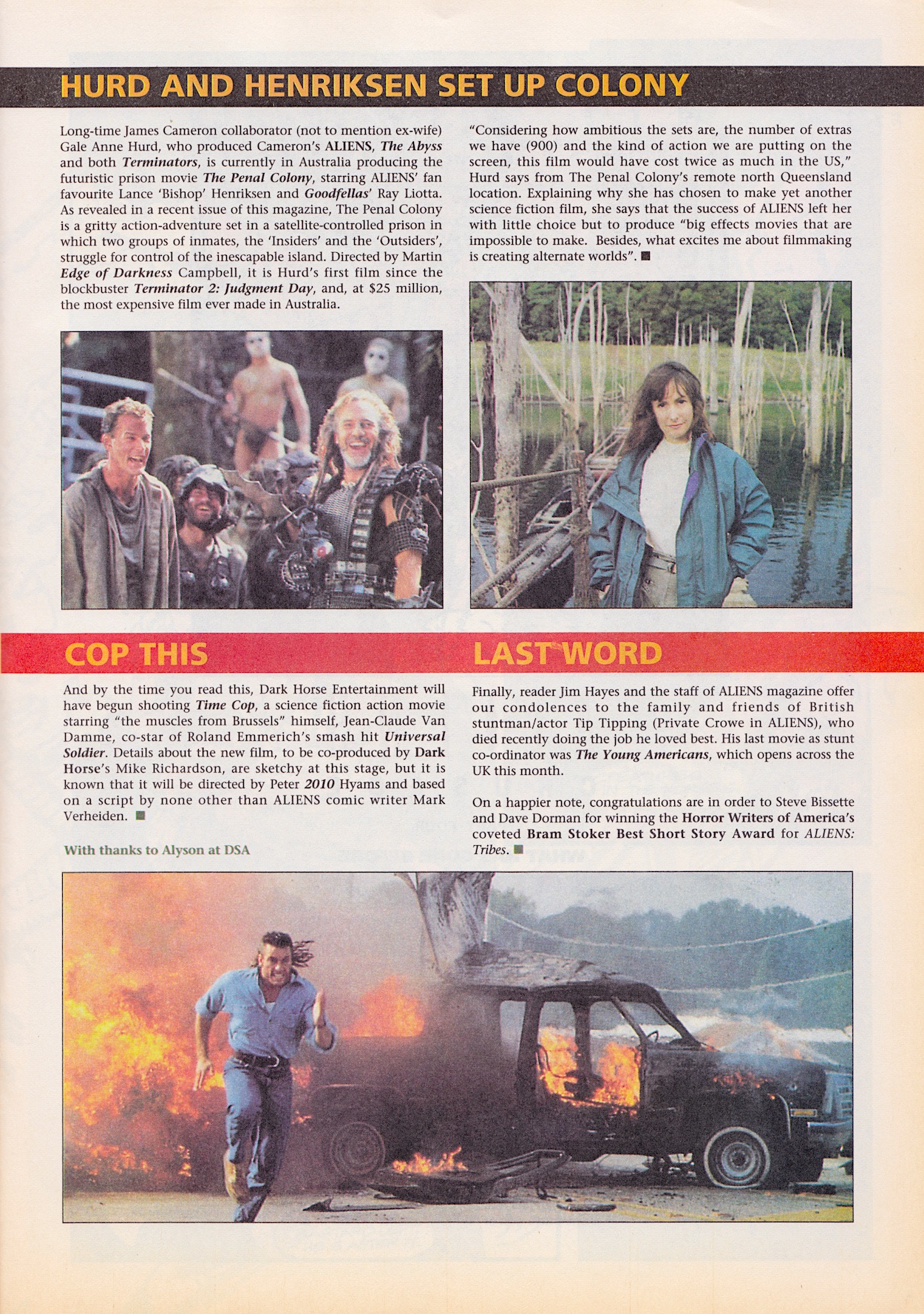
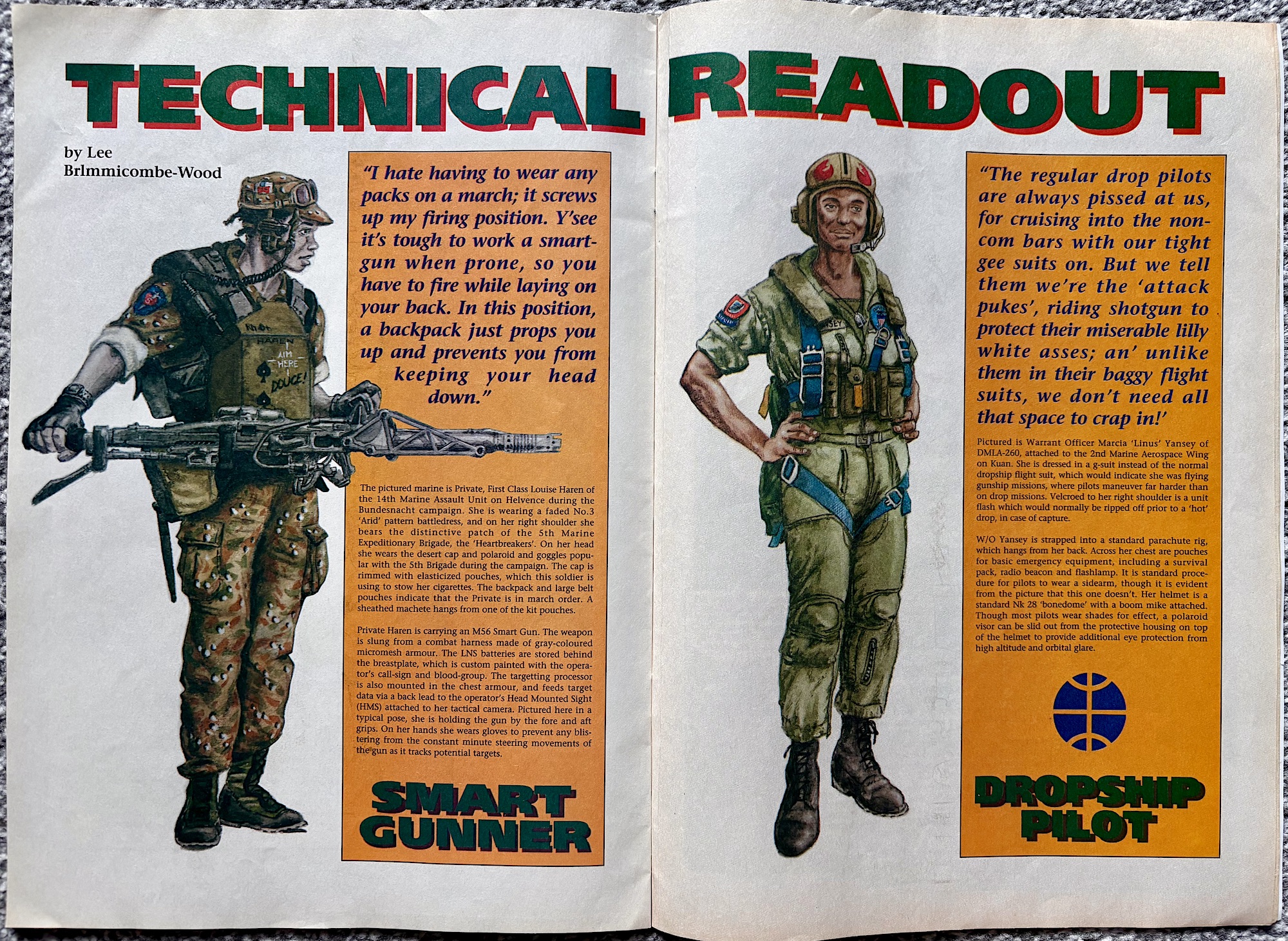
The Technical Readout pages seem to have done away with the intricate technical cutaways, somewhat making the name of the feature redundant. While I do miss those earlier entries I have to say I really like this most recent one showcasing the military gear worn by two female Colonial Marines. There’s no credit anywhere for the artist, perhaps they were drawn by Lee Brimmincombe-Wood himself?
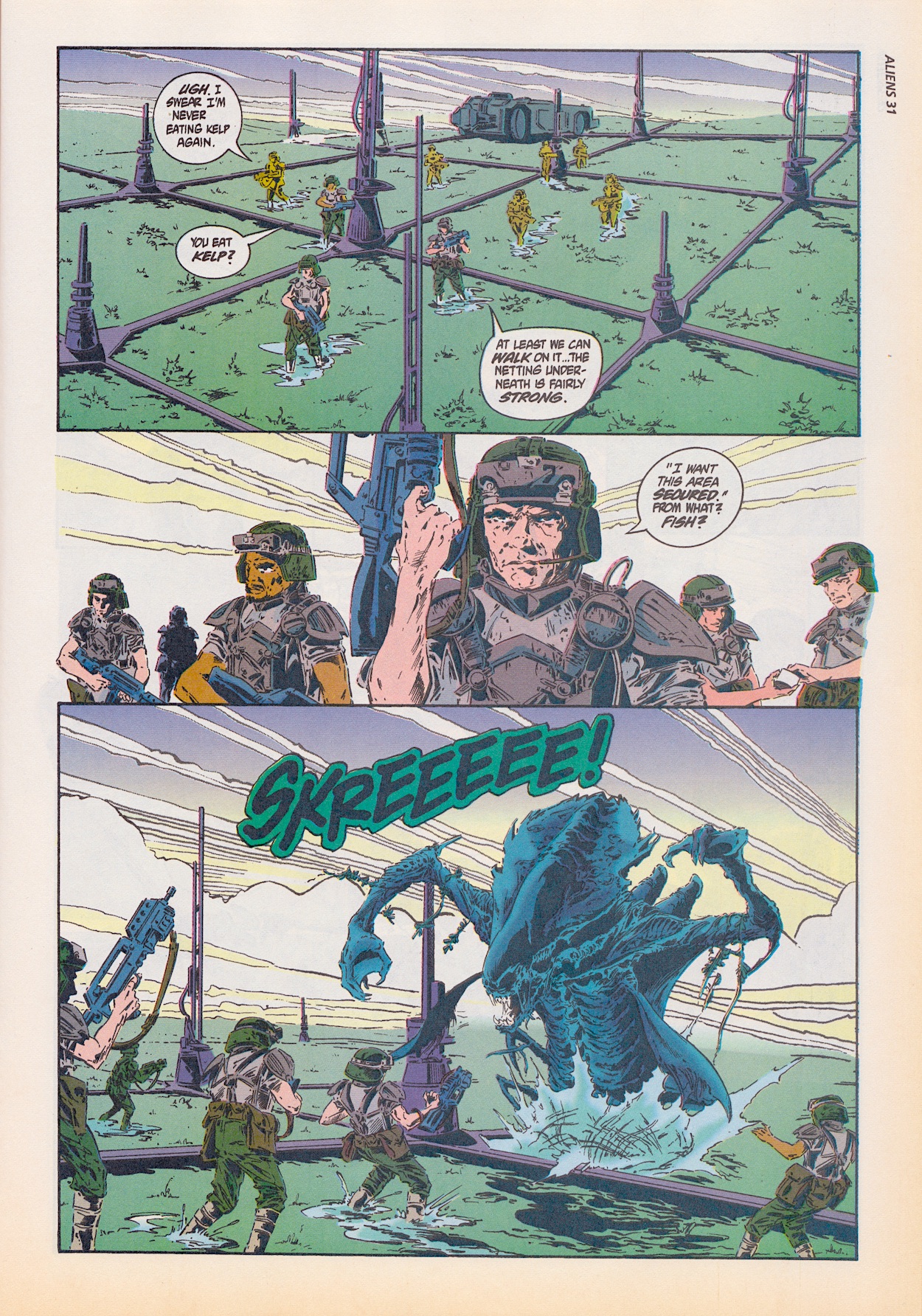
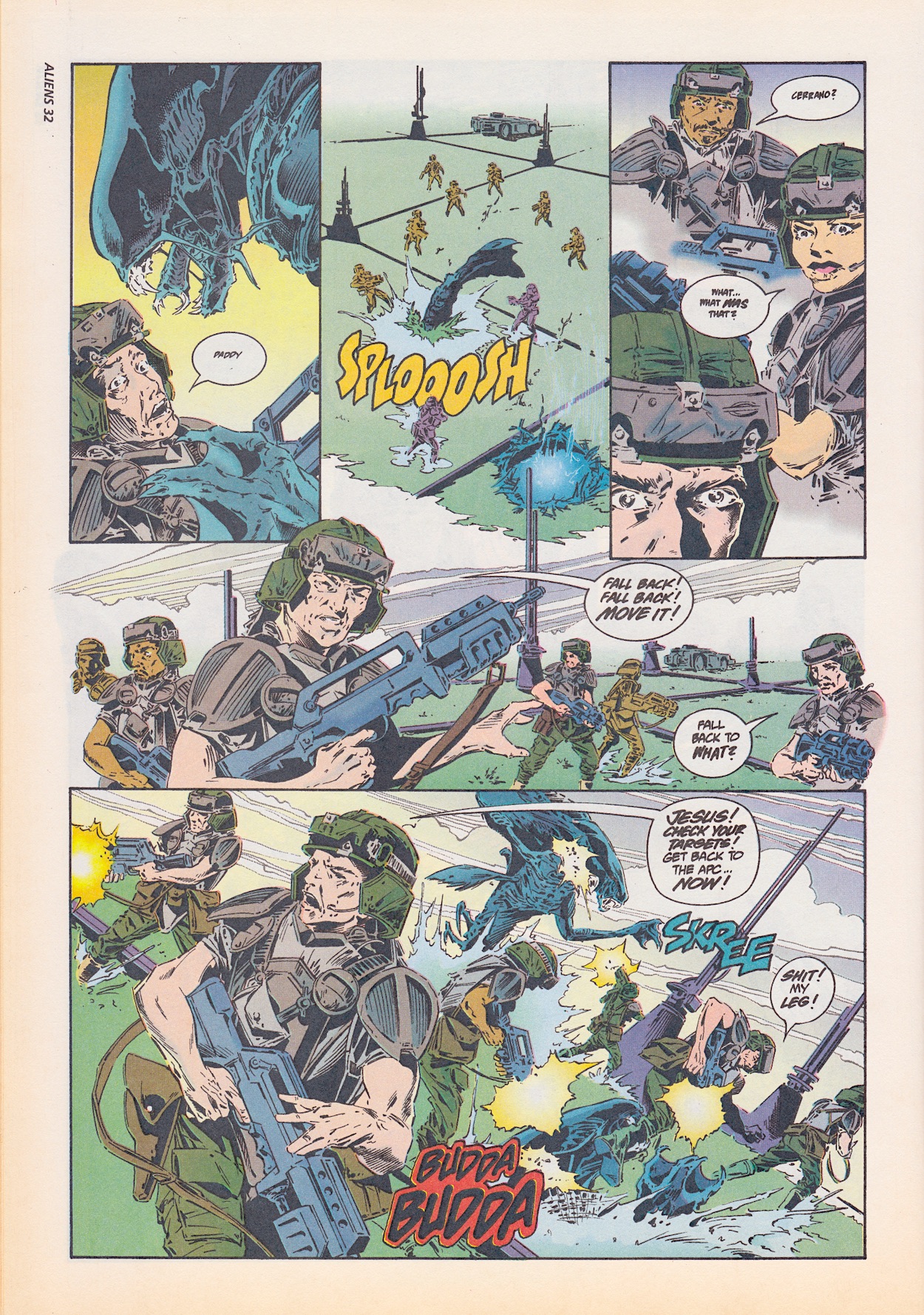
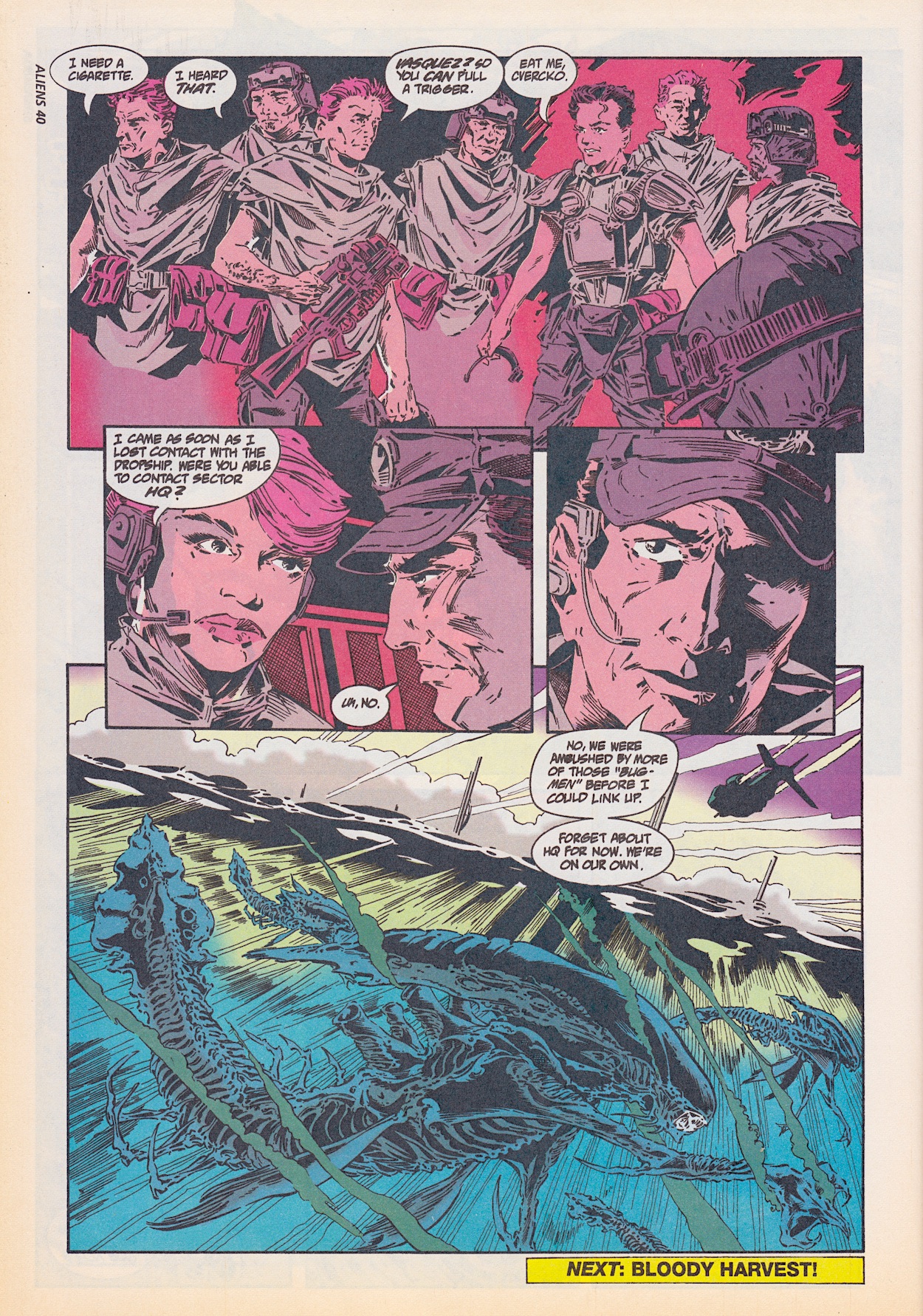
Our final strip is Colonial Marines and it’s been reduced in pages again after a bumper chapter last time but it’s still a meaty 12-page read. Leaving the sun gun they get distracted on the way to their main mission by a kelp bed on a planet that’s somehow keeping a comms channel open with the HQ they can’t reach, and on a planet that’s not meant to be inhabited. So off they go, with their bug man prisoner in tow.
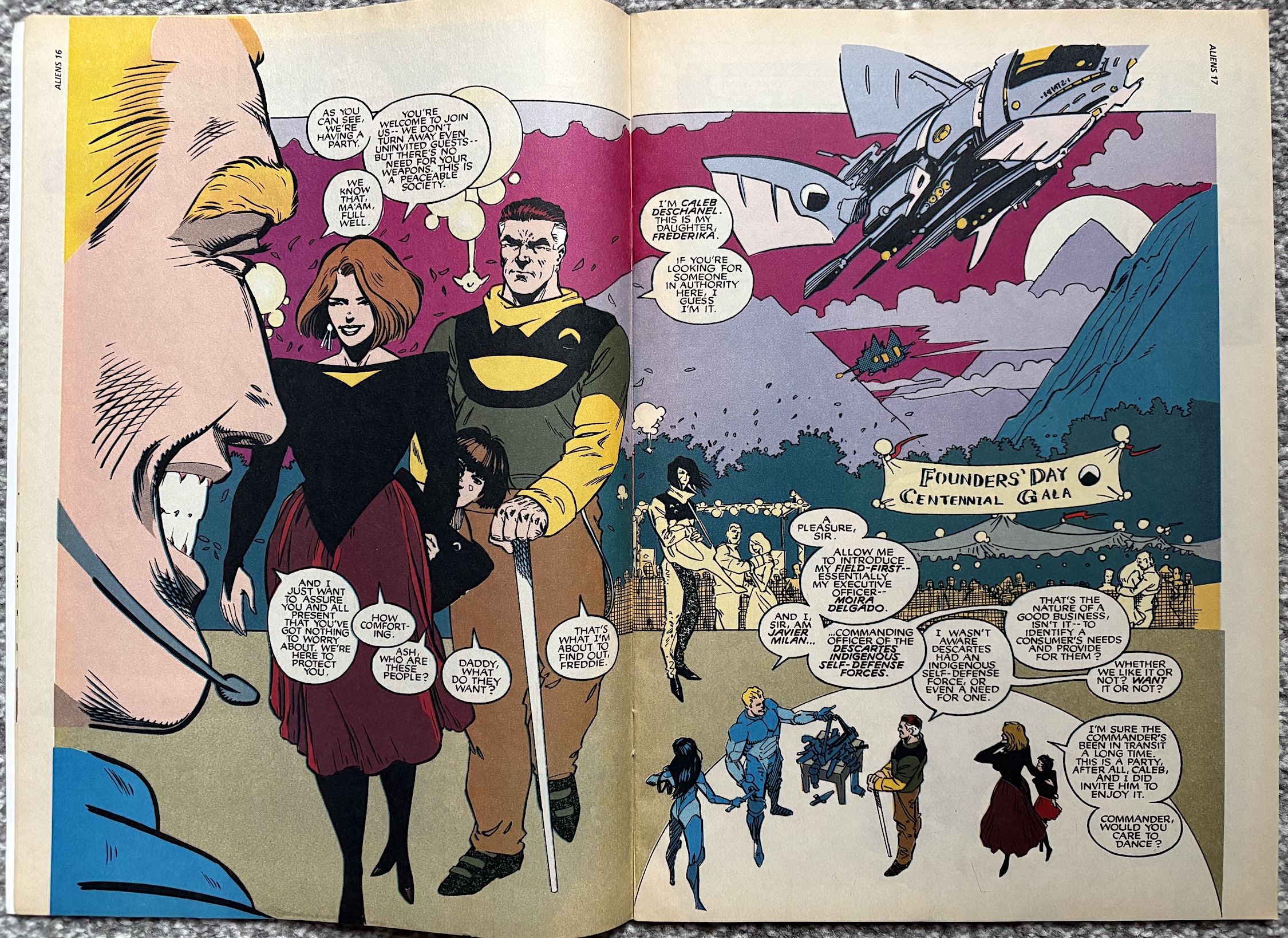
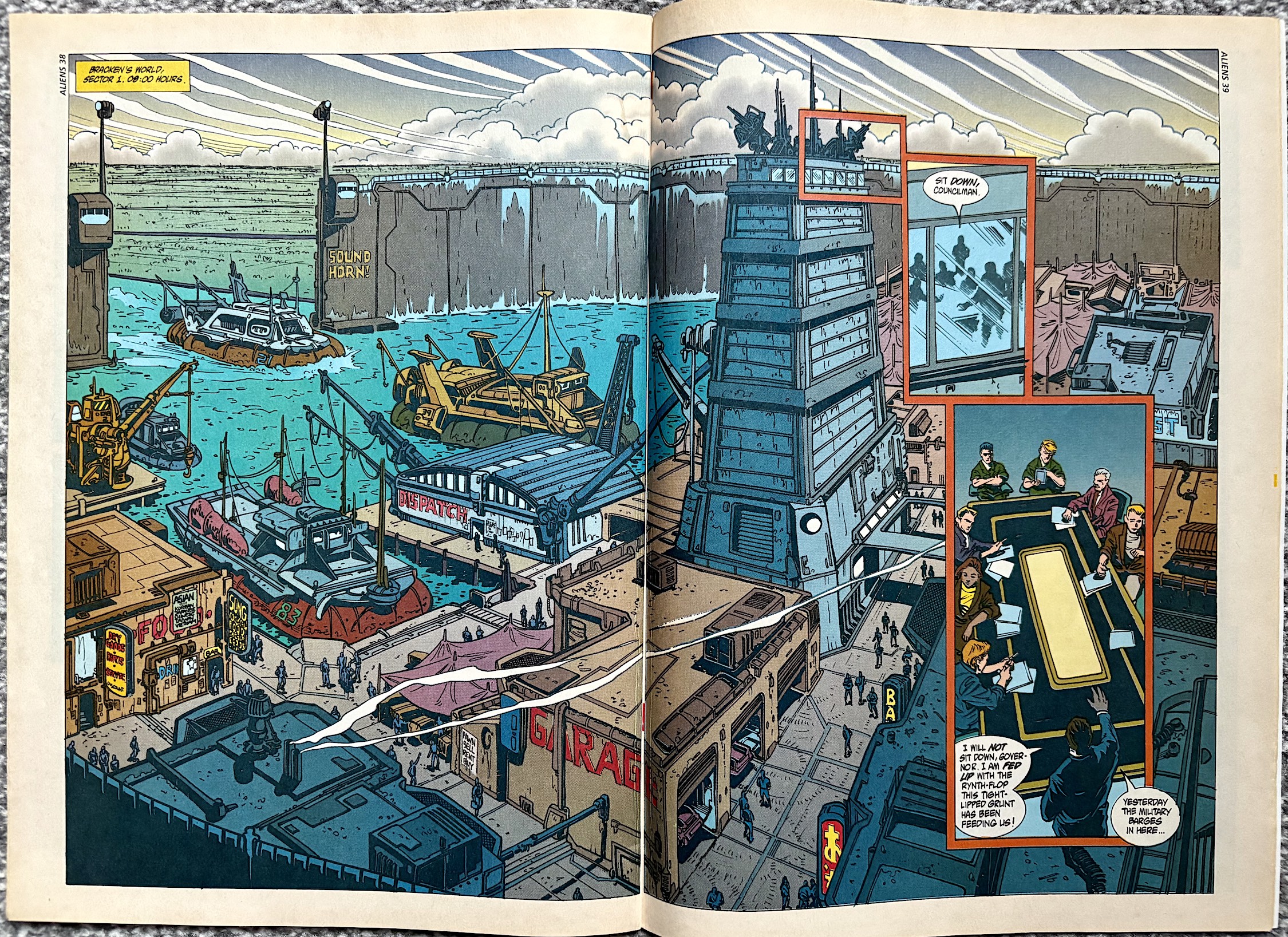
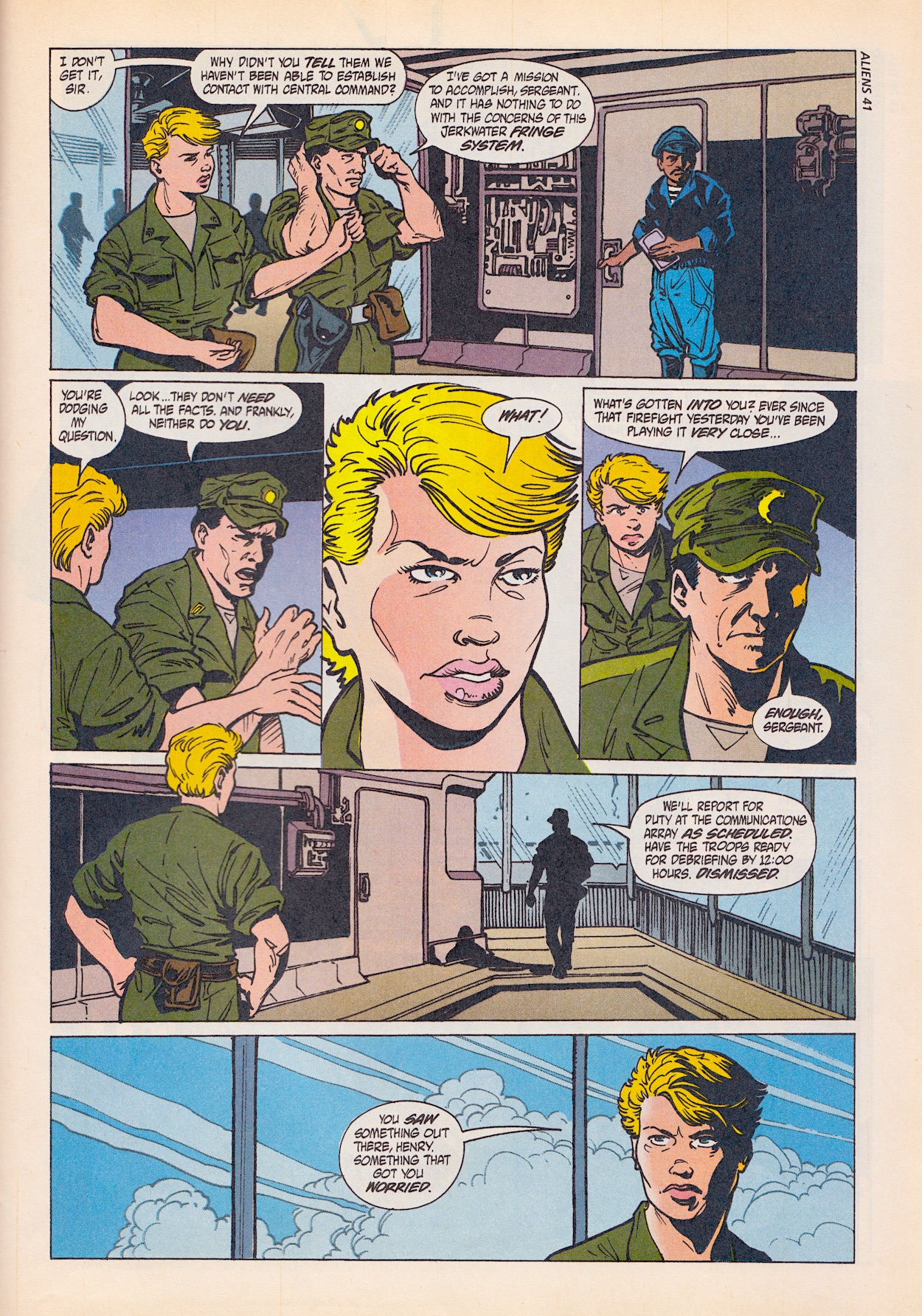
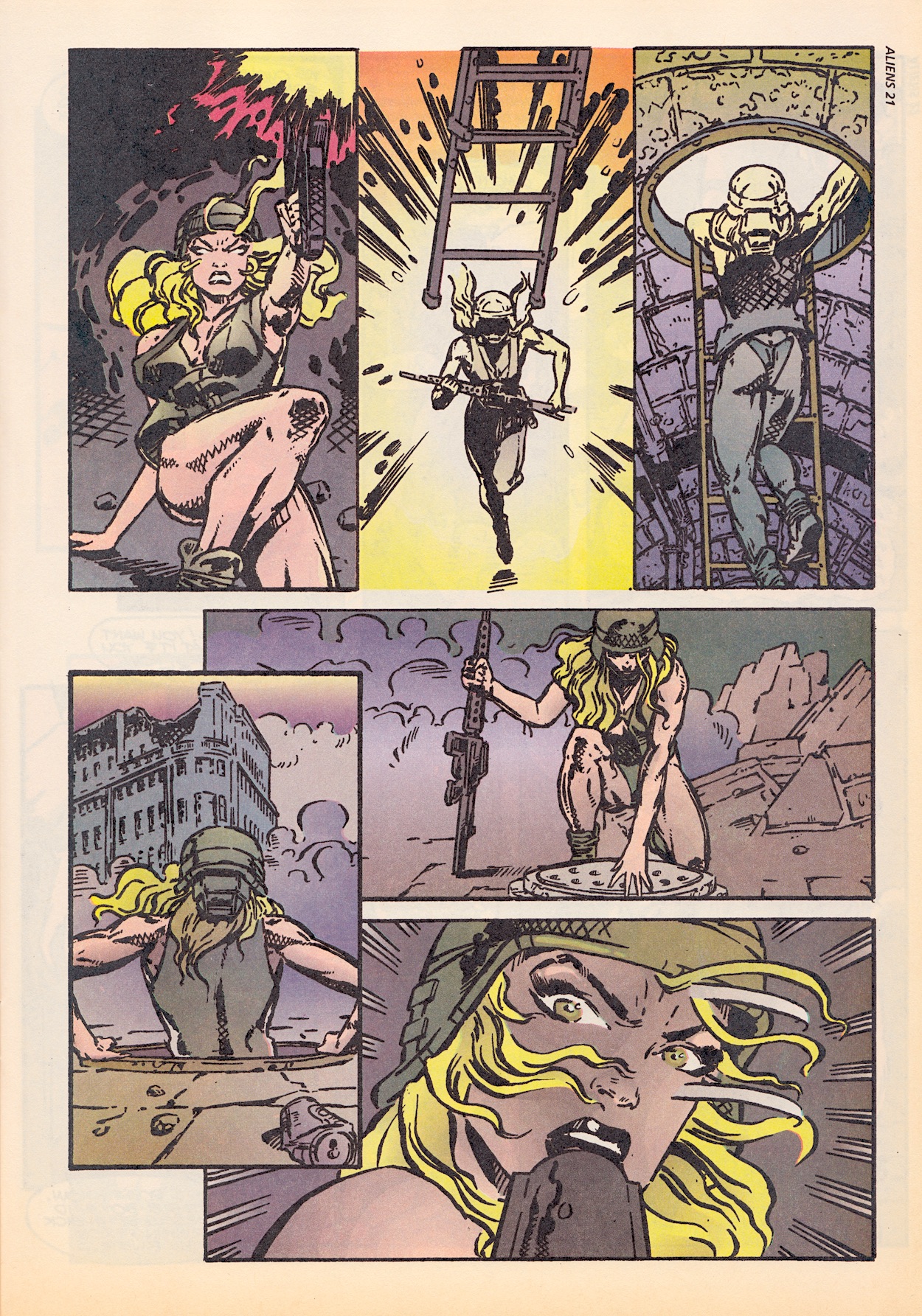
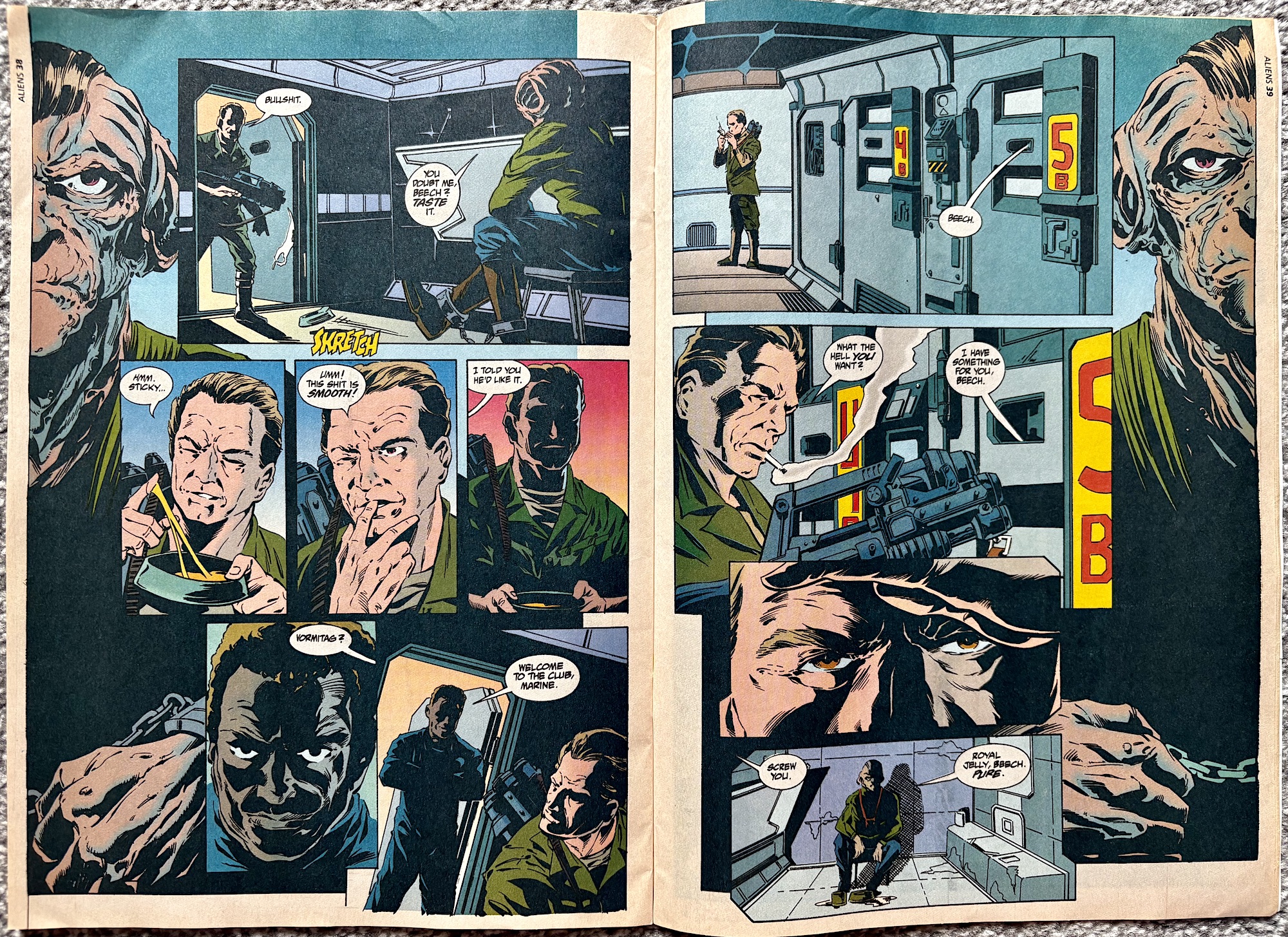
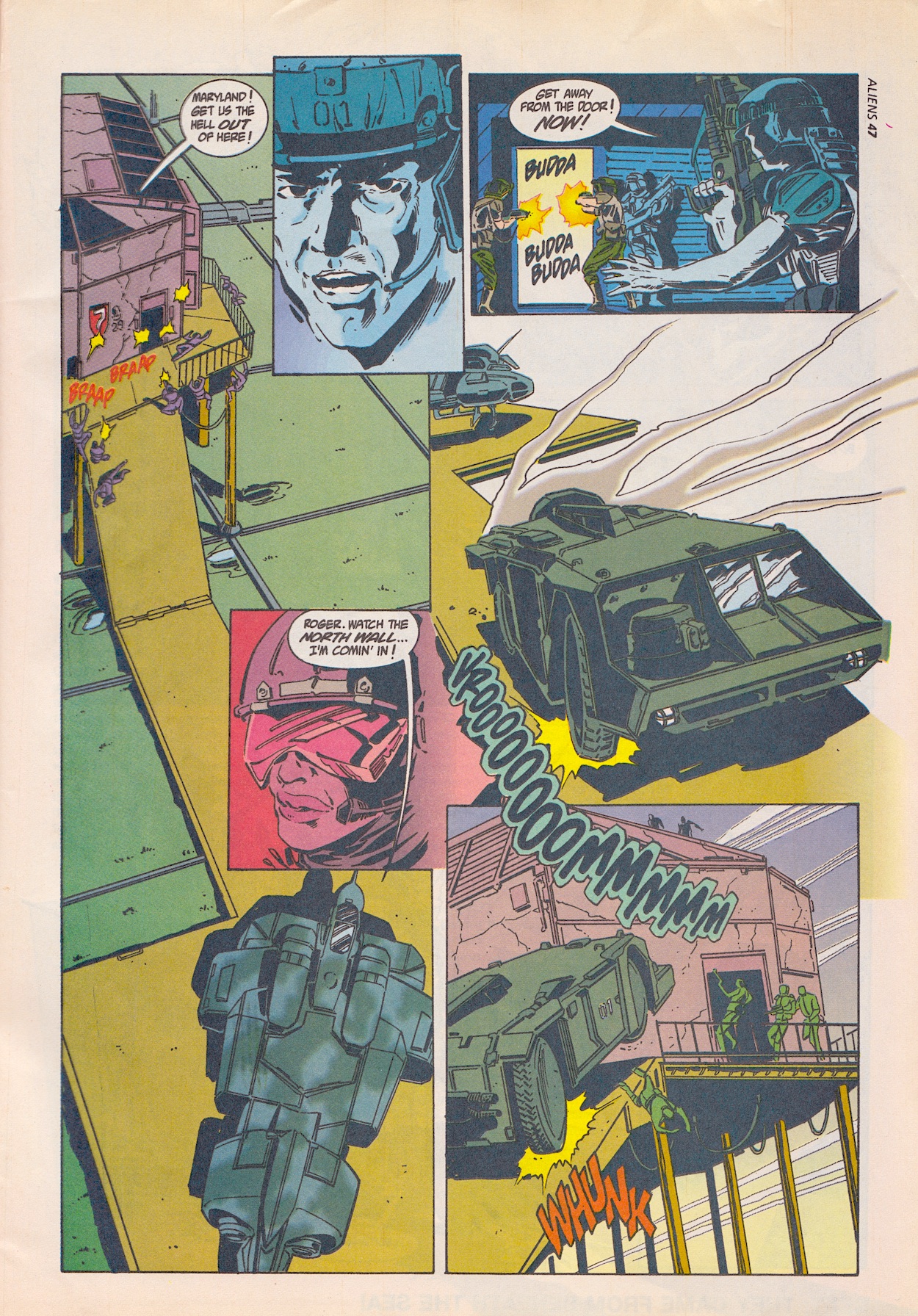
Unfortunately, things don’t start off too well when the comic’s habit of printing errors sees spread above in the wrong order. The bug man is somehow able to produce the addictive alien slime we humans can’t get enough of and it’s handed around the marines like a drug. Meanwhile there’s an underlying current of distrust in Vasquez after her freak out as people begin to question whether they can rely on her to save their lives like they did hers. With less characters now we can begin to familiarise ourselves with some of the personalities in the ragtag team during these downtime scenes, instantly improving what was already a good strip.
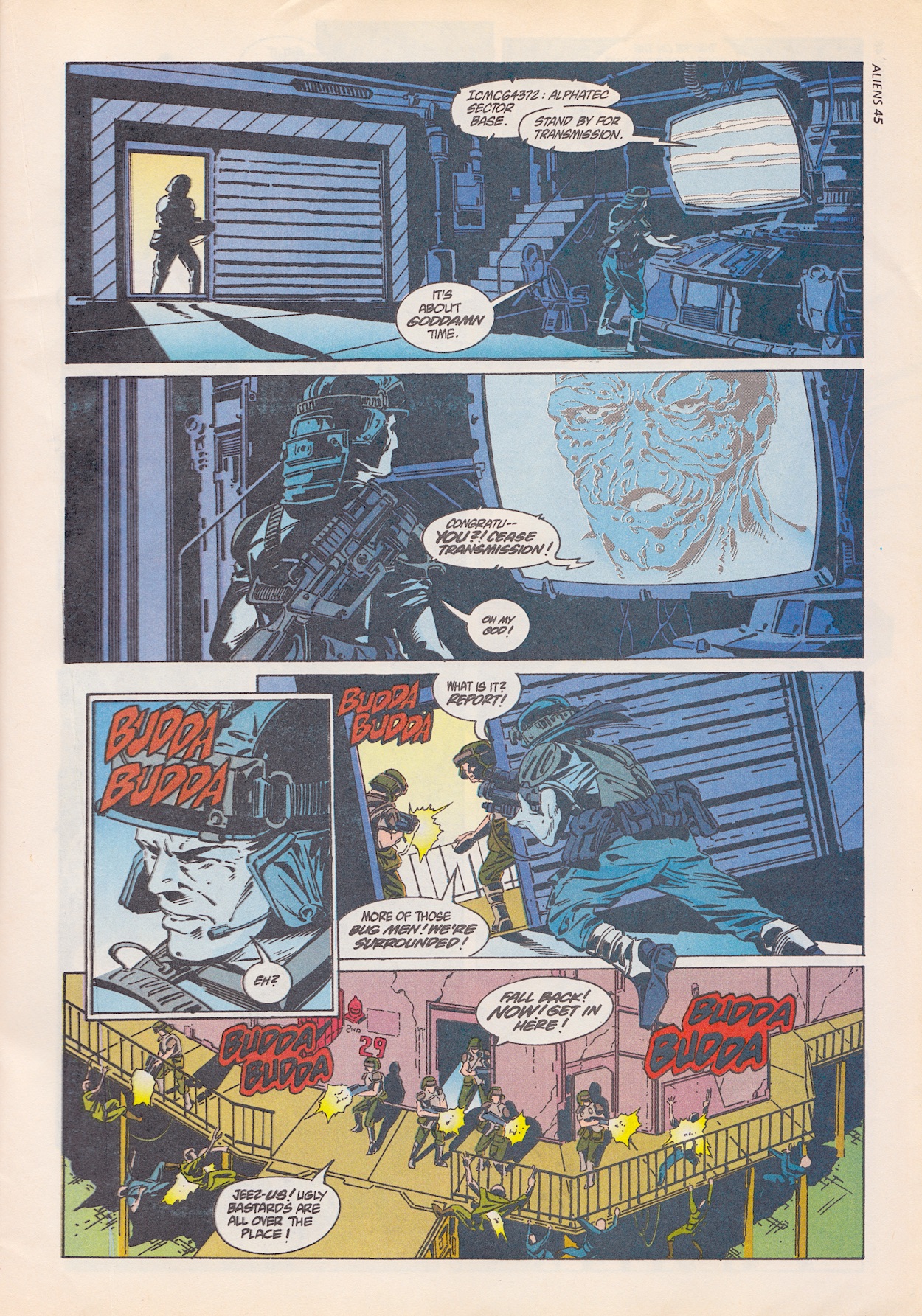
Once they’re flying over the planet they spot an outpost where there shouldn’t be one and, once inside and cornered, they find out it belongs to the bug men. That of course means the aliens can’t be far away. The Marines attempted escape in the people carrier had the same music from the Hadley’s Hope escape scene in the movie playing over and over in my head as I read the end of this month’s chapter.
The cliffhanger sees their drop ship explode and now they’re stuck on this mysterious planet. Chris Warner’s story began as a fun take on the movie but little did I know that was only the starting point. I’m still not convinced about these bug men but given how much I’m enjoying the rest of it (at least they’re no longer 70s Doctor Who aliens) I have hope they’ll develop further too.
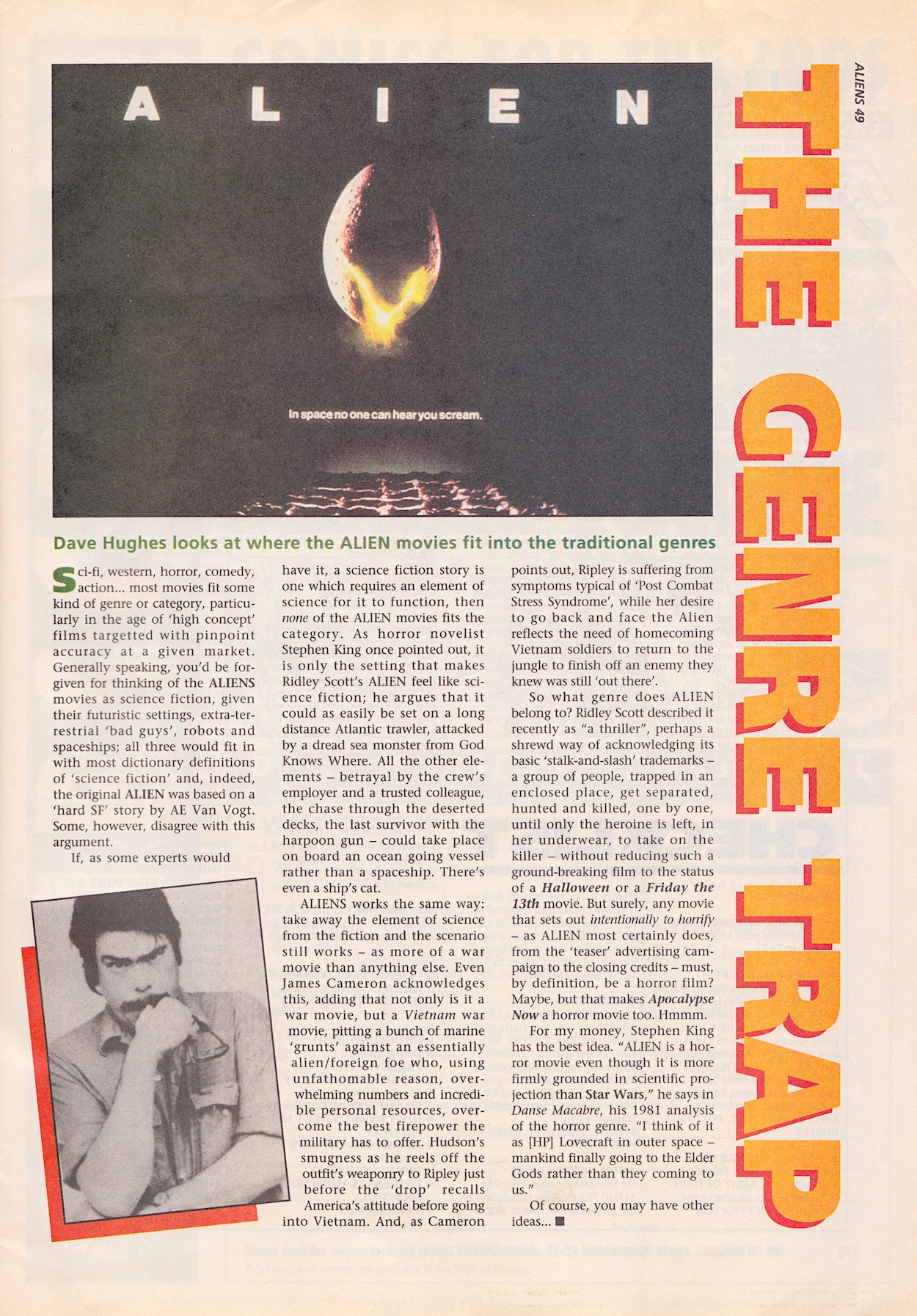
The Genre Gap is a strange little page, taking a long time to come to the conclusion we knew already that the Alien films are horrors. They just so happen to be set in a futuristic sci-fi setting, with a sci-fi entity as the main scare. When Stephen King says so is there really any need to question it? Then on the Bug Hunt letters page I’m not too sure about the name given to describe fans of fellow horror franchise, Predator!
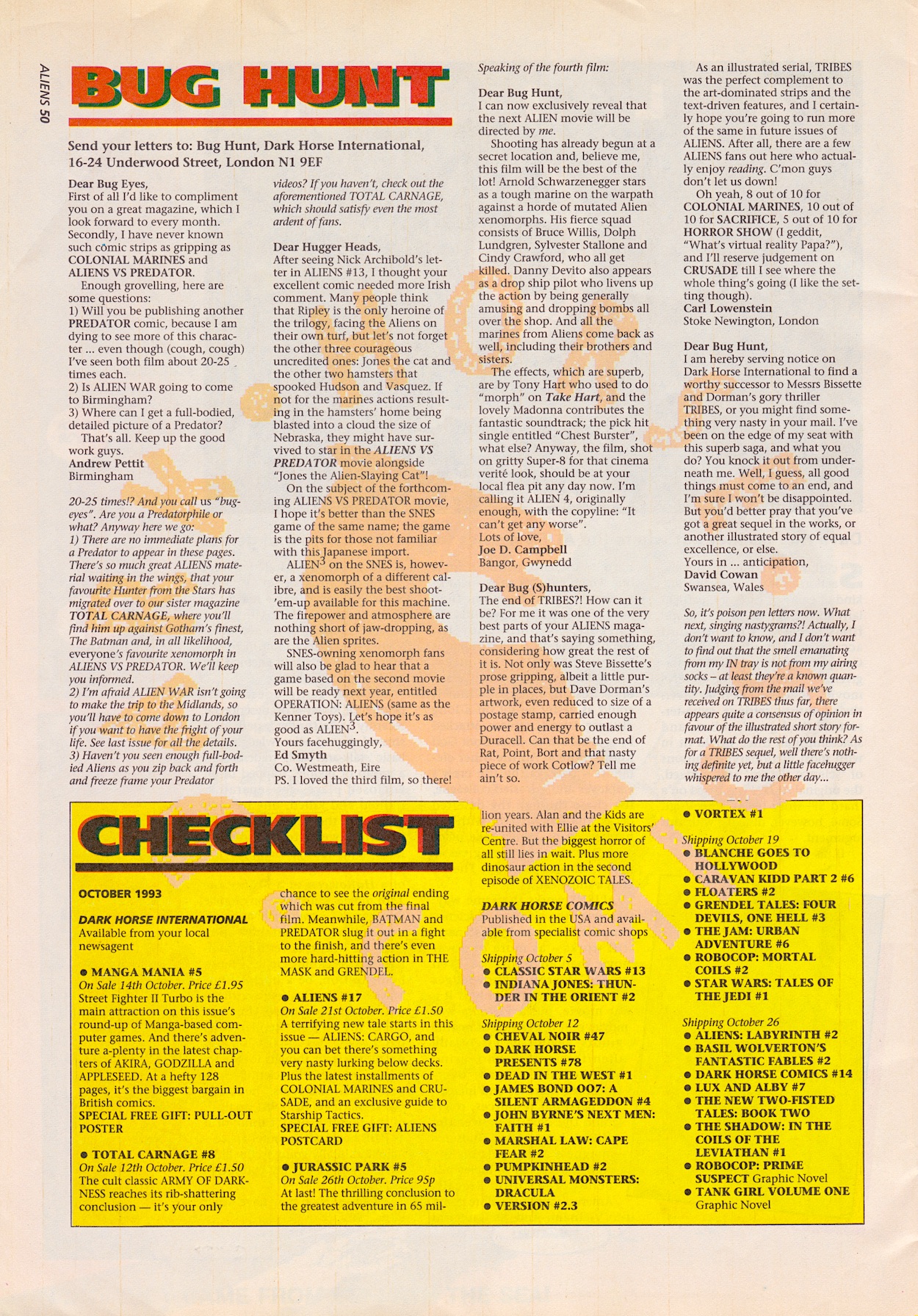
There’s a healthy variety of places of origin for the readers this month. Back then it was rare to see letters in our comics from anywhere other than England. There also appears to have been a great deal of positivity for not only Tribes, but for the very idea of having a prose story in the comic, which I’m all for too. The sequel idea for an Alien 4 movie is just ridiculous… I mean, Madonna doing a movie song after that thing that I had to endure at the start of Die Another Day?!
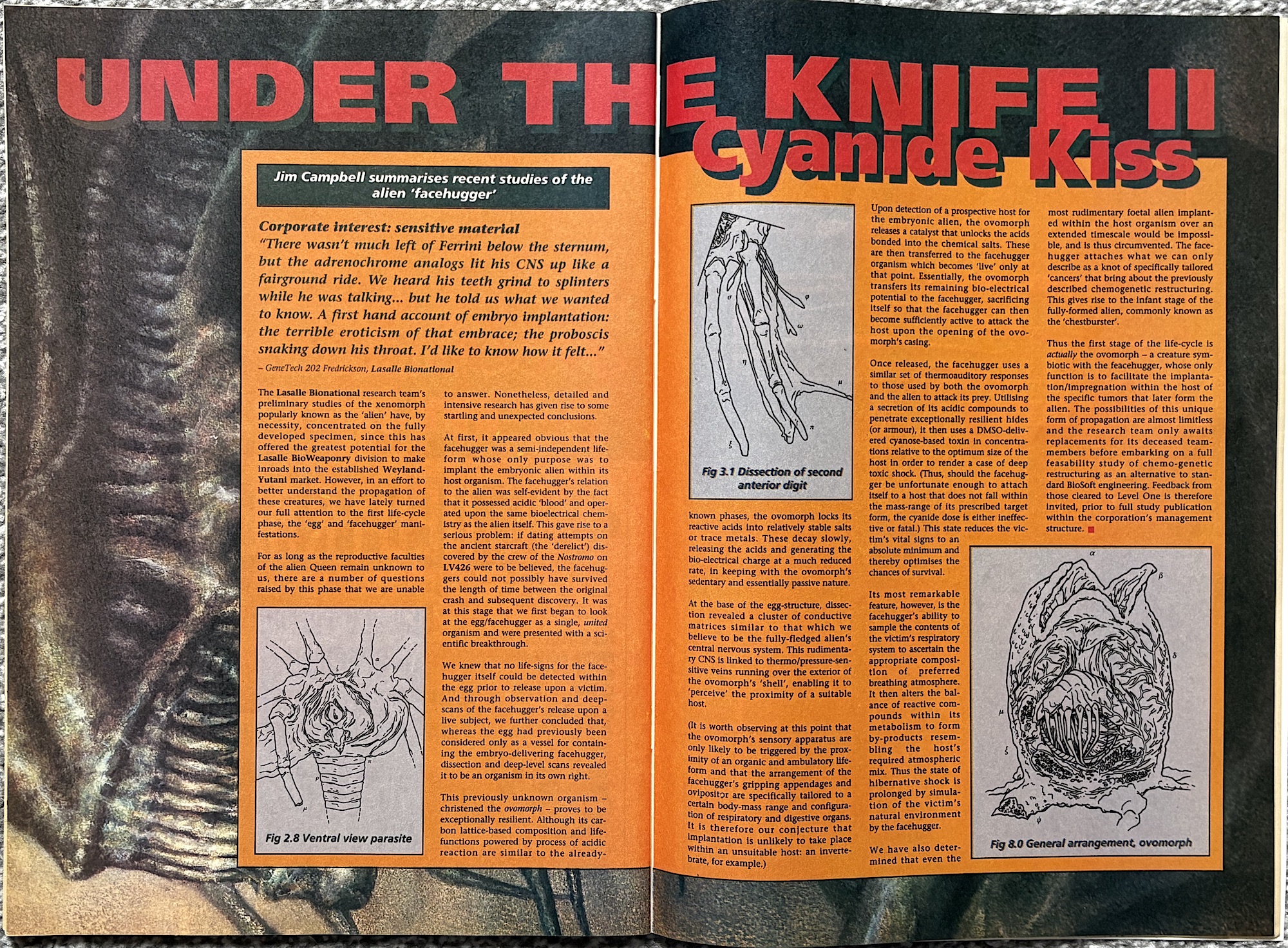
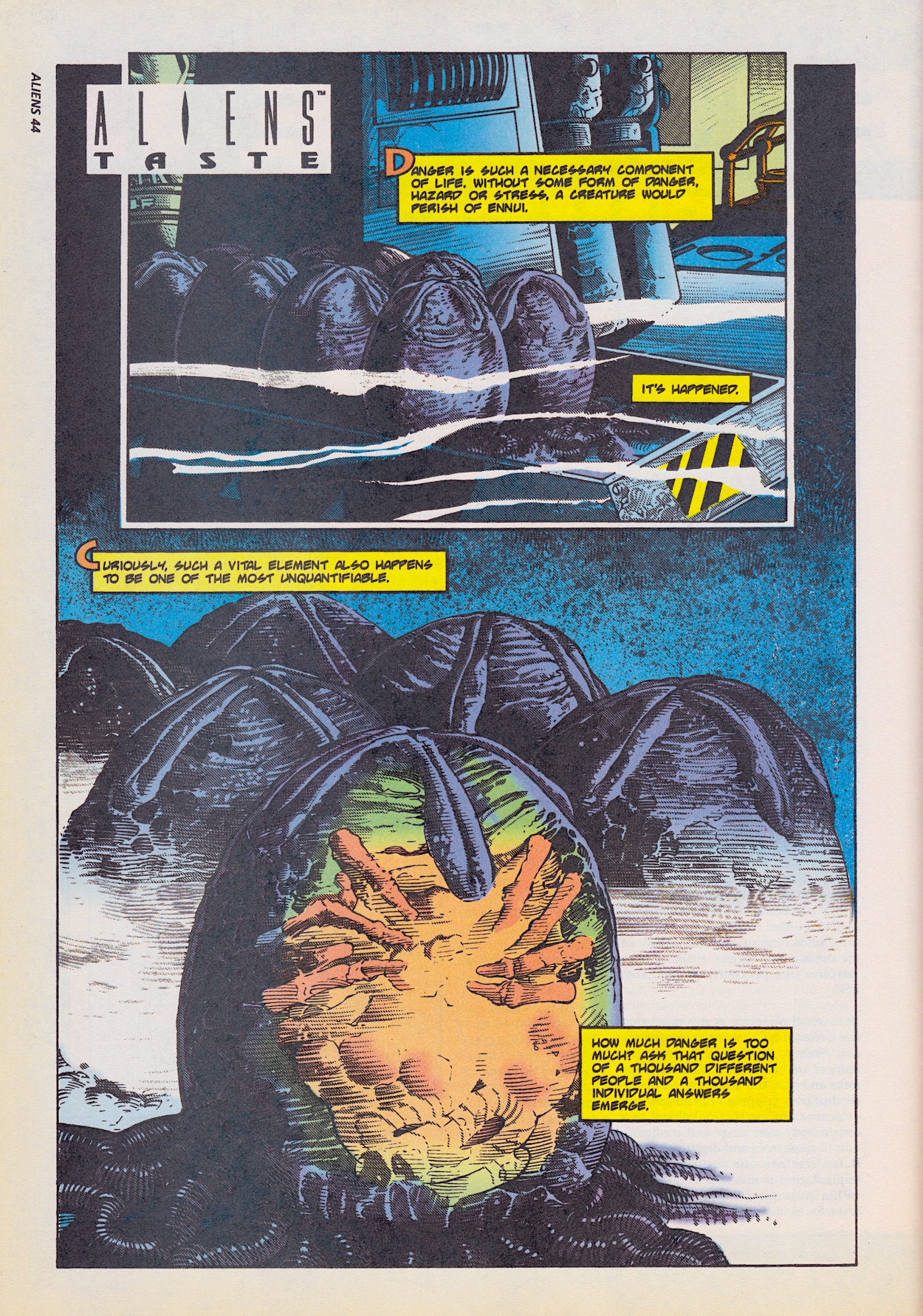
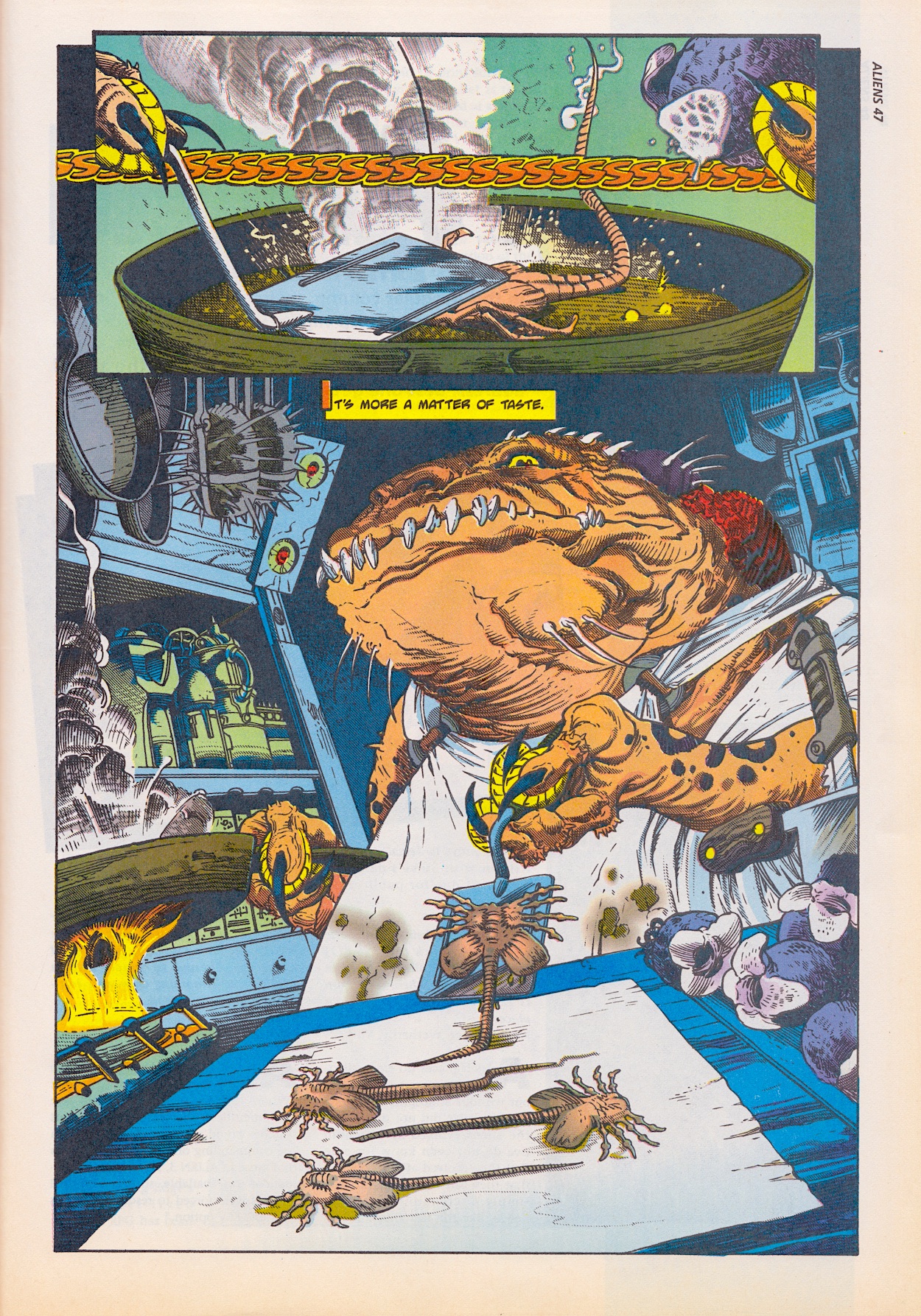
Backsplash and Tribes may be over but that means more new stories next month which is always exciting. Colonial Marines continues to get better and better, and Crusade certainly has loads of potential that hopefully it can begin to fulfil. Even more excitedly there’s talk in this issue of a second autopsy feature (the first in #11 was fascinating) next month, this time for the alien eggs. Things can only get better, so be here in one month to check out Aliens #17.
Esteban Maroto’s glorious cover gives the impression of a comic in rude health. Dark Horse International’s usual penchant for almost unreadable headlines hides what sounds like a particularly exciting issue for those that had stayed with Dracula this long after the association with the movie had ended. However, upon opening the issue we’re met with an editorial containing the round up of what’s happened in the main strip (instead of it being given its own page) and a “special message”.
Respect to editor Dick Hansom for telling the readers the truth rather than the next issue not appearing, something many comics in the 90s did, including DHI’s own titles. Although, he says readers can continue to read imported Topps Comics Dracula comics. Having researched these, alongside Vlad the Impaler (which concludes here) I can only find a Dracula Versus Zorro mini-series from the same year. Perhaps cancellation was the preferred option after all.
What Has Gone Before is part of the editorial to make room for the 28 pages of To Rise Again from the usual team of writer Roy Thomas, artist Esteban, colourist Paul Mounts and letterer John Costanza. It begins with Vlad beheading a King’s guard who tried to forcibly remove a thief from Castle Dracula who had begged for sanctuary. The guard insists the thief hadn’t asked permission. However, the guard also hadn’t before placing his foot across the threshold.
The King of Hungary, who had kept Vlad captive up until now, gives him an army to lead against the Turks, hoping Vlad’s viciousness will help him in his dire situation and lead to more impalements across the land. However, another of the King’s allies, Stephen Bathory wants Transylvania as thanks for his own help and Vlad is left with Wallachia, which he becomes ruler of again after his younger brother, Prince Radu dies of syphilis.
On a few occasions Vlad’s narration laments his own decisions, defending himself by reminding us he was only human at the time. For example, he didn’t know he had only two months left to live and wishes he’d made better choices, in particular with his family; he’s now married to the King’s cousin, they have two children and are in love as opposed to his previous wife who he’d forced into a relationship.
He realises his enemies (and allies) are amassing against his bloodlust and he takes drastic measures. He orders all of his wealth be amassed before leaving for a secret destination. Even his loyal assistant Cazan is left behind. Vlad shows a surprising amount of love for the man in these moments, telling the reader he was hurting because he’d left his friend with the wrong impression. You see, once all his worldly goods were buried (in an area where he’d dammed a river, then released the water again to hide the burial site) he impaled everyone involved. He didn’t want to have to kill his friend too.
But he would’ve.
Someone claiming their village was destroyed by Vlad’s enemies comes to swear allegiance and, despite Cazan’s vocal suspicions, the man is allowed to join the army in a top advisory role. Vlad admits to the reader he had his own doubts but in a moment of “grim fatalism” he took in “a suspected viper to my bosom”. We’re reaching the end here. In the build up to the final battle against his hated foe, Danesti he’s unsurprisingly betrayed and Cazan takes a knife to the chest as he leaps to Vlad’s defence. Even though Vlad is also killed, his narration continues from beyond the grave and it’s here that the story goes on a tangent from known history.
Beheaded by the assassin, after the battle is over pious monks take his body to be honoured by the Catholic church, which praises what this monster of a man achieved in the name of Christianity. However, that night the chapel is destroyed by a wild, unforeseen storm. This leads many of the faith to believe he’ll never be allowed to rest in peace because of what he did in life.
That was only his body, though. His head gets its own story. It was taken to Mehmed the Conqueror. However, over the course of just one night it becomes so badly decomposed it’s no longer recognisable to the people who come to see it impaled on a spike. We also find out that Vlad’s illegitimate son, Mihnea became known for terrorising the lands, cutting off the noses and lips of his enemies, with Vlad’s narration full of pride for the next Prince of Wallachia.
We then suddenly jump forward 150 years and a hooded stranger (actually a descendant) arrives at the church where Vlad’s decapitated body is buried; on orders from the Pope it is to be moved because it was buried too close to the altar. There’s a mention of Vlad’s wife’s suicide damning her for all eternity, which should be at least a bit familiar to fans of the film. However, unlike his supposed head a century-and-a-half earlier Vlad’s body hasn’t decayed.
After the spread above, his actual head (which we learn is not decomposed either) is placed on to his body, the stranger recites some ancient texts in a foreign language and Vlad rises again, instantly biting the neck of his descendant, energising his body and beginning his life as a vampire. While the story ends with an image of him declaring himself as the Dracula of Bram Stoker’s creation this origin story, even the resurrection part, is very different from the novel. In fact, it’s only one of a few possible stories about Vlad’s body after he died.
This has been a curious strip. We know that Stoker had very limited knowledge of Vlad the Impaler, that particular part of the world or indeed that point in history and he simply picked at scraps of information to build his character. (Not forgetting his own supposed xenophobia which may have contributed to the story.) This strip seems to dangle somewhere between actual history and the novel. After accurately chronicling the historical character (as much as a comic can), this final chapter commits itself to neither the truth nor Stoker’s imagination.
There’s a lot of ambiguity surrounding the events of his burial so Roy has decided to fill in the gaps as he saw fit, and that’s fair. Personally though, I’d have preferred to have had the mystery remain. It could’ve still ended with how it began four months ago, with Dracula relaying the story to the reader and letting them fill in the blanks. The mystery could’ve added to the spookiness, the unknown adding to the fear instead of it being filled in for us. Overall though, I’ve really enjoyed it and it’s peaked my interest in the real life man. I’ve found myself reading about him at length because of this comic.
It’s a shame the sales figures dropped so sharply after the adaptation finished, although I’m not sure what they could’ve printed anyway. This last issue also sees Vampirella unceremoniously dumped (she never did get her own cover as promised) and the small back up strip is rather unremarkable. But I wanted to concentrate on the main story anyway.
Overall this has been a quality comic and a pleasant surprise from start-to-finish. From a brilliantly realised movie adaptation to a fascinating look at the man behind the myth. From an initially clichéd Vampirella origin to a captivating story and character I’d never read before. From interesting news on the film’s release to a series of remarkable anthology back up strips. I didn’t expect too much from what was essentially a movie tie-in, but Dark Horse International’s Dracula has been a great read from start to finish, including when changing form like its titular character.
It may not be well remembered and doesn’t sell for very much on eBay, but that just means it’s easy for you to pick up and enjoy for yourselves. I highly recommend that you do.
This is the last we’ll see of Derek Yaniger’s wonderful art on the blog. The final edition of Marvel US’ Transformers: Generation 2 has 48-pages with 37 of strip broken down into chapters of varying length called Judgement, Twilight, Siege and Creation. All written by Simon Furman, coloured by Sarra Mossoff and lettered by Richard Starkings, with alternate chapters drawn by either Manny Galan and Jim Amash or Geoff Senior, making it feel even more special. The annoying adverts breaking the up strip are also limited, with the final 17 pages left as one long chunk.
Things kick off with something I enjoy but which seems to irk the all-too-ready-to-criticise folks when another movie drops. I don’t like retcons if we have to ignore previous storylines in order to make them work, but unlike some I’ve never thought that about the films. Instead, just like the G1 comic which (and this is not a complaint) was made up as it went along, I enjoy a storyline that adds background, depth and builds upon what we thought we knew. This is what has happened with the G2 comic. At least, until the final page anyway.
So our memories have been refreshed about the ‘evolution’ of these mechanical beings and Simon’s clever way of integrating the comic’s necessary name change into the story, then there’s some surprisingly good comedy as Starscream finds himself battling with his own consciousness. His natural desire to conquer is in a losing battle with the power of the Autobot Creation Matrix and he finds himself unwillingly saving the lives of others. Hilariously he’s never anything other than the Starscream we all know and love to hate, and he hates every moment of it! Eventually he relents and passes the Matrix back to Optimus Prime like a child forced to give up their toy until they’ve eaten their dinner. This is a brilliant swan song for him.
Moving on to book two and Geoff’s easily recognisable style instantly elevates an already enjoyable story. We find out The Swarm is something “between matter and energy” and we witness it destroying a battleship, killing its 16,000 troops in seconds. It falls on Megatron of all characters to bring some levity to the proceedings. He’s a far cry from the megalomaniacal ranter in G1, continuing his entertaining line in dark quips from last issue.
The two leaders have a plan but it’s not revealed yet, leaving us to enjoy the tension as things continue to worsen. After years of knowing these characters it’s fascinating watching Megatron go about something with all of his usual verve while treating Prime as his equal. Speaking of Optimus, he senses some form of intelligence within The Swarm and believes if he can reason with Jhiaxus he can contact it on some form of psychic level through one of the second generation. Given the twists and turns and shocks the original comic gave us over seven years, it would really take something to shock us by this stage, right? Correct.
There’s some gloriously detailed art here, some of Geoff’s finest in fact. Could a shock conclusion see the end of Optimus? No, that’d be too easy. Instead he’s forced to fight through the pain and the temptation to give up and simply pass away. This gets dark at times. But in the end it plays to the strength of this character.
It feels less like a sequel and more like an epilogue to the original epic 332+ issue run
As far as Jhiaxus is concerned the original generation of Transformers have compassion and empathy, and he believes caring about those other than yourself (or indeed for those worse off than you) is a weakness and must be torn out. In the end it’s the Swarm that gets him, tearing him apart in a burst of agony and the ship’s reactor blows, pushing Prime into space and leaving Megatron as the last hope for both Autobot and Decepticon alike.
The Rheanimum he mentions is the mineral his Decepticons mined in #7 and here it’s explained it could be the key to their survival. It makes metal super dense and resistant to damage, you see. It’s exciting to see Megatron racing to save everyone, even if Earth continues to look like any barren bit of space rock. Why not set the story somewhere recognisable like G1 did, even just a named place (like Portland in the original). It takes away any potential drama of having this happen on our own planet.
The characters make up for this though. I mean, come on, seeing Grimlock and Soundwave side-by-side is something else! Then new Decepticon Manta Ray hears Razorclaw’s orders but looks to Grimlock before following them. That’s the final straw for the Predacon, who attempts to kill his brother in arms but Autobot Leadfoot saves the Decepticon. We’ve had moments of truce between the factions before in comics, cartoons and movies, but it feels so much bigger, more impactful and more permanent this time.
Then everything happens at once! Starscream saves Prime and hands him Rhanianimum, but he refuses it. There’s even a reference to the Scraplets by Starscream, who spends a lot of time worrying his co-operation isn’t like him and that the Matrix has done him permanent damage! Frenzy gets some funny moments, Nightbeat dies (nooooo!) and Megatron politely introduces himself to Grimlock. Then Prime insists that for his desperate plan to work, he must die. Thing is, while it tears his physical body apart, the Swarm doesn’t kill him. Instead he ends up in a void, seemingly forgetting he was in a void before in the UK comic (Furman annoyingly ignoring his own UK continuity), and he gets the feeling the Swarm is like an innocent child clamouring to be taught.
This review was almost twice as long as it is because there’s so much going on in this issue. I’ve had to edit this post down and cut so much out I could get a job on Film4’s daytime schedule team. So, Prime wants to let the Swarm take him, absolutely and completely, letting it consume him and fulfilling his visions which began way back in #1. The nightmares weren’t to be feared, they were instructions. The ultimate sacrifice. It’s portrayed brilliantly by Geoff above and you can feel the agony Prime goes through.
Then there’s darkness… before he suddenly sees, well, everything!
He sees and feels everything the Swarm does. While he still has a consciousness the Matrix sustains his mind and uses the pure essence of their creator Primus to educate the Swarm. From the outside its misshapen form becomes a dazzlingly bright light and all who witness it are filled with a feeling of peace and joy, their fear dissolving in an instant. Then, out of the light steps a new creation, the Swarm now knowing what it is and where it’s come from, and it uses its immense power to create instead of destroy.
The Optimus Prime you see below is based on the ‘Hero’ version of the toy, the most recent plastic incarnation of him at the time. But what exactly was the Swarm? The whole “byproduct of the second generation of Transformers” is never fully explained. How was it produced in the first place? We don’t know. (Nor do we get an answer about that strange moment with Onslaught.) What is explained is that the second generation of Transformers lacked any kind of morality, just a legacy of destruction and, like a child, the Swarm was searching for something more. It knew it wanted something better and was destroying all Transformers because it thought they were all fascist killers; it didn’t know there was an earlier generation or why the species had been created in the first place (to fight evil and save the universe).
Exposed to the original Primus ‘code’ it’s reprogrammed and from the lives it took it constructed a new life, a new leader for a new future for their whole race, not just the Autobots. The story ends with what feels like both sides genuinely wanting to work together. It certainly feels a lot more permanent than the truce at the end of the 80s cartoon movie. Then, after months of wondering we’re finally introduced to the Leige Maximo. This is the one bit of the whole issue that I’m not sure about.
These will forever sit at the end of my original Marvel UK collection as an integral part of that lifelong favourite
The thought of the comic continuing beyond this resolution is an exciting prospect, with the Transformers (no longer Autobots and Decepticons) fighting a new war together against this new foe. However, the Decepticons weren’t a separate race, they were an offshoot who’d had enough of how things were being run. I hope Simon would have eventually interwoven this new backstory in with what came before if the comic had continued. However, I’m more annoyed with Megatron being sidelined in the final pages for Prime’s speech when he should’ve been standing shoulder-to-shoulder with him.
I had no expectations of this sequel, especially since there were only 12 issues. But what a rush! Some complained it retconned things (much like we constantly hear from moaners about the live-action movies, Star Wars or Doctor Who… etc.) but surely things would be boring if we knew everything there was to know about characters right from the off. This comic felt like an elaboration of what came before, using the millions of years between their leaving Cybertron and arriving on Earth to its advantage. It was a gap of four million years after all! It was also a clever way of working in the toy line’s new name, so kudos one final time to Simon for that.
Before we finish up completely, there are a couple of the usual extras to cover. After acknowledging G.I. Joe’s 150th edition, the final issue of this spectacular comic isn’t given any such coverage on the Bullpen Bulletin news page, however the letters page is rather unique. It takes up more space and begins with a missive from letterer (and Marvel UK editor) Richard Starkings. It’s interesting but I must point out the UK Transformers comic lasted a lot longer than 250 issues (332 plus annuals, specials etc) and I happen to love his Dragon’s Claws logo!
The second letter reminds me of my mum’s confession later in life that she didn’t actually mind buying me comics as a child, the letter from OiNK Blog reader James Healy asks us to remain positive before being negative about the original comic’s ending (I must say I disagree with him on this), and in Simon’s farewell message there’s an interesting snippet that it was colourist Sarra Mossoff who decided the idents in speech balloons should be coloured to match the speaker. Unfortunately, she’s also the victim of a rather cringey description.
Below this are some unused pieces of art by Derek and a Decepticon image by Chia-Chi Wang (The Punisher, Ren & Stimpy, G.I. Joe). Whether these were unused covers/posters is unclear and I wish they were bigger. I know the issue already has more pages, but a few more so we could see these at their full size would’ve really added to what has been a great send off.
During this real time read through I found out the name ‘Jhiaxus’ is pronounced “gee, axe us”, an in-joke by Simon who anticipated a quick cancellation by Marvel of another toy comic. He wasn’t wrong. While it was designed to last much longer, I haven’t felt short-changed. Yes, it was obvious things were being ramped up to get to a suitable conclusion but I’m left feeling completely satisfied, and not just with this as an end to its own series.
Now that it’s over it feels less like a sequel and more like an epilogue to the original epic 332+ issue run, like this was a story that had always occurred and just needed to be told before we could properly say goodbye to these original versions of beloved characters. Characters who have been reinvented many times since. As such, this hasn’t felt like a short run but an addition to the longest running comic I’ve ever collected, and these will forever sit at the end of my original Marvel UK collection as an integral part of that lifelong favourite.
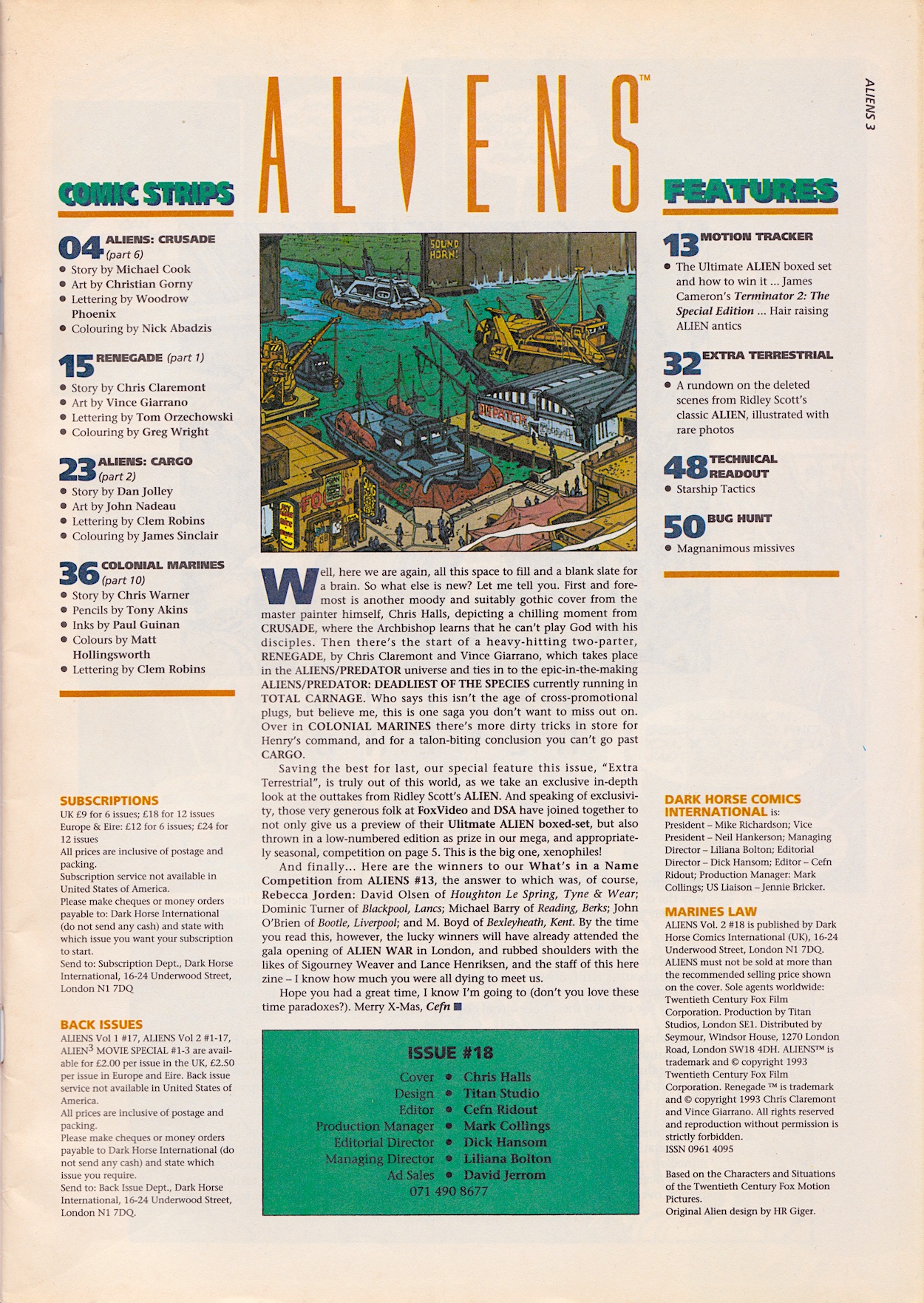
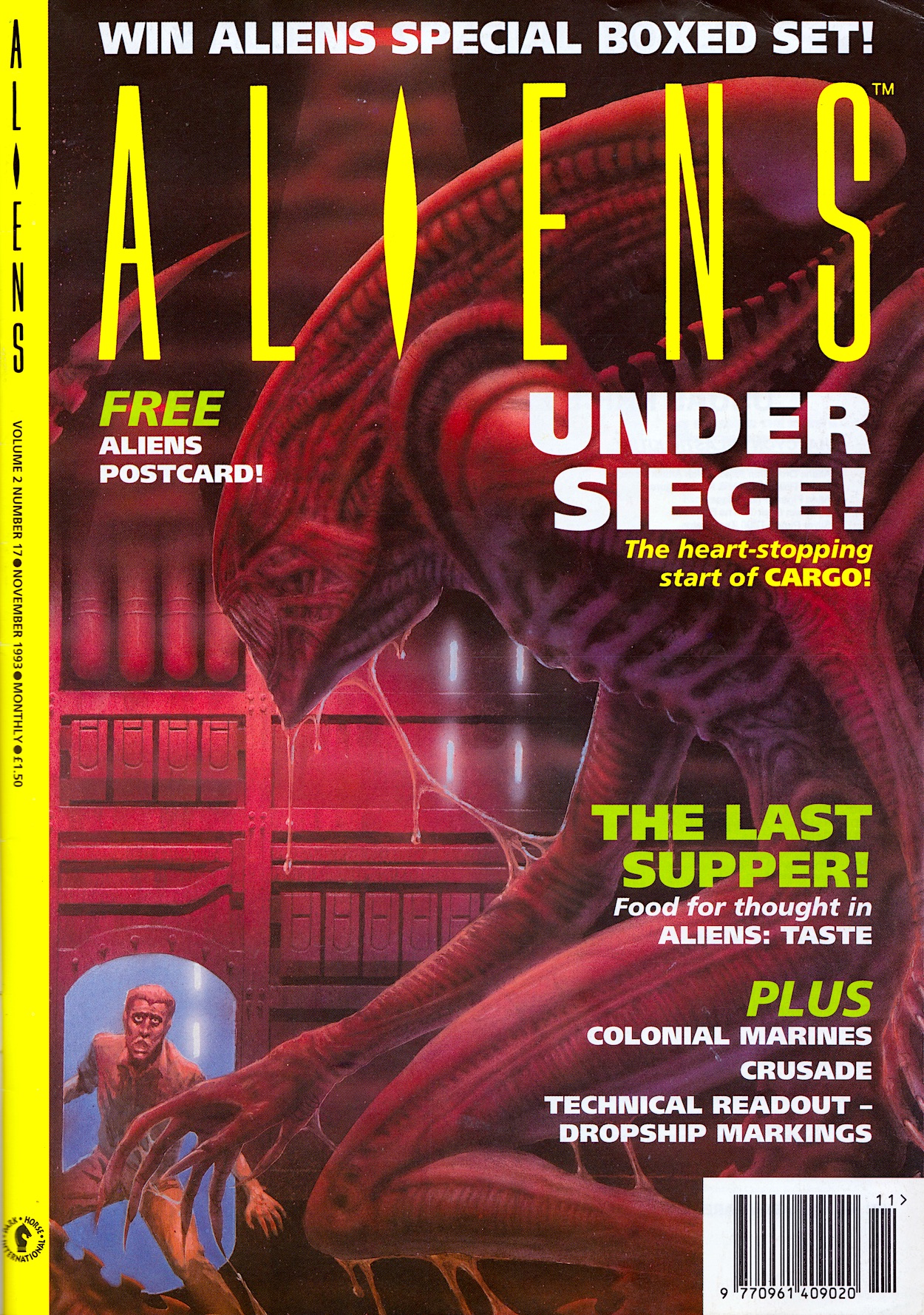
Well that’s one competition I wouldn’t have been entering. Anyway, Irish artist Killian Plunkett returns with this great cover for #15 of Dark Horse Intertnational’s Aliens as well as the first strip. One of the headlines on the cover notes the similarities in subject matter for two of the tales, something I’d noticed previously. The cover is printed on lovely glossy paper once more, which is highlighted by editor Cefn Ridout in the editorial, shown below to include all of the credits in the review.
He also mentions extra pages but in reality the comic has returned to its original page count. Perhaps in light of the cancellation of both Star Wars and Dracula there were a few extra pence in the pagination budget? Cefn welcomes Killian to the Aliens fold for the first time even though he’d previously drawn the even better cover to #8 (and Dracula #7) and I do like his answer to the question of whether the Colonial Marines will ever learn. He’s right, you know.
Proof comes in the form of part one of Backsplash, an American story written by Jim Woodring (The Book of Jim, Frank, Star Wars) with Killian as artist that was originally printed in Dark Horse Comics over there. It follows a team of marines as they try out a new eco-suit weapon in an alien hive, something they believe is so good the aliens will no longer be a threat. Of course, such talk is always going to jinx us humans in the Alien universe! The leader’s name is Gibbs, so maybe he can slap the marine who said that across the back of the head.
That’s basically it for the plot and things go wrong even more quickly than I anticipated, as the aliens swarm the two marines sent out in the suits. To begin with the particle-plasma projectors see off the xenomorphs easily, exploding their bodies at a safe distance. But then the aliens gang up and such a large amount of them exploding at once produces a wave of acid that instantly starts to eat through the suits. Even worse, it covers the transport holding the rest of the team, dissolving its armour and filling the interior with deadly fumes.
As they try to escape the surviving aliens attack, the extra weight leading the cliff edge they were parked on (because of course they were) to crumble, taking everyone with it. A prequel to a strip called Labyrinth, don’t expect to get to know any of the characters in this short story but it’s a fun little tale nonetheless that once again shows the universe humbling humanity. Great art on the part of Killian too, it feels like stills from an ace Aliens cartoon.
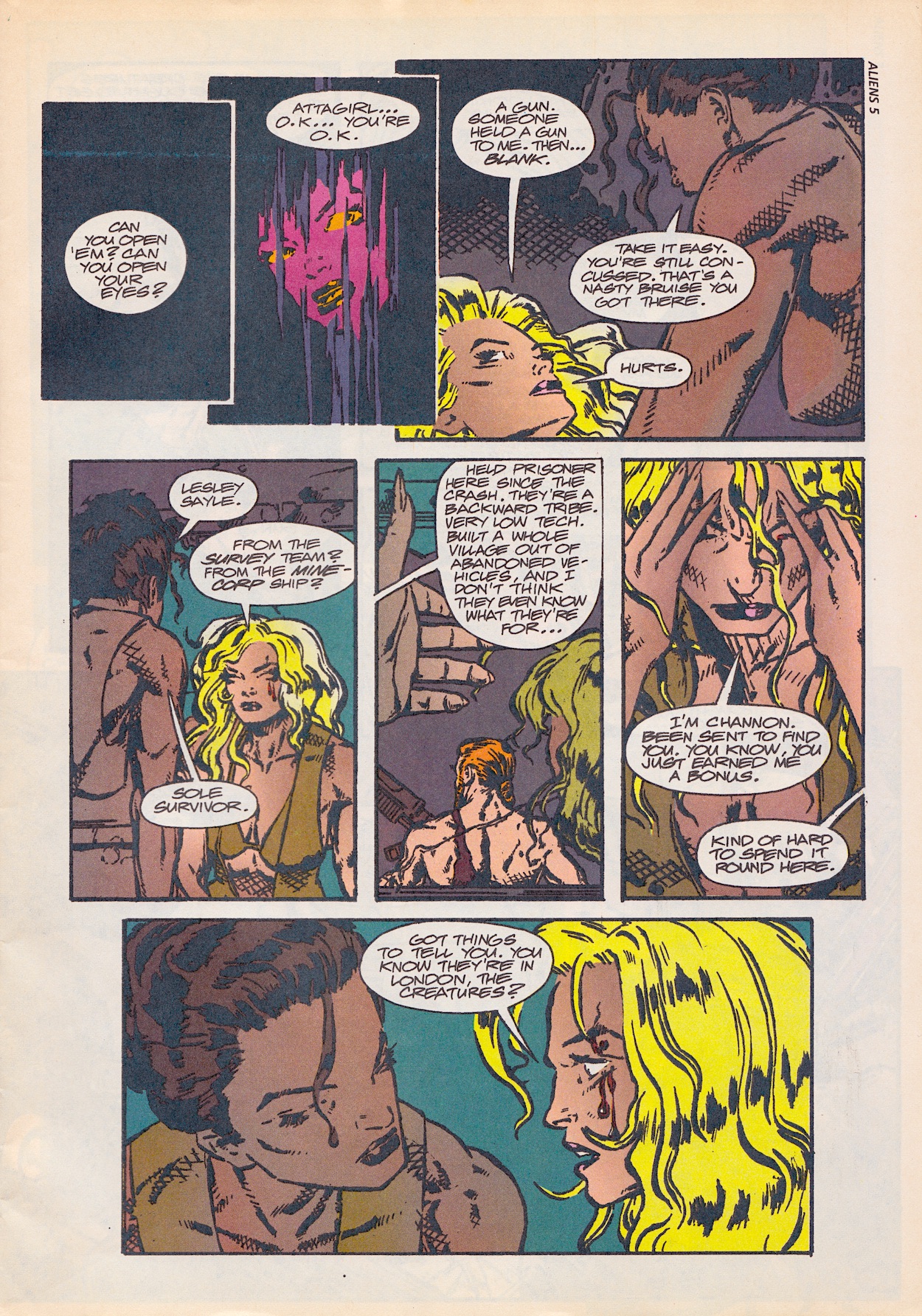
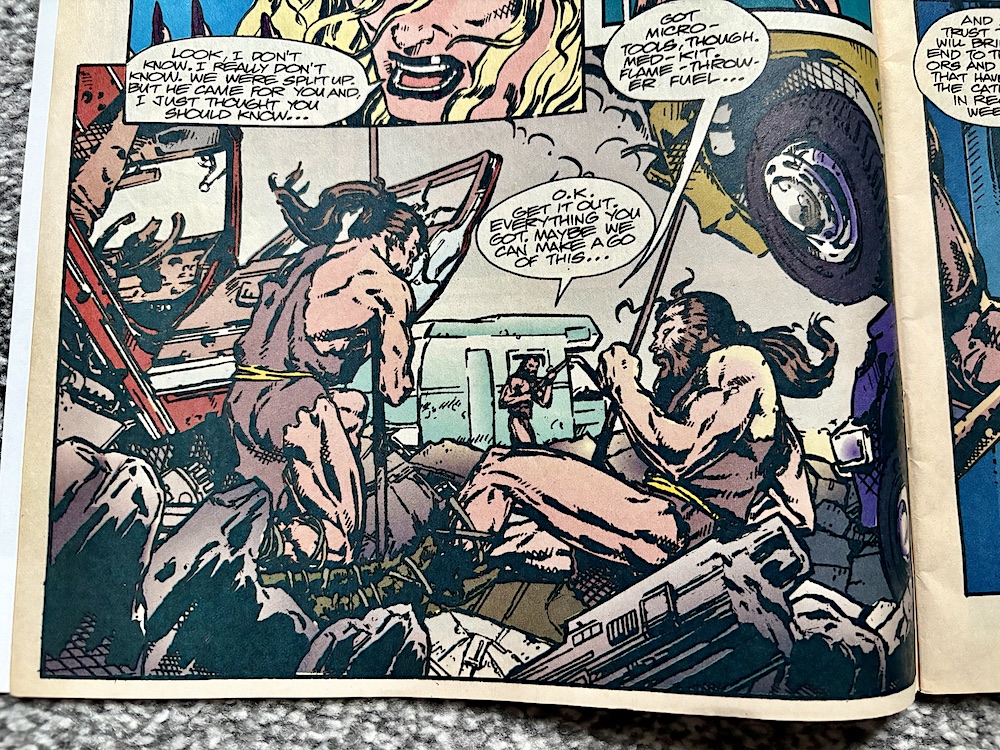
Part 3 of Michael Cook’sCrusade is reduced to 9 pages but it continues its positive ascent through the ranks of the stories after a rather dodgy beginning. The Minecorp mercenaries are imprisoned by the tribe’s leader, who accuses them of kidnapping those taken last time, despite the fact the mercenaries are still there. Go figure. But tribeswoman Rani isn’t convinced. She can see in the stones they aren’t the monsters of her visions and wants to go with them to find their lost people.
More world building is included when Britain is simply called ‘an unnamed mining island off the coast of Europe’. (I could make a dig about Brexit here but you’ve probably beaten me to it.) We also briefly see the Archbishop either tearing chunks out of the dead Beresford or stitching him up as the Alien Queen watches on, it’s unclear what he’s doing as the art remains too messy for me personally.
However his followers, who live in the abbey and never venture outside, are beginning to question his King-like leadership. They’ve heard tales of kidnappings, are suspicious of Bereford’s death and want to know what’s really in the tower. The Archbishop simply says doubts are the devil’s work and walks off. That won’t come back to haunt him, I’m sure. Back at the camp a rather basic escape plan is put in motion as Rani smuggles an electrical cutter inside the prisoners’ food like some clichéd cartoon.
Once free some of the mercs are all too ready to kill their captors, setting up some tense character dynamics within the group. However, the strip now suffers from that 90s action flick syndrome of a lack of clothing. As the tribes took the troopers’ clothes and they themselves wear only basic coverings, what Rani brings as their disguises is little more than an excuse for some tits and ass. A shame, there’s real depth within the story so it doesn’t need to do this.
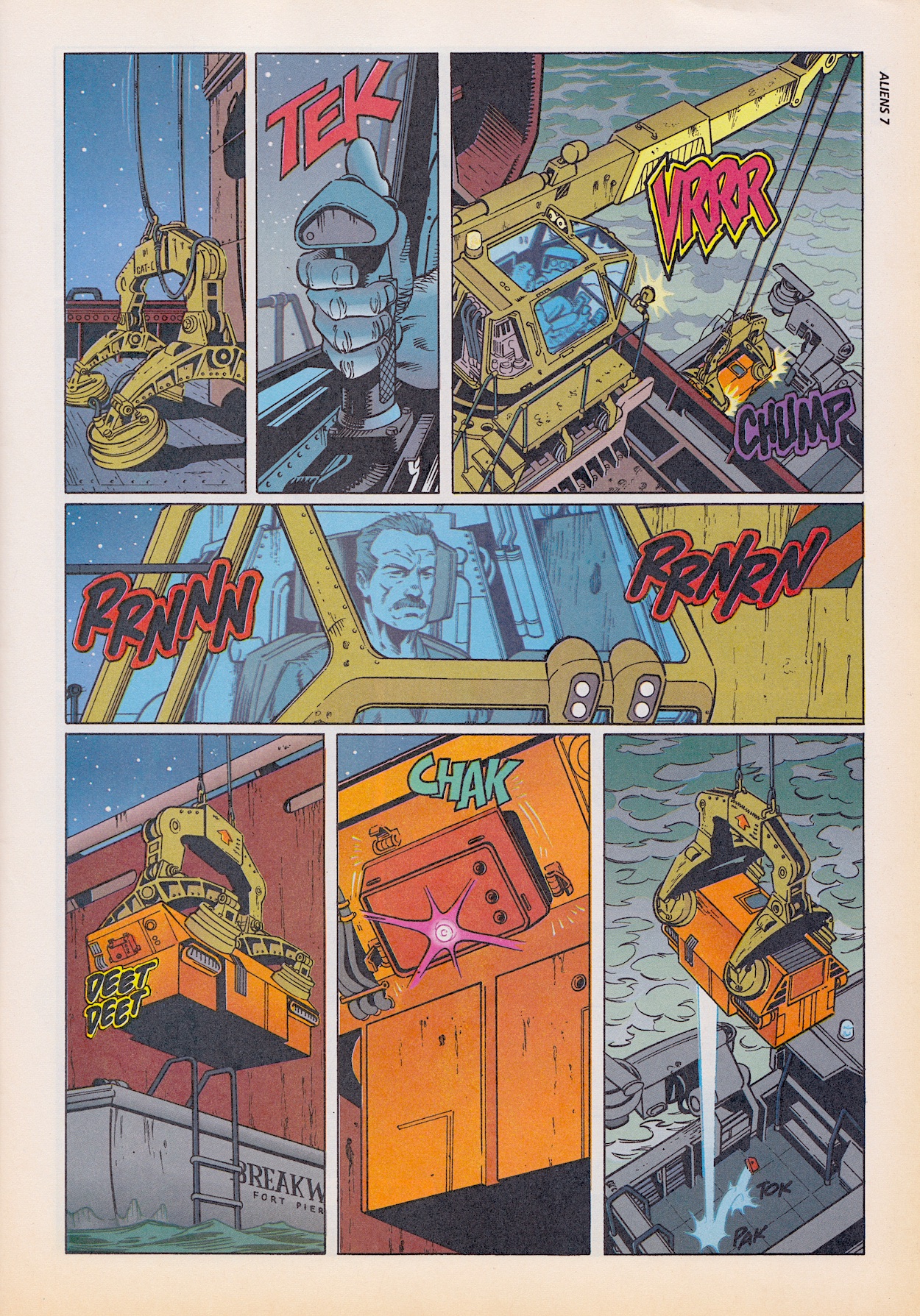
I was looking forward to this month’s Technical Readout and the next part in the Sulaco series but instead it’s about the drop ship that took the marines down to the planet in the film. Actually, it’s not even about that, it’s a rather bland two pages about the individual missiles it could fire. Much more exciting was the realisation Chris Warner’sColonial Marines strip had doubled in size to 16 pages. We were told it’d be a few more months until this happened so it’s a nice surprise.
This moment perfectly captures their panic, the claustrophobia and the ensuing tension.
This strip has been gagging to breathe a bit more in each issue. Each chunk has been really enjoyable but they’ve been over so quickly, partly because of the amount of pages but also because of the speed of the action, so the plot hasn’t really had a chance to shine. This changes somewhat here so I hope this is an ongoing change.
However, first up is this comic’s constant problem of giving things away in the round up of the story so far, with the writer of that page stating certain things have happened already when they haven’t. The reveal of the new alien species actually being a hybrid between humans and xenomorphs is spoiled before I even get to the strip.
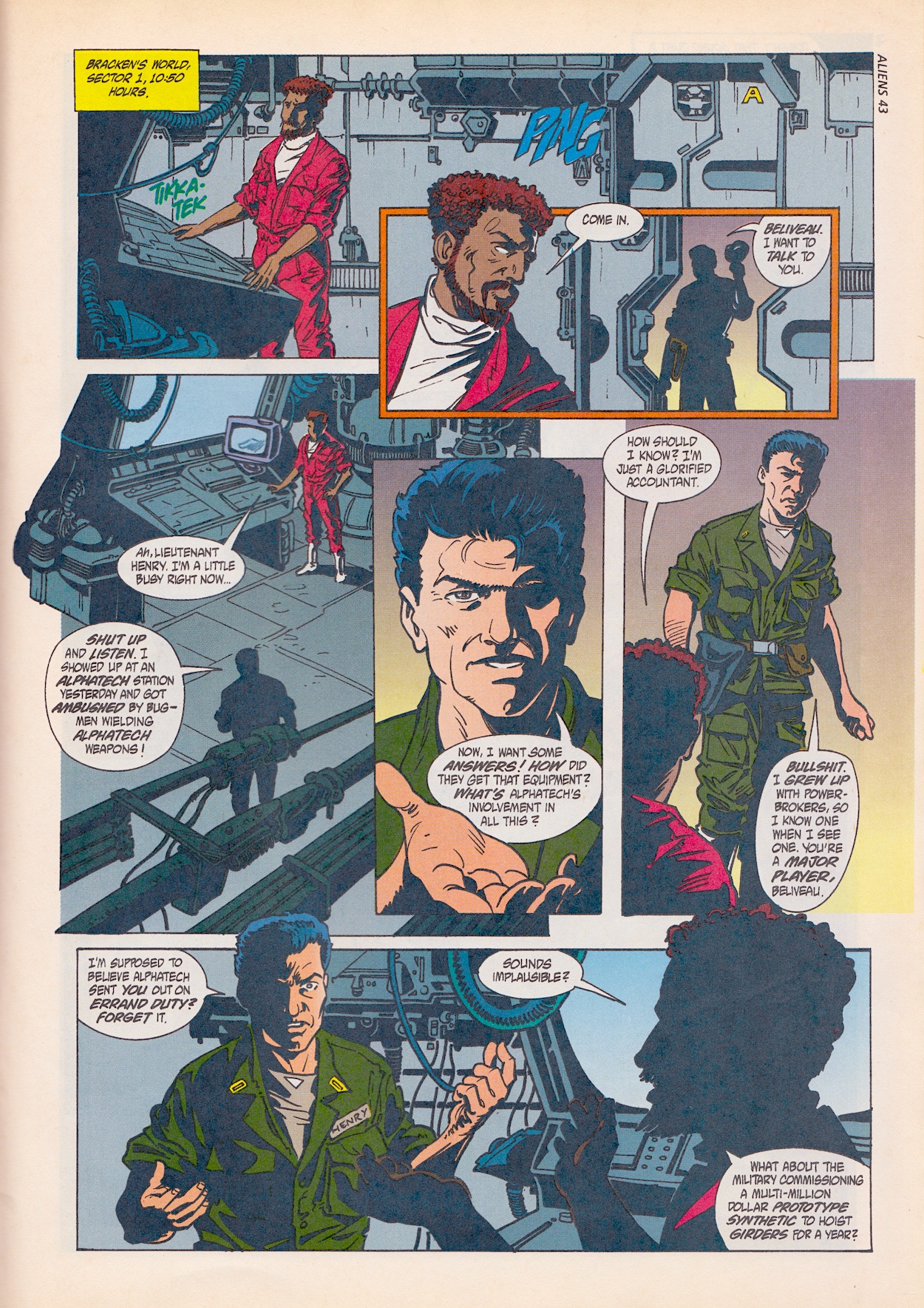
How the characters can tell they’re hybrids is unknown, it certainly wasn’t clear to me. The man they found Newt-like in the air ducts tells them the hostiles are men “but bugged out”. Meanwhile, corporation man Beliveau is screaming at the huge synth that he’s built for alien encounters, only to be told by the synth they’ll have to wait for the team to re-establish contact because he costs too much to risk going in.
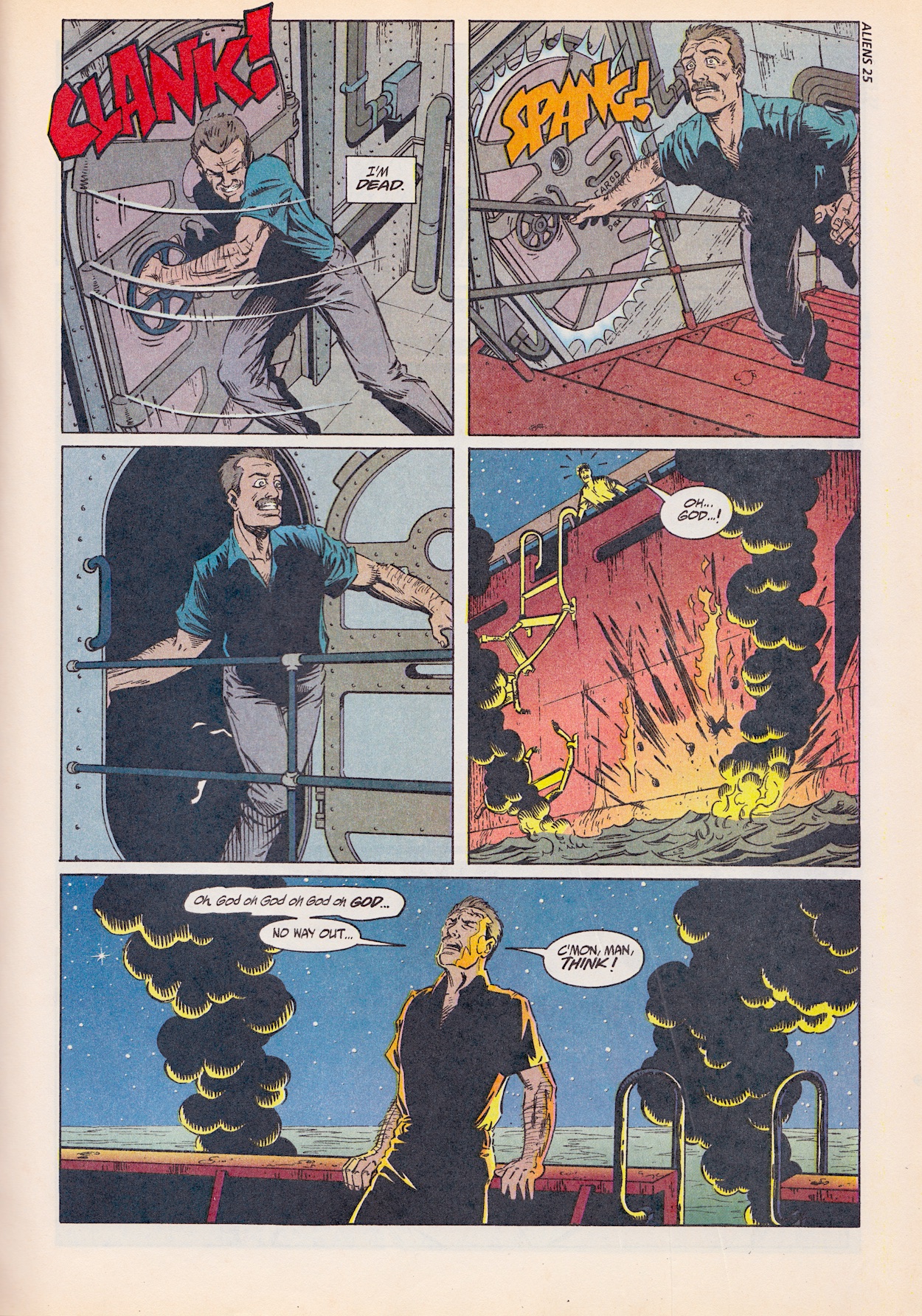
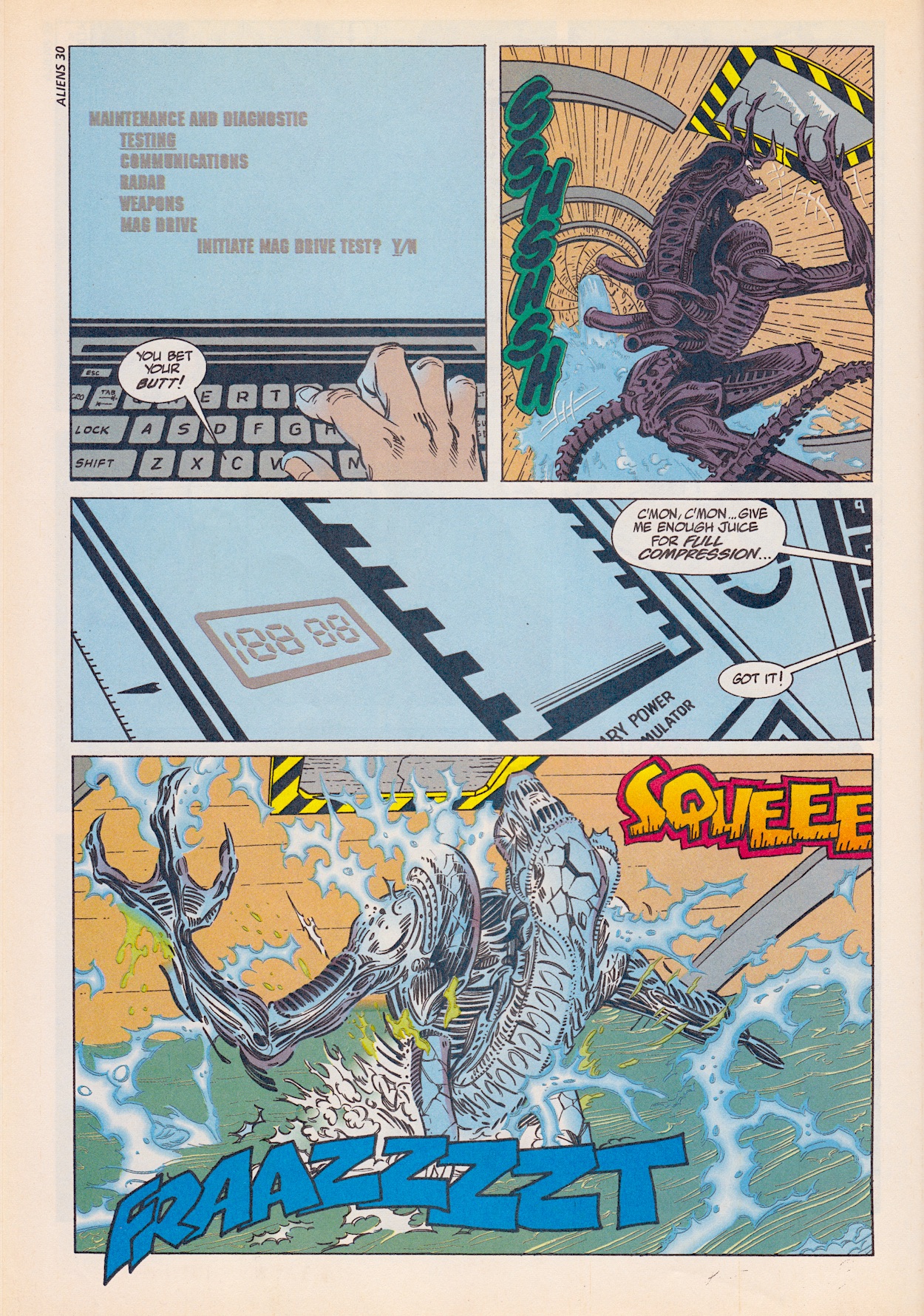
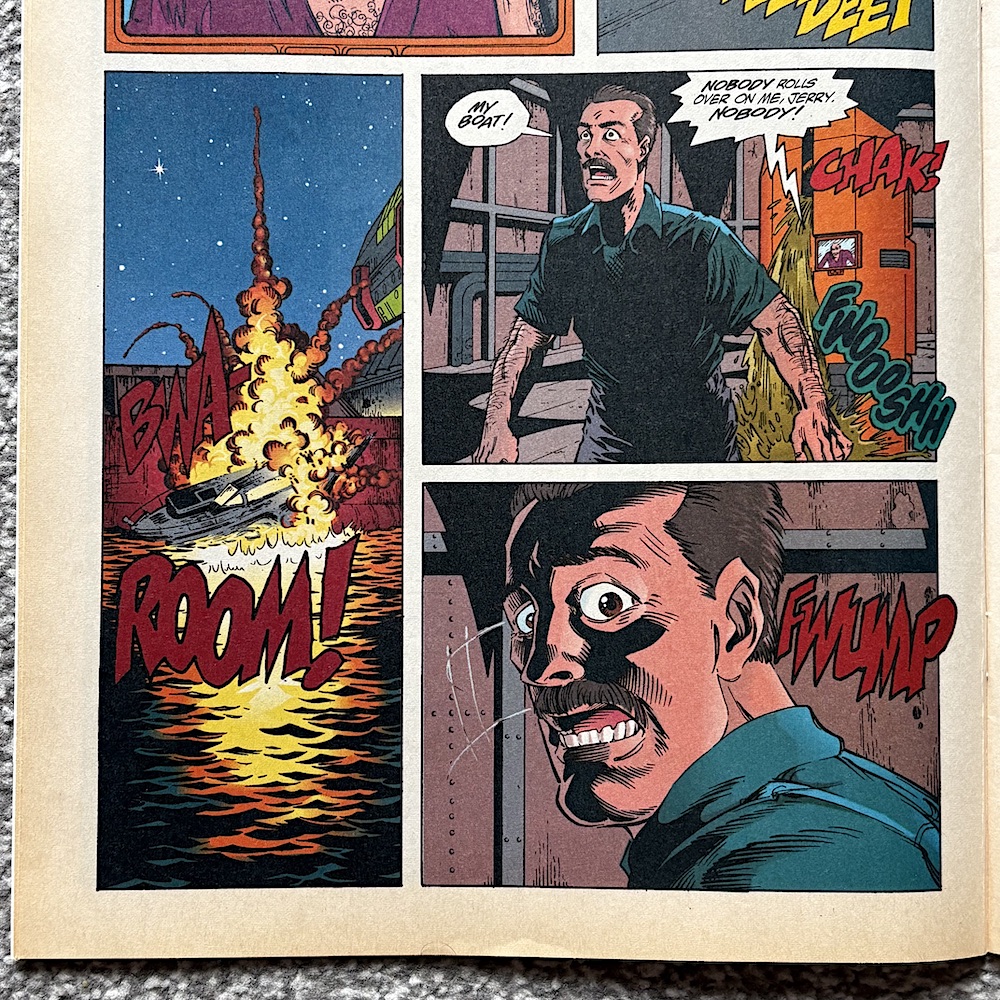
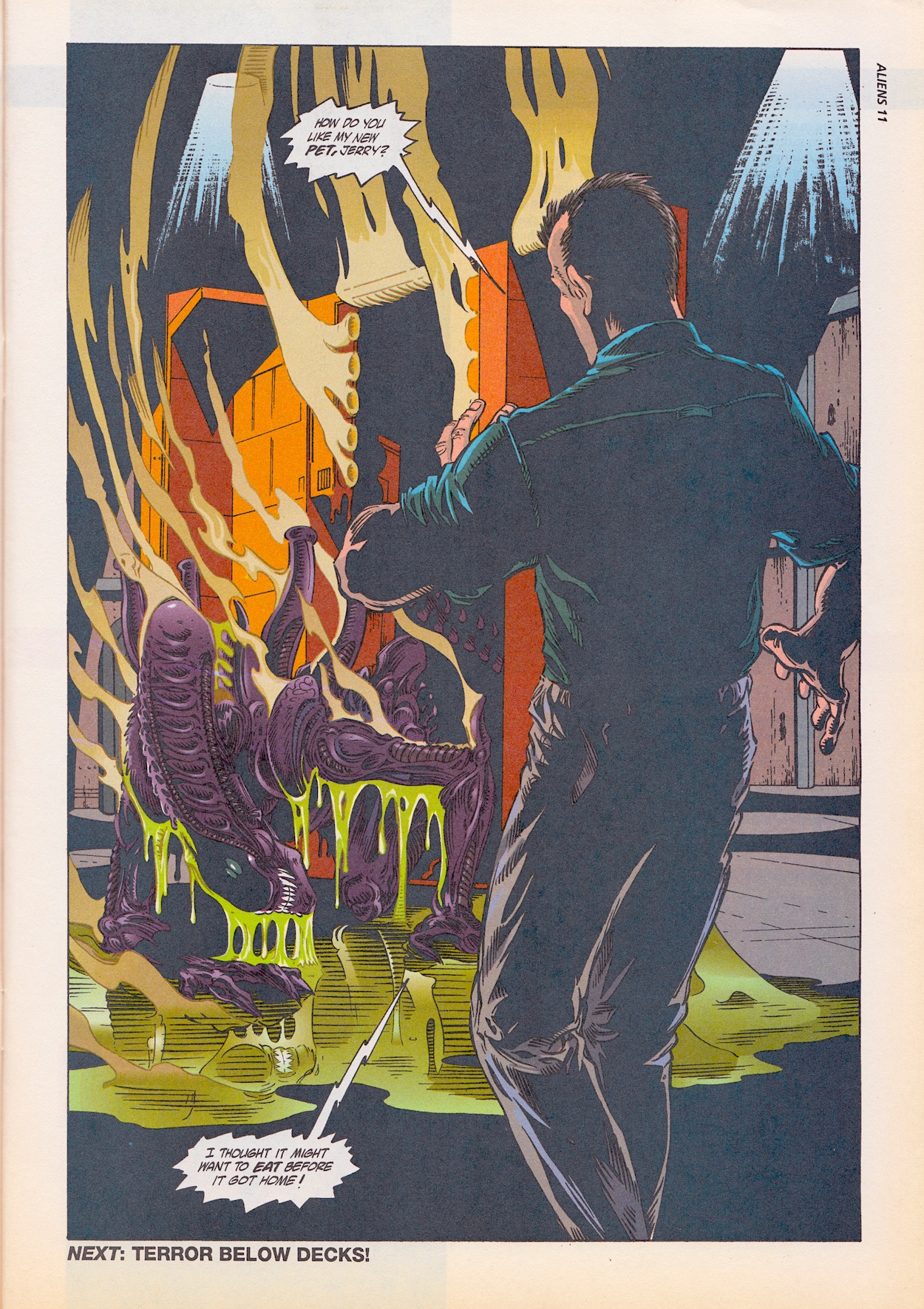
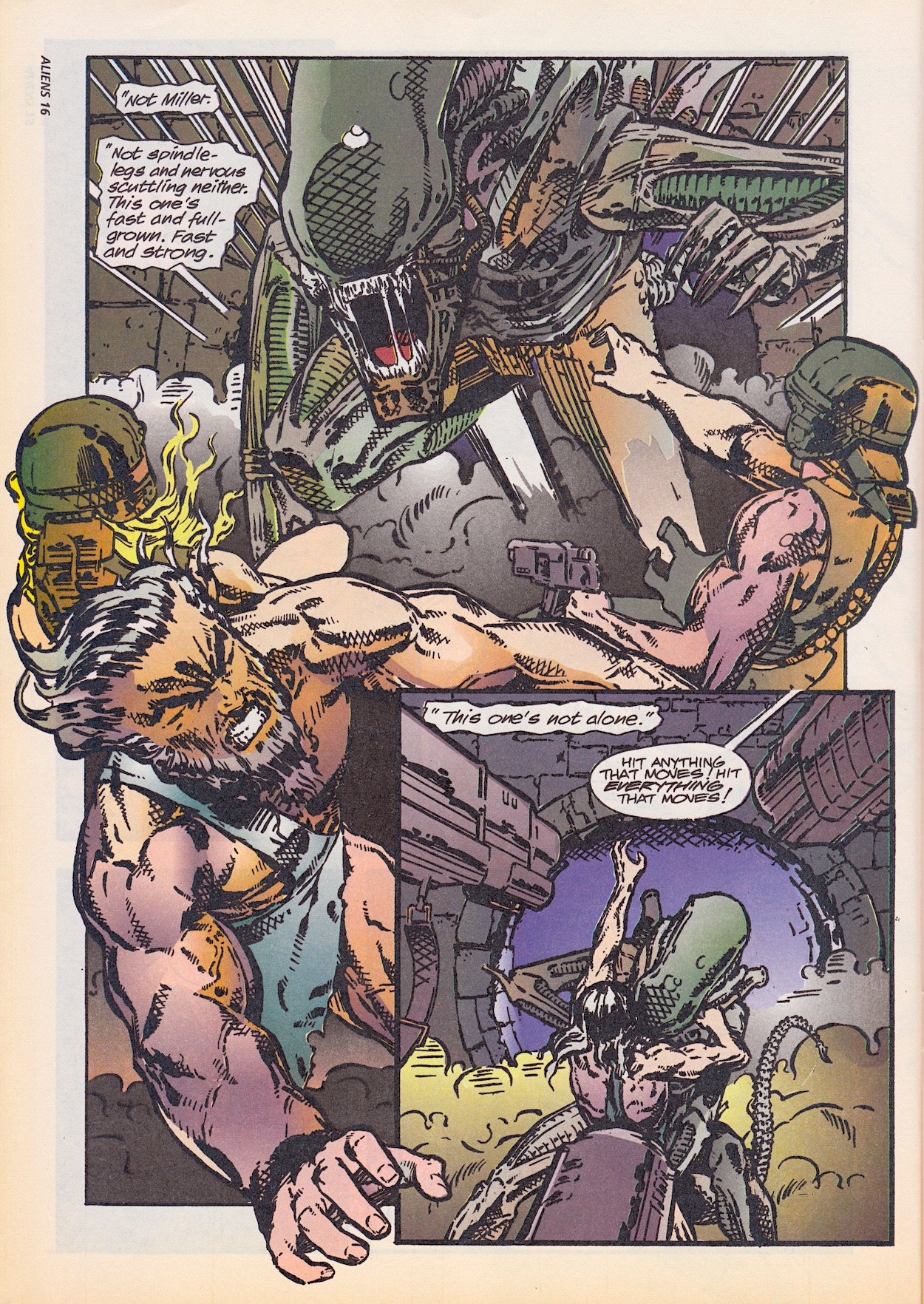
Beliveau’s inner thoughts betray him to the reader. He thinks he knows who’s responsible and in the hive the “Father” figure tells his men, “The Judas is here”, so there’s more to the company man. The main highlight of not only this strip but the whole issue is their escape up a zero-g well to an air lock. This moment, portrayed over the two spreads I’ve photographed, perfectly captures their panic, the claustrophobia and the ensuing tension.
Having one panel with all the captions displayed vertically is a nice touch too, highlighting the disorientation of being in zero-gravity. They manage to take one of the hybrids prisoner but all he does is lecture them about humanity polluting space and how The Father believes the aliens are cleansing it for the greater good. There’s an environmental message in there somewhere that I’m sure James Cameron would be proud of.
“The alien behind Point struck, its extended tongue tearing effortlessly through the helmet’s metal to taste the soft grey yolk that lay under the bone.”
Tribes, Steve Bissette
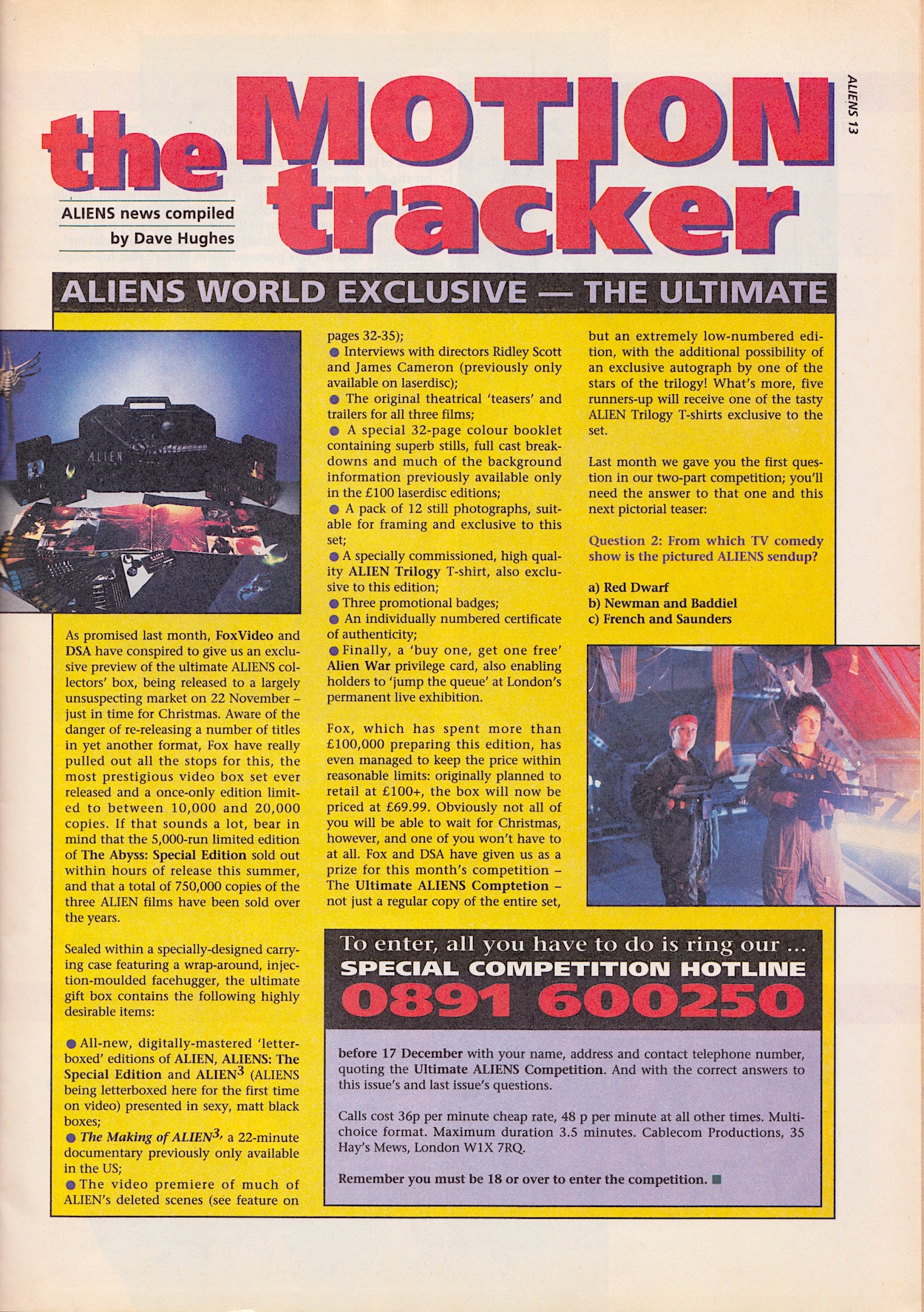
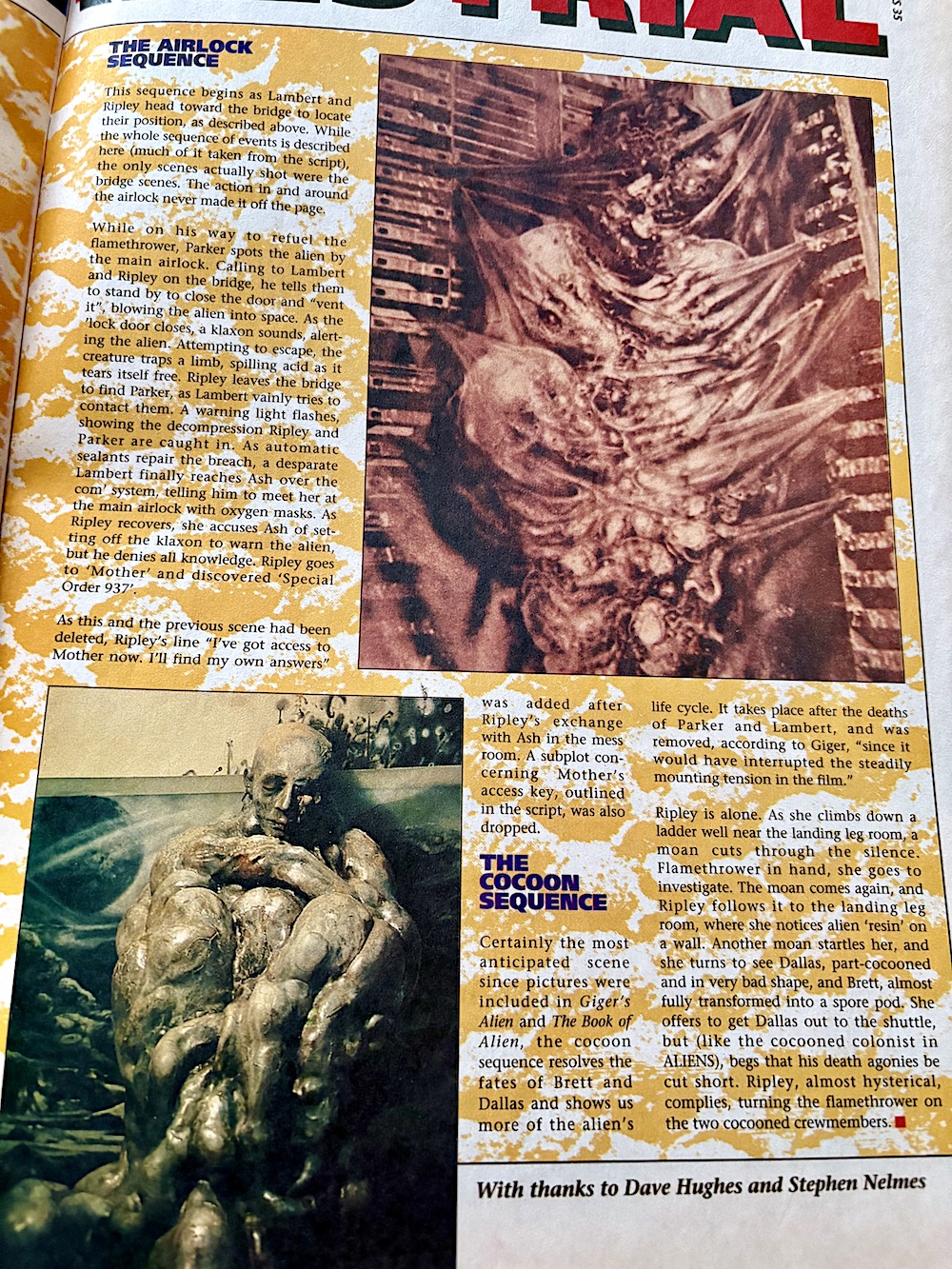
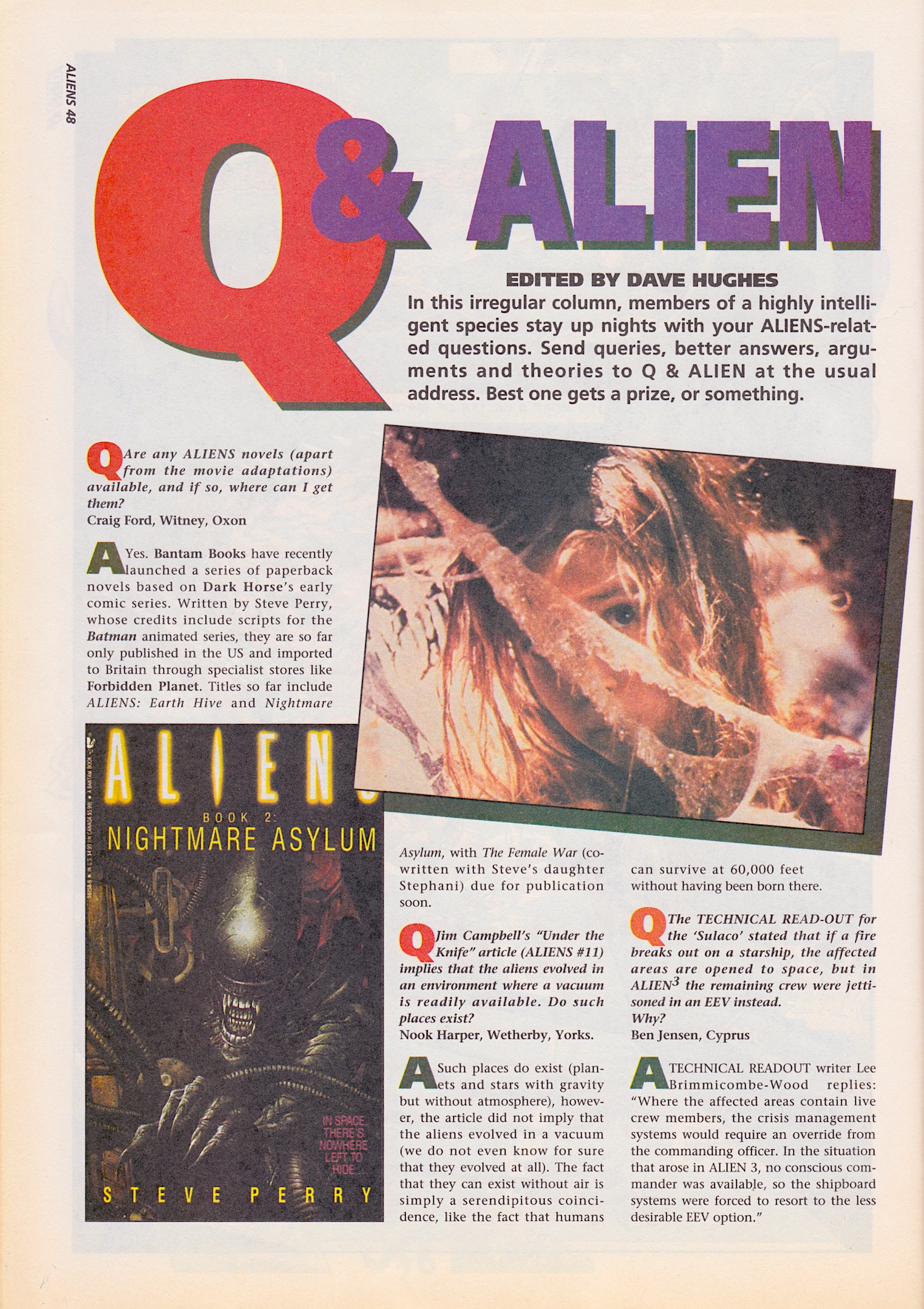
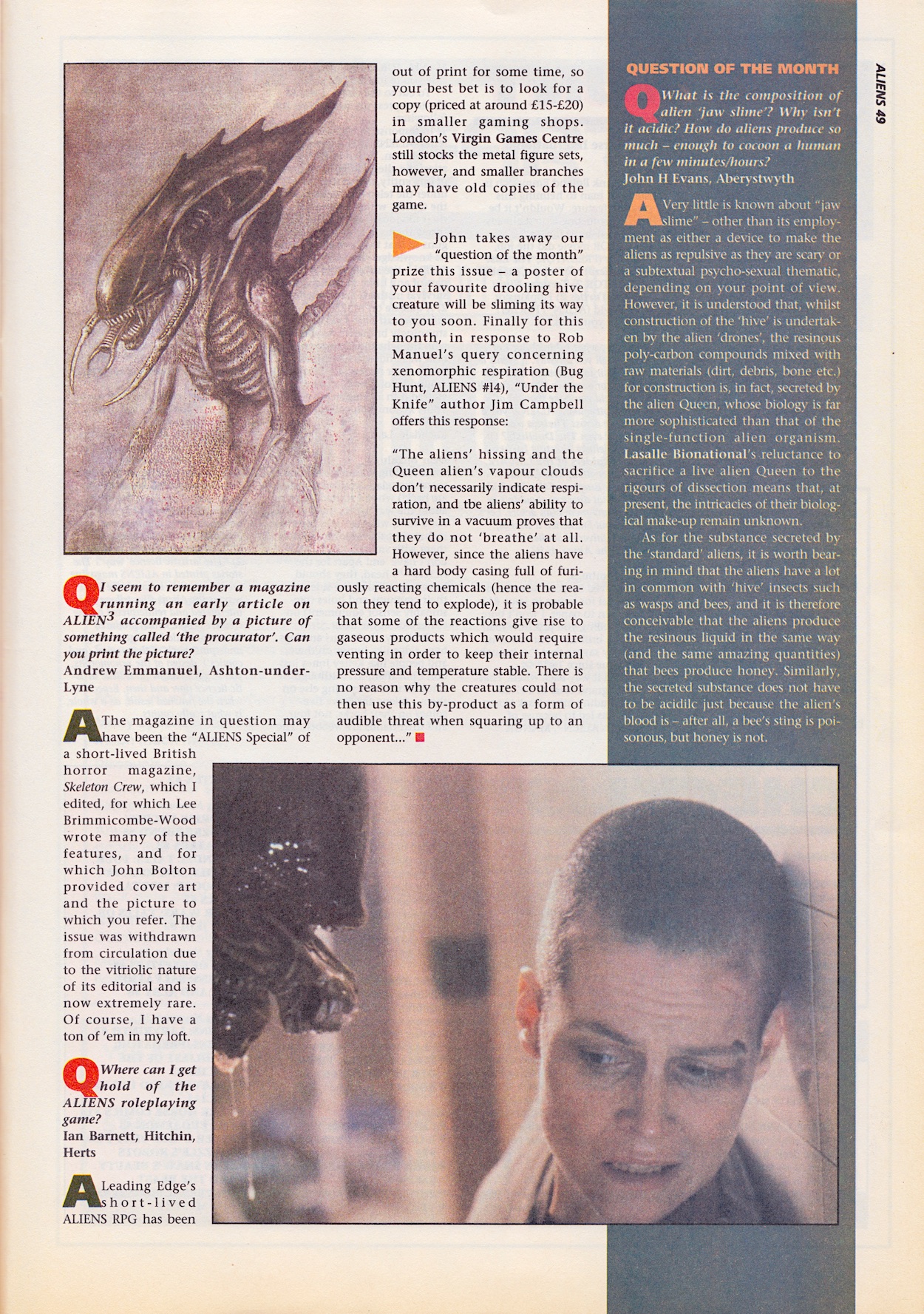
The new Q&Aliens feature takes individual questions asked in letters and gives them prominence in a double-page spread. There’s nothing particularly groundbreaking in any of the questions asked, although we do get to see these two interesting early designs for the original movie’s poster, complete with different fonts. Both were created by David Pelsue.
The questions may be of the usual sort but one answer stood out. A clearly frustrated reader wanted to know “Where the **~!” the facehuggers came from at the beginning of Alien³. I always thought it was obvious, the Queen had been hiding out on the drop ship so she planted them. Interestingly, the answer states the sound of an alien egg schlopping open could be heard at the very end of the credits to Aliens, director James Cameron indicating an egg was on board the EEV with the survivors (or perhaps just to freak out the audience a bit). I had to go and give it a listen and yep, it’s there! I’d never heard it before!
Tribes’ penultimate chapter (written by Steve Bissette) somehow escalates the heart-pumping excitement even more than it already had. Things are certainly shaping up for a heart-stopping climax next issue. My favourite character Rat may not be as prominent but it hardly matters because everything else happening around her has been dialled up. The shrunken images by Dave Dorman should still give you an idea of the action taking place here.
While we’re used to things going wrong in an Alien story, the fact absolutely everything (including things you’d never think could go wrong) goes wrong makes this a shocking read. Quite the feat. There are a lot of surprising deaths, Shitkicker goes on a rampage and the more things go wrong the more his metal shell injects drugs into him to combat the escalating situation, which of course just makes things worse. As the marines now fight their own amongst the aliens I was almost breathless by the end of the four pages. What a thrill ride!
What an issue. Aliens is back on top of its game! All four stories were a thrill to read this month. Backsplash is incredibly fun hokem, Crusade continues to develop something very interesting, Colonial Marines was just superb and Tribes… wow! There’s even mention on the letters page of a possible Technical Readout book, which I searched for and I found it. That’ll be a future purchase for the blog, no doubt. With two finales next month there’s every possibility #16 could (somehow) be even better than this issue. We’ll find out on Tuesday 23rd September 2025.