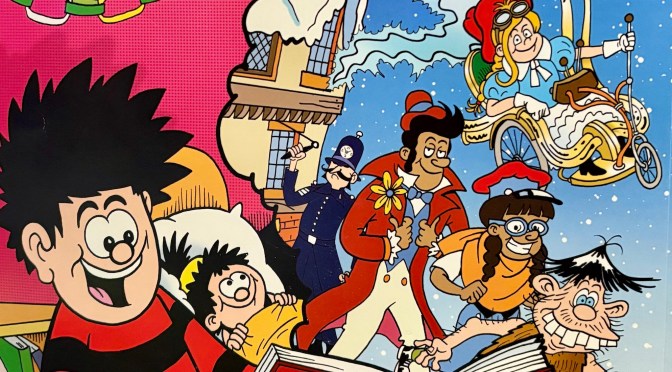
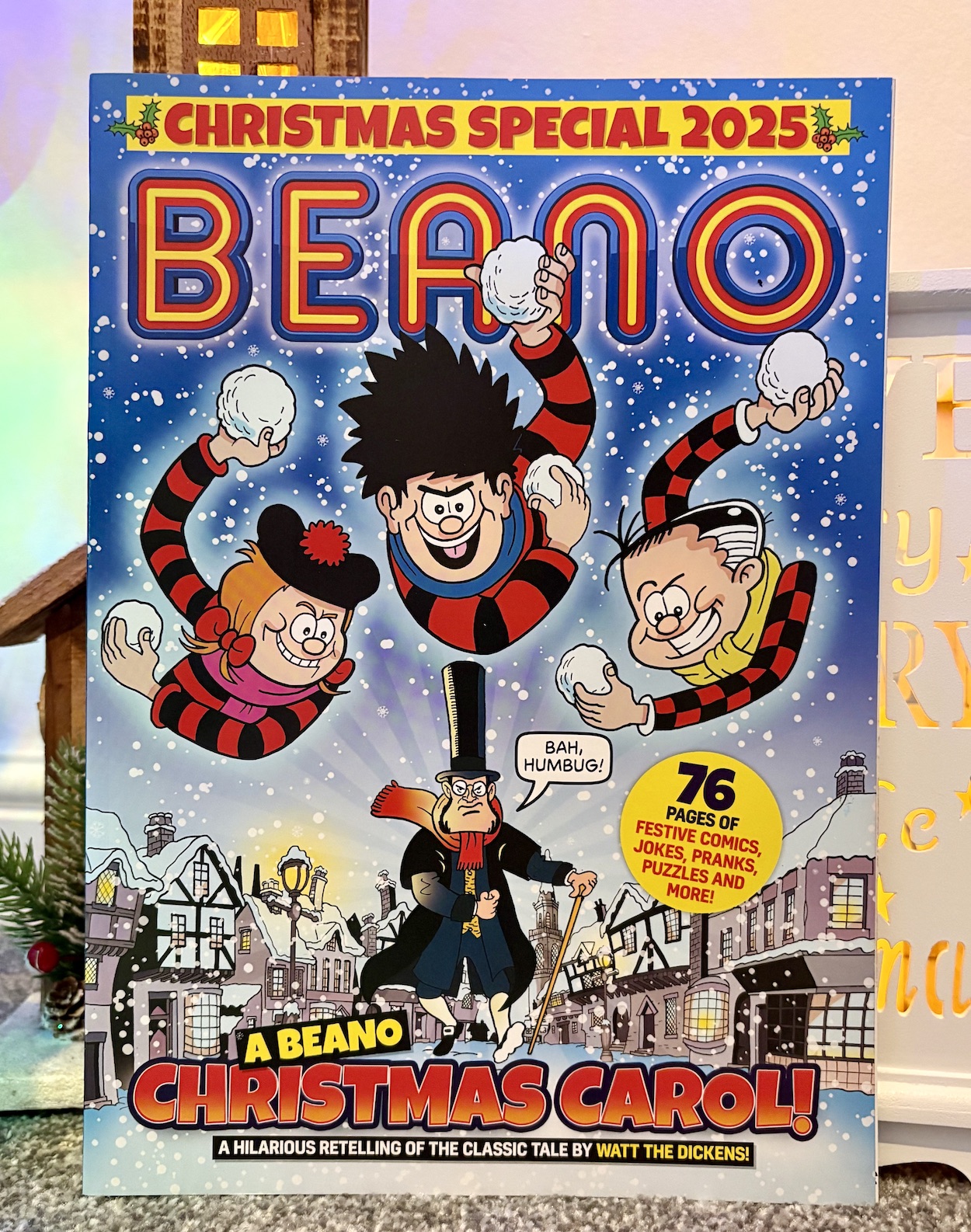
Dare I say it but could this year’s Beano Christmas Special actually top last year’s? One glance at the supposed author name along the bottom of the cover almost had me convinced before I even opened it! Inside, the lack of more funny gift tags is disappointing but that’s really the only negative I have in all honesty.
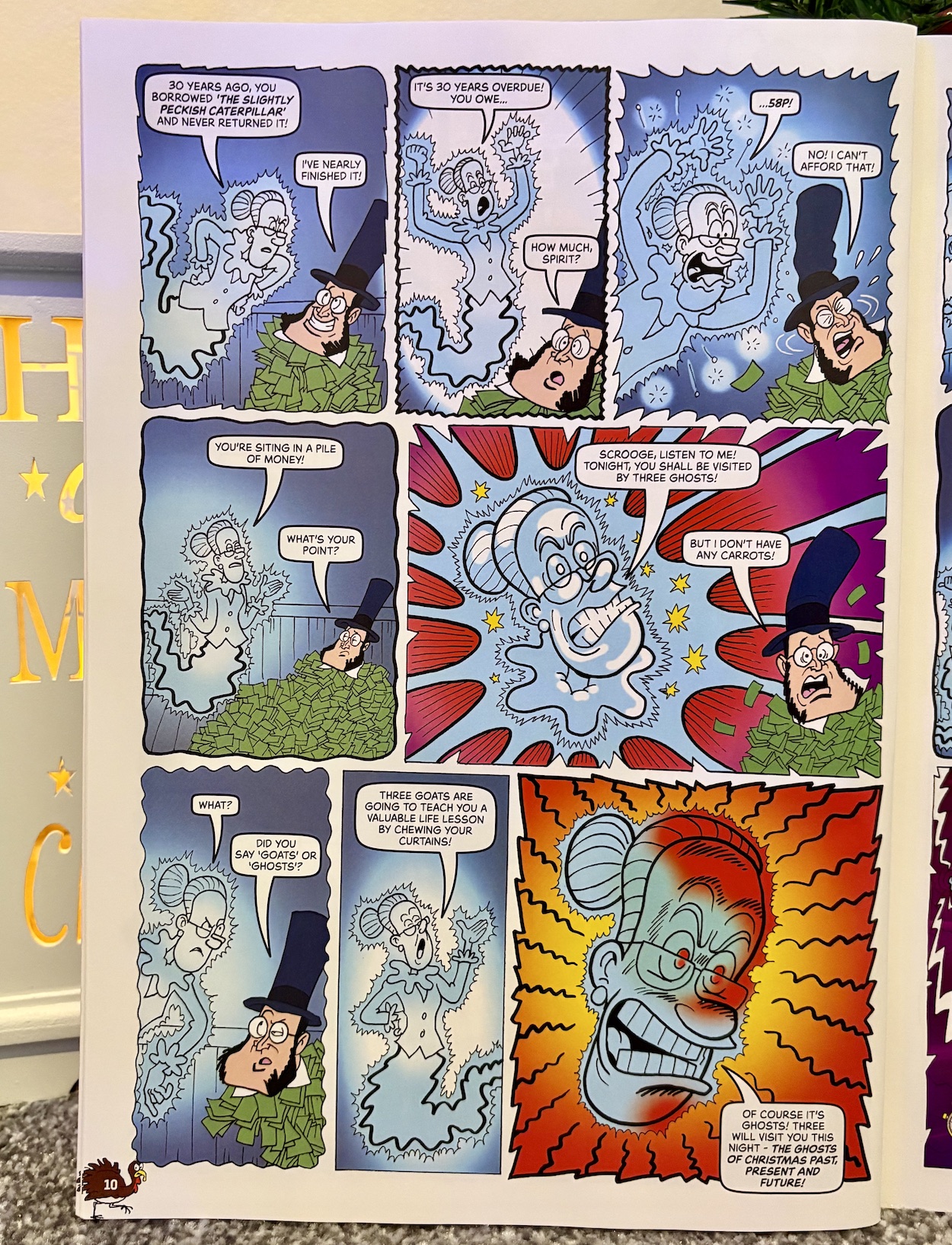
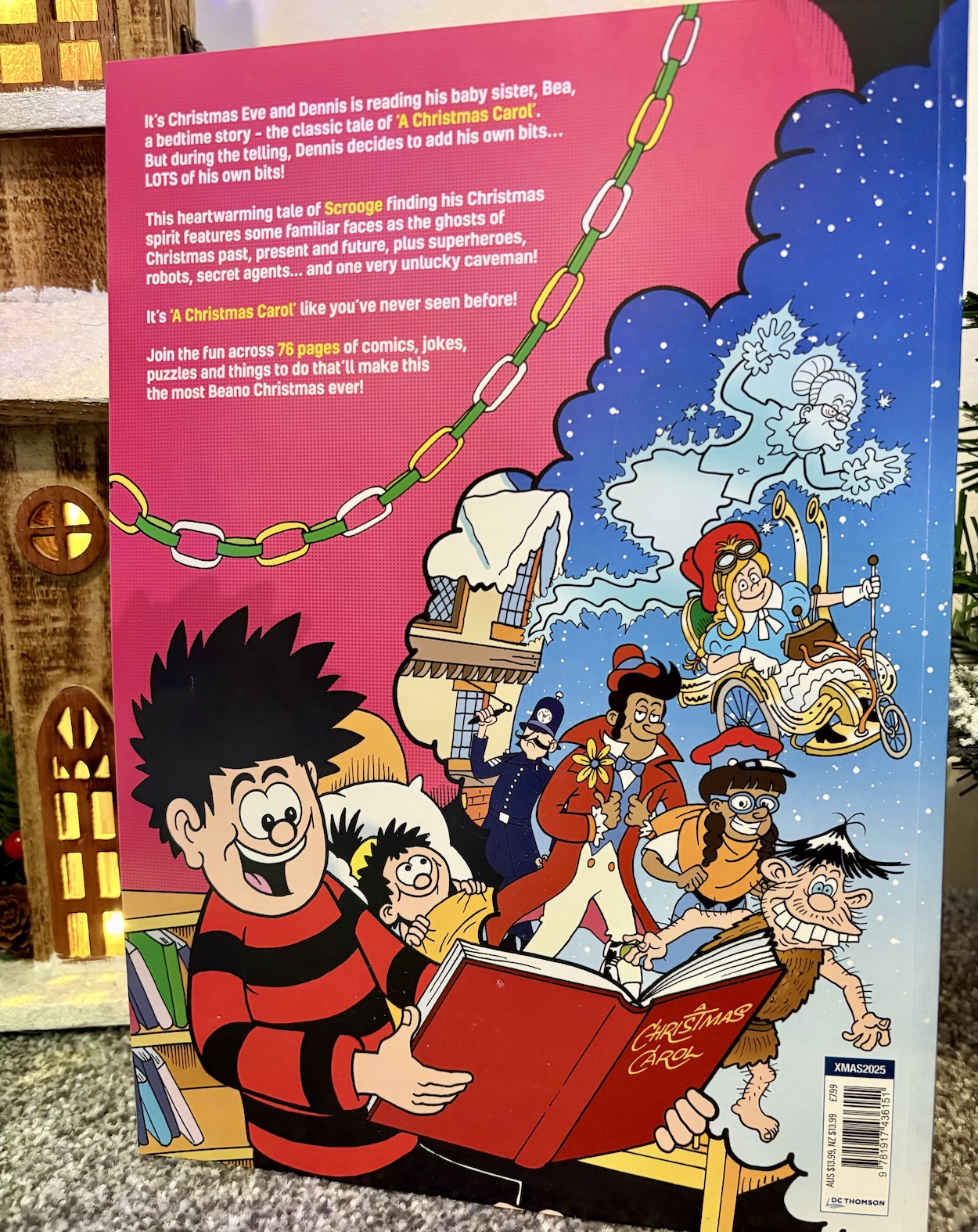
Dennis is lumbered with reading a bedtime story to his little sister, Bea as Christmas Eve draws to a close and his mum hands him A Christmas Carol. But of course Dennis is never going to have the attention span to read a whole book so he leaves bits out, retells existing bits and adds completely new parts to liven it all up.
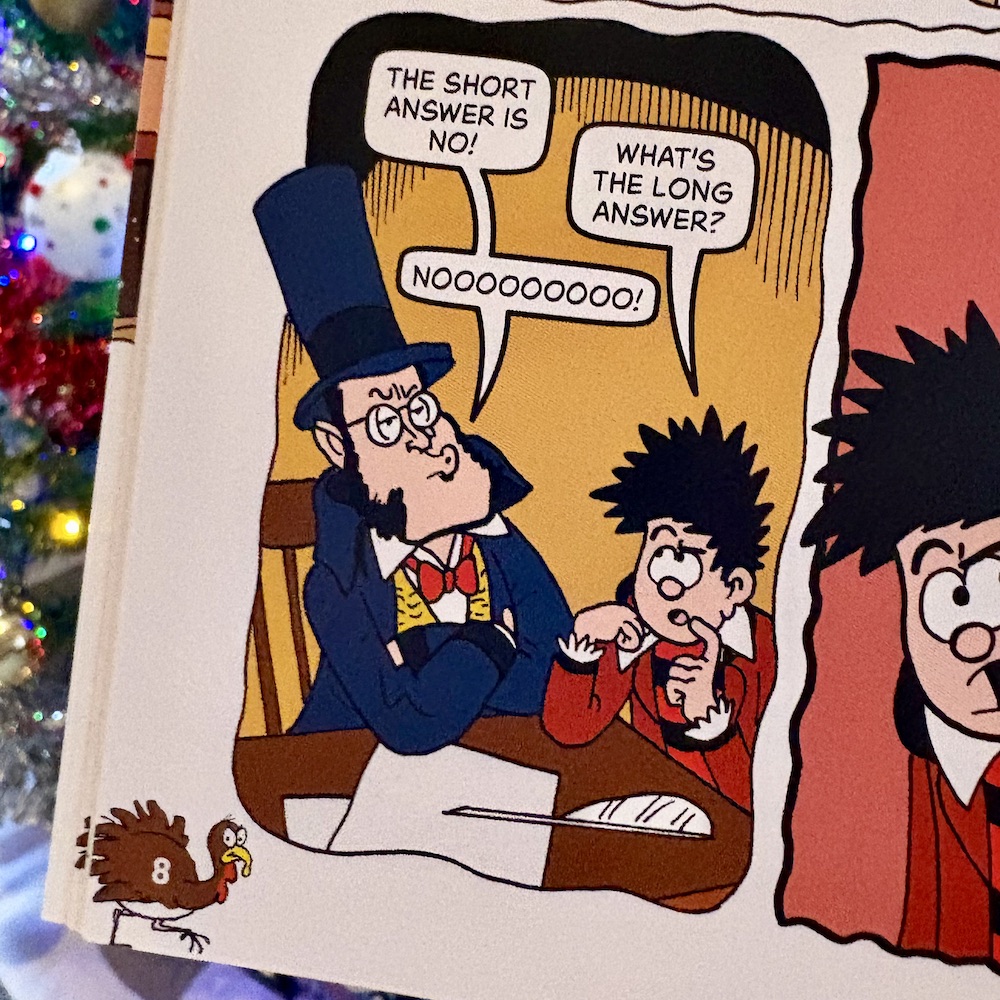
Just like last year, the special is one long story told over various strips starring a collection of the comic’s fan favourites. Dennis, for example, is not only Dennis Scratchit in his retelling but also the first of the ghosts. He’s the narrator and in charge, and it’s Dennis, so of course he’d do this and it’s hilariously brushed aside in the story. Although for me the real star of the piece isn’t Dennis or even Mayor Brown as Scrooge, it has to be Rubi.
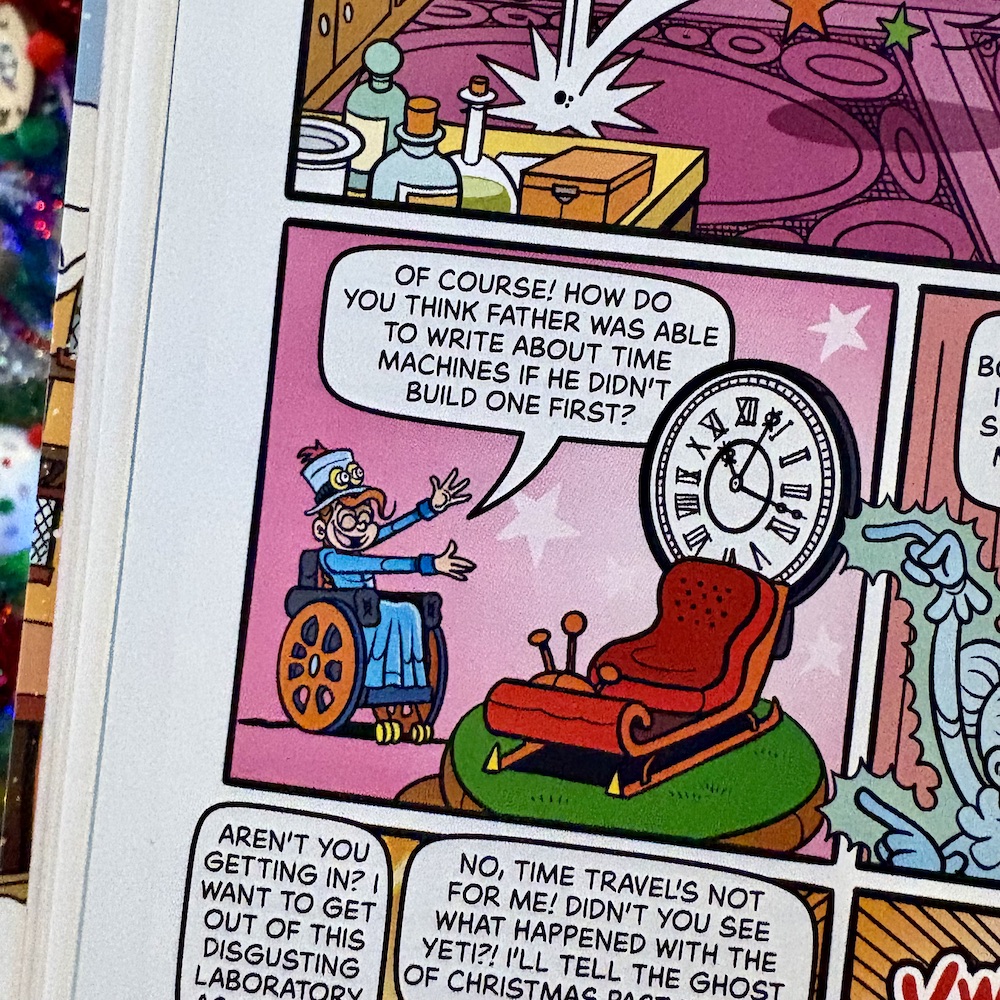
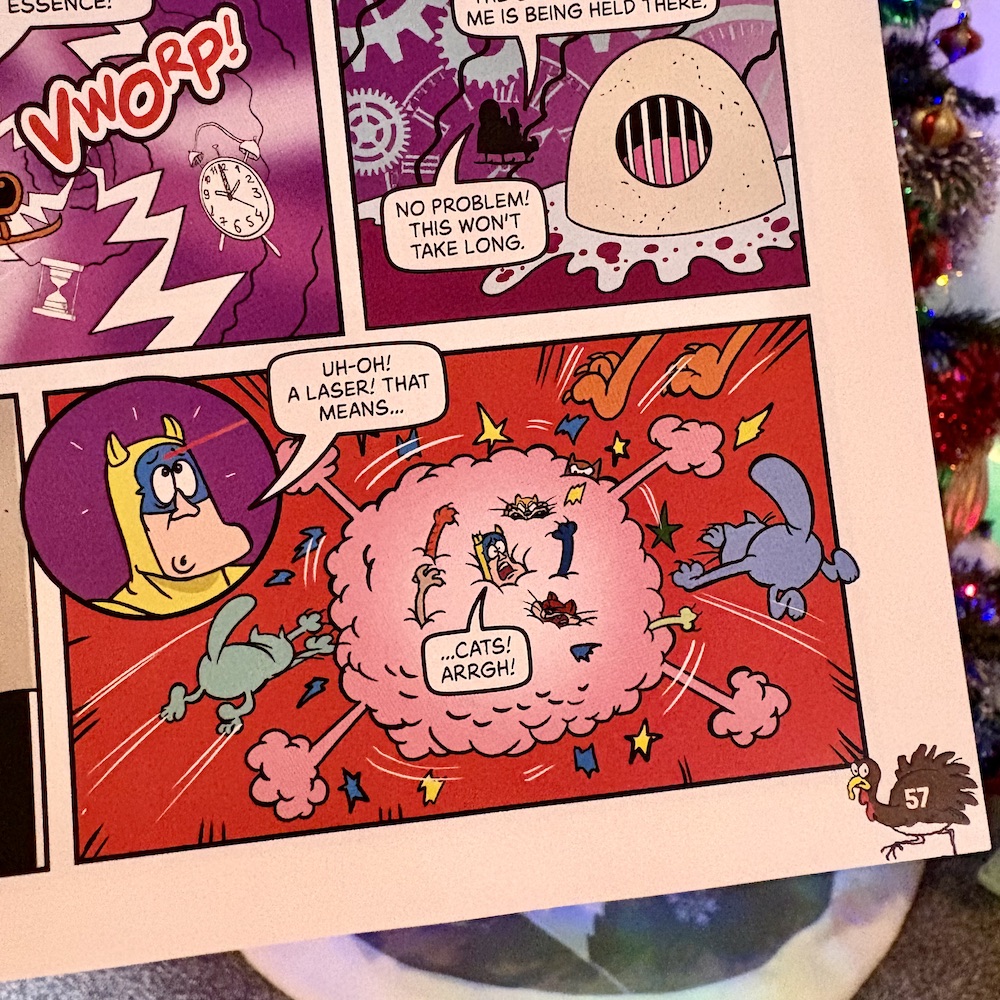
Rubi’s Screwtop Science pops up several times across the issue thanks to her dad’s time machine invention. Oh, and her dad is H.G. Wells so you can guess what the machine looks like (and it comes complete with a certain Doctor Who sound effect). You see, the ghosts are all a bit useless and need Rubi’s help in order to carry out their plan to make Scrooge learn the error of his ways and the true meaning of Christmas. But this is the modern day Beano and it all goes completely nuts and utterly chaotic very quickly!
If you thought last year’s tale didn’t let up you haven’t seen anything yet. The team have really outdone themselves. What a team, too! The complete list of writers and artists for this special reads like this: Danny Pearson (who featured in a previous festive OiNK post), Andy Fanton, Nigel Auchterlounie, Laura Howell, Emily McGorman-Bruce, Nigel Parkinson, Barrie Appleby, Steve Beckett, Shannon Gallant, George Cant, Ned Hartley, Mel Prats, Hugh Raine, Alan Ryan, Leslie Stannage, The Sharp Bros. and Wayne Thompson. Phew! Talk about a who’s who of comics talent.
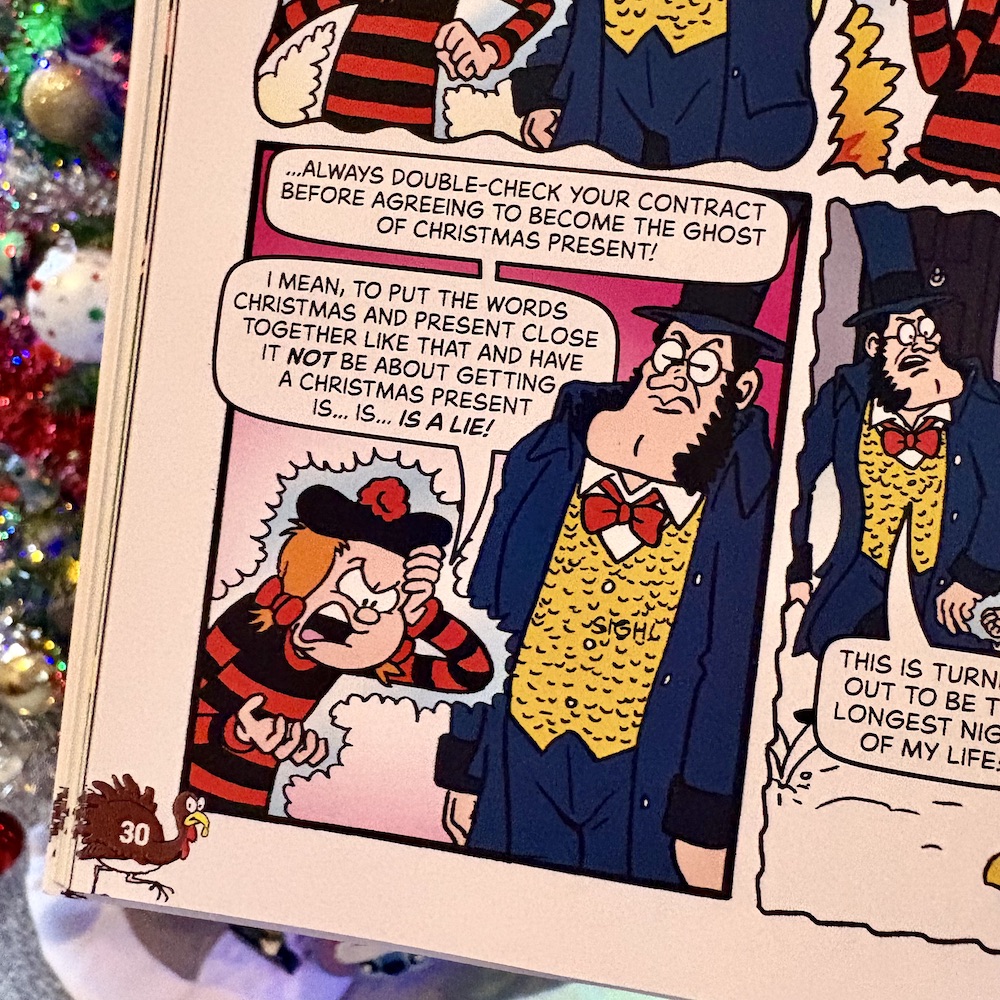
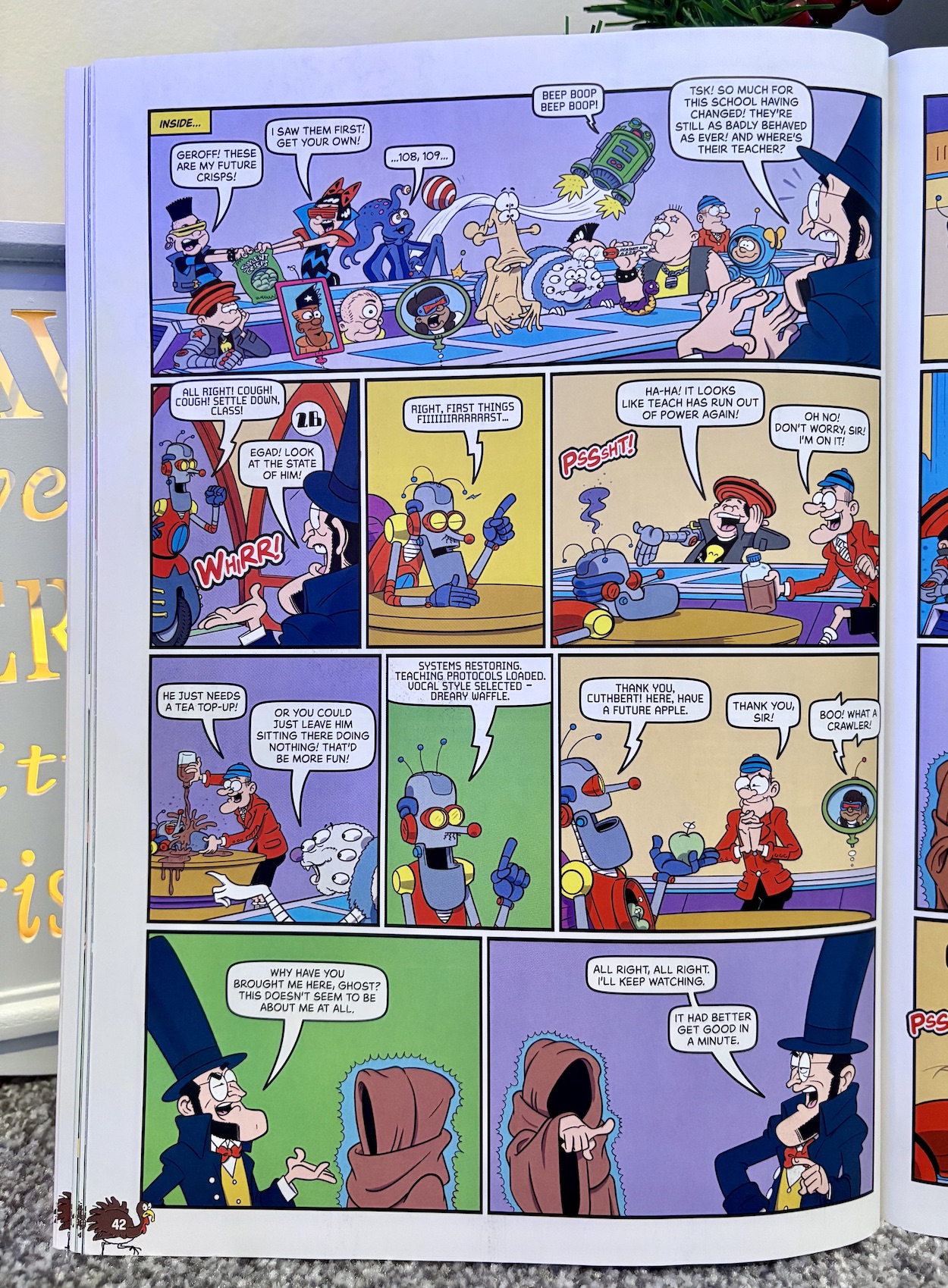
Don’t be expecting this to follow the classic tale that closely. There are moments when it pays its respects but then you’ll turn the page and find the Ghost of Christmas Present has brought Scrooge to the present day of the reader instead of Scrooge’s own timeline, or another has taken him to witness the Bash Street school of the far sci-fi future for no apparent reason, or Bananaman trying to infiltrate a prison before it’s built! Why? That would ruin the surprise.
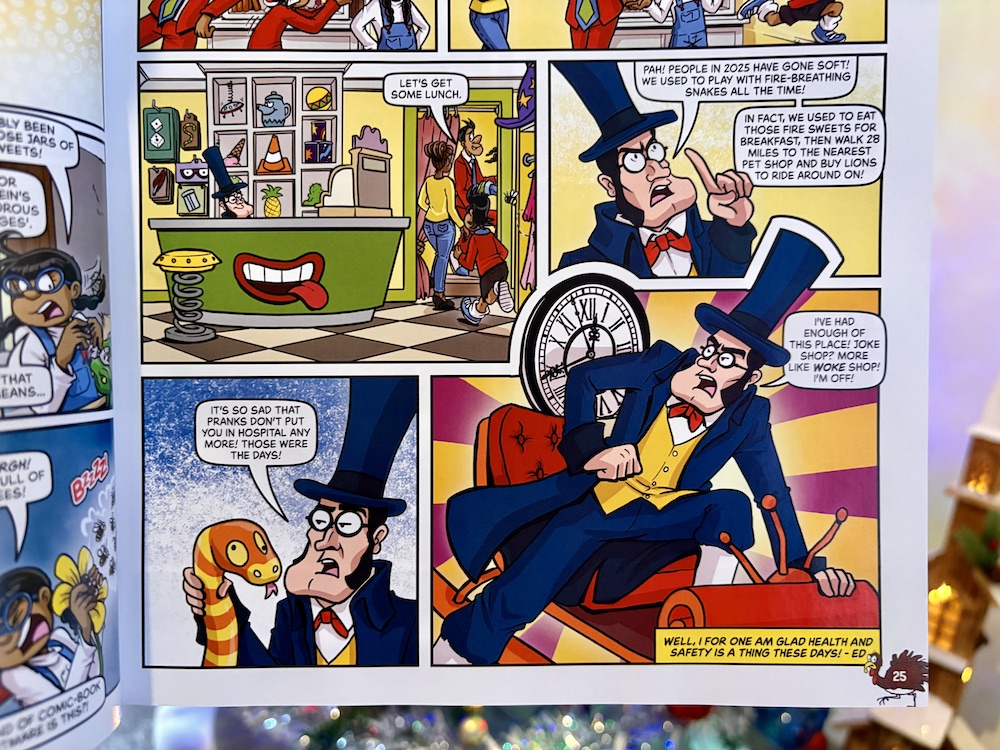
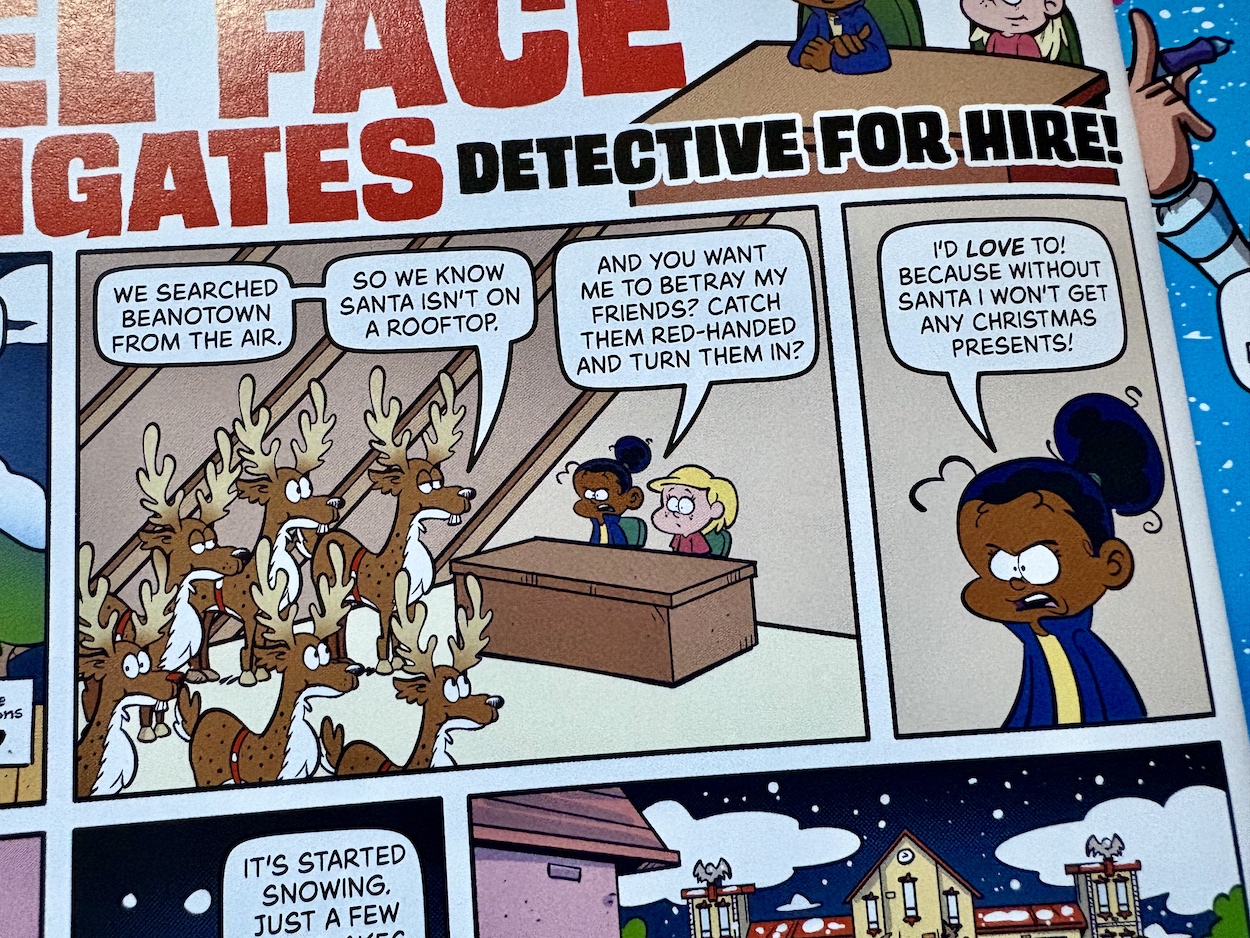
Every instance of time jumping sees us back in Rubi’s lab and every time this happens she gets more and more frustrated at the ineptitude of the ghosts. Her thunder is almost stolen by the wonderful Dangerous Dan strip and its completely random ending, there are also some lovely nods back to classic Beano years for the older readers, and a delightfully timey-wimey head-spinning Angel Face Investigates. But Rubi easily manages to hold the crown as her pages made me roar every time she appeared.
It should be clear how much I’ve enjoyed this and I’m not even the target audience. Alongside the whopping 48 pages given over to the story there are also a multitude of quality puzzles, games and activities for the kids, all festively wrapped up in a 76-page special (even bigger than last year’s) printed on exceedingly good quality paper with a card cover. There’s no need to balk at the £7.99 price tag either, by the time you’ve absorbed the amount of gags in here and your kids have laughed and drawn and pranked their way through it all you’ll see it for the bargain it is.
It should be readily available in your local shops and supermarkets. I ordered mine from DC Thomson directly through the Beano’s website shop. It’s available there as a single issue or as part of various bundles with the Beano Annual, Dandy Annual and the traditional special Dandy/Beano book. Also, if your child would like to join the Beano fan club they’ll receive this, the summer special and the annual as part of the club! I’ll say it again: bargain.
Grab a couple of slices of boozy fruit cake and a big glass of your favourite festive tipple but be ready to spurt them out several times while you read this. In other words, you should buy it. The only way it could be improved upon is if they’d included more of those tags! Yes, I’ll die on this hill. Hey Beano, maybe next year? Or put them up on your shop. I wouldn’t be alone in buying them, I’m sure. In the meantime folks, grab yourself a copy of the Beano Christmas Special 2025 and you’ll feel like a big kid even more than usual this holiday season. Guaranteed.
This review was originally written for and published on Down the Tubes. As I’m now going to cover these yearly specials on the OiNK Blog I decided to copy this post over too.
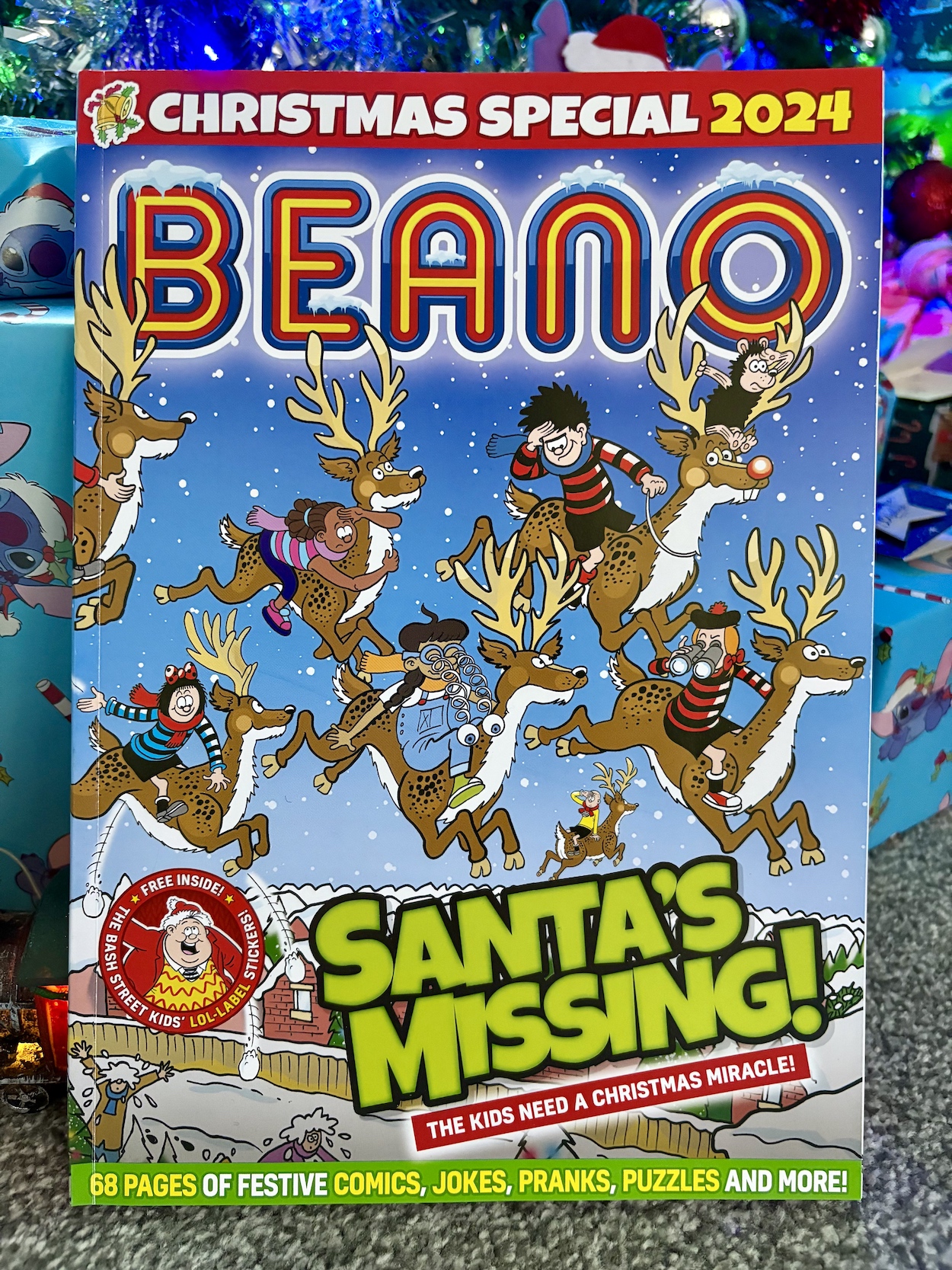
As I write this the Christmas issue of Beano (No.4266) is out, however every year publisher DC Thomson also releases a separate festive special in advance of the season. Printed on high quality paper and coming in at an impressive 68 pages, it’s almost like another Beano Annual. No one can accuse the team of not going large for the holidays!
All the usual characters are in place from a plethora of top talent, my personal favourites being Andy Fanton, Nigel Parkinson, Nigel Auchterlounie, Laura Howell and friend of the OiNK Blog, Danny Pearson. Initially looking like a bigger regular issue, as you read you soon realise all the strips are part of one story from different perspectives, without ever sacrificing the quality of the individual strips.
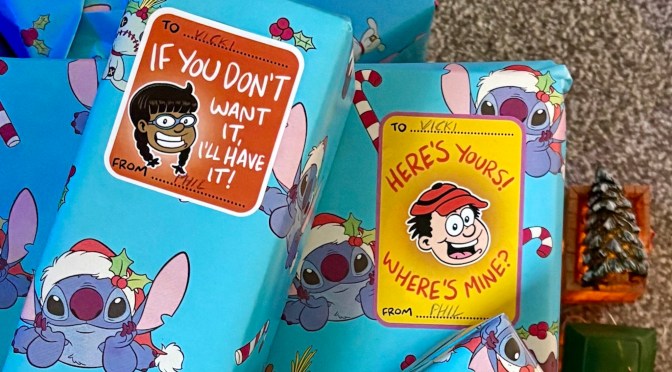
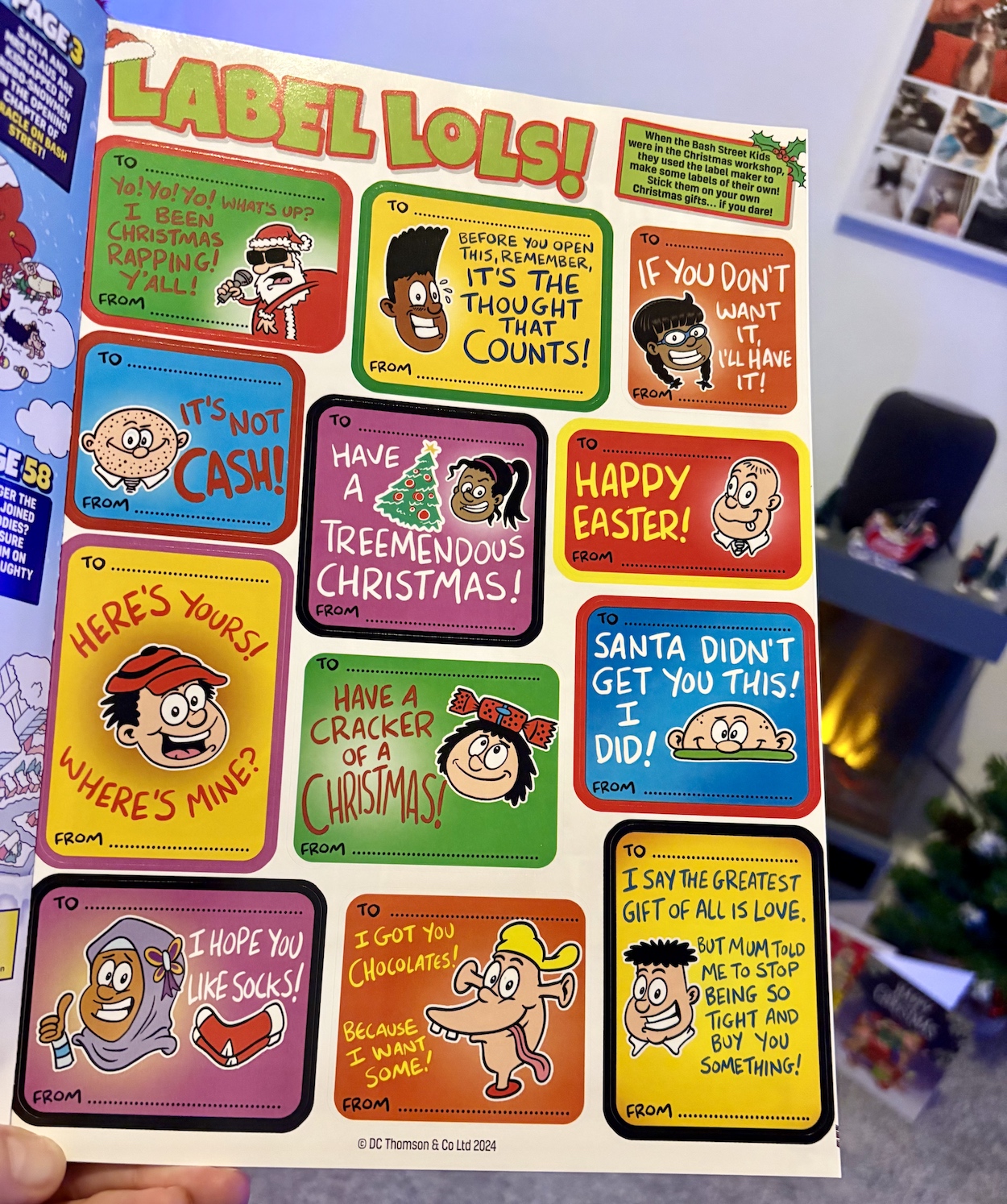
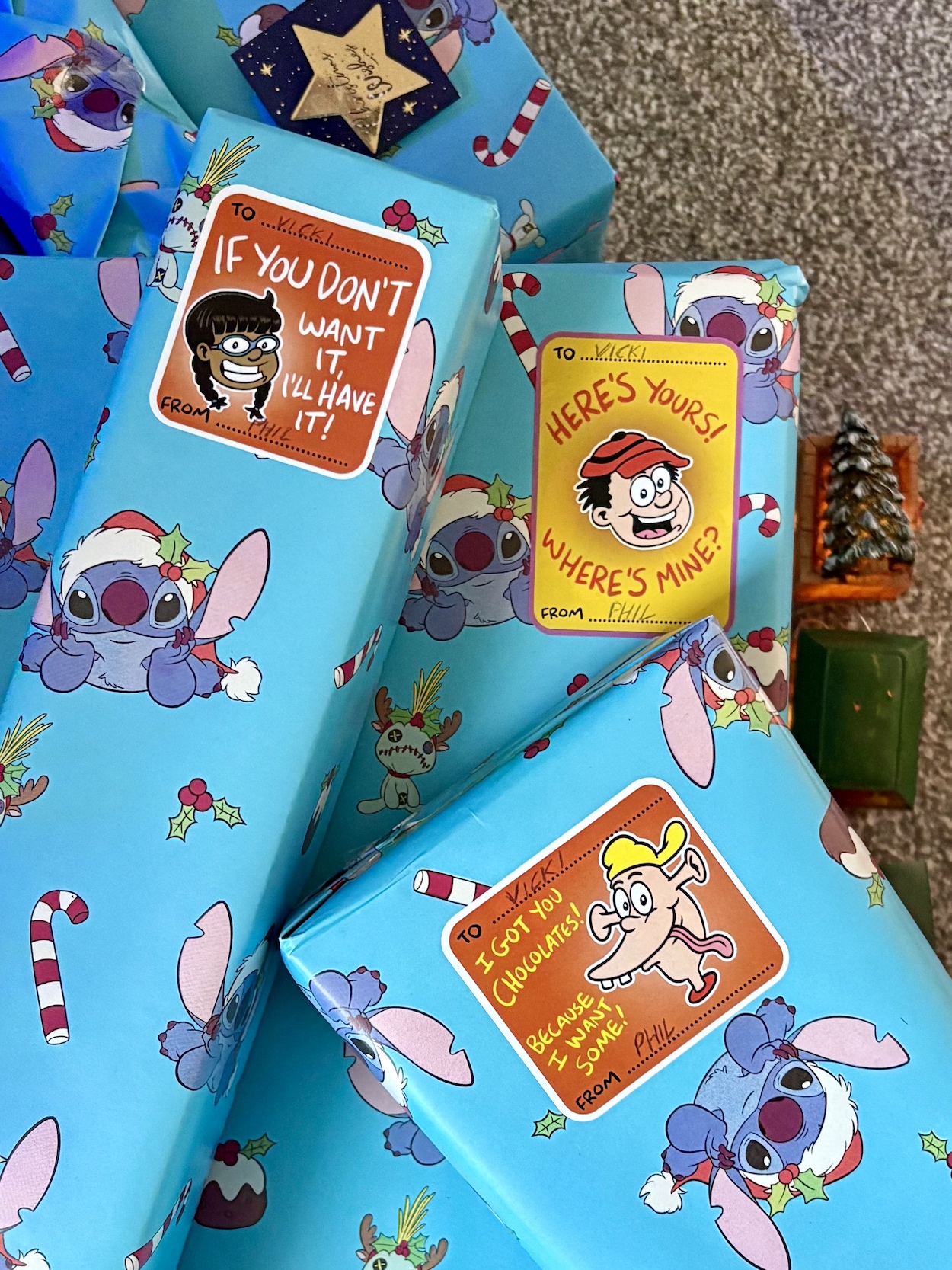
Upon opening you’re met with a page of gift labels. Aimed at kids rather than the present-buyers, that doesn’t mean older readers can’t enjoy them, as you can tell from my photos. The one featuring Harsha from Bash Street Kids was particularly well suited to that gift!
So, Santa has been kidnapped and for once the Beanotown kids aren’t to blame. (This is the first Christmas Special I’ve read but it’s clear there’s a history here). When Mrs. Claus asks why he still delivers there when they kidnap him every year, Santa explains, “It’s only most years, and twice it was more of a misunderstanding.”
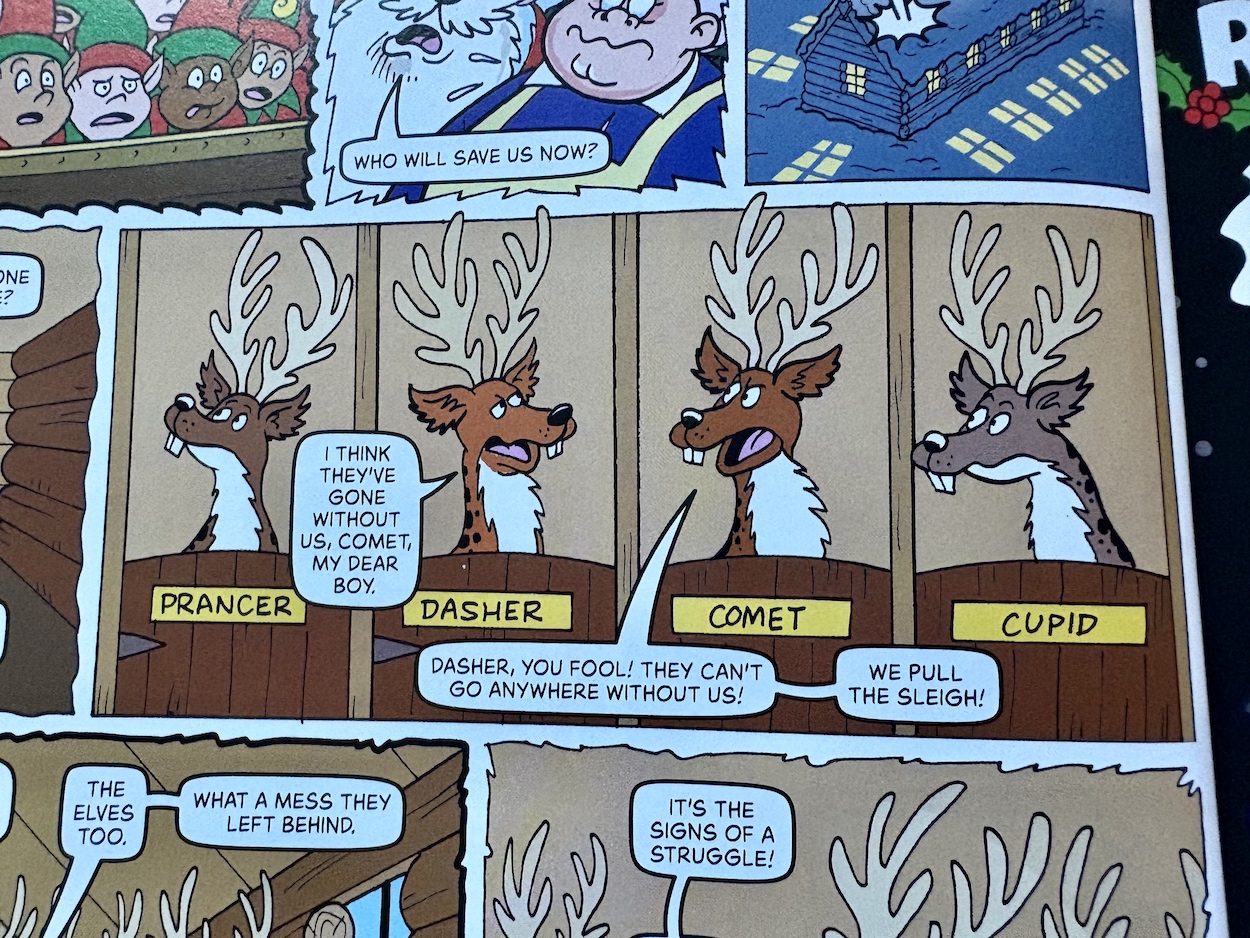
However, the kids are blamed throughout in some very funny moments, including by Santa’s reindeer, who immediately pin it on Minnie! I just have to mention Dasher at this point. The personality given to him is just perfect for his name and I laughed aloud when I read this scene in the stables. It’s such an obvious gag now that I’m surprised I haven’t read something similar before.
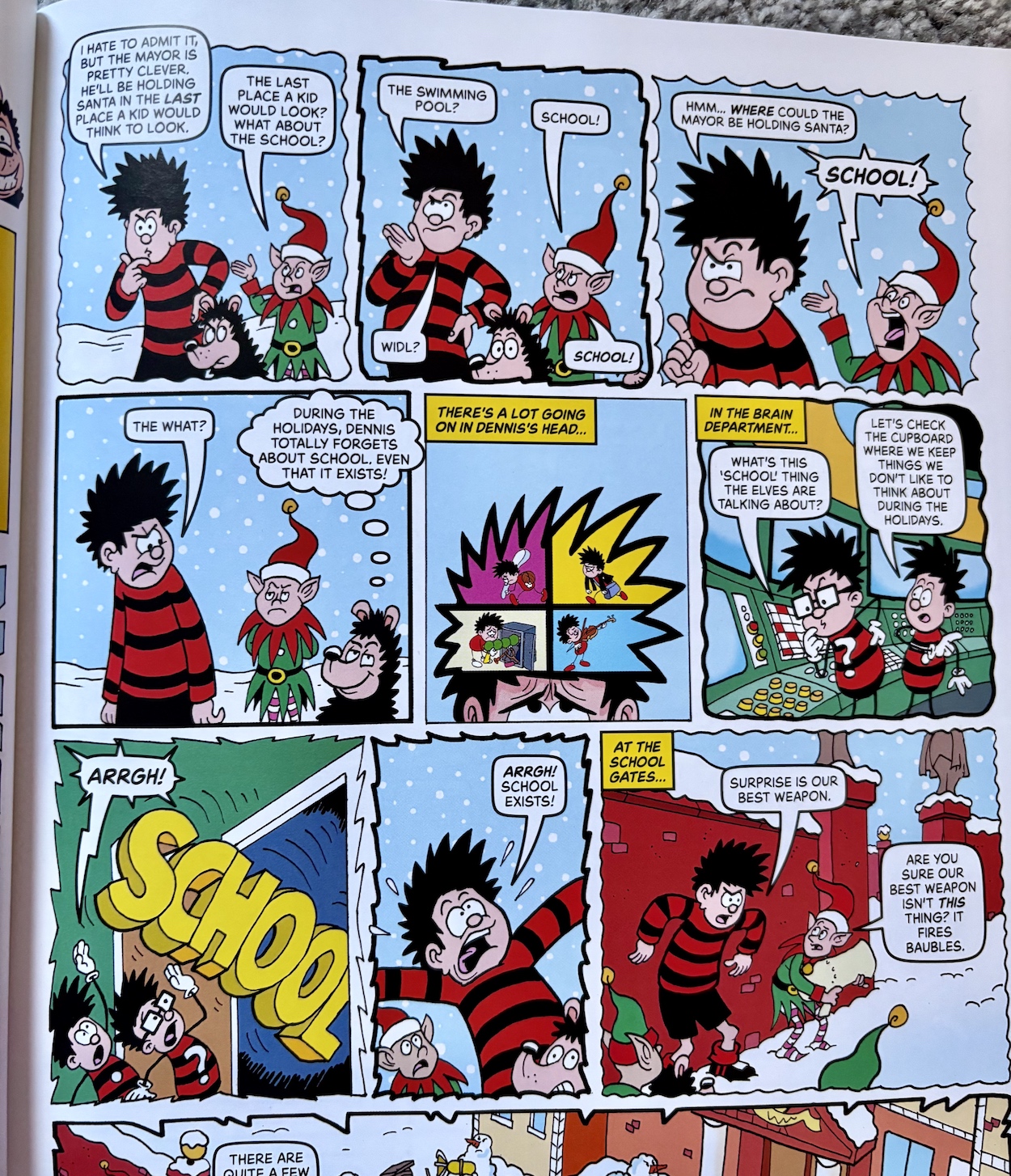
The big bad behind it all is revealed early on as Mayor Brown, who bears a striking resemblance to Richard Osman and whose voice I read his lines in for the rest of the comic. This is a world away from the Beano I read as a kid and that’s a good thing; it has to move on and evolve for today’s kids after all. As a result, the humour moves at a much faster pace, with more quips and banter between characters and some enjoyable breaking of the fourth wall. It’s a lot more chaotic and anarchic. As an OiNK fan, I love it!
I don’t want to ruin what happens because the joy is in not knowing what’s next; something this definitely isn’t is predictable! Bond villain Brown takes Bash Street school as his lair with his robotic snowmen to ruin Christmas, a scenario perfectly set up by spy strip, Dangerous Dan. From here, everyone gets a crack at teaming up with other characters from different creators and it’s fun to see the various artists’ takes on each other’s creations.
I may have had several laugh-out-loud moments but I’m not the target audience, despite how young I felt reading this. However, my friend’s son is. Father and son subscribe to Beano and read it together, and they’ve a set of criteria upon which they judge each and every issue. I know you’re thinking this’ll be a list of favourite characters but it’s a bit more… comprehensive than that. Kids can have very particular tastes.
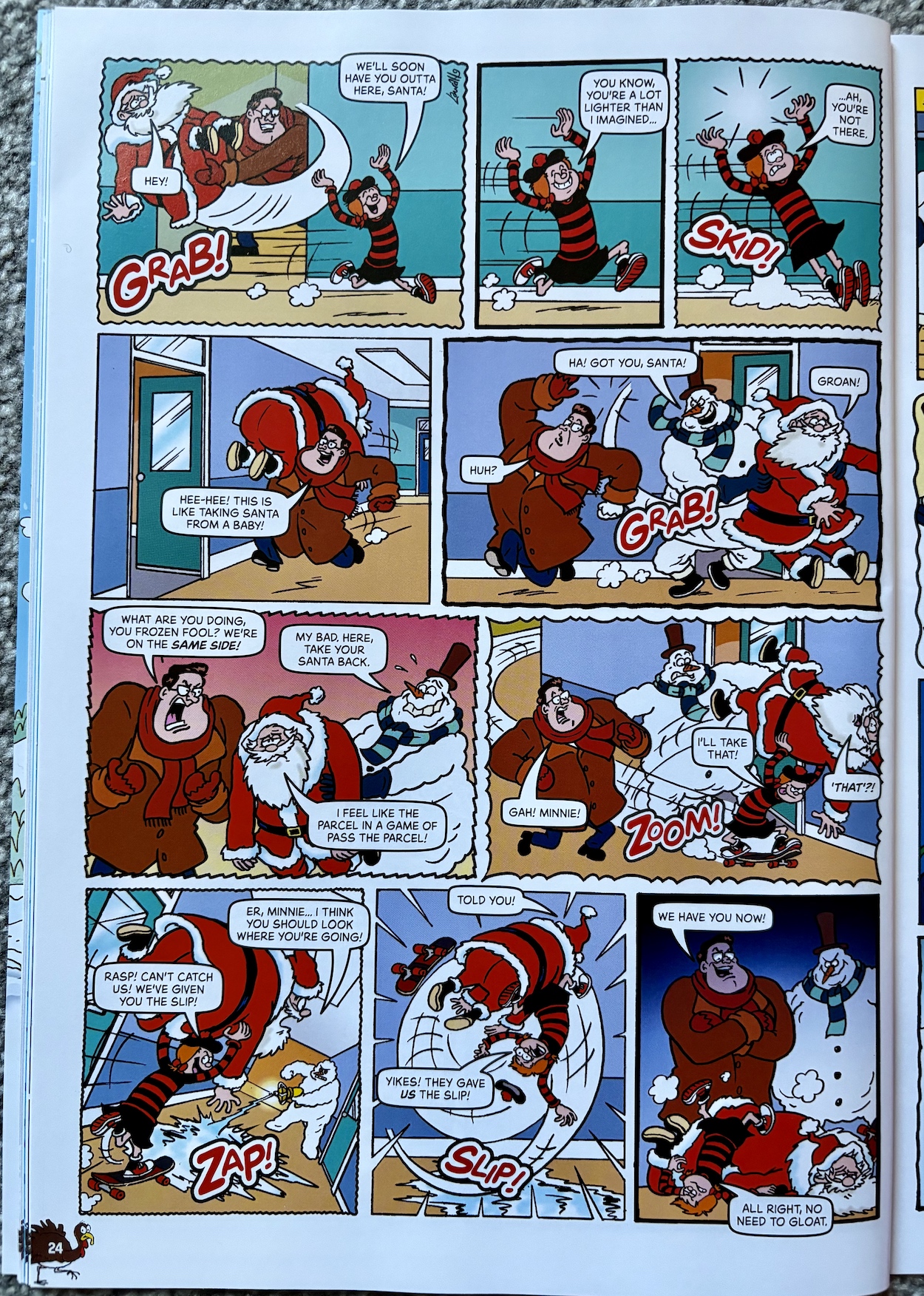
They want lots of Angel Face and Minnie the Minx for a start. They weren’t disappointed here, especially with the amount of Minnie content. (On a side note, as a fan of Andy Fanton’s work it’s great to see his Minnie is so treasured.) Next, Yeti and Cousin Agnes should feature beyond their own strip and for a special Christmas treat it’s actually Minnie they mingle with here. Dennis also breaks the fourth wall as wanted and, while Rubi’s latest invention isn’t as ‘Heath Robinson’ as they’d like (no, really) it plays a pivotal role and her mistakes bring plenty of smiles.
Always important to get the target audience’s view, right?
There are also several activity pages such as mazes, board games, pranks etc. They may sound clichéd but each is finished to such a high quality you could never call them fillers. I focussed solely on the comic strip (and the free stickers) but there’s plenty for younger readers to do to get more value out of your money.
Whether you’ve kids of your own or just want to read a new funny comic this holiday season, the Beano Christmas Special 2024 is exactly what you need. It even has snow on the logo, so you know it must be good.
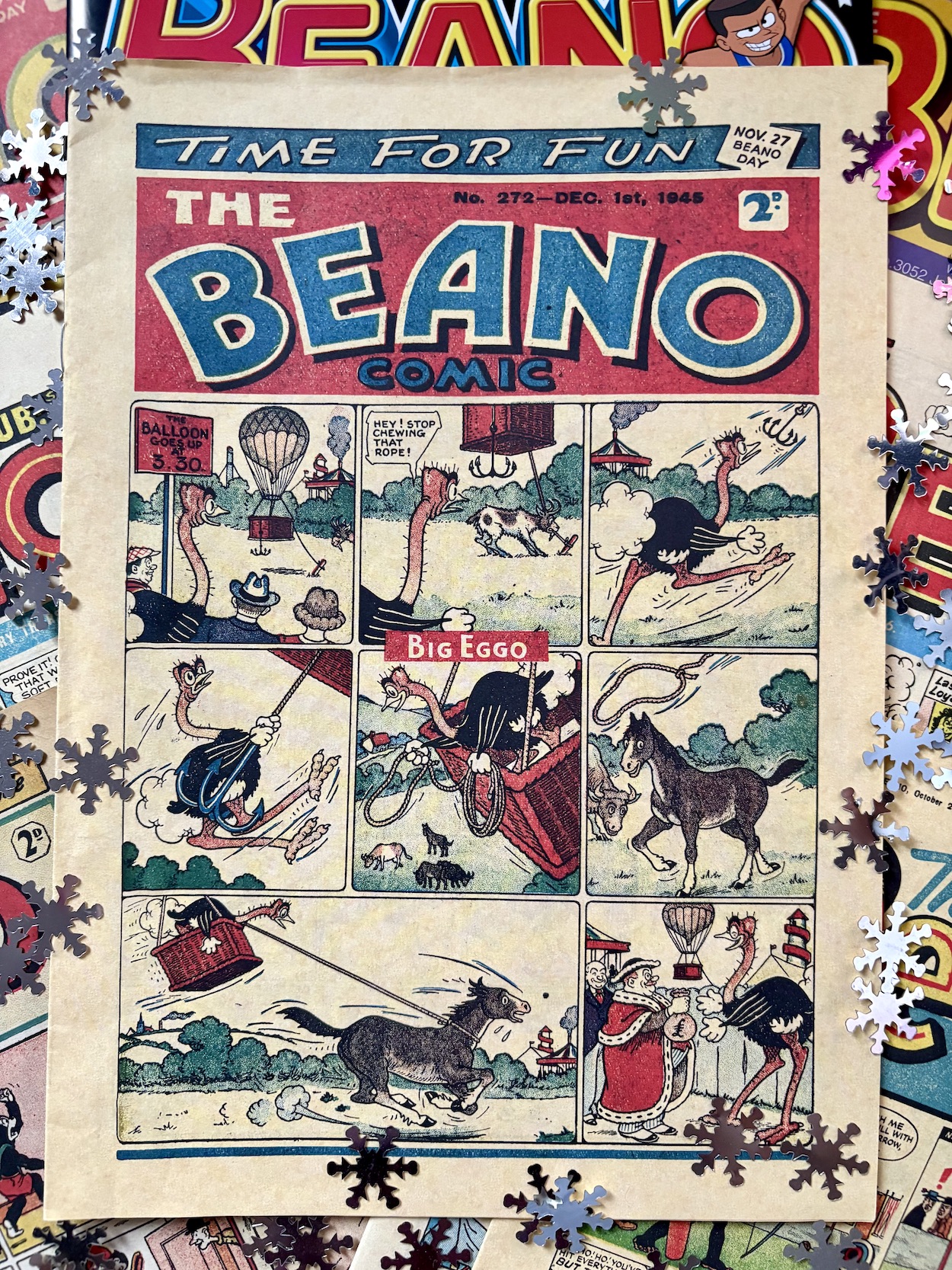
Welcome back to our irregular real time read through of the eight celebratory editions of Beano from DC Thomson’s 80th anniversary box set. Next up is the first issue to have sold one million copies! That’s an incredible achievement on its own, never mind the fact it was back in 1945, not long after World War II and at a time when paper shortages were still in effect. As such, Reg Carter’sBig Eggo fronted a comic of only 12 pages, the smallest it would ever be.
The Beano was also fortnightly at the time, released on alternative weeks to The Dandy so kids still had the opportunity to read some desperately needed funnies every week. I’ve always found this period in the comic’s history fascinating ever since I found out about it in the 50th anniversary Dandy/Beano Fifty Golden Years book I received for Christmas1987, which you’ll see an overview of this year on Boxing Day on the blog. For now though, let’s open up #272 of The Beano, which celebrates its own 80th anniversary today.
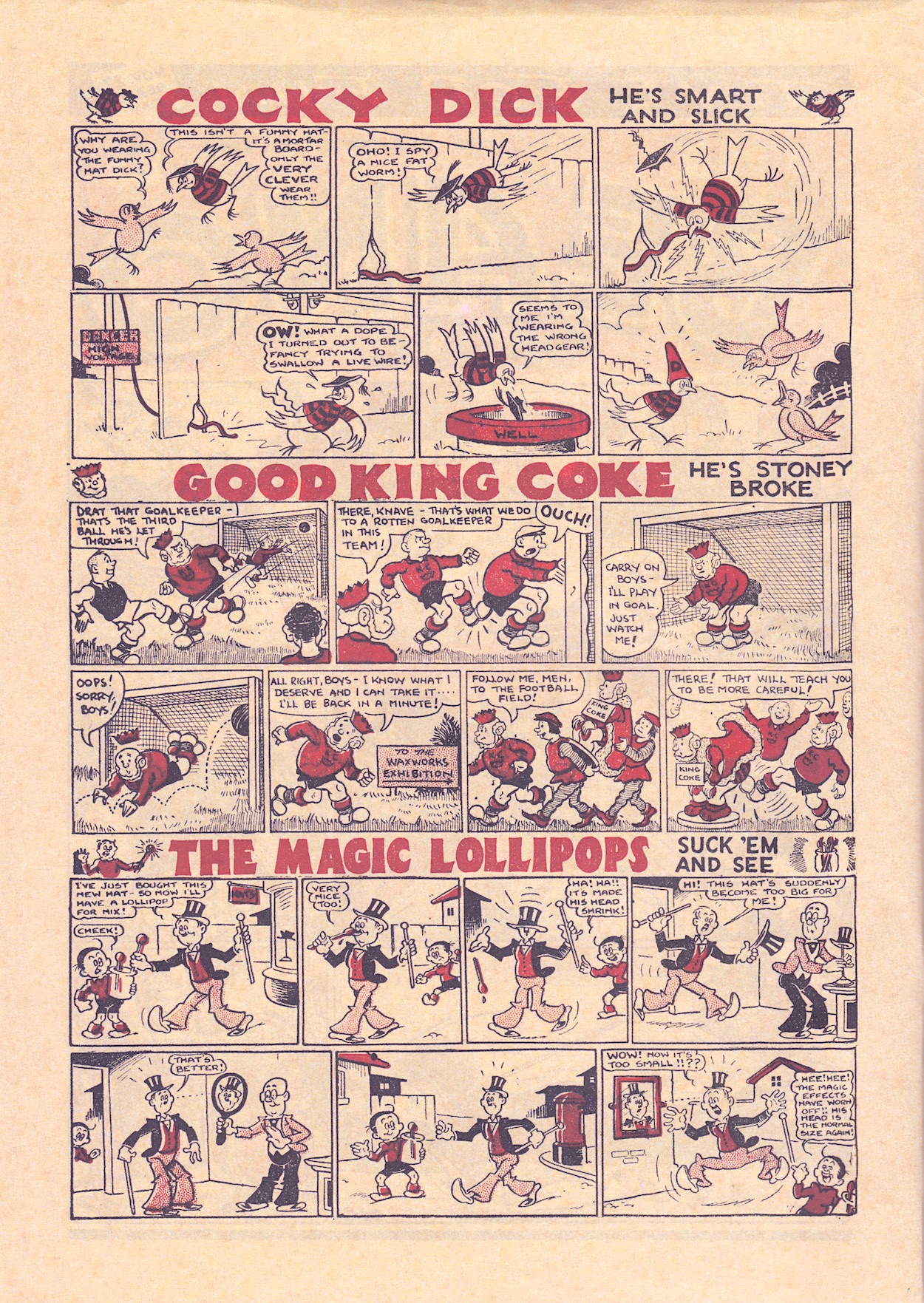
What a selection of names and taglines! Talk about being “of their time”. Researching Cocky Dick meant very careful internet searches but I did eventually find out it was originally drawn by Allan Morley and ran in the comic from 1939 to 1947. There’s an air of Dennis about the strip thanks to the cheeky nature of the main character and the colour scheme of his feathers. Nice of the local council to label their water wells too, otherwise how’d we know what it was.
After an absence of three years Good King Coke (surely a 90s movie drug lord name) had returned for another year-long run, drawn by Eric Roberts, and The Magic Lollipops (“Suck ‘em and see”?!) was also drawn by Allen and ran for ten years between 1941 and 1951, with a one year gap in the middle. I don’t think any other page in either #1 or this edition has been such a clear window into a completely different time.
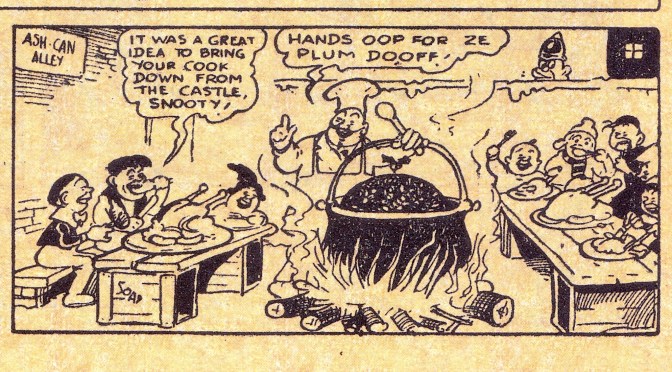
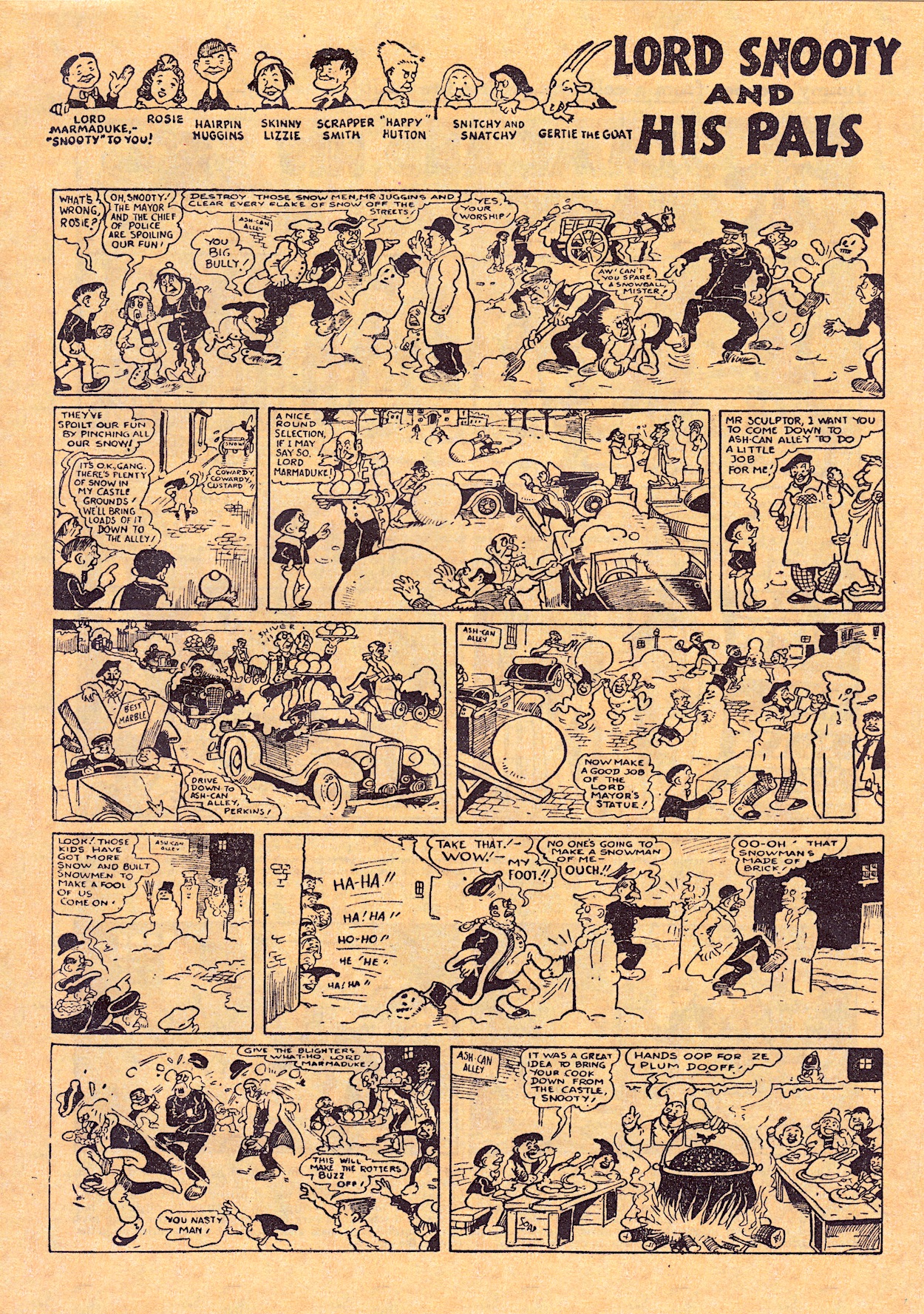
A Christmas strip! Perfect. With The Beano being fortnightly we were only one issue away from the big festive celebrations and Lord Snooty was getting in on the action already. As the season has already kicked off on the OiNK Blog this year I couldn’t have been happier when I saw this, drawn by Dudley D. Watkins. Snooty’s strip ran from 1938 all the way through to 1991, with a few breaks in the middle.
Upon his return after his first break a lot of his original friends above would be replaced with characters from other, discontinued Beano strips and over the course of his lengthy run he was drawn by a handful of other artists, most notably Leo Baxendale and Robert Nixon. Lord Snooty was the only character from #1 I knew as a child in the 80s (through sneaking a peek at my friends’ issues), by that time he was the last surviving character of that first issue.
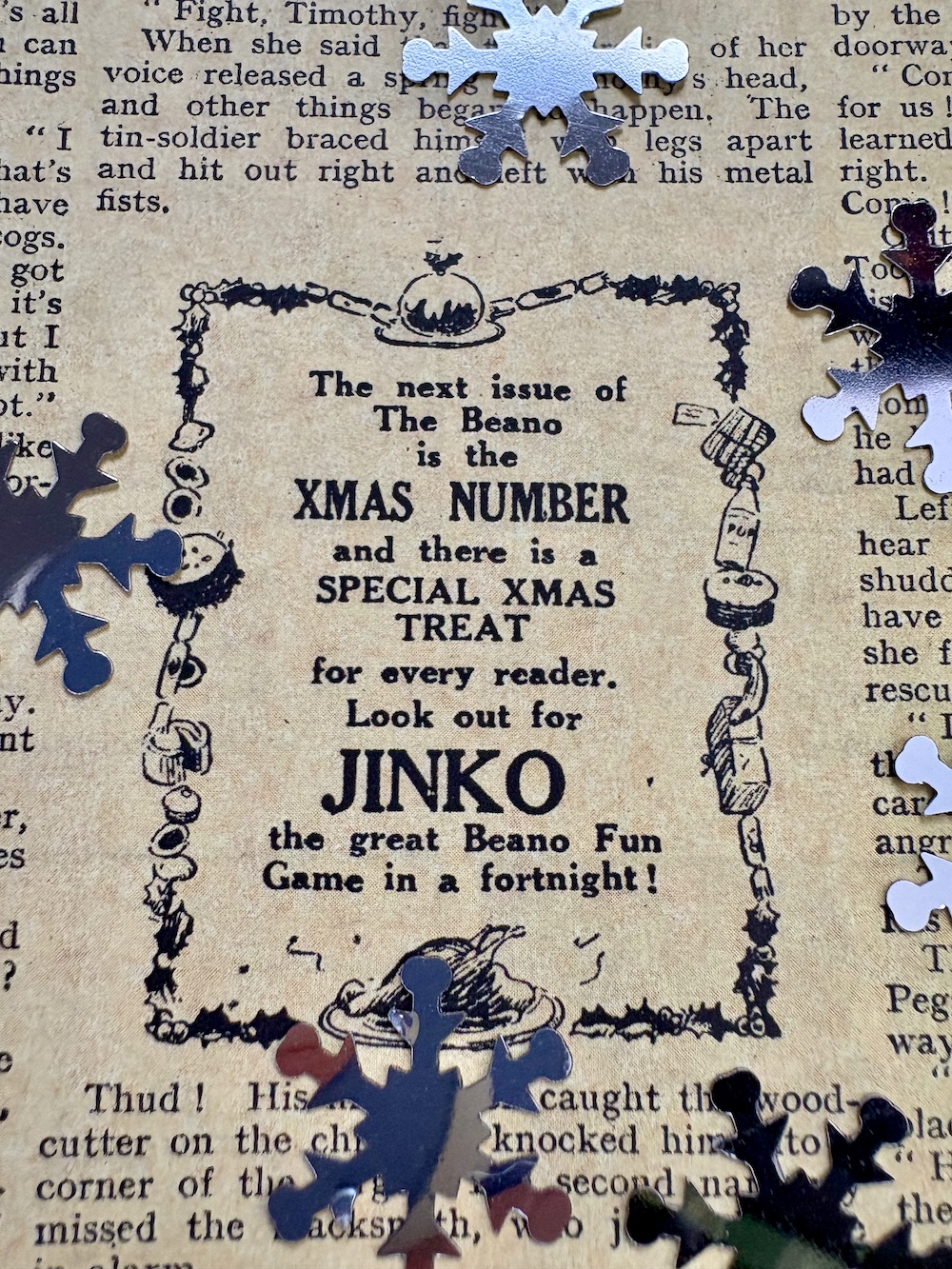
Along the top of a Jimmy and his Magic Patch story readers are told to turn to a certain page to find out all the details of the special Christmas issue, but it turns out it’s only this small promo in the middle of a Tick Tock Timothy prose story. The main selling point of the festive issue would be a game called ‘Jinko’, a basic dice board game printed on the back cover. Over the page from this promo we find Tom Thumb is still in the comic, albeit as a picture-panel story instead of the prose of #1.
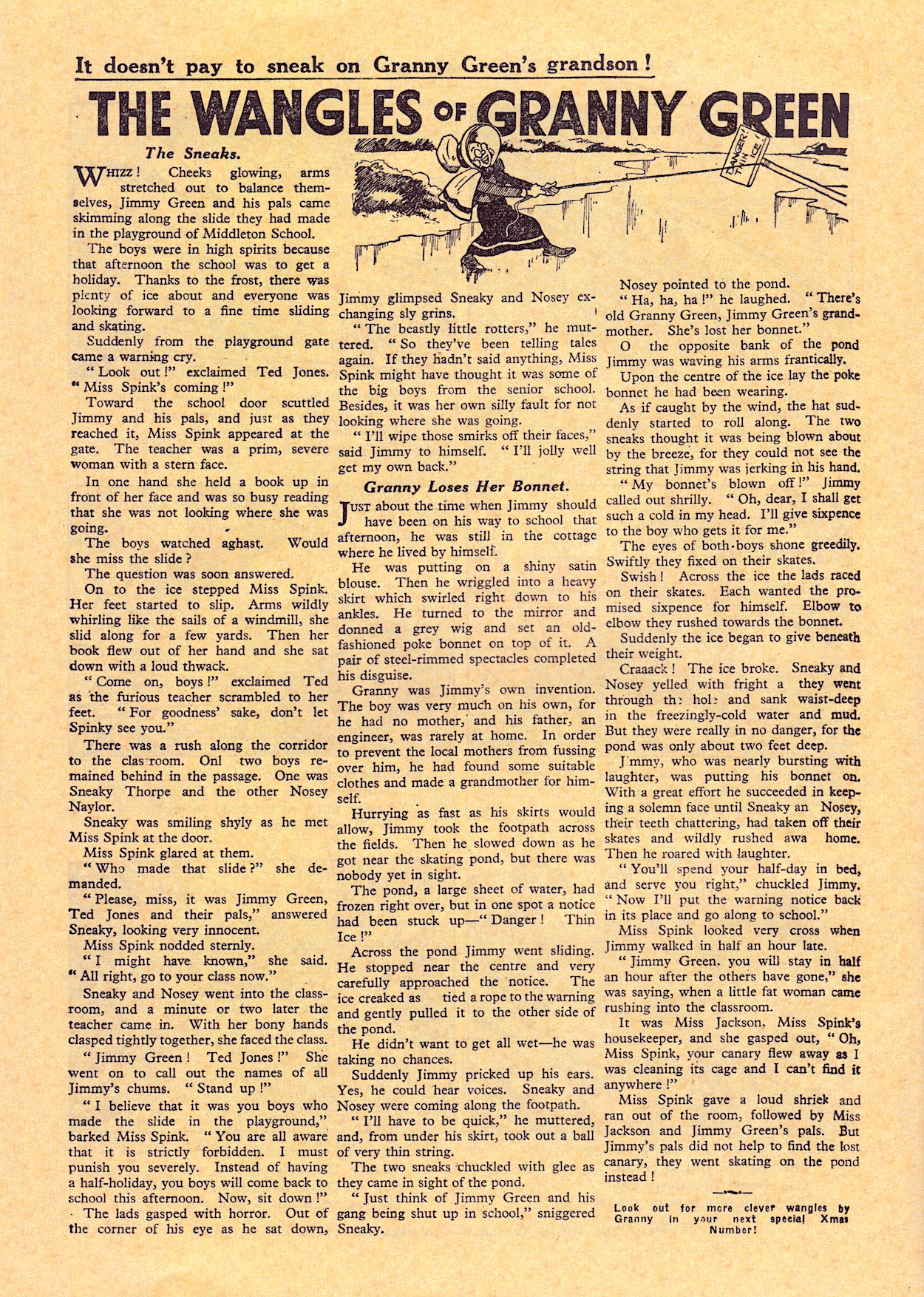
Another character who was still here but whose format hadn’t changed is one of my favourites from the premiere issue, Charles Gordon’sGranny Green. This was actually a reprint from the original run in the first year-and-a-bit of the comic but obviously I’ve never read it. Again, I really enjoyed it. It includes a quick recap of the premise for any new readers and I originally thought Jimmy’s plan in this particular story sounded awfully cruel… until we find out the water is only a couple of feet deep. Hilariously, the names of the friends mentioned still sound like the kind of creations Bob Mortimer comes up with on Would I Lie To You!
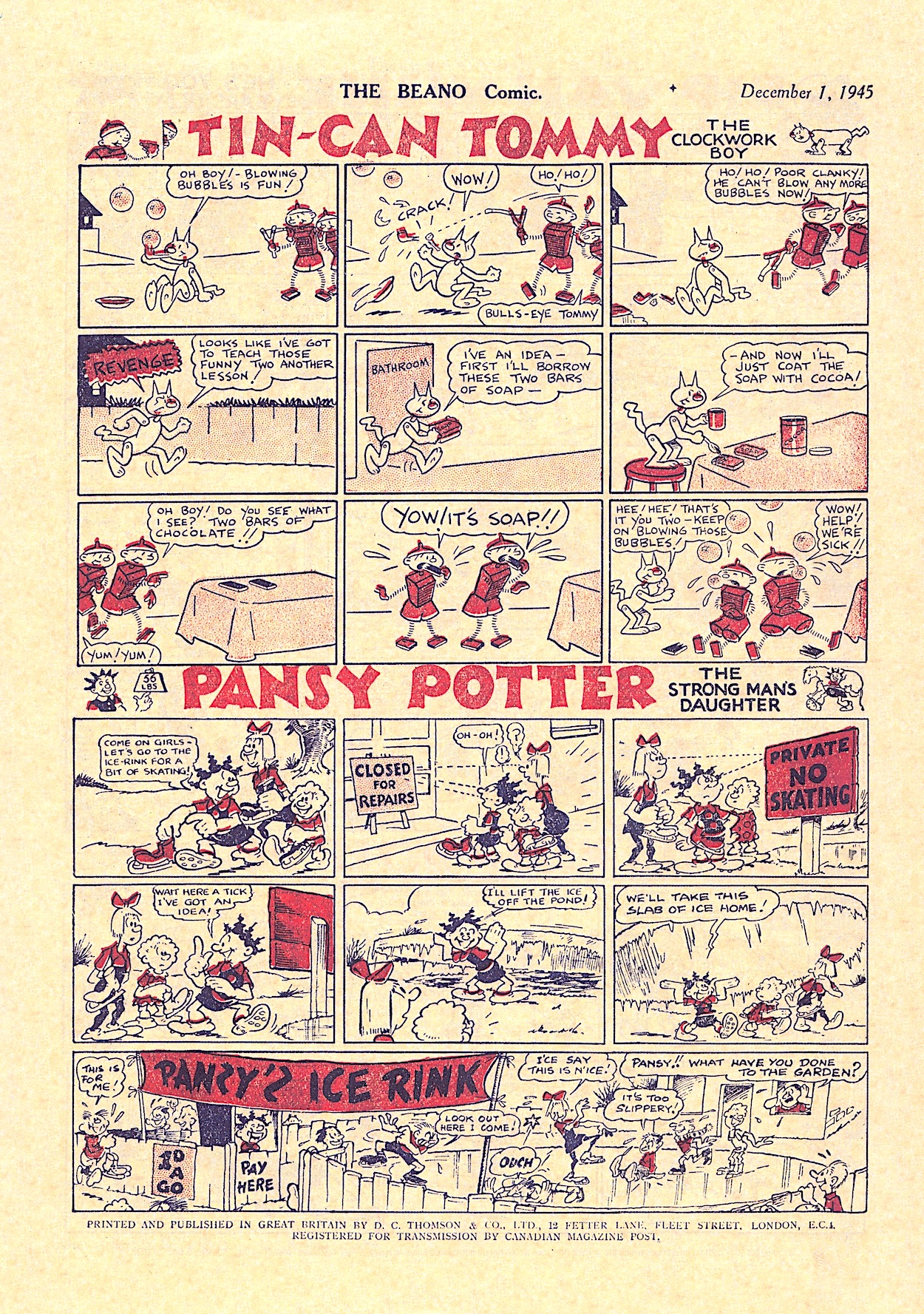
On to the back page and two well known names, beginning with Tin-Can Tommy, the clockwork ‘son’ of Professor Lee and Mrs Lee. He first appeared on the back page of the first issue when he was created after the death of their son because they were struggling with the loss. Originally drawn by the Italian Dinellibrothers who disappeared in France during the war, he was subsequently drawn by Sam Fair, Charles Gordon and George Drysdale but my usual expert resources aren’t aware of who drew this episode.
Tommy would reappear in #3185 in 2003 for the comic’s 60th anniversary. Another character who may also be known by later readers of Beano is Pansy Potter. Pansy was a Beano star between 1938 and 1958 (with breaks), then she moved to Sparky in the 60s and 70s before returning to her original home between 1989 and 1993. That’s the time period in which I remember her from, which she followed up with small runs now-and-again (her last appearance was in #3954) and a couple of annual cameos in 2012 and 2018.
Created by Hugh McNeill and drawn by this stage by Tommy’s Sam, Pansy was the character chosen to be the first strip printed in full colour on the back page a few years later. This strip above reminds me of skating at a temporary rink at Belfast City Hall this time of year many moons ago and the amount of people tripping over chunks of broken ice and toppling into each other. The council not wishing to splash out on a Zamboni never stopped us going back though.
Next time, we’ll jump from 1945 to 1951. Our third issue saw the introduction of a certain boy with a black and red jumper so its inclusion in the box set is no surprise. When this series returns, join me as we travel in time again to the year of The King and I, the Stone of Scone returning to Scotland all on its own, a blue sun, the world’s first nuclear power plant and, in keeping with the theme of Dennis the Menace, the year when a young sailor was fined for the menacing behaviour of kissing his girlfriend in public in Sweden. The Beano #452 will be right here on the OiNK Blog on Saturday 14th March 2026.
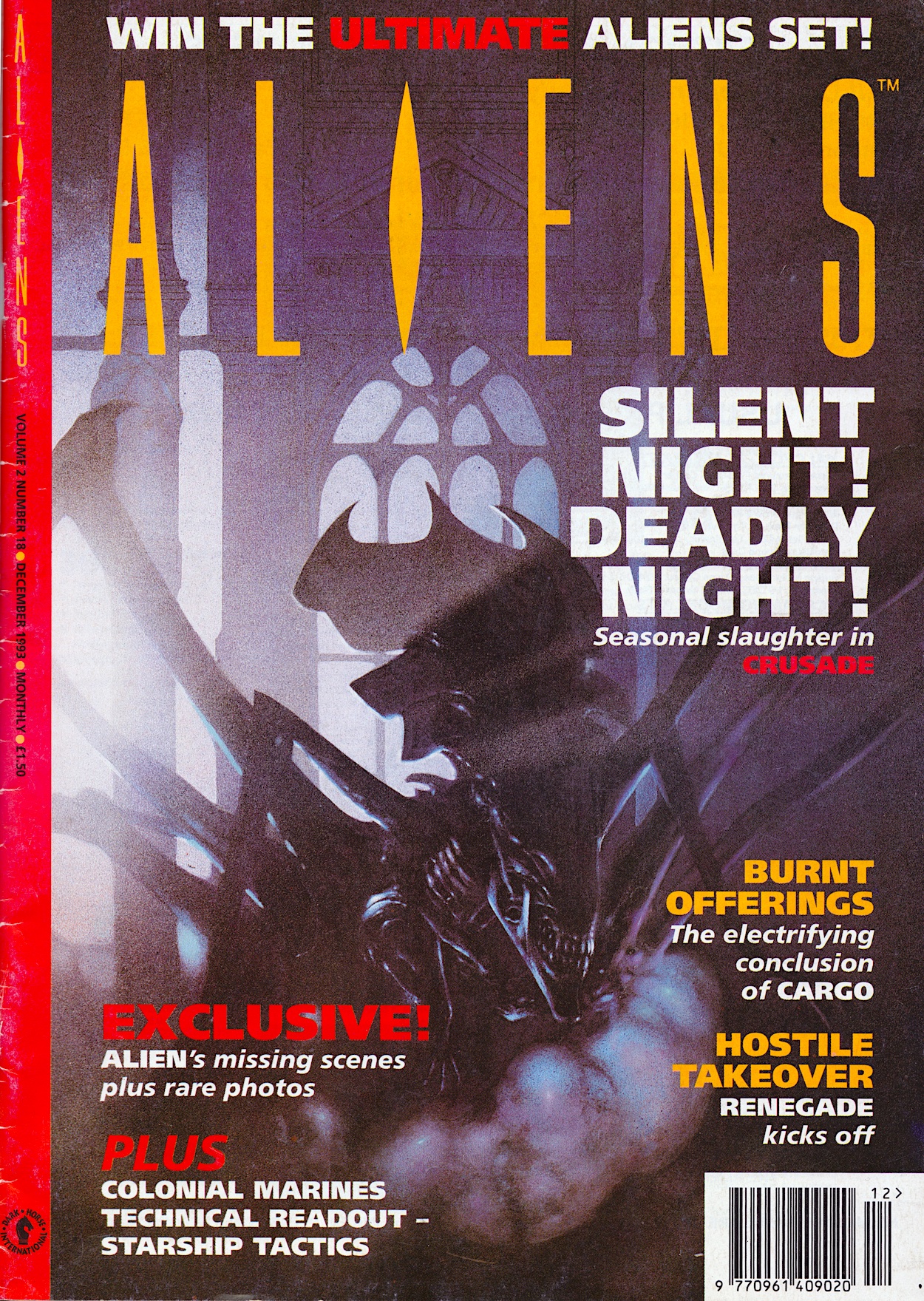
What’s this? A ChristmasChris HallsAliens cover? Am I late in covering the blog’s logo with snow? Nope, that’ll happen on 24th November (six days from the day of writing) as per usual, in this case Dark Horse International editor Cefn Ridout must’ve mistimed the chilly seasonal cover somewhat. Yes, it’s the December issue but last year Chris’ superb art and pun-filled headline were part of the January issue released on 24th December. This year there’s another issue after this one just before Christmas Day.
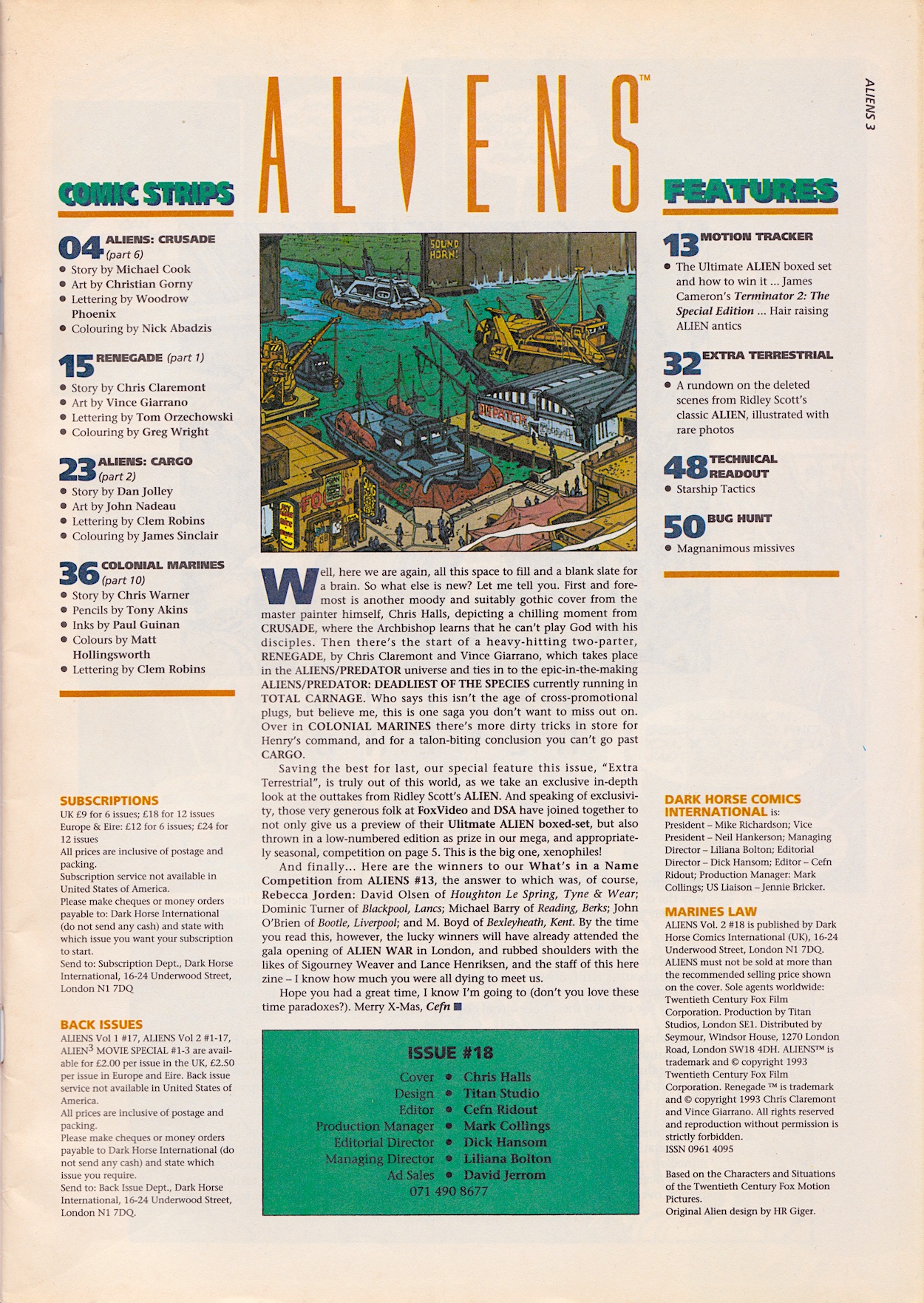
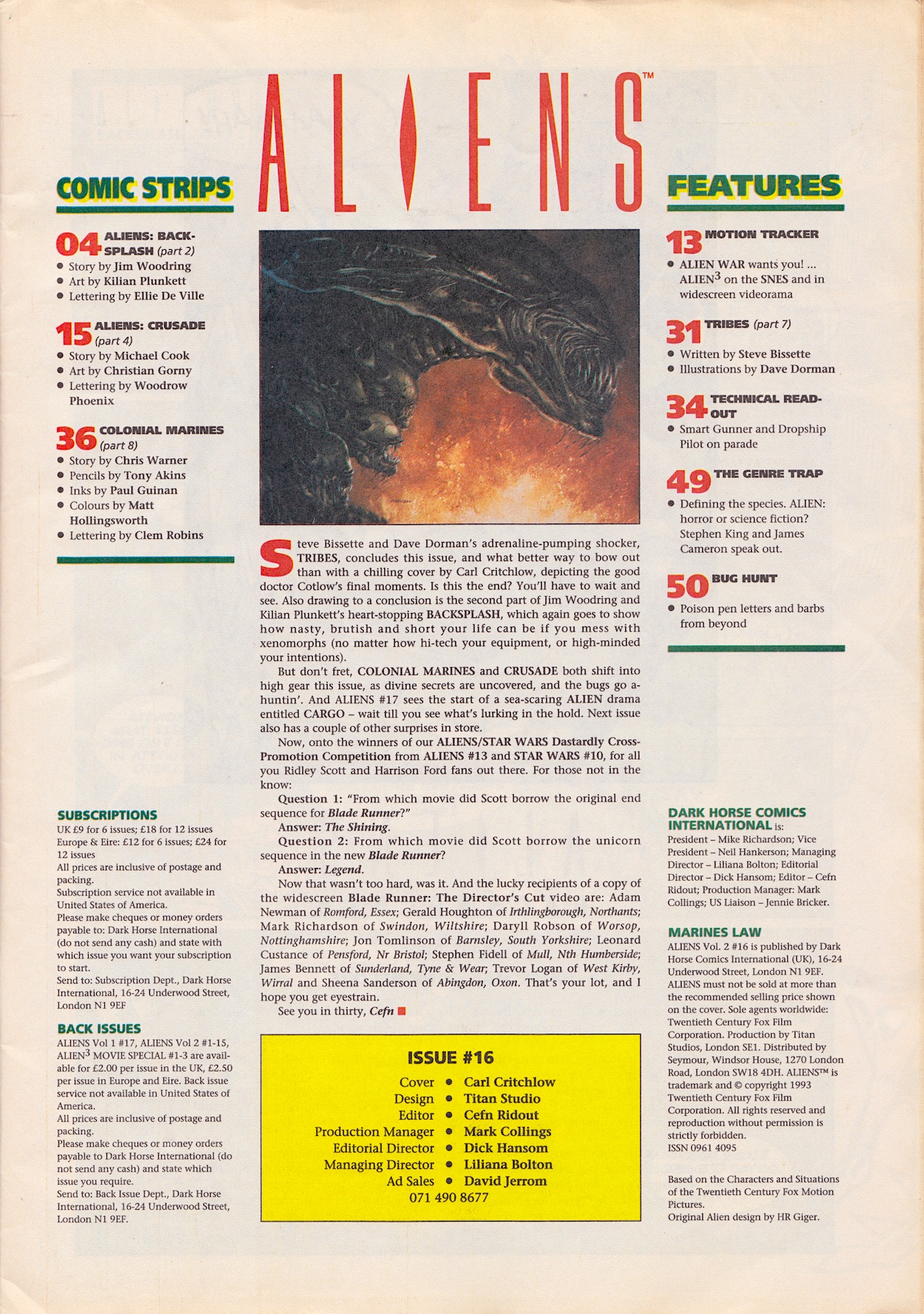
Despite this, Cefn still takes the opportunity to wish us all a Merry Christmas and since mine starts as soon as the Christmas tree goes up in a few days I’ll take it! Anyway, there’s your obligatory editorial page with the full credits for this month’s issue.
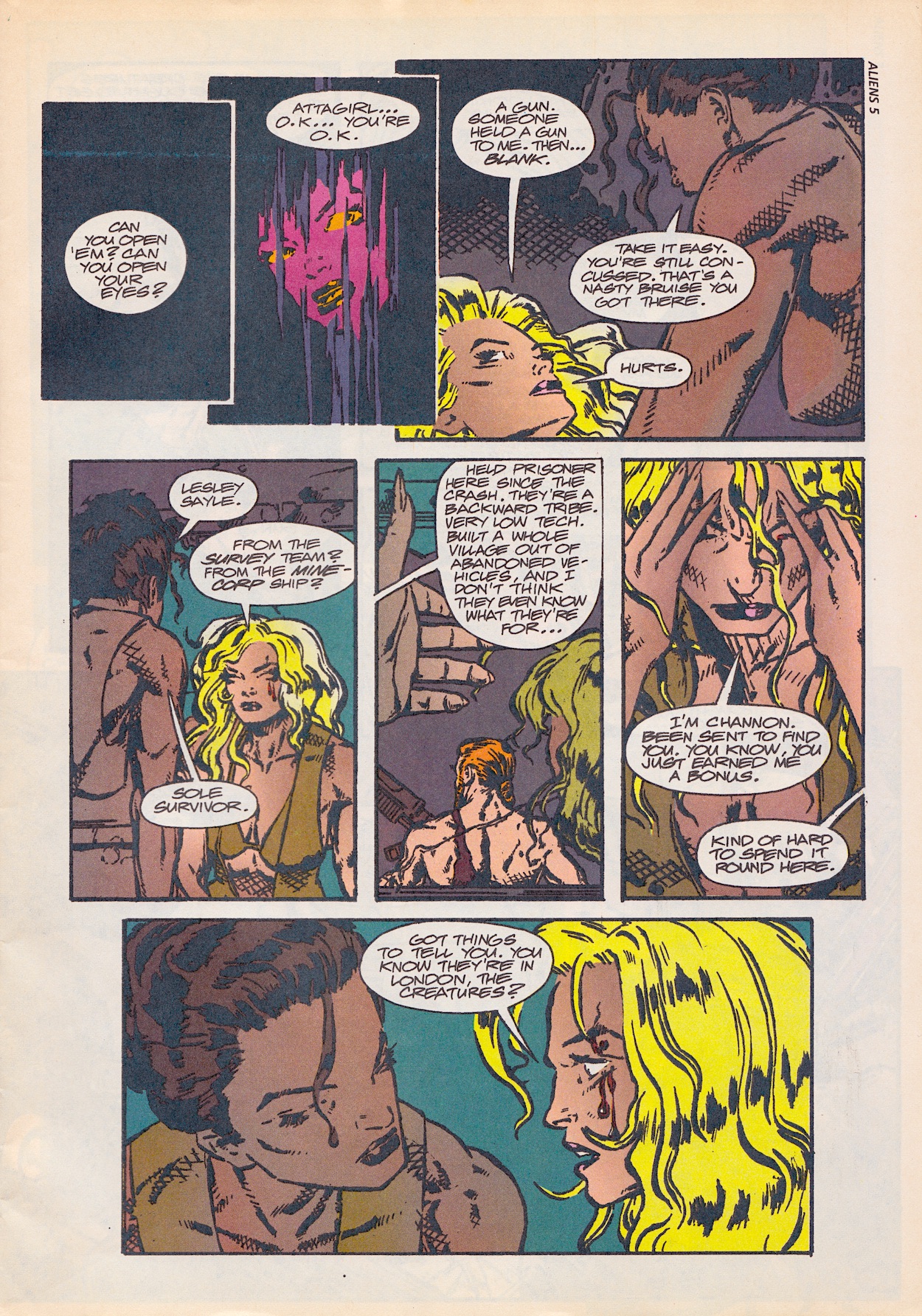
Contrary to the blurb on the cover, the latest chapter to Michael Cook’sCrusade isn’t seasonal. The alien Queen trapped in a cathedral tower gave Chris a reason for the frosty cover and its church iconography, but in these eight pages we don’t see any aliens. From the ‘previously’ page we learn Channon is the leader of the Minecorp marines and Foston is the male company man, not that the strip itself has ever made these clear. The last survivor of the crashed survey team is Foston’s wife, hence why he’s risking it all even though he’s out of his depth.
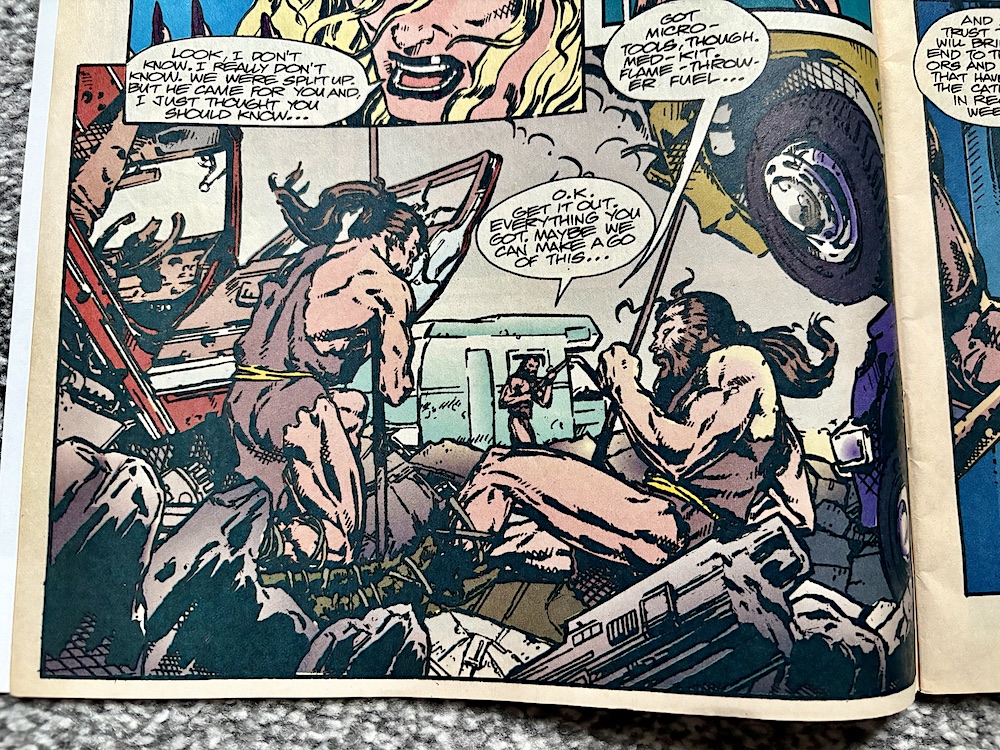
Channon has been captured by a tribe who have constructed a whole village out of old vehicles because they don’t know what they are. Sounds interesting but unfortunately it’s just a mess on the page. The ‘jail’ is a camper van with a padlock and inside she finds Foston’s wife. They hot-wire the van and make their escape back to the survey ship where they stock up on heavy weaponry and take off down the egg-infested Thames in what is definitely too small a boat. It just feels right to have two kick-ass women in an Alien story, doesn’t it?
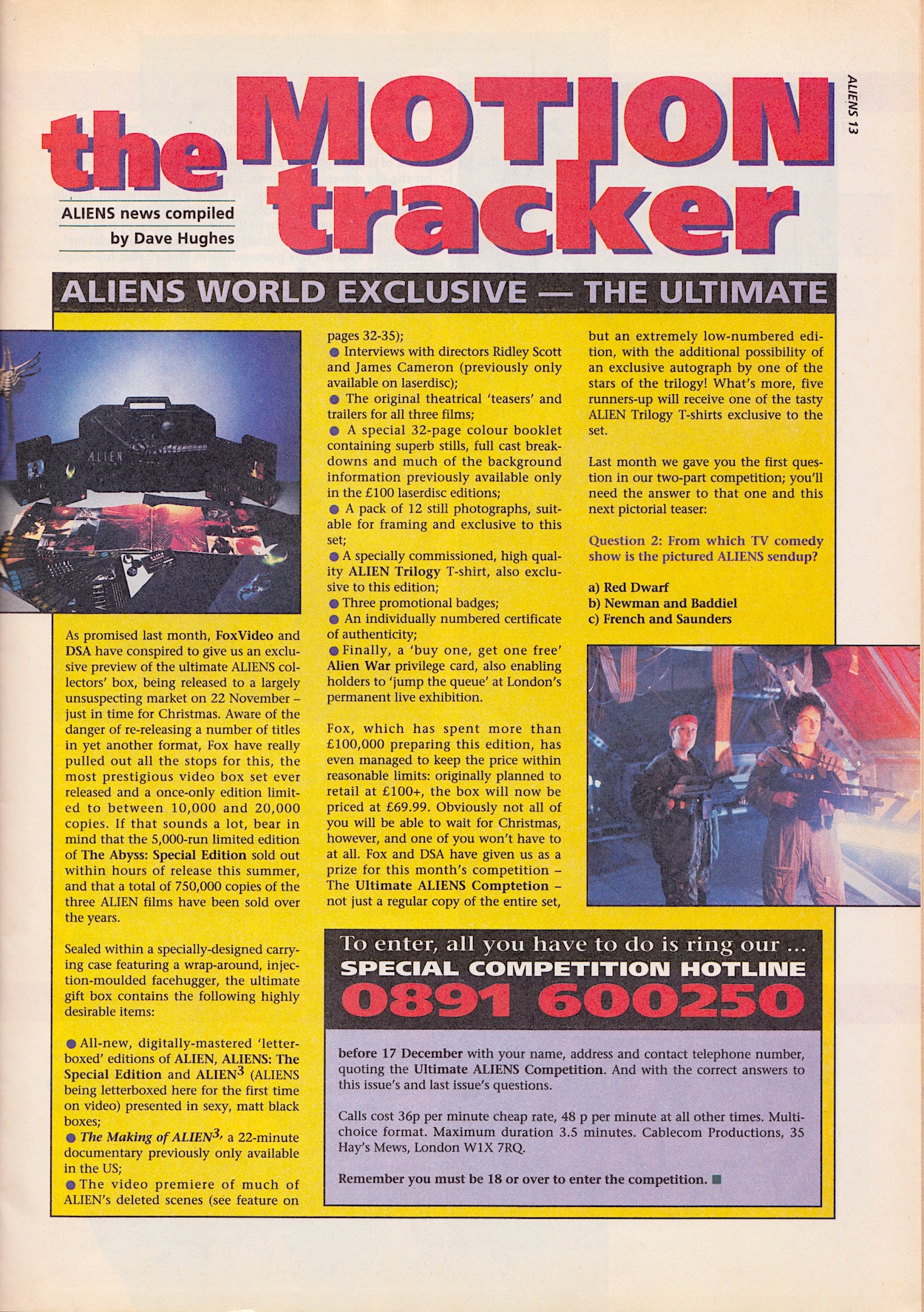
I certainly didn’t expect to get a huge laugh from the Motion Tracker news section! There’s a competition for a box set of VHS videos and it would’ve been right up my street. It’s a shame we don’t get a decent photograph of it, I’d really liked to have seen it closed with the face hugger wrapped around it. The comic also corrects (without mentioning it’s a correction) its previous error of stating Aliens wasn’t filmed in widescreen and I really laughed out loud when I got to the end. I hadn’t paid attention to the photo so hadn’t realised who it is until I read the question!
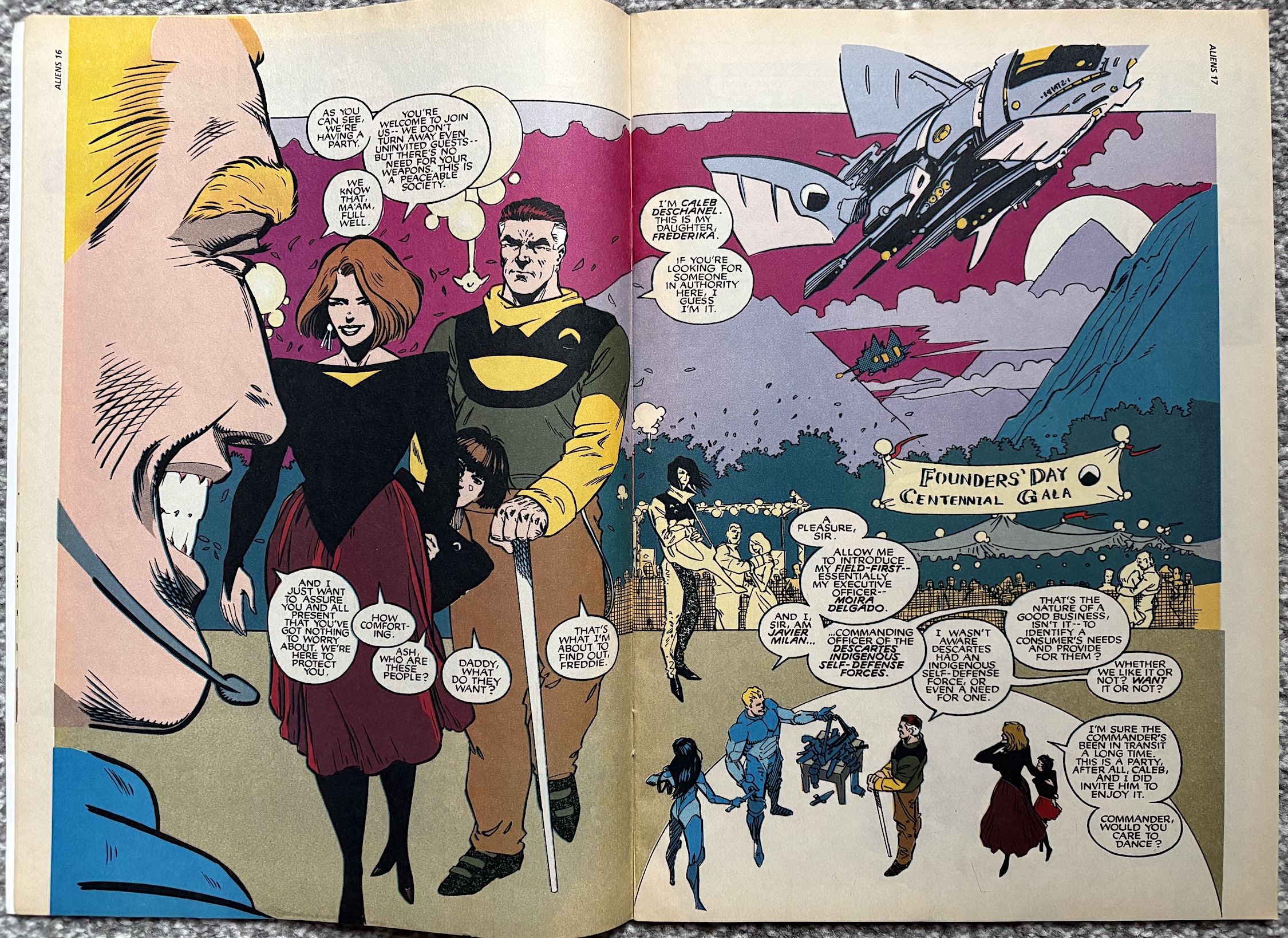
The 8-page first part of Renegade is written by Chris Claremont (Batman Black and White, Gen13, Wolverine), drawn by Vince Giarrano (Haywire, Terminator: Enemy Within, Manhunter), lettered by Tom Orzechowski (Thor, Ghost in the Shell, Spawn) and coloured by Greg Wright (Deathlok, Ghost Rider, The Punisher) and is taken from the American Dark Horse Comics anthology. It’s a prequel to Deadliest of the Species, a new Aliens/Predator crossover story. This is actually a little bit of Aliens history right here. Because it doesn’t feature any aliens, characters or names from the films this has remained the property of the writer and artist so it’s never been reprinted or collected since.
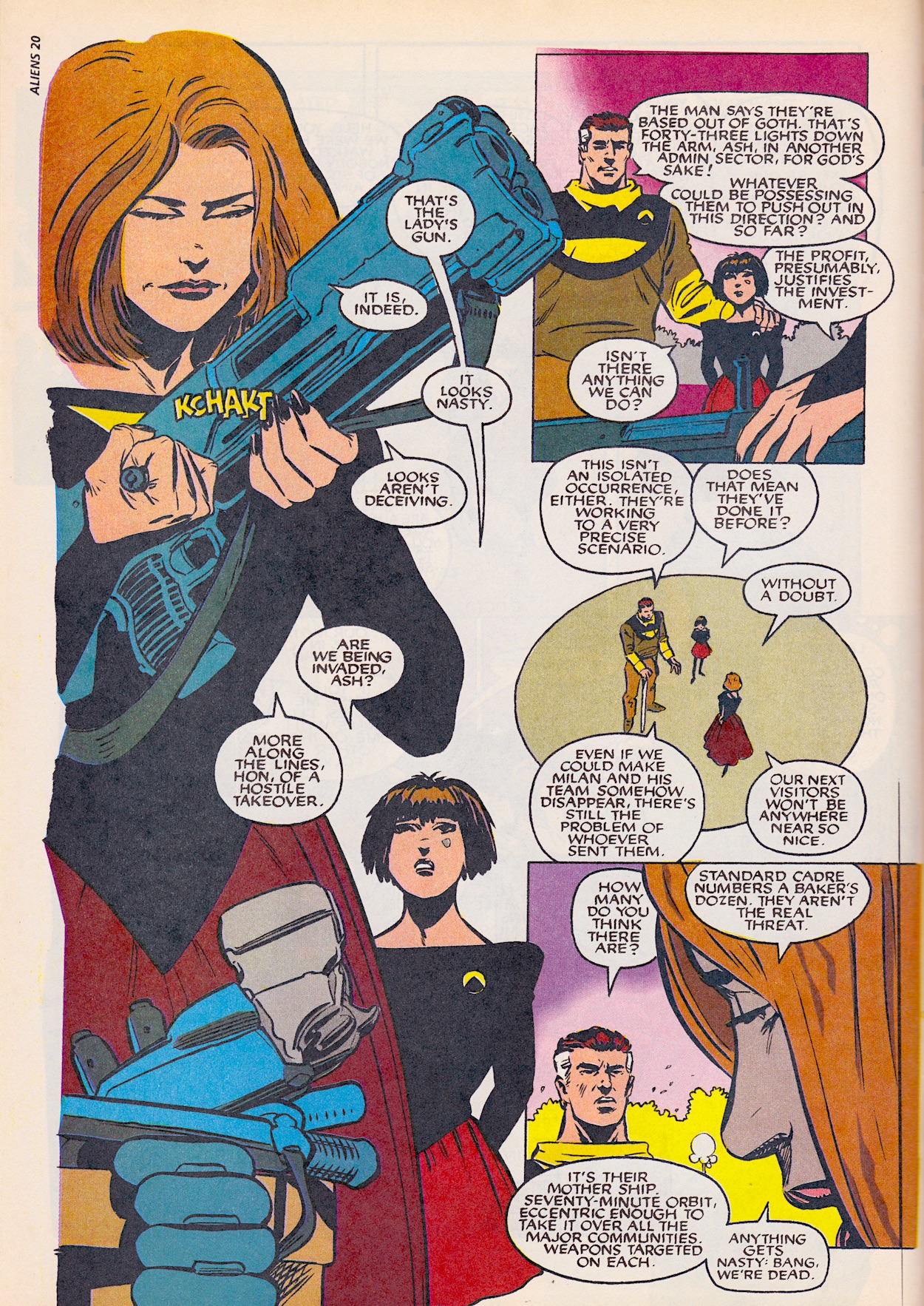
On a planet rich in resources lives Caleb Deschanel and his daughter, and along with Ash Parnall they’ve built a community at one with nature and it’s making a profit. In lands Commander Javier Milan and EO Moira Delgado of the Descartes Indigenous Self-Defence Forces, protectors of the natural resources, according to them. Their motto is “Unexploited resources are wasted resources”, so defending the planet means exploiting it. The broad smiles and flirting is accompanied with straight-to-the-point statements; they must stand aside or face elimination. The fact the force’s spaceship is called Ransome is a bit on-the-nose.
Caleb is ill and frail and asks Ash to deal with this given her history, whatever that is. In fact, during a conversation Javier asks her how she knows so much about military weaponry and tactics and her response is just as mysterious as this strip; she had a misspent youth and they’ve a well-stocked library. This is the second strip of the issue and the second one with no aliens. A bold move or a poor decision? Truth be told, they’ve both been interesting to read so I’ve no complaints in taking a breather for more character moments.
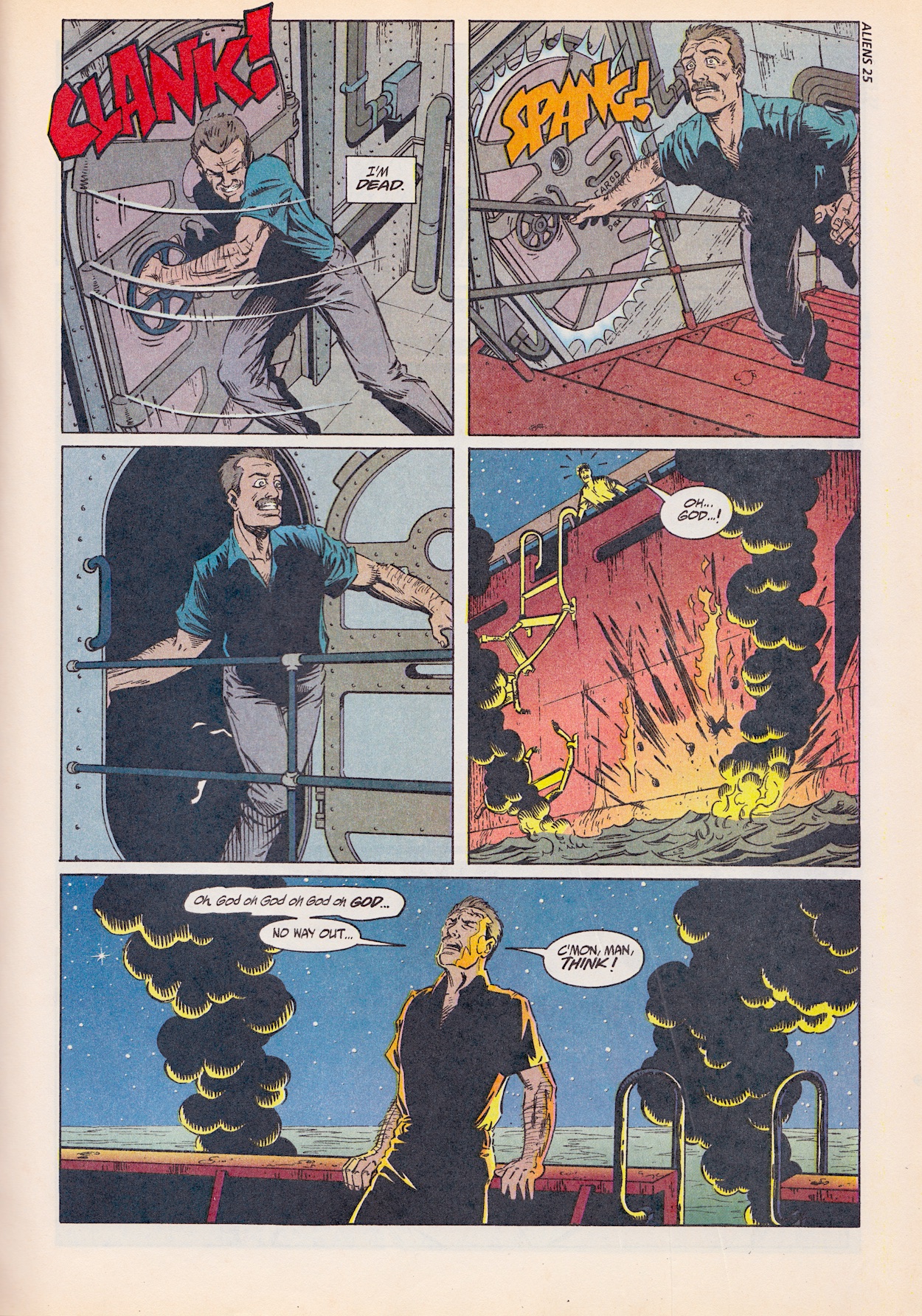
In the concluding half of Cargo, writer Dan Jolley and artist John Nadeau continue to play to their strengths with a superb atmosphere, even if there’s a key part of the plot that doesn’t make sense. Surely even a criminal such as Vasco wouldn’t endanger the entire planet by importing an unsecured alien just for a bit of revenge? The fact it all happens on an abandoned cargo ship far out at sea doesn’t excuse things, it would eventually run aground or be found. But that atmosphere is palpable, so let’s just go with it.
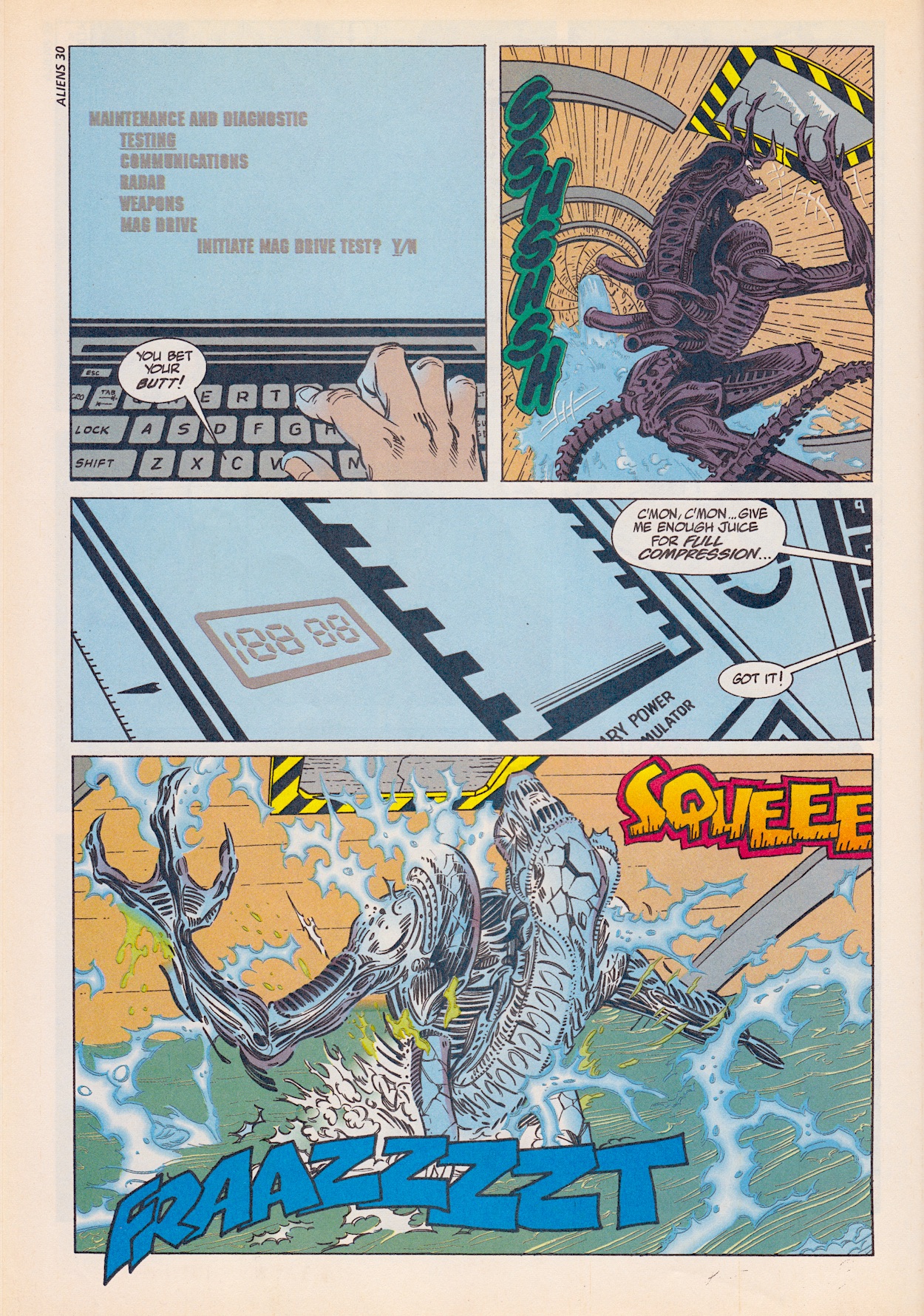
Having Gerald as the lone human on a huge vessel with one alien has the makings of a truly terrifying tale, so it’s a shame this is a short 16-page strip in total with no time to build suspense. But that’s not where this falls foul, it’s in its overly simplistic ending which amounts to tricking the alien into the mag tube, filling it with water and then electrifying it. Now, that might not sound simplistic, but the fact it all happens in less than two pages makes Gerald’s escape seem very easy. A shame, as the tension in the build up was great.
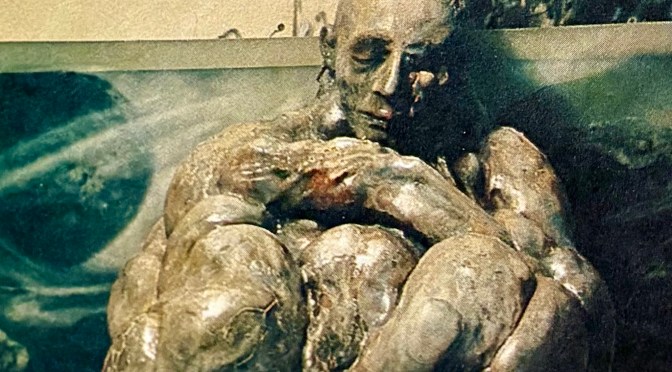
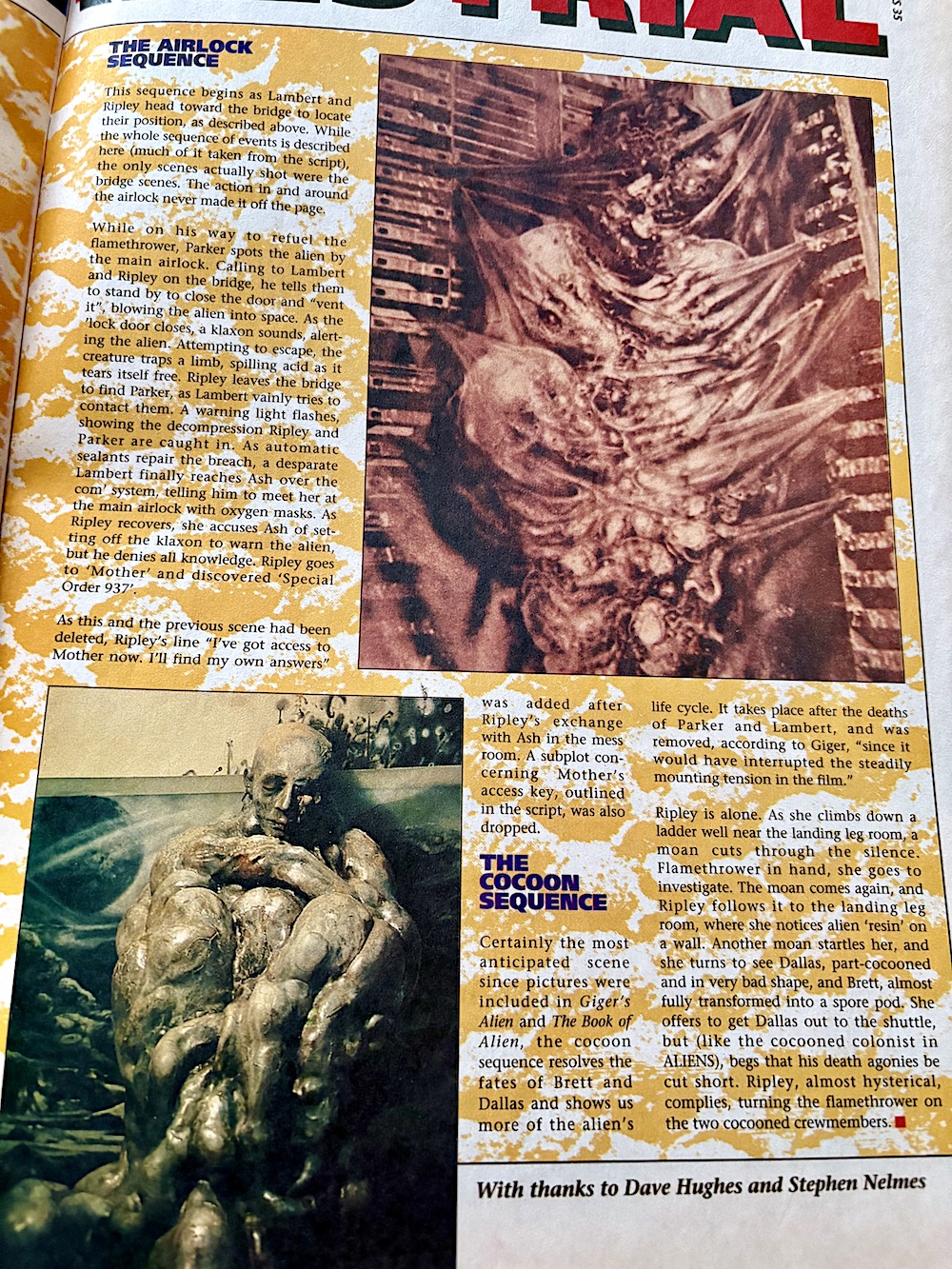
Extra Terrestrial is a four-page feature written by Terry Jones detailing the cut scenes from Ridley Scott’s original Alien movie. Ridley has never released a director’s cut, he was very happy with the finished film, although he’s released an alternate cut with some scenes and moments replaced by others. The only scenes in this feature that really would’ve added anything new to the film are those above, which for obvious reasons (after the release of Aliens) can never be put back into the film. Ridley has said he never would because James Cameron did such an amazing job with the sequel’s explanation of the eggs.
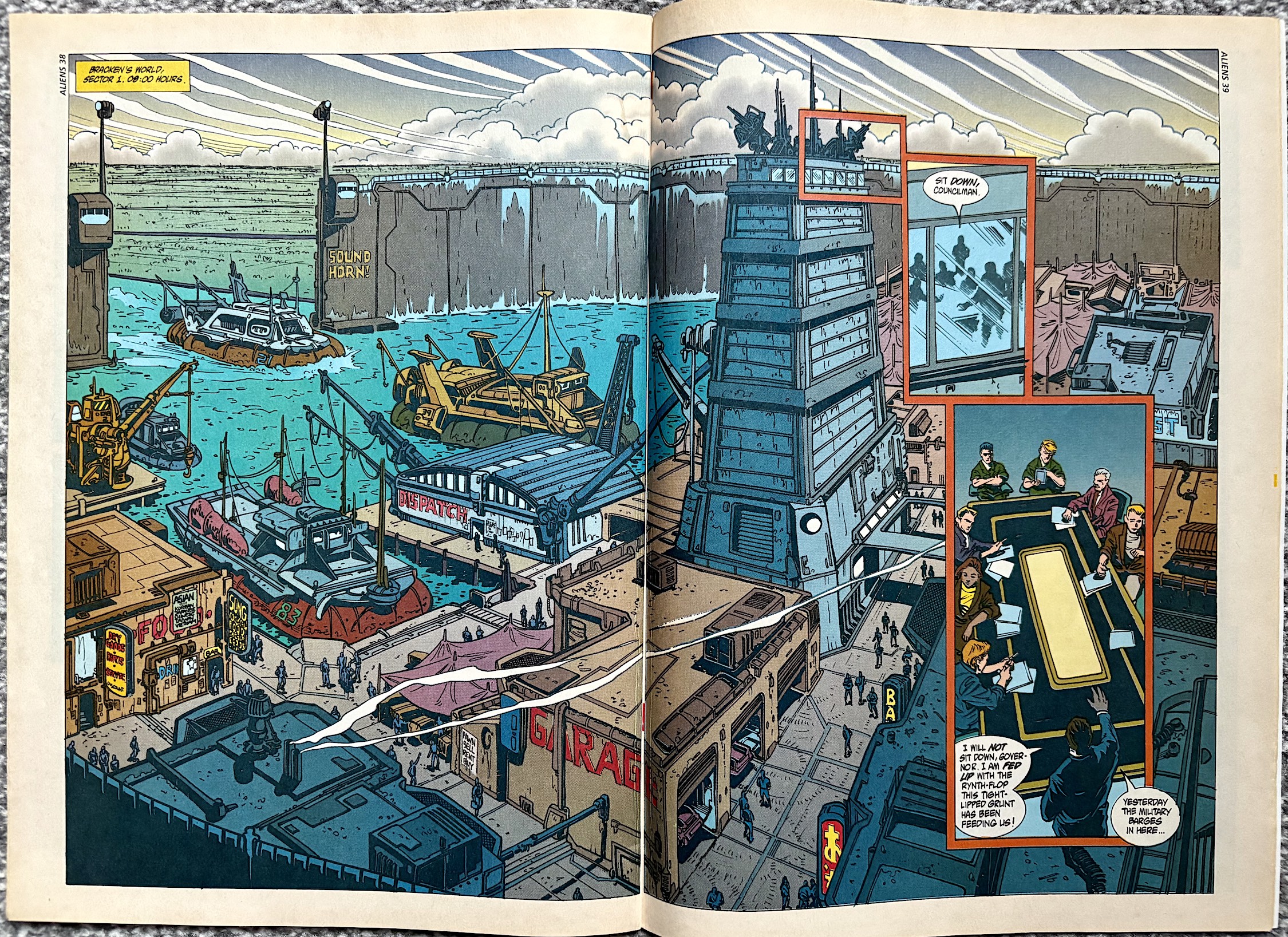
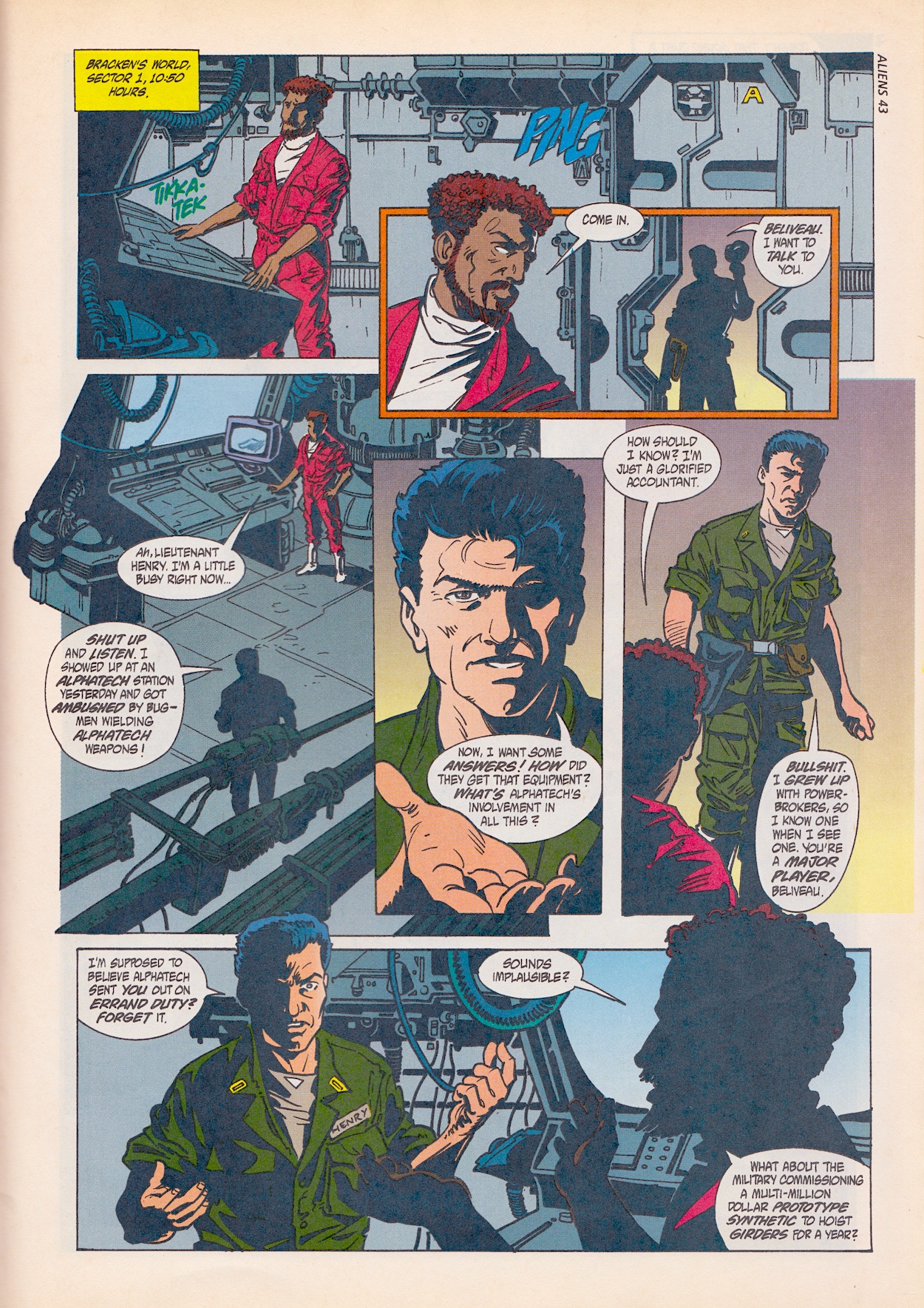
Colonial Marines is our final strip for the month, coming in at a meatier 11 pages. On Bracken’s World the kelp beds are mysteriously disappearing across the planet and we see this lovely detailed opening of a colony hub on the agricultural world by Tony Akins, Paul Guinan and Matt Hollingsworth. Lt. Henry has explained the situation to the council but they’re angry with his team for upsetting their order, only half-believing him about the aliens.
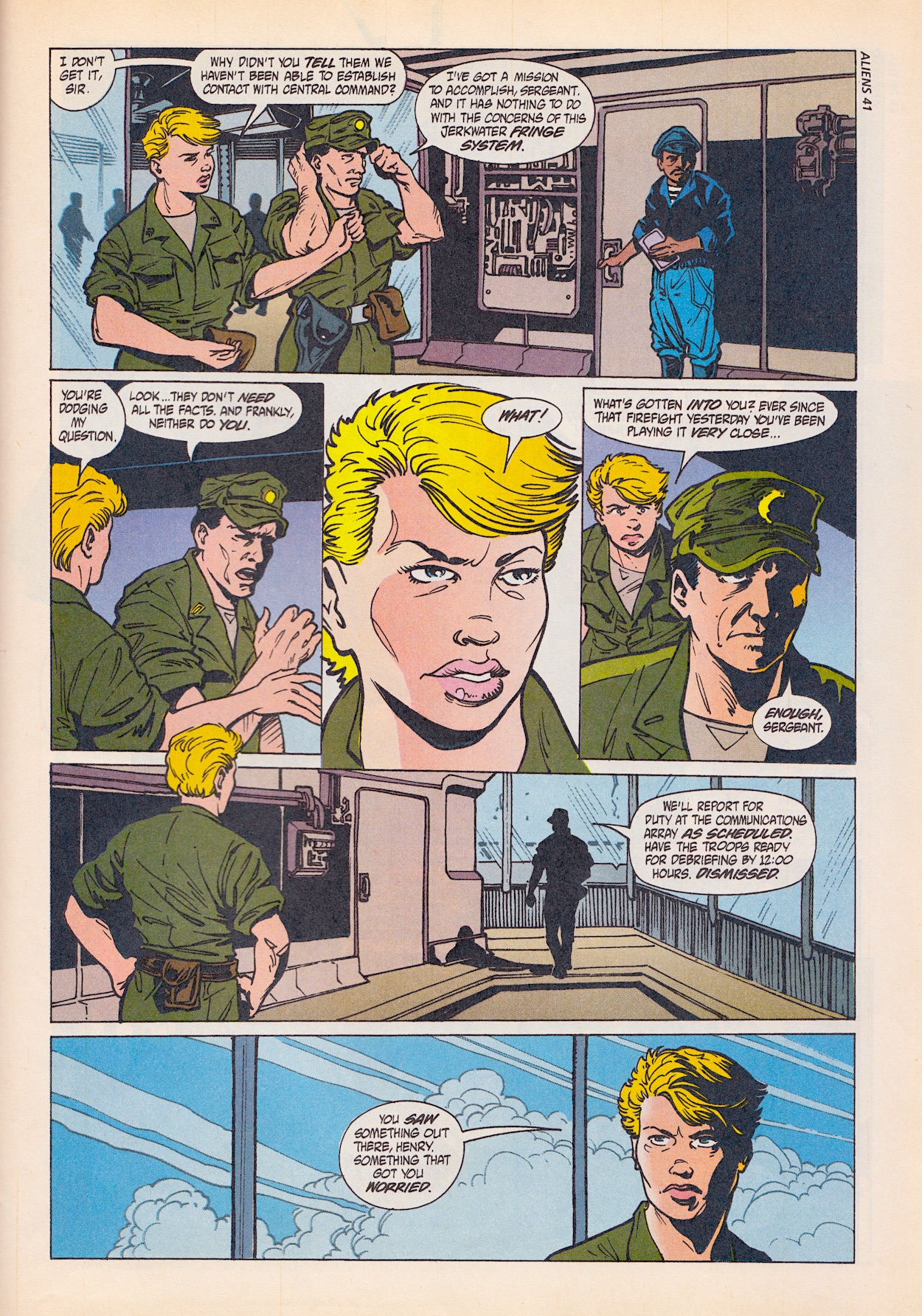
Still, they demand he help but he can’t without orders, or at least that’s what he says. He’s playing something very close to his chest since the firefight last issue but even his sergeant can’t get it out of him. He won’t tell the council he can’t establish comms with HQ, and just tells his sergeant neither the council nor she need all the facts. This is out of character for him. All we know is that he saw “something” during the fight.
We get more questions than answers when he confronts Alphatech’s supposed “glorified accountant” Beliveau about the bug men having Alphatech weaponry. Aha! He’s convinced Beliveau is a bigger player than he’s been letting on, however Beliveau counters by asking why a new multi-million dollar synth prototype has been assigned to Henry’s babysitting team. Henry has no answers. Conspiracies abound. Intriguing.
Henry buys black market remote bombs and when asked by a different council member to help even though they can’t afford it (the capitalist future of the Alien universe in full effect), Henry says that they’re there until morning, they’ll help until then. This is an interesting, suspenseful and now a mysterious story with great characters and it’s back to full strength after getting lost in a sea of too many characters at once and overblown fight scenes.
There are some moments that hint at aliens attacking ships but otherwise this is again alien-free, concentrating solely on the humans involved in fighting them. So that means three of the four strips have no visible aliens in them whatsoever. In an Aliens comic. You know what? I didn’t even notice until I went back over the issue to make notes for this review. The Alien universe has always been about more than just the xenomorphs, as the brilliant Alien Earth has been expertly proving.
On the letter’s page there’s a brief mention of a new RoboCop comic in the new year, beginning with an adaptation of the upcoming third movie. It would never appear, what with DHI going out of business a few short months later. Marvel UK had also announced a RoboCop fortnightly in the pages of Transformers back in 1990 but that never happened either. He’d eventually pop up on these shores in the pages of Havoc. However, definitely coming next month is a cover drawn by and a strip written by the legendary comics star (and one-time OiNK contributor) Dave Gibbons.
It may have been released a month too early for the Christmas-inspired cover but #18 of Aliens has been a delightful surprise. The fact the stories didn’t need much in the way of alien action for the issue to be compulsive reading (their presence always felt) has ironically made it a highlight of the run so far. I’m intrigued to see what we have in store when the first post-holidays issue hits the blog before the Big Day on Tuesday 23rd December 2025.
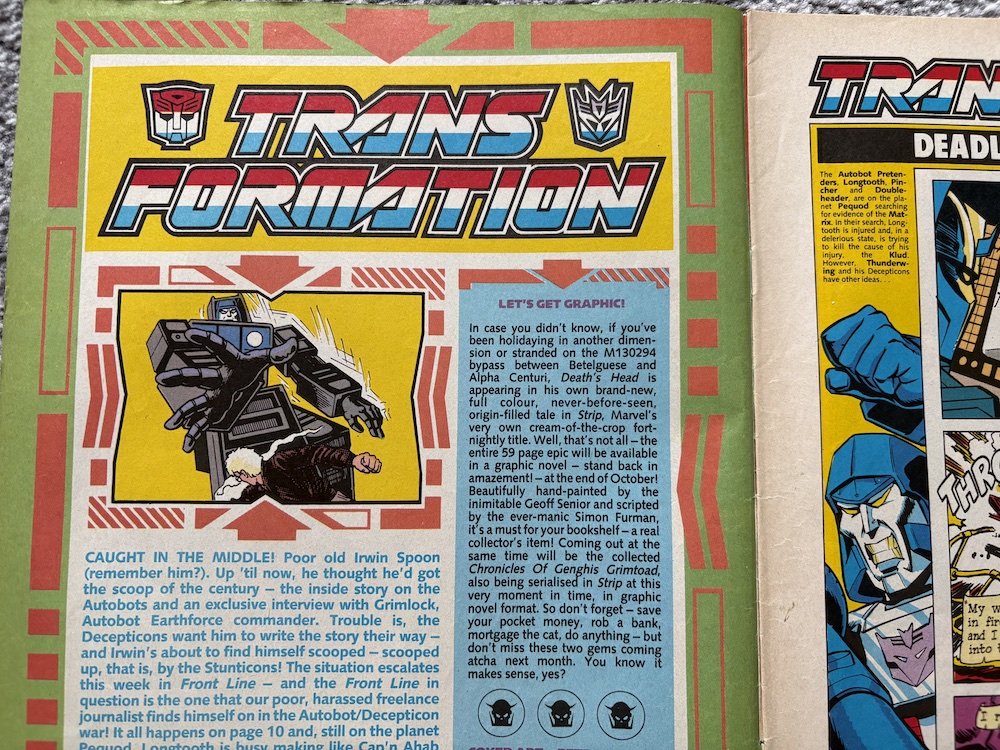
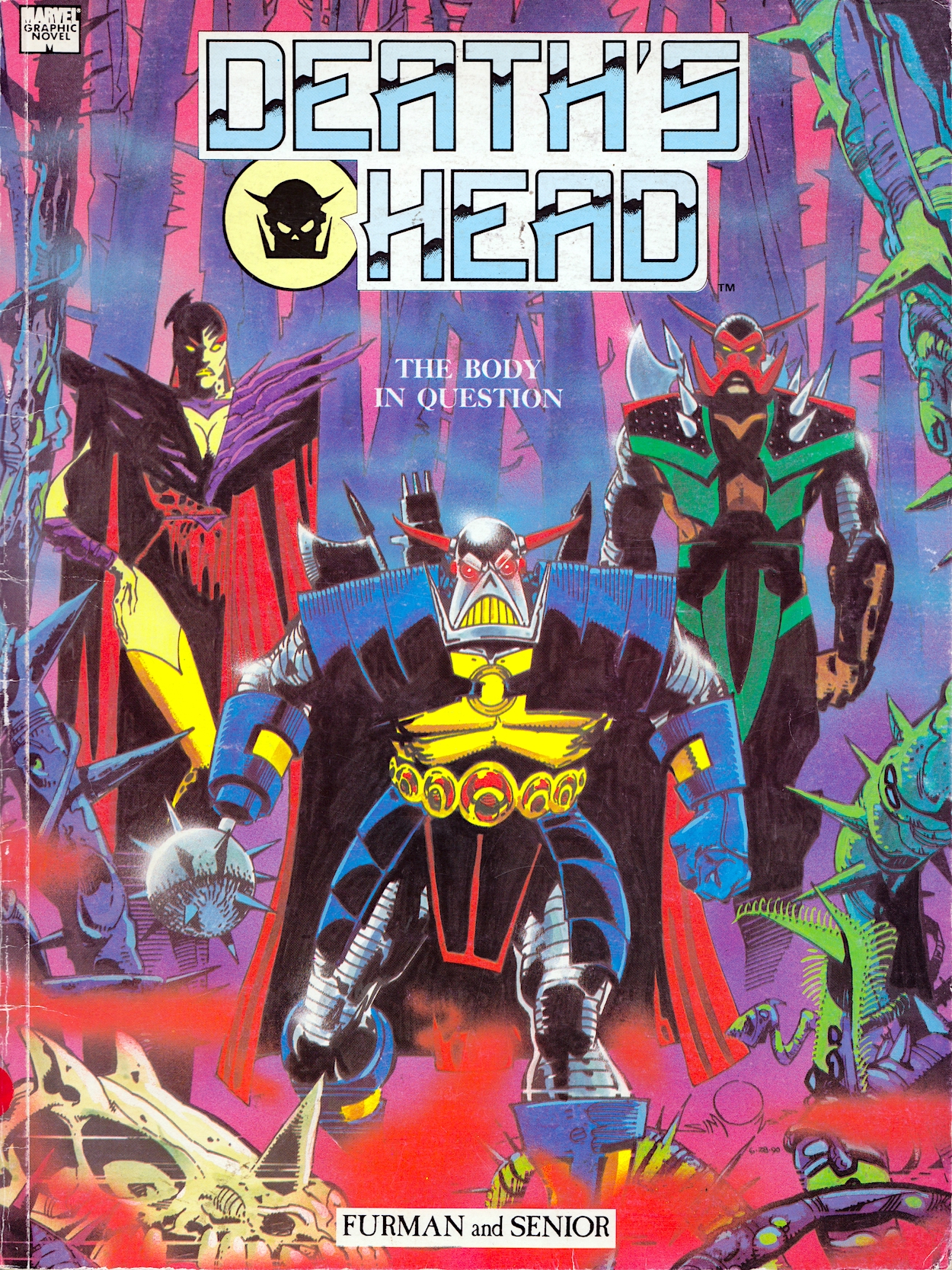
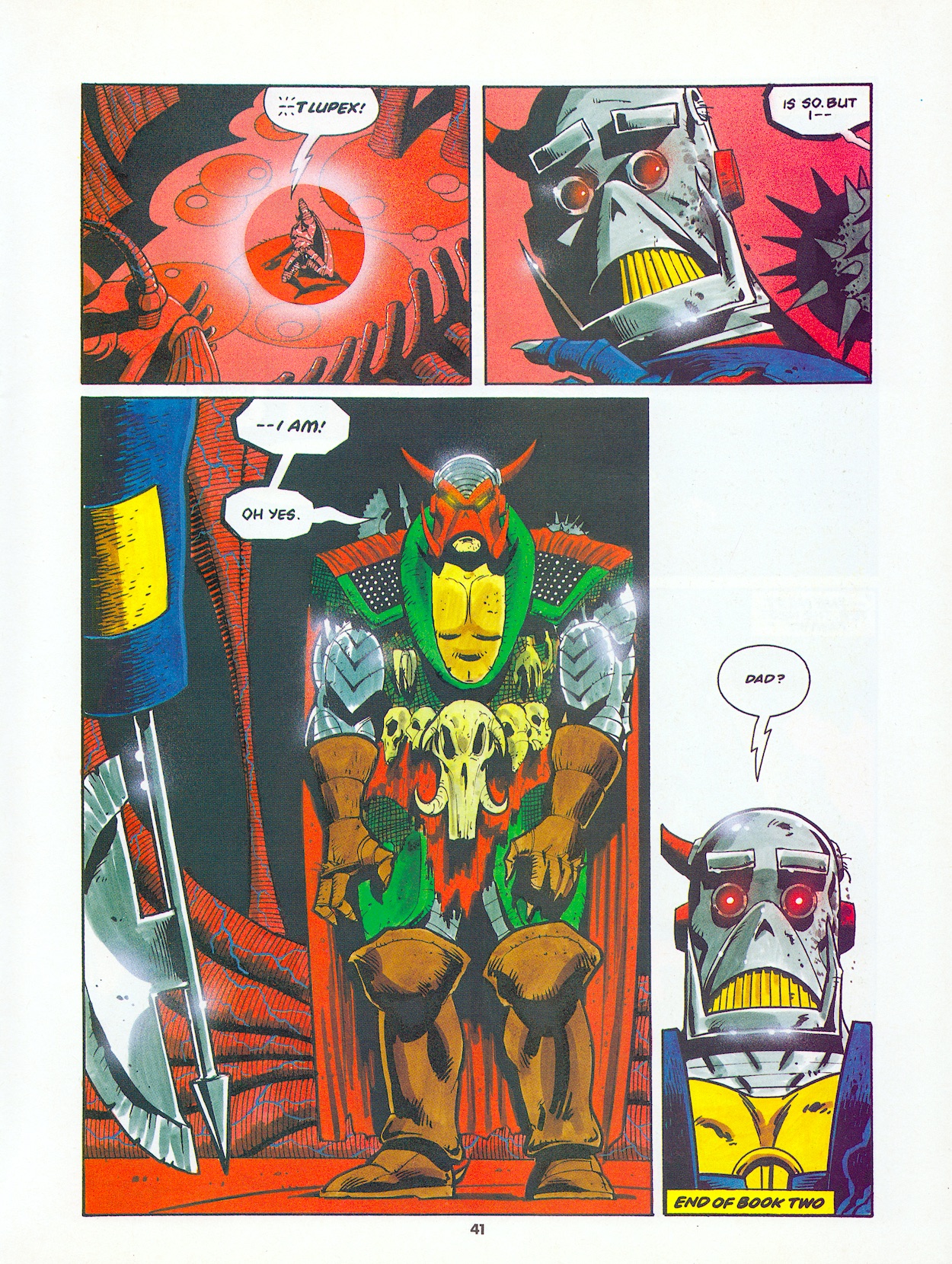
This week back in 1990 the editorial in Marvel UK’s Transformers announced the exciting news that Death’s Head was finally back. Not in a reprint of a previous story (something they still liked to hype) but a brand new graphic novel. In reality it collected together his run from Strip comic, and this is the final piece of the jigsaw for the blog’s real time read through of the original incarnation of the character.
Coming in at 68 pages including a card cover, inside is all glossy and beautiful, the paper upgrade allowing artist Geoff Senior (who co-created the character for the Transformers but only drew one of the monthly issues) to return to the character in style and bring us a new level of colouring. Helen Stone (The Sleeze Brothers, The Real Ghostbusters, Knights of Pendragon) joins the team as letterer, Steve White (Xenozoic Tales, Rogue Trooper, The Lost World Jurassic Park) returns to edit and of course it’s all written by co-creator Simon Furman (Transformers, To the Death, Doctor Who), with Geoff (Hell’s Angel, Dragon’s Claws, Judge Dredd) and Walt Simonson (The Star Slammers, Jurassic Park, Thor) teaming up on the cover.
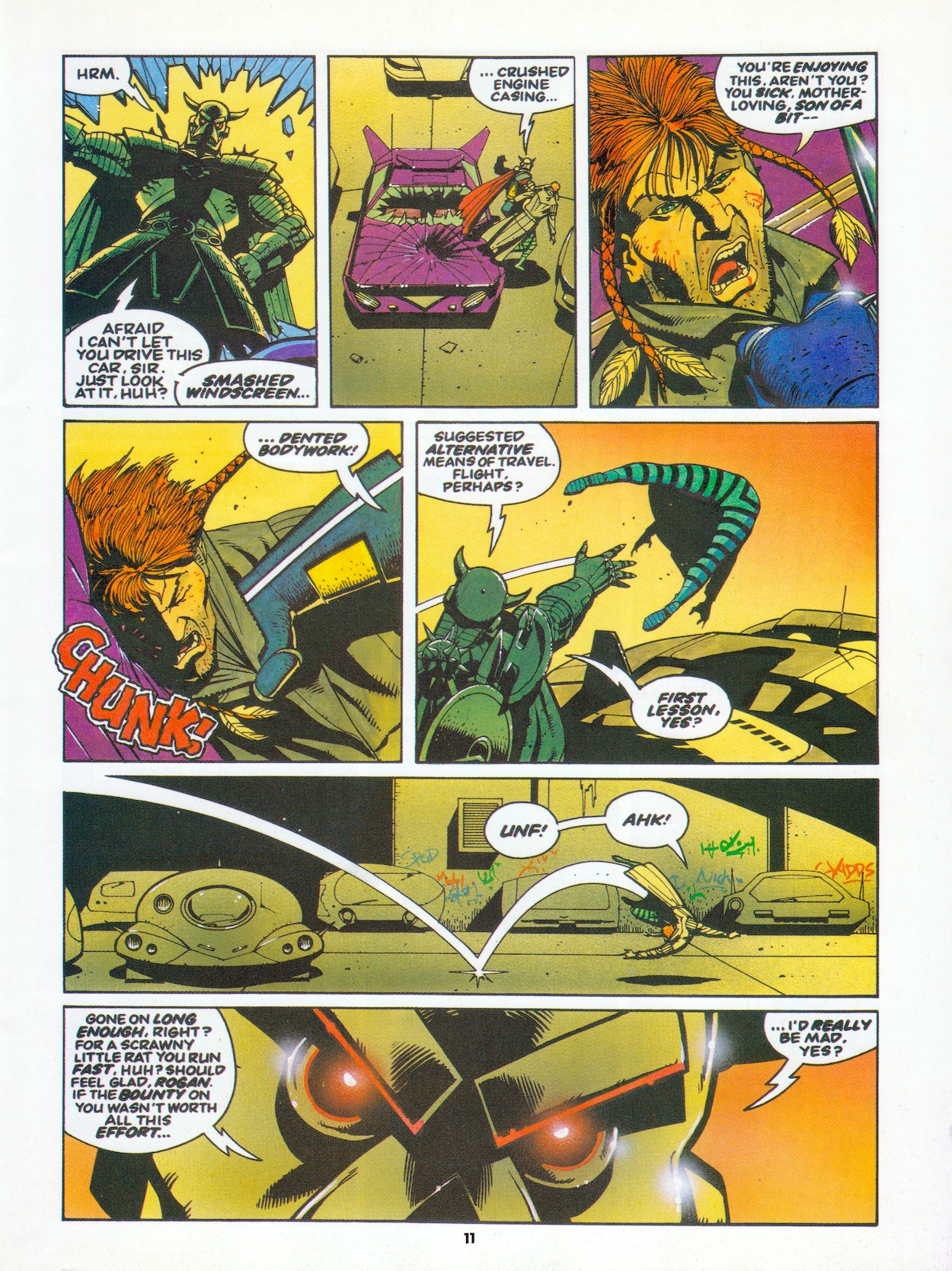
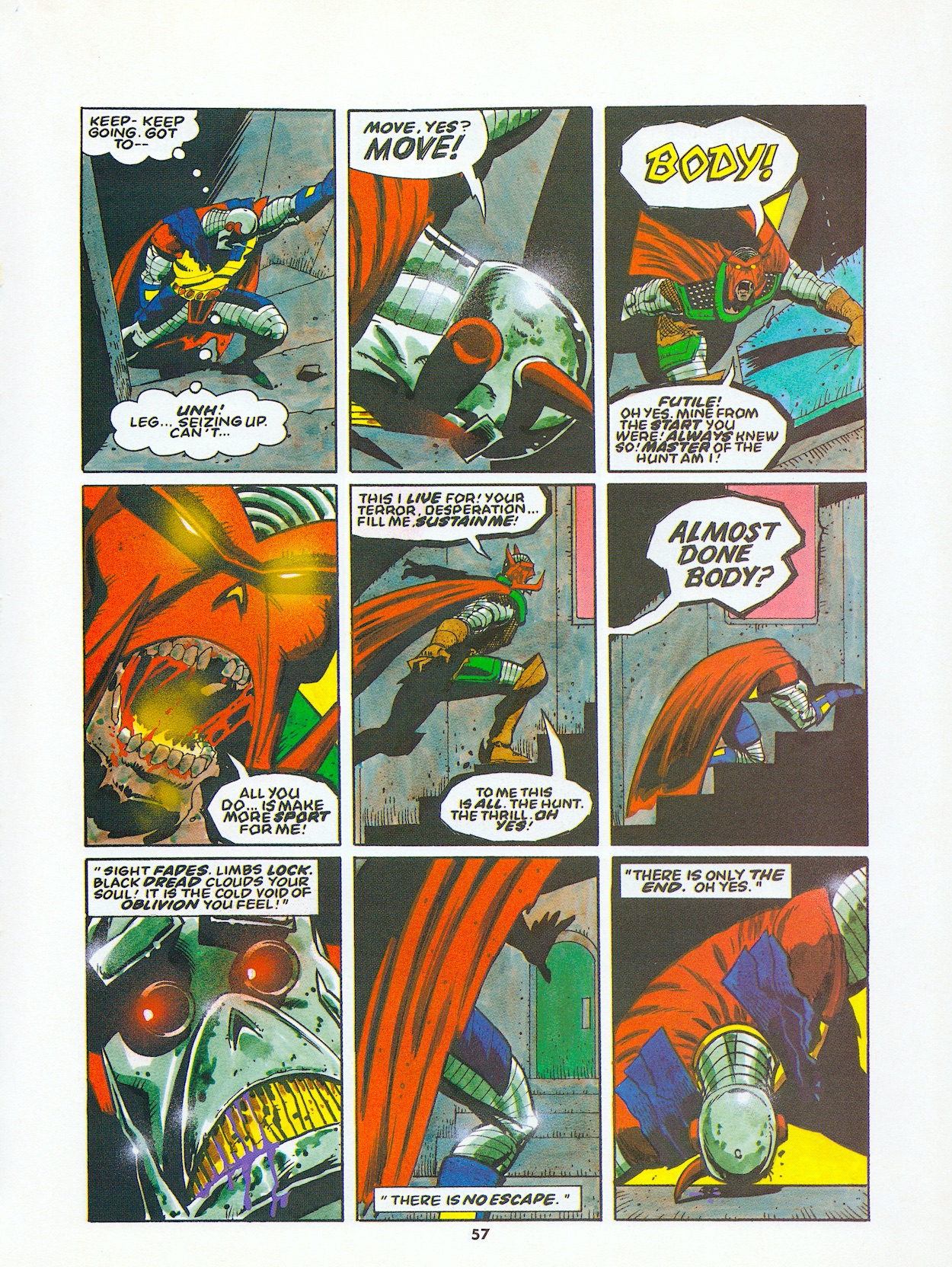
We begin in a strange land that apparently doesn’t adhere to time or meaning, with someone being tracked down and killed, the perpetrator only seen from one angle, their arm looking suspiciously like Death’s Head’s original design from Transformers and Doctor Who. Then it’s back to 2020, where he ended up at the end of his comic’s run and an electrifying chase as the Freelance Peacekeeping Agent hunts down his latest bounty and it’s full of all the usual quips and comedy action.
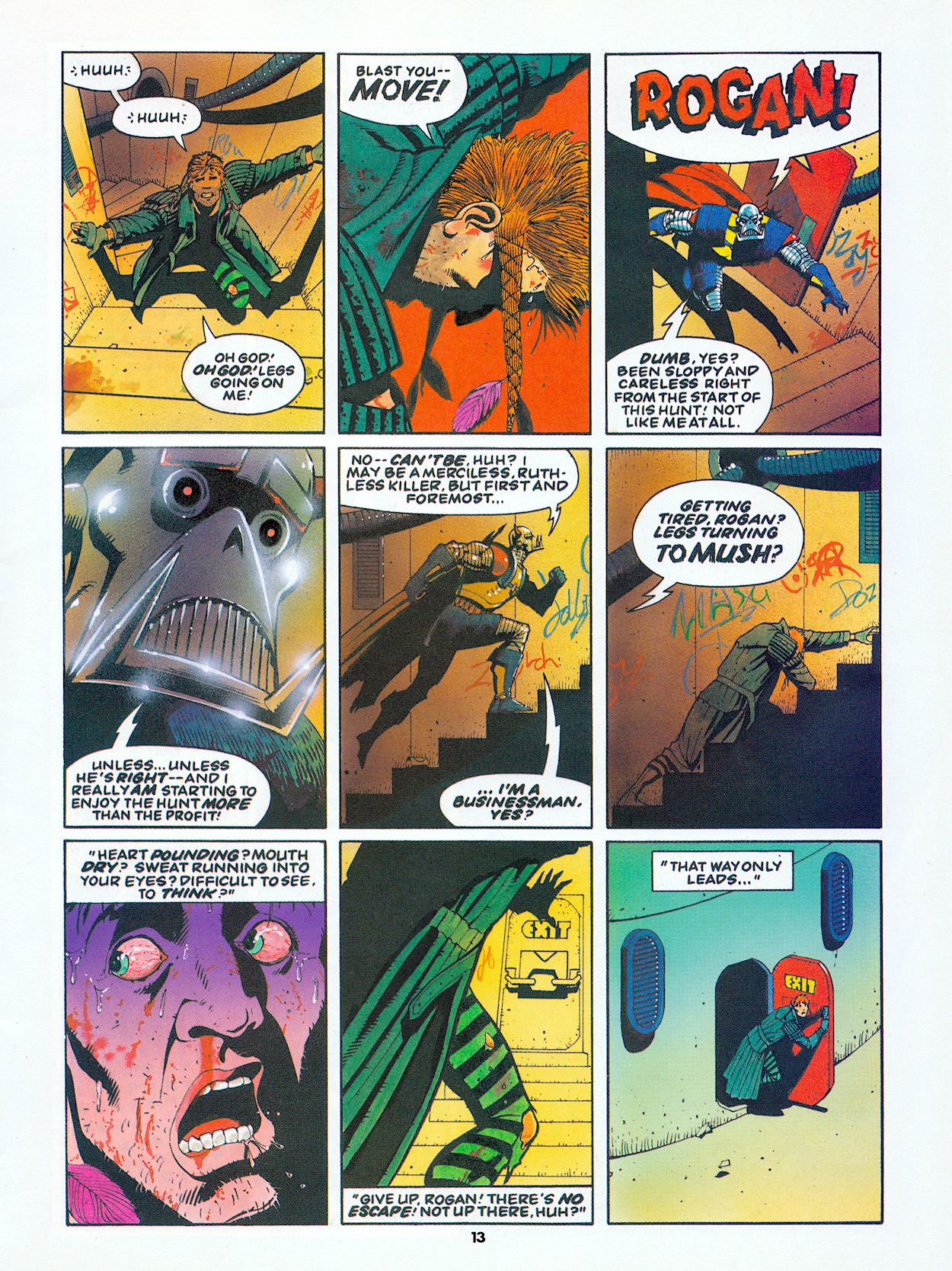
Rogan accuses Death’s Head of enjoying the chase and this really gets into his head. As he runs he questions himself. Is he really enjoying the hunt more than the profit? At the end he believes Rogan is about to take a woman hostage so he kills him, but he was running to her apartment for safety. She’s his partner and she screams that Death’s Head ran him down like it was sport. He walks away, solemn, trying hard to convince himself that she’s wrong.
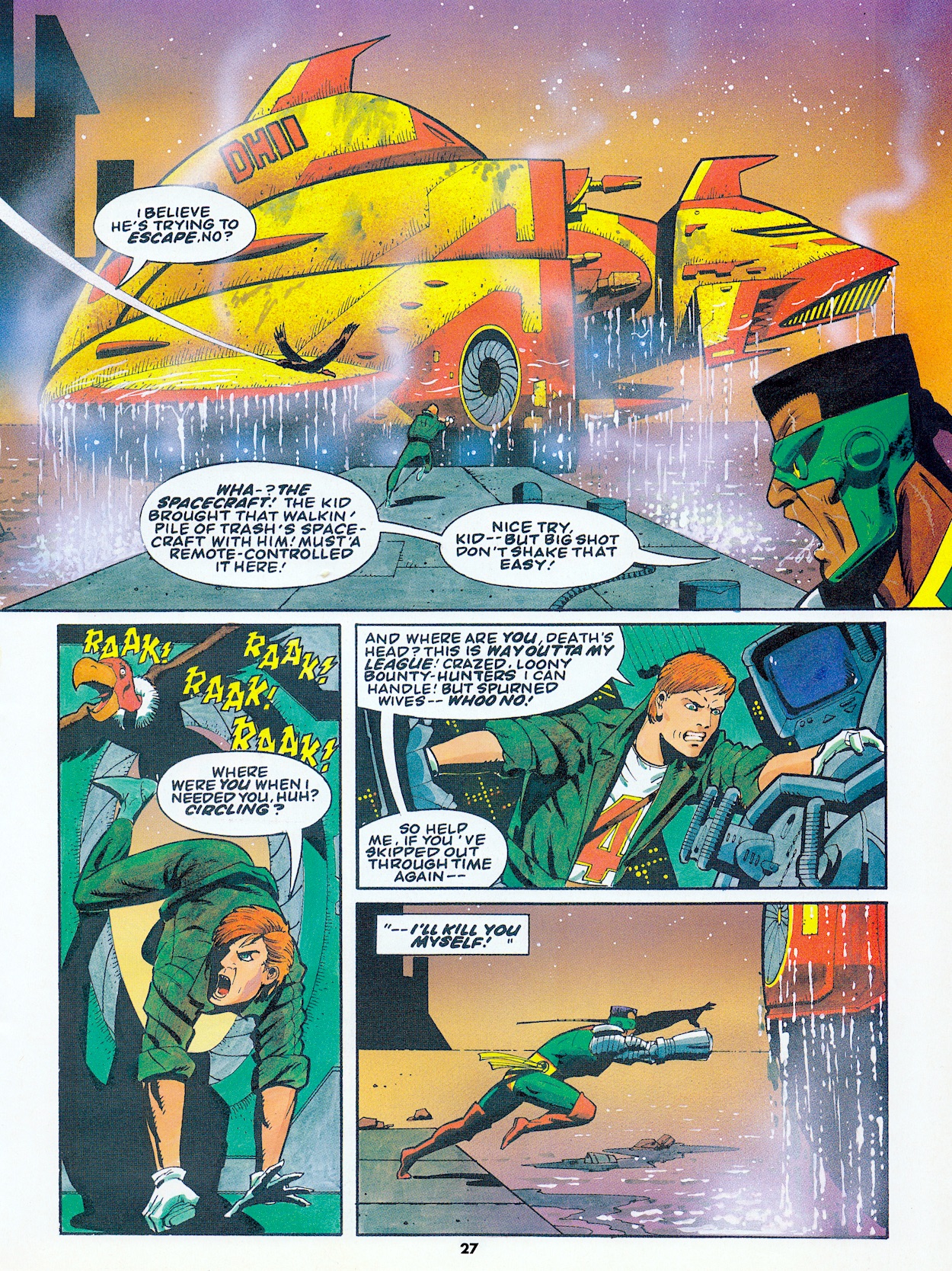
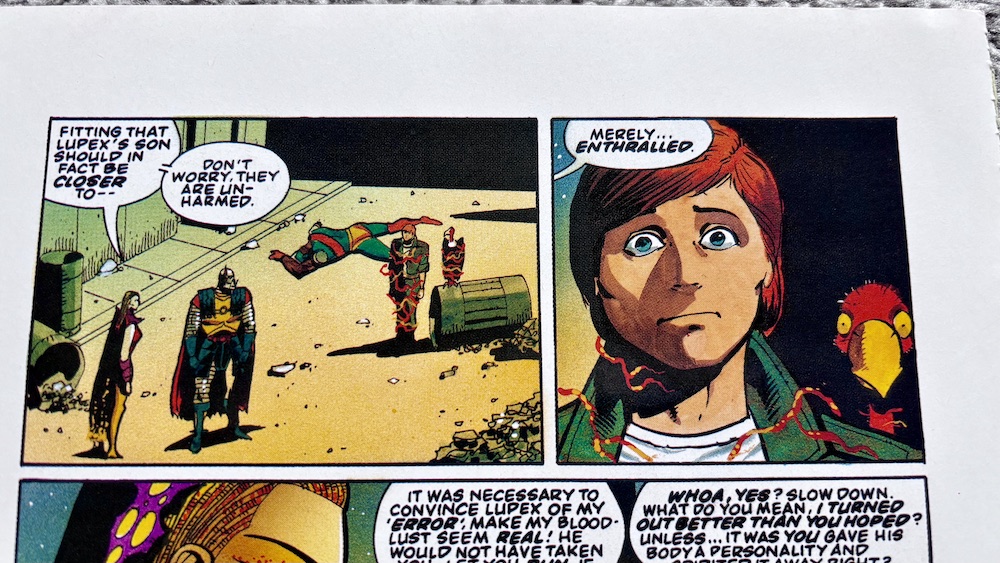
Initially I thought this wasn’t going to feature Spratt but suddenly we’re back in 8162 and he’s meeting with his boss’ mysterious love who was hinted at in the monthly. (He doesn’t look like Spratt at all though.) It’s good to see the vulture is still on the team too. So apparently the not-a-bounty hunter is her husband and she has “vengelust” for him. Big Shot is also back and just as angry as ever. Spratt tries to escape, so Nightweaver reads his mind and finds out her love has time travelled. All the while in some void-like world the lookalike looks on. So far, so intriguing.
As in the comic the year 2020 looks just as futuristic as thousands of years into the future and given what actually happened in the world in 2020 maybe this version would’ve been preferred. I don’t want to ruin any possible future you may have in reading this graphic novel, so I must warn you this review will obviously contain spoilers. It should go without saying by this stage, this blog is all about classic comics, but more than any of the monthly stories the shocks and surprises in this are an integral part of the plot and thus the reading experience. To tell you about them would be to ruin the experience for you if you intend to read this one day. So consider yourself warned.
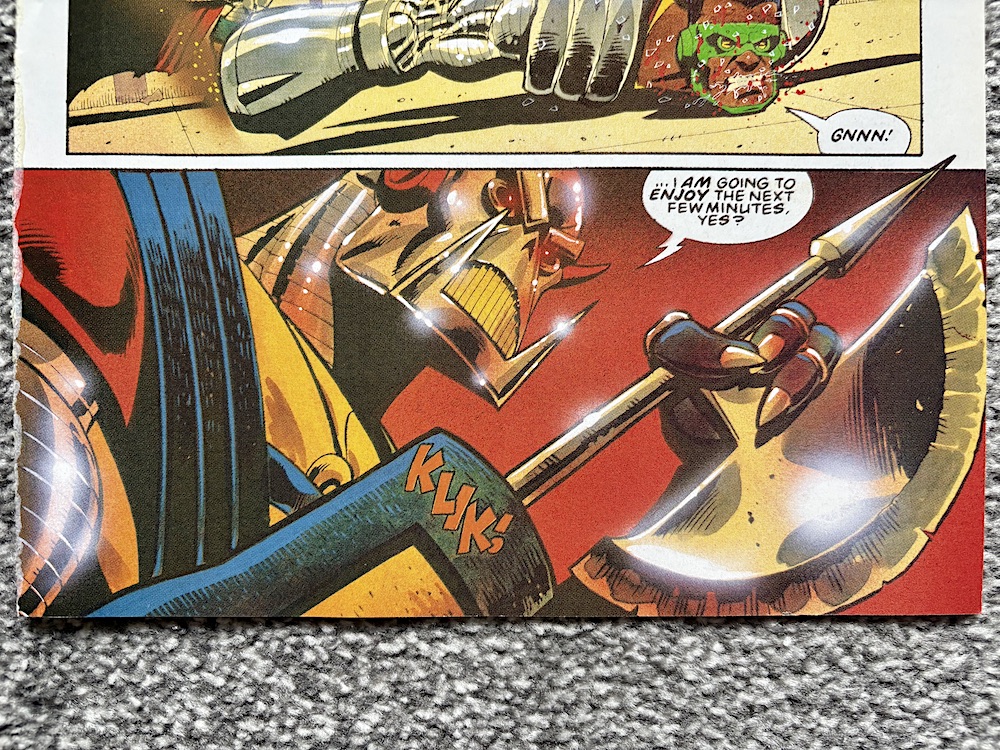
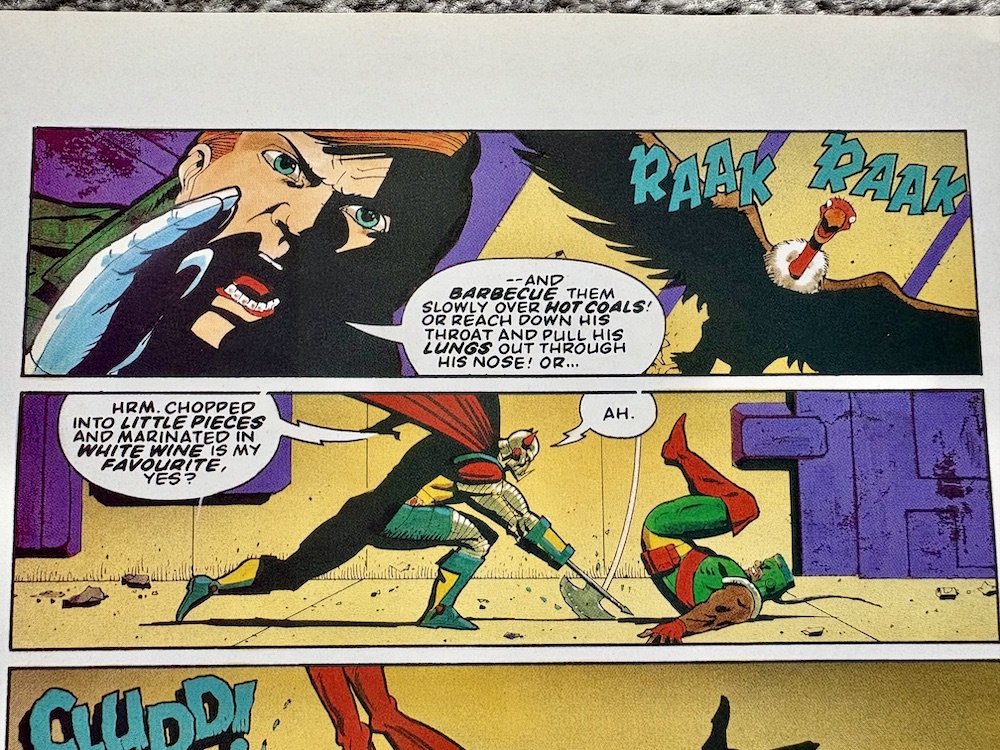
My favourite parts always involve our lead character and his quips, his inner thoughts and biting humour. Such as the moment above. He ends up flashing back and forth between the real world and the void and slowly the identity of the lookalike reveals himself. However, surprisingly this is seen in flashback form inside our anti-hero’s mind. He begins to question his own origin, something he’s never done until now. The same goes for the reader, but I’ll get to that below as it’s the only real bone of contention I have with this.
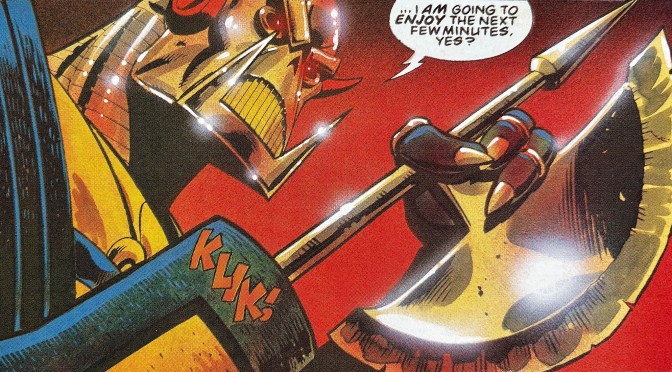
It doesn’t stop the rest of this graphic novel from being highly enjoyable. For example, despite Death’s Head initially being joyful that Spratt wasn’t there, the banter between the two during action scenes is better than ever. I think he secretly loves it! Or how about another scene when he realises he hadn’t previously defeated Big Shot and he strops like a child, proclaiming it’s unfair while having the huffiest of faces his angular jawline will allow. Then things take a turn when Big Shot says all bounty hunters are the same, that they all enjoy their work. Following up from earlier in the story, this leads us to the main event, the creation of Death’s Head.
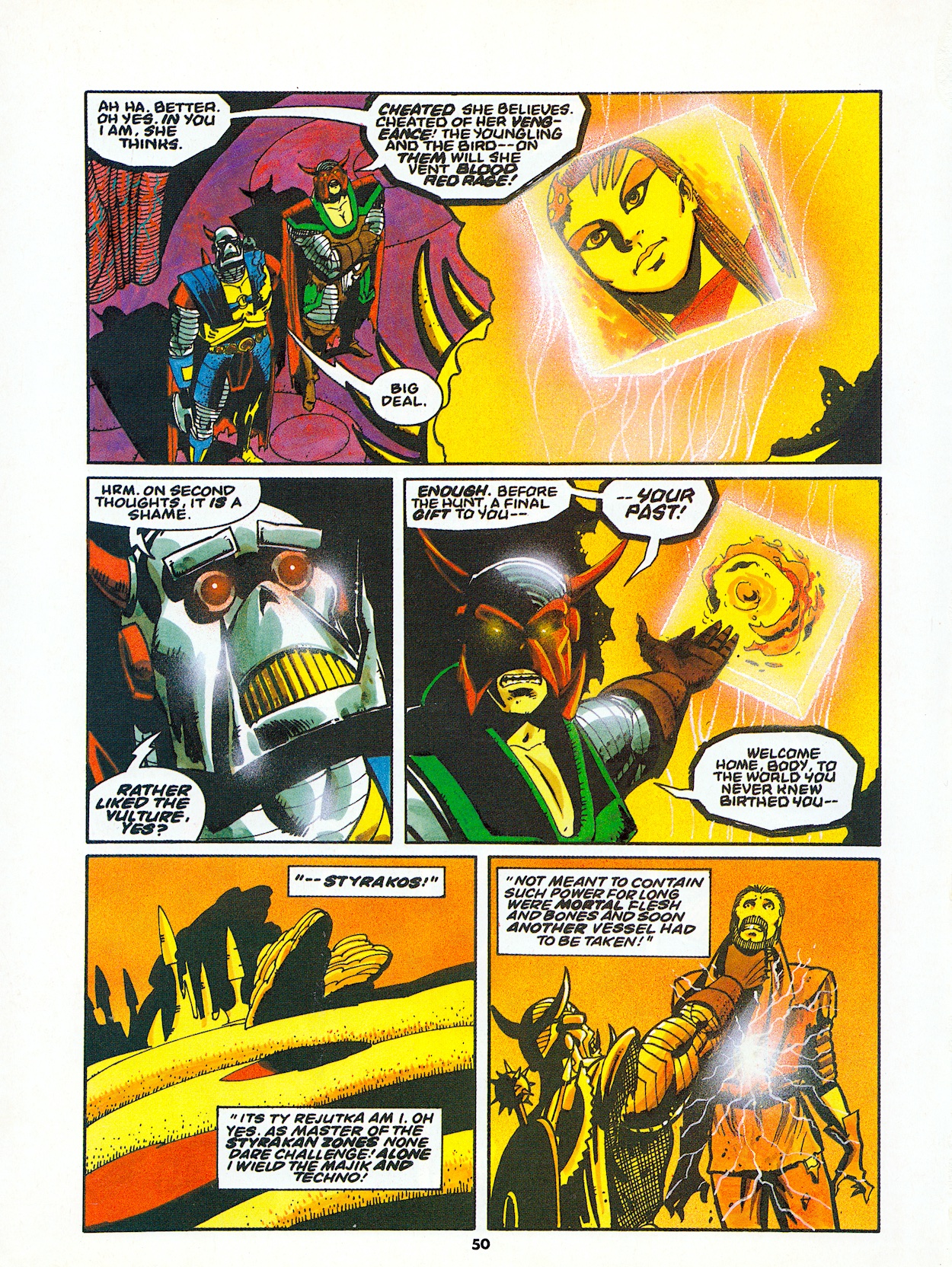
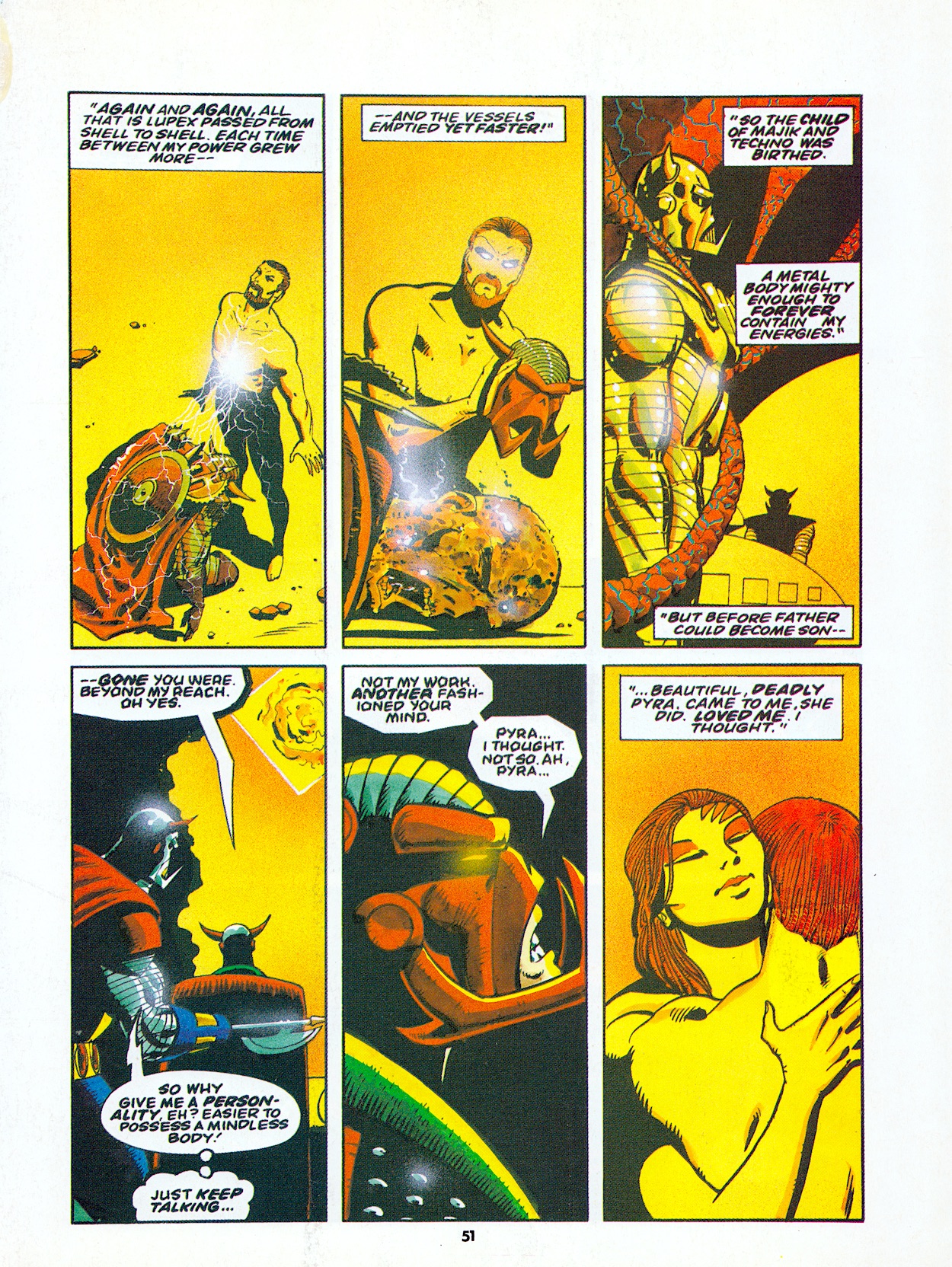
Meet Lupex. He’s the fella in the void universe who bares a striking resemblance to the star of the piece and whose catchphrase is also somewhat familiar. He’s a warlord and Nightweaver, known here as Pyra, was his wife; a woman who wanted all the power he had but who was in love with another. Lupex possessed bodies to survive and did so with her lover’s body out of spite. He was also creating a robotic form for himself so he could live forever without the need of new flesh.
But in an act of revenge Pyra finished programming the robot and made him autonomous with a mind and soul of his own. Not just any mind, a business-like mind, a clinical assassin whose only goal was to do the job and get paid. The opposite of Lupex. She thought this would create the only one who could go up against her husband (whose love of killing drove him). It’s a hell of a story but I’m not sure if it fits within the Death’s Head comic for me. It feels too mythical. Then again, he did fight Unicron, the God of Chaoson the astral plane so maybe it’s just that I’m used to the more grounded stories of the monthly by now.
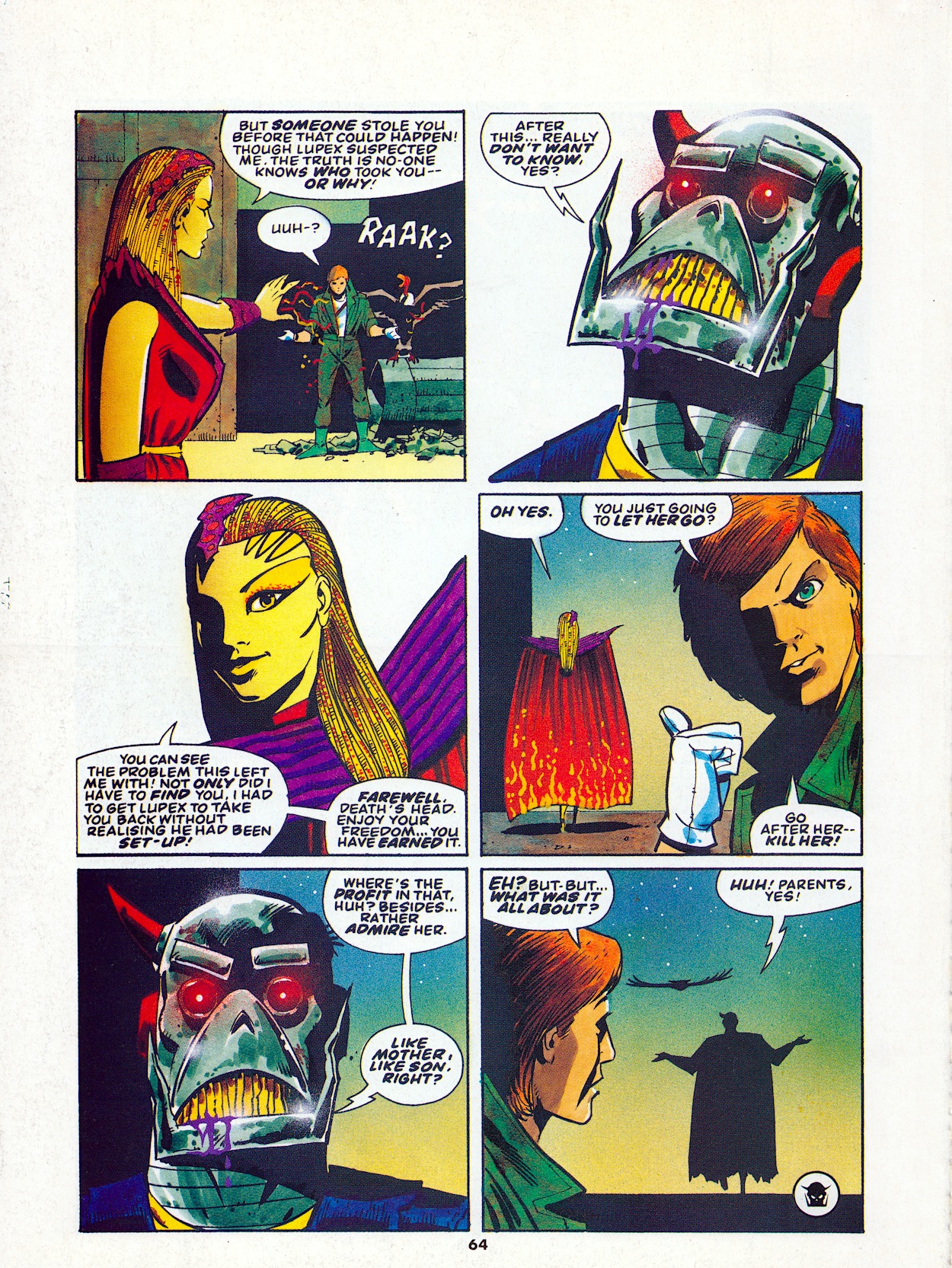
What definitely doesn’t gel for me is the retconning. Don’t get me wrong, I like stories that add to previous ones, that surprise us and take things in new directions or give us previously unknown facts to completely redefine characters and settings. But what I don’t like is when this completely contradicts what went before, and we’d already been told by Death’s Head himself he was created as the plaything of a very rich, very bored individual who he later killed.
However we are told here that his body was subsequently stolen by an unknown party so there’s always a chance the previous origin could be woven in, in the time before his first appearance in Transformers. Did Simon intended to do so or was this was replacing what went before? I’ve convinced myself it’s the former because the rest of this book is so much fun, so full of superb action, great character moments and lots of laugh-out-loud moments that it really is classic Death’s Head.
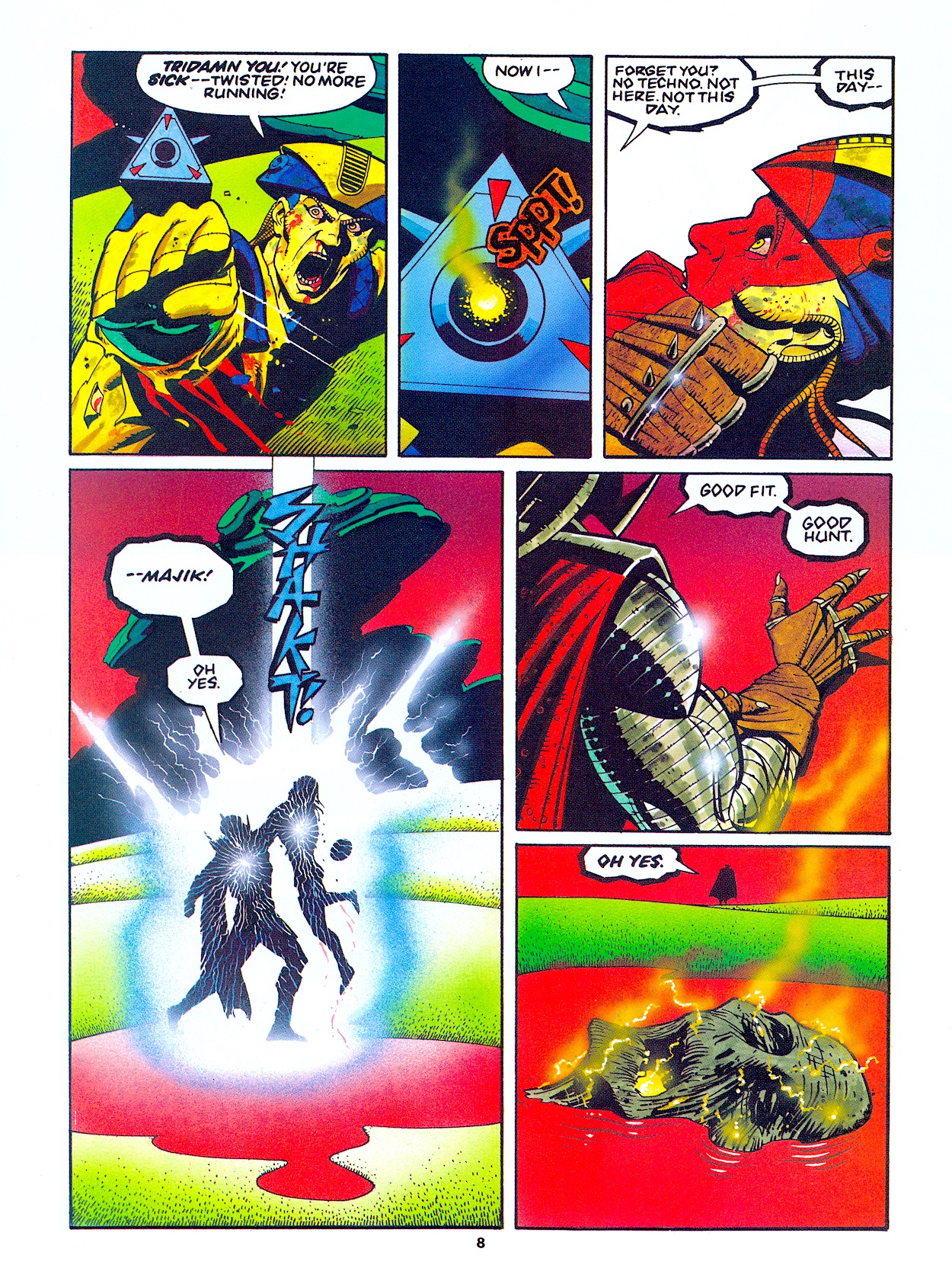
The story culminates in a chase echoing that from the beginning, only with Death’s Head as the one being chased and taunted. This creature also has control over the land in this realm, which is split into ‘magik’ and ‘techno’ sectors. In each he can realign his powers to shape the ground and use it to attack his victims, and he almost destroys Death’s Head by doing so. However, he cannot control the borders between these sectors or when they change from one to the other independently.
We see Death’s Head almost enjoying each successful escape, leading him to question himself again. That is, until he remembers his one true love. No, not Pyra. He remembers how much he loves money! This is enough to refocus him, and I’ll admit I had a little inward cheer and fist bump when this happened. It’s almost a spoof of scenes in superhero comics when doubts are washed away and the hero emerges ready for battle after thinking about the reasons they’re fighting, their cause for good. Here, the cause is cash.
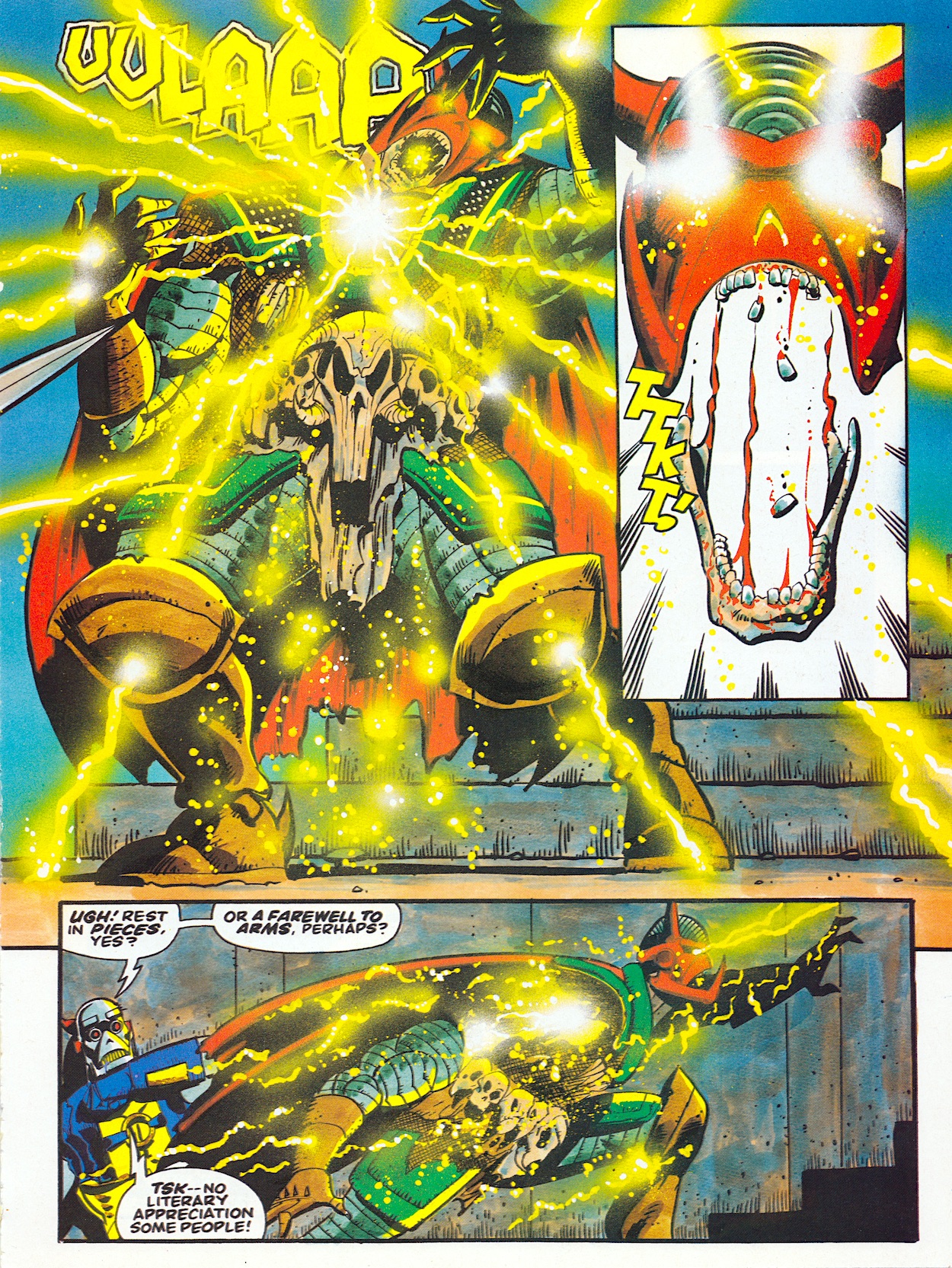
In the end Death’s Head takes a gamble that Lupex doesn’t know he’d spent so long in 8162 (in his own comic and Dragon’s Claws) and as a result has become much more advanced as he repaired and added to his tech. In the end he’s playing the victim but in reality his computer systems are calculating where a magik zone is about to change into a techno one. We think the final blow is about to fall but Lupex unknowingly tries to use magik as the zone changes and it no longer works. The few seconds it takes him to correct his attack is just enough for our star to use his built-in hidden spike.
It’s a thrilling conclusion. It rockets along but never fails to hit the right character beats as it goes. Lupex feels like a genuine threat for the seemingly indestructible Death’s Head, all the while our hero (I’m just going to call him that from now on, I think he deserves it after all this) quips escalate the more desperate he gets, almost like he’s trying to use humour to keep himself going. After it’s all over he even begins to gloat, but he stops himself. He doesn’t want to end up like his father!
Even the vulture gets a funny moment alongside Spratt before Death’s Head gets to round everything off with his usual blasé attitude, despite the scale of the battle that’s just occurred. While I’m still in two minds over the retconning, the story told here is a fascinating one. If we hadn’t been told something different beforehand this would be faultless. In fact, it near enough is anyway!
What a fantastic send off for one of my very favourite comics characters. Apparently this first incarnation of Death’s Head appeared in Marvel US’ Fantastic Four #338 so I might track that down some day as an extra for the blog, but in the meantime it’s a very, very fond farewell to the greatest Freelance Peacekeeping Agent any world, any time or any universe has ever seen. What an ending! Kudos to all involved.
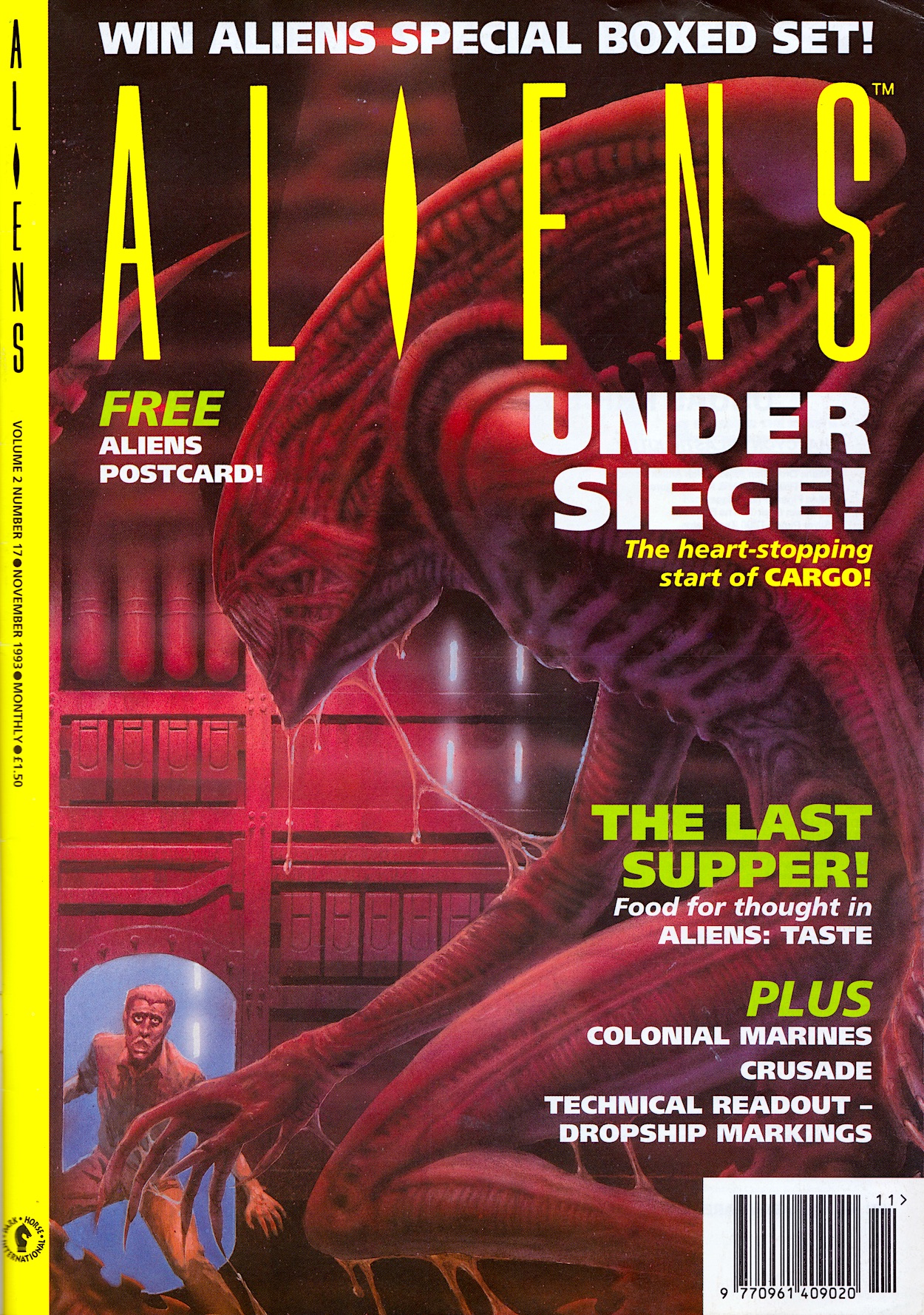
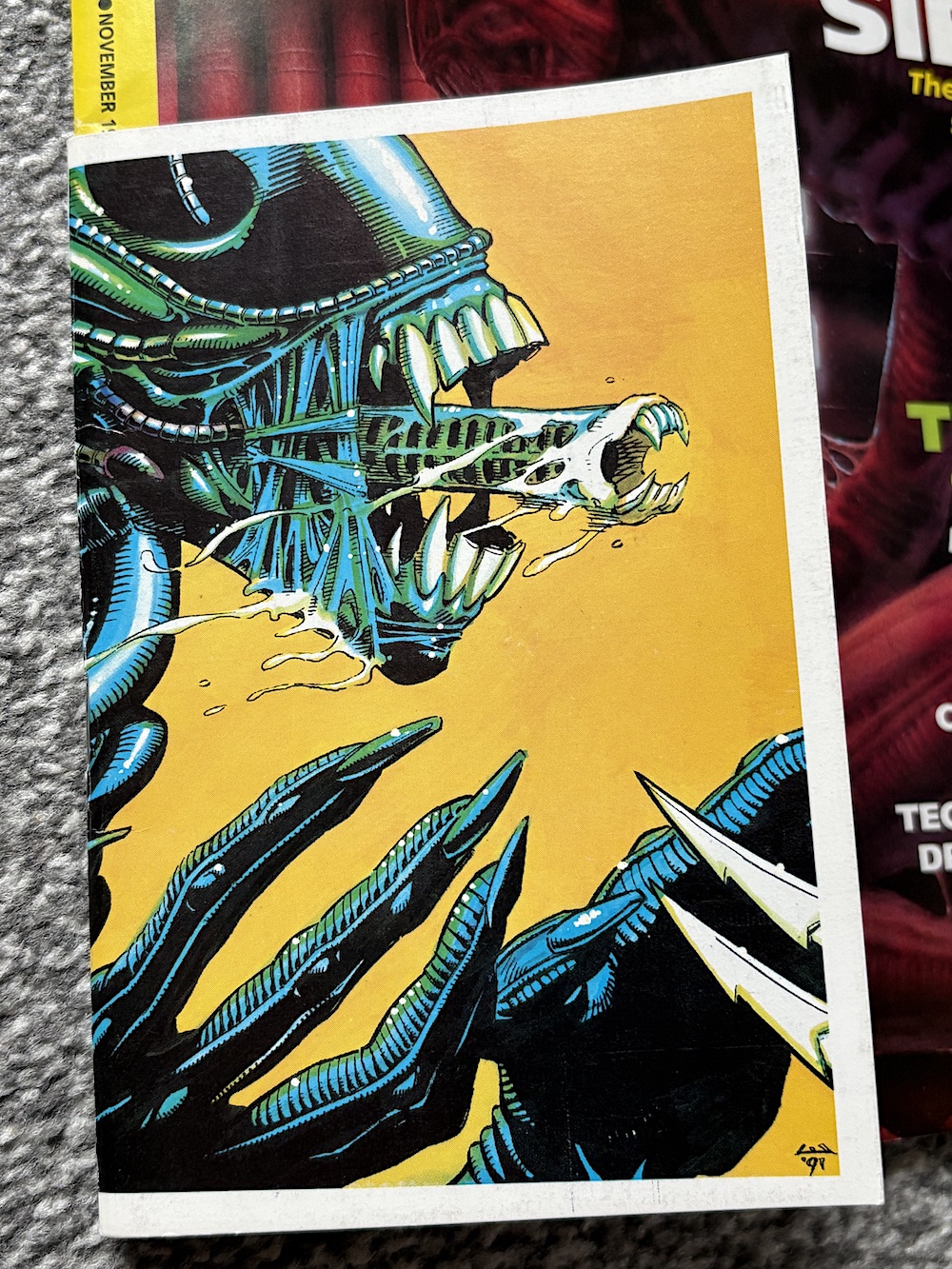
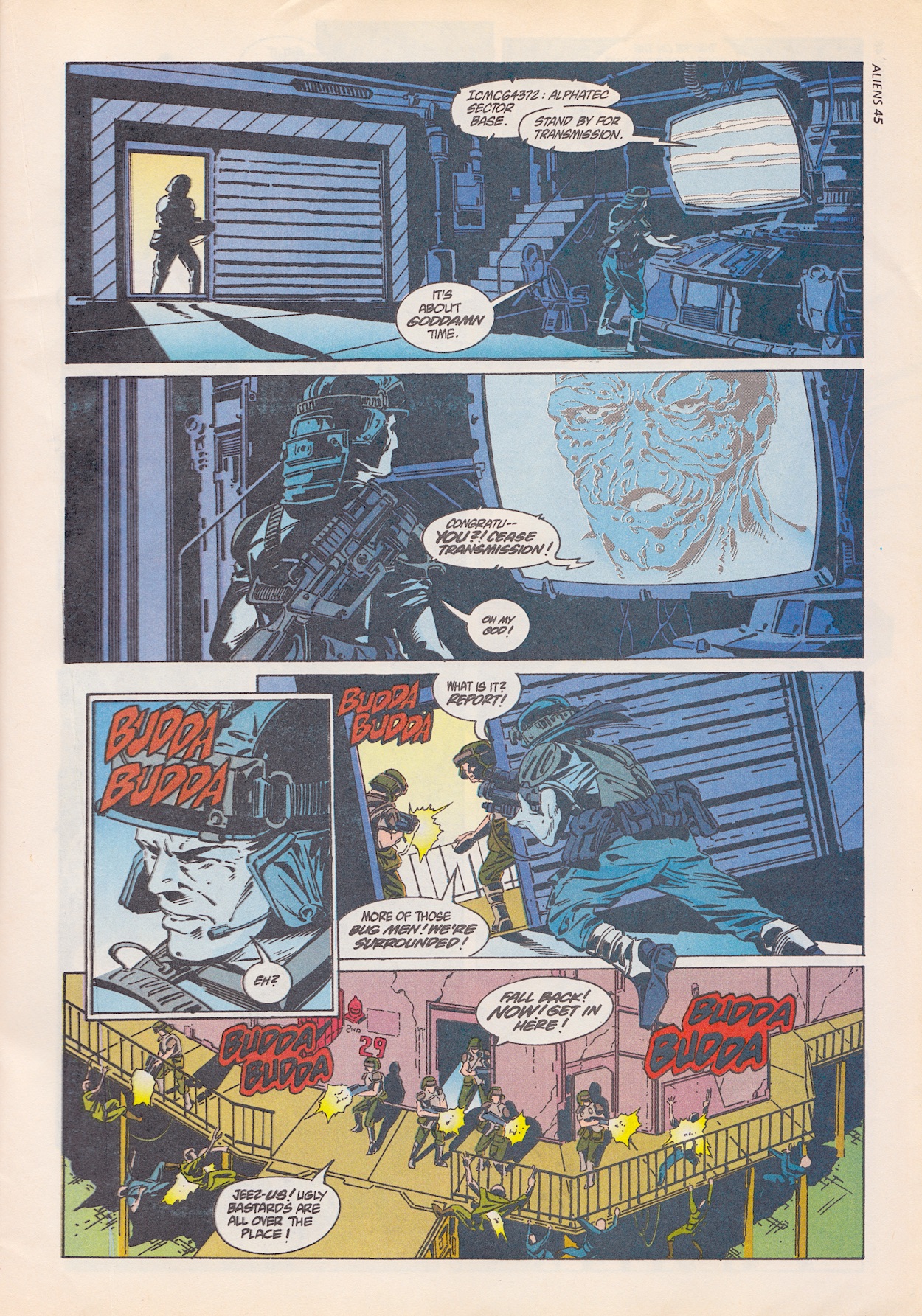
This cover by Robert Mentor (Sex Warrior, Star Wars, Vamperotica Magazine) is partially obscured by the latest free gift of an Aliens postcard, one half of a set showing a xenomorph facing up to a Predator. Don’t be expecting the other half next month, it was given away with a totally different comic, Total Carnage. Having linking postcards seems a bit strange. Were we meant to send them to the same person? The other postcard also marks the beginning of a new Aliens/Predator crossover strip in that comic. Why is it not in this comic where it belongs? Damn, that’s not fair. An advert for this issue also featured in Jurassic Park#5’s review.
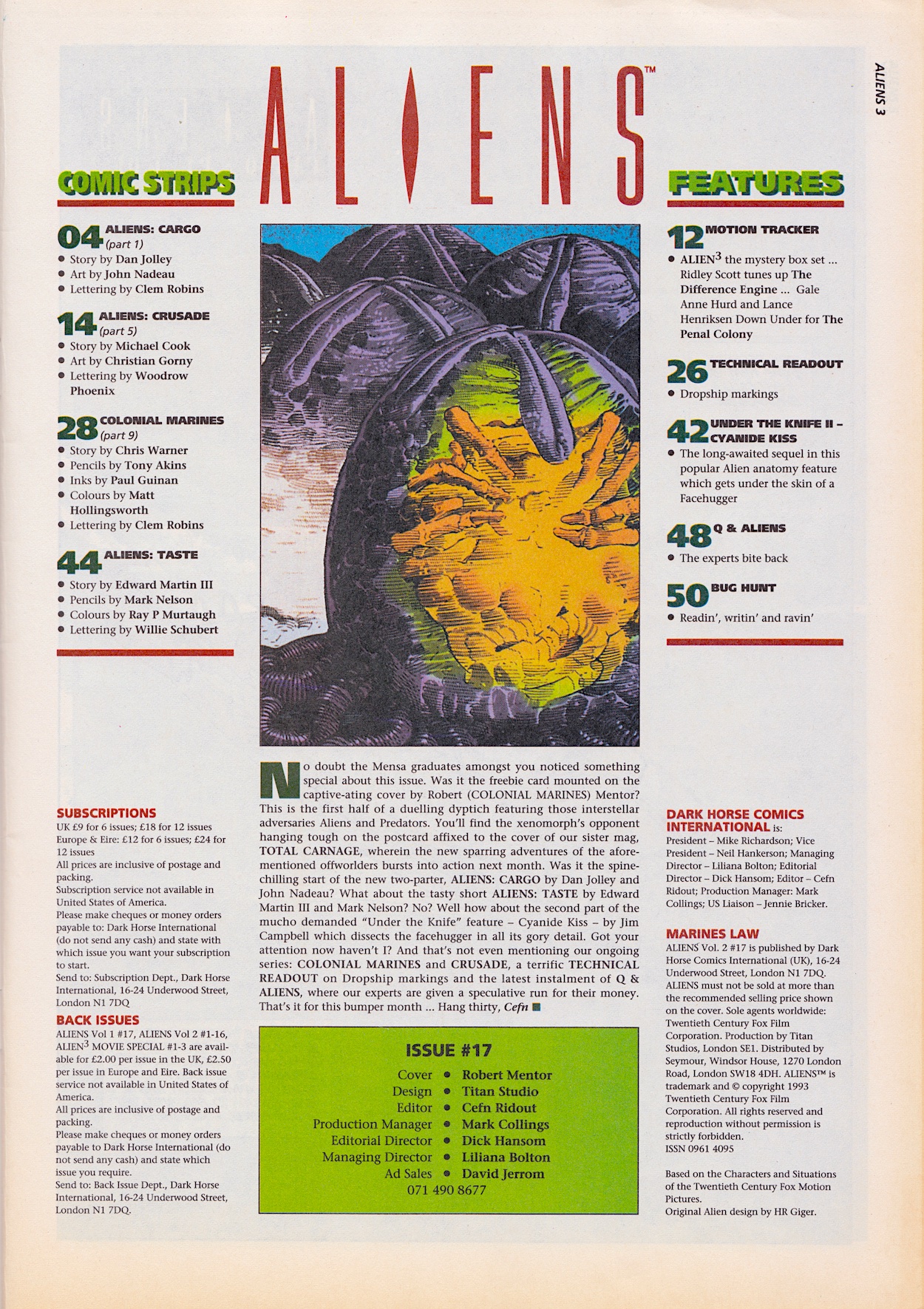
As per usual here’s the editorial page with all of the credits for the issue and we kick things off with another short two-part story from the pages of anthology US title Dark Horse Comics. Part one of Dan Jolley’s (G.I. Joe Frontline, Vampirella, Warriors) Cargo is eight pages long and full of classic Alien atmosphere.
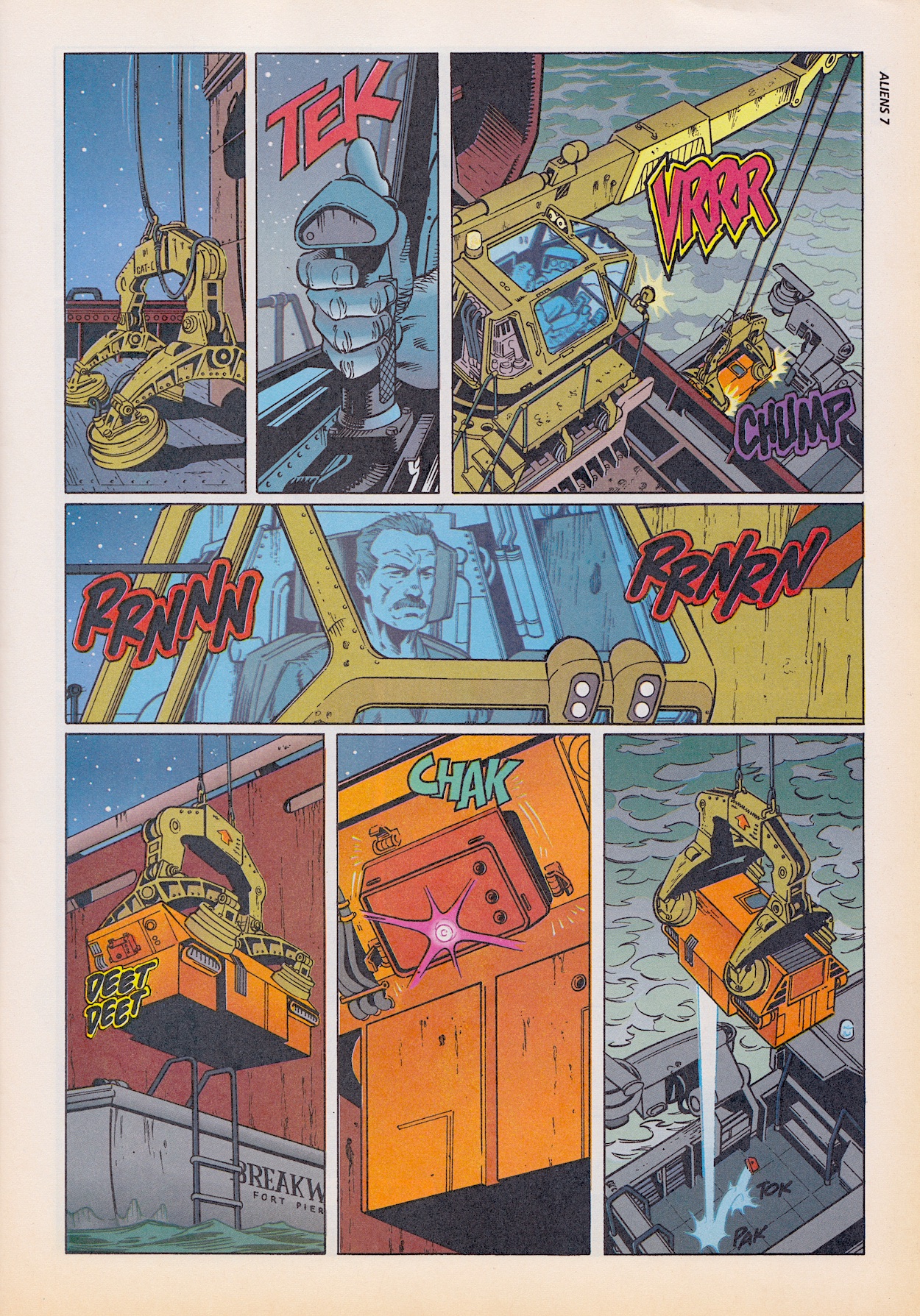
Gerald Coile is a smuggler who’s getting out of the game by informing to the DEA and escaping to anonymity, but he can’t help making one last run. In this universe we know this is likely to be a bad decision. He delivers his illicit cargo to a large ship and when he sees no one about he takes control of one of its cranes to get it on board so he can get paid and skedaddle. He doesn’t notice something automatically release itself and fall back into his boat.
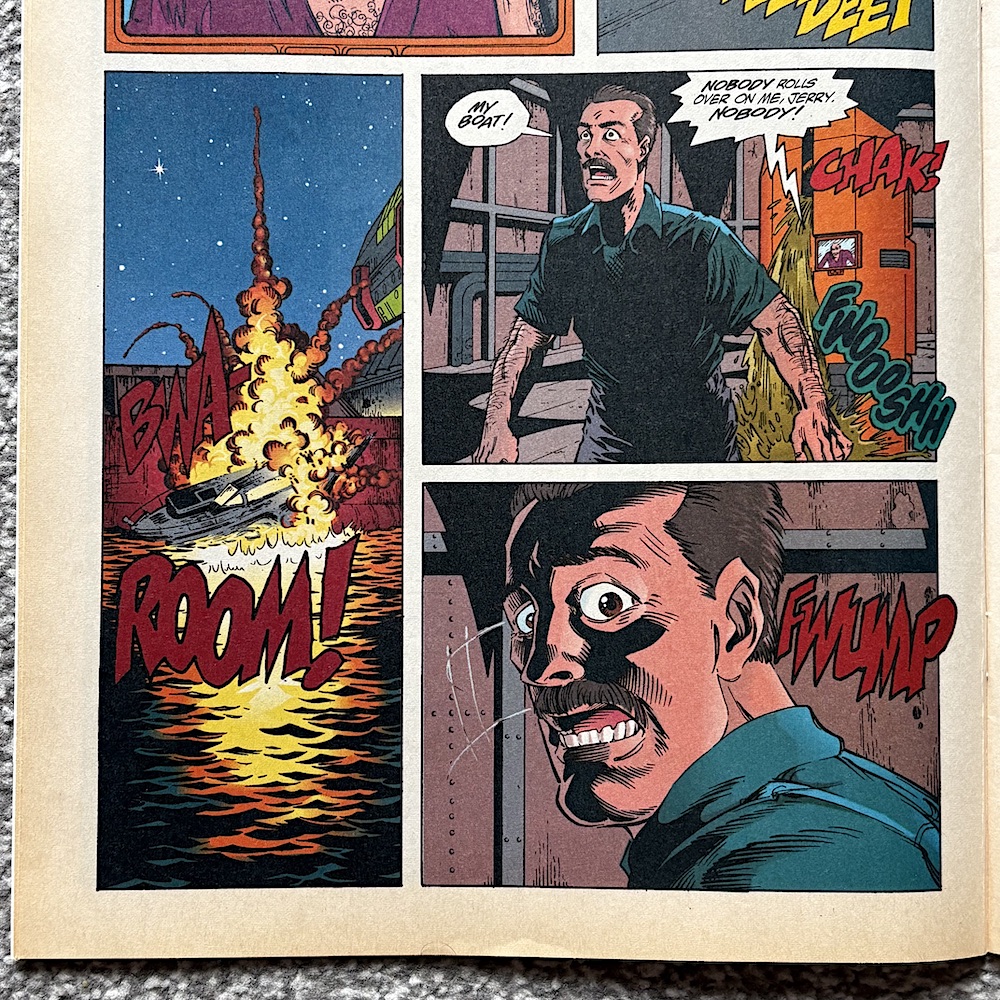
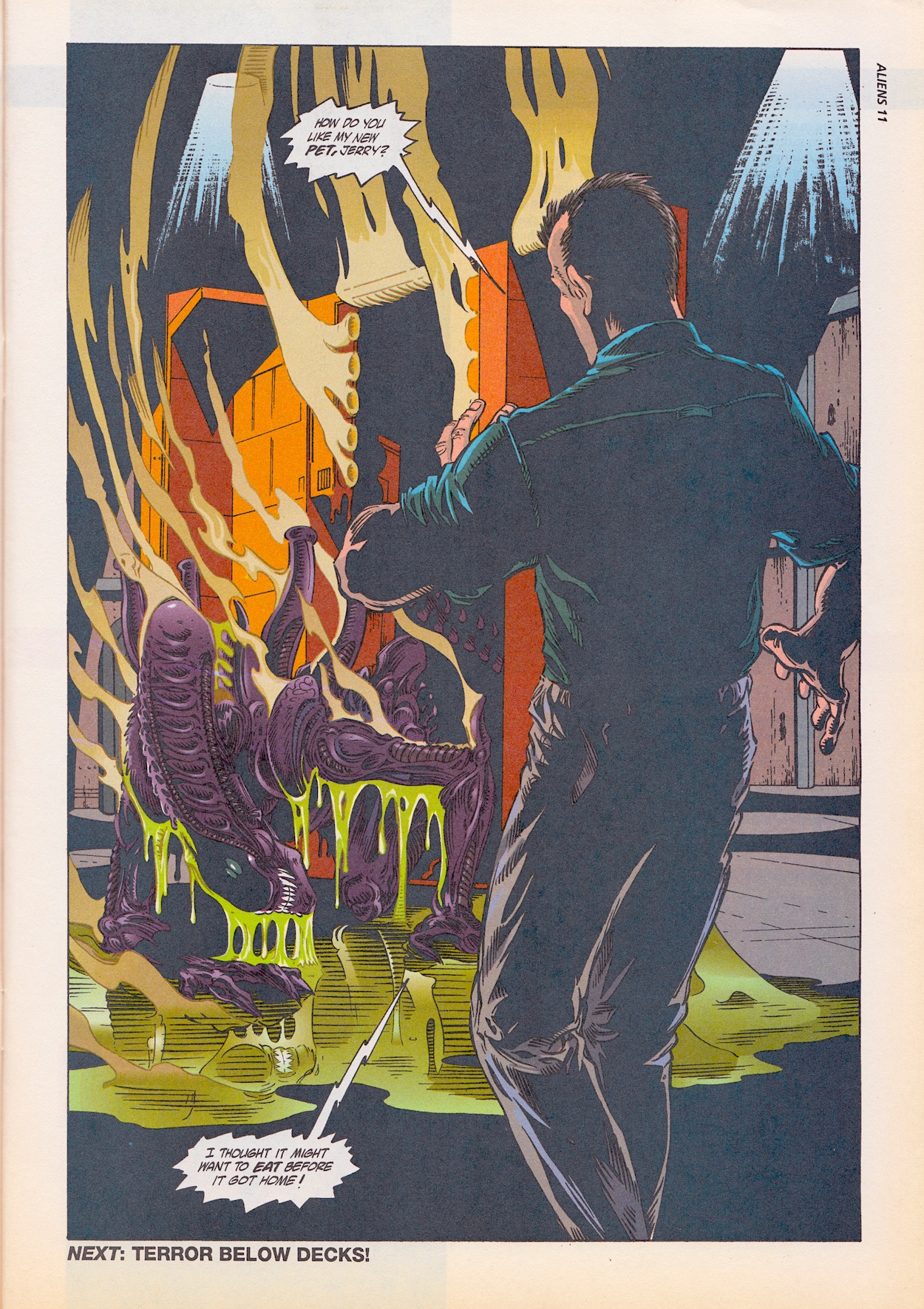
Once his cargo is in the hold he wanders around a bit and realises he’s completely alone and the ship is powered down. He decides to go and check on the cargo he’s still to be paid for. Noticing it has a bleeping video screen his heart sinks. A video of the man he informed on pops up and Gerry’s boat explodes thanks to that earlier device. I do love the explosion picture, the bright colours against the dark shadows on the water are great, John Nadeau’s (Star Wars X-Wing, Wolverine, Colonial Marines) art compliments the atmosphere perfectly. As for Gerry, that’s not the end of his problems as the cargo he delivered opens up…
Of course this asks a lot of questions, like how Vasco got hold of an alien, what he originally wanted it for and what is the reference to its “home”. But this is a short two-part story and those answers may or may not have be answered elsewhere. It doesn’t matter though, we’re here for this tale and it’s a classic Aliens set up. I’m looking forward to seeing how (or if) Gerry gets out of this one.
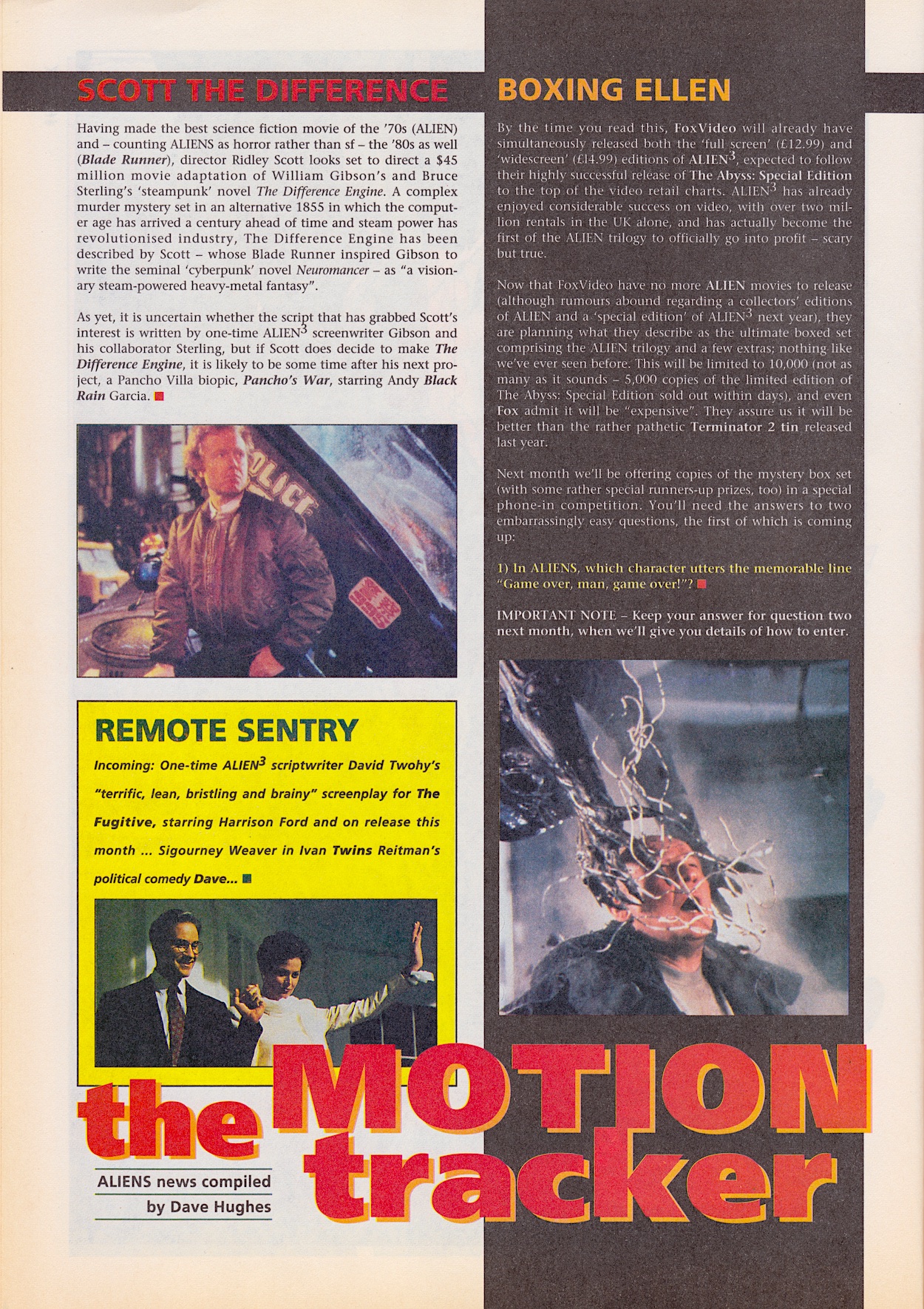
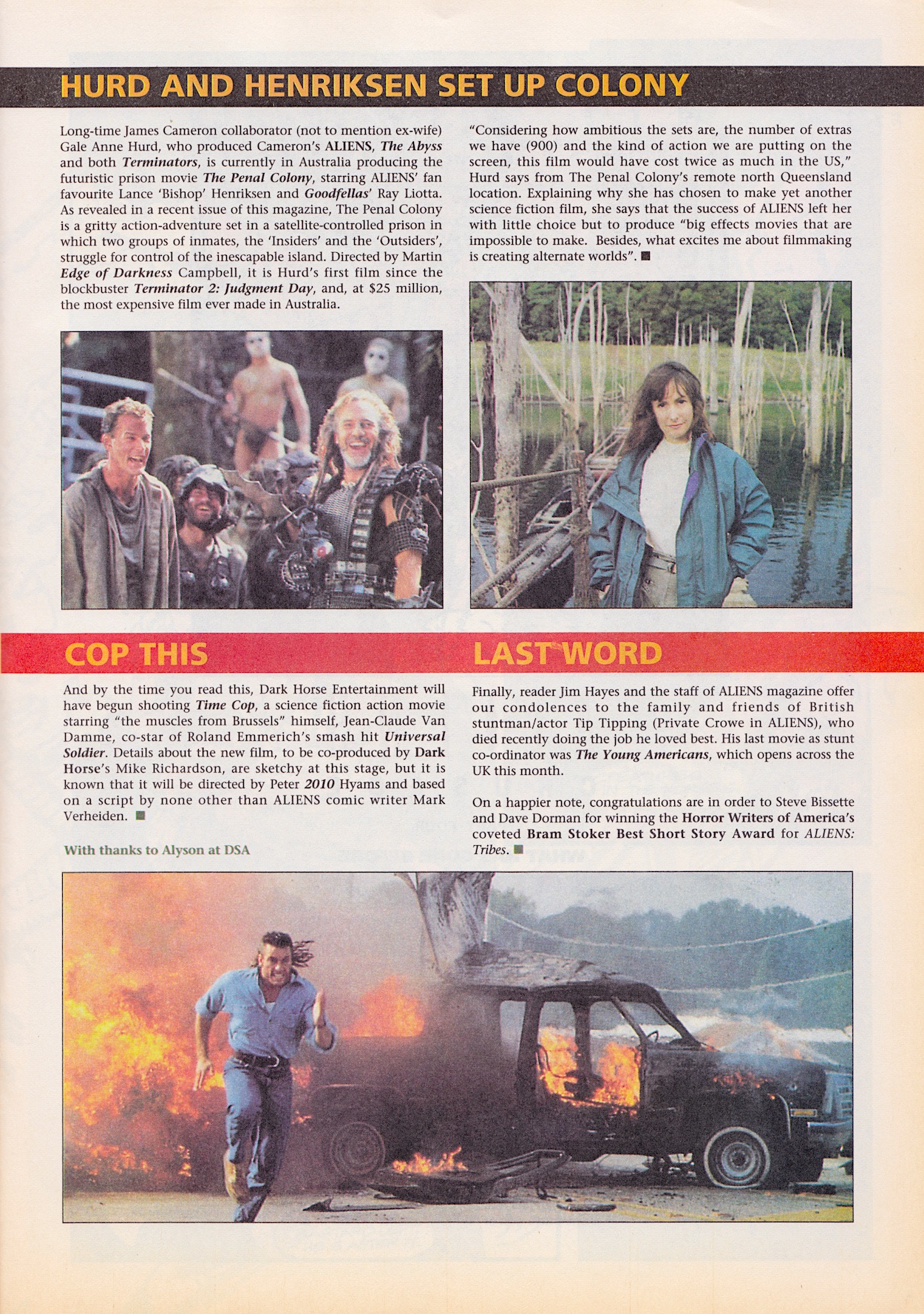
There’s more of interest in the Motion Tracker news section than there has been these last few months. Not necessarily tying in with Aliens but I do love a good contemporary news article in these old comics and this one is very 90s indeed. The Difference Engine movie never got made in the end but I remember playing The Chaos Engine game on a friend’s Commodore Amiga and it was actually based on the novel. I never knew that! Penal Colony would get made but was renamed No Escape and it had a comics adaptation too.
I’ve never seen Time Cop but I remember reading about its short-lived TV show sequel in the excellent TV Zone magazine in the 90s and it seemed like fun. As for news centred around the comic’s inspiration I’d say the news Alien³ is the first of the series to make profit is probably only how the studio’s creative accounting saw it and our previous prose story Tribes won a very well deserved award.
Part five of Michael Cook’sCrusade takes up 11 pages in the middle of the comic and Christian Gorny’s art has improved immensely! The aliens and action scenes in particular are wonderful. Why was it not this good previously? It’s revealed Rani the seer is searching for her missing childhood friend Martha and her narration is a welcome addition. Coupled with the upgrade in art it makes things a lot less confusing.
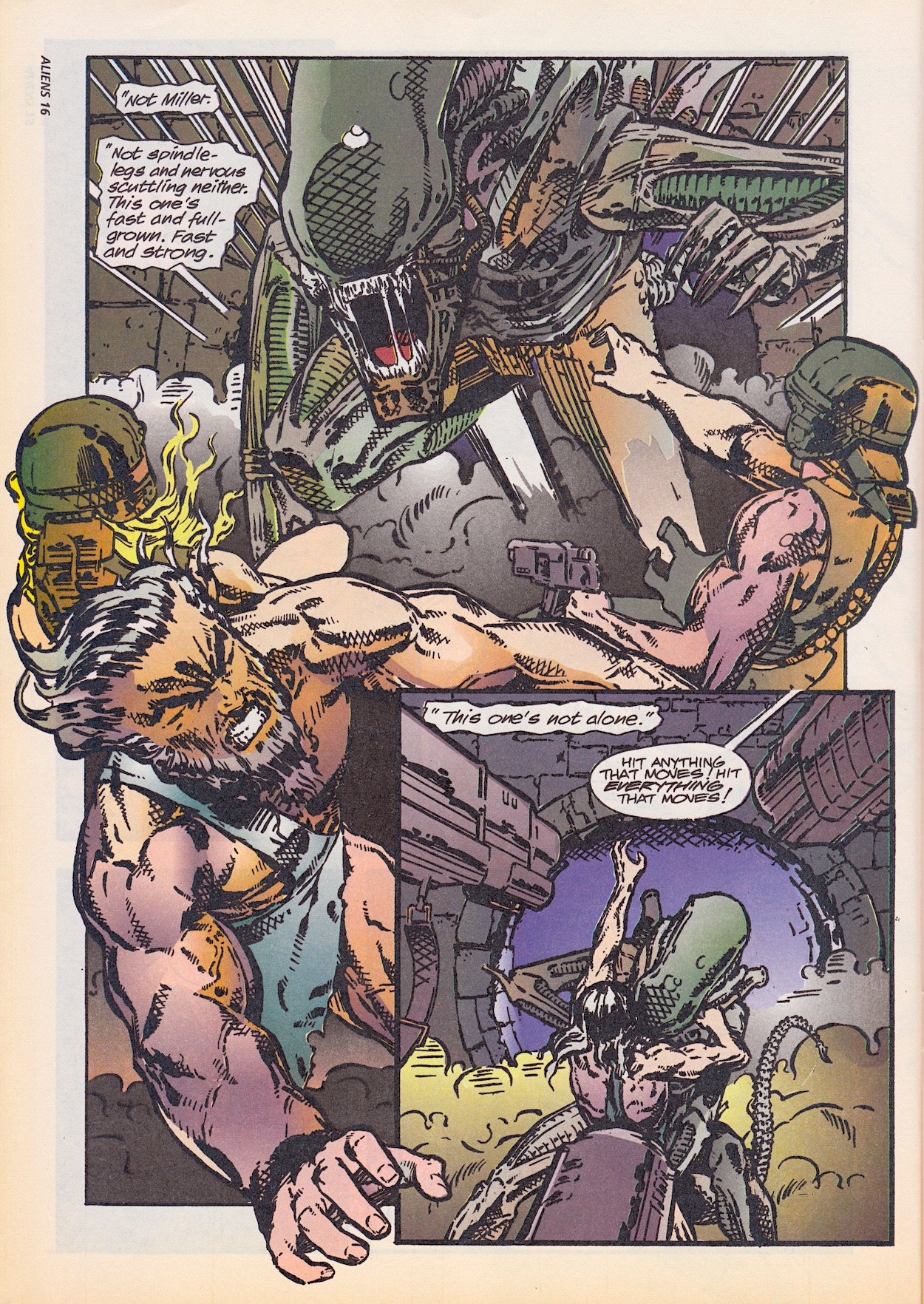
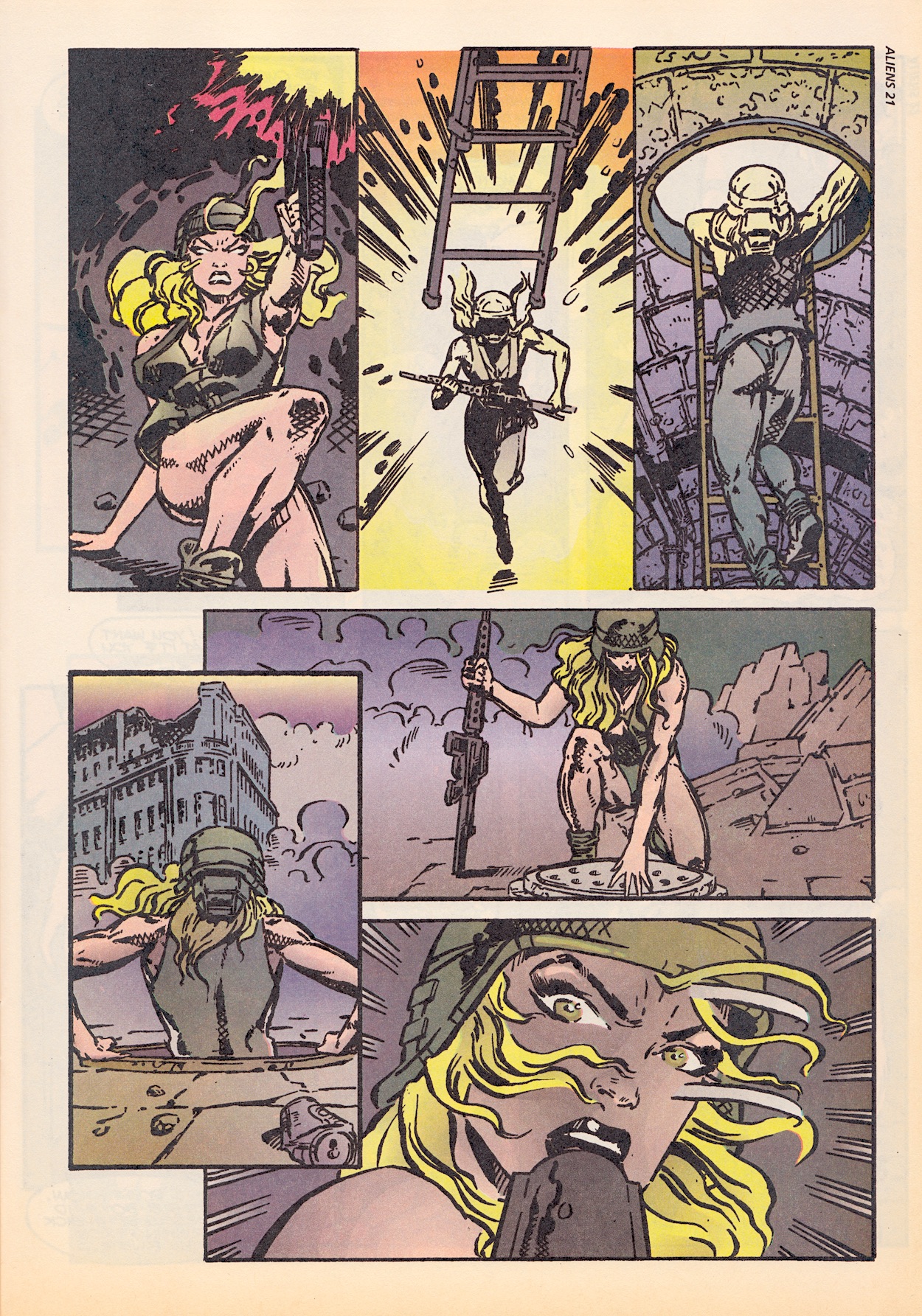
This chapter is their escape from the sewer but unlike previous entries it has satisfying character development too, thanks to there only being three characters now and the art making each more distinctive. Running from the aliens, Minecorp marine Channon saves Rani and one of the male Marines (his name isn’t given here and trying to work out who he was previously was impossible) but the narration tells us they couldn’t save her in return, so they made their escape without her. We think this is because Channon is about to be killed by the alien but it’s actually a smart bit of misdirection.
Instead, she faces it down, shoots it and for once in the Alien franchise doesn’t get covered in acid, so kudos to her! However, once out of the sewer a gun is held to her face by an unknown person. Rani and the male marine are all that’s left as far as they’re concerned and we find out the missing team they were sent to find included his wife. This changes Rani’s opinion of him. She knows he’s no solider (he’s actually a company man, not a marine as its turns out) and they disagree on pretty much everything, but she respects how much he believes in his wife’s abilities to survive.
They realise the horses that birthed the aliens had been drinking from the Thames, and if that’s how they got infected then the creatures must be all over the city by now, in every river and stream. The slower, quieter moments with proper dialogue instead of the forced ‘chat’ of the earliest chapters and the upgrade in art have really surprised me, and raised Crusade’s prospects immensely.
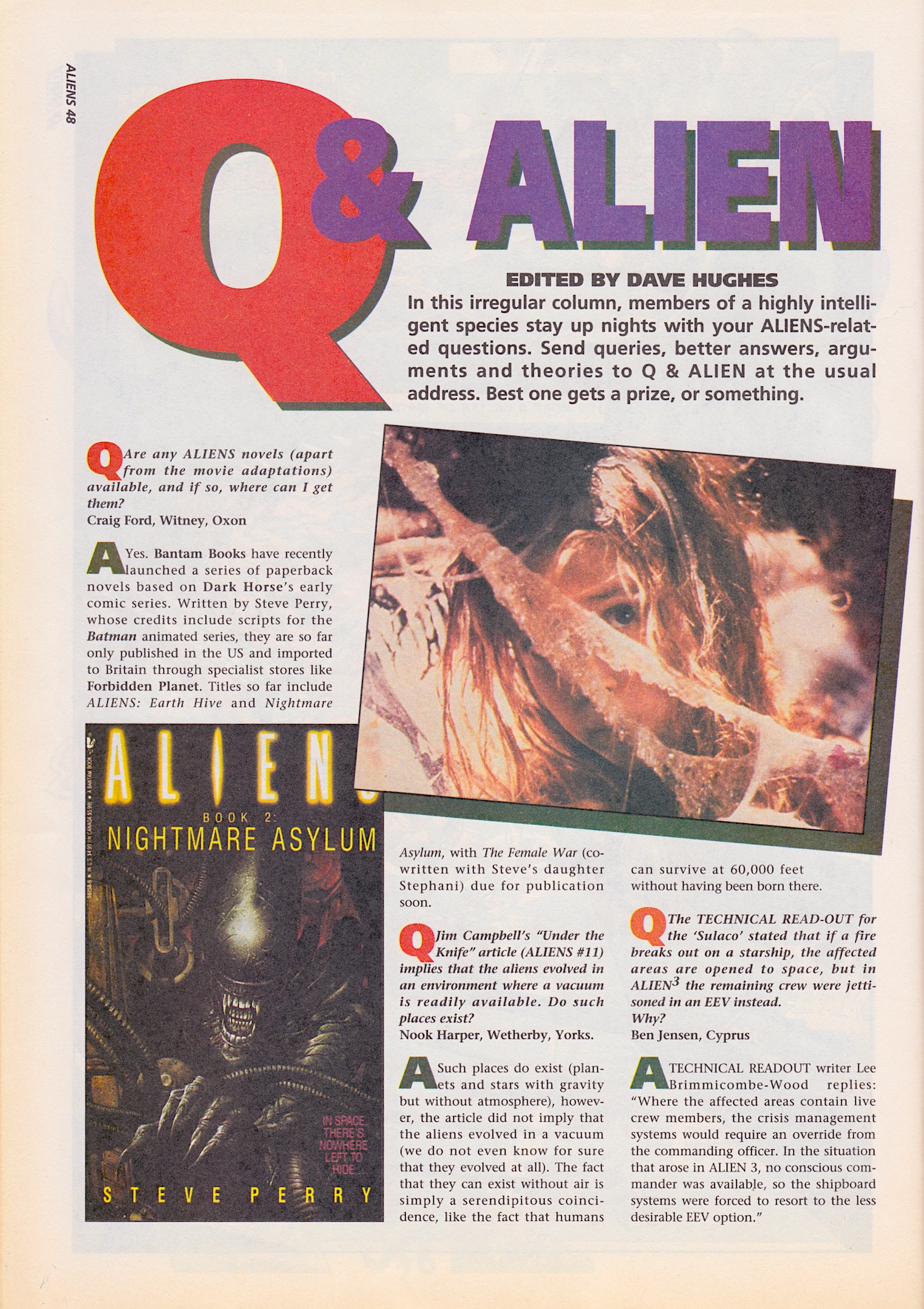
The Technical Readout is getting less and less technical as the comic goes on, unfortunately. This month it’s about Dropship markings, nothing more than a few identical drawings of drop ships coloured differently. Much better as a feature is the next Q and Aliens, with the trickier questions from readers put to the publication’s experts.
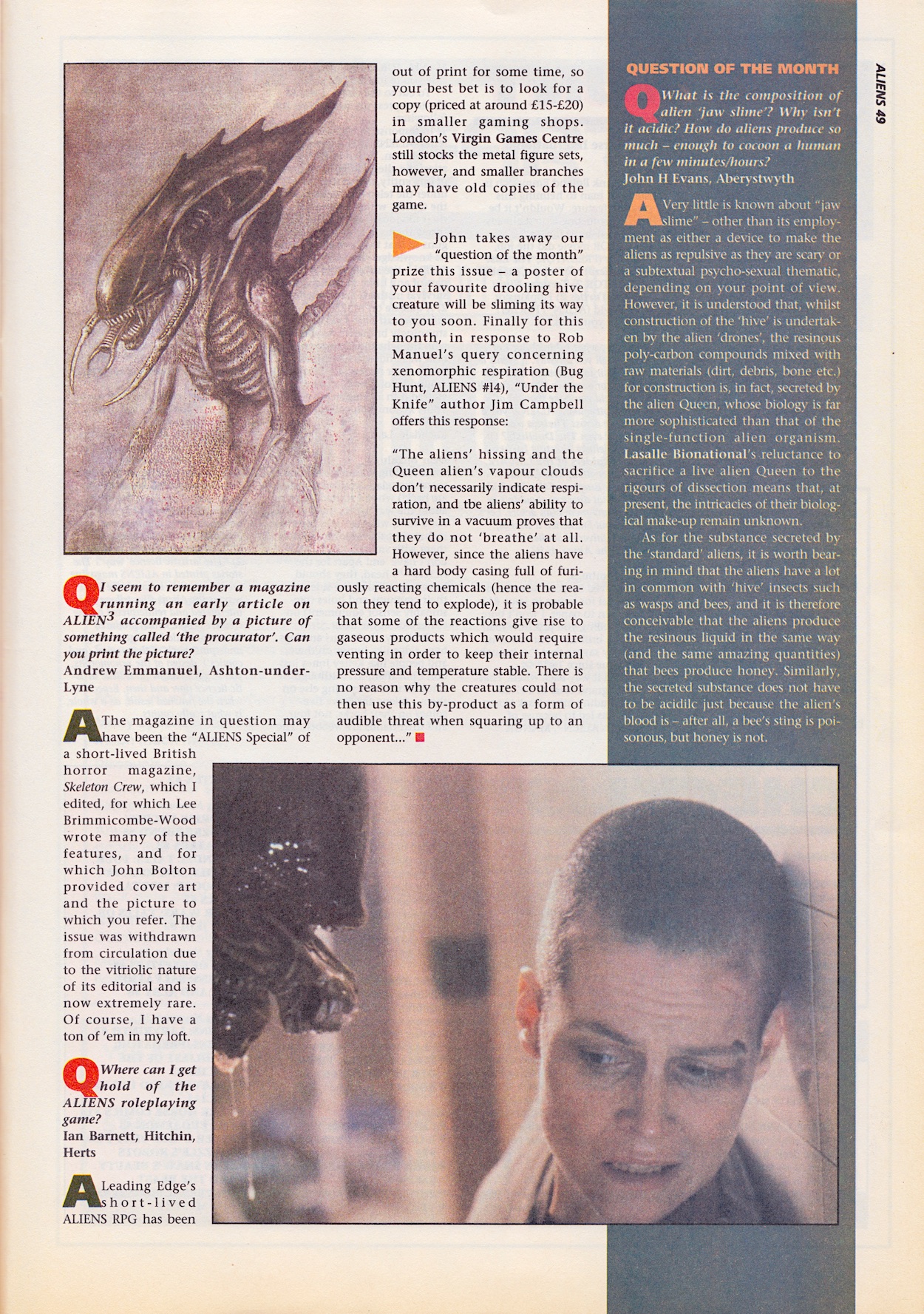
That’s an interesting image by John Bolton and the Question of the Month has a fun answer, staying within character and defending the company, and I like that comparison to bees. But most intriguing is the mention of Skeleton Crew magazine and why its Aliens Special was withdrawn from sale. The magazine was actually created by this comic’s Dave Hughes but as it says here it’s a rare issue and the only one I can’t track down on eBay. Possibly a future special feature for the blog.
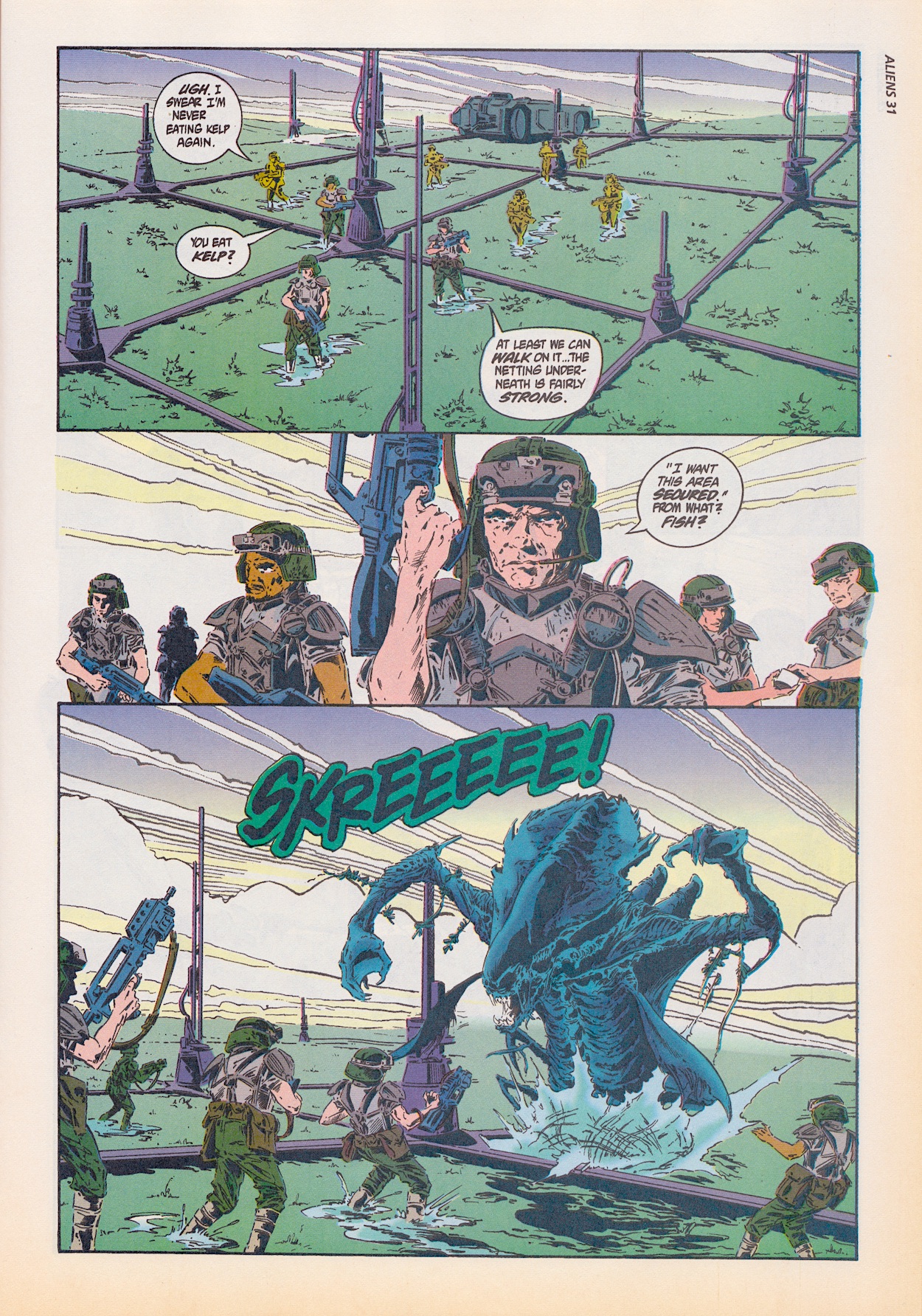
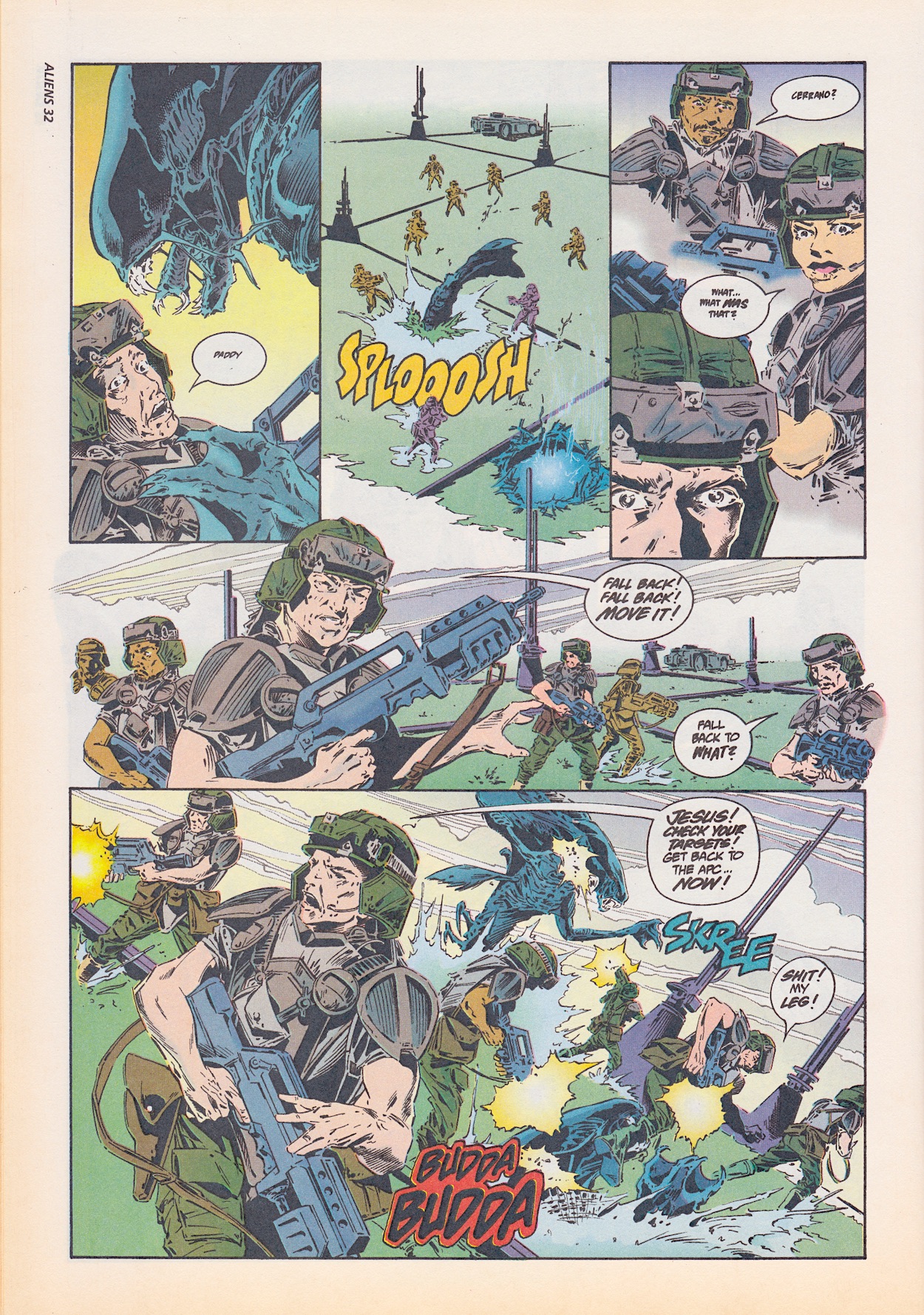
Chris Warner’sColonial Marines is next and with their APC damaged they’re awaiting rescue from their second dropship when loads of finned aliens with fish tails instead of legs break through the surface of the kelp beds. There’s even one huge mother of an aquatic alien who clearly wants to challenge Daryl Hannah as the Queen of the mermaids.
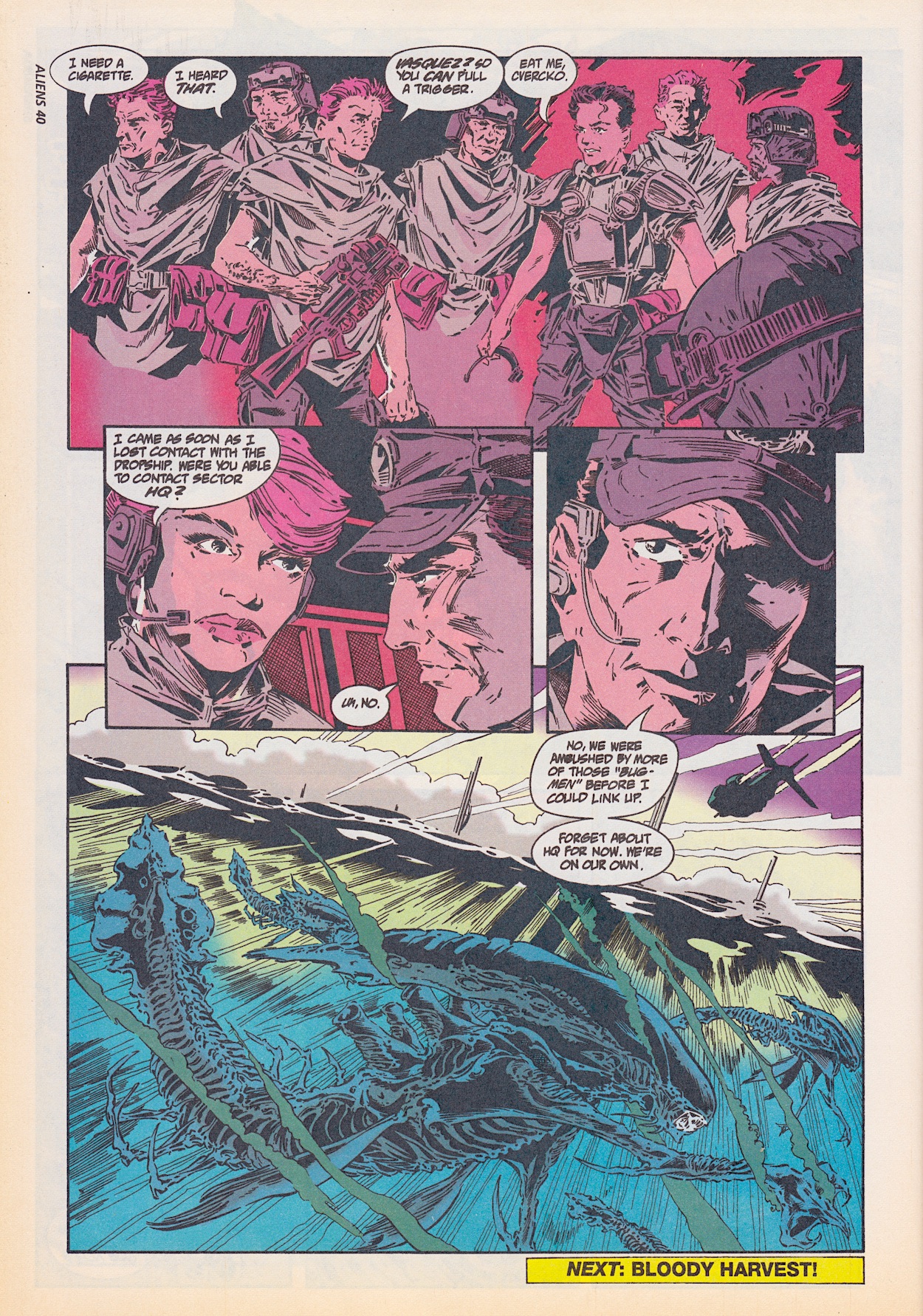
While it should be a tense scene with nowhere to run except to sit on top of their APC and fight off hoards of aliens (why not go inside the heavily armoured vehicle?), unfortunately this usually superb strip has gone in the opposite direction of Crusade. Here, there are just too many characters who all look like each other. I can’t even tell who Lt. Henry is, who I’d been enjoying so much in previous issues, so this means I’m suddenly not as invested as I was in what happens. Eventually Vasquez arrives piloting the dropship and rescues everyone, redeeming herself after she’d previously froze on the spot mid-battle. There’s a funny reference to this on the final page and this is pretty much all we get as far as character moments go. The first disappointing chapter in this lengthy tale.
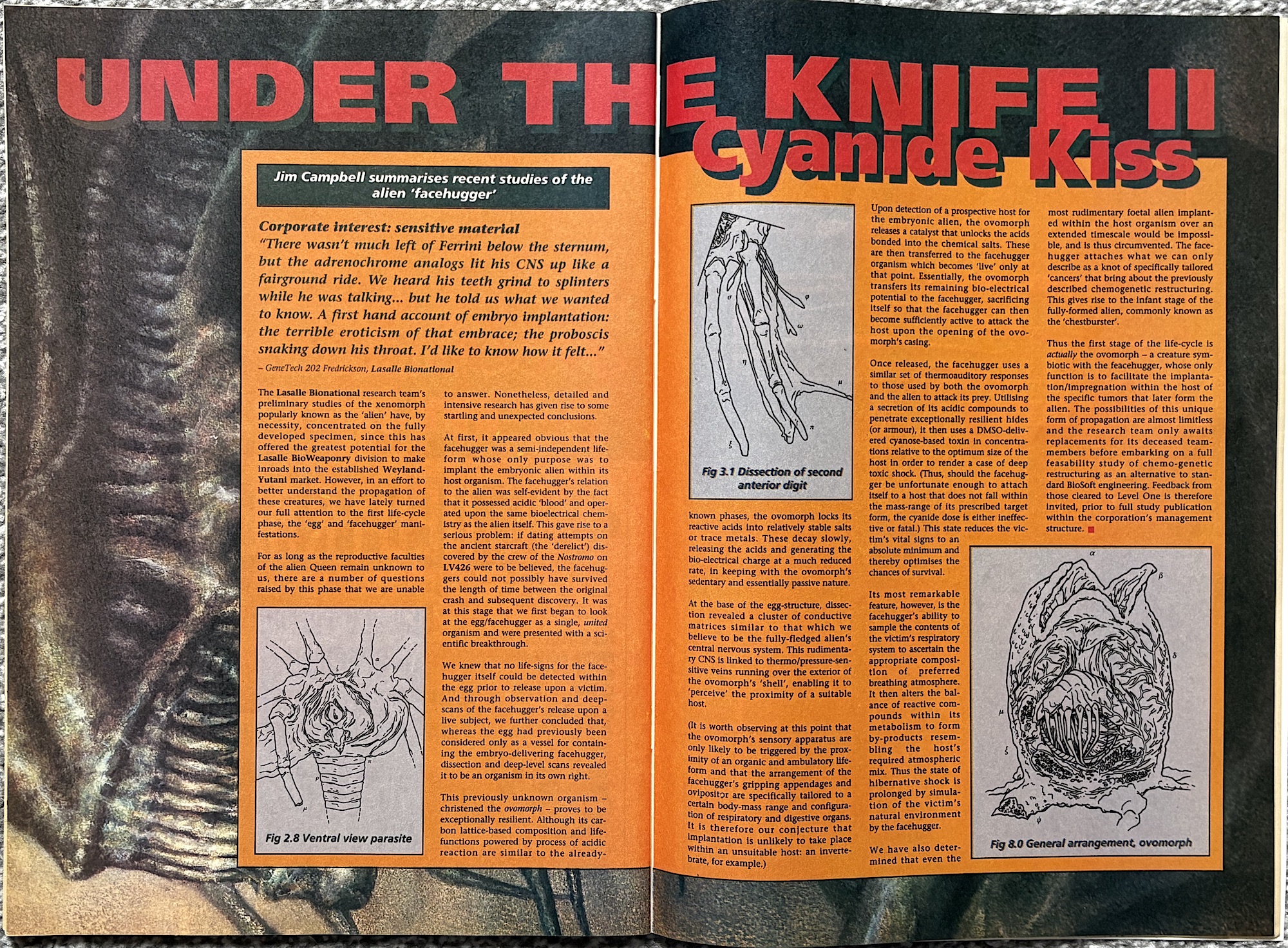
Next is a follow-up feature to the excellent alien autopsy from #11. This time, Jim Campbell’sUnder the Knife cuts deep into a facehugger and its alien egg or, to give it its proper name, the ovomorph. I’ve been really looking forward to this and, as it’s once again written from the perspective of the future scientists doing the dissecting, it’s another fascinating read. For starters, I never thought of the eggs as separate lifeforms until now. It makes sense, of course.
Jim gives us a reason as to how they survived so long on LV426 before discovery in the first film, something which is key to the aliens’ survival. How the egg detects potential hosts makes these things even creepier and how it can configure a facehugger in much the same way as an alien adapts to its host is really well written. In fact, the whole feature is brilliantly written. Again.
The apparent science behind the actual face-hugging is compulsive reading, from how it’s awoken to how it samples its host’s respiratory system to determine the best way to keep them alive. Then the fact the alien is created inside the host rather than being implanted actually pairs up with the prequel movies decades later. Towards the end I did laugh at the typically horrific reasoning of the company when it reveals the only thing stopping them from carrying on their research!
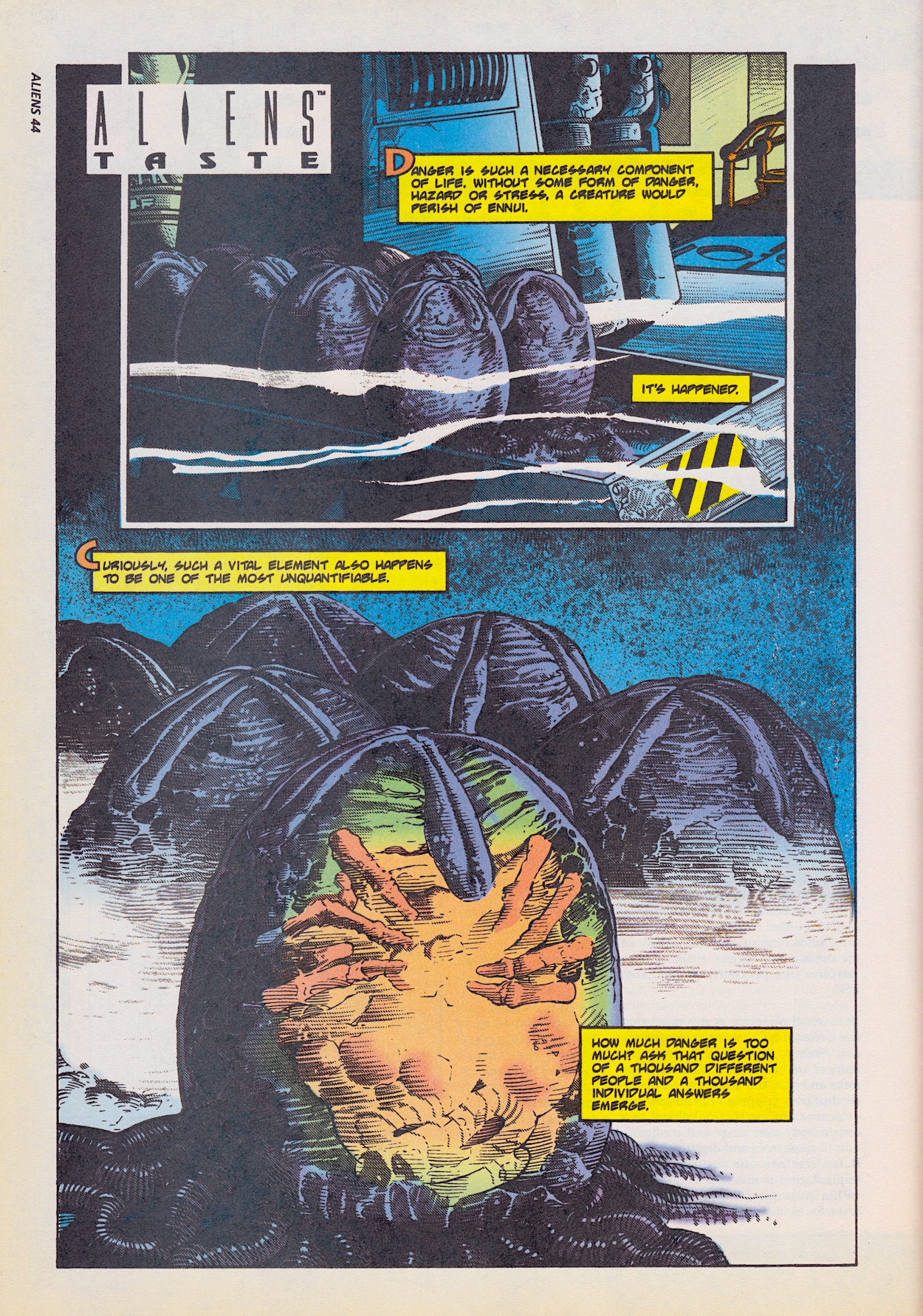
Believe it or not we finish on a four-page humour strip. Not that you’d know it from the first few pages. Coming straight after the dissection feature the images on the first page instantly set me on edge. Aliens: Taste is written by Edward Martin III (a Dark Horse US editor for Dark Horse Presents, Aliens and Predator), drawn by Mark Nelson (Graphic Classics Bram Stoker, Native American Classics, Rosebud), coloured by Ray P. Murtaugh (Splatter, Star Wars, Elementals) and lettered by Willie Shubert (Legends of The Dark Knight, Deathstroke, Robin).
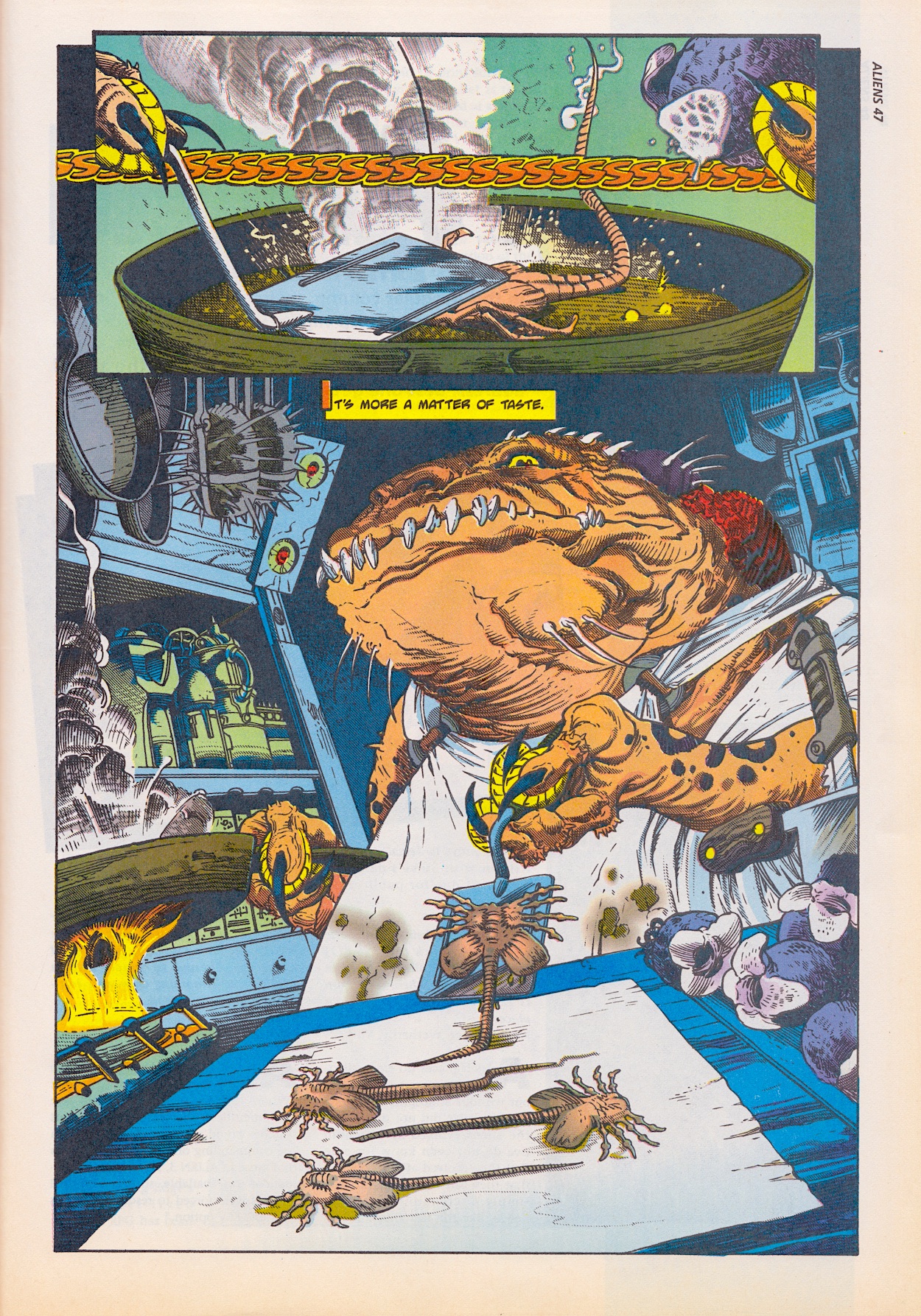
The narration talks about life forms dying of ennui (boredom, lethargy), then builds tension as it talks about those of us who experience bits of danger everyday, then those who like it for the adrenalin rush, those who seek it out, right up to those who actively court danger. All the while the facehugger is slipping further out of its egg until it lunges towards the reader… but a giant clawed hand grabs it before we turn to the final page below.
I didn’t expect this to be a funny strip until I actually read it and got to this page. It was certainly a surprise inside the pages of this particular comic! This many issues in and Aliens continues to shock us in terms of its horror stories and now a shock dose of humour. One of the very best all-round issues yet, it begs the question of what will #18 contain to improve upon it? We’ll find out together on Tuesday 18th November 2025.
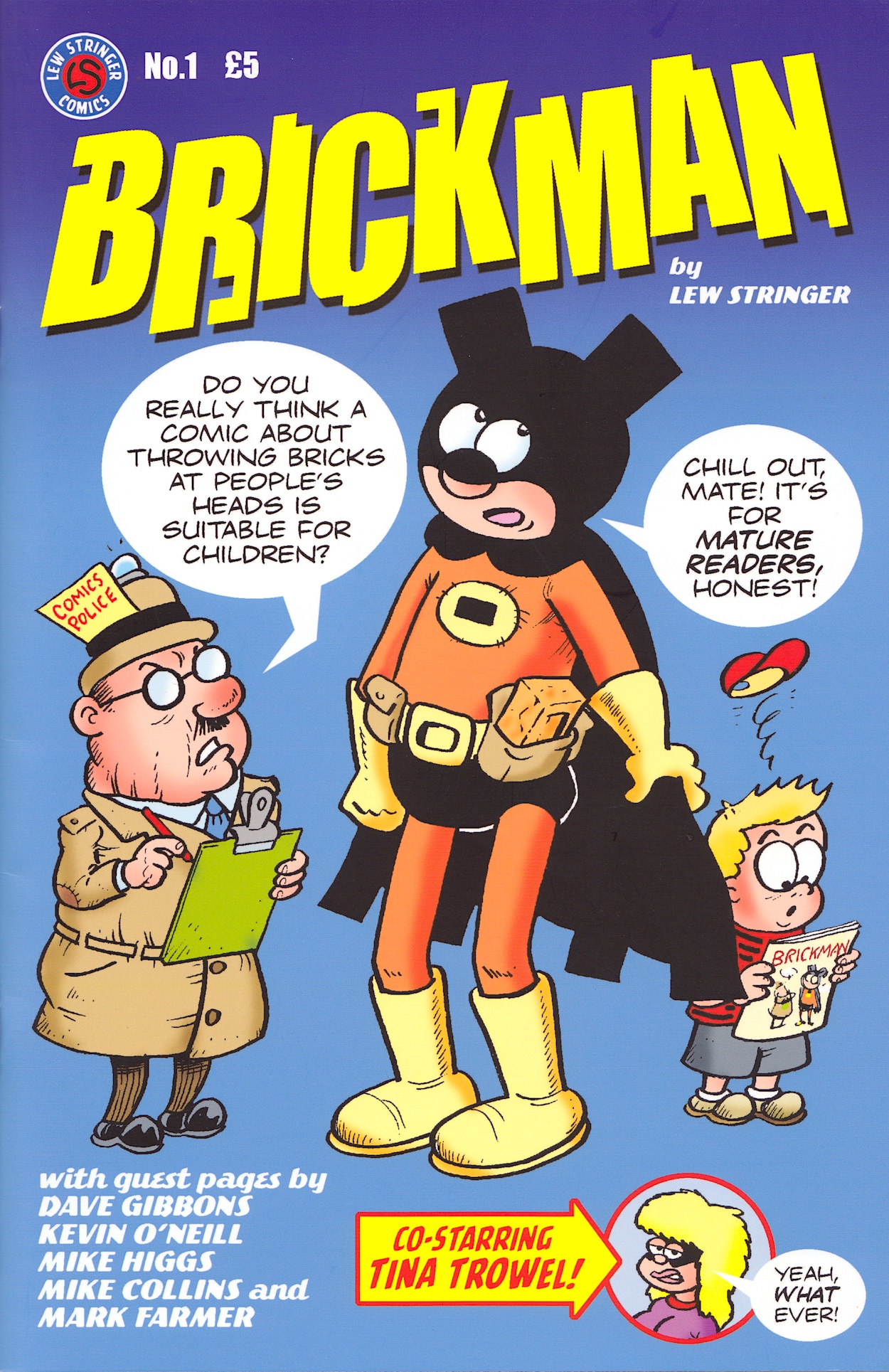
It’s always exciting news when Lew Stringer (Tom Thug, Pete and his Pimple, Combat Colin) announces another of his self-published comics. Regular readers of the OiNK Blog will recognise the star of his latest release from Lew’s Barmy Comix and Comic Sampler collections. Starring one of his earliest creations, Brickman #1 is the first of three ‘Best Of’ comics for the spoof superhero (“Britain’s Greatest Super-Pillock”) and his alter ego, Loose Brayne.
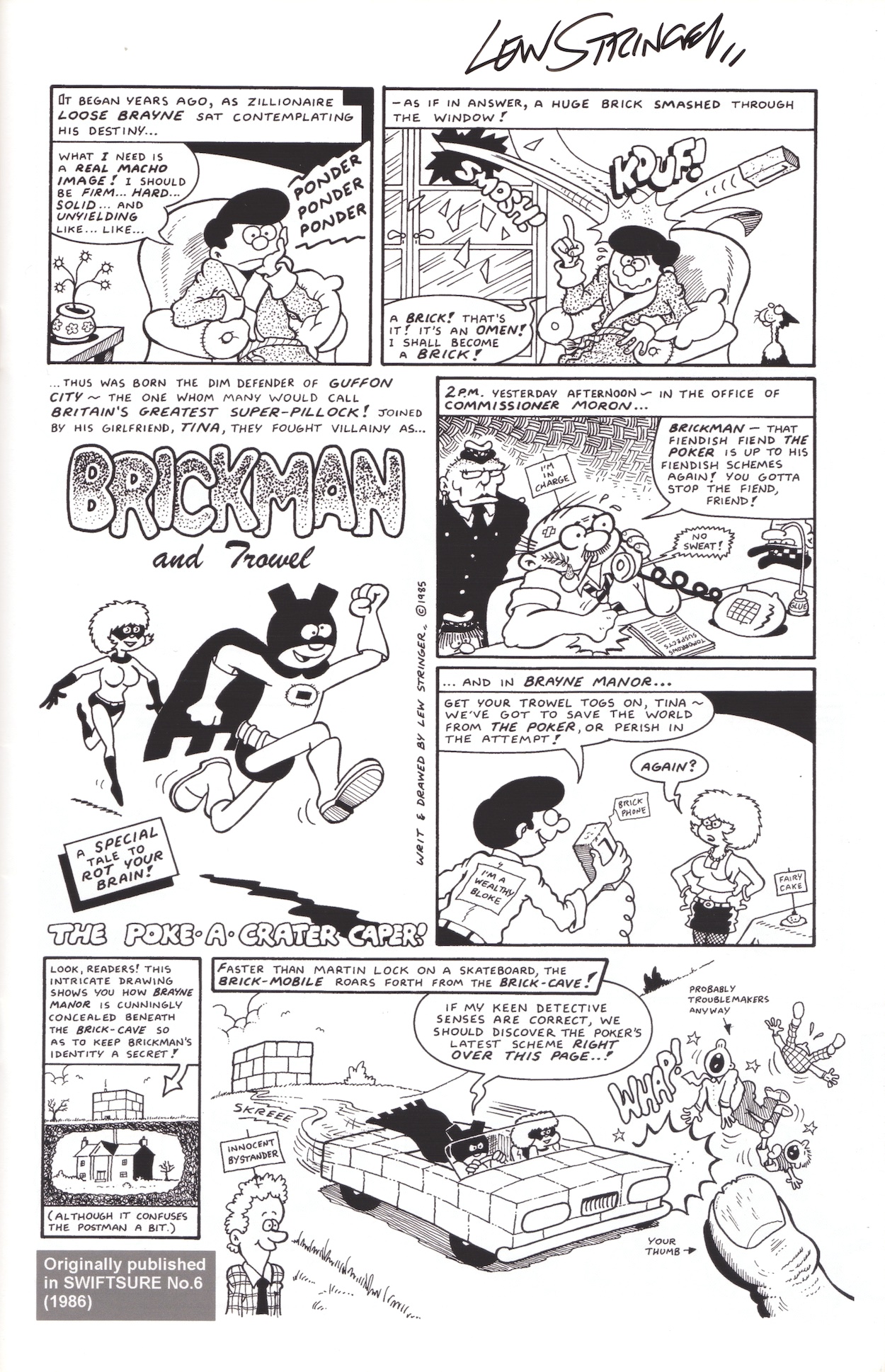
I’ll admit I own some of the previous Brickman releases but, while there’s no new material here, if you haven’t read any before this is unmissable. Actually, even if you do own the 2005 book Brickman Begins you should check this out as it’s in a much bigger and easier to read format, the strips really shining on the high quality paper. Included is the 1985 3-page introductory strip from Swiftsure and the 20(!)-page Brickmania Caper from a one-off comic for the character back in 1986.
This first page is the perfect example of what to expect, with loads of laughs not only from the main characters (his origin story) and plot (having his secret hideout above ground and his house buried is genius) but also from all of the little background details. Check out his underwhelming chest logo, the glue-drinking copper, the reader’s thumb and even Lew’s own credit. The comic is chock full of things like this.
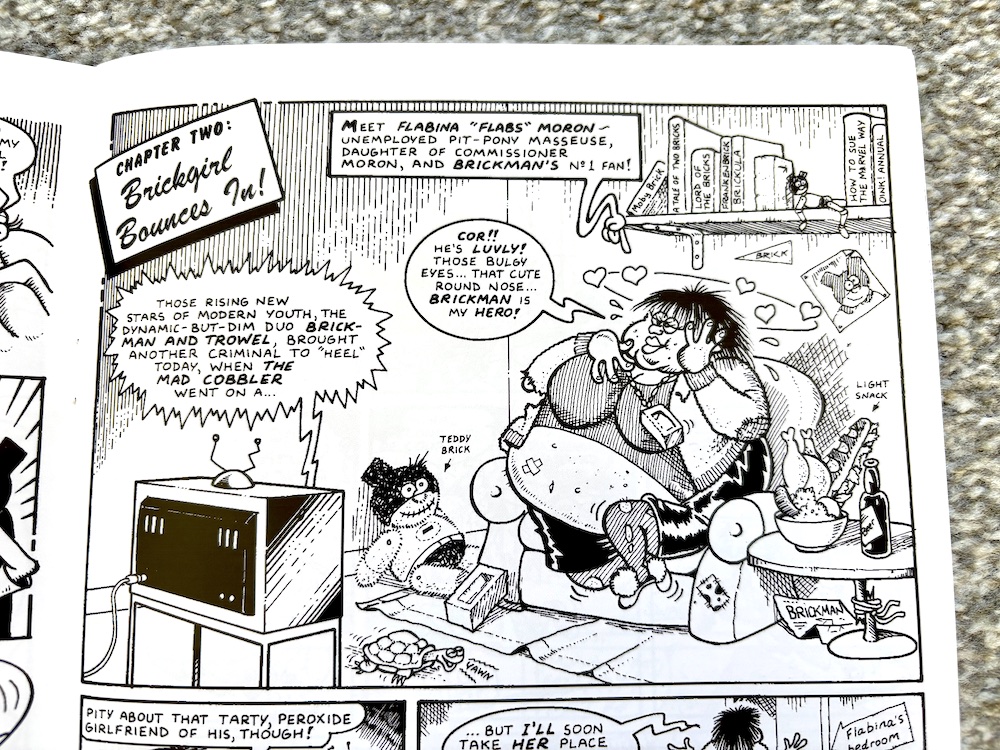
If you’ve read Barmy Comix you’ll have already seen Brickman meets The Mad Cobbler. That was actually the first chapter in the huge second story here (renamed and presented in Barmy as a complete strip). Here though, it’s just one small part of a much larger whole, although the chapters do work to some degree on their own. Tied altogether like this it’s a relentlessly funny read.
There are a lot of gags at the expense of Thatcher’s 80s Britain and as someone who grew up in that time and remembers the likes of Spitting Image’s jokes about the politics of the day, high unemployment, privatisation etc. a lot of this takes me right back and I had a good chuckle at the expense of the time. Hey, we had to laugh back then!
Those hidden background gems had me laughing the hardest at times, like the ‘How to Sue the Marvel Way’ book on the shelf in the above panel. Next to that you’ll also spot a mention of none other than OiNK. This strip was originally released during OiNK’s first year and Lew takes every opportunity to add in a little plug. There are quite a lot of little Easter eggs for OiNK fans actually, including a cameo or two. There are also pages drawn by some guest artists who’ll be very familiar to pig pals.
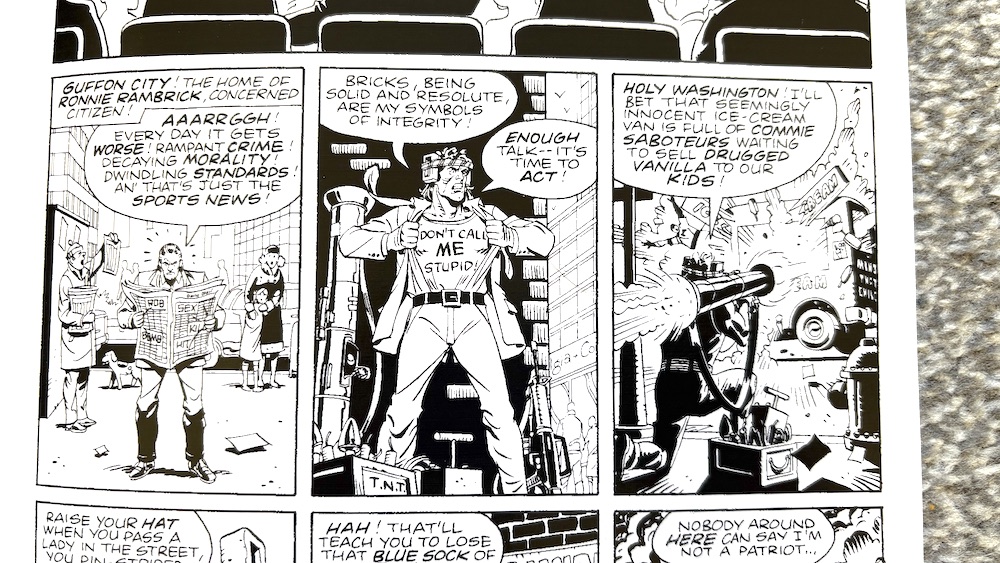
At least it wasn’t a Venezuelan boat! This is just one example of the comedy here that still feels very contemporary decades later. The page was drawn by Dave Gibbons (Ro-Busters, Rogue Trooper, Doctor Who) who drew Lew’s script for the brilliant Superhero’s Day Off in OiNK. Also contributing here are Mike Higgs, Mike Collins, Mark Farmer and the late Kevin O’Neill being very, very Kevin O’Neill! What a line up.
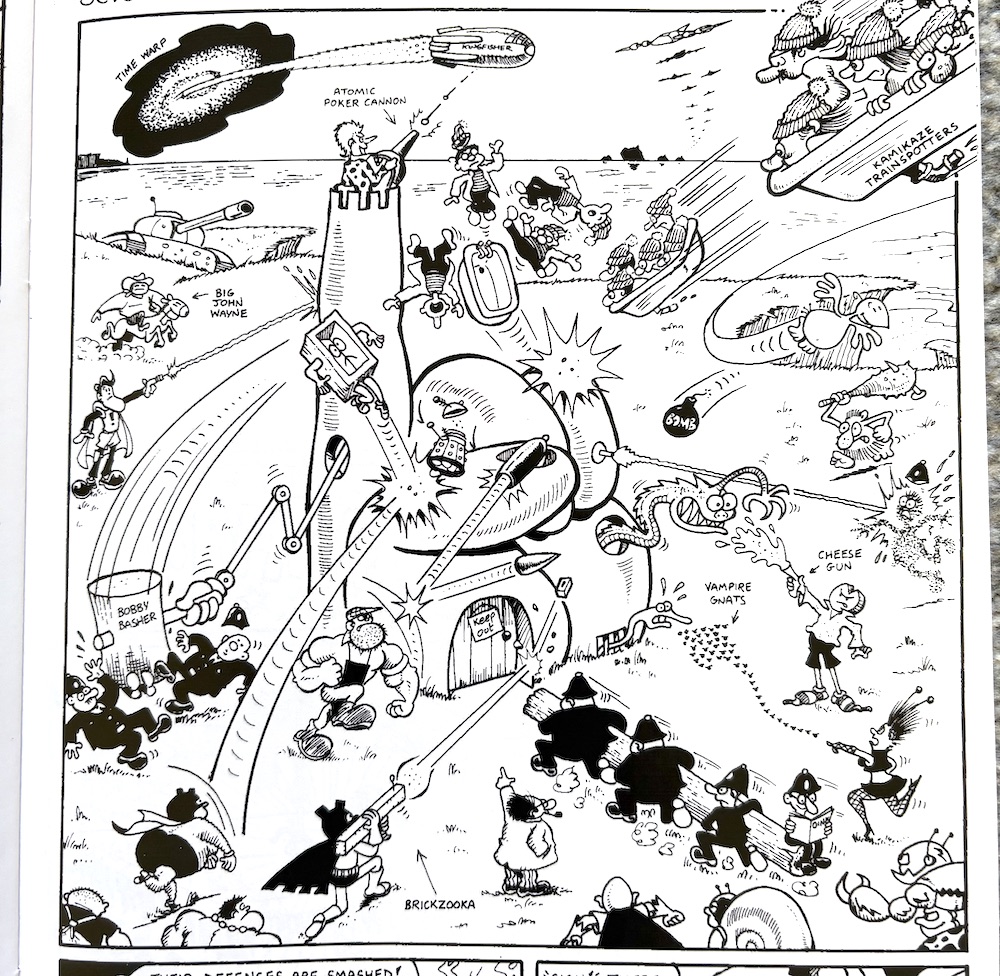
So what super powers does Brickman actually have? Well, chucking bricks basically. That, and just happening to have exactly the right gadget to hand, quite like how 60s Batman did, only here it’s exaggerated to even more ludicrous levels. But that brick throwing! It may be a silly comic but those brick impacts don’t half look painful! But the more painful they look the funnier they get. I’m not sure what that says about me.
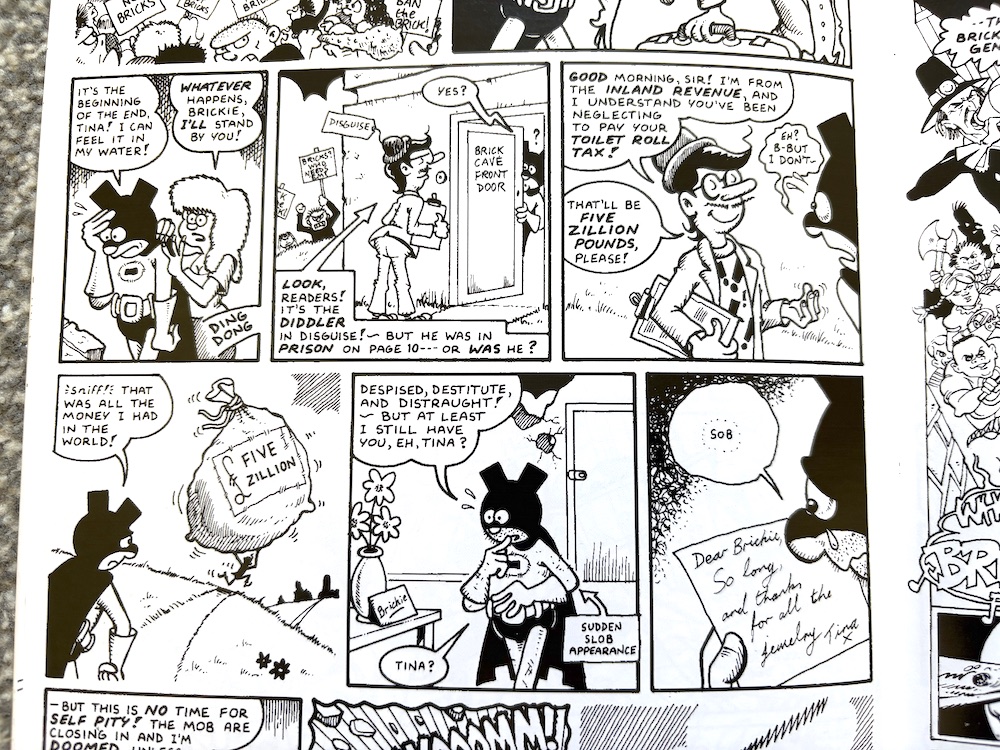
A couple of years ago in the actual Batman comic Bruce Wayne found himself without his mansion and his millions, diddled out of it by the Joker. Here, all it takes is a quick visit from someone claiming to be from the Inland Revenue and Loose gives away all of his money, instantly growing stubble to heighten the broke look. It’s a perfect example of the speed of storytelling in this comic.
My personal favourite baddies are The Poker (he loves to poke people) and Man-Brick, but it’s Lew’s pitch-perfect barbs at everyday life and the world we live in that really hit home for me. Superhero movies and fandom are targets you might expect, but the (many, many) other surprising topics in here can range from unfair representation of women in media to how the press manipulates the fickle nature of humans.
It’s testament to Lew’s skill as a comedy writer that these topics are handled in such a way that we laugh along while also acknowledging the points being made. There are many more examples I could give but that would ruin the experience for you, and discovering them all for yourself is something you simply must do. There’s a joke about a certain tropical fruit that resulted in me having to stop reading just to catch my breath!
What we have here are 28 pages packed with so many gags they could fill three issues, so it’s an absolute bargain at only £5 (plus postage). You can grab your copy direct from Lew by visiting his Ko-Fi shop. On his main Ko-Fi page you’ll also see regular blog updates and other comics of his for sale, so make sure you check that out while you’re there. This is only the first issue! I can’t wait to see where it goes from here.
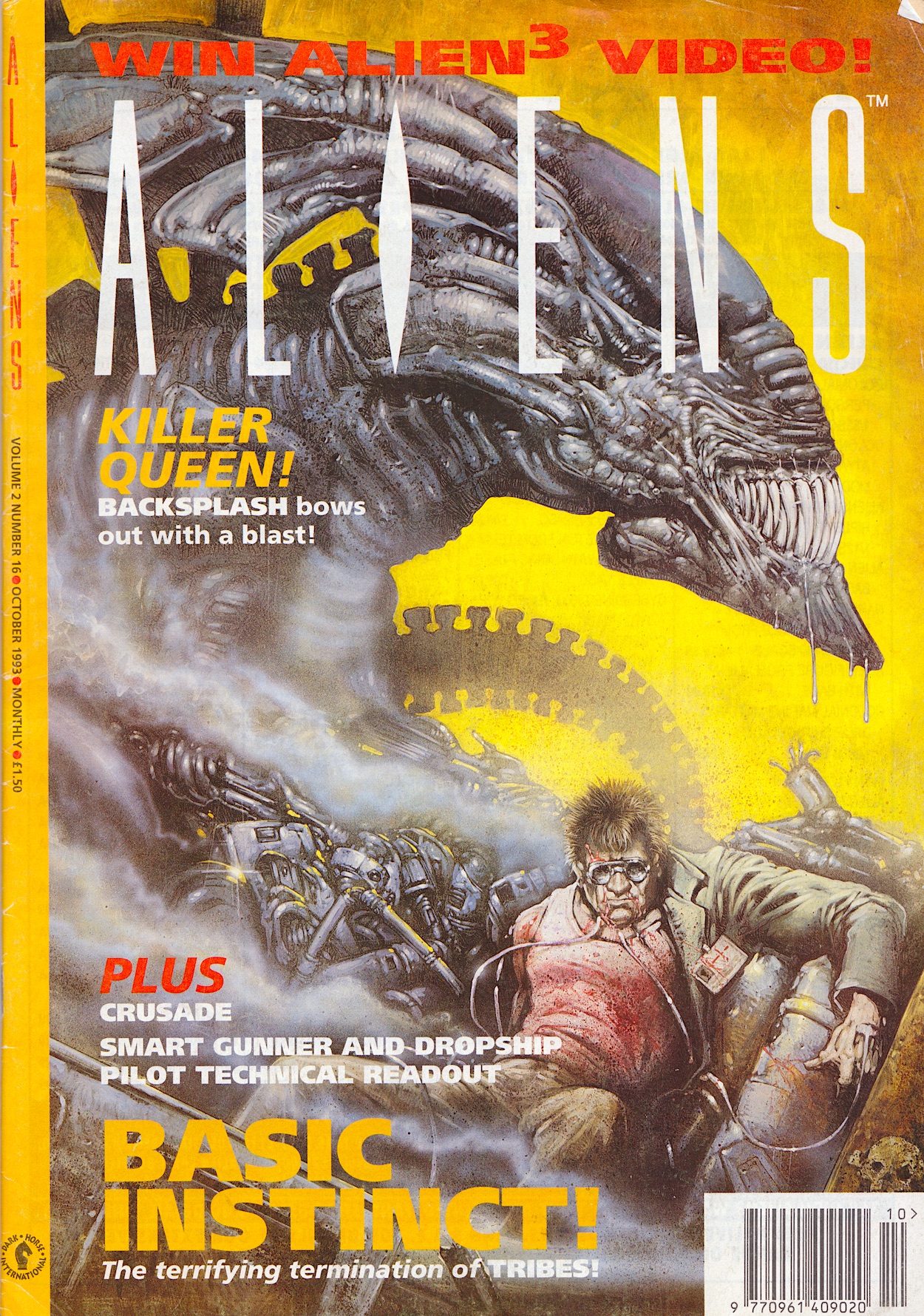
This cover by Carl Critchlow (Thrud the Barbarian, Flesh, Batman/Judge Dredd) has got to be one of the best covers so far, encapsulating a moment with the twisted Doctor Cutlow character in the final chapter of our prose story, Tribes. So, only six issues to come after this one, eh? Yes, but calm down, that’s still half a year and a lot of aliens!
Editor Cefn Ridout mentions a sea-faring (“sea-scaring”) tale beginning next month and teases us about some other surprises to come. Colour me intrigued. After the editorial (included here so you have access to the full credits) we’re straight into the concluding half of Jim Woodring and Killian Plunkett’s superb Backsplash. After the cliff collapse there are only two Marines left, Gibbs and Crespi and these eight pages depict their desperate escape bid from the alien-infested cavern to their drop ship outside.
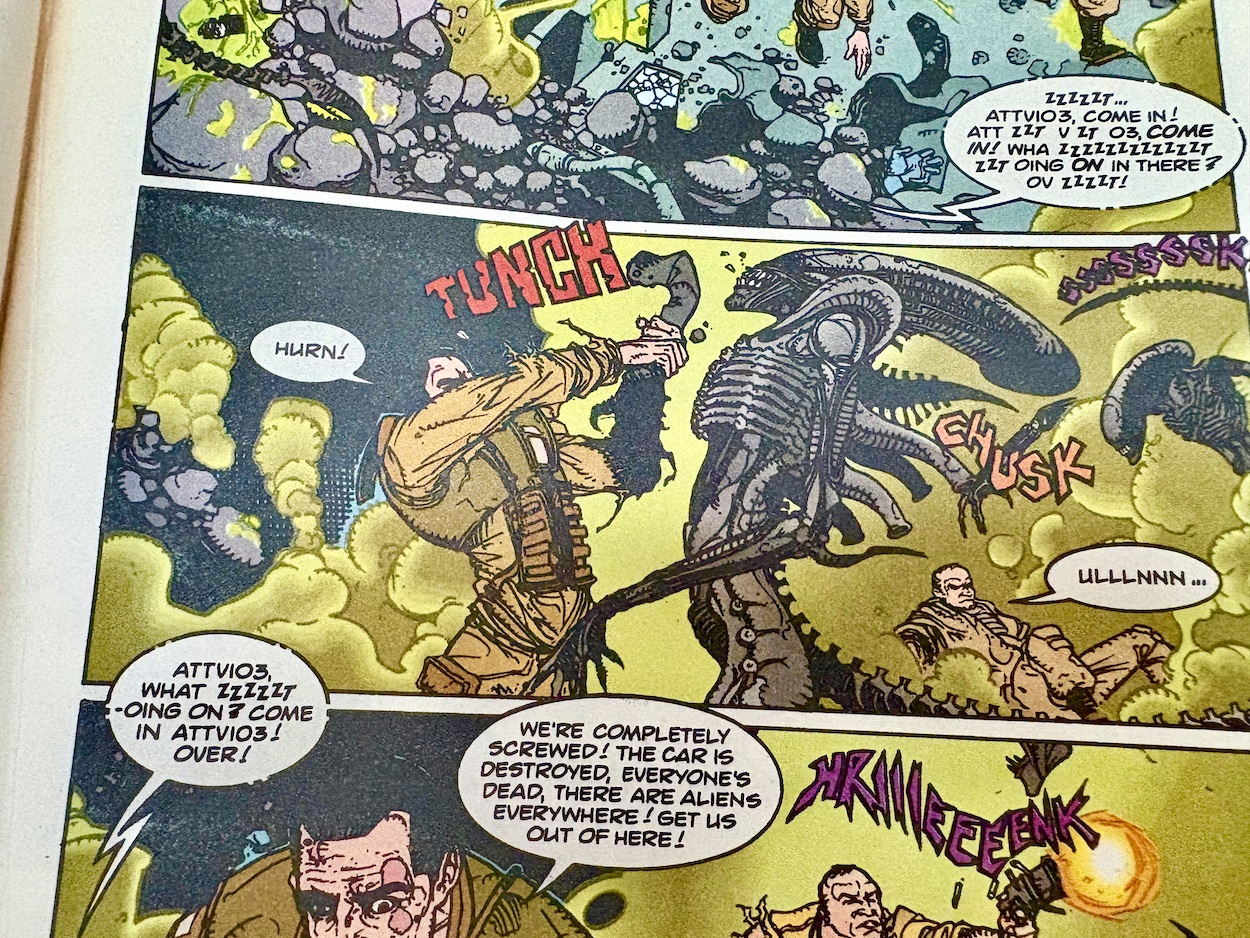
This is great fun! It’s also tense in all the right places which is quite the feat when we’ve gotten so used to seeing the aliens in comic form. Smacking an alien over the head with the limb of one of its fallen siblings, the pair make their way outside just before everything collapses around them. Not that this stops one of the aliens making a surprise reappearance to grab Crespi as they make a bolt for it.
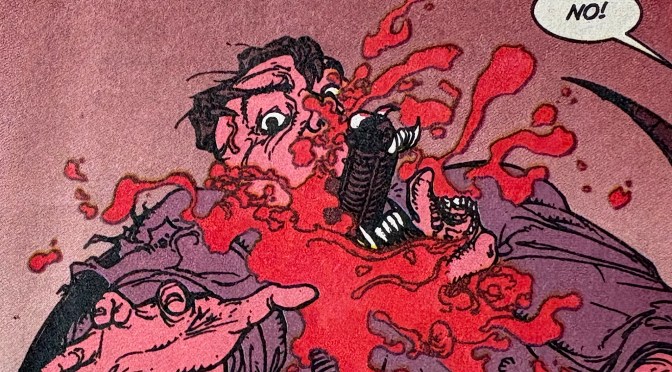
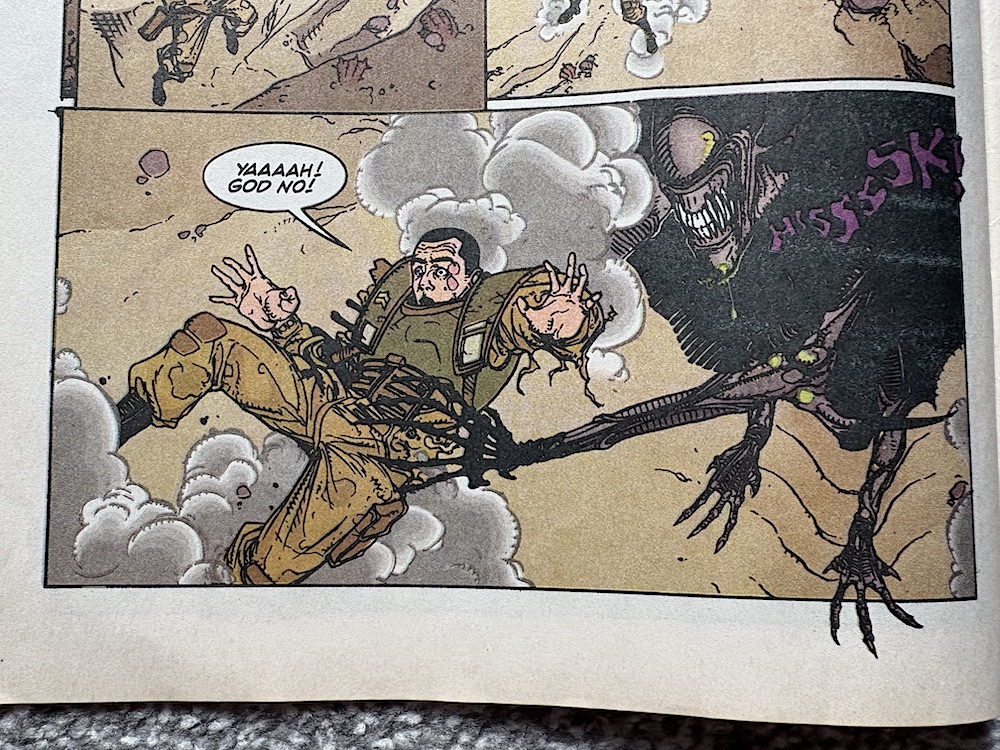
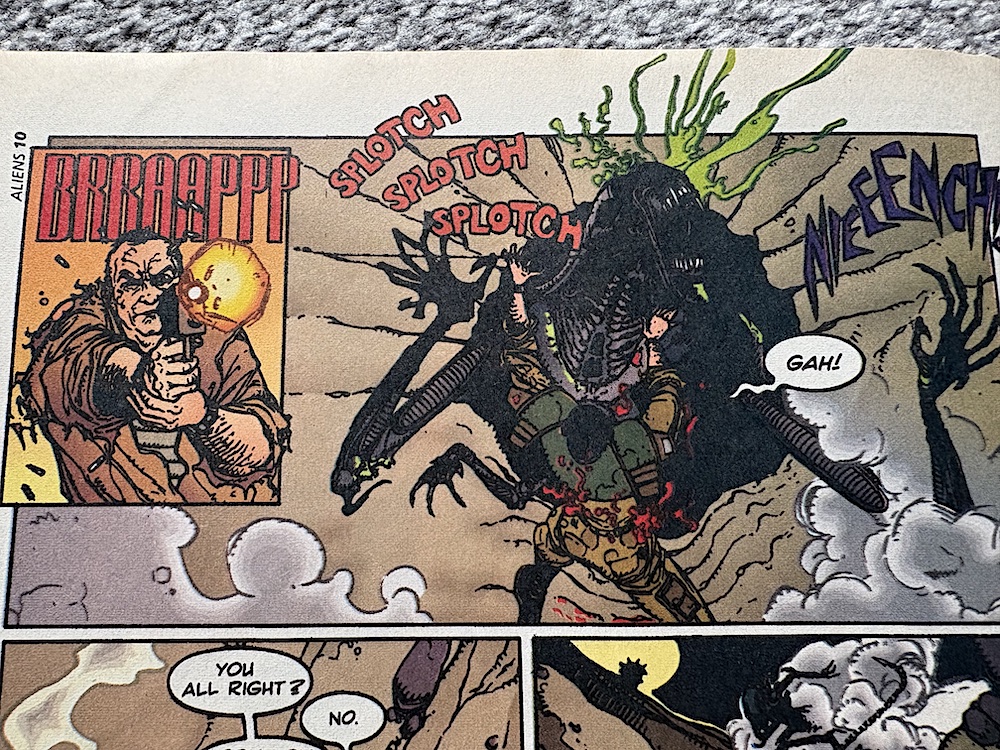
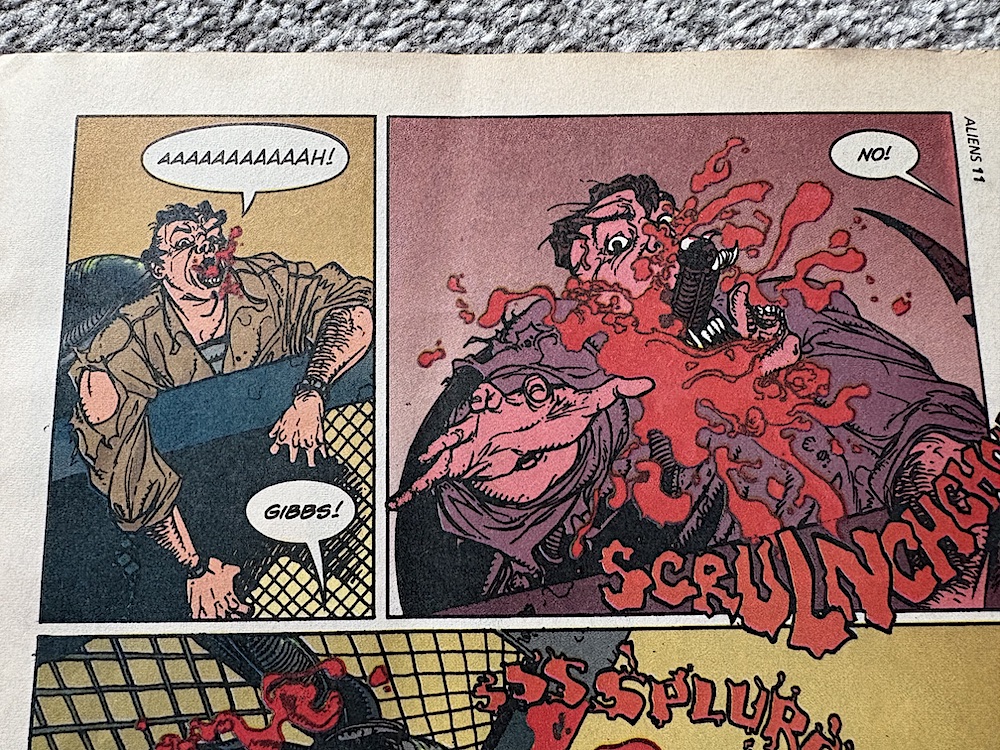
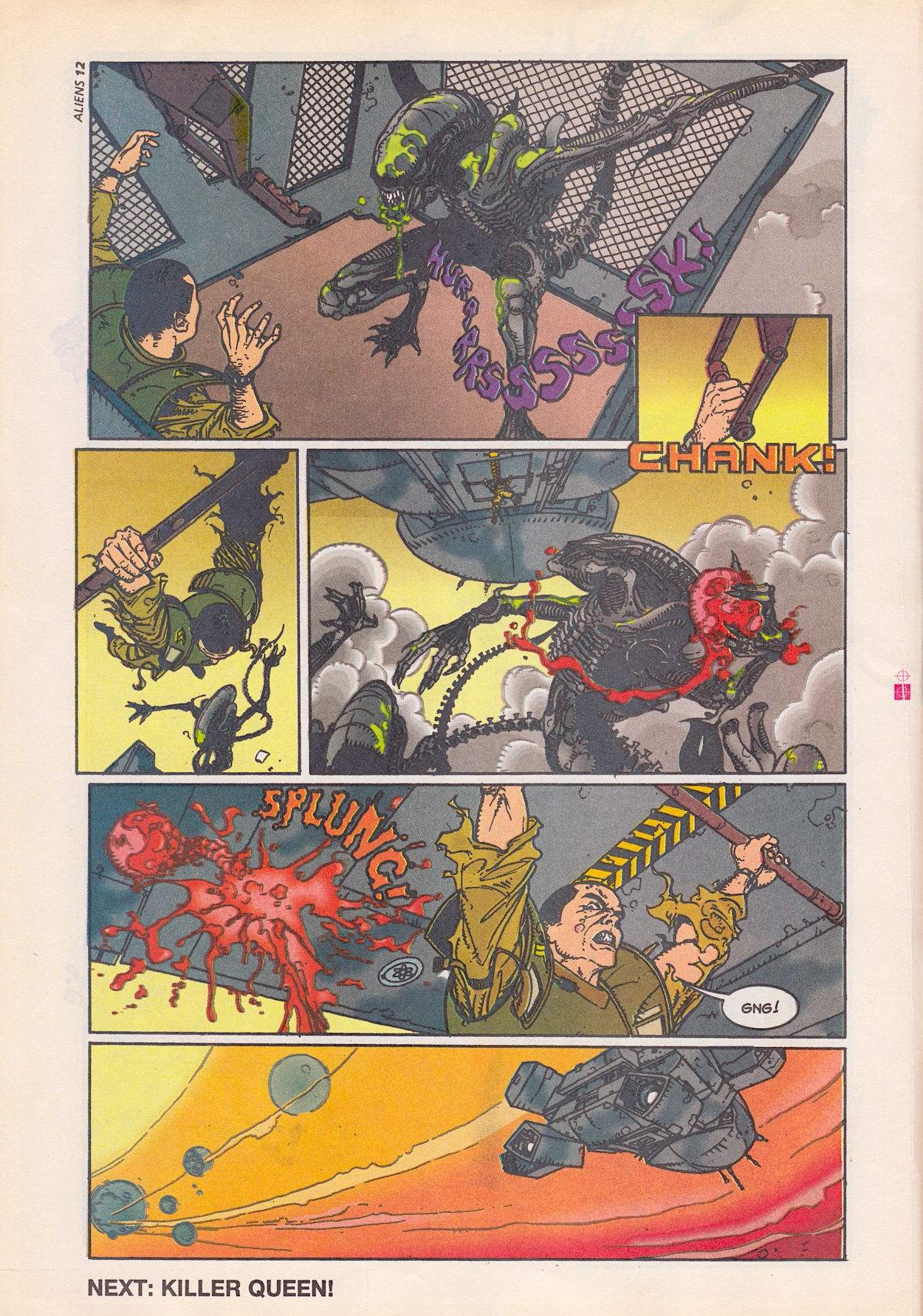
Gibbs saves him only for things to take a turn for him. Hanging on to the ship’s entrance ramp he’s suddenly choking and an inner alien mouth bursts out of his own in a scary moment of synchronicity. His decapitated body falls to the ground as the ship takes off and a quick lever pull by Crespi opens the floor beneath the beast and, mirroring that earlier arm smack, poor Gibbs’ head is used in a moment of alien frustration!
This has been a brilliant little tale. Okay, so it’s light on plot and the characters are interchangeable with pretty much any Colonial Marine from the comic or movie, but through its sheer relentlessness and imaginative situations it’s a standout. But Kilian’s art is the main reason for its success in my eyes. His aliens are superbly detailed, his humans full of character even if the script doesn’t really call for it, and he heightens the horrific moments perfectly.
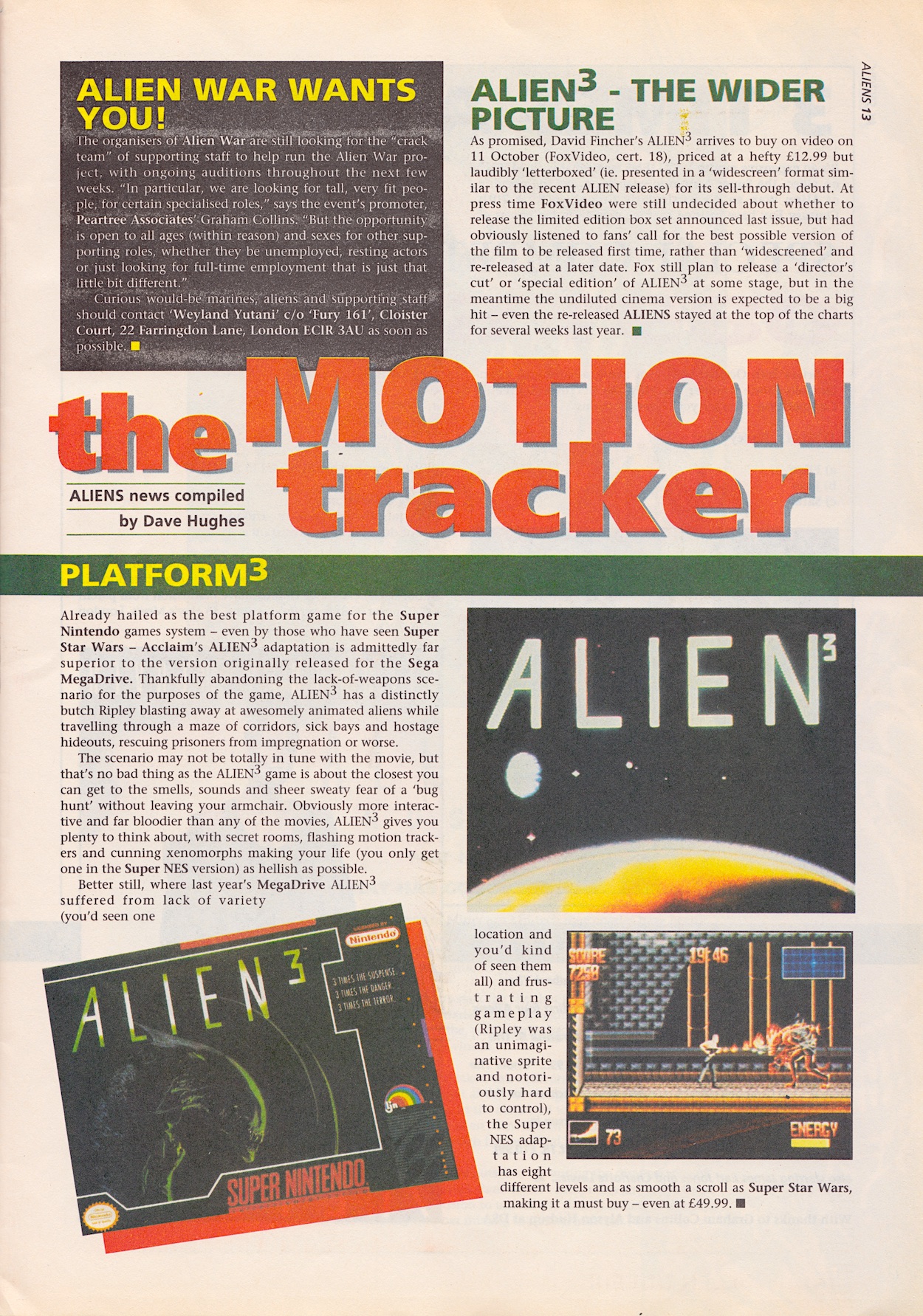
On to the news and I take issue with the Director’s Cut/Special Edition of a movie being referred to as “diluted”. Also, “already hailed as the best platform game for the Super Nintendo”? Really, Dave Hughes? Better than Mario? Better than Yoshi? The Alien³ game did very well across the board in all versions too, so I think maybe Dave owned a SNES. Ah, the days of unrivalled loyalty to a games platform. (For me it was still the C64 at this point.)
The game was notable for not following the plot of the film at all, with Ripley running around with a huge variety of weapons killing hoards of xenomorphs. Kind of defeats the purpose of having an Alien³ licence, no? At least she was bald! I still think a creepy platform game of stealth and a lack of weaponry with one alien roaming about would’ve been much better, like a 90s version of the more recent Alien: Isolation.
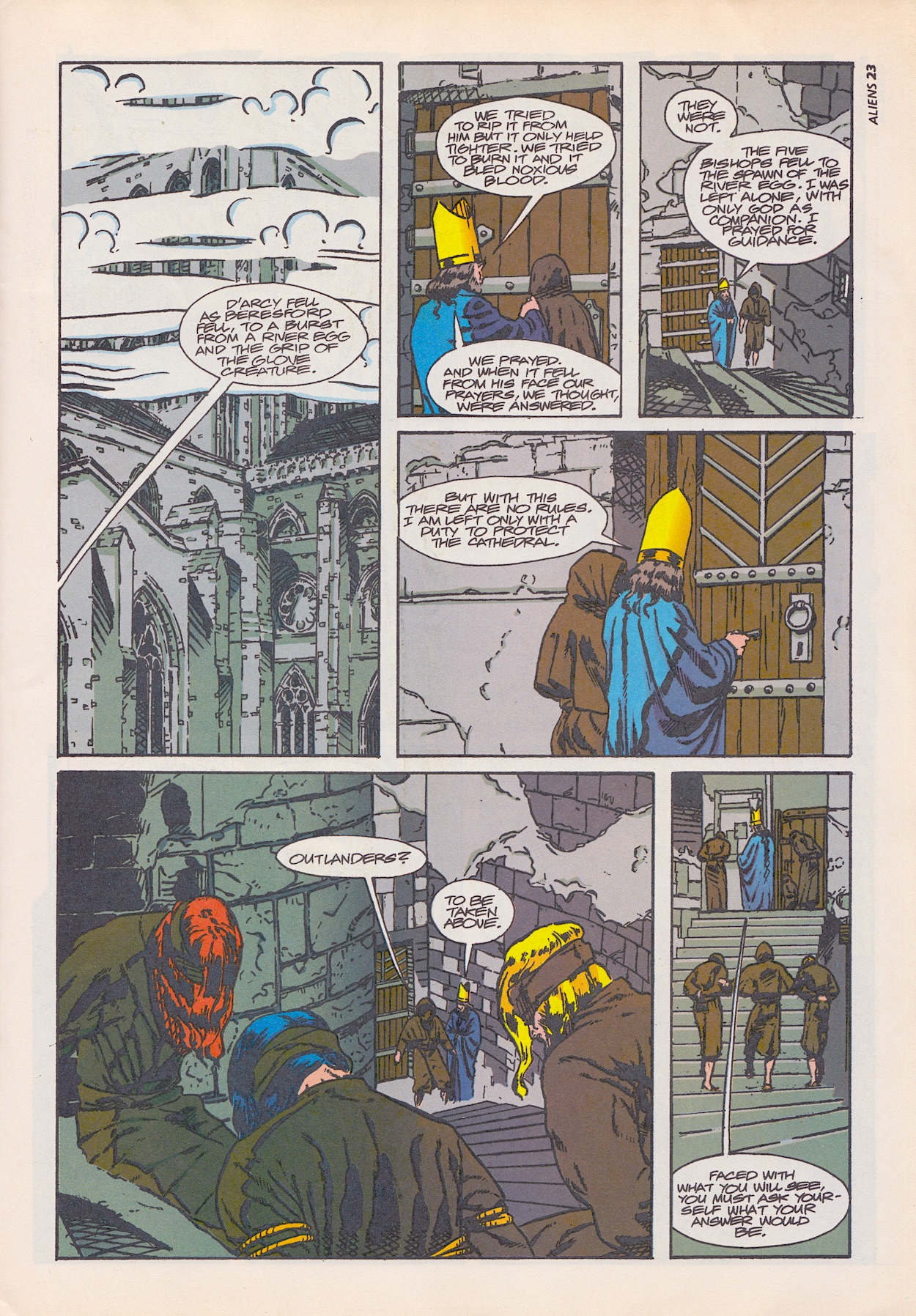
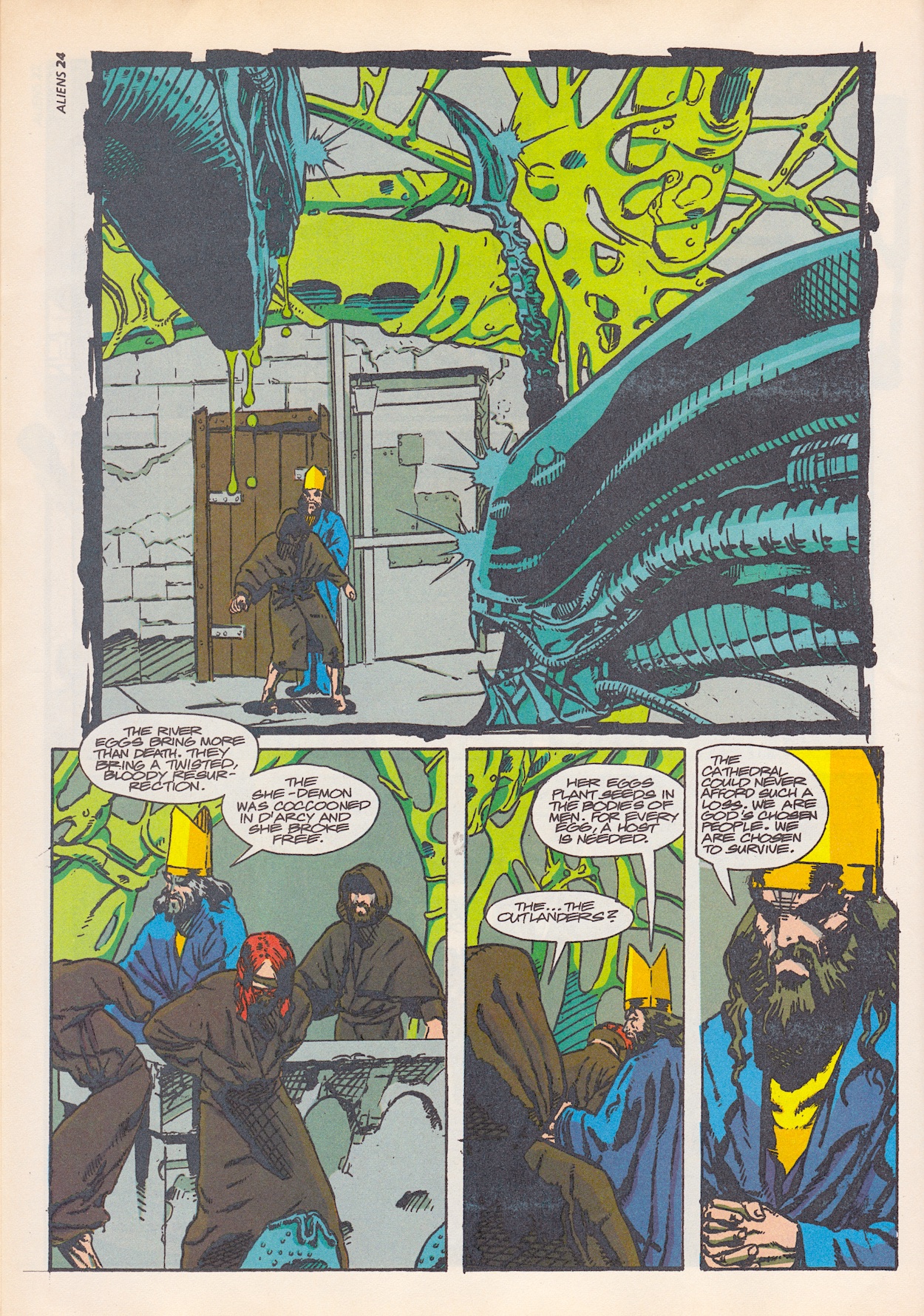
British strip Crusade begins with the Archbishop confronted by his suspicious followers, but he just keeps coming up with ludicrous excuses. “The wind whistling through broken stones” really placates people who’ve heard the alien Queen? Then our tribe and Minecorp marines are attacked by another tribe but the art is too messy to work out what’s going on. In the end the survivors continue on with their two horses into the sewers beneath London and now we can’t even see their hair colours in the dark, one of the few things we could use to tell characters apart. Suddenly their motion tracker starts to bleep and Rani’s spidey senses start to tingle. That can’t be good.
Back in the “big building for tiny minds” (as one of the Marines describes the church) it becomes clear that the Archbishop thinks he’s actually doing god’s work by keeping the alien threat contained within the tower via human sacrifices. But an attack and a hole in the wall recently saw some eggs roll down into the river, however he thinks if he keeps the aliens fed with outsiders they won’t leave their tower. In reality of course he’s just adding to their army.
The world building is potentially great but it’s that lack of visual clarity that’s just so frustrating. This issue’s chapter ends with one of the horses suddenly writhing in pain and an alien bursting from its chest, so the thrills and danger should be tangible but it just requires a bit too much effort for you to feel it.
One moment almost ruins the whole months-long story for me
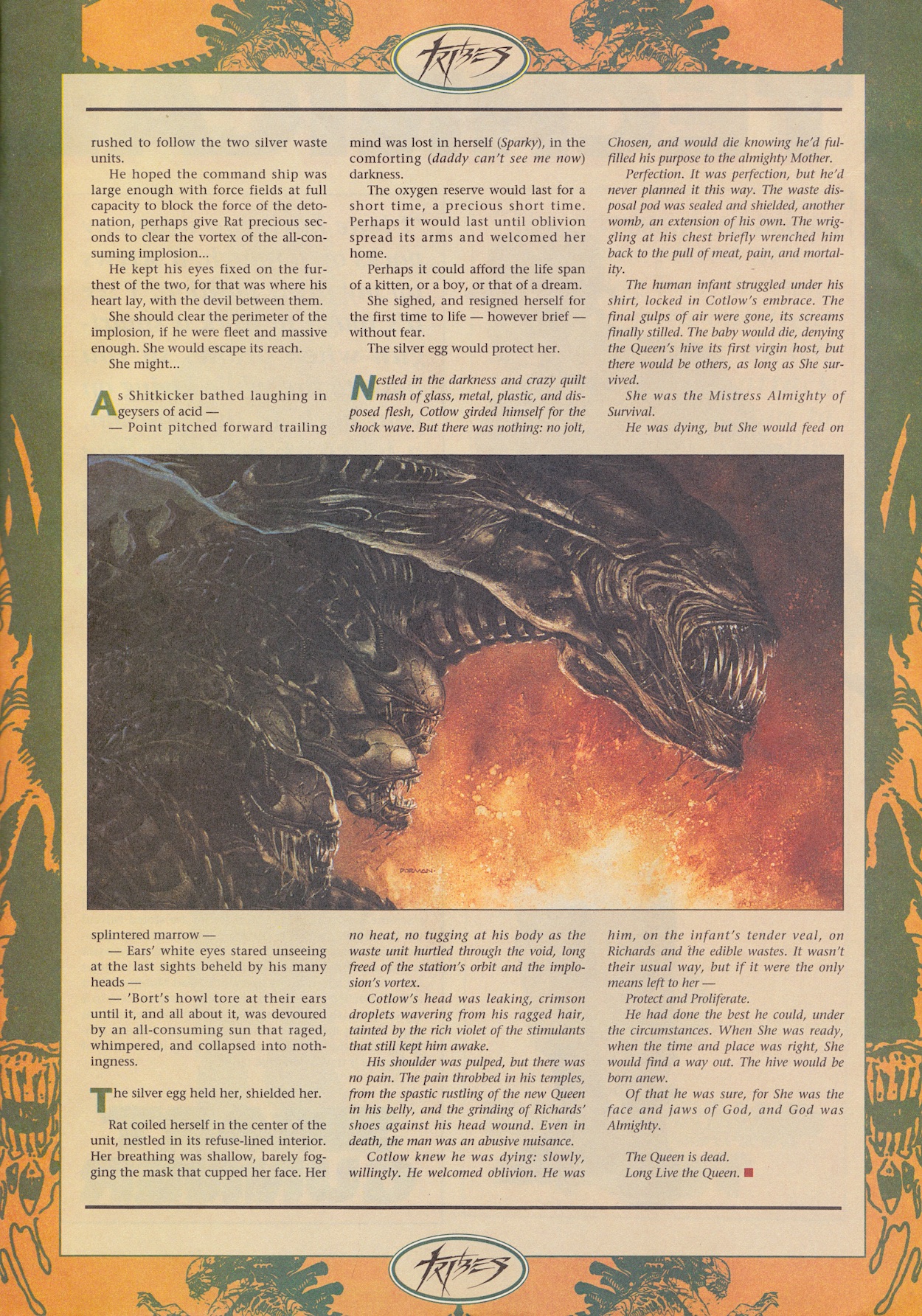
Much better, as per usual, is prose story Tribes. This concluding chapter is, to use a clichéd phrase, a thrill ride. The whole place is rigged to explode any minute and Rat is stuck in a refuge unit with an alien climbing down through the rubbish. Bort realises he’s always loved her and risks his life to release the unit into deep space so she’ll finally be at peace, dead from the vacuum instead of being an alien incubator and reliving those nightmares of her childhood with her father.
In a tense moment she’s finally able to activate her oxygen supply and the story is left with her floating (alone, sans alien) in space. But one moment almost ruins the whole months-long story, for me anyway. The doctor of the religious extremists trying to help the aliens finds himself in an escape pod with a newborn Queen and a human baby. He was going to use this baby to feed the Queen but the baby dies in his arms slowly from a lack of oxygen.
Look, I know Alien is a horror franchise but I just felt this was an unnecessary use of a mental image of a dying baby to try to elicit an emotional response from the reader. It wasn’t needed and it cheapened all of the excellent work up to this point by writer Steve Bissette. Colton is also dying but knows the Queen will feed on him, providing her with sustenance until the pod lands and she can free herself. Tribes has been a real highlight and if it hadn’t been for that one moment I’d have been singing its praises for months to come.
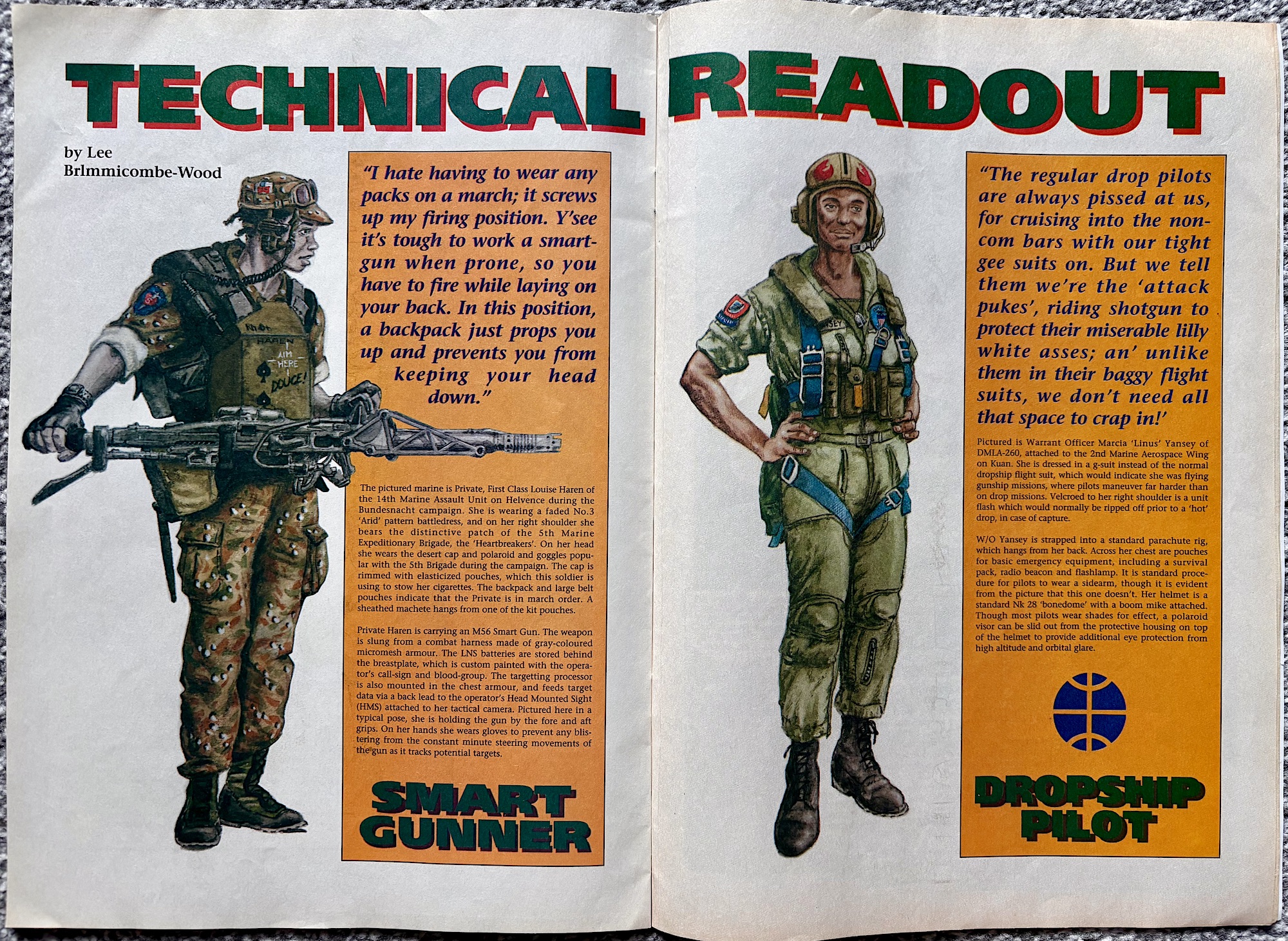
The Technical Readout pages seem to have done away with the intricate technical cutaways, somewhat making the name of the feature redundant. While I do miss those earlier entries I have to say I really like this most recent one showcasing the military gear worn by two female Colonial Marines. There’s no credit anywhere for the artist, perhaps they were drawn by Lee Brimmincombe-Wood himself?
Our final strip is Colonial Marines and it’s been reduced in pages again after a bumper chapter last time but it’s still a meaty 12-page read. Leaving the sun gun they get distracted on the way to their main mission by a kelp bed on a planet that’s somehow keeping a comms channel open with the HQ they can’t reach, and on a planet that’s not meant to be inhabited. So off they go, with their bug man prisoner in tow.
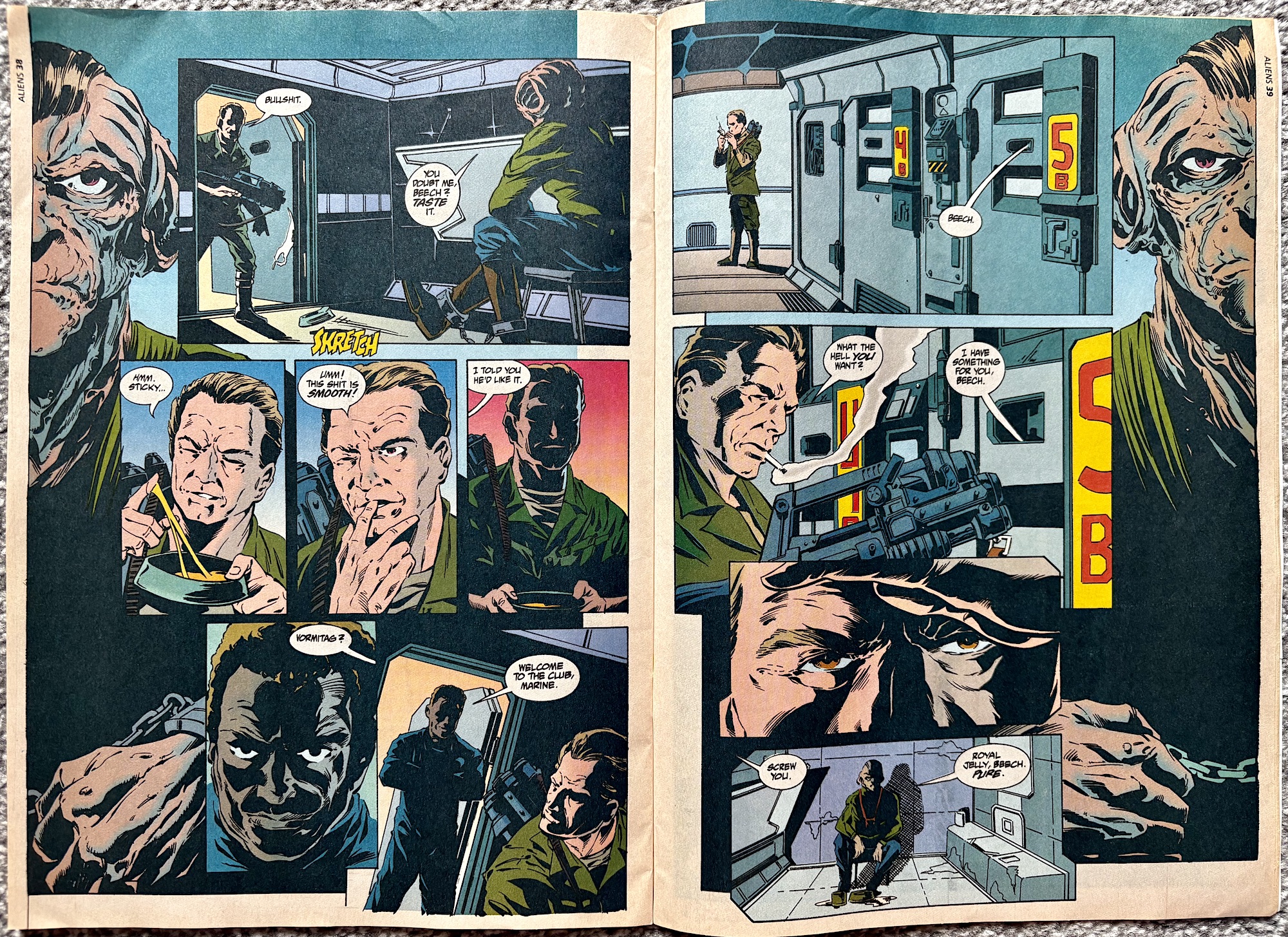
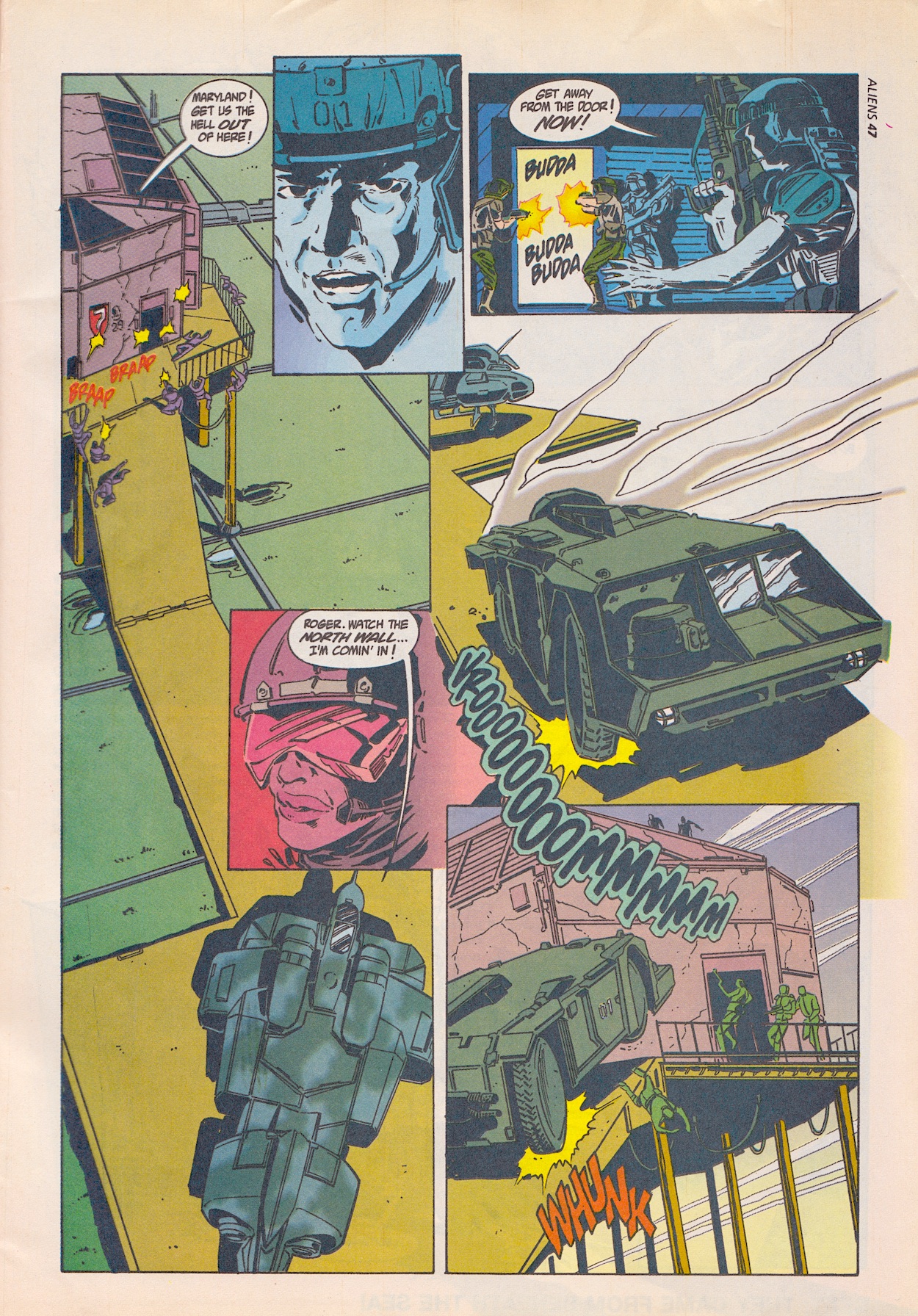
Unfortunately, things don’t start off too well when the comic’s habit of printing errors sees spread above in the wrong order. The bug man is somehow able to produce the addictive alien slime we humans can’t get enough of and it’s handed around the marines like a drug. Meanwhile there’s an underlying current of distrust in Vasquez after her freak out as people begin to question whether they can rely on her to save their lives like they did hers. With less characters now we can begin to familiarise ourselves with some of the personalities in the ragtag team during these downtime scenes, instantly improving what was already a good strip.
Once they’re flying over the planet they spot an outpost where there shouldn’t be one and, once inside and cornered, they find out it belongs to the bug men. That of course means the aliens can’t be far away. The Marines attempted escape in the people carrier had the same music from the Hadley’s Hope escape scene in the movie playing over and over in my head as I read the end of this month’s chapter.
The cliffhanger sees their drop ship explode and now they’re stuck on this mysterious planet. Chris Warner’s story began as a fun take on the movie but little did I know that was only the starting point. I’m still not convinced about these bug men but given how much I’m enjoying the rest of it (at least they’re no longer 70s Doctor Who aliens) I have hope they’ll develop further too.
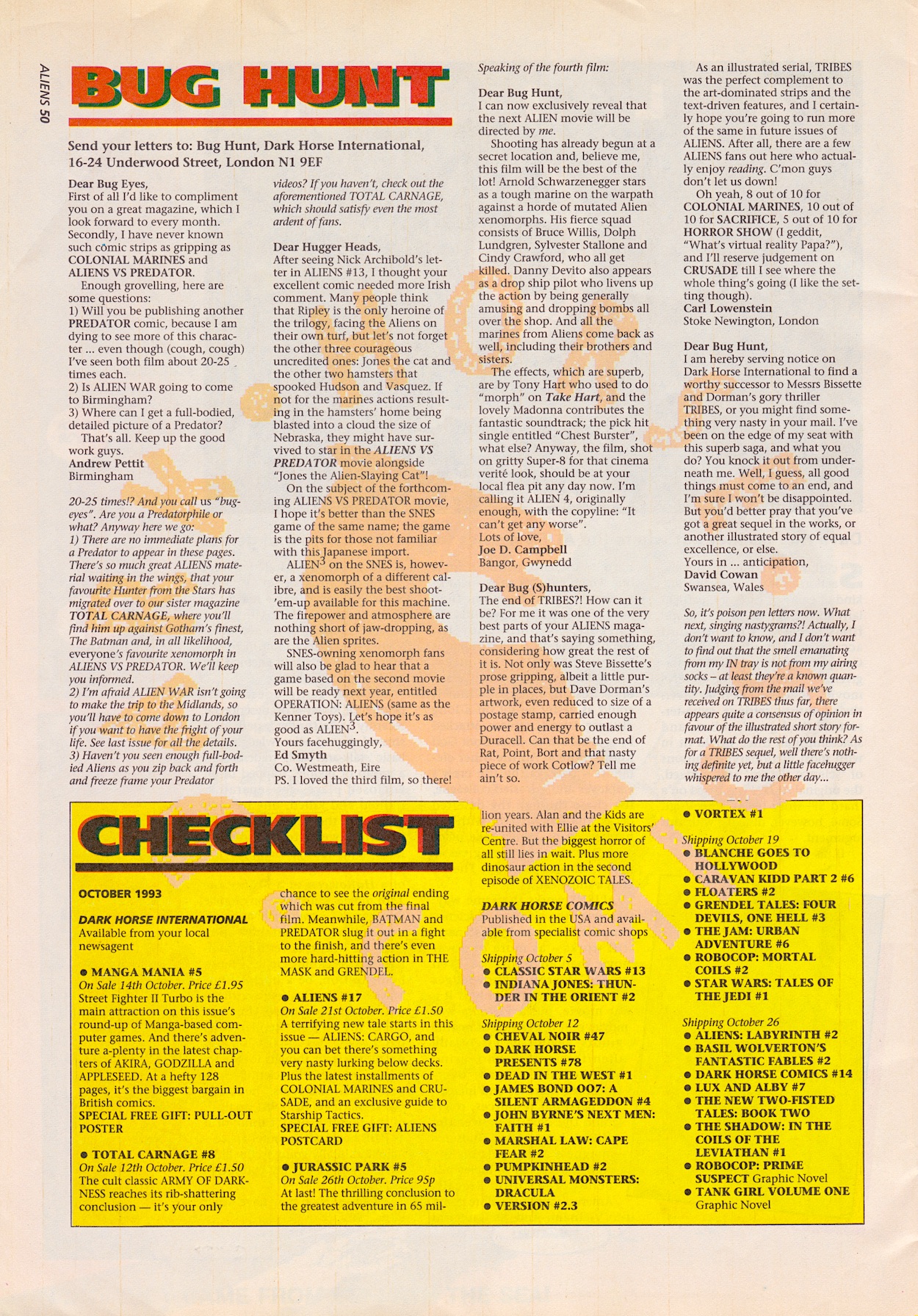
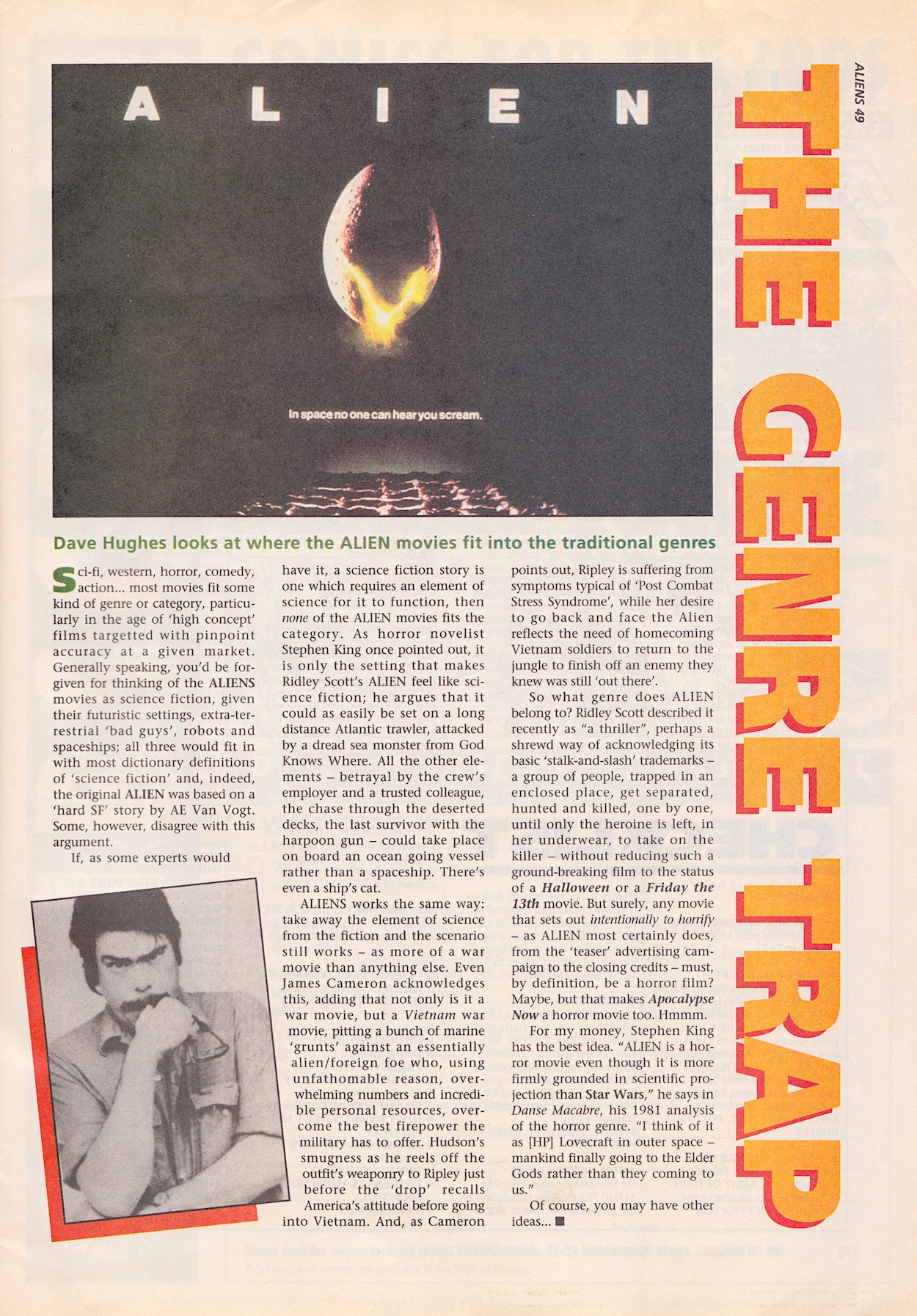
The Genre Gap is a strange little page, taking a long time to come to the conclusion we knew already that the Alien films are horrors. They just so happen to be set in a futuristic sci-fi setting, with a sci-fi entity as the main scare. When Stephen King says so is there really any need to question it? Then on the Bug Hunt letters page I’m not too sure about the name given to describe fans of fellow horror franchise, Predator!
There’s a healthy variety of places of origin for the readers this month. Back then it was rare to see letters in our comics from anywhere other than England. There also appears to have been a great deal of positivity for not only Tribes, but for the very idea of having a prose story in the comic, which I’m all for too. The sequel idea for an Alien 4 movie is just ridiculous… I mean, Madonna doing a movie song after that thing that I had to endure at the start of Die Another Day?!
Backsplash and Tribes may be over but that means more new stories next month which is always exciting. Colonial Marines continues to get better and better, and Crusade certainly has loads of potential that hopefully it can begin to fulfil. Even more excitedly there’s talk in this issue of a second autopsy feature (the first in #11 was fascinating) next month, this time for the alien eggs. Things can only get better, so be here in one month to check out Aliens #17.
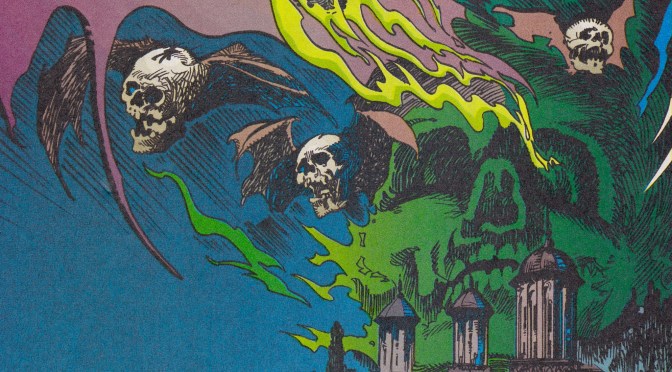
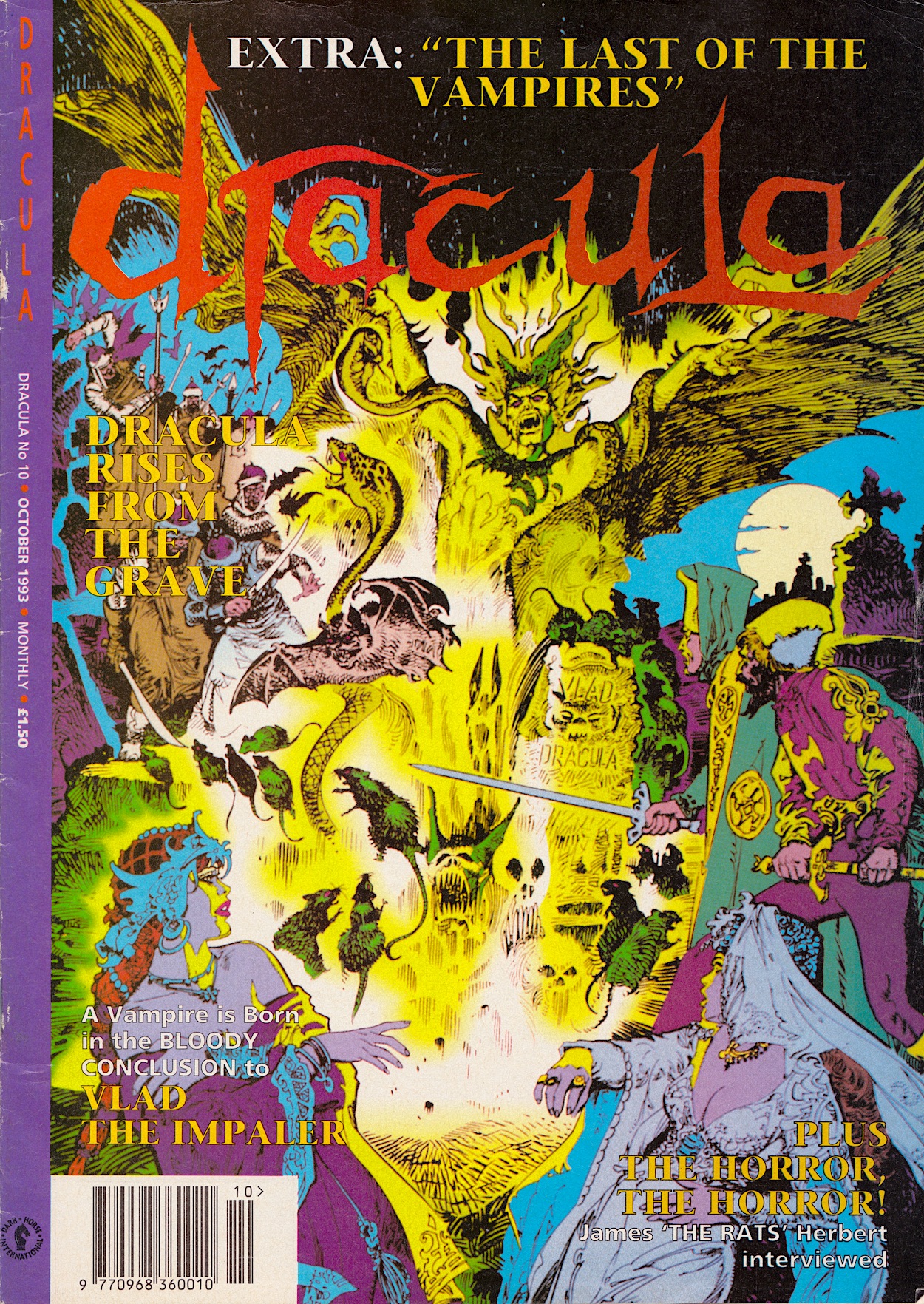
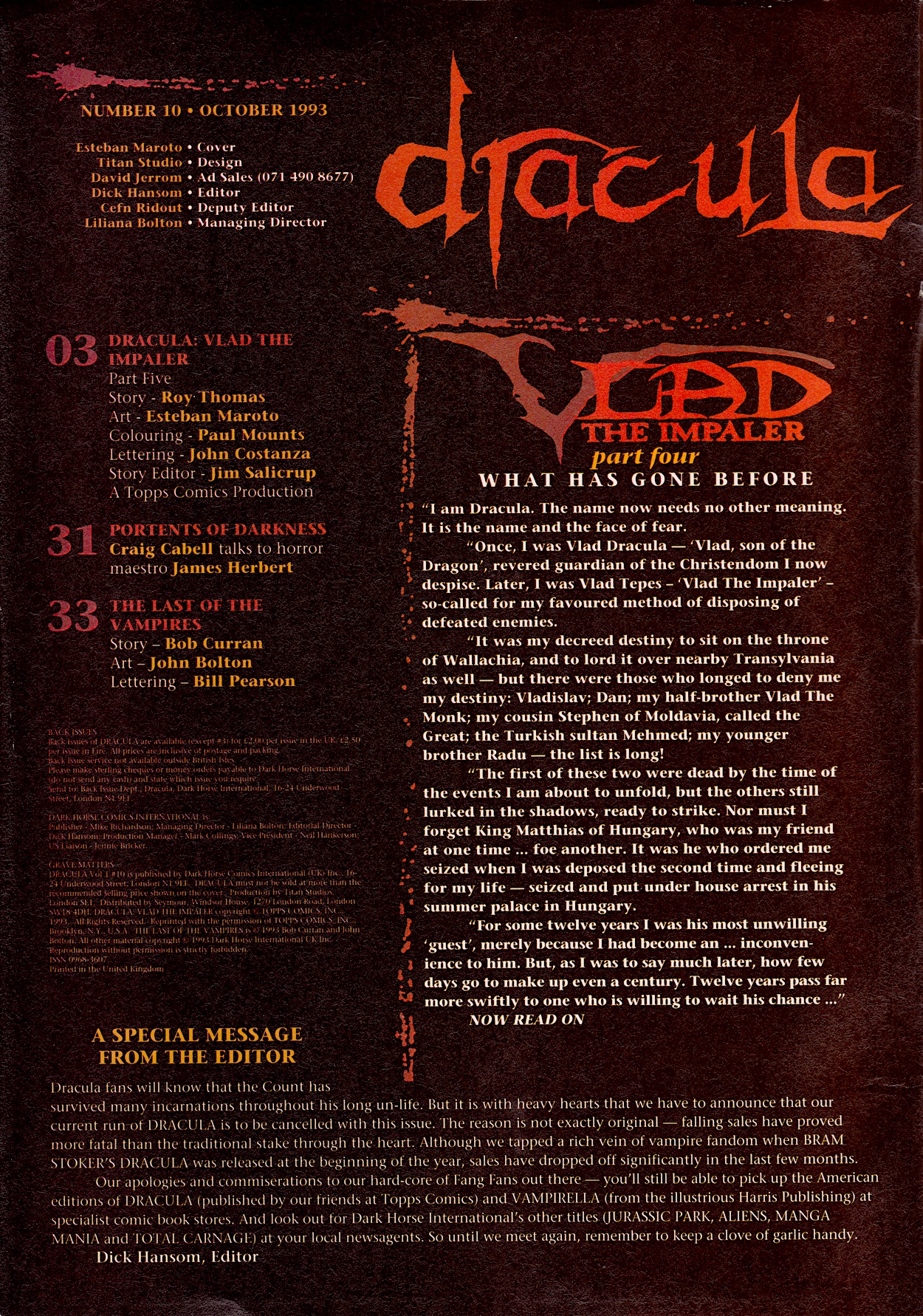
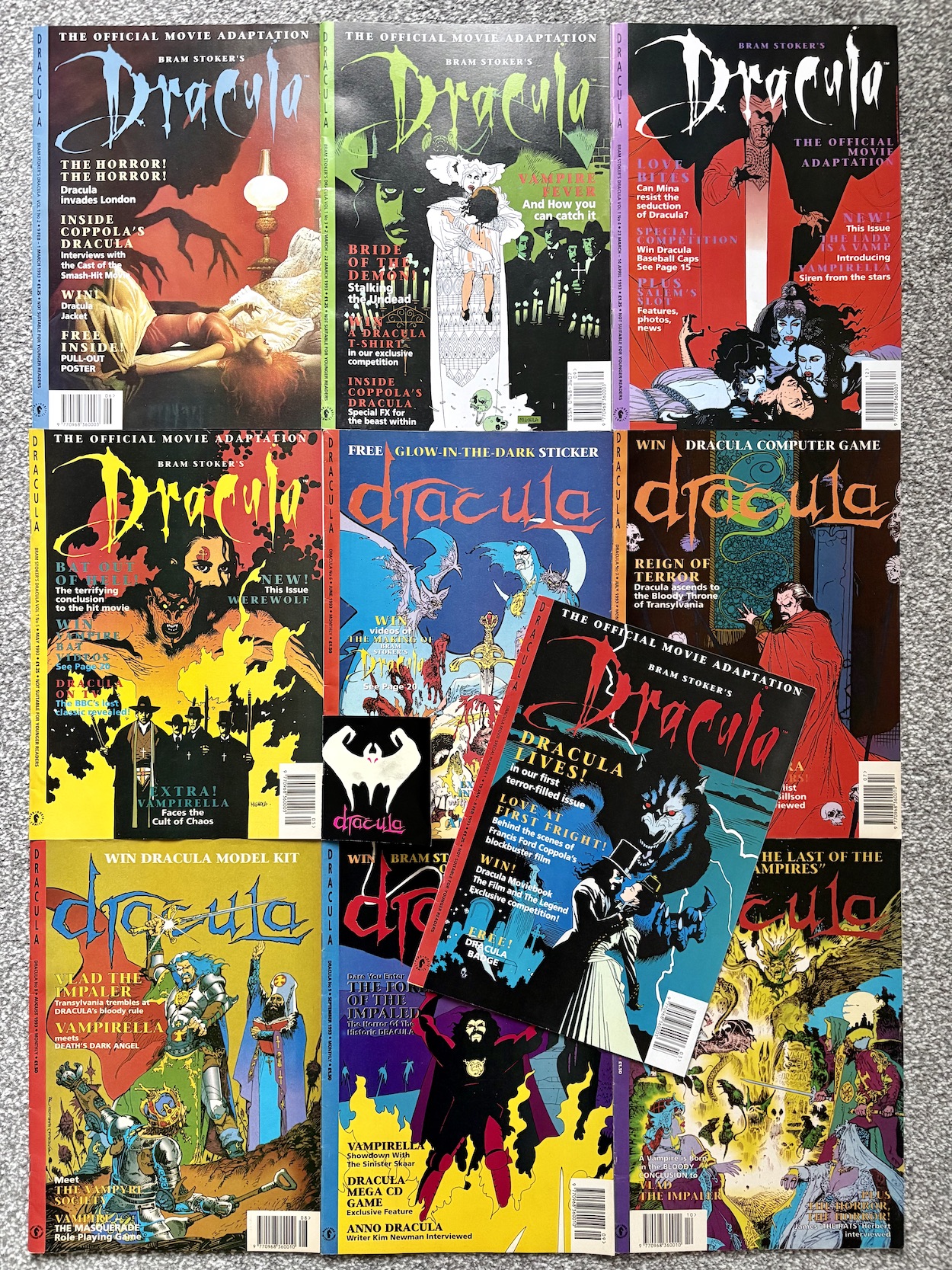
Esteban Maroto’s glorious cover gives the impression of a comic in rude health. Dark Horse International’s usual penchant for almost unreadable headlines hides what sounds like a particularly exciting issue for those that had stayed with Dracula this long after the association with the movie had ended. However, upon opening the issue we’re met with an editorial containing the round up of what’s happened in the main strip (instead of it being given its own page) and a “special message”.
Respect to editor Dick Hansom for telling the readers the truth rather than the next issue not appearing, something many comics in the 90s did, including DHI’s own titles. Although, he says readers can continue to read imported Topps Comics Dracula comics. Having researched these, alongside Vlad the Impaler (which concludes here) I can only find a Dracula Versus Zorro mini-series from the same year. Perhaps cancellation was the preferred option after all.
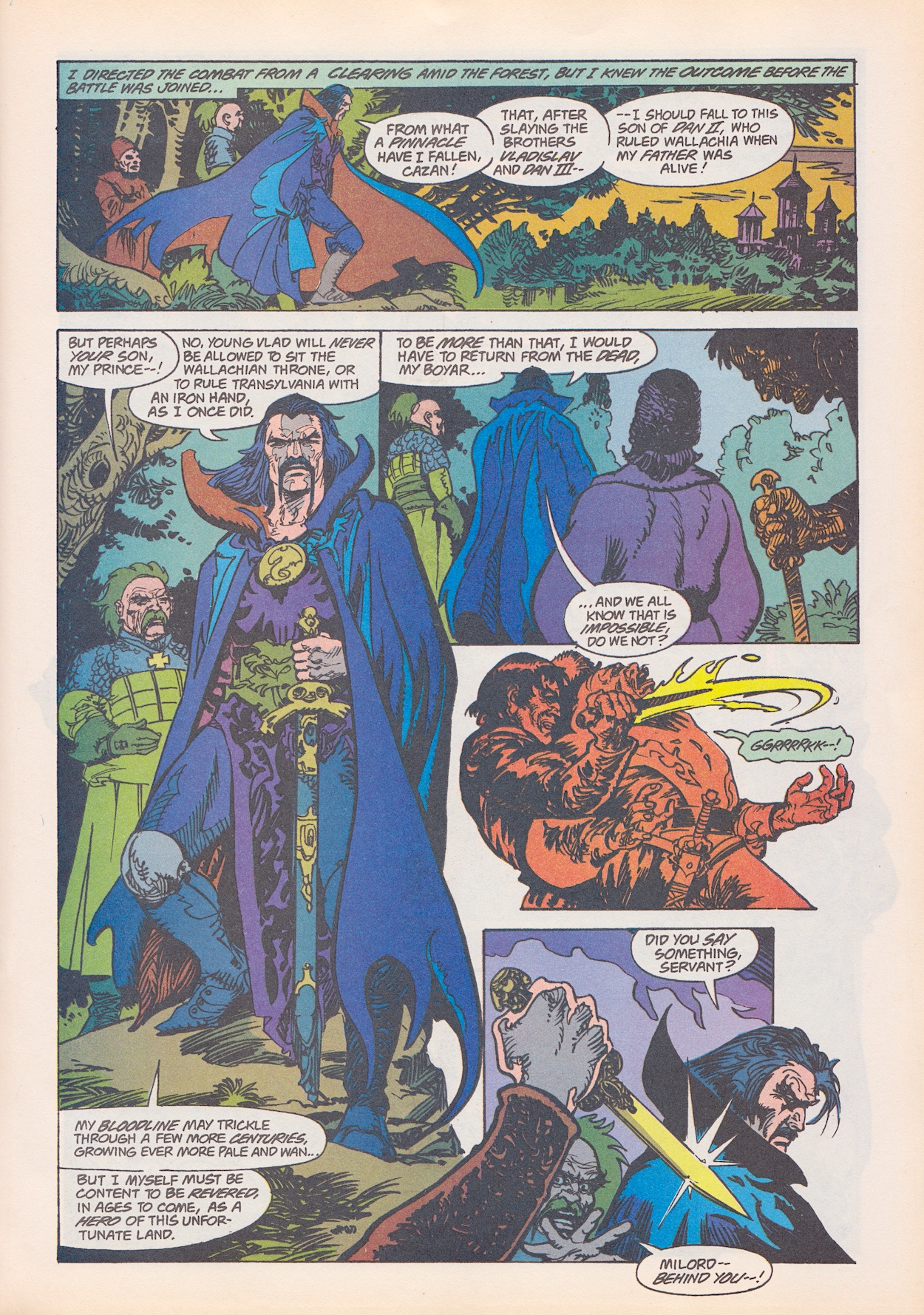
What Has Gone Before is part of the editorial to make room for the 28 pages of To Rise Again from the usual team of writer Roy Thomas, artist Esteban, colourist Paul Mounts and letterer John Costanza. It begins with Vlad beheading a King’s guard who tried to forcibly remove a thief from Castle Dracula who had begged for sanctuary. The guard insists the thief hadn’t asked permission. However, the guard also hadn’t before placing his foot across the threshold.
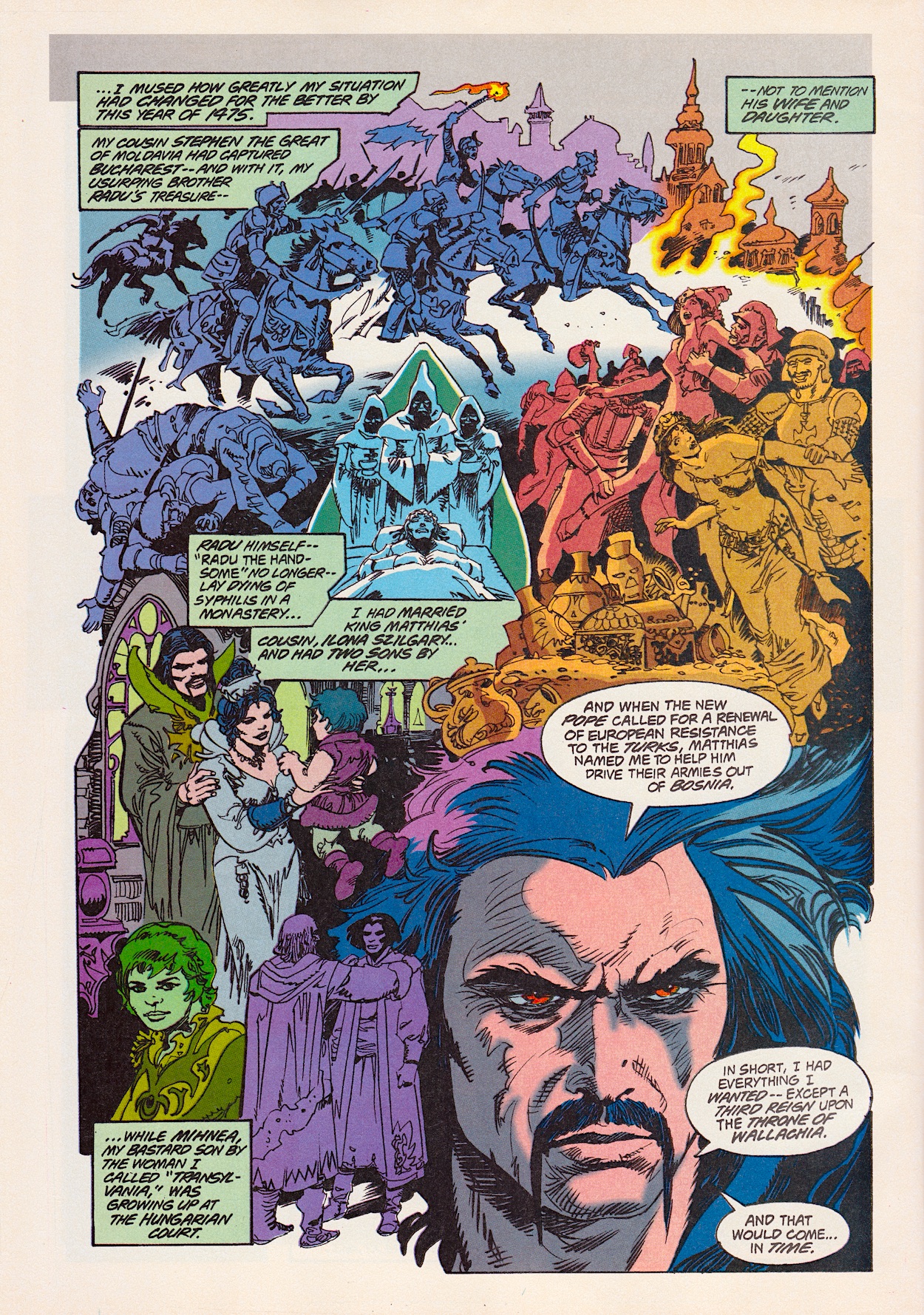
The King of Hungary, who had kept Vlad captive up until now, gives him an army to lead against the Turks, hoping Vlad’s viciousness will help him in his dire situation and lead to more impalements across the land. However, another of the King’s allies, Stephen Bathory wants Transylvania as thanks for his own help and Vlad is left with Wallachia, which he becomes ruler of again after his younger brother, Prince Radu dies of syphilis.
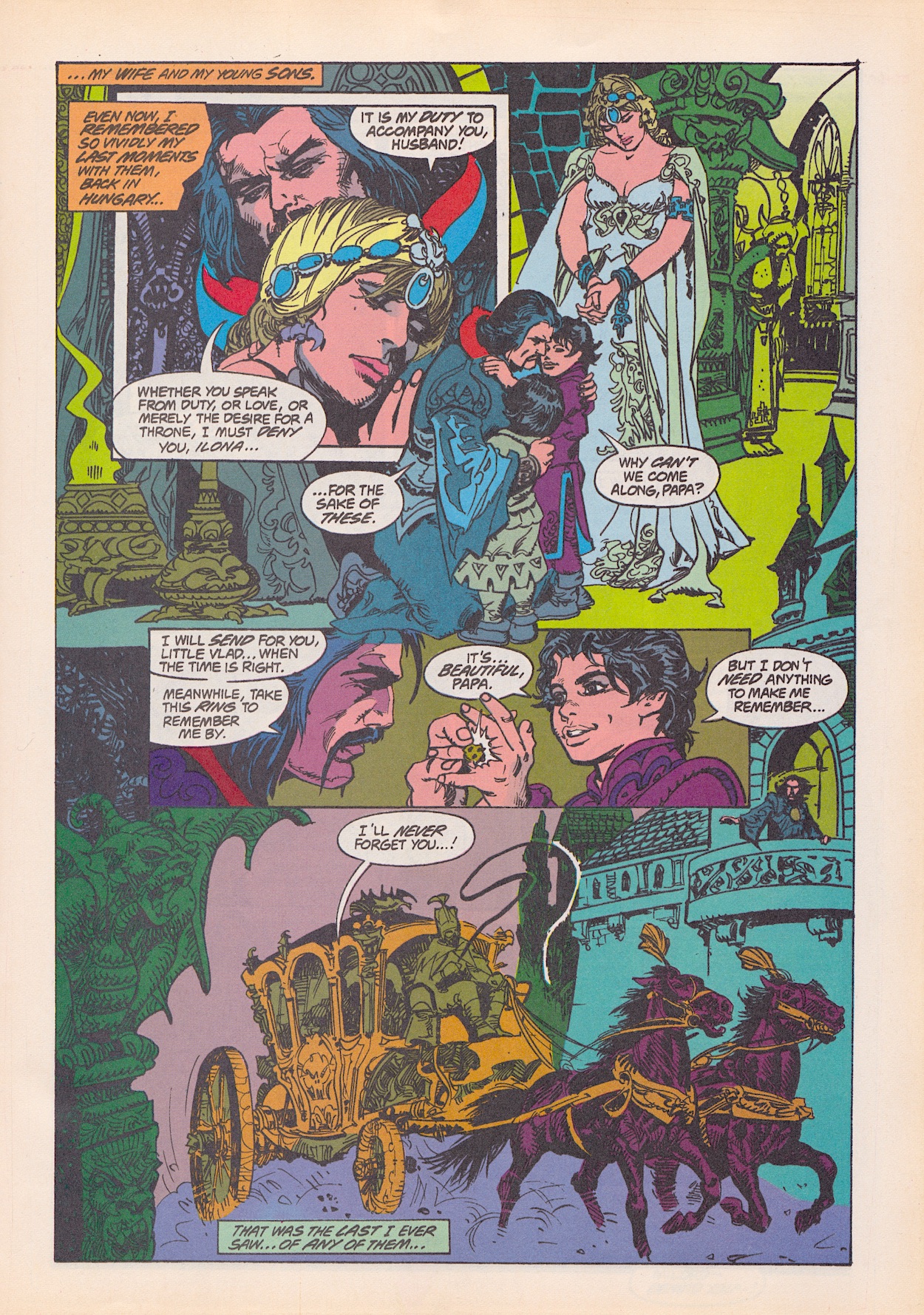
On a few occasions Vlad’s narration laments his own decisions, defending himself by reminding us he was only human at the time. For example, he didn’t know he had only two months left to live and wishes he’d made better choices, in particular with his family; he’s now married to the King’s cousin, they have two children and are in love as opposed to his previous wife who he’d forced into a relationship.
He realises his enemies (and allies) are amassing against his bloodlust and he takes drastic measures. He orders all of his wealth be amassed before leaving for a secret destination. Even his loyal assistant Cazan is left behind. Vlad shows a surprising amount of love for the man in these moments, telling the reader he was hurting because he’d left his friend with the wrong impression. You see, once all his worldly goods were buried (in an area where he’d dammed a river, then released the water again to hide the burial site) he impaled everyone involved. He didn’t want to have to kill his friend too.
But he would’ve.
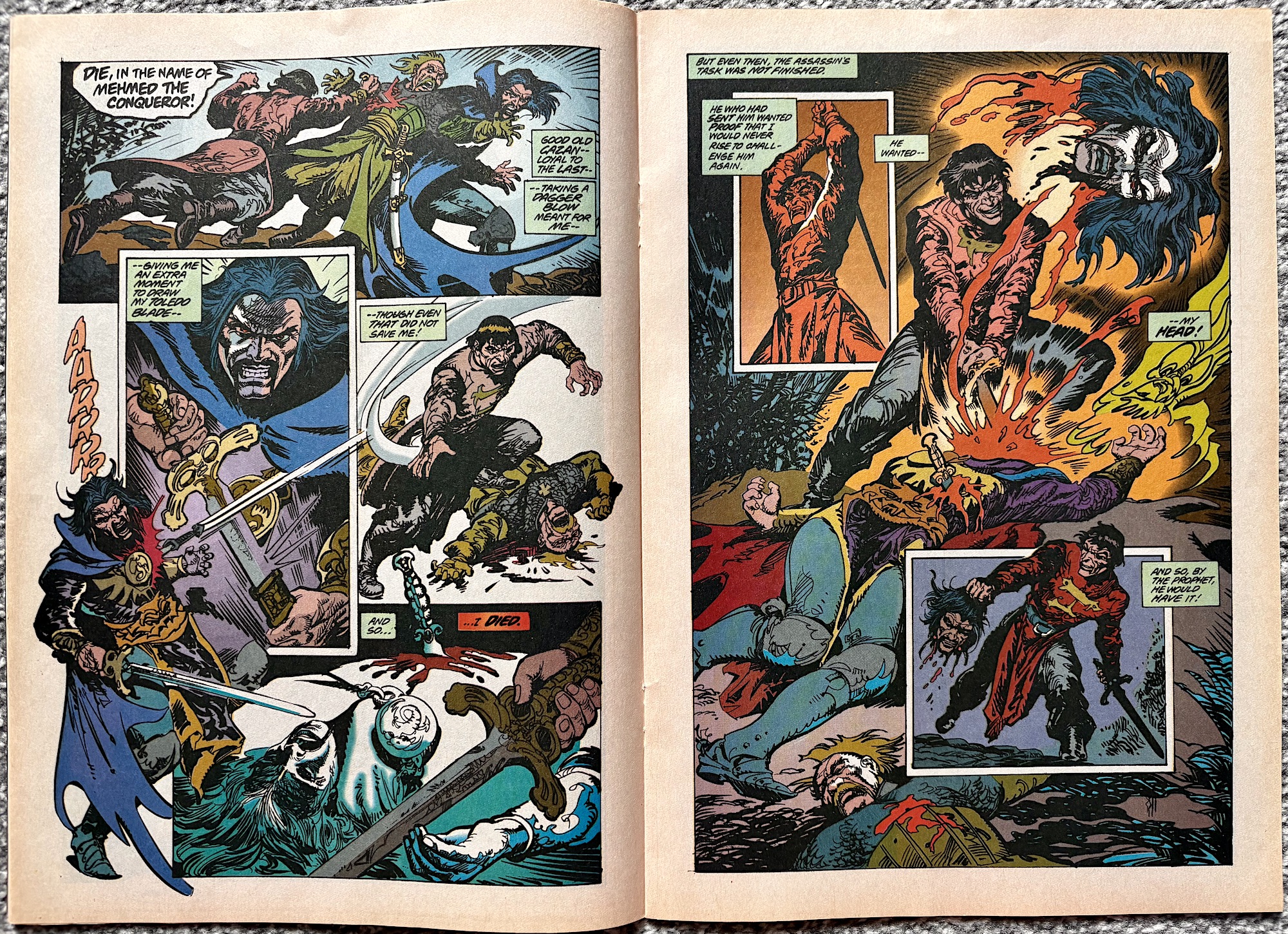
Someone claiming their village was destroyed by Vlad’s enemies comes to swear allegiance and, despite Cazan’s vocal suspicions, the man is allowed to join the army in a top advisory role. Vlad admits to the reader he had his own doubts but in a moment of “grim fatalism” he took in “a suspected viper to my bosom”. We’re reaching the end here. In the build up to the final battle against his hated foe, Danesti he’s unsurprisingly betrayed and Cazan takes a knife to the chest as he leaps to Vlad’s defence. Even though Vlad is also killed, his narration continues from beyond the grave and it’s here that the story goes on a tangent from known history.
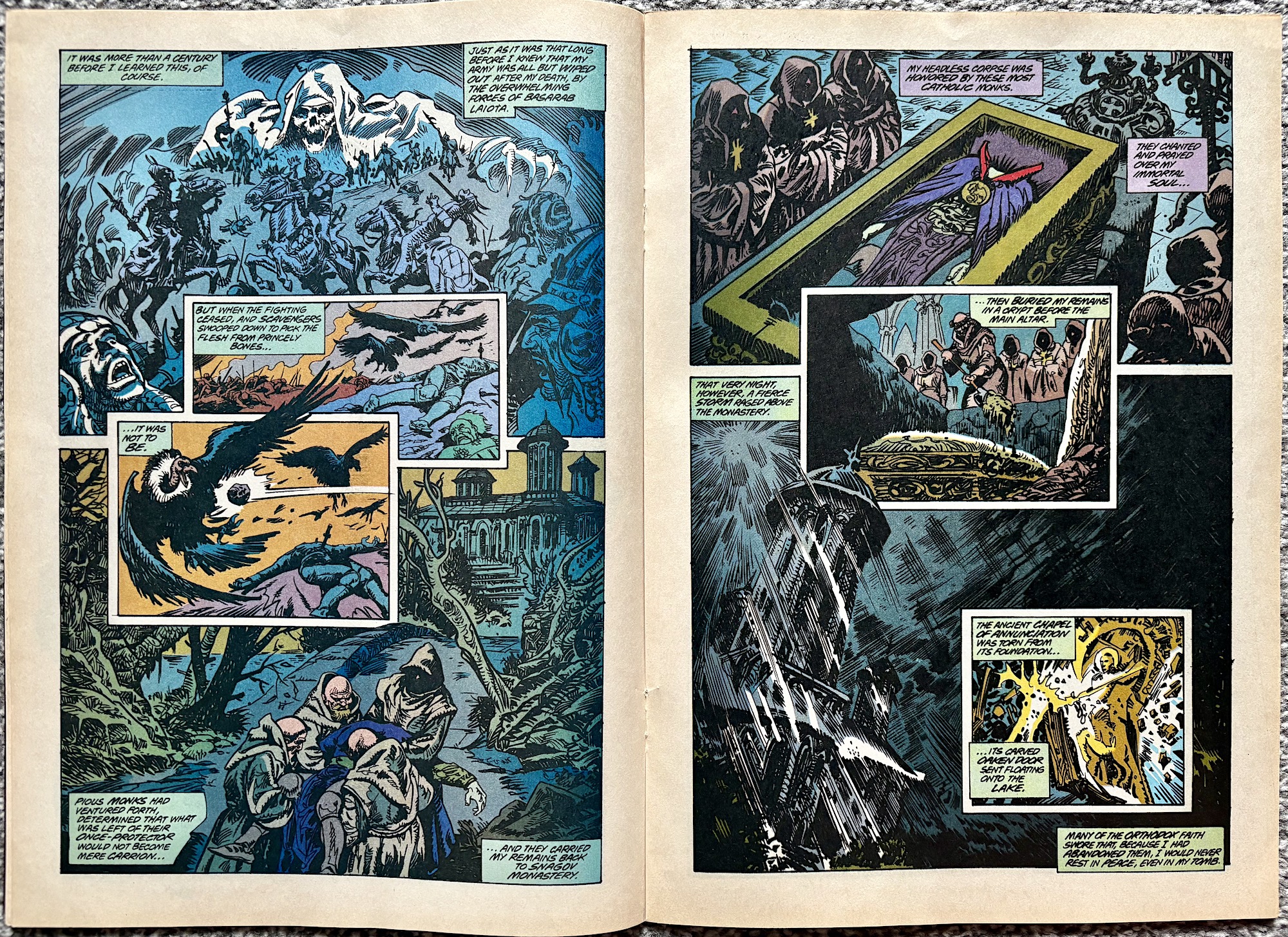
Beheaded by the assassin, after the battle is over pious monks take his body to be honoured by the Catholic church, which praises what this monster of a man achieved in the name of Christianity. However, that night the chapel is destroyed by a wild, unforeseen storm. This leads many of the faith to believe he’ll never be allowed to rest in peace because of what he did in life.
That was only his body, though. His head gets its own story. It was taken to Mehmed the Conqueror. However, over the course of just one night it becomes so badly decomposed it’s no longer recognisable to the people who come to see it impaled on a spike. We also find out that Vlad’s illegitimate son, Mihnea became known for terrorising the lands, cutting off the noses and lips of his enemies, with Vlad’s narration full of pride for the next Prince of Wallachia.
We then suddenly jump forward 150 years and a hooded stranger (actually a descendant) arrives at the church where Vlad’s decapitated body is buried; on orders from the Pope it is to be moved because it was buried too close to the altar. There’s a mention of Vlad’s wife’s suicide damning her for all eternity, which should be at least a bit familiar to fans of the film. However, unlike his supposed head a century-and-a-half earlier Vlad’s body hasn’t decayed.
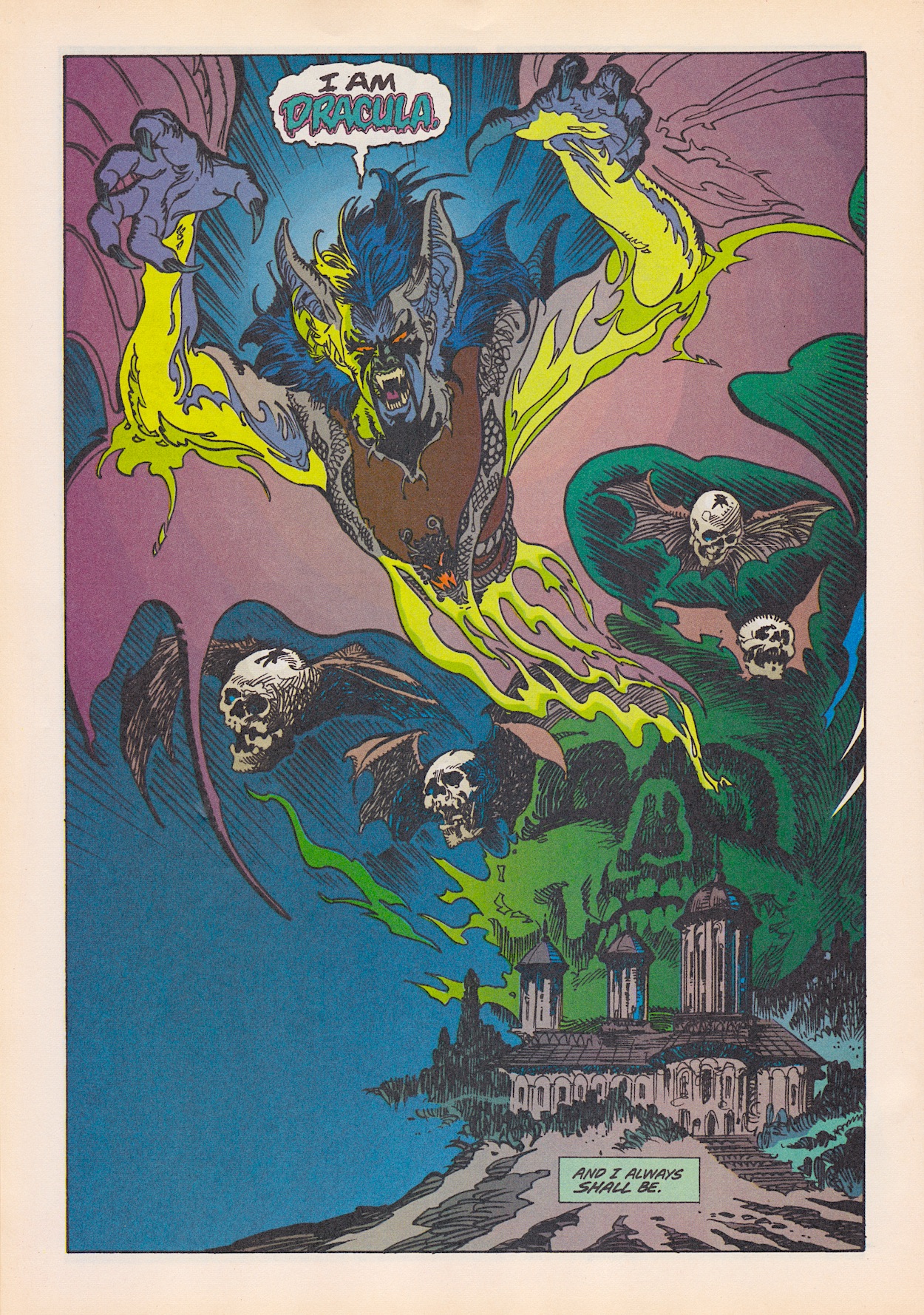
After the spread above, his actual head (which we learn is not decomposed either) is placed on to his body, the stranger recites some ancient texts in a foreign language and Vlad rises again, instantly biting the neck of his descendant, energising his body and beginning his life as a vampire. While the story ends with an image of him declaring himself as the Dracula of Bram Stoker’s creation this origin story, even the resurrection part, is very different from the novel. In fact, it’s only one of a few possible stories about Vlad’s body after he died.
This has been a curious strip. We know that Stoker had very limited knowledge of Vlad the Impaler, that particular part of the world or indeed that point in history and he simply picked at scraps of information to build his character. (Not forgetting his own supposed xenophobia which may have contributed to the story.) This strip seems to dangle somewhere between actual history and the novel. After accurately chronicling the historical character (as much as a comic can), this final chapter commits itself to neither the truth nor Stoker’s imagination.
There’s a lot of ambiguity surrounding the events of his burial so Roy has decided to fill in the gaps as he saw fit, and that’s fair. Personally though, I’d have preferred to have had the mystery remain. It could’ve still ended with how it began four months ago, with Dracula relaying the story to the reader and letting them fill in the blanks. The mystery could’ve added to the spookiness, the unknown adding to the fear instead of it being filled in for us. Overall though, I’ve really enjoyed it and it’s peaked my interest in the real life man. I’ve found myself reading about him at length because of this comic.
It’s a shame the sales figures dropped so sharply after the adaptation finished, although I’m not sure what they could’ve printed anyway. This last issue also sees Vampirella unceremoniously dumped (she never did get her own cover as promised) and the small back up strip is rather unremarkable. But I wanted to concentrate on the main story anyway.
Overall this has been a quality comic and a pleasant surprise from start-to-finish. From a brilliantly realised movie adaptation to a fascinating look at the man behind the myth. From an initially clichéd Vampirella origin to a captivating story and character I’d never read before. From interesting news on the film’s release to a series of remarkable anthology back up strips. I didn’t expect too much from what was essentially a movie tie-in, but Dark Horse International’s Dracula has been a great read from start to finish, including when changing form like its titular character.
It may not be well remembered and doesn’t sell for very much on eBay, but that just means it’s easy for you to pick up and enjoy for yourselves. I highly recommend that you do.
This is the last we’ll see of Derek Yaniger’s wonderful art on the blog. The final edition of Marvel US’ Transformers: Generation 2 has 48-pages with 37 of strip broken down into chapters of varying length called Judgement, Twilight, Siege and Creation. All written by Simon Furman, coloured by Sarra Mossoff and lettered by Richard Starkings, with alternate chapters drawn by either Manny Galan and Jim Amash or Geoff Senior, making it feel even more special. The annoying adverts breaking the up strip are also limited, with the final 17 pages left as one long chunk.
Things kick off with something I enjoy but which seems to irk the all-too-ready-to-criticise folks when another movie drops. I don’t like retcons if we have to ignore previous storylines in order to make them work, but unlike some I’ve never thought that about the films. Instead, just like the G1 comic which (and this is not a complaint) was made up as it went along, I enjoy a storyline that adds background, depth and builds upon what we thought we knew. This is what has happened with the G2 comic. At least, until the final page anyway.
So our memories have been refreshed about the ‘evolution’ of these mechanical beings and Simon’s clever way of integrating the comic’s necessary name change into the story, then there’s some surprisingly good comedy as Starscream finds himself battling with his own consciousness. His natural desire to conquer is in a losing battle with the power of the Autobot Creation Matrix and he finds himself unwillingly saving the lives of others. Hilariously he’s never anything other than the Starscream we all know and love to hate, and he hates every moment of it! Eventually he relents and passes the Matrix back to Optimus Prime like a child forced to give up their toy until they’ve eaten their dinner. This is a brilliant swan song for him.
Moving on to book two and Geoff’s easily recognisable style instantly elevates an already enjoyable story. We find out The Swarm is something “between matter and energy” and we witness it destroying a battleship, killing its 16,000 troops in seconds. It falls on Megatron of all characters to bring some levity to the proceedings. He’s a far cry from the megalomaniacal ranter in G1, continuing his entertaining line in dark quips from last issue.
The two leaders have a plan but it’s not revealed yet, leaving us to enjoy the tension as things continue to worsen. After years of knowing these characters it’s fascinating watching Megatron go about something with all of his usual verve while treating Prime as his equal. Speaking of Optimus, he senses some form of intelligence within The Swarm and believes if he can reason with Jhiaxus he can contact it on some form of psychic level through one of the second generation. Given the twists and turns and shocks the original comic gave us over seven years, it would really take something to shock us by this stage, right? Correct.
There’s some gloriously detailed art here, some of Geoff’s finest in fact. Could a shock conclusion see the end of Optimus? No, that’d be too easy. Instead he’s forced to fight through the pain and the temptation to give up and simply pass away. This gets dark at times. But in the end it plays to the strength of this character.
It feels less like a sequel and more like an epilogue to the original epic 332+ issue run
As far as Jhiaxus is concerned the original generation of Transformers have compassion and empathy, and he believes caring about those other than yourself (or indeed for those worse off than you) is a weakness and must be torn out. In the end it’s the Swarm that gets him, tearing him apart in a burst of agony and the ship’s reactor blows, pushing Prime into space and leaving Megatron as the last hope for both Autobot and Decepticon alike.
The Rheanimum he mentions is the mineral his Decepticons mined in #7 and here it’s explained it could be the key to their survival. It makes metal super dense and resistant to damage, you see. It’s exciting to see Megatron racing to save everyone, even if Earth continues to look like any barren bit of space rock. Why not set the story somewhere recognisable like G1 did, even just a named place (like Portland in the original). It takes away any potential drama of having this happen on our own planet.
The characters make up for this though. I mean, come on, seeing Grimlock and Soundwave side-by-side is something else! Then new Decepticon Manta Ray hears Razorclaw’s orders but looks to Grimlock before following them. That’s the final straw for the Predacon, who attempts to kill his brother in arms but Autobot Leadfoot saves the Decepticon. We’ve had moments of truce between the factions before in comics, cartoons and movies, but it feels so much bigger, more impactful and more permanent this time.
Then everything happens at once! Starscream saves Prime and hands him Rhanianimum, but he refuses it. There’s even a reference to the Scraplets by Starscream, who spends a lot of time worrying his co-operation isn’t like him and that the Matrix has done him permanent damage! Frenzy gets some funny moments, Nightbeat dies (nooooo!) and Megatron politely introduces himself to Grimlock. Then Prime insists that for his desperate plan to work, he must die. Thing is, while it tears his physical body apart, the Swarm doesn’t kill him. Instead he ends up in a void, seemingly forgetting he was in a void before in the UK comic (Furman annoyingly ignoring his own UK continuity), and he gets the feeling the Swarm is like an innocent child clamouring to be taught.
This review was almost twice as long as it is because there’s so much going on in this issue. I’ve had to edit this post down and cut so much out I could get a job on Film4’s daytime schedule team. So, Prime wants to let the Swarm take him, absolutely and completely, letting it consume him and fulfilling his visions which began way back in #1. The nightmares weren’t to be feared, they were instructions. The ultimate sacrifice. It’s portrayed brilliantly by Geoff above and you can feel the agony Prime goes through.
Then there’s darkness… before he suddenly sees, well, everything!
He sees and feels everything the Swarm does. While he still has a consciousness the Matrix sustains his mind and uses the pure essence of their creator Primus to educate the Swarm. From the outside its misshapen form becomes a dazzlingly bright light and all who witness it are filled with a feeling of peace and joy, their fear dissolving in an instant. Then, out of the light steps a new creation, the Swarm now knowing what it is and where it’s come from, and it uses its immense power to create instead of destroy.
The Optimus Prime you see below is based on the ‘Hero’ version of the toy, the most recent plastic incarnation of him at the time. But what exactly was the Swarm? The whole “byproduct of the second generation of Transformers” is never fully explained. How was it produced in the first place? We don’t know. (Nor do we get an answer about that strange moment with Onslaught.) What is explained is that the second generation of Transformers lacked any kind of morality, just a legacy of destruction and, like a child, the Swarm was searching for something more. It knew it wanted something better and was destroying all Transformers because it thought they were all fascist killers; it didn’t know there was an earlier generation or why the species had been created in the first place (to fight evil and save the universe).
Exposed to the original Primus ‘code’ it’s reprogrammed and from the lives it took it constructed a new life, a new leader for a new future for their whole race, not just the Autobots. The story ends with what feels like both sides genuinely wanting to work together. It certainly feels a lot more permanent than the truce at the end of the 80s cartoon movie. Then, after months of wondering we’re finally introduced to the Leige Maximo. This is the one bit of the whole issue that I’m not sure about.
These will forever sit at the end of my original Marvel UK collection as an integral part of that lifelong favourite
The thought of the comic continuing beyond this resolution is an exciting prospect, with the Transformers (no longer Autobots and Decepticons) fighting a new war together against this new foe. However, the Decepticons weren’t a separate race, they were an offshoot who’d had enough of how things were being run. I hope Simon would have eventually interwoven this new backstory in with what came before if the comic had continued. However, I’m more annoyed with Megatron being sidelined in the final pages for Prime’s speech when he should’ve been standing shoulder-to-shoulder with him.
I had no expectations of this sequel, especially since there were only 12 issues. But what a rush! Some complained it retconned things (much like we constantly hear from moaners about the live-action movies, Star Wars or Doctor Who… etc.) but surely things would be boring if we knew everything there was to know about characters right from the off. This comic felt like an elaboration of what came before, using the millions of years between their leaving Cybertron and arriving on Earth to its advantage. It was a gap of four million years after all! It was also a clever way of working in the toy line’s new name, so kudos one final time to Simon for that.
Before we finish up completely, there are a couple of the usual extras to cover. After acknowledging G.I. Joe’s 150th edition, the final issue of this spectacular comic isn’t given any such coverage on the Bullpen Bulletin news page, however the letters page is rather unique. It takes up more space and begins with a missive from letterer (and Marvel UK editor) Richard Starkings. It’s interesting but I must point out the UK Transformers comic lasted a lot longer than 250 issues (332 plus annuals, specials etc) and I happen to love his Dragon’s Claws logo!
The second letter reminds me of my mum’s confession later in life that she didn’t actually mind buying me comics as a child, the letter from OiNK Blog reader James Healy asks us to remain positive before being negative about the original comic’s ending (I must say I disagree with him on this), and in Simon’s farewell message there’s an interesting snippet that it was colourist Sarra Mossoff who decided the idents in speech balloons should be coloured to match the speaker. Unfortunately, she’s also the victim of a rather cringey description.
Below this are some unused pieces of art by Derek and a Decepticon image by Chia-Chi Wang (The Punisher, Ren & Stimpy, G.I. Joe). Whether these were unused covers/posters is unclear and I wish they were bigger. I know the issue already has more pages, but a few more so we could see these at their full size would’ve really added to what has been a great send off.
During this real time read through I found out the name ‘Jhiaxus’ is pronounced “gee, axe us”, an in-joke by Simon who anticipated a quick cancellation by Marvel of another toy comic. He wasn’t wrong. While it was designed to last much longer, I haven’t felt short-changed. Yes, it was obvious things were being ramped up to get to a suitable conclusion but I’m left feeling completely satisfied, and not just with this as an end to its own series.
Now that it’s over it feels less like a sequel and more like an epilogue to the original epic 332+ issue run, like this was a story that had always occurred and just needed to be told before we could properly say goodbye to these original versions of beloved characters. Characters who have been reinvented many times since. As such, this hasn’t felt like a short run but an addition to the longest running comic I’ve ever collected, and these will forever sit at the end of my original Marvel UK collection as an integral part of that lifelong favourite.