OiNK! STARS iN BUSTER: A MiRTHFUL MERGE?

The following post was originally written for Sunday 22nd but was held back after the sad news of Tony Husband’s passing

In the review of OiNK #68 I began by describing how I discovered it was coming to an end and merging into the pages of Buster. I was absolutely gutted, not to mention confused. While over the next few years it felt I had a knack for collecting comics that would end up cancelled quickly, OiNK had been a big part of my life for what felt like a long time at that age. But Buster was weekly and a lot cheaper, maybe this could be the next best thing? Especially with these three OiNK characters making the transition?
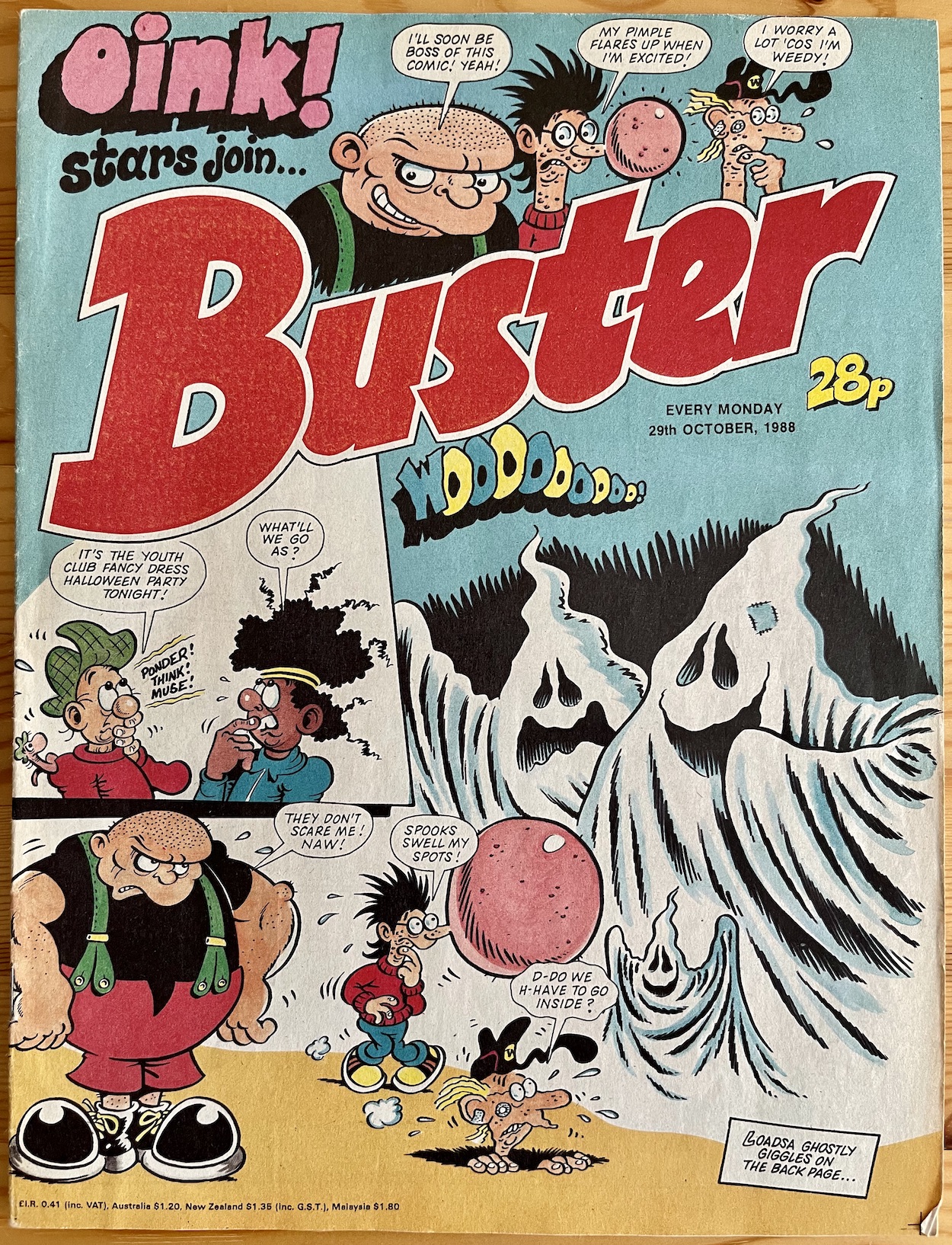
So, after asking for my reserved copy of OiNK I went back to the shelves and picked up this issue of Buster. However, something (I don’t know what) stopped me from placing a regular order right there and then for a weekly dose of Pete and his Pimple, Tom Thug and Weedy Willy, despite the former two being favourites of mine. When I got home I decided to read Buster first. I wanted to be excited about something new, a new comic with four times the amount of Lew Stringer’s strips every month.

Despite the fact OiNK was a breath of fresh air in comparison to others, its humour speaking to me like no other humour comic, I was desperate not to say goodbye completely. Perhaps I’d really like Buster, maybe its humour had moved on in the few years since OiNK’s creation, maybe I’d reserve it and have a brand new weekly to look forward to with some faves included.
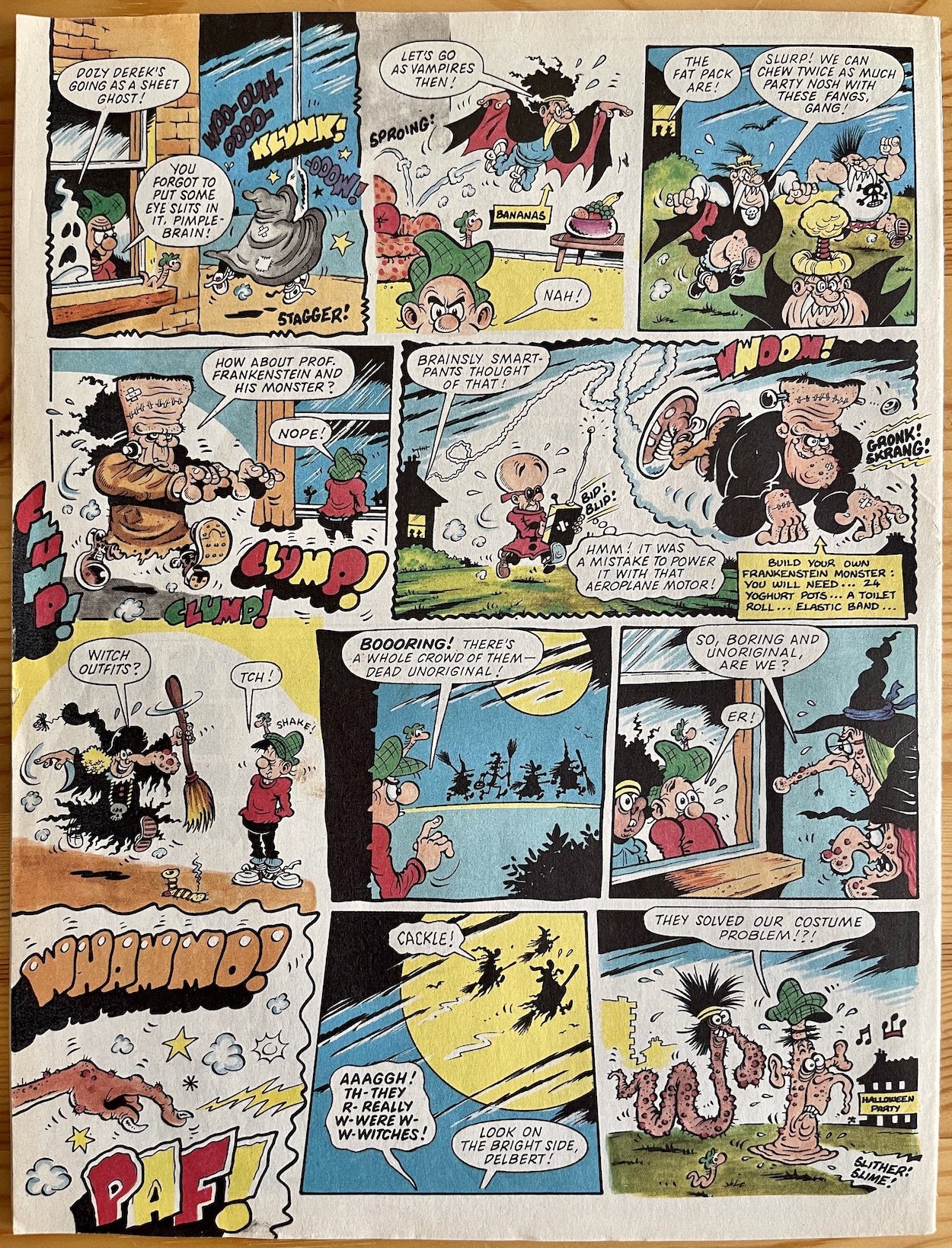
The fun front cover with the legendary Tom Paterson drawing our OiNK characters was a very positive start although I was initially disappointed they weren’t part of the Buster story that continued on to the back cover. However, the story is really good, Tom’s artwork elevating Mark Bennington’s already funny script to lofty heights with his crazy style, gorgeous (or in this case grotesque) details and of course his trademark smelly sock.

I was also initially a little jealous of Buster readers, who still had the same format as OiNK did in its Golden Age during the final months of 1987. Having said that, after reading this it felt like it had nowhere near the amount of reading material as those issues of OiNK had, nor did it take anywhere near as long to read. Our piggy publication crammed so much more content into the same 32 pages, so even though it was 7p more expensive a whole year before this 28p comic, OiNK was a real bargain!

Towards the back Buster welcomes any new readers making the pilgrimage over from Uncle Pigg’s comic at the top of his letters page with hopes that he can keep them laughing. Let’s see if his wish would come true and begin with a look at the three highlights we’re all here for, and no doubt the first three pages any pig pal would’ve read after that cover strip. First up is Pete Throb.

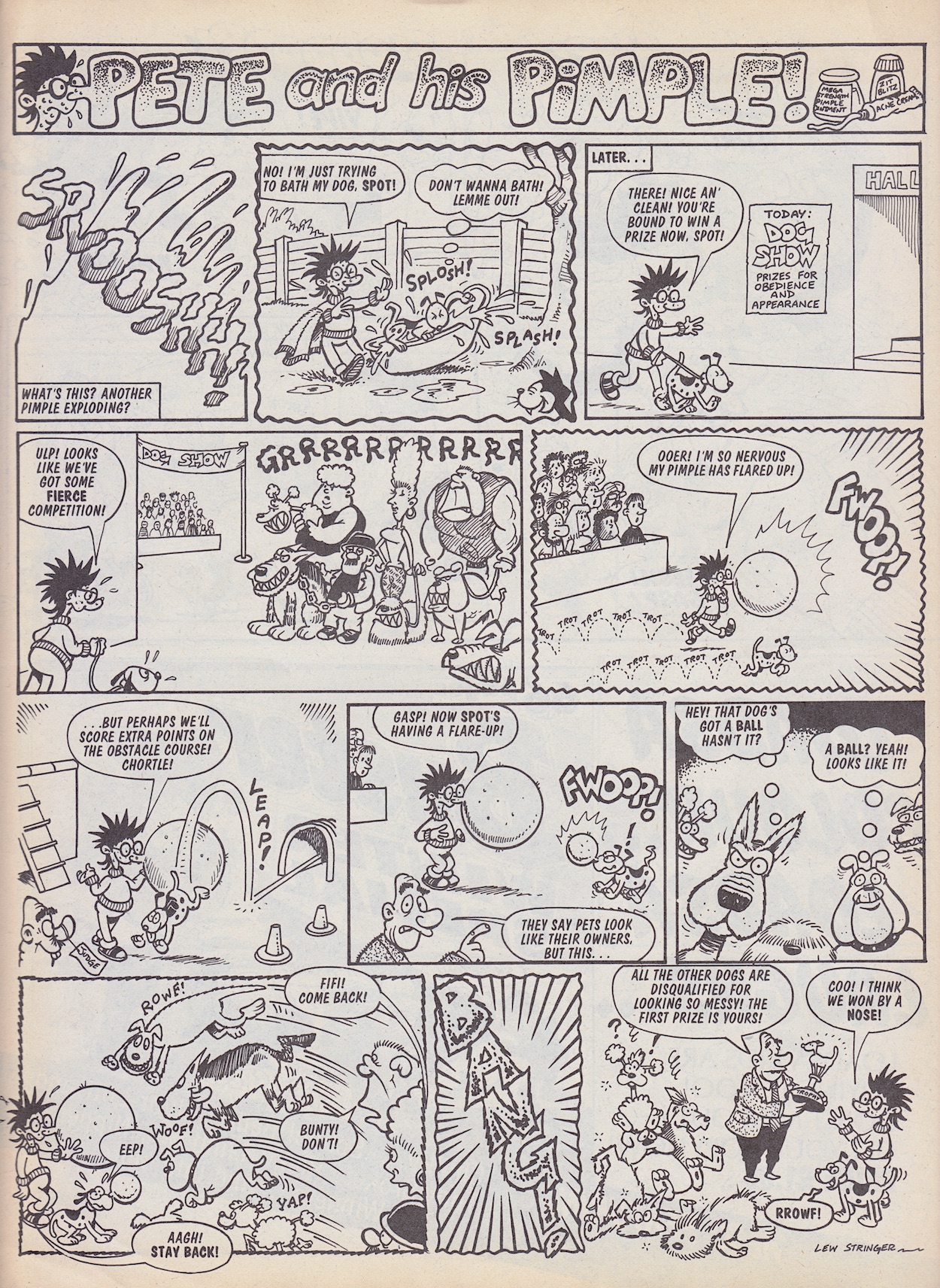
Pete and his Pimple keeps its title banner so initially everything seems normal, or at least as normal as an OiNK strip ever was. However, once we get going there’s a key difference that may not have sat well with long-time fans. Of course it’s an introductory strip in many regards, which is completely understandable and that’s not the problem here. Have a read of Pete’s first Buster page and see if anything pops out. Or rather, doesn’t.
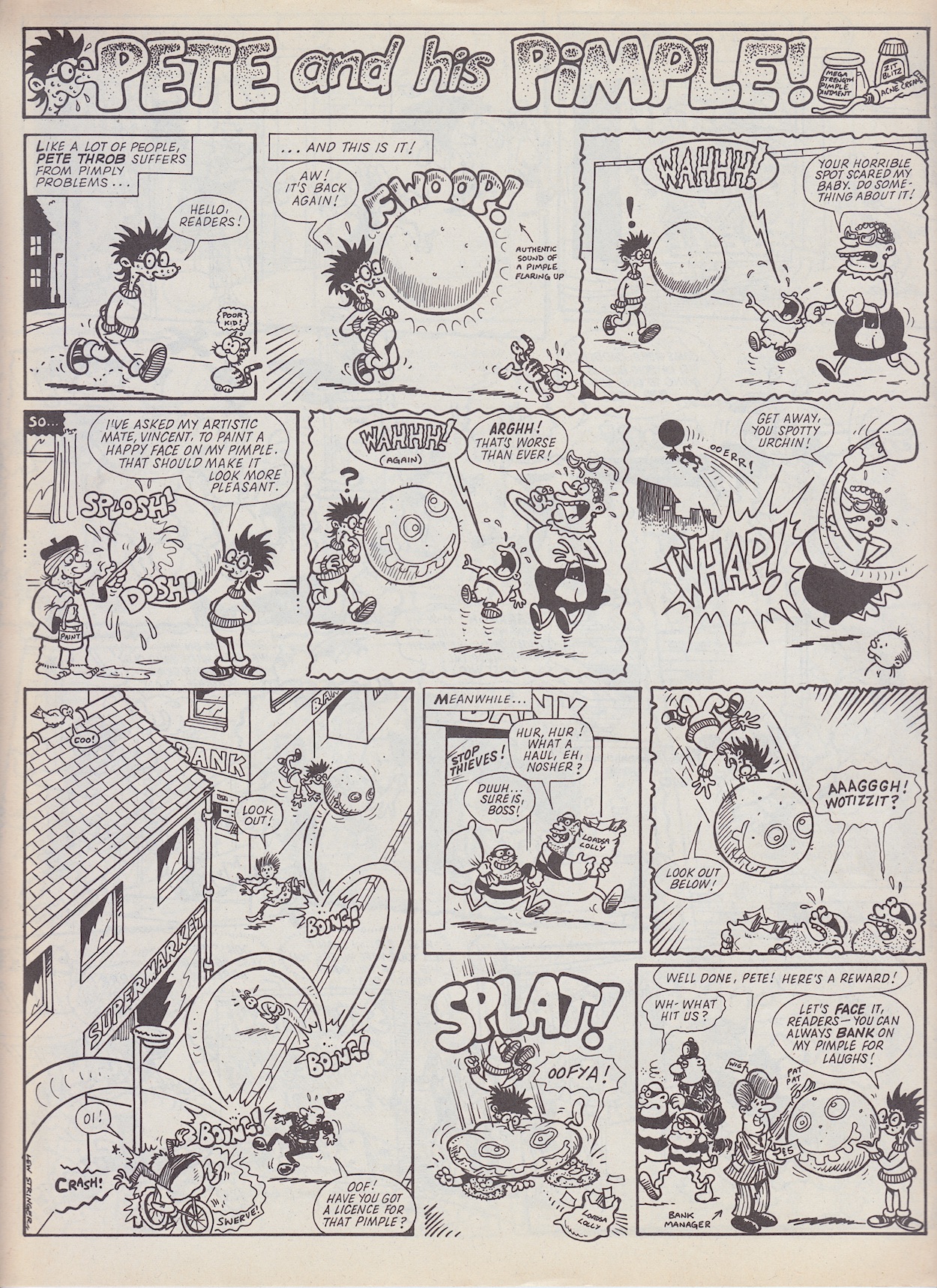
Right up to that penultimate panel everything is as chaotic and funny as we’ve come to expect from Lew’s Pete, but then he lands on the burglars and squishes them, his pimple flattening for one panel and that’s it. Where’s the almighty explosion? Where are the vats of pus that would’ve stuck the thieves to the ground until the police arrived? Something key to Pete’s success in OiNK was missing. Nothing had been enforced upon Lew, he simply knew he couldn’t show a pimple bursting and covering everyone with pus in this comic.

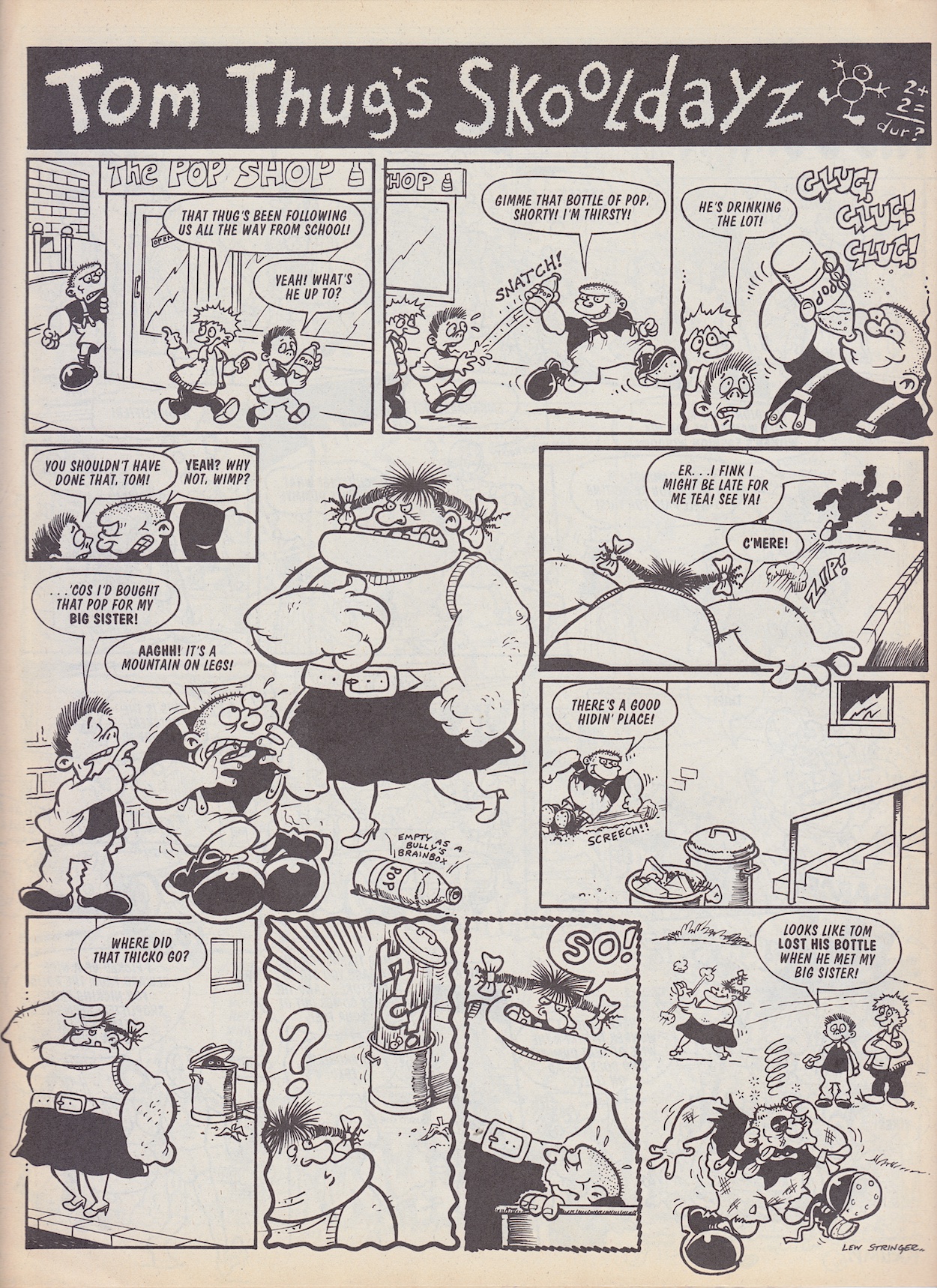
He wasn’t the only one of Lew’s characters to see a change either. In the monthly OiNKs Tom Thug had made humour comics history by actually leaving school, applying for jobs and even signing on for unemployment benefits. But for Buster time was reversed and Tom became that mainstay of children’s humour comics, the eternal schoolboy. Not that this is a complaint of course, not with quality like this.
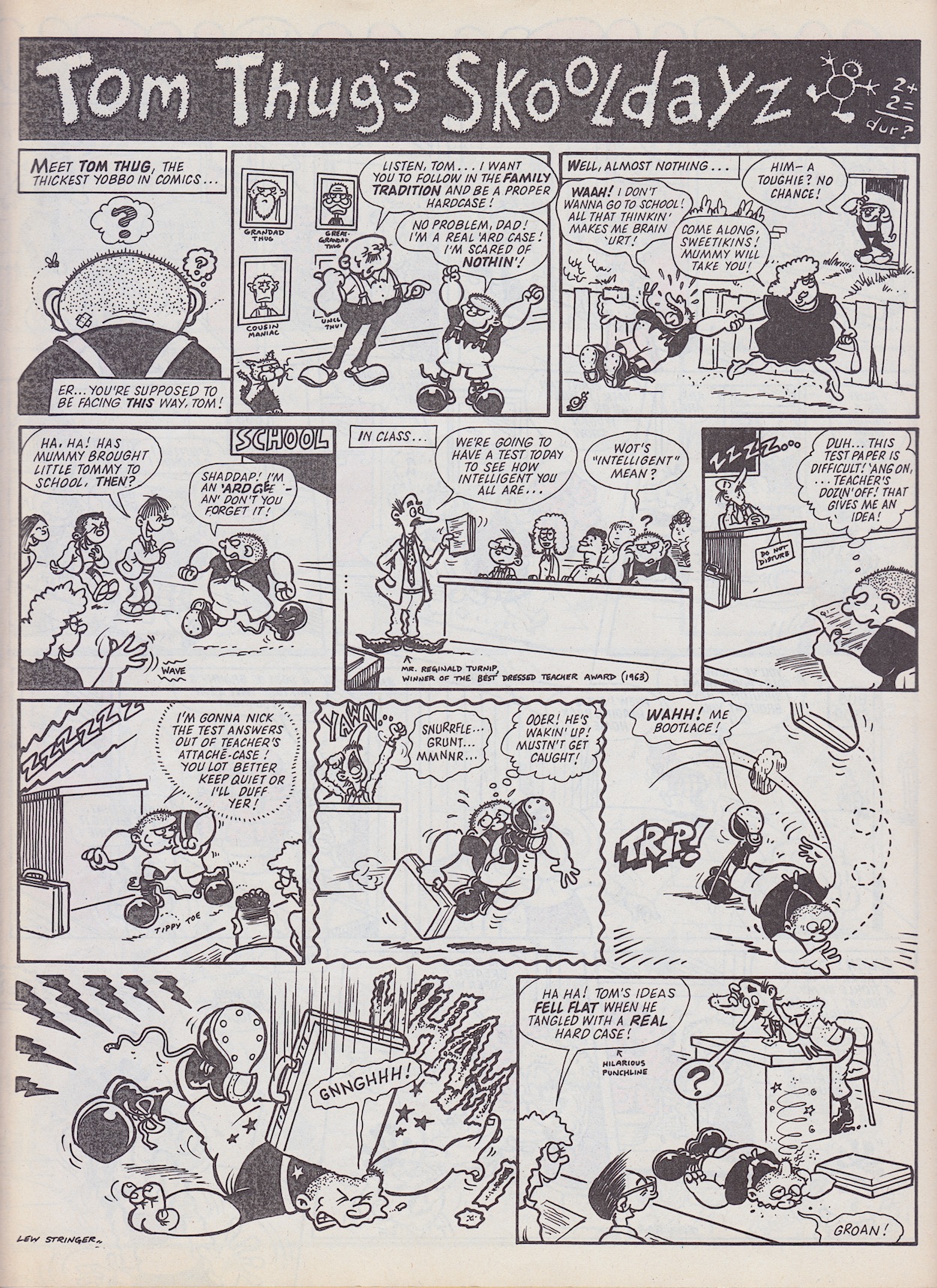
I’m surprised Tom knows the phrase “attaché-case”! This felt much more like an OiNK strip than Pete’s, although there was already one little change in that Satan the Cat would go unnamed from now on, ‘Satan’ not deemed appropriate anymore. Also, Tom would only ever look queasy if he felt like being sick, unlike the results we could see in OiNK! There was a reason behind the changes. These popular OiNK stars simply weren’t in OiNK anymore and had to adapt to their new surroundings.

As such, Pete’s pimple would largely go un-popped, Tom would never leave school for a setting the younger audience would better appreciate and his cat’s name would remain a secret for pig pals to keep. Would these changes be acceptable in the eyes of their fans? Well, there’s one more character to check in on first before I share what my opinion was upon reading this comic back in 1988.
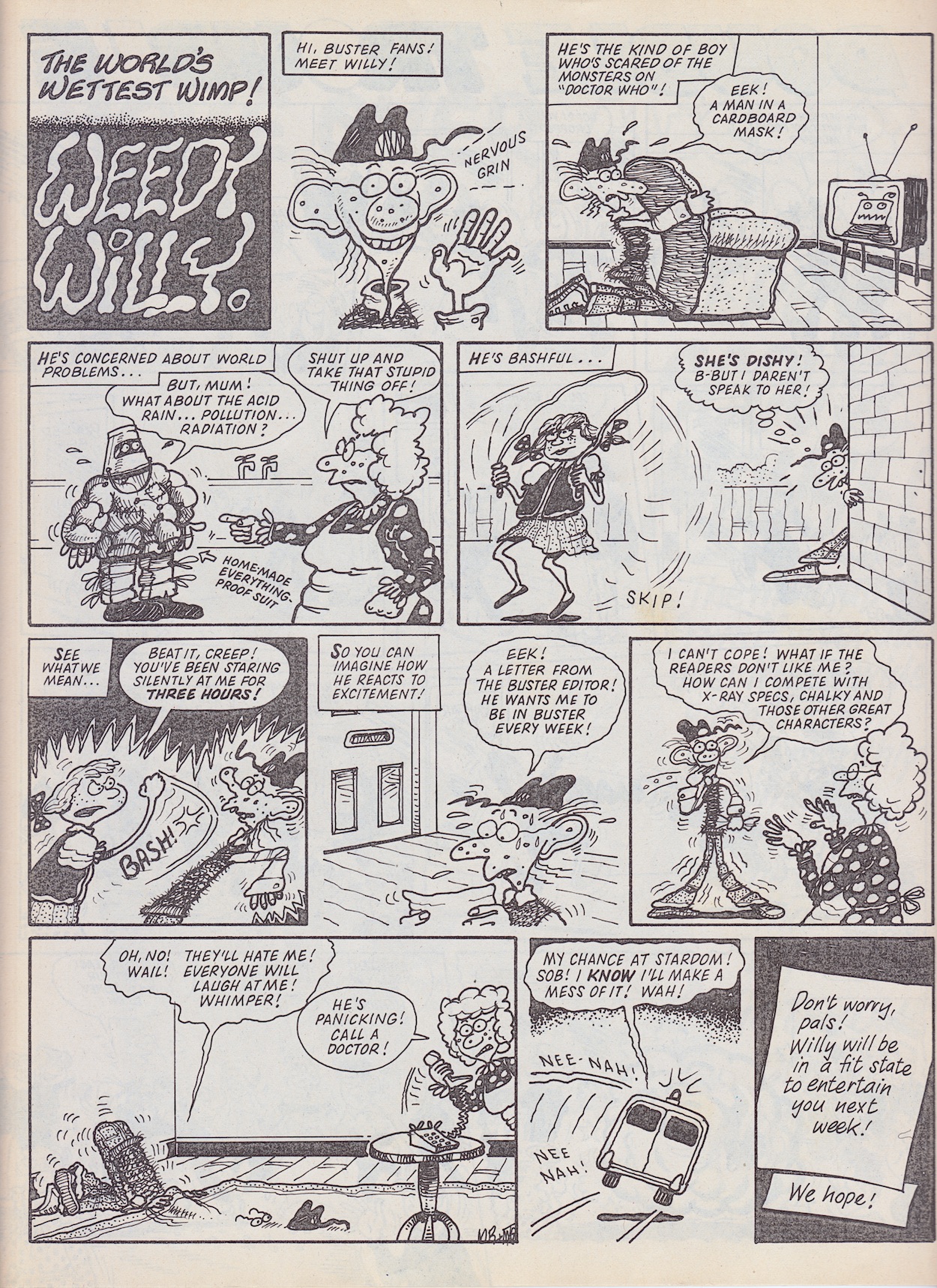
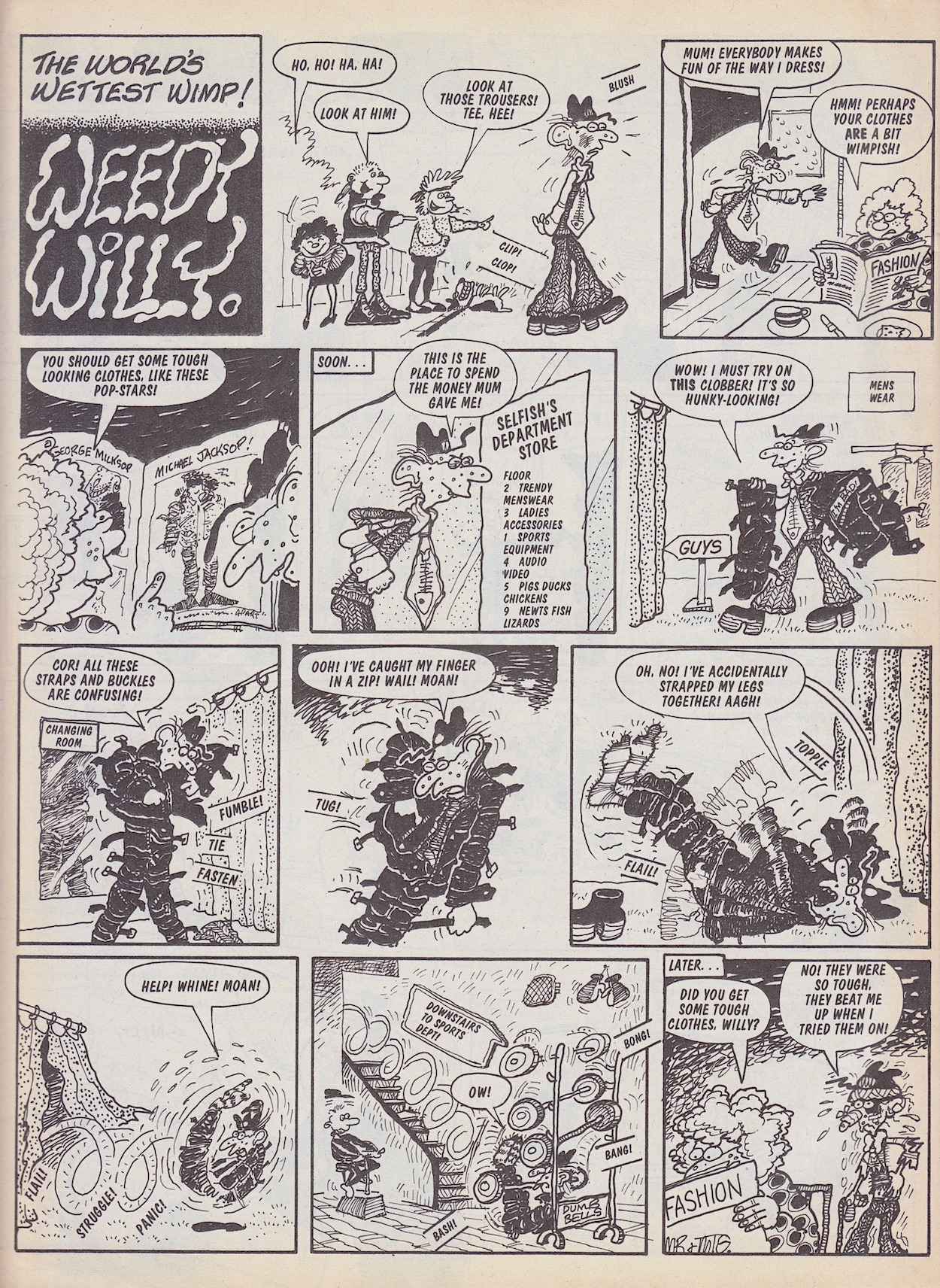
Weedy Willy, originally created by Graham Exton, usually written by Mark Rodgers (as he is here) and always drawn by Mike Green needed the least changes in making the transition, although apparently he’s single again after he eventually began dating Dishy Mandy in the second OiNK Holiday Special. With hindsight there’s a moment here where he’s accused of being a pervert though, but we’ll put that down to this being inadvertent and 35 years ago.

All three of these strips were clearly introductory ones and below we’ll look at their next three instalments to see how they settled in, but for ten-year-old me it simply wasn’t enough to justify that slot in my comics list. I was only allowed a certain amount on order at once and Wildcat’s preview issue given away with the last OiNK was very tempting. But ultimately it came down to how I felt at the time about Buster.

I immediately thought, “What?! My OiNK has to end but they’ll start THIS?!”

In the last issue of OiNK Horace (Ugly Face) Watkins described it as “a breath of fresh air in the clichéd world of children’s comics” and apart from a few exceptions (the brill Buster strip, as well as fun with Ricky Rainbow, Ivor Lott and Tony Broke and X-Ray Specs) little was convincing me Buster was any different. Yes, it was a bit more random by this point, after a lot of mergers there wasn’t enough room every week for all the characters so some would pop in and out, but the majority of the humour felt old-fashioned compared to what I was used to. Then I saw this!
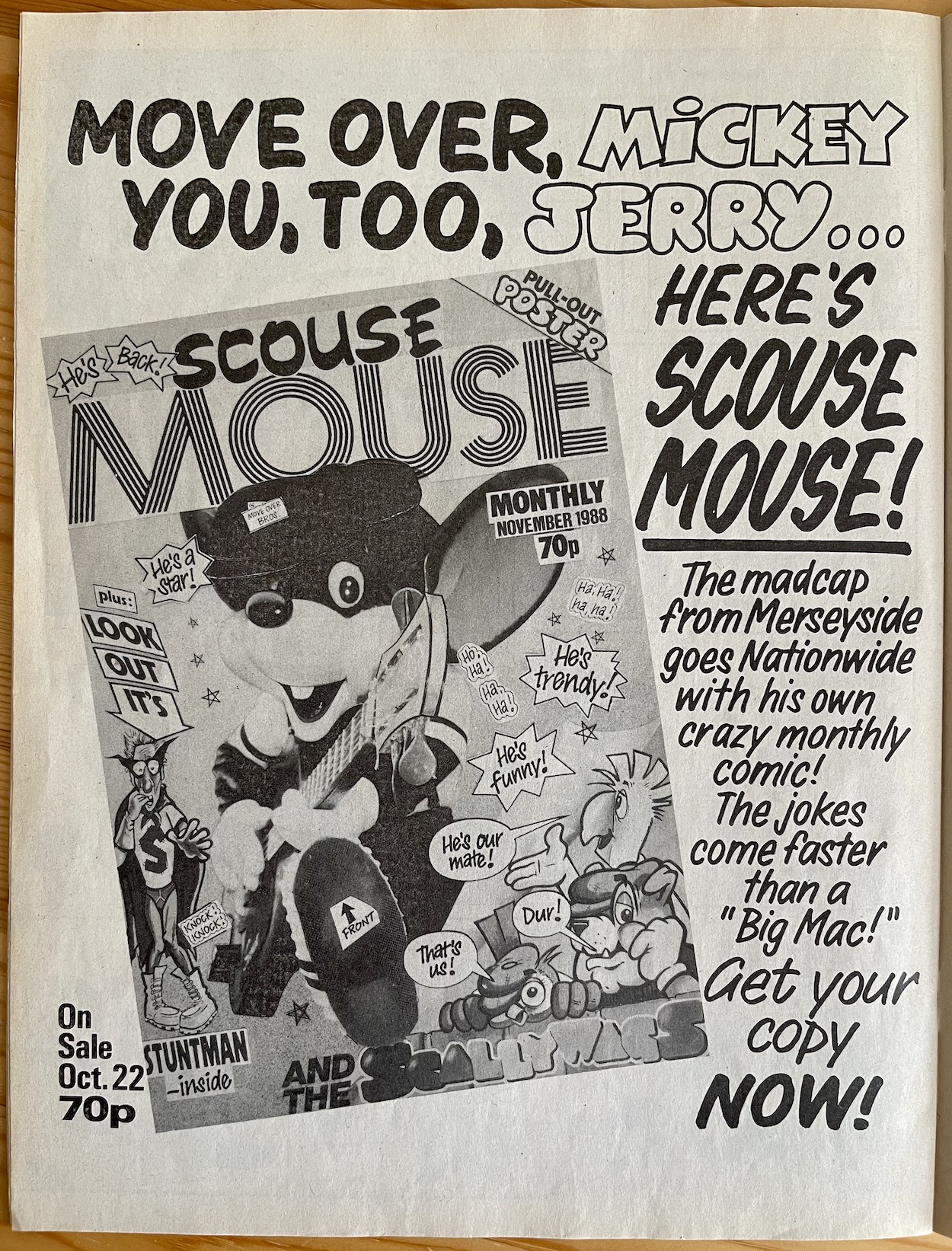
As a child this advert really didn’t help. Please remember: I was ten. I saw this and immediately thought words to the effect of, “What? My OiNK has to end but they’ll start THIS?!” The cover even looks unfinished, like it’s lots of bits of paper glued together. Reading this issue now there are some more smiles and laughs to be had but things like Nipper and Dad Mum are atrocious and don’t hold up to the test of time at all. The latter’s whole ‘funny’ scenario appears to be the fact the character is a single mum who likes to do things that apparently are ‘funny’ for a mum to do, like work, go out with friends and have fun! Outdated humour even for the 80s, surely.

Getting only 12 pages of OiNK strips a month wasn’t worth the reservation slot and so I moved over to Wildcat which itself was heartbreakingly short-lived. Until doing this blog I never purchased any more issues of Buster so I’m quite excited to have a look at some new Pete, Tom and Willy strips from the next three issues. OiNK’s title would only appear on these four issues in total and it was never called ‘Buster and OiNK’ like other mergers.
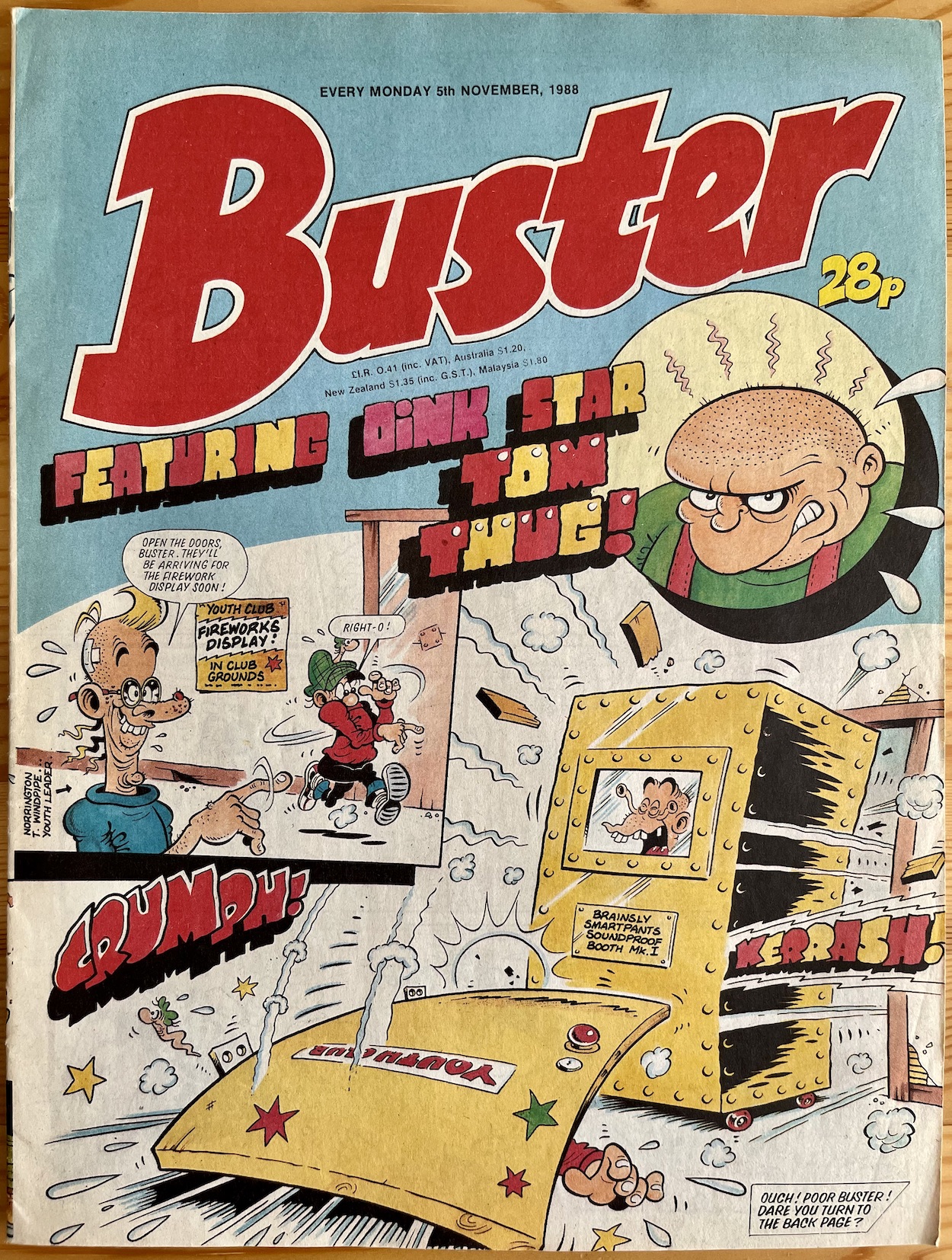
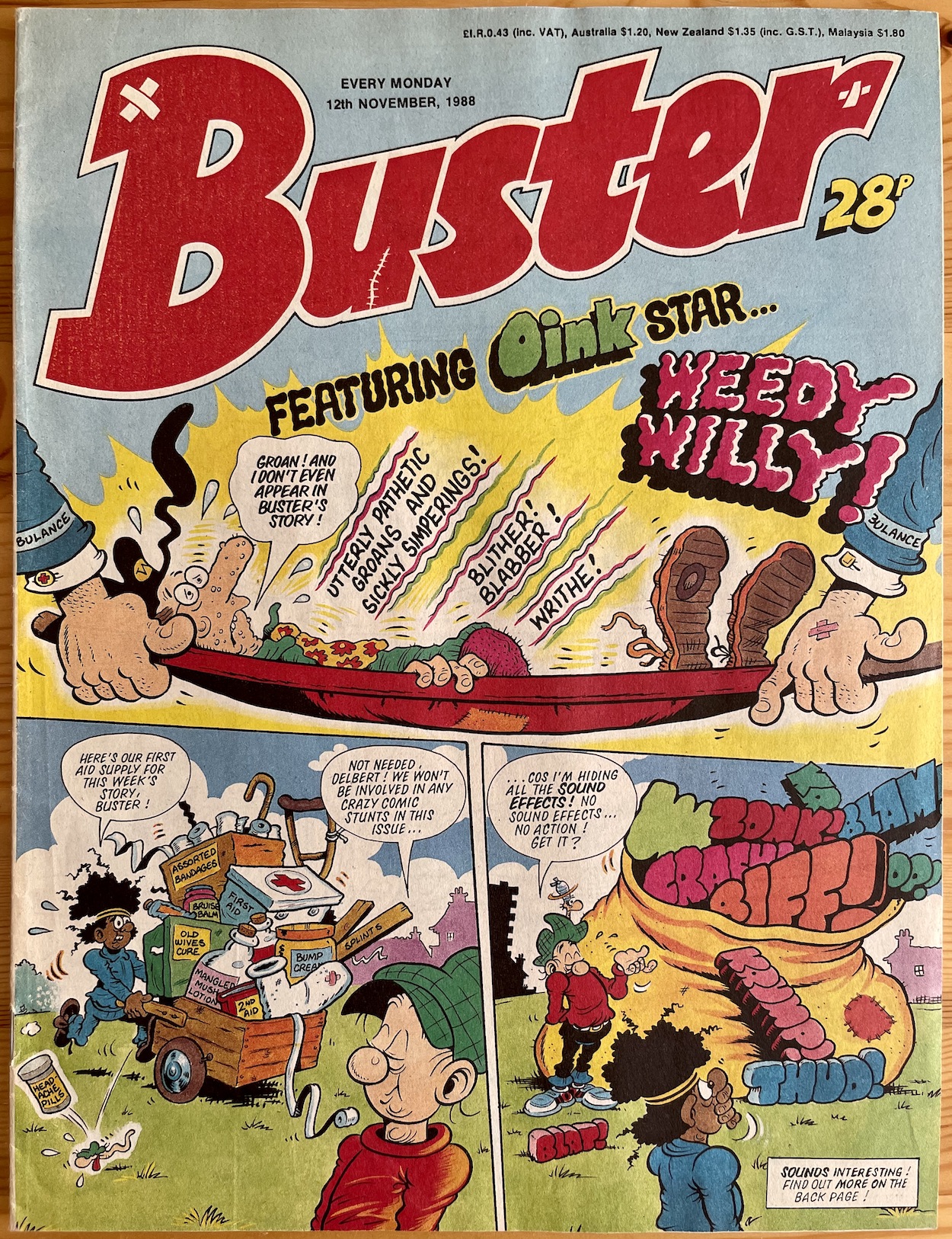
Most likely with WHSmith’s stupid attitude towards OiNK and placing it on the top shelves Fleetway didn’t want to risk that happening to their top title. Despite OiNK’s humour simply being cheeky (more in-line with the kids of the 80s) and the good moral messages it contained, to some groups this didn’t matter so perhaps the publisher wanted to play it safe. The Tom and Willy covers were drawn by Tom Paterson again, and Buster didn’t appear on the cover of the last one but there’s a funny story to tell about that inside, which we’ll get to below.

So let’s take a quick look at the remaining OiNK strips and first up are Pete’s. The first one reuses a joke from one panel of a sports issues of OiNK as a basis for the whole strip and as you can see in the next two we actually have pimples popping! Although, it bursts with much less of the sticky mess we found so funny and the result is shown only in silhouette, and his dog’s explodes more like a balloon filled with air than a pimple filled with pus.
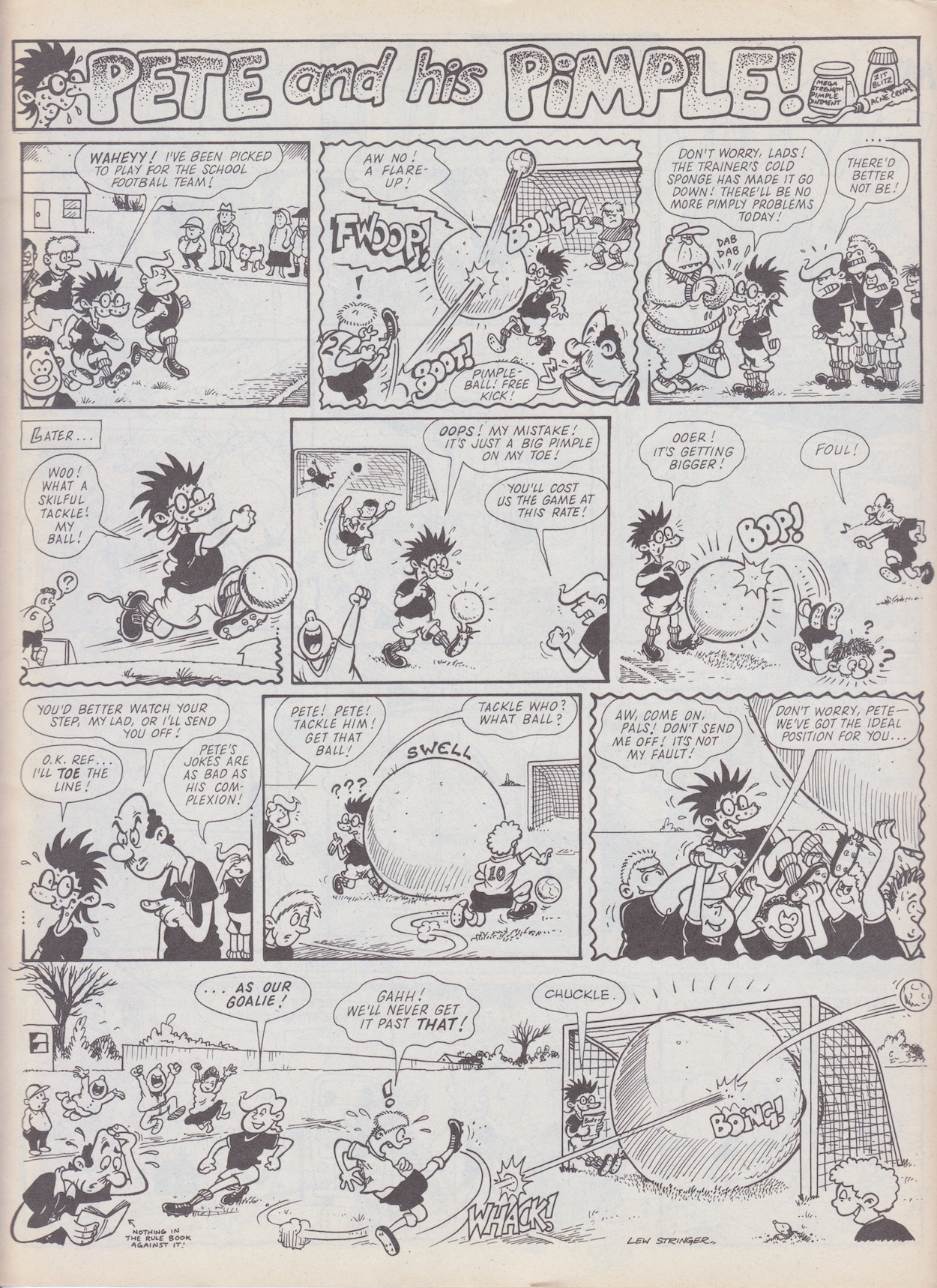
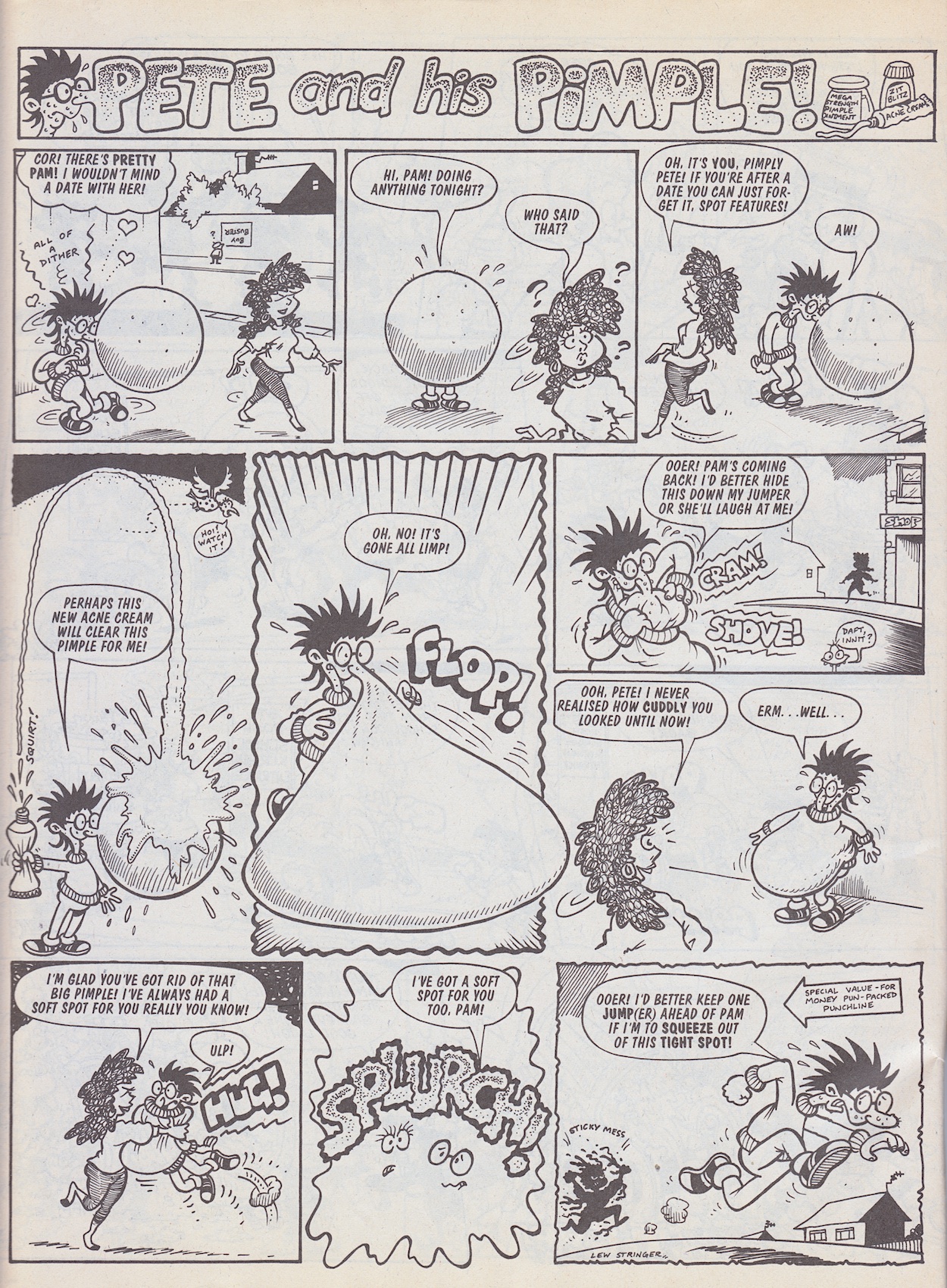
Don’t get me wrong these are still fun but it does feel like the main selling point has been watered down somewhat. This isn’t a fault on the part of Lew, Pete was one of OiNK’s most popular characters so was an obvious choice for the merge in that regard. But the strips from OiNK just wouldn’t have been allowed in Buster, so maybe a different character should’ve been chosen in the end? (Although I’m not sure who would’ve been more suitable.)

I can see why Pete was brought over. However, with an even younger audience how many readers could identify with a spotty teenager? As such the strips feel sanitised and that’s completely the wrong feeling for Pete and his Pimple. Tom fares much better. Yes, the writing on the back of the t-shirt at the end of the first strip below seems tame by OiNK standards but by all counts these are classic Tom through and through.
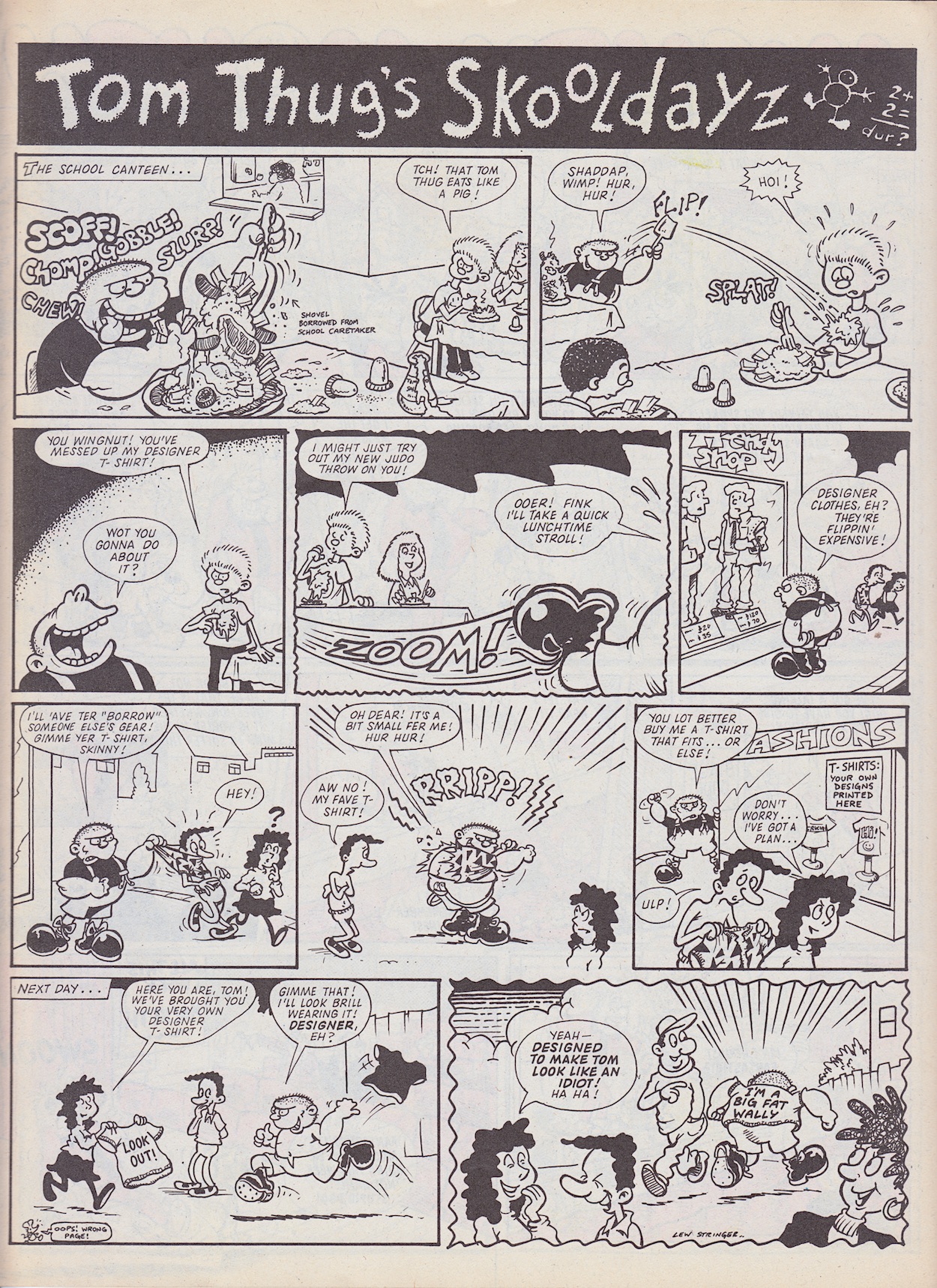
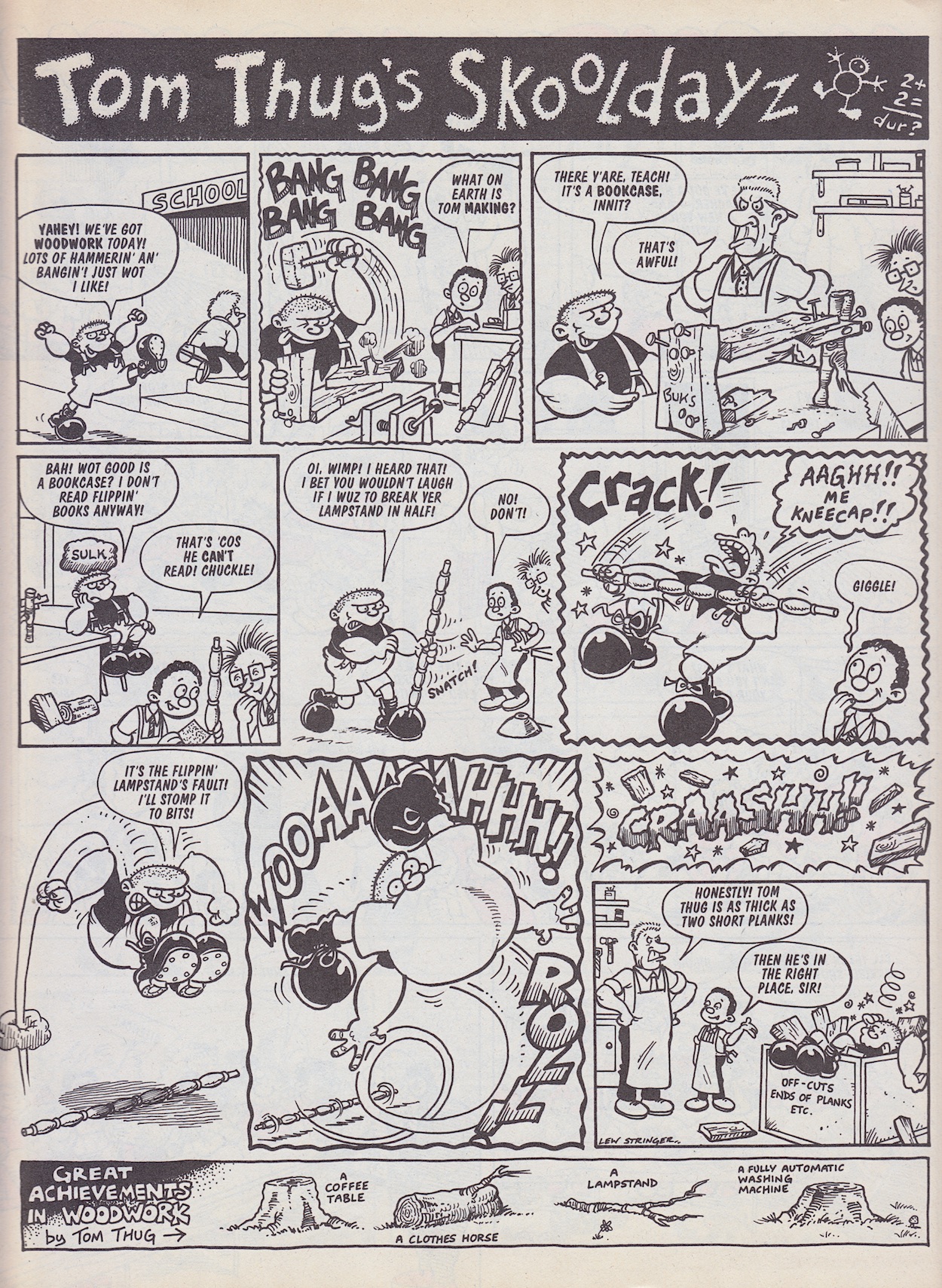
That slip in the middle strip caught me completely off guard and I’ll admit I snorted with laughter at that one! Also nice to see the little extras we sometimes got at the bottom of Tom’s strips have made the pilgrimage to Buster with his woodworking masterpieces. Taking Tom back to school was an obvious choice. Unfortunately many children come across a bully or two in their lives, but Tom could prepare them by showing the true identity of all bullies. As such, he feels just as much at home here as he did with Uncle Pigg and the rest.

As for Willy, you can see below he’s back to asking Dishy Mandy out but at least it has a happy ending for once. (Actually, given how they just suddenly appeared as a couple in OiNK I’m going to say this is how they actually got together.) In OiNK Willy would sometimes use his weediness to his advantage but we haven’t seen that here yet. No pun is intended but these are some of his weakest entries I’ve seen to date, and I’m not sure if it’s because they’ve been simplified back to what they were at the very beginning or not.

So what happened next? Willy would disappear completely after a few months and even the mighty OiNK megastar Pete would follow suit about six months after the merge (although he did cross over into regular character Thunderclap’s strip). As I said I don’t know if many Buster readers would’ve appreciated him as much as pig pals did. Tom was another story altogether though. He became one of Buster’s most popular characters and would remain in the comic all the way until its ultimate cancellation in 2000.

Lew created brand new weekly instalments for Tom all the way until 1996, over 400 strips in total for the brainless bully over ten years. He even made the cover on occasion, taking the place of title character Buster himself, proving Tom’s popularity with readers of both the 80s and the 90s. Even to this day, anyone who has dealt with online trolls will still get a kick out of the Tom Thug strips.


“We’ll try and make things easy for your first week, Mike!”

Buster to artist Mike Lacey

I’ll finish things off with a Buster strip from the issue with X-Ray Specs on the cover. Tom Paterson took a break for a couple of weeks (given the amount he squeezed into his pages it’s understandable!) and instead Mike Lacey drew the character. Brilliantly, this is also the basis for the plot. I love it when a comics character acknowledges they’re inside a comic and here Buster and Delbert decide to help Mike by having everyone on their best (and easiest to draw) behaviour.
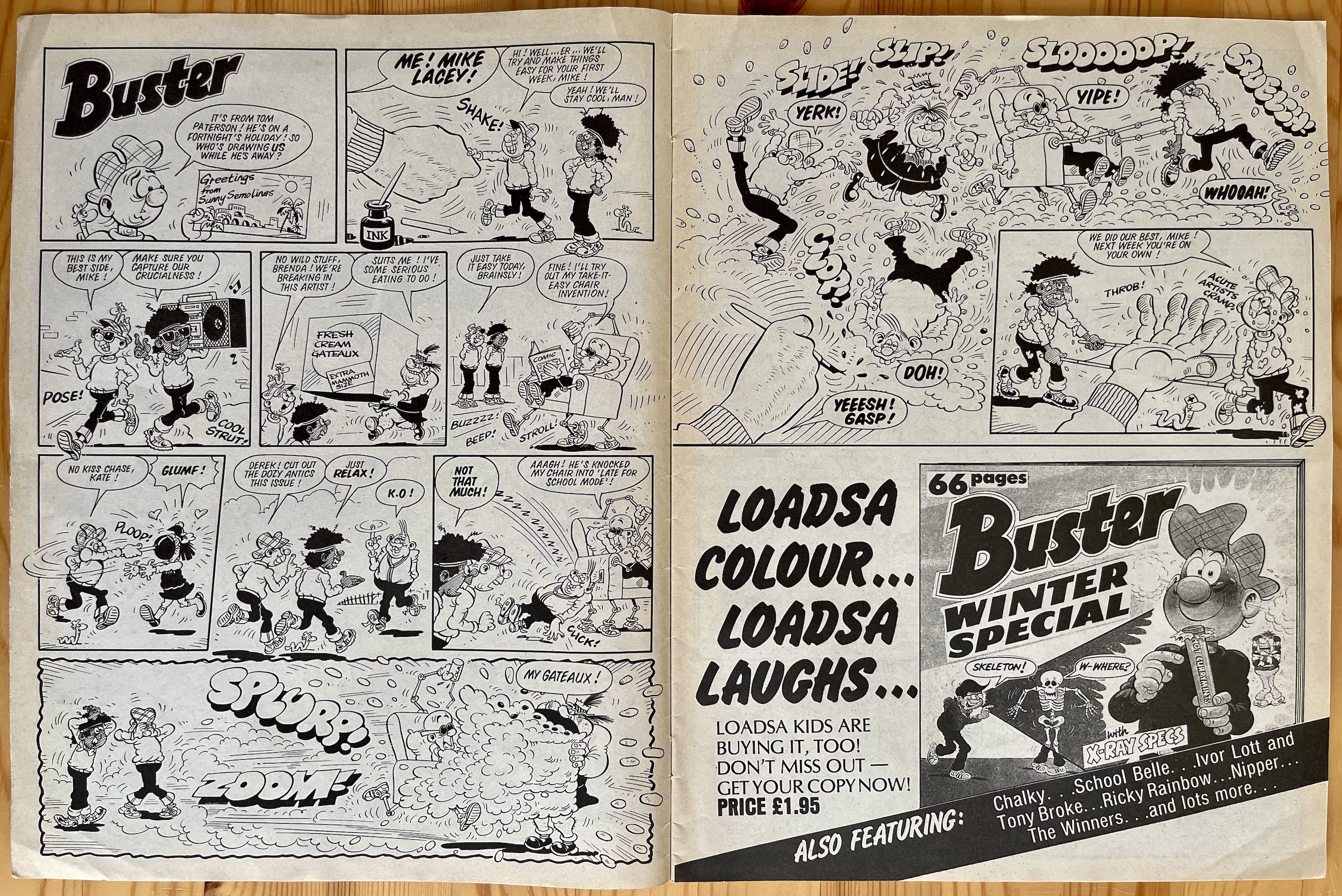
This reads like a practical joke from writer Mark Bennington to Mike so I asked Mark about it. However, he wrote literally hundreds of scripts so it’s only understandable that he can’t recall a specific one, but he did tell me, “It seems to follow my slow build up to a twisted chaotic end style which I liked to do. Sometimes the editor Allen Cummings gave me a couple of sentences on subject matter to follow for the coming issue and I put up a script idea based on that.” Like all of Mark’s work for Buster it’s a brilliant piece of writing and there’s a ton of his work in the Tom Paterson book which will be getting reviewed here soon.

There we go, that’s our look at the beginning of the Buster/OiNK merge complete. The amount of brand new (to me) Tom strips still out there to read makes an attempt to collect them all very tempting. Expensive, but tempting. And that’s not including the fact Specky Hector would return with a multi-part guide to comics after his very funny one in OiNK, and Lew would also draw Vampire Brats, scripted by OiNK co-editor Mark Rodgers. There are some key moments from those years I’ll definitely be covering on the blog though so keep your eyes peeled for those further down the line. Beyond that, you never know…

Don’t forget Pete, Tom and Willy star in the second OiNK! Book and you’ll see if they’re included in the highlights on Christmas Day 2023.

iSSUE 68 < > OiNK! BOOK 1989

OiNK READ THROUGH MENU

MAiN OiNK MENU

OiNK! #68: HiNDMOST HOG

The following post was originally written for Sunday 22nd but was held back after the sad news of Tony Husband’s passing

Co-editor Patrick Gallagher has a vague recollection of OiNK #68 being held back a bit to better coincide with the publication of the first merged Buster comic. It was definitely a week late when this issue arrived in my local shop in Northern Ireland. Now on rare occasions a comic could be a day or two later getting over here (or up to the farthest areas of Scotland). According to some in England I’ve spoken to in research for this post they recall receiving their #68s on the Thursday or Friday so this seems to track. When it finally did arrive few of us were prepared for what it contained (unless you had read the previous week’s Buster.)

I certainly wasn’t aware of the merge at the time so, in the early evening of Saturday 22nd October 1988 as the cold, dark night drew in I ran to the newsagent just before dinner for the umpteenth time that week to (hopefully) buy what I thought would be the latest issue. As always, before going to the counter to ask for my reserved copy, I scanned my eyes over the comics shelves. I saw the piggy pink logo… twice. I could see Pete, Tom and Willy peering out at me from behind the new issue of OiNK! What was this?

For a second I thought it was some kind of promotional thing. After all, this and the other comics I’d begun collecting by this stage were all still going strong and those my brother or friends read seemed to last forever, such as Beano, Transformers, Roy of the Rovers etc. I’d never seen a comic cancelled before and after two very happy years I just assumed OiNK would go on and on too. It was my first comic, so I didn’t know this kind of thing happened!

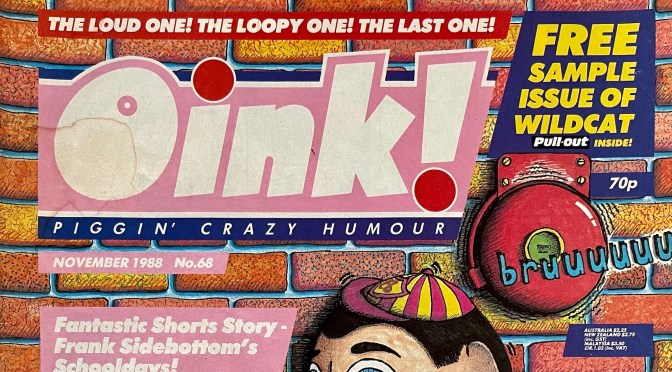
I picked up a copy of OiNK from the shelf, its gorgeous Frank Sidebottom cover (one of my favourites of the whole run) in all its glory and I noticed the banner across the top which soon gave the game away. Surely this couldn’t mean what I was beginning to think it meant? I began flicking through it to see if there was any indication inside and lo-and-behold on page four where the letters page would normally be was a message from Uncle Pigg, drawn by Michael Peek.

My heart sank. Our esteemed editor may have been cheery at the prospect of an early retirement and he tried to keep his loyal readers chirper with the news of the Buster merge, the already-released second annual and the promise of a holiday special the following year (a lifetime away for a ten-year-old), but that wasn’t enough as far as I was concerned. So as I went to ask for my last reserved OiNK I also picked up a Buster, hoping for the best. You can read all about what happened with that in its own post also published on the blog today.

Now, 35 years later as an adult this message is all the more heartbreaking because this is actually the best of the monthly OiNKs by far. There’s not a single reprint in sight, the team using up what they could of the leftover material they’d have kept for the following issues. Plus we had our 12th free gift! Stapled to the middle pages was a tiny 16-page preview of Wildcat, so I really came back from the shop with three different comics. The gift was a welcome surprise actually, as the cancellation had distracted me from the news of it on the cover.

OiNK began with IPC Magazine’s first preview comic, so now 68 issues later it felt like things had come full circle. In fact, I’ve described before how this felt like OiNK passing the baton which, after I read this superb freebie, I was more than willing to let Wildcat take up. This was particularly welcome after Buster disappointed me, so something good had come out of this after all, just not in the way I’d initially hoped. Wildcat was a superb comic and I’ve already covered it on the blog, where you’ll find a full review of this freebie.

On page two was a small note that the regular Wildcat comic would have pages the same size as OiNK’s, even though this was mentioned on the back of the preview. Alongside it our final issue starts off strong with some cracker (no pun intended, really) mini-strips such as Kev F Sutherland’s take on another Rotten Rhyme and the first of this issue’s Wally of the West strips by the always funny Ed McHenry.

Only a few of the contributions mention the fact this is the final issue, while a couple more don’t reference it directly but clearly knew it was the end. For example, Chris Sievey’s Frank Sidebottom doesn’t say anything about it but does sign off with details of where readers could see him on TV, listen to him on the radio or meet him in person before saying thanks and that he’ll see everyone soon. Which he did, as he never seemed to be off children’s television at the time.

Taking over a double-page spread Frank really does squeeze in as much as he possibly can into a strip about his school days. There are no less than 33 individual panels across just two pages! Not only that, look at the amount he draws into each of these tiny little rectangles, such as his mum’s kitchen floor, cooker and sink when all he needed to show us was him running out the door. Also, before you read this if you have a pair of old fashioned 3D glasses please do try them on at a certain point here and let me know how you get on! Haha.

We all knew that despite Frank being a superstar he still lived at home with his mum so I love the ending which, intentionally or not, is a callback to an earlier episode of Frank’s which referred to him going to bed at 9 despite being an adult. Having the final caption as a never-ending cycle back to the beginning feels like the perfect way for him to wrap up the final regular contribution to OiNK he crafted.

From one OiNK star to two at once. Two cartoonists decided to create something similar to each other’s, a visual gag only achievable in this medium and one where OiNK was the perfect place to try it. So Charlie Brooker’s Freddie Flop and Brian Luck return for their final appearances and, suitably for the last issue, the randomly-appearing Mr Plinge returns for one last time and with a twin sister in tow alongside (or rather above) a one-off Mr Girth.

Placed nowhere near each other in the issue, the joyous surprise at seeing the same gag played out after enjoying it so much the first time is a delight. It reminds me of my embarrassing moment in the hospital waiting room when I discovered a second Herbert Bowes strip in the first OiNK Holiday Special! Thankfully this time I was reading alone.

For their final regular attempt to extort as much money as possible from people the gangsters at GBH pulled out all the stops with a middle-page spread of the ultimate luxury in holiday travel, on a cruise. Thomas Crook was a name used already by Simon Thorp in previous Madvertisements but this is surely the funniest of the lot. I love the sheer audacity to list off all of the gags! This kept me giggling for a good while in both 1988 and 2023 and is one of my favourite GBH entries from the entire series. Please take your time and savour every little bit of this one.

My favourite parts of this have to be the lifeboat drill, the scales, the ship’s “washing machines”, where the food is served, the stabilisers(!) and best of all the fact that this isn’t a cutaway, it’s noted that the ship itself actually has a huge hole along its side. Simon’s Madverts were always so packed with little sight gags for us to find and I love how his last one labels them all, making sure no one misses a single one. Still a regular Viz contributor to this day, I’m really going to miss his OiNK pages.

#68 is a fitting, funny and fantastic send off

Fittingly, one of the pages that mentions this is the final issue is co-editor Tony Husband’s Horace (Ugly Face) Watkins in which he laments the end of the comic (as do watching aliens) before he and Mandy decide to cheer up by getting married. Tom Thug’s strip begins with him telling us he’s received some terrible news and we think it’s about OiNK, but actually he’s just been offered a job. A job he ultimately fails at on day one, naturally.

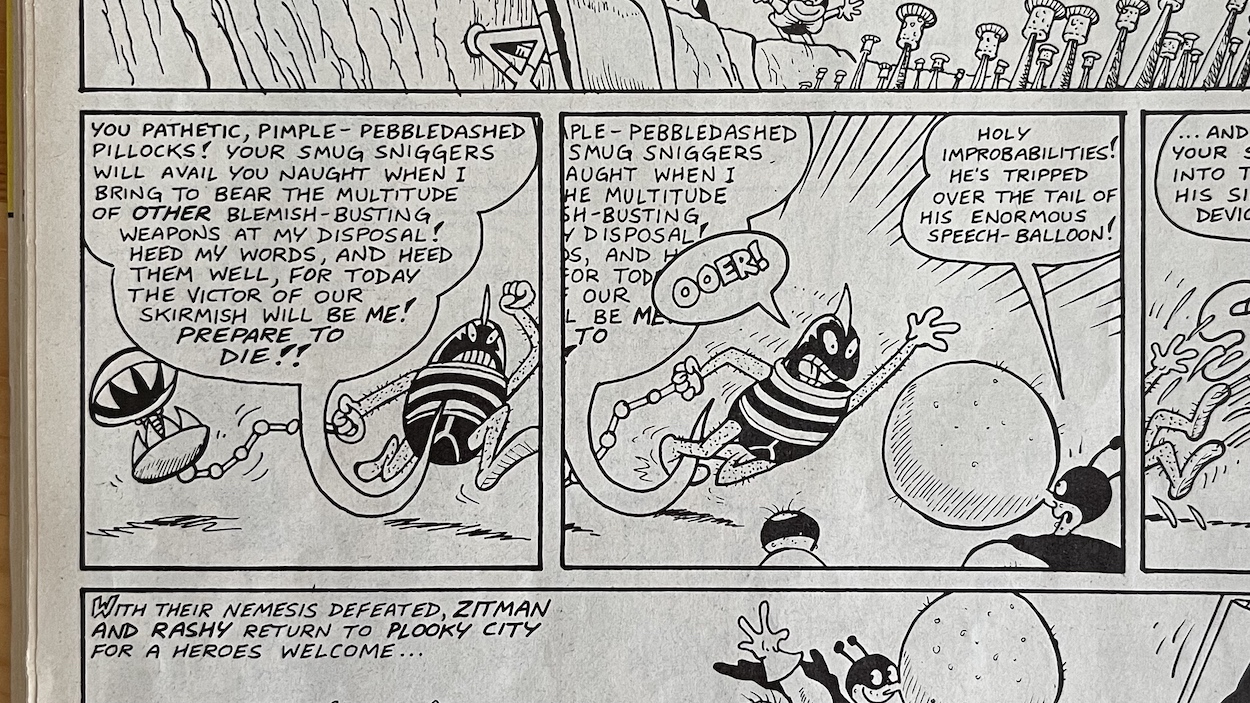
Children’s television presenter and artist Tony Hart and his plasticine pal Morph are the subject of a spoof in the shape of The Amazing Adventures of Murph and in a three-page Pete and his Pimple strip he’s daydreaming about being a superhero called Zit Man. Thankfully his arch nemesis Mister Squeeze trips over his own words, quite literally, in the nick of time and falls into his own death trap. Ingenious stuff.

Of course it wasn’t the end for two of these characters, however it’s rather strange there’s no Weedy Willy strip in this final issue when he’d join Pete and Tom in Buster.

Meanwhile, Kev F Sutherland must’ve created a lot of content for forthcoming issues because it appears it’s all been collected together here. Just like Ian Jackson and Jeremy Banx before him, Kev’s work is synonymous with OiNK in my eyes and here he has eight strips in total to his name across a whopping ten pages. His Meanwhile… series was always a highlight so I couldn’t let this issue go without including at least one, and it’s one which got a memorable roar of laughter out of me at ten-years-of-age.

It seems if OiNK were to continue one of Kev’s Three Scientists from #66 was going to be making an Alfred Hitchcock-esque cameo in every issue. Did you spot him above? In this issue Kev brings us not only this and the Rotten Rhyme above but also his take on Jack & Jill and Who Killed Cock Robin?, spoofs of 80s car commercials and weather forecasts, and last but by no means least the brilliantly titled The Plop Factory – The Studios of Britain’s top record producers Sock, Bacon and Waterworks.

The final strip I’m going to show you (although not the final image) from all 68 regular OiNKs should really be a large, multi-page affair, shouldn’t it? Some big, grand gesture to round things off with. Nope. One of the biggest laughs in this issue comes from a tiny little quarter-page strip of Ed McHenry‘s Wally of the West. A simply perfect example of the mini-strips crammed into each issue and how OiNK could generate a ton of laughs from content of all shapes and sizes.

With a lack of Uncle Pigg or the plops and very few pig-themed strips and spoofs, would new readers to OiNK Monthly have been confused as to why the comic had the name it did? However, for seasoned pig pals such as myself these final six issues have each been mammoth specials crammed full of content, with the bonus of some bigger than usual entries for a handful of our favourites. So if you ever hear a pig pal rubbish these monthlies, I say they should really reconsider them, especially #68 which is a fitting, funny and fantastic send off.

There’s a ton of OiNK content to come on the blog over the next few years at least, I promise

But unfortunately a send off it is. Fleetway’s well-intentioned reboot hadn’t had the effect they’d wished for, but by no means were OiNK’s sales plummeting as much as some have commented. As co-editor Patrick Gallagher recently told me sales were down across the board and OiNK’s were by no means the worst. But with Fleetway having now forced two revamps they called time on the comic, although it wouldn’t be the last to fall as they continued to chip away at the titles they’d purchased from IPC.

If OiNK had continued in its best format as a fortnightly under IPC, who were very happy with the sales figures and the press coverage it was creating for them as a publisher, could it have lasted longer? Perhaps. We’ll never know. For now this final issue wraps up with the first of a new series. Judging by the old OiNK logo this was created by Michael Peek when it was still a weekly and, with this being the last page (save for a Fleetway Annuals advert on the back) Patrick added a little sign-off gag with the speech balloon.

This is by no means the end of OiNK on its own blog! There’s a wealth of extra features for our favourite comic already on here and a ton of OiNK content to come over the next few years at least, I promise. Actually, the read through itself isn’t even finished yet with four more editions to come over the next two years and yes, I’m going to make you wait for each of them, just as I have to wait until their real time release dates to read them. The first of these will be The OiNK! Book 1989’s review which will be published on Christmas Day 2023. Perfect anarchic post-dinner laughs, I think.

Now, I wonder what happened to Uncle Pigg on that tropical island

iSSUE 67 < > BUSTER MERGE

OiNK READ THROUGH MENU

OiNK FREE GiFTS MENU

MAiN OiNK MENU

COMiNG UP: OiNK! #68

The following post was originally written for Thursday 19th but was held back after the sad news of Tony Husband’s passing

Back in #60 of OiNK the reservation coupon held a hint that changes were afoot, a hint that would only be picked up on with hindsight. Likewise, looking back on last month’s issue the same coupon told a tale by its very absence, replaced as it was by one for 2000AD. At the time we had no idea what was about to happen. Well, unless you also collected Buster and had seen the news up to seven days beforehand. Instead, for us the next issue was all about that Frank Sidebottom cover!

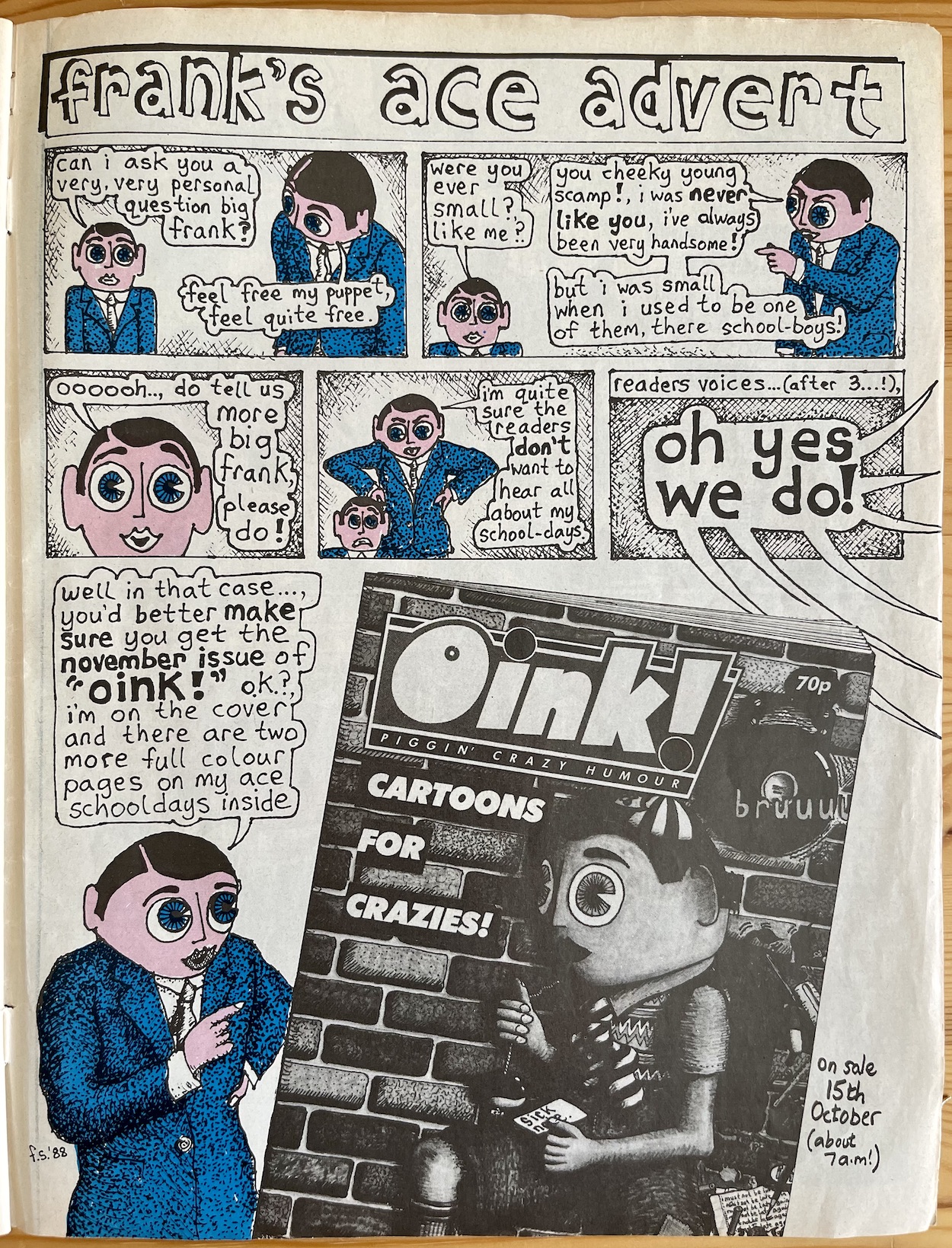
I love Frank’s (Chris Sievey) retort when Little Frank asks him if he was ever small like him and the little bit of extra information about when we could pick up our copy on the day (albeit the issue actually came out between five and seven days later, more on that in the review). Having Frank on the cover meant his strip was to be the main highlight of the next big, fat porker of a monthly OiNK and as a kid I couldn’t wait! You can see what all the hype was about and if it was justified (it was) on Sunday 22nd October 2023.
GO TO iSSUE 68

OiNK iSSUE PROMOS MENU

‘MORE OiNK’ MENU

MAiN OiNK MENU

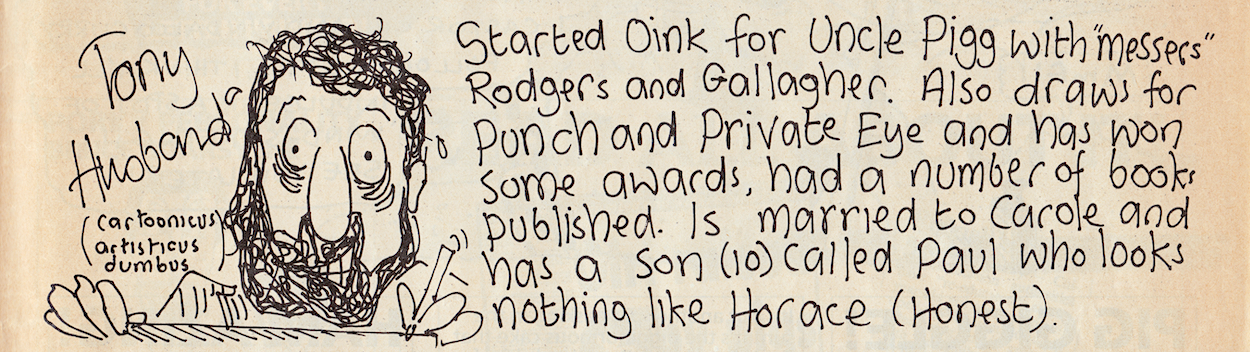
REMEMBERiNG TONY HUSBAND

I never met Tony Husband in person but I did have the opportunity to speak with him on the phone a few times over the years and online. He was always so enthusiastic about OiNK and everyone who had worked on it. His passion for the comic was infectious, his love for all of its contributors clear as day and he was always so open to chatting and reminiscing.
Tony loved people, adored animals of all kinds and cared deeply for our planet. He often reflected these aspects of his character in his cartoons, not only in OiNK but across the spectrum of his output since becoming a full-time cartoonist in 1984, including publications such as Private Eye, Punch, Playboy and The Spectator amongst others. He also released his own critically-acclaimed books, including the highly regarded Take Care, Son: The Story of my Dad and his dementia.

For me he was best known as the creator of Horace (Ugly Face) Watkins in OiNK, the comic he co-created with Mark Rodgers and Patrick Gallagher. Starting off as a strip in which we’d giggle at the situations he found himself in, it matured over time, developing into an ongoing serial covering Horace’s trials and tribulations as he tried to live a normal life, often while being treated as an outsider. It contained a strong message to never judge anyone based on their looks and delivered this with plenty of laughs, the best way to teach life lessons to children.

In the end Horace became a successful footballer and met the woman of his dreams, with him and Mandy marrying after one last adventure in a Holiday Special after OiNK’s cancellation. Tony’s humour was key in my development as a kid and his messages (always delivered in a way that never felt like important messages) had a profound effect on me. I’m sure I’m not alone in thinking that.

This particular cover brings back happy memories too. Later in OiNK’s run my cousin gave me a few of his back issues that I’d missed and while sitting next to my late nanny at his house she saw this cover, looked at me and giggled like a little schoolgirl. She knew my mum (her daughter) would tut and shake her head, but my nanny found it so funny. I miss her greatly and this is one of my earliest, happiest memories of her. This cover brings a smile to my face for that reason every time I see it, all thanks to Tony.

Of course many know Tony for his cartoons in Private Eye and the like, his quick gags always raising a chortle. When OiNK went weekly for a few months in 1988 a whole page was given over to Tony to bring us that same kind of humour. With a completely different scenario every issue, a quick gag played out in a large format every seven days. I loved them as a kid, they were just so silly. As an adult reading OiNK for the blog, these were just bliss for sixteen weeks.

Tony wasn’t just known for his own OiNK pages, he also wrote the scripts for some absolute fan favourites drawn by a mixture of brilliant cartoonists. The Spectacles of Doom was an incredible serial that spoofed fantasy films of the 80s and was drawn by Andy Roper, The Slugs saw Tony bring his love of punk music to the comic with suitably raucous art from Les ‘Lezz’ Barton and for Tom’s Toe he ingeniously brought in John Geering to parody his own work from other, more traditional comics.

It’s sad to realise everyone involved in these strips is no longer with us. However, Tony’s unique sense of humour, so prevalent in each one, ensures the laughs are never too far away. A deliciously dark side of his humour could also come to the forefront upon occasion, such as when Ian Knox drew Tony’s Crablad, the ending of which was certainly delicious.

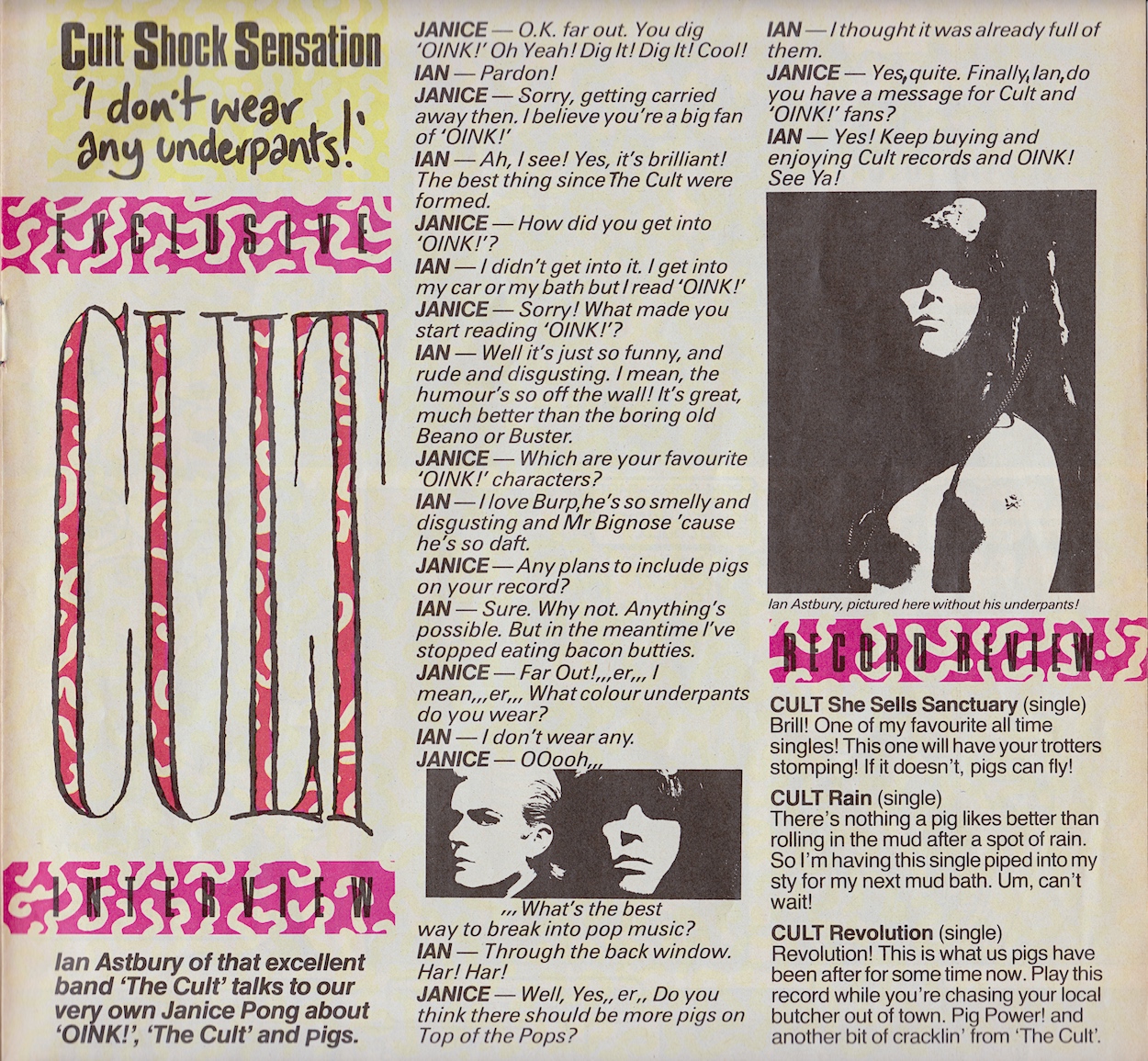
In the first musically themed issue Tony interviewed the lead singer of one of his favourite bands, The Cult after he found out they were fans of his work and of OiNK, something which Tony told me about with such joy in his voice; it was a special moment for him, to be sure. Tony also said he had a surreal moment after the interview when Ian Astbury asked him about some missing OiNK merchandise he’d ordered, which Tony then chased up for him. It was a crazy time.

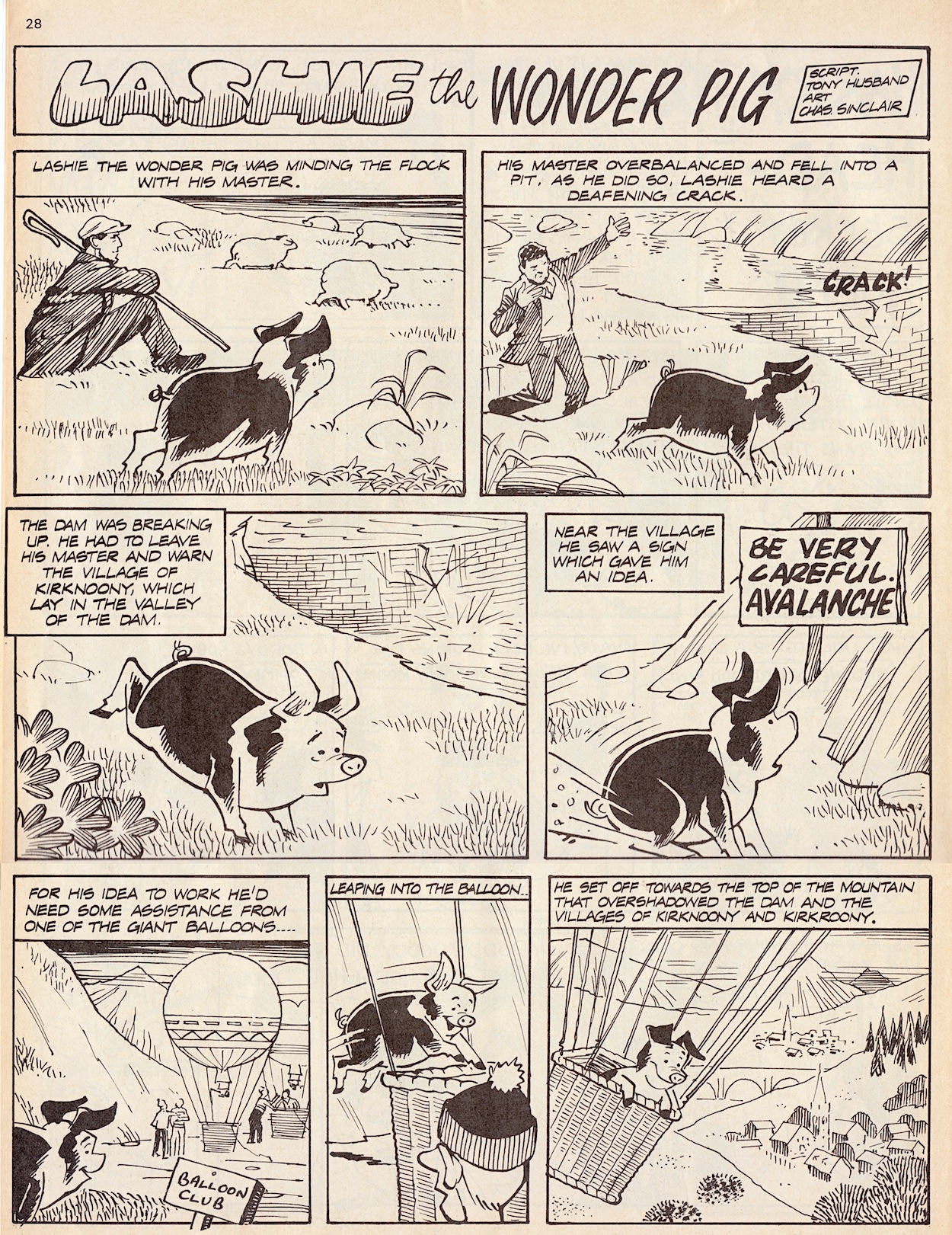
Tony would team up frequently with Chas Sinclair for many a random strip, however he also created serial The Wonder Pig, whose lead character name would have a different spelling in every outing. Chas’s style was the perfect fit for Tony’s loveable, heroic, yet completely daft pig. Most memorable of all their collaborations was Tony’s take on Wuthering Heights, which had one of the most random and thus completely laugh-out-loud funny moments in all of OiNK for me.

Tony won many awards over his career including the prestigious Pont Award and during OiNK’s lifetime the Cartoonists’ Club of Great Britain’s Strip Cartoonist of the Year Award, which the comic proudly told us all about. Just right. He also co-wrote The Psycho Rap for the flexidisc and OiNK 45 record, so all of you pig pals who can’t get “Don’t eat pigs, ‘Cause they’re made from hhhaaammm, Eat that Nast-y Butch-er Man” out of your heads all these years later have Tony to thank/blame.

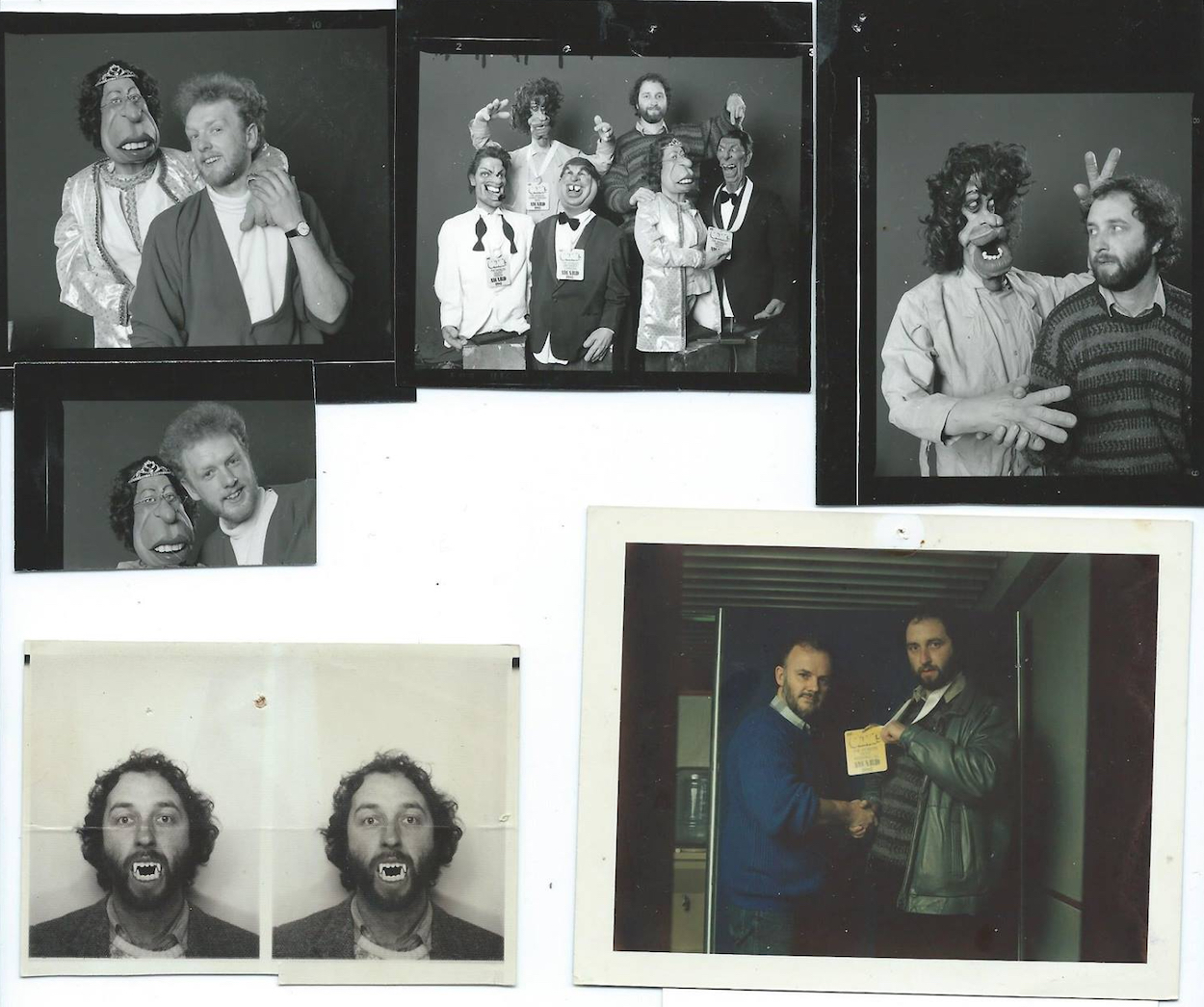
Above are some photos Tony shared (taken by Ian Tilton) of the time they teamed up with Spitting Image to hand out the OiNK Awards to various rubberised celebrities (and the occasional real one). That’s friend of the comic John Peel with him, and a photo taken for early promotional material showing who was responsible for editing the new comic.

After OiNK finished Tony, alongside Mark and Patrick, moved on to create the award-winning Round the Bend TV series for CiTV with the Spitting Image team. I’ve very fond memories of that show. I didn’t know who was writing it, I never looked at the credits at that age, but it spoke to me in a way other children’s comedy shows didn’t, it really made me laugh! I really should’ve clicked who was behind it.

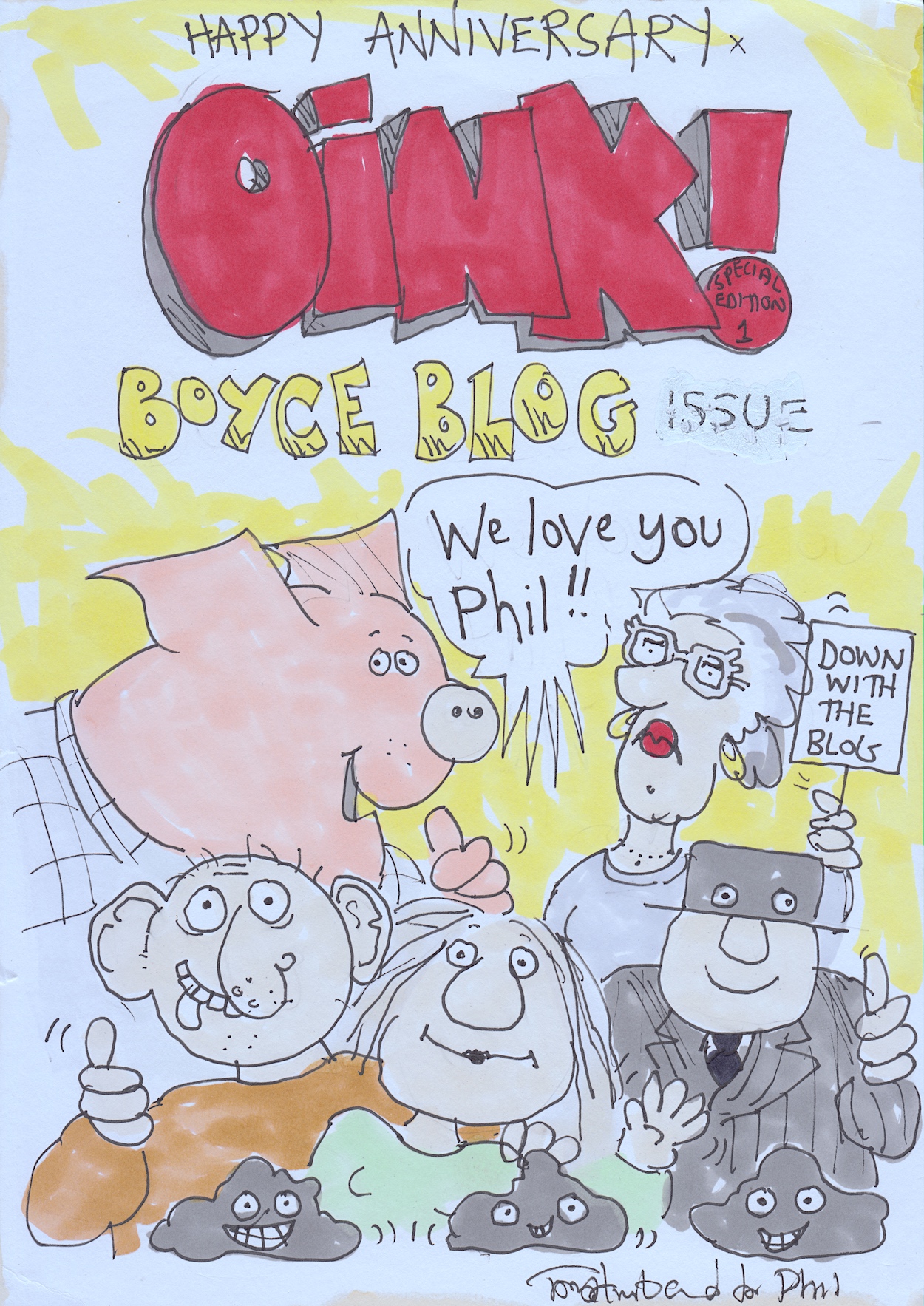
For the first anniversary of the previous OiNK Blog I received a surprise parcel in the post. It was this marvellous birthday card from Tony! I couldn’t believe it when it arrived, I’d no idea Tony had drawn it or that he was even paying that much attention to the blog until I saw this. That was Tony, always thinking of others but never making a big deal out of it. It was just his nature, to be kind and thoughtful.

I wish I’d had the opportunity to meet him and I can’t quite believe he’s actually gone, taken far too early. Tony was such a huge, formative part of my life and his work, his humour and his humanity will continue to be an inspiration to myself and countless others for the rest of our lives.

On that note, I think it’s only fitting to let Tony himself round things off as the sun sets on an incredible life and an incredible person.

OiNK OBiTUARiES

MAiN OiNK MENU

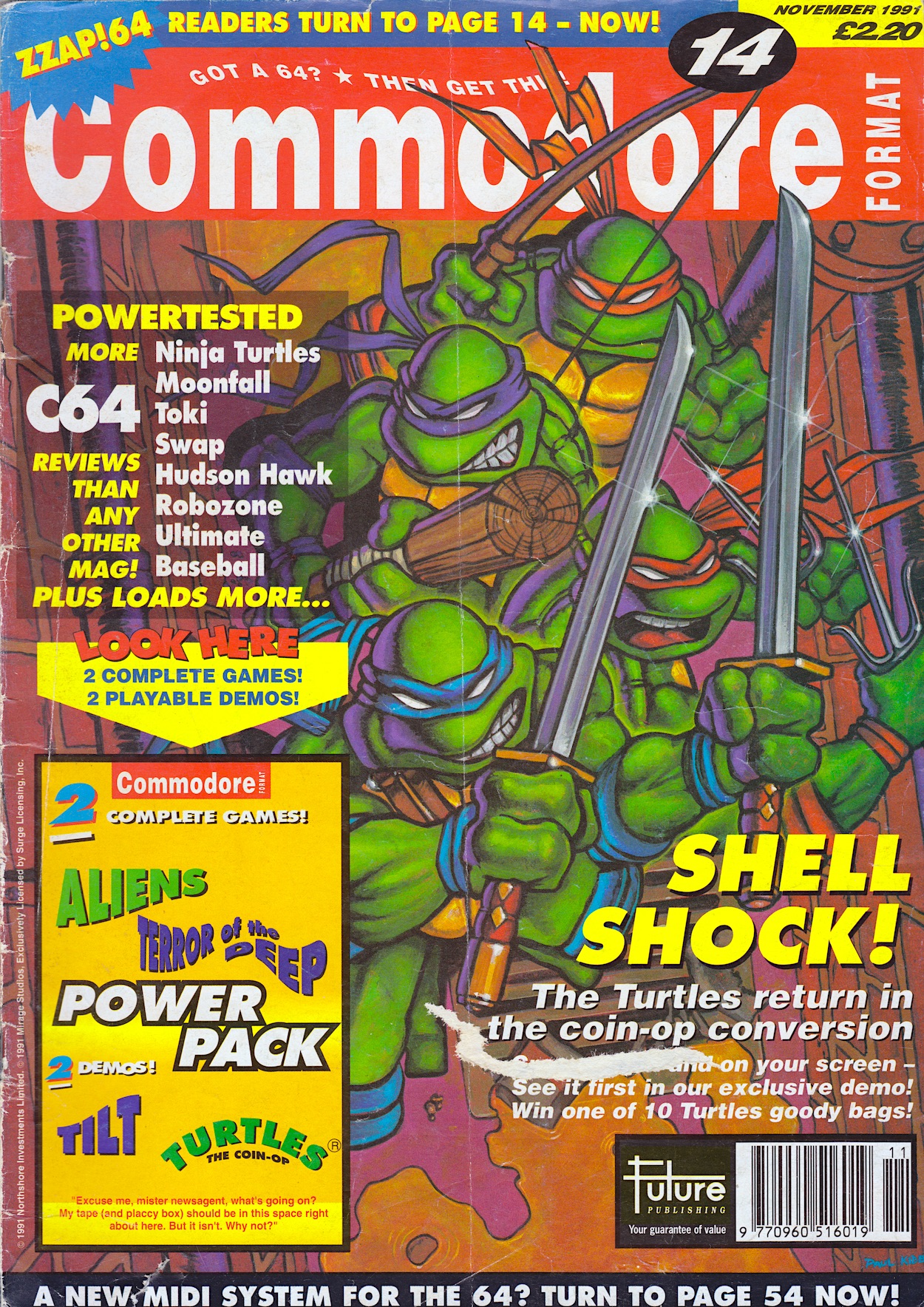
COMMODORE FORMAT #14: “iT’S A CORKER!”

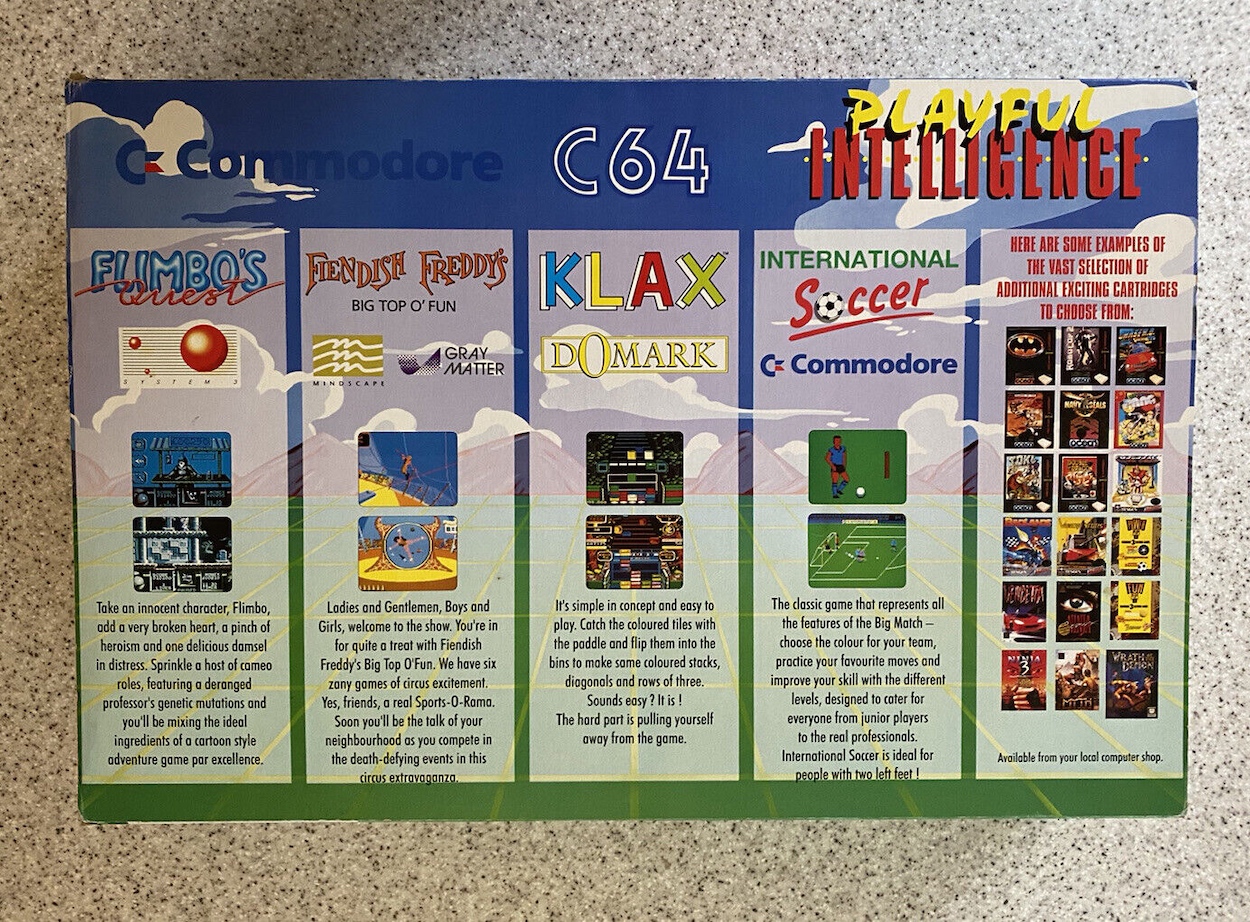
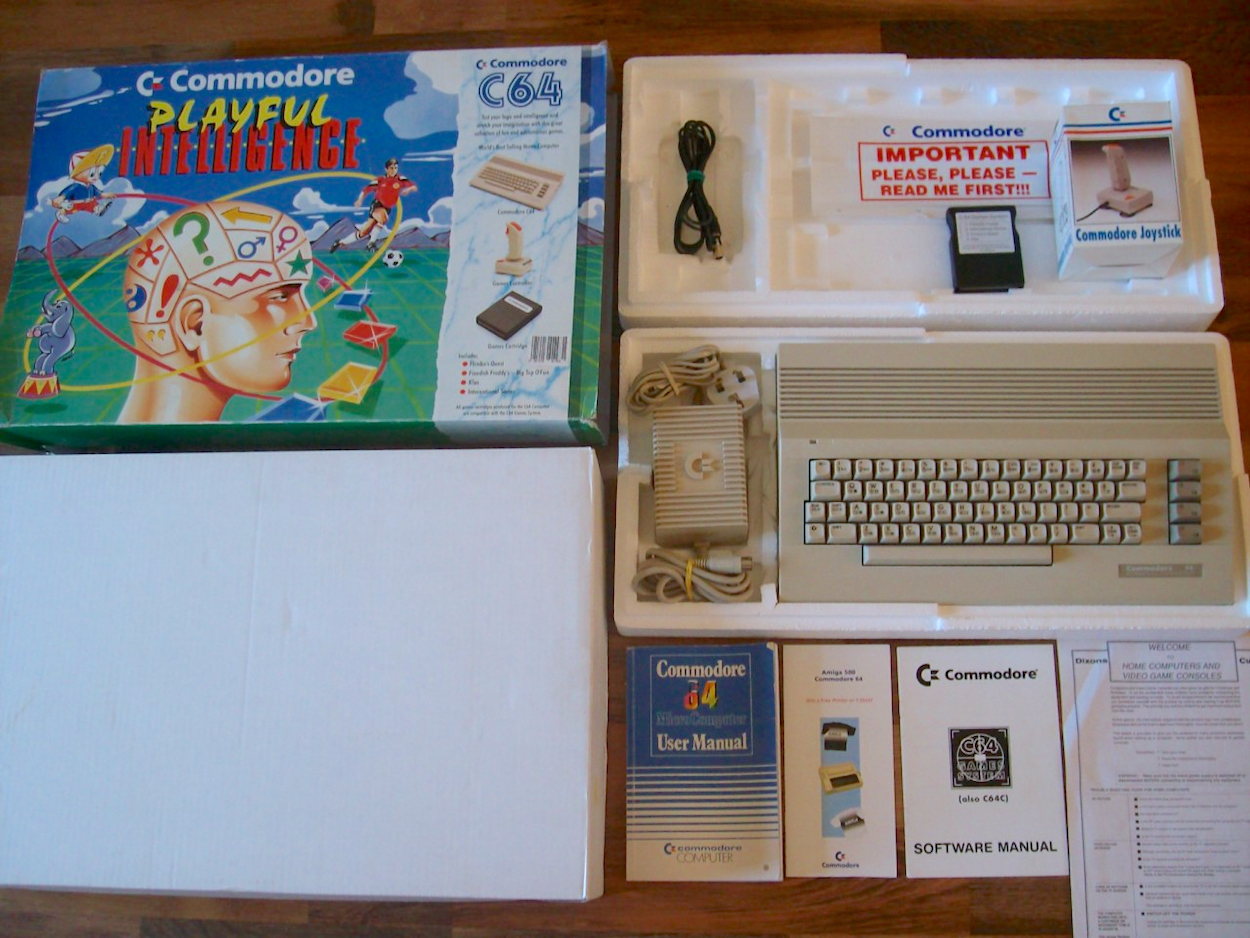
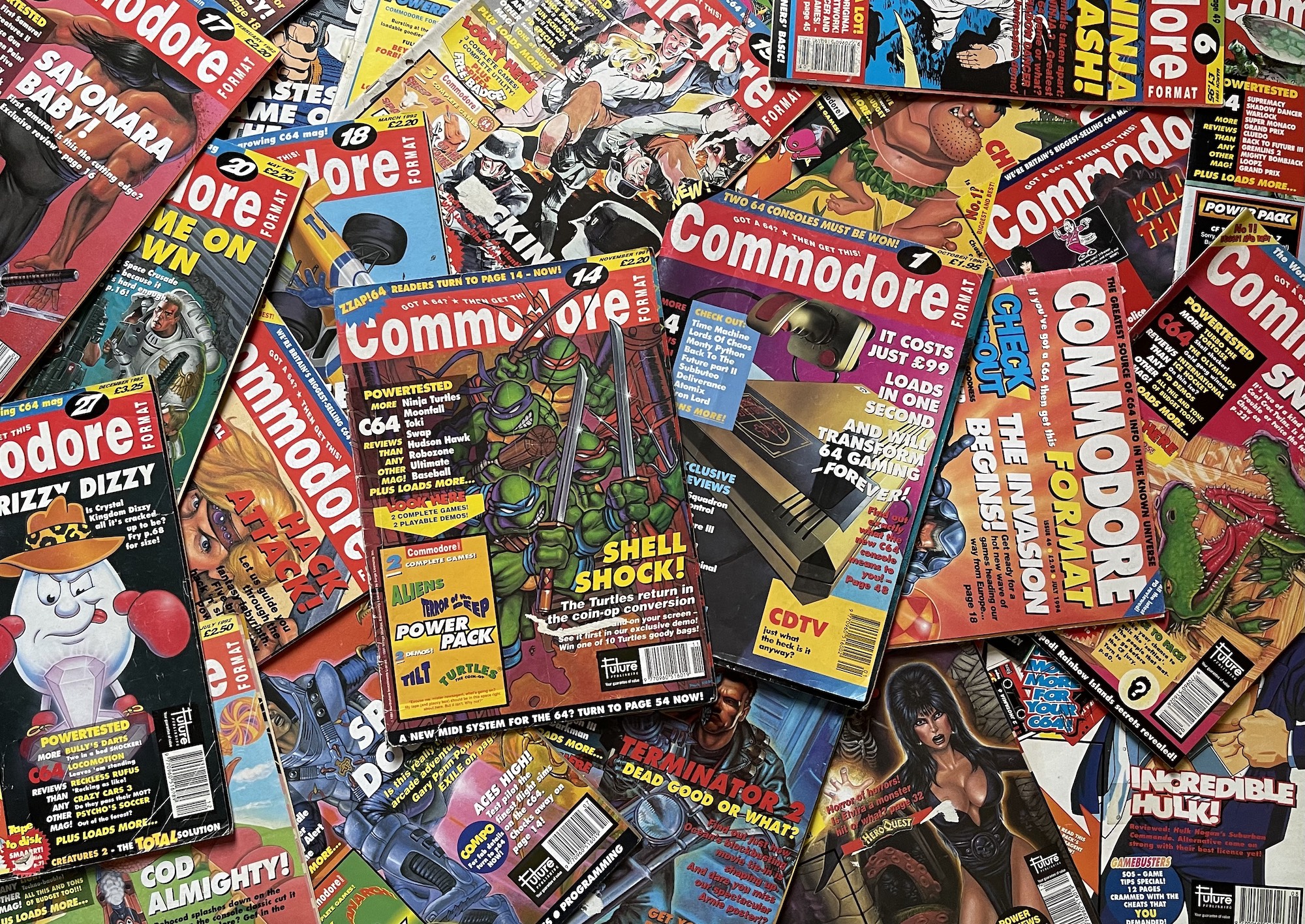
Now here’s a publication, and indeed a specific issue of said publication, that I have a huge soft spot for. It’s my first ever magazine, on sale today 32 years ago. In the summer of 1991 when asked what I’d like for Christmas, and having spent a lot of time playing on my friends’ Spectrum and Amstrad computers, I really wanted something to play computer games on. My parents made me a deal: I could get a computer, not a console. I had to have something I could use for school too.

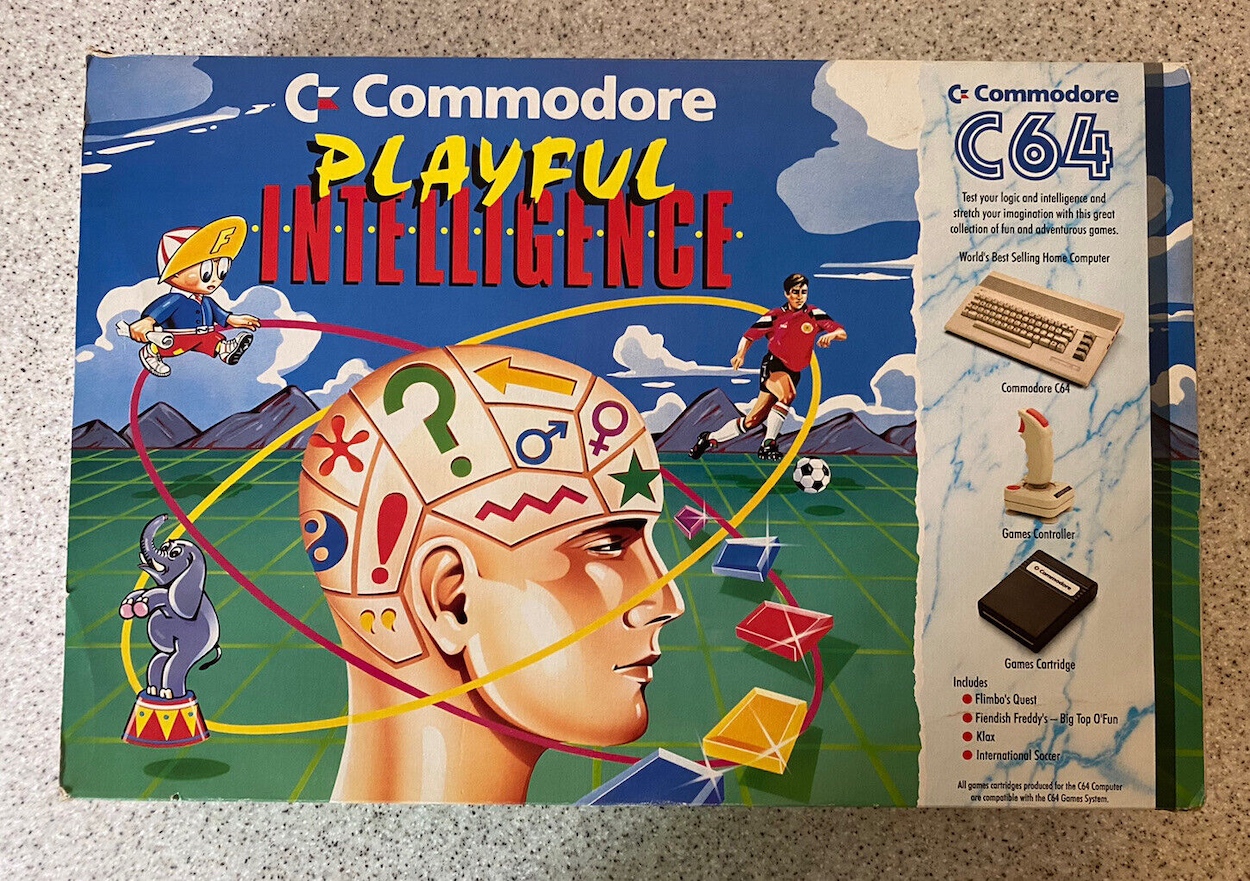
My mum handed me her Littlewoods catalogue and despite the new, more powerful Atari ST and Commodore Amiga computers on the page I was instantly drawn to the Commodore 64, mainly due to it having accessories I recognised such as cassette players and external disk drives. I’d heard of the machine and knew it was more powerful than the ones I’d been playing with friends so that’s the one I chose.

Top: autobot-leader-optimus-prime’s eBay shop
Main: the Retro Treasures blog

I knew of a magazine called Zzap!64 and decided I wanted to check it out but couldn’t find it at the newsagent. However, I did see Commodore Format and, even better, it had a cassette on the cover full of games, which reminded me of the Story Teller partwork I’d collected years before. I went back the next day to buy it once I’d got my pocket money and it was gone, but I knew from years of buying comics this could mean the new one was due. It was.

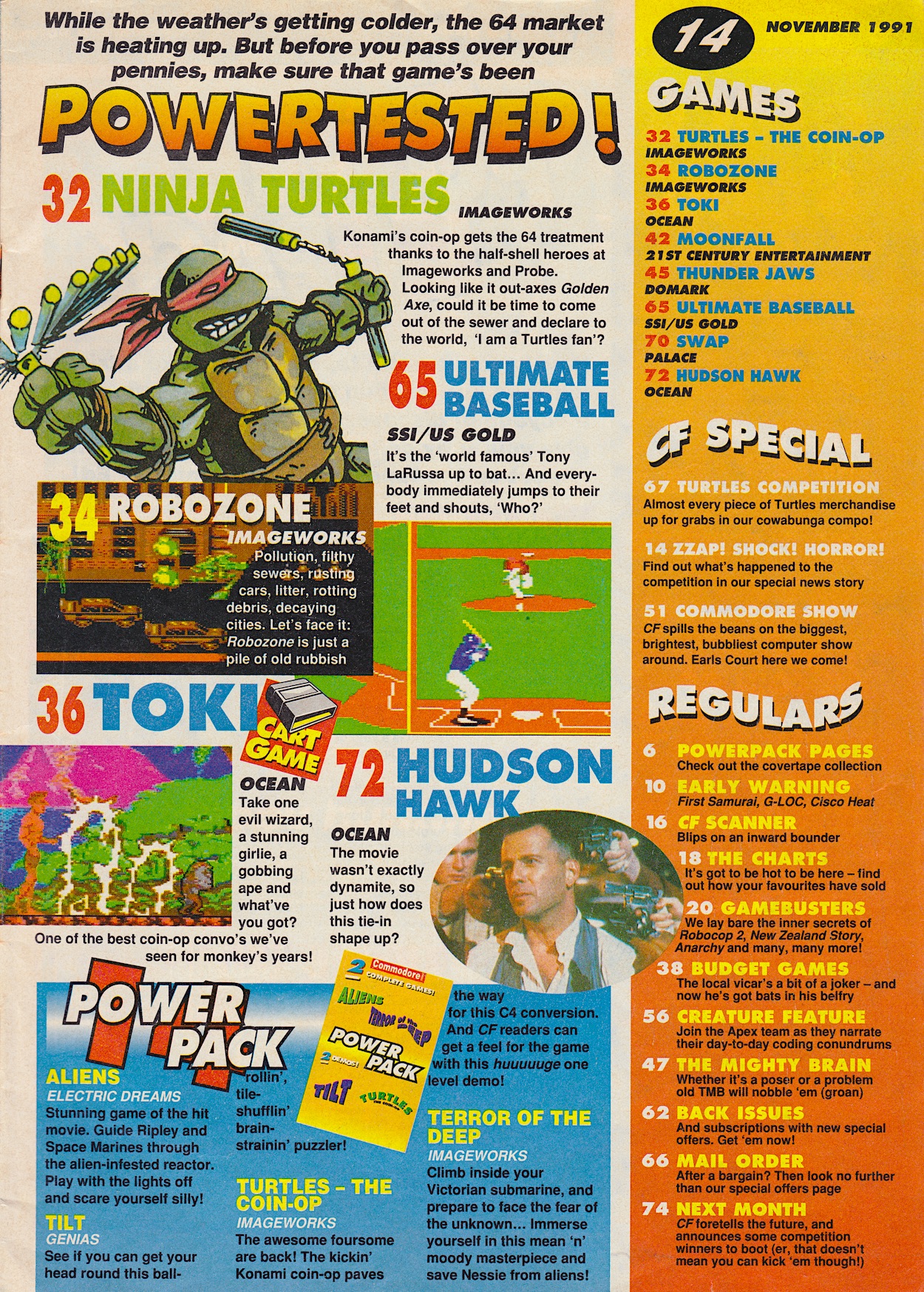
The next day #14 of CF (as readers called it) arrived and featured the Teenage Mutant Hero Turtles on the fantastic Paul Kidby cover, which just excited me further because I was a fan. I devoured the issue, reading it over and over, excitedly anticipating the machine which was still a couple of months away. I’d definitely made the right choice of present! So to mark this issue’s anniversary I wanted to write a special retrospective and explain why I loved it so much.

Edited at this stage by Steve Jarratt, in later years CF would go on to influence me in a key way. It was instrumental in my development in those important teen years, making as big and lasting an impact on me as OiNK had a few years previous, hence its inclusion here. I’ll get to that in a future post, but for now let’s go through what is personally a very special issue. This most superb of 90s magazines had 76 pages packed full of content. There was no filler in sight and every page was rammed full of great writing, information, loads of hype for me while I awaited my computer and a feeling of being part of a form of club, a sense of the magazine talking to me directly. Plus, it had a cracking sense of humour. (Check out the bottom of most pages below for example.)

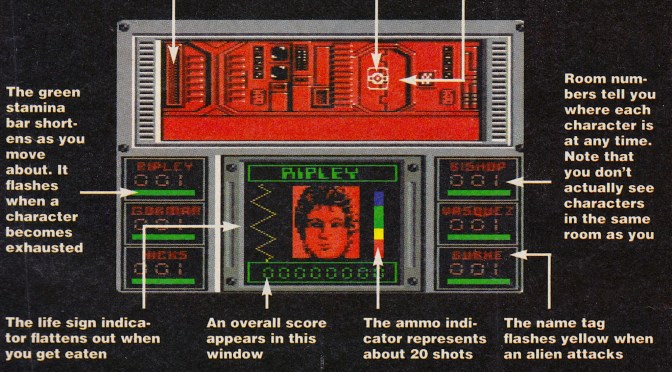
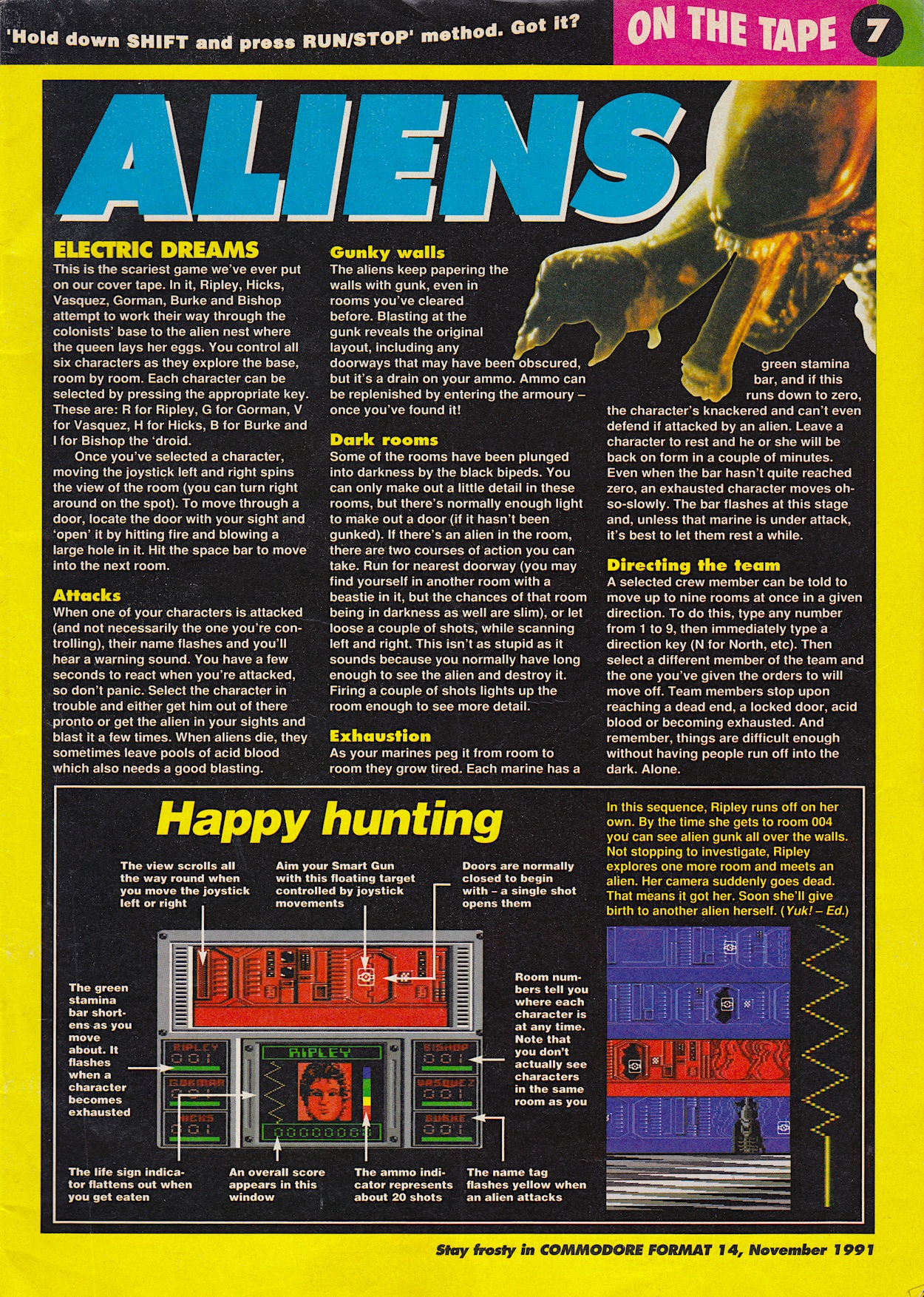
I also couldn’t believe what was on the tape stuck to the cover! I’d loved playing my brother-in-law’s Turtles game on his Nintendo NES, now it was coming to the C64 and this issue’s tape had a free level to play. But better than that was the full Aliens game that had terrified my friends and I so much when we played it late one night in the dark on a mate’s Amstrad. Here I was getting it free with this superb magazine. I was sold on CF within its first few pages.

I have distinct memories of playing this over the Christmas holidays that year; waiting until it was dark I’d turn the lights off and the sound up on my 12” Pye portable TV. I never lasted long before I had to stop! Fast forward 31 years and this year I’ve struggled to play Alien Isolation on the Nintendo Switch for any longer than an hour at a time for the exact same reasons.

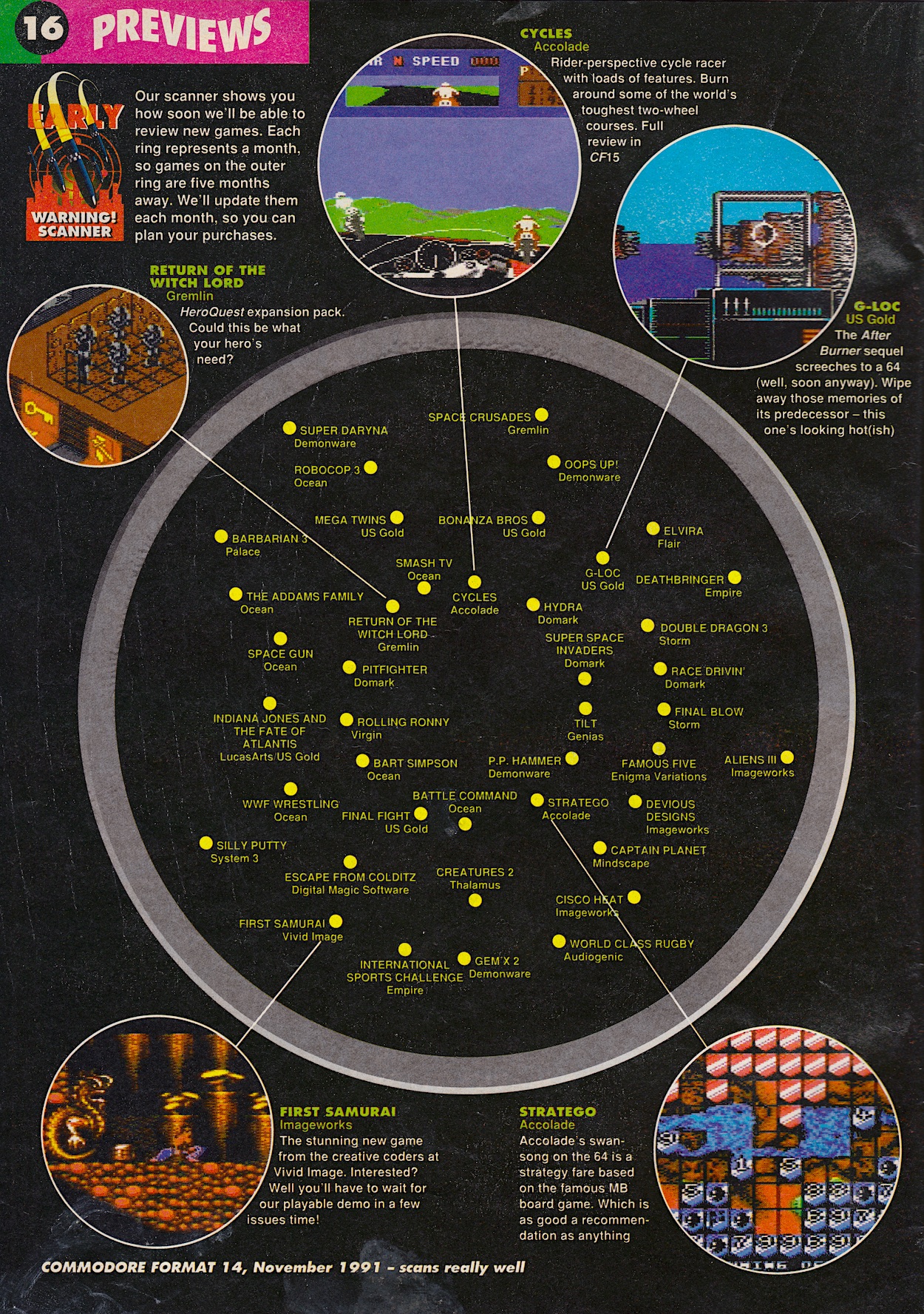
Among the impressive previews there was also a unique page called the Early Warning Scanner which summed up all of the forthcoming releases in a neat radar-type image; the closer to the centre each game was the sooner they were due to arrive. It was so much better than a boring list and kept readers up-to-date on their hotly anticipated games. As a new reader and (almost) owner, I looked at this page and was almost drooling at some of the games to come.

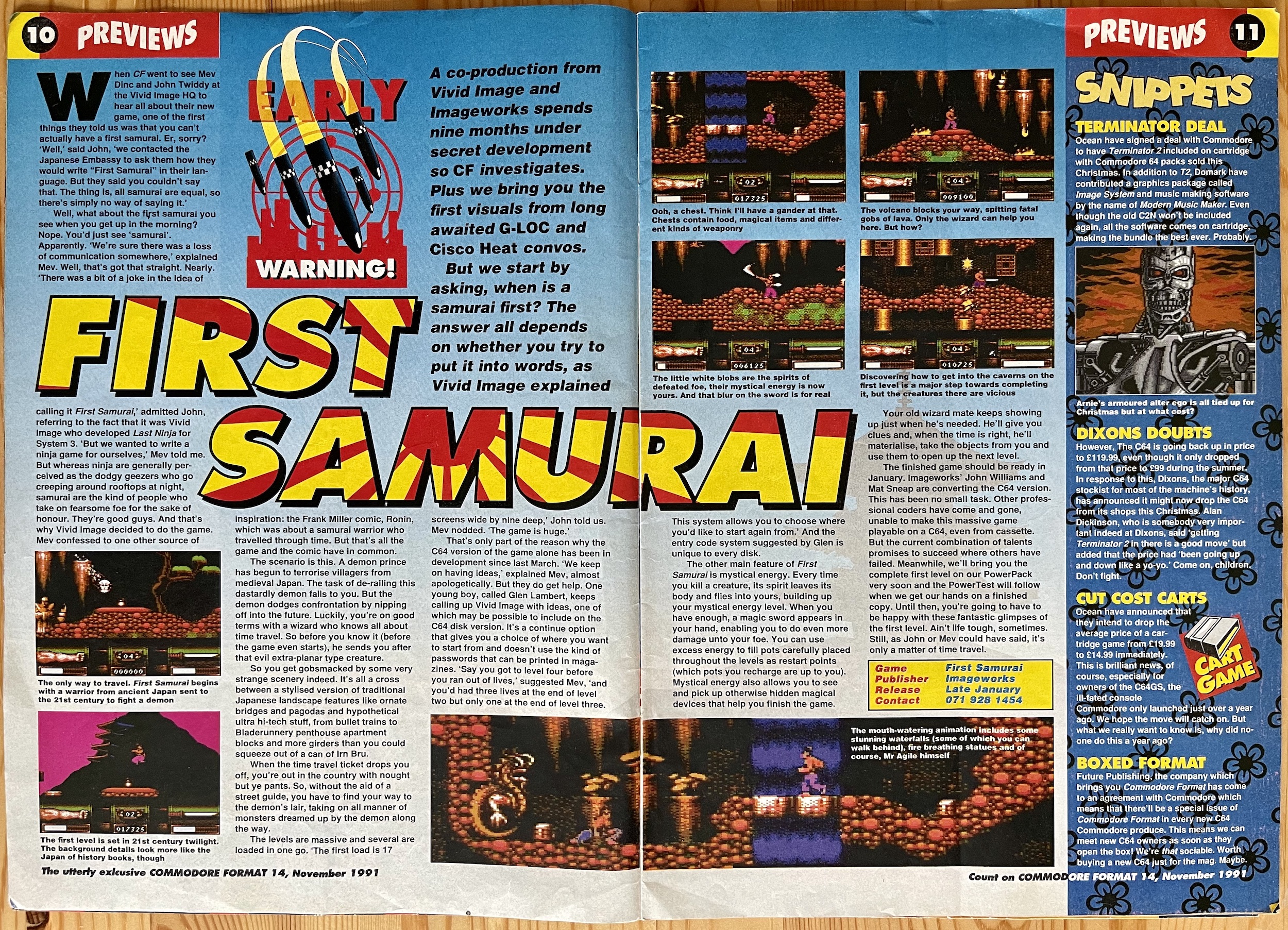
While some people in school mocked me for picking a C64 instead of a more powerful computer, within these pages I was in awe at the graphics this allegedly dated machine could produce. Also, to me the scanner dispelled any notion the format was in its final days. Most importantly, my choice also meant I met a fellow C64 owner in school who became a lifelong friend. (Hi Colin!) Back to the games, and even today something like First Samurai is still impressive when you know it’s running on an 8-bit machine. It played brilliantly too. (I also loved the programmers’ reason for the name, in the preview below.)

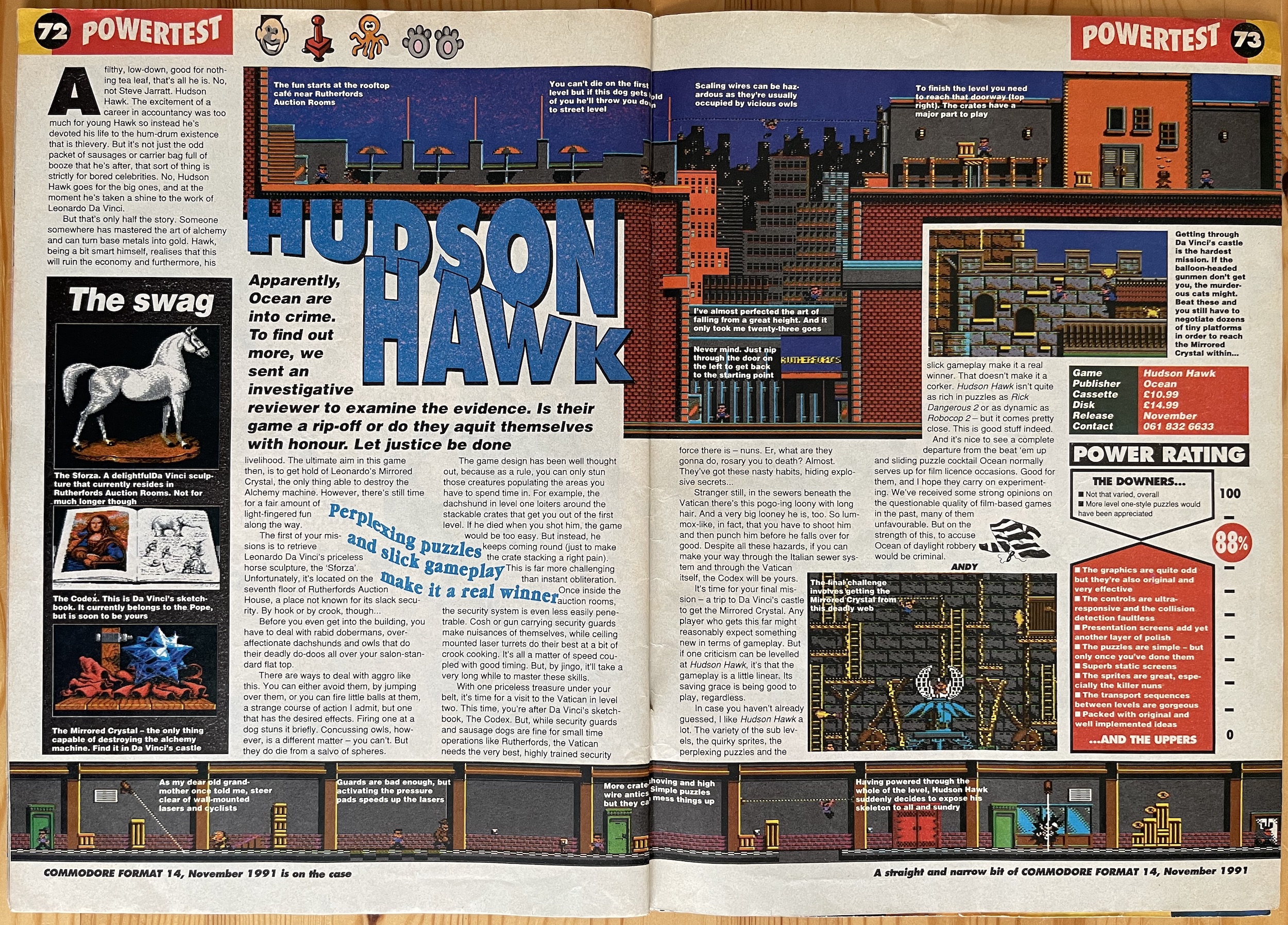
The Turtles arcade conversion may not have been the best example of what the Commodore could produce graphically but I did have fun with the demo although ultimately passed on paying for the full game. The same could not be said of Hudson Hawk. Based on the apparently terrible (I’ve never seen it) Bruce Willis film it looked a lot like the console games I’d played and proved to me this computer could have all the fun of those games at a fraction of the cost. Plus the 64 was so much more than just a games machine at the time, of course.

Commodore Format’s scoring system did away with the clichéd scores for graphics, gameplay, sound etc. and instead replaced them with a simple run down of the game’s main good and bad points at opposite ends of a scale, with the score being where they met. (Games with a score of 90% and higher were awarded the prestigious “It’s a Corker!” award.) It was a sleek design by art editor Ollie Alderton and made for some funny comments during the magazine’s lifespan. When racing game Cisco Heat was so atrocious it received 12% the ‘Uppers’ was just large enough for one comment: “Erm… it comes in a nice box.”

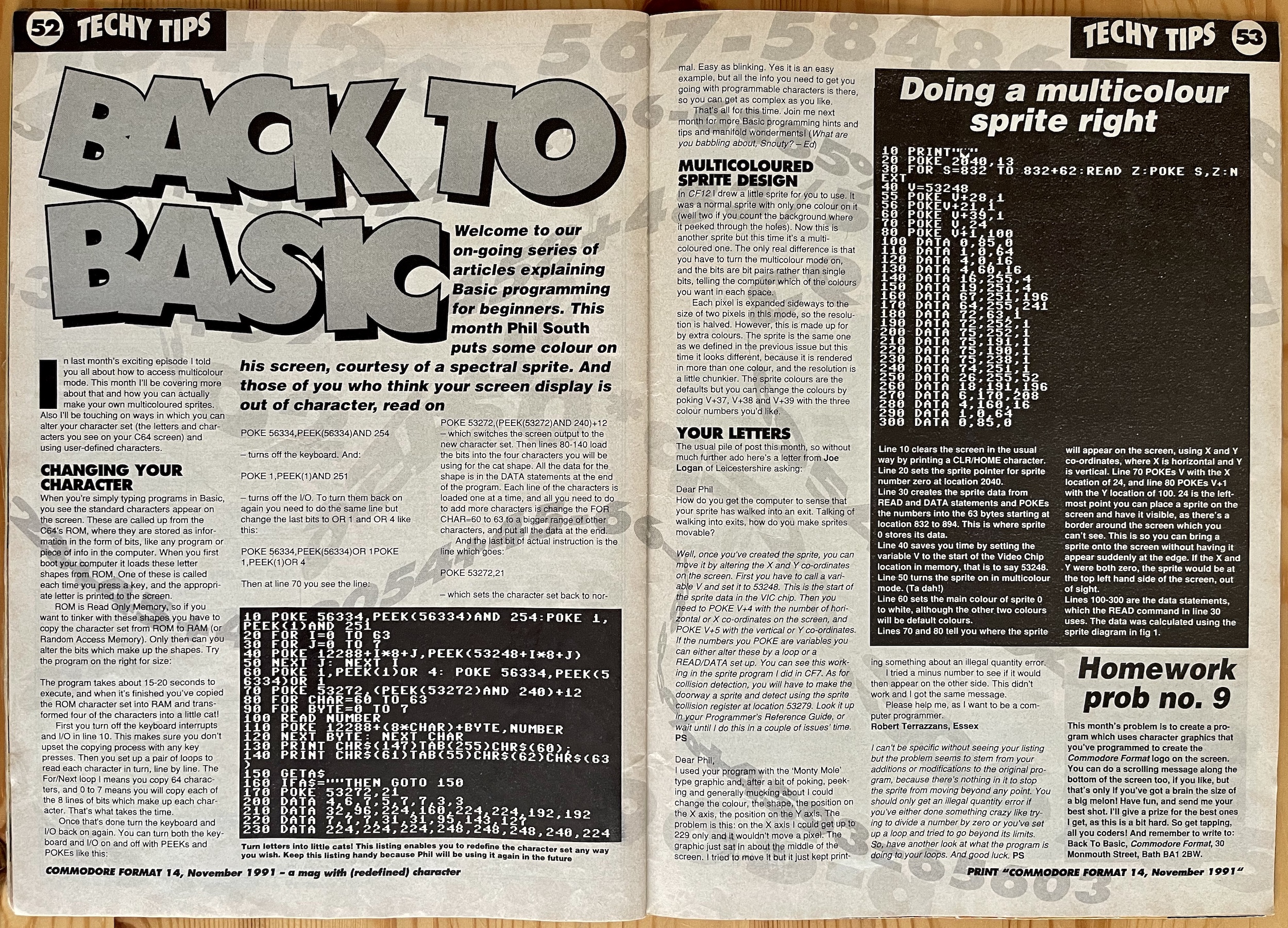
Commodore Format was different to Zzap in other ways too. While that magazine focussed almost exclusively on games, CF followed in the footsteps of its stablemates like Amiga Format, ST Format and PC Format and contained technical features such as an ongoing series of readers’ programming and hardware questions and loads of tips and tricks for the more established coders. For me, I was glad to see Phil South‘s tutorial series for complete newbies. With games on the cover and games all over the inside of the magazine, I made sure to show my parents these pages to prove I wasn’t just getting a games machine.

While naturally my focus was on the games to begin with, I was surprised how quickly I wanted to start digging a little deeper into the computing side of things. Commodore Format was a key part of this and the first three issues I owned before that Christmas were fascinating. I may not have fully understood these tutorials but I read them just as much as the rest, over and over. I was just as excited about that aspect of my new machine as any other.

Speaking of games being a fraction of the cost of their console counterparts, the Roger Frames Buys Budjit Games section collected together all the £2.99/£3.99 cassette games (originals and rereleases of former full-price games) in a handful of funny mini-reviews every month written by the fictional Roger Frames, a tight-fisted miser of a child who detested parting with his pocket money. Accompanied by brilliant comic-style misadventures you can check out this issue’s instalment in the review for OiNK #10. Why? Because Roger was drawn by that issue’s brilliant cover illustrator Mike Roberts, and I’d wanted to show off an example of his CF work I enjoyed so much. Off you pop and check that out before we go on.

Commodore Format led me to Edge and Cube magazines over the years via a detour to the equally fantastic 3DO Magazine

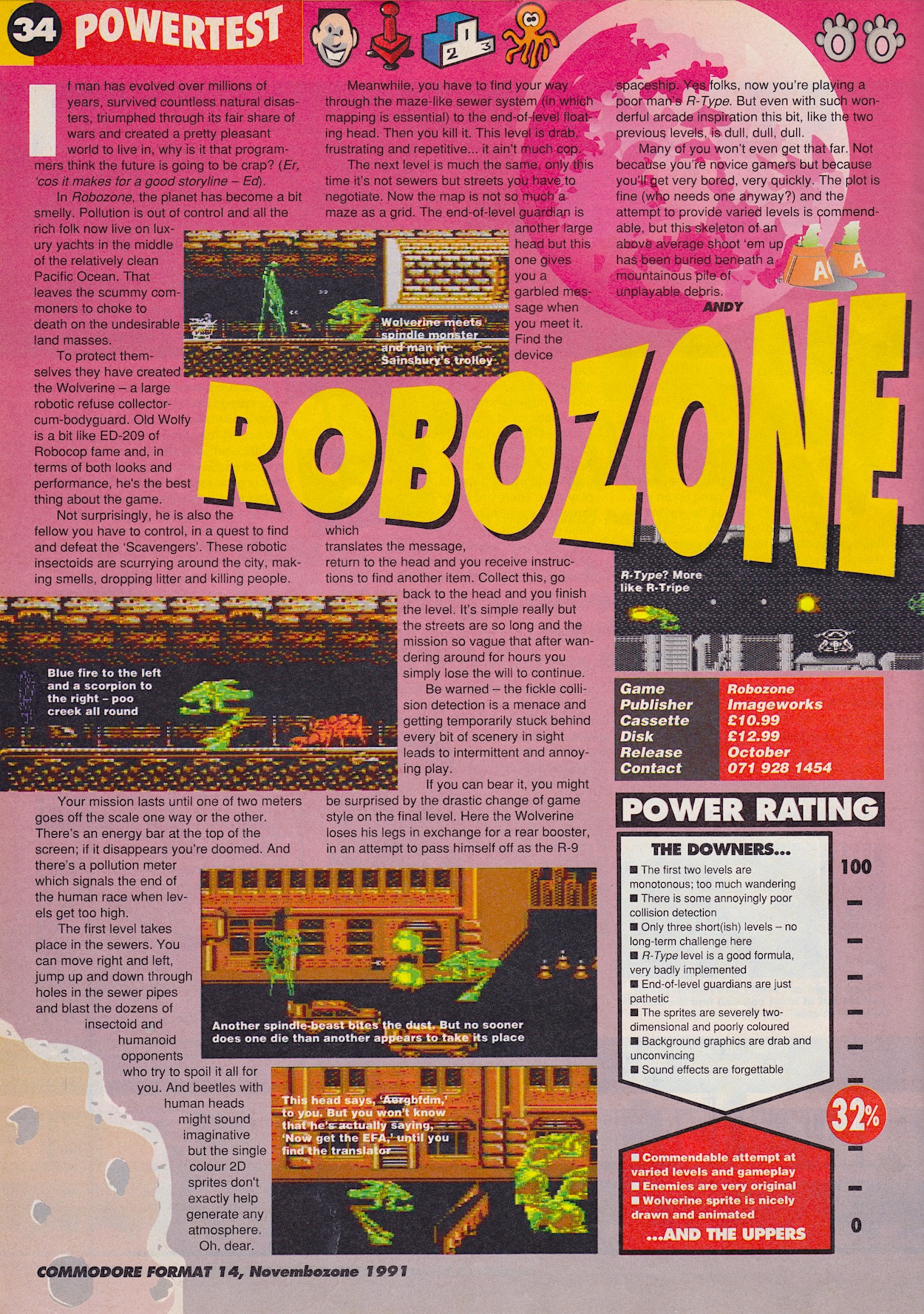
Welcome back. Anyway, Commodore Format also spoiled me for life when it came to review magazines of any kind, from games to movies and everything in-between. Below is a review from this issue for Robozone and by all measures it should be a terrible game that no one would want to spend their pocket money on. But the score is just the opinion of the writer, not a fact, and I always felt the way CF’s reviews were written was more important than the number at the end. Context was key.

In the case of Robozone it was clear why staff writer Andy Dyer personally didn’t enjoy the game but something from his review told me I might. So I bought it a few months later and yep, I did enjoy it. It wasn’t superb, and if I hadn’t got it from a bargain bin maybe I wouldn’t have purchased it, but it was fun for a few weeks. CF’s writers never tried to tell people that their opinions were facts. Throughout my gaming hobby I’ve come across magazines I felt were above their station, who thought what they opined was gospel (a bit like internet comments sections today). CF was never like this.

Commodore Format led me to Edge and Cube magazines over the years (also from Future Publishing) via a detour to the equally fantastic 3DO Magazine. Many others were tried but failed to talk to me on a level playing field like CF did. I’ve actually begun subscribing to Edge again last year for my Nintendo Switch. That’s the legacy of Commodore Format. It never spoke down to us. It never pretended to be anything other than a group of friendly people passing on advice. Well, perhaps one ‘person’ had a bit of an ego…

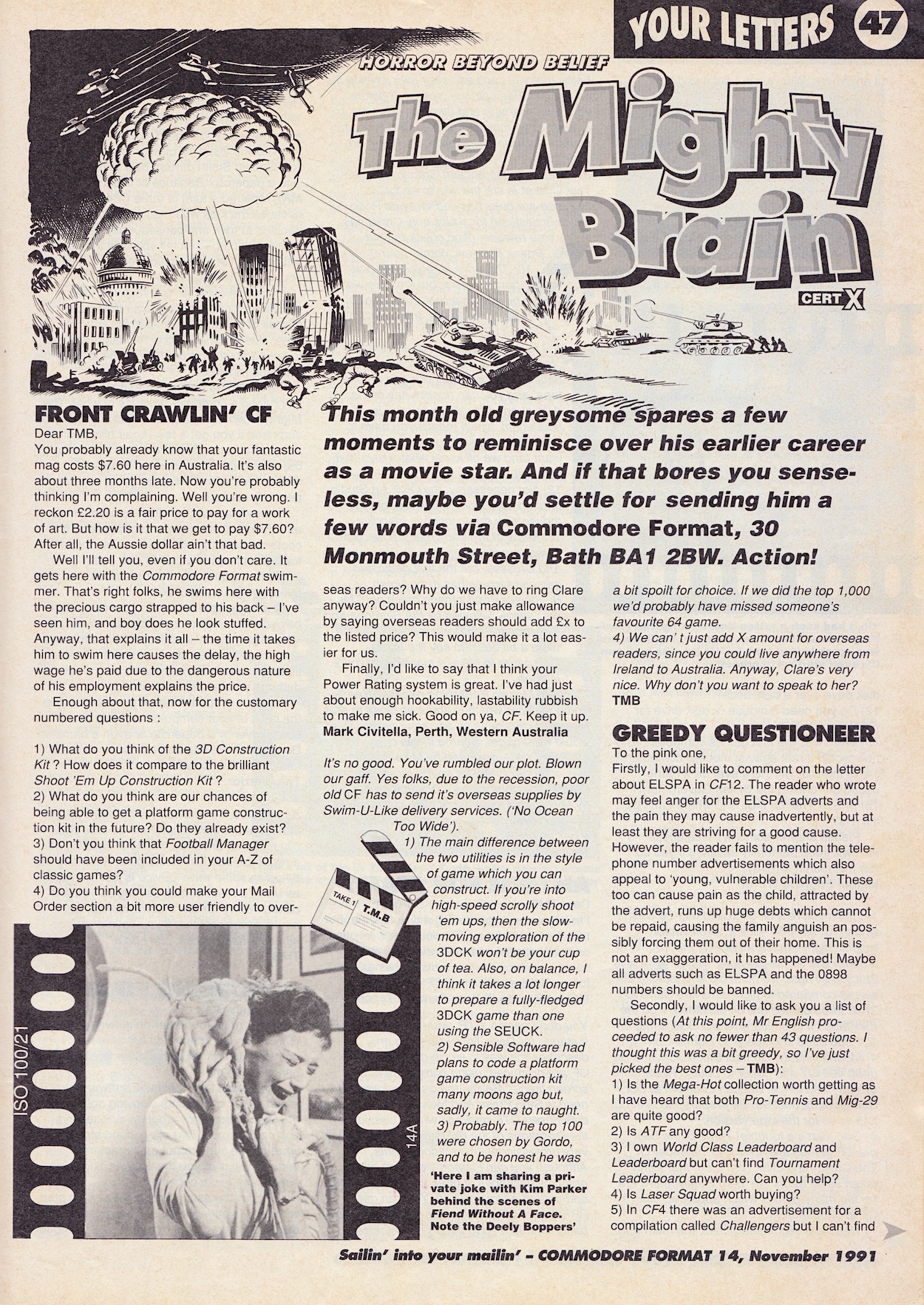
There were a whopping four pages of letters in each of these issues, hosted by The Mighty Brain, a ‘B’-movie star who knew everything in the knowable universe (and beyond). I mean, who better to answer readers’ questions, right? Even though these pages would be answered by different people as the magazine changed over time, his persona never changed and his cocky nature reminded me of the sassy letter answerers in childhood comics such as OiNK and Transformers. Great fun.

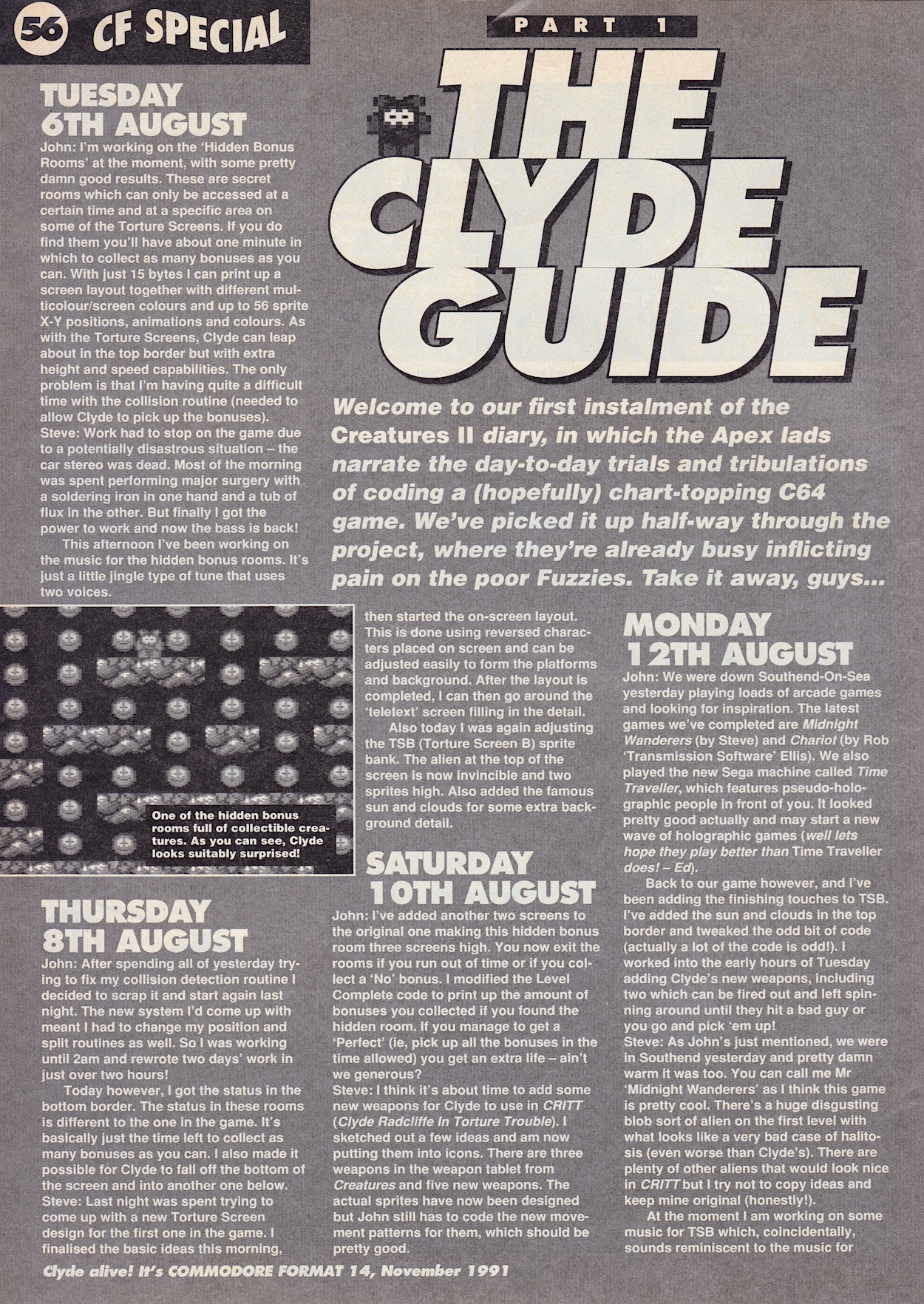
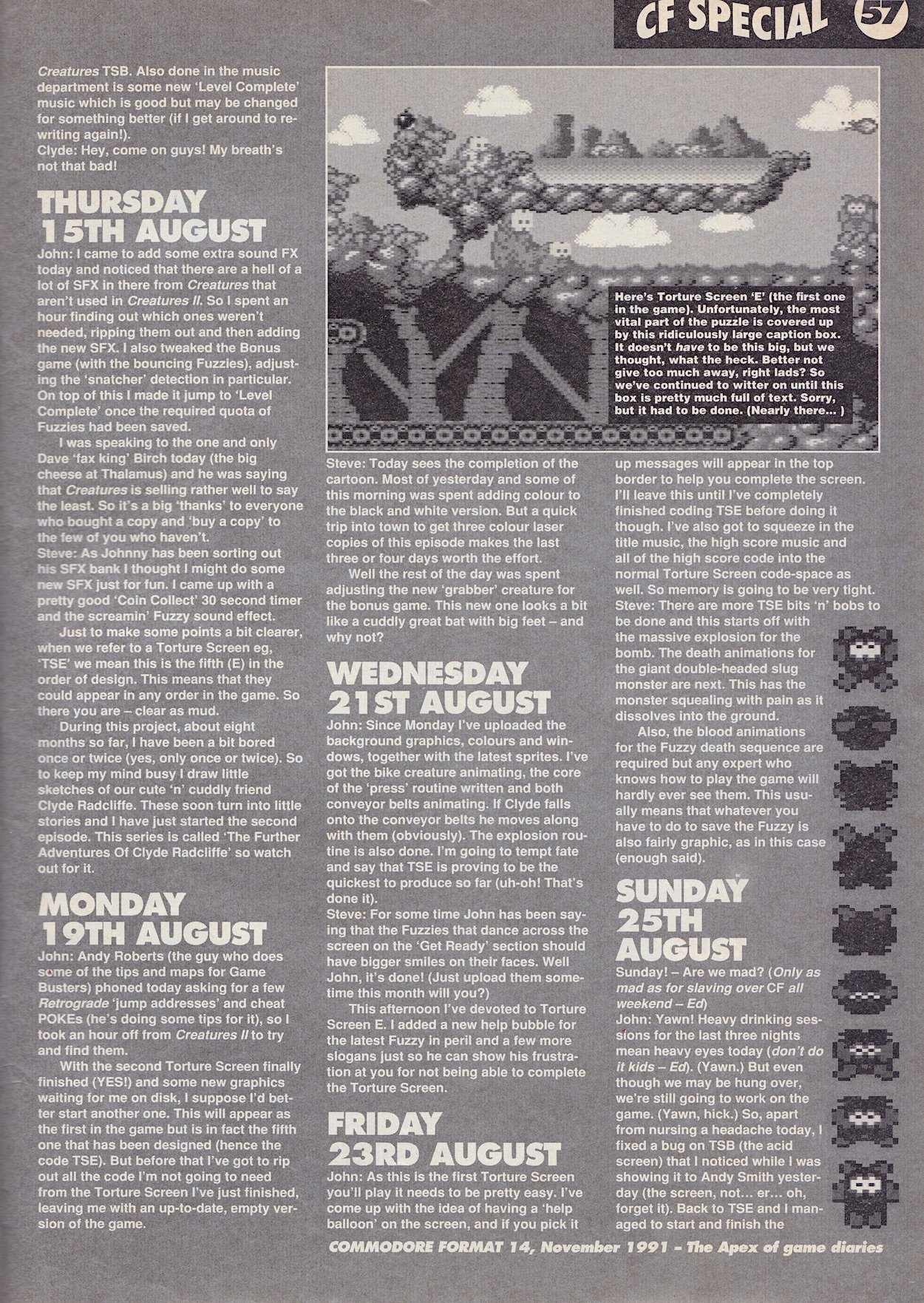
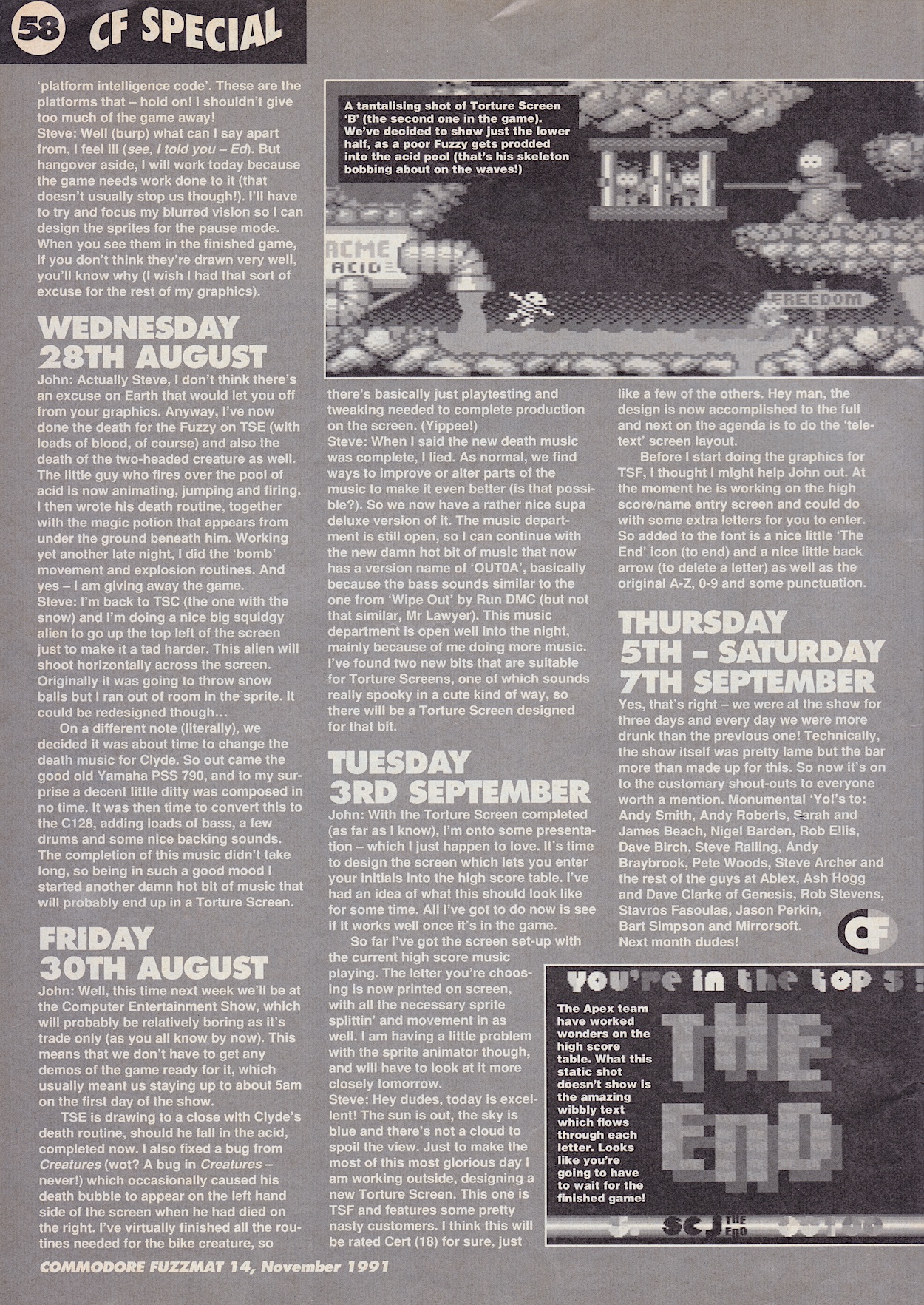
Zzap64’s publisher was going through administration at the time (hence the blurb at the top of the cover) and for a few months CF’s competitor didn’t appear. It worked out perfectly for me because I’d discovered this superior magazine instead and inside a regular feature from the abruptly (and temporarily) cancelled competition made its transition to CF. The Clyde Guide was a Making Of series about the upcoming Creatures II: Torture Trouble, a game that’s still in my top five games of all time on any platform to this day.

A cute and cuddly looking game with devious puzzles, huge boss fights and gorgeous animation, it had a hilarious sense of humour with over-the-top gore that would surprise players when things went wrong. All cartoony and ridiculous gore splashed all over the cute graphics of course, this was still a basic machine compared to today’s after all. The Rowlands brothers John and Steve gave a fascinating insight into the creation of a brand new game, month-by-month. This wasn’t a look back at how a game was made, this was happening in real time.

On a side note, I contributed to Bitmap Book’s Commodore 64: A Visual Compendium for their Creatures II spread

I was hooked from this first chapter (CF’s first chapter but obviously the game was a long way into development by this stage) and it would often be the first thing I’d read in subsequent months. Later in the magazine’s life the brothers would also create the incredible Mayhem in Monsterland game which they’d chronicle in the pages from the very beginning. I’d never read anything like these diary entries before and was amazed at the access the magazine had. On a side note, a few years back I contributed to Bitmap Book‘s Commodore 64: A Visual Compendium for their Creatures II spread.

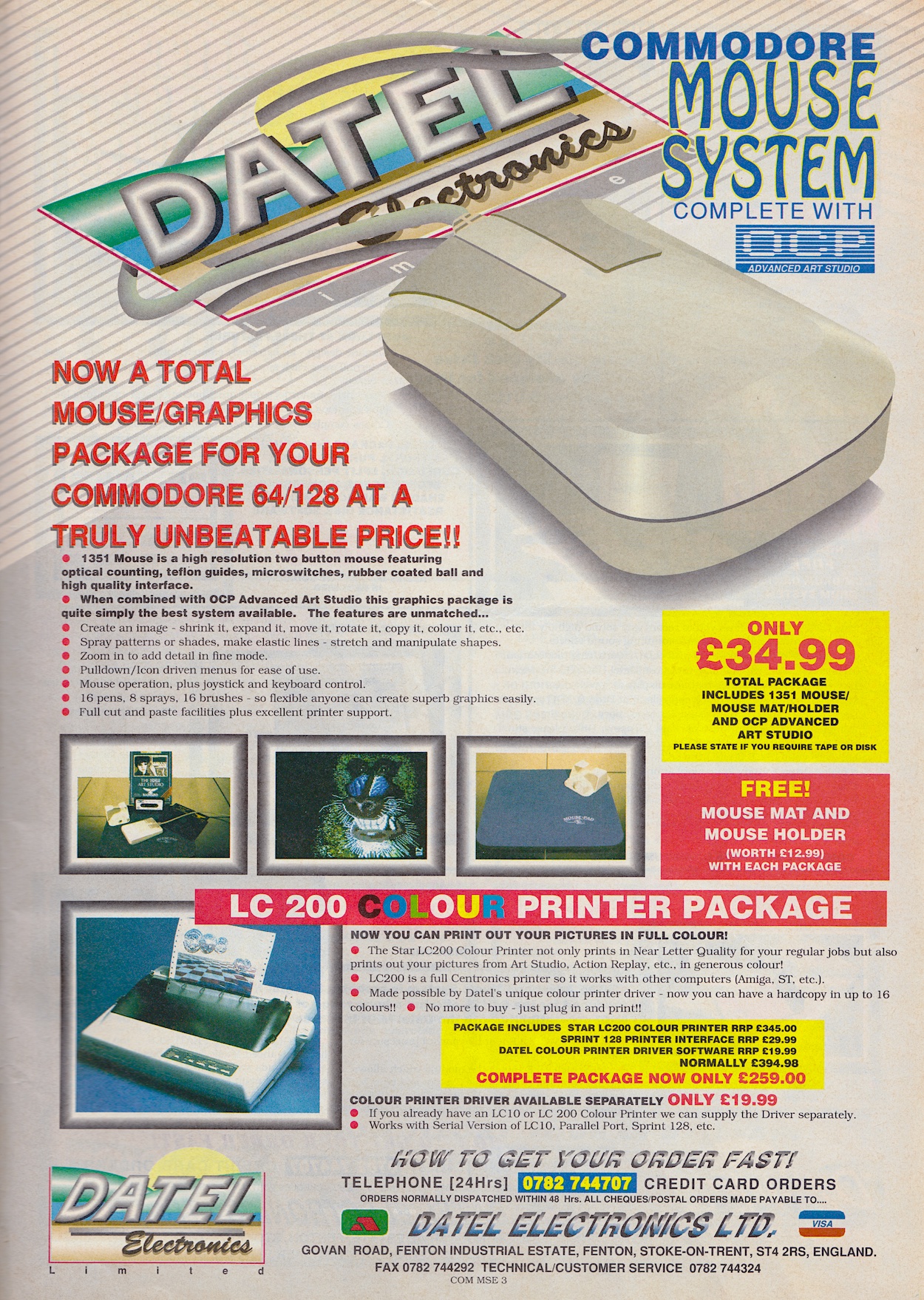
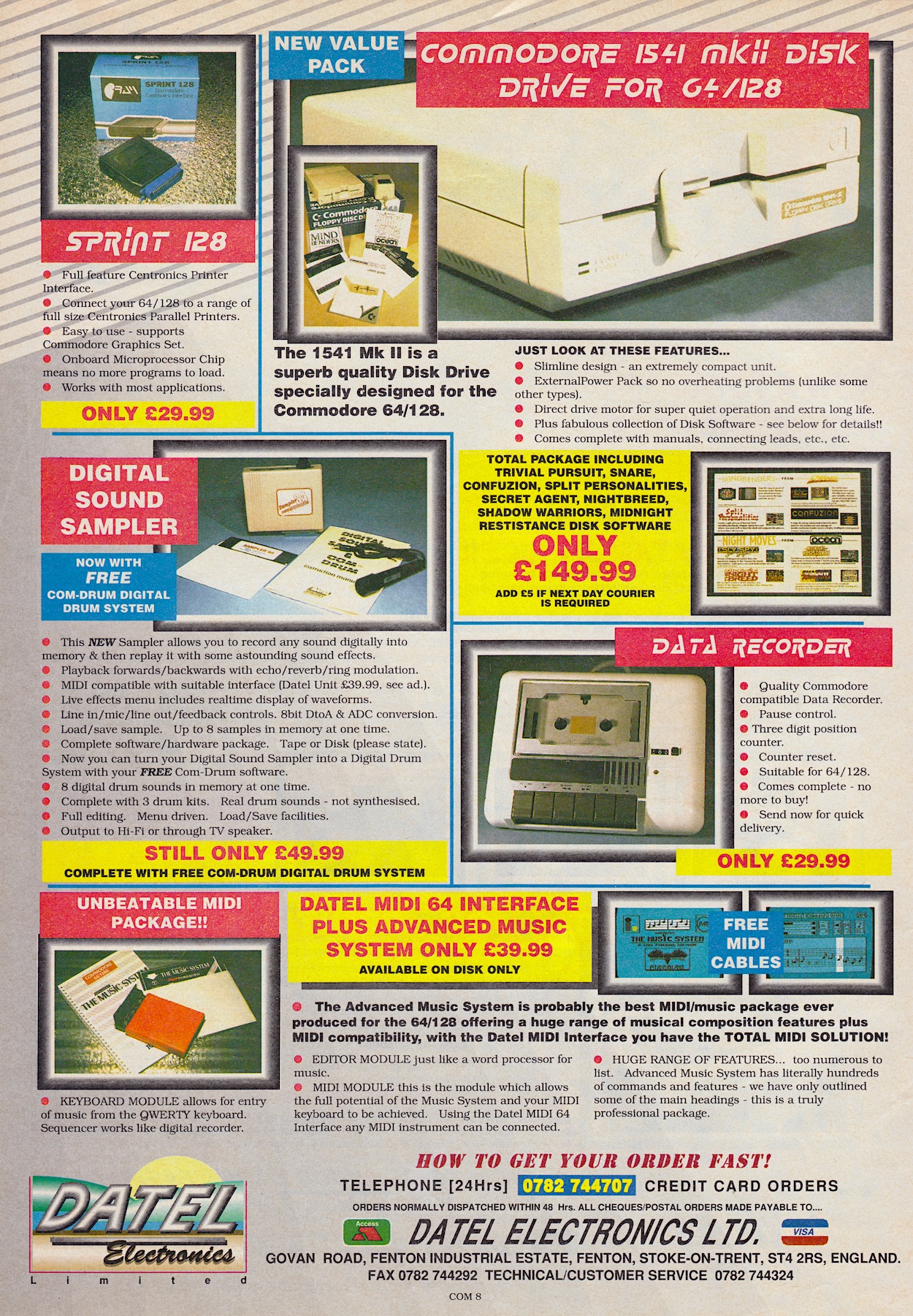
That Christmas I finally received my C64 with a cartridge full of games, a few joysticks and a cassette deck. The following Easter my dad was made redundant and with his payoff I was promised something for my computer. I chose a disk drive after seeing it advertised every month in these Datel Electronics adverts. The following Christmas I also added the printer shown here along with the mouse and art package, all set up on a desk made by my dad in the alcove in my bedroom.

Some friends may have thought the C64 was past it but I was using it for everything! Writing my own stories and magazines, a diskzine (more on that in the specific post I mentioned, coming next year), homework, running a Public Domain software library, making games… In fact, I was using it for a lot more than my friends were using their more powerful machines for. Oh man, the memories are flooding back as I read through this issue again. Those were such enjoyable years thanks to that machine and this magazine.

CF eventually succumbed to a loss of sales only six months before the release of the first Sony Playstation!

Commodore Format was created by Future Publishing when they saw an opening in the market. The C64 was still selling really well as an entry-level computer, while also being handed down to younger siblings. CF was an instant success and soon became the biggest selling C64 magazine in the world! Deservedly so. It would last right up to #61, eventually succumbing to a loss of sales only six months before the release of the first Sony PlayStation! That’s incredible for a machine which people told me was on its last legs before I even got mine.

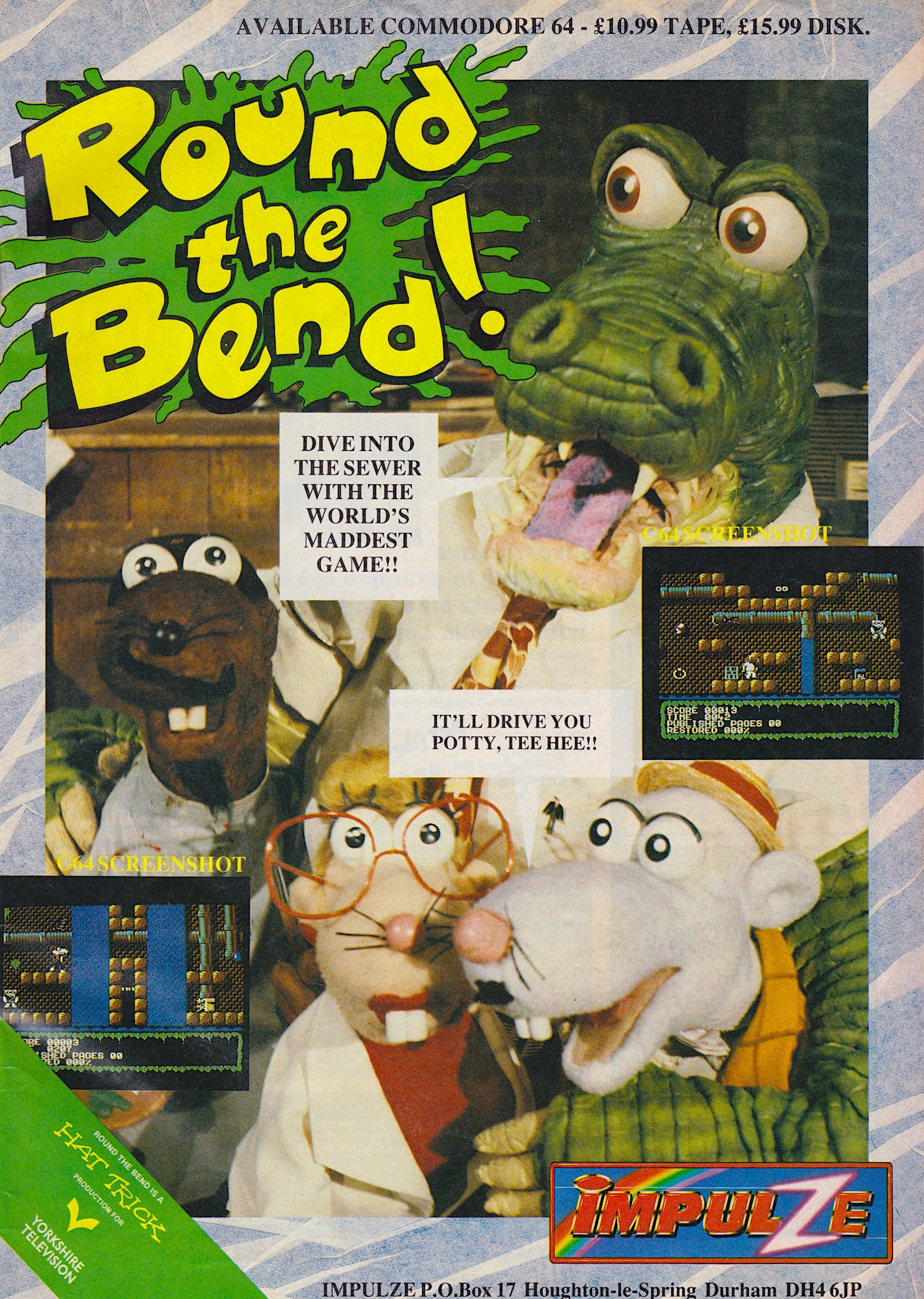
Regular blog readers may have noticed the issue number for my first ever magazine is the same as that for my first ever comic, #14 of OiNK. With that tenuous link I’ll wrap up this retrospective with an advert for an upcoming game pig pals may have been particularly interested in. After OiNK was cancelled the creative team of Tony Husband, Patrick Gallagher and Mark Rodgers went on to create a certain TV show that shared many familiar aspects with our piggy publication.

The game already looks like it’s closer to its inspiration than the OiNK game. Round the Bend would get reviewed in #17 of Commodore Format, so in keeping with the real-time aspect of this blog I’ll show you that very review and take a look at the game itself on Tuesday 16th January 2024.

I feel like I’d need to show you every single page of this issue over a series of posts in order to fully get across just what an impact it had on me and how formative it was. I hope I’ve been able to do it justice. I have an almost complete set of the magazines here at home, despite not owning a Commodore 64 anymore and I’ll never get rid of them; I love to dip in and out and I’ll forever treasure them and the memories they contain.

In the days of magazine contributors being named and photographed for the editorial pages, over time it felt like we’d grown to know these people and we trusted them as a result. This was a key component in that club feeling and later in its lifespan Commodore Format would be instrumental in my life and the person I became! Really. That’s a whole other story for another time, but for now I just wanted to concentrate on a retrospective look at this beloved issue of a beloved mag.

Commodore Format has featured elsewhere on the blog already. The cover cassette of its second edition contained the OiNK game in its entirety as you can see in a post from the game’s coverage. Then in their third issue the team produced maps to help people struggling with the game and I’ve included them on the blog as well. Both posts also take a look at some of the other articles and contemporary adverts featured in those early editions. Finally, the Roger Frames Buys Budjit Games section was a favourite feature of every issue for me and was illustrated by Mike Roberts, a brilliant illustrator who also produced the cover to OiNK #10, and in that OiNK review I’ve included Mike’s art of Roger’s misadventure from this issue of Commodore Format. Enjoy.

RETROSPECTiVES MENU