
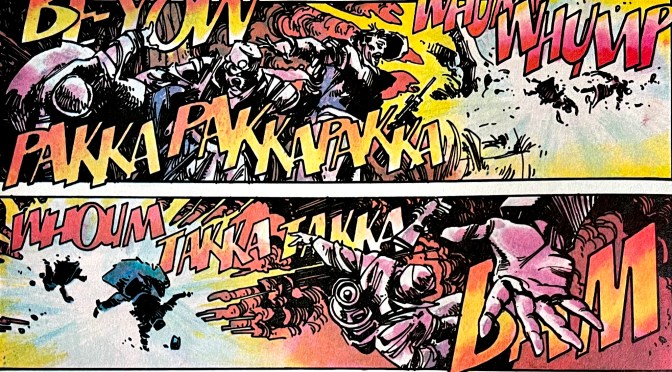
While I’d been allowed up to four comics on order at the local newsagent, by the summer of 1991 this number had been whittled down to just two, The Real Ghostbusters and Transformers. Most comics I’d tried had ended up cancelled very quickly, so I’d become a bit disillusioned. Then, after months of not bothering, I decided to have a look at the comics shelves one Saturday morning and was met with this.
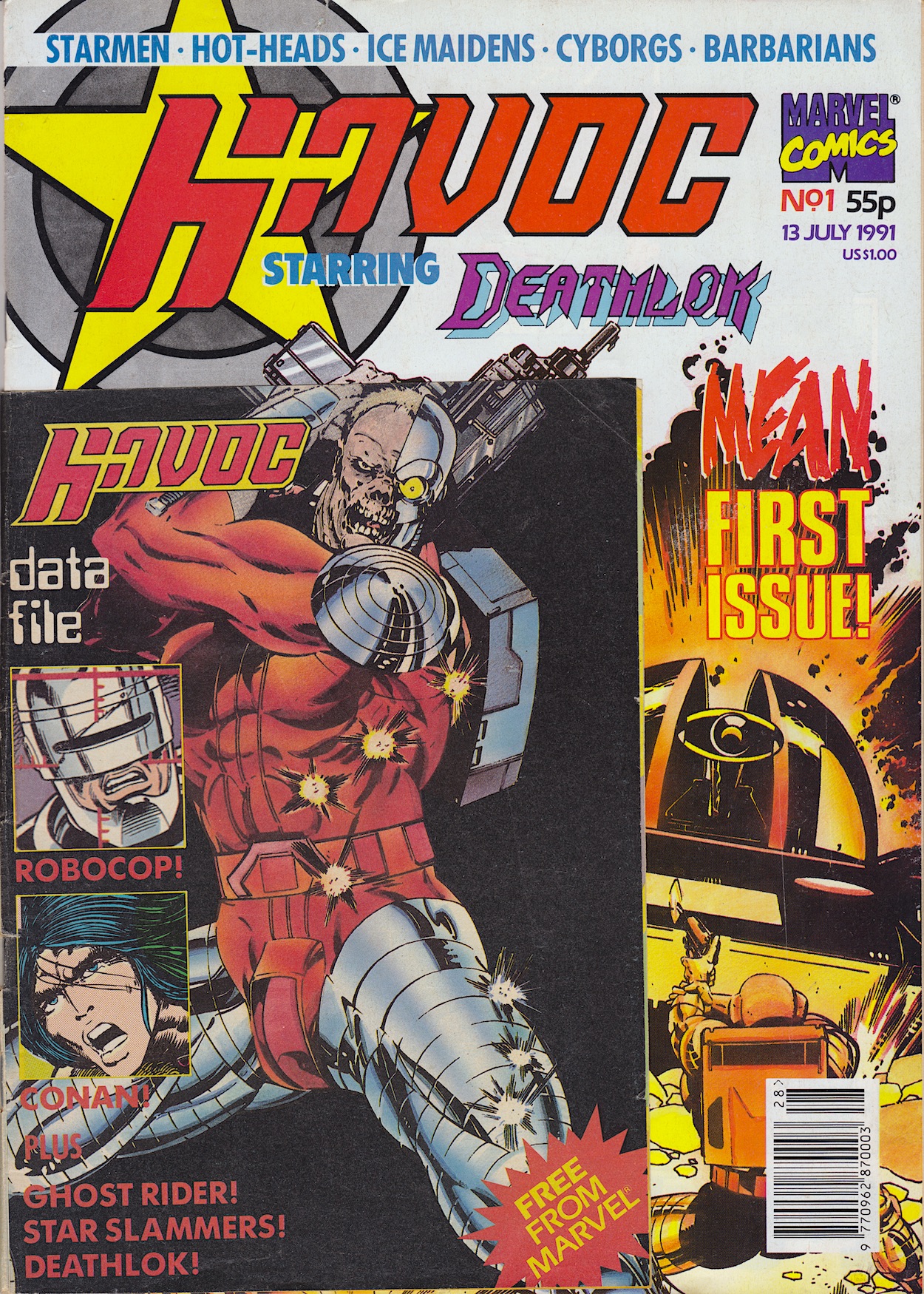
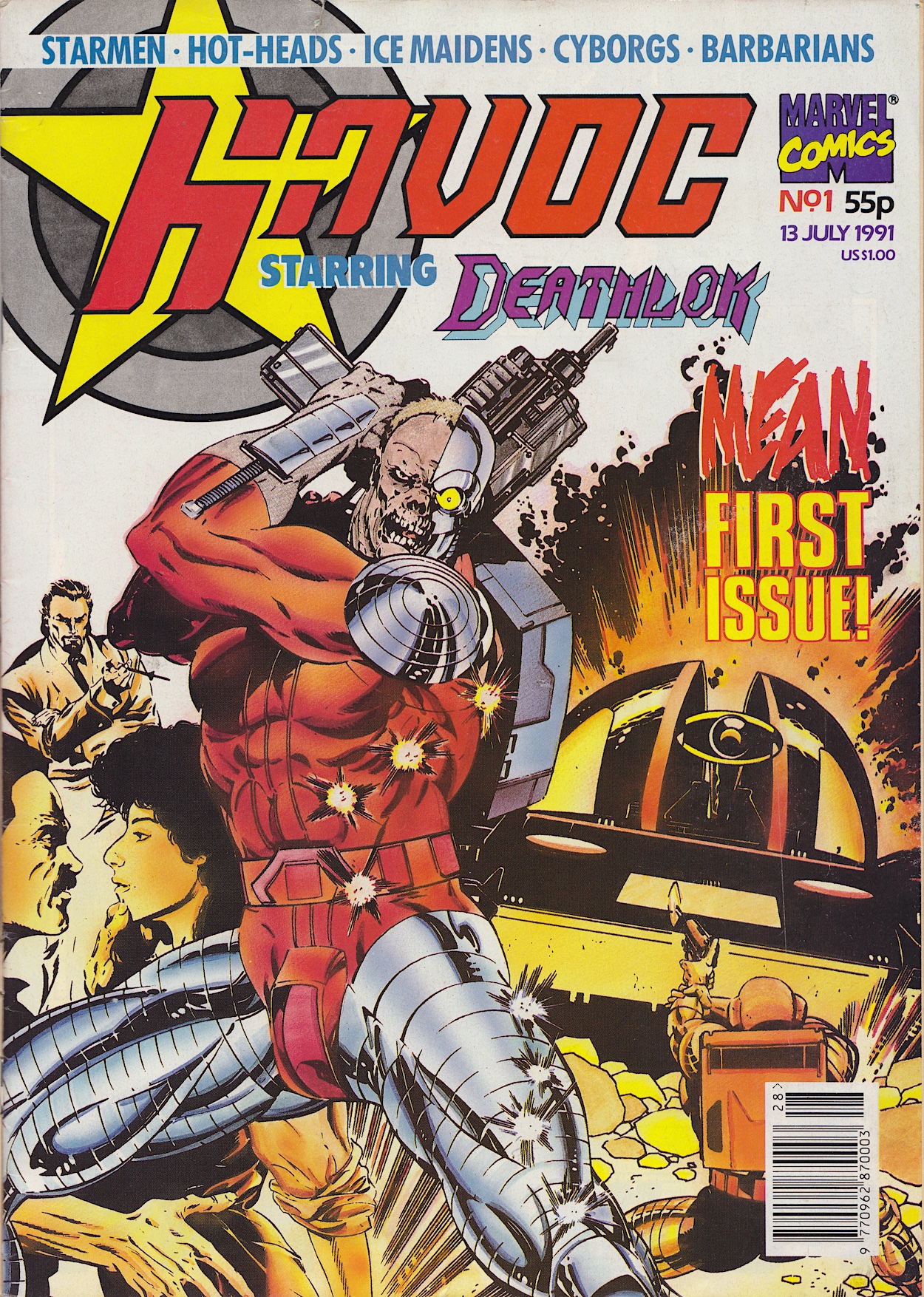
While I’d spotted RoboCop on the cover it was the bigger character called Deathlok that really grabbed my attention, especially when I pulled aside the free introductory booklet (images from which can be seen in the introductory post). How the booklet blacked out everything apart from Deathlok just looked really cool and having a quick flick through I also saw Conan who I’d heard of from friends, and a fiery skeleton on a motorbike. I had to try this out! At only 55p for 36 pages Havoc was a bargain, the same price as Transformers which was two-thirds the size and on smaller paper.
There was also that 16-page booklet which introduced us to each of the five main protagonists: Deathlok, RoboCop, Ghost Rider, Conan the Barbarian and the Star Slammers. It was a meaty read (edited at lauch by John Freeman and Harry Papadopoulos) and I enjoyed it so much I cancelled my order for The Real Ghostbusters after 150+ issues to reserve Havoc instead. Little was I to know only nine issues would ever see print. But for now let’s relive this excellent title, which coincidentally lasted for the exact amount of time I was off school for the summer holidays (in Northern Ireland kids get all of July and August off).
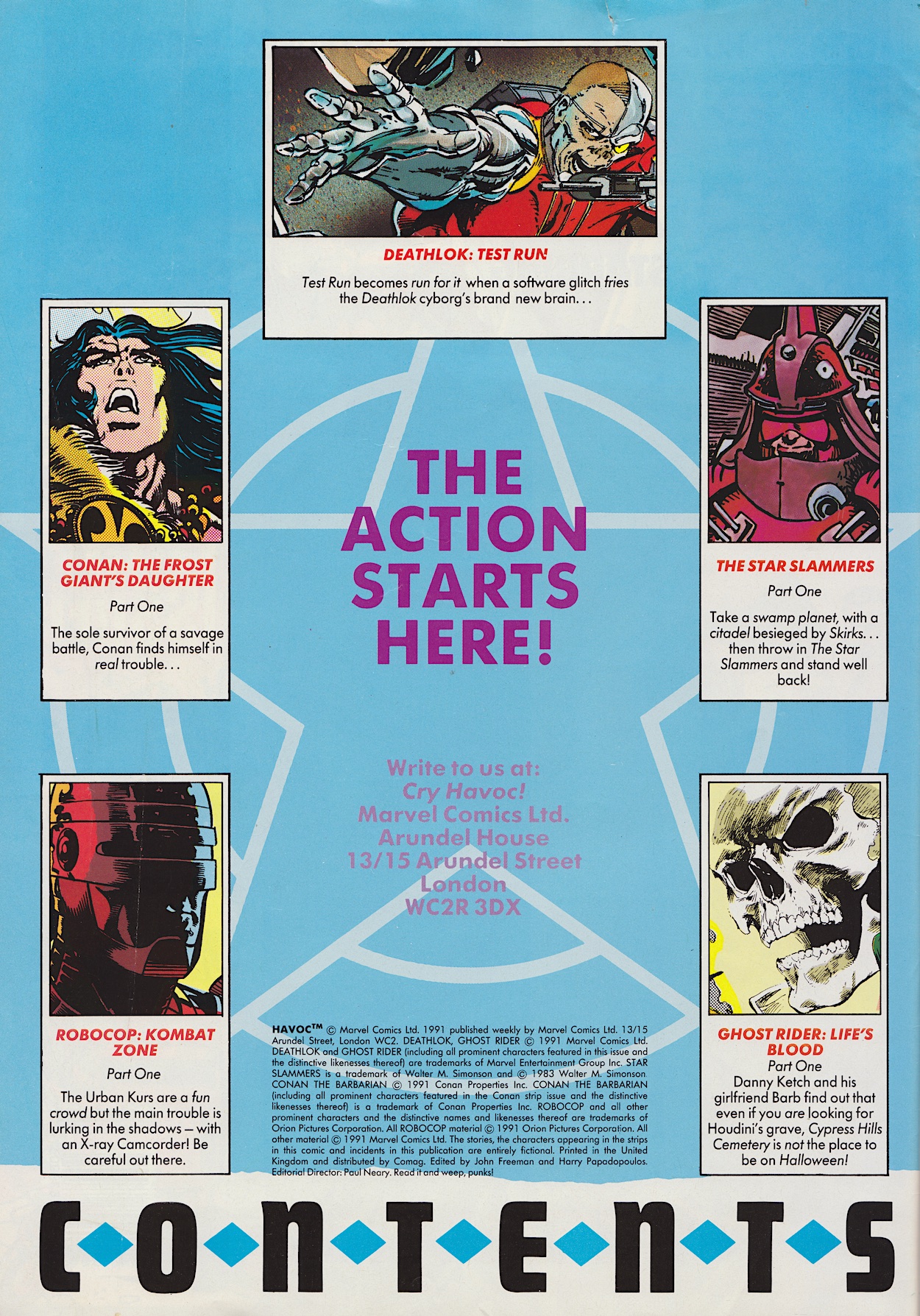
Upon returning to school some of my 2000AD-reading friends were raving about Havoc and the comparisons are clear. Havoc was also an anthology title and while the stories were imports from America the sci-fi settings and hard action had grabbed their attention in the same way as Tharg’s comic. I’d only read a few issues of 2000AD at that time and found Havoc to be much better; it was in full colour for a start, it had RoboCop and the action and characterisations seemed (to my teenage self) to be more mature. This was a huge step away for my usual comics.
So first up is Deathlok, a character I’d never heard of and who Marvel US had resurrected a year earlier. Originally created by Rich Buckler in 1974 in Astonishing Stories, there’d eventually be various characters with the same name, all deceased humans brought back as cyborgs. Dwayne McDuffie (Batman, Back to the Future, Damage Control) and Gregory Wright (The Punisher, Daredevil, Nick Fury) brought the idea back with a new human character in a mini-series and then an ongoing comic between 1991 and 1994, the first time Deathlok had had his own title. It was this run we were to be treated to, drawn by Wright and Jackson “Butch” Guice (Supergirl, Black Panther, Winter Soldier) with letters by Richard Starkings (Elephantmen, Zoids, Transformers).
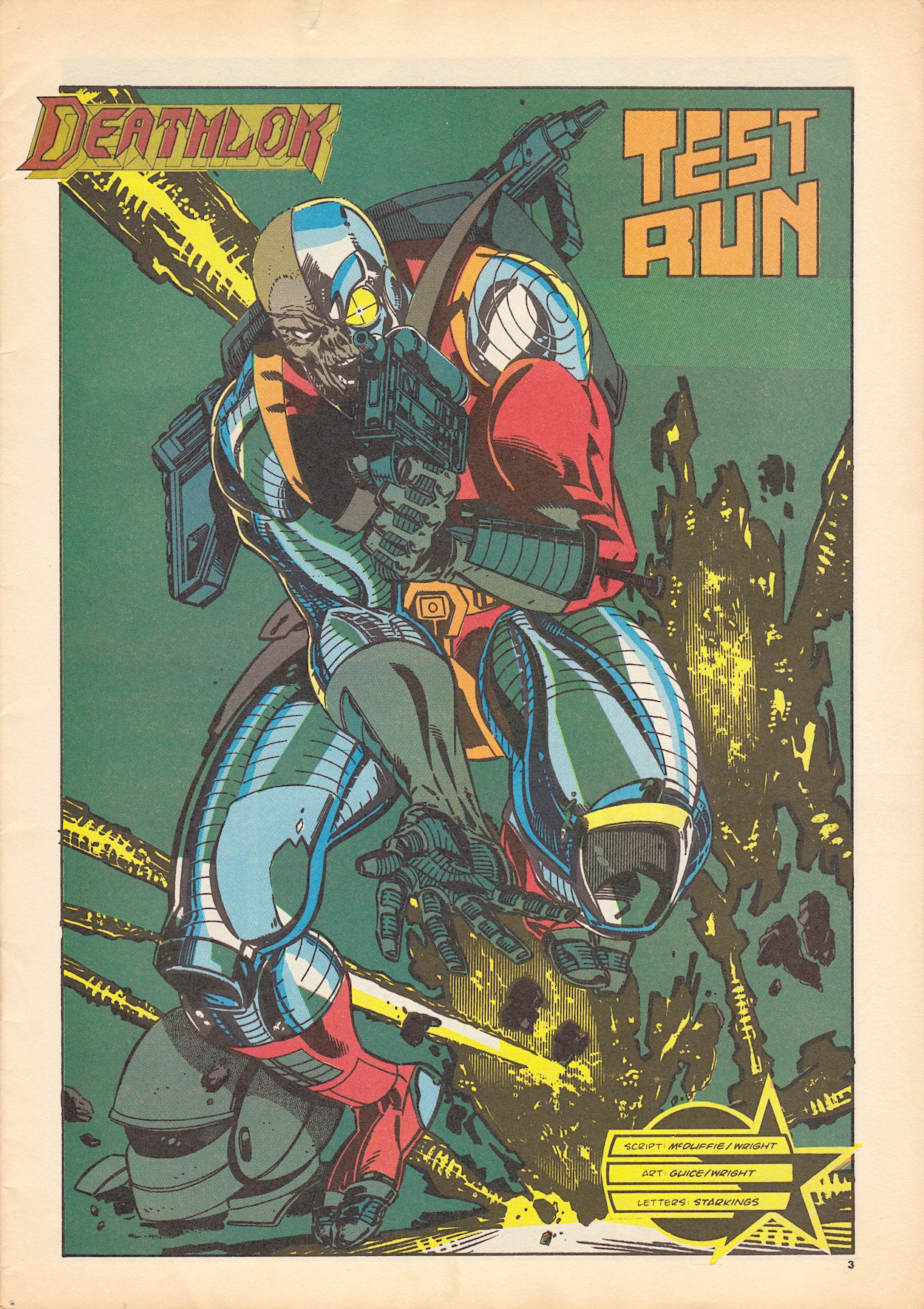
Between the end of the mini-series and the start of the ongoing an eight-page prelude tale was published in Marvel Comics Presents and it’s this that Marvel UK decided to use first. (From #2 they’d go back and print the mini-series.) This gives us a proper action-packed introduction to the technology and the idea behind the strip. No, it wasn’t hugely original by the time 1991 rolled around, with Terminator movies and RoboCop himself on the scene, but something would set Deathlok apart and that was the interaction between the human brain and the computer. That’s something for a future review though.
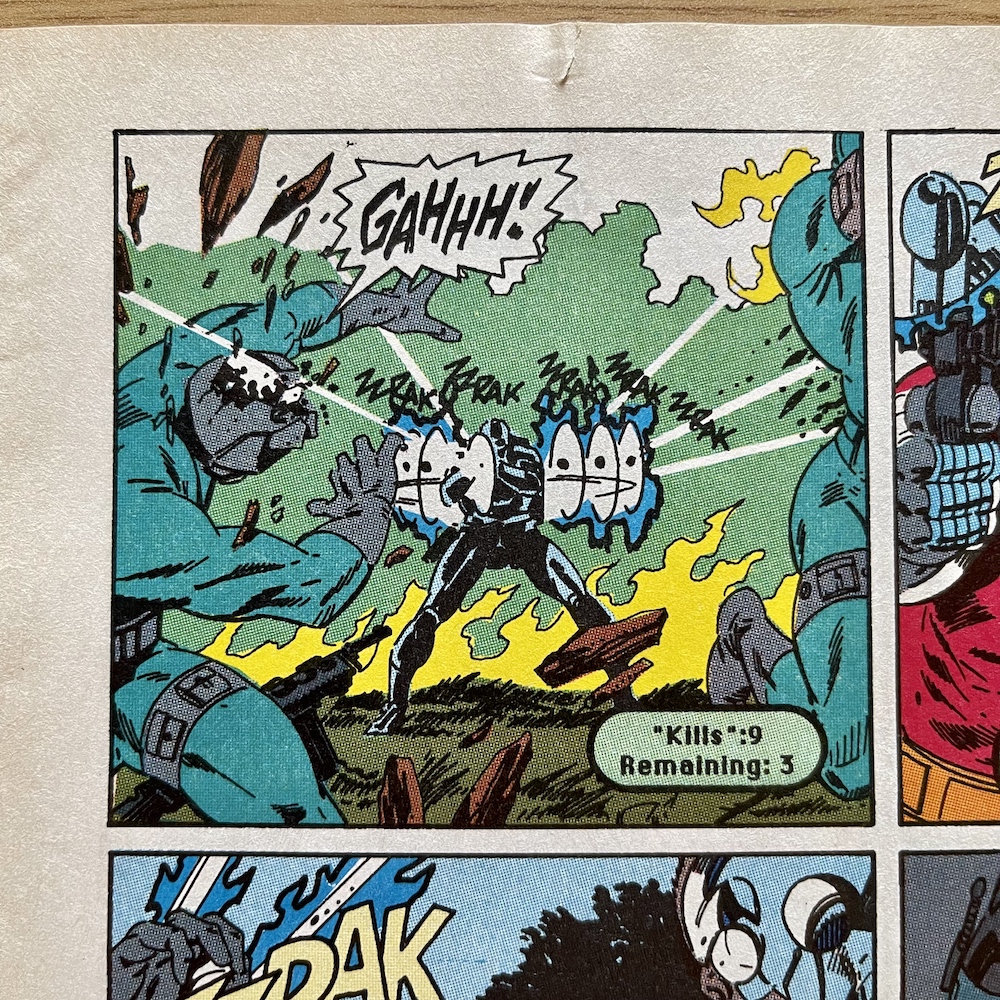
It’s smart to begin the premiere issue with a complete story and it perfectly sums up the set up and the kind of action we can expect. Former army colonel John Kelly volunteered to have his brain transplanted into Cybertek‘s Deathlok and become the ultimate tactical weapon. Sent on a Test Run, he’s armed with paint pellets while 12 mercenaries try to take him down with live ammo. The communications between human brain and computer are relaxed, even jovial, but when Kelly decides on a little grandstanding things take a shocking turn.
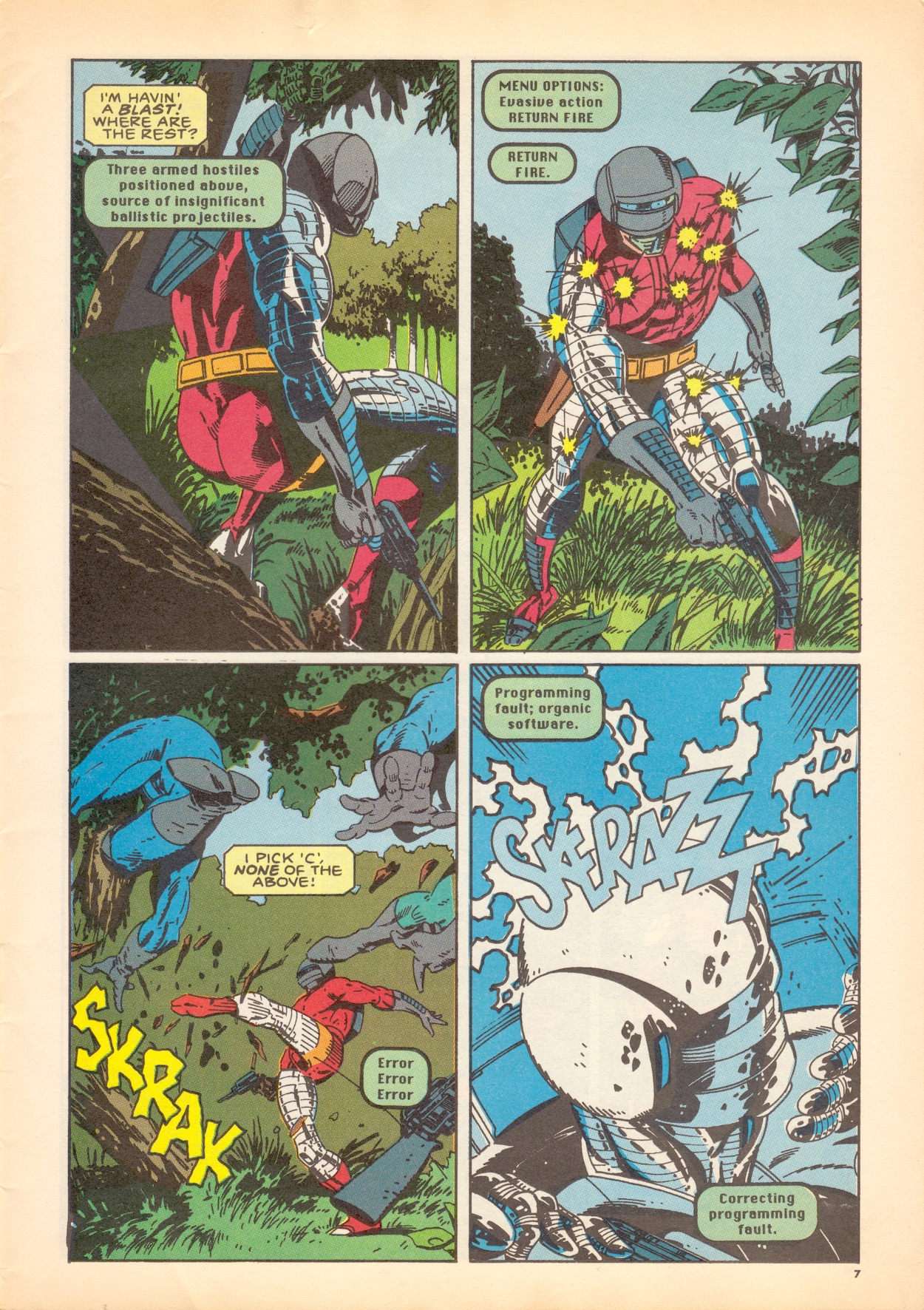
The computer has calculated that Kelly’s thoughts are an input error, sending an electrical charge to eliminate the problem and killing him instantly. Its system now “de-bugged” the programming for a live scenario takes over and immediately replaces the paint gun with a live plasma pistol. But Mr Ryker of Cybertek doesn’t stop the test, even as he watches the mercenaries die one-by-one. There’s just too much money at stake. The story ends with the company casually discarding what happened because they have a deadline and Mr Ryker’s final foreboding words show us the direction it’s about to go.
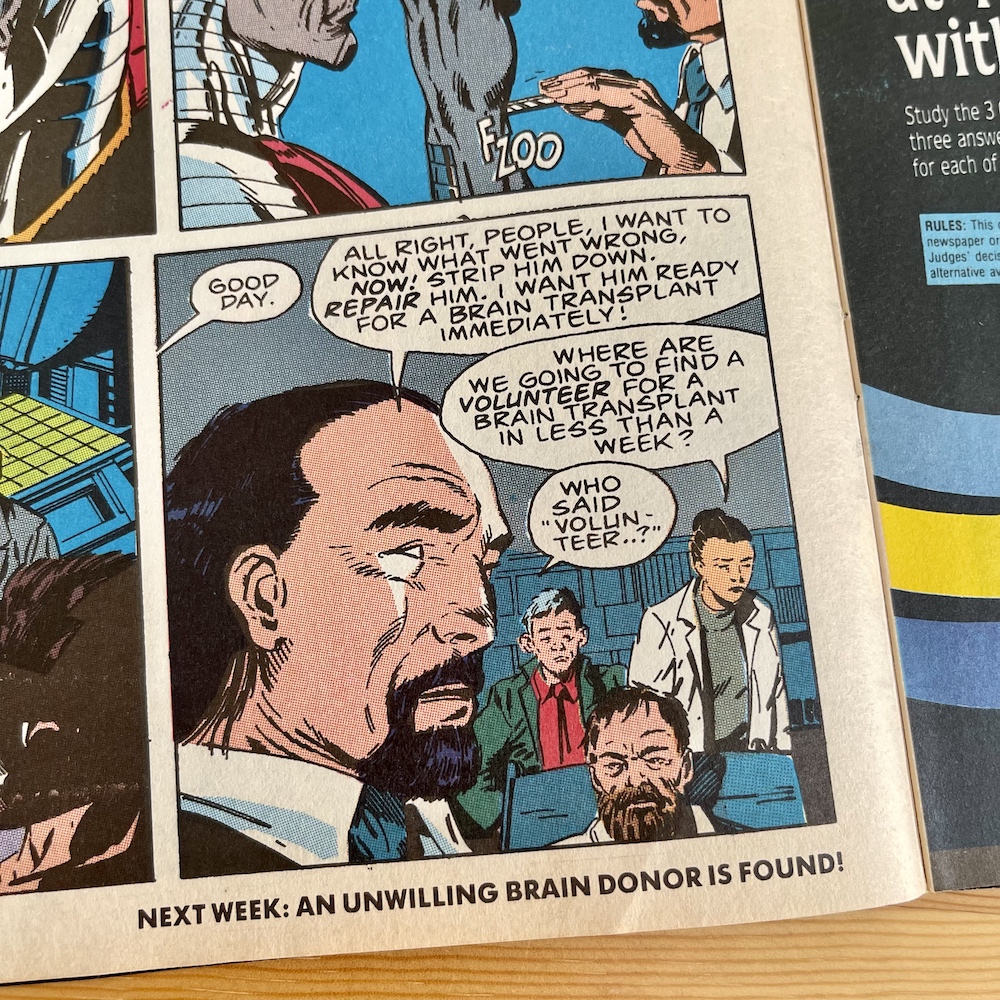
In the introductory booklet a little bit of information popped out at me as a fan of Transformers. It appears Cybertek Systems Inc. is a division of the multinational oil company, Roxxon. This company name appeared a couple of times in Transformers as a competitor to Blackrock. It was just in passing, but it tied the characters in to the larger Marvel universe around the same time as Spider-Man helped out the Autobots.
Test Run is a great introduction to not only Deathlok but to the whole remit of Havoc. I particularly liked Richard Starking‘s (launch editor for Marvel UK’s The Real Ghostbusters) lettering during the interactions between Kelly and the computer. I remember the intrigue as a teenager and how I lapped up the action, thinking that if the rest of the issue was anything to go by I’d discovered a winner.
John Workman’s trademark style adds bold, in-your-face lettering to Star Slammers, perfectly suiting the narrative
Havoc may have been a meaty 36-page read for us but to fit in five ongoing strips originally written as much larger chapters (while giving each one a satisfying chuck and a cliffhanger every week) couldn’t have been an easy task. But the team pulled it off. The next strip is Star Slammers which originally saw print in #6 of Marvel Graphic Novel in the States back in 1983. Given just the four pages in this premiere issue, it acts as a nice tease for the characters created, written and drawn by Walter Simonson (Jurassic Park, Hawkgirl, Detective Comics), coloured by his partner Louise Simonson (writer on New Mutants, Warlock, Action Comics) and Deborah Pedler (Alien, Marvel Graphic Novel, Conan) although Deborah is mistakenly listed as “Parker”.
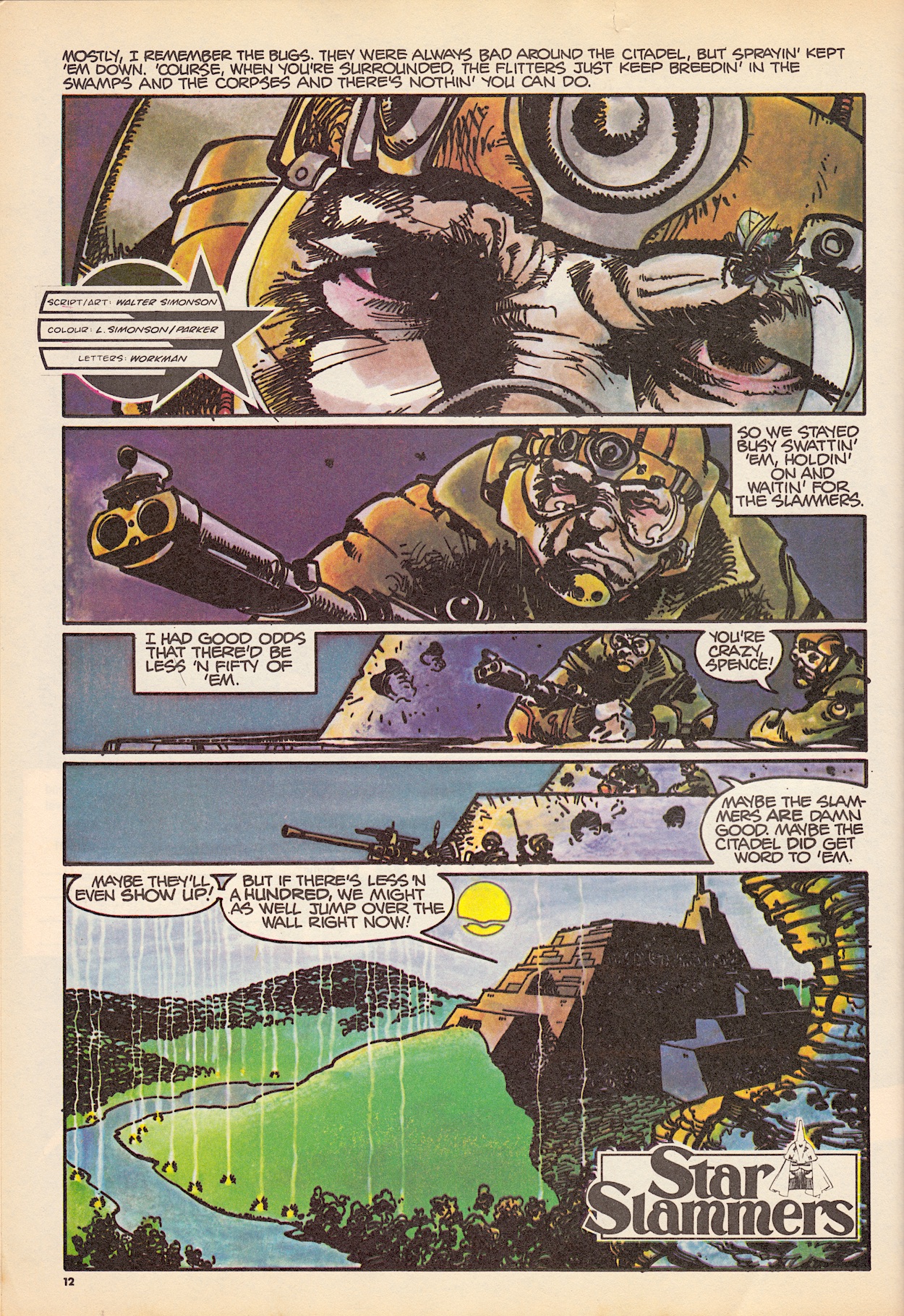
John Workman is the letterer here and among his many credits (for example Michael Moorcock’s Multiverse, Orion, Spider-Girl) he worked alongside Walter on the movie adaptation of Jurassic Park, which was published in the UK by Dark Horse International, split over the first five issues. His trademark style of breaking the panel lines which I enjoyed so much in those early Jurassic comics adds a bold, in-your-face style of lettering to Star Slammers, perfectly suiting the narrative.
Spence and Slinger are two tired soldiers looking out from the citadel they’re protecting, surrounded on all sides by campfires belonging to their enemy, the Skriks. They’ve called for help from the Star Slammers and hope more than a hundred turn up at least, although Spence thinks it’ll be less than fifty and that he and his comrades are doomed. Suddenly all hell breaks loose, there are explosions and gunfire everywhere and within minutes the enemy has been wiped out as far as the eye can see. Spence’s monologue returns just to confirm he was right, there were definitely less than fifty of them.
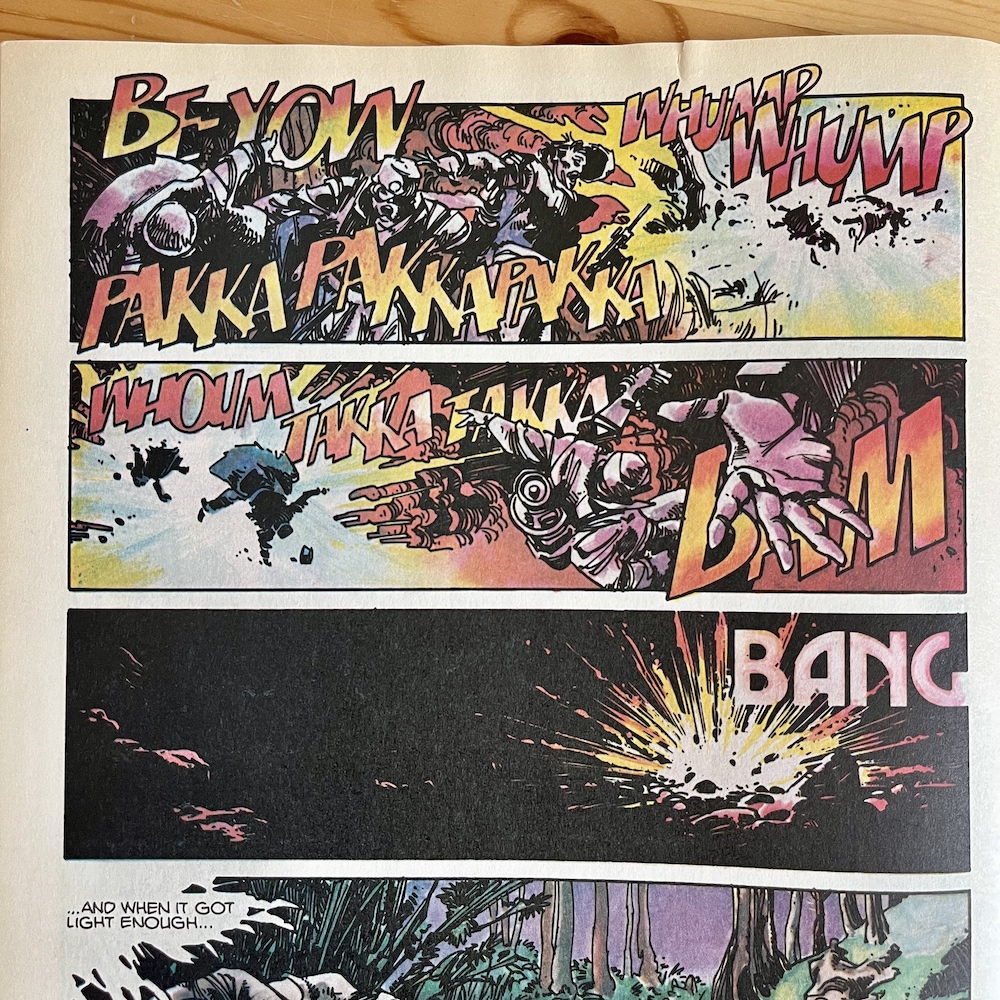
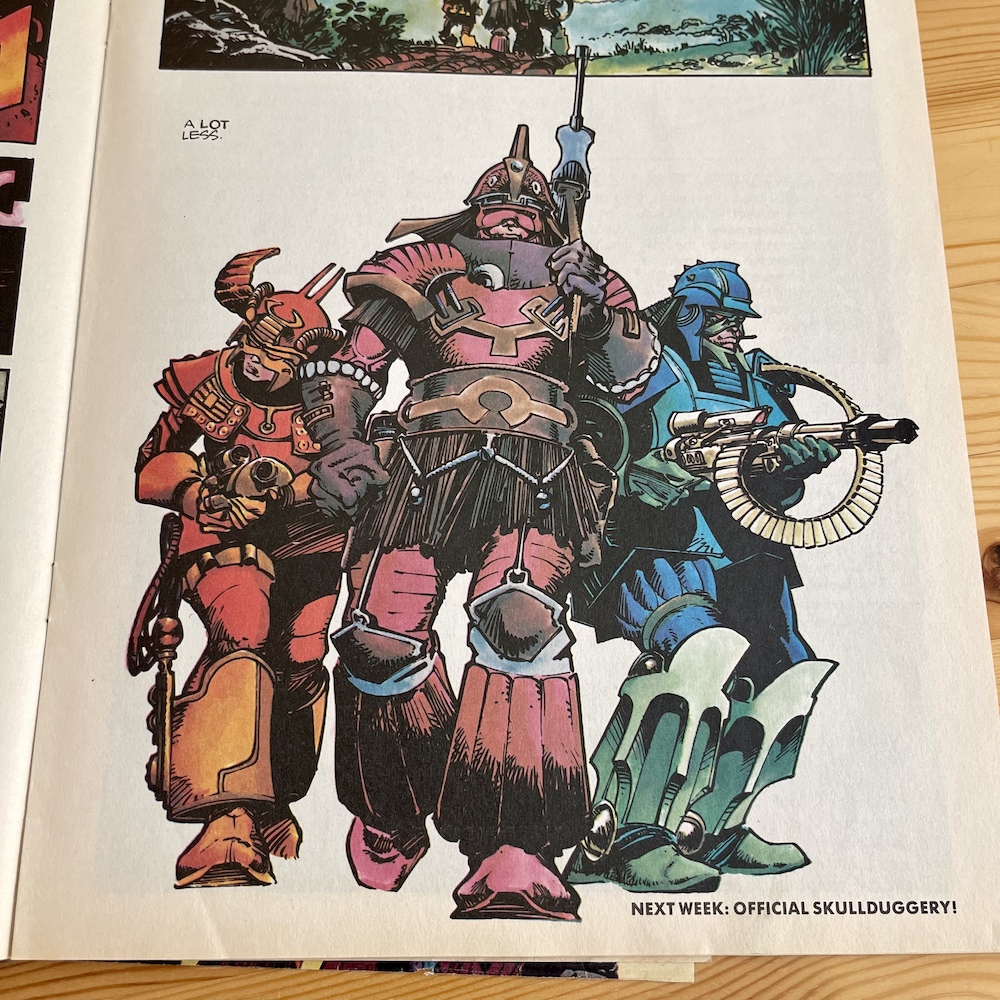
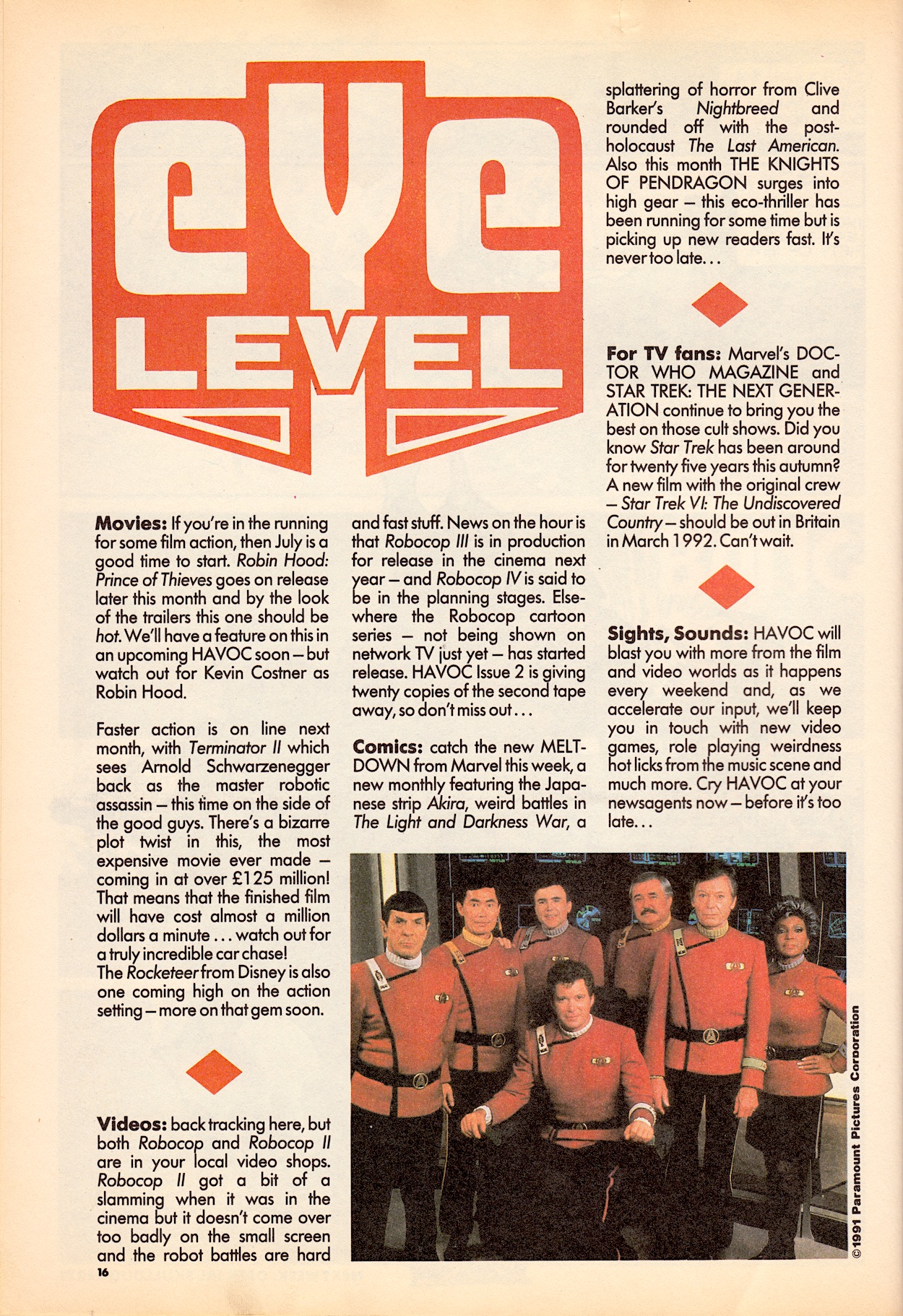
That’s it for part one. In the booklet their introduction is written as a warning from “the glorious planet Orion” but as yet there are no more details about characters or overall plot. As a kid I remember being underwhelmed but my attitude changed as the story continued and now as an adult I’m intrigued. On the next page comes something my adult self has been really looking forward to. I’m including it just for some fun and context about when the comic was released. It’s the first Eye Level.
This was the weekly news column with all the latest information from the world of television, movies, comics and videogames. This was around the time we had that TV show Movies, Games + Videos so this has taken me right back. Most notable for me here is the hype machine for Robin Hood: Prince of Thieves because I enjoyed it at the time but the years have not been kind to the ridiculous movie. I remember all the buzz about how expensive Terminator 2: Judgement Day was for the time and it’s nice to see a film I’ve just recently rediscovered getting a quick mention, namely the excellent Rocketeer.
As well as the news above, the booklet had extra pages for RoboCop, so sure was everyone that this was a franchise to run and run. The second and third movies put an end to that. Personally, I much preferred the TV series. The original writers were creative consultants and it was more in line with what they’d written for the film (which ended up being known more for its over-the-top violence). Yes, TV series in the 90s couldn’t have the violence of today’s shows so Murphy captured criminals instead of killing them, but all the social commentary, politicking and character development was there and I loved it. It was big budget and a great character piece at its heart. (And that episode with his dad! Oh my, I’m welling up just thinking about that scene… anyway… ahem…)
The booklet is set up like a series of Wanted posters (except for RoboCop obviously) and our next antihero is described as “a so-called do-gooder” who they suspect is really just “a deep rooted psycho”. Originally created as a Western character before being renamed Phantom Rider, the first supernatural Ghost Rider was Johnny Blaze who you’ll know from the movies if not the comics. Havoc’s strip is the sequel to that run and stars new character Danny Ketch. It was written by Howard Mackie (Moon Knight, Mutant X, X-Factor), pencilled by Javier Saltares (X, Wolverine, The Prowler), inked by Mark Texeira (Hercules, Psi-Force, Megalith) and coloured by Deathlok’s Gregory Wright, although they’re all just listed next to “art”, such is the limited space in the credits. Completing the team is Michael Heisler (Arkham Asylum, writer on DV8, Union) on lettering.
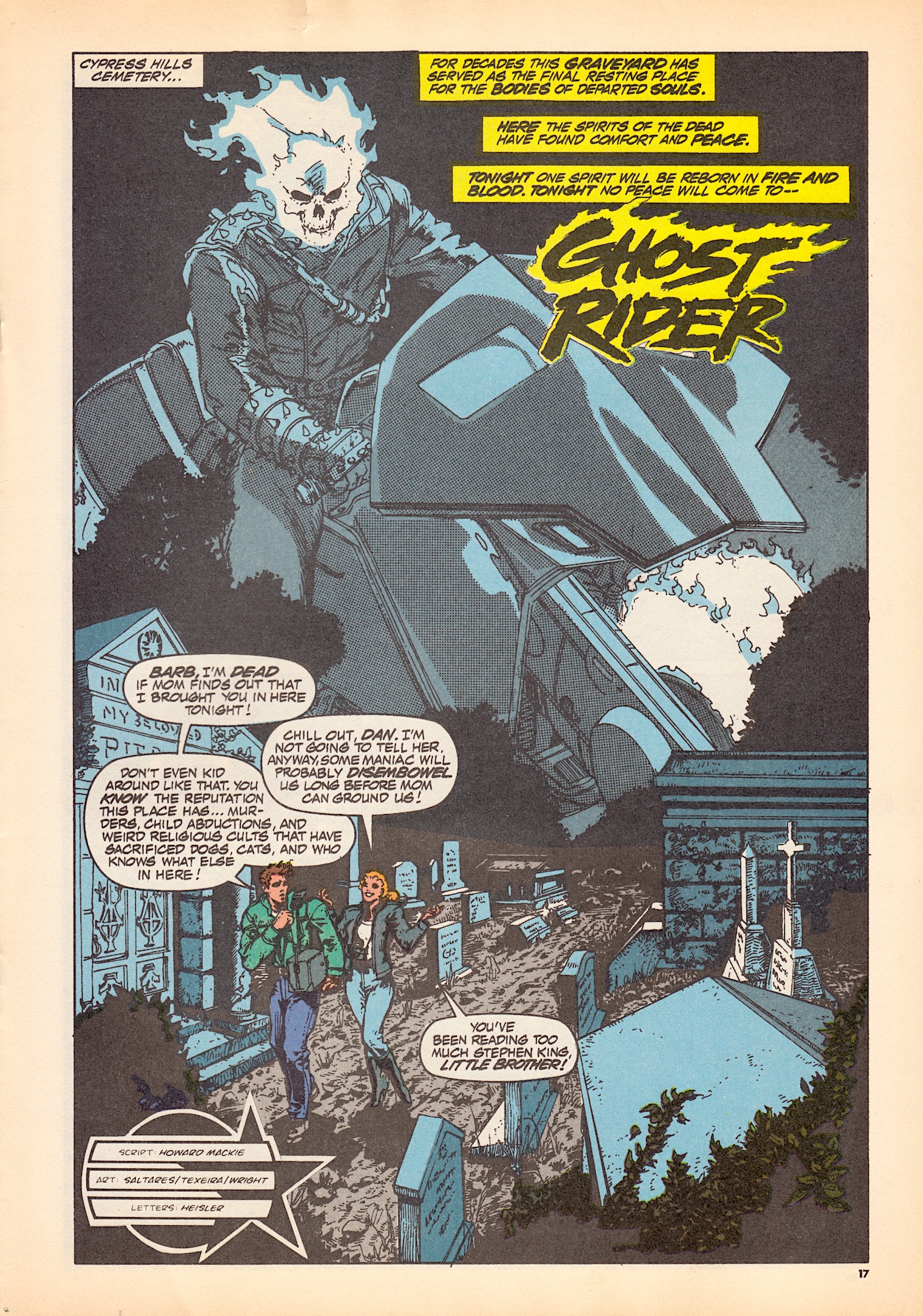
Apart from this ghostly illustration as part of the title there’s no inkling about what’s going to happen or how Danny becomes who he is destined to become, but I didn’t mind that at all. In fact, back in 1991, knowing I’d only have to wait seven days for the next part I liked the slow development and the suspense it brought. Of course, the original story wasn’t written in this way, it’s only because it’s being chopped up but we’re still getting a full story every month, just a little bit at a time, Transformers-style.
So Dan and his sister Barb are in the middle of a cemetery at Hallowe’en, visiting Houdini’s grave because Barb wants to take pictures of the rituals that take place there every year. They’re spooked by a group of prankster kids who are soon chased off by Barb, while Dan cowers from the initial fright. I like this, setting up the character who will become this flaming skull as a rather timid individual.
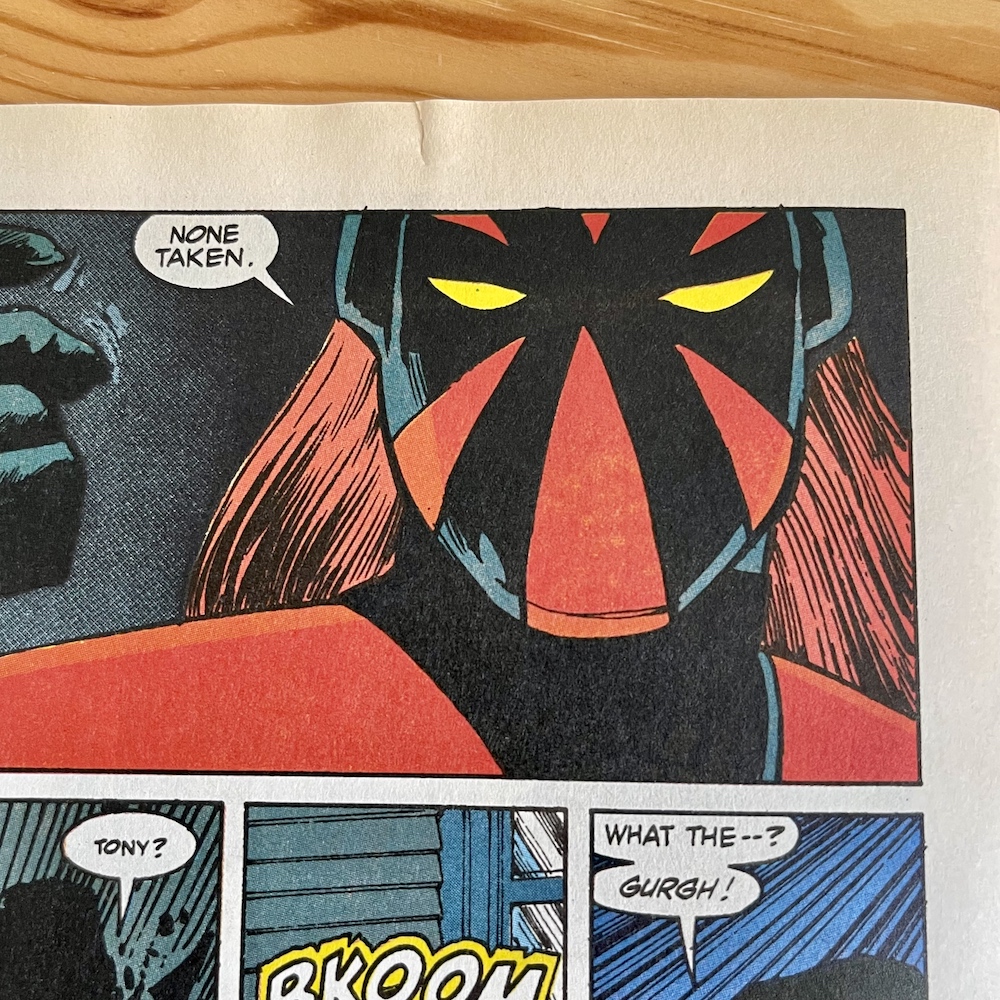
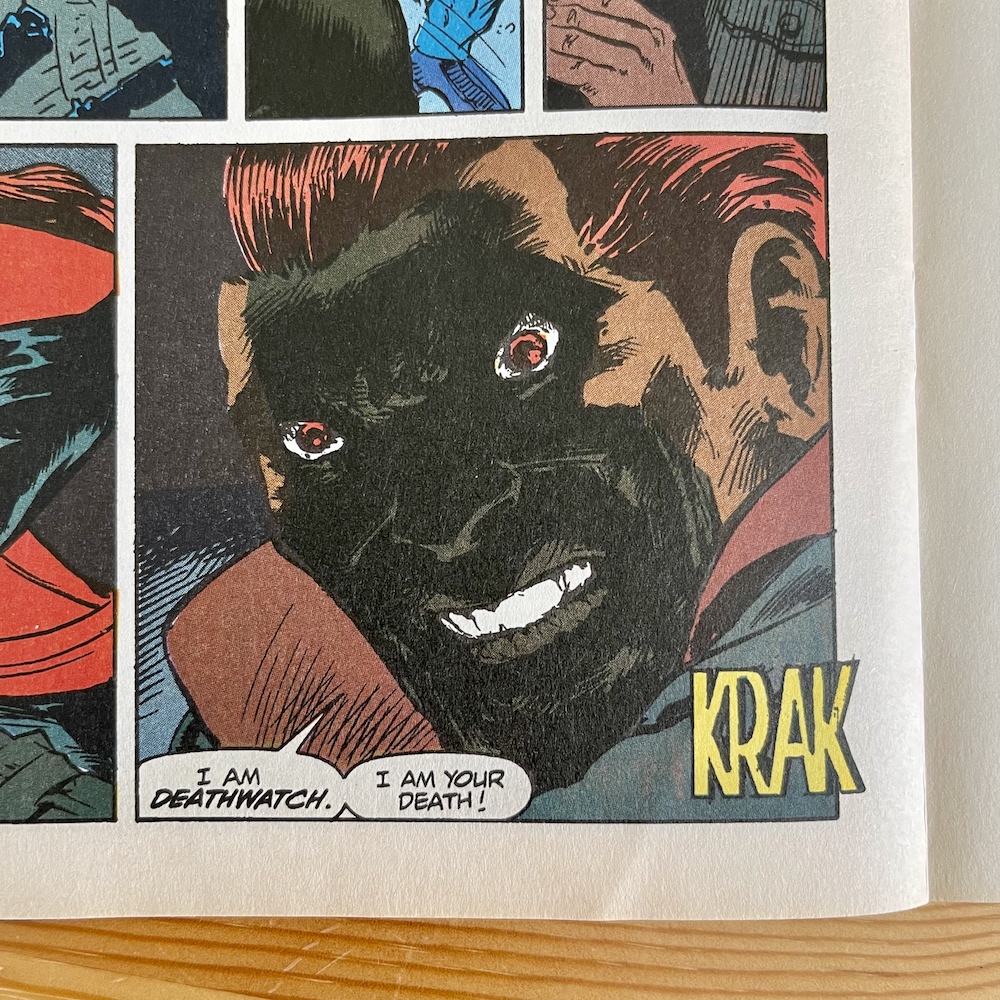
Hearing a gunshot Barb wants to investigate and they find new character Deathwatch facing off against some goons sent by classic Marvel character Kingpin. Deathwatch has shot one of their couriers and appears to be outnumbered when some shadowy figures shoot Kingpin’s men in the back with crossbows. Removing his mask, our new villain strangles the remaining gangster but the loud crack of his neck breaking is too much for Barb and she involuntarily lets out a scream, alerting the men to their location.
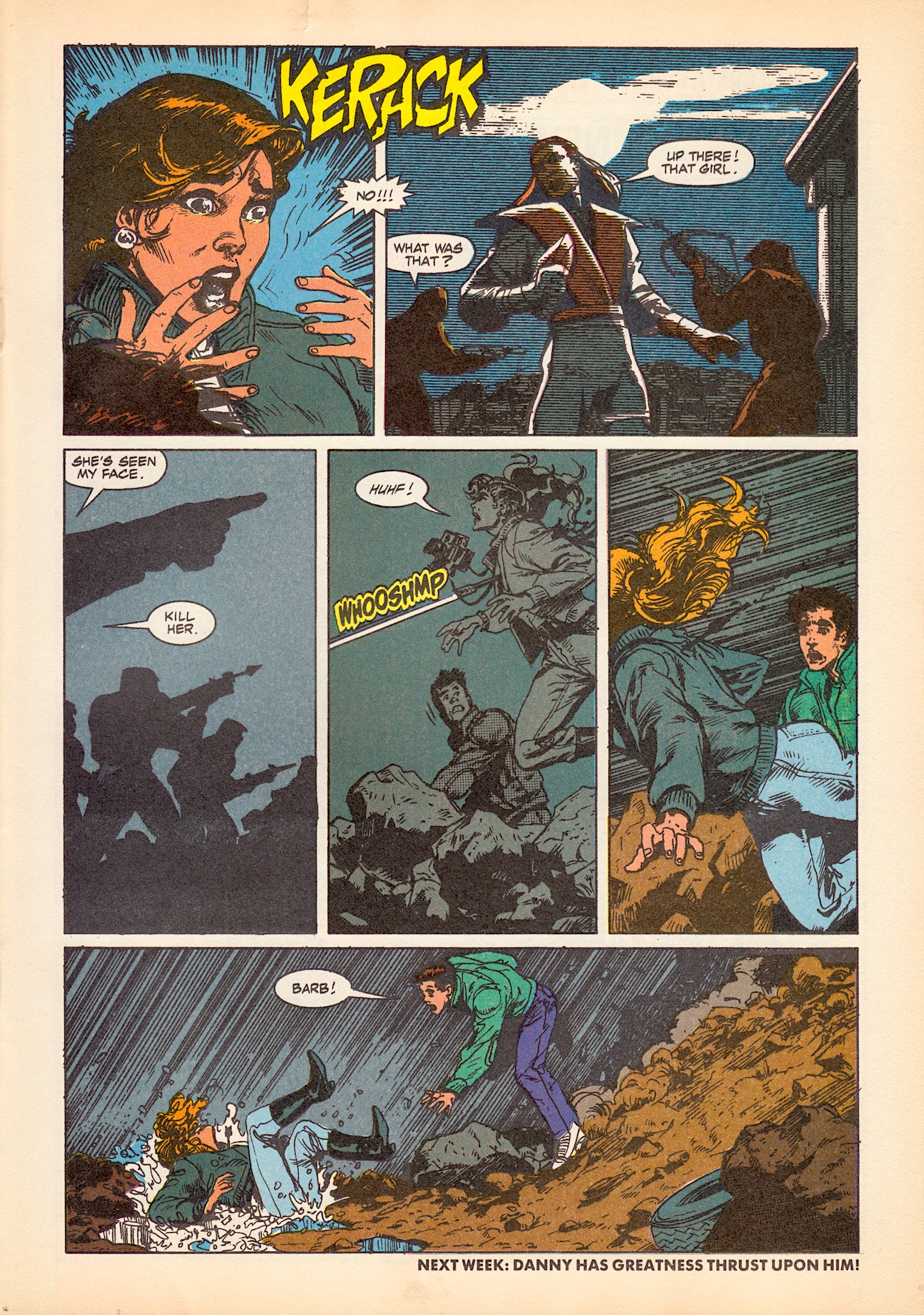
It was all very serious and violent for teenage me. It was like catnip! The tone was perfect, I already liked and cared for Dan and the ending was a shock. The Next Week caption at the bottom had me hyped and the strip was instantly a favourite. One piece of the puzzle at a time was being put into place and I couldn’t wait for more. I find that feeling returning now. After Havoc’s cancellation we just couldn’t get hold of the US comics at the time where I lived, and now 31 years later this is already making we want to check out the modern Ghost Rider comics. Havoc has got into my mind again.
“They stand face to face. Both are tall men — and built like tigers. But one of them is — Conan the Barbarian”
The Frost Giant’s Daughter, Robert E. Howard/Roy Thomas
Next up is Conan the Barbarian, only known to me at the time from the Arnold Schwarzenegger movies of the 80s which never really appealed to me. This turned out to be the most surprising strip in Havoc because I wasn’t expected much at all but really enjoyed it, so now it’s time to find out if I still do three decades later. The story is interesting but the real world background of it is fascinating. The original Frost Giant’s Daughter was written by Conan’s creator Robert E Howard in 1934 but was originally rejected by the magazine he submitted it to and so the character and settings were changed. It only eventually saw print as a Conan tale long after Howard’s death.
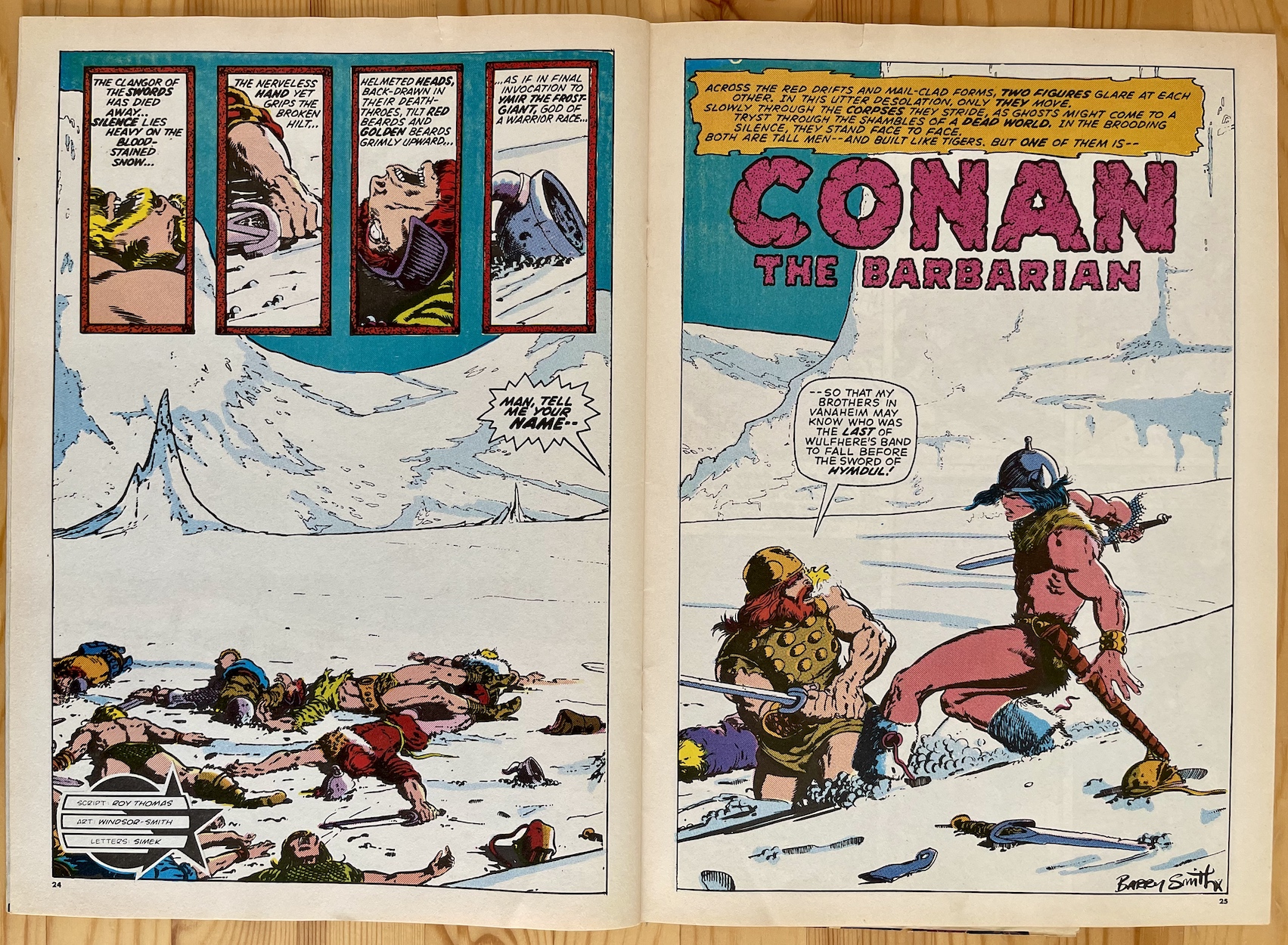
In comics, this adaptation is by far the oldest strip among those in Havoc. Published in Savage Tales in 1971, a censored version (mainly for nudity) was printed in Conan’s own comic the following year with a new opening. It’s that version we got in Havoc. Adapted by Roy Thomas (Arak Son of Thunder, Shazam!, The Dragonlance Saga) with art by Barry Windsor-Smith (Machine Man, Iron Man, Avengers) and lettered by Artie Simek (Fantastic Four, Showcase, Kid Colt), this gripped me instantly as a teenager with its action, setting, the blood and guts and the sexual undertones. It was like nothing I’d read before. I was captivated.
I had no idea this strip was older than the others and it doesn’t read as such either, the writing capturing the timeless rhythms of Howard’s originals. After a huge and bloody battle a young Conan collapses in the snow but as death creeps in he sees a beautiful woman, becoming instantly enamoured with her. Confused as to how she could be so scantily dressed out in the cold he assumes she must come from a village he didn’t know about, somewhere he could rest before his next battle. But there’s nowhere nearby, her identity is a mystery and her see-through clothing (censored here) entices Conan into the chase.
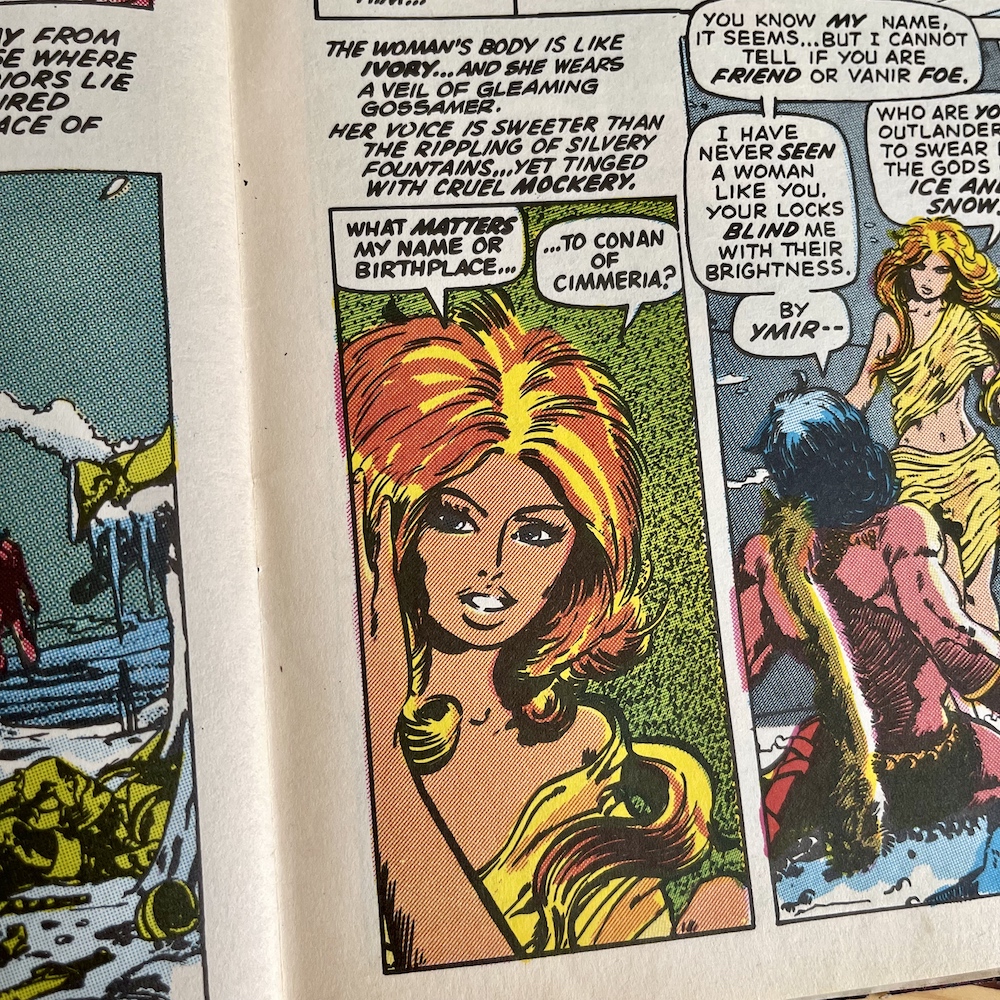
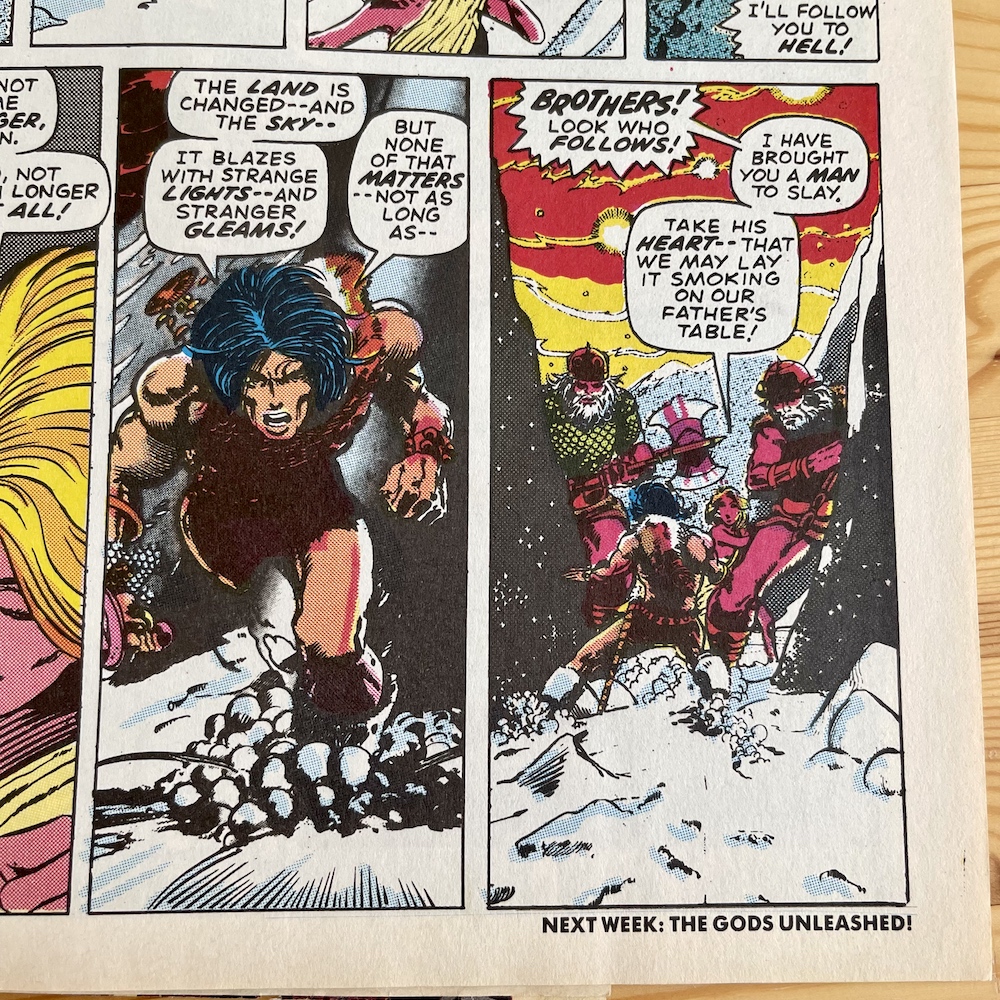
Her existence doesn’t make sense here in the snow covered mountains, so Conan’s pursuit changes from one of lust to a search for answers, fearing it’s some sort of vision or trick. I can’t remember the exact reason and I don’t want anyone to tell me if you know, I’ll find out in real time as always. At the end the fact it’s a trap is made very clear, but no other answers are forthcoming yet. I find myself remembering the sense of childhood wonder I had in reading this and I’m intrigued now to find out more about Conan himself, as well as the mystery at hand. A strong start.
The final strip was the one I was most looking forward to when I initially saw the lineup as a teen. Deathlok looked awesome but I already knew Alex Murphy aka RoboCop and it felt exciting to see him in comic form. What a shame then that this first chunk of Kombat Zone is probably the weakest of this first issue. I put this down to the fact I’ve seen so much more of RoboCop since then and in particular the characterisation in the TV series. Here he comes across as rather two-dimensional and his speech patterns read very strangely, rather clichéd compared to the first film or the show.
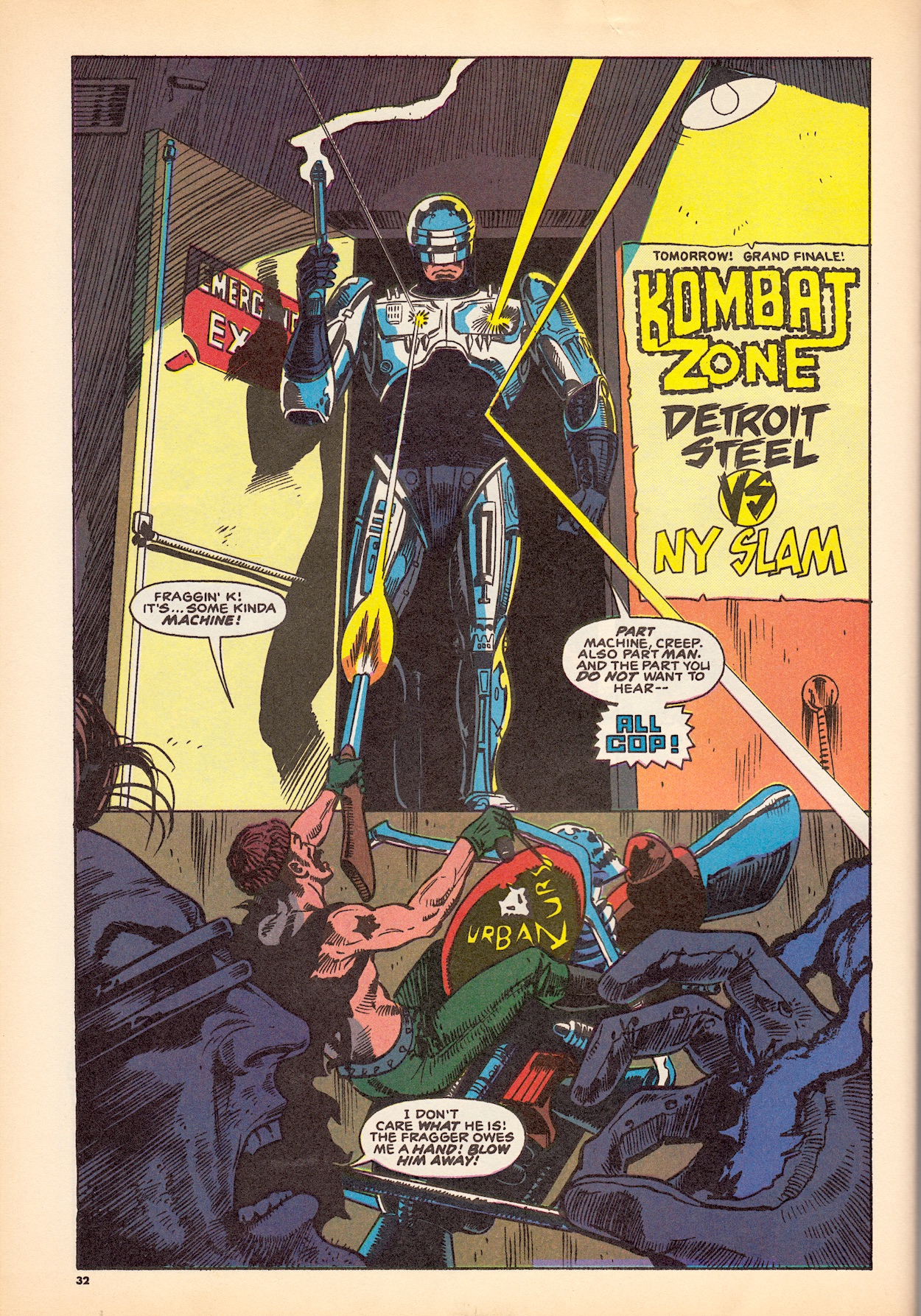
But hey, it’s only the first five pages! I’m not going to get ahead of myself. I’ll see how it develops. Robo intercepts a hover-bike gang as they seemingly take down an innocent stroller in Old Detroit. But in the background someone is filming the confrontation with RoboCop and when the victim makes a plea to pay off his assailants one of the bikers makes a passing comment about already being paid. There’s more to this random attack than meets the eye.
Murphy may not have heard this or seen the man with the camcorder but the way the bikers attacked is enough for the detective to have his doubts. But our mysterious stranger throws in a “smart-gun” (which was rather forward thinking for an early 90s comic) which kills the ‘victim’ Alex had saved and the last of the bikers before he can give anything away. It’s all over very quickly and after some of the more substantial reads it’s a bit of a disappointment when this is the big licenced strip.
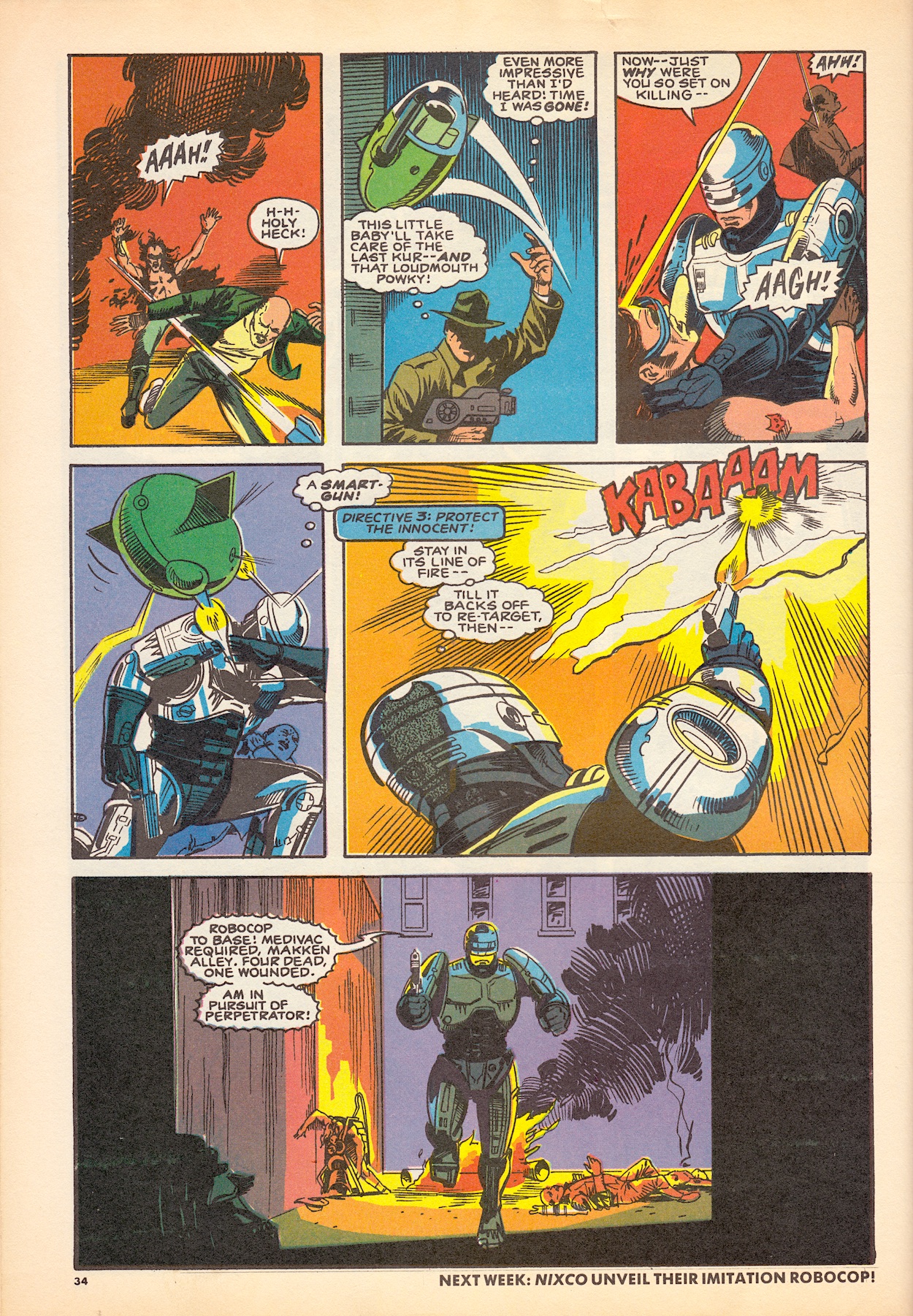
Of course, none of the ongoing stories in this issue were ever designed to be broken down like this, so overall the comic has done a wonderful job of selecting the right characters, stories and ending points to give us a flavour of Havoc’s future. So I can forgive the feeling of two of the strips being all too brief this time out, we’ve been spoiled by the package as a whole.
What a shame the great team assembled for RoboCop aren’t given any credit because the Deathlok ones are mistakenly reprinted instead. RoboCop: Kombat Zone reads like a who’s who of comic legends in my eyes. It’s written by none other than Alan Grant (Judge Dredd and Batman, including the Judgement on Gotham crossover, Toxic!), pencilled by Lee Sullivan (Transformers, Doctor Who, Tekworld), inked by Kim DeMulder (Batman, Transformers, G.I.Joe), coloured by Steve White (Dragon’s Claws, Xenozoic Tales for Jurassic Park, Transformers)and lettered by Richard Starkings. What talent! After finding this out I’m all the more excited now for the rest of the story.
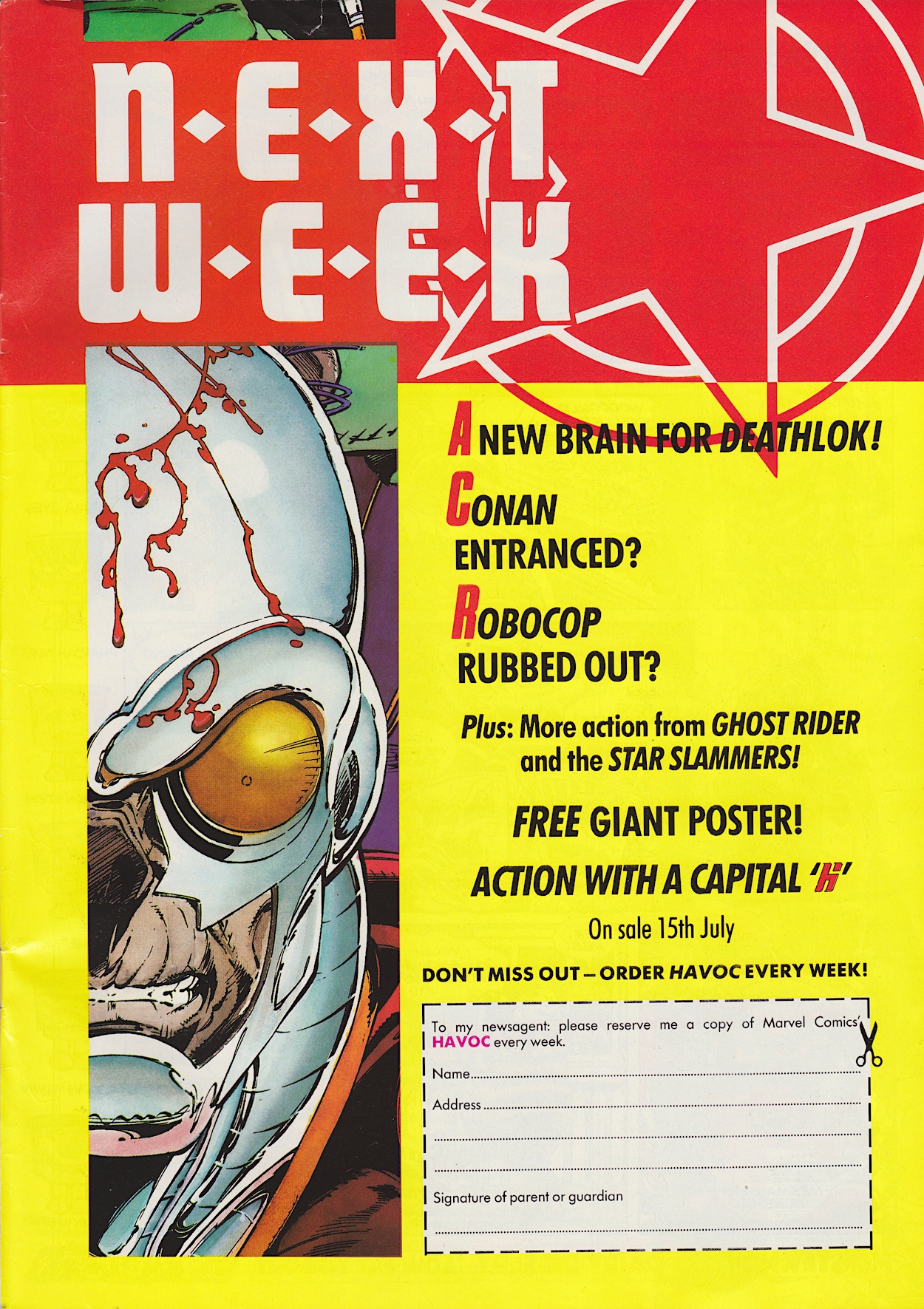
I’m just going to finish off now with a quick look at the other non-strip pages in this premiere issue, notably the Next Issue page and the retro adverts. You may notice the date for #2 is given as Monday 15th July 1991. Havoc was advertised as being on sale every Monday and a lot of other comics said so too but were released on the Saturday beforehand. The date on the cover of weekly/fortnightly Marvel UK comics was always the date the next issue would go on sale, kind of like an expiry date for each issue, the date the newsagent would remove it from the shelves.
Havoc has the date of the following Saturday on its cover but on the Next Issue page it’s two days later, the following Monday. I have very clear memories of picking this up every Saturday morning throughout the summer of 1991 and in later years when I worked in various newsagents in my teens and early 20s comics were never released on a Monday. (The only publications beyond newspapers that would ever arrive on a Monday were women’s weeklies.) So I’m not sure why the wrong date is given here, but it gets even more out of sync later in the run as you’ll see.
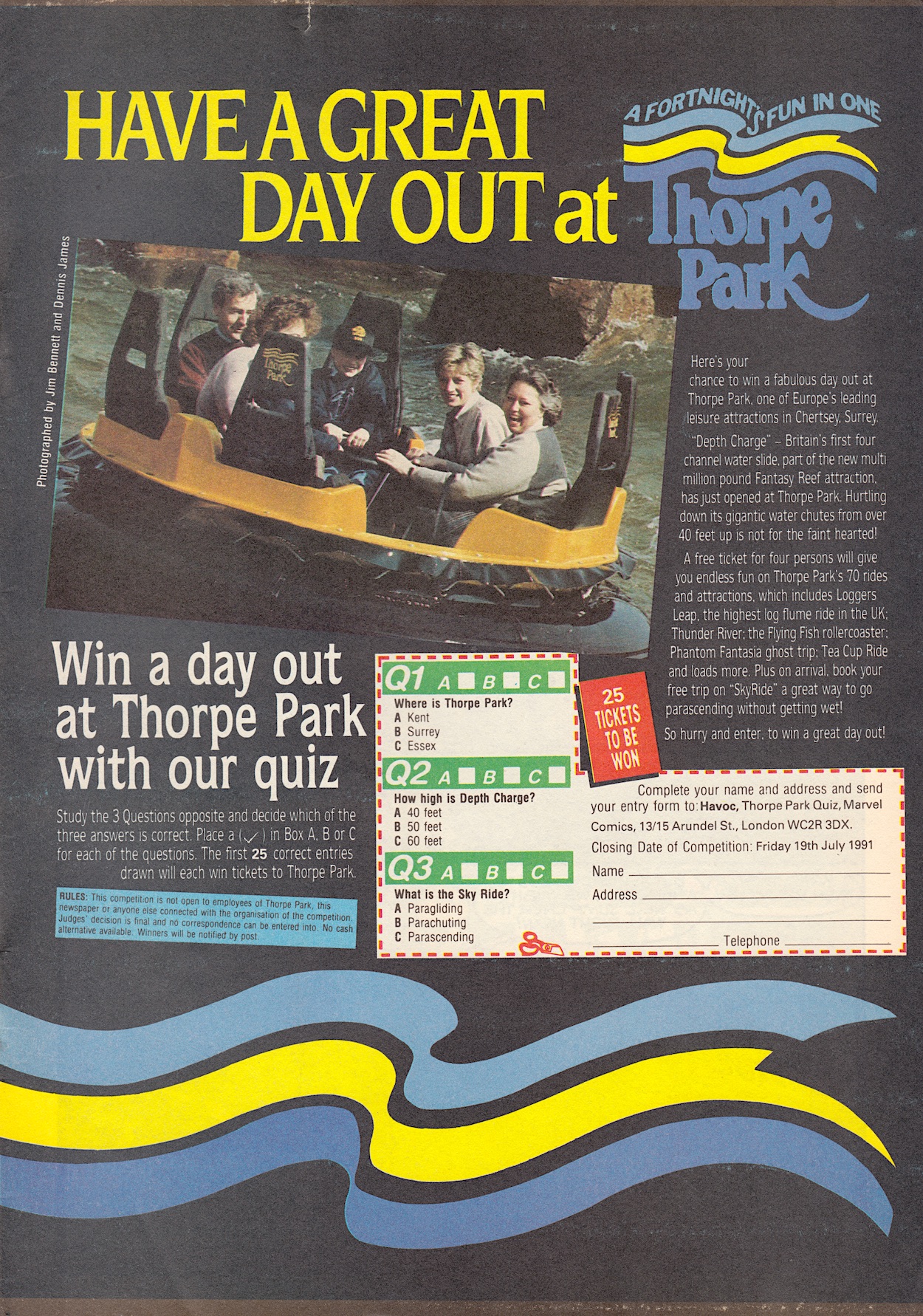
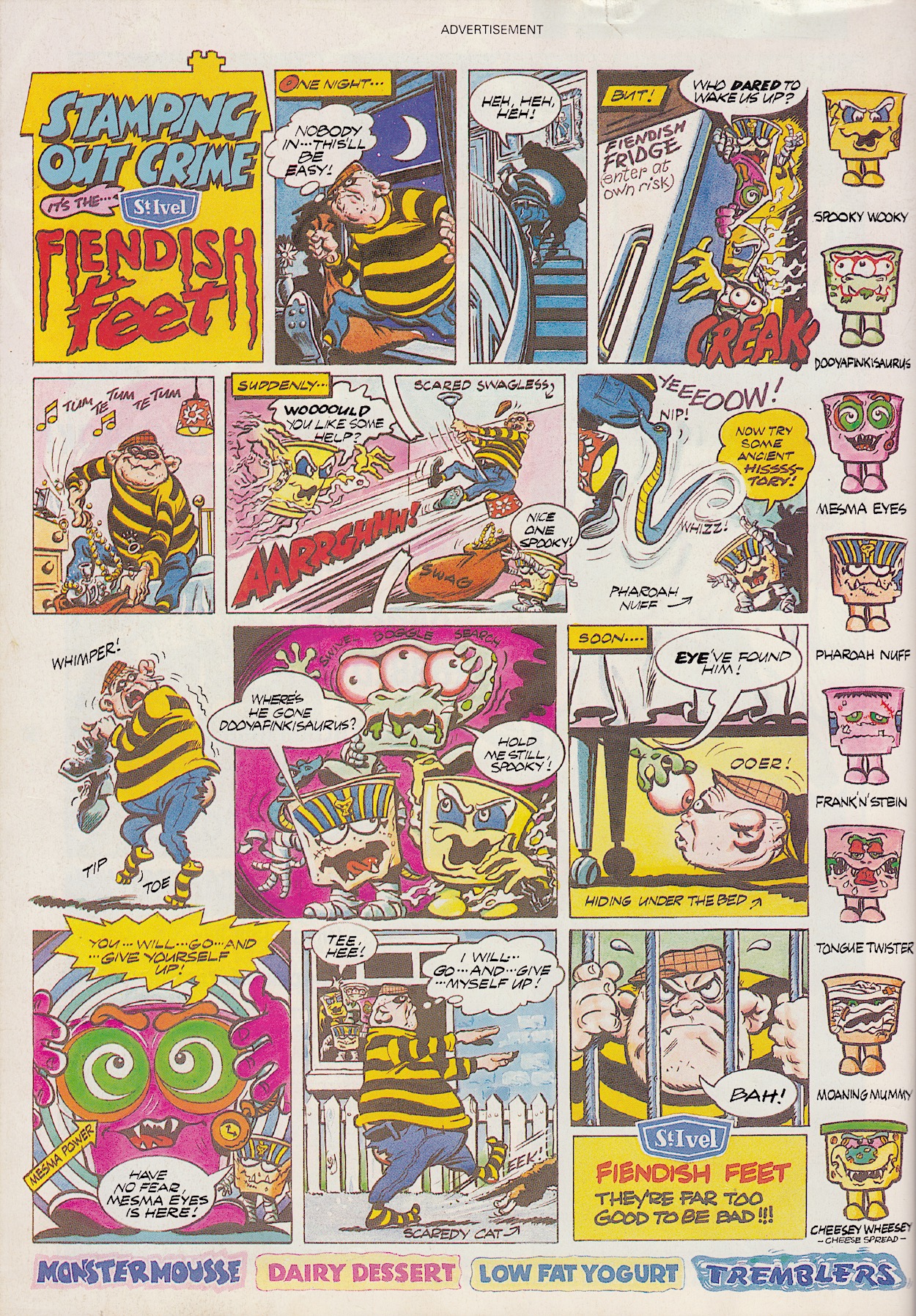
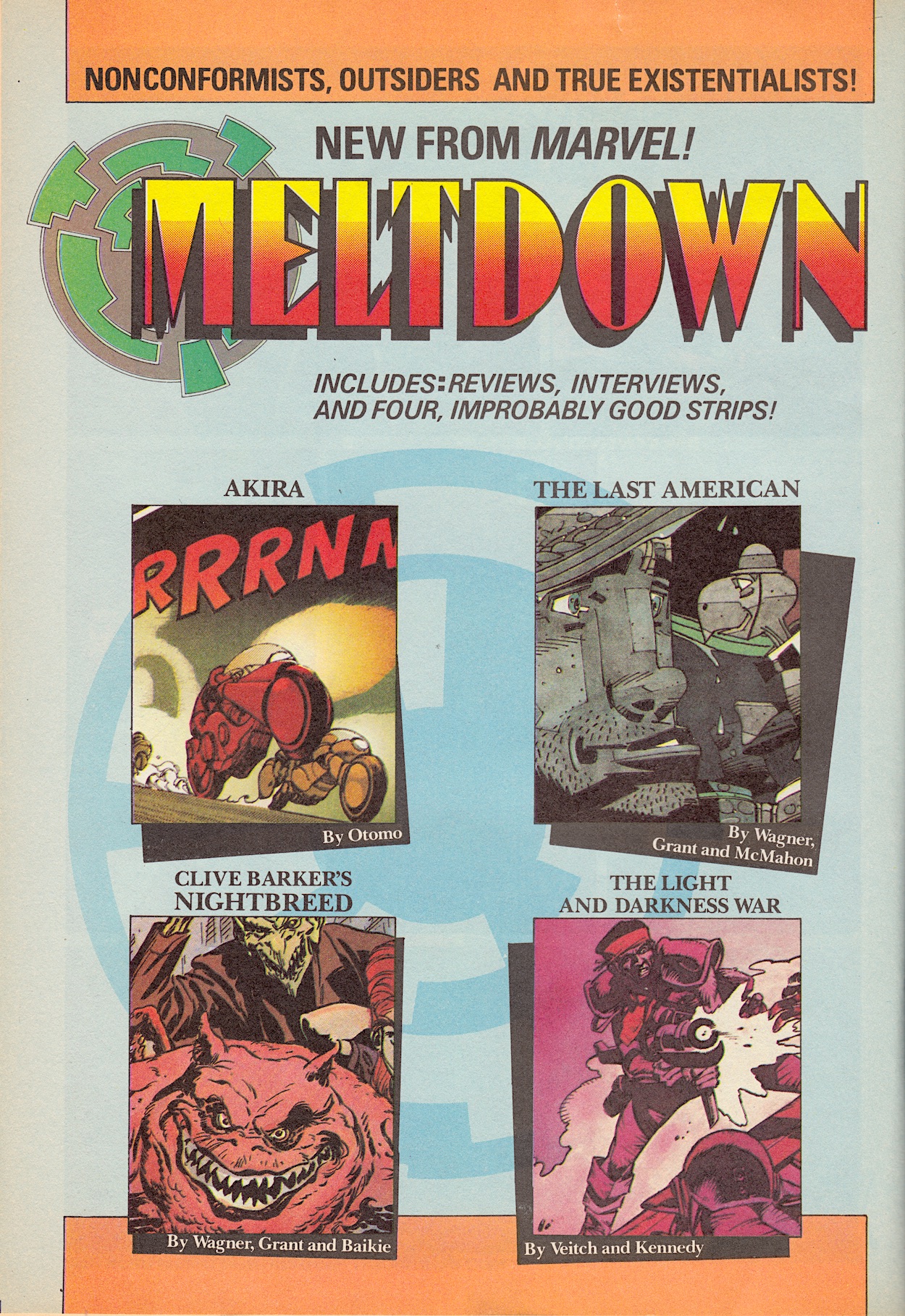
Elsewhere there’s an advertisement for Havoc’s sister title Meltdown both in the comic itself and on the back of the free booklet, there’s one for Thorpe Park dressed up as a competition and on the back cover of this mean, action-packed, mature read are the Fiendish Feet! Oh I loved those yoghurts as a kid.
This has been a rather long post, I know. But it was necessary to introduce Havoc, its strips, their main characters and all of their creative teams. It’s been a blast revisiting this issue and I’m so glad I haven’t got long to wait until I do it again for #2, albeit maybe with a slightly shorter blog post. The next issue of what should’ve been a very long-running comic will be here on the OiNK Blog from Wednesday 13th July 2022.



 OiNK Blog