So I’ll be honest, I can’t really describe this as a comic review, that would be rather cheeky of me. But then again, it was a bit of a cheat for Marvel UK to call this the Visionaries Spring Special too. Don’t get me wrong, when I spotted this on the shelf back in 1989 I was thrilled. I hadn’t known there was a monthly comic the previous year, having only become interested through the cartoon which aired here in the UK after the comic had already ended. I received the annual for Christmas and then in April their origin story (which I’d just read in the Annual) was reprinted as a back up strip in The Transformers, which I’d just started collecting a few months prior. It was after that I spotted this edition.
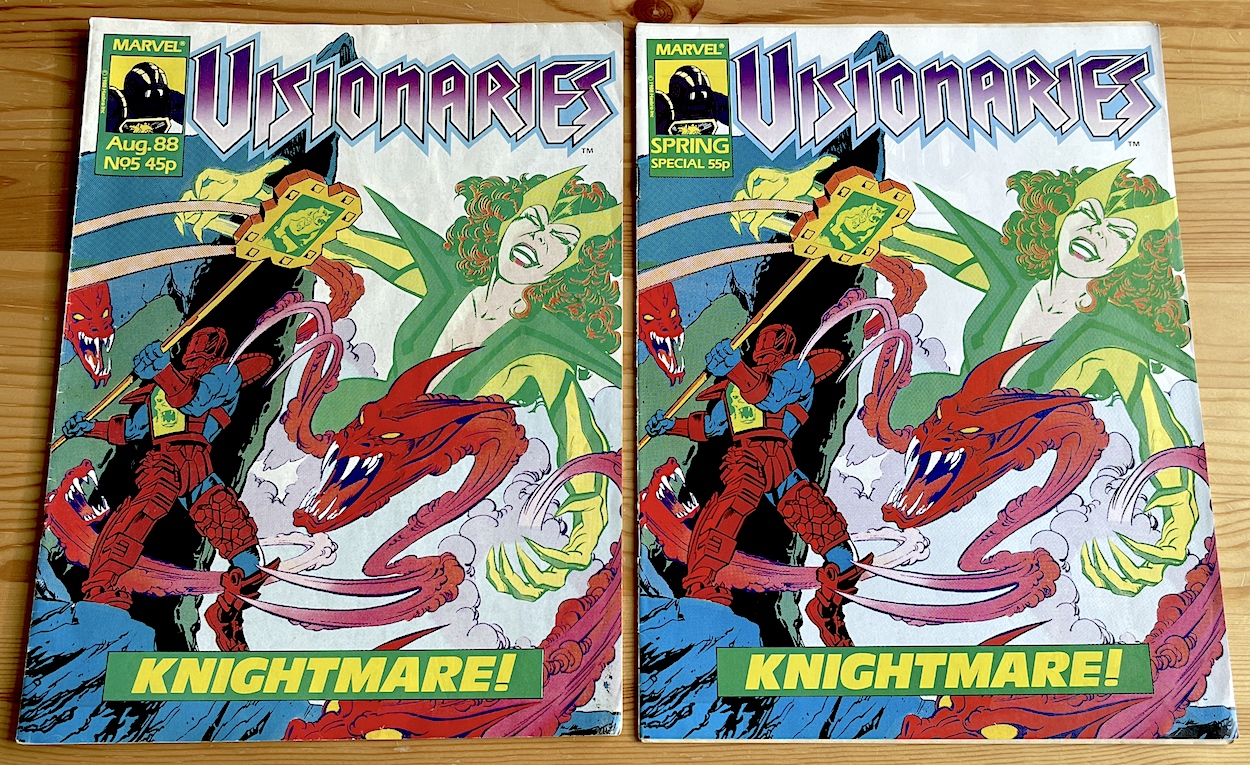
Through these I discovered there had been a regular comic, albeit a very short-lived one and I was sad I’d missed out on the further adventures of these characters. So this special was all new to me. A brand new strip featuring two of my very favourite characters from the cartoon, whose toys I owned and whose origin story I was now (very) familiar with. I was in comics heaven. But readers of the monthly may have felt somewhat shortchanged. Have a look at the ‘Special’ next to #5, the final edition of their comic.
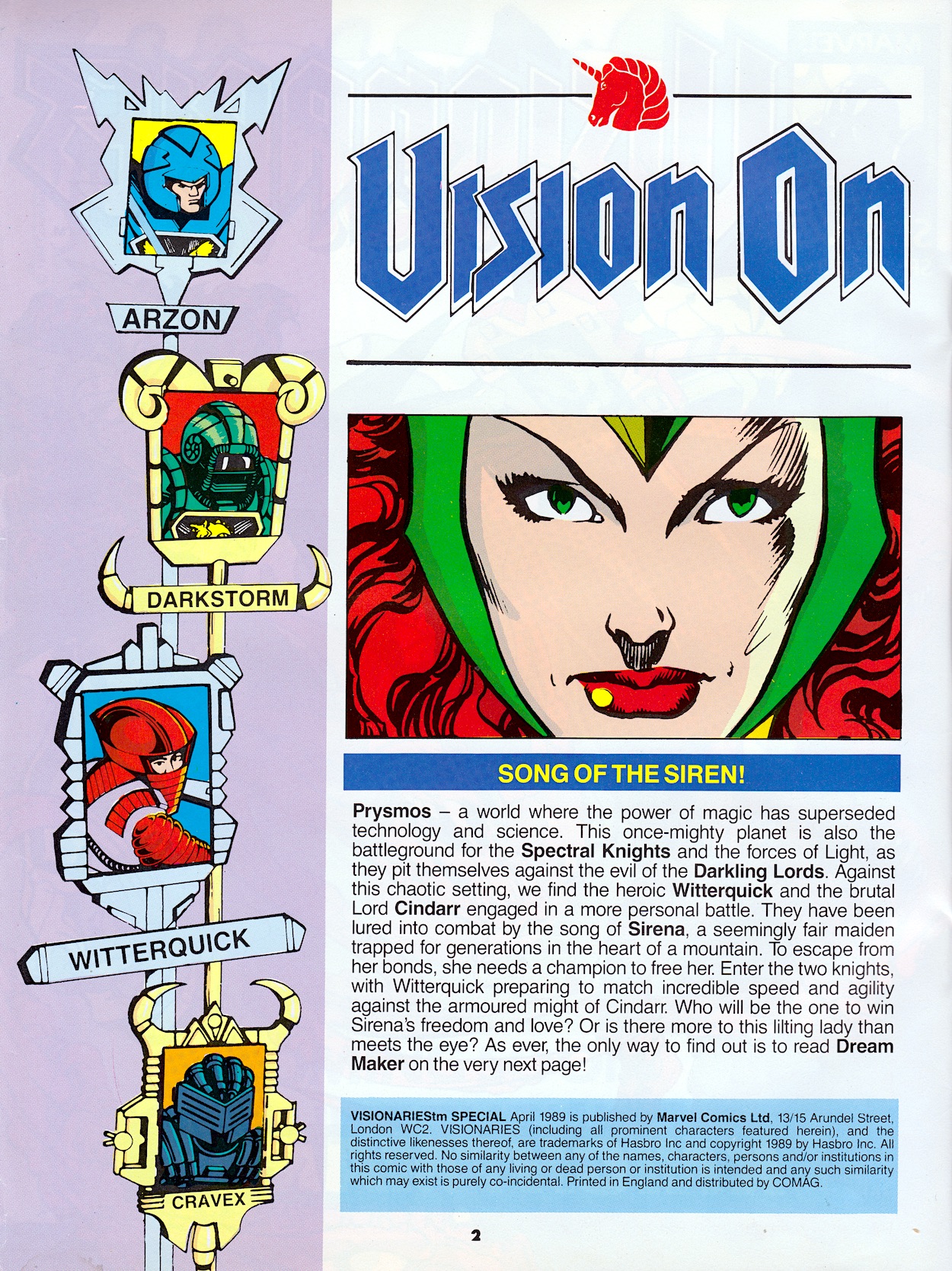
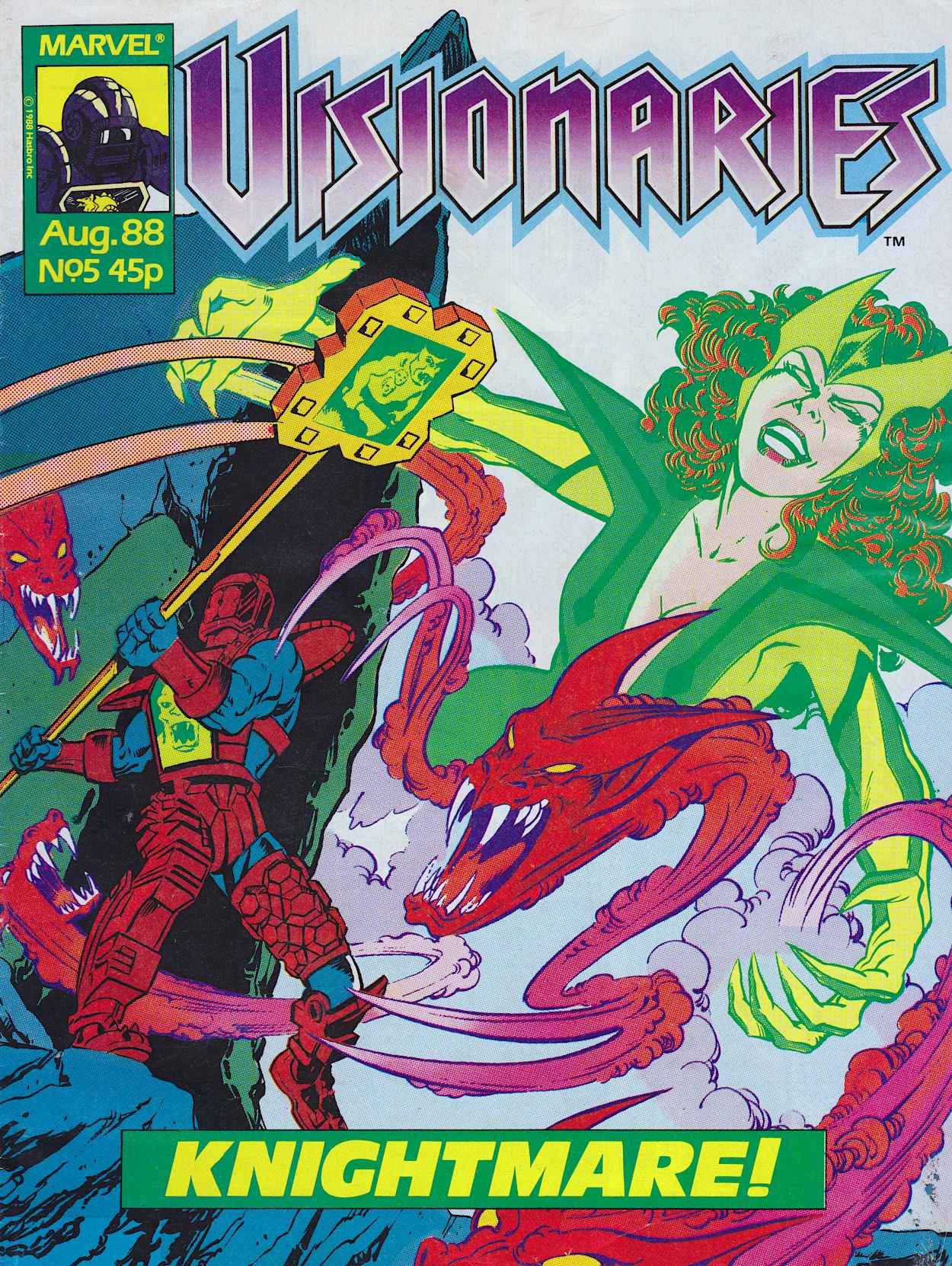
They look somewhat similar, don’t they? This continues inside. In fact, this is an exact copy of #5 bar only a few exceptions. Obviously the issue number has been changed on the cover (although the incorrectly coloured Darkstorm remains) and the editorial on page two has been rewritten, aimed now at more casual readers rather than those who had been following along. The layout and images originally created by the monthly’s editor Steve White remain the same, however.
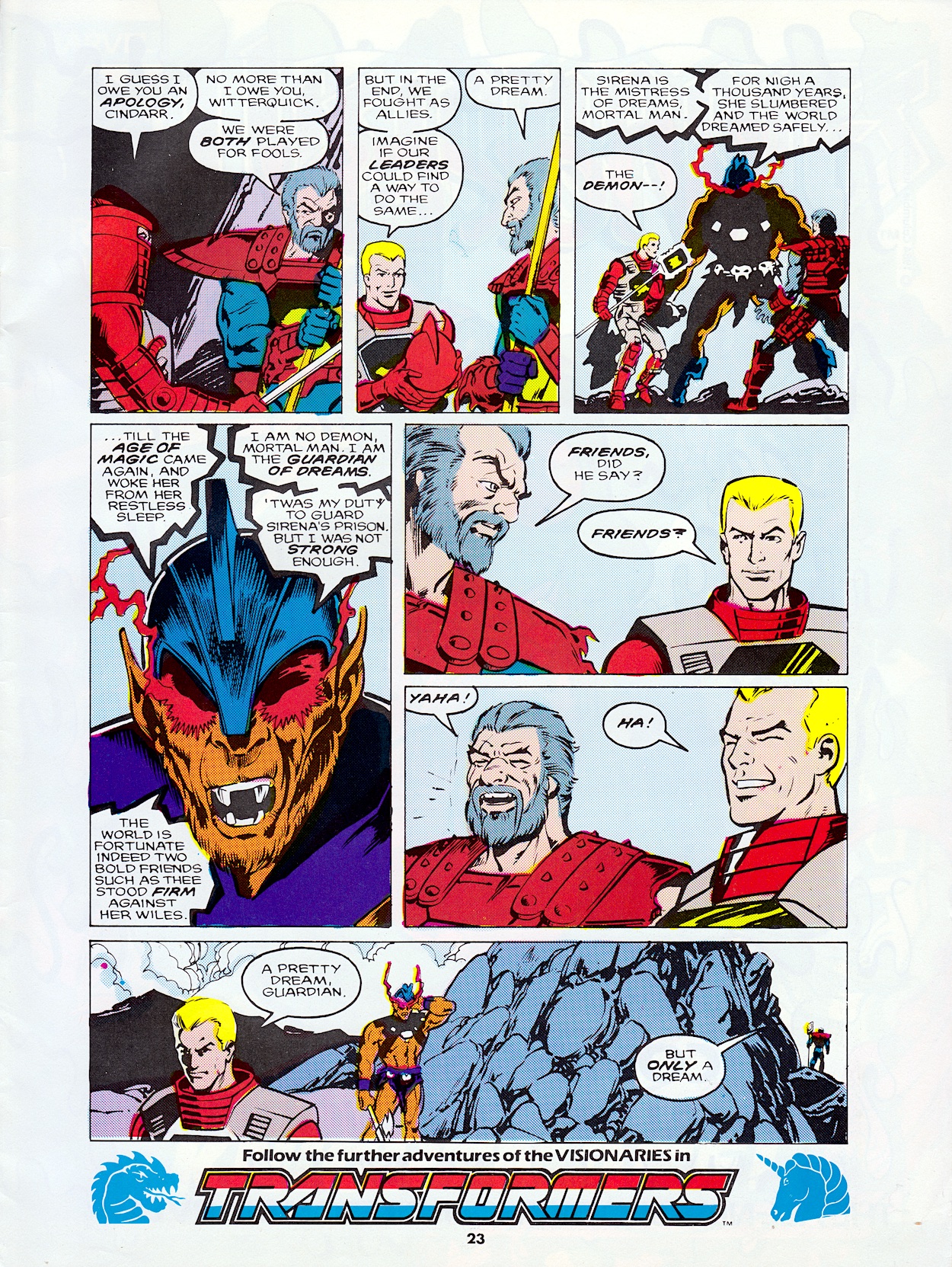
The strip, Dream Maker, is presented once again in its entirety and makes up the remainder of the comic’s interior. Written by Gerry Conway, with pencils by Mark Bagley, inks by Romeo Tanghai, letters by Janice Chiang and colours by Julianna Ferriter it’s a great strip, that much is true. Altogether there are 24 pages here with the exact same external gloss paper making up the outer eight pages and the regular Marvel UK stock for the rest. On the last page of the strip, page 23 of the comic, the final message has been edited to include the new logo for Transformers and the issue number and date of the original merge have been removed.
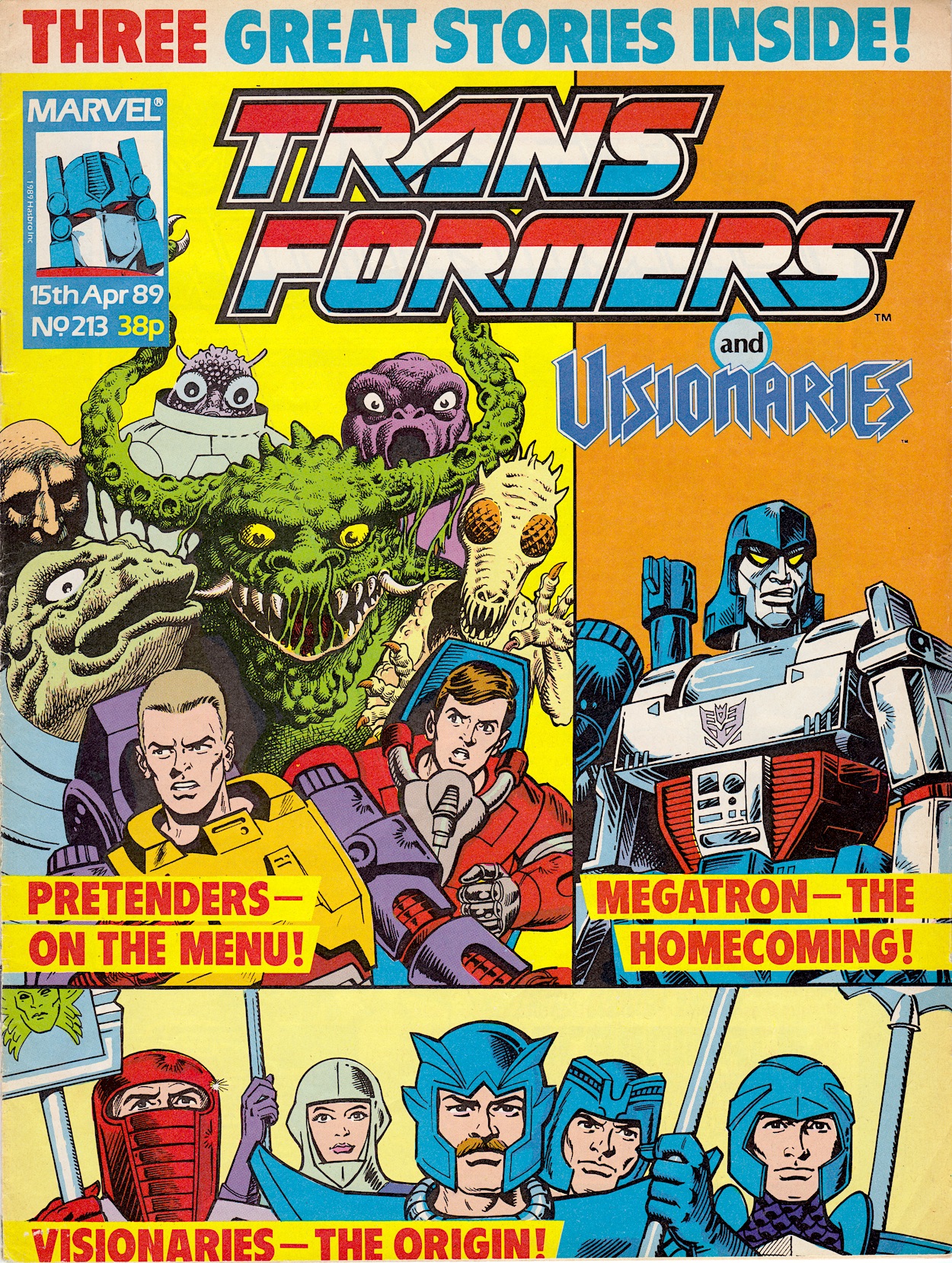
At this time Transformers was changing to a three-story format and to mark the first seven issues of the new look they were reprinting the first Visionaries story (this would mark the third time we saw it in one year). It kicked off with this lovely cover promoting the new look, including the return of the Knights, drawn by John Stokes.
The reason behind this was to let the G.I. Joe story get ahead and create a buffer between the monthly US publication and their weekly UK printings. So really, to say at the end of the Spring Special that fans could “Follow the further adventures of the Visionaries” wasn’t exactly true. Instead, anyone picking this up and then buying Transformers would be met with one reprinted story and then nothing after that, so no further adventures at all.
This is the first comic series on the blog to reach its conclusion
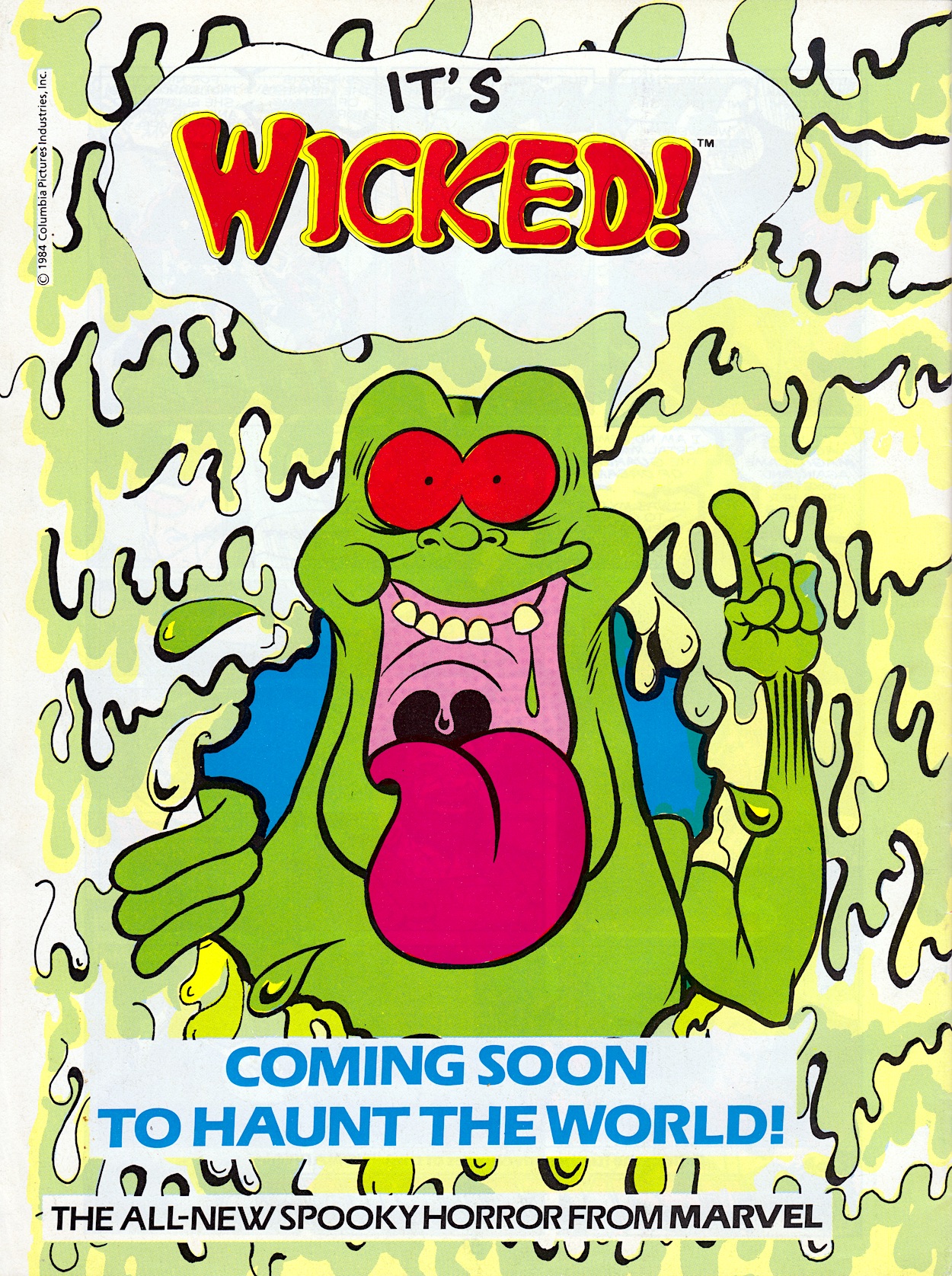
So, as I’m sure you can understand there’s no point whatsoever in me reviewing this story all over again when I did so in depth in July last year. It is a great story though and if you see this edition on eBay and want to dip your toes in I’d highly recommend it, although it appears to be a somewhat rare item and I was very lucky to spot it. I only bought it myself to complete the set. We do get a nice new advertisement on the back for something of an experiment by Marvel UK to launch their own humour comic in competition to Beano and The Dandy, which had something of a surprising mascot.
The Visionaries Spring Special comic brought me so much joy as a kid. It gave me a glimpse into the world of the Visionaries as presented in their comic form and I loved it. It was read several times and felt so mature, so grown up compared to the other toy-based comics I’d collected previously, something I’ve gone into throughout the series on the blog.
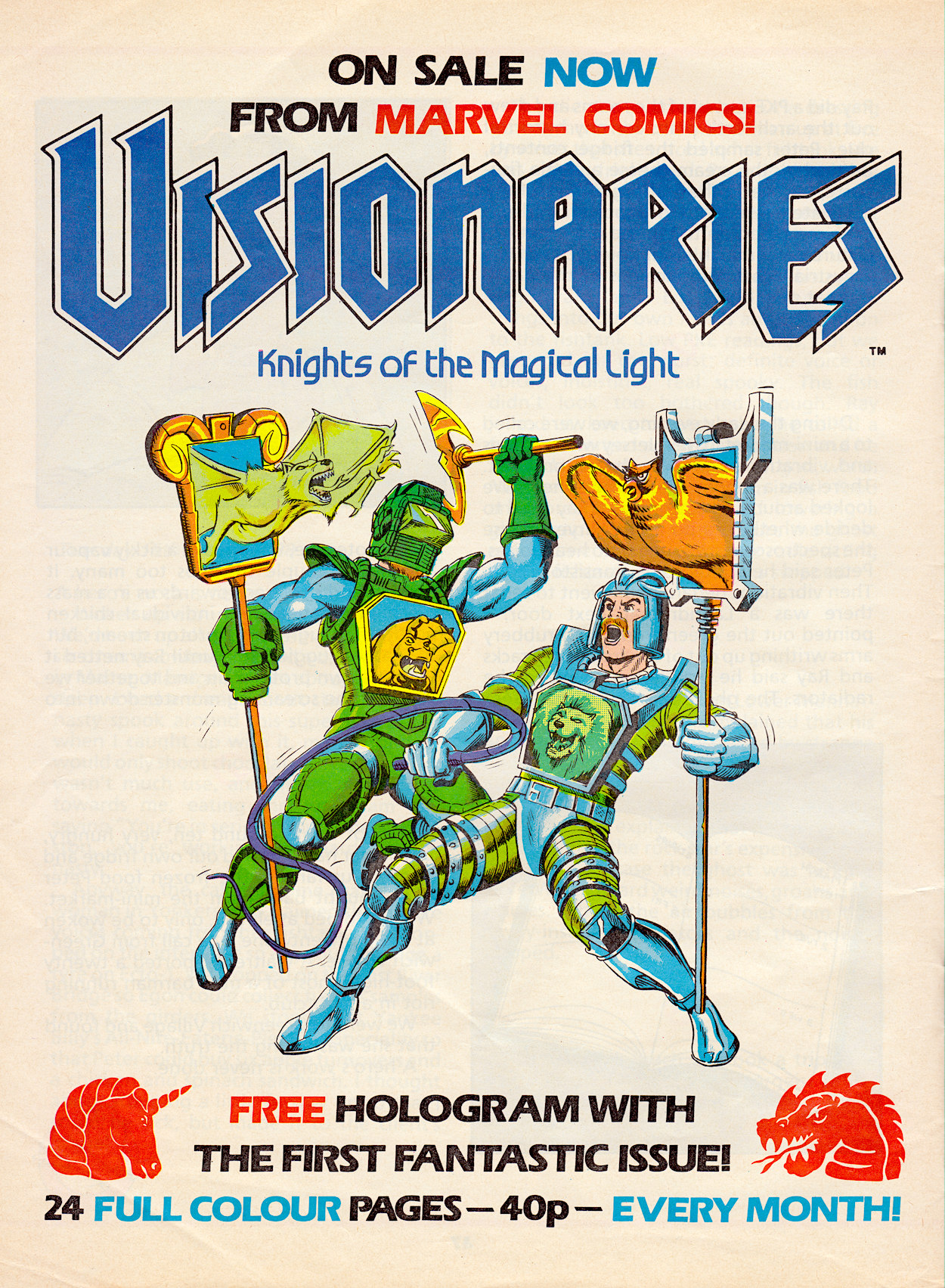
Nowadays though, as the final comic we’d ever get it’s clear this special was nothing more than a bit of marketing to get some additional readers to buy Transformers. Even the advert for it in the pages of other Marvel UK comics was exactly the same as that used one year previous (almost to the day) to promote the monthly, with only the issue details changed.
Left: The Real Ghostbusters #1 – 12th Mar ’88 Right: Transformers #211 – 25th Mar ’89
A curious addition to the series but it does complete my set. I’d already come to terms with the fact there’d be no more new stories after the annual but seeing this story again just reminds me of the potential the Visionaries had to become one of the very best licenced comics stories ever.
This is the first comic series on the blog to reach its conclusion so if this is the first you’re seeing the Knights of the Magical Light there are ten other posts just waiting to be read. I hope you enjoy reading them as much as I did writing them! As clichéd as that reads, it’s still true.
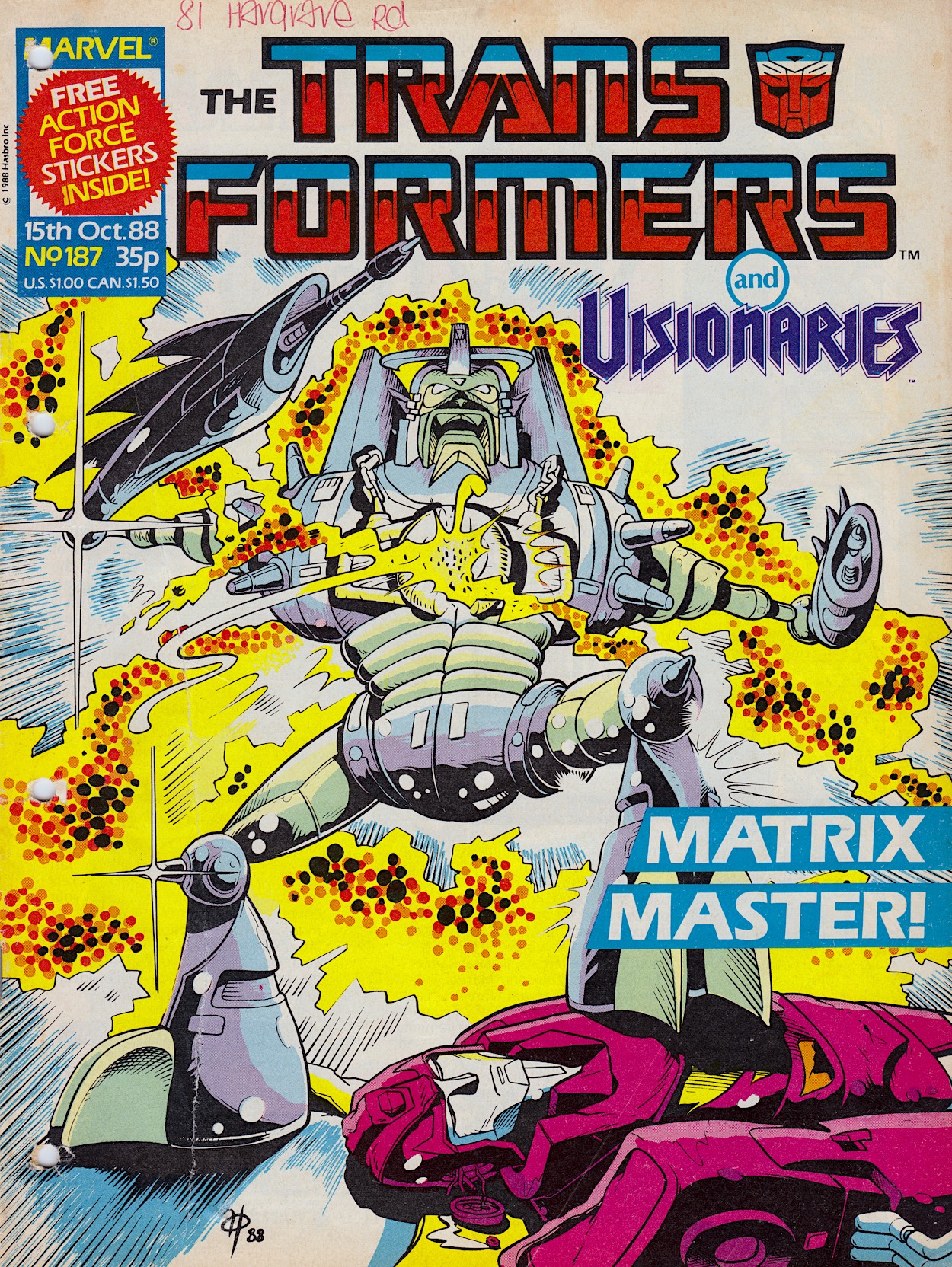
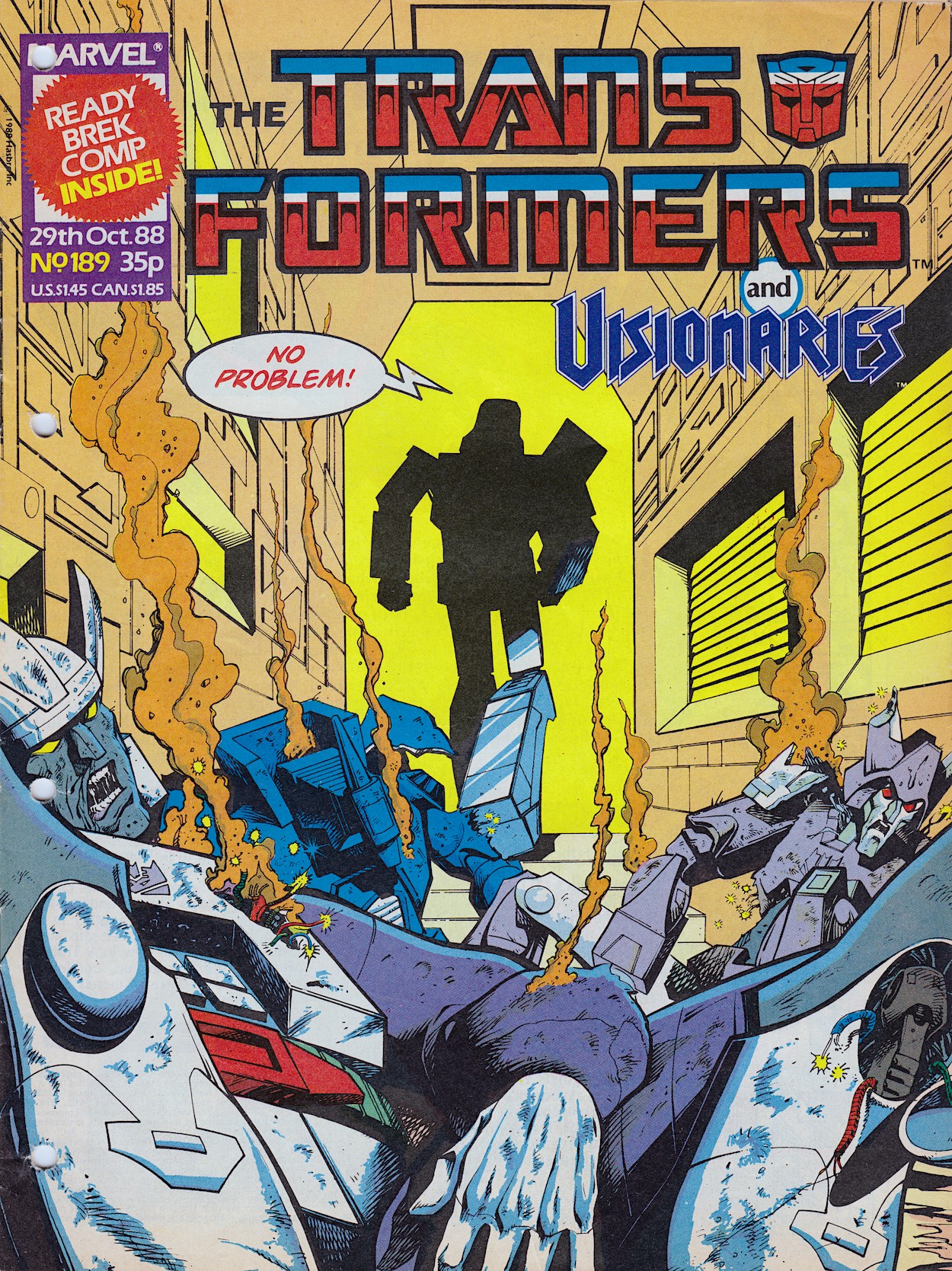
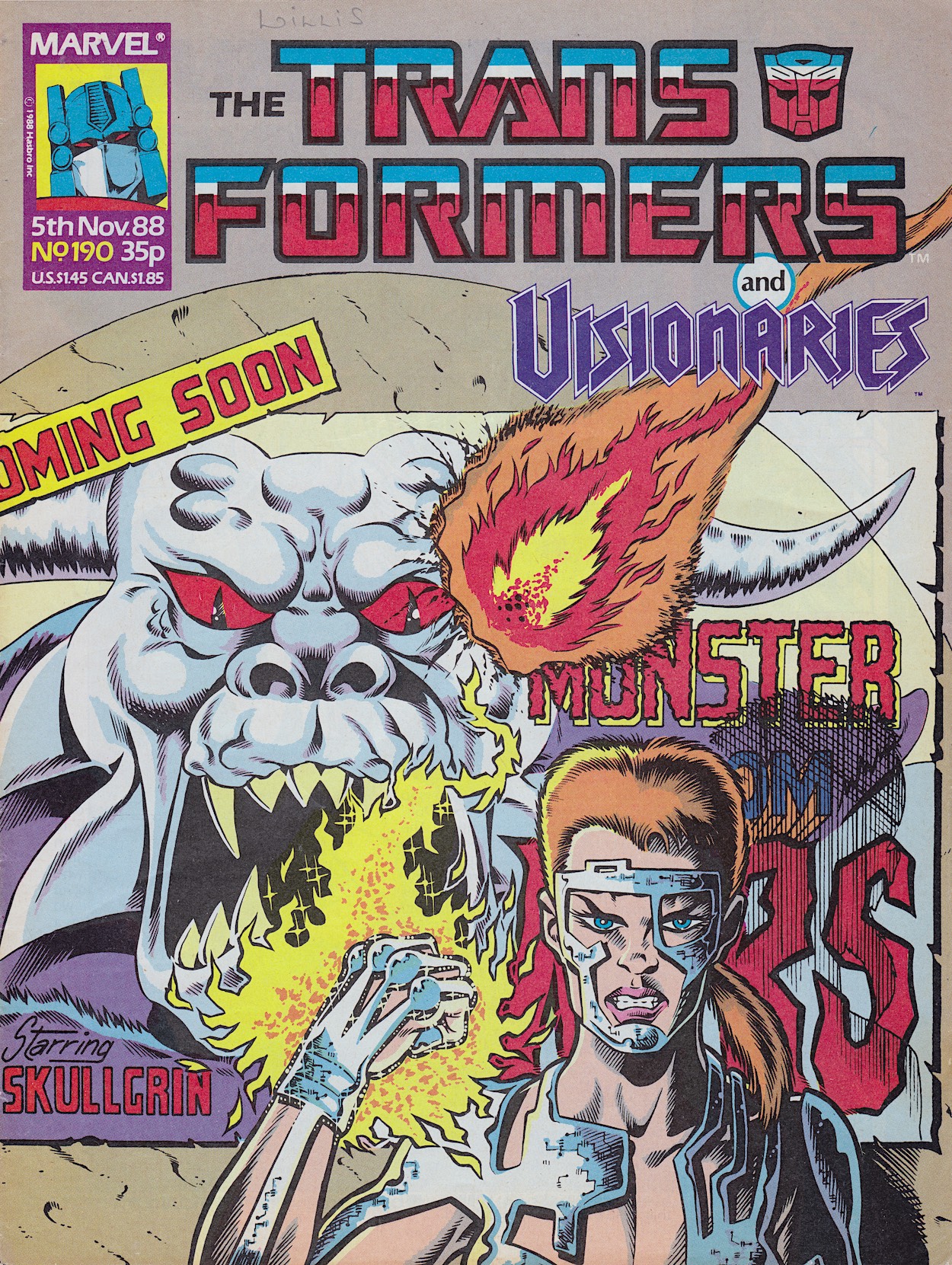
#187 cover by Andrew Wildman #188 & #189 covers by Jeff Anderson #190 cover by Stephen Baskerville
Is it possible to be excited and saddened at the same time? I felt like I was when I picked up these issues of Transformers and Visionaries. On the one hand it’s a new Visionaries story to read but on the other it’s the last strip. Not the last story mind you, but it is the last strip. (More on the actual last stories below.) Again it’s been split into four weekly chunks as the back up to Transformers, giving us smaller but more frequent trips to Prysmos.
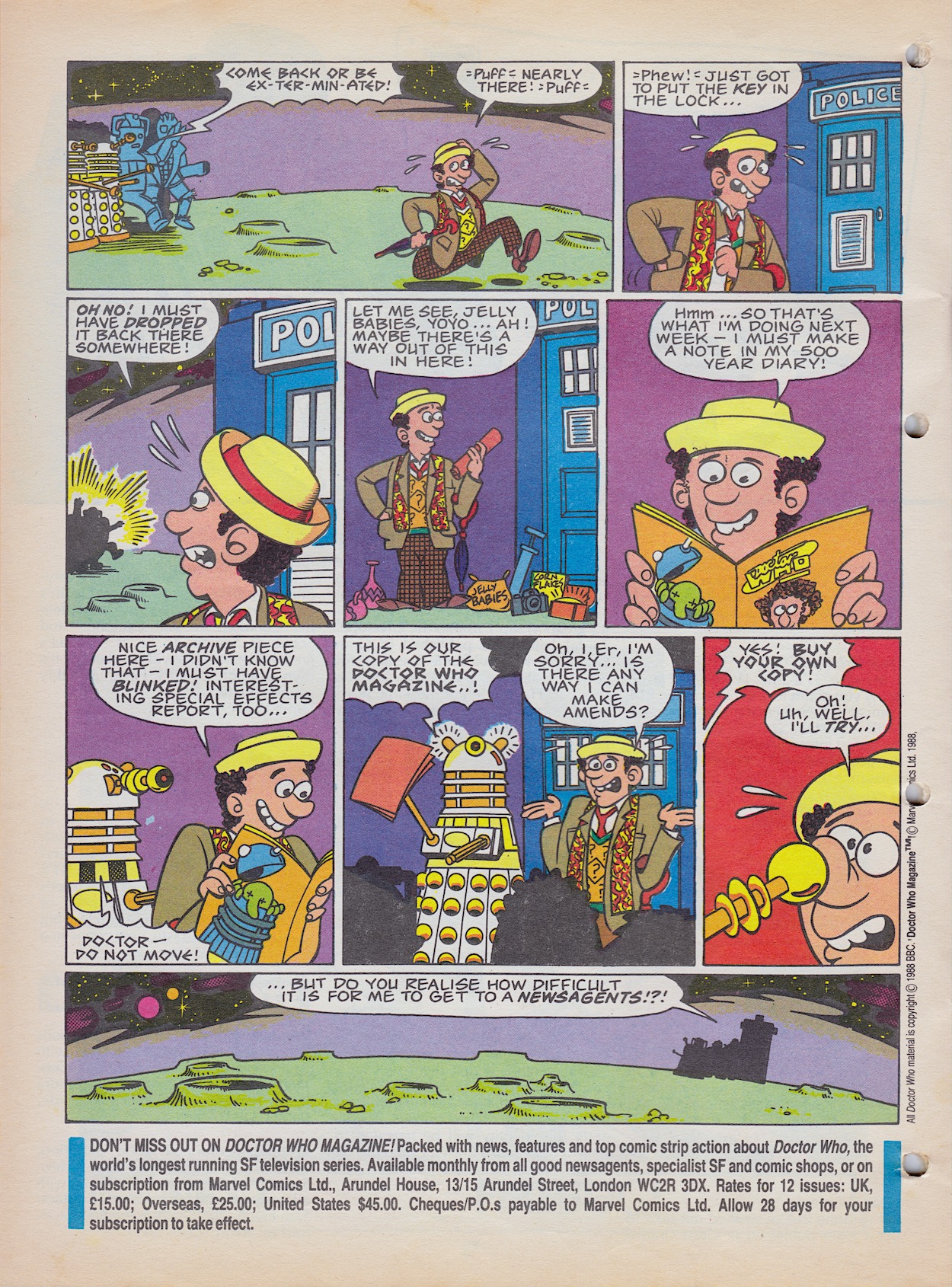
First up though, back when I was reading the monthly Visionaries comic I would include the Marvel UK adverts from each issue, each one a fun little trip down memory lane. Over the course of these four weeks the following titles popped up for a spot of promotion. Galaxy Rangers, as good as the cartoon was I seem to recall, was similar to Visionaries in that it didn’t last, with only nine fortnightly issues before it merged with Thundercats. Then the canned-laughter sitcom Alf had a special out and check out this excellent comic strip promo for Doctor Who Magazine, a publication that continues to this day.
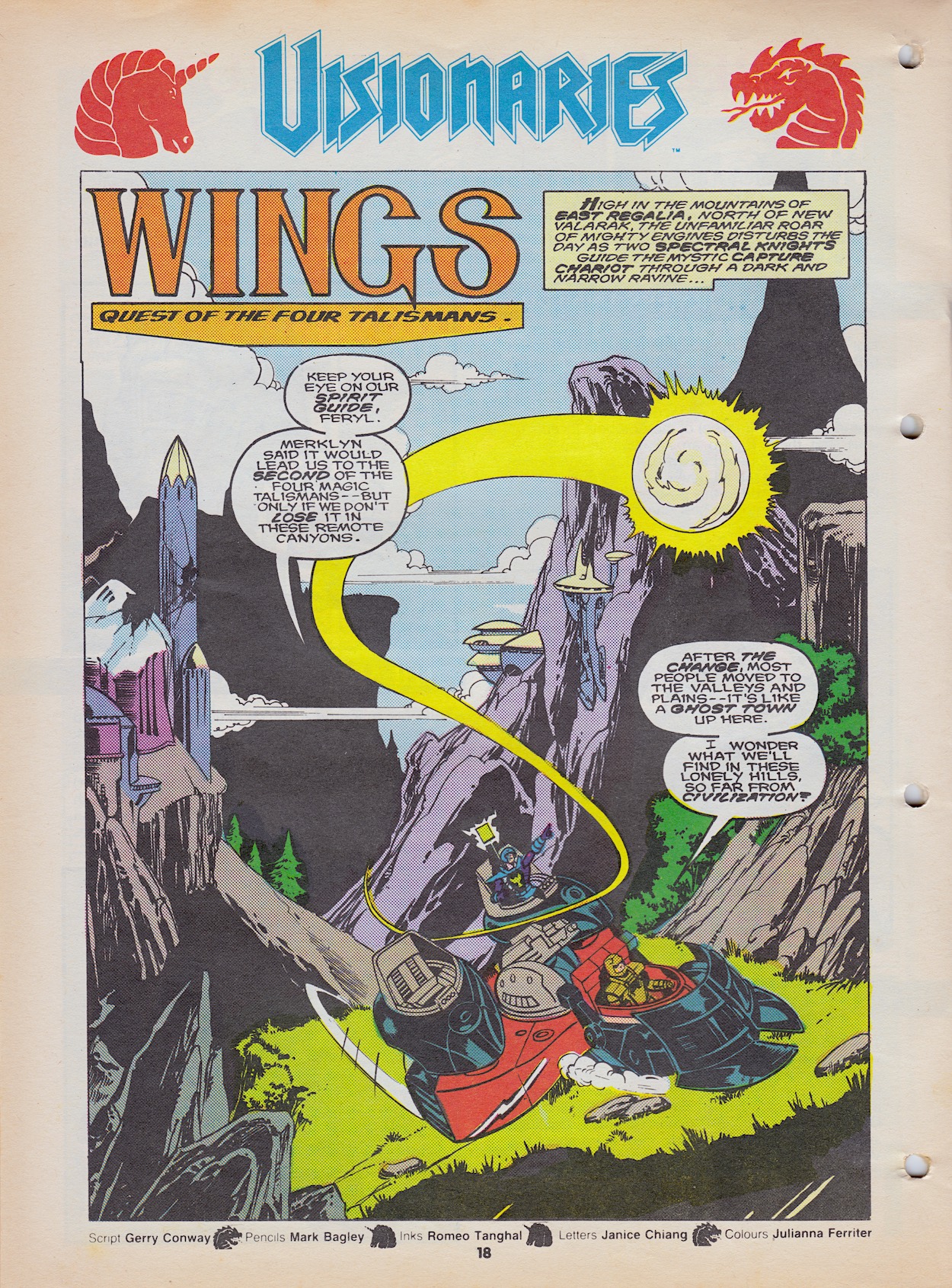
In the first of our issues Action Force is still making their presence felt with free stickers for the Panini album given away the week before but for us it’s all about the Knights of the Magical Light. Continuing on from the previous tale comes Wings, the second part of what was originally to be their first multi-part epic. With so many questions up in the air (no pun intended, you’ll see what I mean) will any of them get answered? Will any of the developing story arcs be concluded, or even have time to be added to? Let’s find out.
We begin with Feryl and Arzon in the former’s magical vehicle, the Capture Chariot as they follow their spirit guide towards the location of the second elemental crystal. Driving through what would previously have been luxurious mountaintop retreats the Spectral Knights conclude the place is abandoned. Indeed, behind them you can see the crumbling structures, a reminder once again that writer Gerry Conway isn’t shying away from the horrific realities the fantastical set up would’ve created.
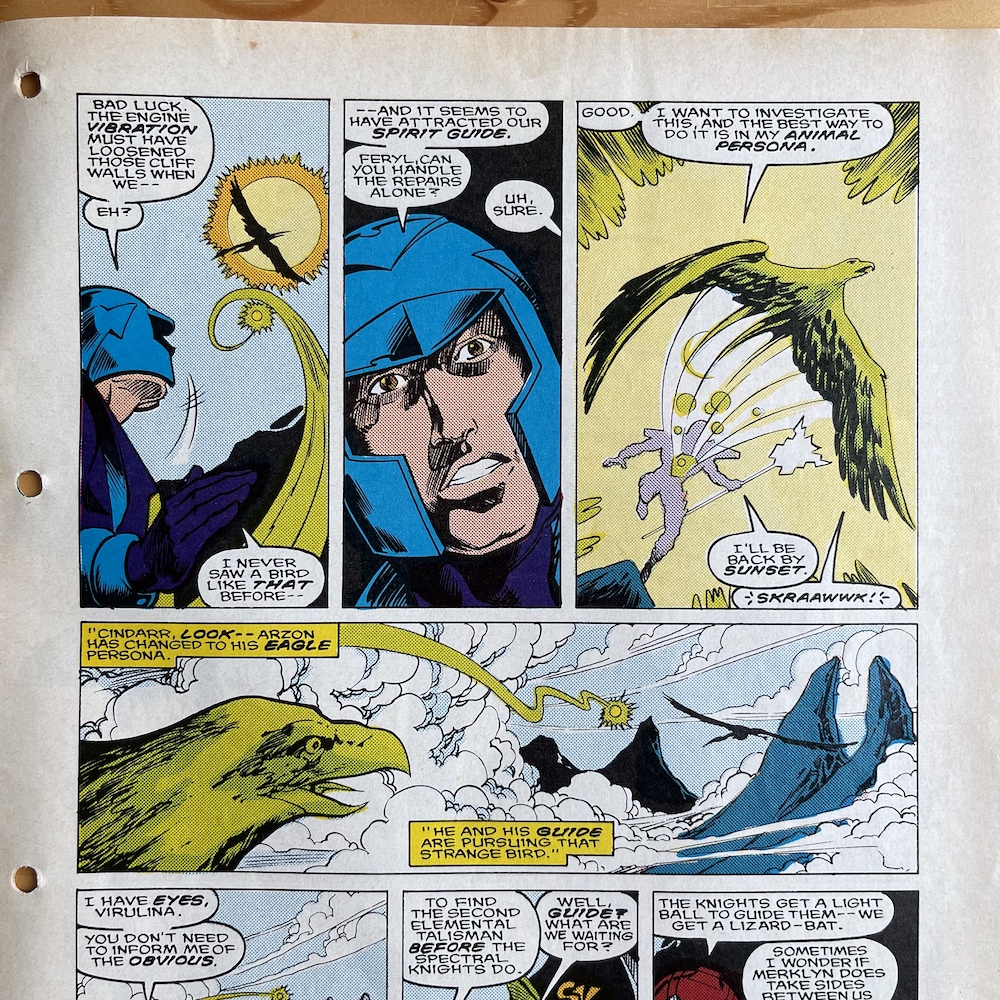
Almost crushed by falling rocks, which they put down to a freak accident but which was actually caused by two Darkling Lords, Feryl stays with his beloved vehicle whileArzon transforms to follow an unknown species of bird in the sky. His mechanical skills leave something to be desired and he was only getting in the way anyway. Feryl mentions Harkon at this point, a character created by the comic in #3, which is a nice touch and points to the larger world being built here.
While gliding on the wind Arzon forgets why he took off in the first place, to follow the silhouette their spirit guide had taken an interest in. Instead he’s just lost in the sensation of flight. The caption states, “Such is the risk of assuming an animal persona”, but unfortunately this is the only mention that intriguing development gets in this whole story. It’s such a shame, especially after Cryotek‘s battle with his persona last time. Of course, if this hadn’t been where the comic was cancelled in America it would’ve been a nice little mention to keep the thread going until it was explored more in the future. But with the way things turned out I can’t help but feel disappointed.
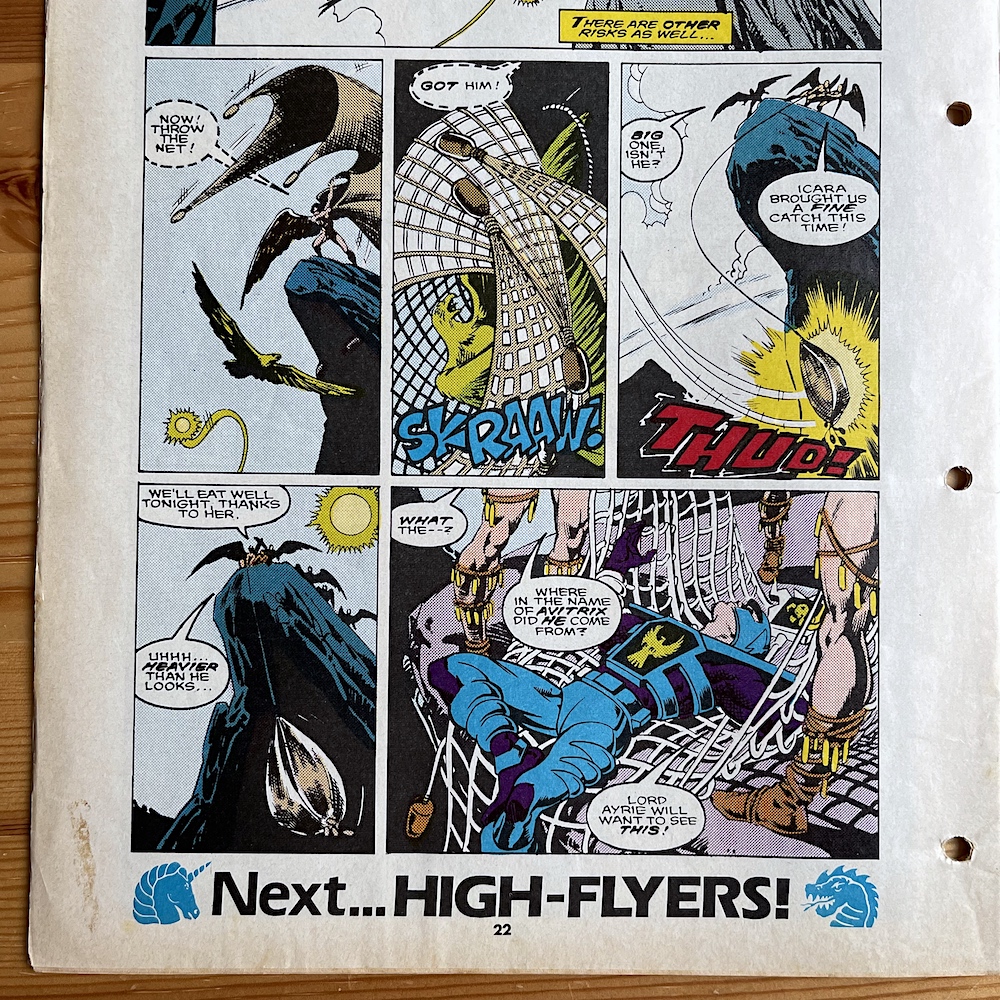
In this blissful state Arzon is unaware of the people on the clifftops eager to catch something for dinner. That’s one hell of a wallop he takes as they try to kill their prey, and one hell of a shock when they unwrap their groceries. Arzon, with his ability to fly and his magical power of knowledge is one of the more interesting of the Visionaries, so I’m already happy to see he’s going to be the main character here.
“I told Spectral Knights and Darkling Lords alike only part of the truth about the Talisman Jewels”
Merklynn
In part two a week later we get a reminder of why both sides of the conflict have been sent out on this quest by Merklynn. He’s now becoming so weak that his very being is fading away, his hands slipping through objects. Holding anything has become a battle deep within his mind. This chapter’s opening brings two main points of interest for me.
The first is that Merklynn seems to live on a different plane of existence than everyone else. I’d never really thought of that before but given how he was alive in the previous Age of Magic and secreted himself away in Iron Mountain throughout the Age of Science it makes sense that his very being would be some form of magical entity. The other point is what he says about their planet.
On the next page he questions how long he can live on will alone and thinks about how he and the whole planet of Prysmos are doomed if he doesn’t get those jewels. Why? Again, these questions will go unanswered. Quest of the Four Talismans was, I assume, going to be a four-part story so at least the mysteries behind the jewels could’ve been answered soon after this. The larger arc about the magical personas was clearly going to be stretched out a lot longer so as far as that’s concerned we can be a little disappointed, but to have this story cut short at the midway point is very frustrating.
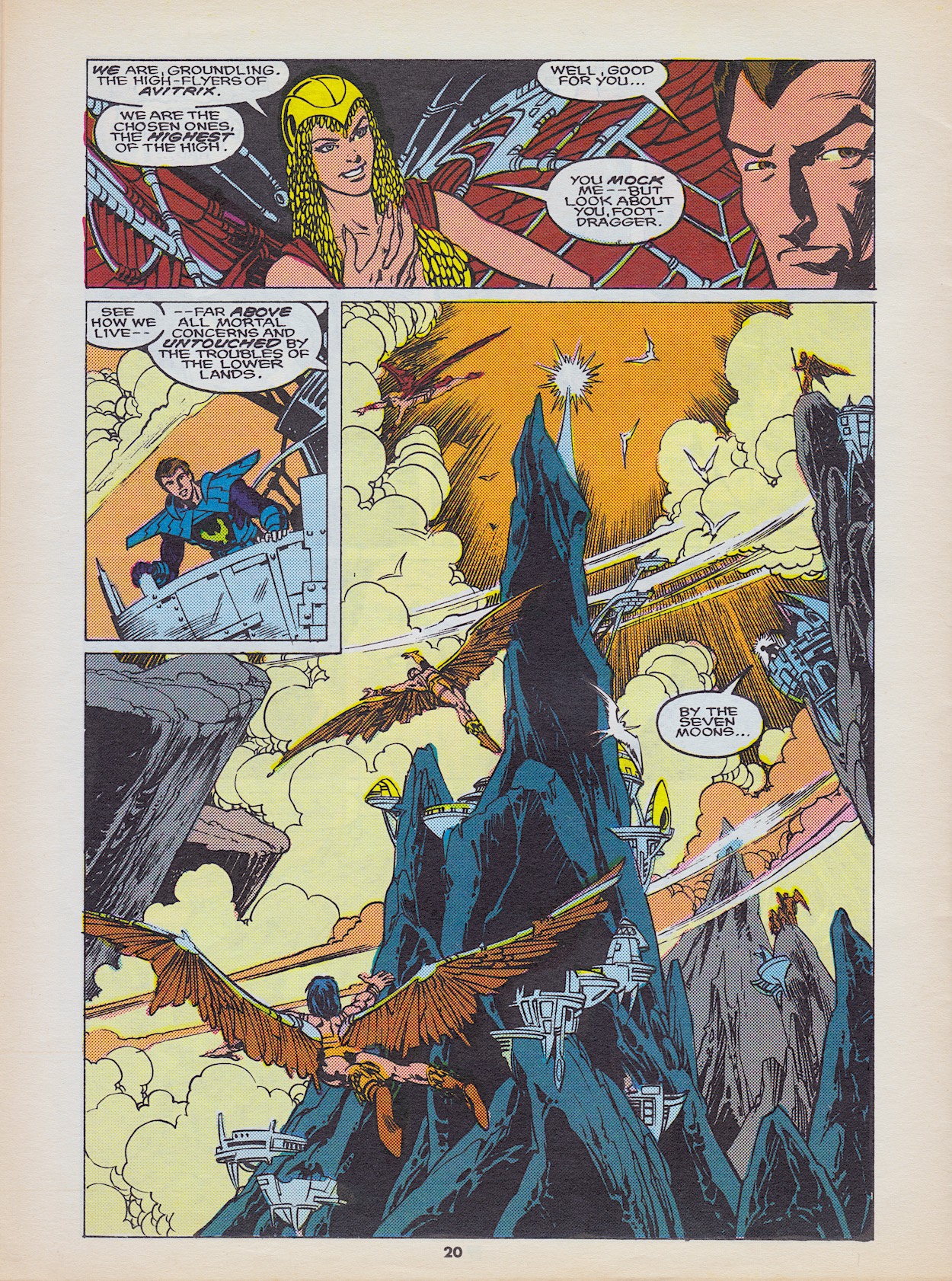
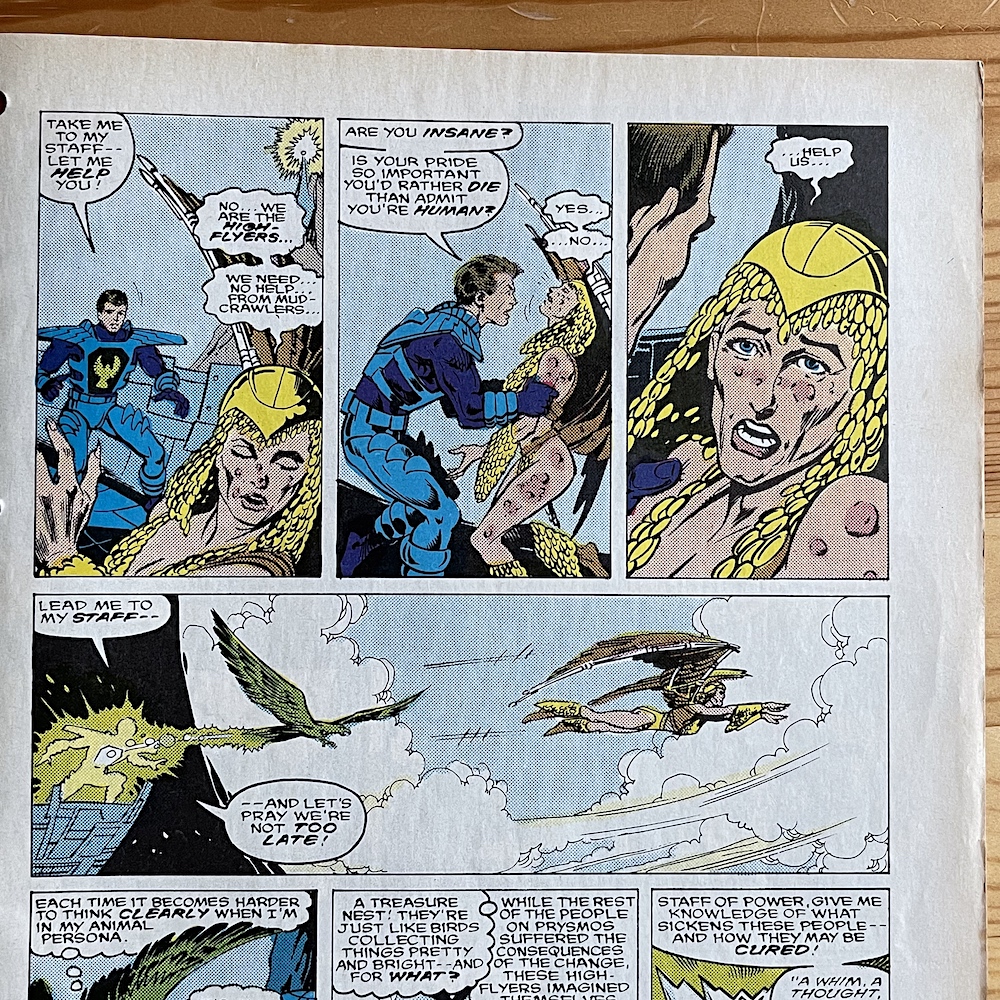
Back to Arzon and upon waking he finds himself in some form of nest, complete with a human-sized mattress. Standing over him is Icara of the High-Flyers, a large group of people who have fashioned wings out of the debris of the fallen world below and who now live atop the mountains far away from others. With views like this I can’t say I’m surprised.
Of course, the real reason they stay away from all other humans is because they believe they are the “chosen ones”, just like the villagers in the last story, and just like that story it’s all down to one of the crystals. Shining bright from the tallest peak Icara tells Arzon of how her father discovered it after the big change and that it powers their clearly insufficient wings, which is all the proof they need that they are truly chosen.
I can’t shake the feeling this is a retread of last month’s story
Arzon tries to explain how the Darkling Lords are on their way and the danger the High-Flyers are in, but it falls on deaf ears. Trying to reason with Icara is pointless, although her insults are quite amusing, calling Arzon everything for a “groundling” to a “mud-crawler”. Not wanting to just fly off and leave without his staff, Arzon braces himself for what’s to come. At this point in the story though, despite the grandiose nature of the setting I can’t shake the feeling this is a retread of last month’s story somewhat.
On a side note, in this issue letter answerer Decepticon Dreadwind tells a reader Action Force (G.I. Joe) will be returning soon, the first hint Visionaries would be coming to an abrupt end. Then in the third of these comics there’s news of The Transformers Collected Comics 11Winter Special which was the first issue I ever got! Bought for me by my mum as a surprise when I was off sick from school I was an instant fan (it was a Christmassy issue) and started collecting the comic from issue #192 all the way through to its conclusion with #332.
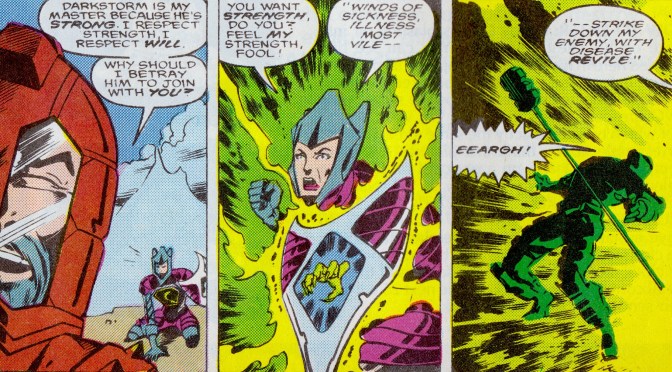
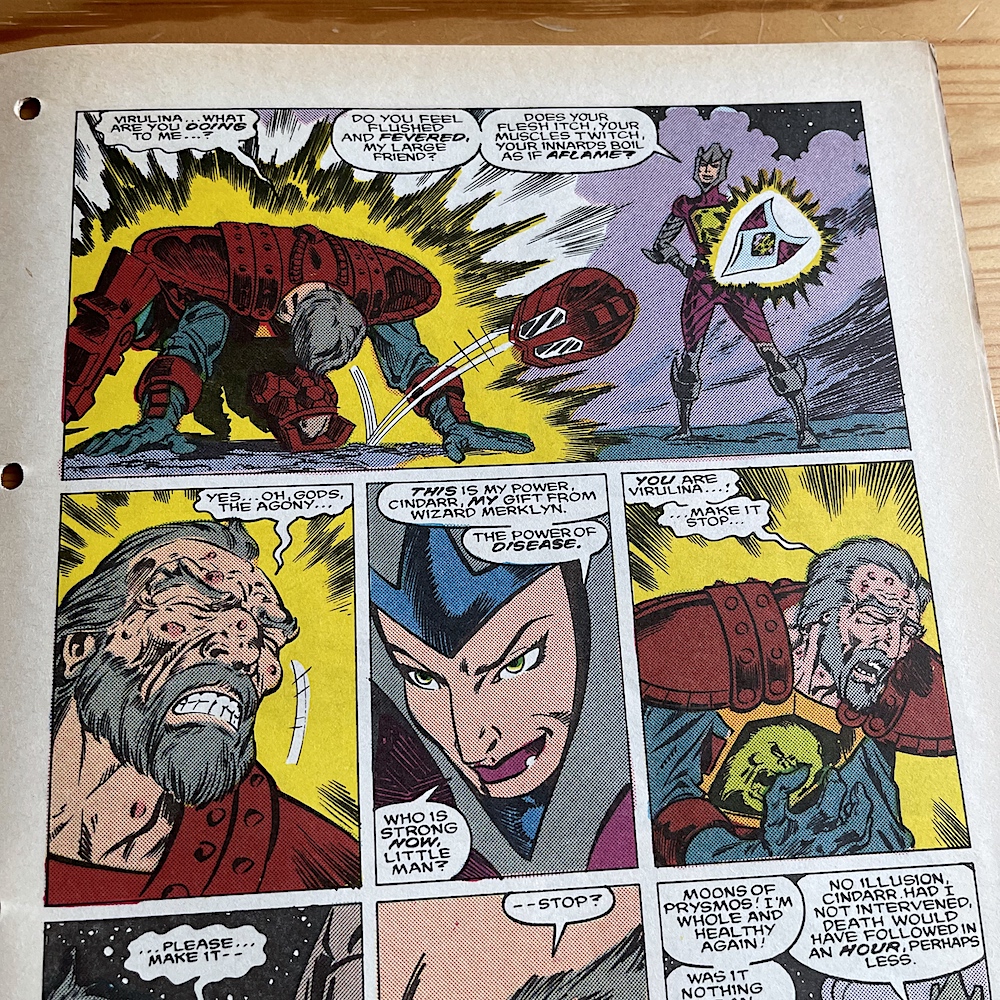
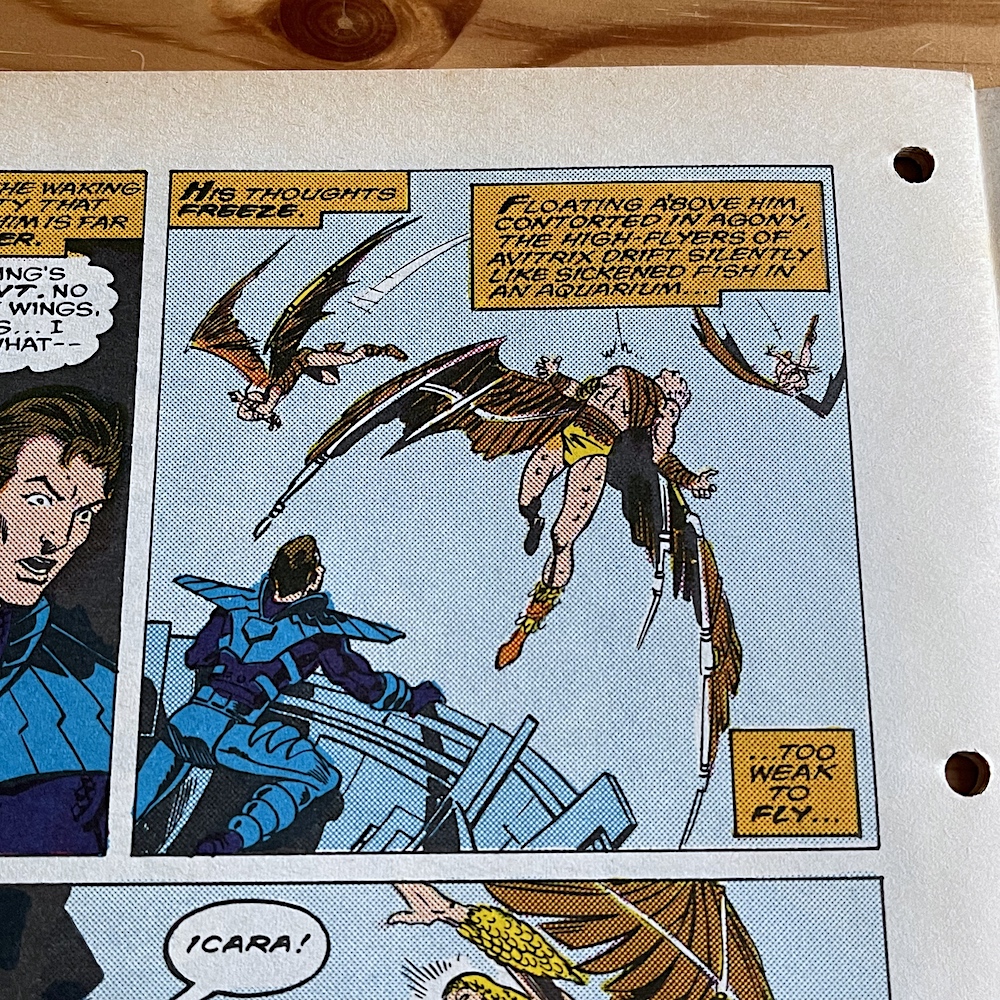
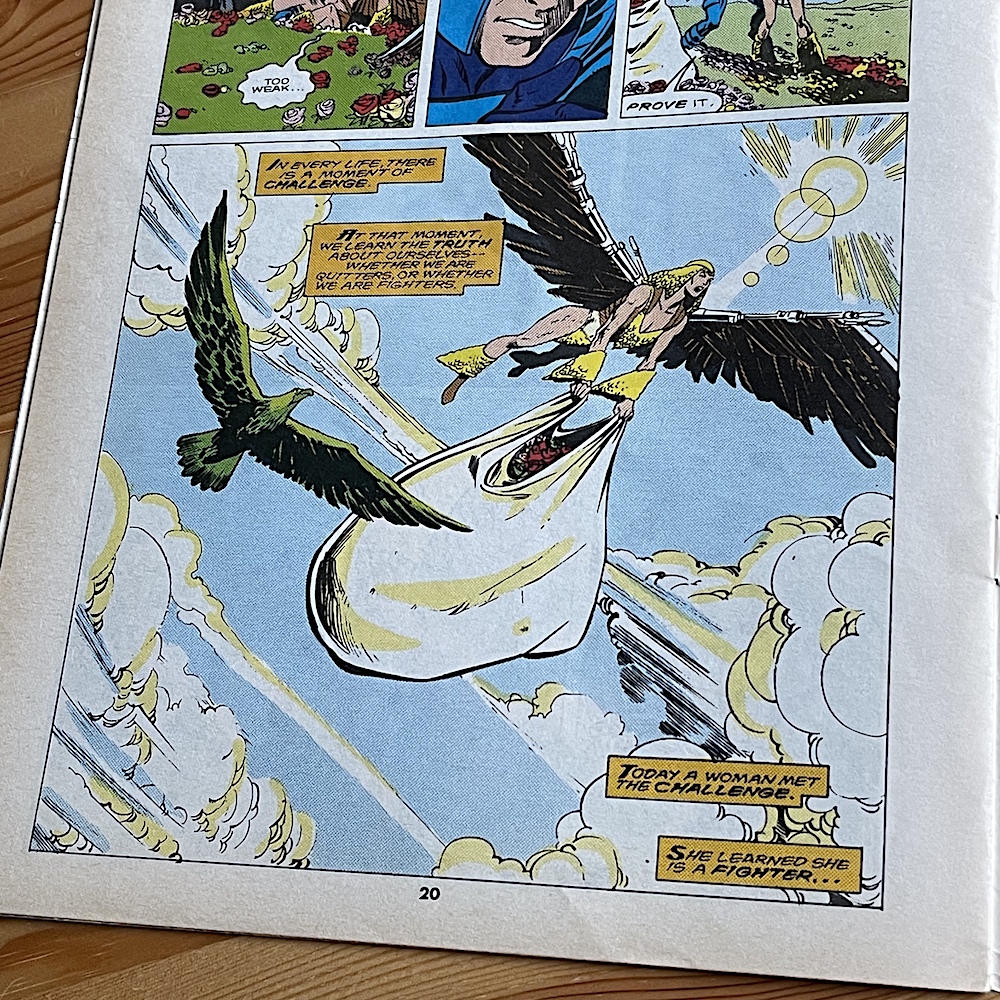
Those Darkling Lords Arzon is so worried about turn out to be Cindarr and Virulina. The plan is really simple; Virulina is going to go and stand on top of a hill and recite her spell poem, making all of the High-Flyers sick so she can walk in and take the crystal. Arzon casts his own spell poem to seek the knowledge of how to reverse its effects, gets a vision of some flowers miles away (too far to walk) and Icara has to use all of her inner strength (not the strength of the crystal) to help him carry the flowers back because he simply can’t do so as an eagle. But first she must realise she’s just as human as he is, not chosen. They spread the flowers over her people and they recover.
It’s not exactly in the same league as the intriguing stories we’ve become accustomed to.
“Winds of sickness, Illness most vile, Strike down my enemy, With disease revile.”
Virulina’s spell poem
Far better are the character moments. After arguing with Cindarr, Virulina changes her tune and tries to persuade him to join her in breaking off from Darkstorm, taking the crystal and having untold power all to themselves. Clearly she’s a manipulator. But Cindarr is loyal and believes in Darkstorm’s vision of how to rebuild their world. The layered character from a previous story already made this clear to us readers back in Visionaries#5. Telling her he respects strength and so he wouldn’t betray anyone for her, she casts her spell on him and makes him plead for his life.
She stops the virus, though does say it would’ve killed him if she hadn’t. She tells him all that talk was just that, just talk. But the inner thoughts of Cindarr betray how he wouldn’t forget, setting up a rivalry in the ranks for potential future storylines.
I’m glad to see the great narrative captions of Gerry’s storytelling continue here, as shown in this panel of the High-Flyers dying from the virus but being kept afloat by the crystal. It’s just really good writing and makes the captions throughout every Visionaries story feel like you’re reading some kind of fantasy novel. Gerry seems really taken with the whole world of this franchise and I can only imagine what kind of comic Visionaries could’ve become had it had the kind of longevity as Transformers.
Arzon finds a treasure nest full of shiny objects, collected by the High-Flyers as if they were actual birds. He makes the observation that while everyone else on Prysmos suffered the consequences of the change, these people imagined themselves to be above harsh reality. It’s a perfect metaphor for privilege and reads as particularly relevant today. Also, the one High-Flyer he’s met is named after Icarus which drives the metaphor home perfectly.
The next Visionaries review will be on Christmas Day!
This third part is also accompanied by an advertisement for Hasbro‘s toys. The toys were released for the previous Christmas in the US and had failed, the comic had been cancelled and the cartoon wouldn’t return for a second season, so it’s strange to see a promotion for the toys reappear after all this time. You can see it (along with the cartoon’s intro sequence and the TV adverts) in the post introducing this series of reviews.
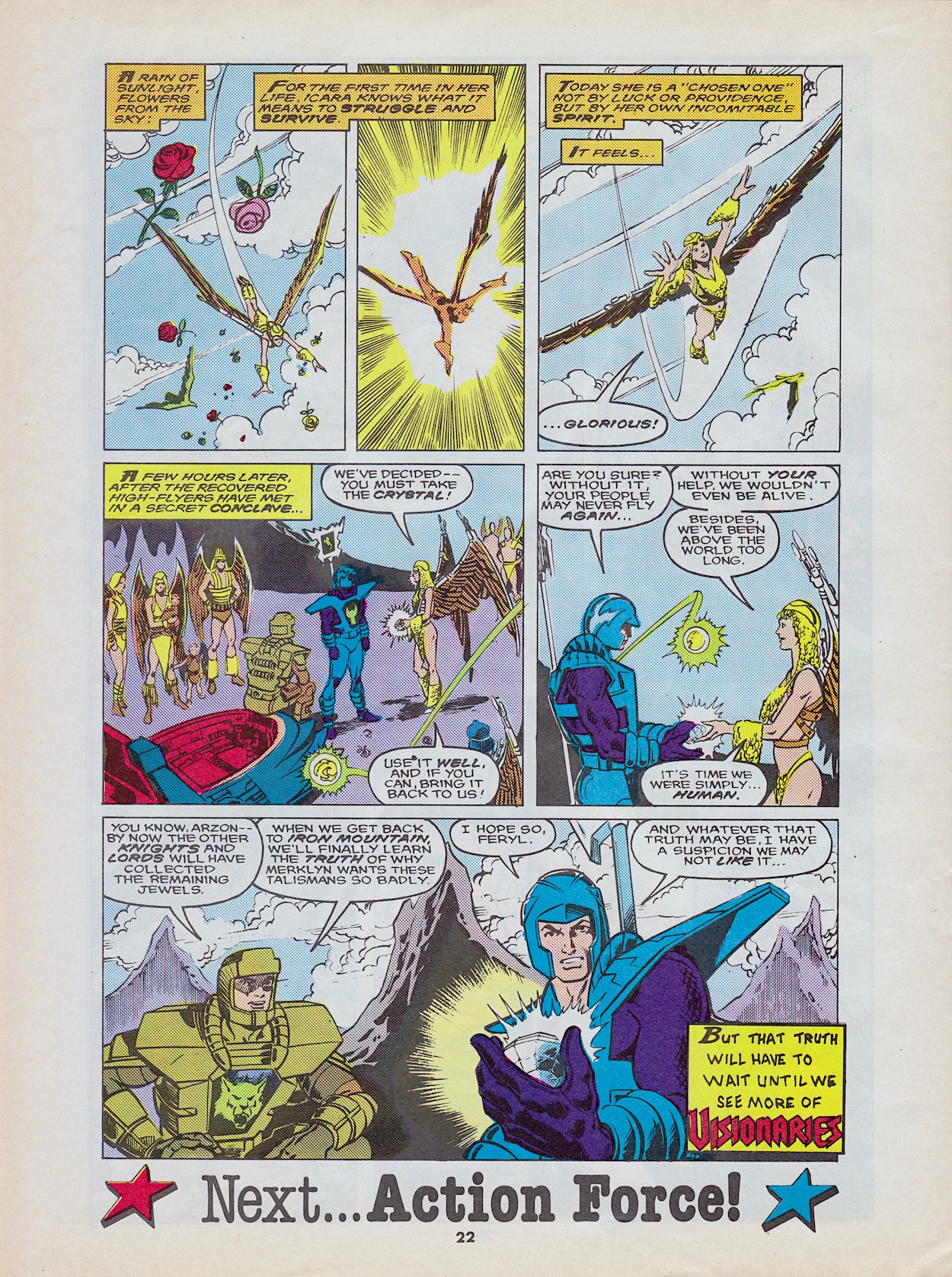
In the final issue Icara saves her people and we get this lovely image with some beautifully written captions to accompany it. But not all of the panels have this level of care. Some seem decidedly rushed, for example those depicting her dying people and the healing power of the flowers being dropped on them from above. Here and there some panels do stick out in this way. Maybe the cancellation order had come down and artists Mark Bagley (pencils), Romeo Tanghai (inks) and Julianna Ferriter (colours) had to rush completion of the final issue? Who knows? At least Janice Chiang‘s letters are still on point with those captions.
As for those unanswered mysteries and unresolved arcs, obviously none of that is the fault of writer Gerry Conway. He was clearly treating the licence maturely, developing not only multipart stories with many twists and turns, but also playing the long game with the characters, his world building and the overall story. How would this comic have developed? Unfortunately, on the last page of the original US comic we got the only answer we’d ever get. The story ended with Arzon speculating about the truth of the talismans, before one final footnote that simply read, “But that truth must remain unrevealed”.
However, this was changed for our comic.
The editorial for #190 makes the ludicrous statement that Visionaries is going to make away for Action Force because fans for the latter have been calling for its return. Given how much in advance these comics were produced it’s extremely doubtful letters would have even arrived yet concerning the Visionaries by the time production on this issue was in full swing. The fact was this was the end and they knew it. It would’ve been better to be honest instead of giving false hope of their return and of the story continuing, which is the impression given above.
To think I wasn’t aware of a Visionaries comic at this time and I’d start collecting Transformers only two weeks later!
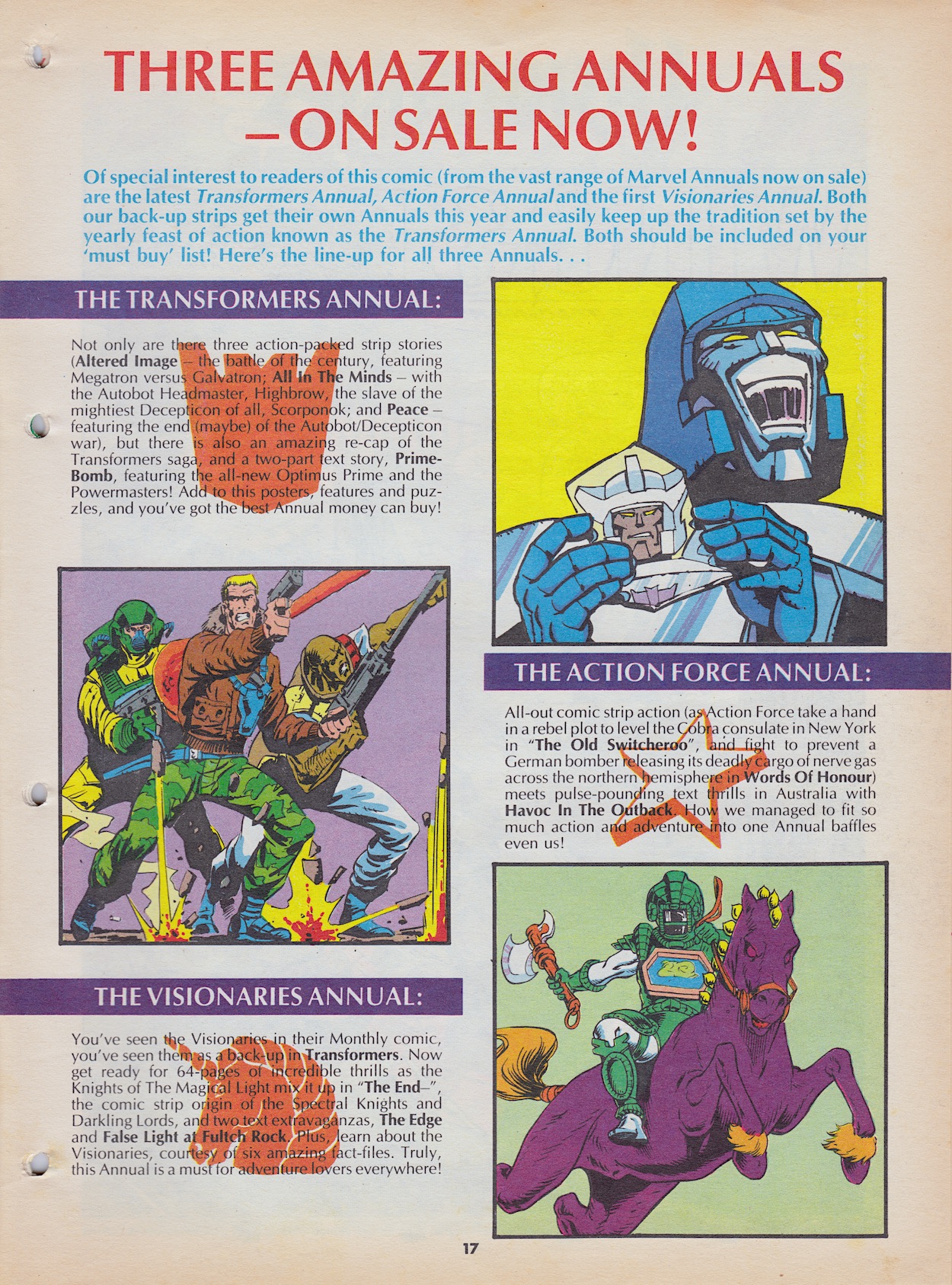
This wasn’t quite the end though. Making up a kind of action trilogy for Christmas that year was The Transformers Annual, The Action Force Annual and excitingly The Visionaries Annual. Plugged on the editorial page of #190 as the “first Visionaries Annual” it would also be their last. Plus, if you actually read the promo below you’ll see it’s not all good news because the strip stories would be very familiar to fans of the comic.
The Knights would return to the pages of Transformers one more time when the comic underwent another new look in #213. But not in the way we may have hoped. Even though their return would be hyped it would only be for yet another reprint of the origin story from #1 and #2 of their monthly comic (and now also from the annual too).
But let’s not get ahead of ourselves, we still have that book to look forward to with its text stories, which are wonderful little tales and there’s some original artwork from the Marvel UK team throughout as well. So when can you expect the review of the Visionaries Annual? As this advert shows they were on sale by now, but when did we all receive our annuals? We all know the answer to that. These books were always intended for a certain time of the year.
So, while the regular issues of comics on this site are reviewed on their original release dates, any and all annuals will have their reviews published at Christmas, onthe big dayitself if they’re part of a regular comic’s read through. So for any Visionaries fans, when you’ve opened all your presents and eaten far too much wonderful rich food and feel like taking a nap on the sofa, come on back here instead for the Visionaries Annual. It wouldn’t be Christmas without an annual after all.
If you were to take a quick glance through this latest issue of Marvel UK‘s Visionaries from 1988 you’d think it was business as usual, with another lengthy strip featuring the Knights of the Magical Light and their quest to rebuild their crumbling planet. After last month’s superb story by new writer Gerry Conway anticipation is also high. But look beyond the brilliant cover by Mark Bagley and we discover some bad news on the editorial page.
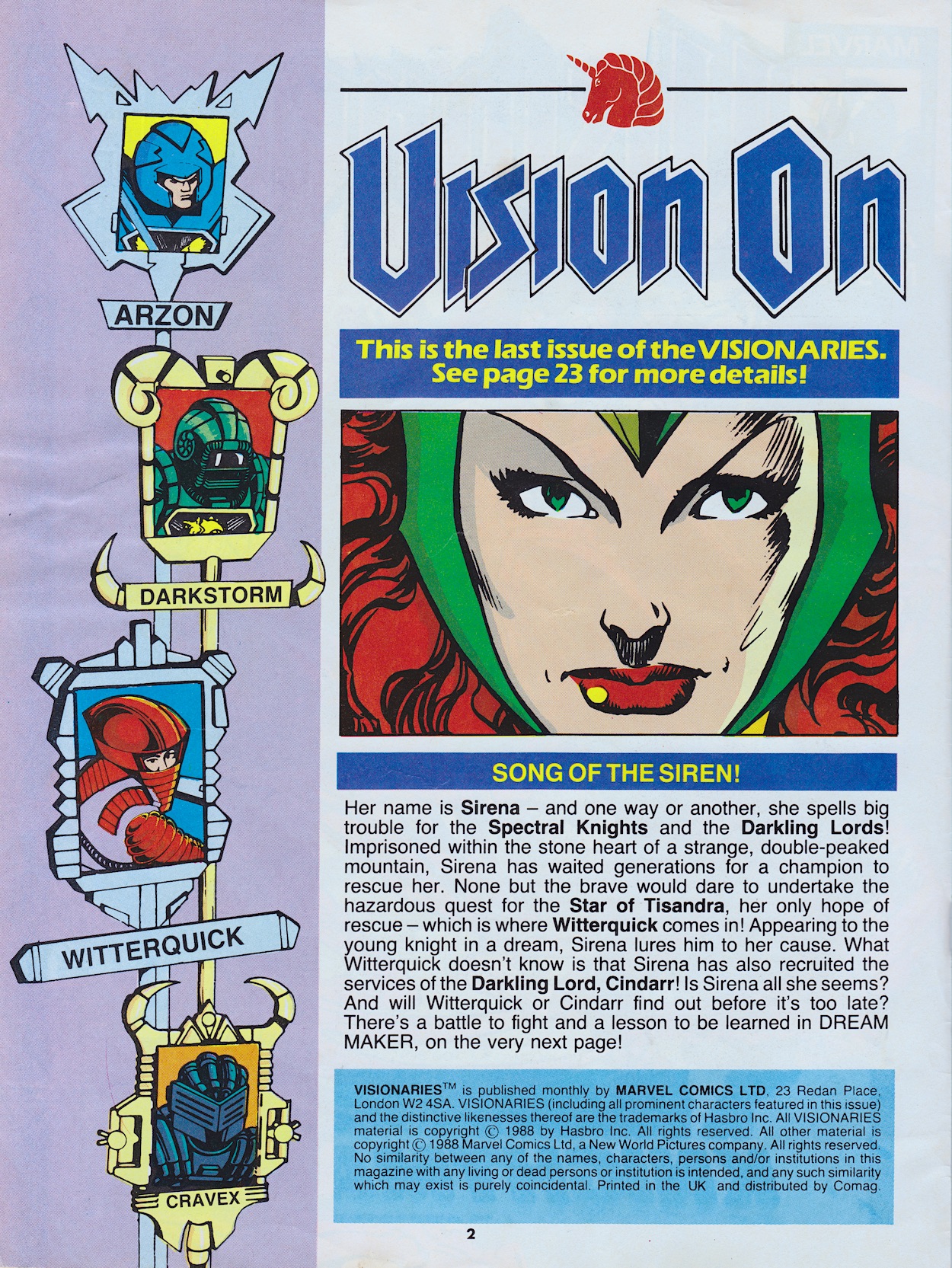
There we find a tiny message from editor Steve White announcing the horrible news that this, only the fifth issue, will be the last. He says there are more details to come so we’ll concentrate on the strip first and see what those details are later. As with the previous issues, it’s written by Gerry Conway, pencils are by Mark Bagley, inks by Romeo Tanghai, letters by Janice Chiang and colours by Julianna Ferriter.
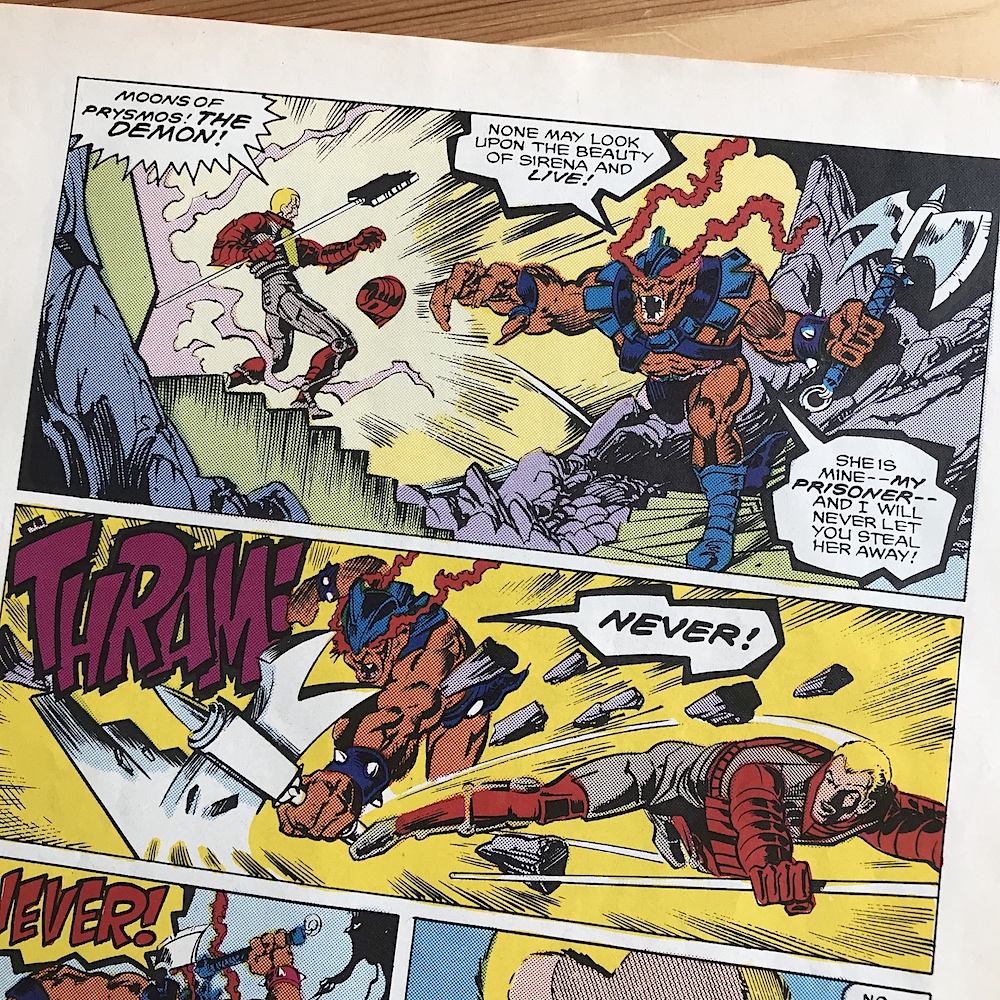
This issue’s story is called Dream Maker and begins with my favourite Visionary from the cartoon, the lightning fast Witterquick atop a cloud covered mountain answering the cries of a beautiful but entombed woman called Sirena. As he attempts a rescue a demon appears, apparently threatening to kill our hero for looking upon the woman’s beauty. It might appear this demon is jealous and has trapped his great love to be wit them forever, but as we find out later it’s just a bit of clever writing.
I say clever writing, but with a name like Sirena and a front cover showing her in control of monstrous forces the game has kind of been given away. If there was any doubt left the comic’s editorial made sure to erase all mystery beforehand. It’s still a compelling read though. I get the distinct impression Gerry, co-creator of The Punisher, really enjoyed developing these toys into three-dimensional characters. This issue concentrates almost exclusively on Witterquick and the Darkling Lord Cindarr, who we also see awaken from the same dream, with him in place of the Spectral Knight.
Sirena tells both men she’s a former Queen who has reached out telepathically to the only man able to recover the magical stone that can open her prison. Not convinced the dream is real, Leoric knows there’s no stopping Witterquick’s impetuousness so he wishes him well but offers no help or resources. On the other hand Cindarr has to fight off Reekon and Mortdredd who accuse him of abandoning his post at Darkstorm‘s castle. While you might wonder why a Darkling Lord would care about an imprisoned woman, it’s the first sign of there being more to Cindarr than we initially thought.
Witterquick’s impulse to save the poor villagers is soon overpowered by his desire for Sirena
The scene shifts to a crumbling mountain road where the giant ‘Bronze Warrior’ statue looks down upon a ramshackle village led by a despot warlord. The statue is a rusting metal ruin of unknown origin from the previous Age of Magic, now a tourist attraction with a gleaming jewel eye. Witterquick’s initial impulse to save the poor villagers from their maniacal leader is soon overpowered by his desire for Sirena, such is her power over him.
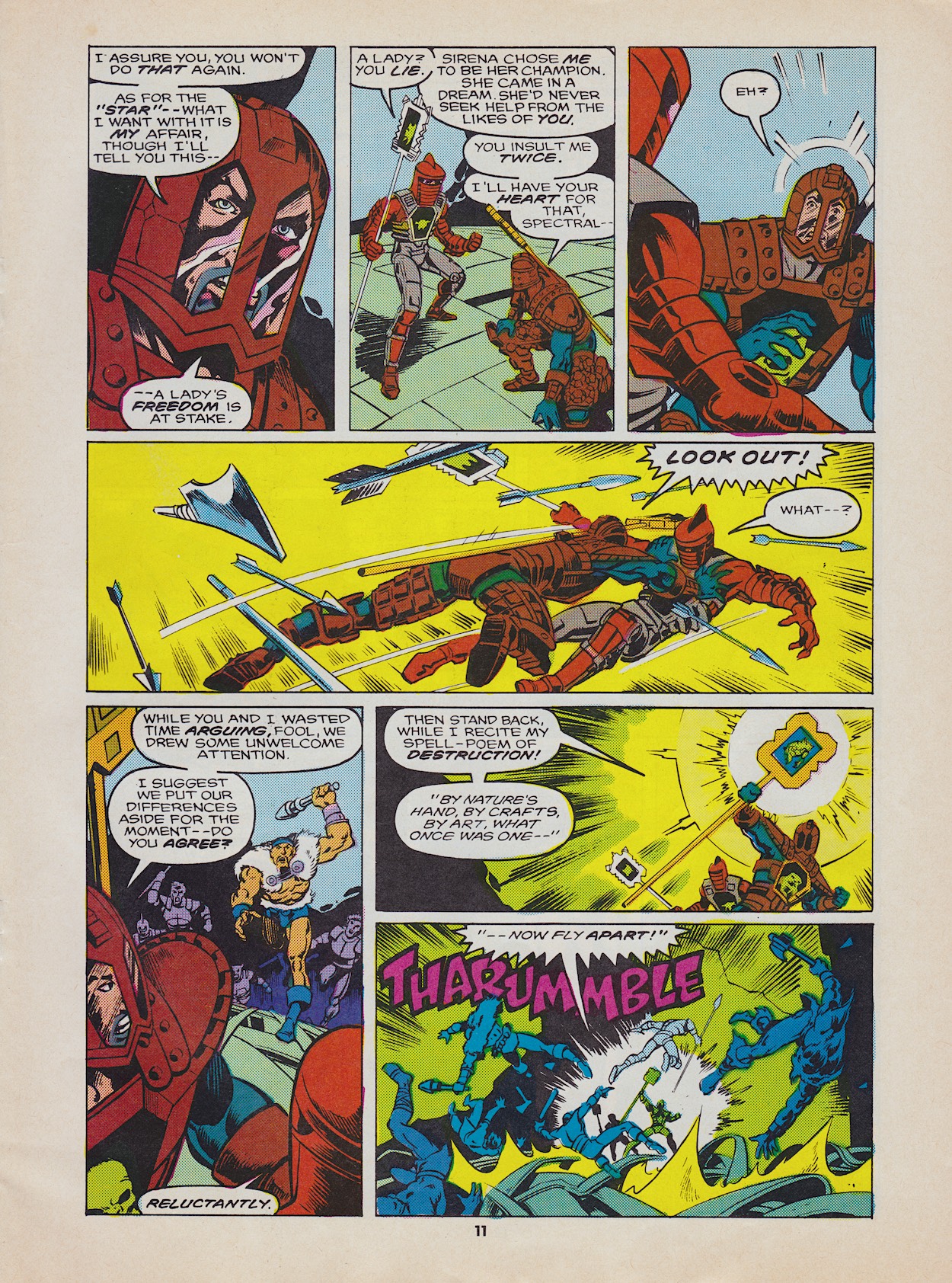
Soon he and Cindarr are in a race to claim the key, the jewel. Both use their magical poems, Cindarr unleashing ground-shattering destruction, Witterquick giving himself incredible speed which he uses to grab the key first. Despite this, Cindarr still saves Witterquick’s life when they’re suddenly attacked by the villager’s warriors.
It’s a gut reaction by Cindarr and a big surprise for the reader. He’s the highlight of this story and showcases the potential for complex character arcs to come between the warring factions. How heartbreaking that this is showcased in the final issue. Offering up a temporary alliance he uses his incantation to shake the very ground upon which the statue stands, scattering the warriors and allowing both of them to escape, the statue left wobbling in the wind.
Both characters seem to be fighting against where they’ve been placed in this new world, seeking to find their true selves
We also see Witterquick open up about who he really is, flaws and all, through thoughts and the well written (as always) narrative captions. In the comic his magical speed also seems to apply to his heart. He’s quick to fall in love, quick to jump to conclusions, quick to leap into danger, all of which can get him into trouble, all easily avoidable if he just took a step back and thought things through first.
Struggling with his thoughts, Witterquick dreams once more. Today I wouldn’t bat an eyelid at the image below, but in a toy comic of the time I think it shows Visionaries was aimed at a slightly older audience than Transformers, albeit an audience that still played with action figures. We’d have seen the likes of this in Conan comics so I thought it was interesting in the middle of a Hasbro toy licence.
Nudity in dreams is said to represent vulnerability, perfectly summing up Witterquick’s thoughts at this juncture in the story. The bewitching hold Sirena has over him, believing it’s true love, makes him shake off the doubts and carry on. From here on we see both Knights frequently cross paths with each other, more as competitors than enemies, creating an interesting dynamic and lots of fun moments.
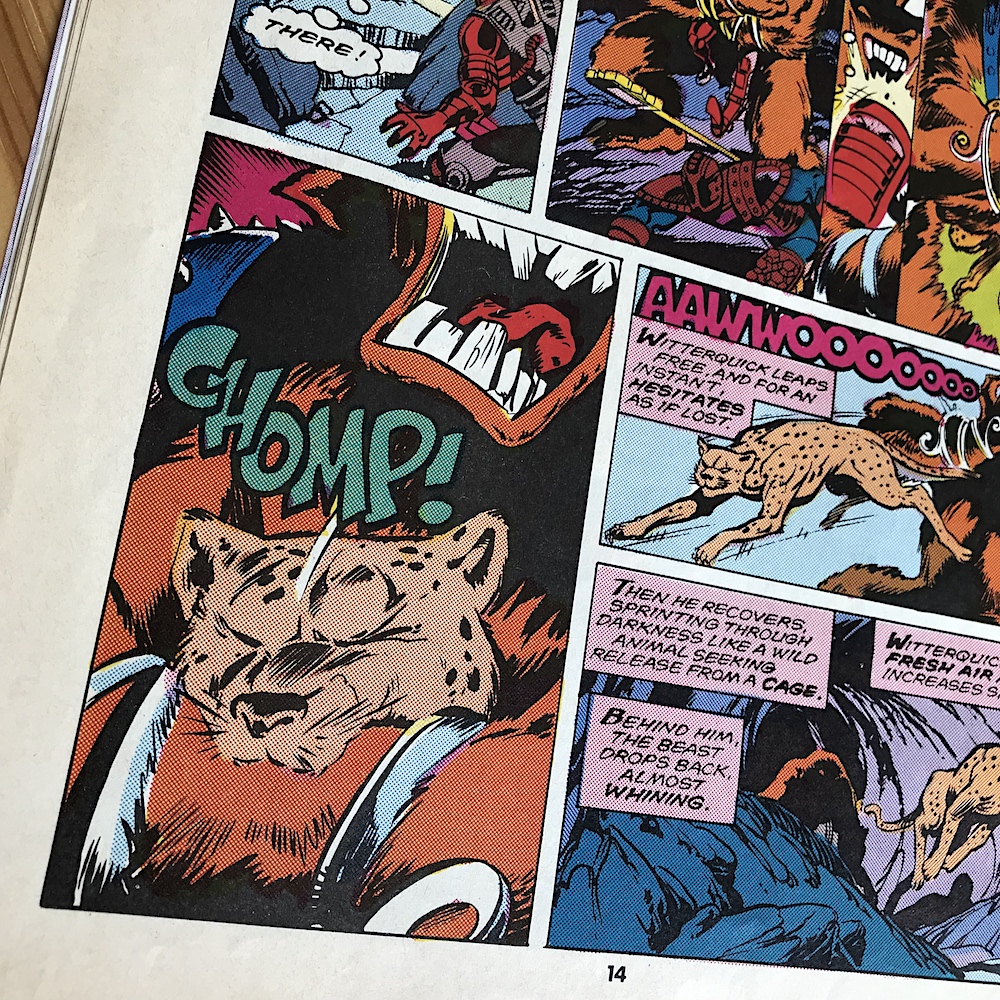
They come up against a monstrous beast guarding the caverns underneath the toppled statue, providing us with an example of their back and forth race. Cindarr scoots past in the background (above right) as Witterquick struggles with the beast before transforming into his cheetah totem, biting the beast and escaping, the captions hinting at themes covered in last month’s review.
“But in the end, we fought as allies. Imagine if our leaders could find a way to do the same.”
Witterquick to Cindarr
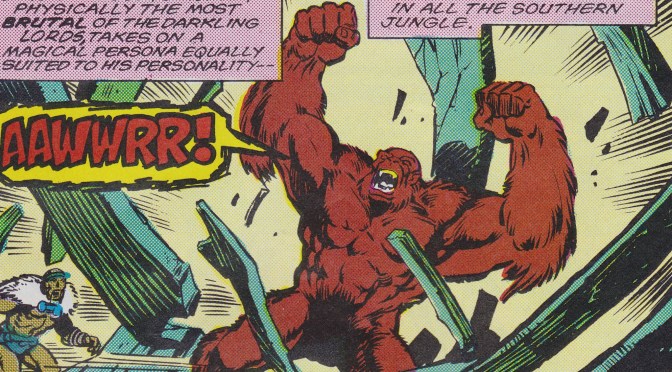
These caves take our Knights back underneath the statue where Witterquick uses his speed spell once again to grab the jewel before it collapses. The Darkling Lord is buried under tons of metal but not before changing to his gorilla form for protection. After bursting out, in a moment of revenge he shames and embarrasses the warlord in front of all of his followers, freeing the people from his rule.
It’s another surprising Cindarr moment I didn’t see coming for a character so simplistically depicted in the cartoon, and it would appear it surprised him too. Both characters seem to be fighting against where they’ve been placed in this new world, seeking to find their true selves inside all of the magical armour that now defines them.
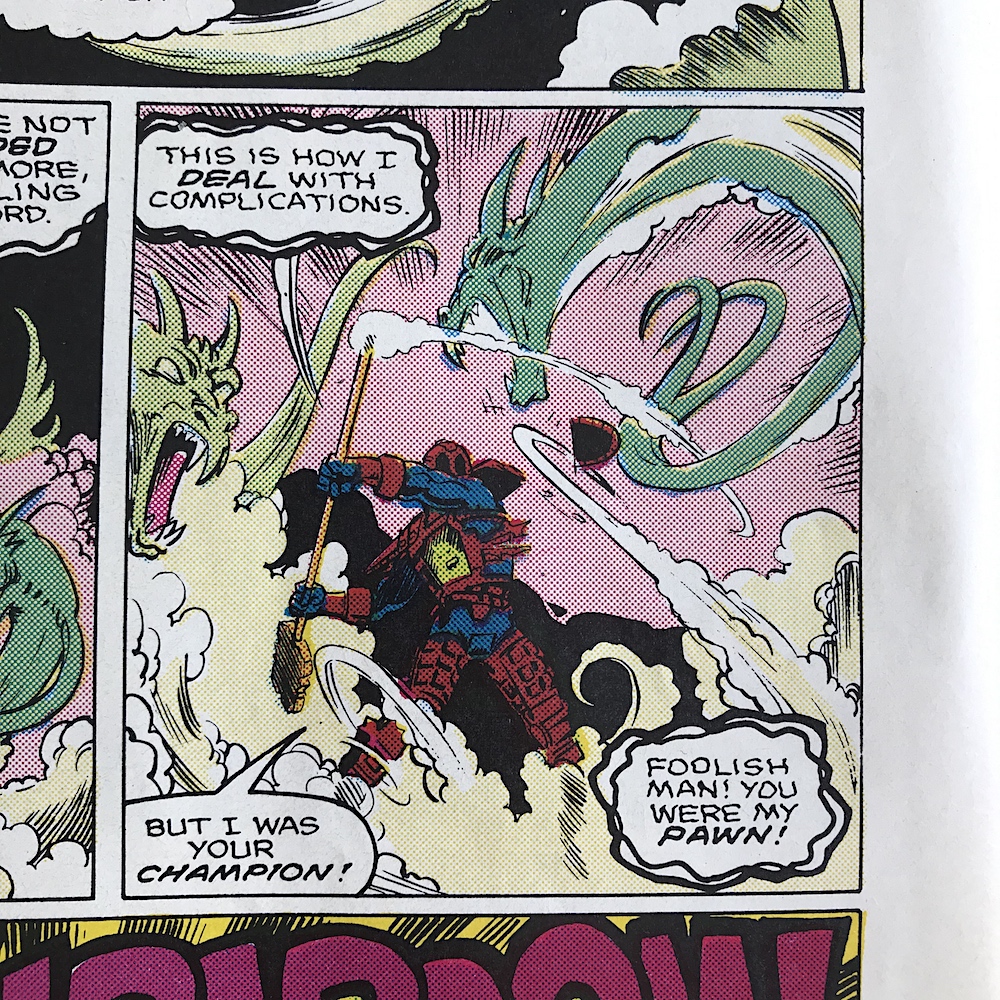
Attacked and ashamed by Sirena’s demons, the truth is laid bare and Cindarr’s heart is broken. About to be set free, she no longer needs him, he is but a complication. I actually felt for Cindarr here; the spell had him genuinely believing he was in love and doing the right thing, something he shouldn’t care about doing.
Now in the area foreshadowed earlier we see the demon attacking Witterquick but it’s holding back, not wishing to kill our hero, claiming he’s there to stop evil from being released. It’s at this point we realise those panels at the top of this review now read very differently.
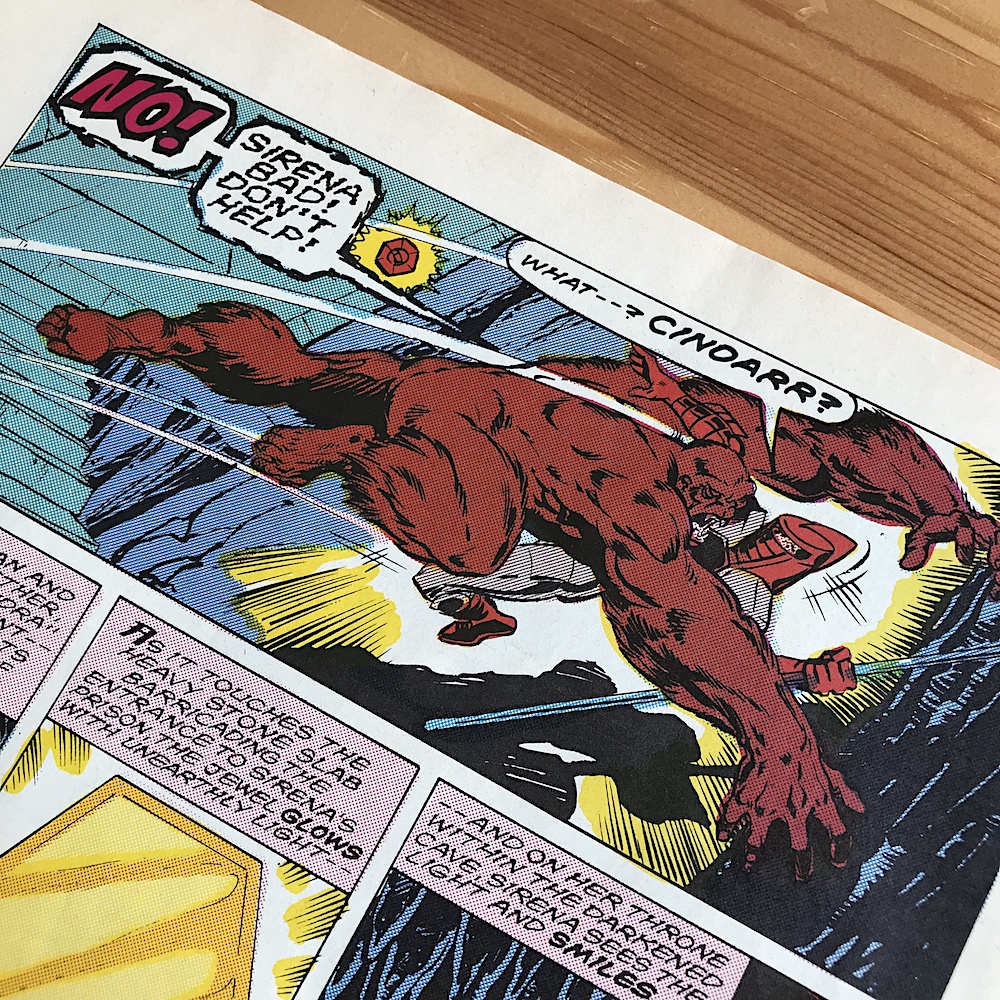
Witterquick is unable to listen to reason and only the intervention of a vast gorilla (complete with Grimlock-like speech in this form) stops him from unleashing Sirena. Cindarr could have simply walked away; more evil being unleashed into the world and one less Spectral Knight should be a good thing, should it not? But he’s become an unlikely hero, trying to keep the witch imprisoned and saving a warrior he’s come to respect.
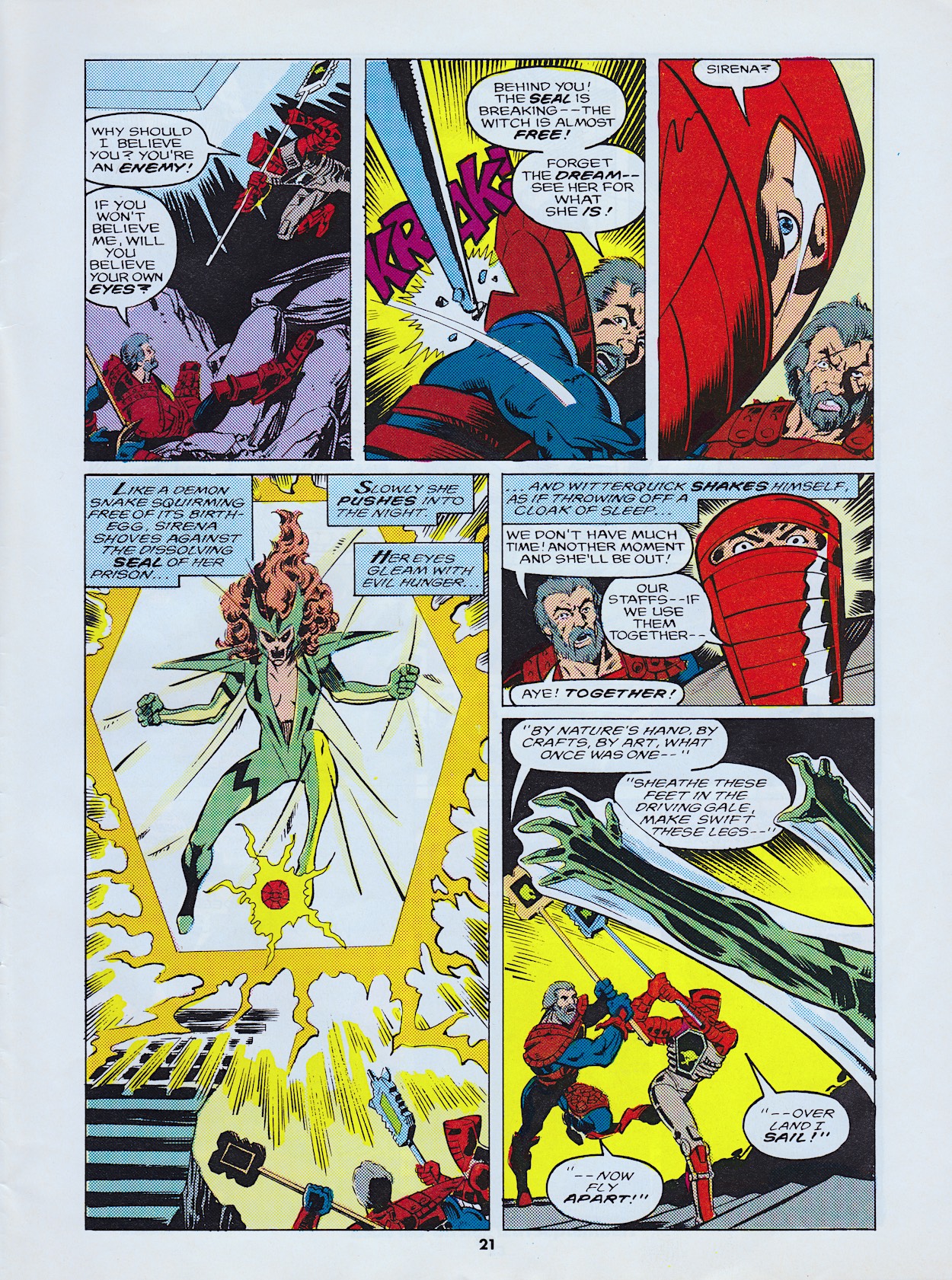
But unwittingly they’ve gotten too close and the jewel floats on a magical current right into the lock of Sirena’s tomb. Here her true appearance is revealed as she pushes against the dissolving seal in a scene reminiscent of scenes from popular mini-series V just a few years previous.
His mind set free at last, Witterquick’s horror is clear. Working together, this leads to a final desperate bid to not only save their planet but also their dignity, as they use both staff powers together, combining speed and destruction into an unstoppable force and unleashing it directly upon the dissolving force field.
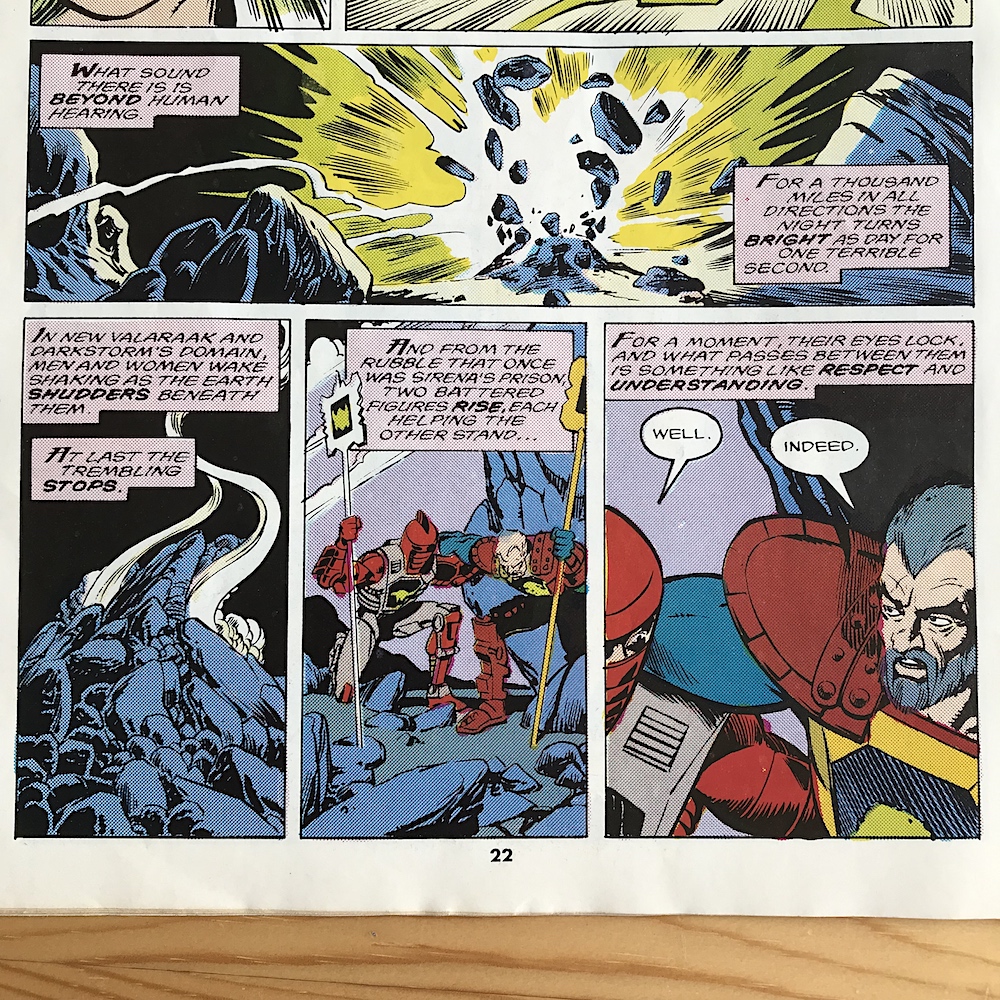
The prison explodes, taking Sirena with it. My favourite part is not this appropriately action-packed finale itself, but rather the immediate aftermath when the two enemies help each other out of the rubble and share this moment.
I laughed when I read this. Gerry’s scripts are just so beautifully written in these quieter character moments. After being at loggerheads through the long quest and intense action these two simple words sum everything up for the men. The next page also reveals a little about their views of the ongoing battle for the planet. I’d have been disappointed if the story hadn’t included this conversation after all they’ve been through.
It’s a nice final page, the second panel summing up a lot of conflicts in our real world. The respect and understanding between Cindarr and Witterquick is clear and it’s left very open ended. There can be no other outcome, for now at least. No, they’re not friends but can they truly be enemies again? At least they get to end their adventure with a shared laugh and as far as the comics go I’ve got a new favourite character in Cindarr.
This dynamic is just crying out for further exploration but for now Visionaries bows out. At least it does so in style with another superb story, nicely developed characters and plenty of surprises. As you can see the promised “details” don’t amount to much, just the date on which their remaining stories will be serialised in the weekly Transformers comic.
It’s quite the wait but a new look was coming up in Transformers so a new back up strip (temporarily replacing Action Force/G.I. Joe) would help launch it and bring in Visionaries readers eager for more. There are still a couple of dedicated publications to come for our intrepid magical heroes in the form of the Visionaries Annual at Christmas time and a Spring Special next year. That annual may have been released in August but let’s face it we all got them as Christmas presents. So that’s when it’ll be covered here, following the real time nature of reading these as originally intended.
Speaking of further publications, on the back cover is another gorgeous contemporary advert. Dragon’s Claws was created by the ace Transformers team of Simon Furman and Geoff Senior. Set in the distant future of Britain it was a comic I’d seen advertised as a kid and had always wanted to try but never got around to. This is going to be corrected in 2023. The complete collection is sitting on my comics shelves waiting patiently for their own real time read through on the blog. Watch out for that.
In the meantime you can expect reviews of the final two Visionaries stories on the dates of their respective conclusions in the pages of Transformers. Each story was split into four parts as was custom for the back ups, so the first story’s review will be on the OiNK Blog from Friday 1st October 2021.
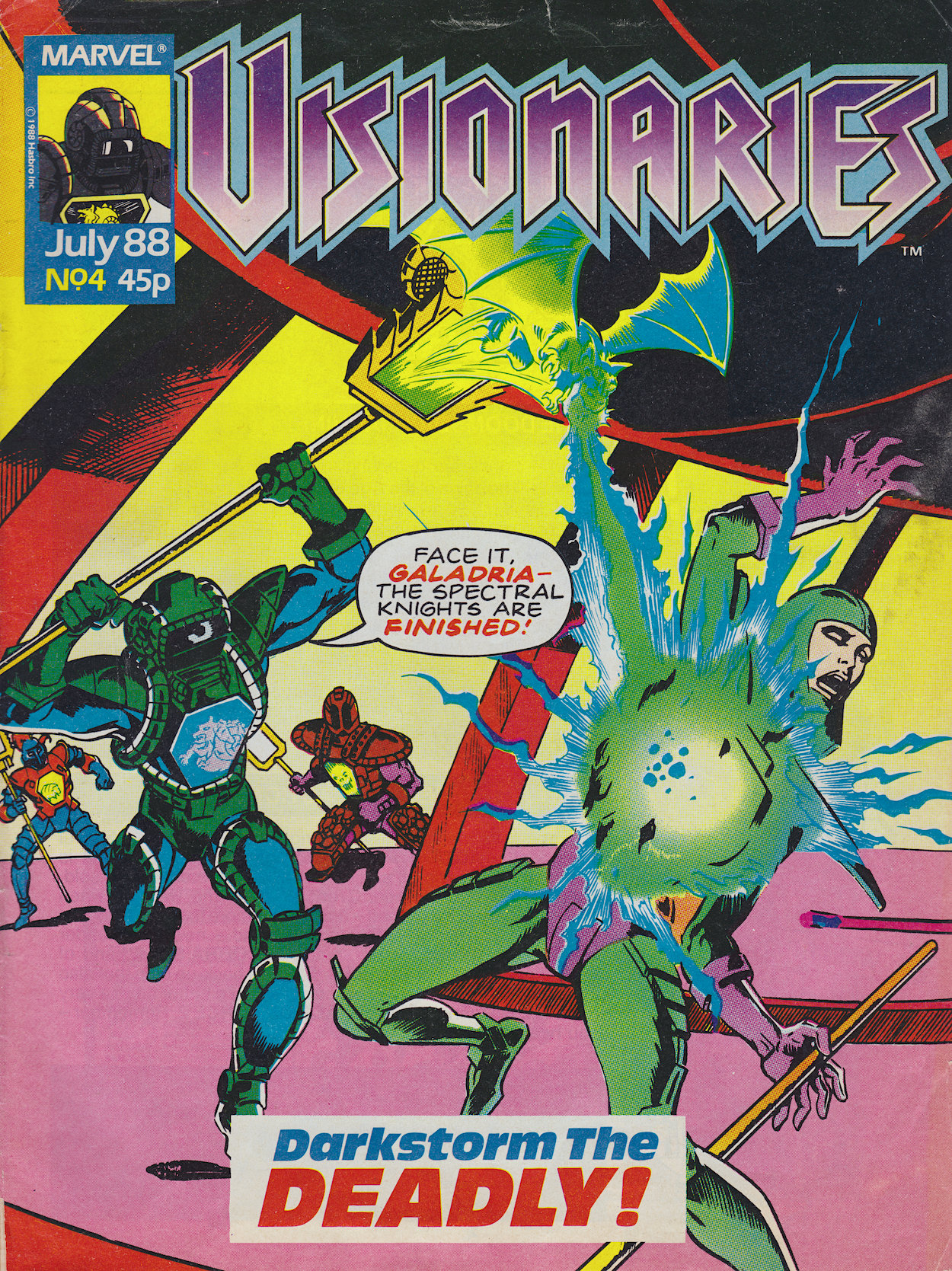
With hindsight I know the next issue of Marvel UK‘s Visionaries will regrettably be the last, but for readers at the time there would’ve been a real feeling of the comic taking off this month, ironically enough. With the introductions now out of the way this feels like the first proper story about these characters and their new abilities upon the ravaged planet Prysmos. Unfortunately, the writing may have already been on the wall at Marvel UK, evidenced by a downgrade in the physical comic.
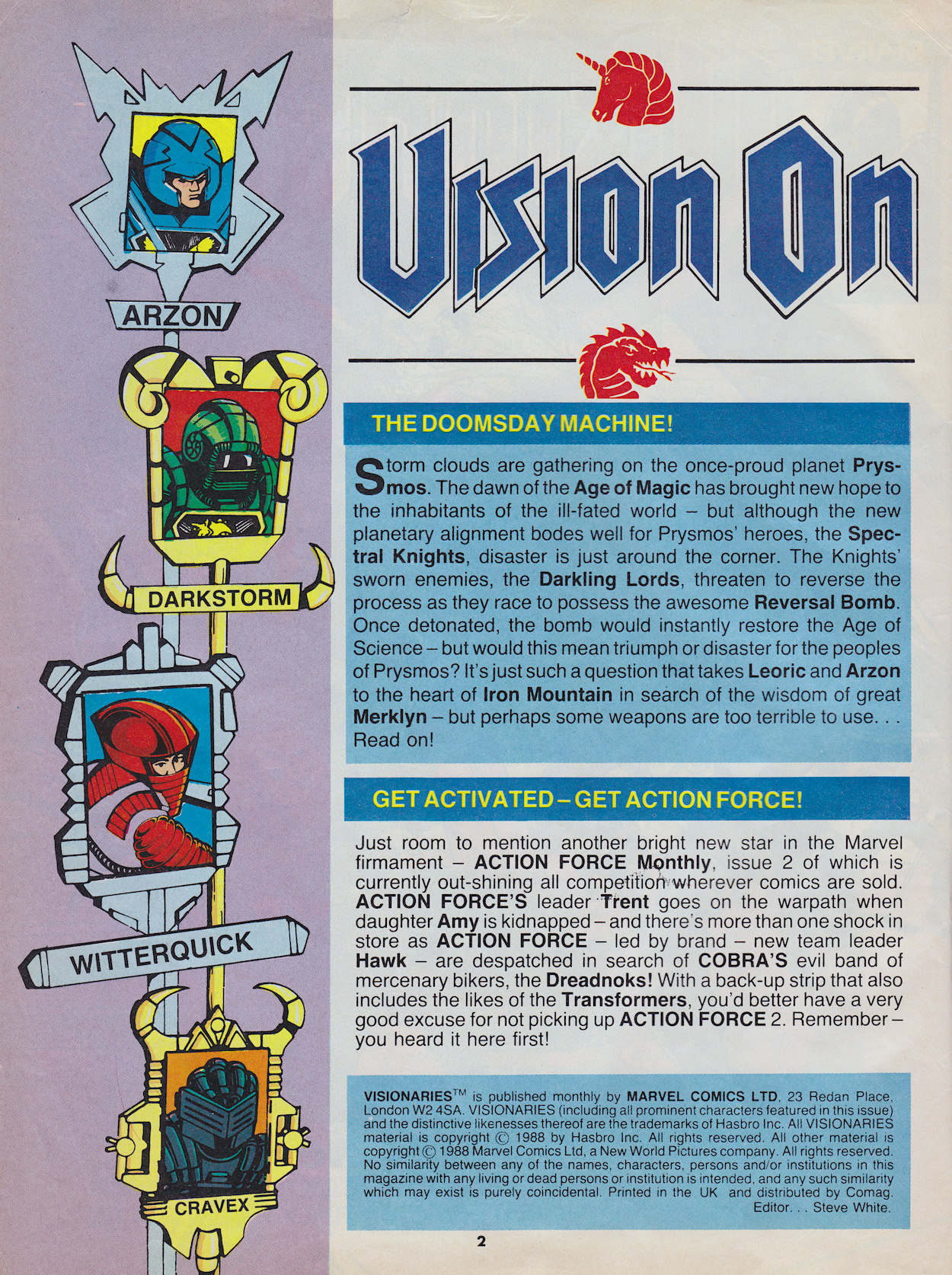
The outer eight pages are no longer of a thicker, glossier stock and instead the whole issue is made up of the same paper as the weekly Transformers. At least editor Steve White is introducing the story in the editorial rather than solely plugging other titles. Action Force Monthly still gets a mention though, they must really have wanted to push it, but the main thing is we finally get a proper editorial for the Visionaries.
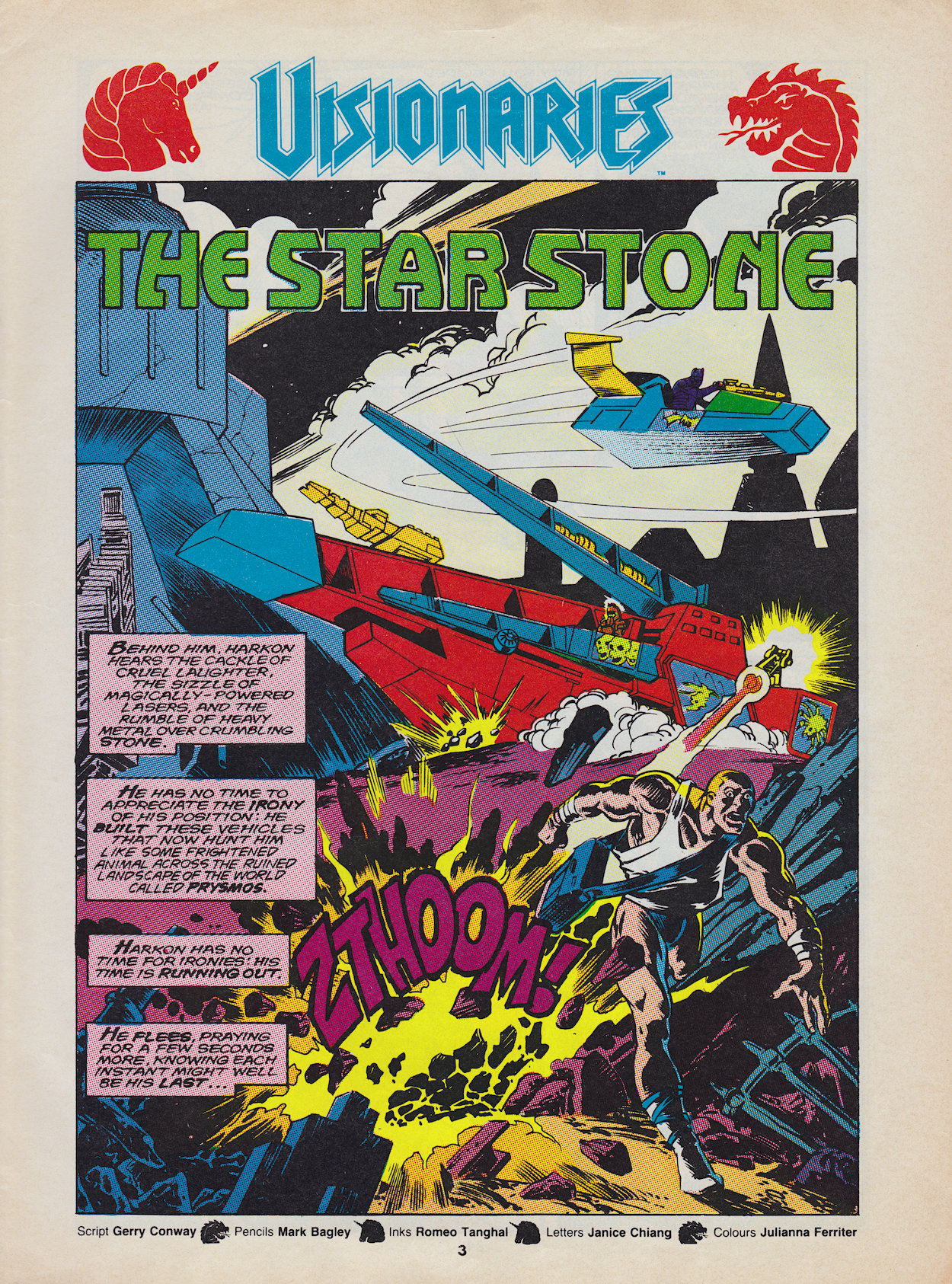
With characters beginning to develop beyond the information on the back of the toy packaging and some larger scale world building taking place, The Star Stone is a brilliant story which asks big questions about the choices we make and why, as well as clearly setting things up for as-yet-unknown events further down the line. Gerry Conway was now in charge of developing the storyline and it’s clear he understood the subject matter and its potential.
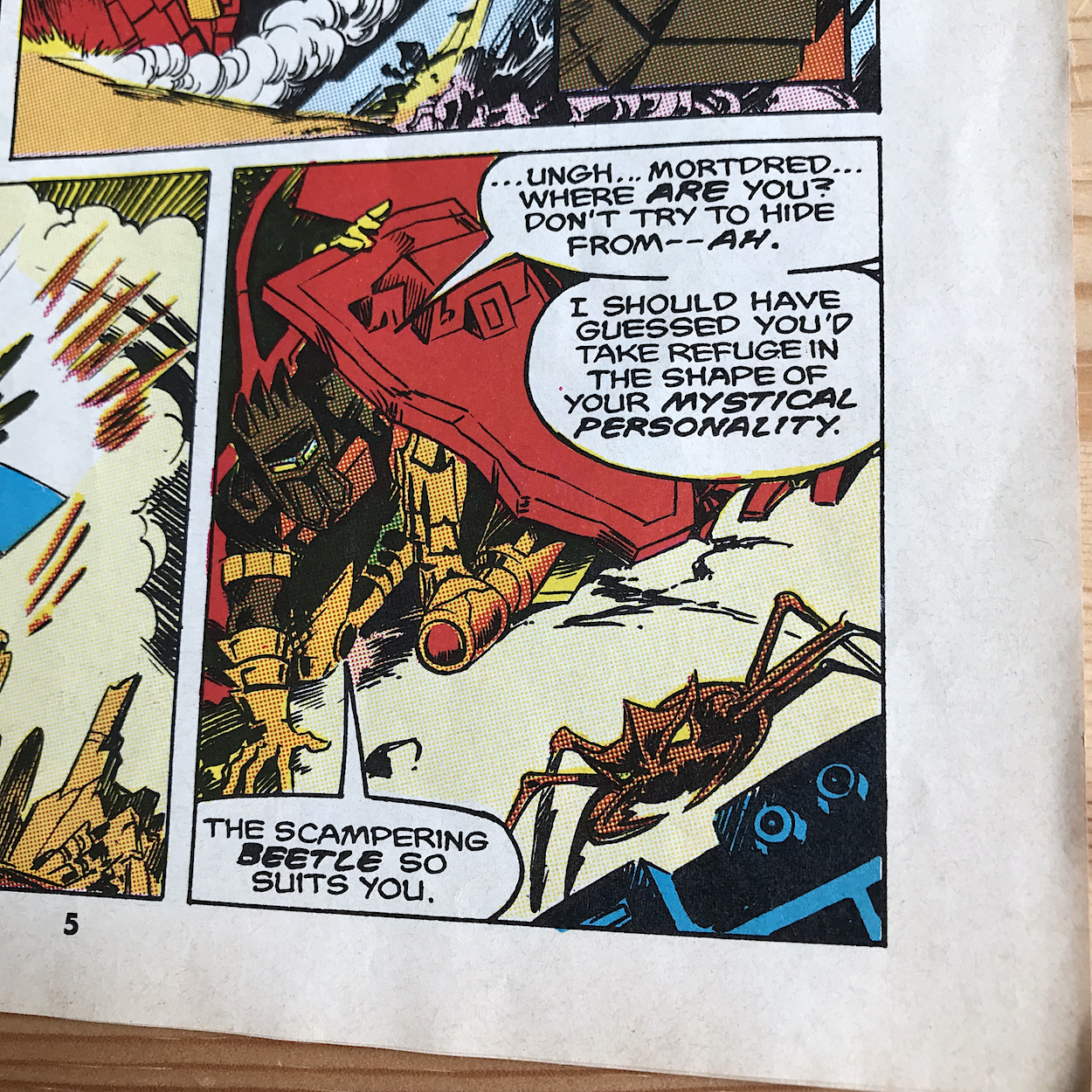
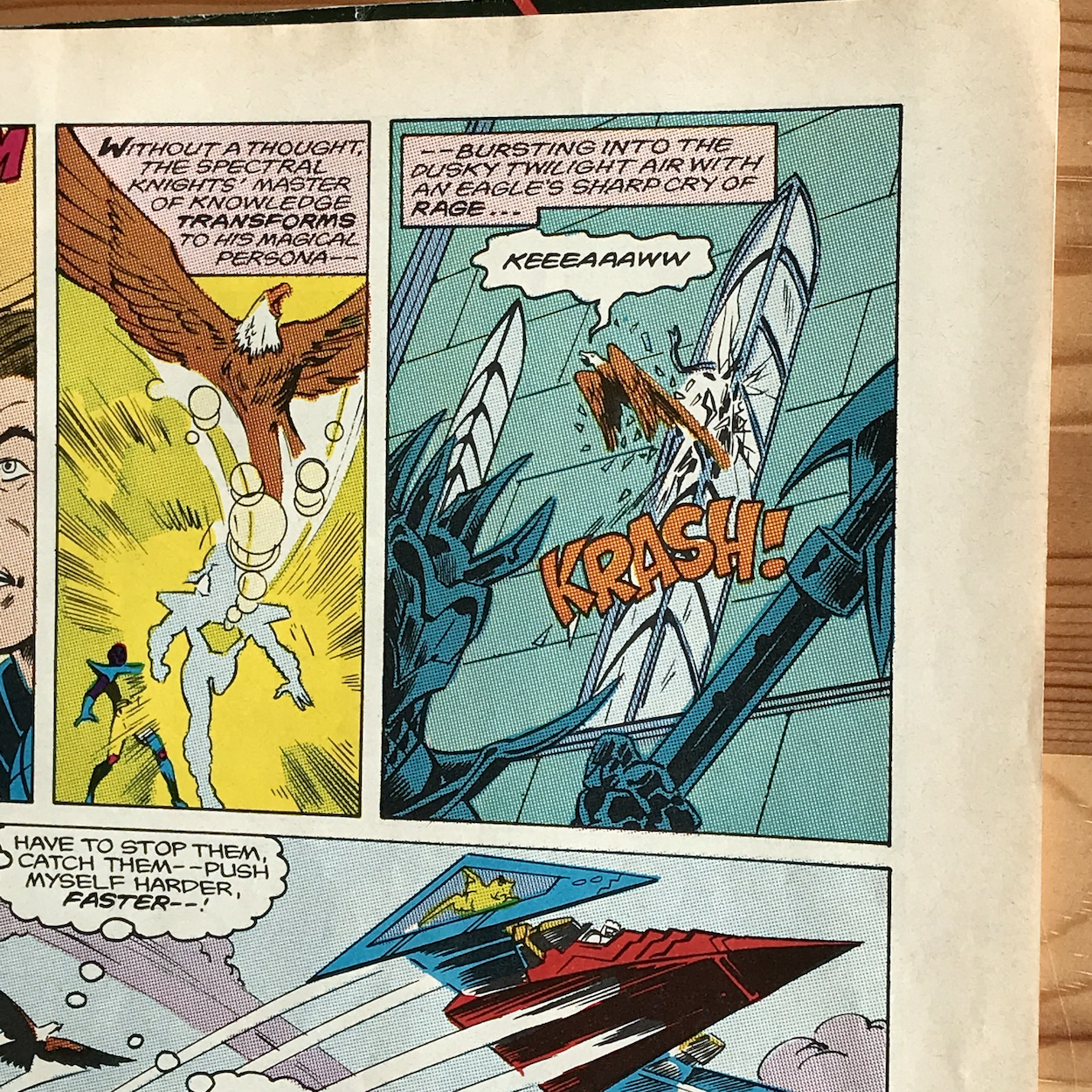
It kicks off with plenty of action as Reekon‘s new Dagger Assault, the biggest and best of all the toys in the range, tries to eliminate the Darkling Lords‘ contractor Harkon to stop him supplying any magical vehicles to the Spectral Knights. Reekon also goes up against the Sky Claw which is still in the hands of their enemy, but its owner Mortdredd recaptures it this issue, sneaking into Leoric’s castle in beetle form to steal it back. This act also introduces one of the changes from the cartoon that I actually prefer.
The characters’ magical totems would emerge from their chest plates and become fully formed as the human behind them faded away. The totems in the cartoon looked like glowing holograms to match the toys and in the context of a cartoon it did look brilliant. But comics are a different medium and in this more serious take on the story their animal selves maintain the colour of their real world counterparts, meaning they are a proper disguise. This is used to great affect several times this issue.
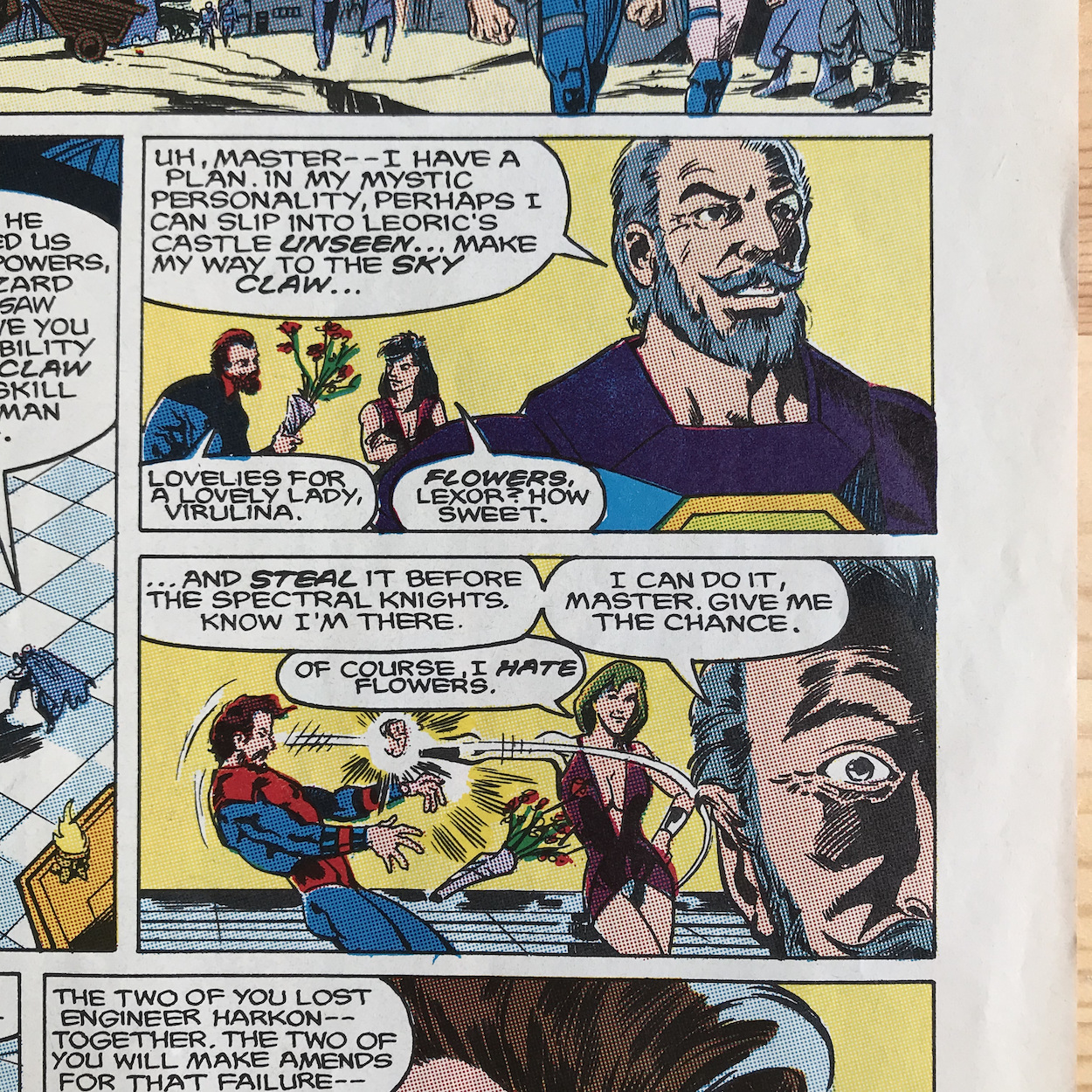
More humour slips in too, for example that background exchange between Lexor and Virulina happening behind a major plot point. The main story itself, once the characters are all in place, sees the discovery of an ancient scroll which tells of a hidden device, forgotten about for millennia that could end the Age of Magic and return the world to the Age of Science. This is revealed after a startling discovery by Arzon.
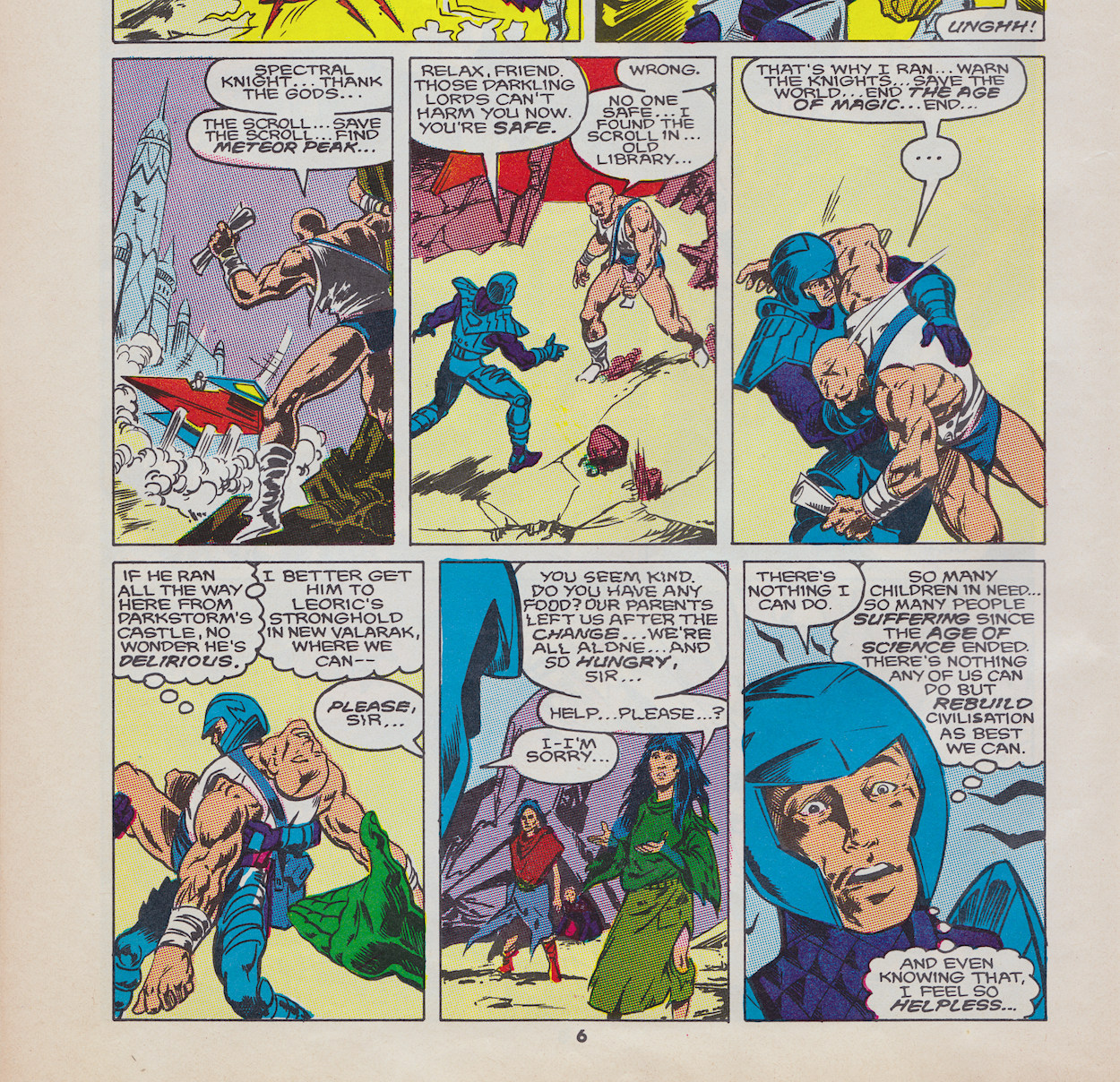
After the initial battle Arzon finds himself approached by child beggars, homeless and desperate for food after being abandoned by their parents following “the change”, which is how the cataclysmic events of the origin story are referred to. This is where Gerry’s world building comes in. The toys and the cartoon hype this fancy new age, the wonderful powers that came with it and all the action and adventure kids could hope for. But Gerry’s Prysmos is a grittier, medieval place where Arson finds himself suddenly faced with the harsh truth.
The origin story placed a lot of emphasis on how reliant humans were on their technology. At the end only a few Knights were deemed worthy of Merklynn’s magic, the future of their world placed on their shoulders. You could view it as an allegory of the dangers of relying too much on technology (technological advancements were happening at a breakneck pace in the 80s), or a reference to the class system and how those in a position of power, whether earned or not, have a responsibility to those less fortunate. The Spectral Knights and the Darkling Lords just have differing views on what their responsibility is.
While all the magical action is there, seeing them have philosophical debates, questioning their powers and being properly affected by the world around them has been a very pleasant surprise
The coming of the Age of Magic has left many suffering and having these starving children approach Arzon, who is unable to help, is a particularly dark moment for a toy licence. It makes for a surprisingly mature thread throughout, one of many planted by the comic’s new writer.
Arzon thinks returning to the previous age is a way to end this suffering. His leader Leoric isn’t so sure. Suffering still occurred before and humans had lost their way, lost their compassion and their true worth. The Age of Magic is a chance to rebuild together, to fix all that was wrong before. But at what cost in the short term? The scene in which this is discussed is a lovely, quieter moment between them and shows how they’re now being treated as three-dimensional characters who just happen to have magical powers.
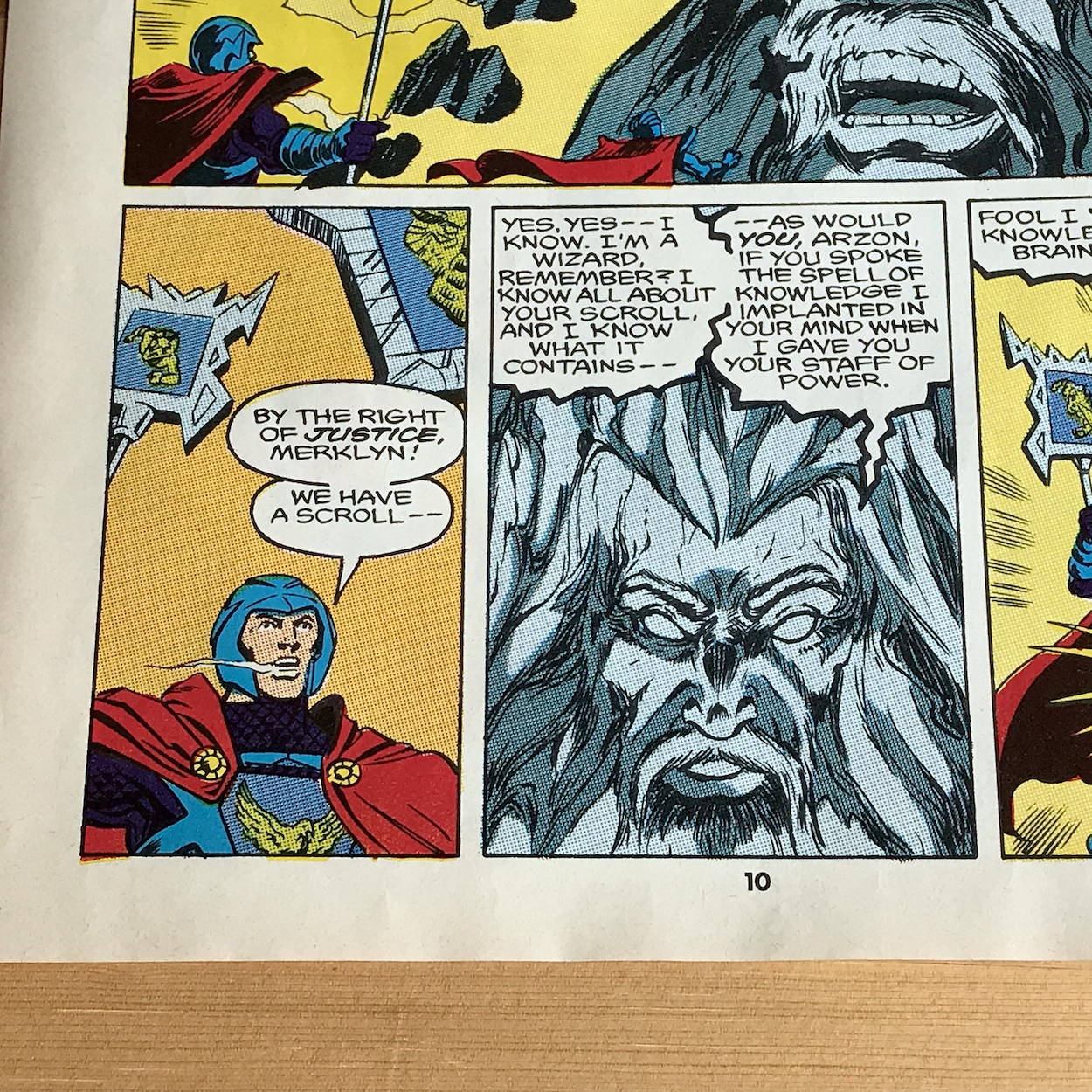
But when Mortredd steals the Sky Claw it’s clear he could be taking the information from the scroll back to Darkstorm, so Leoric has no choice but to track down the device. We see Arzon in his eagle form, a true animal and not a holographic projection, alongside more lovely atmospheric captions. He’s unable to catch the Sky Claw, so he and Leoric leave to seek knowledge from Merklynn about the scroll, which results in a rather funny exchange from the usually serious wizard.
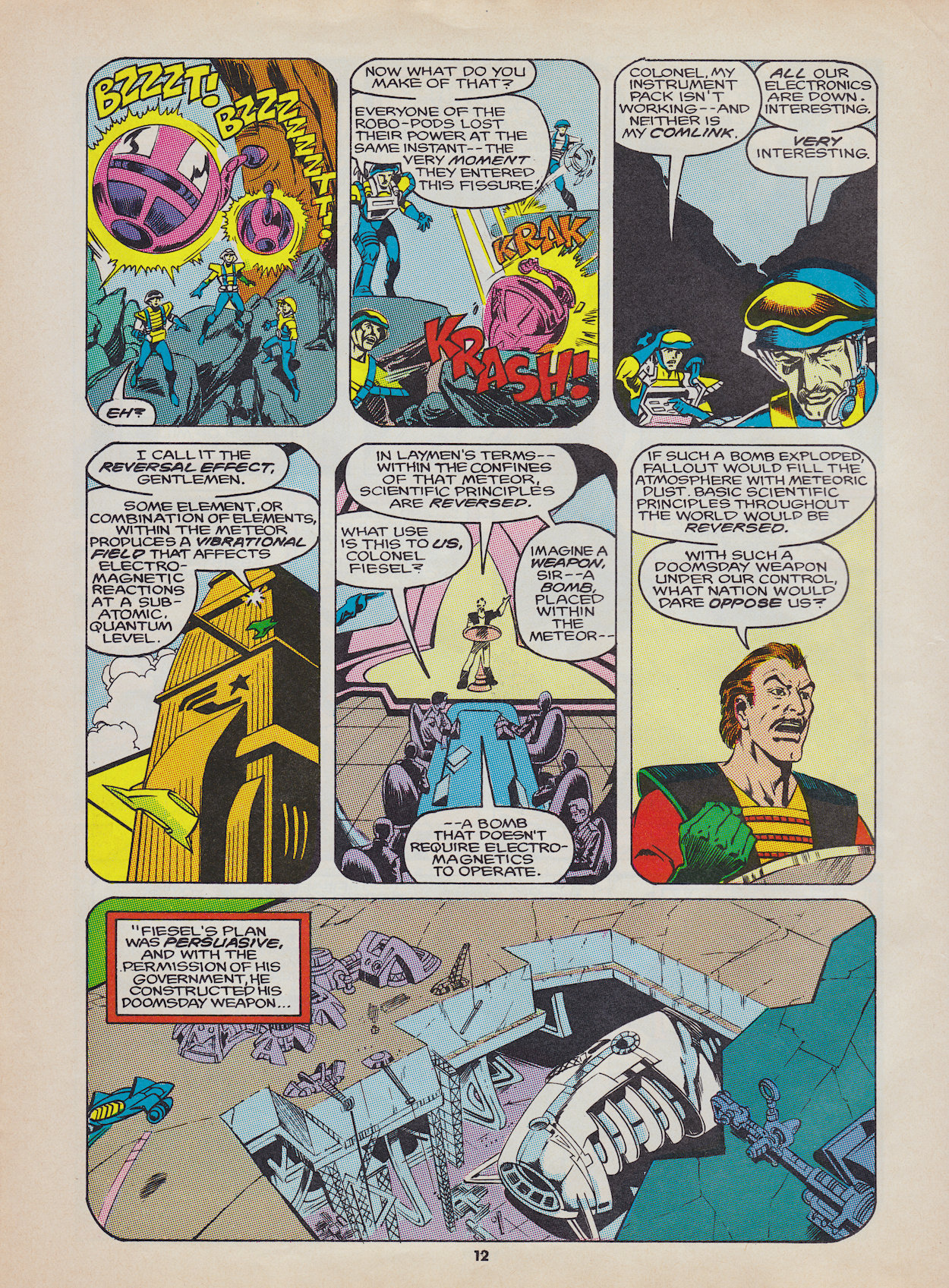
We now get a few pages told through Arzon after he casts his Power of Knowledge poem, telling us of a time ten thousand years ago during the earliest days of the Age of Science when a meteor fell to the ground. Upon its discovery the military’s head scientist, Tech-Colonel Ragni Fiesel found none of his equipment worked within its vicinity.
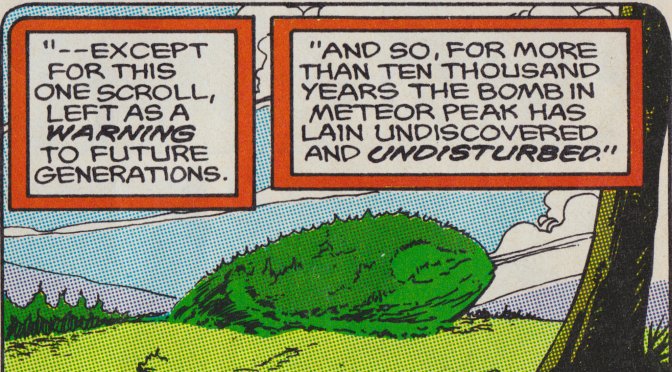
Identified as a ‘Reversal Field’,Fiesel ordered the building of a bomb containing the meteor as a way of deterring any other region from invading. It was promoted by the government as a way of keeping the peace. But Prysmos had been at peace for millennia, there was no need for such a threat against other nations. Some things never change and it would appear the mythical world of Prysmos was in reality no better than our own.
It was clearly a ploy by a corrupt government, one which was soon overthrown in a coup. But not before the bomb had been built and secreted in a mound of earth, over time becoming overgrown and part of the landscape, indistinguishable from its surroundings. All records of the bomb vanished, apart from the one scroll discovered by Harkon, who as an engineer longed for the return of that age.
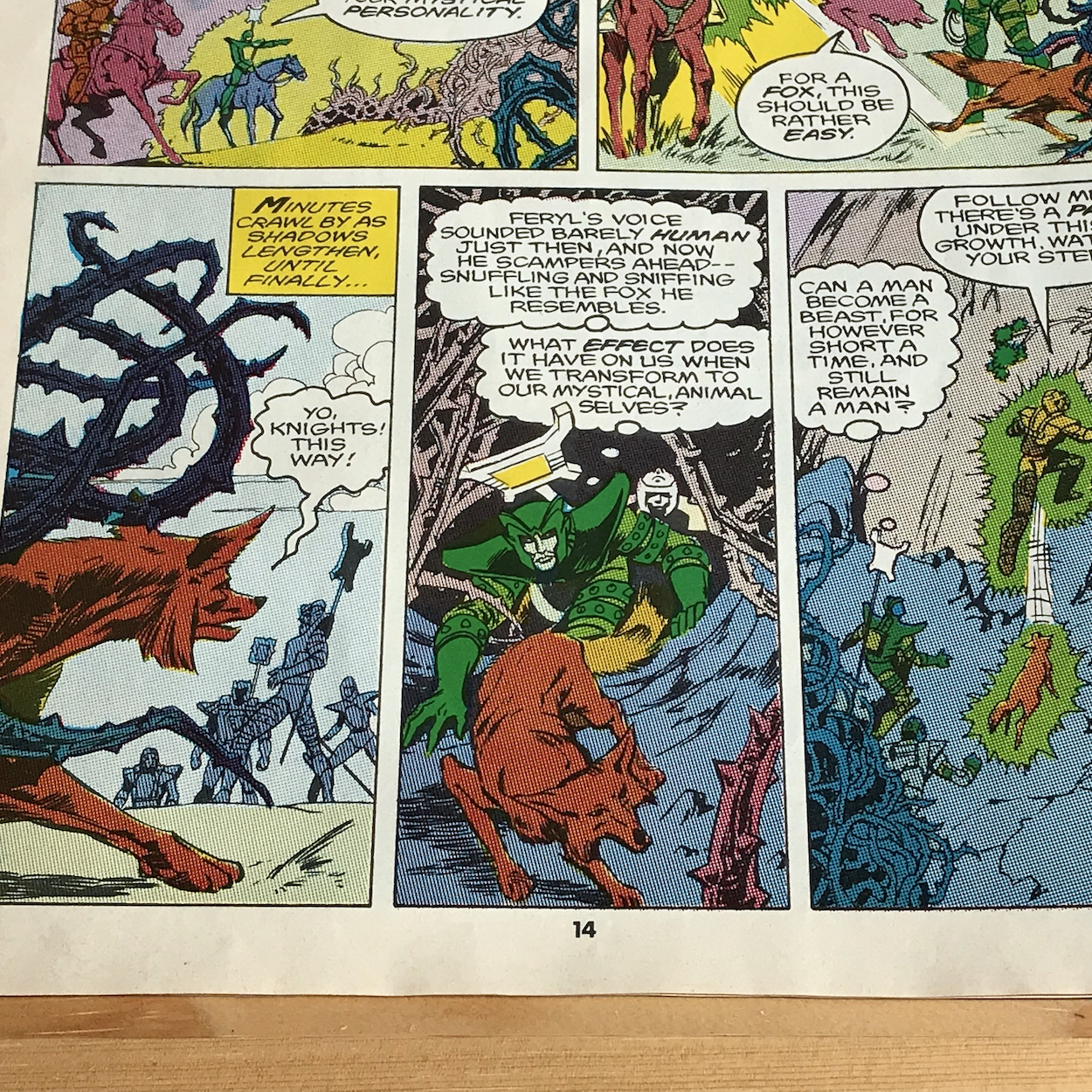
“Can a man become a beast, for however short a time, and still remain a man?
Leoric
During their quest to find the bomb Leroic gets to muse to himself about the magical totems they now possess. After witnessing Feryl find a path through twisting thorns as a fox (this is an error, Ectar is the fox and Feryl is a wolf), Leoric notices his friend’s voice sounds less human every time he transforms. It surprised me they can speak in their animal forms at all! But that’s not the point I want to make. Leoric’s foreboding thoughts set up possible future storylines about just how much these powers change those who use them.
I’m loving all of this extra depth because I just didn’t expect it. While all the magical action is there, seeing them have philosophical debates, questioning their powers and being properly affected by the world around them has been a very pleasant surprise. It’s bittersweet of course and I can’t help thinking how this could’ve developed if it hadn’t been cancelled so early.
Gerry clearly had plans for the future and he was carefully planting seeds here. But the main thread this issue concerns how little they know about their planet’s current situation, enough to throw doubts on whether they should attempt to change their future yet again. With all these unknown factors they could make things even worse.
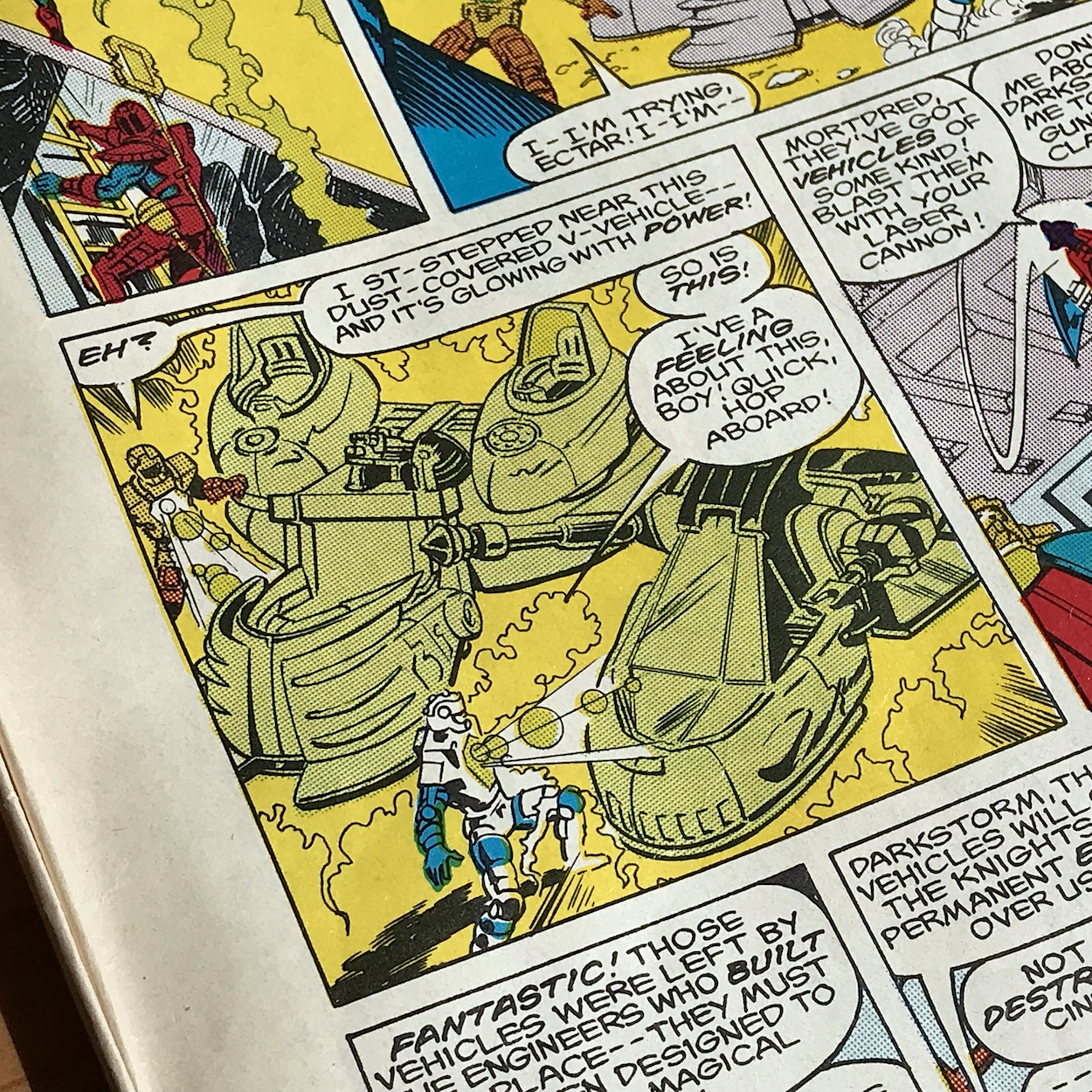
Fortunately for the Spectral Knights, and for Hasbro, inside the meteor’s casing their ancestors saw fit to place vehicles which could work near the Reversal Field by drawing energy from a magical source instead of a scientific one. Fiesel knew that if his government really did have to throw the switch, they’d need some kind of advantage.
Say hello to the Capture Chariot (the one vehicle I didn’t possess) and the Lancer Cycle, completing the comic’s take on the toy line.
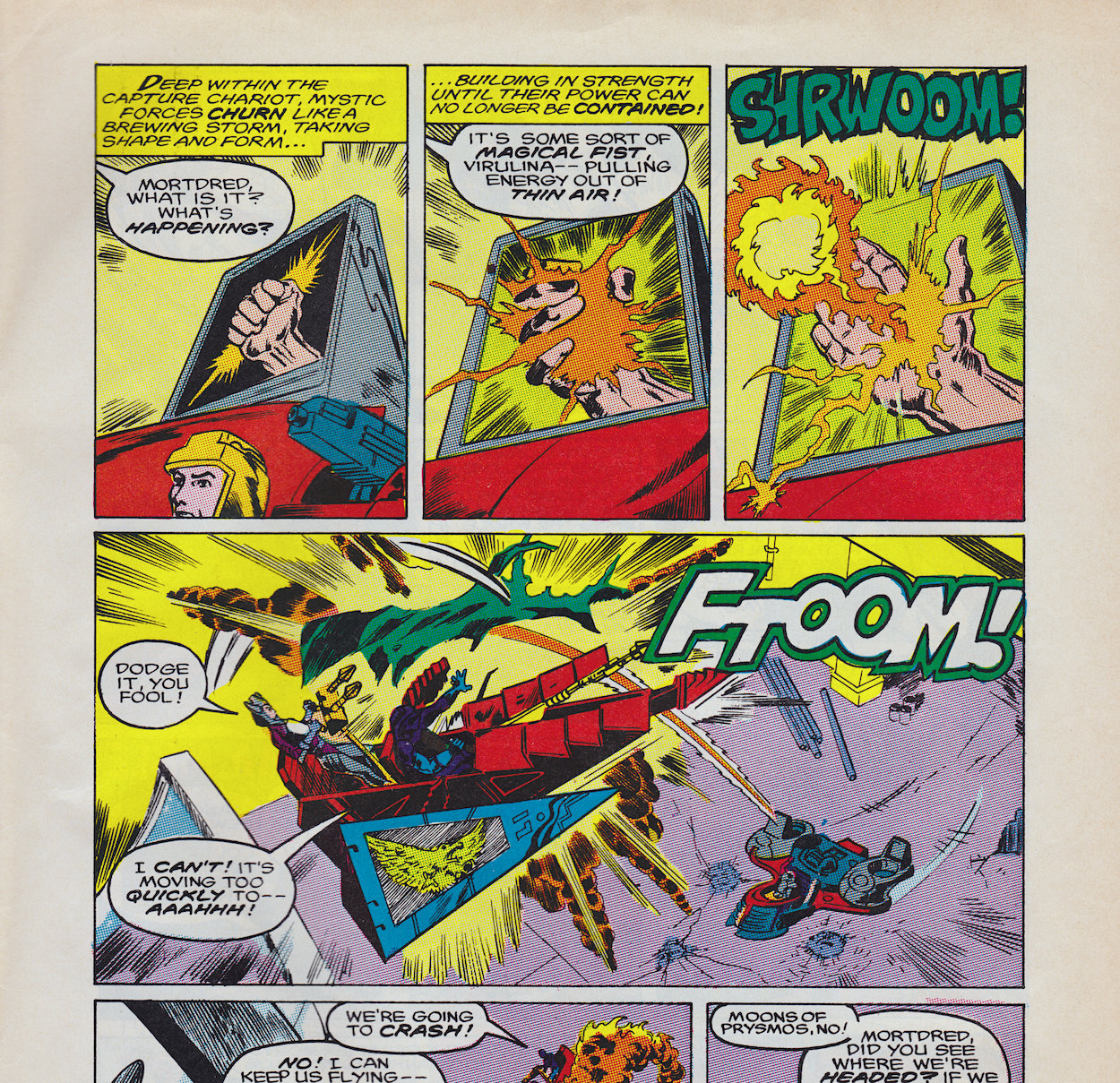
The large scale battle at the end of this issue is brilliantly brought to life (with no more mistakes I should add) by penciller Mark Bagley, inker Romeo Tanghai, colourist Julianna Ferriter and letterer Janice Chiang. We even get to see the Capture Chariot‘s power and I was thrilled to see it resemble that of the cartoon’s. There really was no other way to show it and, even if it’s not in the ghostly green colour I was used to as a kid, it’s still pretty neat to this old fan.
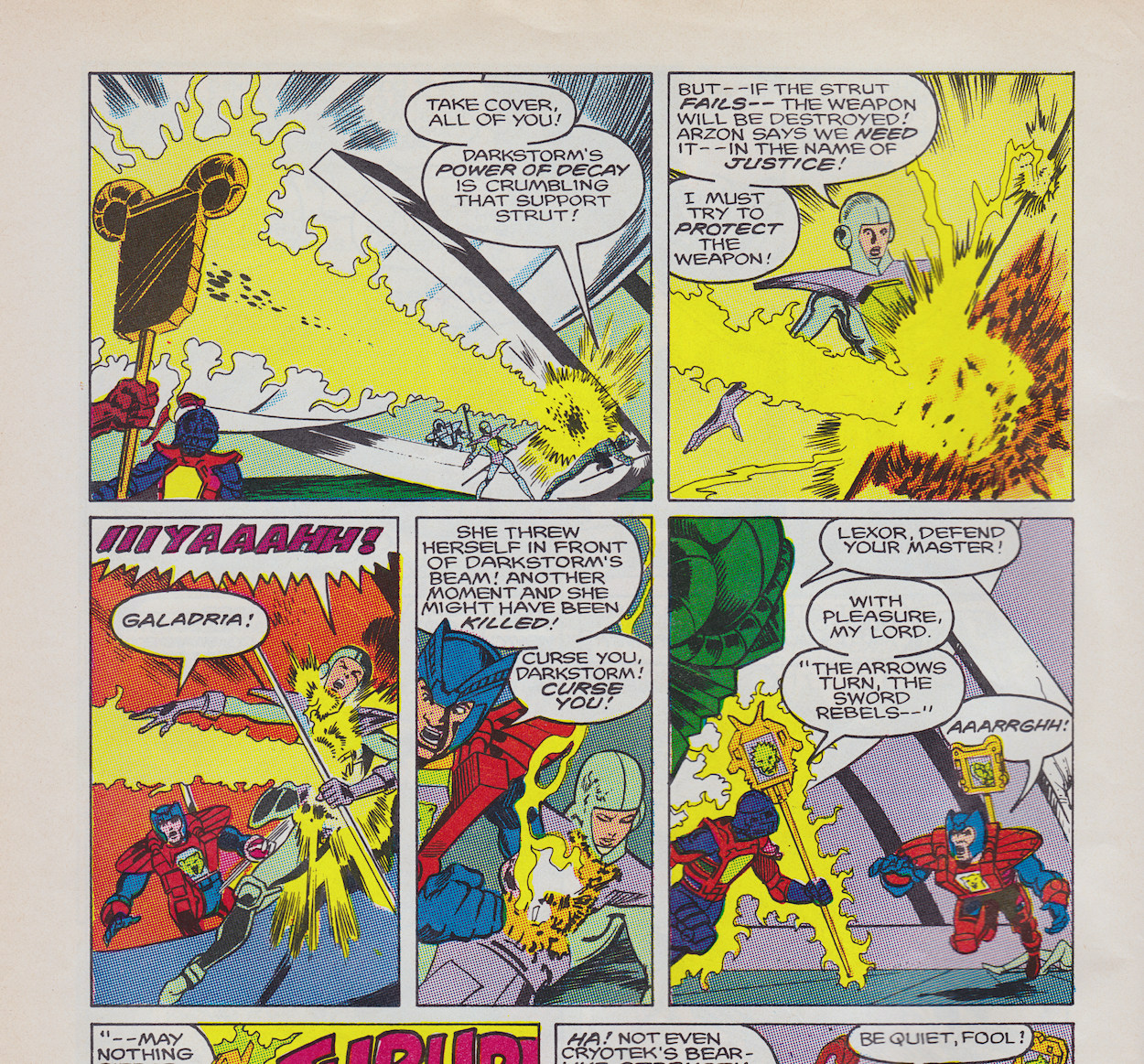
In a moment of desperation against ever decreasing odds Darkstorm uses his staff’s Power of Decay to try to destroy all of the Spectral Knights in one swift move and it’s Galadria who saves the day, throwing herself into its path. She may not have her own powers yet, but here she shows her willingness to sacrifice herself to save others. This sets her up to receive her Power of Healing from Merklynn. See also how cowardly Lexor now throws himself into battle, but only because his Spell of Invulnerability can stop anything in its tracks.
In a clever moment Leoric’s Power of Wisdom and Arzon’s Power of Knowledge are shown to be two very different things indeed. The Spectral Knight leader isn’t sure the reversal bomb should be set off and Arzon questions this, “Think of all the pain we’ll save the world!” Leoric’s response isn’t the kind of thing you’d expect from a toy licence comic.
“But pain is a part of life, Arzon. When a mother gives birth, she knows pain. Would we deny the newborn child to save the mother pain?”
As Arzon then notes, knowledge and wisdom must be used together.
In the end Darkstorm accuses Leoric of being weak and reference is made to their opposing plans to rebuild their world. Leoric sees a better world, Darkstorm a stronger one. Most of the time the villains in our cartoons and comics in the 80s were evil simply because they were. Darkstorm genuinely believes only by ruling with an iron fist can his beloved Prysmos regain its strength and position in the heavens. Leoric believes in compassion and fairness instead, even if rebuilding takes longer to achieve. It’s an interesting dynamic.
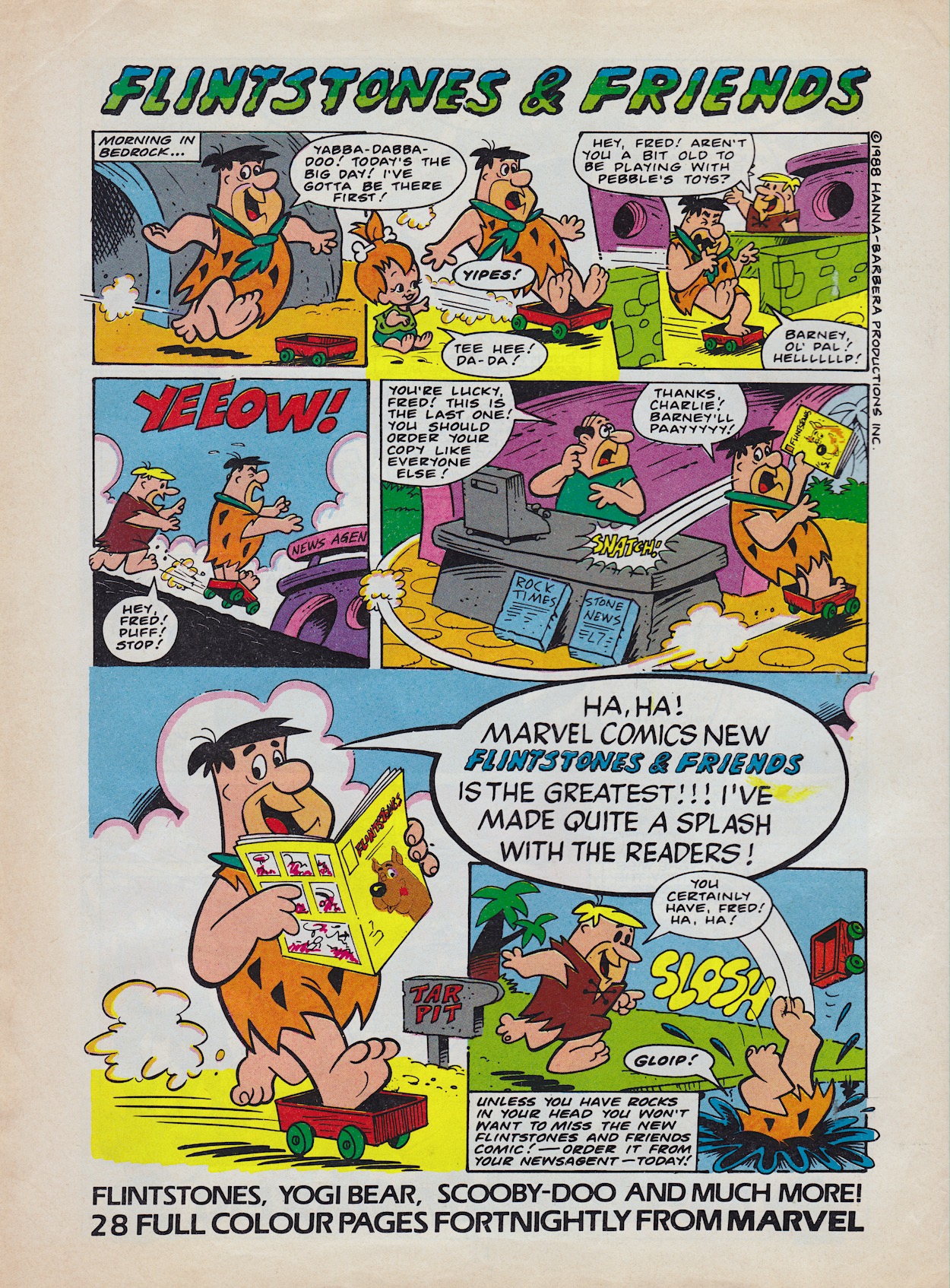
As discussed before Visionaries has no extra features, in fact this issue even has only one advertisement and it’s a bit of an abrupt change of pace! It isn’t even for the toys the comic is based on which seems a strange choice. Instead it’s a promotion for the new Flintstones & Friends title. It feels rather out of place here; surely it had a different target audience? The fact it’s out twice as often as Visionaries yet has more pages is a bit of a blow for fans too. The Flintstones comic would last for just under a year, managing 24 issues before being cancelled and rebranded as Cartoon Time.
It’s sad to think of this as the penultimate issue of Visionaries already when it seems to have so much promise. However, there is at least some more to come even after the final issue next month. I’ll let you in on what that is in the next fateful review, it’ll be here on Wednesday 21st July 2021.
Starting with this third edition of Marvel UK‘s monthly Visionaries are stories I’d never read before collecting them for the blog. The origin story I felt I knew almost verbatim, but now the comic was diverging away from the cartoon and forging its own path. Having missed the regular comic as a kid, I’ve looked forward to finally getting to read these stories.
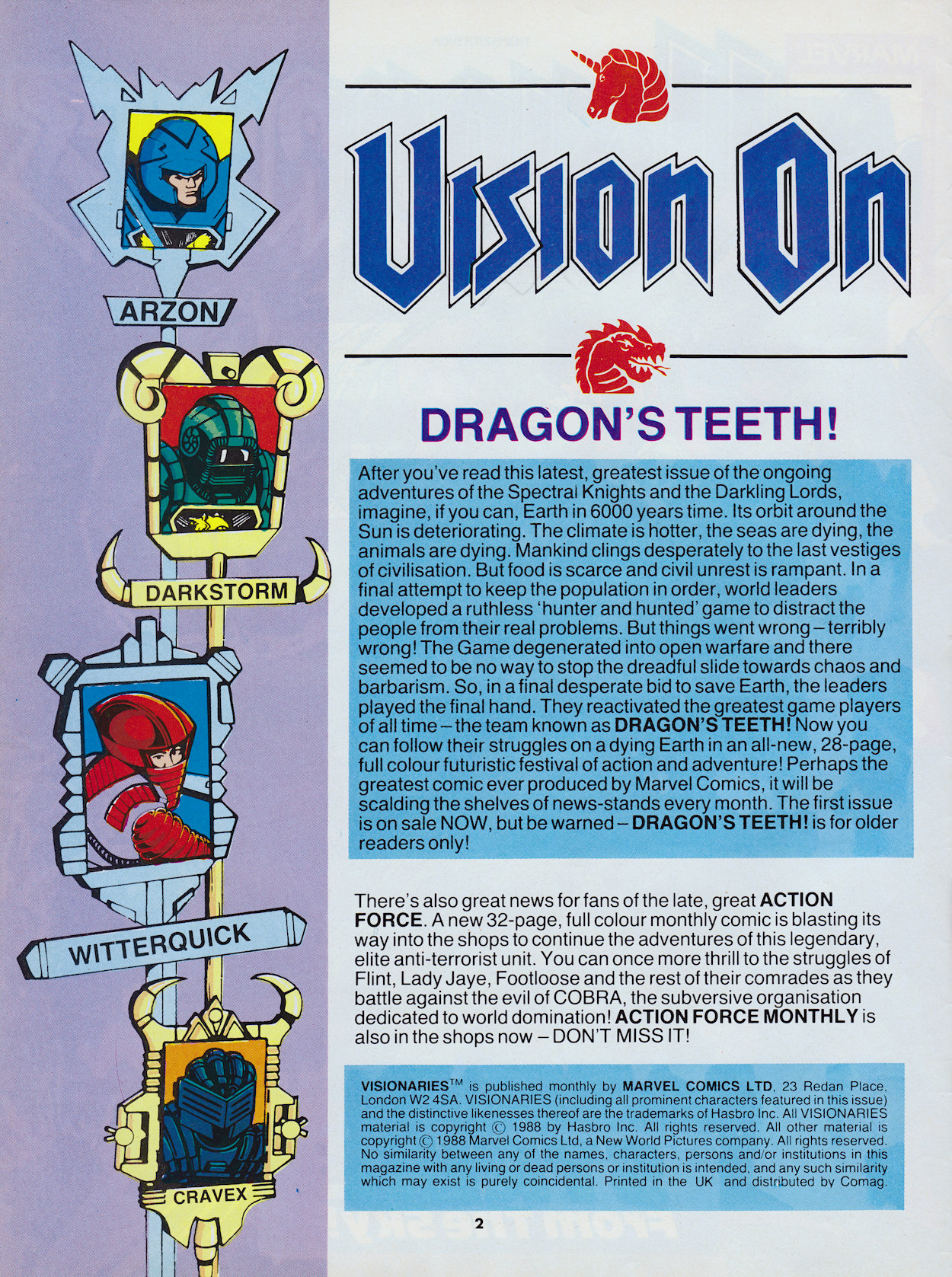
Being original creations and something fans of the cartoon may have been eager to read, it’s confounding to see once again the editorial page not mentioning the story at all. Even though it’s called Vision On it’s basically an advertisement for other titles again, this time the new Action Force Monthly and Dragon’s Claws (called by its original name here which was changed just before its release), both of which were of the smaller American format and designed to try to sell UK material back into the US market.
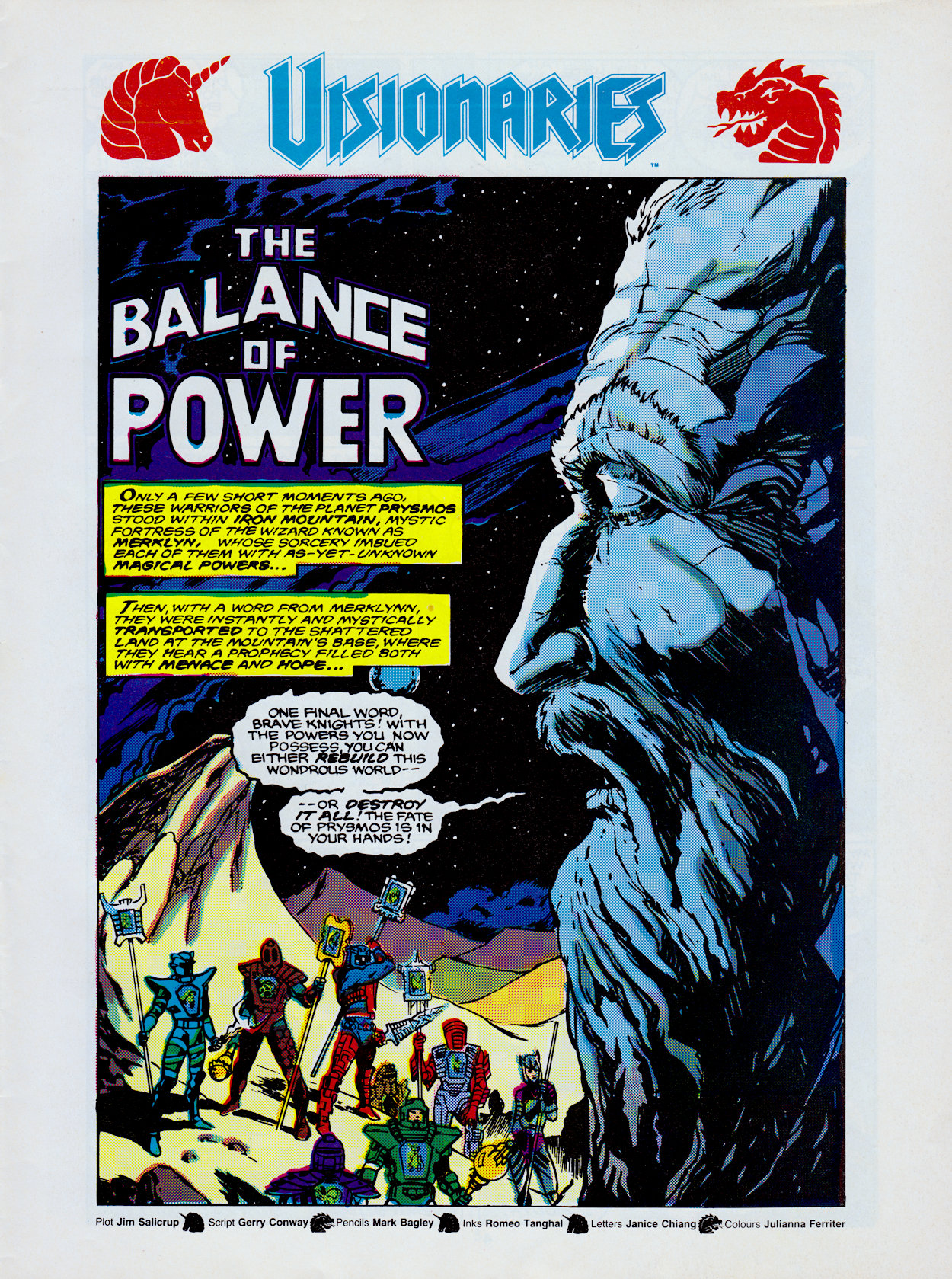
Next to the editorial the first page of Balance of Power is a bold image. On it, Merklynn‘s stone face stares down at the assembled Knights and reiterates the words from the end of last month’s story. Jim Salicrup, who adapted Frank Dille‘s teleplay origin story has created the plot this time around but full scripting duties fall to Gerry Conway (The Punisher, Spider-Man, Transformers and G.I. Joe cartoons, Diagnosis Murder) who would take over as the comic’s sole writer from the next issue.
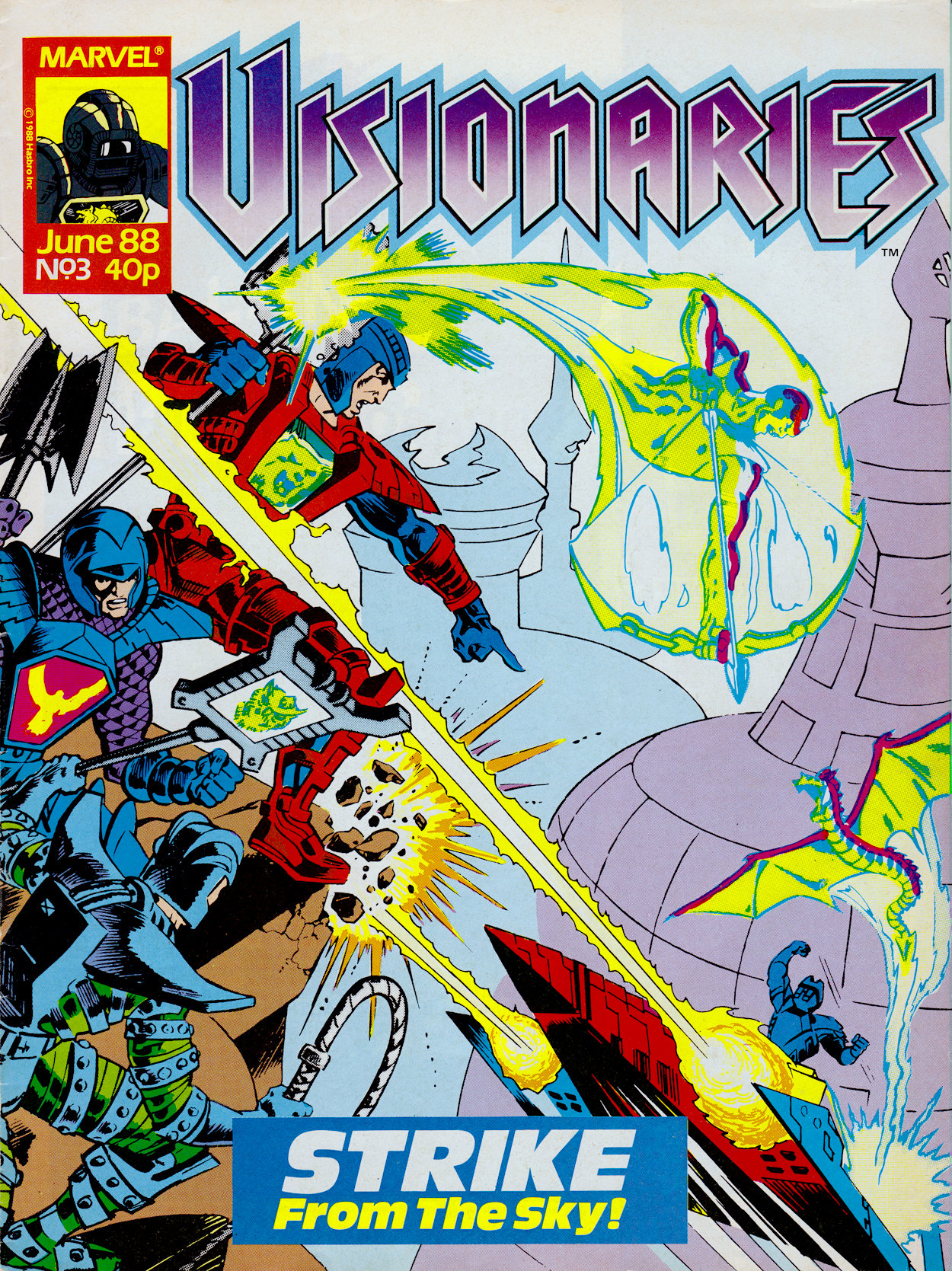
The art team are the same as the previous story, with pencils by Mark Bagley, inks by Romeo Tanghai, letters by Janice Chiang and colours by Julianna Ferriter. Unfortunately, it’s in this final category that the issue is let down a little bit. There are quite a few colouring errors, which is something you don’t want when you’re still introducing characters and the colour of their armour is key to seeing who is doing what and to whom in battle. It’s a shame because at times it can really ooze atmosphere, such as with that splash page above.
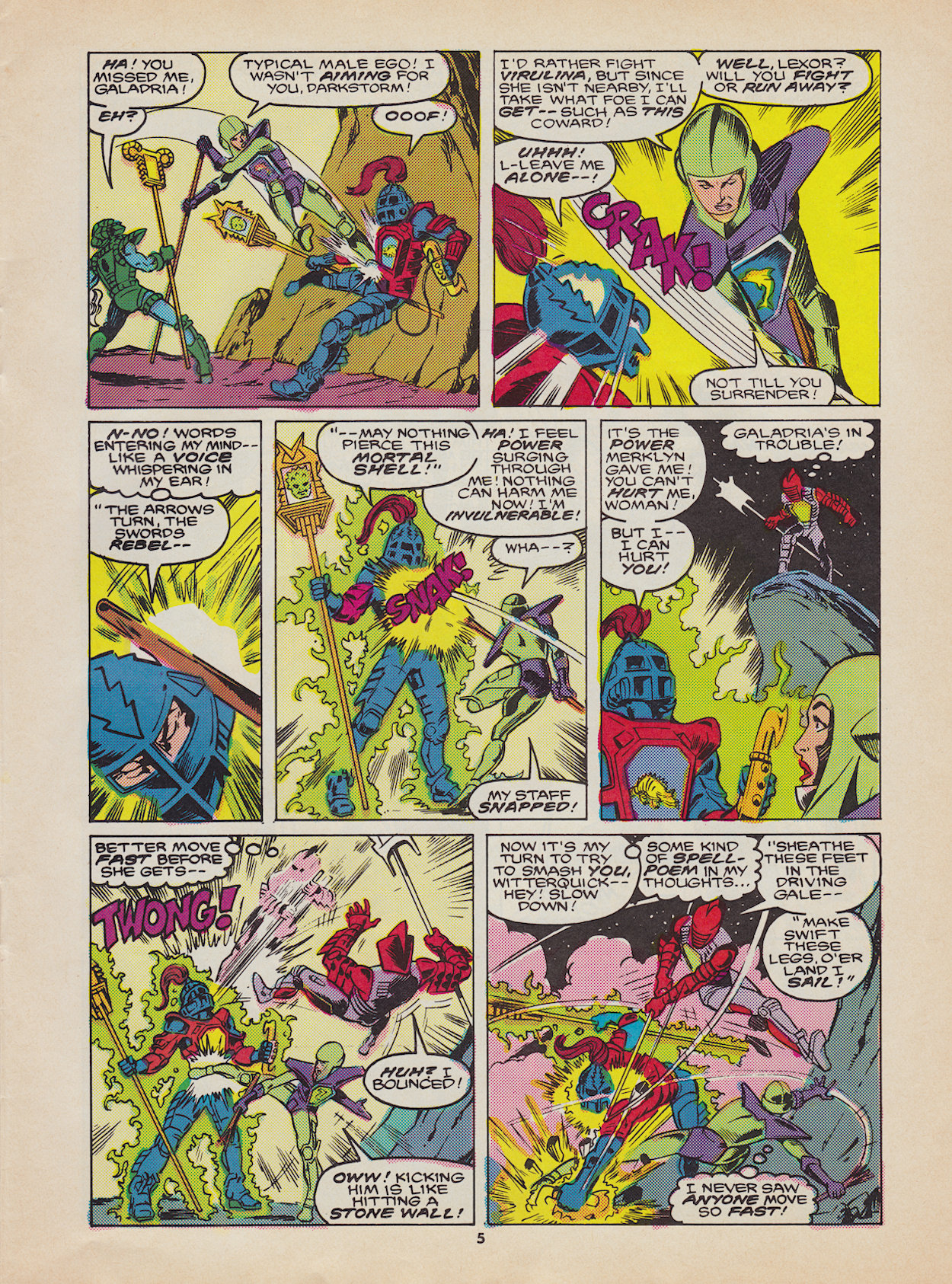
Something else this issue has in plentiful supply is action. As soon as Merklynn finishes his prophetic speech the Knights turn on each other, wishing to finish off the battles started inside Iron Mountain. Galadria gets the best line, then some of the characters start hearing a voice inside their head, telling them of incantations to summon the power of their magical staffs. Reading these again brings back memories of learning them off-by-heart from the toy packaging.
This is where some fundamental changes between the comic’s universe and that of the cartoon become apparent. Here, the staffs just sort of produce the desired effects, like making Lexor invulnerable, Witterquick superhuman fast and Cindarr‘s unleashes a mini-earthquake. But in the cartoon the holographic image on the staff materialised in the real world, for example a cyclone around Witterquick’s body or a giant monster wielding a club for Cindarr. Even the cover of this issue shows Cryotek’s archer, but none of these would appear in the strip. They’re missed and without them it’s not particularly clear what’s happening at times.
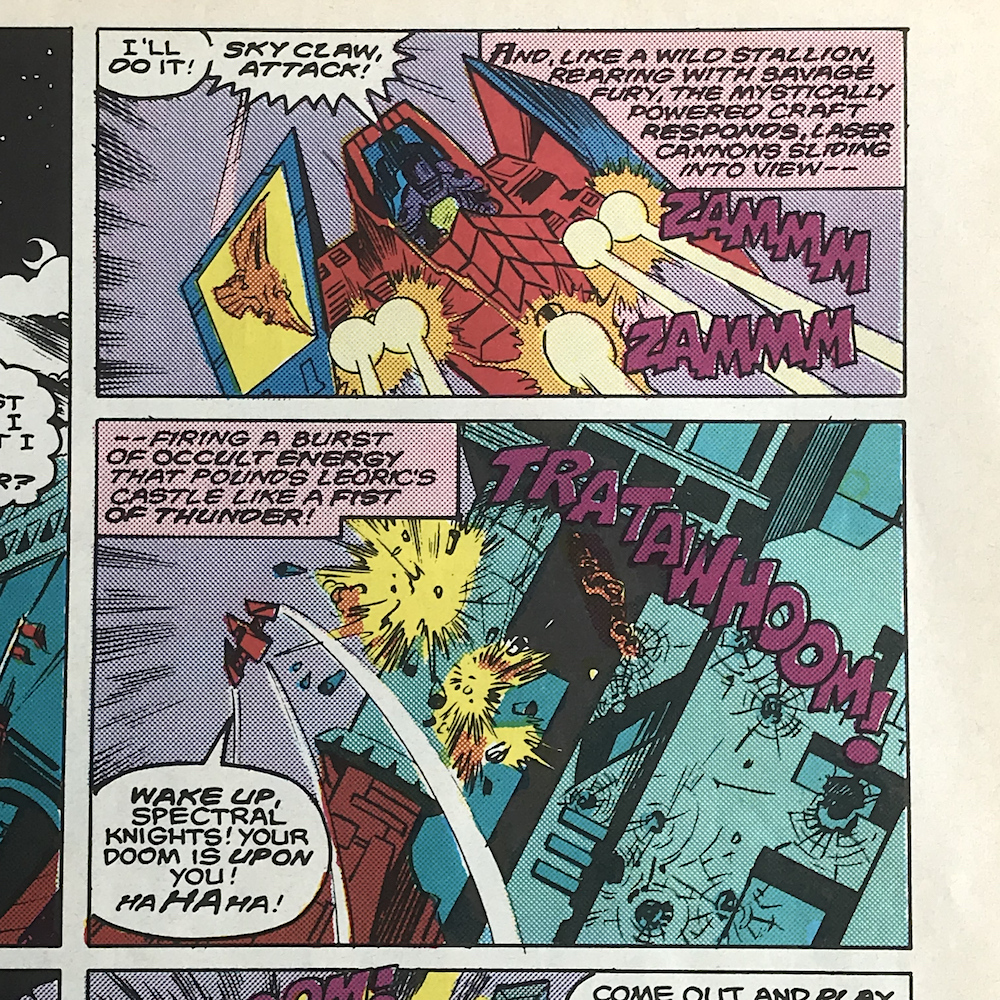
“And, like a wild stallion, rearing with savage fury, the mystically powered craft responds.”
Description of the Sky Claw
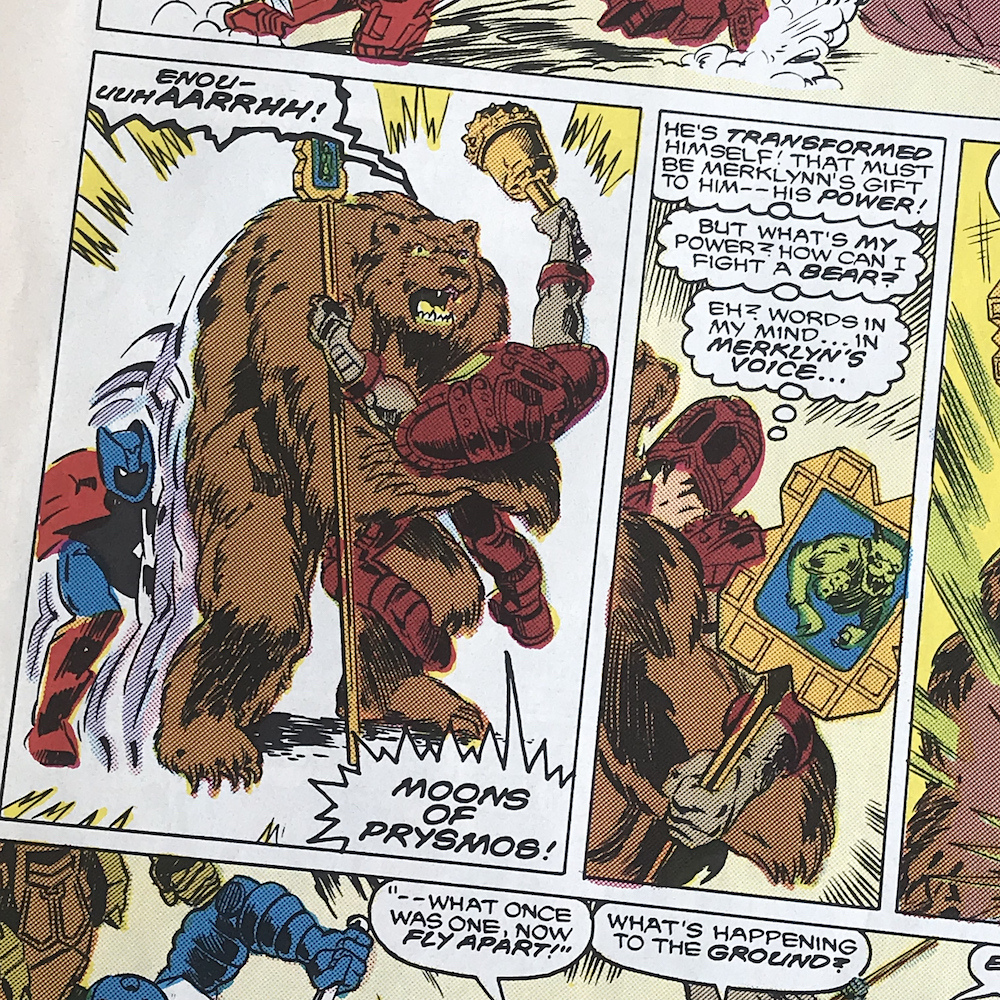
It also doesn’t help that when some of the characters transform into their magical animal totems these are mistakenly referred to as “magical powers”, when that’s actually what the staffs contain. Instead, the totems are an embodiment of their individual personalities, which they can change into, physically becoming said animal and harnessing its abilities (the actual animal rather than a magical representation like the cartoon). However, their magical powers are that of speed, strength, healing, decay, knowledge etc. Fans of the cartoon or toys would be able to follow along and it’s clear these are the intended audiences, but it must’ve been very confusing for anyone reading without prior knowledge.
The plot is rather basic this time around. Even though both sides have yet to even experiment with their new powers and totems, Darkstorm insists he and Leoric’s Knights are now too evenly matched. How would he know this? Surely they should train with their new magical abilities before coming to that conclusion. He wants an advantage and, annoyed with some of his people complaining about their lack of staffs, he sends stealth master Reekon and the grovelling Mortdredd to find a new weapon to given them that edge.
It all feels rather convulted. Given the cover we know what they’re going to find, but the pacing is all wrong. If this had come later in the run, or even if we’d jumped forward a few months and they were having difficulties managing their powers and wanted something more conventional, it would have made more sense. The saving grace here is the world building in the background. Wanting to rebuild his world no matter the cost to anyone else, Darkstorm’s castle overlooks slums where the poor and hungry struggle to survive, through which Reekon and Mortredd trot along, uncaring of the devastation around them.
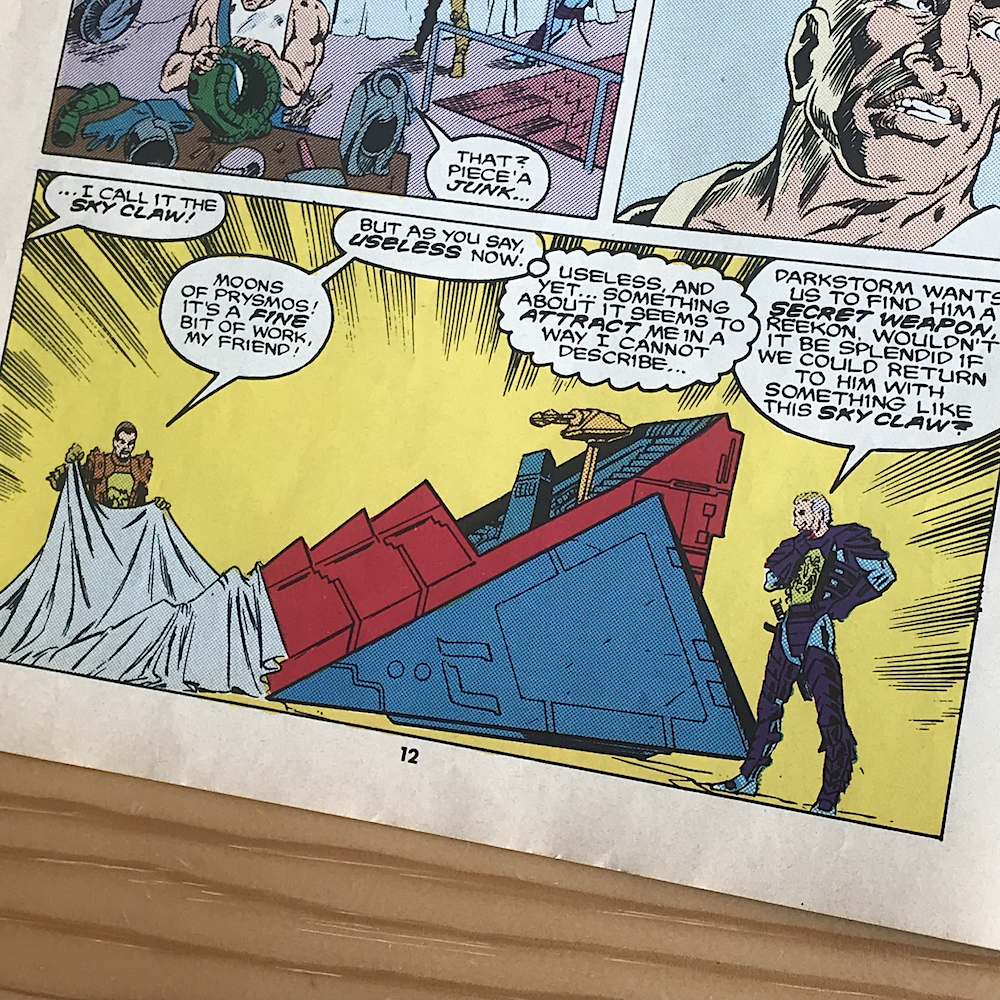
They make their way to a contact of Mortdredd’s at Harkon’s Blacksmith Shop. An engineer by trade, Harkon found himself without work in the new Age of Magic and retrained as a blacksmith, where he won the contract to repair and replace armour for the Darkling Lords. Underneath tarps scattered about his workspace are high-tech vehicles which are now nothing more than useless relics of the past.
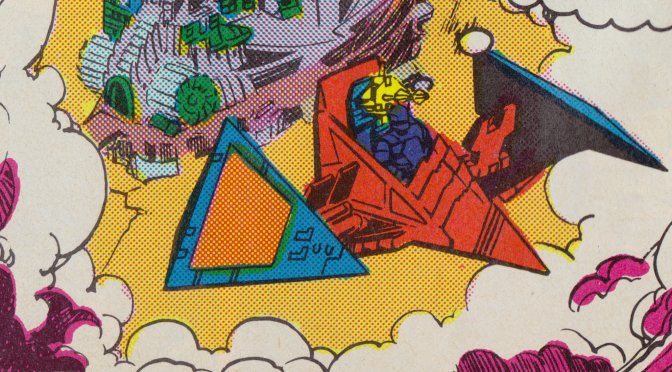
I recognised the one above as soon as its covering was pulled back. It’s the Sky Claw. It was one of the large vehicles from the toy range and one of three that I personally owned. Covered with large holograms and movable levers and wings concealing a variety of awesome weaponry, it was a favourite childhood toy. It’s the whole raison d’être for this story so my excitement levels have been turned up a bit now.
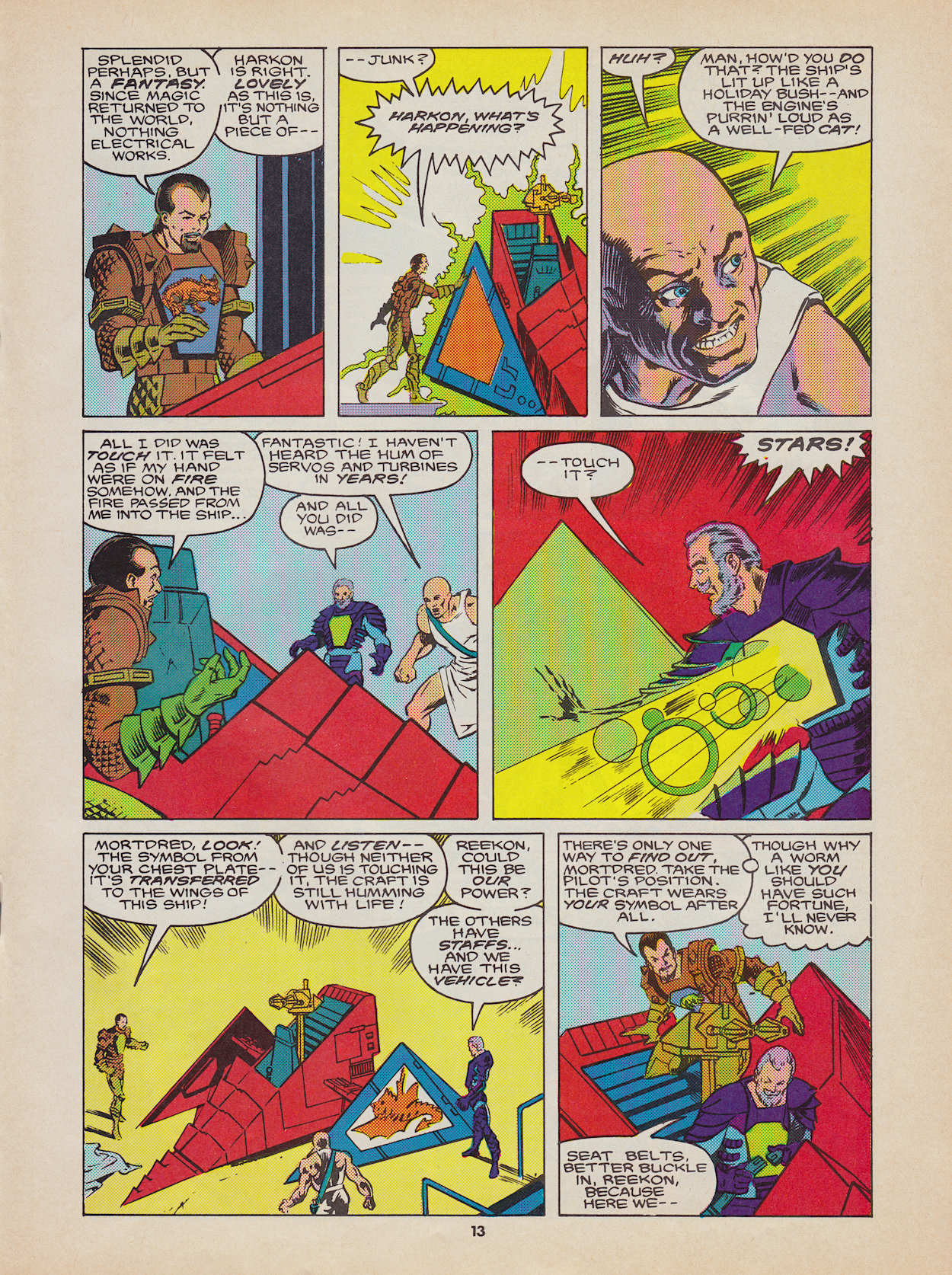
The machine responds to the energy of Reekon’s magical touch, but it’s Mortdredd’s proximity that really brings it to life. While the statement that the symbol from his chest plate transferred to the craft is completely wrong, it’s still a fun way of introducing it. I particularly like how magical powers erupt from Mortredd’s chest, while his hand almost disappears into the holographic panel, becoming nearly skeletal-like. Although, why does Harkon say he hasn’t heard the sounds of an engine in years when this follows on directly from the previous origin story?
Able to control it with but a thought, Mortdredd is eager to prove himself to his Lord and Master. Darkstorm wants to wait, plan, gather information before a strike (again, no mention of learning their new skills) and this leads to other Knights calling him a coward. Defending his leader’s honour, Mortdredd attacks the others but find it’s he who ends up pushed out. Seizing the moment, he takes the Sky Claw and launches a devastating attack on Leoric’s castle, hoping to show he’s worthy of his position within the Darkling Lords. None of the vehicle’s magical powers are used though, just the weaponry which is a shame because I was looking forward to seeing those holograms come to life again.
The descriptive panels here are excellent. In fact, throughout the comic they’re a unique mix of science fiction and what feels like medieval storytelling. The latter in particular sets it apart, the comic playing up to this aspect of the characters and setting particularly well. This attention to detail is great.
One of the more interesting magical powers makes an entrance here and that’s Arzon‘s power of knowledge, even though he’s incorrectly drawn as Ectar but we’ll skip that detail for now. He recites his incantation to find out what the Sky Claw is, because there has been no flying vehicle since the Age of Science and it takes them by complete surprise. However, he not only discovers the information he seeks, suddenly everything he’s ever known in his whole life temporarily returns to his mind.
Everyone having completely different powers […] could make for some epic battles
This could’ve set up some brilliant stories for the future. I could see something like that opening up old wounds, thoughts he’s tried to suppress or even things that he doesn’t wish to know. Unfortunately I can’t see this being explored in the short run the comic ultimately had.
On the surface a power like this could seem to give an individual an unfair advantage in any fight, but with everyone having such completely different powers, all with some form of vulnerability built in if not used correctly, it could make for some epic battles.
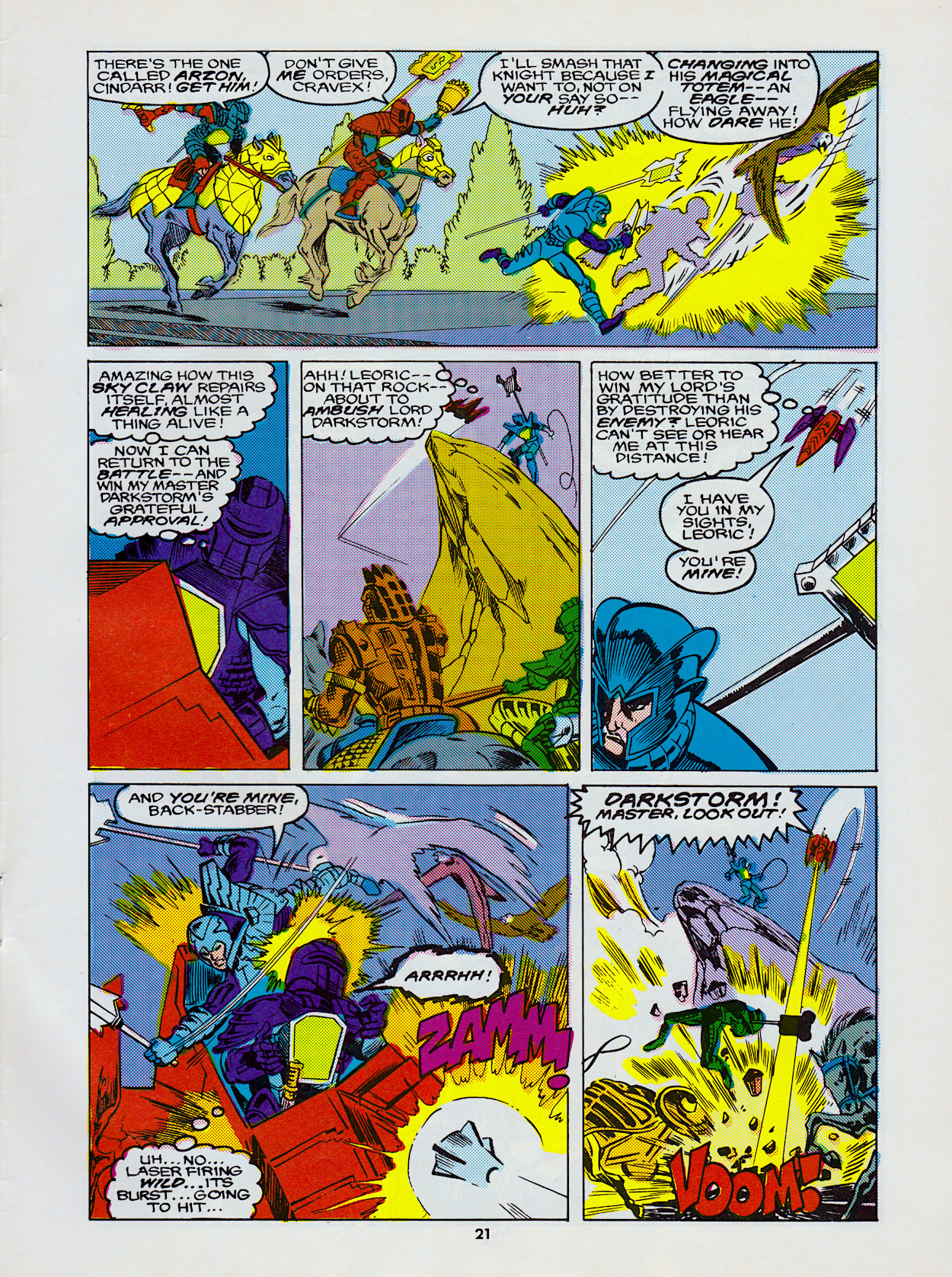
It all comes to a head when Arzon transforms into his eagle form and attacks the cowardly Mortredd from above. From there it all falls apart for the Darkling Lords, who had shown up to finish what the Sky Claw had started. Disobeying orders and nearly killing his leader sees Mortdredd locked up in the dungeon of Darkstorm’s castle at the end of the story, but not before he’s made reference to the Sky Claw feeling alive when it repairs itself during a moment away from the battle. It’s a passing comment for now, but if memory serves me right this could tie in to some revelations yet to come about all of the Visionaries’ magical powers.
The Balance of Power feels very much like an extension of the previous two issues and the cynical might say it’s nothing more than a couple of extended action scenes. There’s little in the way of characterisation but the main point here is to see more of this world and the characters inhabiting it, to see their magical powers and how they could turn the tide of battle. Hence the name of the story.
With Jim having set things up and established the potential for future stories, the authorship is handed over to Gerry for him to develop the comic as its full-time writer. So let’s wait and see what he brings to the table and if all that potential is realised. The next chapter’s review will be here from Wednesday 23rd June2021.













 OiNK Blog