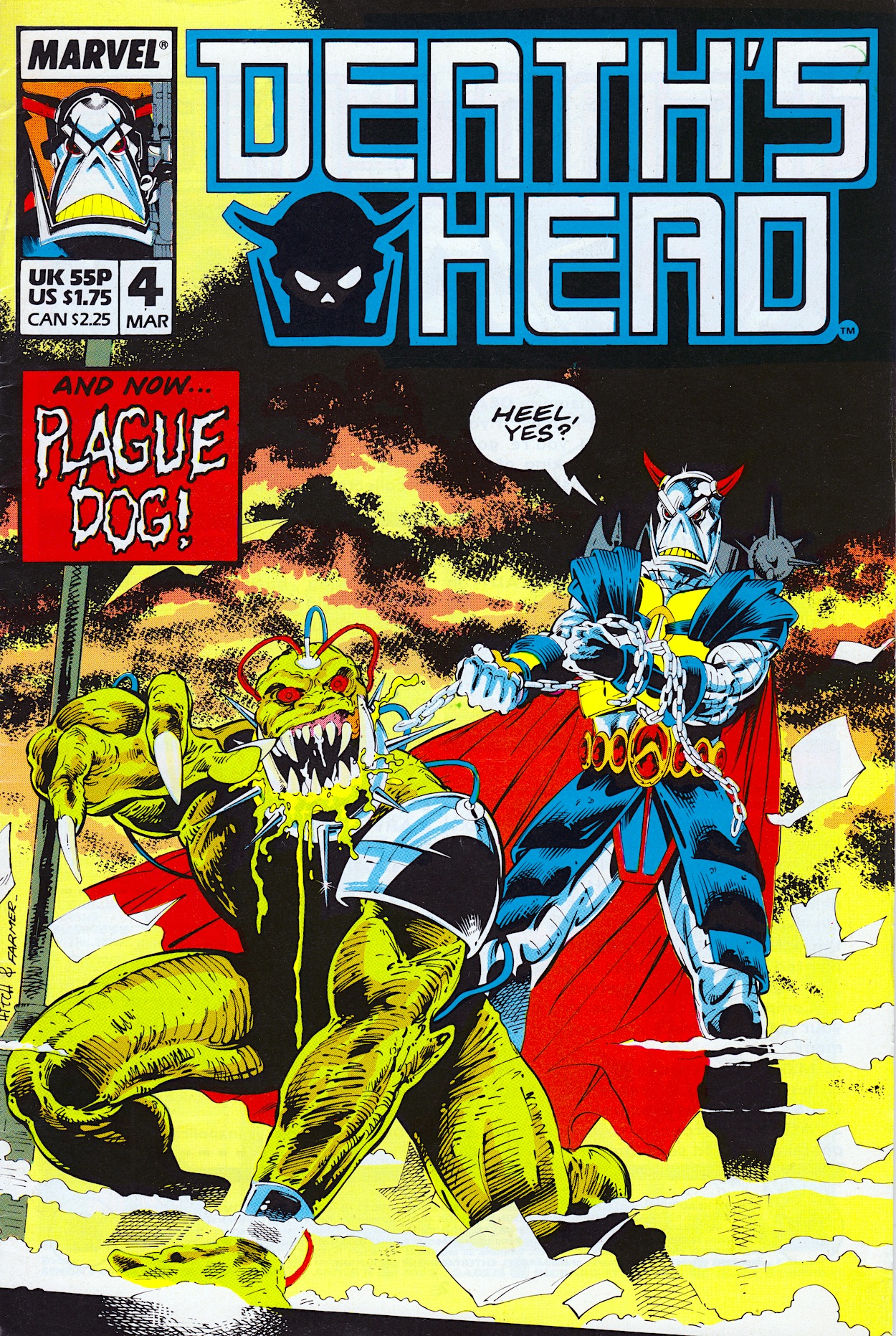
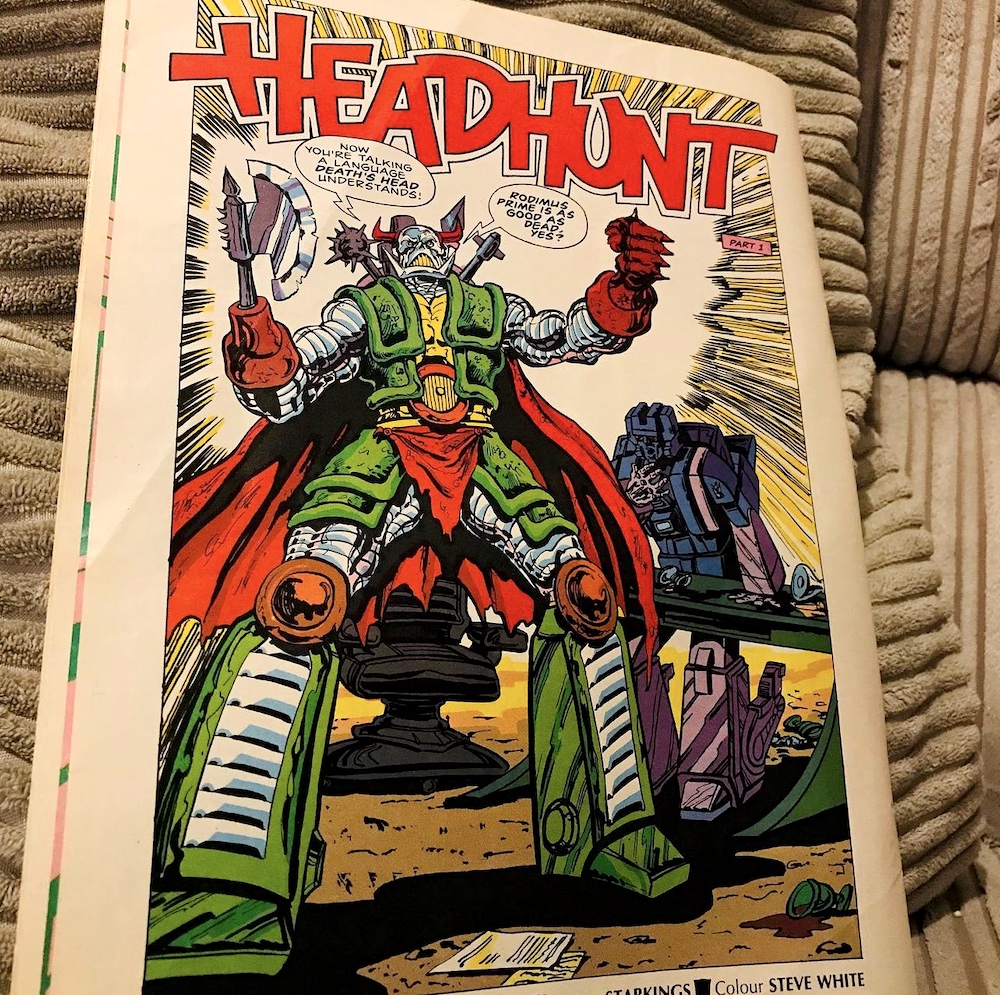
The front cover to this fourth issue of Death’s Head may be drawn by the familiar team of Bryan Hitch and Mark Farmer but inside Plague Dog is drawn by renowned Transformers artist Lee Sullivan (also Havoc (RoboCop), Doctor Who), with Annie Halfacree on letters, Nick Abadzis colouring and Simon Furman writing of course, with Richard Starkings editing. While I love Geoff Senior’s art being in every issue of Dragon’s Claws, I like the mixing of styles here.
Last month we saw Death’s Head’s new office wasn’t the perfect purchase Spratt seemed to think it was, having spent his new partner’s hard earned cash before he’d earned it. This issue sees that picked up and developed into two separate stories, one for each of our main characters. While our mechanoid anti-hero is hired by one gangster to hunt down and kill his rival’s pet mutt, Spratt comes face-to-face with it in their new property.
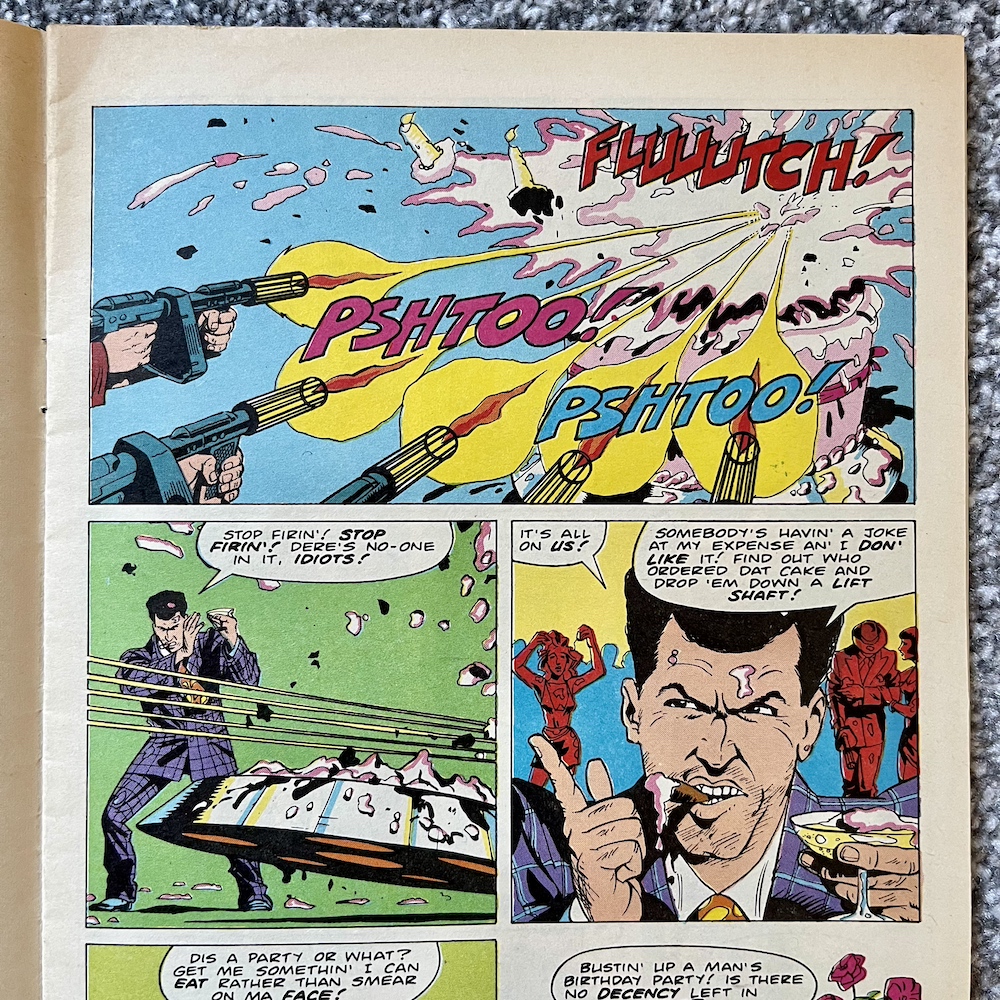
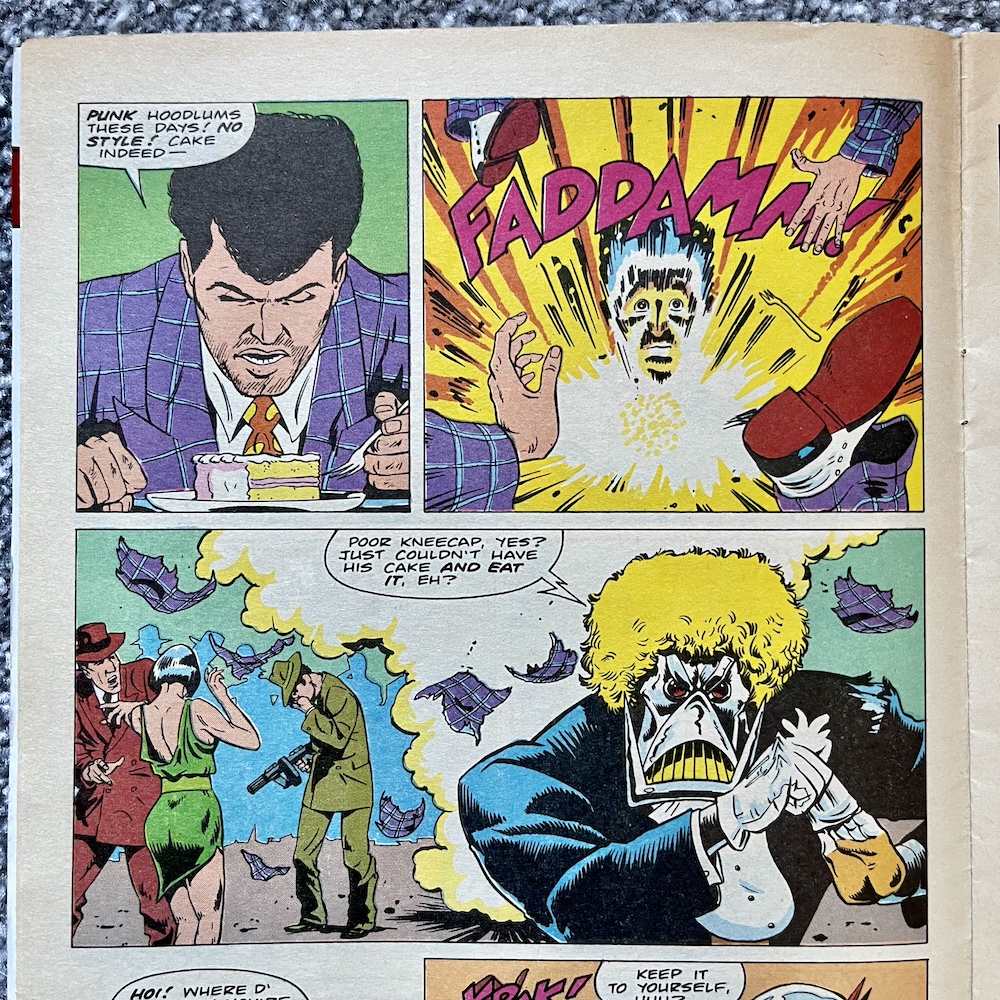
We kick things off with Death’s Head arriving at Jules ‘Kneecap’ Venici’s birthday party in his usual understated style. A huge birthday cake arrives but Venici has seen this movie before and fills it full of lead. Surprised at finding no one inside he still insists on killing whoever sent it because his own actions have made him look stupid. He then sits down to eat a slice, not noticing the highly conspicuous waiter in his latest in a long line of ridiculous wigs.
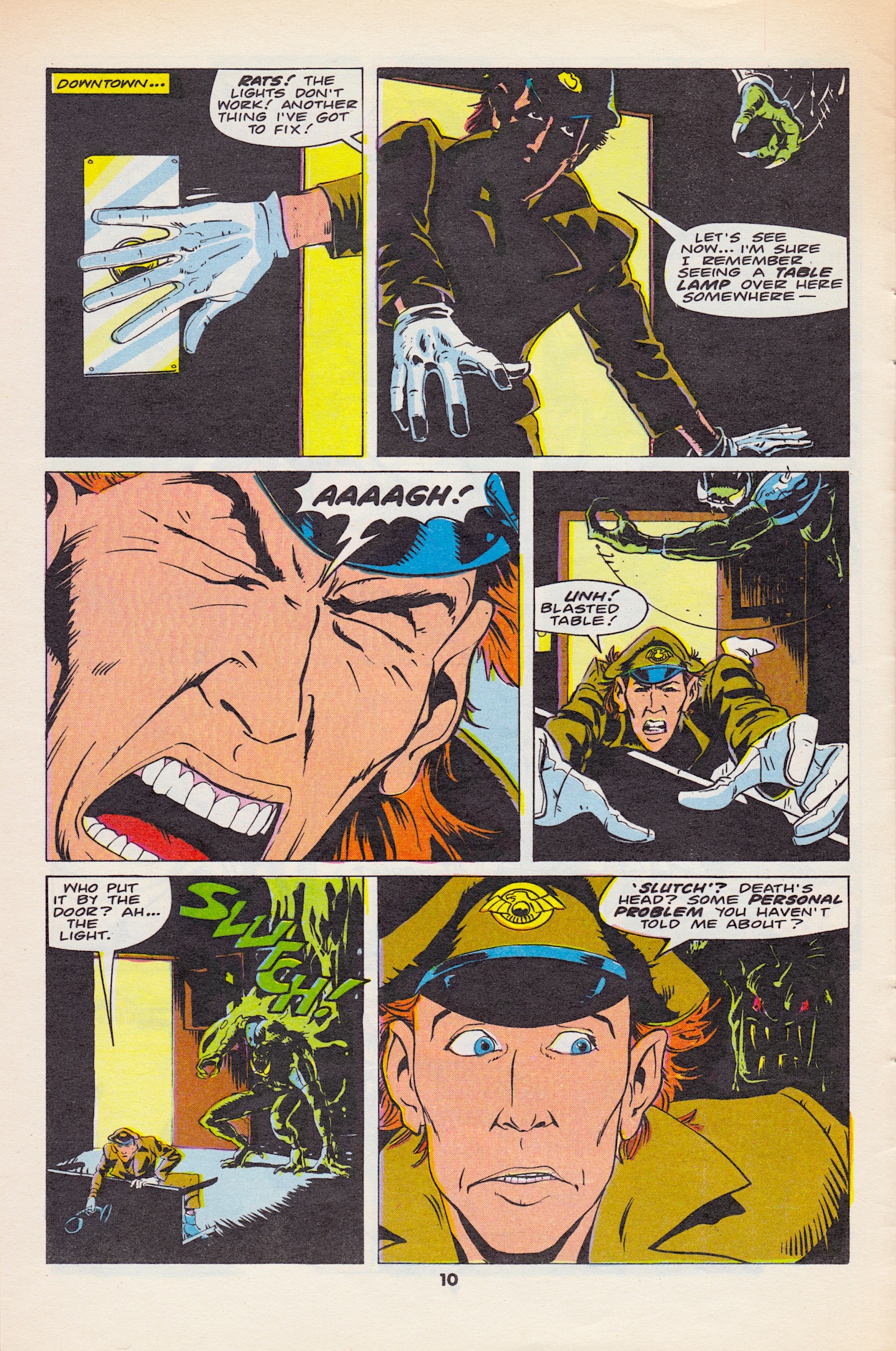
Predictably a huge shoot-out occurs between all of the gangsters and our lone hero, although even in this dire situation there’s time for some comedy. Elsewhere, Spratt is checking out their new digs and the lights are out. After we see a clawed hand swiping down in the darkness he lets out a blood-curdling scream and we’re led to believe the hand has made contact, until you read the following caption. Simon once again playing with our expectations.
I particularly like Spratt’s reaction to the sound effect of the plague dog, the alien monster used by Venici to take revenge out on those who wrong him. Last month we saw someone who looked like an undertaker sell the office to Spratt and in this issue we find out he is in fact called The Undertaker, a killer-for-hire whose method of assassination is somewhat gruesome.
But yes, that sound effect. We get all sorts of wording to describe sounds in our comics. Sometimes they’re downright bizarre to say the least. The fact Spratt correctly names this rather random sound effect is very funny and just shy of the character breaking the fourth wall and identifying he’s in a comic. It genuinely made me laugh. Back in the other half of the story, as the issue constantly flicks back and forth between the two scenes, Death’s Head is still at it even when cornered and out of ammunition.
Death by cocktail sausages! As a form of getting back at the bad guys it seems appropriate for this blog. Death’s Head isn’t the only one up against the odds, nothing to shoot with and having to use his ingenuity to get out of a tough scrape. As the rotten internals of the office building collapse around him, Spratt is trying desperately to escape but is hopelessly out of his depth.
In fact, the crumbling of the building saves him on more than one occasion, luck playing a huge part in keeping him alive. He could be learning a thing or two from his new boss though, or perhaps they’re just more suited than the mechanoid realises, because despite his fear (or perhaps because of it) he can’t help making quips.
Slipping out of his boot and shoving it into the monster’s mouth (complete with another joke) he makes a run outside and finds a car parked (well, hovering, it’s in the future after all). This is Spratt’s speciality. Quietly boosting cars is a particularly useful skill that Death’s Head needs him for. There’s a little bit of tension here as Spratt struggles to get inside, panicking as the plague dog bears down on him.
The engine doesn’t immediately kick in either and the tension rises further as the thing makes a leap for him and crashes through the rear window, clawing at the interior, getting closer and closer to Spratt until it finally places a claw on his shoulder. The escape vehicle now seems to have become a death trap. We know Spratt can’t die, but even if he takes off surely the thing’s head and arm are already inside so what can he do? Well…
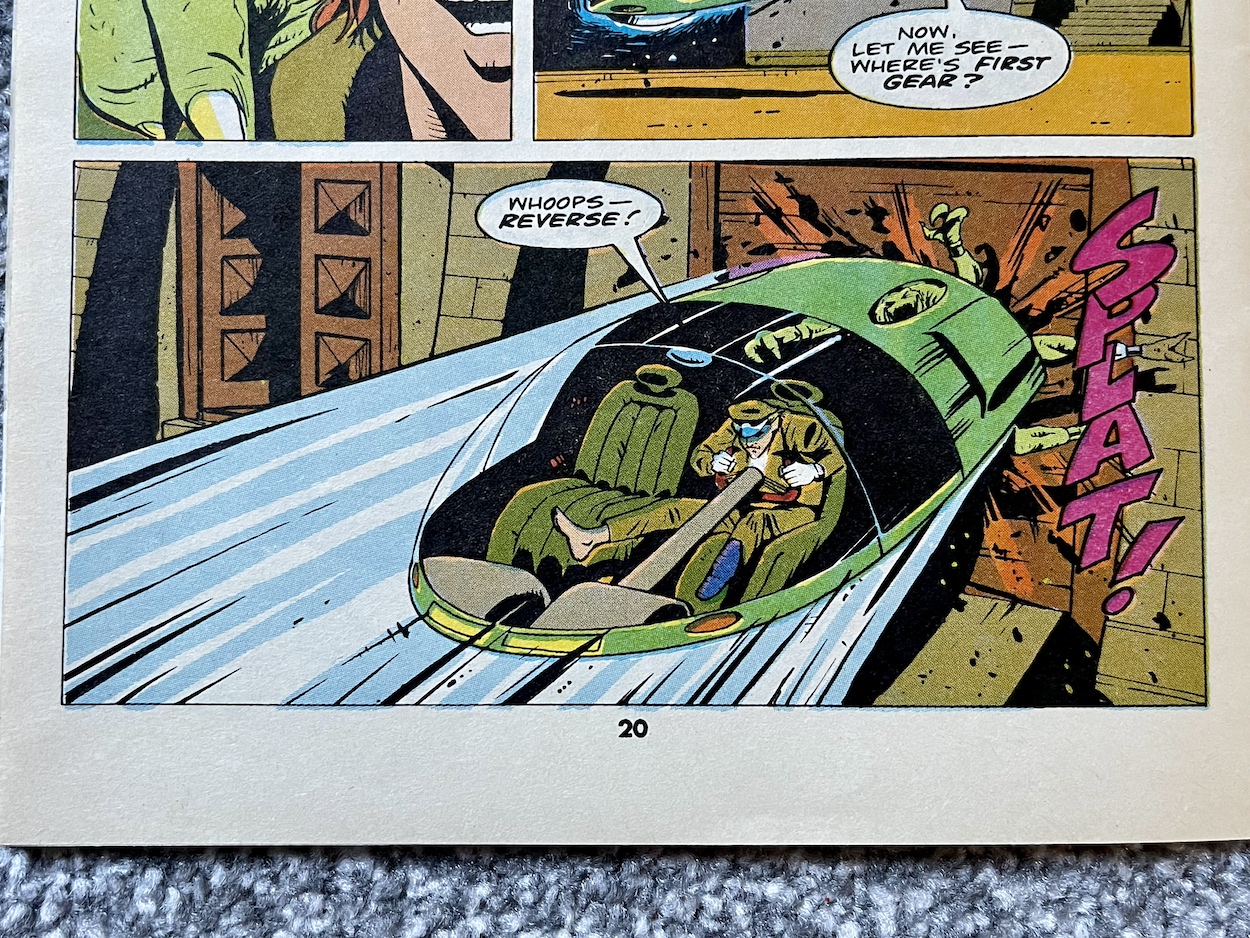
Just like last month when an accidental slip of the hand by Spratt turned the tide of battle, here his mistake with the gears sends him rocketing backwards, squashing the monster against the building. Fuel tank ruptured, the dog roaring out to his “Foood!” as it starts to push the car off itself, Spratt characteristically can’t help but bask in his glorious victory, no matter how accidental.
The final spread of the issue sees The Undertaker making a phone call, apparently to activate the plague dog at its lair. So are we to assume he actually sold the lair to Spratt? His job also done, Death’s Head makes his way to the office and finds chaos has ensued, although Spratt seems somewhat subdued and not showing off for once. Of course, our mechanoid friend can always turn a situation around when money is concerned and our story ends.
On the next page a somewhat tacked on cliffhanger has The Undertaker hiring someone called Big Shot, a muscly man with a big gun. I can’t help but be a little underwhelmed with this after last month’s ending. Surely having a plague dog lying in wait was the more dramatic cliffhanger. I’m aware I haven’t read the next issue to see how good this guy is with his gun, but I feel this is a bit of a muted ending by comparison and the two should’ve been the other way around.
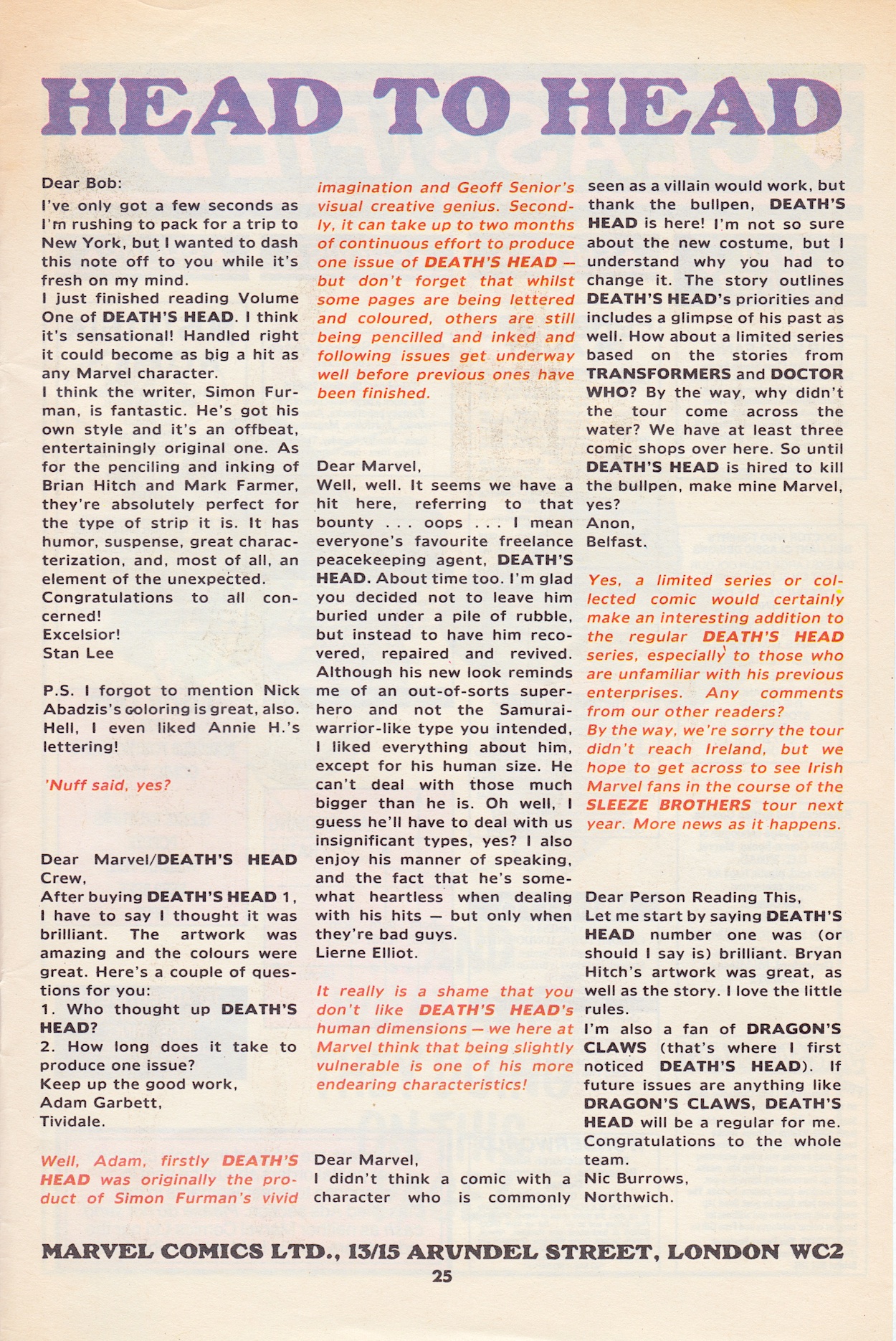
Head to Head is the comic’s new letters page and there’s an anonymous letter from my home city of Belfast. Although, if this person had actually read Death’s Head’s adventures in Transformers and properly understood them I don’t see how they could think he’s commonly seen as a full-blown villain. Not too sure who “Bob” is that the first letter is addressed to (Richard Starkings is the editor and Jenny O’Connor the Managing Editor) but there’s definitely a lot of high praise here and I agree with it all.
I just wish Lierne Elliot had been right when he said “seems we have a hit here”. Of course, it may have seemed that way at the time, especially since this was a comic based on a very popular character from another Marvel UK title, but alas the sales figures wouldn’t be good enough to make up for the cost of producing the comic, as Richard explained to me in the introductory post to this series.
But let’s not dwell on that, we’ve another six months of this to go!
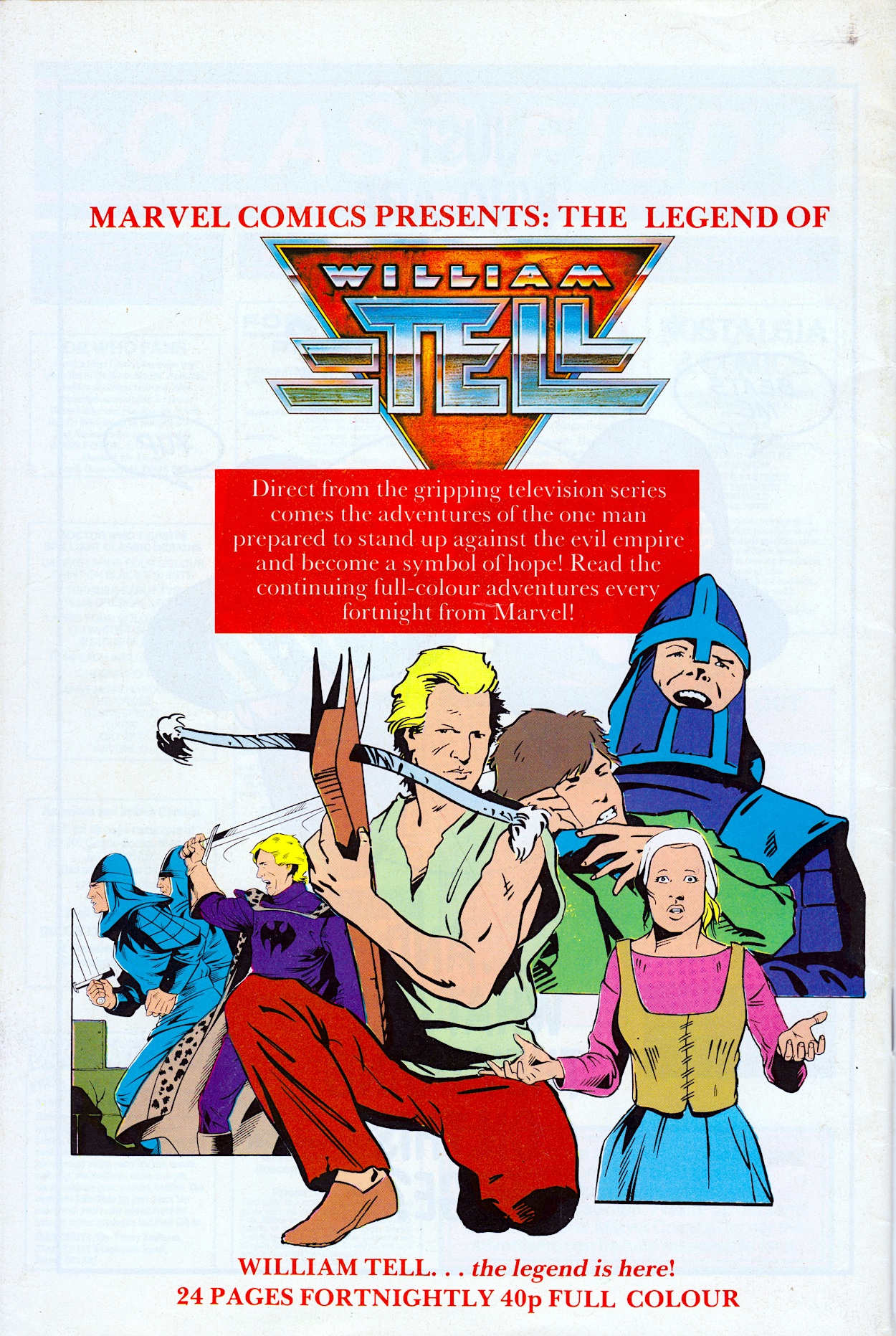
On the back page is an advertisement for a new fortnightly Marvel comic that would never actually appear. The William Tell TV series was apparently shown on ITV, although I don’t ever remember seeing it advertised. There’s a chance it either wasn’t broadcast on Northern Ireland’s UTV or it didn’t last long before ITV pulled the plug, despite it running for three seasons of 72 30-minute episodes in France and elsewhere, where it was known as Crossbow.
I remember this comic advert alerting me to the TV series and yet I still never caught it in any TV listings magazines. Marvel’s confidence must’ve been knocked as the plan for a fortnightly changed to a Summer Special, an annual and a run of strips in the Marvel Bumper Comic, plus a collected graphic novel, the strips for all of these already created for the defunct fortnightly. This is why I think the show must’ve failed to pick up viewers here in the UK, as Marvel suddenly realised the audience wasn’t there for what they’d assumed was going to be a hit.
You just might see some of it on the blog at some point though, as the Bumper Comic is on the cards for the future, I just don’t know when yet, but you heard it hear first! (As if you’d hear it anywhere else.) For now, that’s us finished with another outing for Death’s Head… well, really more of an outing for Spratt this month. We return to Earth of the far future on Monday 4th March 2024.
Death’s Head’s first ever appearance, drawn by Geoff Senior and colour by Steve White
In the latter months of 1988 I began reading Marvel UK’s Transformers weekly and my second issue contained a very funny comic strip advert for a new monthly about a certain Freelance Peace-Keeping Agent (not a bounty hunter, never a bounty hunter). It also popped up in The Real Ghostbusters and so I found myself dipping my toes into the first issue of Death’s Head, not fully knowing what to expect and with no knowledge of his already extensive adventures with the Transformers (and even Doctor Who, which I’d just started watching that year too).
Over the next couple of years reprints in Transformers and my friend giving me his back issues meant I was able to read those stories. But I never did buy more than Death’s Head first issue, despite having very fond memories of reading it wrapped up in bed while ill one day and really enjoying the action and comedy. But I was only allowed a certain amount of comics on order at any one time and, while I did buy more with pocket money most weeks, a month was a long time for my attention span back then. Now I can finally make up for this, so let’s take a look at how this very famous Marvel UK character was introduced to the public.
Cover by Geoff Senior
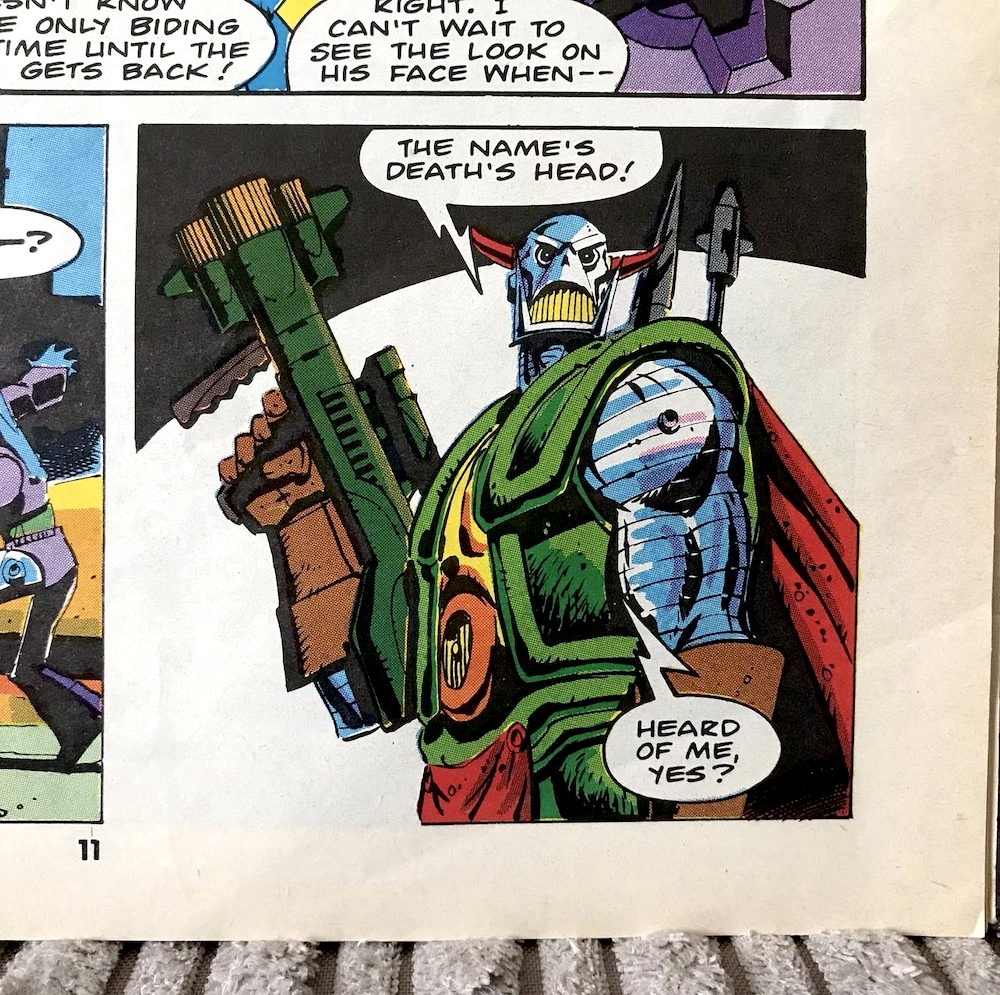
Writer Simon Furman originally created Death’s Head as a one-off character for a Transformers story (not knowing the name had also been that of a Nazi tank division). However, upon seeing legendary artist Geoff Senior’s interpretation Simon knew they had a recurring character on their hands, even rewriting his lines to better suit the image Geoff had created, inspiring the hilarious speech patterns and quirks we came to love, yes? He proved very popular with the readers and altogether appeared in 17 issues and three serials, including two highly regarded epics.
“I loved messing with legal”
Richard Starkings, Death’s Head editor
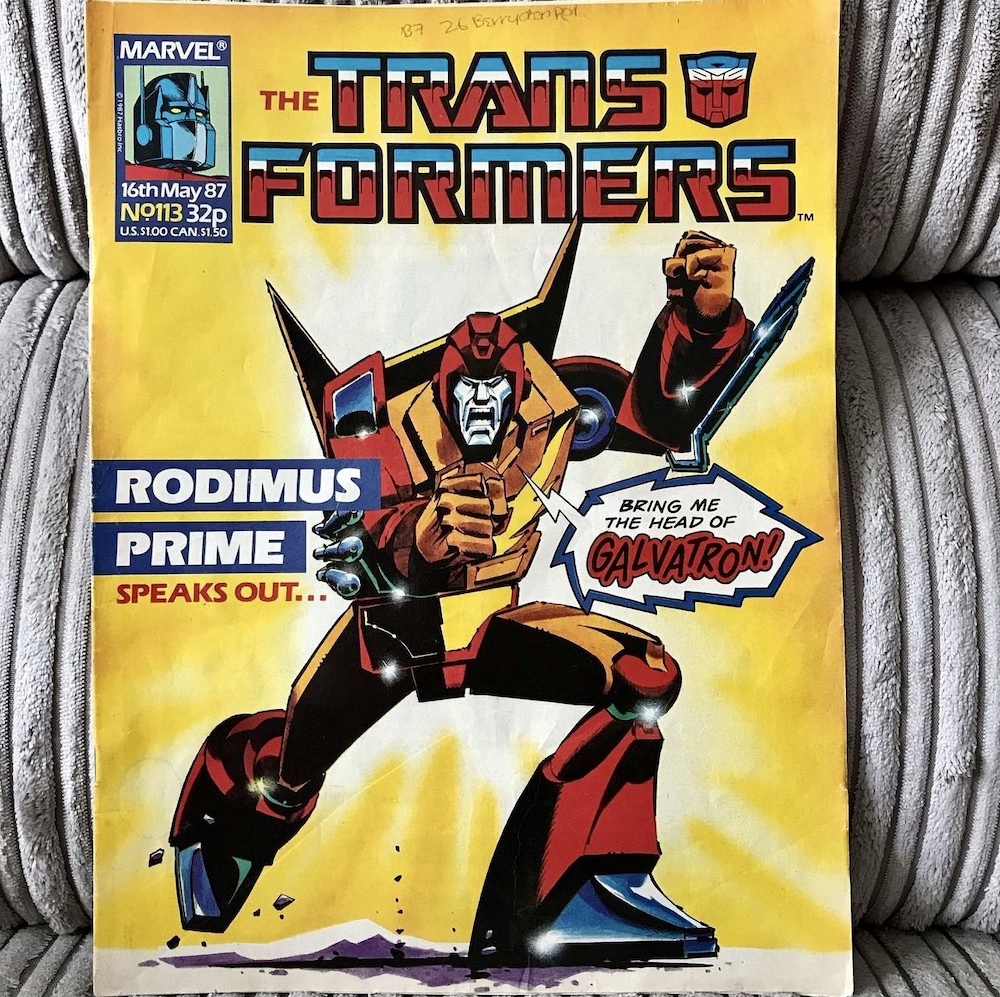
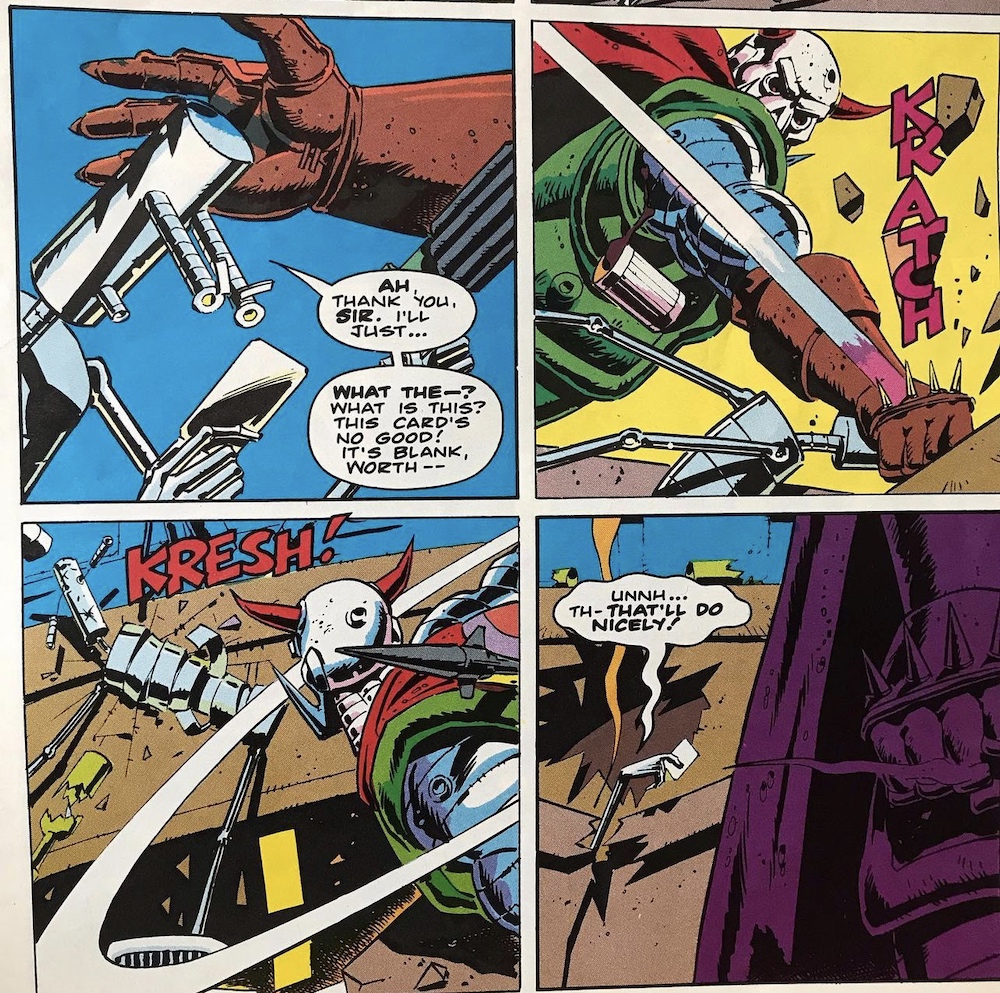
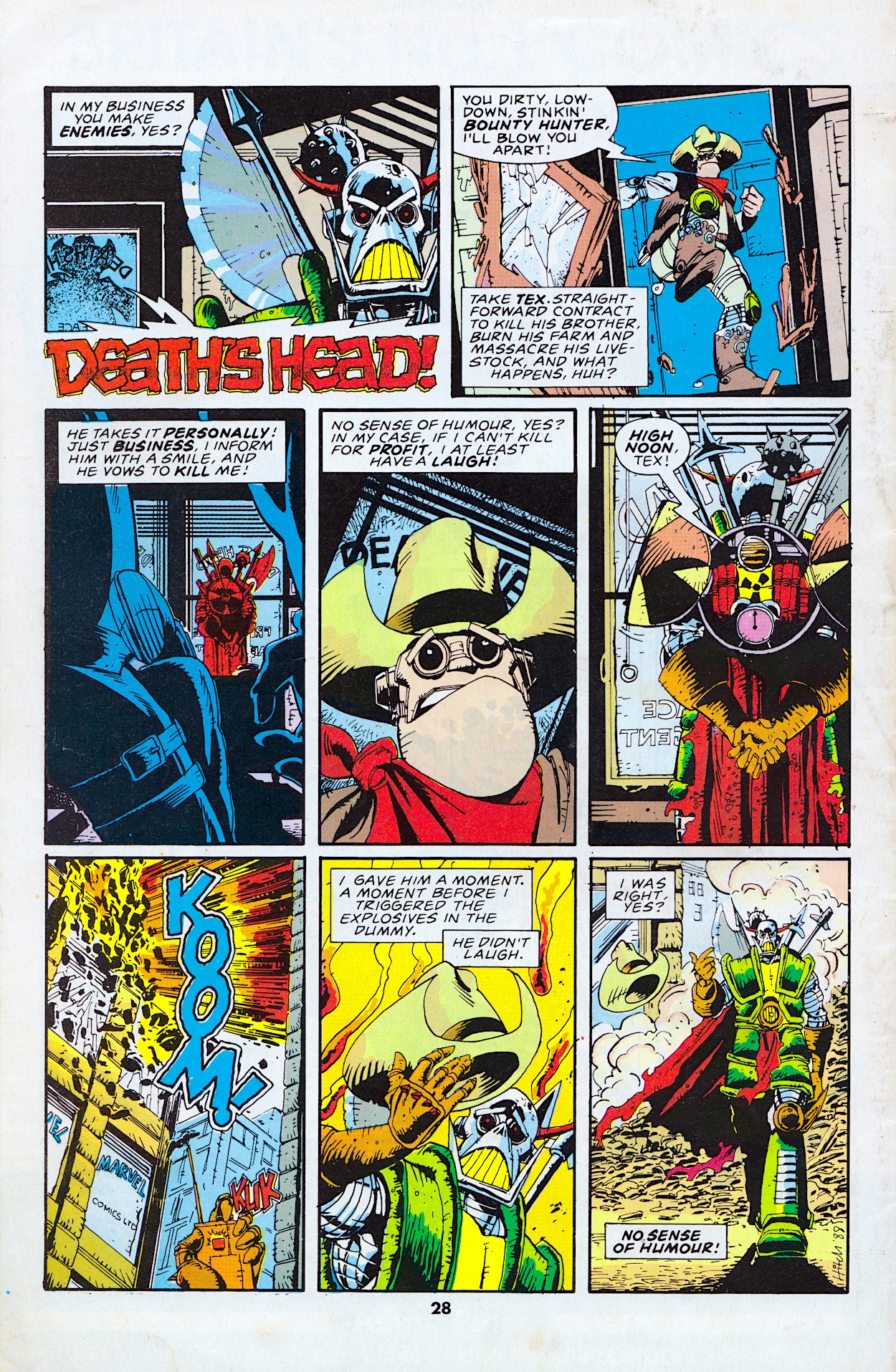
Despite online information to the contrary, Death’s Head did indeed first appear in Transformers #113 on 9th May 1987. There’s a one-page strip called High Noon Tex (further below) which Former Marvel UK editor Richard Starkings (The Real Ghostbusters, Doctor Who Magazine, Elephantmen) tells me was created to run in other titles first so the company could retain ownership of the character, otherwise Hasbro (owners of The Transformers) could claim the copyright. However it didn’t appear until a year after his first Transformers appearance.
“I dare say,” Richard told me, “that between commissioning the strip (it’s one page, so you know it was my idea) and legal establishing the trademark … his appearance in Transformers notwithstanding, we weren’t able to run High Noon Tex beforehand. There was also a Doctor Who crossover (I loved messing with legal) so the BBC couldn’t own him either!”
Drawn by Geoff Senior, colour by Steve White
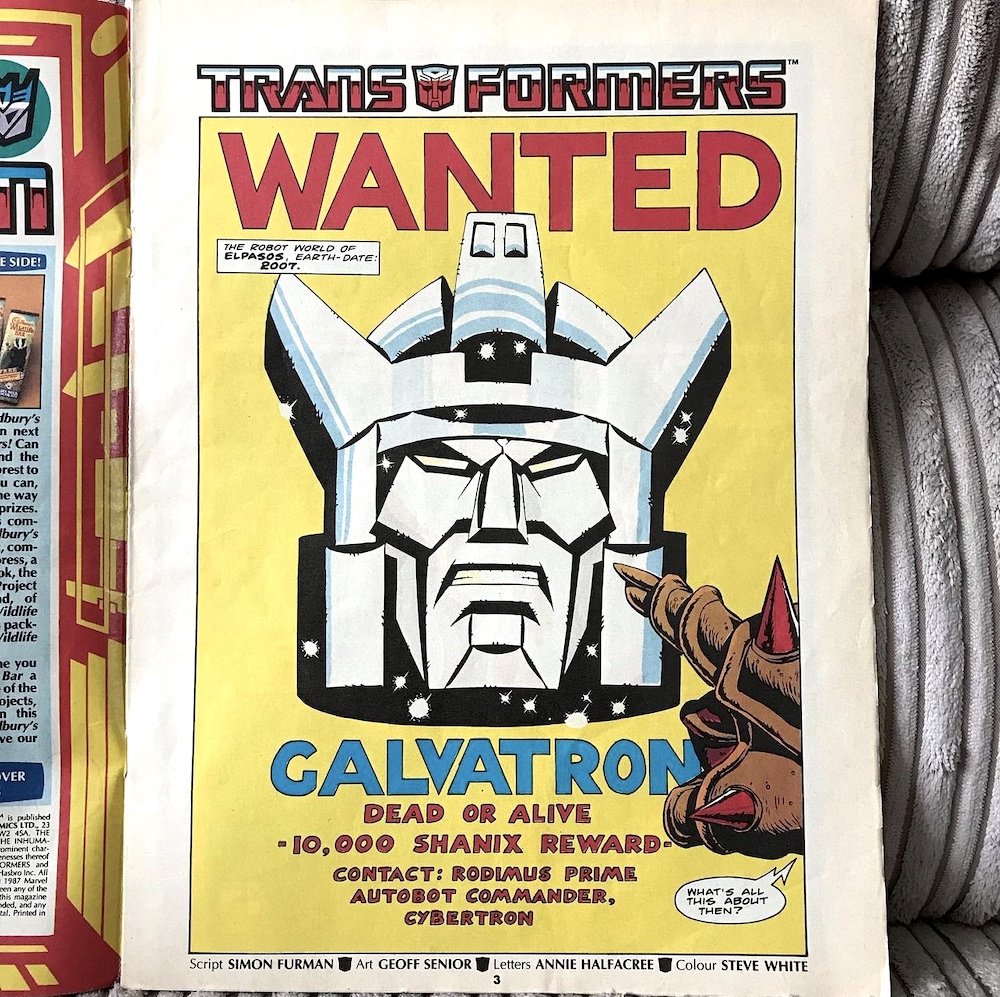
Wanted: Galvatron Dead or Alive was one of the early future-set (the then future of 2006) stories Marvel UK produced. With the release of Transformers: The Movie the UK team could focus on stories set after it, creating a new timeline of events and making it easier to write original stories not linked to the US strips. On the first page we see what would become a familiar detachable hand pointing at the wanted poster of the title. A bounty set by Autobot leader Rodimus Prime for Galvatron (the immensely powerful resurrected form of Megatron) after he disappeared at the end of the movie is too good for Death’s Head to pass up.
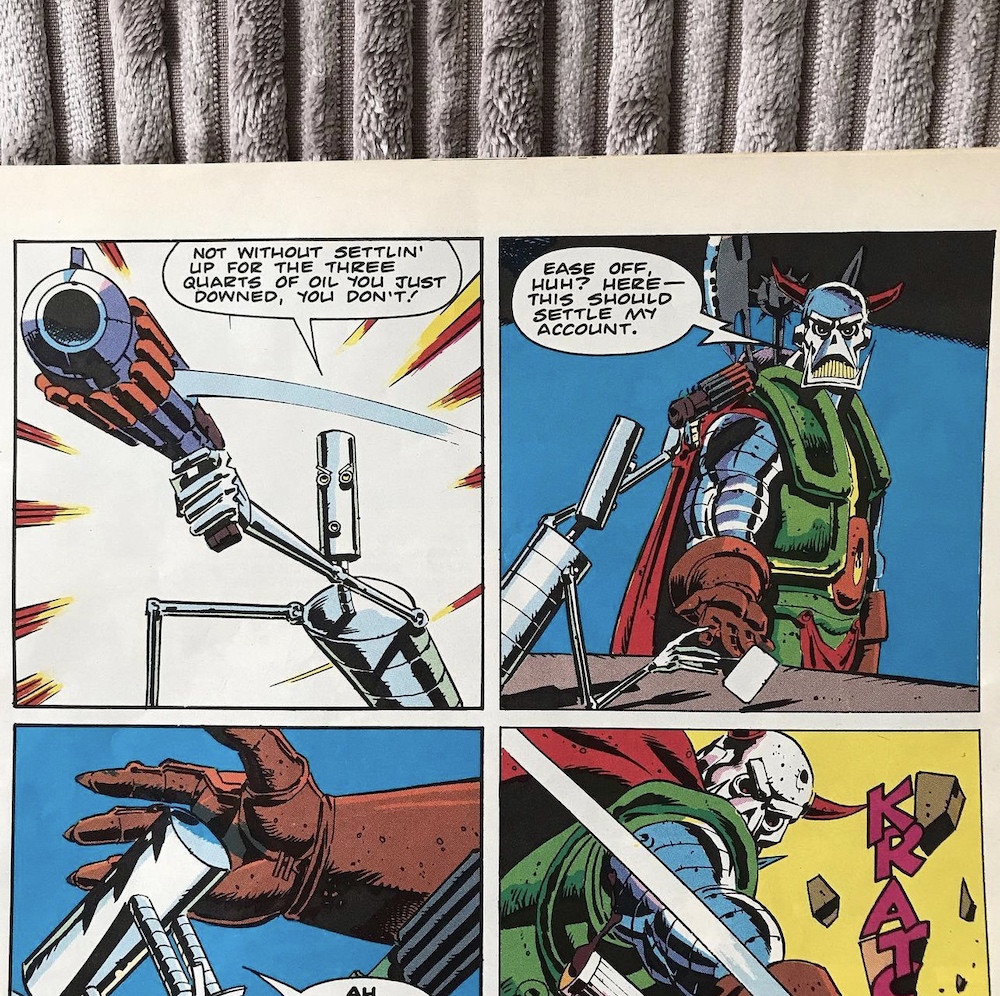
The story saw the beginning of the comic’s use of time travel and the building of a huge universe populated with both organic and mechanical races, for example the slight-looking barkeep in the tavern where our anti-hero finds himself between contracts. Intending to pay, Death’s Head soon changes his mind when the owner pulls a gun on him, wrongly suspecting his customer of leaving without clearing his tab. What happens next is the perfect introduction for this character.
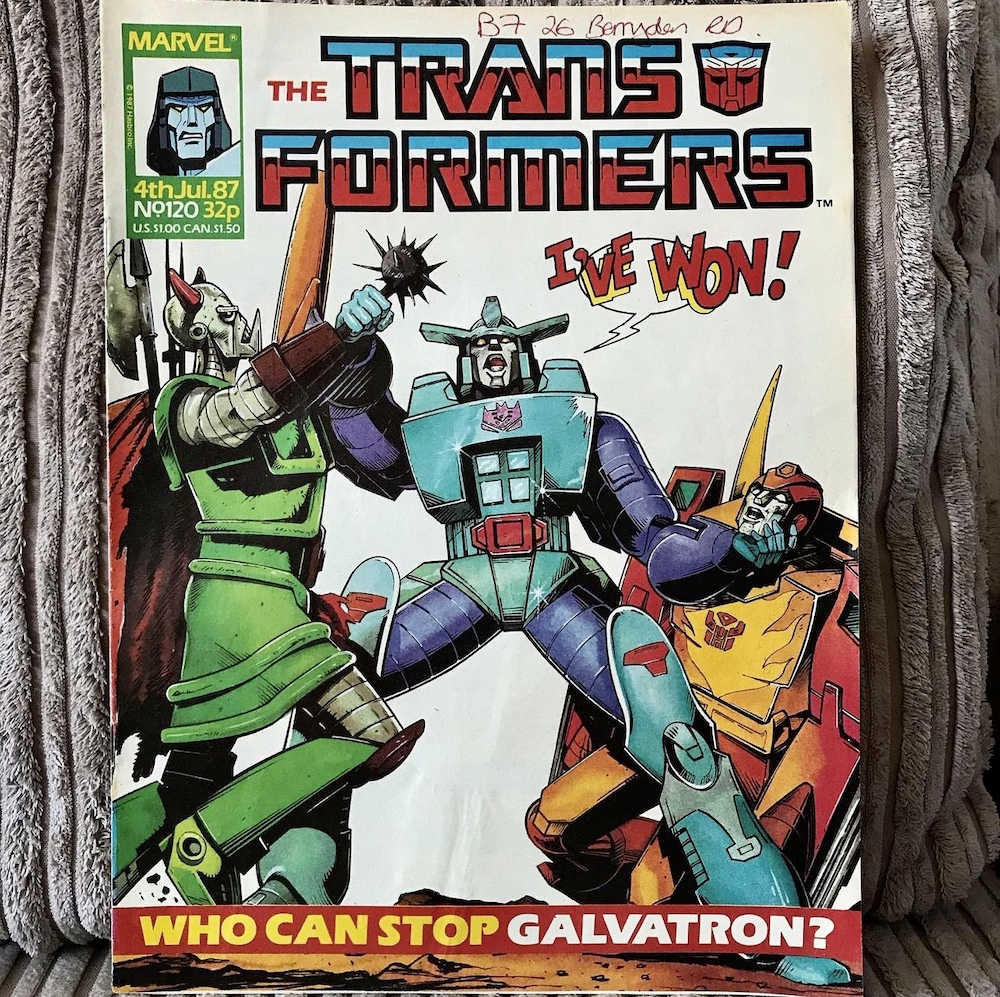
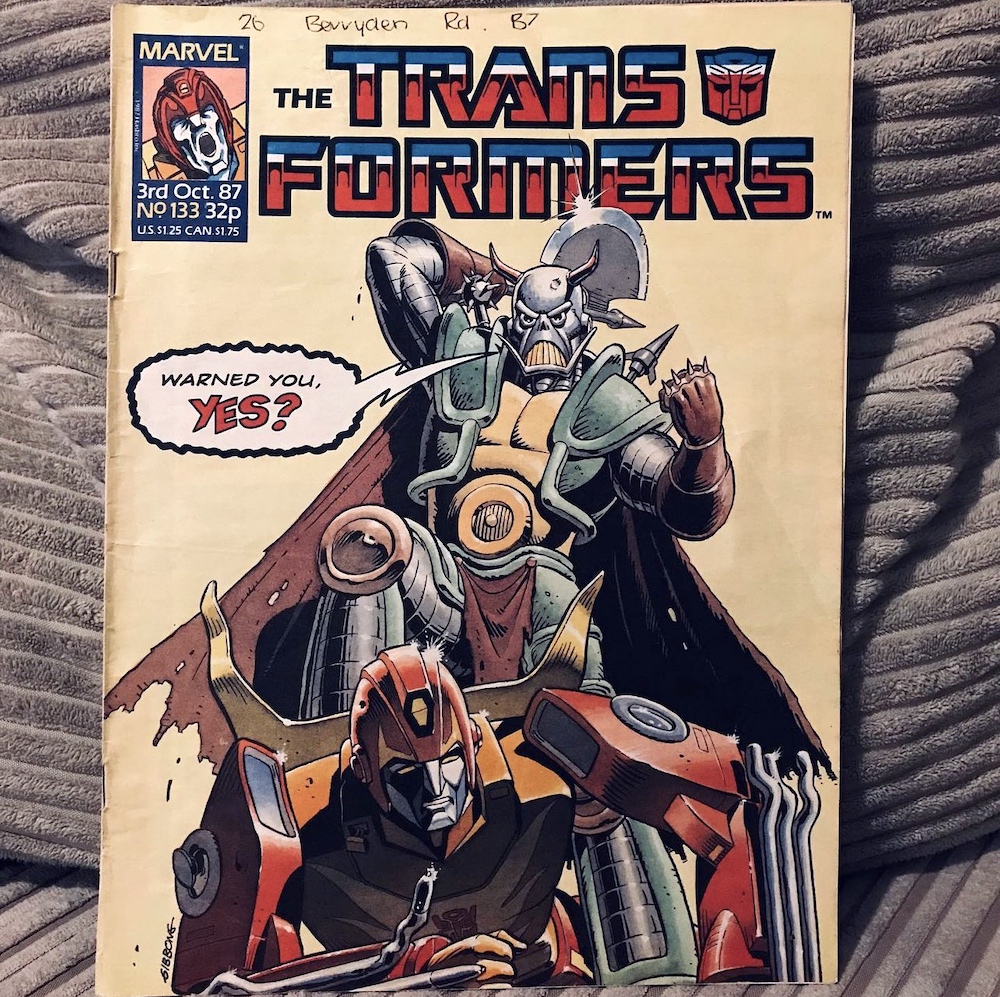
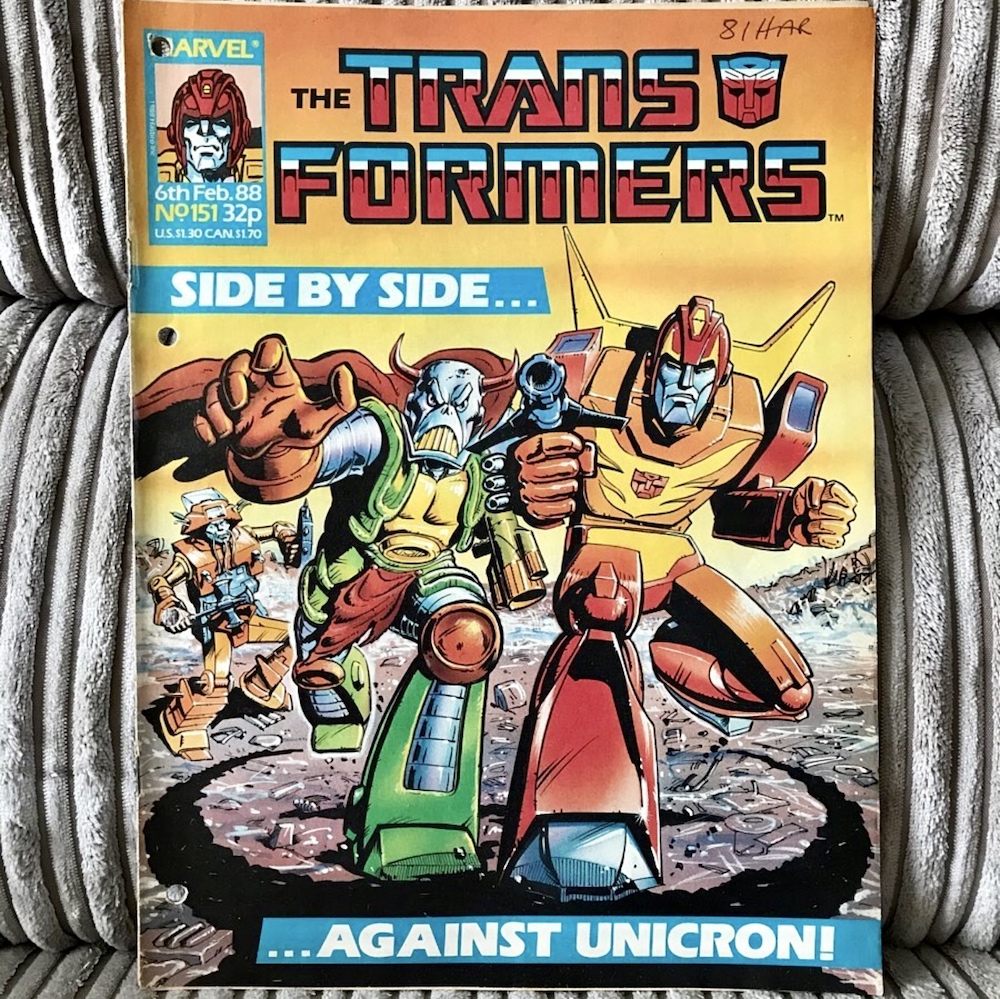
Over the course of a year Death’s Head even made the cover of Transformers no less than six times. He’d become a big selling point for the comic, such was his popularity with the young readers and the fun Furman had in writing him. My favourite of these is the classic ‘The Good… the Mad… and the Ugly!’ cover by Geoff for #117. His return was always hyped in advance in Next Issue panels and editorial promotions. Really, it was inevitable he’d get his own comic eventually.
#117 cover by Geoff Senior and John Burns #120 cover by Jeff Anderson #133 cover by Dave Gibbons #146 & #151 covers by Lee Sullivan #147 cover by Jeff Anderson, Stephen Baskerville and John Burns
One of my favourite aspects of the character was his loyalty to the contract. Once he’d taken on a job he’d see it through to a successful conclusion no matter what he’d have to put himself through in the process. Yes it was all for money but it was clear he enjoyed what he did and he had a brilliantly dark sense of humour as a result. But even if someone else (usually his bounty) offered him twice the amount he was being paid he’d turn it down, his reputation was more important.
This was a compelling chapter in the character’s life, as he found himself going above and beyond to do the right thing as well as complete his contract
Death’s Head certainly left an impression, not only on the young readers but on the Transformers’ universe as a whole. Travelling back to 80s Earth he went head-to-head against Galvatron, aiding the Autobots and Decepticons in their battle to stop him from becoming an all-conquering god. In this story he also ends up killing beloved Autobot Bumblebee (in the US comic G.I.Joe mistakenly did this) who Hasbro was relaunching as Goldbug (thus this led to his resurrection).
When Death’s Head returned next time he took a contract from Decepticon leader Shockwave to track down and capture or kill Cyclonus and Scourge who had travelled back in time too, and who Shockwave had discovered would kill him in the year 2006. It was great stuff! This made what Death’s Head did in The Legacy of Unicron all the more interesting and dramatic for me. He was actually instrumental in stopping Unicron’s return, aiding Rodimus Prime by linking with the giant god’s mind on the psychic plane, distracting him so that the Autobots and Junkions could get on with their plan free of being psychically tracked.
Top-left to bottom-right: Geoff Senior/Steve White Will Simpson/Tim Perkins/Steve White Dan Reed/Steve White Jeff Anderson/Stephen Baskerville/Steve White
This was a compelling chapter in the characters’ life, as he found himself going above and beyond to do the right thing as well as complete his contract with Shockwave. The Legacy of Unicron was an important story in the history of Transformers, spread over several issues including the landmark 150th in which the origins of their race was told for the first time ever. This was created by Furman for the UK comic, the cartoon series would go on to create its own far less interesting version.
The tale, one as old as time itself, of myths and gods, of the birth of the universe and the eternal fight battle light and dark, was told by Unicron, the transforming planet eater from the movie reinterpreted by Furman as an all-conquering god of chaos. It’s still incredible to read today, especially when you remember this was a toy licence comic! Transformers really did break the mould. Even better, we the readers found all of this out as Unicron relayed his tale to none other than Death’s Head while the two were locked in their mental battle.
Drawn by Bryan Hitch, inking assistance by Geoff Senior, colour by Steve White
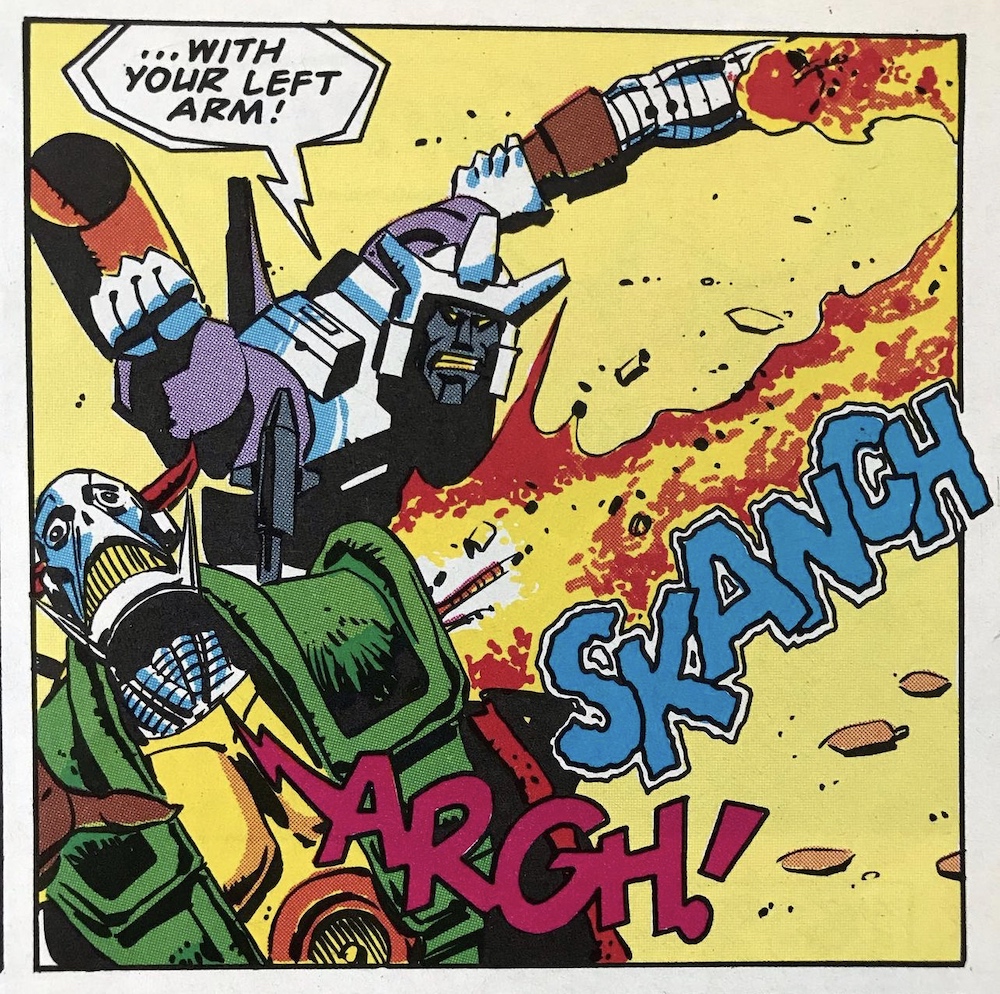
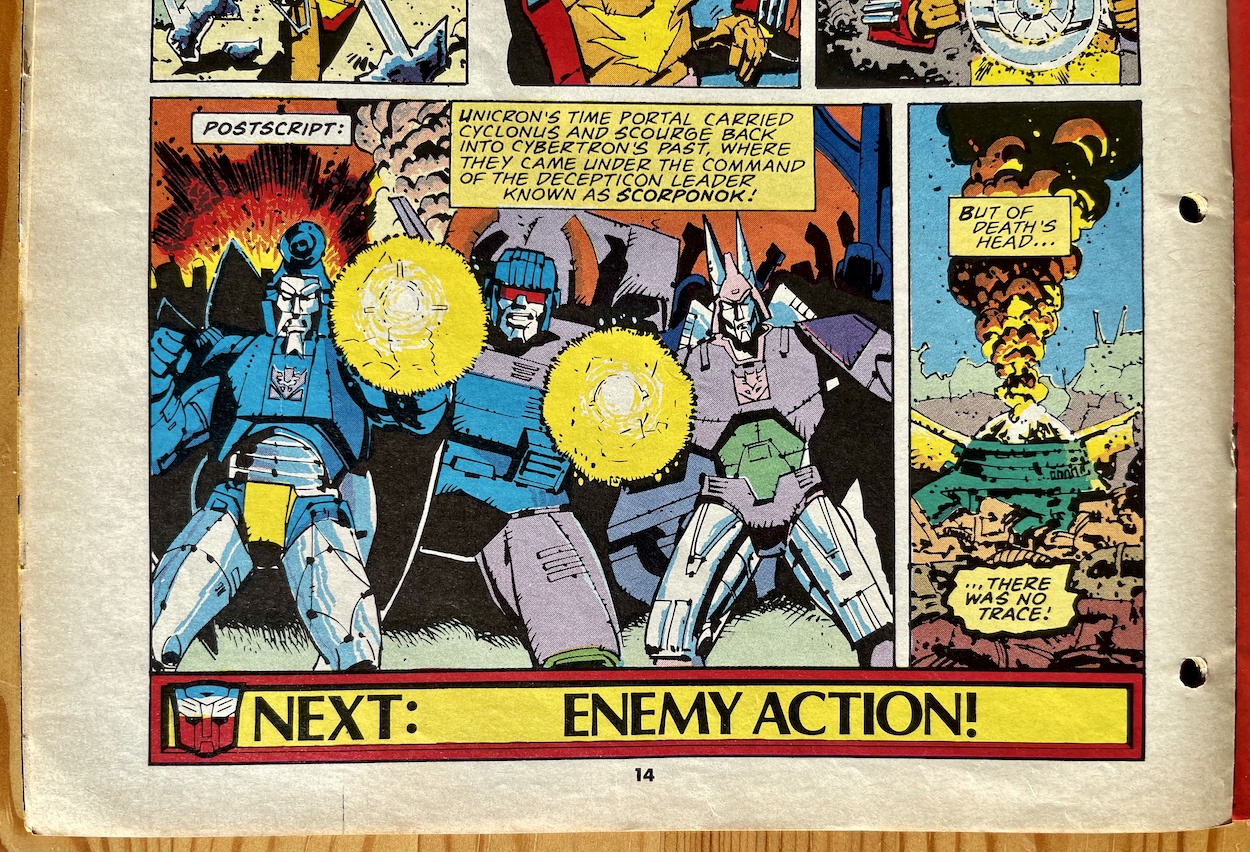
The Legacy of Unicron ends with Death’s Head shoving Cyclonus and Scourge through a time portal as the Junkion planet explodes beneath them. The Decepticons reappear on Earth in the present day but of him there was no trace. He wasn’t to be seen in the world of the Transformers again. Instead, as he flew through the corridors of time and space he bumped into a familiar blue police telephone box in another of Marvel UK’s titles. That’ll be the first chapter in Death’s Head’s real time read through in just a few days.
Apart from the last photo above, all of the preceding images were taken from the OiNK Blog’s Instagram feed from the last few years. Over there I’ve been reading Transformers in real time, week-in, week-out for about six years now, taking up to ten photographs of each issue and summing them up in mini reviews of sorts. You can check out all of the issues featuring Death’s Head via these links below.
By 1988 plans were afoot. Commissioned by Richard (who also commissioned the one-page strips below, as well as Dragon’s Claws and The Sleeze Brothers comics) at last Death’s Head was going to get his own ongoing comic, but first of all a change had to happen to the character himself. As you’ll know from reading the comics or watching the movies, the Transformers are somewhat larger than us humans. Seeing as how Death’s Head would now be interacting with plenty of humans he had to be taken down a peg or two first.
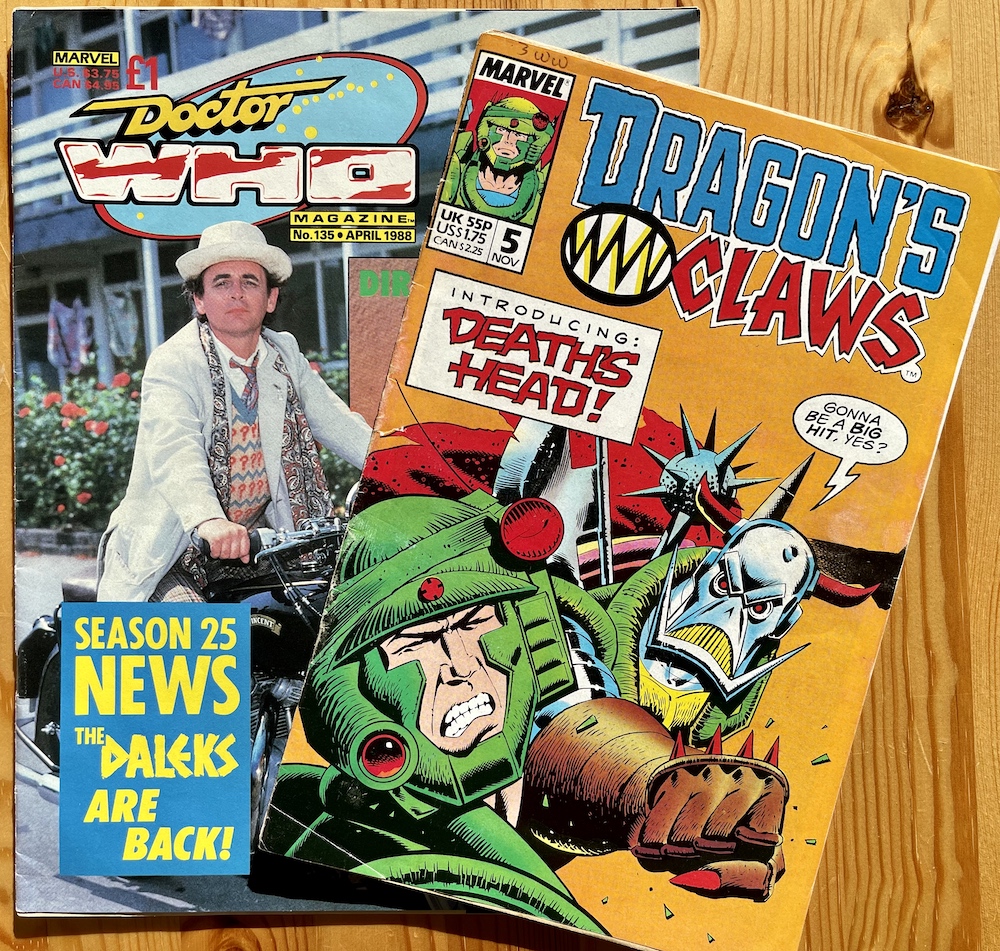
This was achieved with a one-off strip in the pages of Doctor Who Magazine in which another alien time traveller, albeit of much smaller stature showed he was more than a match for the other. After this the stage was set for the new comic, the first issue of which was released in November of that year. To promote it he also popped up in an issue of Dragon’s Claws, another Furman/Senior original creation just before his own premiere issue.
Drawn by Bryan Hitch, colours by Steve White
During 1988 High Noon Tex finally appeared across Marvel UK’s range, promoted as a one-off strip for the character. For those who hadn’t been reading Transformers this must’ve felt like a very random addition to their comic, but a highly enjoyable surprise nonetheless, showcasing the action, his brutal personality and most of all his sense of humour. The example above is taken from the back page of an issue of Dragon’s Claws. It was written by Furman and drawn by Bryan Hitch (who would draw half of the monthly issues, co-creator Geoff Senior surprisingly only drawing one of the strips).
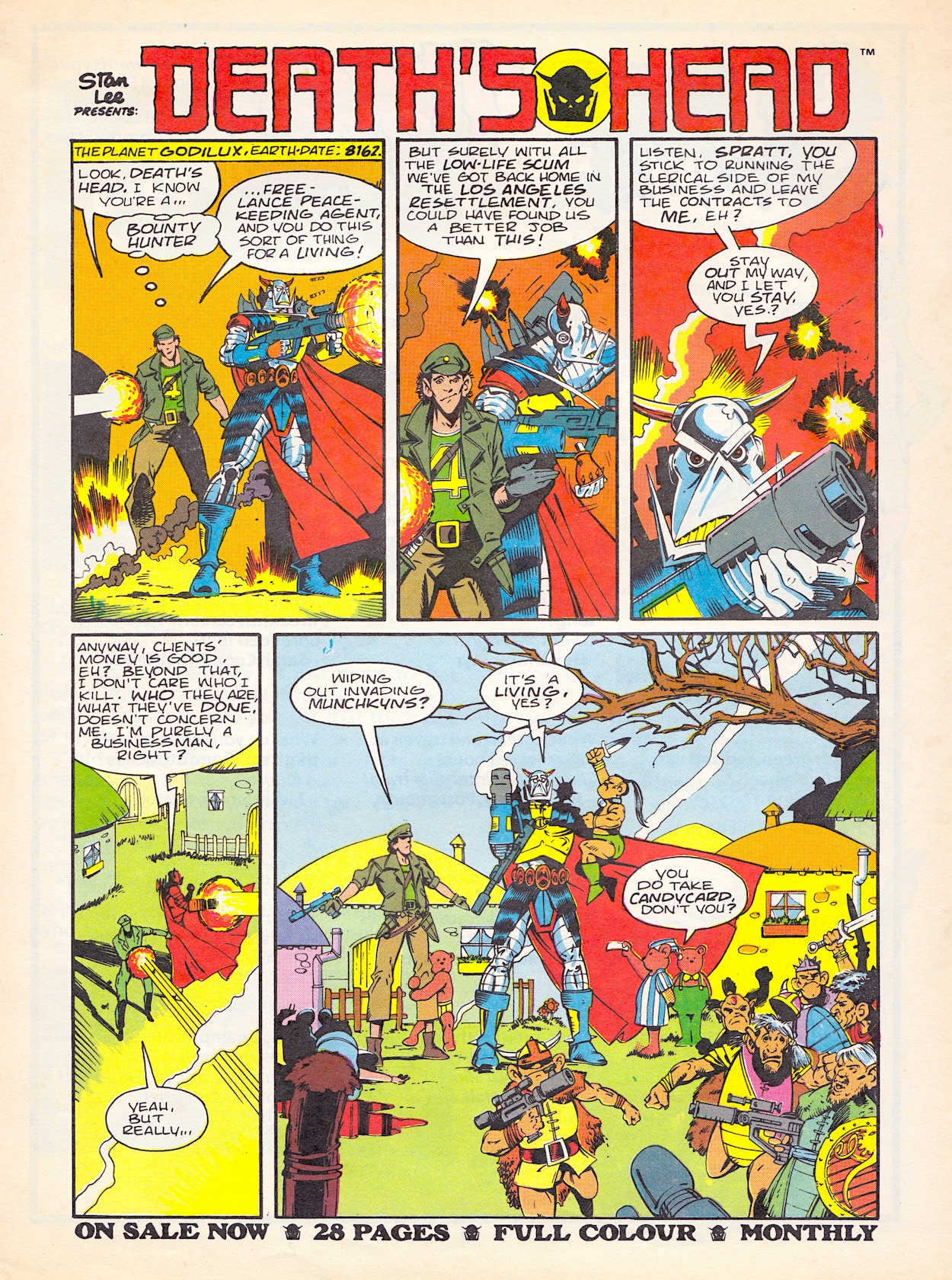
As the comic launched another one-page story appeared, this time as an actual advertisement for the monthly. I first saw it in Transformers #193. How could I not rush out to buy it after that? The scan above was taken from #29 of my Real Ghostbusters collection, which went on sale 17th December 1988 while #2 of Death’s Head was on sale. Richard was the launch editor of that comic and told me, “I’d edited The Real Ghostbusters for a year and I knew you could tell a story in one page.” (The Real Ghostbusters could have up to four stories in one issue, including the occasional 1-page strip.) You can read more about the creation of this series of adverts in the introductory post to Dragon’s Claws.
Drawn by Bryan Hitch, inked by Mark Farmer
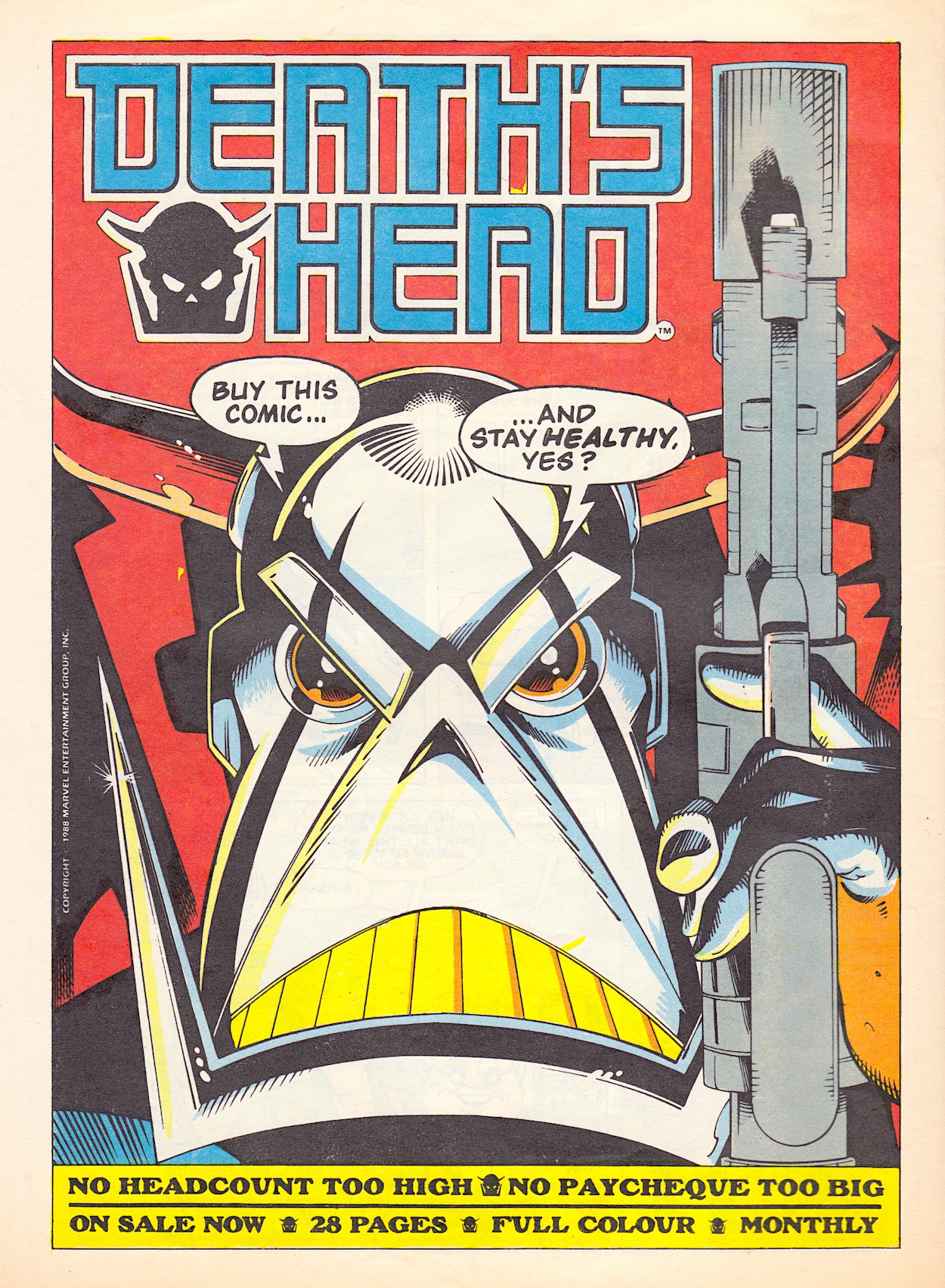
A much simpler yet no less eye-catching full-page advert was also found in the pages of my comics, using the cover image of the first issue. The issue of The Real Ghostbusters this first appeared in went on sale the same week as #1 of Death’s Head and he also popped up for the first time in the Mighty Marvel Checklist, which a lot of their comics ran at the time. As you can see it was the one not to miss that week and I obliged. At least for one month anyway.
Death’s Head’s comic lasted ten issues. It was printed on smaller than normal paper, the same size as US comics rather than the larger UK paper we were used to. Some fans say this contributed to less than stellar sales because it ended up hidden amongst all the larger comics. Richard tells me this just isn’t true; it was selling 60,000+ a month which would be a massive hit today. “The profit to the company versus cost of origination was too high for those days”, Richard says. “The Incomplete Death’s Head (collecting the whole series and his guest appearances in Doctor Who and others – Phil) #1 sold 400,000. So they got their money back.”
After his comic was cancelled he appeared in Strip in a multi-part adventure, collected in a graphic novel after Strip finished. He was relaunched as ‘Death’s Head II’ and ‘3.0’ later but I never bought into those versions. Furman wasn’t involved in the first and it lacked the humour, a key factor for me, and Simon has also said he doesn’t see either as Death’s Head so this put me off. They definitely have their fans though so I’m happy there’s a version for everyone. In the new century he’s popped up in cameos or guest roles in some more Marvel comics in his original form too, which I’ll detail at the end of the read through. You can’t keep a good Freelance Peace-Keeping Agent down.
So here’s my complete Death’s Head collection containing 30 comics altogether.
You can check out all of those Transformers issues at the links above and as you can see I’ve opted for the graphic novel version of the Strip story, The Body in Question. The premiere issue won’t be reviewed until 5th November later this year (this is in real time, remember) but in just three days on Friday 10th March 2023 you’ll be able to read the first Death’s Head review in a special post about his clash with the Seventh Doctor (Sylvester McCoy) in Doctor Who Magazine #135.
See you then, yes?
(Special thanks to Richard Starkings, Steve White, Lee Sullivan, Lew Stringer and John Freeman for all their help in putting this post together.)
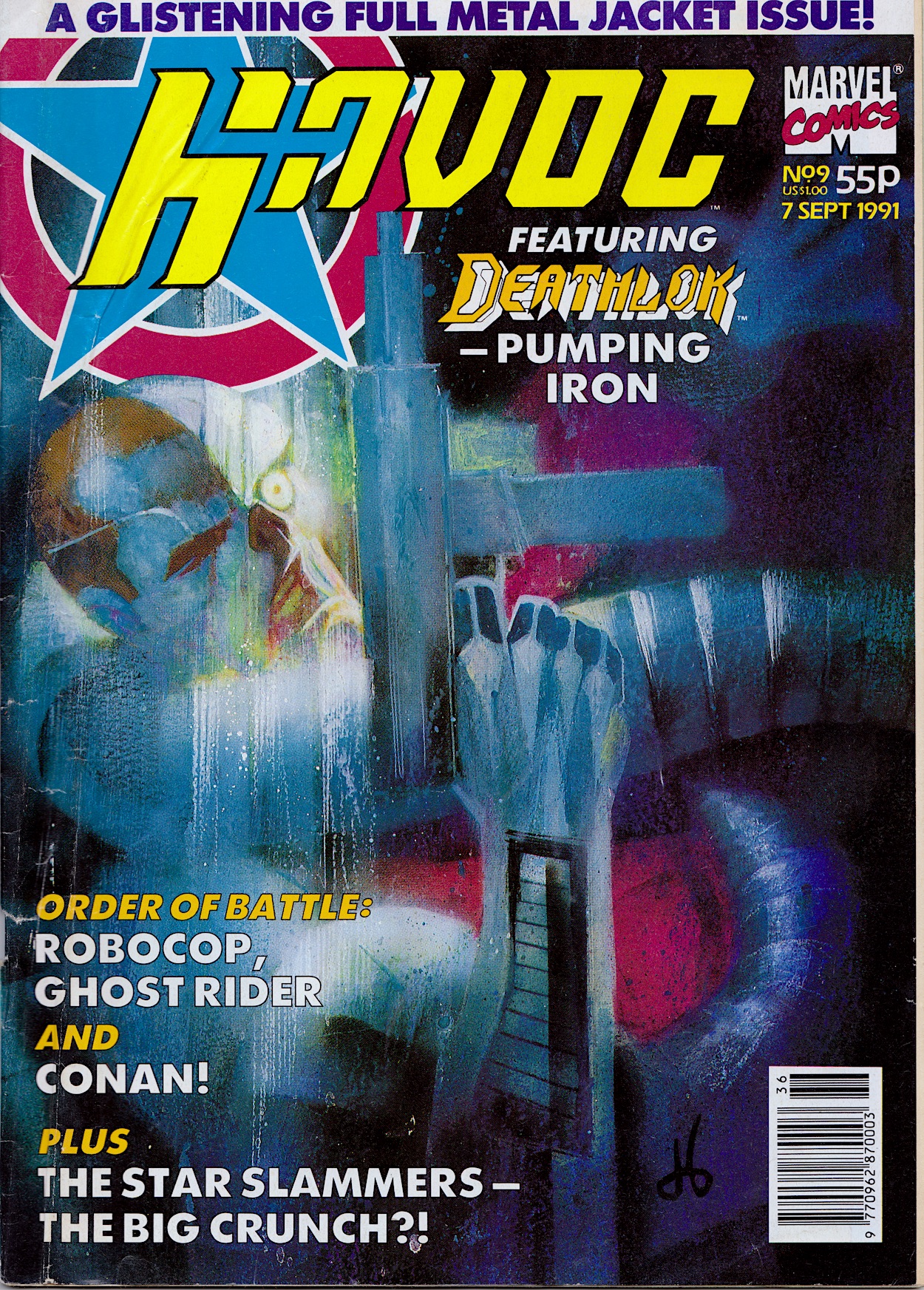
This just isn’t fair. That’s how I felt during September 1991 when #10 of Havoc failed to appear, the comic unceremoniously cancelled without so much as a note to the readers. This issue continues on as normal with cliffhangers and ‘Next Issue’ promos as well as hints of what was yet to come. Clearly pulled after it went to print, Havoc was the latest in what felt like a long line of comics I’d committed to which ended up the same way. Now having enjoyed the series 31 years later in real time I’m left with that same feeling of unfairness as I finish off #9.
If you look at the cover date you’ll see the next issue was due 7th September 1991. With #1 arriving as soon as the school summer holidays had begun, #10 would’ve been the first after the next school year began, Havoc’s brief run perfectly wrapped up in the holidays. When I returned to school I found out several of my friends had also been excitedly collecting it and we ended up sharing our disappointment in its disappearance.
Goodbye Havoc, it’s been a blast and you deserved better
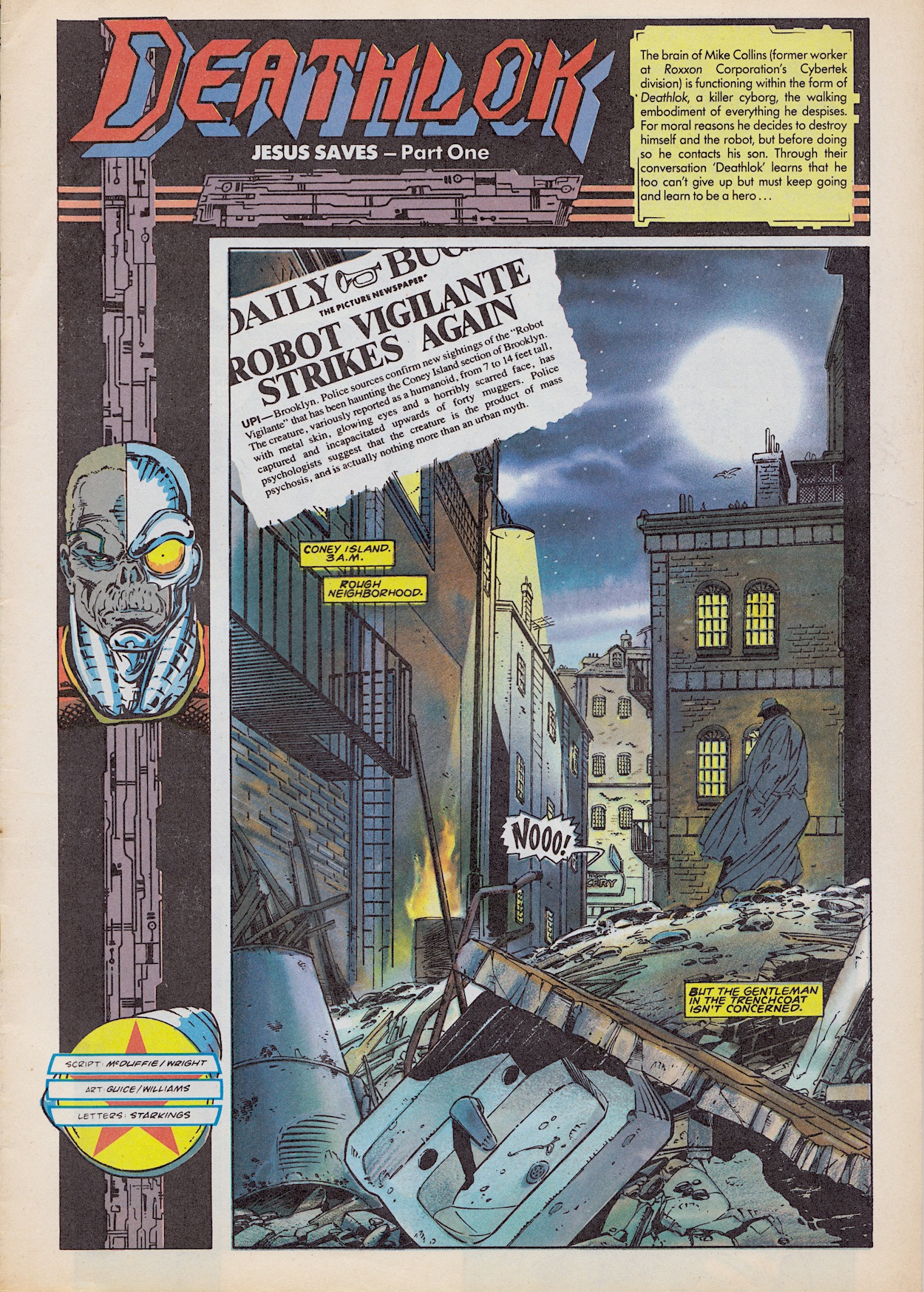
None of the included strips saw a conclusion and two new stories actually begin here, such as the first for Deathlok after Michael Collins’ origin story. Even though it’s the beginning of a new tale we still got a catch up banner to bring new readers up to speed, something no other ‘Part One’ received. Jesus Saves adds new talent with Scott Williams (New Mutants, Superman Unchained, Batman: Hush) joining as inker with Gregory Wright now only writing, and Paul Mounts (Fantastic Four, Friendly Neighborhood Spider-Man, Ultimates) as colourist, although he goes uncredited here. Joining Gregory on writing duties is co-creatorDwayne McDuffie, pencils are by Jackson Guise and lettering by Richard Starkings.
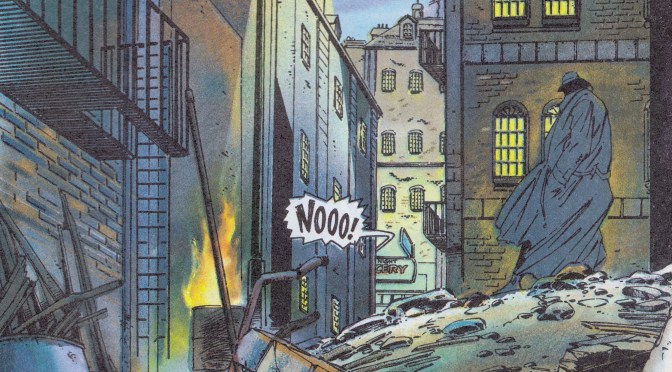
Nice use of the Daily Bugle there, as ever doing what any tabloid does and using exaggerations and shock journalism to strike fears into its readers, with the almost mythical rumours of Deathlok reported as fact on the front page, something Spider-Man fans will be all too familiar with. I’d never read a Spider-Man comic at this point in my life so was completely unaware of the Bugle being a part of the Marvel universe. Through this the strip also establishes our setting as Coney Island.
The Jesus the title refers to is Jesus Badalmente, a homeless man who would end up becoming a roommate and companion to Michael as he battled against Cybertek and tried to find a way back to his body, which he would find out was being kept alive. These are points I only found out in researching who this person was because the way he’s presented here I had a hunch he was being introduced as a regular. Jesus makes robots and is a bit of a cybernetics whiz, which I’m sure will come in handy at some point.
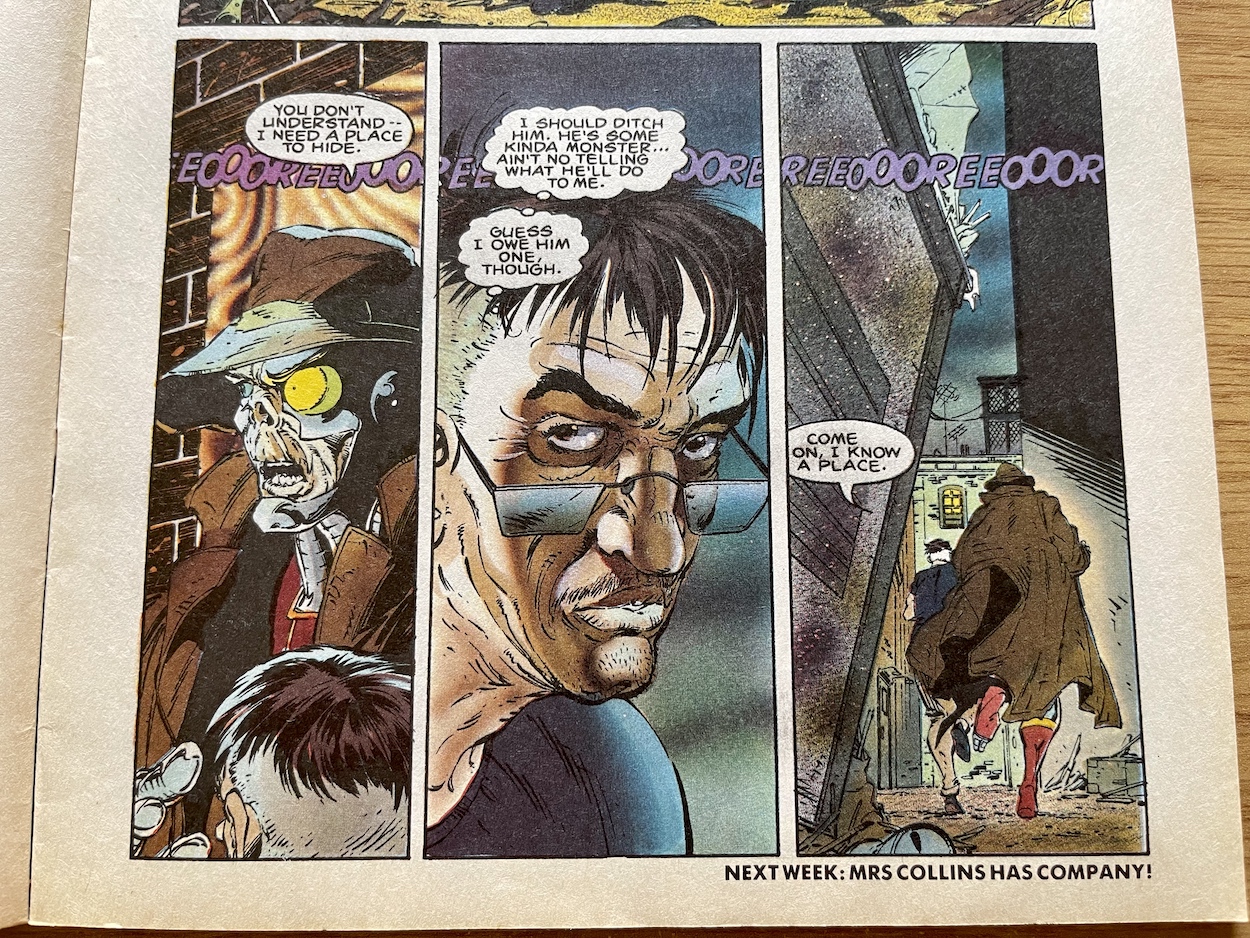
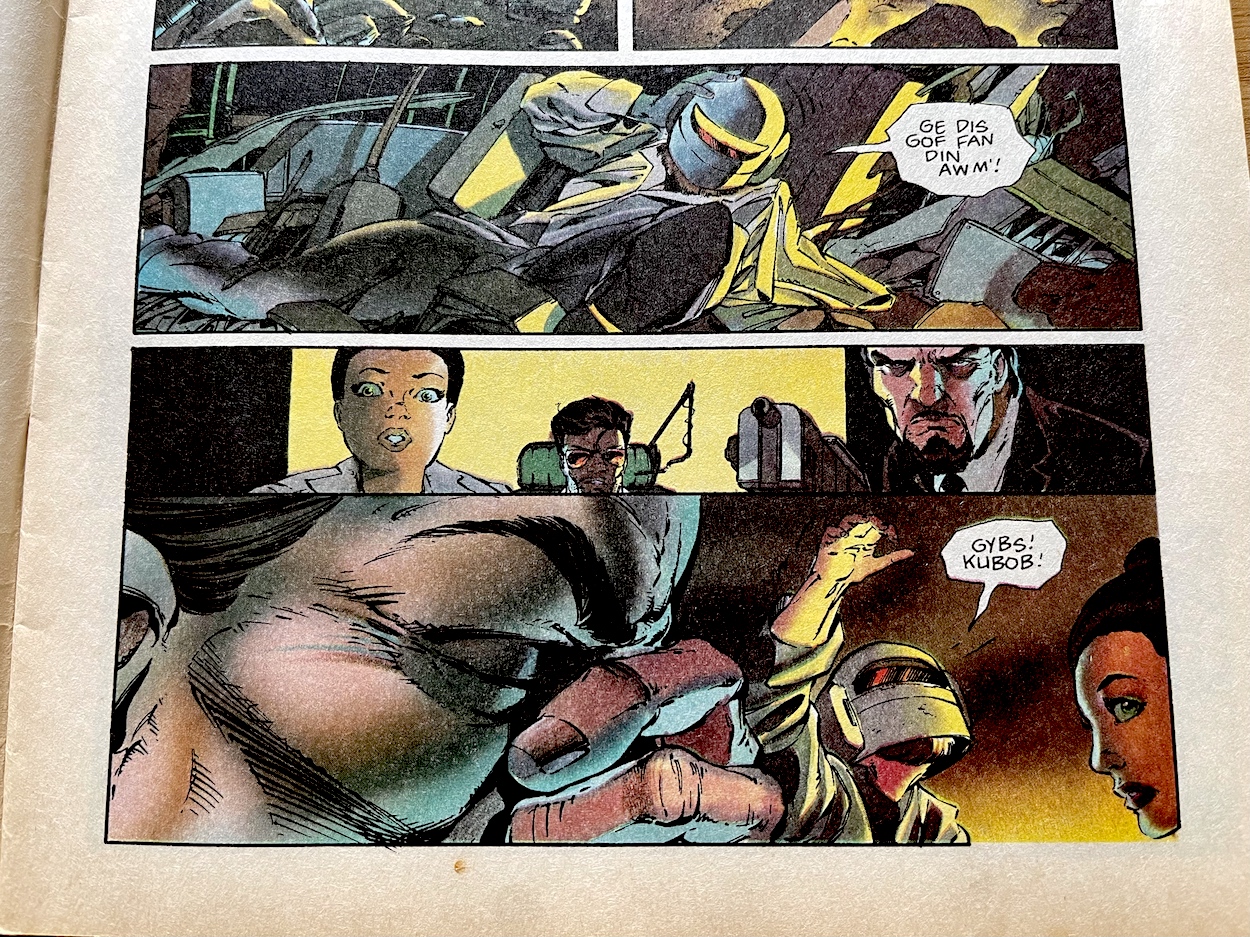
These first five pages of the story basically see Deathlok rescue Jesus from a mugging and in return he’s taken somewhere safe as the police arrive. Jesus’ first reaction is one of fear and revulsion, as will probably become the default as Michael encounters people. But just as he thinks Deathlok has only seen off the muggers so he can kill him, he is then saved by the cyborg from one of the muggers trying to run them down in a car. That’s enough for him to take a chance on this strange individual.
I’ve really enjoyed Deathlok. He was my favourite as a teen and it’s been brilliant to catch up with him again. The origin story was full of character and Dwayne McDuffie and Gregory Wright strike me as writers who’d make sure character development was key to the strip’s success. The action has been great, the interactions between Michael and the computer genuinely funny and I find myself really caring about what happens to them. One to track down for sure.
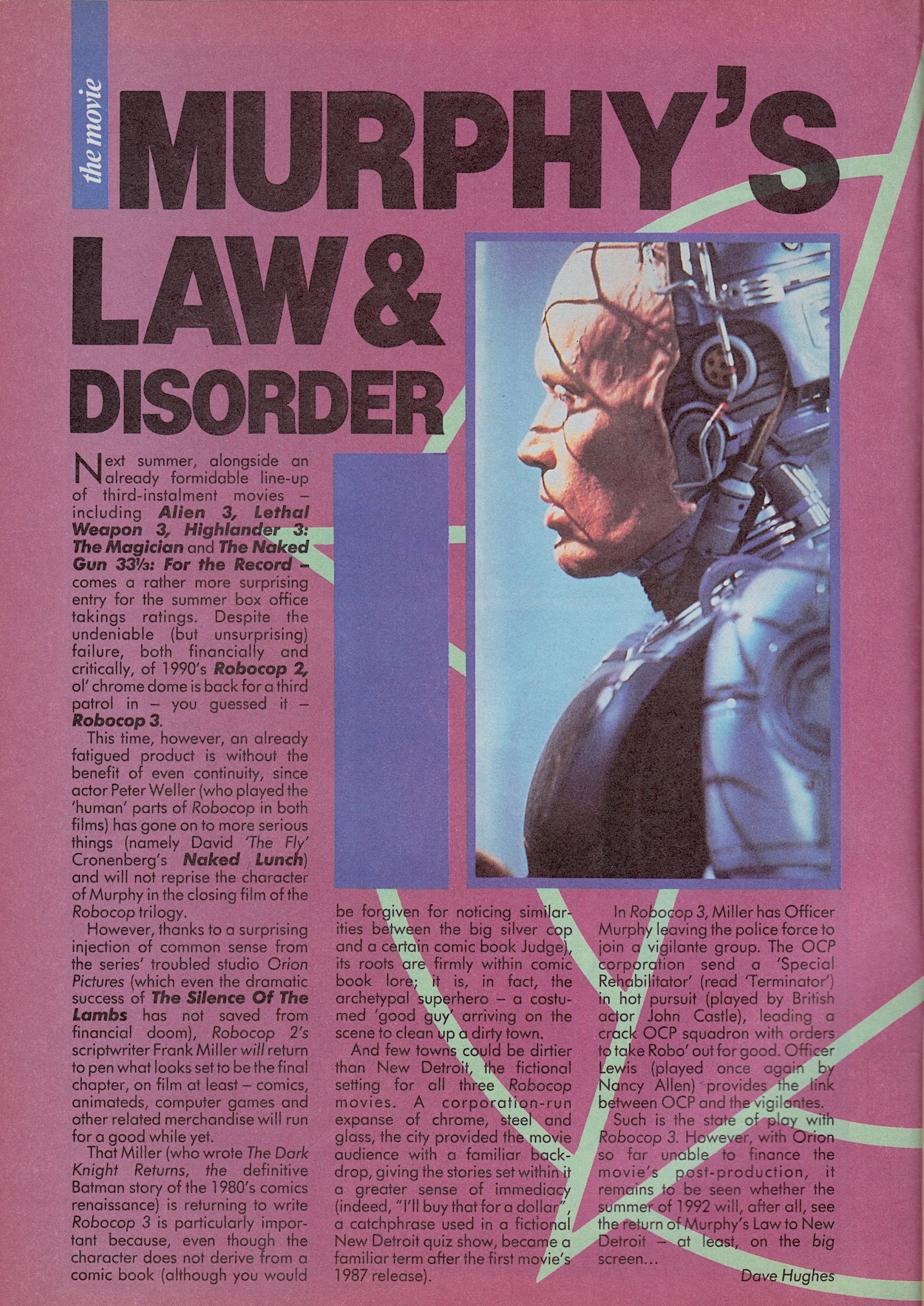
Before Murphy’s strip are two RoboCop features, with a third later in the comic. The first one concentrates on the franchise itself, in particular the in-progress RoboCop 3. The second movie had been released the year before and while it had proved to be a moderate financial success it was generally panned for not living up to the original. I remember being disappointed by it because Robo himself felt flat and boring.
What’s strange here is that Dave Hughes‘s feature describes the franchise as a “fatigued product” in a comic printing strips based on that product! How did that make it past the editor? He also criticises Robocop 2 but praises the fact that its head writer Frank Miller would be returning for the third film. Yes, I’m aware Miller’s screenplay went through various rewrites by other writers but it’s still a strange thing to be thankful for after not enjoying his first RoboCop sequel.
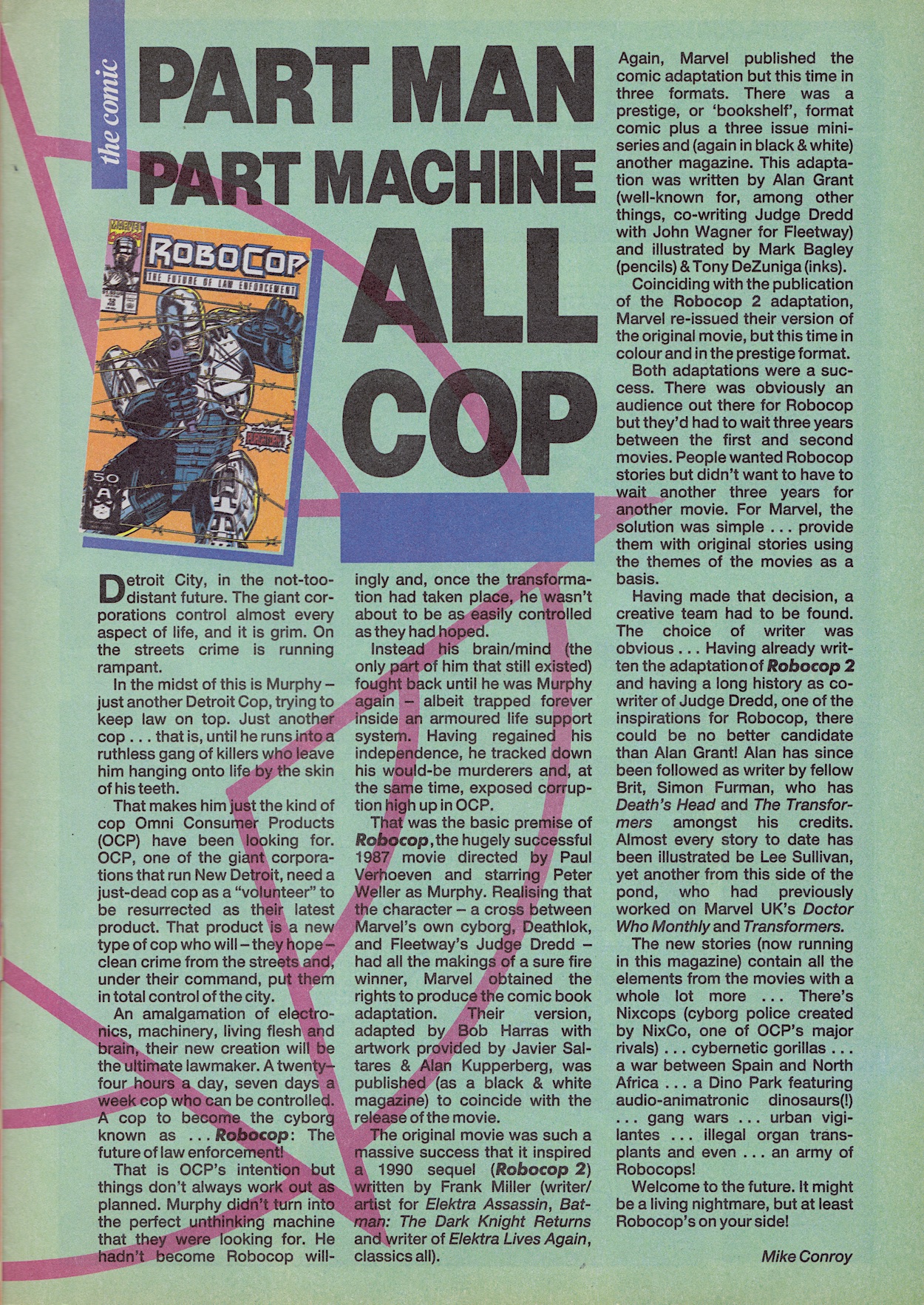
This second feature is meant to be all about the comic strip, a major selling point of Havoc’s anthology. Unfortunately, Mike Conroy really does take his sweet time getting to the stage of discussing them. It’s not really until the third column that he gets into the meat of it all and then it’s over. There really wasn’t a need to reiterate so much of the lore and background to RoboCop for people who would already have been up to speed on all of that.
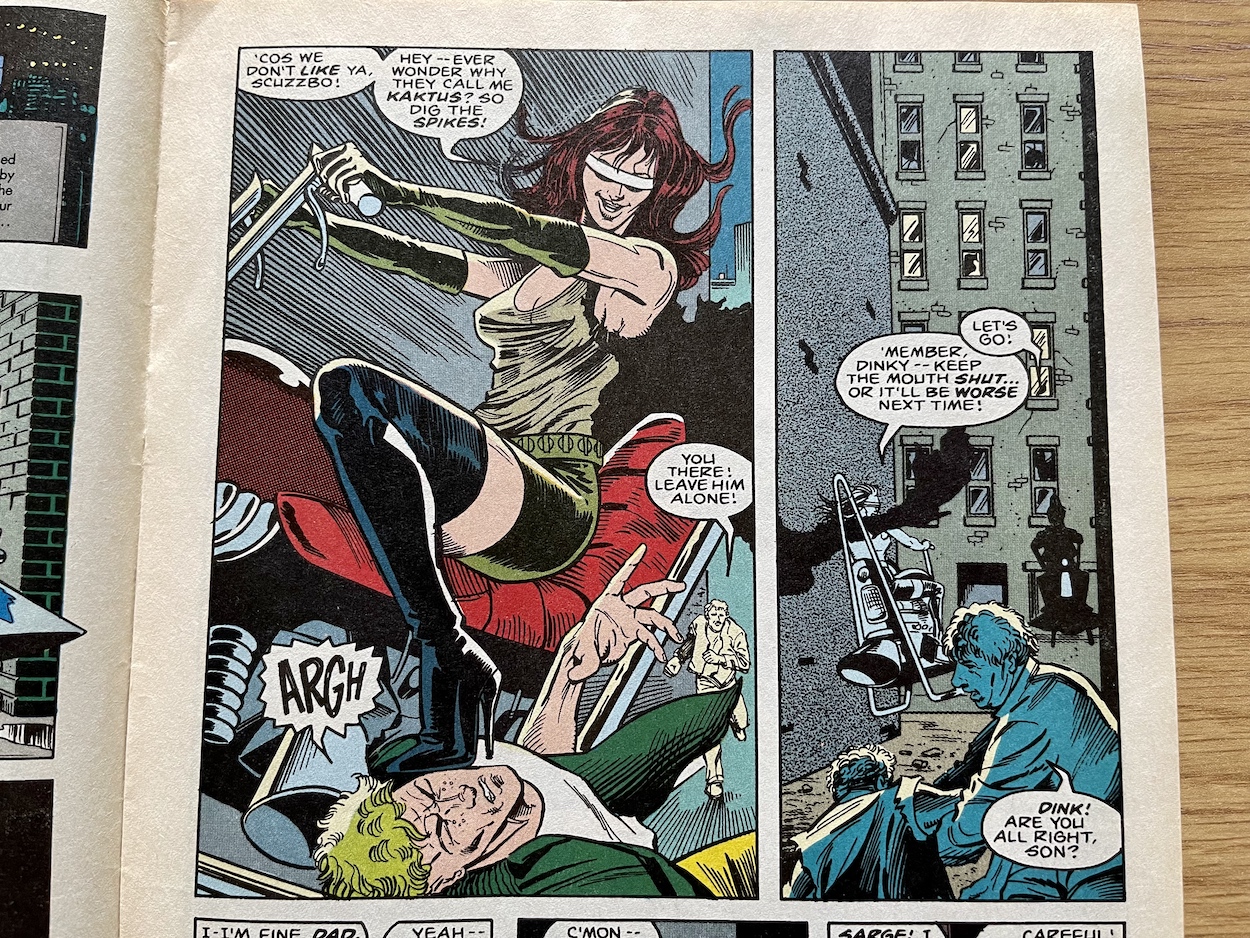
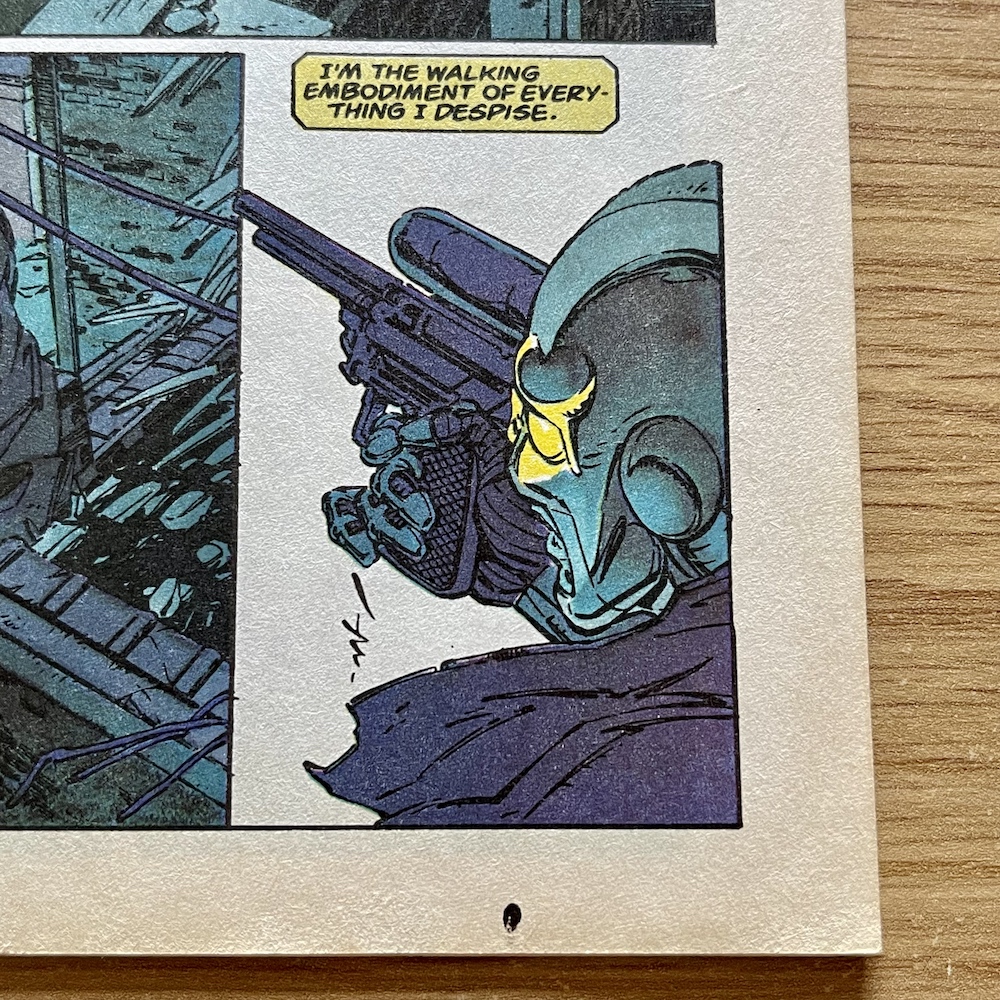
Let’s move on to the strip itself, part two of Vigilante by Alan Grant (with pencils by Lee Sullivan, inks by Kim DeMulder, colours by Steve White, letters by Richard Starkings) and it kicks off with muggers on hover bikes, showing how the comic would go all-in on the future setting, taking the strip more into the sci-fi fantastical than the original movie, which was more grounded. But this is a different medium and it works well to get across the setting and how dangerous Old Detroit really is. After this, the father of the victim complains about how the police are locking up people like General Power from last issue when the city needs them more than ever.
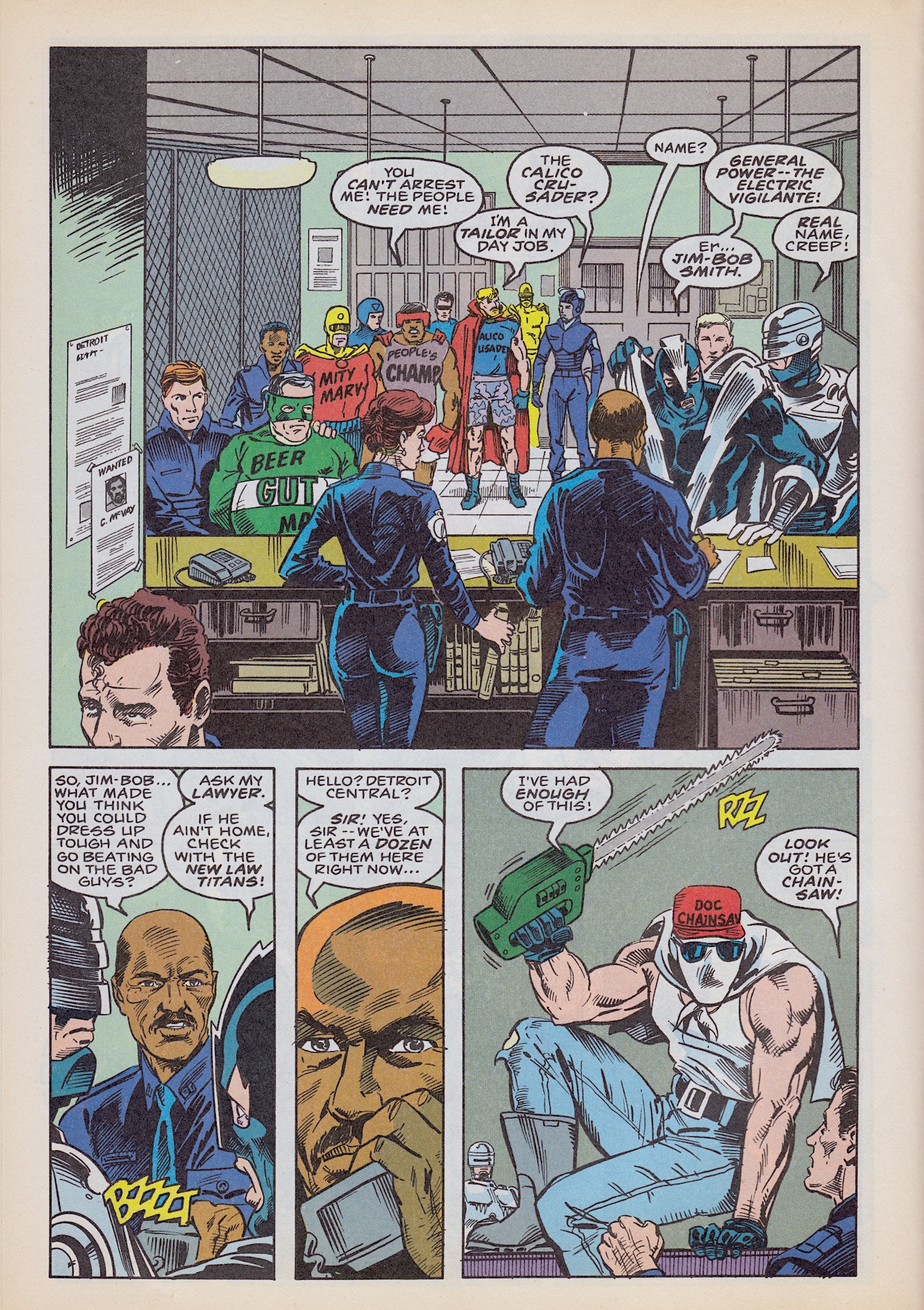
These masked vigilantes’ reputation is a lot better than the reality of the people behind the costumes. Take General Power for example. After frazzling the man he was trying to save last issue he’s brought to the desk of Metro West by Murphy and told to give his name. After declaring himself as ‘General Power’ he’s ordered to give his real name which he hilariously admits is Jim-Bob Smith.
With a precinct full of wannabe superheroes, one of them has had enough and what comes next is a bit of a shock when read today.
RoboCop was set in the not-too-distant future and the first movie and the TV show were, in hindsight, really rather prescient. So much so its surprising at times watching the series to see how well they predicted our world thirty years in the then-future, providing a scary insight into where we could be going. Bear this in mind when you see this next panel of that wannabe you saw in the final panel above, going by the name ‘Doc Chainsaw’.
He says it’s not against the law to “put on a suit an’ prowl the night” (which itself sounds more creepy than I think he intended) right in front of RoboCop. As if his red hat wasn’t enough, his general attire and his choice of words when confronted by Alex would be a bit on the nose if written today!
I don’t think I need to make any more comment on that one. Soon the sarge barks an order; all the vigilantes are to be charged with misdemeanours and set free. This happens much to the chagrin of the officers but has come down from the “very top” and thus the main mystery of the new story begins. Robo leaves to see if there’s something he can do (but we’re not given any more hints as to what this could be) and then we see former mugging victim Dink and his dad settling down to watch the city’s latest reality show, ‘The Detroit Vigilante‘ and that’s where it ends.
Deathlok and RoboCop have similar set ups but they’re handled in such unique ways you wouldn’t think they were unless you stopped to break down what’s at the core of their main protagonists. I was never a fan of the movie sequels to RoboCop so initially had some trepidation about these strips since they were also direct sequels, released before the TV show. But I’ve been pleasantly surprised to find a nice halfway point between the original film and the show, with Alan Grant grasping the character much better than the movie studio did around the same time.
“Pain is inflicted quickly and harshly upon those who would harm innocent children.”
Ghost Rider
It’s hard to judge a comic strip series based on only the first couple of stories but I’ve been impressed with this version of Murphy so far. The first story brought the action, the second concentrated more on the characters and this one feels like it’s settled in more to the episodic nature of the storytelling, this first part setting things up nicely. Normally I’d be eager to see the next chunk but it’s just not forthcoming right now. Sadly, it’s goodbye to another favourite for the time being.
To soften the blow (although this wasn’t the original intention) we get a third feature for our part man, part machine, all cop hero, billed on the contents page as an interview with Marvel UK artist Lee Sullivan who did superb work on RoboCop for the American arm of the publisher. Calling it this is a bit of a stretch though. It reads as if two quotes by Lee were pulled from a general career interview, with one answer about RoboCop and the other about Doctor Who, filled out with information about the artist.
“…and because we know where everything is, we methodically begin to eliminate anything that ought not to be there!”
Star Slammers
Don’t get me wrong, it’s interesting information and a good article but I was looking forward to an actual interview about Lee’s work on this particular strip. That’s two of the three features about this character that feel like they included an awful lot of padding to make up the page count. Such a shame because I do enjoy Havoc’s extras but I’d have preferred those two to have been combined into one and another Eye Level included instead.
There’s mention here of Marvel no longer having the RoboCop licence which again is a strange thing to include when you’re trying to entice readers back for more. About a year before this, Marvel UK’s Transformers announced the forthcoming release of a new RoboCop fortnightly comic. It was never released, with Robo appearing the next summer in Havoc instead.
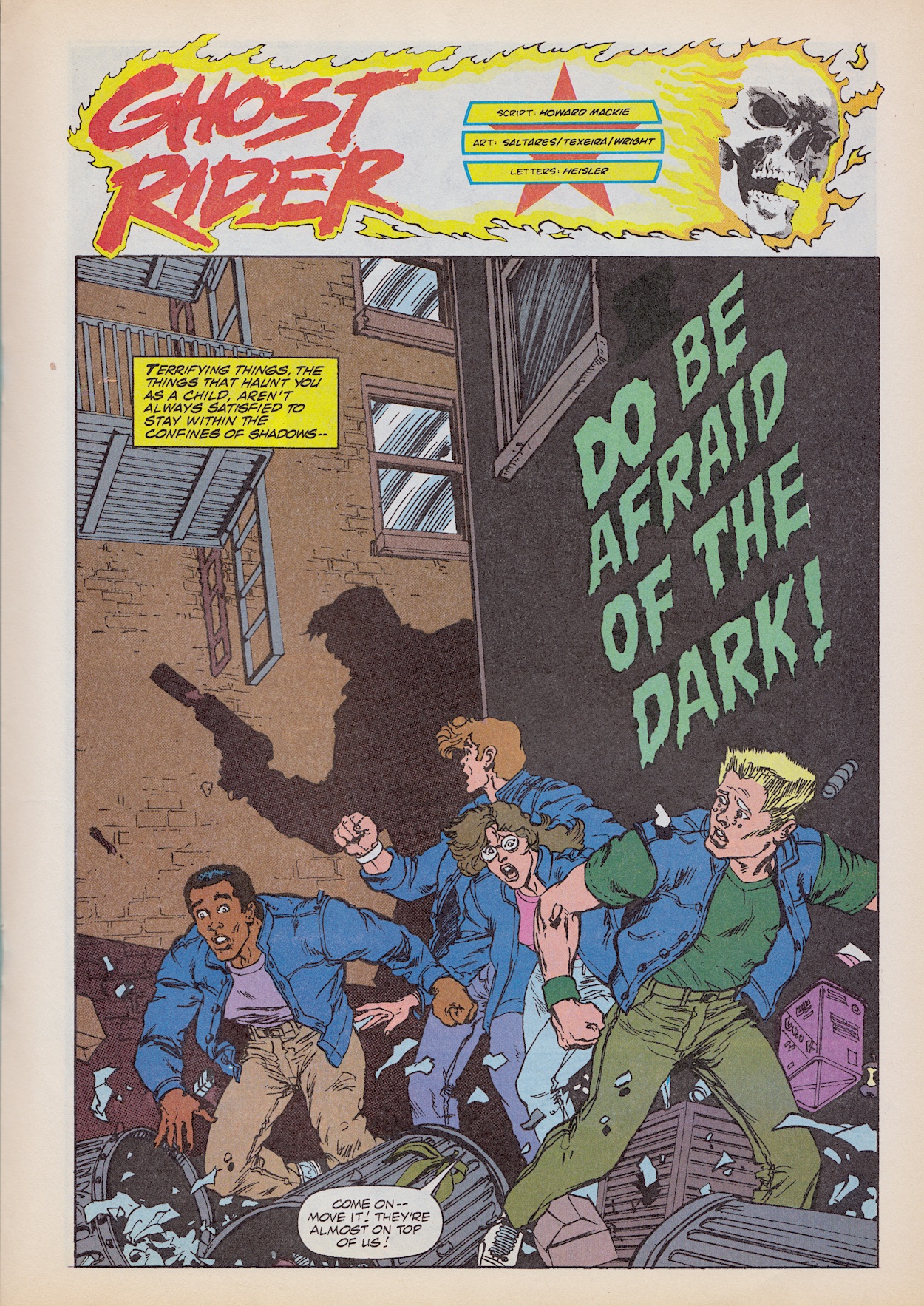
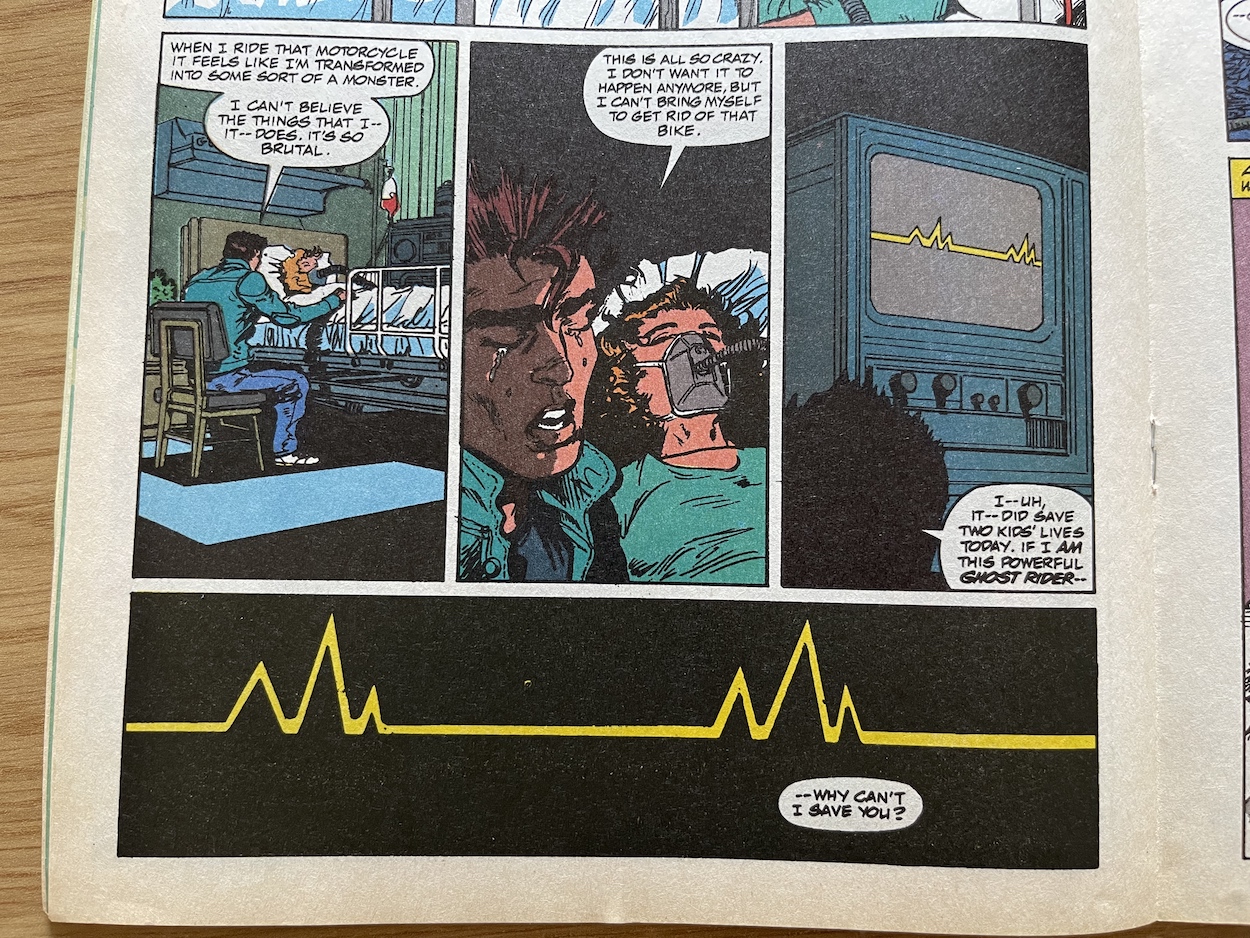
Danny Ketch and his Spirit of Vengeance get the bulk of pages this issue with part one of Do Be Afraid of the Dark (written by Howard Mackie, pencils by Javier Saltares, inks by Mark Taxeira, colours by Gregory Wright, letters by Michael Heisler) which begins with the gang of kids from previous issues, now referred to as the Cypress Pool Jokers, hunted down by who we assume are Deathwatch’s minions. Demanding to know where the canisters are, they’re threatening the lives of the kids at gunpoint when a bright light and roar of a motorbike from a nearby hedge halt proceedings.
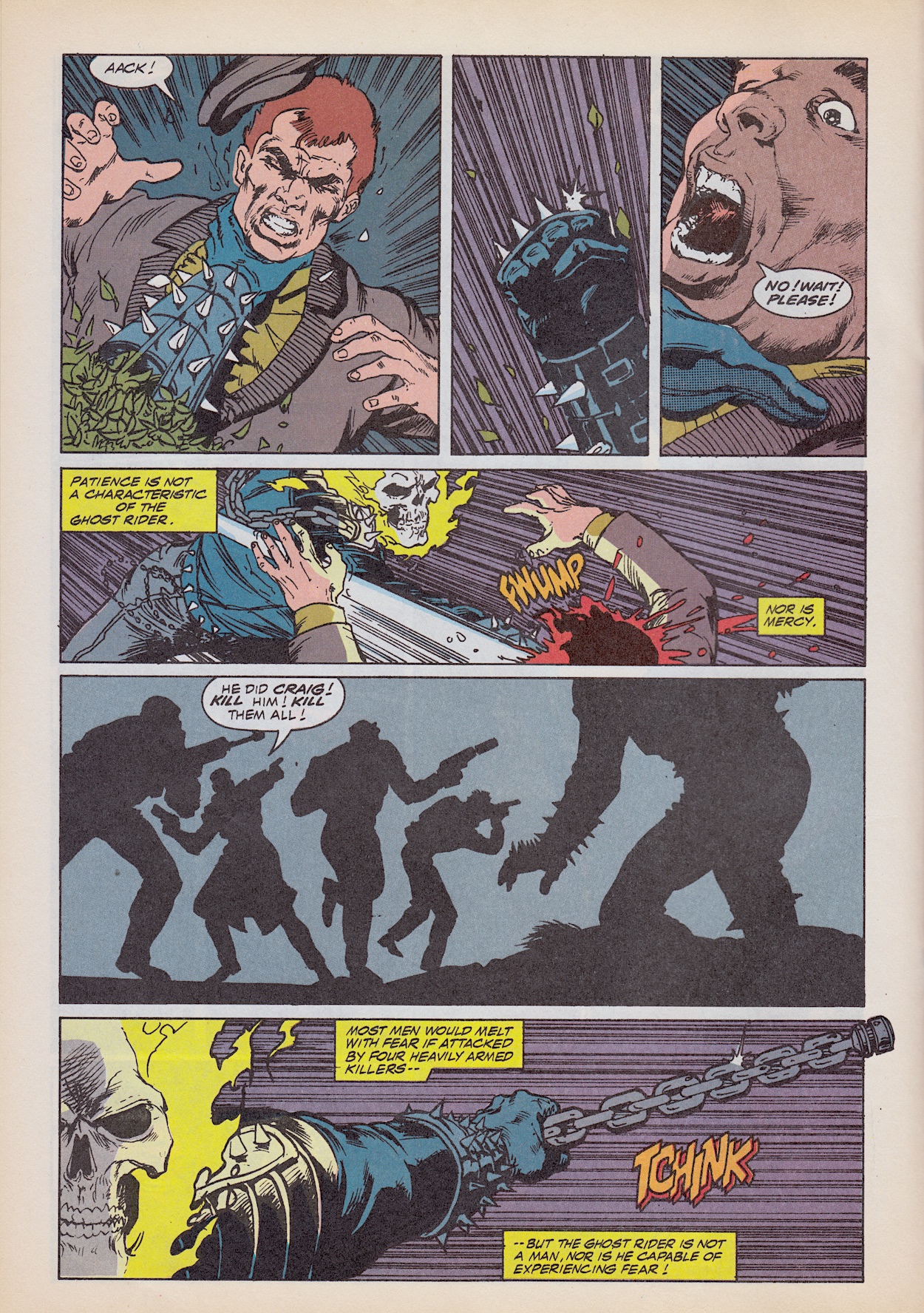
Out zooms the Ghost Rider, glowing against the night sky, only to be met by a hail of bullets. What’s interesting is that everyone knows his name already, his presence in the city plastered all over the newspapers and of course the criminal underworld would be all too aware of him after he took some of them out. Falling off the bike and back into the hedge, the night goes dark again, the Ghost Rider’s flame apparently extinguished. Until the next page that is.
Scenes involving the Ghost Rider when apparently surrounded and outnumbered are always great fun but I can only imagine how awesome these would’ve seemed to a teenage me. (I’m sure they were but my memory has let me down.) I can confidentially say this was unlike anything I’d ever seen before. Brutal but thrilling in equal measure, this first part of the new story really hits the ground running. Essentially a direct follow up to the origin story, it’s unfortunately not clear in these first seven pages whether any other main plot would be introduced.
On the next page it’s stated how Ghost Rider would normally take his time, ensuring to inflict the most pain possible on these men, equal to the pain of each individual’s past offences. But this night he needs answers and so he lashes his magical chain around one of them and drags them away off the back of his bike, the criminal’s body bouncing up and down on the road over the ghostly flames.
Hung over the side of a very tall building Eldon finally admits he’s not part of either criminal enterprise. Instead, he’d heard about Kingpin looking for the mysterious canisters and so he thought he’d take his gang out to find them, present them to the criminal mastermind and get in his good books. Ghost Rider gets no answers but that image of him, followed by the fate of Eldon have me gagging for more.
The kids see him drive off, recognising him now as one of the good guys. “Man, he’s hot!”, exclaims one as he disappears from their sight, and from mine. This appears to be the most serialised of Havoc’s strips rather than individual stories, at least for the time being and I’m gutted this is my cut off point again. As my introduction to Ghost Rider he’s been a brilliant character in a very well written strip illustrated in a scratchy, mature fashion that perfectly suits him. Defintley my favourite part of Havoc and the one I’ll miss the most.
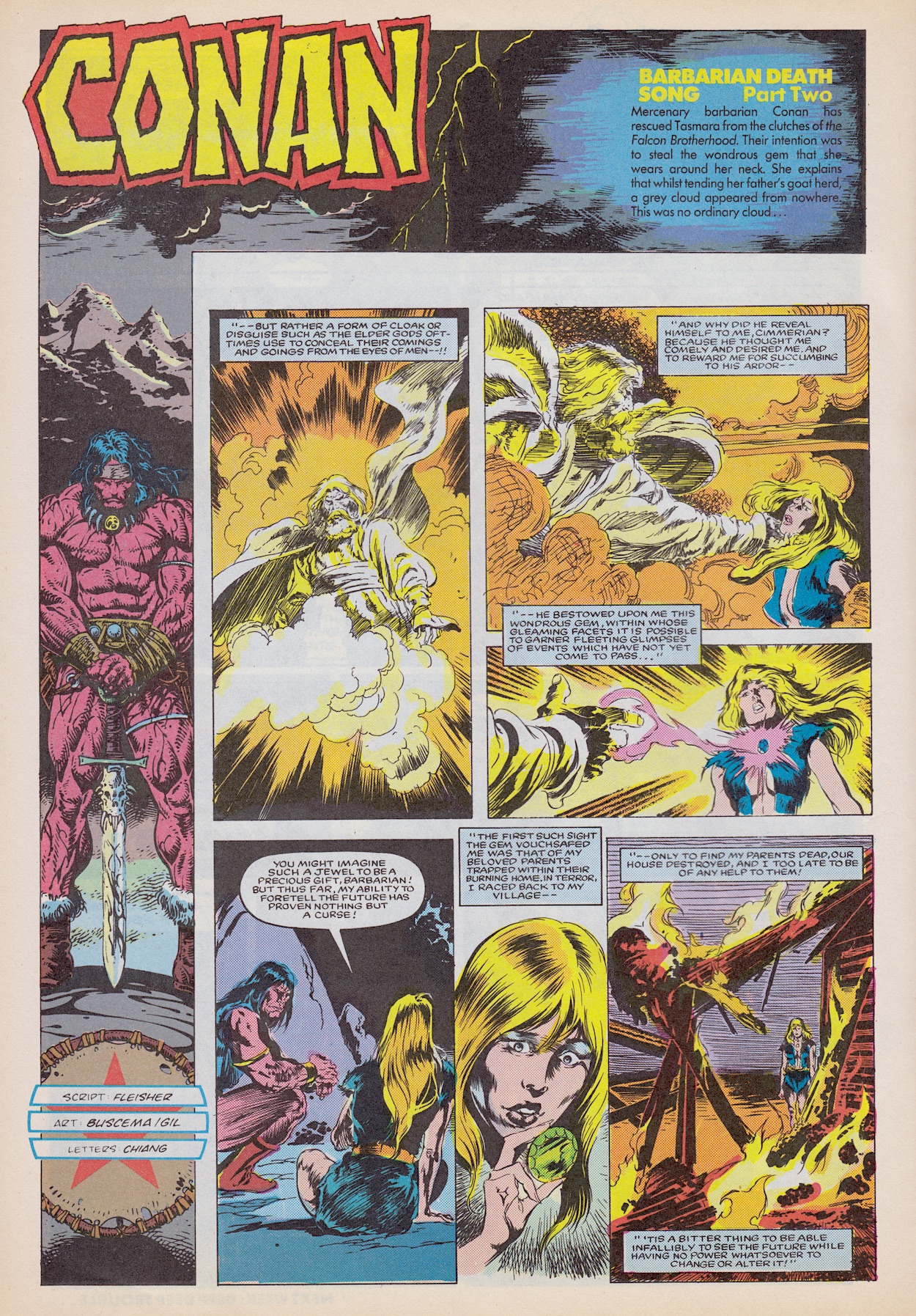
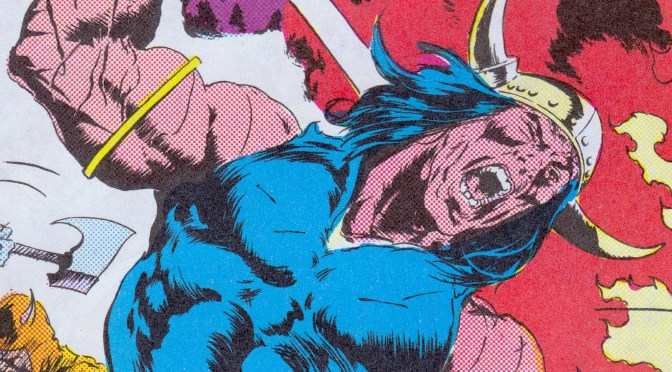
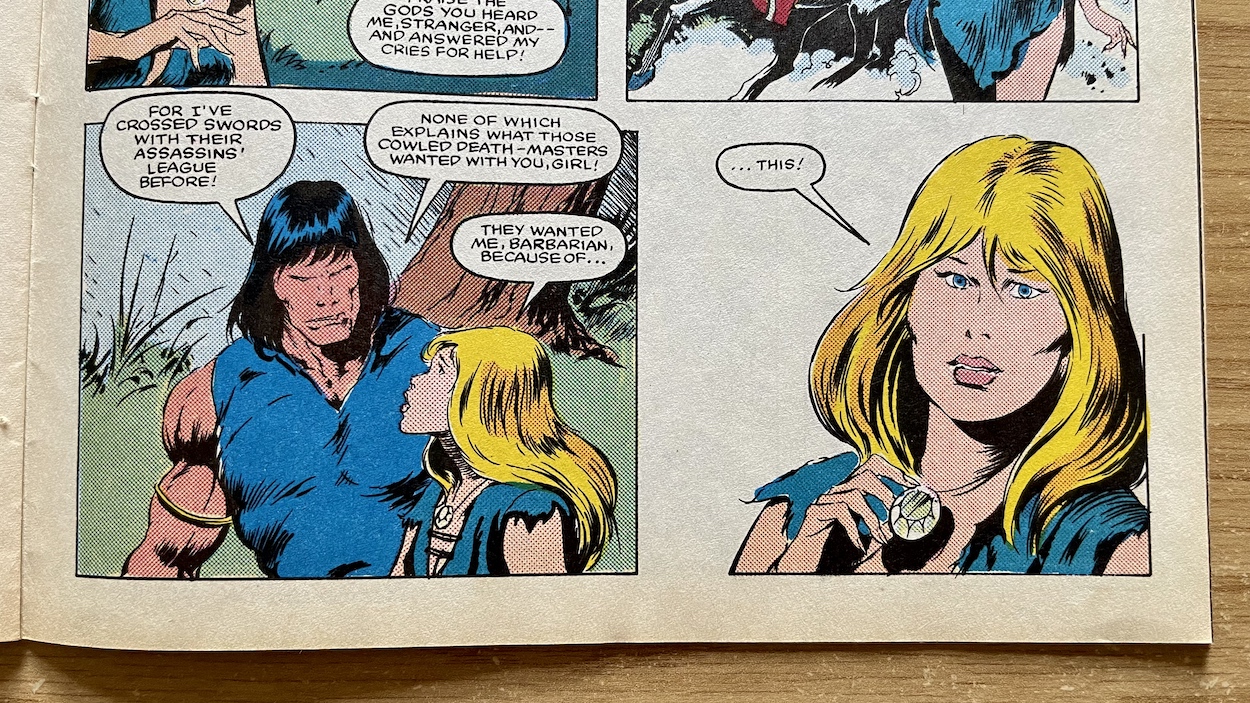
Part two of Conan’s Barbarian Death Song (written by Michael Fleischer, pencils by John Buscema, inks by Armando Gil, letters by Janice Chiang) sees our female guest character finally named (Tasmara) and she explains the cloud from last time was actually some random god who bestowed the jewel upon her neck because he was so enraptured by her beauty. She’s now being chased down by Baron Gerdeg and his Falcon Brotherhood because it gives her the ability to see the future, something she realised through tragedy as you can see above.
This gives this fantastical element a sense of foreboding right from the start; it’s a curse rather than the gift it was intended as. As they chat she sees something else shocking, Conan’s death! Her vision includes his funeral procession, accompanied on either side of his coffin by both allies and foes he’s previously fought alongside and against, taken directly from the poem this story uses as inspiration. For more on that check out last week’s review which explains Conan’s last ever story.
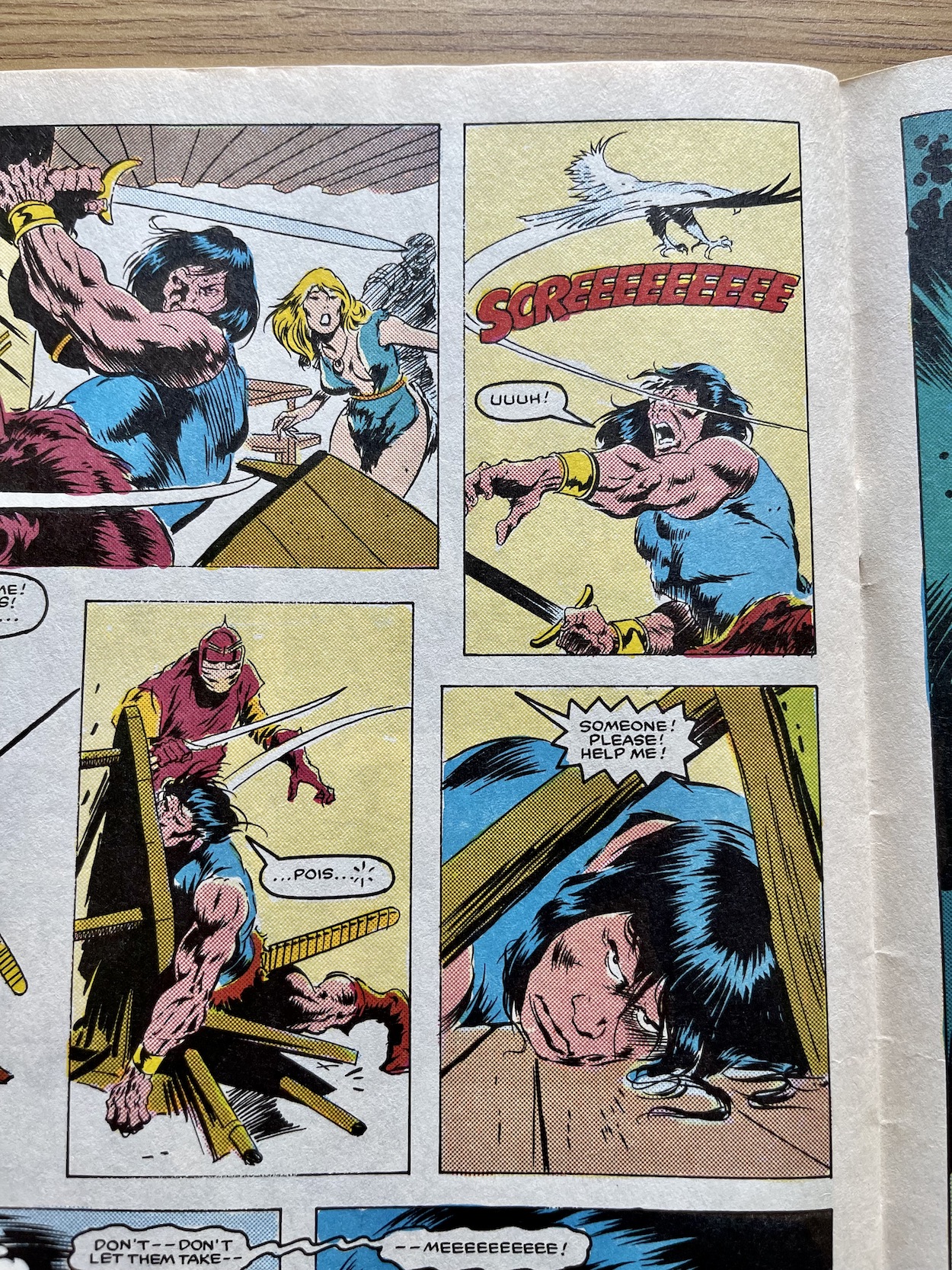
Conan and Tasmara head into the local town to eat and drink before making their way elsewhere, hoping to beat death by getting far away from danger. But the Brotherhood, who also have history of being defeated by Conan, have bribed a dancer in the tavern to dance for Conan using birds they supply her with, their talons tipped with a deadly poison.
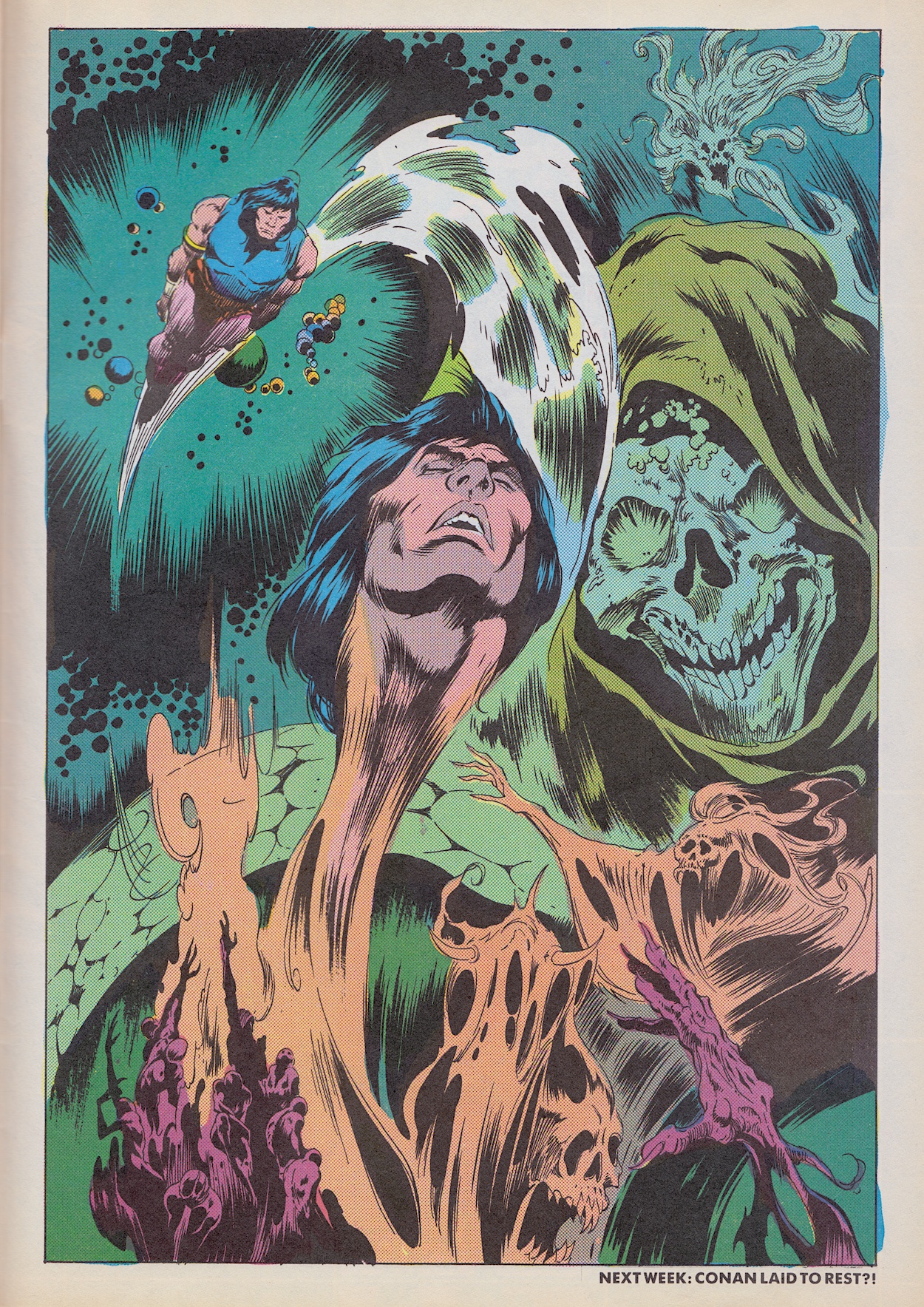
Conan collapses and his last view before he blacks out is of Tasmara being taken. We then see his consciousness slip into another realm, a realm of death and decay by the looks of it. You can see the Next Issue caption at the bottom of this next page. Yes, this is how Conan ends!
It would have been a great cliffhanger normally, but this was where we were left hanging as we desperately waited for #10 to appear. Now knowing it never would makes this all the more frustrating of course. Conan’s first story may have been somewhat outdated and out of place in Havoc, but the second story made up for that somewhat with its humour despite its underwhelming ending. This story seemed to have more going for it and, knowing the poem it was based on, I was eager to see how it turned out. Alas, for now I can’t.
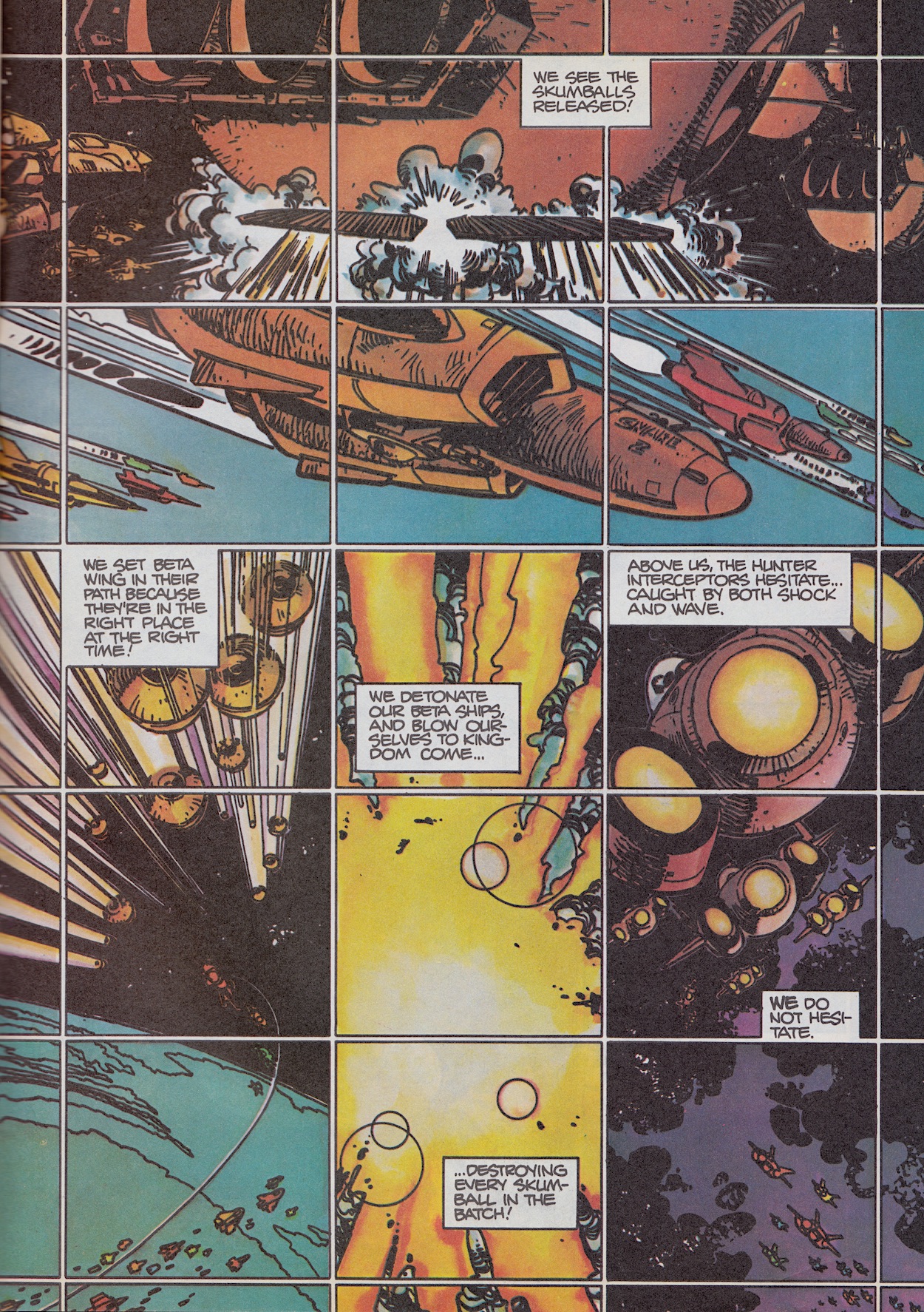
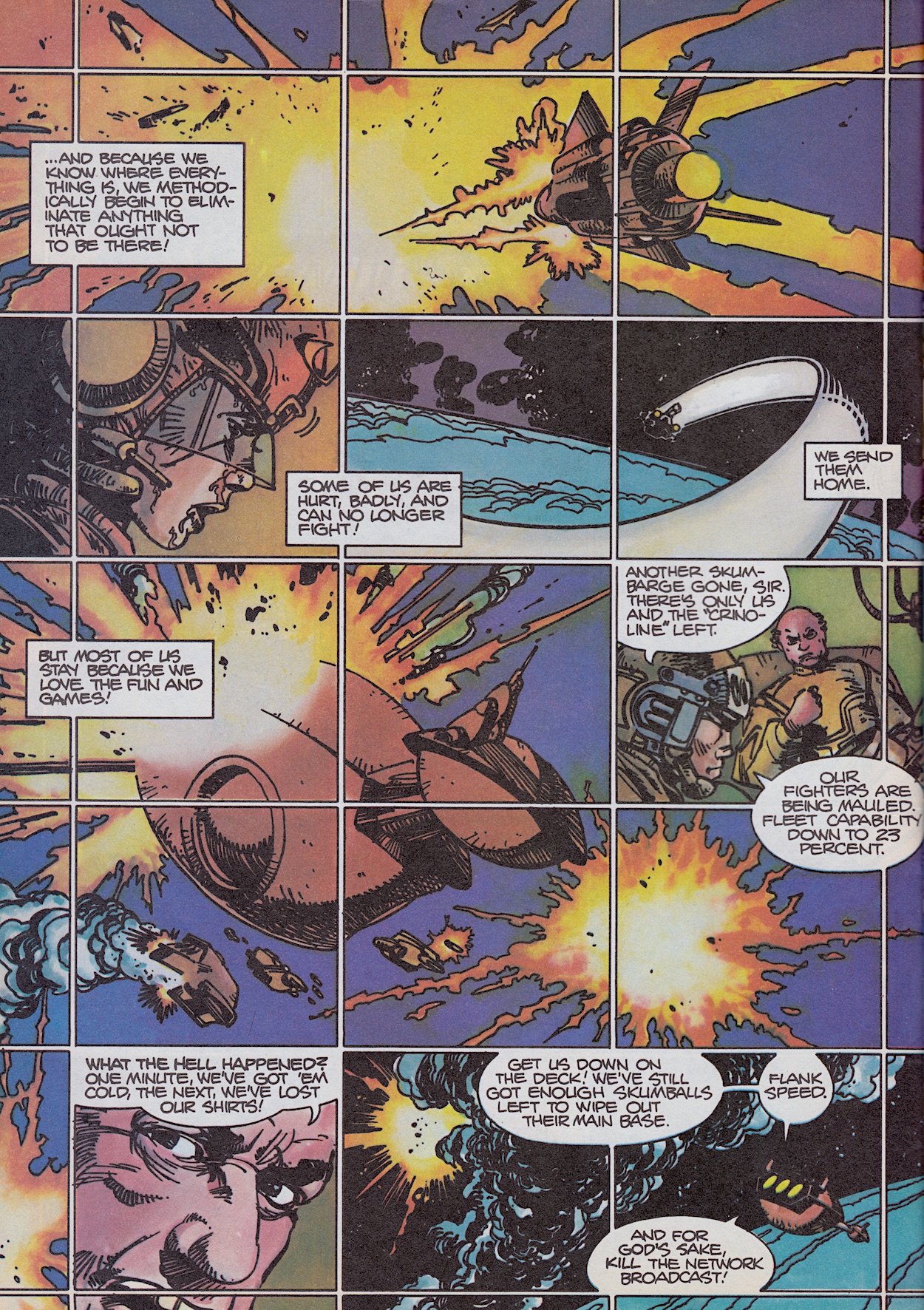
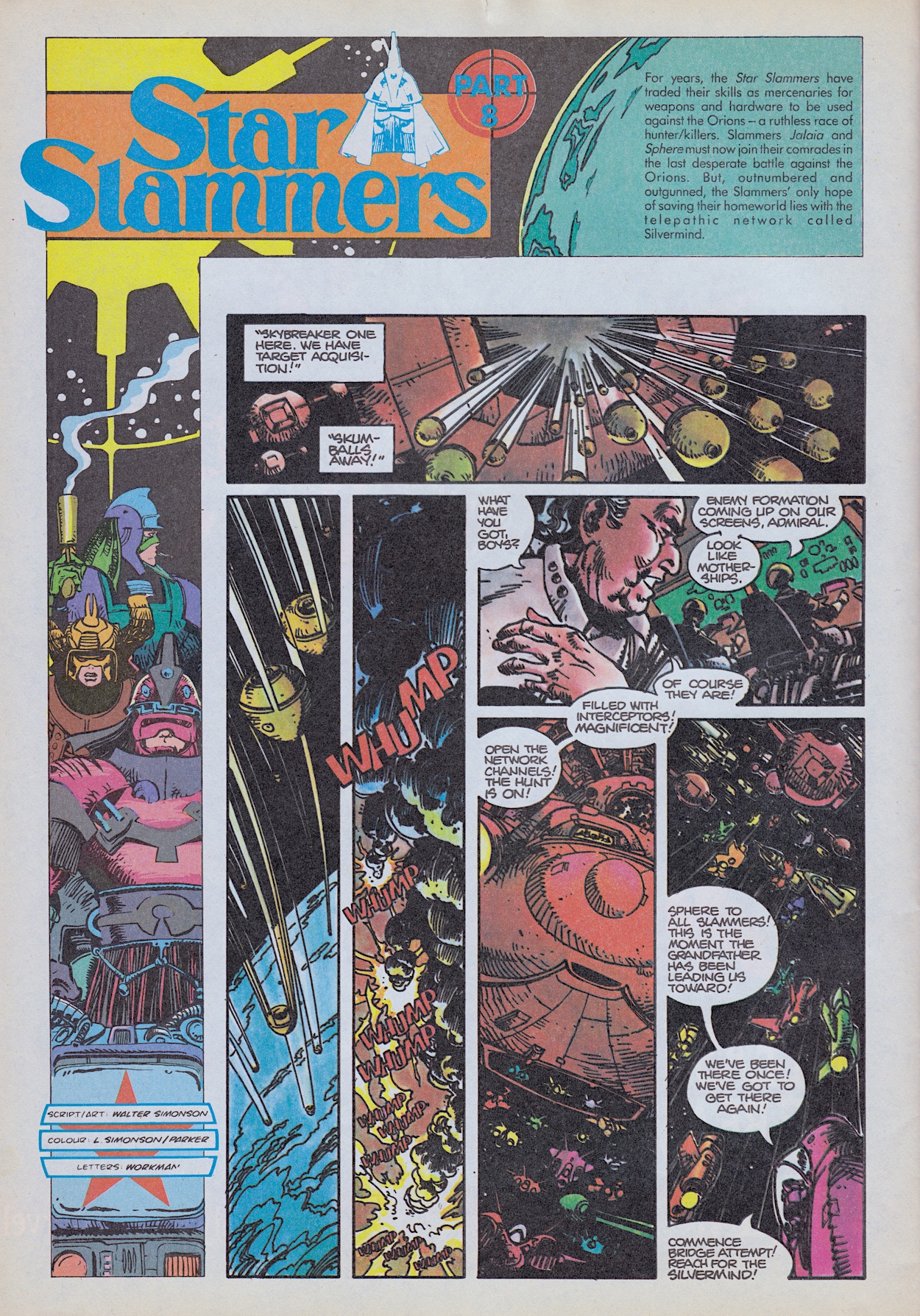
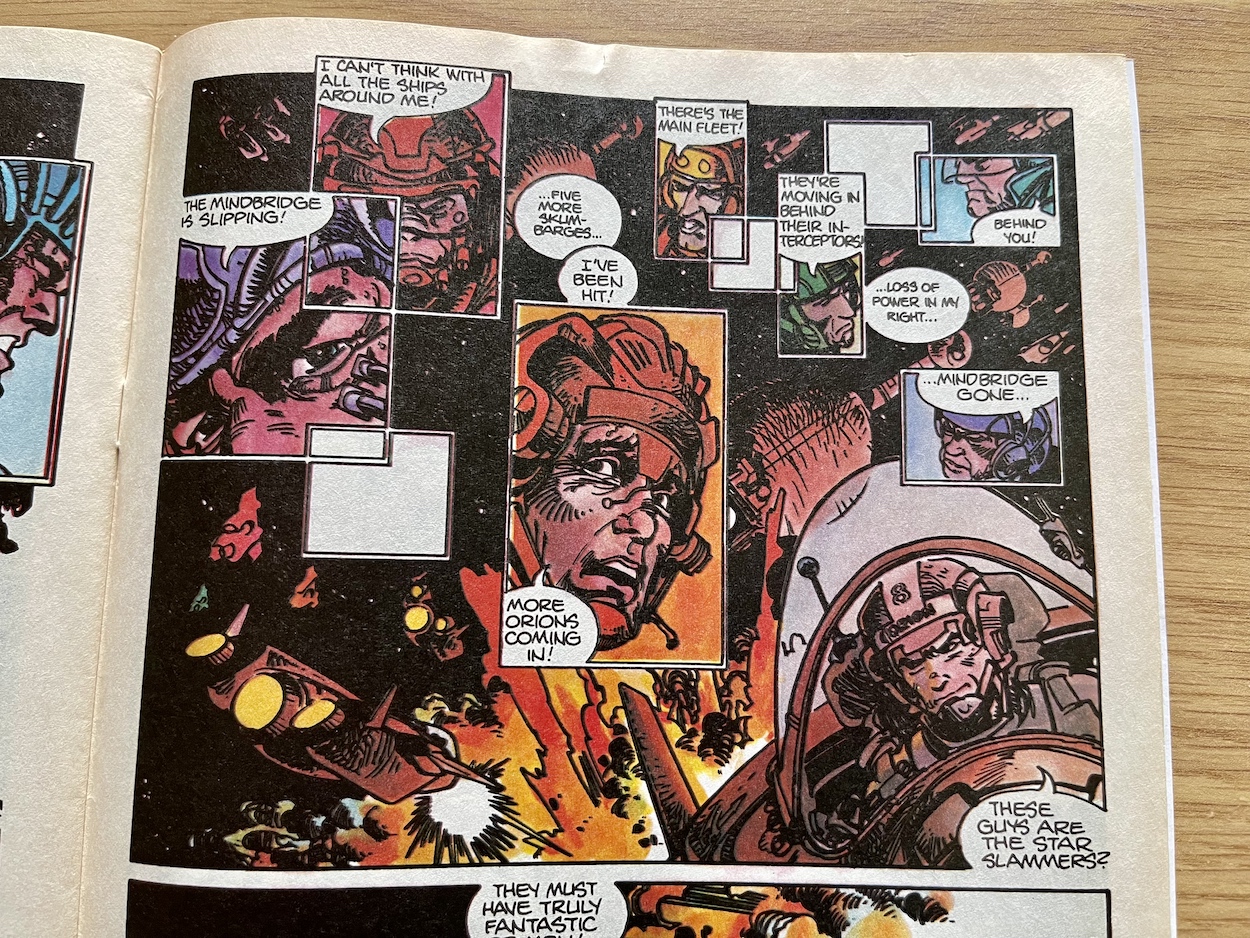
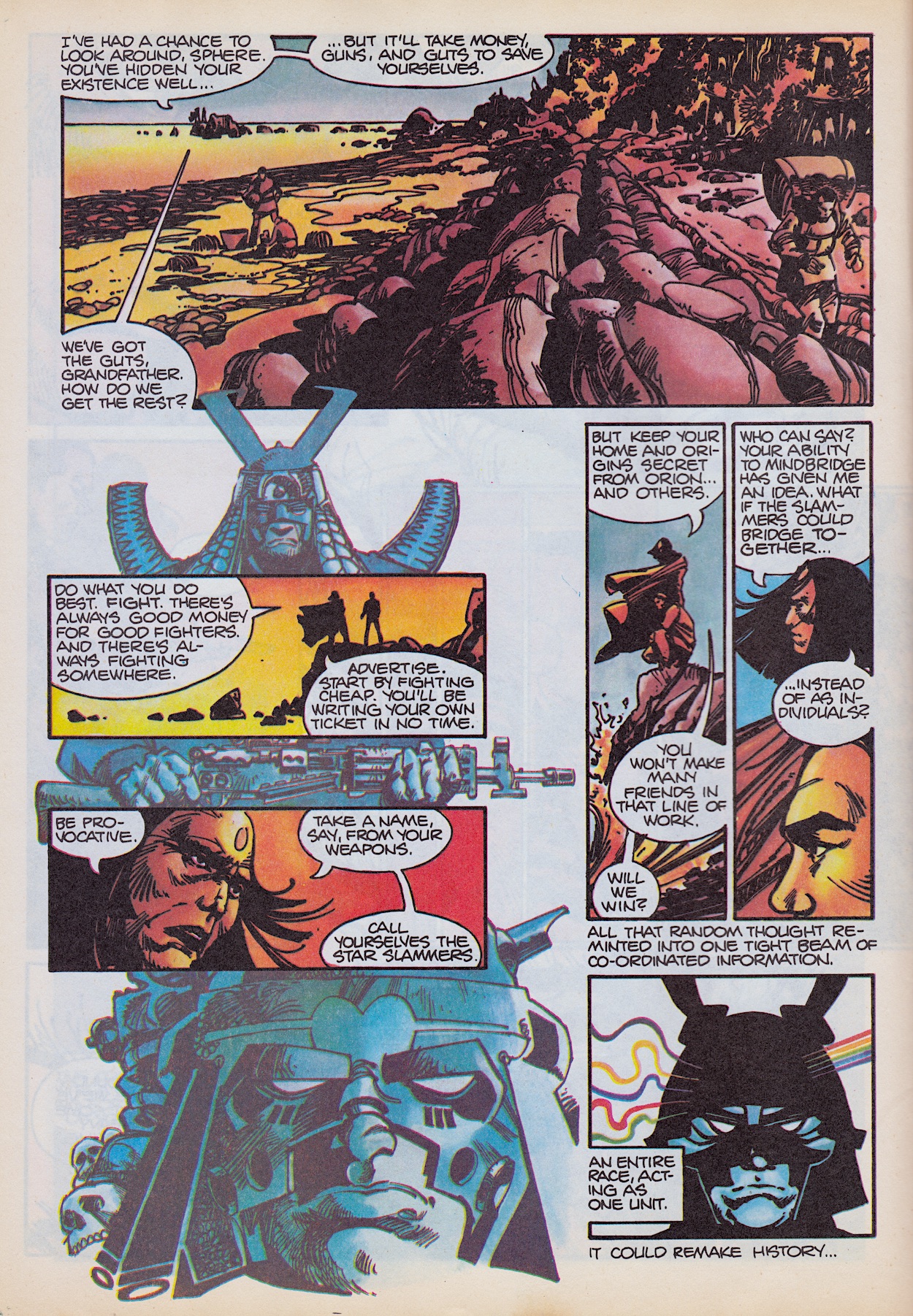
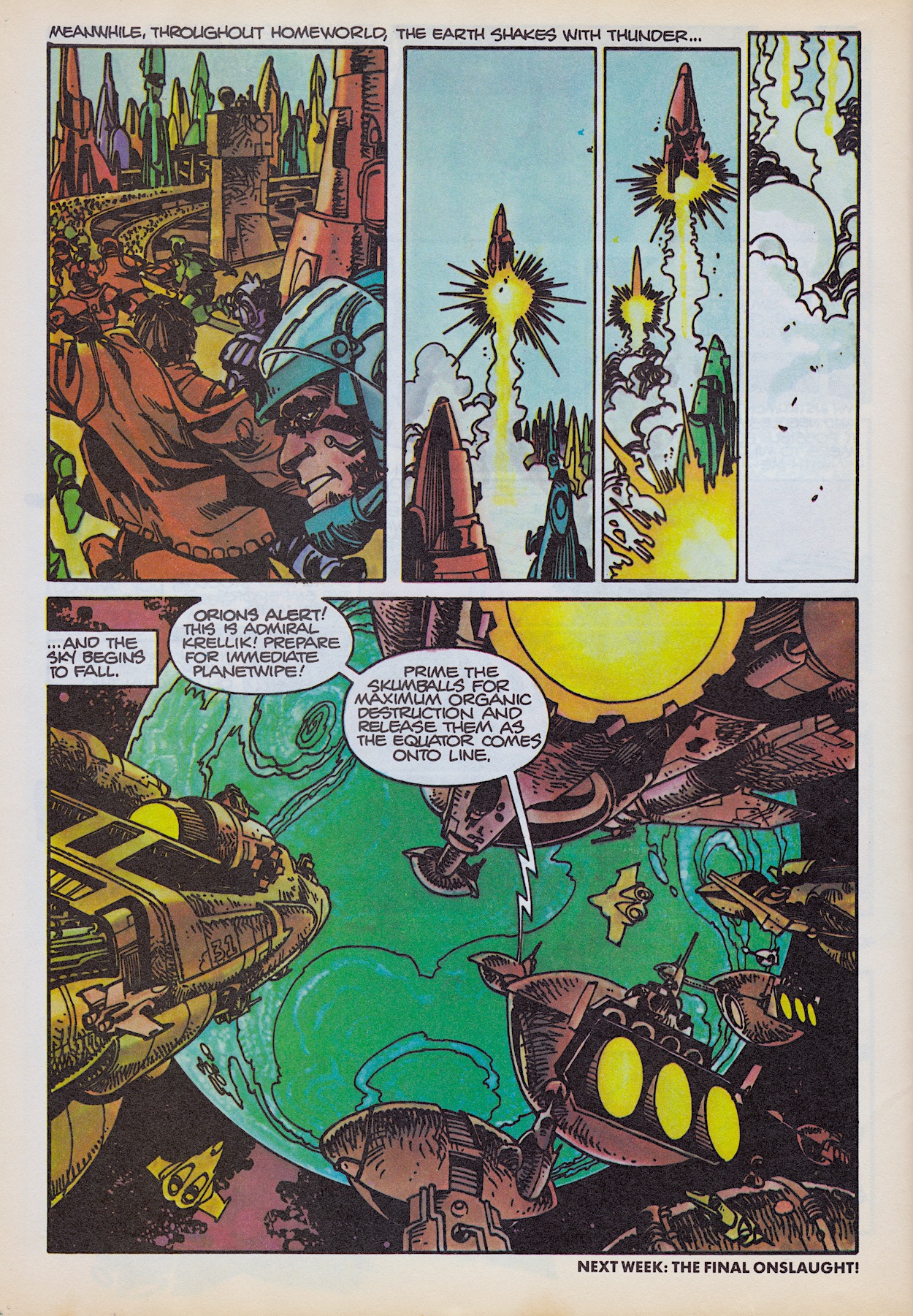
I’ll admit this issue’s Star Slammers (written and drawn by Walt Simonson, colours by Louise Simonson and Deborah Pedler, letters by John Workman) is eye catching, I’ll give it that. Each of its five pages are split up into these smaller panels, carrying on the theme of the Silvermind from last time. In fact, this penultimate part of the story kicks off with Jalaia finally reaching that near death point and activating the hive mind of the Slammers. Suddenly every single one of them can see, sense and hear everyone else, turning the tide of the battle against the Orions. So naturally Admiral Krellik cuts the televised feed to his home world in an attempt to control the narrative.
The way this is depicted, how they’re able to instantly react to the enemy from anywhere in the battle, how it turns on a dime from a slaughter to potential victory much to the shock of the enemy, is really very good. Alien Legion was due to replace Star Slammers in #11, so one week before its conclusion this strip finally became something of interest. It’s a cool few pages but with the lack of characterisation or storytelling in many previous parts it’s just too late to save it.
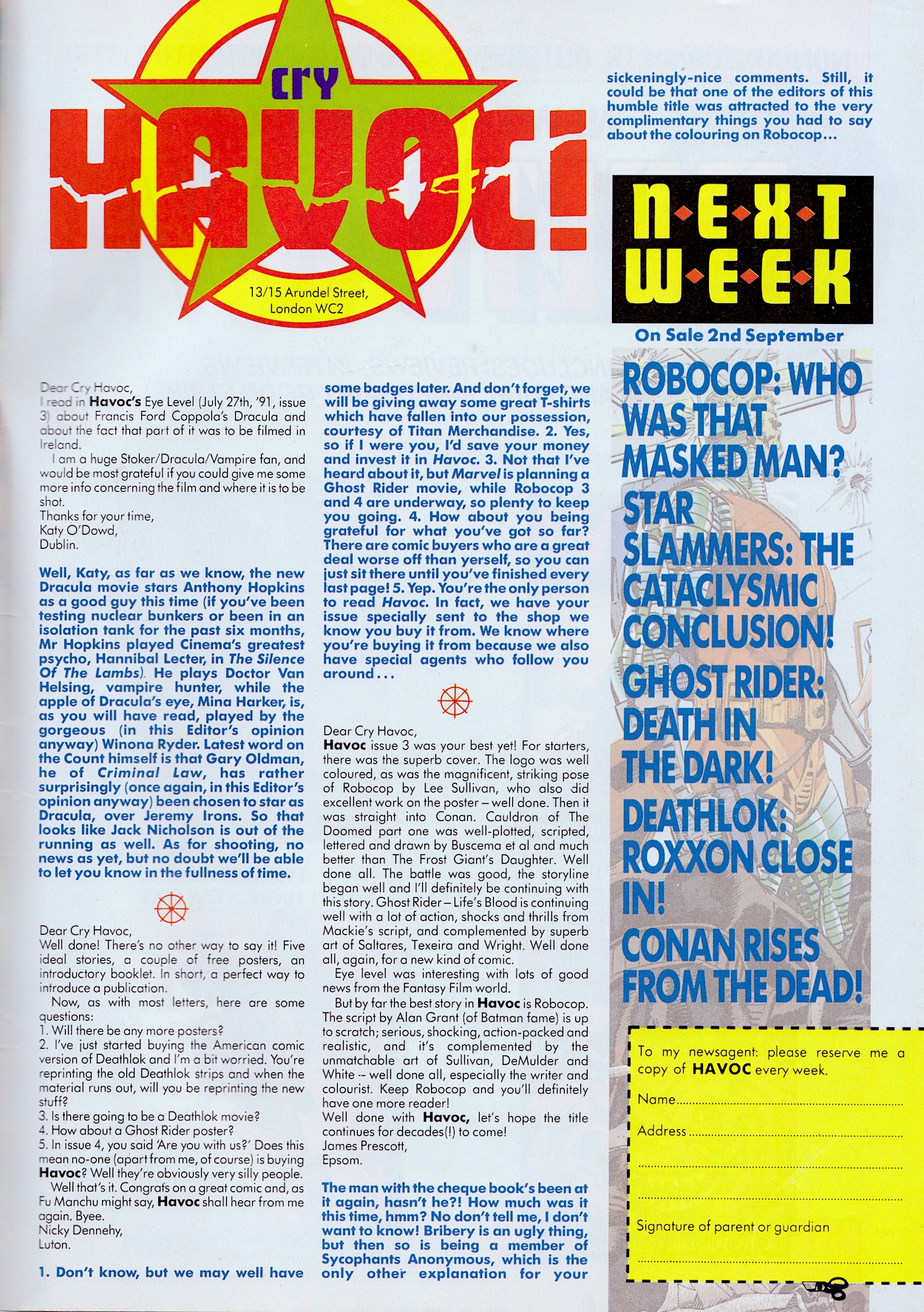
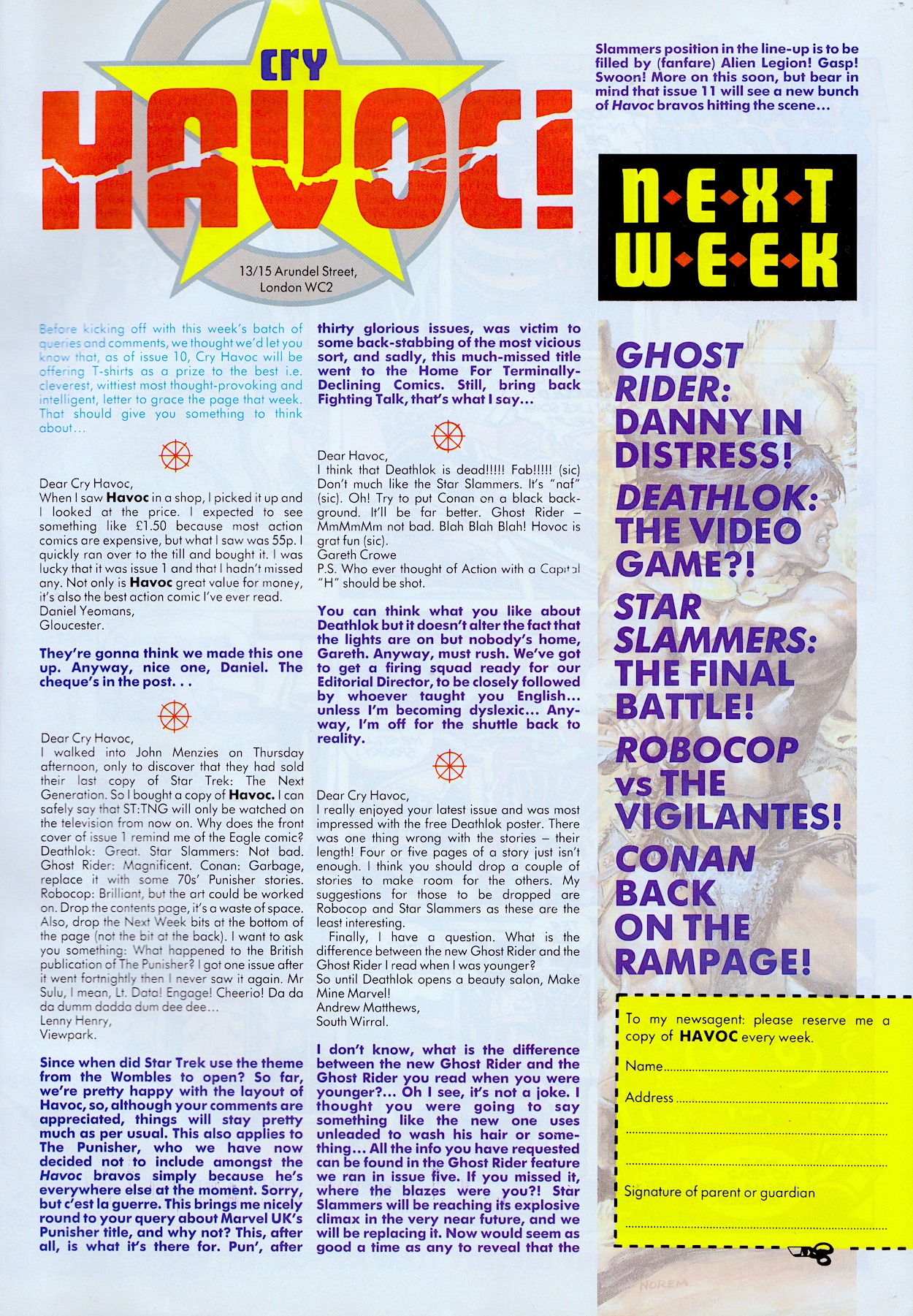
Our last Cry Havoc finishes things off and once more it’s got that exciting fan club feel to it which just makes it all the more heart wrenching that this is the end. But before we go there’s just time for a few more letters and typical Marvel UK-style replies which I loved so much as a kid. Highlights include some dismay at Gary Oldman’s casting in Dracula (oh, how he’d prove the naysayers wrong) and word of an upcoming Ghost Rider movie which wouldn’t actually become a reality for another 16 years.
There are some cheeky answers here too (“How about you being grateful for what you’ve got so far?”) which is very Marvel UK indeed, instructions to invest in the future of Havoc for new Deathlok (oh deary me, you’ll start me off again) and a funny final answer which refers to the fact RoboCop was coincidentally coloured by Havoc’s editor. Then just to rub salt in the wound is the Next Issue box and a reservation coupon. This is not the end this comic deserved.
It took a couple of weeks to realise Havoc wasn’t just running late. With this I became so fed up of fantastic comics with a potentially very bright future being cancelled early that I swore off trying new ones after Havoc, solely collecting Transformers which I’d begun buying years before. I’ll admit this changed when Thunderbirds The Comic appeared in October 1991 but I stuck with it for only about a year before Commodore Format enticed me to the way of magazines. Even Transformers was cancelled just five months after Havoc!
It feels like no time since I took this photo for Havoc’s introductory post and given the potential here it really was no time at all. Havoc deserved to run and run. My school friends who had collected 2000AD for a few years already loved it even more than Tharg’s mighty organ. From the first issue I loved three of the strips and over the course of these nine short weeks I’ve come to enjoy a fourth. The final one was to be replaced soon so I could have been a fan of everything in the end.
As it stands it’s still a remarkable little collection of top quality characters. I think that sums it up best for me. It’s not just a random selection of strips, the stories I’ve enjoyed have all been about remarkable characters. Characters I want to read more of. Look out for a special blog post soon when I chat with freelance designer Paul Chamberlainwho worked on several Marvel UK comics and created Havoc’s logo. Until then, it’s goodbye Havoc, it’s been a blast and you deserved better.
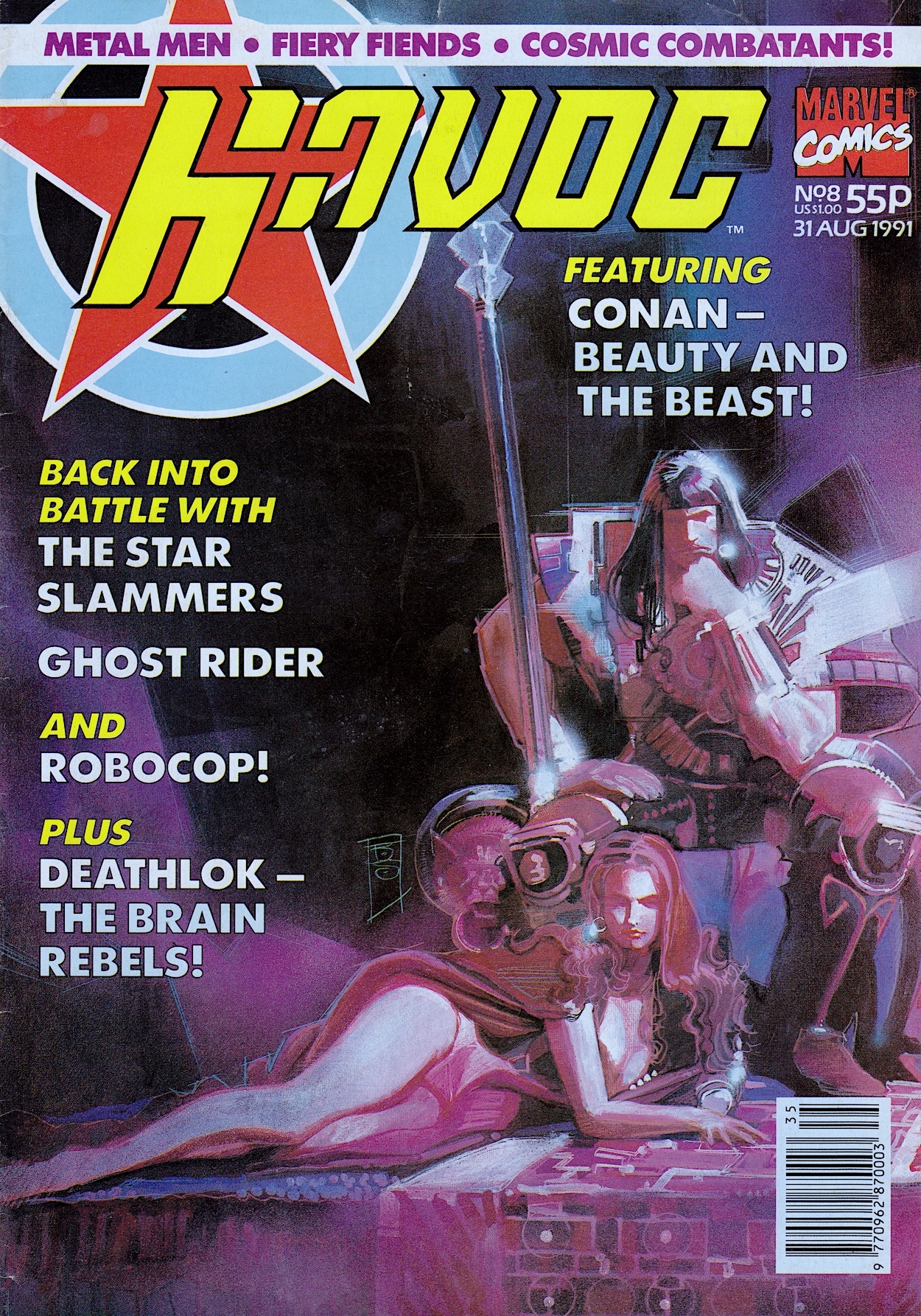
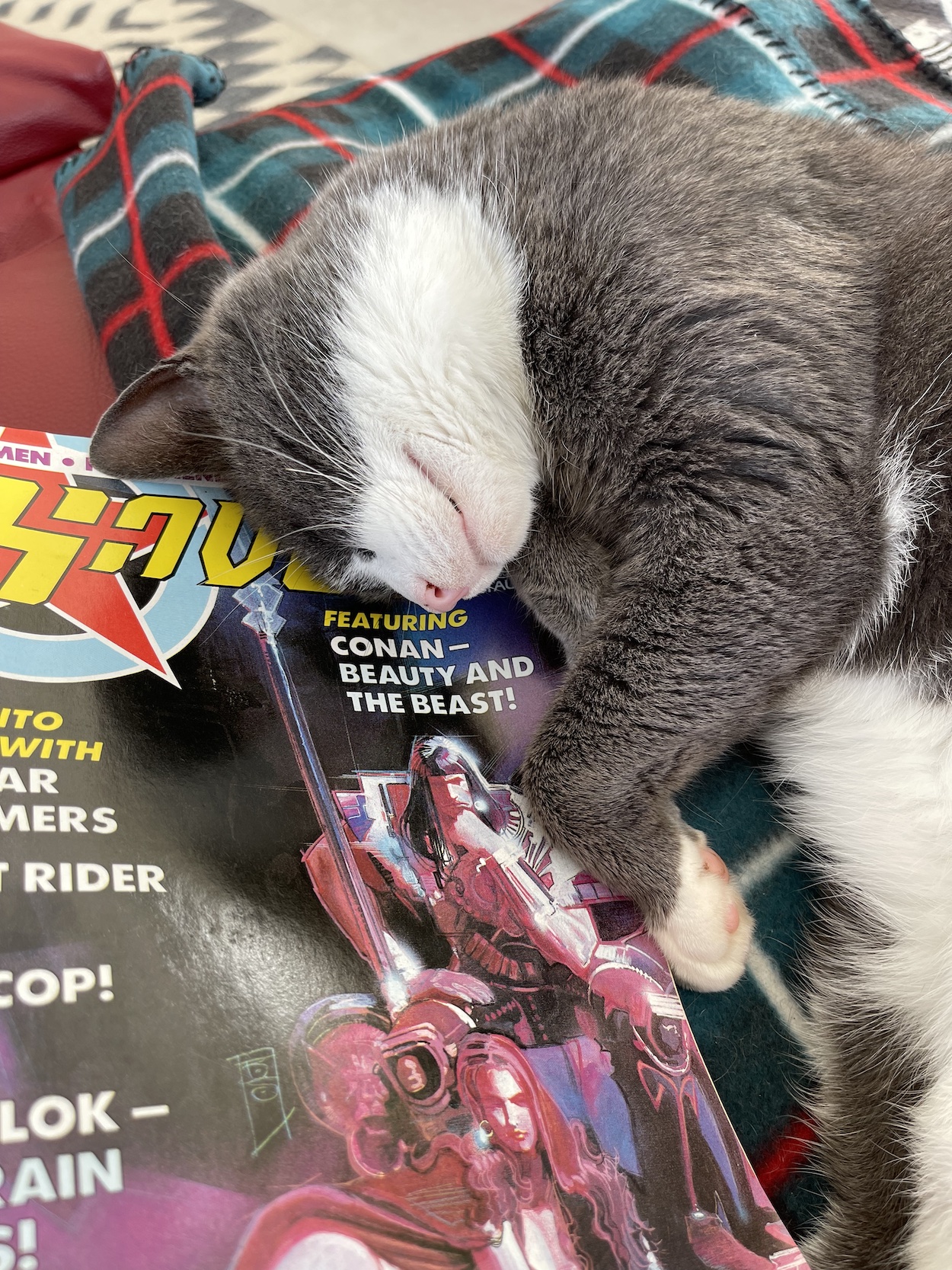
Conan the Barbarian was back in style. After taking a one issue break not only did a new story begin for the Cimmerian inside Havoc #8, he also got this glorious piece of cover art to announce his return. Although, ‘Beauty and the Beast’ could be the tagline for any of the Conan stories featured so far to be honest. It’s a nice cover nonetheless and it may only have been a week but I’ve missed having all five strips included.
Beginning again with Deathlok (written by Dwayne McDuffie and Gregory Wright, art by Gregory and Jackson Guise, letters by Richard Starkings) we finally get to the end of his origin story after seven hugely entertaining weeks, with the finale to Brains of the Outfit. It’s all wrapped up brilliantly well. After last issue I wouldn’t have been able to guess how they’d conclude Michael Collins’ first outing after that action packed strip. Now that I’ve read these final seven pages there was simply no other way they could’ve done it. It’s great.
That panel above is the beginning of an incredibly dark moment as Michael/Deathlok takes to a roof above the city and contemplates ending it, even placing his high powered gun into his mouth. But he knows the Deathlok machine would just be found, he’d be stripped out and some other poor soul would be forced inside instead. Nothing would be stopped, nothing solved. He hooks himself up to electrical wires on the building to overload and explode instead, but decides he needs to call his son first to say goodbye and uses the phone lines instead.
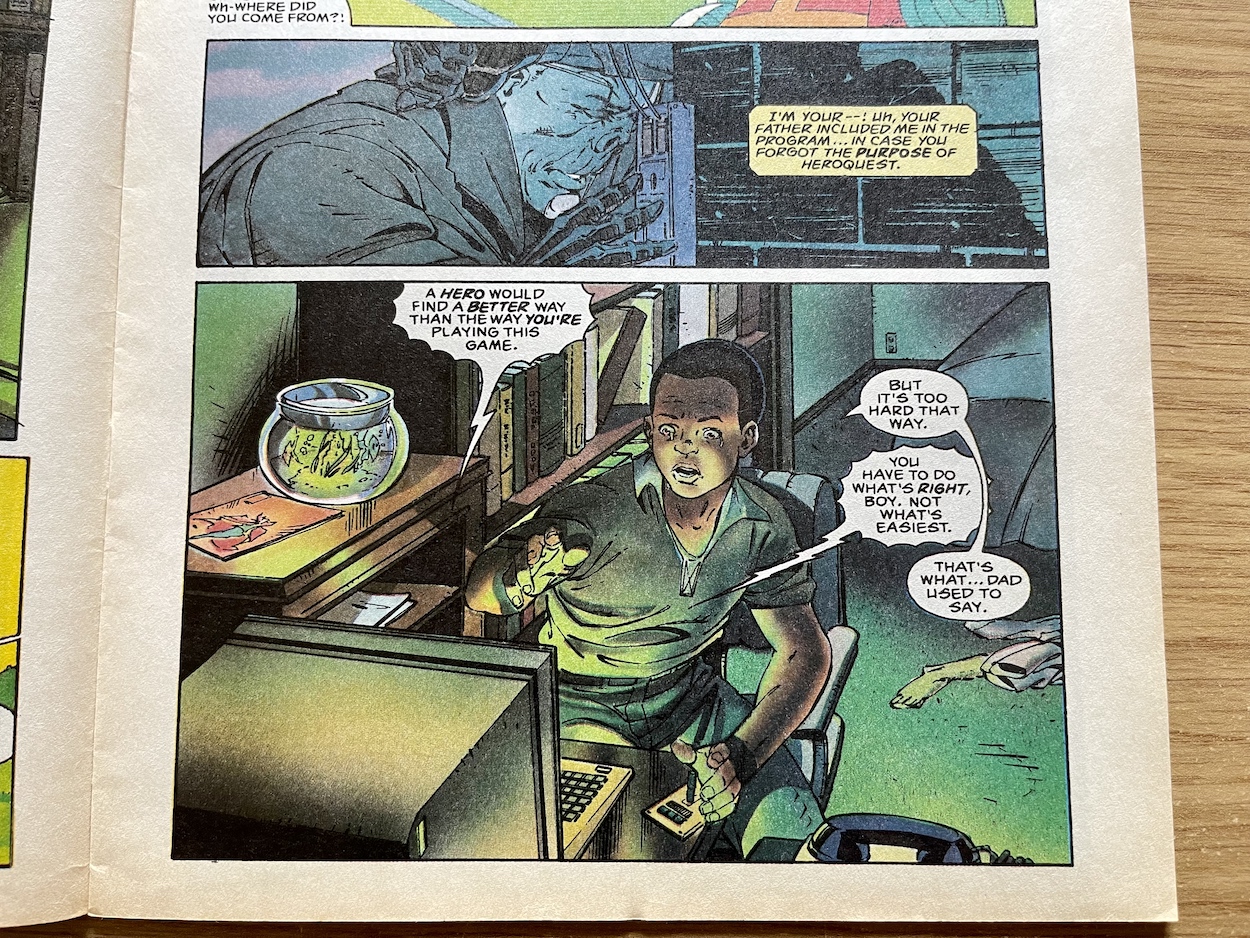
The Deathlok computer detects a ‘HeroQuest’ program running at the number given to it (how topical for 1991) and it creates an avatar for itself to interact with the player, young Nick, who knows his dad has died. This is the game we saw him play previously, when Michael tried to explain to him how bigger and better weapons don’t make the hero, it’s about being brave against the odds and, telling him that he’s a friend of his dad’s he reminds him of this in a touching scene.
In fact this scene takes up the main bulk of this final part and I think it’s just perfect. Nick tells the character on the screen that his dad isn’t there anymore and in response he’s told this doesn’t matter, it doesn’t make it any less true: “You want to win at this game, you’ve gotta learn how to be a hero.” With a few tears running down his face, Nick promises he will and turns the computer off, unaware of who he made that promise to.
Disconnected from the call, the Deathlok computer asks if it should continue with the self-destruct and as you’ll see below Michael looks to the sky as a new day dawns and thinks about the advice he’s just given his son. This feels like the perfect ending to such a character driven story, one that I’ve been really invested in for the whole summer. I love this final page, especially that last panel with the hint of a smile on our true hero’s face.
What a brilliant origin and I’m already a fan of the character. I could see his family being involved in future stories very much in the same way Alex Murphy’s were in some episodes of the RoboCop TV series, although the difference here is that Michael has already tried to tell his wife who Deathlok really is. That could lead to some great moments. To say I’m eager to read more is an understatement so, although the next issue is the last I’ll look forward to its small chunk of storyline to get an idea of what the future could’ve held.
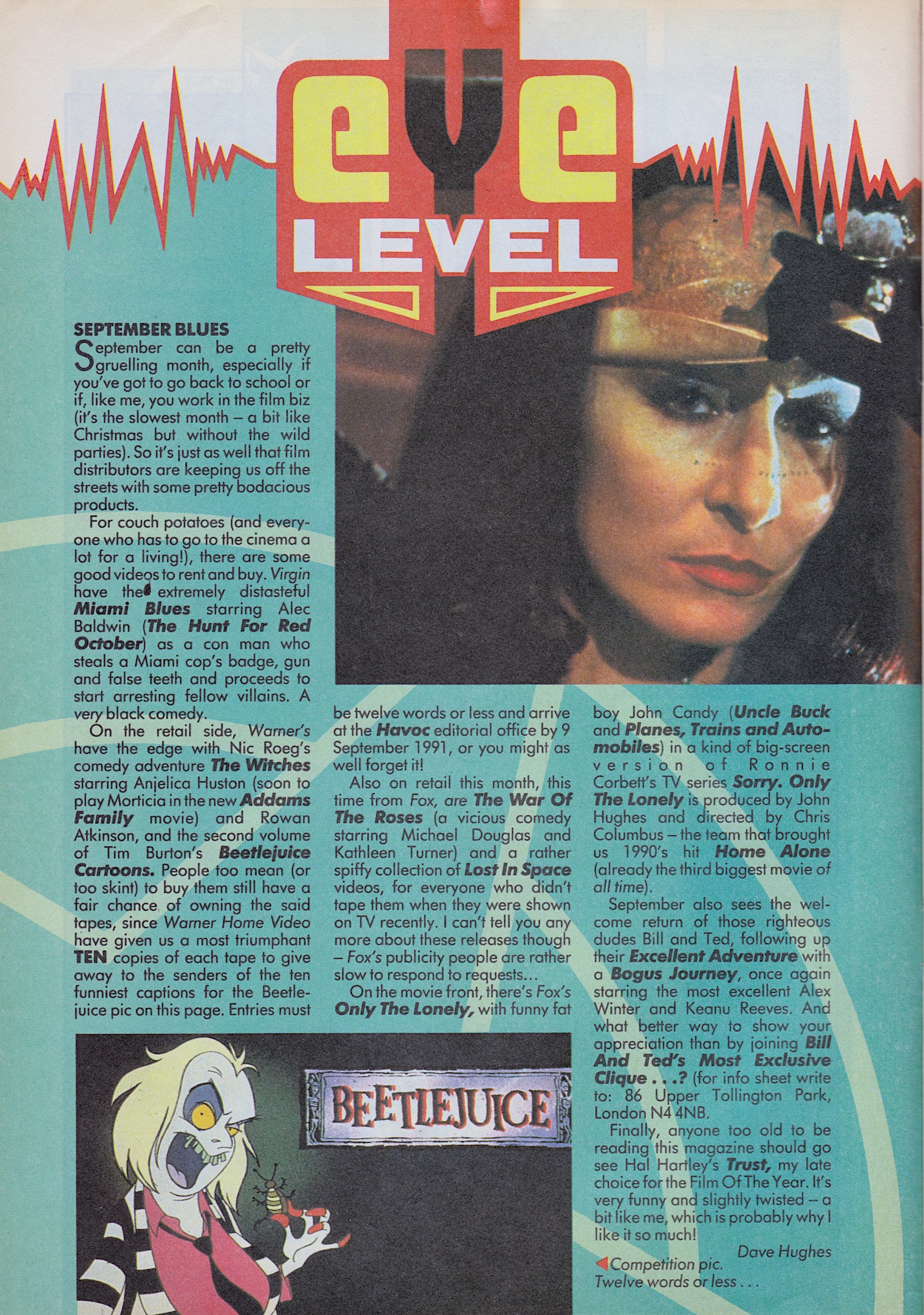
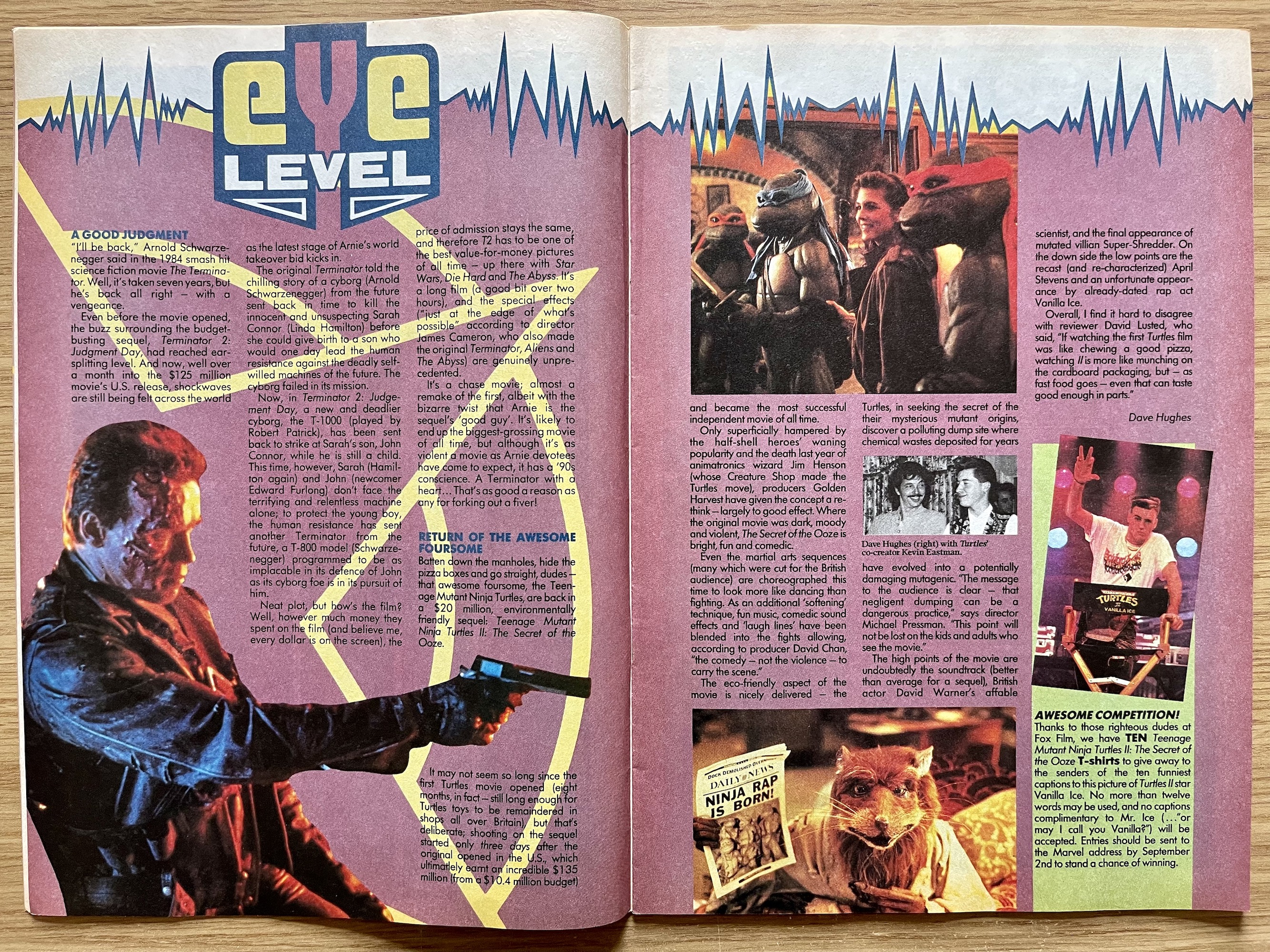
Next up we take a break from the strips for Eye Level, the news page compiled by Dave Hughes this issue. It may be back to one page after the larger spread it had a week ago for the cinema releases of Terminator 2: Judgement Day and Teenage Mutant Ninja Turtles II: The Secret of the Ooze, but a quick glance down the article at all those movies and TV shows in bold and it was quite the busy release schedule wasn’t it?
There are a few I’d never heard of (Miami Blues, Only the Lonely and Trust), a couple of childhood favourites (Bill and Ted’s Bogus Journey and The Witches) and a cartoon series that completely passed me by because I never saw the film it was based on until much later in life. Even the references to the films recently released remind me of why I loved the 80s so much! Speaking of 80s movies, the official RoboCop continuation is up next and venturing into the world of superheroes.
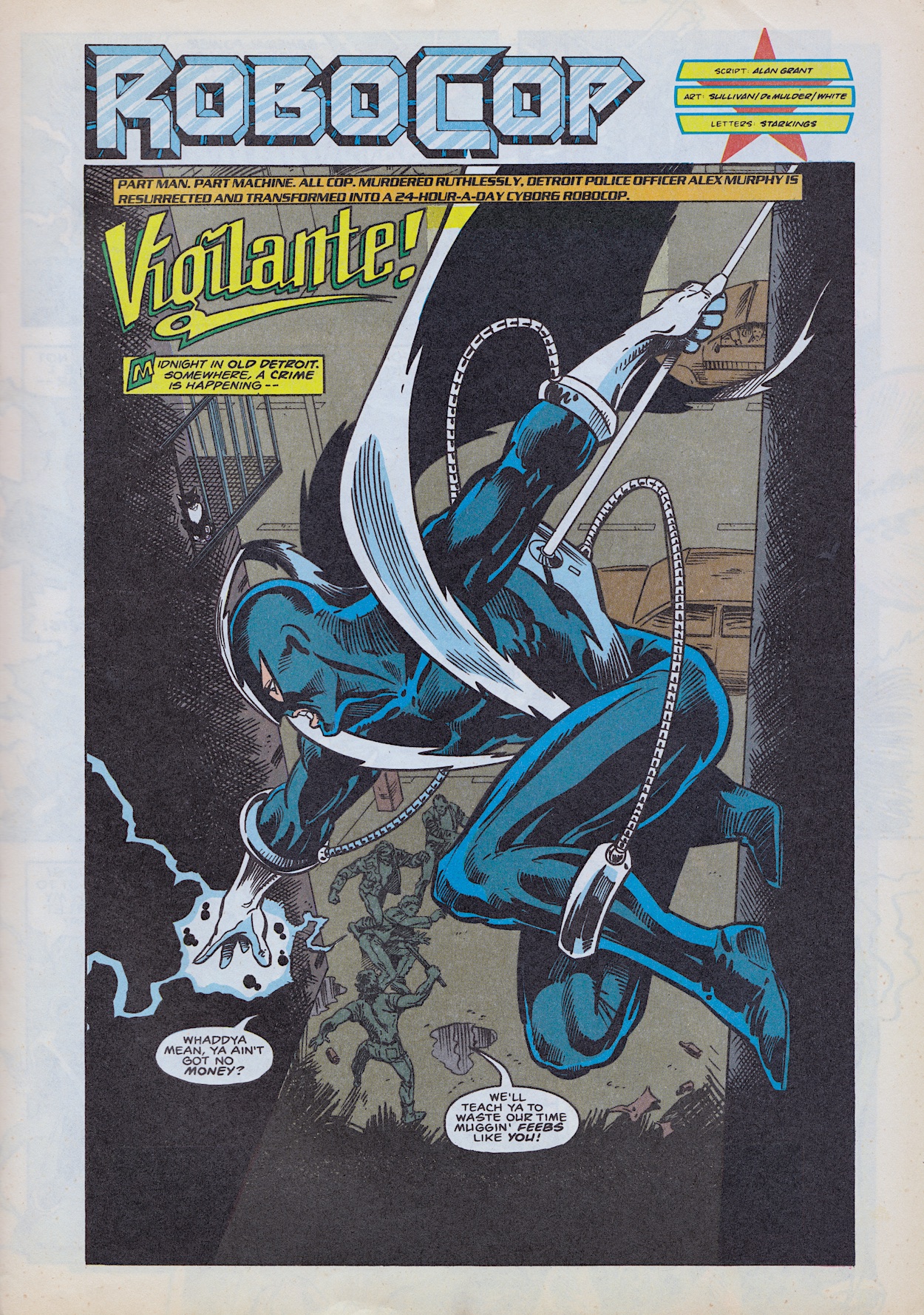
Well, wannabe superheroes anyway. As you can see from this opening splash page it certainly looks like Old Detroit has a new warrior in the fight against a seemingly insurmountable level of crime and violence in the forgotten city. I like how the story starts off with that famous RoboCop quote about a crime happening somewhere and how we’re led to believe it’s in reference to the mugging happening on the ground. A clever piece of misdirection by writer Alan Grant.
The next page plays out like an old-fashioned, clichéd superhero comic with ‘General Power’ using his ‘Electro Gauntlets’ to incapacitate the muggers, complete with corny one-liners such as, “General Power: The shock that crime needs!” It’s an exaggerated, almost spoof-like homage and it’s all going swimmingly for the masked crime fighter until he tries to help the victim to his feet but forgets to turn off his gauntlets, frying the person he was trying to save!
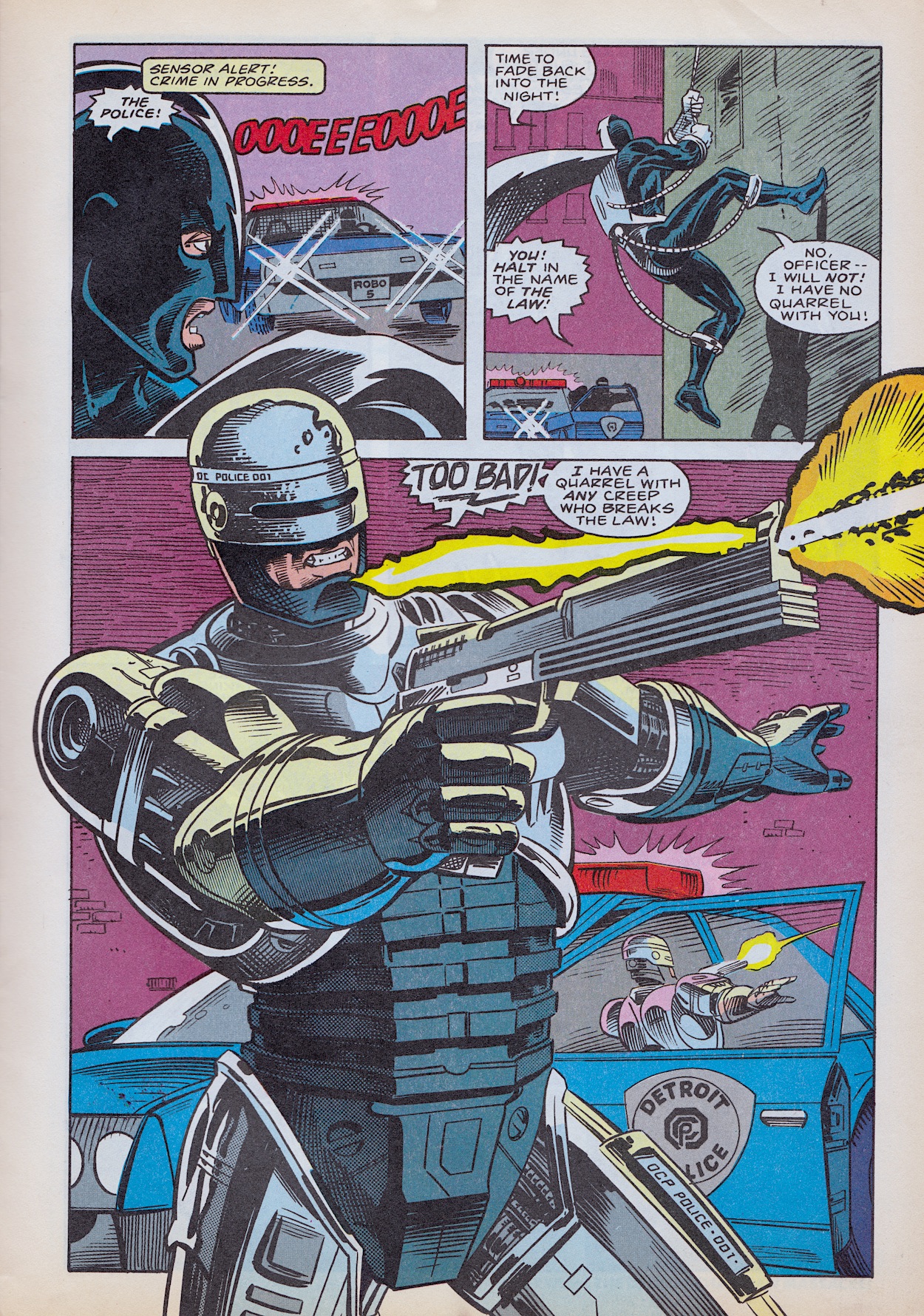
Cue sirens and a police car pulls up. Our panicked wannabe begins to scale the wall in a bid to fade back into the night like any good vigilante but he hadn’t bet on two things, his own incompetence and the officer being Alex Murphy aka RoboCop, who makes his entrance into the story in this glorious drawing by penciller Lee Sullivan and inker Kim DeMulder (colours by Steve White, letters by Richard Starkings). A great page, this.
A quick shot through the wire General Power was using sees him fall to the ground but the victim, all charred from the accidental electrocution, pleads with Alex to let the man go. They try to convince him that he’s on the same side as the police but Robo stands firm, no one can take the law into their own hands and when Power tries to use his gauntlets on the metal cop it backfires big time. The story ends with Murphy radioing into HQ that he’s picked up “another vigilante”.
This third RoboCop story shows the creative team have well and truly settled into the character
“Another”? Intriguing. Has there been a rash of such people trying to fight crime recently? I’m going to guess it can’t be a coincidence, that there must be some nefarious reason behind it all, so I’m interested to see how much of the mystery is revealed in our final issue next week. There’s definitely a confidence in this third RoboCop story that shows the creative team have well and truly settled into the character, especially in the art. Lots of potential here for future stories. I’m going to miss them.
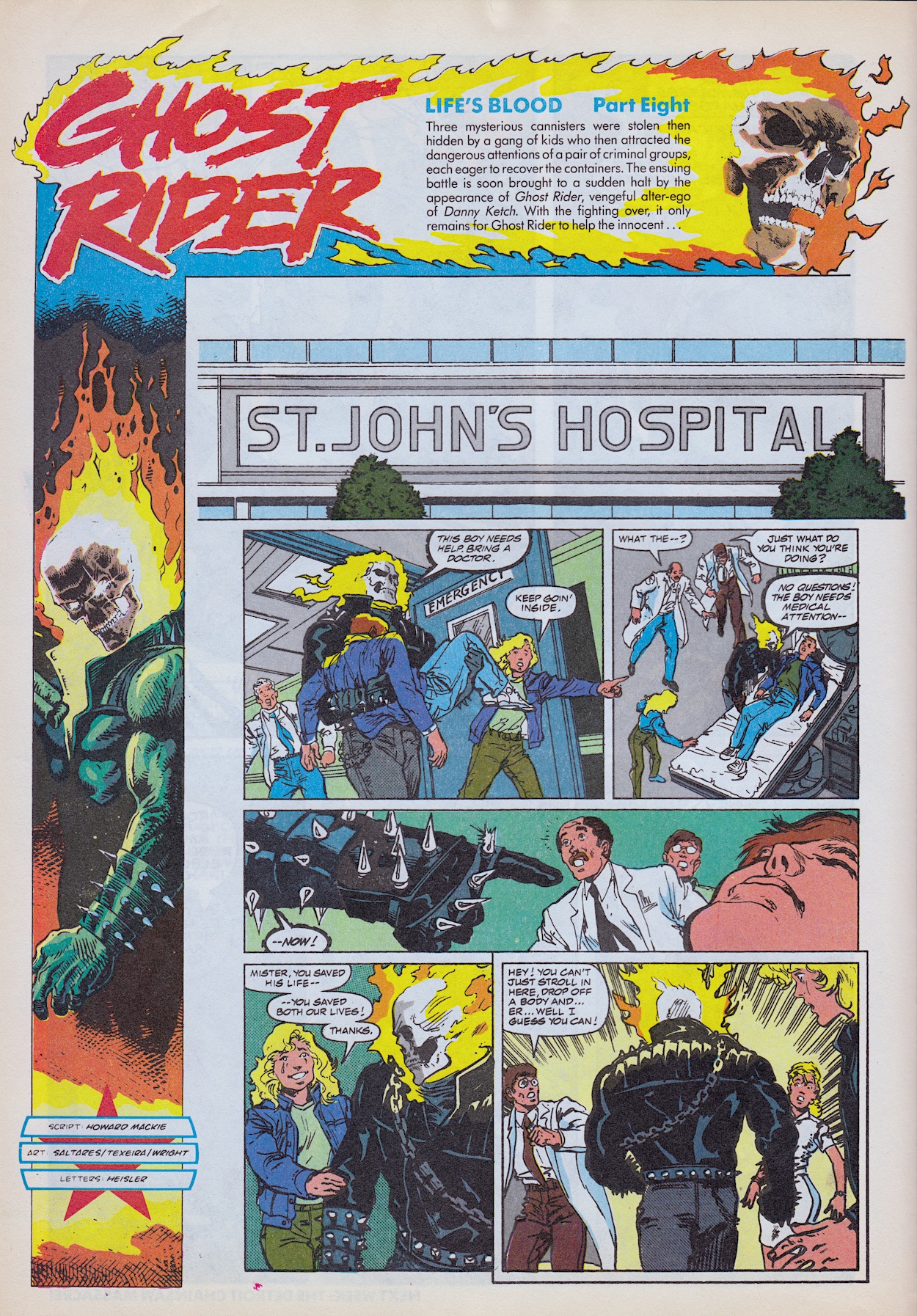
Alongside Deathlok, Ghost Rider’s origin story also ends this issue, with part eight of Life’s Blood ((written by Howard Mackie, pencilled by Javier Saltares, inked by Mark Texeira, coloured by Gregory Wright, lettered by Michael Heisler)) which acts as a kind of epilogue. In his demonic form Danny Ketch bursts into the local hospital to deliver the young gang member who initially scared him back in #1, injured in the battle between Kingpin’s and Deathwatch’s cronies over the mysterious suitcase and its canisters. After this first page he reverts back to human form for the rest of the story.
But as I’ve said before the strip has always been about more than just the Ghost Rider himself, I’ve enjoyed the character of Danny and the building blocks being put in place for future stories. For example, we get the obligatory conflict character, someone in Danny’s life who thinks his alter ego is a menace to society and this comes in the shape of Captain Dolan, the father of a friend of his and his sister Barb. The Ghost Rider is all over the press and Dolan has made his mind up.
Danny tries to reason with him but we know already this won’t help, this is a character who’ll go up against the Spirit of Vengeance in future issues without knowing who it really is. It’s a bit of a cliché but Danny is such a sympathetic character and the Ghost Rider such a fascinating idea that I’d love to see where this relationship goes. For now though, Danny concentrates on his sister who remains in her comatose state as the story ends.
After this scene we get two large panels showing Kingpin shouting at his men that his entire operation is in jeopardy if those canisters aren’t found, and one in which new villain Deathwatch has killed one of his men for losing the suitcase and declares all witnesses are to be eliminated. But this scene in the hospital is the more dramatic ending for me, with Danny struggling to understand what’s happened to him, scared for his sister’s life.
It leaves me thinking is there something his Ghost Rider form can do for Barb? Having this scary, demonic, vengeance-fuelled being caring for his host’s sister could make for interesting storylines in the future. This may be the first series I want to try to collect in graphic novel form after Havoc finishes in just seven days. Watch this space. On the next page we’ve got a special feature about the Star Slammers, or at least that’s how it was described on the contents page.
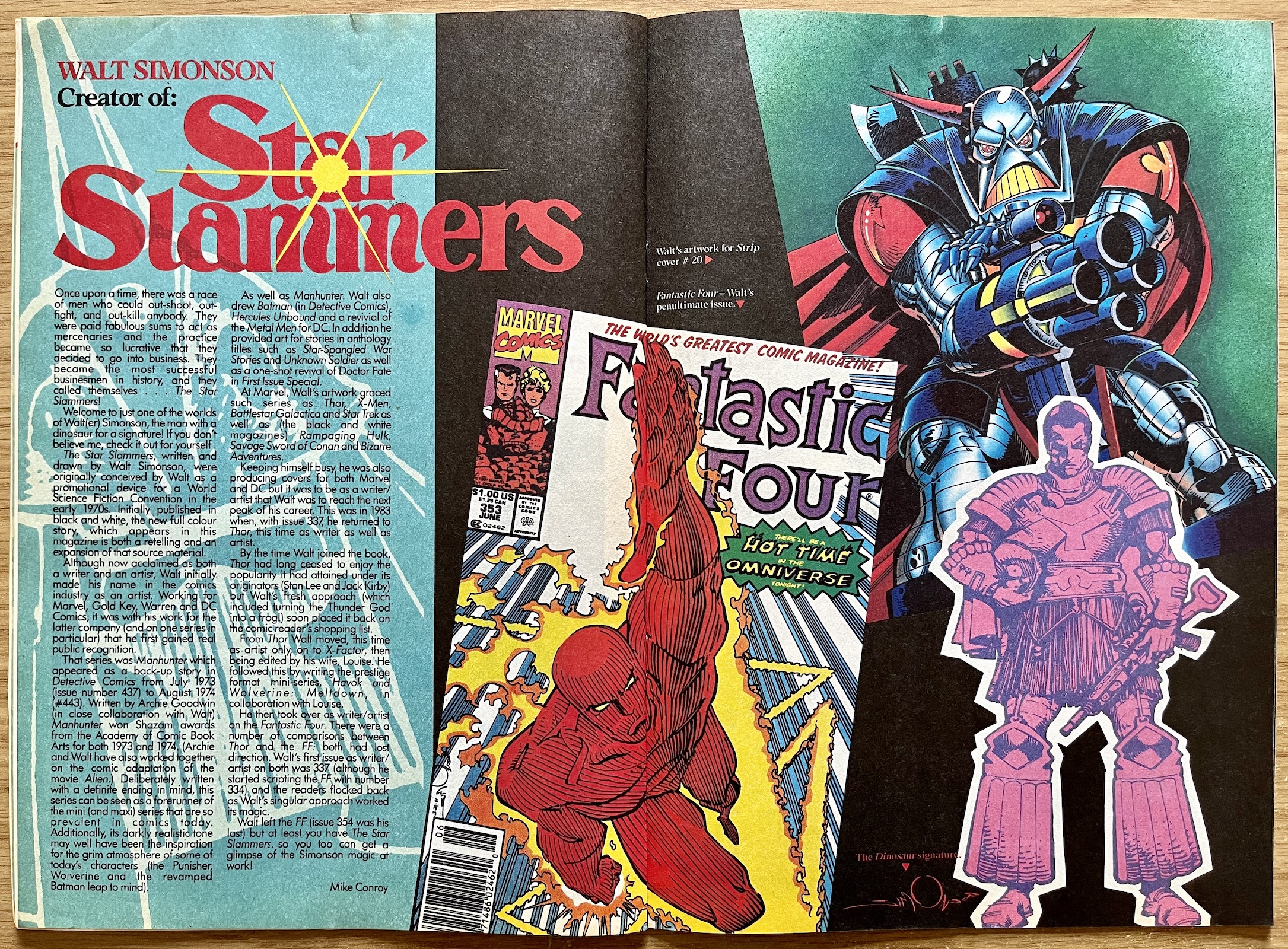
It’s actually an article about the creator of the Star Slammers, Walter Simonson and his illustrious career. I’ll admit as I read it I was a bit miffed it didn’t mention Walt’s adaptation of Jurassic Park, which featured in the first five issues of the UK’s comic based on that original movie and covered on the blog. Then I had a bit of a moment when I realised Havoc was published two years before the movie was even released. Whoops.
I certainly didn’t think I’d see Death’s Head in Havoc though, there’s always that.
Before we move on to Walt’s strip we have the return of Conan the Barbarian after his one-week hiatus and his next story is entitled Barbarian Death Song. The credits box has been accidentally left blank. Michael Fleisher, who provided the dialogue to the previous story has written this one, with pencils by John Buscema, inks by Armando Gil (Jurassic Park, What If…?, Ka-Zar the Savage), colours by George Roussos (G.I. Joe, Fantastic Four, The Avengers) and letters by Janice Chiang.
In 1972 writer Lin Carter wrote a poem called Death-Song of Conan the Barbarian which is the last story for the character, chronologically speaking. Written for a Robert E. Howard (Conan’s original creator) fanzine and later reprinted in Marvel’s Savage Sword of Conan, in it Conan reflects on his life, those he’s met, those he’s fought and the people he’s killed. Themes include the inevitability of death and living a fulfilling life and crossing over to the other side, which he does travelling alongside those he knew in life.
Is this going to be reflected in this comic strip with a similar name? So far the answer is no but remember this would’ve been cut into at least four smaller parts for Havoc. Originally published by Marvel US in 1985 the story begins with Conan turning down the offer of the Nemedian King to take up a ranking position in his army. He then stumbles upon an assassins league called The Falcon Brotherhood (who he has dealt with before) and rescues a damsel in distress who I initially thought was Nateesa from the previous story.
Nope, this is meant to be a completely different character even though she is identical to the damsel from last time, giving me the impression female characters are somewhat interchangeable in these stories (which isn’t a good impression to have). Her name isn’t given yet and she has just about enough time to start telling us her story before she’s unceremoniously cut off for seven days. The jewel around her neck is what the Brotherhood sought and she tells Conan that while tending to her father’s goats a few days previous a cloud “which was not a cloud” appeared before her.
The best bit is the opening page with its fierce battle but it’s immediately forgotten
That’s it, we’ll have to wait until next week to see what that’s all about. A strange place to stop the tale but sometimes it’s inevitable that sometimes the forced cliffhangers won’t quite hit. However, as a result there’s not much to say about these first five pages. The best bit is the opening page with its fierce battle but even it is immediately forgotten as the story jumps forward to a few days later. Hopefully the story begun here will be elaborated upon lots more next week.
Between Conan and the final strip is an advert for a Marvel UK comic I never bought as a kid. This is actually the first time I’ve even seen a colour advertisement for it as it always appeared in black and white in Transformers. I’ve heard nothing but good things about The Knights of Pendragon so it could be something for me to look into at a later date when I’ve covered all the comics I did buy back then.
So, we finish our penultimate issue with the Star Slammers (written and drawn by Walt Simonson, colours by Louise Simonson and Deborah Pedler, letters by John Workman) and if I thought Conan’s strip didn’t have much going on then this one has absolutely nothing. At first glance it all looks very exciting, with a unique layout to the battle scenes and it entices the reader in, only to find not much there upon closer inspection.
We begin seeing their home world which the Orions use as their hunting grounds being devastated from above, the cowardly hunters staying out of harm’s way for now. The pages have that aforementioned uniqueness about them. They’re made up of lots of small squares in apparently random fashion, meant to represent the Silvermind, the ability of their race to share all their thoughts as one. Knowing everything that everyone else is doing all at once could turn the tide of the battle.
But Jalaia realises Ethon was only able to heighten his own telepathic powers to the Silvermind when he knew he was about to die.
In that moment Ethon let all his defences down, even the ones he didn’t know his mind had put up. Jalaia decides to put herself in harm’s way so she can be the trigger. I do like how over a few pages the many squares holding faces of Slammers start to go blank one by one, as more lose their psychic connection with their comrades. But it’s not enough. Even with Jalaia making what could be the ultimate sacrifice, I still found myself struggling to care for any of the characters.
There really hasn’t been the character development necessary for something trying to be so epic. I should be on the edge of my seat with this story but I just haven’t been able to connect with anyone involved, despite the earlier issues having some interesting world building. That’s it in a nutshell really; the story has concerned itself with the big scale events at the expense of the small scale moments and characters. As it stands, I find myself rushing though it to get to the letters page!
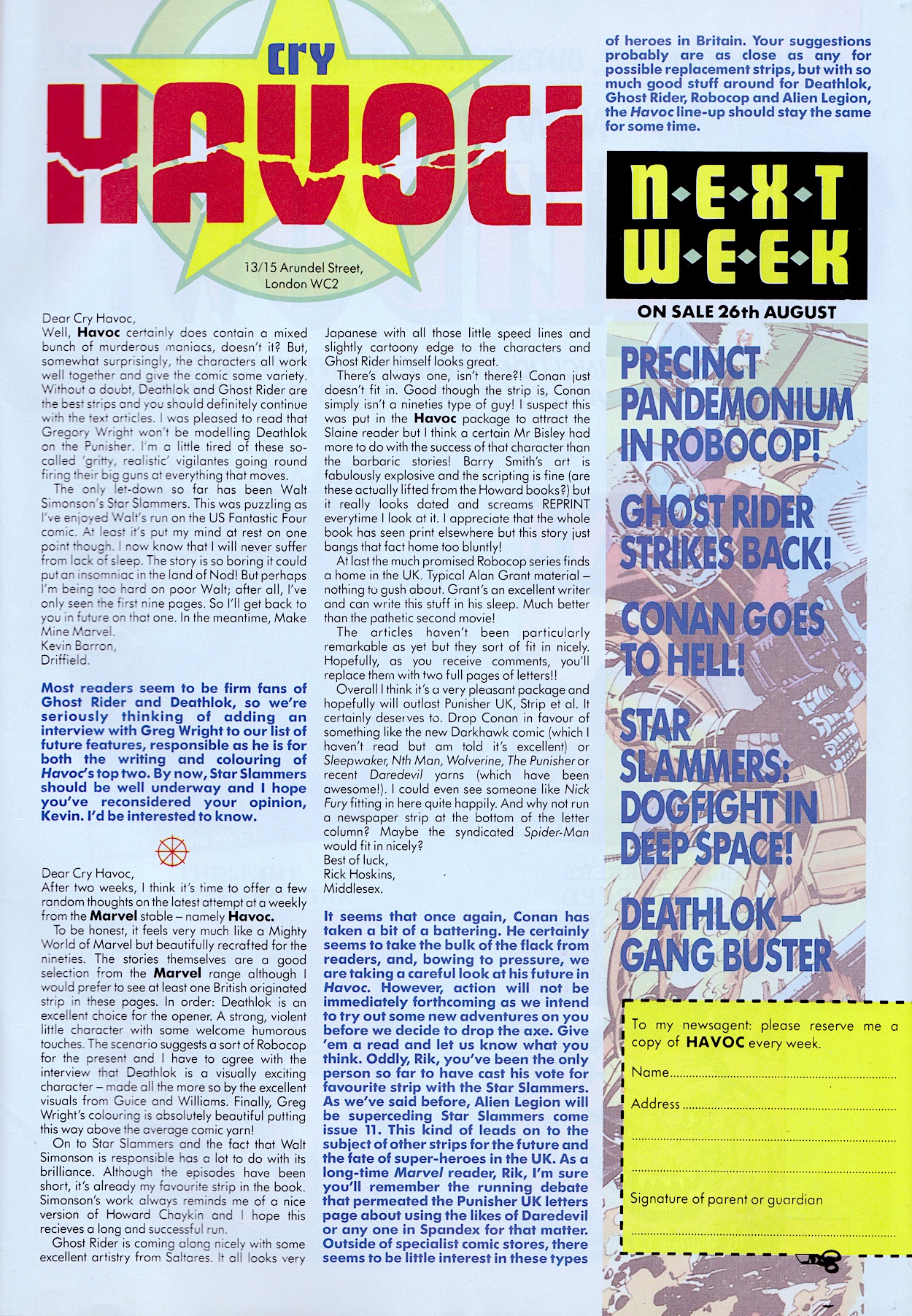
I always liked how Marvel’s comics wouldn’t hold back on printing criticism received, with the first letter really not holding back on their opinion of my least favourite strip. That being said, these letters were sent in by readers after #2, so opinions expressed are still limited to those first two issues. I laughed when Deathlok was described as “a RoboCop for the present”. Robo was only released upon the public in 1987! The same letter even praises the Slammers. There’s just no accounting for taste I suppose.
Interestingly the reply states Conan is the strip receiving the most negative feedback. Given how these letters were written after only his first adventure I can understand that though. It also appears that back in 1991 the UK didn’t have the same appetite for spandex as it does now. How times have changed. The next time we read Cry Havoc will be the last so none of the proposed changes would get the chance to take effect. But I’m still looking forward to it. Each issue was growing in confidence and with the origin stories out of the way the future looked brighter than ever.
The suddenly cancelled Havoc’s swansong review will be right here from Wednesday 31st August 2022.
Alex Murphy returns to the cover once more as Havoc #7 hit newsagent shelves back in 1991. There’s something missing from this wonderful looking cover though and that’s any mention of Conan the Barbarian. As stated in the previous issue the Cimmerian would be taking a break for one week and on the contents page under his banner are simply the words “Back next week”. So why has he been forced out of the issue?
Two of the strips here, namely our title star RoboCop and Star Slammers get more pages apiece, particularly Robo who ends up with more than any strip has been given in any issue so far and this brings his current story to an end after three issues instead of the usual four. Each character would get a different number of pages every issue depending on what was happening in their individual stories, while also taking into account the following chapters, cliffhangers, endings etc.
For example, on the letters page this week the replacement for Star Slammers in #11 is mentioned. Swapping out finished strips, working out suitable lengths for each chunk of story and planning for each issue to have as much content as possible would require some flexibility, especially as they were dealing with strips not written for this anthology format. To get the best out of each strip, including Conan, they may have to drop one for an issue to ensure things run smoothly in the long run.
Speaking of the editorial team, there’s been a bit of a shake up. Launch editors John Freeman and Harry Papadopooulos have jumped ship already, leaving the tiller in the capable hands of Jacqui Papp (editor for titles such as Motormouth, Die Cut and Battle Tide, all comics from the Marvel UK Genesis Project) and Steve White (colourist for Transformers, Jurassic Park’sXenzoic Tales and editor on Visionaries). Their first issue is a doozy, so let’s get started with Deathlok: Brains of the Outfit written by Dwayne McDuffie and Gregory Wright, drawn by Gregory and Jackson Guise and lettered by Richard Starkings.
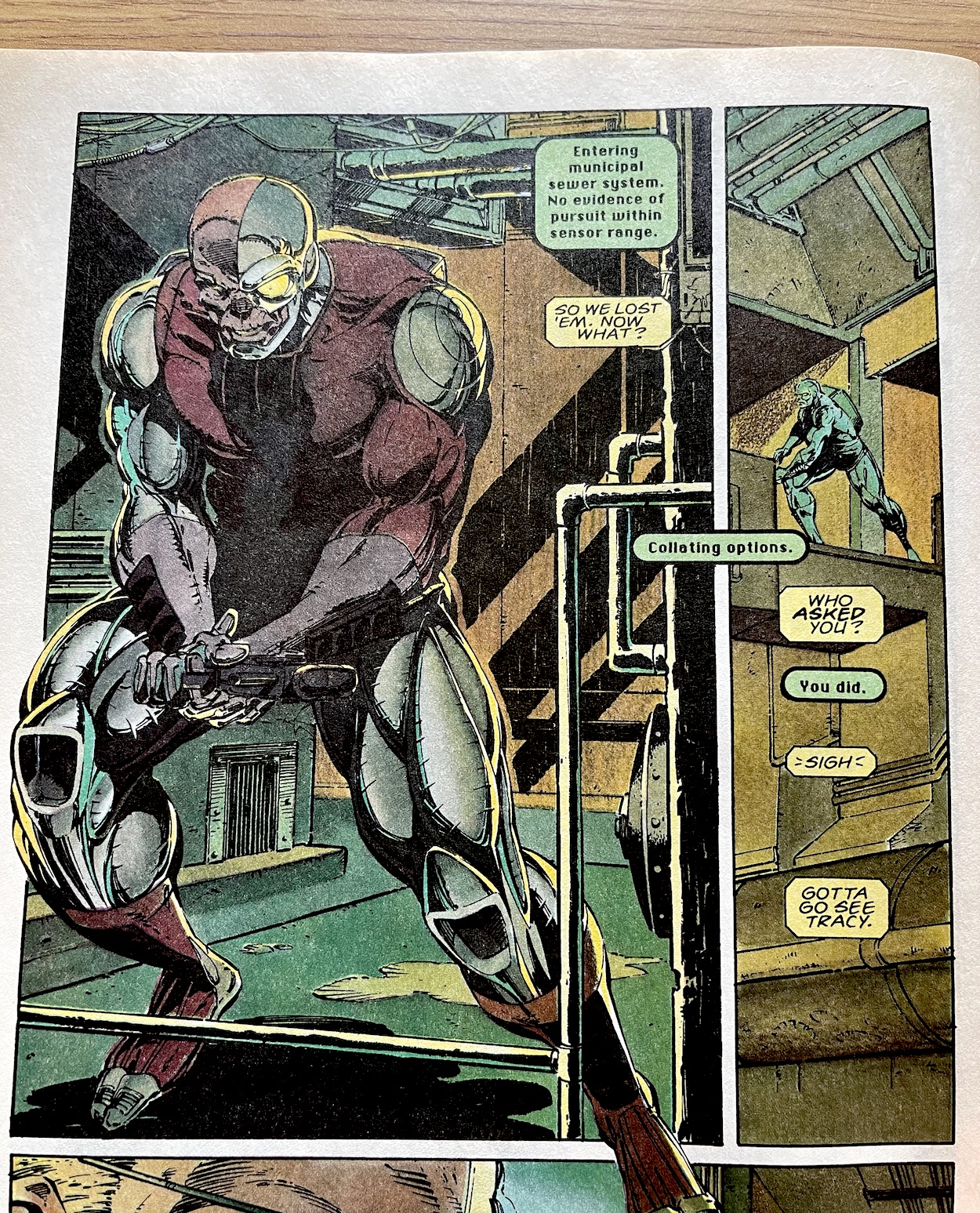
Up to this point Deathlok has been full of action, strong character development and some rather terrifying moments when Michael Collins awoke. I’ve previously mentioned how I remembered there being a lot of humour too, particularly between Michael and the monotone computer operating the Deathlok cyborg. We get to see quite a bit of this in part six of Brains of the Outfit, such as the computer’s recalculating moment and when they finally destroy the massive tank and it looks like the killer cyborg is about to see off its driver Ben, a former colleague of Michael’s, only for his head to be squished inside Deathlok’s helmet instead.
“Who asked you?” “You did.” *sigh*
Exchange between Michael Collins and the Deathlok computer
It shows how Michael has successfully reprogrammed the machine and the humiliation of Ryker is probably all the worse for the head of Cybertek; not only is he spectacularly defeated, but his cyborg war machine has avoided murdering someone again and it’s had a laugh at his expense in the process. Brilliant stuff! In the sewers we get more of this sort of thing as Michael forgets his thoughts are now part of the machine.
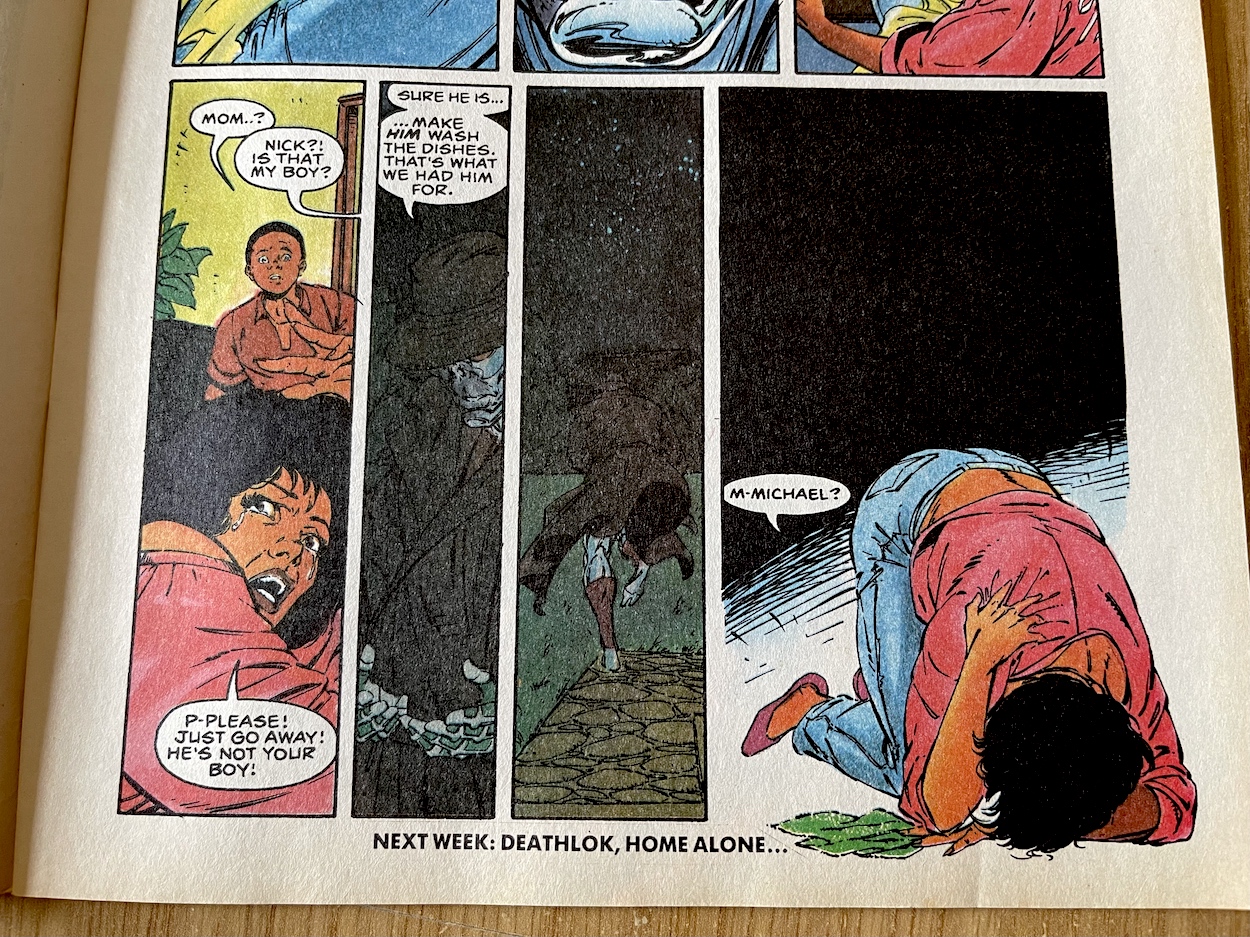
However, as you can see the strip can flip in an instant, from genuinely funny moments to those of heartache. Michael arrives home and obviously Tracy isn’t going to believe him when he tries to tell her who he is. Already devastated by the news of his death, this is almost too much to bare. That final moment when he repeats his funny comment about their son from #3 before running off is a much more perfect cliffhanger than any action scene could be. For all its bravado, Dwayne and Gregory’s story has a human heart running through it that’s just as compelling.
For only being seven pages, this really had it all. What a superb story and he’s definitely a Marvel character that deserves much more exposure today. It’s a crying shame he hasn’t had his own movie or TV show by now. Speaking of movies, Eye Level doubles in size this issue thanks to two of the most hotly anticipated movie sequels of the 90s. One would go down as an absolute classic, the other not so much.
On first reading I don’t think the writer was too enamoured with Terminator 2: Judgement Day, although they were right in that the film did end up as one of the most successful of all time. Personally I loved it and remember watching it on VHS in school on the last day of term after it came out in the home market. Not the best way to watch it first time around but it still made an impact and I enjoy it to this day. All of the things about Teenage Mutant Ninja Turtles II: The Secret of the Ooze meant to improve upon the original are the reasons why my friends and I never liked it, so these were massive misjudgements on the part of the director and studio.
That competition at the end though: “No captions complimentary to Mr. Ice will be accepted.” How very Havoc.
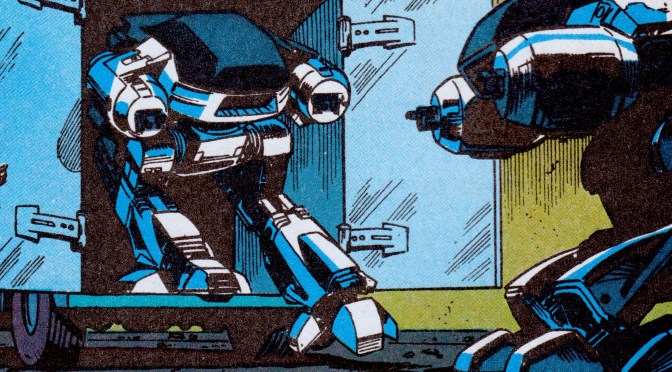
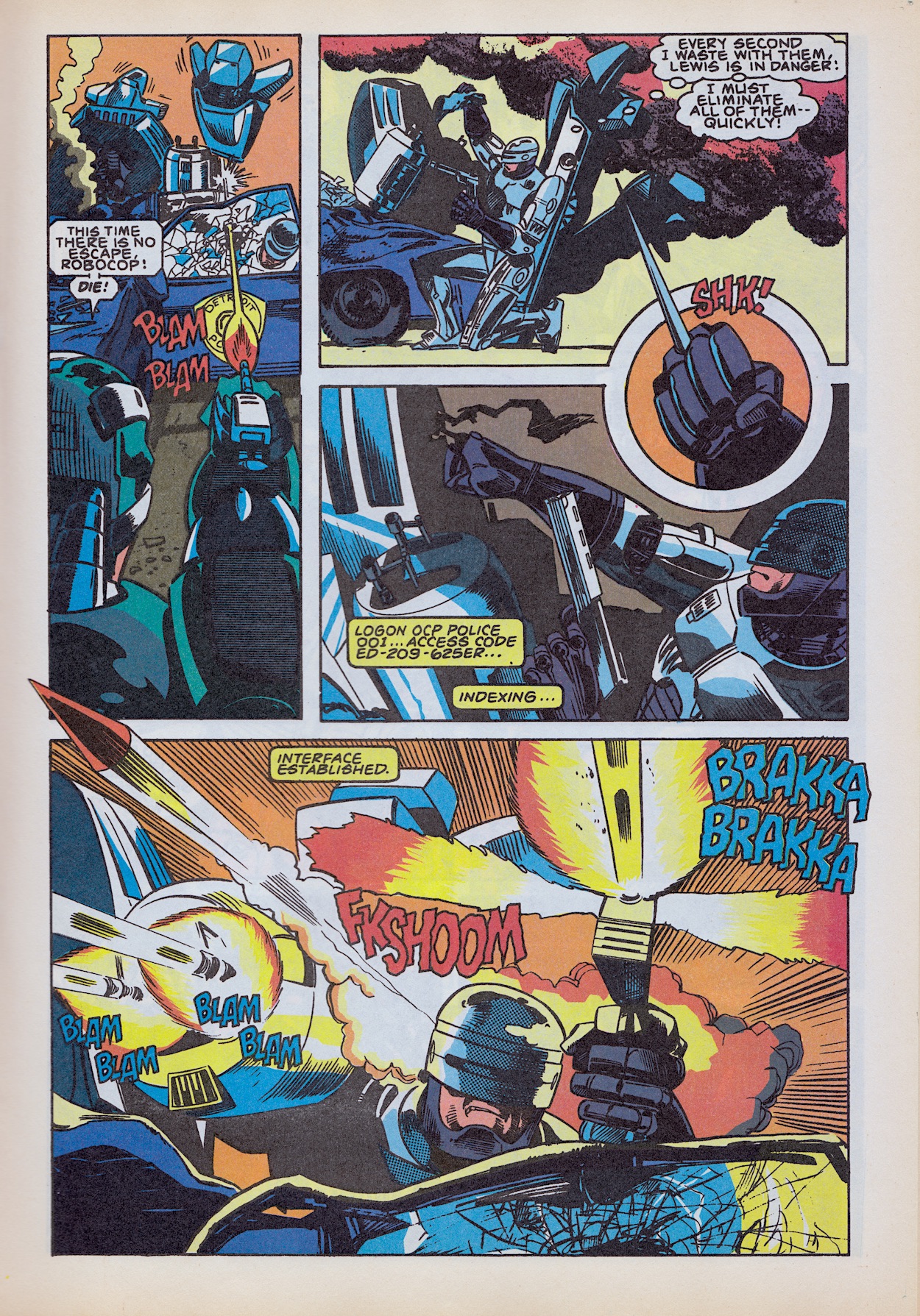
RoboCop uses his hand spike to take control of the ED-209’s weaponry
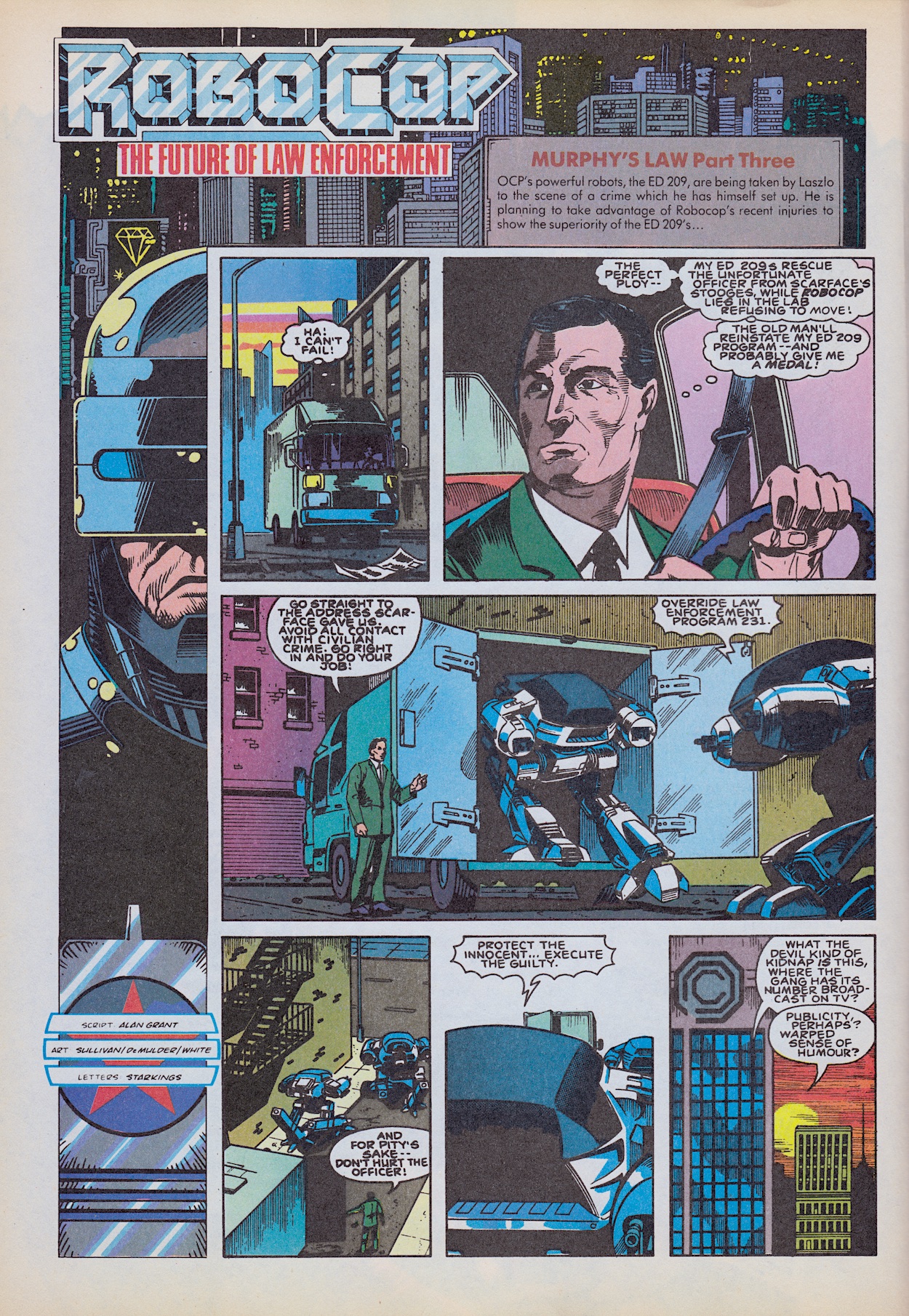
RoboCop: Murphy’s Law Part Three (written by Alan Grant, pencilled by Lee Sullivan, inked by Kim DeMulder, coloured by Steve White, lettered by Richard) takes up the centre of the comic with a large nine page chapter this issue, ending the story earlier than expected. OCP’s Laszlo has ordered his criminal contacts to kidnap a police officer so that his reprogrammed ED-209s can rescue them and prove their superiority over RoboCop while Murphy’s brain (distraught from losing a civilian) has shut his systems down. But Nixco have also sent their new Nixcops to do the same. RoboCop awakens when he learns that his partner Lewis is the officer in question, snapping him back to life. It’s all set for an explosive climax.
But first, either the ED-209s have shrunk since the movie or that’s one hell of a big van. I’m nitpicking, so I’ll just ignore this and get on with the main bulk of the story. The two sets of rogue robots start to take each other out, both believing they have the proper authority to rescue Lewis and that the other is breaking the law. An ED-209 even attempts to kill Alex because it deduces he’s trying to stop it rescuing her.
Pinned down on all sides, his car trashed and time running out for Lewis, Robo’s solution is one that I wish we could’ve seen in a movie or the show. Using his spike (a way of interfacing with other computer system ports) he accesses the ED-209 that tried to shoot him and takes command of its weaponry, eliminating all of the Nixcops in a few seconds flat.
Lewis may be tied at the wrists but she isn’t a damsel in distress. The commotion outside distracts her kidnappers enough for them to be lined up at the first storey window, so she rushes them and pushes two of them out to their death. But the final one slaps her to the ground and takes aim at her head just as Alex enters the building downstairs. Knowing he won’t reach her in time he scans up through the ceiling and I just wanted to let you see how another of his well known abilities is represented in comic form, thanks to (new editor) Steve’s colour work in particular.
You can see what’s going to happen here and after the kidnapper crashes through the floor, landing at his feet, RoboCop appears to be back to normal again. It’s been a more action-packed story than that from the first four issues, but taken together they work really well to bring us both sides of the character: the logical and the human. You’d think having both this and Deathlok together in one comic would feel repetitive but they work really well together as two completely different takes on the same basic idea. I’m looking forward to seeing what’s next for Murphy.
Part seven of Ghost Rider: Life’s Blood (written by Howard Mackie, pencilled by Javier Saltares, inked by Mark Texeira, coloured by Gregory Wright, lettered by Michael Heisler) is up next as the lengthy origin story continues and it feels like it’s wrapping up the action quotient of the tale here, so I can only guess that perhaps next week’s part will feel like an epilogue and deal with the aftermath for the characters involved. If I’m right I’m all for that, the variety in these little weekly chunks heightening the tight scripting by Howard Mackie.
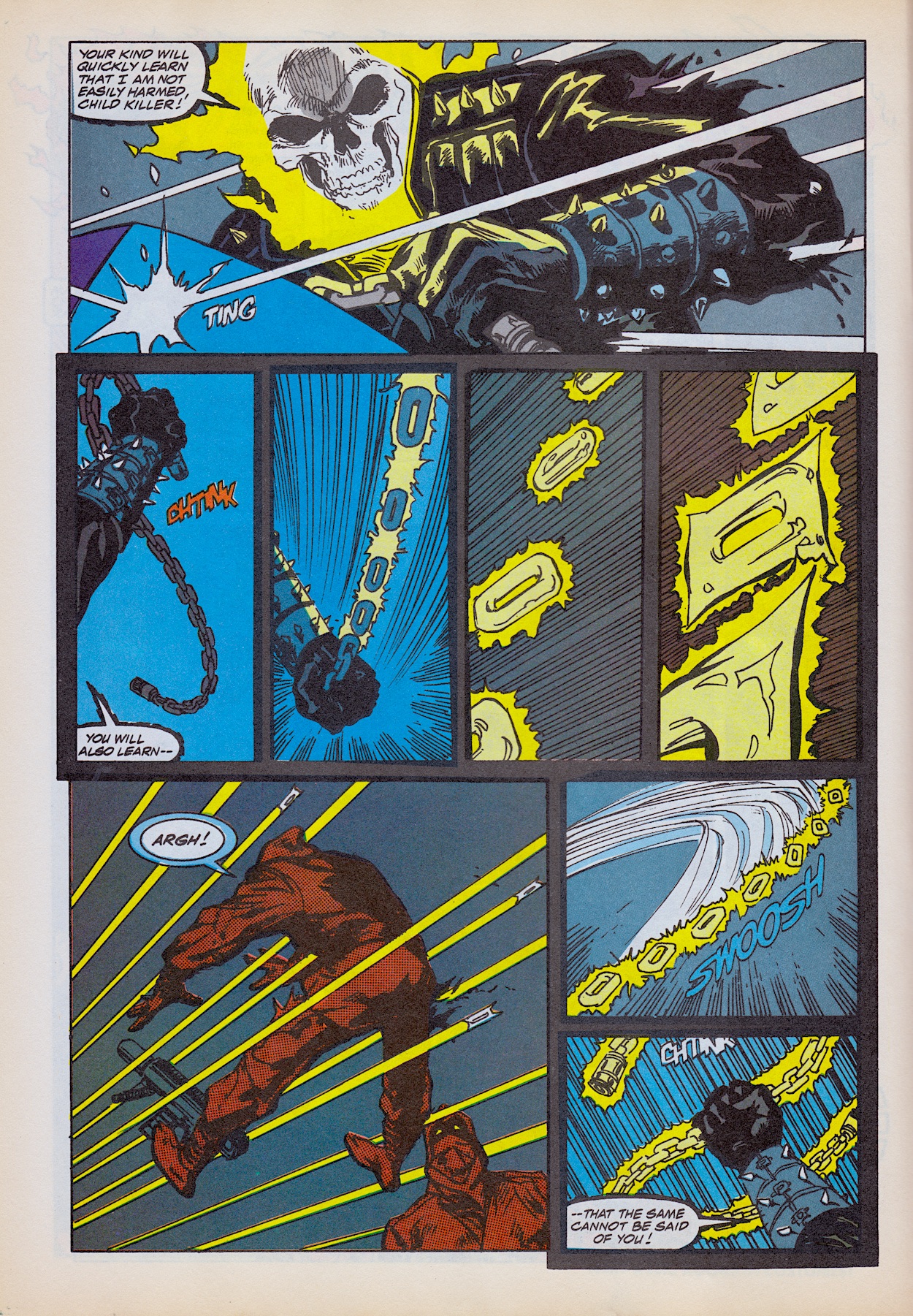
The gangs fighting over the suitcase are destroying whole city blocks in their war for the canisters, with the kids who stole it in the first place caught in the middle. No longer the cocky street gang of earlier issues, now they’re cowering for their lives after seeing one of their own killed. But one roar of a motorbike engine later and things take a decidedly different turn. Danny Ketch has transformed again into the Spirit of Vengeance and I love this particular page above, introducing another skill of the flamed rider’s.
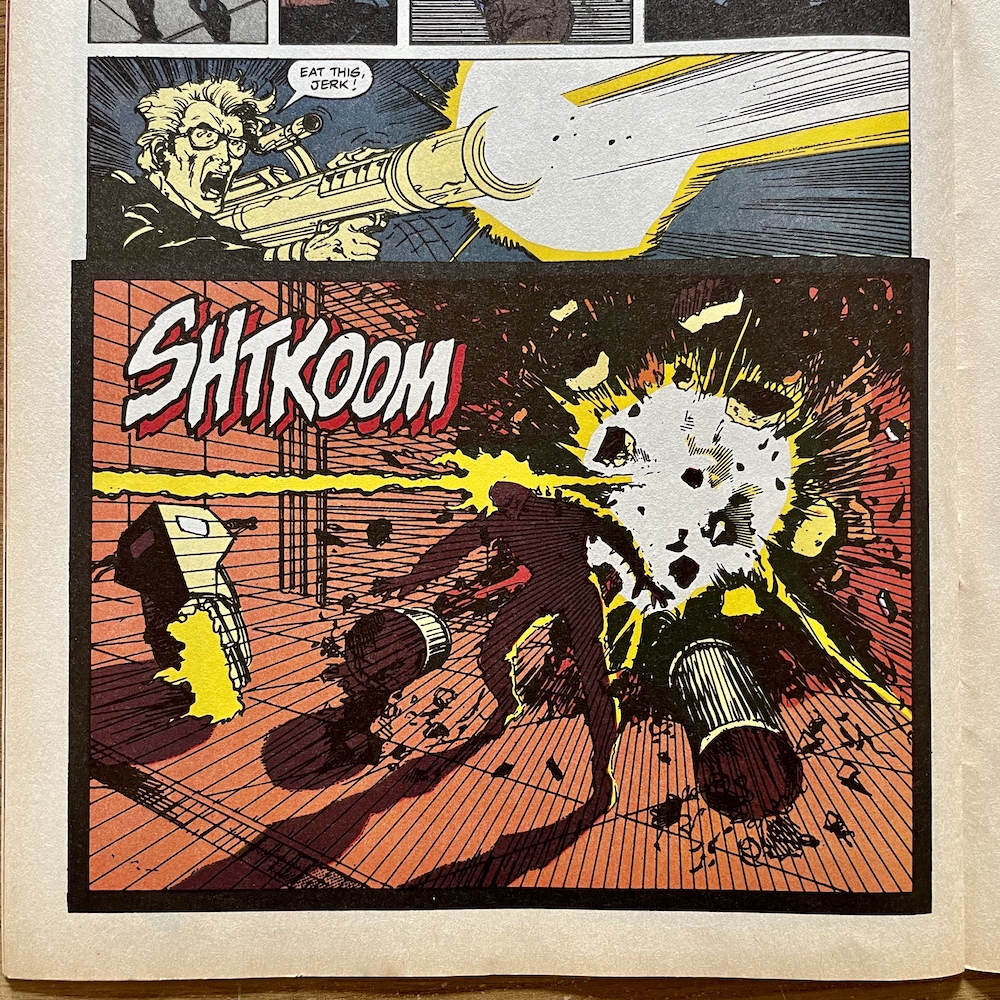
This is just the kind of thing teenage me would’ve lapped up. Oh, who am I kidding? I’m lapping it up right now at the ripe old age of 44. Ghost Rider approaches the kids, the same gang that terrified Danny in the first issue and reaches out his hand, telling them he means them no harm. I was surprised at this because I just didn’t expect it from the character and it’s a nice touch. However, he’s soon involved in the fight again and one of Kingpin’s men has had enough, pulling out what looks like a rocket launcher from the boot of his car!
With the demon rider (the gangs may have named him this but they still believe he’s just a person wearing a flaming helmet) the gangs are down to their last two survivors. Joining together to force a confession out of the girl who took the suitcase, while ready to double-cross each other at the same, the tension builds until a sudden chain flick from behind knocks them both out and in their place stands that flaming skull, with his hand outstretched once again to help her to her feet.
Again, this proves what I said earlier about the cliffhangers Havoc’s editors would choose, not always relying on the shocking action scenes. For example, it would’ve been easy to end Ghost Rider with the rocket scene above but instead we get a further couple of pages and this ending of the terrifying demon reaching out his hand to help the innocent. It’s just as much of a surprise as the explosion and it works so much better in my opinion as a moment to end on. I want to see more of this character, much more.
If you’re only coming to these reviews now let me explain that this was my introduction to the character back in the early 90s and in the intervening years I haven’t read any Ghost Rider comics or even seen the movies. This is pretty much introducing me to him all over again, so it’s basically all new. As with some of the other Havoc stars there’s a lot more beneath the surface to discover and I for one find him a fascinating creation so far. I’m eager to learn more, so little moments like this are huge to me.
Less fascinating are the Star Slammers (written and drawn by Walt Simonson, coloured by Louise Simonson and Deborah Pedler, lettered by John Workman). Also getting a good portion of the comic we see how Grandfather and Sphere first met, the former as a senator bringing a warning of a future planet wipeout, the other the leader of the people on the planet used for sport. As the Slammers prepare for the war at last they reminisce about that first meeting, how the elder had to prove himself and how he engineered the Mindbridge.
Able to communicate psychically already, his equipment and injections were to lead them to a point when they could all communicate as one, the whole race combined as one unstoppable force. Only then could they face their hunters, the Orions. The name ‘Star Slammers’ is taken from one of their weapons and name they use as they fight for others to make money and collect the weapons and ships they need. There’s also a hint about the exiled humans being closer to their ancestors than the ones consumed by hatred (the ones who hunt them for sport because they’re different).
It’s here the main problem with pacing rears its ugly head. At some points in previous issues nothing much has happened at all, in others we’ve been treated to some nice action or background details. But more often than not it’s felt a bit muddled, as if it was just buying time until the next issue. As we all know by now, Star Slammers wasn’t written as a monthly comic, instead it was a complete story in #6 of Marvel Graphic Novel. I’ve said previously how it maybe wouldn’t have these problems if read in one go as originally intended. I’m not so sure anymore.
Even here, with the flashback to those early meetings it just reads like forced exposition, a far cry from similar scenes in #4 when we got the background to the animosity between Grandfather and Kryllik. Now it seems any interesting story sections are being rushed through, like space is running out and writer Walt Simonson has to suddenly squeeze everything in. This is the same feeling I got when reading the final chapter of the Jurassic Park movie adaptation, also written by Walt.
What could’ve been a fascinating origin story isn’t helped with pretty bad dialogue either, combining to give an impression of everything being forced just to get the story to the actual battle it’s been predicting since the beginning. Could Simonson’s galaxy-spanning tale full of relevant social commentary simply have been too ambitious for the page count in Marvel Graphic Novel? Perhaps. But at least we get an inkling some excitement could finally be on the cards next issue.
With the war about to begin we close off all of our strips for this week with Cry Havoc and the second instalment of readers’ letters. Kicking things off with the promise of t-shirt prizes for star letters, ironically the start issue given for this would actually be the first to never appear. Then it seems the issue after that was to be the first with a new strip since #1. Intriguing little hints about a future that was not to be.
That’s us at the end of another issue and, despite it being one character short and extra pages given to my least favourite strip, it was another goodie. I look forward to a full deck of anti-heroes next week though. Speaking of which, that’ll be the penultimate one already! Where has this summer gone? Join me again soon. Havoc #8’s review will be here from Wednesday 24th August 2022.

























 OiNK Blog