Tag Archives: John Freeman

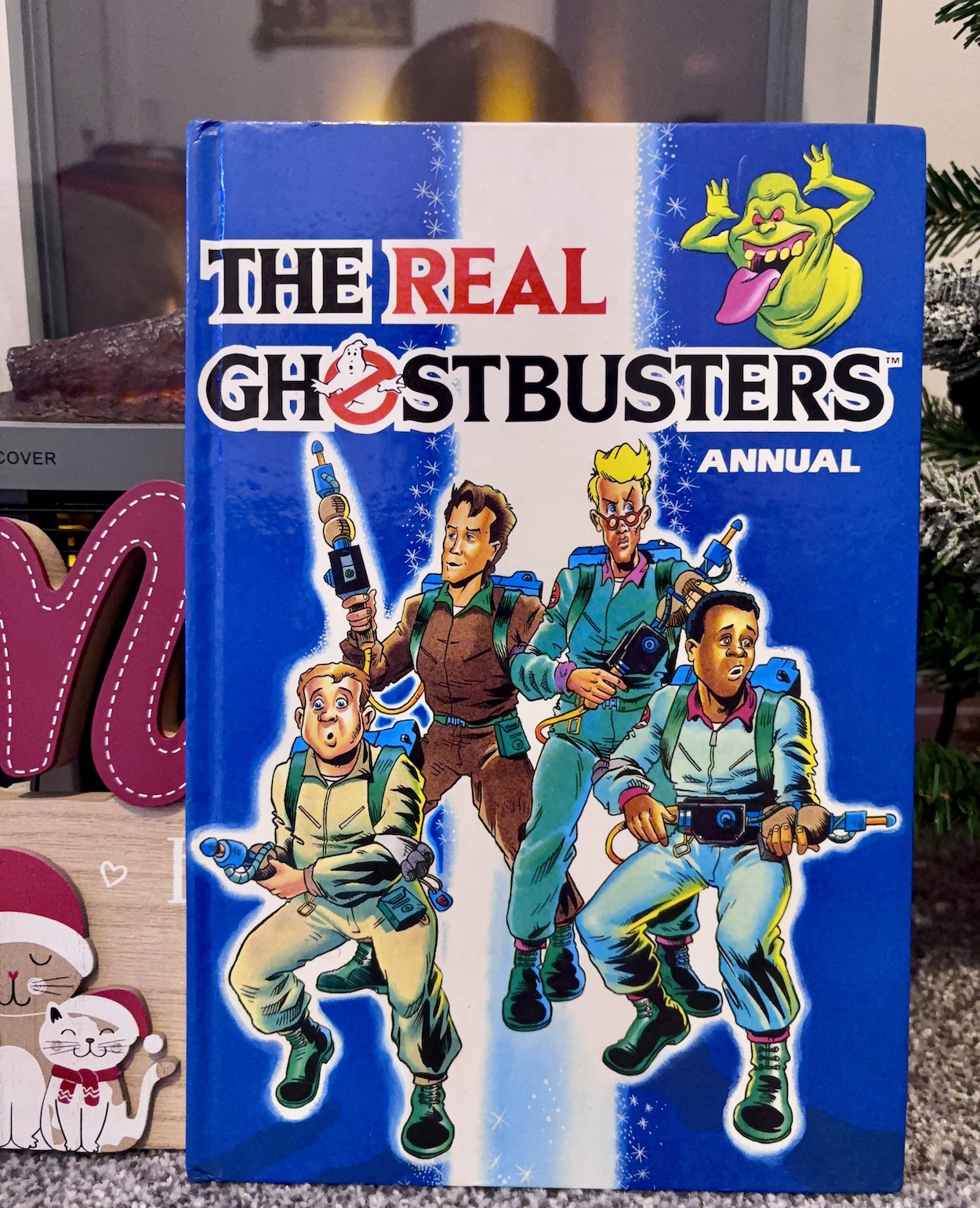
THE REAL GHOSTBUSTERS ANNUAL #1: PHUNNY PHANTOMS

While many comics of the 80s such as The Transformers and our very own OiNK would have to wait until their second year for their first annual, with The Real Ghostbusters Marvel UK went all-in and produced a book for its very first Christmas season, meaning work had to have started on it before the comic itself was even released. For me, holding this cover by Anthony Williams (Transformers, PJ Maybe, Fate) and John Burns (Judge Dredd, Look-in, Eagle) in my hands again brings back so many fond festive memories.

Sticking with the usual 64-page hardback format of Marvel’s yearly offerings and edited by Richard Starkings (Death’s Head, The Sleeze Brothers, Dragon’s Claws), inside is chock full of content making for a meaty, very funny read for the younger readers, and one that holds up well today. This has been great fun to relive. I’ve had a ball! Things kick off with an HQ page very much like the weekly’s and you can see the amount of stories and features they’ve crammed in here.
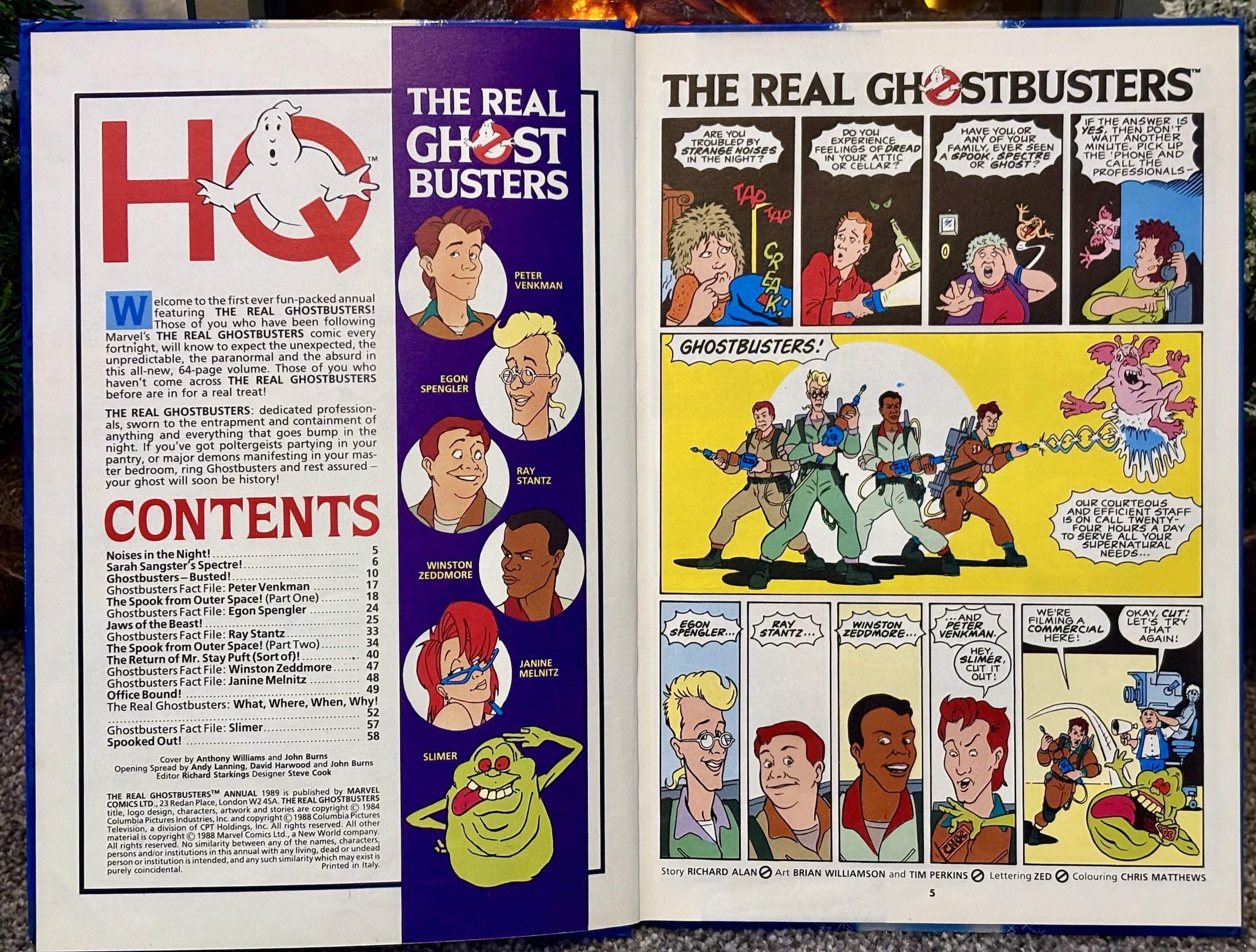
Then there’s Marvel UK’s one-page strip advert introducing Peter Venkman, Winston Zeddmore, Egon Spengler and Ray Stanz that had been running in other comics that year and which took its wording directly from the movie. This was written by Richard (under a pseudonym), drawn by Brian Williamson (Hook Jaw, Doctor Who, Warhammer) and Tim Perkins (Transformers, Chopper, Thor Losers), lettered by Richard and coloured by Chris Matthews (Thundercats, Action Force, Mugshots).

Ian Rimmer’s (editor on Scream, Doctor Who Magazine and Transformers) Sarah Sangster’s Spectre is the perfect scene setter for the book. An attractive young woman has called the team to catch the ghost of a little old lady haunting the halls of her home and straight away Peter is smitten. In the end, she’s the spook who has tried to trick the guys into killing the wee pensioner! Dark? Not at all, it’s all played for laughs and the plot is exposed by Peter’s selfie. 
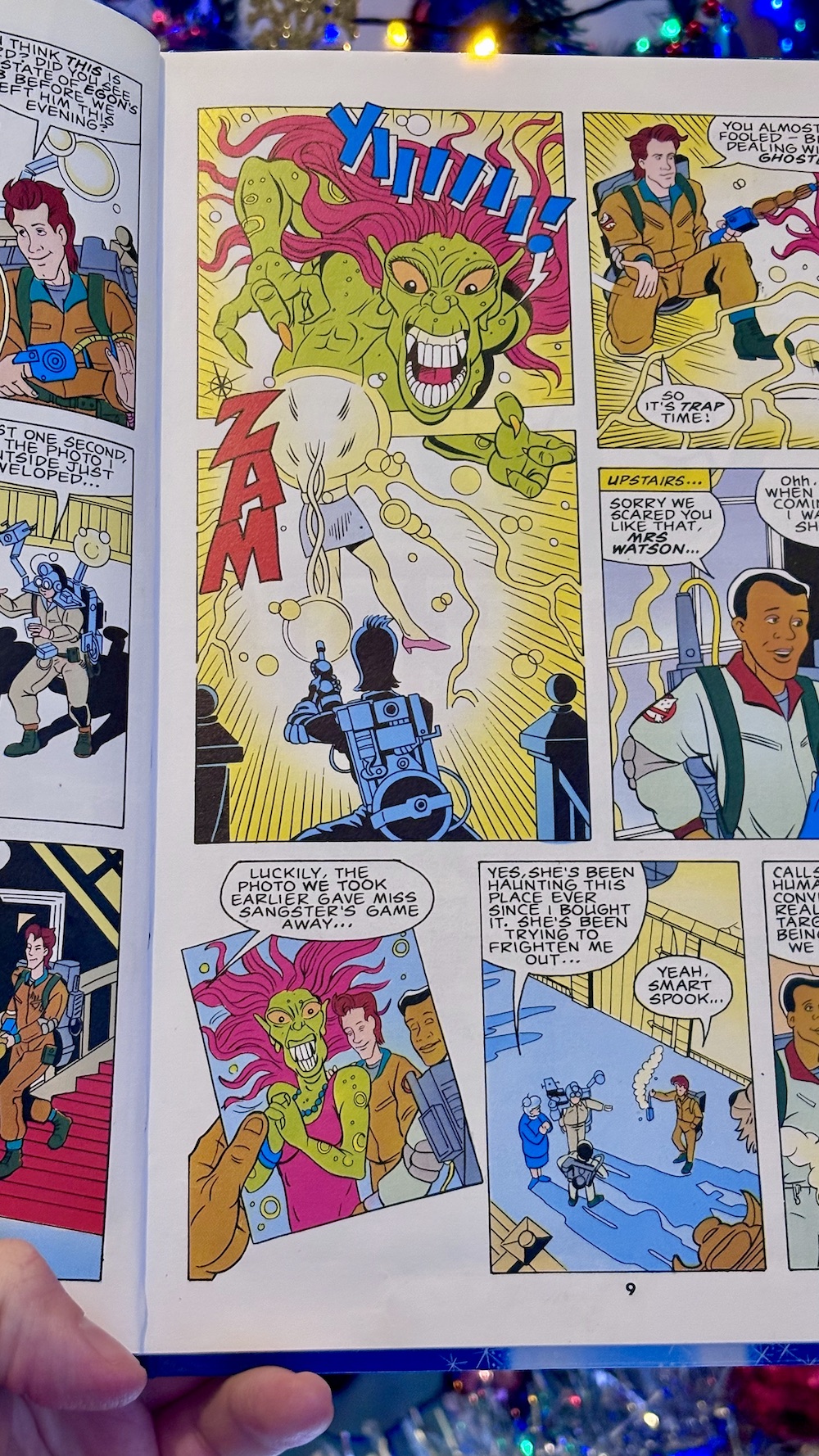
The artists here are regular Ghostbusters contributors Andy Lanning (The Punisher: Year One, Judge Anderson, co-creator of The Sleeze Brothers) and Dave Harwood (Action Force, Swift Sure, 2000AD) with colours by Helen Stone (Knights of Pendragon, Dark Angel, Sleeze Brothers). Probably more than anything else in here, this strip takes me right back to reading (and rereading) this book over the holidays in 1988, wrapped up in bed late at night during that enjoyable Void Week between Christmas and New Year.

The comic never did multi-issue stories from the UK team. Later, lengthy imported strips would get serialised but the closest our homegrown stories got would be those split in two across one issue. This happens here with The Spook from Outer Space, again written by Ian, with art by Phil Gascoine (Battle Action, Commando, Knight Rider in Look-in) and Dave Hine (Death’s Head, Azrael, Dark Angel), with colours by Stuart Place (Captain Britain, Transformers, Action Force).
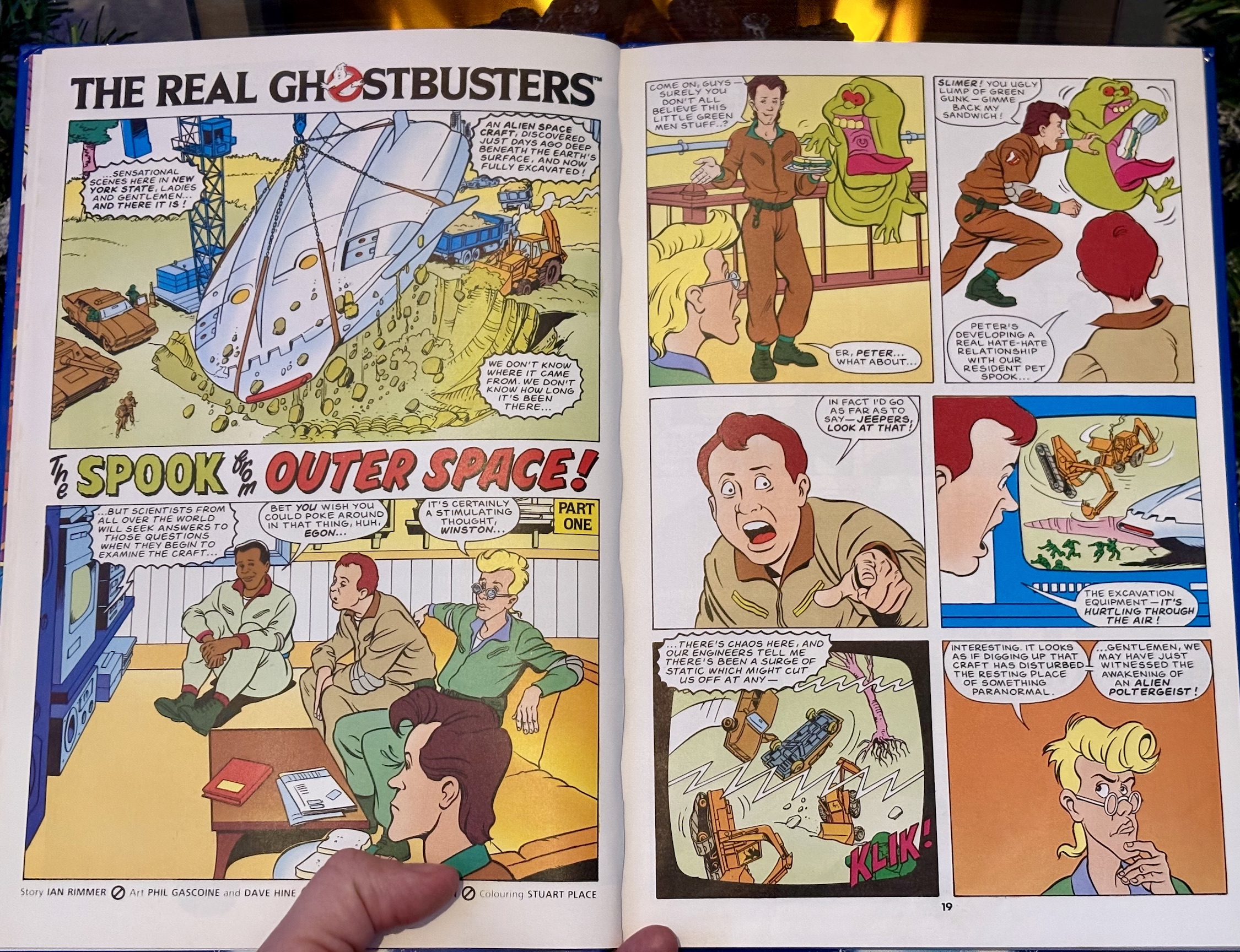
The Ghostbusters are watching a UFO being excavated from disused land in New York on telly when suddenly the excavation equipment starts floating in mid-air. They deduce the alien must’ve died upon crashing and has been haunting the UFO ever since. So off they go to bust it but as normal the case is not all it seems. The alien is hugely powerful, feeding off their proton packs instead of being contained by them, and of course the military are on hand to fire more weapons at it while ignoring the warnings.

In the end we find out the alien has been psychically moving all of the heavy machinery in order to spell out a message on the ground that it just wants to be sent home, so the Ghostbusters commandeer one of the army’s rockets, trap the alien (with their permission) and fire it off into space. It’s a fun tale that includes a good bit of witty banter between the four men and would end up being one of a few strips from this annual we’d “get another chance to read” in the weekly a couple of years later.
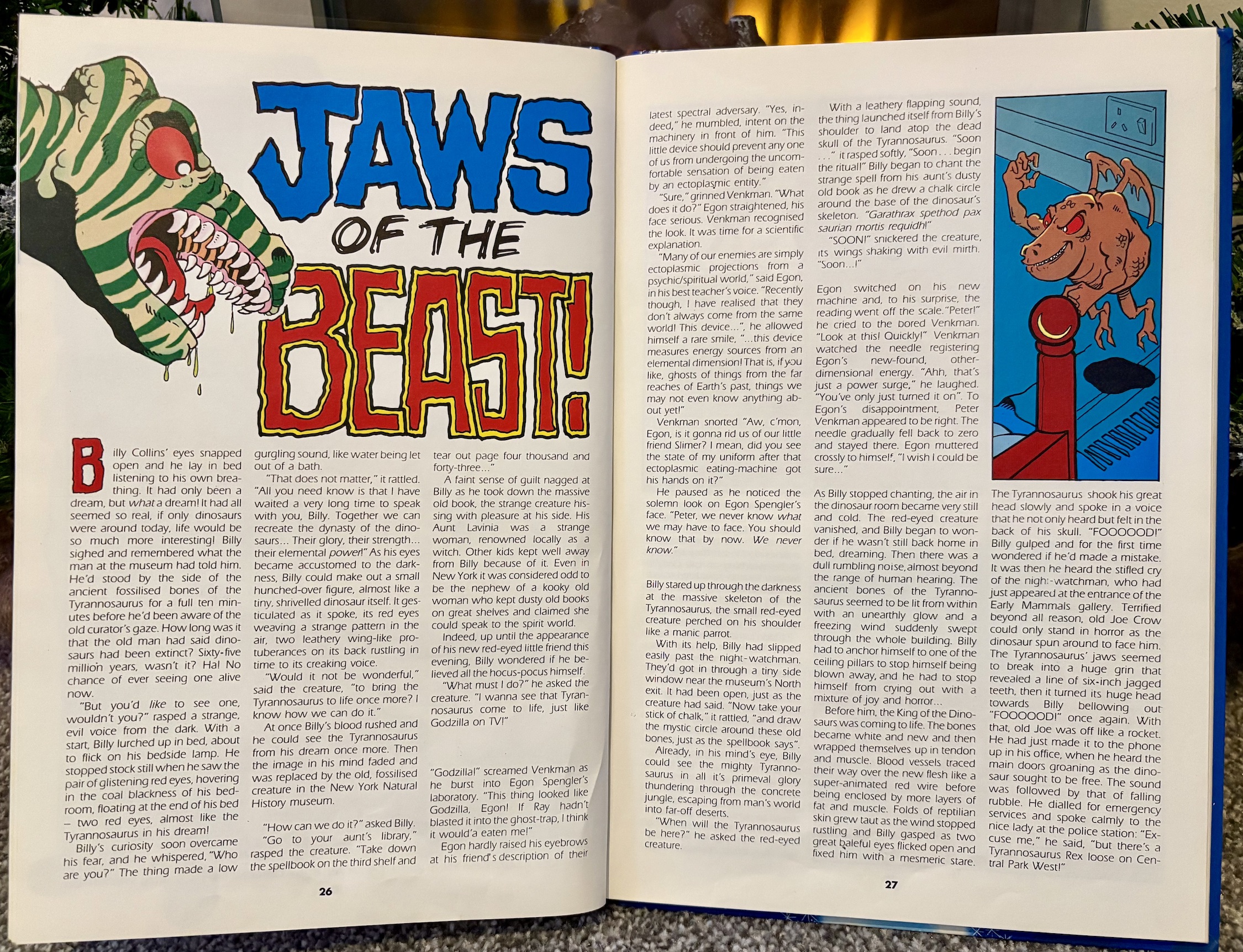
Moving on to our prose stories and Jaws of the Beast is written by artist Nick Abadzis (Death’s Head, Vector 13, The Big Book of Death) and colourist/editor Steve White (Xenozoic Tales in the UK’s Jurassic Park, The Sleeze Brothers, Dragon’s Claws).It’s a tale about a small winged beast who invades a boy’s wishes. This particular boy wished he could see a real Tyrannosaurus rex, so obviously this leads to the team eventually being chased by said dinosaur through the streets of New York.

“It’s a loony lady who says her nephew has raised a dinosaur from the dead. You wanna speak to her?”

Janine Melnitz

What’s great about the story is the dynamic of the team. The prose stories allow the writers to explore the characters that little bit more and in particular we’re treated to some hilarious scenes between Peter and Egon in the firehouse, and later when Peter is used as bait for the beast. At this juncture Peter’s inner thoughts are punctuated by radio communications from Egon, making for great dialogue and genuinely laugh out loud moments.
The best story of the whole book is written by friend of the blog John Freeman (editor of Doctor Who Magazine, Babylon 5 Magazine, Star Trek Magazine), who brings back the iconic Stay Puft Marshmallow Man for a story set in London. The art is pencilled by Mike Collins (Transformers, Doctor Who, Tharg’s Future Shocks) and inked by OiNK’s very own Lew Stringer (Tom Thug, Combat Colin, Sonic the Comic). Lew and Mike are good friends and started in the business around the same time but this remains the only time they’ve ever worked together on the same story.
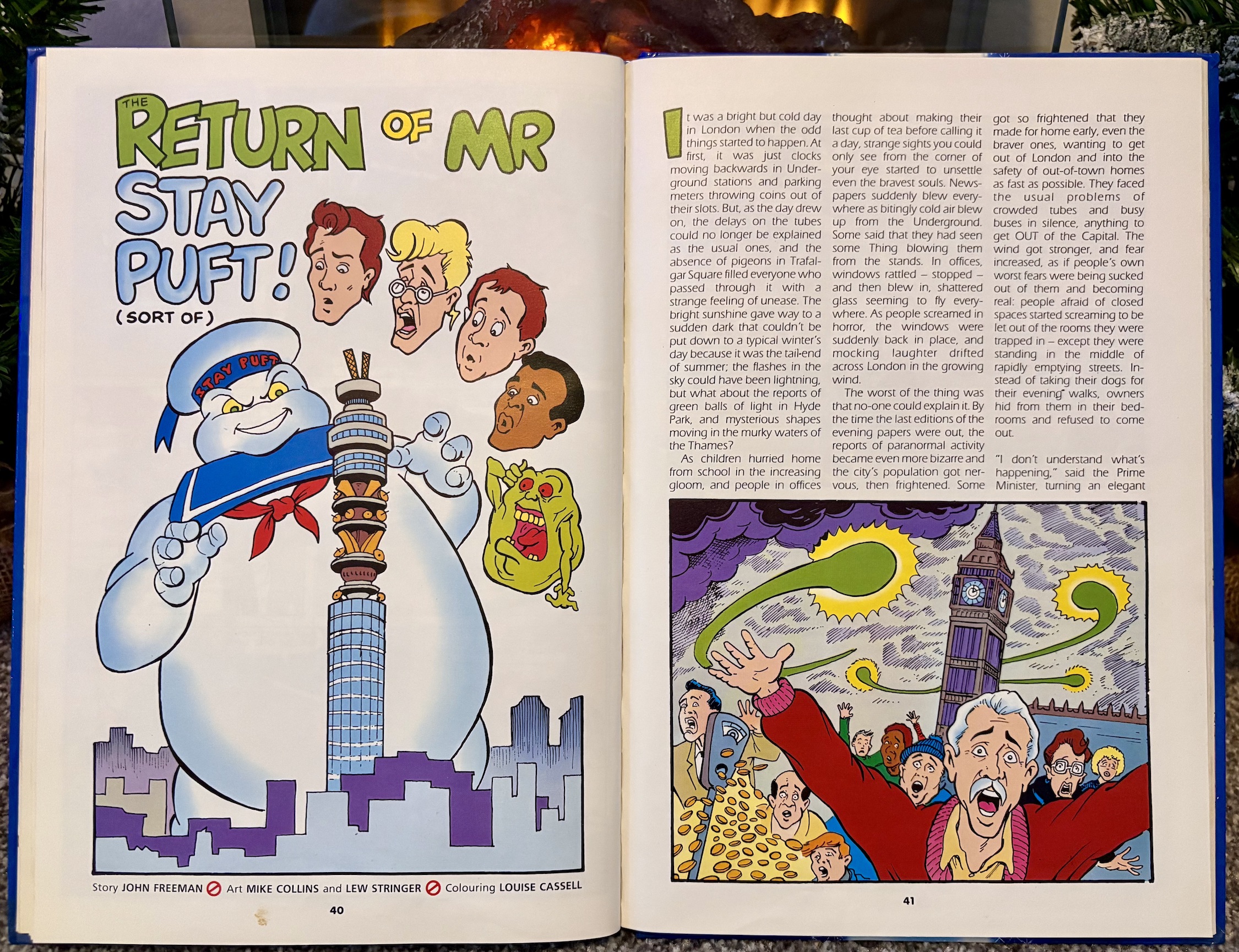
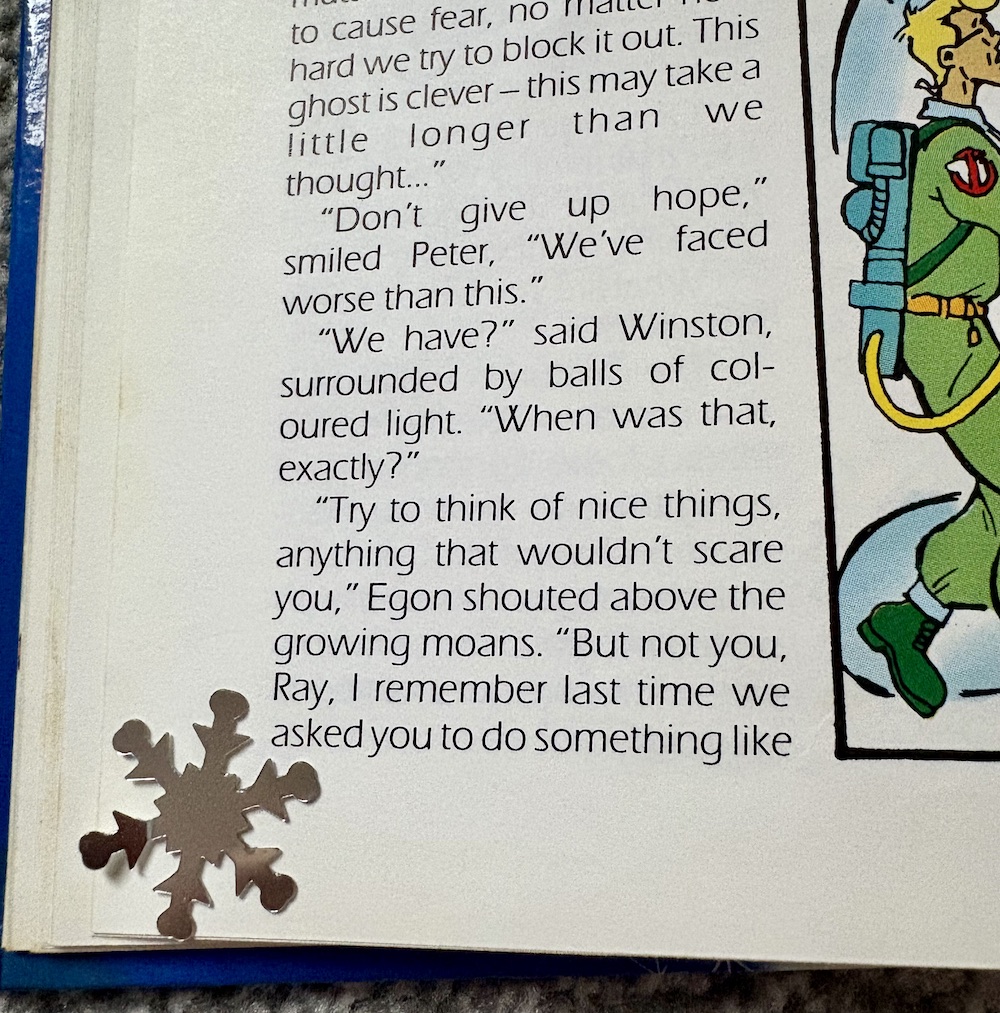
A mist has descended over London and it’s feeding on the fears of the citizens, sending everyone running for their lives and leaving the city with no one for the mist to scare. Growing weaker, the Ghostbusters start to look for the source in order to eliminate it, but all it takes is for Egon to explain that in order to keep the mist at bay they have to think of nice things. Cue Ray! If you’ve seen the original movie you’ll know what this is in reference to and it makes for some great back and forth between the four.
There’s one more text story called Ghostbusters Busted! about a so-called rival team and towards the end of the annual the uncredited Who, What, When & Why? which acts like a catch-up for new readers. It explains how the Ghostbusters were formed, why they’ve got a pet ghost and takes a closer look at their HQ and all those gadgets they use in their day-to-day job. Also included are reprints of the fact-files from the weekly for Peter, Egon, Winston, Ray and Janine Melnitz. Oh, and Slimer of course!
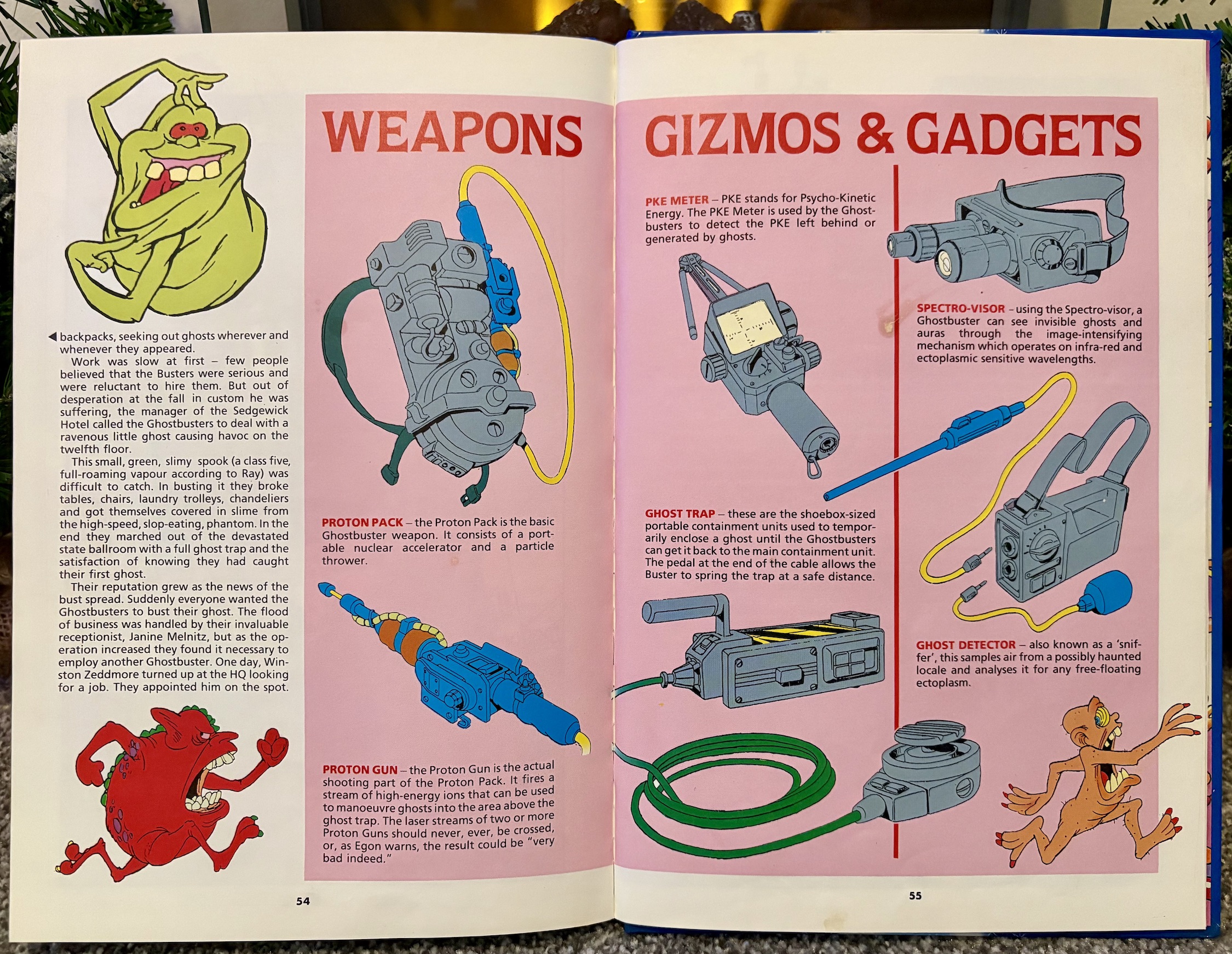
In case you’re wondering how that whole “Ghostbusters body” thing worked out, Peter would be the mouth, Egon the brains, Ray the hands, Winston the heart, Janine the central nervous system and Slimer would naturally be the stomach. As I’ve mentioned before in the retrospective for #1 of the comic, I remember drawing this Frankenstein-esque combination of all the characters with the intention of sending it in but never did.

Not all of the main characters feature in every story in the comic and the same applies here. Given their short length the writers would often concentrate on pairing up different characters with each other for interesting dynamics. For example, three of the guys starred in our first strip, then the missing ‘buster, Egon appeared with Janine in another. The final strip of the annual brings everyone together though, including Miss Melnitz and the green one.
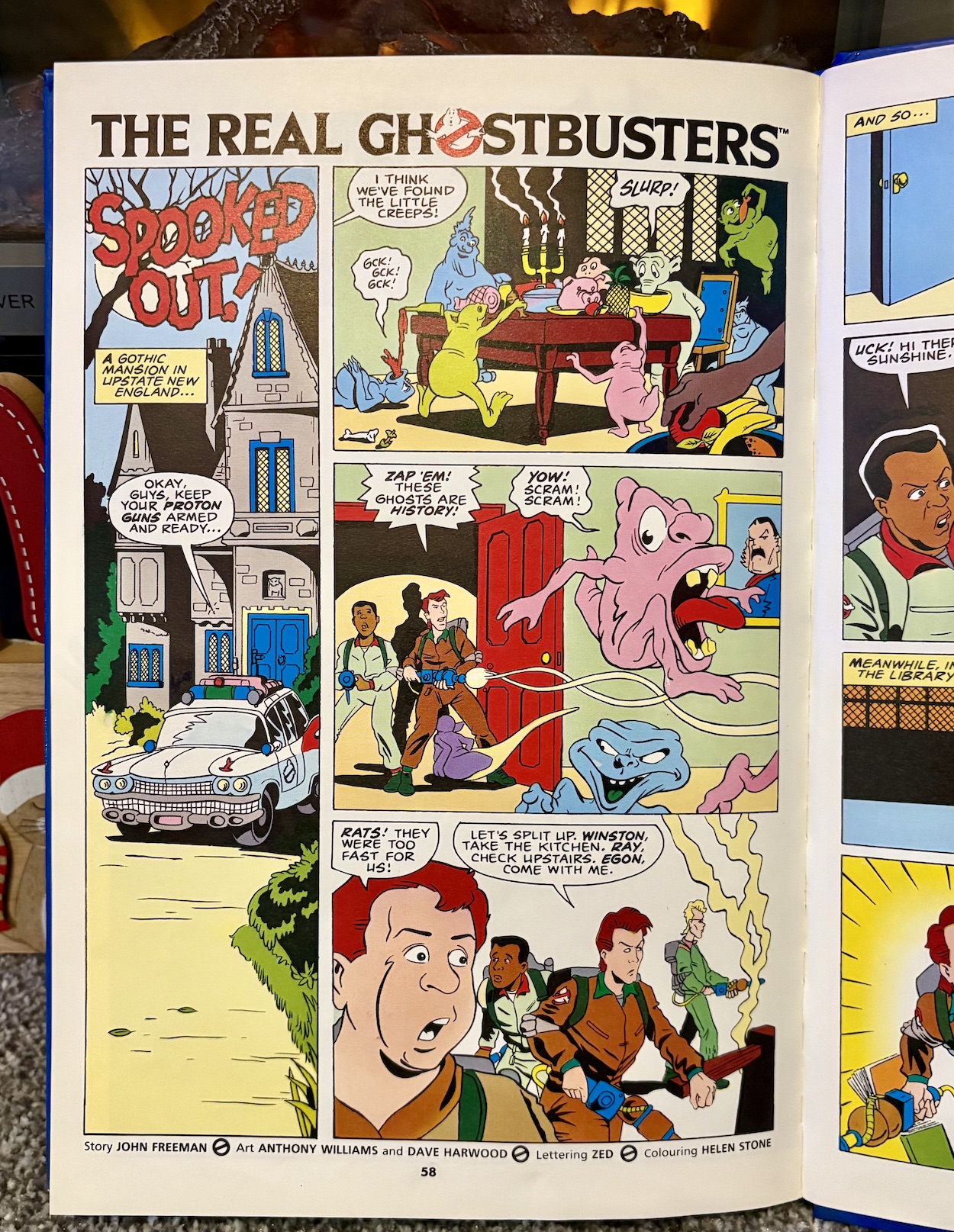
Written by John Freeman, drawn by Anthony Williams and Dave Harwood and coloured by Helen Stone, Spooked Out! sees the team battling against a gaggle of ghouls and try as they might they can’t help but get more and more overwhelmed by them. It seems this could be the first failed job but when Peter chases after Slimer to bust him you know something’s up.
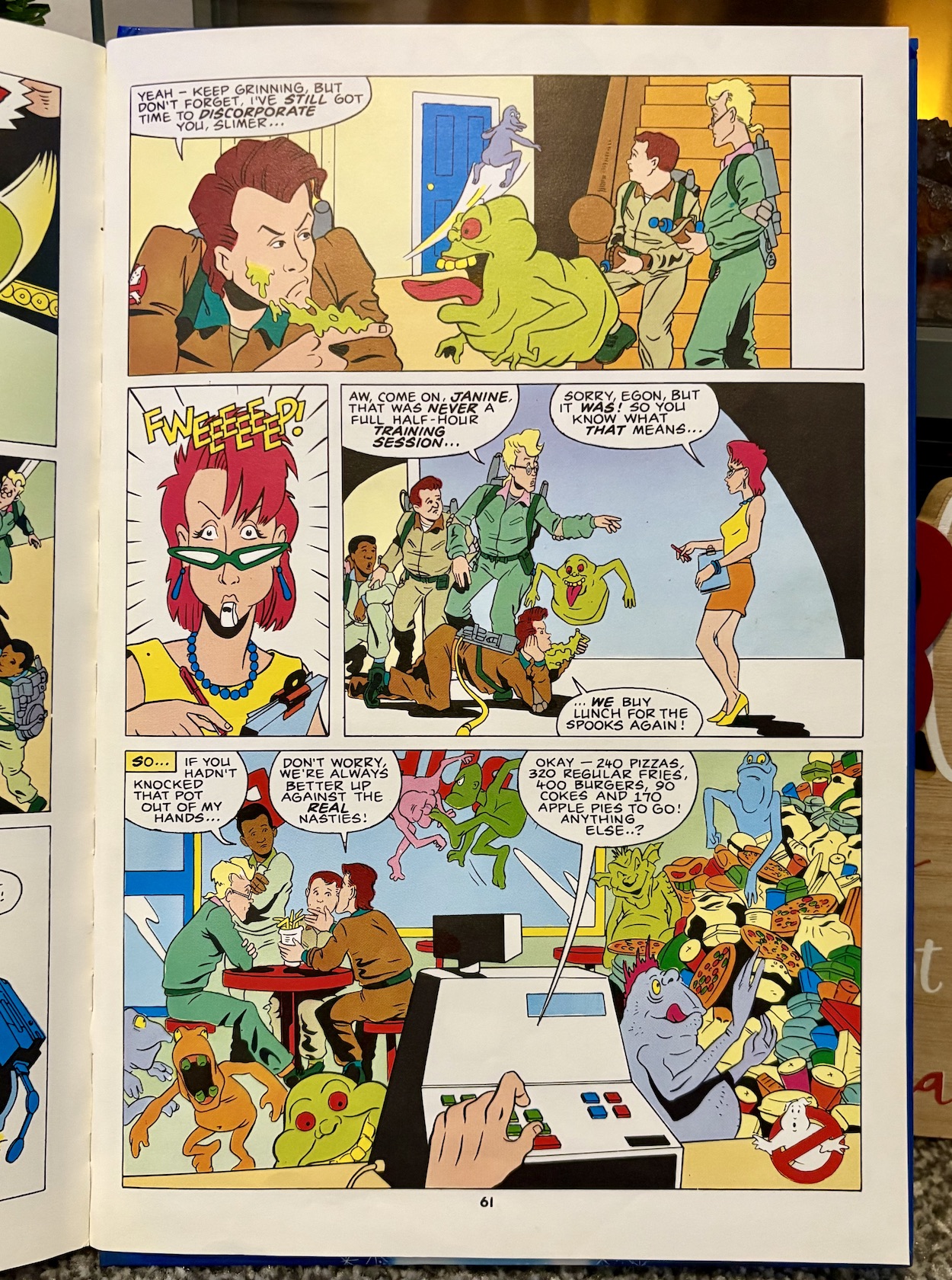
Sure enough, it’s just a training exercise. Needing to keep themselves in fine form Slimer has recruited a bunch of his good ghost pals, with payment being everything they can eat at a local diner if they win. Given how they’re all good friends with Slimer (and we know what his appetite is like) this is a particularly funny ending to not only this short strip but the book as a whole.

I found Ghostbusters Answer the Call’s sense of humour reminded me a lot of both The Real Ghostbusters cartoon and the UK comic, so if you’re a fan of that movie like I am you’ll want to snap up some issues and this first annual is the perfect jumping on point. Our annuals were always that little bit more special than the regular comic and upon finishing this it really did feel like all the stops were pulled out to produce a fantastic debut book that’s genuinely very funny.
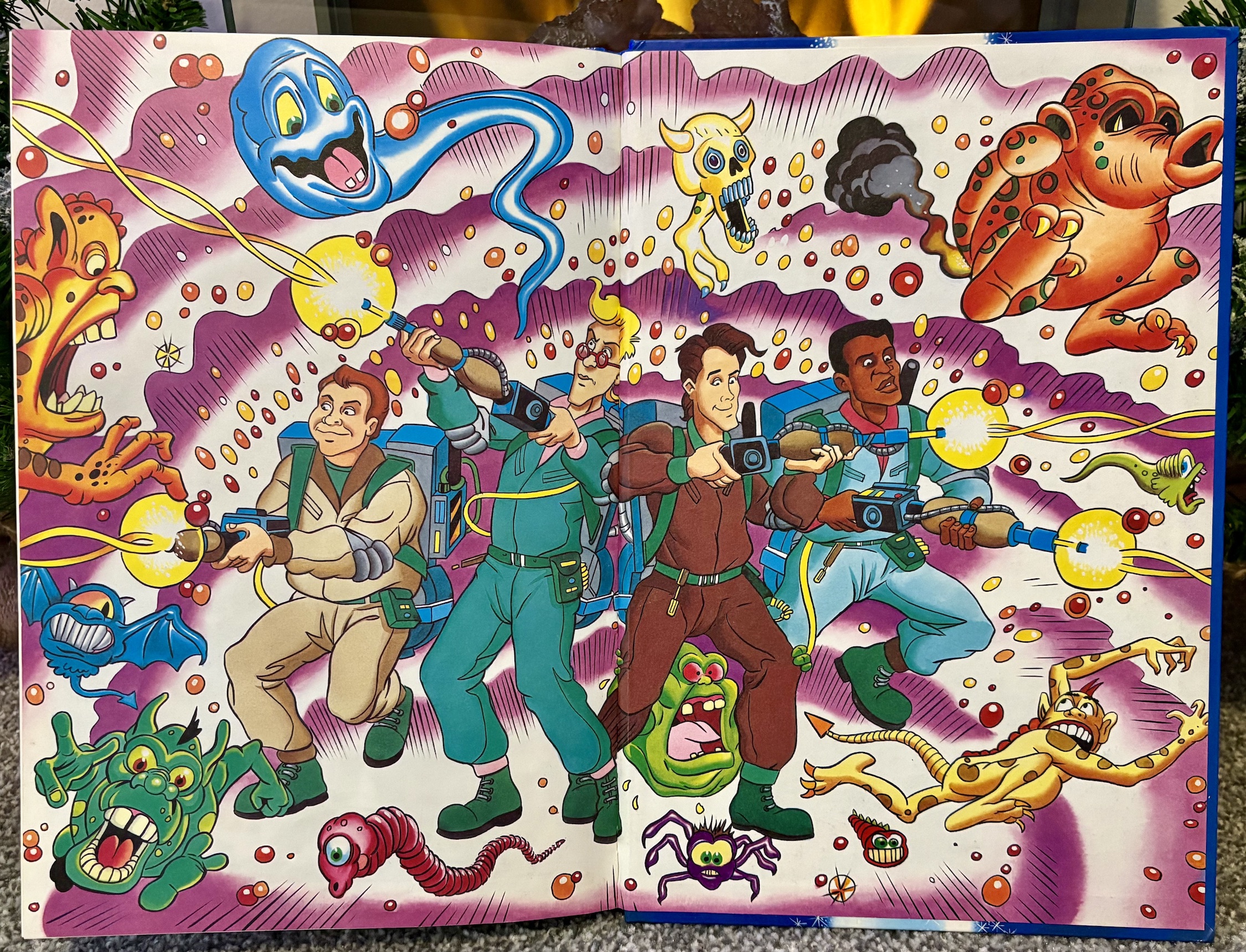
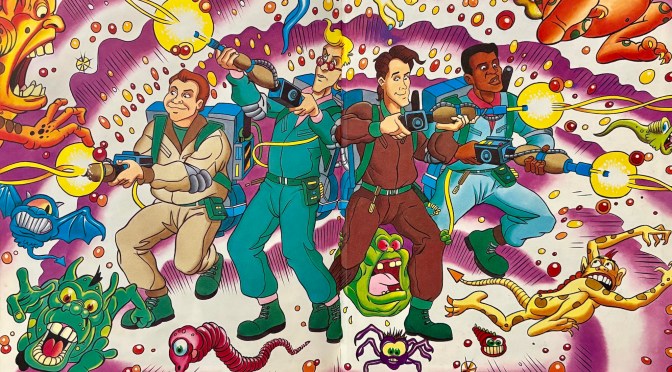
Andy Lanning’s, Dave Harwood’s and John Burns’ inner cover spread rounds off what has been a great slice of Marvel UK history from a comic that set itself apart from the rest of their titles from the get-go. Sometimes certain things from our childhood hold a special place in our hearts that we’ve completely forgotten about until we experience them again. In that regard, the 1988 annual for The Real Ghostbusters has felt like a very personal trip down memory lane and I can’t wait to see if subsequent volumes have the same effect. Roll on Christmas 2026!

THE REAL GHOSTBUSTERS RETROSPECTiVE
THE REAL GHOSTBUSTERS iSSUE ONE

ANNUALS MENU

CHRiSTMAS 2025

THE MiGHTY MARVEL CHECKLiST: WEEK SEVEN

SATURDAY 10th SEPTEMBER 1988

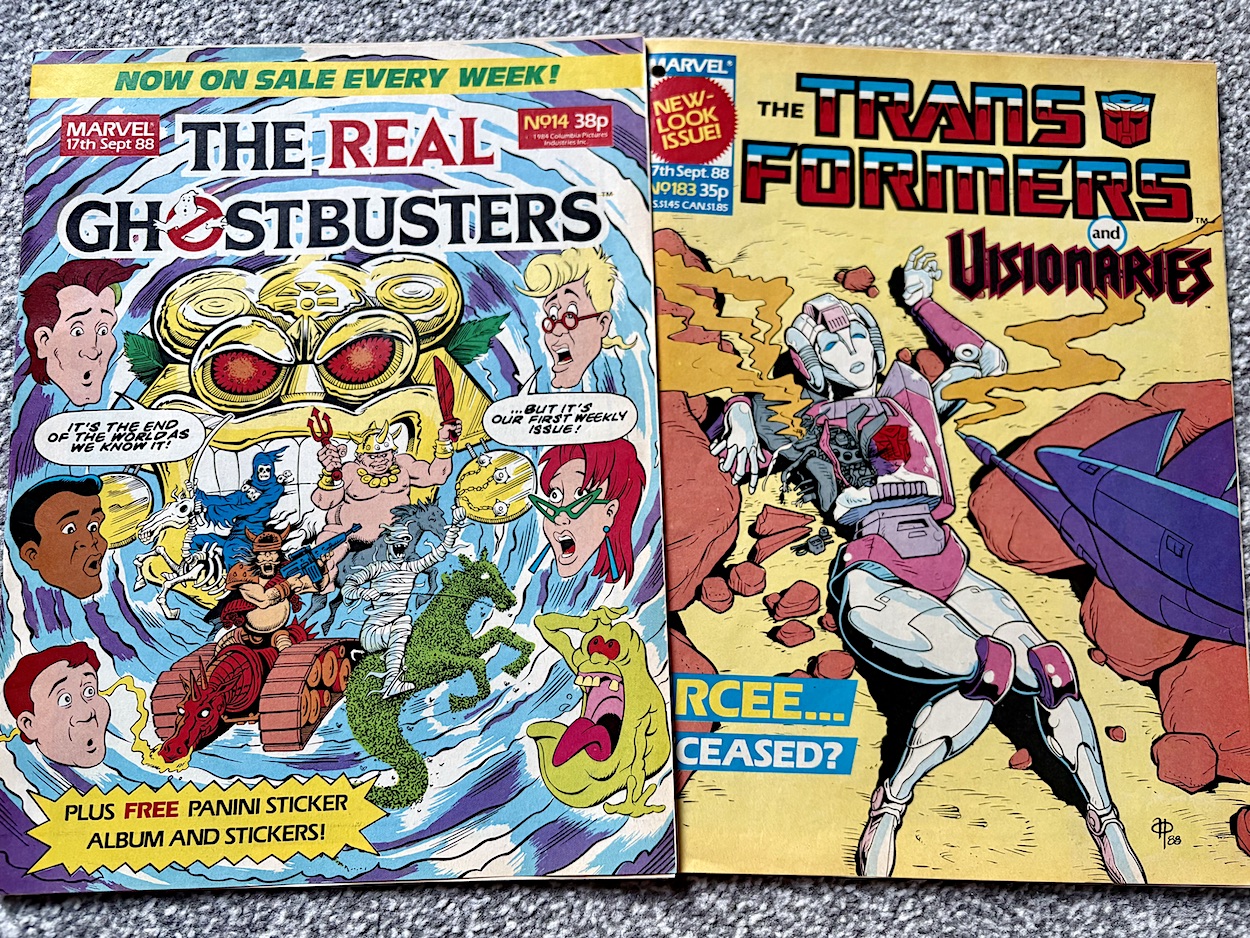
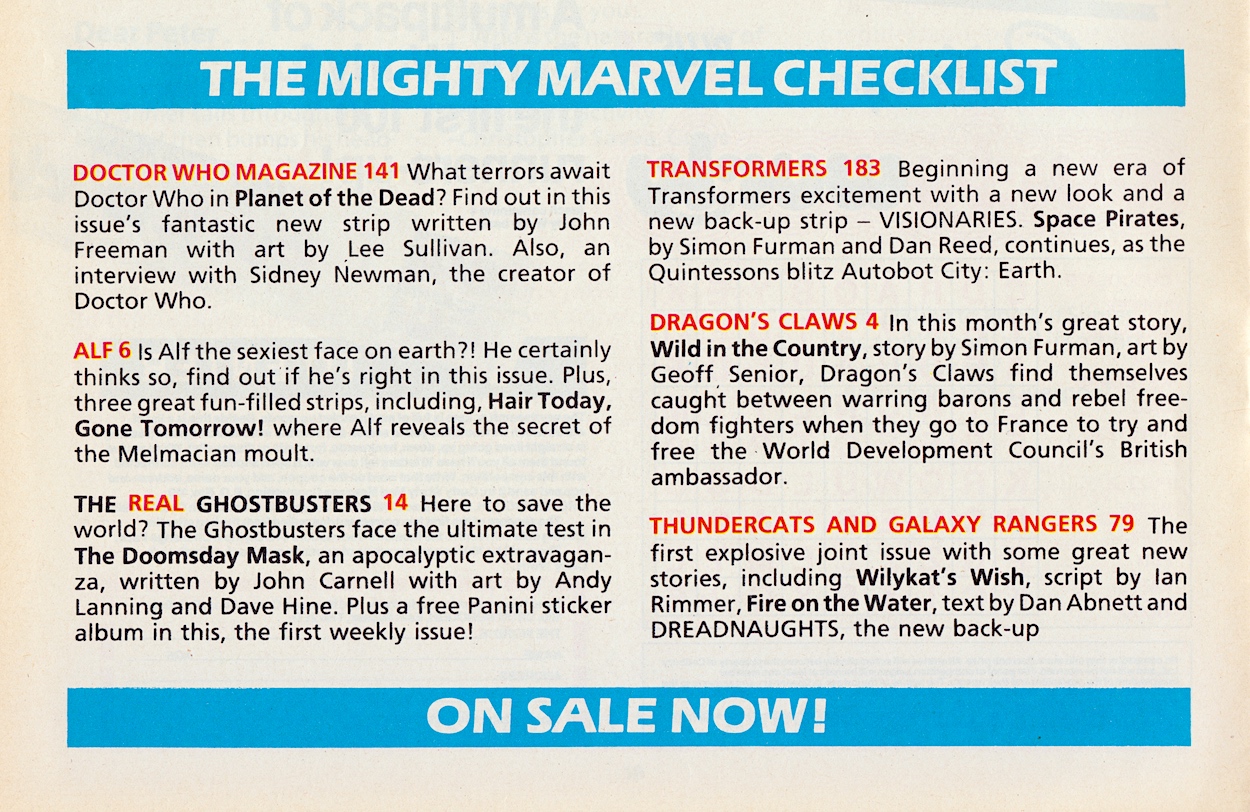
It was all change this week across Marvel UK’s best-sellers as The Real Ghostbusters changed to a weekly format and Transformers and Action Force became… Transformers and Visionaries! It was about time too, seeing as how Visionaries fans had been waiting since July for their adventures to continue.

Andy Wildman’s cover may present what was meant to be a shocking moment in Space Pirates but it was the inclusion of the Knights of the Magical Light and a brand new look to the comic which excited me the most when I read this for its real time read through a few years back. The Real Ghostbusters never changed its look at all over the course of its run, although this issue did stray from the typical multi-story formula.

Instead, an epic (for this comic anyway) tale took over the whole issue with a two-part, 11-page strip drawn by cover artists Andy Lanning and Dave Hine who brought us a superb set of Four Horsemen of the Apocalypse. Even the prose story, Spengler’s Spirit Guide and Lew Stringer’s Blimey It’s Slimer tied into the same story. Unfortunately my Panini sticker album is long gone but I did have fond memories of trying (and ultimately failing) to complete it. There’s also a competition to win a Commodore 64 computer, a machine I’d become obsessed with over three years later!

In Doctor Who Magazine John Freeman hit on a story title that might seem familiar to fans of the show today, Dragon’s Claws had one of their most entertaining adventures from their whole run when they find themselves between warring factions in France and the comic slowly begins to unveil its background story. Then, were we really meant to believe anyone would think Alf was the sexiest alien alive when we’d just had V on TV a few years previous? Come on!

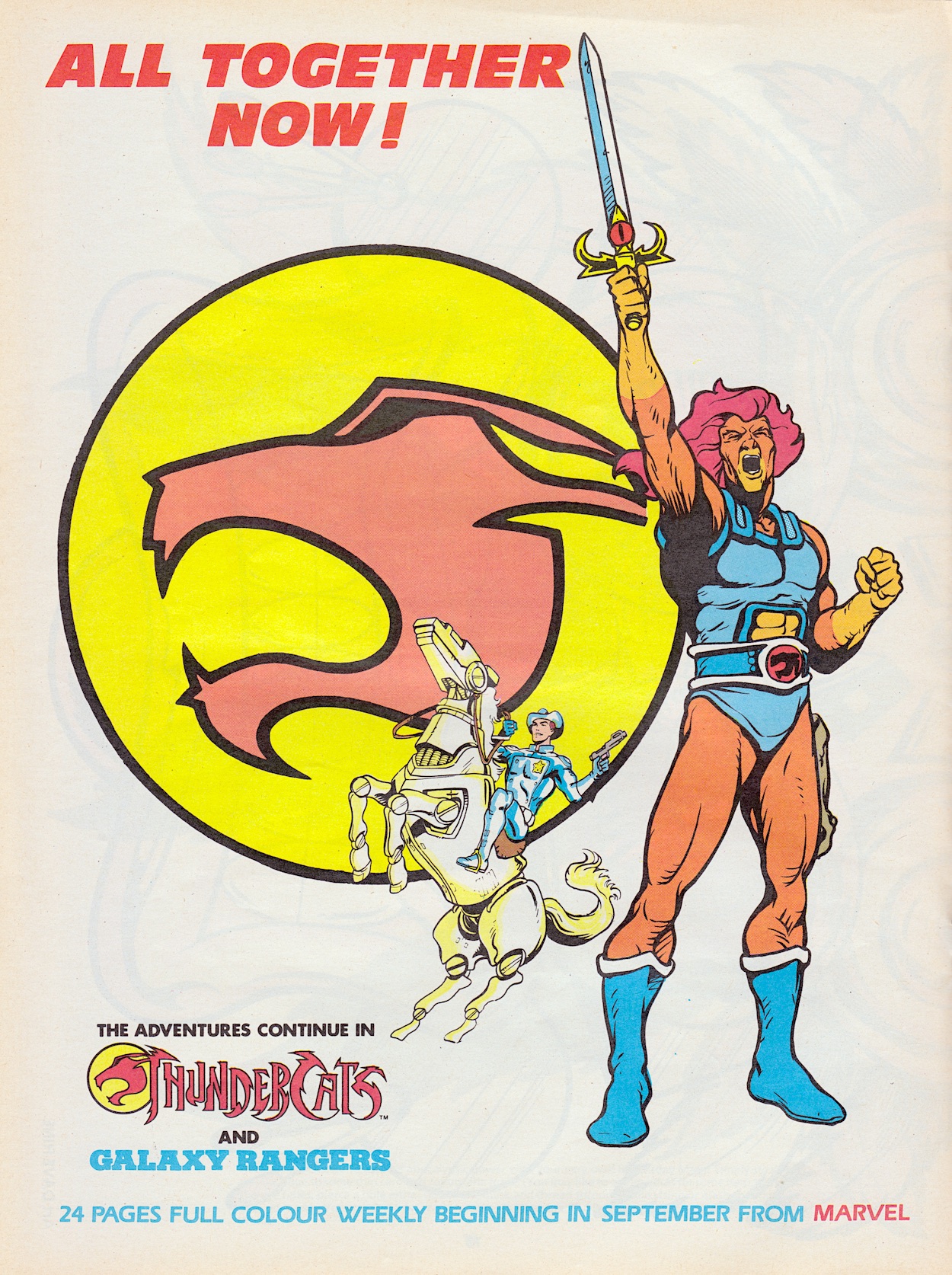
As you can see there was a trilogy of changes on the checklist completed with the merging of the short-lived The Adventures of the Galaxy Rangers into the hit Thundercats comic. I don’t think it remained merged for long though before running out of already completed stories for the ranger. The merge was advertised across their range for quite a few weeks with this rather simple advert.

I’m surprised the Galaxy Rangers didn’t merge into Transformers if I’m honest. Space-faring adventures chasing down aliens and mechanoid outlaws with four of the coolest robotic horses sounds like a perfect fit! I’d have lapped them up if that had been the case, but with Visionaries needing a new home too there was only so much back up space to go around. 

Did you collect Thundercats or The Adventures of the Galaxy Rangers? What did you make of the merge? Can you remember one of the very best issues of The Real Ghostbusters from its whole 193-issue run? More importantly, did you finish the album? Join in the conversation over on the socials on Bluesky, Instagram and Facebook, and I’ll see you back here next week for another checklist and two classic ads.

TRANSFORMERS 183 (Instagram)

TRANSFORMERS & ViSiONARiES: PART ONE

DRAGON’S CLAWS 4

WEEK SiX < > WEEK EiGHT

MiGHTY MARVEL CHECKLiST MENU

DOCTOR WHO MAGAZiNE #147: REMEMBRANCE OF THE SLEEZE

Between the original publication dates of the previous issue of Doctor Who Magazine covered on the blog (#135, as part of the Death’s Head read through) and this one I’d finally discovered the TV series for myself. I’d grown up in a house where older siblings would have watched Tom Baker in the role so I was always aware of it and certain aspects such as the Daleks, the TARDIS etc., but it wasn’t until I saw those aforementioned meanies splashed across media outlets in 1988 that I decided to give it a go for myself. I’ve watched ever since.

I’ll get back to that below when I take a look at some other parts of this issue, but the reason it’s here on the OiNK Blog is because of those two cheeky Blues Brothers-esque characters peering out from behind the cover. After months of that teaser advert The Sleeze Brothers finally made their strip debut here and, according to Richard Starkings (Sleeze Brothers’ editor) this very well could be the only time creator-owned characters made the cover of DWM! This magazine’s editor (and friend of the blog) John Freeman concurs. John was the mag’s designer in the previous issue we looked at so he’s had a promotion since.

On the contents page you can see how the strip in introduced with its “plethora of artists” and that is indeed the case, with no less than five of Marvel UK’s finest bringing the characters to readers for the first time. Before we move on to the main event though, I couldn’t help but spot that little bit of optimism in the editorial about Doctor Who’s potential upswing in fortunes over the year ahead. Within the year the show would actually be cancelled.

So let’s get stuck into the first (mis-)adventure for El’ Ape and Deadbeat. As you can see from this first page we’ve got a who’s-who of Marvel UK talent responsible for the eight-page strip. John Carnell and Andy Lanning are the creators and alongside Andy on art duties are John Higgins, Kev Hopgood, Dougie Braithwaite and Dave Harwood. A greater selection of pencillers and inkers from my childhood (especially The Real Ghostbusters) would be hard to find. Then add in Slimer’s main artist Bambos Georgiou and this screams “classic” before I’ve even read one panel.

My first encounter with the brothers was with #1 of their own comic and only now, decades later, I’ve got my hands on this strip. Having only ever read #1, and not having done so since 1989, reading this prelude years after the fact doesn’t matter. My memory is so rubbish everything I knew about their comic is gone so this reads just as intended, as a fun little build-up to the chaos (hopefully) to come.

The Meddling Monk’s chameleon circuit hasn’t been damaged and his ship turns into a futuristic outside loo

We arrive on Earth on an undisclosed future date and catch a tantalising glimpse of the world the upcoming comic will have as its setting, which I’m hoping we’ll see a lot more of if this first page is anything to go by. TV series villain the Meddling Monk has landed to interfere in the upcoming election but the Seventh Doctor (Sylvester McCoy) isn’t far behind. Brilliantly, unlike the Doc’s TARDIS, the Monk’s chameleon circuit hasn’t been damaged and his ship still tries to disguise itself within its surroundings, turning into a futuristic outside loo.

The Doctor is in hot pursuit though and after damaging the brothers’ car the Monk flies off again before he can put his plan into action. But El’Ape isn’t having it, he needs his insurance details! Putting a gun to the Doctor’s head he tells him to “Follow that TARDIS!”, which is the name of the strip. Locking on to the other TARDIS the first stop is Tunguska, Siberia on 30th June 1908.

If you know your history you may have heard of the Tunguska Event, an explosion caused by a meteor air burst. Basically, an asteroid entered our atmosphere and exploded above the surface of the planet, the resulting burst of super hot air producing what many originally thought was the aftermath of a nuclear explosion. Ridiculous conspiracies grew up around the event and many fictional stories have laid claim to fantastical reasons behind it, this being one such tale.

The explosion (I love the “Kabooooomski!”) flattened over 2000 square kilometres of forest but thankfully there were no officially reported deaths, although some reports have indicated two people may have perished (presented here as survivors with their clothes burnt off their bodies and singed hair in Looney Tunes fashion). The Meddling Monk makes his way to three key historic events in total and each time El’ Ape’s attempts to catch him result in an origin story for said event.

While this is generally a zany comedy strip, I’m no longer sure about the next bit of the story.

That’s right, they end up on board the ill-fated maiden voyage of a certain ship built just down the road from my house. Now to be fair back in 1989 the wreckage of Titanic had only been found four years previous by Bob Ballard and it was popping up everywhere in popular fiction, but the movie which highlighted the tragedy of the lives lost was still eight years away. (The museum here in Belfast that I’ve visited countless times was still 23 years away!) But with hindsight, with much more knowledge today of the sinking and the human cost, this feels in particularly bad taste nowadays.

I know that was never the intention, I hope I’ve made that clear, but I review all of the comics on the blog as I find them today. Convinced the Monk’s TARDIS has disguised itself as a giant iceberg up ahead (no, really) El’ Ape takes control and goes full ahead to ram him and hopefully sink his TARDIS and capture him. The sequence finishes with the silhouette of the ship going down, a few lifeboats of survivors being all that’s left of life on board and the sound effect of the TARDIS.

Not only does this not sit well with me but I just don’t think the Doctor would ever have allowed it to happen. The Tunguska Event is one thing, in this version it just singed a couple of people. Then the final event in the strip involves the Bermuda Triangle as Flight 19 (each time period brought to the page by a different artistic team really works a treat) is accidentally taken through time. But we know the Titanic saw the deaths of over 1,500 people. That’s not something for the Doctor to basically think, ‘Whoops, better get out of here before I’m caught’!

Throughout the strip Deadbeat has his nose in a book which he seems to be getting more and more engrossed by as the story goes on. On the last page we see he wasn’t ignoring what was happening around him, in fact each time he was trying to stop his brother from causing these bad things to happen, almost as if he knew what consequences their actions were going to have. As the story draws to a close the Doctor kicks the brothers out of his TARDIS and takes off with the captured Monk, then Deadbeat throws his book away and we finally see what he was reading all along.

Okay, so exactly why was the sinking of the Titanic in a book about ‘Unexplained Mysteries and Disasters’? Anyway, despite the passage of time and the acquiring of much Titanic knowledge (it’s become a fascination of mine this past decade or so) resulting in one part of this strip taking on a whole new meaning, I can appreciate when it was written and that I probably would’ve just found it daft at the time. However, The Sleeze Brothers themselves have definitely made an impression.

They may not be much more than a spot of comic relief, and the whole story could be summed up that way as well, but they’re really fun comic relief. Despite essentially no information on who they are or why they guest starred in this Doctor Who strip (if you didn’t know their own comic was on the way), they still come across as well defined characters, as clear individuals with potential depth. As a tease for what’s to come it’s made me impatient for their premiere issue.

Right now though, I want to take a quick dive into one particular subject in the rest of this issue of Doctor Who Magazine.

The last time I showed a strip from DWM I also included what was a brief mention of an up and coming Doctor Who story called Remembrance of the Daleks. It would be part of the 25th series’ anniversary celebrations and the first appearance of his longest-surviving enemies for the Seventh Doctor. Because of this, marketing went into overdrive and the Daleks were everywhere. The hype pulled me right in and I can remember sitting down to watch part one of that story in my bedroom.

I was amazed by it. It seemed like a completely different show to the one I’d seen my older siblings watch years before. Several months after its transmission this issue published an episode guide for the season, an interview with the story’s writer and plenty of discussion about what still remains (36 years later) one of my very favourite stories from the show. While it’s a bit cheeky to say the eight-page episode guide is “free” on the cover (in reality the issue was only four more pages than normal), it does contain that lovely opening page above on glossy paper.

It’s less of an episode guide and more of a list of things that were left out from the final production, but it stills bring back happy memories of the four weeks it was on and the anticipation for the next part after each belter of a cliffhanger. Much more in-depth is the four-page interview with writer Ben Aaronovitch. Given this was his first commissioned strip for the show it’s a hell of an ambitious first foray into the world of the Doctor.

There are some interesting nuggets of information there such as the fact there was meant to be more of a focus on the whole “more than just a Time Lord” thing, which reminds me of the recent Timeless Child story that also injected some much needed mystery back into the character, and which I’m excited to see play out in future seasons. Also, when Ben mentions that ‘Masters of the Universe’ thing, it’s a reference to Dalek flying gun platforms based on something similar in the awful He-Man film from 1987. BBC budgets being what they were, this was changed to the Special Weapons Dalek, a fan favourite design to this day. 

Elsewhere, a writer by the name of David J. Howe is adamant that Remembrance has to have been set in an alternative universe because it simply doesn’t gel with his own conclusions about the Doctor’s past from previous series. This sounds an awful lot like certain ‘fans’ online in recent years and in a piece by Gary Russell about the story The Greatest Show in the Galaxy it appears certain types aren’t confined to the modern era and social media (check out that middle paragraph).

Finally, on the back page is an advert for the William Tell graphic novel. This collected together the unpublished strips created for a new fortnightly comic that was cancelled before it had even launched (advertised in Marvel UK comics the previous year). With that, it’s time to wrap up this jaunt back to 1989 aboard the TARDIS and look forward to the first issue of The Sleeze Brothers proper.

As I’ve said previously I only ever read the first issue of their comic at the time and haven’t since 1989, yet the way they acted in this tiny tease of a strip feels so familiar to me. The idea of full-length, full-colour strips on a monthly basis with these two as the stars is almost too much excitement to contain for another three months! But that’s what I must do because the review of #1 of The Sleeze Brothers won’t be here until Monday 24th June 2024.

GO TO iSSUE ONE

THE SLEEZE BROTHERS MENU

THE LOST WORLD JURASSiC PARK #4: THE END?

Well here we are at the final issue already of Titan Magazine’s The Lost World Jurassic Park comic. In the States, just as with the original movie, Topps Comics released its adaptation as a four-part mini-series. When the original adaptation proved popular further stories were told as the first official sequel to the film, however in 1997 no further adventures after the sequel movie were forthcoming. In the UK, instead of simply having a one-off special consisting of all four chapters as had happened with other adaptations at the time Titan decided to also do a mini-series, with exclusive extras for UK readers of course.

Unfortunately #2 remains the only issue to feature one of the gorgeous animatronic animals from the movie on the front but I do like this final cover by original adaptation writer Walter Simonson and Richard Ory, complete with an exceptionally cute little baby Tyrannosaurus rex. It also gets across the exciting moment from the movie a lot better than the strip. Inside we go and we kick things off with our heroes arriving at the workers’ village in a suitably eerie scene.

Once again the narration sets the scene, most likely taken directly from the script and unlike in previous issues it doesn’t feel like it’s trying too hard, writer Don McGregor’s captions perfectly balanced with the more subdued art on these first pages from penciller Jeff Butler, inker Armando Gil, colourist (and editor) Renée Witterstaetter, alongside the lettering by Ken Lopez. Even the lack of detail in the buildings adds a feeling of things being shrouded in mystery and shadows, capturing the feeling of this moment in the movie really well.

Nick Van Owen arrives alongside the rest of the characters, Ian Malcom, Sarah Harding and Ian’s daughter Kelly and I’m fine with this change, it helps get the same story beats across in a shorter time frame, one of the better decisions made in this adaptation. Then on the very next page my hopes for a better comic book climax than the original movie received are dashed when another brilliant part of the movie is hacked down to an unrecognisable state.

So much happens here in the movie and it’s all just excised including, yet again, anything to do with Vanessa Lee Chester’s character, Kelly. In the original film’s comic adaptation Samuel L Jackson’s Ray Arnold suddenly disappeared without explanation. Now we also have this movie’s sole black character unceremoniously edited out of all of their scenes.

There’s an overall feeling of this chapter being rushed

Yes, Ian’s moments being chased around here are nowhere to be seen but at least he’s still front and centre elsewhere, whereas Kelly is basically ignored throughout all the chapters, and to have her most important moment not even referred to is criminal. I’m also personally unhappy they removed the moment that in the cinema made me jump out of my seat, which in turn made my friend jump, which in turn made me jump again! (The bit with the ‘raptor under the wooden wall.) But hey, that’s just me.

Almost as annoying as all of this is the fact Roland Tempo is somehow still alive and well without a single scratch just like in the film, even though we blatantly saw him get killed off two weeks ago, something I was happy the movie didn’t do. Did Don forget this had happened in his version? There’s an overall feeling of this chapter being rushed and the art suffers just as much as the script. There’s an overall lack of detail and finesse throughout. Here are some key examples.

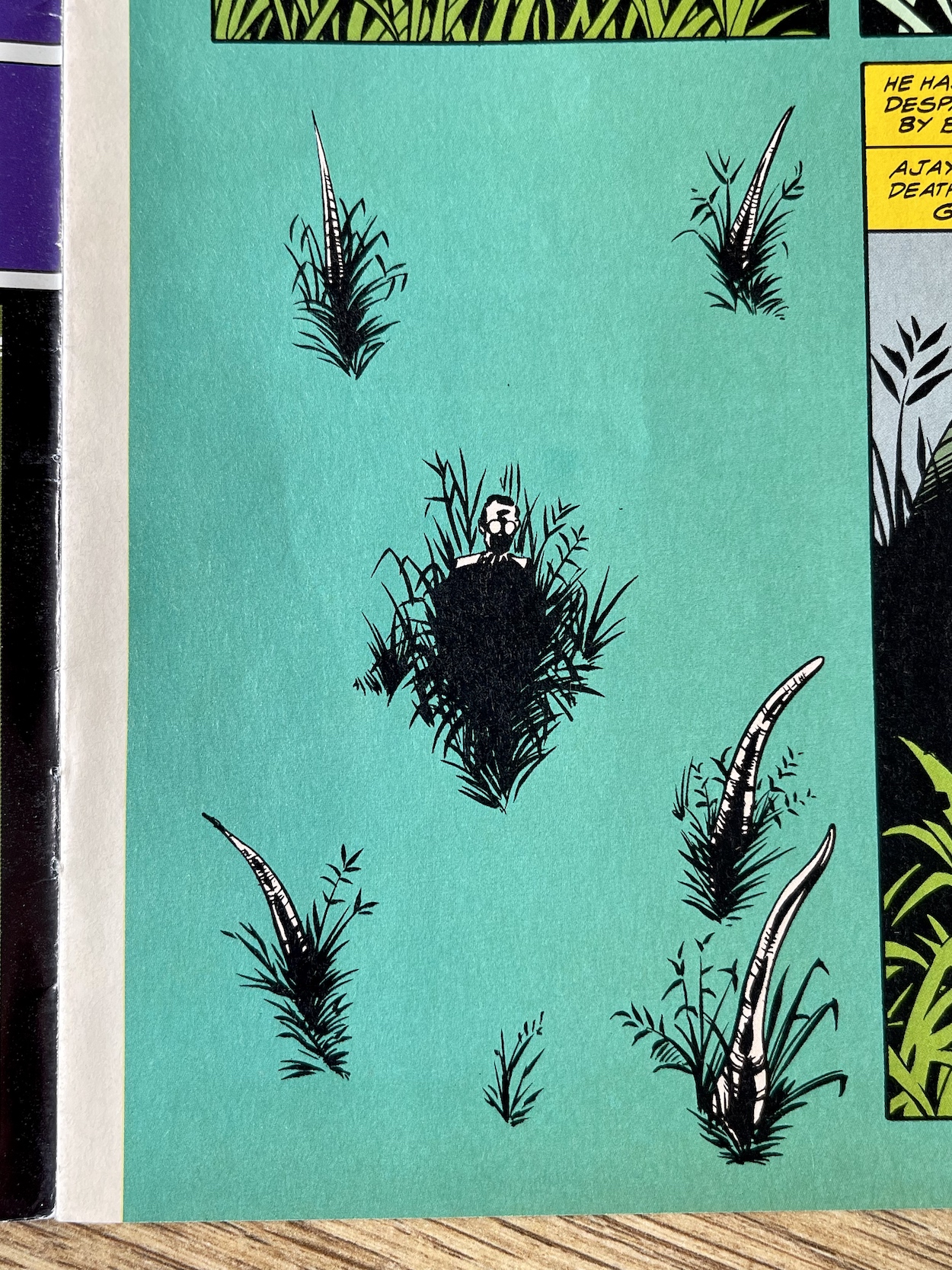
That scene of the Velociraptors in the long grass would make no sense if you hadn’t seen the film, characters no longer look like their onscreen counterparts and the gloriously detailed dinosaurs from the first couple of chapters give way to cartoonish monsters. The final chapter of Jurassic Park’s adaptation suffered the same fate and it would seem no one learned any lessons from it in the three years since.

I know I’m coming across as very negative and usually I only include comics on the blog that I enjoy; I like to keep this as a positive reading experience. The original Jurassic Park comic was awesome, I loved it and it holds a special place in my heart. It’s the whole reason there’s a section for JP on the blog in the first place. This mini-series is very much an extra aside to that, I don’t think I would’ve included this on its own. It’s a crying shame because I love the movie so much.

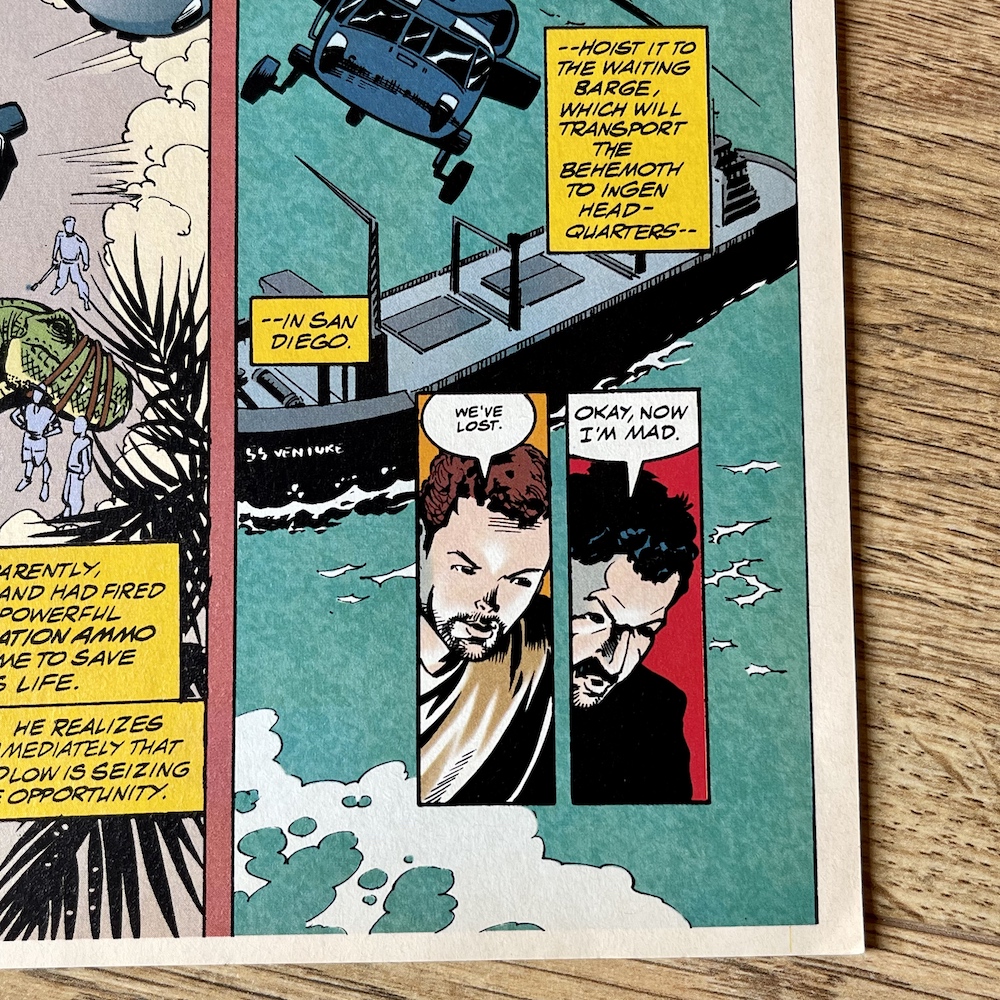
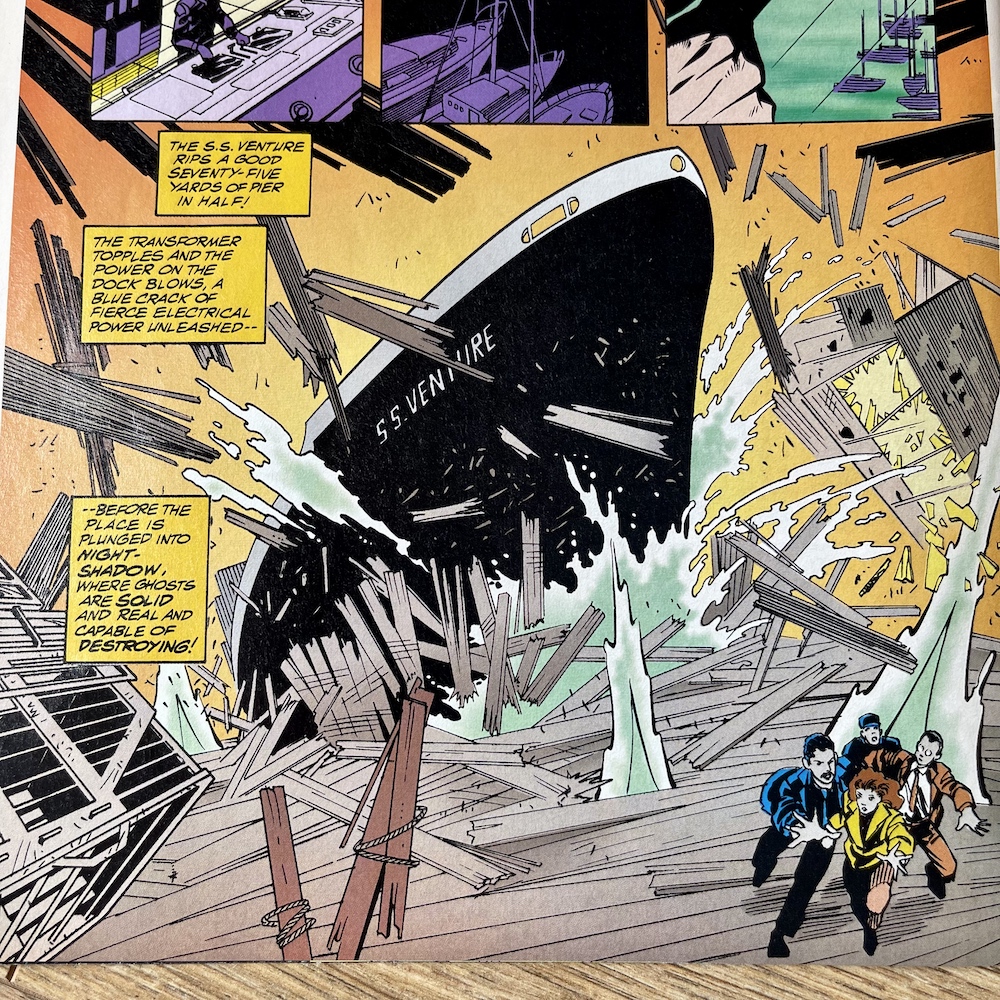
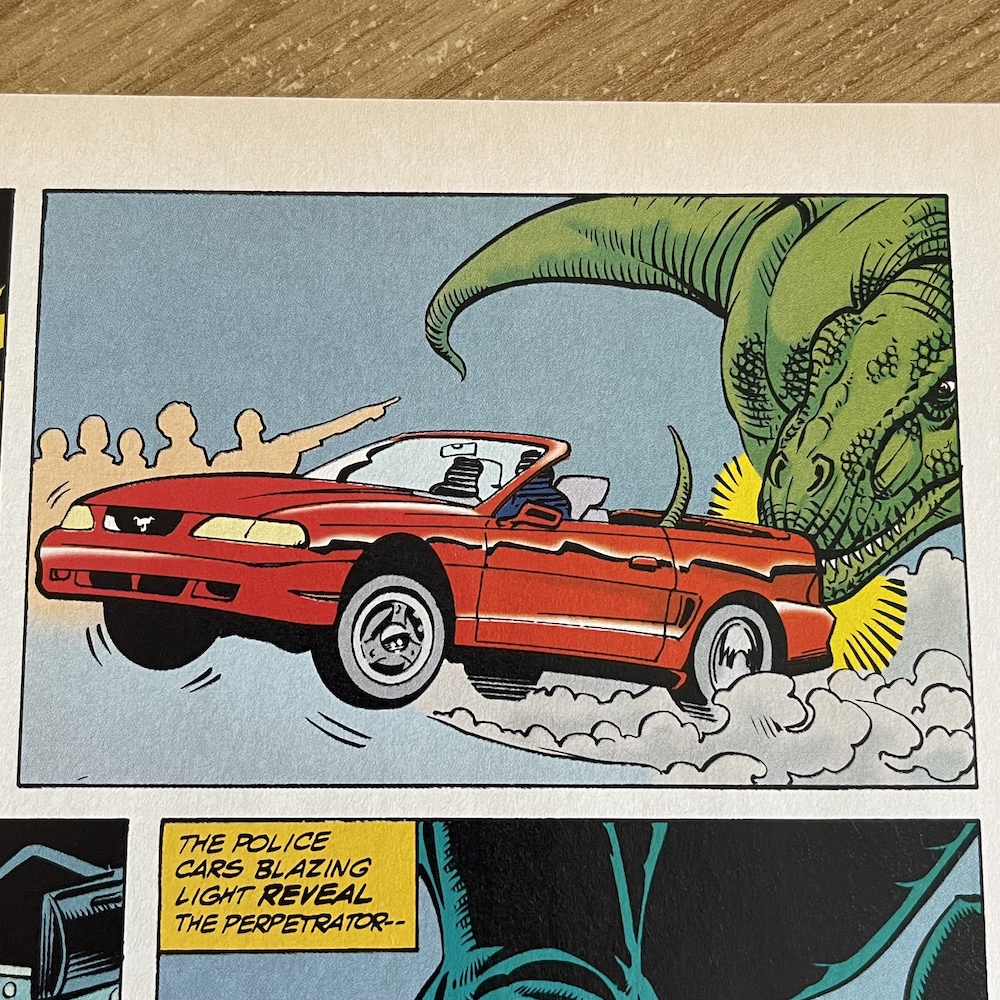
Towards the end of the story 11 pages are given over to the San Diego scenes, albeit a bare bones version of them. The panel above of the S.S. Venture crashing into the docks is about as detailed a panel as you’ll find in this final chunk of story. You wouldn’t even know any of this was taking place in a city because the backgrounds just don’t exist beyond one panel. Other than there being a sporty car involved this could all be happening back on Isla Sorna.

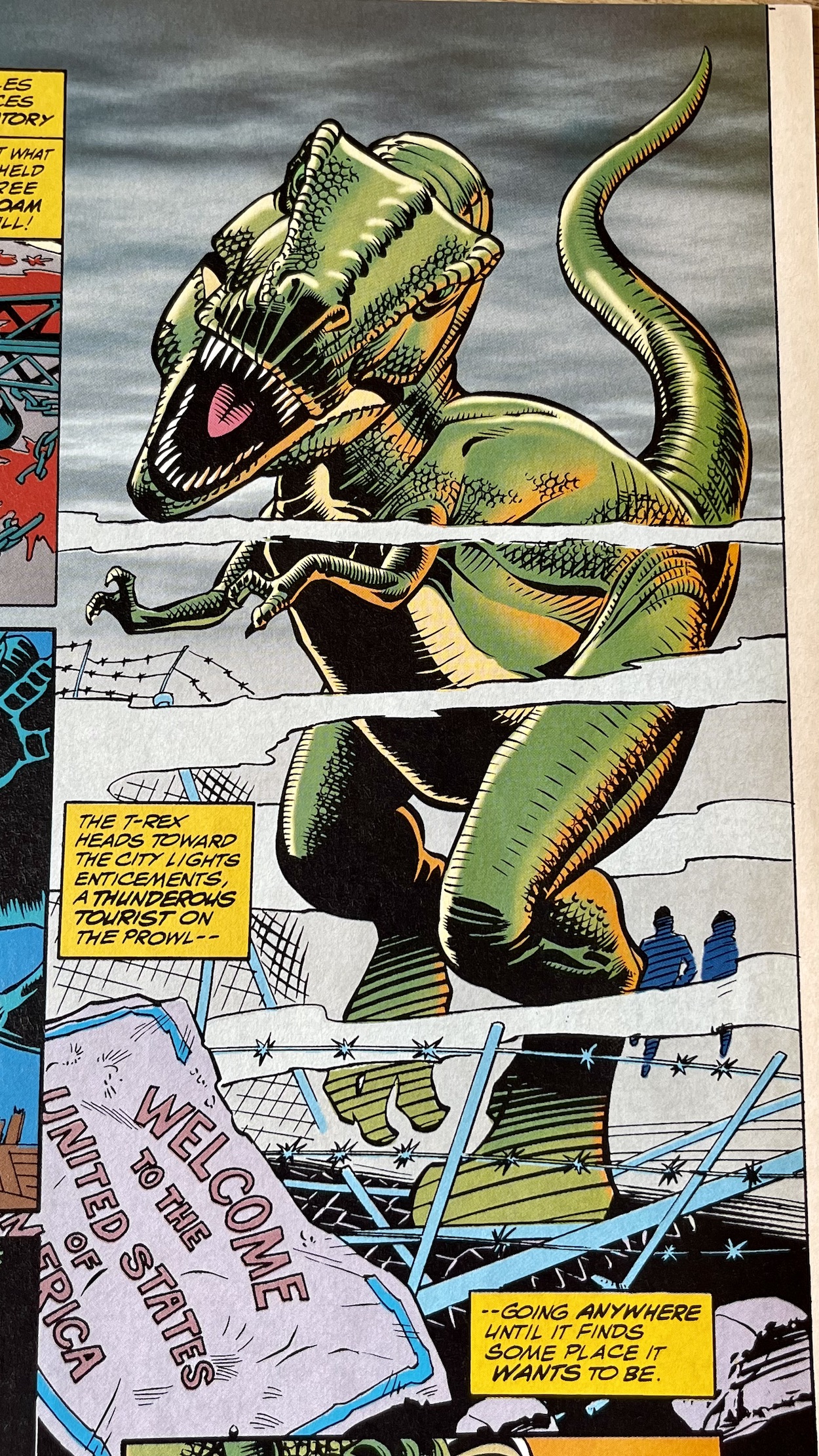
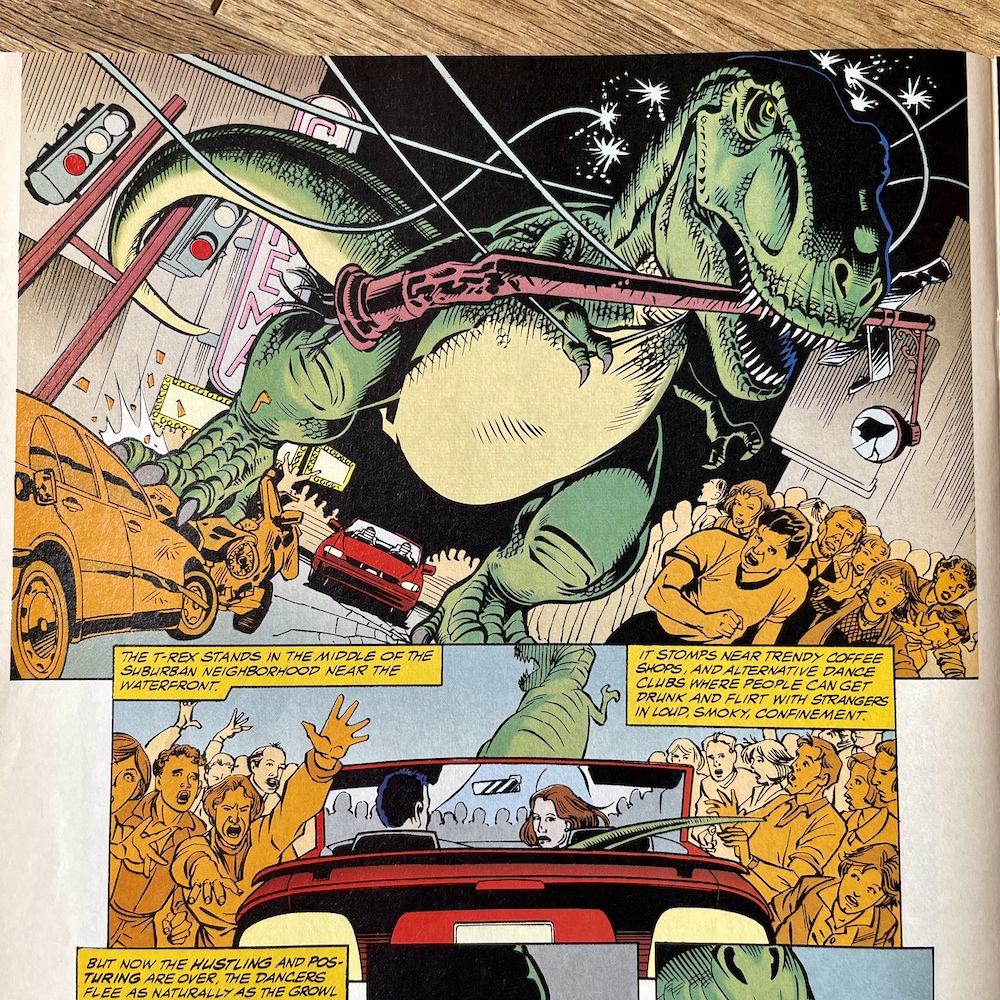
Below you’ll see the one and only panel that shows some hurriedly drawn buildings and the word “cinema” visible behind the T-rex’s tail. Next to it is a panel I’ll use to sum up these eleven pages. Look at the panel with the car. There are no backgrounds, not even a road! Storywise, we get the ‘rex leaving the ship, discovering Ian and Sarah have his baby, then we’re back at the dock. That’s it.

Thinking back to when I first saw this film in the theatre, the moment we saw the InGen helicopter and the camera panned down to show it was flying over a city was a real shock to the system. It was so unexpected from a Jurassic Park film (I hadn’t watched any trailers before seeing it) and as surprise endings go it’s right up there for me. There was so much to enjoy about it which is why its treatment here is so underwhelming.


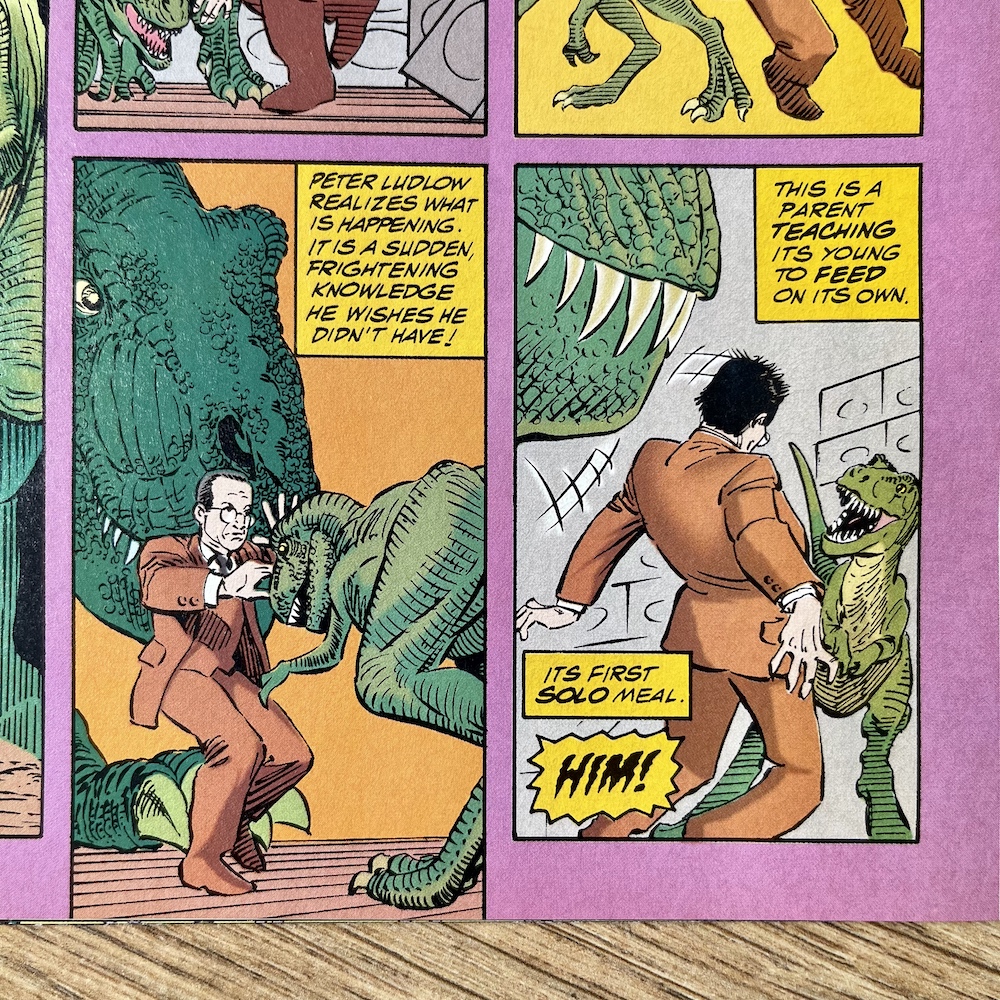
“This is a parent teaching its young to feed on its own”

Narrative caption, Don McGregor

Surprisingly Peter Ludlow’s final scene gets three pages to play out fully. One of the most satisfying endings for a villain character, it pretty much happens as it does in the movie, even if the backgrounds are still conspicuously absent. To anyone unfamiliar, this is back on the boat now, Ian and Sarah having lured the adult back into the cargo hold by placing the baby there and then jumping overboard themselves, before climbing back on from the other side of the ship, ready to close the bay doors when the T-rex enters.

From Ian and Kelly to the adult and baby Tyrannosaurs, the theme of The Lost World Jurassic Park movie was one of family and parental instincts. Sarah is even an expert on archeological parental behaviours just to hammer the point home. Personally, more than any other film in the series this one showed the dinosaurs as complex characters in their own right, a far cry from how they’d been described before this franchise. But anyway, Ludlow is about to get eaten.

I’m glad this moment wasn’t cut because it shows the adult teaching the baby and it’s a particularly chilling moment in the film, even if it elicits a dark grin from the audience. Given how much has been left out these past two months it might seem like an odd moment for anyone reading who hadn’t seen the film and all of its moments between the Tyrannosaur family members, but for those reading this as a way of filling the gap before the home video release it would bring back memories of that scene really well.

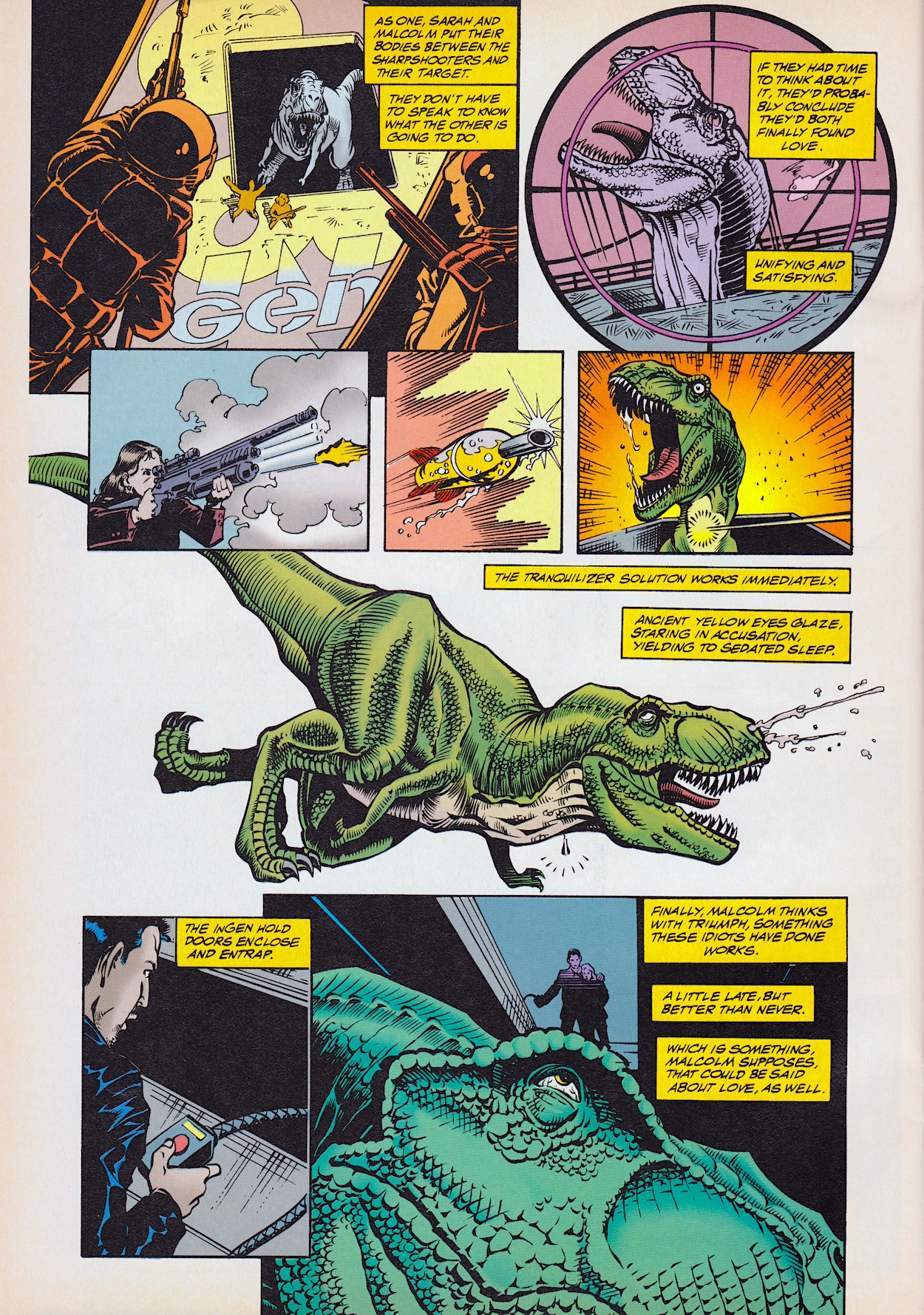
After all of my complaints about the lacklustre art in this final issue we finally get a moment that matches the potential those first couple of chapters had. As the InGen helicopter circles overhead trying to get a good shot to kill the ‘rex, Sarah shoots the tranquilliser dart first and we get this page with a particularly fantastic, expressive, dramatic panel when the dart strikes.

I look back at those first two chapters and the gloriously detailed scenes in the jungle with the Stegosaurus family and I can’t help but wonder what this series could’ve at least looked like, even if the script was still a shadow of the film. What if we’d had that early level of detail coupled with the dynamism of the page above? What an impact it could’ve made. The art team was definitely up to the task but it seems deadlines and a rushed story hindered them in the end.

Don’t get me wrong, I understand the task of taming a beast of a movie script down to four comics was monumental and I found Don’s explanations in a previous issue fascinating but in the end I think he boiled it down too much to the maths. I’ll get back to that in a little bit further down this review but let’s finish things off with the final page of the strip. Happily, Richard Attenborough’s beautiful John Hammond speech remains mostly intact, as does that famous Jurassic Park line first uttered by Jeff Goldblum’s Ian.

As you can see detail in anything other than the few dinosaurs in the immediate foreground is minimal and when you contrast this with #1 the difference is stark. My final thoughts on the comic strip itself in just a moment. First up though are the extras editor John Freeman and his team assembled, some of which have definitely been the highlights in previous issues.

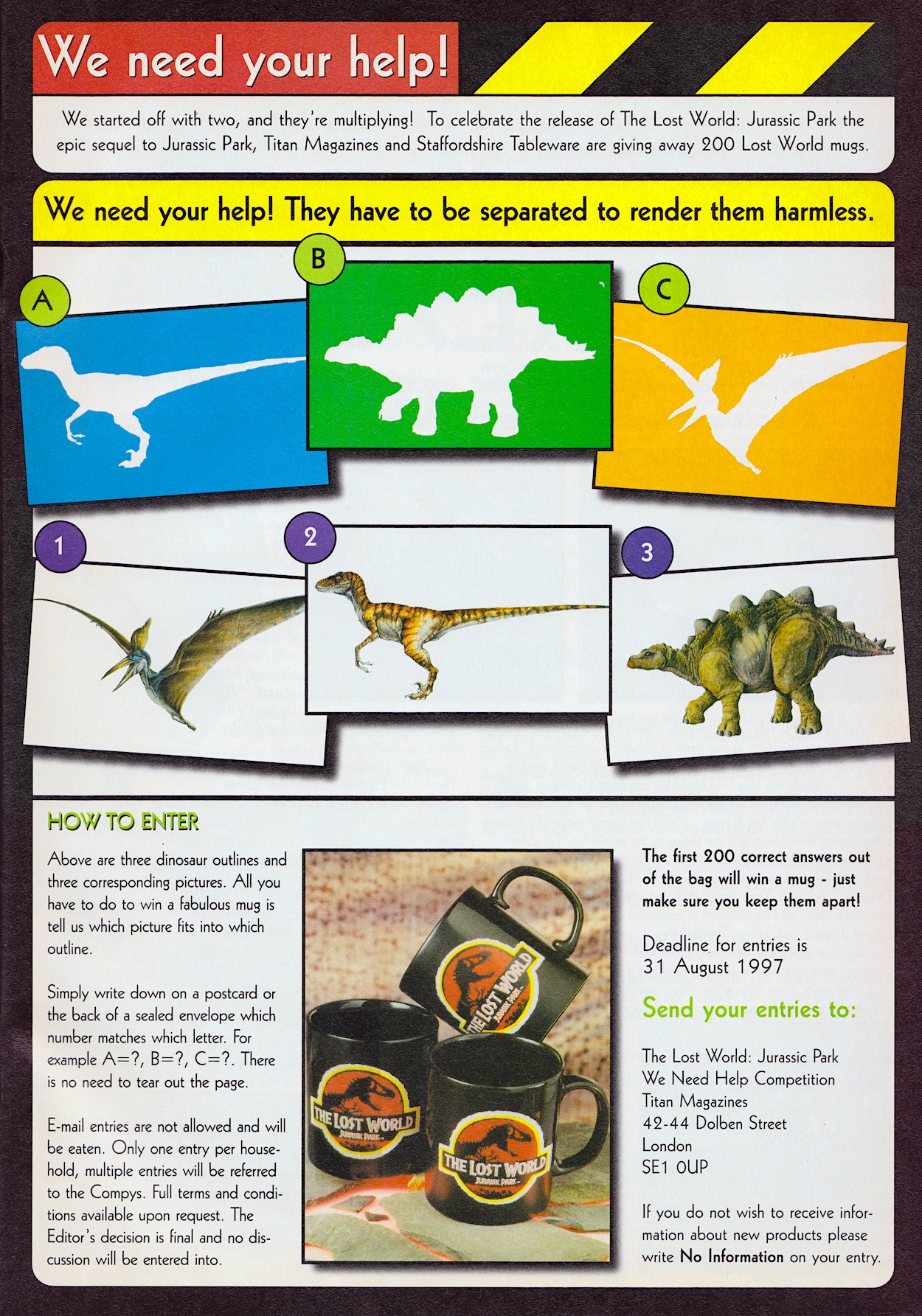
First up is a competition to win a mug with the logo of the film on it. Not the most exciting of prizes, you’d expect this to be a runner up prize, but then again the original comic gave away a large variety of swag, everything from a simple set of glow-in-the-dark stickers to actual Sega Mega CD systems. So if this had been an ongoing comic I’m sure the same would’ve applied to future competitions, and at the end of the day I’d still like that mug!

The competition itself is somewhat easy though, right? Upon first glance I thought it’d be a case of naming the dinosaurs, with the ones in silhouette form being the trickier ones, but actually it’s just a matter of matching them to the pictures in the next row. I remember competitions and quiz pages like that in my old Thomas the Tank Engine & Friends comics as a child and it seems very out of place for the target audience of a Jurassic Park title.

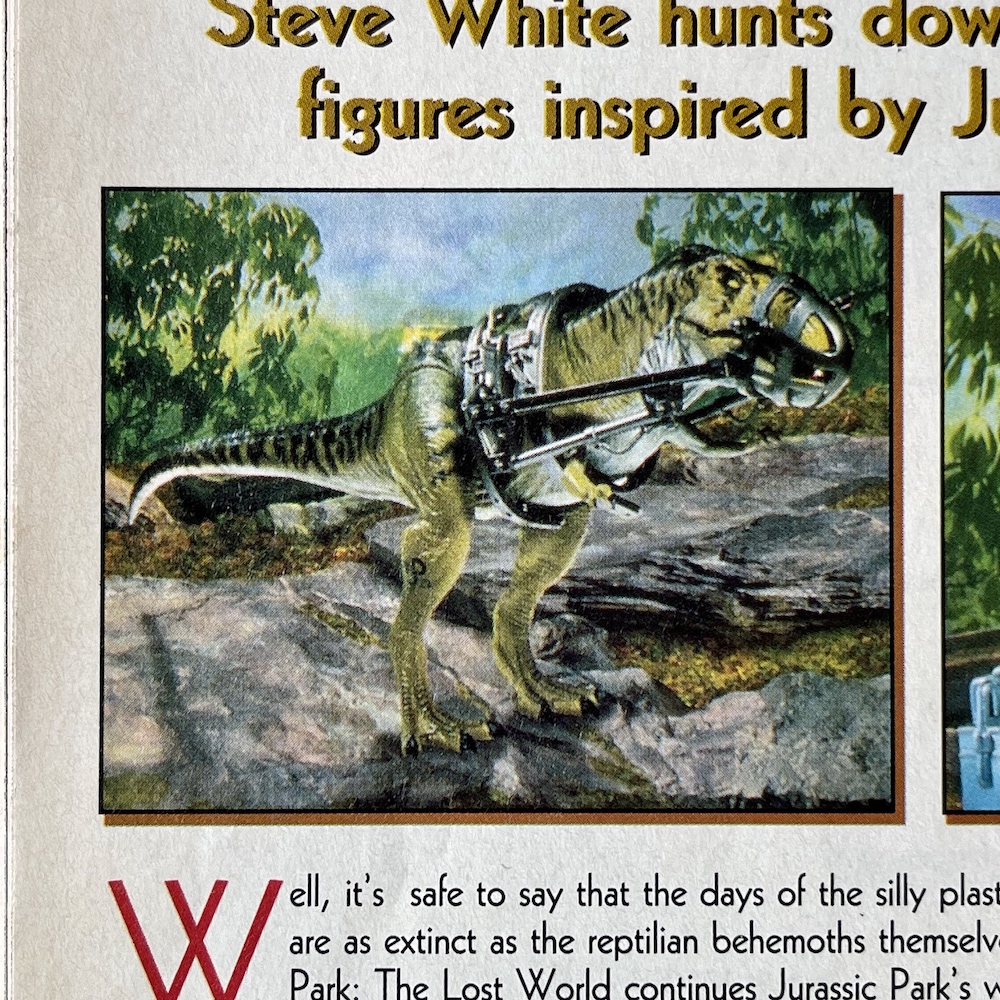
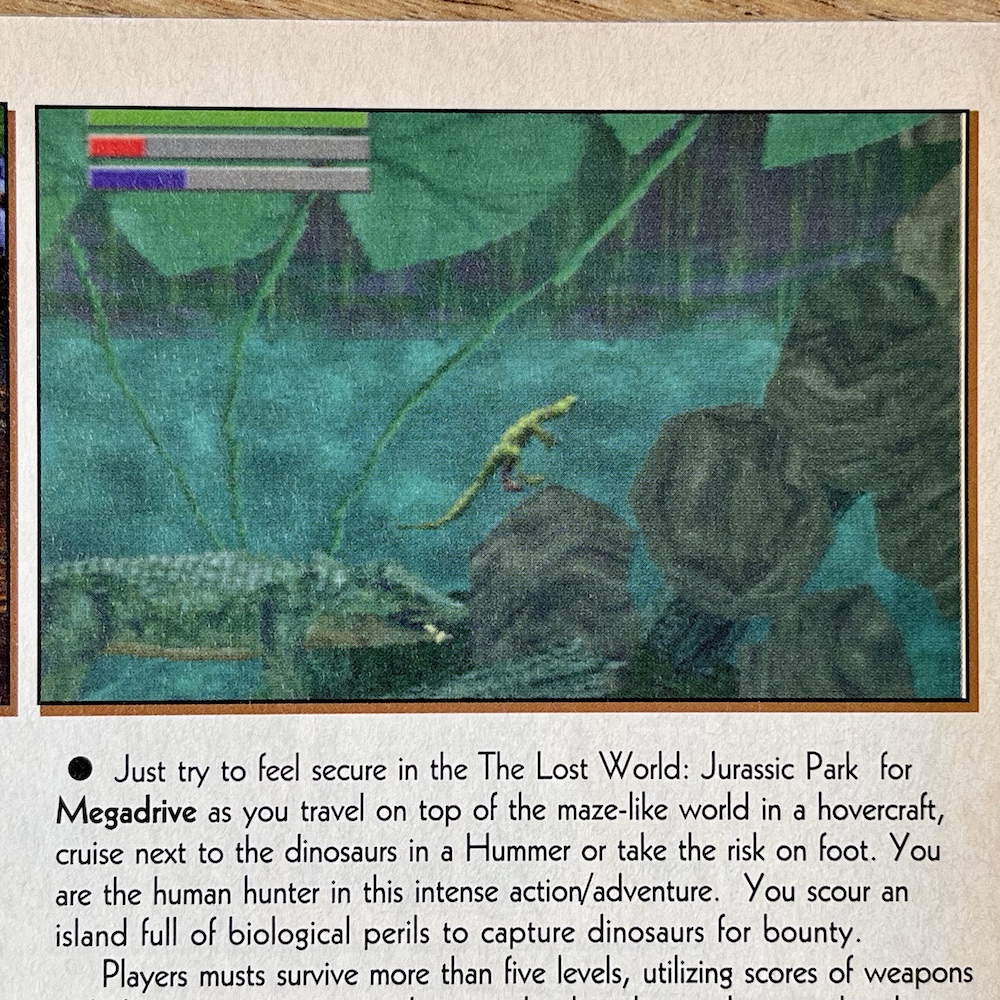
There are a wonderful couple of pages detailing a selection of the merchandise released to tie in with the hottest film of the summer of 1997. There are some action figures of the dinosaurs shown, including a T-rex apparently engaging in a spot of S&M and mention of a figure of Ian with a jet pack! Really? Sadly no pictures of that one. Of more interest to this retro gamer are screenshots of some of the videogame releases of that year.

My friends laughed as I jumped and slid about the seat in reaction to the dinosaurs

The first image shown is from the arcade game, where players would sit inside a mock jeep with tranquilliser guns and on the screen was a fast-moving on-rails shooter with graphics that were mind-blowing for the time. I’ve played this one. A local ten-pin bowling alley had it for a few years in the late 90s and early 00s, and I have distinct memories of my friends laughing as I jumped and slid about the seat in reaction to what was happening while another friend sat quietly shooting at the dinosaurs.

There are also screenshots from the platform game available on the Sega Mega Drive and the 3D game (that was a new thing at the time) for the Sega Saturn and the new Sony Playstation. Sadly there’s no mention of the Nintendo GameBoy Lost World game. I had a GameBoy in the 90s and adored the game of the first film which was also a competition prize in the original comic. (There just might be more about that on the blog later this year.)

The Script to Strip article from #2 gets a second part here, although it’s a lot smaller and features less information. It would also have been a lot more interesting if the correct page of the movie script had been used in the comparison on the left. It does give a decent insight into the ‘Roar’ page from #3 though. It even mentions in Don’s original pages how the characters were meant to react to the sound, but in the finished page they did not.

A quick personal note: That T-rex in the bottom-right is actually a version of the cover from my very first Jurassic Park comic as a teen.

This is the perfect point to reflect on the entire strip. I’ve said all along there have been moments of potential; the early art was fantastic and #2 was a vast improvement over #1 in terms of adapting the film to the medium. However, towards the end the art definitely suffered. I’m making an assumption here, I know, but it could’ve been due to tight deadlines towards the end to ensure it was released in America at the same time as the film. I also think Don’s articles have unintentionally summed up what went wrong, for me anyway.

Some lovely art and some fun extras have made this comic mini-series worth reading and the completist will definitely find those elements enjoyable

In part one of Script to Strip Don talked about the amount of pages David Koepp’s movie script had compared to how many the comic would have in total to tell the same story, and he explained how many pages of it he’d have to squeeze into each comic page. Now, after reading the whole story it feels like it was more about solving the problem by logic rather than creatively. The first chapter in particular of the original Jurassic Park adaptation showed how to include as much of the movie as possible while being very aware it’s a different medium, using imaginative ways to swap scenes or retell them in a new way. It felt like the film but it was different. A bit like adapting a novel into a movie you could say.

Towards the end though it felt like a checklist was being ticked off as it rushed from one scene to the next, paying lip service to moments the reader would remember from the film. With the sequel, in breaking everything down mathematically as Don did it’s felt like that throughout all four chapters, with some glimmers of the (that word again) potential here and there, which just made it all the more frustrating, knowing this team was capable of so much more.

So here we are at the final page of the final issue of The Lost World Jurassic Park which mentions a third novel by Michael Crichton. While there’s the occasional mention of such a thing on fan sites there’s nothing official anywhere to state he actually started it. Instead, Jurassic Park III and specifically Jurassic World would pull a lot from the two released novels. The rest of this page takes me back to all of the discussions at the time about DNA cloning and I can remember teenage me being very excited by documentaries and such on the subject.

So that’s us. Some lovely art in the earlier issues and some fun extras have made this mini-series worth reading and the completist will definitely find those elements enjoyable, just don’t expect anything ground breaking from yet another movie-to-comic adaptation. I do want to go and watch the movie again though! Remember, all 16 issues of the original comic, including the first official Jurassic Park sequel, have been reviewed and I’ll be returning to that series with the graphic novel collections of the rest of that story, which we never saw printed in the UK at the time, so I’ve never read them!

Definitely something to look forward to there. In the meantime, remember… “don’t go into the long grass”.

BACK TO iSSUE THREE

JURASSiC PARK MENU

THE LOST WORLD JURASSiC PARK #3: TRiMMiNG DOWN THE T-REX

We’re already at the halfway point in this little mini-series adaptation of The Lost World Jurassic Park. The first issue fell into the traps of many a movie adaptation but part two improved things somewhat. It wasn’t perfect, but those improvements and the article from writer Don McGregor about the size of the task at hand gave me high hopes for what was to come. So how has our third edition panned out? Ignoring that annoying “Free” poster bit on the cover (see last issue for more on that) let’s get stuck in and find out.

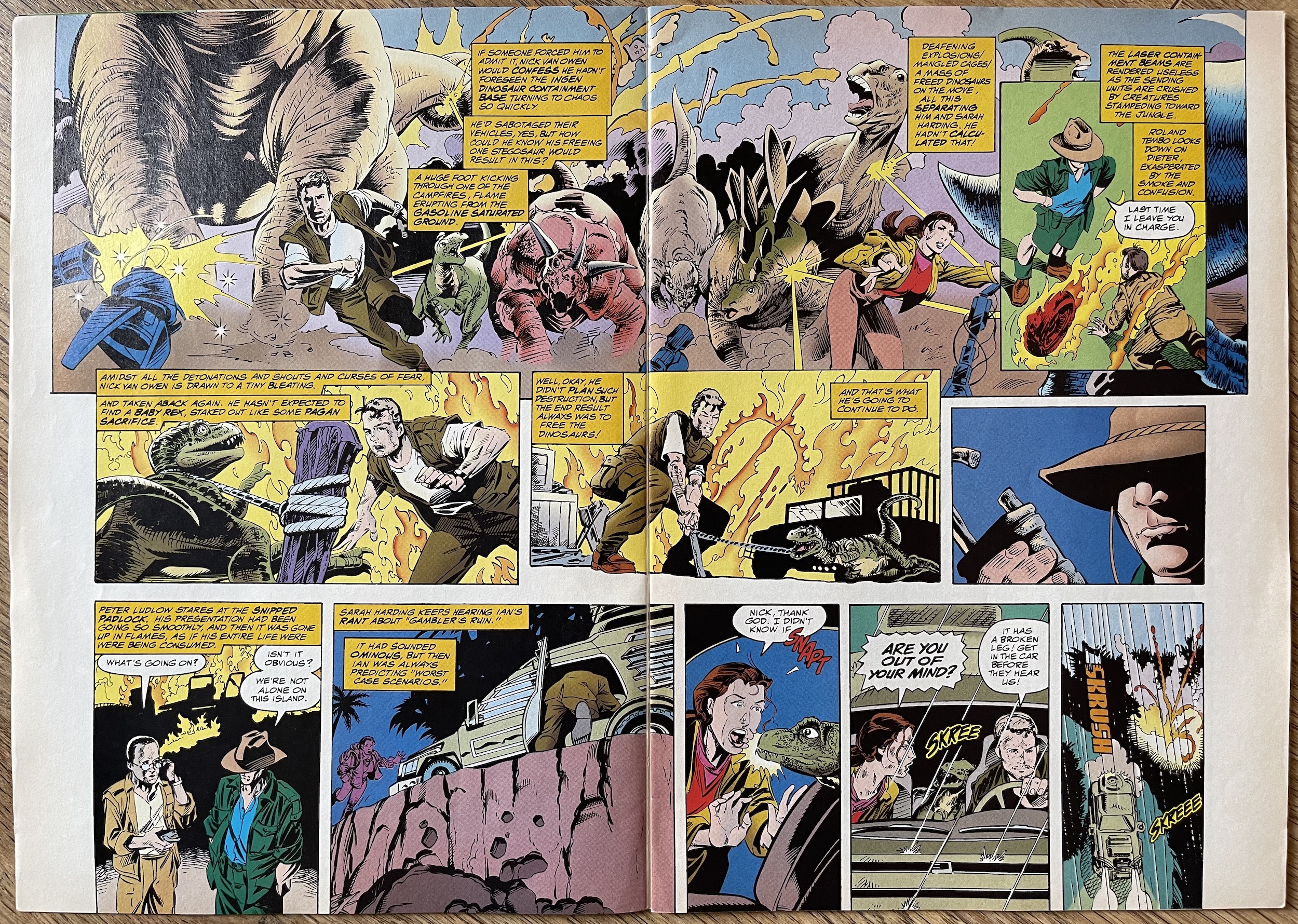
We left things a fortnight ago with the Triceratops smashing its way through Peter Ludlow’s presentation tent after Nick Van Owen had freed the dinosaurs, and right at the beginning of this chapter we see a spectacular scene of them all running from the camp back into the wild. In the movie we saw this from the perspective of the humans as the animals fled all around them, but here I particularly like the grander scale this first panel brings, and that’s not something you can often say about a comic adaptation.

Upon further inspection though, how on Earth did the Ingen hunters possibly capture and contain that giant dinosaur on the left? If we go by the previous movie this would have to be a Brachiosaurus. I’d love to have seen the cage they kept that in! The rest of the page instantly contradicts not only the film but even its own previous issue, where it had correctly shown the baby Tyrannosaurus rex captured by Roland and Ajay tied up away from the camp. Here, miraculously he’s now right where the chaos is, ready for Nick to easily rescue.

The next page is printed in landscape format and once you realise what’s going on it makes for a wonderful idea

In fact, the page before this spread showed Roland and Ajay’s last second escape as a fiery jeep flew through the air and crashed onto the tree they were hiding in awaiting the adult Tyrannosaur, so really this is contradicting the very same issue! I’ve no idea why Don felt the need to do this. In the film we didn’t see Nick grab the baby, he appeared a little while later from a river nearby holding him in his arms.

The next page is printed in landscape format and once you realise what’s going on it makes for a wonderful idea and is brought to the page brilliantly by penciller Jeff Butler, inker Armando Gil, letterer Ken Lopez and editor and colourist Renée Witterstaetter. I know this film like the back of my hand so I know that while Dr Ian Malcolm, Eddie Carr and Ian’s daughter Kelly are in the High Hide at the upper tree level there’s a distant roar, the trees below shake and the stomps of both T-rex adults can be heard moving beneath them. However, despite this dramatic page, none of that is clear.

While it’s unlikely many would be reading this before watching the film (although I do recall my friends and I reading the adaptation for one of the Turtles films before we saw it), most readers will have only seen it once in the cinema by this stage. It would actually have still been playing in theatres when this was out. They’d be reading this to relive the story and as dramatic as that ‘ROAR!’ is on the page I’m not sure readers would’ve noticed it, instead possibly thinking it was just a unique set of panels to reinforce the moment. The characters not acknowledging the roar or any movement below doesn’t help either, making Ian’s decision feel decidedly random.

This of course leads to arguably the most terrifying sequence in the whole movie and one that had us on the edge of our seats in the cinema. Here it’s cut down, as it needs to be for reasons Don laid out last time, but the scale of the scaling back is quite shocking. When the adults arrive Ian simply danders out with the baby into the middle of the clearing instead of the tense moment by the door. He’s completely vulnerable but there’s no tension in his action. He’s even singing!

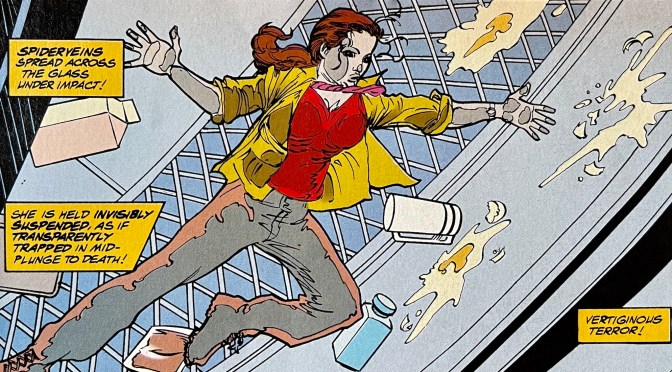
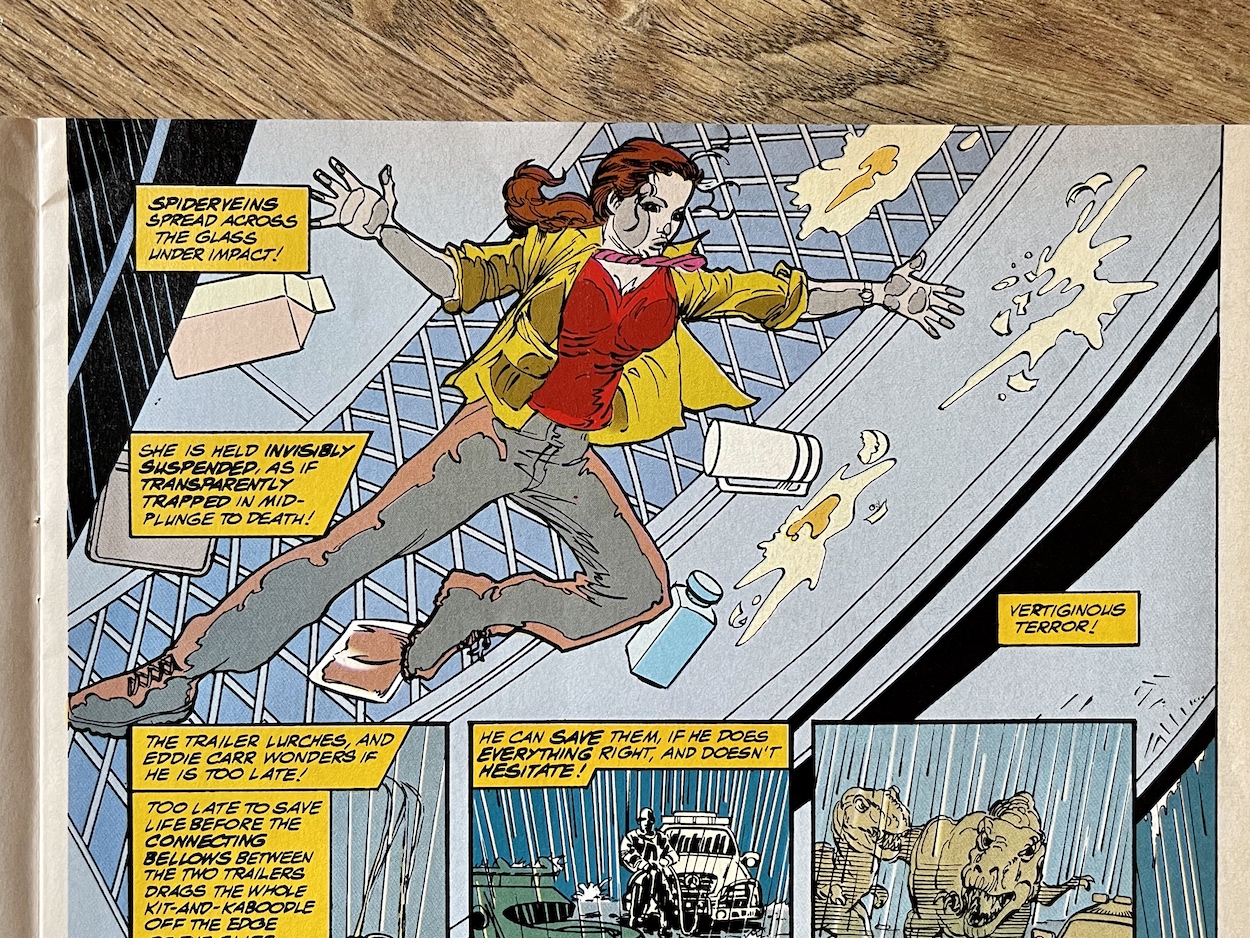
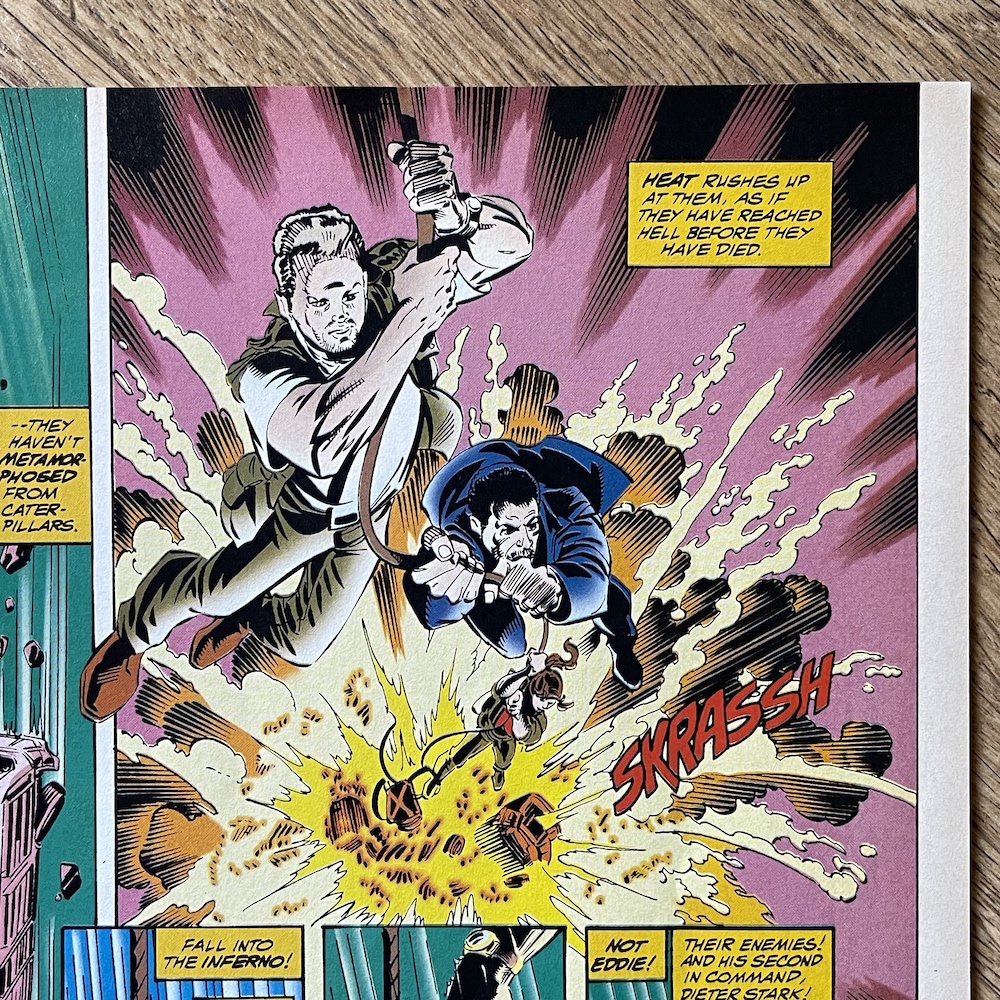
The next part of this scene is of course the moment when the two-part research vehicle is partly pushed over the cliff by the dinosaurs and while Eddie struggles to stop it from falling by winching it with his car he’s also trying to pull his friends up with a hand rope at the same time, and Dr Sarah Harding is on that slowly cracking pane of glass at the rear of the dangling half, looking right down the cliff towards the crashing waves far below. It’s all wonderfully tense.

Unfortunately one of the very best scenes in the film is reduced to a couple of pages. I did understand where Don was coming from in his article last issue but as I said in that review I don’t think he’s got the balance right; you’d think one of the biggest, most memorable moments would get a lot more space to breathe. Take the most basic key points of these ten minutes in the film (Sarah on glass, Eddie’s death, characters clinging to ropes as the transport falls) and eliminate everything else, that seems to be what the plan was.

There’s some fun art though.

I’m not sure if the narration is taken from the book or the draft script but it feels like it’s trying too hard, as if it’s attempting to make up for all of the missing bits. Not only is most of the action just not here anymore but the characters have absolutely no sense of fear about them, like they’re just going from one inconvenience to the next. Some lip service is played to Sarah’s fear of heights (something the film left out) but it’s not built upon.

I do love the art in the scene though, especially how it perfectly captures the invisible sheet of glass beneath Sarah. However the spider veins mentioned are conspicuously missing, and this won’t be the last time something like this happens which I’ll get to in a bit. Eddie’s whole ordeal trying to survive the T-rex attack is just not here but at least his end isn’t censored like the original movie’s adaptation would do. The final moment of the scene is also captured well here. The art is definitely the main thing driving me forward at this point. That and the great photography and extras.

The poster is a wonderful photo of one of the Velociraptors and I’m positive it would’ve been on my wall if I’d known about this comic at the time, showing off the gorgeous yet terrifying animatronic and the darker tone of this sequel. On the back of this is another dinosaur fact file with its terrible design once more not doing justice to Steve White’s interesting writing.

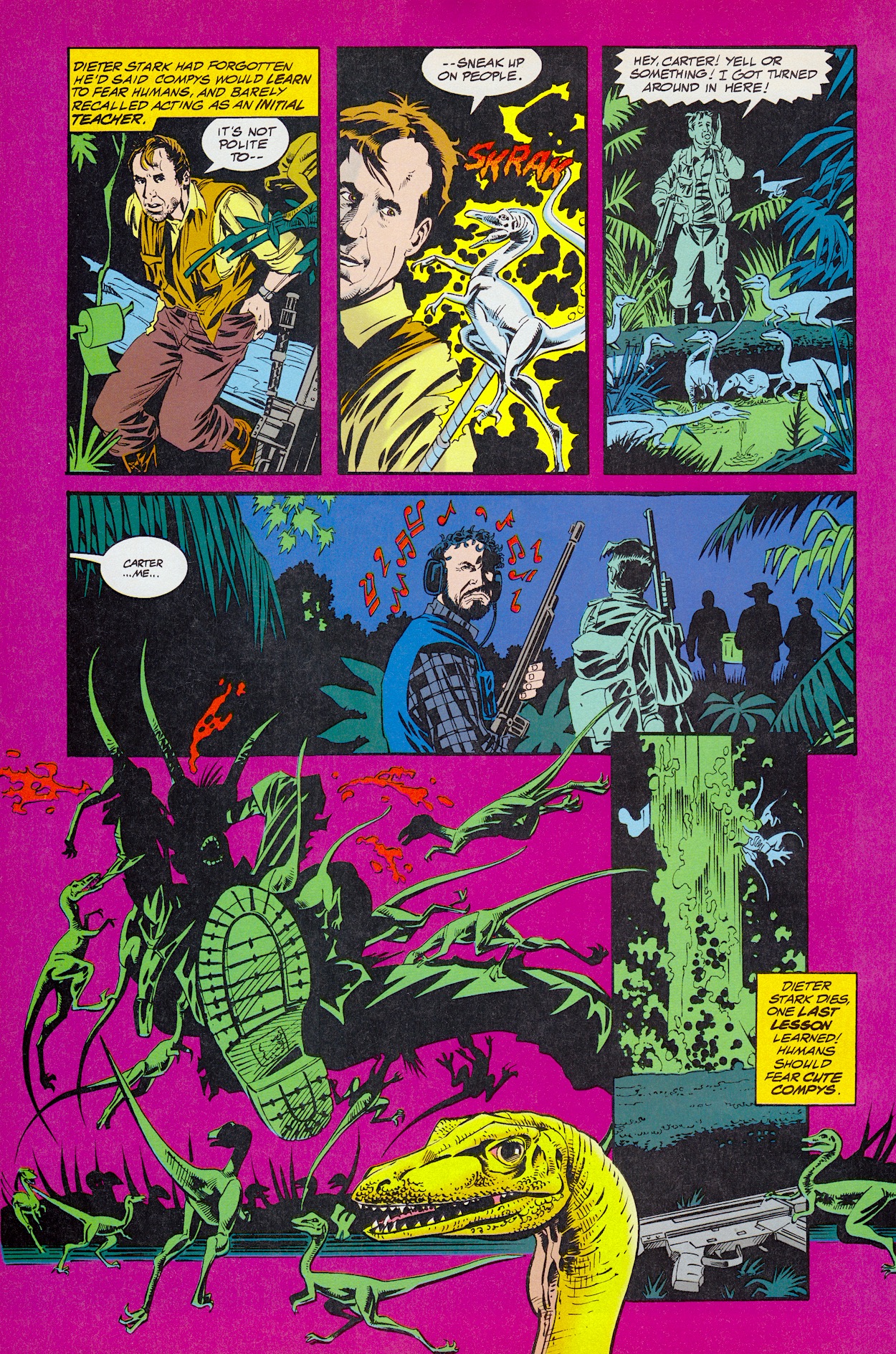
Back to the final pages of the strip which cover two large parts of the story and unfortunately after the promise of last issue it seems we’re back to rushing through the movie again just to get it over and done with. Dieter Stark is Roland’s second-in-command and his death in the film by the cute little Compsognathus pack may be rushed (with a sequence that’s just confusing for anyone not that familiar with the film) but I’m including it to show the two extremes of this strip; the rushed nature but the potential in the art (especially when you see the panel of his actual death).

I feel the beginning of that sequence can only really be followed if you’ve seen the movie and are familiar with the individual elements of how this transpired. Elsewhere we get some added character moments which again may have originally been in the earlier script, like some tender moments between Ian, Sarah and Kelly before we get to the T-rex pair catching up with our sleeping group. There’s a particular moment here in the movie which truly frightened me with its slow build up and drawn out danger for two of our characters. The suspense was a killer! Here it’s all reduced to one single, solitary panel that completely changes this to a game of peekaboo.

Something else missing is Ian’s moustache! From comments on social media after I posted the first two reviews this apparent inconsistency seems to have particularly irked some people when they read the comic, but for me it’s not really a big deal. It’s still kind of there, it’s now just part of a rough unshaven goatee area like Jeff Goldblum sported in the film. It could be it was decided Jeff wouldn’t sport a moustache after the first two parts of the comic were already drawn. Story wise, I’m happy enough to think that it’s all started to grow out again while he’s been stuck on the island for a few days. Either way, it looks much better now.

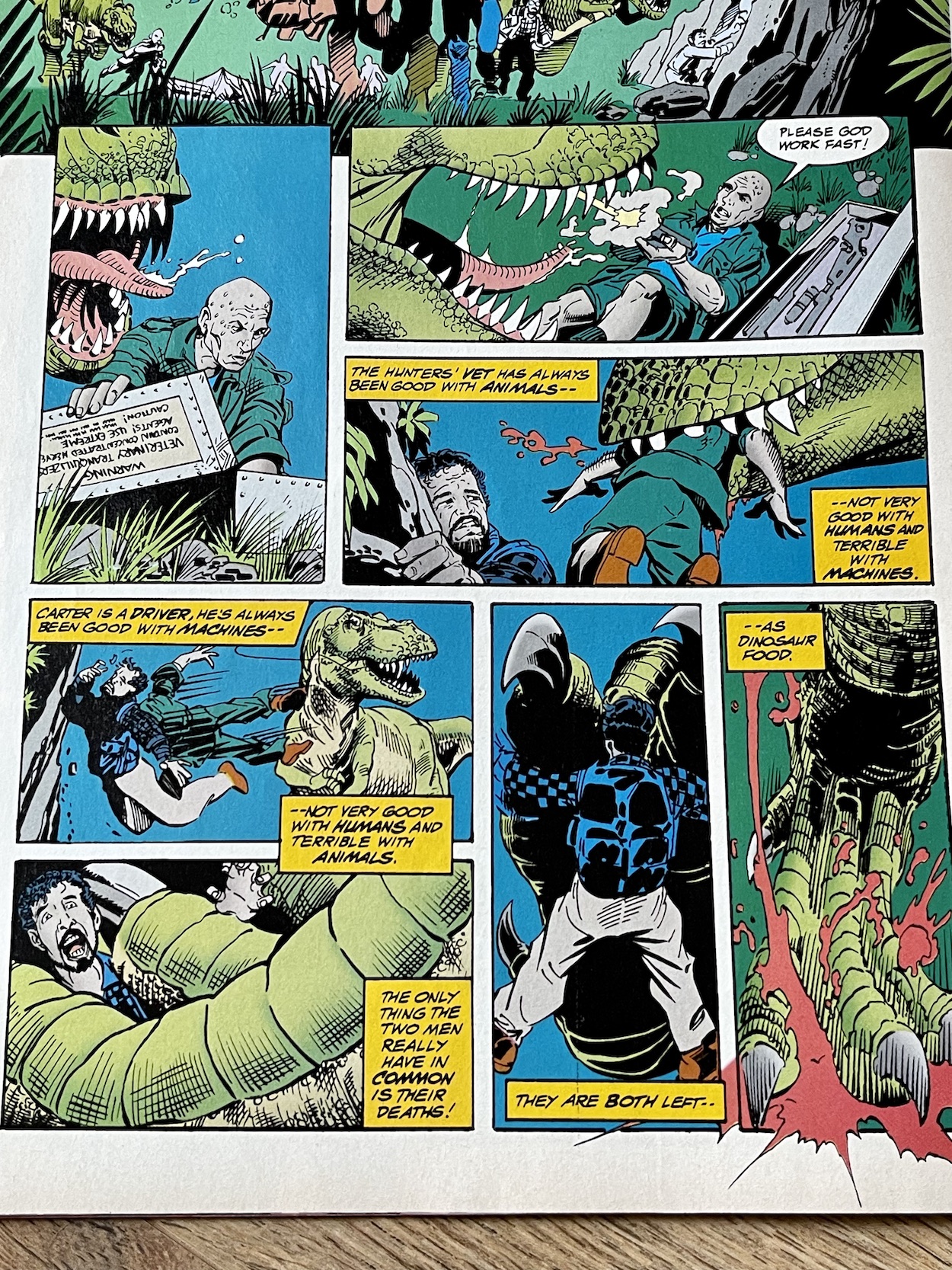
After the small additional character scene I mentioned we get a huge change from the film a few pages later when Roland Tempo, played brilliantly by Pete Postlethwaite in the film, is killed by the huge Tyrannosaurus buck! After finding his shotgun has been filled with blanks by Nick he reaches for the tranquillisers. So far, so familiar. But unlike in the film when the T-rex succumbs to it just in the knick of time, here he grabs Roland and throws him towards Carter, the man who gets trampled to death in the film.

This is one change I really don’t like. Roland was one of the best characters in the film and since he’s now dead we no longer get to see his solemn redemption later after Ajay’s death, when he tells Ludlow he’s seen quite enough death instead of accepting a job at InGen. The hunter became rather Ian-like in the end and accepting of his part in the inevitable chaos. This will all now be missing. If this was in the script Don was working from then I’m very, very glad screenwriter David Koepp and Steven Spielberg changed this character’s arc.

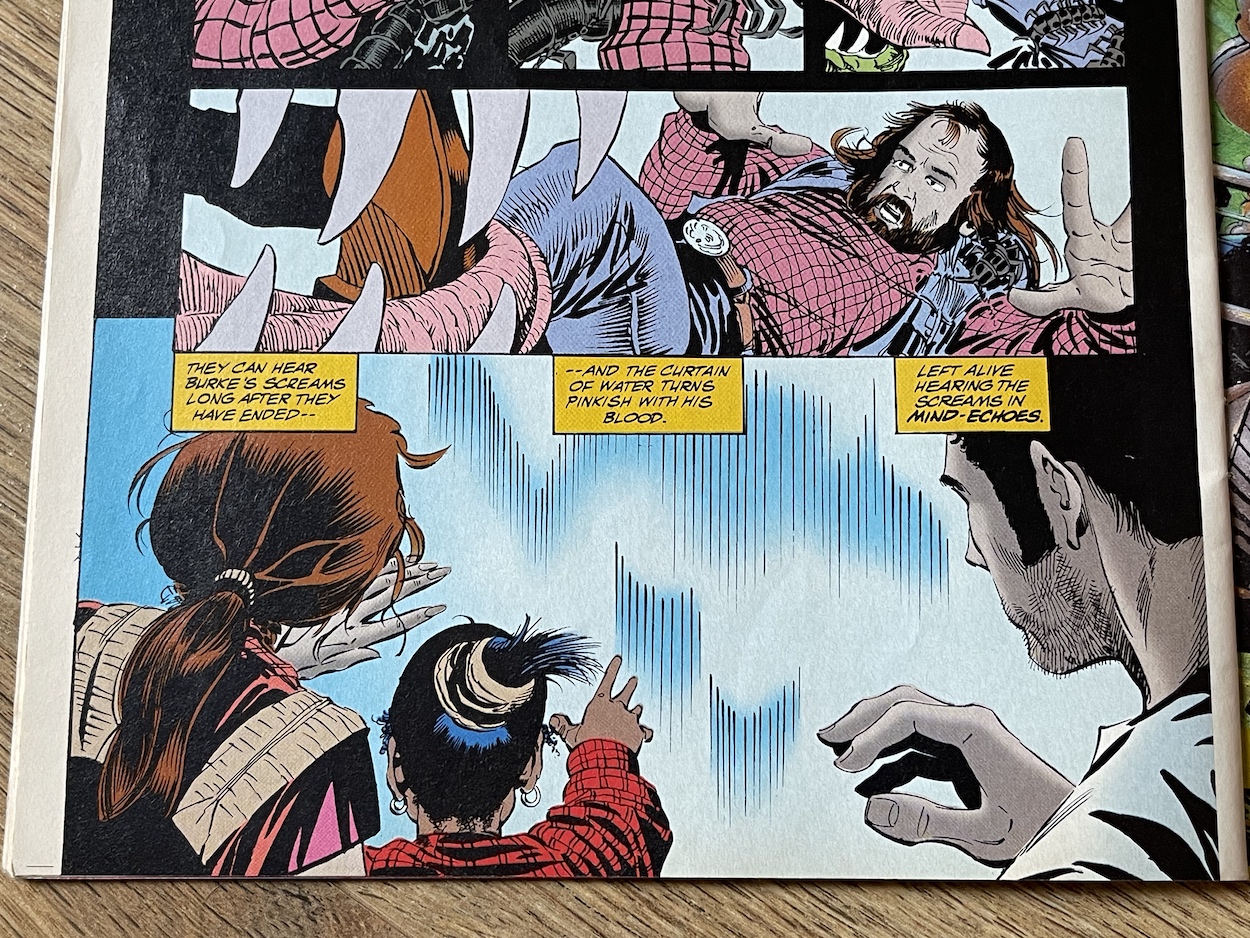
The penultimate chapter of the adaptation ends with our main characters trapped behind the waterfall (in a scene from the first Jurassic Park novel and depicted by Walter Simonson and Richard Cry on the cover) as Roland’s palaeontologist Dr. Robert Burke is grabbed by one of the T-rexes and dragged out. Just like the spider veins mentioned when Sarah was in danger, the curtain of blood described here is nowhere to be seen, somewhat dampening the moment.

Chapter three has certainly been a mixed bag then. I liked some of the extra character scenes but hated the death of another, although to be fair to Don that wasn’t his fault. Some of the very best moments of the film, (some of my favourite moments in cinema, period) were so rushed here they were barely recognisable, and the fun art has been on top form at times with some great images but plagued by inconsistencies elsewhere. I come away frustrated more than anything because of what this talented team could’ve created.

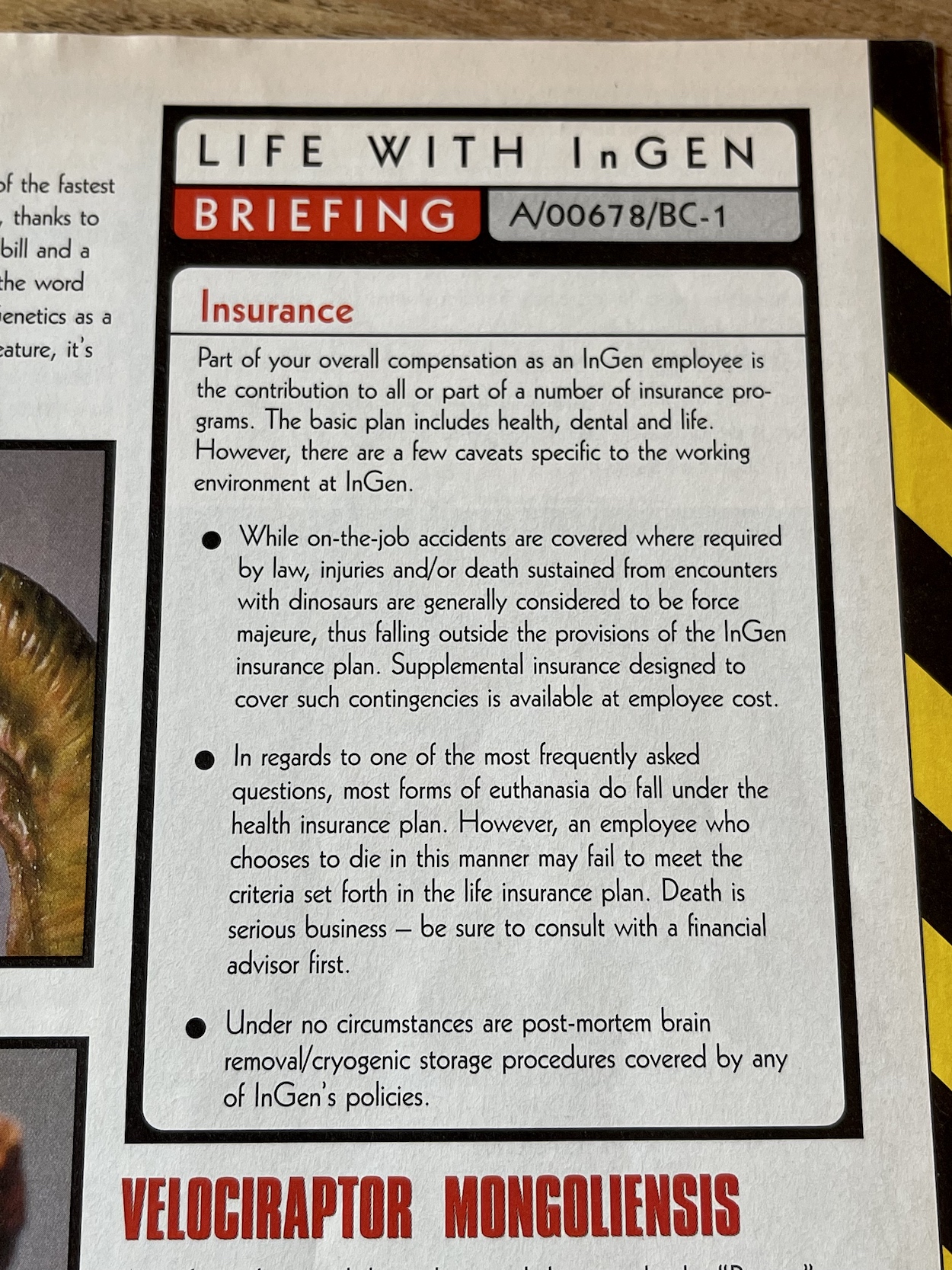
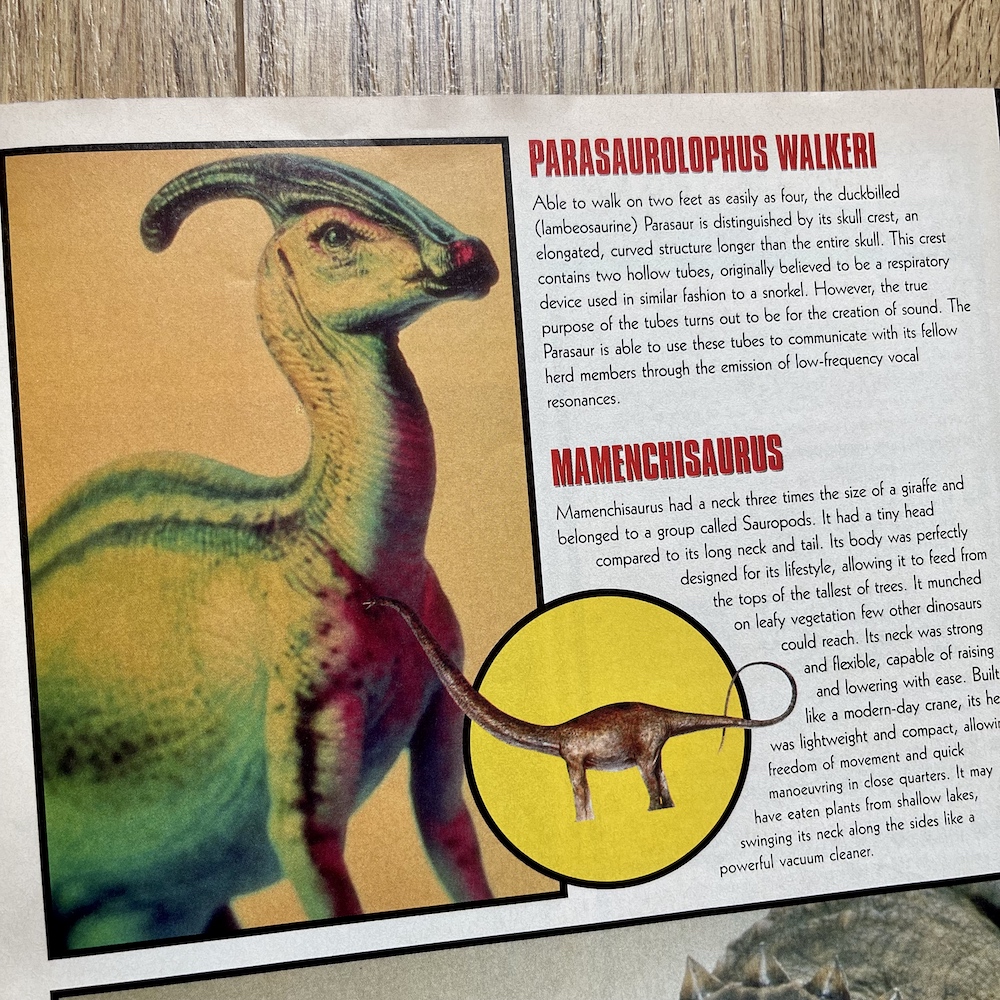
There’s no character mini-poster this time, instead we get five pages of a welcome pack for new employees to InGen and it contains a lot of photographs of model dinosaurs used in the pre-production of the first two films. I thought there was something strange about the little pictures of the animals in circles throughout #1 but now I know what they are they’re a delight to look at up close like this. All the main dinosaurs are covered, including this film’s Parasaurolophus Walkeri and the sick Triceratops from Jurassic Park.

There are also some funny moments such as the exceptions to staff’s apparently comprehensive insurance policies, which absolve InGen of any responsibility whatsoever if Chaos Theory rears its head. As with the previous two issues I’ve found the extras more enjoyable than the strip, so kudos to editor John Freeman and his team, these pages add a lot to the overall package.

We’ve only one chapter of the story to go and I feel just like I did when the first film’s adaptation finished its penultimate chapter; there’s just no way they could possibly cover everything still to happen in 22 pages. It’ll be interesting if nothing else! We’ll find out what survives in #4 of The Lost World Jurassic Park on Monday 7th August 2023.

iSSUE TWO < > iSSUE FOUR

JURASSiC PARK MENU