Category Archives: Comic Reviews

HAVOC #1: EXPLOSiVE START

While I’d been allowed up to four comics on order at the local newsagent, by the summer of 1991 this number had been whittled down to just two, The Real Ghostbusters and Transformers. Most comics I’d tried had ended up cancelled very quickly, so I’d become a bit disillusioned. Then, after months of not bothering, I decided to have a look at the comics shelves one Saturday morning and was met with this.
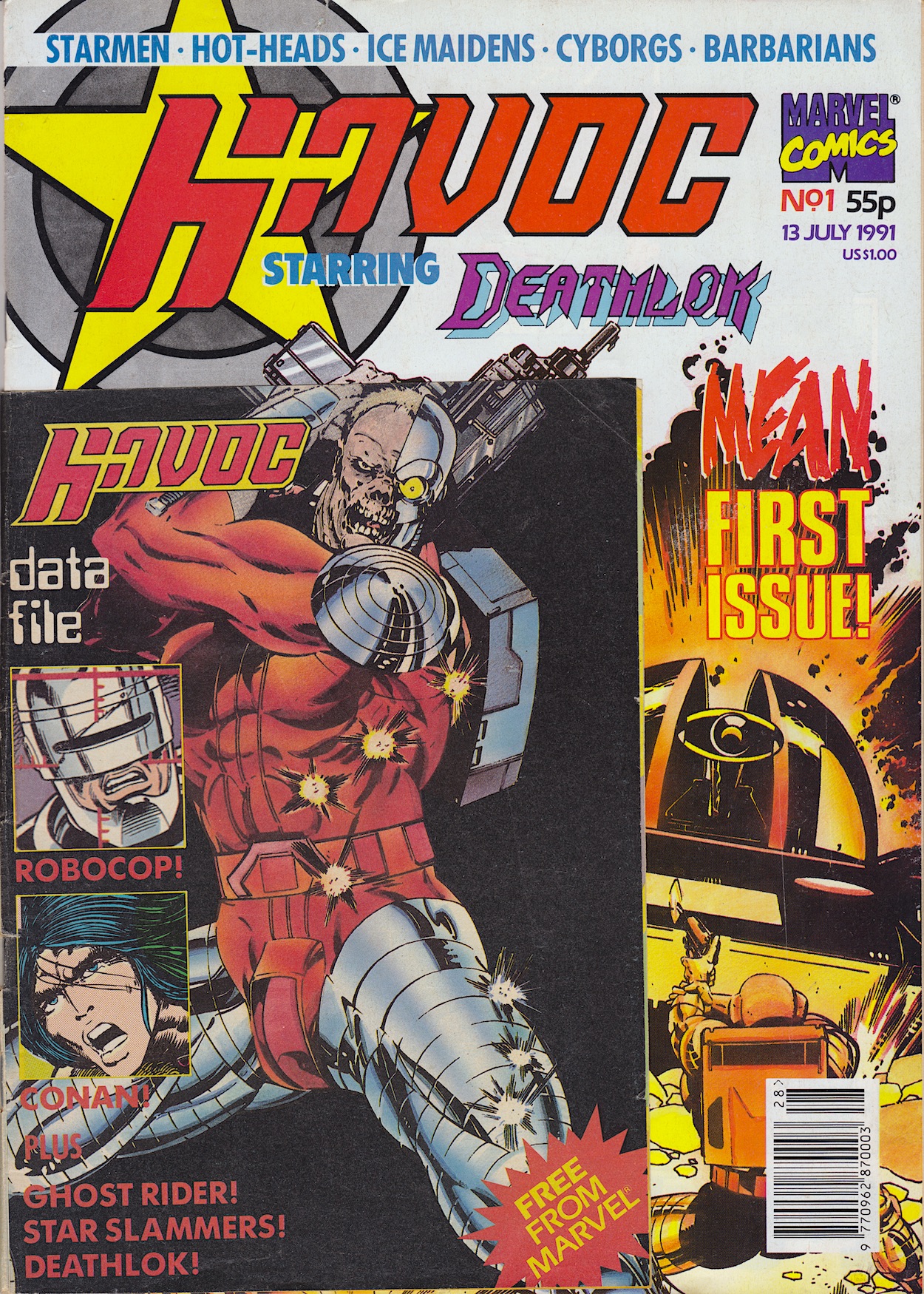
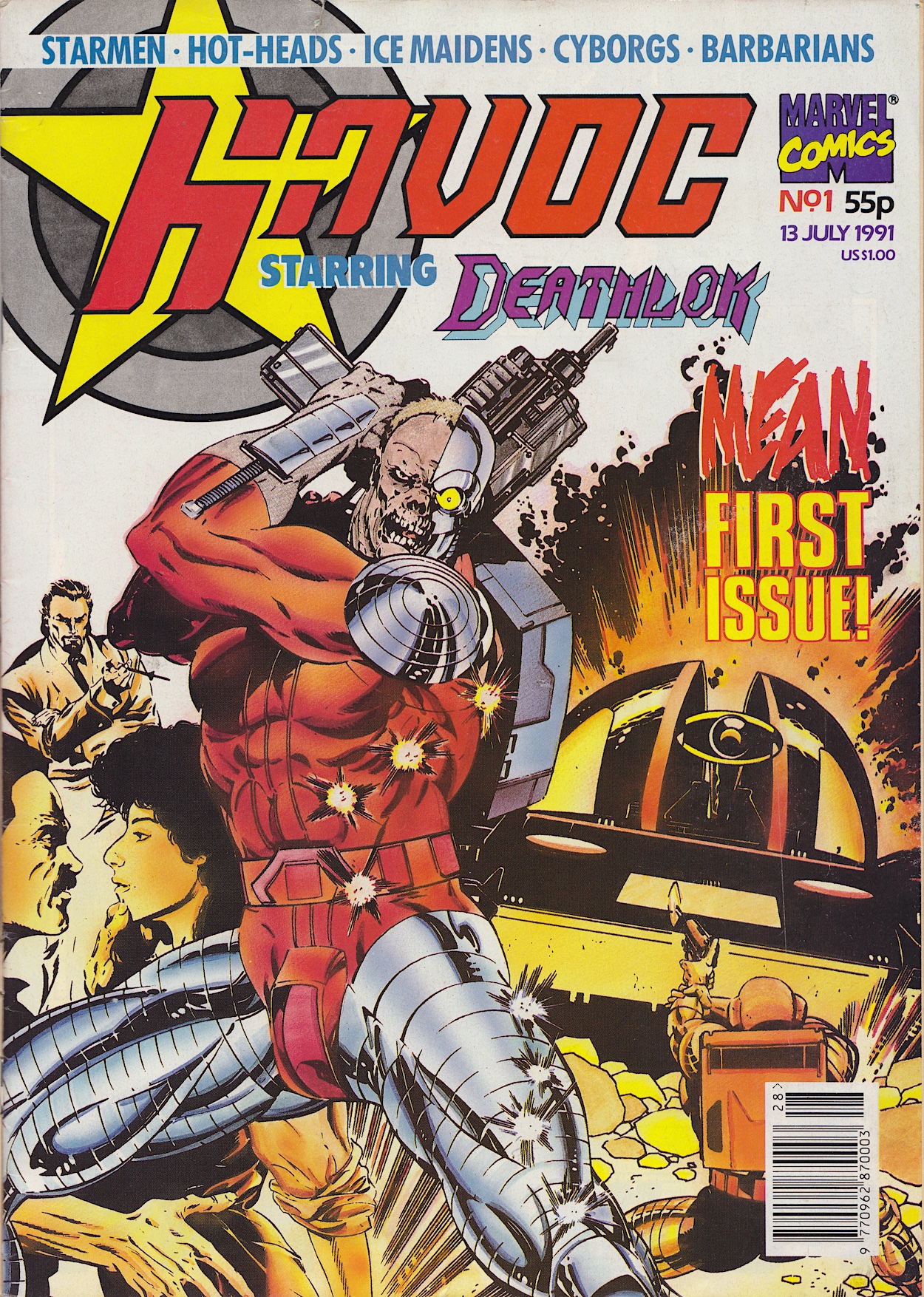
While I’d spotted RoboCop on the cover it was the bigger character called Deathlok that really grabbed my attention, especially when I pulled aside the free introductory booklet (images from which can be seen in the introductory post). How the booklet blacked out everything apart from Deathlok just looked really cool and having a quick flick through I also saw Conan who I’d heard of from friends, and a fiery skeleton on a motorbike. I had to try this out! At only 55p for 36 pages Havoc was a bargain, the same price as Transformers which was two-thirds the size and on smaller paper.

There was also that 16-page booklet which introduced us to each of the five main protagonists: Deathlok, RoboCop, Ghost Rider, Conan the Barbarian and the Star Slammers. It was a meaty read (edited at lauch by John Freeman and Harry Papadopoulos) and I enjoyed it so much I cancelled my order for The Real Ghostbusters after 150+ issues to reserve Havoc instead. Little was I to know only nine issues would ever see print. But for now let’s relive this excellent title, which coincidentally lasted for the exact amount of time I was off school for the summer holidays (in Northern Ireland kids get all of July and August off).
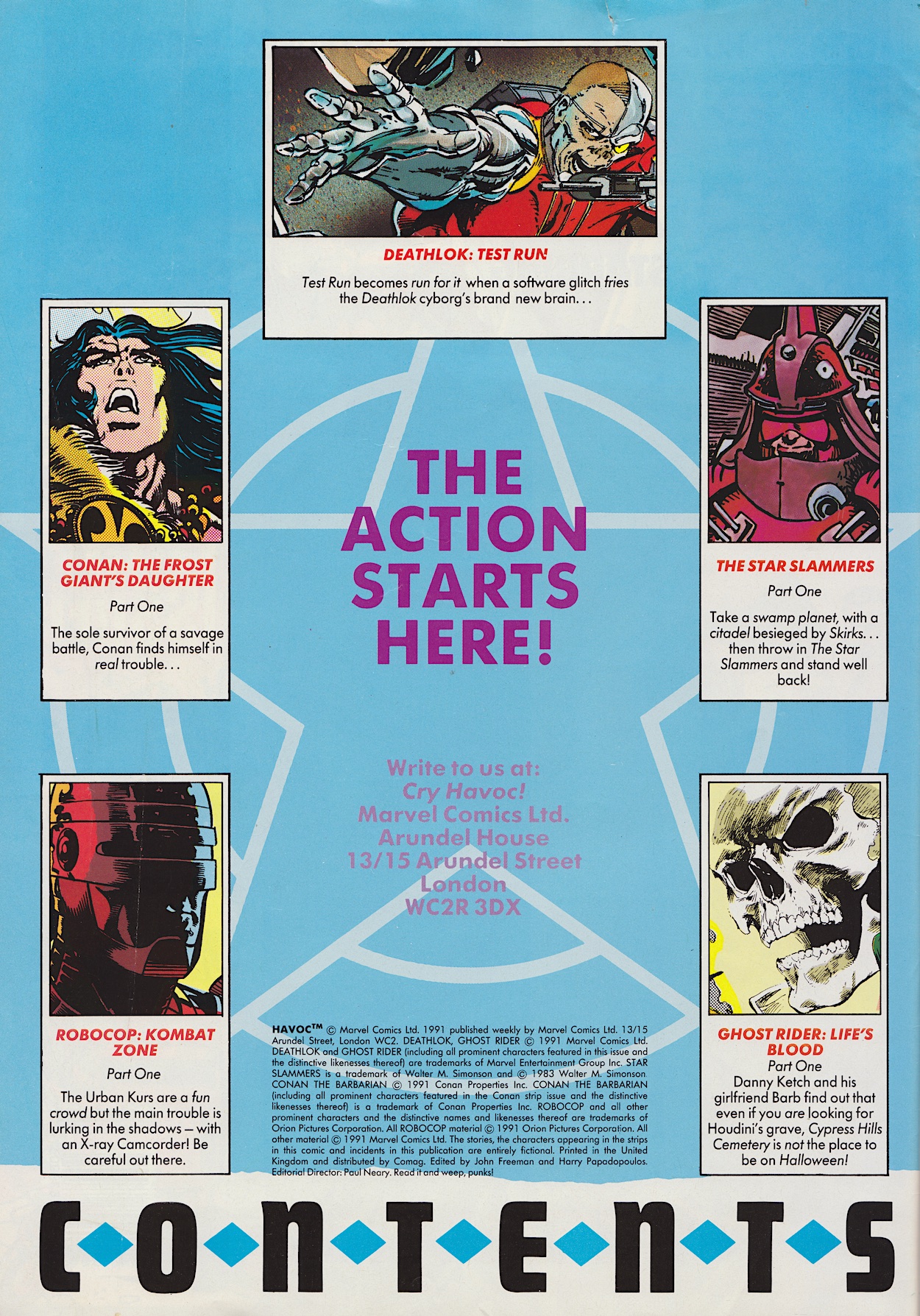
Upon returning to school some of my 2000AD-reading friends were raving about Havoc and the comparisons are clear. Havoc was also an anthology title and while the stories were imports from America the sci-fi settings and hard action had grabbed their attention in the same way as Tharg’s comic. I’d only read a few issues of 2000AD at that time and found Havoc to be much better; it was in full colour for a start, it had RoboCop and the action and characterisations seemed (to my teenage self) to be more mature. This was a huge step away for my usual comics.

So first up is Deathlok, a character I’d never heard of and who Marvel US had resurrected a year earlier. Originally created by Rich Buckler in 1974 in Astonishing Stories, there’d eventually be various characters with the same name, all deceased humans brought back as cyborgs. Dwayne McDuffie (Batman, Back to the Future, Damage Control) and Gregory Wright (The Punisher, Daredevil, Nick Fury) brought the idea back with a new human character in a mini-series and then an ongoing comic between 1991 and 1994, the first time Deathlok had had his own title. It was this run we were to be treated to, drawn by Wright and Jackson “Butch” Guice (Supergirl, Black Panther, Winter Soldier) with letters by Richard Starkings (Elephantmen, Zoids, Transformers).
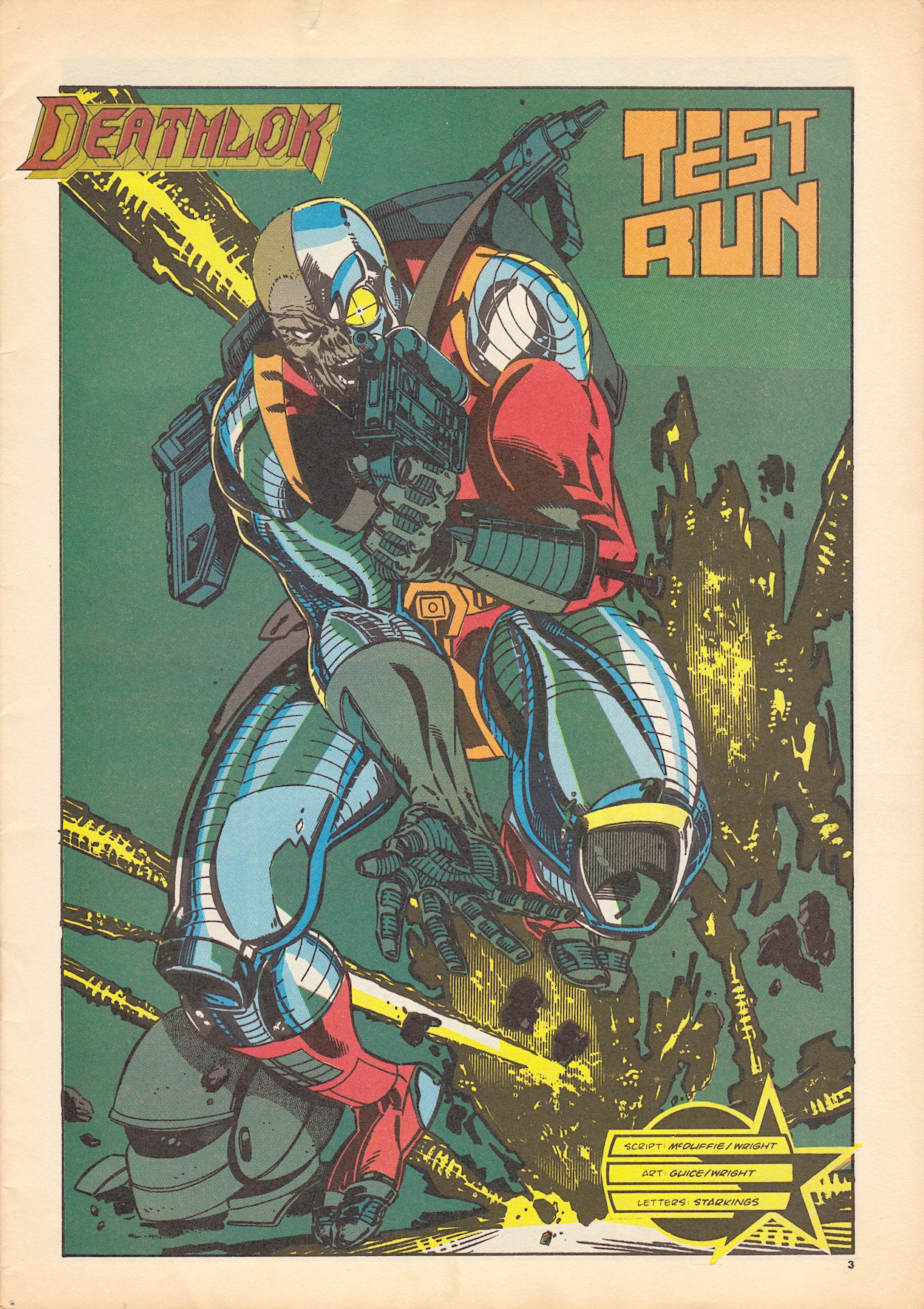
Between the end of the mini-series and the start of the ongoing an eight-page prelude tale was published in Marvel Comics Presents and it’s this that Marvel UK decided to use first. (From #2 they’d go back and print the mini-series.) This gives us a proper action-packed introduction to the technology and the idea behind the strip. No, it wasn’t hugely original by the time 1991 rolled around, with Terminator movies and RoboCop himself on the scene, but something would set Deathlok apart and that was the interaction between the human brain and the computer. That’s something for a future review though.

It’s smart to begin the premiere issue with a complete story and it perfectly sums up the set up and the kind of action we can expect. Former army colonel John Kelly volunteered to have his brain transplanted into Cybertek‘s Deathlok and become the ultimate tactical weapon. Sent on a Test Run, he’s armed with paint pellets while 12 mercenaries try to take him down with live ammo. The communications between human brain and computer are relaxed, even jovial, but when Kelly decides on a little grandstanding things take a shocking turn.
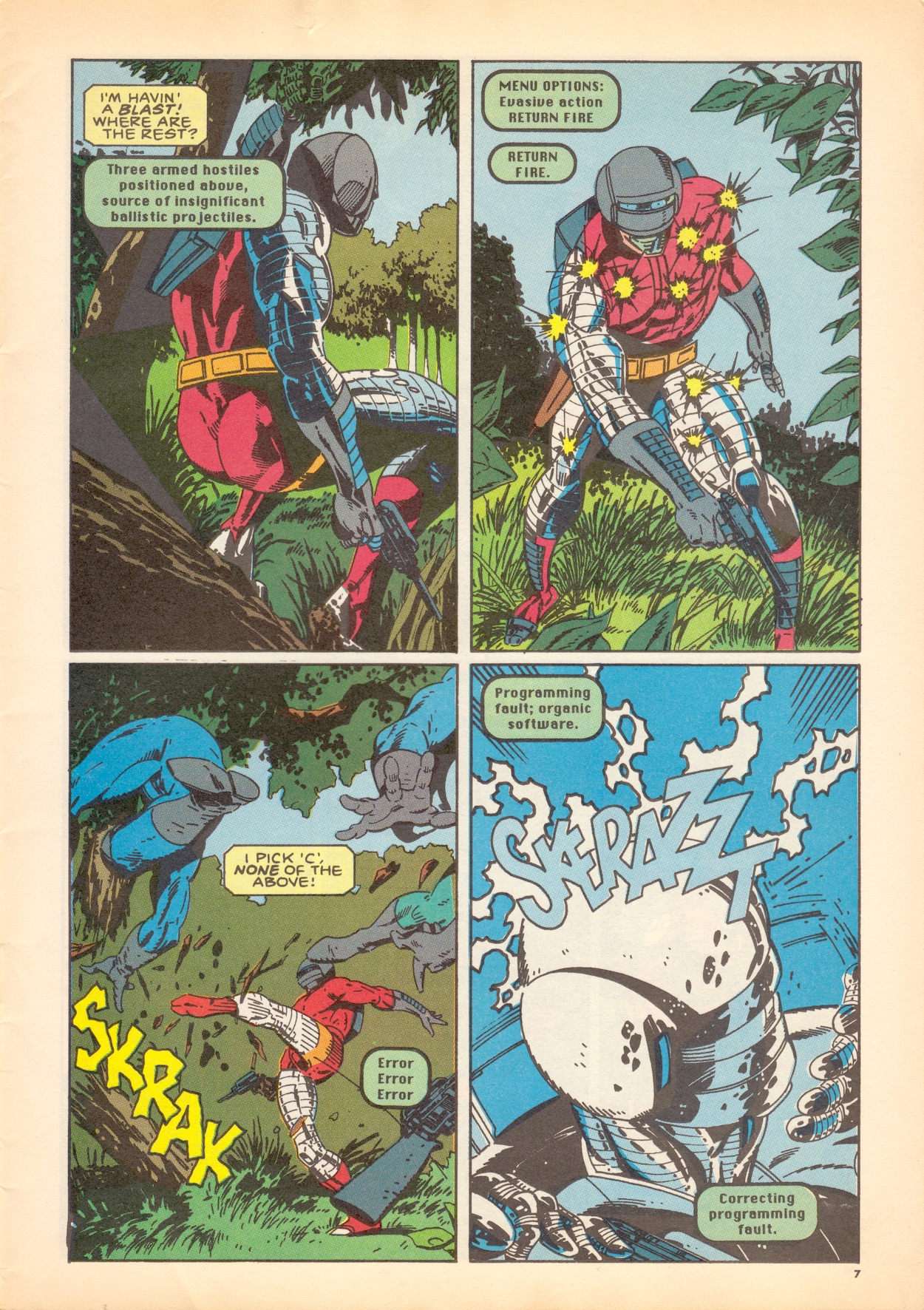
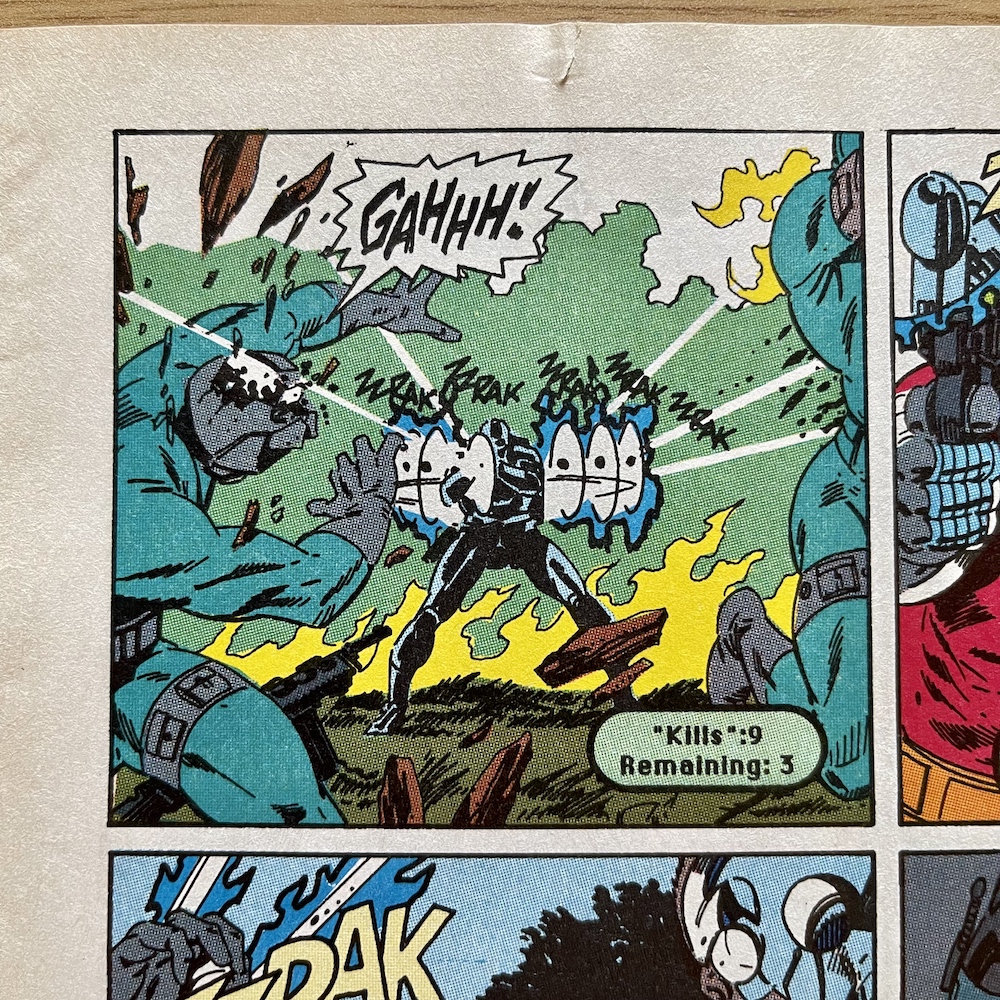
The computer has calculated that Kelly’s thoughts are an input error, sending an electrical charge to eliminate the problem and killing him instantly. Its system now “de-bugged” the programming for a live scenario takes over and immediately replaces the paint gun with a live plasma pistol. But Mr Ryker of Cybertek doesn’t stop the test, even as he watches the mercenaries die one-by-one. There’s just too much money at stake. The story ends with the company casually discarding what happened because they have a deadline and Mr Ryker’s final foreboding words show us the direction it’s about to go.
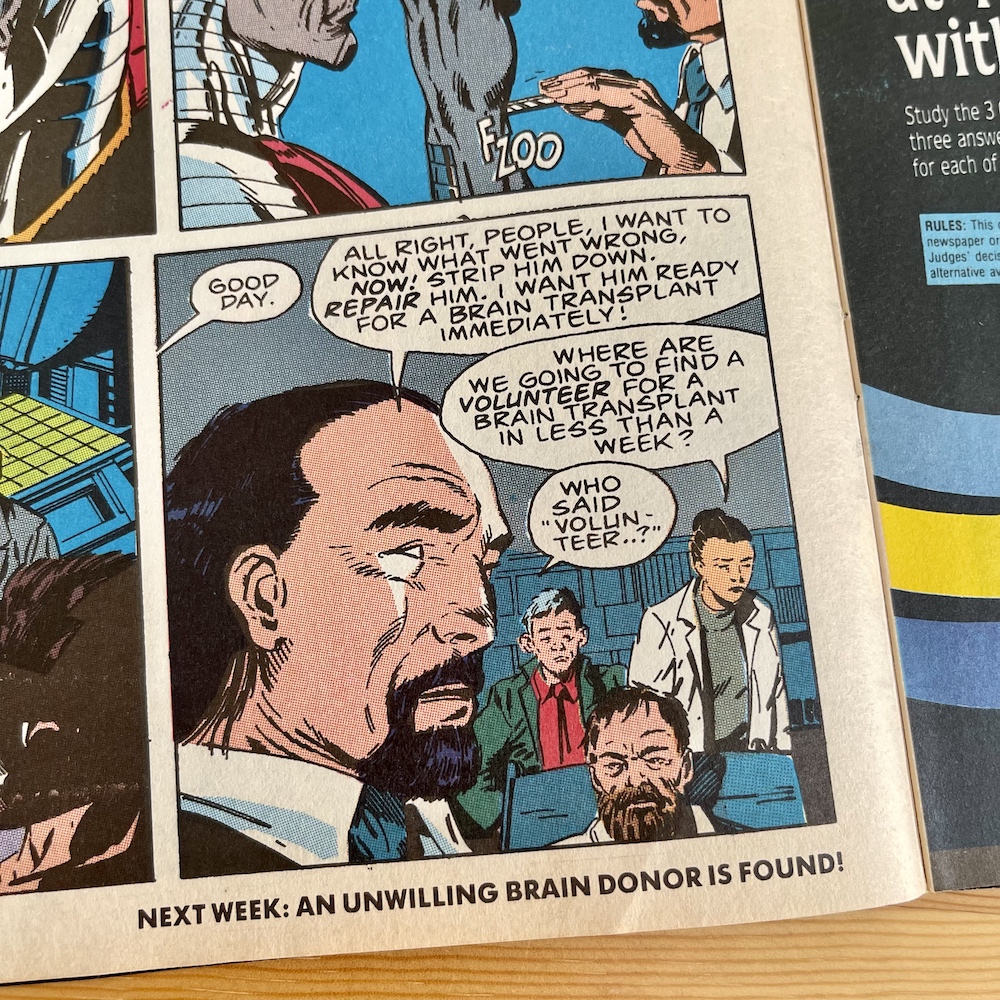
In the introductory booklet a little bit of information popped out at me as a fan of Transformers. It appears Cybertek Systems Inc. is a division of the multinational oil company, Roxxon. This company name appeared a couple of times in Transformers as a competitor to Blackrock. It was just in passing, but it tied the characters in to the larger Marvel universe around the same time as Spider-Man helped out the Autobots.

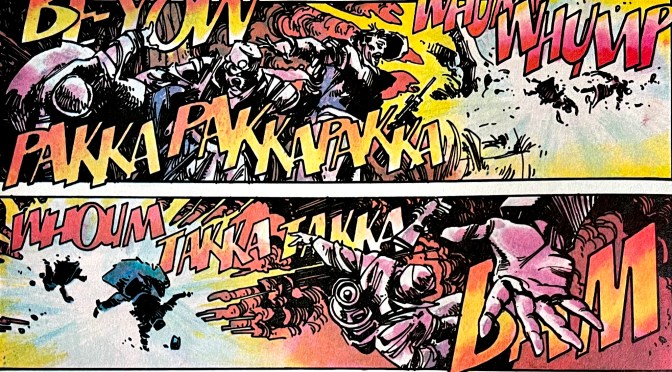
Test Run is a great introduction to not only Deathlok but to the whole remit of Havoc. I particularly liked Richard Starking‘s (launch editor for Marvel UK’s The Real Ghostbusters) lettering during the interactions between Kelly and the computer. I remember the intrigue as a teenager and how I lapped up the action, thinking that if the rest of the issue was anything to go by I’d discovered a winner.

John Workman’s trademark style adds bold, in-your-face lettering to Star Slammers, perfectly suiting the narrative

Havoc may have been a meaty 36-page read for us but to fit in five ongoing strips originally written as much larger chapters (while giving each one a satisfying chuck and a cliffhanger every week) couldn’t have been an easy task. But the team pulled it off. The next strip is Star Slammers which originally saw print in #6 of Marvel Graphic Novel in the States back in 1983. Given just the four pages in this premiere issue, it acts as a nice tease for the characters created, written and drawn by Walter Simonson (Jurassic Park, Hawkgirl, Detective Comics), coloured by his partner Louise Simonson (writer on New Mutants, Warlock, Action Comics) and Deborah Pedler (Alien, Marvel Graphic Novel, Conan) although Deborah is mistakenly listed as “Parker”.
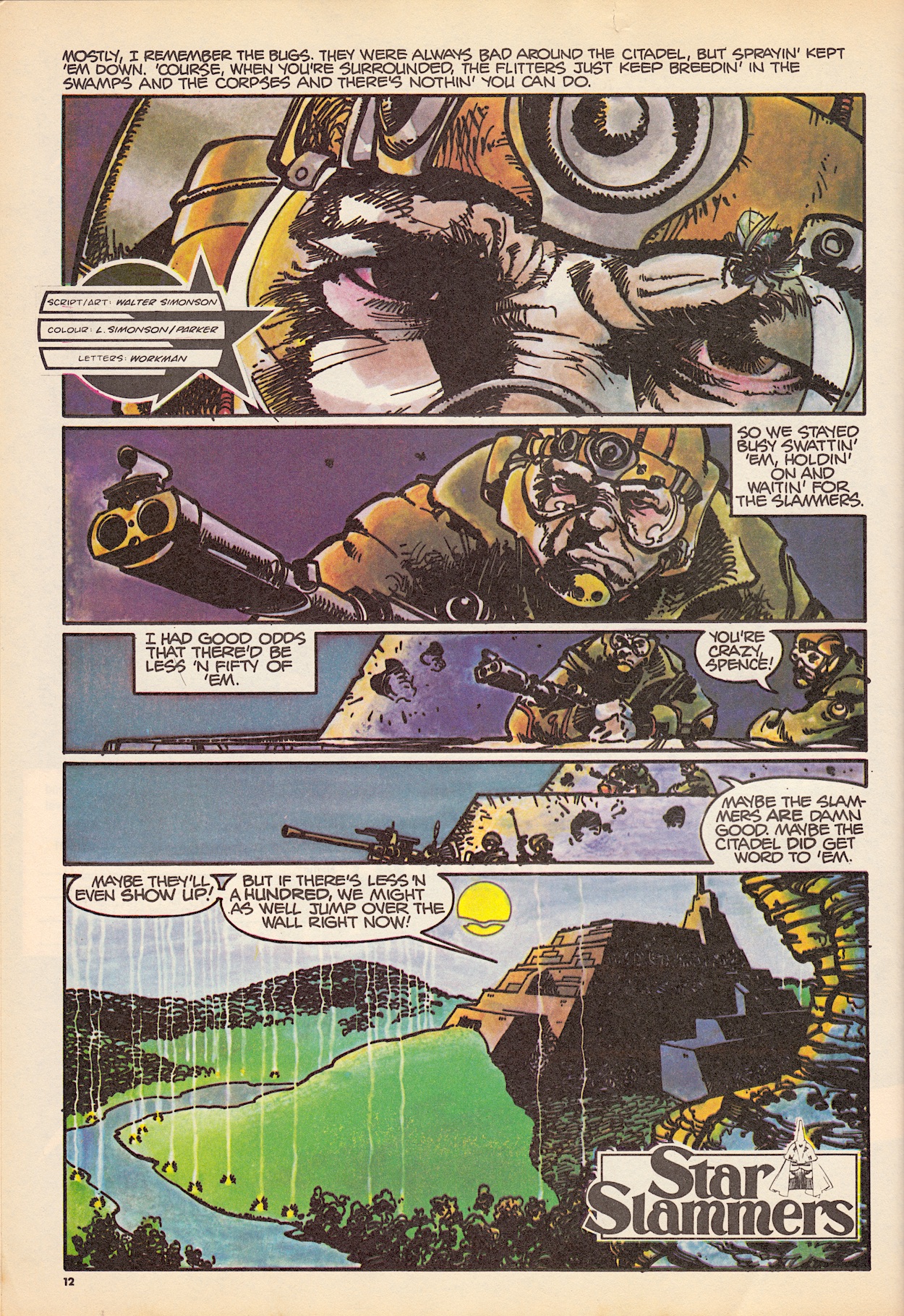
John Workman is the letterer here and among his many credits (for example Michael Moorcock’s Multiverse, Orion, Spider-Girl) he worked alongside Walter on the movie adaptation of Jurassic Park, which was published in the UK by Dark Horse International, split over the first five issues. His trademark style of breaking the panel lines which I enjoyed so much in those early Jurassic comics adds a bold, in-your-face style of lettering to Star Slammers, perfectly suiting the narrative.

Spence and Slinger are two tired soldiers looking out from the citadel they’re protecting, surrounded on all sides by campfires belonging to their enemy, the Skriks. They’ve called for help from the Star Slammers and hope more than a hundred turn up at least, although Spence thinks it’ll be less than fifty and that he and his comrades are doomed. Suddenly all hell breaks loose, there are explosions and gunfire everywhere and within minutes the enemy has been wiped out as far as the eye can see. Spence’s monologue returns just to confirm he was right, there were definitely less than fifty of them.
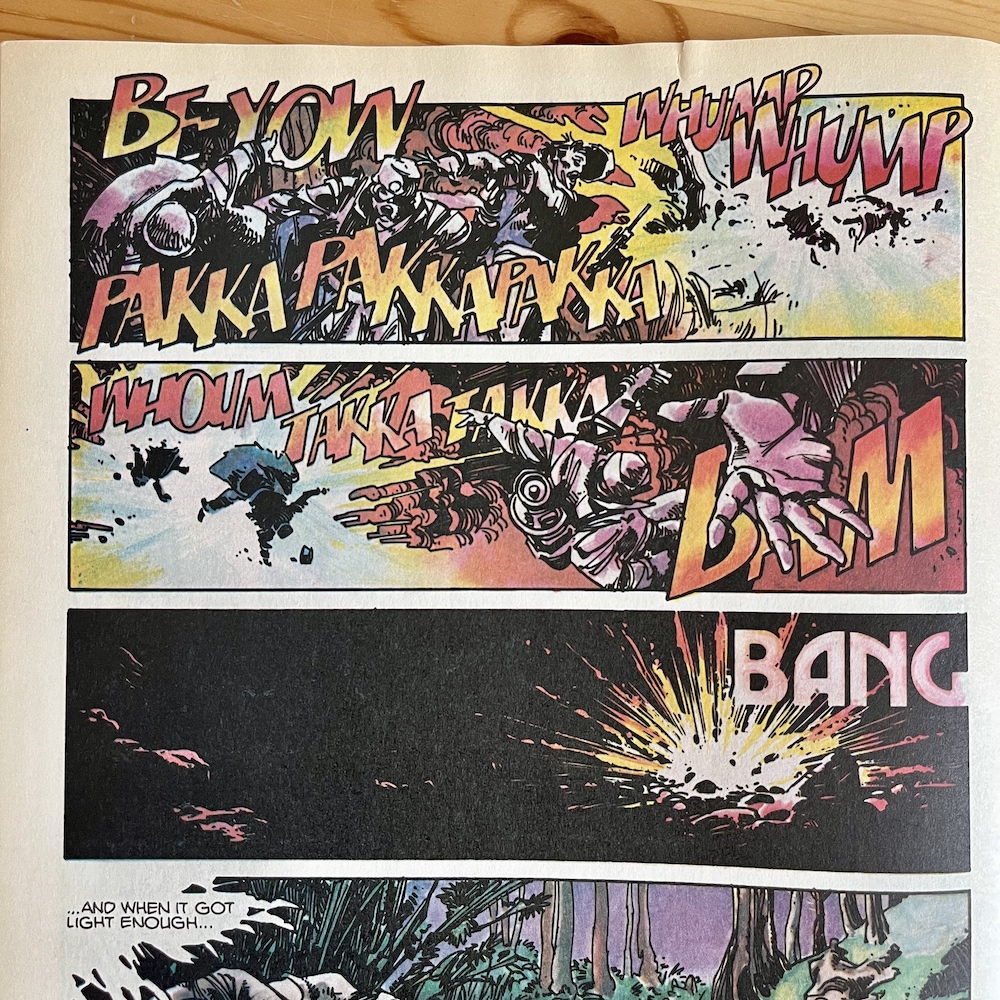
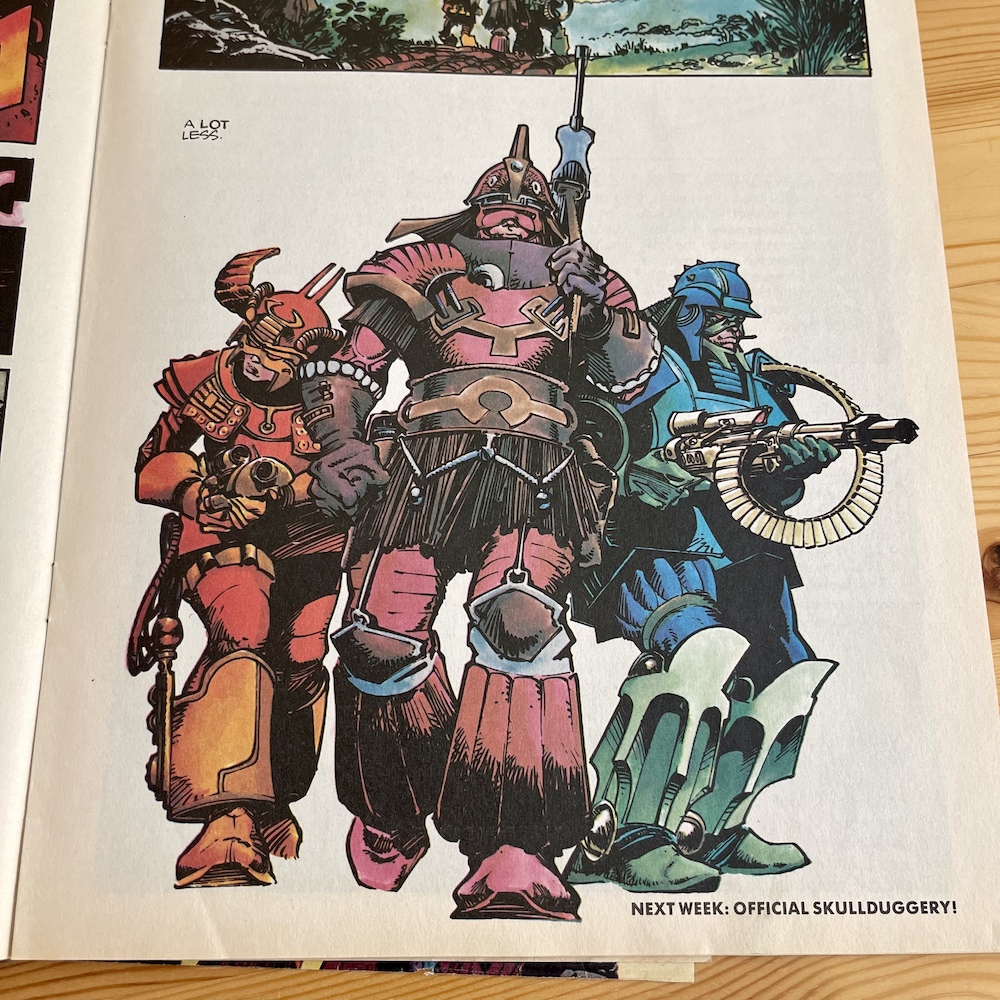
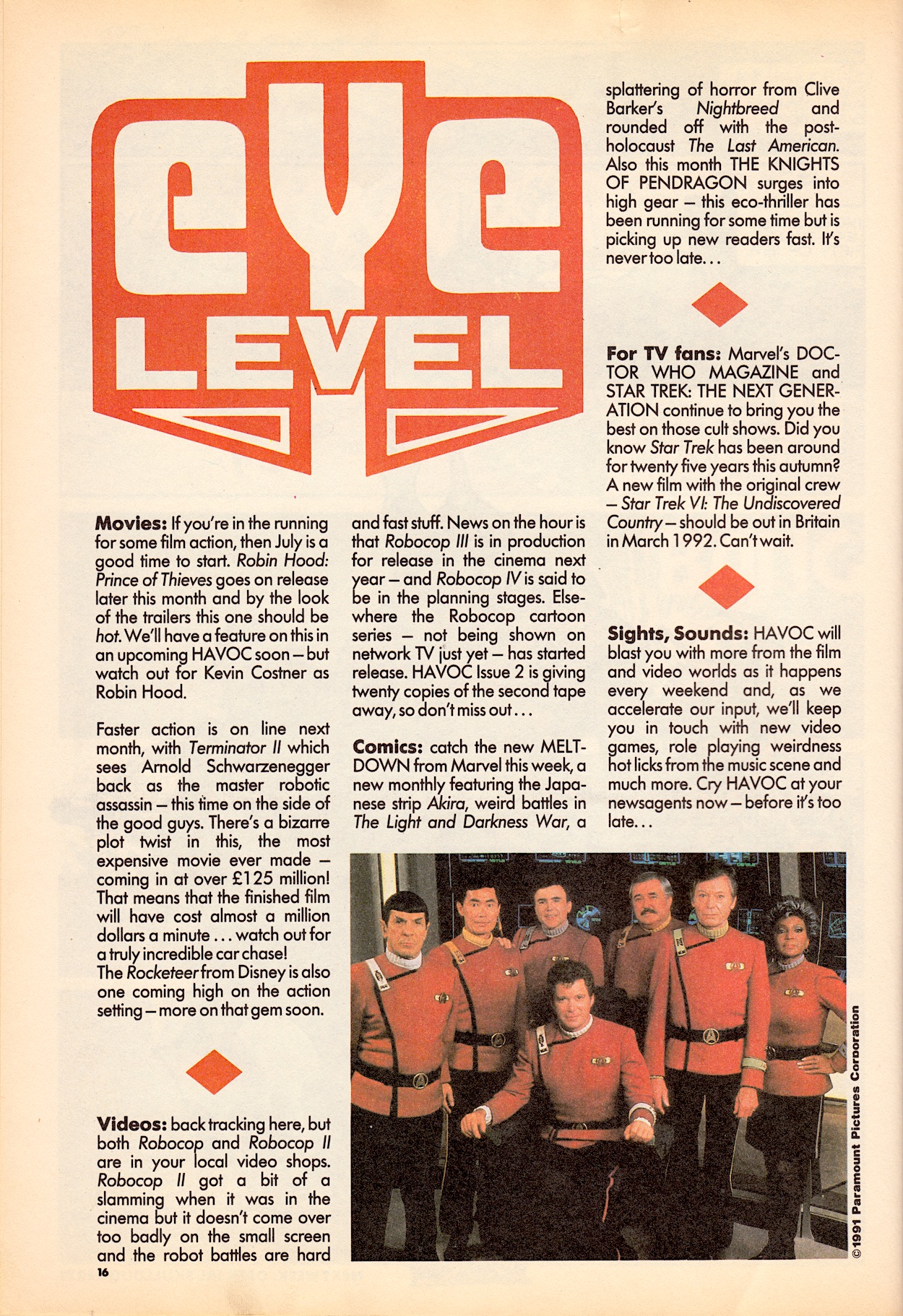
That’s it for part one. In the booklet their introduction is written as a warning from “the glorious planet Orion” but as yet there are no more details about characters or overall plot. As a kid I remember being underwhelmed but my attitude changed as the story continued and now as an adult I’m intrigued. On the next page comes something my adult self has been really looking forward to. I’m including it just for some fun and context about when the comic was released. It’s the first Eye Level.

This was the weekly news column with all the latest information from the world of television, movies, comics and videogames. This was around the time we had that TV show Movies, Games + Videos so this has taken me right back. Most notable for me here is the hype machine for Robin Hood: Prince of Thieves because I enjoyed it at the time but the years have not been kind to the ridiculous movie. I remember all the buzz about how expensive Terminator 2: Judgement Day was for the time and it’s nice to see a film I’ve just recently rediscovered getting a quick mention, namely the excellent Rocketeer.
As well as the news above, the booklet had extra pages for RoboCop, so sure was everyone that this was a franchise to run and run. The second and third movies put an end to that. Personally, I much preferred the TV series. The original writers were creative consultants and it was more in line with what they’d written for the film (which ended up being known more for its over-the-top violence). Yes, TV series in the 90s couldn’t have the violence of today’s shows so Murphy captured criminals instead of killing them, but all the social commentary, politicking and character development was there and I loved it. It was big budget and a great character piece at its heart. (And that episode with his dad! Oh my, I’m welling up just thinking about that scene… anyway… ahem…)

The booklet is set up like a series of Wanted posters (except for RoboCop obviously) and our next antihero is described as “a so-called do-gooder” who they suspect is really just “a deep rooted psycho”. Originally created as a Western character before being renamed Phantom Rider, the first supernatural Ghost Rider was Johnny Blaze who you’ll know from the movies if not the comics. Havoc’s strip is the sequel to that run and stars new character Danny Ketch. It was written by Howard Mackie (Moon Knight, Mutant X, X-Factor), pencilled by Javier Saltares (X, Wolverine, The Prowler), inked by Mark Texeira (Hercules, Psi-Force, Megalith) and coloured by Deathlok’s Gregory Wright, although they’re all just listed next to “art”, such is the limited space in the credits. Completing the team is Michael Heisler (Arkham Asylum, writer on DV8, Union) on lettering.
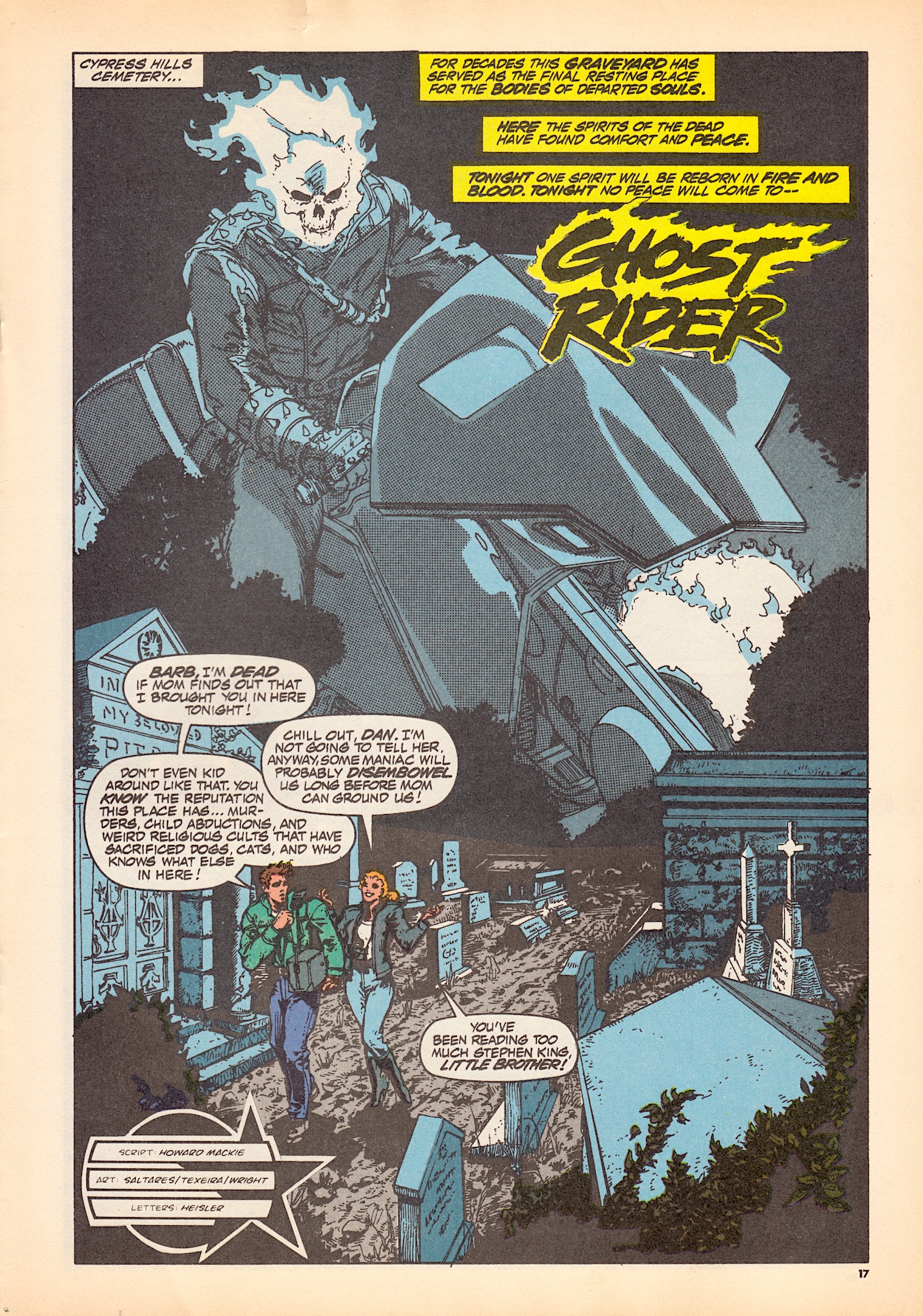
Apart from this ghostly illustration as part of the title there’s no inkling about what’s going to happen or how Danny becomes who he is destined to become, but I didn’t mind that at all. In fact, back in 1991, knowing I’d only have to wait seven days for the next part I liked the slow development and the suspense it brought. Of course, the original story wasn’t written in this way, it’s only because it’s being chopped up but we’re still getting a full story every month, just a little bit at a time, Transformers-style.

So Dan and his sister Barb are in the middle of a cemetery at Hallowe’en, visiting Houdini’s grave because Barb wants to take pictures of the rituals that take place there every year. They’re spooked by a group of prankster kids who are soon chased off by Barb, while Dan cowers from the initial fright. I like this, setting up the character who will become this flaming skull as a rather timid individual.
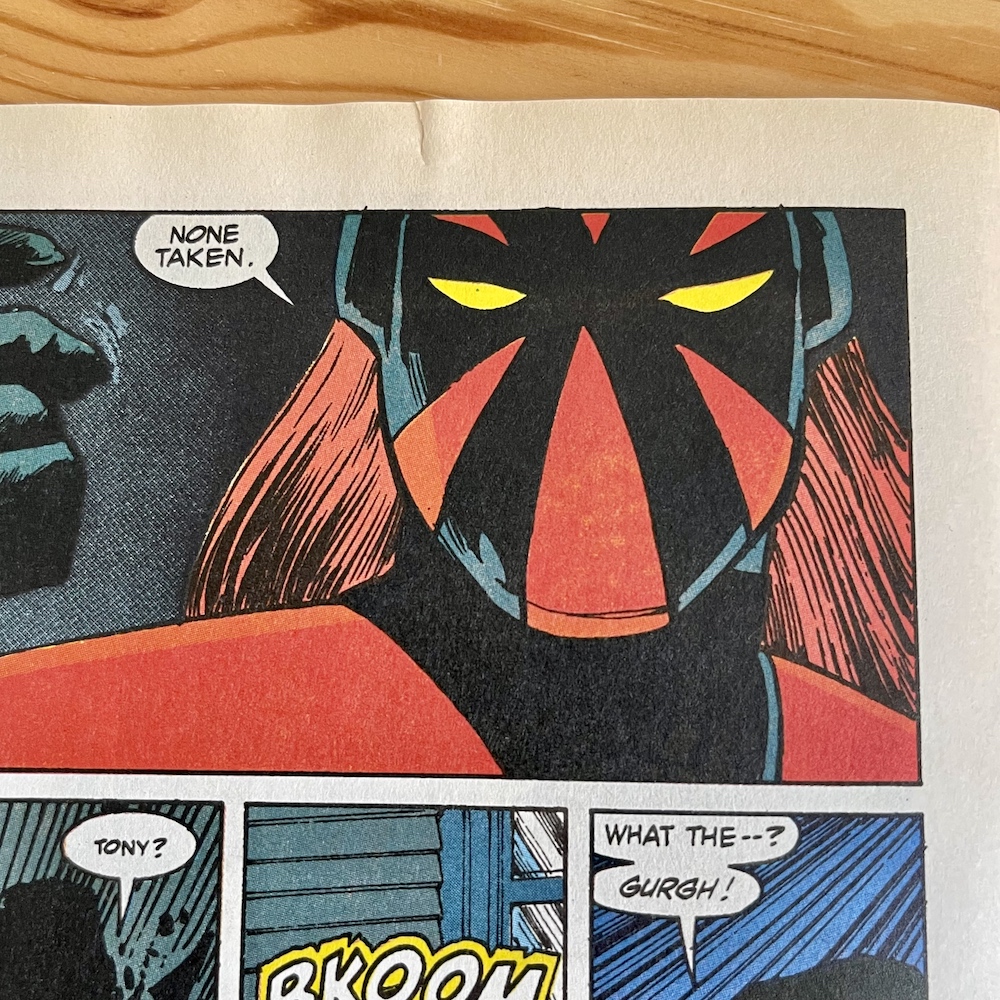
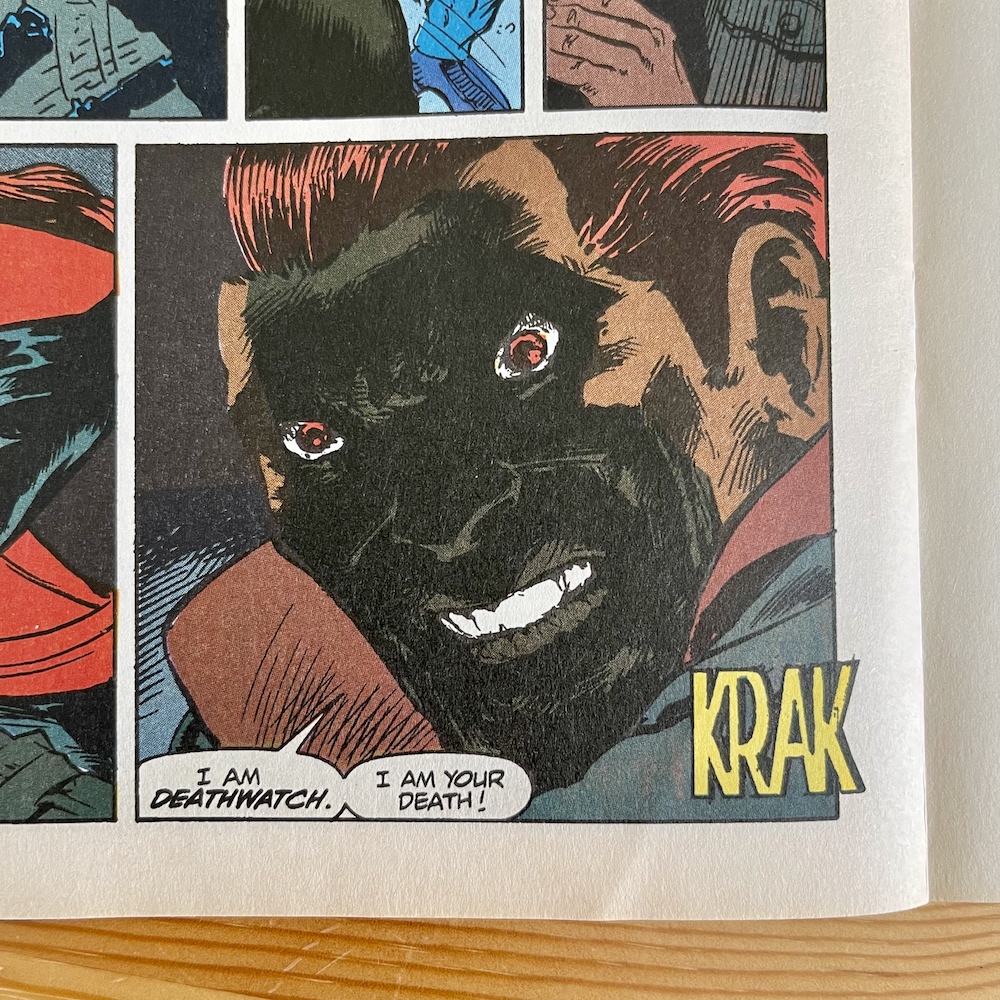
Hearing a gunshot Barb wants to investigate and they find new character Deathwatch facing off against some goons sent by classic Marvel character Kingpin. Deathwatch has shot one of their couriers and appears to be outnumbered when some shadowy figures shoot Kingpin’s men in the back with crossbows. Removing his mask, our new villain strangles the remaining gangster but the loud crack of his neck breaking is too much for Barb and she involuntarily lets out a scream, alerting the men to their location.
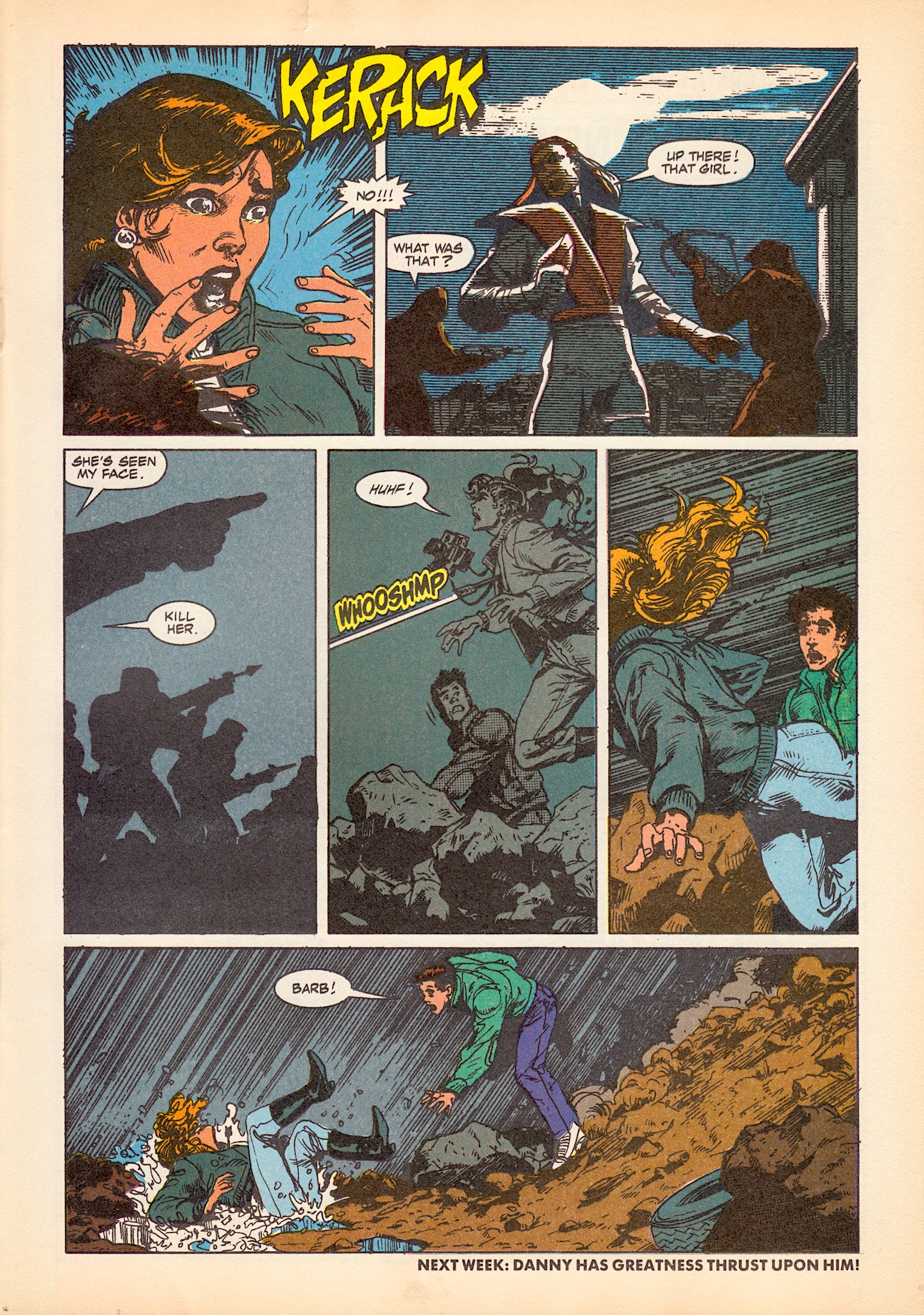
It was all very serious and violent for teenage me. It was like catnip! The tone was perfect, I already liked and cared for Dan and the ending was a shock. The Next Week caption at the bottom had me hyped and the strip was instantly a favourite. One piece of the puzzle at a time was being put into place and I couldn’t wait for more. I find that feeling returning now. After Havoc’s cancellation we just couldn’t get hold of the US comics at the time where I lived, and now 31 years later this is already making we want to check out the modern Ghost Rider comics. Havoc has got into my mind again.


“They stand face to face. Both are tall men — and built like tigers. But one of them is — Conan the Barbarian”

The Frost Giant’s Daughter, Robert E. Howard/Roy Thomas

Next up is Conan the Barbarian, only known to me at the time from the Arnold Schwarzenegger movies of the 80s which never really appealed to me. This turned out to be the most surprising strip in Havoc because I wasn’t expected much at all but really enjoyed it, so now it’s time to find out if I still do three decades later. The story is interesting but the real world background of it is fascinating. The original Frost Giant’s Daughter was written by Conan’s creator Robert E Howard in 1934 but was originally rejected by the magazine he submitted it to and so the character and settings were changed. It only eventually saw print as a Conan tale long after Howard’s death.
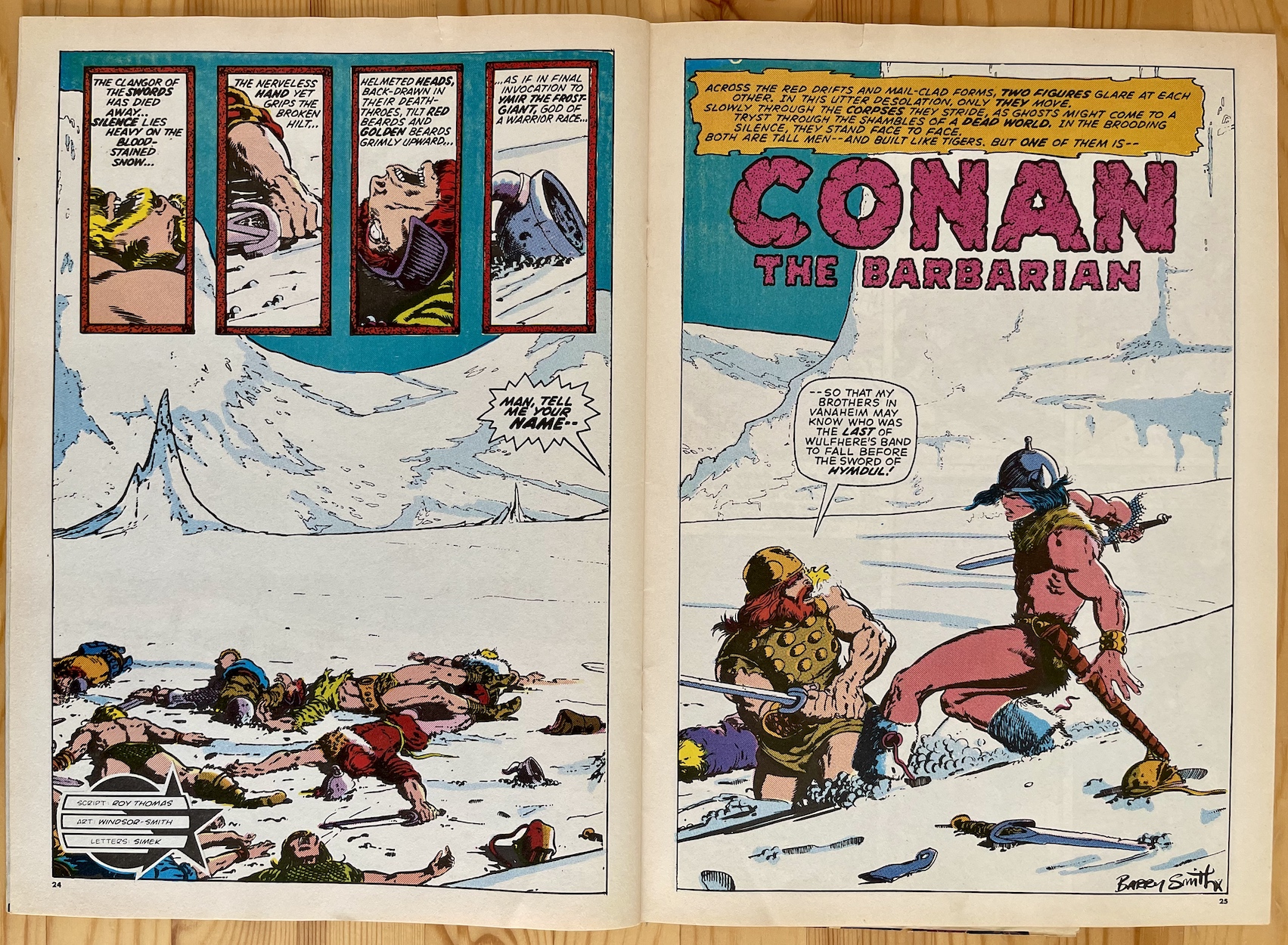
In comics, this adaptation is by far the oldest strip among those in Havoc. Published in Savage Tales in 1971, a censored version (mainly for nudity) was printed in Conan’s own comic the following year with a new opening. It’s that version we got in Havoc. Adapted by Roy Thomas (Arak Son of Thunder, Shazam!, The Dragonlance Saga) with art by Barry Windsor-Smith (Machine Man, Iron Man, Avengers) and lettered by Artie Simek (Fantastic Four, Showcase, Kid Colt), this gripped me instantly as a teenager with its action, setting, the blood and guts and the sexual undertones. It was like nothing I’d read before. I was captivated.

I had no idea this strip was older than the others and it doesn’t read as such either, the writing capturing the timeless rhythms of Howard’s originals. After a huge and bloody battle a young Conan collapses in the snow but as death creeps in he sees a beautiful woman, becoming instantly enamoured with her. Confused as to how she could be so scantily dressed out in the cold he assumes she must come from a village he didn’t know about, somewhere he could rest before his next battle. But there’s nowhere nearby, her identity is a mystery and her see-through clothing (censored here) entices Conan into the chase.
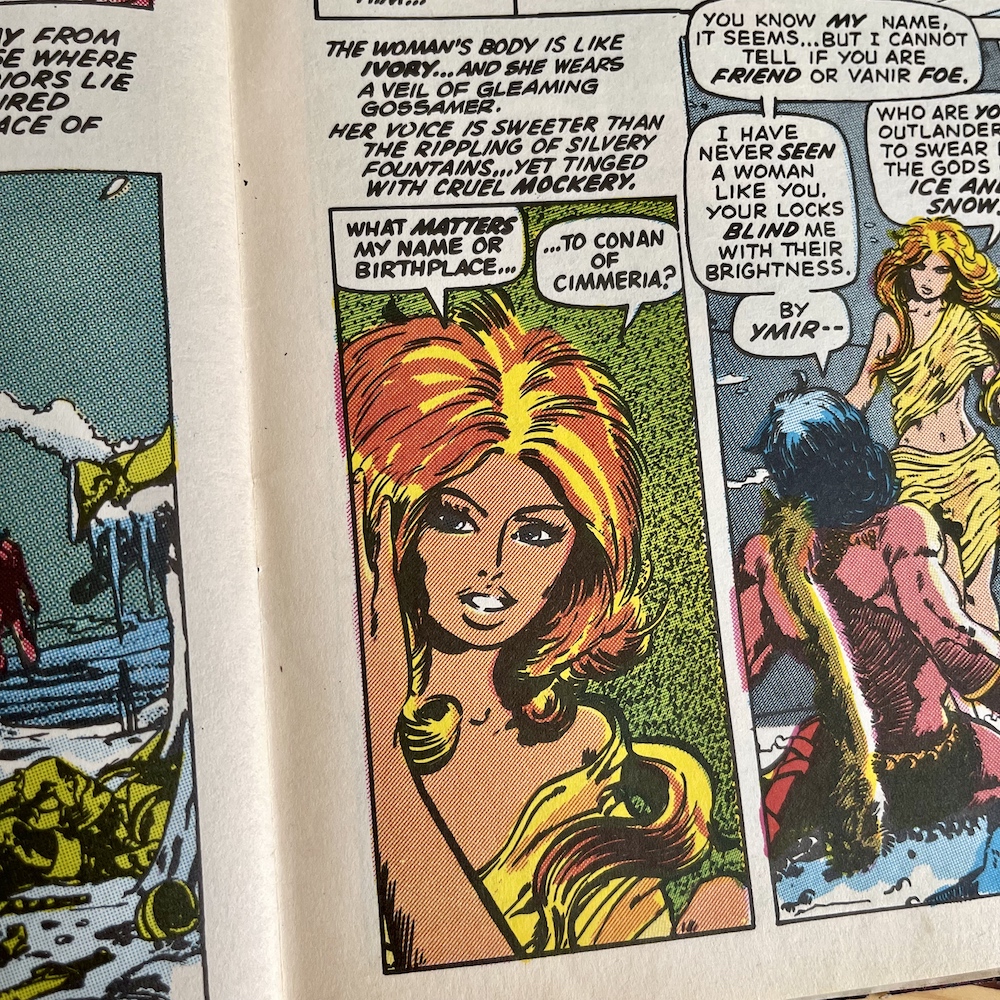
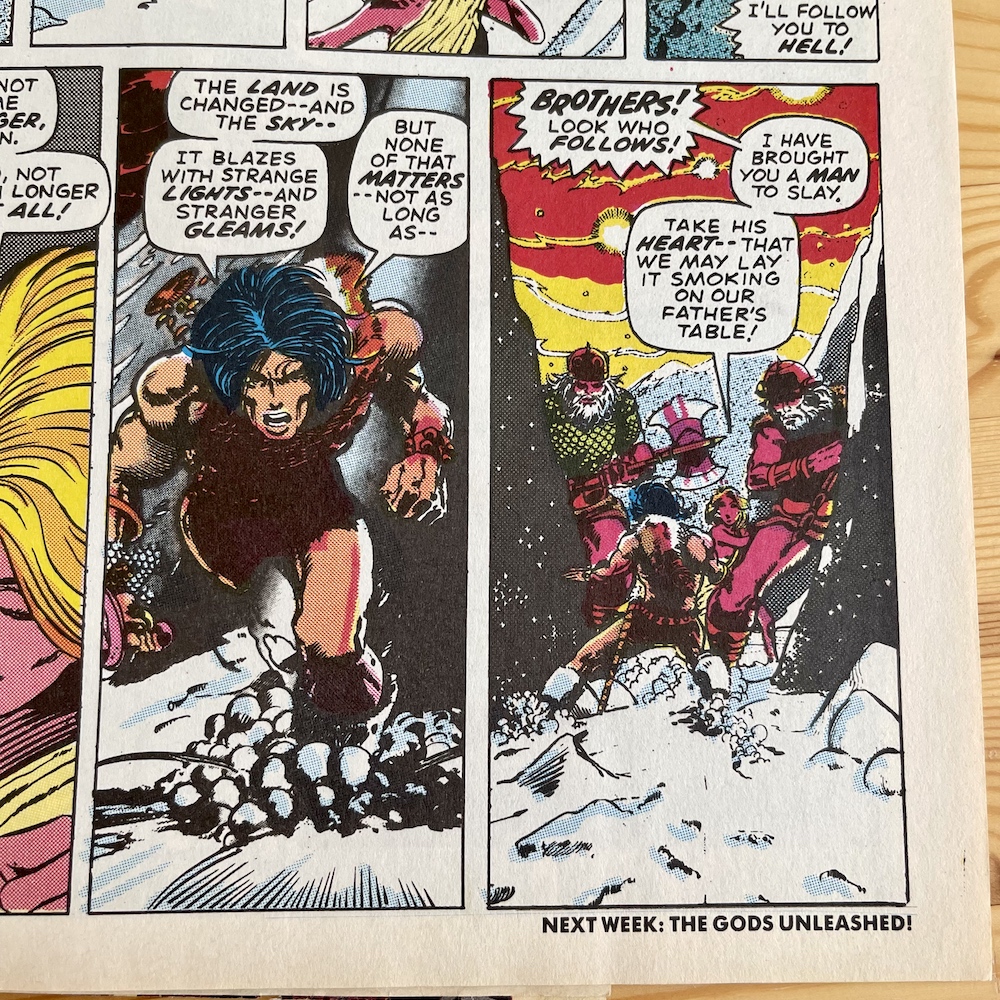
Her existence doesn’t make sense here in the snow covered mountains, so Conan’s pursuit changes from one of lust to a search for answers, fearing it’s some sort of vision or trick. I can’t remember the exact reason and I don’t want anyone to tell me if you know, I’ll find out in real time as always. At the end the fact it’s a trap is made very clear, but no other answers are forthcoming yet. I find myself remembering the sense of childhood wonder I had in reading this and I’m intrigued now to find out more about Conan himself, as well as the mystery at hand. A strong start.

The final strip was the one I was most looking forward to when I initially saw the lineup as a teen. Deathlok looked awesome but I already knew Alex Murphy aka RoboCop and it felt exciting to see him in comic form. What a shame then that this first chunk of Kombat Zone is probably the weakest of this first issue. I put this down to the fact I’ve seen so much more of RoboCop since then and in particular the characterisation in the TV series. Here he comes across as rather two-dimensional and his speech patterns read very strangely, rather clichéd compared to the first film or the show.
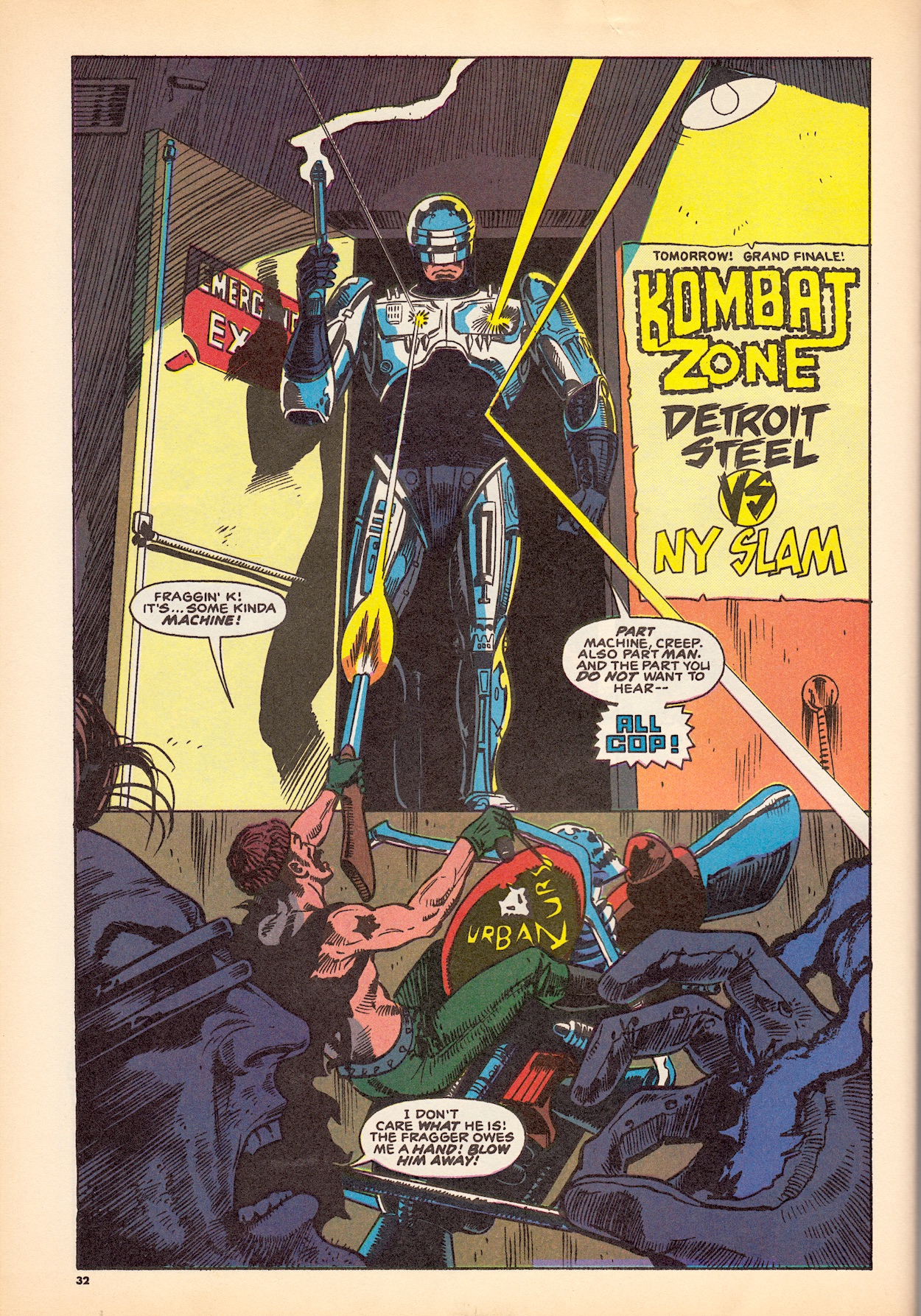
But hey, it’s only the first five pages! I’m not going to get ahead of myself. I’ll see how it develops. Robo intercepts a hover-bike gang as they seemingly take down an innocent stroller in Old Detroit. But in the background someone is filming the confrontation with RoboCop and when the victim makes a plea to pay off his assailants one of the bikers makes a passing comment about already being paid. There’s more to this random attack than meets the eye.

Murphy may not have heard this or seen the man with the camcorder but the way the bikers attacked is enough for the detective to have his doubts. But our mysterious stranger throws in a “smart-gun” (which was rather forward thinking for an early 90s comic) which kills the ‘victim’ Alex had saved and the last of the bikers before he can give anything away. It’s all over very quickly and after some of the more substantial reads it’s a bit of a disappointment when this is the big licenced strip.
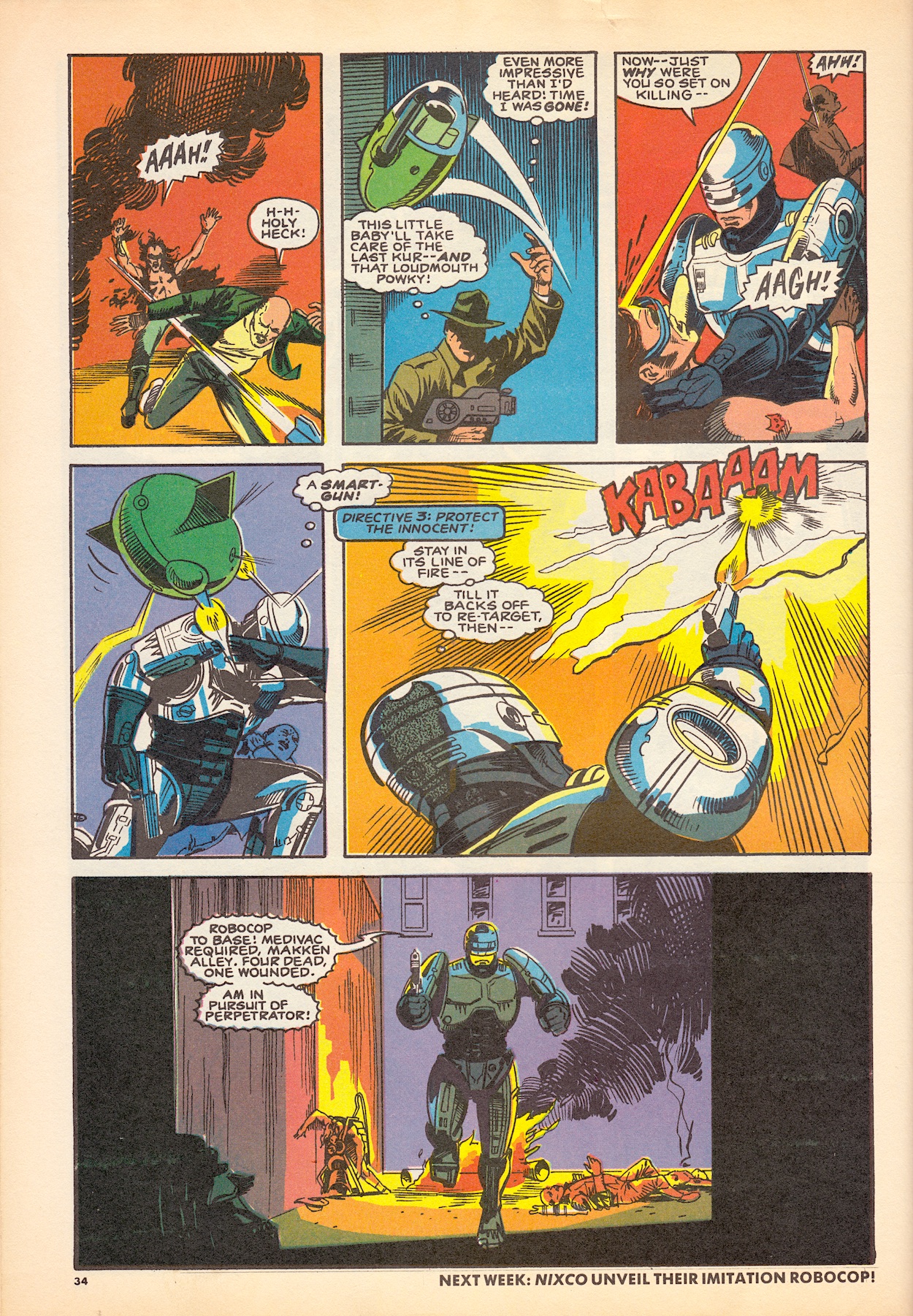
Of course, none of the ongoing stories in this issue were ever designed to be broken down like this, so overall the comic has done a wonderful job of selecting the right characters, stories and ending points to give us a flavour of Havoc’s future. So I can forgive the feeling of two of the strips being all too brief this time out, we’ve been spoiled by the package as a whole.

What a shame the great team assembled for RoboCop aren’t given any credit because the Deathlok ones are mistakenly reprinted instead. RoboCop: Kombat Zone reads like a who’s who of comic legends in my eyes. It’s written by none other than Alan Grant (Judge Dredd and Batman, including the Judgement on Gotham crossover, Toxic!), pencilled by Lee Sullivan (Transformers, Doctor Who, Tekworld), inked by Kim DeMulder (Batman, Transformers, G.I.Joe), coloured by Steve White (Dragon’s Claws, Xenozoic Tales for Jurassic Park, Transformers)and lettered by Richard Starkings. What talent! After finding this out I’m all the more excited now for the rest of the story.
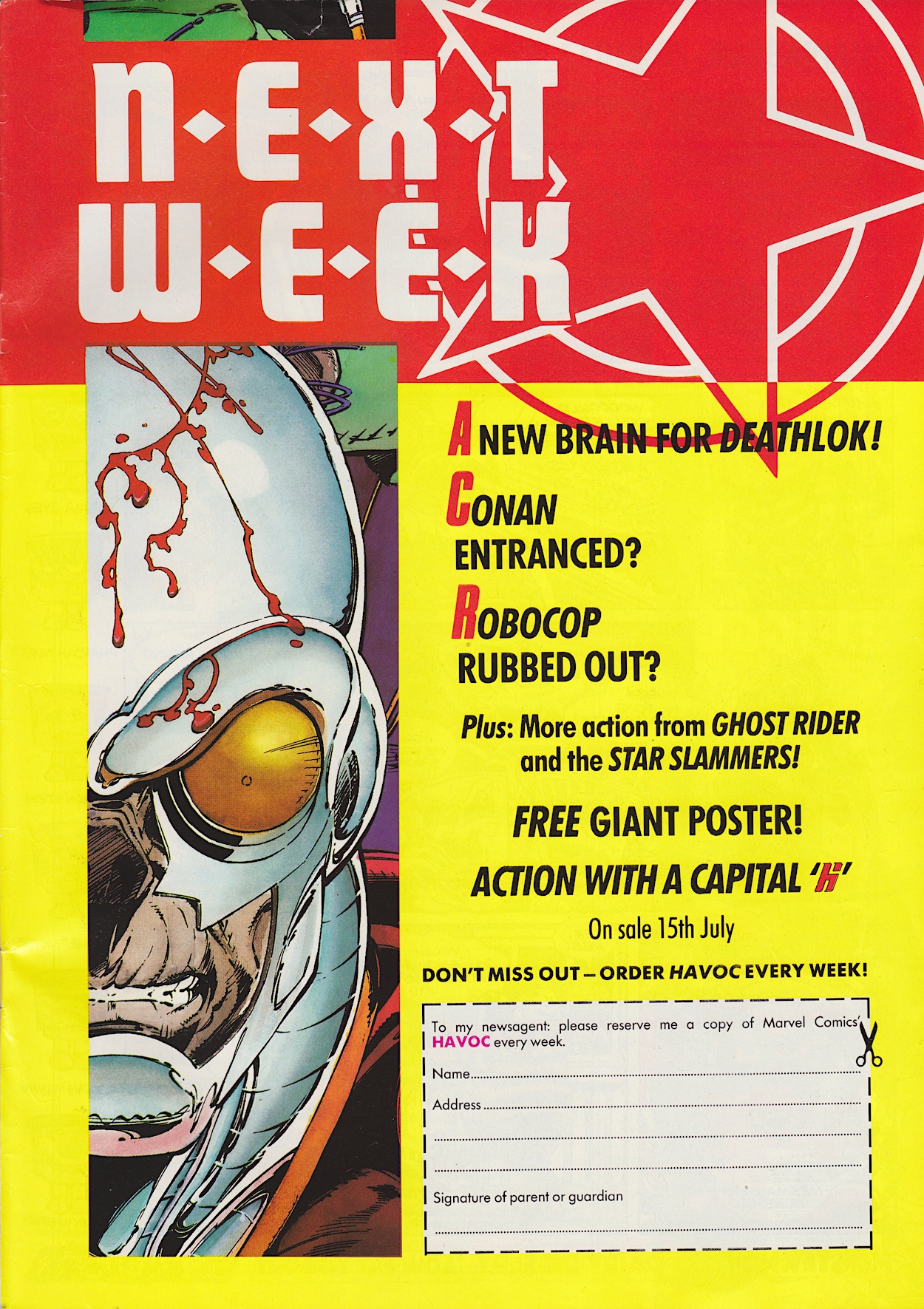
I’m just going to finish off now with a quick look at the other non-strip pages in this premiere issue, notably the Next Issue page and the retro adverts. You may notice the date for #2 is given as Monday 15th July 1991. Havoc was advertised as being on sale every Monday and a lot of other comics said so too but were released on the Saturday beforehand. The date on the cover of weekly/fortnightly Marvel UK comics was always the date the next issue would go on sale, kind of like an expiry date for each issue, the date the newsagent would remove it from the shelves.

Havoc has the date of the following Saturday on its cover but on the Next Issue page it’s two days later, the following Monday. I have very clear memories of picking this up every Saturday morning throughout the summer of 1991 and in later years when I worked in various newsagents in my teens and early 20s comics were never released on a Monday. (The only publications beyond newspapers that would ever arrive on a Monday were women’s weeklies.) So I’m not sure why the wrong date is given here, but it gets even more out of sync later in the run as you’ll see.
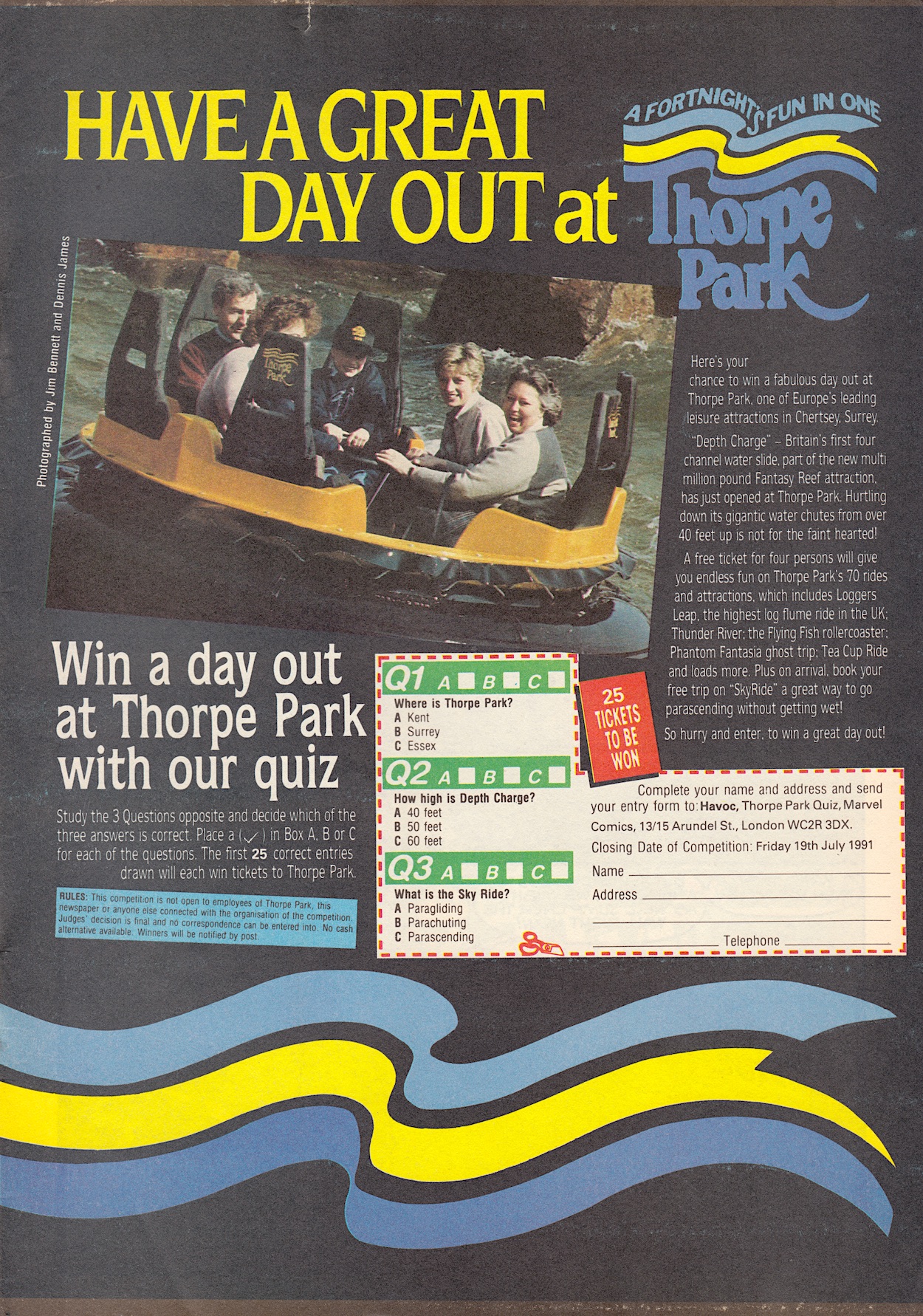
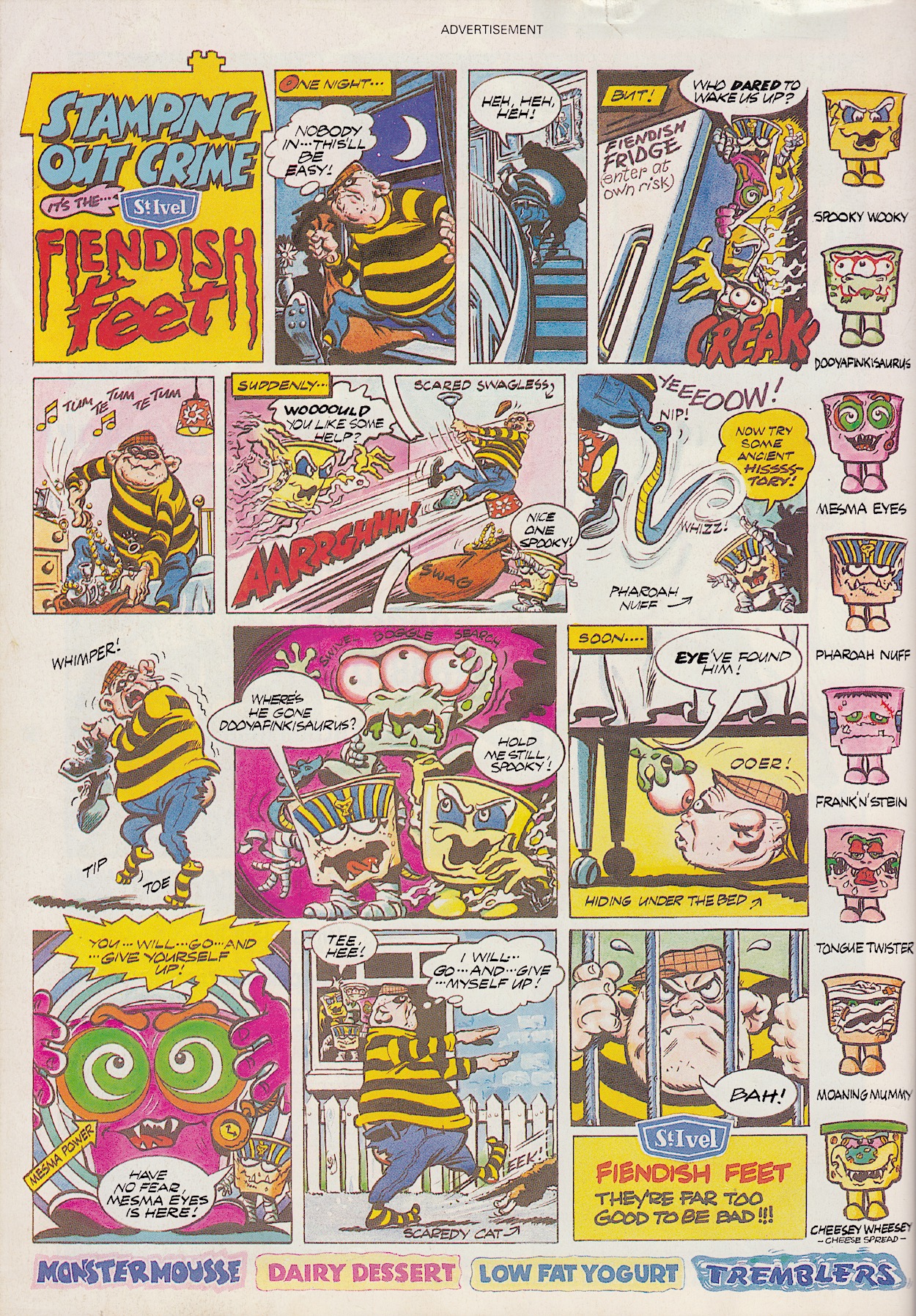
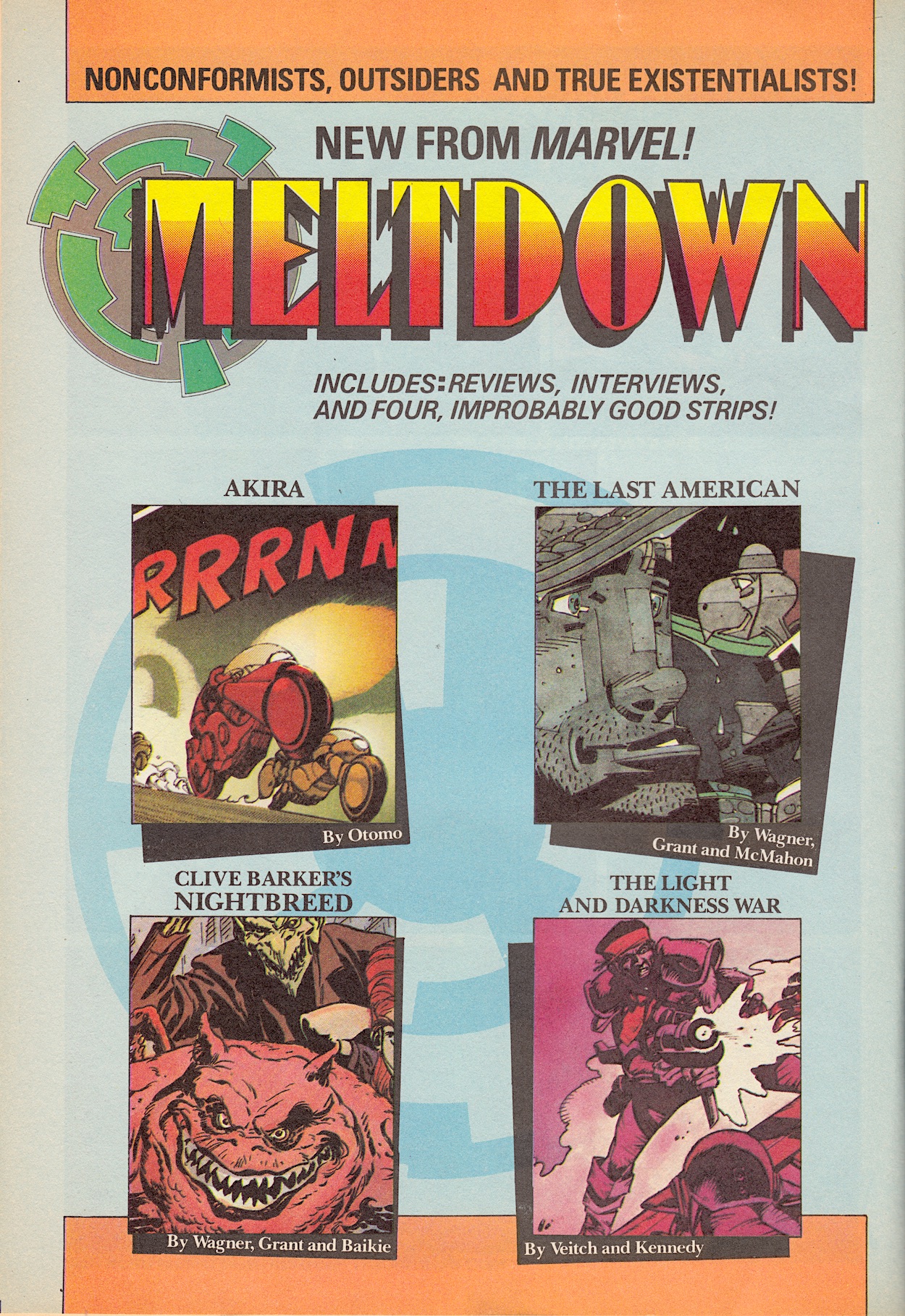
Elsewhere there’s an advertisement for Havoc’s sister title Meltdown both in the comic itself and on the back of the free booklet, there’s one for Thorpe Park dressed up as a competition and on the back cover of this mean, action-packed, mature read are the Fiendish Feet! Oh I loved those yoghurts as a kid.

This has been a rather long post, I know. But it was necessary to introduce Havoc, its strips, their main characters and all of their creative teams. It’s been a blast revisiting this issue and I’m so glad I haven’t got long to wait until I do it again for #2, albeit maybe with a slightly shorter blog post. The next issue of what should’ve been a very long-running comic will be here on the OiNK Blog from Wednesday 13th July 2022.
GO TO iSSUE TWO

HAVOC MENU

JURASSiC PARK #11: ‘RAPTOR’ MEANS ‘BiRD OF PREY’

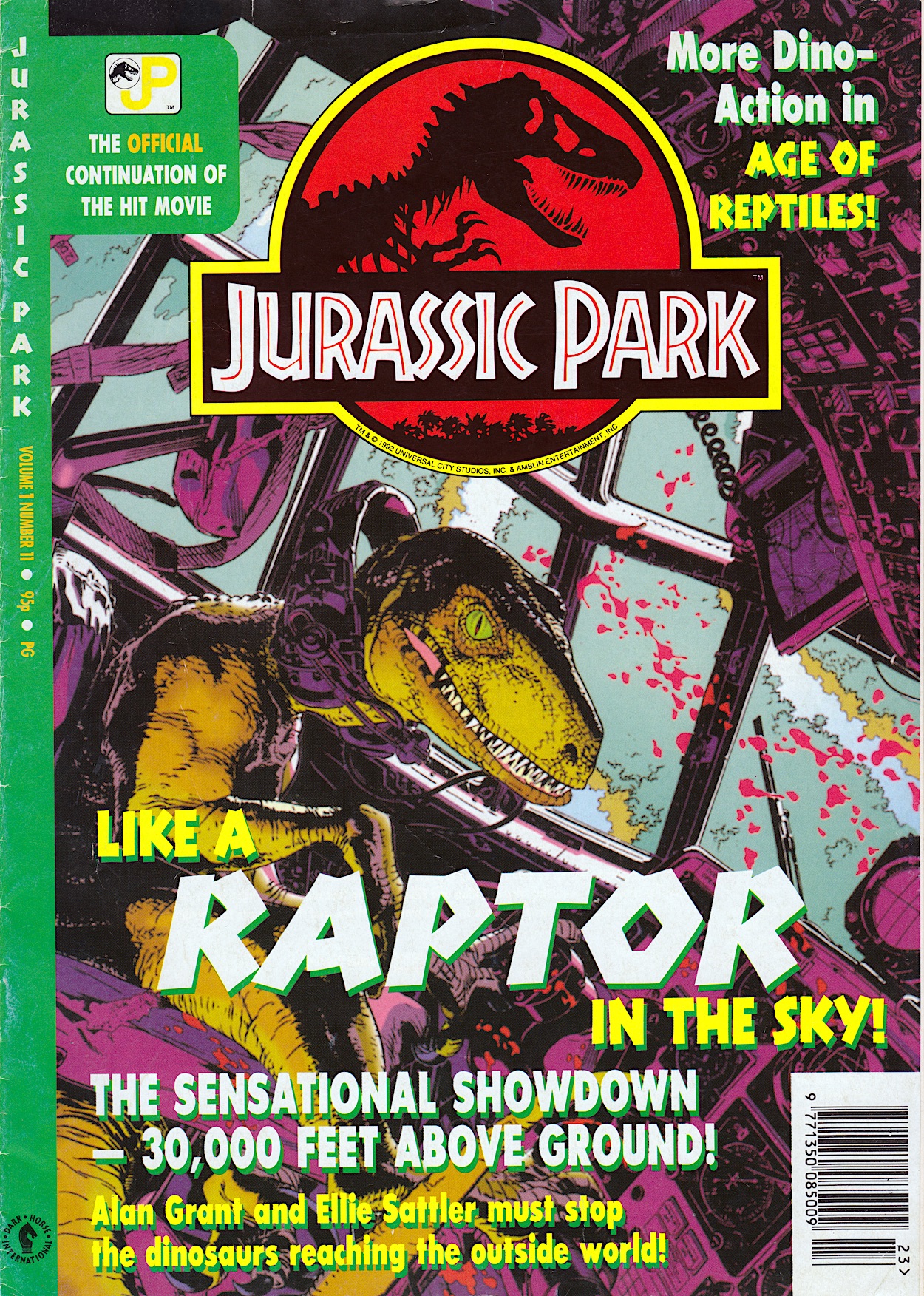
It’s been a long wait for this issue of Jurassic Park so I’m chomping at the bit to get stuck in. I can remember as a teen being overjoyed to finally see the comic appear again, however my initial reactions once I opened it were mixed. First of all this is my very favourite cover of the whole series. No, a Velociraptor doesn’t really take control of the plane, it’s just a funny reference to the main story inside. To this day Michael Golden‘s cover still raises a giggle which I’m sure was the intention. I just wish it wasn’t covered with so much text.

But then came a little bit of disappointment because I discovered there were eight less pages, reduced from 36 to 28 and there was only the one back up strip, no Xenozoic Tales in sight. I’d been really enjoying those stories but at least Age of Reptiles was still here and it was as magnificent as always. Things would (begin to) return to normal next month but initially I didn’t know this so I wasn’t sure if Tenrec and Hannah would return. What is here is great fun though, so let’s get going.

In the world of Jurassic Park small, seemingly inconsequential actions can have catastrophic consequences

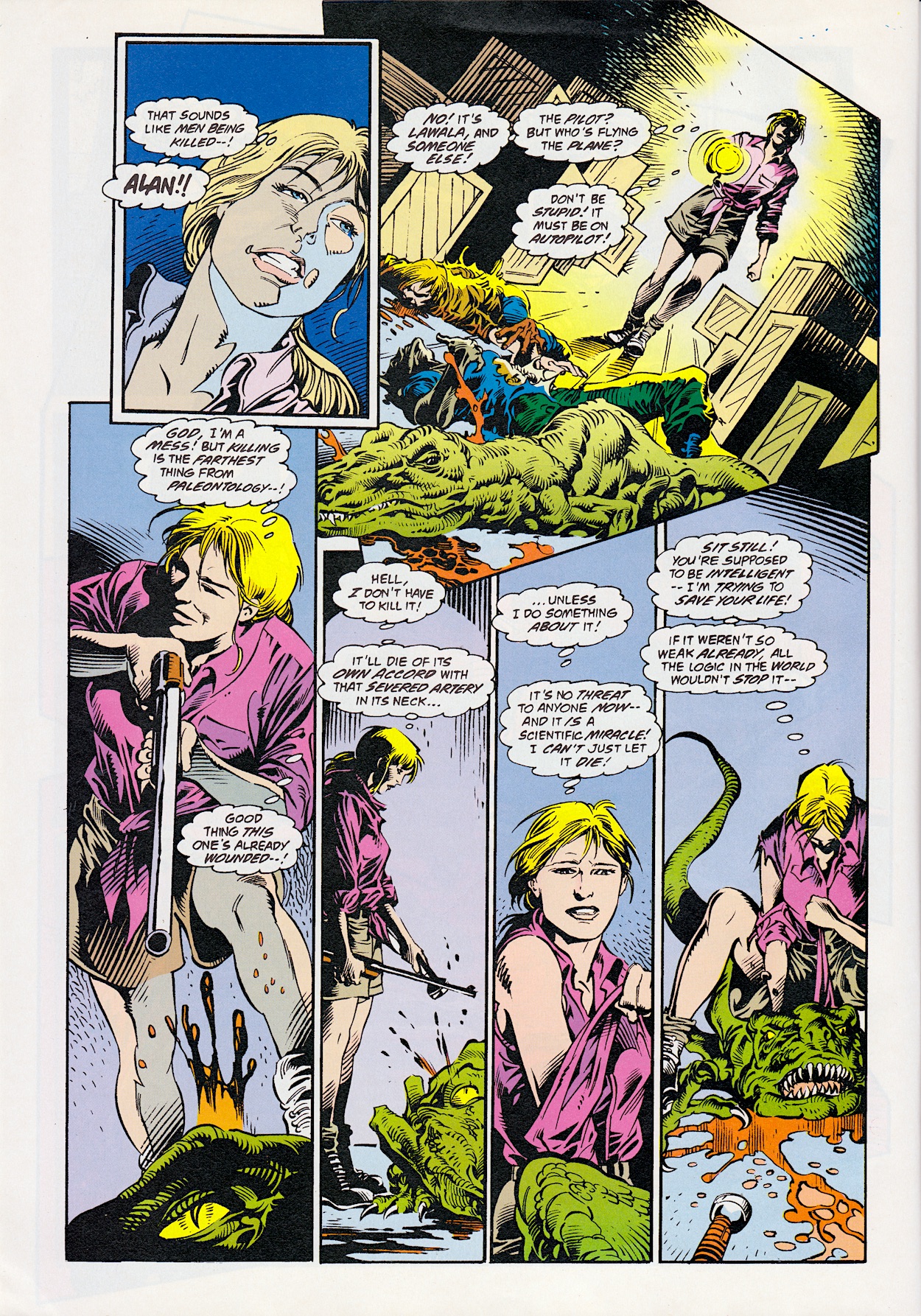
The final part of Steve Englehart’s Dark Cargo begins with the pilot doing what humans always do in the world of Jurassic Park; proving that small, seemingly inconsequential actions can have catastrophic consequences. Feeling the plane’s weight shift about he puts it on autopilot and goes to help George Lawala, finding he’s already killed one of the juvenile ‘raptors. But they don’t see another skulking in the shadows, hunting the two men. It attacks, killing the pilot and maiming Lawala, but not before he’s able to shoot it in the neck.

It’s here when Jurassic Park makes its real point of difference. Dr Ellie Satler (she and Dr Alan Grant were Lawala’s prisoners, check out the previous reviews) hears the gun shot and discovers the horrific scene, the dinosaur dying in front of her. Even knowing it would’ve killed her in a heartbeat and that its siblings must be nearby doesn’t stop her from trying to save its life. It was just doing what it does, hunting prey to eat. I love this page.

A quick note about the artwork. The final panel above is a strange one and at times penciller Armando Gil does seem to draw the ‘raptors in a way in which they’re not really identifiable (sometimes in this chapter it’s also confusing in regards to which one is which and we have to rely on the dialogue to decipher the images), but mainly he has done a great job of capturing the dinosaurs as real world animals (check out his magnificent Tyrannosaurus rex in #6). His action scenes can sometimes seem sparse, but inkers Dell Barras and Fred Carrillo imbue them with great texture and atmospheric shadowing. John Costanza is our letterer and Renée Witterstaetter brings bold colours alongside her role as Story Editor.


“The ‘raptors.. somehow, it’s got to be the ‘raptors..!!”

Dr. Ellie Satler

While Ellie ties a tourniquet around the animal’s neck another ‘raptor is looking on, which Alan spots and distracts, with both it and the final sibling giving chase. Panicking, he dives into an open crate but escapes through a side hatch as the dinosaurs jump in after him. Able to close the hatch and lid he traps them inside, attaches the pulley system and dangles them out the back of the bomber! Well, out there they can’t do any harm. Famous last words, Alan. This is Jurassic Park after all.

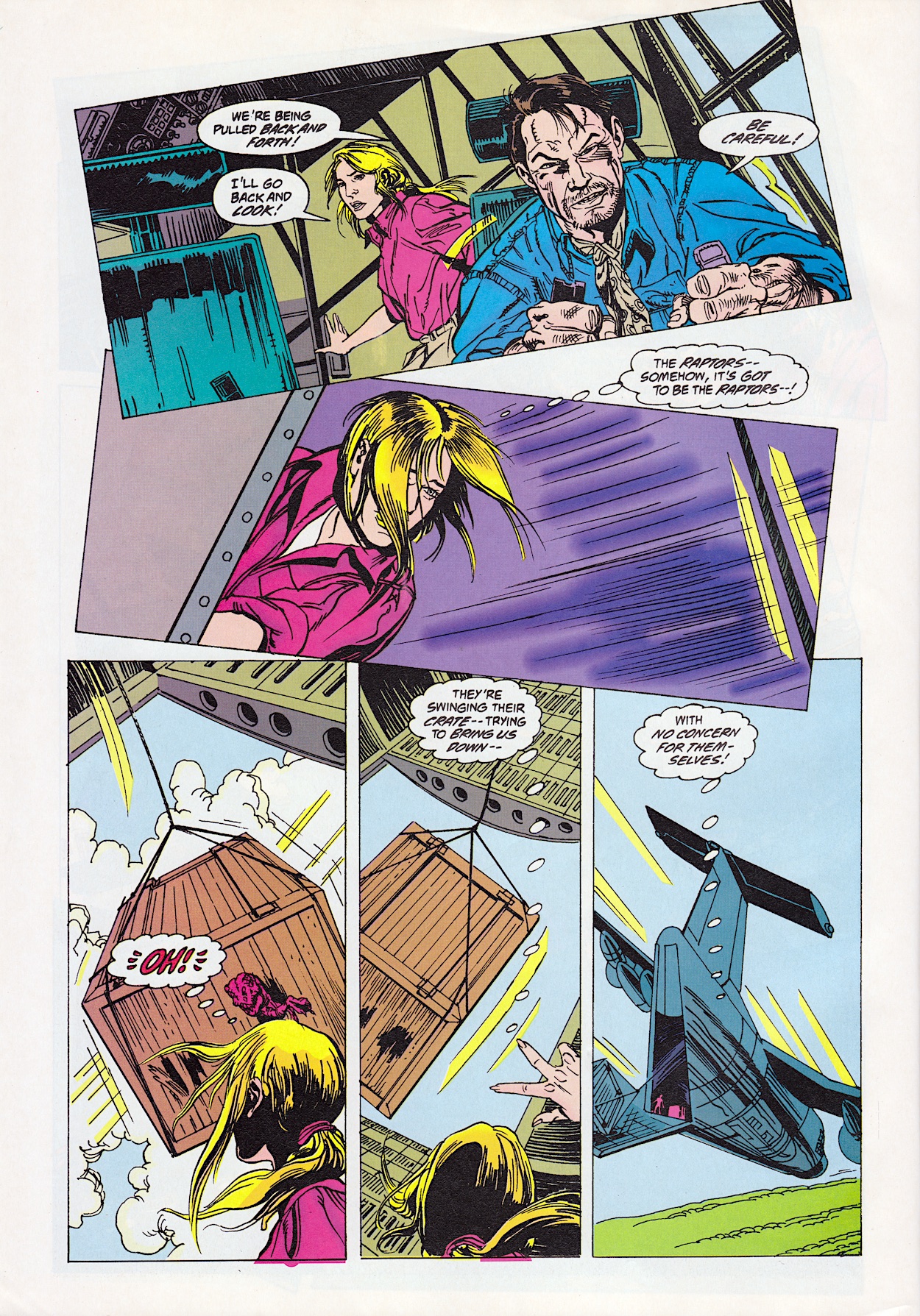
Suddenly the plane starts diving and they rush for the cockpit. Refreshingly, they don’t immediately take to the controls and somehow land the plane like in every movie and TV show ever. Instead, Alan admits the only thing he recognises is the wheel and he tries desperately to stop them crashing, not really sure what to do. The plane is being pulled about and the autopilot was knocked off, but why? Ellie is sure it has to be the Velociraptors, but how? Take a look at the page above.

I remember reading this at the time and being thrilled with the intelligence of the dinosaurs, especially this lot. You have to remember before the first movie came along the general public had a vision of dinosaurs as stupid big lumbering lizards. Jurassic Park changed all that and I can distinctly remember that same feeling of excitement from this comic. The swinging crate pulls the plane further down, Alan struggling to level it off in a desperate bid to stop it nosediving when we get to this month’s cliffhanger.

The voice from the other side of the binoculars is going to be key to how this story develops from here on. It’s a more exciting cliffhanger than the one which led to a two month wait, so thank goodness we’re back to a monthly schedule again. I can remember parts of the strips to come, in particular what Ellie saving one of the ‘raptors will mean later, and I can’t wait to revisit these stories and compare them to the movie series we’ve had since.

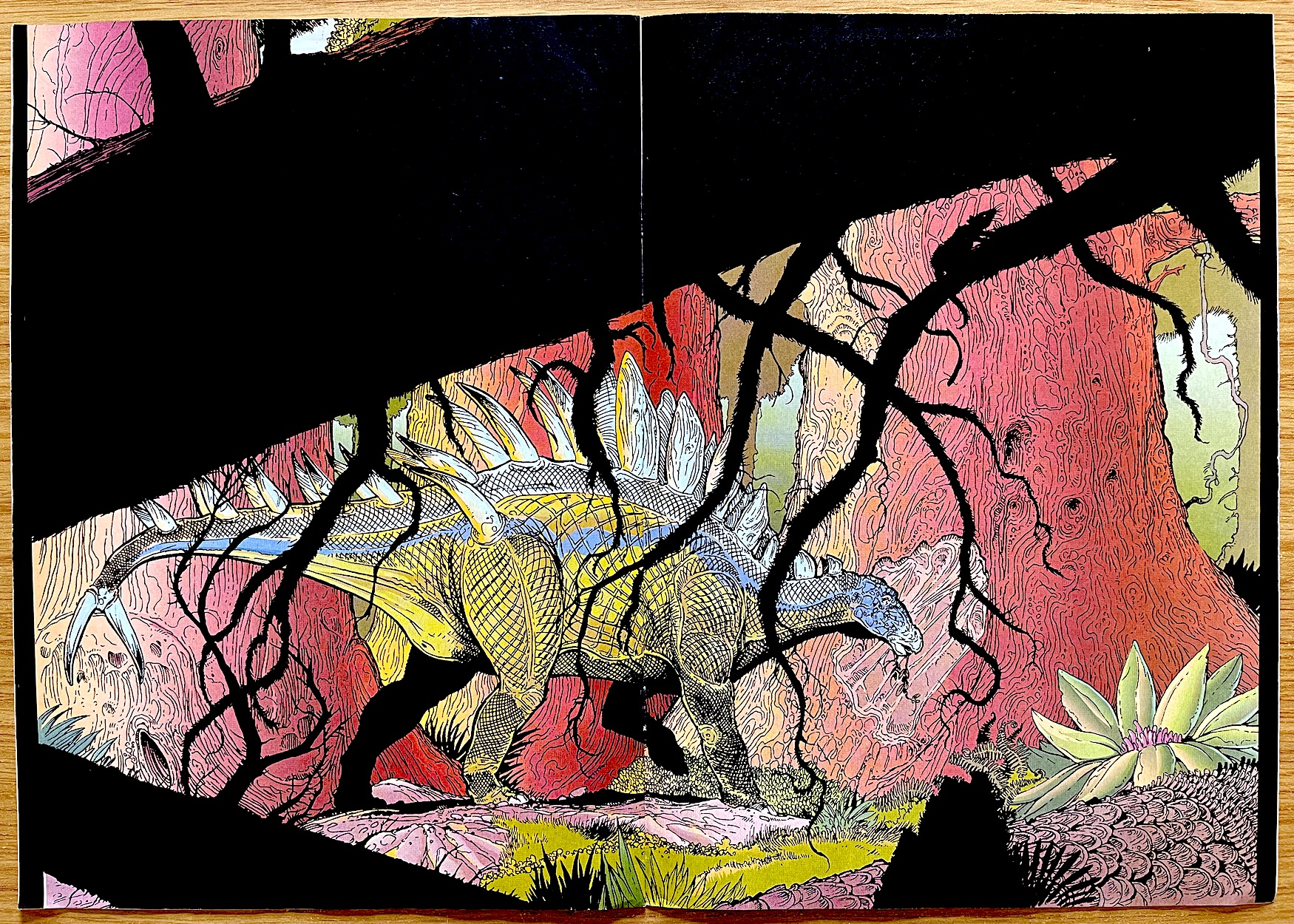
For now, take a good long look at this piece of gorgeousness.

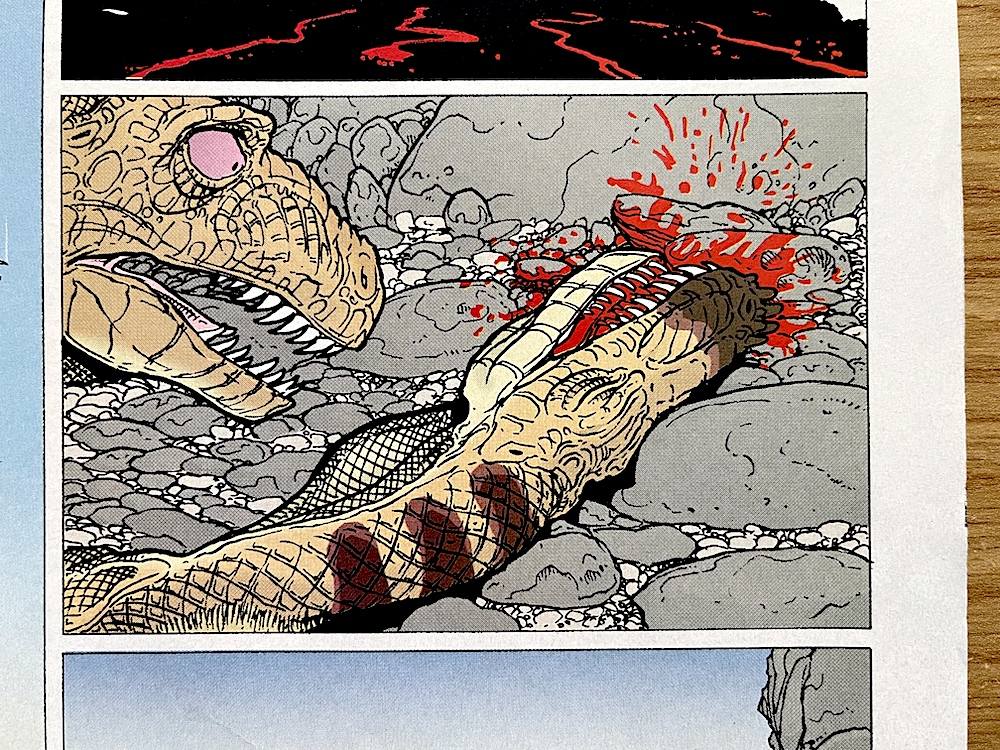
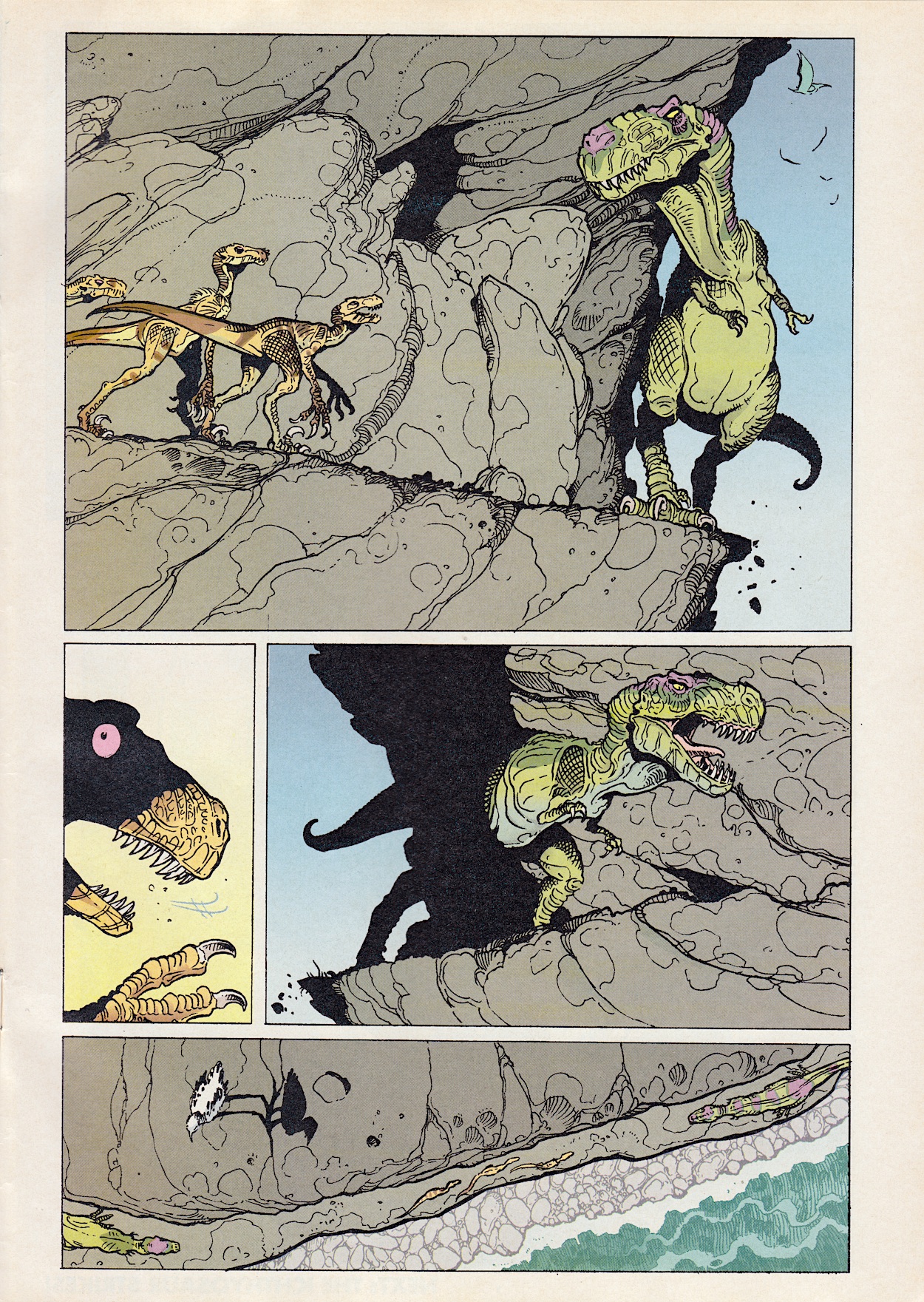
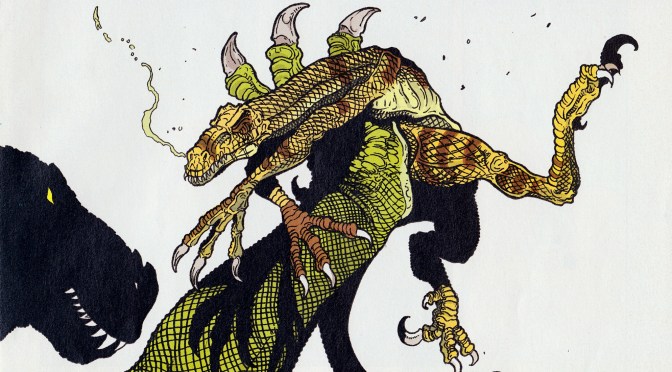
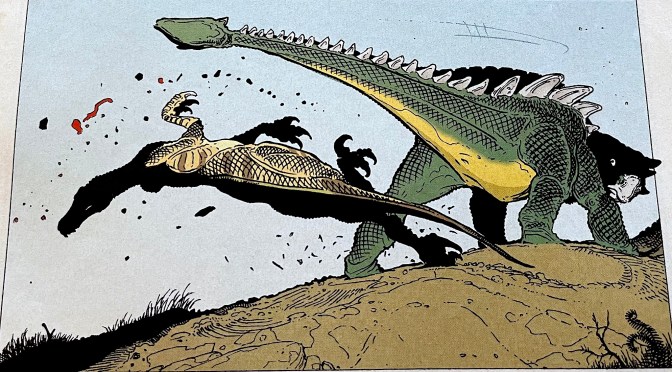
As I said at the top of the review there are only two strips this month, with our main story and the one back up getting equal space of 12 pages apiece. So we’re straight into the Age of Reptiles. It opens with the panel at the top of this post, which certainly sets the scene! That is followed with the above spread and I find myself just completely immersed in this world again. Still up upon the cliffs, the Deinonychuses attack the T-rex pair. They put their all in, I’ll give them that, but they never stood a chance.

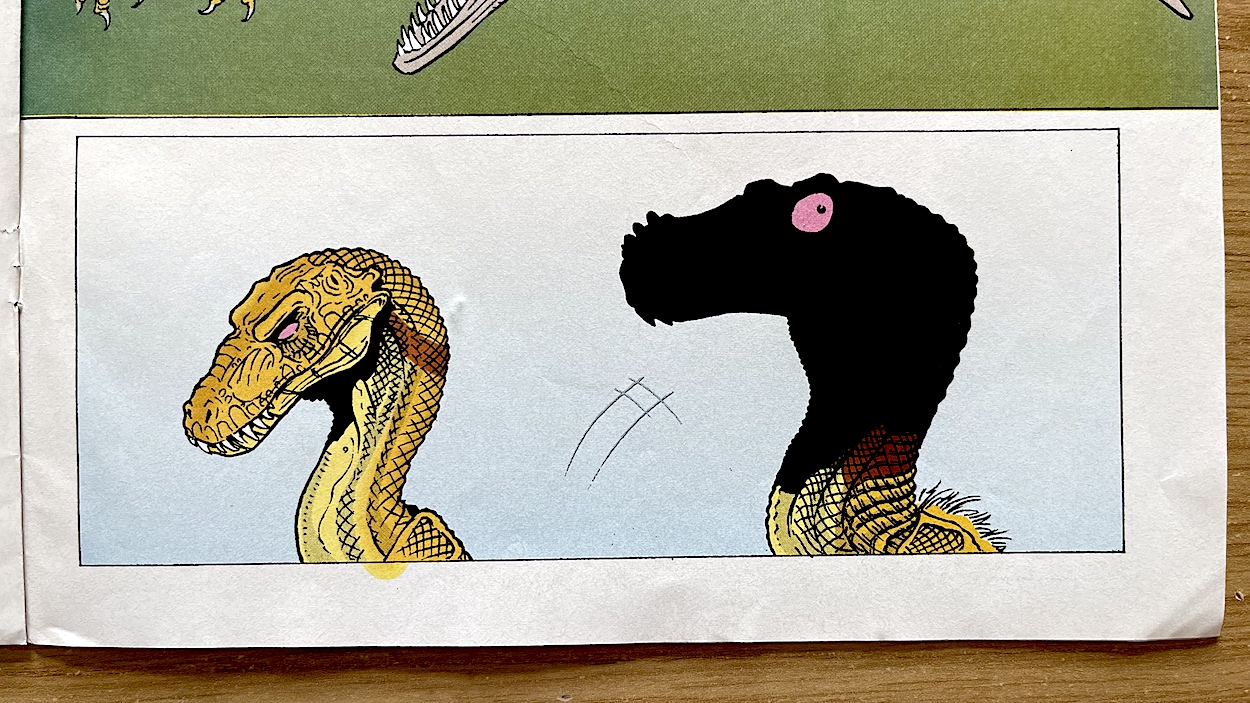
One is kicked over the side and lands in deep water below, quickly swallowed up by a giant ocean predator. The remaining two are swiped off the side by a glancing blow from a ‘rex  tail, one landing hard on the rocks at the bottom of the cliff, dying instantly but breaking the fall of the other. Throughout this, and the rest of the story, the individual characters really shine through, as you can see from this selection of highlights below.

From being taken by surprise from behind, to the horror of their friend dying, to the little baby T-rex being coached to hunt by their parent Long Jaw, every dinosaur here is an individual brought to life by the genius of creator/writer/artist Ricardo Delgado and colourist James Sinclair.

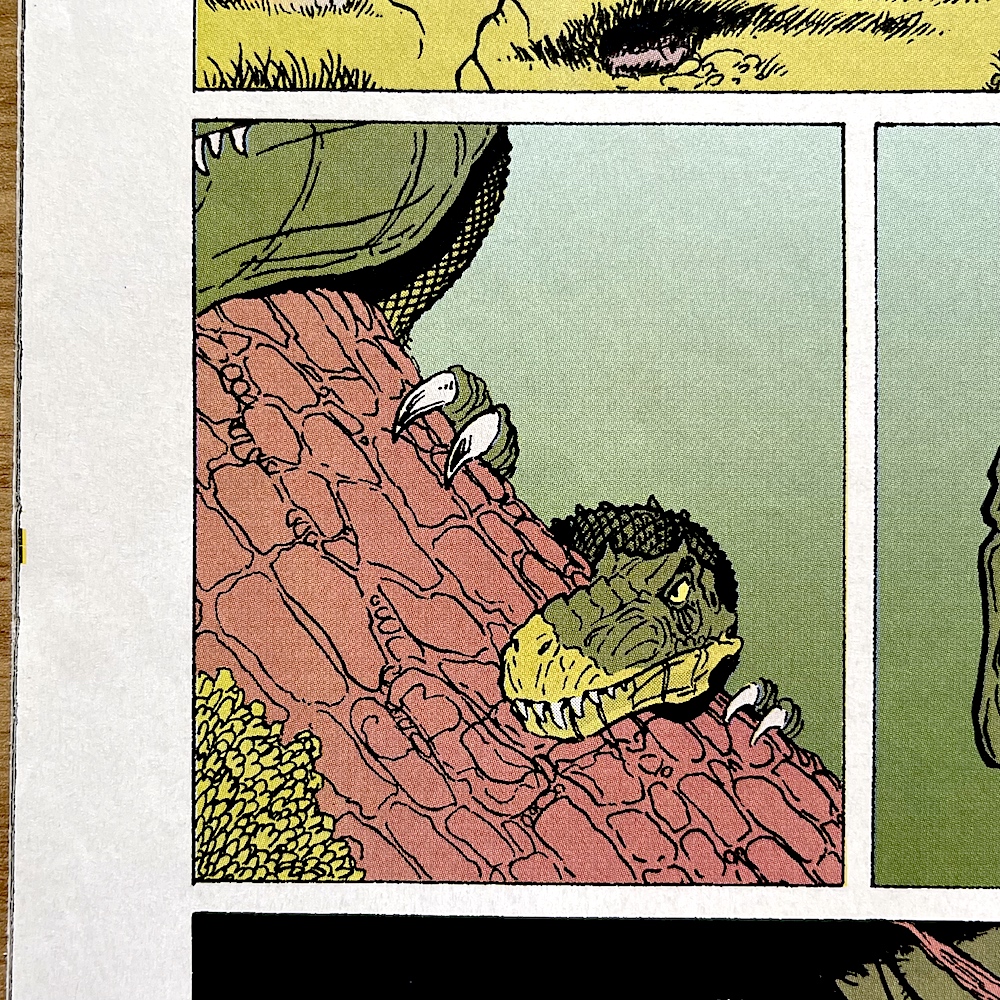
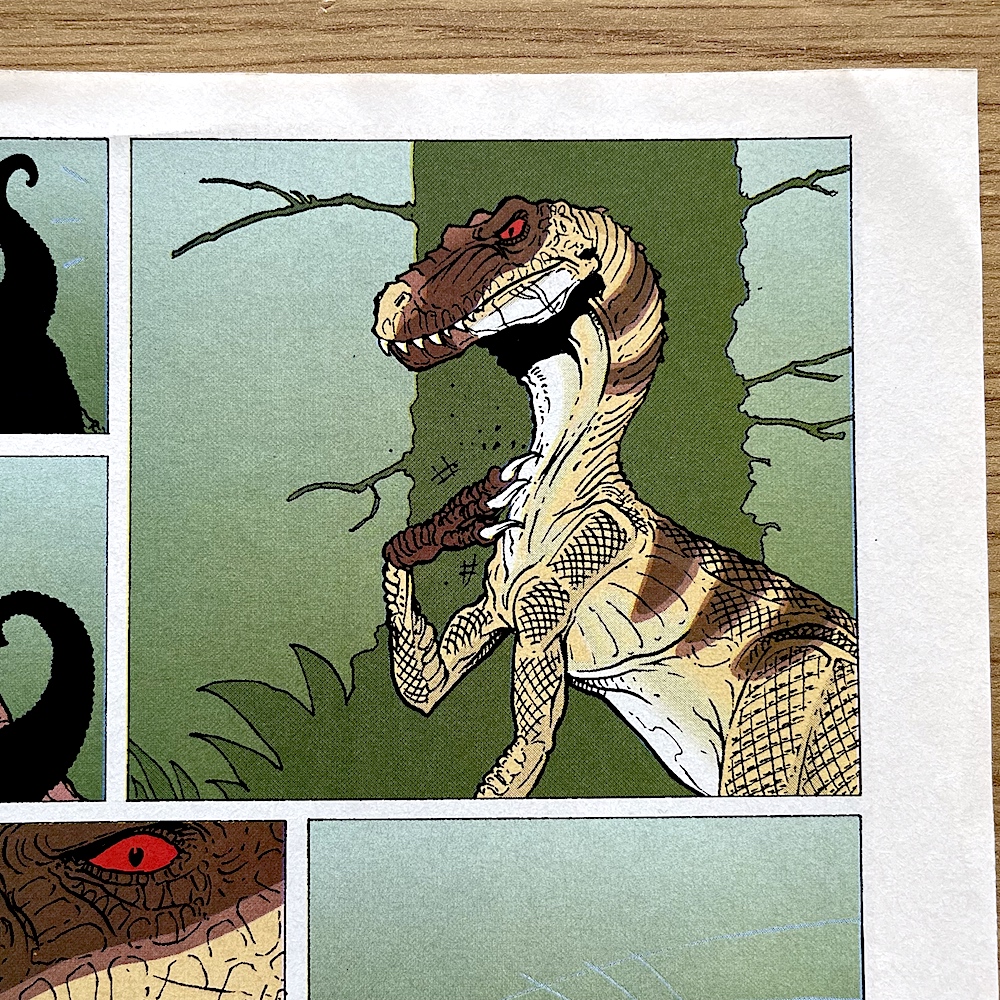
The youngster spots Dark Eye who is clearly deliberately wanting to be chased, as you can tell from that final panel above. That pose almost says, “Me?”. Haha, it’s brilliant. The young inexperienced hunter doesn’t realise it’s a trap and gives chase. When his prey disappears behind a rock he follows blindly, right into an ambush of half a dozen of Dark Eye’s pack. Long Jaw is the adult T-rex and suddenly he realises he’s alone! He runs through the forest in desperate panic, following the trail or possibly the scent and finally comes upon this scene on the final page of the chapter.

I vividly remember seeing this image for the first time back in 1994. The towering Long Jaw roaring into the sunset, the flying predators already circling and the heartbreaking image on the ground. It was truly shocking. I’m sure I wasn’t the only reader who’d loved the tiny little ‘rex, such was his depiction in this and previous issues. We’re racing towards the climax of Age of Reptiles and I know it was big, I know it was ultimately a very satisfying conclusion, but for the life of me I can’t remember how it ends. It was 28 years ago after all. I’ll impatiently wait and see.

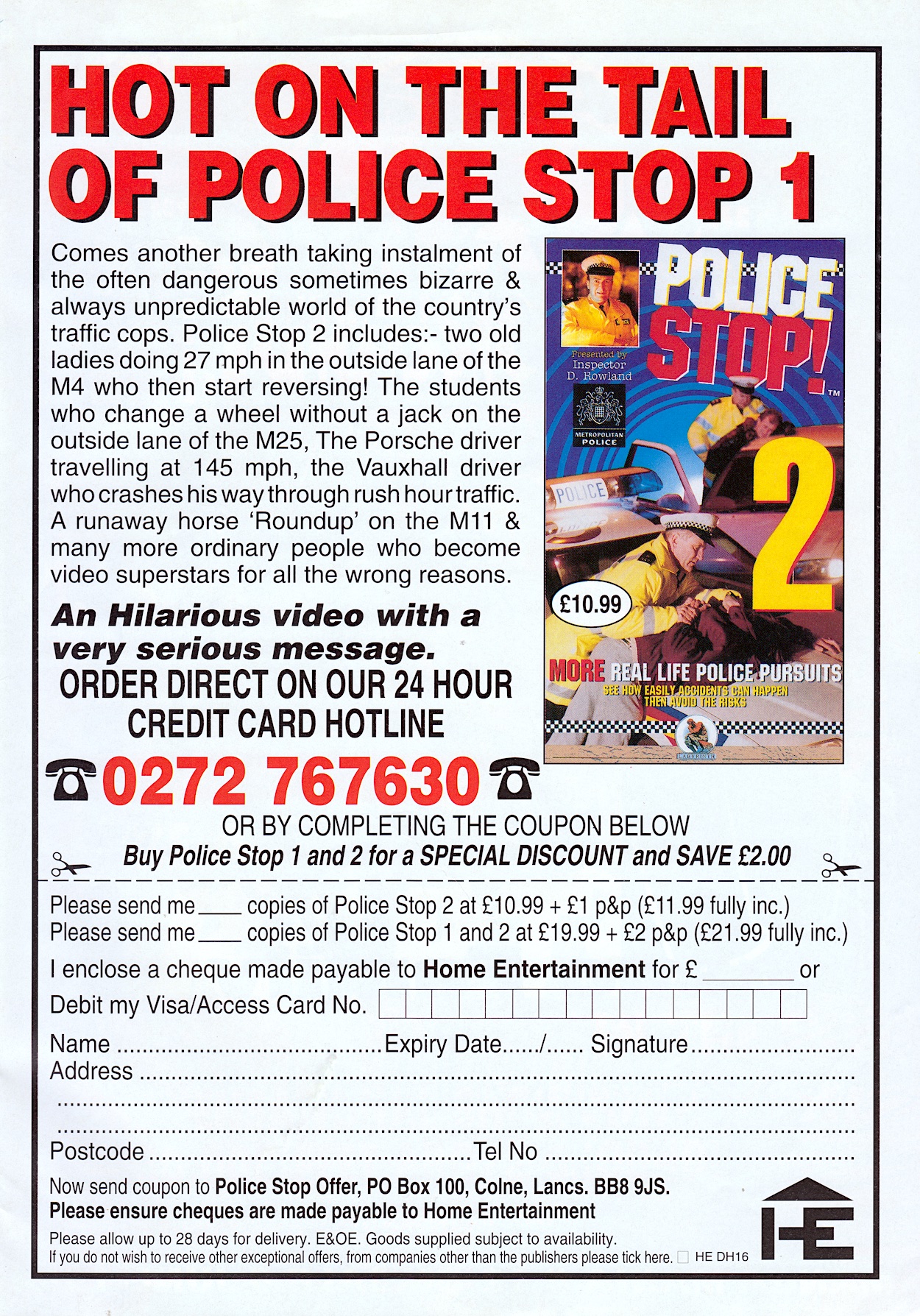
Both of these strips ratcheted up the tension so I’m really looking forward to the next issue. This one may have been thinner than any other in the series and down one strip but what is here is superb from start to finish. Plus, I’ll just mention how much I love that cover image again. To finish with the final two pages contain more of those retro adverts, the first of which is for a video release of a show I remember being on TV at the time, and the back cover is for a comic magazine from Dark Horse International that would end up saving Jurassic Park from an even earlier cancellation. More on that later in the summer.

Just on a personal note, it’s so strange to look back and see a video for £10 that only contained one episode of a show. I do remember buying Babylon 5 on VHS, each volume costing £8.99 and containing only two episodes. It’s crazy to think back to that now when we’re so used to box sets. Two Christmases ago I was able to purchase the entire five seasons of B5, 111 episodes for £40 on my Apple TV! (All restored to their original aspect ratio and remastered by the way, just to let fellow fans know.) How times have changed.

Anyway, back to Jurassic Park and that’s where we leave things for now. The next issue’s review will be here from Thursday 7th July 2022 and by then I’m sure most fans will have seen the brand new film which is due for release tomorrow as of the time of writing. Suddenly, remembering buying these comics is making me feel very old!

iSSUE TEN < > iSSUE TWELVE

JURASSiC PARK MENU

WiLDCAT HOLiDAY SPECiAL: ANOTHER BiTE

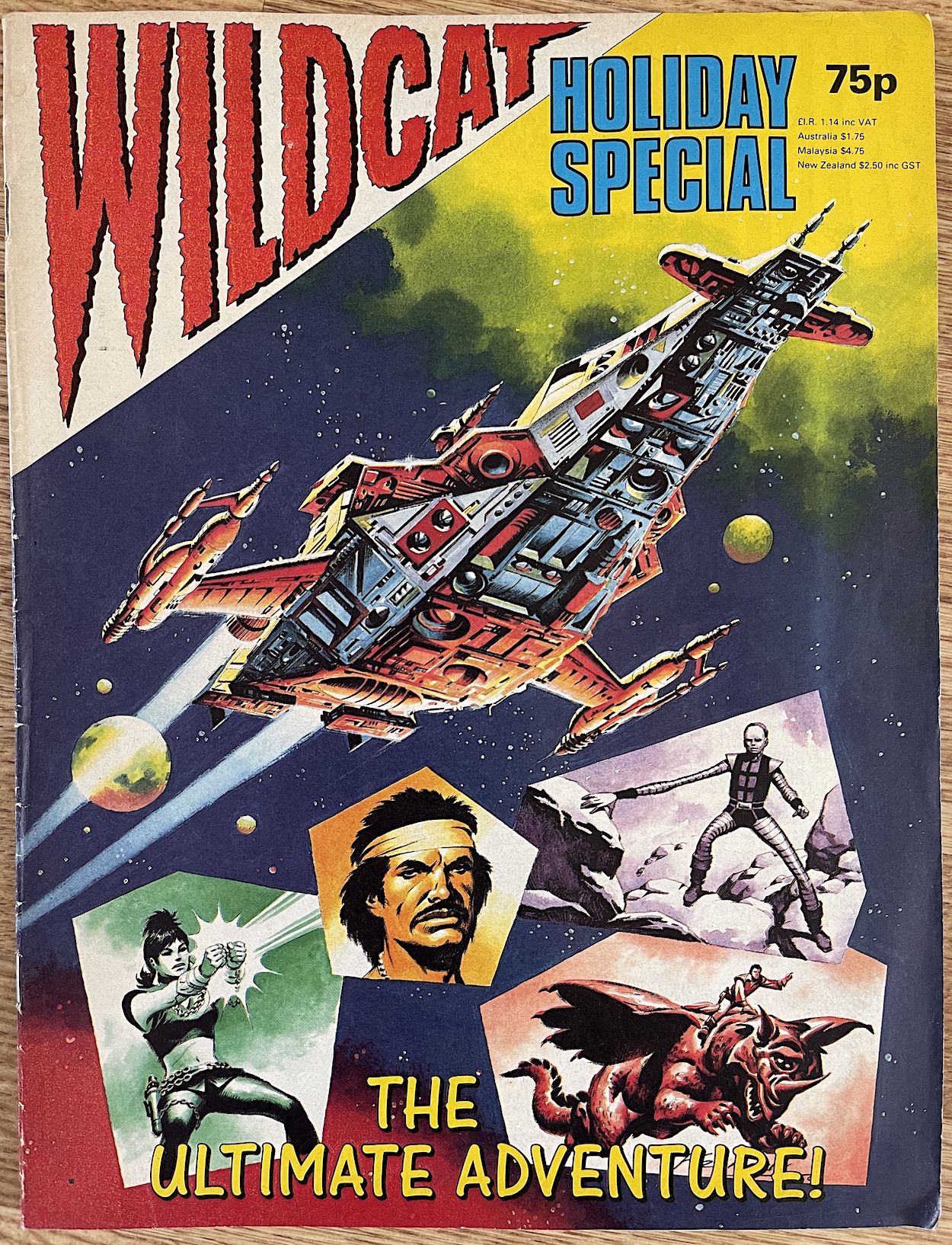
It hasn’t really been that long since the final issue of Wildcat, two months in fact, but it’s great to hold another edition in my hands, especially one I’ve never actually read before. I wasn’t aware of it as a child because I hadn’t followed the characters into Eagle when the comics merged. There’s a rather lengthier wait after this but I’ll get to that at the end of the review. So what we have here is the standard Fleetway Holiday Special format of 48 large, glossy pages full of strips, a prose story and extra features thrown in for good measure.

After a contents page and a recap of the set up from the preview issue Turbo Jones reclaims his position as the lead strip (now drawn by Keith Page) and like all of the stories here it’s a standalone tale and not linked to the ongoing serials that all ended with cliffhangers in the last issue. Of course, by now those stories could have concluded or moved on to goodness knows what in the pages of Eagle. (That’s something I’ll look into in future posts.) Some of these read a little strangely because of this.

For example, as far as I was concerned Turbo was still languishing on his quest through the Valley of Death, but here we’ve skipped forward to the next chapter in his adventure on the new planet. We find him and his robotic friend Robo accidentally stumbling across two aliens out for blood (or whatever runs through their veins. If they have veins). This isn’t a quick summing up of things either, in the end they realise the two creatures have no interest in our heroes, they have literally stumbled upon this fight. But of course if they don’t defend themselves they’ll go the same way as the loser.

Turbo is knocked unconscious by a falling branch and Robo saves the day by knocking coconut-like fruits off the trees onto the heads of the aliens. No, really. It ends with Turbo disbelieving this tale of heroism and Robo talking directly to the reader, asking them to write in and tell Turbo what happened. It’s a fun diversion of an opener but feels very slight in comparison to the fortnightly. However, I do love that alien design. Moving on now to something somewhat darker stalking the corridors of the Wildcat itself in The Wildcat Complete, brought to life by Jesús Redondo.

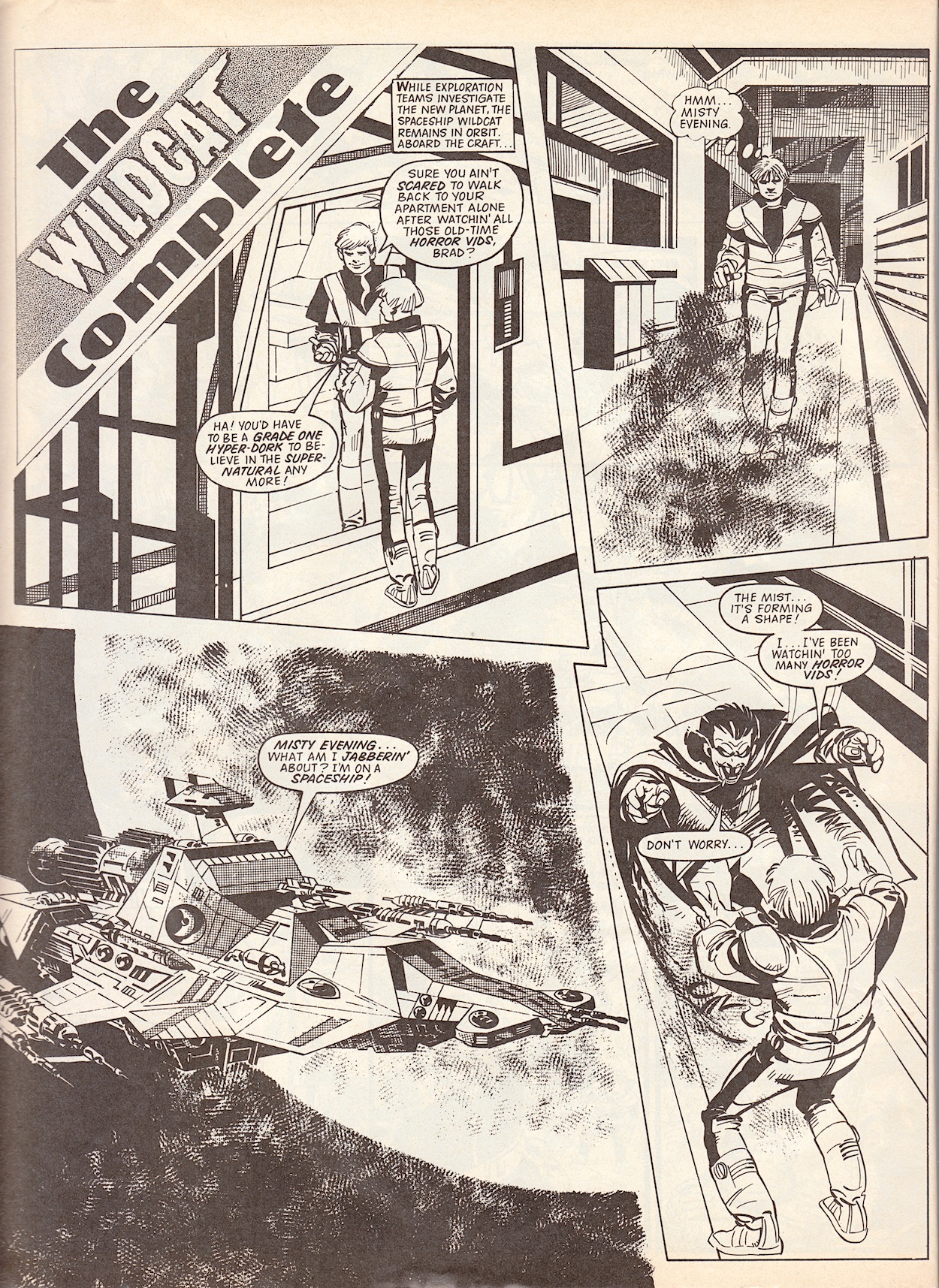
That’s right, we have an actual vampire onboard. There’s also plenty of well-judged humour here too so it’s unfortunate we don’t know who wrote the script. Here on the first page the casual thoughts of our victim raise a laugh as he catches himself on about the “misty evening” before meeting his end, and later on as another victim is running late in getting home he thinks to himself how he’ll “get it in the neck” from his wife! These are the only people we see die (taking the Wildcat Death Toll up to 40) but mention is made of them being only the latest in a series of disappearances, so our toll is actually unknown.

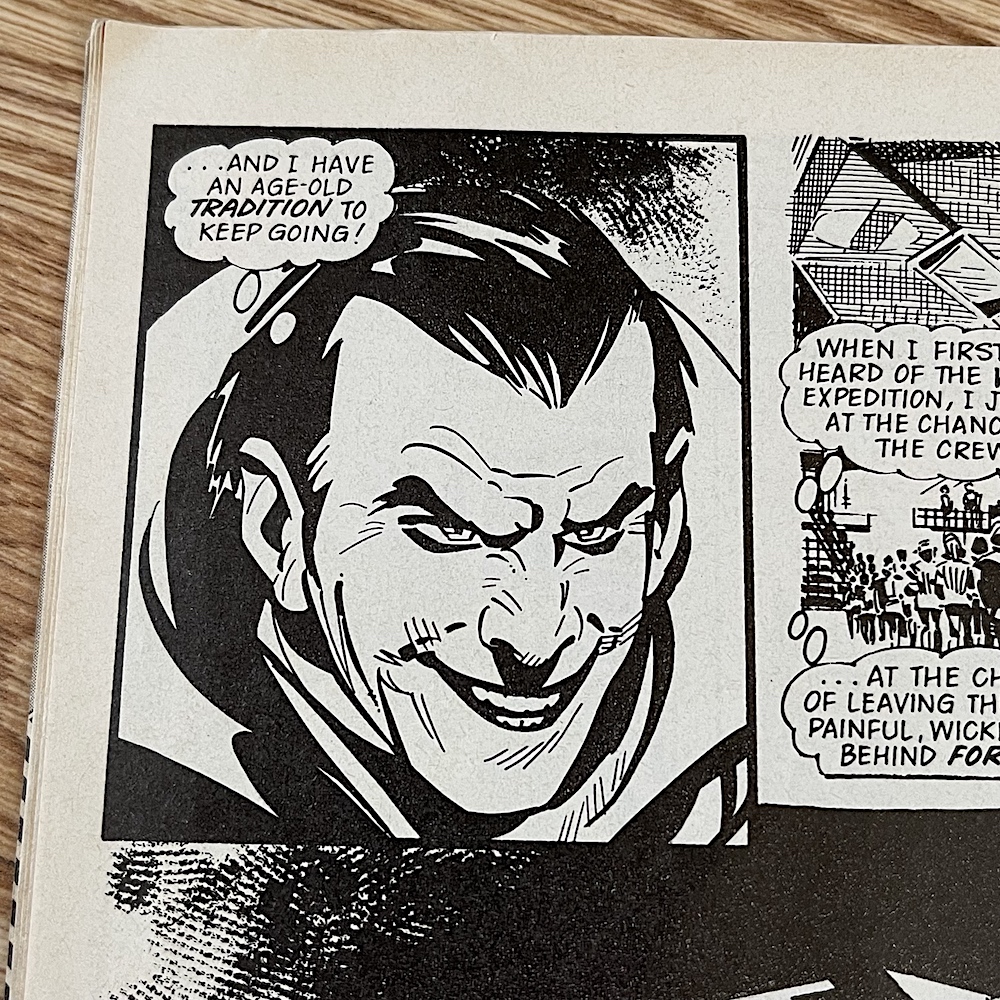
During the day our vampire goes by the name Dr. Joseph Lugosi, obviously a play on the name of renowned actor Bela Legosi who is probably best remembered for playing the title character in the 1931 film Dracula. It’s not just his name the story pays homage to either, just take a look at the doctor in this close-up frame.

There’s a rather dark moment where we see him dispose of a body by taking it to the food recycling plant, which is basically a bunch of retro-futuristic robots munching down on anything thrown into their pit. We get a little internal monologue of how Lugosi applied to be on Wildcat because there’d be no sunlight in space to stop him feeding, and we see him queued up to get on board, everyone else in casual gear, him in his dark cloak, standing out a mile. Given his appearance and dress sense, when he thinks his plan is foolproof and no one would ever suspect him it seems ridiculous, but it’s actually all explained in the end.

When an attack is disturbed mid-feast he has to leave the body behind and as Wildcat Commander Griffin reviews the tapes he sees Lugosi disappear into thin air. He ends up tricking Lugosi into believing he’s replacing an ill doctor on an expedition to one of the planet’s moons, but before anyone else boards the shuttle craft it’s launched out of the Wildcat on autopilot. The last page of the strip is below and very neatly wraps up the story.

I really like how Griffin had to research what a vampire is (so far into the future are we, their legends appear to have been lost) and that he simply reacts logically to the problem. There’s no disbelief, just a problem to solve and the history tapes give him the answer. While I can only show you a little bit here he’s a cool-as-a-cucumber character and one I wish we’d gotten to know properly in the comic. Check out that final caption too, vampires are now extinct! Another great anthology story, one that’s made me realise just how much I’m missing them every two weeks.

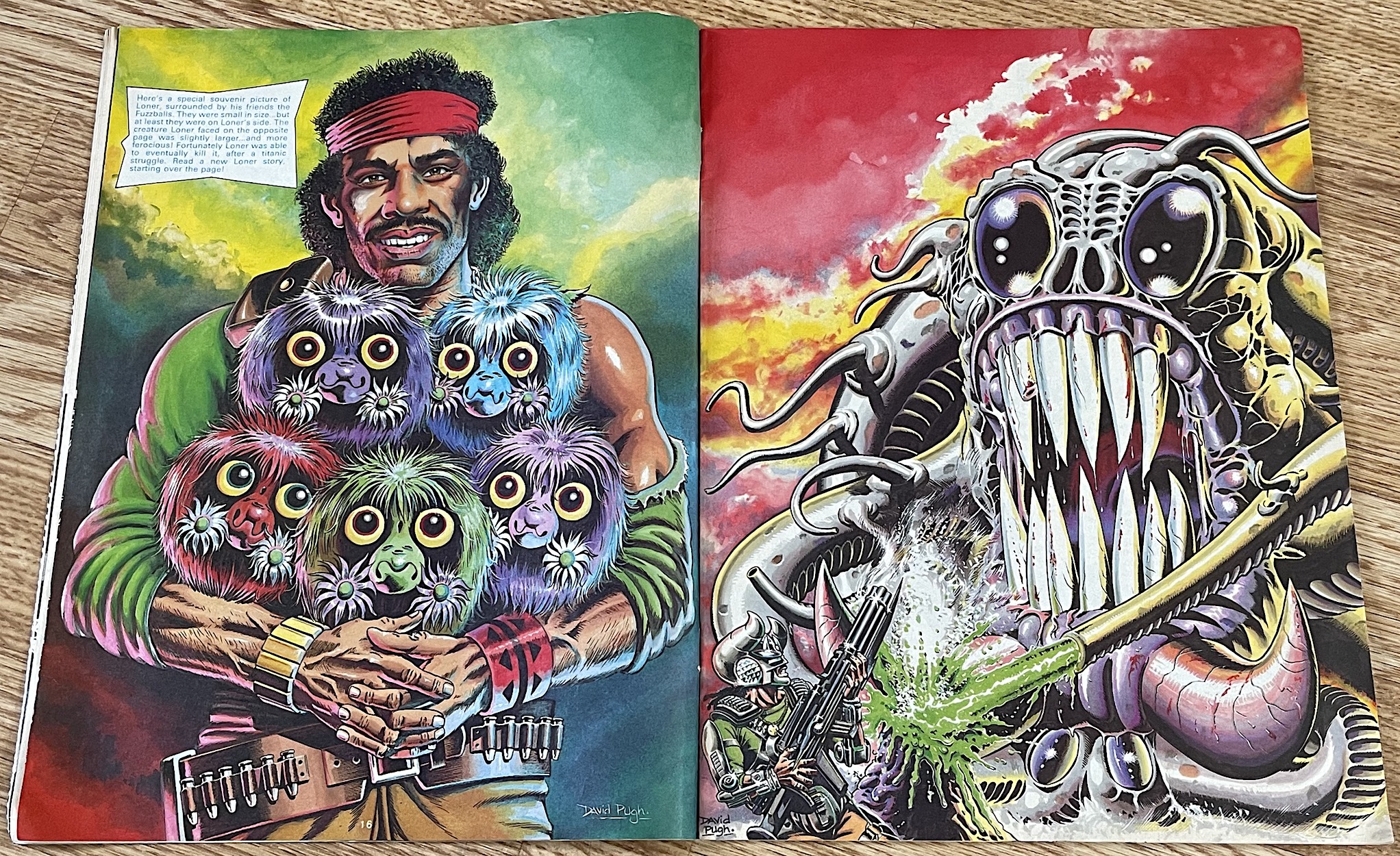
Loner gets a good bit of space in the special but unfortunately there’s not a comic strip in sight. There’s a two-page spread of pictures taken from the early issues and his initial scraps with, and ultimately friendship with, The Fuzzballs. There are also two pin ups, both drawn by David Pugh. One is brand new and the other is a reprint of the cover to #7 which was so good it deserved another outing as a mini-poster without the title and issue details. To this day it’s probably my favourite piece of art from Wildcat. In fact it’s one of my favourite pieces of comic art ever.

On top of all this we get a Loner story written by editor Barrie Tomlinson, however it’s told in prose with images of David’s taken from the regular comic. At five pages and full of text it’s a meatier read than I expected and actually a whole lot better than the strip we’d been reading for the last handful of issues. Falling into a chasm he’s apparently rescued by an alien slug creature who carries him to a large cave full of slugs where he also sees another, two-headed alien. They have to fight to the death for the entertainment of the slugs! (Are they an unfriendly relation of the Dargonlites from the Joe Alien story?)

It’s a struggle. The two-headed creature is relentless but soon Loner is able to escape by causing chaos in the audience (he throws one of the slugs into the crowd as a distraction). Back outside the alien is on Loner’s tail and in what looks like the end of the fight Loner’s gun Babe ends up pressed against the creature’s throat. But Loner backs off, trying to communicate he doesn’t want to kill him, he has no beef with him.


Both heads broke into hideous grins, then it turned and walked away.

Loner prose story

Communicating is difficult however and relies on body language more than anything, which is interesting. However, I’m disappointed he no longer has the headband from previous stories. It’s only given a passing explanation that he’d returned to Wildcat and had it removed before coming back down. This completely contradicts the story where he received it! Such a shame, but perhaps a necessary evil because the images they had to use didn’t include it, rather than it being a story choice.

Anyway, the two-headed creature continues to follow Loner at a distance. When our mercenary gets back to his shuttle it appears to attack, throwing Loner to the side and leaping into the craft. Are they going to steal it? Nope, there was a deadly snake-like predator inside. The alien had saved Loner’s life. But before Loner can try to communicate a thank you, he’s attacked by the alien again! He wins the battle by unhappily having to end its life, or be killed himself.

In the end, the creature had been a warrior and it was always going to be a fight to the death, but Loner had saved him from the underground slug beings and he’d had to repay that debt first. This would’ve made for a great multipart strip in the regular comic, it’s full of character and paints a wonderful, exciting picture. Such a shame it’s only illustrated by images from unrelated stories.

There’s one more special to come and I’m very excited by it

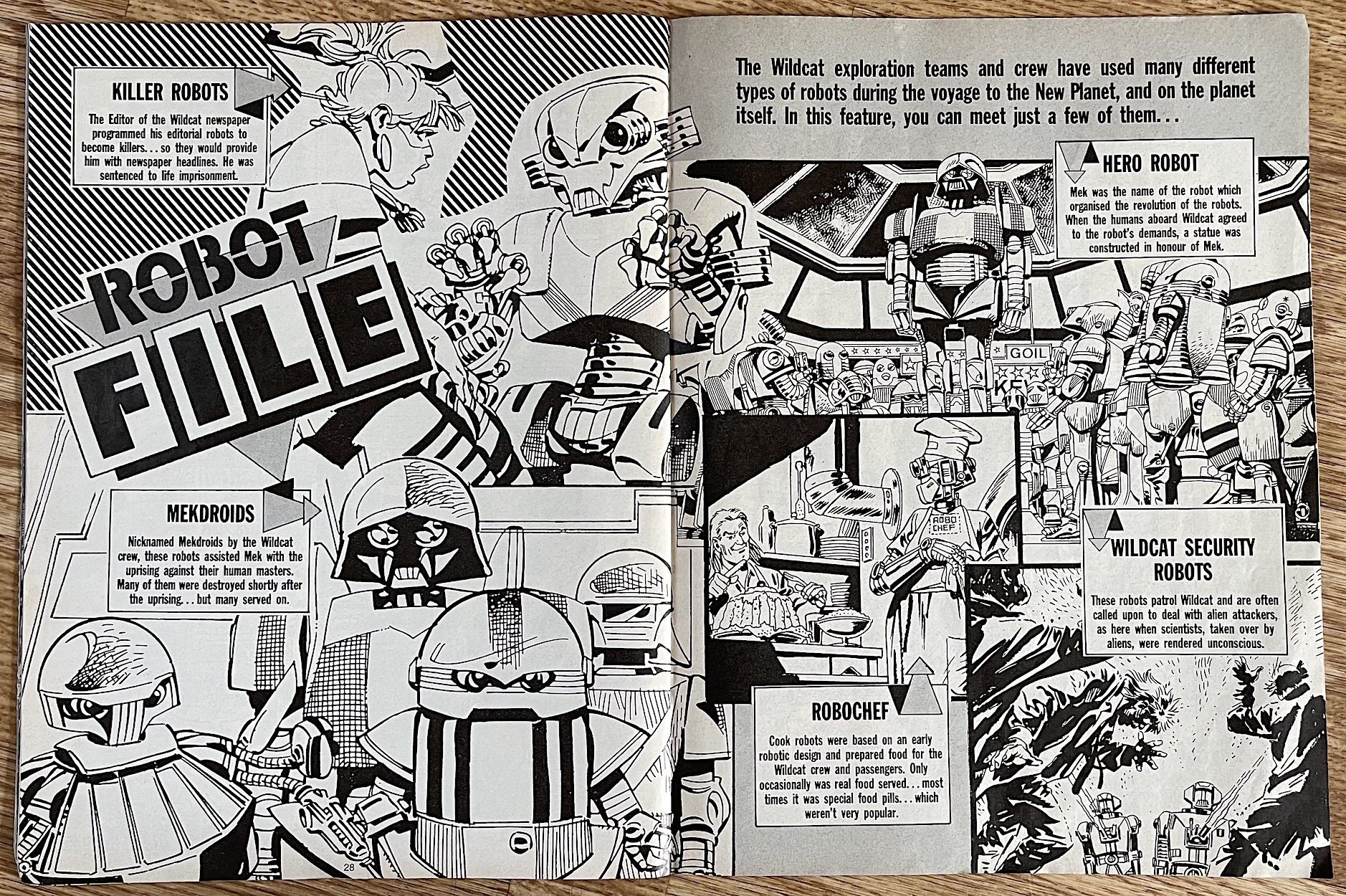
Alongside the double-page spread of Loner’s furry friends there’s a four-page feature about some of the robots that reside aboard the Wildcat and which have featured in previous stories, most notably the Wildcat Complete series. Features like these act as a nice way for new readers to catch up and get an idea of what Wildcat is all about, but unlike some of the Super Naturals Holiday Special features which felt like filler, these are nicely put together and are still enjoyable for regulars.

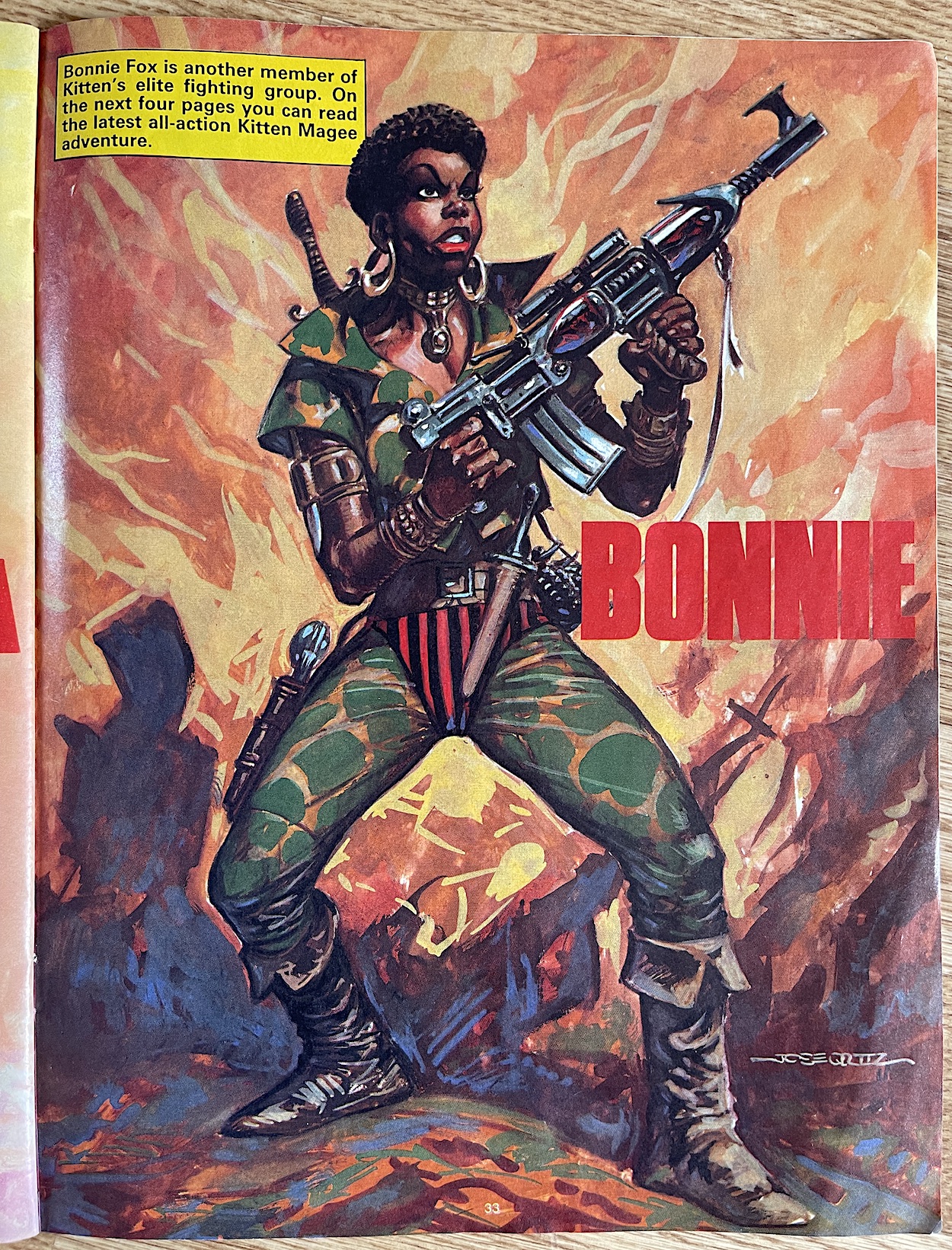
Alongside more reprinted pin ups there’s another new one which hadn’t made its way into the fortnightly and it’s of one of my favourite characters from the Kitten Magee story, Bonnie. As regular readers of the comic (or even these reviews) will attest, Kitten’s team were just starting to get fleshed out some more, even going on their own adventure without their leader in the final issue. I look forward to reading the ongoing tales in Eagle and Wildcat at a later date, mainly for them.

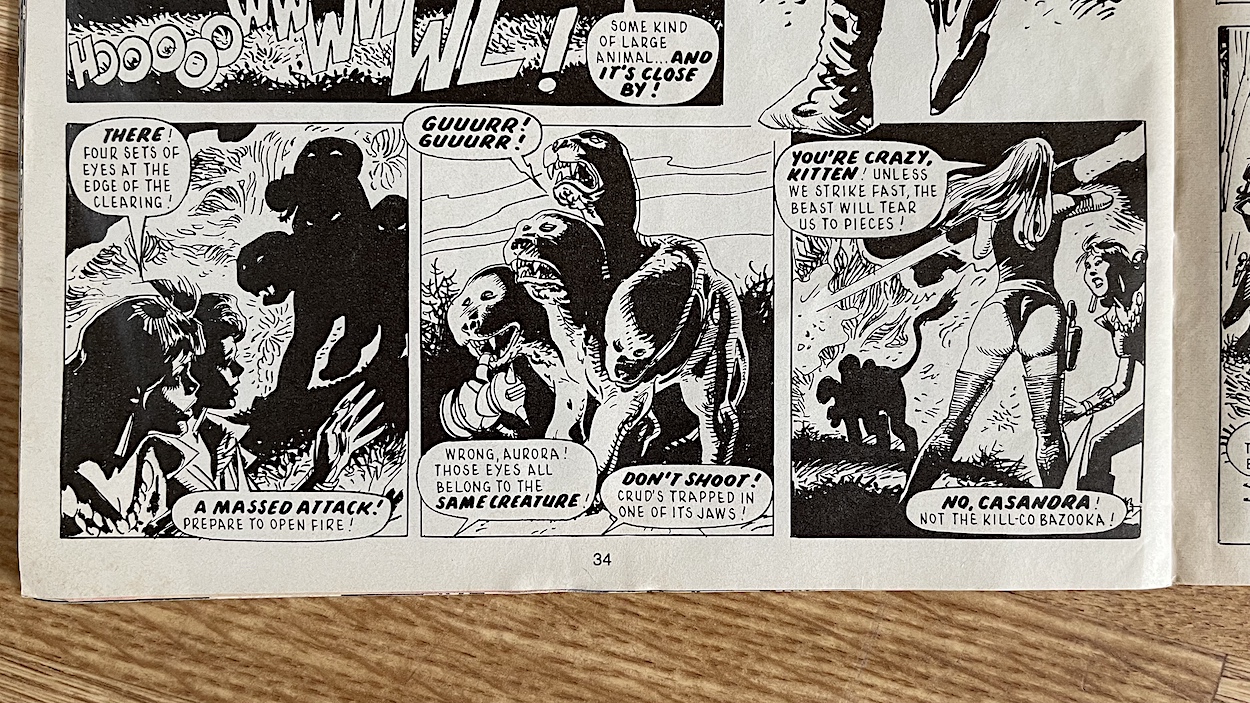
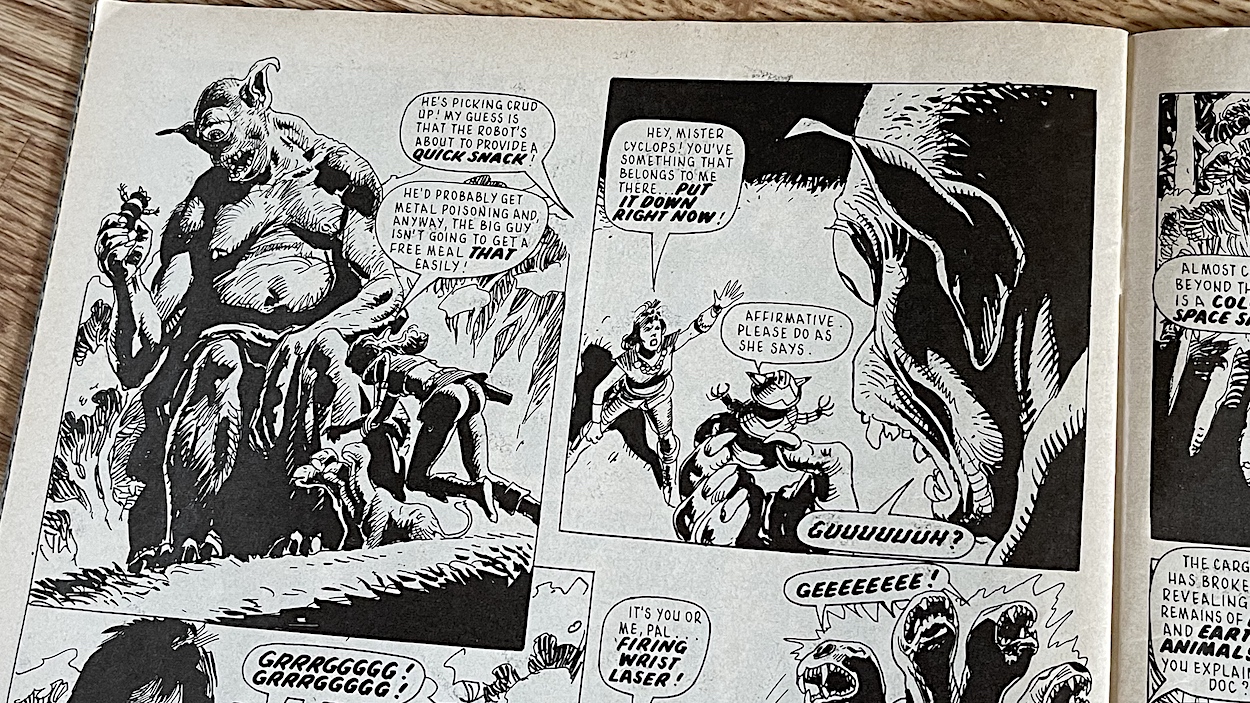
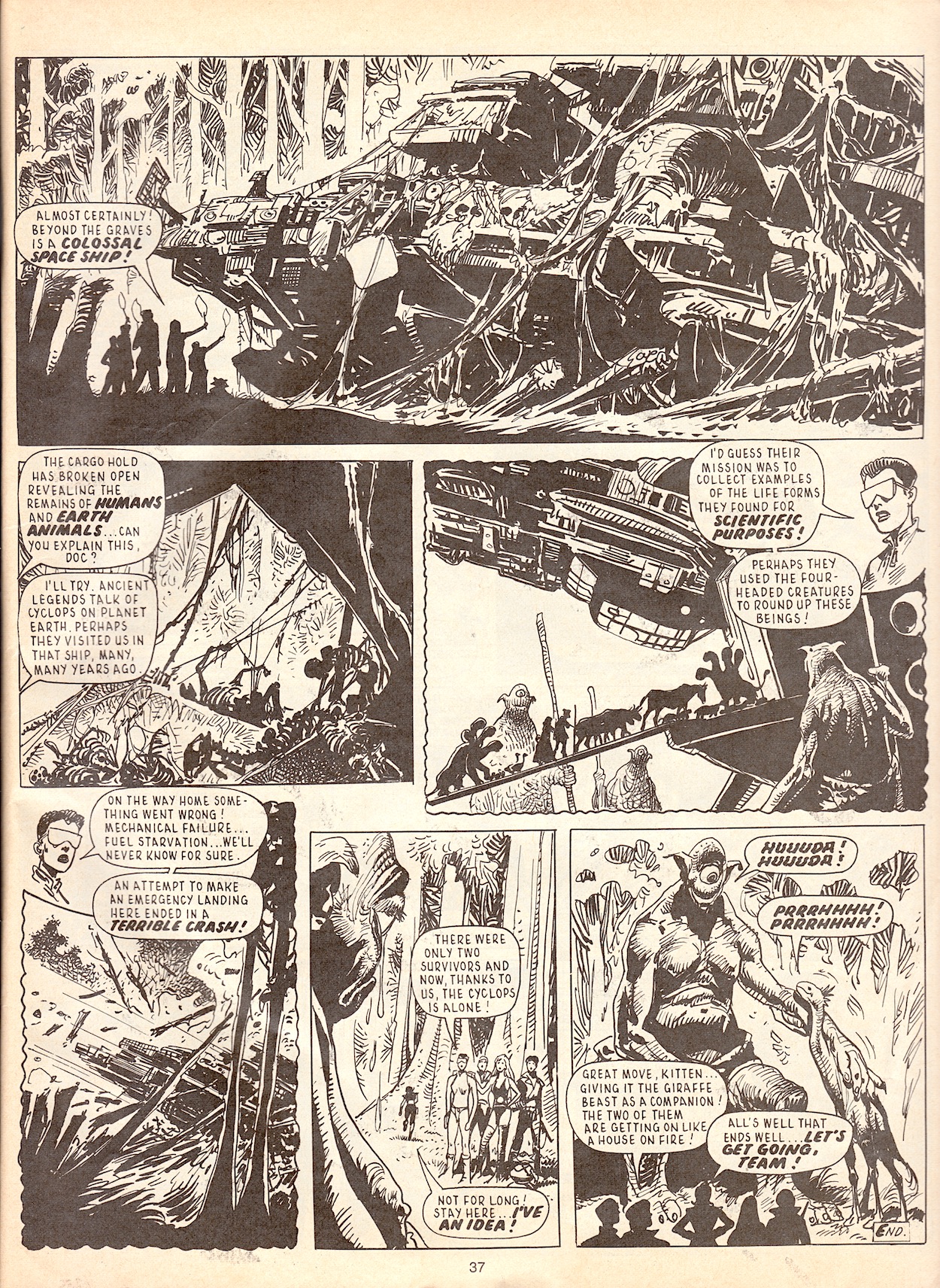
Their story is up next in fact, as always (and just like the pin ups) drawn by José Ortiz and written by James Tomlinson. Stalked by a three-headed giant cat-like predator it ends up capturing Kitten’s robotic pet, Crud. Tracking the beast down they find a ginormous cyclops, but as they try to save Crud the cat-like creature attacks and is shot and killed. The previously monstrous cyclops bursts into tears and the team realise they’ve made a horrible mistake, they’ve killed the giant’s pet. Not only that, but upon discovering a giant spacecraft overgrown with weeds they piece together a fascinating backstory.

It’s important for me to note here that at the beginning of the strip the team had captured a docile kind-of-giraffe animal for study by Doc. You’ll see below how that comes back right at the end. This story contains hints at the world building Wildcat could have achieved if it had carried on for years to come. We had some in the twelve regular issues but of course everything was still in its early stages of development. We can only imagine the epic, overarching stories editor Barrie Tomlinson and his team could’ve concocted over time.

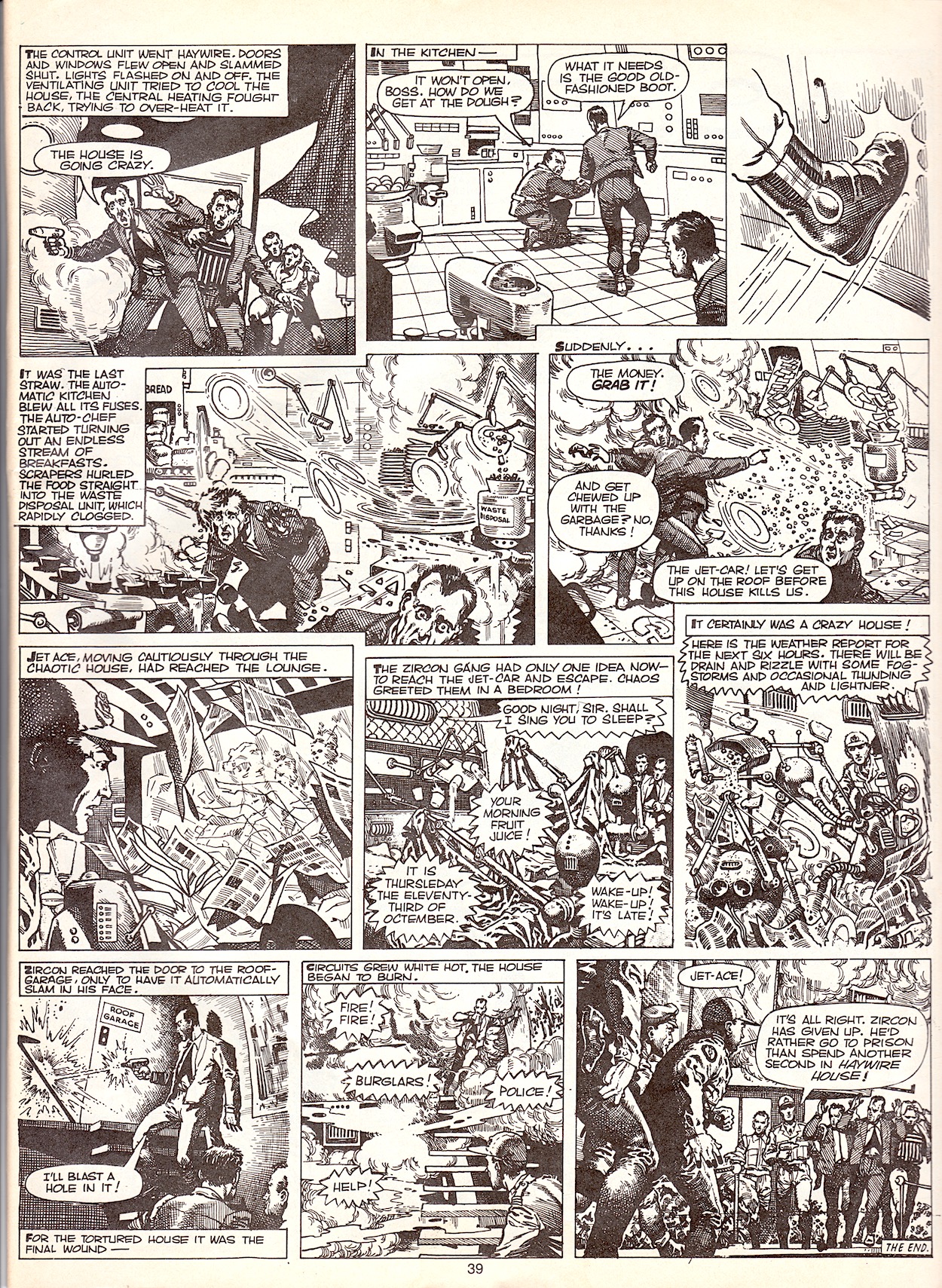
Four pages within this special are made up of a Tiger comic reprint called Jet-Ace Logan, a pilot who works for the futuristic interplanetary C.I.D. approximately 100 years in the future. Two stories are included here, two pages apiece and the one I wanted to show is called Haywire House. A modern home exhibition is about to be robbed and Logan stops the burglars in their tracks in a suitably ingenious way. I particularly like the art by Brian Lewis (Eagle, TV Action, Countdown), with so much of it crammed on to the page and jam-packed with details, all without losing any of its clarity.

In his book Comic Book Hero, Barrie explains how he was the editor of Tiger from 1969, after these strips appeared originally. He turned the comic into one with exclusively sports-related strips but he always had a fondness for Logan. Back to the special and perhaps the couple of reprinted pin ups and the Logan pages were marked for something else but after the cancellation of the comic plans changed. A very real possibility.

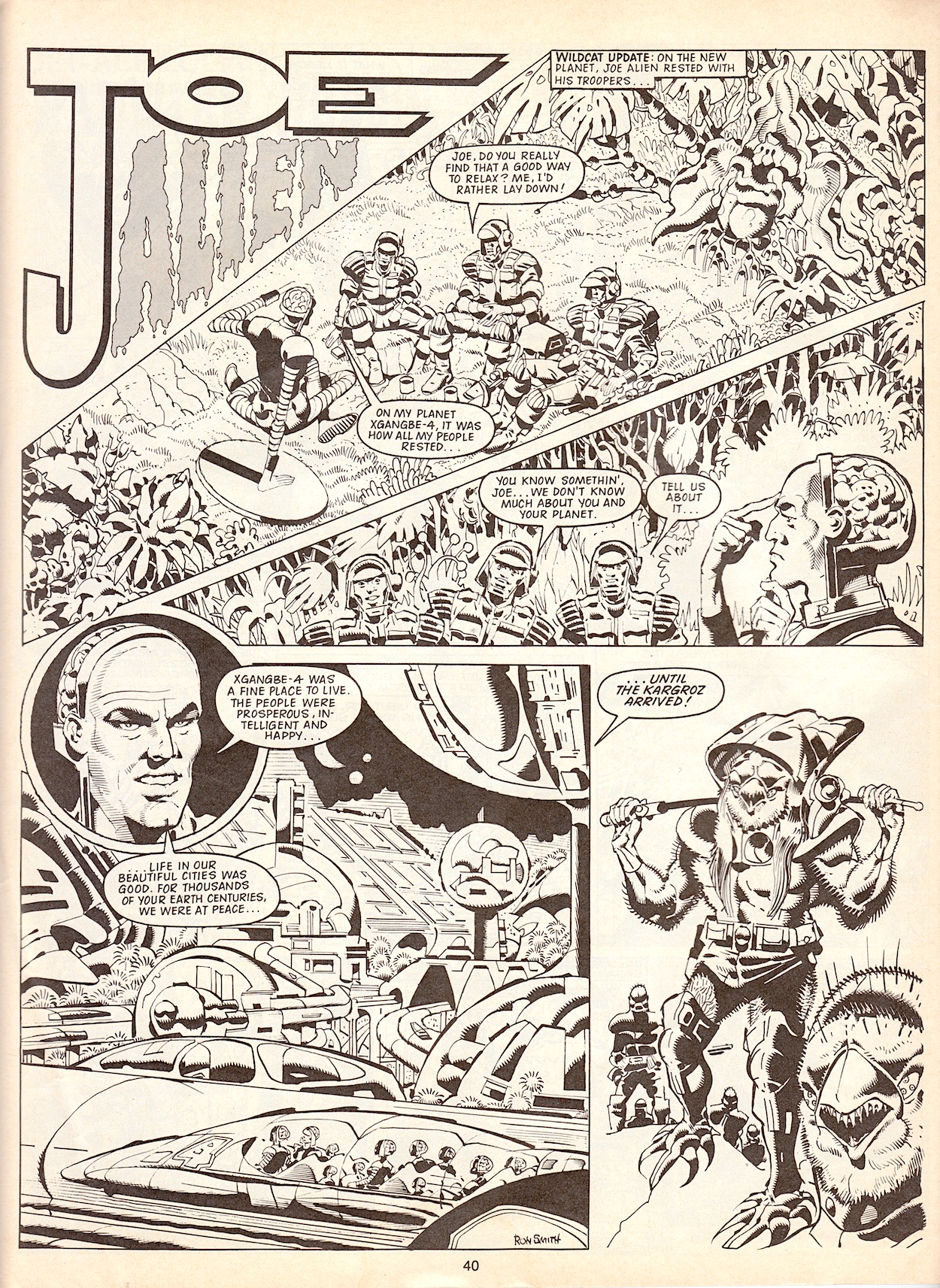
Before a very special ending to the issue there’s one more strip to read. Wildcat fans will know that must mean it’s time for David Robinson‘s Joe Alien, although not in his usual full-colour format which is a shame (in fact apart from the pin ups and a readers’ drawing spread the whole issue is black and white) but Ron Smith’s artwork still shines. The strip itself finally gives us some background information on the interesting character and how he ended up as the last of his race. In fact, for fans of his this was a hugely important strip!

Tracking a massive meteoroid heading towards their planet, his people soon discovered it was being pushed from the other side by a fleet of Kargroz ships. Joe’s race had long before abandoned space travel, keeping only one small shuttle and so he was sent up to negotiate, but the Kargroz kill for fun and for honour and couldn’t be bargained with. Almost blasting Joe out of existence they hurled the meteoroid into his planet, destroying it and all who lived there.

Fuelled by revenge Joe hijacked one of the enemy ships and crashed it into the side of one of the others, all of which were in a straight line formation, side-by-side with each other. Where Joe had crashed, his ship now faced down the long line of enemy ships. Firing one huge laser blast it tore through them all, killing everyone and leaving him the only survivor of the battle and of his race. This next page of Ron’s reminded me he drew for Marvel UK‘s Transformers. It has that feel about it. Looking into that however, I was surprised to see he only ever drew one strip (#82)! Such was the impact he must’ve made on me I thought he’d been a semi-regular artist on it.

Joe’s men console him and try to tell him they agree with his seeking revenge, but the strip ends with our hero rejecting this. “Revenge? How can any revenge balance the millions who were killed? I am only pleased that my external brain pack allows me to switch off such memories… forever!” That is about as heartbreaking an ending as you can get as he switches off all memories of his loved ones.

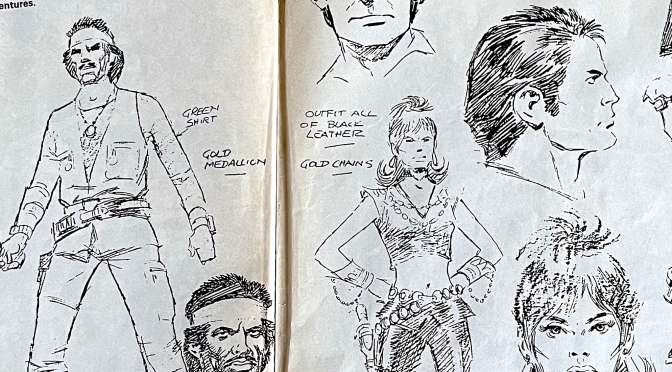
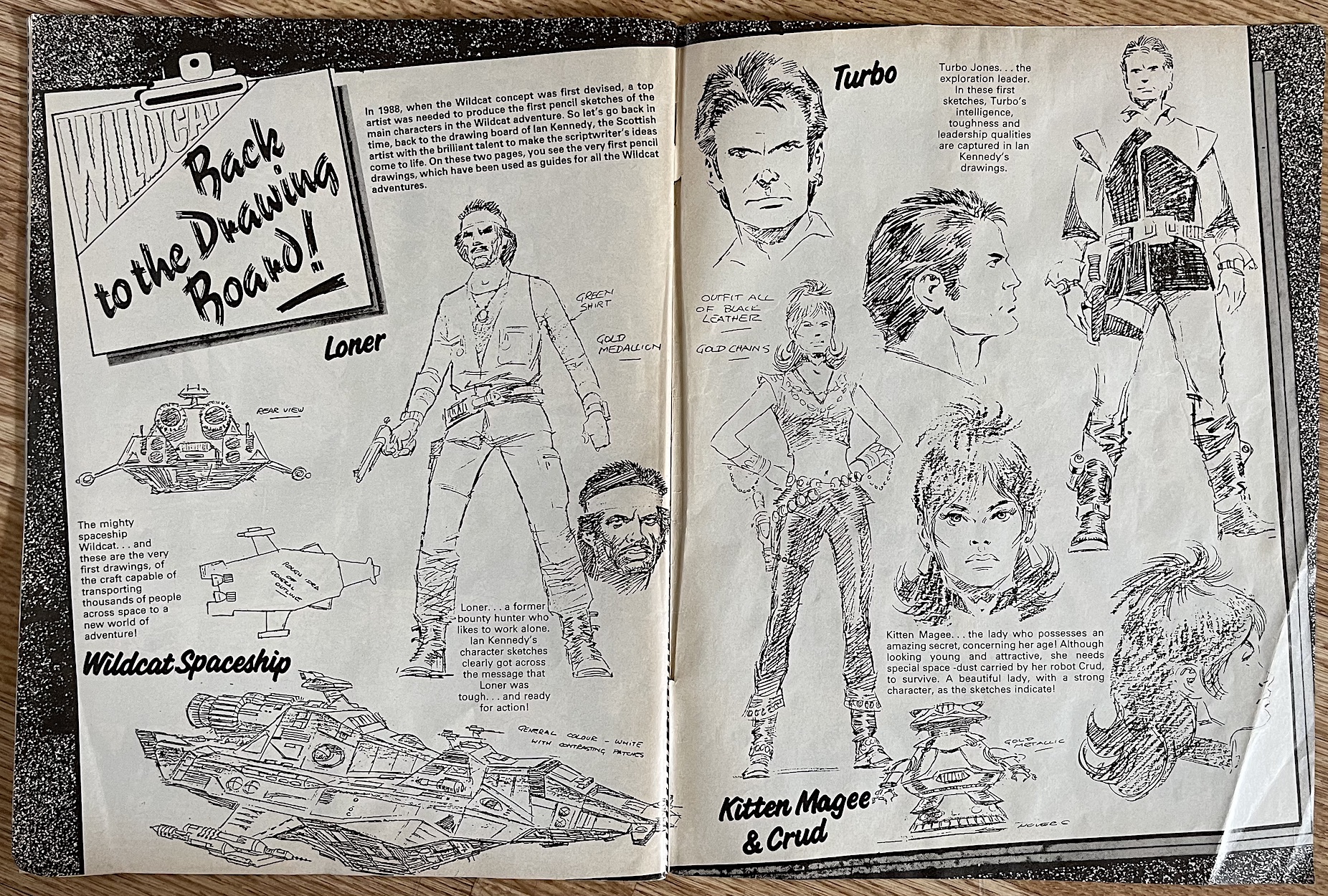
One final feature rounds off this edition and it’s a special Back to the Drawing Board spread of Ian Kennedy’s original design sketches for the Wildcat itself and some of its characters. At the time of writing this Ian has only recently passed, so seeing these drawings and his superb cover (which is on the back as well) is tinged with sadness. I’ve always loved his Wildcat design and his originality, not only with its shape but also its bright colours. I think we can all agree he also did a superb job of realising Barrie’s desire for a truly diverse cast of exciting heroes, which was rare.

Thus ends our look at the Wildcat Holiday Special from 1989. As I’ve said before I do own the graphic novel collections for two of the characters so I’ll be covering them at a future date, and I’m going to be tracking down the others through the individual issues of Eagle and Wildcat. But in the meantime we haven’t quite finished with Wildcat in its own form just yet.

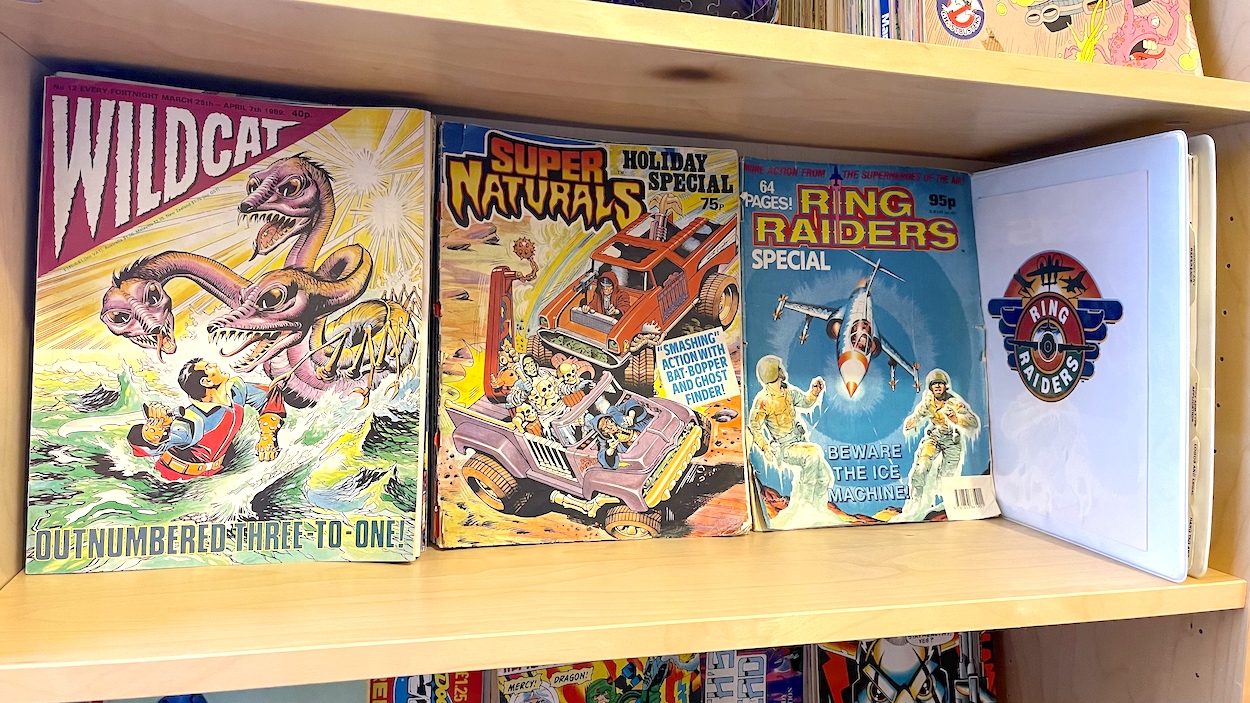
There’s one more special to come and I’m very excited by it. Once again it’s an issue I’ve never read before. It’s even bigger than the Holiday Special and comes with a simply gorgeous high gloss, high quality cover. The Wildcat Winter Special was released several months later so look out for its review on Thursday 17th November 2022. Now that’s going to take some will power on my behalf, it’s sitting on that shelf right over there looking at me! I’m sure it’ll be worth the wait though.
iSSUE 12 < > WiNTER SPECiAL

WiLDCAT MENU

JURASSiC PARK #10: BETRAYALS, TAiLS & GOLDBLUM

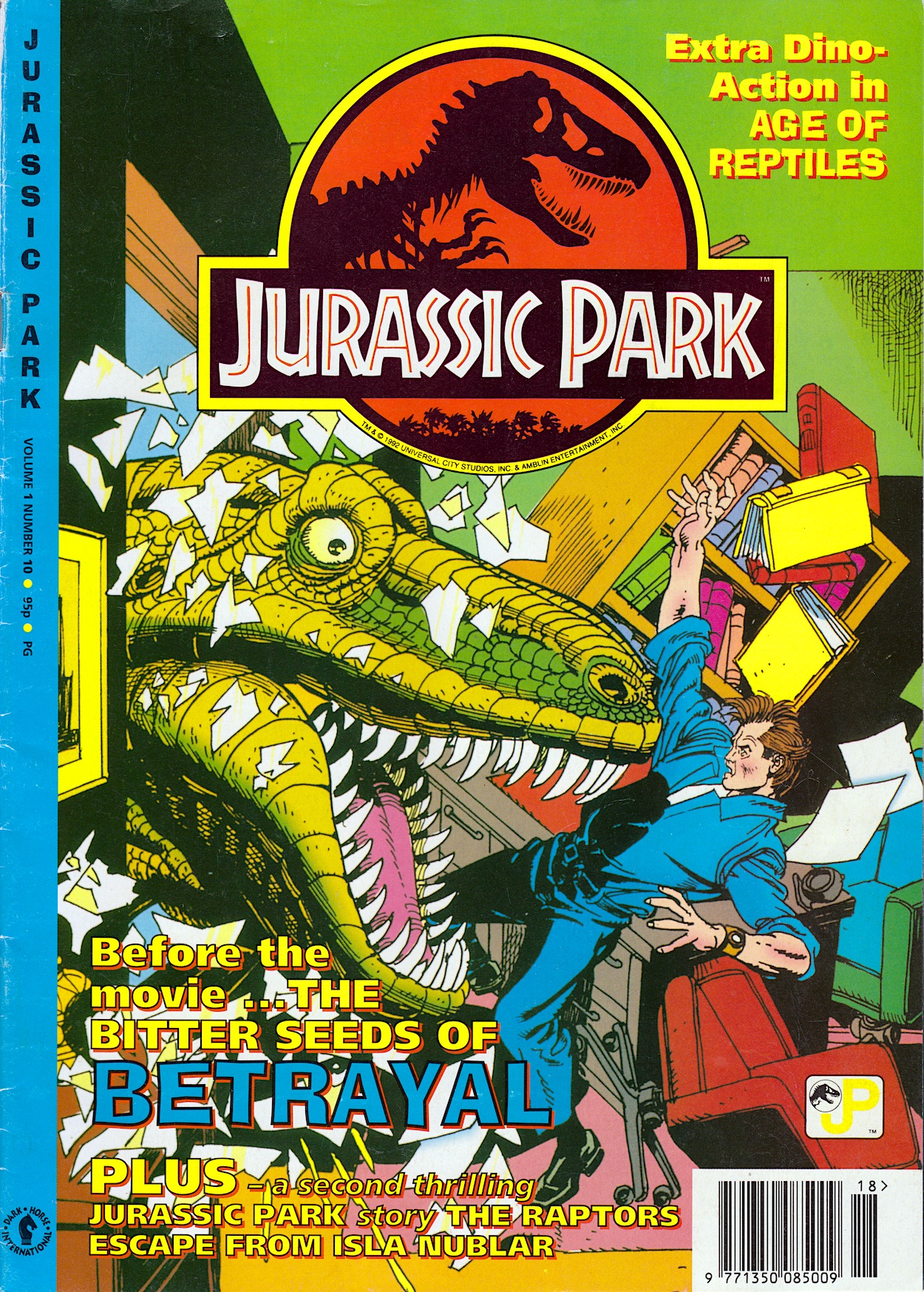
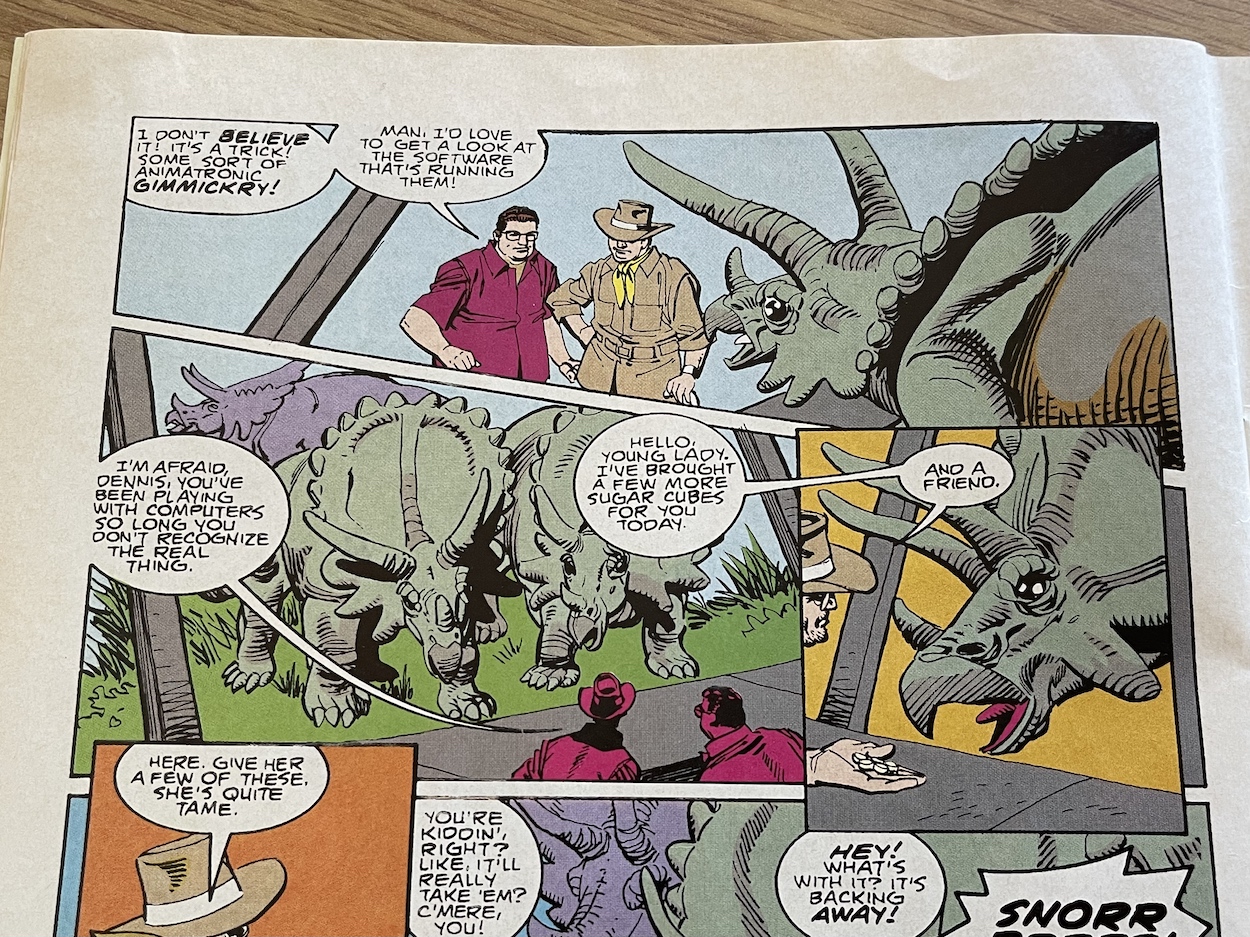
Another exciting Gil Kane cover that bares absolutely no resemblance to anything that occurs inside, or any other issue or even the movie. It’s the second of two covers from the American preview comic, the previous one shown off last month. That Topps Comics preview contained two small strips set before the events of the movie and the first was underwhelming to say the least. The second, the headline story inside this issue, is far better and concentrates on the man we all loved to hate, the person behind all the chaos, Denis Nedry.

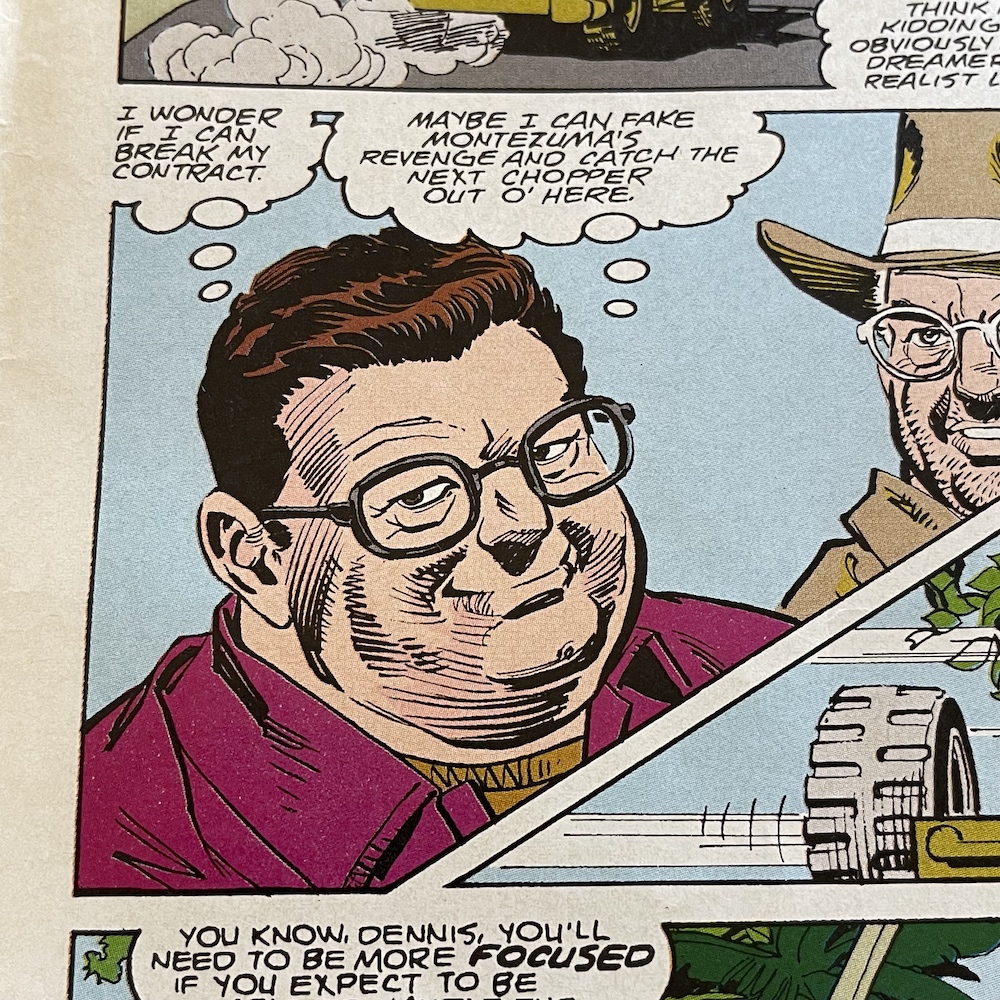
Portrayed by Wayne Knight in the film, Gil produces a great likeness here while not getting so hung up on it that he ends up expressionless. Betrayal is written by Walter Simonson and tells the tale of Nedry’s arrival on Isla Nublar to work on the computer systems that would be so instrumental in the creation and eventual downfall of the park; networking of computers, park systems, zoological simulations and crowd control measures all make up his complicated job. Dick Giordano (Detective Comics, The Sandman, Superman vs The Amazing Spider-Man) joins Jurassic Park to ink Gil’s pencils, John Workman returns as letterer, as does Renée Witterstaetter as colourist (and Story Editor for this and the sequel story later in the issue).

Some fans online have mistakenly said there’s an error in Nedry’s and Hammond’s relationship in the film. Hammond‘s favourite phrase was, “Spared no expense” and yet Nedry is constantly saying he’s underpaid, his boss unwilling to negotiate. Here, Simonson picks up on a plot thread from the novel that the film touched upon (and those fans missed) and elaborates on it. Nedry’s bid was very high, no expense was spared, but it was made before he knew the secret of what the attractions on the island actually were. Once he found out he thinks he underbid, but Hammond is a man who honours his word and expects others to do the same.

Realising the fortune Jurassic Park is going to make Hammond, Nedry constantly tries to spin that his work is going to be far more complicated than first estimated, but really it’s not true and he’s just pushing for more money. Hammond doesn’t budge. His computer experts perfectly relayed to Nedry what was required, the fact the animals are dinosaurs doesn’t change anything. Six months in however, Nedry begins to realise extra money will never be forthcoming from his computer work and when he overhears Henry Wu discussing the embryo laboratory he clicks that’s where the money is, in the dinosaurs, and their embryos are perfect for smuggling off the island.

The story ends with his first attempt at reaching out to Ingen‘s competitors but for me the real meat of the story is seeing the beginning of the relationship between these two characters. Also, unlike the previous prequel story (Genesis) foreshadowing isn’t shoved in our faces, instead it just concentrates on telling a good story based around a key plot point in the movie, with the characters at its heart. Hammond comes across as a bit too cantankerous at points compared to Richard Attenborough‘s charming portrayal and more like he is in the novel, but in the end it’s an interesting little prequel and a nice addition to the comic.

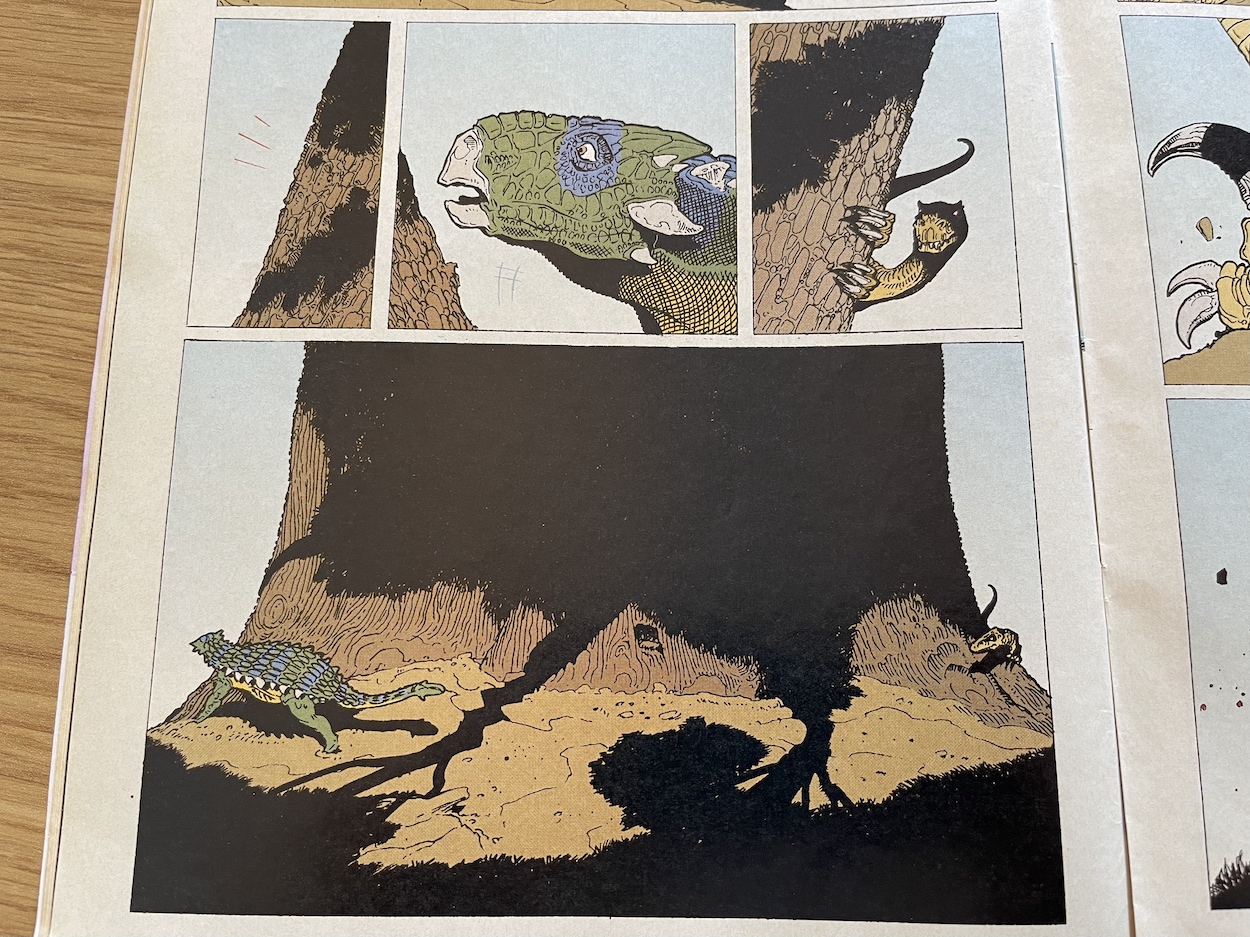
There’s no Xenozoic Tales this issue so the remaining strips get more room to breath, although I do miss Tenrec and Hannah. They’ll be back, though. Alongside the eight-page Betrayal and the ten-page Dark Cargo (for a meaty 18 pages of Jurassic Park) is Ricardo Delgado‘s always stunning Age of Reptiles which makes up 11 pages, sandwiched in the middle. It starts off serenely with a large Ankylosaurus enjoying some bark from a monstrously sized tree that dwarfs even this huge dinosaur. Then they hear a noise and step to the side to have a look around the tree. Personally, I think the way this simple gesture is drawn is just so full of character.

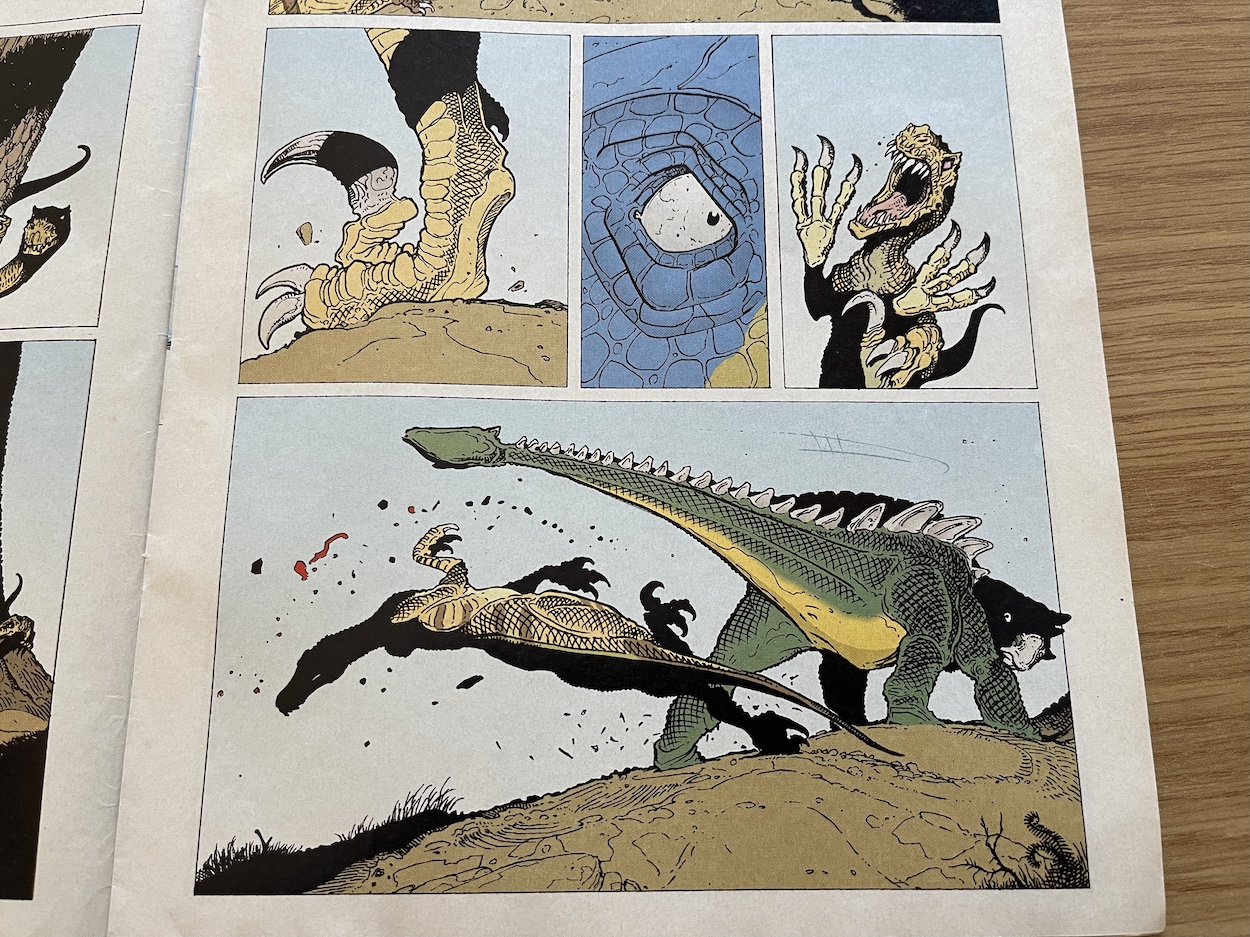
I was beginning to feel sorry for the peaceful beast who now found themselves outnumbered three-to-one against our favourite predatory rascals, the Deinonychuses. As you can see from what happens on the next page I needn’t have worried. This is enough to make the smaller dinos run off, beaten with one swipe of a tail. I just love this big action shot though, especially since the build up was so peaceful, it’s such a surprise! We get another little respite when we check in on the Tyrannosaurus rex pack as Long Jaw arrives back and nuzzles the noses of his mate Talon and their baby, with the other male Blue Back and his mate Climber looking on.

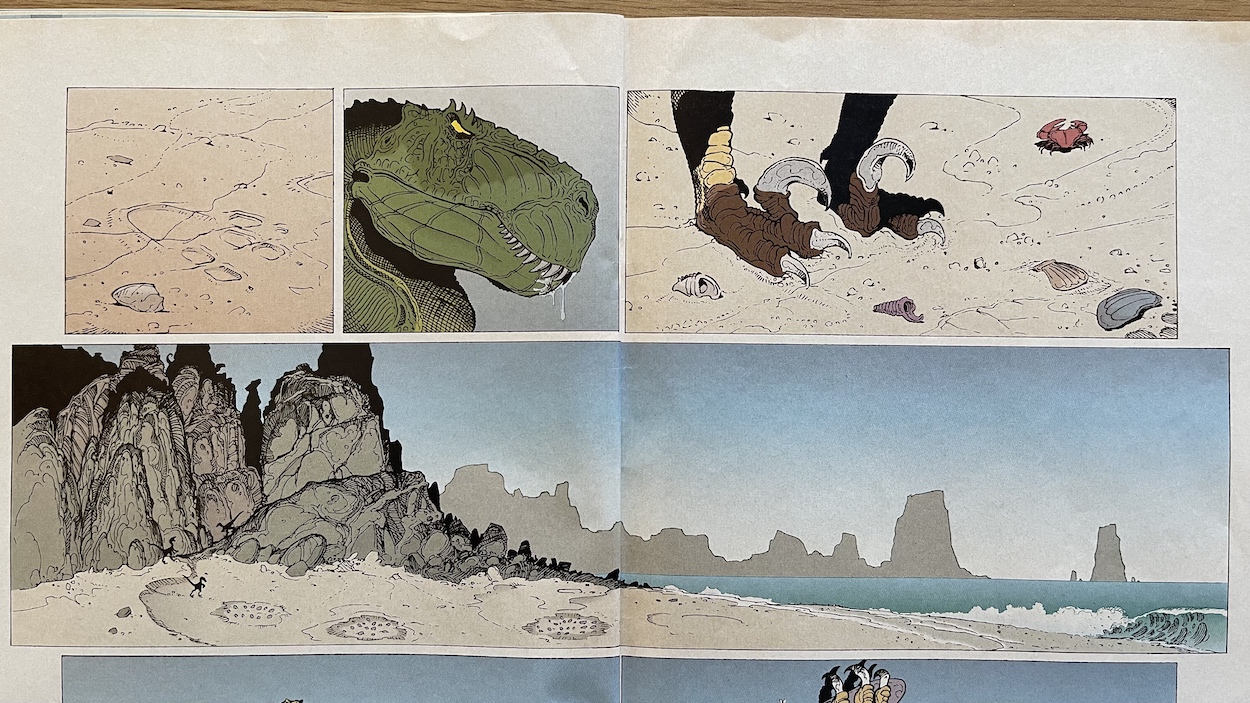
The whole pack is angry and soon Long Jaw sees why. The large circular nest is empty of all its eggs except for a few pieces of broken shell and one last intact egg, tucked in next to Talon. We then get a double-page spread and a really brilliant moment as he looks down at evidence of who robbed their nest and, even though a T-rex‘s face shouldn’t be that emotive, we can tell he knows exactly who was responsible. The way Ricardo lays this out with his face between the footprint and those same feet now on a nearby beach is just genius.

Look very closely at that big panel in the middle of the page. Have a look up into the cliffs and, amongst the silhouettes of the craggy terrain you should spot the shapes of a head and a tail. I’ll admit I don’t think I ever noticed this the first time around back in the 90s because it surprised me when I spotted them now. It’s so subtle, I love it. It also leads on to the climax of this issue’s chunk of the story.

After filling their bellies with the eggs the three thieves start making their way up a very narrow path along one of those cliff faces and come face-to-face with our two female Tyrannosaurs. Their size and power in comparison is perfectly captured and I particularly like the overhead view showing just how trapped the smaller dinos really are. There’s even a tiny bird looking on. Little details like this amongst all the action and drama is a trademark of Ricardo’s and one of the reasons I love his work so much.

The leader of the Deinonychuses turns and barks orders at the others, one of whom turns and runs at the T-rex coming up behind them, the story cutting off for this issue as they leap into the air, claws bared. Age of Reptiles was never intended to be told in this way; it was created as a graphic novel to be read from beginning to end in one sitting. But it just works so well, editor Dick Hansom doing a great job of knowing when to edit to make each piece feel like a complete chapter. It’s a great cliffhanger. (Yes, that was very much an intended pun.) However, it’s a particularly frustrating ending this time, which I’ll explain after the third and final strip.


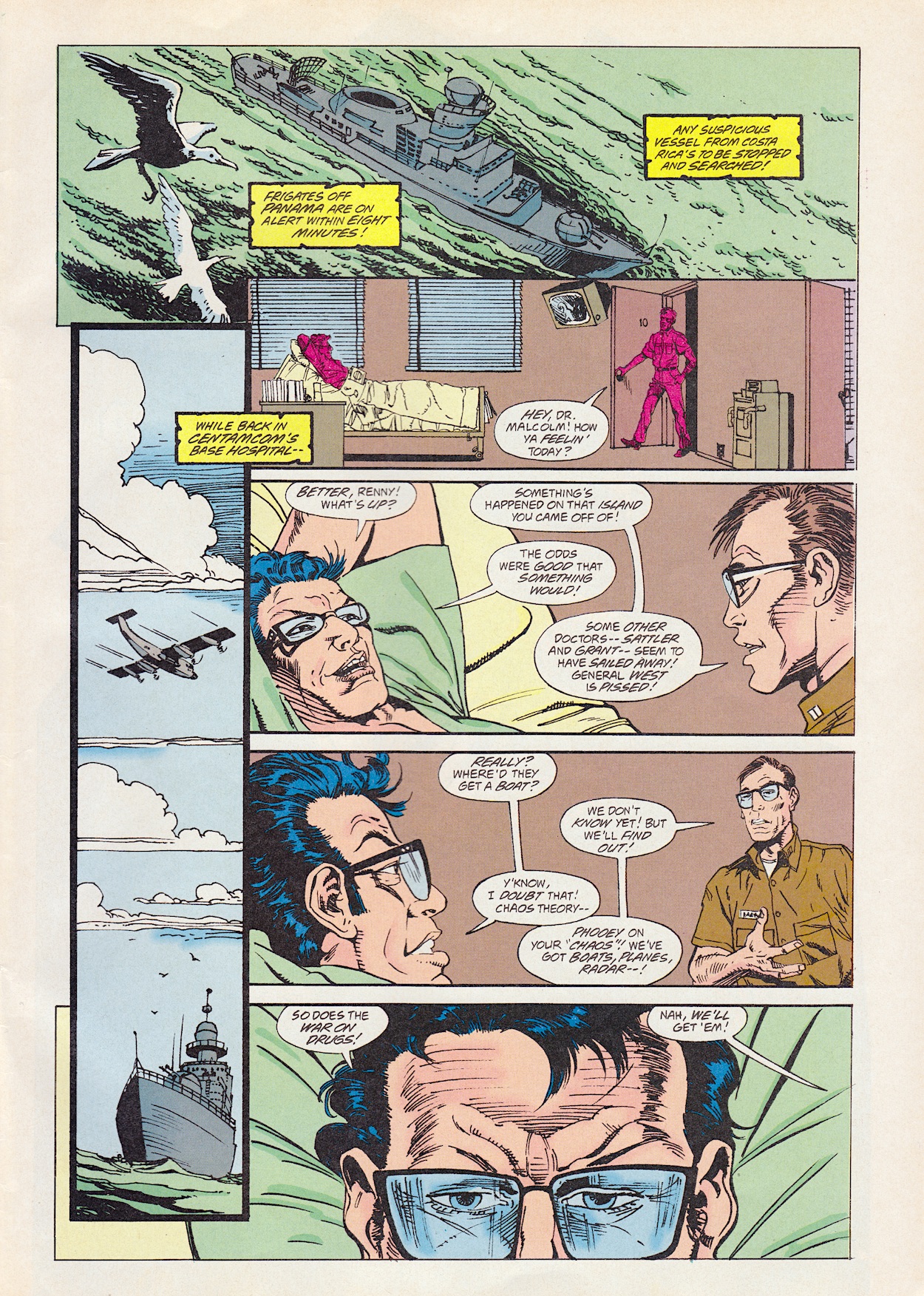
“Phooey on your ‘Chaos’! We’ve got boats, planes, radar…!”
Renny

“So does the war on drugs.”
Dr Ian Malcolm


Steve Englehart‘s Jurassic Park: Dark Cargo continues with Dr Ellie Satler, Dr Alan Grant and the juvenile Velociraptors transported from boat to a huge air transport and during the flight our human heroes eventually awaken to find their cage surrounded by the hissing, clicking raptors. One tries to pick the lock of the cage just as they did to their own, but Alan’s broken belt buckle from his failed attempt, still caught in the lock, stops them. They run off, the pilot noticing shifting weight so George Lawala (the first in a long line of greedy humans who would underestimate the intelligence of dinosaurs) goes to investigate. He frees Alan and Ellie and gives them shotguns, the chapter ending with them all searching the huge plane.

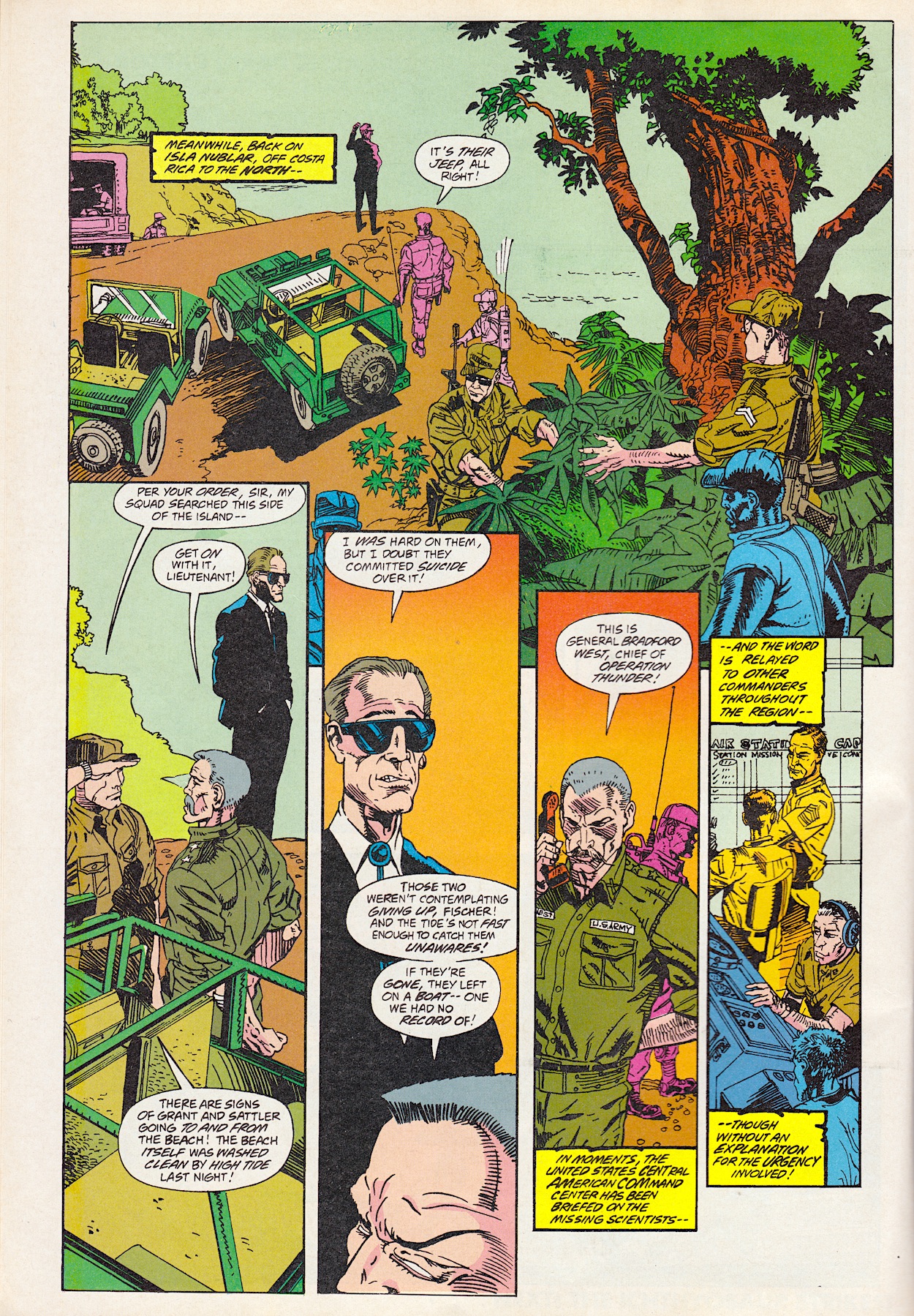
That’s the main plot out of the way. That’s not to say it isn’t fun, it certainly is, it’s just there are two individual pages elsewhere in the story involving subplots that really stood out to me. The first involves the army’s continuing attempts to clean up the mess of the island’s failed park. Having tracked Alan and Ellie to the beach they’re at a loss as to where they are. For me it’s great to see the new character, INgen‘s Dr Fischer back again (he first appeared in #6) and I’m still hoping we get to see more development of him in the future. But it’s the person on the next page that elicited the highest level of excitement when I read this back in 1994.

Of course, nowadays we’ve seen Dr Ian Malcolm, so memorably played by Jeff Goldblum, in The Lost World: Jurassic Park and Jurassic World: Fallen Kingdom and he’ll be returning again in the sixth film, Jurassic World: Dominion later this year (at the time of writing). At the time his return was a complete surprise. If the comic had a proper editorial and Next Issue promos I’m sure this would’ve been mentioned before it happened, so for once I was glad of the minimalist approach. It meant the surprise was kept until this very moment. He just appears in this one sequence as he recovers from his injuries from the movie but it’s exciting to see the character in this first official sequel, and he’s perfectly drawn by Armando Gil and Dell Barras (with John Costanza on letters and Renne colouring).

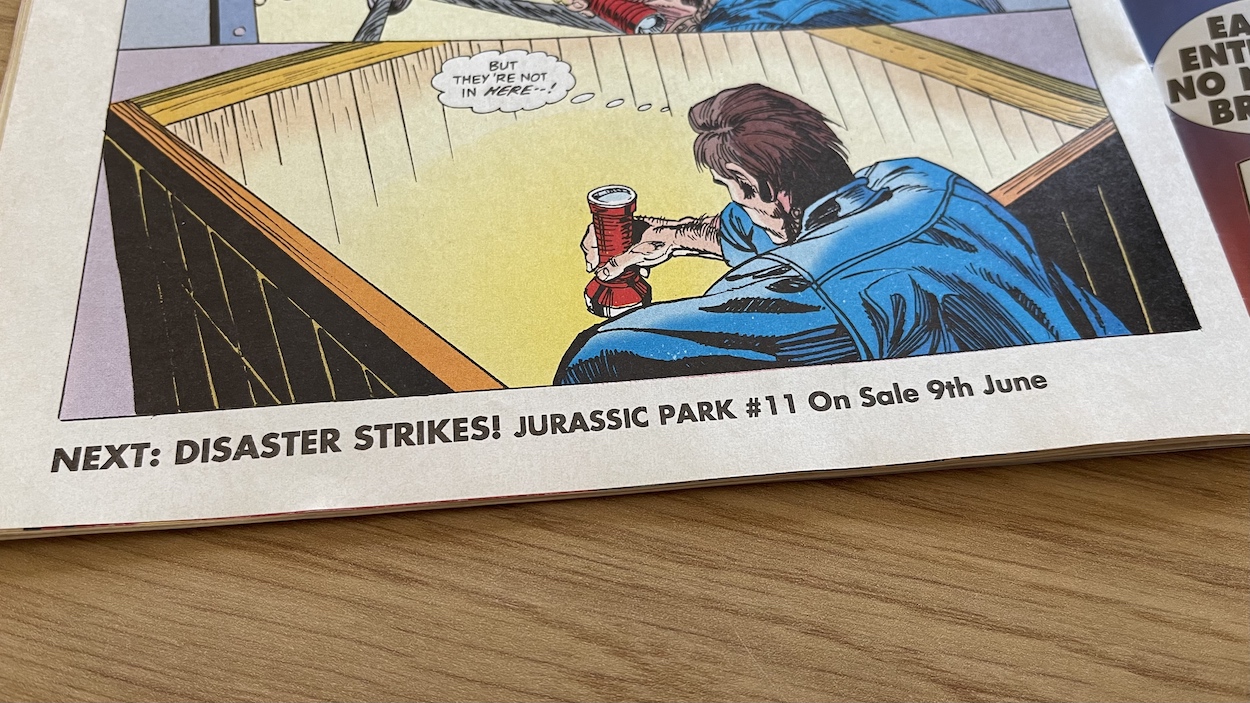
Also mentioned here is ‘The United States Central American Command Center’, or ‘CENTAMCOM’, the comic’s own take on the real world CENTCOM and the resources they have in their search. It brings a larger scope to the background story that’s slowly developing while the main plot focusses on our two main characters. I always enjoyed these aspects of the films, always wishing they’d delve deeper into the inner workings of INgen and the larger world within which the stories were set. Then it all ends with the biggest shock of all. Under the final panel we’re unceremoniously told #11 wouldn’t be on sale until Thursday 9th June. What?

This issue went on sale on Tuesday 29th March 1994, so suddenly my favourite monthly comic was telling me I had to wait ten weeks for the next chapters to all these stories. Can you now understand why I was so frustrated earlier? The use of the JP logo on the cover instead of the previous title graphic (I love the logo but preferred the previous one for the comic) was just the first big change to come. Ironically, this issue felt once again like the first one I bought, settling back into a great format after a couple of months of trying to fit too much into its 36 pages. But that would all change. I’ll go into that next time because at this point originally I hadn’t a clue why there was such a long wait. You’ll just have to wait to find out too.

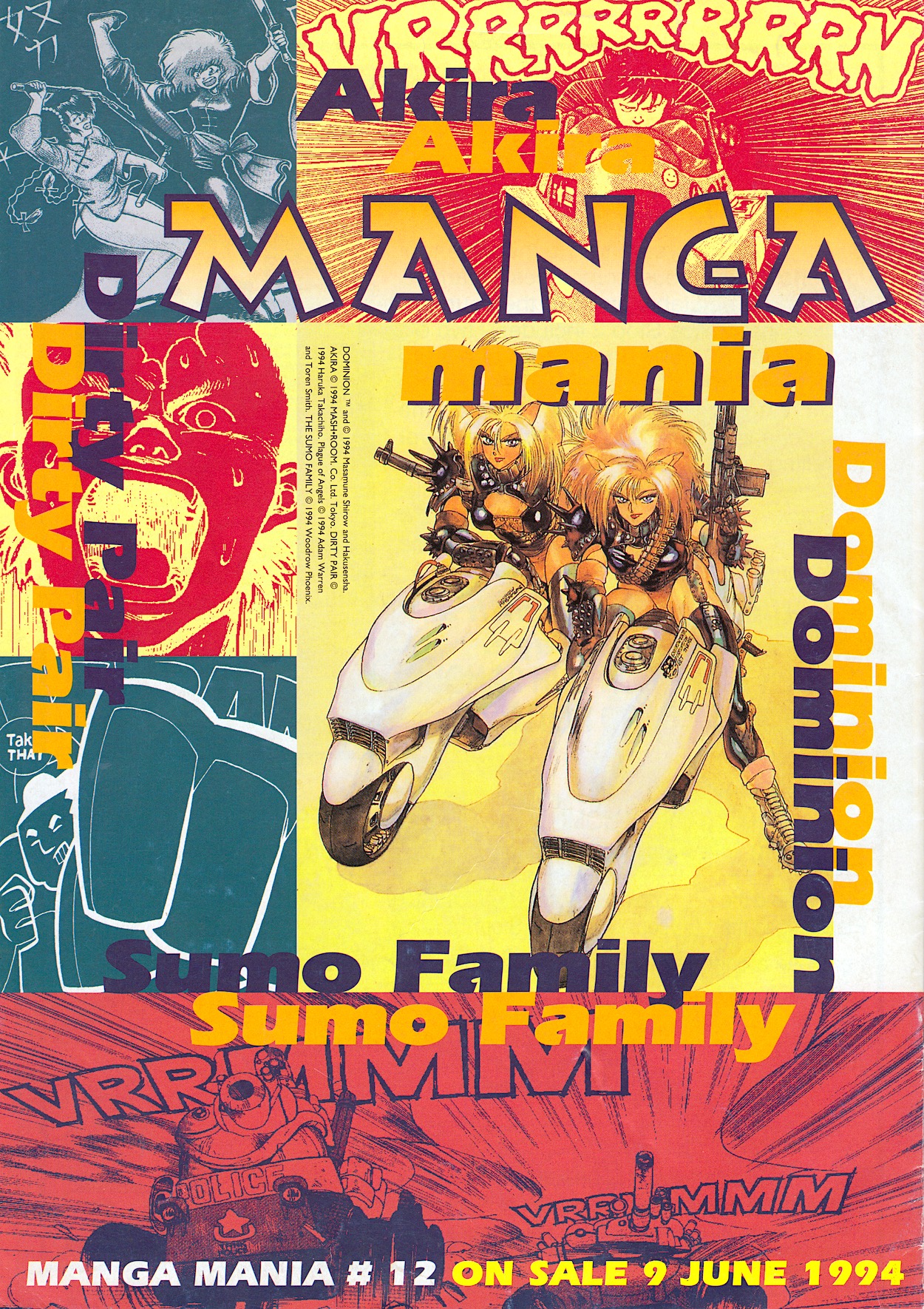
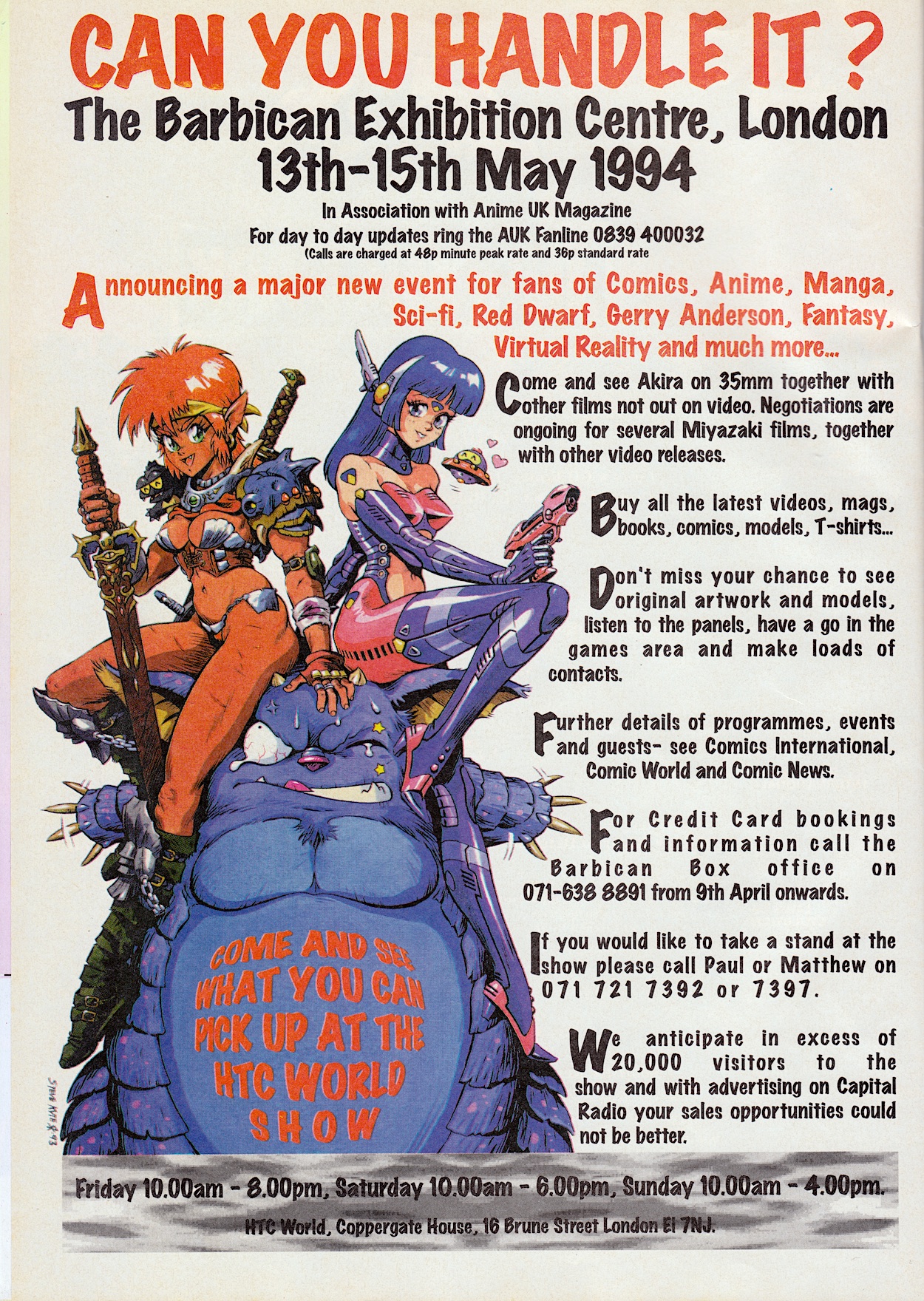
I’ll finish off with a look at the very-90s adverts this issue contains. There’s a teeny tiny liddle widdle radio which would’ve been right up my alley back then and it isn’t dissimilar to that given to Bond by Q in Skyfall many years later. The back cover has an advert for Dark Horse International‘s Manga Mania as the animation style started to take hold here, mainly thanks to Akira (with a hint of things to come for Jurassic Park on the bottom-left of its cover) and there’s a convention to match. Finally, those highly expensive phone-in competition lines which, when you think about it, should never have been in the pages of comics such as this (or the magazine Commodore Format I was collecting at the time which had plenty of them) when so many young readers could be tricked into spending a fortune on their parents’ phone bills. (No, I didn’t.)

So, with a clifftop battle in full swing and a pack of deadly Velociraptors on board a cargo plane we have to be patient and take a breather from the comic for a while. It’s difficult enough to not read ahead but this is going to be ridiculous! I’ll just have to cope somehow. The next Jurassic Park review will be here from (big sigh) Thursday 9th June 2022, just one day before the release of the next movie in fact. Oh, now I’m all excited again!

iSSUE NiNE < > iSSUE ELEVEN

JURASSiC PARK MENU

SUPER NATURALS HOLiDAY SPECiAL: HiSTORiC HORROR

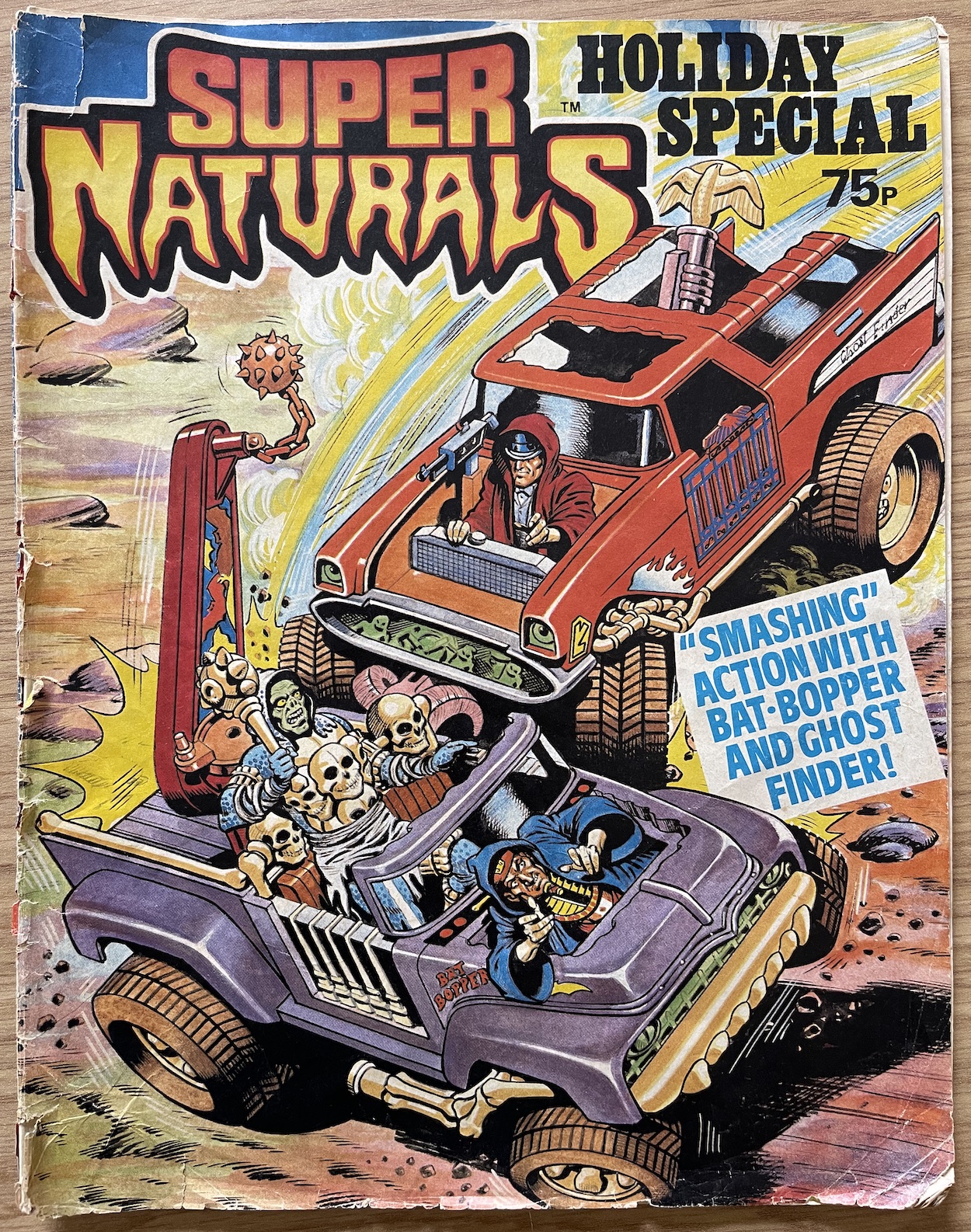
Welcome back to Ghostworld for the very last time. Just a month after the final issue comes Fleetway‘s Super Naturals Holiday Special for 1988, as ever edited by Barrie Tomlinson. Kicking off with a Sandy James cover which would’ve been fun for any kids who received the oversized Tonka trucks for Christmas, here we have 48 glossy pages which, much like the Adventure Book, focus more on the action aspects of the comic rather than the horror.

There are two exceptions (including a reprint from Scream!) which check the horror box for the young readers, but other than that it’s all licenced strips and extras. That means there’s no ventriloquist’s Doll or readers’ suggestions for Scary Cat, both of which were highlights of the regular comic so that’s a shame, especially knowing this would be the last publication in the series. But let’s not get too down, the idea of a Holiday Special was to have lots of fun one-off stories to read while off school. Let’s see how the Super Naturals fare with theirs, shall we?

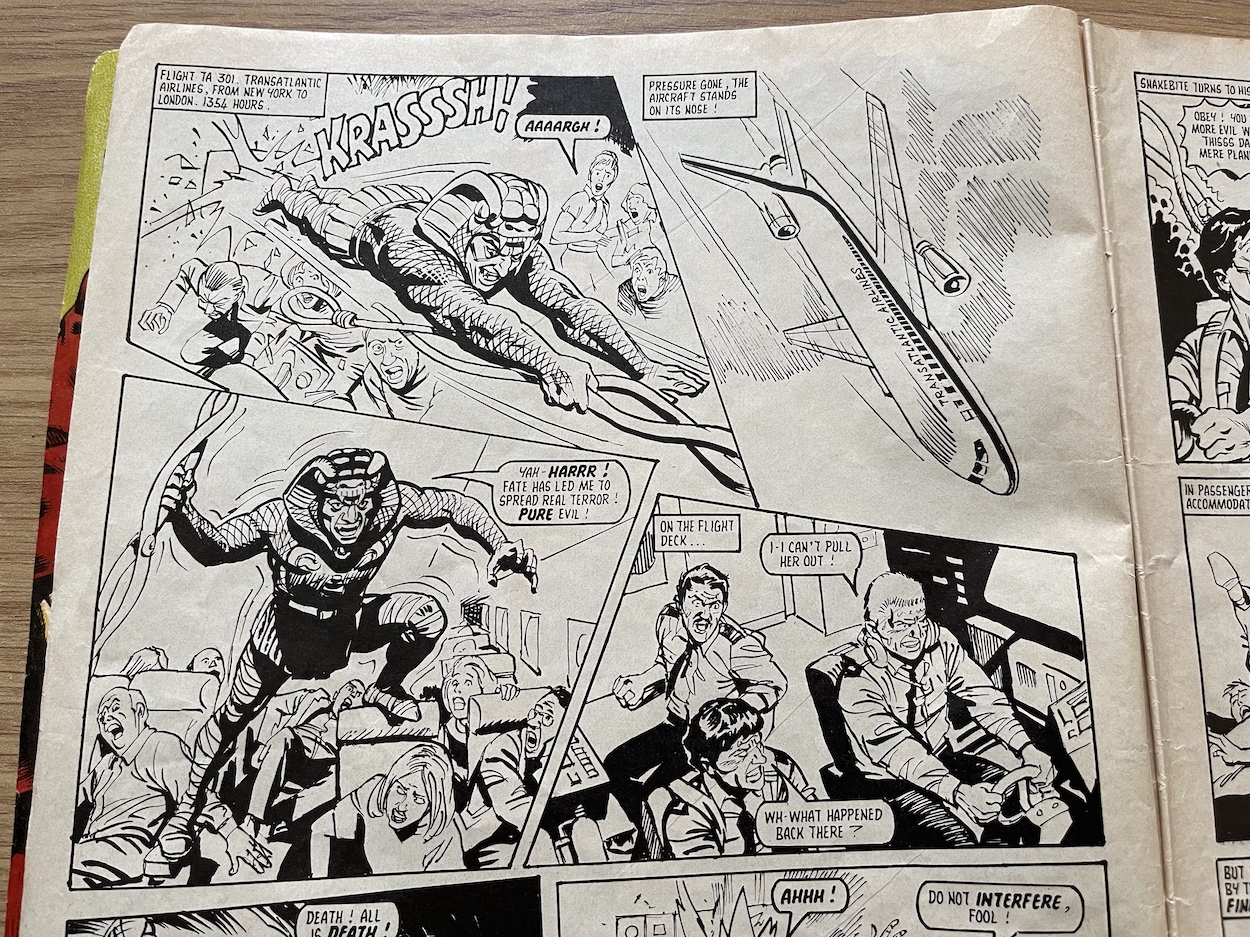
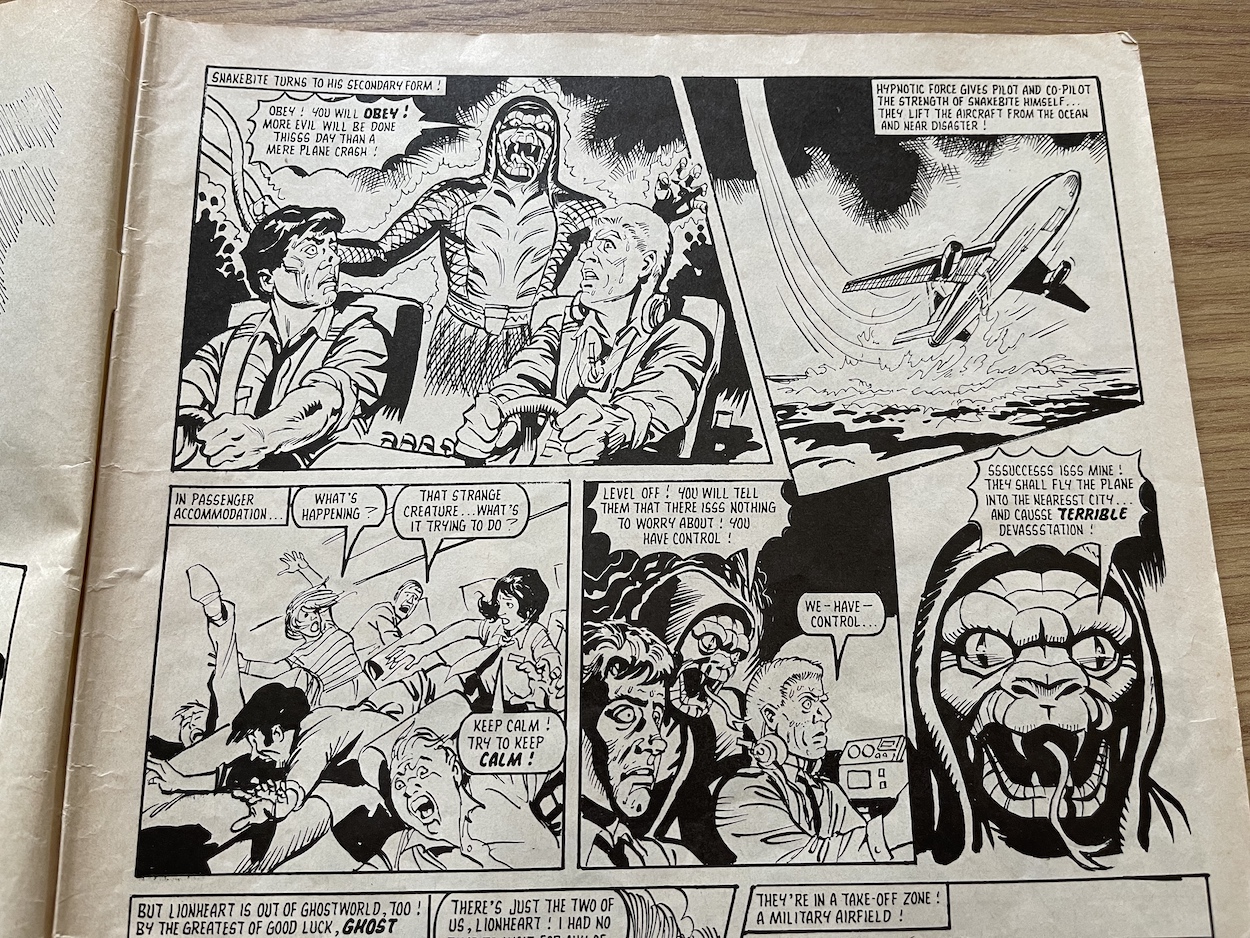
It starts high in the air in SkyJack! The evil Super Naturals flub an attempt to transport themselves into our world, with only Snake Bite able to make it and imaginatively the strip has him crashing through a tiny airplane window, terrifying all the passengers on a transatlantic flight to America. Hypnotising the pilots, he shares his strength with them to save the crashing plane, but only because he wants to use it to dive into Washington which would cause much more destruction in our world.

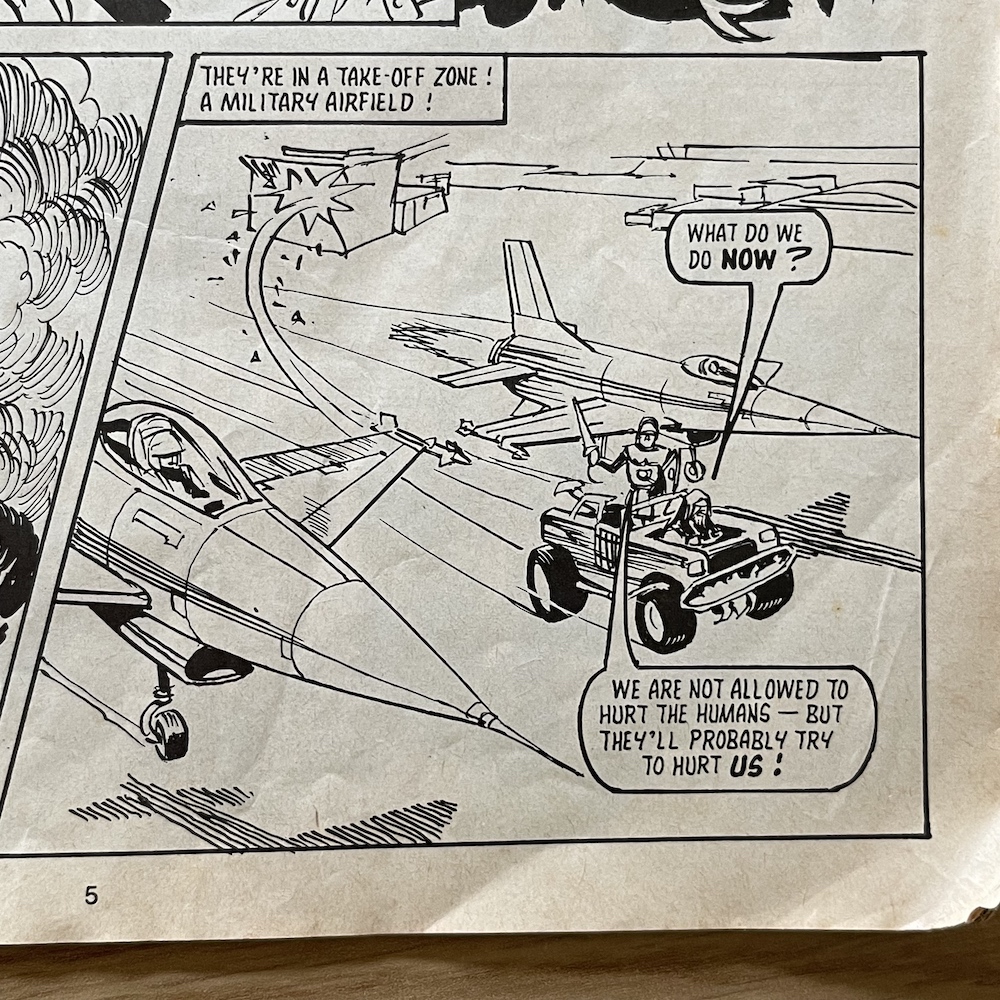
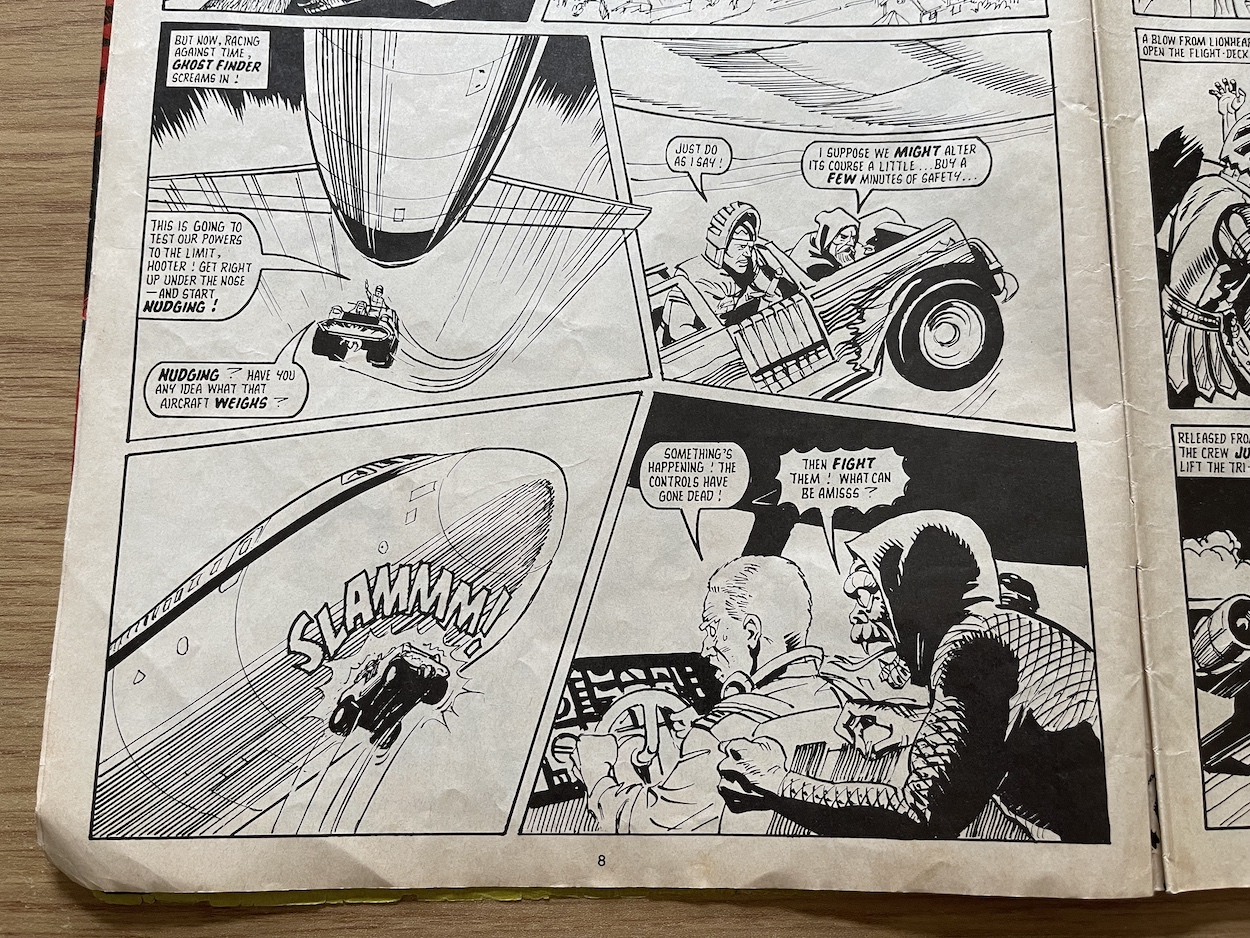
Snake Bite was always the most interesting of the evil characters and the set up for this story is great. We even have Hooter and Lionheart using the Ghost Finder to nudge the plane up just enough so that it’s trajectory is right for the pilots to take over before Lionheart slashes a hole in the fuselage and throws Snake Bite out, who loses his telepathic control as a result. I like how it’s not an easy, miraculous rescue plan, as Hooter bluntly states. It’s just a shame the artwork doesn’t match the exciting potential of the script.

It’s even more of a shock when you find you who the artist is. It’s Geoff Campion‘s work (Eagle, Lion, Valiant) whose work I’d loved in Ring Raiders, another of Barrie’s titles. However, here things feel somewhat rushed, even unfinished in places, such as when the Ghost Finder crew make their entrance the buildings in the background look like rough layouts. As the story goes on more details are lost and backgrounds become even more sparse, almost like it was hastily finished for a deadline. It’s not the usual exemplary work we’ve come to expect from Geoff and I’m intrigued as to why, but unfortunately that’s a question lost to the mists of time. It’s still a fun story to open with, a really enjoyable complete tale perfect for a Holiday Special.

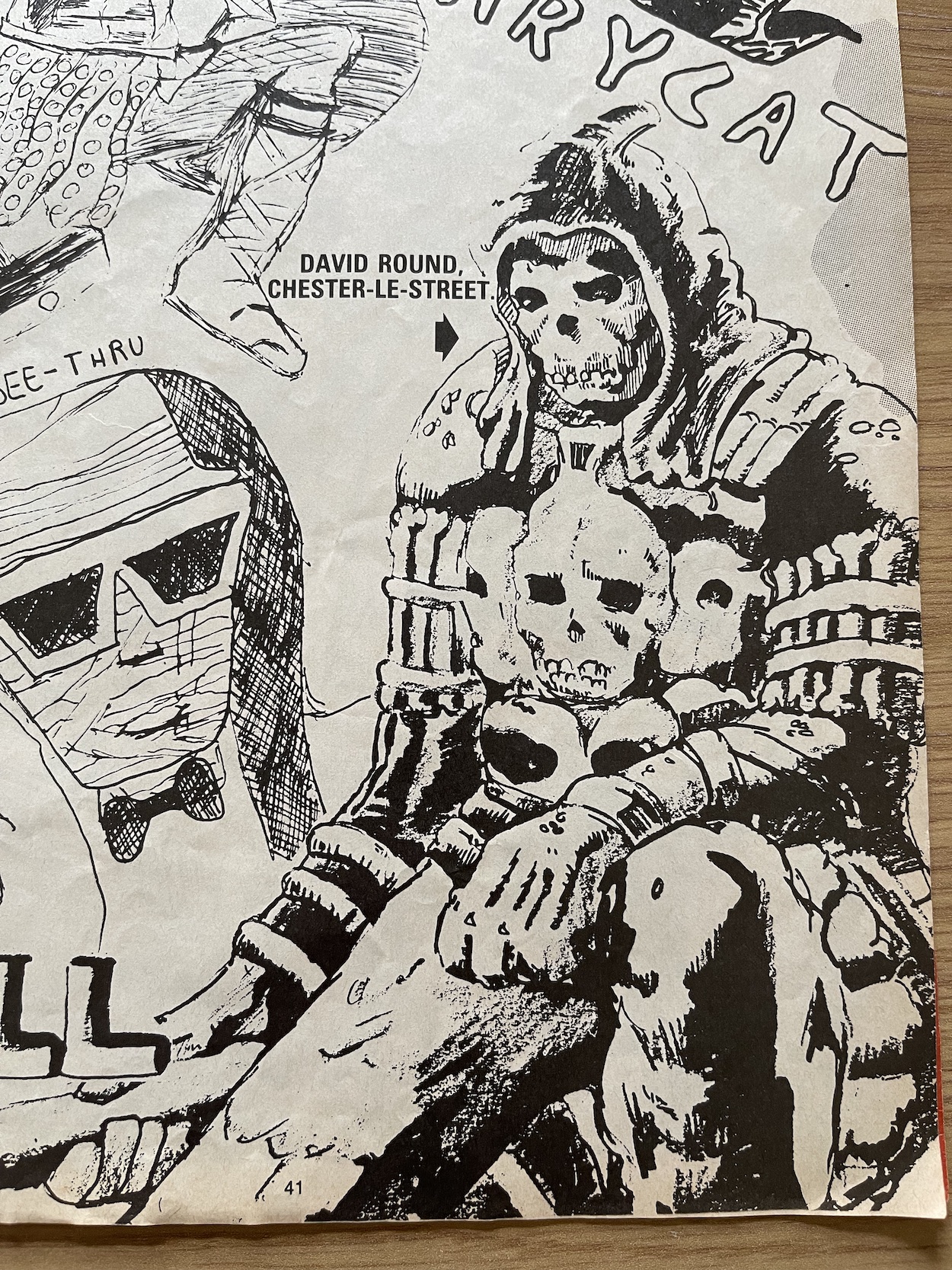
To make a special even more so, there are always a few extras. We have new pin ups of the toys, some of the marvellous posters from the fortnightly have been shrunk down to A4 size, a one-page Ghostling Tale features a thief making his getaway only to board the Titanic and there’s a pretty poor quiz. Much like the one in the Adventure Book it’s just a series of strip panels and the questions are all a variation of “Who is in this picture?”. We do get some lovely reader art in Ghostworld Gallery including a superb rendering of Skull by David Round who was clearly a fan of Alan Langford‘s depiction of the character.

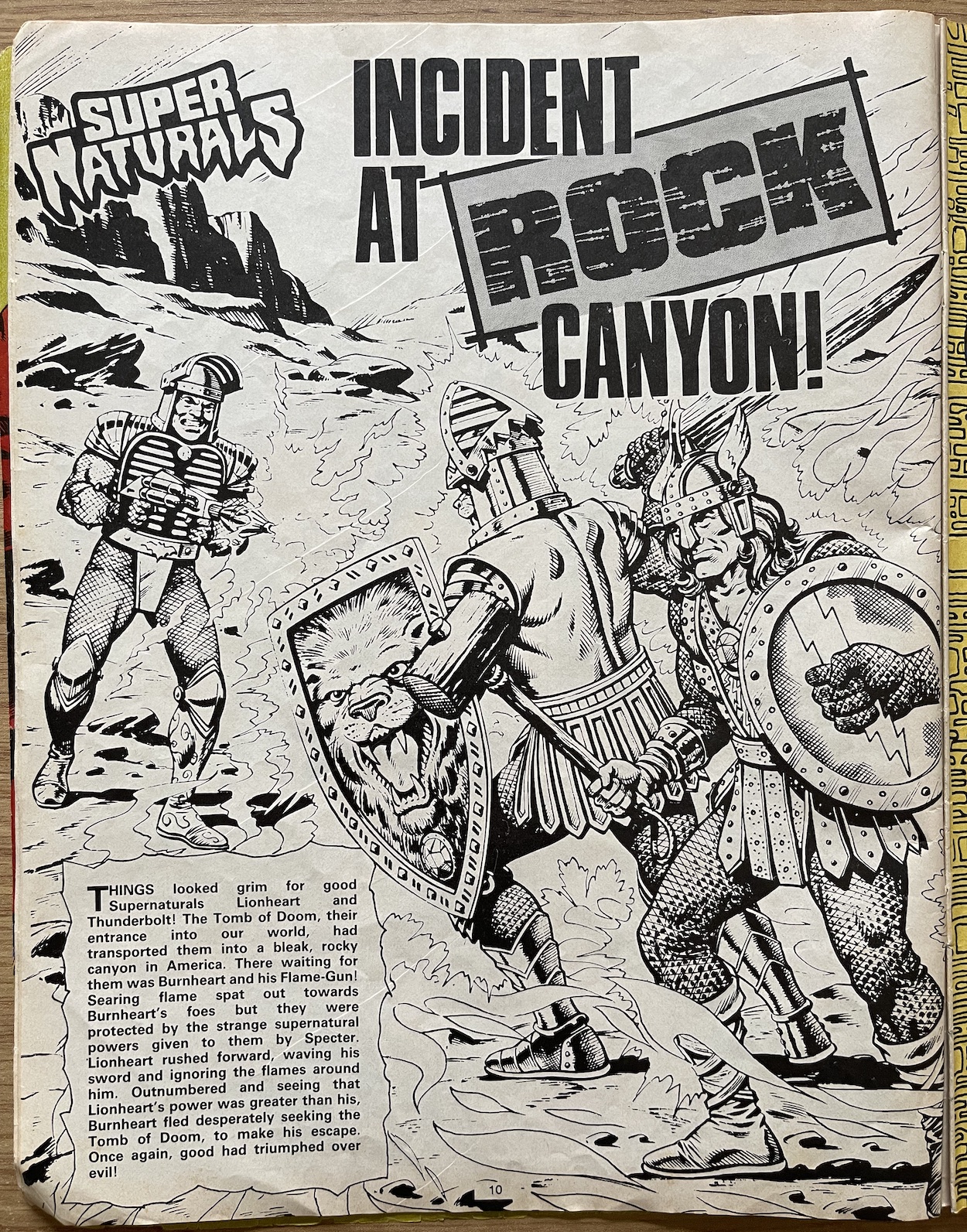
There’s also a page called Incident at Rock Canyon which looks suspiciously like an unused cover. Drawn by Sandy James it clearly hadn’t reached the colouring stage when the comic was cancelled. To accompany it is a short story by way of explanation, reminding me of the inner front page to the Ring Raiders Special printed after that favourite comic of mine also abruptly ceased. It’s a nice addition and it’s always interesting to see work that was still in progress for future issues.

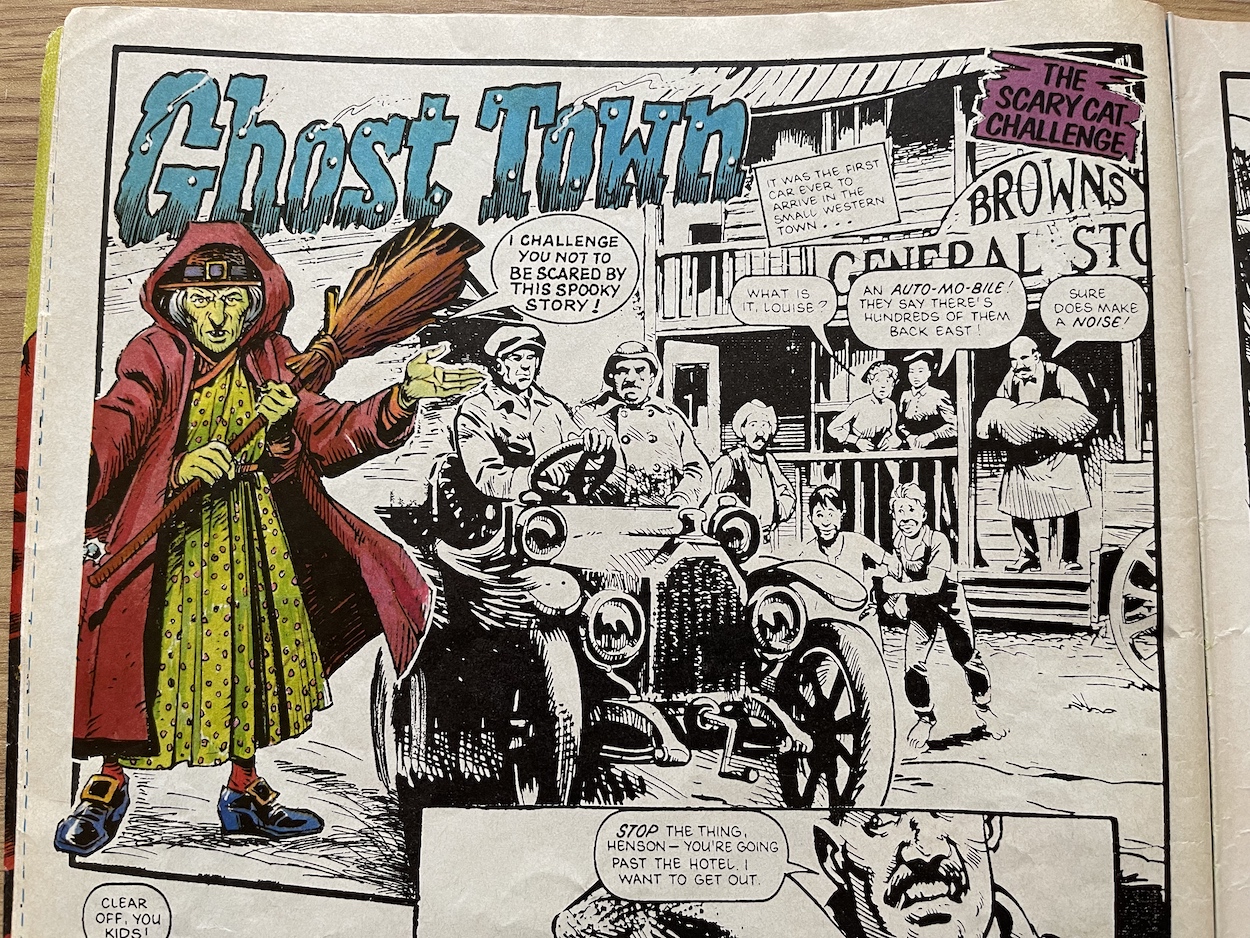
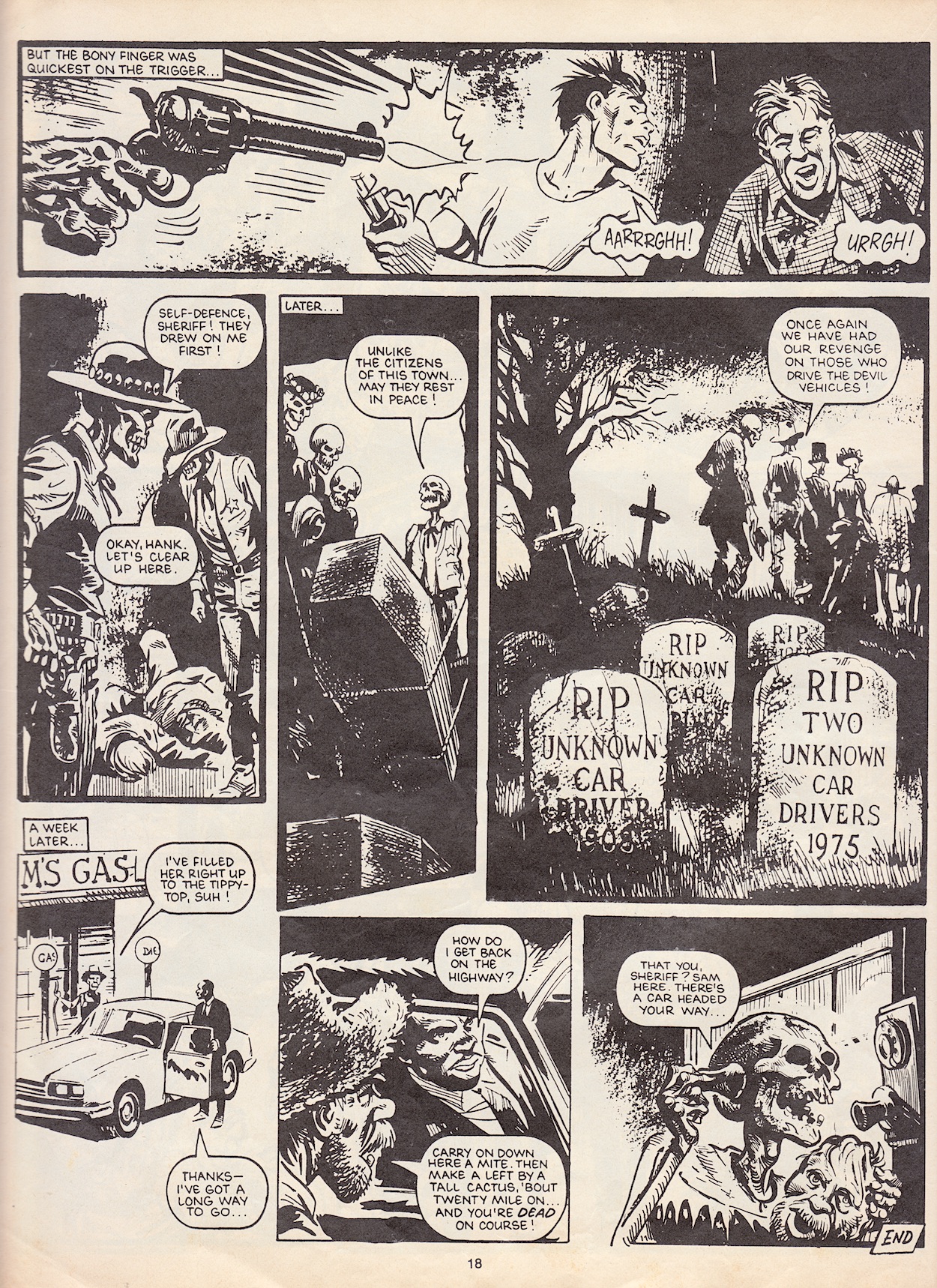
Next up is a Scary Cat Challenge story. This isn’t based on a reader’s idea like some of the very best in the regular series, instead it’s a reprint from Scream! #9. Part of the Library of Death series in the comic, Ghost Town was written by Fred Baker (Roy of the Rovers, Lion, New Eagle) and illustrated by Mike Dorey (Action, Warlord, 2000AD). An old Western town in America witnesses the arrival of its first automobile, which promptly has a brake failure and ploughs straight into a dynamite storage (of course it does), blowing it and the whole town up in a huge chain reaction of explosions. That’s just the beginning.

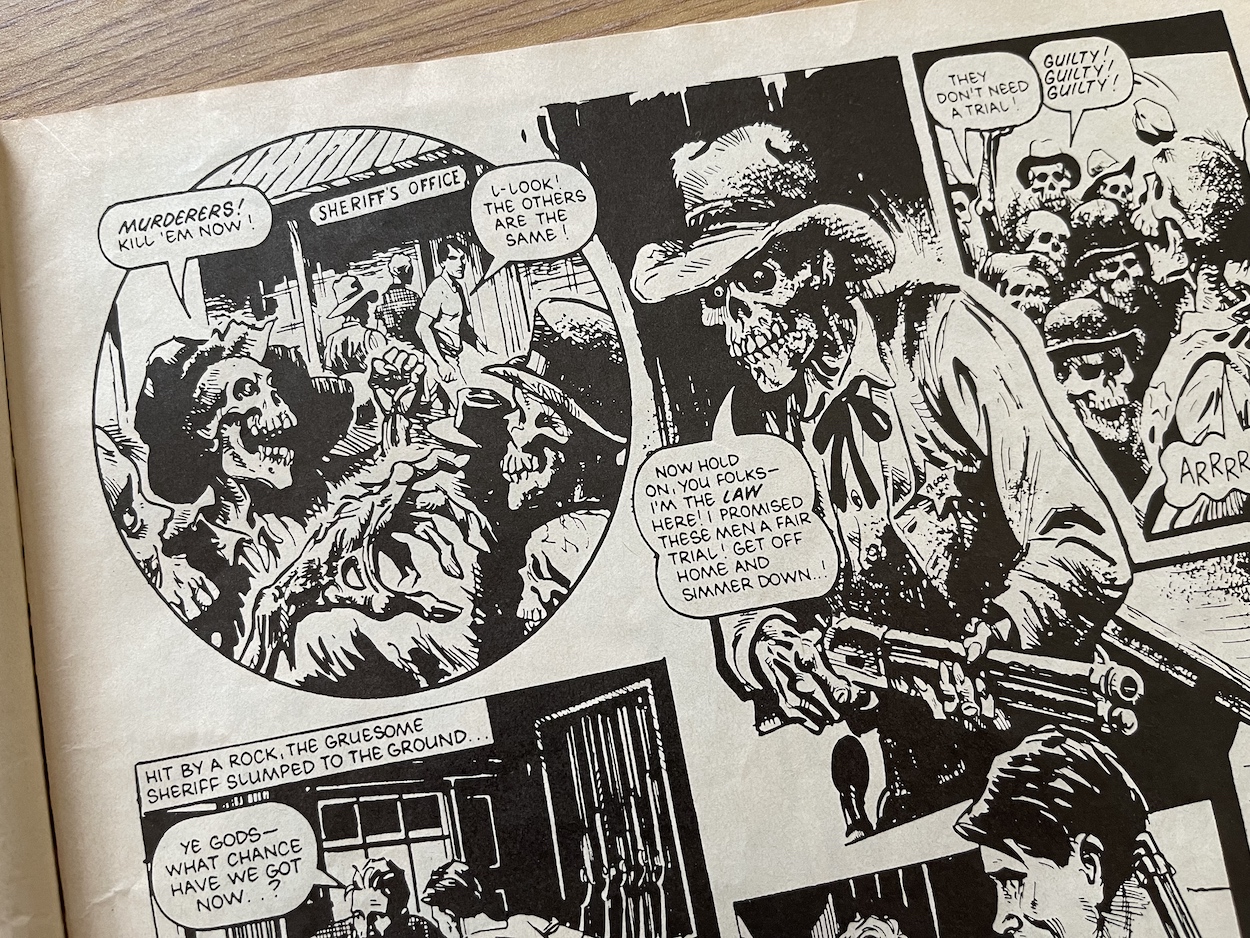
In the then-present day of the 80s two young lads pull up to a gas station in the desert and ask for directions, but there’s more to the little old man who helps them than they realise. They soon find themselves in an old fashioned town instead of back on the highway and are greeted by the sheriff. The only problem is he’s a waking, talking skeleton! Telling the boys they’re going to stand in a fair trial for murder, soon a whole town full of dead bodies with other ideas are chasing them down.

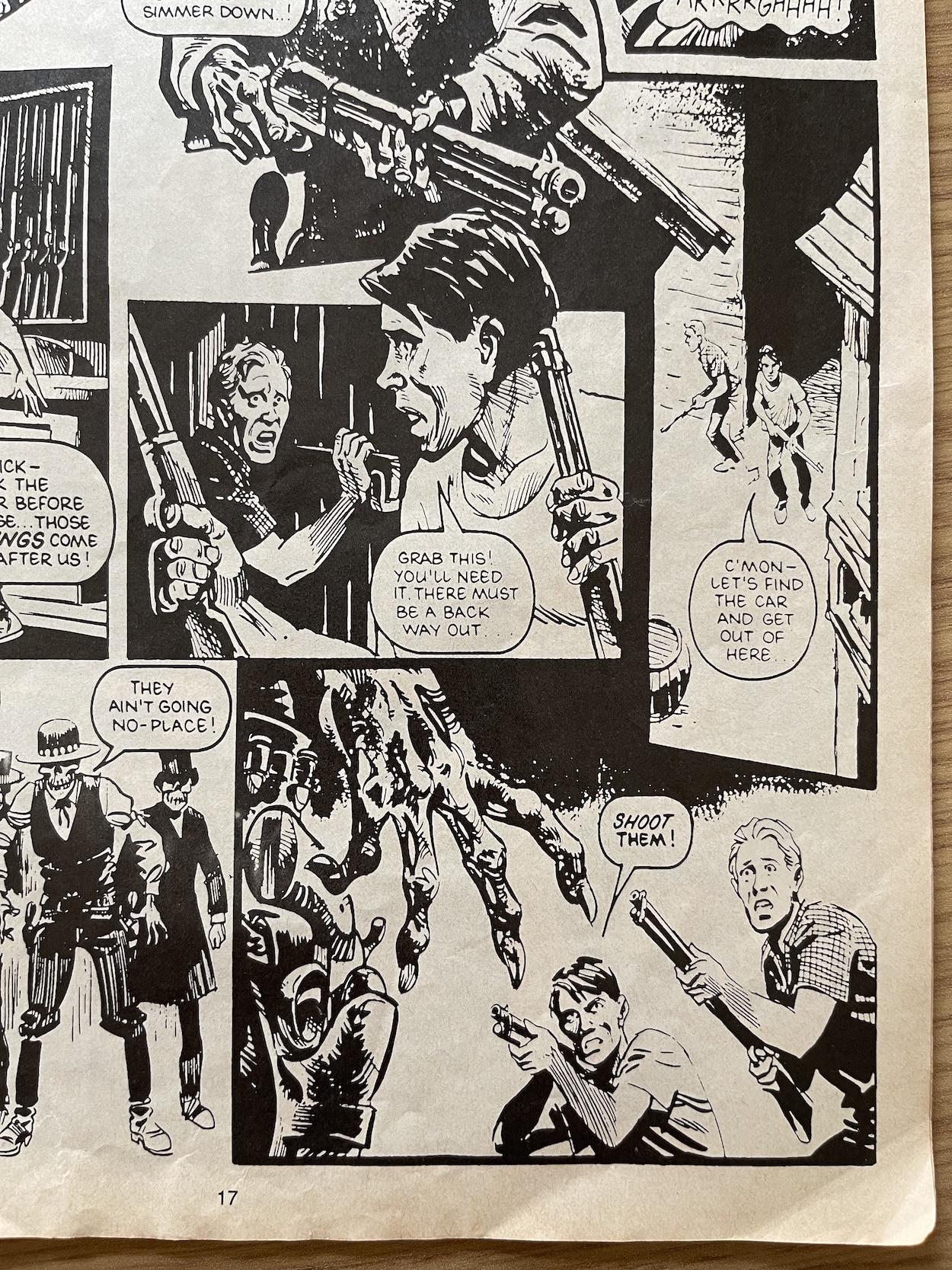
Cornered in the sheriff’s office with his guns, the young men have no choice but to try to shoot their way out and get back to their car, but they’re no match for one of the local gunslingers. Seeing the two innocent lads gunned down was quite the shock when I turned the page! I know it was created for a different comic but to see it in the pages of Super Naturals it makes quite the impact. I never owned this edition as a kid but if I had (and not knowing this was a reprint) I know I would’ve loved this story because of this horrific final page.

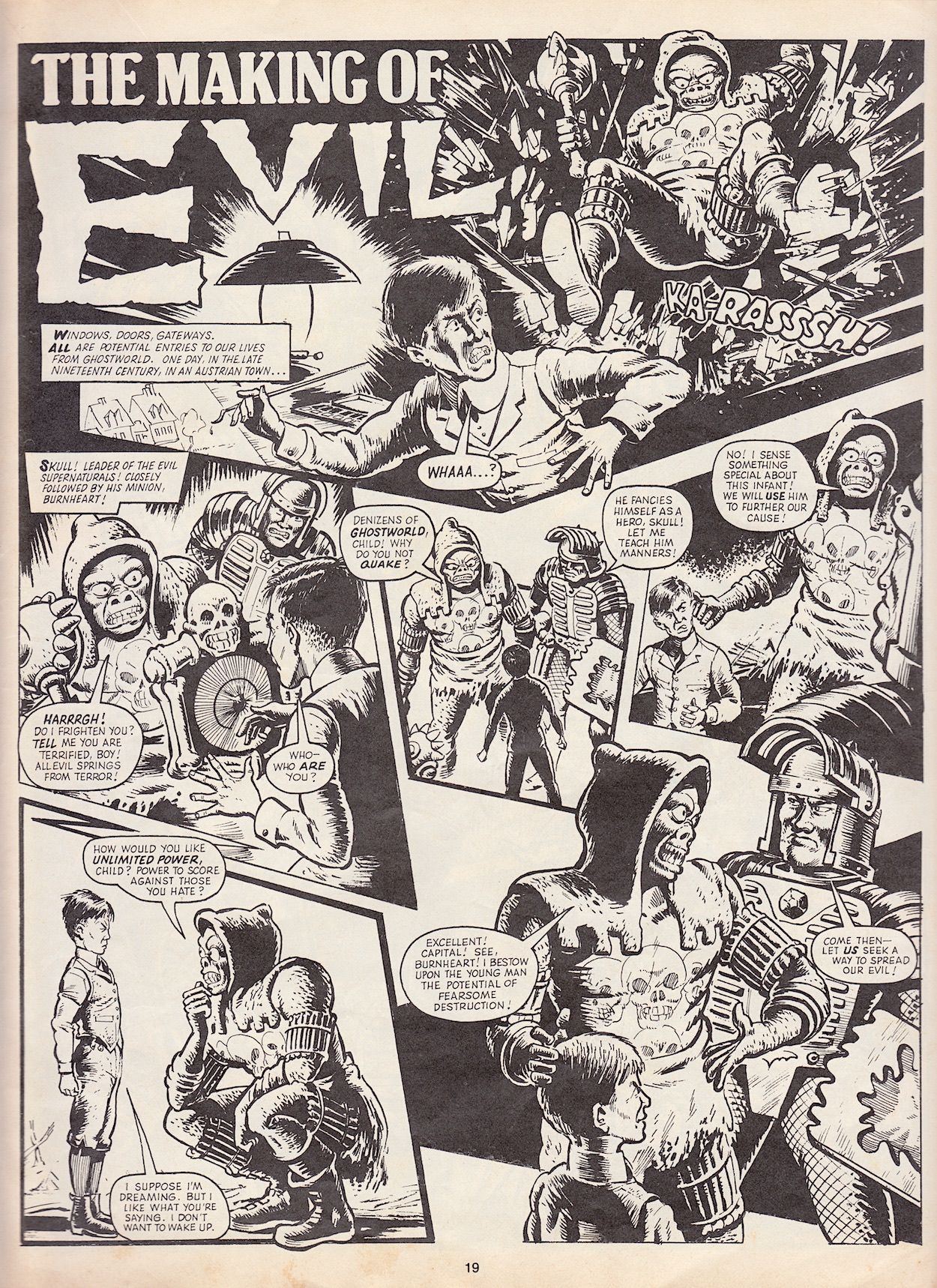
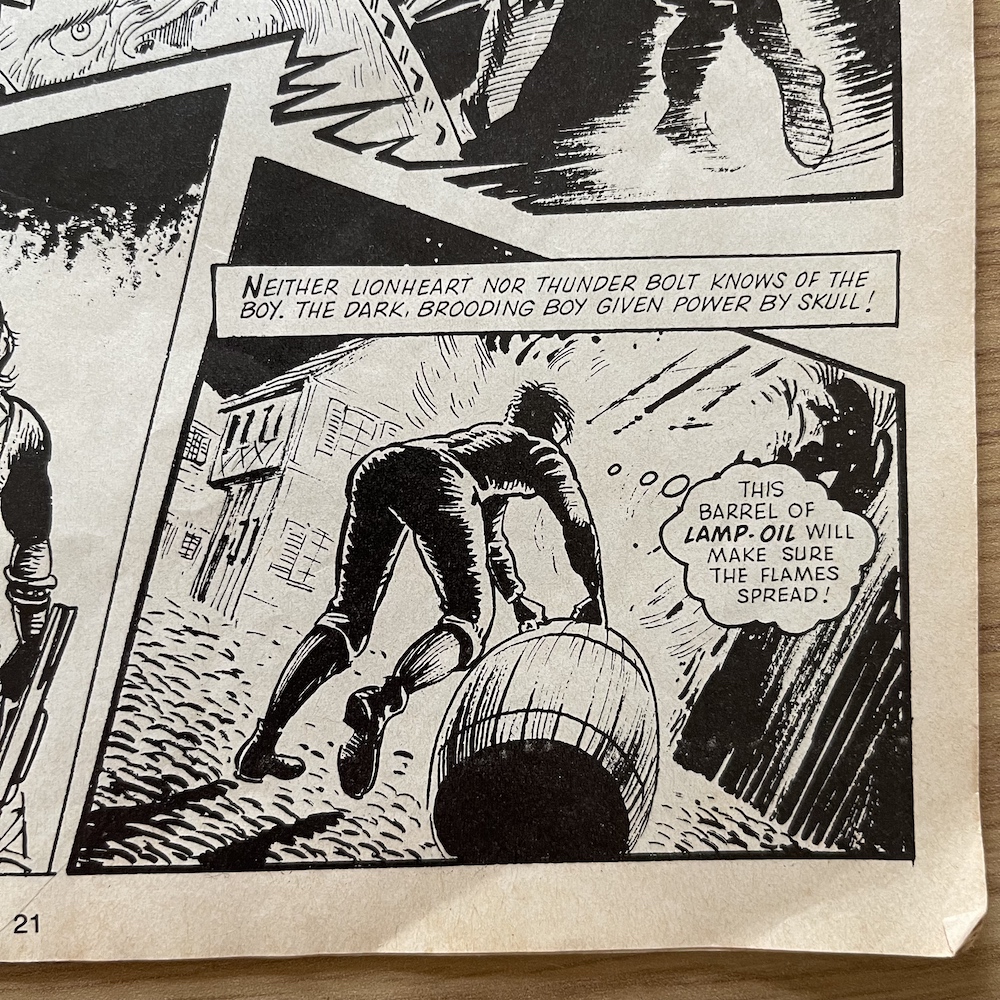
The next strip is the definite highlight of the whole comic, even though it only comes in at four pages. I believe the artist for The Making of Evil could be Keith Page although this is unconfirmed. The middle couple of pages are your typical tale of Skull and Burnheart causing terror and destruction as they set fire to a small Austrian town at the end of the nineteenth century. They’re defeated by Lionheart and Thunderbolt but our main focus is the young boy the evil Super Naturals crash in on at the beginning of the their story.

The strip doesn’t explicitly tell us his name but instead treats the young readers with the intelligence to either know straight away who this is, or to piece it together by the end. I was still in primary school when this was released so I wouldn’t have been taught anything about World War II at this point, but some slightly older readers may have, and even if they hadn’t a rereading in a year or two would’ve brought a fresh, terrifying perspective.

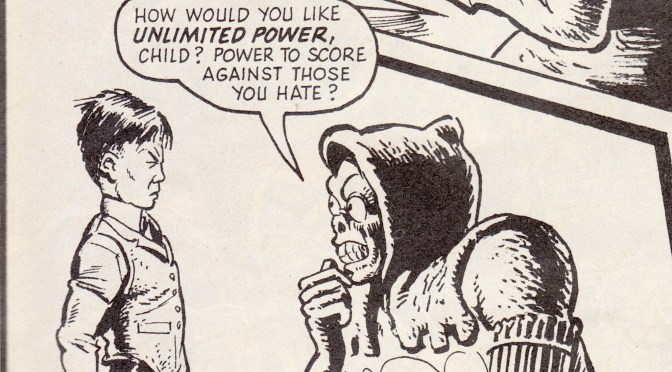
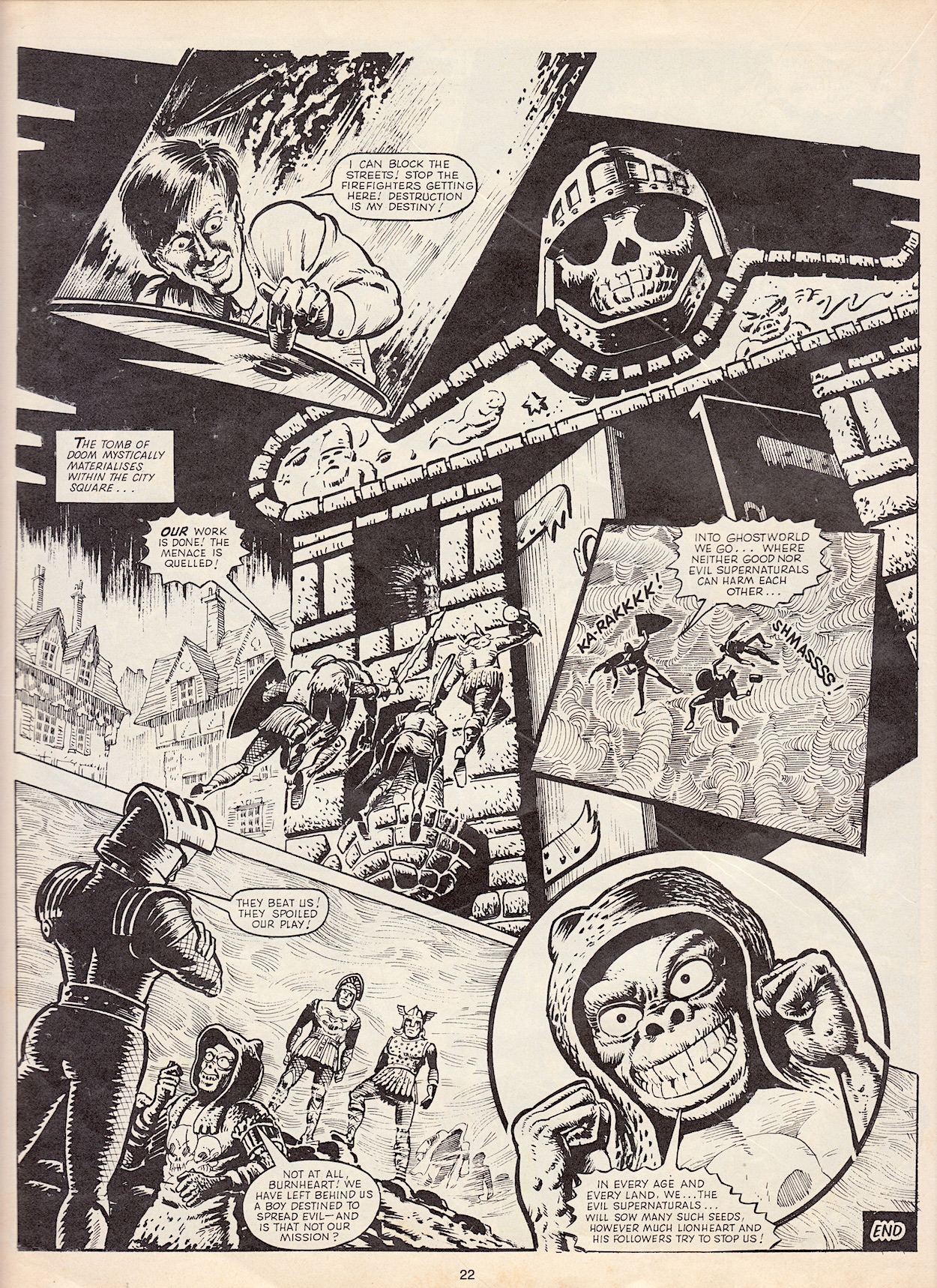
The boy’s reaction to Skull inspires the evil leader to bestow upon him unlimited power to score against those he hates, but even Skull can only hope the boy will spread some form of fear; he has no idea of what he’s actually created. For now we see the boy carry on with their work, helping spread the fire and blocking the streets from help. In the final issue’s review I said how it would’ve been great to see the Super Naturals interact with more myths from our past like they did with the Lady of the Lake, but to see a real-world evil inspired by Skull is something I didn’t expect! It’s a brave move by the comic and an inspired story that once again shows the potential of the franchise.

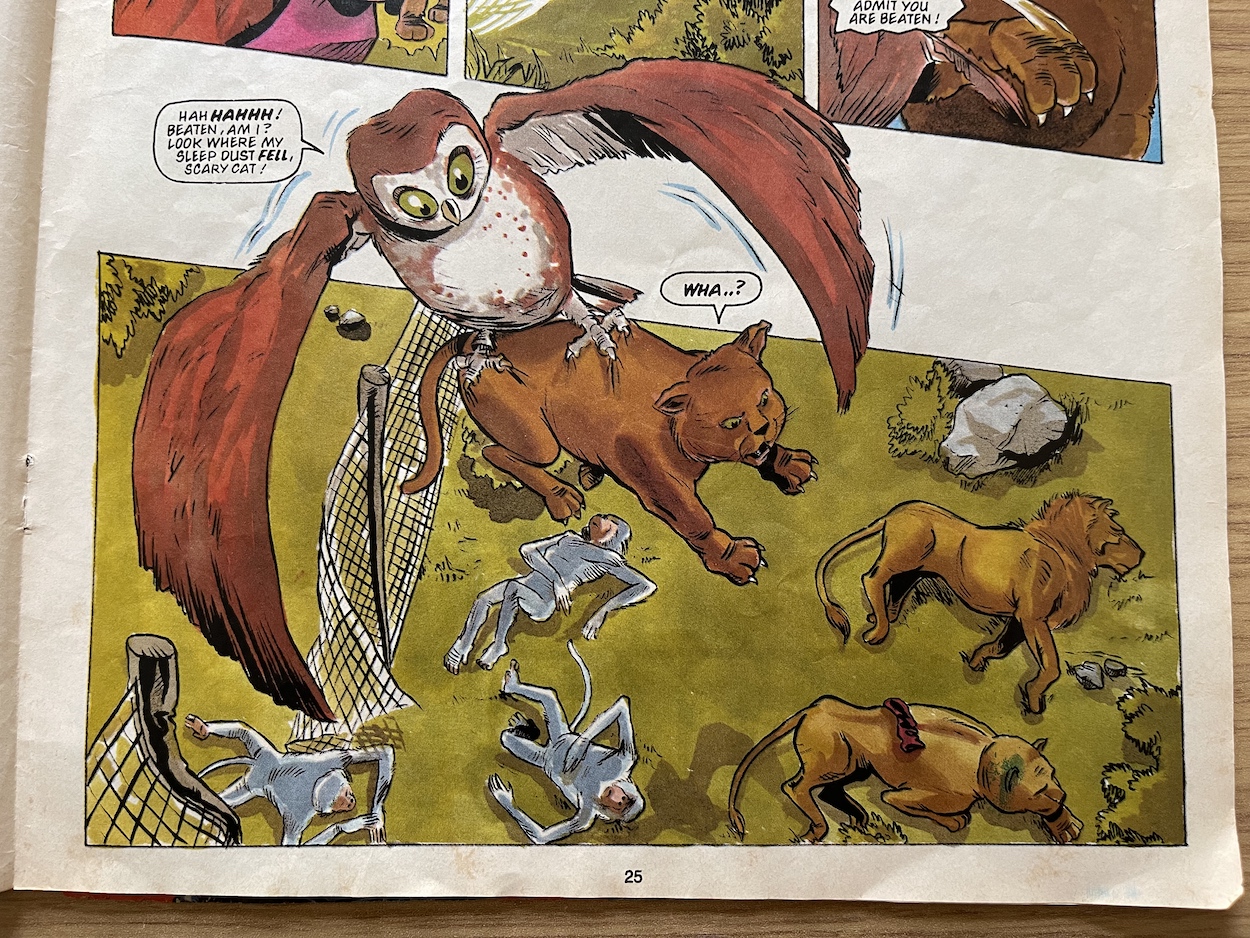
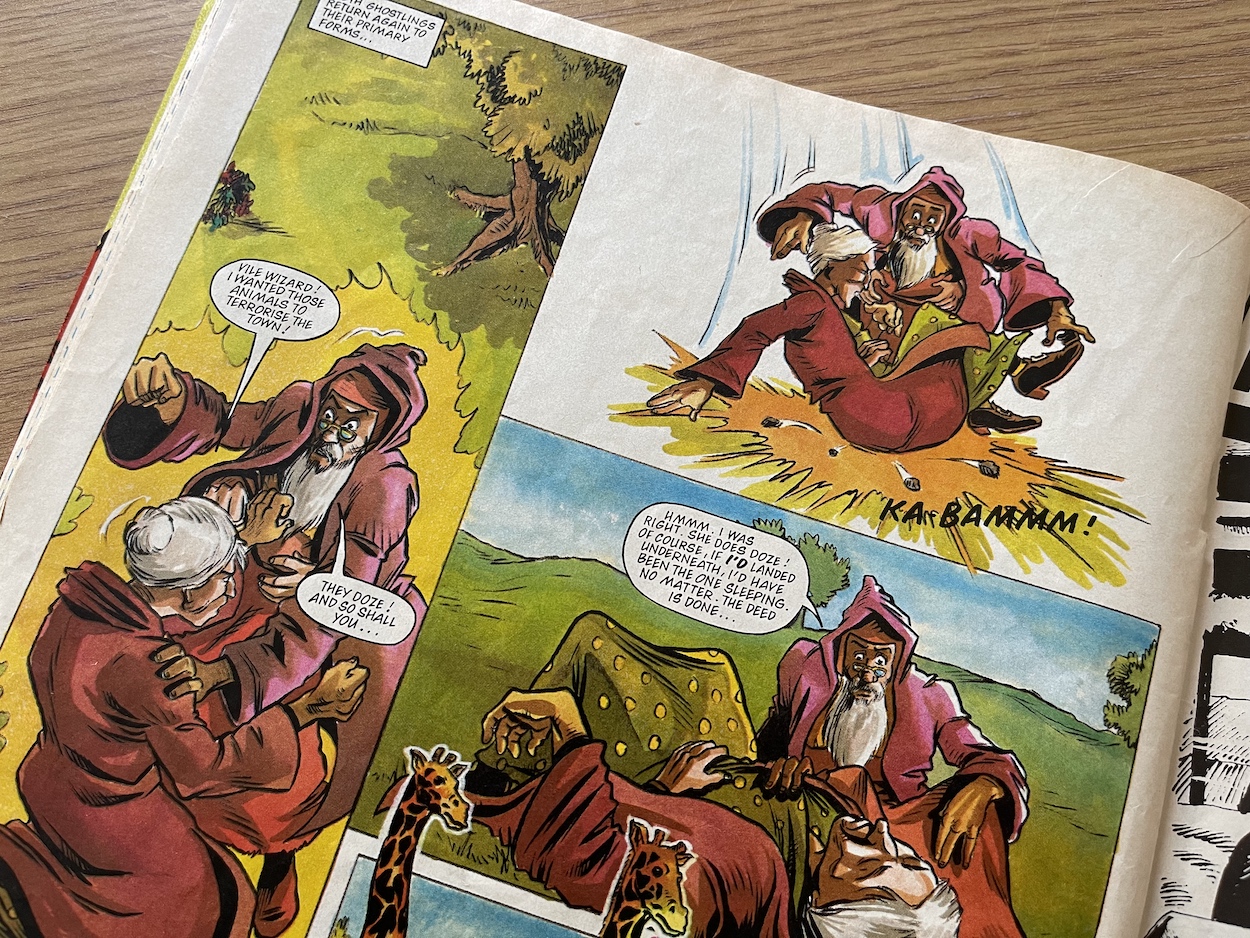
I also adore that awesome Tomb of Doom looming over the characters as they disappear back into Ghostworld, and I wish it had been depicted as such throughout the whole series. Then, after that somewhat creepy tale comes a bit of comic relief in the shape of Ghostlings, this time focussing on Hooter and Scary Cat and as ever it’s drawn by Anthony Williams. The slight plot sees the witch trying to wreck a bit of havoc by having lions escape a zoo close to a town.

Hooter tries to stop her by using his magical sleeping potion but he’s quite a clumsy wizard is our Hooter and he drops it in a mid-air kerfuffle between the pair. But luck is on his side and instead of Scary Cat being put to sleep the animals end up having a doze instead. However, when Scary Cat transforms back to her witch form the hard landing sees her join them in the land of nod. Our hero is then easily able to carry her back to the Tomb. Silly stuff, but then again the best Ghostlings strips always were, that was the whole point of them.

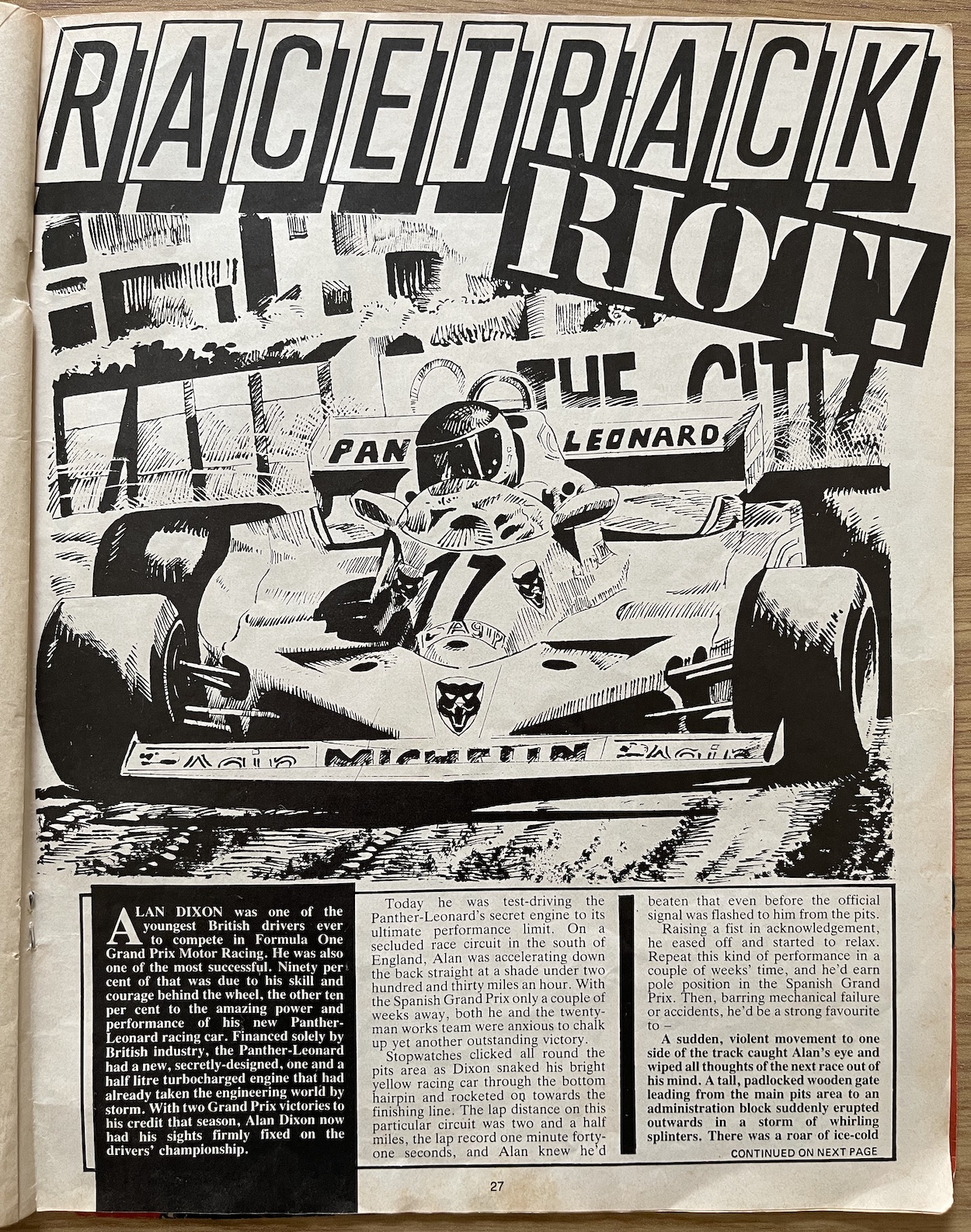
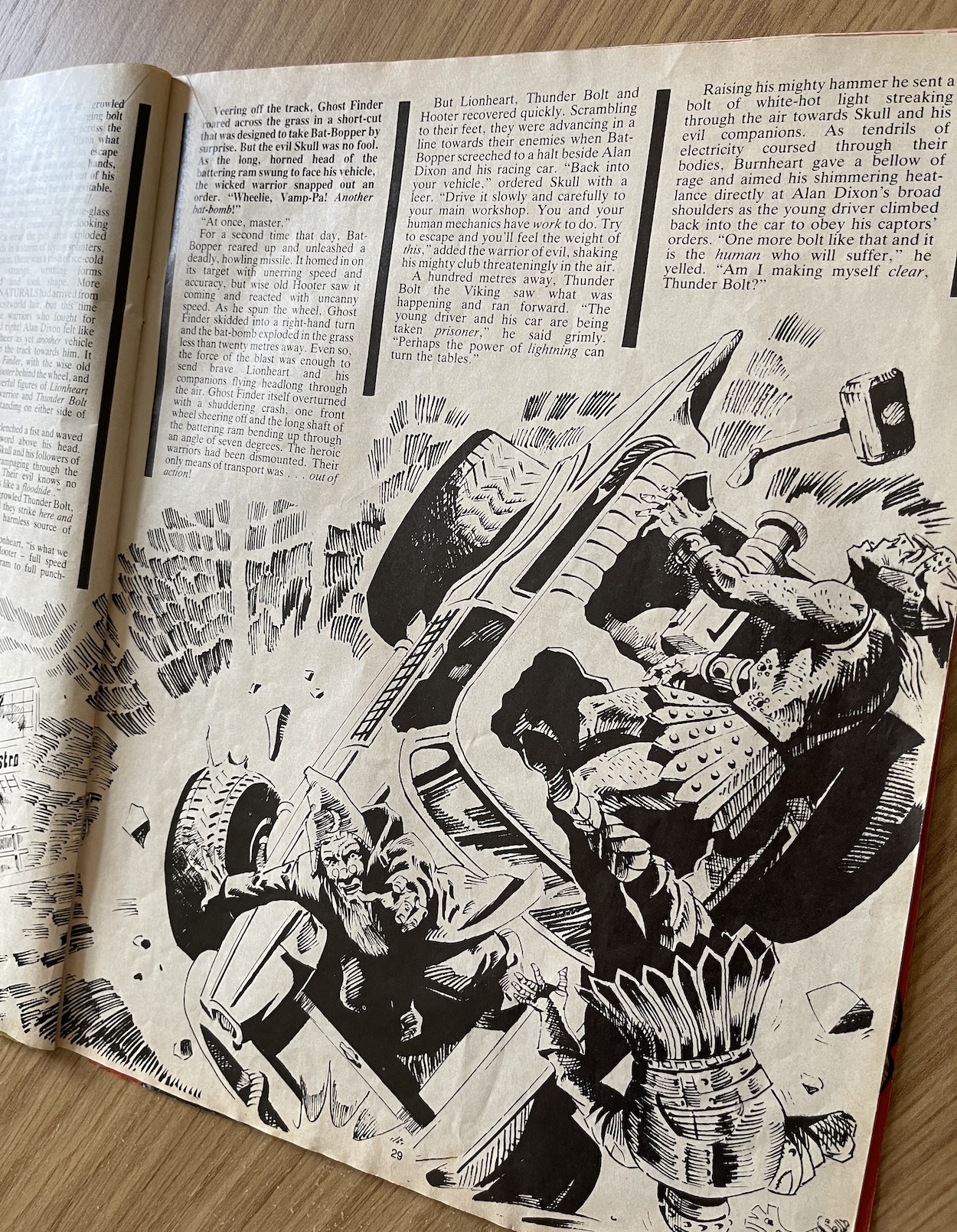
Racetrack Riot is the special’s prose story and follows F1 driver Alan Dixon as he test drives a new super powered engine, which of course Skull wants for his Bat Bopper truck. Alan and his team are kidnapped and forced to remove the engine from their car. Outside Lionheart, Thunderbolt and Hooter (who is making up for being underused in the regular comic by the looks of it) are watching closely. It’s our clumsy wizard who comes up with the plan and after transforming into his owl form he swoops in from the skylight on which they’re perched and seemingly attacks the F1 team.

There’s method in his madness of course. It looks like a regular owl, possibly nesting somewhere nearby, has flown in. So the evil characters simply ignore him while at the same time in this form he doesn’t inadvertently scare the humans into freezing in fright for once. Instead, they dive into the maintenance pit under the car for cover. This allows the main Super Naturals to launch an attack and duke it out without fear of harming anyone. It’s inconsequential stuff but entertainingly written by Barrie Tomlinson. Unfortunately though, we’re not sure who the artist was.

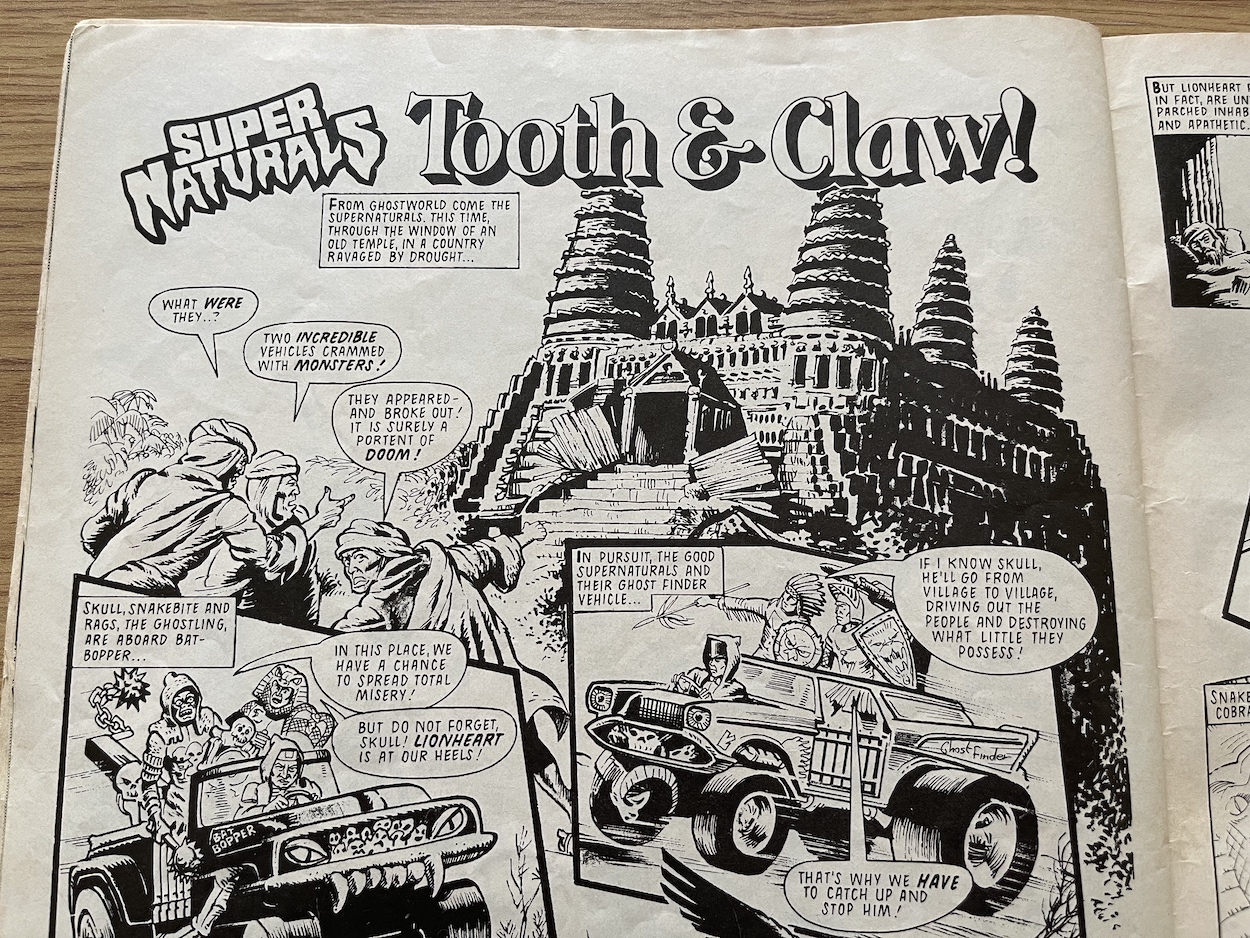
The final story in the comic and for any of these characters is Tooth and Claw and I believe it could also be drawn by Keith Page. I’ve checked with some sources and parts of this (in particular the Super Naturals themselves) seem to be in his style but the jury is out for how the wild animals are drawn. So it could be Keith. Anyway, the story is set in an unnamed country suffering from a drought, its inhabitants hungry and the animals dying. Through a sacred temple emerge Skull, Snakebite and the underused Rags (as someone interested in Ancient Egypt I wish they’d used him more, he’s a Pharaoh who can turn into a cursed mummy) in the Bat Bopper and Lionheart, Eagle Eye and Mr. Lucky in the Ghost Finder.

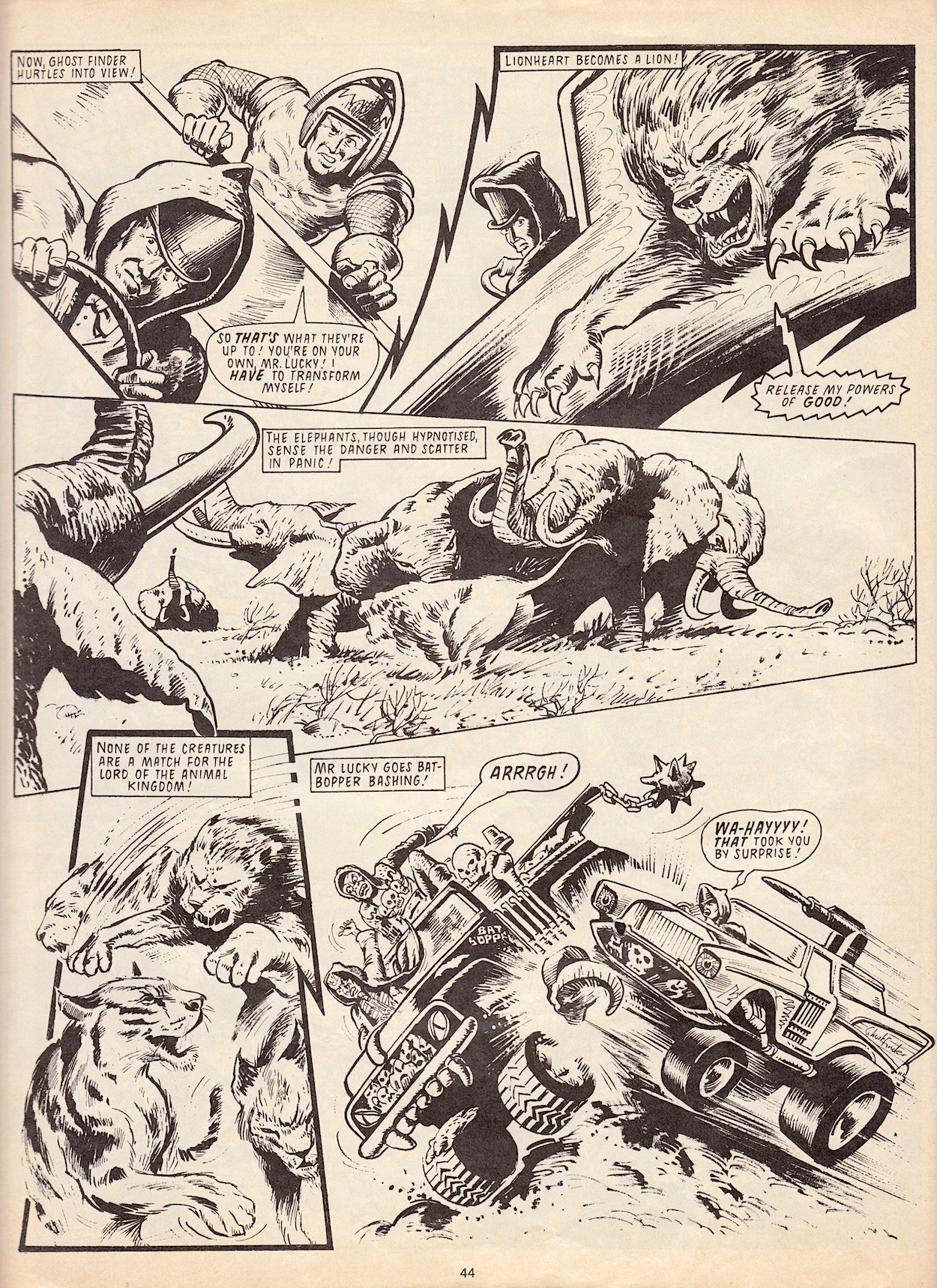
As they give chase the good guys are surprised to see the villages have been left untouched by their evil counterparts, until they come face to face with a wild stampede. Hypnotised by Snake Eyes, the animals have either been forced into a frenzy to chase down and eat the human flesh of the nearby villagers, or into a mad rage to stomp all over their homes and kill them underfoot in the case of the elephants. But the plan hasn’t reckoned on one simple thing, namely Lionheart’s third and final form.

It’s surprising to think the character hasn’t been placed into this kind of environment before now. It’s the kind of story which could’ve been developed into a serial to delve deeper into his mind, especially if he befriended other lions. After all, he was given this lion form by Specter for a reason, could he have found a kindred spirit in them? But then again, the comic was still in its infancy when it was cancelled, so who knows what could’ve happened. I have to say though, it’s fun to see him take to this form with relish, acting like an actual wild lion and fighting off the hypnotised, innocent animals (without killing them). Only a few characters got the chance for any kind of development by the end and unfortunately Lionheart wasn’t one of them. This is like a teaser for what could’ve been.

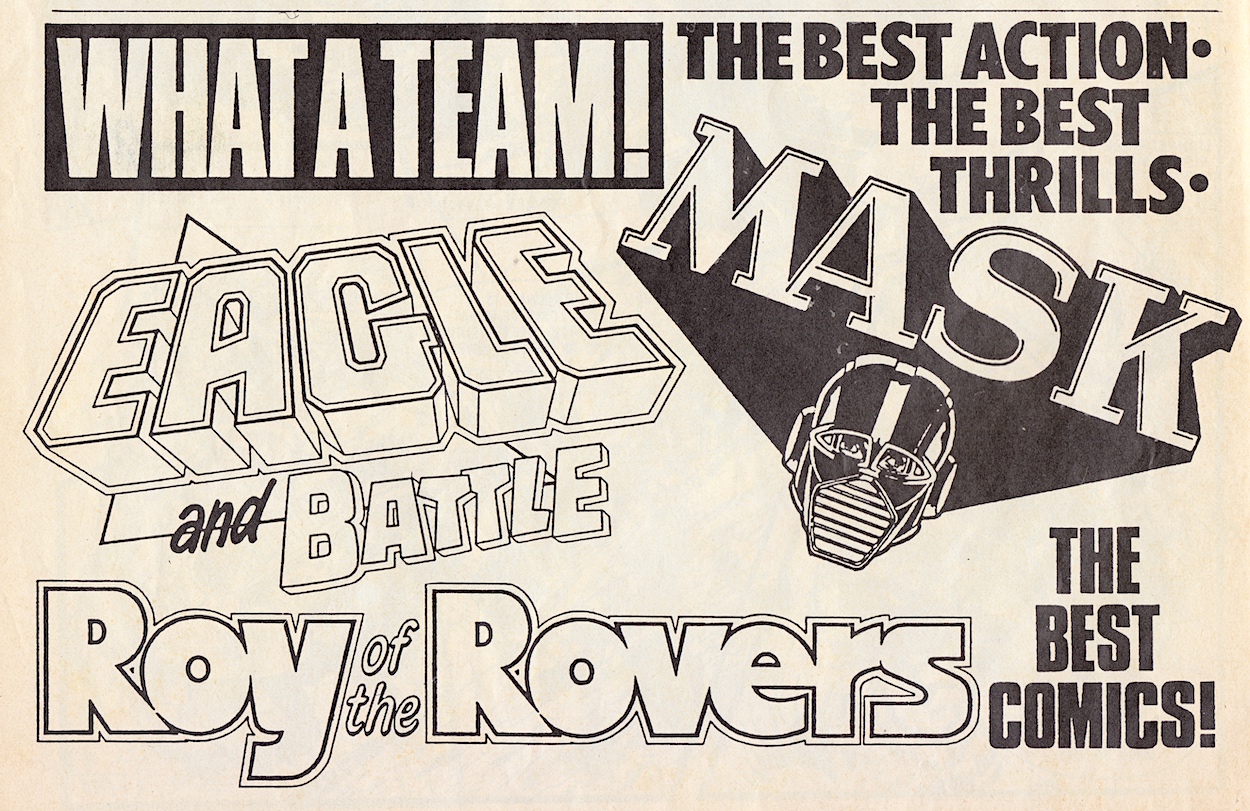
Before we sign off from the last ever edition of this comic there’s just time for a quick plug for some of Fleetway‘s range which may have appealed to the target audience. Battle had merged with the new Eagle after a phenomenal run, Roy of the Rovers was still going strong and another of their licenced comics, Mask had proved a lot more popular, lasting 80 issues and it was certainly a hit with some of my friends. These could be described as the Barrie Tomlinson range, as he edited all of these.

A reprint of a Skull poster with the top and bottom chopped off to fit the inside back cover, followed by the title logo on the rear round things off and that’s it. In an edition which contained a lot more fun and action-orientated strips, the horror stories of the Scream reprint and the Hitler tale really stand out. So does the action-packed Lionheart ending, if only to show what could’ve been as a great example of the licence.

Never again would the young readers see these fun characters and the horror strips that came along with them for the ride. While there seems to be very little to tell from the creative team because memories seem vague when it comes to Super Naturals, keep an eye on the blog for some possible extra content in the future nonetheless. It’s sad to see the comic end and it’ll remain a treasured part of my collection, taking pride of place on the Barrie Tomlinson Trilogy Shelf. I hope I’ve been able to do my bit in keeping the memory of this classic alive.

BACK TO iSSUE 9

SUPER NATURALS MENU