Classic comics in real time. It’s what this blog is all about, it’s right there under the title at the top of the screen. Each issue of the various comics are reviewed on the dates we originally would’ve got our hands on them. Normally that means on the date they were released, but applying the rule to this section of the blog poses a bit of a problem. So we’re going to do things a little differently here. Just a little.
As anyone who collected books like these as a kid will know, they went on sale around the time we’d return to school after the summer holidays, usually mid-September. But we didn’t get our trotters on them until Christmas Day when the jolly man himself would bring them down our chimneys. So when do I review them? On their release dates or when we got them? Those aren’t the same dates for annuals.
I’ve fond memories of looking endlessly at the huge variety of annuals on the shelves of my old hometown’s newsagent’s, or their large table displays set out at just the right eye level for kids. But as tempted as I was I never looked inside any of them, believe it or not. I didn’t want to ruin the surprise of finding out what they contained during my very favourite time of the year. Instead, I’d let the anticipation build over those few months until I was looking forward to them just as much as the toys and games (and the food)!
So I’ve decided to review these during the festive season. They were always a Christmas treat, many of them including themed content and even if they didn’t they were still very clearly marketed for that time of the year. So this is where I bend the rule a little. As much as I love you all I’m not going to be spending my Christmas Day every year writing a handful of reviews, not even for Knight Rider (my favourite thing in the universe)! Many of the reviews will be spread over the month of December, with any relating to an ongoing comic series published on The Big Day itself (so they’re in the right position in their own read throughs elsewhere on the blog).
A section of the blog I have a particular fondness for
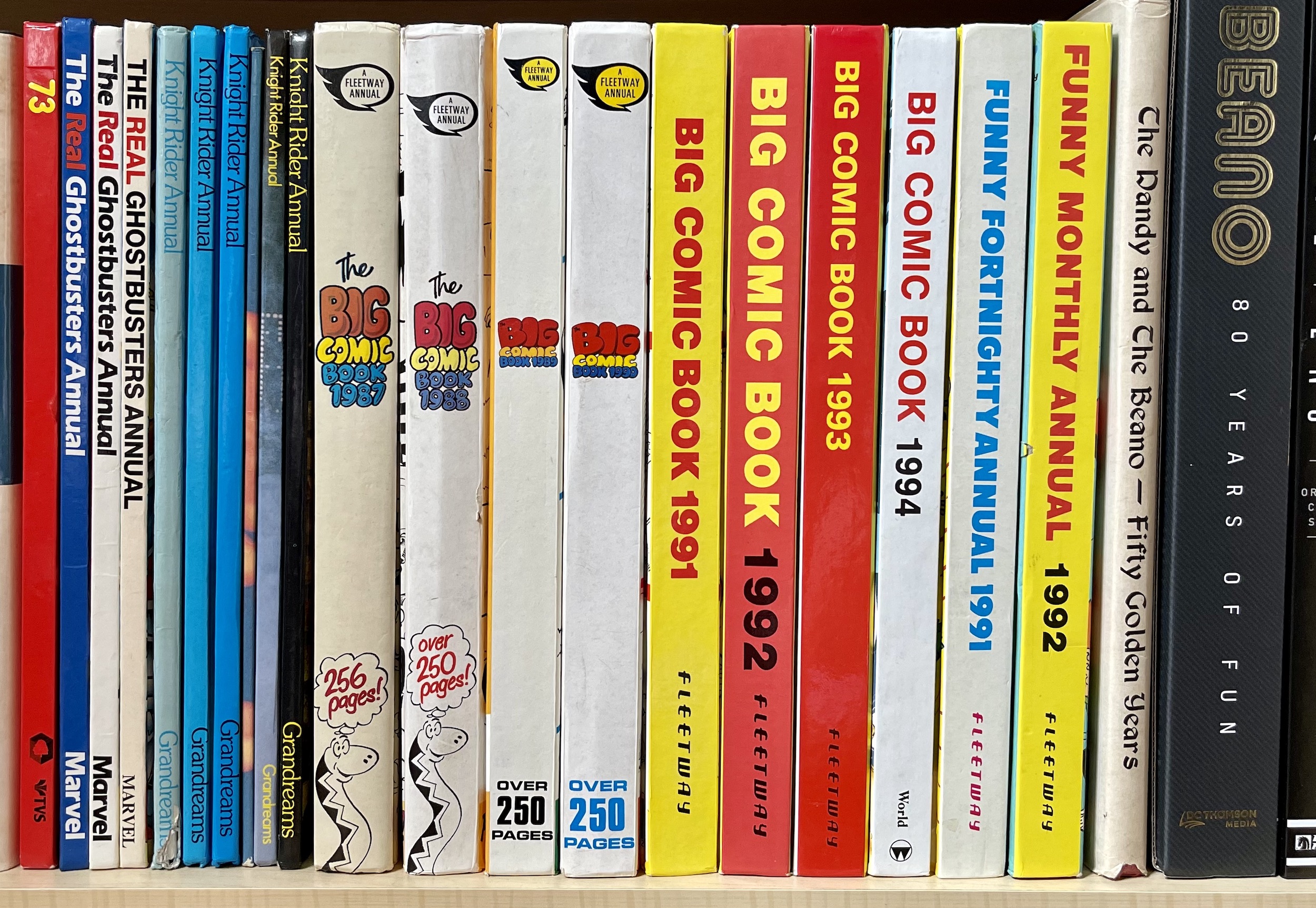
Patience will be a virtue with this particular section. The books were released once per year (the clue is in their name) so depending on the amount of books in a series they could take quite a while to cover. Also, the overall collection of reviews won’t be listed in the order in which they’re written for obvious reasons (they’re essentially all different read throughs).
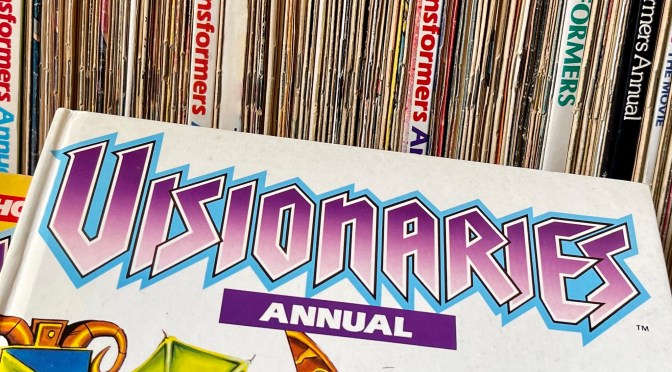
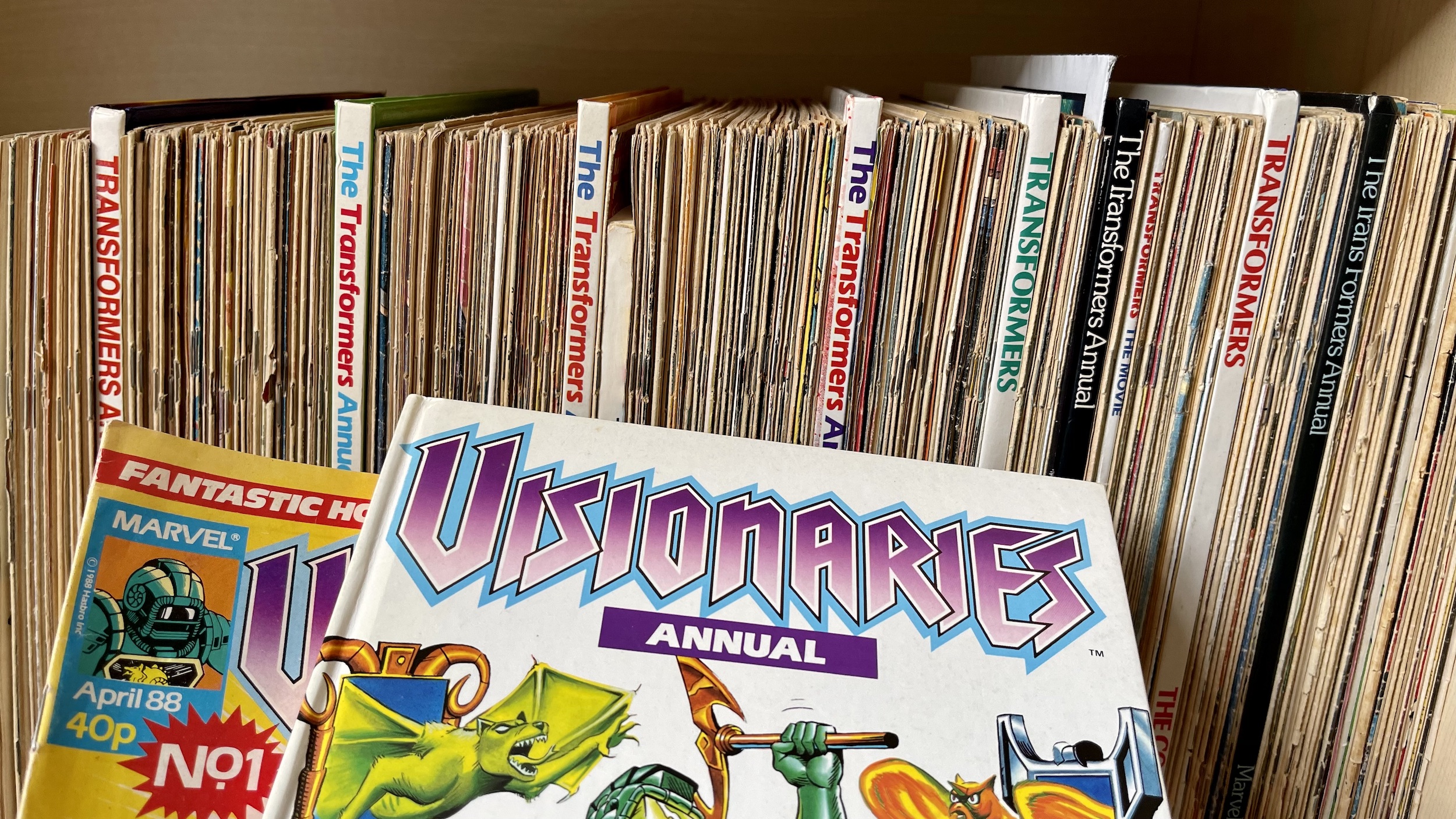
Instead they’ll be listed in original release order, meaning you’ll be able to take a trip right through the years covered. Perhaps you’ll remember those holidays when you received these books, or check out ones you recall from those newsagents’ tables, or discover ones you never knew existed. (For example, a lot of people contacted me about the Visionaries Annual after the review asking if I had a spare, having seemingly slipped under the radar of many fans in 1988.)
All these years later I’m still just as much a fan of Christmas as I ever was, perhaps more so. As such, this is a section of the blog I have a particular fondness for and the fact I have to wait so long between new additions just makes it even more exciting when the time comes around again. So, even though it’s a once-a-year thing you can expect just as much attention paid to these as anything else, including the occasional special feature.
As you’ll see it won’t just be annuals based on comics, although those based on other properties such as televisions series will have comics content. You can expect a nice mixture of the books I collected at the time and those I wished I had. This is going to be a really fun section of the blog. I’ve a shelf full of content just waiting for each year to roll around (the will power is strong with this one, it has to be) and more on the horizon.
I hope you’ll enjoy this section of the blog as much as I am.
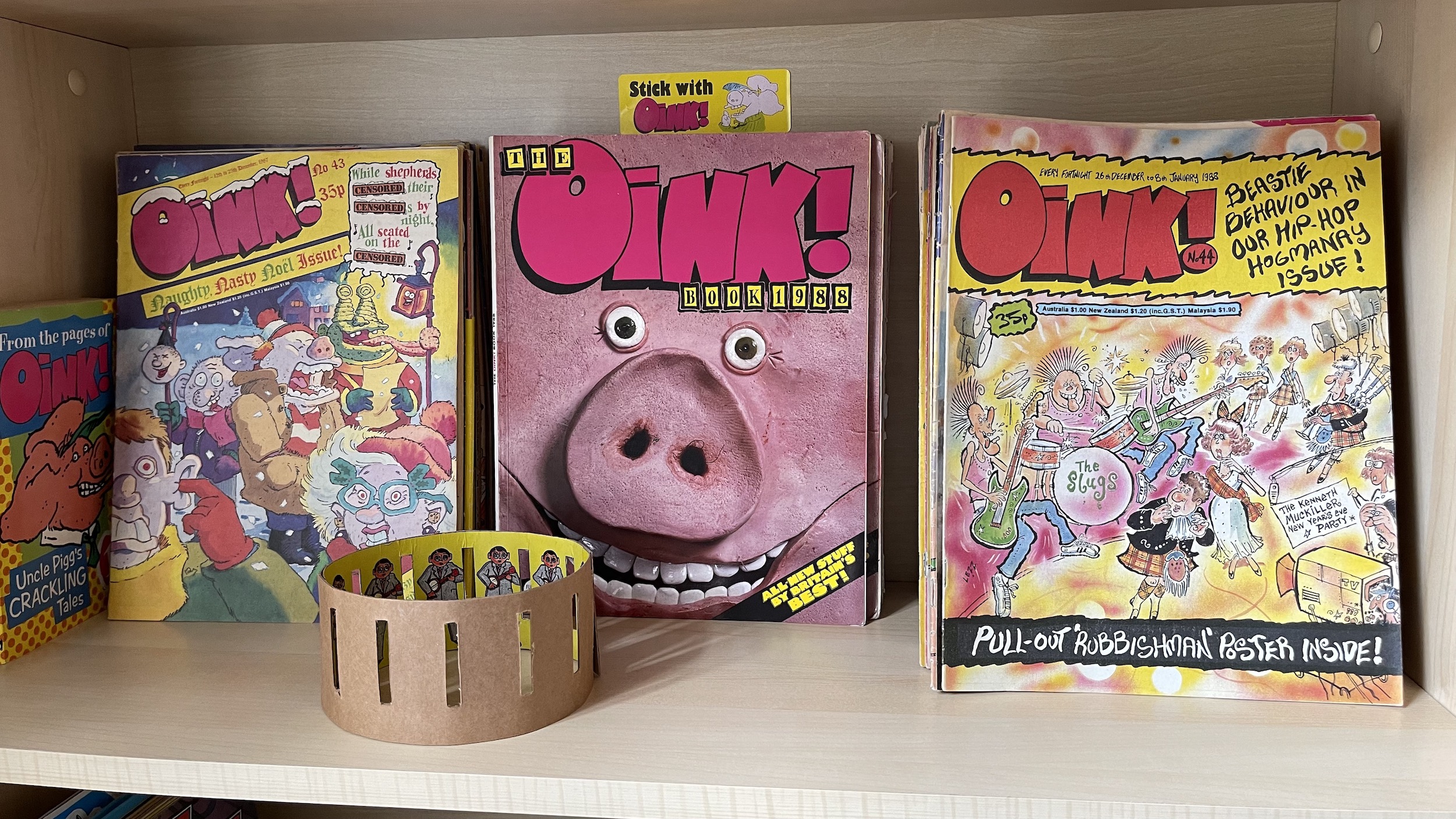
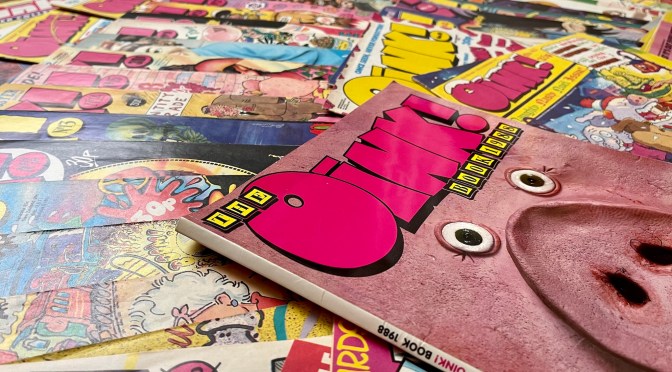
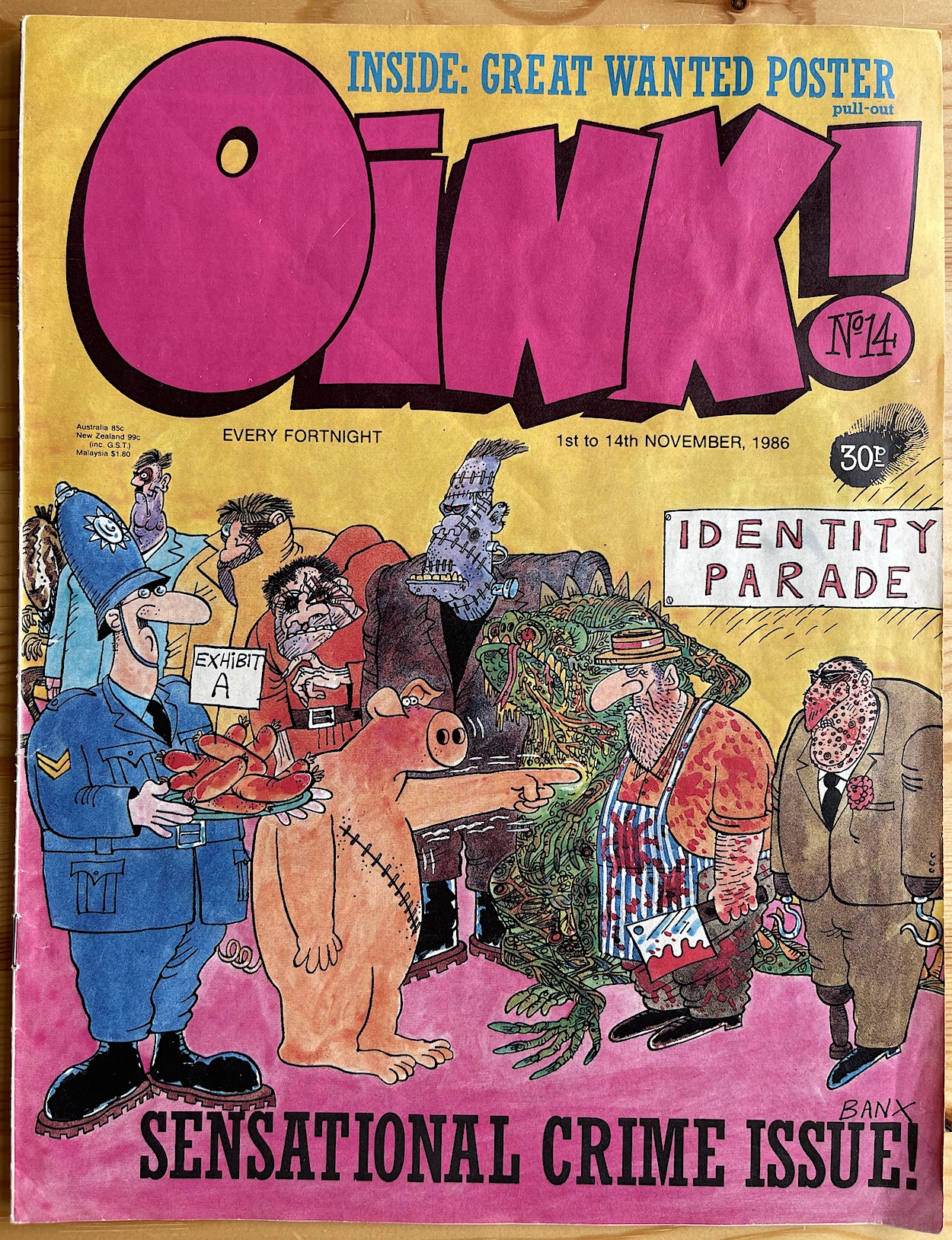
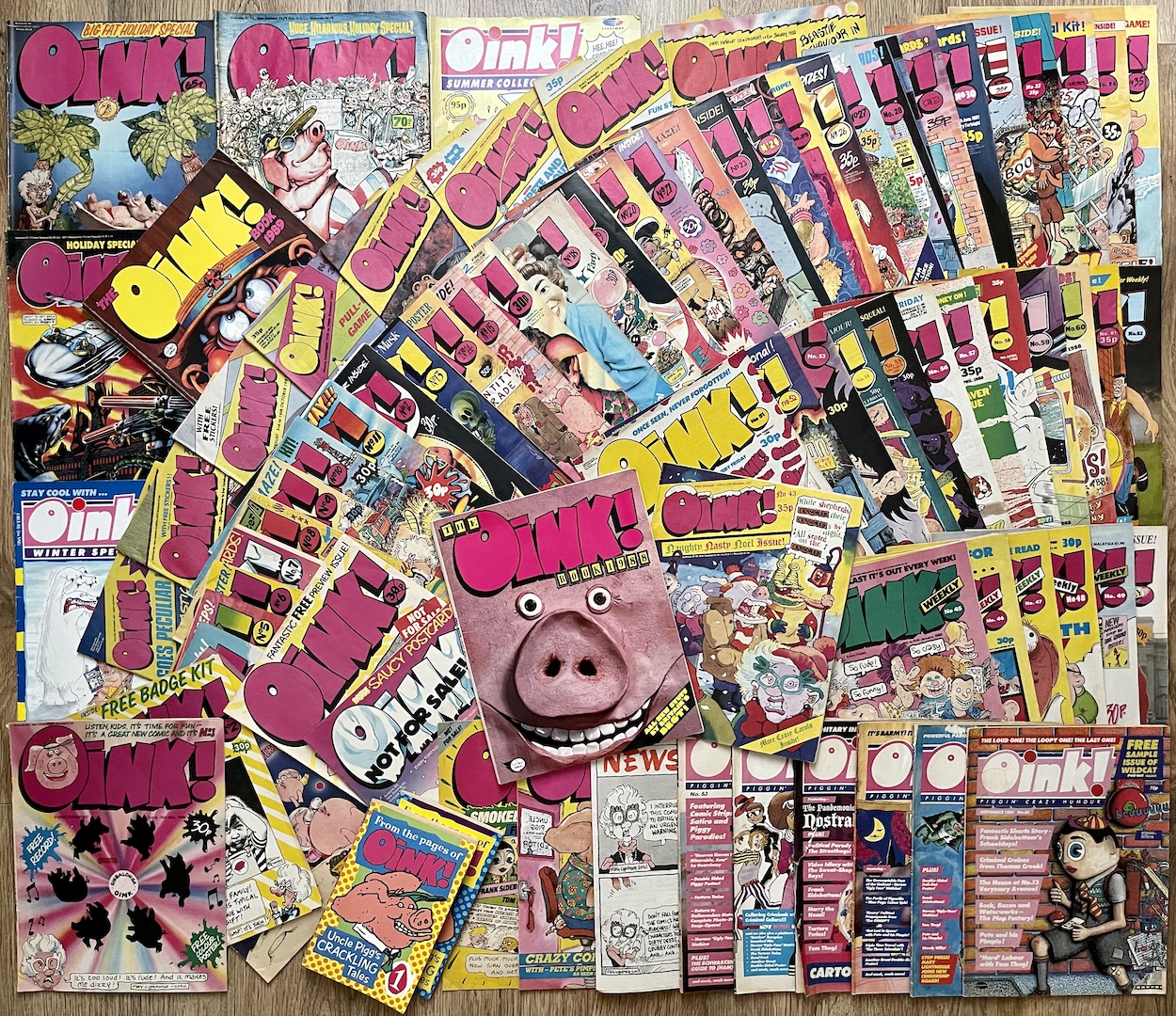
November 1986. The issue that started it all. A month-and-a-bit before my ninth birthday, while I shopped for sweets in my local newsagent’s I stumbled across a big, bold and very pink logo with a funny picture of a pig picking a butcher out of a police line-up. It was #14 of OiNK and it would end up becoming my first ever comic and a fundamental part of my youth. I was hooked the instant I read it and the next two years brought so much laughter it’s not an exaggeration to say the OiNK team helped form my sense of humour.
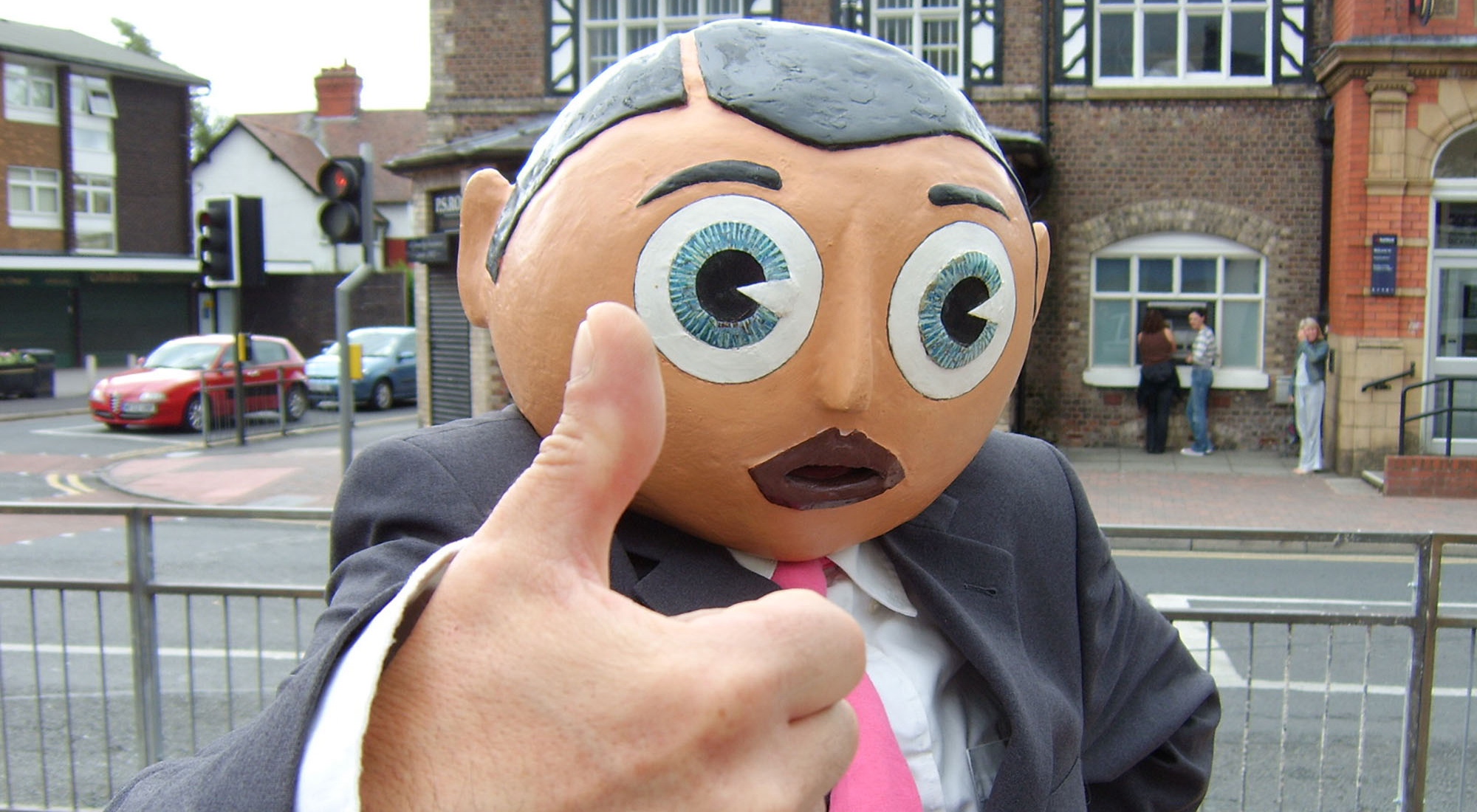
However, time moves on. After I moved out of home my parents decluttered and all but key editions of my comics collections were binned. Thankfully three OiNKs made their cut and The OiNK! Book 1988 would get revisited now and again, always making me (and friends) laugh no matter how much my age had advanced beyond the range of the comic’s target audience. Then in 2010 the sad news broke of the passing of Chris Sievey, better known as the papier-mâché-headed 80s megastar Frank Sidebottom, a staple of children’s Saturday morning TV and the pages of OiNK.
I dug out my three issues to relive some of his comedic moments and ended up buying a few more from eBay, and then began tracking down the full run. Surprised at how well they held up decades after they were written I joined the OiNK Comic Facebook group and was soon chatting with some of the incredible talent who had brought the comic to life. One of them was Lew Stringer, who reminded me that the anniversary of OiNK’s original release was fast approaching and he suggested I could read them on their original release dates and enjoy OiNK in real time.
You can see where this was headed. Looking for a project at that point in my life I began the original OiNK Blog and waffled away about each issue every fortnight. I eventually covered them all but when the host website I was using started to crash more frequently (and wishing to create more of a full website myself rather than a linear blog) I moved over here to WordPress and began the real time read through all over again from scratch. This version of the OiNK Blog is all brand new and much expanded over the previous version.
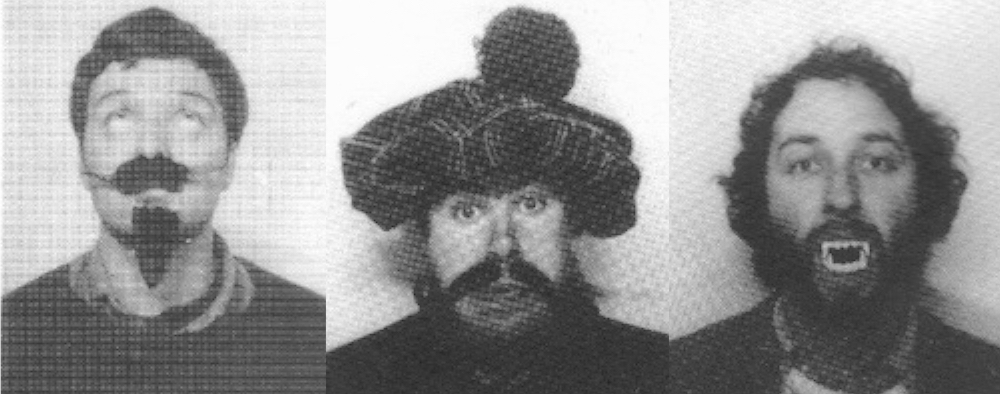
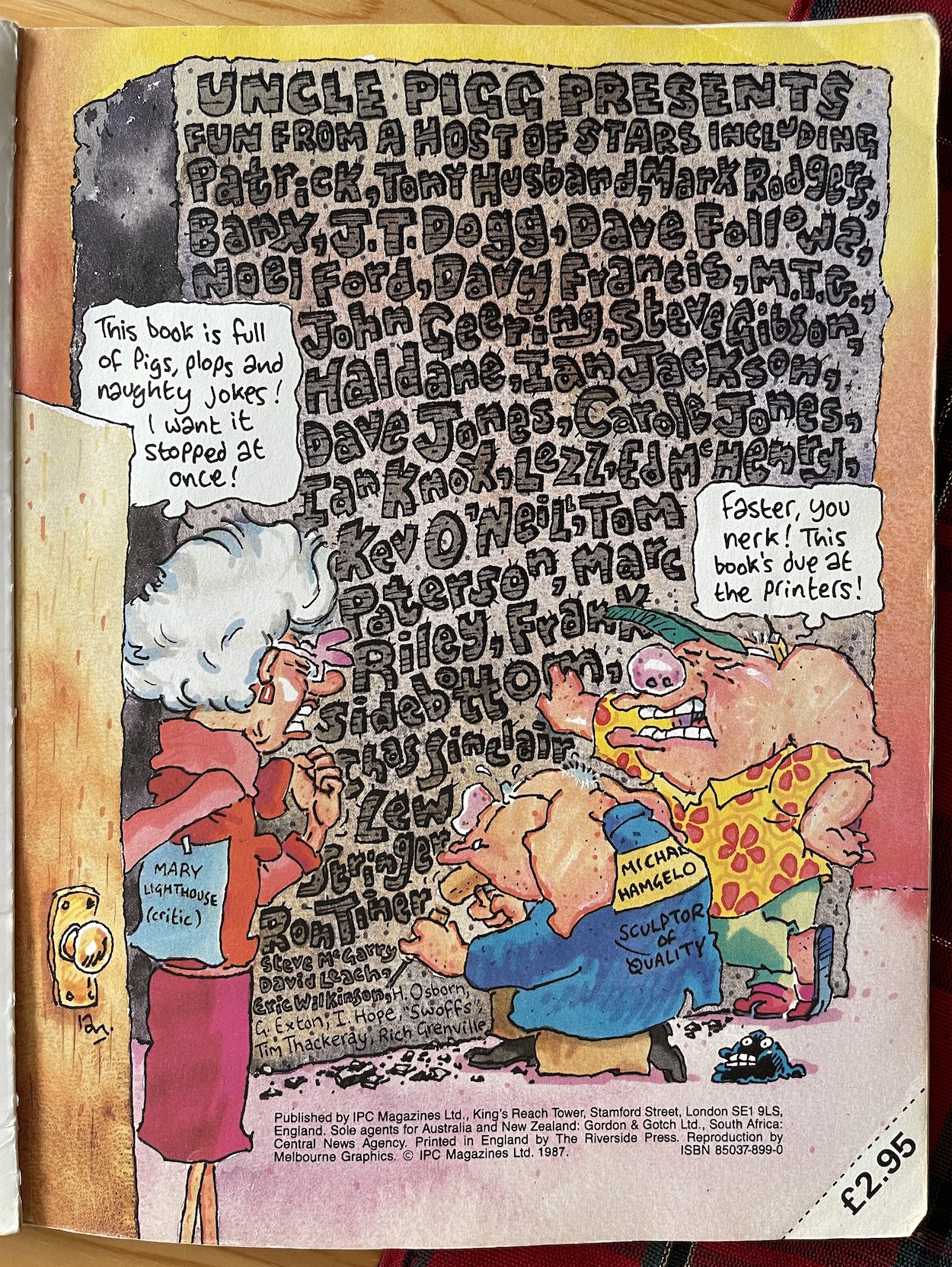
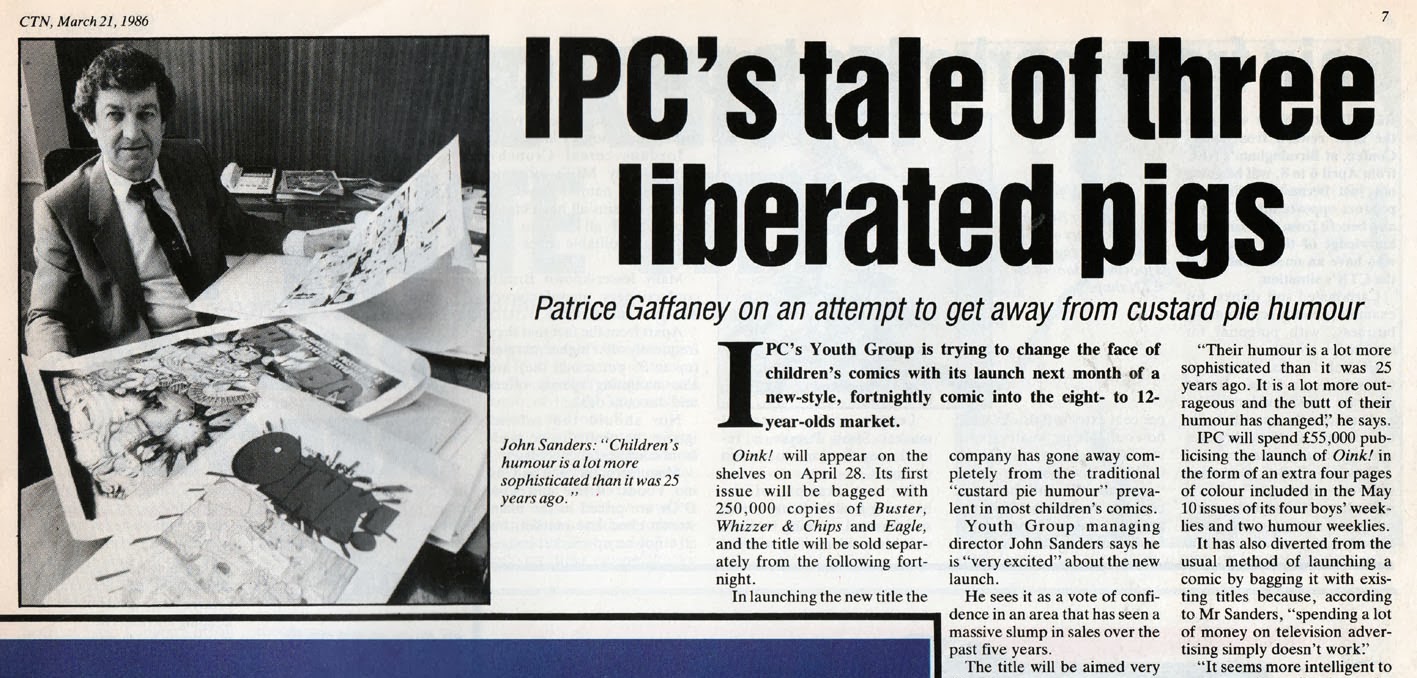
Back in the 80s the UK’s comics industry was slowly declining. In the days of fashion faux pas and sarcastic talking cars, television and computer games were suddenly direct competition for the attentions of the nation’s youth and OiNK was a bold move on the part of its creators and its publisher IPC Magazines to reverse that trend. OiNK would be a comic to deliberately break all the rules of traditional titles, with its three co-creators and editors (from left to right above) Mark Rodgers, Patrick Gallagher and Tony Husband bringing in an eclectic team to produce what they felt 80s kids would actually find funny.
Tony was working in a jeweller’s repair shop when Patrick met him, both of them cartooning part-time at that stage, and Tony introduced Patrick to the idea of working on children’s comics. About a year later in a Manchester library Mark saw Patrick writing comic scripts for the same titles he worked on (Buster, Whoopee etc.) and they went for a coffee and immediately hit it off. Patrick saw the potential in the three of them working together and it was in a railway pub in West Didsbury that they started to develop an idea for an alternative children’s comic. That idea would eventually become OiNK.
Its strips brought a fresh inventiveness to the comics scene, many of its cartoonists having never worked for the children’s market before. Jeremy Banx created Burp the Smelly Alien and Mr Big Nose, J.T. Dogg’s incredible artwork on Ham Dare and The Street-Hogs wowed readers, The Fall band member and future radio DJ Marc Riley dressed up as Snatcher Sam in photo stories and created his own strip characters, Lew Stringer got his big break with Tom Thug and Pete and his Pimple, the likes of David Leach and Kev F Sutherland were first published in the comic and a teenager by the name of Charlie Brooker landed his first paying job as a writer and cartoonist for OiNK. (Whatever happened to him?)
I’ve only mentioned a fraction of the talent involved, which also included the likes of Davy Francis, Simon Thorp, Davey Jones, David Haldane and so many more. Even veterans of the more traditional comics such as Tom Paterson and John Geering would pop up to spoof their own work and legends like Kevin O’Neill and Dave Gibbons would lend a hand (or a trotter) upon occasion! This was a children’s humour comic with a creative team and vision like no other and that’s a key reason why it hasn’t aged in the years since.
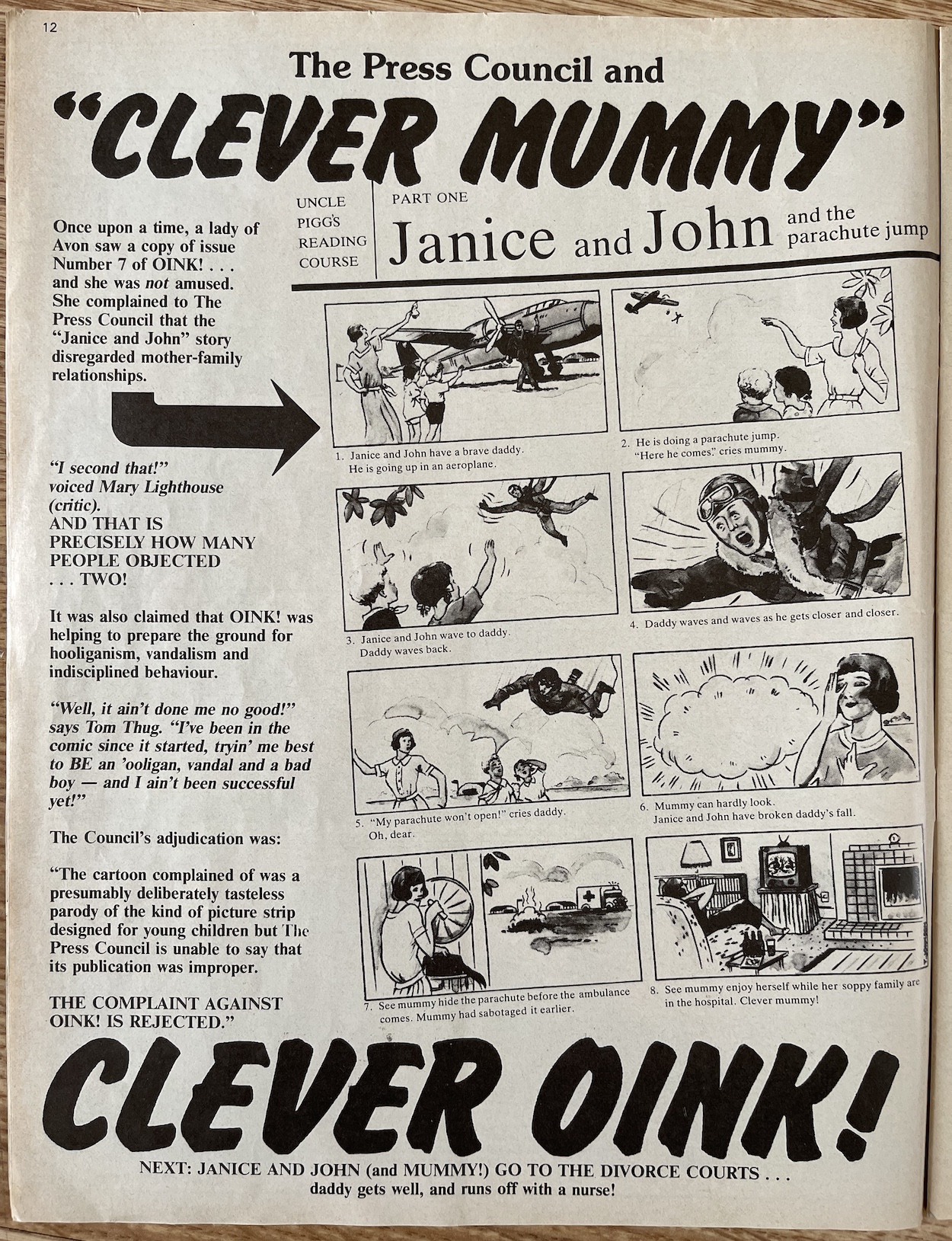
What always stood out for me were its parodies of those things we loved at that age, like the big toy and cartoon franchises of the day and even the other comics on the shelves. Famously a parody of classic children’s storybooks in a very early issue led to a couple of complaints to The Press Council. It was never upheld but it was enough for conservative retailers W.H. Smith to top-shelf OiNK away from the children. But the comic soldiered on and enjoyed a wonderful two-and-a-half-years in our little piggy hearts.
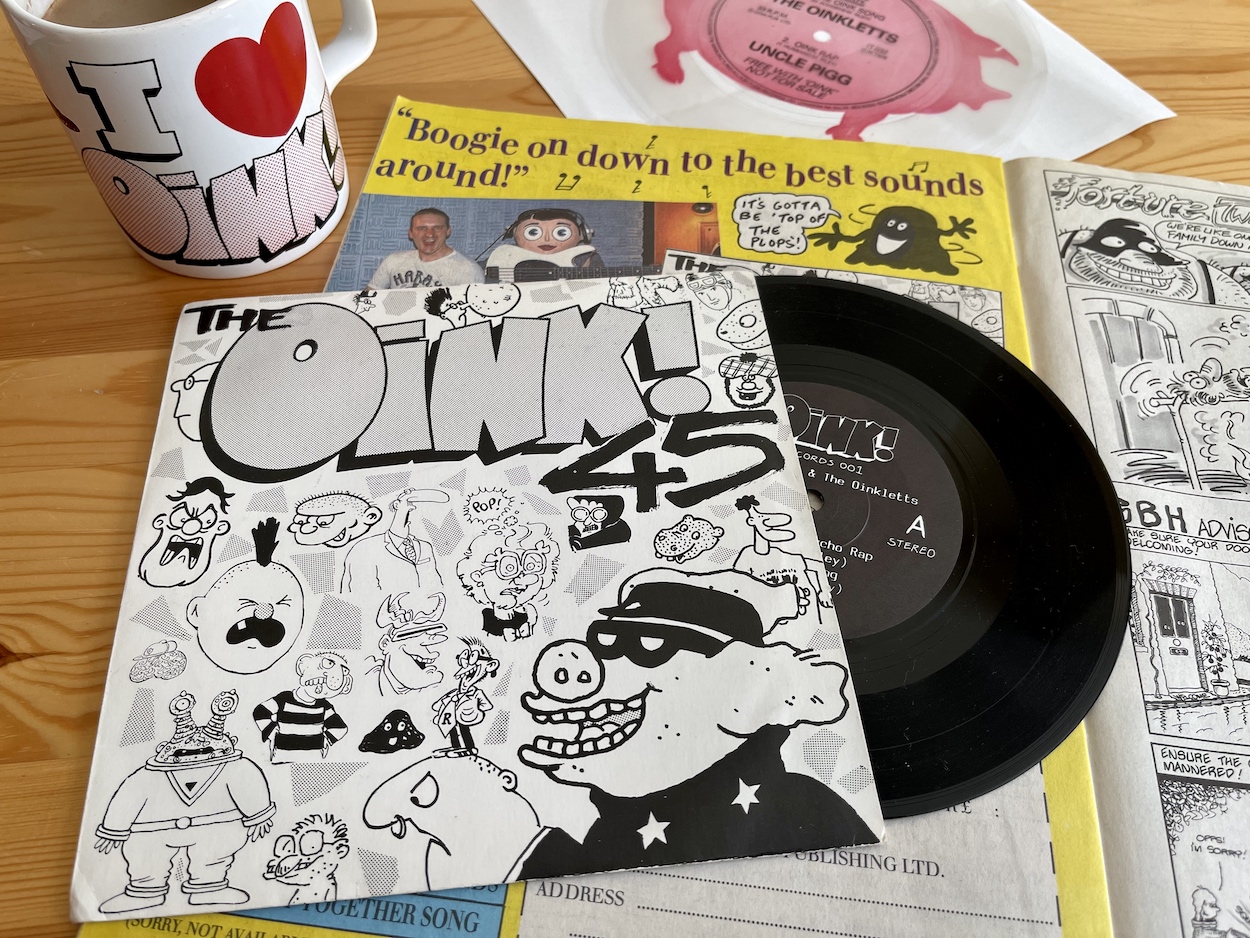
Very deliberately it was the punk rock of children’s humour comics and spawned a fan club, a vinyl record, clothing, a computer game and more. The story of OiNK is as fascinating as the comic was funny and this post is only the very tip of the plop, the tiniest little piglet of an introduction to what is still my very favourite, and as well as the funniest, comic of all time. The blog’s namesake rightly has the pig’s share of space on this site and you’ll find sections devoted to everything from its creation to its marketing, from its merchandise to its media coverage and everything in between.
So, 35 years after its original release I decided to read through the whole run all over again and rebooted the entire blog as a full website devoted to reading not only this comic in real time, but also the others I collected in the 80s and 90s after OiNK introduced me to the medium. I hope you’ll enjoy all of the OiNK content so far and what’s to come in the future, and that you’ll have as much fun reliving the antics of its characters (and its creators and cartoonists) as I’m having. OiNK’s important place in UK comics history deserves to be remembered. More than that, its comedy deserves to be enjoyed for decades to come.
Let’s have some fun pig pals, as we make our way through this complete collection of complete and utter joy!
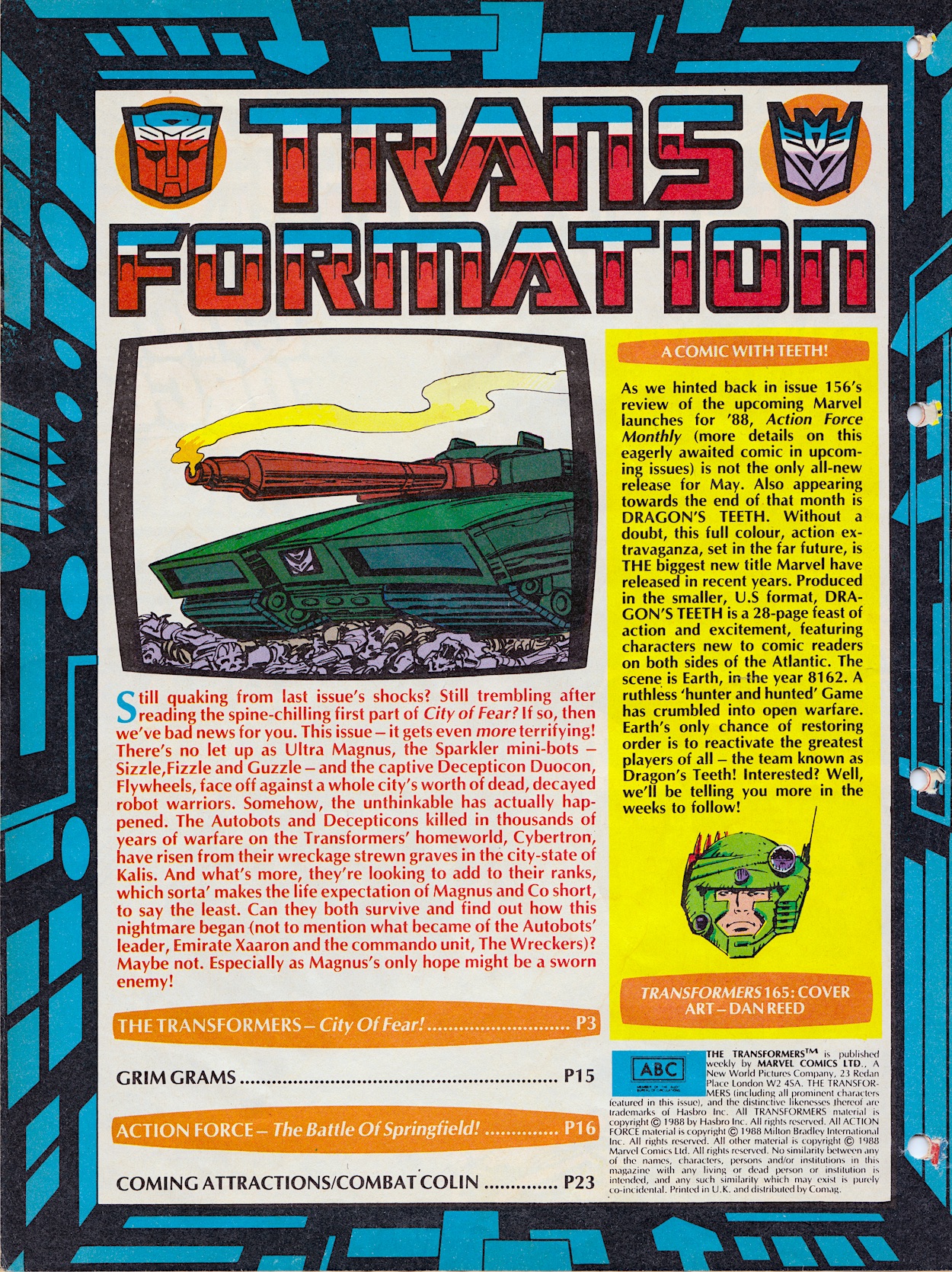
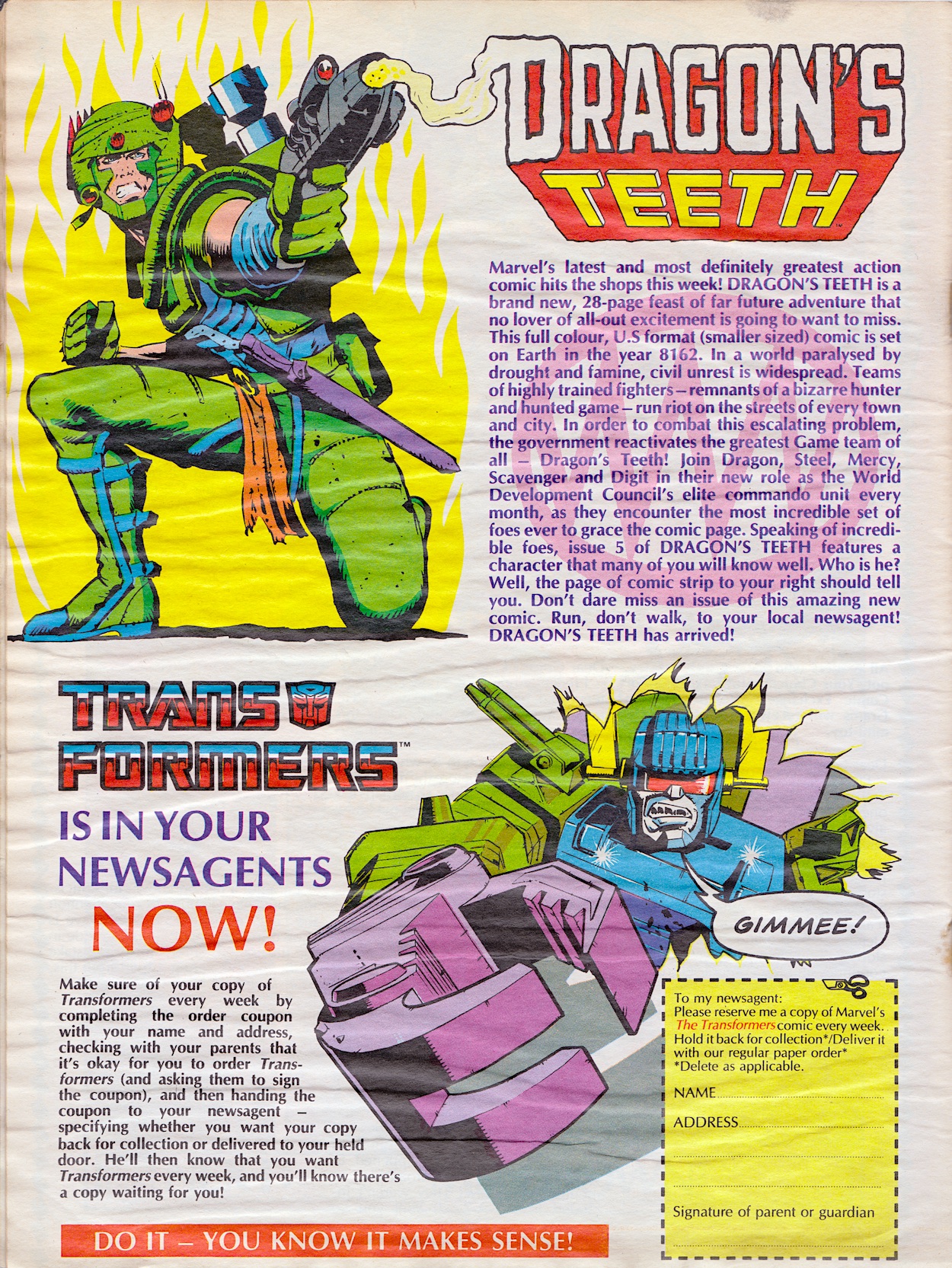
The year of 1988 was a big one for new releases from Marvel UK. One such comic was The Real Ghostbusters which I began collecting as soon as it launched that March, however most of its advertising space was taken up with the new franchise’s own merchandise. Marvel UK news and promotions were for the most part kept within the pages of their truly epic top-selling Transformers comic, which I only began collecting in November 1988, so I missed this little announcement on its 7th May editorial page.
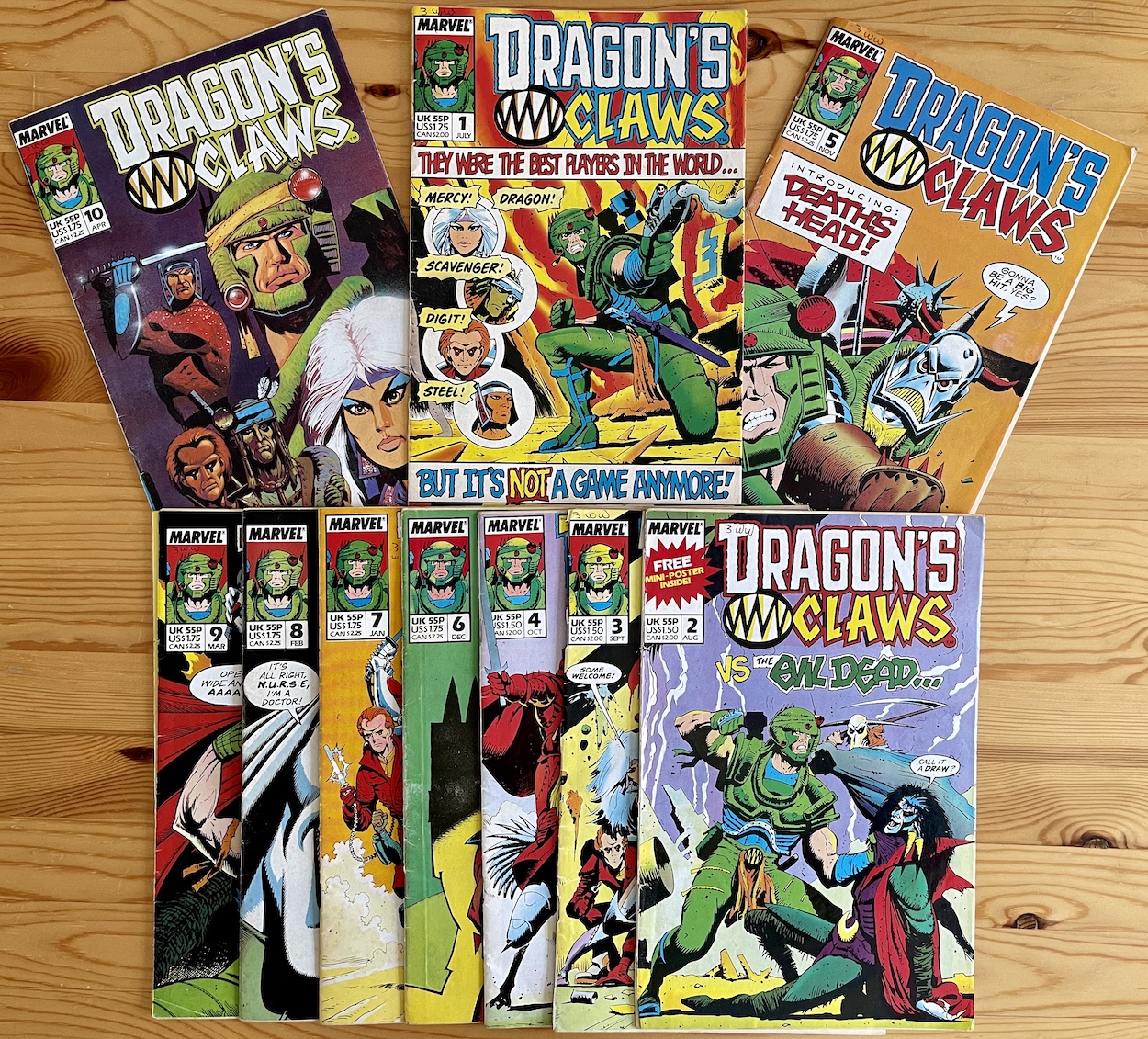
Dragon’s ‘Teeth’? We’ll get to that. So, all was set for the UK arm of Marvel to release its first original smaller format monthly. Regular readers of the blog will know I’ve already begun the Death’s Head read through with an introductory post and his guest appearance in Doctor Who Magazine. His own US-format comic would appear in November 1988, but up first came Simon Furman and Geoff Senior’s other original creation, although Transformers doesn’t mention they’re the pair behind it yet.
For it being set so far into the future Dragon’s Claws certainly has an air of familiarity about it
Marvel UK was having great success with licenced titles, in particular the likes of the two mentioned which mixed original strips with American reprints (the latter would come eventually in the case of The Real Ghostbusters). But the company wanted to expand. They’d had a success with Captain Britain and now the focus was on producing mature titles very much in the tradition of their parent company. Dragon’s Claws was to be the first of these, comics that Marvel UK could export back to the States. Even Action Force got a revamp the same month as a physically smaller monthly comic and was sold in the US as ‘G.I. Joe The European Missions’.
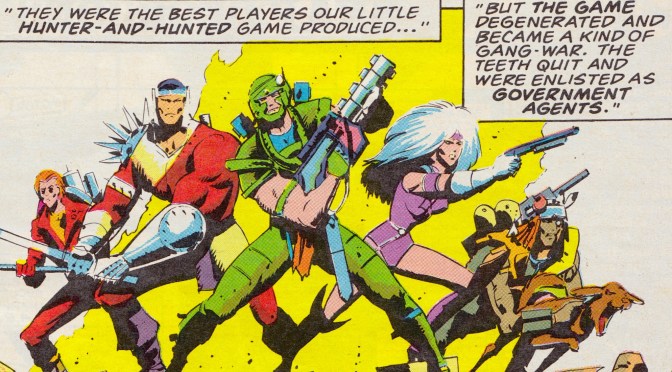
On 21st May there was an update in Transformers and a half-page ‘feature’ explaining the premise in more depth (in the same issue as Death’s Head’s High Noon Tex, I should mention). In a dystopian future 6000 years from now Earth is dying, the seas are drying up, animals are becoming extinct and civil unrest is widespread as poverty and starvation take hold. Instead of actually doing anything about it the world government instead distracts the populace to bring them in line. For it being set so far into the future it certainly has an air of familiarity about it.
A violent, deadly televised game (simply referred to as ‘The Game’) is created and for a moment unrest is calmed. But then the game itself descends into chaos. It becomes a free-for-all where teams begin playing outside the rules for their own dreams of power beyond the game. The Dragon’s Claws team drop out as a result. Now they’re being reassembled by the government to go out into the world and bring down those teams causing so much of the terror their game was meant to quell.
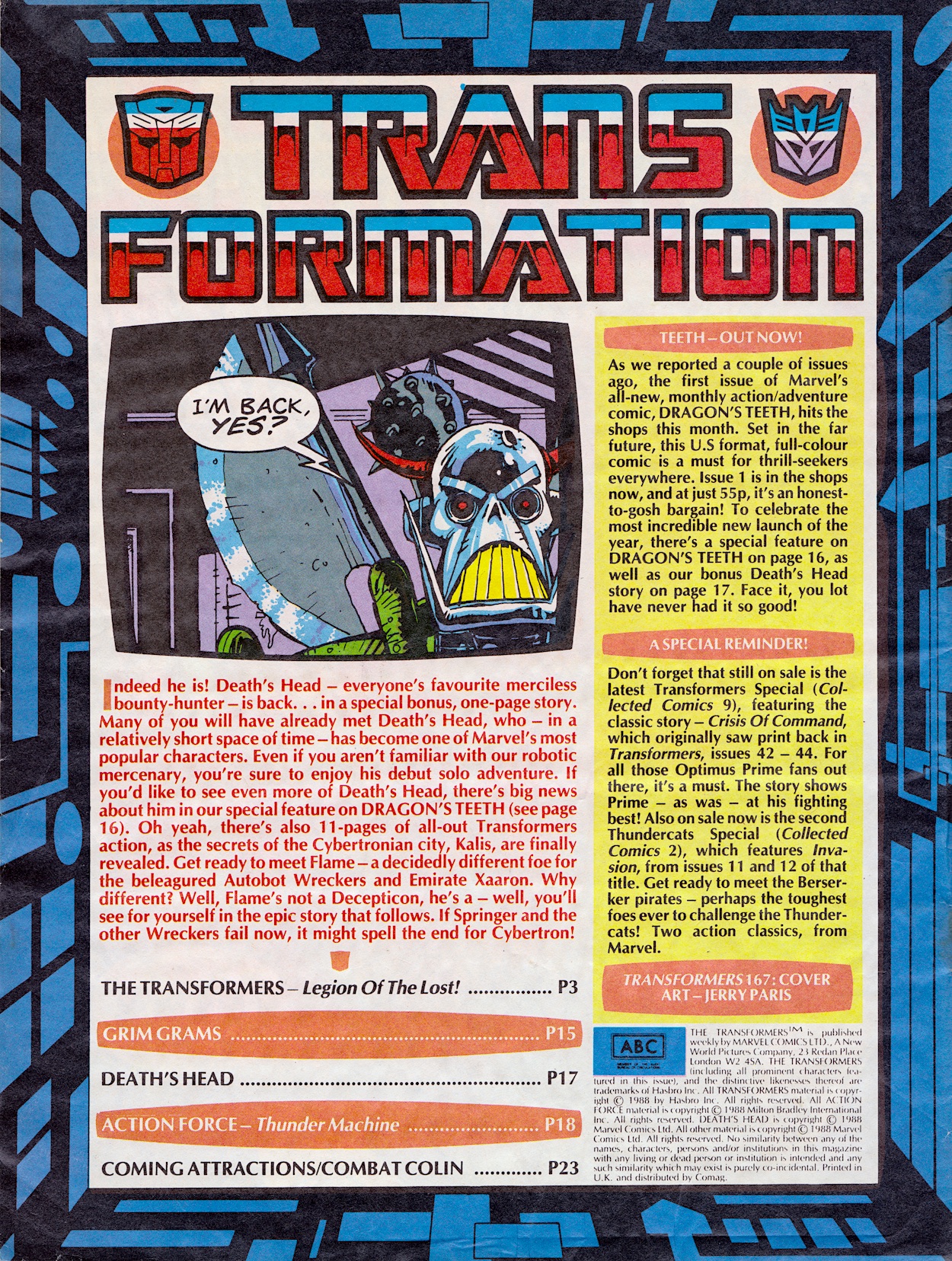
In Transformers #167 the announcement was made that the premiere issue of this bold new comic was to hit newsstands within the week, although it’s strange the creative team still isn’t mentioned, especially given how Simon and Geoff were such a huge part of Transformers’ success. (Fans would’ve recognised Geoff’s art, but still.) Thing is, the first issue wouldn’t appear for another few weeks and when it did it’d have a different name. Both of these factors can’t have helped sales of the first issue.
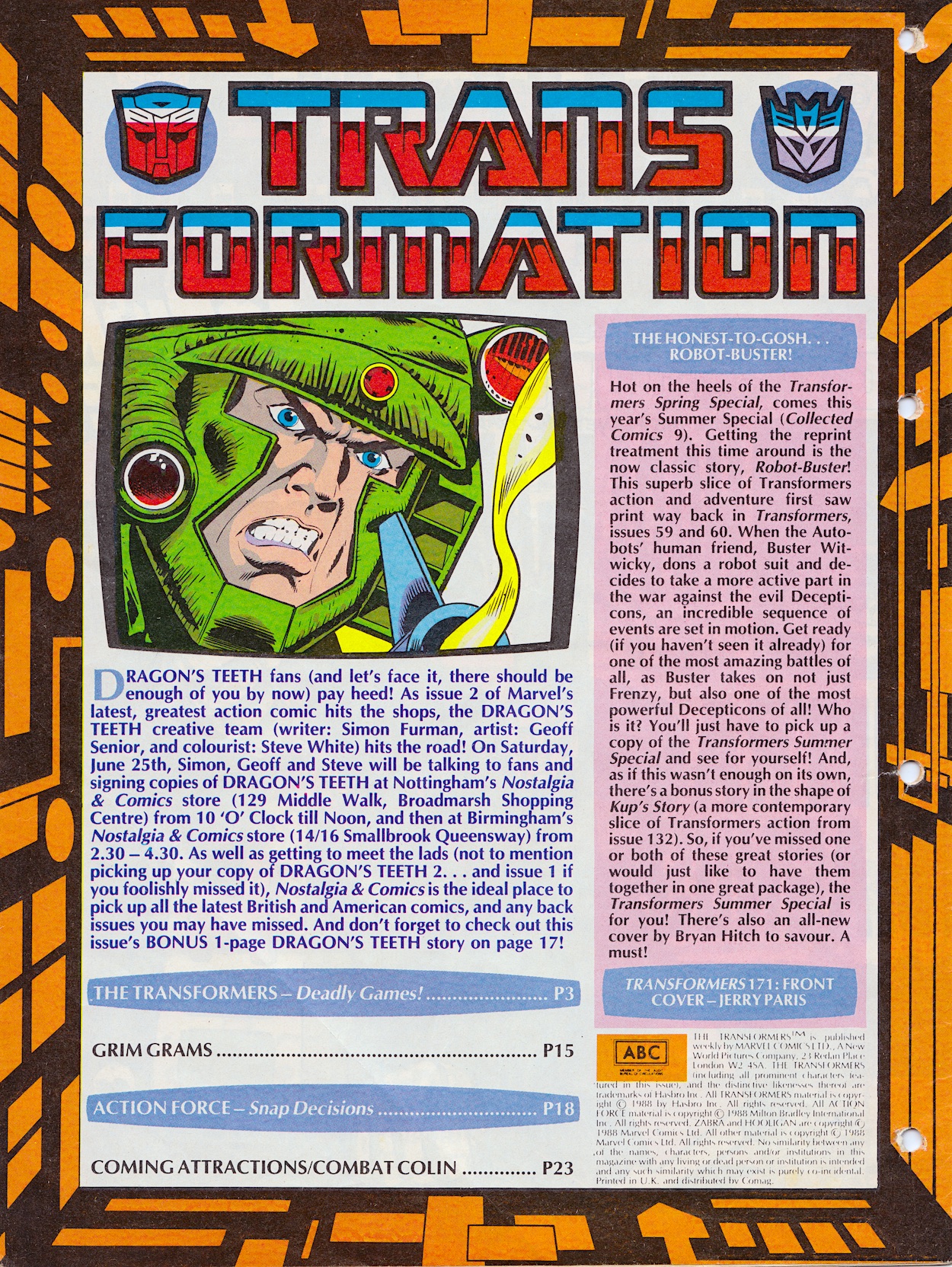
In fact, the first issue didn’t go on sale until 11th June (according to the Mighty Marvel Checklist in other Marvel UK comics of the time) and under the name Dragon’s Claws, yet a week later on 18th June Transformers #171 ran another editorial calling it by the original ‘Teeth’ and hyping #2. Of course, deadlines being what they are this would’ve been written before the name change and the subsequent delay. At least they were finally promoting who was behind it to Simon’s and Geoff’s fans.
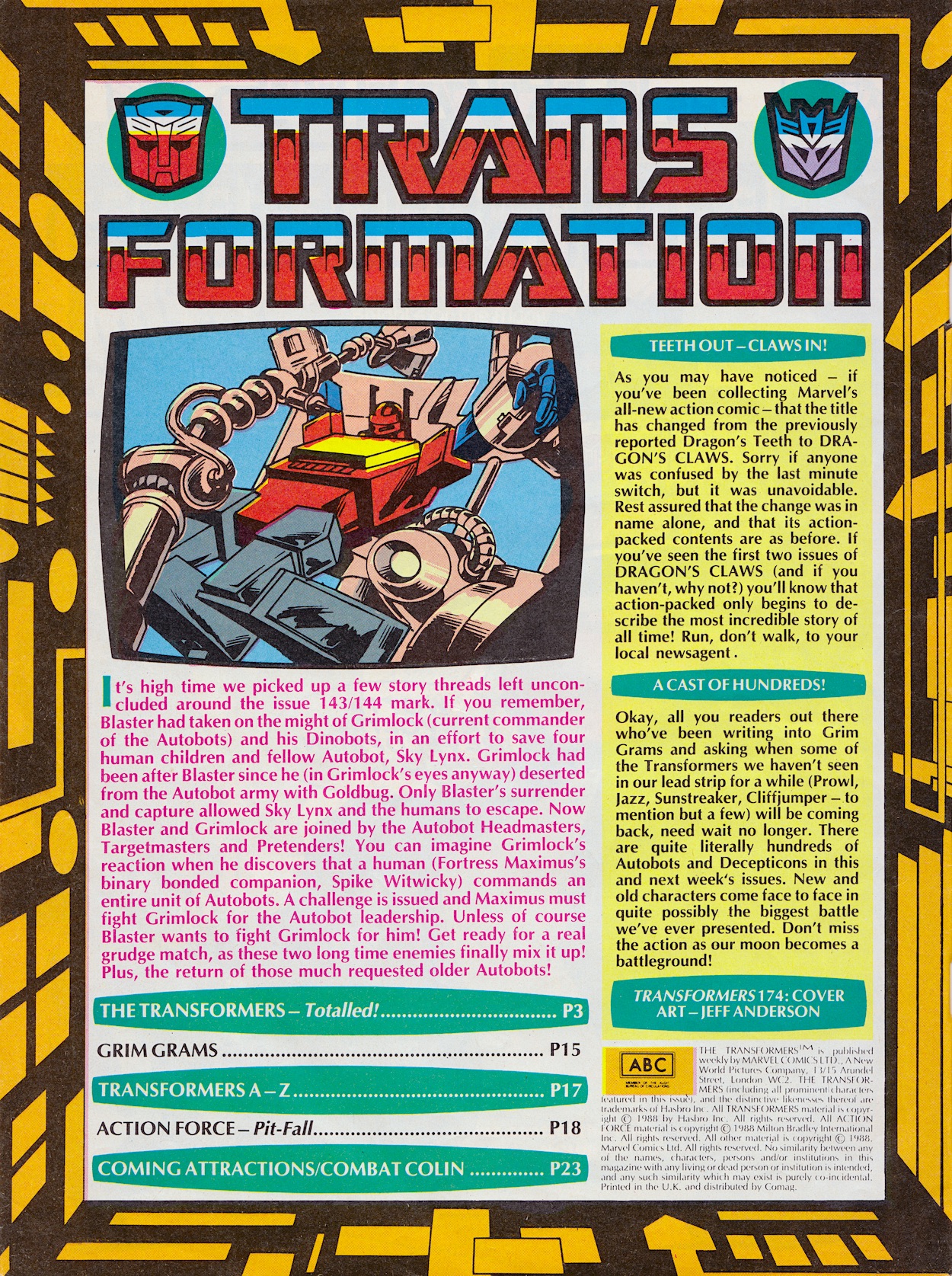
Eventually in #174 of Transformers, not on sale until 9th July(!), the date the second issue was actually released the name change was finally mentioned. That was a bit of a rocky launch, wasn’t it? So what happened? At the last moment it had come to Marvel UK’s attention a small press comics company had the same name and so ‘Teeth’ became ‘Claws’, although the logo (created by editor Richard Starkings) stayed the same. I’ll admit I never knew of the original name until decades later and yet the logo never seemed out of place. Now, it’s obvious why it’s a set of teeth, of course.
Knowing Simon’s Transformers writing I’m really looking forward to seeing how this one plays out
Simon Furman was inspired to create Dragon’s Claws after Live Aid which brought a higher awareness of global differences and injustices to the rest of the world. On the surface the reason behind The Game sounds quite similar to that in Walter Simonson’s Star Slammers which I’ve covered in the Havoc read through, although having not yet read Dragon’s Claws I’m only going by these initial press releases. I may not have been a huge fan of Slammers, but knowing Simon’s Transformers writing I’m sure there’s more to it, so I’m really looking forward to seeing how this one plays out.
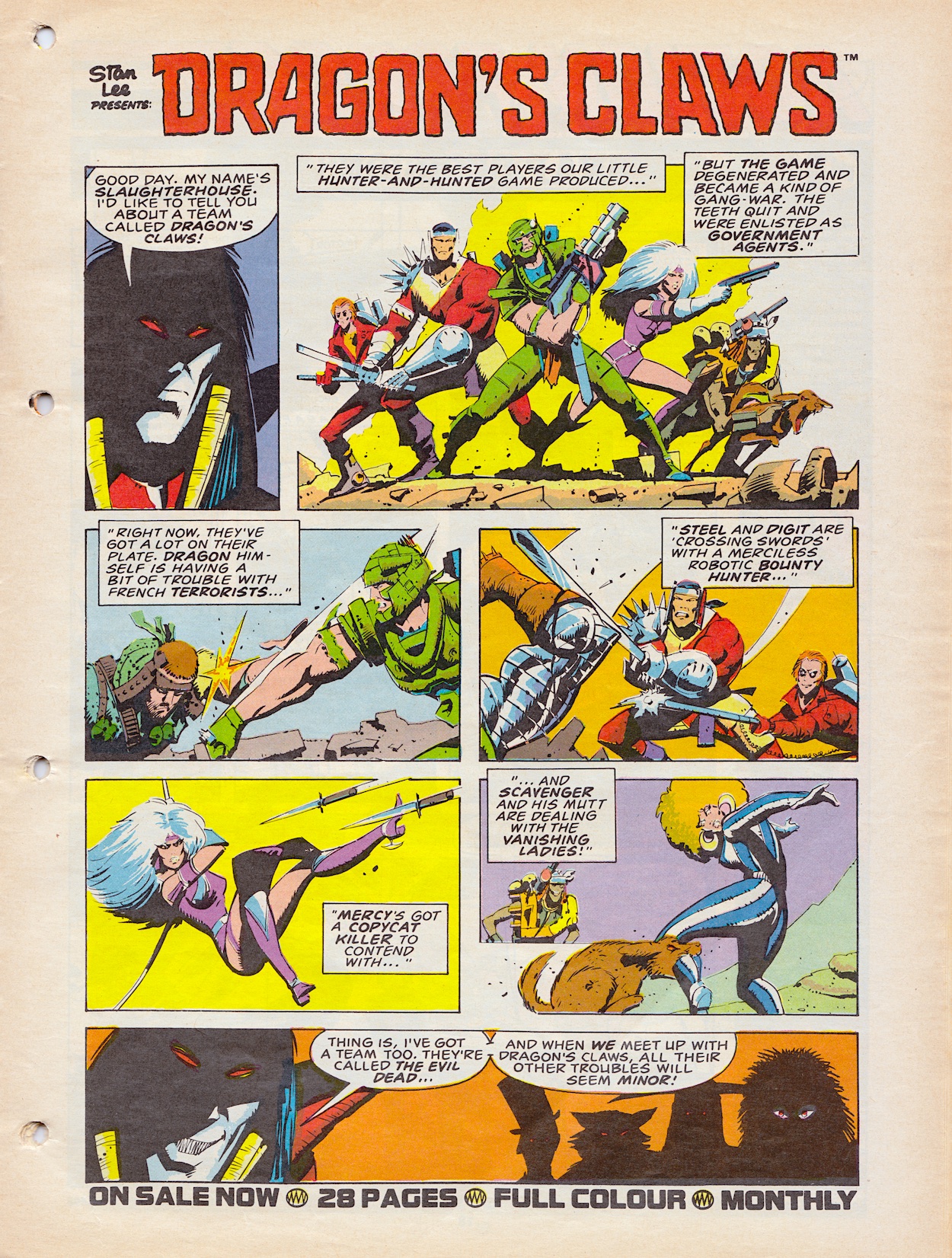
As a preview, an advertisement featuring a one-page comic strip was produced, running for the first time in Transformers #171.
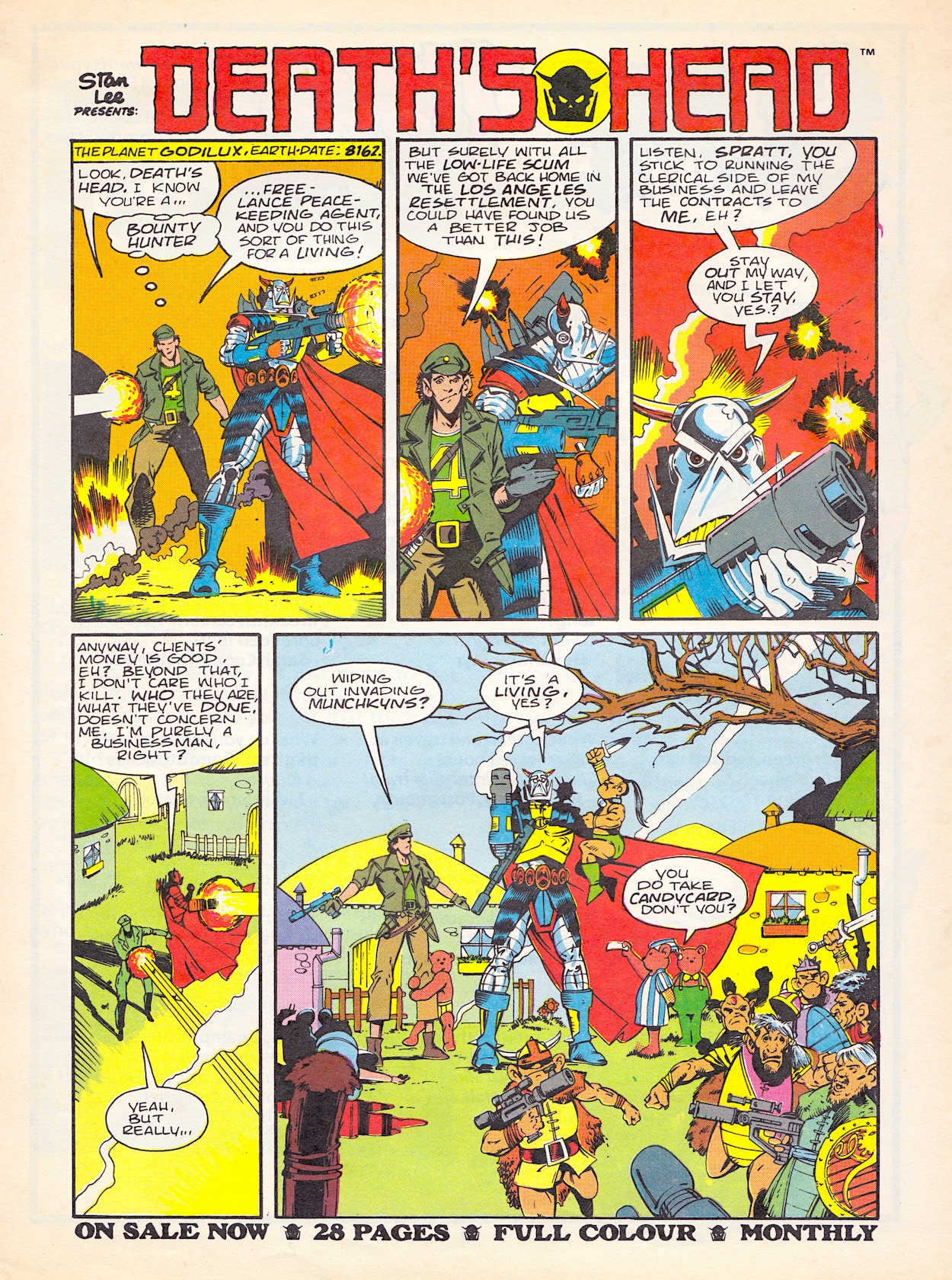
Whoops, a mention of the team’s original name slipped through in the second panel there, although it was picked up on by the time it was published in Visionaries. (I do like the not-so-subtle hint in panel four.) Adverts like these were Richard’s idea, who wanted individual comics to create a one-page strip very much in the style of the comic. This seemed like the perfect way to promote them and the likes of this, Death’s Head, Transformers and The Sleeze Brothers did just that. For some reason Doctor Who Magazine decided to do a humour strip instead (you can see in this Visionaries post). Each are highly memorable to this day so clearly did their job with this reader anyway.
Saying that, Dragon’s Claws only lasted for ten issues before it was cancelled. Around this time the UK comics market was becoming overly-saturated, a problem I’ve mentioned before in other read throughs. It was much like the videogames market before it collapsed a few years previous. Take Barrie Tomlinson’s Wildcat for example, a superb original title that deserved to thrive. If that can get lost on the shelves then these tinier monthlies were always going to struggle. Richard has previously told me the costs of originated material required higher than normal sales to succeed too.
Now at least three of these are going to get the OiNK Blog treatment, beginning with Dragon’s Claws, then Death’s Head and another I’ve already mentioned will join in due course.
I missed all the hype at the time or I’d have definitely tried this comic out in the 80s. It’s time to rectify that. I’ve had this collection sitting on my shelves since before I launched the blog in April 2021, so you can imagine how excited I am that the time has finally come when I can read them! (The blog has rules to follow, will power is needed to run this site, you know.) There was also a one-page epilogue produced in 2004 by Simon and Geoff but for now let’s concentrate on the original run. The Dragon’s Claws real time read through begins in just one week on Sunday 7th June 2023. I can’t wait!
Death’s Head’s first ever appearance, drawn by Geoff Senior and colour by Steve White
In the latter months of 1988 I began reading Marvel UK’s Transformers weekly and my second issue contained a very funny comic strip advert for a new monthly about a certain Freelance Peace-Keeping Agent (not a bounty hunter, never a bounty hunter). It also popped up in The Real Ghostbusters and so I found myself dipping my toes into the first issue of Death’s Head, not fully knowing what to expect and with no knowledge of his already extensive adventures with the Transformers (and even Doctor Who, which I’d just started watching that year too).
Over the next couple of years reprints in Transformers and my friend giving me his back issues meant I was able to read those stories. But I never did buy more than Death’s Head first issue, despite having very fond memories of reading it wrapped up in bed while ill one day and really enjoying the action and comedy. But I was only allowed a certain amount of comics on order at any one time and, while I did buy more with pocket money most weeks, a month was a long time for my attention span back then. Now I can finally make up for this, so let’s take a look at how this very famous Marvel UK character was introduced to the public.
Cover by Geoff Senior
Writer Simon Furman originally created Death’s Head as a one-off character for a Transformers story (not knowing the name had also been that of a Nazi tank division). However, upon seeing legendary artist Geoff Senior’s interpretation Simon knew they had a recurring character on their hands, even rewriting his lines to better suit the image Geoff had created, inspiring the hilarious speech patterns and quirks we came to love, yes? He proved very popular with the readers and altogether appeared in 17 issues and three serials, including two highly regarded epics.
“I loved messing with legal”
Richard Starkings, Death’s Head editor
Despite online information to the contrary, Death’s Head did indeed first appear in Transformers #113 on 9th May 1987. There’s a one-page strip called High Noon Tex (further below) which Former Marvel UK editor Richard Starkings (The Real Ghostbusters, Doctor Who Magazine, Elephantmen) tells me was created to run in other titles first so the company could retain ownership of the character, otherwise Hasbro (owners of The Transformers) could claim the copyright. However it didn’t appear until a year after his first Transformers appearance.
“I dare say,” Richard told me, “that between commissioning the strip (it’s one page, so you know it was my idea) and legal establishing the trademark … his appearance in Transformers notwithstanding, we weren’t able to run High Noon Tex beforehand. There was also a Doctor Who crossover (I loved messing with legal) so the BBC couldn’t own him either!”
Drawn by Geoff Senior, colour by Steve White
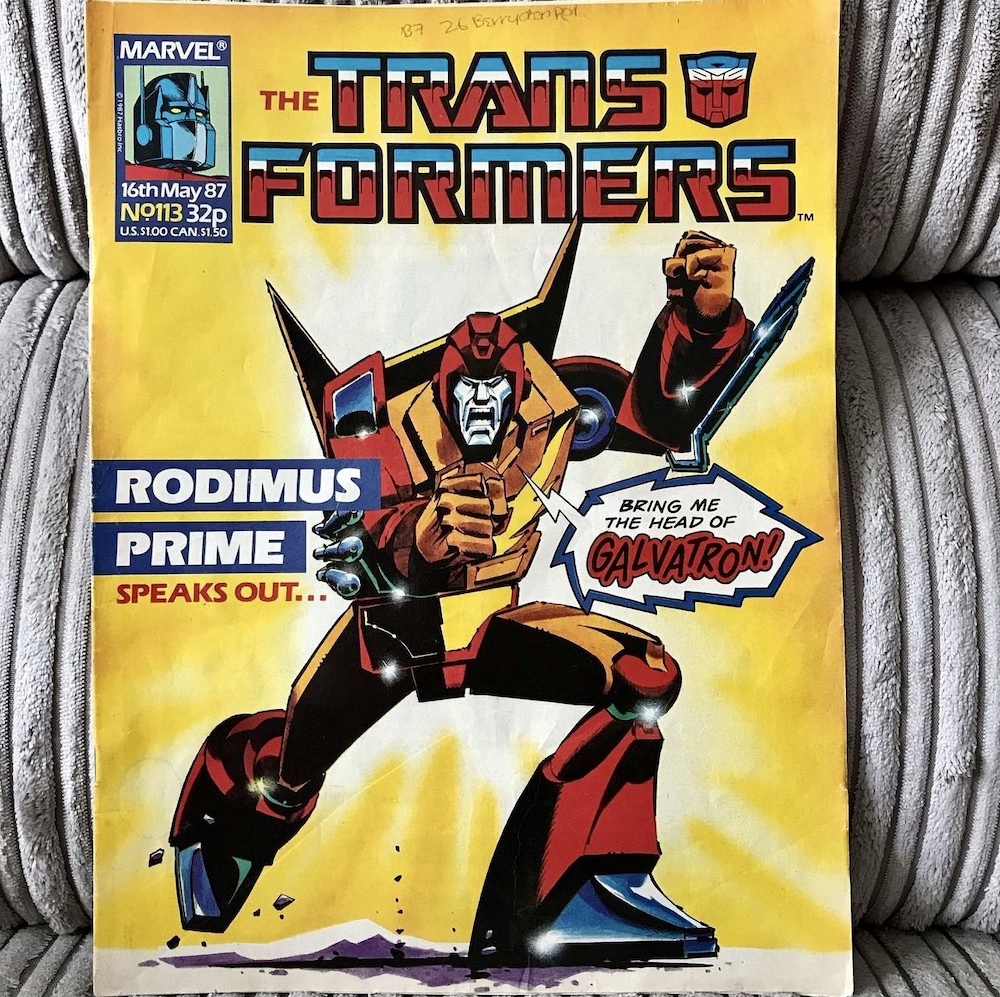
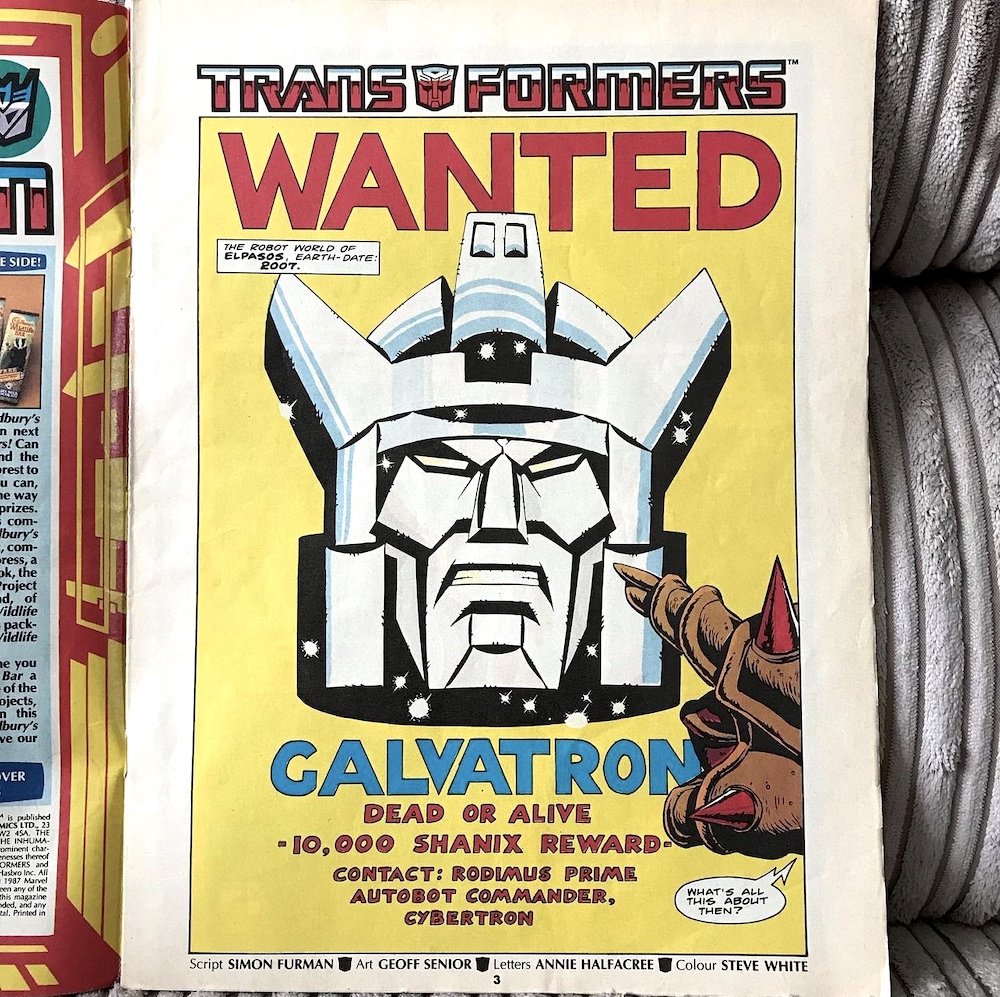
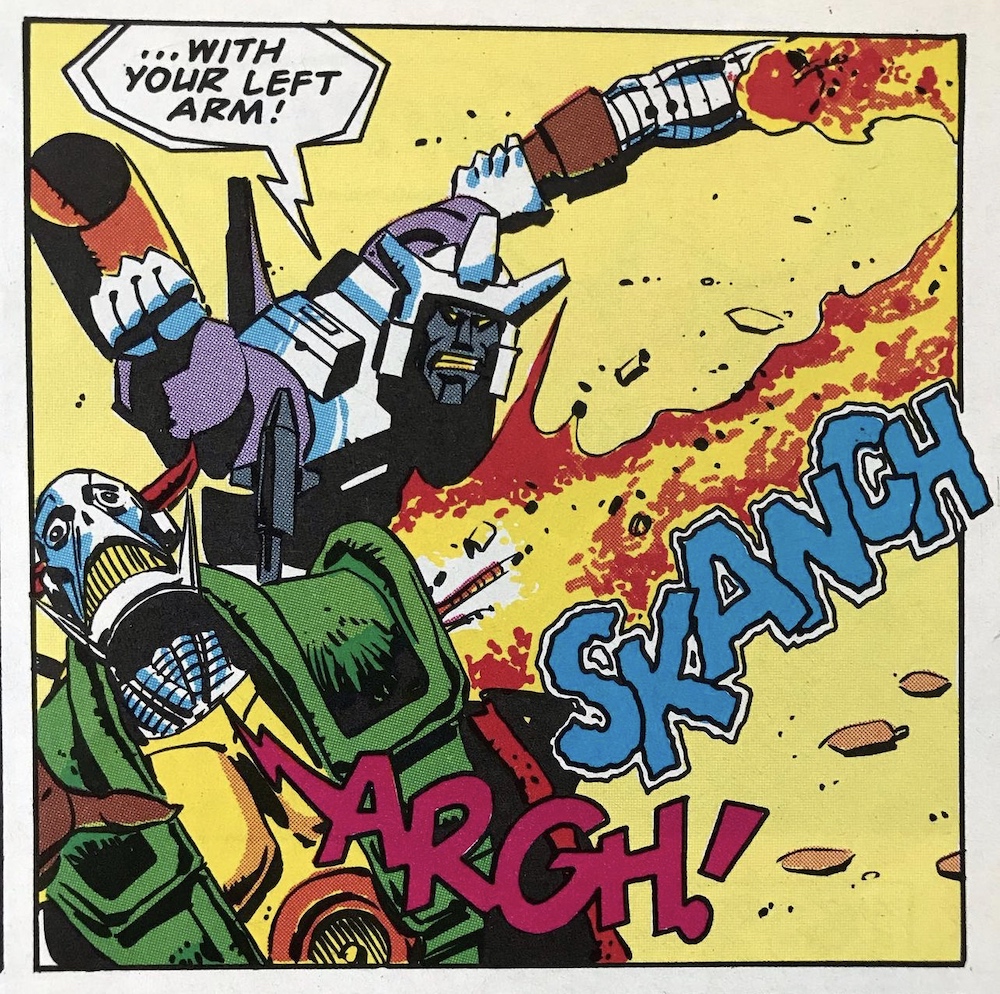
Wanted: Galvatron Dead or Alive was one of the early future-set (the then future of 2006) stories Marvel UK produced. With the release of Transformers: The Movie the UK team could focus on stories set after it, creating a new timeline of events and making it easier to write original stories not linked to the US strips. On the first page we see what would become a familiar detachable hand pointing at the wanted poster of the title. A bounty set by Autobot leader Rodimus Prime for Galvatron (the immensely powerful resurrected form of Megatron) after he disappeared at the end of the movie is too good for Death’s Head to pass up.
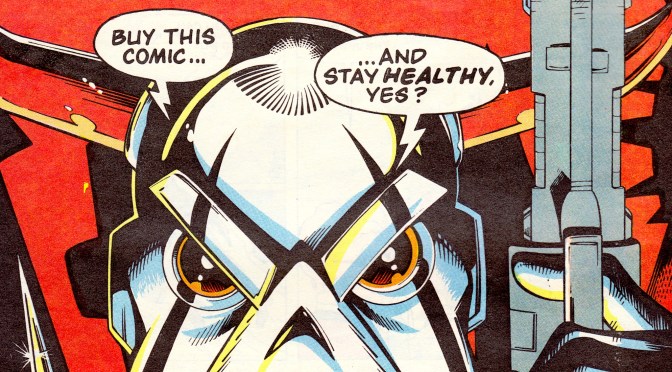
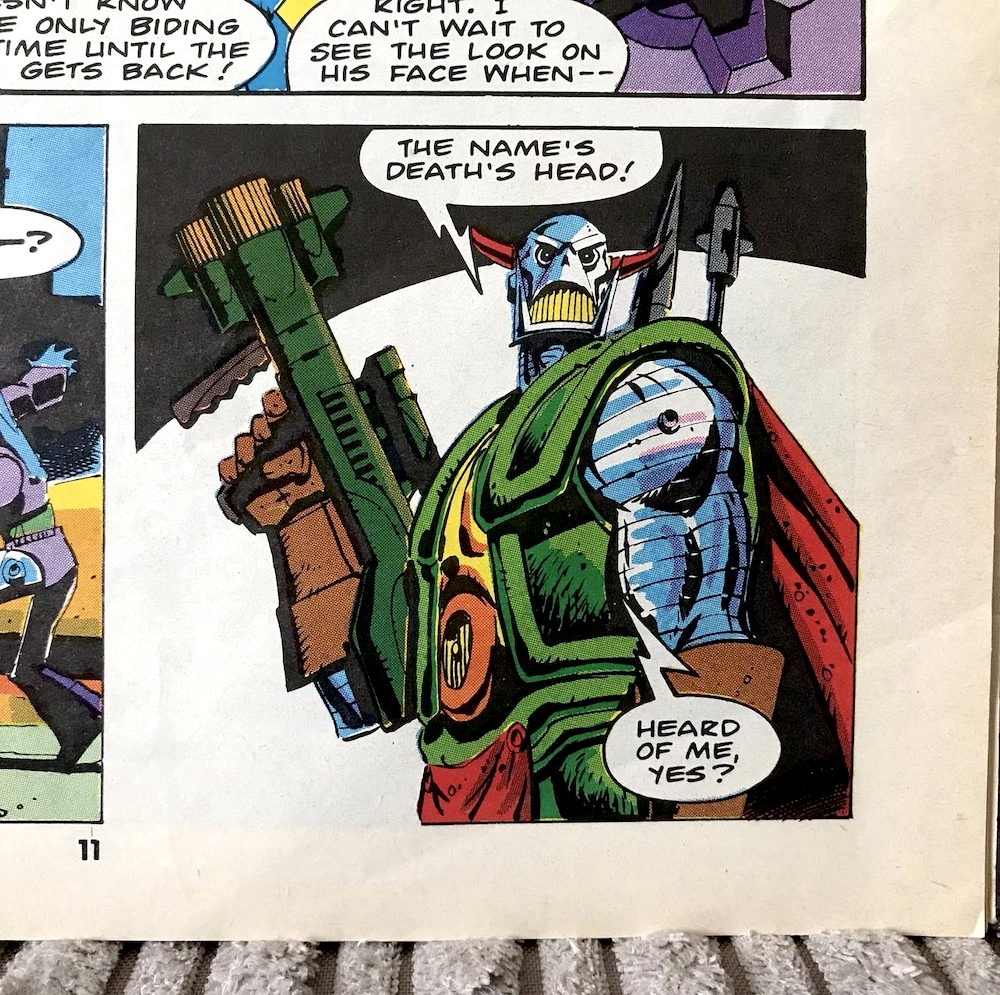
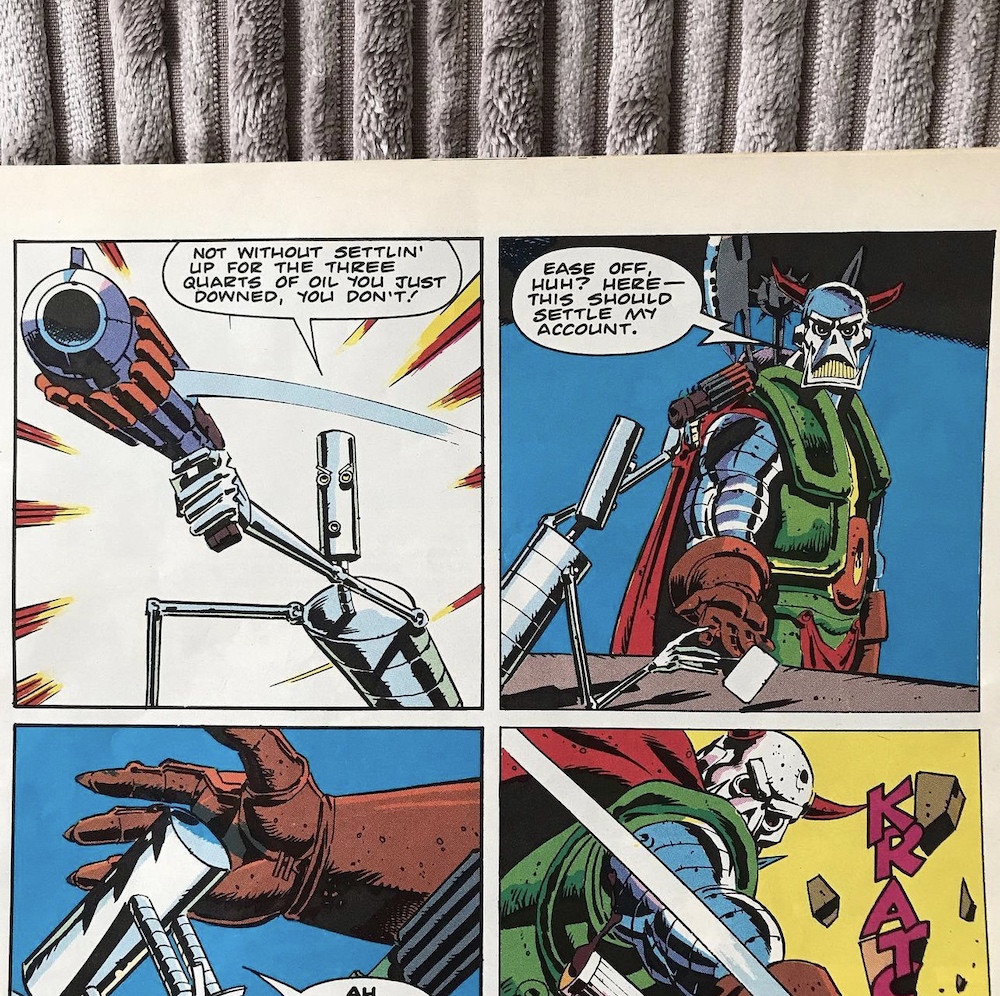
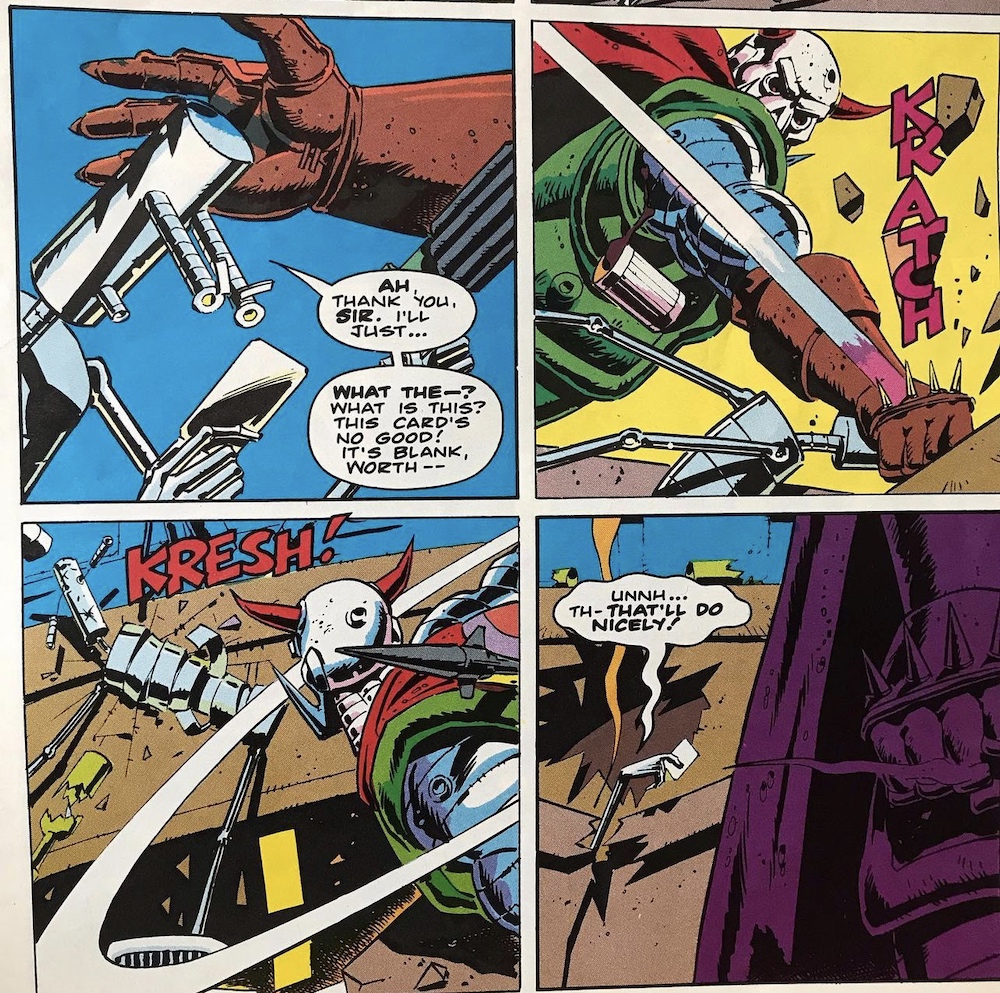
The story saw the beginning of the comic’s use of time travel and the building of a huge universe populated with both organic and mechanical races, for example the slight-looking barkeep in the tavern where our anti-hero finds himself between contracts. Intending to pay, Death’s Head soon changes his mind when the owner pulls a gun on him, wrongly suspecting his customer of leaving without clearing his tab. What happens next is the perfect introduction for this character.
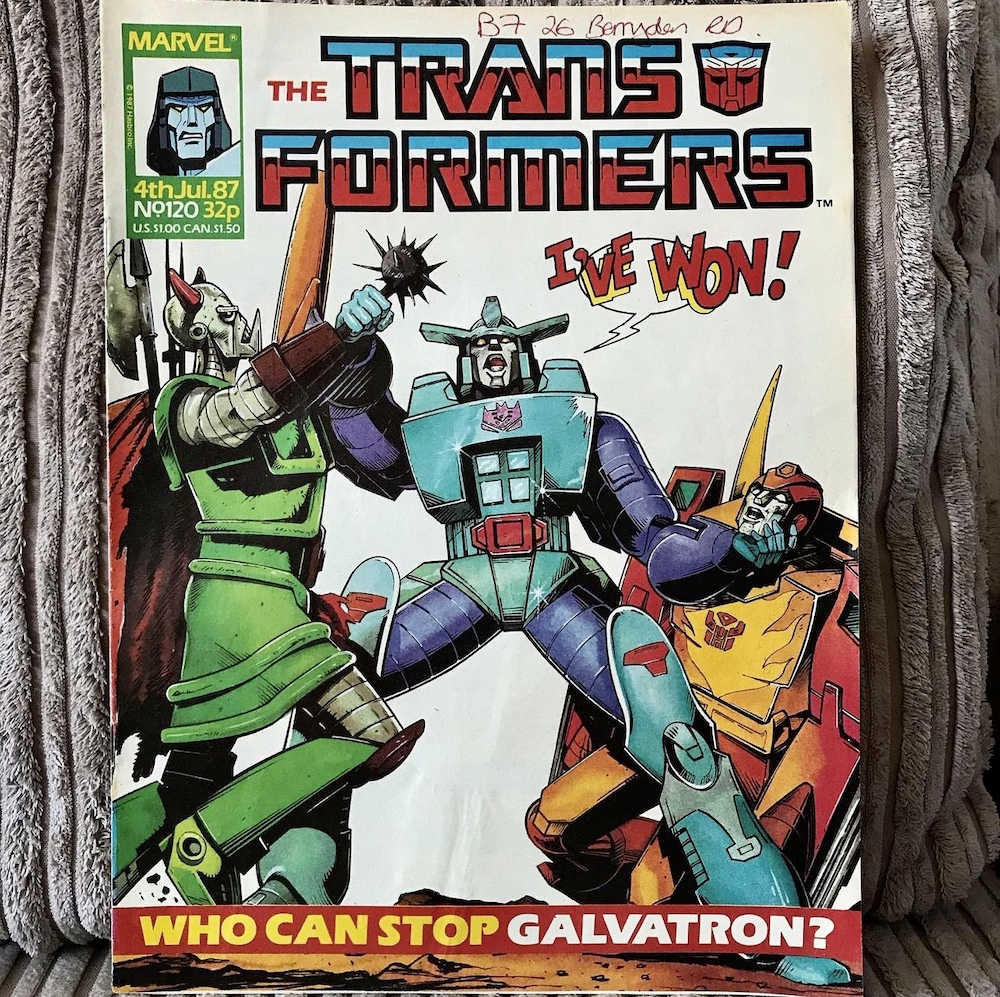
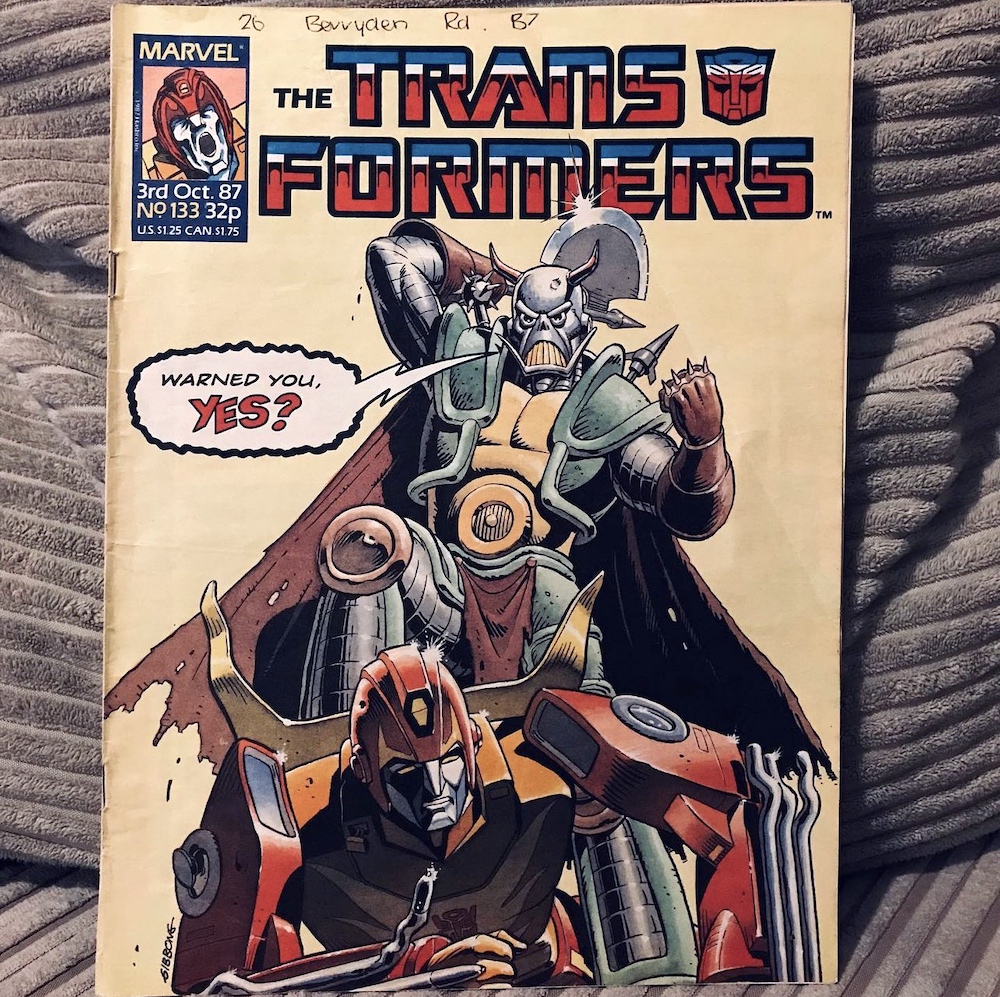
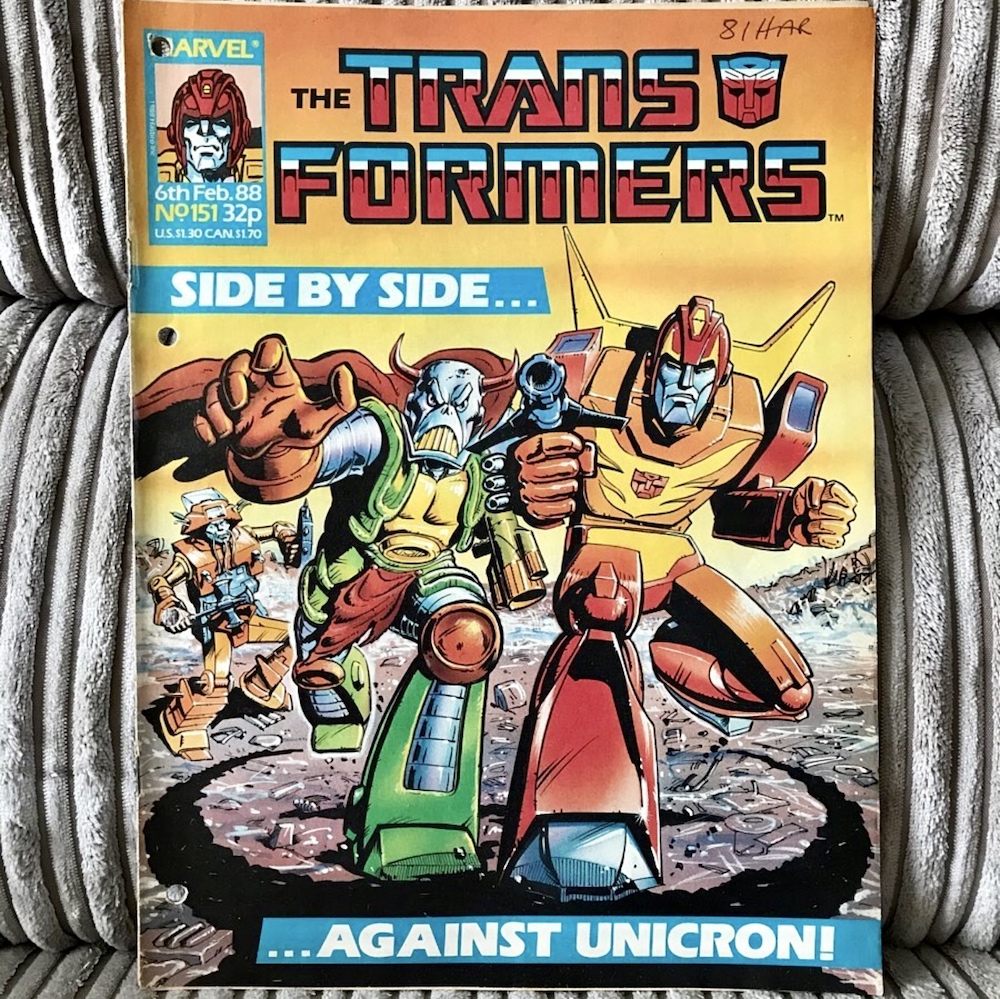
Over the course of a year Death’s Head even made the cover of Transformers no less than six times. He’d become a big selling point for the comic, such was his popularity with the young readers and the fun Furman had in writing him. My favourite of these is the classic ‘The Good… the Mad… and the Ugly!’ cover by Geoff for #117. His return was always hyped in advance in Next Issue panels and editorial promotions. Really, it was inevitable he’d get his own comic eventually.
#117 cover by Geoff Senior and John Burns #120 cover by Jeff Anderson #133 cover by Dave Gibbons #146 & #151 covers by Lee Sullivan #147 cover by Jeff Anderson, Stephen Baskerville and John Burns
One of my favourite aspects of the character was his loyalty to the contract. Once he’d taken on a job he’d see it through to a successful conclusion no matter what he’d have to put himself through in the process. Yes it was all for money but it was clear he enjoyed what he did and he had a brilliantly dark sense of humour as a result. But even if someone else (usually his bounty) offered him twice the amount he was being paid he’d turn it down, his reputation was more important.
This was a compelling chapter in the character’s life, as he found himself going above and beyond to do the right thing as well as complete his contract
Death’s Head certainly left an impression, not only on the young readers but on the Transformers’ universe as a whole. Travelling back to 80s Earth he went head-to-head against Galvatron, aiding the Autobots and Decepticons in their battle to stop him from becoming an all-conquering god. In this story he also ends up killing beloved Autobot Bumblebee (in the US comic G.I.Joe mistakenly did this) who Hasbro was relaunching as Goldbug (thus this led to his resurrection).
When Death’s Head returned next time he took a contract from Decepticon leader Shockwave to track down and capture or kill Cyclonus and Scourge who had travelled back in time too, and who Shockwave had discovered would kill him in the year 2006. It was great stuff! This made what Death’s Head did in The Legacy of Unicron all the more interesting and dramatic for me. He was actually instrumental in stopping Unicron’s return, aiding Rodimus Prime by linking with the giant god’s mind on the psychic plane, distracting him so that the Autobots and Junkions could get on with their plan free of being psychically tracked.
Top-left to bottom-right: Geoff Senior/Steve White Will Simpson/Tim Perkins/Steve White Dan Reed/Steve White Jeff Anderson/Stephen Baskerville/Steve White
This was a compelling chapter in the characters’ life, as he found himself going above and beyond to do the right thing as well as complete his contract with Shockwave. The Legacy of Unicron was an important story in the history of Transformers, spread over several issues including the landmark 150th in which the origins of their race was told for the first time ever. This was created by Furman for the UK comic, the cartoon series would go on to create its own far less interesting version.
The tale, one as old as time itself, of myths and gods, of the birth of the universe and the eternal fight battle light and dark, was told by Unicron, the transforming planet eater from the movie reinterpreted by Furman as an all-conquering god of chaos. It’s still incredible to read today, especially when you remember this was a toy licence comic! Transformers really did break the mould. Even better, we the readers found all of this out as Unicron relayed his tale to none other than Death’s Head while the two were locked in their mental battle.
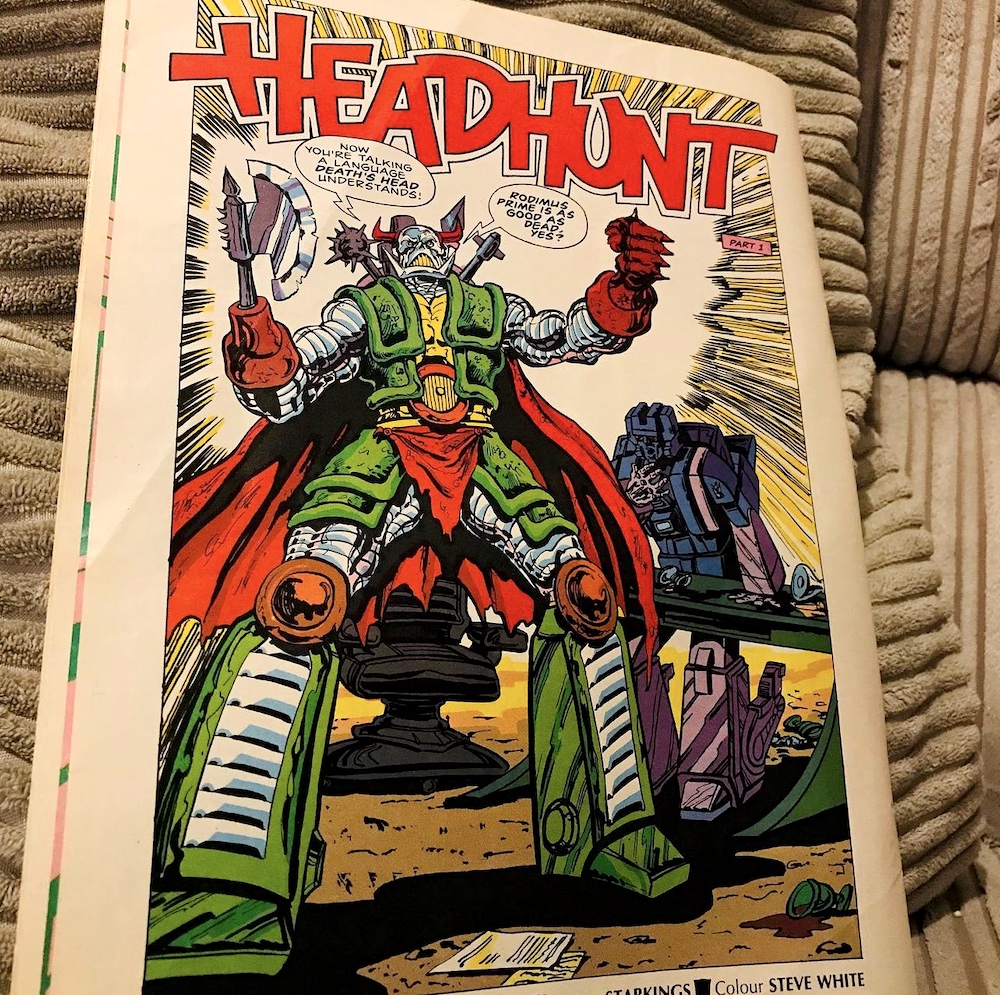
Drawn by Bryan Hitch, inking assistance by Geoff Senior, colour by Steve White
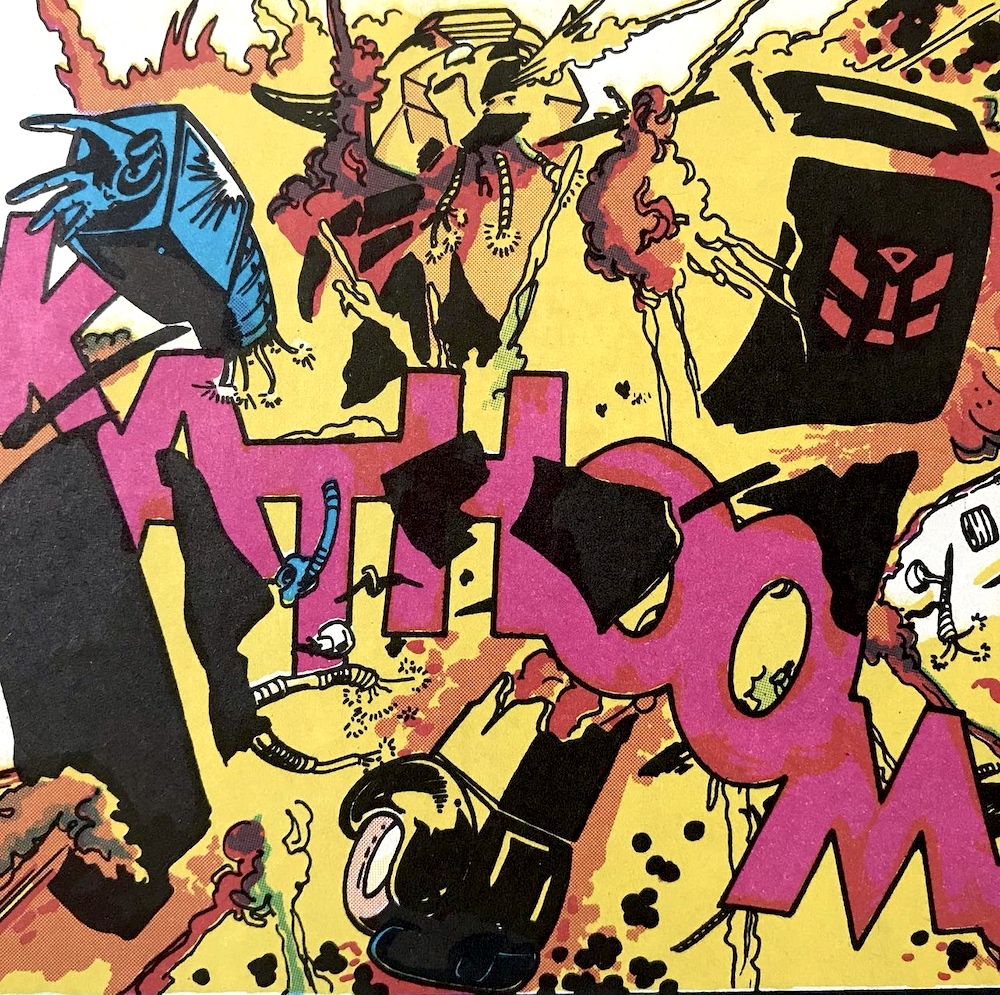
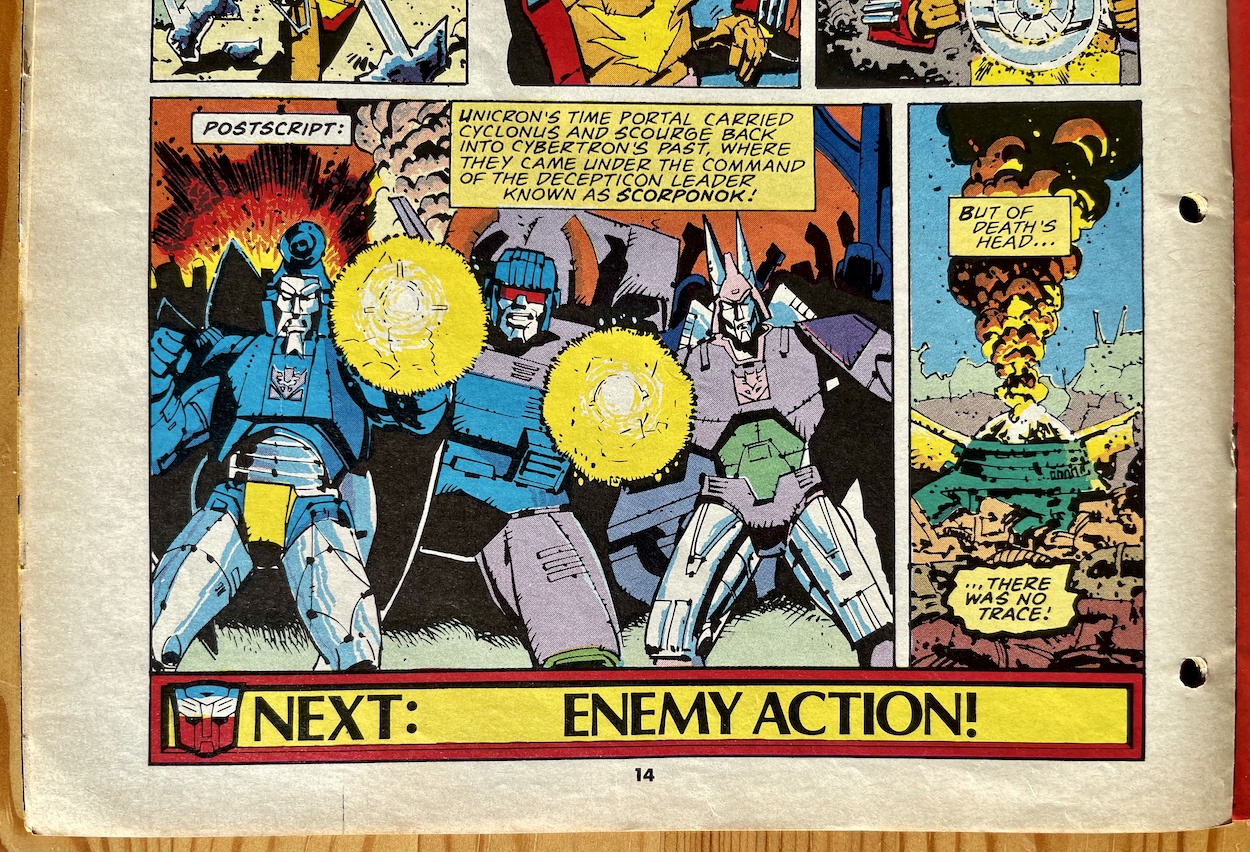
The Legacy of Unicron ends with Death’s Head shoving Cyclonus and Scourge through a time portal as the Junkion planet explodes beneath them. The Decepticons reappear on Earth in the present day but of him there was no trace. He wasn’t to be seen in the world of the Transformers again. Instead, as he flew through the corridors of time and space he bumped into a familiar blue police telephone box in another of Marvel UK’s titles. That’ll be the first chapter in Death’s Head’s real time read through in just a few days.
Apart from the last photo above, all of the preceding images were taken from the OiNK Blog’s Instagram feed from the last few years. Over there I’ve been reading Transformers in real time, week-in, week-out for about six years now, taking up to ten photographs of each issue and summing them up in mini reviews of sorts. You can check out all of the issues featuring Death’s Head via these links below.
By 1988 plans were afoot. Commissioned by Richard (who also commissioned the one-page strips below, as well as Dragon’s Claws and The Sleeze Brothers comics) at last Death’s Head was going to get his own ongoing comic, but first of all a change had to happen to the character himself. As you’ll know from reading the comics or watching the movies, the Transformers are somewhat larger than us humans. Seeing as how Death’s Head would now be interacting with plenty of humans he had to be taken down a peg or two first.
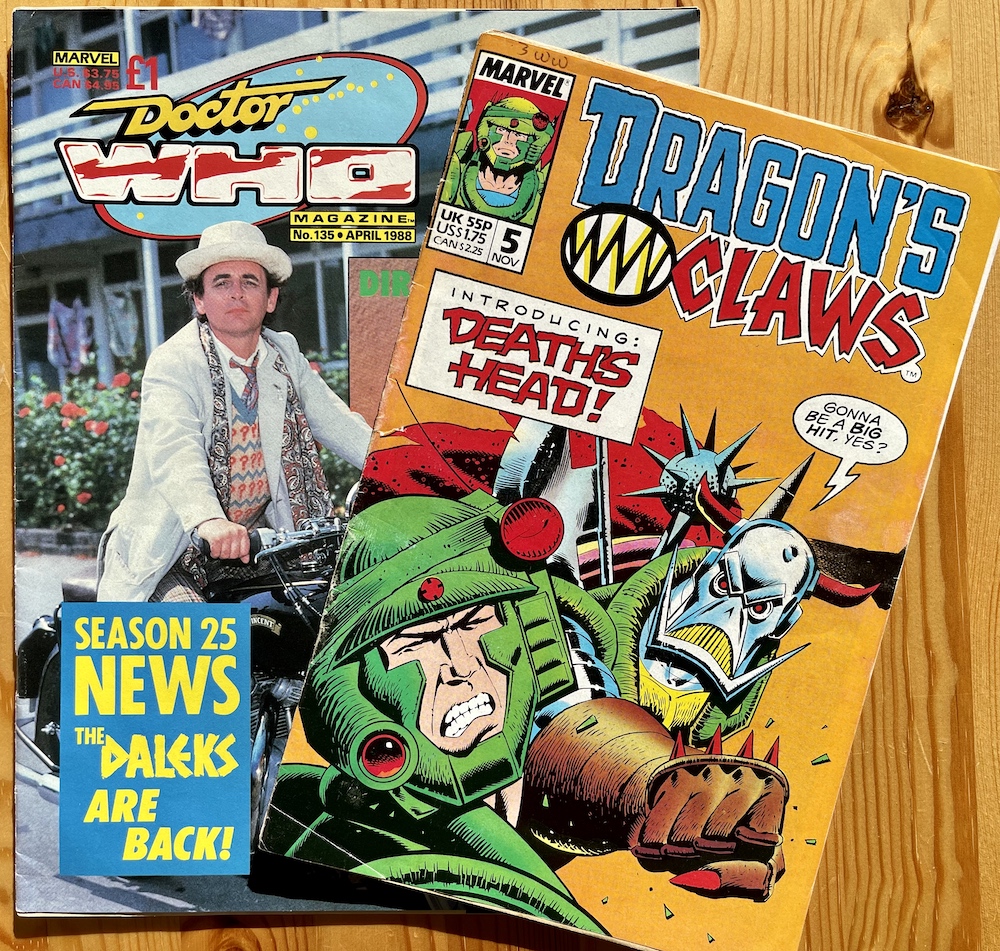
This was achieved with a one-off strip in the pages of Doctor Who Magazine in which another alien time traveller, albeit of much smaller stature showed he was more than a match for the other. After this the stage was set for the new comic, the first issue of which was released in November of that year. To promote it he also popped up in an issue of Dragon’s Claws, another Furman/Senior original creation just before his own premiere issue.
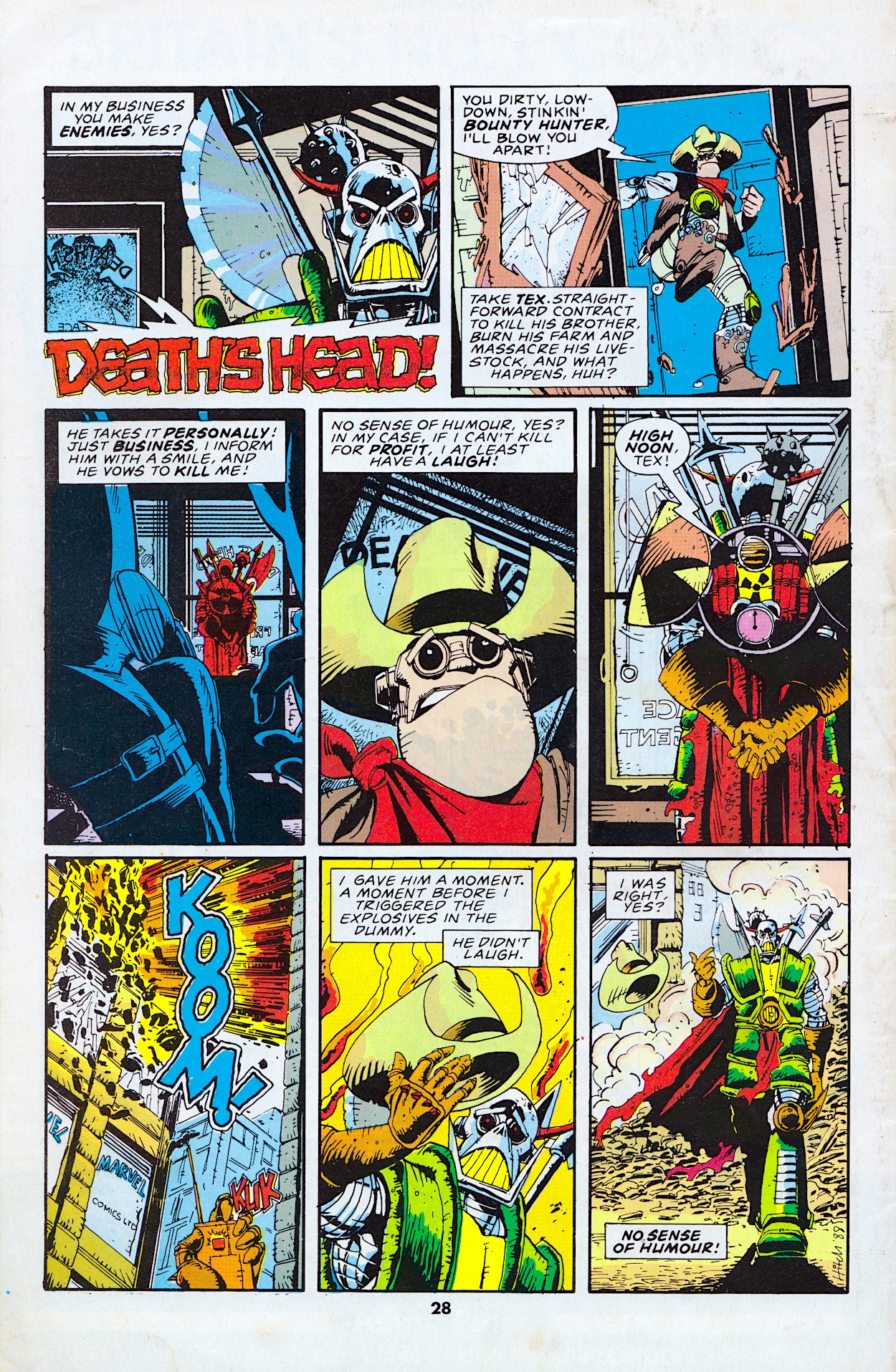
Drawn by Bryan Hitch, colours by Steve White
During 1988 High Noon Tex finally appeared across Marvel UK’s range, promoted as a one-off strip for the character. For those who hadn’t been reading Transformers this must’ve felt like a very random addition to their comic, but a highly enjoyable surprise nonetheless, showcasing the action, his brutal personality and most of all his sense of humour. The example above is taken from the back page of an issue of Dragon’s Claws. It was written by Furman and drawn by Bryan Hitch (who would draw half of the monthly issues, co-creator Geoff Senior surprisingly only drawing one of the strips).
As the comic launched another one-page story appeared, this time as an actual advertisement for the monthly. I first saw it in Transformers #193. How could I not rush out to buy it after that? The scan above was taken from #29 of my Real Ghostbusters collection, which went on sale 17th December 1988 while #2 of Death’s Head was on sale. Richard was the launch editor of that comic and told me, “I’d edited The Real Ghostbusters for a year and I knew you could tell a story in one page.” (The Real Ghostbusters could have up to four stories in one issue, including the occasional 1-page strip.) You can read more about the creation of this series of adverts in the introductory post to Dragon’s Claws.
Drawn by Bryan Hitch, inked by Mark Farmer
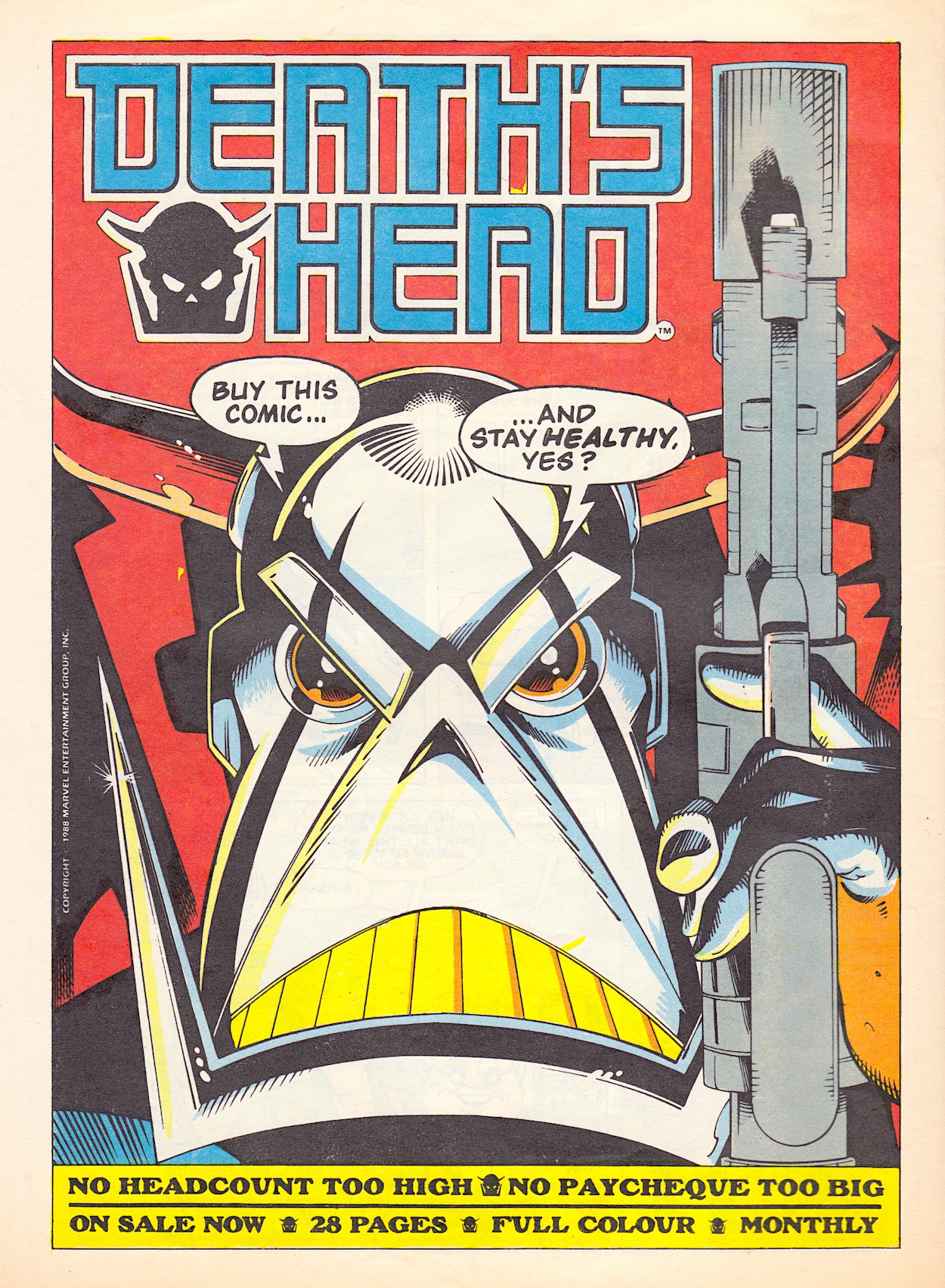
A much simpler yet no less eye-catching full-page advert was also found in the pages of my comics, using the cover image of the first issue. The issue of The Real Ghostbusters this first appeared in went on sale the same week as #1 of Death’s Head and he also popped up for the first time in the Mighty Marvel Checklist, which a lot of their comics ran at the time. As you can see it was the one not to miss that week and I obliged. At least for one month anyway.
Death’s Head’s comic lasted ten issues. It was printed on smaller than normal paper, the same size as US comics rather than the larger UK paper we were used to. Some fans say this contributed to less than stellar sales because it ended up hidden amongst all the larger comics. Richard tells me this just isn’t true; it was selling 60,000+ a month which would be a massive hit today. “The profit to the company versus cost of origination was too high for those days”, Richard says. “The Incomplete Death’s Head (collecting the whole series and his guest appearances in Doctor Who and others – Phil) #1 sold 400,000. So they got their money back.”
After his comic was cancelled he appeared in Strip in a multi-part adventure, collected in a graphic novel after Strip finished. He was relaunched as ‘Death’s Head II’ and ‘3.0’ later but I never bought into those versions. Furman wasn’t involved in the first and it lacked the humour, a key factor for me, and Simon has also said he doesn’t see either as Death’s Head so this put me off. They definitely have their fans though so I’m happy there’s a version for everyone. In the new century he’s popped up in cameos or guest roles in some more Marvel comics in his original form too, which I’ll detail at the end of the read through. You can’t keep a good Freelance Peace-Keeping Agent down.
So here’s my complete Death’s Head collection containing 30 comics altogether.
You can check out all of those Transformers issues at the links above and as you can see I’ve opted for the graphic novel version of the Strip story, The Body in Question. The premiere issue won’t be reviewed until 5th November later this year (this is in real time, remember) but in just three days on Friday 10th March 2023 you’ll be able to read the first Death’s Head review in a special post about his clash with the Seventh Doctor (Sylvester McCoy) in Doctor Who Magazine #135.
See you then, yes?
(Special thanks to Richard Starkings, Steve White, Lee Sullivan, Lew Stringer and John Freeman for all their help in putting this post together.)
It’s time to add another comic to the blog, to relive another cherished childhood title in real time and it’s from Marvel UK. Previously from the same publisher the blog has covered the short-lived Visionaries, over on OiNK Blog’s Instagram I’m still reading Transformers and approaching the sixth anniversary of that particular read through at the time of writing this, and there’s a one-off post celebrating #1 of The Real Ghostbusters. Back in July 1991 the latter two were the only comics I had a regular order for when a new weekly called Havoc caught my eye.
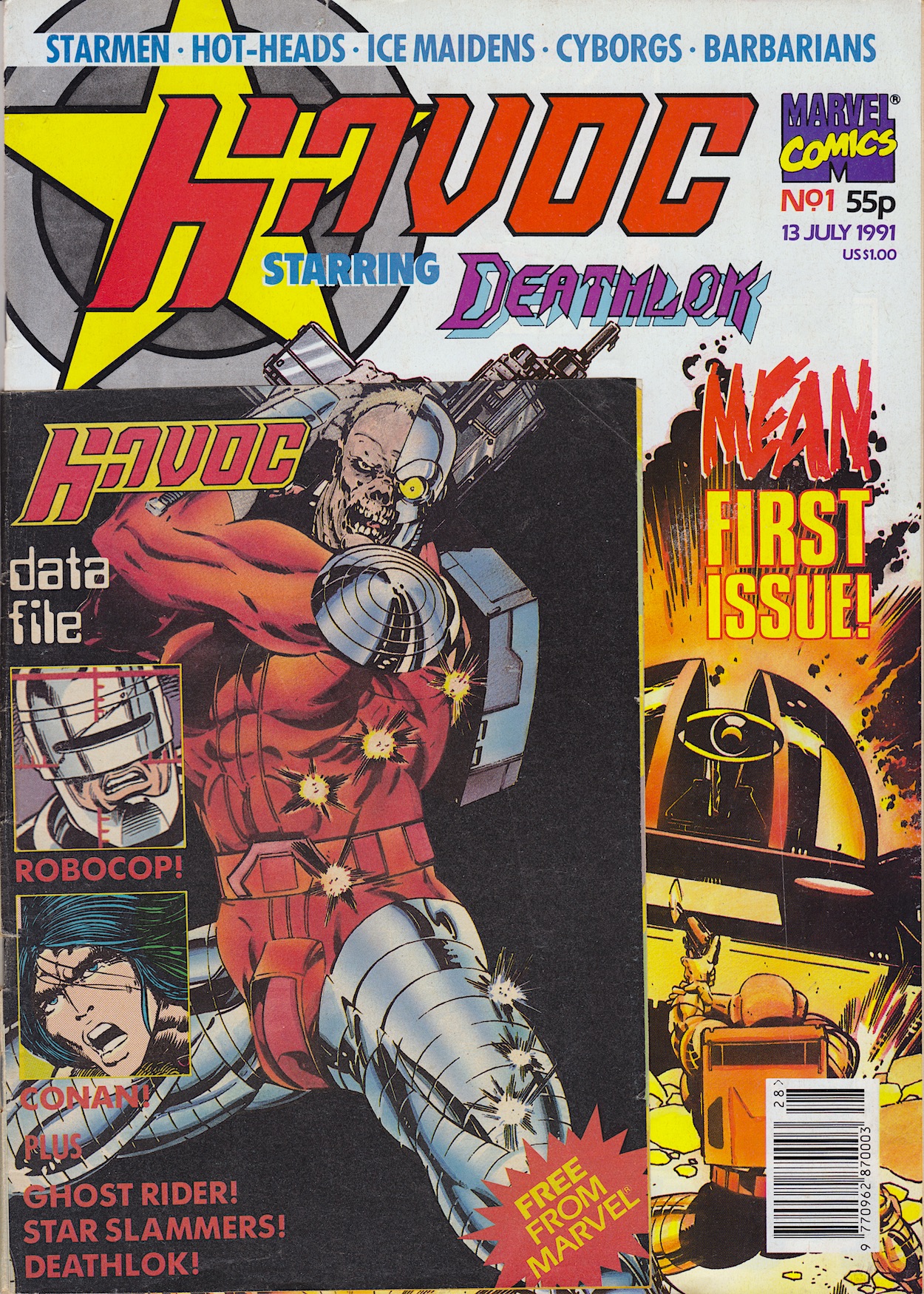
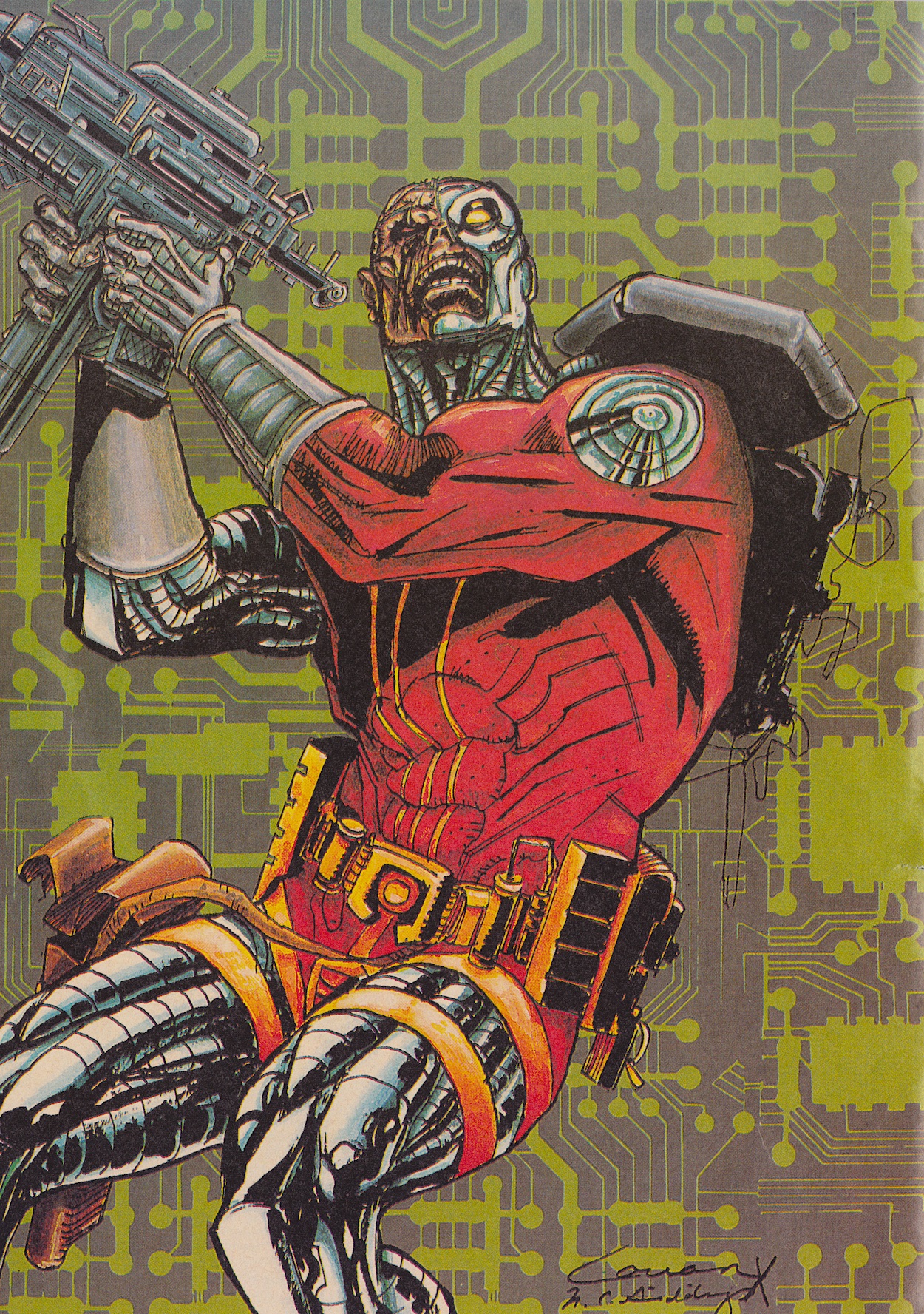
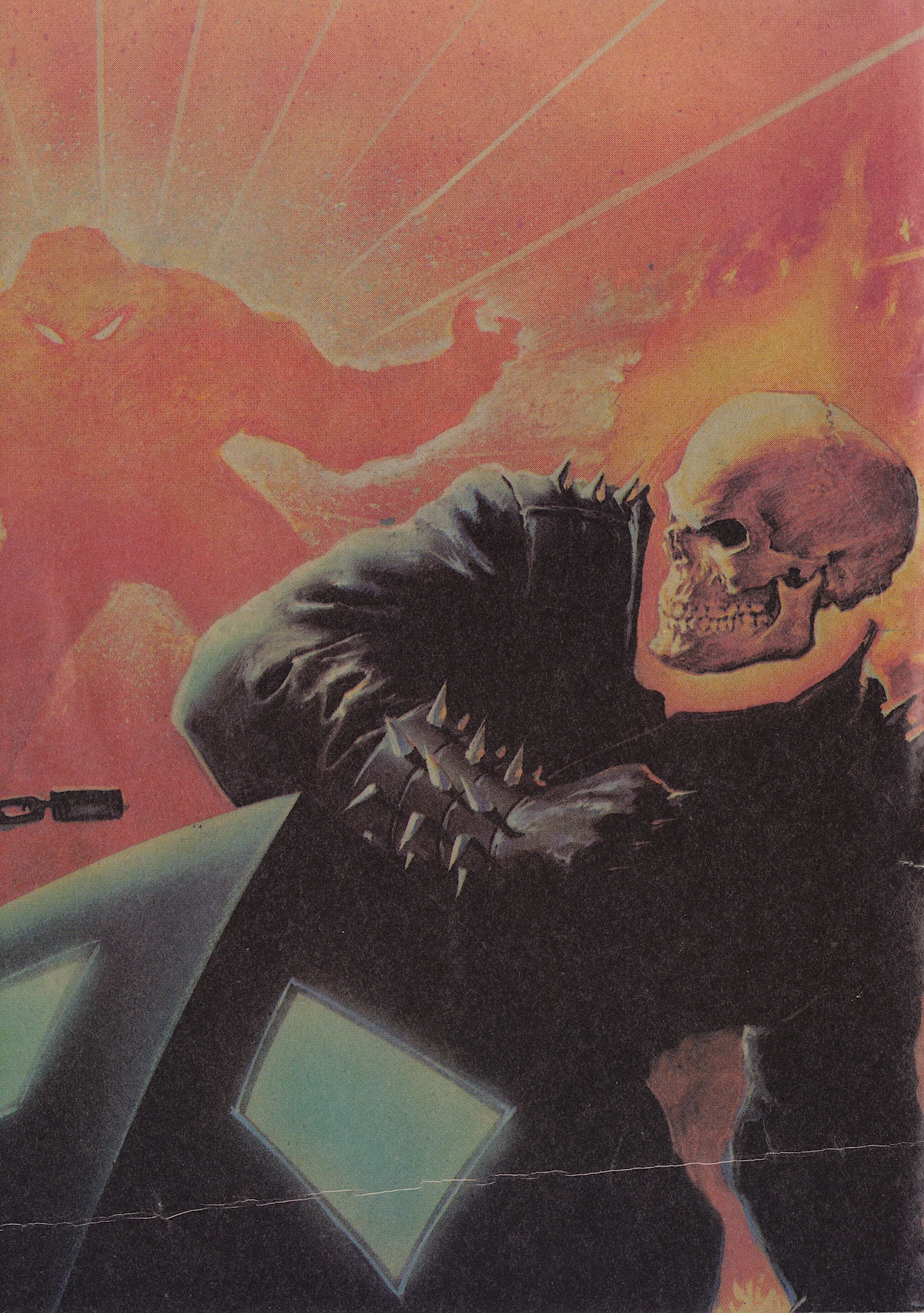
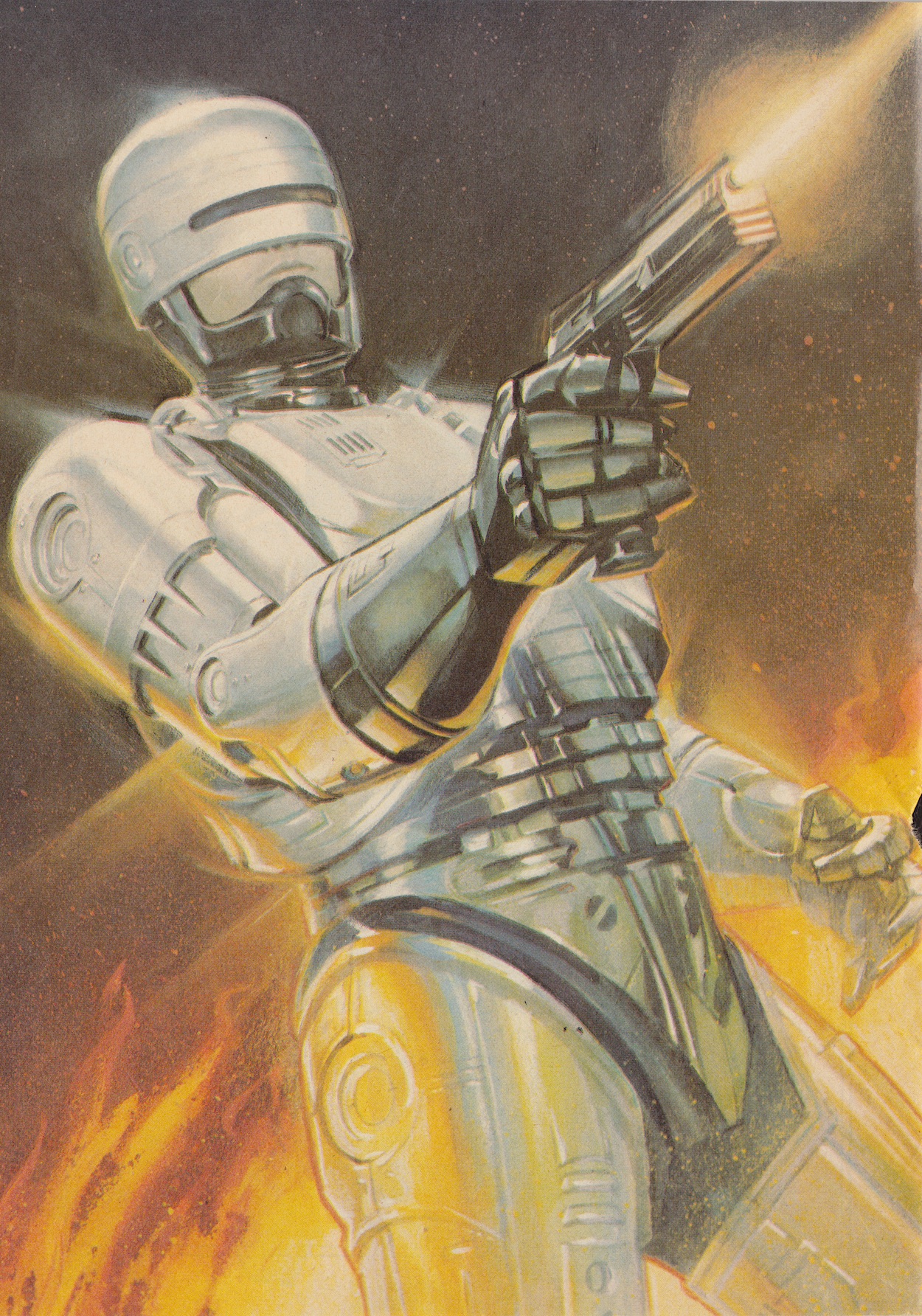
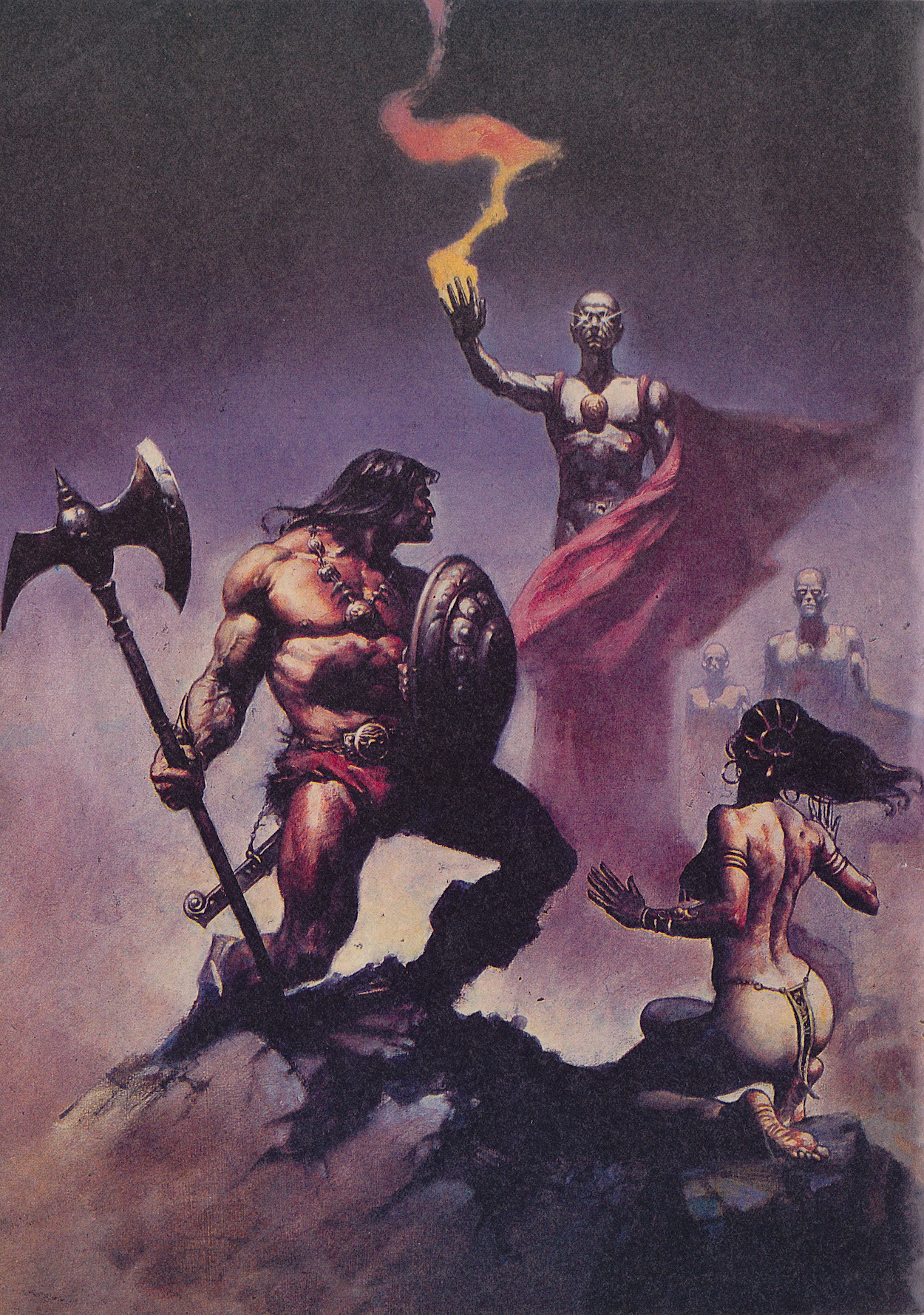
The first issue of a brand new comic was always an exciting prospect and this front cover was enough for me to know I just had to try it out. The free booklet which introduced us to all five strips inside blended into the cover image of Deathlok and when I pulled it back to see what was underneath I had a hunch straight way this would be a regular purchase. (You’ll see the image contrast in the first review.) Recognising Robocop and Conan and seeing a fiery skeleton riding a motorcycle convinced me this was going to be new, exciting and unlike anything I’d read before. I wasn’t wrong.
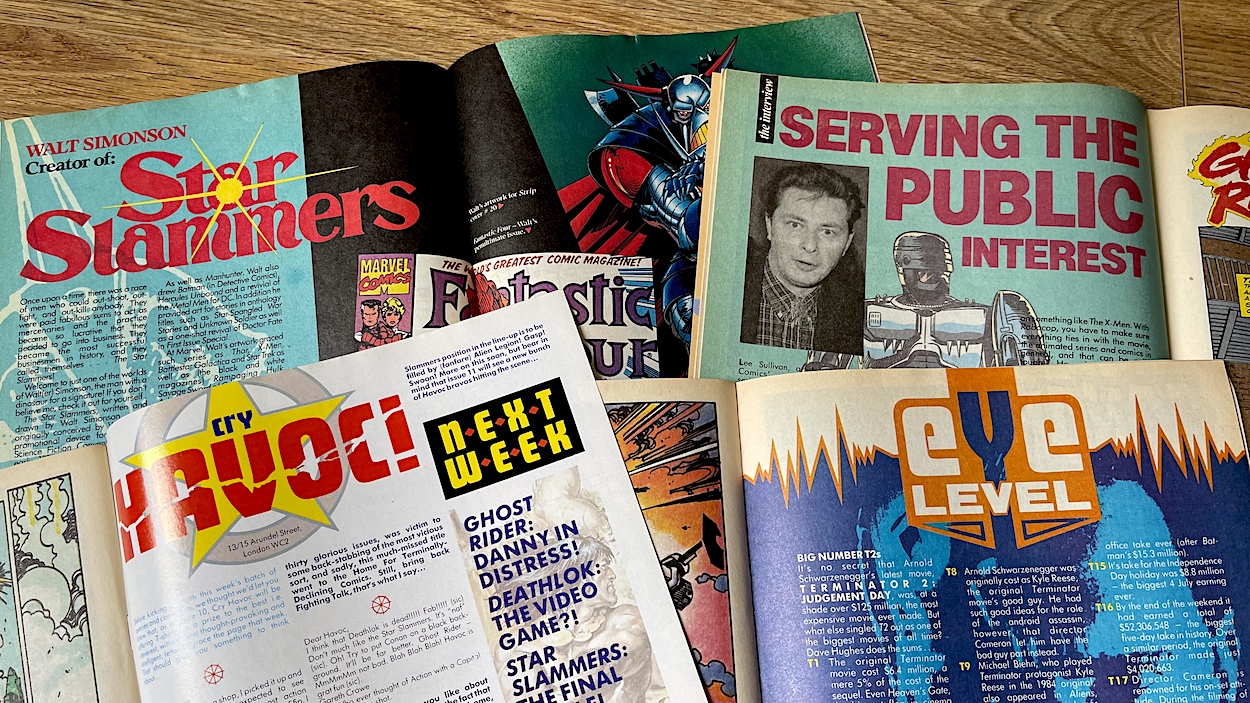
Launched and initially co-edited by John Freeman (he of Down the Tubes) and Harry Papadopoulos, the writing of both I’d previously enjoyed in The Real Ghostbusters, although I didn’t realise that at the time. Most likely forgotten by many because it only lasted a couple of months, Havoc was a weekly 36-page anthology comic featuring five action-packed strips from the US which hadn’t seen print over here. To me, it felt like a really meaty read, a meaner, grittier, more mature version of my school friends’ 2000AD (I’d only read a handful of Tharg’s organs). Indeed, some of those zarjaz friends loved Havoc just as much as I did.
I decided to be nice to my parents and cancelled The Real Ghostbusters after 150 issues so I could order Havoc
I was only 13 when I read Havoc, lured in by that cover and the promise of RoboCop comic strips. It was heavy on character as well as action, the choice of strips was original and it worked. It was the perfect package. After reading only the first issue a reservation at the newsagent was in order so, even though I’d been allowed up to four regular comics previously and was currently only getting two, I still decided to be nice to my parents and cancelled Ghostbusters after more than 150 issues so that I could order something brand new.
At Marvel UK new Editorial Director Paul Neary had a remit to expand the company’s originated content, especially in exporting it Stateside. The ‘Marvel Genesis’ project would kick off with Death’s Head II and Overkill the following year, the idea being to have a range of US-format comics alongside the latter’s UK-size anthology featuring all new, original material. However, this new project was going to take a while to get off the ground.
The company still had a large range of titles at the time, from nursery to teen, but lost a bunch when former Managing Director Robert Sutherland was able to take some of the licences with him to Regan Publishing. Paul had to be seen to be creating new titles, they couldn’t just wait a year or more for the new comics and so Havoc and its sister title Meltdown (basically a larger monthly along the same lines) appeared. They were essentially stop gaps while everything else was slotted into place, but also designed to compliment the new Genesis titles when they rolled in. Unfortunately neither comic’s sales were good enough to last that long.
Meltdown lasted six issues, Havoc for nine. The first issue coincided with the beginning of my school summer holidays, the final one released the Saturday before we started again for the next term, so it was the perfect summer comic for me that year. I loved every single strip, surprisingly enjoying the characters I’d never heard of more than the ones that had grabbed my attention in the first place. As I said, it was a more mature read and so at that age I felt it really spoke to me, like the editors knew exactly what I wanted to read next, even before I did.
It also contained a weekly news column and I’m really looking forward to reading those for its contemporary look at the entertainment of the day. Later issues would include a letters page full of very keen readers. It really felt like it was here to stay. Then, after #9 left us with another weekly dose of cliffhangers the next issue… just didn’t appear. I remember thinking it must be late, so I was popping into the shop every day over the next week asking for it. When it and the following week’s issue didn’t arrive I got the hint and I was crushed. Again! Too many of the comics I’d started collecting from #1 had been cancelled.
While the sales just weren’t there it apparently proved the concept enough for Marvel UK to move ahead with their project. But as regular blog readers will know, just because a comic wasn’t popular enough at the time doesn’t necessarily mean it wasn’t great for those that did read it. I’ve only recently been able to complete my collection so I’m now ready to read them for the first time in 31 years. Even though I know the stories will just suddenly end, I can’t wait to relive the excitement these characters brought to me every Saturday morning (albeit on Wednesdays in 2022).
Deathlok, RoboCop, Conan, Ghost Rider and the Star Slammers, it’s going to be fun getting reacquainted with you all. The first review (which I’m really looking forward to) will be here from Wednesday 6th July 2022.









 OiNK Blog