Tag Archives: Walter Simonson

DEATH’S HEAD – THE BODY iN QUESTiON: DADDY iSSUES

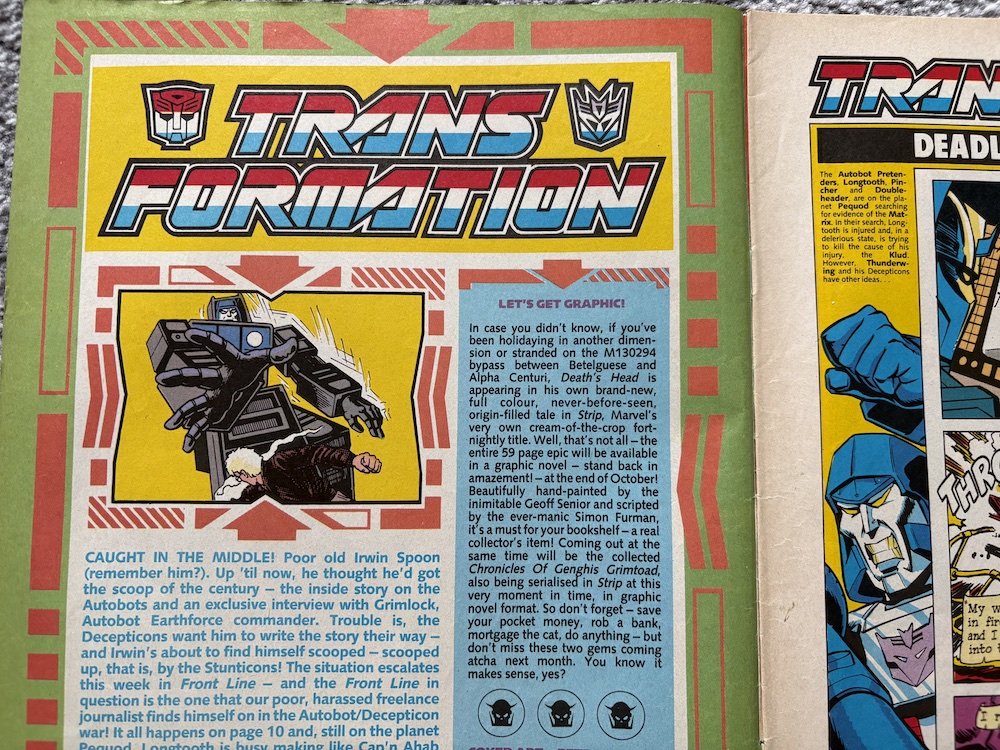
This week back in 1990 the editorial in Marvel UK’s Transformers announced the exciting news that Death’s Head was finally back. Not in a reprint of a previous story (something they still liked to hype) but a brand new graphic novel. In reality it collected together his run from Strip comic, and this is the final piece of the jigsaw for the blog’s real time read through of the original incarnation of the character.
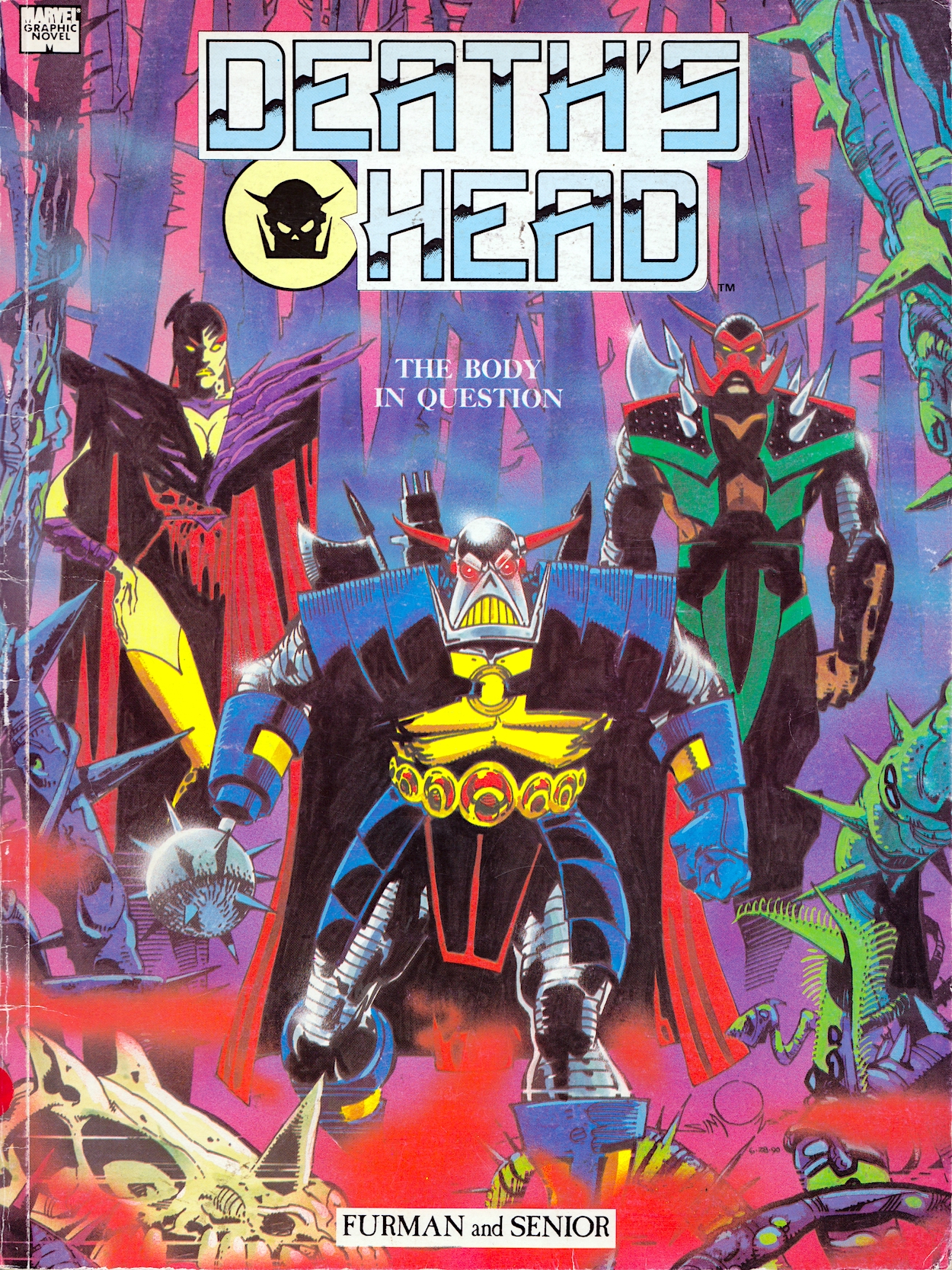
Coming in at 68 pages including a card cover, inside is all glossy and beautiful, the paper upgrade allowing artist Geoff Senior (who co-created the character for the Transformers but only drew one of the monthly issues) to return to the character in style and bring us a new level of colouring. Helen Stone (The Sleeze Brothers, The Real Ghostbusters, Knights of Pendragon) joins the team as letterer, Steve White (Xenozoic Tales, Rogue Trooper, The Lost World Jurassic Park) returns to edit and of course it’s all written by co-creator Simon Furman (Transformers, To the Death, Doctor Who), with Geoff (Hell’s Angel, Dragon’s Claws, Judge Dredd) and Walt Simonson (The Star Slammers, Jurassic Park, Thor) teaming up on the cover.
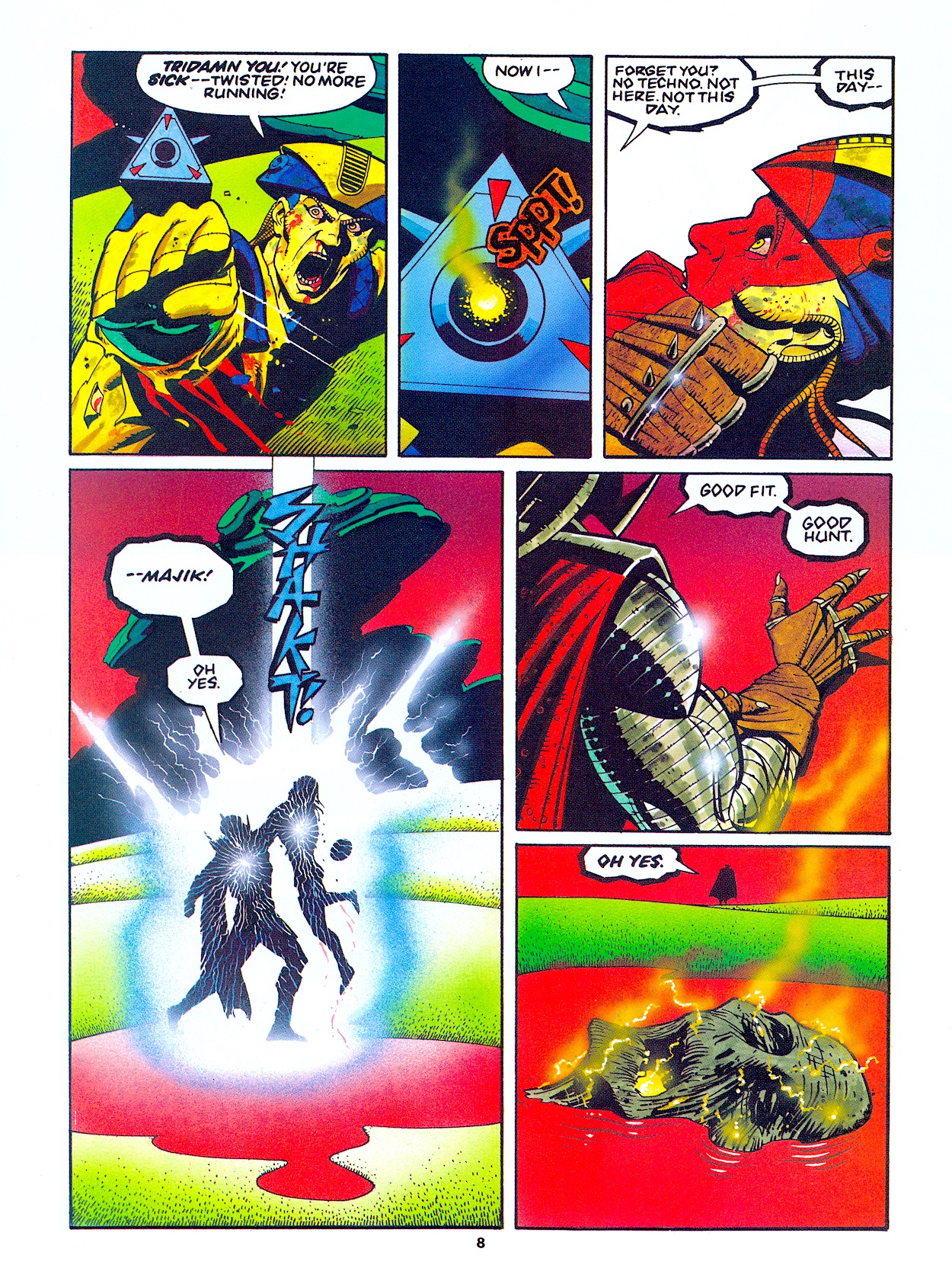
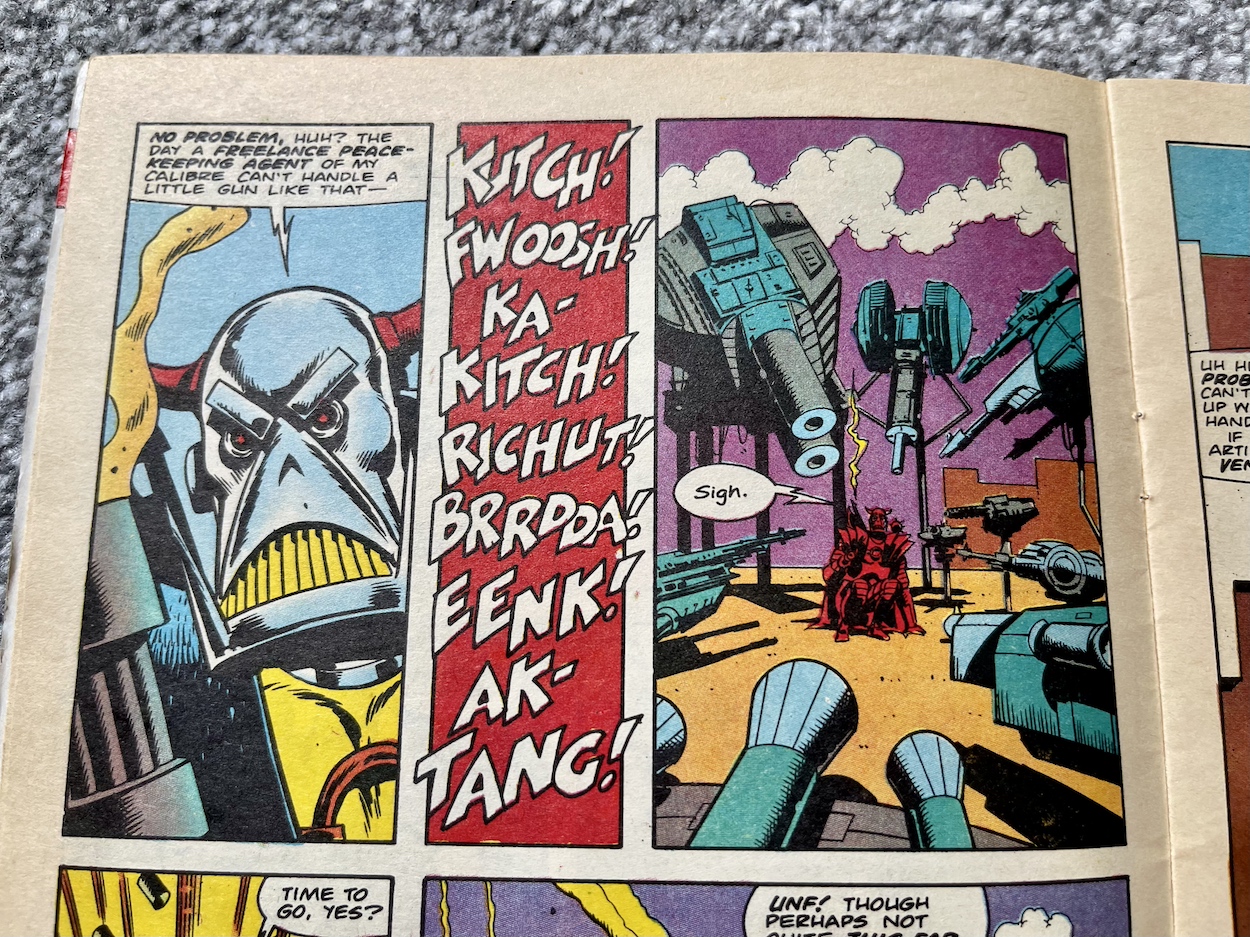
We begin in a strange land that apparently doesn’t adhere to time or meaning, with someone being tracked down and killed, the perpetrator only seen from one angle, their arm looking suspiciously like Death’s Head’s original design from Transformers and Doctor Who. Then it’s back to 2020, where he ended up at the end of his comic’s run and an electrifying chase as the Freelance Peacekeeping Agent hunts down his latest bounty and it’s full of all the usual quips and comedy action.
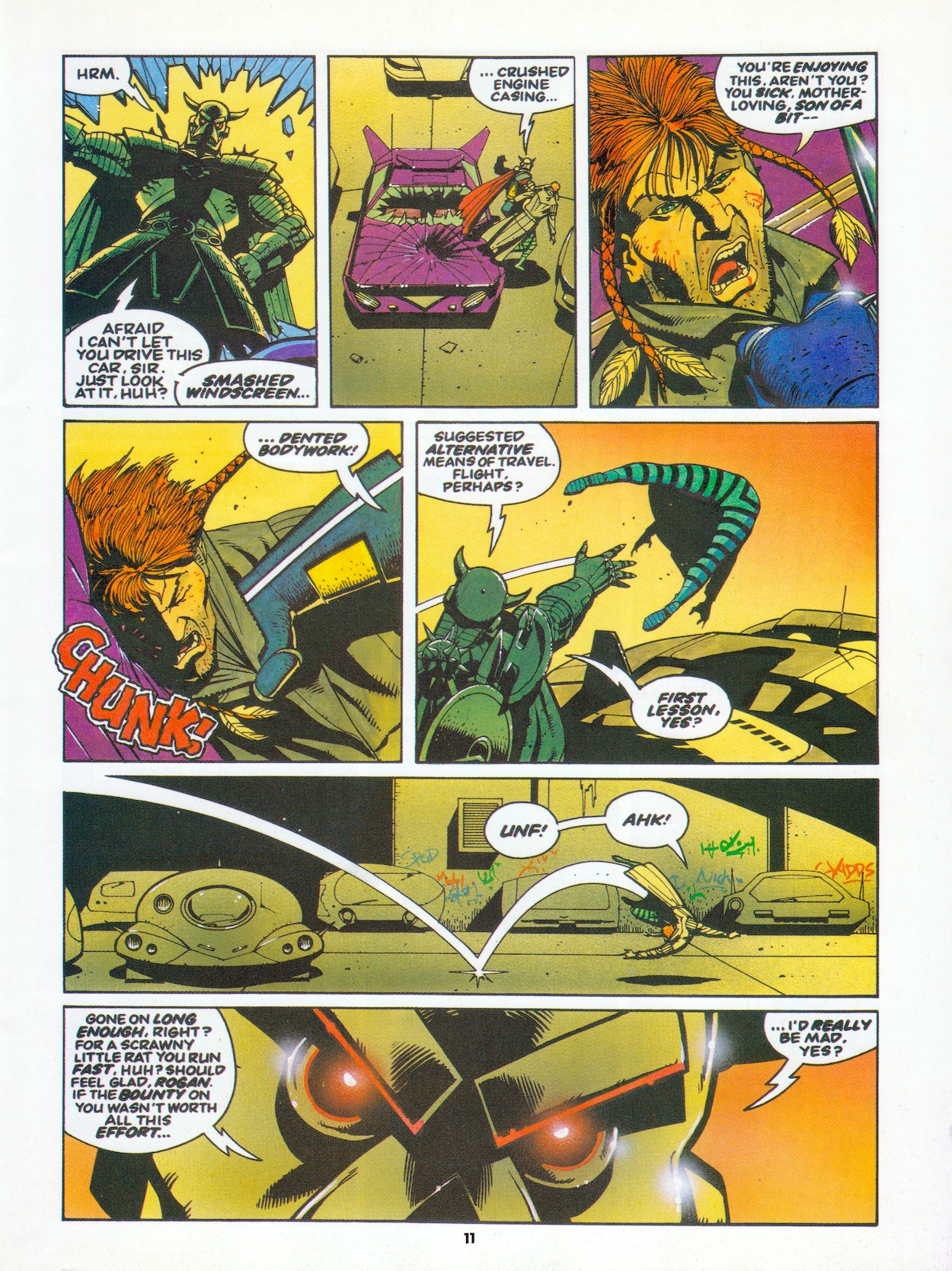
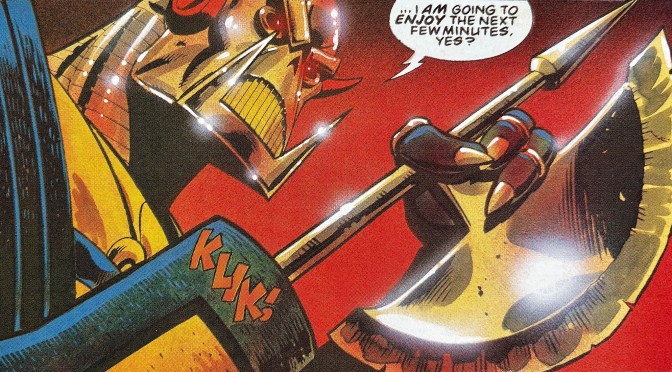
Rogan accuses Death’s Head of enjoying the chase and this really gets into his head. As he runs he questions himself. Is he really enjoying the hunt more than the profit? At the end he believes Rogan is about to take a woman hostage so he kills him, but he was running to her apartment for safety. She’s his partner and she screams that Death’s Head ran him down like it was sport. He walks away, solemn, trying hard to convince himself that she’s wrong.

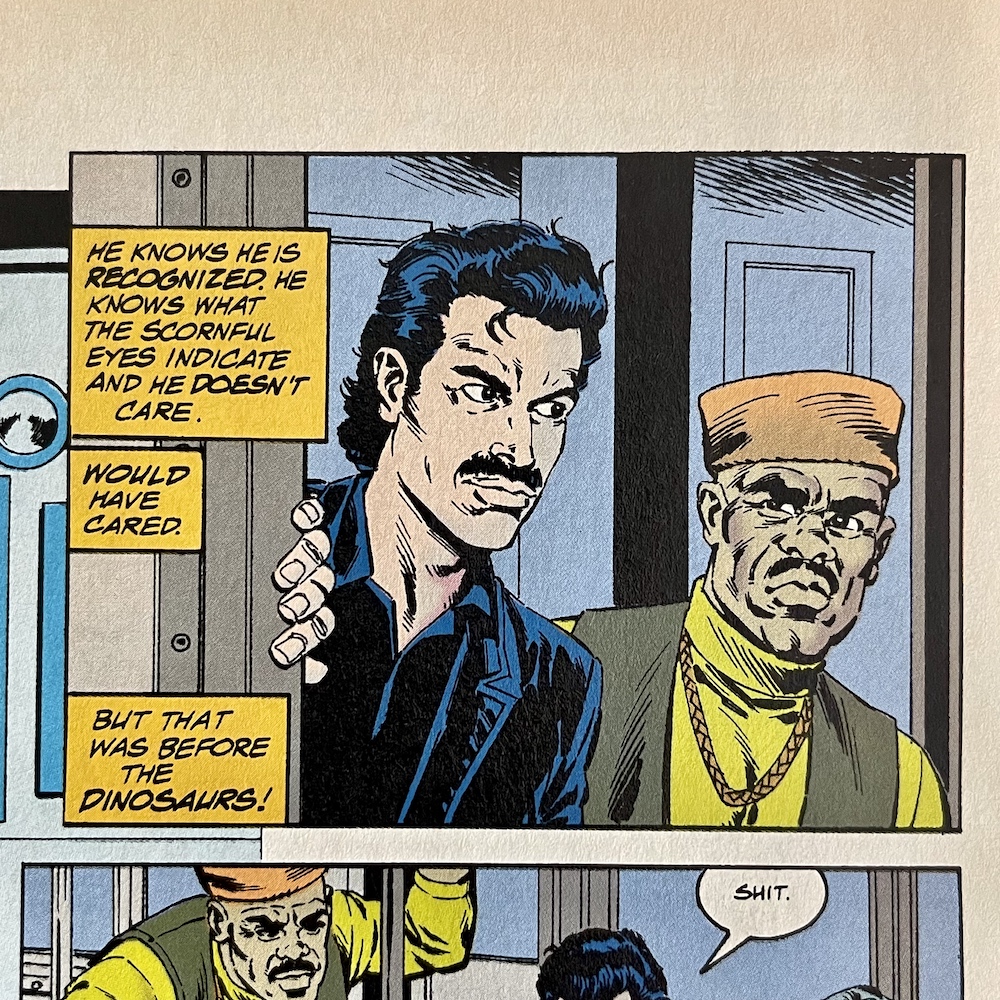
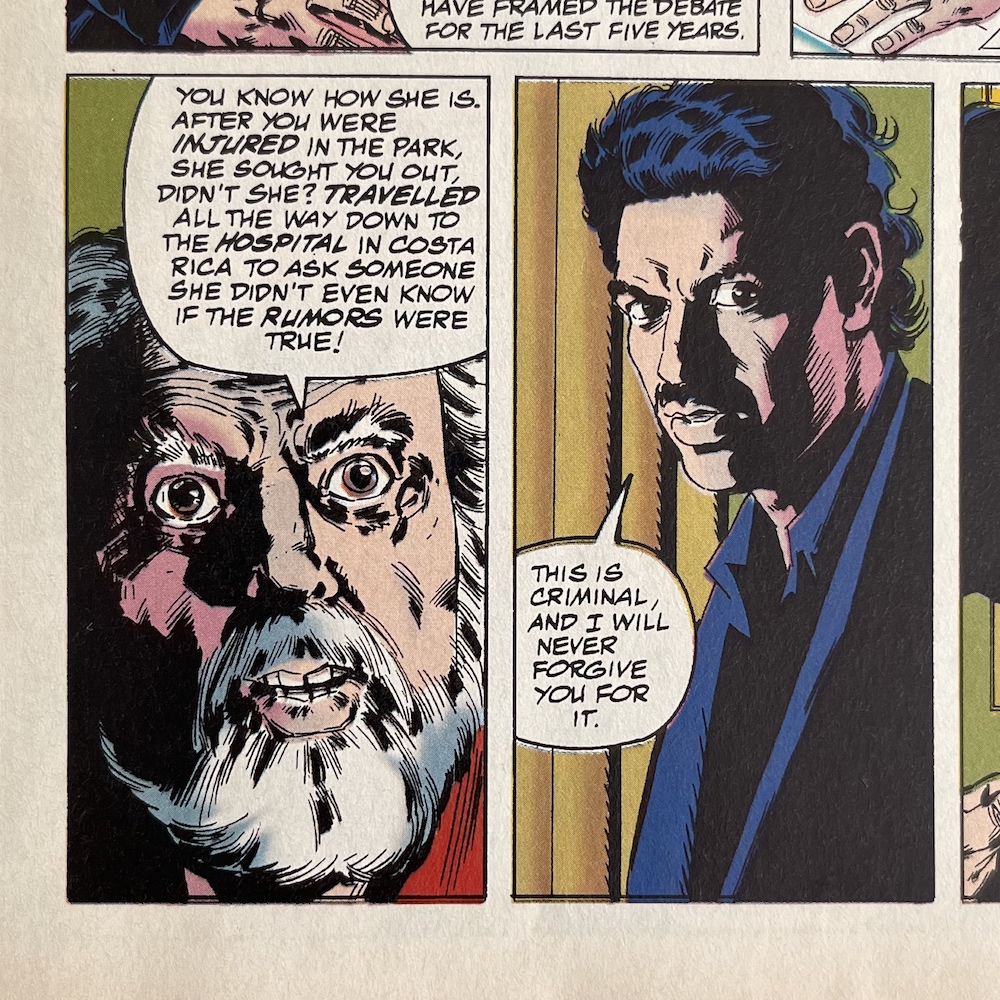
Initially I thought this wasn’t going to feature Spratt but suddenly we’re back in 8162 and he’s meeting with his boss’ mysterious love who was hinted at in the monthly. (He doesn’t look like Spratt at all though.) It’s good to see the vulture is still on the team too. So apparently the not-a-bounty hunter is her husband and she has “vengelust” for him. Big Shot is also back and just as angry as ever. Spratt tries to escape, so Nightweaver reads his mind and finds out her love has time travelled. All the while in some void-like world the lookalike looks on. So far, so intriguing.
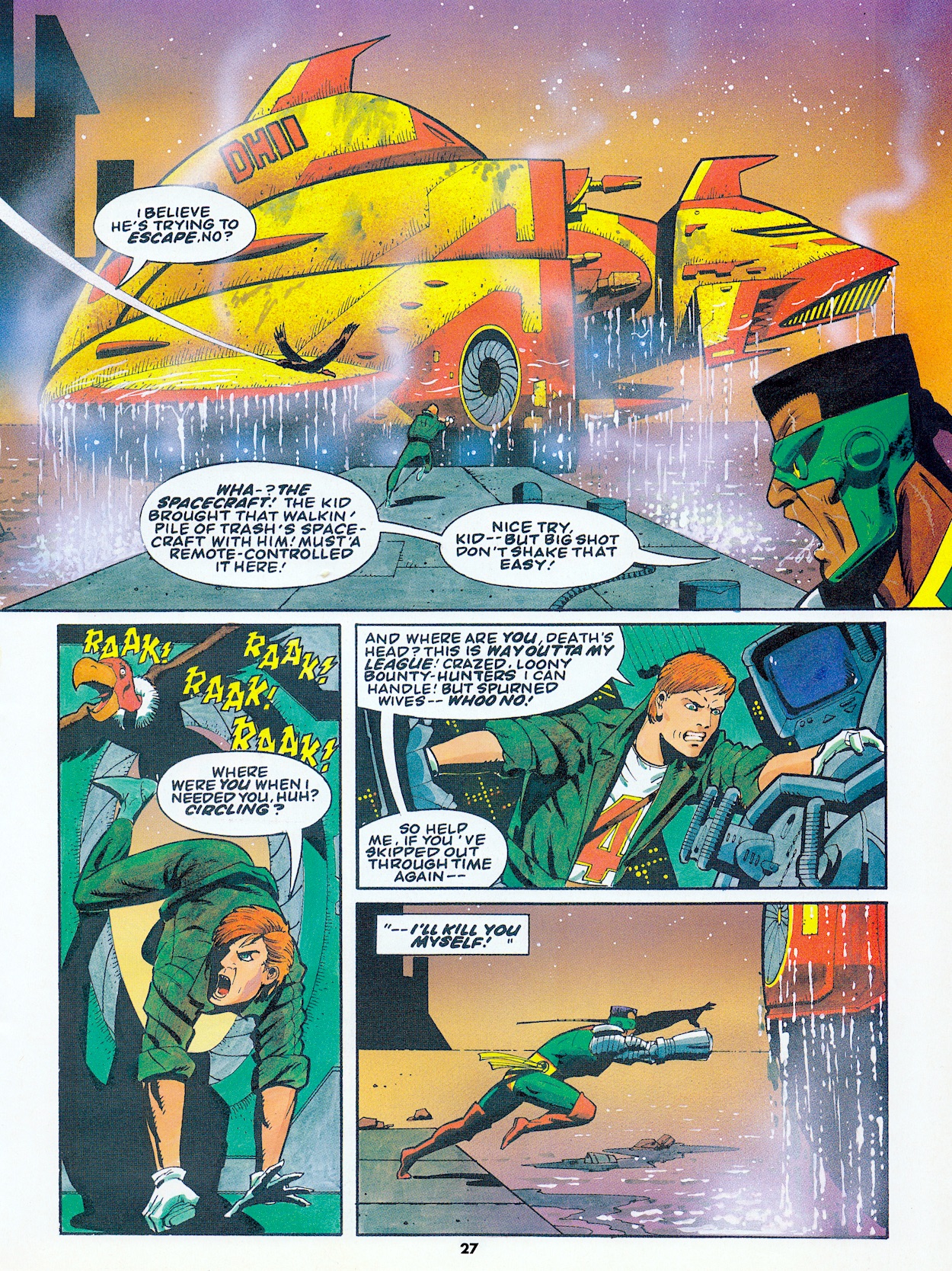
As in the comic the year 2020 looks just as futuristic as thousands of years into the future and given what actually happened in the world in 2020 maybe this version would’ve been preferred. I don’t want to ruin any possible future you may have in reading this graphic novel, so I must warn you this review will obviously contain spoilers. It should go without saying by this stage, this blog is all about classic comics, but more than any of the monthly stories the shocks and surprises in this are an integral part of the plot and thus the reading experience. To tell you about them would be to ruin the experience for you if you intend to read this one day. So consider yourself warned.
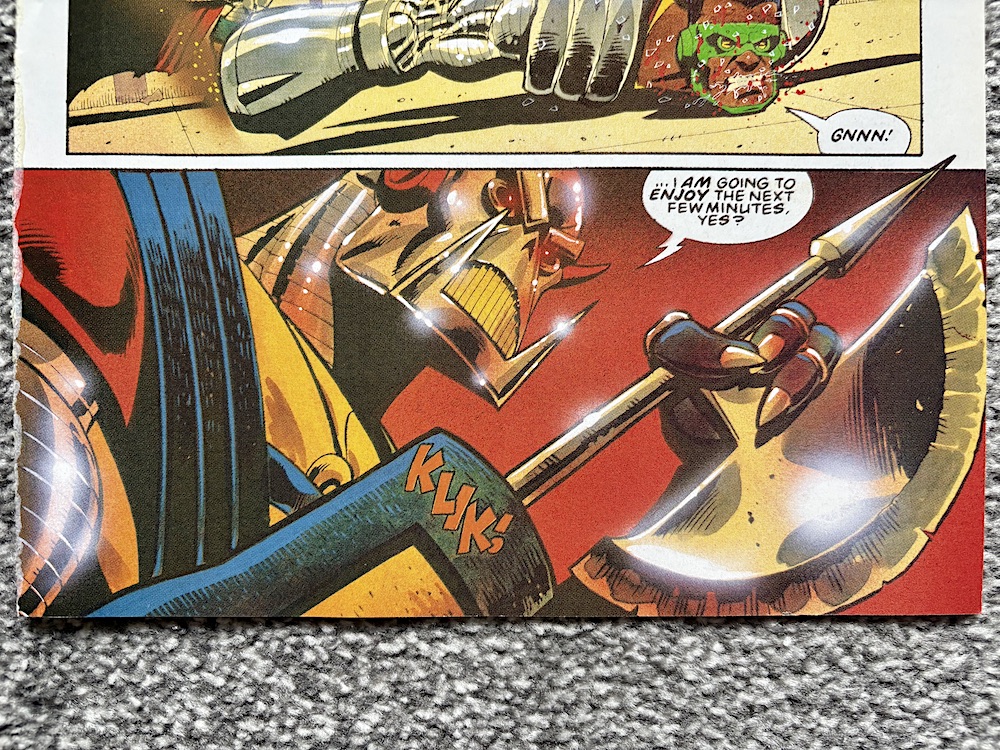
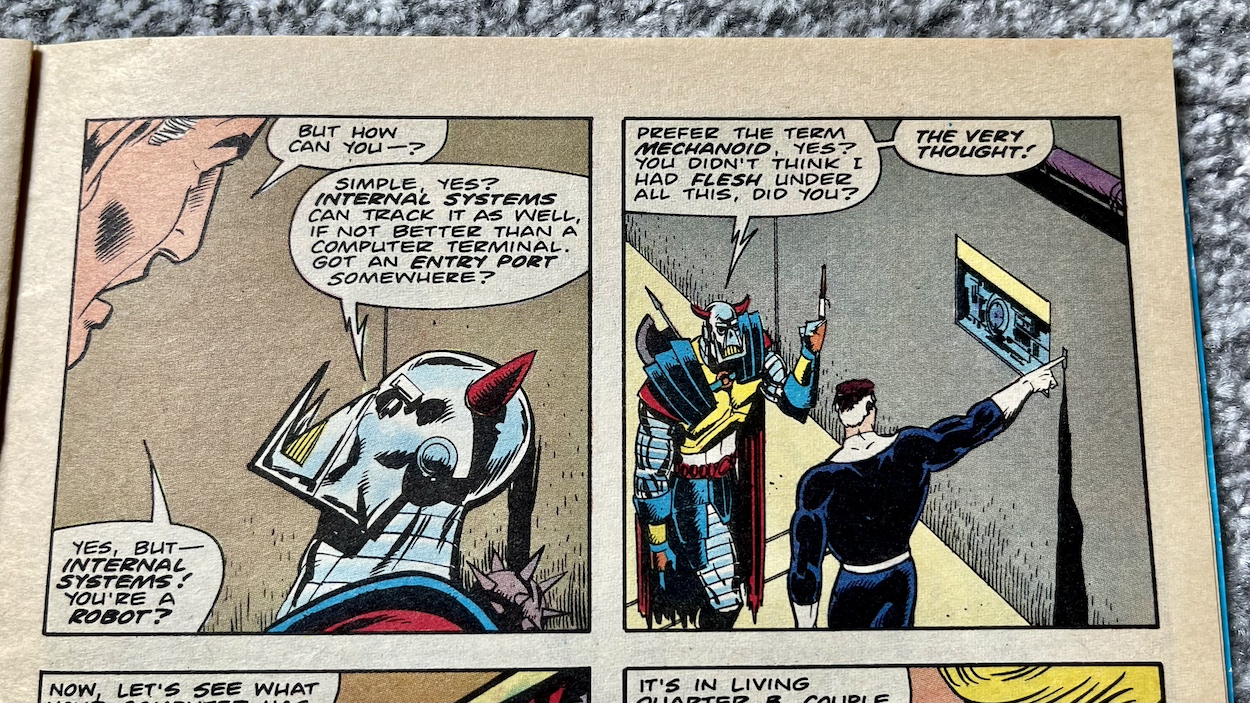
My favourite parts always involve our lead character and his quips, his inner thoughts and biting humour. Such as the moment above. He ends up flashing back and forth between the real world and the void and slowly the identity of the lookalike reveals himself. However, surprisingly this is seen in flashback form inside our anti-hero’s mind. He begins to question his own origin, something he’s never done until now. The same goes for the reader, but I’ll get to that below as it’s the only real bone of contention I have with this.
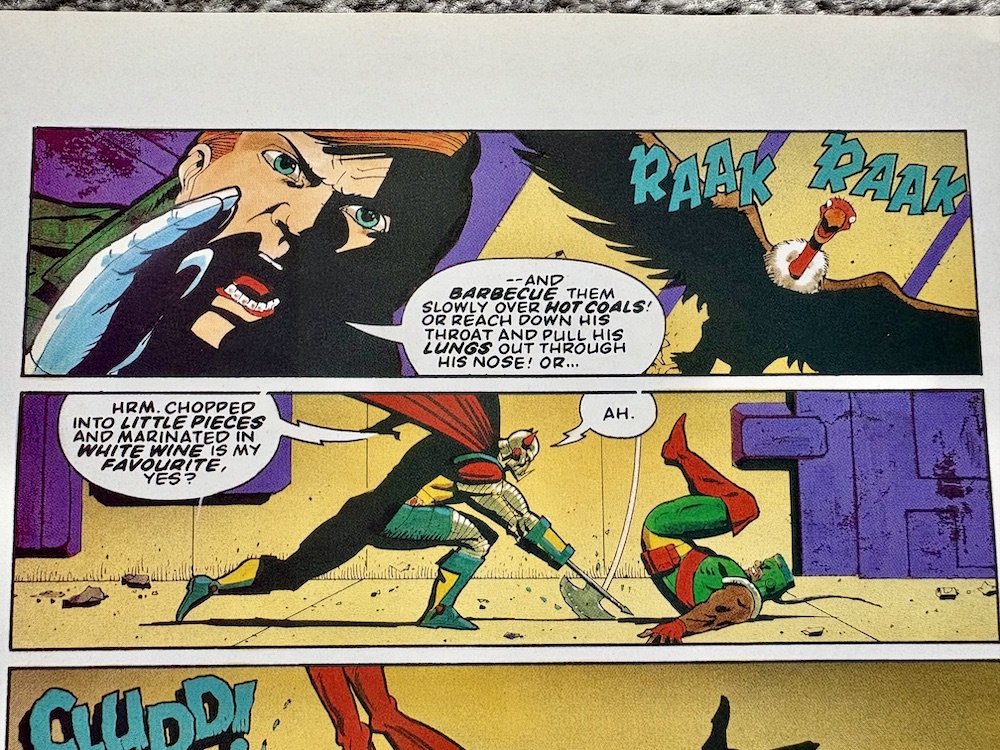
It doesn’t stop the rest of this graphic novel from being highly enjoyable. For example, despite Death’s Head initially being joyful that Spratt wasn’t there, the banter between the two during action scenes is better than ever. I think he secretly loves it! Or how about another scene when he realises he hadn’t previously defeated Big Shot and he strops like a child, proclaiming it’s unfair while having the huffiest of faces his angular jawline will allow. Then things take a turn when Big Shot says all bounty hunters are the same, that they all enjoy their work. Following up from earlier in the story, this leads us to the main event, the creation of Death’s Head.
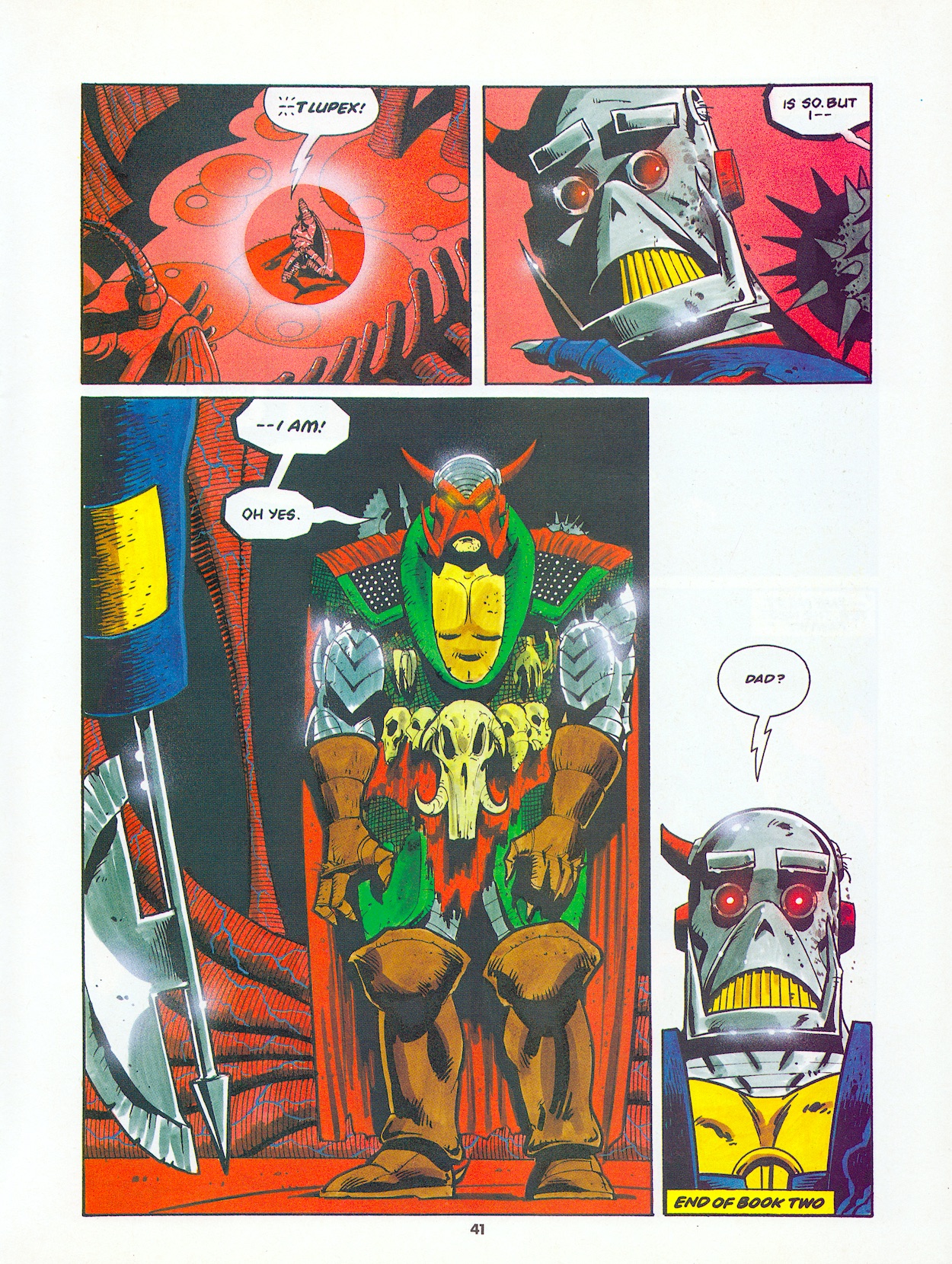
Meet Lupex. He’s the fella in the void universe who bares a striking resemblance to the star of the piece and whose catchphrase is also somewhat familiar. He’s a warlord and Nightweaver, known here as Pyra, was his wife; a woman who wanted all the power he had but who was in love with another. Lupex possessed bodies to survive and did so with her lover’s body out of spite. He was also creating a robotic form for himself so he could live forever without the need of new flesh.

But in an act of revenge Pyra finished programming the robot and made him autonomous with a mind and soul of his own. Not just any mind, a business-like mind, a clinical assassin whose only goal was to do the job and get paid. The opposite of Lupex. She thought this would create the only one who could go up against her husband (whose love of killing drove him). It’s a hell of a story but I’m not sure if it fits within the Death’s Head comic for me. It feels too mythical. Then again, he did fight Unicron, the God of Chaos on the astral plane so maybe it’s just that I’m used to the more grounded stories of the monthly by now.
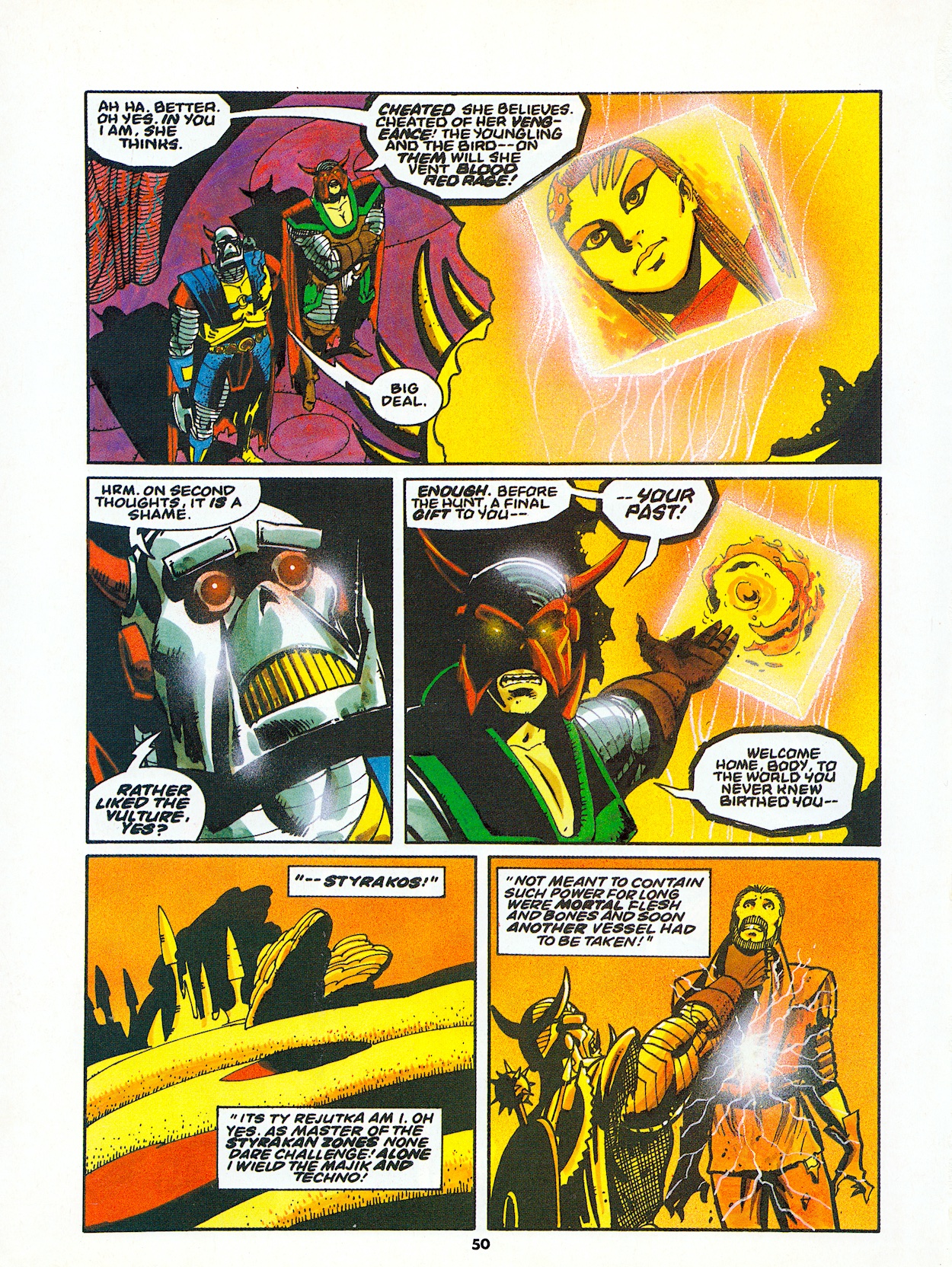
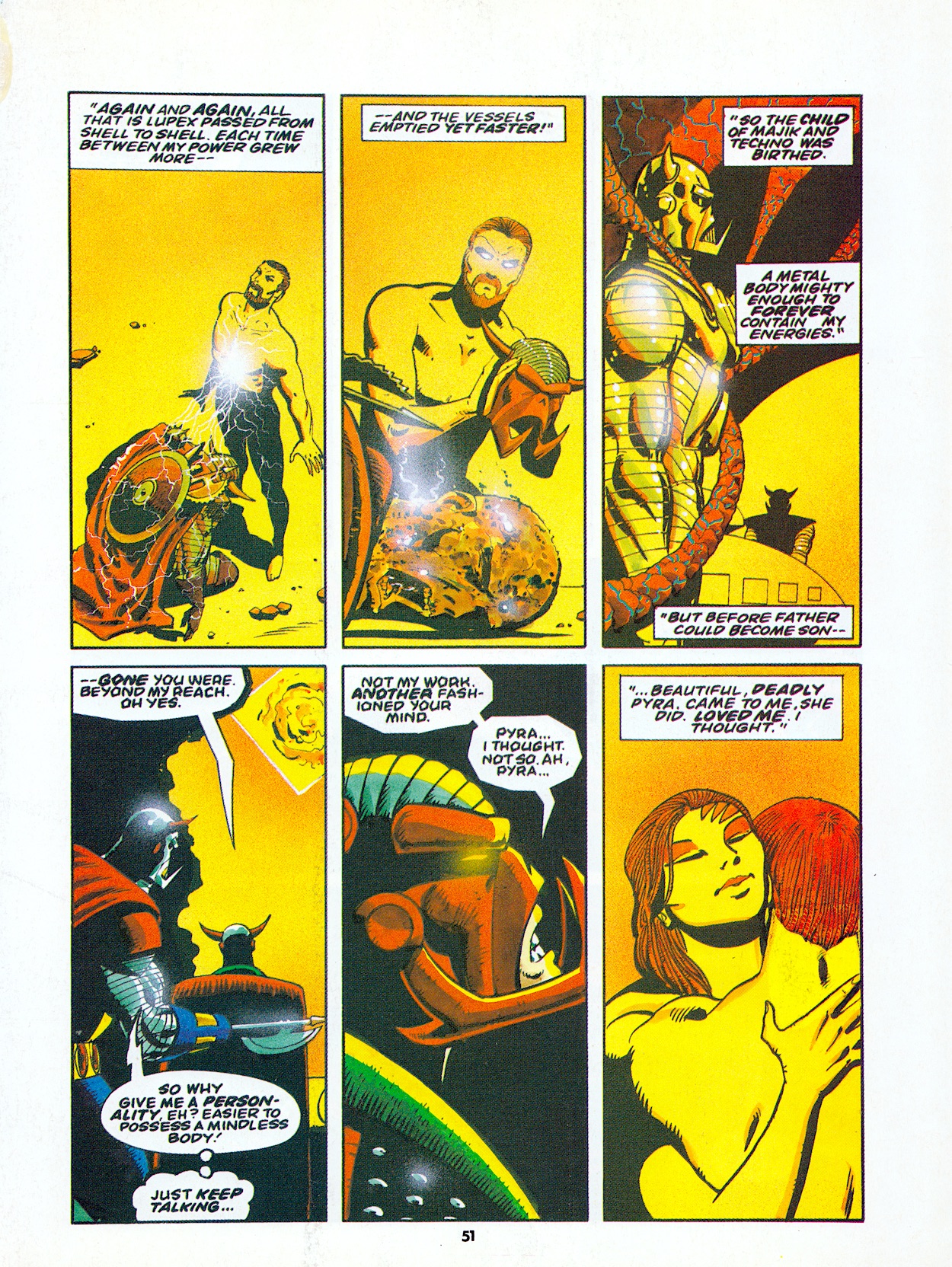
What definitely doesn’t gel for me is the retconning. Don’t get me wrong, I like stories that add to previous ones, that surprise us and take things in new directions or give us previously unknown facts to completely redefine characters and settings. But what I don’t like is when this completely contradicts what went before, and we’d already been told by Death’s Head himself he was created as the plaything of a very rich, very bored individual who he later killed.

However we are told here that his body was subsequently stolen by an unknown party so there’s always a chance the previous origin could be woven in, in the time before his first appearance in Transformers. Did Simon intended to do so or was this was replacing what went before? I’ve convinced myself it’s the former because the rest of this book is so much fun, so full of superb action, great character moments and lots of laugh-out-loud moments that it really is classic Death’s Head.
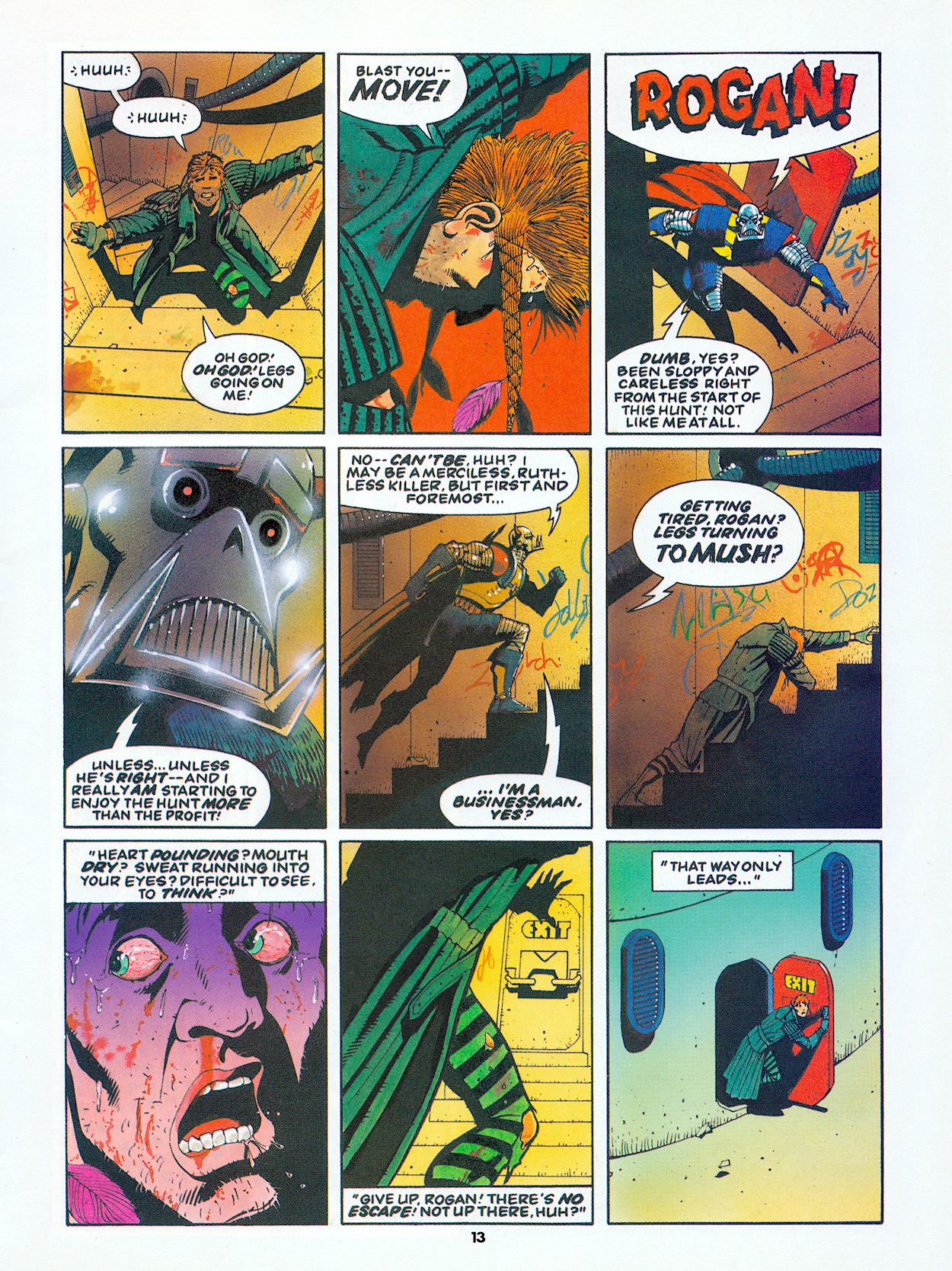
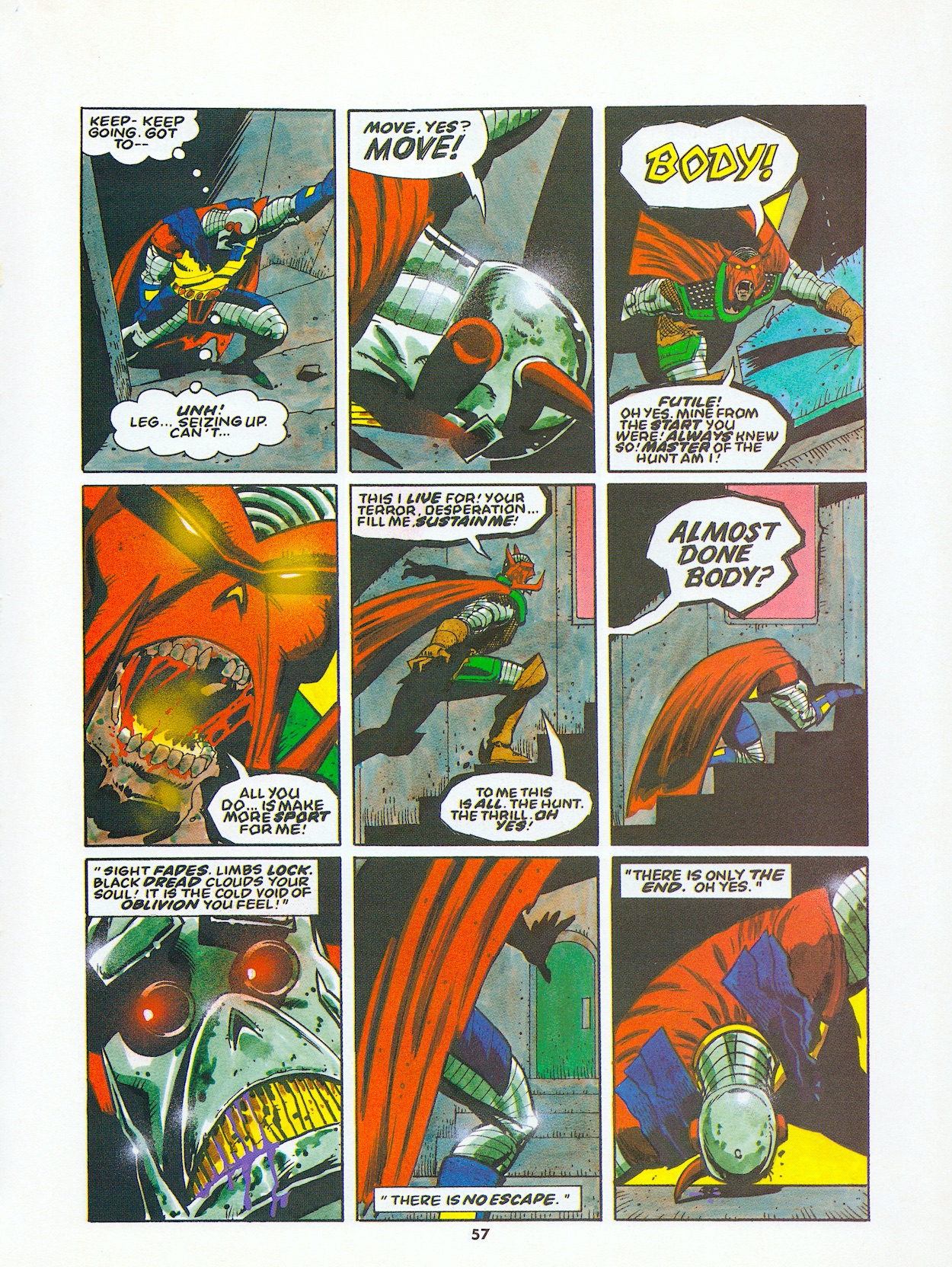
The story culminates in a chase echoing that from the beginning, only with Death’s Head as the one being chased and taunted. This creature also has control over the land in this realm, which is split into ‘magik’ and ‘techno’ sectors. In each he can realign his powers to shape the ground and use it to attack his victims, and he almost destroys Death’s Head by doing so. However, he cannot control the borders between these sectors or when they change from one to the other independently.

We see Death’s Head almost enjoying each successful escape, leading him to question himself again. That is, until he remembers his one true love. No, not Pyra. He remembers how much he loves money! This is enough to refocus him, and I’ll admit I had a little inward cheer and fist bump when this happened. It’s almost a spoof of scenes in superhero comics when doubts are washed away and the hero emerges ready for battle after thinking about the reasons they’re fighting, their cause for good. Here, the cause is cash.
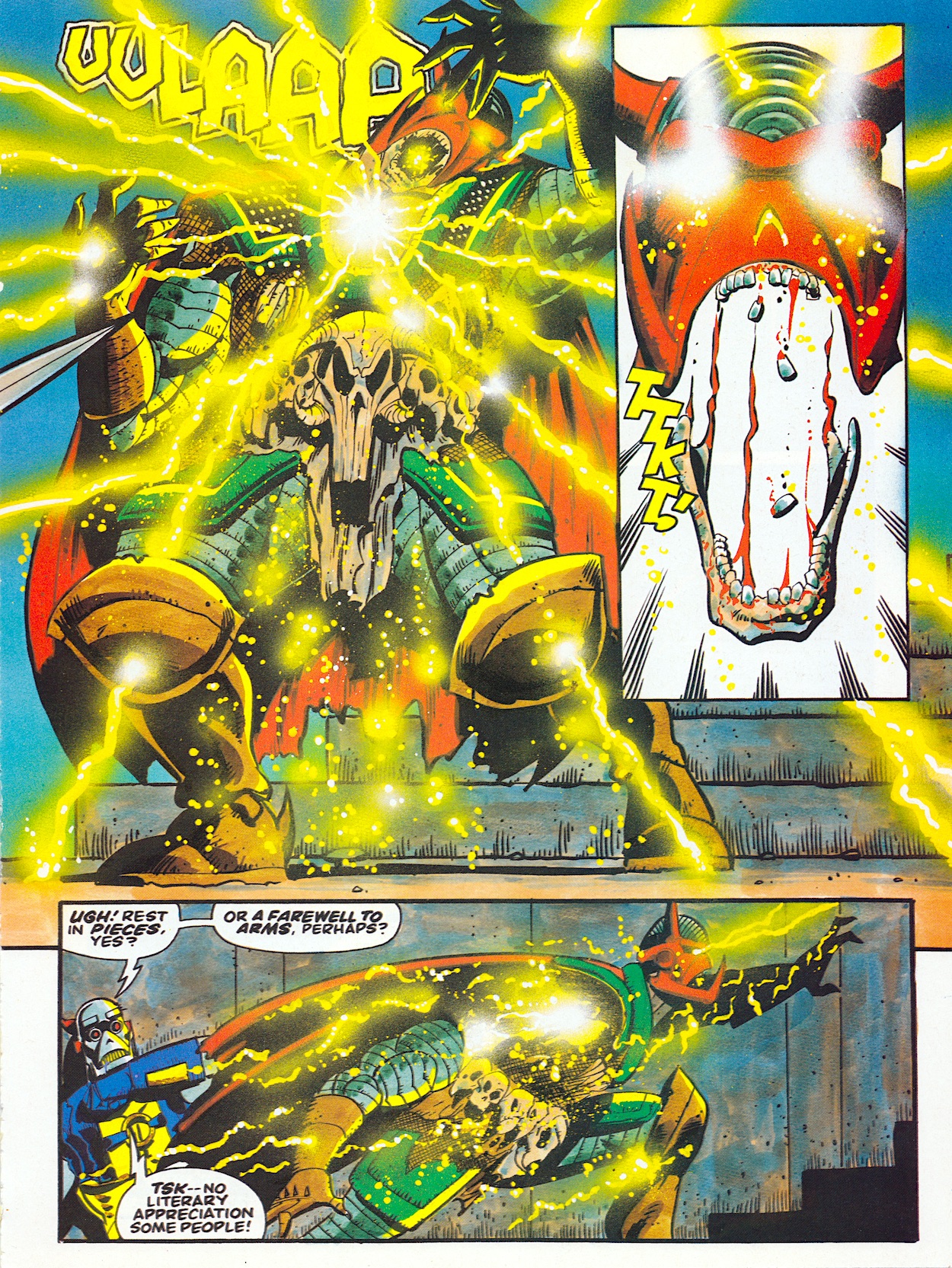
In the end Death’s Head takes a gamble that Lupex doesn’t know he’d spent so long in 8162 (in his own comic and Dragon’s Claws) and as a result has become much more advanced as he repaired and added to his tech. In the end he’s playing the victim but in reality his computer systems are calculating where a magik zone is about to change into a techno one. We think the final blow is about to fall but Lupex unknowingly tries to use magik as the zone changes and it no longer works. The few seconds it takes him to correct his attack is just enough for our star to use his built-in hidden spike.

It’s a thrilling conclusion. It rockets along but never fails to hit the right character beats as it goes. Lupex feels like a genuine threat for the seemingly indestructible Death’s Head, all the while our hero (I’m just going to call him that from now on, I think he deserves it after all this) quips escalate the more desperate he gets, almost like he’s trying to use humour to keep himself going. After it’s all over he even begins to gloat, but he stops himself. He doesn’t want to end up like his father!
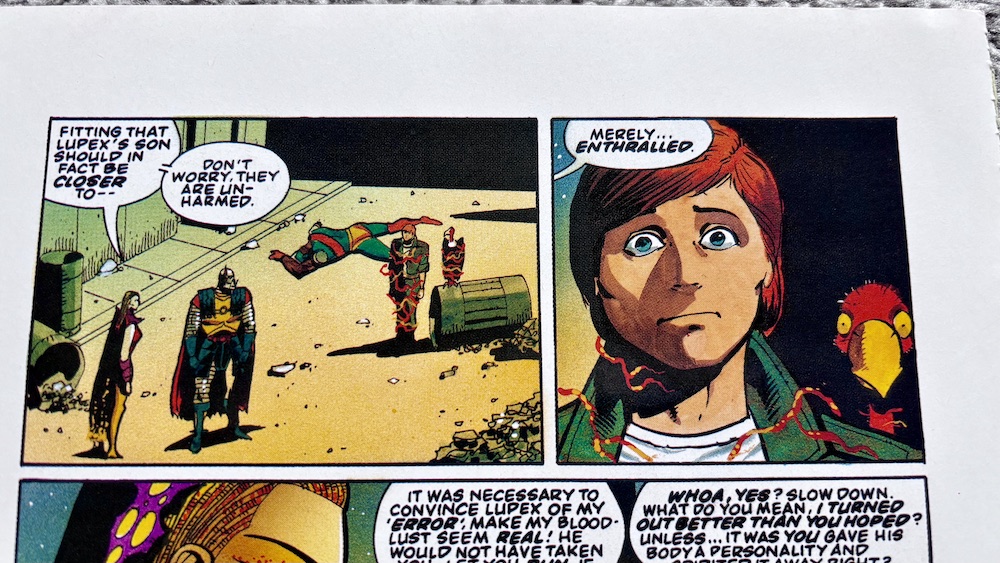
Even the vulture gets a funny moment alongside Spratt before Death’s Head gets to round everything off with his usual blasé attitude, despite the scale of the battle that’s just occurred. While I’m still in two minds over the retconning, the story told here is a fascinating one. If we hadn’t been told something different beforehand this would be faultless. In fact, it near enough is anyway!
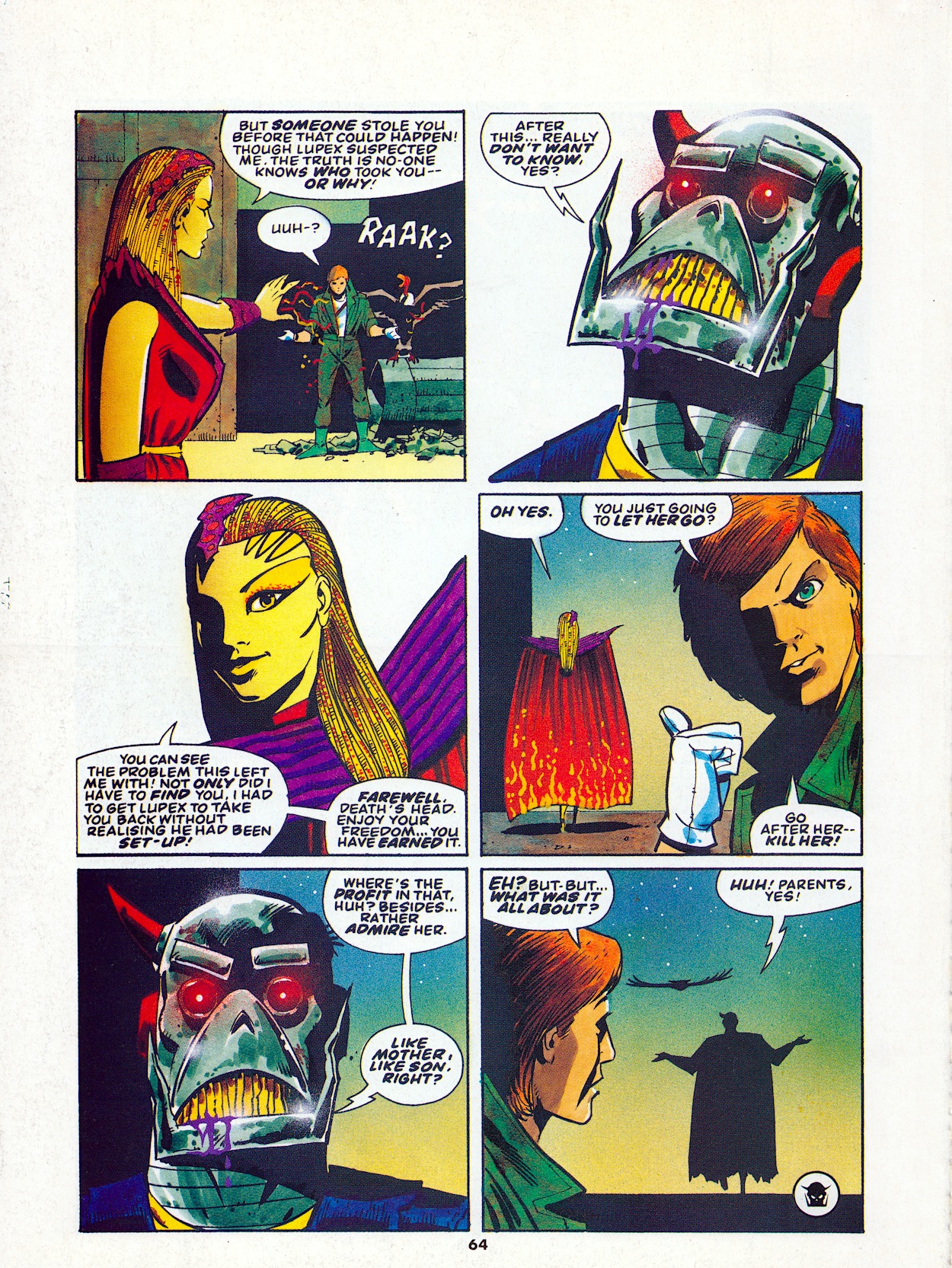
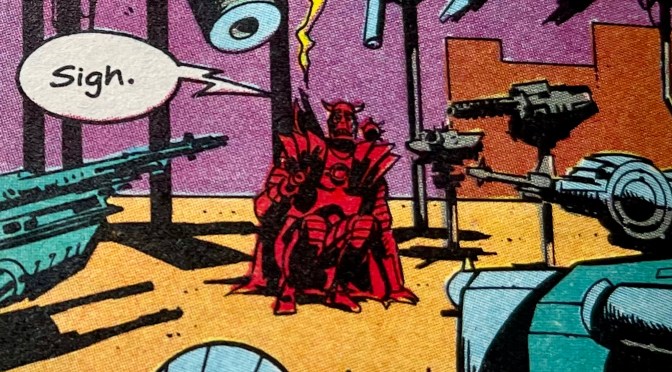
What a fantastic send off for one of my very favourite comics characters. Apparently this first incarnation of Death’s Head appeared in Marvel US’ Fantastic Four #338 so I might track that down some day as an extra for the blog, but in the meantime it’s a very, very fond farewell to the greatest Freelance Peacekeeping Agent any world, any time or any universe has ever seen. What an ending! Kudos to all involved.
BACK TO iSSUE TEN

DEATH’S HEAD MENU

DEATH’S HEAD #9: HEAD WiTH A HEART

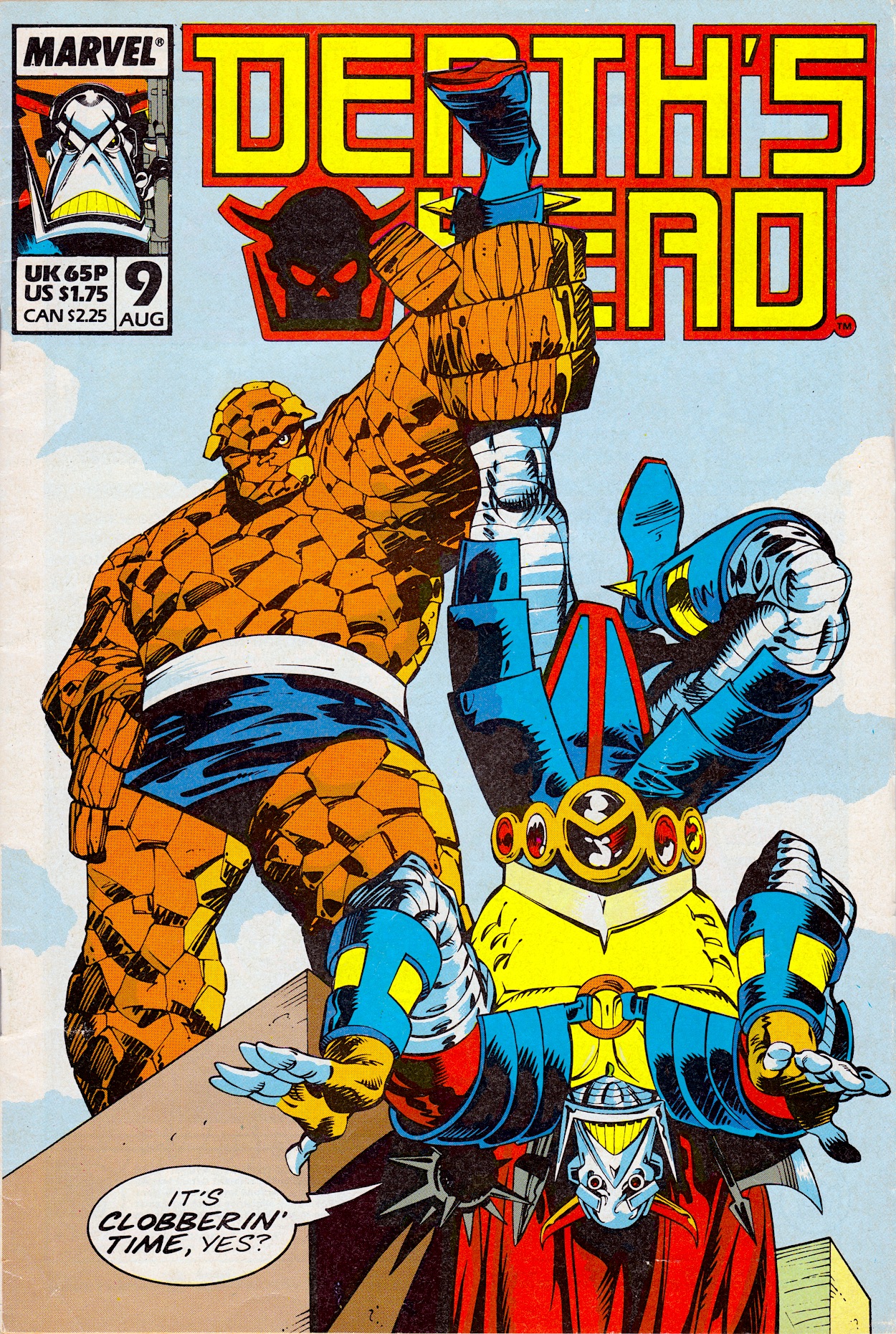
With a cover by none other than the legendary Walt Simonson (Thor, Star Slammers, Jurassic Park) and Mark Farmer, the penultimate issue of Death’s Head contains no official warning that the comic was about to come to an end. There’s a bit of a hint on the editorial page which has a ’Next Issue’ panel in place of the usual subscriptions offers, not that readers at the time would’ve picked up on this as they’d have been too excited at the prospect of our Freelance Peace-Keeping Agent meeting Iron Man next month.

After a price rise last issue we got another one this month too, by 5p again. I remember the second half of 1988 and into 1989 my comics always seemed to be increasing in price, such were the struggles of an industry at a time when readerships were declining in the face of competition from television and computer games while production costs were soaring. Death’s Head would become a casualty of these changes soon enough but let’s enjoy the issue at hand first.

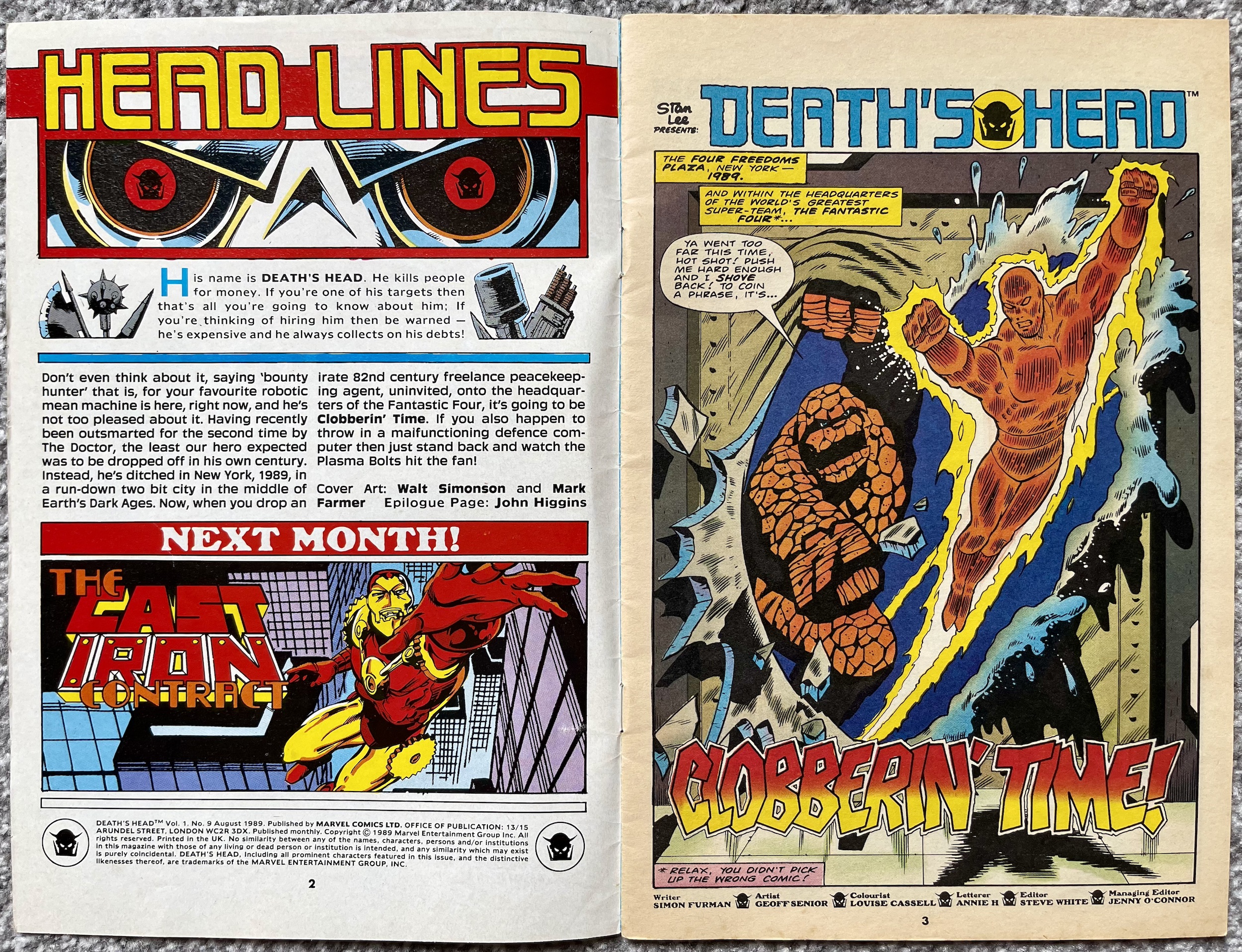
The editorial describes how last month The Doctor dropped off Death’s Head in the middle of Earth’s Dark Ages, which is actually 1989. Given writer Simon Furman‘s Dragon’s Claws took regular swipes at the 80s UK government (in the comic’s future vision of Britain) this could be more about accuracy than a quick joke. Simon is back after a month away from the comic and co-creator Geoff Senior finally makes a very welcome return as artist.

I didn’t even know the big rock guy
is the leader!

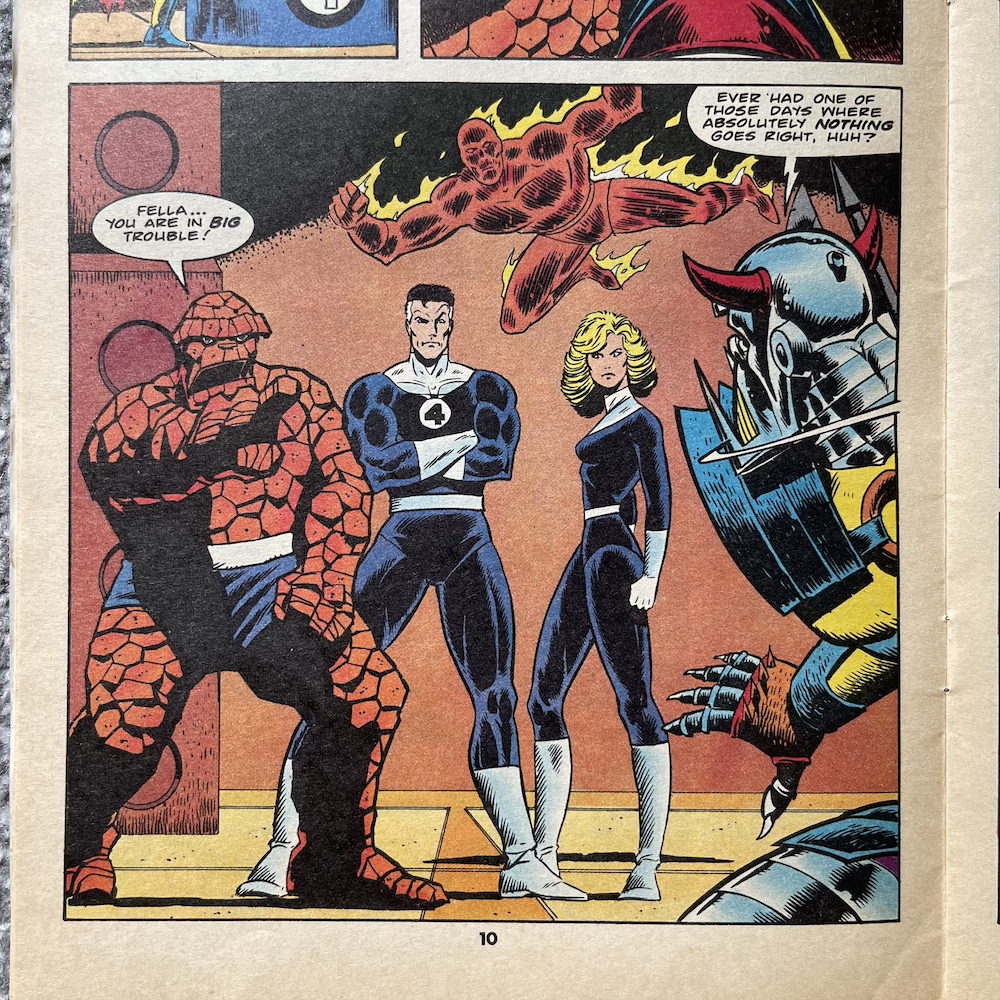
As you can see The Fantastic Four are the special guests this month. I’ll admit this is the first comic featuring them that I’ve ever read. I’ve never seen an issue of theirs and never saw the cartoons as a kid or any of the movies, so I really am going into this blind. I didn’t even know the big rock guy is the leader! It starts off very light-hearted with The Thing and The Human Torch bickering in a very superhero way.

Clobberin’ Time continues new editor Steve White’s brief time behind the wheel, with regulars Louise Cassell and Annie Halfacree on colours and letters respectively. That title soon becomes tiresome though. I understand it’s The Thing’s catchphrase but he uses it so frequently I feel like shouting, “Okay, okay, I get it, kids are meant to be copying him!” at the pages. Perhaps this is keeping within character but it’s just so annoying. What is good is the funny moment this sequence ends with, where it looks like they’ve made up.

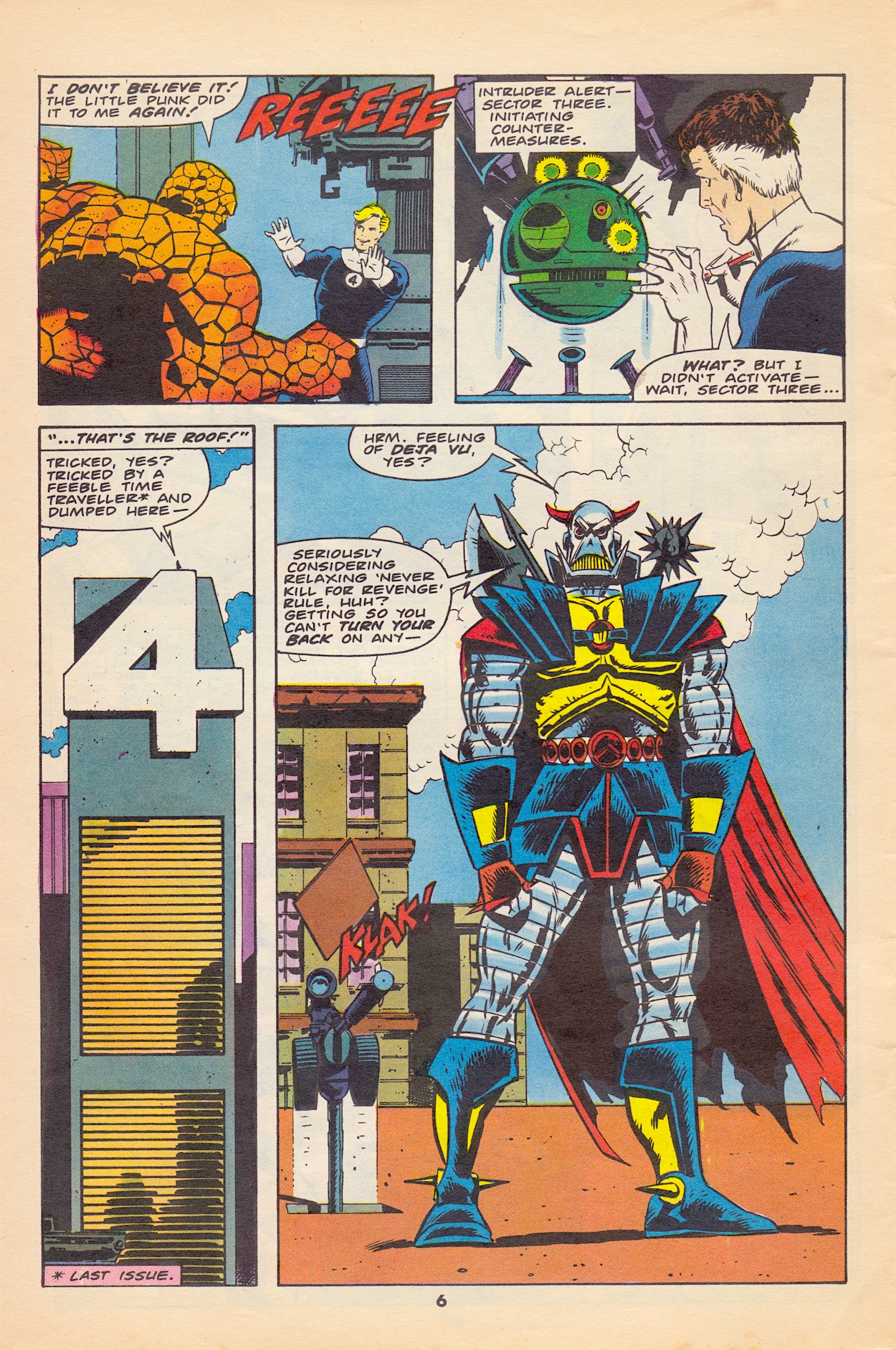
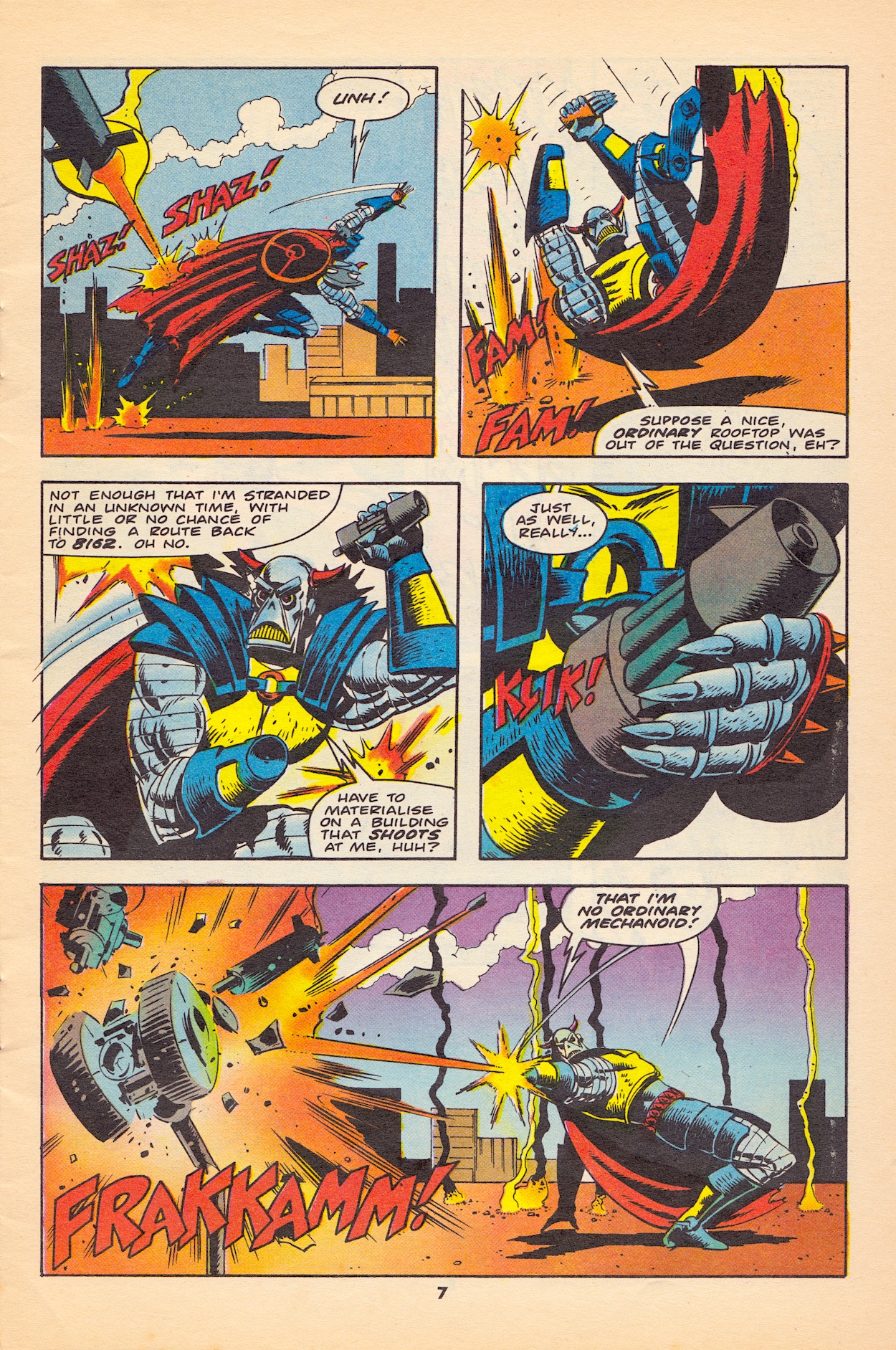
Meanwhile, up on the roof someone isn’t too happy at being dropped off in the wrong time again, much like how he ended up in 8162 in the first place, even if he did settle in there and made it his (lucrative) home. However, not only is he out of time he’s also in precisely the wrong place as The Fantastic Four’s security system automatically opens fire. I have to say for the good guys their security system is very much shoot-first-and-ask-questions-later. Although it does lead to a laugh or two thanks to Death’s Head quips and his long-running bad luck.

Their building is a bit naff though, as huge holes are blasted open and its roof is destroyed as the automated weapons try and fail to take down Death’s Head. You’d think their HQ’s walls would be a bit more secure, that they’d stand up to their own security. But it’s all a bit of daft fun so we’ll not get caught up in the details (this isn’t Twitter). Using his rocket boots to fly through one of the aforementioned roof holes he finds himself in what could be described as their garage, full of hi-tech gadgets and transport.

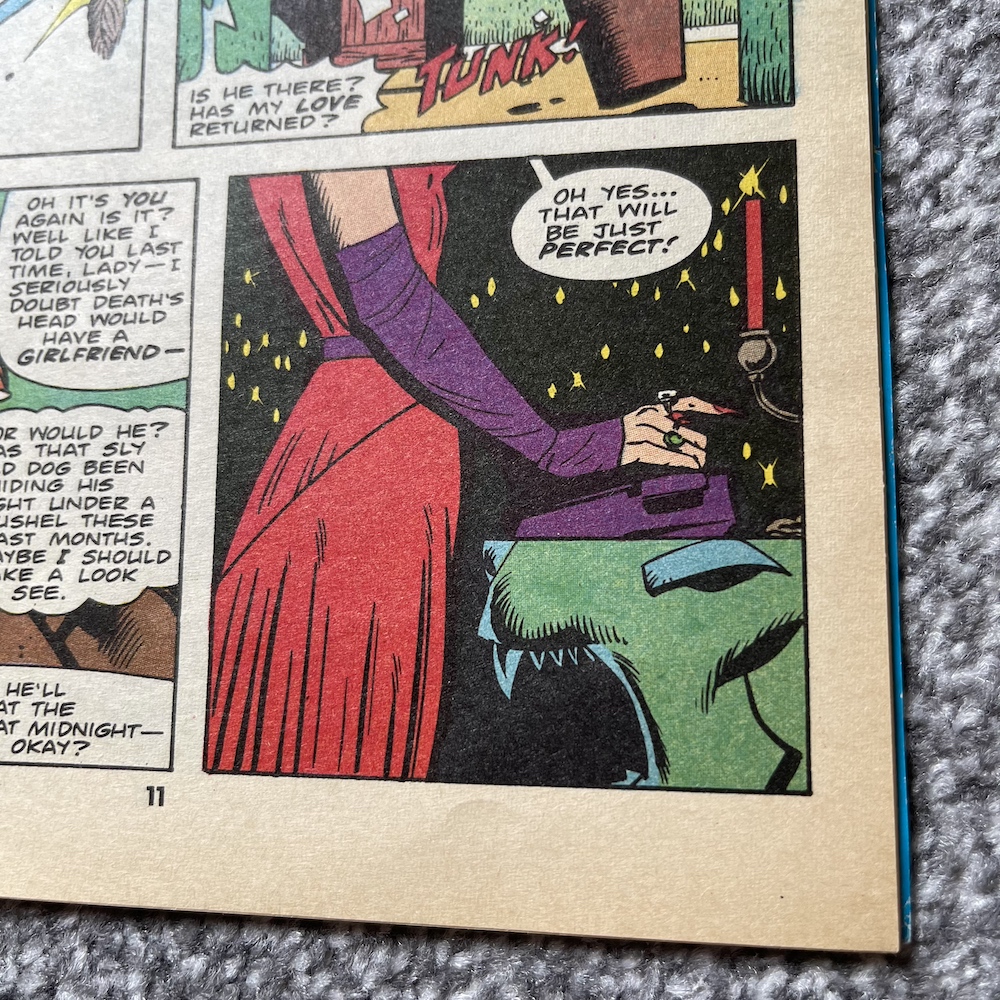
Convinced this level of tech on 1980s Earth could mean they’d have access to a time machine, Death’s Head thinks aloud, “Just hope they’re nice, sane, normal people…” when he gets a rock hard tap on the shoulder. Meanwhile, back in the Los Angeles of 8162 Spratt is still fighting with their pet vulture (see #5) and takes another phone call from the mysterious woman in previous issues who’s been proclaiming she’s his business partner’s love. This time we also see part of her attire.

I’m still none the wiser although I’m assuming she must be a known character, given how she’s slowly being introduced. The Evil Dead’s Death Nell? If you remember the identity of the caller please don’t tell me in a comment or on socials; no spoilers! Hopefully I’ll find out in our final issue. As for this special crossover event it boils down to The Fantastic Four’s not-so-fantastic security program going rogue and dispatching a hovering droid to see off everyone.

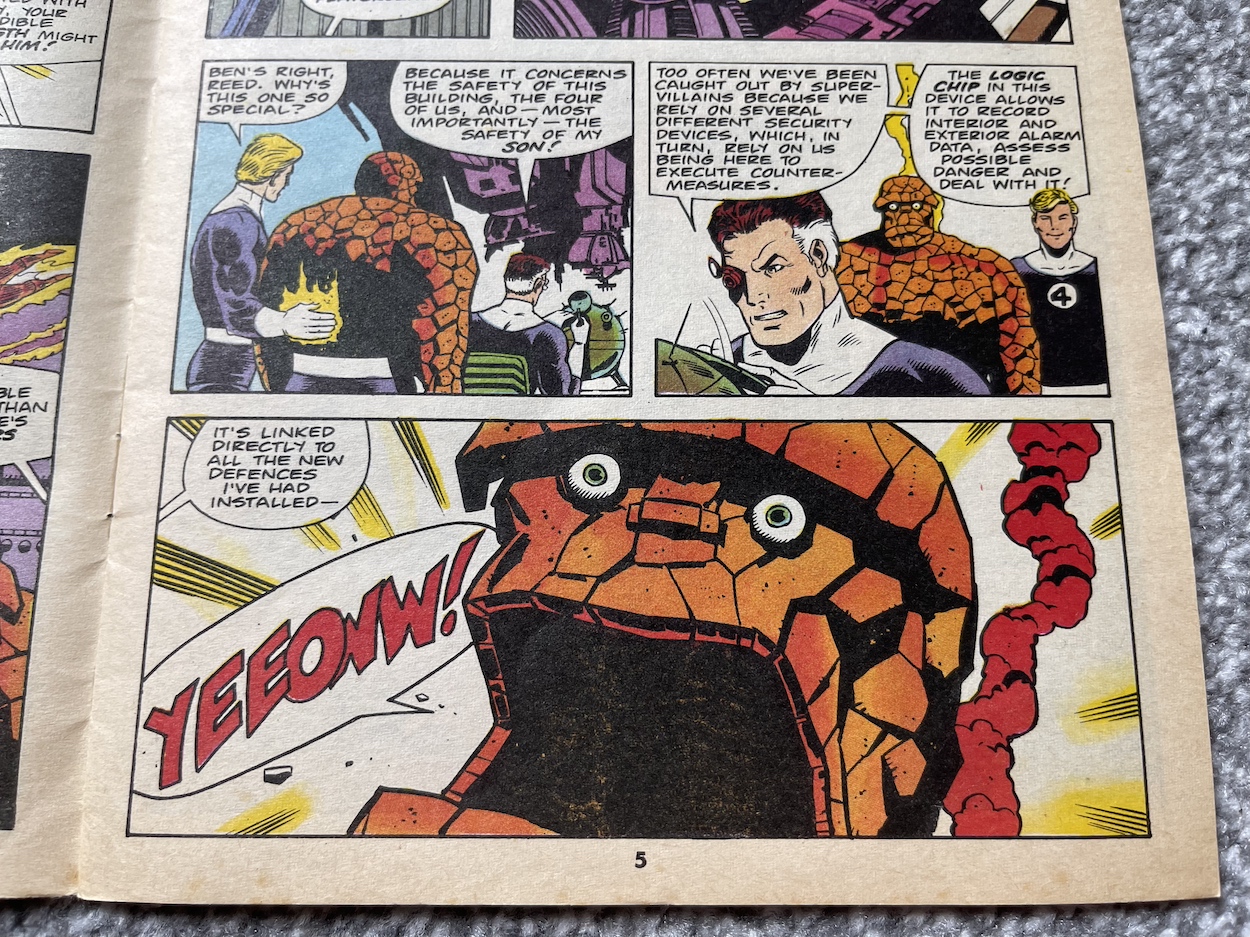
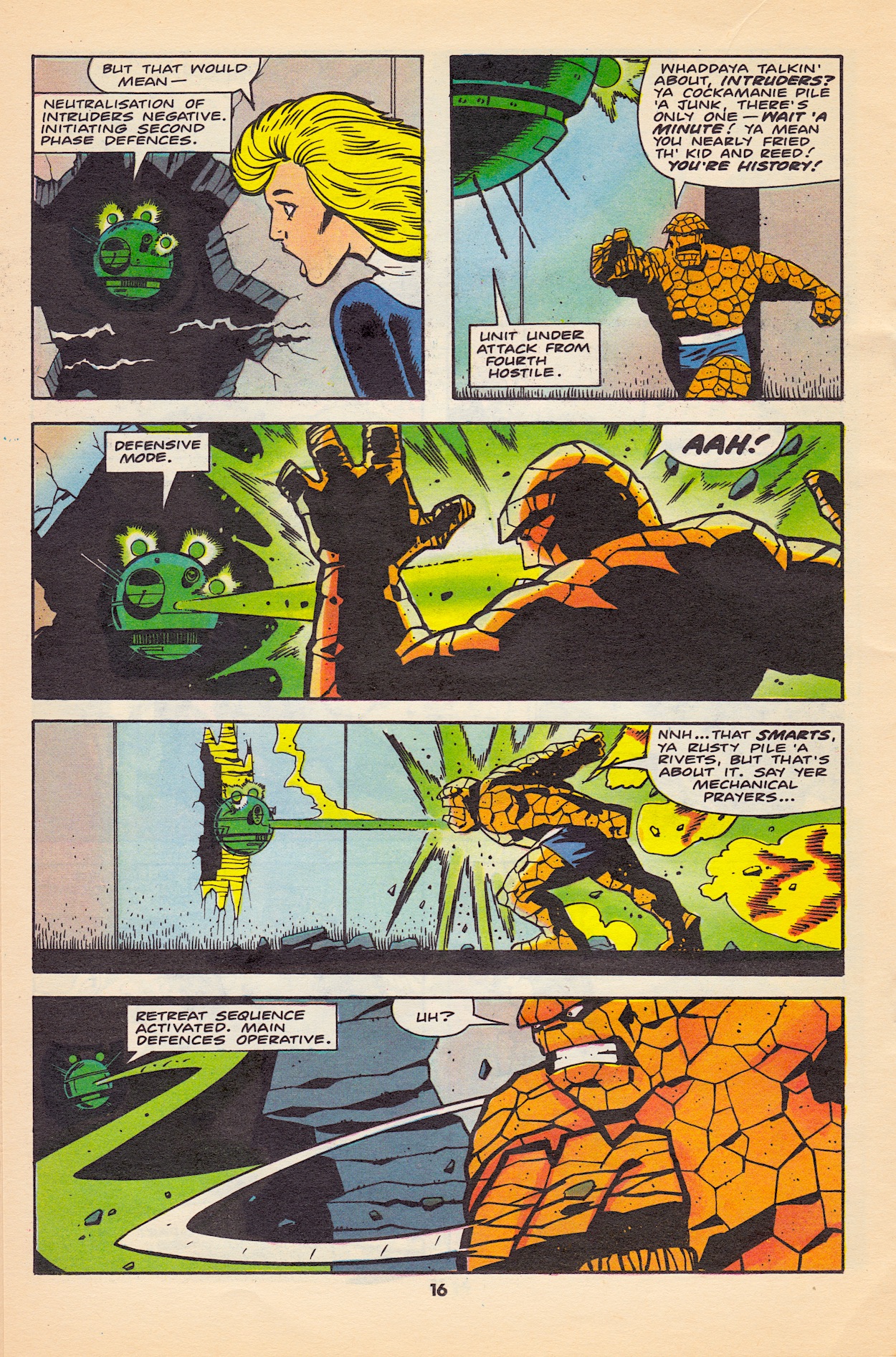
At the beginning of the issue Reed Richards is working on one of the computer chips powering it and he was interrupted by the infighting, inadvertently making a mistake and corrupting the programming. At least this is the suggestion that’s thrown out by Reed, it’s never actually confirmed. With their bickering and the over-zealous zapping at Death’s Head having destroyed a lot of the building, it goes into full defensive mode.

During a protracted fight between the team and their new visitor it becomes clear that Death’s Head’s supposed fighting back is a case of mistaken identity. It was actually the computer attacking them but they were too busy assuming it was Death’s Head that they didn’t see the obvious. Between these reactions and the way their system was programmed I don’t have much faith in this superhero if my first impressions are anything to go by.

Eventually they calm down and think rationally, realising they need to team up with this comic’s lead character when Reed and The Invisible Woman’s child is put in danger. With Death’s Head being a mechanoid and able to hack the system that’s trying to kill them, soon it comes down to our ruthless hunter of bounties (I didn’t say it), a paid assassin, a mech programmed for self-preservation, to rescue a child.

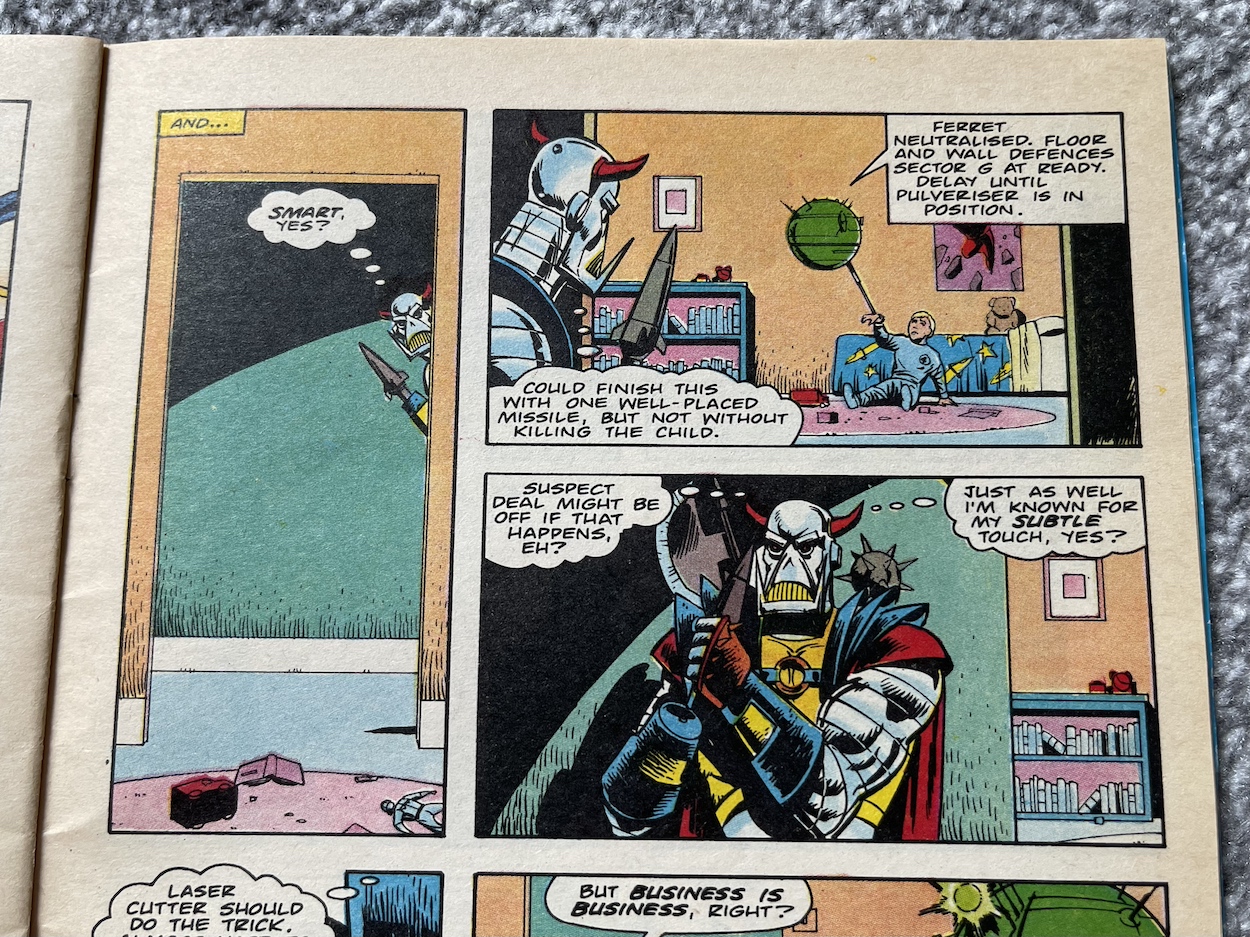
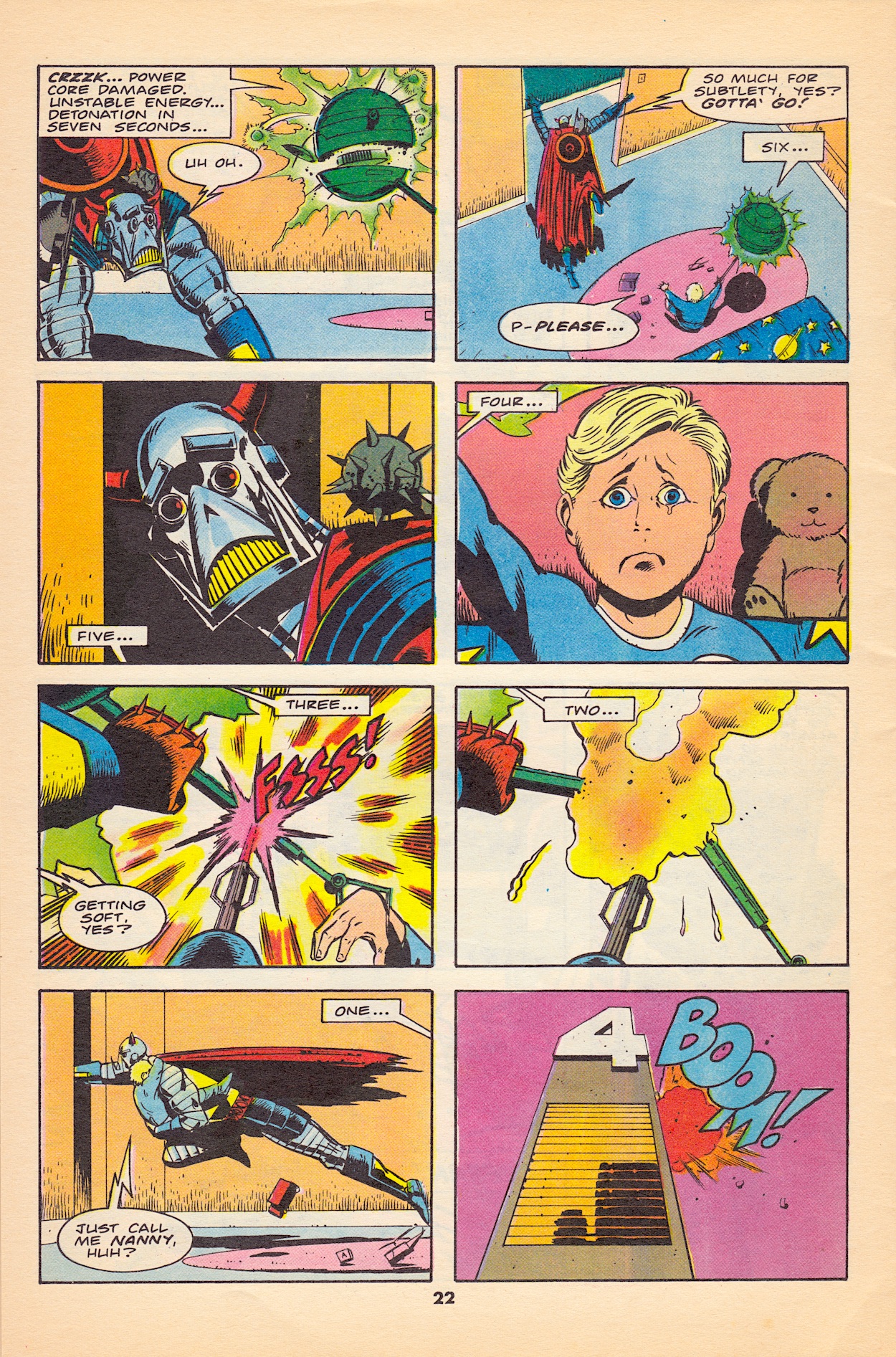
The droid has handcuffed itself to the young boy in his bedroom, coldly using him as a bargaining chip. Now, our anti-hero isn’t exactly known for being subtle. Clicking a laser cutter onto his arm to snap the connection to the boy he leaps into the room and actually ends up damaging the droid and setting off its self-destruct! For a brief moment we see the Death’s Head we’d expect to see if this were any adult human, but it appears there’s a glimmer of a soul behind the facade.

That third image says it all and with the constant countdown you can feel the palpable sense of desperation in that penultimate panel. Superb, exciting stuff that Geoff’s penmanship is just perfect for. This may be the printed page but somehow he’s always able to make his art feel so animated when the script calls for it. After the umpteen pages of fighting earlier in the comic, after the build up in the story prior to this, this is single-handedly the most dramatic and exciting moment.

The panic it sets off is key to what’s next,
the story for our final issue

Yes, Death’s Head had to save the kid in order to gain access to their time machine but you can tell that’s not the reason he put his own life at risk. Ultimately though, this brave and heroic moment earns him the trust of The Fantastic Four and they set up their machine to take him back to 8162, a device that transports him in a green bar of energy from the feet up.

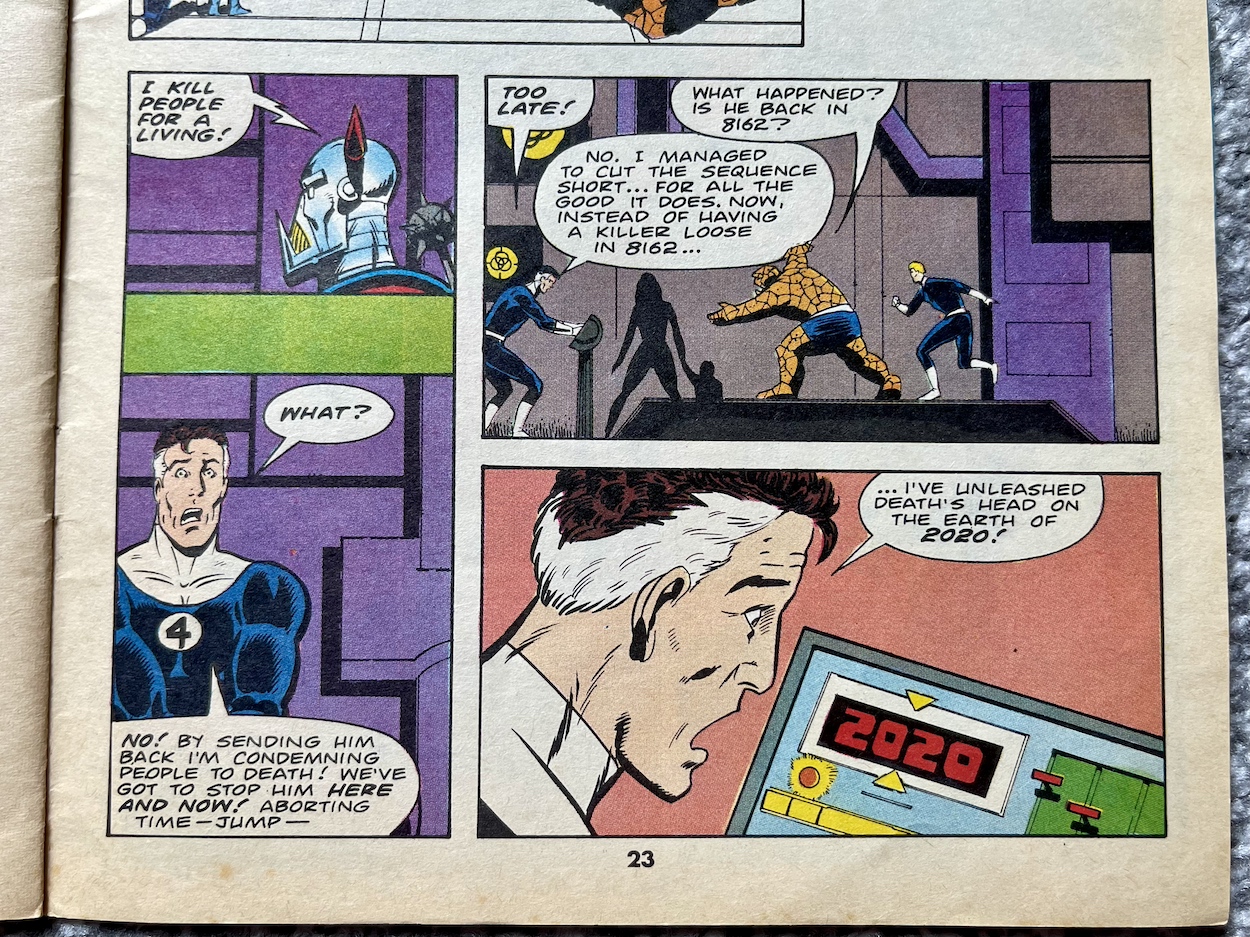
As he disappears, The Thing tells him that he had him all wrong, that the mech must be “what passes as a superhero in 8162”, to which Death’s Head tells him no, he was right all along. He then finally introduces himself by name and tells them what he does for a living…

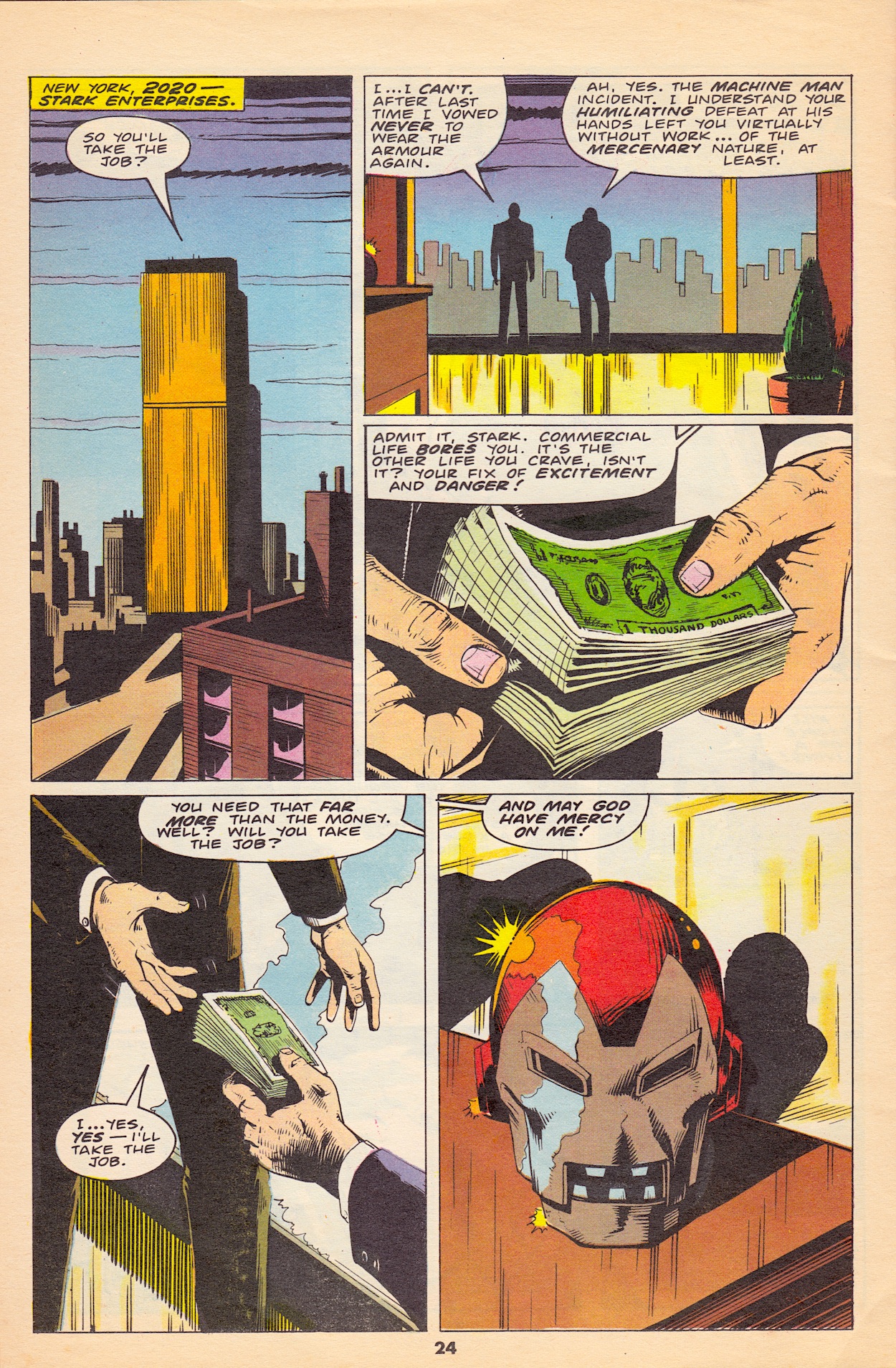
This was a suitably funny final line for the character and the panic it sets off is key to what’s next, the story for our final issue. Back in the earlier days of reading Marvel UK’s Transformers for the blog’s Instagram the Machine Man of 2020 back up strip introduced a future-version of a certain main character in the publisher’s lineup. The hero’s identity had been completely taken over by another person. In the year 2020 Iron Man was no longer Tony Stark, he was Arno Stark.

No longer a hero, the Iron Man of 2020 was a mercenary-for-hire (which should make things interesting next month) and after being defeated by Machine Man he reappeared in a Spider-Man comic (also published in Transformers) when his family were held hostage by a killer and he had to travel back in time for the story’s resolution. The story ended in disaster, with Arno losing and seeing his city of the then-far future destroyed. His next appearance after that was in #10 of Death’s Head.

I knew Iron Man was to be the special guest star in the final issue but I had no idea it was this version and I’m super excited to see what happens. I really loved his two stories in Transformers. He was clearly the bad guy in his first appearance and for all intents and purposes was exactly the same when he returned. He was forced into a position of doing the right thing but in doing so went up against an actual hero, so young readers’ loyalties were tested. It made for fascinating reading.

I’m hoping for more of that kind of storytelling in Death’s Head next month. The pieces are certainly in place for an explosive finale and a suitably powerful send off for what has been a brilliant comic series. If it’s as good as it has been so far, and as good as those Iron Man of 2020 appearances were, then it’ll certainly take the edge off having to say goodbye. The final contract is on Monday 5th August 2024, right here.

iSSUE EiGHT < > iSSUE TEN

DEATH’S HEAD MENU

THE LOST WORLD JURASSiC PARK #4: THE END?

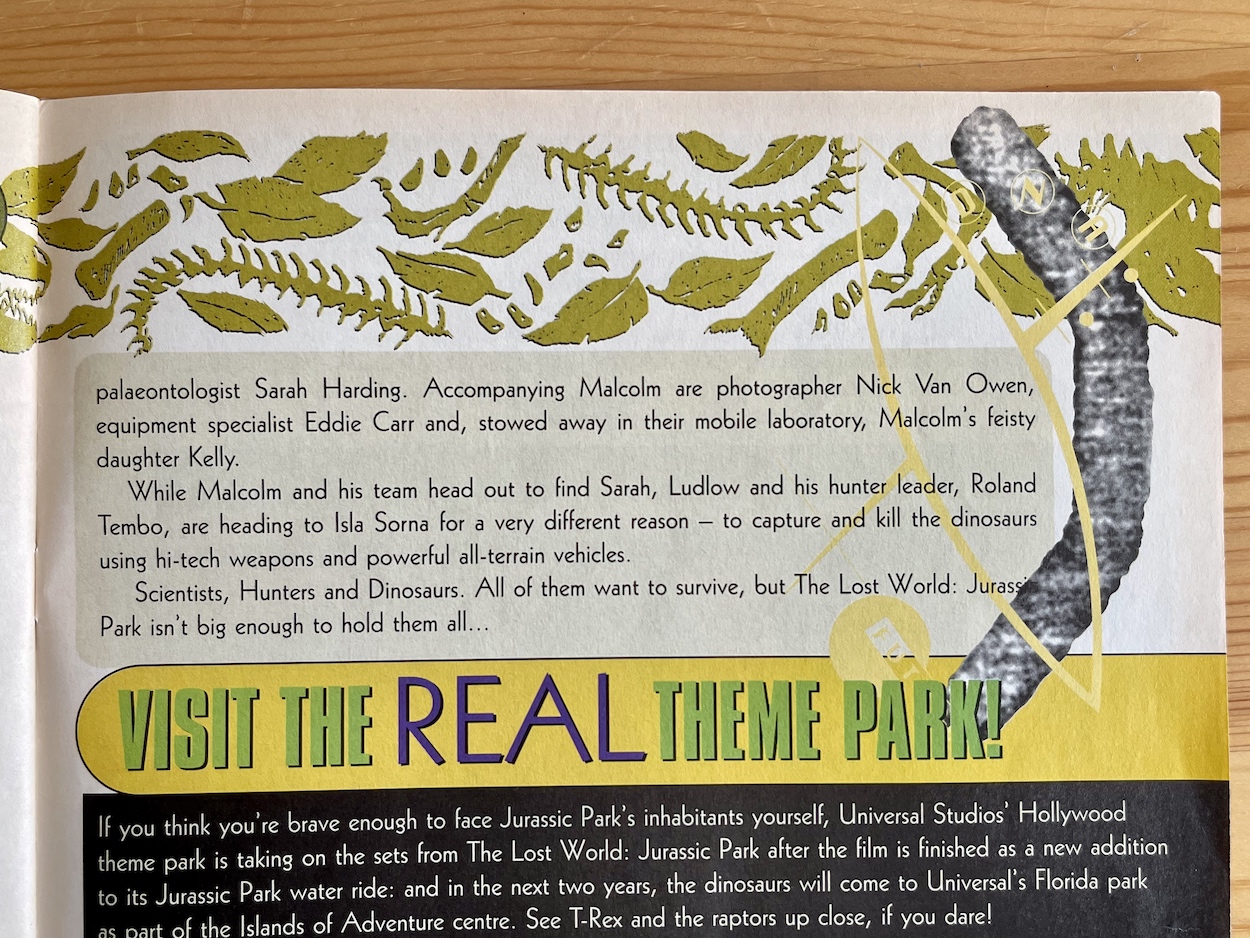
Well here we are at the final issue already of Titan Magazine’s The Lost World Jurassic Park comic. In the States, just as with the original movie, Topps Comics released its adaptation as a four-part mini-series. When the original adaptation proved popular further stories were told as the first official sequel to the film, however in 1997 no further adventures after the sequel movie were forthcoming. In the UK, instead of simply having a one-off special consisting of all four chapters as had happened with other adaptations at the time Titan decided to also do a mini-series, with exclusive extras for UK readers of course.

Unfortunately #2 remains the only issue to feature one of the gorgeous animatronic animals from the movie on the front but I do like this final cover by original adaptation writer Walter Simonson and Richard Ory, complete with an exceptionally cute little baby Tyrannosaurus rex. It also gets across the exciting moment from the movie a lot better than the strip. Inside we go and we kick things off with our heroes arriving at the workers’ village in a suitably eerie scene.

Once again the narration sets the scene, most likely taken directly from the script and unlike in previous issues it doesn’t feel like it’s trying too hard, writer Don McGregor’s captions perfectly balanced with the more subdued art on these first pages from penciller Jeff Butler, inker Armando Gil, colourist (and editor) Renée Witterstaetter, alongside the lettering by Ken Lopez. Even the lack of detail in the buildings adds a feeling of things being shrouded in mystery and shadows, capturing the feeling of this moment in the movie really well.

Nick Van Owen arrives alongside the rest of the characters, Ian Malcom, Sarah Harding and Ian’s daughter Kelly and I’m fine with this change, it helps get the same story beats across in a shorter time frame, one of the better decisions made in this adaptation. Then on the very next page my hopes for a better comic book climax than the original movie received are dashed when another brilliant part of the movie is hacked down to an unrecognisable state.

So much happens here in the movie and it’s all just excised including, yet again, anything to do with Vanessa Lee Chester’s character, Kelly. In the original film’s comic adaptation Samuel L Jackson’s Ray Arnold suddenly disappeared without explanation. Now we also have this movie’s sole black character unceremoniously edited out of all of their scenes.

There’s an overall feeling of this chapter being rushed

Yes, Ian’s moments being chased around here are nowhere to be seen but at least he’s still front and centre elsewhere, whereas Kelly is basically ignored throughout all the chapters, and to have her most important moment not even referred to is criminal. I’m also personally unhappy they removed the moment that in the cinema made me jump out of my seat, which in turn made my friend jump, which in turn made me jump again! (The bit with the ‘raptor under the wooden wall.) But hey, that’s just me.

Almost as annoying as all of this is the fact Roland Tempo is somehow still alive and well without a single scratch just like in the film, even though we blatantly saw him get killed off two weeks ago, something I was happy the movie didn’t do. Did Don forget this had happened in his version? There’s an overall feeling of this chapter being rushed and the art suffers just as much as the script. There’s an overall lack of detail and finesse throughout. Here are some key examples.

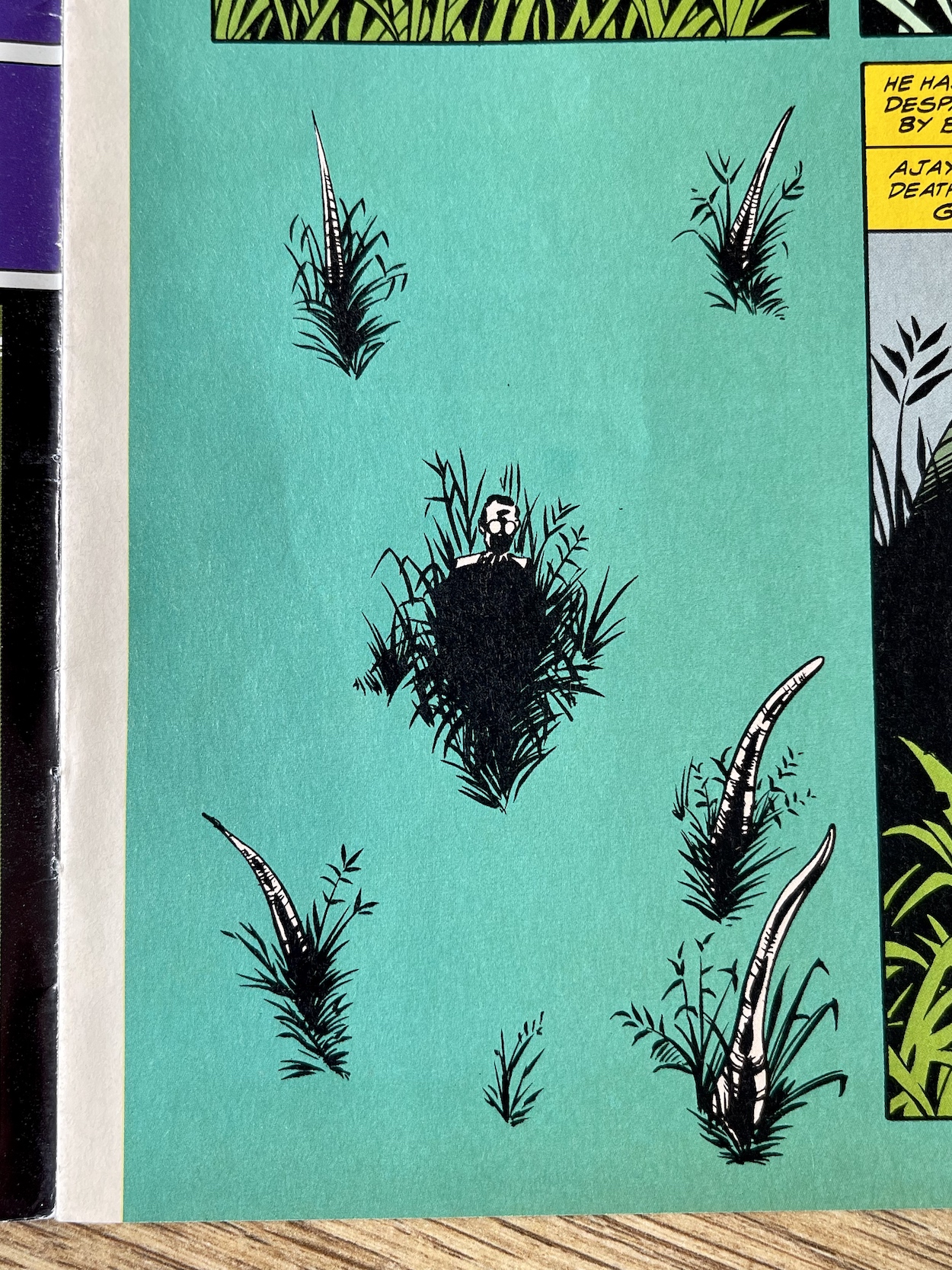
That scene of the Velociraptors in the long grass would make no sense if you hadn’t seen the film, characters no longer look like their onscreen counterparts and the gloriously detailed dinosaurs from the first couple of chapters give way to cartoonish monsters. The final chapter of Jurassic Park’s adaptation suffered the same fate and it would seem no one learned any lessons from it in the three years since.

I know I’m coming across as very negative and usually I only include comics on the blog that I enjoy; I like to keep this as a positive reading experience. The original Jurassic Park comic was awesome, I loved it and it holds a special place in my heart. It’s the whole reason there’s a section for JP on the blog in the first place. This mini-series is very much an extra aside to that, I don’t think I would’ve included this on its own. It’s a crying shame because I love the movie so much.

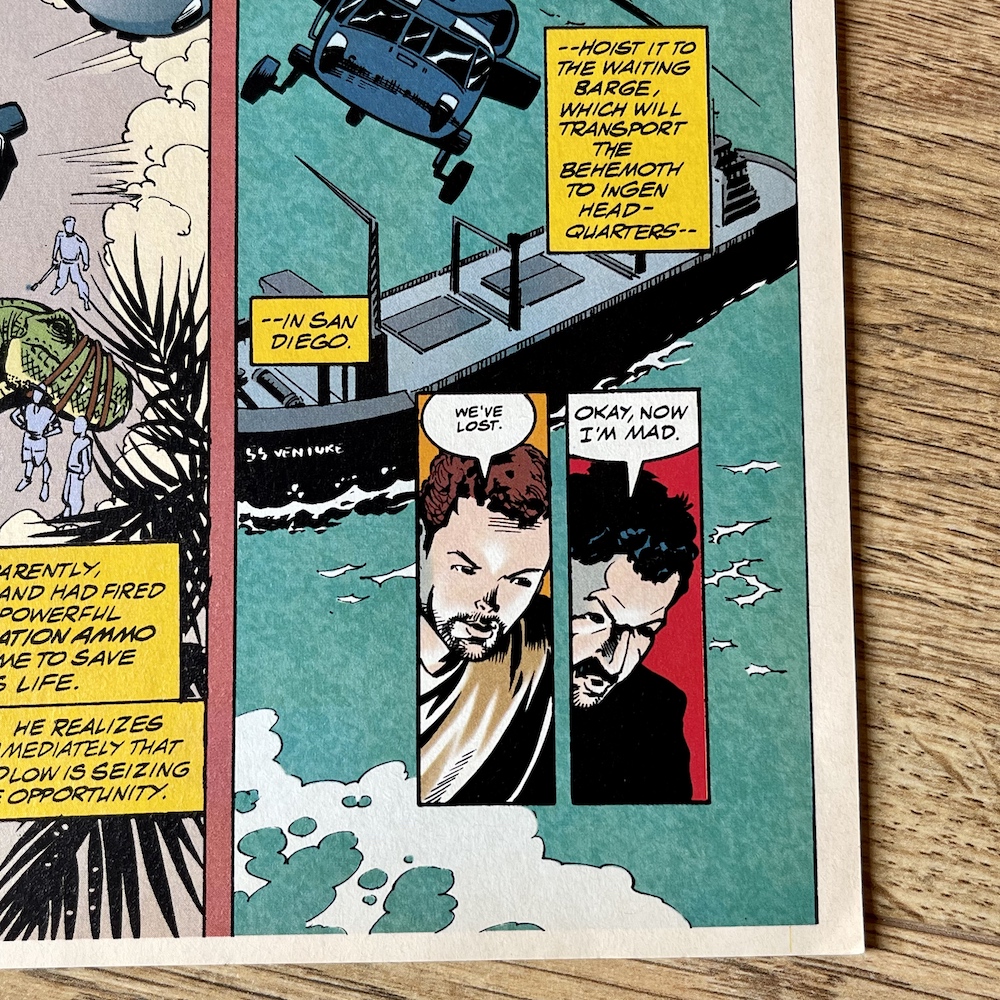
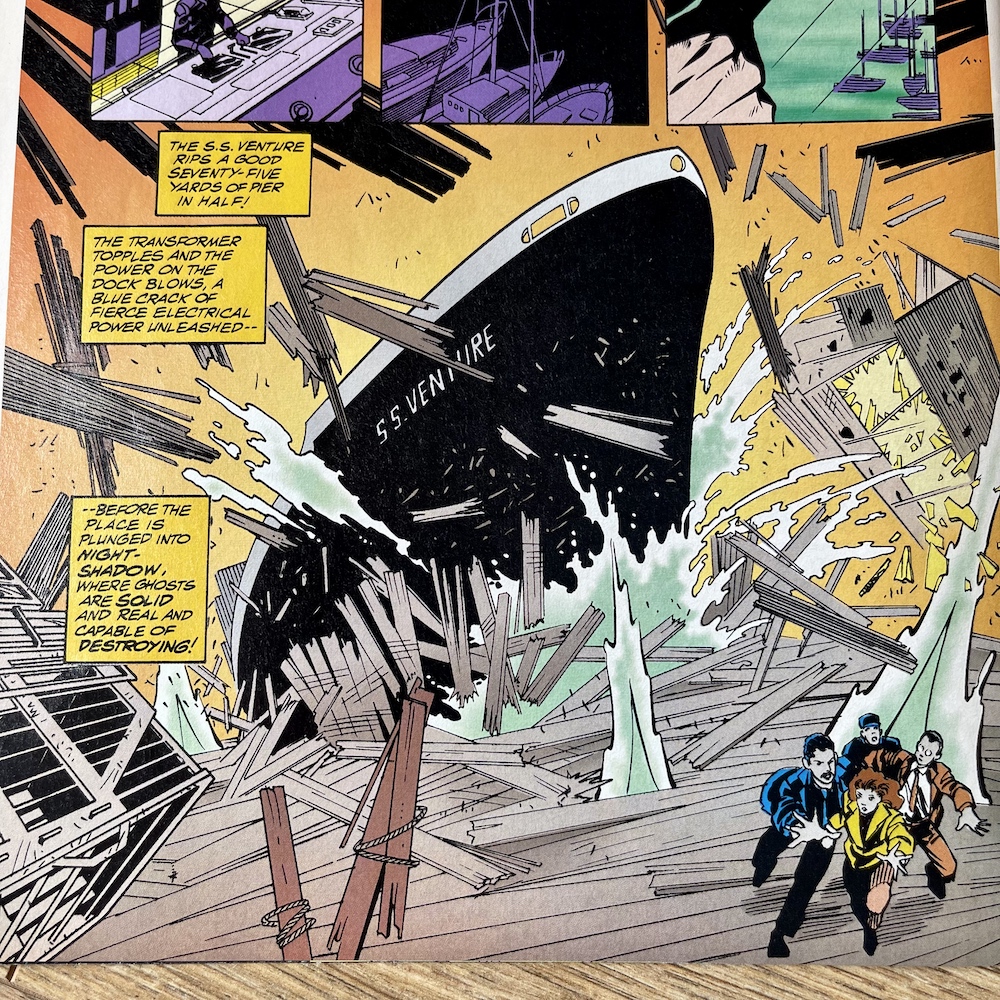
Towards the end of the story 11 pages are given over to the San Diego scenes, albeit a bare bones version of them. The panel above of the S.S. Venture crashing into the docks is about as detailed a panel as you’ll find in this final chunk of story. You wouldn’t even know any of this was taking place in a city because the backgrounds just don’t exist beyond one panel. Other than there being a sporty car involved this could all be happening back on Isla Sorna.

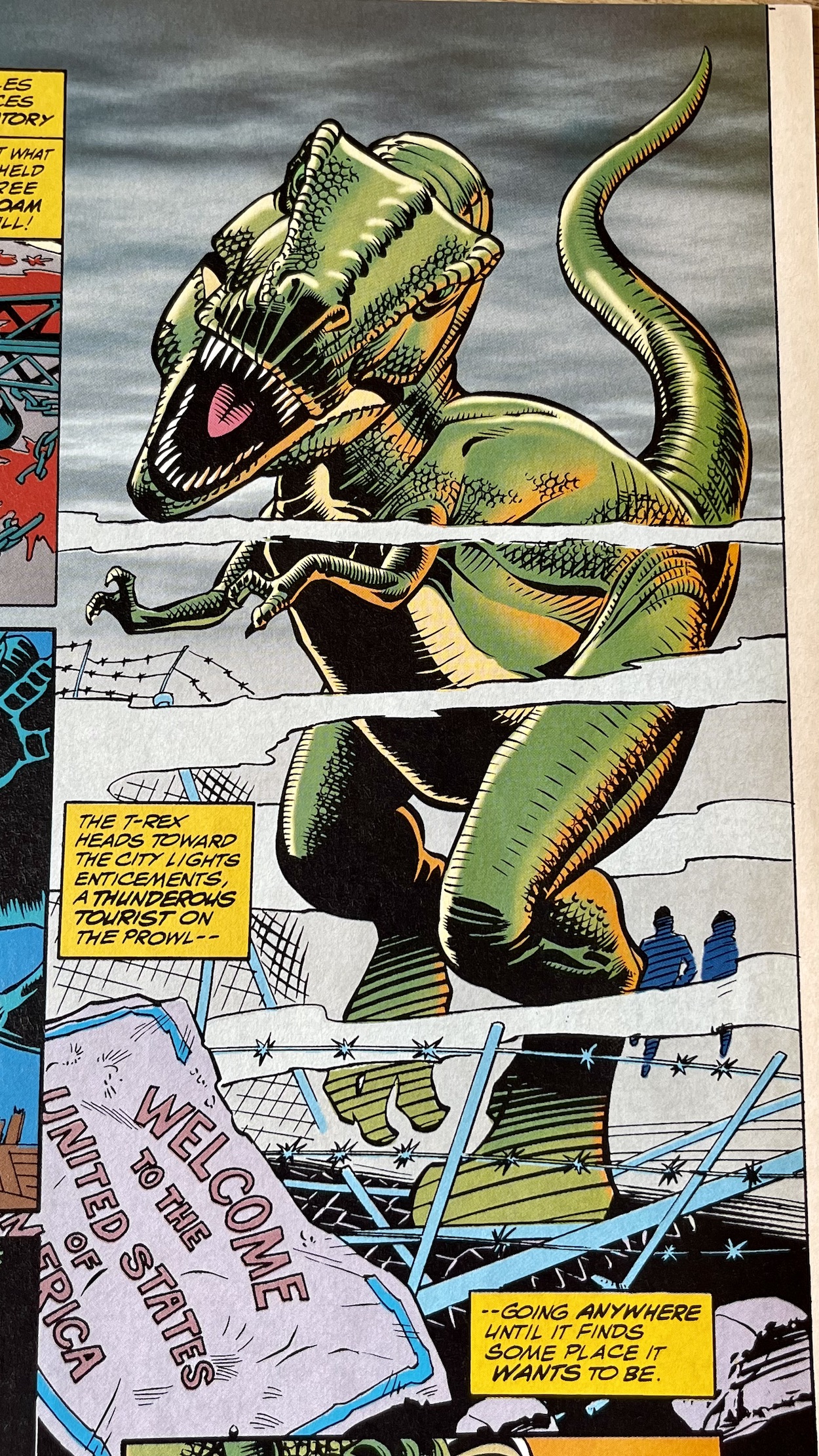
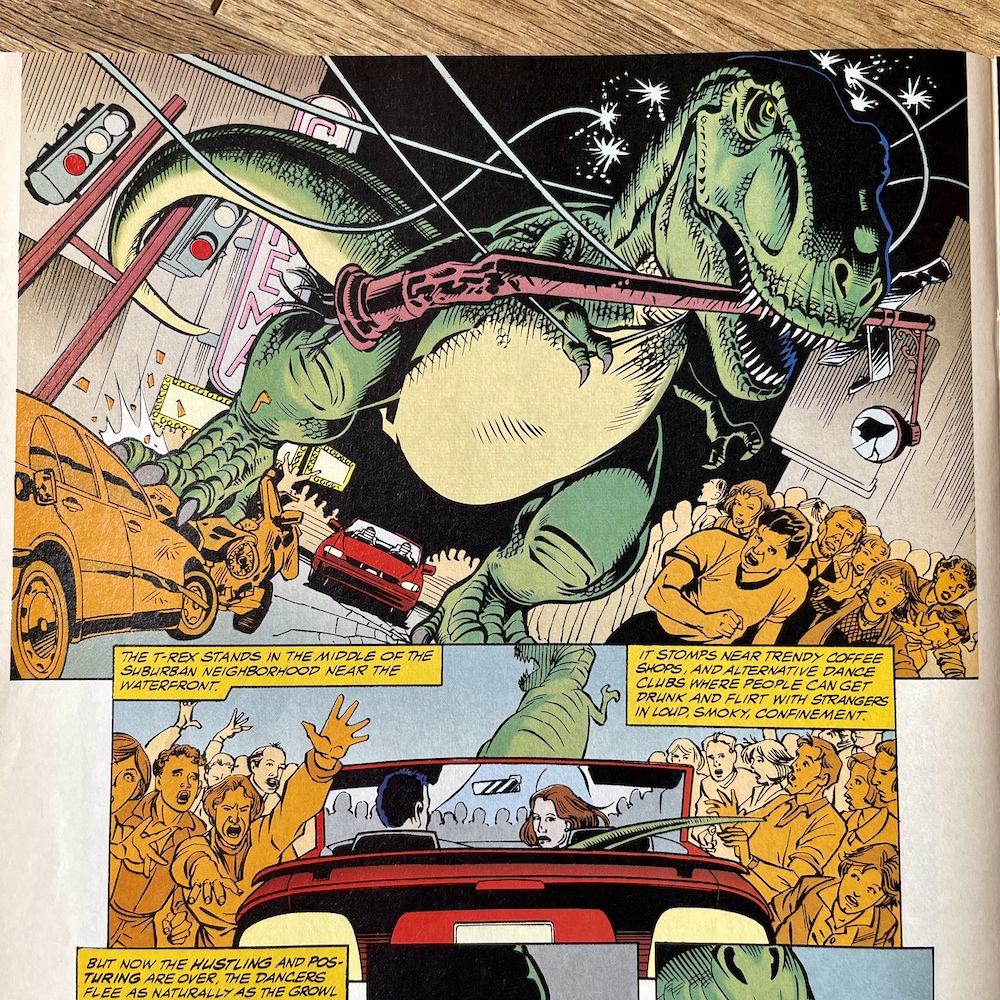
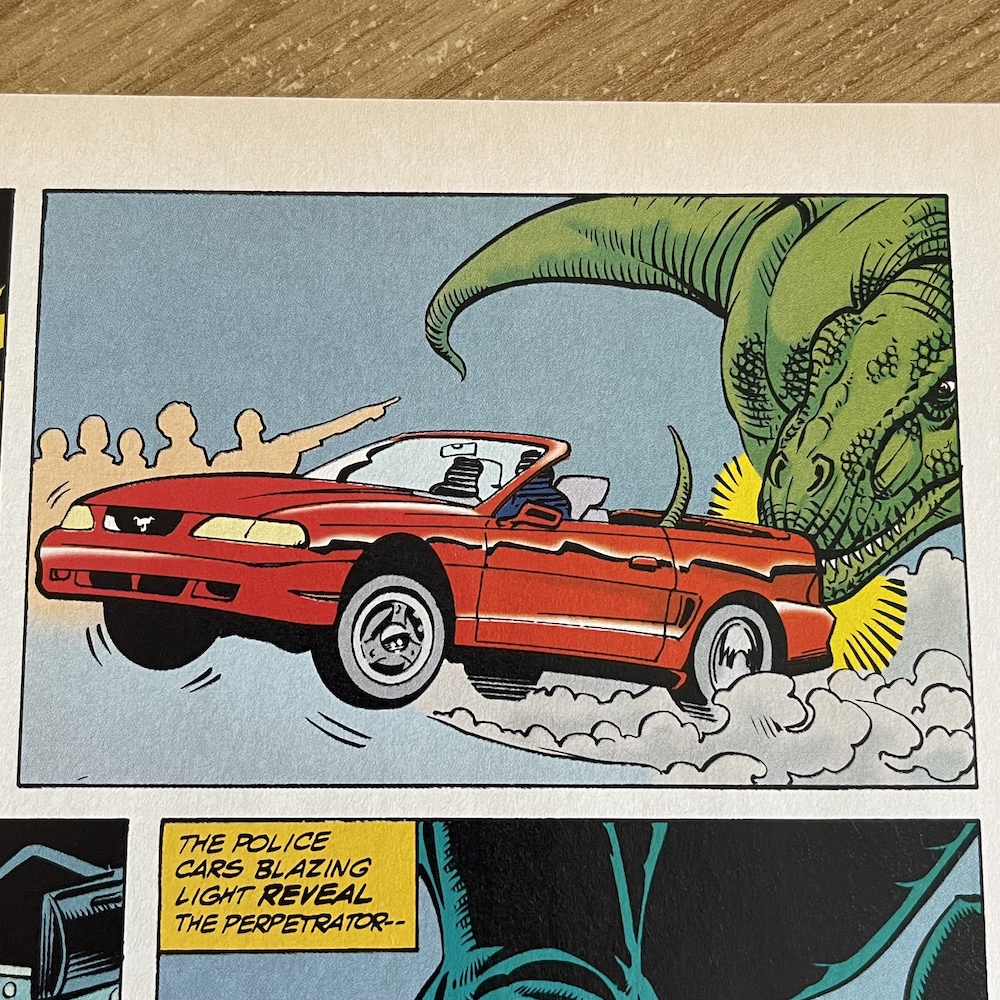
Below you’ll see the one and only panel that shows some hurriedly drawn buildings and the word “cinema” visible behind the T-rex’s tail. Next to it is a panel I’ll use to sum up these eleven pages. Look at the panel with the car. There are no backgrounds, not even a road! Storywise, we get the ‘rex leaving the ship, discovering Ian and Sarah have his baby, then we’re back at the dock. That’s it.

Thinking back to when I first saw this film in the theatre, the moment we saw the InGen helicopter and the camera panned down to show it was flying over a city was a real shock to the system. It was so unexpected from a Jurassic Park film (I hadn’t watched any trailers before seeing it) and as surprise endings go it’s right up there for me. There was so much to enjoy about it which is why its treatment here is so underwhelming.


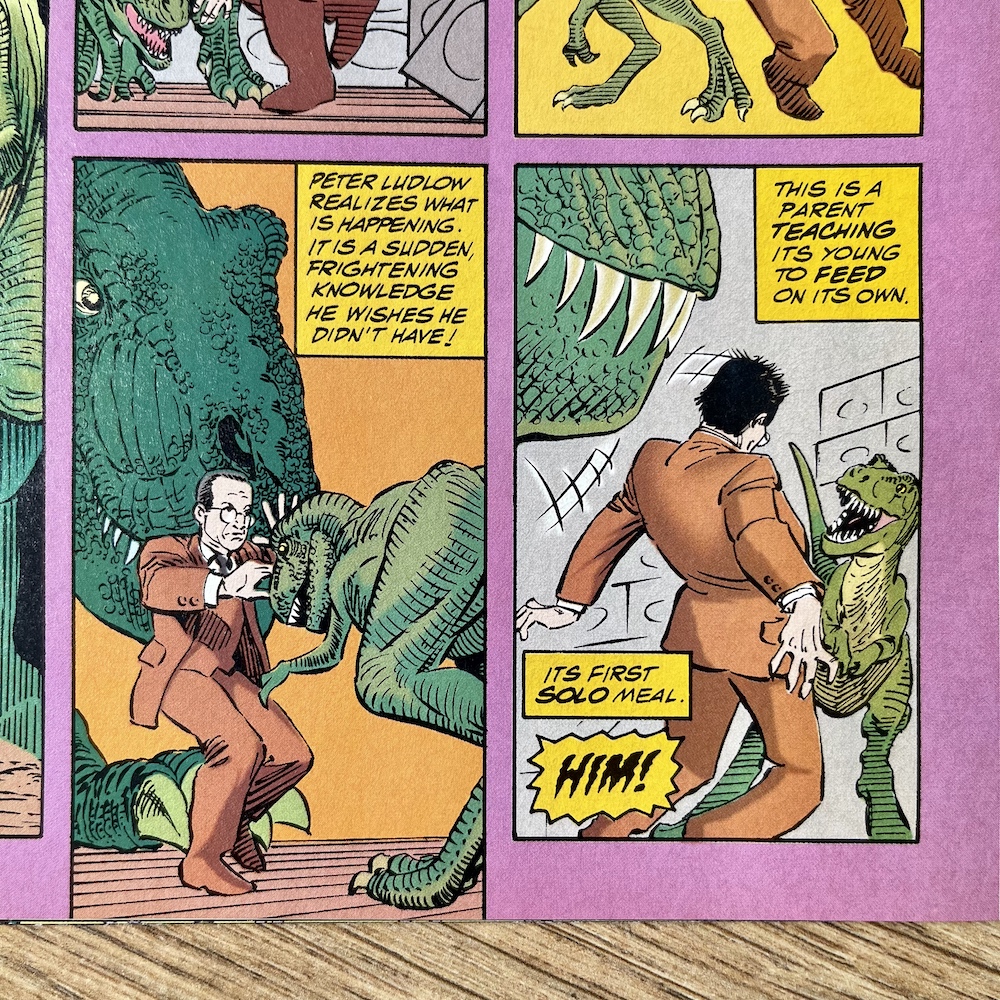
“This is a parent teaching its young to feed on its own”

Narrative caption, Don McGregor

Surprisingly Peter Ludlow’s final scene gets three pages to play out fully. One of the most satisfying endings for a villain character, it pretty much happens as it does in the movie, even if the backgrounds are still conspicuously absent. To anyone unfamiliar, this is back on the boat now, Ian and Sarah having lured the adult back into the cargo hold by placing the baby there and then jumping overboard themselves, before climbing back on from the other side of the ship, ready to close the bay doors when the T-rex enters.

From Ian and Kelly to the adult and baby Tyrannosaurs, the theme of The Lost World Jurassic Park movie was one of family and parental instincts. Sarah is even an expert on archeological parental behaviours just to hammer the point home. Personally, more than any other film in the series this one showed the dinosaurs as complex characters in their own right, a far cry from how they’d been described before this franchise. But anyway, Ludlow is about to get eaten.

I’m glad this moment wasn’t cut because it shows the adult teaching the baby and it’s a particularly chilling moment in the film, even if it elicits a dark grin from the audience. Given how much has been left out these past two months it might seem like an odd moment for anyone reading who hadn’t seen the film and all of its moments between the Tyrannosaur family members, but for those reading this as a way of filling the gap before the home video release it would bring back memories of that scene really well.

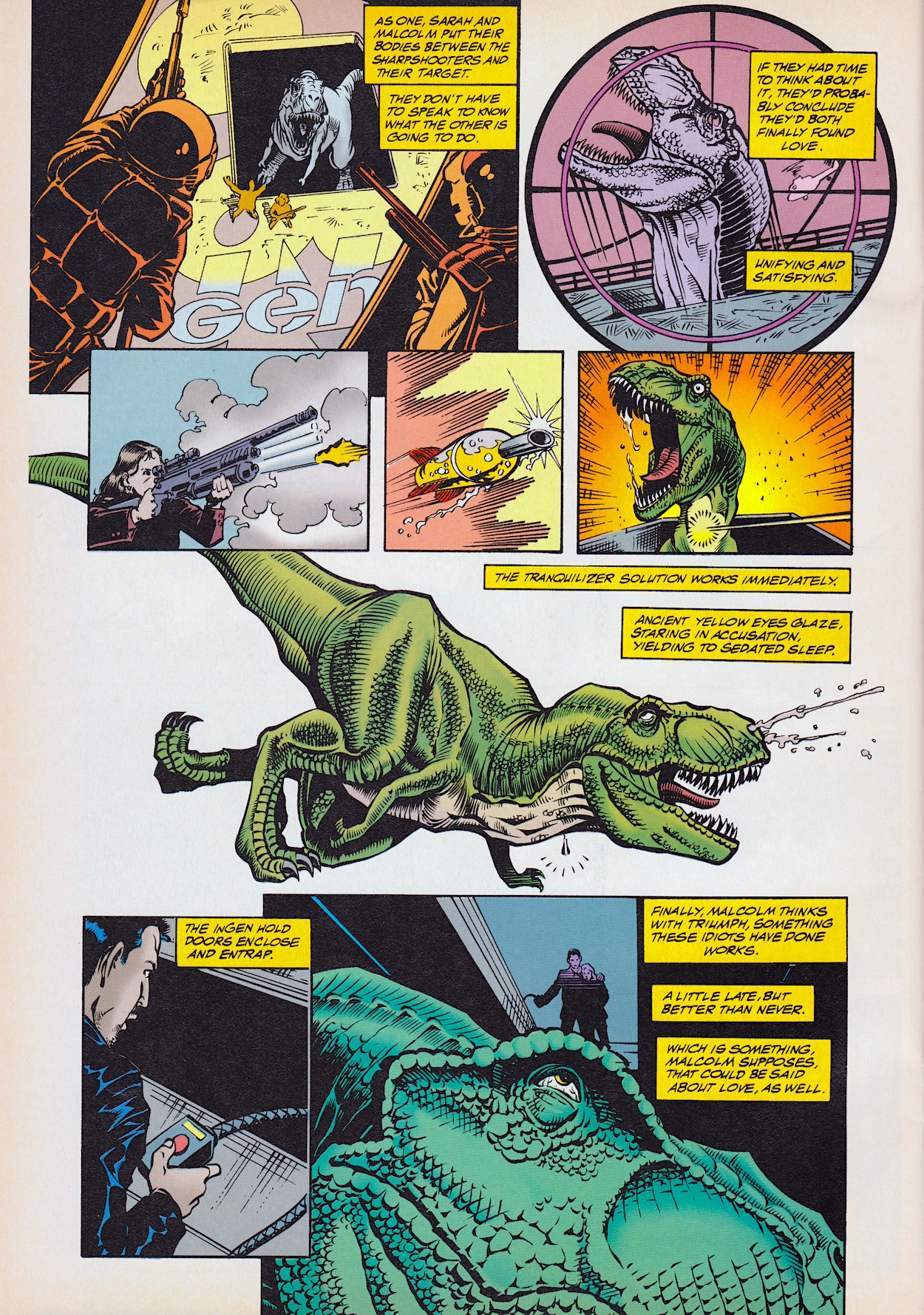
After all of my complaints about the lacklustre art in this final issue we finally get a moment that matches the potential those first couple of chapters had. As the InGen helicopter circles overhead trying to get a good shot to kill the ‘rex, Sarah shoots the tranquilliser dart first and we get this page with a particularly fantastic, expressive, dramatic panel when the dart strikes.

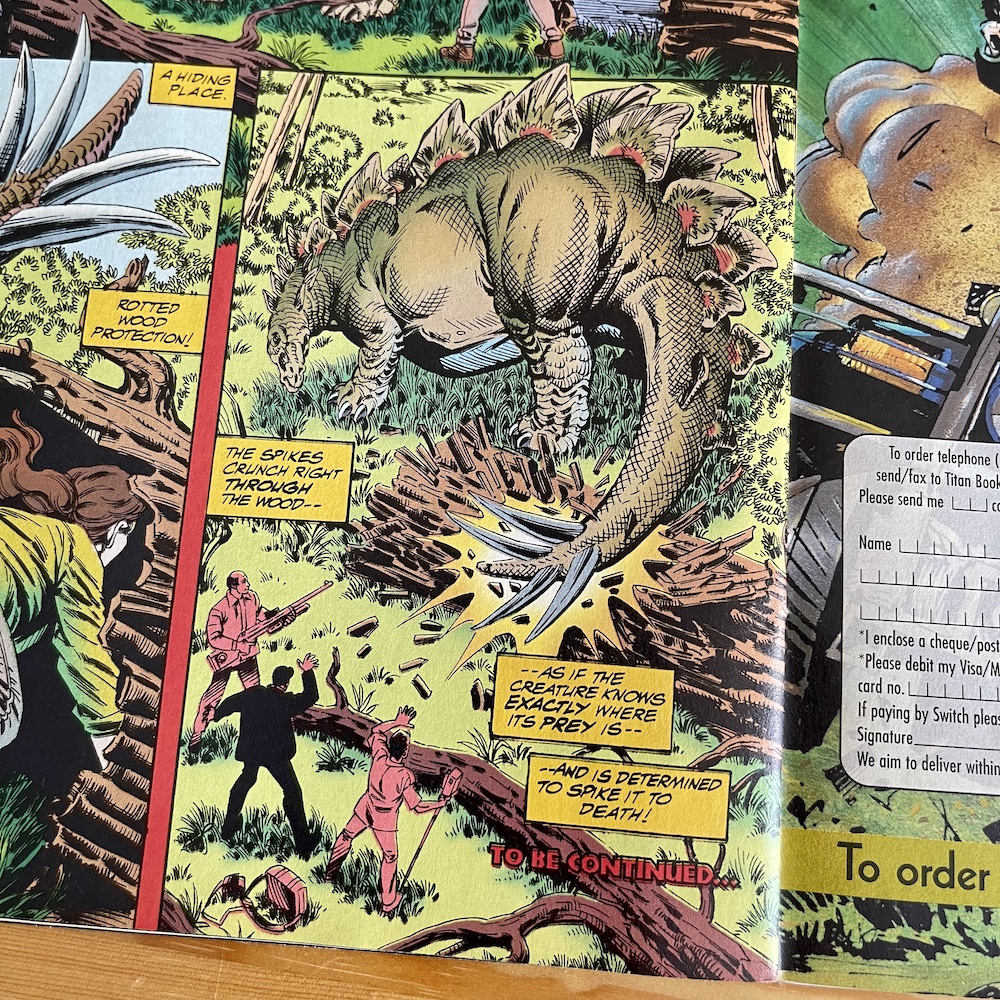
I look back at those first two chapters and the gloriously detailed scenes in the jungle with the Stegosaurus family and I can’t help but wonder what this series could’ve at least looked like, even if the script was still a shadow of the film. What if we’d had that early level of detail coupled with the dynamism of the page above? What an impact it could’ve made. The art team was definitely up to the task but it seems deadlines and a rushed story hindered them in the end.

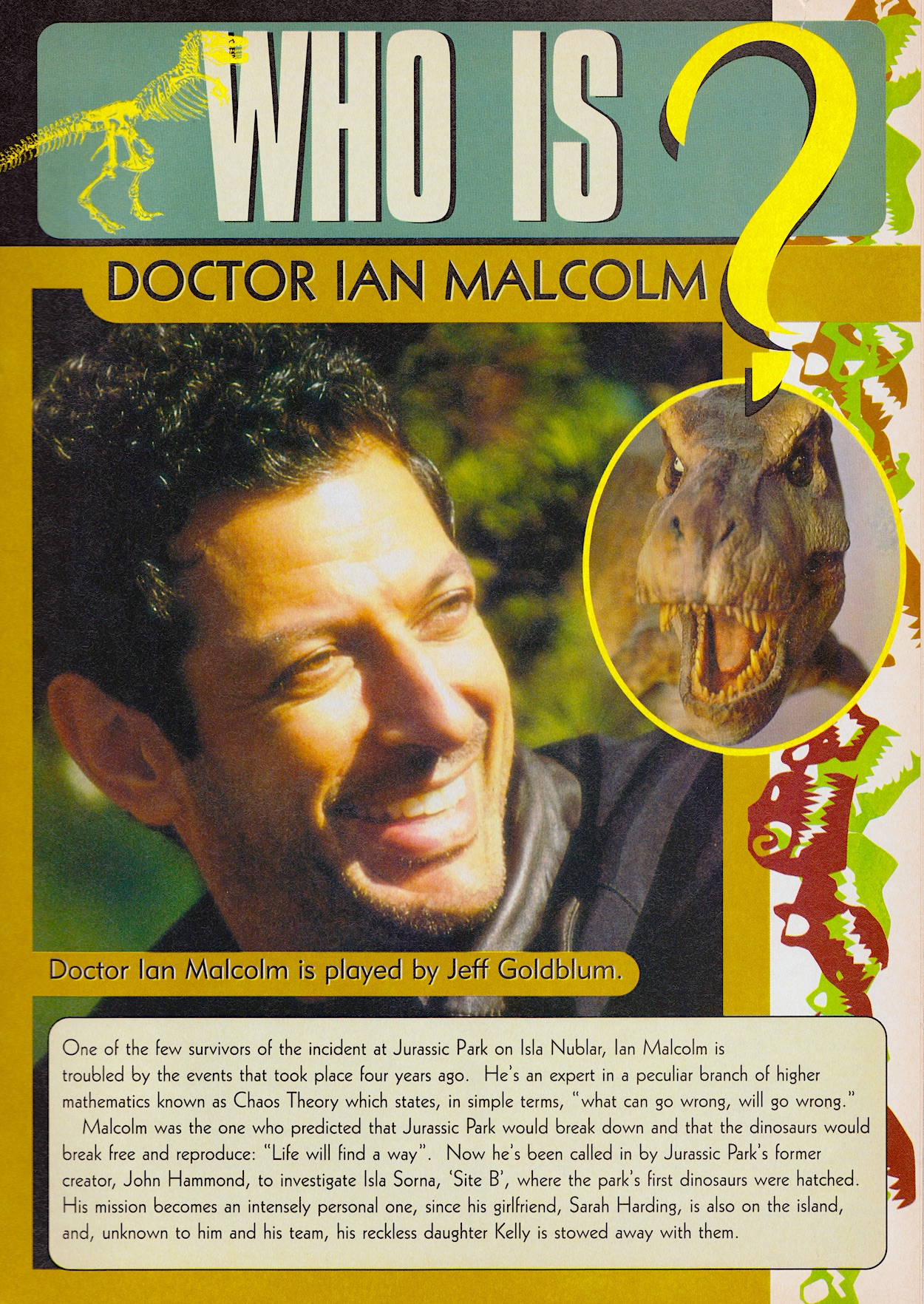
Don’t get me wrong, I understand the task of taming a beast of a movie script down to four comics was monumental and I found Don’s explanations in a previous issue fascinating but in the end I think he boiled it down too much to the maths. I’ll get back to that in a little bit further down this review but let’s finish things off with the final page of the strip. Happily, Richard Attenborough’s beautiful John Hammond speech remains mostly intact, as does that famous Jurassic Park line first uttered by Jeff Goldblum’s Ian.

As you can see detail in anything other than the few dinosaurs in the immediate foreground is minimal and when you contrast this with #1 the difference is stark. My final thoughts on the comic strip itself in just a moment. First up though are the extras editor John Freeman and his team assembled, some of which have definitely been the highlights in previous issues.

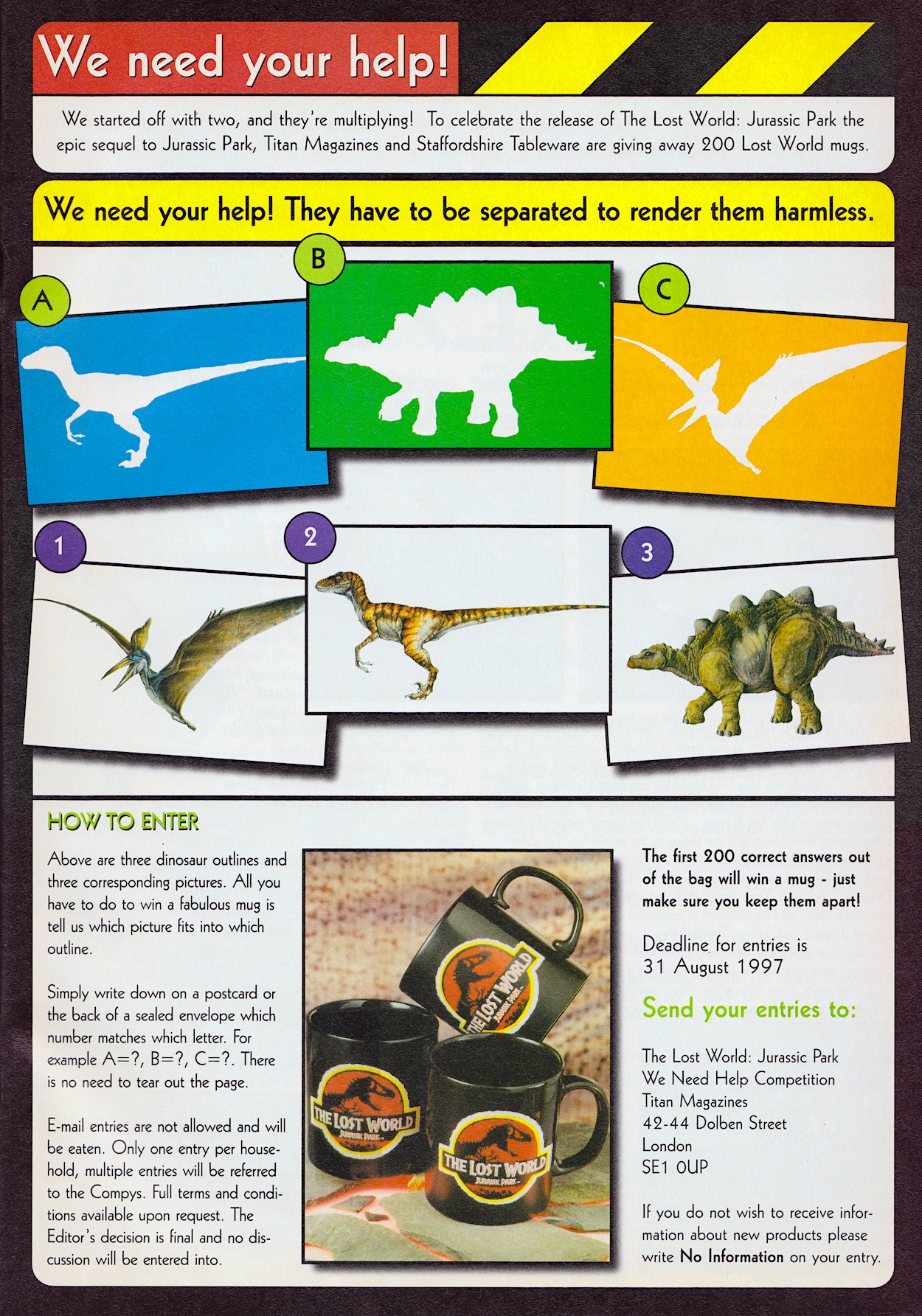
First up is a competition to win a mug with the logo of the film on it. Not the most exciting of prizes, you’d expect this to be a runner up prize, but then again the original comic gave away a large variety of swag, everything from a simple set of glow-in-the-dark stickers to actual Sega Mega CD systems. So if this had been an ongoing comic I’m sure the same would’ve applied to future competitions, and at the end of the day I’d still like that mug!

The competition itself is somewhat easy though, right? Upon first glance I thought it’d be a case of naming the dinosaurs, with the ones in silhouette form being the trickier ones, but actually it’s just a matter of matching them to the pictures in the next row. I remember competitions and quiz pages like that in my old Thomas the Tank Engine & Friends comics as a child and it seems very out of place for the target audience of a Jurassic Park title.

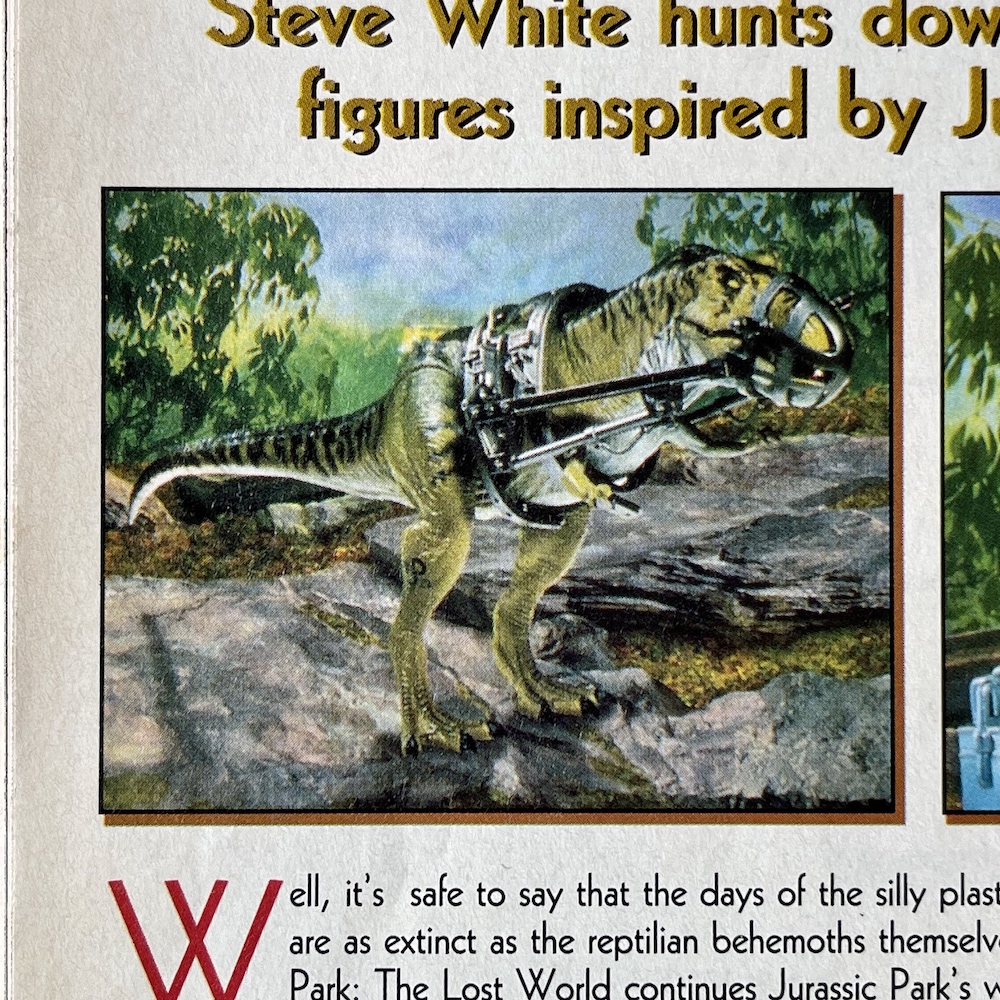
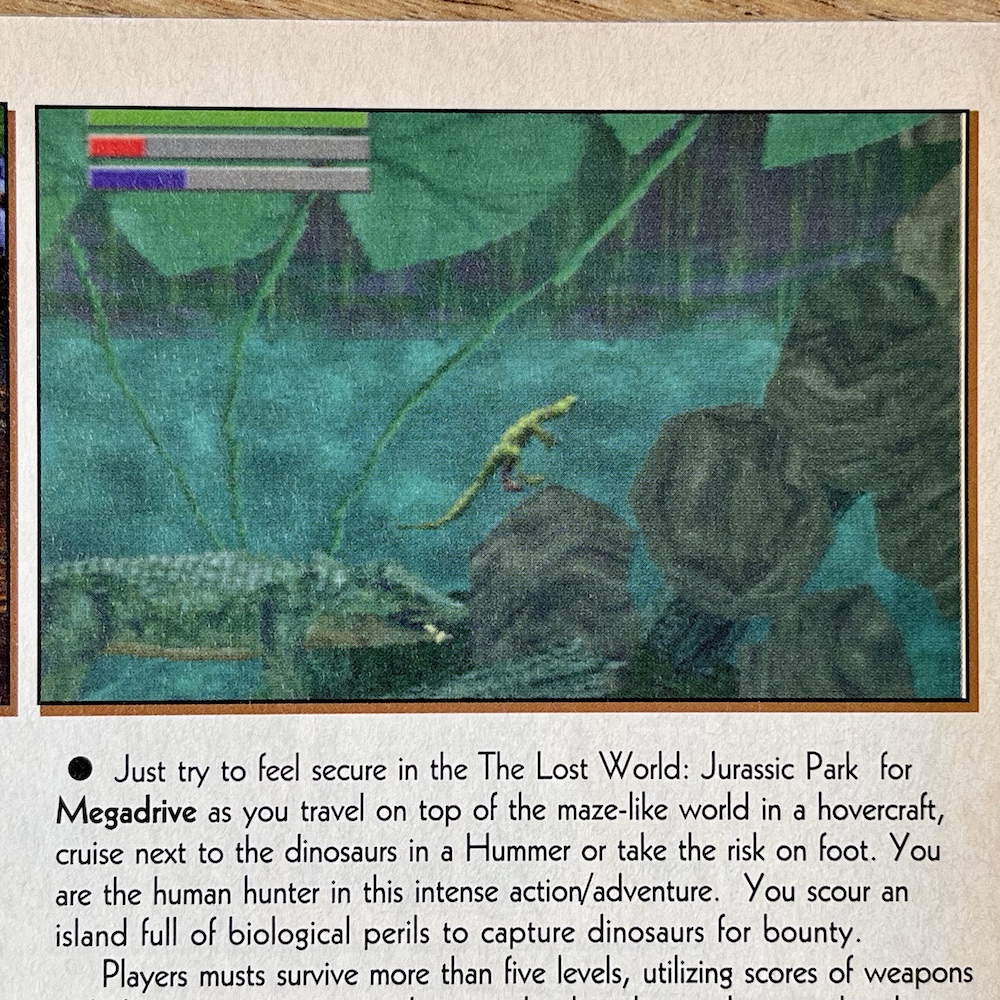
There are a wonderful couple of pages detailing a selection of the merchandise released to tie in with the hottest film of the summer of 1997. There are some action figures of the dinosaurs shown, including a T-rex apparently engaging in a spot of S&M and mention of a figure of Ian with a jet pack! Really? Sadly no pictures of that one. Of more interest to this retro gamer are screenshots of some of the videogame releases of that year.

My friends laughed as I jumped and slid about the seat in reaction to the dinosaurs

The first image shown is from the arcade game, where players would sit inside a mock jeep with tranquilliser guns and on the screen was a fast-moving on-rails shooter with graphics that were mind-blowing for the time. I’ve played this one. A local ten-pin bowling alley had it for a few years in the late 90s and early 00s, and I have distinct memories of my friends laughing as I jumped and slid about the seat in reaction to what was happening while another friend sat quietly shooting at the dinosaurs.

There are also screenshots from the platform game available on the Sega Mega Drive and the 3D game (that was a new thing at the time) for the Sega Saturn and the new Sony Playstation. Sadly there’s no mention of the Nintendo GameBoy Lost World game. I had a GameBoy in the 90s and adored the game of the first film which was also a competition prize in the original comic. (There just might be more about that on the blog later this year.)

The Script to Strip article from #2 gets a second part here, although it’s a lot smaller and features less information. It would also have been a lot more interesting if the correct page of the movie script had been used in the comparison on the left. It does give a decent insight into the ‘Roar’ page from #3 though. It even mentions in Don’s original pages how the characters were meant to react to the sound, but in the finished page they did not.

A quick personal note: That T-rex in the bottom-right is actually a version of the cover from my very first Jurassic Park comic as a teen.

This is the perfect point to reflect on the entire strip. I’ve said all along there have been moments of potential; the early art was fantastic and #2 was a vast improvement over #1 in terms of adapting the film to the medium. However, towards the end the art definitely suffered. I’m making an assumption here, I know, but it could’ve been due to tight deadlines towards the end to ensure it was released in America at the same time as the film. I also think Don’s articles have unintentionally summed up what went wrong, for me anyway.

Some lovely art and some fun extras have made this comic mini-series worth reading and the completist will definitely find those elements enjoyable

In part one of Script to Strip Don talked about the amount of pages David Koepp’s movie script had compared to how many the comic would have in total to tell the same story, and he explained how many pages of it he’d have to squeeze into each comic page. Now, after reading the whole story it feels like it was more about solving the problem by logic rather than creatively. The first chapter in particular of the original Jurassic Park adaptation showed how to include as much of the movie as possible while being very aware it’s a different medium, using imaginative ways to swap scenes or retell them in a new way. It felt like the film but it was different. A bit like adapting a novel into a movie you could say.

Towards the end though it felt like a checklist was being ticked off as it rushed from one scene to the next, paying lip service to moments the reader would remember from the film. With the sequel, in breaking everything down mathematically as Don did it’s felt like that throughout all four chapters, with some glimmers of the (that word again) potential here and there, which just made it all the more frustrating, knowing this team was capable of so much more.

So here we are at the final page of the final issue of The Lost World Jurassic Park which mentions a third novel by Michael Crichton. While there’s the occasional mention of such a thing on fan sites there’s nothing official anywhere to state he actually started it. Instead, Jurassic Park III and specifically Jurassic World would pull a lot from the two released novels. The rest of this page takes me back to all of the discussions at the time about DNA cloning and I can remember teenage me being very excited by documentaries and such on the subject.

So that’s us. Some lovely art in the earlier issues and some fun extras have made this mini-series worth reading and the completist will definitely find those elements enjoyable, just don’t expect anything ground breaking from yet another movie-to-comic adaptation. I do want to go and watch the movie again though! Remember, all 16 issues of the original comic, including the first official Jurassic Park sequel, have been reviewed and I’ll be returning to that series with the graphic novel collections of the rest of that story, which we never saw printed in the UK at the time, so I’ve never read them!

Definitely something to look forward to there. In the meantime, remember… “don’t go into the long grass”.

BACK TO iSSUE THREE

JURASSiC PARK MENU

THE LOST WORLD JURASSiC PARK #3: TRiMMiNG DOWN THE T-REX

We’re already at the halfway point in this little mini-series adaptation of The Lost World Jurassic Park. The first issue fell into the traps of many a movie adaptation but part two improved things somewhat. It wasn’t perfect, but those improvements and the article from writer Don McGregor about the size of the task at hand gave me high hopes for what was to come. So how has our third edition panned out? Ignoring that annoying “Free” poster bit on the cover (see last issue for more on that) let’s get stuck in and find out.

We left things a fortnight ago with the Triceratops smashing its way through Peter Ludlow’s presentation tent after Nick Van Owen had freed the dinosaurs, and right at the beginning of this chapter we see a spectacular scene of them all running from the camp back into the wild. In the movie we saw this from the perspective of the humans as the animals fled all around them, but here I particularly like the grander scale this first panel brings, and that’s not something you can often say about a comic adaptation.

Upon further inspection though, how on Earth did the Ingen hunters possibly capture and contain that giant dinosaur on the left? If we go by the previous movie this would have to be a Brachiosaurus. I’d love to have seen the cage they kept that in! The rest of the page instantly contradicts not only the film but even its own previous issue, where it had correctly shown the baby Tyrannosaurus rex captured by Roland and Ajay tied up away from the camp. Here, miraculously he’s now right where the chaos is, ready for Nick to easily rescue.

The next page is printed in landscape format and once you realise what’s going on it makes for a wonderful idea

In fact, the page before this spread showed Roland and Ajay’s last second escape as a fiery jeep flew through the air and crashed onto the tree they were hiding in awaiting the adult Tyrannosaur, so really this is contradicting the very same issue! I’ve no idea why Don felt the need to do this. In the film we didn’t see Nick grab the baby, he appeared a little while later from a river nearby holding him in his arms.

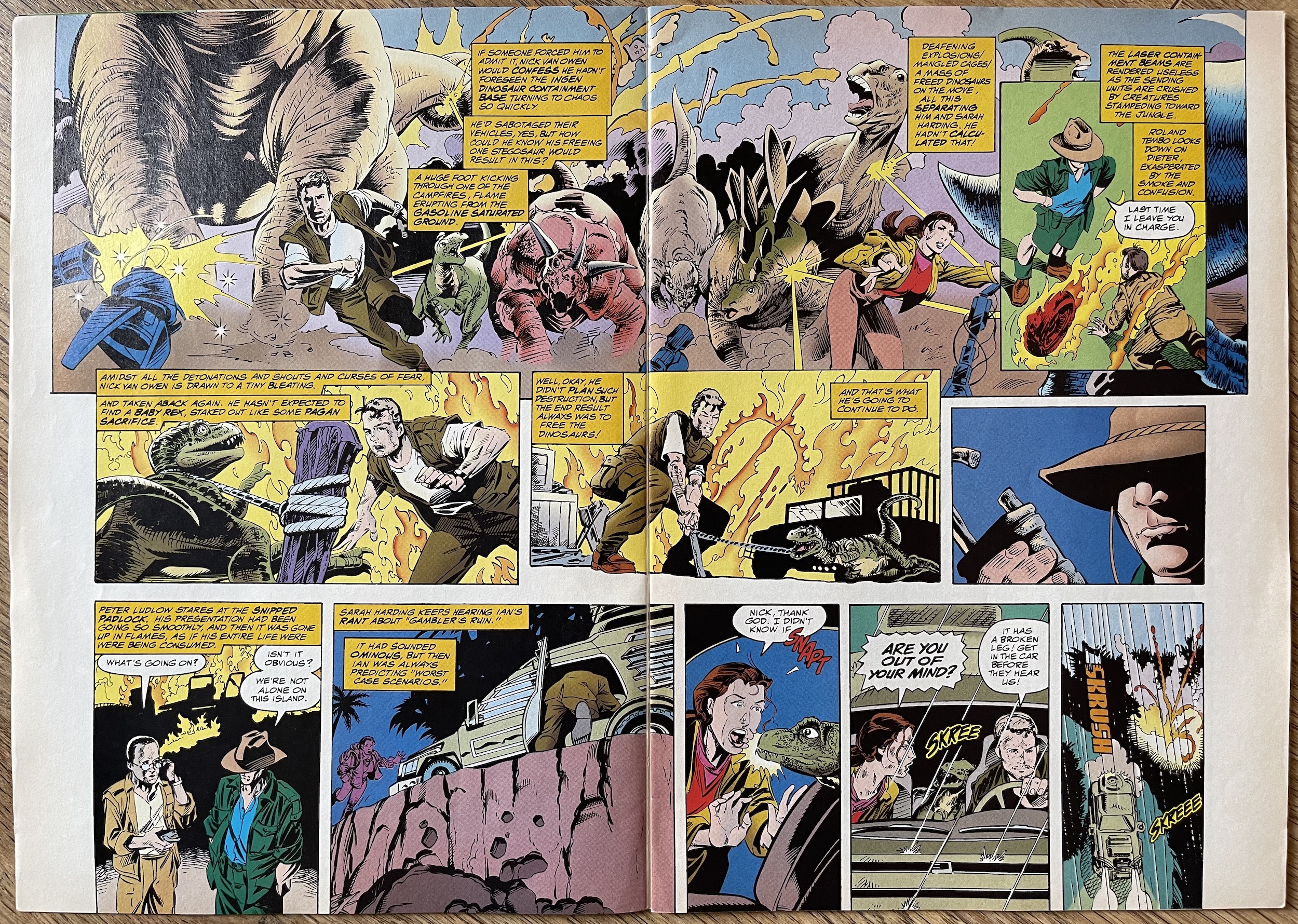
The next page is printed in landscape format and once you realise what’s going on it makes for a wonderful idea and is brought to the page brilliantly by penciller Jeff Butler, inker Armando Gil, letterer Ken Lopez and editor and colourist Renée Witterstaetter. I know this film like the back of my hand so I know that while Dr Ian Malcolm, Eddie Carr and Ian’s daughter Kelly are in the High Hide at the upper tree level there’s a distant roar, the trees below shake and the stomps of both T-rex adults can be heard moving beneath them. However, despite this dramatic page, none of that is clear.

While it’s unlikely many would be reading this before watching the film (although I do recall my friends and I reading the adaptation for one of the Turtles films before we saw it), most readers will have only seen it once in the cinema by this stage. It would actually have still been playing in theatres when this was out. They’d be reading this to relive the story and as dramatic as that ‘ROAR!’ is on the page I’m not sure readers would’ve noticed it, instead possibly thinking it was just a unique set of panels to reinforce the moment. The characters not acknowledging the roar or any movement below doesn’t help either, making Ian’s decision feel decidedly random.

This of course leads to arguably the most terrifying sequence in the whole movie and one that had us on the edge of our seats in the cinema. Here it’s cut down, as it needs to be for reasons Don laid out last time, but the scale of the scaling back is quite shocking. When the adults arrive Ian simply danders out with the baby into the middle of the clearing instead of the tense moment by the door. He’s completely vulnerable but there’s no tension in his action. He’s even singing!

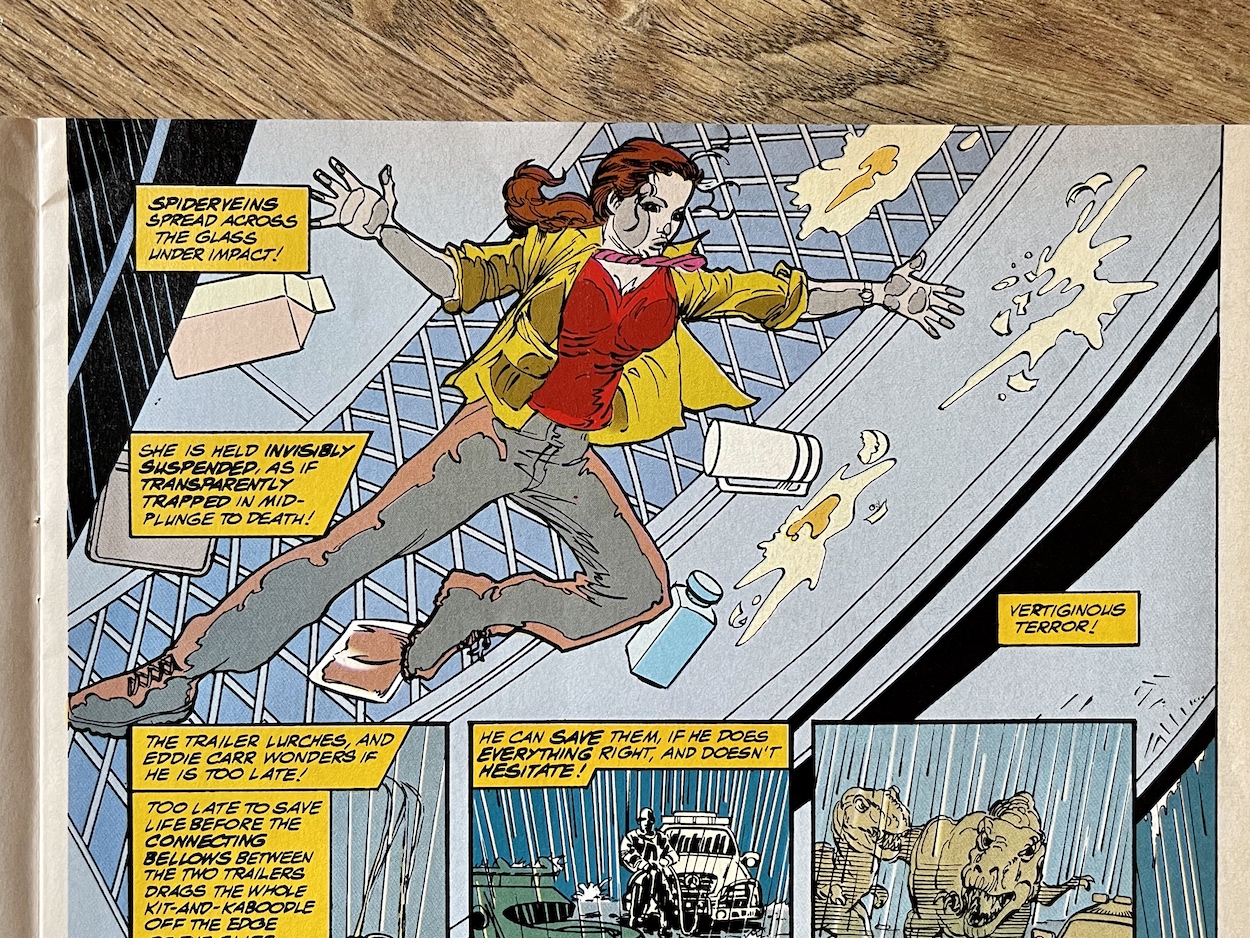
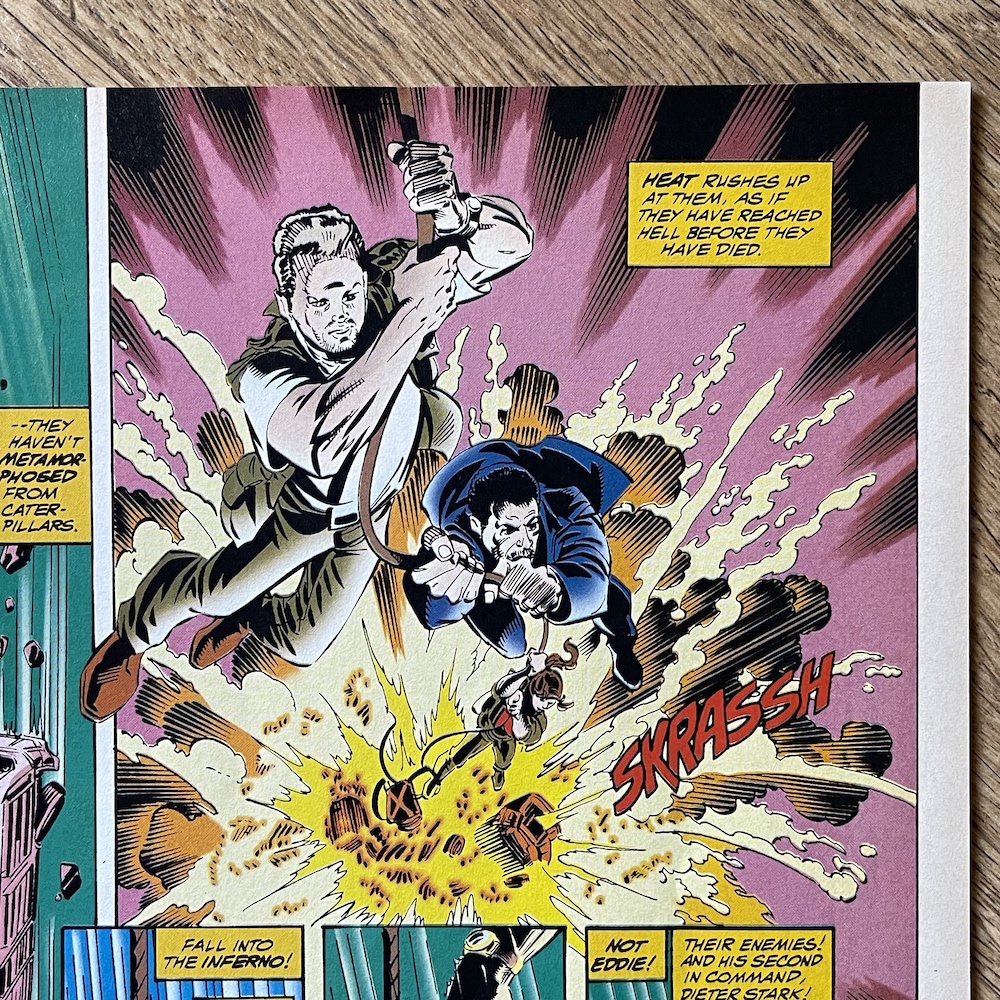
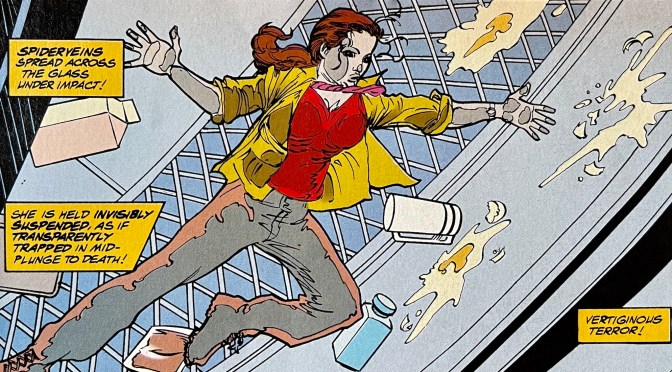
The next part of this scene is of course the moment when the two-part research vehicle is partly pushed over the cliff by the dinosaurs and while Eddie struggles to stop it from falling by winching it with his car he’s also trying to pull his friends up with a hand rope at the same time, and Dr Sarah Harding is on that slowly cracking pane of glass at the rear of the dangling half, looking right down the cliff towards the crashing waves far below. It’s all wonderfully tense.

Unfortunately one of the very best scenes in the film is reduced to a couple of pages. I did understand where Don was coming from in his article last issue but as I said in that review I don’t think he’s got the balance right; you’d think one of the biggest, most memorable moments would get a lot more space to breathe. Take the most basic key points of these ten minutes in the film (Sarah on glass, Eddie’s death, characters clinging to ropes as the transport falls) and eliminate everything else, that seems to be what the plan was.

There’s some fun art though.

I’m not sure if the narration is taken from the book or the draft script but it feels like it’s trying too hard, as if it’s attempting to make up for all of the missing bits. Not only is most of the action just not here anymore but the characters have absolutely no sense of fear about them, like they’re just going from one inconvenience to the next. Some lip service is played to Sarah’s fear of heights (something the film left out) but it’s not built upon.

I do love the art in the scene though, especially how it perfectly captures the invisible sheet of glass beneath Sarah. However the spider veins mentioned are conspicuously missing, and this won’t be the last time something like this happens which I’ll get to in a bit. Eddie’s whole ordeal trying to survive the T-rex attack is just not here but at least his end isn’t censored like the original movie’s adaptation would do. The final moment of the scene is also captured well here. The art is definitely the main thing driving me forward at this point. That and the great photography and extras.

The poster is a wonderful photo of one of the Velociraptors and I’m positive it would’ve been on my wall if I’d known about this comic at the time, showing off the gorgeous yet terrifying animatronic and the darker tone of this sequel. On the back of this is another dinosaur fact file with its terrible design once more not doing justice to Steve White’s interesting writing.

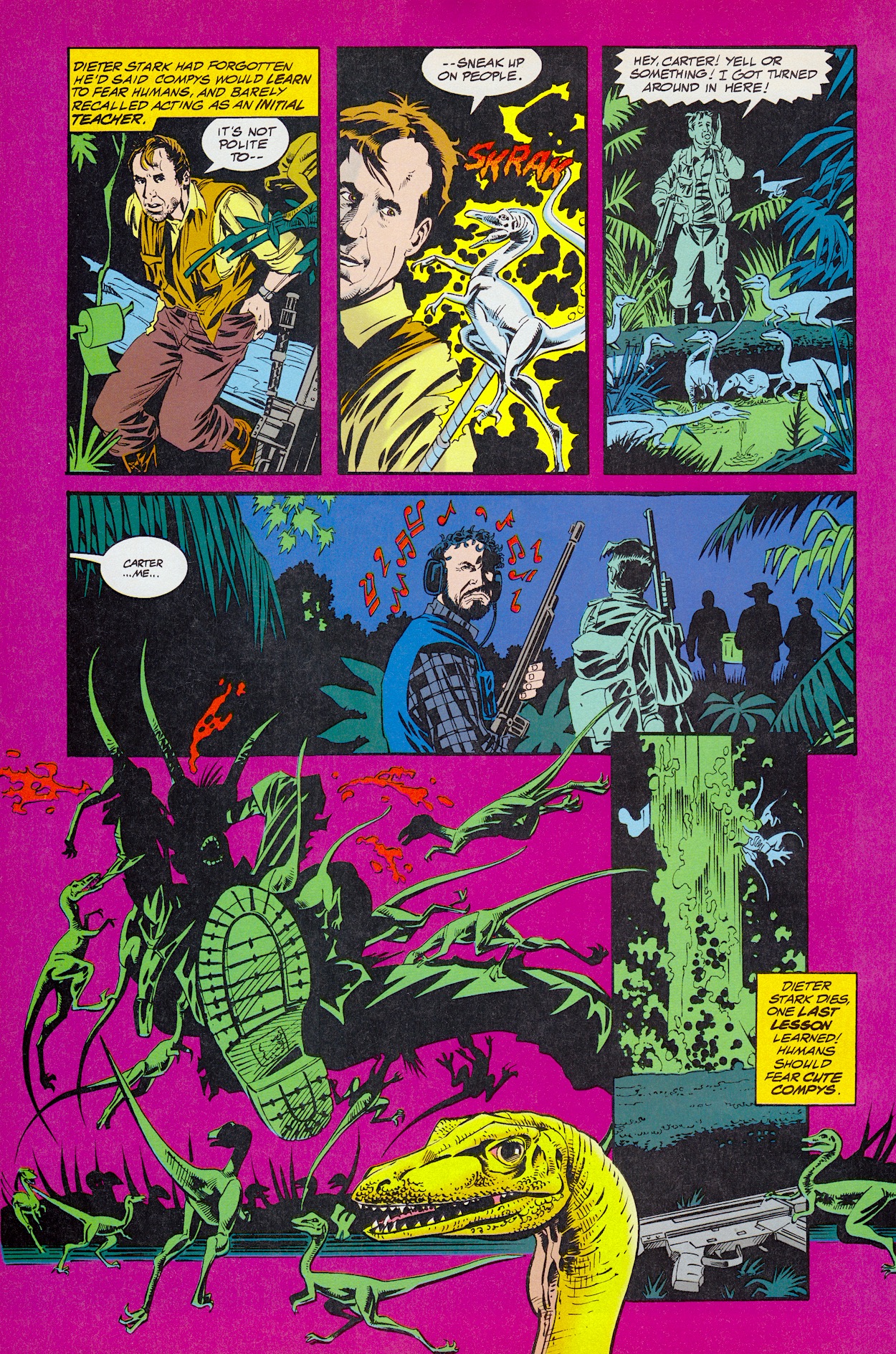
Back to the final pages of the strip which cover two large parts of the story and unfortunately after the promise of last issue it seems we’re back to rushing through the movie again just to get it over and done with. Dieter Stark is Roland’s second-in-command and his death in the film by the cute little Compsognathus pack may be rushed (with a sequence that’s just confusing for anyone not that familiar with the film) but I’m including it to show the two extremes of this strip; the rushed nature but the potential in the art (especially when you see the panel of his actual death).

I feel the beginning of that sequence can only really be followed if you’ve seen the movie and are familiar with the individual elements of how this transpired. Elsewhere we get some added character moments which again may have originally been in the earlier script, like some tender moments between Ian, Sarah and Kelly before we get to the T-rex pair catching up with our sleeping group. There’s a particular moment here in the movie which truly frightened me with its slow build up and drawn out danger for two of our characters. The suspense was a killer! Here it’s all reduced to one single, solitary panel that completely changes this to a game of peekaboo.

Something else missing is Ian’s moustache! From comments on social media after I posted the first two reviews this apparent inconsistency seems to have particularly irked some people when they read the comic, but for me it’s not really a big deal. It’s still kind of there, it’s now just part of a rough unshaven goatee area like Jeff Goldblum sported in the film. It could be it was decided Jeff wouldn’t sport a moustache after the first two parts of the comic were already drawn. Story wise, I’m happy enough to think that it’s all started to grow out again while he’s been stuck on the island for a few days. Either way, it looks much better now.

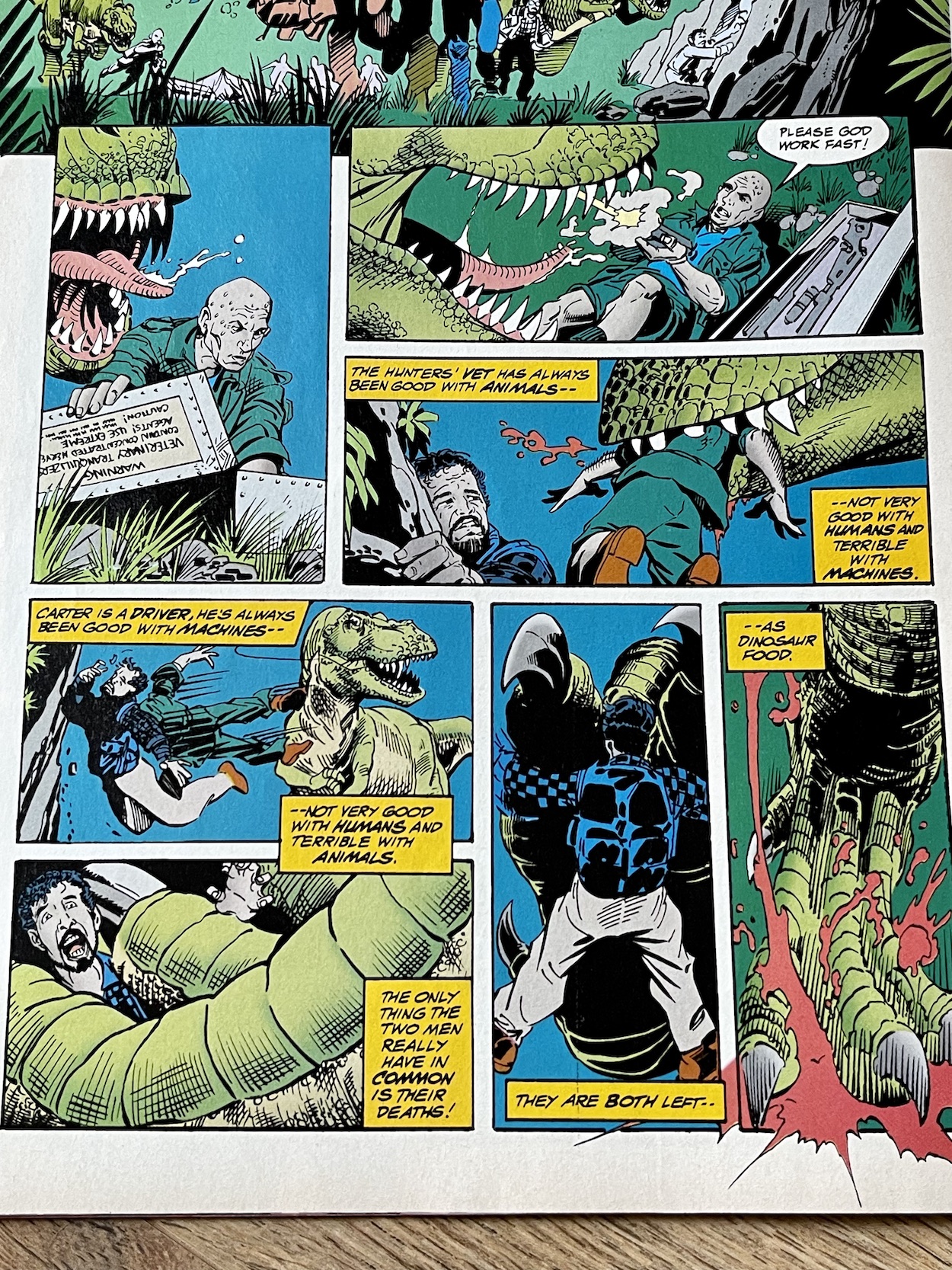
After the small additional character scene I mentioned we get a huge change from the film a few pages later when Roland Tempo, played brilliantly by Pete Postlethwaite in the film, is killed by the huge Tyrannosaurus buck! After finding his shotgun has been filled with blanks by Nick he reaches for the tranquillisers. So far, so familiar. But unlike in the film when the T-rex succumbs to it just in the knick of time, here he grabs Roland and throws him towards Carter, the man who gets trampled to death in the film.

This is one change I really don’t like. Roland was one of the best characters in the film and since he’s now dead we no longer get to see his solemn redemption later after Ajay’s death, when he tells Ludlow he’s seen quite enough death instead of accepting a job at InGen. The hunter became rather Ian-like in the end and accepting of his part in the inevitable chaos. This will all now be missing. If this was in the script Don was working from then I’m very, very glad screenwriter David Koepp and Steven Spielberg changed this character’s arc.

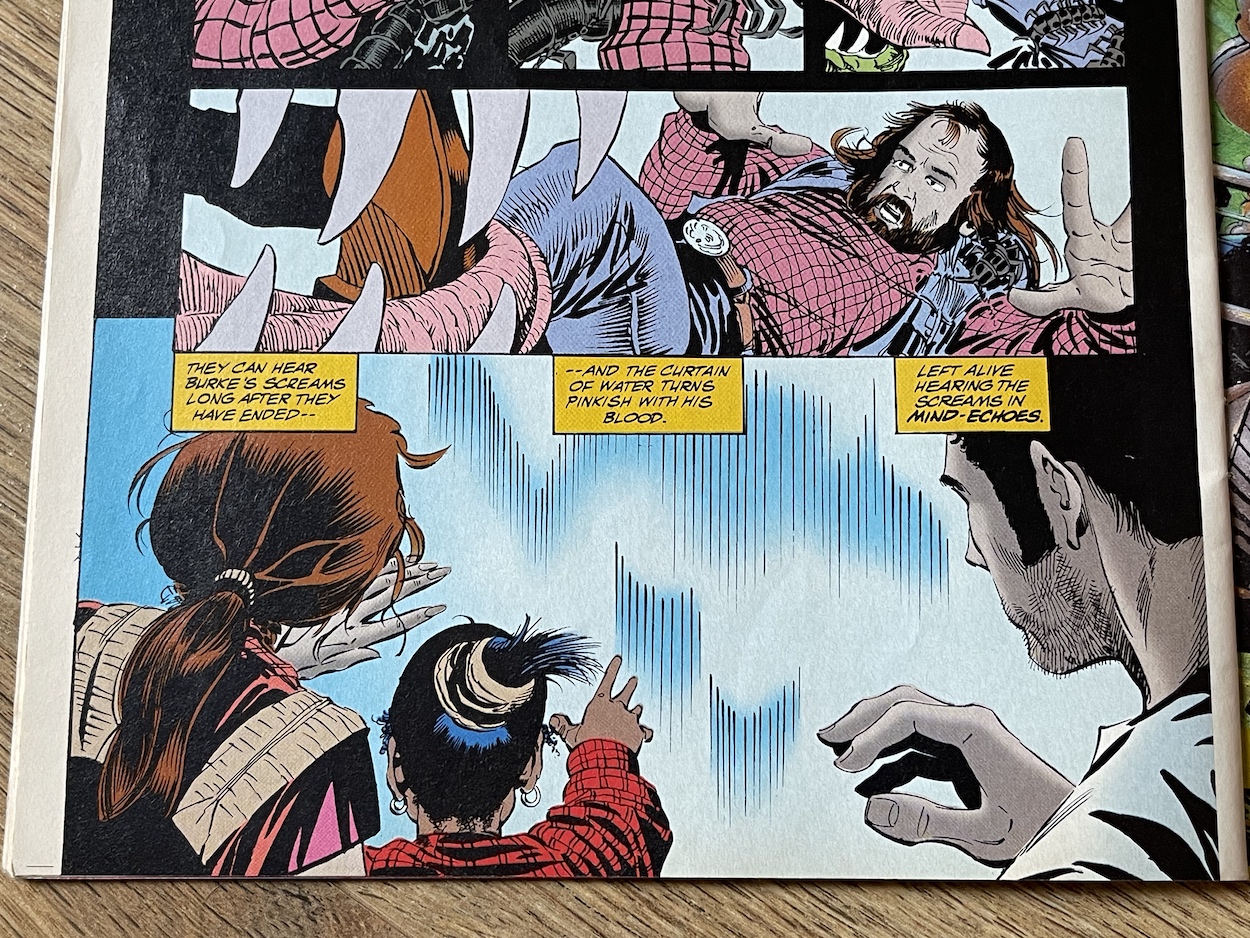
The penultimate chapter of the adaptation ends with our main characters trapped behind the waterfall (in a scene from the first Jurassic Park novel and depicted by Walter Simonson and Richard Cry on the cover) as Roland’s palaeontologist Dr. Robert Burke is grabbed by one of the T-rexes and dragged out. Just like the spider veins mentioned when Sarah was in danger, the curtain of blood described here is nowhere to be seen, somewhat dampening the moment.

Chapter three has certainly been a mixed bag then. I liked some of the extra character scenes but hated the death of another, although to be fair to Don that wasn’t his fault. Some of the very best moments of the film, (some of my favourite moments in cinema, period) were so rushed here they were barely recognisable, and the fun art has been on top form at times with some great images but plagued by inconsistencies elsewhere. I come away frustrated more than anything because of what this talented team could’ve created.

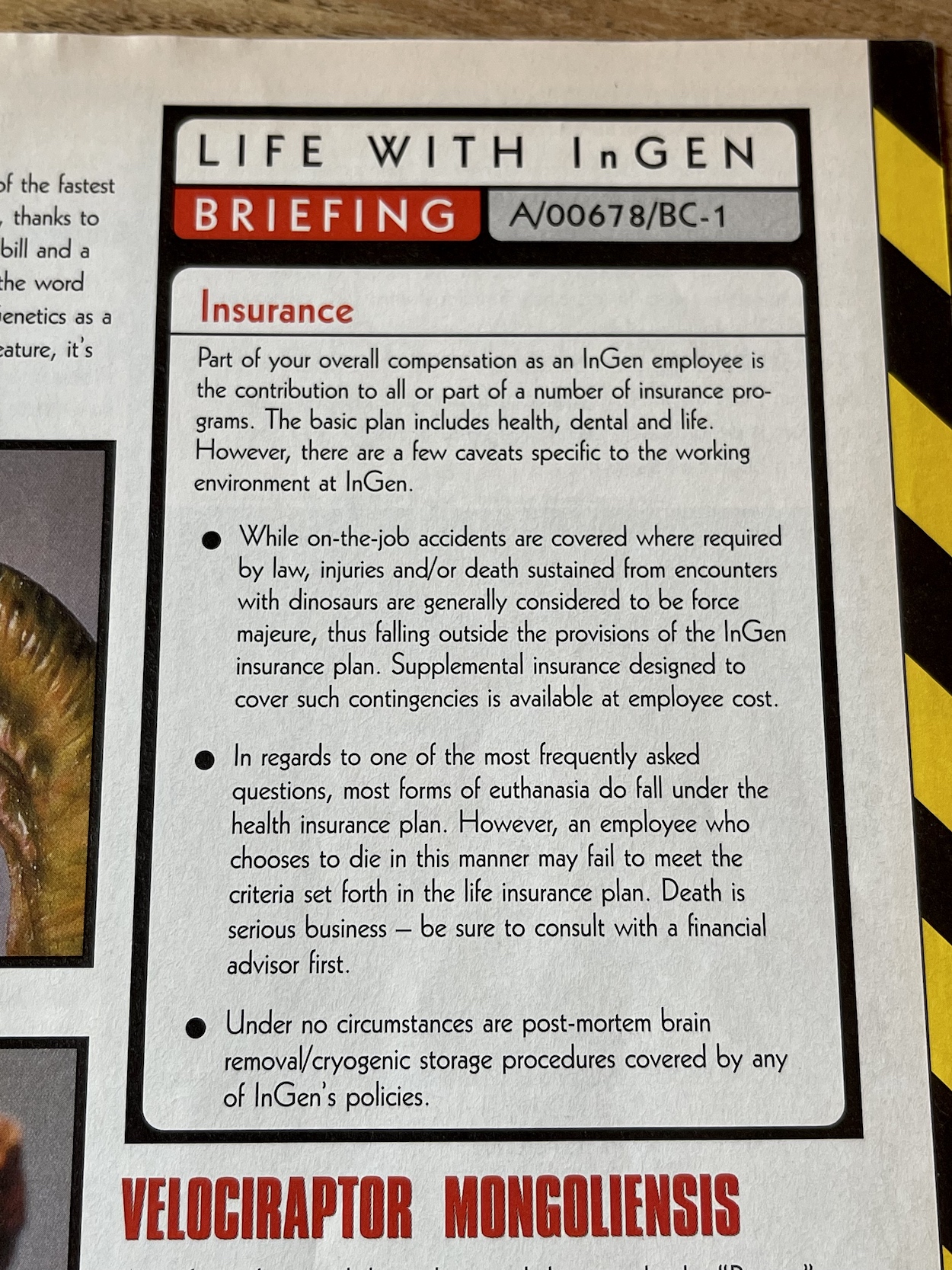
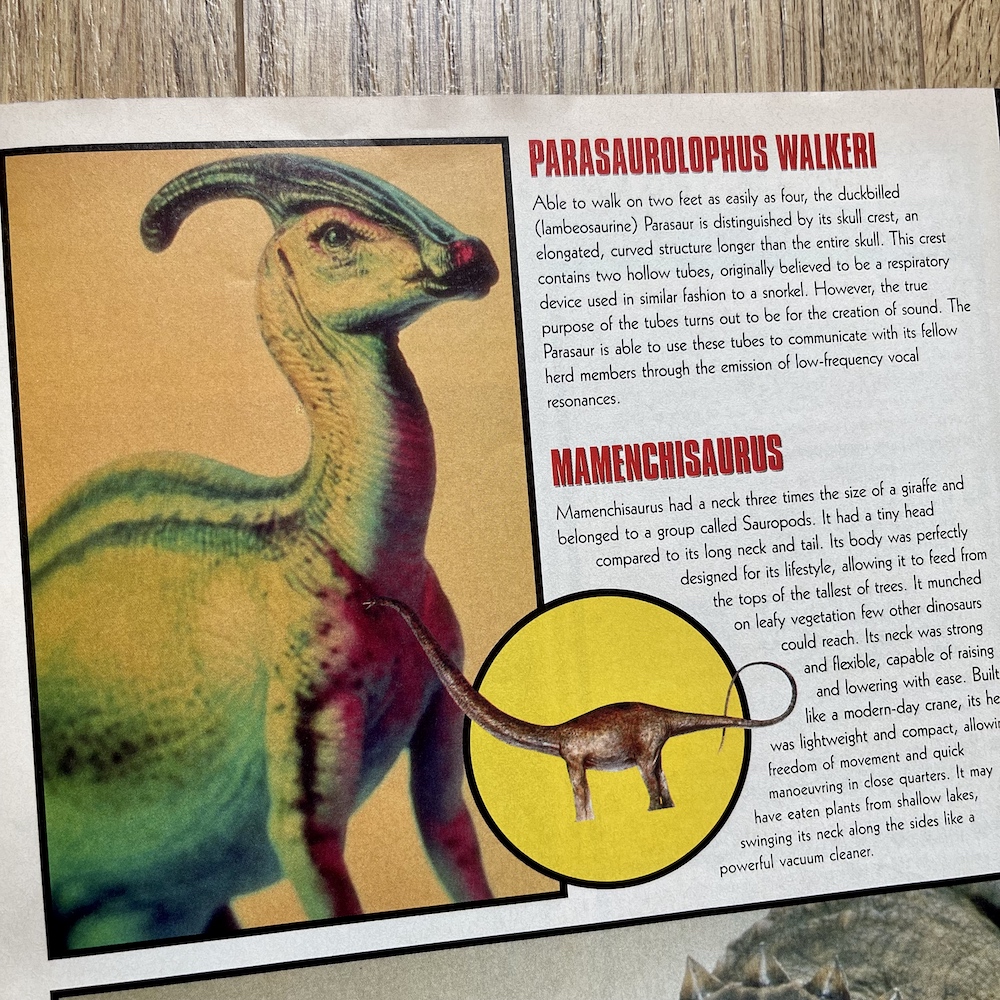
There’s no character mini-poster this time, instead we get five pages of a welcome pack for new employees to InGen and it contains a lot of photographs of model dinosaurs used in the pre-production of the first two films. I thought there was something strange about the little pictures of the animals in circles throughout #1 but now I know what they are they’re a delight to look at up close like this. All the main dinosaurs are covered, including this film’s Parasaurolophus Walkeri and the sick Triceratops from Jurassic Park.

There are also some funny moments such as the exceptions to staff’s apparently comprehensive insurance policies, which absolve InGen of any responsibility whatsoever if Chaos Theory rears its head. As with the previous two issues I’ve found the extras more enjoyable than the strip, so kudos to editor John Freeman and his team, these pages add a lot to the overall package.

We’ve only one chapter of the story to go and I feel just like I did when the first film’s adaptation finished its penultimate chapter; there’s just no way they could possibly cover everything still to happen in 22 pages. It’ll be interesting if nothing else! We’ll find out what survives in #4 of The Lost World Jurassic Park on Monday 7th August 2023.

iSSUE TWO < > iSSUE FOUR

JURASSiC PARK MENU

THE LOST WORLD JURASSiC PARK #1: LiP SERViCE

Well isn’t this a pleasant surprise? We thought we’d seen everything the UK comics scene had to offer for Jurassic Park fans back when Dark Horse International’s excellent comic came to an end with #16 in November 1994. While it was a suitably open-ended finish to the first official sequel it had actually been cancelled with several more chapters of the American comic to go. Not that we knew this.

Three years later in the summer of 1997 Steven Spielberg’s The Lost World Jurassic Park appeared in cinemas and I have very fond memories of going to see it, at one point jumping out of my skin so much (when one of the Velociraptors poked its head beneath a door, if you’ve seen it you’ll know the moment I’m referring to) that I made my friend beside me jump, which in turn made me jump again! Cue nervous laughter while our hearts came back down to a normal rate. I loved that film. I didn’t know there was a comic to match though, something I’m making up for now. Here is #1, edited by Down the TubesJohn Freeman, no less.

Despite this being from a completely different UK publisher (Titan Magazines) the US strip is once again from Topps Comics. Their continuation had come to an end and now their adaptation of this movie would contradict everything they’d previously created. Obviously this couldn’t be avoided, Michael Crichton’s second novel and the sequel movie were never going to follow what the comics had done. That ‘What Has Gone Before’ is lifted straight from those Dark Horse issues which is a nice touch.

However, the opening editorial seemingly makes some early errors straight out of the gate. Already established is how John Hammond spent many, many years with his dinosaurs before inviting Dr. Alan Grant and Dr. Ellie Satler to the island, it wasn’t something he threw together in a few years. More glaring for us with hindsight is the suggestion the dinosaurs were destroyed. We know they weren’t but only from later films and to be fair the sequel novel also said they were all destroyed, so that’s lifted from the book rather than the film.


“All along we have held significant product assets that we have attempted to hide, when we could have safely harvested them for enormous profit!”

Peter Ludlow

I should mention I haven’t read Michael Crichton’s second Jurassic Park book, in fact I was surprised to find out recently Dr. Ian Malcolm was the main character in it after he died at the end of the first book. (That’s properly explained, apparently.) Of course in the movie he didn’t die so we don’t need to worry about that here. The opening scene is from The Lost World movie but was actually based upon a story point from the first novel that didn’t make it into the original film. The differences between the second book and movie is something this issue will touch upon later. For now, let’s see how that story translates to comic form.

After the opening comes the first of two deleted scenes which were filmed but never made it into the final cut, although they can be viewed as extras on DVD, Blu Ray and digital. It involves the loathsome, slimy character of Peter Ludlow, nephew to John Hammond, perfectly portrayed by Arliss Howard in the movie. Cut by Spielberg because he felt it slowed the pace of the film, I initially thought it should’ve been included. While it’s particularly pertinent today when certain politicians seem more determined than ever to rape the natural world (as Ian Malcolm put it) for profit, now I agree it was right to cut it, although for different reasons.

It mentions the destruction of all the animals and the park after the first film and buying media and political silence, as well as paying out millions of dollars in wrongful death settlements to the families of the characters who perished. Just as a side note, for the first time John Arnold’s death is mentioned in comic form after he just disappeared in the first adaptation. As such, this scene’s inclusion means the editorial was actually correct for this version, but it’s good it was deleted from the movie so that the animals survived.

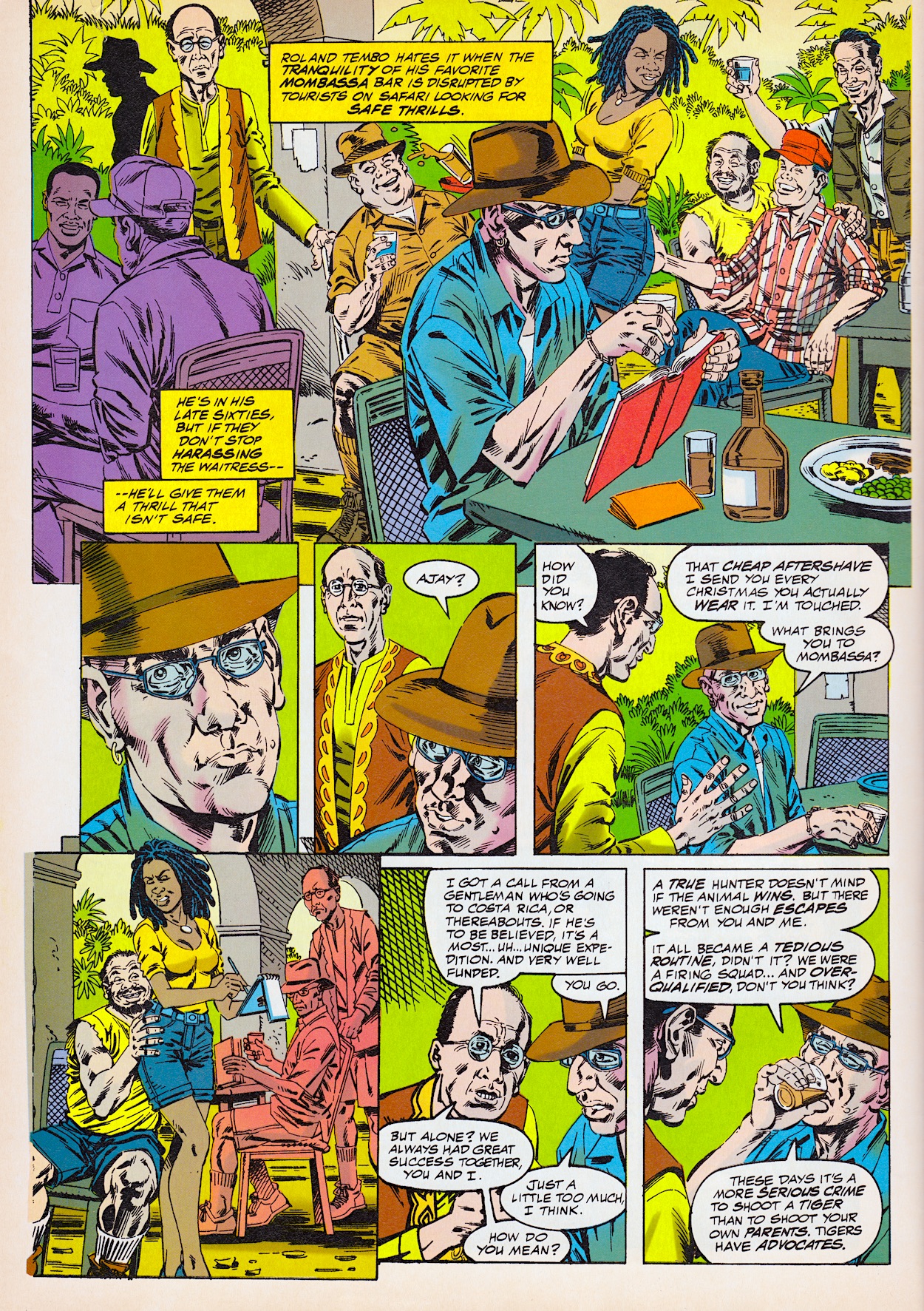
The other deleted scene involves Pete Postlethwaite’s animal hunter Roland Tempo. I’m still sad about this being cut from the film because it adds some more depth to his character. While a person who hunts animals for sport and money is always going to be loathsome, at the end of the film after he’s helped capture the Tyrannosaurus rex alive for InGen he’s mournful for what he’s done. Through his experience in the story he changes and realises the devastating consequences his actions have had.

A perfect balancing job of having a clear likeness without sacrificing what makes a good comic book character

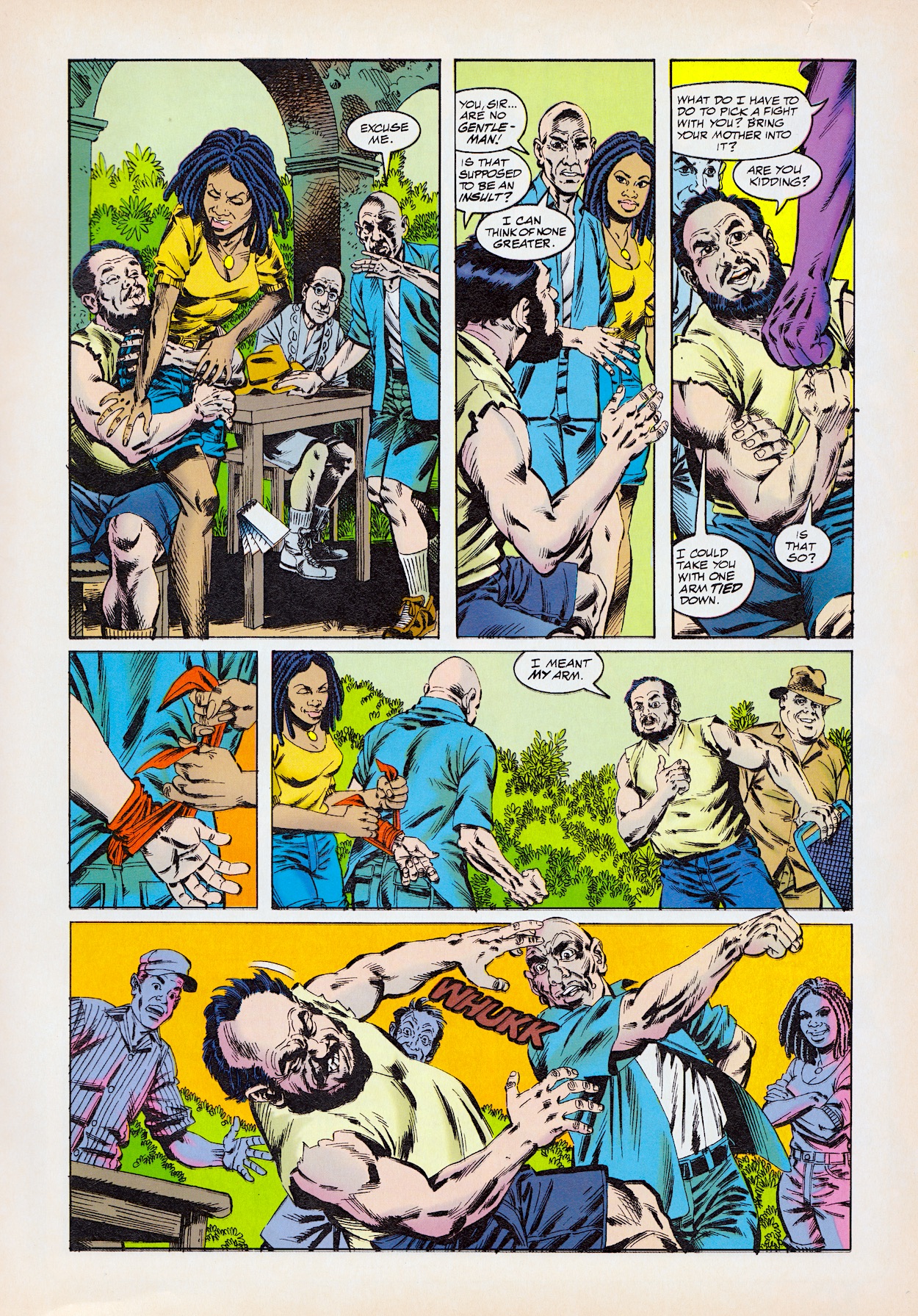
This scene sees him standing up for the honour of a lady some American tourists are hassling and he does it in a rather funny way, playing on the fact he knows they’ll assume he’s a fragile old man. He has no interest in further game hunting until his friend and assistant Ajay tells him what it is InGen want him to hunt! Again cut for pace, when viewed the scenery and setting do feel a bit too similar to the scene setting up the character of Denis Nedry in the original, even though it plays out very differently.

This is about as in-depth as I’ll go into the story of The Lost World during these reviews, after all it’s the movie’s story so I don’t really need to. Just as I did with the first five issues of the original Jurassic Park I’ll be assuming you know it already and I’ll be concentrating on the adaptation itself. The next big difference I notice is one I’m not sure I can come to terms with. Maybe it’ll grow on me as I read the series, but it’s an addition I just feel isn’t needed. I mean, just look at Jeff Goldblum’s moustache!
Maybe Dr. Ian Malcolm has one in the novel. Apart from that I am taken with the likenesses here. A lot of times in comics based on TV shows or movies the characters either look nothing like the actors or the artists concentrate so much on making them look identical that they lose all ability to emote. Here penciller Jeff Butler (Godzilla, The Green Hornet and TSR’s Dungeons & Dragons games) and inker Armando Gil (who brought a scratchy realism to the previous sequel strip) do a perfect balancing job of having a clear likeness without sacrificing what makes a good comic book character.

For most of this opening chapter it feels very much like your typical comics adaptation, writer Don McGregor (James Bond 007, Black Panther, Killraven) taking the main beats of the script and moving between them with as little fuss as possible, cutting and trimming a lot as he goes. Funny moments are pretty much eliminated too which is a shame because the movie was full of them. A particularly memorable scene when Ian, Eddie Carr (Richard Schiff) and Nick Van Owen (Vince Vaughn) are calling out for Sarah Harding (Julianne Moore) when they land on Isla Sorna is conspicuous by its absence.

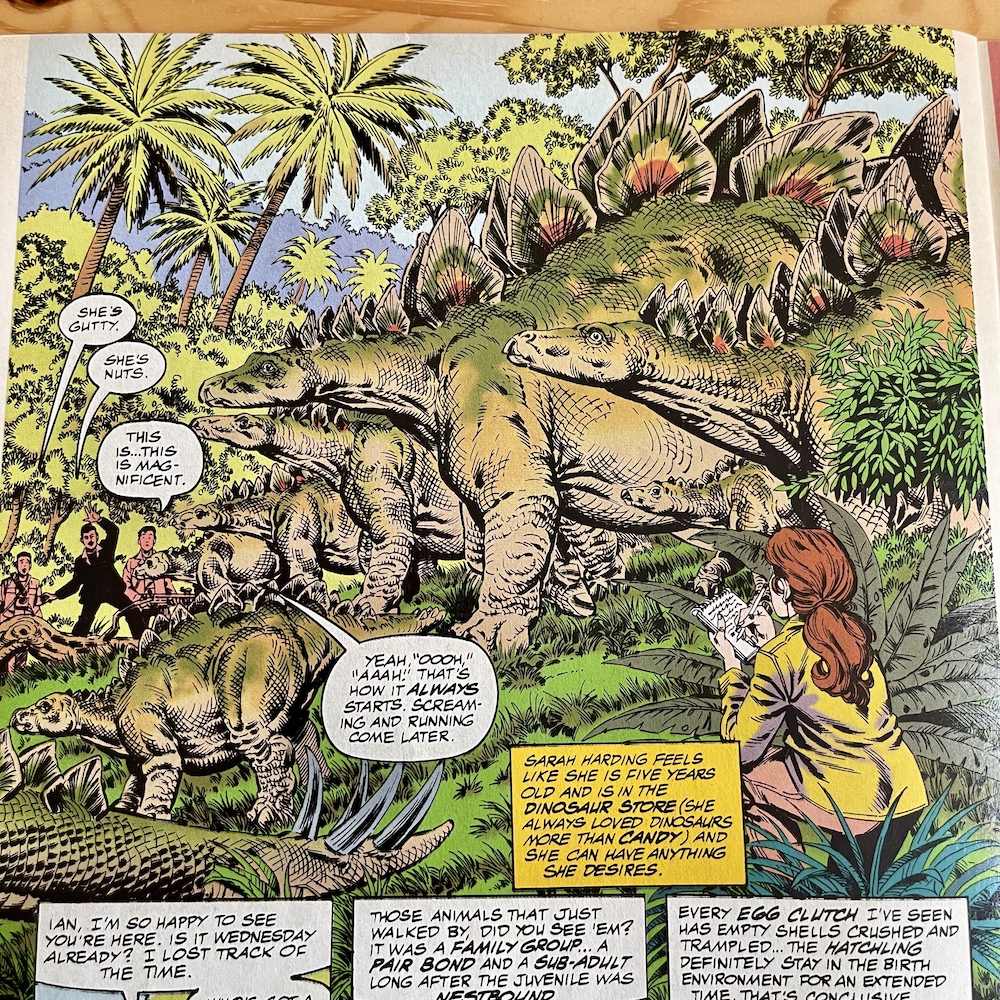
The scenes with Ian’s daughter Kelly (Vanessa Lee Chester) are there but again have been chopped down to their bare minimum which is a real shame as they felt really genuine on the screen. The chapter ends with the Stegosaurus scene although the grandeur of their entrance is lost when our characters are just miling about among them. Also the baby, key to what happened next, isn’t involved and it all feels rather rushed to get to some form of cliffhanger. But what is quite wonderful is the depiction of the Stegosauruses. It’s certainly more detailed than the previous adaptation and a lot more so than Armando’s sequel art.

Ken Lopez is our letterer for this story and returning story editor Renée Witterstaetter’s colours are a particular highlight, especially on these final pages in the jungle. In fact I’d say in the three short years between the comics there’s been a marked improvement across the board in terms of looks, even with a team made up of some very familiar names. Speaking of familiar names, that cover (taken from #3 of the American comic) is by original adaptation writer Walter Simonson and Richard Ory (Cloak and Dagger, Marvel Fanfare, Doctor Fate).

Regular blog readers will know I’m not usually a fan of movie adaptations but that the original Jurassic Park one had me thinking differently. At least for the first three chapters anyway, with their added information from an earlier script draft, passages from the book and interesting ways in which it shook up and changed key parts of the movie in order to make it work in a new medium. I enjoyed that. But the final two chapters became what I abhor about all other adaptations I’ve read.

Instead of being a considered reworking for the comic, the finale just jumped from one key scene to the next as quickly as it could to get to the end of the story, excising whole chunks of it in the process (including just suddenly forgetting about the only black character mid-story), eliminating anything that wasn’t basic plot, combined with what felt like rushed artwork to meet the deadline of the movie’s release. While the art is a big step up in my books, The Lost World Jurassic Park seems to be more along the lines of those final chapters, unfortunately. But it has time to improve and it’d be a shame if it didn’t, what with that lovely art.
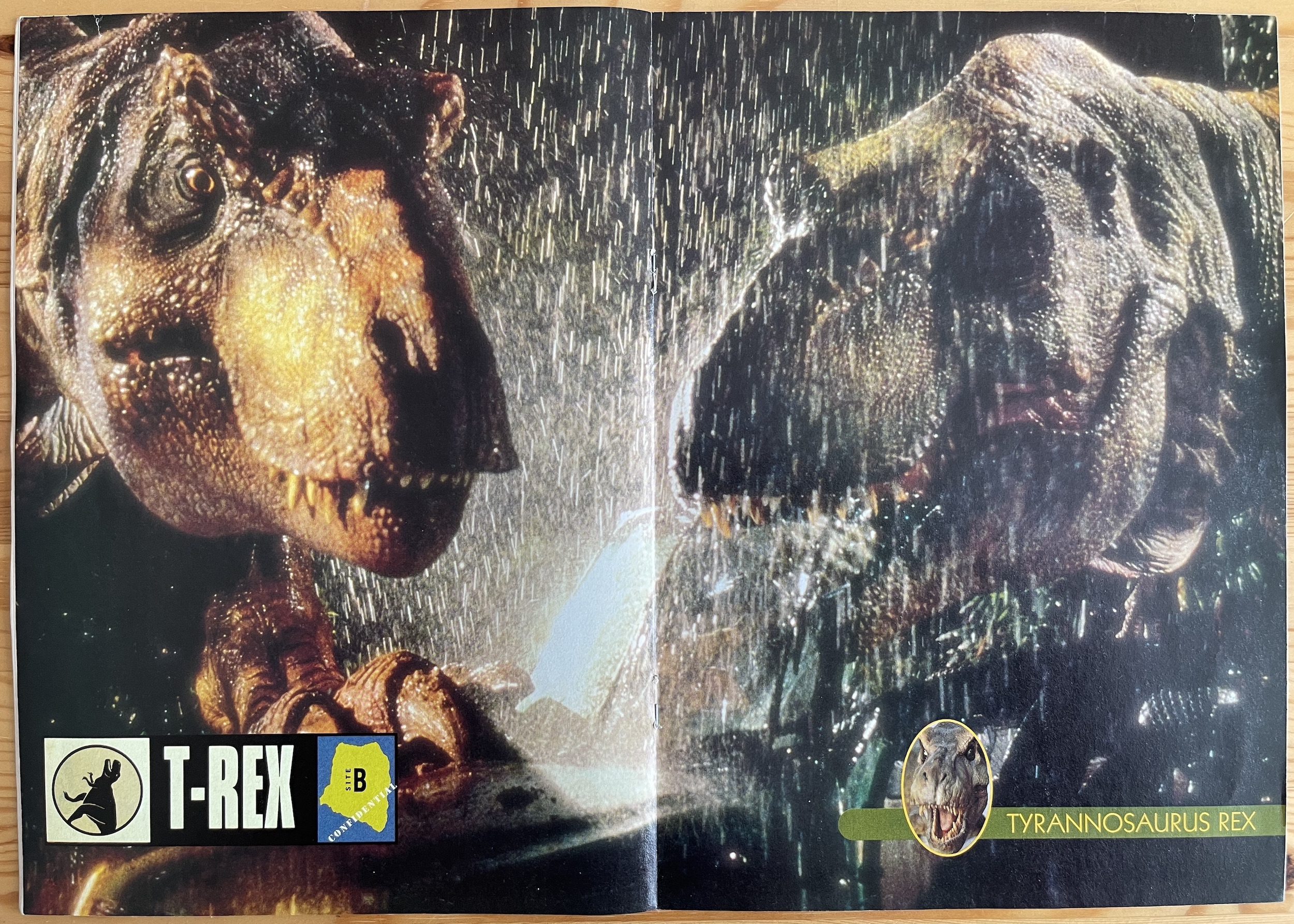
This being a UK comic there are of course extras. The four middle pages are made up of a poster of one of the film’s best scenes, a profile of the more rugged (but still sans moustache) Ian and a page about the T-rex written by Steve White. There’s a lot of information here but for some reason it doesn’t mention their visual acuity, the whole “it can’t see us if we don’t move” thing which was so important in these first two movies. The page actually looks messy and unfinished, with what seems to be a placeholder rectangle, a clip art frame and an image sitting waiting to be edited together, with text over the top that’s difficult to read as a result . Strange.

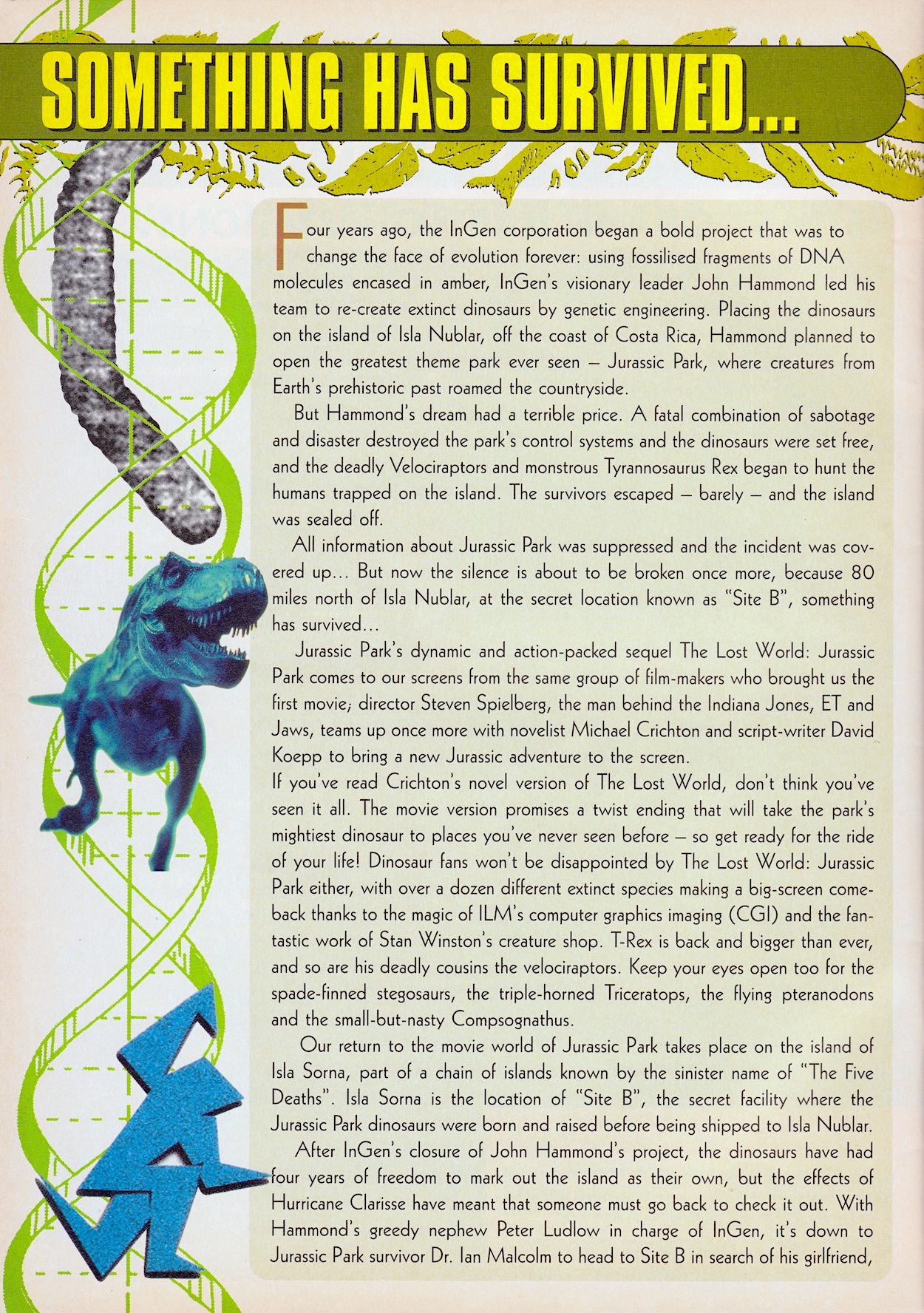
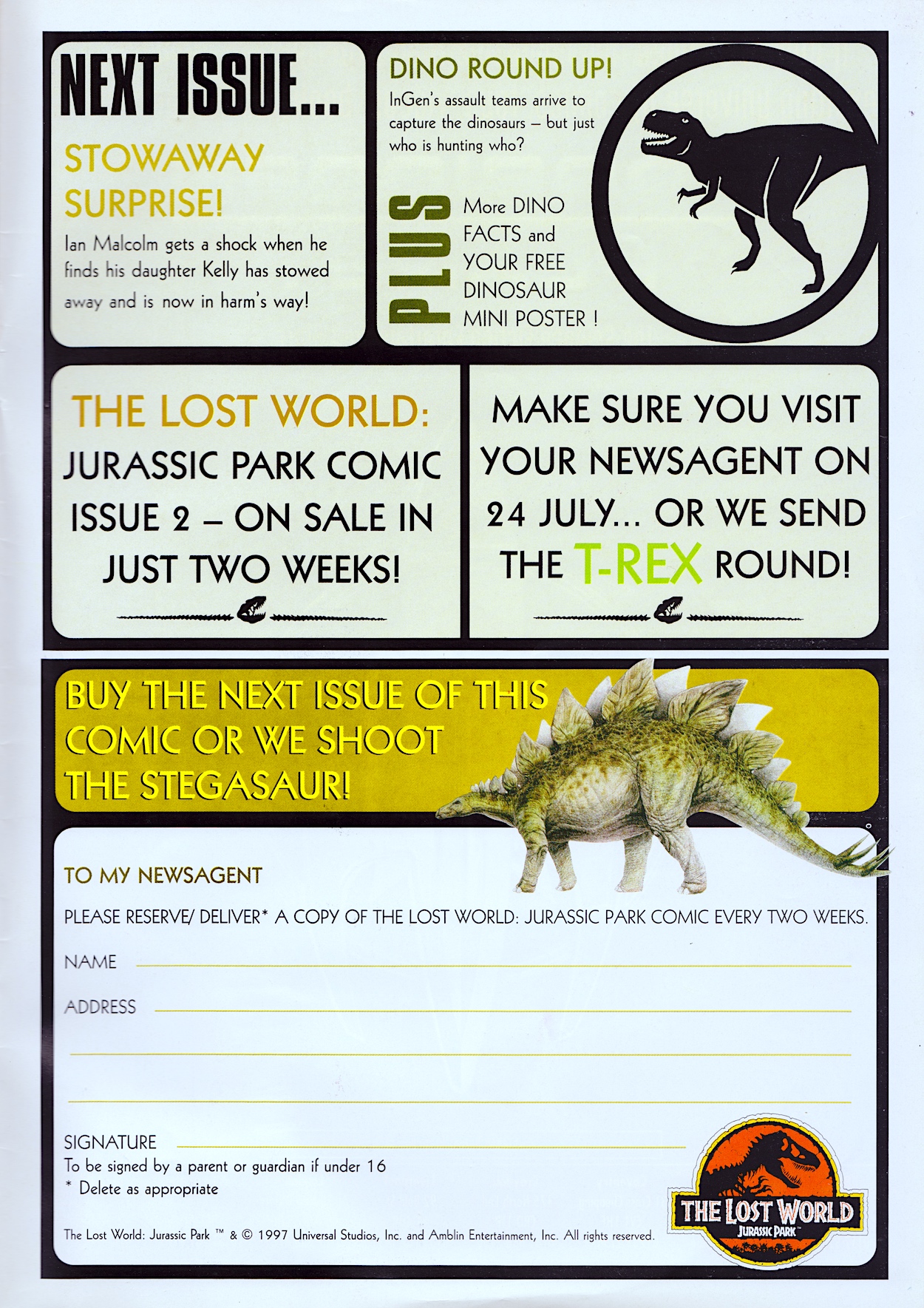
Towards the back is Something Has Survived by Jim Swallow (who’d go on to write Marc Dane, Sundowners and Warhammer 40,000 novels), a text article which basically reiterates what we know already from the strip, although it does give an interesting nugget of information about the film’s ending. There’s also an advert for the graphic novel of the comic which is a bit weird to include when you want people to buy it in individual chapters instead (although the original comic did run a competition for its graphic novel after it had printed the whole story already) and the Next Issue page is rather basic with two different versions of “buy it or else”, the second of which just feels wrong!

The most exciting extra for me is actually an advertisement for a completely different magazine.

I loved Babylon 5 from the moment I decided to tune in to the first episode broadcast on Channel Four. I was completely hooked and I remember the magazine fondly, placing a regular order before the first issue appeared if memory serves me right, so I must’ve seen an advert for it somewhere else. I remember being particularly fond of show creator J. Michael Straczynski’s column and his brutal honesty when discussing working in the television industry and how hard it is to make a living as a writer. I’d no idea John Freeman edited it until just recently. I’m beginning to think he and Steve White (colourist and editor at Marvel UK and who did exceptional colouring work for Xenozoic Tales in the original Jurassic Park comic) are a bit like Lew Stringer in that there seem to be very few publications from my youth they weren’t involved in!

Unlike most comics at the time The Lost World Jurassic Park was fortnightly rather than monthly. With no further strips coming from the States there was never any intention of continuing it beyond the adaptation so, just like over there, it was a mini-series of four. The artwork has saved this opening chapter, will the writing catch up? You can find out in two weeks on Monday 24th July 2023.

GO TO iSSUE TWO

JURASSiC PARK MENU