
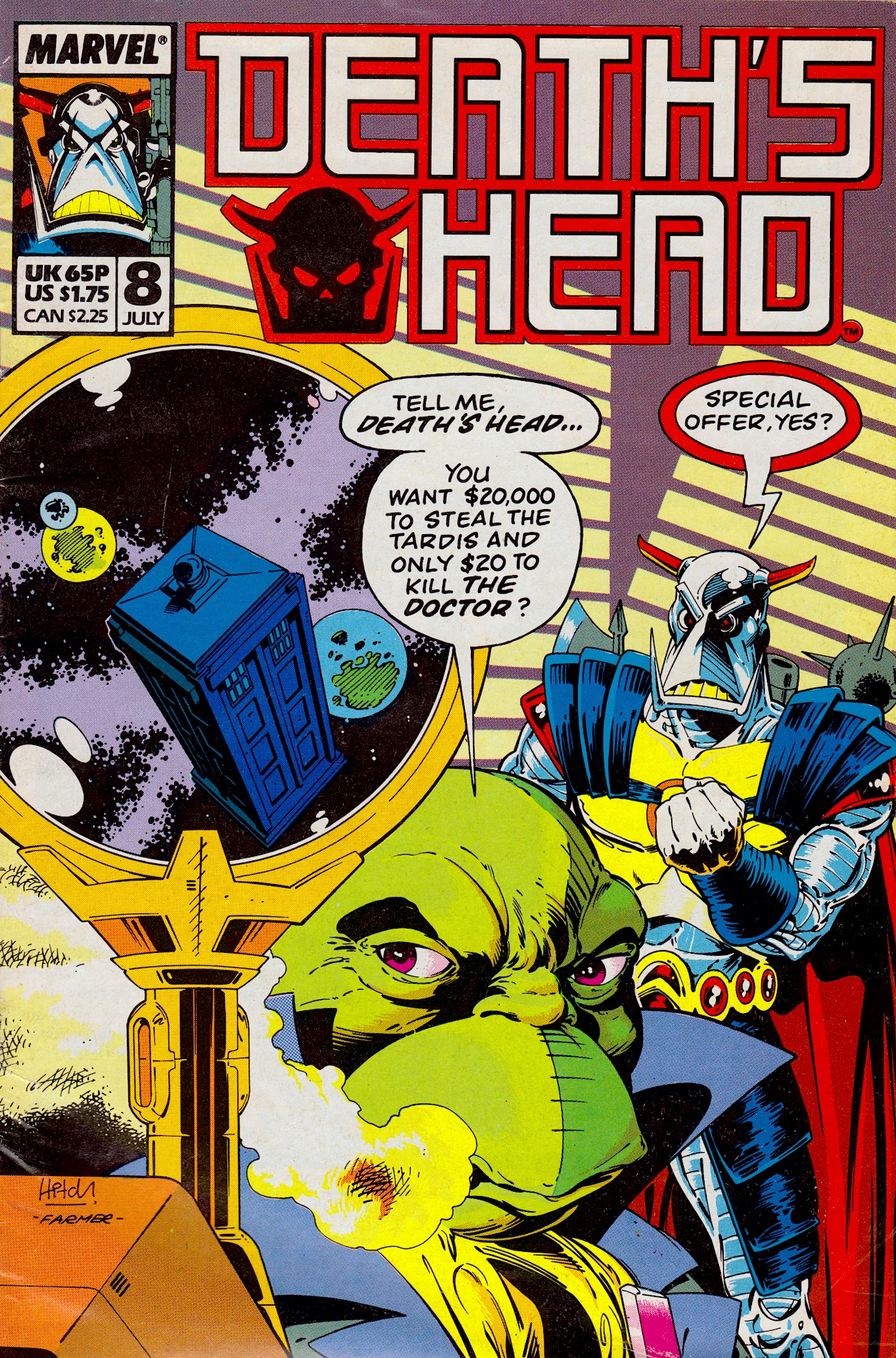
As I collected Death’s Head’s comic for the blog I couldn’t help but notice the covers for the final three issues all prominently displayed characters from other publications. Crossovers were usually an event and used sparingly in my comics as a kid so my initial reaction to seeing these was that they were really, really trying to get a bigger audience for the comic, which made me think sales weren’t great. A bit of a leap perhaps, but three crossovers in a row?
This issue we see the Seventh Doctor (as played by Sylvester McCoy on TV) guest star after our Freelance Peace-Keeping Agent first appeared in Doctor Who Magazine and ended up reduced to human size by the time-traveling alien. It’s clear from the cover and the editorial inside that the opportunity for revenge has presented itself and Death’s Head intends to follow it through. But first, a surprise in the credits!
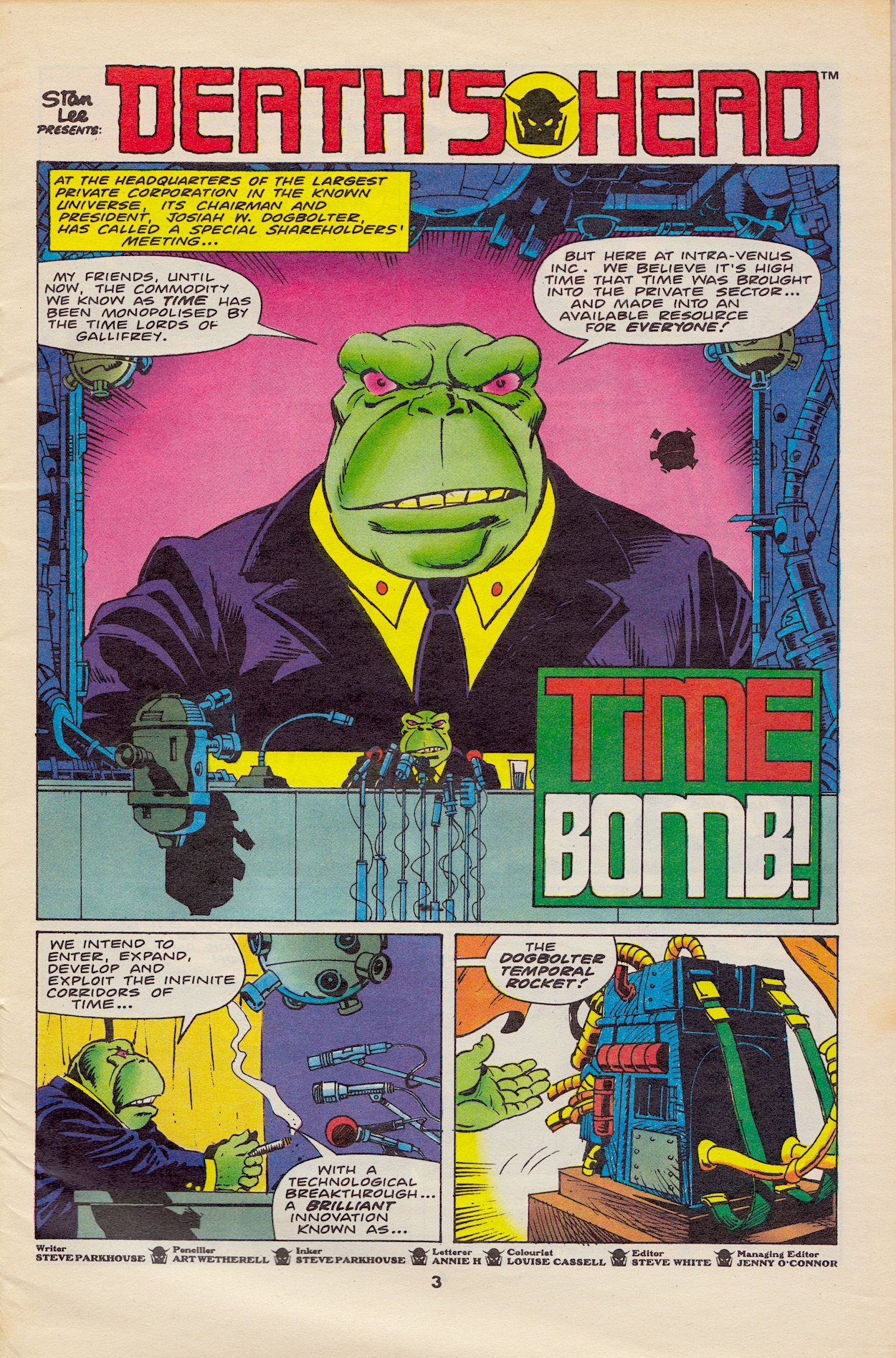
Unlike all previous issues, which were written by the character’s co-creator Simon Furman, this chapter is written by Steve Parkhouse (Nick Fury Agent of S.H.I.E.L.D., The Bojeffries Saga, Doctor Who – unsurprisingly) who also inks Art Wetherell’s (Transformers, The Incredible Hulk Presents, Sheena Queen of the Jungle) pencils. Annie Halfacree letters and Louise Cassell colours a strip that feels very different than usual. Plus, Steve White (editor of Visionaries, colourist on Jurassic Park) takes over as editor after Richard Starkings had resigned.
The plot involves Josiah W. Dogbolter, a character of Steve Parkhouse’s and Steve Dillon‘s from DWM in the Fifth Doctor days, whose company wants to make money out of time travel by privatising it. How could time travel be privatised? In the 80s we thought the same thing about water and the railways. This is clearly taking a dig at Margaret Thatcher’s government of the time, something Simon’s Dragon’s Claws was very good at. It’s nice to see this kind of satire make its way into the more comedy-focussed title.
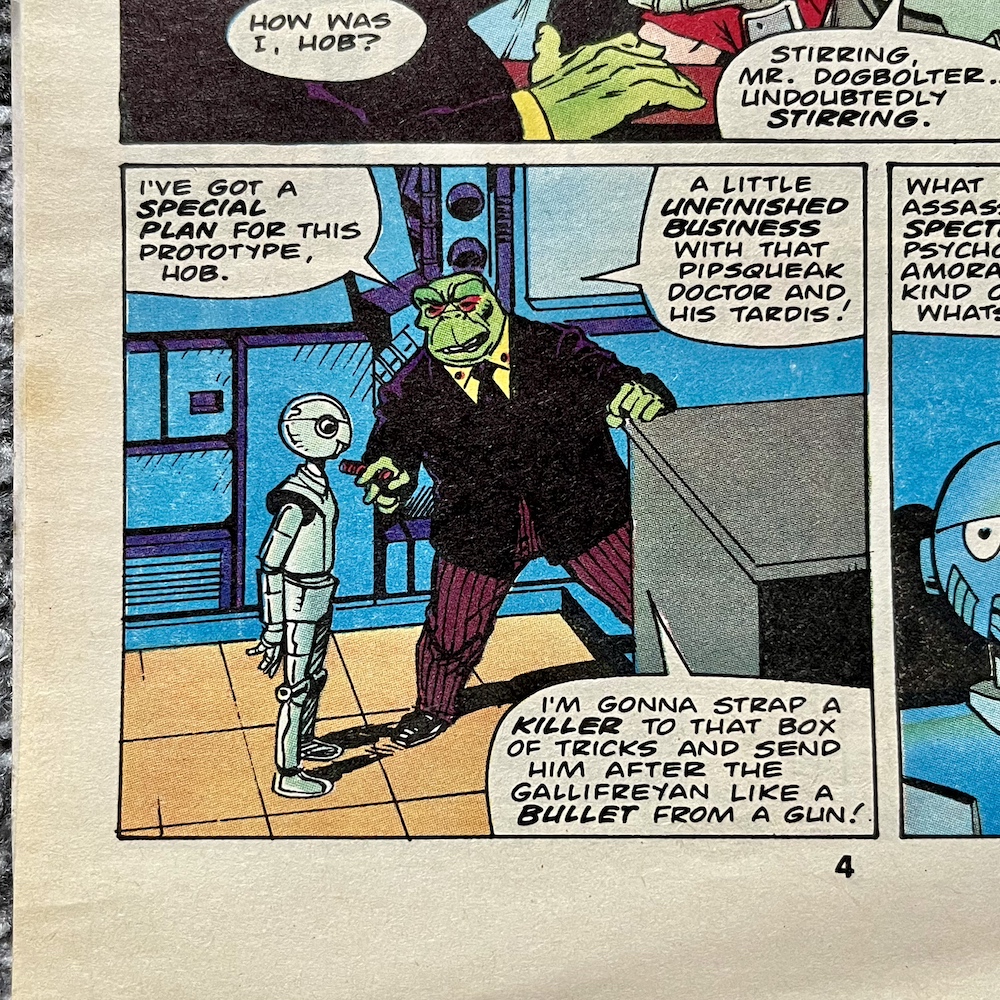
Dogbolter finishes his speech to his shareholders and the press with the phrase, “Time IS money!!” and I have to hand it to him for that one. It doesn’t take a genius to work out that the businessman has had previous run-ins with The Doctor and that’s why he’s wanting to control the very essence of time travel. The first panel above sums up the entirety of the plot for this issue, found on the second page.
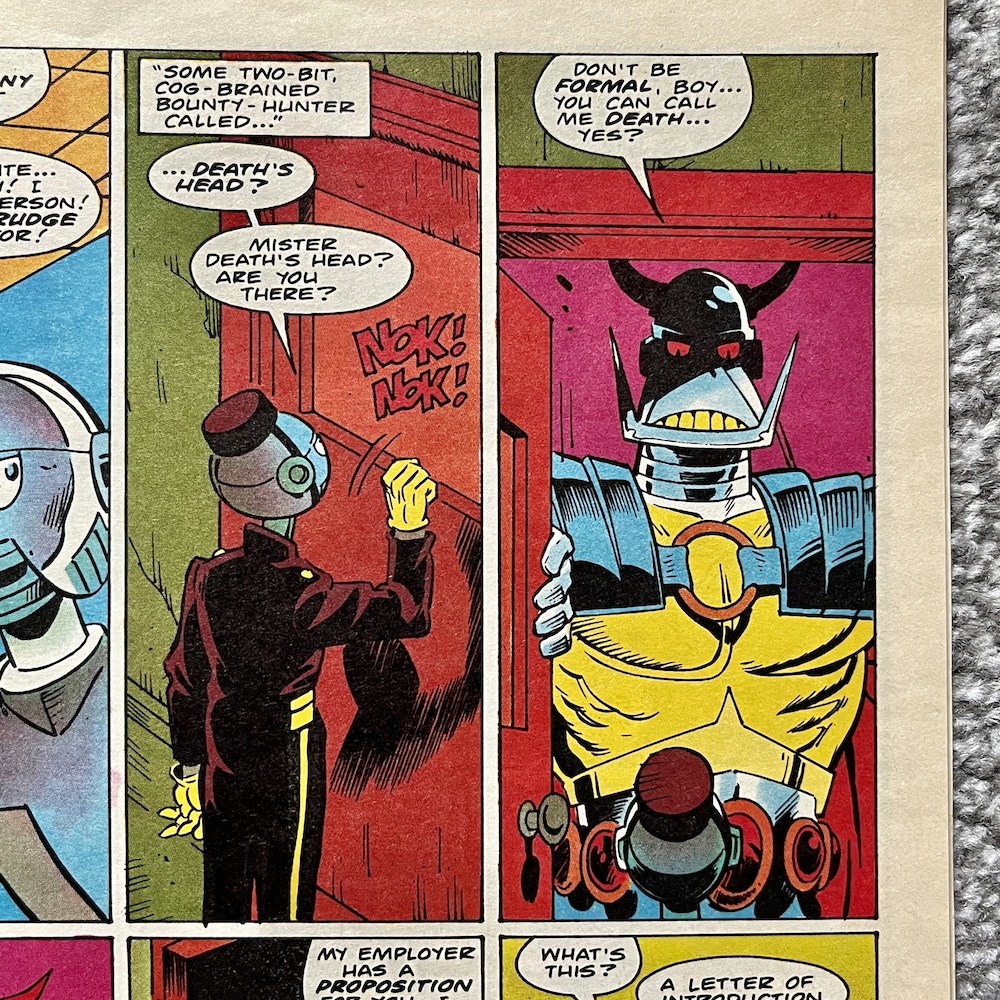
This comic could never be accused of having intricate plot lines, usually they’re just a means to an end. But when those ends are so full of character, action and laughs, when they’re so enjoyable, they do the job. This issue is no exception. Hob is Dogbolter’s robotic assistant and is sent out (in delivery boy uniform no less) to hire Death’s Head for an assassination attempt on The Doctor. Needless to say, he accepts the job.
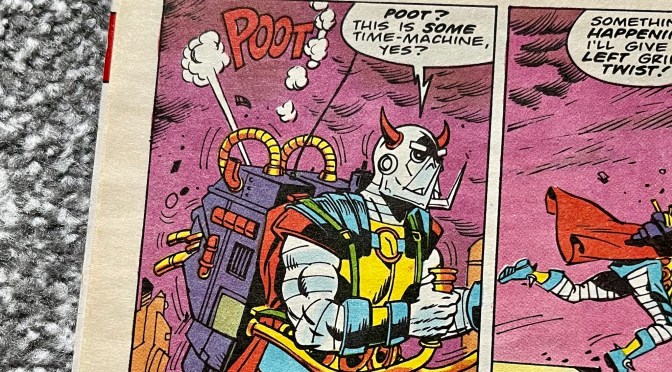
“Poot? This is some Time Machine, yes?”
Death’s Head
What he doesn’t know is that Dogbolter was looking for “a skilled assassin who’s not only spectacularly stupid, but psychotically aggressive, amoral, and lacking any kind of imagination whatsoever” and Hob’s conclusion was to approach our lead character. It becomes apparent later in the strip why his boss was looking for someone with these particular traits. But first, on a dark and stormy post-apocalyptic night in a future Los Angeles, the powerful time travelling device gets strapped to Death’s Head and he dramatically sets off. Well, sort of.
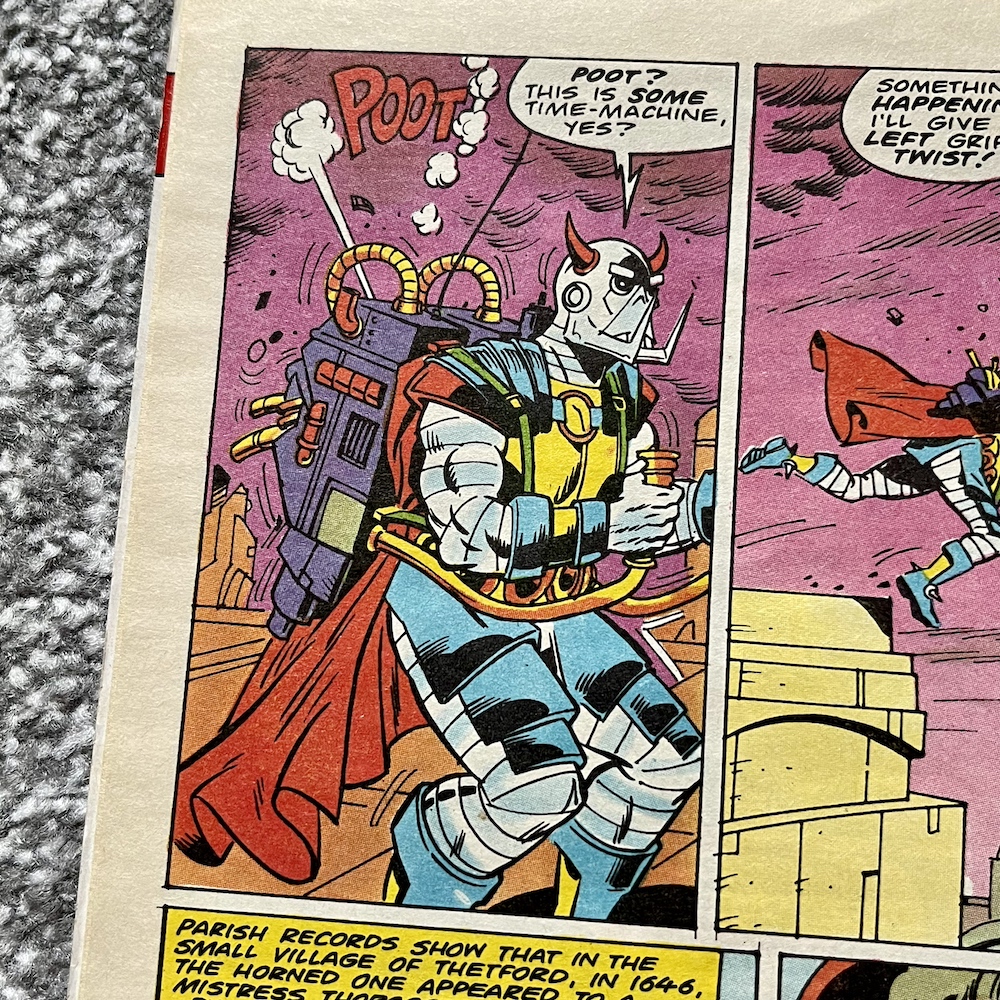
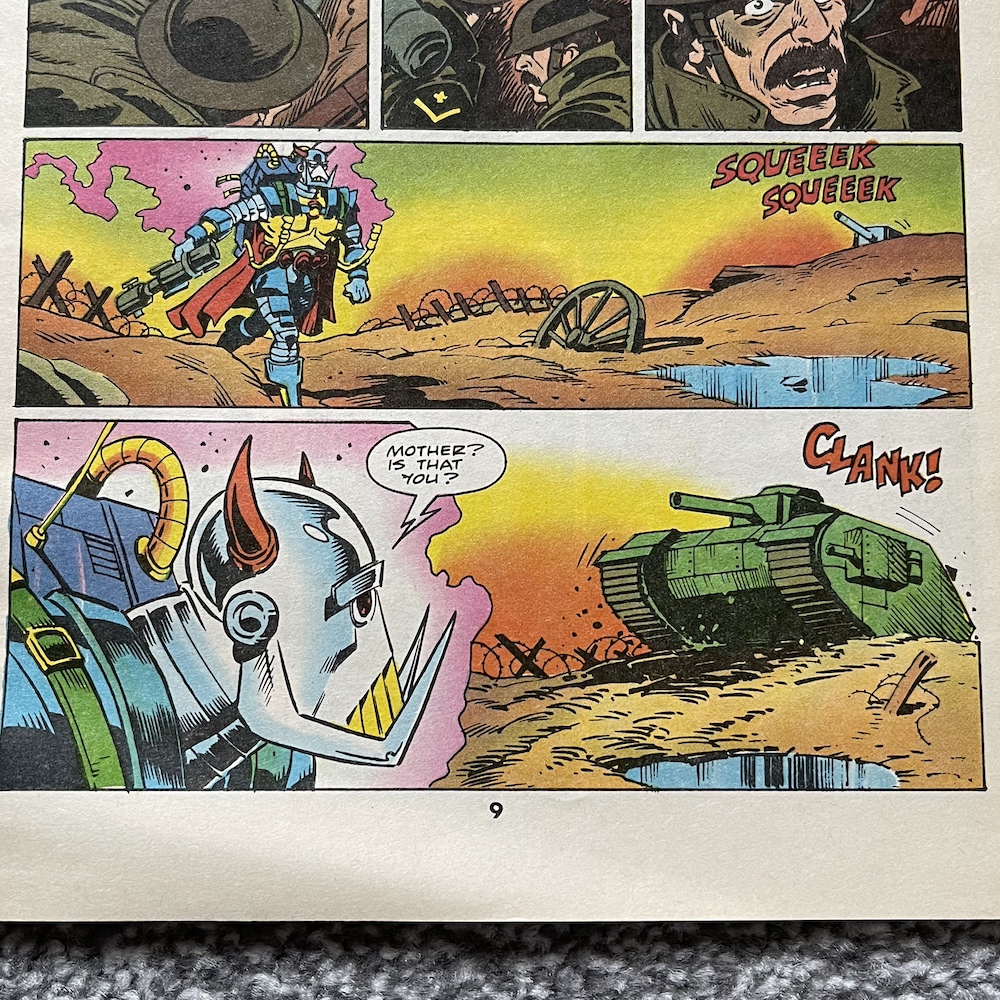
It’s not exactly the TARDIS. A fun segment takes Death’s Head through various points in time before he’s able to find The Doctor. First of all he lands in an English parish in 1646. Leaving just moments later it was enough for the poor woman whose garden he appeared in to be sentenced to death for summoning a demon. Two huge shoed footprints are uncovered by archaeologists digging for Triassic period fossils and then he appears in front of a German tank during World War II!
Lots of laughs later we see The Doctor is also attempting to make an audience smile as he plays a court jester in a panto taking place in front of tourists on an English seaside pier. I have no idea why this is, perhaps it ties into a story in Doctor Who Magazine at the time. A loud noise from behind him sends the audience into the usual pantomime chant of “He’s behind you”, to which The Doctor naturally replies, “Oh not he isn’t”, leading to this next page.
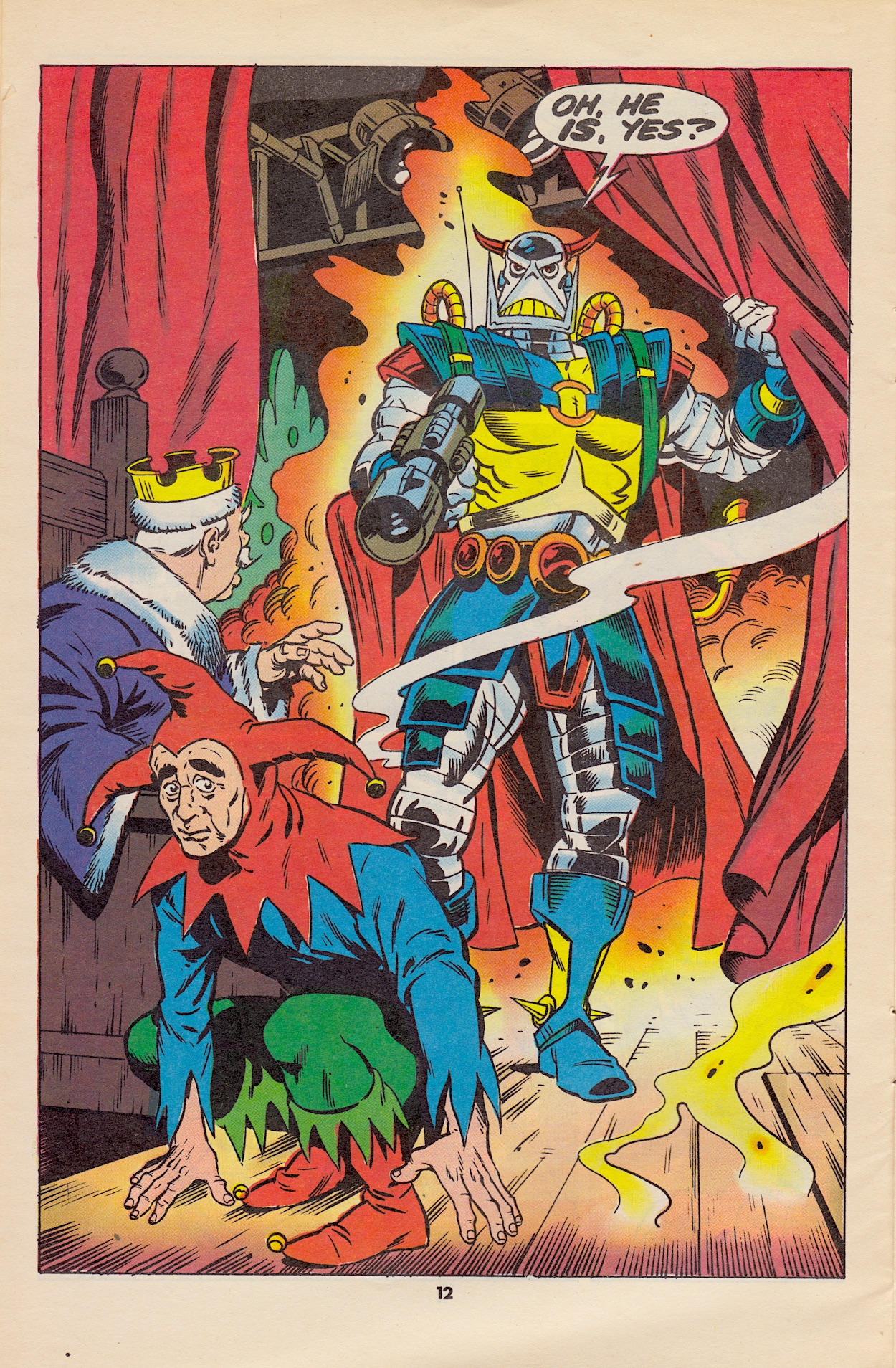
That’s an entrance. Using some panto clichés, namely pulling a lever to open a trap door under Death’s Head and then escaping as one half of a pantomime horse (no, really), The Doctor makes his way back to the TARDIS and scarpers to another time and place. This really is all rather ridiculous, even for the far-fetched nature of this comic but then again we have to remember this was published during 80s Doctor Who.
I have a real fondness for Sylvester’s Doctor. He was my first but I didn’t start watching until the beginning of his second season (with the phenomenal Remembrance of the Daleks) when he became a darker and more mysterious character, often instigating the plot rather than reacting to an injustice. But when this comic was written only his first season had been broadcast in which he was much more of a clown, fumbling his way through time while playing the spoons!
This explains a lot about his actions in Time Bomb, and especially the ludicrous escape he’s just made.
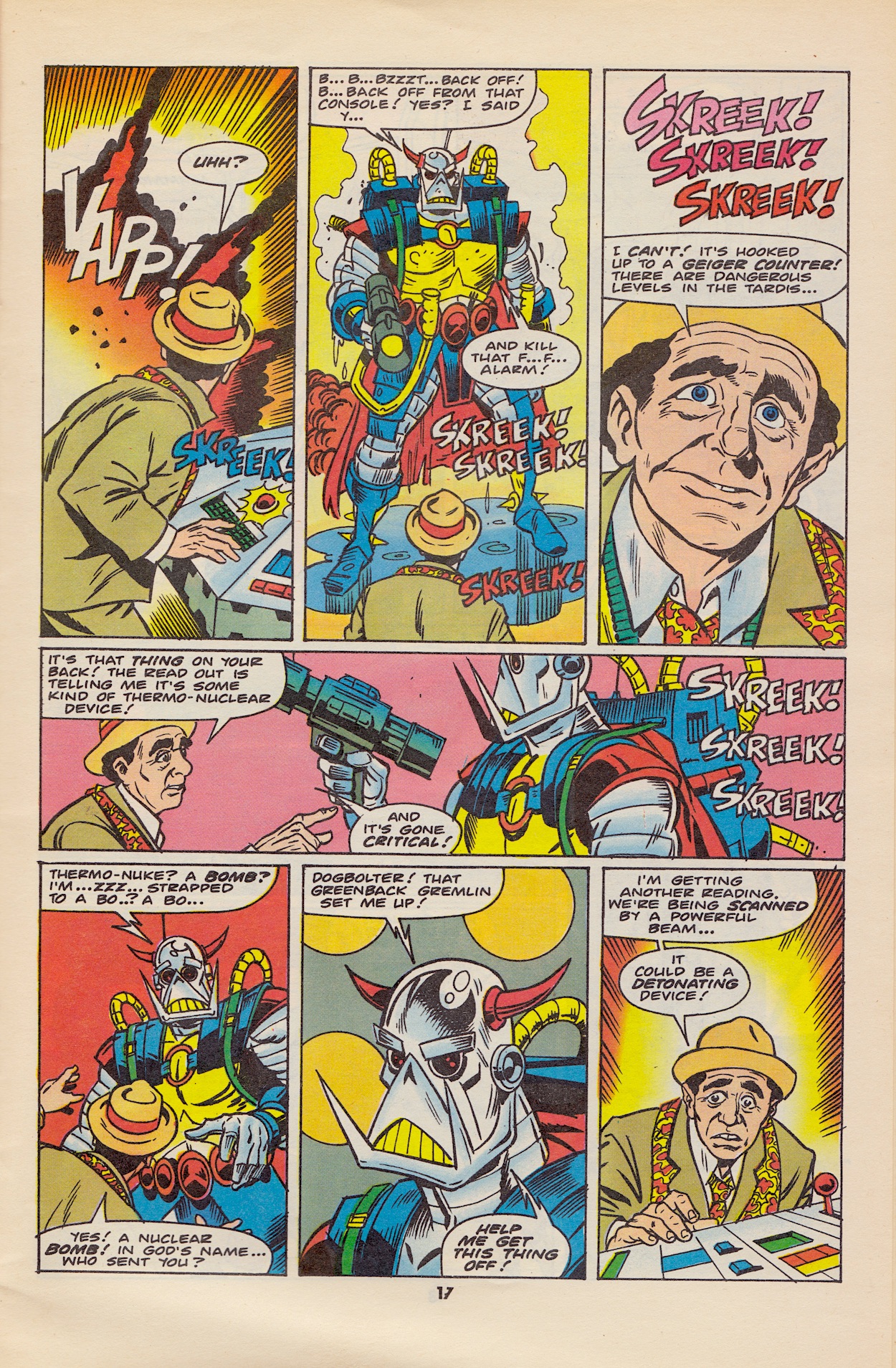
So he may not feel like my Doctor but it’s still an entertaining strip. Death’s Head is able to somehow materialise inside the TARDIS (this is never explained) direct from the sea he’d plunged into under the pier. An alarm sounds and soon he finds out he’s been double-crossed. Dogbolter not only ensured The Doctor would be killed but that there wouldn’t be any witnesses to tie things back to him.
Over the next couple of pages we see Death’s Head and The Doctor work together as much as they ever will, not exactly with each other but they have a mutual wish to survive and that’s enough for now. They lock on to the source of the signal and materialise on top of Intra-Venus Inc.’s (brilliant name) roof, much to Dogbolter’s chagrin. As he heads to the sub-basement shelter, inside the TARDIS Death’s Head tries to convince The Doctor to blast the straps of the machine off his back.
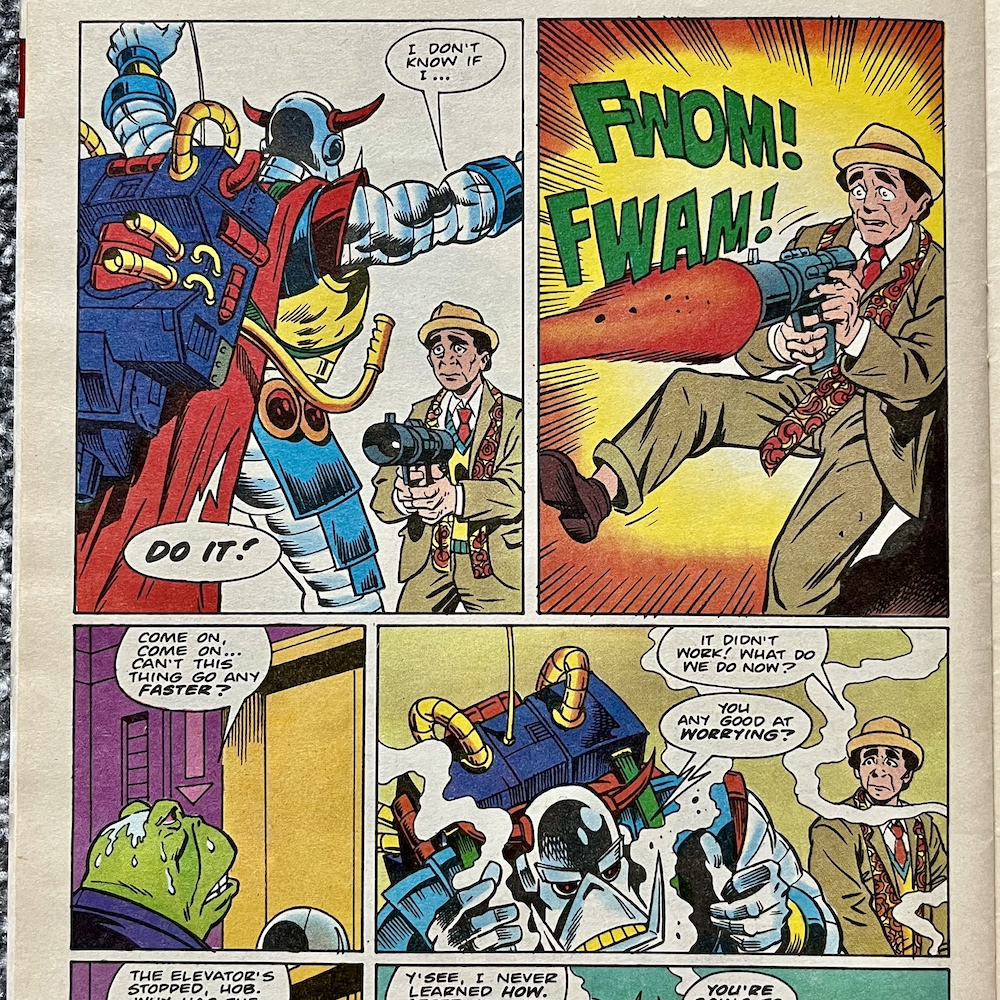
The patter between these two is very good. Death’s Head explains he never learned how to worry but that The Doctor is about to be blown up and end up in hell, so he tells him he’d better get to work. Using something called a Piklok (a new invention, but why not the Sonic Screwdriver?) he manages to unstrap the time machine while elsewhere Dogbolter has lost his ID card and can’t get off the elevator in time to escape before this next page.
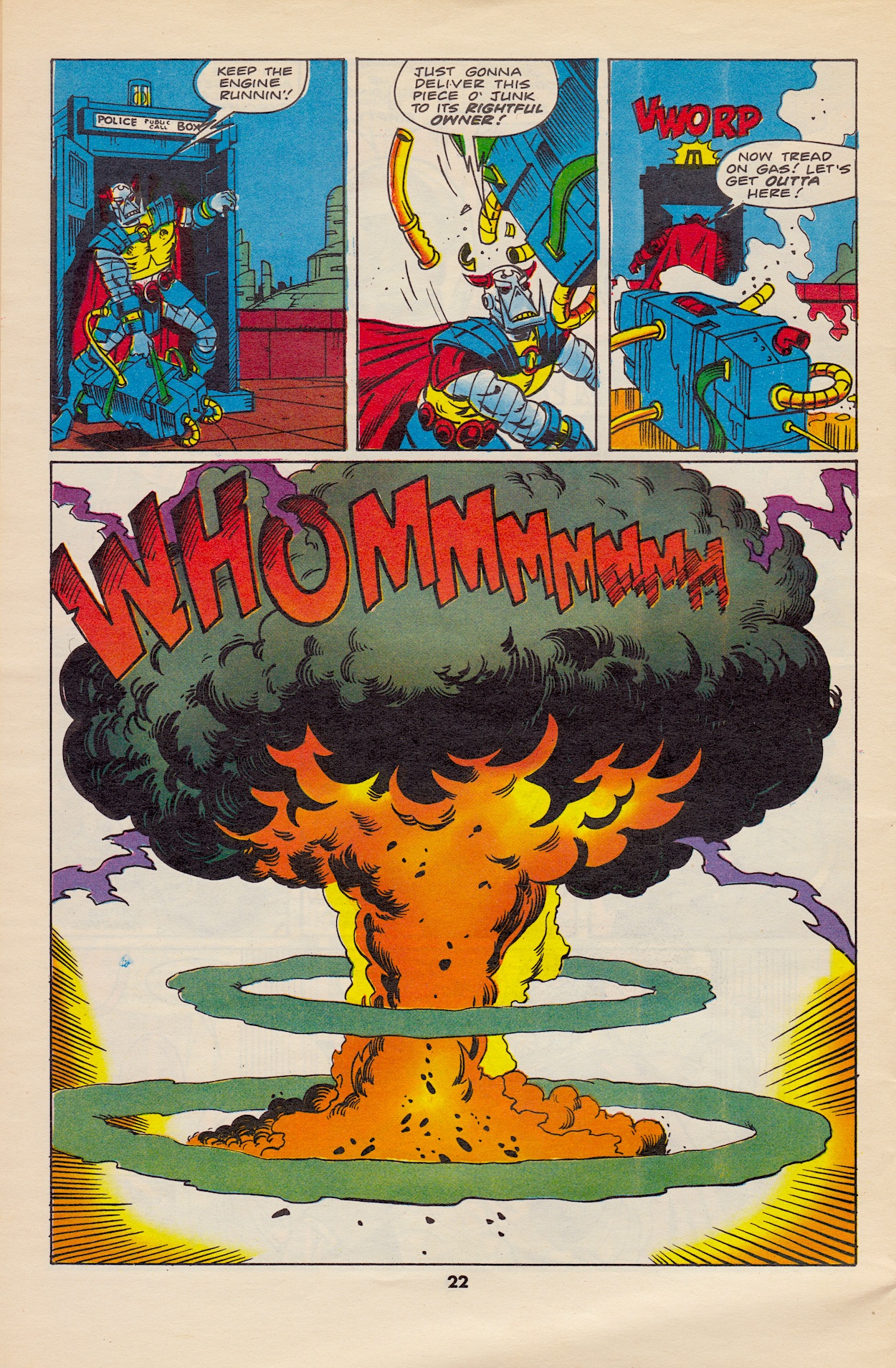
I have an issue with this. A big one. It’s been established the time machine is nuclear-powered, so why did The Doctor not dispose of it in deep, dark space? Why bring it back to Earth? The size of the explosion is meant to indicate the end of Dogbolter and his company, but that would also include everyone else in that building and at the very least the surrounding buildings too! The Doctor would never put innocent human lives at risk, never mind actually blowing them to bits!
Back in Doctor Who Magazine #135 he also put Earth at risk by dropping Death’s Head off here, even though he acknowledged how dangerous that would be for his favourite planet. It’s not like the Seventh Doctor had it in for us humans, he held the same morals as all the rest, including the modern day incarnations (if you’re unfamiliar with the classic series). It’s a huge sticking point for me and kind of ruins the end of a fun story.
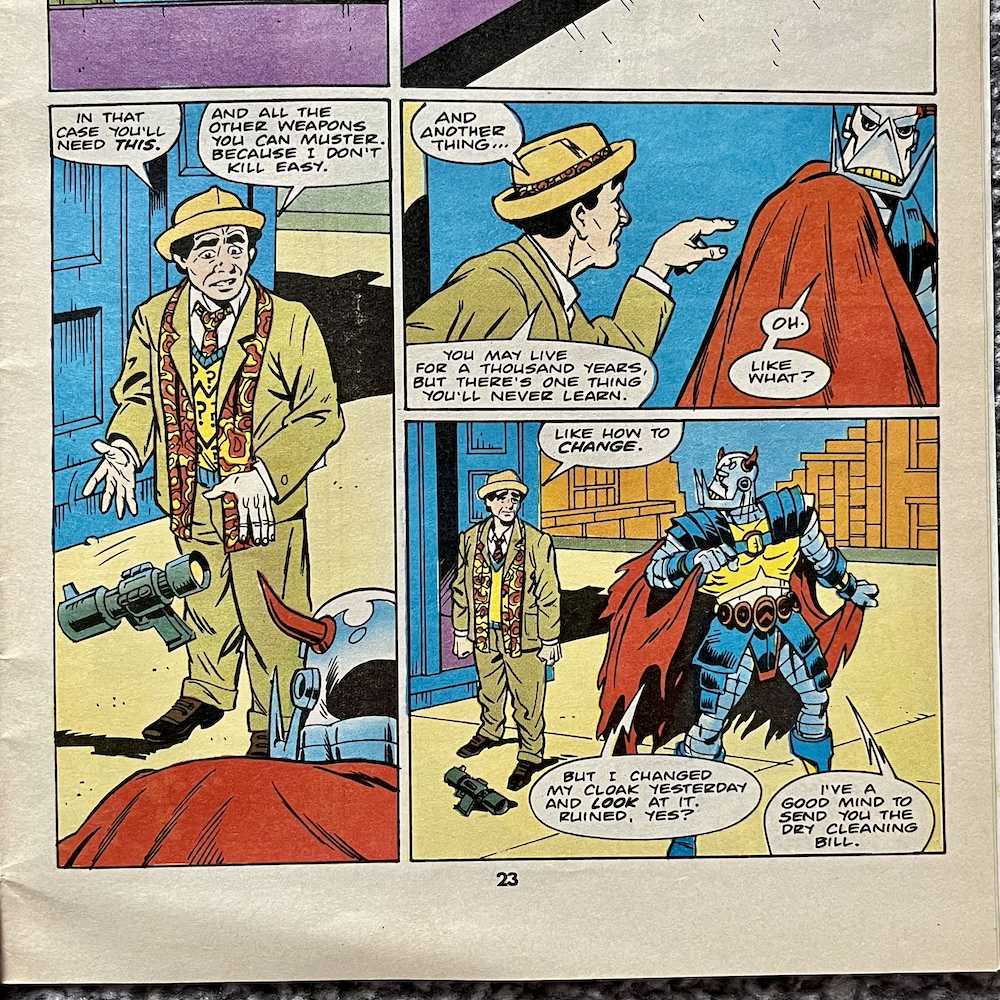
With this in mind it’s quite galling of The Doctor to then try to lecture our mechanoid anti-hero on his behaviour. Death’s Head’s response is funny though, I’ll give the strip that. The Doctor tells him that humans can evolve and change their evil ways, which Death’s Head simply describes as falling apart. After all, he’s programmed, and metal; if he changes from that then he’s literally falling apart. It’s black and white to him.
“A thousand years from now I’ll be rich… but you’ll be dead.”
Death’s Head
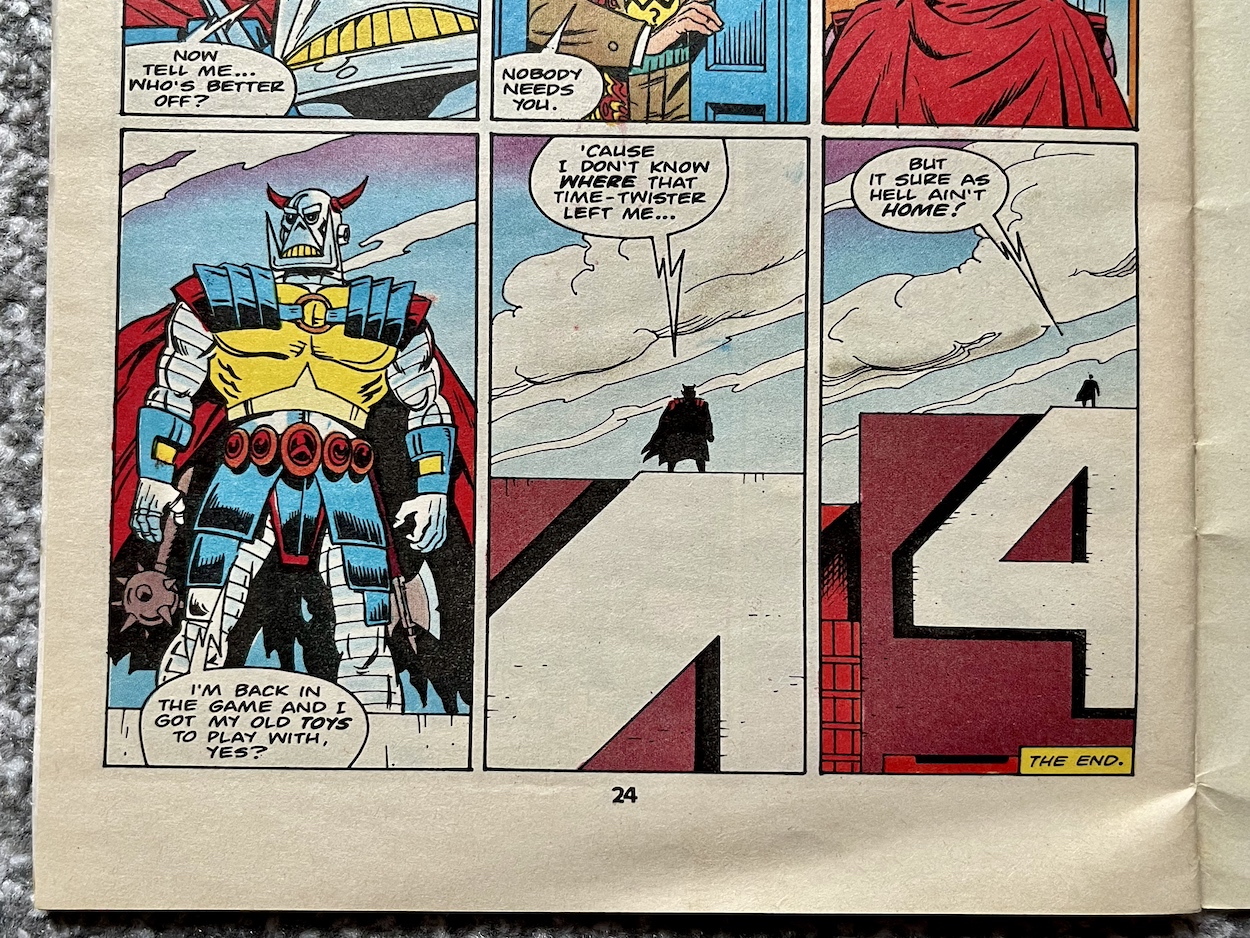
As The Doctor leaves he tells Death’s Head that he’s doomed, that in a thousand years people will be different be he’ll still be the same. “A thousand years from now I’ll be rich… but you’ll be dead”, he retorts. There’s no use in trying to push it, so as the TARDIS doors close he’s told he’s just a machine, a tool, one that nobody truly needs. Death’s Head muses that The Doctor is probably right, but then realises he doesn’t care; he’s home and ready to earn money again.
The final few panels pull back to reveal a not-so-subtle hint of who will be guest starring in #9. Anyone unsure (as I would’ve been at the time if I’d been reading this as a kid, I wasn’t a superhero comic reader), the answer to the final letter on the Head To Head page gives the game away not only for the next issue but the final one beyond that.
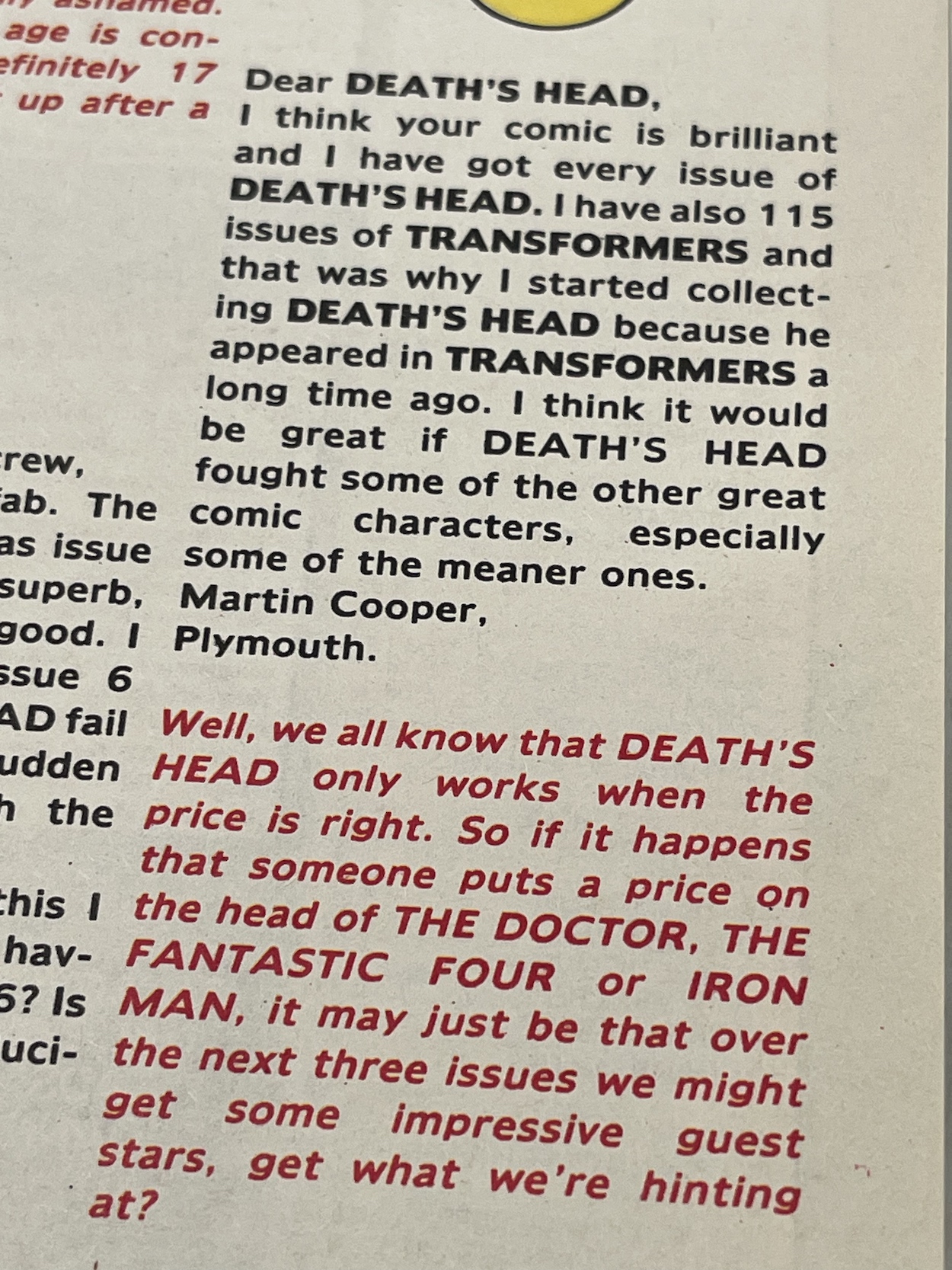
Then again, what’s the point in crossovers if you can’t market the hell out of them in advance to try to increase sales, yes?
I really enjoyed this story but that explosive ending bugs me. I don’t mean to dwell but as a fan of Doctor Who it’s just so out of character, so out of sync with what the series stands for, that I can’t let it go. I know nothing about The Fantastic Four so if they suffer the same fate I’ll be none the wiser. We’ll see how Death’s Head fares with four super-powered humans in #9, so watch out for the review on Monday 1st July 2024.
 OiNK Blog