Tag Archives: Steve Moore

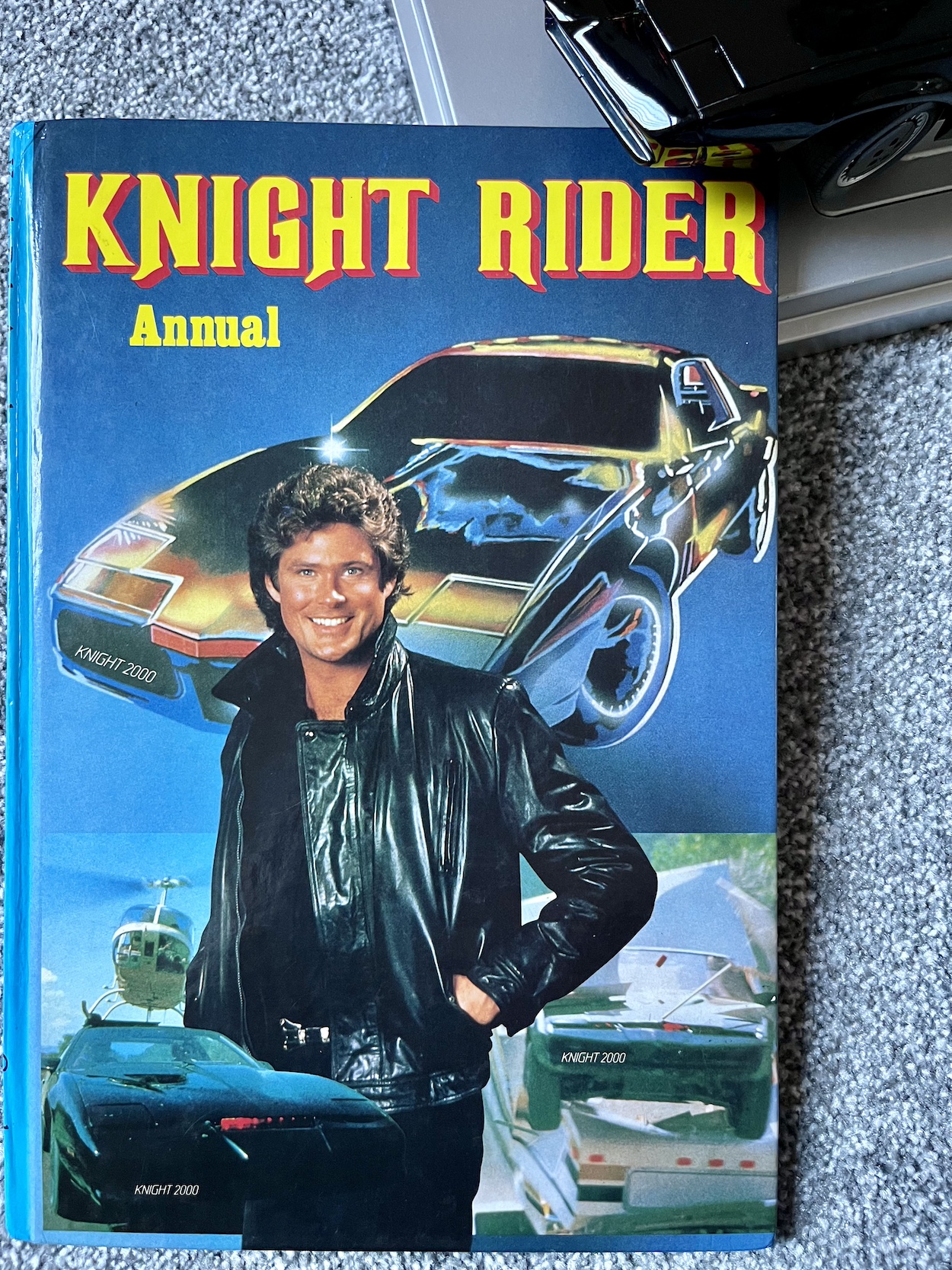
KNiGHT RiDER ANNUAL #2: KRiSTMAS K.I.T.T.

By the time this second Knight Rider Annual was being written the team had had more of a chance to become acquainted with the series and it shows.  Don’t get me wrong, the previous book was a fun read with some simply beautiful David Lloyd artwork and writer Steve Moore had nailed the early characterisations of both Michael Knight and K.I.T.T. from the pilot movie. However, this year the stories definitely benefited from the broadcast of more episodes. K.I.T.T.’s capabilities have also been expanded and Michael feels more rounded.

Released in the summer of 1984 for that festive season, this annual is set during the second season of the show. In the UK, where programmes would normally begin airing about six months after the US back in the 80s, Knight Rider had proven to be such a phenomenal success for ITV that they broke with that tradition, moving straight on to season two the week after season one finished. So Steve and David had a wealth of episodes to work from and as a result there’s a different feel to this book. Let’s begin and I’ll show you what I mean.
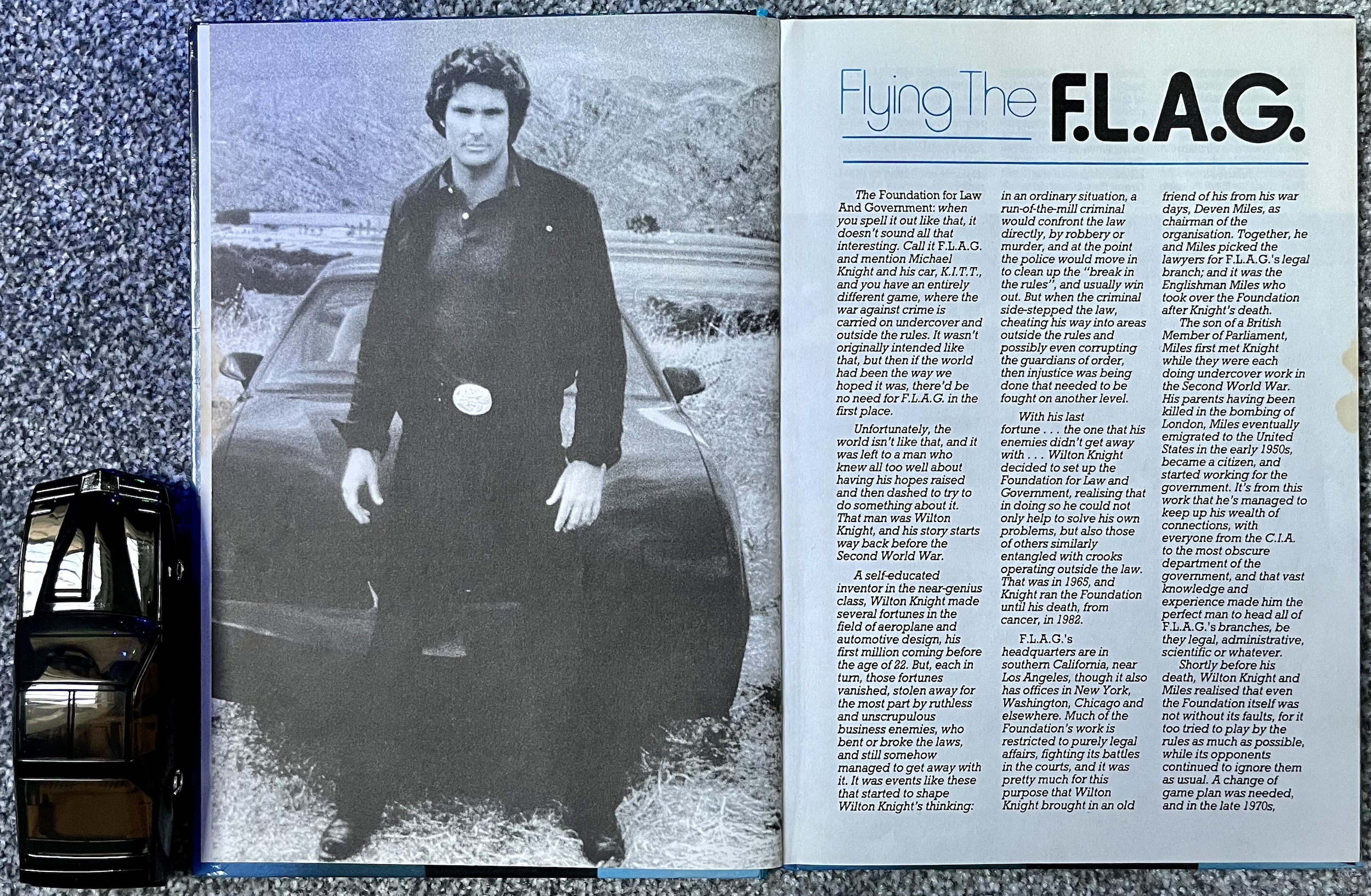
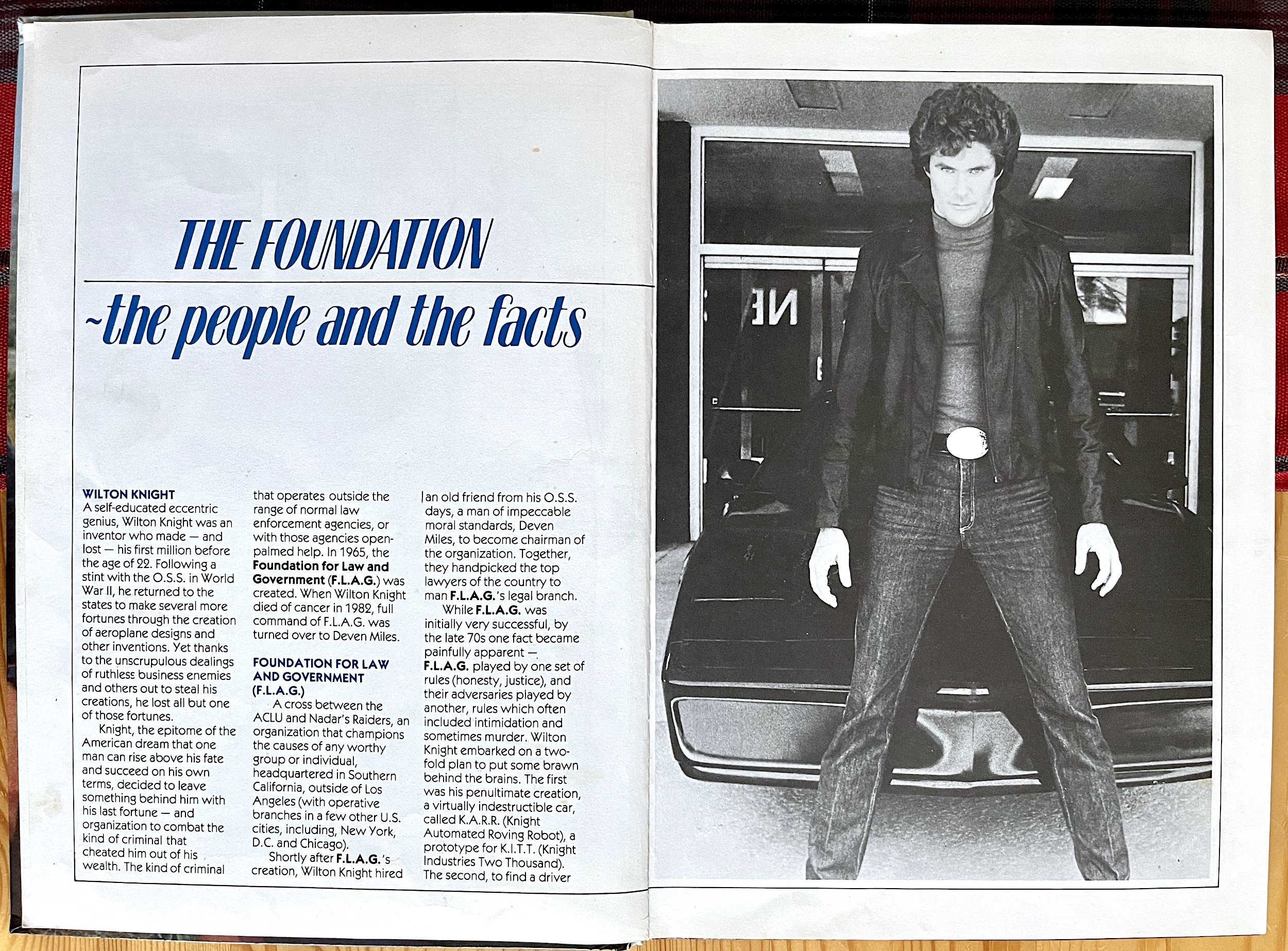
This year’s origins feature focuses on Wilton Knight, the millionaire philanthropist who created Knight Industries and its F.L.A.G. (Foundation for Law and Government) division, who saved Michael from certain death before passing away himself in the pilot movie. Wilton was played so memorably by Richard Basehart (Moby Dick, Voyage to the Bottom of the Sea, La Strada) his commanding vocals were heard every week in the opening credits.  The feature tracks his history back to World War 2 and the origins of that famous “criminals who operate above the law” line.

It’s also the first time it’s confirmed that it was cancer that killed him, though it was implied in the pilot movie.  Apart from continuing to misspell Devon Miles’ name as ‘Deven’ this is a flawless introduction to the show and with all of the extra information it’s something fans should hunt out the book for. After Devon’s immigration into the US we find out there were flaws with how F.L.A.G. operated at the beginning. Remaining inside the same rules the criminals flouted was leading nowhere, so from the late 1970s research into a new project began, which would eventually lead to K.I.T.T.
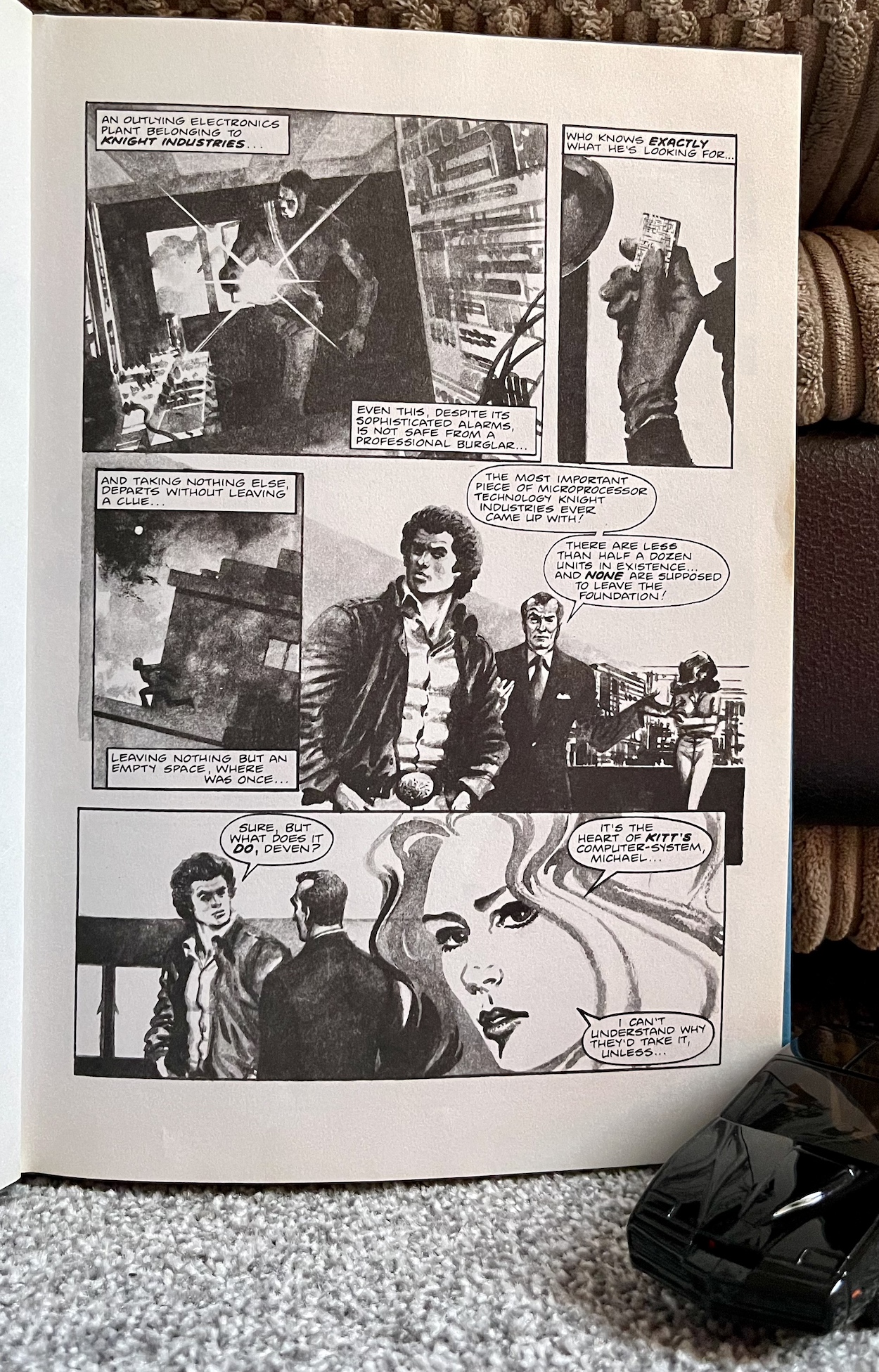
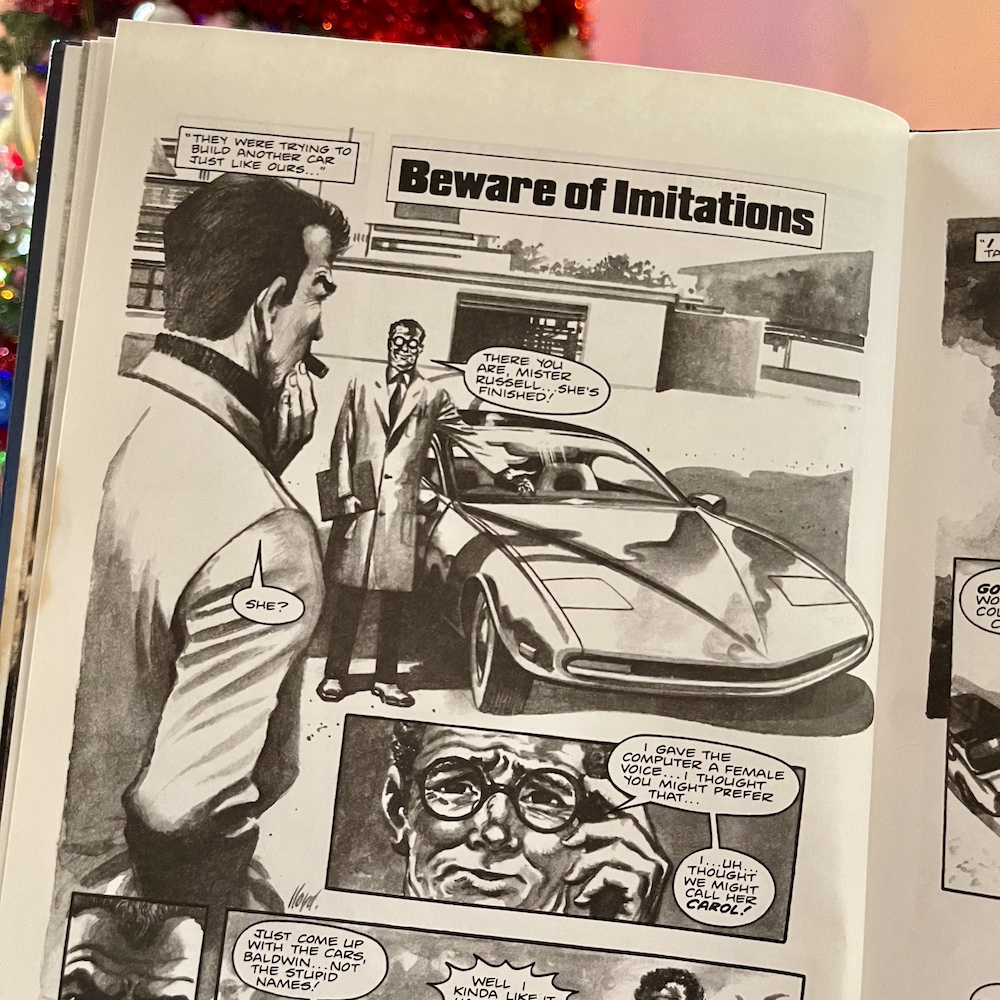
It’s a brilliant start and benefits from extra research into the background of the series’ story. So it’s weird that the first strip, Beware of Imitations, is a rip off of a very popular story from the TV show. In the programme, K.A.R.R. was the prototype for K.I.T.T. However, while K.I.T.T.’s primary directive was the preservation of human life, K.A.R.R.’s was self-preservation (originally thought to be the best way to protect the driver). Here, we’ve got another ‘twin’ for the supercar. There’s a wonderfully atmospheric first page but then it boils down to a new female version of K.I.T.T. being prepared in record time, completely contradicting the introductory feature on the previous pages.

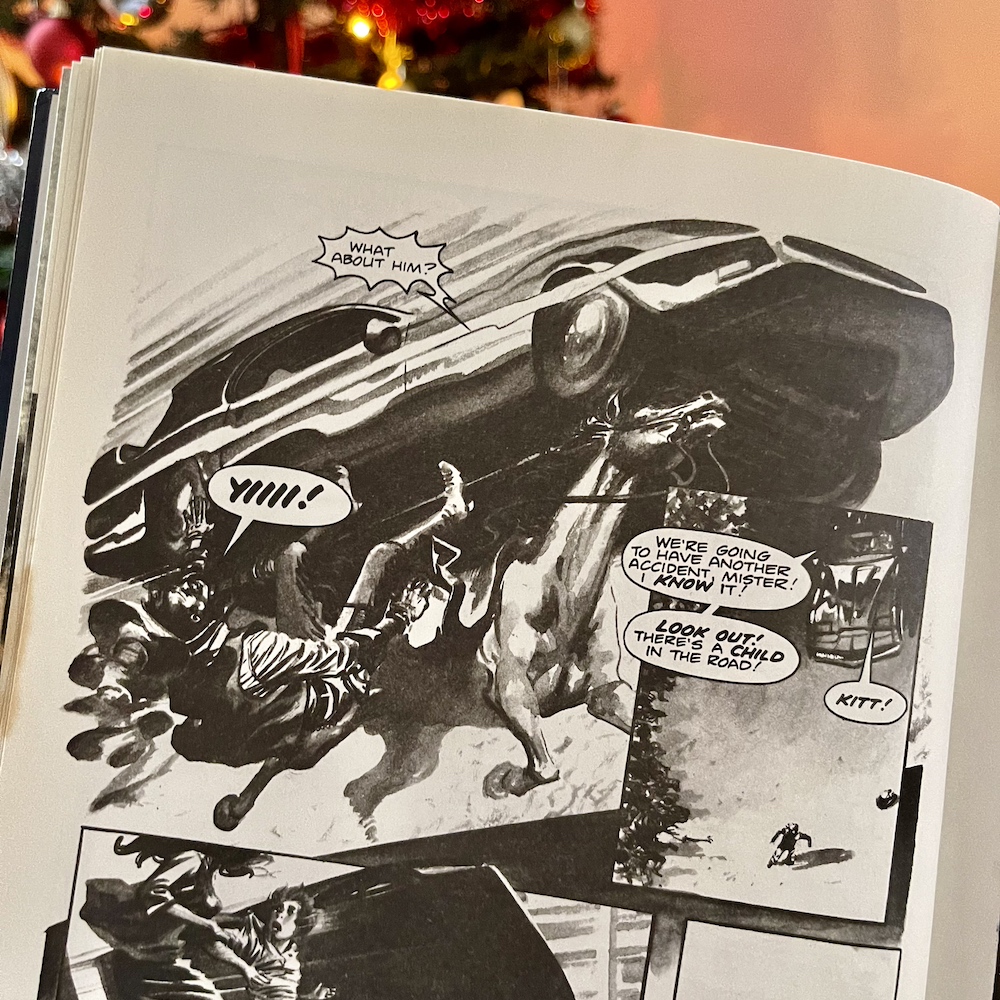
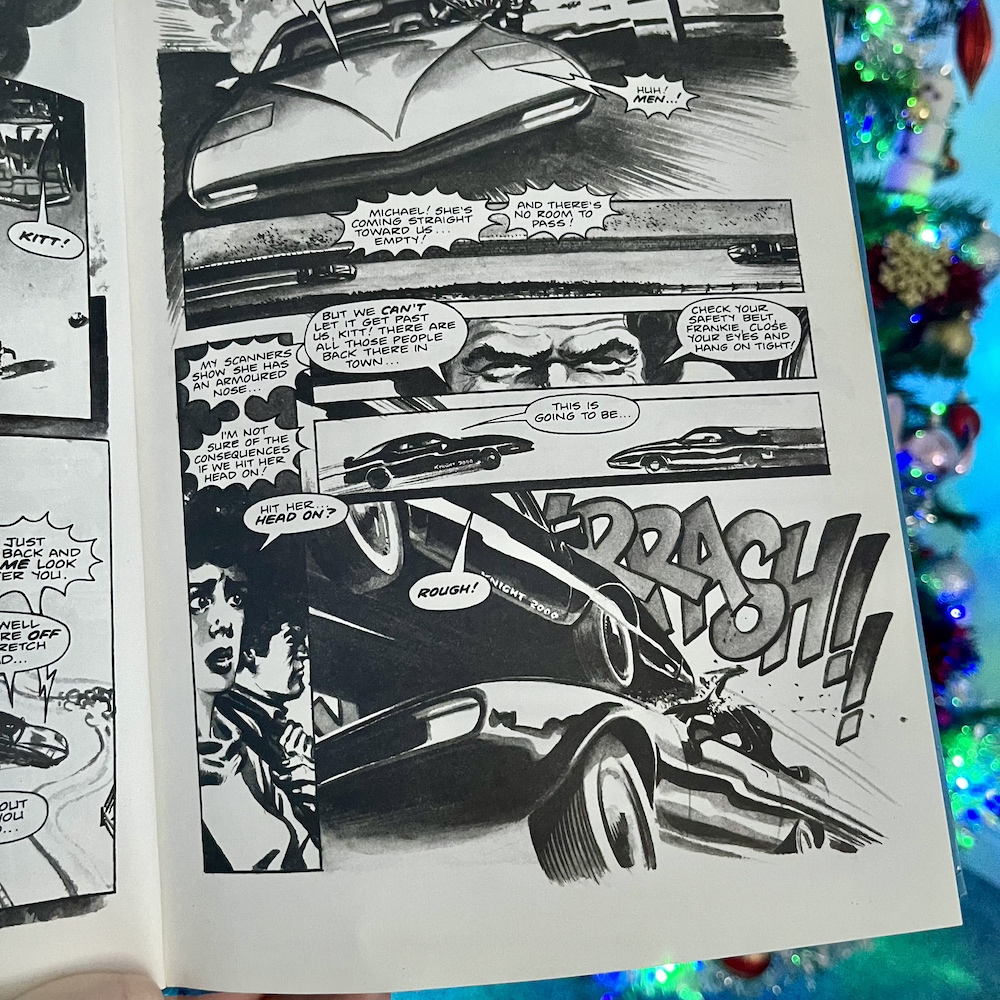
There are mentions made of the shortcuts taken and the fact only the nose of the car is armoured, but seeing it turbo boost etc. makes it seem like K.I.T.T. (and by extension K.A.R.R.) isn’t all that special after all. It’s not even all that fun, other than the solution to stopping the car is K.I.T.T. landing a turbo boost on top of it! Beautiful artwork from David Lloyd again though, with loads of fast action and big, impactful panels of destruction at the hands (tyres?) of the female car.
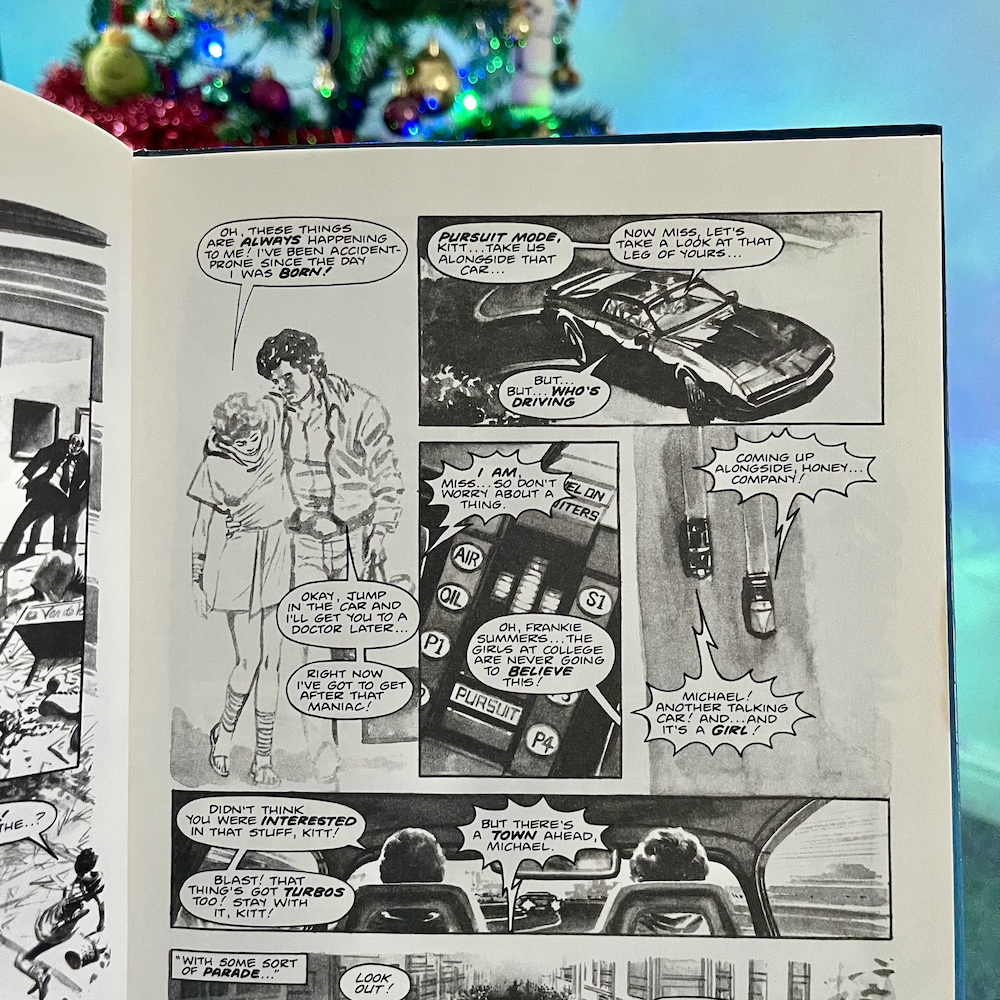
The first prose story is called Games People Play and involves industrial espionage in the video game industry, something else we’d have seen in the series by this point. However the episode in question, Nobody Does It Better, wouldn’t have aired when this was written so it’s more of a coincidence. Also, back in 1984 the video game explosion was in full force and it was a subject ripe for this hi-tech TV show.

The mission seems simple enough to begin with. Michael needs to protect Dr. Lesley Kelly, a gaming company’s lead engineer until she can complete the first build of their next hit title after some failed kidnap attempts. Michael is instantly attracted to Dr. Kelly but Lesley makes it crystal clear the feeling isn’t reciprocated, but she warms to K.I.T.T., speaking to him on a level footing and adding an enjoyable character dynamic between the three of them.
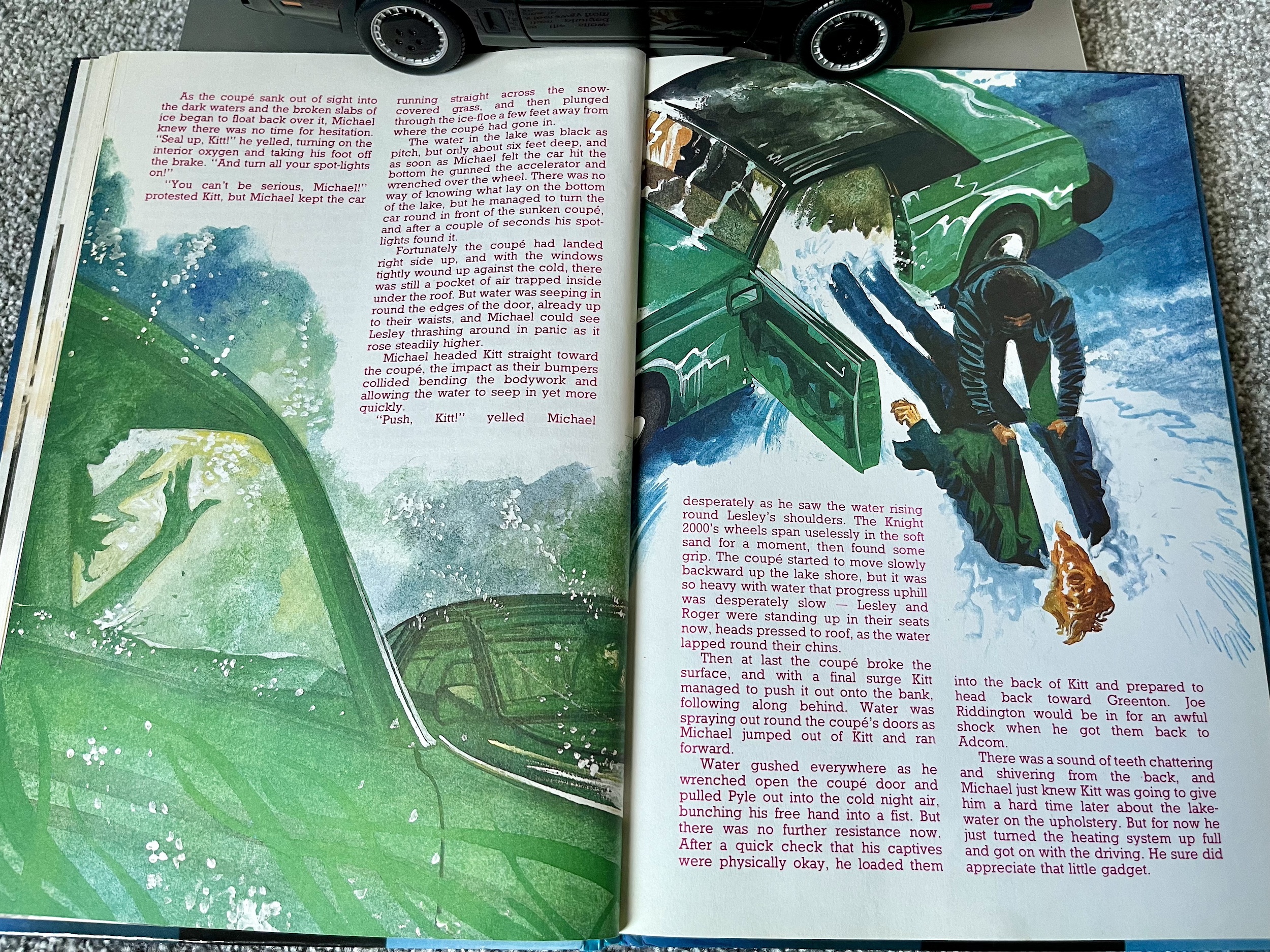
There are lots of little clues for the reader to pick up on before the big reveal of what’s really going on. It’s just a shame the person behind it all is revealed to be awfully similar to that of the aforementioned episode, an unfortunate coincidence in this case because viewers will see the shock ending coming a mile off. This doesn’t make it any less enjoyable though, with Michael resorting to stealthy tactics to protect someone who doesn’t want his protection, K.I.T.T. delivering some killer lines and it all comes to a climax below a frozen lake! It’s a scene the series simply wouldn’t have had the budget to handle properly and is exactly the kind of story these books are perfect for.

Back in the 1980s we had to rely on magazines to keep us abreast of the latest news about our TV shows or to find out more about our favourite celebrities. One such title was Look-In, the ‘Junior TV Times‘ mentioned in the previous Knight Rider Annual review. Alongside the weekly strip there’d be occasional interviews and features about the show, as well as full-page photographs of its stars, automotive and otherwise, which this second annual has in abundance. That’s right, cue some very 80s pin-ups.
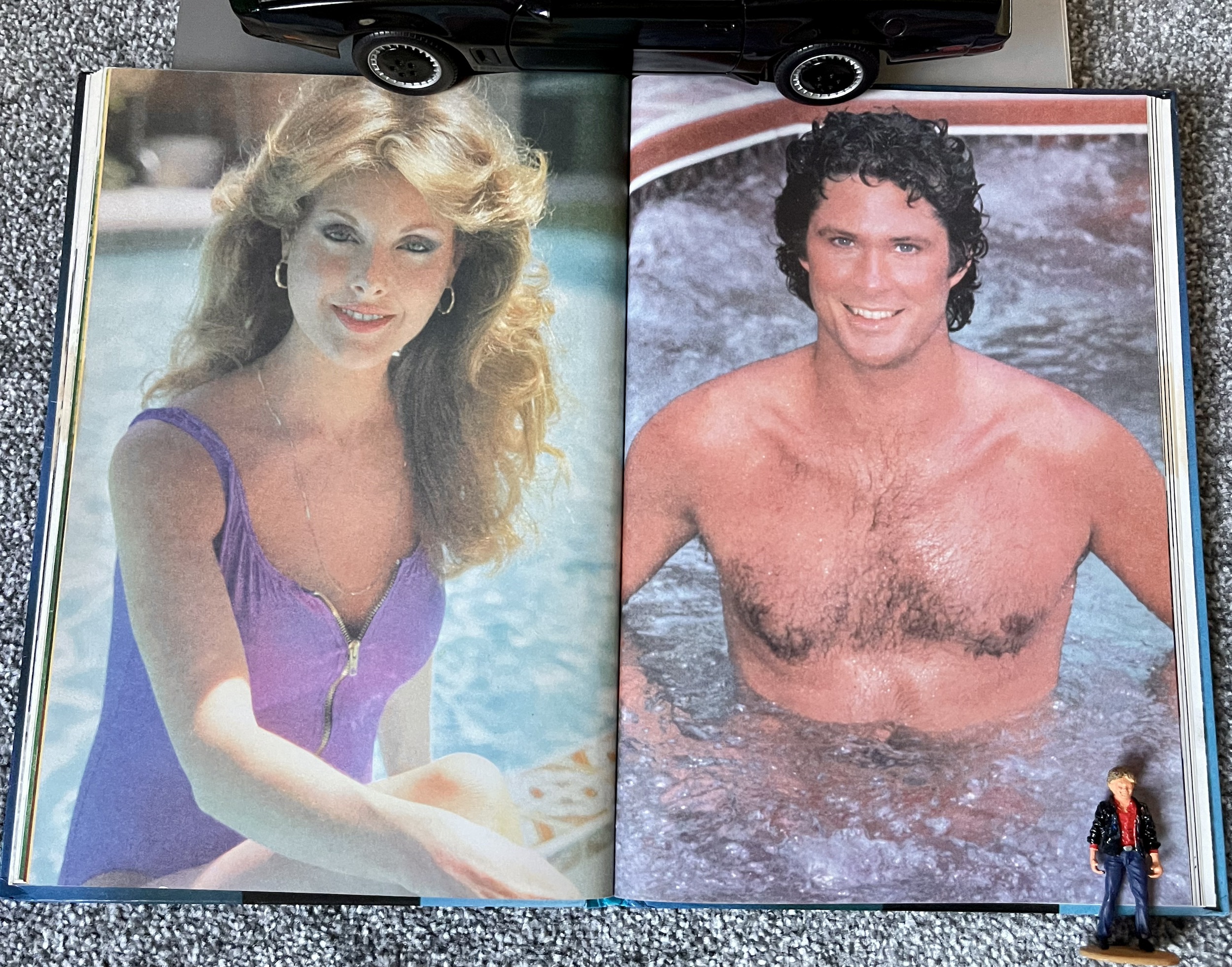
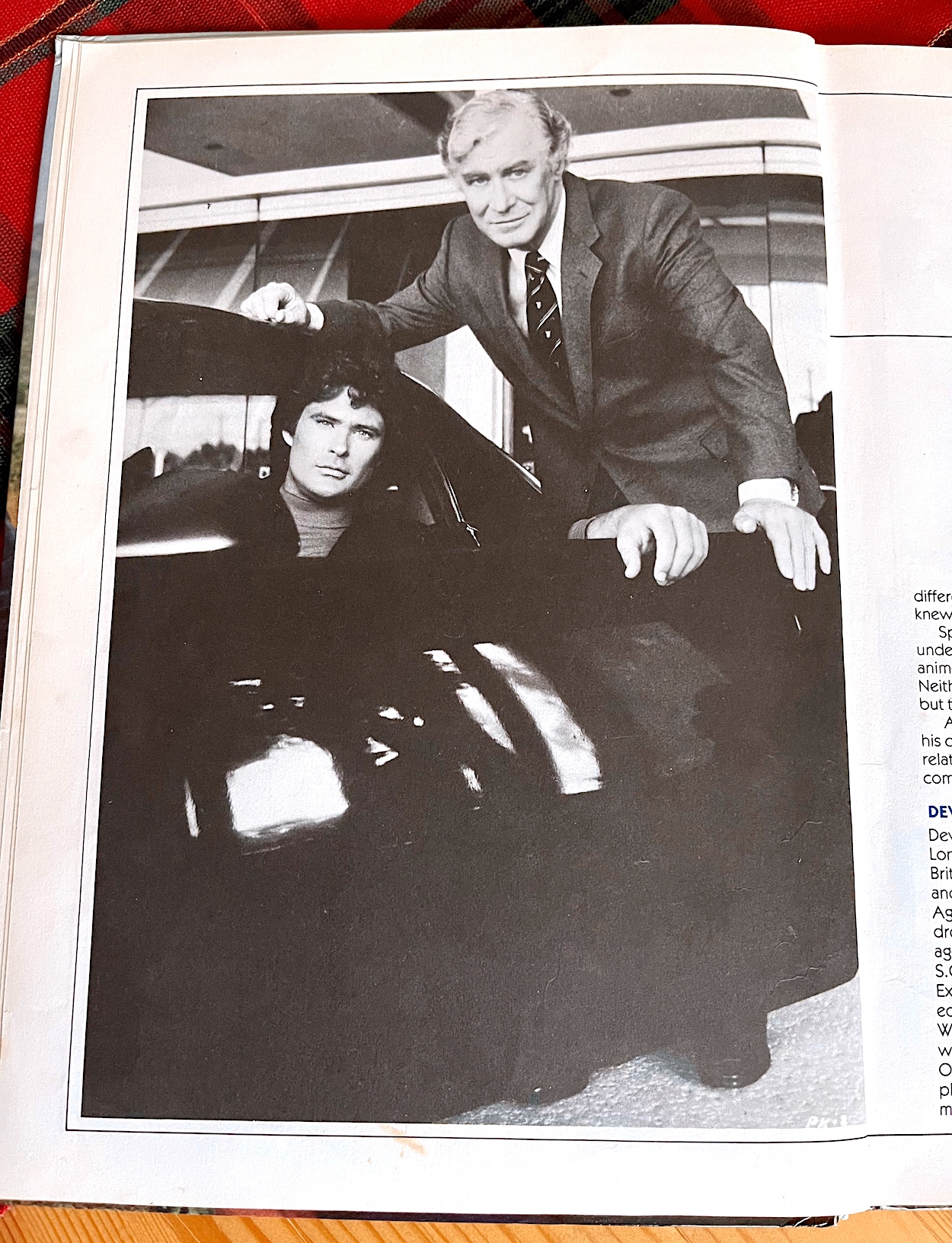
Other such pages include photos of Rebecca Holden (who played K.I.T.T.’s Cyber Technician April Curtis in season two) on a cross trainer in her living room and Michael Knight himself David Hasselhoff in his running gear. Clearly the team behind the annual believed the teen audience wouldn’t appreciate some photos of the superb Edward Mulhare and leaving out K.I.T.T. seems criminal! It feels like the book is trying to appeal both to the readers keen for action stories as well as those who’d buy Look-In for the attractive celebrities inside.

While I wouldn’t have had any interest in cutting these out, this shift in focus from the first annual does bring something else Look-In was great at. In here are two brilliant interviews with none other than The Hoff and Rebecca themselves. Quite the scoop. In A Knight and His Damsel David talks about his relationship with fiancée Catherine Hickland who played Stephanie Mason, the fiancé to Michael Long before he died and was reborn with a new life and identity. She’d appear in a trilogy of episodes across the four seasons, including the episode that would act as the finale. As such it’s strange her guest role isn’t mentioned at all here.

But what is here is fascinating, telling the story of David’s rise to stardom, the tragic loss of his agent, how he and Catherine met and how she kept his feet firmly planted on the ground, especially when Knight Rider took off. There are even some funny anecdotes about Catherine’s reactions to the times David would do some of his own stunts, such as high speed driving or even hanging from a helicopter. Just as an aside, the couple married at the end of season two, their wedding day reproduced for that final episode in season four. They then divorced a few years later and in 1992 Catherine went on to marry an actor by the name of Michael E. Knight!

Anyway, back to the book.


“Cathy gets mad when [female fans] approach me in the street and I can’t blame her. These women tell me they think I’m gorgeous or something like that and invite me home… right in front of her. I tell them that Cathy is my fiancée but it doesn’t put them off.”

David Hasselhoff

This next feature was a very pleasant surprise. I’ve bought quite a few Knight Rider books in my time, mostly fan-written and while some of them are great they’re usually quite light on depth, offering up nuggets of information episode-by-episode gleaned from obviously much longer interviews. I long for a book with plenty of in-depth discussions with the writers, cast and crew which doesn’t feel the need to break it down like that. So you can imagine my joy when I came across five garishly coloured pink pages and a proper, lengthy interview with Rebecca Holden.

Despite having the ever-so-80s and cringeworthy subtitle of ‘The Beauty With Brains’ it’s a great read covering Rebecca’s past, her family life and her career. She talks at length about what it was like to work on Knight Rider, especially coming on to an already established show and replacing a popular character. Most interestingly, or perhaps frustratingly for fans of April, we find out some plans the producers had for the character in later years, but of course this was her only season, with Bonnie returning in season three.
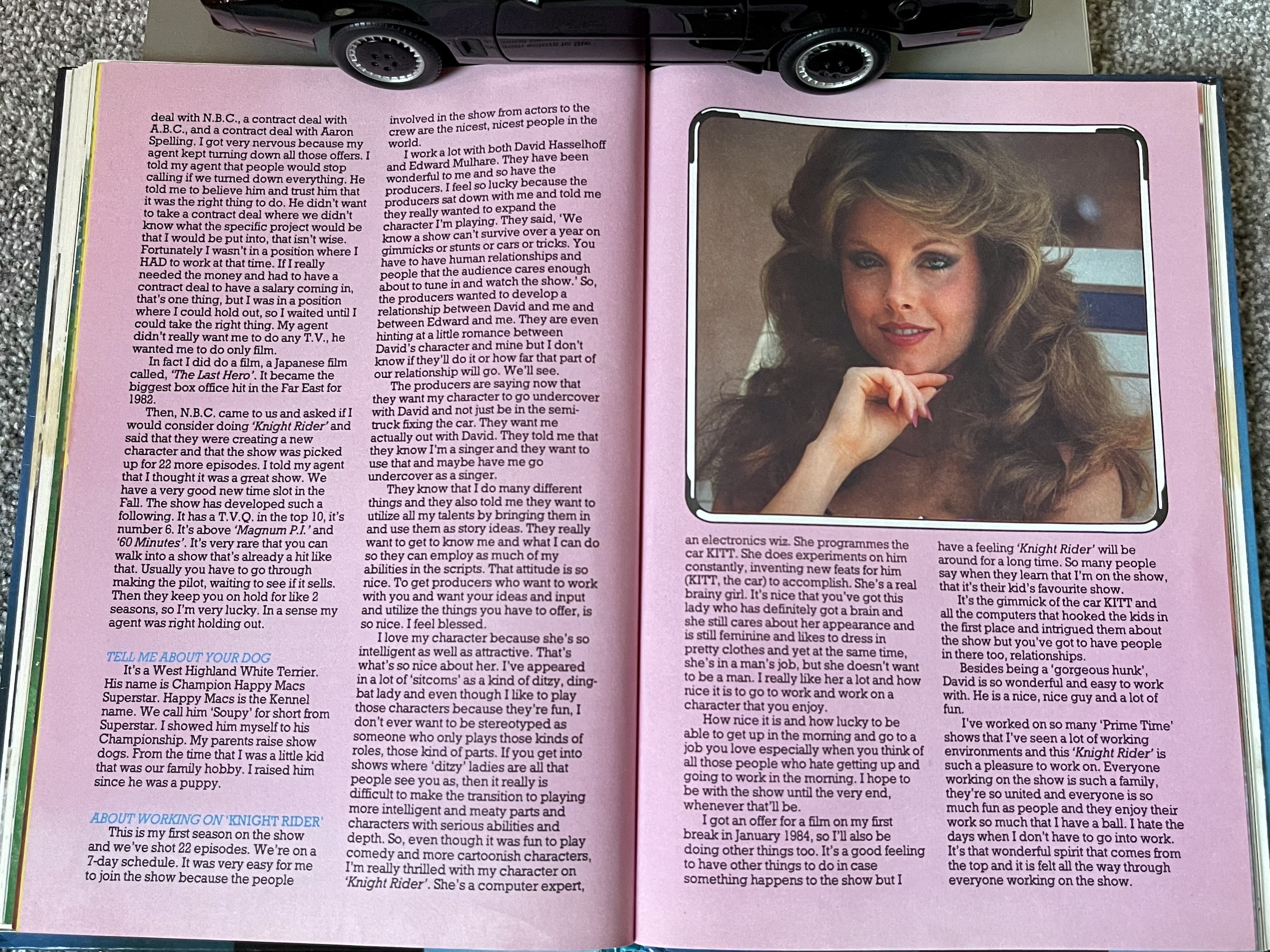
It’s clear Rebecca was incredibly proud of the character she portrayed and was looking forward to developing April more, emphasising how rare it was for a strong female character to feature as a regular in a series like this at the time. Certainly, the show explored April’s character more in one year than in all three seasons with Bonnie and while the latter will forever be a fan favourite, I’ve a soft spot for April. I think that has a lot to do with Rebecca herself and her ability to switch naturally between the technical, the dramatic and genuinely funny moments in an instant.

Talking about what the fans wanted, as I touched upon last year it’s hard to describe to those raised in a world of the internet just how exciting it was for us to see photos of K.I.T.T. It was a huge selling point for any magazines which featured him, such was the pull of the show and of this car. If you didn’t have a VCR you’d see the show once a week and that was it, so you relied on books and magazines to get your fix. I remember at some point during the four years Knight Rider was on we got our first VCR and a year or so later for Christmas Santa Claus brought me my very own 3-hour blank VHS cassette. I was so excited! It meant I could now record and rewatch Michael and K.I.T.T. over and over and over again.
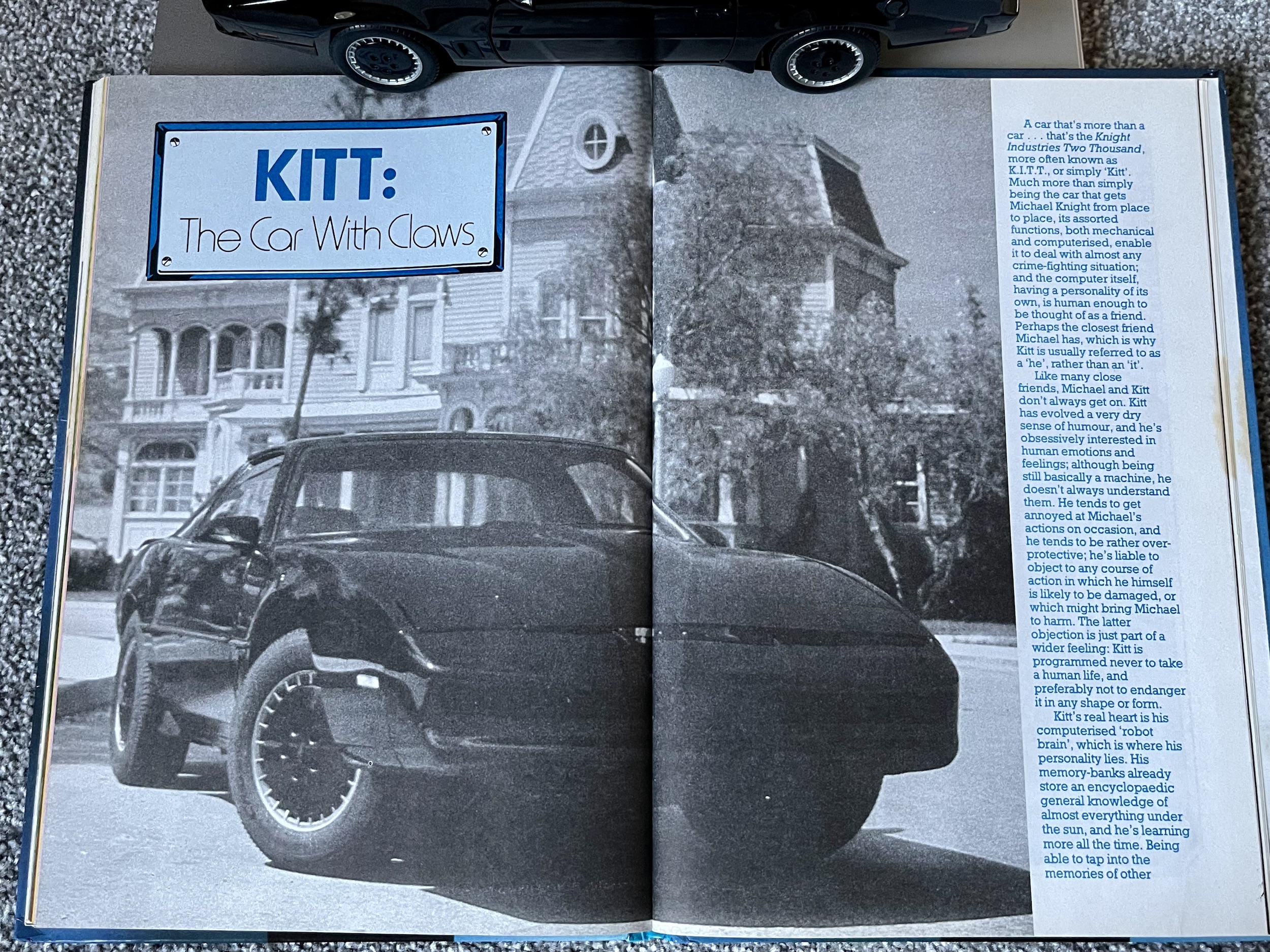
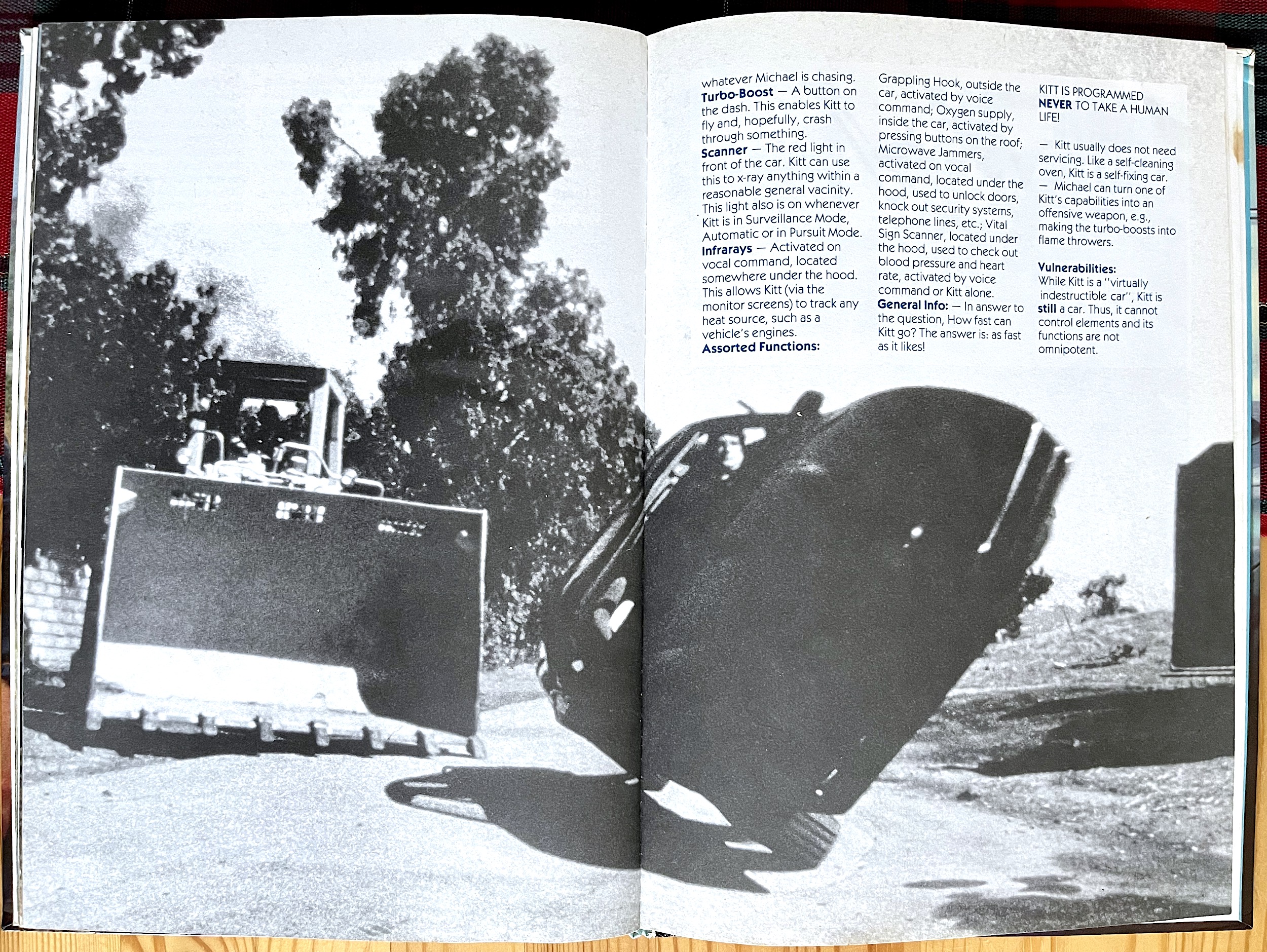
All this made features based around him even more exciting, even if he only got three pages to himself this year. What we do get is a fun little look into how his personality changed over the first and second seasons, a more accurate representation of his capabilities and limitations compared to the previous annual, as well as the physical gadgets of the car in which he resides (such as Turbo Boost etc). Although, it’s a bit of a stretch to say he “is also self-repairing, and rarely has to go into one of F.L.A.G.’s garages for servicing”. While this sounds more in line with the 2008 sequel series, it’s actually a reference to his ability to self-diagnose, a highly advanced feature of high-level computers at the time.

Back to the fiction and prose story Bandit Queen is another standout.  The fictional Central American Republic of Havamala has been at war for a while now, the government and guerrillas pretty evenly matched and neither side making headway. The once beautiful country has been devastated by battles and Melanie Black, the ‘Bandit Queen’ has used this as the perfect cover. Originally pretending to be on the side of the guerrillas, they disowned her after discovering she’s wanted in the US for armed robbery, murder and terrorist offences. With no hope of official extraction in the middle of a war, Michael and K.I.T.T. find themselves crossing into this dangerous land to find Black and bring her back to America for trial.
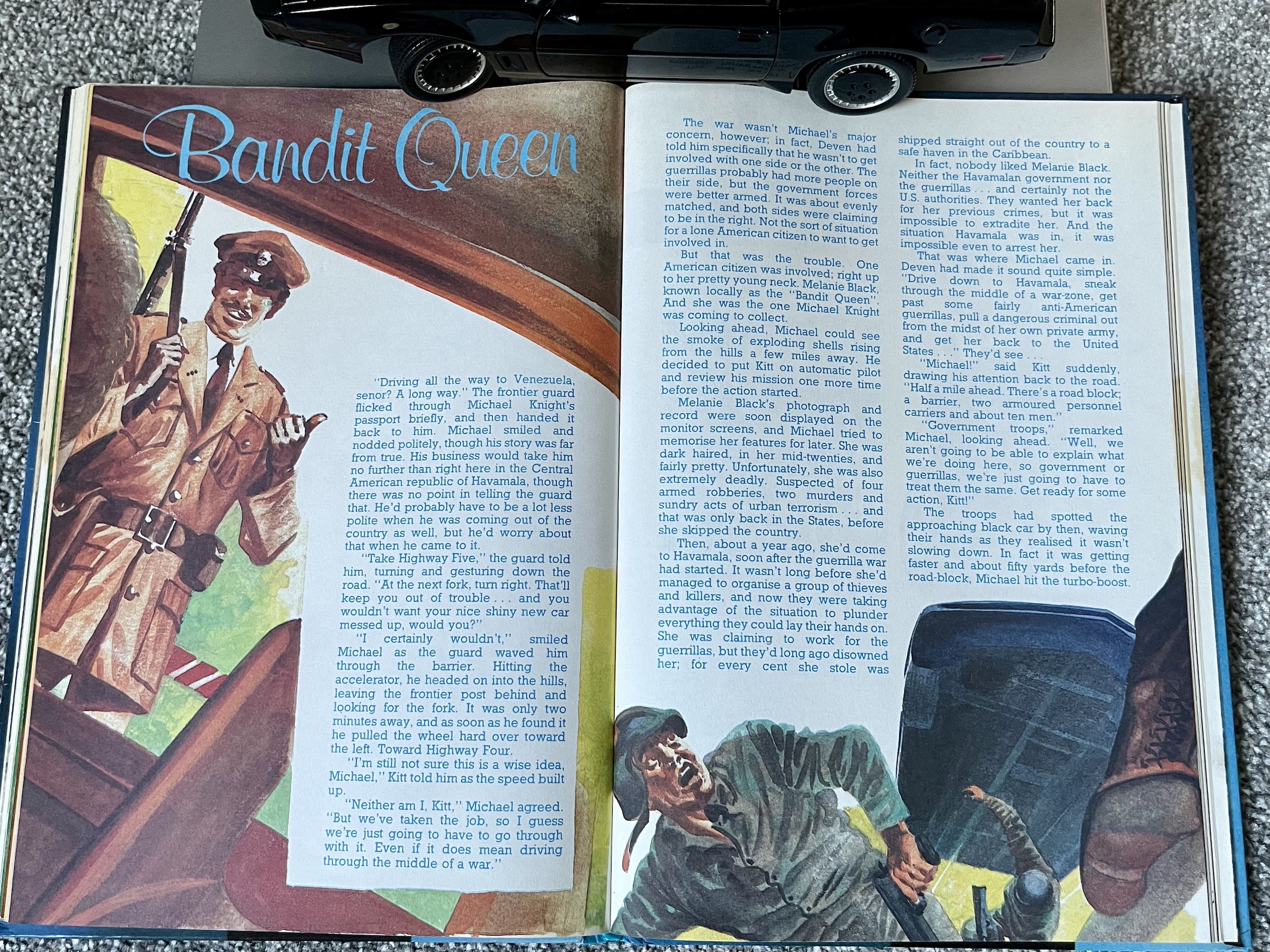
Straight away the dialogue between our two heroes is perfect. The way they speak to each other matches the rhythms of the series in such a way I could hear David’s and William Daniels‘ voices as I read it. The journey to Black’s compound is equal parts action and lovely descriptive moments of the tragedy of war as Michael sees the potential in the country and its people destroyed by the fighting. It’s a surprisingly mature outlook on the consequences of war and completely fitting for the character of Michael. He’s a Vietnam vet and clearly recognises this scenario.

The second Knight Rider Annual is a perfect example of the genre and offers depth and interest beyond what you’d probably expect

So, under the cover of night, and with Black’s compound shrouded in darkness with no lights to give away its position to enemy aircraft, we’ve the perfect set up for this unique partnership to strut their stuff. Using K.I.T.T.’s sensors to sneak up on the gate, Michael disabling the guards while K.I.T.T. disables the electronic alarms, scanning for their target, deducing possible routes through the buildings, analysing their tactics together, it all feels just right. It’d make a hell of a great episode too, especially when, just like the best TV stories, it doesn’t go as expected.

A last minute upset means the carefully worked out plan is thrown out and they have to act by the seat of their pants, or the treads of their tyres. It’s great fun and rockets towards the end without sacrificing any of the earlier depth or characterisation. By contrast the final strip, Crime-Buster K.I.T.T. is a fun little distraction, even if it is another idea taken direct from the television, as two criminals con their way past Michael to steal his car.
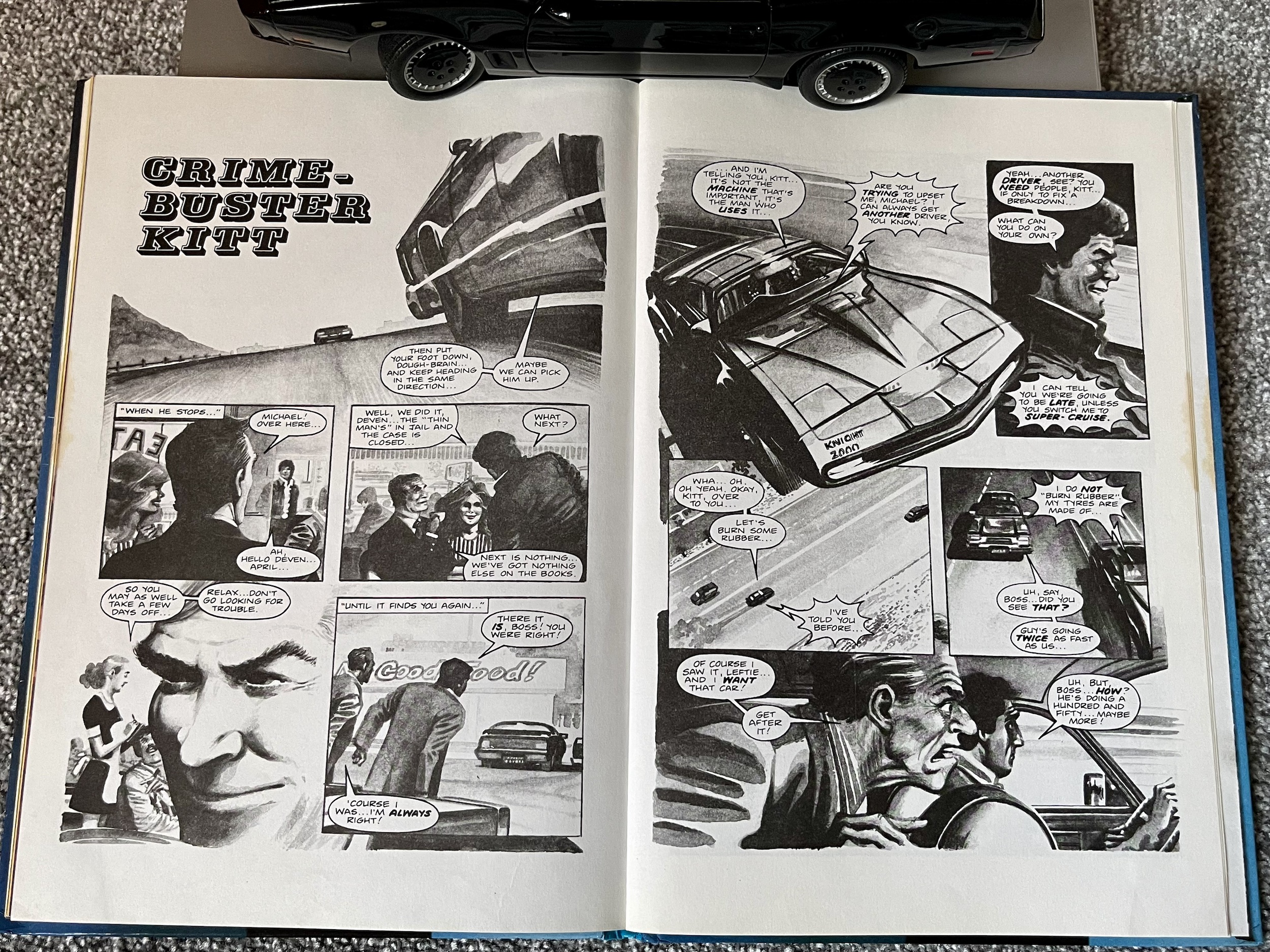
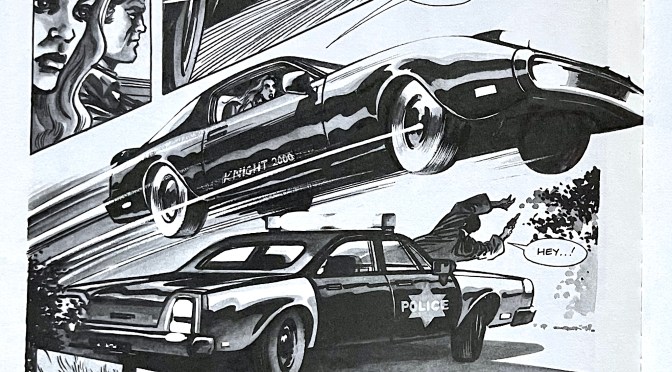
We can’t say this is a coincidence this time because right back in the pilot movie Jackson and Browne (hilariously played by Michael D. Roberts and Bert Rosario) tried a few times to steal the shiny new Pontiac Trans Am and eventually succeeded. What K.I.T.T. put them through, and how he got rid of them in the end by driving to a police station and literally ejecting them into the hands of the law, is exactly what happens here, albeit with different characters. This similarity makes the strip rather forgettable, it would’ve been better as a fun reenactment of a favourite scene for younger viewers. But hey, any excuse to get such lovely David Lloyd artwork is fine by me.

The second Knight Rider Annual is a great book for fans and curiosity seekers of 80s retro goodies. This is a perfect example of the genre of 80s TV tie-ins and offers depth and interest beyond what you’d probably expect. It feels like a proper progression of what came before, despite the lack of K.I.T.T.-based features, but we did get plenty of them last year. What will the rest of the series contain? As Knight Rider is my favourite thing in the universe I can’t wait to find out, and you’ll find out right along with me during Christmas 2024.

Don’t forget there’s also a special interview with David Lloyd already up on the blog, in which he reminisces about working on these first two books and shared some of his original design sketches.
ANNUAL 1 < > ANNUAL 3

ANNUALS MENU

CHRiSTMAS 2023

KNiGHT RiDER ANNUAL #1: MAKiNG A DiFFERENCE

“No matter what’s going on in the world or in my life, putting an episode on can bring a huge smile to my face. Don’t we all have something in our lives that does that? This is mine.”

My late grandad Ted came to my house one Sunday morning when I was a child and asked my parents if I’d seen the film on TV the night before about the fantastic car that was filled with computers, could talk, drive itself and even jump in the air. My mum hadn’t heard about it but luckily enough my grandad knew it was going to be a TV series starting the next week and he thought I might like it. He wasn’t wrong. Thus began a lifelong obsession with Knight Rider.

I may have grown out of it temporarily by the late 80s but when repeats began airing in the mid-90s my love for Michael and K.I.T.T. returned and has never gone away. Every decade since may have brought its own obsession, from Babylon 5 to Stargate SG-1, from Doctor Who to NCIS, but Knight Rider has a special place in my heart and, no matter what’s going on in the world or in my life, putting an episode on can bring a huge smile to my face. Don’t we all have something in our lives that does that? This is mine.

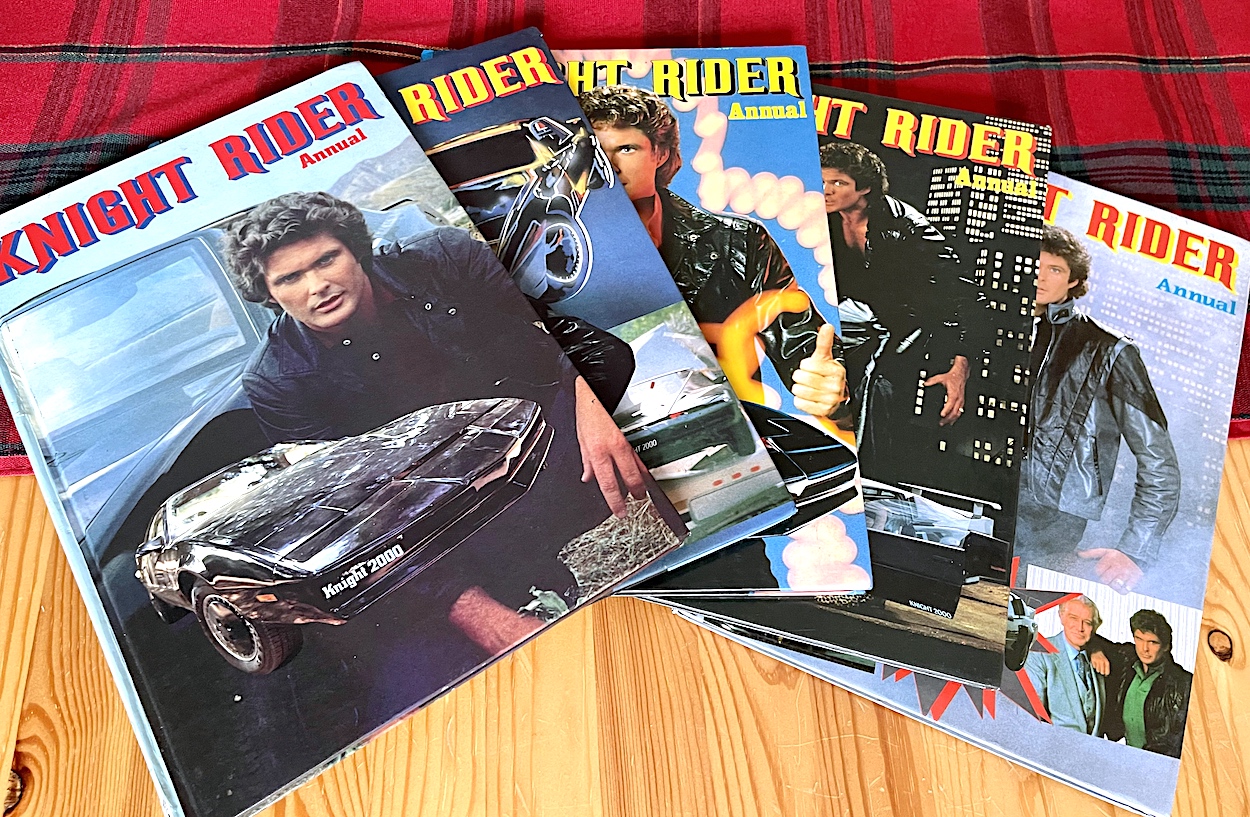
There wasn’t a Knight Rider comic because the trend at that time was to feature popular series in strip format inside our magazines such as Look-In, a young person’s TV guide which featured the series alongside the likes of The A-Team and Airwolf. But between 1983 and 1987 Grandreams released five Knight Rider annuals filled with strips, prose stories, puzzles, pin-ups and behind-the-scenes features and interviews. I think I only ever owned this one from 1983 though.

The series debuted this side of the Atlantic in February 1983, with the first annual released at the end of the summer and my eager young hands got a hold of it that Christmas, hence why I’m reviewing it now as part of the blog’s festivities. I remember reading the two-page Look-In strips in my sister’s magazine, with their weekly cliffhangers similar to the 60s Thunderbirds comics. However they were line drawings, not the gorgeous greyscale wash we get here.

Upon picking this annual up for the blog I wasn’t sure what to expect. I really hoped for something entertaining but over the years I’ve seen some horrible annuals quickly thrown together in order to cash in, without much love nor care for the property. As long as this wasn’t like that I’d be happy. What I didn’t expect was something of such high calibre, with an excellent creative team behind great stories illustrated with gorgeous art, alongside some fun articles. I couldn’t be happier Knight Rider received this treatment.

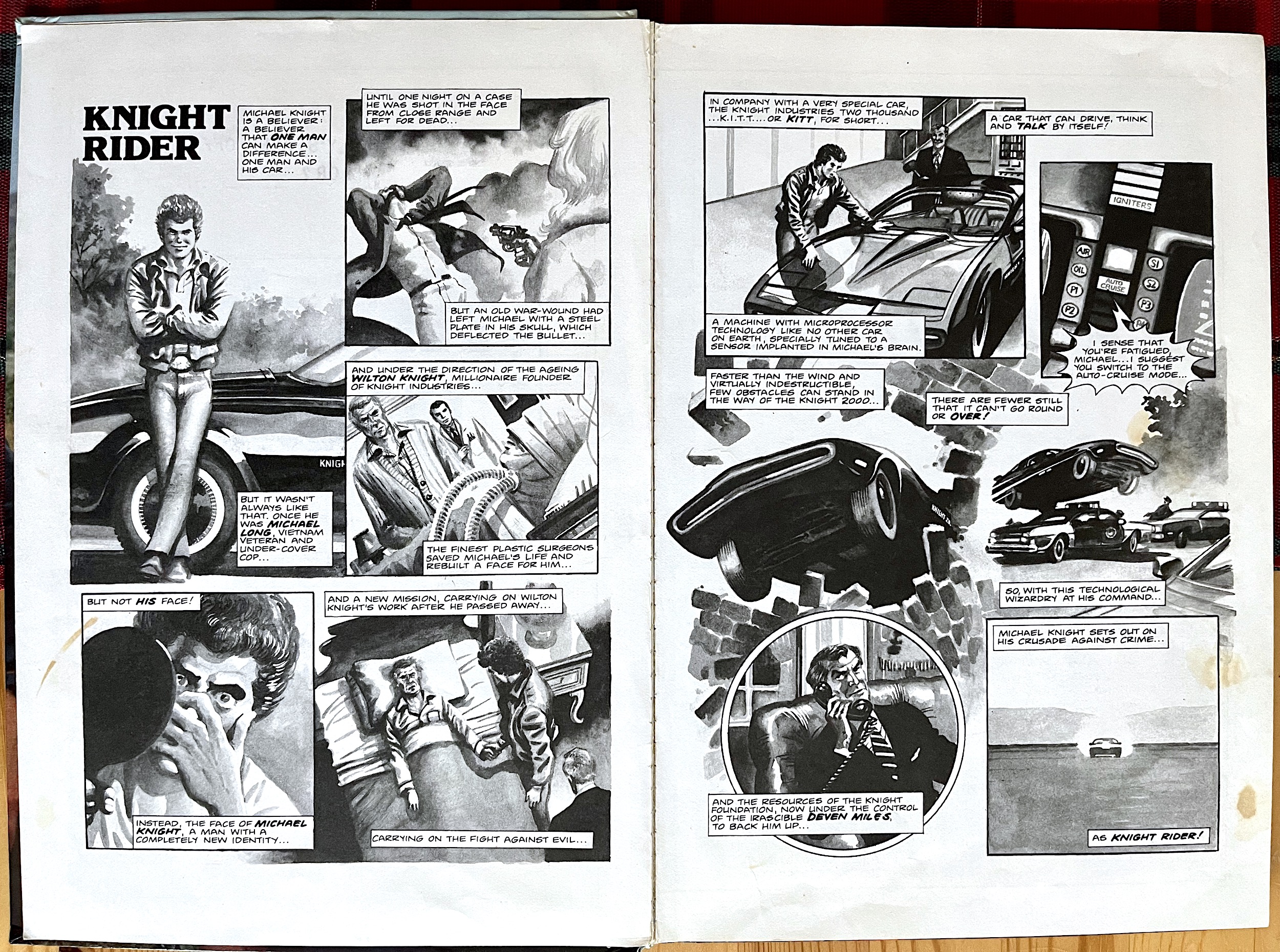
When I opened the book and saw the two-page introductory strip above which recaps the set up for the series not only was I in awe of the art, I was instantly transported back to that Christmas. Quickly telling the tale of Michael Knight’s original identify, being double-crossed, shot in the face and left to die, and the reconstructive surgery which resulted in his new identity and new life, we’re instantly up to speed and ready to get stuck in to what promises to be a much better book than I thought it was going to be.

The intro strip is followed by a feature explaining the background to the characters, the Foundation for Law and Government (F.L.A.G.) and the story behind the series. Some of the details here didn’t even make it into the show and were pulled from the series bible, put together by Glen A. Larson when the show was created. For the uninitiated, Wilton Knight’s Knight Industries set up F.L.A.G. as a non-profit arm of his company to help ordinary citizens fight those untouchable criminals who operate above the law.

Court battles and legal wrangling made up the majority of their work (though for obvious reasons we only heard about these happening off camera) but sometimes “direct intervention” was called for and that’s where the Knight 2000 project came in; one man in one car, that car offering him all the funding and resources of the Foundation to make a real difference in the lives of people the justice system had let down. Sounds like a good set up for a show, doesn’t it? Well, it sure was.

Of course, that one car was K.I.T.T., or rather the Knight Industries Two Thousand artificial intelligence inside the Knight 2000 car. That’s something the show (and I’m glad to say this annual) made perfectly clear; K.I.T.T. wasn’t the car, he was the A.I. inside the car; a car that could jump, drive on two wheels, create fog and oil slicks and so much more, all inside the near-indestructible molecular bonded shell capable of 300+ kph. Add in K.I.T.T. who could control all of this, drive it, remotely hack computers (a big deal back then) and give Michael computerised, forensic and scientific resources that’d make NCIS envious.

There’s even information which was new to me today. It’s full of wonderful little details fans will lap up

Knight Rider was that rare thing, a television show my whole family gathered around to watch together. It was unlike anything anyone had seen before. My sisters may have had David Hasselhoff posters on their walls, but mine were adorned with K.I.T.T., shelves packed with models of the car, books, electric toys… you name it, I had it. I remember when ITV repeated the show in the 90s and my mum, dad and a then-teenage me would still watch it together. Today, the remastered HD Blu-Ray collection takes pride of place in my own home. My love for this show will never wane.

So, intros out of the way and my obsession detailed, I can happily declare this opening feature is anything but a basic round up. Michael’s boss Devon Miles (played by the excellent Edward Mulhare) may be misspelled ‘Deven’ but there are details here from the series bible the show didn’t elaborate on until later seasons, so it must’ve been fascinating reading it in 1983. There’s even information which was new to me today. I never knew Devon originally met Wilton on a mission in France for the British S.O.E., or that his parents were killed in the blitz. Technician Bonnie Barstow’s father was a pilot who worked for Wilton and she has a Masters in Computer Science and a Doctorate in Robotics. It’s full of wonderful little details fans will lap up.

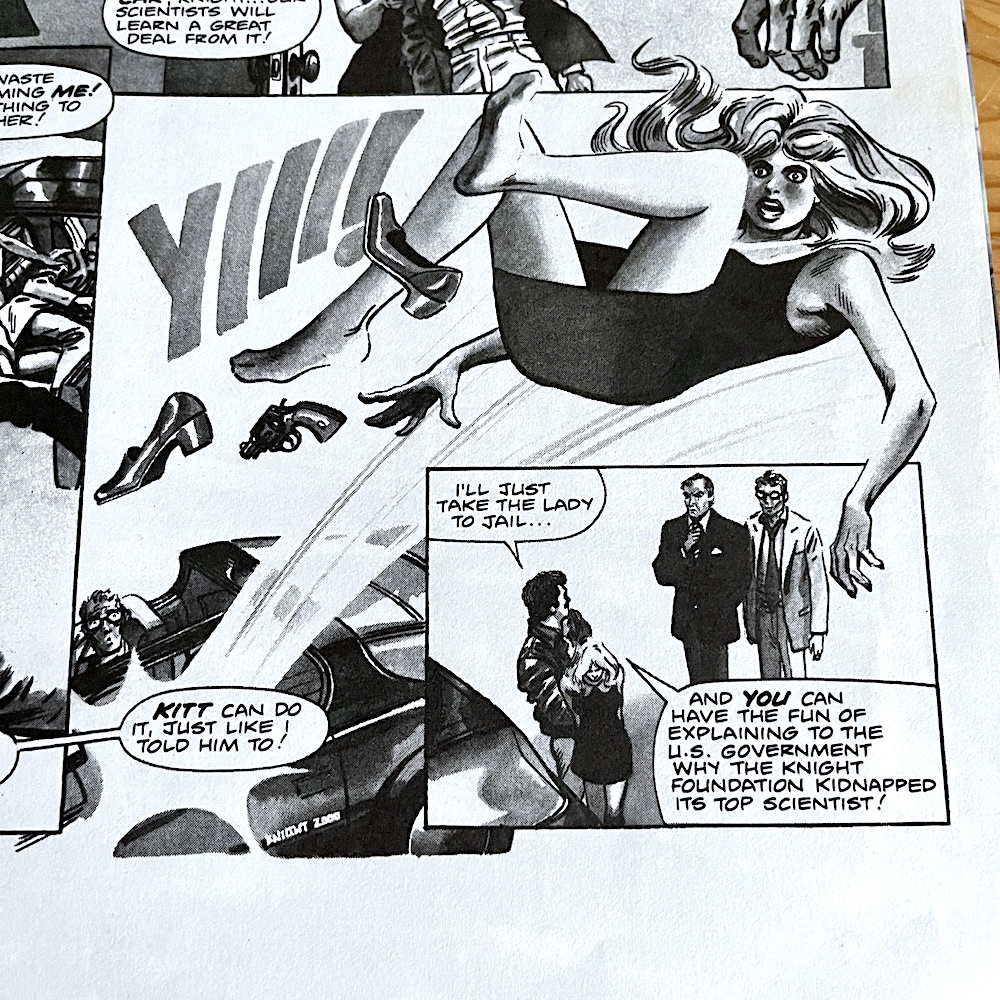
This image is taken from the first strip, Break-Out. There are two strips in the book, both of which act like the final part of an episode, so all of the detective work and build-up is out of the way and the strips can concentrate on some fun action. For example, here we see the results of the supposed damsel in distress trying to double-cross Michael only for K.I.T.T. to quite literally eject that plan. So who was behind these exciting, fun stories and the simply gorgeous, atmospheric art?

I was thrilled to find out my favourite thing in the universe was handed over to none other than David Lloyd, he of V for Vendetta fame (as well as Wasteland, The Territory and Hellblazer). Yes, that David Lloyd! His unmistakable style and that lovely wash suit Knight Rider perfectly. The original pilot movie was rather dark with a lovely atmosphere and David’s art is reminiscent of the direction of that particular episode. With Marvel UK’s Transformers letterer Annie Halfacree bringing her talents to the page the only question left to ask was who wrote these?

While speaking with David recently (more on that at the end of this review) I was finally able to find out it was Steve Moore (Abslom Daak Dalek Killer, Hercules, Warrior) who wrote many of the stories for Grandreams tie-in annuals at the time. Steve nails the characters of Michael and K.I.T.T. and, best of all, their dynamic interplay. This evolved as the series progressed and at this early stage could still be quite antagonistic at times, Michael’s patience sometimes wearing thin with the analytical and logical computer. I’m very happy to say that’s here in spades.

The prose stories, beautifully drawn and coloured by David, are lengthier than any in Marvel UK’s annuals, giving Steve the scope to give us a more detailed adventure for our heroes. Although, I must note Bonnie is conspicuously absent outside of the features. This could be because the stories had to be written so far in advance that the pilot movie was all Steve had to really go on (Bonnie didn’t appear until the first regular episode). But then again the stories take place out on the road already, so by this stage in the episodes it would be all about Michael and K.I.T.T. anyway.

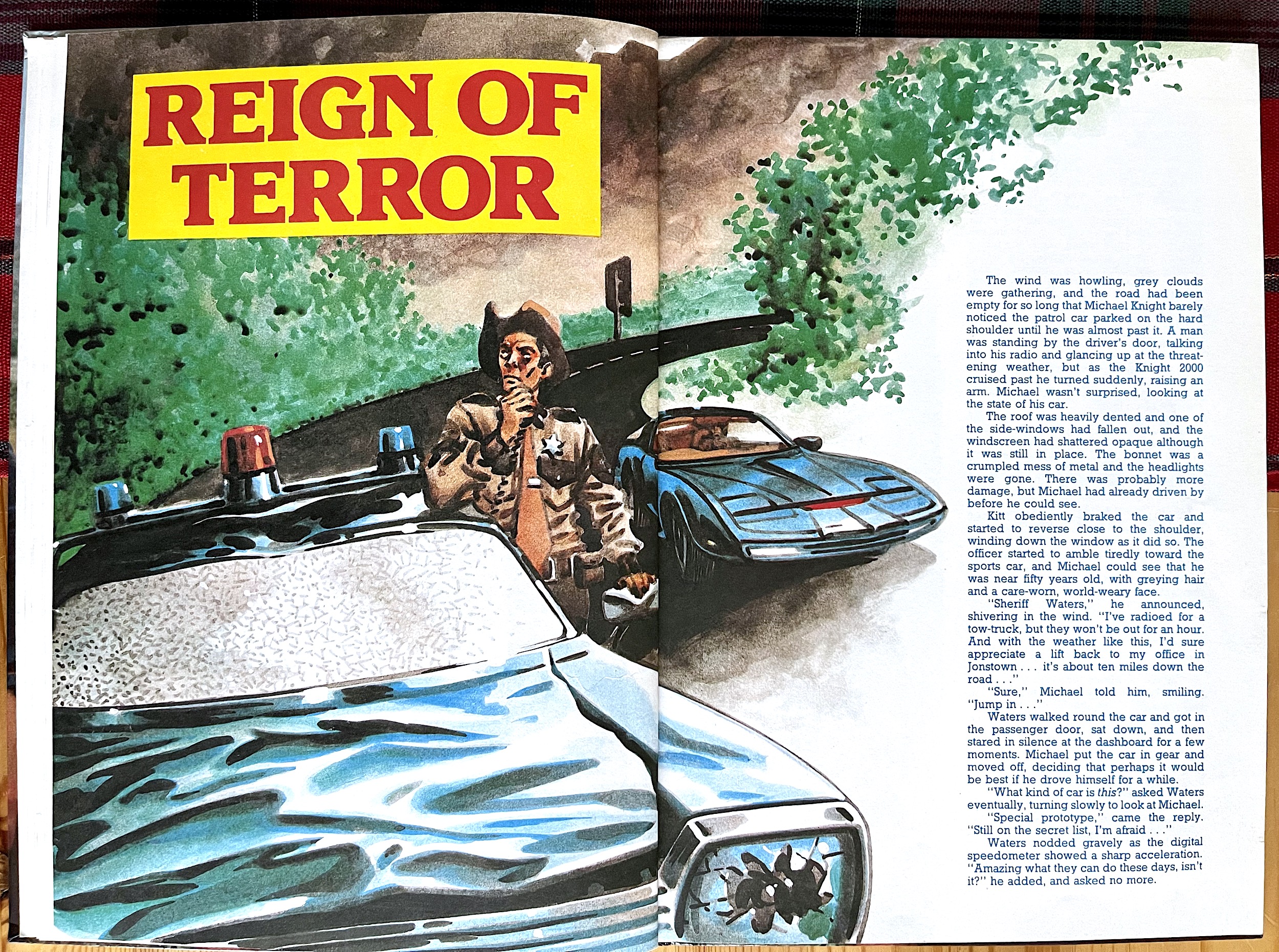
Reign of Terror uses that old 80s staple of the bad motorcycle gang, one the show itself used in its first season. In fact, the episode Good Day at White Rock would’ve been broadcast months before this annual hit the shops. Also, K.I.T.T.’s functions are limited to those shown in the pilot movie, so again I think these were written before much of the series was broadcast. Given this, it’s nothing short of incredible how well Steve nails everything from the characterisations to the tone.

The distinction between K.I.T.T. and the car are particularly enjoyable, especially since this was something the series would only really begin to highlight in season two (after it was set up in the pilot). For example, in one paragraph here, “K.I.T.T. brought the car round the buildings and came up behind them.” It’s enthusiastically written and I get the impression Steve was having fun with this. Michael and K.I.T.T. throw everything at the bikers and it’s not just a checklist of the car’s functions, there’s a proper plan here, perfectly thought out and executed with panache, a plan that could only be achieved by this unique partnership.

Reign of Terror’s plot may not have been all that original but it paints an entertaining picture. The other prose story, The Long Chase is a more original idea. The US Customs Department asks F.L.A.G. for help in an art forgery case, where they believe a legit art business is also smuggling stolen works. They’ve tried tracking their trucks but are always met with car accidents, traffic jams, road blocks etc., too many to be a coincidence. Enter Michael and K.I.T.T.

In the end it boils down to a situation where they have a choice of two trucks to follow, each going separate ways on the highway. They deduce which one to tail and are met with the same impediments, but they’re no match for these two and we get a wonderfully written sequence of them barging their way through everything thrown at them, much to the terror of Marshall, the Customs Agent along for the ride.

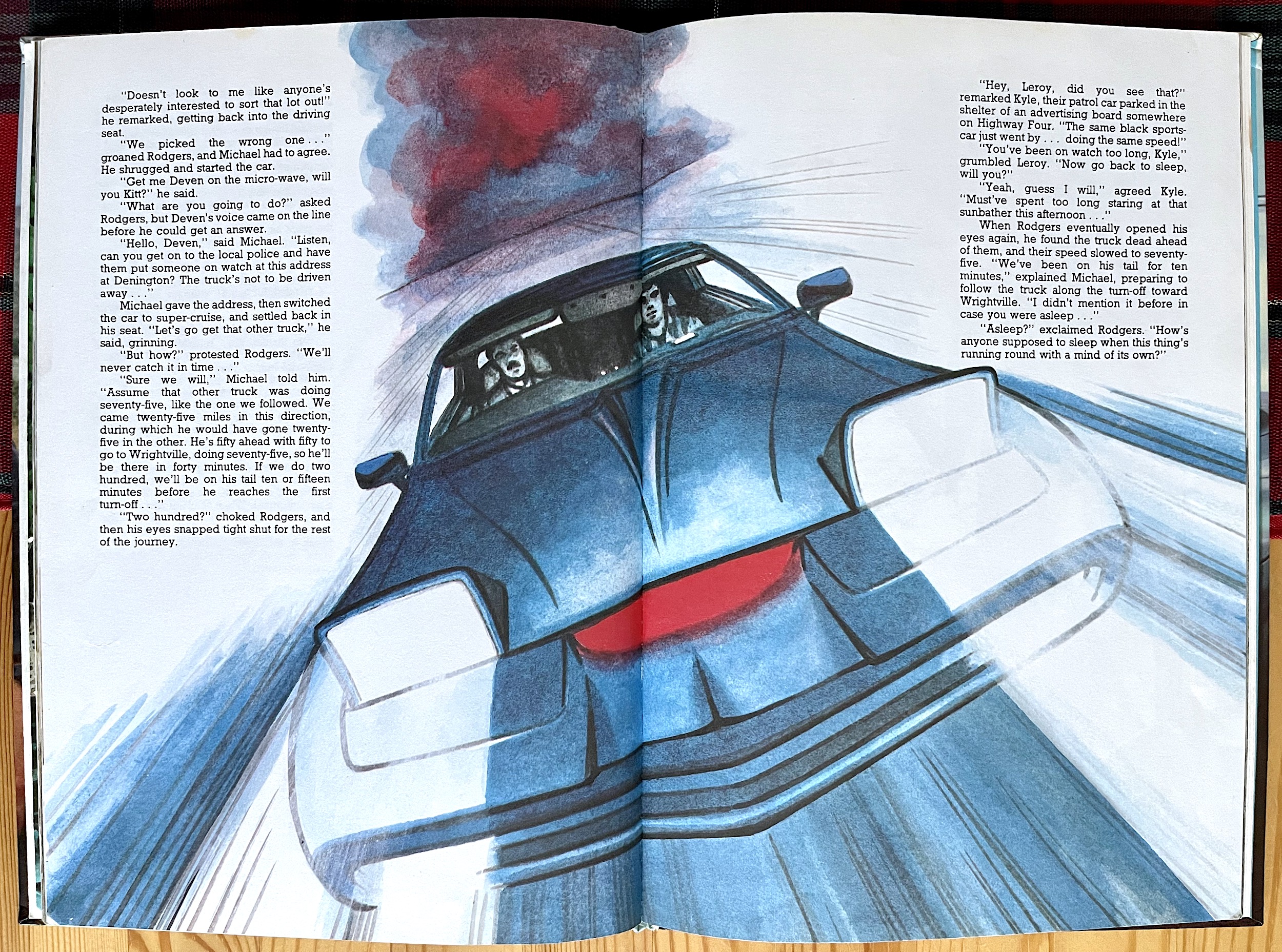
These images have a lovely retro feel to them that many would pay good money to have painted and framed today

When it’s clear they’ve followed the truck with the legitimate art (sent on a wild goose chase with the diversions) Marshall is about to quit, what with the other truck now hundreds of miles away. But this is a challenge our pair relish. There are some really nice scenes involving Michael and K.I.T.T.’s burgeoning partnership. It’s intriguing, well-paced and all round a thoroughly entertaining little tale. There are also some brilliant night scenes drawn by David, my favourite being a double-page spread of K.I.T.T. coming head on towards the reader, scanner and headlights cutting through the night. These images have a lovely retro feel to them that many would pay good money to have painted and framed today.

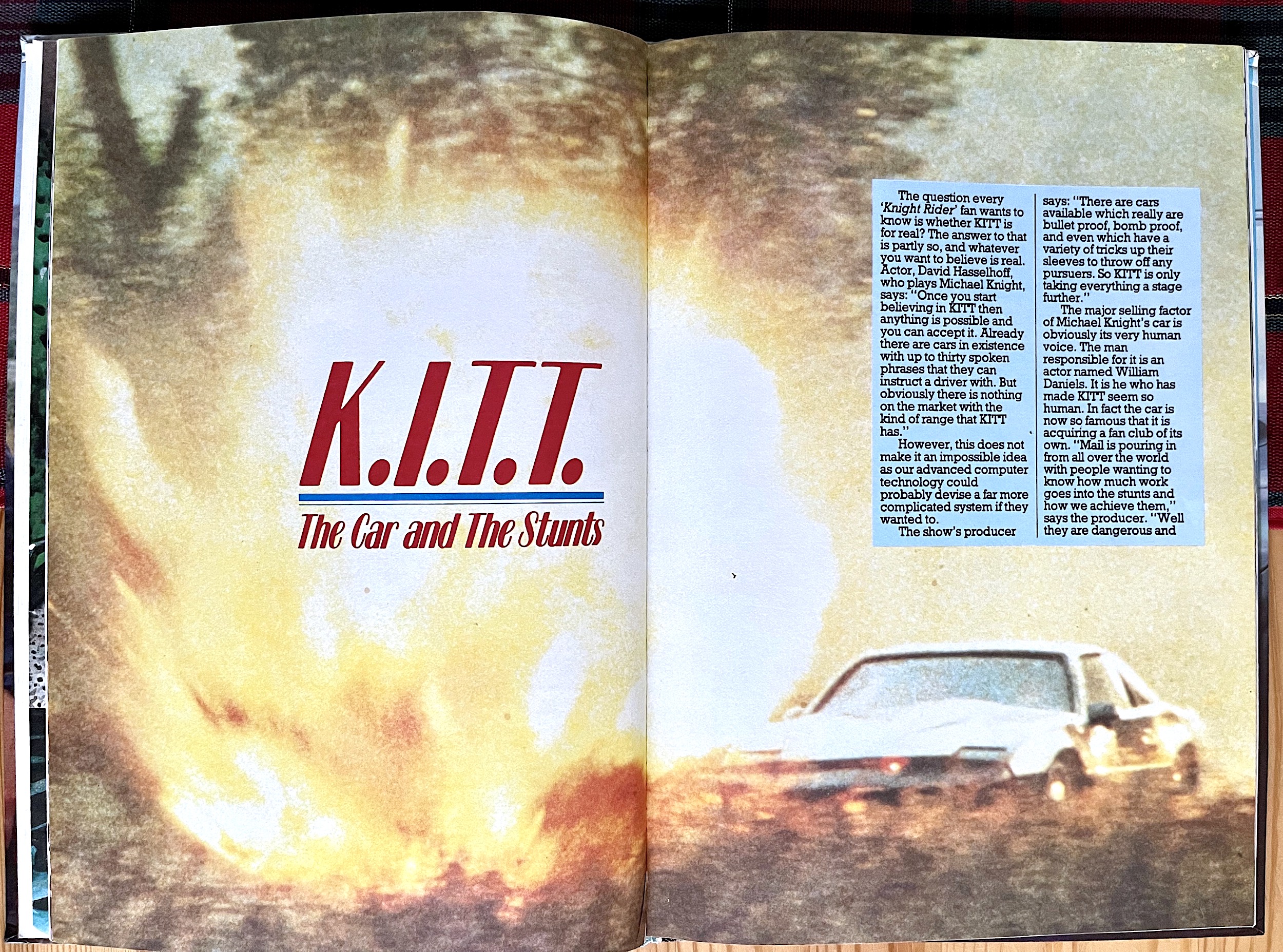
Alongside a brief bio of The Hoff there are two features centred around our other main character. K.I.T.T. – The Car and the Stunts is pretty self explanatory and is apparently based around an interview with one of the producers, although they go unnamed and give inaccurate information, which is odd. I wonder if the book did speak to someone involved with the show or if they got these details from elsewhere and reprinted them.

There’s a reference to turbo boosting on to the back of a truck being done for real, but the scene in question was actually achieved through clever editing and effects.  The ‘producer’ also says the only thing that isn’t done for real is the ejector seat, but in reality this was really installed into one of the cars used on the show. Indeed, since this book there have been numerous interviews with the stunt people on the show which have been very funny, especially the story about when they were trying to calibrate the ejector seat for the first time and the stuntman went flying into the air higher than a palm tree next to the car! Unfortunately, this isn’t referenced here.

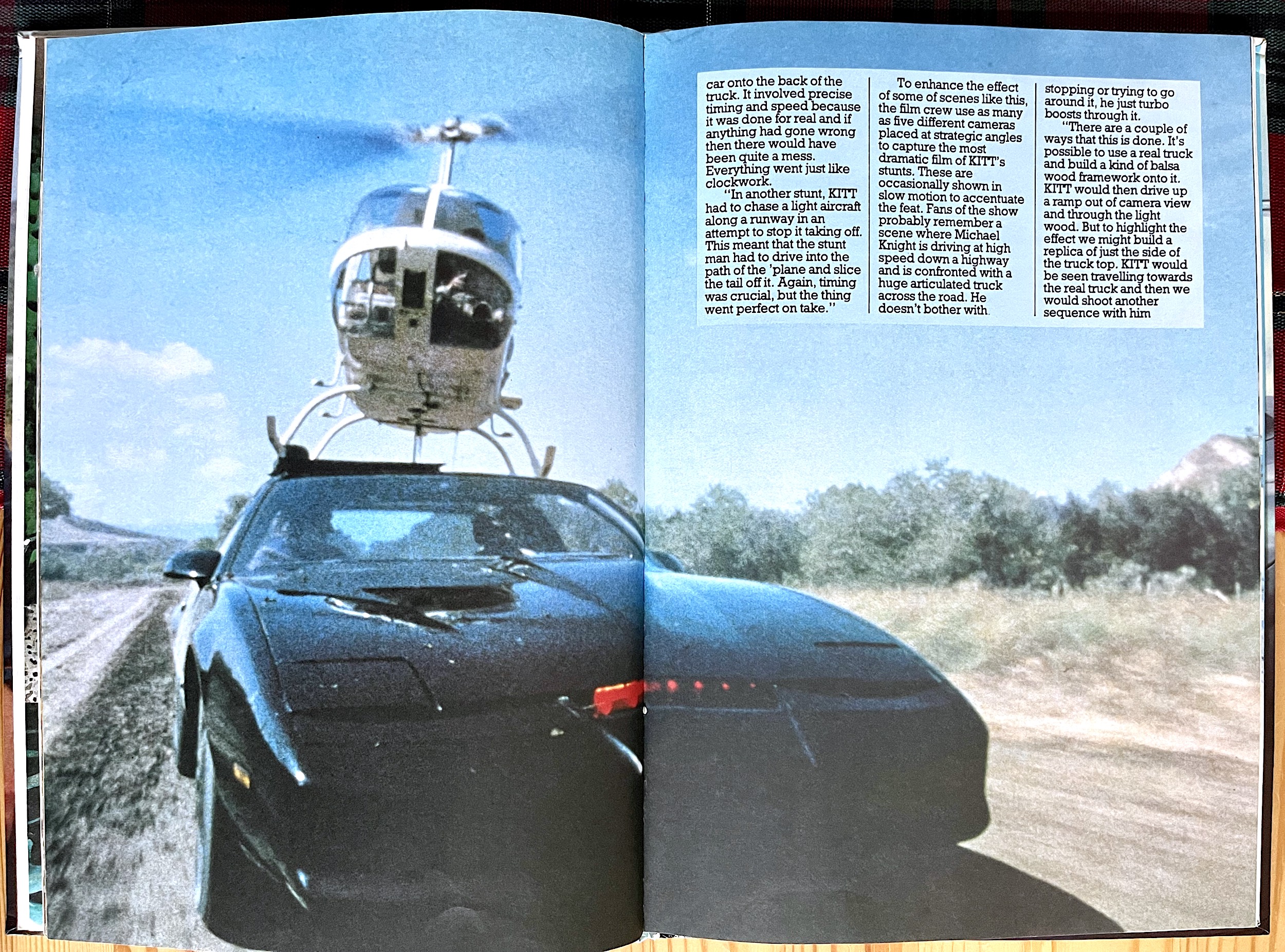
But at the time of this book it was just exciting to see photos of K.I.T.T. in action. You have to remember this was way before the internet. Even VHS video recorders were only starting to be installed across the UK. That meant the only way to see your favourite TV show was when it was broadcast or repeated, and the only chance to see photos was in printed publications. There may not have been any photos of him turbo boosting over anything which I remember being disappointed with, but there are explosions, a ski mode (up on two wheels) and a very memorable chase where the stunt performer jumped from a flying helicopter right down into the driver’s seat of the speeding, self-driving (on the screen at least) K.I.T.T., all without wires!

What’s interesting is how the book credits actor William Daniels as K.I.T.T.’s voice when the show didn’t. In fact, Daniels insisted he not be credited so as not to ruin the illusion for the kids, so given who the target audience is for this book it’s strange to include his name. The second car feature, K.I.T.T. – Equipment and Functions deals specifically with the fictional side of the car, meaning its artificial intelligence and futuristic abilities.

There’s a particularly well written introduction to this part of the annual, especially when discussing the different ways he interacts with the human characters.

“Michael and K.I.T.T. are true partners: they bicker, they rib one another, but they are fiercely loyal to each other. K.I.T.T. is a little bit of a know-it-all. He’s pragmatic, sometimes arrogant, often fussy and peevish. And since he’s (yes, he is described as a “he”) completely logical, he has a difficult time understanding this most illogical of humans, Michael Knight.”

Of course he’d soften as his character developed over the series, as he learned from his human companion and their missions together.

“K.I.T.T. has a great sense of humour and he is incessantly interested in human emotions and feelings, things he seems to pick up on as time goes on.”

It’s clear these details were taken from the series bible because when this was written they were the future plans for the character, rather than anything seen yet. Also, maybe an early draft of that document was used because even here there are some inaccuracies, such as claiming K.I.T.T. can’t have independent thought unless put into surveillance mode. This mode is for scanning the area, K.I.T.T. always had independent thought. (Elsewhere in the same article this mode is described correctly.)

It’s rather strange that the publishers obviously had access to information from the show itself yet these errors still slipped in. Could it be the series bible was further refined as the pilot was created but after it was handed out to licensees? Or perhaps the book elaborated where they thought they could, not thinking they were contradicting anything. Most glaringly are the two oft-cited errors that peeve fans off: no, turbo boost does not enable K.I.T.T. to fly and no, he does not have offensive weapons.

Saying all that, as a child I really didn’t care. We were much more forgiving back then. Books such as this were the only way we could see photos of the super cool car and enjoy new stories away from Saturday evenings in front of the family telly. My own copy of this annual disappeared many, many years ago and I remember it falling apart from being read that many times. It rarely left my side for months after Christmas 1983. I’d even clutch it tightly while watching the latest episode.

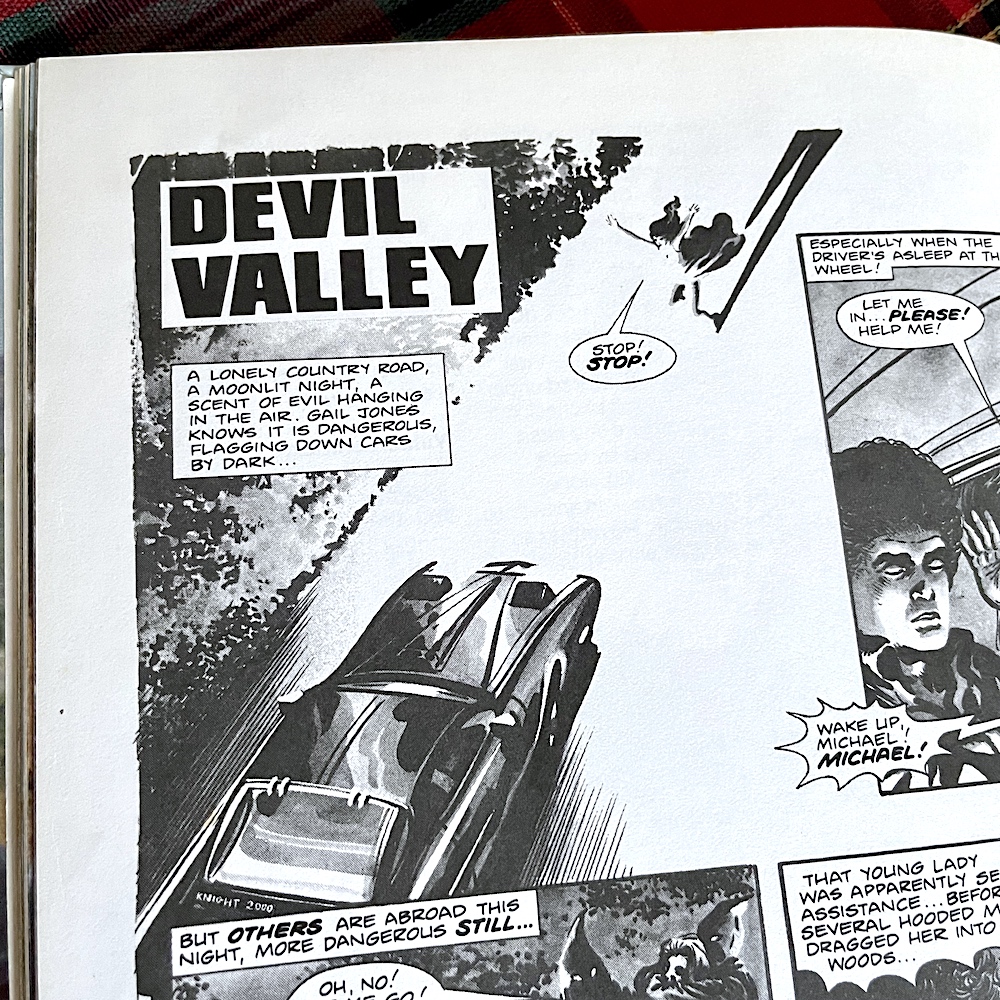
To finish this childhood favourite is Devil’s Valley, our second gorgeous strip and it’s even better than the first. It may have been a family show but Knight Rider never shied away from dealing with issues you’d see in more adult dramas, such as murder, kidnap, drug dealing and terrorism. All defeated by one person making a difference of course. Another topic it would touch upon more than once, which this strip also does, was racism.

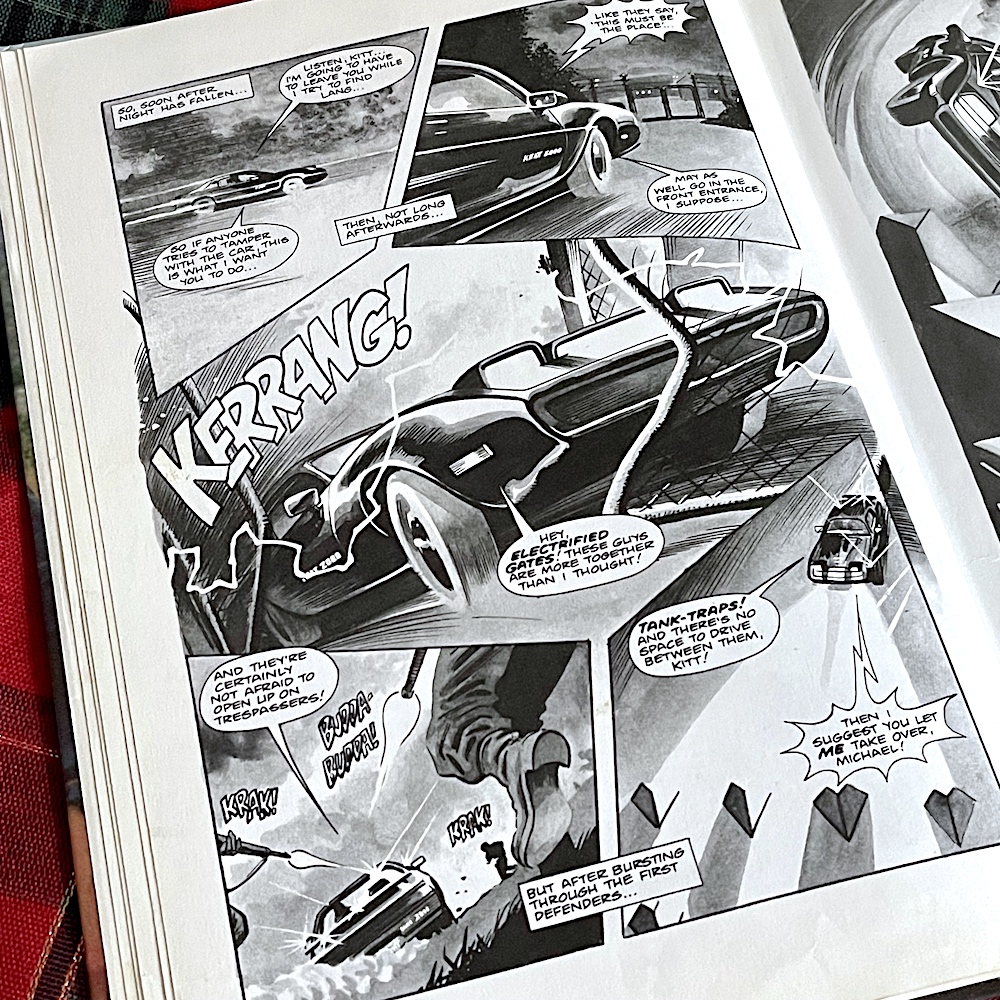
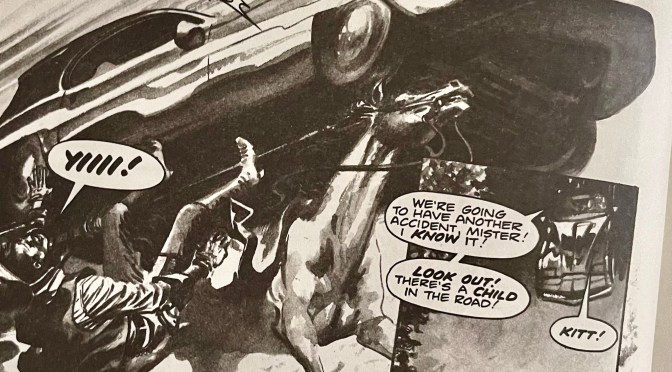
A variation of the Ku Klux Klan seem to have kidnapped a young lady to make some sort of religious sacrifice. She escapes and runs out in front of a self-piloting K.I.T.T. (Michael is having a doze). Once again, it plays out like the final scenes of an episode and all of the car’s capabilities are the same as the movie but it’s huge fun. The spread above is an exciting collection of panels and shows the potential a regular Knight Rider strip could have had when coupled with a deeper story.

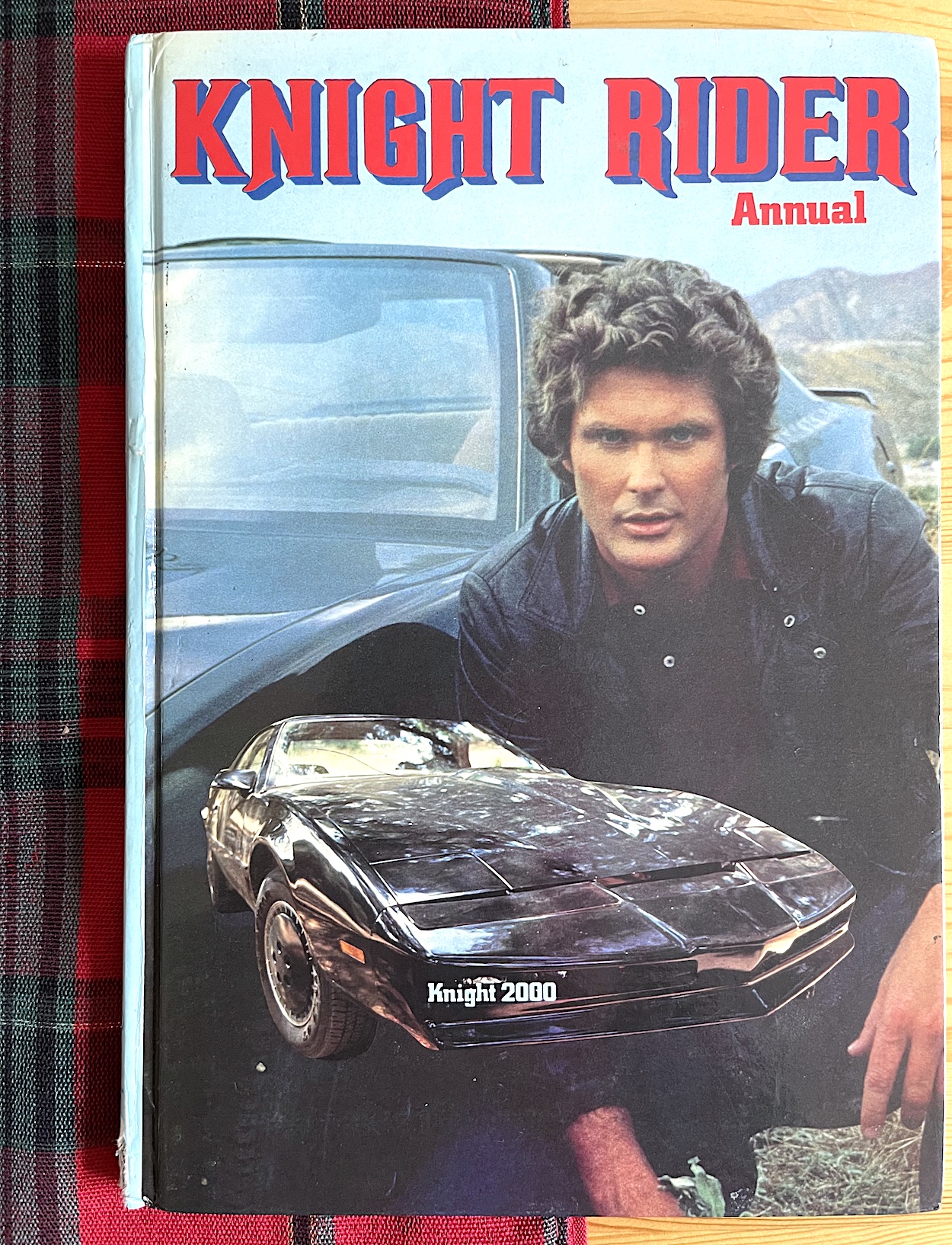
One thing I have noticed throughout the book is the incessant need to have ‘Knight 2000’ plastered all over the car. It looks like it’s been added later and David confirmed he can’t remember any instruction to do so. (It’s particularly jarring on the cover.) I remember any toy K.I.T.T.s I owned as a kid had stickers of this all over them and I’d always remove them. After all, K.I.T.T. was meant to blend in. It could be a licensing thing, to separate merchandise for Knight Rider from that of car manufacturer Pontiac, but adding it to the strips feels unnecessary.

As you can see this is only the first of five Knight Rider Annuals and if this one is anything to go by I’m glad I’ve finally been able to track them all down (those later ones seem to be somewhat rare) and I’m really looking forward to the next one. When will that be? Why, next Christmas of course! This blog is in real time after all. It’ll be an agonising wait but nope, I won’t be reading ahead, it’ll make the experience all the better for it.

For this year however, I have a very special treat in store for both Knight Rider and comics fans in general. Artist David Lloyd very kindly agreed to answer questions about working on the annuals and not only did he supply some fascinating insights, he also sent me some of his original sketches for K.I.T.T. and a Hasselhoff study! You’ll be able to check all of these out in just a couple of days on Saturday 17th December 2022. For now, I’m off to have my yearly viewing of the show’s sole Christmas episode, appropriately enough titled ‘Silent Knight’.

“Straight ahead.”

GO TO KNiGHT RiDER ANNUAL 2

ANNUALS MENU

CHRiSTMAS 2022