Tag Archives: Gil Kane

JURASSiC PARK #3: CUDDLY CARNiVORE

Don’t let the rather playful, pet-like Tyrannosaurus rex on the cover put you off, this is not a sanitised version of Spielberg’s monster movie. Things really do kick off for Dark Horse International‘s UK version of Jurassic Park comic this issue, as Dennis Nedry puts his plan into action just as the unfortunate coincidence of a tropical storm hits the remote island of Isla Nublar.

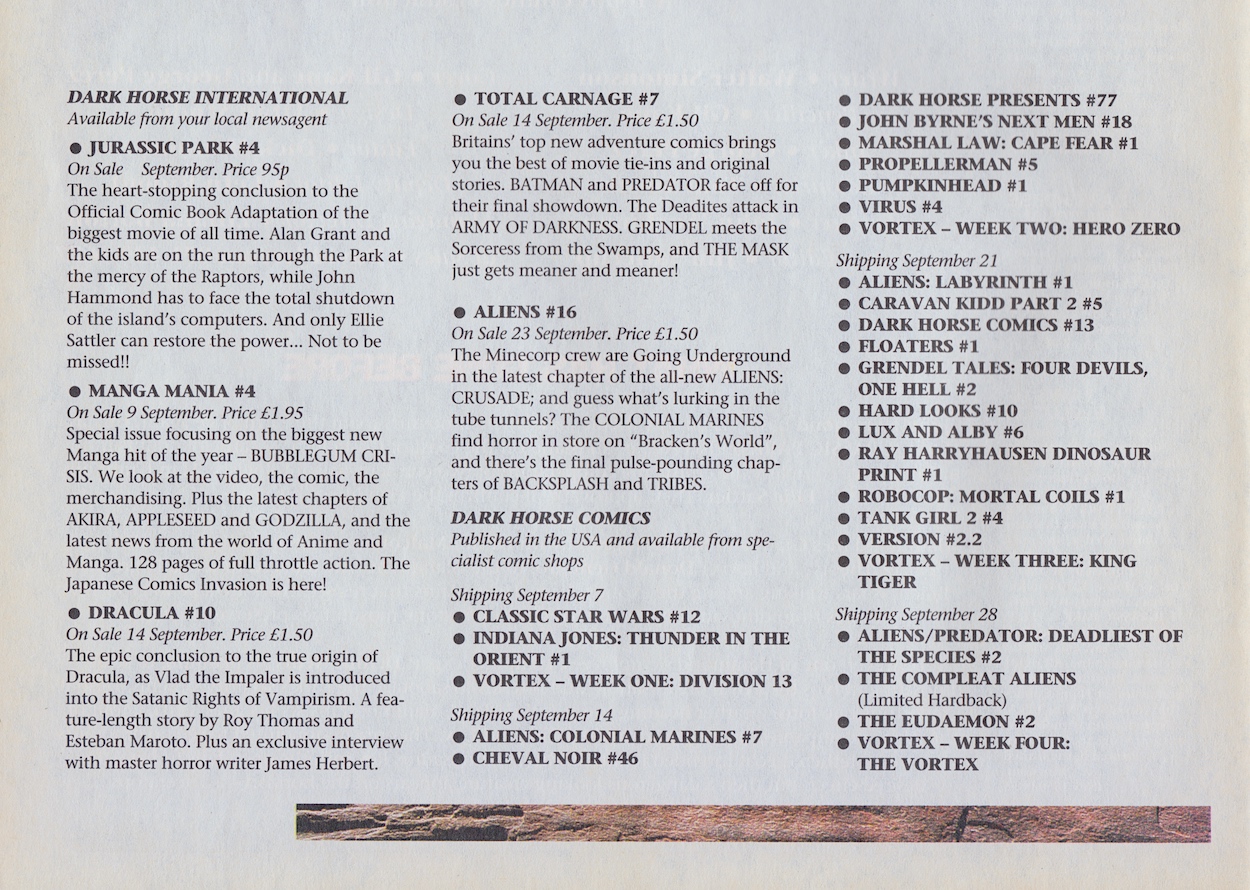
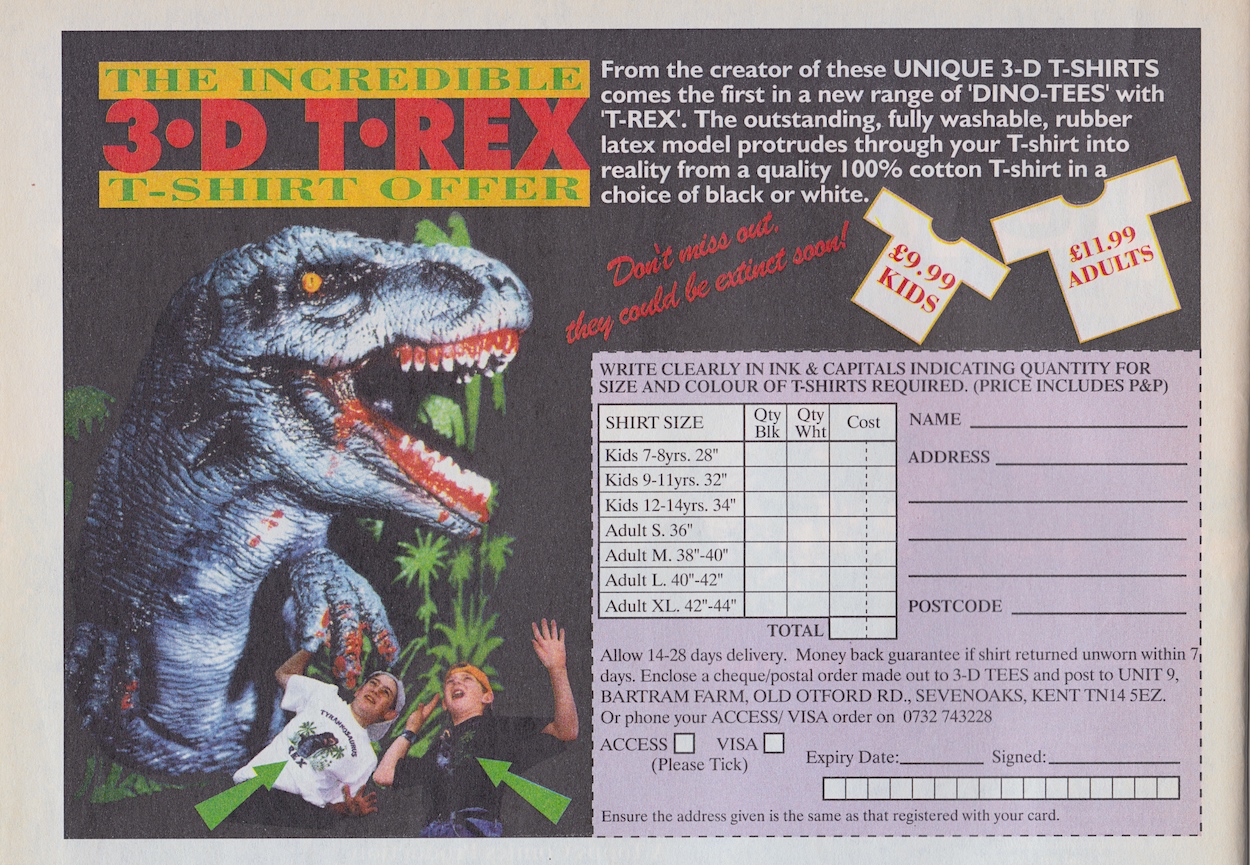
But before we get to that let’s take a look at some of the other bits and bobs included. The full comics checklist returns, featuring all five of the publisher’s UK titles and an extensive list of imports. You’ll notice the next issue of Jurassic Park has no specific date and I’ll get to that at the end of the review. There’s also an advertisement for possibly the worst idea in clothing ever to grace anybody’s chest. It’s difficult to make out but those of us who are old enough will remember these ridiculous t-shirts with a horrible rubber dinosaur sticking out, Alien-style. I remember there being Yoda ones in the shops too and they were just as garish.
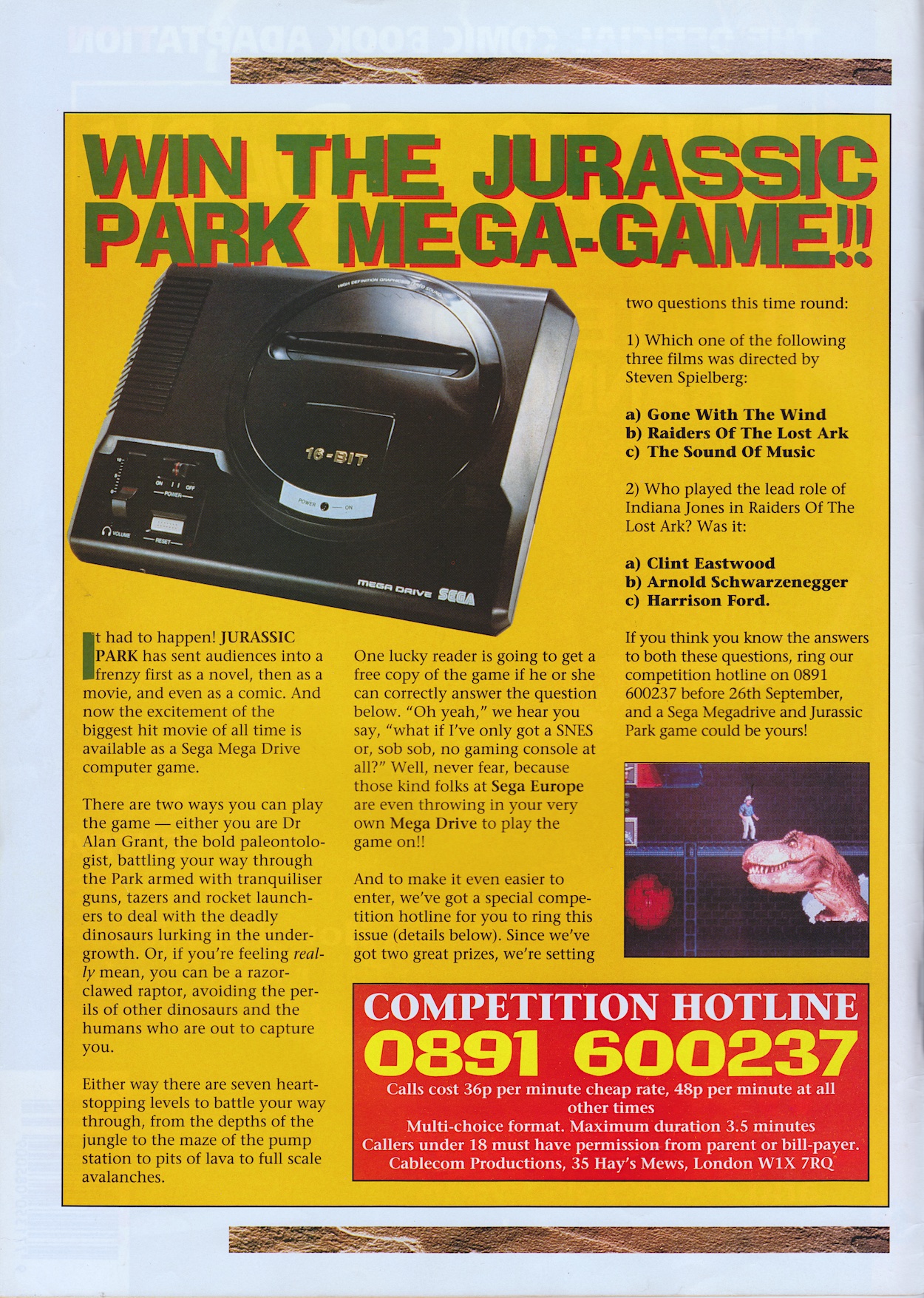
The issue opens up with the biggest competition yet on page two and oh, how this takes me back. My friend had a Sega Mega Drive back then and, while we never played this game, I’m reminded of the weekly trips to the local video store to rent the latest games. The writer certainly seems just as enthused. (It’s definitely a step up from glow-in-the-dark stickers.) If only this kind of hype were evident on the editorial page every issue instead of the straight contents list we got instead. It’s not like there wasn’t a lot of Jurassic Park news to get hyped about after all.

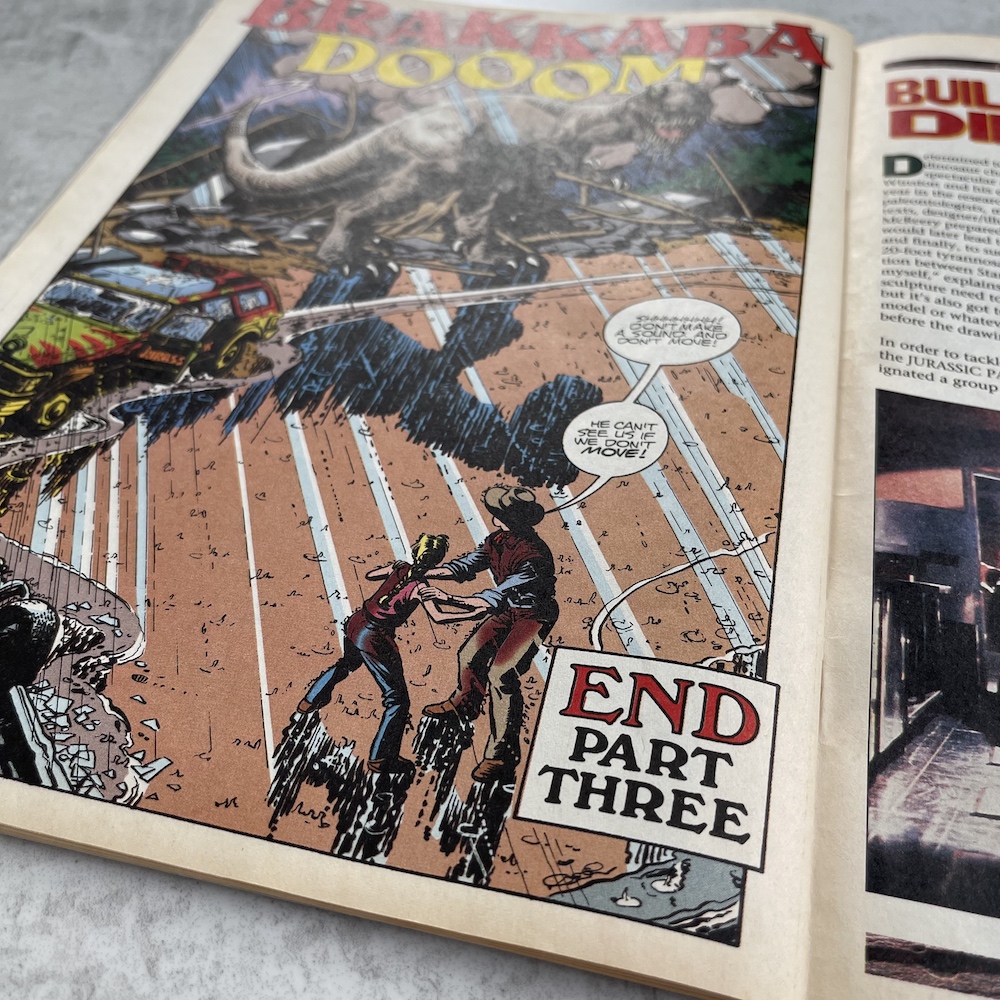
The constant presence of rain in the background and the subdued colours envelop the reader in the cold, wet nighttime scene.

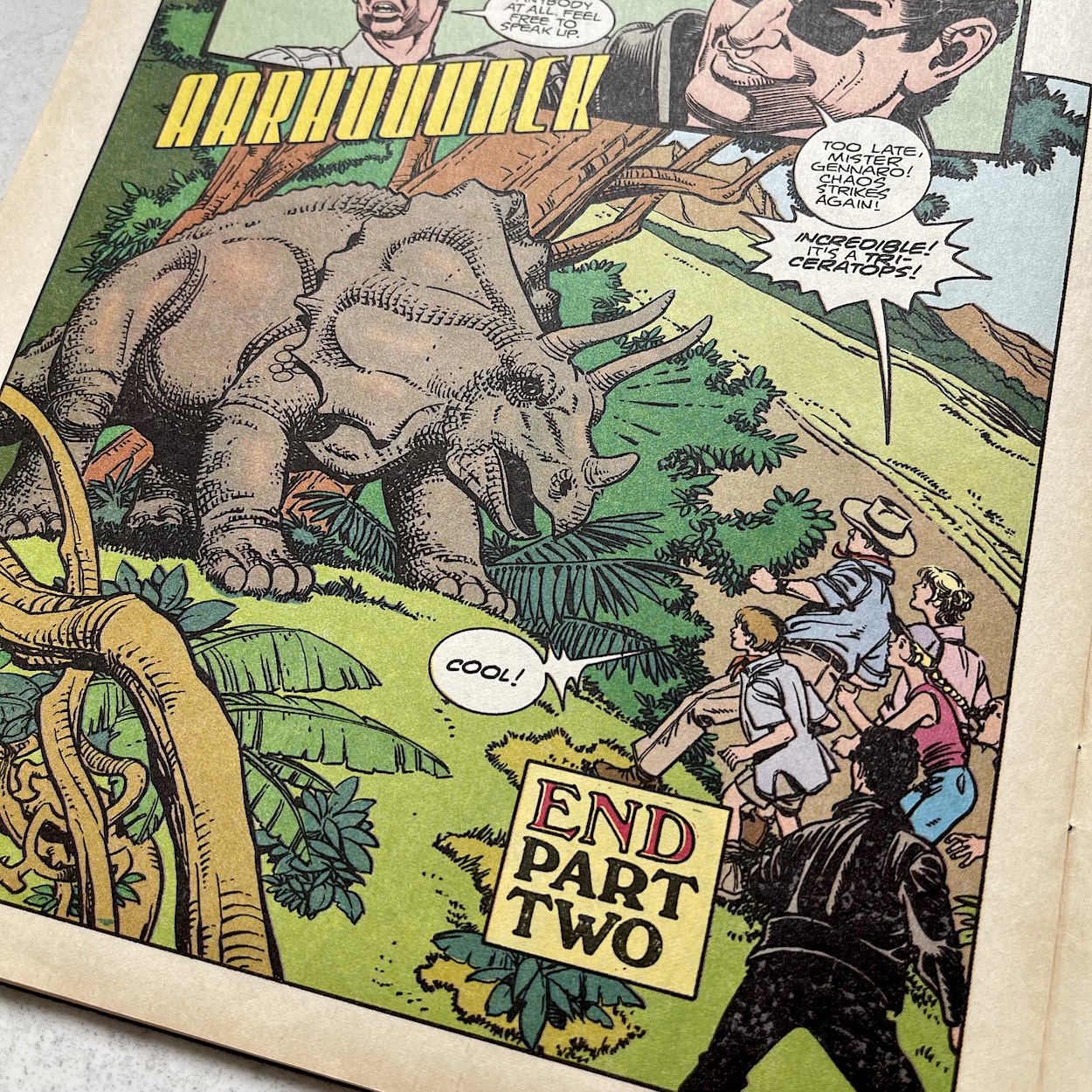
Clearly there was an excited human team behind the comic. Readers who had seen the movie in cinemas would definitely have been looking forward to this issue too. Things kick off with the sick Triceratops scene now playing out like the movie after last issue’s cliffhanger. As it turns out, the supposedly terrifying creature (which wouldn’t have harmed them anyway) just collapses when the story begins, which makes that cliffhanger a bit of a cheat.

The scene uses more dialogue from the book that didn’t make it into the final cut of the movie, specifically the resolution of what made her sick in the first place which really showcased Dr. Ellie Satler, so it’s nice to have these details back in the comic.
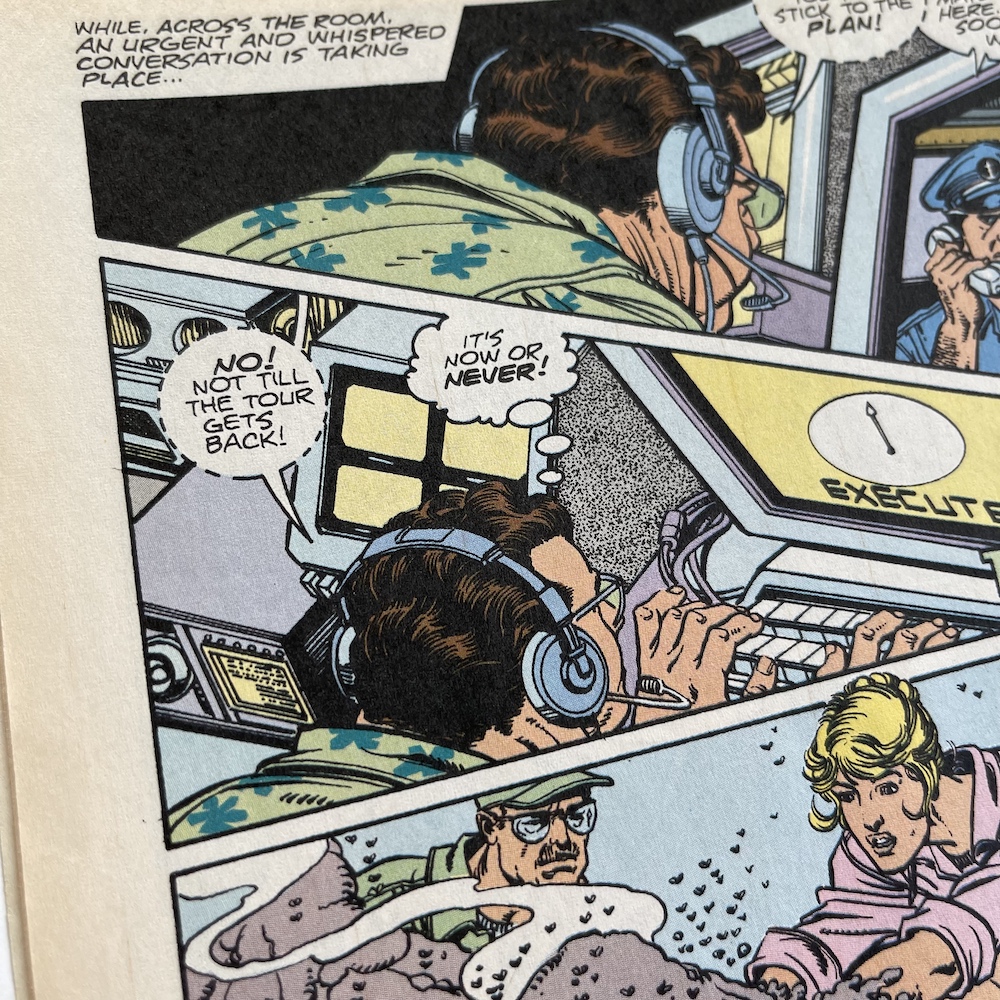
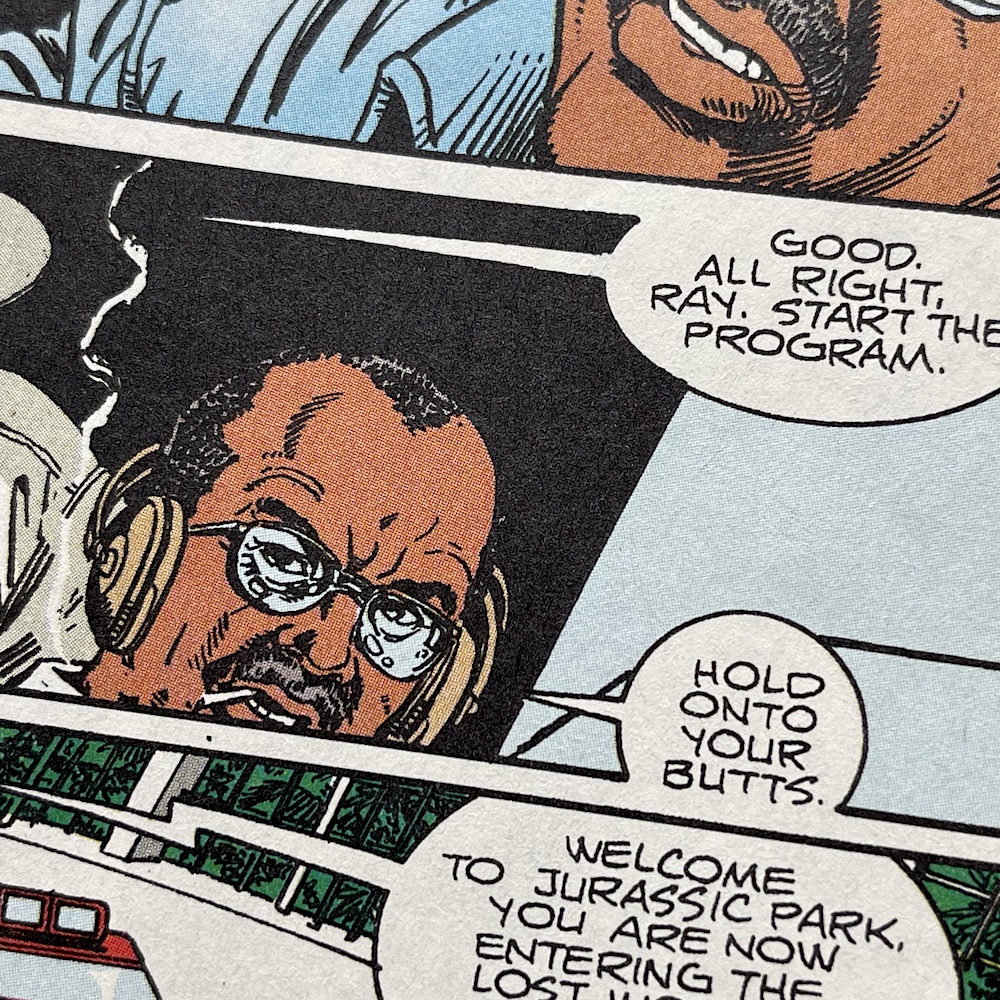
While Nedry’s ultimate fate isn’t played out yet we do at least get some extra characterisation for the man whose greed would ultimately lead to the park’s destruction. He’s actually worried about turning off the park’s security before the tour gets back. He doesn’t want to hurt anyone, he actually cares and his intention is to sneak off to the boat, hand over the embryos and get back before anything bad transpires from the temporary deactivation of the electronic gates.


“Always on the lookout for a future ex-Mrs. Malcolm.”

Dr. Ian Malcolm

Of course, the storm would put a rush on things and we all know the outcome for everyone involved. Despite his worry he’s still an annoying hacker at heart and his “hacker crap” still keeps Ray out of the system long enough for his plan to be put into action.

The build up to the main event is superbly handled. The constant presence of rain in the background and Tom Smith‘s subdued colours envelop the reader in the cold, wet nighttime scene. Iconic moments such as Dr. Alan Grant and Dr. Ian Malcolm‘s chat and that famous moment the giant T-rex stares in at them, looking for a moving meal, are brilliantly captured.
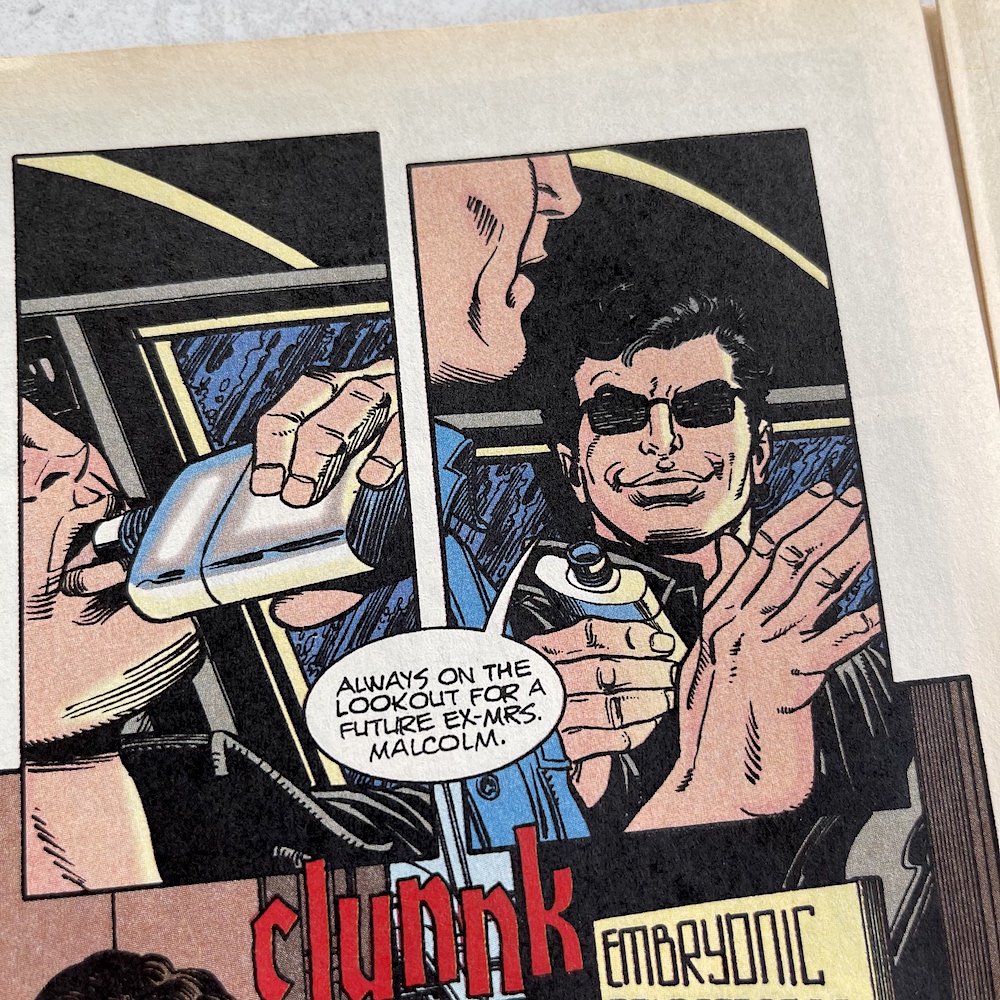
Gil Kane‘s and George Perez‘s (our cover penciller/inker respectively) version of Ian continues to exude a darker presence, his humorous lines reading a little more cutting than Jeff Goldblum‘s perfect delivery. It’s such a shame then, how Walt decides to change a key moment in a way which has a detrimental effect on the character, which we’ll get to that in a minute. For now, let’s back up a little to the first appearance of the issue’s big selling point.

Three issues in the comic team finally get to have the big reveal and their first bit of proper dinosaur action, something they’ve only been able to hint at thus far. This was a key scene to get right and just as the tension rose to its crescendo in the movie, here we’ve got pages of rain, booming sound effects and progressively more frightened characters until we turn a page and are confronted with this next image.
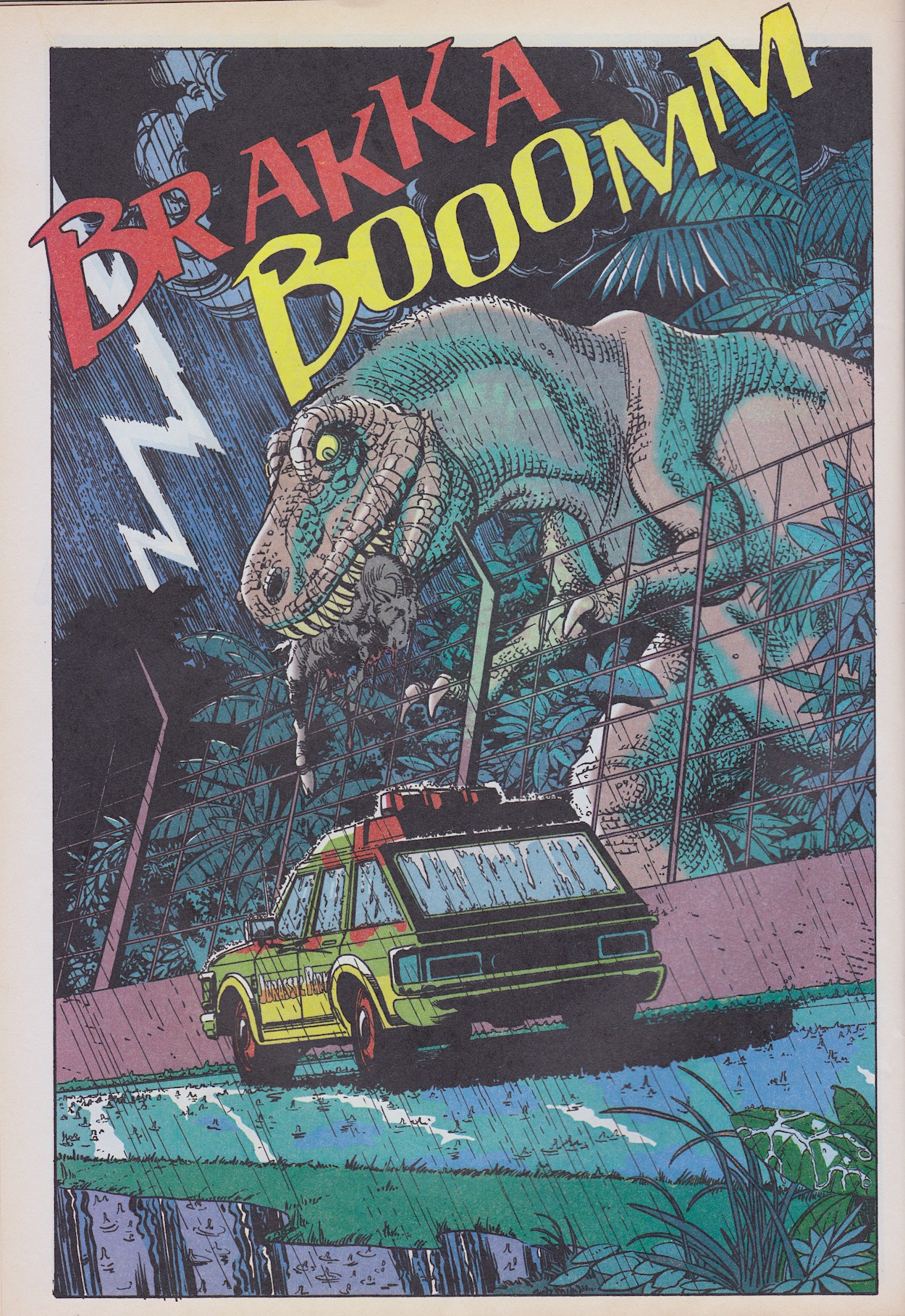
Timing is everything and editor Dick Hansom made sure to add an additional advertisement page after the editorial so that later in the comic this would work as intended. Of course, on closer inspection you could critique this image and say the size of the T-rex means she could easily chomp down on cars even with the fence electrified (and also, that’s one huge goat), but then we’d be missing the whole point of this glorious splash page.

Sure there’s some artistic licence at play here but you can’t deny its impact. Those proportions are corrected for the rest of the attack scene and to be honest it was only upon the second reading that this reader picked up on it, such was the impact of this atmospheric rendering.


“It is a beautifully-designed killing machine!”

Panel caption (Walter Simonson)

What follows are an intense few pages which I believe would work just as well on their own merit even without the memory of the movie. In the film the juxtaposition of the giant predator and the kids Lex and Tim made for a genuinely terrifying moment in cinema history. Conveying that to comics panels was never going to be easy but the simple addition of descriptive captions ends up being the perfect solution.

With the attack in full swing, every few panels we get a direct, to-the-point fact about the T-rex‘s size and strength. The attack spans four pages and each of these little captions brings another level of tension until they culminate in “It is a beautifully-designed killing machine” as it stands on the upturned car, its weight squashing the metal down into the mud, Tim still trapped inside. It’s a genius move.
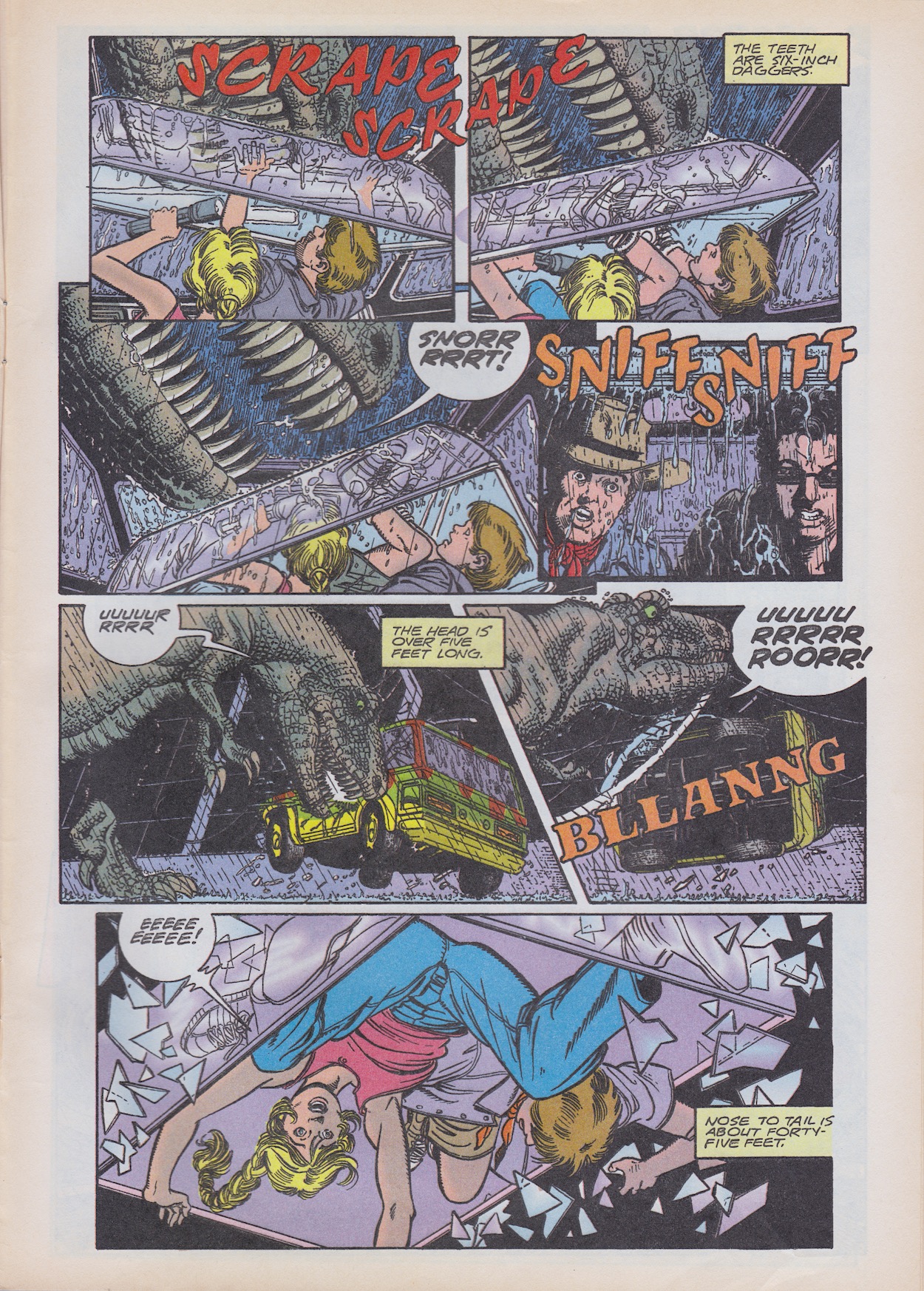
What comes immediately after these superb pages is the first big disappointment in this adaptation.

As you’ll remember, in the film Ian lights a flare to get the T-rex‘s attention away from the kids and only starts running once he knows he’s being chased. This gives Alan the chance to rescue the children. But here he just runs away, leaving everyone else to their fate. There’s no indication he’s doing it as the foolhardy yet heroic gesture of the movie. It’s completely out of character and if this had happened in the movie it probably would’ve turned the audience against him for the rest of the story.

A very odd choice and one I definitely do not like.
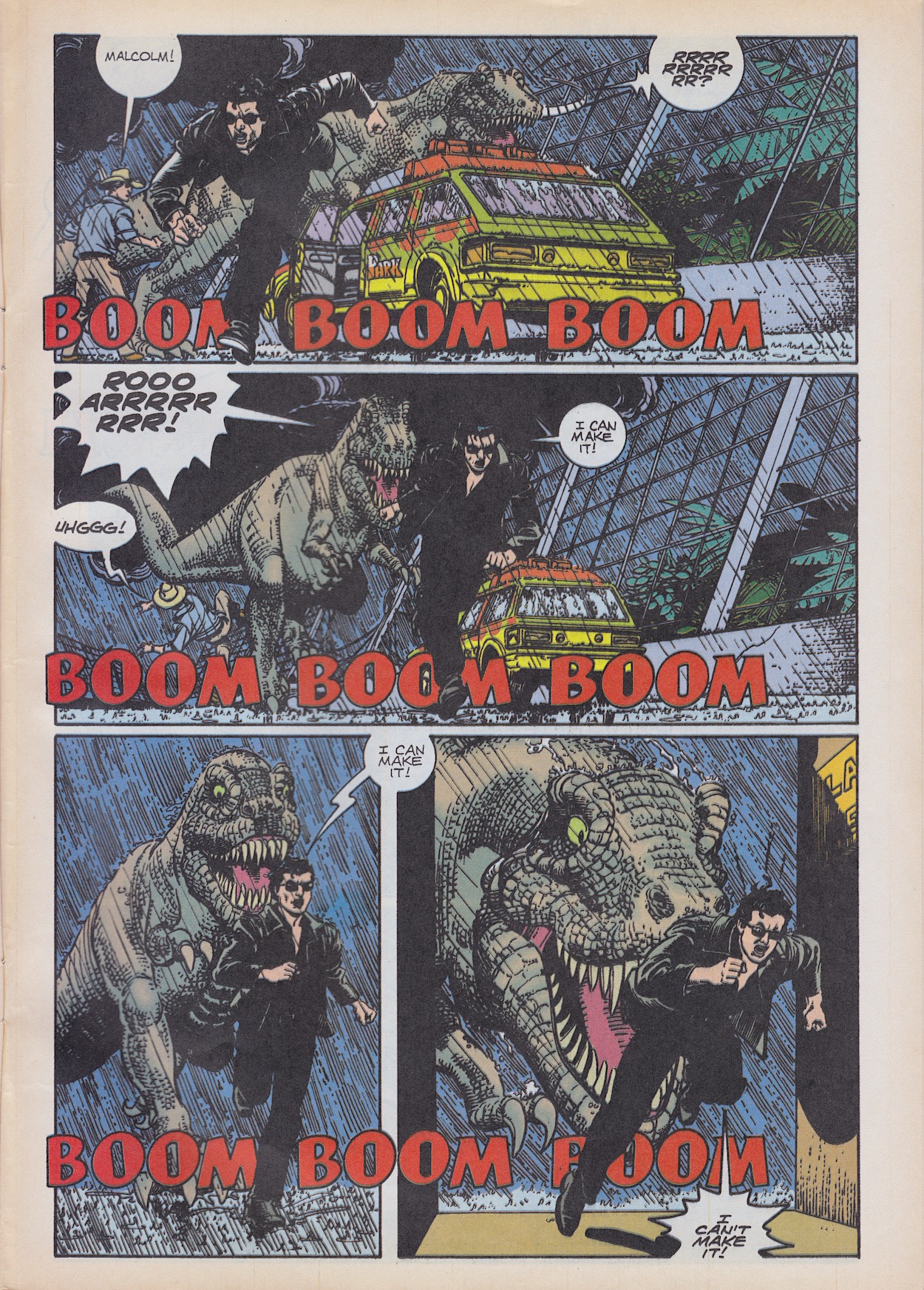
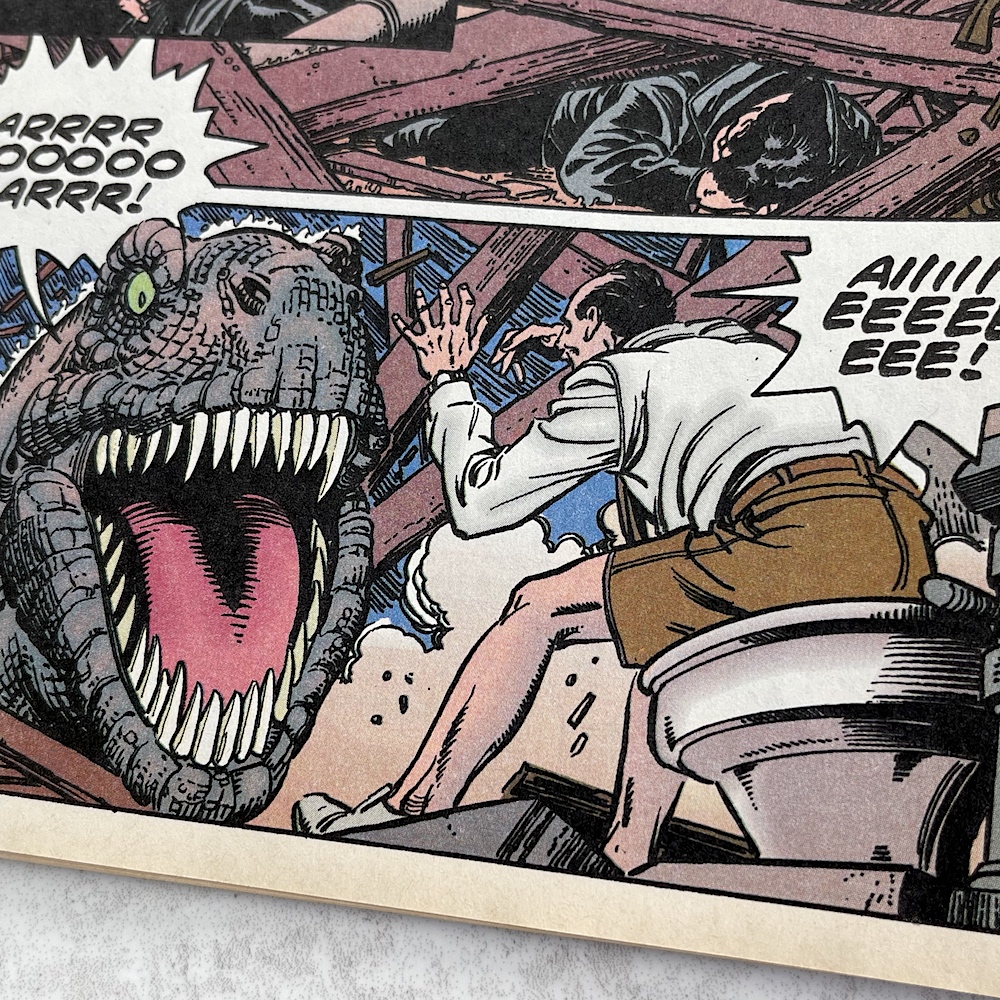
The end result is the same however, with Malcolm being tossed through the walls of the public toilet where lawyer Donald Genaro ran earlier to hide when he abandoned Lex and Tim. The ending to his particular story happens out of frame with only a scream in a speech balloon pointing off the page (in letterer John Workman‘s unique style). This seems like another rather odd choice seeing as how the vast majority of readers will have witnessed the scene play out in the film. Why censor it?

A couple of dubious choices by Walt and story editor Jim Salicrup aside the story rockets towards its cliffhanger. In America this would’ve been the penultimate chapter in a four-issue mini-series but here in the UK we actually still had two parts to come. How so? You’ll find out next month. (I have to try to get you back here somehow!) In the meantime this final page brings things to an end but the issue has more to give before we place it back on the shelf.
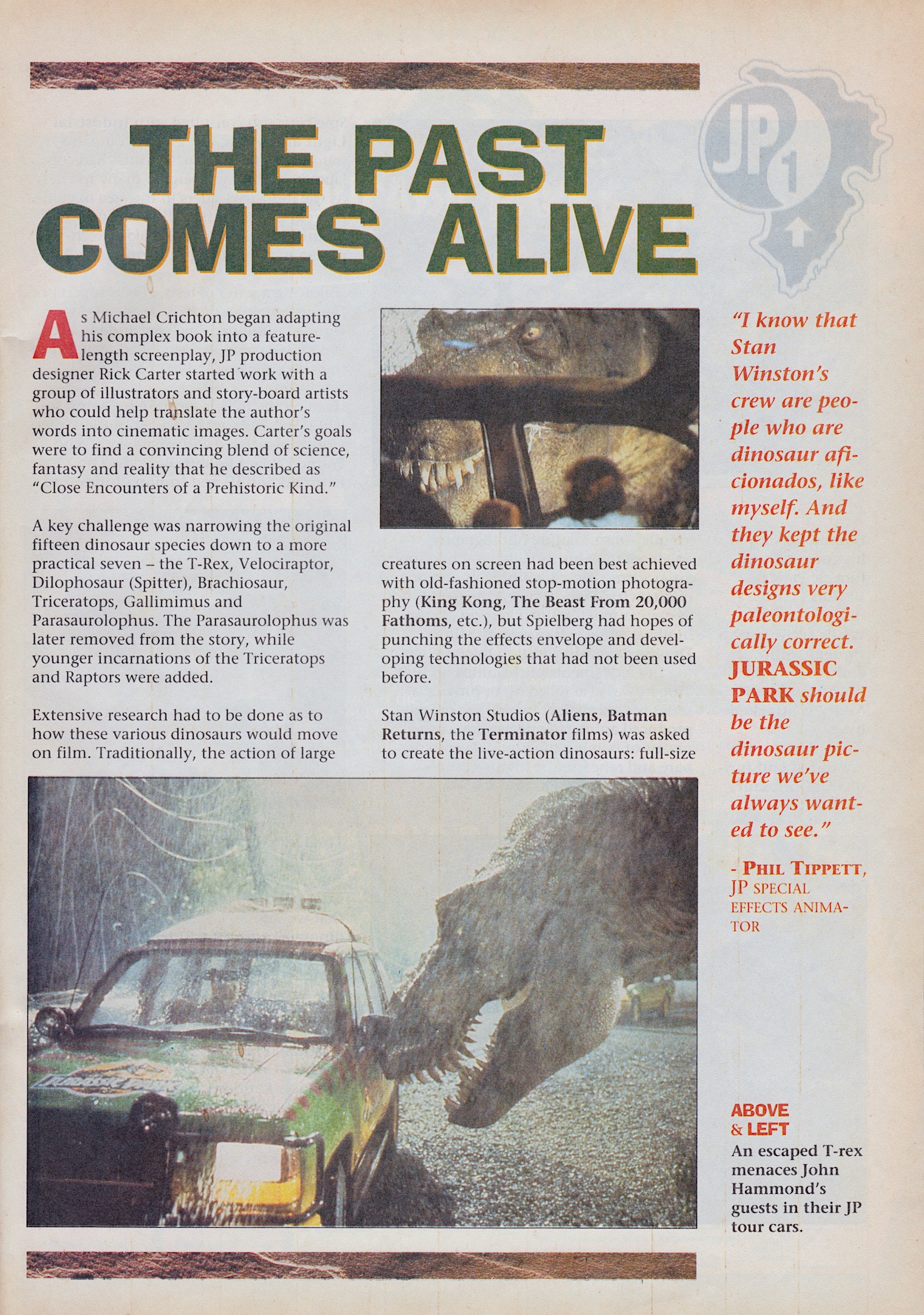
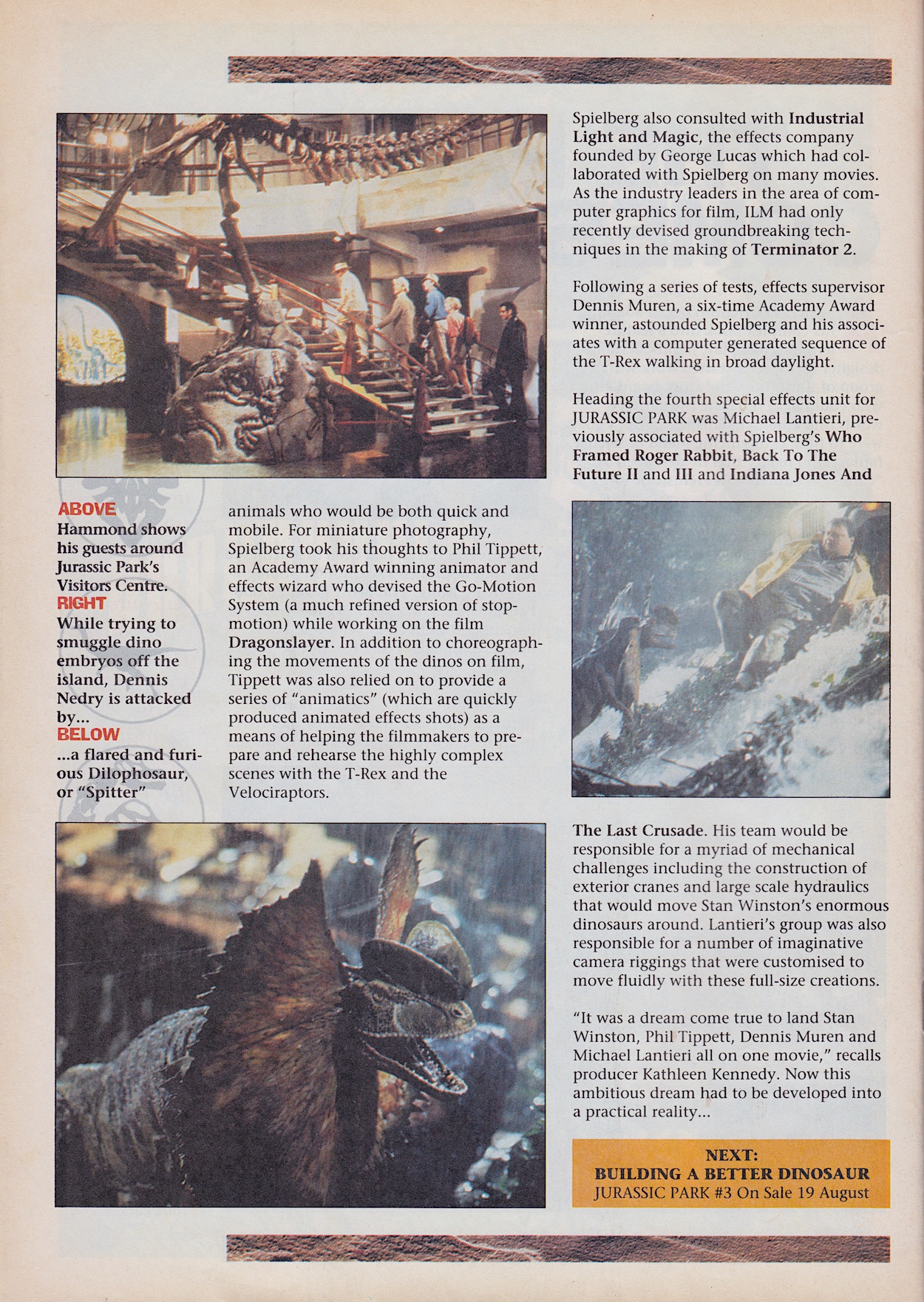
Last issue the behind-the-scenes feature introduced us to the various special effects departments and their roles in bringing Michael Crichton’s creation to the screen. This time the focus is fully on the mechanical dinosaurs themselves, created by Stan Winston and his team, in Building a Better Dinosaur.

We all know how the film led the way in its use of computer graphics, but what can’t be forgotten are the wonderfully lifelike creations that the cast actually got to interact with. As a huge fan of Jaws (which gets a humorous mention here), Jurassic Park always felt like a descendant of that original mechanical predator movie and this brief write-up is an interesting look at how they were created and operated. It’s just a shame it doesn’t contain any accompanying design or set photos of the details covered in the text.

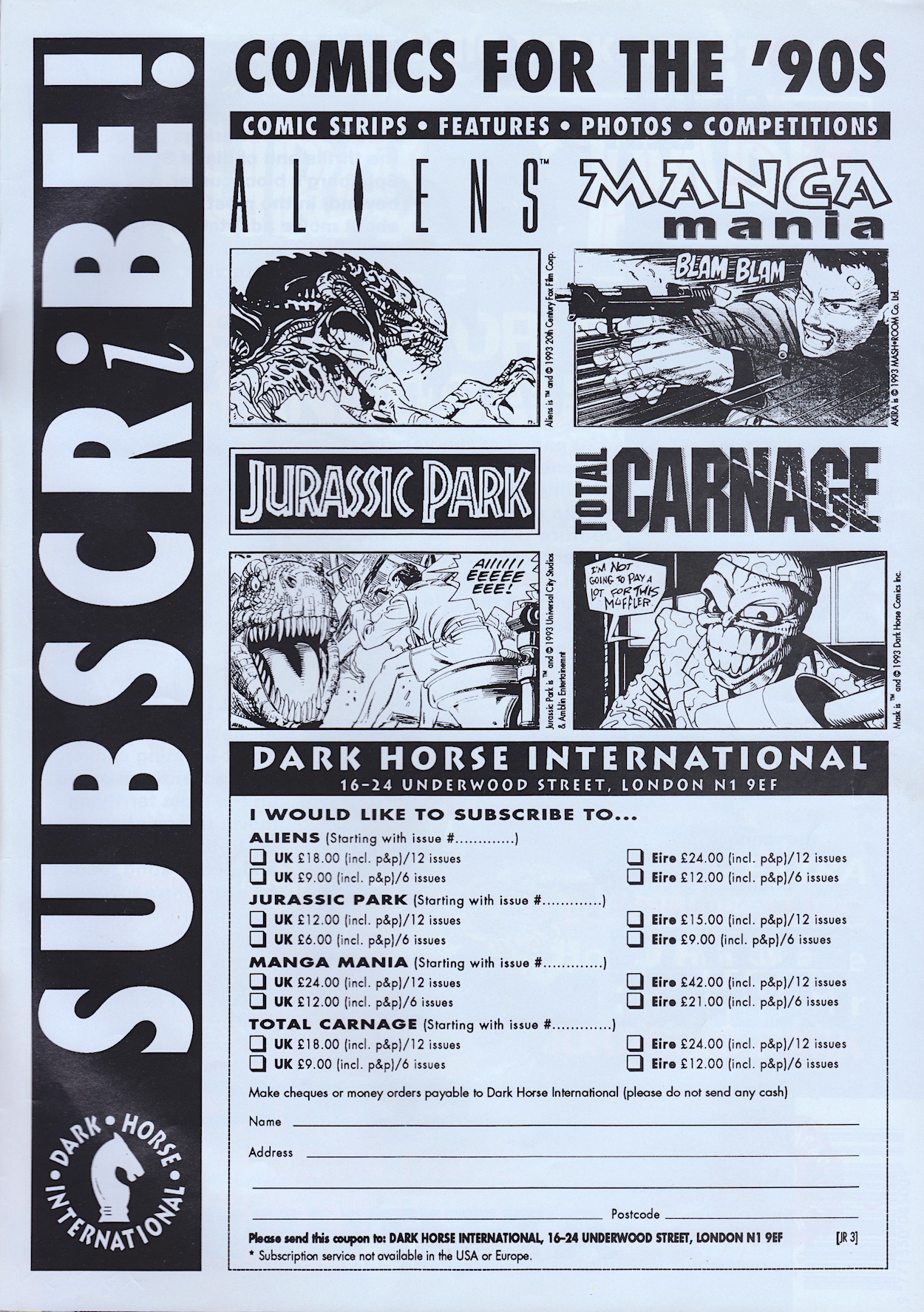
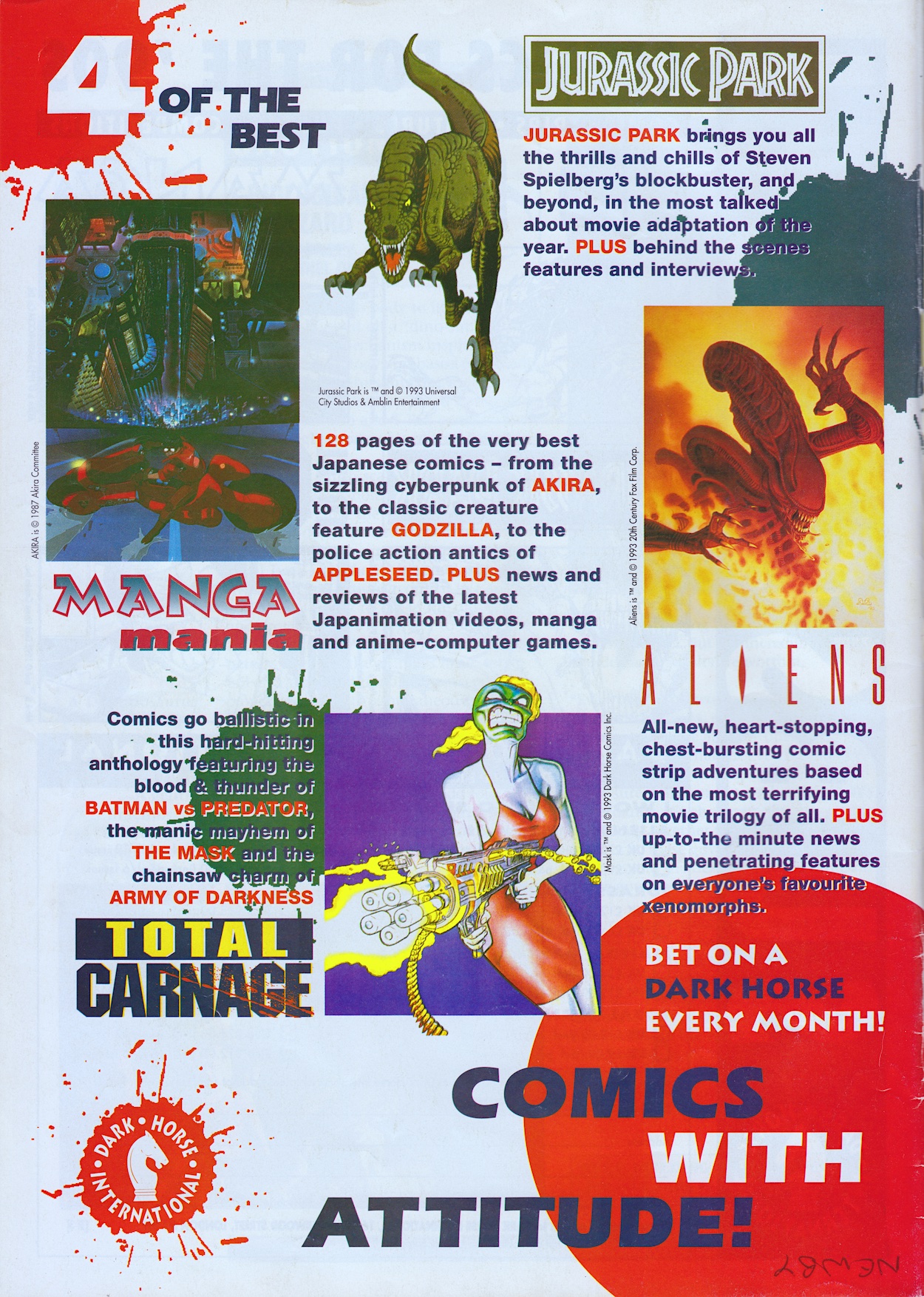
The back cover is a double whammy of information on Dark Horse’s range, beginning with a subscriptions page and then a colour advertisement on the back. The company was making real inroads into the UK comics market, bringing international comics to our shores on bigger, better quality paper, chock full of strips and features. It’s unfortunate that the whole market was shrinking rapidly and ultimately there wasn’t much time left for the imprint and its titles. But we’ve got plenty of issues of this comic to go so we’ll not get bogged down with endings just yet.
For now, we’ve got a bit of a wait until the next issue because the comic’s schedule was changing. With Topps Comics in the US now committed to further mini-series and the UK comic selling well enough it was decided it would continue past what was originally going to be a four-issue adaptation. Jurassic Park was now going to be a monthly ongoing comic, the date of the next issue unknown at the time of going to press. (Something similar happened with Bram Stoker’s Dracula.) The strip in the next issue was split in two so as to give the American comic enough time to get ahead before the new, original strips could be printed here.

Rejigging it into an ongoing comic would take a little planning and working out what to fill the pages with. So in the end Alan and Lex would have to stay completely still all the way until 28th September 2021 for Jurassic Park #4! So will you. Will it be worth the wait?

iSSUE TWO < > iSSUE FOUR
JURASSiC PARK MENU

JURASSiC PARK #2: BUiLDiNG THE PARK

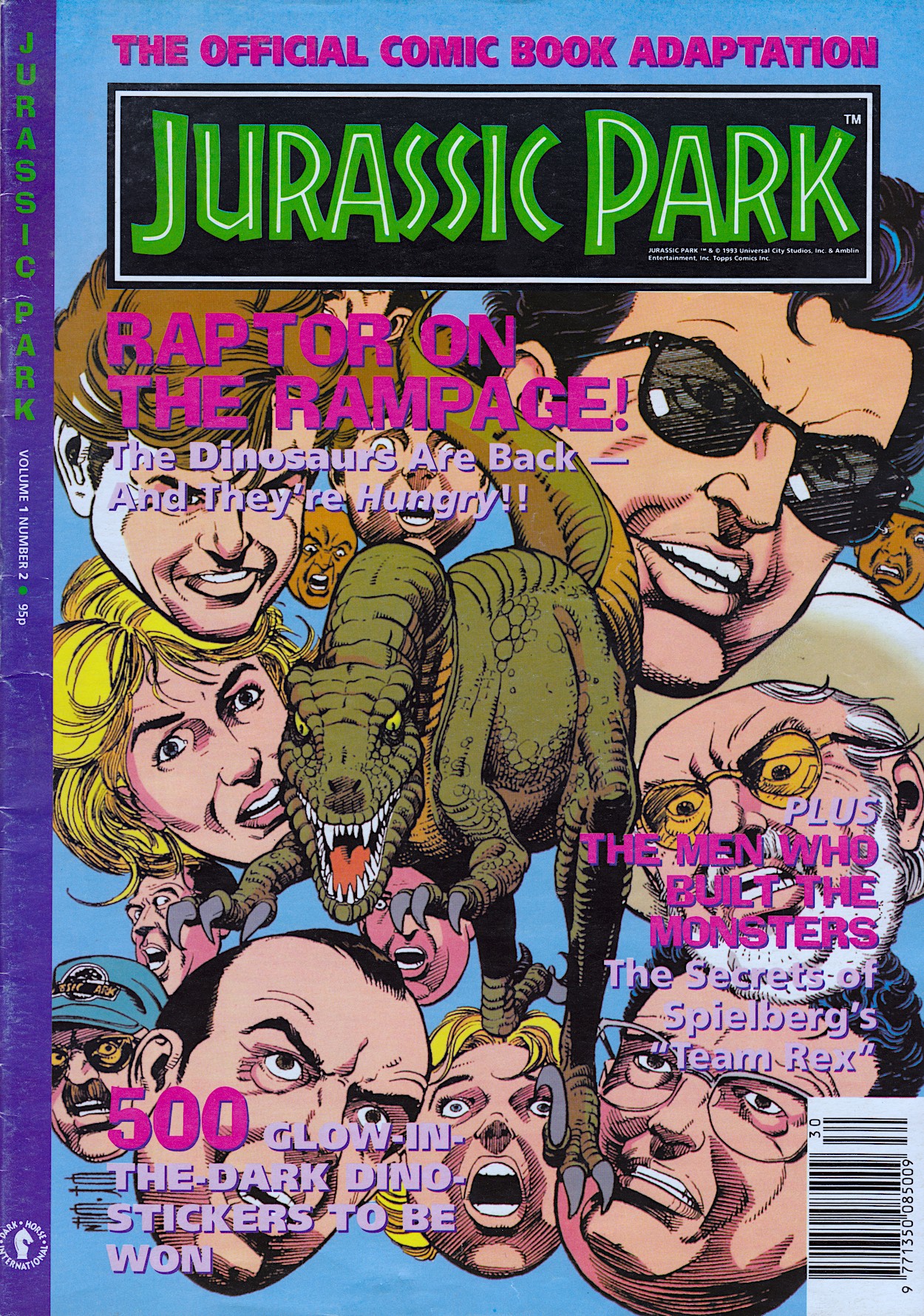
Welcome back to “Isla Nubar” (misspelled like this on the contents page) and Dark Horse International‘s UK version of Jurassic Park from 1993, edited by Dick Hansom. A rather strange cover by Gil Kane and George Perez, given how no dinosaurs have escaped yet. It’s a mishmash of named characters and extras, including a rather red-faced man in the middle. Maybe the raptor is holding his nose.

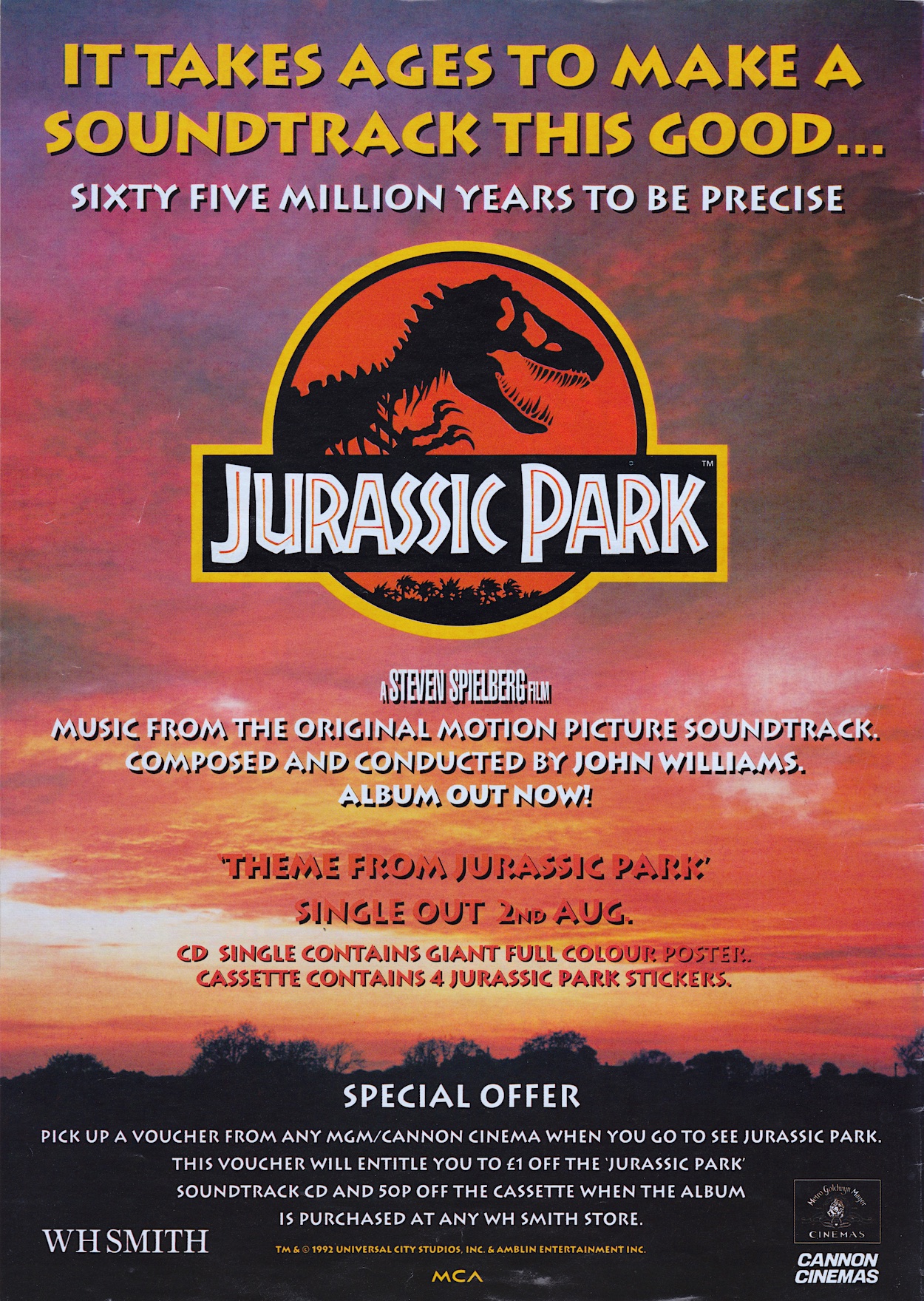
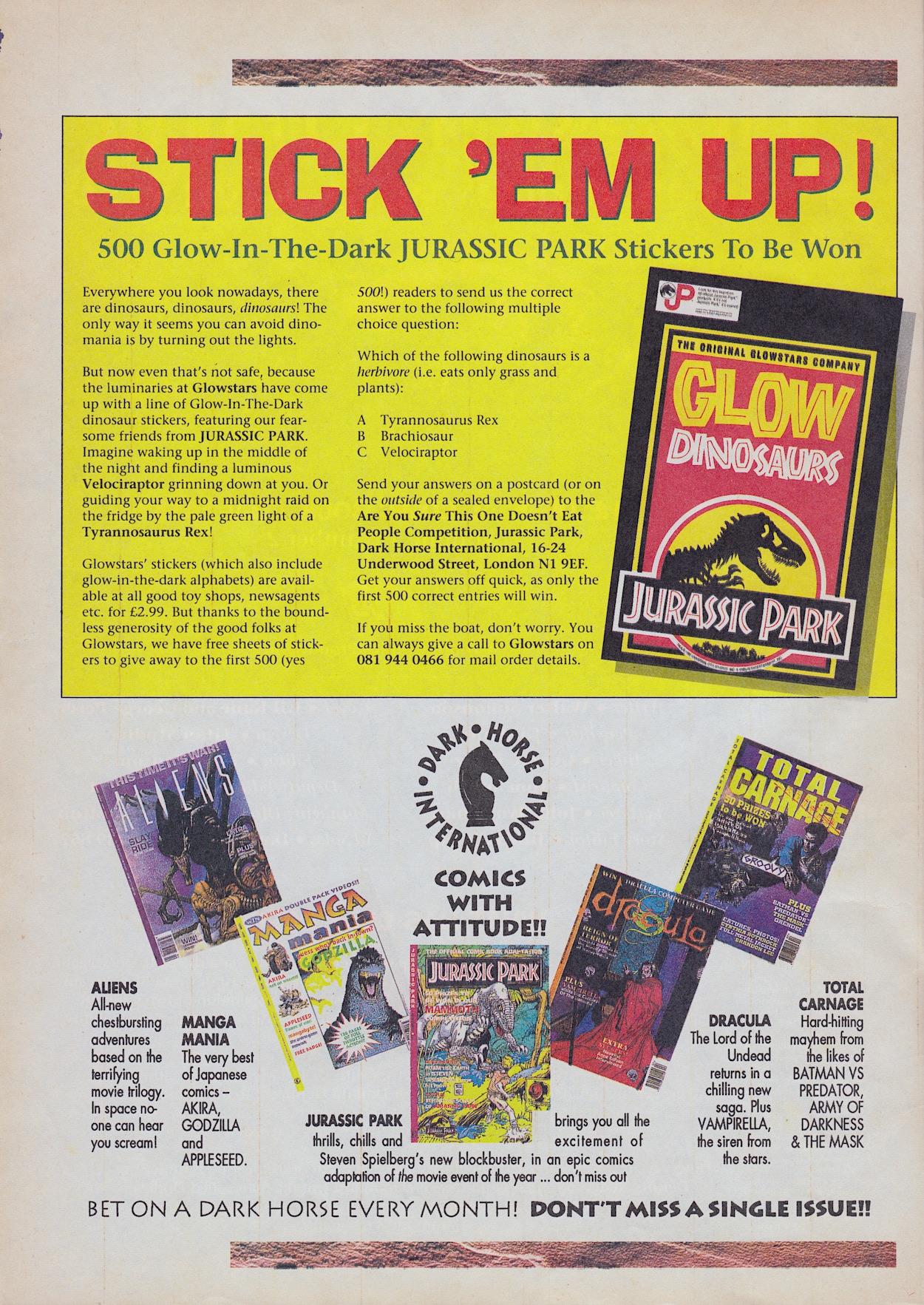
Inside is the second 28-page chapter of Topps Comics‘ adaptation and a few extras, something we were accustomed to this side of the pond. First up is an advertisement for John Williams‘ soundtrack album. I owned the CD at the time and have been listening to it on Apple Music while reading these. There’s a competition for glow-in-the-dark stickers, a somewhat unimpressive prize compared to later ones I remember. No comics checklist this issue, instead a glance at the other titles currently in publication.

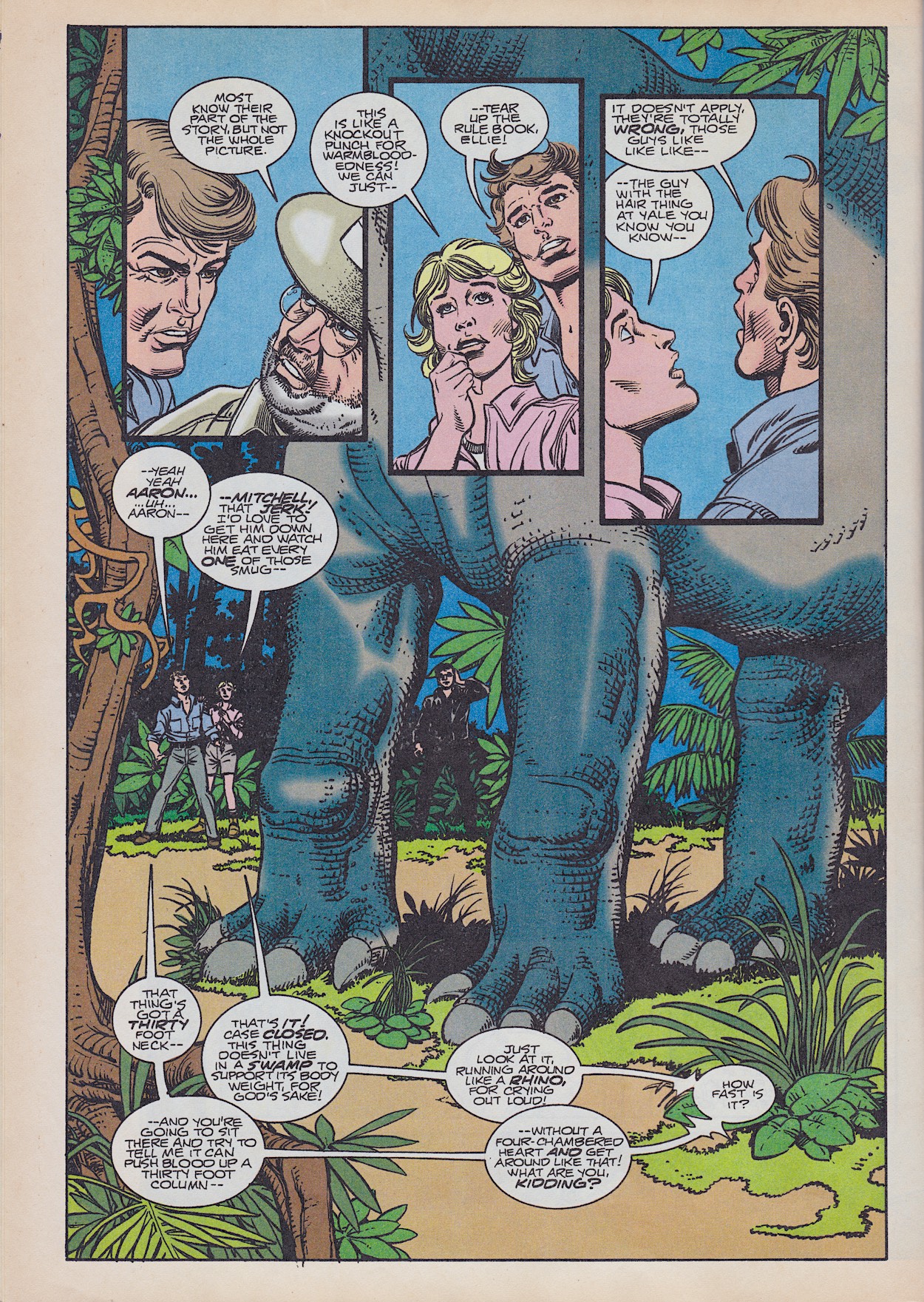
The strip continues adding to existing scenes while moving others about in order to adapt the film to the medium, something I discussed in more depth last time. This chapter begins where we left off in the midst of that iconic brachiosaur scene and there’s quite a lot of additional dialogue from Michael Crichton’s novel, such as Dr Alan Grant‘s and Dr Ellie Satler‘s further observations.

One part lifted directly from the book involves a little bit of background on the park itself. To achieve something of this magnitude would require more people than just those on the island, so John Hammond explains others were involved across the globe, knowing only their specific part of the puzzle. To maintain secrecy they were never let in on the bigger picture. The novel goes into things like this in a lot more detail to ground the fantastical story in the real world and if you haven’t already you really should read it yourself (or get the audiobook which is expertly brought to life by Scott Brick).

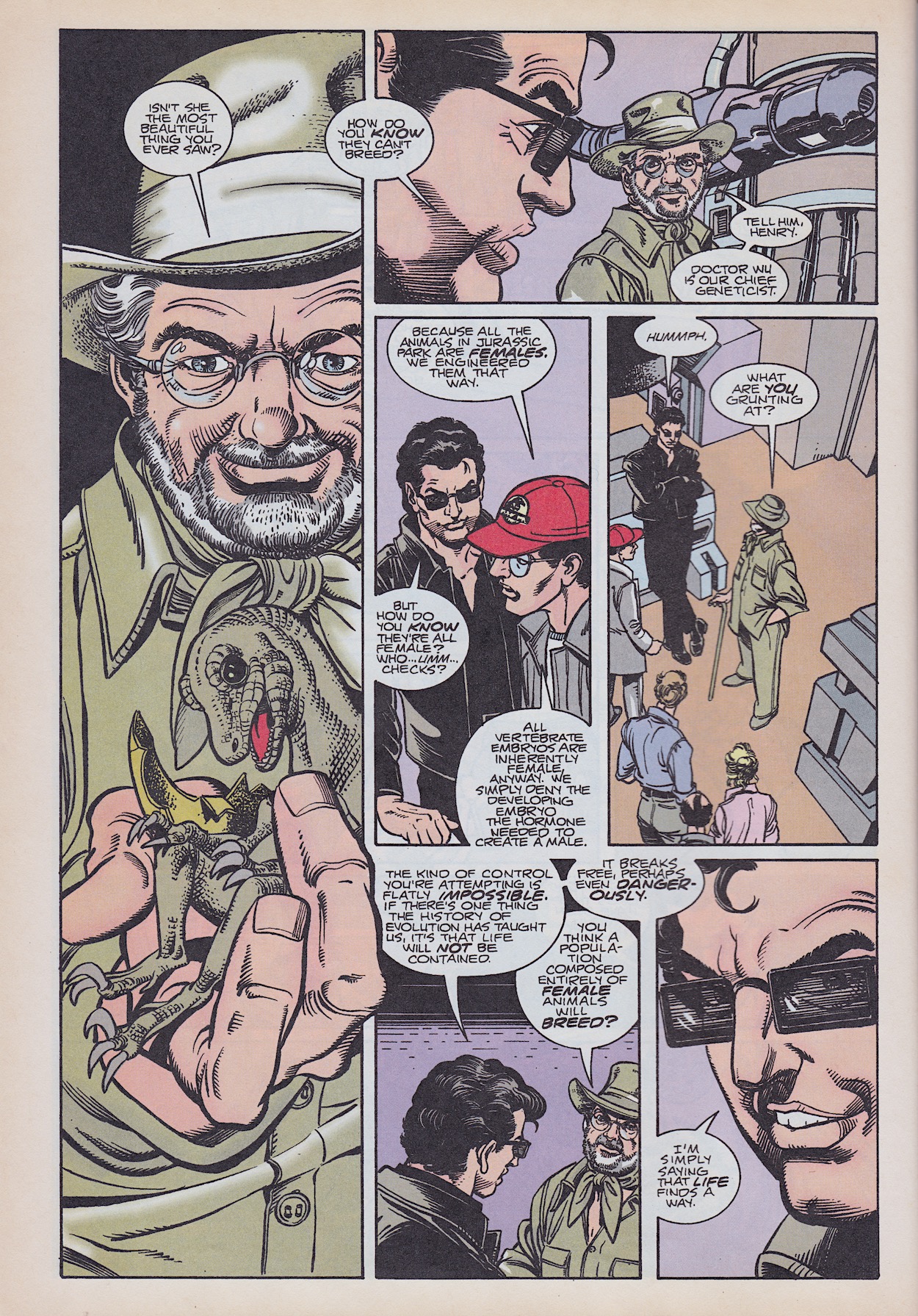
From here we make our way to the Visitor’s Centre, our characters excitedly discussing what they’ve seen, trying to take it all in. After the Mr. DNA sequence we find ourselves in the lab where we meet Dr. Henry Wu, who was played by BD Wong. In the novel Wu was a central character and certainly not the affable person we saw in the movie.

Crichton’s Wu was ruthlessly ambitious, believed the success of Jurassic Park was solely down to him and never saw the dinosaurs as real; they were engineered adaptations of the originals. He argued with Hammond about the ability to create any dinosaur they wanted, even new breeds, tailoring them to exact requirements to bring in the most money from paying tourists. All of this would of course form the main plot of the fourth movie, Jurassic World. However, in the comic his role is reduced even further than in the first film, appearing in only three panels with most of his dialogue given to Hammond.


“I’m simply saying that life finds a way.”

Dr. Ian Malcolm

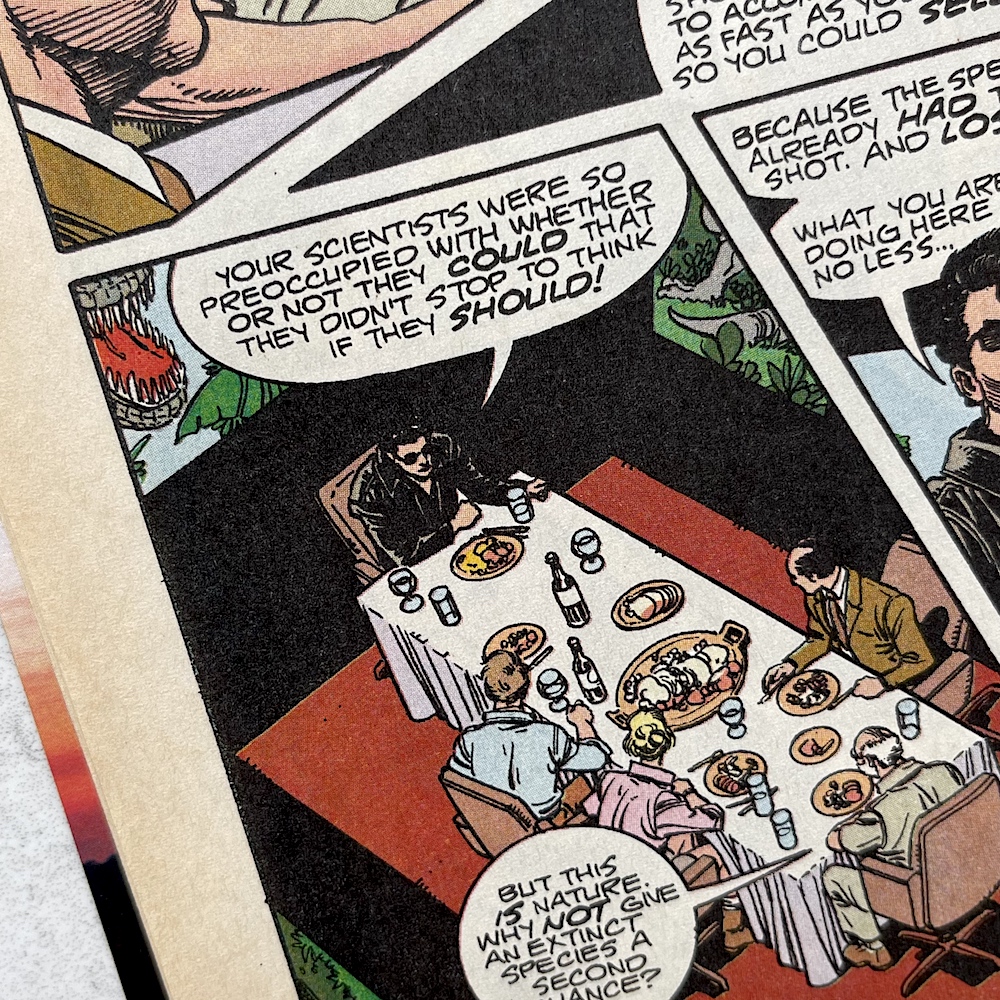
One character who definitely doesn’t suffer this indignity is Dr. Ian Malcolm, so memorably encapsulated by Jeff Goldblum that you can’t help but hear his voice when reading one of his many quotable lines. In the novel Malcom’s fascinating monologues ran to several pages and for the film their essence was broken down and brought to life by Goldblum’s very natural delivery, becoming the backbone of the story.

This continues in the comic although his characterisation is a little different thanks to Gil and George. Overall he’s still the cool mathematician but his facial expressions make the character a little darker in tone, lending his predictions a more sinister feel. This actually suits the comic. Scenes here don’t have the luxury of playing out over several pages to build tension, so this little tweak in tone works a treat instead. Below is one example as he delivers his most famous line, used as marketing for later movies in the series.

While the Tyrannosaurus rex was the biggest dinosaur and the most publicised, the stars were the Velociraptors. Apart from a baby their existence is merely hinted at and talked about for much of the film in an expertly crafted script that built tension for their final reveal and dominance in the latter acts. But young comic readers wouldn’t want to wait three issues to see them on the page.

Jurassic Park is a very quotable movie, with a surprising amount of dialogue taken directly from the novel

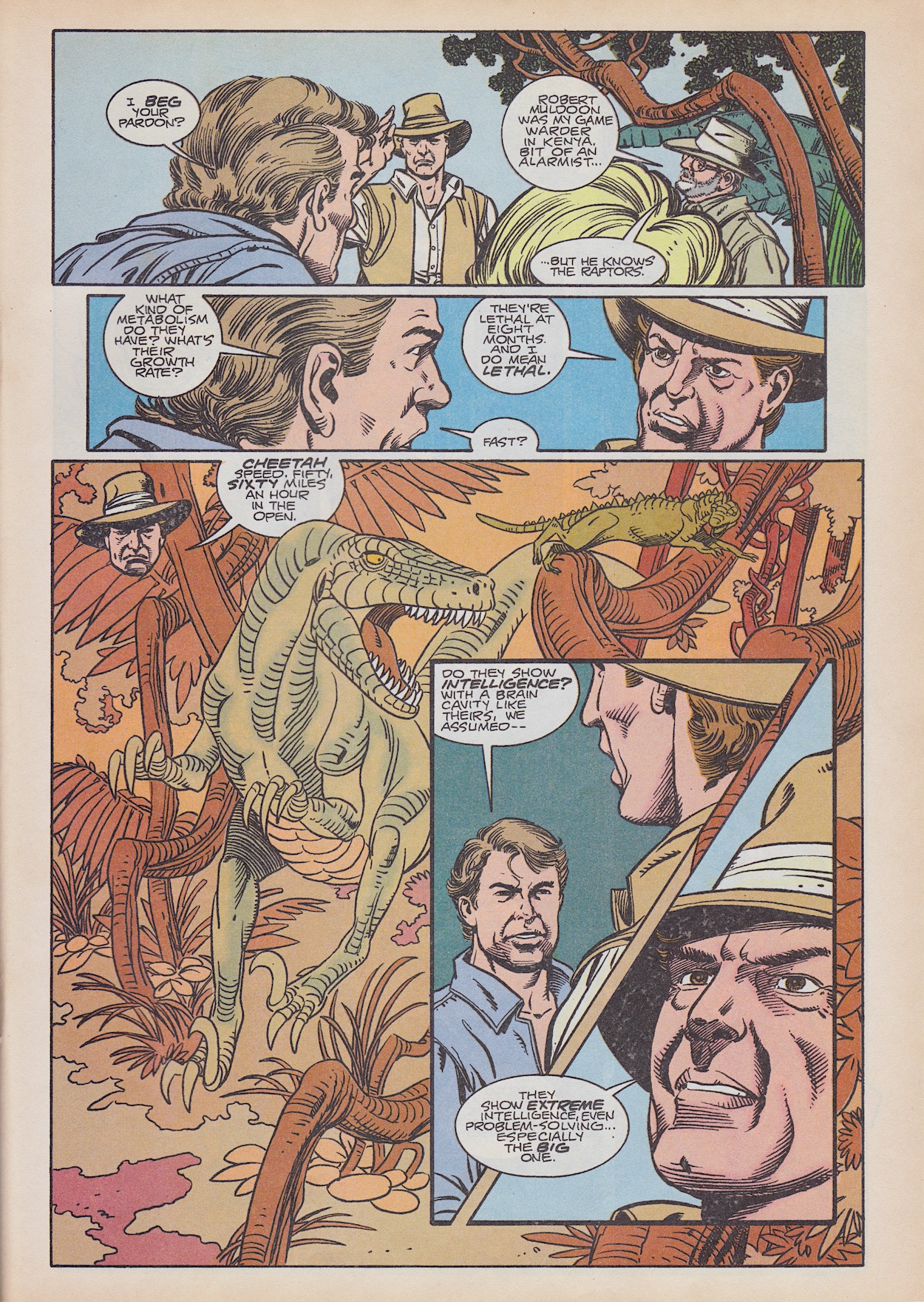
So, once again we’re treated to prehistoric flashbacks of these great hunters in their natural environment (highlighted by Tom Smith‘s change in colours) when game warden Robert Muldoon (Bob Peck) introduces them during that memorable dinnertime cow scene. With a graphic novel it’d be easier to follow the movie more closely, but writer Walter Simonson and story editor Jim Salicrup had to give readers a monthly dose (monthly in the States) of the ‘raptors and I think these scenes are a great solution and a natural fit.

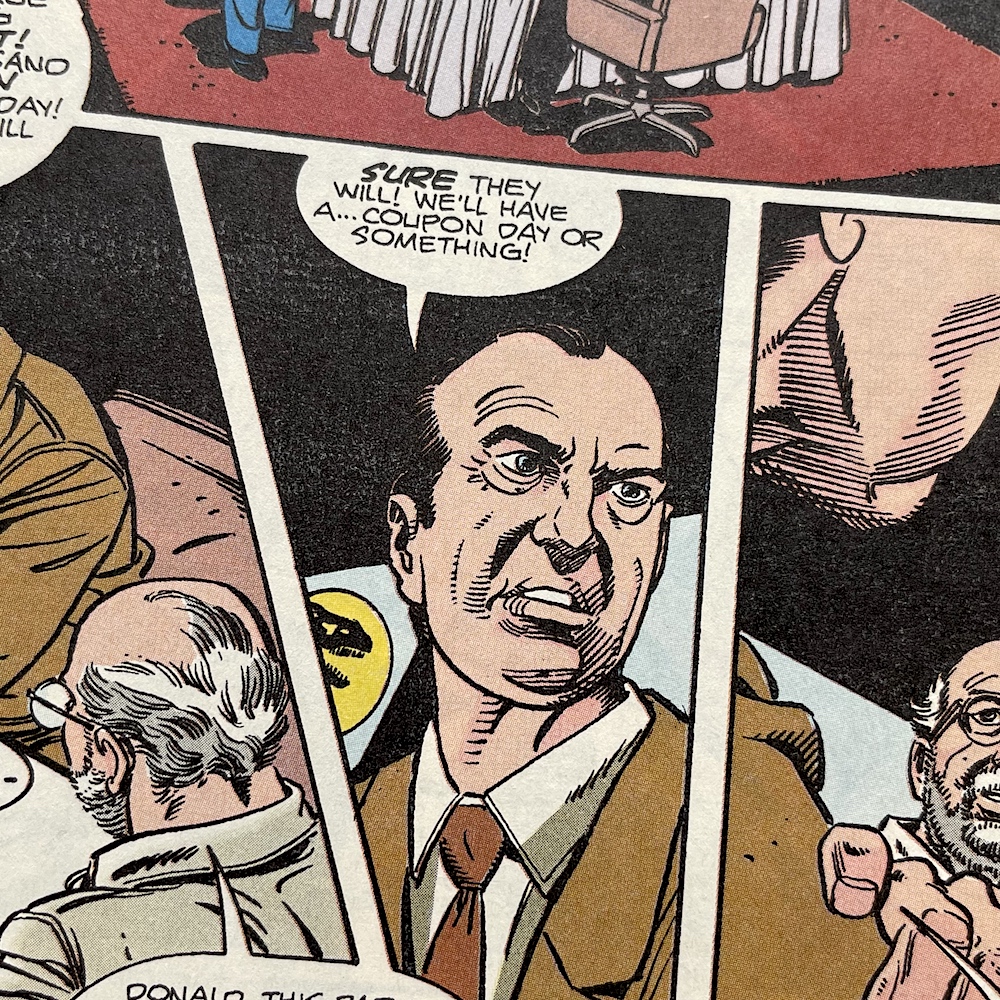
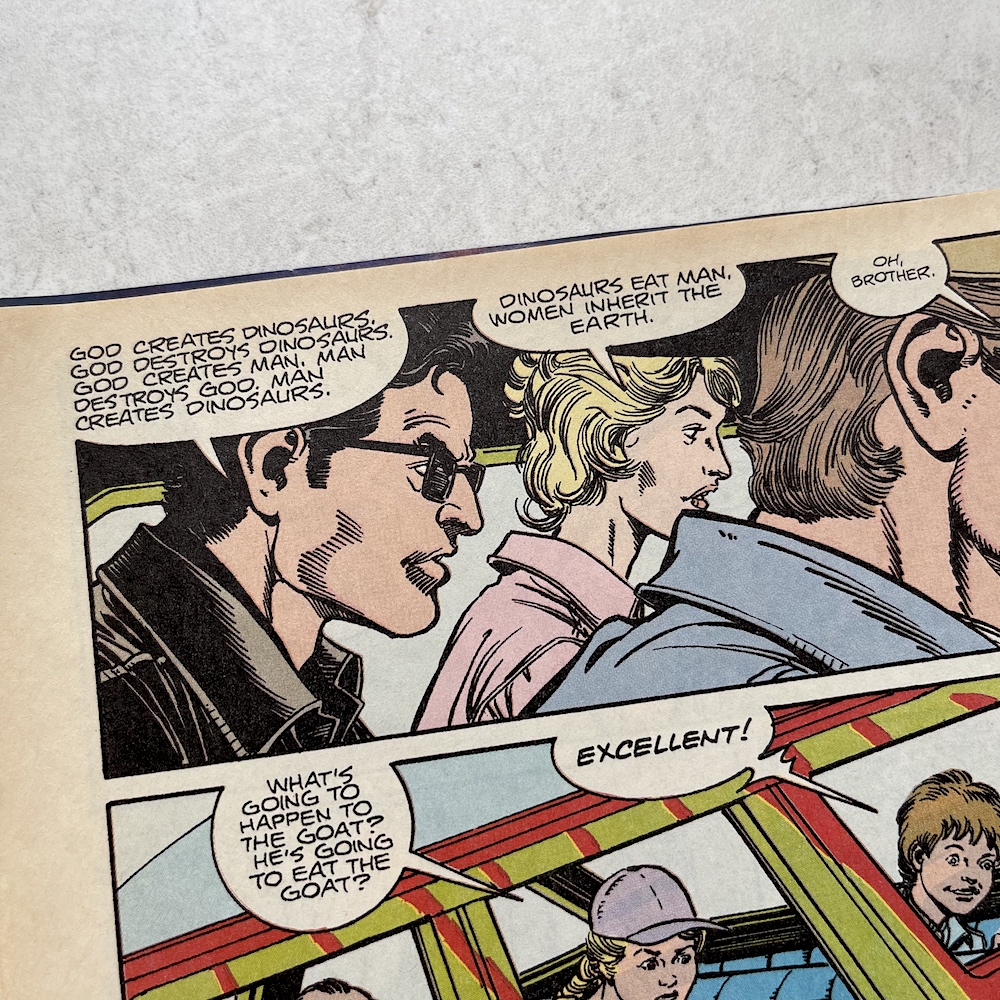
Ian Malcolm‘s quotes aren’t the only ones to survive the transition to comic form. Jurassic Park is a very quotable movie, with a surprising amount of dialogue taken directly from the novel. Some would have to be excised for this shorter form of storytelling but here are a small selection of those to be found in this second issue.

For some reason the comic changes the recorded in-car voice to James Earl-Jones from the film’s Richard Kiley. Maybe Earl-Jones was better known to the comic audience? On a side note, Crichton chose Kiley’s voice in the book so I thought it was brilliant how Spielberg actually got Kiley to play the part!

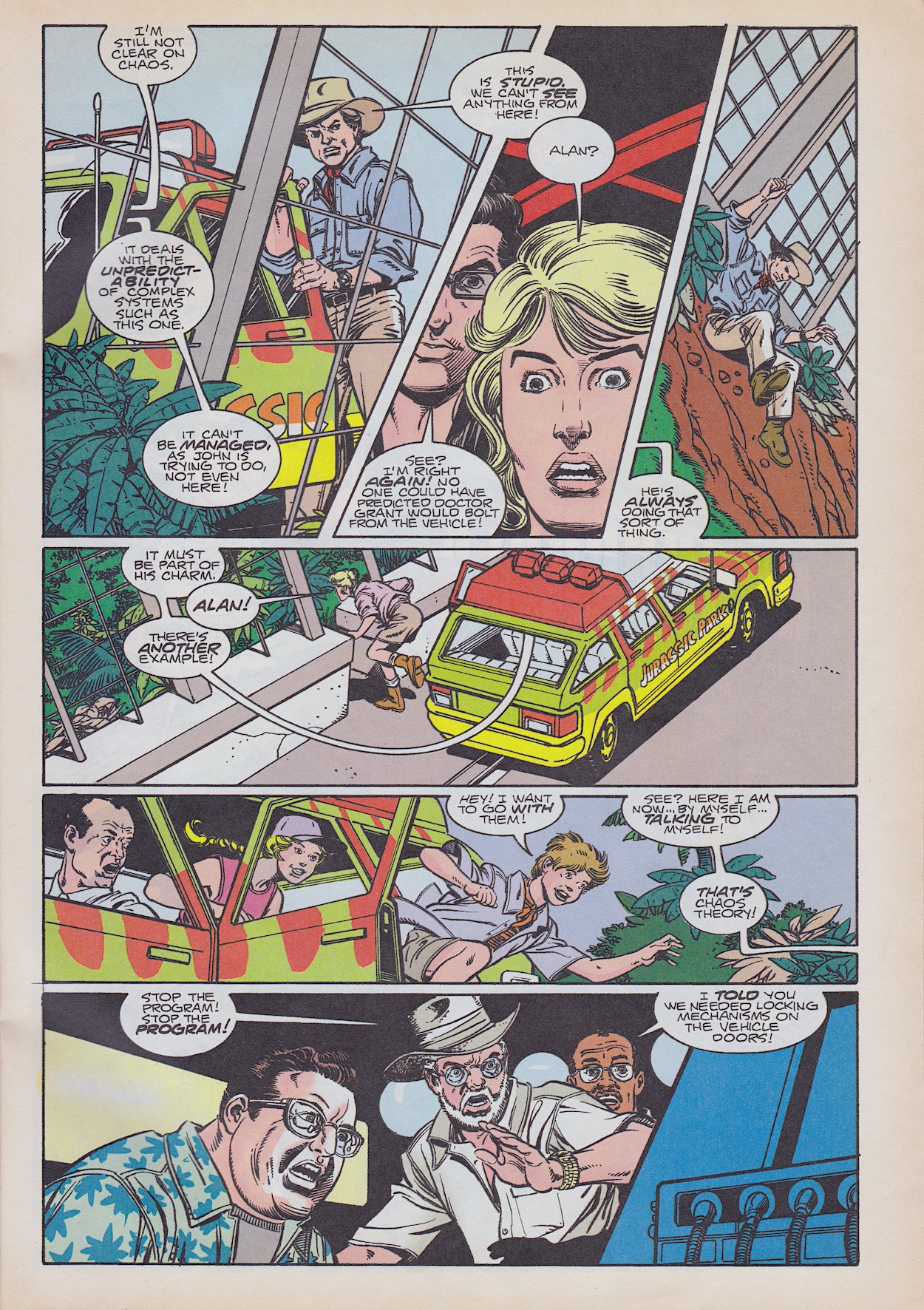
The story rolls along until we find ourselves at the T. rex paddock complete with a very worried goat and an almost gloating Malcolm. He knows the park can’t work, knows the natural systems in play are too complex to control and as far as he’s concerned chaos theory proves it. Unfortunately we lose the lovely butterfly effect scene between him and Ellie, but then again without Jeff’s delivery it would probably fall flat.

Maybe this is just a way of speeding the story along, because we’d never have bought Alan [Grant] doing this in the movie

However, after the others jump out of the vehicle we still get to laugh at him talking to himself about talking to himself, John Workman‘s speech bubbles pointing away from the action, highlighting the fact he’s chittering away on his own. It’s a very funny way to present this moment, I actually laughed when I read it despite seeing the film countless times already.

At this point we see more evidence of changes to the comic’s pacing in order to fit it all in. In the film Alan jumps out of the moving car when he sees and hears something in a field beside them. Here, he’s out of the car before it’s even started moving away from the T. rex paddock, climbing through a gap in the fence simply because he’s fed up of not seeing any dinosaurs.

It’s not exactly the safest of places to go for a dander! So maybe this is just a way of speeding the story along because we’d never have bought Alan doing this in the movie. It’s the first time I’ve questioned a change made by the comic’s team. Yes, the very next page is the last but come on, they could’ve simply added a caption to indicate they’d moved away from the T. rex first!

This isn’t a case of going back to the book either because in that they see a vet with a sick Stegosaurus and walk over in a safe environment, whereas here you can see they get surprised by an apparently healthy Triceratops. Same species as the film but this isn’t how the encounter played out. Could there be a major change of plot here? Or just a quick cheat for a cliffhanger? We’ll find out next time.

If chapter one was the introduction to the story, the setting and the characters, this issue’s chapter has been the build up. We all know the next instalment will include the elements all coming together to create the disaster that befalls the park so I’m interested to see how that will be adapted for the comic and how successful it will be.

Straight after the strip is the second of the behind-the-scenes features, explaining the differences between the four special effects teams and what each of their roles were. Miniature photography for animatics and choreography, the full-motion live-action creations, the mechanics for those beasts and of course the CGI. It’s easy to forget these days just how far ahead of anything else Jurassic Park was in 1993. The fact it looks just as spectacular 28 years later is testament to the hugely talented individuals who worked so hard to create Spielberg’s vision.

I saw the film in a Glasgow cinema with my dad and then devoured the novel that summer, after which I bought a fantastic book called The Making of Jurassic Park by Don Shay and Jody Duncan. There had been such books for movies before but the level of detail in this one was second-to-none. Fascinating stuff but lost when I moved out of home years later. These features have me eager to read it again.

On the back cover was another advert with that timeless logo and the island sunset. More a tease, it announced the inevitable videogame coming to multiple formats in three months’ time. More memories are flooding back because I owned the Nintendo Game Boy game and spent many a late night in bed before school playing it under the covers with that massive, heavy light attachment on top of the little monochrome screen. Happy memories indeed.

These first few issues of Jurassic Park were released every three weeks, a schedule I never saw in any of my comics as a kid. Many years later I do remember taking out a gift subscription to Titan Magazine‘s Spongebob Squarepants comic for a girlfriend who loved everything to do with Bikini Bottom, and that felt strange coming as it did every three weeks too, so used was I to weekly, fortnightly and monthly comics.

But the main thing is that #3 is here in another 21 days’ time on Thursday 19th August 2021. Until then, don’t move. It can’t see you if you don’t move.

iSSUE ONE < > iSSUE THREE

JURASSiC PARK MENU

JURASSiC PARK #1: ADAPTiNG THE ADAPTATiON

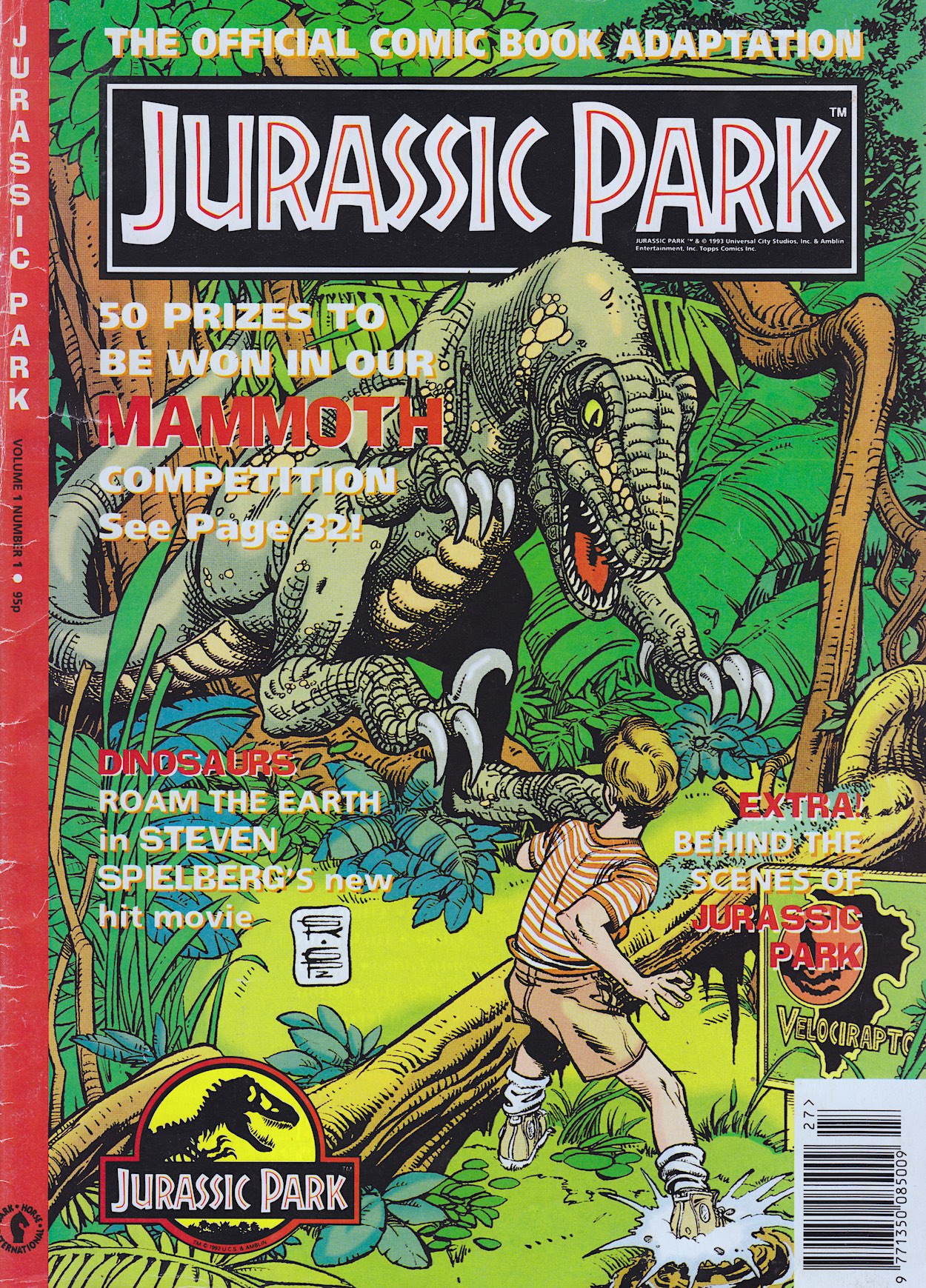
We’re jumping back 28 years now to the first issue of Dark Horse International‘s UK version of the Jurassic Park comic. How can that film be 28 years old? Anyway, published by Topps Comics in the States, over here it was repackaged on larger A4 paper of a higher quality, with that distinct Dark Horse banner and over the course of its run included extra features, competitions and back up strips like most UK comics.

By a happy coincidence 8th July was a Thursday in 1993 so it looks like each issue will be up on the blog on the same day of the week as the original run. Surprisingly this first issue went on sale before the movie was released over here, which didn’t stomp its way into cinemas until 16th July.

As I noted in the introductory post I’d originally spotted an issue of the adaptation in a shop but never bothered to buy it. I hadn’t enjoyed comics adaptations of movies previously and also felt I’d moved on from the medium. (We all make mistakes.) My first issue ended up being #6 and by then it contained three strips per issue, but it hadn’t started out that way. This first issue is cover-to-cover Isla Nublar, containing the first full chapter of the adaptation, a whopping 29 pages in length with the rest of the 36-page comic containing features that I’ll get to below.

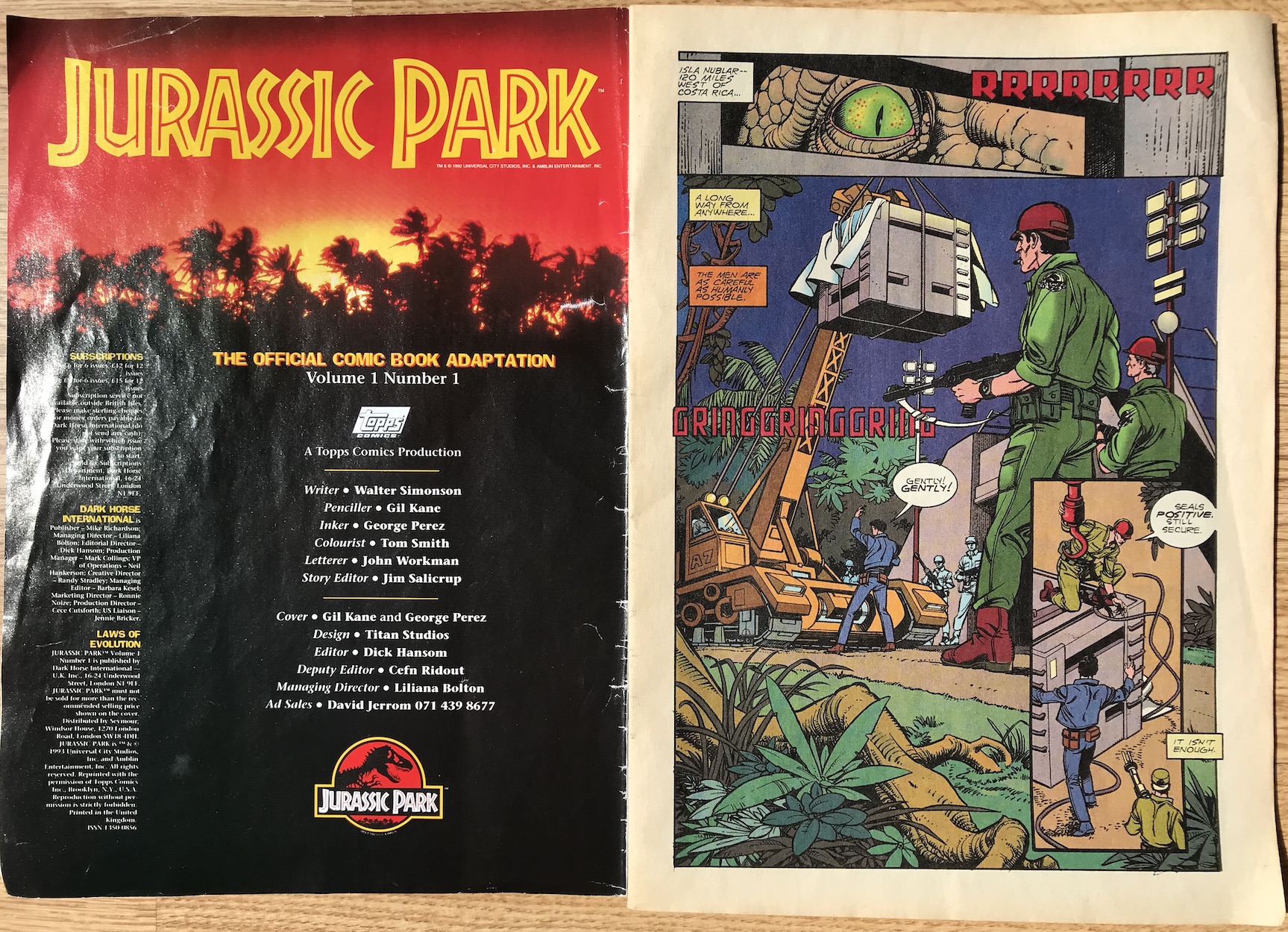
Edited by Dick Hansom (Aliens, Total Carnage, Speakeasy) there was never an editorial and instead a simple credits page for the strips, but the background of the island sets the scene. Let’s talk about that team Topps Comics assembled to adapt the film to comic form! As a fan of the franchise I’m pleasantly surprised by the names here. I may not have been aware of who all but one were at the time but I certainly am now.

The one name I did recognise originally was Jim Salicrup thanks to Transformers and whose adaptation of the Visionaries origin story has also been reviewed here on the blog. He also edited multiple superhero comics for the company before moving to Topps and eventually to Papercutz where he now resides as Editor-in-Chief, alongside being a trustee of the Museum of Comic and Cartoon Art. Writer Walter Simonson was tasked with adapting the screenplay and is probably best known for creating Star Slammers (featured in Havoc comic here in the UK), writing/drawing Thor for nearly five years in the 80s, drawing Robocop vs Terminator and writing Iron Man 2020 who popped up in the UK version of Transformers.


“You’ll decide you’ll control nature, and from that moment on you’re in deep trouble, because you can’t do it.”

Michael Crichton

Penciller Gil Kane sadly passed in 2000 but leaves behind a wealth of comics work on everything from Action Comics to Teen Titans and co-creating Iron Fist for Marvel. He was the artist on landmark stories in The Amazing Spider-Man, tales which led the Comics Code Authority to rewrite their rules about the depiction of drug abuse. Inker George Perez has won several awards for his comics artwork throughout his career, co-creating the characters White Tiger and Taskmaster for Marvel and he was artist on Crisis of Infinite Earths, The Avengers and Teen Titans amongst many others. George also wrote and drew on the highly regarded Wonder Woman of the late 80s and early 90s.

Colourist Tom Smith has worked for so many comics companies it’d be impossible to fit them all in here. Marvel, DC, IDW, Topps, Top Cow, Malibu and more. The Avengers, Hulk, X-Men and Justice League are just some examples of his artwork and he’s coloured for such legendary artists as Jack Kirby and Steve Ditko. Finally, John Workman lettered the complete run of Doom Patrol and has been a frequent partner of Walter’s. His style stands out, opening up the panel frames when his speech balloons or captions touch them, as evidenced throughout these early issues of Jurassic Park. John has also created strips for Star*Reach and lettered critically acclaimed titles such as Thor and Michael Moorcock’s Multiverse. What a team!

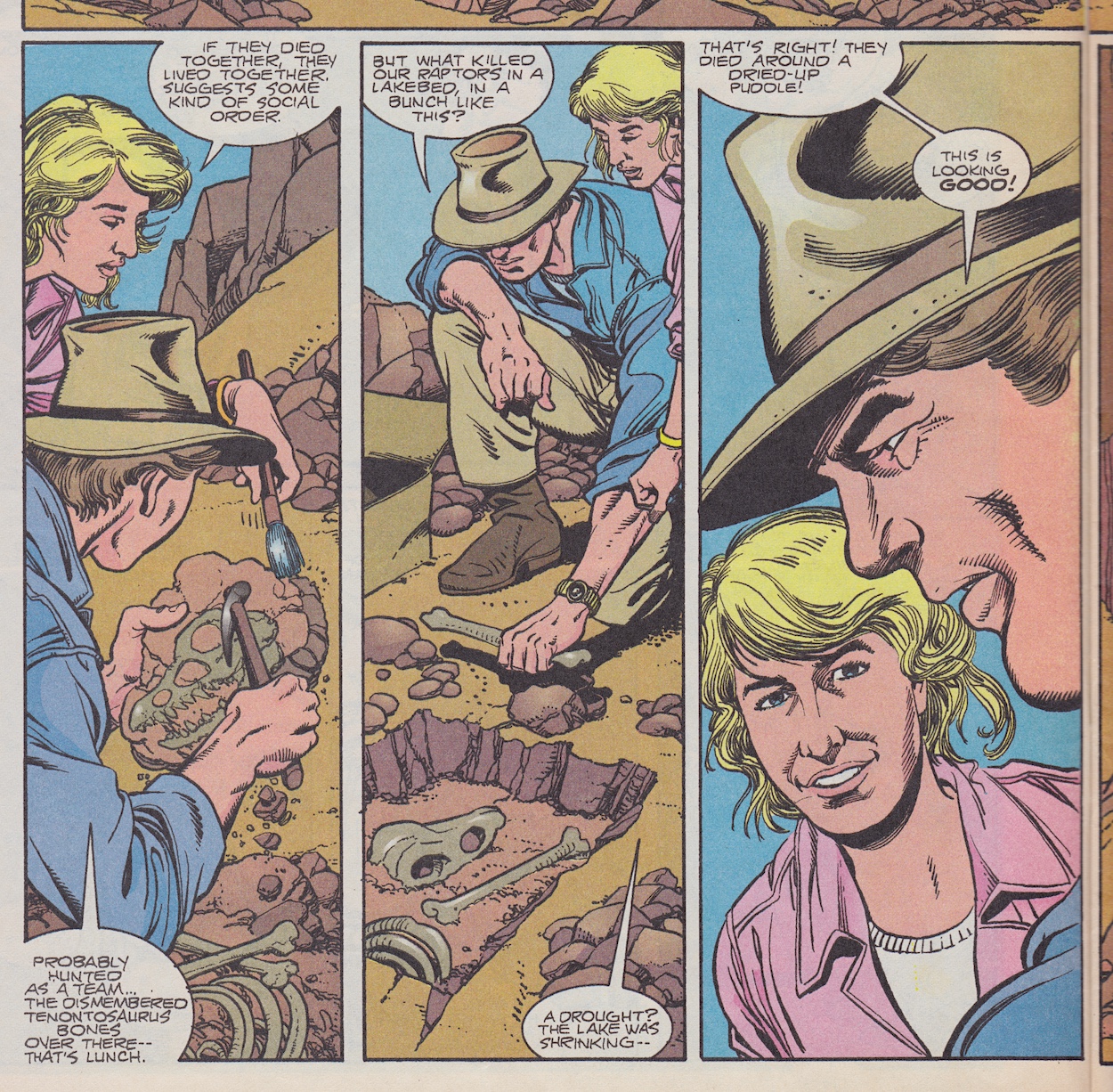
It’s important to put this story in the context of its time. Nowadays, mainly thanks to the film series we know details about dinosaurs and their social orders, hunting habits and intelligence. They’re no longer the lumbering, stupid lizards of stop-motion special effects. This all changed with the first Jurassic Park and reading this exchange between Dr. Ellie Satler (portrayed in the movie by Laura Dern) and Dr. Alan Grant, taken from the novel rather than the film, takes me right back to that time when this was all new information.

But taking me back also worries me. You see, as a kid I found comics adaptations of movies always seemed to have issues, such as excising whole scenes, leaving huge plot holes behind, or they’d copy some moments word-for-word but with artwork that failed to convey any of the drama, making exciting scenes rather dull. They felt very rushed with little thought given to what would work.

It’s brave to take up four pages with the opening of a gate!

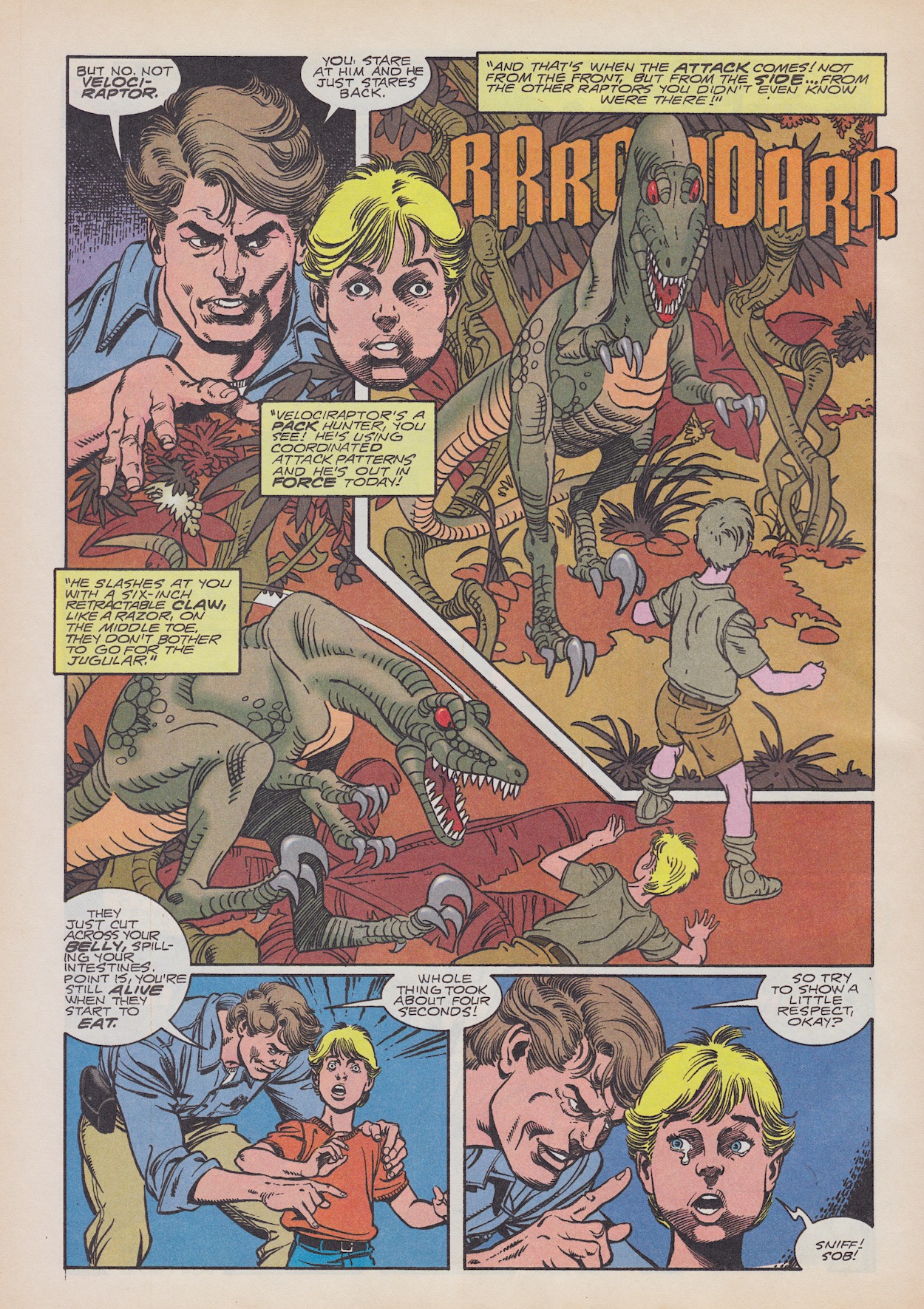
Instead of falling into the traps above for a quick cash in, Walter seems to be properly adapting the story for the comics medium. Take the scene above for example. In the movie Alan (Sam Neill) simply described the hunting techniques of a velociraptor to the child. With his raptor claw fossil in hand and using it with slow, deliberate movements, Neill’s tone and delivery made this scene foreboding and funny in equal measure. This wouldn’t work in a comic, so instead we’re shown what the kid could’ve been imagining at this moment. It’s from this we get our cover image too.

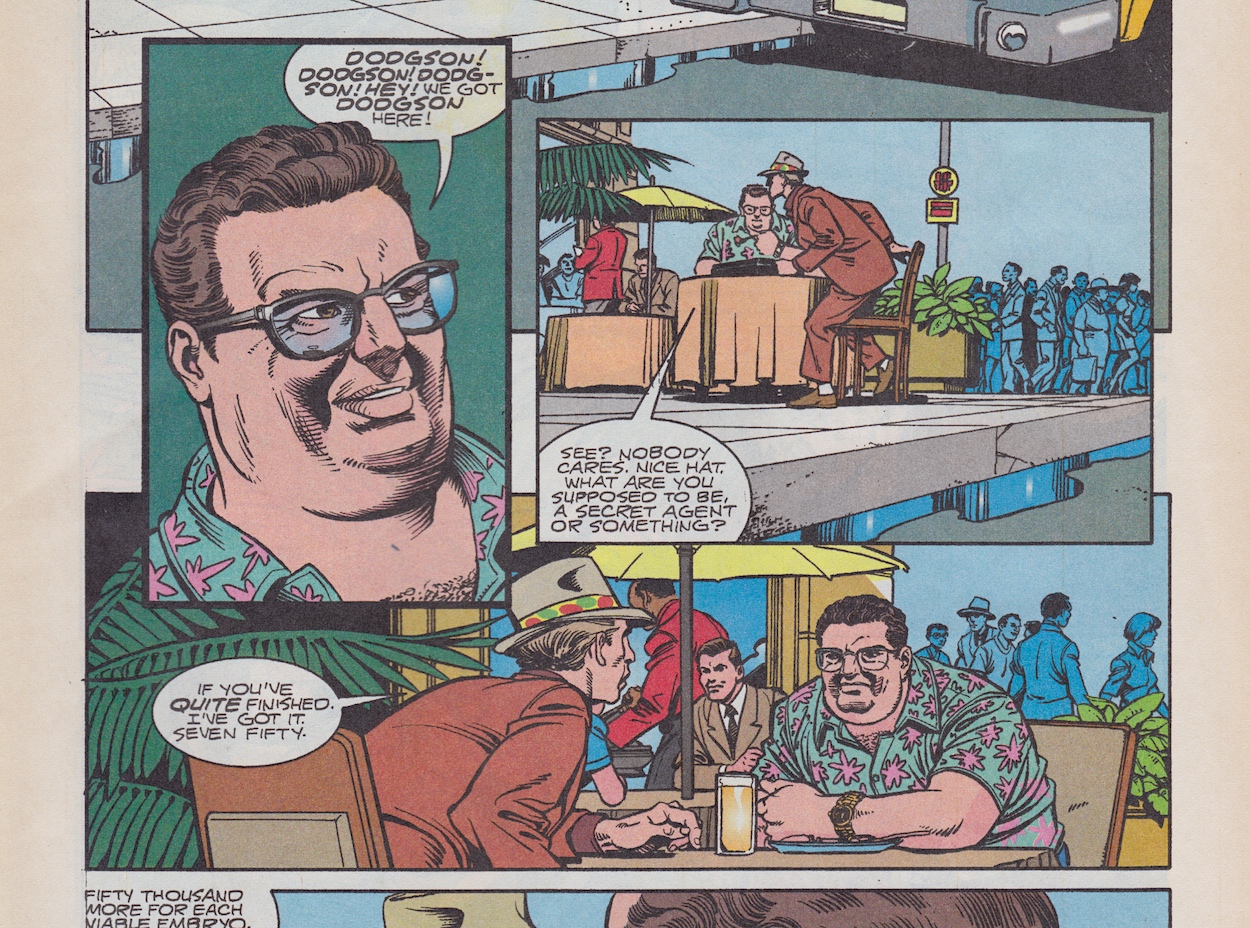
Some scenes remain unchanged, at least in their dialogue if not their setting. The classic Dodgson scene with Dennis Nedry (Wayne Knight) is played out pretty much as it is in the film, but then again what’s in the film is almost verbatim what Crichton originally wrote in his book. So when it’s already worked in written form it doesn’t require changing. Speaking of the book, on more than one occasion some of its original ideas and dialogue, changed for the film, can be found here.

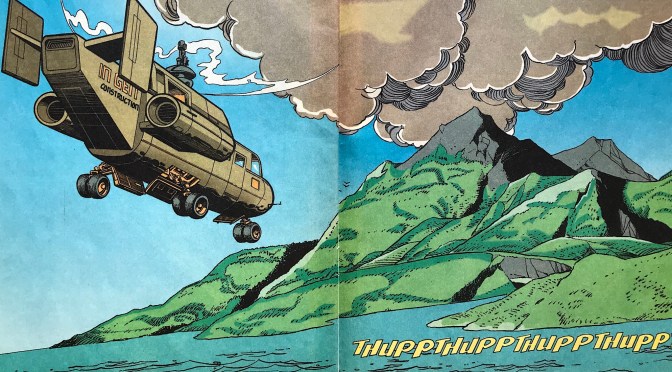
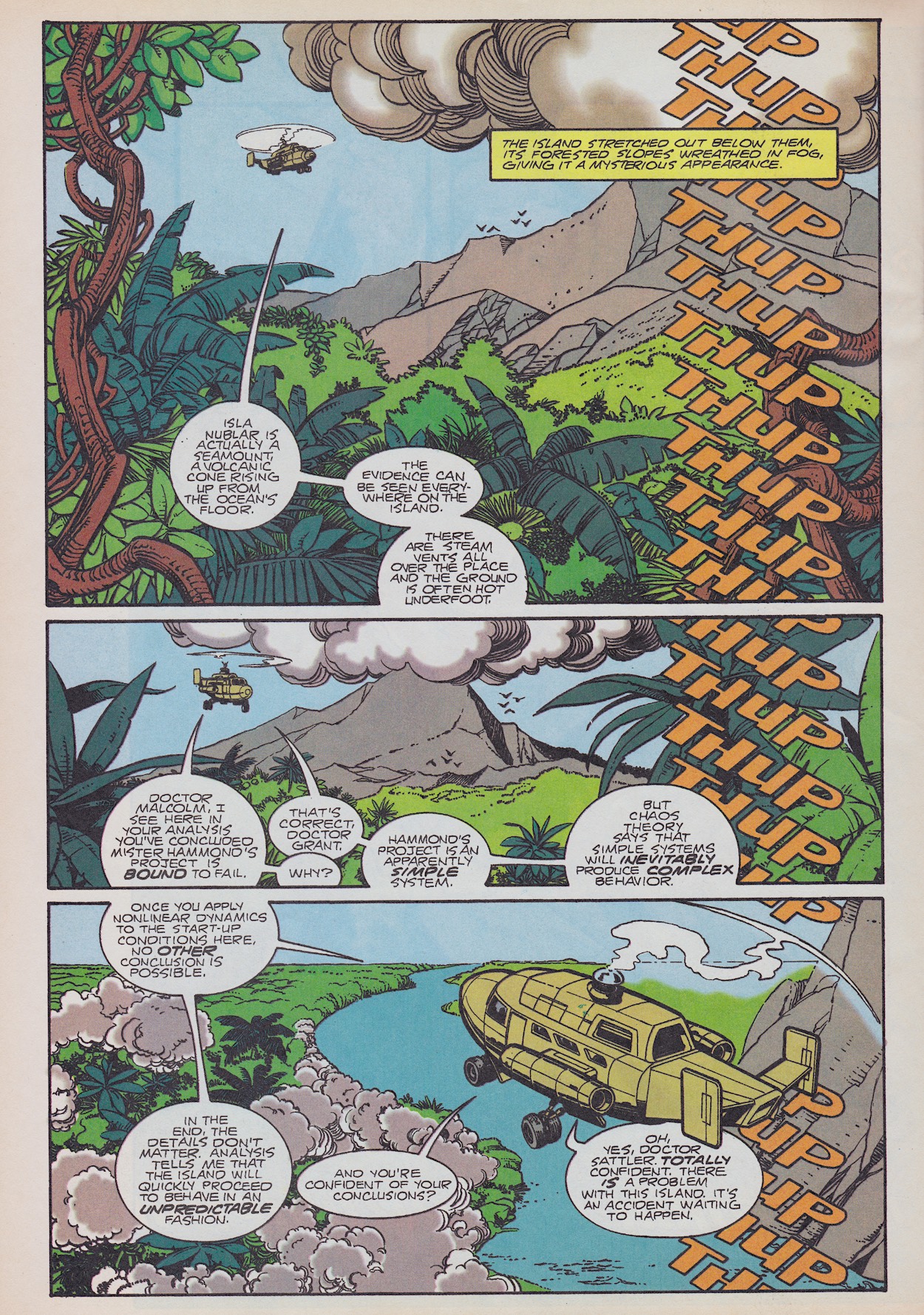
The following page is a good example, showing our main characters arriving on a helicopter at Isla Nublar, an island which covered in a thick fog in the original novel but not the film. There are also more details from Dr. Ian Malcolm (Jeff Goldblum) on how Chaos Theory predicts the experiment will fail. Crichton’s novel can often give several pages at once to Ian to describe his theories so obviously the movie had to simplify things, but they were utterly fascinating to read and in the comic just a little bit more of that original text is slipped in.

With an adaptation like this the aim is to have it on the shelves when the movie hits cinemas. This means work would commence with an earlier draft of the screenplay. As the screenplay changes from one draft to another some of those alterations come too late, meaning the comic could contain parts of the previous versions. In the case of Jurassic Park it makes for fascinating reading at times for a fan like me who knows the film so well.

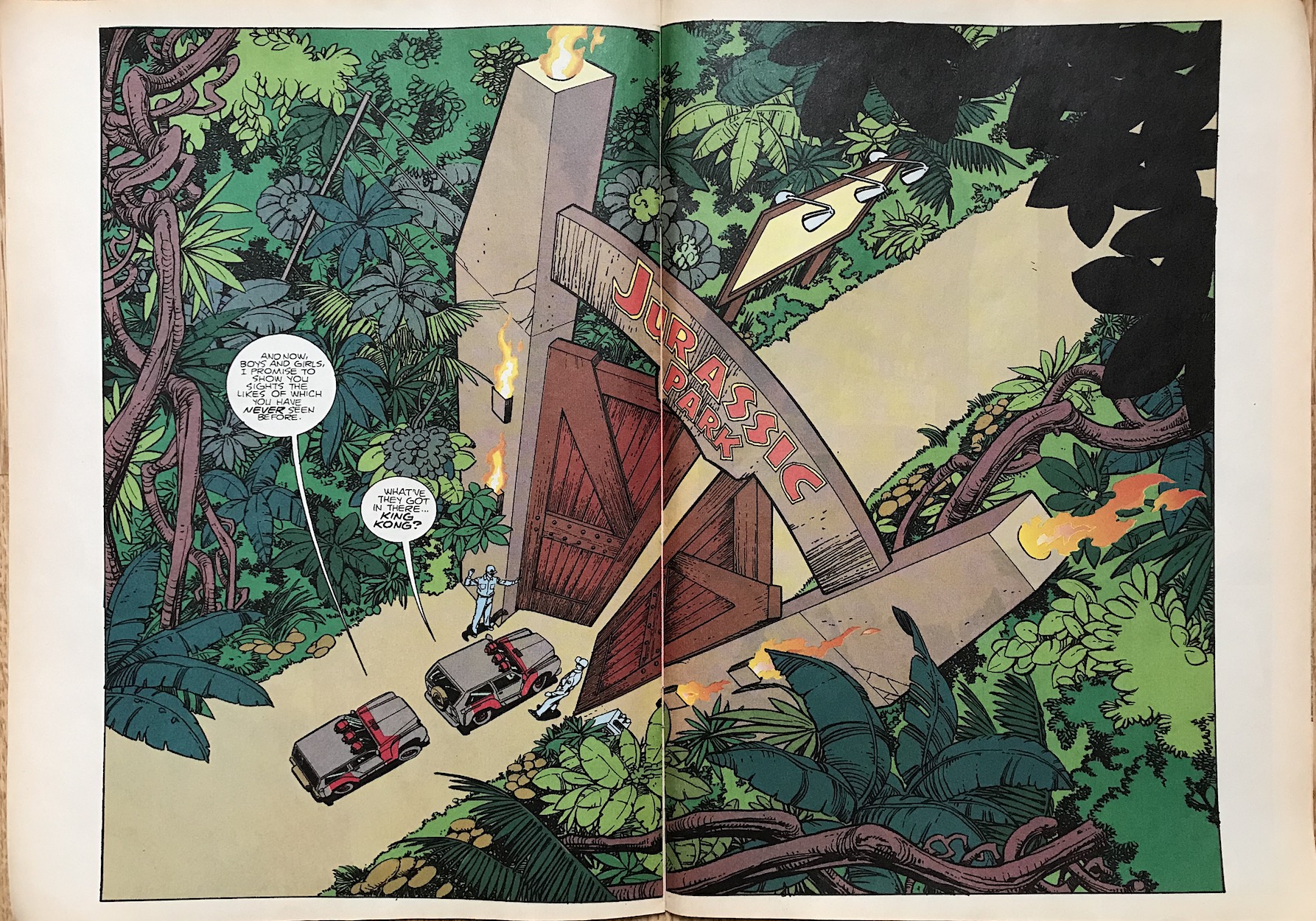
However, the biggest change in this first chapter definitely comes as a result of the medium and the requirement to split the film’s story into four chunks. If I were to tell you that the cliffhanger at the end of chapter one is the first encounter with the brachiosaur, where John Hammond (Richard Attenborough) had his “Welcome to Jurassic Park” moment in the film, fans should instantly be querying why these next four pages are in this issue. (Actually, Hammond had his moment in the comic when they landed in the helicopter.)

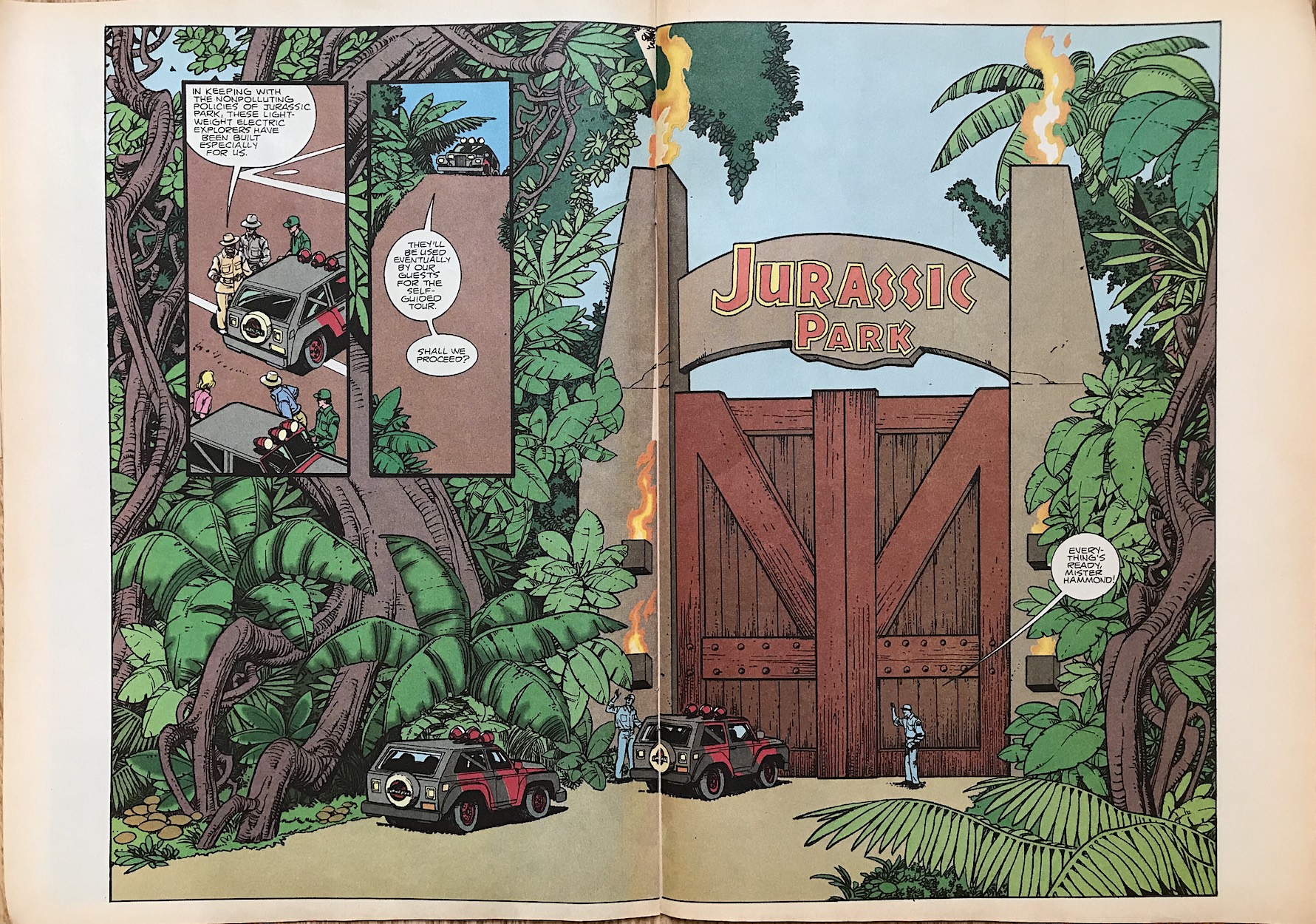
These pages do look wonderfully dramatic, though. It’s brave to take up four pages with the opening of a gate! In the film this didn’t happen until after we’d been fed all the science behind the park and the characters were heading out on the inaugural tour.  But this isn’t the comic team taking liberties with the story. The first chapter is very much about making the introductions and with a distinct lack of dinosaurs some changes had to be made to grip readers to the overall story. If that means some iconic scenes have to be moved or elaborated on visually (like with the child’s imagination earlier), then so be it.

I think it was a smart move to rearrange the placement of this scene, but some people will always complain about such changes, like how movies have to change certain aspects of a book.  Well of course they do, it’s a completely different medium. Books based on films also add and rearrange elements of the story or characters to suit the reading experience, but they’re still the same story, just adapted to suit. Having read the novel, I’ve always felt Spielberg did a perfect job of translating Michael Crichton’s novel to the screen and now the comic was adapting Spielberg’s adaptation!

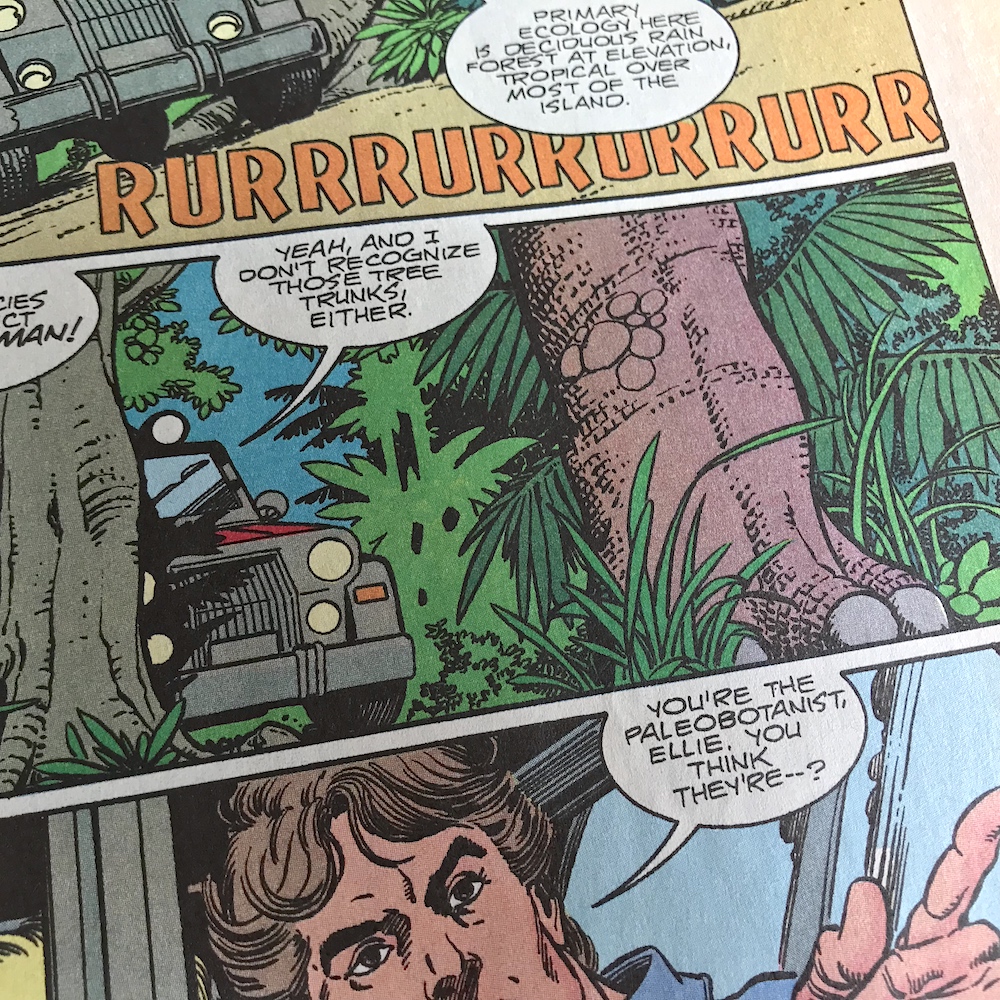
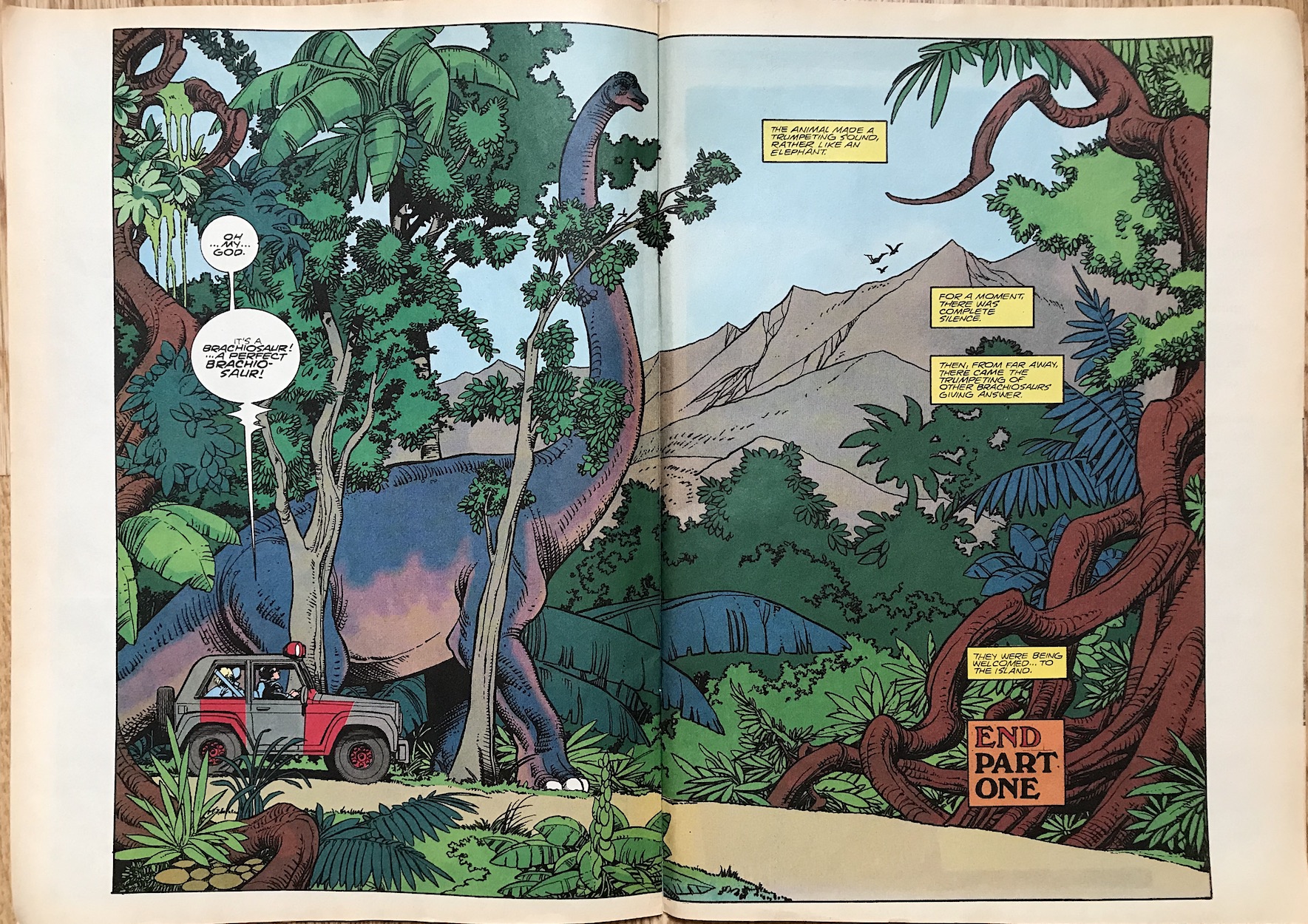
I do believe Hammond’s famous line would’ve worked better as part of this cliffhanger, but that’s just personal preference. There is one difference from the film I’m not keen on. In Crichton’s original story, while Grant overlooks the landscape he mistakes a brachiosaur’s neck in the distance for the trunk of a tall tree, until the dinosaur moves. Here, he’s meant to mistake a leg for a tree instead as they drive within a few metres of it. They didn’t see the giant tail or the belly over their heads?  If this was the original idea for the film I’m glad they changed it.

The final double-page is a beautiful image of their first encounter, with the remainder of this classic scene hopefully playing out next time. The captions make reference to the creatures welcoming them to the island and is also lifted straight from the book. In the novel the brachiosaurs come to this area whenever the helicopter approaches the island, eager to see the humans who they associate with looking after them. It’s a lovely, tender moment in the book designed to give a false sense of tranquility to the island.

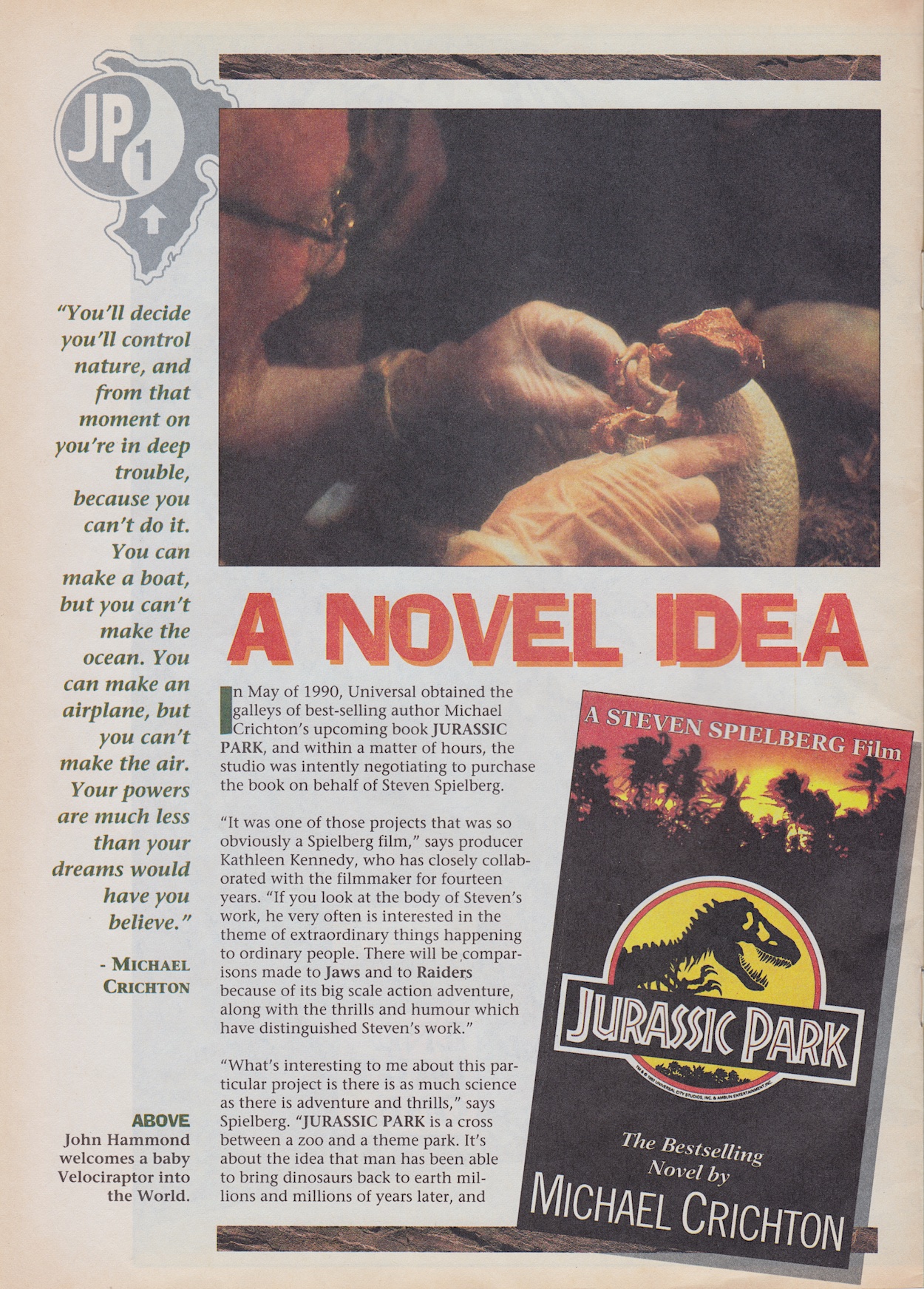
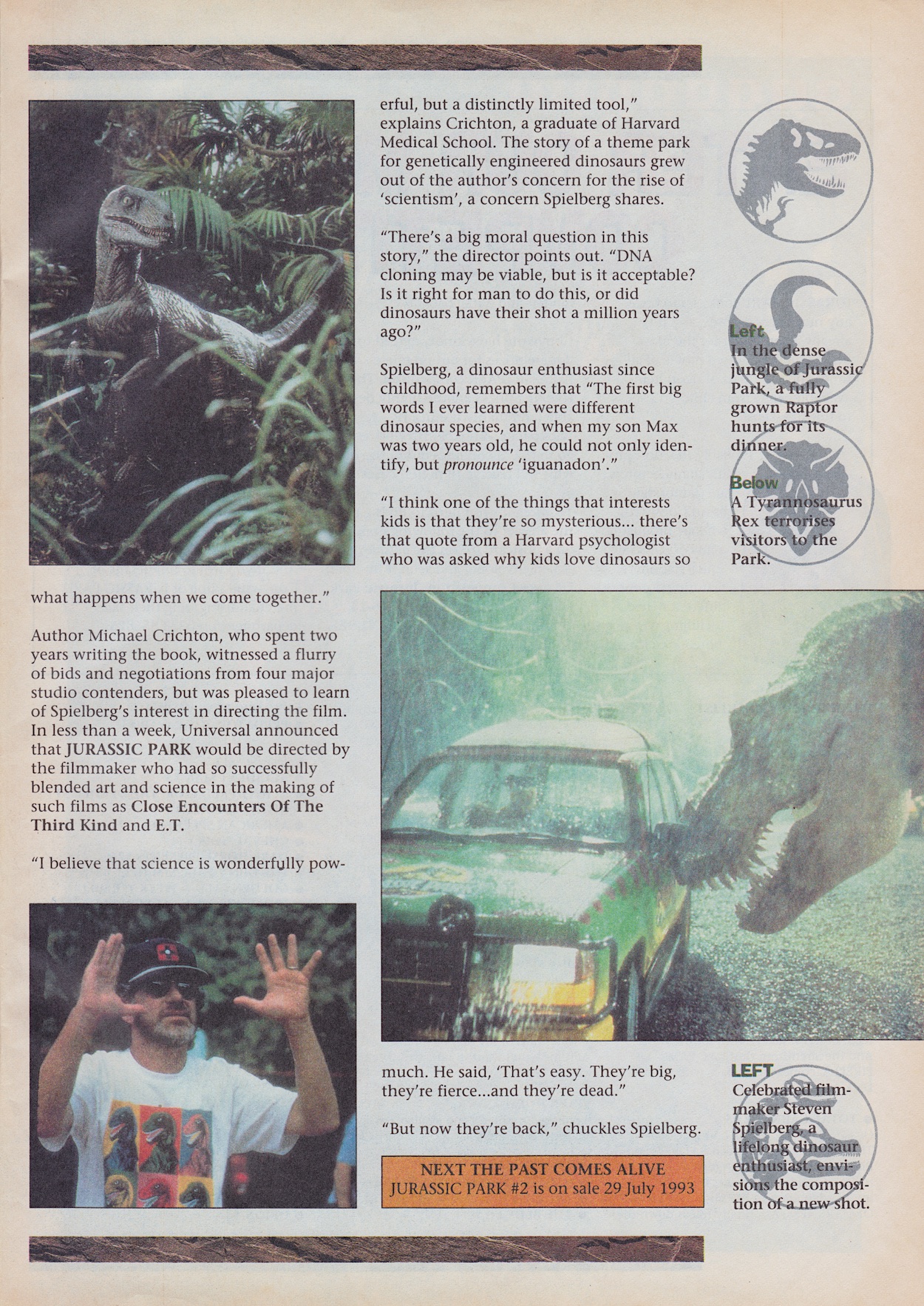
When I collected Jurassic Park back at the time it was cover-to-cover strips, with the occasional competition and comics adverts thrown in for good measure. It was a pleasant surprise to see a series of additional features about the making of the movie in these early issues.

They begin right back at the beginning, long before any filming had taken place, informing the reader about Amblin and Spielberg buying the rights, their first impressions and what they felt were the scientific and moral highlights. These were the important things they’d want to concentrate on when developing their own vision.  It makes for a good if somewhat brief read and there’s more to come over the next few issues.

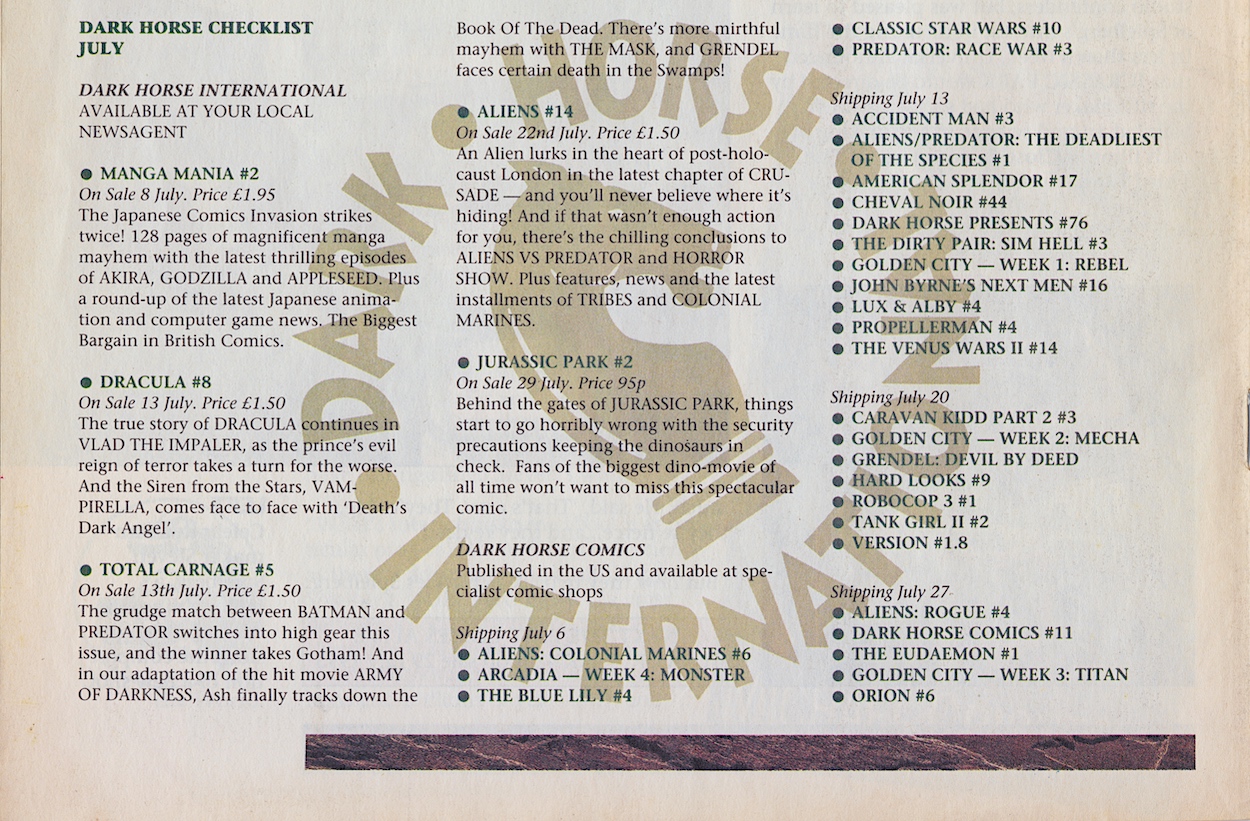
There’s also a checklist of Dark Horse’s local and import comics to be released over the next month. I can remember picking up an issue of their Aliens comic at some stage on a family holiday. Either it must’ve been before Jurassic Park or I was familiar with my friends’ copies because the trademark banner on the cover of this comic was already familiar at the time. I didn’t know there was a Dracula title and, while Jurassic Park has started out with just one strip every issue, it’s clear its stablemates were similar to other UK comic publishers’ titles, especially the aforementioned Aliens.

So there you go, our first look at Jurassic Park UK, a comic which has been sadly largely forgotten in the intervening years. I adored it and I can’t wait to share those later issues with you but so far I’m actually enjoying a comic movie adaptation, which is noteworthy in and of itself.

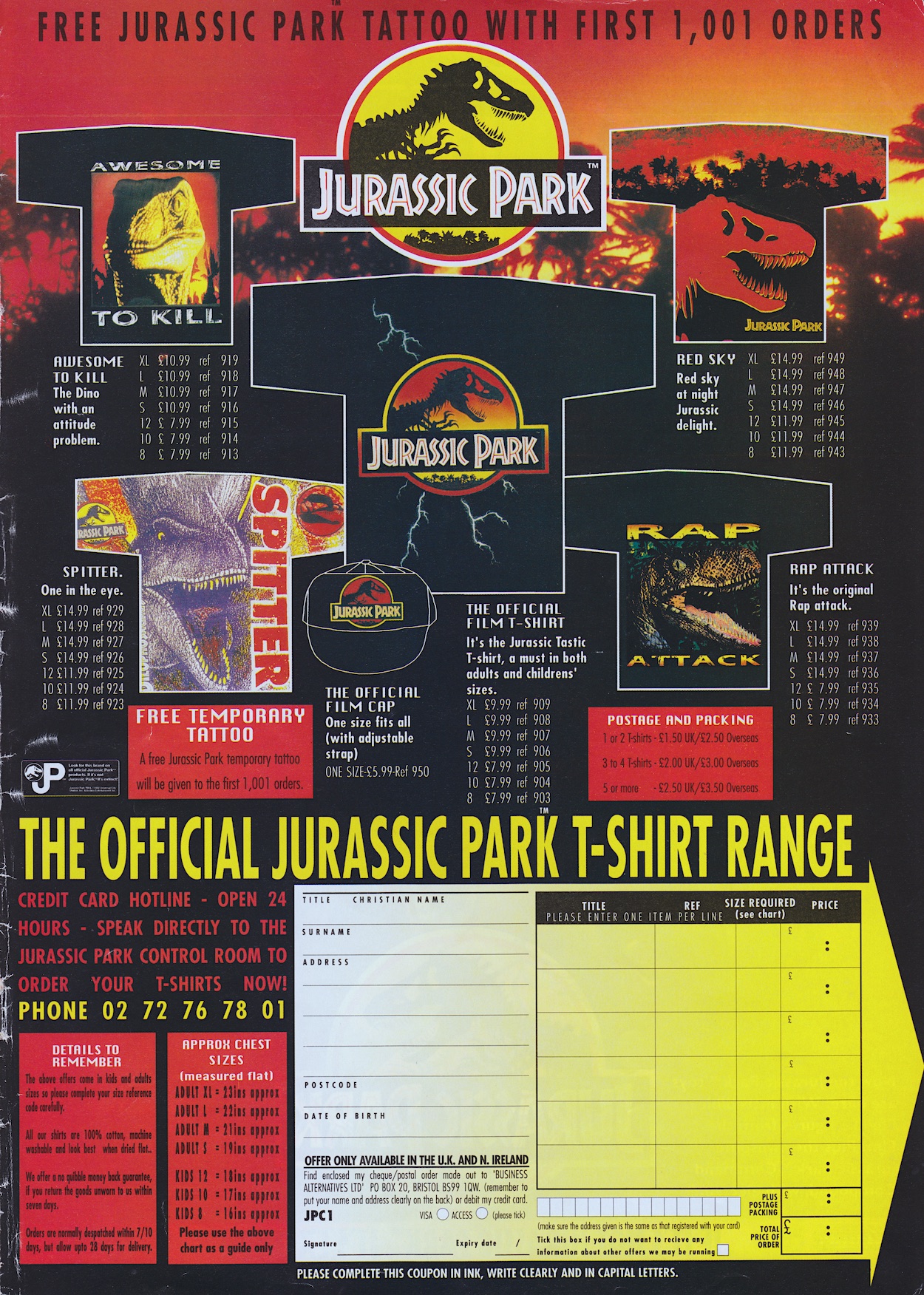
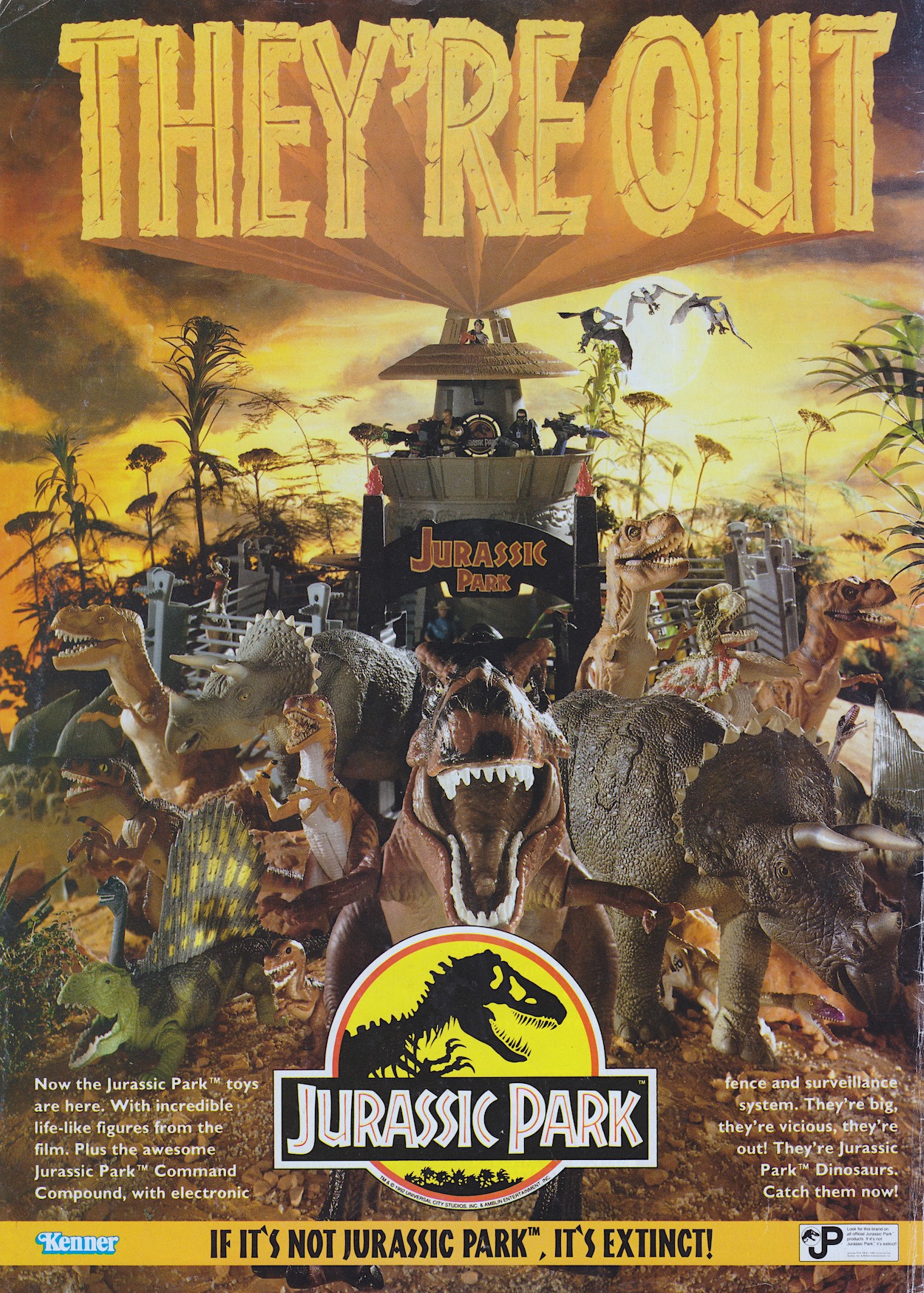
To finish here are your obligatory retro advertisements. I’m not too sure about some of those t-shirt designs but given half the chance as a 15-year-old I’d have jumped at the chance. On the back page is Kenner‘s toy range. I wasn’t even aware there was one. Obviously for a younger audience than I was but I’m still surprised I never spotted them in the shops.

There are some brilliant Jurassic merchandise adverts in this series and I’ll definitely be including them as we go, alongside those for some very-90s comics. I hope you’ll come along for the ride because it’s going to be great. After all, it has been 65 million years in the making.

Issue two of Jurassic Park will be roaring its way on to the blog in just three weeks (a unique release schedule for me) on Thursday 29th July.

GO TO iSSUE TWO

JURASSiC PARK MENU